


автордың кітабын онлайн тегін оқу Pitcher Pollock
Transcriber's Note: The cover image was created from the title page by the transcriber and is placed in the public domain.
PITCHER POLLOCK
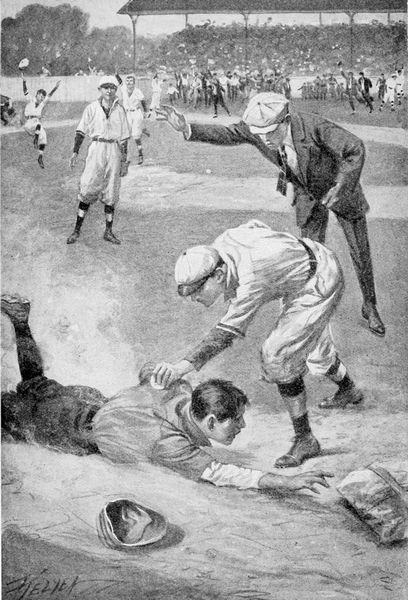
Down came Bert’s arm and it was all over
PITCHER POLLOCK
BY
CHRISTY MATHEWSON
AUTHOR OF
FIRST BASE FAULKNER,
CATCHER CRAIG, Etc.
ILLUSTRATED BY
CHARLES M. RELYEA

GROSSET & DUNLAP
PUBLISHERS NEW YORK
Made in the United States of America
Copyright, 1914, by
DODD, MEAD AND COMPANY
PRINTED IN THE U. S. A.
CONTENTS
CHAPTER
PAGE
I
TOM HUNTS A JOB3
II
AND FINDS IT14
III
UNCLE ISRAEL SAYS “NO”27
IV
AT CUMMINGS AND WRIGHT’S35
V
TOM LOOKS AT HIS HAIR48
VI
TWO PAIRS OF SKATES64
VII
TOM GAINS PROMOTION82
VIII
AN OUT-CURVE100
IX
TOM WANTS TO KNOW114
X
TOM PLAYS IN A REAL GAME124
XI
THE BLUES VISIT LYNTON138
XII
“BATTER’S OUT”151
XIII
TOM TWIRLS TO VICTORY164
XIV
COACH TALBOT MAKES A CALL180
XV
THE PUMP CHANGES HANDS197
XVI
THE DETECTIVE DONS A MASK214
XVII
AFTERNOON PRACTICE224
XVIII
TOM TWIRLS FOR THE SCRUBS237
XIX
WITH THE TEAM249
XX
AMESVILLE LOSES THE GAME264
XXI
KNOCKED OUT OF THE BOX283
XXII
UNCLE ISRAEL SITS UP293
XXIII
“PLAY BALL!”304
XXIV
PITCHER POLLOCK313
XXV
THREE OUT325
ILLUSTRATIONS
Down came Bert’s arm and it was all overFrontispiece
FACING PAGE
“I was wondering sir,” said Tom, “if after I’ve paid that bill I couldn’t have the pump”46
“‘Grasp the ball firmly,’” recited Sidney, “‘between the thumb and the first two fingers’”120
“Now you watch, son. Better get behind me so’s you can see”210
PITCHER POLLOCK
CHAPTER I
TOM HUNTS A JOB
“Want to hire a boy?”
Mr. Cummings looked around and across the showcase at the youth who stood there.
“Want to what?” he asked.
“Hire a boy. I’m looking for a job.”
“Oh.” Mr. Cummings turned back to his task of rearranging a number of carpenter’s squares in a green box and made no other reply for a moment. The boy waited silently, watching interestedly. Finally, fixing the cover on the box and laying it on a shelf, “Ever worked in a hardware shop?” he asked.
“No, sir.”
“I didn’t suppose you had. What use would you be to me then, eh?” Mr. Cummings peered sharply at him.
“I could sweep and run errands and—and wash windows and the like of that,” replied the applicant imperturbably. “I’ll tell you how it is, sir. I live out to Derry, and——”
“What’s your name?”
“Tom Pollock, sir.”
“I didn’t know there were any Pollocks in Derry.”
“There ain’t, sir, except me. I live with my uncle, Mr. Bowles.”
“Israel Bowles?”
“Yes, sir.”
“Hm. So you’re Israel’s nephew, eh? Didn’t know he had any kin. Well, all right. Then what?”
“I’m going to high school next week,” went on the boy. He spoke slowly, choosing his words carefully and sometimes correcting himself as he talked. “I got to live in town because, you see, I couldn’t get back and forth every day.”
“Aren’t the trains running out to Derry any more?”
“Yes, sir, but—but it would cost too much, you see. So I thought maybe if I could get some work here in Amesville——”
“How in tarnation do you expect to work and go to school too?”
“I don’t have to go to school until half-past eight and I’d be all through by three, and I thought if I could find some work to do in the morning before school and then in the afternoon——”
“I see. Well, I guess you wouldn’t be worth much money to anyone, working that way, son.”
“No, sir, that’s what I thought. I wasn’t expecting to get much, either.”
“Weren’t, eh? How much?”
“Well, about——” He hesitated, viewing the merchant anxiously. “Of course I don’t know much about what folks pay, but Uncle Israel said——”
“Hold on a bit,” interrupted Mr. Cummings suspiciously. “Did that old—did Israel Bowles tell you to come to me?”
“No, sir. I just started up at the other end of town and worked along. I’ve been at it most all morning.”
“Hm. Didn’t find anything, eh?”
“Not yet,” answered Tom cheerfully. “I got—I’ve got the other side of the street yet, though. An’—and I ain’t—haven’t been on the side streets at all. I guess I’ll find something.”
“Hope you do,” said the merchant. “But I guess you wouldn’t be much use to me. How much did you say you wanted?”
“Two—two and a half a week,” said the boy. He gulped as he said it and looked questioningly at the merchant. “I thought,” he continued as Mr. Cummings’s countenance told him nothing, “that if I could get enough to pay my lodging I’d make out, sir.”
“Got to eat, though, haven’t you?”
“I—I got a little saved up, sir. I worked for a man over to—over in Fairfield most of the summer.”
“What for? Isn’t your uncle hiring help any more? Hasn’t given up farming, has he?”
“No, sir, but—well, I made more working for Mr. Billings.”
“I’ll bet you did!” Mr. Cummings chuckled. “I know that uncle of yours, son, from A to Izzard, and there isn’t a meaner old skinflint in Muskingum County! He owes me nearly sixty-five dollars, and he’s been owing it for nearly six years, and I guess he’ll keep on owing it unless I sue him for it. Bought a pump of me and then claimed it didn’t work right and wouldn’t ever send it back or pay for it, the old rascal! Yes, I guess sure enough you did better working somewheres else, son!”
Tom had nothing to say to this. Perhaps, as a dutiful nephew, he should have stood up for Uncle Israel, but the hardware dealer’s estimate of Mr. Bowles was a very general one and Tom had long since become accustomed to hearing just such remarks passed. Finally, as the merchant seemed to have finished talking, Tom said:
“I’m sorry. Well, I guess I’ll be going on. Unless—unless you think maybe——”
“Wait a minute.” Mr. Cummings had opened the slide at the back of the showcase and was absent-mindedly rearranging some boxes of pocket-knives and scissors. At last, shutting the slide again briskly: “Look here, son, maybe you and I can make a dicker yet. Two and a half isn’t a whole lot of money, even if times are pretty bad. I might give you that much and not go broke, eh? How long do you suppose you could work here at the store ordinarily?”
“Why, I could be around by half-past six, I think, sir, and work until about eight-twenty-five. The school ain’t—isn’t far. Then after school I’d stay around as long as you wanted me. I—I’d like mighty well to work for you, sir.”
“Hm. Well, you look pretty strong and healthy. There’d be a lot of heavy work to do. Hardware’s hefty stuff to handle, son.” Tom nodded, undismayed. “I wasn’t exactly thinking of hiring anyone yet awhile. Usually along about November we have an extra helper, but fall is a dull time, mostly. What about Saturdays? Don’t have to go to school then, do you?”
“No, sir, I could be here all day Saturday. I forgot to tell you that. I’d like, though, to get the seven-forty-six train Saturday nights. I’m aiming to get home over Sundays. Of course, if there was a lot to do, I’d be perfectly willing to stay and help, sir.”
“We-ell——” Mr. Cummings frowned thoughtfully at a lurid powder advertisement that hung nearby. “Tell you what you do, son. Had your dinner yet?”
“No, sir.”
“You go and have your dinner and then come back. My partner will be in at one and I’ll see what he says. Then, if he don’t want you, you haven’t wasted any time and you can try somewhere else.”
“Thank you. What time’ll I come back?”
“Say half-past one. That will give you most an hour for dinner. Guess if you’ve been walking around town all forenoon you’ll want most an hour, eh?” And Mr. Cummings smiled in a friendly, almost jovial way.
“Yes, sir,” returned Tom. His own smile was fainter. “I’ll be back then. Much obliged. An’—and I hope the other—I hope your partner will let me come.”
“We’ll see.” Mr. Cummings waved his hand. “I’ll let you know when you come back.” He watched the boy speculatively as the latter strode unhurriedly down the aisle and out of the door. Then, “Miss Miller,” he called, “look up Israel Bowles’s account and give me the figures.”
At the back of the store, behind the window of the cashier’s partitioned-in desk, a face came momentarily into sight and a brown head nodded.
Out on the sidewalk Tom Pollock paused and thrust his hands into his pockets. It was the noon hour and Main Street was quite a busy scene. Almost directly across the wide thoroughfare the white enamelled signs of a lunch room gleamed appealingly. Tom looked speculatively at the next store on his route, which was a tiny shoe shop with one diminutive window filled with cheap footwear. It didn’t promise much, he thought. Then a hand went into a pocket and he pulled out a crumpled dollar bill and some silver. He frowned as he hastily calculated the sum of it, selected two ten-cent pieces, and returned the rest to the pocket. With the two coins in the palm of his hand he crossed the street to the lunch room and found a seat. The back of the room held counters with stools in front of them that folded out of the way when not in use, but near the entrance two lines of chairs stood against the walls. The right arm of each chair was widened into a sort of shelf large enough to hold a plate and a cup and saucer. Above the rows of chairs the neat white walls were inscribed with lists of viands and their prices. Tom sank into his chair with a sigh, stretched out his tired feet, and studied the menu across the room. There was no hurry, for he had three-quarters of an hour before he would return to Cummings and Wright’s to learn the verdict. The chair Tom had taken had been the only empty one at the moment, for the lunch room was popular and well patronised and the time was the busiest period of the day. At his right a rather small, neatly dressed gentleman with black whiskers and a nervous manner was simultaneously draining the last drop in his milk glass and glancing at a gold watch which he had pulled from his pocket in a fidgety way. Tom had decided to have a plate of beef stew, price ten cents, a piece of apple pie, price five cents, and a glass of milk, price the same, when the nervous gentleman arose hurriedly and in passing tripped against one of Tom’s extended feet.
“Excuse me,” said Tom. The man gave him an irritated glance, muttered something ungracious, and made for the door. Tom’s gaze turned idly toward the chair beside him which the man had just vacated and fell on a small leather coin-purse. Evidently the gentleman had failed to return it to his trousers pocket or it had fallen out afterward. Tom seized it and jumped up. Fortunately he found when he reached the door that the loser, in spite of his apparent hurry, had paused on the curb. Tom touched him on the arm.
“I guess this is yours, ain’t it?” he asked. “It was in your chair.”
“Eh? Yes, of course it is. Must have dropped out of my pocket.” He seemed quite put out about it and scowled at the purse before he put it away. “Most annoying.” He shot a fleeting glance at the boy. “Much obliged to you; very kind.” Then he plunged off the sidewalk, dodged a dray, and narrowly escaped the fender of a trolley car. Tom smiled as he returned to the lunch room.
“Bet you,” he reflected, “he’s one of the sort that’s always in a hurry and never gets anywhere!”
His absence, as short as it had been, had lost him his seat, and he was obliged to penetrate to the rear of the room and perch himself on a stool in front of one of the long counters. There, however, he feasted royally on beef stew, bread and butter, pie and milk, and managed to consume a full half-hour doing it. To be sure, he was still hungry when he had finished the last crumb, for he had had nothing since breakfast at seven o’clock and it was now well after one, and he had been on the go all the morning. But he felt a heap better and a lot more hopeful, and as he left the lunch room he was ready to believe his search for employment ended, that Mr. Cummings’s reply would be favourable. A contented stomach is a great incentive to cheerful thoughts.
CHAPTER II
AND FINDS IT
The clock in a nearby steeple showed Tom that there still remained nearly ten minutes of waiting, and so he joined the northward-bound throng and idled along the street, pausing now and then to examine the contents of a store window. A jeweller’s display held him for several minutes. He wondered whether he would ever be rich enough to possess one of the handsome gold watches so temptingly displayed on black velvet.
“They ain’t—aren’t—any thicker’n a buckwheat cake,” marvelled Tom. “Don’t seem as if there was room inside them for the wheels and things!” Just then he caught sight of himself in a mirror, took off his straw hat, and smoothed down a rebellious lock of red-brown hair. Then he replaced his hat, studied the result in the mirror, and nodded approvingly. A lady at the other side of the window smiled at the pantomime, and then, catching Tom’s glance in the mirror, smiled at Tom. Tom flushed and hurried away.
“Guess she thought I was a fool,” he muttered. “Standing there and primping like a girl!”
The lady followed his flight with kindly amusement, realising sympathetically his embarrassment. And as she went on she wondered about him a little. The reddish-brown hair and the clear, honest blue eyes had been attractive, and, although the tanned and much-freckled face could not have been called handsome, yet there was something about it, perhaps the expression of boyish confidence and candour, that lingered in her memory. Neatly, if inexpensively dressed, his attire had told her that he was not an Amesville boy, while a lack of awkwardness, a general air of self-dependence, seemed to preclude the idea of his being from the country. The problem lasted her only for a short distance and then Tom and the ingenuous incident at the window passed from her mind. But she and Tom were destined to meet again, although neither suspected it.
It was exactly half-past one when Tom entered the hardware store once more. On the occasion of his first visit the store had been empty of customers, but now at least half a dozen persons were there, and Mr. Cummings was busy. Tom found a position out of the way and waited. Besides Mr. Cummings, there were two others behind the counters—a tall youth who, as he passed with a customer in tow, looked curiously at the boy, and a small man with dark whiskers who, at his present distance, had a strong likeness to the gentleman who had left his purse in the lunch room. It was several minutes before Mr. Cummings was at leisure, but finally, dropping the change into the glove of a lady who had purchased a tack hammer and three papers of upholstery tacks, he beckoned Tom to the counter.
“Well,” he said, “I spoke to Mr. Wright about you, son, but he didn’t think we’d better hire anyone just yet. Maybe a month or so later, if you still want a job, we can take you on. Sorry I can’t do anything now.”
Tom’s face fell. He had been so certain since lunch that his troubles were over that the disappointment was deeper than it should have been.
“I’m sorry too, sir,” he said after a moment. “Well, I guess I’ll go on. I—I’m much obliged to you. You don’t happen to know of anyone who wants a boy, do you?”
“No, I don’t believe I do,” returned Mr. Cummings kindly. He kept step with Tom for a way as the latter moved toward the door. “You might try Miller and Tappen’s, though. That’s the dry-goods store up the street. They take new help on pretty often, I guess.”
“I’ve been there,” said Tom. “They said——”
“Joe, where have those three-inch brass hooks got to?” asked an impatient voice from the front of the store. “Funny we can’t keep anything in place here!”
“Ought to be right in front of you,” replied Mr. Cummings in patient tones. “Second shelf, Horace. No, second, I said. There! Got ’em?”
“Yes,” replied the dark-whiskered man irritably. “I’ve got them at last!”
It was the gentleman of the coin-purse. Tom recognised him as he went past. The junior partner was displaying the three-inch hooks to a man in overalls and glanced up in his quick, nervous manner at the boy. Then he looked again, and:
“Who’s that?” he asked sharply of Mr. Cummings.
“The boy I spoke to you about. Wants a job.”
“Call him back!”
Tom was just at the doorway when Mr. Cummings’s summons fell on his ear. He turned and retraced his steps. Mr. Cummings beckoned him to the counter where he had joined his partner. It was Mr. Wright who spoke, eying Tom searchingly.
“Aren’t you the boy who found my purse in the restaurant?” he demanded, almost fiercely.
“Yes, sir.”
“Mm.” Mr. Wright poked a finger through the scattered hooks on the counter. “You wait a minute.”
Tom drew aside. A glance at Mr. Cummings’s face showed him that the senior partner was quite as much in the dark as he was as to Mr. Wright’s conduct. But a minute later the customer in overalls went off with his hooks, and Mr. Wright, after returning the rest of them to a box and, as Tom saw with amusement, tossing it carelessly back to the wrong shelf, came from behind the counter.
“Mr. Cummings says you want employment,” he said questioningly. “What can you do?”
“Anything, sir. I ain’t afraid of work.”
“Going to school, are you?”
“Yes, sir. I start Monday at high school.”
“Do you know how to use a broom?”
“Yes, sir.”
Mr. Wright drew his fingers nervously through his black whiskers. “Do, eh? That’s more than anybody else does around here.” Evidently that was intended as a hit at the tall clerk who had drawn near. But the clerk only grinned. “Well——” Mr. Wright turned to his partner. “Take him on if you want to,” he said. “He’s honest, anyway. That’s something. You talk to him.”
He hurried away to the front of the store. Mr. Cummings, with a smile and a quizzical shrug of his shoulders, beckoned Tom to the railed-off office at the rear of the store. There he told Tom to sit down.
“What’s this about a purse?” he inquired.
Tom told of the incident. Mr. Cummings seemed unduly impressed by it. “Now that was funny, wasn’t it? A regular coincidence, eh? Blessed if it don’t look to me as if luck had fixed everything up for you, son. Well, now I’ll tell you what we’re willing to do and you can say whether you want to do it. Your uncle owes this firm sixty-four dollars and a half. We’ll call it an even sixty. Now, we’ll take you on here to work at two and a half a week. Two of that goes to you and fifty cents of it comes to us until we’ve squared ourselves for that sixty dollars. That satisfactory to you?”
Tom considered a moment. Then, “Yes, sir, I think so,” he replied a little doubtfully.
“Well, if I were you, I’d talk to my uncle; tell him our offer and see if he wouldn’t be willing to make up the half-dollar to you. You’re paying his bill, you know.”
“Maybe he would.” But there was little conviction in Tom’s tone. “Anyway, if he didn’t, it wouldn’t matter, I guess. It would be all right if I could find a room for two dollars. I looked at one this morning, but the lady wanted two dollars and a half for it. Maybe I could find another, though.”
“I think you ought to,” said Mr. Cummings. “Try around Locust Street, near the depot. Well, there’s our offer, son, anyway. If you want to, you can have a talk with your uncle before you decide.”
“No, sir, thanks, I’ll—I’ll come, anyway.”
“All right. If you get on and learn the business, after a while we’ll give you more money. Mind you, though, you’ll have to show up here at seven-thirty, open up the store, and sweep and dust. And we’ll expect you back after school to stay until we close at six. On Saturdays we stay open until nine. And just before Christmas we keep open every evening. Let’s see; you said you wanted to get off early Saturday evenings, didn’t you?”
“I thought I’d like to spend Sundays at home, sir.”
“That would be all right usually, I guess. Around Christmas time we might want you to stay late on Saturdays, but other times I guess you could get off by eight or whenever your train goes. When do you want to start?”
“I was thinking I’d start Monday afternoon, sir. I’m going home to-day and coming back Monday morning, in time for school. Would that be all right?”
“Yes, that’ll do. To-day’s Thursday, isn’t it? All right, son. We’ll look for you Monday afternoon. You do your work right and I guess you’ll find us easy to get along with.” Mr. Cummings hesitated. “I might as well tell you, though, that—er—my partner is a little quick-tempered at times. It’s just his way. He’s terribly nervous. After you get used to him, you won’t mind it.”
“Yes, sir.”
“That’s all then, I guess. By the way, what did you tell me your name was?”
“Thomas Pollock, sir.”
“Miss Miller, just make a note of this, please. Thomas Pollock enters our employ Monday. Wages, two and a half a week. Enter him on the pay-roll. Thank you. By the way, son, you’d better have a pair of overalls here to slip on. There’ll be dirty jobs, I guess, and there’s no use spoiling your clothes. Good day.”
It was not yet two o’clock when Tom passed out of Cummings and Wright’s and his train did not leave until after four. That gave him a good two hours in which to seek a room within the limit of the two dollars which he was to actually receive. He had scant expectation of being able to persuade Uncle Israel to make good that fifty cents a week to him. Israel Bowles was considered a hard man around Derry, and, it seemed, his reputation had even spread to the city. Tom didn’t for a moment doubt that Uncle Israel really did honestly owe that sixty-odd dollars to the hardware house. Uncle Israel, however, probably had what seemed to him a perfectly legitimate reason for not paying it. And, as the indebtedness had remained for six years, Tom didn’t believe that Uncle Israel would agree to paying it off through him. Still, it would do no harm to ask, he told himself as he set off down Main Street.
Tom’s mother had died when he was a baby, and his father when he was nine years old. They had lived in Plaistow, a small Ohio town about a hundred miles from Derry. Before Tom, who was the only child, had been born his parents had had several homes, as he had learned from Uncle Israel. Uncle Israel called Tom’s father a “ne’er-do-well” and a “gallivanter.” Tom for a long time didn’t know what a “gallivanter” was, but he always resented the term as applied to his father. His parents, like Uncle Israel, who was his mother’s brother, had come originally from New Hampshire. When Tom’s father died, leaving little in the way of earthly goods, Uncle Israel had promptly claimed the boy and taken him to Derry. On the whole, Uncle Israel had been kind to Tom. The lad had had to work hard during the six years on the farm, had had to rise early and, often enough, go late to bed, since his schooling had been more or less intermittent, and it had been only by studying in the evenings that he had been able to keep up with his class in the little country schoolhouse. Tom couldn’t doubt that Uncle Israel was fond of him, even if displays of affection had been few. And Tom was honestly fond of Uncle Israel. He knew better than perhaps anyone else that, hard as his uncle seemed, there were some soft places, after all. But Tom didn’t deceive himself with false hopes about the fifty cents a week!
Main Street crossed the railroad tracks between the station and the freight houses. Parallel to the railroad ran Locust Street, lined on one side with small stores and lodging-houses affected by railroad employés. It was not an attractive part of the town, and the smoke from the engines and the dust raised by the wagons and drays that passed on their way to the freight houses made the fronts of the cheap, unlovely buildings dingy and dirty. But Tom knew he had no right to expect a great deal for two dollars and so began his search philosophically. There were plenty of rooms for rent in those three blocks, but most of them, after his own neat and clean little bedroom at the farm, turned him away in disgust. But at length he found what seemed to answer his purpose. It was a back room in a lodging-house even smaller and meaner-looking than usual, but it was clean and, within its limits, attractive. And the price was better than he had dared hope for. He could have it, said the stout Irishwoman who pantingly conducted him up the flight of steep, uncarpeted stairs, for a dollar and seventy-five cents a week, payable in advance. From the one small window there was a not unattractive view of a diminutive back-yard, which held a prosperous-looking elm tree, and the rear of a livery stable which, being only one story in height, allowed him to look over its flat tar-and-gravel roof to the more distant roofs and spires and trees of Amesville. Tom took the room, paid down fifty cents as earnest money, and agreed to pay the balance Monday morning. His landlady’s name, as she told him on the way downstairs, was Cleary, and her husband worked in the roundhouse. She referred to him as a “hostler,” but Tom didn’t see how a hostler could be employed about engines. He didn’t question her statement, however. She seemed a good-hearted, respectable woman. She had six other lodgers, she informed him, “all illigint tinants,” and proceeded to supply him with the life history of each. Two small children crept bashfully through the door of a back room and stared unblinkingly at Tom until their mother discovered their presence and sent them scurrying out of sight. “Me two youngest,” she explained proudly. “I’ve three more. One do be working for Miller and Tappen, drives a delivery cart, he does, and the next two do be in school. They’re good kiddies, the whole lot of ’em.”
Tom finally dragged himself away and crossed over to the station to kill time until his train left, on the whole very well satisfied with the results of his day’s industry.
CHAPTER III
UNCLE ISRAEL SAYS “NO”
Derry lay twenty-two miles to the west of Amesville and it required almost an hour for the branch line train to reach the little settlement. Tom descended from the car amidst the clatter of empty milk-cans being put off on the platform of the small station. Uncle Israel Bowles’s farm lay nearly a mile away, and Tom, whose feet were sore from the unaccustomed tramping of city pavements, looked about for a lift. But of the two buggies and one farm wagon in sight none was bound his way, and so he crossed to the dusty road that led northward and set out through the warm, still end of a September day. There was no hurry and so he went slowly, limping a little now and then, and thinking busily of the new life to begin on Monday. He wondered whether he would get on satisfactorily with Cummings and Wright, whether the lessons at high school would prove terribly hard, whether he would find any friends amongst the boys there. And finally, with an uneasy sensation, he wondered how long the small amount of money he had saved up during the past two years would last him in Amesville. What experience he had had of city prices for food alarmed him when he thought of satisfying that very healthy appetite of his! Well, he would just have to do the best he could, and if doing the best he could meant going hungry sometimes he’d go hungry! At all events, that money had to last him until next summer, when, either through some more advantageous arrangement with Cummings and Wright or by hiring himself again to one of the neighbouring farmers, he could once more put himself in funds. These reflections and resolves brought him in sight of the farm, and the next moment the joyful barking of Star, his collie dog, announced his advent. Star came leaping and bounding through the gate and down the road to meet him.
“Hello, old chap!” said Tom, patting the dog’s head. “I guess I’m going to miss you more’n anything or anybody when I go away. I wish I could take you with me. I just do. But I guess you’d pretty near starve to death over there to Amesville. There wouldn’t be any buttermilk, Star, and there wouldn’t be any corn-bread, either, I guess. Well, I’ll be back on Saturdays to see you, anyway. What you been doing all day? Did you miss me?”
Star replied dog-fashion that he had missed his master very much, and, by licking his hand and doing his best to lick his face as well, accorded him a royal welcome home. Aunt Patty—she was no real relation, but Tom had always called her aunt—was setting the table for supper as he went in. She was a small, wrinkled little old woman, with a sharp tongue and a warm heart, and had kept house for Uncle Israel for nearly twenty years. She paused with a salt-cellar in each hand and viewed Tom and Star critically.
“Back again, be you?” she asked in her sharp, thin voice. “An’ that pesky dog-critter’s back again, too, ain’t he? If I’ve put him out o’ here once to-day, I’ve put him out forty times! Gettin’ the place all upsot an’ bringin’ in dirt! Well, what you find out this time?”
“Lots, Aunt Patty,” answered Tom cheerfully. “Star, you lie down like a good dog or Aunt Patty won’t love you any more.”
Aunt Patty sniffed. “Well, can’t you tell a body anything?” she asked. “You got most as close a tongue as your uncle, you have!”
“I’ve got a job, Aunt Patty. Cummings and Wright, the hardware firm. Two and a half a week. How’s that?”
“’Tain’t much for a big strong boy like you to earn, I’d say.”
“But I can only be there before and after school. I think two and a half’s pretty good wages, considering. And I found a room for a dollar and seventy-five cents. So that leaves me a quarter to the good, you see.”
“Leaves you seventy-five cents, don’t it? Where’s all your ’rithmetic?”
“Ye-es, I meant seventy-five,” responded Tom slowly. “Where’s uncle?”
“Round somewheres. Land sakes, don’t expect me to keep track of him, do you? Likely he’s in the cow-shed. John ain’t brought in the milk yet.”
“I guess I’d ought to go out and help,” mused Tom. “Only if I do I’ll get this suit dirty, maybe.”
“You keep away from the barn in them clothes, Tom Pollock. I guess there ain’t any more work than two able-bodied men can do. Supper’s most ready, anyhow. Ain’t you hungry?”
“I guess so,” Tom answered uncertainly. “I’ll go up and wash my hands.”
When Tom returned a few minutes later, Uncle Israel and John Green, the hired man, had come in, and Aunt Patty summoned them to supper. Uncle Israel folded his big, bony hands on the edge of the red cloth, bent his head, and said grace in his rumbling voice. Then he turned his sharp, cold-blue eyes on Tom.
“What all’d you do to-day, Tom?” he asked.
Tom recounted the day’s adventures in detail, neglecting, however, to explain the terms of Cummings and Wright’s offer. Uncle Israel listened attentively, eating steadily all the time as though taking food was a duty he owed rather than a pleasure. He was a tall man just past fifty years of age—Tom already showed promise of being like him as far as height was concerned—with a large, strongly-built frame on which he carried little flesh. He was long of arm and leg and neck, and his face held two prominent features—the large straight nose and the deeply set eyes which had the frosty glitter of blue ice. His face, tanned and weathered, was clean-shaven except at the chin, where a small tuft of grizzled beard wagged in time to the working of his strong jaws. The face was rather a handsome one, on the whole, handsome in a hard and rugged fashion that somehow reminded one of the granite hills of his native state. He said little during Tom’s recital, or afterward. A grunt or a brusque question now and then was about the sum of his contribution to conversation.
After supper, when Aunt Patty was rattling the pans and dishes at the kitchen sink and John Green had gone out to the steps to smoke his pipe, Tom took his courage in hand and told his uncle about the arrangement to which he had agreed with Mr. Cummings. Uncle Israel heard him through in silence, frowning the while. “And so,” concluded Tom, “I thought maybe you’d be willing to make up the fifty cents to me, sir. Would you?”
“No.”
“You mean you don’t want I should pay the bill to them that way?”
“You tell Cummings that that pump’s here and he can come and get it any time he wants to. I told him that ’most six years ago, I guess. It wan’t no good. It broke down the second time I hitched it up to the mill. I told him then I didn’t intend to pay good money for it. He said I was to bring it in and he’d take it up with the factory. I said: ‘You come and fetch it. I’ve lugged it one way. Now it’s your turn.’ If you hand him over fifty cents a week out of your wages, that’s your affair. It’s got nothing to do with me.”
Tom considered awhile. Finally, “Where is that pump, Uncle?” he asked.
“Under the barn. Or it was last time I seen it. Maybe it’s rusted to pieces by now. I don’t know, nor I don’t care.”
“Well, sir, if I don’t do like he says, he won’t take me to work. And it seems to me it’s better to get two dollars than nothing. Course I might find a job somewhere else, but”—and Tom sighed—“I went to ’most fifty places, I guess. Is—is the pump worth anything at all, sir?”
Mr. Bowles shrugged his shoulders. “Might be worth a few dollars for old iron.”
“Then if I pay for it may I have it?”
“What for?”
“Just to see if I can sell it and make some money on it. I guess I’ve got to pay for it, sir, and if you don’t want it——”
“It ain’t mine to give,” said his uncle. “If Cummings wants to sell it to you, all right. You can tell him from me, though, that there’s a little matter of six dollars due me for storing it all this time.” And Uncle Israel’s eyes twinkled and the corners of his mouth moved with the nearest thing to a smile that he was ever guilty of.
“Then I’d have to pay that, too, before I could have it?” asked Tom.
“You tell him that,” responded Uncle Israel. Then he took up a newspaper, settled his spectacles on the bridge of his big nose, and edged his chair to the light. The subject was closed. Tom recognised the fact and, stifling a sigh, found his Latin book and took himself off to study. Monday loomed up startlingly near.
CHAPTER IV
AT CUMMINGS AND WRIGHT’S
Amesville was a city of some twenty-five thousand population, and on a certain Monday in late September of the year 1911 it increased its population, to our certain knowledge, by one. That one was Mr. Thomas Pollock, who stepped off the milk train at a quarter-past six and staggered across the dust-strewn road to Mrs. Cleary’s lodging-house, burdened with a valise whose bulging sides would certainly have strained the lock to the breaking point without the straps that encircled them. He spent the better part of an hour in unpacking and distributing his possessions. He was not over-supplied with clothes, which, in view of the scanty accommodations provided for such things, was fortunate; but it nevertheless took him quite a while to arrange the contents of the big valise to his satisfaction. There was a small table in one corner of the room and a bureau near the window. A washstand, a single iron bed, and a straight-backed chair completed the furnishings, if we except a very thin and gaudy carpet which tried but failed to quite cover the uneven floor. Tom stowed his clothes neatly in the bureau drawers—there was no closet, but a board holding four hooks was nailed to the inner side of the door—put his extra pair of shoes under the table, and arranged a few treasures on table and bureau. These included a faded photograph of his father—he had never had one of his mother,—one of Aunt Patty taken at the State Fair some ten years ago, and one of Star. Star’s likeness had been made by a travelling photographer to whom Tom had paid the sum of fifty cents. But it was a good picture and worth the money. If only Star had kept his tail still no possible fault could have been found with it. The treasures also included a pair of skates, an old-fashioned travelling portfolio which had belonged to his father and which held an ink-well and compartments for paper, envelopes, pens, holders, stamps, and a blotter. Tom was very fond of that portfolio and dreamed of some day making a real journey and pictured himself sitting in a Pullman car or on the deck of a steamer with it on his knee writing long letters to Uncle Israel and Aunt Patty. Not to Star, of course, for Star would be right there with him! There were other things, too; a much battered baseball which showed the imprints of a dog’s teeth, a coloured picture showing the landing of Columbus, a sweet-grass basket, the Christmas gift of Aunt Patty, holding several disfigured pennies, a postage stamp lacking mucilage, some buttons, a stone arrow-head which Tom had himself unearthed on the farm, and a soiled piece of slippery-elm. There was also a little shiny red-lacquered box with a spray of bamboo in gilt on the cover which held Tom’s jewelry. This box, however, had been safely stowed under a pile of underwear in the second bureau drawer and contained a tiny plain gold ring which was supposed to have been his mother’s wedding ring, although Tom had absolutely no proof of that, a pair of silver cuff-links, a silver scarf-pin set with an imitation ruby, and three gold-plated shirt studs.
At half-past seven Tom locked his room door, dropped the key proudly in his pocket, and went in search of breakfast. Aunt Patty had provided him with coffee and doughnuts at twenty minutes to five that morning, but he felt the need of something more lasting. It was not hard to find an eating place, for there were three small and rather dirty restaurants on his own street. In the hope of finding cheap prices he invaded one of them and ordered corned-beef hash, a boiled egg, and a glass of milk. The price was not exorbitant, but the hash was greasy and tasteless, the egg was far from fresh, and the milk was a base libel on that noble animal, the cow! But the viands served and Tom consoled himself with the thought that he had paid ten cents less than a similar repast would have cost him on Main Street. There remained a whole half-hour before school began and he set out to see the town. Thus far he had discovered only the business portion of it. Now he turned his steps toward the residential streets and loitered along past prosperous-looking houses which, to Tom at least, might well have been the abodes of so many multi-millionaires. Later, when he chanced upon the abodes of the city’s really wealthy residents, he discovered his mistake. But now he mentally peopled the houses with Vanderbilts and Goulds and Rockefellers and unenviously admired the smooth green lawns and vivid flower borders and resplendent doorways and felt very grateful that he was to live in a place where there were so many beautiful things.
Then, at last, the high-school building loomed up ahead, set squarely in its open plot of lawn and gravelled walks, a handsome great structure of mottled brick and sandstone trimmings. Already the boys’ entrance was well sprinkled with youths, while more were approaching the building from all directions. Tom, feeling a little shy, edged his way up the broad steps and into the building. But none of the others took special notice of him and he reached the Principal’s office and joined a line already waiting. The big hallway with its plaster statuary and tiled floor was quite impressive as, also, were the classrooms which he glimpsed. He couldn’t help comparing it all with the little one-room frame schoolhouse at Derry! And he was more than a little anxious and nervous as he awaited his turn.
But many things are far worse in anticipation than in realisation, and Tom’s first day at high school passed smoothly and without misadventure. He was assigned to a room and a desk, given a list of books and supplies to provide himself with, marched with many others up two flights of broad stairs and went through a calisthenic drill, studied awhile, and was finally released for the day, there being but the one session.
With a light heart he set out for a stationery store and purchased tablets, blank-books, pencils, erasers, and all the other articles required. The school books he could rent, which meant a big saving to his pocket. He dined well, if inexpensively, and at two o’clock made his way to Cummings and Wright’s. Neither of the partners was in, and it fell to the lot of Mr. Joseph Gillig to receive him. Joe Gillig was the single clerk in the employ; Miss Miller, who lived behind a glass partition, was a cashier and bookkeeper, which, as Tom learned later, is quite different from being a clerk. Joe was about twenty years of age, tall, thin, with a long neck in which his Adam’s apple did marvellous things as he talked. Joe had a good-natured, homely countenance lighted by a pair of nice, if somewhat sleepy, brown eyes and marred by an incipient moustache which, to Joe’s distress, was coming out red.
“They didn’t look for you till four,” he said in greeting. “They’re both out now. Want to look over the place? What you got in the bundle?”
“Overalls,” replied Tom. “Mr. Cummings said I’d better bring a pair.”
“Right-o! Wait till I wait on that guy and I’ll show you over the shop.”
The “guy” was hard to suit in the matter of a rip-saw and Tom had several minutes to wait. The hardware store was rather narrow, but made up for that by being interminably deep. Counters ran along each side, set here and there with showcases. A row of supporting pillars of iron stretched lengthwise of the store in the middle and about them were clustered such articles of trade as wheelbarrows, garden hose, fire extinguishers, and step-ladders, for Cummings and Wright didn’t confine themselves to the ordinary stock of hardware. At the rear of the store a door led to an alley, and there was a window on each side of the doorway. The office was a railed-off enclosure in one corner here, while Miss Gertrude Miller was enshrined in a box-like structure of imitation mahogany and glass, into which the belts of the cash carriers ran and where she made change while presiding over the firm’s books. Tom was duly presented to Miss Miller by Joe and rather shyly shook hands with her. She had a good deal of red-brown hair and a pair of soft grey eyes and was undeniably pretty, a fact which added to Tom’s embarrassment, since pretty young ladies were things he had had little to do with. He was glad when Joe, explaining everything as he went along, led the way down the flight of dark stairs on the other side and landed him in a cellar which occupied the entire space under the store. Here there was a packing room at the rear, coal bins, and a heater whose future conduct, Tom gathered, would be under his supervision. The rest of the cellar held stock too heavy or bulky to keep above, except that at the far end, partly under the sidewalk, a good-sized room was partitioned off. Here Cummings and Wright conducted a plumbing, steam-fitting, and tinsmithing business. There was a separate entrance from outside, by means of a flight of iron steps, and the department was presided over by a small, wiry man named Jim Hobb. He had very black hair and the palest blue eyes Tom had ever seen. When Joe introduced them, Jim stopped to wipe his hands carefully on a bunch of very dirty waste before offering it to Tom. There was another man down there and a grinning youth of about Tom’s age, whose face was streaked and plastered with dirt and grease. His name was Petey. Tom never heard the rest of it. And the other man’s name was Connors.
A bell in the stock room rang shrilly and Joe Gillig hurried back upstairs, explaining to Tom that the signal meant that a customer had come in. In this case, however, Joe was mistaken, for it was Mr. Wright who had summoned him.
“Why aren’t you up here attending to things?” he demanded of Joe. “Anyone might come in and walk off with half the stock for all you’d ever know!” Then, seeing Tom, he stared doubtfully a moment and finally grunted as recognition came. “So you’ve turned up, eh?”
“Yes, sir.”
“What’s your name?”
“Tom Pollock, sir.”
“Colic?”
“No, sir, Pollock.”
“Well, what are you doing?”
“Nothing yet, sir. I just got here and Mister—he was showing me around.”
“Better get to work then. Can’t afford to pay wages to idlers.”
“Yes, sir. What shall I do?”
“Do? Do?” Mr. Wright got quite peevish at the question. “Do anything! Find something to do! That’s what you’re here for, isn’t it? Seems to me there’s plenty to do here. You don’t see me standing around looking for work, do you?”
Tom looked doubtfully at Joe. Joe gravely winked across a counter. Mr. Wright, fuming to himself, hurried back to the office.
“What shall I do?” asked Tom.
“Oh, just get behind a counter and make believe you’re busy. He never knows the difference. Tell you what, though, Tom. You might take the stuff out of the tool case down there and clean it out. You’ll find dust-brush and cloths downstairs behind the packing-room door. Be careful not to get things mixed up. Better lay everything on top of the case. I’ll show you when you come up.”
Mr. Cummings entered while Tom was emptying the showcase and stopped to shake hands with him. “Got you at work, have they?” he asked. “That’s right. Those cases need cleaning.” Presently, having conversed for a few moments with his partner, he was back again. “Did you speak to your uncle, son?” he inquired.
“Yes, sir. He—he wasn’t willing to have me pay his bill like that. But of course I’m going to do it. He says that pump isn’t his; says it belongs to you and that you owe him for storing it.”
“What!” Mr. Cummings stared and then burst into a laugh. “Well, of all the tight-fisted old rascals! Suppose I oughtn’t to say that before you, though,” he added apologetically. Tom maintained a composed silence. “Wants me to pay him storage, does he? By George, he certainly has plenty of cheek!”
“He says he lugged the pump out there, and it’s your place to bring it back, sir. He says he notified you about it when he found it wouldn’t work right.”
“Maybe he did,” responded Mr. Cummings grimly. “But we’ve got more to do than run around the country after broken machinery.”
“I was wondering, sir,” said Tom, “if after I’ve paid that bill I couldn’t have the pump.”
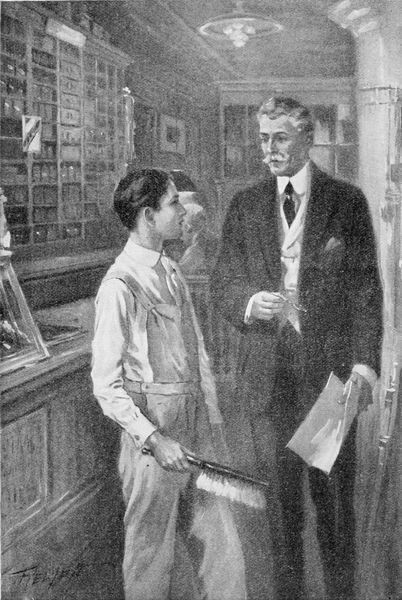
“I was wondering, sir,” said Tom, “if after I’ve paid that bill I couldn’t have the pump”
“Well, that’s for your uncle to say, isn’t it?”
“He says it belongs to you, sir.”
“I see. Well, when that bill’s paid, son, we’ll give you a clear title to the pump as far as we’re concerned. What did you think of doing with it?”
“Just—just trying to sell it, sir. It ought to be worth something as junk, I should think.”
“Hm, I suppose so. You might be able to sell it for twenty dollars or so if it isn’t badly out of shape. Where’s he keeping it?”
“It’s under the barn. I had a look at it yesterday. It seems all right. I mean it isn’t rusted none. It’s all covered up.”
“Did your uncle say what the matter with it was?”
“N-no, sir. He said it wouldn’t work.”
“Probably didn’t know how to use it. I dare say it could be fixed up in a jiffy. If you get it and want to sell it, you let me know. Maybe I can find someone to take it off your hands. Better put a couple of those expansion bits back on the shelf. No use showing more than one of them.”
The store was closed at six and Tom, slipping off his blue overalls, went in search of supper. Afterward he sought his room and sat up until half-past nine studying his lessons for the morrow. When at last he piled into bed, he lay for some time very wide-awake with the unaccustomed screech and rush of passing trains and the dim hum of the city in his ears. Through the open window, behind the branches of the elm and above the distant house-tops, a half-moon was sailing. Tom, a trifle lonesome, wondered if Uncle Israel and Aunt Patty were missing him a little. He knew Star was. He wished he had Star with him here. He wished——
Whatever else he wished was in dreams.
CHAPTER V
TOM LOOKS AT HIS HAIR
By the end of the week Tom had settled down into his new life. In the mornings he was up at half-past six and by seven-thirty had dressed, breakfasted, and reached the store. There, at first under the superintendence of Joe Gillig and later quite by himself, he swept the store from front to back, dusted off cases and shelves, and emptied waste-baskets. At first Joe helped him, but gradually he was left to attend to this work alone. By hurrying he was just able to finish it by twenty-five minutes past eight. Then he raced across the three blocks to the high school and arrived there usually as the gong rang. At half-past twelve there was a half-hour recess for lunch. The second day at school Tom discovered that there was a lunch room in the basement and that he could buy hot soup, sandwiches, coffee, milk, cake, and fruit at much cheaper prices than at the outside restaurants. After a day or two he got into the habit of eating a rather hearty breakfast in the cleanest of the little restaurants on Locust Street, satisfying his appetite at noon with a bowl of soup, a sandwich, and a glass of milk, and then dining after the store had closed. At three o’clock school was over and he was free to return to the store.
There was always plenty to do there, as Mr. Wright had intimated, and after that first day Tom didn’t have to hunt very hard for work. He washed windows, ran errands, packed orders in big cases down in the packing room, and learned to use marking-pot and brush with some dexterity, replaced goods on the shelves after Mr. Wright had served a customer—for the junior partner never was known to put goods back into place again,—polished the brass railings outside the windows and the brass on the door, and, in short, made himself generally useful. Perhaps Joe Gillig imposed on him a little; Tom suspected as much; but Joe was always kind and patient with him and Tom liked him. Later, when the weather grew cold, Tom was put in charge of the hot-water heater in the basement, and he had to shovel coal and ashes and sift out cinders and trundle ash-barrels to the elevator and roll them to the edge of the sidewalk above. It was heavy work, a whole lot of it, and if Tom had not been used to heavy work he could hardly have got through with it. As it was, however, the only effect it had on him was to harden and develop his muscles and increase a naturally healthy appetite.
It was that appetite that worried Tom more than anything those days. The second week in Amesville he conceived the idea of keeping account of his expenditures, and the result was disheartening. The best he could do was sixty-five cents a day, and that came to nearly four dollars a week. Add to that his fare to and from Derry and the total reached to almost five dollars a week! Tom’s heart sank. At such a rate the money he had saved would be gone some time in February! For several days after that he nearly starved himself trying to economise and got so thin and peaked-looking that even Mr. Cummings noticed it.
It was Mrs. Cleary who finally solved his problem after a fashion. There was a friend of hers, she informed him one evening, a Mrs. Burns and a fine lady entirely, who had started to take table boarders in the next street. Mrs. Cleary thought maybe Tom would like to test Mrs. Burns’s hospitality. Tom went around there the next morning and arranged for breakfasts and suppers. In view of the fact that he would be away on Sundays, Mrs. Burns bargained to take him for two dollars and a half a week. As his lunches at school seldom cost him more than fifteen cents—and sometimes only ten—he stood to save at least fifty cents weekly by this arrangement. And Mrs. Burns set a very good table, as it proved. There were no dainties, but whatever she put before her boarders was substantial and well-cooked. Her guests were mostly workers around the railroad, men with big, honest appetites and table manners that at first shocked Tom a good deal. After he got to know several of the men rather well, he was quite willing to forgive them their lack of niceties.
Every Saturday evening Tom returned to Derry. Usually either Uncle Israel or John Green drove to the station and met him. Then there was a supper that more than made up for any lack during the week. Aunt Patty made a special occasion of that weekly home-coming and cooked the things Tom best liked. Uncle Israel always greeted him as if they had parted at dinner time, but during the evening he always had to hear what had happened during the week.
However, if Uncle Israel’s welcome seemed lacking in warmth, there was no fault to be found with Star’s, unless it was the fault of over-enthusiasm. Poor Star was having lonely times those days. John Green, himself a rather lonely, taciturn man, confided to Tom on his second visit home that it just made his heart ache to see how that there Star dog moped aroun’! Well, those end-of-the-week visits to the farm were pretty fine, and during the first month at least saved Tom from many a fit of discouragement and homesickness. After a month they became less imperative, for by that time he had made friends and, although he had but little time in which to cultivate them, the knowledge of them helped a good deal. He was rather surprised, in fact, to discover how many persons he knew in Amesville by the time October had reached its end. There was Joe Gillig, of course, who, in consideration of the disparity in the ages of the two boys, was quite chummy with Tom and had twice taken him to supper at the little cottage in Stuart’s Addition, where Joe lived with an invalid mother and an unmarried sister some five years his senior. They were very nice folks, Tom thought, and the only thing that marred the occasions of his visits was the overbearing and almost rude attitude of Joe toward the women. Tom, though, understood dimly that Joe really intended neither discourtesy nor unkindness; that having been the head of the little establishment for ten years or so was responsible for the rather harsh authority he assumed. And then, too, both Mrs. Gillig and Mary did their utmost to spoil Joe, accepting his dictates with meek admiration.
And then there was Mrs. Cleary, his landlady, who mothered him in her good-hearted Irish way, and Dan, her husband, a big, raw-boned man with a voice like a fog-horn and a laugh like a young tornado. Frequently when Tom came home after supper he stopped downstairs and visited for a little while with the Clearys. The eldest son, who drove a delivery wagon for Miller and Tappen, was seldom there, but he made friends with the other children and listened to Dan Cleary’s stories of happenings in the railroad yard and roundhouse. It was a little bit like home, and when he went on upstairs to his own tiny room he felt less lonesome. Then, too, he made the acquaintance of two or three of the boarders at Mrs. Burns’s—rough, hard-working men with unlovely ways and kind hearts. It was about this time that Tom made a discovery that helped him a good deal in later years, which was that folks are very much alike under the skin whether they ride in carriages or drive spikes into railway ties.
At school Tom knew a dozen boys well enough to speak to, but the fact that he had no time to join them in their after-school or holiday pursuits and pleasures kept him from forming any close friendships. When the others hurried away to the athletic field to play football or watch it, Tom plodded across to Cummings and Wright’s. But he followed closely and patriotically the fortunes of the Amesville High eleven, listened avidly to the chat of the fellows at school, and read the accounts of the contests with rival teams in the morning paper. Never having seen a football game, Tom would have liked mighty well to go out and look on some afternoon, but the only glimpse of football he got was one day when he was despatched by street car to deliver a forgotten tool to Steve Connors, who was doing a job of plumbing in a house on the north of town. The trolley car left him two blocks from his destination, and when he saw a crowd of boys in an open field and heard the shouting he correctly surmised that he had happened on the athletic field and the high school team in action. He delivered the tool to Connors and then, on his way back, joined the throng of boys and girls on the side lines and watched interestedly for as long as his conscience would let him. After ten minutes he tore himself reluctantly away, very much wishing himself a gentleman of leisure!
And yet he did make a friend finally, and it happened in this way. After Tom had been with Cummings and Wright a month or so, he was permitted to wait on customers occasionally when the others were busy. Joe had initiated him into the mysteries of the cost marks and he had eventually got so that he could translate the puzzling letters that adorned every article into numerals and knew at a glance that, for instance “F O Z” meant that the article had cost $1.37 and that the following “G L Y” intimated that it was to be sold for $1.75. As time passed Tom became more and more a member of the selling force and speedily reached a degree of efficiency that made it no longer necessary for him to consult Joe Gillig or one of the partners before disposing of goods. November had passed, Tom had eaten his Thanksgiving dinner at the farm, the high school football team had finished a not too glorious season, and now, in the first week of December, a hard freeze had come and at school the fellows were eagerly talking skating and hockey. One afternoon, just as it was getting dark in the store, Joe called to Tom, who was marking a case in the packing room.
“Tom, come up and wait on a customer, will you?” shouted Joe down the stairway. Mr. Cummings, Mr. Wright, and Joe were all busy when Tom emerged from the basement, and Joe nodded toward the front of the store. “See what that lady wants, Tom,” he said. “And as you come by switch on the lights, will you?”
The lady was standing by a showcase in which Joe had just finished arranging a display of skates. She was quietly dressed, but Tom knew that such clothes cost a deal of money. She smiled in a friendly way at the boy as he leaned inquiringly across the counter, copying Joe’s best manner, and Tom decided then and there that she must be awfully nice and jolly. She had laid a big black muff on the case and now she moved it aside that she might see better what lay beneath. Then she raised her glance to Tom again as he asked, “Is there something I can show you, ma’am?”
“I want a pair——” she began. Then her smile deepened and Tom thought afterward that she had even laughed a tiny bit. At all events, her subsequent remark was strangely at variance with her start, for, her eyes twinkling, she asked amazingly, “Does your hair still bother you?”
“Ma’am!” ejaculated Tom, thinking he must have misunderstood.
This time she really did laugh—a short, rippling little murmur of a laugh—as she answered: “I asked if your hair still bothered you. But it was rather an impertinent question, perhaps, so I won’t demand an answer.” She ended demurely, apologetically, and seemed waiting for Tom to say something. He had an uncomfortable but not altogether unpleasant sensation of being made fun of.
“I—I guess I don’t just understand you,” he stammered.
“Never mind,” she replied sweetly. “It’s of no consequence. I want to get a pair of skates, please. For a boy,” she added.
“Yes’m. All-clamp?”
“Goodness, are there different kinds?” she asked in a pretty dismay.
“Yes’m, we have four or five kinds and they sell all the way from seventy-five cents to six dollars. I guess, though, you want a pair of half-clamp at about three dollars. Like these.” Tom opened the case and laid a pair of skates on the counter alongside. The lady looked at them doubtfully, held one up, and then thoughtfully ran it along the counter, shaking her head.
“I think I’ll have to leave it to you,” she said, “for I know very little about skates, especially boys’ skates. You see, I want them for my boy. They were to be a Christmas present, but he’s been ill at home for two weeks now and the doctor has promised him he can get out of the house in a few days and he’s very eager to go skating. Of course he can’t, just right away, because he hurt his shoulder rather badly playing football and I suppose skating wouldn’t be good for it. But it seemed too bad to make him wait nearly a month for skates when the skating has already begun. Don’t you think so?”
“Yes’m,” said Tom heartily.
“That’s what I thought. So his father and I decided he should have the skates now. I dare say there’ll be plenty of other things he will want by Christmas,” she added smilingly. “Oh, I almost forgot. He wanted hockey skates. Are these hockey skates?”
“No’m; at least, they ain’t—aren’t called hockey skates. We have regular hockey skates here; two kinds. They cost more, though. These are five dollars and a quarter and these are six.”
“But they’re quite different, aren’t they?” she said perplexedly.
“Yes’m. These they call tubular.”
“Which are the best?”
“I don’t know, ma’am. I never played hockey.”
“Really? Don’t you skate, either?”
“Yes’m, but I don’t have much time. I go to school from half-past eight to three and other times I work here.”
“High school, do you mean?”
“Yes’m.”
“Then perhaps you know my boy?” she said eagerly.
“No’m, I know him by sight, that’s all. It was too bad his getting hurt in that game.”
“Wasn’t it? You see, it kept him out of the big game and he was quite heart-broken about it. Of course his father and I aren’t very happy when he’s playing, but Mr. Morris insists that it’s a fine thing for him, and Sidney himself loves it.”
“I—I hope he’s getting on all right, ma’am,” said Tom.
“Oh, yes, thank you, he’s doing very well. I wish you knew him. He’s rather a nice boy——”
“Yes’m, he’s awfully popular at school.”
“And,” continued Mrs. Morris smilingly, “you seem a very nice boy, too. I think you ought to know each other.”
Tom blushed a little. “Yes’m; I mean thank you,” he murmured.
Mrs. Morris laughed softly again. Tom liked that laugh of hers immensely, it was so sort of happy and kind and friendly. “Well,” she said, “we haven’t decided about the skates, have we? Perhaps the best thing to do is to have you send both pairs around and let Sidney take his choice. Could you send them this evening?”
“I—I’m afraid not,” answered Tom, glancing at the clock and knowing that the last delivery had left the store a half-hour ago.
Mrs. Morris’s face fell. “Oh, I’m so sorry! I did want him to have them to-night. He’s been so—so unhappy and grumpy to-day, you see. But perhaps I could take them myself if you did them up.”
“They’d be pretty heavy,” demurred Tom. “If—if you’ll let me, I’ll bring them myself after I get through.”
“Oh, I wouldn’t think of troubling you! We live quite a distance. I dare say to-morrow will do just as well.”
“I wouldn’t mind doing it a bit,” said Tom eagerly. “I—I’d be glad to!”
“Really? That’s very kind of you. If you’re quite certain it won’t be too much trouble, I’d love to have you. Besides, I want you to know my boy, and it will do him good to have someone of his own sort to talk to for a little while.”
“Oh, I wasn’t thinking of going in!” declared Tom in a mild panic.
“But you really must! I want you to. It’s a part of the bargain.” She smiled, and Tom knew right there and then that if Mrs. Morris wanted the moon she had only to smile at him to set him off after it! “You won’t fail to come, will you? Sidney would be so disappointed if you should. And Sidney’s mother, too,” she added as she took up her muff and nodded charmingly. Then, pausing on her way to the door, she turned a very serious face toward Tom. He was not near enough to see the mischievous mockery in her brown eyes. “If you don’t come,” she said, “I shall know that it’s your troublesome hair!”
“Now, what do you suppose she meant by that?” demanded Tom of no one in particular, unless it was Alexander the Greater, who was approaching over the tops of the showcases. Alexander the Greater was a very large, very dignified, and very lazy maltese cat. His predecessor had been named Alexander the Great and so, of course, his name could only be Alexander the Greater. Tom absently dug his fingers in the cat’s thick ruff and repeated the question, “Now, what do you suppose she meant by that?” He passed an inquiring hand over his hair and then, in spite of the fact that a customer had just entered and was looking vaguely around, he hurried to the stairway, bolted down it, switched on the light over the wash-bowl, and looked anxiously at his reflection in the cracked mirror. Except that a stray lock stood up independently on his crown, he could not see that his hair was different from usual or, for that matter, different from any other fellow’s hair—except in colour. He had never been particularly pleased with the colour of his hair. There was too much red in it. Perhaps that was it; perhaps Mrs. Morris had been poking sly fun at the colour of his hair. And yet—— He shook his head as he hurried back upstairs to do up the two pairs of skates. It didn’t seem as though that was just it.
CHAPTER VI
TWO PAIRS OF SKATES
He didn’t set out for the Morrises house until nearly eight o’clock. They had been busier than usual in the store and had not got rid of the last customer until almost a quarter-past six. Then, although Tom spent no unnecessary time on his supper, it was way after seven by the time he hurried around to his room to change his clothes. It would never do, he assured himself, to make a call in his every-day suit! As he was far more particular in dressing than he had ever been before in his life, he made slow work of it and was horrified to find that his watch proclaimed the time to be twelve minutes of eight! In something of a panic then, he dashed downstairs and along Locust Street, the bundle of skates under his arm. He had meant to walk to the Morrises, but now it was necessary to spend a nickel and ride there by trolley car. Why, they might be getting ready for bed by the time he got there!
He was a good deal excited. Also, he was a good deal nervous. He remembered reading somewhere once that when calling you were supposed to present your visiting card to the maid or the butler or whoever it was that opened the door to you. Tom had no visiting card, very naturally, and he wondered whether the lack of it would matter very much. He might explain to the maid that he had accidentally left his cards at home in his other suit. Then he reflected that when you carried visiting cards you were presumed to have more than two suits, and that it would be better to say that he had left the cards on his bureau. Then, having apologised in such fashion, he would give his name and ask to see Mrs. Morris. He guessed that would be all right. He rather hoped, though, it would be a man instead of a maid who answered the door. He could make his explanation more easily to a man.
He wondered whether Sidney Morris would mind his coming. He hoped Sidney wouldn’t think he had suggested the visit. He wouldn’t think for a moment of forcing his acquaintance on a chap like Sidney Morris, who was one of the most popular and sought-after fellows in school! And besides, Tom reflected, the Morrises must be very well-off, and it didn’t seem likely that Sidney would care to have much to do with a fellow who worked in a store. Of course it was perfectly bully of Mrs. Morris to want him to know her son, but he feared that Mrs. Morris hadn’t stopped to consider the difference in their positions.
The car seemed to crawl through town, and Tom, in a fever of impatience lest his visit be timed too late, glanced at his watch every two or three blocks. Finally, though, the conductor called Alameda Avenue and Tom descended. It wasn’t hard to find the Morris residence, for the number of the house was plainly in view on each of the round electric globes that flanked the gate. A short path led to a stone-pillared porch. The house was not so grand and impressive as he had feared it might be. It was of stone as to the lower story and shingles above and had many dormers of different sizes. But Tom didn’t have time to receive more than a fleeting impression of its outward appearance then, for a dozen strides took him to the door. There he paused a moment, in the soft glow of an overhead light, to rehearse his speech to the maid or the butler. Finally he pressed the button beside the wide doorway and waited. An inner door opened and Tom saw disappointedly through a meshed curtain that it was a woman who was answering his summons. But when the outer door gave way it was Mrs. Morris herself who stood there. In the background a maid in cap and apron hovered uncertainly for a minute and disappeared. Tom, in his surprise, almost recited his piece about the visiting cards to Mrs. Morris, and would have doubtless had not that lady held out her hand and taken the conduct of affairs at once. Before he knew it, Tom was inside, fumbling with his hat and holding out his bundle insistently.
“I brought the skates,” he said.
“That’s very nice of you. And we’ll take them upstairs in just a moment. First, though, I want you to meet my husband. I’ve told him about you.”
Tom followed her across a soft-piled rug and through a wide doorway into a room all warmth and colour and leather chairs and book-lined walls and low lights. A very tall man with grey moustaches and a deep, pleasant voice shook hands with him, spoke of the cold weather, thanked him for coming, and, as Tom backed away, colliding with a table, said he hoped he’d see him again. Tom was glad when he was safely through the library doors once more, and Mrs. Morris, chatting gaily to put him at his ease, led the way up a wide, carpeted stairway so gradual of ascent that one hardly realised one was climbing. Another broad hall, with silvery walls hung with many unobtrusive pictures and furnished with easy-chairs and couches in cretonne, received him, and across this he followed to a doorway.
“Here he is, Sid,” said Mrs. Morris. She stood aside to let Tom enter first. “You see,” she went on, “I can’t announce you by name because I don’t know what your name is.”
“It’s Tom Pollock, ma’am,” stammered Tom.
“Well, then, this is Tom, Sidney. And he’s brought the skates for you to look at. Tom, this is my son, Sidney.”
The boy in the easy-chair held out his left hand. “Don’t mind my not getting up, do you?” he asked. “They won’t let me move around much yet. Glad to meet you. I think I’ve seen you over at school.”
Mrs. Morris pushed forward a chair and Tom sat down, holding his hat very firmly and finding nothing to say just then. Sidney was already undoing the package, frankly eager. Mrs. Morris leaned above him smilingly. Tom’s eyes wandered about the room. It was certainly jolly. He had never seen anything at all like it, had never even imagined that such a room could exist. There were two recessed windows with wide, comfortable seats beneath them and low book-cases at each side. (Just the place, Tom thought, to curl up and read.) The walls were papered in grey and the big rug that not quite covered the floor was grey, too, with a broad border of dark blue. The bed, on which the clothes were neatly and invitingly turned down, was a sort of a grey as well, and the silken coverlid that lay across the foot was grey and blue. Even the furniture and the window curtains repeated the colours. A small desk near the chair in which the occupant of the splendid apartment was seated held books and papers and writing materials and a green-shaded electric light that could be twisted about in any direction and to any height. On the walls hung a few plainly-framed pictures, while above the fireplace, in which a coal fire glowed cosily, were two gaily-hued posters, a pair of fencing foils, crossed under a mask, and a yard-long photograph of a football game in progress. Beneath that, on the mantel, was a long row of photographs. Tom’s examination, a little envious by now, was interrupted by Sidney.
“I say, Mumsie, they’re peaches! Gee, I don’t know which pair I want. What do you say, Tom?”
“I—I guess I wouldn’t know which to take if it was me,” answered Tom shyly. “They’re both dandy, aren’t they?”
“Know anything about these tubular ones?” asked Sidney. “I don’t think I’ve ever seen a pair before.”
“They’re new,” said Tom. “They look pretty strong, though.”
“They’ve got a dandy edge. I sort of think I’ll take these, Mumsie. Gee, I wish I could try them to-morrow! You skate, don’t you, Tom?”
“Not very well.”
“Ever play hockey?”
Tom shook his head. “Not real hockey, I guess. We kids used to knock a hard rubber ball or a hunk of wood around on the ice. We had goal posts, too, but I suppose real hockey is—is scientific, isn’t it?”
Sidney replied with enthusiasm that it certainly was. When Sidney was enthusiastic his brown eyes sparkled and his lean, good-looking face lighted up from the firm, pointed chin to the dark hair brushed smoothly back from the forehead. Sidney was sixteen, small-boned, and as lithe as a greyhound. As right end on the school eleven he had won laurels all season until an accident to the shoulder, that was still immovably bandaged, had laid him off. In baseball, too, in hockey, and, in fact, in all games and athletic endeavours he excelled by reason of a natural ability. He was the sort of boy who, if thrown into the water, will strike out and swim as inherently as a puppy; who if handed a baseball bat will swing it as knowingly as an experienced player. Lean, supple, and graceful, his muscles were as responsive to demands upon them as—well, as a kitten’s! And anyone who has watched a kitten at play will appreciate the simile. He had a temperament to match. He was ardent, impulsive, and at times quick-tempered. He possessed good judgment, but was liable to be biassed by his sympathies. He was extremely popular at school and something of a leader in the sophomore class. Being an only child, it was a good deal of a miracle that he had not been spoiled. Most of the credit was due to Mr. Morris, but much to Sidney himself.
While Sidney was still explaining hockey, Mrs. Morris left the room. Only Tom saw her go, for Sidney was much too interested in his subject. “I’m going out for the team,” he explained. “Why don’t you try it? Even if you don’t make it, you’ll have a lot of fun. Why don’t you!”
“I wouldn’t have time,” said Tom regretfully. “I work in Cummings and Wright’s after school every day.”
“I forgot that. Do you like it?”
“Yes, pretty well. They’re awfully nice to me there and I guess I was lucky to get a job with them. Of course, though, I’d like mighty well to—to play hockey and football and things, you see.”
“That’s tough, isn’t it?” said Sidney sympathetically. “I suppose—I mean—well, you have to do it, don’t you?”
“Yes,” returned Tom. “It pays for my room. I live down on Locust Street, by the railroad.” He said this with just a trace of defiance and watched to see how Sidney would take it. Probably he wouldn’t be very anxious to pursue the acquaintance of a fellow who lived in such an unfashionable part of town. But if Sidney was shocked or surprised he certainly didn’t show it.
“That must be pretty good fun,” he said, “living all by yourself like that. You don’t have to tell anyone where you’re going or anything, do you? And you can stay out as late as you like, too! I’d like to be able to do that. Say, I think you’re a plucky kid to work like you do and earn money. I wonder if I could if I had to?” He was silent a moment, turning the matter over in his mind and frowning a little. “I don’t believe so,” he said finally. “I guess I’d just starve to death if it came to earning my living!”
Tom had no views on the subject and so asked about Sidney’s injury.
“Doc says I can go out in three or four days. He’s a bit of an old granny, I think. I wish he had to sit around here with his shoulder done up in a vise! And after I get out I’m not to use that arm for nearly two weeks. Hang it, by the time I can do anything they’ll have the hockey team all made up!” And he kicked disgustedly at the wrapping paper which had fallen from his knees. “A fellow was in here this afternoon and he said the ice was bully. Say, do you folks keep hockey sticks?”
“No, just skates,” said Tom.
“I should think you would. You’d sell a lot of them. The only place where you can get them is Merrill’s. Why don’t you get Cummings and Wright to keep them?”
“I’ll speak to Mr. Cummings about it,” said Tom. “We got a lot of dandy—dandy—what are those things you slide down the snow on? The things that are like sleds without any runners?”
“Toboggans? By jiminy, that’s what I’ll ask the folks to get me for Christmas! Some day I’ll come down and have a look at them. Are you generally there after school?”
“Yes, unless they send me on an errand. I have to trot around a good deal.” Tom arose, still tightly clutching his hat. “I guess I’d better be going now,” he added.
“Oh, hold on! Don’t go yet. It isn’t late, is it?”
“It’s after nine,” said Tom.
“That’s early. And you don’t have to get home until you want to.”
“I—I’ve got some studying to do,” responded Tom. He really wanted to stay, but feared Mrs. Morris would think he was overdoing it.
“Well,” said Sidney regretfully, “if you have to! Will you take this other pair back or shall I send them to-morrow?”
“I’ll take them,” said Tom. “It’s no bother.”
“All right. Tell them to charge the other pair to my father, please. Thanks for bringing them. And say, what are you doing to-morrow night?”
“Doing? Just—just nothing particular, I guess.”
“Well, can’t you drop in for awhile? I’ll do as much for you if you get laid up,” laughed Sidney. “I wish you would, honest! You don’t know how tired a fellow gets of just reading. I’ve got my lessons up to next week some time, I guess, and I’ve read every book in sight. Some of the fellows come in now and then, but they don’t want to stay more than a minute. I don’t blame them, though; there’s too much doing.”
“I’d like to very much,” answered Tom, “if—if your mother thinks I ought to.”
“Of course she does! Don’t you, Mumsie?” Mrs. Morris entered at that moment. “Don’t you think he ought to come around to-morrow evening and see me!” explained Sidney.
“I think we’d all be very glad if he would,” responded Mrs. Morris kindly. “Perhaps, though, he has too much to do, dear.”
“No’m, I haven’t, and I’d like to come very much.”
“That’s the ticket! Come early and we’ll have a fine long chin. Say, Mumsie, what do you suppose he does? Works in Cummings and Wright’s and makes money to pay for his room and board! What do you know about that?”
“I think it’s very creditable, don’t you, Sid?”
“Rather! Wish I could get out and do something like that! It would be jolly, I should think.”
Mrs. Morris smiled and patted his shoulder.
“I don’t earn enough for my board, too,” corrected Tom. “Just for my lodging. They don’t pay me very much because I’m not there very long, you see. I saved up some money last summer and the summer before. My board comes out of that.”
“Bet they don’t pay you enough,” said Sidney convincedly. “I know old man Wright. He’s Billy Wright’s father, you know, Mumsie. He’s a bit of a tightwad, I guess.”
“That’s awful slang, Sid,” Mrs. Morris reproved smilingly. “I’m sure you don’t use slang, Tom, do you?”
Tom grinned embarrassedly and Sidney chuckled. “I—I’m afraid so, ma’am, sometimes,” owned Tom.
“I’ll bet you do! Why, say, Mumsie uses slang herself, Tom!”
“Sidney!”
“Yes, you do! The other day you said something was ‘the limit.’”
“It was the butter we got from the new man,” laughed Mrs. Morris. “And it was the limit, too! Are you going to take this pair of skates, dear?”
“Yes’m; and he’s going to lug the other back. I guess you’ll have to wrap them up, Tom. I’m not much good yet.”
Tom had to lay his hat aside to do it and somehow losing hold of his hat seemed to increase his embarrassment. When the skates were back in the paper, it was with vast relief that he seized his hat once more. He had been aware during the operation that Mrs. Morris and her son had been talking together in low tones and now, when he stood up to leave, Sidney said:
“I say, Tom, Mumsie says——”
“No, Sid!”
“Well, anyway——” He paused and looked appealingly at his mother. “You say it, Mumsie, please.”
“Very well,” replied Mrs. Morris with her pleasant laugh. “Sid and I, Tom, want you to keep those other skates for yourself. They’re a sort of Christmas present from the Morris family. It’s very near Christmas, you know.”
“He doesn’t have to wait until Christmas to use them, though, does he?” said Sidney. “And, I say, Mumsie, maybe he’d rather have a pair like mine.”
“Would you?” asked Mrs. Morris.
“No’m. I mean—I—I’m awfully much obliged—and thank you very much—but I guess I’d rather not,” stammered Tom in an ecstasy of embarrassment.
“Don’t be a chump!” begged Sidney. “Of course you’ll take them. Why not? After coming all the way out here to-night and——”
“That was part of my work, anyway,” said Tom. “And I wanted to come——”
“But that isn’t the reason we want you to have them,” said Mrs. Morris sweetly. “It’s just because you’re—oh, just because you’re a nice boy and we like you. We do, don’t we, Sid?”
“Sure,” laughed Sidney. “Say, Tom, you keep them and some day we’ll go out to the pond and I’ll show you how to use a hockey stick.”
“Why—why, I suppose—if you really want me to have them——”
“We really do, Tom,” said Mrs. Morris.
“They’re pretty expensive, though,” Tom demurred anxiously. “And I’ve got a pair already.”
“Are they as good as those?” asked Sidney.
“Oh, no; they’re just a pair of wooden strap skates. They—they do very well, though.”
“Pshaw, a fellow can’t skate with straps around his foot,” said Sidney contemptuously. “You just see how much better you’ll get along with those. If you’d rather have a pair like these, though, you can have them; can’t he, Mumsie?”
“I’d rather keep these,” said Tom shyly, “because—because they’re the ones you give—gave me.” And he looked gratefully at Mrs. Morris.
She clapped her hands softly. “Oh, we do like you, Tom!” she cried. “That was a perfect thing to say, wasn’t it, Sid?”
Sidney grinned. “He’s gone on you, Mumsie.”
“Sidney!”
“He is, though.” He laughed across at Tom. “All the fellows fall in love with my mother, Tom. You can’t help it.”
Tom blushed hotly, and Mrs. Morris said reprovingly: “Sid, you shouldn’t say such awful things, dear. Tom may not understand your fun.”
“I can understand what—what he said,” muttered Tom boldly, and Sidney applauded by rattling the skates he held. Mrs. Morris blushed a little herself then.
“You’re both rather awful,” she said. “And it’s about time for you to be thinking of bed, Sid. Come, Tom, we’ll leave him to consider his sins. I’ll be up again, Sid, in a few minutes.”
Tom said good night to Sidney, repeating his promise to return to-morrow evening, and followed Mrs. Morris downstairs. At the door she held out her hand to him and Tom took it awkwardly.
“Good night, Tom,” she said. “Thanks for coming. Sidney enjoyed your visit very much. And so did I. And don’t forget to come again.”
“No’m, thanks. Good night, Mrs. Morris.”
“Good night. And, Tom!” Tom was outside now and the door was slowly closing. “Please don’t worry about your hair!”
CHAPTER VII
TOM GAINS PROMOTION
That was the beginning of the friendship. Sidney, who had begun being nice to Tom to please his mother, continued being nice to him because he liked him. There was an earnest, downright quality to Tom that the older boy was attracted by. Then when Sidney found that, in spite of an inclination toward unusual seriousness in one of his age, Tom had a perfectly good, if somewhat repressed, sense of humour, Sidney took to him in earnest. The boys were quite unalike in many ways. Sidney was small-boned, lithe, graceful, and dark. Tom was heavier, less finely built, and light. Sidney was impulsive, Tom deliberate. Both were capable of deep enthusiasms, but Tom’s were of slower birth and, perhaps, of longer duration. It is not unusual for boys to form friendships for those quite opposed to them both physically and mentally. In such a partnership what one lacks the other supplies. This explains to some extent the friendship that sprang up between Sidney Morris and Tom Pollock. For a week Tom believed that when Sidney was once more off the invalid list and free to seek the companionship of his old acquaintances he would see very little of him. The reverse, however, proved to be the case.
The friendship, instead of ceasing, grew. Sidney sought Tom at the hardware store in the late afternoons, stamping in sweatered and coated with his skating boots hung from a hockey stick over his shoulder and his face flushed by the afternoon’s practice. Then he would perch himself on the edge of a counter upstairs or on a box in the packing room below and tell enthusiastically of the practice. Mr. Cummings viewed him amusedly, Mr. Wright with deep scowls. He made friends at once with Joe Gillig, and I’m not at all certain that duties weren’t neglected sometimes when the three boys got together at the back of the store. At least once a week, often twice, Sidney haled Tom home to dinner with him. At first Tom went with misgivings, but when he realised that both Mr. and Mrs. Morris were glad to have him, or anyone else that Sidney wanted, he got over his shyness and enjoyed those evenings immeasurably. After dinner they went up to Sidney’s room and talked and talked on all the thousand and one subjects dear to a boy’s heart. I think Sidney did most of the talking, however, which was to be expected since he had much more to talk about. Tom’s existence was rather hum-drum and few experiences or adventures fell to his lot those days.
In school the boys saw little of each other since they were in different classes, but notes passed between them constantly, frightfully important notes making engagements for meetings after school or at lunch hour or containing news that couldn’t possibly wait to be told verbally. Of course Sidney did not give up his other friends, but instead of spreading his friendship over a half-dozen boys as he had done before, he gave most of it to Tom. They became inseparable. As may be expected, a good deal of fun, some good-natured and some malicious, was poked at the pair. Disgruntled ones called Tom a “hayseed” and a “Rube.” This annoyed Sidney more than it did Tom, however.
“I don’t mind,” he would say calmly. “I guess that’s what I am, anyway.”
“I’d like one of them to say that to me,” said Sidney warmly. “I’d punch him!”
Tom did not get the promised instruction in hockey that winter, for the reason that he never could find an opportunity to go with Sidney to the pond. Neither did he have a chance to see the hockey team in action. But he heard all about it from Sidney, who had gained a much-coveted position on it, and mourned with his chum over defeats and triumphed with him over victories; and the two were very evenly apportioned that year.
Meanwhile, Christmas came and went, and the New Year was rung in. The holiday season made a deal of hard work for Tom, for the store kept open every evening until Christmas and more than once he was forced to delay his departure for Derry until Sunday morning. Christmas Day was spent at home. He had purchased small gifts for everyone, including Star, who got a new collar, and he received presents from all. Uncle Israel gave him a five-dollar gold-piece, a deed of generosity as surprising as it was welcome to Tom. Sidney had thrust a small parcel into Tom’s hand the day before, and when Tom opened it Christmas morning he found a pretty gold stick-pin set with a topaz that, although he didn’t realise it, was exactly the colour of some of the big freckles that adorned his nose! In the afternoon he took his skates down to the creek and joined the merry throng of boys and girls. It was the first time he had tried the skates and they proved wonderful, besides being objects of envy to the other fellows. Jim Billings, whose father Tom had worked for last summer, remarked sneeringly after an examination of the new skates, that “Tom Pollock was gettin’ mighty stuck-up since he’d gone to the city!”
The next evening Tom accompanied Sidney home and stayed to dinner and saw the big Christmas Tree that was strung with tiny electric lights of white and red and blue. And Sidney showed him all his presents, and there was a whole big lot of them, too, Tom thought. One of them was the toboggan that Sidney had expressed a wish for and another was a little easel calendar in red paper that looked something like leather if you didn’t get too close to it. Sidney told Tom, with an arm over his shoulders, that it was “just bully” and that he liked it better than almost anything he’d got. The calendar was Tom’s modest gift.
After New Year’s life settled down again into the old manner. Tom studied hard at school and worked hard at the store, but he enjoyed both. Having a friend like Sidney had done away with loneliness and he no longer spent solitary evenings in his room. Once in a while Sidney came down to Locust Street, but usually Tom went to Sidney’s house. His comings and goings there were now matters of no comment. Mr. and Mrs. Morris always greeted him warmly and made him feel at home and free to come and go as he liked. Sometimes another fellow would drop in, sometimes two or three, and they had very merry times up in Sidney’s room. But Tom liked best the evenings when Sidney and he were alone. Several of the boys he had met through Sidney he liked very much, but he was apt to feel rather shy and constrained when they were around. Very often Mrs. Morris joined them for a few minutes, much to the pleasure of Tom, who still secretly adored her. Once, a month or so after their first meeting, he asked Sidney what he supposed his mother meant by her frequent allusions to his hair.
“She’s always telling me not to trouble about it,” said Tom, mystified. “I suppose she’s just sort of making fun about it because it’s red.”
“I don’t call it red,” answered Sidney. “It’s a dandy colour. You never know what Mumsie has in her head when she says things like that. She’s always having little jokes to herself. She’s funny.”
“She’s terribly nice,” said Tom. “And—and she’s the prettiest lady in Amesville, too, Sid.”
“You bet she is!”
One February morning, when Tom had trudged through a raging blizzard to the high school only to learn when he reached it that the “no school” whistle had blown a half-hour before, he decided to keep on to Sidney’s house. It was a good mile out there from the school and the wind and snow were cutting up high jinks, but Tom scorned the trolley cars, not altogether from motives of economy, and walked, fighting every step of the way. When he reached the Morrises the maid told him that Master Sidney had just gone downtown. Tom was turning away when Mrs. Morris appeared and insisted on his coming in.
“Sid won’t be more than a half-hour,” she said. “He went in to get something for his wireless set.” (A wireless receiving set had been amongst his Christmas presents and both he and Tom were greatly interested in it.) “Come in and get warm, Tom.” Then, seeing his condition, “Why, Tom Pollock!” she exclaimed. “I believe you walked!”
“Yes’m, I did,” answered Tom apologetically.
“Of all things on a day like this!” Mrs. Morris shook her head hopelessly. “Well, boys have no sense, anyway. Now take that coat right off and—— And no overshoes, either! Tom Pollock, you ought to be spanked and put to bed!”
“Yes’m,” agreed Tom sheepishly.
Five minutes later, divested of his wet clothes and chastely attired in a voluminous bath-robe of Mr. Morris’s, he was toasting in front of a big fire in the library and drinking beef tea that Mrs. Morris made by dropping a mysterious dark-brown tablet into a cup of hot water. It was very nice, and its effect, or perhaps the combined effects of the hard tussle with the blizzard and the warmth of the fire, was to make Tom feel delightfully drowsy and comfortable. When, presently, he had finished the beef tea and Mrs. Morris had returned from bearing away the empty cup, an unwonted boldness came to him.
“I wish,” he said as Mrs. Morris sank into a chair at the other side of the hearth, “I wish you’d tell me, please, what’s the matter with my hair.”
She looked at it concernedly. Tom, however, saw the laughter in her eyes. “Is it bothering you again, Tom?” she asked. “I’m so sorry!”
“It—it don’t bother me at all,” he responded desperately. “Only you’re all the time telling me not to let it! Is it just because it’s red?”
Then Mrs. Morris laughed deliciously. “No, Tom, it isn’t,” she said. “I suppose I’ve been horribly mean to tease you about it, haven’t I?”
“I didn’t mind,” Tom assured her earnestly. “Only—I wondered what it was. I asked Sid and he said he guessed it was just one of your jokes.”
“Of course it was; a rather silly one, too, Tom. Do you remember stopping one day in front of Sewall’s jewelry store and looking in a mirror?”
“No’m, I don’t think so.” Tom shook his head.
“It was away last summer—or early in the fall, Tom. You looked in the mirror and frowned and then you took off your hat and smoothed your hair. And then you nodded at yourself quite satisfied and looked up and caught me smiling at you. Don’t you remember now?”
“Yes’m.” Tom laughed shamefacedly.
“You scowled at me terrifically,” went on Mrs. Morris. “It amused me because I thought I knew just how you felt at being caught primping. And then when I saw you in Cummings and Wright’s that time I recognised you at once and thought I’d have a little fun with you. So I asked about your hair. That’s all there is to it. As to your hair being red, why, it isn’t; not really red, you know. It’s a perfectly wonderful shade and I wish I had it, Tom!”
Tom thought her own soft brown hair infinitely more lovely and becoming, but he didn’t say so. He only grinned.
“Are you terribly angry with me?” she went on smilingly.
“No’m.” Tom shook his head again. “I—I guess I sort of liked it!”
Then Sidney burst in, laden with packages, and dragged Tom upstairs to witness the installation of a new detector.
At the store Tom had been making strides. As yet there had been no mention of a raise in wages; he was still receiving his two dollars a week and being credited with fifty cents against the price of the pump; but he had progressed wonderfully. To be sure, he still swept and washed windows and ran an occasional errand, but he was at last a real clerk when those duties did not engage his attention. It had begun when Tom had acted on Sidney’s suggestion and explained to Mr. Cummings that it might be a good plan to keep hockey sticks as well as skates. Mr. Cummings had fallen in with the idea at once and had ordered the sticks. Unfortunately they had proved, on arrival, to be rather inferior and purchasers had objected to them.
“Well,” said Mr. Cummings when Tom reported the matter, “you find out what make of stick the boys want and let me know. This is your undertaking, Tom.”
So Tom found out where the best hockey sticks were made and a new consignment was ordered. Gradually pucks and all the paraphernalia of hockey were added and, in some way, the sale of those things became Tom’s especial task. Boys who came for skates or sticks or leg-guards or pucks sought him out and didn’t want to be waited on by anyone else. Mr. Cummings laughingly referred to “Tom’s Department.” But “Tom’s Department” made such a good showing by the middle of the winter that Mr. Cummings was both surprised and gratified. After that Tom had only to list an article wanted and Mr. Cummings sent in the order at once. There was no question as to the advisability of carrying it.
The last of February, Joe Gillig caught a heavy cold and took to bed with congestion of the lungs, and Tom suddenly found himself elevated temporarily to the position of clerk. Mr. Cummings was at first inclined to look for someone to take Joe’s place while he was out, but Mr. Wright objected. “Let Tom do his work for him,” he said. “I guess he can sell nails as well as Joe.” Mr. Cummings agreed doubtfully, and for three weeks Tom was exempt from window washing, sweeping, and errands. At first he was a trifle alarmed at the new responsibility, but he got on perfectly well, and Mr. Cummings was forced to agree with his partner that Tom could “sell nails as well as Joe.” At the end of the fortnight he even went further than that and acknowledged that Tom promised to become in time a much better salesman than Joe. For Tom took a great deal of pains to please customers; and those who looked askance at him at first on account of his youthfulness and showed a preference for being waited on by one of the partners soon changed their minds. Tom was somehow able to take a personal interest in the wants of even the humblest patron and forked out two pounds of ten-penny nails with as much care and attention as he would have displayed in filling a hundred-dollar order. If a customer wanted an article not in stock and which Tom believed he could obtain from another store, he did not, as Joe would have done, carelessly inform the purchaser that they were out of it. Tom said: “We haven’t that in just now, sir, but I’ll see that you have it this afternoon, if that will do. Where shall I send it?” Then at dinner time Tom scurried around to one or another of the rival stores, found the article, paid for it, and sent it out on the afternoon delivery. The first time he did this he presented his bill to Miss Miller and was reimbursed. Not long afterward Mr. Wright came across the item and made inquiries. Tom was called in to explain. “But what’s the use of doing a thing like that?” inquired Mr. Wright irritably. “You paid eighty-five cents for the thing and sold it at eighty-five cents. Where does the profit to us come in, young man?”
“There isn’t any profit, sir,” Tom answered. “But the customer gets what he wants, sir. It doesn’t cost us anything and maybe we keep the man’s trade. If we tell him we’re out of a certain thing, he might go to Bullard’s or Stevens and Green’s for it and keep on going there.”
Mr. Wright said “Humph!” and rattled a pen-holder. Mr. Cummings, however, nodded. “You’re right, Tom,” he said. “That’s well reasoned. You evidently think it pays to please your customers, eh?”
“Yes, sir; don’t you?” asked Tom innocently.
“I do.” Mr. Cummings smiled. “But lots of employés don’t, son. You keep on with that notion. It’s a good one. And whenever you can find something at another store that we haven’t got you get it. Have them make out a bill for it and get your money from Miss Miller. That right, Horace?”
“I guess so,” answered Mr. Wright. “Seems to me, though, we’d ought to have the thing and not be buying from other hardware stores.”
“Bless us, we can’t keep everything folks ask for! Nobody can. But, as Tom here says, there’s no need to let folks know it!”
It was a day or two later that Tom was again summoned to the office in a slack period. Mr. Cummings was there alone.
“Sit down a minute, Tom,” he said. “I want to talk about that department of yours. It’s done pretty well this winter. Did you know it?”
“I thought maybe it had,” answered Tom modestly. “I know we sold a good deal, sir.”
“We certainly did. And the profits in those goods are high, too. Now, look here, why don’t we go into the thing in earnest? I’ve talked to Mr. Wright about it and he’s agreeable. Why not put in a regular sporting goods department, eh? Aren’t there lots of things boys use in summer as well as winter?”
“Oh, yes, sir! You see, they’ll begin playing baseball pretty soon; and golf, too, although I don’t know if there’s much of that played around here.”
“Of course there is! There are three clubs within ten miles of town. What else?”
“I guess that’s all, sir, in summer, isn’t it?”
“You ought to know better than I, son. Well, could we sell bats and balls and golf things, do you think?”
“I don’t see why not,” replied Tom eagerly. “I’m sure the high school fellows would get their things here if they knew we kept them.”
“We’ll advertise then. We’ll announce in the papers that we’ve added a sporting goods department, eh?”
“Yes, sir, and I think it would pay to put a small advertisement in the Brown-and-Blue.”
“That’s the school paper?”
“Yes, sir, the monthly. Fellows would be sure to see it and, besides, they like to trade with firms who—who patronise the paper.”
“All right, we’ll do that, too. Now I’m going to put this up to you, Tom. You take right hold. Get in touch with the dealers, get their catalogues, find out their trade prices and make up a list of what we want to start out with. I wouldn’t go in very heavy as to quantity just at first. We’ll find out how we stand, I guess, before we plunge very deep. But get a good assortment of stuff.”
“Yes, sir.”
“All right. Now, another thing. After the first of next month you do nothing but sell, Tom. We’ll get someone to look after the windows and sweep up. Of course you’ll help Joe in the packing room, just as now, but you’ll be a salesman instead of a—well, general utility man!”
“I—I’d like that, sir,” said Tom.
“Of course you would. You’ll have the sporting goods under your management, son, and we’ll see if we can’t make them pay. Of course we expect to make you a small raise, Tom. I haven’t talked that over with Mr. Wright yet, but I’ll let you know in a few days. We can’t increase your wages much just yet, but if you make good we’ll be fair with you.”
“Thank you, Mr. Cummings. I—I’ll do my best.”
“That’s right. Do your best, Tom, and you’ll get on. It’s the boy who does his best all the time that won’t stay down, son. Just as it’s the fellow who tries to get along by giving his employers as little as possible who never moves up. Remember that. Now you get busy and get your orders in. You can have two sections of shelves on the left of the door down there for your goods, and the cases in front. If you have to have more space, I guess we can find it. There’s a lot of that builders’ hardware that would be better placed back here, I guess. Well, that’s all. Let me hear what you learn and keep me posted as to how things are going. But don’t bother me with questions, son. This is your affair. Make it go.”
CHAPTER VIII
AN OUT-CURVE
The new department started up the last week in March, and none too soon. It had been a hard, cold winter, but its very severity seemed to wear it out along toward the first of that month and a succession of spring-like days turned boys’ thoughts toward baseball. The advertisement had appeared in the March issue of the Brown-and-Blue and the daily papers had made announcement of the fact that Cummings and Wright had installed the most thorough, up-to-date sporting goods department to be found in the state. This was perhaps an exaggeration, but advertisements are prone to exaggerate. It was a pretty thoroughly stocked department, though. Tom had been both surprised and a little alarmed when the catalogues from dealers and manufacturers had reached him. There were so many, many more things to be purchased than he had dreamed of! He had begun a list and then stopped appalled by the magnitude of the order and the size of the total cost, and had gone to Mr. Cummings in perturbation.
“How much? Over four hundred dollars?” asked Mr. Cummings. “Can we sell the things if we get them?”
“Why, yes, sir; I hope so. I think so. I don’t see why——”
“Then get them.”
And Tom got them, and the grand total of the investment was not four hundred dollars, or a little over, but nearly six hundred! And for a week or so poor Tom woke up at night bathed in a cold perspiration after a nightmare in which he saw himself buried under a deluge of sporting goods that no one would buy! It was an anxious time at first. Tom viewed the crowded shelves and showcases and felt his heart sink, for six hundred dollars seemed a frightfully large sum of money to him and he was constantly wondering whether the firm would be able to survive if the goods didn’t sell! He need not have worried about that, but he didn’t know it then.
He had put in a line of baseball goods that was as complete as it was possible to have it. There were bats of all grades and prices, balls, masks, gloves, mitts, chest protectors, base-bags, score-books, and a dozen lesser things, all more or less necessary for the conduct of the national pastime. But baseball goods were only a part of that stock. Golf made its demands as well, although Tom had held back there somewhat, and the wants of the tennis enthusiast had to be provided for. Then the captain of the high school track team had asked about running shoes and attire, and Tom had supplemented his first order. There seemed, in short, no end to what he must buy and keep in stock if Cummings and Wright’s was really to have a fully equipped department. And Tom groaned at the thought of what would happen when autumn came and he had to think of football goods! Already he had been forced to ask for a third section of shelves!
But Mr. Cummings appeared quite untroubled, and so Tom dared to hope. Even Mr. Wright seemed undismayed by the crowded shelves and took an unusual interest in the goods, pulling them out of place—and leaving them out, too—asking questions as to purpose and price and trying Tom sorely at busy times. And then, quite suddenly, his fears vanished. A Saturday morning came and, as it seemed to the anxious manager of the sporting goods department (that was Joe’s title for him), half of juvenile Amesville poured into the store. Tom was busy that day; busy and happy! Many of the boys came only to look and covet, but there were plenty of sales for all that and the day’s total footed up to forty-three dollars. After that Tom ceased worrying and within a week was sending more orders. The manager of the baseball team came to him and asked prices on new uniforms for the players. He found Tom at a loss, but a reference to catalogues soon put him in position to talk business and in the end, not then, but three days later, he began to take orders. Every fellow on the team had to buy and pay for his own uniform and, as Cummings and Wright’s had been declared the proper place to purchase—Tom having made a special price on an order of nine or more suits—the fellows soon began putting their names down. Grey shirts and trousers and caps, brown and blue striped stockings, and grey webbed belts comprised the outfit and the price was four dollars and a quarter. At first one or two fellows who had last year’s suits in good preservation held off, but Spencer Williams, the manager, bullied them, and, when Tom displayed one of the outfits in the window, they fell into line. There was scant profit on those outfits, but Tom called it “good business” and was satisfied.
As complete as the stock was, Tom was continually having demands for things he hadn’t got. As when a fussy, grey-whiskered little gentleman came in and demanded “an aluminum putter.” Poor Tom didn’t know what an aluminum putter was, but he didn’t say so. Instead he regretted the fact that he couldn’t supply one just then and ended, after the fussy gentleman had fussed to his heart’s content, by taking the customer’s order for one. Later he dipped into a catalogue and found it listed. But Tom’s way made a friend of the golfer and he was a constant and heavy purchaser of balls and clubs after that.
Later on orders came in frequently by mail from the towns around, proving that the department had acquired more than a purely local fame. In Amesville the grammar school boys followed the lead of their older brothers in most things and they were quick to emulate them in patronising Cummings and Wright’s. Cummings and Wright’s, in fact, received from the high school a sort of official recognition. It was the first of the hardware stores to advertise in the school monthly, although another dropped into line later, and the students, following the Brown-and-Blue’s slogan, “Patronise our advertisers,” quickly adopted it as a place to make purchasers of not only athletic goods, but other supplies as well. Boys became so accustomed to going there that by the middle of spring the store was a general meeting-place, a sort of high-school headquarters. It was Sidney who first suggested to Tom that the latter offer to post school notices in the window. After that, and more especially when the athletic activities were at their height, one could always find one or more bulletins pasted against the glass there, such as, “A. H. S. B. A. Practice to-day at three-thirty sharp. No cuts.” Or, “A. H. S. T. T. Candidates for the Track Team report at four o’clock Wednesday.” Following up this idea, Tom began posting the scores of the baseball games throughout the country, both professional and collegiate.
Mr. Cummings had had a carpenter divide the window at the right of the doorway in two with a neat oak panel and Tom had some twenty-five square feet of space therein in which to display his goods. At first Joe Gillig dressed the window for him, for Tom doubted his own ability, but presently the latter did it himself and managed to make a far more attractive display than Joe by not crowding his goods and by confining each week the display to some one branch of sport or some one article in variety.
When, as happened late in the spring, a sporting goods house in the East sent a demonstrator to exhibit a home exercising outfit in the window, the store and Tom’s department in particular received a whole lot of free advertising from the papers, while the crowds that assembled daily to watch the good-looking young athlete in the window go through his motions with the exerciser made many other merchants along Main Street green with envy. But this was in May, and several things happened before that that should be set down here.
Tom had hardly hoped for a raise of more than one dollar in his weekly wages and so when Mr. Cummings duly announced to him that beginning with the first day of April his salary would be just doubled Tom’s surprise was even greater than his delight.
“It don’t seem as if I was worth that much yet, sir,” he said doubtfully. “It isn’t as if I was here all day, you see.”
“Tom,” replied Mr. Cummings, “at the risk of giving you what you youngsters call a swelled head, I’m going to tell you that in the four or five hours you are here you do about as much work as a good many clerks in this town do all day. Besides, we’re paying you, partly, for that sporting-goods idea of yours. It was a mighty good idea and it made money for us, and I guess it’s going to make more. Besides that, son, you want to remember that summer is coming after awhile and that summer is a pretty busy season with us. Then you’ll be here all day and you can make up any time you think you may be owing us.”
“Well, it’s awfully good of you,” said Tom gratefully. “And I guess you’d better keep out a dollar now instead of fifty cents toward that pump. I won’t need the whole five dollars,” he added in rather awed tones. Five dollars a week seemed a veritable fortune to him just then, for of late his resources had been getting smaller and smaller and he had begun to wonder if he would ever get through the spring.
Meanwhile, he had made many acquaintances and some friends. At high school he was a person of prominence. The older boys admired his pluck and industry and liked him for his quiet, contained manner, his cheerfulness, and his unfailing good-nature. The younger chaps frankly envied him because he was at home amongst such a raft of captivating things; bats and balls and mitts and rackets and running shoes and all the objects coveted by a small boy—and many a large one. Besides Tom himself, and, naturally, the partners in the firm, I think the person who took the most interest in the sporting goods department of Cummings and Wright’s was Sidney Morris. Sidney had watched and advised and even helped unpack the goods and arrange them on the shelves and in the cases, and all the time had been filled with a fine enthusiasm and optimism. Sidney jeered at the idea of failure and bewailed the fate that kept him from taking his place beside Tom behind the counter.
“I’ll just bet anything I could sell goods,” he declared enviously. “Do you suppose Mr. Cummings would give me a place this summer, Tom?”
“Why, you’ll be going to the Lakes,” said Tom. “You told me just the other day that you would.”
Sidney scowled. “I won’t if I can get out of it,” he said. “I’d a heap rather stay here in town and help you. I wonder if Dad would let me!”
Handling the goods he did, it is not to be wondered at that Tom grew interested in athletic sports and events. Although he had never witnessed a baseball game, save such impromptu affairs as he had participated in with his mates at the country school, when the home plate was a flat rock stolen from the stone wall and the bases were empty tin cans or blocks of wood, nor seen an athletic meeting, nor had more than the haziest notion of what one did with a golf club, he nevertheless developed a keen interest in all these things and perused the sporting news in the papers with a fine devotion. At least he could talk understandingly about baseball and track and field sports, which was a handy thing, since the group of boys who got into the habit of meeting at the sporting goods counter in Cummings and Wright’s were forever thrashing over those subjects. I don’t mean that he offered opinions unsolicited, for that wasn’t Tom’s way. Nor did he ever affect knowledge he didn’t possess. When he didn’t understand a subject he let it alone. If appealed to on a point beyond him, he acknowledged his ignorance. The result was that when he did say anything fellows listened to him respectfully, and it came to be a settled conviction that if Tom Pollock said a thing was so, why, it was so!
It was the one big regret of Tom’s life in those days that he was not able to go out with the others and take part in their sports. He’d liked to have tried for the ball team, and seen what he could do over the hurdles or grasping a vaulting pole or putting one of the big iron shots. He’d even have liked to play golf! And all he knew about golf was that you hit a small white ball with a cruelly large-headed club, why or where to being beyond him! The nearest compensation came in the evenings after a hastily-eaten supper. Then he and Sidney, and sometimes a third or fourth fellow, took bat and ball to the vacant lot near Sidney’s house and had a fine time as long as the spring twilight lasted. Tom had gone to the extravagance of purchasing for himself a catcher’s mitt at wholesale price, and Sidney, who played left field on the high school team that spring and fancied himself a bit as a pitcher, would station Tom against the tumble-down fence and “put ’em over” to him. Sidney had more speed than skill, though, and Tom had lots of exercise reaching for wild ones. It was good practice, however, for Sidney and much fun for Tom. When other chaps showed up one of them would bat flies or grounders to the rest. Sometimes enough boys were present to permit of what they called “fudge,” each taking his turn at fielding, playing first base, pitching, catching, and batting. Tom’s enthusiasm for a recreation in which the rest might indulge at almost any time but which was forbidden to him, save at infrequent times, worked for proficiency and it wasn’t long before he could knock up high flies or crack out hot liners as unerringly as the best. As for fielding, he soon acquired quite a local reputation, a fact which helped him in a business way, adding, as it did, to the authority on athletic affairs already popularly bestowed upon him.
It was when he and Sidney were pitching and catching one evening that something occurred which had a far more important effect on Tom’s fortunes—and, for that matter, on the fortunes of the Amesville High School Baseball Team—than either of the boys could have imagined in their wildest dreams. They happened to have the lot to themselves that evening, none of the other fellows having shown up, and Sidney had been thudding the ball against Tom’s glove for some time. After every delivery Tom would return the ball at an overhand toss, as Sidney had instructed him to do. Presently, however, after a wild pitch had escaped him and he had had to chase back of the fence for it, he called to Sidney:
“Sid, here you go. Watch my curve!”
Twisting his fingers around the ball as he had seen Sidney do times innumerable, he shot the ball away. He had no more expected the ball to really curve than he had expected it to take wings and go over the house-tops. But it did curve, most palpably! Moreover, it settled into Sidney’s outstretched bare hands with such speed that Sidney, not prepared, promptly dropped it and shook a stinging palm.
“Where’d you get on to that?” he inquired in surprise. “That was a peach of an out! Here, give me another.” And Sidney trotted to the fence. “Toss me your mitt.”
Pleasurably surprised, Tom walked down to the trampled spot where Sidney had stood and tried again. He tried many more times, in fact, and all to no purpose. The ball went swiftly enough, but it went perfectly straight, and all Tom’s efforts to make it repeat its former erratic flight were in vain.
“That’s funny, isn’t it?” he asked breathlessly at last. “It curved before all right. You saw it, didn’t you? Why doesn’t it do it now, Sid?”
“Oh, you probably don’t hold it the same way. Try again.”
Tom tried until he was out of breath and every muscle in his arm ached, and all to no purpose except to amuse Sidney.
By that time it was too dark to see well and he gave it up for the time. When Sidney joined him he was frowning accusingly at the ball.
“I’ll make you do it again,” muttered Tom, “if I have to keep at it all summer. You just see if I don’t!”