


автордың кітабын онлайн тегін оқу Second Base Sloan
Transcriber's Note: The cover image was created from the title page by the transcriber and is placed in the public domain.
SECOND BASE SLOAN
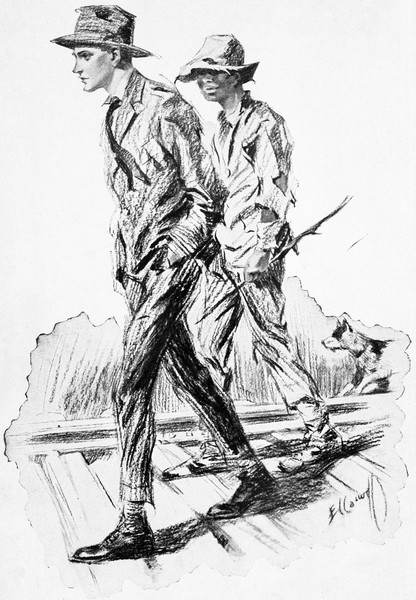
The White Boy, the Black Boy, and the Yellow Dog
Second Base Sloan
BY
CHRISTY MATHEWSON
AUTHOR OF
FIRST BASE FAULKNER,
CATCHER CRAIG, Etc.
ILLUSTRATED BY
E. C. CASWELL

GROSSET & DUNLAP
PUBLISHERS NEW YORK
Made in the United States of America
Copyright, 1917, by DODD, MEAD AND COMPANY, Inc.
CONTENTS
CHAPTER
PAGE
I
TWO BOYS AND A DOG3
II
JUNE STRIKES A BARGAIN13
III
THE SEARCH FOR WORK28
IV
DISPOSSESSED44
V
WAYNE PARTS WITH SAM57
VI
THE NEW HOME71
VII
THE LUCK CHANGES84
VIII
WAYNE LOSES A JOB AND FINDS ONE100
IX
BIG TOM MAKES AN OFFER118
X
NEW FRIENDS131
XI
THE CHENANGO CLUB143
XII
MEDFIELD CELEBRATES159
XIII
WAYNE BEATS OUT THE BALL172
XIV
“A GENTLEMAN TO SEE MR. SLOAN”186
XV
PATTERN GIVES ADVICE198
XVI
OFF TO HARRISVILLE210
XVII
TURNED DOWN!225
XVIII
“BADGERS” VS. “BILLIES”236
XIX
WAYNE LENDS A HAND250
XX
JUNE GOES TO WORK263
XXI
MR. MILBURN PROMISES274
XXII
SECOND BASE SLOAN287
ILLUSTRATIONS
The white boy, the black boy, and the yellow dog(Page 12)
Frontispiece
FACING
PAGE
Wayne’s cry was uttered involuntarily as he leaped forward104
Every other Medfield adherent made a joyful noise182
His conviction that he could hit that ball was still strong296
SECOND BASE SLOAN
CHAPTER I
TWO BOYS AND A DOG
Two boys and a dog sat at the edge of a little wood and shiveringly watched the eastern sky pale from inky blue to gray. One of the boys was white and the other was black; and the dog was yellow. The white boy was seventeen years old, the black boy sixteen, and the yellow dog—well, no one knew just how old he was. The white boy’s name was Wayne Torrence Sloan, the black boy’s name was Junius Brutus Bartow Tasker, and the dog’s name was Sam. An hour ago they had been rudely awakened from their sleep in a box car and more rudely driven forth into cold and darkness and mystery. They had had no complaint to make, for they had lain undisturbed in the car ever since the middle of the previous afternoon; and between that time and an hour ago had rumbled and jolted over miles and miles of track, just how many miles there was no way of telling until, having learned their present whereabouts, Wayne should puzzle out the matter of distance on the frayed and tattered time-table in his pocket. Travelling as they had travelled, on foot or stealing rides when the chance offered, makes a philosopher of one, and instead of objecting to the fate that had overtaken them when a suspicious train hand had flashed his lantern into the gloomy recesses of the box car, they had departed hurriedly and in silence, being thankful that the exodus had not been forced on them long before.
Minute by minute the sky brightened. The steely gray became softer in tone and began to flush with a suggestion of rose. The stars paled. A wan gleam of approaching daylight fell on one burnished rail of the track which lay a few rods distant. The trees behind them took on form and substance and their naked branches became visibly detailed against the sky. The dog whined softly and curled himself tighter in Wayne’s arms. Wayne stretched the corner of his gray sweater over the thin back and eased himself from the cramped position against the trunk of a small tree.
“What would you do, June, if someone came along about now with a can of hot coffee?” he asked, breaking the silence that had lasted for many minutes. The negro boy aroused from his half doze and flashed the whites of his eyes in the gloom.
“Mas’ Wayne,” he answered fervently, “I’d jus’ about love that Mister Man. M-m-mm! Hot coffee! Lawsy-y! You reckon it ever goin’ to get lightsome, Mas’ Wayne?”
“I reckon we can start along pretty soon now, June. Whereabouts do you suspect we are?”
“I reckon we must be gettin’ mighty nigh New York. How far was we yesterday?”
“’Most two hundred and fifty miles. If we’d just kept right on going all night we might have been in New York right now, but that freight was standing still more times than it was moving, I reckon. Look yonder, June. Daylight’s surely coming, isn’t it?”
Junius Brutus Bartow Tasker turned an obedient gaze toward the east, but his reply was pessimistic. A negro who is cold is generally pessimistic, and June was certainly cold. Unlike Wayne, he had no sweater under his shabby jacket, nor was there much of anything else under it, for the coarse gingham shirt offered little resistance to the chill of the March night, and June and undershirts had long been strangers. Early spring in southern Georgia is a different matter from the same season up North, a fact which neither boy had allowed for.
“I reckon Christmas is comin’ too,” muttered June gloomily, “but it’s a powerful long way off. How come the nights is so long up here, Mas’ Wayne?”
“I reckon there isn’t any difference, not really,” answered Wayne. “They just seem like they were longer. Sam, you wake up and stretch yourself. We’re going to travel again pretty soon now. Go catch yourself a rabbit or something.”
The dog obeyed instructions so far as stretching himself was concerned, and, after finding that he was not to be allowed to return to the warmth of his master’s lap, even set off in a half-hearted, shivering fashion to explore the surrounding world.
“I reckon he can projeck ’roun’ a mighty long time before he starts a rabbit,” said June discouragedly. “It’s a powerful mean-lookin’ country up this way, ain’ it? What state you-all reckons we’s in, Mas’ Wayne?”
Wayne shook his head. Shaking his head was very easy because he only had to let the tremors that were agitating the rest of him extend above the turned-up collar of his jacket! “I reckon it might be Maryland, June. Somewheres around there, anyway.” He felt for the time-table in his pocket, but he didn’t bring it forth for it was still too dark to read. “I ’most wish I was back home, June,” he went on wistfully, after a minute’s silence. “I sure do!”
“I done told you we hadn’t no business comin’ up this yere way. Ain’ nothin’ up here but Northerners, I reckon. If we’d gone West like I said we’d been a heap better off.”
“Nobody asked you to come, anyway,” responded Wayne sharply. “There wasn’t any reason for you coming. You—you just butted in!”
As there was no denying that statement, June wisely chose to change the subject. “Reckon someone’s goin’ to give us some breakfast pretty soon?” he asked.
But Wayne had a grievance now and, feeling a good deal more homesick than he had thought he ever could feel, and a lot colder and emptier than was pleasant, he nursed it. “I couldn’t stay there any longer and slave for that man,” he said. “I stuck it out as long as I could. Ever since mother died it’s been getting worse and worse. He hasn’t got any hold on me, anyway. Stepfathers aren’t kin. I had a right to run away if I wanted to, and he can’t fetch me back, not anyway, not even by law!”
“No, sir, he can’,” agreed June soothingly.
“But you didn’t have any right to run away, June. You——”
“How come I ain’t” demanded the negro. “He ain’ no kin to me, neither, is he? I was jus’ a-workin’ for him. Mister Higgins ain’ got no more ’sponsibility about me than he has about you, Mas’ Wayne.”
“Just the same, June, he can fetch you back if he ever catches you.”
“Can, can he? Let me tell you somethin’. He ain’ goin’ to catch me! Nobody ain’ goin’ to catch me! Coloured folkses is free an’ independent citizens, ain’ they? Ain’ they, Mas’ Wayne?”
“Maybe they’re free,” answered his companion grimly, “but if you get to acting independent I’ll just about lick the hide off you! I ought to have done it back yonder and sent you home where you belong.”
“I’se where I belong right now,” replied June stoutly. “Ain’ we been together ever since we was jus’ little fellers, Mas’ Wayne? Wasn’ my mammy your mammy’s nigger for years an’ years? How come I ain’ got no right here? Ain’ my mammy always say to me, ‘You Junius Brutus Tasker, you watch out for Young Master an’ don’ you ever let no harm come to him, ’cause if you do I’ll tan your hide’? Ain’ she always tell me that ever since I was so high? What you think I was goin’ to do, Mas’ Wayne, when I seen you sneakin’ off that night? Wasn’ but jus’ one thing to do, was there? How you ’spects I was goin’ to watch out for you like my mammy tells me if I didn’ go along with you? Huh? So I jus’ track along till you get to the big road, an’ then I track along till you get to Summitty, and then I track along——”
“Yes, and you climbed into that freight car after me and the man saw you and we all got thrown out,” continued Wayne. “I reckon you meant all right, June, but what do you suppose I’m going to do with you up North here? I got to find work to do and it’s going to be hard enough to look after Sam here without having a pesky darkey on my hands. Best thing you can do is hike back home before you starve to death.”
“Huh! I ain’ never starved to death yet, Mas’ Wayne, an’ I ain’ lookin’ to. Jus’ like I told you heaps of times, you ain’ got to do no worryin’ about June. I reckon I can find me a job of work, too, can’ I? Reckon folkses has to plough an’ plant an’ pick their cotton up here jus’ like they does back home.”
“There isn’t any cotton in the North, June.”
“Ain’ no cotton?” ejaculated the other incredulously. “What all they plant up here, then, Mas’ Wayne?”
“Oh, apples, I reckon, and——”
“I can pick apples, then. I done pick peaches, ain’ I? What else they plant?”
“Why——” Wayne didn’t have a very clear notion himself, but it didn’t do to appear ignorant to June. “Why, they—they plant potatoes—white potatoes, you know—and—and peas and—oh, lots of things, I reckon.”
June pondered that in silence for a moment. Then: “But how come they don’t plant cotton?” he asked in puzzled tones.
“Too cold. It won’t grow for them up here.”
June gazed rather contemptuously about the gray morning landscape and grunted comprehendingly. “Uh-huh. Reckon I wouldn’t neither if I was a cotton plant! It surely is a mighty—mighty mean-lookin’ place, ain’ it?”
Well, it really was. Before them ran the railroad embankment, behind them was the little grove of bare trees and on either hand an uncultivated expanse of level field stretched away into the gray gloom. No habitation was as yet in sight. The telegraph poles showed spectrally against the dawn, and a little breeze, rising with the rising sun, made a moaning sound in the clustered wires. Sam came back from his profitless adventures and wormed himself between Wayne’s legs. June blew on his cold hands and crooned a song under his breath. The eastern sky grew lighter and lighter and suddenly, like a miracle, a burst of rose glow spread upward toward the zenith, turning the grayness into the soft hues of a dove’s breast! Wayne sprang to his feet, with an exclamation of pain as his cramped and chilled muscles responded to the demand, and stretched his arms and yawned prodigiously.
“Come along and let’s find that hot coffee, June,” he said almost cheerfully. “There must be a house somewhere around here, I reckon.”
“Sure must!” replied the other, falling instantly into Wayne’s humour. “Lawsy-y, I can jus’ taste that coffee now! Which way we goin’, Mas’ Wayne?”
Wayne stamped his feet on the still frosty ground and considered. At last: “North,” he replied, “and north’s over that way. Come along!”
He led the way back toward the track, followed by June and Sam, and after squeezing himself between the wires of a fence climbed the embankment and set off over the ties with a speed born of long practice. The rose hue was fast changing to gold now, and long rays of sunlight streamed upward heralding the coming of His Majesty the Sun; and against the glory of the eastern sky the three travellers stood out like animated silhouettes cut from blue-black cardboard as they trudged along—the white boy, the black boy, and the yellow dog.
CHAPTER II
JUNE STRIKES A BARGAIN
That they didn’t travel absolutely due north was only because the track chose to lead more westerly. By the time the sun was really in sight they had covered the better part of a half-mile and had caught a glimpse of a good-sized town in the distance. Tall chimneys and a spire or two pointed upward above a smoky haze. They crossed a big bridge beneath which flowed a broad and sluggish river, and had to flatten themselves against the parapet, Sam held tightly in Wayne’s arms, while a long freight train pounded past them on the single line of track. Beyond the bridge a “Yard Limit” sign met them, and the rails branched and switches stood up here and there like sentries and a roundhouse was near at hand. But they found their first habitation before that in a tiny white cottage set below the embankment, its gate facing a rambling clay road, rutted and pitted, that disappeared under a bridge. There was a path worn down the bank to the road, and Wayne and June and Sam descended it. A trail of smoke arose from the chimney of the house straight into the morning sunlight and suggested that the occupants were up and about.
Wayne’s knock on the door was answered by a tall, thin, slatternly woman who scowled questioningly.
“Good morning, ma’am,” began Wayne. “Could you give us a cup of coffee, please? We’ve been——”
“Get out of my yard,” was the prompt response. “I don’t feed tramps!”
“We aren’t tramps, ma’am. We’ll pay for the coffee——”
“And steal the doormat! I know your sort!” There was no doormat in sight, but Wayne didn’t notice the fact. “Go on now before I call my man to you.” The door slammed shut.
Wayne viewed June in surprise and the negro boy shook his head helplessly. “She surely is a powerful disgrumpled lady, Mas’ Wayne! Yes, sir! Reckon we better move along.”
“Maybe she isn’t well,” said Wayne, as they left the inhospitable dwelling behind and again climbed to the track. “Just the same, she didn’t have any right to call us tramps, did she? I suppose we’d better keep on to the town, June. It isn’t much farther.”
So they went on, past sidings laden with long lines of freight cars, past locomotives sizzling idly, past a crossing where eight burnished rails, aglow in the sunlight, crossed their path, under a big signal tower, their eyes very busy and their stomachs, since they had not eaten since early the preceding afternoon, very empty. A long freight shed was reached, and as they passed it one of the many doors slid slowly open and a brawny man stood revealed against the dimness beyond. He stretched his arms, yawned, caught sight of the passers and stood there, framed in the square opening, staring interestedly. Wayne stopped.
“Howdy,” he said. “Can you tell me where I can get something to eat, sir?”
“Sure! Cross over back of the yellow building and you’ll see a lunch-wagon. Maybe you’re looking for the hotel, though?”
Wayne shook his head. “I reckon a lunch-wagon’s good enough. What is this place, please?”
“Medfield, son. Aren’t lost, are you?”
“No, sir. What—what state are we in?”
“Pennsylvania. What state might you be looking for, son?”
“New York. Is it very far?”
“Second state on the right,” laughed the man. “What part of it are you aiming for?”
“New York City, I reckon. How far would that be?”
“About a hundred and fifty miles.”
Wayne sighed. “I thought we were nearer than that. Thank you, sir.”
“Say, hold on! Where’d you come from, anyway?”
Wayne pointed a thumb over his shoulder. “Back there a ways,” he answered vaguely.
“Tramping it?”
“Yes, sir, some. Rode on the cars, too.”
The big man in the doorway winked down at him. “When they didn’t see you, eh? You look like a smart kid. What are you beating your way around the country for? Why don’t you get a job and go to work?”
“I’m looking for work,” answered Wayne eagerly. “Know where I can find some?”
The man shrugged his shoulders. “I guess you won’t have to look very far, son, if you really want a job. The trouble with your sort is that you don’t want to work. How far south do you come from?”
“Georgia, sir. How’d you know?”
“How’d I know!” laughed the man. “That’s a good one! What’s Friday’s name?”
“What, sir?” asked Wayne, puzzled.
The man nodded at Wayne’s companion. “What’s his name? Abraham Lincoln White?”
“June,” answered Wayne, a trifle stiffly, beginning to suspect that the man was laughing at him.
“June, eh? Say, he got North about three months too soon, didn’t he? Where’d you get the alligator hound? Don’t you ever feed him anything?”
Wayne moved away, followed by his retinue, but the man in the door was blind to offended dignity. “All right, son!” he called after them. “Good luck! Tell Denny that Jim Mason sent you and that he’s to give you a good feed.”
Wayne found the lunch-wagon without difficulty, but it didn’t seem to him that it deserved the name of wagon for it was set on a brick foundation in a weed-grown piece of land under the shadow of the big yellow factory and looked as though it had been there for many years. Still, there might be wheels hidden behind the bricks, he reflected. The words “Golden Star Lunch” were painted on the front. They climbed the steps and seated themselves on stools, while Sam searched famishedly about the floor for stray crumbs. The proprietor was a short, chunky youth with light hair slicked down close and a generous supply of the biggest and reddest freckles Wayne had ever seen. He observed June doubtfully.
“We don’t generally feed niggers here,” he said. “You two fellers together?”
“Yes,” answered Wayne. “If you don’t want to serve him we’ll get out.” He started to slide off the stool.
“Oh, well, never mind,” said the white-aproned youth. “The rush is over now. What’ll you have?”
“Coffee and two ham sandwiches, please.”
“Mas’ Wayne,” said June, “I’d rather have a piece of that sweet-potato pie yonder, please, sir.”
“That ain’t sweet-potato pie,” laughed the proprietor. “That’s squash, Snowball.”
“Please, sir, Mister, don’t call me out of my name,” begged June earnestly. “My name’s Junius.”
“All right, Junius.” The proprietor of the lunch-wagon grinned at Wayne and winked, but Wayne only frowned.
“You’ll have a sandwich, June,” he said. “Pie isn’t good for you. Two ham sandwiches, please.”
“All right, sir.”
June watched wistfully while the knife slipped through the end of the ham, and at last hunger got the better of manners. “Mister Denny, sir, would you please, sir, just bear down a little heavier on that fat meat?” he requested.
“Sure, you can have all the fat you want. How’d you know my name, though?”
Wayne answered for him. “A man at the freight shed directed us.”
“Yes, sir, and he said we was to tell you to give us a mighty good feed, Mister Denny,” added June. “But I reckon you-all goin’ to do that anyway, ain’ you?”
The proprietor laughed as he covered two slices of buttered bread with generous slices of ham. “That’s right, Snow—I mean Junius,” he responded. “If that ain’t enough you come back. Want something for your dog?”
“Thanks, I’ll give him some of my sandwich,” said Wayne, trying not to look impatient.
“You don’t need to.” The man scooped up some trimmings from the ham on the blade of the broad knife, dumped them on a slice of bread and leaned over the counter. “Here you are, Bingo. Catch!” Sam caught as much as he could and it disappeared as though by magic. After that he licked up the few scraps that had got away from him, wagged his tail delightedly, and gazed inquiringly and invitingly up again. “Say, he’s a smart dog, ain’t he?” said the man. “What’s his name?”
“Sam. Are those sandwiches ready, please?”
“Huh? Gee, didn’t I serve you yet? What do you know about that? Coffee, you said, didn’t you? Here you are.” He went back to an appraisal of the dog while Wayne and June, side by side, drank deep draughts of the hot coffee and bit huge mouthfuls from the delicious sandwiches. “Guess some more breakfast wouldn’t bust him,” said the proprietor, cutting off another slice of bread and buttering it liberally. “Can he do any tricks?”
“A few,” replied Wayne rather inarticulately by reason of having his mouth occupied by other things than words. “Sit up, Sam, and ask for it.”
Sam sat up, a trifle unsteadily, and barked three shrill barks. The man laughed. “Good boy! Here you are, then!” The piece of bread disappeared instantly. “Say, he’s sure hungry! What kind of a dog is he?”
“Reckon he’s just dog,” answered Wayne. “He don’t boast of his family much, Sam don’t, but he’s a good old chap.”
“Man over yonder at the railroad called him a alligator hound,” said June resentfully. “That’s the best dog in Colquitt County, Mister Denny. Yes, sir!”
“Where’s that, Junius?”
“Colquitt? That’s where we lives at when we’re to home. Colquitt County’s the finest——”
“Shut up, June. Don’t talk so much,” said Wayne. “Sam, stand up and march for the gentleman. Come on! Forward! March!”
Sam removed his appealing gaze from the countenance of “Mister Denny,” sighed—you could actually hear that sigh!—reared himself on his slender hind legs and stepped stiffly down the length of the floor and back again.
“Halt!” commanded Wayne, and Sam halted so suddenly that he almost went over backward. “Salute!” Sam’s right paw flopped up and down in a sketchy salute. “Fall out!” Sam came down on all-fours with alacrity, barked his relief and again took up his station under the good-natured “Mr. Denny.” The latter applauded warmly.
“Some dog you’ve got there, kid!” he declared. “What’ll you take for him?”
“I wouldn’t sell him,” answered Wayne, washing down the last of his sandwich with the final mouthful of coffee.
“Give you ten dollars,” said the man.
Wayne shook his head with decision.
“Fifteen? Well, any time you do want to sell him, Mister, you give me first chance, will you? He’s going to have some more breakfast for that stunt.”
“Mas’ Wayne,” said June softly, “I ain’ never eat any of that squash pie, an’ it surely does look powerful handsome, don’ it?”
“You still hungry?” frowned Wayne.
“I ain’ downright hungry,” answered June wistfully, “but I—I surely would act awful kind to a piece of that pie!”
“All right,” said Wayne. “How much is pie, sir?”
“Five cents. Want some?”
“Please. A slice of the squash.”
The proprietor, too busy with Sam to have heard the exchange, set the pie in front of Wayne, and the latter pushed it along to June.
“Did you say two pieces?” asked the man, poising his knife.
“No, thank you.”
June looked uncertainly from the tempting yellow triangle on the plate before him to Wayne and back again. “Ain’ you-all goin’ to have no pie?” he asked. Wayne shook his head. June laid down the fork and sniffed doubtfully. “What kind of pie you say this is, Mister Denny?” he asked.
“Huh? Squash pie.”
“Uh-huh. I reckon I don’ care for it, thanky, sir. It don’ smell like I thought it would.”
“Don’t be a fool!” whispered Wayne. “I don’t want any.”
“Say you don’? I ain’ believin’ it, though. Please, Mas’ Wayne, you have a half of it. It’s a powerful big piece of pie.”
“Lots more here,” said the proprietor. “Want another piece?”
“No, thanks,” answered Wayne. “I—maybe I’ll take a bite of his.”
The man’s reply to this was a quick slash of his knife and a second section of the squash pie slid across the counter. “My treat,” he said. “Try it. It’s good pie.”
Wayne hesitated. “I don’t think I want any,” he muttered. “I’m not hungry.”
“You eat it if you don’t want me to get mad at you,” said the other, levelling the knife at him sternly. “If you can’t eat it all give it to Sam. I’ll bet you he likes pie, eh, Sammy?”
Wayne smiled and, to June’s vast relief, ate. Perhaps he wasn’t hungry and perhaps it was mere politeness that caused him to consume every last crumb, but he had the appearance of one in thorough enjoyment of his task. When both plates were cleaned up Wayne dug a hand into a pocket.
“How much do we owe you, please?” he asked.
“Twenty cents. The pie was on me.”
“I’d rather—rather——” Wayne’s remark dwindled to silence and he began an anxious search of all his pockets, a proceeding that brought a look of suspicion into the good-natured face of the man behind the counter.
“Lost your money?” asked the latter with a trace of sarcasm.
Wayne nodded silently. “I reckon I must have,” he muttered, turning out one pocket after another and assembling the contents on the counter; the tattered time-table, a toothbrush, a pair of stockings, two handkerchiefs, a knife, a pencil, some string, and two-cent stamp vastly the worse for having laid crumpled up in a vest pocket for many weeks. “It—it’s gone,” said Wayne blankly. “I had nearly four dollars last night, didn’t I, June?”
“Yes, sir, you certainly did, Mas’ Wayne, ’cause I seen it. Where you reckon you lost it?”
“I don’t know,” answered the other boy miserably. “It was in this pocket. I reckon it must have come out in the freight car.”
The proprietor of the lunch wagon frowned. It was an old game to him, but there was something apparently genuine in the troubled expressions of both boys and he was almost inclined to accept the story. At all events, it was only twenty cents, and he was good-hearted and the two youngsters looked rather down on their luck. “Well, never mind,” he said carelessly. “You can pay me some other time, kids.”
But Wayne shook his head. “You—you haven’t any money, have you, June?” he faltered. June shook his head sadly.
“I didn’t have but two bits, Mas’ Wayne, and I went an’ spent that long time ago.”
“You see,” said Wayne, turning to the proprietor, “we don’t live here. We’re just—just passing through on our way to New York, and so we couldn’t very well pay you later.” He looked dubiously at the array of property before him. “I reckon there ain’t anything there worth twenty cents, is there?”
“Not to me, I guess.”
“Then—then you’ll just have to keep Sam until we can bring the money,” said Wayne desperately. “I reckon we can earn it somewhere. Will you please to do that, sir?”
The man looked covetously at the dog, but shook his head. “Shucks,” he answered, “he’d only be unhappy. And so would you, I guess. You run along, fellers. It’s all right. I guess you’ll pay me when you can, eh? Only—say, now, honest, kid, did you really have that four dollars, or are you just stringing me?”
Wayne flushed but met the man’s gaze squarely. “I had it,” he replied simply. “You haven’t any call to think I’m lying.”
“All right! I believe you. Now, look here, do you really want to earn a half-dollar?”
“Yes, sir.”
“Ever washed windows?”
Wayne shook his head. “No, but I reckon I could do it.”
“Well, these windows need washing pretty badly. Generally I do it myself, but I’d rather take a lickin’. There’s eight of ’em and it ought to be worth five cents a window. That’s forty cents, but we’ll call it fifty. What do you say?”
“I’ll do them, thanks, and mighty glad to,” answered Wayne eagerly.
“Huh!” ejaculated June. “Go on away from here, Mas’ Wayne. You ain’ never washed no window in your life. White man, point me out to water and rags and let me to it. Mas’ Wayne ain’ never done no work like that an’ there ain’ no call for him to do any.” June paused and looked at the windows. “Mister Denny, them’s pretty big windows an’ they certainly is dirty, ain’ they?”
“What’s the matter with you? Ain’t fifty cents enough?”
“Well, sir,” answered June slowly, “it is an’ it ain’. Takin’ into estimation the size of them windows an’ the ’mount of washin’ required, sir, it seems like you might throw in two more cups of that yere coffee, sir!”
“Junius, you’re all right!” laughed the man, turning to the gleaming coffee urn. “It’s a bargain. Drink your coffee and then get to work. If you do a good job I’ll throw in a sandwich when you’re through!”
CHAPTER III
THE SEARCH FOR WORK
Two hours later the boys, followed by Sam, left the lunch-wagon, possessed of thirty cents in money and with all liabilities discharged. Wayne, declaring that, although he had never washed a window in his life, it was time he learned how, had, to June’s disgust, taken a hand in the work, and, while he had done only three windows to June’s five, had proved his ability. Afterward, Mr. Dennis Connor—for that, as they later learned, was his real name—had provided a collation of sandwiches and coffee and dismissed them with his good wishes and an invitation to drop in again when they were passing.
It was mid-morning now, and the sunshine had warmed the early March day to a temperature more kindly than any they had experienced for a week. Wayne led the way to a sheltered nook in the lee of an empty shed near the railroad and seated himself on a discarded wheelbarrow. June followed suit and Sam began an excited search for rats. The town was wide-awake and very busy now. Smoke poured from neighbouring stacks and chimneys and the roar of machinery came to them from the big factory close by. Trains passed and locomotives shrieked and clanged their brazen bells. Drays and trucks moved noisily along the cobbled street in the direction of the freight yard, piled high with goods in bales and boxes.
“Reckon,” said June, “this is a right smart town, Mas’ Wayne.”
Wayne nodded. He was still regretting the loss of his money and now he reverted to the question of how and where he had parted from it. They discussed it at some length and eventually decided that it had somehow got out of his pocket last night in the freight car. To be quite, quite certain that it was really gone, Wayne once more emptied his pockets and turned them all inside out. But the money was not there and June shook his kinky head in silent sympathy. Sam gave up his rat hunt and threw himself, panting, in the sunlight at the boys’ feet.
“Well, it’s gone,” said Wayne finally. “And there’s no use crying about it. But what I want to know is how we’re to get to New York on thirty cents. That man said it was about a hundred and fifty miles and I reckon it’ll take us ’most a week, don’t you?”
“Depends,” said June. “If we’s lucky and gets plenty of free rides——”
“They’re too particular around here,” interrupted Wayne sadly. “I reckon it’ll be mighty hard to get into freight cars after this, June. We’ll just have to foot it, and thirty cents won’t last long on the road. Folks ain’t awfully hospitable up North, I’ve heard, and we can’t depend on getting meals free. Anyway, I don’t want to. It’s too much like begging. That man as much as called us tramps, and that woman said we were tramps. Well, we aren’t. We’ve paid for everything anyone would let us pay for, so far, excepting the rides we stole, and those don’t count, I reckon. Seems to me like the only thing to do now, June, is to stay right here and earn some money before we go any further. There’s no use trying to walk to New York with only thirty cents.”
June agreed cheerfully enough to that proposition. After all, it made little difference to him. New York City or Medfield, it was all one. To be sure, they had started out for New York, but it was Wayne who had settled on that place as their destination, and June would have been just as well satisfied if Wayne had decided for Reykjavik, Iceland. Besides, it was now almost three weeks since they had stolen away from Sleepersville, Georgia, and June’s first enthusiasm for wandering had faded sadly. In short, the idea of remaining stationary in one place for a while struck him as being very attractive. And perhaps the same thought came to Wayne, for, having reached the decision, he sighed as if with relief. It may have been, probably was, merely a coincidence, but Sam, stretched flat on the ground at Wayne’s feet, echoed the sigh.
Perhaps no better opportunity will present itself for a study of our hero and his companions and so we will make the most of it. Wayne Sloan was seventeen years old; to be exact, seventeen years and nineteen days. It had been the arrival of his seventeenth birthday that had decided him to cast off the yoke of thraldom and become his own master. He was a capable-looking youth, fairly large for his age. He had wide shoulders and carried himself straightly, a fact largely due, I fancy, to many hours spent in the saddle in his younger days. After the death of his mother, which had occurred four years ago, there had been neither saddle nor horse for him, nor, had there been a horse, would there have been opportunity for riding. His stepfather had his own notions regarding the proper occupations for a boy, notions that were at wide variance with Wayne’s. Handsome the boy was not, but you would have called him nice-looking. You’d have liked his eyes, which were so deeply brown that they seemed black, and the oval smoothness of his face which lacked the colourlessness of so many Southern faces. His hair was fully as dark as his eyes and as straight as an Indian’s, and just now, by reason of not having been cut for a month or so, was rather untidy about ears and neck. His nose was—well, it was just a plain, everyday affair, meriting no especial mention. And his mouth was no more remarkable. In fact, there was nothing to emphasise, from head to toes. He was just a nice-appearing, well-built Southern boy. At present his appearance was rather handicapped by his attire, for even the best of clothes will look shabby after nearly three weeks of dusty roads and dirty box cars, and Wayne’s apparel had not been anything to brag about in the beginning. A pair of gray trousers that only the most charitable would have called woolen, a vest of the same, a coat of blue serge, and a gray sweater comprised the more important part of his outfit. A black felt hat of the Fedora variety, ridiculously old-looking for the boyish face beneath, dark-blue cotton socks showing above a pair of rusty, dusty, scuffed-toed shoes, and a wispy blue string tie peering from under the wrinkled collar of a blue-and-white cotton shirt completed as much of his wardrobe as met the world’s gaze.
But in the matter of wardrobe Wayne at least had the better of his companion. Junius Brutus Bartow Tasker was never a dandy. Just something to cover him up more or less was all June asked. His shoes, which had been new just before the beginning of the present pilgrimage, were the most presentable item of his attire. They only needed blacking. The other things he wore needed about everything, including patches, buttons, and cleaning! His cheap cotton trousers would have proved an embarrassment to anyone of a less philosophical nature, his shirt was sadly torn and his coat—well, that coat had been a wreck a year ago and had not improved any since! Between the tops of his shoes and the frayed bottoms of his trousers appeared a crinkled expanse of gray yarn socks, to the public all that socks should be, but to June only two hollow mockeries. Below his ankle bones lay ruin and desolation. On his kinky head was a brown felt, or what had once been a brown felt. It no longer deserved serious consideration as a head covering. But all this didn’t bother June much. As I have already hinted, he was a philosopher, and a cheerful one. You had only to look at him to realise that. He had a perfectly round face, as round as a cannon ball—and lots blacker—a pair of merry brown eyes which rolled ludicrously under the stress of emotion, a wide, vividly red mouth filled with startlingly white teeth, a nose no flatter than was appropriate to one of his race, and ears that stood out inquiringly at right angles. He looked and was intelligent, and, barring the colour of his skin, was not greatly different in essentials from the white boy beside him. June was sixteen, as near as he could tell; his mother’s memory for ages was uncertain, and June couldn’t consult his father on the question for the simple reason that his father had disappeared very soon after June’s arrival in the world. Besides, there were five other youthful Taskers, some older and some younger, and June’s mother might well be excused for uncertainty as to the exact age of any one of them.
We have left only one member of the trio to be described, and his outward appearance may be told in few words. Sam was small, yellowish and alert. He had been intended for a fox terrier, perhaps, but had received the wrong colouring. In Missouri or Mississippi he would have been labelled “fice,” which is equivalent to saying that he was a terrier-like dog of no particular breed. But like many of his sort, Sam made up for his lack of aristocracy by possessing all the virtues that one demands in a dog. That small head of his contained a brain that must have felt absolutely crowded! I dare say that that is the way the Lord makes it up to little, no-account yellow dogs like Sam. He gives them big brains and big hearts, and so they get through life without ever feeling the want of blue ribbons on their collars. It would, I think, have been a frightful shock to Sam if anyone had tied a ribbon on him, blue or any other colour! He wouldn’t have approved a bit. In fact, he would have been most unhappy until he had gotten it off and tried the taste of it. So far no one had ever attempted such an indignity. Even a collar was something that Sam had his doubts about. When he had one he put up with it uncomplainingly, but you could see that it didn’t make him a bit happier. Just now he wore a leather strap about his neck. It had once been used to hold Wayne’s schoolbooks together, but Sam didn’t know that, and wouldn’t have cared if he had. I forgot to say that a perfectly good tail had been early sacrificed to the dictates of an inhuman fashion, and that now only a scant two inches remained. To see Sam wag that two inches made you realise what a perfectly glorious time he could have had with the whole appendage had it been left to him. Sometimes in moments of strong mental excitement his keen, affectionate brown eyes seemed trying to say something like that! But my few words have grown too many, and I find that I have devoted nearly as much space to Sam as to his master. But as Sam is not likely to receive much attention hereafter let us not begrudge it to him.
Meanwhile Wayne had laid his plans. If thirty cents was not sufficient to finance the journey to New York, neither was it sufficient to provide food and lodging for them indefinitely in Medfield. Consequently, it behooved them to add to that sum by hook or by crook, and it was decided that they should begin right away and look for work to do. With that object in view they presently left the sunny side of the little shed and set off, Wayne and Sam in one direction and June in another, to reassemble at twilight. Wayne wanted June to take ten of the precious thirty cents to buy luncheon with, but June scoffed. “I don’t need no ten cents, Mas’ Wayne,” he declared. “I can find me somethin’ to eat without no ten cents. An’ I don’t need nothin’ else, anyhow, not before night. I’m jus’ plumb full of food now!”
Wayne’s experiences that day were disheartening. Medfield was a town of nearly thirty thousand inhabitants, but not one of that number, it appeared, was in need of Wayne’s services, nor cared whether he lived or starved. He made his way to the centre of the town and visited store after store, and office after office, climbing many weary flights and knocking at many inhospitable doors while Sam waited outside in patient resignation. At noon Wayne lunched in a shabby and none-too-clean little restaurant on five cents’ worth of beef stew and two pieces of bread, feeling a bit panicky as he did so, because five from thirty left only what June would have called “two bits” and Wayne a quarter, and which, no matter what you called it, was a frighteningly small amount of money to have between you and nothing. But he felt a heap better after that stew and went back to his task with more courage. Sam felt better, too, for he had had a whole slice of bread dipped in gravy and a nice gristly bone.
The trouble was that when, as happened very infrequently, to be sure, but did happen, he was asked what he could do he had to answer either “Anything” or “Nothing.” Of course he chose to say “Anything,” but the result was always disappointing. As one crabbed, much-bewhiskered man in a hardware store told him, “Anything means nothing.” After that Wayne boldly presented himself at the busy office of a dry-goods emporium and offered himself as a bookkeeper. It was more a relief than a disappointment when the dapper man in charge informed him, after a dubious examination of his attire, that there was no present vacancy. Wayne was conscious of the amused glances of the men at the desks as he hurried out. It was almost dusk when he finally gave up and turned his steps toward the deserted shed near the railway. He had trouble in finding it, walking many blocks out of his way and for a space fearing that darkness would overtake him before he reached it. In the end it was Sam who kept him from making a second mistake, for Wayne was for passing the shed a block away until the dog’s insistence on turning down a dim, cobble-paved street brought the search to an end.
June was already on hand, squatting comfortably on the wheelbarrow and crooning to himself in the twilight. Sam showed his delight in the reunion by licking June’s face while Wayne discouragedly lowered himself to a seat at the darkey’s side.
“Any luck?” he asked tiredly.
“Nothin’ permanent, Mas’ Wayne, but I done earned us another two bits. This is a right smart town, this is. Nobody don’t have to go hungry in this town, no, sir!”
Wayne tried to keep the envy out of his voice as he answered: “That’s great, June. How did you do it?”
“Man was rollin’ barrels up a board to a wagon and every time he got a barrel half-way up the board his horses would start a-movin’ off an’ he’d jus’ have to drop that barrel an’ run to their heads. I ask him, ‘Please, sir, don’t you want me to hold ’em for you?’ An’ he ’lowed he did. An’ I say, ‘How much you goin’ to give me, sir?’ And he say if I hold ’em till he got his wagon loaded he’d give me a quarter. ’Twan’t no time till he had the barrels on an’ I had his ol’ quarter in my jeans. Then I see a funny little man with gold rings in his ears sittin’ on a step sellin’ candy, an’ funny twisty pieces of bread an’ apples, an’ things. An’ I say to him, ‘How much are your apples, Boss?’ An’ he say, ‘They’re two for five cents.’ ‘Huh,’ I say, ‘they give ’em poor old apples away where I come from.’ An’ he want to know where was I come from, an’ I tell him, an’ we had a right sociable time a-talkin’ an’ all, an’ pretty soon he find a apple had a rotten spot on it an’ give it to me. An’ after a while I say, ‘Boss, what you-all call them funny, curly things you got on that stick?’ An’ he ’lows they’s—they’s——” June wrinkled his forehead until it had almost as many corrugations as a washboard—“I reckon I forget what he call them, Mas’ Wayne.”
“What were they like, June?”
“Well, sir, they was bow-knots made of bread, an’ they tasted mighty scrumptious. Seems like they was called ‘pistols’ or somethin’.”
“Pretzels, June?”
“That’s it! Pretzels! You know them things, Mas’ Wayne?” Wayne shook his head. “Well, sir, they’s mighty good eatin’.”
“Did he give you one?” asked Wayne smiling.
“Yes, sir, he surely did. I say I ain’ never eat one an’ he say if I have a penny I could have one. ‘Go long, Mister Man,’ I say, ‘I ain’ got no penny. How come you ’spects I got all that money?’ An’ he laugh an’ say, ‘Well, maybe I give you one, Black Boy, if you don’ tell someone elses.’ He had funny way of talkin’, that man. So I say I won’t ever tell——”
“But you have told,” laughed Wayne.
June rolled his eyes. “That’s so! I plumb forget!”
“Was that all the lunch you had?” asked Wayne.
June nodded. “Was all I wanted,” he declared stoutly. “Apples is powerful fillin’ fruit, Mas’ Wayne. What-all did you have?”
Wayne told him and June pretended to think very little of it. “That ain’ white man’s food,” he declared. “Old stewed-up beef ain’ fit rations for you. No, sir, ’tain’! Don’t you go insultin’ your stomach like that no more, Mas’ Wayne, ’cause if you do you’re goin’ to be sick an’ me an’ Sam’ll have to nurse you. Now you tell me what-all did you do, please.”
Wayne soon told him and June shook his head and made sympathetic noises in his throat during the brief recital. “Don’t you mind ’em, Mas’ Wayne,” he said when the other had finished. “Somebody’s goin’ to be powerful glad to give you a job tomorrow. You wait an’ see if they ain’.”
“I can’t do anything, I’m afraid,” said Wayne despondently. “They all ask me what I can do and I have to tell them ‘Nothing.’ I can’t even wash windows decently!”
“Who say you can do nothin’?” demanded June indignantly. “I reckon you’re a heap smarter than these yere Northerners! Ain’ you been to school an’ learn all about everythin’? Geography an’ ’rithmatic an’ algebrum an’ all? What for you say you don’ know nothin’?”
Wayne laughed wanly. “Arithmetic and those things aren’t much use to a fellow, it seems to me, when he’s looking for work. If I’d learned bookkeeping I might get a job.”
“You done kep’ them books for your stepdaddy.”
“That wasn’t real bookkeeping, June. Anyone could do that. The only things I can do aren’t much use up here; like ride and shoot a little and——”
“An’ knock the leather off’n a baseball,” added June.
“I guess no one’s going to pay me for doing that,” commented Wayne, with a smile. “Well, there’s no use borrowing trouble, I reckon. There must be something I can do, June, and I’ll find it sooner or later. I reckon I made a mistake in going around to the offices. If I’d tried the warehouses and factories I might have found something. That’s what I’ll do tomorrow.”
“You goin’ to set yourself some mighty hard work, Mas’ Wayne, if you get foolin’ ’roun’ the factories. Better leave that kind of work for me, sir. That’s nigger work, that is.”
“It’s white men’s work up here in the North, June. I’m strong enough and I’m willing, and I’m just going to find something tomorrow. Question now is, June, where are we going to get our supper and where are we going to sleep? Fifty cents will buy supper but it won’t buy beds, too.”
“I been thinkin’ about that sleepin’ business,” answered June. “I reckon we can’ do no better than stay right where we is.”
“Here?” asked Wayne. “Someone would come along and arrest us or something. Besides, a wheelbarrow——”
“No, sir, I don’ mean out here. I mean in yonder.” June nodded toward the old shed beside them. “I was projeckin’ roun’ before you-all come back an’ there ain’ nothin’ wrong with this yere little house, Mas’ Wayne.”
“Oh,” said Wayne. “Is it empty?”
“Yes, sir, it surely is empty. There ain’ nothin’ in there but empty. It ’pears like it used to be a store, ’cause there’s shelves up the walls. An’ there’s a floor, too.”
“Do we sleep on the floor or the shelves?” asked Wayne.
“Shelves is too narrow,” chuckled June. “If we jus’ had a blanket or two, now, I reckon we’d be mighty comfortable.”
“Might as well wish for a bed with a hair mattress and pillows and sheets,” answered Wayne. “But I’d rather sleep under a roof tonight than outdoors, so we’ll just be glad of the shed, June. Now let’s go and find us some supper. Come on, Sam, you rascal!”
CHAPTER IV
DISPOSSESSED
If one is tired enough such luxuries as beds and blankets may be dispensed with. Wayne and June slept more uninterruptedly that night than for many nights past. Toward morning they were conscious of the cold, for Wayne’s coat and an old gunny-sack discovered in a corner of the shed were not sufficient to more than cover their feet and legs. Sam, curled up in Wayne’s arms, doubtless fared better than the boys. When morning came they were stiff and achy and were glad enough to get up at the first signs of sunrise and move around. The want of a place to wash resulted in the discovery of a veritable haven of warmth and rest, for Wayne, peering about from the front of the shed, descried the railroad station only a few blocks down the track, and toward that they made their way. They found the waiting-room door unlocked and warmth and comfort inside. After washing up they settled themselves on a bench removed from the sight of the ticket window and fairly luxuriated in the warmth. June fell asleep again and snored so loudly that Wayne had to arouse him for fear that someone would hear him and drive them out. Wayne himself didn’t actually slumber, but he leaned back in a half-doze that was almost as restful as sleep, and Sam, restraining his desire to investigate these new surroundings, presently slept, too.
It was hunger that finally aroused them to action. The clock on the wall told them that it was almost half-past seven, and they left the waiting-room and passed out again into the chill of the March morning. But the sun was shining strongly now and there was a spring softness in the air that made June whistle gaily as they made their way back up the railroad in search of “Mister Denny’s” lunch-wagon. There they had some steaming hot coffee, and some crisp rolls and butter and, since there was still a nickel in the exchequer, three bananas which they consumed outside. To be sure, that left them penniless, but somehow that didn’t seem to matter so much this morning. There was something in the spring-like air that gave them courage and confidence. Besides, whatever happened, they had a home, such as it was, in the old shed. Presently they again set forth on their search for employment, agreeing to meet at five o’clock.
But again it was June who prospered and Wayne who returned empty-handed. June proudly displayed forty cents in dimes and nickels which he had earned in as many capacities as there were coins in his hand. Not only had he earned that forty cents, but he had dined sumptuously on a pork chop, having traded a quarter of an hour of his time and labour for that delicacy at a little restaurant. For his part, Wayne had gone dinnerless and was thoroughly discouraged. Even the tattered but still useful horse blanket which June had picked up outside a flour mill across the town could not cheer Wayne’s spirits.
“Reckon,” said June, spreading the blanket out proudly, “someone done lose that as didn’t mean to, Mas’ Wayne, ’cause it’s a powerful nice blanket, ain’ it?” Wayne listlessly agreed and June dropped it through the window which was their means of ingress and egress. “It’s goin’ to keep us fine an’ warm tonight, that little ol’ blanket is. Tomorrow I’m goin’ to find me a bed to go with it! You hungry enough to eat, Mas’ Wayne?”
Wayne shook his head. “I don’t want any supper,” he replied.
“Don’ want no supper! How come? What-all you have for your dinner, please?”
“I had enough,” answered Wayne. “You go ahead and have your supper, June.”
June snorted. “Mighty likely, ain’ it?” he demanded scathingly. “Reckon you can see this nigger eatin’ all by his lonely. No, sir, Mas’ Wayne, you-all’s goin’ to eat, too. If you don’ there ain’ goin’ to be no supper for nobody.”
“I tell you I’m not hungry,” replied Wayne irritably. “Besides, if you must know, I haven’t any money.”
“Say you ain’? You’ve got forty cents. How come that ain’ enough money to buy us some supper?”
“That’s your money, not mine,” said Wayne bitterly. “You earned it. I didn’t. I’m not going to live off you. You go get your supper and let me alone.”
“I earned it for all of us,” said June earnestly. “Reckon you paid a heap of money to buy victuals for me, Mas’ Wayne, all the way up from Sleepersville, didn’ you, sir?”
“That’s different,” muttered the other.
“How come it’s different? Please, sir, don’ you be uppity an’ proud. Ever since we was little fellers together, Mas’ Wayne, you done give me money; two bits here, an’ two bits there, an’ a dime yonder. How come I can’ pay it back to you?”
“A gentleman doesn’t—doesn’t do that,” returned Wayne stubbornly.
“You mean ’cause you’re white an’ I’m black?”
“Never mind what I mean. Anyway, I’m not hungry, so shut up.”
June obeyed, scuffling his shoes in the cinders underfoot and staring sadly at the sunset glow beyond the factory roofs to the west. Sam had found a very old and very dry bone somewhere and was pretending that it was quite new and delicious. He even growled once or twice, although there was no other dog in sight, perhaps to convince himself that he really had discovered a prize. Minutes passed and the western sky faded from crimson to yellow, and from yellow to gray. Finally Wayne stole a look at June.
“You’d better be going,” he growled.
“I ain’ aimin’ to go, Mas’ Wayne,” replied June earnestly. “Reckon I ain’ no hungrier than you is.”
“I don’t care whether you are or not,” declared the other angrily. “I say you’re to go and get some supper. Now you go.”
June shook his head. “Not without you come along,” he answered.
“You do as I tell you, June!”
“I’m wishin’ to, Mas’ Wayne, but I jus’ can’, sir.”
“Well, you just will! If you don’t start right along I’ll whale you, Junius!”
“Yes, sir, Mas’ Wayne, you can do that, but you-all can’ make me eat no supper. That’s somethin’ you can’ do.”
“If you can’t do as I tell you you’ll have to get out. You think just because you’re up North here you can do as you please. Well, I’ll show you. Are you going to obey me?”
“Please, sir, Mas’ Wayne, I’m goin’ to do everythin’ just like you tell me, savin’ that! I jus’ can’ go an’ eat anythin’ ’less you come along. I’m powerful sorry, hones’ to goodness, Mas’ Wayne, but you can see how ’tis.”
Wayne muttered something that sounded far from complimentary, and relapsed into dignified silence. The white stars came out one by one and the chill of evening made itself felt. Sam tired of pretending and begged to be taken up by Wayne, but Wayne brushed his paws aside. June sat motionless on his end of the old wheelbarrow and made no sound. Now, when you haven’t had anything to eat since early morning and have tramped miles over city pavements pride is all very well but it doesn’t butter any parsnips. Besides, Wayne realised just as clearly as you or I, or almost as clearly, that he was making a mountain of a molehill and that if he wasn’t so tired and discouraged he wouldn’t have hesitated to share June’s earnings. But pride, even false pride, is always stubborn, and it was well toward dark before Wayne shrugged his shoulders impatiently and jumped up from his seat.
“Oh, come on then, you stubborn mule,” he muttered. “If you won’t eat without me I reckon I’ll have to go along.”
He stalked off into the twilight and June and Sam followed, the former with a little shuffling caper unseen of Wayne and the latter with an ecstatic bark.
In the morning, when they had again breakfasted none too grandly, at the lunch-wagon, they were once more reduced to penury. Not only that, but both boys were discovering that forty or fifty cents a day, while sufficient to keep them from starvation, was not enough to satisfy two healthy appetites. Neither made mention of his discovery, but Wayne, again encouraged by food and rest, told himself resolutely that today must end the matter, that he would find something to do before he returned to the little shed, and June as resolutely determined to try harder and earn more money. What Sam’s thoughts were I don’t know. Sam didn’t seem to care much what happened so long as he could be with Wayne.
But all the good resolutions in the world and all the grim determination sometimes fail, and again Fortune turned a deaf ear to Wayne’s petitions. The nearest he came to landing a place was when a foreman at a rambling old factory at the far end of the town offered him a job packing spools if he could produce a union card. Wayne not only couldn’t produce such a thing but didn’t know what it was until the foreman impatiently explained, assuring him that there was no use in his seeking work in the factories unless he first became a member of a union. This was something of an exaggeration, as Wayne ultimately learned, but for the present it was sufficient to just about double his load of discouragement. He confined his efforts to shops and places of retail business after that but had no luck, and returned to the shed when the street lights began to appear, hungry and tired and ready to give up, to find that Fate was not yet through with him for that day.
For once June had fared almost as sadly as Wayne and only a solitary ten-cent piece was the result of his efforts. June was apologetic and would have recited his experiences at length, but Wayne didn’t have the heart to listen. “It doesn’t matter, June,” he said listlessly. “It wasn’t your fault. At that, you made ten cents more than I did. I reckon there’s only one thing to do now.”
“What’s that, Mas’ Wayne?”
“Buy a stamp with two cents of that ten and write back to Mr. Higgins for money to get home with. I reckon we’re just about at the end of the halter, June.”
“Don’ you believe that, Mas’ Wayne,” replied June stoutly. “An’ don’ you go writin’ no letter to that old skinflint stepdaddy of yours. Jus’ you give me another chance an’ see what I goin’ to bring home tomorrow! We’ll go get us a cup of coffee an’ then we’ll feel a heap perkier, yes, sir! An’ then we’ll jus’ go to sleep an’ get up in the mornin’ feelin’ fine an’ start right out an’ lan’ somethin’. Don’ you go gettin’ discouraged, Mas’ Wayne. We’s goin’ to be livin’ on the fat of the lan’ in two-three days!”
“There’s another town, bigger than this, June, about twenty miles from here. Maybe we’d better mosey along over there and see if things are any better. Seems to me I’ve been in most every place in this town asking for work now, and I’m beginning to forget which ones I’ve been to and which ones I haven’t.”
“Well, I don’ know,” answered June. “Sometimes it seems like it’s the wisest thing to stay right to home an’ not go projeckin’ ’roun’. We’s got a comfor’ble place to sleep here, Mas’ Wayne, an’ there ain’ no tellin’ what would happen to us if we went totin’ off to this other place, is there? ’Spose you an’ me goes an’ has that coffee first. Seems like I can always think a heap better after meals.”
“A cup of coffee isn’t much of a meal,” objected Wayne, “but I reckon it’s going to taste mighty good to me. We’ll go to the lunch-wagon for it. You get better coffee there than the other places we’ve been to.”
The lunch-wagon was crowded and they had to wait for several minutes before they could get waited on by Mr. Connor. He always seemed glad to see them and still took a great interest in Sam, but usually there were too many others there to allow of much conversation. Tonight he only nodded and smiled as he passed the cups to them, and they retired to the side of the wagon and drank the beverage gratefully, wishing there was more of it and trying hard to keep their gaze from the viands displayed beyond the long counter. Fortunately for Sam, he had already become acquainted with a number of the regular patrons of the Golden Star Lunch and was almost always certain of food. The men who took their meals there, workers in the nearby factories and railroad hands, were for the most part rough but kindly and many crusts of bread and scraps of meat went to Sam, who, duly grateful and willing to show his few tricks in return for the favours bestowed on him, allowed no familiarities. When anyone other than Wayne or June tried to pat him he backed away, politely but firmly.
The coffee did the boys good, although it felt awfully lonesome where they put it, and they returned to the shed in a more cheerful frame of mind. It was still too early to go to bed, but the station was several blocks away and there was no nearer place to resort to, and so presently they stretched themselves out on the floor of the shed, drew the horse blanket over them, and were soon asleep. How much later it was when Wayne awoke with a blinding glare of light in his eyes there was no way of telling.
For a moment he blinked dazedly, his brain still fogged with sleep. Then he sat up, and Sam, disturbed, sniffed and broke into shrill barking. June, a sounder sleeper, still snored when a gruff voice came from the direction of the light which Wayne now realised was thrown by a lantern.
“What are you doing in here? Come on now! Get out!” said the voice.
Wayne scrambled to his feet, commanding Sam to be still, and June groaned and snorted himself awake. The light was thrown aside and, framed in the window, Wayne could see the form of a policeman.
“We aren’t doing any harm, sir,” said the boy. “Just sleeping here.”
“Sleeping here, eh? Haven’t you got a home? How many are there of you?”
“Two, sir. We are on our way to New York and we didn’t have any other place to sleep, so we came in here.”
“Hoboes, eh? Well, you’d better beat it before the lieutenant lamps you. He’s down on you fellows this spring.”
“We aren’t hoboes, sir. We’re looking for work.”
“Yes, I know,” was the ironical response. “Well, come on out of it.”
“But we haven’t any other place, sir. We aren’t doing any harm and——”
“It doesn’t matter about that. What’s your name and where’d you come from?” Wayne told him and the officer grunted. Then: “Get the other fellow up,” he ordered, and, when June had crawled sleepily to his feet, “Hello, a nig, eh? Travelling together, are you?”
“Yes, sir,” answered Wayne. “We’re going to New York, but our money gave out and we’ve been trying to earn enough to go on with.”
“That straight goods?”
“Yes, sir, it’s the truth, really.”
“Well, all right. Stay where you are tonight, kids, but you’ll have to get out tomorrow. This is private property and I can’t have you trespassing. You’d be welcome to stay as long as you liked if I had the say, but I haven’t. So don’t let me find you here tomorrow night or I’ll have to run you in. Good night, boys.”
The lantern’s glare vanished and the policeman’s steps went crunching off on the cinders.
CHAPTER V
WAYNE PARTS WITH SAM
There was no breakfast the next morning other than copious draughts of water from the tank in the station waiting-room. At least, there was none for the boys; Sam found an ancient crust of bread along the track and made the most of it. At a little after eight they parted, agreeing to meet uptown at noon so that should one or the other have earned any money they might eat. Wayne’s ill luck stayed with him and at a little after twelve he sought the corner near the post office and found June already on hand. June had the enormous sum of twenty cents, earned by carrying a drummer’s sample cases from store to store for a period of well over an hour, and it took the boys something less than two minutes to find a lunch-room and climb to a couple of stools. Wayne was for conserving half their fortune, but when June’s eyes rolled covetously at the good things displayed, and June earnestly assured him of his ability to earn more money that afternoon, Wayne recklessly consented to the spending of the whole amount. The fact that he was every bit as hungry as June had a good deal to do with his change of mind.
That lunch tasted awfully good. Also, as June remarked wistfully, it tasted “moreish.” But their money was exhausted and they parted again at the lunch-room door and went their separate ways. How many flights of stairs he climbed that afternoon, how many doors he opened, how many blocks of hard pavement he trod, Wayne didn’t know, but even Sam showed evidences of exhaustion when, at twilight, downhearted and despairing, boy and dog returned to the shed by the railroad track.
“I reckon,” Wayne confided, “you and I are hoodooed, Sam. Reckon there isn’t anything for us to do but just slink back home the best way we can, old chap.” And Sam, trotting along beside him, raised understanding eyes and wagged the stump of his tail sympathetically.
June was downcast and woe-begone and self-accusing. Not a cent had he accumulated since noon. Luck had fairly deserted him. Every offer of services had been refused and a big, red-faced man had chased him out of a butcher shop with upraised cleaver when June had tried to negotiate for “a little ol’ piece o’ meat.” Hunger again faced them, and, to make matters worse, they were homeless. Wayne slumped down on the wheelbarrow and studied the situation from all angles, while June kept a sharp and nervous watch for that troublesome policeman. At length Wayne arose with a look of settled determination on his face.
“Come on,” he said. “We’ve got to eat, June. If we don’t we can’t look for work. Mr. Connor wants Sam and——”
June let out a wail. “You ain’ goin’ to sell Sam, Mas’ Wayne! Please don’ you do that! Why, I ain’ hungry scarcely at all yet! Why, I don’ reckon you got any right——”
“I’m not going to sell him,” interrupted Wayne impatiently, even indignantly. “I’m going to ask Mr. Connor to take him and let us have our meals until we can pay him and get Sam back. That’s fair, isn’t it? Sam won’t mind—much. He’ll be warm and have plenty to eat and—and all.”
“He ain’ goin’ to be happy,” replied June, shaking his head sorrowfully, “but I reckon he won’ mind a awful lot if you kind of explains to him jus’ how it is, Mas’ Wayne. But you reckon Mister Denny goin’ to do it?”
“I mean to ask him, anyway,” answered Wayne stoutly. “He can’t do any more than refuse. So come along before the place fills up.”
Fortunately they found the lunch-wagon empty save for the presence of Mr. Connor himself and one tattered individual consuming coffee and doughnuts at a far end of the counter. Denny was reading the evening paper under a light beside the glistening, sizzing coffee urn. “Hello, boys,” he greeted cordially. “And how’s the world using you these days? You wasn’t in this morning, was you?”
“No, sir,” answered Wayne. “I—could I speak to you a minute, Mr. Connor?”
“Sure.” Denny laid the paper down and followed Wayne out of earshot of the lone patron. “What is it, my boy?”
In a low voice Wayne confided their predicament and made his proposal. Denny was sympathetic, and interjected, “I want to know!”, “Think of that now!”, and similar remarks during the narrative, and when Wayne had finished turned instantly and slid two cups and saucers toward the coffee urn.
“Here,” he exclaimed, “you fellers put this down before you do any more jabbering. There’s the sugar forninst you, Junius. What’ll you have to eat, now? Beef stew, corned beef hash, ham, eggs——” He ran an eye down the placard on the wall. “What’ll it be, boys?”
“Then you don’t mind doing it?” asked Wayne. “I’ll be awfully much obliged to you, Mr. Connor. I don’t know just when I can pay you back, but it won’t be very long, I reckon, and——”
“Ah, go on!” replied Denny gruffly. “Eat what you want. I don’t want your dog, kid!”
But Wayne was firm, even with the fragrant odour of that coffee in his nostrils, while June, already on a stool, was rolling longing eyes at the pies and cakes standing in rows on the shelves. “If you won’t take Sam for—for security,” said Wayne earnestly, “I won’t do it, sir. He won’t be any trouble and he doesn’t eat very much. I reckon you’d have to keep him tied up for a couple of days, because he might try to get away and follow me, but he’d soon get used to you, sir.”
Denny frowned thoughtfully from Wayne to Sam. “That’s all right,” he said at last, “only suppose I get fond of him, eh? I got an awful weak heart for dogs, kid. Look here, I tell you what. Sam can be security, do you see, and you can keep him just the same. Then if you don’t pay up, do you see, I’ll take him. Now what’s it going to be? That corned beef hash is pretty good tonight, and if you put a couple of eggs on it——”
“That’s silly,” interrupted Wayne. “Suppose we left town?”
“Oh, I’d have to risk that. You wouldn’t, though. Sure, I know you’re a straight lad.”
Wayne shook his head, sighed, and pushed the untasted coffee away. “Come on, June,” he said resolutely. “We’ve got to be travelling.”
“Huh?” queried June dismayedly. “Ain’ we goin’ to eat nothin’?”
“Not here. Mr. Connor doesn’t like our plan, June.”
“Don’ like it? How come he don’ like it? Look here, Mister Denny, that Sam dog’s the smartest, knowin’est dog as is, yes, sir! You can’ make no mistake if you takes him, sir. He’s got the cutest tricks——”
“I guess I’ve got to take him,” said Denny ruefully. “But I don’t see why you ain’t satisfied if I am. Oh, all right. Get on a stool there and feed your face, kid. You win. What about that hash now?”
Half an hour later, almost painfully replete with food and coffee, the boys left the Golden Star Lunch. Sam, tied with a cord behind the counter, sent wails of anguish after them, and Wayne hurried his steps and finally broke into a run. Only when a corner of a building along the track had shut off the lugubrious sounds did Wayne slow down again. After that they traversed a block in silence. Then it was June who spoke.
“Dogs is awful human folks, ain’ they?” he asked subduedly.
Wayne nodded but didn’t answer. Presently, though, he broke out defiantly with: “We’ve got to redeem him, June! He isn’t going to be happy there, Sam isn’t. He—he’s going to be mighty lonesome.” Then: “So am I,” he added gruffly.
“Yes, sir, I reckon he’s goin’ to be powerful mis’able at firs’,” agreed June. “We jus’ got to get to work an’ get him back, ain’t we, Mas’ Wayne?”
“We surely have,” agreed Wayne decidedly. “And I’m going to find a job tomorrow or—or bust!”
They stayed in the waiting-room, the object of deep suspicion on the part of the station policeman, who, fortunately, was not the officer who had ordered them away from the little shed, until the eleven-twelve express had pulled out. Then, when the baggage-man went through and put out most of the lights and the ticket seller closed and locked the door of his office and started for home, they exchanged the warmth of the waiting-room for the chill of outdoors and sleepily sought a place to spend the rest of the night. It wasn’t difficult. An empty box car on a sidetrack invited them with a half-opened door and they clambered in, closed the door behind them, and settled in a corner, drawing the horse blanket which June had carried around with him all evening over their tired bodies. They lay awake for a good while, talking, planning, wondering about Sam. At intervals an engine would roll past with clanking wheels, sometimes throwing red gleams from the open door of its fire box through the cracks of the box car. Later an express thundered by, shaking the earth. But that was after they had fallen asleep, and the roar only half awakened Wayne and disturbed June not a particle.
They awoke late the next morning, stiff-limbed but rested, and dropped from the car and went back to the station for a wash-up. Then came hot coffee and fried eggs and rolls at the lunch-wagon, but no reunion with Sam, for Denny explained that he had taken Sam home with him and that he was at that moment tied to a leg of the kitchen table.
“He howled a good deal during the night,” said Denny philosophically, “but I guess he didn’t keep anyone awake. He seemed a bit easier in his mind this morning, though, and the missis gave him a good breakfast and when I left he was licking the baby’s face. I guess he’s going to be all right in a day or two, but if the kid gets fond of him and I get fond of him——” Denny shook his head. “You haven’t changed your mind about selling him, have you?”
Wayne said no, and the proprietor of the lunch-wagon sighed. “Well, I was only thinking maybe that would make it a lot easier for all hands. But I won’t be urging you, kid. He’s a nice little dog and he sure is fond of you. Any time you want to see him you go around to the house and tell the missis who you are, see? No. 28 Grove Street’s the place. Ring the second bell. Well, so long, fellers. Good luck!”
Perhaps it was Denny’s wish that influenced Fortune that day, for when the two met at noon June proudly displayed two quarters and Wayne was happy over the possibility of securing work in a livery stable. “He said I was to come back in the morning,” explained Wayne as they sought the little lunch-room that they had patronised the previous day. “I reckon he means to take me, June. Wouldn’t that be great?”
“It surely would, Mas’ Wayne. What-all he want you to do?”
“Drive a carriage, one of the closed carriages that take passengers from the station. That’s something I can do, June, drive!”
“Yes, sir, you surely can drive. But that ain’ scarcely fit work for a gen’leman like you is, Mas’ Wayne.”
“I reckon what you do doesn’t matter much, June,” replied Wayne. “I reckon you can be a gentleman and drive a carriage, too. Anyway, I’d rather be earning some money. Just being a gentleman doesn’t get you anything as far as I can see.”
June shook his head at that but didn’t dispute it. He had something on his mind, and as soon as they were seated at the lunch-counter he broached it. “We got to fin’ a place to live, ain’ we, Mas’ Wayne?” he began. Wayne agreed, and June went on. “Yes, sir. Then let me tell you.” What he told amounted to this. His search for the illusive two-bit piece had taken him farther afield than usual and he had plodded to the outskirts of the town where there was a stamping works and a dyehouse and a few other small factories. His journey had brought him no recompense in money but he had discovered their future domicile. It was, he explained, an old street car which had at some time been pulled out into a meadow beyond the factories. “I reckon it was a horse car, like they used to have in Sleepersville, Mas’ Wayne, before the trolleys done come. Mos’ of the windows is knocked out, but we could easy board ’em up. An’ one of the doors don’ shut tight. But it’s got a long seat on both its sides an’ we could sleep fine on them seats. An’ there’s a little old stove at one end that someone done left there, an’ a stovepipe astickin’ out through the roof. I ask a man at the tin factory an’ he say no one ain’ live in it for a long time. An’ there’s a branch close by it, too; mighty nice tastin’ water, Mas’ Wayne; an’ some trees an’ no one to ask you no questions, an’ everythin’!”
“That sounds great, June,” said Wayne eagerly. “How far is it?”
“Must be a good two miles, I reckon. You go down this away and you bear over yonder-like an’ you follow the railroad right straight till you come to it.”
“It must be near where we got put off the train the other night,” said Wayne.
“No, sir, ’tain’, it’s in the other direction; other side of town.”
“Oh, that’s right. Well, now look here, June. We’ve got thirty cents left and that’s enough to keep us going until tomorrow, and I’m pretty sure to get that job in the morning. Why don’t we go out there now and have a look at the place?”
“Yes, sir, that’s what I was thinkin’. We could find some boards, maybe, an’ fix up them windows, an’ get some wood for a fire——”
“We’d better take that blanket out, though, in case we decided to stay there, June. There wouldn’t be any use coming back to town, would there?”
June looked dubious. “How about some supper?” he asked.
“I forgot that. But, look here, if there’s a stove there——”
“Yes, sir! Get us some coffee an’ bread——”
“And cook our own supper!” concluded Wayne triumphantly.
“Ain’ that fine? You take this yere money, Mas’ Wayne, an’ buy them things, an’ I’ll run back an’ fetch that blanket.” June grinned from ear to ear, displaying a wealth of glistening white teeth.
“You’re sure no one owns that car, though, June? We don’t want to get settled down there and then be put out the way they put us out of the little shed.”
“Huh, ain’ no police ever gets aroun’ there, I reckon,” answered June. “Man said it didn’ belong to no one, too.”
“All right. You get the blanket and I’ll buy what I can and meet you at the post office in fifteen minutes or so.”
June disappeared, and Wayne paid the two cheques and set out to find a grocery store. When he had completed his purchasing just one lonesome nickel remained in his pocket, but he had acquired a modest amount of cheap coffee, five cents’ worth of butter, a loaf of bread, a can of condensed milk and some sugar. Five minutes later they were footing it down the main street of Medfield, Wayne bearing the provisions and June the horse blanket which was a load in itself. It seemed that June had not underestimated the distance a particle, nor the difficulties of travel, for after they had traversed the poorer part of town their road stopped abruptly and they were forced to take to the railroad track and, since trains were coming and going frequently, make their way along by the little path on the side of the embankment. Coal yards, lumber yards, a foundry, vacant lots heaped with cinders and rubbish, and, at last, the open country, dotted here and there with small factories which, possibly because of lower land values, had been set up on the outskirts of town. June explained that he had found his way there in the morning by the road, but that the road was “way over yonder an’ a heap longer.” Presently he pointed out the stamping works, or tin factory, as he called it, and then directed Wayne’s gaze further and to the right.
“See that bunch of trees, Mas’ Wayne? See somethin’ jus’ other side of ’em? That’s it, sir!”
“Oh! But it’s a long ways from town, June.”
“It’s a right smart walk, yes, sir, but the rent’s mighty cheap!” And June chuckled as he led the way down the embankment, through a fence and into a boggy meadow. Further away a sort of road wound in the direction of the stamping works, and toward this June proceeded. The road scarcely deserved the name, but it was drier than the meadow. It appeared to have been constructed of a mixture of broken bricks, ashes, and tin cuttings and the latter glowed in the afternoon sunlight like bits of gold. They left the road at the stamping works, through whose open windows came the hum and clash of machinery, skirted a huge pile of waste tin, and went on across the field, choosing their way cautiously since every low spot held water. By now the abandoned horse car stood before them in all its glory of weather-faded yellow paint, broken windows, rusted roof, and sagging platforms. At one end some two feet of stovepipe protruded at a rakish angle from the roof. Wayne looked, saw, and was dubious. But when June asked proudly, “What you think of her, Mas’ Wayne?” he only said, “Fine, June!”
CHAPTER VI
THE NEW HOME
And when, having slid back the crazy door at the nearer end of the car, they entered it and seated themselves on the benches, it didn’t look nearly so unpromising. There was a good, stout floor underfoot and a reasonably tight roof overhead. Wayne began to see possibilities.
The car was only about twelve feet long and of the usual width. At some time a matched-board partition had divided it into two compartments, but this had nearly all disappeared. Every pane of glass, and there had been eighteen in all, counting those in the doors, were either smashed or totally missing. Over one window at each end and over three of the six windows at each side boards had been nailed. The remains of a flimsy curtain hung over the glass of the forward door. From the roof two lamp fixtures still depended, but the lamps were gone. The floor was littered with trash, including newspaper and tin cans and cracker boxes and scraps of dried bread, indicating that the place had been used for picnic purposes. In a corner at the farther end a small “air-tight” stove was set on a board placed on the seat. It was badly rusted, the upper door hung by one hinge, the mica was broken out, and the interior was filled with ashes and charred embers. Between stove and ceiling there was no pipe. Wayne tried the door at that end, but it was jammed so tightly that he couldn’t budge it.
An inspection of the outside followed. The trucks had been discarded and the body of the car rested on four six-inch sills, two running lengthwise and two across. An attempt had apparently been made to set fire to the car, for at one side the woodwork was scorched and the end of a sill burned away for nearly a foot. The inscription, “Medfield Street Railway Co.,” in faded brown letters against the faded yellow body, was still legible, as was the figure 6, preceding and following it.
“I’d like to know what number 1 looks like,” said Wayne, “if this is number 6!”
Everything of value in the way of metal had been removed, even to the brass hand rails and sill plates. The only glass that had escaped destruction consisted of a number of long and narrow panes in the roof, of which less than half remained intact. As Wayne discovered later, these were set in hinged frames that could be opened for ventilating purposes. On the front platform—they designated it the front merely because it seemed natural to call one front and one back, and that was the one outside the jammed door—a dozen sticks of wood suggested the location of the fuel pile at some time. Ashes had been disposed of by merely emptying them over the front dash. June discovered the missing stovepipe lying a few yards away, but it was so rusted that it came to pieces when he tried to lift it from the ground. Other untidy evidences of former occupation and more recent vandalism lay around: an iron skillet with the handle broken off, a bent and twisted toaster, many empty cans, a worn and sodden rope doormat, a length of rotted clothes line of which one end was tied to a ten-foot pole set some six yards away.
“I wonder,” mused Wayne, “who lived here. And why they went away. And I wonder most of all, June, how they got this thing out here in the middle of this marsh.”
But June was ready with a quite feasible explanation, which was that the car had been loaded onto a truck and hauled there. “Reckon in the summer this yere field is all dried up, Mas’ Wayne.”
As it was getting on toward the middle of the afternoon by now it behooved them to set about preparing the domicile for occupation. They discarded their coats and set to work and in an hour had accomplished marvels. The floor was cleared of rubbish, Wayne requiring June to carry it well away from the vicinity of the car before disposing of it, dust was obliterated with the fragment of curtain, some loose boards were nailed back into place over the windows—the broken skillet served as a hammer—the stove door was rehung with a bent nail, ashes were removed, and the refractory rear door was coaxed into obedience by digging away the dirt beneath it with a pocket knife.
After that the principal demands were stovepipe and covering for the broken windows. They thought later of many other things that were sorely needed, but just now those wants took precedence. It was out of the question to find stovepipe nearer than town, unless, as June suggested, some rubbish dump supplied it, and so they tackled the matter of covering the windows. For that they needed boards, or some other material, and nails. And a hammer would have helped a lot, although the skillet did fairly well in the emergency. There was enough of the partition left to supply boards for one window, but they had no nails, and a search through the ash pile failed to provide more than four bent and rusted ones. So it was decided that June should walk back to the stamping works and see if he could find, beg, or borrow some. Also, he was to be on the lookout for anything that might be used in making the new home weather tight. In the meanwhile Wayne was to “projeck ’roun’,” as June phrased it, and collect anything useful that could be found.
June went off, whistling blithely, and Wayne began his search. The new abode stood about two hundred yards from the railroad embankment, at this point a good eight feet above the meadow, and possibly half again as far from the nearest building which was the stamping works. Beyond the latter were a number of other factories, puffing steam or smoke into the afternoon sunlight, and beyond these began the town. Standing on the front porch, which was the term ultimately applied to the rear platform, the view to the left ended at the railroad embankment, but to the right Wayne could see for nearly a mile. A few scattered houses indicated the dirt road in that direction and beyond the houses was some tilled land, and, finally, a fringe of trees. In front lay the edge of the town, with the town itself, overhung by a haze of smoke, a good mile beyond. On the fourth side, visible when Wayne stepped off the “porch” to the soggy ground, the meadow continued for another hundred yards to a rail fence. Beyond the fence was a ploughed field which sloped off and up to meet the blue March sky. Between car and railroad a group of trees attracted Wayne’s attention, and he set out for it across the squishy meadow. Half-way to it he caught sight of water and recalled June’s mention of a “branch.” It proved to be a tiny brook that, emerging from a culvert under the tracks, wandered as far as the tiny grove and then curved off to the rail fence and followed it across the fields in the direction of the road. The water was clear and cold and tasted very good to the boy. Just now the brook was overflowing its bed in places, but the little knoll on which the cluster of trees grew was high and dry underfoot.
The brook offered treasure-trove in the shape of a number of short planks and pieces of boxes rudely nailed together, doubtless representing the efforts of some boy to construct a raft. Wayne doubted its seaworthiness after he had experimentally pushed it back into the water and tried his weight on it. He floated it along to the nearest point to the car, getting his feet thoroughly wet in the process, and then, not without much panting and frequent rests, dragged it the balance of the way. After that he ranged the field in all directions, returning several times with his loads of wood for fuel or window repairs. He had quite a respectable pile on the front platform by the time June returned.
The darkey brought a whole pocketful of nails and a number of sheets of tin of various sizes which he had salvaged from the waste heap. Few were larger than fifteen or sixteen inches in any direction, but together they would turn the wind and rain at one window at least. The nails had been given him by a man in the office. He had, he said, requested a hammer, too, but the man’s generosity had balked there. They set to work with the materials at hand and inside of the next hour accounted for four windows and part of a fifth, leaving six still open to the winds of Heaven. They made a systematic search for more boards, but failed to find any. Foiled, they entered their new home and sat down for a brief rest.
The sight of the groceries presented a new quandary to Wayne. “Look here, June,” he exclaimed. “We’ve got coffee and milk and sugar, and we know where there’s water, but we haven’t anything to boil it in!”
“My goodness!” said June. “Ain’ that a fac’? What we-all goin’ to do, Mas’ Wayne?”
Wayne shook his head helplessly. “I don’t know,” he answered. “I reckon that skillet wouldn’t do, would it?”
It wouldn’t, as an examination proved, for when the handle had broken off it had taken a generous piece of the skillet with it. June studied the situation hard, cupping his chin in his hands and gazing at the scuffed toes of his shoes. “I reckon,” he said finally, “we jus’ got to eat that coffee. ’Sides,” he continued, “how we goin’ to boil it, anyway, without no fire?”
“We could build a fire outside,” answered Wayne. “For that matter, we could build one in the stove. I reckon the smoke wouldn’t bother us much seeing half our windows are open! But we’ve got to have a coffee-pot or a pan or something. We surely were chumps, June,” he ended sadly.
“How come we didn’ think of that, Mas’ Wayne?”
“There’s something else we didn’t think of,” replied the other. “We didn’t think of anything to drink it out of, either!”
“I ain’ botherin’ so much about that,” said June. “Jus’ you cook me that coffee an’ see! But we surely has got to have somethin’ to——” He stopped abruptly. “How much money we got, Mas’ Wayne?” he asked eagerly.
“Five cents. You can’t get a coffee-pot for five cents, I reckon.”
“Give me he,” said June, jumping up. “I’ll go on back yonder an’ ask that man in the tin factory to sell me a five-cent kettle or somethin’, Mas’ Wayne. He’s a nice man an’ I reckon when I tell him we can’ get no supper without he sells it to us he goin’ do it. Jus’ you wait, Mas’ Wayne.”
“All right,” laughed Wayne. “And ask him to throw in two tin cups and a candle and a blanket or two and——”
“No, sir, I ain’ goin’ to ask no imposs’bilities,” replied June, showing his teeth in a broad grin, “but I certainly am goin’ to projeck mightily aroun’ that tin pile. I reckon there’s a heap more pieces like I done fetched if I can fin’ ’em.”
“Maybe I’d better go along,” said Wayne, giving June the nickel.
“No, sir, you stay right here an’ rest yourself, Mas’ Wayne. I can ’tend to that man without no help. Jus’ you get them victuals ready—— What’s the matter, Mas’ Wayne?”
“Oh, nothing,” groaned Wayne, setting down the paper bag he had untied. “Only I forgot to ask them to grind the coffee, June!”
“Lawsy-y-y!”
They gazed dejectedly at each other for a moment. Then June chuckled. “I reckon I’ll jus’ have to ask that Mister Man to throw in a coffee grinder, too!” he said. “Ain’ there no way to make coffee out of that, Mas’ Wayne?”
“There must be,” was the answer. “If we can’t do it any other way, we’ll grind it with our teeth! You run along and see what you can find, June, and I’ll try to think up a way of grinding the coffee.”
So June departed again and Wayne faced his problem, and when, some twenty minutes later, the darkey returned in triumph with a tin coffee-pot, a tin dish, a tin spoon, and several more sheets of the metal dug from the waste heap enough coffee for the evening meal was ready and Wayne was grinding the rest of their supply between two flat stones! “There’s more than one way to grind coffee,” he laughed, as June paused in the doorway to regard the proceeding in pardonable surprise. “I just remembered the way the Indians used to grind their corn. Or was it the Egyptians? Someone, anyhow. I had a dickens of a time finding these stones, though. There, that’s the last. It isn’t very fine, but I guess it will do well enough.”
“Don’ it smell jus’ gran’?” asked June, sniffing the fragrance. “An’ look what I fetched, please, Mas’ Wayne. Look yere! Ain’ that a pretty fine coffee-pot? An’ ain’ that a pretty fine little dish? An’ look yere at the spoon! All them for a nickel, Mas’ Wayne! That man certainly was good to me, yes, sir! I done tell him I ain’ got but a nickel an’ he say: ‘Nickel’s enough, nigger. What-all you wantin’?’ He say these yere things is ‘second,’ whatever he mean, but I reckon they goin’ to suit us all righty, ain’ they?”
“They’re fine, June! You surely know how to get your money’s worth. But where are the blankets I told you to fetch?”
“He goin’ to send them over in the mornin’,” replied June gravely. “Didn’ have none good enough, he say. How soon we goin’ to cook that coffee, Mas’ Wayne?”
“Not for a long time yet,” said Wayne resolutely. “We aren’t going to have any supper at all until all these windows are fixed, June. It’s getting cold in here already and we’ll just naturally freeze tonight if we don’t get something over them. Come on and get to work. Where’s the tin?”
It was almost twilight when they actually finished the undertaking. It is doubtful if they would have finished at all that evening if June hadn’t discovered a piece of tar paper nearly three yards long and a yard wide near the railroad embankment. It was torn and held some holes, but it was far better than nothing and it covered three windows, with the aid of a few pieces of wood found in the same locality. Those windows presented a strange appearance, but nobody cared about the looks of them. At least, when the door was closed and the stove was going, the car was warm enough for comfort even if the smoke did bring tears to their eyes. Until the coffee was boiled they kept the fire up, but after that they were very glad to let it go out. They had the equivalent of two cups of coffee apiece and finished most of the bread and butter. They were very hungry and it was so much easier to satisfy present appetites than to give thought to the morrow. The coffee was somewhat muddy, but, as June said ecstatically, “it certainly did taste scrumptuous!”
After supper they sat huddled in a corner of the seat opposite the dying fire and talked. For some reason their thoughts tonight dwelt largely with Sleepersville, and Wayne wondered this and June that, and they decided that at the very first opportunity Wayne was to write back there and let his stepfather and June’s mother know that they were alive and well. And they wondered about Sam, too, and how he would like this new home. And presently they stretched themselves out on the seat, sharing the horse blanket as best they could, and slumbered soundly.
CHAPTER VII
THE LUCK CHANGES
The next day luck turned. Wayne went to work for Callahan’s Livery Stable, and June, happening into the Union Hotel with a drummer’s sample cases, witnessed the discharge of a bell boy, applied for the position, got it, was thrust into a dark-blue uniform and, half an hour later, was climbing stairs and answering calls as though he had done nothing else all his life. The wage was only three dollars a week, and out of that he was required to deposit ten dollars as security for the uniform, which meant that for three weeks he would get nothing from his employer. Ordinarily he would have had to deposit that ten dollars before starting to work, but the fact that his services were badly needed at the moment and the fact that he neither had ten dollars nor could get it, caused the proprietor to waive the rule. But June didn’t bother about that ten dollars, for he knew that it was tips and not wages that counted in his job, and he believed in his ability to get the tips. He didn’t return to the new home very rich that night, to be sure, for he hadn’t yet learned the ropes and his chances had been few, but it didn’t take him long to put his new position on a paying basis. At the end of three days everyone in the hotel knew June and liked him. He was always willing, always ready, and always cheerful. And he was always polite, a fact which made him a favourite with the guests, accustomed as they were to the half-sullen services of the other boys. Dimes and even quarters dropped into June’s pocket at a rate that astonished him. When, at the end of his second week of service, he counted up his wealth and discovered that it totalled the stupendous sum of nine dollars and eighty cents he rolled his eyes and confided to Wayne that he “didn’ know there was so much money in the whole world!” The main drawback to June’s work was that his period of duty began at six o’clock in the morning and lasted until four in the afternoon, necessitating a very early rising hour in the car. Wayne’s own duties didn’t begin until eight, and in consequence he had two hours on his hands that he didn’t know what to do with. Breakfast was always over by half-past five and a minute or two later June was streaking across the field to the railroad track. At about twenty-five minutes to six there was a milk train due and June had become an adept at swinging himself to a platform as it slowed down at the yard entrance. Just at first his presence, when discovered, was resented, but presently the train hands good-naturedly failed to see him and he rode into town huddled up on a car step. When, as infrequently happened, the train was late June was put to it to reach the hotel on time, but he always did it by hook or by crook even if he had to run most of the way over the uneven ties.
Wayne’s job brought him seventy-five cents a day—when he worked. He didn’t always work, for it was only when one of the regular men was taken away to a drive at a funeral or a wedding that his services were required. But he had to report every morning, in any case, and it was rather surprising how many folks were married or buried in Medfield! He liked driving a carriage well enough, but waiting for fares at the station in all sorts of weather wasn’t pleasant. It was a sort of lazy job, too. On the whole, he was far from satisfied with it and continually kept his eyes open for something better. It was rather a blow to his pride to have June bring home four or five dollars each week while he almost never earned more than three. Still, he was thankful for what he got, for it enabled them to live very comfortably in their novel home.
One of the first things Wayne did was to recover Sam. Denny Connor parted with the dog reluctantly, but consoled himself with the fact that as Sam had been with him only four days and hadn’t got used to the change he wouldn’t miss him as much as he might have.
“You see,” he confided, “it ain’t as if you slept a lot better for having a dog howl all night in the kitchen!”
Sam took to the new home at once. He approved of it enthusiastically. Perhaps the freedom of the country appealed to him after the confinement of town. At all events, he had a perfectly delirious time the first hour, running around the field, barking at everyone who passed along the railroad track and searching for rats under the car. His big adventure came later, though, when, after disappearing frenziedly and at full speed into the woods he returned a quarter of an hour after much chastened and with his muzzle bleeding profusely from several deep scratches. What his adversary had been they never knew. June offered the theory that Sam had been in mortal combat with a catamount. I don’t think June knew just what a catamount was, but he liked the word. Wayne said he guessed it was a “cat” without the “mount.” In any event, Sam displayed a strong dislike of the woods for weeks afterward. Wayne tried taking him to work with him at first, but Mr. Callahan objected to having the dog in the carriage and made Wayne tie him in an empty stall in the stable. That didn’t please Sam a mite and he said so very loudly and continuously, so heartily, in fact, that the edict went forth that “that fool dog” was not to be brought there again. After that Wayne shut him up in the car when he left at half-past seven and was pursued for a quarter of a mile by Sam’s lamentations. Eventually the dog learned that he was not to follow, that his duty was to remain behind and guard the domicile, and he became reconciled.
“Carhurst,” as Wayne dubbed the new home, was slowly but steadily rehabilitated. Now that there was money for the purpose the boys set out to turn the abandoned horse car into a real place of residence. Every day witnessed some improvement. The missing stovepipe was early replaced with two sections purchased at a junk dealer’s emporium and with a five-cent can of blacking June made stove and pipe shine like a new beaver hat. Red builder’s paper superseded the boards across the window frames, giving the car quite a cheerful appearance from without even if it added little to the lighting within. Sooner or later they meant to reglaze two windows on each side, and to that end June brought back a fine big lump of putty one afternoon which he had wheedled out of a painter at work in the hotel. After that, as Wayne complacently remarked, all they needed were points, a putty knife, and some glass! They put shelves up for their groceries, cooking utensils, and tableware, all largely augmented with returning prosperity, set a box on the more shaded platform to serve as an ice-chest, invested in four blankets and, in short, surrounded themselves with all sorts of luxuries!
June solved the fuel problem very simply. Wood soon became scarce and they were forced to go far afield to find enough to cook meals with, while having a fire for the mere purpose of keeping warm on some of those raw nights of early spring was an extravagance not to be considered. Not, that is to say, until June had his brilliant idea. He disappeared one afternoon with the basket that they used to bring provisions home in and returned half an hour later bearing it on his head and filled to the brim with coal. The railroad tracks were black with it, he reported, and all they had to do was gather it up. Wayne found that a slight exaggeration, but it wasn’t at all a difficult matter to fill a basket without going out of sight of home. After that, when the weather was cold or rainy, they kept a fire going all day and night in the tiny stove, which, in spite of some infirmities, served them faithfully and cheerfully and consumed little fuel.
They had a few leaks to contend with when the rain drove against the car, leaks that simply refused to be located when the weather was dry and Wayne, armed with pieces of tin, and tacks, and a hammer went searching for them. But even more expensive houses leak, and it was a simple enough matter to move away from the trickles. To be sure, it wasn’t so pleasant when they awoke one very stormy night toward the first of April to find that the trough-shaped seat upon which they were reposing had turned itself into a reservoir for the collection of the rain driving in at a corner of the car. They had to open the draughts of the little stove and dry their blankets before they could go to sleep again on the opposite seat. And they had difficulties with the windows, too, occasionally, for the paper had a mean habit of breaking loose under the combined assaults of wind and rain. At such times the old horse blanket, now discarded as an article of bedding, was used as a temporary shutter. Wayne threatened to varnish or shellac the paper so that it would turn the rain, but he never carried out the threat.
June was the cook and a very good one. He had a positive talent for coffee and could really do wonders with a frying pan. They never attempted ambitious feats of cookery, but they lived well, if simply, and had all they wanted. Only breakfast and supper, the latter a rather hearty meal, were eaten at “Carhurst.” The midday meal was taken in the town. Wayne went to the Golden Star Lunch when he had opportunity, at other times patronising the counter in the station. June skirmished his lunches in the hotel kitchen, and, since everyone there from the chef to the scullery maid liked him, fared well. Sam ate twice a day to the boys’ knowledge and, it was suspected, levied toll at noon hour on the employees of the stamping works. If there hadn’t been so many chipmunks and squirrels and, possibly, worthier game to chase he would have waxed fat and lazy at this period of his history.
They had been living at “Carhurst” something over three weeks when, quite unexpectedly, almost overnight, spring arrived. Of course, if they were to believe the almanac, spring had really been there some time, but they would never have suspected it. Some days there had been a mildness in the air that had seemed to presage the lady’s appearance, but it wasn’t until they awoke that April morning to the knowledge that the fire in the stove, as low as it was, was “super’ogatory”—the word is June’s, and one he was extremely fond of—and stuck their heads outdoors to find out why, that it seemed to them she had really arrived. It was like May rather than April. Although it was still only five o’clock in the morning, there was an unaccustomed warmth in the air and the east was rosy with the coming sun. It was after June had scudded off and Wayne had washed the few breakfast dishes and hung the dishcloth—yes, they had even attained to the luxury of a dishcloth by then!—over the platform rail and had seated himself on the step with Sam in his arms that the desire that affects almost all of us on the first warm morning of spring came to him. He wanted to grow something!
At first glance the prospect of growing anything at “Carhurst” was not encouraging. The meadow was still soft and sodden with the spring rains and here and there little pools of water showed between the hummocks of turf. But when one becomes really possessed with the longing to have a garden it takes a great deal to discourage one. Wayne set Sam down and walked around the car and frowned intently over the problem. After all, he didn’t need a very big patch for his garden, and by filling in a few low places along the sunny side of the car and digging out the turf—turning it under would be better, but it entailed more labour than he felt capable of that lazy-feeling morning—he could have a patch about four yards long by a yard wide, quite big enough for his needs. He had no idea of raising such useful things as vegetables. His soul sighed for foliage and flowers. He wondered, though, what kinds of flowers grew up here in the North. He would, he decided, have to consult someone as to that. Probably the man he bought his seeds of would tell him. Anyhow, at the back of the bed, where it would shade the car in hot weather, he would have something tall. And in front he would grow pretty things with lots of colour. He talked it over all the while with Sam, and Sam indicated quite plainly that he considered it a perfectly glorious idea, following Wayne around and around with his tail never for an instant still. Finally, Wayne drew forth the little leather bag in which he kept his money and viewed the contents doubtfully. Two dollars didn’t seem a great deal, but it would probably do if only he could borrow a shovel and rake and not have to buy them. All the way to town his mind dwelt on the project and he became so absorbed that he sometimes forgot to keep on walking and came very near to being late at the stable.
It was June who solved the problem of shovel and rake by borrowing both these necessary implements, as well as a hoe, at the stamping works. June had many friends there by that time and there was no difficulty at all. Wayne bought eight packages of flower seed—they were far cheaper than he had dared hope—and one afternoon the boys began the preparation of the garden. June was less enthusiastic than Wayne, but he lent willing assistance. June advocated the growing of useful things like corn and beans and “tomatuses,” but acknowledged that the ground at their disposal was rather too small in area for much of a crop. Wayne compromised by agreeing to set out some tomato plants since they were, while not exactly flowers, attractive when in fruit. The job was a good deal harder than they had expected, for that turf had been growing there a long while and resented being displaced. Sam tried to help, but his digging was merely spasmodic and seldom in the right place.
They spent four evenings getting the plot of ground cleared of grass and graded up, and Wayne went to bed that fourth evening very tired but cheered by the anticipation of planting his garden the next morning. When morning came, however, a cold east wind was blowing across the field, the sun was hidden and it seemed as though Miss Spring must have drawn her flimsy garments about her and gone shivering back to the Southland. Instead of planting his seeds, Wayne spent the time between June’s departure and his own in sitting disgustedly in front of the stove and trying to get warm. He had awakened some time in the night to find himself uncomfortably chilly, his cover having fallen to the floor, and he hadn’t so far succeeded in driving away the little shivers that coursed up and down his back. He even sneezed once or twice and sniffed a good deal, and was sorry when the time came for him to go to work. He felt strangely disinclined for exertion and the thought of the walk along the tracks to town quite dismayed him. But he put his sweater on and started out and felt better by the time he had been in the air awhile. The station platform was a rather exposed place and sitting beside it on the front seat of a carriage was not a very grateful occupation today. Wayne sneezed at intervals and blew his nose between sneezes and by noon had reached the conclusion that he had a cold. He wasn’t used to them and resented this one every time he had to drag his handkerchief out. There were few arrivals today and Wayne had little to do. When he took his horse back to the stable at twelve-thirty for his feed he climbed into an old hack in a far corner of the carriage-room and spent an uncomfortable three-quarters of an hour there. He didn’t want any lunch, although he had a dim notion that a cup of hot coffee would taste good. But that meant exertion, and exertion was something he had no liking for today.
He was back at the station for the two-twenty-four and picked up two passengers for the hotel. He hoped that June would come out for the luggage, but it was another boy who attended to the arrivals and Wayne drove off again without seeing June. It got no warmer as the afternoon progressed and Wayne was shivering most of the time. When the five o’clock express was in and he had satisfied himself that there were no fares for his conveyance he drove back to the stable as fast as the horse would trot, unharnessed, and set out for home. That walk seemed interminable and he thoroughly envied a gang of track workers who, having eaten their supper, were sitting at ease around a stove in an old box car which had been fitted up for living purposes. It was all Wayne could do to drag a tired and aching and shivering body past that stove!
It was almost dusk when he finally crept down the embankment, squirmed between the wires of the fence and, with the light from “Carhurst” guiding him, floundered across the field. June had a fine fire going in the stove and when Wayne had pushed the door half open and squeezed through he simply slumped onto the seat and closed his eyes, immensely thankful for warmth and shelter. June viewed him at first with surprise and then with misgiving.
“What’s the matter with you, Mas’ Wayne?” he asked.
Wayne shook his head and muttered: “Just tired, June.” Then he had a spasm of shivering and reached for a blanket. June observed him anxiously for a moment. Then:
“You got a chill, that’s what you got,” he said decisively. “You lay yourself right down there an’ I’ll cover you up. My sakes!”
The last exclamation was called forth by a sudden fit of sneezing that left Wayne weak and with streaming eyes.
“Lawsy-y-y, child, but you got a cold sure enough!” said June. “What-all you been doin’, I like to know? You fix yourself for bed this yere minute. My goodness, ’tain’ goin’ to do for you to go an’ get sick, Mas’ Wayne!”
June bustled around and brewed a pot of tea, a cup of which he insisted on Wayne’s swallowing while it was still so hot that it almost burned the latter’s mouth. After that June piled all the blankets on the invalid and sternly told him to go to sleep. Rather to Wayne’s surprise, he found that, as tired and played out as he was, sleep wouldn’t come. He had aches in queer places and his head seemed due to burst apart almost any moment. With half-closed eyes he lay and watched June cook and eat his supper. Now and then he dozed for a minute or two. The warmth from the stove, the hot tea he had drank, and the piled-on blankets presently had their effect, and Wayne, muttering remonstrances, tried to throw off some of the cover. But June was after him on the instant.
“Keep them blankets over you, Mas’ Wayne,” he commanded sternly. “You got to sweat that cold out.”
“I’m hot,” protested Wayne irritably.
“I know you is, an’ you goin’ to be hot! Jus’ you leave them blankets alone an’ go to sleep.”
After a long while Wayne opened his eyes again. He had been sleeping hours, he thought. He felt horribly uncomfortable and wondered what time it was. Then his gaze fell on June hunched up near the stove with Sam on his knees, and sighed. If June was still awake it couldn’t be late, after all. Presently he fell again into a restless, troubled sleep. In the corner June nodded, roused himself, looked at the recumbent form on the seat, reached across and tucked a corner of a gray blanket in and settled back in his corner. The firelight, finding its way through cracks and crevices in the stove, made streaks and splotches of light on the wall and ceiling, and one ray fell fairly on June’s face. Perhaps it was that ray of light that did the business, for presently his eyelids slowly closed——
Somewhere, afar off, a clock struck three.
CHAPTER VIII
WAYNE LOSES A JOB AND FINDS ONE
Wayne had the grippe, although as neither he nor June had ever had any experience of that complaint neither of them named it that. For four days he was a pretty sick boy, with fever and aches and inflamed eyes, and June was far more worried than he allowed the other to see. June had a mortal fear of “pneumony,” and there was scarcely an hour when he was at home when Wayne wasn’t required to assure him that his chest wasn’t sore and that it didn’t hurt him to breathe. Two of the four nights June got almost no sleep, only dozing for a few minutes at a time as he sat huddled in the corner by the stove. The first day of the illness he stayed at home, after walking to the nearest telephone and explaining his absence from duty to the Union Hotel. After that he took himself off each morning only because Wayne insisted, and was far from happy until he had got back again. He invested in three different varieties of patent medicine and administered them alternately in heroic doses, and one of Wayne’s chief interests was the attempt to decide which of the three was the nastiest. It was a difficult question to decide, for the last one taken always seemed the worst. June also attempted the concoction of some “yarb tea” such as he had so often seen his mother make, but while it smelled the place up in a most satisfactory manner, June was never quite certain that it contained all it should have, and distrusted it accordingly. There was one day, the second of the attack, when Wayne was in such agony with an aching head and body that June was all for finding a doctor and haling him posthaste to “Carhurst.” Wayne, however, refused to listen to the plan, declaring that he would be all right tomorrow. “Besides,” he added weakly, “you couldn’t get a doctor to come away out here, anyhow.”
“Say I couldn’? Reckon if I tell a doctor man I got to have him and show him the money right in my fist, he goin’ to come where I say!” declared June sturdily. “Jus’ you let me fetch one, please, sir, Mas’ Wayne.”
But Wayne insisted on waiting a little longer, and June rubbed the lame and achy spots and doubled the doses and, sure enough, after a most wretched night, Wayne felt better in the morning. The nights were always the worst, for, while he slept for an hour now and then during the day, at night he was always wakeful. Illness always seems worse at night, anyway, and there was no exception in Wayne’s case. Poor June was driven nearly to his wits’ end some nights. Wayne was not, I fear, a very patient patient. He had never been as sick before in all his life and he resented it now forcibly and seemed inclined to hold June in some way accountable for it. But that was only when he had really begun to get better, and June was so thankful for his recovery that he bore the other’s crankiness quite cheerfully.
All things come to an end, and one day—it happened to be a Sunday—Wayne got up for the first time and ate some real food. June had been trying to entice him with soup and gruel and similar things which Wayne unkindly termed “hog-wash” for two days with little success, but today Wayne consumed a lamb chop and two slices of toast and a cup of tea with gusto. And after it he went to sleep again and awoke in the afternoon quite himself, save for an astonishing wabbliness in his legs. The next day he was out on the “front porch” in the warm sunlight when June departed to town, and still later he walked around some, to Sam’s vociferous delight, and cooked some lunch for himself and discovered a returning interest in the garden. And the next day he reported to Mr. Callahan for work again and was curtly informed that his place had been given to someone else.
As June had visited the stable and told the liveryman of Wayne’s illness as soon as it became evident that the latter couldn’t go to work, and as Mr. Callahan had given June to understand that the position would be kept open, Wayne was too astounded to even make a reply, and it wasn’t until he was a full block away that it occurred to him to be either indignant or disappointed. And then, as neither indignation nor disappointment promised any relief, he tried his best to swallow them and put his mind on the problem of finding other work. There was another livery stable in town that he knew of, and there might be still more that he didn’t know of, and, while driving a carriage wasn’t at all his idea of a satisfactory occupation, it brought money to his pocket and enabled him to live, and whereas he had not been particularly interested in living four days ago, today he was convinced that it was not only desirable but delightful. There is at least this to be said for an illness: after it is through with you it leaves you with a greater appreciation of life.
Wayne visited the stable he knew of but received no encouragement. The foreman told him that they had all the men they needed and that they didn’t expect to have a vacancy in the near future. He directed Wayne to another livery, however, at the farther side of town, and Wayne set off. His course took him over the railroad about a block beyond the freight sheds. It was nearly nine by then and the scene about him was a very busy one. Cars were loading and unloading beside the long, high platforms, while, on the other side of the sheds, trucks and drays were coming and going along the cobbled street. A switch engine was tooting frantically for a switch and a long train of day coaches and sleepers sent Wayne scurrying out of the way. Then an impatient engine clanged up with a couple of gondolas laden with machinery and contemptuously jerked them onto a side-track, spurting off again as though vastly relieved to be rid of such trifling company. There were many tracks where Wayne crossed and one had to keep one’s eyes opened. When he was half-way over a pounding of the rails caused him to look down the line. A long train of empty box cars was backing toward him at a brisk speed, the locomotive out of sight at the far end. Wayne hurried his pace and reached an empty track in plenty of time, and was for paying no more heed to the string of empties until a shout behind him brought his head quickly around.
On the roof of the first car a man was doing two things at once. He was yelling at the top of his voice and swinging himself over the end of the car to the ladder there as fast as he could. A few yards distant, squarely in the middle of the track, stood a boy of five or six years. Afterward Wayne wondered where he had come from, for surely he had not been in sight a moment before, but just now there was no time for speculation. The child, terrorised into immobility, stood as though rooted to the cinders between the rails. Wayne’s cry was uttered involuntarily as he leaped forward. Only one line of track separated him from the boy, but it seemed impossible for him to reach the latter before the bumper of the box car struck him.
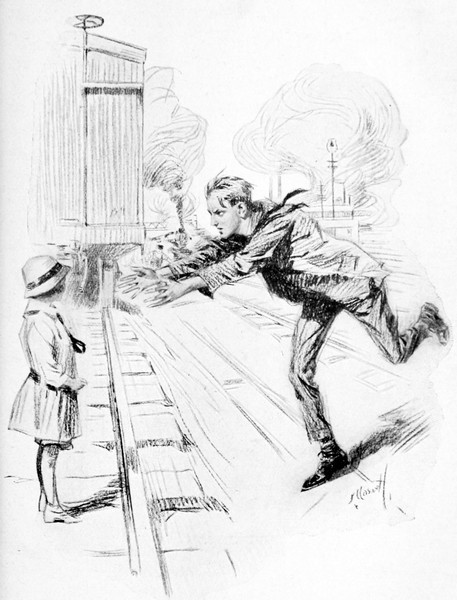
Wayne’s Cry Was Uttered Involuntarily as he Leaped Forward
As Wayne dashed forward with a horrified, sickening fear at his heart the brakeman dropped from the car ladder. But he staggered as his feet touched the ground, and had the boy’s safety depended on him he would never have escaped. It was Wayne who caught him up roughly and half lifted, half dragged him across the further rail to safety just as the end of the car swept over the spot on which he had stood. So close was the escape that the corner of the car struck Wayne’s hip and sent him reeling to fall on his knees against the end of the ties of the next track, the child sprawled beside him. Dazed, breathless, Wayne struggled to his feet, pulling the lad up with him. Twenty feet distant a switch engine had stopped with grinding brakes, and engineer and fireman were running toward him. The train of empty box cars rolled stolidly on, but in a moment began to slow down with much bumping and clatter of couplings, while back along the roofs sped the brakeman whose warning shout had alarmed Wayne. Just what happened during the next few minutes Wayne couldn’t recall afterward. The lad, his face crushed to Wayne’s worn coat, was sobbing hysterically. The engineer and fireman were there, and presently the brakeman dropped down beside them, and after that other men appeared as though by magic. Everyone talked at once and it was all very confused. Someone took the boy from Wayne and lifted him in arms and someone else propelled Wayne across toward the freight house. About that time the talk around him began to register itself on his brain.
“’Tis Jim Mason’s kid,” said one. “’Twould have broke his heart entirely had the lad been hurted!”
“Hurted!” scoffed another. “Sure, ’tis dead he’d be this minute save for this la-ad here! ’Twas a close shave at that, I’m telling you. Faith, I shut my eyes, I did so!” It was either the engineer or the fireman speaking. “Are you hurted, me boy?” This was to Wayne, and Wayne shook his head silently. “Your hands be cut a bit, but they’ll soon mend.”
“You’d better wash the dirt out,” advised another as they climbed the steps at the end of the platform. “I’ve known lockjaw to come from less, and——”
But just then they entered the dim twilight of the shed and Wayne, pushed ahead by his good-natured captors, lost the rest of the cheerful remark. Someone shouted for “Jim! Jim Mason!” and an answering hail came from further down the shed and a big man advanced toward them, illumined for a moment as he passed one of the wide, sunlit doorways.
“What’s wanted?” he shouted.
“’Tis your kid, Jim,” was the reply. “Nearly run over he was a minute back. All right, laddie, here’s your father comin’. Hush your cryin’ now.”
“Terry!” The big man’s voice held wonder and alarm and joy. He sprang across the intervening space and seized the child from the arms that held him. “Terry! Are you hurt, darling? What were you doing on the tracks? Don’t cry, son, it’s over now.” He turned questioningly to the sympathetic faces about him, faces that were grinning only because tears were so near the eyes. “How did it happen, fellows? Who saw it?”
“Him and me,” answered one man, “and Larry there. Larry was riding the roof on a string of empties when he seen the boy on the track——”
“Holy Saints, but I was scared stiff!” broke in the brakeman. “I gave a shout and tried to get down the ladder, but when I jumped I hit the end of a tie, Jim, and it was this fellow——”
“Grabbed him up in the nick o’ time,” went on another. “I seen it from the cab window. There wasn’t the width of an eyelash between the car and the child when he got him. Sure, even then I thought it was good night to the pair of them. The car hit the fellow as he jumped and——”
“So ’twas you?” said Jim Mason in his big, deep voice. “’Twas brave of you, sir, and God bless you for it.” He had the child on one big arm now and stretched his free hand toward Wayne. “I guess I don’t need to say I’m thankful to you. You know that, sir. I think a deal of this little kiddie, and as for his mother——” His voice trembled. “Heaven only knows what she would do if anything happened to him! She’ll thank you better than I can, but if there’s anything Jim Mason can do for you, why, you say it!”
“It was nothing,” stammered Wayne. “I’m glad that—that I was there, and that I—was in time, sir.”
“God be praised and so am I!” said the father fervently. “Hush your crying now, Terry. It’s your father that’s got you. Can you thank the brave lad for saving you?”
But Terry couldn’t. Terry was as yet incapable of anything but sobs. Wayne, wanting to go, scarcely knew how. Mechanically he raised a bruised knuckle to his lips and Jim Mason was all solicitude.
“You’ve cut your fist!” he exclaimed. “Come to the office with me till I fix it up for you. There’s dirt in it, likely. Larry, I’m thanking you, too, for what you did,” he added, turning to the brakeman. “I’ll not forget it.”
“Sure, I did nothing,” laughed the brakeman embarrassedly, “only yell!”
“It was his shout that drew my attention,” said Wayne. “He tried hard to get to him.”
“What matter now?” muttered the brakeman. “’Tis all over, and ’twas you was Johnny-on-the-Spot, feller. ’Twas finely done, too, and no mistake! I take my hat off to you for a fine, quick-thinkin’ and quick-doin’ laddie!”
“Why, I know you now!” said Jim Mason at that moment. “I was thinking all the time I’d seen you before. You’re the kid—I mean the young gentleman—that spoke me one morning a couple of weeks ago. You had a nigger boy with you, and a dog. Ain’t I right?”
“Yes, Mr. Mason, but it was more than two weeks ago,” answered Wayne. “I—I’m glad to see you again.”
“Well, if you’re glad, what about me?” bellowed Jim Mason. “Thank you all, fellows. I’ll mend this gentleman’s hand now. Will you come with me, please?”
Wayne followed the man to the farther end of the freight house where, occupying a corner that afforded a view down the long stretch of shining tracks, there was a cubby-hole of an office. A high desk, a correspondingly tall stool, a battered armchair, a straight-backed chair, a stove, and a small table made up the furnishings. The walls held many hooks on which were impaled various documents, a shelf filled with filing-cases, several highly-coloured calendars, a number of pictures cut from magazines and newspapers, and, over one of the two dusty-paned windows, a yard-long framed photograph of “The Lake-to-Coast Limited.” In spite of dust and confusion, a confusion which as Wayne later discovered was more apparent than real, the little office had a cosy, comfortable air, and the sunlight, flooding through the front window, made even the dust-motes glorious.
Jim Mason set the child in a chair, produced a first-aid kit from some place of concealment, and proceeded to repair the damages wrought by the cinders. There was running water outside, and the wounds, none of them more than surface scratches, were first thoroughly cleaned. Then peroxide was liberally applied, the man grunting with satisfaction when the stuff bubbled. Finally surgeon’s tape was put on, and Wayne was discharged. During his administrations Jim Mason asked questions at the rate of a dozen a minute, and soon had Wayne’s history down to date. The liveryman’s callousness wrought him to gruff indignation.
“Fired you because you was sick, did he, the pup? What do you know about that? Sit down and rest yourself, lad.” He perched himself on the stool and became busy with a pile of waybills on the desk, talking as he worked. “And so you’re out of a job again, are you? I suppose a smart lad like you can figure and write a good fist, maybe?”
“I can figure,” replied Wayne, “but I don’t believe my writing’s much to boast of.”
“Here, put your name and your address on that.” Jim pushed a slip of paper to the end of the desk and dipped a pen in ink.
Wayne wrote and handed the result back. “‘Wayne Torrence Sloan,’” read Jim, “‘Carhurst, Medfield, Pennsylvania.’ That’s not so bad. But what might ‘Carhurst’ mean?”
Wayne explained and the man chuckled. “It’s a fine-sounding name all right,” he said. “How’d you like a job here with me, Sloan? I been looking for a feller for a week. There’s a guy up to Springdale that wants the place, and he’s coming down this afternoon to see me, but—I don’t know.” Jim looked out the window and whistled a tune thoughtfully. “He mightn’t do at all,” he went on after a moment, “and if you say you want to try it——”
“I do!” said Wayne promptly. “That is, if you think I could.”
Jim turned and looked him over appraisingly. “I don’t see why not. If you can figure and write a bit and do as I tell you, you’d have no trouble. And you look like a strong, healthy lad, although your face is sort of pale. That comes of being sick, I guess. ’Tain’t all office work, for you’ll have to be out in the yard a good deal. You’d be here at eight in the morning—I’m here long before, but you wouldn’t need to be—and get off at five, with an hour for dinner. The pay ain’t much, only eight dollars, but if you got on there might be something better; maybe a place in the main office. Want to try it?”
“Very much,” said Wayne.
“All right then. Maybe I can head that feller at Springdale off and save him a trip.” He drew a telegram blank from a pigeonhole and wrote slowly and laboriously. “Maybe I’m taking a chance, lad, for I don’t know much about you, do you see, and you haven’t any references, but a feller that shows pluck like you did awhile ago can’t have much wrong with him, I’m thinking. There, I’ll put this on the wire. Be around at eight sharp in the morning, lad, and I’ll put you to work. Better come a bit before eight, though, so’s I can tell you what’s wanted before the rush starts. Got any money?”
“A little, sir.”
“Get yourself a suit of overalls; black like these. You’ll need ’em likely. Now I got to do something with this kid.” Jim turned and observed his offspring frowningly. Terry had at last stopped sobbing and was watching interestedly through the front window the operation of unloading a car. “How he came to be wandering about here I dunno. And maybe his mother’s worrying about him this minute. He ought to be home, but I don’t see how I can get him there.”
“Let me take him home,” offered Wayne eagerly. “Just tell me where the house is, Mr. Mason.”
The man’s face lightened. “Will you do it?” he exclaimed. “That’s fine, then. Will you go with the nice gentleman, Terry?”
Terry looked doubtful, but when Wayne smiled down at him he nodded shyly and summoned a smile in return.
“I live on Monmouth Street,” said Jim. “’Tis the fourth house from the corner of Railroad Avenue, the one with the sun-parlor on it.” There was pride in his voice when he mentioned the sun-parlor and Wayne was quite certain that it was the only sun-parlor on Monmouth Street. “Ask for Mrs. Mason and just tell her the kid was down to see me and I sent him home by you. Don’t tell her about what happened, lad. She’d be tied up in a knot. I’ll give her the story when I get home. Maybe you’d better go around to the back, for I dunno would she hear you knock, being busy in the kitchen likely. Do you want the nice gentleman to carry you, Terry, or will you walk along like a little man, eh?”
“Want to be carried,” said Terry promptly. “I’m tired, daddy.”
“’Tis a blessing you ain’t worse than tired, kiddie,” said his father feelingly. “How came it you were down here all alone, Terry?”
Terry studied his shoes intently for a moment. At last: “Wanted to see choo-choos,” he answered.
“Listen to me, Terry. Don’t you ever come around the choo-choos again without somebody’s with you. If you ever do I’ll whale you, kid. Remember that. Now go along with the gentleman and be a good boy.”
Wayne carried Terry until they were across the tracks and then the child demanded to be set down. “You don’t carry Terry like daddy does,” he complained. “Want to walk?” So they went the rest of the way hand in hand, Terry, now most communicative, talking incessantly. Wayne had a very hazy idea as to the location of Monmouth Street and Terry’s directions were difficult to follow, so he had to ask his way several times. But he found the house eventually, easily identifying it by the sun-parlor which stood out at one end of a tiny front porch like a sore thumb. Mrs. Mason proved to be a comely, smiling-faced woman apparently some years Jim’s senior. Terry, she explained, as she wiped her hands on her apron in the back doorway, had been turned out to play in the yard, and he was a bad boy to run away like that. “You might have been killed,” she told the child severely, “and the Lord only knows why you wasn’t. Thank you, sir, for bringin’ him back, and I hope he was no trouble to you.”
“Not a bit, Mrs. Mason. He behaved beautifully. Good-bye, Terry. Be a good boy now and don’t run off again.”
“Good-bye,” answered Terry, politely but indifferently. “I got a hen, I have, an’ she’s going to have a lot of little chickens pretty soon. Want to see her?”
“Not today, Terry, thanks,” laughed Wayne. “Maybe I’ll come and see her after the chickens are hatched.”
“All right. Mama, can I have some bread and sugar?”
Wayne left while that question was being debated and hurried off uptown, first to tell June the wonderful news and then to purchase that black jumper. There was a new quality in the April sunshine now and Wayne discovered for the first time that Medfield was an attractive place after all. The folks he passed on the street looked friendly, the clanging of the trolley car gongs fell pleasantly on his ear; in short, the world had quite changed since early morning and was now a cheerful, hopeful place, filled with sunshine and bustle and ambition. Wayne’s spirits soared like the billowing white clouds of steam above the buildings and he whistled a gay little tune as he went along.