


автордың кітабын онлайн тегін оқу Jane Austen and Her Times
JANE AUSTEN AND HER TIMES
BY THE SAME AUTHOR
- A Bachelor Girl in London
- The Gifts of Enemies
- The Children’s Book of London
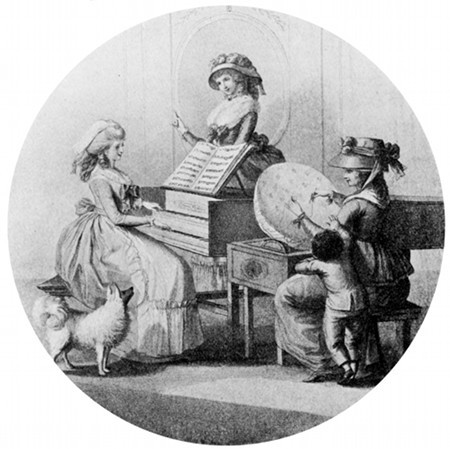
MORNING EMPLOYMENTS
JANE AUSTEN
AND HER TIMES
BY
G. E. MITTON
WITH TWENTY-ONE ILLUSTRATIONS
METHUEN & CO.
36 ESSEX STREET W.C.
LONDON
First Published in 1905
CONTENTS
CHAP.
PAGE
I.PRELIMINARY AND DISCURSIVE
1
II.CHILDHOOD
22
III.THE POSITION OF THE CLERGY
34
IV.HOME LIFE AT STEVENTON
49
V.THE NOVELS
80
VI.LETTERS AND POST
105
VII.SOCIETY AND LOVE-MAKING
117
VIII.VISITS AND TRAVELING
148
IX.CONTEMPORARY WRITERS
161
X.A TRIO OF NOVELS
176
XI.THE NAVY
196
XII.BATH
212
XIII.DRESS AND FASHIONS
229
XIV.AT SOUTHAMPTON
249
XV.CHAWTON
266
XVI.IN LONDON
278
XVII.FANNY AND ANNA
296
XVIII.THE PRINCE REGENT AND
EMMA303
XIX.LAST DAYS
313
INDEX327
LIST OF ILLUSTRATIONS
MORNING EMPLOYMENTS
From a Painting by Bunbury. Frontispiece
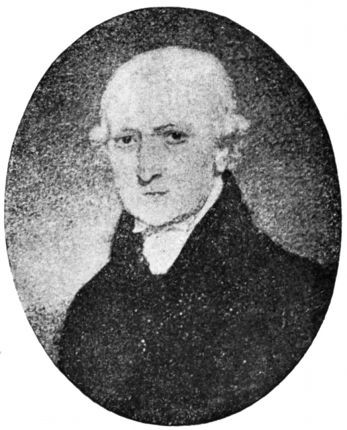
THE REV. GEORGE AUSTEN
From a Family Miniature. Facing page 16
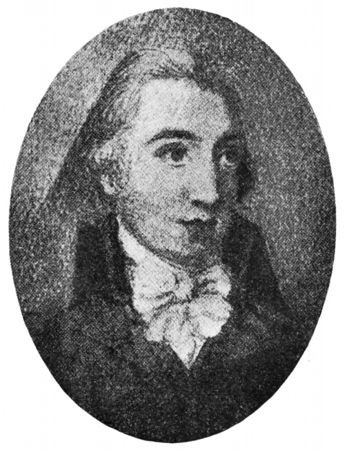
THE REV. JAMES AUSTEN
From a Family Miniature. 16
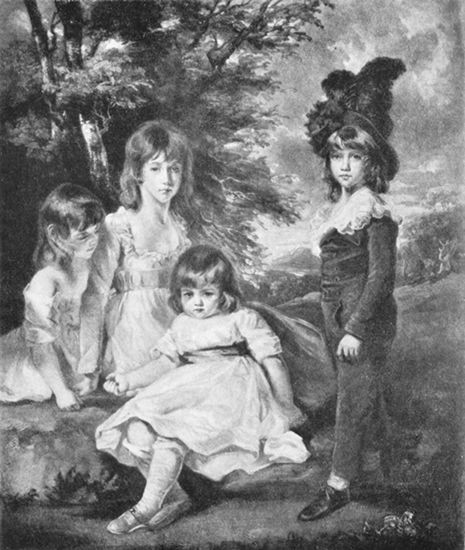
JUVENILE RETIREMENT
From a Painting by John Hoppner. 26
THE VICAR RECEIVING HIS TITHES
From a Drawing by H. Singleton. 42
JANE AUSTEN
From a Portrait by her Sister Cassandra. 58
THE HAPPY COTTAGERS
From a Painting by George Morland. 74
MISS BURNEY (MADAME D’ARBLAY)
From a Portrait by Edward Burney. 96
FROM A SUMMER’S EVENING
From a Drawing by de Loutherbourg. 156
TRAVELLERS ARRIVING AT EAGLE TAVERN, STRAND
From an Old Engraving. 159
DOMESTIC HAPPINESS
From a Painting by George Morland. 170
COWPER
From a Painting by George Romney, in the possession of B. Vaughan Johnson, Esq. 192
VICTORY OF LORD DUNCAN (CAMPERDOWN), 1797
From a Painting by J. S. Copley. 208
FAÇADE OF THE PUMP ROOM, BATH, IN THE EIGHTEENTH CENTURY
From a Contemporary Engraving. 220
DRESSING TO GO OUT
From a Drawing by P. W. Tomkins. 230
INIGO JONES, HON. H. FANE, AND C. BLAIR
From a Painting by Sir Joshua Reynolds. 246
A PLATE FROM THE GALLERY OF FASHION 260
CHARING CROSS, 1795
From an Engraving in the Crace Collection. 285
THE LITTLE THEATRE, HAYMARKET
From an Engraving by Wilkinson in Londina Illustrata. 291
THE REV. GEORGE CRABBE
From a Drawing by Sir F. Chantrey, in the National Portrait Gallery. 293
THE GARDEN OF CARLTON HOUSE
From a Painting by Bunbury. 304
THE REV. GEORGE AUSTEN
THE REV. JAMES AUSTEN
JUVENILE RETIREMENT
THE VICAR RECEIVING HIS TITHES
JANE AUSTEN
THE HAPPY COTTAGERS
MISS BURNEY (MADAME D’ARBLAY)
FROM “A SUMMER’S EVENING”
TRAVELLERS ARRIVING AT ‘EAGLE TAVERN,’ STRAND
DOMESTIC HAPPINESS
COWPER
VICTORY OF LORD DUNCAN (CAMPERDOWN) 1797
FAÇADE OF THE PUMP ROOM, BATH, IN THE EIGHTEENTH CENTURY
DRESSING TO GO OUT
INIGO JONES, HON. H. FANE, AND C. BLAIR
FASHIONS FOR LADIES IN 1795
CHARING CROSS, 1795
THE LITTLE THEATRE, HAYMARKET
THE REV. GEORGE CRABBE
THE GARDEN OF CARLTON HOUSE
JANE AUSTEN AND HER TIMES
CHAPTER I PRELIMINARY AND DISCURSIVE
Of Jane Austen’s life there is little to tell, and that little has been told more than once by writers whose relationship to her made them competent to do so. It is impossible to make even microscopic additions to the sum-total of the facts already known of that simple biography, and if by chance a few more original letters were discovered they could hardly alter the case, for in truth of her it may be said, “Story there is none to tell, sir.” To the very pertinent question which naturally follows, reply may thus be given. Jane Austen stands absolutely alone, unapproached, in a quality in which women are usually supposed to be deficient, a humorous and brilliant insight into the foibles of human nature, and a strong sense of the ludicrous. As a writer in The Times (November 25, 1904) neatly puts it, “Of its kind the comedy of Jane Austen is incomparable. It is utterly merciless. Prancing victims of their illusions, her men and women are utterly bare to our understanding, and their gyrations are irresistibly comic.” Therefore as a personality, as a central figure, too much cannot be written about her, and however much is said or written the mystery of her genius will still always baffle conjecture, always lure men on to fresh attempts to analyse and understand her.
The data of Jane Austen’s life have been repeated several times, as has been said, but beyond a few trifling allusions to her times no writer has thought it necessary to show up the background against which her figure may be seen, or to sketch from contemporary records the environment amid which she developed. Yet surely she is even more wonderful as a product of her times than considered as an isolated figure; therefore the object of this book is to show her among the scenes wherein she moved, to sketch the men and women to whom she was accustomed, the habits and manners of her class, and the England with which she was familiar. Her life was not long, lasting only from 1775 to 1817, but it covered notable times, and with such an epoch for presentation, with such a central figure to link together the sequence of events, we have a theme as inspiring as could well be found.
In many ways the times of Jane Austen are more removed from our own than the mere lapse of years seems to warrant. The extraordinary outburst of invention and improvement which took place in the reign of Queen Victoria, lifted manners and customs in advance of what two centuries of ordinary routine would have done. Sir Walter Besant in his London in the Eighteenth Century says, “The passing of the Reform Bill in 1832, the introduction of steamers on the sea, the beginning of railways on land, make so vast a break between the first third and last two-thirds of the nineteenth century, that I feel justified in considering the eighteenth century as lasting down to the year 1837; in other words, there were so few changes, and these so slight, in manners, customs, or prevalent ideas, between 1700 and 1837, that we may consider the eighteenth century as continuing down to the beginning of the Victorian era, when change after change—change in the constitution, change in communications, change in the growth and extension of trade, change in religious thought, change in social standards—introduced that new time which we call the nineteenth century.”
According to this reckoning, Jane Austen may be counted as wholly an eighteenth-century product, and such a view is fully justified, for the differences between her time and ours were enormous. It is impossible to summarise in a few sentences changes which are essentially a matter of detail, but in the gradual unfolding of her life I shall attempt to show how radically different were her surroundings from anything to which we are accustomed.
It is an endless puzzle why, when her books so faithfully represent the society and manners of a time so unlike our own, they seem so natural to us. If you tell any half-dozen people, who have not made a special study of the subject, at what date these novels were written, you will find that they are all surprised to hear how many generations ago Jane Austen lived, and that they have always vaguely imagined her to be very little earlier than, if not contemporary with, Charlotte Brontë or George Eliot. So far as I am aware, no writer on Jane Austen has ever touched on this problem before. Her stories are as fresh and real as the day they were written, her characters might be introduced to us in the flesh any time, and, with the exception of a certain quaintness of eighteenth-century flavouring, there is nothing to bring before us the striking difference between their environment and our own. It is true that the long coach journeys stand out as an exception to this, but they are the only marked exception. If we had never had an illustrated edition of Jane Austen, nine people out of ten at least would have formed mental pictures of the characters dressed in early Victorian, or perhaps even in present-day, costume. It is only since Hugh Thompson and C. E. Brock have put before us the costumes of the age, that our ideas have accommodated themselves, and we realise how Catherine Morland and Isabella Thorpe looked in their high-waisted plain gowns, when they had arrived at that stage of intimacy which enabled them to pin “up each other’s trains for the dance.” Or how attractive Fanny Price was in her odd high-crowned hat, with its nodding plume, and the open-necked short-sleeved dress, as she surveyed herself in the glass while Miss Crawford snapped the chain round her neck. The knee-breeches of the men, their slippers and cravats, the neat, close-fitting clerical garb, these things we owe to the artists,—they are taken for granted in the text. It would have seemed as ridiculous to Jane Austen to describe them, as for a present-day novelist to mention that a London man made a call in a frock-coat and top-hat.
Yet her word-pictures are living and detailed, filled in with innumerable little touches. How can we reconcile the seeming inconsistency? The explanation probably is, that without acting consciously, she, with the unerring touch of real genius, chose that which was lasting, and of interest for all time, from that which was ephemeral. In her sketches of human nature, in the strokes with which she describes character, no line is too fine or too delicate for her attention; but in the case of manners and customs she gives just the broad outlines that serve as a setting. Her novels are novels of character.
But the problem is not confined to the books; in her letters to her sister, though there is abundant comment on dress, food, and minor details which should mark the epoch, yet the letters might have been written yesterday. Austin Dobson in one of his admirable prefaces to the novels says: “Going over her pages, pencil in hand, the antiquarian annotator is struck by their excessive modernity, and after a prolonged examination discovers, in this century-old record, nothing more fitted for the exercise of his ingenuity that such an obsolete game at cards as ‘Casino’ or ‘quadrille.’”
And this is true also of her letters. More remarkable still is the entire absence of comment on the great events which thrilled the world; with the exception of an allusion to the death of Sir John Moore, we hear no whisper of the wars and upheavals which happened during her life. It is true that the Revolution in France, which shook monarchs on their thrones, occurred before the first date of the published letters, yet her correspondence covers a time when battles at sea were chronicled almost continuously, when an invasion by France was an ever-present terror; Trafalgar and Waterloo were not history, but contemporary events; but though Jane must have heard and discussed these matters, no echo finds its way into her lively and amusing budgets of chit-chat to her sister. Of course women were not supposed to read the papers in those days, but with two sailor brothers the news must have often been personal and intimate, and she was, according to the notions of her time, well educated; yet we search in vain for any allusion to such contemporary matters. It may be objected that the letters of a modern girl to a sister would hardly touch on questions which agitate the public, but there are several replies to this: in the first place, few such exciting events have occurred in recent times as happened during Jane Austen’s life; our war in Africa was a mere trifle in comparison with the bloody field of Waterloo, where Blucher and Wellington lost 30,000 men, or the thrilling naval victory of Trafalgar; and stupendous as have been the recent battles between Russia and Japan, they affect us only indirectly—England is not herself involved in them, nor are her sons being slain daily. In the second place, surely even the South African War would probably produce some comment in letters, especially if the writer had brothers in the army as Jane had brothers in the navy. Thirdly, letters in Jane Austen’s time were one great means of news, for newspapers were not so easy to get, and were much more costly than now, so that we expect to find more of contemporary events in letters than at a time like the present, when telegrams and columns of print save us the trouble of recording such matters in private.
In the forty-two years between 1775 and 1817, vast discoveries of world-wide importance were made. When Jane Austen was born, Captain Cook was still in the midst of his exploration, and the map of the world was being unrolled day by day. Though New Zealand and Australia had been discovered by the Dutch in the previous century, they were all but unknown to England. Six years only before her birth had the great navigator charted and mapped New Zealand for the first time, also the east coast of Australia, and had christened New South Wales. When she was four years old, Cook was murdered by the natives at Hawaii.
The atlas from which she learnt her earliest geography lessons was therefore very different from those now in use. The well-known cartographer, S. Dunn, published an atlas in 1774, where Australia is marked certainly, but as though one saw it through distorted glasses; the east coast, Cook’s discovery, is clearly defined, the rest is very vague; and the fact that Tasmania was an island had not then been discovered, for it appears as a projecting headland. In the same general way is New Zealand treated, and neither has a separate sheet to itself; beyond their appearance on the map of the world, they are ignored. Japan also looks queer to modern eyes, it almost touches China at both ends, enclosing a land-locked sea.
The epoch was one of change and enlargement in other than geographical directions. In the thirty years before Jane Austen’s birth an immense improvement had taken place in the position of women. Mrs. Montagu, in 1750, had made bold strokes for the freedom and recognition of her sex. The epithet “blue-stocking,” which has survived with such extraordinary tenacity, was at first given, not to the clever women who attended Mrs. Montagu’s informal receptions, but to her men friends, who were allowed to come in the grey or blue worsted stockings of daily life, instead of the black silk considered de rigueur for parties. Up to this time, personal appearance and cards had been the sole resources for a leisured dame of the upper classes, and the language of gallantry was the only one considered fitting for her to hear. By Mrs. Montagu’s efforts it was gradually recognised that a woman might not only have sense herself, but might prefer it should be spoken to her; and that because the minds of women had long been left uncultivated they were not on that account unworthy of cultivation. Hannah More describes Mrs. Montagu as “not only the finest genius, but the finest lady I ever saw ... her form (for she has no body) is delicate even to fragility; her countenance the most animated in the world; the sprightly vivacity of fifteen, with the judgment and experience of a Nestor.”
In art there had never before been seen in England such a trio of masters as Reynolds, Gainsborough, and Romney. Isolated portrait painters of brilliant genius, though not always native born, there had been in England,—Holbein, Vandyke, Lely, Kneller, and Hogarth are all in the first rank,—but that three such men as the trio above should flourish contemporaneously was little short of miraculous.
In 1775, Sir Joshua had passed the zenith of his fame, though he lived until 1792. Gainsborough, who was established in a studio in Schomberg House, Pall Mall, was in 1775 at the beginning of his most successful years; his rooms were crowded with sitters of both sexes, and no one considered they had proved their position in society until they had received the hall-mark of being painted by him. He was only sixty-one at his death in 1788. Romney, who lived to 1802, never took quite the same rank as the other two, yet he was popular enough at the same time as Gainsborough; Lady Newdigate (The Cheverels of Cheverel Manor) mentions going to have her portrait painted by him, and says that “he insists upon my having a rich white satin with a long train made by Tuesday, and to have it left with him all the summer. It is the oddest thing I ever knew.” Sir Thomas Lawrence and Hoppner carried on the traditions of the portrait painters, the former living to 1830; with names such as these it is easy to judge art was in a flourishing condition.
Among contemporary landscape painters, Richard Wilson, who has been called “the founder of English Landscape,” lived until 1782. But his views, though vastly more natural than the stilted conventional style that preceded them, seem to our modern eyes, trained to what is “natural,” still to be too much conventionalised. Among others the names of Gillray, Morland, Rowlandson stand out, all well on the way to fame while Jane was still a child.
These preliminary remarks have been made with a view to giving some general idea of that England into which she was born, and they refer to those subjects which only affected her indirectly. All those things which entered directly into her life, such as her country surroundings, contemporary books, prices of food, fashions, and a host of minor details, are dealt with more particularly in the course of the narrative.
As we have said, matters of history are not mentioned or noticed in Jane Austen’s correspondence, which is taken up with her own environment, her neighbours, their habits and manners, and illumined throughout by a bright insight at times rather too biting to be altogether pleasant. Of her immediate surroundings we have a very clear idea.
Of all the writers of fiction, Jane Austen is most thoroughly English. She never went abroad, and though her native good sense and shrewd gift of observation saved her from becoming insular, yet she cannot be conceived as writing of any but the sweet villages and the provincial towns of her native country. Even the Brontës, deeply secluded as their lives were, crossed the German Ocean, and saw something of Continental life from their school at Brussels. Nothing of this kind fell to Jane Austen’s share. Yet people did travel in those days, travelled amazingly considering the difficulties they had to encounter, among which were the horrors of a sailing-boat with its uncertain hours. Fielding, in going to Lisbon, was kept waiting a month for favourable winds! There was also the terrible embarking and landing from a small boat before such conveniences as landing-stages were built.
In one of Lord Langdale’s letters, dated 1803, we have a vivid description of these horrors: “We left that place [Dover] about six o’clock last Saturday morning, and arrived at Calais at four in the afternoon. Our passage was rather disagreeable, the wind being chiefly against us, and rain sometimes falling in torrents. I never witnessed a more curious scene than our landing. When the packet-boat had come to within two miles of the coast of France, we were met by some French rowing boats in which we were to be conveyed on shore. The French sailors surrounded us in the most clamorous and noisy manner, leaping into the packet and bawling and shouting so loud as to alarm the ladies on board very much. To these men, however, we were to consign ourselves, and we entered their boats, eight passengers going in each. When we got near the shore, we were told it was impossible for the boat to get close to land, on account of the tide being so low, and that we must be carried on the men’s shoulders. We had no time to reflect on this plan before we saw twelve or fourteen men running into the water,—they surrounded our boat and laid hold of it with such violence, that one might have thought they meant to sink it, and fairly pulled us into their arms.... For my part I laughed heartily all the time, but a lady who was with us was so much frighted, that I was obliged to support her in my arms a considerable time before she was able to stand.”
It was not only in the arms of men that passengers were thus carried ashore, in Napoleon’s British Visitors and Captives, by J. G. Alger, there is a still more extraordinary account quoted from a contemporary letter. “In an instant the boathead was surrounded by a throng of women up to their middles and over, who were there to carry us on shore. Not being aware of this manœuvre, we did not throw ourselves into the arms of these sea-nymphs so instantly as we ought, whereby those who sat at the stern of the boat were deluged with sea spray. For myself, I was in front, and very quickly understood the clamour of the mermaids. I flung myself upon the backs of two of them without reserve, and was safely and dryly borne on shore, but one poor gentleman slipped through their fingers, and fell over head and ears into the sea.”
From the same entertaining book we learn that, “For £4, 13s. you could get a through ticket by Dover and Calais, starting either from the City at 4.30 a.m. by the old and now revived line of coaches connected with the rue Notre Dame des Victoires establishment in Paris, or morning and night by a new line from Charing Cross. Probably a still cheaper route, though there were no through tickets, was by Brighton and Dieppe, the crossing taking ten or fifteen hours. By Calais it seldom took more than eight hours, but passengers were advised to carry light refreshments with them. The diligence from Calais to Paris, going only four miles an hour, took fifty-four hours for the journey, but a handsome carriage drawn by three horses, in a style somewhat similar to the English post-chaise, could be hired by four or five fellow-travellers, and this made six miles an hour.”
During a great part of Jane Austen’s life, much of the Continent was closed to English people because of the perpetual state of war between us and either Spain or France, but in any case such an expedition would seem to have lain quite outside her limited daily round, and was never even mooted.
Steventon Rectory, where she was born on December 16, 1775, has long ago vanished, and a new rectory, more in accordance with modern luxurious notions, has been built. Of the old house, Lord Brabourne, great-nephew to Jane Austen, writes: “The house standing in the valley was somewhat better than the ordinary parsonage houses of the day; the old-fashioned hedgerows were beautiful, and the country around sufficiently picturesque for those who have the good taste to admire country scenery.”
Steventon is a very small place, lying in a network of lanes about seven miles from Basingstoke. The nearest points on the high-roads are Deane, on the Andover Road, and Popham Lane on the Winchester Road. There is an inn at the corner of Popham Lane to this day, and that there was an inn there in Jane Austen’s time we know, for Mrs. Lybbe Powys, writing in 1792, says: “We stopped at Winchester and lay that night at a most excellent inn at Popham Lane.” At this time, curiously enough, her fellow-travellers were Dr. Cooper, Jane Austen’s uncle, and his son and daughter, though whether the party made a détour to visit the rectory we do not know. Of course at that time Jane was of no greater importance than any seventeen-year-old daughter of a country clergyman, and there would be no reason to mention her.
It is difficult to find Steventon, so little is there of it, and that so much scattered; a few cottages, a farm, and beyond, half a mile away, the church, with a pump in a field near to mark the site of the old rectory house where Jane Austen was born. This is all that remains of her time. The new rectory stands on the other side of the narrow road, raised above it, and sheltered by a warm backing of trees in which evergreens are conspicuous. A very substantial-looking building it is, much superior to what was considered good enough for a clergyman in the eighteenth century. The country is well wooded, and the roads undulating, so that there are no distant views. Probably a good deal of the planting has been done since Jane Austen’s time, but that there were trees then we know from her own account, and some of the fine oaks that still stand can have altered but little since then. Mr. Austen-Leigh’s account of the house in which she was born is worth quoting—
“North of the house, the road from Deane to Popham Lane ran at a sufficient distance from the front to allow a carriage drive through turf and trees. On the south side, the ground rose gently, and was occupied by one of those old-fashioned gardens in which vegetables and flowers are combined, flanked and protected on the east by one of the thatched mud walls common in that country, and overshadowed by fine elms. Along the upper or southern side of this garden ran a terrace of the finest turf, which must have been in the writer’s thoughts when she described Catherine Morland’s childish delight in ‘rolling down the green slope at the back of the house.’”
Though there is so little left to see, and the church has been “restored,” yet it is worth while to pass through this country to realise the environment in which the authoress spent her childhood. There are still left in the neighbourhood, notably at North Waltham, some of the old diamond-paned, heavily-timbered brick houses with thatched roofs, to which she must have been accustomed. The gentle curves of the roads, the oak and beech and fir overshadowing the sweet lanes, the wild clematis, which grows so abundantly that in autumn it looks like hoar-frost covering all the hedgerows, these things were prominent objects in the scenery amid which she lived. It is not likely she looked on her surroundings in the same way as any ordinarily educated person would now look on them. Love of scenery had not then been developed. The artificial and formal landscape gardening, with “made” waterfalls, was the correct thing to admire. Genuine nature, much less homely nature, was only then beginning to be observed. This is strange to us, for, as Professor Geikie says, “At no time in our history as a nation has the scenery of the land we live in been so intelligently appreciated as it is to-day.”
But Jane was not in advance of her times, and though she loved her trees and flowers, we find in her writings no reflections of the scenes amid which she daily walked; in her books scenery is simply ignored. We know if it rained, because that material fact had an influence on the actions of her heroines, but beyond that there is little or nothing; yet she greatly admired Cowper, one of the earliest of the “natural” poets.
Mr. Austen-Leigh, her own nephew, speaks of the scenery around her first home as “tame,” and says that it has no “grand or extensive views,” though he admits it has its beauties, and says that Steventon “from the fall of the ground, and the abundance of its timber, is certainly one of the prettiest spots.” But this quiet prettiness, without the excessive richness to be found in other south-country villages, is perhaps more thoroughly characteristic of England than any other.
The impressions of childhood are invariably deep, and are cut with a clearness and minuteness to which none others of later times attain. Just as a child examines a picture in a story-book with anxious and searching care, while an adult gains only a general impression of the whole, so a child knows the place where it has played in such detail that every bough of the trees, every root of the lilacs, every tiny depression or ditch is familiar. And thus Jane must have known the home at Steventon.
Writing about a storm in 1800, she says: “I was just in time to see the last of our two highly valued elms descend into the Sweep!!! The other, which had fallen, I suppose, in the first crash, and which was the nearest to the pond, taking a more easterly direction, sunk amid our screen of chestnuts and firs, knocking down one spruce fir, beating off the head of another, and stripping the two corner chestnuts of several branches in its fall. This is not all. One large elm out of the two on the left-hand side as you enter, what I call, the elm walk, was likewise blown down; the maple bearing the weathercock was broke in two, and what I regret more than all the rest is that all the three elms which grew in Hall’s meadow, and gave such ornament to it, are gone.”
This bespeaks her intimate acquaintance with the trees, of which each one was a friend.
The country and the writer suited each other so wonderfully, that one pauses for a moment wondering whether, after all, environment may not have that magic influence claimed for it by some who hold it to be more powerful than inherited qualities. Influence of course it has, and one wonders what could possibly have been the result if two such natures as those of Jane Austen and Charlotte Brontë had changed places; if Jane had been brought up amid the wild, bleak Yorkshire moors, and Charlotte amid the pleasant fields of Hampshire. As it is, the surroundings of each intensified and developed their own peculiar genius.
Jane was born of the middle class, her father, George Austen, being a clergyman in a day when clergymen were none too well thought of, yet taking a better position than most by reason of his own family and good connections. George Austen had early been left an orphan, and had been adopted by an uncle. He showed the possession of brains by obtaining first a scholarship at St. John’s College, Oxford, and subsequently a fellowship.
He took Orders which, in the days when rectories were looked upon simply as “livings,” was a recognised mode of providing for a young man, whether he had any vocation for the ministry or not. But he seems to have fulfilled his duties, or what were then considered sufficient duties, creditably enough. Of George Austen one of his sons wrote—
“He resided in the conscientious and unassisted discharge of his ministerial duties until he was turned of seventy years.” He was a “profound scholar” and had “exquisite taste in every species of literature.”
The subject of the clergy at that date, and the examples of them which Jane has herself given us in her books, is an interesting one, and we shall return to it. The rectory of Steventon was presented to George Austen by Mr. Knight, the same cousin who afterwards adopted his son Edward; and the rectory of Deane, a small place about a mile distant, was bought by an uncle who had educated him, and given to him. The villages were very small, only containing about three hundred persons altogether. In those days parish visiting or parochial clubs and entertainments were unthought of, Sunday schools in their earliest infancy, and we hear nothing whatever throughout the whole of Jane Austen’s correspondence which leads us to think that she, in any way, carried out the duties which in these days fall to the lot of every clergyman’s daughter. This is not to cast blame upon her, it only means that she was the child of her times; these things had not then been organised.
THE REV. JAMES AUSTEN
THE REV. GEORGE AUSTEN
George Austen married Cassandra, youngest daughter of the Rev. Thomas Leigh, who was of good family, her uncle was Dr. Theophilus Leigh, Master of Balliol College, a witty and well-known man. These things are not of importance in themselves, but they serve to show that the family from which Jane sprang was on both sides of some consideration. The Austens lived first at Deane, but moved to Steventon in 1771. They had undertaken the charge of a son of Warren Hastings, who died young, and they had a large family of their own, as was consistent in days when families of ten, eleven, and even fifteen were no uncommon thing.
There were five sons and two daughters in all, and Jane was the youngest but one. (See Table, p. 326.) James, the eldest, was probably too far removed in age from his younger sister ever to have been very intimate with her. It is said that he had some share in her reading and in forming her taste, but though she was very fond of him she never seems, as was very natural, to have had quite the same degree of intimate affection for him as she felt for those of her brothers nearer to her own age. James was twice married, and his only daughter by his first wife was Anna, of whom Jane makes frequent mention in her letters, and to whom some of the published correspondence was addressed. His second wife was Mary Lloyd, whose sister Martha was the very devoted friend, and frequent guest, of the girl Austens, and who late in life married Francis, one of Jane’s younger brothers. The son of James and Mary was James Edward, who took the additional name of Leigh, and was the writer of the Memoir which supplies one of the only two sources of authoritative information about Jane Austen. He died in 1874.
The next brother, Edward, as already stated, was adopted by his cousin Mr. Knight, whose name he took. He came into the fine properties of Chawton House in Hampshire and Godmersham in Kent, even during the lifetime of Mr. Knight’s widow, who looked on him as a son and retired in his favour. Edward married Elizabeth Bridges, and had a family of eleven children, of whom the eldest, Fanny Catherine, married Sir Edward Knatchbull, and their eldest son was created Lord Brabourne; to him we owe the Letters which are the second of the authoritative books on Jane Austen.
Jane Austen was attached to her niece Fanny Knight in a degree only second to that of her attachment to her own sister Cassandra. Fanny’s mother, Mrs. Edward Austen or Knight (for the change of name seems not to have taken place until her death), died comparatively young, and the great responsibility thrown upon Fanny doubtless made her seem older, and more companionable, than her years; of her, her famous aunt writes—
“I found her in the summer just what you describe, almost another sister, and could not have supposed that a niece would ever have been so much to me. She is quite after one’s own heart. Give her my best love and tell her that I always think of her with pleasure.”
The third Austen brother, Henry, interested himself much in his sister’s writing, and saw about the business arrangements for her, when, after many years, she decided to publish one of her own books at her own risk. He was something of a rolling stone, filling various positions in turn, and at length taking Orders and succeeding his brother James in the Steventon living. During part of his life he lived in London, where Jane often stayed with him. He married first his cousin Eliza, the daughter of George Austen’s sister; she was the widow of a Frenchman, the Count de Feuillade, who had suffered death by the guillotine. Eliza was very popular with her girl cousins, as we can see from Jane’s remarks; she died in 1813, and in 1820 Henry married Eleanor, daughter of Henry Jackson. The two youngest brothers, Francis and Charles, came above and below Jane, with about three years’ interval on either side. They both entered the navy, and both became admirals.
Frank rose to be Senior Admiral of the Fleet, and was created G.C.B.; he lived to be ninety-two. He, like another of his brothers, was twice married,—a habit that ran abnormally in the family,—and his second wife was Martha, the sister of his brother James’s wife, mentioned above. Charles married first Fanny Palmer, and was left a widower in 1815 with three small daughters. He married secondly her sister Harriet. The two Fannies, Mrs. Charles Austen and the eldest daughter of Edward Knight, sometimes cause a little confusion. Jane Austen mentions calling with the younger Fanny on the motherless children of her brother, one of whom was also Fanny, soon after their loss. “We got to Keppel Street, however, which was all I cared for, and though we could only stay a quarter of an hour, Fanny’s calling gave great pleasure, and her sensibility still greater; for she was very much affected at the sight of the children. Little Fanny looked heavy. We saw the whole party.”
It has been necessary to give a few details respecting the brothers who played so large a part in Jane’s life, because her visits away from home were nearly all to their houses, her letters are full of allusions to them, and the great family affection which subsisted between them all made the griefs and joys of the others the greatest events in a very uneventful life. The dearest, however, of the whole family was the one sister Cassandra, who, like Jane herself, never married, which seems the stranger when we consider how many of the brothers married twice. There was a sad little love-story in Cassandra’s life. She was engaged to a young clergyman who had promise of promotion from a nobleman related to him. He accompanied this patron to the West Indies as chaplain to the regiment, and there died of yellow fever. There is perhaps something more pathetic in such a tale than in any other, the glowing ideal has not been smirched by any touch of the actual sordid daily life, it is snatched away and remains an ideal always, and the happiness that might have been is enhanced by romance so as to be a greater deprivation than any loss of the actual.
The two sisters were sisters in reality, sharing the same views, the same friendships, the same interests. When away, Jane’s letters to Cassandra are full and lively, telling of all the numberless little events that only a sister can enjoy. And if Jane’s own estimate is to be believed, Cassandra’s are to the full as vivacious.
“The letter which I have this moment received from you has diverted me beyond moderation. I could die of laughter at it, as they used to say at school. You are indeed the finest comic writer of the present age.”
Cassandra lived to 1845, long enough to see that her beloved sister’s letters would in all probability be published; she was of a reticent nature, with a strong dislike to revealing anything personal or intimate to the public, she therefore went through all these neatly written letters from Jane, which she had so carefully preserved, and destroyed anything of a personal nature. One cannot altogether condemn the action, greatly as we have been the losers; the letters that remain, many in number, deal almost entirely with outside matters, trivialities of everyday life, and they are written so brightly that we can judge how interesting the bits of self-revelation by so expressive a pen would have been.
In 1869, when Mr. Austen-Leigh published his Memoir, only one or two of Jane Austen’s letters were available; but in 1882, on the death of Lady Knatchbull (née Fanny Knight), the letters above referred to, which Cassandra Austen had retained, were found among her belongings, having come to her on her aunt’s death. Her son, created Lord Brabourne, therefore published these in two volumes in 1884, and when quotations and extracts are given in this book without further explanation, it must be inferred that these are taken from letters of Jane to Cassandra, as given by Lord Brabourne.
CHAPTER II CHILDHOOD
Of Jane Austen’s childhood in the quiet country rectory we know little, probably because there is not a great deal to know. It was the custom in those days to put babies out to nurse in the village, sometimes until they were as much as two years old, a point often overlooked when the mothers of what is now extolled as a domestic period are held up as patterns to a more intellectual and roving generation. Certainly it was an easy and cheap method of getting rid of the care and trouble involved by a baby in the house, and it probably answered well, as the child would learn to do without too much attention, and at an early age, faddists notwithstanding, could hardly suffer from any influence of its surroundings, other than physically, and it may be taken for granted that the material necessities were well provided and kept under supervision. Nevertheless, a mother who adopted this course at the present day could hardly escape the epithet of “heartless,” which would assuredly be levelled at her.
In the time of Jane’s childhood the old days of rigid severity toward children were past, no longer were mere babies taken to see executions and whipped on their return to enforce the example they had beheld. In fact a period of undue indulgence had set in as a reaction, but this does not seem to have affected the Austen family, who were brought up very wisely, and perhaps even a little more repressively than would be the case in a similar household to-day. Jane herself was evidently a diffident child.
She says of a little visitor many years afterwards: “Our little visitor has just left us, and left us highly pleased with her; she is a nice natural open-hearted, affectionate girl, with all the ready civility one sees in the best children in the present day; so unlike anything that I was myself at her age, that I am often all astonishment and shame.
“What is become of all the shyness in the world? Moral as well as natural diseases disappear in the progress of time and new ones take their place. Shyness and the sweating sickness have given way to confidence and paralytic complaints.”
Her own attitude toward children is peculiar. Though on indisputable testimony she was the most popular and best loved of aunts, the fact remains that she had no great insight into child nature, nor does she seem to have had any general love of children beyond those who were specially connected with her by close ties. She loved her nieces, but much more as they grew older than as children.
Mr. Austen-Leigh says: “Aunt Jane was the delight of all her nephews and nieces. We did not think of her as being clever, still less as being famous; but we valued her as one always kind, sympathising, and amusing,” and he quotes “the testimony of another niece—’Aunt Jane was the general favourite with children, her ways with them being so playful, and her long circumstantial stories so delightful.’” And again, “Her first charm to children was great sweetness of manner ... she could make everything amusing to a child.”
The truth probably is that her innate kindness of heart and unselfishness compelled her to be as amusing as possible when thrown with little people, but perhaps because she took so much trouble to entertain them she found children more tiresome than other people who accept their company more placidly. However this may be, it is undeniable that the attitude she takes toward children in her books is almost always that of their being tiresome, there never appears any genuine love for them or realisation of pleasure in their society; and she continually satirises the foolish weakness of their doting parents. It is recorded as a great feature in the character of Mrs. John Knightley “that in spite of her maternal solicitude for the immediate enjoyment of her little ones, and for their having instantly all the liberty and attendance, all the eating and drinking, and sleeping and playing, which they could possibly wish for, without the smallest delay, the children were never allowed to be long a disturbance to him [their grandfather] either in themselves or in any restless attendance on them.”
Poor Anne in Persuasion is tormented by “the younger boy, a remarkably stout forward child of two years old, ... as his aunt would not let him tease his sick brother, [he] began to fasten himself upon her, in such a way, that busy as she was about Charles, she could not shake him off. She spoke to him, ordered, entreated, insisted in vain. Once she did contrive to push him away, but the boy had the greater pleasure in getting upon her back again directly.”
Perhaps to Anne this annoyance was a blessing in disguise, as it brought forward the whilom lover to her assistance, but that is beside the point!
The children of Lady Middleton in Sense and Sensibility are particularly badly behaved and odious.
“Fortunately for those who pay their court through such foibles, a fond mother, though in pursuit of praise for her children the most rapacious of human beings, is likewise the most credulous; her demands are exorbitant, but she will swallow anything, and the excessive affection and endurance of the Miss Steeles towards her offspring were reviewed therefore by Lady Middleton without the smallest surprise or distrust. She saw with maternal complacency all the impertinent encroachments and mischievous tricks to which her cousins submitted. She saw their sashes untied, their hair pulled about their ears, their workbags searched and their knives and scissors stolen away, and felt no doubt of its being a reciprocal enjoyment.
“‘John is in such spirits to-day!’ said she, on his taking Miss Steele’s pocket-handkerchief and throwing it out of the window, ‘he is full of monkey-tricks.’
“And soon afterwards on the second boy’s violently pinching one of the same lady’s fingers, she fondly observed, ‘How playful William is!’
“‘And here is my sweet little Anna-Maria,’ she added, tenderly caressing a little girl of three years old, who had not made a noise for the last two minutes; ‘and she is always so gentle and quiet, never was there such a quiet little thing!’
“But unfortunately in bestowing these embraces a pin in her ladyship’s head-dress slightly scratching the child’s neck produced from this pattern of gentleness such violent screams as could hardly be outdone by any creature professedly noisy ... her mouth stuffed with sugar-plums ... she still screamed and sobbed lustily, and kicked her two brothers for offering to touch her.
················
“‘I have a notion,’ said Lucy [to Elinor] ‘you think the little Middletons are too much indulged. Perhaps they may be the outside of enough, but it is so natural in Lady Middleton, and for my part I love to see children full of life and spirits; I cannot bear them if they are tame and quiet.’
“‘I confess,’ replied Elinor, ‘that while I am at Barton Park I never think of tame and quiet children with any abhorrence!’”
Those children in the novels who are not detestable are usually lay-figures, such as Henry and John Knightley, rosy-faced little boys not distinguished by any individuality. Others are merely pegs on which to hang their parents’ follies, such as little Harry Dashwood, who serves his parents as an excuse for their unutterable meanness. The fact remains there are only two passable children in the whole gallery, and one is the slightest of slight sketches in that little-known and half-finished story The Watsons. Here the little boy, Charles, spoken of as “Mrs. Blake’s little boy,” is a real flesh-and-blood child, who at his first ball when thrown over remorselessly by his grown-up partner, though “the picture of disappointment, with crimsoned cheeks, quivering lips, and eyes bent on the floor,” yet contrives to utter bravely, “‘Oh, I do not mind it!’” and whose naïve enjoyment at dancing with Emma Watson, who offers herself as a substitute, is well done. His conversation with her is also very natural, and his cry, “‘Oh, uncle, do look at my partner; she is so pretty!’” is a human touch.
JUVENILE RETIREMENT
The other instance is a sample of a very nervous, shy child, perhaps drawn from the recollections of Jane Austen’s own feelings in childhood, this is Fanny Price, whose loneliness on her first coming to Mansfield Park is carefully depicted, but Fanny herself is unchildlike and exceptional. Her younger brothers rank among the gallery of bad children, for by “the superior noise of Sam, Tom, and Charles chasing each other up and down stairs, and tumbling about and hallooing, Fanny was almost stunned. Sam, loud and overbearing as he was, ... was clever and intelligent.... Tom and Charles being at least as many years as they were his juniors distant from that age of feeling and reason which might suggest the expediency of making friends, and of endeavouring to be less disagreeable. Their sister soon despaired of making any impression on them; they were quite untamable by any means of address which she had spirits or time to attempt.... Betsy, too, a spoilt child, trained up to think the alphabet her greatest enemy, left to be with servants at her pleasure, and then encouraged to report any evil of them.”
But Jane Austen’s abundant pictures of over-indulged, badly-behaved children are not the only ones to be found in contemporary fiction; in Hannah More’s Cœlebs in Search of a Wife the children come in for dessert, “a dozen children, lovely, fresh, gay, and noisy ... the grand dispute, who should have oranges, and who should have almonds and raisins, soon raised such a clamour that it was impossible to hear my Egyptian friend ... the son and heir reaching out his arm to dart an apple across the table at his sister, roguishly intending to overset her glass, unluckily overthrew his own brimful of port wine.” And of another and better behaved family it is observed as a splendid innovation that the children are not allowed to come into dessert, to clamour and make themselves nuisances, but are limited to appearing in the drawing-room later.
One of the characters in Cœlebs is made to observe, “This is the age of excess in everything; nothing is a gratification of which the want has not been previously felt. The wishes of children are all so anticipated, that they never experience the pleasure excited by wanting and waiting.” He speaks also of the “too great profusion and plethora of children’s books,” which is certainly not a thing we are used to attribute to that age.
Several of the children’s books of that date are kept alive to the present day by a salt of insight into child nature, and are published and re-published perennially. Many a child still knows and loves The Story of the Robins, by Mrs. Trimmer, first brought out in 1786; and as for Sandford and Merton, by Thomas Day, which was at first in three volumes, published respectively in 1783, 1787, and 1789, many a boy has revelled in it, not perhaps entirely from the point of view in which it was written, but with a keen sense of the ridiculous in the behaviour of the little prig Harry. Mrs Barbauld’s (and her brother’s) Evenings at Home still delights many children; and Miss Edgeworth’s Parent’s Assistant, of which the first volume appeared in 1796, is a perennial source of amusement in nurseries and schoolrooms. The Fairchild Family suffers from an excess of religiosity, and a terrible belief in the innate wickedness of a little child’s heart, which is not now tolerated. When Emily and Lucy indulge in a childish quarrel, they are taken to see what remains of a murderer who has hung on a gibbet until his clothes are rotting from him, and the warning is enforced by a long sermon; but in spite of much that would not be suitable according to present ideas for a child to hear, The Fairchild Family, the first part of which came out a year subsequently to the death of Jane Austen, contains much that is very human in behaviour and action. Though later in date than the others mentioned as surviving, it really is quite as early in treatment, as it is a record of what Mrs. Sherwood, born in the same year as Jane Austen, remembered of her own childhood.
The book contains many examples of the spoilt-child phase, in contrast with which the strict upbringing of the young Fairchilds is shown as the better way. What Mrs. Sherwood puts into the mouth of Mrs. Fairchild about her childhood is probably autobiographical, and may be quoted as an instance of the sterner modes which were then rapidly passing out of vogue.
“I was but a very little girl when I came to live with my aunts, and they kept me under their care until I was married. As far as they knew what was right, they took great pains with me. Mrs. Grace taught me to sew, and Mrs. Penelope taught me to read; I had a writing and music master, who came from Reading to teach me twice a week; and I was taught all kinds of household work by my aunts’ maid. We spent one day exactly like another. I was made to rise early, and to dress myself very neatly, to breakfast with my aunts. After breakfast I worked two hours with my aunt Grace, and read an hour with my aunt Penelope; we then, if it was fine weather, took a walk; or, if not, an airing in the coach, I and my aunts, and little Shock, the lap-dog, together. At dinner I was not allowed to speak; and after dinner I attended my masters or learned my tasks. The only time I had to play was while my aunts were dressing to go out, for they went out every evening to play at cards. When they went out my supper was given to me, and I was put to bed in a closet in my aunts’ room.”
A modern child under such treatment would probably develop an acute form of melancholia.
The home education of the time, for girls at least, was very superficial. We gather something of what was supposed to be taught from the remarks of the Bertram girls in Mansfield Park when they plume themselves on their superiority to Fanny—
“‘Dear mamma, only think, my cousin cannot put the map of Europe together—or my cousin cannot tell the principal rivers in Russia, or she never heard of Asia Minor, or she does not know the differences between water colours and crayons! How strange! Did you ever hear anything so stupid?’
“‘My dear,’ their considerate aunt would reply, ‘it is very bad, but you must not expect everybody to be as forward and quick at learning as yourself.’
“‘But, aunt, she is really so very ignorant. Do you know we asked her last night which way she would go to get to Ireland, and she said she should cross to the Isle of Wight. I cannot remember the time when I did not know a great deal that she has not the least notion of yet. How long ago is it, aunt, since we used to repeat the chronological order of the kings of England, with the dates of their accession, and most of the principal events of their reigns?’
“‘Yes,’ added the other, ‘and of the Roman Emperors as low as Severus, besides a great deal of the heathen mythology, and all the metals, semi-metals, planets, and distinguished philosophers.’”
The rattle-pate, Miss Amelia, in Cœlebs thus gives an account of her education: “I have gone on with my French and Italian of course, and I am beginning German. Then comes my drawing-master; he teaches me to paint flowers and shells, and to draw ruins and buildings, and to take views.... I learn varnishing, gilding, and Japanning. And next winter, I shall learn modelling and etching and engraving in mezzotint and aquatinta. Then I have a dancing-master who teaches me the Scotch and Irish steps, and another who teaches me attitudes, and I shall soon learn to waltz. Then I have a singing-master, and another who teaches me the harp, and another for the pianoforte. And what little time I can spare from these principal things, I give by odd minutes to ancient and modern history, and geography and astronomy, and grammar and botany, and I attend lectures on chemistry, and experimental chemistry.”
Jane’s early childhood was probably a very happy one; what with the companionship of Cassandra, with the liveliness and constant comings and goings of the brothers who were educated at home by Mr. Austen himself, with all the romps of a large family having unlimited country as a playground, it can hardly have failed to be so. While she was still too young to profit much by school teaching on her own account, she was sent to a school at Reading kept by a Mrs. Latournelle, because Cassandra was going, and the two sisters could not bear to be parted. How long she was at this school I do not know, but the subjects taught were probably those scheduled in the comprehensive summary of smatterings given by the two Miss Bertrams. This school was a notable one, and among the later pupils was Mrs. Sherwood, who followed Jane after an interval of nine years. She probably went to school as late as Jane went early, which would account for the gap in time between two who should have been contemporary.
Miss Mitford was also a pupil; she went in 1798 when the school had been removed to Hans Place, London. She gives a lively account of it. It was kept by M. St. Quintin, “a well-born, well-educated, and well-looking French emigrant,” who “was assisted, or rather chaperoned, in his undertaking by his wife, a good-natured, red-faced Frenchwoman, much muffled up in shawls and laces; and by Miss Rowden, an accomplished young lady, the daughter and sister of clergymen, who had been for some years governess in the family of Lord Bessborough. M. St. Quintin himself taught the pupils French, history, geography, and as much science as he was master of, or as he thought it requisite for a young lady to know; Miss Rowden, with the assistance of finishing masters for Italian, music, dancing, and drawing, superintended the general course of study; while Madame St. Quintin sat dozing, either in the drawing-room, with a piece of work, or in the library with a book in her hand, to receive the friends of the young ladies or any other visitors who might chance to call.”
Miss Mitford says further that the school was “excellent,” that the pupils were “healthy, happy, well-fed, and kindly treated,” and that “the intelligent manner in which instruction was given had the effect of producing in the majority of the pupils a love of reading and a taste for literature.”
Of course Jane, being such a child when she went, can hardly have taken full use of the opportunities which were afforded her, but perhaps she laid at school the foundations of that cleverness in neat sewing and embroidery which is manifested in the specimens still in the possession of her relatives.
There is a portrait of Jane painted when she was about fifteen. It shows a bright child with shining eyes and one loose lock of hair falling over her forehead; not particularly pretty, but intelligent and with character. She is standing, and is dressed in the simple white gown, high waist, short sleeves, and low neck which little girls wore as well as their elders, and round her neck is a large locket slung on a slender chain. Her portrait was painted by Zoffany when she was about fifteen, on her first visit to Bath, but whether this reproduction, which appears in the beginning of Lord Brabourne’s Letters of Jane Austen, is from that picture I have not been able to ascertain.
Mr. Austen-Leigh says of her—
“In childhood every available opportunity of instruction was made use of. According to the ideas of the time she was well-educated, though not highly accomplished, and she certainly enjoyed that important element of mental training, associating at home with persons of cultivated intellect.” He says in another place, “Jane herself was fond of music, and had a sweet voice, both in singing and conversation; in her youth she had received some instruction on the pianoforte ... she read French with facility, and knew something of Italian.”
In French she had at one time a great advantage in the continual association with Madame de Feuillade, her cousin, and afterwards her sister-in-law, who, as already mentioned, had been married to a Frenchman.
The illustration on p. 26 is a portrait group of the children of the Hon. John Douglas of the Morton family. It was painted by Hoppner, who lived 1758-1810; and, in the costumes of the little boy and elder girl especially, gives a good notion of the dress of the better-class children of the period.
CHAPTER III THE POSITION OF THE CLERGY
Jane Austen was a clergyman’s daughter. At the present time there are undoubtedly wide differences in the social standing of the clergy according to their own birth and breeding, but yet it may be taken for granted that a clergyman is considered a fit guest for any man’s table. It was not always so. There was a time when a clergyman was a kind of servant, ranking with the butler, whose hospitality he enjoyed; we have plenty of pictures of this state of affairs in The Vicar of Wakefield, to go no further. But before Jane was born, matters had changed. The pendulum had not yet swung to the opposite extreme of our own day, when the fact of a man’s being ordained is supposed to give him new birth in a social sense, and a tailor’s son passes through the meagrest of the Universities in order that he may thus be transformed into a gentleman without ever considering whether he has the smallest vocation for the ministry. In the Austens’ time the status of a clergyman depended a very great deal on himself, and as the patronage of the Church was chiefly in the hands of the well-to-do lay-patrons, who bestowed the livings on their younger sons or brothers, there was very frequently a tie of relationship between the vicarage and the great house, which was sufficient to ensure the vicar’s position. In the case of relationship the system was probably at its best, obviating any inducement to servility; but there was a very evil side to what may be called local patronage, which was much more in evidence than it is in our time. Archbishop Secker, in his charges to the clergy of the diocese of Oxford, when he was their Bishop in 1737, throws a very clear light on this side of the question. He expressly enjoins incumbents to make no promise to their patrons to quit the benefice when desired before entering into office. “The true meaning therefore is to commonly enslave the incumbent to the will and pleasure of the patron.” The motive for demanding such a promise was generally that the living might be held until such time as some raw young lad, a nephew or younger son of the lord of the manor, was ready to take it. The evils of such a system are but too apparent. We can imagine a nervous clergyman who would never dare to express an opinion contrary to the will of the benefactor who had the power to turn him out into the world penniless; we can imagine the time-server courting his patron with honied words. This debased type is inimitably sketched in the character of Mr. Collins in Pride and Prejudice. “‘It shall be my earnest endeavour to demean myself with grateful respect towards her ladyship, and be very ready to perform those rites and ceremonies which are instituted by the Church of England.’ Lady Catherine [he said] had been graciously pleased to approve of both the discourses which he had already had the honour of preaching. She had also asked him twice to dine at Rosings, and had sent for him only the Saturday before, to make up her pool of quadrille in the evening. Lady Catherine was reckoned proud, he knew, by many people, but he had never seen anything but affability in her. She had always spoken to him as she would to any other gentleman; she made not the smallest objection to his joining in the society of the neighbourhood.”
In his delightful exordium to Elizabeth as to his reasons for proposing to her, he says—
“‘My reasons for marrying are, first, that I think it a right thing for every clergyman in easy circumstances (like myself) to set the example of matrimony in his parish; secondly, that I am convinced it will add very greatly to my happiness; and, thirdly, which perhaps I ought to have mentioned earlier, that it is the particular advice and recommendation of the very noble lady whom I have the honour of calling patroness. Twice has she condescended to give me her opinion (unasked too!) on this subject; and it was but the very Saturday night before I left Hunsford—between our pools at quadrille while Mrs. Jenkinson was arranging Miss de Bourgh’s footstool—that she said, ‘Mr. Collins, you must marry. A clergyman like you must marry. Choose properly, choose a gentlewoman for my sake, and for your own; let her be an active useful sort of person, not brought up high, but able to make a small income go a good way.’”
And when, after his marriage with her friend, Elizabeth goes to stay with them, and is invited to dine with them at the Rosings, Lady Catherine’s place, he thus encourages her—
“‘Do not make yourself uneasy, my dear cousin, about your apparel. Lady Catherine is far from requiring that elegance of dress in us which becomes herself and daughter. I would advise you merely to put on whatever of your clothes is superior to the rest, there is no occasion for anything more. Lady Catherine will not think the worse of you for being simply dressed. She likes to have the distinction of rank preserved.’”
In the case of Mr. Collins, the patron happened to be a lady, but the instances were numberless in which clergymen spent all their time toadying and drinking with a fox-hunting squire.
Arthur Young says of the French clergy—
“One did not find among them poachers or fox-hunters, who, having spent the morning scampering after hounds, dedicate the evening to the bottle, and reel from inebriety to the pulpit,” from which we may infer that many English clergymen did.
Cowper’s satire on the way in which preferment is secured is worth quoting in full—
“Church-ladders are not always mounted best
By learned clerks and Latinists professed.
The exalted prize demands an upward look,
Not to be found by poring on a book.
Small skill in Latin, and still less in Greek,
Is more than adequate to all I seek.
Let erudition grace him or not grace,
I give the bauble but the second place;
His wealth, fame, honours, all that I intend
Subsist and centre in one point—a friend.
A friend whate’er he studies or neglects,
Shall give him consequence, heal all defects.
His intercourse with peers and sons of peers—
There dawns the splendour of his future years;
In that bright quarter his propitious skies
Shall blush betimes, and there his glory rise.
‘Your lordship’ and ‘Your Grace,’ what school can teach
A rhetoric equal to those parts of speech?
What need of Homer’s verse or Tully’s prose,
Sweet interjections! if he learn but those?
Let reverend churls his ignorance rebuke,
Who starve upon a dog-eared pentateuch,
The parson knows enough who knows a duke.”
At the end of the eighteenth century the Church was at its deadest, enthusiasm there was none. Torpid is the only word that fitly describes the spiritual condition of the majority of the clergy. Secker says, “An open and professed disregard of religion is become, through a variety of unhappy causes, the distinguishing character of the present age”; and the clergy, as the salt of the earth, had certainly lost their savour, and did little or nothing to resist an apathy which, too commonly, extended to themselves.
The duties of clergymen were therefore almost as light as they chose to make them. One service on Sunday, and the Holy Communion three times yearly, at Christmas, Easter, and Whitsuntide, was considered enough.
“A sacrament might easily be interposed in the long interval between Christmas and Whitsuntide, and the usual season for it, the Feast of St. Michael, is a very proper time, and if afterwards you can advance from a quarterly communion to a monthly one, I make no doubt you will.” (Secker.)
Baptisms, marriages, and funerals were looked on as nuisances; the clergyman ran them together as much as possible, and often arrived at the last minute, flinging himself off his smoking horse to gabble through the service with the greatest possible speed; children were frequently buried without any service at all.
The churches were for the most part damp and mouldy; there were, of course, none of the present conveniences for heating and lighting. Heavy galleries cut off the little light that struggled through the cobwebby windows. There were mouse-eaten hassocks, curtains on rods thick with dust, a general smell of mouldiness and disuse, and a cold, but ill-ventilated, atmosphere.
In some old country churches there still survive the family pews, which were like small rooms, and in which the occupants could read or sleep without being seen by anyone; in one or two cases there are fire-grates in these; and in one strange example at Langley, in Bucks, the pew is not only roofed in, but it has a lattice in front, with painted panels which can be opened and shut at the occupants’ pleasure, and there is a room in connection with it in which is a library of books, so that it would be quite possible for anyone to retire for a little interlude without the rest of the congregation’s being aware of it!
The church, only opened as a rule once a week, was left for the rest of the time to the bats and birds. Compare this with one of the neat, warm, clean churches to be found almost everywhere at present; churches with polished wood pews, shining brass fittings, tessellated floor in place of uneven bricks, a communion table covered by a cloth worked by the vicar’s wife, and bearing white flowers placed by loving hands. A pulpit of carved oak, alabaster, or marble, instead of a dilapidated old three-decker in which the parish clerk sat below and gave out the tunes in a droning voice.
Organs were of course very uncommon at the end of the eighteenth century in country parishes, and though there might be at times a little local music, as an accompaniment, the hymns were generally drawled out without music at all. This is Horace Walpole’s idea of church in 1791: “I have always gone now and then, though of late years rarely, as it was most unpleasant to crawl through a churchyard full of staring footmen and apprentices, clamber a ladder to a hard pew, to hear the dullest of all things, a sermon, and croaking and squalling of psalms to a hand organ by journey-men brewers and charity children.”
The sermons were peculiarly dry and dull, and it would have taken a clever man to suck any spiritual nourishment therefrom. They were generally on points of doctrine, read without modulation; and if, as was frequently the case, the clergyman had not the energy to prepare his own, a sermon from any dreary collection sufficed. The black gown was used in the pulpit.
Cowper gives a picture of how the service was often taken—
“I venerate the man whose heart is warm;
Whose hands are pure, whose doctrine and whose life
Coincident, exhibit lucid proof
That he is honest in the sacred cause.
A messenger of grace to guilty men.
Behold the picture! Is it like? Like whom?
The things that mount the rostrum with a skip,
And then skip down again; pronounce a text,
Cry, ahem! and reading what they never wrote,
Just fifteen minutes, huddle up their work,
And with a well-bred whisper, close the scene.”
In this dismal account the average only is taken, and there were many exceptions; we have no reason to suppose, for instance, that the Rev. George Austen marred his services by slovenliness or indifference, though no doubt the most earnest man would find it hard to struggle against the disadvantages of his time, and the damp mouldy church must have been a sore drawback to church-going.
Twining’s Country Clergyman gives us a picture of an amiable sort of man of a much pleasanter type than those of Cowper or Crabbe.
We gain an idea of a man of a genial, pleasant disposition, cultured enough, and fond of the classics; who kept his house and garden well ordered, who enjoyed a tour throughout England in company with his wife, who thoroughly appreciated the lines in which his lot was cast, but who looked upon the living as made for him, and not he for the parishioners. A writer in the Cornhill some years ago gives a series of pleasant little pen-pictures of typical clergymen of this date. “Who cannot see it all—the curate-in-charge himself sauntering up and down the grass on a fine summer morning, his hands in the pockets of his black or drab ‘small clothes,’ his feet encased in broad-toed shoes, his white neckcloth voluminous and starchless, his low-crowned hat a little on one side of his powdered head, his eye wandering about from tree to flower, and from bird to bush, as he chews the cud of some puzzling construction in Pindar, or casts and recasts some favourite passage in his translation of Aristotle.”
There was the fox-hunter who in the time not devoted to sport was always “welcome to the cottager’s wife at that hour in the afternoon when she had made herself tidy, swept up the hearth, and was sitting down before the fire with the stockings of the family before her. He would chat with her about the news of the village, give her a friendly hint about her husband’s absence from church, and perhaps, before going, would be taken out to look at the pig.”
Or “the pleasant genial old gentleman in knee-breeches and sometimes top-boots, who fed his poultry, and went into the stable to scratch the ears of his favourite cob, and round by the pig-stye to the kitchen garden, where he took a turn for an hour or two with his spade or his pruning knife, or sauntered with his hands in his pockets in the direction of the cucumbers ... coming in to an early dinner.”
Mr. Austen seems to have been a mixture of the first and third of these types, for he was certainly a good scholar, and yet some of his chief interests in life were connected with his pigs and his sheep.
But though these are charming sketches, and their counterparts were doubtless to be found, we fear they are too much idealised to be a true representation of the generality of the clergy of that time; and, charming as they are, there is an easy freedom from the responsibility of office which is strange to modern ideas.
Livings, many of which are bad enough now, were then even worse paid; £25 a year was the ordinary stipend for a curate who did most of the work. Massey (History of England in the Reign of George II.) estimates that there were then five thousand livings under £80 a year in England; consequently pluralism was oftentimes almost a necessity. Gilbert White, the naturalist, was a shining light among clergymen; he was vicar of Selborne, in Hampshire, until his death in 1793; but while he was curate of Durley, near Bishop’s Waltham, the actual expenses of the duty exceeded the receipts by nearly twenty pounds in the one year he was there. To reside at all was a great thing for a clergyman to do, and we may be sure, from what we gather, that the Rev. George Austen had this virtue, for he resided all the time at Steventon.
But though the clergy frequently left all the work to their curates, they always took care to receive the tithes themselves. In the picture engraved by T. Burke after Singleton, in the period under discussion, we see the fat and somewhat cross-looking vicar receiving these tithes in kind from the little boy, who brings his basket containing a couple of ducks and a sucking pig into the vicarage study.
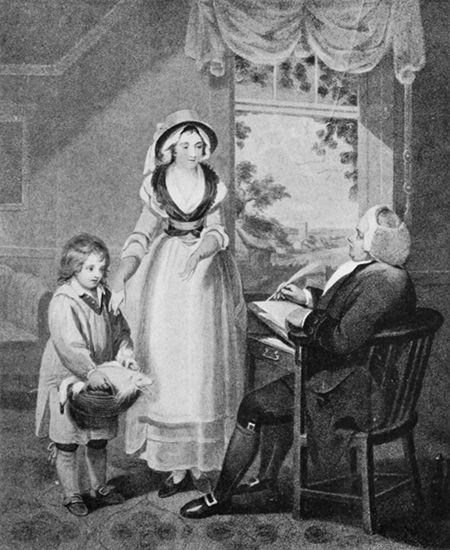
THE VICAR RECEIVING HIS TITHES
Hannah More gives us an account of the usual state of things in regard to non-residence—
“The vicarage of Cheddar is in the gift of the Dean of Wells; the value nearly fifty pounds per annum. The incumbent is a Mr. R., who has something to do, but I cannot find out what, in the University of Oxford, where he resides. The curate lives at Wells, twelve miles distant. They have only service once a week, and there is scarcely an instance of a poor person being visited or prayed with. The living of Axbridge ... annual value is about fifty pounds. The incumbent about sixty years of age. Mr. G. is intoxicated about six times a week, and very frequently is prevented from preaching by two black eyes, honestly earned by fighting.”
“We have in this neighbourhood thirteen adjoining parishes without so much as even a resident curate.”
“No clergyman had resided in the parish for forty years. One rode over three miles from Wells to preach once on a Sunday, but no weekly duty was done or sick persons visited; and children were often buried without any funeral service. Eight people in the morning, and twenty in the afternoon, was a good congregation.”
She evidently means that the service was sometimes held in the morning, and sometimes in the afternoon, as she says there were not two services.
She also speaks of it as an exceptionally disinterested action of Dr. Kennicott that he had resigned a valuable living because his learned work would not allow him to reside in the parish.
By far the best account of what was expected from a contemporary clergyman is to be gathered from Jane Austen’s own books. It is one of her strong points that she wrote only of what she knew, and as her own father and two of her brothers were clergymen, we cannot suppose that she was otherwise than favourably inclined to the class. Her sketch of Mr. Collins is no doubt something of a caricature, but it serves to illustrate very forcibly one great error in the system then in vogue—that of local patronage.
The other clergymen in her books are numerous: we have Mr. Elton in Emma, Edmund Bertram and Dr. Grant in Mansfield Park, Henry Tilney in Northanger Abbey, and Edward Ferrars in Sense and Sensibility.
It is impossible to deny that Edmund Bertram is a prig, or perhaps, to put it more mildly, is inclined to be sententious, so sometimes one almost sympathises with the gay Miss Crawford, whose ideas so shocked him and Fanny; yet though those ideas only reflected the current opinion of the times, they were reprehensible enough. When Miss Crawford discovers, to her chagrin, that Edmund, whom she is inclined to like more than a little, is going to be a clergyman, she asks—
“‘But why are you to be a clergyman? I thought that was always the lot of the youngest, where there were many to choose before him!’
“‘Do you think the Church itself never chosen, then?’
“‘Never is a black word. But yes, in the never of conversation which means not very often, I do think it. For what is to be done in the Church? Men love to distinguish themselves, and in either of the other lines distinction may be gained, but not in the Church. A clergyman is nothing.’”
And in reply to Edmund’s defence, she continues—
“‘You assign greater consequence to a clergyman than one has been used to hear given, or than I can quite comprehend. One does not see much of this influence and importance in society, and how can it be acquired where they are so seldom seen themselves? How can two sermons a week, even supposing them worth hearing, supposing the preacher to have the sense to prefer Blair’s to his own, do all that you speak of, govern the conduct and fashion and manners of a large congregation for the rest of the week? One scarcely sees a clergyman out of his pulpit!’
“‘You are speaking of London, I am speaking of the nation at large.’”
But it is noteworthy that even Edmund, who is upheld as a bright example, does not in his defence assert anything relative to the careful looking after the lives of his flock which nowadays is a chief part of a parish clergyman’s duty. He speaks of conduct, and declares that “as the clergy are or are not what they ought to be, so are the rest of the nation,” but all the retort he wins from the girl he so much admires is that she is just as much surprised at his choice as ever, and that he really is fit for something better!
In another place, where the same discussion is reopened, she says: “‘It is indolence, Mr. Bertram, indeed—indolence and love of ease—a want of all laudable ambition, of taste for good company, or of inclination to take the trouble of being agreeable, which make men clergymen. A clergyman has nothing to do but to be slovenly and selfish, read the newspaper, watch the weather, and quarrel with his wife. His curate does all the work, and the business of his own life is to dine.’”
This type is exemplified in the same book by Dr. Grant, who is not drawn vindictively, but is described by his own sister-in-law, Miss Crawford, as “‘an indolent, selfish bon vivant, who must have his palate consulted in everything; who will not stir a finger for the convenience of anyone; and who, moreover, if the cook makes a blunder, is out of humour with his excellent wife. To own the truth, Henry and I were driven out this very evening by a disappointment about a green goose, which he could not get the better of. My poor sister was forced to stay and bear it.’”
And when Edmund is about to enter on the living, Henry Crawford gaily observes, “‘I apprehend he will not have less than seven hundred a year. Seven hundred a year is a fine thing for a younger brother; and as, of course, he will still live at home, it will be all for his menus plaisirs; and a sermon at Christmas and Easter, I suppose, will be the sum total of sacrifice.’”
After all this, it is pleasant to know that some upright and serious men, even in those days, thought differently of the life and duties of a clergyman, for Jane makes Sir Thomas Bertram reply—
“‘A parish has wants and claims which can be known only by a clergyman constantly resident, and which no proxy can be capable of satisfying to the same extent. Edmund might, in the common phrase, do the duty of Thornton, that is, he might read prayers and preach without giving up Mansfield Park; he might ride over every Sunday to a house nominally inhabited, and go through divine service; he might be the clergyman of Thornton Lacey every seventh day, for three or four hours, if that would content him. But it will not. He knows that human nature needs more lessons than a weekly sermon can convey; and that if he does not live among his parishioners, and prove himself by constant attention to be their well-wisher and friend, he does very little either for their good or his own.’”
It is also striking to see how very much the taking of Orders depended upon some living to be obtained; there seems to have been no special idea of suitability, and still less of preparation, only the merest and most perfunctory examination was demanded of the candidate for Orders. There is a story of this date of one examination for ordination where only two questions were asked, one of which was, “What is the Hebrew for a skull?”
In an entertaining book on Jane Austen by Miss Constance Hill, published in 1902, there is a quotation from a letter anent the ordination examination of Mr. Lefroy, who married Anna, Jane’s niece. “The Bishop only asked him two questions, first if he was the son of Mrs. Lefroy of Ashe, and secondly if he had married a Miss Austen.”
It is said also that Brownlow North, Bishop of Winchester, examined his candidates for ordination in a cricket-field during a match. One candidate is described by Boswell as having read no books of divinity, not even the Greek Testament. There were, of course, serious and learned bishops enough; Burnet, Bishop of Salisbury, who lived from 1643 to 1715, was horrified at the ignorance of candidates, who apparently had never read the Old Testament and hardly knew what was in the New. “They cry, and think it a sad disgrace to be denied Orders, though the ignorance of some is such that in a well-regulated state of things they would appear not to know enough to be admitted to the Holy Sacrament.”
It is probable that the Bishops judged a great deal more, on the whole, by the appearance and manners of the man before them, and the prospects he had of holding a living, than by his own knowledge, and in the case of a well-born, serious-minded man like Edmund Bertram there would be no difficulty whatever about his lack of divinity.
Of Henry Tilney’s duties in Northanger Abbey, very little can be said or gathered, he never appears like a clergyman at all. We are told that the parsonage was a “new built, substantial stone house.” We know that he had to go there, much to Catherine Morland’s distress, when she was a guest at his father’s house, Northanger Abbey, because the engagements of his curate at Woodston obliged him to leave on Saturday for a couple of nights. But at all events he does seem to have spent most of his time at the parsonage, though he still kept on his room at home.
Of Edward Ferrars’ clerical avocations we also hear so very little that he might almost as well have been of any other profession.
The only other clergyman in the novels is Mr. Elton, a specimen not quite so egregious as Mr. Collins, but sufficiently so to be very amusing. On him the waves of Emma’s match-making break with force—
“‘Poor Mr. Elton! You like Mr. Elton, papa! I must look about for a wife for him. There is nobody in Highbury who deserves him, and he has been here a whole year, and has fitted up his house so comfortably that it would be a shame to have him single any longer; and I thought when he was joining their hands to-day, he looked so very much as if he would like to have the same kind office done for him!’”
Emma thinks he will do admirably for her somewhat ambiguously placed friend Harriet Smith, while Mr. Elton himself fixes his eyes on the heiress Emma. A nice little illustration of the social status of the cleric, who would not have been thought entirely out of the question for the heiress, though doubtless a little beneath her. Mr. Elton is represented as a handsome, ingratiating, debonair young man, who spends his time playing the gallant, reading aloud, making charades with the young ladies, and preaching sermons that please everybody. However, he meets his match in the dashing and vulgar Mrs. Elton, whom he picks up, soon after his rejection by Emma, at a watering place, and thereafter they spend their time in a blissful state of mutual admiration.
CHAPTER IV HOME LIFE AT STEVENTON
For the first five-and-twenty years of her life, from her birth in December 1775 to the spring of 1801, Jane lived at Steventon, in her father’s rectory, as peaceful and quiet a home as even she could have wished. But though her own circumstances were peaceful and happy, the great world without was full of flux and reflux.
Wars and rumours of wars, revolutions and upheavals, which changed the whole face of Europe, were going on year by year, but of these things, as I have said, hardly an echo reaches us in her writing; not even in the correspondence with her sister, which begins in 1796 when the turmoil was at its height, which is the more surprising when we consider that her own sailor brothers were taking an active part in affairs; and her cousin, the Countess de Feuillade, had fled to the Austens for shelter when her husband suffered death by the guillotine. What depths these things stirred in Jane, or whether she lacked the imagination to bring home to her their enormous importance relative to the small details of immediate surroundings, we shall never know. Her minute observation, her unrivalled faculty for using that which lay under her hand, the stores of little human characteristics which, by her transmuting touch, she invested with such intense interest, lead one to suppose that such a clear, near-sighted mental vision carried with it defective mental long sight. There are a number of persons who, deeply and warmly interested in that which immediately appeals to them, cannot throw their sympathy far out over unseen events and persons. We are all prone to this, there is not one of us who is not more affected by a single tragic death in the neighbourhood than by the loss of a hundred lives in America; life in this world would be intolerable were it not so, this is one of the provisions of a merciful providence for making it endurable. But there are some more near-sighted in this respect than others, and from internal evidence in the letters we may judge that Jane belonged to them; it is only conjecture, but it is often the case in life, that virtues carry corresponding faults, that extreme cleverness in one direction induces a little want of perception in another. The law of balance and compensation is so omnipresent, that Jane’s intensely clear vision in regard to near objects may have been paid for by absorption in them, somewhat to the exclusion of larger interests.
In 1789, while she was yet but fourteen years old, there began that Revolution which, taking it altogether, is the most tremendous fact in the history of Europe. France was seething, but as yet the ferment had not affected other nations. In the July of that year the tricolour was adopted as the national flag, excess reigned supreme, and the nobles began to emigrate. It was not until 1792 that France began to grasp the lands of others, and reached forth the first of those tentacles, which, like those of an octopus, were to spread all over Europe. In the beginning Austria and Prussia opposed her, but after the murder of the French King, in January 1793, England was forced to join in to protect Holland, and to uphold the general status of nations. Treaties were signed between almost all the civilised nations of Europe, for the crushing of a common enemy; Switzerland alone, of those affected by France’s movements, remaining perfectly neutral.
The echoes of the Reign of Terror that followed must have reached even to the remotest recesses of England, and it is impossible to believe that the Austens were not deeply affected.
Walpole’s forcible language on the Revolution shows its effect on contemporary opinion: “I have wanted to vent myself, Madam [the Countess of Ossory], but the French have destroyed the power of words. There is neither substantive nor epithet that can express the horror they have excited! Brutal insolence, bloody ferocity, savage barbarity, malicious injustice, can no longer be used but of some civilised country, where there is still some appearance of government. Atrocious frenzy would, till these days, have sounded too outrageous to be pronounced of a whole city—now it is too temperate a phrase for Paris, and would seem to palliate the enormity of their guilt by supposing madness the spring of it—but though one pities a herd of swine that are actuated by demons to rush into the sea, even those diabolical vagaries are momentary, not stationary, they do not last for three years together nor infect a whole nation—thank God it is but one nation that has ever produced two massacres of Paris.”
“But of all their barbarities the most inhuman has been their not putting the poor wretched King and Queen to death three years ago. If thousands have been murdered, tortured, broiled, it has been extempore; but Louis and his Queen have suffered daily deaths in apprehension for themselves and their children.”
The newspapers gave long extracts from the doings of the National Assembly, but of course these always appeared some days subsequently to the events. The news of the death of the French King was known, by rumour at least, with extraordinary quickness, about two days after it happened, and was received with execration. Detailed accounts did not come in until some days after. The first notice is thus announced in the St. James’s Chronicle: “The murder took place at four in the morning on Monday, and was conducted in the most private manner. The guillotine was erected in a court of the Temple. A hole dug under it into which the King’s head fell, and his body was precipitated after.” This was incorrect in some particulars, as the murder did not take place until after ten in the morning. In all the newspapers of the time, there are little sentences that strike us sadly even now, and when freshly recorded, as having just happened, they must have moved many persons to deep sorrow. July 1, 1793, “A greater regard is shown for the august prisoners. A small waggon has been sent in loaded with playthings for the son of the unfortunate Louis XVI.” “After many entreaties the widow of Capet finally resolved to deliver up to us her son, who has been conducted to the apartments designed for him under the care of citizen Simon.” Charlotte Corday’s bold speech, when she was brought up to answer for her murder of the tyrant, is quoted: “I did not expect to appear before you; I always thought that I should be delivered up to the rage of the people, torn in pieces, and that my head, stuck upon the top of a pike, would have preceded Marat on his state bed to serve as a rallying point to Frenchmen, if there still are any worthy of that name.”
In August of the same year, the death of Marie Antoinette was daily expected. “The queen was dressed in white lawn and wore a black girdle ... her cell is only eight feet long, and eight feet wide. Her couch consists of a hard straw bed and very thin coverings; her diet, soup and boiled meat.”
But in an anguish of mind which must have made her indifferent to the horrors of material surroundings, the poor Queen was kept alive until October, when finally news came of her execution. “As soon as the ci-devant queen left the Conciergerie to ascend the scaffold, the multitude cried out brava in the midst of plaudits. Marie Antoinette had on a white loose dress, her hands were tied behind her back. She looked firmly round her on all sides, and on the scaffold preserved her natural dignity of mind.”
This is the kind of reading of contemporary events that would greet Jane when the household received its bi-weekly or tri-weekly paper.
All through 1794 war continued, while the French slowly bored their way into the Continent. Of the splendid naval victories of these years we speak in the chapter on the Navy; these surely must have affected Jane, and made her heart beat high at the thought of what her brothers might be called upon to undergo any day. Toward the end of 1795, Austria and Britain alone were left to uphold the right of nations against the all-devouring French. In England food was at famine prices, and there was actually a party who wished the enemy to win in order that the war might end. London was in a state of great agitation, so that public meetings were suppressed in the interests of public safety. In 1796, Spain declared war against Great Britain, having previously patched up peace with her dangerous neighbour. In this year Napoleon Buonaparte first began to be heard of outside his own country, by his successes in his Italian campaign.
England, in sore straits, attempted to make peace, but the arrogance of France left her no other course compatible with honour than to continue the war, and the opening of 1797 found her in great difficulties. On all sides invasion by France was dreaded; in fact, in the previous December an attempt at such an invasion by landing on the coast of Ireland, which was in a state of bitter rebellion, was made. In February the victory of St. Vincent put a little heart into the English people, and did away for a time with the possibility of another attempt at invasion by Hoche, whose fleet was scattered by a storm. In May of 1797 a dangerous mutiny broke out among the sailors, followed by another at the Nore, but these were firmly quelled.
In 1798, Napoleon’s Egyptian campaign must have been followed with tense interest, though news would be slow in coming, and it would probably be many days before the news of Lord Nelson’s glorious victory at the Battle of the Nile, which had smashed up the French fleet and left Napoleon stranded, was received in England. This victory gave renewed spirit to the Allies in Europe. A whole string of affiliated Republics had now been established by France, made out of her conquests—including Switzerland, whose strict neutrality had not preserved her from invasion. Yet Austria carried on her share of the war bravely, and in the autumn of 1799 the English made a desperate attempt to retrieve the integrity of Holland, but after a short campaign were compelled to evacuate the country. In October 1799, Napoleon, finding his dreams of establishing a great Eastern kingdom impracticable, returned to France, and in the December of the same year was acclaimed First Consul.
Thus, from her early girlhood, Jane would hear of events which greatly affected her own country, she would be accustomed to a perpetual state of war, she would share in the apprehensions of invasions, and the name of Napoleon, ever swelling into greater and greater menace, would continually strike upon her ear.
In November 1800, Jane makes one of her few allusions to historical events, and then only because it concerned her brother. “The Petterel with the rest of the Egyptian squadron was off the Isle of Cyprus, whither they went from Jaffa for provisions, and whence they were to sail in a day or two for Alexandria, there to await the result of the English proposals for the evacuation of Egypt.”
In 1800, with Buonaparte at the head of a military despotism, a new era began in the war. The two terrific battles of Marengo and Hohenlinden, hotly contested, left the French victors; and at the latter seven thousand of the Allies were taken prisoners, and seven thousand killed and wounded.
In this year, at home the most important event was the Union of Ireland with Great Britain.
When the Continental war was going on, the news from the field of battle was generally eight or nine days old. But this, of course, was nothing to the time which elapsed in the case of India, for events which had happened there in February were given to the public as news in August! Then, indeed, to send a boy to the East was to part with him in reality. There was a long voyage round the Cape, prolonged indefinitely by wind and weather, to encounter. It would be a year from his setting out before the news of his arrival could reach his relations in England. It is the enormous difference made by the telegraph that strikes us most in the contemplation of this era. Of course the officials in India could not get instructions from home, they were responsible for the conduct of affairs, and the sense of responsibility and the impossibility of being checked in anything they wished to do, no doubt gave them that splendid decision which won for us our Indian Empire.
It was in 1784 that the India Act, introduced by Pitt, had given England power over Indian affairs. In the following year, Hastings had returned home, and his celebrated trial, ending in his complete acquittal in 1795, must have taught the English more about Indian matters than they had ever known before. To attend the trial in Westminster Hall was one of the society diversions of the day.
In 1791, in one day, the Duchess of Gordon “went to Handel’s music in the Abbey; she then clambered over the benches and went to Hastings’ trial in the Hall; after dinner to the play; then to Lady Lucan’s assembly; after that to Ranelagh, and returned to Mrs. Hobart’s faro table; gave a ball herself in the evening of that morning, into which she must have got a good way, and set out for Scotland the next day.”
Long before Jane’s death, the mighty Empire of India had passed almost completely under British control. But if her lifetime saw the foundation of one Empire it witnessed also the loss of another country. The United States were declared independent in the first year of her life, and before she was of an age to take any practical note of politics they had been recognised by France as an independent nation. She lived, indeed, in an epoch when history was made, and she lived on into a new era of things, when Buonaparte was finally subdued, France settled, the Continent at peace. At present we have only briefly outlined the extraordinary series of events which filled the five-and-twenty years during which she, living in her sheltered nook at Steventon, heard only echoes. There is something peculiarly suitable in picturing her in this tranquil backwater.
As far as Jane’s personal appearance is concerned, we can gather some notion of her, though the materials are slight. The only portrait preserved of her when grown up is from a water-colour drawing by her sister, and represents a bright, intelligent, but not very prepossessing face, with large eyes and a straight nose. There is humour and decision in the expression, and in spite of the quaint cap and the simple dress with elbow-sleeves and tucked chemisette, which make it look a little odd to modern eyes, there is distinct personality. It may be a good likeness of her as she was then, but, on the other hand, one must allow something for the treatment of an amateur, and we can afford to think of her as being more attractive than she is here represented. A contemporary verbal description left of her is that given by Sir Egerton Brydges, who knew her personally. He says: “She was fair and handsome, slight and elegant, but with cheeks a little too full.” We may well believe that, as to looks, she was in that middle state of neither exceptional beauty nor exceptional plainness, which is certainly the happiest. Emma Woodhouse is supposed to have resembled her more than any of her other heroines, and she herself describes Emma by the mouth of one of the other characters in the book: “‘Such an eye! the true hazel eye, and so brilliant! Regular features, open countenance, with a complexion—oh, what a bloom of full health; and such a pretty height and size, such a firm and upright figure. There is health, not merely in her bloom, but in her air, her head, her glance. One sometimes hears of a child being “the picture of health,” now Emma always gives me the idea of being the complete picture of grown-up health.’”
The most exact personal description we have of Jane is to be found in the preface to the first edition of Northanger Abbey, written by her brother Henry. Allowing for the fact that this was penned at a time when the hearts of all who knew her were bleeding for the early death by which she had been taken from them, and that her gentle and gradual decline had previously softened and toned down the whole of that bright lively nature, so that any small imperfections had been entirely smoothed away, we may gather a good picture of her from his words—
“Her stature was that of true elegance, it could not have been increased without exceeding the middle height. Her carriage and deportment were quiet yet graceful. Her features were separately good. Their assemblage produced an unrivalled expression of that cheerfulness, sensibility, and benevolence, which were her real characteristics. Her complexion was of the finest texture. Her voice was extremely sweet.” He says also that “she excelled in conversation as much as in composition; she was faultless, and never commented with unkindness even on the vices of others; she always sought in the faults of others something to excuse, forgive, or forget. She never uttered a hasty, a silly, or a severe expression.” He speaks further of her good memory, of her fondness for landscape, and her musical skill, and says that Johnson was her favourite author in prose, Cowper in verse.
Yet though bright and clever, and animated by indisputable genius, she was not intellectual; the world of ideas held no place in her mind. We can see very well from her books that the great fundamental laws so important to a wide, deep mind were entirely ignored by her. She was of the mental calibre of her own Elizabeth Bennet, a bright intelligent companion, without depth or brain force. We cannot imagine her grasping abstractions or wrestling with theories; her mind was formed for practicalities and facts.
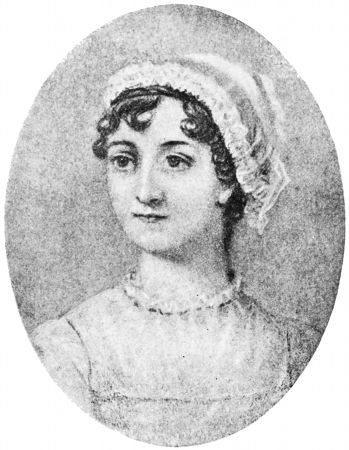
JANE AUSTEN
Jane, we know, was very healthy and full of spirits, we hear of no ailments beyond a weakness of the eyes from which she certainly suffered; she says, “My eyes have been very indifferent since it [the last letter] was written, but are now getting better once more; keeping them so many hours open on Thursday night, as well as the dust of the ballroom, injured them a good deal. I use them as little as I can, but you know, and everybody who has ever had weak eyes knows, how delightful it is to hurt them by employment, against the advice and entreaty of all one’s friends.”
The Austens had special advantages in their position in the fact that they were relatives of Mr. Knight, to whom the whole parish belonged. Mr. Austen seems to have been referred to, in the absence of Mr. Knight, as a kind of squire. He lived simply, but had apparently enough money to allow his daughters the privileges of gentlewomen, and they went to all the dances and balls in the neighbourhood, and paid frequent visits to their brothers’ houses for weeks at a time. Mr. Austen kept a carriage and pair, though that meant less than it would do now, as private means of conveyance was much more necessary and there was no carriage tax to add to the expense.
Mrs. Austen seems to have been constantly ailing, which threw the housekeeping a good deal into the hands of her daughters. It is possible that her ailments were more imaginary than real, as she lived to a great age, and in her old age employed herself about the garden and poultry, and is spoken of as being brisk and bright. Perhaps she grew more energetic as she grew older, a not uncommon process. Jane’s allusions to her mother’s health are frequent, and sometimes seem to point to the fact that she did not altogether believe in them—
“Now indeed we are likely to have a wet day, and though Sunday, my mother begins it without any ailment.”
“It began to occur to me before you mentioned it, that I had been somewhat silent as to my mother’s health for some time, but I thought you could have no difficulty in divining its exact state—you, who have guessed so much stranger things. She is tolerably well, better upon the whole than she was some weeks ago. She would tell you herself that she has a very dreadful cold in her head at present, but I have not much compassion for colds in the head without fever or sore throat.”
“My mother continues hearty; her appetite and nights are very good, but she sometimes complains of an asthma, a dropsy, water in her chest, and a liver disorder.”
“For a day or two last week my mother was very poorly with a return of one of her old complaints, but it did not last long, and seems to have left nothing bad behind it. She began to talk of a serious illness, her two last having been preceded by the same symptoms, but thank heaven she is now quite as well as one can expect her to be in the weather which deprives her of exercise.”
In the family memoirs, Mrs. George Austen is always spoken of as a person of wit and imagination, in whom might be found the germs of her daughter’s genius; such opinion based on recollections must be deferred to, but such is not the picture we gather from the letters. There, Mrs. Austen seems to have exercised none but the slightest influence on her daughters’ lives, and when they do mention her, it is only to remark on her health, or the care of her in a journey, or that she will not have anything to do with choosing the furniture for the new home in Bath.
It is a curious circumstance, taken in conjunction with this, that all the mothers of Jane’s heroines, when living, are described as fools or worse. It is not intended to hint that she drew such characters from the home circle or from her mother’s friends, but it is plainly to be seen that she did not look for, or expect from women of this standing, the wit and sense she found elsewhere. Indeed, when one thinks of the bringing up of women in those days, their narrowness of education and extraordinary ignorance of the world, it is wonderful how many did possess keen sense and mother wit. The most notable of the examples in point in the books is Mrs. Bennet in Pride and Prejudice, who, with her foolish indulgence of her younger children, her mad desire to get her daughters married to anyone who could furnish a home of whatever sort, is the worst specimen of her kind. “‘Oh, Mr. Bennet, you are wanted immediately; we are all in an uproar. You must come and make Lizzie marry Mr. Collins, for she vows she will not have him; and if you do not make haste he will change his mind and not have her.’” Mr. Bennet’s subsequent calm rebuke in his admonition to his daughter, “‘An unhappy alternative is before you, Elizabeth. From this day you must be a stranger to one of your parents. Your mother will never see you again if you do not marry Mr. Collins, and I will never see you again if you do,’” heightens the effect of his wife’s folly.
Mrs. Bennet’s fatuous self-complacency, selfishness, and want of sense might have been almost too painful to cause amusement even in a book, had they not been set off by her husband’s sardonic humour, just the touch that Jane Austen knew so well how to give.
But Mrs. Bennet is not the only one. Mrs. Jennings, in Sense and Sensibility, is “a good-humoured, merry, fat, elderly woman, who talked a great deal, seemed very happy and rather vulgar.” She is perpetually making the Dashwood girls wince with her outspoken allusions, and seems altogether deficient in taste and sense, though extremely kind-hearted.
As for Mrs. Dashwood senior, in the same book, in her belief in the charming but double-faced Willoughby, she is, if possible, one degree more credulous than her most foolish daughter. Lady Bertram of Mansfield Park is kind enough to her niece in her own way, but “she did not go into public with her daughters. She was too indolent even to accept a mother’s gratification in witnessing their success and enjoyment at the expense of any personal trouble.” “Lady Bertram did not at all like to have her husband leave her; but she was not disturbed by any alarm for his safety or solicitude for his comfort, being one of those persons who think nothing can be dangerous or difficult or fatiguing to anyone but themselves.”
Mrs. Musgrove senior, in Persuasion, is nothing but a soft-hearted fool, and “Captain Wentworth should be allowed some credit for the self-command with which he attended to her large fat sighings over the destiny of a son whom, alive, nobody had cared for.”
The middle-aged women without daughters, such as Lady Russell and Mrs. Croft, in the same book, are allowed to be sensible, but a mother with grown-up daughters seems always to be mercilessly delineated by Jane.
Of Mr. Austen not much is known; he was a quiet, reserved man, noted for his good looks, and clever enough to educate his sons for the University himself. In his younger days he took pupils, and it was one of these pupils who in after years became so much attached to Cassandra that he entered into the engagement with her which terminated so sadly. Mr. Austen probably kept a restraining hand over his large household, and was responsible for the sensible and kindly upbringing which his daughters received; he seems to have placed no restraint whatever on their pleasures as they grew up. It may be noted that the husbands of all the foolish women in Jane’s books noted above are sensible, self-restrained, capable men.
As for the surroundings and small details of the home where Jane remained with her sister and parents when the brothers went out into the world, it is very difficult to give an adequate picture. There was a great simplicity, and an absence of many things which are now turned out in profusion by machinery but were then not known. We have all of us been in old houses of the simpler kind, and noted the severity of uncorniced walls, the smallness of the inconvenient sash-windows, the plainness of the whole aspect. To the furniture, also, the same remarks would apply, there would be fewer things and of a more solid kind. “Perhaps we should be most struck with the total absence of those elegant little articles which now embellish and encumber our drawing-room tables. We should miss the sliding bookcases, and picture stands, the letter weighing machines and envelope cases, the periodicals and illustrated newspapers—above all, the countless swarm of photograph books which now threaten to swallow up all space.” (Mr. Austen-Leigh in the Memoir.)
By the following quotation from Jane herself before the removal to Bath, what a vision is instantly conjured up of the yellow speckled prints in cheap, varnished frames, the crude colours and stereotyped subjects of those old pictures which still occasionally remain in the spare rooms of country houses—
“As to our pictures, the battle piece, Mr. Nibbs, Sir William East, and all the old heterogeneous miscellany, manuscript, scriptural pieces dispersed over the house are to be given to James. Your own drawings will not cease to be your own, and the two paintings on tin will be at your disposal. My mother says that the French agricultural prints in the best bedroom were given by Edward to his two sisters.”
In regard to minor matters of domestic comfort, lucifer matches were not in general use until 1834, though the fact that they were anticipated by some genius in advance of his time is evidenced by this advertisement in the Morning Post of 1788—
“For Travellers, Mariners, etc., Promethean Fire and Phosphorus.
“G. Watts respectfully acquaints the public that he has prepared a large variety of machines of a portable and durable kind, with Promethean fire, paper and match enclosed, most admirably calculated to prevent those disagreeable sensations which most frequently arise in the dreary hour of midnight, from sudden alarm, thieves, fire, or sickness.”
Considering this, it is probable that some sort of sulphur match was in use before 1834, though the general method would be the tedious flint and steel.
For firing, wood was, of course, largely used, the cottagers depended totally on “pilfering, breaking hedges, and cutting trees.” Coal was very expensive, being of course mined with difficulty in the pre-machinery days; here is a contemporary account of a visit to a coal-mine in Yorkshire. “We had the curiosity to walk and take a near outside view of one seventy yards deep. The manner they work them is strange and not a little dangerous, as they are obliged to have candles, and sometimes with a roof so low that men dig on their knees.... They have two boxes which are alternately pulled up and down by pullies worked by a horse, which goes round and round in a sort of well.”
Added to the expense of mining was the expense of carriage, which, in the days before railways, had to be done by canal or sea, and the term sea-coal so frequently used in the literature of the day refers to this sea-borne coal. Sometimes after a storm the vessels were delayed, so that the scarcity of coal ran up the price enormously.
This is a brief sketch of the details at the rectory. In such a home there was plenty of occupation for a bright spirit like Jane’s, and we can hardly imagine her ever to have been idle. When her sister was away, she undertook the housekeeping, and writes playfully—
“My mother desires me to tell you that I am a good housekeeper, which I have no reluctance in doing, because I really think it my peculiar excellence, and for this reason—I always take care to provide such things as please my own appetite, which I consider as the chief merit in housekeeping. I have had some ragout veal, and I mean to have some haricot mutton to-morrow. We are to kill a pig soon.”
“I am very fond of experimental housekeeping, such as having an ox-cheek now and then; I shall have one next week, and I mean to have some little dumplings put into it.”
At another time, speaking of the family doctor, she says—
“I was not ashamed of asking him to sit down to table, for we had some pease-soup, a sparerib, and a pudding.”
Dinner at that date (1799) was, for the unfashionable, at the hour of three, and for the fashionable not earlier than five, and sometimes much later. Lady Newdigate (The Cheverels of Cheverel Manor) says, “The hours of the family are what the polite world would not conform to, viz., breakfast at half past eight, dine at half past three, supper at nine, and go to bed at ten.”
Jane Austen in her home life was not in a fashionable set, and her people did not ape the manners of society; she writes at another time, “We dine now at half past three, and have done dinner I suppose before you begin; we drink tea at half past six.”
When she went to stay at Godmersham, which she frequently did, she mingled with county people and noted their manners and ways; but she was entirely free from snobbishness, and her quiet satire of those who imitated all the superficial details in the life of a higher class than their own is seen in her account of Tom Musgrave in The Watsons, who condescends to stay and play cards with the Watsons until nine, when “the carriage was ordered to the door, and no entreaties for his staying longer could now avail; for he well knew that if he stayed he would have to sit down to supper in less than ten minutes, which, to a man whose heart had long been fixed on calling his next meal a dinner, was quite insupportable.”
It is not difficult to trace the evolution of the dinner-hour; in the time of Pepys, busy men rose early and took hardly any breakfast, perhaps a glass of wine or a draught of ale with a bit of bread.
M. Grosley, a Frenchman who visited England about the middle of the eighteenth century, says that “the butter and tea, which the Londoners live upon from the morning till three or four o’clock in the afternoon, occasion the chief consumption of bread, which is cut in slices, and so thin that it does as much honour to the address of the person who cuts it as to the sharpness of the knife. Two or three of these slices furnish out a breakfast.”
After this slight repast, corresponding to the Continental coffee and roll, men worked hard until dinner-time, a meal that occupied several hours, and at which they consumed an enormous amount; and they did little or no work afterwards. It is easy to imagine how, on account of work, the early dinner-hour of the poorer classes at noon began to be postponed among men who were more or less their own masters until they could feel, in a common phrase, they had “broken the back of the day’s work”; hence the curious hour of three. In out-of-the-way places to this day the Sunday dinner-hour is at four o’clock. When breakfast became more usual, it was not necessary to have dinner so early as three; and with our present fashion of breakfast and lunch, to say nothing of afternoon tea, which we have transferred from after to before dinner, the dinner may be postponed to as late an hour as is desired without inconvenience.
Mrs. Lybbe Powys (then Caroline Girle) mentions in her lively Journal: “We had a breakfast at Holkham in the genteelest taste, with all kinds of cakes and fruit, placed undesired in an apartment we were to go through, which, as the family were from home, I thought was very clever in the housekeeper, for one is often asked by people whether one chooses chocolate, which forbidding word puts (as intended) a negative on the question.”
Table decorations were unknown even at large banquets, people sat on benches and were served in the simplest manner. Lady Newdigate gives an account of suppers and prices when she was staying at Buxton—
“Being examined by the Bart in regard to our suppers and what we paid, he [her cousin] owned that we were charged but one shilling and it seems they pay two. Upon this poor Mrs. Fox [the landlady] was attacked and abused in very gross terms. So she came to us with streaming eyes to beg we would explain to the Edmonstones that our suppers were never anything more than a tart and cold chicken which we eat when the company went to supper above, whereas the E.’s order a hot supper of five or six dishes to be got at nine o’clock.”
She also gives many details as to the items constituting her meals: “We are going to sup upon crawfish and roasted potatoes. Our feast [dinner] will consist of neck of mutton, lamb steaks, cold beef, lobsters, prawns, and tart.”
This is the menu of a dinner given to Prince William of Gloucester in 1798—
Salmon Trout.
Soles.
Fricando of Veal. Raised Giblet Pie.
Vegetable Pudding.
Chickens. Ham.
Muffin Pudding.
Curry of Rabbits. Preserve of Olives.
Soup. Haunch of Venison.
Open Tart Syllabub. Raised Jelly.
Three Sweetbreads Larded.
Maccaroni. Buttered Lobster.
Peas.
Potatoes.
Baskets of Pastry. Custards.
Goose.
Forks were two-pronged and not in universal use; knives were broad-bladed at the ends, and it was the fashion to eat peas with them.
“The taste for cleanliness has preserved the use of steel forks with two prongs.... With regard to little bits of meat, which cannot so well be taken hold of with the two pronged forks, recourse is had to the knife, which is broad and round at the extremity.”
It is to be wished that two-pronged forks still survived in the public restaurants of to-day, as the use of the present forks in such places is one of the minor trials of daily life.
Mrs. Papendick’s account of the plate and services acquired at her marriage gives us an idea of what was then thought necessary in this respect. She says, “Two of our rooms were furnished by her Majesty, and a case of plate was also sent by her, which contained cruets, saltcellars, candle-sticks, and spoons of different sizes, silver forks not being then used. From the Queen came also six large and six small knives and forks, to which mamma added six more of each, and a carving knife and fork. Our tea and coffee set were of common Indian china, our dinner service of earthenware, to which, for our rank, there was nothing superior, Chelsea porcelain and fine India china being only for the wealthy. Pewter and Delft ware could also be had, but were inferior.” Though Mr. Papendick was attached to the Court, he was anything but wealthy.
Turning to the novels, we find food frequently mentioned in Emma, when the little suppers of minced chicken and scalloped oysters, so necessary after an early dinner, were always provided at the Woodhouses. Poor Mr. Woodhouse’s feelings on these occasions are mixed. “He loved to have the cloth laid because it had been the fashion of his youth; but his conviction of suppers being very unwholesome, made him rather sorry to see anything put upon it; and while his hospitality would have welcomed his visitors to everything, his care for their health made him grieve that they would eat. Such another small basin of thin gruel as his own was all that he could, with thorough self-approbation, recommend; though he might constrain himself, while the ladies were comfortably clearing the nicer things, to say—
“‘Mrs. Bates, let me propose your venturing on one of these eggs. An egg boiled very soft is not unwholesome. Serle understands boiling an egg better than anybody. I would not recommend an egg boiled by anyone else, but you need not be afraid, they are very small you see—one of our small eggs will not hurt you. Miss Bates, let Emma help you to a little bit of tart—a very little bit. Ours are all apple tarts. You need not be afraid of unwholesome preserves here. I do not advise the custard. Mrs. Goddard, what say you to half a glass of wine? A small half glass put into a tumbler of water? I do not think it could disagree with you.’”
Arthur Young, who made a tour through the southern counties of England in 1771, gives us carefully tabulated facts, from which we learn that the average price for meat of all kinds, beef, mutton, veal, and pork, was no more than 3½d. per pound. Butter was 6½d. per pound, and bread a 1¼d. By 1786 we find that “meat, taking one kind with another, was fivepence a pound; a fowl ninepence to a shilling; a quartern loaf fourpence; sugar fourpence a pound; tea six shillings a pound and upwards.”
With these prices it must be remembered that wages ruled much lower than at present. By 1801, when Jane was in Bath, the incessant state of war had raised everything. She writes: “I am not without hopes of tempting Mrs. Lloyd to settle in Bath; meat is only 8d. per pound, butter 12d., and cheese 9½d. You must carefully conceal from her, however, the exorbitant price for fish; a salmon has been sold at 2s. 9d. per pound the whole fish.”
In 1800 the price of the quartern loaf was 1s. 10½d., and then peace was declared. In the preceding ten years the scarcity of flour had been so great that all sorts of changes were suggested in the making of bread. The members of the Privy Council set the example in their own households of not eating puddings, or anything that required flour, excepting the necessary bread, which was to be half made of rye. Flour as powder for wigs was no more used, being needed for consumption, and rice was recommended to the poor.
In 1800, also, was passed the Brown Bread Act, forbidding the sale of pure white wheaten bread, or the consumption of any sort of bread new, as if it were stale it was thought it would go farther. In the seven years before 1800 the prices of not only bread, but meat, butter, and sugar, had risen to double what they had been previously.
With a small household of only three persons, in the absence of Cassandra, the ordering at Steventon Rectory cannot have occupied much time or thought.
Though there would possibly be rather more active superintendence of the domestics than at present, ladies of comfortable means did not then, any more than now, spend all their mornings in the kitchen, as is sometimes erroneously supposed. Jane would doubtless fill up her time with a little practising, a little singing, the re-trimming of a hat, correspondence, and the other small items that go to make up a country girl’s life. In the usual avocations of a genteel young lady, “the pianoforte, when they were weary of the harp, copying some indifferent drawings, gilding a set of flower pots, and netting white gloves and veils,” we see a tedious inanition quite foreign to our conception of Jane.
Though gardening was not then a hobby, as it is now, there would be general superintendence of the gardener, and many a lingering walk by the borders and flower-beds on sunny mornings. Jane evidently loved flowers, as she often refers to them in her letters.
“Hacker has been here to-day, putting in the fruit trees. A new plan has been suggested concerning the plantation of the new enclosures on the right-hand side of the elm walk; the doubt is whether it would be better to make a little orchard of it by planting apples, pears, and cherries, or whether larch, mountain ash, and acacia.”
There was at this time a reaction against the stiff and formal gardening which had been in fashion since introduced by William III. “It is from wild and uncultivated woods, that is from pure nature, that the present (1772) English have borrowed their models in gardening ... daisies and violets irregularly scattered form the borders of them. These flowers are succeeded by dwarf trees, such as rose buds, myrtle, Spanish broom, etc.” (Grosley.)
M. Grosley also speaks of wages for gardeners being very high: “I have myself seen a spot of ground, not exceeding an acre, occupied partly by a small house, partly by gravel walks, with two beds of flowers, where the gardener, who was lodging in the house, had a salary of twelve guineas a year.”
Wages for all classes were, as has been said, much lower than now; in regard to this question the cry of a “Constant Reader” to The Times in 1795 is amusing—
“Tell a servant now, in the mildest manner, they have not done their work to please you, and you are told to provide for yourself, and, should you offer to speak again, they are gone.... I look upon their exorbitant increase of wages as chiefly conducive to their impertinence; for when they had five or six pounds a year, a month being out of place was severely felt; but now their wages are doubled, they have in great measure lost their dependence. And what is this increase of wages for? Not in order to lay by a little in case of sickness, but to squander in dress. No young woman now can bear a strong pair of leather shoes, but they must wear Spanish leather, and so on in every article of dress.”
By Arthur Young’s account wages were less even than above, he says that dairymaids received an average of £3, 12s. yearly, and other maids £3, 6s. Prices possibly varied in different places, being higher in London where labour was scarcer. “Wages are very considerable ... a fat Welsh girl who has just come out of the country, scarce understood a word of English, capable of nothing but washing, scouring, and sweeping the rooms ... [received] six guineas a year, besides a guinea a year for her tea, which all servant maids either take in money, or have it found for them twice a day. The wages of a cook maid who knows how to roast and boil amount to twenty guineas a year.” (Grosley.)
When the household details had been attended to, the members of the Austen family must sometimes have walked in the rough lanes. In order to avoid the mud in winter or wet weather, ladies wore pattens, which had an iron ring underneath and raised the foot, these pattens clinked as they walked, and must have been very bad in causing an awkward drag in the gait. But country lane walking was not greatly in favour then, women’s gowns, with long clinging skirts, were not adapted for such promenades, and it is amusing to think how surprised either Jane or Cassandra would have been could they have met a modern tailor-made girl, with gaiters, and comfortable, trim short skirt well clearing the ground.
Though visiting the poor was not a regular duty, it is evident from many indications that the girls took pleasure in knowing the parishioners, and they must have been to see them occasionally.
The life of labourers was at that time extremely dull, and it is little to be wondered at that they were rough boors when they were left entirely without reasonable means of recreation, and without any mental nourishment. The public-house was often the working-man’s sole chance of relaxation. Very few could read or write; in the long winter evenings there was nothing for them to do but to sit in a draughty cottage over a small wood-fire, without any of the luxuries that are now considered necessaries in every labourer’s cottage. The interiors resembled a Highland crofter’s hut, with beaten earth flooring, often damp; rough uncovered walls, no gay prints, or polished furniture. The introduction of machinery has in this case, as in so many others, altered the entire aspect of life. When sofa legs can be turned out by the hundred by a machine for little cost, everyone can afford sofas; when the process of reproduction of pictures is reduced to a minimum, every wall is adorned. Even the woven quilts and patterned chair-covers, now so little thought of as to be hardly noticed, were then unknown; plain dyes for materials were all that could be had.
Though probably Cowper’s dismal picture is an extreme case, it has the merit of being contemporary—
“The frugal housewife trembles when she lights
Her scanty stock of brushwood, blazing clear,
But dying soon like all terrestrial joys.
... The brown loaf
Lodged on the shelf, half eaten without sauce
Of savoury cheese, or butter costlier still.
... All the care
Ingenious parsimony takes but just
Saves the small inventory, bed and stool,
Skillet and old carved chest, from public sale.”
But to set against this we have the idyllic pictures of cottage life to be found amid the works of Morland and his confrères. One of these, engraved by Grozer, is given as an illustration. Here, though the cottage is low and dark, with thatched roof and small windows, the healthy, smiling faces of the cottagers themselves are very attractive. The truth probably lay in the mean between Cowper’s realism and the artist’s idealism, health and good temper may have been found even amid dirt and squalor.
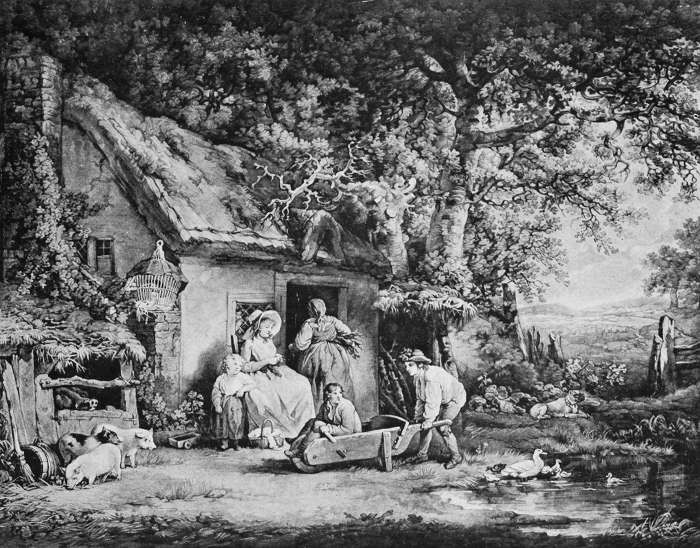
THE HAPPY COTTAGERS
At that time the state of the roads cut off the dweller in a small village from any neighbouring town. At present the three or four miles of good solid road in and out of a provincial town are nothing to a young man who starts off after his work on Saturday evenings, and in many cases he has a bicycle with which to run over them more easily still. At that time the roads, even main roads, were in a filthy state; the Act of 1775, by making turnpike roads compulsory, did much to improve them, but previously they were often mere quagmires with deep ruts, similar to the roads running by the side of a field where carting has been going on. Many and many a record is there of the coaches being stuck or overturned in the heavy mud.
The days of village merry-making and sociability seemed to have passed away in Puritan times never to revive, and had not been replaced by the personal pleasures of the present time. A labourer of Jane Austen’s days had the bad luck to live in a sort of intermediate time. Not for him the reading-room with its bright light and warm fire, the concert, the club, and the penny readings, the smooth-running bicycle or the piano. Here is Horace Walpole’s picture of suburban felicity: “The road was one string of stage coaches loaded within and without with noisy jolly folks, and chaises and gigs that had been pleasuring in clouds of dust; every door and every window of every house was open, lights in every shop, every door with women sitting in the street, every inn crowded with drunken topers; for you know the English always announce their sense of heat or cold by drinking. Well! It was impossible not to enjoy such a scene of happiness and affluence in every village, and amongst the lowest of the people; who are told by villainous scribblers that they are oppressed and miserable.”
Wages for labourers, as in the case of servants, were very low. Arthur Young gives an interesting digest of the wages then in vogue in the southern counties. He divides the year into three parts: harvest, five weeks; hay-time, six weeks; and winter, forty-one weeks; the average of weekly wages for these three respective periods was 13s. 1d., 9s. 11d., and 7s. 11d., making a weekly medium of about 8s. 8d. all the year round. The writer is very severe on the labourers for what he considers their gross extravagance in the matter of tea and sugar, indeed his remarks sound so queer to our ears now that they are worth quoting at some length—
“All united in the assertion that the practice [of having tea and sugar] twice a day was constant, and that it was inconceivable how much it impoverished the poor. This is no matter of trivial consequence; no transitory or local evil; it is universal and unceasing; the amount of it is great ... this single article cost numerous families more than sufficient to remove their real distresses, which they will submit to rather than lay aside their tea. And an object, seemingly, of little account, but in reality of infinite importance, is the custom, coming in, of men making tea an article of their food, almost as much as women; labourers losing their time to come and go to the tea table; nay, farmers’ servants even demanding tea for their breakfast, with the maids! Which has actually been the case in East Kent. If the men come to lose as much of their time at tea as the women, and injure their health by so bad a beverage, the poor, in general, will find themselves far more distressed than ever. Wants, I allow, are numerous, but what name are we to give to those that are voluntarily embraced in order for indulgence in tea and sugar?... There is no clearer fact than that two persons, the wife and one daughter for instance, drinking tea once a day amounts, in a year, to a fourth of the price of all the wheat consumed by a family of five persons; twice a day are half; so that those who leave off two tea drinkings can afford to eat wheat at double the price (calculated at six shillings a bushel).”
Tea was, of course, then very expensive. Lady Newdigate writes to her husband in 1781, “I enclose Mr. Barton’s account for tea, the sum frights one, but if the common tea runs—as Mr. B. says it does—near eighty pounds the chest, it will answer well. The best is full 16s. a pound, but Mundays and Newdigates who have also a lot and have also had from the shops since the new tax was laid, say it is better than what you can buy for 18s.” (The Cheverels of Cheverel Manor.)
Besides other occupations, such as have been slightly indicated, there was one in Jane’s life about which she seldom spoke to anyone; from her earliest childhood the instinct to write had been in her, and she had scribbled probably in secret. Such a thing would not be encouraged in a child of her time. Nowadays, when every little Rosina and Clarence has a page to themselves in the weekly papers, and can see her or his own childish effusions in print, winning thereby the proud and admiring commendations of mother and father, the case is different; Jane wrote because she had to write, it was there and it must come out, but she probably looked on her writing as something to be ashamed of, a waste of time, and only read her compositions to her brothers and sisters under compulsion when no adults were present. Mr. Austen-Leigh says, “It is impossible to say at how early an age she began to write. There are copy books extant containing tales, some of which must have been composed while she was a young girl, as they had amounted to a considerable number by the time she was sixteen. Her earliest stories are of a slight and flimsy texture, and are generally intended to be nonsensical, but the nonsense has much spirit in it.”
He gives as an instance “The Mystery, a short unfinished Comedy.” He says later, “But between these childish effusions and the composition of her living works, there intervened another stage of her progress, during which she produced some stories, not without merit, but which she never deemed worthy of publication.”
It was one of these, at first called Elinor and Marianne, which became the germ of Sense and Sensibility, and perhaps from these early stories she might, had she lived, have developed and produced other books.
The beautiful old town of Winchester, once the capital of the kingdom, lies only twelve miles from Steventon, and though there was no smooth, hard high-road as we know it, the Austens’ carriage horses were probably stoutly-built animals who pulled their load through the mire with right goodwill. Many an expedition to the town must Jane have made, and well would she know the ancient part by the Cathedral and College, so little altered now that we may look upon it with her eyes. The red walls, with their garnishing of lichen and ferns, the beautiful nooks and sunny corners, would all be very familiar to her; and in these happy days, when she was still a light-hearted girl without a thought of fame, how little would she think that one day she should pass away close to the old grey Cathedral, which itself should form her burial-place, and which would be visited on that account by hundreds yet unborn, who knew her only in her books.
CHAPTER V THE NOVELS
The life of a genius is, after all, secondary to the works by which he lives; no one would want to know anything about him had not the works aroused their interest. The personality when revealed is oft-times disappointing, sometimes repulsive, but that cannot alter the value of the work. There is certainly no fear that we shall find anything repulsive in the simple life of Jane Austen, or that we shall be disappointed in knowing her as she was, but for all that the works are the thing.
One writer on Jane Austen, in what purports to be a book, has devoted three hundred and thirty-two pages out of three hundred and eighty-six to a synopsis of the plots of the novels, told in bald and commonplace language, without any of the sparkle of the original, so that even the extracts embedded in such a context seem flat and uninteresting. This sort of book-making is worse than useless, it is positively harmful. Anyone who read the volume before reading the original novels would assuredly never go to them after having seen them flattened out in this style. There is no place for such a book; anyone who is interested in Jane Austen at all should read her works as they are. There can be no excuse on the ground of length, the longest, Emma, runs to four hundred and thirty-six pages of clear type in duodecimo form. For the publication of an abridged form of Richardson’s works, there might be excuse; anyone who read such an abridgement might be forgiven, for Richardson’s masterpiece filled seven volumes! But with Jane Austen there is nothing to abridge, every sentence tells, there is no prolixity, every word has its intrinsic value, and to retell her sparkling little stories in commonplace language is indeed to attempt the painting of the rose.
This book, at all events, is intended only for those who know the novels at first hand, and there shall be no explaining, no pandering to that laziness that prefers hash to joints. Taking it for granted that everyone knows the six complete novels, we enter here on a discussion of the excellencies common to all, leaving them to be discussed singly as they occur chronologically in the life of their author. The first question that occurs to anyone in this connection is how is it that these books, without plot, without adventures, without double entendre, have managed to entrance generations of readers, and to be as much alive to-day as when they were written? The answer is simple and comprehensive,—they are of human nature all compact. This is the first and greatest quality. We have in them no heroes and heroines, no villains, but only men and women; and while the world lasts stories of real live flesh-and-blood characters will hold their own. The second characteristic, which is the salt of fiction, is the keen sense of humour that runs throughout. Jane Austen’s observation of the foibles of her fellow-creatures was unusually sharp, her remarks in her letters are not always kind, but in the novels this sharp and keen relish of what is absurd is softened down so as to be nowhere offensive. Like her own Elizabeth, she might say, “I hope I never ridicule what is wise or good. Follies and nonsense, whims and inconsistencies, do divert me, I own, and I laugh at them whenever I can.”
A third characteristic, which is the result of genius alone, is her dainty sense of selection. She never gives anything redundant either in the actions or words of her characters, just enough is said or done to reveal the people themselves to us. One has only to think of writers deficient in this quality to realise how essential it is to enjoyment. In Miss Ferrier’s Marriage, for instance, there are good and striking scenes, but in her conversations she never knows when to stop, the tedious long-winded sentences have to be skipped in order to get on with the story. The art of selection is that which distinguishes real dramatic talent from photographic realism. To be able to put down on paper exactly what average people say is certainly a gift, for few can do it, but a far higher gift is to select and combine just those speeches and actions which give the desired effect without leaving any sense of omission or incompleteness. Jane Austen had the power also of giving a flash of insight into a state of mind or a personal feeling in a few words more than any writer before or since. It is one of her strongest points. Take for example that scene when Henry Tilney instructing Catherine “talked of foregrounds, distances, and second distances; side screens and perspectives; lights and shades; and Catherine was so hopeful a scholar, that when they gained the top of Beechen Cliff, she voluntarily rejected the whole city of Bath as unworthy to make part of the landscape”; or the opening sentences of Mansfield Park. “Miss Maria Ward of Huntingdon, with only seven thousand pounds, had the good luck to captivate Sir Thomas Bertram of Mansfield Park, in the county of Northampton, and to be thereby raised to the rank of a baronet’s lady, with all the comforts and consequences of a handsome house and large income. All Huntingdon exclaimed on the greatness of the match; and her uncle, the lawyer, himself, allowed her to be at least three thousand pounds short of any equitable claim to it.”
It is by touches such as these that the characters are made to live before us, Jane never condescends to the device of tricks which Dickens allowed himself to use with such wearisome iteration; we have none of “the moustache went up and the nose came down” style. It is by a perfect perspective, by light touches given with admirable effect, that we know the difference between Fanny Price and Anne Elliot, both good, sweet, retiring girls; or between Elinor Dashwood and Emma Woodhouse, who both had the generosity of character to sympathise with another’s love affairs while hiding their own. Henry Tilney and Edmund Crawford were both young clergymen of a priggish type, but Henry’s didactic reflections are not in the least the same as those which Edmund would have uttered.
The silliness of Mrs. Palmer, with her final summary on the recreant Willoughby, “She was determined to drop his acquaintance immediately, and she was very thankful she had never been acquainted with him at all. She wished with all her heart Combe Magna was not so near Cleveland, but it did not signify for it was a great deal too far off to visit; she hated him so much that she was resolved never to mention his name again, and she should tell everyone she saw how good for nothing he was,” is entirely different from the continuous weak outpourings of poor little Miss Bates. “And when I brought out the baked apples from the closet, and hoped our friends would be so very obliging as to take some, ‘Oh,’ said he directly, ‘there is nothing in the way of fruit half so good, and these are the finest looking home-baked apples I ever saw in my life.’ That, you know, was so very— And I am sure by his manner it was no compliment. Indeed, they are very delightful apples, and Mrs. Wallis does them full justice, only we do not have them baked more than twice, and Mr. Woodhouse made us promise to have them done three times; but Miss Woodhouse will be so good as not to mention it. The apples themselves are the very finest sort for baking beyond a doubt—” and so on and so on for a page or more.
The truth is that Jane Austen seized on qualities which are frequently found in human nature, and developed them with such fidelity that nearly all of us feel that we have at one time or another met a Miss Bates or a Mrs. Norris, or that we can see traits in others which resemble theirs; it is this which makes the appeal to all humanity. She did not take one person out of her acquaintance and depict him or her, but represented, in characters of her own creating, these salient traits which will ever revive perennially while men and women exist.
Lord Macaulay does not hesitate to speak of Jane in the same breath with Shakespeare. “Shakespeare has had neither equal nor second, but among the writers who have approached nearest to the manner of the great Master, we have no hesitation in placing Jane Austen, a woman of whom England is justly proud. She has given us a multitude of characters, all, in a certain sense, commonplace, all such as we meet every day, yet they are all as perfectly discriminated from each other as if they were the most eccentric of human beings.” And Archbishop Whateley makes the suggestive remark, “It is no fool that can describe fools well.”
Before the birth of Jane Austen, the novel, which had been hardly considered in England for many centuries, had suddenly found a quartette of exponents which had placed the country in the foremost rank of this branch.
It is rare indeed that four such men as Richardson, Fielding, Smollett, and Sterne, with powers of imagination which make their work classic, should be evolved at the same date. It would almost seem as if the theory which declares that the world, in its onward rush through space, passes through regions impregnated with certain forms of ether that affect men’s minds, must have some grain of truth, when simultaneously there leaped forth four exponents and first masters of an art that hitherto can hardly have been said to exist. The united scope of their four lives ranged from 1689 to 1771, and between these dates England was enriched for all time.
With these four Jane Austen’s work has little in common. It is to Richardson only that her novels owe anything, and they differ from Richardson’s in many striking particulars.
Apart from the masters already mentioned, “A greater mass of trash and rubbish never disgraced the press of any country than the ordinary novels that filled and supported circulating libraries down nearly to the time of Miss Edgeworth’s first appearance. There had been The Vicar of Wakefield, to be sure, before, and Miss Burney’s Evelina and Cecilia, and Mackenzie’s Man of Feeling, and some bolder and more varied fictions of the Misses Lee. But the staple of our novel market was beyond imagination despicable, and had consequently sunk and degraded the whole department of literature of which it had usurped the name.” (Jeffrey, Essays, Ed. 1853.)
And Macaulay says: “Most of the popular novels which preceded Evelina were such as no lady would have written, and many of them were such as no lady could without confusion own that she had read. The very name of novel was held in horror among religious people. In decent families which did not profess extraordinary sanctity, there was a strong feeling against all such works. Sir Anthony Absolute, two or three years before Evelina appeared, spoke the sense of the great body of sober fathers and husbands, when he pronounced the circulating library an evergreen tree of diabolical knowledge. This feeling on the part of the grave and reflecting, increased the evil from which it had sprung. The novelist, having little character to lose, and having few readers among serious people, took, without scruple, liberties which, in our generation, seem almost incredible.”
The effect that Miss Burney’s stories had upon contemporary readers may be judged from a letter of Mr. Twining, a country clergyman of education and standing, who wrote in 1782 to her father, Dr. Burney: “I need not tell you that I gobbled up Cecilia as soon as I could get it from my library. I never knew such a piece of work made with a book in my life. It has drawn iron tears down cheeks that were never wetted with pity before; it has made novel readers of callous old maiden ladies, who have not for years received pleasure from anything but scandal. Judge, then, what effect it has had upon the young and the tender hearted! I know two amiable sisters at Colchester, sensible and accomplished women, who were found blubbering at such a rate one morning! The tale had drawn them on till near the hour of an engagement to dinner, which they were actually obliged to put off, because there was not time to recover their red eyes and swelled noses.”
Miss Burney’s works are real enough, and not lightly to be dismissed; she understood the human heart, and especially the heart of a girl, her sentimental side is perfect, but beyond that she ceases to claim anything out of the common. Her society types are types only; the gay young man, a rake, but charming at heart, whose excesses were but the wildness of an ill-brought-up youth, had been drawn many times before. When she goes beyond affairs of the heart she at once caricatures; her Captain and Mrs. Duval are gross and overdrawn even according to the manners of the age.
Miss Burney preceded Jane Austen by several years; Evelina was published in 1778, when the sister-author was but three years old; Cecilia came out four years later, and Camilla in 1796, the same year in which Pride and Prejudice was written, though it was not published until 1813. There is no doubt that Jane Austen owed much to her rival and predecessor, but her gifts were incomparably the greater. Miss Burney’s cleverness consisted in the portrayal of feeling in a young girl’s sensitive mind, her stories are stories of fashion and incident; Jane Austen’s are of country life, and simple everyday scenes. The one had its vogue, and, as an account of contemporary manners, the books have their value and delight now, especially Evelina, which stands high above its successors, each one of which is poorer than the preceding one; but none are to be compared with any of Jane Austen’s novels, which are for all time.
“Miss Edgeworth indeed draws characters and details conversations such as occur in real life with a spirit of fidelity not to be surpassed; but her stories are most romantically improbable, all the important events in them being brought about by most providential coincidences.” (Archbishop Whateley.)
It was a transition age from the conventional to the natural; as in the admiration of landscape, the love for natural gardens, the gradual disappearance of the formal and empty compliment to which women had hitherto been treated, we find taste changing, so in literature the conventional was giving way to the natural. Fielding and Smollett had broken down the barriers in this respect, they had depicted life as it was, not as convention had decreed it should be, hence their gigantic success; but the life they saw and rendered was the life of a man of the world, with all its roughness and brutality. Jane Austen was the first to draw exactly what she saw around her in a humdrum country life, and to discard all incident, all adventure, all grotesque types, for perfect simplicity. She little understood what she was doing, but herein lies her wonderful power, she was a pioneer. Jane’s writing had nothing in common with Mrs. Radcliffe, whose style is mimicked in Northanger Abbey. It had absolutely no adventures. The fall of Louisa on the Cobb is perhaps the most thrilling episode in all the books, yet by virtue of its entire simplicity, its naturalness, its gaiety, her writing never fails to interest. Perhaps the most remarkable tribute to her genius lies in the fact that, though her books are simplicity itself, dealing with the love-stories of artless girls, they are read and admired not only by girls and women, but more especially by men of exceptional mental calibre. It has been said that the appreciation of them is a test of intellect.
Though her novels are novels of sentiment, they never drift into sickly sentiment, they are wholesome and healthy throughout. With tragedy she had nothing to do; her work is comedy, pure comedy from beginning to end. And as comedies well done are the most recreative of all forms of reading, it is no wonder that, slight as are her plots, hardly to be considered, minute as are the incidents, the attention of readers should ever be kept alive. In all her books marriage is the supreme end; the meeting, the obstacles, the gradual surmounting of these, and the happy ending occur with the regularity of clockwork. And yet each one differs from all the others, and she is never monotonous. Every single book ends well, and it is a striking fact that there is not a death in one of them. When, after a slight improvement, Marianne, in Sense and Sensibility, grows worse—
“The repose of the latter [Marianne] grew more and more disturbed; and her sister who watched with unremitting attention her continual change of posture, and heard the frequent but inarticulate sounds of complaint which passed her lips, was most wishing to rouse her from so painful a slumber, when Marianne, awakened by some accidental noise in the house, started hastily up, and, with feverish wildness cried out, ‘Is mamma coming?’... Hour after hour passed away in sleepless pain and delirium on Marianne’s side, and in the most cruel anxiety on Elinor’s,” we know that in most books we should expect the worst, but with Jane Austen we are sure that it will all turn out well, as indeed it does, and our feelings are not unduly harrowed.
One point which is obvious in all the books is the utter lack of conversation, except about the merest trivialities, among women. In Sense and Sensibility it is remarked of a dinner given by John Dashwood that “no poverty of any kind, except of conversation, appeared.... When the ladies withdrew to the drawing-room after dinner, this poverty was particularly evident, for the gentlemen had supplied the discourse with some variety—the variety of politics, enclosing land, and breaking horses—but then it was all over, and one subject only engaged the ladies till coffee came in, which was the comparative height of Harry Dashwood, and Lady Middleton’s second son, William, who were nearly of the same age ... the two mothers though each really convinced that her own son was the taller, politely decided in favour of the other. The two grandmothers with not less partiality, but more sincerity, were equally earnest in support of their own descendant.”
The Christian names of that date were plain, and, for women, strictly limited in number; it detracts something from a heroine to be called Fanny Price or Anne Elliot; and Emma Woodhouse and Elizabeth Bennet are little better; Elinor and Marianne Dashwood are the most fancy names applied by Jane to any of her heroines.
Another point which may be noticed in the novels is that the outward forms of religion, beyond the fact of a man’s being a clergyman, are never mentioned, and that on all religious matters Jane is silent; but this does not signify that she was not herself truly religious at heart, for we have the testimony of those who knew her to the contrary, particularly that of her brother Henry in his preface prefixed to the first edition of Northanger Abbey, published after her death. But though actual religion does not appear in her pages, the lessons that the books teach are none the less enforced; had she been taking for her sole text the merit of unselfishness, she could not have done more, or indeed half so much, to further the spread of that virtue. To read the books straight through one after the other is to feel the petty meanness of self-striving, and the small gain that lies therein. The talk of the mammas, such as Mrs. Bennet, who are perfectly incapable of seeing their neighbours’ interest should it clash with their own; the picture of the egregious Mrs. Norris with her grasping at the aspect of generosity and self-sacrifice, without any intention of putting herself to any inconvenience thereby; the weakness of such characters as Willoughby in Sense and Sensibility, who allow themselves to drift along the lines of least resistance without a thought of the after misery they may cause: each and all of these are more potent than a volume of sermons.
It may be noted that Jane Austen chose her characters from the class of life in which she herself lived, we meet in her pages no dukes or duchesses, and only a few slightly sketched labourers and gardeners, who are brought in when inevitable; the story itself is concerned with people of the middle classes, the squires and country gentlemen, the clergymen, and upper-class prosperous tradespeople. We have no inimitable rustics as in George Eliot’s wonderful books, nor any disreputable knaves of the fashionable rich as in Miss Burney’s works. It is, however, a remarkable fact that all the mankind are always at leisure to picnic and dance attendance on the ladies at any hour of the day; we have no business men; rides and excursions and picnics are always provided with a full complement of idle young men to match the young women. To this rule the clergymen are, of course, no exception.
There was a particular sort of country gentleman who seemed to flourish in those days, of the type of Mr. Knightley and Mr. Bennet. These men did not own enough land to call themselves squires, their farming was very slight, they owned a secure fortune in some safe investment, and apparently spent their lives in the insipid avocations which, until recently, were the lot of nearly all men who were neither rich nor poor. They played cards, and rode and saw their neighbours, and read the newspapers, without seeming to feel their time hang at all heavy on their hands. This breed seems almost extinct now, we are all too excitable, and live too rapidly to make it possible. A man with such an income as either of the two mentioned would almost certainly travel, or take up some special hobby; he would be a social reformer, or on his County Council, a J.P., a M.F.H., or something of the kind, with occupations varied enough to afford him some apology for his existence.
The lowest of what may be called Jane Austen’s speaking parts are filled by well-to-do tradesmen, or people just emerging from trade, as the Gardeners in Pride and Prejudice, who still lived at the business house in Gracechurch Street; for it was a time when house and shop were not divided.
Her characters are all supposed to be gentlepeople, but there is a difference between those who are of better family than others, such as Bingley, who condescends in marrying Jane Bennet. There is one point on which I venture to disagree with Mr. Pollock, who, in his extremely suggestive and interesting book on Jane Austen and her Contemporaries, says—
“Comment has been made, and justly made, on the perfect breeding and manners of those people in Miss Austen’s novels who are supposed and intended to be well-bred.”
On the contrary, to go no further than Pride and Prejudice, Darcy himself passes every canon of gentlemanly conduct, and the Misses Bingley, who were supposed to be of irreproachable breeding, betray vulgarity and lack of courtesy in every sentence. The observations of Miss Bingley on Elizabeth and Darcy would disgrace a kitchen-maid. When Darcy has danced once with Elizabeth, Miss Bingley draws near to him, and observes of the society she is in—
“‘You are considering how insupportable it would be to pass many evenings in this manner—in this society, and indeed I am quite of your opinion. I never was more annoyed. The insipidity and yet the noise—the nothingness and yet the self-importance of all these people! What would I give to hear your strictures on them!’
“‘Your conjecture is totally wrong, I assure you. My mind was more agreeably engaged. I have been meditating on the very great pleasure which a pair of fine eyes in the face of a pretty woman can bestow!’
“Miss Bingley immediately fixed her eyes on his face, and desired he would tell her what lady had the credit of inspiring such reflections. Mr. Darcy replied with great intrepidity, ‘Miss Elizabeth Bennet!’
“‘Miss Elizabeth Bennet!’ repeated Miss Bingley, ‘I am all astonishment. How long has she been such a favourite? And pray when am I to wish you joy?’
“‘That is exactly the question which I expected you to ask. A lady’s imagination is very rapid; it jumps from admiration to love, from love to matrimony in a moment. I knew you would be wishing me joy.’
“‘Nay, if you are so serious about it, I shall consider the matter as absolutely settled. You will have a charming mother-in-law indeed, and of course she will always be at Pemberley with you.’”
The insolence of Lady Catherine de Bourgh might be adduced as a second example from the same book. These people are well born and well bred, but their manners and conduct are impossible. It may be alleged that they were intended so to be. Probably; but that does not do away with the fact that the well-bred people in the books are not always free from vulgarity, which was the contention with which we started. They might have been made disagreeable in a hundred other ways, had Miss Austen so chosen, without violating all ordinary rules of conduct.
It is greatly to the author’s credit, and speaks of her refinement of mind, that in an age when coarseness of every sort was rampant, her books should be free from a whisper of it. We of this present generation hardly realise how vice was countenanced in the days of the Georges; well indeed was it for England that males of that line died out, so that the heir to the throne was a girl-child, for during her long reign the example which the court set, and which the inferiors were quick to copy, was altered altogether. George the Third himself, who occupied the throne during the whole of Jane Austen’s life, was a happy exception among the Hanoverian sovereigns, but the excesses of his sons were notorious.
Even the Duke of Kent, the best of them, accepts a left-handed alliance as inevitable, to say nothing of worse. In writing familiarly to Mr. Creevey after the death of Princess Charlotte, he says—
“The Duke of Clarence, I have no doubt, will marry if he can—he demands the payment of all his debts, which are very great, and a handsome provision for his ten natural children—God only knows the sacrifice it will be to make, whenever I shall think it my duty to become a married man. It is now seven and twenty years that Madame St. Laurent and I have lived together; we are of the same age, have been in all climates and all difficulties together, and you may well imagine, Mr. Creevey, the pang it will be to part with her.” (The Creevey Correspondence.)
The irregular unions of princes of the blood are unfortunately an accepted fact, but the epoch in which such things were done in broad daylight was one in which libertinism of all kinds was rampant. It was an age also of excessive drunkenness, the Prince Regent frequently appeared in public hardly able to stand. Creevey records that the prince “drank so much as to be made very seriously ill by it”; he says also, as if it were a thing to wonder at, “It is reckoned very disgraceful in Russia for the higher orders to be drunk.”
The books of Smollett and Fielding had inculcated the general belief that indecency and interest in a novel were inseparable, and it is greatly to the credit of Miss Burney and Miss Austen that their writings were of an entirely different tone.
Sir Walter Besant writes: “I do not wish to represent the eighteenth century as much worse than our own in the matter of what is called morality, meaning one kind of morality. The ‘great’ were allowed to be above the ordinary restraints of morality. A certain noble lord travelled with a harem of eight, which was, however, considered scandalous.” (London in the Eighteenth Century.)
No whisper of these things stains Jane Austen’s pages. And her clear, unaffected view of middle-class life in small towns and villages was true and not idealised, for these people were then, as they still are, the salt of the world, neither apeing the fantastic vices of the upper, nor the abandoned coarseness of the lower classes. They were respectable and sometimes humdrum. They suffered from monotony, not dissipation. That anyone should have been able to extract so much pure fun from such slight materials is ever matter for wonder. She did it by her marvellously close observation and power of selection, qualities which are a gift. She was far more true to human nature than the superficial reader knows, perhaps than she herself knew, for it is a trait of genius to do by the light of nature what other people must set about laboriously and ever fall short of attaining. When we notice Mr. Bennet’s caustic humour reappearing in more genial form in his second daughter, there is one of those little touches that binds the characters together—the touch of heredity.
Another instance is in the case of Lady Middleton, who obviously had not married either for love or for suitability, but only for convenience; she is a cold woman, incapable of passion in the usual sense, but her nature breaks out in an adoration of her children which is neither for their benefit nor for hers. We see this again and again in real life; it is the cold, unloving wives who idolise their children because they are theirs, a feeling which is not real love but a kind of extended selfishness, an instinct which, in the case of animals, finds expression in licking their young. The books abound in similar true touches, put in apparently without effort, and almost without thought. When one considers that out of the mass of novels of that age, then, as now, circulated and read by the aid of libraries, such books as Hannah More’s Cœlebs in Search of a Wife and Mackenzie’s Man of Feeling and Man of the World were read and praised almost universally as being far superior to the usual run of novels, one gains some idea of the poverty of matter and manner that must have disgraced the ruck. Both these “masterpieces,” so acclaimed as they were issued, are the dullest, driest stuff, without a gleam of humour, any attempt at a story, or any vivacity of expression or character. The general style is, “Mr. and Mrs. So-and-So are to-day expected. Mr. So-and-So is a pious, virtuous man, I am afraid I cannot say so much for his wife,” and thereupon follows a long verbose description of the two, who when they appear on the scene do and say nothing to indicate any characteristics, but are mere dummies, pegs on which to hang the discourse that precedes their entry. A favourite device for filling up the pages that must be filled, is the narration by some secondary character of all that has ever befallen them since their birth. Even Miss Burney is not free from this; in Cecilia at least the characters break into narration as easily as some persons do into song. With this kind of stuff to set the standard, the miracle of Jane’s books becomes more admirable than ever, for anyone who has ever attempted to write knows how exceedingly difficult it is to resist the influence of the conventional canons in vogue.
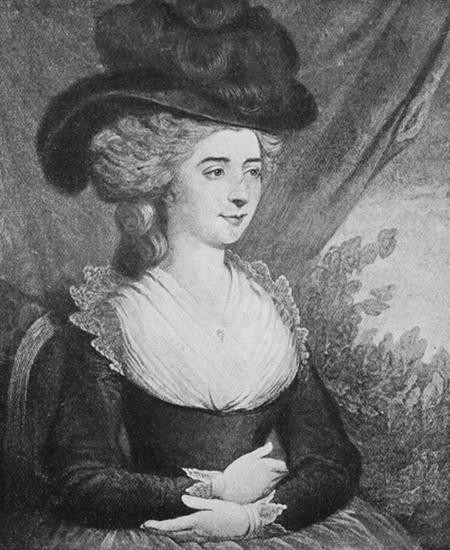
MISS BURNEY (MADAME D’ARBLAY)
Jane Austen seems to have been also as far ahead of her time in the use of simple direct English as she was in construction and effect. She is at least a generation in advance of average contemporary letters and journals, in which the phrasing is often ponderous; the sonorous roll of heavily-weighted sentences in the Johnsonian style, then so much admired, does not ever seem to have occurred to her.
Yet even in her lively, crisp narration there are a few phrases that strike on a modern ear as unaccustomed. Such is the use of the active for the passive tense, “tea was carrying round”; the elision of the final “n” in the infinitive, “but she said he seemed very angry at being spoke to”; the use of adjectives for adverbs (often reproved as a form of slang in the present day), “she must feel she has been acting wrong.” The general use of men’s surnames by women occurs in the earlier books, but we see an indication of change in this respect in the passage of Jane’s lifetime, for in Emma it is considered vulgar of Mrs. Elton to address Mr. Knightley without the prefix. There are little ways of expressing things that are not now in vogue, men are “gentlemanlike,” ladies “amiable,” also “genteel and elegant”; one phrase which has now descended to the realm of the lady’s-maid was then quite good English, “so peculiarly the lady in it.” “Excessively” takes the place of our “awfully,” we hear continually such expressions as “monstrous obliging,” “prodigious pretty,” and “vastly civil.”
We have not hitherto noticed Miss Edgeworth’s, Miss Ferrier’s, or Miss Mitford’s work, though they are generally considered as belonging to the clever group of women writers who illumined the end of the eighteenth and beginning of the nineteenth centuries, because in this chapter we are dealing only with Jane Austen’s own novels, not with contemporary writers except as they affected her, and at the time when she wrote her first books none of these writers had published anything, and could not therefore possibly have influenced her. Miss Edgeworth’s first novel, Castle Rackrent, came out in 1800, and Miss Ferrier’s Marriage in 1818, after Jane was in her grave.
Jane Austen’s own novels were written at such widely differing times, and the interval between writing and publication was so great in some cases, that the subject suffers from some confusion in the minds of those who have not looked into the question closely. As the order of writing is everything, and the order of publication a mere accident, we will take them as they were written. This was in two groups of three each. Pride and Prejudice was begun in October 1796 and finished the following August; Sense and Sensibility was begun in 1797 and finished in 1798, in which year Northanger Abbey was also written. Then there was a long gap, in which she produced only a fragment to be noted hereafter, and not until 1812 was Mansfield Park written; four years later, in 1816, came Emma, quickly followed by Persuasion. Of all these the first to be published was Sense and Sensibility in 1811, and the dates of publication will thereafter be noted in chronological order in the book as it progresses.
Besides these two distinct groups of three novels each, there is another of the unfinished fragments, which never became real stories. These consist of Lady Susan, a comedy in the form of letters, which is ended up hastily with a few paragraphs of explanation; and The Watsons, an unfinished tale, of which the end was told by Cassandra Austen from remarks that her sister had made. Both of these are included, as has been said, in Mr. Austen-Leigh’s Memoir, and it seems a pity that they should not form a volume in one of the neat series of Jane Austen’s novels now published, as to a real Austenite they contain much that is valuable, and are full of characteristic touches. Of the complete novels Pride and Prejudice is admittedly the best; there are several candidates for the second place, but the superiority of Pride and Prejudice is unquestioned. It was the earliest of the books written, under the title First Impressions, and as such it is referred to in Jane’s correspondence: “I do not wonder at your wanting to read First Impressions again, so seldom as you have gone through it, and that so long ago;” this was to her sister in 1799, and later on she adds, with the playfulness never long wanting, “I would not let Martha read First Impressions again upon any account, and am very glad I did not leave it in your power. She is very cunning, but I saw through her design, she means to publish it from memory, and one more perusal must enable her to do it.”
There has been great diversity of opinion as to the relative merit of the remaining books, but the concensus of opinion seems to declare for Emma, the last but one in point of time, which shows that the author’s genius had not abated. This book is totally different from the first, it lacks the sparkle and verve which runs all through Pride and Prejudice, but it has perhaps more depth and is something softer and more finished also.
These two books, and all the others, will be dealt with in detail as they occur chronologically, for we are here only attempting to treat them generally, and to bring out those characteristics and excellencies common to all which made them such masterpieces, and gave their maker such a unique place in the hierarchy of authors.
Jane Austen is one of the three greatest among English women novelists; the other two being, of course, George Eliot and Charlotte Brontë, whose lives overlapped at a much later date. The genius of these three women is so entirely different in kind that the relative value of their gifts can never be put into like terms; so long as men and women read and discuss fiction, so long will each of the three styles have its partisans who will argue it to be the supreme one of the trio. Yet in spite of this, in spite also of a momentary fashion to decry the wonderful gifts of George Eliot, it is quite certain that in depth and breadth of feeling, and ability in its portrayal, she was unequalled by either her predecessor or contemporary. Her range far surpasses theirs. They each dealt with one phase of life or feeling: Jane Austen with English village life, Charlotte Brontë with the element of passion in man and woman, while George Eliot’s works embrace many varieties of human nature and action. If her detractors are questioned, it will commonly be found that they do not deny her ability or her brain power, but her genius, which is of course a totally distinct thing. On further probing of the matter, it is usually discovered that the contention is based on the later works, such as Middlemarch or Daniel Deronda. To be quite fair, there are some appearances in these volumes to justify such an estimate, but the mistake is that the opinion is superficial and based on appearance only. In her later days George Eliot’s tremendous ability, tremendous soul,—and tremendous is the only English word that can be fitly applied to it,—made her see so far round and over her own work, as well as allowing her such a wide survey as to the causes and nature of things, that even the productions of her genius were analysed, curbed, and held in channels. She could not let herself go; her subtle insight, her complete knowledge of her characters, made her qualify and account for their actions, perhaps more for her own satisfaction than for that of readers. She might safely have left this to her innate perception without fear, her genius would never have let her go wrong, but she could not, she must analyse even her own creations. No one in the world was more free from this tendency than Jane Austen, she was perfectly unconscious of her own mastery of her subject, as unconscious as the bee when it rejects all other shapes in its cells for the hexagonal. The marvellous precision with which she selected and rejected and grouped her puppets was almost a matter of instinct. She put in the little touches which revealed what was in the mind of her men and women without premeditation or any striving. It is the perfection of this gift which allows her books to be read again and again, for once the story is known, all the slight indications of its ultimate ending, which may have been overlooked while the reader is not in the secret, stand out vividly. We grant to George Eliot’s detractors that in her later works her eyes were opened, and she analysed the work of her genius instead of writing spontaneously, but to her true admirers the genius is still there, though curbed and trammelled.
Every one of her men and women to the last are breathing human beings. Having granted, however, so much, we turn to the earlier works, which, amazing to say, are so often overlooked; here her gallery is full of realities, not analysed or thwarted, but moving as impelled by nature. Was there ever a boy-brother and girl-sister in all fiction to equal Tom and Maggie Tulliver? And what of that inimitable trio, Sisters Glegg and Tulliver and Pullet? Of its kind is there a scene that can beat Bob Jakin’s twisting Mrs. Glegg round his finger with judicious management? And these are from the abundance of one book only. No, Jane cannot dispute precedence with George Eliot, but must yield the palm; her characters, true and admirable as they are, lack that living depth which George Eliot had the power to impart. But the two are so totally different that it is difficult to find any simile that will bring them into relation with one another. Perhaps the most expressive is that of instrumental music: Jane Austen’s clear notes are like those which a skilful performer extracts from a good harp, sweet and ringing, always pleasant to listen to, and restful, but not soul stirring; while George Eliot’s tones are like the deep notes of a violoncello, stirring up the heart to its core, and leaving behind them feeling even after the sound has ceased. The novels of Jane Austen were novels of character and manners, those of George Eliot of feeling. There is no intention in this comparison to minimise in any way the work of the earlier writer, she chose her style, and of its kind it is perfect; her subtle touches could only have been the result of the intuition which is genius, but the profounder emotions, the slow development of character by friction with those around, she did not attempt to depict.
We now turn to the third of the great trio. Charlotte Brontë’s gift was a rush of strenuous passion that made her stories pour forth living and molten as from the furnace. Her best characters are admirable, but limited in number; we find the same timid heroine, who outwardly was herself, and inwardly was full of force and passion, appearing in more than one.
Charlotte’s bitter indictment of Jane’s work, though wholly untrue, can be made allowance for, seeing that her eyes viewed such a different section of the world of feeling. She says of Pride and Prejudice: “An accurate daguerreotyped portrait of a commonplace face; a carefully fenced, highly cultured garden, with neat borders and delicate flowers, but no glance of a bright vivid physiognomy, no open country, no fresh air, no blue hill, no bonny beck.” And at another time, with much truth: “The passions are perfectly unknown to her; she rejects even a speaking acquaintance with that stormy sisterhood. What sees keenly, speaks aptly, moves flexibly, it suits her to study; but what throbs fast and full, though hidden, what the blood rushes through, what is the unseen seat of life, and the sentient target of death, this Miss Austen ignores.”
Charlotte Brontë’s own strongest point is her story, and as the teller of an interesting story, absorbing in its wild and strenuous action, she ranks very high, but character-drawing is not her forte. She herself fails in the point of which she accuses Jane, she could photograph those persons she knew intimately,—herself for instance, or her father’s curates,—but directly she went beyond, she failed; what could be weaker than the society people in Jane Eyre,—the ringletted Blanche and the wooden young men?
A great many of her minor characters are mere dummies who do not remain in the mind at all. But one of her strong points is one entirely ignored by Jane, and that is the impression of scenery and the aspects of weather. Which of us has not felt a chill of desolation as he stood in fancy on the wet gravel-path leading up to Lowood? or not been sensible of the exhilaration of that sharp, clear, frosty night when Jane first encountered Mr. Rochester in the lane? In a few words, very few, Charlotte Brontë has a marvellous capability for making one feel the surroundings of her characters, and this is no mean gift. Adherents she will always have, and to them it may be granted that her whole theme was one totally ignored by Jane, whose men and women are swept by no mighty whirlwinds of their own generating. In fact it has been alleged against Jane that she had neither passion nor pathos, and perhaps, if we except one or two touches of the latter quality in dealing with forlorn little Fanny in Mansfield Park, this is true. The only simile that occurs as suitable to use in the comparison between Charlotte and Jane is that the soul of the one was like the turbulent rush of her own brown Yorkshire streams over the wild moorlands—streams which pour in cataracts and shatter themselves on great grey stones in a tumultuous frenzy, while that of the other resembled the calm limpid waters of her own Hampshire river, the Itchen, wending its way placidly between luscious green meadows.