


Онлайн кітапты тегін оқу South! The Story of Shackleton's Last Expedition, 1914-1917
SOUTH
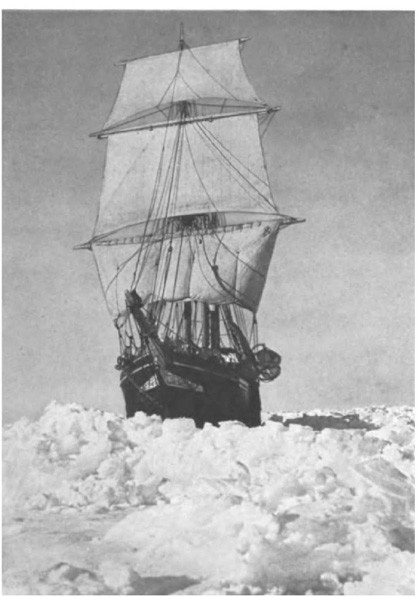
IN THE PRIDE OF HER YOUTH
Color photograph by F. Hurley.
SOUTH
SHACKLETON’S ENDURANCE EXPEDITION
BY SIR ERNEST SHACKLETON
TO
MY COMRADES
WHO FELL IN THE WHITE WARFARE OF THE SOUTH AND ON THE RED FIELDS OF FRANCE AND FLANDERS
PREFACE
AFTER the conquest of the South Pole by Amundsen who, by a narrow margin of days only, was in advance of the British Expedition under Scott, there remained but one great main object of Antarctic journeyings — the crossing of the South Polar continent from sea to sea.
When I returned from the Nimrod Expedition on which we had to turn back from our attempt to plant the British flag on the South Pole, being beaten by stress of circumstances within ninety-seven miles of our goal, my mind turned to the crossing of the continent, for I was morally certain that either Amundsen or Scott would reach the Pole on our own route or a parallel one. After hearing of the Norwegian’s success I began to make preparations to start a last great journey — so that the first crossing of the last continent should be achieved by a British Expedition.
We failed in this object, but the story of our attempt is the subject for the following pages, and I think that though failure in the actual accomplishment must be recorded, there are chapters in this book of high adventure, strenuous days, lonely nights, unique experiences, and, above all, records of unflinching determination, supreme loyalty, and generous self-sacrifice on the part of my men which, even in these days that have witnessed the sacrifices of nations and regardlessness of self on the part of individuals, still will be of interest to readers who now turn gladly from the red horror of war and the strain of the last five years to read, perhaps with more understanding minds, the tale of the White Warfare of the South. The struggles, the disappointments, and the endurance of this small party of Britishers, hidden away for nearly two years in the fastnesses of the Polar ice, striving to carry out the ordained task and ignorant of the crisis through which the world was passing, make a story which is unique in the history of Antarctic exploration.
Owing to the loss of the Endurance and the disaster to the Aurora, certain documents relating mainly to the organization and preparation of the Expedition have been lost; but, anyhow, I had no intention of presenting a detailed account of the scheme of preparation, storing, and other necessary but, to the general reader, unimportant affairs, as since the beginning of this century every book on Antarctic exploration has dealt fully with this matter. I therefore briefly place before you the inception and organization of the Expedition, and insert here the copy of the programme which I prepared in order to arouse the interest of the general public in the Expedition.
The Trans-continental Party.
The first crossing of the Antarctic Continent, from sea to sea via the Pole, apart from its historic value, will be a journey of great scientific importance.
The distance will be roughly 1800 miles, and the first half of this, from the Weddell Sea to the Pole, will be over unknown ground. Every step will be an advance in geographical science. It will be learned whether the great Victoria chain of mountains, which has been traced from the Ross Sea to the Pole, extends across the continent and thus links up (except for the ocean break) with the Andes of South America, and whether the great plateau around the Pole dips gradually towards the Weddell Sea.
Continuous magnetic observations will be taken on the journey. The route will lead towards the Magnetic Pole, and the determination of the dip of the magnetic needle will be of importance in practical magnetism. The meteorological conditions will be carefully noted, and this should help to solve many of our weather problems.
The glaciologist and geologist will study ice formations and the nature of the mountains, and this report will prove of great scientific interest.
Scientific Work by Other Parties.
While the Trans-continental party is carrying out, for the British flag, the greatest Polar journey ever attempted, the other parties will be engaged in important scientific work.
Two sledging parties will operate from the base on the Weddell Sea, One will travel westward towards Graham Land, making observations, collecting geological specimens, and proving whether there are mountains in that region linked up with those found on the other side of the Pole.
Another party will travel eastward toward Enderby Land, carrying out a similar programme, and a third, remaining at the base, will study the fauna of the land and sea, and the meteorological conditions.
From the Ross Sea base, on the other side of the Pole, another party will push southward and will probably await the arrival of the Trans-continental party at the top of the Beardmore Glacier, near Mount Buckley, where the first seams of coal were discovered in the Antarctic. This region is of great importance to the geologist, who will be enabled to read much of the history of the Antarctic in the rocks.
Both the ships of the Expedition will be equipped for dredging, sounding, and every variety of hydrographical work. The Weddell Sea ship will endeavour to trace the unknown coast-line of Graham Land, and from both the vessels, with their scientific staffs, important results may be expected.
The several shore parties and the two ships will thus carry out geographical and scientific work on a scale and over an area never before attempted by any one Polar expedition.
This will be the first use of the Weddell Sea as a base for exploration, and all the parties will open up vast stretches of unknown land. It is appropriate that this work should be carried out under the British flag, since the whole of the area southward to the Pole is British territory. In July, 1908, Letters Patent were issued under the Great Seal, declaring that the Governor of the Falkland Islands should be the Governor of Graham Land (which forms the western side of the Weddell Sea), and another section of the same proclamation defines the area of British territory as “situated in the South Atlantic Ocean to the south of the 50th parallel of south latitude, and lying between 20 degrees and 80 degrees west longitude.” Reference to a map will show that this includes the area in which the present Expedition will work.
How the Continent will be Crossed,
The Weddell Sea ship, with all the members of the Expedition operating from that base, will leave Buenos Ayres in October, 1914, and endeavour to land in November in latitude 78 degrees south.
Should this be done, the Trans-continental party will set out on their 1800-mile journey at once, in the hope of accomplishing the march across the Pole and reaching the Ross Sea base in five months. Should the landing be made too late in the season, the party will go into winter quarters, lay out depots during the autumn and the following spring, and as early as possible in 1915 set out on the journey.
The Trans-continental party will be led by Sir Ernest Shackleton, and will consist of six men. It will take 100 dogs with sledges, and two motor sledges with aerial propellers. The equipment will embody everything that the experience of the leader and his expert advisers can suggest. When this party has reached the area of the Pole, after covering 800 miles of unknown ground, it will strike due north towards the head of the Beardmore Glacier, and there it is hoped to meet the outcoming party from the Ross Sea. Both will join up and make for the Ross Sea base, where the previous Expedition had its winter quarters.
In all, fourteen men will be landed by the Endurance on the Weddell Sea. Six will set out on the Trans-continental journey, three will go westward, three eastward, and two remain at the base carrying on the work already outlined.
The Aurora will land six men at the Ross Sea base. They will lay down depots on the route of the Trans-continental party, and make a march south to assist that party, and to make geological and other observations as already described.
Should the Trans-continental party succeed, as is hoped, in crossing during the first season, its return to civilization may be expected about April, 1915. The other sections in April, 1916.
The Ships of the Expedition.
The two ships for the Expedition have now been selected.
The Endurance, the ship which will take the Trans-continental party to the Weddell Sea, and will afterwards explore along an unknown coast-line, is a new vessel, specially constructed for Polar work under the supervision of a committee of Polar explorers. She was built by Christensen, the famous Norwegian constructor of sealing vessels, at Sandefjord. She is barquentine rigged, and has triple-expansion engines giving her a speed under steam of 9 to 10 knots. To enable her to stay longer at sea, she will carry oil fuel as well as coal. She is of about 350 tons, and built of selected pine, oak, and greenheart. This fine vessel, equipped, has cost the Expedition £14,000.
The Aurora, the ship which will take out the Ross Sea party, has been bought from Dr. Mawson. She is similar in all respects to the Terra Nova, of Captain Scott’s last Expedition. She had extensive alterations made by the Government authorities in Australia to fit her for Dr. Mawson’s Expedition, and is now at Hobart, Tasmania, where the Boss Sea party will join her in October next.
I started the preparations in the middle of 1913, but no public announcement was made until January 13, 1914. For the last six months of 1913 I was engaged in the necessary preliminaries, solid mule work, showing nothing particular to interest the public, but essential for an Expedition that had to have a ship on each side of the Continent, with a land journey of eighteen hundred miles to be made, the first nine hundred miles to be across an absolutely unknown land mass.
On January 1, 1914, having received a promised financial support sufficient to warrant the announcement of the Expedition, I made it public.
The first result of this was a flood of applications from all classes of the community to join the adventure. I received nearly five thousand applications, and out of these were picked fifty-six men.
In March, to my great disappointment and anxiety, the promised financial help did not materialize, and I was now faced with the fact that I had contracted for a ship and stores, and had engaged the staff, and I was not in possession of funds to meet these liabilities. I immediately set about appealing for help, and met with generous response from all sides. I cannot here give the names of all who supported my application, but whilst taking this opportunity of thanking everyone for their support, which came from parts as far apart as the interior of China, Japan, New Zealand, and Australia, I must particularly refer to the munificent donation of £24,000 from the late Sir James Caird, and to one of £10,000 from the British Government. I must also thank Mr. Dudley Docker, who enabled me to complete the purchase of the Endurance, and Miss Elizabeth Dawson Lambton, who since 1901 has always been a firm friend to Antarctic exploration, and who again, on this occasion, assisted largely. The Royal Geographical Society made a grant of £1000; and last, but by no means least, I take this opportunity of tendering my grateful thanks to Dame Janet Stancomb-Wills, whose generosity enabled me to equip the Endurance efficiently, especially as regards boats (which boats were the means of our ultimate safety), and who not only, at the inception of the Expedition, gave financial help, but also continued it through the dark days when we were overdue, and funds were required to meet the need of the dependents of the Expedition.
The only return and privilege an explorer has in the way of acknowledgment for the help accorded him is to record on the discovered lands the names of those to whom the Expedition owes its being.
Owing to the exigences of the war the publication of this book has been long delayed, and the detailed maps must come with the scientific monographs; I have the honour to place on the new land the names of the above and other generous donors to the Expedition. The two hundred miles of new coast-line I have called Caird Coast. Also, as a more personal note, I named the three ship’s boats, in which we ultimately escaped from the grip of the ice after the three principal donors to the Expedition — the James Caird, the Stancomb-Wills, and the Dudley Docker. The two last-named are still on the desolate, sandy spit of Elephant Island, where under their shelter twenty-two of my comrades eked out a bare existence for four and a half months.
The James Caird is now in Liverpool, having been brought home from South Georgia after her adventurous voyage across the sub-Antarctic Ocean.
Most of the Public Schools of England and Scotland helped the Expedition to purchase the dog teams, and I named a dog after each school that helped. But apart from these particular donations I again thank the many people who assisted us.
So the equipment and organization went on. I purchased the Aurora from Sir Douglas Mawson, and arranged for Mackintosh to go to Australia and take charge of her, there sending sledges, equipment, and most of the stores from this side, but depending somewhat on the sympathy and help of Australia and New Zealand for coal and certain other necessities, knowing that previously these two countries had always generously supported the exploration of what one might call their hinterland.
Towards the end of July all was ready, when suddenly the war clouds darkened over Europe.
It had been arranged for the Endurance to proceed to Cowes, to be inspected by His Majesty on the Monday of Cowes week. But on Friday I received a message to say that the King would not be able to go to Cowes. My readers will remember how suddenly came the menace of war. Naturally both my comrades and I were greatly exercised as to the probable outcome of the danger threatening the peace of the world.
We sailed from London on Friday, August 1, 1914, and anchored off Southend all Saturday. On Sunday afternoon I took the ship off Margate, growing hourly more anxious as the ever-increasing rumours spread; and on Monday morning I went ashore and read in the morning paper the order for general mobilization.
I immediately went on board and mustered all hands and told them that I proposed to send a telegram to the Admiralty offering the ships, stores, and, if they agreed, our own services to the country in the event of war breaking out. All hands immediately agreed, and I sent off a telegram in which everything was placed at the disposal of the Admiralty. We only asked that, in the event of the declaration of war, the Expedition might be considered as a single unit, so as to preserve its homogeneity. There were enough trained and experienced men amongst us to man a destroyer. Within an hour I received a laconic wire from the Admiralty saying “Proceed.” Within two hours a longer wire came from Mr. Winston Churchill, in which we were thanked for our offer, and saying that the authorities desired that the Expedition, which had the full sanction and support of the Scientific and Geographical Societies, should go on.
So, according to these definite instructions, the Endurance sailed to Plymouth. On Tuesday the King sent for me and handed me the Union Jack to carry on the Expedition. That night, at midnight, war broke out. On the following Saturday, August 8, the Endurance sailed from Plymouth, obeying the direct orders of the Admiralty. I make particular reference to this phase of the Expedition as I am aware that there was a certain amount of criticism of the Expedition having left the country, and regarding this I wish further to add that the preparation of the Expedition had been proceeding for over a year, and large sums of money had been spent. We offered to give the Expedition up without even consulting the donors of this money, and but few thought that the war would last through these five years and involve the whole world. The Expedition was not going on a peaceful cruise to the South Sea Islands, but to a most dangerous, difficult, and strenuous work that has nearly always involved a certain percentage of loss of life. Finally, when the Expedition did return, practically the whole of those members who had come unscathed through the dangers of the Antarctic took their places in the wider field of battle, and the percentage of casualties amongst the members of this Expedition is high.
The voyage out to Buenos Ayres was uneventful, and on October 26 we sailed from that port for South Georgia, the most southerly outpost of the British Empire. Here, for a month, we were engaged in final preparation. The last we heard of the war was when we left Buenos Ayres. Then the Russian Steam-Roller was advancing. According to many the war would be over within six months. And so we left, not without regret that we could not take our place there, but secure in the knowledge that we were taking part in a strenuous campaign for the credit of our country.
Apart from private individuals and societies I here acknowledge most gratefully the assistance rendered by the Dominion Government of New Zealand and the Commonwealth Government of Australia at the start of the Ross Sea section of the Expedition, and to the people of New Zealand and the Dominion Government I tender my most grateful thanks for their continued help which was invaluable during the dark days before the relief of the Ross Sea party.
I tender my most grateful thanks to Mr. James Allen (acting Premier), the late Mr. McNab (Minister of Marine), Mr. Leonard Tripp, Mr. Mabin, and Mr. Toogood, and many others who have laid me under a debt of gratitude that can never be repaid. Sir Daniel Gooch came with us as far as South Georgia. I owe him my special thanks for his help with the dogs, and we all regretted losing his cheery presence when we sailed for the South.
This is also the opportunity for me to thank the Uruguayan Government for their generous assistance in placing the government trawler, Instituto de Pesca, for the second attempt at the relief of my men on Elephant Island.
Finally, it was the Chilian Government that was directly responsible for the rescue of my comrades. This southern Republic was unwearied in their efforts to make a successful rescue, and the gratitude of our whole party is due to them. I especially mention the sympathetic attitude of Admiral Muñoz Hurtado, head of the Chilian Navy, and Captain Luis Pardo, who commanded the Yelcho on our last and successful venture.
CROSSING THE SOUTH POLE
CHAPTER I
INTO THE WEDDELL SEA
I HAD decided to leave South Georgia about December 5, and in the intervals of final preparation scanned again the plans for the voyage to winter quarters. What welcome was the Weddell Sea preparing for us? The whaling captains at South Georgia were generously ready to share with me their knowledge of the waters in which they pursued their trade, and, while confirming earlier information as to the extreme severity of the ice conditions in this sector of the Antarctic, they were able to give advice that was worth attention.
It will be convenient to state here briefly some of the considerations that weighed with me at that time and in the weeks that followed. I knew that the ice had come far north that season, and, after listening to the suggestions of the whaling captains, had decided to steer to the South Sandwich Group, round Ultima Thule, and work as far to the eastward as the fifteenth meridian west longitude before pushing south. The whalers emphasized the difficulty of getting through the ice in the neighbourhood of the South Sandwich Group. They told me they had often seen the floes come right up to the Group in the summer-time, and they thought the Expedition would have to push through heavy pack in order to reach the Weddell Sea. Probably the best time to get into the Weddell Sea would be the end of February or the beginning of March. The whalers had gone right round the South Sandwich Group and they were familiar with the conditions. The predictions they made had induced me to take the deck-load of coal, for if we had to fight our way through to Coats’ Land we would need every ton of fuel the ship could carry.
I hoped that by first moving to the east as far as the fifteenth meridian west we would be able to go south through looser ice, pick up Coats’ Land and finally reach Vahsel Bay, where Filchner made his attempt at landing in 1912. Two considerations were occupying my mind at this juncture. I was anxious for certain reasons to winter the Endurance in the Weddell Sea, but the difficulty of finding a safe harbour might be very great. If no safe harbour could be found, the ship must winter at South Georgia. It seemed to me hopeless now to think of making the journey across the continent in the first summer, as the season was far advanced and the ice conditions were likely to prove unfavourable. In view of the possibility of wintering the ship in the ice, we took extra clothing from the stores at the various stations in South Georgia.
The other question that was giving me anxious thought was the size of the shore party. If the ship had to go out during the winter, or if she broke away from winter quarters, it would be preferable to have only a small, carefully selected party of men ashore after the hut had been built and the stores landed. These men could proceed to lay out depots by man-haulage and make short journeys with the dogs, training them for the long early march in the following spring. The majority of the scientific men would live aboard the ship, where they could do their work under good conditions. They would be able to make short journeys, if required, using the Endurance as a base. All these plans were based on an expectation that the finding of winter quarters was likely to be difficult. If a really safe base could be established on the continent, I would adhere to the original programme of sending one party to the south, one to the west round the head of the Weddell Sea towards Graham Land, and one to the east towards Enderby Land.
We had worked out details of distances, courses, stores required, and so forth. Our sledging ration, the result of experience as well as close study, was perfect. The dogs gave promise, after training, of being able to cover fifteen to twenty miles a day with loaded sledges. The trans-continental journey, at this rate, should be completed in 120 days unless some unforeseen obstacle intervened. We longed keenly for the day when we could begin this march, the last great adventure in the history of South Polar exploration, but a knowledge of the obstacles that lay between us and our starting-point served as a curb on impatience. Everything depended upon the landing. If we could land at Filchner’s base there was no reason why a band of experienced men should not winter there in safety. But the Weddell Sea was notoriously inhospitable, and already we knew that its sternest face was turned towards us. All the conditions in the Weddell Sea are unfavourable from the navigator’s point of view. The winds are comparatively light, and consequently new ice can form even in the summer-time. The absence of strong winds has the additional effect of allowing the ice to accumulate in masses, undisturbed. Then great quantities of ice sweep along the coast from the east under the influence of the prevailing current, and fill up the bight of the Weddell Sea as they move north in a great semicircle. Some of this ice doubtless describes almost a complete circle, and is held up eventually, in bad seasons, against the South Sandwich Islands. The strong currents, pressing the ice masses against the coasts, create heavier pressure than is found in any other part of the Antarctic. This pressure must be at least as severe as the pressure experienced in the congested North Polar basin, and I am inclined to think that a comparison would be to the advantage of the Arctic. All these considerations naturally had a bearing upon our immediate problem, the penetration of the pack and the finding of a safe harbour on the continental coast.
The day of departure arrived. I gave the order to heave anchor at 8.45 a.m. on December 5, 1914, and the clanking of the windlass broke for us the last link with civilization. The morning was dull and overcast, with occasional gusts of snow and sleet, but hearts were light aboard the Endurance. The long days of preparation were over and the adventure lay ahead.
We had hoped that some steamer from the north would bring news of the war and perhaps letters from home before our departure. A ship did arrive on the evening of the 4th, but she carried no letters, and nothing useful in the way of information could be gleaned from her. The captain and crew were all stoutly pro-German, and the “news” they had to give took the unsatisfying form of accounts of British and French reverses. We would have been glad to have had the latest tidings from a friendlier source. A year and a half later we were to learn that the Harpoon, the steamer which tends the Grytviken station, had arrived with mail for us not more than two hours after the Endurance had proceeded down the coast.
The bows of the Endurance were turned to the south, and the good ship dipped to the south-westerly swell. Misty rain fell during the forenoon, but the weather cleared later in the day, and we had a good view of the coast of South Georgia as we moved under steam and sail to the south-east. The course was laid to carry us clear of the island and then south of South Thule, Sandwich Group. The wind freshened during the day, and all square sail was set, with the foresail reefed in order to give the look-out a clear view ahead; for we did not wish to risk contact with a “growler,” one of those treacherous fragments of ice that float with surface awash. The ship was very steady in the quarterly sea, but certainly did not look as neat and trim as she had done when leaving the shores of England four months earlier. We had ailed up with coal at Grytviken, and this extra fuel was stored on deck, where it impeded movement considerably. The carpenter had built a false deck, extending from the poop-deck to the chart-room. We had also taken aboard a ton of whale-meat for the dogs. The big chunks of meat were hung up in the rigging, out of reach but not out of sight of the dogs, and as the Endurance rolled and pitched, they watched with wolfish eyes for a windfall.
I was greatly pleased with the dogs, which were tethered about the ship in the most comfortable positions we could find for them. They were in excellent condition, and I felt that the expedition had the right tractive-power. They were big, sturdy animals, chosen for endurance and strength, and if they were as keen to pull our sledges as they were now to fight one another all would be well. The men in charge of the dogs were doing their work enthusiastically, and the eagerness they showed to study the natures and habits of their charges gave promise of efficient handling and good work later on.
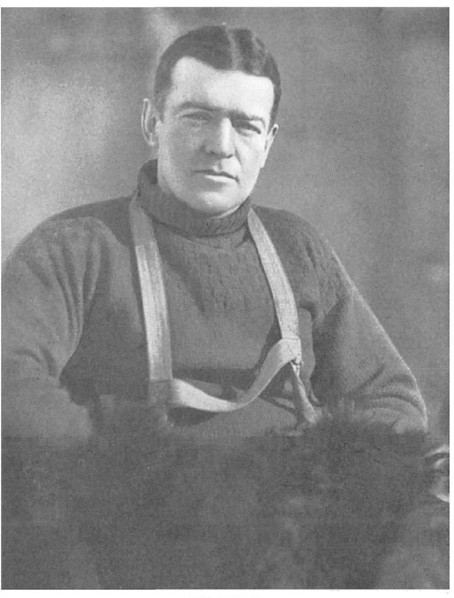
THE LEADER
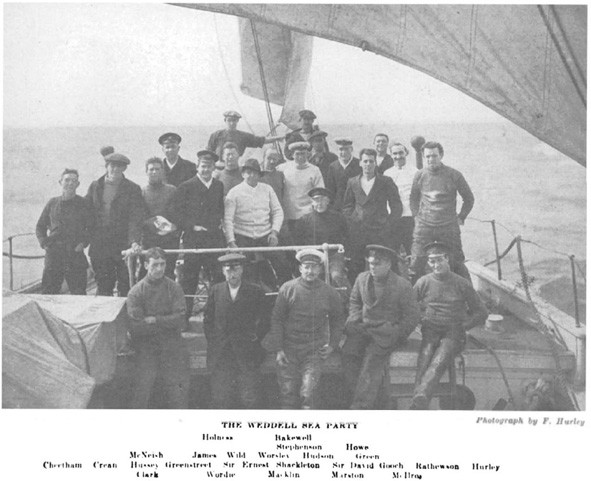
During December 6 the Endurance made good progress on a south-easterly course. The northerly breeze had freshened during the night and had brought up a high following sea. The weather was hazy, and we passed two bergs, several growlers, and numerous lumps of ice. Staff and crew were settling down to the routine. Bird life was plentiful, and we noticed Cape pigeons, whale-birds, terns, mollymauks, nellies, sooty, and wandering albatrosses in the neighbourhood of the ship. The course was laid for the passage between Sanders Island and Candlemas Volcano. December 7 brought the first check. At six o’clock that morning the sea, which had been green in colour all the previous day, changed suddenly to a deep indigo. The ship was behaving well in a rough sea, and some members of the scientific staff were transferring to the bunkers the coal we had stowed on deck. Sanders Island and Candlemas were sighted early in the afternoon, and the Endurance passed between them at 6 p.m. Worsley’s observations indicated that Sanders Island was, roughly, three miles east and five miles north of the charted position. Large numbers of bergs, mostly tabular in form, lay to the west of the islands, and we noticed that many of them were yellow with diatoms. One berg had large patches of red-brown soil down its sides. The presence of so many bergs was ominous, and immediately after passing between the islands we encountered stream-ice. All sail was taken in and we proceeded slowly under steam. Two hours later, fifteen miles north-east of Sanders Island, the Endurance was confronted by a belt of heavy pack-ice, half a mile broad and extending north and south. There was clear water beyond, but the heavy south-westerly swell made the pack impenetrable in our neighbourhood. This was disconcerting. The noon latitude had been 57° 26’ S., and I had not expected to find pack-ice nearly so far north, though the whalers had reported pack right up to South Thule.
The situation became dangerous that night. We pushed into the pack in the hope of reaching open water beyond, and found ourselves after dark in a pool which was growing smaller and smaller. The ice was grinding around the ship in the heavy swell, and I watched with some anxiety for any indication of a change of wind to the east, since a breeze from that quarter would have driven us towards the land. Worsley and I were on deck all night, dodging the pack. At 3 a.m. we ran south, taking advantage of some openings that had appeared, hut met heavy rafted pack-ice, evidently old; some of it had been subjected to severe pressure. Then we steamed north-west and saw open water to the north-east I put the Endurance’s head for the opening, and, steaming at full speed, we got clear. Then we went east in the hope of getting better ice, and five hours later, after some dodging, we rounded the pack and were able to set sail once more. This initial tussle with the pack had been exciting at times. Pieces of ice and bergs of all sizes were heaving and jostling against each other in the heavy south-westerly swell. In spite of all our care the Endurance struck large lumps stem on, but the engines were stopped in time and no harm was done. The scene and sounds throughout the day were very fine. The swell was dashing against the sides of huge bergs and leaping right to the top of their icy cliffs. Sanders Island lay to the south, with a few rocky faces peering through the misty, swirling clouds that swathed it most of the time, the booming of the sea running into ice caverns, the swishing break of the swell on the loose pack, and the graceful bowing and undulating of the inner pack to the steeply rolling swell, which here was robbed of its break by the masses of ice to windward.
We skirted the northern edge of the pack in clear weather with a light south-westerly breeze and an overcast sky. The bergs were numerous. During the morning of December 9 an easterly breeze brought hazy weather with snow, and at 4.30 p.m. we encountered the edge of pack-ice in lat. 58° 27’ S., long. 22° 08’ W. It was one-year-old ice interspersed with older pack, all heavily snow-covered and lying west-south-west to east-north-east. We entered the pack at 5 p.m., hut could not make progress, and cleared it again at 7.40 p.m. Then we steered east-north-east and spent the rest of the night rounding the pack. During the day we had seen adelie and ringed penguins, also several humpback and firmer whales. An ice-blink to the westward indicated the presence of pack in that direction. After rounding the pack we steered S. 40° E., and at noon on the 10th had reached lat 58° 28’ S., long. 20° 28’ W. Observations showed the compass variation to be 1½° less than the chart recorded. I kept the Endurance on the course till midnight, when we entered loose open ice about ninety miles south-east of our noon position. This ice proved to fringe the pack, and progress became slow. There was a long easterly swell with a light northerly breeze, and the weather was clear and fine. Numerous bergs lay outside the pack.
The Endurance steamed through loose open ice till 8 a.m. on the 11th, when we entered the pack in lat. 59° 46’ S., long. 18° 22’ W. We could have gone further east, but the pack extended far in that direction, and an effort to circle it might have involved a lot of northing. I did not wish to lose the benefit of the original southing. The extra miles would not have mattered to a ship with larger coal capacity than the Endurance possessed, but we could not afford to sacrifice miles unnecessarily. The pack was loose and did not present great difficulties at this stage. The foresail was set in order to take advantage of the northerly breeze. The ship was in contact with the ice occasionally and received some heavy blows. Once or twice she was brought up all standing against solid pieces, but no harm was done. The chief concern was to protect the propeller and rudder. If a collision seemed to be inevitable the officer in charge would order “slow” or “half speed” with the engines, and put the helm over so as to strike the floe a glancing blow. Then the helm would be put over towards the ice with the object of throwing the propeller clear of it, and the ship would forge ahead again. Worsley, Wild, and I, with three officers, kept three watches while we were working through the pack, so that we had two officers on deck all the time. The carpenter had rigged a six-foot wooden semaphore on the bridge to enable the navigating officer to give the seamen or scientists at the wheel the direction and the exact amount of helm required. This device saved time as well as the effort of shouting. We were pushing through this loose pack all day, and the view from the crow’s-nest gave no promise of improved conditions ahead. A Weddell seal and a crab-eater seal were noticed on the floes, but we did not pause to secure fresh meat. It was important that we should make progress towards our goal as rapidly as possible, and there was reason to fear that we should have plenty of time to spare later on if the ice conditions continued to increase in severity.
On the morning of December 12 we were working through loose pack which later became thick in places. The sky was overcast and light snow was falling. I had all square sail set at 7 a.m. in order to take advantage of the northerly breeze, but it had to come in again five hours later when the wind hauled round to the west The noon position was lat. 60° 26’ S., long. 17° 58’ W., and the run for the twenty-four hours had been only 33 miles. The ice was still badly congested, and we were pushing through narrow leads and occasional openings with the floes often close abeam on either side. Antarctic, snow, and stormy petrels, fulmars, white-rumped terns, and adelies were around us. The quaint little penguins found the ship a cause of much apparent excitement and provided a lot of amusement aboard. One of the standing jokes was that all the adelies on the floe seemed to know Clark and, when he was at the wheel, rushed along as fast as their legs could carry them, yelling out “Clark! Clark!” and apparently very indignant and perturbed that he never waited for them or even answered them.
We found several good leads to the south in the evening, and continued to work southward throughout the night and the following day. The pack extended in all directions as far as the eye could reach. The noon observation showed the run for the twenty-four hours to be 54 miles, a satisfactory result under the conditions. Wild shot a young Boss seal on the floe, and we manœuvred the ship alongside. Hudson jumped down, bent a line on to the seal, and the pair of them were hauled up. The seal was 4 ft. 9 in. long and weighed about ninety pounds. He was a young male and proved very good eating, but when dressed and minus the blubber made little more than a square meal for our twenty-eight men, with a few scnaps for our breakfast and tea. The stomach contained only amphipods about an inch long, allied to those found in the whales at Grytviken.
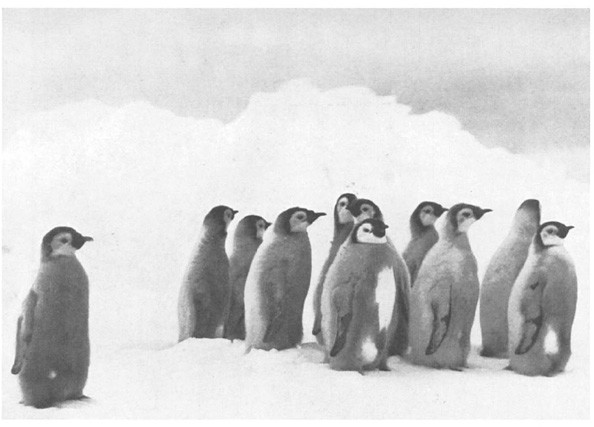
YOUNG EMPEROR PENGUINS
The conditions became harder on December 14. There was a misty haze, and occasional falls of snow. A few bergs were in sight. The pack was denser than it had been on the previous days. Older ice was intermingled with the young ice, and our progress) became slower. The propeller received several blows in the early morning, but no damage was done. A platform was rigged under the jibboom in order that Hurley might secure some kinematograph pictures of the ship breaking through the ice. The young ice did not present difficulties to the Endurance, which was able to smash a way through, but the lumps of older ice were more formidable obstacles, and conning the ship was a task requiring close attention. The most careful navigation could not prevent an occasional bump against ice too thick to be broken or pushed aside. The southerly breeze strengthened to a moderate south-westerly gale during the afternoon, and at 8 p.m. we hove to, stem against a floe, it being impossible to proceed without serious risk of damage to rudder or propeller. I was interested to notice that, although we had been steaming through the pack for three days, the north-westerly swell still held with us. It added to the difficulties of navigation in the lanes, since the ice was constantly in movement.
The Endurance remained against the floe for the next twenty-four hours, when the gale moderated. The pack extended to the horizon in all directions and was broken by innumerable narrow lanes. Many bergs were in sight, and they appeared to be travelling through the pack in a south-westerly direction under the current influence. Probably the pack itself was moving northeast with the gale. Clark put down a net in search of specimens, and at two fathoms it was carried south-west by the current and fouled the propeller. He lost the net, two leads, and a line. Ten bergs drove to the south through the pack during the twenty-four hours. The noon position was lat. 61° 31’ S., long. 18° 12’ W. The gale had moderated at 8 p.m., and we made five miles to the south before midnight and then stopped at the end of a long lead, waiting till the weather cleared. It was during this short run that the captain, with semaphore hard-a-port, shouted to the scientist at the wheel: “Why in Paradise don’t you port!” The answer came in indignant tones: “I am blowing my nose.”
The Endurance made some progress on the following day. Long leads of open water ran towards the south-west, and the ship smashed at full speed through occasional areas of young ice till brought up with a heavy thud against a section of older floe. Worsley was out on the jibboom end for a few minutes while Wild was conning the ship, and he came back with a glowing account of a novel sensation. The boom was swinging high and low and from side to side, while the massive bows of the ship smashed through the ice, splitting it across, piling it mass on mass and then shouldering it aside. The air temperature was 37° Fahr., pleasantly warm, and the water temperature 29° Fahr. We continued to advance through fine long leads till 4 a.m. on December 17, when the ice became difficult again. Very large floes of six-months-old ice lay close together. Some of these floes presented a square mile of unbroken surface, and among them were patches of thin ice and several floes of heavy old ice. Many bergs were in sight, and the course became devious. The ship was blocked at one point by a wedge-shaped piece of floe, but we put the ice-anchor through it, towed it astern, and proceeded through the gap. Steering under these conditions required muscle as well as nerve. There was a clatter aft during the afternoon, and Hussey, who was at the wheel, explained that: “The wheel spun round and threw me over the top of it.” The noon position was lat. 62° 13’ S., long. 18° 53’ W., and the run for the preceding twenty-four hours had been 32 miles in a south-westerly direction. We saw three blue whales during the day and one emperor penguin, a 58-Ib. bird, which was added to the larder.
The morning of December 18 found the Endurance proceeding amongst large floes with thin ice between them. The leads were few. There was a northerly breeze with occasional snow-flurries. We secured three crab-eater seals — two cows and a bull. The bull was a fine specimen, nearly white all over and 9 ft. 3 in. long; he weighed 600 lb. Shortly before noon further progress was barred by heavy pack, and we put an ice-anchor on the floe and banked the fires. I had been prepared for evil conditions in the Weddell Sea, but had hoped that in December and January, at any rate, the pack would be loose, even if no open water was to be found. What we were actually encountering was fairly dense pack of a very obstinate character. Pack-ice might be described as a gigantic and interminable jigsaw puzzle devised by nature. The parts of the puzzle in loose pack have floated slightly apart and become disarranged; at numerous places they have pressed together again; as the pack gets closer the congested areas grow larger and the parts are jammed harder till finally it becomes “close pack,” when the whole of the jigsaw puzzle becomes jammed to such an extent that it can with care and labour be traversed in every direction on foot. Where the parts do not fit closely there is, of course, open water, which freezes over in a few hours after giving off volumes of “frost-smoke.” In obedience to renewed pressure this young ice “rafts,” so forming double thicknesses of a toffee-like consistency. Again the opposing edges of heavy floes rear up in slow and almost silent conflict, till high “hedgerows” are formed round each part of the puzzle. At the junction of several floes chaotic areas of piled-up blocks and masses of ice are formed. Sometimes 5-ft. to 6-ft. piles of evenly shaped blocks of ice are seen so neatly laid that it seems impossible for them to be Nature’s work. Again, a winding canyon may be traversed between icy walls 6 ft. to 10 ft. high, or a dome may be formed that under renewed pressure bursts upward like a volcano. All through the winter the drifting pack changes — grows by freezing, thickens by rafting, and corrugates by pressure. If, finally, in its drift it impinges on a coast, such as the western shore of the Weddell Sea, terrific pressure is set up and an inferno of ice-blocks, ridges, and hedgerows results, extending possibly for 150 or 200 miles off shore. Sections of pressure ice may drift away subsequently and become embedded in new ice.
I have given this brief explanation here in order that the reader may understand the nature of the ice through which we pushed our way for many hundreds of miles. Another point that may require to be explained was the delay caused by wind while we were in the pack. When a strong breeze or moderate gale was blowing the ship could not safely work through any except young ice, up to about two feet in thickness. As ice of that nature never extended for more than a mile or so, it followed that in a gale in the pack we had always to lie to. The ship was 3 ft. 3 in. down by the stern, and while this saved the propeller and rudder a good deal, it made the Endurance practically unmanageable in close pack when the wind attained a force of six miles an hour from ahead, since the air currents had such a big surface forward to act upon. The pressure of wind on bows and the yards of the foremast would cause the bows to fall away, and in these conditions the ship could not be steered into the narrow lanes and leads through which we had to thread our way. The falling away of the bows, moreover, would tend to bring the stern against the ice, compelling us to stop the engines in order to save the propeller. Then the ship would become unmanageable and drift away, with the possibility of getting excessive sternway on her and so damaging rudder or propeller, the Achilles’ heel of a ship in pack-ice.
While we were waiting for the weather to moderate and the ice to open, I had the Lucas sounding-machine rigged over the rudder-trunk and found the depth to be 2810 fathoms. The bottom sample was lost, owing to the line parting 60 fathoms from the end. During the afternoon three adelie penguins approached the ship across the floe while Hussey was discoursing sweet music on the banjo. The solemn-looking little birds appeared to appreciate “It’s a Long Way to Tipperary,” but they fled in horror when Hussey treated them to a little of the music that comes from Scotland. The shouts of laughter from the ship added to their dismay, and they made off as fast as their short legs would carry them. The pack opened slightly at 6.15 p.m., and we proceeded through lanes for three hours before being forced to anchor to a floe for the night. We fired a Hjort mark harpoon, No. 171, into a blue whale on this day.
The conditions did not improve during December 19. A fresh to strong northerly breeze brought haze and snow, and after proceeding for two hours the Endurance was stopped again by heavy floes. It was impossible to manœuvre the ship in the ice owing to the strong wind, which kept the floes in movement and caused lanes to open and close with dangerous rapidity. The noon observation showed that we had made six miles to the south-east in the previous twenty-four hours. All hands were engaged during the day in rubbing shoots off our potatoes, which were found to be sprouting freely. We remained moored to a floe over the following day, the wind not having moderated; indeed, it freshened to a gale in the afternoon, and the members of the staff and crew took advantage of the pause to enjoy a vigorously contested game of football on the level surface of the floe alongside the ship. Twelve bergs were in sight at this time. The noon position was lat. 62° 42’ S., long. 17° 54’ W., showing that we had drifted about six miles in a north-easterly direction.
Monday, December 21, was beautifully fine, with a gentle west-north-westerly breeze. We made a start at 3 a.m. and proceeded through the pack in a south-westerly direction. At noon we had gained seven miles almost due east, the northerly drift of the pack having continued while the ship was apparently moving to the south. Petrels of several species, penguins, and seals were plentiful, and we saw four small blue whales. At noon we entered a long lead to the southward and passed around and between nine splendid bergs. One mighty specimen was shaped like the Rock of Gibraltar but with steeper cliffs, and another had a natural dock that would have contained the Aquitania. A spur of ice closed the entrance to the huge blue pool. Hurley brought out his kinematograph-camera in order to make a record of these bergs. Fine long leads running east and south-east among bergs were found during the afternoon, but at midnight the ship was stopped by small, heavy ice-floes, tightly packed against an un-broken plain of ice. The outlook from the mast-head was not encouraging. The big floe was at least 15 miles long and 10 miles wide. The edge could not been seen at the widest part, and the area of the floe must have been not less than 150 square miles. It appeared to be formed of year-old ice, not very thick and with very few hummocks or ridges in it. We thought it must have been formed at sea in very calm weather and drifted up from the south-east. I had never seen such a large area of unbroken ice in the Boss Sea.
We waited with banked fires for the strong easterly breeze to moderate or the pack to open. At 6.30 p.m. on December-22, some lanes opened and we were able to move towards the south again. The following morning found us working slowly through the pack, and the noon observation gave us a gain of 19 miles S. 41° W. for the seventeen and a half hours under steam. Many year-old adelies, three crab-eaters, six sea-leopards, one Weddell and two blue whales were seen. The air temperature, which had been down to 25° Fahr. on December 21, had risen to 34° Fahr. While we were working along leads to the southward in the afternoon, we counted fifteen bergs. Three of these were table-topped, and one was about 70 ft. high and 5 miles long. Evidently it had come from a barrier-edge. The ice became heavier but slightly more open, and we had a calm night with fine long leads of open water. The water was so still that new ice was forming on the leads. We had a run of 70 miles to our credit at noon on December 24, the position being lat. 64° 32’ S., long. 17° 17’ W. All the dogs except eight had been named. I do not know who had been responsible for some of the names, which seemed to represent a variety of tastes. They were as follows: Rugby, Upton, Bristol, Millhill, Songster, Sandy, Mack, Mercury, Wolf, Amundsen, Hercules, Hackenschmidt, Samson, Sammy, Skipper, Caruso, Sub, Ulysses, Spotty, Bosun, Slobbers, Sadie, Sut, Sally, Jasper, Tim, Sweep, Martin, Splitlip, Luke, Saint, Satan, Chips, Stumps, Snapper, Painful, Bob, Snowball, Jerry, Judge, Sooty, Rufus, Sidelights, Simeon, Swanker, Chirgwin, Steamer, Peter, Fluffy, Steward, Slippery, Elliott, Roy, Noel, Shakespeare, Jamie, Bummer, Smuts, Lupoid, Spider, and Sailor. Some of the names, it will be noticed, had a descriptive flavour.
Heavy floes held up the ship from midnight till 6 a.m. on December 25, Christmas Day. Then they opened a little and we made progress till 11.30 a.m., when the leads closed again. We had encountered good leads and workable ice during the early part of the night, and the noon observation showed that our run for the twenty-four hours was the best since we entered the pack a fortnight earlier. We had made 71 miles S. 4° W. The ice held us up till the evening, and then we were able to follow some leads for a couple of hours before the tightly packed floes and the increasing wind compelled a stop. The celebration of Christmas was not forgotten. Grog was served at midnight to all on deck. There was grog again at breakfast, for the benefit of those who had been in their bunks at midnight Lees had decorated the wardroom with flags and had a little Christmas present for each of us. Some of us had presents from home to open. Later there was a really splendid dinner, consisting of turtle-soup, whitebait, jugged hare, Christmas pudding, mince-pies, dates, figs, and crystallized fruits, with rum and stout as drinks. In the evening everybody joined in a “sing-song.” Hussey had made a one-stringed violin, on which, in the words of Worsley, he “discoursed quite painlessly.” The wind was increasing to a moderate south-easterly gale and no advance could be made, so we were able to settle down to the enjoyments of the evening.
The weather was still bad on December 26 and 27, and the Endurance remained anchored to a floe. The noon position on the 26th was lat. 65° 43’ S., long. 17° 36’ W. We made another sounding on this day with the Lucas machine and found bottom at 2819 fathoms. The specimen brought up was a terriginous blue mud (glacial deposit) with some radiolaria. Every one took turns at the work of heaving in, two men working together in ten-minute spells.
Sunday, December 27, was a quiet day aboard. The southerly gale was blowing the snow in clouds off the floe and the temperature had fallen to 23° Fahr. The dogs were having an uncomfortable time in their deck quarters. The wind had moderated by the following morning, but it was squally with snow-flurries, and I did not order a start till 11 p.m. The pack was still close, but the ice was softer and more easily broken. During the pause the carpenter had rigged a small stage over the stern. A man was stationed there to watch the propeller and prevent it striking heavy ice, and the arrangement proved very valuable. It saved the rudder as well as the propeller from many blows.
The high winds that had prevailed for four and a half days gave way to a gentle southerly breeze in the evening of December 29. Owing to the drift we were actually eleven miles further north than we had been on December 25. But we made fairly good progress on the 30th in fine, clear weather. The ship followed a long lead to the south-east during the afternoon and evening, and at 11 p.m. we crossed the Antarctic Circle. An examination of the horizon disclosed considerable breaks in the vast circle of pack-ice, interspersed with bergs of different sizes. Leads could be traced in various directions, but I looked in vain for an indication of open water. The sun did not set that night, and as it was concealed behind a bank of clouds, we had a glow of crimson and gold to the southward, with delicate pale green reflections in the water of the lanes to the south-east.
The ship had a serious encounter with the ice on the morning of December 31. We were stopped first by floes closing around us, and then about noon the Endurance got jammed between two floes heading east-north-east. The pressure heeled the ship over six degrees while we were getting an ice-anchor on to the floe in order to heave astern and thus assist the engines, which were running at full speed. The effort was successful. Immediately afterwards, at the spot where the Endurance had been held, slabs of ice 50 ft. by 15 ft and 4 ft. thick were forced ten or twelve feet up on the lee floe at an angle of 45 degrees. The pressure was severe, and we were not sorry to have the ship out of its reach. The noon position was lat 66° 47’ S., long. 15° 52’ W., and the run for the preceding twenty-four hours was 51 miles S. 29° E.
“Since noon the character of the pack has improved,” wrote Worsley on this day. “Though the leads are short, the floes are rotten, and easily broken through if a good place is selected with care and judgment. In many cases we find large sheets of young ice through which the ship cuts for a mile or two miles at a stretch. I have been conning and working the ship from the crow’s-nest and find it much the best place, as from there one can see ahead and work out the course beforehand, and can also guard the rudder and propeller, the most vulnerable parts of a ship in the ice. At midnight, as I was sitting in the ‘tub,’ I heard a clamorous noise down on the deck, with ringing of bells, and realized that it was the New Year.” Worsley came down from his lofty seat and met Wild, Hudson, and myself on the bridge, where we shook hands and wished one another a happy and successful New Year. Since entering the pack on December 11 we had come 480 miles through loose and close pack-ice. We had pushed and fought the little ship through, and she had stood the test well, though the propeller had received some shrewd blows against hard ice and the vessel had been driven against the floe until she had fairly mounted up on it and slid back rolling heavily from side to side. The rolling had been more frequently caused by the operation of cracking through thickish young ice, where the crack had taken a sinuous course. The ship, in attempting to follow it, struck first one bilge and then the other, causing her to roll six or seven degrees. Our advance through the pack had been in a S. 10° E. direction, and I estimated that the total steaming distance had exceeded 700 miles. The first 100 miles had been through loose pack, but the greatest hindrances had been three moderate south-westerly gales, two lasting for three days each and one for four and a half days. The last 250 miles had been through close pack alternating with fine long leads and stretches of open water.
During the weeks we spent manœuvring to the south through the tortuous mazes of the pack it was necessary often to split floes by driving the ship against them. This form of attack was effective against ice up to three feet in thickness, and the process is interesting enough to be worth describing briefly. When the way was barred by a floe of moderate thickness we would drive the ship at half speed against it, stopping the engines just before the impact. At the first blow the Endurance would cut a V-shaped nick in the face of the floe, the slope of her cutwater often causing her bows to rise till nearly clear of the water, when she would slide backwards, rolling slightly. Watching carefully that loose lumps of ice did not damage the propeller, we would reverse the engines and back the ship off 200 to 300 yds. She would then be driven full speed into the V, taking care to hit the centre accurately. The operation would be repeated until a short dock was cut, into which the ship, acting as a large wedge, was driven. At about the fourth attempt, if it was to succeed at all, the floe would yield. A black, sinuous line, as though pen-drawn on white paper, would appear ahead, broadening as the eye traced it back to the ship. Presently it would be broad enough to receive her, and we would forge ahead. Under the bows and alongside, great slabs of ice were being turned over and slid back on the floe, or driven down and under the ice or ship. In this way the Endurance would split a 2-ft. to 3-ft. floe a square mile in extent. Occasionally the floe, although cracked across, would be so held by other floes that it would refuse to open wide, and so gradually would bring the ship to a stand-still. We would then go astern for some distance and again drive her full speed into the crack, till finally the floe would yield to the repeated onslaughts.
CHAPTER II
NEW LAND
THE first day of the New Year (January 1, 1915) was cloudy, with a gentle northerly breeze and occasional snow-squalls. The condition of the pack improved in the evening, and after 8 p.m. we forged ahead rapidly through brittle young ice, easily broken by the ship. A few hours later a moderate gale came up from the east, with continuous snow. After 4 a.m. on the 2nd we got into thick old pack-ice, showing signs of heavy pressure. It was much hummocked, but large areas of open water and long leads to the south-west continued until noon. The position then was lat. 69° 49’ S., long. 15° 42’ W., and the run for the twenty-four hours had been 124 miles S. 3° W. This was cheering.
The heavy pack blocked the way south after midday. It would have been almost impossible to have pushed the ship into the ice, and in any case the gale would have made such a proceeding highly dangerous. So we dodged along to the west and north, looking for a suitable opening towards the south. The good run had given me hope of sighting the land on the following day, and the delay was annoying. I was growing anxious to reach land on account of the dogs, which had not been able to get exercise for four weeks, and were becoming run-down. We passed at least two hundred bergs during the day, and we noticed also large masses of hummocky bay-ice and ice-foot. One floe of bay-ice had black earth upon it, apparently basaltic in origin, and there was a large berg with a broad band of yellowish brown right through it. The stain may have been volcanic dust. Many of the bergs had quaint shapes. There was one that exactly resembled a large two-funnel liner, complete in silhouette except for smoke. Later in the day we found an opening in the pack and made 9 miles to the south-west, but at 2 a.m. on January 3 the lead ended in hummocky ice, impossible to penetrate. A moderate easterly gale had come up with snow-squalls, and we could not get a clear view in any direction. The hummocky ice did not offer a suitable anchorage for the ship, and we were compelled to dodge up and down for ten hours before we were able to make fast to a small floe under the lee of a berg 120 ft. high. The berg broke the wind and saved us drifting fast to leeward. The position was lat 69° 59’ S., long. 17° 31’ W, We made a move again at 7 p.m., when we took in the ice-anchor and proceeded south, and at 10 p.m. we passed a small berg that the ship had nearly touched twelve hours previously. Obviously we were not making much headway. Several of the bergs passed during this day were of solid blue ice, indicating true glacier origin.
By midnight of the 3rd we had made 11 miles to the south, and then came to a full stop in weather so thick with snow that we could not learn if the leads and lanes were worth entering. The ice was hummocky, but fortunately the gale was decreasing, and after we had scanned all the leads and pools within our reach we turned back to the north-east. Two sperm and two large blue whales were sighted, the first we had seen for 260 miles. We saw also petrels, numerous adelies, emperors, crab-eaters, and sea-leopards. The clearer weather of the morning showed us that the pack was solid and impassable from the south-east to the south-west, and at 10 a.m. on the 4th we again passed within five yards of the small berg that we had passed twice on the previous day. We had been steaming and dodging about over an area of twenty square miles for fifty hours, trying to find an opening to the south, southeast, or south-west, but all the leads ran north, north-east, or northwest. It was as though the spirits of the Antarctic were pointing us to the backward track — the track we were determined not to follow. Our desire was to make easting as well as southing so as to reach the land, if possible, east of Ross’s furthest South and well east of Coats’ Land. This was more important as the prevailing winds appeared to be to easterly, and every mile of easting would count. In the afternoon we went west in some open water, and by 4 p.m. we were making west-south-west with more water opening up ahead. The sun was shining brightly, over three degrees high at midnight, and we were able to maintain this direction in fine weather till the following noon. The position then was lat. 70° 28’ S., long. 20° 16’ W., and the run had been 62 miles S. 62° W. At 8 a.m. there had been open water from north round by west to south-west, but impenetrable pack to the south and east. At 3 p.m. the way to the south-west and west-north-west was absolutely blocked, and as we experienced a set to the west, I did not feel justified in burning more of the reduced stock of coal to go west or north. I took the ship back over our course for four miles, to a point where some looser pack gave faint promise of a way through; but, after battling for three hours with very heavy hum-mocked ice and making four miles to the south, we were brought up by huge blocks and floes of very old pack. Further effort seemed useless at that time, and I gave the order to bank fires after we had moored the Endurance to a solid floe. The weather was clear, and some enthusiastic football-players had a game on the floe until, about midnight, Worsley dropped through a hole in rotten ice while retrieving the ball. He had to be retrieved himself.
Solid pack still barred the way to the south on the following morning (January 6). There was some open water north of the floe, but as the day was calm and I did not wish to use coal in a possibly vain search for an opening to the southward, I kept the ship moored to the floe. This pause in good weather gave an opportunity to exercise the dogs, which were taken on to the floe by the men in charge of them. The excitement of the animals was intense. Several managed to get into the water, and the muzzles they were wearing did not prevent some hot fights. Two dogs which had contrived to slip their muzzles fought themselves into an icy pool and were hauled out still locked in a grapple. However, men and dogs enjoyed the exercise. A sounding gave a depth of 2400 fathoms, with a blue mud bottom. The wind freshened from the west early the next morning, and we started to skirt the northern edge of the solid pack in an easterly direction under sail. We had cleared the close pack by noon, but the outlook to the south gave small promise of useful progress, and I was anxious now to make easting. We went north-east under sail, and after making thirty-nine miles passed a peculiar berg that we had been abreast of sixty hours earlier. Killer-whales were becoming active around us, and I had to exercise caution in allowing anyone to leave the ship. These beasts have a habit of locating a resting seal by looking over the edge of a floe and then striking through the ice from below in search of a meal; they would not distinguish between seal and man.
The noon position on January 8 was lat. 70° 0’ S., long. 19° 09’ W. We had made 66 miles in a north-easterly direction during the preceding twenty-four hours. The course during the afternoon was east-south-east through loose pack and open water, with deep hummocky floes to the south. Several leads to the south came in view, but we held on the easterly course. The floes were becoming looser, and there were indications of open water ahead. The ship passed not fewer than five hundred bergs that day, some of them very large. A dark water-sky extended from east to south-south-east on the following morning, and the Endurance, working through loose pack at half speed, reached open water just before noon. A rampart berg 150 ft. high and a quarter of a mile long lay at the edge of the loose pack, and we sailed over a projecting foot of this berg into rolling ocean, stretching to the horizon. The sea extended from a little to the west of south, round by east to north-north-east, and its welcome promise was supported by a deep water-sky to the south. I laid a course south by east in an endeavour to get south and east of Boss’s furthest south (lat. 71° 30’ S.).
We kept the open water for a hundred miles, passing many bergs but encountering no pack. Two very large whales, probably blue whales, came up close to the ship, and we saw spouts in all directions. Open water inside the pack in that latitude might have the appeal of sanctuary to the whales, which are harried by man further north. The run southward in blue water, with a path clear ahead and the miles falling away behind us, was a joyful experience after the long struggle through the ice lanes. But, like other good things, our spell of free movement had to end. The Endurance encountered the ice again at 1 a.m. on the 10th. Loose pack stretched to east and south, with open water to the west and a good water-sky. It consisted partly of heavy hummocky ice showing evidence of great pressure, but contained also many thick, flat floes evidently formed in some sheltered bay and never subjected to pressure or to much motion. The swirl of the ship’s wash brought diatomaceous scum from the sides of this ice. The water became thick with diatoms at 9 a.m., and I ordered a cast to be made. No bottom was found at 210 fathoms. The Endurance continued to advance southward through loose pack that morning. We saw the spouts of numerous whales and noticed some hundreds of crab-eaters lying on the floes. White-rumped terns, Antarctic petrels, and snow petrels were numerous, and there was a colony of adelies on a low berg. A few killer-whales, with their characteristic high dorsal fin, also came in view. The noon position was lat 72° 02’ S., long. 16° 07’ W., and the run for the twenty-four hours had been 136 miles S. 6° E.
We were now in the vicinity of the land discovered by Dr. W. S. Bruce, leader of the Scotia Expedition, in 1904, and named by him Coats’ Land. Dr. Bruce encountered an ice-barrier in lat. 72° 18’ S., long. 10° W., stretching from north-east to south-west. He followed the barrier-edge to the south-west for 150 miles and reached lat. 74° 1’ S., long, 22° W. He saw no naked rock, but his description of rising slopes of snow and ice, with shoaling water off the barrier-wall, indicated clearly the presence of land. It was up those slopes, at a point as far south as possible, that I planned to begin the march across the Antarctic continent. All hands were watching now for the coast described by Dr. Bruce, and at 5 p.m. the look-out reported an appearance of land to the south-south-east. We could see a gentle snow-slope rising to a height of about one thousand feet. It seemed to be an island or a peninsula with a sound on its south side, and the position of its most northerly point was about 72° 34’ S., 16° 40’ W. The Endurance was passing through heavy loose pack, and shortly before midnight she broke into a lead of open sea along a barrier-edge. A sounding within one cable’s length of the barrier-edge gave no bottom with 210 fathoms of line. The barrier was 70 ft. high, with cliffs of about 40 ft. The Scotia must have passed this point when pushing to Bruce’s farthest south on March 6, 1904, and I knew from the narrative of that voyage, as well as from our own observation, that the coast trended away to the south-west. The lead of open water continued along the barrier-edge, and we pushed forward without delay.
An easterly breeze brought cloud and falls of snow during the morning of January 11. The barrier trended south-west by south, and we skirted it for fifty miles until 11 a.m. The cliffs in the morning were 20 ft. high, and by noon they had increased to 110 and 115 ft. The brow apparently rose 20 to 30 ft. higher. We were forced away from the barrier once for three hours by a line of very heavy pack-ice. Otherwise there was open water along the edge, with high loose pack to the west and north-west We noticed a seal bobbing up and down in an apparent effort to swallow a long silvery fish that projected at least eighteen inches from its month. The noon position was lat. 73° 13’ S., long. 20° 43’ W., and a sounding then gave 155 fathoms at a distance of a mile from the barrier. The bottom consisted of large igneous pebbles. The weather then became thick, and I held away to the westward, where the sky had given indications of open water, until 7 p.m., when we laid the ship alongside a floe in loose pack. Heavy snow was falling, and I was anxious lest the westerly wind should bring the pack hard against the coast and jam the ship. The Nimrod had a narrow escape from a misadventure of this kind in the Ross Sea early in 1908.
We made a start again at 5 a.m. the next morning (January 12) in overcast weather with mist and snow showers, and four hours later broke through loose pack-ice into open water. The view was obscured, but we proceeded to the south-east and had gained 24 miles by noon, when three soundings in lat. 74° 4’ S., long. 22° 48’ W. gave 95, 128 and 103 fathoms, with a bottom of sand, pebbles, and mud. Clark got a good haul of biological specimens in the dredge. The Endurance was now close to what appeared to be the barrier, with a heavy pack-ice foot containing numerous bergs frozen in and possibly aground. The solid ice turned away towards the north-west, and we followed the edge for 48 miles N. 60° W., to clear it.
Now we were beyond the point reached by the Scotia, and the land underlying the ice-sheet we were skirting was new. The northerly trend was unexpected, and I began to suspect that we were really rounding a huge ice-tongue attached to the true barrier-edge and extending northward. Events confirmed this suspicion. We skirted the pack all night, steering north-west; then went west by north till 4 a.m. and round to south-west. The course at 8 a.m. on the 13th was south-south-west. The barrier at midnight was low and distant, and at 8 a.m. there was merely a narrow ice-foot about two hundred yards across separating it from the open water. By noon there was only an occasional shelf of ice-foot. The barrier in one place came with an easy sweep to the sea. We could have landed stores there without difficulty. We made a sounding 400 ft. off the barrier but got no bottom at 676 fathoms. At 4 p.m., still following the barrier to the south-west, we reached a corner and found it receding abruptly to the south-east. Our way was blocked by very heavy pack, and after spending two hours in a vain search for an opening, we moored the Endurance to a floe and banked fires. During that day we passed two schools of seals, swimming fast to the north-west and north-north-east. The animals swam in close order, rising and blowing like porpoises, and we wondered if there was any significance in their journey northward at that time of the year. Several young emperor penguins had been captured and brought aboard on the previous day. Two of them were still alive when the Endurance was brought alongside the floe. They promptly hopped on to the ice, turned round, bowed gracefully three times, and retired to the far side of the floe. There is something curiously human about the manners and movements of these birds. I was concerned about the dogs. They were losing condition and some of them appeared to be ailing. One dog had to be shot on the 12th.
We did not move the ship on the 14th. A breeze came from the east in the evening, and under its influence the pack began to work off shore. Before midnight the close ice that had barred our way had opened and left a lane along the foot of the barrier. I decided to wait for the morning, not wishing to risk getting caught between the barrier and the pack in the event of the wind changing. A sounding gave 1357 fathoms, with a bottom of glacial mud. The noon observation showed the position to be lat. 74° 09’ S., long. 27° 16’ W. We cast off at 6 a.m. on the 15th in hazy weather with a north-easterly breeze, and proceeded along the barrier in open water. The course was south-east for sixteen miles, then south-south-east. We now had solid pack to windward, and at 3 p.m. we passed a bight probably ten miles deep and running to the north-east. A similar bight appeared at 6 p.m. These deep cuts strengthened the impression we had already formed that for several days we had been rounding a great mass of ice, at least fifty miles across, stretching out from the coast and possibly destined to float away at some time in the future. The soundings — roughly, 200 fathoms at the landward side and 1300 fathoms at the seaward side — suggested that this mighty projection was afloat. Seals were plentiful. We saw large numbers on the pack and several on low parts of the barrier, where the slope was easy. The ship passed through large schools of seals swimming from the barrier to the pack off shore. The animals were splashing and blowing around the Endurance, and Hurley made a record of this unusual sight with the kinematograph-camera.
The barrier now stretched to the south-west again. Sail was set to a fresh easterly breeze, but at 7 p.m. it had to be furled, the Endurance being held up by pack-ice against the barrier for an hour. We took advantage of the pause to sound and got 268 fathoms with glacial mud and pebbles. Then a small lane appeared ahead. We pushed through at full speed, and by 8.30 p.m. the Endurance was moving southward with sails set in a fine expanse of open water. We continued to skirt the barrier in clear weather. I was watching for possible landing-places, though as a matter of fact I had no intention of landing north of Vahsel Bay, in Luitpold Land, except under pressure of necessity. Every mile gained towards the south meant a mile less sledging when the time came for the overland journey.
Shortly before midnight on the 15th we came abreast of the northern edge of a great glacier or overflow from the inland ice, projecting beyond the barrier into the sea. It was 400 or 500 ft. high, and at its edge was a large mass of thick bay-ice. The bay formed by the northern edge of this glacier would have made an excellent landing-place. A flat ice-foot nearly three feet above sea-level looked like a natural quay. From this ice-foot a snow-slope rose to the top of the barrier. The bay was protected from the south-easterly wind and was open only to the northerly wind, which is rare in those latitudes. A sounding gave 80 fathoms, indicating that the glacier was aground. I named the place Glacier Bay, and had reason later to remember it with regret.
The Endurance steamed along the front of this ice-flow for about seventeen miles. The glacier showed huge crevasses and high pressure ridges, and appeared to run back to ice-covered slopes or hills 1000 or 2000 ft. high. Some bays in its front were filled with smooth ice, dotted with seals and penguins. At 4 a.m. on the 16th we reached the edge of another huge glacial overflow from the ice-sheet. The ice appeared to be coming over low hills and was heavily broken. The cliff-face was 250 to 350 ft. high, and the ice surface two miles inland was probably 2000 ft. high. The cliff-front showed a tide-mark of about 6 ft., proving that it was not afloat. We steamed along the front of this tremendous glacier for 40 miles and then, at 8.30 a.m., we were held up by solid pack-ice, which appeared to be held by stranded bergs. The depth, two cables off the barrier-cliff, was 134 fathoms. No further advance was possible that day, but the noon observation, which gave the position as lat. 76° 27’ S., long. 28° 51’ W., showed that we had gained 124 miles to the south-west during the preceding twenty-four hours. The afternoon was not without incident. The bergs in the neighbourhood were very large, several being over 200 ft. high, and some of them were firmly aground, showing tide-marks. A barrier-berg bearing north-west appeared to be about 25 miles long. We pushed the ship against a small banded berg, from which Wordie secured several large lumps of biotite granite. While the Endurance was being held slow ahead against the berg a loud crack was heard, and the geologist had to scramble aboard at once. The bands on this berg were particularly well denned; they were due to morainic action in the parent glacier. Later in the day the easterly wind increased to a gale. Fragments of floe drifted past at about two knots, and the pack to leeward began to break up fast A low berg of shallow draft drove down into the grinding pack and, smashing against two larger stranded bergs, pushed them off the bank. The three went away together pell-mell. We took shelter under the lee of a large stranded berg.
A blizzard from the east-north-east prevented us leaving the shelter of the berg on the following day (Sunday, January 17). The weather was clear, but the gale drove dense clouds of snow off the land and obscured the coast-line most of the time. “The land, seen when the air is clear, appears higher than we thought it yesterday; probably it rises to 3000 ft. above the head of the glacier. Caird Coast, as I have named it, connects Coats’ Land, discovered by Bruce in 1904, with Luitpold Land, discovered by Filchner in 1912. The northern part is similar in character to Coats’ Land. It is fronted by an undulating barrier, the van of a mighty ice-sheet that is being forced outward from the high interior of the Antarctic Continent and apparently is sweeping over low hills, plains, and shallow seas as the great Arctic ice-sheet once pressed over northern Europe. The barrier surface, seen from the sea, is of a faint golden-brown colour. It terminates usually in cliffs ranging from 10 to 300 ft. in height, but in a very few places sweeps down level with the sea. The cliffs are of dazzling whiteness, with wonderful blue shadows. Far inland higher slopes can be seen, appearing like dim blue or faint golden fleecy clouds. These distant slopes have increased in nearness and clearness as we have come to the south-west, while the barrier cliffs here are higher and apparently firmer. We are now close to the junction with Luitpold Land. At this southern end of the Caird Coast the ice-sheet, undulating over the hidden and imprisoned land, is bursting down a steep slope in tremendous glaciers, bristling with ridges and spikes of ice and seamed by thousands of crevasses. Along the whole length of the coast we have seen no bare land or rock. Not as much as a solitary nunatak has appeared to relieve the surface of ice and snow. But the upward sweep of the ice slopes towards the horizon and the ridges, terraces, and crevasses that appear as the ice approaches the sea tell of the hills and valleys that lie below.”
The Endurance lay under the lee of the stranded berg until 7 a.m. on January 18. The gale had moderated by that time, and we proceeded under sail to the south-west through a lane that had opened along the glacier-front. We skirted the glacier till 9.30 a.m., when it ended in two bays, open to the north-west but sheltered by stranded bergs to the west. The coast beyond trended south-south-west with a gentle land-slope. “The pack now forces us to go west 14 miles, when we break through a long line of heavy brash mixed with large lumps and ‘growlers.’ We do this under the fore-topsail only, the engines being stopped to protect the propeller. This takes us into open water, where we make S. 50° W. for 24 miles. Then we again encounter pack which forces us to the north-west for 10 miles, when we are brought up by heavy snow-lumps, brash, and large, loose floes. The character of the pack shows change. The floes are very thick and are covered by deep snow. The brash between the floes is so thick and heavy that we cannot push through without a great expenditure of power, and then for a short distance only. We therefore lie to for a while to see if the pack opens at all when this north-east wind ceases.”
Our position on the morning of the 19th was lat. 76° 34’ S., long. 31° 30’ W. The weather was good, but no advance could be made. The ice had closed around the ship during the night, and no water could be seen in any direction from the deck. A few lanes were in sight from the mast-head. We sounded in 312 fathoms, finding mud, sand, and pebbles. The land showed faintly to the east. We waited for the conditions to improve, and the scientists took the opportunity to dredge for biological and geological specimens. During the night a moderate north-easterly gale sprang up, and a survey of the position on the 20th showed that the ship was firmly beset. The ice was packed heavily and firmly all round the Endurance in every direction as far as the eye could reach from the mast-head. There was nothing to be done till the conditions changed, and we waited through that day and the succeeding days with increasing anxiety. The east-northeasterly gale that had forced us to take shelter behind the stranded berg on the 16th had veered later to the north-east, and it continued with varying intensity until the 22nd. Apparently this wind had crowded the ice into the bight of the Weddell Sea, and the ship was now drifting south-west with the floes which had enclosed it. A slight movement of the ice round the ship caused the rudder to become dangerously jammed on the 21st, and we had to cut away the ice with ice-chisels, heavy pieces of iron with 6-ft. wooden hafts. We kept steam up in readiness for a move if the opportunity offered, and the engines running full speed ahead helped to clear the rudder. Land was in sight to the east and south about sixteen miles distant on the 22nd. The land-ice seemed to be faced with ice-cliffs at most points, but here and there slopes ran down to sea-level. Large crevassed areas in terraces parallel with the coast showed where the ice was moving down over foot-hills. The inland ice appeared for the most part to be undulating, smooth and easy to march over, but many crevasses might have been concealed from us by the surface snow or by the absence of shadows. I thought that the land probably rose to a height of 5000 ft. forty or fifty miles inland. The accurate estimation of heights and distances in the Antarctic is always difficult, owing to the clear air, the confusing monotony of colouring, and the deceptive effect of mirage and refraction. The land appeared to increase in height to the southward, where we saw a line of land or barrier that must have been seventy miles, and possibly was even more distant.
Sunday, January 24, was a clear, sunny day, with gentle easterly and southerly breezes. No open water could be seen from the mast-head, but there was a slight water-sky to the west and northwest “This is the first time for ten days that the wind has varied from north-east and east, and on five of these days it has risen to a gale. Evidently the ice has become firmly packed in this quarter, and we must wait patiently till a southerly gale occurs or currents open the ice. We are drifting slowly. The position today was 76° 49’ S., 33° 51’ W. Worsley and James, working on the floe with a Kew magnetometer, found the variation to be six degrees west.” Just before midnight a crack developed in the ice five yards wide and a mile long, fifty yards ahead of the ship. The crack had widened to a quarter of a mile by 10 a.m. on the 25th, and for three hours we tried to force the ship into this opening with engines at full speed ahead and all sails set. The sole effect was to wash some ice away astern and clear the rudder, and after convincing myself that the ship was firmly held I abandoned the attempt Later in the day Crean and two other men were over the side on a stage chipping at a large piece of ice that had got under the ship and appeared to be impeding her movement. The ice broke away suddenly, shot upward and overturned, pinning Crean between the stage and the haft of the heavy 11-ft. iron pincher. He was in danger for a few moments, but we got him clear, suffering merely from a few bad bruises. The thick iron bar had been bent against him to an angle of 45 degrees.
The days that followed were uneventful. Moderate breezes from the east and south-west had no apparent effect upon the ice, and the ship remained firmly held. On the 27th, the tenth day of inactivity, I decided to let the fires out We had been burning half a ton of coal a day to keep steam in the boilers, and as the bunkers now contained only 67 tons, representing thirty-three days’ steaming, we could not afford to continue this expenditure of fuel. Land still showed to the east and south when the horizon was clear. The biologist was securing some interesting specimens with the hand-dredge at various depths. A sounding on the 26th gave 360 fathoms, and another on the 29th 449 fathoms. The drift was to the west, and an observation on the 31st (Sunday) showed that the ship had made eight miles during the week. James and Hudson rigged the wireless in the hope of hearing the monthly message from the Falkland Islands. This message would be due about 3.20 a.m. on the following morning, but James was doubtful about hearing anything with our small apparatus at a distance of 1630 miles from the dispatching station. We heard nothing, as a matter of fact, and later efforts were similarly unsuccessful. The conditions would have been difficult even for a station of high power.
We were accumulating gradually a stock of seal-meat during these days of waiting. Fresh meat for the dogs was needed, and seal-steaks and liver made a very welcome change from the ship’s rations aboard the Endurance. Four crab-eaters and three Weddells, over a ton of meat for dog and man, fell to our guns on February 2, and all hands were occupied most of the day getting the carcases back to the ship over the rough ice. We rigged three sledges for man-haulage and brought the seals about two miles, the sledging parties being guided among the ridges and pools by semaphore from the crow’s-nest Two more seals were sighted on the far side of a big pool, but I did not allow them to be pursued. Some of the ice was in a treacherous condition, with thin films hiding cracks and pools, and I did not wish to risk an accident.
A crack about four miles long opened in the floe to the stern of the ship on the 3rd. The narrow lane in front was still open, but the prevailing light breezes did not seem likely to produce any useful movement in the ice. Early on the morning of the 5th a northeasterly gale sprang up, bringing overcast skies and thick snow. Soon the pack was opening and closing without much loosening effect. At noon the ship gave a sudden start and heeled over three degrees. Immediately afterwards a crack ran from the bows to the lead ahead and another to the lead astern. I thought it might be possible to reeve the ship through one of these leads towards open water, but we could see no water through the thick snow, and before steam was raised and while the view was still obscured the pack closed again. The northerly gale had given place to light westerly breezes on the 6th. The pack seemed to be more solid than ever. It stretched almost unbroken to the horizon in every direction, and the situation was made worse by very low temperatures in succeeding days. The temperature was down to zero on the night of the 7th and was two degrees below zero on the 8th. This cold spell in midsummer was most unfortunate from our point of view, since it cemented the pack and tightened the grip of the ice upon the ship. The slow drift to the south-west continued, and we caught occasional glimpses of distant uplands on the eastern horizon. The position on the 7th was lat. 76° 57’ S., long. 35° V W. Soundings on the 6th and 8th found glacial mud at 530 and 529 fathoms.
The Endurance was lying in a pool covered by young ice on the 9th. The solid floes had loosened their grip on the ship itself, but they were packed tightly all around. The weather was foggy. We felt a slight northerly swell coming through the pack, and the movement gave rise to hope that there was open water near to us. At 11 a.m. a long crack developed in the pack, running east and west as far as we could see through the fog, and I ordered steam to be raised in the hope of being able to break a way into this lead. The effort failed. We could break the young ice in the pool, but the pack defied us. The attempt was renewed on the 11th, a fine, clear day with blue sky. The temperature was still low, —2° Fahr. at midnight. After breaking through some young ice the Endurance became jammed against soft floe. The engines running full speed astern produced no effect until all hands joined in “sallying” ship. The dog-kennels amidships made it necessary for the people to gather aft, where they rushed from side to side in a mass in the confined space around the wheel. This was a ludicrous affair, the men falling over one another amid shouts of laughter without producing much effect on the ship. She remained fast, while all hands jumped at the word of command, but finally slid off when the men were stamping hard at the double. We were now in a position to take advantage of any opening that might appear. The ice was firm around us, and as there seemed small chance of making a move that day, I had the motor crawler and warper put out on the floe for a trial run. The motor worked most successfully, running at about six miles an hour over slabs and ridges of ice hidden by a foot or two of soft snow. The surface was worse than we would expect to face on land or barrier-ice. The motor warped itself back on a 500-fathom steel wire and was taken aboard again. “From the mast-head the mirage is continually giving us false alarms. Everything wears an aspect of unreality. Icebergs hang upside down in the sky; the land appears as layers of silvery or golden cloud. Cloud-banks look like land, icebergs masquerade as islands or nunataks, and the distant barrier to the south is thrown into view, although it really is outside our range of vision. Worst of all is the deceptive appearance of open water, caused by the refraction of distant water, or by the sun shining at an angle on a field of smooth snow or the face of ice-cliffs below the horizon.”
The second half of February produced no important change in our situation. Early in the morning of the 14th I ordered a good head of steam on the engines and sent all hands on to the floe with ice-chisels, prickers, saws, and picks. We worked all day and throughout most of the next day in a strenuous effort to get the ship into the lead ahead. The men cut away the young ice before the bows and pulled it aside with great energy. After twenty-four hours’ labour we had got the ship a third of the way to the lead. But about 400 yards of heavy ice, including old rafted pack, still separated the Endurance from the water, and reluctantly I had to admit that further effort was useless. Every opening we made froze up again quickly owing to the unseasonably low temperature. The young ice was elastic and prevented the ship delivering a strong, splitting blow to the floe, while at the same time it held the older ice against any movement. The abandonment of the attack was a great disappointment to all hands. The men had worked long hours without thought of rest, and they deserved success. But the task was beyond our powers. I had not abandoned hope of getting clear, but was counting now on the possibility of having to spend a winter in the inhospitable arms of the pack. The sun, which had been above the horizon for two months, set at midnight on the 17th, and, although it would not disappear for the winter until April, its slanting rays warned us of the approach of winter. Pools and leads appeared occasionally, but they froze over very quickly.
We continued to accumulate a supply of seal-meat and blubber, and the excursions across the floes to shoot and bring in the seals provided welcome exercise for all hands. Three crab-eater cows shot on the 21st were not accompanied by a bull, and blood was to be seen about the hole from which they had crawled. We surmised that the bull had become the prey of one of the killer-whales. These aggressive creatures were to be seen often in the lanes and pools, and we were always distrustful of their ability or willingness to discriminate between seal and man. A lizard-like head would show while the killer gazed along the floe with wicked eyes. Then the brute would dive, to come up a few moments later, perhaps, under some unfortunate seal reposing on the ice. Worsley examined a spot where a killer had smashed a hole 8 ft. by 12 ft. in 12½ in, of hard ice, covered by 2½ in. of snow. Big blocks of ice had been tossed on to the floe surface. Wordie, engaged in measuring the thickness of young ice, went through to his waist one day just as a killer rose to blow in the adjacent lead. His companions pulled him out hurriedly.
On the 22nd the Endurance reached the farthest south point of her drift, touching the 77th parallel of latitude in long. 35° W. The summer had gone; indeed the summer had scarcely been with us at all. The temperatures were low day and night, and the pack was freezing solidly around the ship. The thermometer recorded 10° below zero Fahr. at 2 a.m. on the 22nd. Some hours earlier we had watched a wonderful golden mist to the southward, where the rays of the declining sun shone through vapour rising from the ice. All normal standards of perspective vanish under such condition", and the low ridges of the pack, with mist lying between them, gave the illusion of a wilderness of mountain-peaks like the Bernese Oberland. I could not doubt now that the Endurance was confined for the winter. Gentle breezes from the east, south, and south-west did not disturb the hardening floes. The seals were disappearing and the birds were leaving us. The land showed still in fair weather on the distant horizon, but it was beyond our reach now, and regrets for havens that lay behind us were vain. “We must wait for the spring, which may bring us better fortune. If I had guessed a month ago that the ice would grip us here, I would have established our base at one of the landing-places at the great glacier. But there seemed no reason to anticipate then that the fates would prove unkind. This calm weather with intense cold in a summer month is surely exceptional. My chief anxiety is the drift. Where will the vagrant winds and currents carry the ship during the long winter months that are ahead of us? We will go west, no doubt, but how. far? And will it be possible to break out of the pack early in the spring and reach Vahsel Bay or some other suitable landing-place? These are momentous questions for us.”
On February 24 we ceased to observe ship routine, and the Endurance became a winter station. All hands were on duty during the day and slept at night, except a watchman who looked after the dogs and watched for any sign of movement in the ice. We cleared a space of 10 ft. by 20 ft. round the rudder and propeller, sawing through ice 2 ft. thick, and lifting the blocks with a pair of tongs made by the carpenter. Crean used the blocks to make an ice-house for the dog Sally, which had added a little litter of pups to the strength of the expedition. Seals appeared occasionally, and we killed all that came within our reach. They represented fuel as well as food for men and dogs. Orders were given for the after-hold to be cleared and the stores checked, so that we might know exactly how we stood fox a siege by an Antarctic winter. The dogs went off the ship on the following day. Their kennels were placed on the floe along the length of a wire rope to which the leashes were fastened. The dogs seemed heartily glad to leave the ship, and yelped loudly and joyously as they were moved to their new quarters. We had begun the training of teams, and already there was keen rivalry between the drivers. The flat floes and frozen leads in the neighbourhood of the ship made excellent training grounds. Hockey and football on the floe were our chief recreations, and all hands joined in many a strenuous game.
Worsley took a party to the floe on the 26th and started building a line of igloos and “dogloos” round the ship. These little buildings were constructed, Esquimaux fashion, of big blocks of ice, with thin sheets for the roofs. Boards or frozen seal-skins were placed over all, snow was piled on top and pressed into the joints, and then water was thrown over the structures to make everything firm. The ice was packed down flat inside and covered with snow for the dogs, which preferred, however, to sleep outside except when the weather was extraordinarily severe. The tethering of the dogs was a simple matter. The end of a chain was buried about eight inches in the snow, some fragments of ice were pressed around it, and a little water poured over all. The icy breath of the Antarctic cemented it in a few moments. Four dogs which had been ailing were shot. Some of the dogs were suffering badly from worms, and the remedies at our disposal, unfortunately, were not effective. All the fit dogs were being exercised in the sledges, and they took to the work with enthusiasm. Sometimes their eagerness to be off and away produced laughable results, but the drivers learned to be alert. The wireless apparatus was still rigged, but we listened in vain for the Saturday-night time signals from New Year Island, ordered for our benefit by the Argentine Government. On Sunday the 28th, Hudson waited at 2 a.m. for the Port Stanley monthly signals, but could hear nothing. Evidently the distances were too great for our small plant.
CHAPTER III
WINTER MONTHS
THE month of March opened with a severe north-easterly gale. Five Weddells and two crab-eaters were shot on the floe during the morning of March 1, and the wind, with fine drifting snow, sprang up while the carcases were being brought in by sledging parties. The men were compelled to abandon some of the blubber and meat, and they had a struggle to get back to the ship over the rough ice in the teeth of the storm. This gale continued until the 3rd, and all hands were employed clearing out the ’tween decks, which was to be converted into a living- and dining-room for officers and scientists. The carpenter erected in this room the stove that had been intended for use in the shore hut, and the quarters were made very snug. The dogs appeared indifferent to the blizzard. They emerged occasionally from the drift to shake themselves and bark, but were content most of the time to lie, curled into tight balls, under the snow. One of the old dogs, Saint, died on the night of the 2nd, and the doctors reported that the cause of death was appendicitis.
When the gale cleared we found that the pack had been driven in from the north-east and was now more firmly consolidated than before. A new berg, probably fifteen miles in length, had appeared on the northern horizon. The bergs within our circle of vision had all become familiar objects, and we had names for some of them. Apparently they were all drifting with the pack. The sighting of a new berg was of more than passing interest, since in that comparatively shallow sea it would be possible for a big berg to become stranded. Then the island of ice would be a centre of tremendous pressure and disturbance amid the drifting pack. We had seen something already of the smashing effect of a contest between berg and floe, and had no wish to have the helpless Endurance involved in such a battle of giants. During the 3rd the seal-meat and blubber was re-stowed on hummocks around the ship. The frozen masses had been sinking into the floe. Ice, though hard and solid to the touch, is never firm against heavy weights. An article left on the floe for any length of time is likely to sink into the surface-ice. Then the salt water will percolate through and the article will become frozen into the body of the floe.
Clear weather followed the gale, and we had a series of mock suns and parhelia. Minus temperatures were the rule, 21° below zero Fahr. being recorded on the 6th. We made mattresses for the dogs by stuffing sacks with straw and rubbish, and most of the animals were glad to receive this furnishing in their kennels. Some of them had suffered through the snow melting with the heat of their bodies and then freezing solid. The scientific members of the expedition were all busy by this time. The meteorologist had got his recording station, containing anemometer, barograph, and thermograph, rigged over the stern. The geologist was making the best of what to him was an unhappy situation, but was not altogether without material. The pebbles found in the penguins were often of considerable interest, and some fragments of rock were brought up from the sea floor with the sounding-lead and the dragnet. On the 7th Wordie and Worsley found some small pebbles, a piece of moss, a perfect bivalve shell, and some dust on a berg fragment, and brought their treasure-trove proudly to the ship. Clark was using the drag-net frequently in the leads and secured good hauls of plankton, with occasional specimens of greater scientific interest. Seals were not plentiful, but our store of meat and blubber grew gradually. All hands ate seal-meat with relish and would not have cared to become dependent on the ship’s tinned meat. We preferred the crab-eater to the Weddell, which is a very sluggish beast. The crab-eater seemed cleaner and healthier. The killer-whales were still with us. On the 8th we examined a spot where the floe-ice had been smashed up by a blow from beneath, delivered presumably by a large whale in search of a breathing-place. The force that had been exercised was astonishing. Slabs of ice 3 ft. thick, and weighing tons, had been tented upwards over a circular area with a diameter of about 25 ft., and cracks radiated outwards for more than 20 ft.
The quarters in the ’tween decks were completed by the 10th, and the men took possession of the cubicles that had been built The largest cubicle contained Macklin, McIlroy, Hurley, and Hussey and it was named “The Billabong.” Clark and Wordie lived opposite in a room called “Auld Reekie.” Next came the abode of “The Nuts” or engineers, followed by “The Sailors’ Rest,” inhabited by Cheetham and McNeish. “The Anchorage” and “The Fumarole” were on the other side. The new quarters became known as “The Ritz,” and meals were served there instead of in the wardroom. Breakfast was at 9 a.m., lunch at 1 p.m., tea at 4 p.m., and dinner at 6 p.m. Wild, Marston, Crean, and Worsley established themselves in cubicles in the wardroom, and by the middle of the month all hands had settled down to the winter routine. I lived alone aft.
Worsley, Hurley, and Wordie made a journey to a big berg, called by us the Rampart Berg, on the 11th. The distance out was 7½ miles, and the party covered a total distance of about 17 miles. Hurley took some photographs and Wordie came back rejoicing with a little dust and some moss. “Within a radius of one mile round the berg there is thin young ice, strong enough to march over with care,” wrote Worsley. “The area of dangerous pressure, as regards a ship, does not seem to extend for more than a quarter of a mile from the berg. Here there are cracks and constant slight movement, which becomes exciting to the traveller when he feels a piece of ice gradually up-ending beneath his feet. Close to the berg the pressure makes all sorts of quaint noises. We heard tapping as from a hammer, grunts, groans and squeaks, electric trams running, birds singing, kettles boiling noisily, and an occasional swish as a large piece of ice, released from pressure, suddenly jumped or turned over. We noticed all sorts of quaint effects, such as huge bubbles or domes of ice, 40 ft. across and 4 or 5 ft. high. Large sinuous pancake-sheets were spread over the floe in places, and in one spot we counted five such sheets, each about 2½ inches thick, imbricated under one another. They look as though made of barley-sugar and are very slippery.” The noon position on the 14th was lat. 76° 54’ S., long. 36° 10’ W. The land was visible faintly to the south-east, distant about 36 miles. A few small leads could be seen from the ship, but the ice was firm in our neighbourhood. The drift of the Endurance was still towards the north-west.
I had the boilers blown down on the 15th, and the consumption of 2 cwt. of coal per day to keep the boilers from freezing then ceased. The bunkers still contained 52 tons of coal, and the daily consumption in the stoves was about 2½ cwt. There would not be much coal left for steaming purposes in the spring, but I anticipated eking out the supply with blubber.
A moderate gale from the north-east on the 17th brought fine, penetrating snow. The weather cleared in the evening, and a beautiful crimson sunset held our eyes. At the same time the ice-cliffs of the land were thrown up in the sky by mirage, with an apparent reflection in open water, though the land itself could not be seen definitely. The effect was repeated in an exaggerated form on the following day, when the ice-cliffs were thrown up above the horizon in double and treble parallel lines, some inverted. The mirage was due probably to lanes of open water near the land. The water would be about 30° warmer than the air and would cause warmed strata to ascend. A sounding gave 606 fathoms, with a bottom of glacial mud. Six days later, on the 24th, the depth was 419 fathoms. We were drifting steadily, and the constant movement, coupled with the appearance of lanes near the land, convinced me that we must stay by the ship till she got clear. I had considered the possibility of making a landing across the ice in the spring, but the hazards of such an undertaking would be too great.
The training of the dogs in sledge teams was making progress. The orders used by the drivers were “Mush” (Go on), “Gee” (Right), “Haw” (Left), and “Whoa” (Stop). These are the words that the Canadian drivers long ago adopted, borrowing them originally from England. There were many fights at first, until the dogs learned their positions and their duties, but as days passed drivers and teams became efficient. Each team had its leader, and efficiency depended largely on the willingness and ability of this dog to punish skulking and disobedience. We learned not to interfere unless the disciplinary measures threatened to have a fatal termination. The drivers could sit on the sledge and jog along at ease if they chose. But the prevailing minus temperatures made riding unpopular, and the men preferred usually to run or walk alongside the teams. We were still losing dogs through sickness, due to stomach and intestinal worms.
Dredging for specimens at various depths was one of the duties during these days. The dredge and several hundred fathoms of wire line made a heavy load, far beyond the unaided strength of the scientists. On the 23 rd, for example, we put down a 2-ft. dredge and 650 fathoms of wire. The dredge was hove in four hours later and brought much glacial mud, several pebbles and rock fragments, three sponges, some worms, brachiapods, and foraminiferœ. The mud was troublesome. It was heavy to lift, and as it froze rapidly when brought to the surface, the recovery of the specimens embedded in it was difficult. A haul made on the 26th brought a prize for the geologist in the form of a lump of sandstone weighing 75 lbs., a piece of fossiliferous limestone, a fragment of striated shale, sandstone-grit, and some pebbles. Hauling in the dredge by hand was severe work, and on the 24th we used the Girling tractor-motor, which brought in 500 fathoms of line in thirty minutes, including stops. One stop was due to water having run over the friction gear and frozen. It was a day or two later that we heard a great yell from the floe and found Clark dancing about and shouting Scottish war-cries. He had secured his first complete specimen of an Antarctic fish, apparently a new species.
Mirages were frequent. Barrier-cliffs appeared all around us on the 29th, even in places where we knew there was deep water. “Bergs and pack are thrown up in the sky and distorted into the most fantastic shapes. They climb trembling upwards, spreading out into long lines at different levels, then contract and fall down, leaving nothing but an uncertain, wavering smudge which comes and goes. Presently the smudge swells and grows, taking shape until it presents the perfect inverted reflection of a berg on the horizon, the shadow hovering over the substance. More smudges appear at different points on the horizon. These spread out into long lines till they meet, and we are girdled by lines of shining snow-cliffs, laved at their bases by waters of illusion in which they appear to be faithfully reflected. So the shadows come and go silently, melting away finally as the sun declines to the west. We seem to be drifting helplessly in a strange world of unreality. It is reassuring to feel the ship beneath one’s feet and to look down at the familiar line of kennels and igloos on the solid floe.” The floe was not so solid as it appeared. We had reminders occasionally that the greedy sea was very close, and that the floe was but a treacherous friend, which might open suddenly beneath us. Towards the end of the month I had our store of seal-meat and blubber brought abroad. The depth as recorded by a sounding on the last day of March was 256 fathoms. The continuous shoaling from 606 fathoms in a drift of 39 miles N. 26° W., in thirty days was interesting. The sea shoaled as we went north, either to east or to west, and the fact suggested that the contour-lines ran east and west, roughly. Our total drift between January 19, when the ship was frozen in, and March 31, a period of seventy-one days, had been 95 miles in a N. 80° W. direction. The icebergs around us had not changed their relative positions.
The sun sank lower in the sky, the temperatures became lower, and the Endurance felt the grip of the icy hand of winter. Two north-easterly gales in the early part of April assisted to consolidate the pack. The young ice was thickening rapidly, and though leads were visible occasionally from the ship, no opening of a considerable size appeared in our neighbourhood. In the early morning of April 1 we listened again for the wireless signals from Port Stanley. The crew had lashed three 20-ft. rickers to the mast-heads in order to increase the spread of our aerials, but still we failed to hear anything. The rickers had to come down subsequently, since we found that the gear could not carry the accumulating weight of rime. Soundings proved that the sea continued to shoal as the Endurance drifted to the north-west. The depth on April 2 was 262 fathoms, with a bottom of glacial mud. Four weeks later a sounding gave 172 fathoms. The presence of grit in the bottom samples towards the end of the month suggested that we were approaching land again.
The month was not uneventful. During the night of the 3rd we heard the ice grinding to the eastward, and in the morning we saw that young ice was rafted 8 to 10 ft. high in places. This was the first murmur of the danger that was to reach menacing proportions in later months. The ice was heard grinding and creaking during the 4th and the ship vibrated slightly. The movement of the floe was sufficiently pronounced to interfere with the magnetic work. I gave orders that accumulations of snow, ice, and rubbish alongside the Endurance should be shovelled away, so that in case of pressure there would be no weight against the topsides to check the ship rising above the ice. All hands were busy with pick and shovel during the day, and moved many tons of material. Again, on the 9th, there were signs of pressure. Young ice was piled up to a height of 11 ft. astern of the ship, and the old floe was cracked in places. The movement was not serious, but I realized that it might be the beginning of trouble for the Expedition. We brought certain stores aboard and provided space on deck for the dogs in case they had to be removed from the floe at short notice. We had run a 500-fathom steel wire round the ship, snow-huts, and kennels, with a loop out to the lead ahead, where the dredge was used. This wire was supported on ice-pillars, and it served as a guide in bad weather when the view was obscured by driving snow and a man might have lost himself altogether. I had this wire cut in five places, since otherwise it might have been dragged across our section of the floe with damaging effect in the event of the ice splitting suddenly.
The dogs had been divided into six teams of nine dogs each. Wild, Crean, Macklin, McIlroy, Marston, and Hurley each had charge of a team, and were fully responsible for the exercising, training, and feeding of their own dogs. They called in one of the surgeons when an animal was sick. We were still losing some dogs through worms, and it was unfortunate that the doctors had not the proper remedies. Worm-powders were to have been provided by the expert Canadian dog-driver I had engaged before sailing for the south, and when this man did not join the Expedition the matter was overlooked. We had fifty-four dogs and eight pups early in April, but several were ailing, and the number of mature dogs was reduced to fifty by the end of the month. Our store of seal-meat amounted now to about 5000 lbs., and I calculated that we had enough meat and blubber to feed the dogs for ninety days without trenching upon the sledging rations. The teams were working well, often with heavy loads. The biggest dog was Hercules, who tipped the beam at 86 lbs. Samson was 11 lbs, lighter, but he justified his name one day by starting off at a smart pace with a sledge carrying 200 lbs. of blubber and a driver.
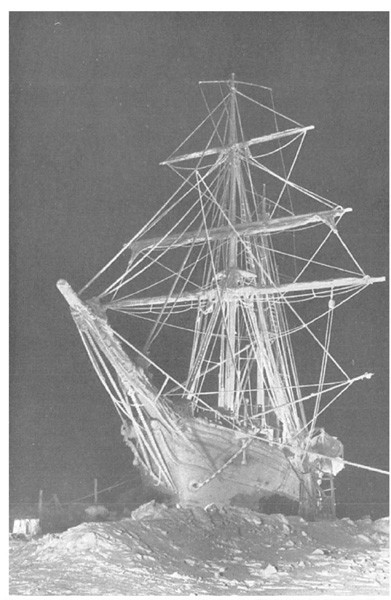
THE LONG, LONG NIGHT
A new berg that was going to give us some cause for anxiety made its appearance on the 14th. It was a big berg, and we noticed as it lay on the north-west horizon that it had a hummocky, crevassed appearance at the east end. During the day this berg increased its apparent altitude and changed its bearing slightly. Evidently it was aground and was holding its position against the drifting pack. A sounding at 11 a.m. gave 197 fathoms, with a hard stony or rocky bottom. During the next twenty-four hours the Endurance moved steadily towards the crevassed berg, which doubled its altitude in that time. We could see from the mast-head that the pack was piling and rafting against the mass of ice, and it was easy to imagine what would be the fate of the ship if she entered the area of disturbance. She would be crushed like an eggshell amid the shattering masses.
Worsley was in the crow’s-nest on the evening of the 15th, watching for signs of land to the westward, and he reported an interesting phenomenon. The sun set amid a glow of prismatic colours on a line of clouds just above the horizon. A minute later Worsley saw a golden glow, which expanded as he watched it, and presently the sun appeared again and rose a semi-diameter clear above the western horizon. He hailed Crean, who from a position on the floe 90 ft. below the crow’s-nest also saw the re-born sun. A quarter of an hour later from the deck Worsley saw the sun set a second time. This strange phenomenon was due to mirage or refraction. We attributed it to an ice-crack to the westward, when the band of open water had heated a stratum of air.
The drift of the pack was not constant, and during the succeeding days the crevassed berg alternately advanced and receded as the Endurance moved with the floe. On Sunday, April 18, it was only seven miles distant from the ship. “It is a large berg, about three-quarters of a mile long on the side presented to us and probably well over 200 ft. high. It is heavily crevassed, as though it once formed the serac portion of a glacier. Two specially wide and deep chasms across it from south-east to north-west give it the appearance of having broken its back on the shoal-ground. Huge masses of pressure-ice are piled against its cliffs to a height of about 60 ft., showing the stupendous force that is being brought to bear upon it by the drifting pack. The berg must be very firmly aground. We swing the arrow on the current-meter frequently and watch with keen attention to see where it will come to rest. Will it point straight for the berg, showing that our drift is in that direction? It swings slowly round. It points to the north-east end of the berg, then shifts slowly to the centre and seems to stop; but it moves again and swings 20 degrees clear of our enemy to the south-west. . . . We notice that two familiar bergs, the Rampart Berg and the Peak Berg, have moved away from the ship. Probably they also have grounded or dragged on the shoal.” A strong drift to the westward during the night of the 18th relieved our anxiety by carrying the Endurance to the lee of the crevassed berg, which passed out of our range of vision before the end of the month.
We said good-bye to the sun on May 1 and entered the period of twilight that would be followed by the darkness of midwinter. The sun by the aid of refraction just cleared the horizon at noon and set shortly before 2 p.m. A fine aurora in the evening was dimmed by the full moon, which had risen on April 27 and would not set again until May 6. The disappearance of the sun is apt to be a depressing event in the polar regions, where the long months of darkness involve mental as well as physical strain. But the Endurance’s company refused to abandon their customary cheerfulness, and a concert in the evening made the Ritz a scene of noisy merriment, in strange contrast with the cold, silent world that lay outside. “One feels our helplessness as the long winter night closes upon us. By this time, if fortune had smiled upon the Expedition, we would have been comfortably and securely established in a shore base, with depots laid to the south and plans made for the long march in the spring and summer. Where will we make a landing now? It is not easy to forecast the future. The ice may open in the spring, but by that time we will be far to the north-west. I do not think we shall be able to work back to Vahsel Bay. There are possible landing-places on the western coast of the Weddell Sea, but can we reach any suitable spot early enough to attempt the overland journey next year? Time alone will tell. I do not think any member of the Expedition is disheartened by our disappointment. All hands are cheery and busy, and will do their best when the time for action comes. In the meantime we must wait.”
The ship’s position on Sunday, May 2, was lat. 75° 23’ S., long. 42° 14’ W. The temperature at noon was 5° below zero Fahr., and the sky was overcast. A seal was sighted from the mast-head at lunch-time, and five men, with two dog teams, set off after the prize. They had an uncomfortable journey outward in the dim, diffused light, which cast no shadows and so gave no warning of irregularities in the white surface. It is a strange sensation to be running along on apparently smooth snow and to fall suddenly into an unseen hollow, or bump against a ridge. “After going out three miles to the eastward,” wrote Worsley in describing this seal-hunt, “we range up and down but find nothing, until from a hummock I fancy I see something apparently a mile away, but probably little more than half that distance. I ran for it, found the seal, and with a shout brought up the others at the double. The seal was a big Weddell, over 10 ft. long and weighing more than 800 lbs. But Soldier, one of the team leaders, went for its throat without a moment’s hesitation, and we had to beat off the dogs before we could shoot the seal. We caught five or six gallons of blood in a tin for the dogs, and let the teams have a drink of fresh blood from the seal. The light was worse than ever on our return, and we arrived back in the dark. Sir Ernest met us with a lantern and guided us into the lead astern and thence to the ship.” This was the first seal we had secured since March 19, and the meat and blubber made a welcome addition to the stores.
Three emperor penguins made their appearance in a lead, west of the ship on May 3. They pushed their heads through the young ice while two of the men were standing by the lead. The men imitated the emperor’s call and walked slowly, penguin fashion, away from the lead. The birds in succession made a magnificent leap 3 ft clear from the water on to the young ice. Thence they tobogganed to the bank and followed the men away from the lead. Their retreat was soon cut off by a line of men. “We walk up to them, talking loudly and assuming a threatening aspect. Notwithstanding our bad manners, the three birds turn towards us, bowing ceremoniously. Then, after a closer inspection, they conclude that we are undesirable acquaintances and make off across the floe. We head them off and finally shepherd them close to the ship, where the frenzied barking of the dogs so frightens them that they make a determined effort to break through the line. We seize them. One bird of philosophic mien goes quietly, led by one flipper. The others show fight, but all are imprisoned in an igloo for the night. ... In the afternoon we see five emperors in the western lead and capture one. Kerr and Cheetham fight a valiant action with two large birds. Kerr rushes at one, seizes it, and is promptly knocked down by the angered penguin, which jumps on his chest before retiring. Cheetham comes to Kerr’s assistance, and between them they seize another penguin, bind his bill, and lead him, muttering muffled protests, to the ship like an inebriated old man between two policemen. He weighs 85 lbs., or 5 lbs. less than the heaviest emperor captured previously. Kerr and Cheetham insist that he is nothing to the big fellow who escaped them.” This penguin’s stomach proved to be filled with freshly caught fish up to 10 in. long. Some of the fish were of a coastal or littoral variety. Two more emperors were captured on the following day, and, while Wordie was leading one of them towards the ship, Wild came along with his team. The dogs, uncontrollable in a moment, made a frantic rush for the bird, and were almost upon him when their harness caught upon an ice-pylon, which they had tried to pass on both sides at once. The result was a seething tangle of dogs, traces, and men, and an overturned sledge, while the penguin, three yards away, nonchalantly and indifferently surveyed the disturbance. He had never seen anything of the kind before and had no idea at all that the strange disorder might concern him. Several cracks had opened in the neighbourhood of the ship, and the emperor penguins, fat and glossy of plumage, were appearing in considerable numbers. We secured nine of them on May 6, an important addition to our supply of fresh food.
The sun, which had made “positively his last appearance” seven days earlier, surprised us by lifting more than half its disk above the horizon on May 8. A glow on the northern horizon resolved itself into the sun at 11 a-m. that day. A quarter of an hour later the unseasonable visitor disappeared again, only to rise again at 11.40 a.m., set at 1 p.m., rise at 1.10 p.m., and set lingeringly at 1.20 p.m. These curious phenomena were due to refraction, which amounted to 2° 37’ at 1.20 p.m. The temperature was 15° below zero Fahr., and we calculated that the refraction was 2° above normal. In other words, the sun was visible 120 miles further south than the refraction tables gave it any right to be. The navigating officer naturally was aggrieved. He had informed all hands on May 1 that they would not see the sun again for seventy days, and now had to endure the jeers of friends who affected to believe that his observations were inaccurate by a few degrees.
The Endurance was drifting north-north-east under the influence of a succession of westerly and south-westerly hreezes. The ship’s head, at the same time, swung gradually to the left, indicating that the floe in which she was held was turning. During the night of the 14th a very pronounced swing occurred, and when daylight came at noon on the 15th we observed a large lead running from the north-west horizon towards the ship till it struck the western lead, circling ahead of the ship, then continuing to the south-south-east. A lead astern connected with this new lead on either side of the Endurance, thus separating our floe completely from the main body of the pack. A blizzard from the south-east swept down during the 16th. At 1 p.m. the blizzard lulled for five minutes; then the wind jumped round to the opposite quarter and the barometer rose suddenly. The centre of a cyclonic movement had passed over us, and the compass recorded an extraordinarily rapid swing of the floe. I could see nothing through the mist and snow, and I thought it possible that a magnetic storm or a patch of local magnetic attraction had caused the compass, and not the floe, to swing. Our floe was now about 2½ miles long north and south and 3 miles wide east and west.
The month of May passed with few incidents of importance. Hurley, our handy man, installed our small electric-lighting plant and placed lights for occasional use in the observatory, the meteorological station, and various other points. We could not afford to use the electric lamps freely. Hurley also rigged two powerful lights on poles projecting from the ship to port and starboard. These lamps would illuminate the “dogloos” brilliantly on the darkest winter’s day and would be invaluable in the event of the floe breaking during the dark days of winter. We could imagine what it would mean to get fifty dogs aboard without lights while the floe was breaking and rafting under our feet. May 24, Empire Day, was celebrated with the singing of patriotic songs in the Ritz, where all hands joined in wishing a speedy victory for the British arms. We could not know how the war was progressing, but we hoped that the Germans had already been driven from France and that the Russian armies had put the seal on the Allies’ success. The war was a constant subject of discussion aboard the Endurance, and many campaigns were fought on the map during the long months of drifting. The moon in the latter part of May was sweeping continuously through our starlit sky in great high circles. The weather generally was good, with constant minus temperatures. The log on May 27 recorded: “Brilliantly fine clear weather with bright moonlight throughout. The moon’s rays are wonderfully strong, making midnight seem as light as an ordinary overcast midday in temperate climes. The great clearness of the atmosphere probably accounts for our having eight hours of twilight with a beautiful soft golden glow to the northward, A little rime and glazed frost are found aloft. The temperature is —20° Fahr. A few wisps of cirrus-cloud are seen and a little frost-smoke shows in one or two directions, but the cracks and leads near the ship appear to have frozen over again,”
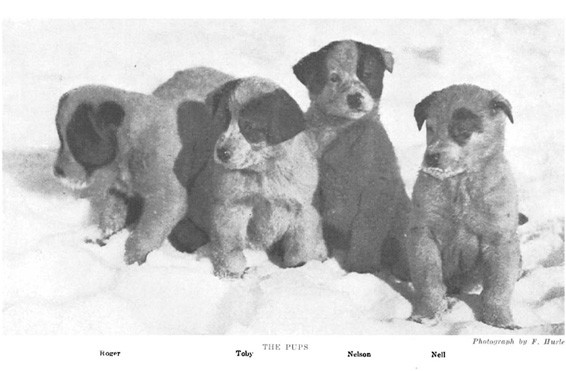
Crean had started to take the pups out for runs, and it was very amusing to see them with their rolling canter just managing to keep abreast by the sledge and occasionally cocking an eye with an appealing look in the hope of being taken aboard for a ride. As an addition to their foster-father, Crean, the pups had adopted Amundsen, They tyrannized over him most unmercifully. It was a common sight to see him, the biggest dog in the pack, sitting out in the cold with an air of philosophic resignation while a corpulent pup occupied the entrance to his dogloo. The intruder was generally the pup Nelson, who just showed his fore-paws and face, and one was fairly sure to find Nelly, Roger, and Toby coiled up comfortably behind him. At hoosh-time Crean had to stand by Amundsen’s food, since otherwise the pups would eat the big dog’s ration while he stood back to give them fair play. Sometimes their consciences would smite them and they would drag round a seal’s head, half a penguin, or a large lump of frozen meat or blubber to Amundsen’s kennel for rent. It was interesting to watch the big dog play with them, seizing them by throat or neck in what appeared to be a fierce fashion, while really quite gentle with them, and all the time teaching them how to hold their own in the world and putting them up to all the tricks of dog life.
The drift of the Endurance in the grip of the pack continued without incident of importance through June. Pressure was reported occasionally, but the ice in the immediate vicinity of the ship remained firm. The light was now very bad except in the period when the friendly moon was above the horizon. A faint twilight round about noon of each day reminded us of the sun, and assisted us in the important work of exercising the dogs. The care of the teams was our heaviest responsibility in those days. The movement of the floes was beyond all human control, and there was nothing to be gained by allowing one’s mind to struggle with the problems of the future, though it was hard to avoid anxiety at times. The conditioning and training of the dogs seemed essential, whatever fate might be in store for us, and the teams were taken out by their drivers whenever the weather permitted. Rivalries arose, as might have been expected, and on the 15th of the month a great race, the “Antarctic Derby,” took place. It was a notable event. The betting had been heavy, and every man aboard the ship stood to win or lose on the result of the contest. Some money had been staked, but the wagers that thrilled were those involving stores of chocolate and cigarettes. The course had been laid off from Khyber Pass, at the eastern end of the old lead ahead of the ship, to a point clear of the jibboom, a distance of about 700 yds. Five teams went out in the dim noon twilight, with a zero temperature and an aurora flickering faintly to the southward. The starting signal was to be given by the flashing of a light on the meteorological station. I was appointed starter, Worsley was judge, and James was timekeeper. The bos’n, with a straw hat added to his usual Antarctic attire, stood on a box near the winning-post, and was assisted by a couple of shady characters to shout the odds, which were displayed on a board hung around his neck — 6 to 4 on Wild, “evens” on Crean, 2 to 1 against Hurley, 6 to 1 against Macklin, and 8 to 1 against McIlroy. Canvas handkerchiefs fluttered from an improvised grand stand, and the pups, which had never seen such strange happenings before, sat round and howled with excitement The spectators could not see far in the dim light, but they heard the shouts of the drivers as the teams approached and greeted the victory of the favourite with a roar of cheering that must have sounded strange indeed to any seals or penguins that happened to be in our neighbourhood. Wild’s time was 2 min. 16 sec., or at the rate of 10½ miles per hour for the course.
We celebrated Midwinter’s Day on the 22nd. The twilight extended over a period of about six hours that day, and there was a good light at noon from the moon, and also a northern glow with wisps of beautiful pink cloud along the horizon. A sounding gave 262 fathoms with a mud bottom. No land was in sight from the mast-head, although our range of vision extended probably a full degree to the westward. The day was observed as a holiday, necessary work only being undertaken, and, after the best dinner the cook could provide, all hands gathered in the Ritz, where speeches, songs, and toasts occupied the evening. After supper at midnight we sang “God Save the King” and wished each other all success in the days of sunshine and effort that lay ahead. At this time the Endurance was making an unusually rapid drift to the north under the influence of a fresh southerly to south-westerly breeze. We travelled 39 miles to the north in five days before a breeze that only once attained the force of a gale and then for no more than an hour. The absence of strong winds, in comparison with the almost unceasing winter blizzards of the Ross Sea, was a feature of the Weddell Sea that impressed itself upon me during the winter months.
Another race took place a few days after the “Derby.” The two crack teams, driven by Hurley and Wild, met in a race from Khyber Pass. Wild’s team, pulling 910 lbs., or 130 lbs. per dog, covered the 700 yds. in 2 min. 9 sec., or at the rate of 11·1 miles per hour. Hurley’s team, with the same load, did the run in 2 min. 16 sec. The race was awarded by the judge to Hurley owing to Wild failing to “weigh in” correctly. I happened to be a part of the load on his sledge, and a skid over some new drift within fifty yards of the winning-post resulted in my being left on the snow. It should be said in justice to the dogs that this accident, while justifying the disqualification, could not have made any material difference in the time.
The approach of the returning sun was indicated by beautiful sunrise glows on the horizon in the early days of July. We had nine hours’ twilight on the 10th, and the northern sky, low to the horizon, was tinted with gold for about seven hours. Numerous cracks and leads extended in all directions to within 300 yds. of the ship. Thin wavering black lines close to the northern horizon were probably distant leads refracted into the sky. Sounds of moderate pressure came to our ears occasionally, but the ship was not involved. At midnight on the 11th a crack in the lead ahead of the Endurance opened out rapidly, and by 2 a.m. was over 200 yds. wide in places with an area of open water to the south-west. Sounds of pressure were heard along this lead, which soon closed to a width of about 30 yds. and then froze over. The temperature at that time was —23° Fahr.
The moat severe blizzard we had experienced in the Weddell Sea swept down upon the Endurance on the evening of the 13th, and by breakfast-time on the following morning the kennels to the windward or southern side of the ship were buried under 5 ft. of drift. I gave orders that no man should venture beyond the kennels. The ship was invisible at a distance of fifty yards, and it was impossible to preserve one’s sense of direction in the raging wind and suffocating drift. To walk against the gale was out of the question. Face and eyes became snowed up within two minutes, and serious frost-bites would have been the penalty of perseverance. The dogs stayed in their kennels for the most part, the “old stagers” putting out a paw occasionally in order to keep open a breathing-hole. By evening the gale had attained a force of 60 or 70 miles an hour, and the ship was trembling under the attack. But we were snug enough in our quarters aboard until the morning of the 14th, when all hands turned out to shovel the snow from deck and kennels. The wind was still keen and searching, with a temperature of something like —30° Fahr., and it was necessary for us to be on guard against frostbite. At least 100 tons of snow were piled against the bows and port side, where the weight of the drift had forced the floe downward. The lead ahead had opened out during the night, cracked the pack from north to south and frozen over again, adding 300 yds. to the distance between the ship and “Khyber Pass.” The breakdown gang had completed its work by lunch-time. The gale was then decreasing and the three-days-old moon showed as a red crescent on the northern horizon. The temperature during the blizzard had ranged from —21° to —33.5° Fahr. It is usual for the temperature to rise during a blizzard, and the failure to produce any Föhn effect of this nature suggested an absence of high land for at least 200 miles to the south and southwest. The weather did not clear until the 16th. We saw then that the appearance of the surrounding pack had been altered completely by the blizzard. The “island” floe containing the Endurance still stood fast, but cracks and masses of ice thrown up by pressure could be seen in all directions. An area of open water was visible on the horizon to the north, with a water indication in the northern sky.
The ice-pressure, which was indicated by distant rumblings and the appearance of formidable ridges, was increasingly a cause of anxiety. The areas of disturbance were gradually approaching the ship. During July 21 we could hear the grinding and crashing of the working floes to the south-west and west and could see cracks opening, working, and closing ahead. “The ice is rafting up to a height of 10 or 15 ft. in places, the opposing floes are moving against one another at the rate of about 200 yds. per hour. The noise resembles the roar of heavy, distant surf. Standing on the stirring ice one can imagine it is disturbed by the breathing and tossing of a mighty giant below.” Early on the afternoon of the 22nd a 2-ft. crack, running south-west and north-east for a distance of about two miles, approached to within 35 yds. of the port quarter. I had all the sledges brought aboard and set a special watch in case it became necessary to get the dogs off the floe in a hurry. This crack was the result of heavy pressure 300 yds. away on the port bow, where huge blocks of ice were piled up in wild and threatening confusion. The pressure at that point was enormous. Blocks weighing many tons were raised 15 ft above the level of the floe. I arranged to divide the night watches with Worsley and Wild, and none of us had much rest. The ship was shaken by heavy bumps, and we were on the alert to see that no dogs bad fallen into cracks. The morning light showed that our island had been reduced considerably during the night. Our long months of rest and safety seemed to be at an end, and a period of stress had begun.
During the following day I had a store of sledging provisions, oil, matches, and other essentials, placed on the upper deck handy to the starboard quarter boat, so as to be in readiness for a sudden emergency. The ice was grinding and working steadily to the southward, and in the evening some large cracks appeared on the port quarter, while a crack alongside opened out to 15 yds. The blizzard seemed to have set the ice in strong movement towards the north, and the south-westerly and west-south-westerly winds that prevailed two days out of three maintained the drift. I hoped that this would continue unchecked, since our chance of getting clear of the pack early in the spring appeared to depend upon our making a good northing. Soundings at this time gave depths of from 186 to 190 fathoms, with a glacial mud bottom. No land was in sight. The light was improving. A great deal of ice-pressure was heard and observed in all directions during the 25th, much of it close to the port quarter of the ship. On the starboard bow huge blocks of ice, weighing many tons and 5 ft. in thickness, were pushed up on the old floe to a height of 15 to 20 ft The floe that held the Endurance was swung to and fro by the pressure during the day, but came back to the old bearing before midnight “The ice for miles around is much looser. There are numerous cracks and short leads to the north-east and south-east Ridges are being forced up in all directions, and there is a water-sky to the south-east. It would be a relief to be able to make some effort on our own behalf; but we can do nothing until the ice releases our ship. If the floes continue to loosen, we may break out within the next few weeks and resume the fight In the meantime the pressure continues, and it is hard to foresee the outcome. Just before noon to-day (July 26) the top of the sun appeared by refraction for one minute, seventy-nine days after our last sunset. A few minutes earlier a small patch of the sun had been thrown up on one of the black streaks above the horizon. AU hands are cheered by the indication that the end of the winter darkness is near. . . . Clark finds that with returning daylight the diatoms are again appearing. His nets and line are stained a pale yellow, and much of the newly formed ice has also a faint brown or yellow tinge. The diatoms cannot multiply without light, and the ice formed since February can be distinguished in the pressure-ridges by its clear blue colour. The older masses of ice are of a dark earthy brown, dull yellow, or reddish brown.”
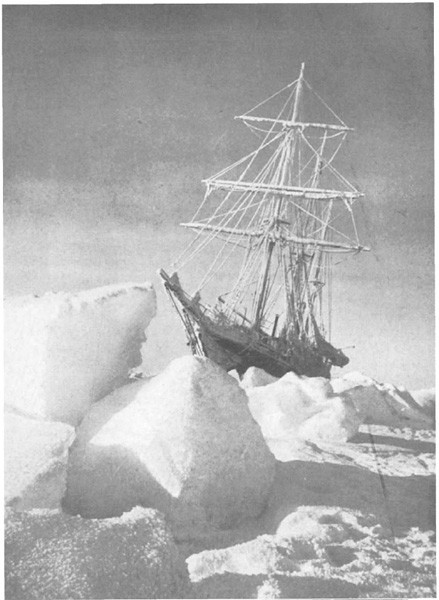
THE RETURNING SUN
The break-up of our floe came suddenly on Sunday, August 1, just one year after the Endurance left the South-West India Docks on the voyage to the Far South. The position was lat 72° 26’ S., long. 48° 10’ W. The morning brought a moderate southwesterly gale with heavy snow, and at 8 a.m., after some warning movements of the ice, the floe cracked 40 yds. off the starboard bow. Two hours later the floe began to break up all round us under pressure and the ship listed over 10 degrees to starboard. I had the dogs and sledges brought aboard at once and the gangway hoisted. The animals behaved well. They came aboard eagerly as though realizing their danger, and were placed in their quarters on deck without a single fight occurring. The pressure was cracking the floe rapidly, rafting it close to the ship and forcing masses of ice beneath the keel. Presently the En-durance listed heavily to port against the gale, and at the same time was forced ahead, astern, and sideways several times by the grinding floes. She received one or two hard nips, but resisted them without as much as a creak. It looked at one stage as if the ship was to be made the plaything of successive floes, and I was relieved when she came to a standstill with a large piece of our old “dock” under the starboard bilge. I had the boats cleared away ready for lowering, got up some additional stores, and set a double watch. All hands were warned to stand by, get what sleep they could, and have their warmest clothing at hand. Around us lay the ruins of “Dog Town” amid the debris of pressure-ridges. Some of the little dwellings had been crushed flat beneath blocks of ice; others had been swallowed and pulverized when the ice opened beneath them and closed again. It was a sad sight, but my chief concern just then was the safety of the rudder, which was being attacked viciously by the ice. We managed to pole away a large lump that had become jammed between the rudder and the stern-post, but I could see that damage had been done, though a close examination was not possible that day.
After the ship had come to a standstill in her new position very heavy pressure was set up. Some of the trenails were started and beams buckled slightly under the terrific stresses. But the Endurance had been built to withstand the attacks of the ice, and she lifted bravely as the floes drove beneath her. The effects of the pressure around us were awe-inspiring. Mighty blocks of ice, gripped between meeting floes, rose slowly till they jumped like cherry-stones squeezed between thumb and finger. The pressure of millions of tons of moving ice was crushing and smashing inexorably. If the ship was once gripped firmly her fate would be sealed.
The gale from the south-west blew all night and moderated during the afternoon of the 2nd to a stiff breeze. The pressure had almost ceased. Apparently the gale had. driven the southern pack down upon us, causing congestion in our area; the pressure had stopped when the whole of the pack got into motion. The gale had given us some northing, but it had dealt the Endurance what might prove to be a severe blow. The rudder had been driven hard over to starboard and the blade partially torn away from the rudder-head. Heavy masses of ice were still jammed against the stern, and it was impossible to ascertain the extent of the damage at that time. I felt that it would be impossible in any case to effect repairs in the moving pack. The ship lay steady all night, and the sole sign of continuing pressure was an occasional slight rumbling shock. We rigged shelters and kennels for the dogs inboard.
The weather on August 3 was overcast and misty. We had nine hours of twilight, with good light at noon. There was no land in sight for ten miles from the mast-head. The pack as far as the eye could reach was in a condition of chaos, much rafted and consolidated, with very large pressure-ridges in all directions. At 9 p.m. a rough altitude of Canopus gave the latitude as 71° 55’ 17” S. The drift, therefore, had been about 37 miles to the north in three days. Four of the poorest dogs were shot this day. They were suffering severely from worms, and we could not afford to keep sick dogs under the changed conditions. The sun showed through the clouds on the northern horizon for an hour on the 4th. There was no open water to be seen from aloft in any direction. We saw from the mast-head to west-south-west an appearance of barrier, land, or a very long iceberg, about 20 odd miles away, but the horizon clouded over before we could determine its nature. We tried twice to make a sounding that day, but failed on each occasion. The Kelvin machine gave no bottom at the full length of the line, 370 fathoms. After much labour we made a hole in the ice near the stern-post large enough for the Lucas machine with a 32-lb. lead; but this appeared to be too light. The machine stopped at 452 fathoms, leaving us in doubt as to whether bottom had been reached. Then in heaving up we lost the lead, the thin wire cutting its way into the ice and snapping. All hands and the carpenter were busy this day making and placing kennels on the upper deck, and by nightfall all the dogs were comfortably housed, ready for any weather. The sun showed through the clouds above the northern horizon for nearly an hour.
The remaining days of August were comparatively uneventful. The ice around the ship froze firm again and little movement occurred in our neighbourhood. The training of the dogs, including the puppies, proceeded actively, and provided exercise as well as occupation. The drift to the north-west continued steadily. We had bad luck with soundings, the weather interfering at times and the gear breaking on several occasions, but a big increase in the depth showed that we had passed over the edge of the Weddell Sea plateau. A sounding of about 1700 fathoms on August 10 agreed fairly well with Filchner’s 1924 fathoms, 130 miles east of our then position. An observation at noon of the 8th had given us lat. 71° 23’ S., long. 49° 13’ W. Minus temperatures prevailed still, but the daylight was increasing. We captured a few emperor penguins which were making their way to the south-west. Ten penguins taken on the 19th were all in poor condition, and their stomachs contained nothing but stones and a few cuttle-fish beaks. A sounding on the 17th gave 1676 fathoms, 10 miles west of the charted position of Morell Land. No land could be seen from the mast-head, and I decided that Morell Land must be added to the long list of Antarctic islands and continental coasts that on close investigation have resolved themselves into icebergs. On clear days we could get an extended view in all directions from the mast-head, and the line of the pack was broken only by familiar bergs. About one hundred bergs were in view on a fine day, and they seemed practically the same as when they started their drift with us nearly seven months earlier. The scientists wished to inspect some of the neighbouring bergs at close quarters, but sledge travelling outside the well-trodden area immediately around the ship proved difficult and occasionally dangerous. On August 20, for example, Worsley, Hurley, and Greenstreet started off for the Rampart Berg and got on to a lead of young ice that undulated perilously beneath their feet. A quick turn saved them.
A wonderful mirage of the Fata Morgana type was visible on August 20. The day was clear and bright, with a blue sky overhead and some rime aloft. “The distant pack is thrown up into towering barrier-like cliffs, which are reflected in blue lakes and lanes of water at their base. Great white and golden cities of Oriental appearance at close intervals along these cliff-tops indicate distant bergs, some not previously known to us. Floating above these are wavering violet and creamy lines of still more remote bergs and pack. The lines rise and fall, tremble, dissipate, and reappear in an endless transformation scene. The southern pack and bergs, catching the sun’s rays, are golden, but to the north the ice-masses are purple. Here the bergs assume changing forms, first a castle, then a balloon just clear of the horizon, that changes swiftly into an immense mushroom, a mosque, or a cathedral. The principal characteristic is the vertical lengthening of the object, a small pressure-ridge being given the appearance of a line of battlements or towering cliffs. The mirage is produced by refraction and is intensified by the columns of comparatively warm air rising from several cracks and leads that have opened eight to twenty miles away north and south.” We noticed this day that a considerable change had taken place in our position relative to the Rampart Berg. It appeared that a big lead had opened and that there had been some differential movement of the pack. The opening movement might presage renewed pressure. A few hours later the dog teams, returning from exercise, crossed a narrow crack that had appeared ahead of the ship. This crack opened quickly to 60 ft. and would have given us trouble if the dogs had been left on the wrong side. It closed on the 25th and pressure followed in its neighbourhood.
On August 24 we were two miles north of the latitude of Morell’s farthest south, and over 10° of longitude, or more than 200 miles, west of his position. From the mast-head no land could be seen within twenty miles, and no land of over 500 ft. altitude could have escaped observation on our side of long. 52° W. A sounding of 1900 fathoms on August 25 was further evidence of the non-existence of New South Greenland. There was some movement of the ice near the ship during the concluding days of the month. All hands were called out in the night of August 26, sounds of pressure having been followed by the cracking of the ice alongside the ship, but the trouble did not develop immediately. Late on the night of the 31st the ice began to work ahead of the ship and along the port side. Creaking and groaning of timbers, accompanied by loud snapping sounds fore and aft, told their story of strain. The pressure continued during the following day, beams and deck planks occasionally buckling to the strain. The ponderous floes were grinding against each other under the influence of wind and current, and our ship seemed to occupy for the time being an undesirable position near the centre of the disturbance; but she resisted staunchly and showed no sign of water in the bilges, although she had not been pumped out for six months. The pack extended to the horizon in every direction. I calculated that we were 250 miles from the nearest known land to the westward, and more than 500 miles from the nearest outpost of civilization, Wilhelmina Bay. I hoped we would not have to undertake a march across the moving ice-fields. The Endurance we knew to be stout and true; but no ship ever built by man could live if taken fairly in the grip of the floes and prevented from rising to the surface of the grinding ice. These were anxious days. In the early morning of September 2 the ship jumped and shook to the accompaniment of cracks and groans, and some of the men who had been in the berths hurried on deck. The pressure eased a little later in the day, when the ice on the port side broke away from the ship to just abaft the main rigging. The Endurance was still held aft and at the rudder, and a large mass of ice could be seen adhering to the port bow, rising to within three feet of the surface. I wondered if this ice had got its grip by piercing the sheathing.
CHAPTER IV
LOSS OF THE ENDURANCE
THE ice did not trouble us again seriously until the end of September, though during the whole month the floes were seldom entirely without movement. The roar of pressure would come to us across the otherwise silent ice-fields, and bring with it a threat and a warning. Watching from the crow’s-nest, we could see sometimes the formation of pressure-ridges. The sunshine glittered on newly riven ice-surfaces as the masses of shattered floe rose and fell away from the line of pressure. The area of disturbance would advance towards us, recede, and advance again. The routine of work and play on the Endurance proceeded steadily. Our plans and preparations for any contingency that might arise during the approaching summer had been made, but there seemed always plenty to do in and about our prisoned ship. Buns with the dogs and vigorous games of hockey and football on the rough snow-covered floe kept all hands in good fettle. The record of one or two of these September days will indicate the nature of our life and our surroundings:
“September 4.— Temperature, —14.1° Fahr. Light easterly breeze, blue sky, and stratus clouds. During forenoon notice a distinct terra-cotta or biscuit colour in the stratus clouds to the north. This travelled from east to west and could conceivably have come from some of the Graham Land volcanoes, now about 300 miles distant to the north-west. The upper current of air probably would come from that direction. Heavy rime. Pack unbroken and unchanged as far as visible. No land for 22 miles. No animal life observed,”
“September 7.— Temperature, —10,8° Fahr. Moderate easterly to southerly winds, overcast and misty, with light snow till midnight, when weather cleared. Blue sky and fine clear weather to noon. Much rime aloft. Thick fresh snow on ship and floe that glistens brilliantly in the morning sunlight. Little clouds of faint violet-coloured mist rise from the lower and brinier portions of the pack, which stretches unbroken to the horizon. Very great refraction all round. A tabular berg about fifty feet high ten miles west is a good index of the amount of refraction. On ordinary days it shows from the mast-head, clear-cut against the sky; with much refraction, the pack beyond at the back of it lifts up into view; to-day a broad expanse of miles of pack is seen above it. Numerous other bergs generally seen in silhouette are, at first sight, lost, but after a closer scrutiny they appear as large lumps or dark masses well below the horizon. Refraction generally results in too big an altitude when observing the sun for position, but to-day the horizon is thrown up so much that the altitude is about 12’ too small. No land visible for twenty miles. No animal life observed. Lower Clark’s tow-net with 566 fathoms of wire, and hoist it up at two and a half miles an hour by walking across the floe with the wire. Result rather meagre — jelly-fish and some fish larvæ. Exercise dogs in sledge teams. The young dogs, under Crean’s care, pull as well, though not so strongly, as the best team in the pack. Hercules for the last fortnight or more has constituted himself leader of the orchestra. Two or three times in the twenty-four hours he starts a howl — a deep, melodious howl — and in about thirty seconds he has the whole pack in full song, the great deep, booming, harmonious song of the half-wolf pack.”
By the middle of September we were running short of fresh meat for the dogs. The seals and penguins seemed to have abandoned our neighbourhood altogether. Nearly five months had passed since we killed a seal, and penguins had been seen seldom. Clark, who was using his trawl as often as possible, reported that there was a marked absence of plankton in the sea, and we assumed that the seals and the penguins had gone in search of their accustomed food. The men got an emperor on the 23rd. The dogs, which were having their sledging exercise, became wildly excited when the penguin, which had risen in a crack, was driven ashore, and the best efforts of the drivers failed to save it alive. On the following day Wild, Hurley, Macklin, and McIlroy took their teams to the Stained Berg, about seven miles west of the ship, and on their way back got a female crab-eater, which they killed, skinned, and left to be picked up later. They ascended to the top of the berg, which lay in about lat 69° 30’ S., long. 51° W., and from an elevation of 110 ft. could see no land. Samples of the discoloured ice from the berg proved to contain dust with black gritty particles or sand-grains. Another seal, a bull Wed-dell, was secured on the 26th. The return of seal-life was opportune, since we had nearly finished the winter supply of dog-biscuit and wished to be able to feed the dogs on meat. The seals meant a supply of blubber, moreover, to supplement our small remaining stock of coal when the time came to get up steam again. We initiated a daylight-saving system on this day by putting forward the clock one hour. “This is really pandering to the base but universal passion that men, and especially seafarers, have for getting up late, otherwise we would be honest and make our routine earlier instead of flogging the clock.”
During the concluding days of September the roar of the pressure grew louder, and I could see that the area of disturbance was rapidly approaching the ship. Stupendous forces were at work and the fields of firm ice around the Endurance were being diminished steadily. September 30 was a bad day. It began well, for we got two penguins end five seals during the morning. Three other seals were seen. But at 3 p.m. cracks that had opened during the night alongside the ship commenced to work in a lateral direction. The ship sustained terrific pressure on the port side forward, the heaviest shocks being under the fore-rigging. It was the worst squeeze we had experienced. The decks shuddered and jumped, beams arched, and stanchions buckled and shook. I ordered all hands to stand by in readiness for whatever emergency might arise. Even the dogs seemed to feel the tense anxiety of the moment. But the ship resisted valiantly, and just when it appeared that the limit of her strength was being reached the huge floe that was pressing down upon us cracked across and so gave relief. “The behaviour of our ship in the ice has been magnificent,” wrote Worsley. “Since we have been beset her staunchness and endurance have been almost past belief again and again. She has been nipped with a million-ton pressure and risen nobly, falling clear of the water out on the ice. She has been thrown to and fro like a shuttlecock a dozen times. She has been strained, her beams arched upwards, by the fearful pressure; her very sides opened and closed again as she was actually bent and curved along her length, groaning like a living thing. It will be sad if such a brave little craft should be finally crushed in the remorseless, slowly strangling grip of the Weddell pack after ten months of the bravest and most gallant fight ever put up by a ship.”
The Endurance deserved all that could be said in praise of her. Shipwrights had never done sounder and better work; but how long could she continue the fight under such conditions? We were drifting into the congested area of the western Weddell Sea, the worst portion of the worst sea in the world, where the pack, forced on irresistibly by wind and current, impinges on the western shore and is driven up in huge corrugated ridges and chaotic fields of pressure. The vital question for us was whether or not the ice would open sufficiently to release us, or at least give us a chance of release, before the drift carried us into the most dangerous area. There was no answer to be got from the silent bergs and the grinding floes, and we faced the month of October with anxious hearts.
The leads in the pack appeared to have opened out a little on October 1, but not sufficiently to be workable even if we had been able to release the Endurance from the floe. The day was calm, cloudy and misty in the forenoon and clearer in the afternoon, when we observed a well-defined parhelia. The ship was subjected to slight pressure at intervals. Two bull crab-eaters climbed on to the floe close to the ship and were shot by Wild. They were both big animals in prime condition, and I felt that there was no more need for anxiety as to the supply of fresh meat for the dogs. Seal-liver made a welcome change in our own menu. The two bulls were marked, like many of their kind, with long parallel scars about three inches apart, evidently the work of the killers. A bull we killed on the following day had four parallel scars, sixteen inches long, on each side of its body; they were fairly deep and one flipper had been nearly torn away. The creature must have escaped from the jaws of a killer by a very small margin. Evidently life beneath the pack is not always monotonous. We noticed that several of the bergs in the neighbourhood of the ship were changing their relative positions more than they had done for months past. The floes were moving.
Our position on Sunday, October 3, was lat. 69° 14’ S., long. 51° 8’ W. During the night the floe holding the ship aft cracked in several places, and this appeared to have eased the strain on the rudder. The forenoon was misty, with falls of snow, but the weather cleared later in the day and we could see that the pack was breaking, New leads had appeared, while several old leads had closed. Pressure-ridges had risen along some of the cracks. The thickness of the season’s ice, now about 230 days old, was 4 ft. 5 in. under 7 or 8 in. of snow. This ice had been slightly thicker in the early part of September, and I assumed that some melting had begun below. Clark had recorded plus temperatures at depths of 150 to 200 fathoms in the concluding days of September. The ice obviously had attained its maximum thickness by direct freezing, and the heavier older floes had been created by the consolidation of pressure-ice and the overlapping of floes under strain. The air temperatures were still low, —24.5° Fahr. being recorded on October 4.
The movement of the ice was increasing. Frost-smoke from opening cracks was showing in all directions during October 6. It had the appearance in one place of a great prairie fire, rising from the surface and getting higher as it drifted off before the wind in heavy dark, rolling masses. At another point there was the appearance of a train running before the wind, the smoke rising from the locomotive straight upwards; and the smoke columns elsewhere gave the effect of warships steaming in line ahead. During the following day the leads and cracks opened to such an extent that if the Endurance could have been forced forward for thirty yards we could have proceeded for two or three miles; but the effort did not promise any really useful result. The conditions did not change materially during the rest of that week. The position on Sunday, October 10, was lat 69° 21’ S., long. 50° 34’ W, A thaw made things uncomfortable for us that day. The temperature had risen from —10° to +29.8° Fahr., the highest we had experienced since January, and the ship got dripping wet between decks. The upper deck was clear of ice and snow and the cabins became unpleasantly messy. The dogs, who hated wet, had a most unhappy air. Undoubtedly one grows to like familiar conditions. We had lived long in temperatures that would have seemed distressingly low in civilized life, and now we were made uncomfortable by a degree of warmth that would have left the unaccustomed human being still shivering. The thaw was an indication that winter was over, and we began preparations for re-occupying the cabins on the main deck. I had the shelter-house round the stern pulled down on the 11th and made other preparations for working the ship as soon as she got clear. The carpenter had built a wheel-house over the wheel aft as shelter in cold and heavy weather. The ice was still loosening and no land was visible for twenty miles.
The temperature remained relatively high for several days. All hands moved to their summer quarters in the upper cabins on the 12th, to the accompaniment of much noise and laughter. Spring was in the air, and if there were no green growing things to gladden our eyes, there were at least many seals, penguins, and even whales disporting themselves in the leads. The time for renewed action was coming, and though our situation was grave enough, we were facing the future hopefully. The dogs were kept in a state of uproar by the sight of so much game. They became almost frenzied when a solemn-looking emperor penguin inspected them gravely from some point of vantage on the floe and gave utterance to an apparently derisive “Knark!” At 7 p.m. on the 13th the ship broke free of the floe on which she had rested to starboard sufficiently to come upright. The rudder freed itself, but the propeller was found to be athwartship, having been forced into that position by the floe some time after August 1. The water was very clear and we could see the rudder, which appeared to have suffered only a slight twist to port at the water-line. It moved quite freely. The propeller, as far as we could see, was intact, but it could not be moved by the hand-gear, probably owing to a film of ice in the stern gland and sleeve. I did not think it advisable to attempt to deal with it at that stage. The ship had not been pumped for eight months, but there was no water and not much ice in the bilges. Meals were served again in the wardroom that day.
The south-westerly breeze freshened to a gale on the 14th, and the temperature fell from +31° Fahr. to —I° Fahr. At midnight the ship came free from the floe and drifted rapidly astern. Her head fell off before the wind until she lay nearly art right angles across the narrow lead. This was a dangerous position for rudder and propeller. The spanker was set, but the weight of the wind on the ship gradually forced the floes open until the Endurance swung right round and drove 100 yds. along the lead. Then the ice closed and at 3 a.m. we were fast again. The wind died down during the day and the pack opened for five or six miles to the north. It was still loose on the following morning, and I had the boiler pumped up with the intention of attempting to clear the propeller; but one of the manholes developed a leak, the packing being perished by cold or loosened by contraction, and the boiler had to be emptied out again.
The pack was rather closer on Sunday the 17th. Top-sails and head-sails were set in the afternoon, and with a moderate northeasterly breeze we-tried to force the ship ahead out of the lead; but she was held fast. Later that day heavy pressure developed. The two floes between which the Endurance was lying began to close and the ship was subjected to a series of tremendously heavy strains. In the engine-room, the weakest point, loud groans, crashes, and hammering sounds were heard. The iron plates on the floor buckled up and over-rode with loud clangs. Meanwhile the floes were grinding off each other’s projecting points and throwing up pressure-ridges. The ship stood the strain well for nearly an hour and then, to my great relief, began to rise with heavy jerks and jars. She lifted ten inches forward and three feet four inches aft, at the same time heeling six degrees to port. The ice was getting below us and the immediate danger had passed. The position was lat. 69° 19’ S., long. 50° 40’ W.
The next attack of the ice came on the afternoon of October 18th. The two floes began to move laterally, exerting great pressure on the ship. Suddenly the floe on the port side cracked and huge pieces of ice shot up from under the port bilge. Within a few seconds the ship heeled over until she had a list of thirty degrees to port, being held under the starboard bilge by the opposing floe. The lee boats were now almost resting on the floe. The midship dog-kennels broke away and crashed down on the lee kennels, and the howls and barks of the frightened dogs assisted to create a perfect pandemonium. Everything movable on deck and below fell to the lee side, and for a few minutes it looked as if the Endurance would be thrown upon her beam ends. Order was soon restored. I had all fires put out and battens nailed on the deck to give the dogs a foothold and enable people to get about. Then the crew lashed all the movable gear. If the ship had heeled any further it would have been necessary to release the lee boats and pull them clear, and Worsley was watching to give the alarm. Hurley meanwhile descended to the floe and took some photographs of the ship in her unusual position. Dinner in the wardroom that evening was a curious affair. Most of the diners had to sit on the deck, their feet against battens and their plates on their knees. At 8 p.m. the floes opened, and within a few minutes the Endurance was nearly upright again. Orders were given for the ice to be chipped clear of the rudder. The men poled the blocks out of the way when they had been detached from the floe with the long ice-chisels, and we were able to haul the ship’s stern into a clear berth. Then the boiler was pumped up. This work was completed early in the morning of October 19, and during that day the engineer lit fires and got up steam very slowly, in order to economize fuel and avoid any strain on the chilled boilers by unequal heating. The crew cut up all loose lumber, boxes, etc., and put them in the bunkers for fuel. The day was overcast, with occasional snowfalls, the temperature +12° Fahr. The ice in our neighbourhood was quiet, but in the distance pressure was at work. The wind freshened in the evening, and we ran a wire-mooring astern. The barometer at 11 p.m. stood at 28-96, the lowest since the gales of July. An uproar among the dogs attracted attention late in the afternoon, and we found a 25-ft whale cruising up and down in our pool. It pushed its head up once in characteristic killer fashion, but we judged from its small curved dorsal fin that it was a specimen of Balœnoptera acutostrata, not Orca gladiator.
A strong south-westerly wind was blowing on October 20 and the pack was working. The Endurance was imprisoned securely in the pool, but our chance might come at any time. Watches were set so as to be ready for working ship. Wild and Hudson, Greenstreet and Cheetham, Worsley and Crean, took the deck watches, and the Chief Engineer and Second Engineer kept watch and watch with three of the A.B.’s for stokers. The staff and the forward hands, with the exception of the cook, the carpenter, and his mate, were on “watch and watch “— that is, four hours on deck and four hours below, or off duty. The carpenter was busy making a light punt, which might prove useful in the navigation of lanes and channels. At 11 a.m. we gave the engines a gentle trial-turn astern. Everything worked well after eight months of frozen inactivity, except that the bilge-pump and the discharge proved to be frozen up; they were cleared with some little difficulty. The engineer reported that to get steam he had used one ton of coal, with wood-ashes and blubber. The fires required to keep the boiler warm consumed one and a quarter to one and a half cwt, of coal per day. We had about fifty tons of coal remaining in the bunkers.
October 21 and 22 were days of low temperature, which caused the open leads to freeze over. The pack was working, and ever and anon the roar of pressure came to our ears. We waited for the next move of the gigantic forces arrayed against us. The 23rd brought a strong north-westerly wind, and the movement of the floes and pressure-ridges became more formidable. Then on Sunday, October 23, there came what for the Endurance was the beginning of the end. The position was lat 69° 11’ S., long. 51° 5’ W. We had now twenty-two and a half hours of daylight, and throughout the day we watched the threatening advance of the floes. At 6.45 p.m. the ship sustained heavy pressure in a dangerous position. The attack of the ice is illustrated roughly in the appended diagram. The shaded portions represent the pool, covered with new ice that afforded no support to the ship, and the arrows indicate the direction of the pressure exercised by the thick floes and pressure-ridges. The onslaught was all but irresistible. The Endurance groaned and quivered as her starboard quarter was forced against the floe, twisting the stern-post and starting the heads and ends of planking. The ice had lateral as well as forward movement, and the ship was twisted and actually bent by the stresses. She began to leak dangerously at once.
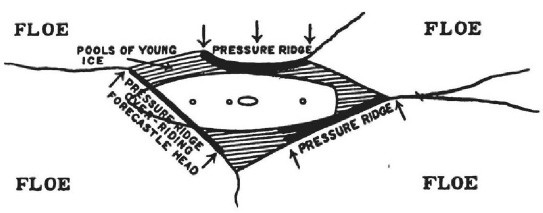
I had the pumps rigged, got up steam, and started the bilge-pumps at 8 p.m. The pressure by that time had relaxed. The ship was making water rapidly aft, and the carpenter set to work to make a coffer-dam astern of the engines. All hands worked, watch and watch, throughout the night, pumping ship and helping the carpenter. By morning the leak was being kept in check. The carpenter and his assistants caulked the coffer-dam with strips of blankets and nailed strips over the seams wherever possible. The main or hand pump was frozen up and could not be used at once. After it had been knocked out Worsley, Greenstreet, and Hudson went down in the hunkers and cleared the ice from the bilges. “This is not a pleasant job,” wrote Worsley. “We have to dig a hole down through the coal while the beams and timbers groan and crack all around us like pistol-shots. The darkness is almost complete, and we mess about in the wet with half-frozen hands and try to keep the coal from slipping back into the bilges. The men on deck pour buckets of boiling water from the galley down the pipe as we prod and hammer from below, and at last we get the pump clear, cover up the bilges to keep the coal out, and rush on deck, very thankful to find ourselves safe again in the open air.”
Monday, October 25, dawned cloudy and misty, with a minus temperature and a strong south-easterly breeze. All hands were pumping at intervals and assisting the carpenter with the cofferdam. The leak was being kept under fairly easily, but the outlook was bad. Heavy pressure-ridges were forming in all directions, and though the immediate pressure upon the ship was not severe, I realized that the respite would not be prolonged. The pack within our range of vision was being subjected to enormous compression, such as might be caused by cyclonic winds, opposing ocean currents, or constriction in a channel of some description. The pressure-ridges, massive and threatening, testified to the overwhelming nature of the forces that were at work. Huge blocks of ice, weighing many tons, were lifted into the air and tossed aside as other masses rose beneath them. We were helpless intruders in a strange world, our lives dependent upon the play of grim elementary forces that made a mock of our puny efforts. I scarcely dared hope now that the Endurance would live, and throughout that anxious day I reviewed again the plans made long before for the sledging journey that we must make in the event of our having to take to the ice. We were ready, as far as forethought could make us, for every contingency. Stores, dogs, sledges, and equipment were ready to be moved from the ship at a moment’s notice.
The following day brought bright clear weather, with a blue sky. The sunshine was inspiriting. The roar of pressure could be heard all around us. New ridges were rising, and I could see as the day wore on that the lines of major disturbance were drawing nearer to the ship. The Endurance suffered some strains at intervals. Listening below, I could hear the creaking and groaning of her timbers, the pistol-like cracks that told of the starting of a trenail or plank, and the faint, indefinable whispers of our ship’s distress. Overhead the sun shone serenely; occasional fleecy clouds drifted before the southerly breeze, and the light glinted and sparkled on the million facets of the new pressure-ridges. The day passed slowly. At 7 p.m. very heavy pressure developed, with twisting strains that racked the ship fore and aft. The butts of planking were opened four and five inches on the starboard side, and at the same time we could see from the bridge that the ship was bending like a bow under titanic pressure. Almost like a living creature, she resisted the forces that would crush her; but it was a one-sided battle. Millions of tons of ice pressed inexorably upon the little ship that had dared the challenge of the Antarctic. The Endurance was now leaking badly, and at 9 p.m. I gave the order to lower boats, gear, provisions, and sledges to the floe, and move them to the flat ice a little way from the ship. The working of the ice closed the leaks slightly at midnight, but all hands were pumping all night. A strange occurrence was the sudden appearance of eight emperor penguins from a crack 100 yds. away at the moment when the pressure upon the ship was at its climax. They walked a little way towards us, halted, and after a few ordinary calls proceeded to utter weird cries that sounded like a dirge for the ship. None of us had ever before heard the emperors utter any other than the most simple calls or cries, and the effect of this concerted effort was almost startling.
Then came a fateful day — Wednesday, October 27. The position was lat 69° 5’ S., long. 51° 30’ W. The temperature was —8-5° Fahr., a gentle southerly breeze was blowing and the sun shone in a clear sky. “After long months of ceaseless anxiety and strain, after times when hope beat high and times when the outlook was black indeed, the end of the Endurance has come. But though we have been compelled to abandon the ship, which is crushed beyond all hope of ever being righted, we are alive and well, and we have stores and equipment for the task that lies before us. The task is to reach land with all the members of the Expedition. It is hard to write what I feel. To a sailor his ship is more than a floating home, and in the Endurance I had centred ambitions, hopes, and desires. Now, straining and groaning, her timbers cracking and her wounds gaping, she is slowly giving up her sentient life at the very outset of her career. She is crushed and abandoned after drifting more than 570 miles in a north-westerly direction during the 281 days since she became locked in the ice. The distance from the point where she became beset to the place where she now rests mortally hurt in the grip of the floes is 573 miles, but the total drift through all observed positions has been 1186 miles, and probably we actually covered more than 1500 miles. We are now 346 miles from Paulet Island, the nearest point where there is any possibility of finding food and shelter. A small hut built there by the Swedish expedition in 1902 is filled with stores left by the Argentine relief ship. I know all about those stores, for I purchased them in London on behalf of the Argentine Government when they asked me to equip the relief expedition. The distance to the nearest barrier west of us is about 180 miles, but a party going there would still be about 360 miles from Paulet Island and there would be no means of sustaining life on the barrier. We could not take from here food enough for the whole journey; the weight would be too great.
“This morning, our last on the ship, the weather was clear, with’ a gentle south-south-easterly to south-south-westerly breeze. From the crow’s-nest there was no sign of land of any sort. The pressure was increasing steadily, and the passing hours brought no relief or respite for the ship. The attack of the ice reached its climax at 4 p.m. The ship was hove stern up by the pressure, and the driving floe, moving laterally across the stern, split the rudder and tore out the rudder-post and stern-post. Then, while we watched, the ice loosened and the Endurance sank a little. The decks were breaking upwards and the water was pouring in below. Again the pressure began, and at 5 p.m. I ordered all hands on to the ice. The twisting, grinding floes were working their will at last on the ship. It was a sickening sensation to feel the decks breaking up under one’s feet, the great beams bending and then snapping with a noise like heavy gunfire. The water was overmastering the pumps, and so to avoid an explosion when it reached the boilers I had to give orders for the fires to be drawn and the steam let down. The plans for abandoning the ship in case of emergency had been made well in advance, and men and dogs descended to the floe and made their way to the comparative safety of an unbroken portion of the floe without a hitch. Just before leaving, I looked down the engine-room skylight as I stood on the quivering deck, and saw the engines dropping sideways as the stays and bed-plates gave way. I cannot describe the impression of relentless destruction that was forced upon me as I looked down and around. The floes, with the force of millions of tons of moving ice behind them, were simply annihilating the ship.”
Essential supplies had been placed on the floe about 100 yds. from the ship, and there we set about making a camp for the night. But about 7 p.m., after the tents were up, the ice we were occupying became involved in the pressure and started to split and smash beneath our feet. I had the camp moved to a bigger floe about 200 yds. away, just beyond the bow of the ship. Boats, stores, and camp equipment had to be conveyed across a working pressure-ridge. The movement of the ice was so slow that it did not interfere much with our short trek, but the weight of the ridge had caused the floes to sink on either side and there were pools of water there. A pioneer party with picks and shovels had to build a snow-causeway before we could get all our possessions across. By 8 p.m. the camp had been pitched again. We had two pole-tents and three hoop-tents. I took charge of the small pole-tent, No. 1, with Hudson, Hurley, and James as companions; Wild had the small hoop-tent, No. 2, with Wordie, McNeish, and McIlroy. These hoop-tents are very easily shifted and set up. The eight forward hands had the large hoop-tent, No. 3; Crean had charge of No. 4 hoop-tent with Hussey, Marston, and Cheetham, and Worsley had the other pole-tent, No. 5, with Green-street, Lees, Clark, Kerr, Rickenson, Macklin, and Blackboro, the last-named being the youngest of the forward hands.
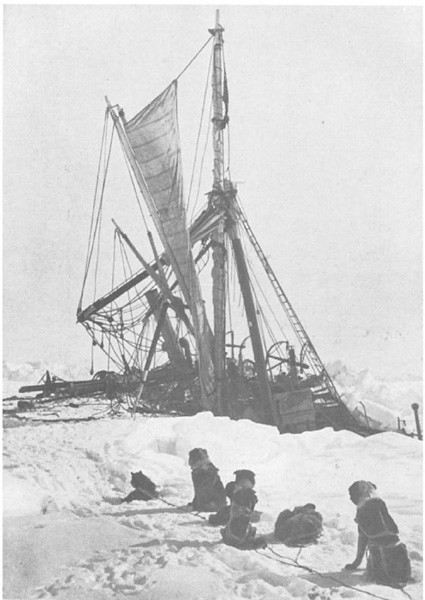
THE END
"To-night the temperature has dropped to —16° Fahr., and most of the men are cold and uncomfortable. After the tents had been pitched I mustered all hands and explained the position to them briefly and, I hope, clearly, I have told them the distance to the barrier and the distance to Paulet Island, and have stated that I propose to try to march with equipment across the ice in the direction of Paulet Island. I thanked the men for the steadiness and good morale they have shown in these trying circumstances, and told them I had no doubt that, provided they continued to work their utmost and to trust me, we will all reach safety in the end. Then we had supper, which the cook had prepared at the big blubber stove, and after a watch had been set all hands except the watch turned in.” For myself, I could not sleep. The destruction and abandonment of the ship was no sudden shock. The disaster had been looming ahead for many months, and I had studied my plans for all contingencies a hundred times. But the thoughts that came to me as I walked up and down in the darkness were not particularly cheerful. The task now was to secure the safety of the party, and to that I must bend my energies and mental power and apply every bit of knowledge that experience of the Antarctic had given me. The task was likely to be long and strenuous, and an ordered mind and a clear programme were essential if we were to come through without loss of life. A man must shape himself to a new mark directly the old one goes to ground.
At midnight I was pacing the ice, listening to the grinding floe and to the groans and crashes that told of the death-agony of the Endurance, when I noticed suddenly a crack running across our floe right through the camp. The alarm-whistle brought all hands tumbling out, and we moved the tents and stores lying on what was now the smaller portion of the floe to the larger portion. Nothing more could be done at that moment, and the men turned in again; but there was little sleep. Each time I came to the end of my beat on the floe I could just see in the darkness the uprearing piles of pressure-ice, which toppled over and narrowed still further the little floating island we occupied. I did not notice at the time that my tent, which had been on the wrong side of the crack, had not been erected again. Hudson and James had managed to squeeze themselves into other tents, and Hurley had wrapped himself in the canvas of No. 1 tent. I discovered this about 5 a.m. All night long the electric light gleamed from the stern of the dying Endurance. Hussey had left this light switched on when he took a last observation, and, like a lamp in a cottage window, it braved the night until in the early morning the Endurance received a particularly violent squeeze. There was a sound of rending beams and the light disappeared. The connection had been cut.
Morning came in chill and cheerless. All hands were stiff and weary after their first disturbed night on the floe. Just at daybreak I went over to the Endurance with Wild and Hurley, in order to retrieve some tins of petrol that could be used to boil up milk for the rest of the men. The ship presented a painful spectacle of chaos and wreck. The jibboom and bowsprit had snapped off during the night and now lay at right angles to the ship, with the chains, martingale, and bobstay dragging them as the vessel quivered and moved in the grinding pack. The ice had driven over the forecastle and she was well down by the head. We secured two tins of petrol with some difficulty, and postponed the further examination of the ship until after breakfast. Jumping across cracks with the tins, we soon reached camp, and built a fireplace out of the triangular water-tight tanks we had ripped from the lifeboat. This we had done in order to make more room. Then we pierced a petrol-tin in half a dozen places with an ice-axe and set fire to it. The petrol blazed fiercely under the five-gallon drum we used as a cooker, and the hot milk was ready in quick time. Then we three ministering angels went round the tents with the life-giving drink, and were surprised and a trifle chagrined at the matter-of-fact manner in which some of the men accepted this contribution to their comfort. They did not quite understand what work we had done for them in the early dawn, and I heard Wild say, “If any of you gentlemen would like your boots cleaned just put them outside 1” This was his gentle way of reminding them that a little thanks will go a long way on such occasions.
The cook prepared breakfast, which consisted of biscuit and hoosh, at 8 a.m., and I then went over to the Endurance again and made a fuller examination of the wreck. Only six of the cabins had not been pierced by floes and blocks of ice. Every one of the starboard cabins had been crushed. The whole of the after part of the ship had been crushed concertina fashion. The forecastle and the Ritz were submerged, and the wardroom was three-quarters full of ice. The starboard side of the wardroom had come away. The motor-engine forward had been driven through the galley. Petrol-cases that had been stacked on the fore-deck had been driven by the floe through the wall into the wardroom and had carried before them a large picture. Curiously enough, the glass of this picture had not been cracked, whereas in the immediate neighbourhood I saw heavy iron davits that had been twisted and bent like the iron-work of a wrecked train. The ship was being crushed remorselessly.
Under a dull, overcast sky I returned to camp and examined our situation. The floe occupied by the camp was still subject to pressure, and I thought it wise to move to a larger and apparently stranger floe about 200 yds. away, off the starboard bow of the ship. This camp was to become known as Dump Camp, owing to the amount of stuff that was thrown away there. We could not afford to carry unnecessary gear, and a drastic sorting of equipment took place. I decided to issue a complete new set of Burberrys and underclothing to each man, and also a supply of new socks. The camp was transferred to the larger floe quickly, and I began there to direct the preparations for the long journey across the floes to Paulet Island or Snow Hill.
Hurley meanwhile had rigged his kinematograph-camera and was getting pictures of the Endurance in her death-throes. While he was engaged thus, the ice, driving against the standing rigging and the fore-, main-, and mizzen-masts, snapped the shrouds. The foretop and ťgallant-mast came down with a run and hung in wreckage on the fore-mast, with the fore-yard vertical. The mainmast followed immediately, snapping off about 10 ft. above the main deck. The crow’s-nest fell within 10 ft. of where Hurley stood turning the handle of his camera, but he did not stop the machine, and so secured a unique, though sad, picture.
The issue of clothing was quickly accomplished. Sleeping-bags were required also. We had eighteen fur bags, and it was necessary, therefore, to issue ten of the Jaeger woollen bags in order to provide for the twenty-eight men of the party. The woollen bags were lighter and less warm than the reindeer bags, and so each man who received one of them was allowed also a reindeer-skin to lie upon. It seemed fair to distribute the fur bags by lot, but some of us older hands did not join in the lottery. We thought we could do quite as well with the Jaegers as with the furs. With quick dispatch the clothing was apportioned, and then we turned one of the boats on its side and supported it with two broken oars to make a lee for the galley. The cook got the blubber-stove going, and a little later, when I was sitting round the corner of the stove, I heard one man say, “Cook, I like my tea strong.” Another joined in, “Cook, I like mine weak.” It was pleasant to know that their minds were untroubled, but I thought the time opportune to mention that the tea would be the same for all hands and that we would be fortunate if two months later we had any tea at all. It occurred to me at the time that the incident had psychological interest. Here were men, their home crushed, the camp pitched on the unstable floes, and their chance of reaching safety apparently remote, calmly attending to the details of existence and giving their attention to such trifles as the strength of a brew of tea.
During the afternoon the work continued. Every now and then we heard a noise like heavy guns or distant thunder, caused by the floes grinding together. “The pressure caused by the congestion in this area of the pack is producing a scene of absolute chaos. The floes grind stupendously, throw up great ridges, and shatter one another mercilessly. The ridges, or hedgerows, marking the pressure-lines that border the fast-diminishing pieces of smooth floe-ice, are enormous. The ice moves majestically, irresistibly. Human effort is not futile, but man fights against the giant forces of nature in a spirit of humility. One has a sense of dependence on the higher Power. To-day two seals, a Weddell and a crab-eater, came close to the camp and were shot. Four others were chased back into the water, for their presence disturbed the dog teams, and this meant floggings and trouble with the harness. The arrangement of the tents has been completed and their internal management settled. Each tent has a mess orderly, the duty being taken in turn on an alphabetical rota. The orderly takes the hoosh-pots of his tent to the galley, gets all the hoosh he is allowed, and, after the meal, cleans the vessels with snow and stores them in sledge or boat ready for a possible move.”
“October 29.— We passed a quiet night, although the pressure was grinding around us. Our floe is a heavy one and it withstood the blows it received. There is a light wind from the north-west to north-north-west, and the weather is fine. We are twenty-eight men with forty-nine dogs, including Sue’s and Sallie’s five grownup pups. All hands this morning were busy preparing gear, fitting boats on sledges, and building up and strengthening the sledges to carry the boats. . . . The main motor-sledge, with a little fitting from the carpenter, carried our largest boat admirably. For the next boat four ordinary sledges were lashed together, but we were dubious as to the strength of this contrivance, and as a matter of fact it broke down quickly under strain. . . . The ship is still afloat, with the spurs of the pack driven through her and holding her up. The forecastle-head is under water, the decks are burst up by the pressure, the wreckage lies around in dismal confusion, but over all the blue ensign flies still.
“This afternoon Sallie’s three youngest pups, Sue’s Sirius, and Mrs. Chippy, the carpenter’s cat, have to be shot. We could not undertake the maintenance of weaklings under the new conditions. Macklin, Crean, and the carpenter seemed to feel the loss of their friends rather badly. We propose making a short trial journey to-morrow, starting with two of the boats and the ten sledges. The number of dog teams has been increased to seven, Greenstreet taking charge of the new additional team, consisting of Snapper and Sallie’s four oldest pups. We have ten working sledges to relay with five teams. Wild’s and Hurley’s teams will haul the cutter with the assistance of four men. The whaler and the other boats will follow, and the men who are hauling them will be able to help with the cutter at the rough places. We cannot hope to make rapid progress, but each mile counts. Crean this afternoon has a bad attack of snow-blindness.”
The weather on the morning of October 30 was overcast and misty, with occasional falls of snow. A moderate north-easterly breeze was blowing. We were still living on extra food, brought from the ship when we abandoned her, and the sledging and boating rations were intact These rations would provide for twenty-eight men for fifty-six days on full ration, but we could count on getting enough seal- and penguin-meat to at least double this time. We could even, if progress proved too difficult and too injurious to the boats, which we must guard as our ultimate means of salvation, camp on the nearest heavy floe, scour the neighbouring pack for penguins and seals, and await the outward drift of the pack to open and navigable water. “This plan would avoid the grave dangers we are now incurring of getting entangled in impassable pressure-ridges and possibly irretrievably damaging the boats, which are bound to suffer in rough ice; it would also minimize the peril of the ice splitting under us, as it did twice during the night at our first camp. Yet I feel sure that it is the right thing to attempt a march, since if we can make five or seven miles a day to the north-west our chance of reaching safety in the months to come will be increased greatly. There is a psychological aspect to the question also. It will be much better for the men in general to feel that even though progress is slow, they are on their way to land, than it will be simply to sit down and wait for the tardy north-westerly drift to take us out of this cruel waste of ice. We will make an attempt to move. The issue is beyond my power either to predict or to control.”
That afternoon Wild and I went out in the mist and snow to find a road to the north-east. After many devious turnings to avoid the heavier pressure-ridges, we pioneered a way for at least a mile and a half, and then returned by a rather better route to the camp. The pressure now was rapid in movement and our floe was suffering from the shakes and jerks of the ice. At 3 p.m., after lunch, we got under way, leaving Dump Camp a mass of debris. The order was that personal gear must not exceed two pounds per man, and this meant that nothing but bare necessaries was to be taken on the march. We could not afford to cumber ourselves with unnecessary weight. Holes had been dug in the snow for the reception of private letters and little personal trifles, the Lares and Penates of the members of the Expedition, and into the privacy of these white graves were consigned much of sentimental value and not a little of intrinsic worth. I rather grudged the two pounds allowance per man, owing to my keen anxiety to keep weight at a minimum, but some personal belongings could fairly be regarded as indispensable. The journey might be a long one, and there was a possibility of a winter in improvised quarters on an inhospitable coast at the other end. A man under such conditions needs something to occupy his thoughts, some tangible memento of his home and people beyond the seas. So sovereigns were thrown away and photographs were kept. I tore the fly-leaf out of the Bible that Queen Alexandra had given to the ship, with her own writing in it, and also the wonderful page of Job containing the verse:
Out of whose womb came the ice?
And the hoary frost of Heaven, who hath gendered it?
The waters are hid as with a stone,
And the face of the deep is frozen.
The other Bible which Queen Alexandra had given for the use of the shore party was down below in the lower hold in one of the cases when the ship received her death-blow. Suitcases were thrown away; these were retrieved later as material for making boots, and some of them, marked “solid leather,” proved, to our disappointment, to contain a large percentage of cardboard. The manufacturer would have had difficulty in convincing us at the time that the deception was anything short of criminal.
The pioneer sledge party, consisting of Wordie, Hussey, Hudson, and myself, carrying picks and shovels, started to break a road through the pressure-ridges for the sledges carrying the boats. The boats, with their gear and the sledges beneath them, weighed each more than a ton. The cutter was smaller than the whaler, but weighed more and was a much more strongly built boat The whaler was mounted on the sledge part of the Girling tractor forward and two sledges amidships and aft. These sledges were strengthened with cross-timbers and shortened oars fore and aft. The cutter was mounted on the aero-sledge. The sledges were the point of weakness. It appeared almost hopeless to prevent them smashing under their heavy loads when travelling over rough pressure-ice which stretched ahead of us for probably 300 miles. After the pioneer sledge had started, the seven dog teams got off. They took their sledges forward for half a mile, then went back for the other sledges. Worsley took charge of the two boats, with fifteen men hauling, and these also had to be relayed. It was heavy work for dogs and men, but there were intervals of comparative rest on the backward journey, after the first portion of the load had been taken forward. We passed over two opening cracks, through which killers were pushing their ugly snouts, and by 5 p.m. had covered a mile in a north-north-westerly direction. The condition of the ice ahead was chaotic, for since the morning increased pressure had developed and the pack was moving and crushing in all directions. So I gave the order to pitch camp for the night on flat ice, which, unfortunately, proved to be young and salty. The older pack was too rough and too deeply laden with snow to offer a suitable camping-ground. Although we had gained only one mile in a direct line, the necessary deviations made the distance travelled at least two miles, and the relays brought the distance marched up to six miles. Some of the dog teams had covered at least ten miles. I set the watch from 6 p.m. to 7 a.m., one hour for each man in each tent in rotation.
During the night snow fell heavily, and the floor-cloths of the tents got wet through, as the temperature had risen to +25 ° Fahr. One of the things we hoped for in those days was a temperature in the neighbourhood of zero, for then the snow-surface would be hard, we would not be troubled by damp, and our gear would not become covered in soft snow. The killers were blowing all night, and a crack appeared about 20 ft. from the camp at 2 a.m. The ice below us was quite thin enough for the killers to break through if they took a fancy to do so, but there was no other camping-ground within our reach and we had to take the risk. When morning came the snow was falling so heavily that we could not see more than a few score yards ahead, and I decided not to strike camp. A path over the shattered floes would be hard to find, and to get the boats into a position of peril might be disastrous. Rickenson and Worsley started back for Dump Camp at 7 a.m. to get some wood and blubber for the fire, and an hour later we had hoosh, with one biscuit each. At 10 a.m. Hurley and Hudson left for the old camp in order to bring some additional dog-pemmican, since there were no seals to be found near us. Then, as the weather cleared, Worsley and I made a prospect to the west and tried to find a practicable road. A large floe offered a fairly good road for at least another mile to the north-west, and we went back prepared for another move. The weather cleared a little, and after lunch we struck camp. I took Rickenson, Kerr, Wordie, and Hudson as a break-down gang to pioneer a path among the pressure-ridges. Five dog teams followed. Wild’s and Hurley’s teams were hitched on to the cutter and they started off in splendid style. They needed to be helped only once; indeed, fourteen dogs did as well or even better than eighteen men. The ice was moving beneath and around us as we worked towards the big floe, and where this floe met the smaller ones there was a mass of pressed-up ice, still in motion, with water between the ridges. But it is wonderful what a dozen men can do with picks and shovels. We could cut a road through a pressure-ridge about 14 ft high in ten minutes and leave a smooth, or comparatively smooth, path for the sledges and teams.
CHAPTER V
OCEAN CAMP
IN spite of the wet, deep snow and the halts occasioned by thus having to cut our road through the pressure-ridges, we managed to march the best part of a mile towards our goal, though the relays and the deviations again made the actual distance travelled nearer six miles. As I could see that the men were all exhausted I gave the order to pitch the tents under the lee of the two boats, which afforded some slight protection from the wet snow now threatening to cover everything. While so engaged one of the sailors discovered a small pool of water, caused by the snow having thawed, on a sail which was lying in one of the boats. There was not much — just a sip each; but, as one man wrote in his diary, “One has seen and tasted cleaner, but seldom more opportunely found water.”
Next day broke cold and still with the same wet snow, and in the clearing light I could see that with the present loose surface, and considering how little result we had to show for all our strenuous efforts of the past four days, it would be impossible to proceed for any great distance. Taking into account also the possibility of leads opening close to us, and so of our being able to row north-west to where we might find land, I decided to find a more solid floe and there camp until conditions were more favourable for us to make a second attempt to escape from our icy prison. To this end we moved our tents and all our gear to a thick, heavy old floe about one and a half miles from the wreck and there made our camp. We called this “Ocean Camp.” It was with the utmost difficulty that we shifted our two boats. The surface was terrible — like nothing that any of us had ever seen around us before. We were sinking at times up to our hips, and everywhere the snow was two feet deep.
I decided to conserve our valuable sledging rations, which would be so necessary for the inevitable boat journey, as much as possible, and to subsist almost entirely on seals and penguins.
A party was sent back to Dump Camp, near the ship, to collect as much clothing, tobacco, etc., as they could find. The heavy snow which had fallen in the last few days, combined with the thawing and consequent sinking of the surface, resulted in the total disappearance of a good many of the things left behind at this dump. The remainder of the men made themselves as comfortable as possible under the circumstances at Ocean Camp. This floating lump of ice, about a mile square at first but later splitting into smaller and smaller fragments, was to be our home for nearly two months. During these two months we made frequent visits to the vicinity of the ship and retrieved much valuable clothing and food and some few articles of personal value which in our light-hearted optimism we had thought to leave miles behind us on our dash across the moving ice to safety.
The collection of food was now the all-important consideration. As we were to subsist almost entirely on seals and penguins, which were to provide fuel as well as food, some form of blubber-stove was a necessity. This was eventually very ingeniously contrived from the ship’s steel ash-shoot, as our first attempt with a large iron oil-drum did not prove eminently successful. We could only cook seal or penguin hooshes or stews on this stove, and so uncertain was its action that the food was either burnt or only partially cooked; and, hungry though we were, half-raw seal-meat was not very appetizing. On one occasion a wonderful stew made from seal-meat, with two or three tins of Irish stew that had been salved from the ship, fell into the fire through the bottom of the oil-drum that we used as a saucepan becoming burnt out on account of the sudden intense heat of the fire below. We lunched that day on one biscuit and a quarter of a tin of bully-beef each, frozen hard.
This new stove, which was to last us during our stay at Ocean Camp, was a great success. Two large holes were punched, with much labour and few tools, opposite one another at the wider, or top end of the shoot. Into one of these an oil-drum was fixed, to be used as the fireplace, the other hole serving to hold our saucepan. Alongside this another hole was punched to enable two saucepans to be boiled at a time; and farther along still a chimney made from biscuit-tins completed a very efficient, if not a very elegant, stove. Later on the cook found that he could bake a sort of flat bannock or scone on this stove, but he was seriously hampered for want of yeast or baking-powder.
An attempt was next made to erect some sort of a galley to protect the cook against the inclemencies of the weather. The party which I had sent back under Wild to the ship returned with, amongst other things, the wheel-house practically complete. This, with the addition of some sails and tarpaulins stretched on spars, made a very comfortable storehouse and galley. Pieces of planking from the deck were lashed across some spars stuck upright into the snow, and this, with the ship’s binnacle, formed an excellent look-out from which to look for seals and penguins. On this platform, too, a mast was erected from which flew the King’s flag and the Royal Clyde Yacht Club burgee.
I made a strict inventory of all the food in our possession, weights being roughly determined with a simple balance made from a piece of wood and some string, the counter-weight being a 60-lb. box of provisions.
The dog teams went off to the wreck early each morning under Wild, and the men made every effort to rescue as much as possible from the ship. This was an extremely difficult task as the whole of the deck forward was under a foot of water on the port side, and nearly three feet on the starboard side. However, they managed to collect large quantities of wood and ropes and some few cases of provisions. Although the galley was under water, Sake-well managed to secure three or four saucepans, which later proved invaluable acquisitions. Quite a number of boxes of flour, etc., had been stowed in a cabin in the hold, and these we had been unable to get out before we left the ship. Having, therefore, determined as nearly as possible that portion of the deck immediately above these cases, we proceeded to cut a hole with large ice-chisels through the 3-in. planking of which it was formed. As the ship at this spot was under 5 ft. of water and ice, it was not an easy job. However, we succeeded in making the hole sufficiently large to allow of some few cases to come floating up. These were greeted with great satisfaction, and later on, as we warmed to our work, other cases, whose upward progress was assisted with a boat-hook, were greeted with either cheers or groans according to whether they contained farinaceous food or merely luxuries such as jellies. For each man by now had a good idea of the calorific value and nutritive and sustaining qualities of the various foods. It had a personal interest for us all. In this way we added to our scanty stock between two and three tons of provisions, about half of which was farinaceous food, such as flour and peas, of which we were so short. This sounds a great deal, but at one pound per day it would only last twenty-eight men for three months. Previous to this I had reduced the food allowance to nine and a half ounces per man per day. Now, however, it could be increased, and “this afternoon, for the first time for ten days, we knew what it was to be really satisfied.”
I had the sledges packed in readiness with the special sledging rations in case of a sudden move, and with the other food, allowing also for prospective seals and penguins, I calculated a dietary to give the utmost possible variety and yet to use our precious stock of flour in the most economical manner. All seals and penguins that appeared anywhere within the vicinity of the camp were killed to provide food and fuel. The dog-pemmican we also added to our own larder, feeding the dogs on the seals which we caught, after removing such portions as were necessary for our own needs. We were rather short of crockery, but small pieces of venesta-wood served admirably as plates for seal-steaks; stews and liquids of all sorts were served in the aluminium sledging-mugs, of which each man had one. Later on, jelly tins and biscuit-tin lids were pressed into service.
Monotony in the meals, even considering the circumstances in which we found ourselves, was what I was striving to avoid, so our little stock of luxuries, such as fish-paste, tinned herrings, etc., was carefully husbanded and so distributed as to last as long as possible. My efforts were not in vain, as one man states in his diary: “It must be admitted that we are feeding very well indeed, considering our position. Each meal consists of one course and a beverage. The dried vegetables, if any, all go into the same pot as the meat, and every dish is a sort of hash or stew, be it ham or seal-meat or half and half. The fact that we only have two pots available places restrictions upon the number of things that can be cooked at one time, but in spite of the limitation of facilities, we always seem to manage to get just enough. The milk-powder and sugar are necessarily boiled with the tea or cocoa.
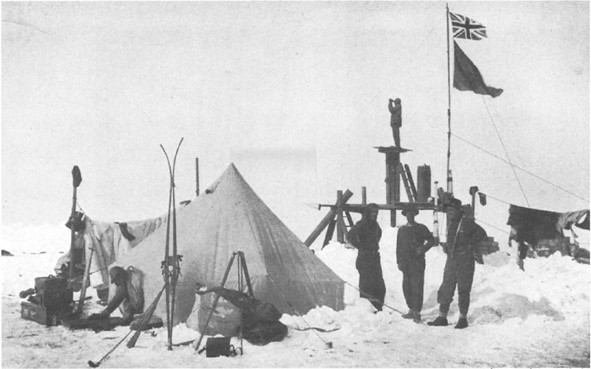
THE LOOKOUT AT OCEAN CAMP
The King’s flag flying over the ship’s burgee
“We are, of course, very short of the farinaceous element in our diet, and consequently have a mild craving for more of it. Bread is out of the question, and as we are husbanding the remaining cases of our biscuits for our prospective boat journey, we are eking out the supply of flour by making bannocks, of which we have from three to four each day. These bannocks are made from flour, fat, water, salt, and a little baking-powder, the dough being rolled out into flat rounds and baked in about ten minutes on a hot sheet of iron over the fire. Each bannock weighs about one and a half to two ounces, and we are indeed lucky to be able to produce them.”
A few boxes of army biscuits soaked with sea-water were distributed at one meal. They were in such a state that they would not have been looked at a second time under ordinary circumstances, but to us on a floating lump of ice, over three hundred miles from land, and that quite hypothetical, and with the un-plumbed sea beneath us, they were luxuries indeed. Wild’s tent made a pudding of theirs with some dripping.
Although keeping in mind the necessity for strict economy with our scanty store of food, I knew how important it was to keep the men cheerful, and that the depression occasioned by our surroundings and our precarious position could to some extent be alleviated by increasing the rations, at least until we were more accustomed to our new mode of life. That this was successful is shown in their diaries. “Day by day goes by, much the same as one another. We work; we talk; we eat. Ah, how we eat I No longer on short rations, we are a trifle more exacting than we were when we first commenced our ‘simple life,’ but by comparison with home standards we are positive barbarians, and our gastronomic rapacity knows no bounds.
“All is eaten that comes to each tent, and everything is most carefully and accurately divided into as many equal portions as there are men in the tent. One member then closes his eyes or turns his head away and calls out the names at random, as the cook for the day points to each portion, saying at the same time, ‘Whose?’
“Partiality, however unintentional it may be, is thus entirely obviated and every one feels satisfied that all is fair, even though one may look a little enviously at the next man’s helping which differs in some especially appreciated detail from one’s own. We break the Tenth Commandment energetically, but as we are all in the same boat in this respect, no one says a word. We understand each other’s feelings quite sympathetically.
“It is just like school-days over again, and very jolly it is, too, for the time being! “
Later on, as the prospect of wintering in the pack became more apparent, the rations had to be considerably reduced. By that time, however, everybody had become more accustomed to the idea and took it quite as a matter of course.
Our meals now consisted in the main of a fairly generous helping of seal or penguin, either boiled or fried. As one man wrote: “We are now having enough to eat, but not by any means too much, and every one is always hungry enough to eat every scrap he can get. Meals are invariably taken very seriously, and little talking is done till the hoosh is finished.”
Our tents made somewhat cramped quarters, especially during meal-times. “Living in a tent without any furniture requires a little getting used to. For our meals we have to sit on the floor, and it is surprising how awkward it is to eat in such a position; it is better by far to kneel and sit back on one’s heels, as do the Japanese.” Each man took it in turn to be the tent “cook” for one day, and one writes:
"The word ‘cook’ is at present rather a misnomer, for whilst we have a permanent galley no cooking need be done in the tent.
“Really, all that the tent-cook has to do is to take his two hoosh-pots over to the galley and convey the hoosh and the beverage to the tent, clearing up after each meal and washing up the two pots and the mugs. There are no spoons, etc., to wash, for we each keep our own spoon and pocket-knife in our pockets. We just lick them as clean as possible and replace them in our pockets after each meal.
“Our spoons are one of our indispensable possessions here. To lose one’s spoon would be almost as serious as it is for an edentate person to lose his set of false teeth.”
During all this time the supply of seals and penguins, if not inexhaustible, was always sufficient for our needs.
Seal- and penguin-hunting was our daily occupation, and parties were sent out in different directions to search among the hummocks and the pressure-ridges for them. When one was found a signal was hoisted, usually in the form of a scarf or a sock on a pole, and an answering signal was hoisted at the camp.
Then Wild went out with a dog team to shoot and bring in the game. To feed ourselves and the dogs, at least one seal a day was required. The seals were mostly crab-eaters, and emperor penguins were the general rule. On November 5, however, an adelie was caught, and this was the cause of much discussion, as the following extract shows: “The man on watch from 3 a.m. to 4 a.m. caught an adelie penguin. This is the first of its kind that we have seen since January last, and it may mean a lot It may signify that there is land somewhere near us, or else that great leads are opening up, but it is impossible to form more than a mere conjecture at present”
No skuas, Antarctic petrels, or sea-leopards were seen during our two months’ stay at Ocean Camp.
In addition to the daily hunt for food, our time was passed in reading the few books that we had managed to save from the ship. The greatest treasure in the library was a portion of the Encyclopædia Britannica. This was being continually used to settle the inevitable arguments that would arise. The sailors were discovered one day engaged in a very heated discussion on the subject of Money and Exchange. They finally came to the conclusion that the Encyclopædia, since it did not coincide with their views, must be wrong.
“For descriptions of every American town that ever has been, is, or ever will be, and for full and complete biographies of every American statesman since the time of George Washington and long before, the Encyclopædia would be hard to beat. Owing to our shortage of matches we have been driven to use it for purposes other than the purely literary ones, though; and one genius having discovered that the paper used for its pages had been impregnated with saltpetre, we can now thoroughly recommend it as a very efficient pipe-lighter.”
We also possessed a few books on Antarctic exploration, a copy of Browning, and one of “The Ancient Mariner.” On reading the latter, we sympathized with him and wondered what he had done with the albatross; it would have made a very welcome addition to our larder.
The two subjects of most interest to us were our rate of drift and the weather. Worsley took observations of the sun whenever possible, and his results showed conclusively that the drift of our floe was almost entirely dependent upon the winds and not much affected by currents. Our hope, of course, was to drift northwards to the edge of the pack and then, when the ice was loose enough, to take to the boats and row to the nearest land. We started off in fine style, drifting north about twenty miles in two or three days in a howling south-westerly blizzard. Gradually, however, we slowed up, as successive observations showed, until we began to drift back to the south. An increasing north-easterly wind, which commenced on November 7 and lasted for twelve days, damped our spirits for a time, until we found that we had only drifted back to the south three miles, so that we were now seventeen miles to the good. This tended to reassure us in our theories that the ice of the Weddell Sea was drifting round in a clockwise direction, and that if we could stay on our piece long enough we must eventually be taken up to the north, where lay the open sea and the path to comparative safety.
The ice was not moving fast enough to be noticeable. In fact, the only way in which we could prove that we were moving at all was by noting the change of relative positions of the bergs around us, and, more definitely, by fixing our absolute latitude and longitude by observations of the sun. Otherwise, as far as actual visible drift was concerned, we might have been on dry land.
For the next few days we made good progress, drifting seven miles to the north on November 24 and another seven miles in the next forty-eight hours. We were all very pleased to know that although the wind was mainly south-west all this time, yet we had made very little easting. The land lay to the west, so had we drifted to the east we should have been taken right away to the centre of the entrance to the Weddell Sea, and our chances of finally reaching land would have been considerably lessened.
Our average rate of drift was slow, and many and varied were the calculations as to when we should reach the pack-edge. On December 12, 1915, one man wrote: “Once across the Antarctic Circle, it will seem as if we are practically half-way home again; and it is just possible that with favourable winds we may cross the circle before the New Year. A drift of only three miles a day would do it, and we have often done that and more for periods of three or four weeks.
“We are now only 250 miles from Paulet Island, but too much to the east of it. We are approaching the latitudes in which we were at this time last year, on our way down. The ship left South Georgia just a year and a week ago, and reached this latitude four or five miles to the eastward of our present position on January 3, 1915, crossing the circle on New Year’s Eve.”
Thus, after a year’s incessant battle with the ice, we had returned, by many strange turns of fortune’s wheel, to almost identically the same latitude that we had left with such high hopes and aspirations twelve months previously; but under what different conditions now! Our ship crushed and lost, and we ourselves drifting on a piece of ice at the mercy of the winds. However, in spite of occasional set-backs due to unfavourable winds, our drift was in the main very satisfactory, and this went a long way towards keeping the men cheerful.
As the drift was mostly affected by the winds, the weather was closely watched by all, and Hussey, the meteorologist, was called upon to make forecasts every four hours, and some times more frequently than that. A meteorological screen containing thermometers and a barograph had been erected on a post frozen into the ice, and observations were taken every four hours. When we first left the ship the weather was cold and miserable, and altogether as unpropitious as it could possibly have been for our attempted march. Our first few days at Ocean Camp were passed under much the same conditions. At nights the temperature dropped to zero, with blinding snow and drift. One-hour watches were instituted, all hands taking their turn, and in such weather this job was no sinecure. The watchman had to be continually on the alert for cracks in the ice, or any sudden changes in the ice conditions, and also had to keep his eye on the dogs, who often became restless, fretful, and quarrelsome in the early hours of the morning. At the end of his hour he was very glad to crawl back into the comparative warmth of his frozen sleeping-bag.
On November 6 a dull, overcast day developed into a howling blizzard from the south-west, with snow and low drift. Only those who were compelled left the shelter of their tent. Deep drifts formed everywhere, burying sledges and provisions to a depth of two feet, and the snow piling up round the tents threatened to burst the thin fabric. The fine drift found its way in through the ventilator of the tent, which was accordingly plugged up with a spare sock.
This lasted for two days, when one man wrote: “The blizzard continued through the morning, but cleared towards noon, and it was a beautiful evening; but we would far rather have the screeching blizzard with its searching drift and cold, damp wind, for we drifted about eleven miles to the north during the night.”
For four days the fine weather continued, with gloriously warm bright sun, but cold when standing still or in the shade. The temperature usually dropped below zero, but every opportunity was taken during these fine, sunny days to partially dry our sleeping-bags and other gear, which had become sodden, through our body-heat having thawed the snow which had drifted in on to them during the blizzard. The bright sun seemed to put new heart into all.
The next day brought a north-easterly wind with the very high temperature of 27° Fahr.— only 5° below freezing. “These high temperatures do not always represent the warmth which might be assumed from the thermometrical readings. They usually bring dull, overcast skies, with a raw, muggy, moisture-laden wind. The winds from the south, though colder, are nearly always coincident with sunny days and clear blue skies.”
The temperature still continued to rise, reaching 33° Fahr. on November 14. The thaw consequent upon these high temperatures was having a disastrous effect upon the surface of our camp. “The surface is awful! — not slushy, but elusive. You step out gingerly. All is well for a few paces, then your foot suddenly sinks a couple of feet until it comes to a hard layer. You wade along in this way step by step, like a mudlark at Portsmouth Hard, hoping gradually to regain the surface. Soon you do, only to repeat the exasperating performance ad lib., to the accompaniment of all the expletives that you can bring to bear on the subject. What actually happens is that the warm air melts the surface sufficiently to cause drops of water to trickle down slightly, where, on meeting colder layers of snow, they freeze again, forming a honeycomb of icy nodules, instead of the soft, powdery, granular snow that we are accustomed to.”
These high temperatures persisted for some days, and when, as occasionally happened, the sky was clear and the sun was shining it was unbearably hot Five men who were sent to fetch some gear from the vicinity of the ship with a sledge marched in nothing but trousers and singlet, and even then were very hot; in fact they were afraid of getting sunstroke, so let down flaps from their caps to cover their necks. Their sleeves were rolled up over their elbows, and their arms were red and sunburnt in consequence. The temperature on this occasion was 26° Fahr., or 6° below freezing. For five or six days more the sun continued, and most of our clothes and sleeping-bags were now comparatively dry. A wretched day with rainy sleet set in on November 21, but one could put up with this discomfort as the wind was now from the south.
The wind veered later to the west, and the sun came out at 9 p.nu For at this time, near the end of November, we had the midnight sun, “A thrice-blessed southerly wind” soon arrived to cheer us all, occasioning the following remarks in one of the diaries: “To-day is the most beautiful day we have had in the Antarctic— a clear sky, a gentle, warm breeze from the south, and the most brilliant sunshine.” We all took advantage of it to strike tents, clean out and generally dry and air ground-sheets and sleeping-bags.
I was up early — 4 a.m.— to keep watch, and the sight was indeed magnificent. Spread out before one was an extensive panorama of ice-fields, intersected here and there by small broken leads, and dotted with numerous noble bergs, partly bathed in sunshine and partly tinged with the grey shadows of an overcast sky.
As one watched one observed a distinct line of demarcation between the sunshine and the shade, and this line gradually approached nearer and nearer, lighting up the hummocky relief of the ice-field bit by bit, until at last it reached us, and threw the whole camp into a blaze of glorious sunshine which lasted nearly all day.
“This afternoon we were treated to one or two showers of hail-like snow. Yesterday we also had a rare form of snow, or, rather, precipitation of ice-spicules, exactly like little hairs, about a third of an inch long.
“The warmth in the tents at lunch-time was so great that we had all the side-flaps up for ventilation, but it is a treat to get warm occasionally, and one can put up with a little stuffy atmosphere now and again for the sake of it The wind has gone to the best quarter this evening, the south-east, and is freshening.”
On these fine, clear, sunny days wonderful mirage effects could be observed, just as occur over the desert. Huge bergs were apparently resting on nothing, with a distinct gap between their bases and the horizon; others were curiously distorted into all sorts of weird and fantastic shapes, appearing to be many times their proper height. Added to this, the pure glistening white of the snow and ice made a picture which it is impossible adequately to describe.
Later on, the freshening south-westerly wind brought, mild overcast weather, probably due to the opening up of the pack in that direction.
I had already made arrangements for a quick move in case of a sudden break-up of the ice. Emergency orders were issued; each man had his post allotted and his duty detailed; and the whole was so organized that in less than five minutes from the sounding of the alarm on my whistle, tents were struck, gear and provisions packed, and the whole party was ready to move off. I now took a final survey of the men to note their condition both mental and physical. For our time at Ocean Camp had not been one of unalloyed bliss. The loss of the ship meant more to us than we could ever put into words. After we had settled at Ocean Camp she still remained nipped by the ice, only her stern showing and her bows over-ridden and buried by the relentless pack. The tangled mass of ropes, rigging, and spars made the scene even more desolate and depressing.
It was with a feeling almost of relief that the end came. “November 21, 1915.— This evening, as we were lying in our tents we heard the boss call out, ‘She’s going, boys!’ We were out in a second and up on the look-out station and other points of vantage, and, sure enough, there was our poor ship a mile and a half away struggling in her death-agony. She went down bows first, her stern raised in the air. She then gave one quick dive and the ice closed over her for ever. It gave one a sickening sensation to see it, for, mastless and useless as she was, she seemed to be a link with the outer world. Without her our destitution seems more emphasized, our desolation more complete. The loss of the ship sent a slight wave of depression over the camp. No one said much, but we cannot be blamed for feeling it in a sentimental way. It seemed as if the moment of severance from many cherished associations, many happy moments, even stirring incidents, had come as she silently up-ended to find a last resting-place beneath the ice on which we now stand. When one knows every little nook and corner of one’s ship as we did, and has helped her time and again in the fight that she made so well, the actual parting was not without its pathos, quite apart from one’s own desolation, and I doubt if there was one amongst us who did not feel some personal emotion when Sir Ernest, riding on the top of the look-out, said somewhat sadly and quietly, ‘She’s gone, boys.’
“It must, however, be said that we did not give way to depression for long, for soon every one was as cheery as usual. Laughter rang out from the tents, and even the boss had a passage-at-arms with the storekeeper over the inadequacy of the sausage ration, insisting that there should be two each ‘because they were such little ones,’ instead of the one and a half that the latter proposed.”
The psychological effect of a slight increase in the rations soon neutralized any tendency to down-heartedness, but with the high temperatures surface-thaw set in, and our bags and clothes were soaked and sodden. Our boots squelched as we walked, and we lived in a state of perpetual wet feet. At nights, before the temperature had fallen, clouds of steam could be seen rising from our soaking bags and boots. During the night, as it grew colder, this all condensed as rime on the inside of the tent, and showered down upon us if one happened to touch the side inadvertently. One had to be careful how one walked, too, as often only a thin crust of ice and snow covered a hole in the floe, through which many an unwary member went in up to his waist. These perpetual soakings, however, seemed to have had little lasting effect, or perhaps it was not apparent owing to the excitement of the prospect of an early release.
A north-westerly wind on December 7 and 8 retarded our progress somewhat, but I had reason to believe that it would help to open the ice and form leads through which we might escape to open water. So I ordered a practice launching of the boats and stowage of food and stores in them. This was very satisfactory. We cut a slipway from our floe into a lead which ran alongside, and the boats took the water “like a bird,” as one sailor remarked. Our hopes were high in anticipation of an early release. A blizzard sprang up, increasing the next day and burying tents and packing-cases in the drift. On December 12 it had moderated somewhat and veered to the south-east, and the next day the blizzard had ceased, but a good steady wind from south and southwest continued to blow us north.
“December 15, 1915.—The continuance of southerly winds is exceeding our best hopes, and raising our spirits in proportion. Prospects could not be brighter than they are just now. The environs of our floe are continually changing. Some days we are almost surrounded by small open leads, preventing us from crossing over to the adjacent floes.” After two more days our fortune changed, and a strong north-easterly wind brought “a beastly cold, windy day” and drove us back three and a quarter miles. Soon, however, the wind once more veered to the south and south-west. These high temperatures, combined with the strong changeable winds that we had had of late, led me to conclude that the ice all around us was rotting and breaking up and that the moment of our deliverance from the icy maw of the Antarctic was at hand.
On December 20, after discussing the question with Wild, I informed all hands that I intended to try and make a march to the west to reduce the distance between us and Paulet Island. A buzz of pleasurable anticipation went round the camp, and every one was anxious to get on the move. So the next day I set off with Wild, Crean, and Hurley, with dog teams, to the westward to survey the route. After travelling about seven miles we mounted a small berg, and there as far as we could see stretched a series of immense flat floes from half a mile to a mile across, separated from each other by pressure-ridges which seemed easily negotiable with pick and shovel. The only place that appeared likely to be formidable was a very much cracked-up area between the old floe that we were on and the first of the series of young flat floes about half a mile away.
December 22 was therefore kept as Christmas Day, and most of our small remaining stock of luxuries was consumed at the Christmas feast. We could not carry it all with us, so for the last time for eight months we had a really good meal—as much as we could eat Anchovies in oil, baked beans, and jugged hare made a glorious mixture such as we have not dreamed of since our school-days. Everybody was working at high pressure, packing and re-packing sledges and stowing what provisions we were going to take with us in the various sacks and boxes. As I looked round at the eager faces of the men I could not but hope that this time the fates would be kinder to us than in our last attempt to march across the ice to safety.