автордың кітабын онлайн тегін оқу The Heart of the Antarctic
THE HEART OF THE ANTARCTIC
Illustrated
ERNEST SHACKLETON
Copyright © 2017 Ernest Shackleton
Amazing Classics
All rights reserved.
THE HEART OF THE ANTARCTIC
Illustrated
by Ernest Shackleton
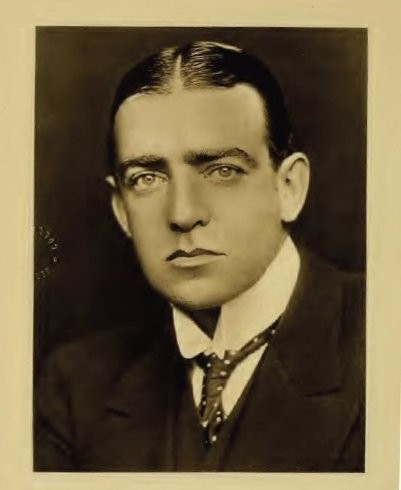
PORTRAIT OF E. H. SHACKLETON
THE HEART OF THE
ANTARCTIC
COMPLETE EDITION
BEING THE STORY OF THE BRITISH
ANTARCTIC EXPEDITION 1907-1909
BY E. H. SHACKLETON, C.V.O.,
WITH AN INTRODUCTION BY HUGH ROBERT MILL, D.Sc. AN ACCOUNT OF THE FIRST JOURNEY TO THE SOUTH MAGNETIC POLE BY PROFESSOR T. W. EDGEWORTH DAVID, F.R.S.
VOLUME I
PREFACE
THE scientific results of the expedition cannot be stated in detail in this book. The expert members in each branch have contributed to the appendices articles which summarise what has been done in the domains of geology, biology, magnetism, meteorology, physics, &c. I will simply indicate here some of the more important features of the geographical work.
We passed the winter of 1908 in McMurdo Sound, twenty miles north of the Discovery winter quarters. In the autumn a party ascended Mount Erebus and surveyed its various craters. In the spring and summer of 1908-9 three sledging-parties left winter quarters; one went south and attained the most southerly latitude ever reached by man, another reached the South Magnetic Pole for the first time, and a third surveyed the mountain ranges west of McMurdo Sound.
The southern sledge-journey planted the Union Jack in latitude 88° 23' South, within one hundred geographical miles of the South Pole. This party of four ascertained that a great chain of mountains extends from the 82nd parallel, south of McMurdo Sound, to the 86th parallel, trending in a south-easterly direction; that other great mountain ranges continue to the south and south-west, and that between them flows one of the largest glaciers in the world, leading to an inland plateau, the height of which, at latitude 88° South, is over 11,000 ft. above sea-level. This plateau presumably continues beyond the geographical South Pole, and extends from Cape Adare to the Pole. The bearings and angles of the new southern mountains and of the great glacier are shown on the chart, and are as nearly correct as can be expected in view of the somewhat rough methods necessarily employed in making the survey.
The mystery of the Great Ice Barrier has not been solved, and it would seem that the question of its formation and extent cannot be determined definitely until an expedition traces the line of the mountains round its southerly edge. A certain amount of light has been thrown on the construction of the Barrier, in that we were able, from observations and measurements, to conclude provisionally that it is composed mainly of snow. The disappearance of Balloon Bight, owing to the breaking away of a section of the Great Ice Barrier, shows that the Barrier still continues its recession, which has been observed since the voyage of Sir James Boss in 1842. There certainly appears to be a high snow-covered land on the 163rd meridian, where we saw slopes and peaks, entirely snow-covered, rising to a height of 800 ft., but we did not see any bare rocks, and did not have an opportunity to take soundings at this spot. We could not arrive at any definite conclusion on the point.
The journey made by the Northern Party resulted in the attainment of the South Magnetic Pole, the position of which was fixed, by observations made on the spot and in the neighbourhood, at latitude 72° 25' South, longitude 155° 16' East. The first part of this journey was made along the coastline of Victoria Land, and many new peaks, glaciers and ice-tongues were discovered, in addition to a couple of small islands. The whole of the coast traversed was carefully triangulated, and the existing map was corrected in several respects.
The survey of the western mountains by the Western Party added to the information of the topographical details of that part of Victoria Land, and threw some new light on its geology.
The discovery of forty-five miles of new coastline extending from Cape North, first in a south-westerly and then in a westerly direction, was another important piece of geographical work.
During the homeward voyage of the Nimrod a careful search strengthened that prevalent idea that Emerald Island, the Nimrod Islands and Dougherty Island do not exist, but I would not advise their removal from the chart without further investigation. There is a remote possibility that they lie at some point in the neighbourhood of their charted positions, and it is safer to have them charted until their non-existence has been proved absolutely.
I should like to tender my warmest thanks to those generous people who supported the expedition in its early days. Miss Dawson Lambton and Miss E. Dawson Lambton made possible the first steps towards the organisation of the expedition, and assisted afterwards in every way that lay in their power. Mr. William Beardmore (Parkhead, Glasgow), Mr. G. A. McLean Buckley (New Zealand), Mr. Campbell McKellar (London), Mr. Sydney Lysaght (Somerset), Mr. A. M. Fry (Bristol), Colonel Alexander Davis (London), Mr. William Bell (Pendell Court, Surrey), Mr. H. H. Bartlett (London), and other friends contributed liberally towards the cost of the expedition. I wish also to thank the people who guaranteed a large part of the necessary expenditure, and the Imperial Government for the grant of £20,000, which enabled me to redeem these guarantees. Sir James Mills, managing director of the Union Steam Shipping Company of New Zealand, gave very valuable assistance. The kindness and generosity of the Governments and people of Australia and New Zealand will remain one of the happiest memories of the expedition.
I am also indebted to the firms which presented supplies of various sorts, and to the manufacturers who so readily assisted in the matter of ensuring the highest quality and purity in our foods.
As regards the production of this book, I am indebted to Dr. Hugh Robert Mill for the introduction which he has written; to Mr. Edward Saunders, of New Zealand, who not only acted as my secretary in the writing of the book, but bore a great deal of the labour, advised me on literary points and gave general assistance that was invaluable; and to my publisher, Mr. William Heinemann, for much help and many kindnesses.
I have to thank the members of the expedition who have provided the scientific appendices. I should like to make special mention of Professor T. W. Edgeworth David, who has told the story of the Northern Journey, and Mr. George Marston, the artist of the expedition, represented in this volume by the colour plates, sketches and some diagrams.
I have drawn on the diaries of various members of the expedition to supply information regarding events that occurred while I was absent on journeys. The photographs with which these volumes are illustrated have been selected from some thousands taken by Brocklehurst, David, Davis, Day, Dunlop, Harbord, Joyce, Mackintosh, Marshall, Mawson, Murray and Wild, secured often under circumstances of exceptional difficulty.
In regard to the management of the affairs of the expedition during my absence in the Antarctic, I would like to acknowledge the work done for me by my brother-in-law, Mr. Herbert Dorman, of London; by Mr. J. J. Kinsey, of Christchurch, New Zealand; and by Mr. Alfred Reid, the manager of the expedition, whose work throughout has been as arduous as it has been efficient.
Finally, let me say that to the members of the expedition, whose work and enthusiasm have been the means of securing the measure of success recorded in these pages, I owe a debt of gratitude that I can hardly find words to express. I realise very fully that without their faithful service and loyal co-operation under conditions of extreme difficulty success in any branch of our work would have been impossible.
ERNEST H. SHACKLETON
LONDON,
October 1909
INTRODUCTION. SOUTH POLAR EXPLORATION IN THE LAST HUNDRED YEARS, By HUGH ROBERT MILL, D.Sc., LL.D.
AN outline of the history of recent Antarctic exploration is necessary before the reader can appreciate to the full the many points of originality in the equipment of the expedition of 1907-1909, and follow the unequalled advance made by that expedition into the slowly dwindling blank of the unknown South Polar area.
From the beginning of the sixteenth century it was generally believed that a great continent, equal in area to all the rest of the land of the globe, lay around the South Pole, stretching northward in each of the great oceans far into the tropics. The second voyage of Captain James Cook in 1773-75 showed that if any continent existed it must lie mainly within the Antarctic Circle, which he penetrated at three points in search of the land, and it could be of no possible value for settlement or trade. He reached his farthest south in 71° 10' South, 1130 miles from the South Pole.
In 1819 Alexander I, Emperor of all the Russias, resolved of his good pleasure to explore the North Polar and the South Polar regions simultaneously and sent out two ships to each destination. The southern expedition consisted of the two ships Vostok and Mirni, under the command of Captain Fabian von Bellingshausen, with Lieutenant Lazareff as second in command. They made a circumnavigation of the world in a high southern latitude, supplementing the voyage of Cook by keeping south where he went north, but not attempting to reach any higher latitudes. On leaving Sydney in November 1820, Bellingshausen went south in 163° East, a section of the Antarctic which Cook had avoided, and from the eagerness with which the Russian captain apologised for not pushing into the pack it may be inferred that he found the gate leading to Ross Sea only barred by the ice, not absolutely locked. The ships went on in the direction of Cape Horn in order to visit the South Shetlands, recently discovered by William Smith. On the way Bellingshausen discovered the first land yet known within the Antarctic Circle, the little Peter I Island and the much larger Alexander I Land, which he sighted from a distance estimated at forty miles. A fleet of American sealers was found at work round the South Shetlands and some of the skippers had doubtless done much exploring on their own account, though they kept it quiet for fear of arousing competition in their trade. Bellingshausen returned to Cronstadt in 1821 with a loss of only three men in his long and trying voyage. No particulars of this expedition were published for many years.
In February 1823, James Weddell, a retired Master in the Royal Navy, and part owner of the brig Jane of Leith, 160 tons, was sealing round the South Orkneys with the cutter Beaufoy, 65 tons, under the command of Matthew Brisbane, in company, when he decided to push south as far as the ice allowed in search of new land where seals might be found. Signs of land were seen in the form of icebergs stained with earth, but Weddell sailed through a perfectly clear sea, now named after him, to 74° 15' South in 34° 17' West. This point, reached on February 22, 1823, was 3° South of Cook's farthest and 945 miles from the South Pole. On his return he brought back to Europe the first specimen of the Weddell seal to be seen by any naturalist.
Enderby Brothers, a firm of London shipowners doing a large trade in seal-oil, took a keen interest in discovery, and one of the brothers was an original Fellow of the Royal Geographical Society, founded in 1830. In that very year the firm despatched John Biscoe, a retired Master in the Royal Navy, in the brig Tula, with the cutter Lively in company, on a two years' voyage, combining exploration with sealing. Biscoe was a man of the type of Cook and Weddell, a first-class navigator, indifferent to comfort, ignorant of fear and keen on exploring the Far South. In January 1831 he commenced a circumnavigation of the Antarctic Regions eastward from the South Atlantic in 60° South. At the meridian of Greenwich he got south of the Circle and pushed on, beating against contrary winds close to the impenetrable pack which blocked advance to the south. At the end of February he sighted a coastline in 49° 18' East and about 66° South, which has since been called Enderby Land, but it has never been revisited. He searched in vain for the Nimrod Islands, which had been reported in 56° South, 158° West, and then, crossing the Pacific Ocean well south of the sixtieth parallel, he, ignorant of Bellingshausen's voyage, entered Bellingshausen Sea, and discovered the Biscoe Islands and the coast of Graham Land. On his return in 1833 Biscoe received the second gold medal awarded by the Royal Geographical Society for his discoveries and for his pertinacity in sailing for nearly fifty degrees of longitude south of the Antarctic Circle.
In 1838 the Enderbys sent out John Balleny in the sealing schooner Eliza Scott, 154 tons, with the cutter Sabrina, 54 tons, and he left Campbell Island, south of New Zealand, on January 17, 1839, to look for new land in the south. On the 29th he reached the Antarctic Circle in 178° East, and got to 69° South before meeting with heavy ice. Turning westward at this point he discovered the group of lofty volcanic islands which bears his name, and there was no mistake as to their existence, as one of the peaks rose to a height of 14,000 ft. An excellent sketch was made of the islands by the mate, and geological specimens were collected from the beach. Proceeding westward Biscoe reported an "appearance of land in 65° South, and about 121° East", which Mr. Charles Enderby claimed as a discovery and called Sabrina Land after the unfortunate cutter, which was lost with all hands in a gale.
The years 1838 to 1848 saw no fewer than ten vessels bound on exploration to the ice-cumbered waters of the Antarctic, all ostensibly bent on scientific research, but all animated, some admittedly, by the patriotic ambition of each commander to uphold the honour of his flag.
Captain Dumont d'Urville, of the French Navy, was one of the founders of the Paris Geographical Society. He had been sent out on two scientific voyages of circumnavigation, which lasted from 1822 to 1825, and from 1826 to 1829, and he became a great authority on the ethnology of the Pacific Islands. He planned a third cruise to investigate problems connected with his special studies; but, in granting the vessels for this expedition, King Louis Philippe added to the commission, possibly at the suggestion of Humboldt, a cruise to the Antarctic regions in order to out-distance Weddell's farthest south. It was known that an American expedition was on the point of starting with this end in view, and that active steps were also being taken in England to revive southern exploration. Dumont d'Urville got away first with two corvettes, the Astrolabe, under his command, and the Zelée, under Captain Jacquinot, which sailed from Toulon on September 7, 1887. The two ships reached the pack-ice on January 22, 1838, but were unable to do more than sail to and fro along its edge until February 27, when land was sighted in 63° South and named Louis Philippe Land and Joinville Island. These were, undoubtedly, part of the Palmer Land of the American sealers, and a continuation of Biscoe's Graham Land. Though he did not reach the Antarctic Circle, d'Urville had got to the end of the Antarctic summer and discharged his debt of duty to his instructions.
It was the avowed intention of the American expedition and of the British expedition, since fitted out, to find the South Magnetic Pole, the position of which was believed from the theoretical investigations of Gauss to be near 66° South and 146° East. In December 1839, when d'Urville was at Hobart Town, and the air was full of rumours of these expeditions, he suddenly made up his mind to exceed his instructions and make a dash for the South Magnetic Pole for the honour of France. He left Hobart on January 1, 1840, and on the 21st sighted land on the Antarctic Circle in longitude 138° E. The weather was perfect, the icebergs shone and glittered in the sun like fairy palaces in the streets of a strange southern Venice; only wind was wanting to move the ships. The snow-covered hills rose to a height of about 1500 ft. and received the name of Adelie Land, after Madame Dumont d'Urville. A landing was made on one of a group of rocky islets lying off the icebound shore, and the ships then followed the coast westward for two days. In 135° 30' West bad weather and a northward bend in the ice drove the corvettes beyond the Circle, and on struggling south again on January 28, in the lift of a fog, the Astrolabe sighted a brig flying the American flag, one of Wilkes' squadron. The ships misunderstood each other's intentions; each intended to salute and each thought that the other wished to avoid an interview; and they parted in the fog full of bitterness towards each other without the dip of a flag. All day on the 30th, d'Urville sailed along a vertical cliff of ice 120 to 130 ft. high, quite flat on top, with no sign of hills beyond; but sure that so great a mass of ice could not form except on land he did not hesitate to name it the Clarie coast, after Madame Jacquinot. On February 1, the French ships left the Antarctic in longitude 130° West.
An American man of science, Mr. J. N. Reynolds, had gone to Palmer Land in the early days, and on his return agitated strongly for a national exploring expedition. An Act of Congress in 1836 provided for such an f expedition, but there had been controversies giving rise to ill-feeling, and Mr. Reynolds was not allowed to join "for the sake of harmony". After one and another of the naval officers designated to command it had resigned or declined the post. Lieutenant Charles Wilkes, U.S.N., was at last persuaded to take charge of the squadron of six ill-assorted vessels manned by half-hearted crews. His instructions were to proceed to Tierra del Fuego with the sloops-of-war Vincennes and Peacock, the brig Porpoise, the store-ship Relief and the pilot-boats Sea Gull and Flying Fish; to leave the larger vessels and the scientific staff—which they carried—and proceed with the Porpoise and the tenders "to explore the southern Antarctic to the southward of Powell's group, and between it and Sandwich Land, following the track of Weddell as closely as practicable, and endeavouring to reach a high southern latitude; taking care, however, not to be obliged to pass the winter there." He was then with all his squadron to proceed southward and westward as far as Cook's farthest, or 105° West, and then retire to Valparaiso. After surveying in the Pacific they were to proceed to Sydney and then the instructions proceeded: "You will make a second attempt to penetrate within the Antarctic region, south of Van Diemen's Land, and as far west as longitude 45° East or to Enderby's Land, making your rendezvous on your return at Kerguelen's Land." Very stringent orders, dated August 11, 1838, were given to Wilkes not to allow any one connected with the expedition to furnish any other persons "with copies of any journal, charts, plan, memorandum, specimen, drawing, painting or information" concerning the objects and proceedings of the expedition or as to discoveries made. The ships were not fortified for ice navigation; they were not even in sound seaworthy condition; the stores were inadequate and of bad quality; the crews and unhappily some of the officers were disaffected, disliking their commander, and making things very uncomfortable for him. The attempt to navigate Weddell Sea proved abortive; on the side of Bellingshausen Sea one ship reached 68° and another 70° South, but saw nothing except ice.
At Sydney, Wilkes was most unhappy; his equipment was criticised with more justice than mercy by his colonial visitors, and in his narrative he says plainly that he was obliged "to agree with them that we were unwise to attempt such service in ordinary cruising vessels; we had been ordered to go and that was enough: and go we should." And they went. On January 16, 1840, land was sighted by three of the ships in longitudes about 158° East, apparently just on or south of the Antarctic Circle. The ships sailed westwards as best they could along the edge of the pack; sometimes along the face of a barrier of great ice-cliffs, ignorant of the fact that Balleny had been there the year before, but very anxious that they should anticipate any discoveries on the part of the French squadron then in those waters. On January 19, land was reported on the Antarctic Circle both to the south-east and to the south-west, Wilkes being then in 154° 30' East, and its height was estimated at 3000 ft. The ships were involved all the time in most difficult navigation through drifting floes and bergs, storms were frequent and fogs made life a perpetual misery, as it was impossible to see the icebergs until the ships were almost on them. The Peacock, the least seaworthy of the squadron, lay helpless in the ice for three days while the rudder, which had been smashed, was being repaired on deck, and on January 25 she was patched up enough to return to Sydney. Wilkes' ship, the Vincennes, got south of the Circle on January 23, and he hoped to reach the land, but the way was barred by ice. On the 28th, land appeared very distinctly in 141° East, but the Vincennes was driven off by a gale, the sea being extraordinarily encumbered with icebergs and ice-islands. Two days later land was unquestionably found in 66° 45' South, 140° 2' East, with a depth of thirty fathoms; there were bare rocks half a mile from the ship, and the hills beyond rose to 3000 ft.; but the weather was too rough to get boats out. This was the Adelie Land which d'Urville had lighted on nine days before. This also is the only point of land reported by the American expedition, with the very doubtful exception of Sabrina Land, which has been confirmed by another expedition. Against the written remonstrance of the surgeons, who said that longer exposure to the heavy work of ice navigation in the severe conditions of the weather would increase the sick-list to such an extent as to endanger the ships, and in spite of the urgent appeal of a majority of the officers, Wilkes held on to the westward, reporting land in the neighbourhood of the Antarctic Circle every day, observing many earth-stained icebergs and collecting specimens of stones from the floating ice. On February 16, the ice-barrier which Wilkes had been following westward turned towards the north and over it there was "an appearance of land" which he called Termination Land. He was in 97° 37' East, and on the 21st, having failed to get farther west, he rejoiced the hearts of all on board by turning northwards and making for Sydney. Ringgold on the Porpoise had thought of running to the rendezvous in 100° East first, and working his way back to the eastward with a favouring wind afterwards, and he accomplished the first part of the programme easily enough, for the wind helped him, passing and disdaining to salute d'Urville's ships on the way. He added nothing material to the information obtained by the Vincennes.
Considering the deplorable conditions against which he had to contend both in the seas without and the men within his ships, the voyage of Wilkes was one of the finest pieces of determined effort on record. He erred in not being critical enough of appearances of land; and his charts were certainly faulty, as any charts of land dimly seen through fog were bound to be. Subsequent explorers have sailed over the positions where Wilkes showed land between 164° and 154° East, and if the land he saw there exists, it must be farther south than he supposed. It is certain that Wilkes saw land farther east, and it seems that he was as harshly judged by Ross and as unsympathetically treated by some other explorers and geographers as he was by his own subordinates.
Sir Edward Sabine and other British physicists had been trying from 1835 onward to secure the despatch of a British expedition to study terrestrial magnetism in the Antarctic regions, and pressure was brought to bear on the Royal Society to take the initiative but with little effect. An effort by Captain Washington, the Secretary, to arouse the Royal Geographical Society early in 1837 also failed. In the following year the recently founded British Association for the Advancement of Science memorialised Government on the need for making a series of simultaneous magnetic observations in all parts of the world, particularly by means of a special expedition to high southern latitudes. The Prime Minister, Lord Melbourne, was impressed; he referred the memorial to the Royal Society, which supported it. A naval expedition was decided on and rapidly fitted out on the Erebus and Terror, two vessels of great strength, designed for firing large bombs from mortars in siege operations, but clumsy craft to navigate, with bluff bows that made them move slowly through the water, and sluggish in answering their helms. The one possible commander was Captain James Clark Ross, a tried Arctic traveller and an enthusiastic student of magnetism, who had reached the North Magnetic Pole in 1831, and whose surpassing fitness for the position had been a potent factor in the minds of the promoters. Captain Crozier was second in command on board the Terror, and although all the magnetic and other physical work was to be done by naval officers, the surgeons were appointed with regard to their proficiency in geology, botany and zoology. One of these subsequently took rank amongst the greatest men of science of the nineteenth century, and in 1909 Sir Joseph Hooker retains at the age of ninety-two the same interest in Antarctic exploration which drew him in 1889, as a youth of twenty-one, to join the Navy, in order to accompany the expedition. The ships were of 370 and 350 tons respectively, the whole ship's company of each being seventy-six officers and men, and they were well provisioned for the period, fresh tinned meats and vegetables being available. The instructions of the Admiralty left a good deal of discretion to the commander. He was ordered to land special parties of magnetic observers at St. Helena, the Cape of Good Hope and Van Diemen's Land. On the way he was to proceed south from Kerguelen Land and examine those places where indications of land had been reported. In the following summer he was to proceed southward from Tasmania towards the South Magnetic Pole, which he was to reach if possible, and return to Tasmania. In the following year he was to attain the highest latitude he could reach and proceed eastward to fix the position of Graham Land. The Erebus and Terror reached Hobart Town in August 1840, without doing any Antarctic exploration on the way. At Hobart, Ross was in constant communication with Sir John Franklin, the governor of Van Diemen's Land and a great authority on polar exploration in the north. He heard of d'Urville's and Wilkes' discoveries and was very angry that others had taken the track marked out for him. He resolved that he would not, as he somewhat quaintly put it, "interfere with their discoveries" and in so doing he allowed the haze of uncertainty to rest over the region south of the Indian Ocean to this day; but he also resolved to try to get south on the meridian of 170° East, where Balleny had found open sea in 69° South; and had it not been for the previous French and American voyages causing him to change his plans, Ross might conceivably have missed the great chance of his lifetime. The expedition left Hobart on November 12, 1840, sighted the sea ice on December 31, lying along the Antarctic Circle, and after spending some time searching for the best place to enter it, on January 5, 1841, ships for the first time in the southern hemisphere left the open sea and pushed their way of set purpose into the pack. The vessels having been strengthened after the manner of the northern whalers to resist pressure and Ross himself fortified by long experience in Arctic navigation, the impassable barrier of the earlier explorers had no terrors for him. The pack which all other visitors to the Antarctic had viewed as extending right up to some remote and inaccessible land was found to be a belt about a hundred miles wide, and in four days the Erebus and Terror passed through it into the open waters of what is now called Ross Sea. The way seemed to lie open to the magnetic pole when a mountain appeared on the horizon. Ross called it Mount Sabine, after the originator of the expedition, and held on until on January 11 he was within a few miles of the bold mountainous coast of South Victoria Land; in front of him lay Cape Adare in latitude 71° South, from which one line of mountains, the Admiralty Range, ran north-west along the coast to Cape North, another, the peaks of which he named after the members of the Councils of the Royal Society and the British Association, ran along the coast to the south. Ross went ashore on Possession Island on January 12 and took possession of the first land discovered in the reign of Queen Victoria. The sea swarmed with whales, in the pursuit of which Ross, probably mistaking the species, thought that a great trade would spring up. On the 22nd the latitude of 74° South was passed and the expedition was soon nearer the Pole than any human being had been before. A few days later Franklin Island was seen and visited; but, as at Possession Island, no trace of vegetation was found. On the morning of January 28, a new mountain emitting volumes of smoke appeared ahead; it was Mount Erebus, named after the leading ship, and on High Island, as Ross called the land from which it sprung, appeared a lesser and extinct volcano, called Mount Terror after the second vessel. As the ships drew near, confident of sailing far beyond the 80th parallel, an ice-barrier appeared similar to that reported by Wilkes on his cruise, but greater. Vast walls of ice as high as the cliffs of Dover butted on to the new land at Cape Crozier, its western limit, and formed an absolute bar to further progress. A range of high land running south was seen over the barrier and this Ross called the Parry Mountains; to the west around the shores of an ice-girdled bay (McMurdo Bay) the land seemed to run continuously with the continent, and Ross accordingly represented Mount Erebus as being on the mainland, and the coast as turning abruptly in McMurdo Bay from its southerly to an easterly direction. The ships cruised eastward for two hundred and fifty miles parallel with the Great Barrier, the remarkable nature of which impressed all on board, as they recognised its uniform flat-topped extension and the vast height of the perpendicular ice-cliffs in which it terminated, the height being something like 200 ft. on the average, though at one point it did not exceed 50 ft. On February 2, the highest latitude of the trip was reached, 78° 4' South, or 3° 48' beyond Weddell's farthest on the opposite side of the Antarctic Circle. Two days later the pack became so dense that progress was stopped in 167° West. Ross struggled for a week to get farther east and then turned to look for a harbour on the coast of Victoria Land in which he might winter. Passing by McMurdo Bay without examining it closely, he tried to get a landing nearer the Magnetic Pole, being possessed by a burning ambition to hoist the flag which he had displayed at the North Magnetic Pole in 1831 at the South Magnetic Pole in 1841. It was impossible, however, to get within twelve or fourteen miles of the land on account of the freezing of the sea locking the pack into a solid mass; it was too late to turn back and seek a harbour farther south, and after naming the headland at the base of Mount Melbourne, Cape Washington, in honour of the zealous Secretary of the Royal Geographical Society, Ross left the Antarctic regions after having remained south of the Circle for sixty-three days. On the way northward he sighted high islands, which were probably part of the Balleny group, and he sailed across the site of a range of mountains marked on a chart which Wilkes had given him. Wilkes afterwards explained that these mountains were not intended to show one of his discoveries, and an unedifying controversy ensued, which did credit to neither explorer. Ross returned to Hobart on April 6, 1841, after the greatest voyage of Antarctic discovery ever made. Three months later the news reached England, and the Royal Geographical Society at once awarded the Founder's Gold Medal to Captain Ross.
On November 23, 1841, the Erebus and Terror left the Bay of Islands, New Zealand, which had been declared a British possession the year before, to make a new effort to get south in a longitude about 150° West, so as to approach the Great Barrier from a point east of that at which they had been stopped the previous season. The pack was entered about 60° South and 146° West on December 18, and it seemed as if the ships were never to get through it. The Antarctic Circle was reached on New Year's Day, 1842, every effort being made to work the ships through the lanes between the floes. For a time when the wind was favourable the two ships were lashed on each side of a small floe of convenient shape and with all sail set they were able to give it sufficient way to break the lighter ice ahead, using it as a battering-ram and as a buffer to protect their bows. Ross did everything to keep up the spirits of the crews, by instituting sports and keeping up visits between the two ships, as in an Arctic wintering. A terrific storm on January 18 buffeted the ships unmercifully, the huge masses of floating ice being hurled against them in a prodigious swell, and for twenty-four hours the Erebus and Terror were almost out of control, their rudders having been smashed by the ice, though the stout timbers of the hulls held good. On January 26, after being thirty-nine days in the pack, and boring their way for eight hundred miles through it, the Erebus and the Terror were only thirty-nine miles farther south than Cook had been in the Resolution on the same meridian without entering the ice at all sixty-eight years before. On February 2 the ships escaped from the pack in 159° East, but only one degree south of the Antarctic Circle. The Barrier was not sighted until February 22, and on the 28th the ships at last got within a mile and a half of the face of the ice-wall, which was found to be 107 ft. high at its highest point and the water 290 fathoms deep, in 161° 27' West and 78° 11' South. This was the highest latitude reached by Ross, 3° 55' or 235 miles farther south than Weddell's farthest, and 710 miles from the South Pole. Towards the south-east he saw that the Barrier surface gradually rose with the appearance of mountains of great height, but he could not bring himself to chart this as land, for no sign of bare rock could be seen, and though he felt that "the presence of land there amounts almost to a certainty" he would not run the risk of any one in the future proving that he had been mistaken, and so charted it as an "appearance of land" only. Any other explorer of that period, or of this, would have called it land and given it a name without hesitation, and had Ross only known how to interpret what the numerous rock specimens he dredged up from the bottom had to tell him, he could have marked the land with an easy mind.
It was now time to leave the Far South; the work had been infinitely harder than that of the former season and the result was disappointing. The coast of Victoria Land was not sighted on this cruise, and on March 6, 1842, the Erebus and Terror crossed the Antarctic Circle northward, after having been sixty-four days within it. Ross Sea was not furrowed by another keel for more than half a century. Once in open water the Erebus and Terror held an easterly course through the Southern Ocean south of the Pacific, farther north than Biscoe, Bellingshausen or Cook, making passage to the Falkland Islands, by that time a British possession. The greatest danger of the whole cruise occurred suddenly on this passage when the two ships came into collision while attempting to weather an iceberg in a gale and snowstorm during the night; but though for an hour all gave themselves up for lost they came through, and they reached Port Louis in the Falklands on April 5, 1842, one hundred and thirty-seven days out from the Bay of Islands.
Having received authority to spend a third summer in south polar exploration, Ross sailed from the Falklands on December 17, 1842, intending to survey the coasts discovered by d'Urville and follow the land south to a high latitude in Weddell Sea; but though several points on Louis Philippe Land were sighted and mountains named, there was no open way to the south and it was not until March 1, 1843, that the Antarctic Circle was reached by coasting the pack to 12° 20' West. Here a sounding of the vast depth of 4000 fathoms was obtained, but Dr. W. S. Bruce, with improved and trustworthy apparatus, found sixty years later that the real depth at this point was only 2660 fathoms. Ross proceeded southwards in open water to 71° 30' South, thirty miles within the ice-pack, but there he was stopped nearly halfway between the positions reached by Bellingshausen in 1820 and by Weddell in 1823; and here his Antarctic exploration ended. On his way to Cape Town, Ross searched for Bouvet Island as unsuccessfully as Cook, though he passed within a few miles of it. Ross' first summer in the Antarctic had brought unexpected and magnificent discoveries, tearing a great gap in the unknown area, and fortune smiled without interruption on the expedition; his second summer brought trouble and danger with but a trifling increase in knowledge, while the third led only to disappointment. Ross had come triumphantly through a time of unparalleled stress, his personal initiative animated the whole expedition and never were honours more nobly won than those which he received on his return. He was knighted, fêted, and presented with many gold medals; and he was offered and begged in the most flattering way to accept the command of the expedition to explore the North-West Passage in his old ships. The position, when he declined it, was given to Sir John Franklin.
Immediately after Ross' return a supplementary cruise for magnetic observations was carried out by Lieutenant T. E. L. Moore, R.N., who had been mate on the Terror. He sailed from Cape Town in the hired barque Pagoda, 360 tons, on January 9, 1845, and, after the usual fruitless search for Bouvet Island, crossed the Antarctic Circle in 30° 45' East, but was stopped by the ice in 67° 50' South. He struggled hard against calms and head winds to reach Enderby Land, but in vain. Moore believed that he saw land in 64° South and about 50° East; but like Ross he stood on a pedantic technicality, "there was no doubt about it, but we would not say it was land without having really landed on it." How much controversy and ill-feeling would have been avoided if Wilkes and other explorers had acted on this principle!
In 1850, in one of the Enderbys' ships, the Brisk, Captain Tapsell went to the Balleny Islands looking for seals and sailed westward at a higher latitude than Wilkes had reached, as far as the meridian of 143° East, without sighting land; the log of the voyage is lost, and the exact route is not on record.
Though Ross urged the value of the southern whale fishery in strong terms, no one stirred to take it up. Polar enterprise was diverted to the lands within the Arctic Circle by the tragedy of Franklin's fate and the search expeditions. Efforts were made again and again to reawaken interest in the south, notably by the great American hydrographer, Captain Maury, and the eminent German meteorologist, Professor Georg von Neumayer, but without effect.
In 1875, H.M.S. Challenger, on her famous voyage of scientific investigation with Captain George Nares, R.N., as commander and Professor Wyville Thomson as scientific director, made a dash south of Kerguelen Land, and on February 16 she had the distinction of being the first vessel propelled by steam across the Antarctic Circle. She went to 66° 40' South in longitude 78° 22' East, and pushed eastward in a somewhat lower latitude to within fifteen miles of Wilkes' Termination Land as shown on the charts, but nothing resembling land could be seen. The Challenger saw many icebergs, but being an unprotected vessel and bent on other service she could make no serious attempt to penetrate the pack; nevertheless, the researches made on board by sounding and dredging up many specimens of rocks proved beyond doubt that land lay within the ice surrounding the Antarctic Circle and that the land was not insular but a continent.
In the same year a German company sent out the steam whaler Grönland, Captain Dallmann, to try whether anything could be made of whaling or sealing in the neighbourhood of the South Shetlands, and he went probably to about 65° South in Bellingshausen Sea on the coast of Graham Land. In the 'eighties of last century Neumayer continued to urge the renewal of Antarctic research in Germany, and Sir John Murray, raising his powerful voice in Great Britain, sketched out a scheme for a fully equipped naval expedition, but refused to have anything to do with any expedition not provided at the outset with funds sufficient to ensure success. The government of Victoria took the matter up and offered to contribute £5000 to an expedition if the Home Government would support it; the British Association, the Royal Society, and the Royal Geographical Society reported in favour of the scheme, but in 1887 the Treasury definitely declined to participate.
In 1892 a fleet of four Dundee whalers set out for Weddell Sea, in order to test Ross' belief that the whalebone whale existed there, and two of them, the Balaena and Active, were fitted up with nautical and meteorological instruments by the Royal Geographical Society and the Meteorological Office, in the hope that they would fix accurate positions and keep careful records. Dr. W. S. Bruce, an enthusiastic naturalist, accompanied the Balaena and Dr. C. W. Donald accompanied the Active, commanded by Captain Thomas Robertson. The ships made full cargoes of seals in Weddell Sea, but did not go beyond 65° South, nor did they repeat the venture. A Norwegian whaler, the Jason, was sent out at the same time by a company in Hamburg, and her master, Captain Larsen, picked up a number of fossils on Seymour Island, and saw land from Weddell Sea in 64° 40' South. The Hamburg Company sent out three ships in 1893, the Jason to Weddell Sea, where Captain Larsen discovered Oscar Land, no doubt the eastern coast of Graham Land, in 66° South and 60° West, and pushing on farther he discovered Foyn Land, the Jason being the second steamer to enter the Antarctic regions proper. On his way home along the coast he charted many new islands and discovered active volcanoes near the place where Ross' officers had seen smoke rising from the mountains, though that cautious explorer decided that as it might be only snowdrift he would not claim the discovery of volcanoes there. Meanwhile, in Bellingshausen Sea, Captain Evenson, of the Hertha, got beyond 69° 10' South after visiting the Biscoe Islands, and he sighted Alexander I Land for the first time since its discovery.
The next visit to the Antarctic was due to the Norwegian whaler, Svend Foyn, who sent out the Antarctic, under Captain Kristensen, with Mr. Bull as agent, to Ross Sea. They had agreed to take Dr. W. S. Bruce, but he found it impossible to reach Melbourne in time to join the ship. A young Norwegian resident in Australia, who was partly English in ancestry, Carstens Egeberg Borchgrevink, shipped as a sailor, having an insatiable desire to see the Antarctic regions and being refused a passage on any other terms. The Antarctic sighted the Balleny Islands and was nearly six weeks in working through the pack, but on January 14, 1895, she was the first steamer to enter the open water of Ross Sea. A landing was made on Possession Island, where Borchgrevink discovered a lichen, the first trace of vegetation found within the Antarctic Circle; the ship went as far as 74° South looking for whales and on her way back the first landing on the Antarctic continent was made on a low beach at Cape Adare.
Mr. Borchgrevink described this voyage at the meeting of the Sixth International Geographical Congress in London in 1895, where a great discussion on the possibility of renewing Antarctic exploration had previously been arranged for. Dr. von Neumayer gave an able historical paper on Antarctic exploration, Sir Joseph Hooker spoke as a survivor of Ross' expedition. Sir John Murray as a member of the scientific staff of the Challenger, and Sir Clements Markham as President of the Congress. The Congress adopted a resolution to the effect that the exploration of the Antarctic Regions was the greatest piece of geographical exploration remaining to be undertaken, and that it should be resumed before the close of the nineteenth century.
The first result was the expedition of the Belgica under the command of Lieutenant de Gerlache, due to the passionate enthusiasm of the commander, notably aided by Henryk Arçtowski, a Pole, whose ardour in the pursuit of physical science has never been surpassed. Dr. Cook, an American, was surgeon to the expedition; the second in command was Lieutenant Lecointe, a Belgian, the mate, Roald Amundsen, a Norwegian, and the crew were half Belgian and half Norwegian. The scientific staff included, besides Arçtowski, the Belgian magnetician Lieutenant Danco, the Rumanian Racovitza, and the Pole Dobrowolski. The funds were meagre and raised by public subscription with enormous difficulty, and the equipment almost less than the minimum requirement. The ship was small, only two hundred and fifty tons, but in her this cosmopolitan gathering experienced first of all men the long darkness of the Antarctic night. Much valuable time was lost on the outward journey amongst the Fuegian Islands, and much was occupied in the archipelago into which the Belgica resolved Palmer Land, between 64° and 65° South. It was February 12, 1898, before the ship proceeded southward along the coast of Graham Land. On the 15th she crossed the Antarctic Circle, on the 16th Alexander I Land was sighted, but could not be approached within twenty miles on account of the ice-pack. The equipment of the ship hardly seems to have justified wintering; prudence called for a speedy retreat, but a gale came down of such severity that Gerlache thrust the ship into the pack for shelter from the heavy breakers on February 28, and finding wide lanes opening under the influence of wind and swell, he pushed southward against the advice of the scientific members of the expedition, determined to make every effort to outdistance all previous explorers towards the pole. On March 3, 1898, the Belgica found herself in 71° 30' South and about 85° West. An effort to return was unavailing; on the 4th she was fast in the floe, unable to move in any direction, and she remained a prisoner of the ice until February 14, 1899, and then took another month to clear all the pack and reach the open sea. For a year she had been drifting north, west, south and east, in Bellingshausen Sea; even in winter the floe was never at rest, and almost all the time she kept south of the parallel of 70° over water which shallowed from great depths in the north to about two hundred and fifty fathoms in the southern stretches of the drift, evidently on the sloping approach to extensive land. The expedition suffered greatly in health during the winter from inadequate food, and from the absence of proper light in the terrible darkness of the long night. Despite all its difficulties the Belgica had done more to promote a scientific knowledge of the Antarctic regions than any of the costly expeditions that went before, and the Belgian Government, coming to the rescue after her return, provided adequate funds for working out the results.
Bellingshausen Sea was visited again in 1904 by Dr. J. B. Charcot in the Français, which followed the route of the Belgica along the coast of Graham Land, afterwards wintering in Port Charcot, a harbour on Wandel Island in 65° South. Returning southward in the summer of 1904-5 he discovered land, named Terre Loubet, between Graham Land and Alexander I Land, but its exact position has not been stated. This French cruise was important as a preliminary to the expedition under Charcot, which left in 1908 and is now in those waters with the intention of pushing exploration to the Farthest South, in a ship named with a dash of humour and a flash of hope the Pourquoi Pas?
Two voyages of exploration in Weddell Sea may for convenience be referred to here. In October 1901, Dr. Otto Nordenskjold left Gothenberg in the old Antarctic, under the command of Captain Larsen, for an expedition which he had got up by his personal efforts. He arrived at the South Shetlands in January 1902, but found it impossible even to reach the Antarctic Circle on the coast of Oscar Land. Allowing the ship to go north for work among the islands, Nordenskjold wintered for two years, 1902 and 1903, in a timber house on Snow Hill Island in 64° 25' South. Only one year's wintering had been contemplated, but the Antarctic was crushed in the ice and sank, fortunately without loss of life. A relief ship was despatched from Sweden, but shortly before she arrived Nordenskjold and his companions had been rescued by the unprotected Argentine naval vessel Uruguay, under Captain Irizar.
Dr. W. S. Bruce, who had been to Weddell Sea in the Balaena in 1892, and had since then taken part in several Arctic expeditions, succeeded by dint of hard work and the unceasing advocacy of the further exploration of Weddell Sea, in enlisting the aid of a number of persons in Scotland, and notably of Mr. James Coats, Jr., of Paisley, and Major Andrew Coats, D.S.O., and fitting out an expedition on the Scotia. He left the Clyde in November 1902, with Captain Thomas Robertson in command of the ship, Mr. R. C. Mossman, the well-known meteorologist, Mr. Rudmose Brown and Mr. D. W. Wilton as naturalists, and Dr. J. H. H. Pirie as surgeon and geologist. After calling at the South Orkneys, the Scotia got south to 70° 25' South in 17° West on February 22, 1903, not far from the position reached by Ross. Valuable oceanographical work was done, and on returning to the South Orkneys, Mr. Mossman landed there with a party to keep up regular meteorological observations while the ship proceeded to the River Plate. On her return in the following year the Argentine Government took over the meteorological work in the South Orkneys, which has been kept up ever since, to the great advancement of knowledge. The Scotia made another dash to the south on the same meridian as before, and on March 2, 1904, when in 72° 18' South and 18° West, a high ice-barrier was seen stretching from north-east to south-west, the depth of the sea being 1131 fathoms, a marked diminution from the prevailing depths. The Barrier was occasionally seen in intervals of mist, and March 6 being a clear day allowed the edge to be followed to the south-west to a point one hundred and fifty miles from the place where it was first sighted. The depth, two and a half miles from the Barrier edge, pack-ice preventing a nearer approach, was 159 fathoms. The description of the appearance of the Barrier given in the "Cruise of the Scotia" is very brief: "The surface of this great Inland Ice of which the Barrier was the terminal face or sea-front seemed to rise up very gradually in undulating slopes, and faded away in height and distance into the sky, though in one place there appeared to be the outline of distant hills; if so they were entirely ice-covered, no naked rock being visible." Ross or Moore would certainly have charted this as an "appearance of land"; Bruce knew from the shoaling water and the nature of the deposits that he was in the vicinity of land and gave it the name of Coats Land after his principal supporters. He could get no farther and returned from 74° 1' South in 22° West, a point almost as far south as Weddell had got in his attempt one hundred and eighty miles farther west. The Scotia rendered immense service to science by her large biological collections, her unique series of deep-sea soundings in high latitudes and the permanent gain of a sub-Antarctic meteorological station.
The next step in exploration by way of Ross Sea was the fitting-out by Sir George Newnes of an expedition under the leadership of Mr. C. E. Borchgrevink, on board the Southern Cross, a stout Norwegian whaler with Captain Jensen, who had been chief officer in the Antarctic when she went to Ross Sea in 1895, as master. Lieutenant Colbeck, R.N.R., went as magnetic observer, Mr. L. C. Bernacchi, a resident in Tasmania, who had arranged to join the Belgica if she had gone out by Australia, as meteorologist, and Mr. Nicolai Hanson, of the British Museum, as zoologist. The Southern Cross left Hobart on December 19, 1898, and entered the pack about the meridian of the Balleny Islands, 165° East; but after being forced out again on the northern side after six weeks' struggling to get south, she re-entered the pack in 174° East and was through in the clear waters of Ross Sea in six hours on February 11, 1899. A wooden house and stores for the winter were landed at Cape Adare in 71° 15' South, and there the shore-party went into winter quarters, the ship returning to the north. An important series of meteorological observations was secured during the year of residence, valuable zoological and geological collections were made, and the habits of the penguins were studied; but the few attempts at land exploration were without result. On January 28, 1900, Captain Jensen returned with the Southern Cross and on February 2, the Cape Adare colony embarked and set out southward along the coast of Victoria Land. Landings were effected at various points, including the base of Mount Melbourne, where reindeer-moss was found growing, and at Cape Crozier. There was much less ice along the coast than when Ross had visited it. The Southern Cross, after sighting Mount Erebus and Mount Terror, ran eastward along the Great Barrier far closer to the ice-cliffs than Ross could go in his sailing ships, and Colbeck's survey showed that the Barrier had receded on the whole some thirty miles to the south. Parts of the Barrier were quite low, and Borchgrevink landed in 164° West, the ship being laid alongside the ice as if it had been a quay, and made a short journey on ski southward over the surface on February 19, 1900, reaching 78° 50' South, forty miles beyond Ross' farthest and six hundred and seventy miles from the Pole, the nearest yet attained. The sea was beginning to freeze and the Southern Cross made haste for home.
Following on various less weighty efforts set in motion by the resolution of the International Geographical Congress in 1895, all the eminent men of science who had the renewal of Antarctic exploration at heart met in the rooms of the Royal Society in London in February 1898, when Sir John Murray read a stimulating paper. This was followed by a discussion in which part was taken by the veteran Antarctic explorer Sir Joseph Hooker, by the most successful of Arctic explorers Dr. Fridtjof Nansen, by Dr. von Neumayer, who had never ceased for half a century to advocate renewed exploration, and by Sir Clements Markham, President of the Royal Geographical Society. A Joint Committee of the Royal Society and the Royal Geographical Society undertook the equipment of a British expedition and carried it through under the constant stimulus and direction of Sir Clements Markham, while funds were subscribed by various wealthy individuals, by the Royal Geographical Society, and in largest measure by Government. In Germany a national expedition was got up at the same time under the command of Professor Erich von Drygalski to co-operate by means of simultaneous magnetic and meteorological observations in a different quarter with the British expedition. For the present purpose it is enough to say that the German expedition on board the Gauss descended on the Antarctic Circle by the 90th meridian, and was caught in the pack at the end of February 1902, not far from Wilkes' "appearance" of Termination Land, and in sight of a hill called the Gaussberg on a land discovered by the expedition and named Kaiser Wilhelm Land. The ship remained fast for a year, and an immense amount of scientific investigation was carried out with characteristic thoroughness. On her release in February 1903, the Gauss tried to push westward in a high latitude, but could not reach the Antarctic Circle and, failing to get permission for another season's work, she returned laden with rich scientific collections and voluminous observations.
The Joint Committee in London built the Discovery at an expense of £52,000, making her immensely strong to resist ice pressure and securing the absence of any magnetic metal in a large area so that magnetic observations of high precision might be carried out. Sir Clements Markham selected as commander Lieutenant Robert F. Scott, R.N., a most fortunate choice, for no one could have been better fitted by disposition and training to ensure success. The second in command was Lieutenant Albert Armitage, R.N.R., who had had Arctic experience, and the other officers were Lieutenants C. Royds, R.N.; M. Barne, R.N.; E. H. Shackleton, R.N.R.; Engineer-Lieutenant Skelton, R.N.; Dr. R. Koettlitz, who had been a comrade of Armitage's in the north, and Dr. E. A. Wilson, an artist of great ability. The scientific staff included, in addition to the surgeons who were also zoologists, Mr. L. C. Bernacchi, who had been on the Southern Cross expedition, as physicist; as biologist Mr. T. V. Hodgson, and as geologist Mr. H. T. Ferrar. Meteorological and oceanographical work were undertaken by officers of the ship. The objects of the expedition were primarily magnetic observations, the costly construction of the ship being largely due to the arrangements for this purpose, then meteorological and oceanographical observations and the collection of zoological and geological specimens, and of course geographical exploration. Three pieces of exploration were specified in the instructions, an attempt to reach the land which Ross believed to exist east of the Barrier, though he charted it as an appearance only, a journey westward into the mountains of Victoria Land, and a journey southward. An attempt to reach the Pole was neither recommended nor forbidden. The Royal Geographical Society has always deprecated attempts to attain high latitudes north or south unless as an incident in systematic scientific work. The Discovery left Lyttelton on December 24, 1901, met the pack on January 1, 1902, and got through it into Ross Sea in a week in 174° East. Landings were made at Cape Adare, at various points along the coast of Victoria Land, and on January 22 at the base of Mount Terror, near Cape Crozier. From this point the Great Barrier was coasted to the east, close along its edge, and on the 29th in 165° East the depth of water was found to be less than a hundred fathoms, a strong indication of the approach to land. The Barrier had receded about thirty miles since Ross was in those seas, and there was much less pack-ice than during his visit; the date also was earlier and Scott was able to penetrate almost to 150° West before being stopped by heavy ice. The land was plainly seen, its higher summits being 2000 to 3000 ft. above the sea, and bare rocks projected from the snow covering of the hills. Thus the first geographical problem set to the expedition was promptly and satisfactorily solved. Although no landing was made on King Edward VII Land, the King's first godchild of discovery, as Victoria Land had been the late Queen's, the Discovery was laid alongside a low part of the Barrier in 164° West, and the captive balloon was raised for a comprehensive view. Returning to McMurdo Bay, Scott showed that the Parry Mountains, running south from Mount Erebus, were not in fact there; Ross had probably seen the southern range across the Barrier. It soon became evident that Ross' original impression that Mount Erebus rose from an island was correct, and this land was named Ross Island. McMurdo Bay also was found not to be a bay at all, but the opening of a strait leading southward between Ross Island and the mainland. By the middle of February 1902, the Discovery had taken up winter quarters on the extreme south of Ross Island, and a large hut had been erected on shore, with smaller huts for the magnetic and other instruments. The winter, four hundred miles farther south than any man had wintered before, was passed pleasantly by all, a great feature being the appearance of the South Polar Times, which owed much of its attractiveness to the editorship of E. H. Shackleton and to the art of E. A. Wilson.
With the spring a new era in Antarctic exploration was inaugurated in the series of sledge Journeys, for which elaborate preparations had been made. Here Captain Scott showed himself possessed of all the qualities of a pioneer, adapting the methods of Sir Leopold McClintock and Dr. Nansen for Arctic ice travel to the different conditions prevailing in the Antarctic. In preparation for the great effort towards the south a depot had been laid out on the ice, and on November 2, 1902, Scott, Shackleton and Wilson, with four sledges and nineteen dogs, stepped out into the unknown on the surface of the Barrier. It was necessary at first to make the journeys by relays, going over the ground three times to bring up the stores; but the loads were lightened as the food was used and by leaving a depot in 80° 30' South to be picked up on the return journey. Snowy weather was experienced but the temperature was not excessively low. The dogs, however, rapidly weakened, but by December 30, the little party reached latitude 82° 17' South, after fifty-nine days' travelling from winter quarters in 77° 49' South. They had passed over comparatively uniform snow-covered ice, probably afloat, and their track stretched parallel to a great mountain range which rose on their right. Whenever they approached the position of the mountains the surface was always found to be rougher, thrown into ridges or cleft by great crevasses. Failing provisions compelled them to stop at length, and a great chasm in the ice prevented them from reaching the land; but they had made their way to a point 3° 27' or 297 miles farther south than Borchgrevink and were 463 miles from the Pole. It was the greatest advance ever made over a previous farthest in poleward progress in either hemisphere, and the first long land journey in the Antarctic. Great mountain summits were seen beyond the farthest point reached; one named Mount Markham rose to about 15,000 ft., another, Mount Longstaff, was lower but farther south. The range appeared to be trending south-eastward in the distance. The return journey was made in thirty-four days, and the ship was reached on February 3, 1903; the dogs were all dead and had long been useless, the men themselves had been attacked by scurvy, the ancient scourge of polar explorers, and Shackleton's health was in a very serious state; but a journey such as had never been made before had been accomplished, and new methods of travel had been evolved and tested. Meantime shorter expeditions had been sent out from winter quarters, and Armitage had pioneered a way up one of the great glaciers which descended from the western mountains. The relief ship Morning, under Captain Colbeck, who had charted the Barrier on the Southern Cross expedition, arrived in McMurdo Sound on January 25, 1903; but unbroken sea ice prevented the ship from reaching the Discovery's winter quarters by ten miles. On March 3 she sailed for the north, leaving Lieutenant Mulock, R.N., to take the place of Lieutenant Shackleton, who was a reluctant passenger, invalided home. In the second winter the acetylene gas-plant was brought into use, and by this means the living-rooms were lighted brilliantly, and with the fresh food brought by the Morning, the sufferers from scurvy recovered, and the health of all remained excellent throughout the winter. Sledge expeditions set out again early in the spring, the most successful being that led by Captain Scott into the western mountains. Starting on October 26, he ascended the Ferrar Glacier to the summit of a great plateau of which the mountains formed the broken edge, and the party travelled without dogs, hauling their own sledges over a flat surface of compacted snow nine thousand feet above sea-level to the longitude of 146° 33' East, a distance of 278 statute miles from the ship. This journey proved the existence of a surface beyond the mountains which, although only to be reached by the toilsome and dangerous climbing of a crevassed glacier, and subject to the intensified cold of high altitudes, was as practicable as the Barrier surface itself for rapid travelling, as rapidity is counted in those regions. Thus Scott was able to demonstrate the facility of both kinds of ice travel, over the Antarctic continent as over the Antarctic Sea.
On February 19, 1904, the Discovery escaped from the harbour in which she had been frozen for two years. The Morning had again come south to meet her with orders to desert the ship if she could not be freed from the ice; and a larger ship, the Terra Nova, had been sent by the Admiralty to satisfy the fears of nervous hearts at home. The one thing wanting to round off the expedition was a supply of coal to enable the Discovery to follow the track of Wilkes' vessels from the Balleny Islands westward; but the relief ships were only able to spare a trifling quantity and the opportunity was lost. Scott carried on to the west far south of Wilkes' route to 154° East, showing that the land charted by the American expedition west of that meridian did not exist in the assigned positions; then with barely coal enough left to carry her to New Zealand the Discovery left the Antarctic regions and the great South Polar expedition came to an end. It is interesting to note that although no catastrophe such as those which darken the pages of Arctic history has ever happened in the Antarctic, no expedition had gone out without the loss of some of its members by accident or illness. On the Discovery the two deaths which occurred were by accident only.
The Gauss and the Discovery were sold soon after the return of the expeditions; the working up and publication of the scientific results obtained were for the most part entrusted to museums and public institutions; the members of the expeditions returned to their former duties or sought new employments, and the societies which had promoted the expeditions turned their attention to other things. The South Polar regions were left as the arena of private efforts, and in this volume the reader will learn how the enthusiasm and devotion of an individual has once more vindicated the character of the British nation for going far and faring well in the face of difficulties before which it would have been no dishonour to turn back.
LIST OF ILLUSTRATIONS
PORTRAIT OF E. H. SHACKLETON (Beresford, London)
COLOURED PLATES
A. THE AUTUMN SUNSET
B. A QUIET EVENING ON THE BARRIER
C. "THE DREADNOUGHT"
D. THE NIMROD RETURNS
E. THE "AURORA AUSTRALIS"
F. FULL MOON IN THE WINTER
PLATES
1A. PORTRAITS: Marston, David, Mawson, Mackay,
1B. Murray, Armytage, Roberts, Mackintosh,
1C. Shackleton, Adams, Wild, Marshall,
1D. Joyce, Brocklehurst, Day, Priestley
2. THEIR MAJESTIES THE KING AND QUEEN INSPECTING THE EQUIPMENT ON THE NIMROD AT COWES
3. THE MANCHURIAN PONIES ON QUAIL ISLAND, PORT LYTTELTON, BEFORE THE EXPEDITION LEFT FOR THE ANTARCTIC
4. TRAINING THE PONIES ON QUAIL ISLAND, PORT LYTTELTON
5. A PHOTOGRAPH TAKEN FROM THE NIMROD AS THE EXPEDITION WAS LEAVING LYTTELTON. OVER 30,000 PEOPLE WATCHED THE DEPARTURE
6. THE NIMROD PASSING H.M.S. "POWERFUL", FLAGSHIP OF THE AUSTRALASIAN SQUADRON, IN LYTTELTON HARBOUR
7. THE TOWING STEAMER "KOONYA", AS SEEN FROM THE NIMROD, IN A HEAVY SEA. THIS PARTICULAR WAVE CAME ABOARD THE NIMROD AND DID CONSIDERABLE DAMAGE
8. MOUNTAINOUS SEAS
9. A TABULAR BERG OF TYPICAL ANTARCTIC FORM
10. HAULING MUTTON FROM THE "KOONYA" TO THE NIMROD BEFORE THE VESSELS PARTED COMPANY WITHIN THE ANTARCTIC CIRCLE
11. THE NIMROD PUSHING THROUGH HEAVY PACK-ICE ON HER WAY SOUTH
12. PANCAKE ICE IN THE ROSS SEA
13. FLIGHT OF ANTARCTIC PETRELS
14. PUSHING THROUGH HEAVY FLOES IN THE ROSS SEA. THE DARK LINE ON THE HORIZON IS A "WATER-SKY", AND INDICATES THE EXISTENCE OF OPEN SEA
15. TWO VIEWS OF THE GREAT ICE BARRIER. THE WALL OF ICE WAS 90 FEET HIGH AT THE POINT SHOWN IN THE FIRST PICTURE, AND 120 FEET HIGH AT THE POINT WHERE THE SECOND VIEW WAS TAKEN
16. THE NIMROD PUSHING HER WAY THROUGH MORE OPEN PACK TOWARDS KING EDWARD VII LAND
17. TWO INLETS IN THE GREAT ICE BARRIER
18. THE NIMROD HELD UP BY THE PACK-ICE
19. SNOW THROWN ON BOARD IN ORDER THAT THE EXPEDITION MIGHT HAVE A SUPPLY OF FRESH WATER
20. THE CONSOLIDATED PACK, INTO WHICH BERGS HAD BEEN FROZEN, WHICH PREVENTED THE EXPEDITION REACHING KING EDWARD VII LAND
21. THE WAKE OF THE NIMROD THROUGH PANCAKE ICE
22. MOUNT EREBUS FROM THE ICE-FOOT
23. SOUNDING ROUND A STRANDED BERG IN ORDER TO SEE WHETHER THE SHIP COULD LIE THERE
24. THE NIMROD MOORED TO THE STRANDED BERG, ABOUT A MILE FROM THE WINTER QUARTERS. THE NIMROD SHELTERED IN THE LEE OF THIS BERG DURING BLIZZARDS
25. THE FIRST LANDING PLACE, SHOWING BAY ICE BREAKING OUT AND DRIFTING AWAY NORTH
26. A SNOW CORNICE
27. LANDING STORES FROM THE BOAT AT THE FIRST LANDING PLACE AFTER THE ICE-FOOT HAD BROKEN AWAY
28. THE LANDING-PLACE WHARF BROKEN UP
29. DERRICK POINT, SHOWING THE METHOD OF HAULING STORES UP THE CLIFF
30. DIGGING OUT STORES AFTER THE CASES HAD BEEN BURIED IN ICE DURING A BLIZZARD
31. THE NIMROD LYING OFF THE PENGUIN ROOKERY
32. THE PONY "QUAN" ABOUT TO DRAW A SLEDGE-LOAD OF STORES FROM THE ICE-FOOT TO THE HUT
33. FLAGSTAFF POINT, WITH THE SHORE PARTY'S BOAT HAULED UP ON THE ICE
34. THE VICINITY OF CAPE ROYDS. A SCENE OF DESOLATION
35. THE EAST CORNER OF INACCESSIBLE ISLAND, EIGHT MILES SOUTH OF THE WINTER QUARTERS
36. HIGH HILL, NEAR THE WINTER QUARTERS. A LAVA FLOW IS SEEN IN THE FOREGROUND
37. LOOKING NORTH TOWARDS CAPE ROYDS, FROM CAPE BARNE. THE SMOOTH ICE SHOWN WAS THE EXERCISING GROUND FOR THE PONIES DURING THE SPRING
38. PREPARING A SLEDGE DURING THE WINTER
39. CAPE BARNE. THE PILLAR IN THE RIGHT FOREGROUND IS VOLCANIC
40. A VIEW OF THE HUT LOOKING NORTHWARDS. ON THE LEFT IS SHOWN JOYCE'S HUT, MADE OF CASES. THE STABLE AND GARAGE ARE ON THE RIGHT SIDE OF THE HUT, AND ON THE EXTREME RIGHT IS THE SNOW GAUGE. THE INSTRUMENT FOR RECORDING ATMOSPHERIC ELECTRICITY PROJECTS FROM A CORNER OF THE ROOF. OPEN WATER CAN BE SEEN ABOUT A MILE AWAY. THIS WATER ALTERNATELY FROZE AND BROKE UP DURING THE WINTER
41. A GREAT KENYTE BOULDER CLOSE TO THE WINTER QUARTERS
42. A FRESHWATER LAKE NEAR CAPE BARNE, FROZEN TO A DEPTH OF TWENTY FEET. ROTIFERS WERE FOUND IN THIS LAKE
43. A GROUP OF THE SHORE-PARTY AT THE WINTER QUARTERS. Standing (from left): Joyce, Day, Wild, Adams, Brocklehurst, Shackleton, Marshall, David, Armytage, Marston. Sitting: Priestley, Murray, Roberts
44. THE POUR PONIES OUT FOR EXERCISE ON THE SEA ICE
45. INTERIOR OF THE STABLE. FROST CAN BE SEEN ON THE BOLTS IN THE ROOF
46. DAY WITH THE MOTOR-CAR ON THE SEA ICE
47. SPECIAL MOTOR WHEELS: THE ORIGINAL FORM ON THE LEFT, AN ALTERED FORM ON THE RIGHT. ORDINARY WHEELS WITH RUBBER TYRES WERE FOUND TO BE THE MOST SATISFACTORY
48. THE START OF A BLIZZARD AT THE WINTER QUARTERS, THE FUZZY APPEARANCE BEING DUE TO DRIFTING SNOW
49. THE LAST OF THE PENGUINS JUST BEFORE THEIR MIGRATION IN MARCH. THE ICE IS DRIFTING NORTHWARDS
50. WEDDELL SEALS ON THE FLOE ICE
51. SKUA GULLS FEEDING NEAR THE HUT
52. MOUNT EREBUS AS SEEN FROM THE WINTER QUARTERS, THE OLD CRATER ON THE LEFT, AND THE ACTIVE CONE RISING ON THE RIGHT
53. THE PARTY WHICH ASCENDED MOUNT EREBUS LEAVING THE HUT
54. THE FIRST SLOPES OF EREBUS
55. THE PARTY PORTAGING THE SLEDGE OVER A PATCH OF BARE ROCK
56. THE CAMP 7000 FEET UP MOUNT EREBUS. THE STEAM FROM THE ACTIVE CRATER CAN BE SEEN
57. BROCKLEHURST LOOKING DOWN FROM A POINT 9000 FEET UP MOUNT EREBUS. THE CLOUDS LIE BELOW, AND CAPE ROYDS CAN BE SEEN
58. THE OLD CRATER OF EREBUS, WITH AN OLDER CRATER IN THE BACKGROUND. ALTITUDE 11,000 FEET. THE ACTIVE CONE IS HIGHER STILL
59. A REMARKABLE FUMAROLE IN THE OLD CRATER, IN THE FORM OF A COUCHANT LION. THE MEN (FROM THE LEFT) ARE: MACKAY, DAVID, ADAMS, MARSHALL
60. ONE THOUSAND FEET BELOW THE ACTIVE CONE
61. THE CRATER OF EREBUS, 900 FEET DEEP AND HALF A MILE WIDE. STEAM IS SEEN RISING ON THE LEFT. THE PHOTOGRAPH WAS TAKEN FROM THE LOWER PART OF THE CRATER EDGE
62. ANOTHER VIEW OF THE CRATER OF EREBUS
63. GOING OUT TO BRING IN THE EREBUS PARTY'S SLEDGE
64. THE HUT IN THE EARLY WINTER
65. A STEAM EXPLOSION ON MOUNT BIRD
66. HAULING SEAL MEAT FOB THE WINTER QUARTERS
67. AN ICE CAVERN IN THE WINTER. PHOTOGRAPHED BY THE LIGHT OF HURRICANE LAMPS
68. MOUNT EREBUS IN ERUPTION ON JUNE 14, 1908. THE PHOTOGRAPH WAS TAKEN BY MOONLIGHT
69. PROFESSOR DAVID STANDING BY MAWSON'S ANEMOMETER
70. A CLOUD EFFECT BEFORE THE SEA FROZE OVER
71. MUSIC IN THE HUT
72. A VIEW NORTH, TOWARDS THE DYING SUN, IN MARCH
73. AN ICE CAVE IN THE WINTER
74. AN ICE CAVE IN THE WINTER (2)
75. MURRAY AND PRIESTLEY GOING DOWN A SHAFT DUG IN GREEN LAKE DURING THE WINTER
76. ICE FLOWERS ON NEWLY FORMED SEA ICE EARLY IN THE WINTER
77. THE FULL MOON IN THE TIME OF AUTUMN TWILIGHT. CAPE BARNE ON THE LEFT. INACCESSIBLE ISLAND ON THE RIGHT
78. MAWSON'S CHEMICAL LABORATORY. THE BOTTLES WERE COATED WITH ICE BY CONDENSATION FROM THE WARM, MOIST AIR OF THE HUT
79. THE CUBICLE OCCUPIED BY PROFESSOR DAVID AND MAWSON; IT WAS NAMED THE "PAWN-SHOP"
80. THE TYPE-CASE AND PRINTING PRESS FOR THE PRODUCTION OF THE "AURORA AUSTRALIS" IN JOYCE'S AND WILD'S CUBICLE, KNOWN AS "THE ROGUES' RETREAT"
81. THE MIDWINTER'S DAY FEAST
82. THE STOVE IN THE HUT
83. A MEMBER OF THE EXPEDITION TAKING HIS BATH
84. MARSTON IN HIS BED
85. THE NIGHT-WATCHMAN
86. MARSTON TRYING TO REVIVE MEMORIES OF OTHER DAYS
87. THE ACETYLENE GAS PLANT, OVER THE DOOR. MARSHALL STANDING BY THE BAROMETER
88. SLEDGING ON THE BARRIER BEFORE THE RETURN OF THE SUN. MOUNT EREBUS IN THE BACKGROUND. TEMPERATURE MINUS 58° FAHR.
89. THE LEADER OF THE EXPEDITION IN WINTER GARB
90. THE HUT, WITH MOUNT EREBUS IN THE BACKGROUND, IN THE AUTUMN
91. THE WINTER QUARTERS OF THE DISCOVERY EXPEDITION AT HUT POINT, AFTER BEING DESERTED FOR SIX YEARS
92. GRISI
93. QUAN
94. SOCKS
95. CHINAMAN
96. THE SUPPORTING PARTY AT GLACIER TONGUE
97. THE CAMP AT HUT POINT
98. THE START FROM THE ICE-EDGE SOUTH OF HUT POINT
99. THE PONIES TETHERED FOR THE NIGHT
100. A CAMP AFTER A BLIZZARD, WITH THE SUPPORTING PARTY
101. THE SOUTHERN PARTY MARCHING INTO THE WHITE UNKNOWN
102. DEPOT A, LAID OUT IN THE SPRING
103. THE CAMP AFTER PASSING THE PREVIOUS "FARTHEST SOUTH" LATITUDE—NEW LAND IS SEEN IN THE BACKGROUND
104. GRISI DEPOT, LATITUDE 82° 45" SOUTH
105. NEW LAND. THE PARTY ASCENDED MOUNT HOPE AND SIGHTED THE GREAT GLACIER, UP WHICH THEY MARCHED THROUGH THE GAP. THE MAIN BODY OF THE GLACIER JOINS THE BARRIER FARTHER TO THE LEFT
106. THE VIEW FROM THE SUMMIT OF MOUNT HOPE, LOOKING SOUTH. DEPOT D, ON LOWER GLACIER DEPOT, WAS UNDER THE ROCK, CASTING A LONG SHADOW TO THE RIGHT. THE MOUNTAIN CALLED "THE CLOUDMAKER" IS SEEN IN THE CENTRE ON THE HORIZON
107. PART OF QUEEN ALEXANDRA RANGE, 1500 FEET UP THE GLACIER
108. THE CAMP BELOW "THE CLOUDMAKER"
109. A SLOPE JUST ABOVE THE UPPER GLACIER DEPOT, SHOWING STRATIFICATION LINES
110. THE MOUNTAINS TOWARDS THE HEAD OF THE GLACIER, WHERE THE COAL WAS FOUND
111. THE CHRISTMAS CAMP ON THE PLATEAU. THE FIGURES FROM LEFT TO RIGHT ARE ADAMS, MARSHALL AND WILD. THE FROST CAN BE SEEN ON THE MEN'S FACES
112. FACSIMILE OF PAGE OF SHACKLETON'S DIARY
113. THE FARTHEST SOUTH CAMP AFTER SIXTY HOURS' BLIZZARD
114. FARTHEST SOUTH
115. PARTS OF THE COMMONWEALTH AND DOMINION RANGES, PHOTOGRAPHED ON THE WAY DOWN THE GLACIER. PRESSURE ICE SHOWS AT THE FOOT OF THE MOUNTAINS
116. THE QUEEN ALEXANDRA RANGE, PHOTOGRAPHED ON THE WAY DOWN THE GLACIER
117. THE CAMP UNDER THE GRANITE PILLAR, HALF A MILE FROM THE LOWER GLACIER DEPOT, WHERE THE PARTY CAMPED ON JANUARY 27
118. LOWER GLACIER DEPOT. THE STORES WERE BURIED IN THE SNOW NEAR THE ROCK IN THE FOREGROUND
119. SHACKLETON STANDING BY THE BROKEN SOUTHERN SLEDGE, WHICH WAS REPLACED BY ANOTHER AT GRISI DEPOT
120. THE BLUFF DEPOT
121. MARSHALL OUTSIDE A TENT, AT THE CAMP FROM WHICH SHACKLETON AND WILD PRESSED ON TO THE SHIP
122. SHACKLETON AND WILD WAITING AT HUT POINT TO BE PICKED UP BY THE SHIP
123. THE START OF THE RELIEF PARTY, WHICH BROUGHT IN ADAMS AND MARSHALL
124. THE NIMROD AT FRAM POINT ON MARCH 4, 1909
125. THE SOUTHERN PARTY ON BOARD THE NIMROD. LEFT TO RIGHT: WILD, SHACKLETON, MARSHALL, ADAMS
DIAGRAMS IN THE TEXT
D1. SECTION SHOWING INTERIOR OF NIMROD
D2. SNOW GOGGLES
D3. FINNESKO
D4. BARRIER INLET
D5. COOKER AND PRIMUS STOVE
D6. PLAN OF ICE EDGE
D7. WINTER QUARTERS
D8. PLAN OF THE HUT AT WINTER QUARTERS
D9. CRATER OF MOUNT EREBUS AND SECTION
D10. SKI BOOTS
D11. PLAN OF SLEDGE
CHAPTER I. THE INCEPTION AND PREPARATION OF THE EXPEDITION
MEN go out into the void spaces of the world for various reasons. Some are actuated simply by a love of adventure, some have the keen thirst for scientific knowledge, and others again are drawn away from the trodden paths by the "lure of little voices", the mysterious fascination of the unknown. I think that in my own case it was a combination of these factors that determined me to try my fortune once again in the frozen south. I had been invalided home before the conclusion of the Discovery expedition, and I had a very keen desire to see more of the vast continent that lies amid the Antarctic snows and glaciers. Indeed the stark polar lands grip the hearts of the men who have lived on them in a manner that can hardly be understood by the people who have never got outside the pale of civilisation. I was convinced, moreover, that an expedition on the lines I had in view could justify itself by the results of its scientific work. The Discovery expedition had brought back a great store of information, and had performed splendid service in several important branches of science. I believed that a second expedition could carry the work still further. The Discovery expedition had gained knowledge of the great chain of mountains running in a north and south direction from Cape Adare to latitude 82° 17' South, but whether this range turned to the south-east or eastward for any considerable distance was not known, and therefore the southern limits of the Great Ice Barrier plain had not been defined. The glimpses gained of King Edward VII Land from the deck of the Discovery had not enabled us to determine either its nature or its extent, and the mystery of the Barrier remained unsolved. It was a matter of importance to the scientific world that information should be gained regarding the movement of the ice-sheet that forms the Barrier. Then I wanted to find out what lay beyond the mountains to the south of latitude 82° 17' and whether the Antarctic continent rose to a plateau similar to the one found by Captain Scott beyond the western mountains. There was much to be done in the field of meteorology, and this work was of particular importance to Australia and New Zealand, for these countries are affected by weather conditions that have their origin in the Antarctic. Antarctic zoology, though somewhat limited, as regarded the range of species, had very interesting aspects, and I wanted to devote some attention to mineralogy, apart from general geology. The Aurora Australis, atmospheric electricity, tidal movements, hydrography, currents of the air, ice formations and movements, biology and geology, offered an unlimited field for research, and the despatch of an expedition seemed to be justified on scientific grounds quite apart from the desire to gain a high latitude.
The difficulty that confronts most men who wish to undertake exploration work is that of finance, and in this respect I was rather more than ordinarily handicapped. The equipment and despatch of an Antarctic expedition means the expenditure of very many thousands of pounds, without the prospect of any speedy return, and with a reasonable probability of no return at all. I drew up my scheme on the most economical lines, as regarded both ship and staff, but for over a year I tried vainly to raise sufficient money to enable me to make a start. I secured introductions to a wealthy men, and urged to the best of my ability the importance of the work I proposed to undertake, but the money was not forthcoming, and it almost seemed as though I should have to abandon the venture altogether. I persisted, and towards the end of 1906 I was encouraged by promises of support from one or two personal friends. Then I made a fresh effort, and on February 12, 1907, I had enough money promised to enable me to announce definitely that I would go south with an expedition. As a matter of fact some of the promises of support made to me could not be fulfilled, and I was faced by financial difficulties right up to the time when the expedition sailed from England. It was not till I arrived in New Zealand, and the Governments of New Zealand and Australia came to my assistance with ready generosity, that the position became more satisfactory.
In the Geographical Journal for March 1907 I outlined my plan of campaign, but this had to be changed in several respects at a later date owing to the exigencies of circumstances. My intention was that the expedition should leave New Zealand at the beginning of 1908, and proceed to winter quarters on the Antarctic continent, the ship to land the men and stores and then return. By avoiding having the ship frozen in, I would render the use of a relief ship unnecessary, as the same vessel could come south again the following summer and take us off. "The shore-party of nine or twelve men will winter with sufficient equipment to enable three separate parties to start out in the spring," I announced. "One party will go east, and, if possible, across the Barrier to the new land known as King Edward VII Land, follow the coastline there south, if the coast trends south, or north if north, returning when it is considered necessary to do so. The second party will proceed south over the same route as that of the southern sledge-party of the Discovery; this party will keep from fifteen to twenty miles from the coast, so as to avoid any rough ice. The third party will possibly proceed westward over the mountains, and, instead of crossing in a line due west, will strike towards the magnetic pole. The main changes in equipment will be that Siberian ponies will be taken for the sledge journeys both east and south, and also a specially designed motor-car for the southern journey.... I do not intend to sacrifice the scientific utility of the expedition to a mere record-breaking journey, but say frankly, all the same, that one of my great efforts will be to reach the southern geographical pole. I shall in no way neglect to continue the biological, meteorological, geological and magnetic work of the Discovery. I added that I would endeavour to sail along the coast of Wilkes Land, and secure definite information regarding that coastline.
The programme was an ambitious one for a small expedition, no doubt, but I was confident, and I think I may claim that in some measure my confidence has been justified. Before we finally left England, I had decided that if possible I would establish my base on King Edward VII Land instead of at the Discovery winter quarters in McMurdo Sound, so that we might break entirely new ground. The narrative will show how completely, as far as this particular matter was concerned, all my plans were upset by the demands of the situation. The journey to King Edward VII Land over the Barrier was not attempted, owing largely to the unexpected loss of ponies before the winter. I laid all my plans very carefully, basing them on experience I had gained with the Discovery expedition, and in the fitting out of the relief ships Terra Nova and Morning, and the Argentine expedition that went to the relief of the Swedes. I decided that I would have no committee, as the expedition was entirely my own venture, and I wished to supervise personally all the arrangements.
When I found that some promises of support had failed me and had learned that the Royal Geographical Society, though sympathetic in its attitude, could not see its way to assist financially, I approached several gentlemen and suggested that they should guarantee me at the bank, the guarantees to be redeemed by me in 1910, after the return of the expedition. It was on this basis that I secured a sum of £20,000, the greater part of the money necessary for the starting of the expedition, and I cannot express too warmly my appreciation of the faith shown in me and my plans by the men who gave these guarantees, which could be redeemed only by the proceeds of lectures and the sale of this book after the expedition had concluded its work. These preliminary matters settled, I started to buy stores and equipment, to negotiate for a ship, and to collect round me the men who would form the expedition.
The equipping of a polar expedition is a task demanding experience as well as the greatest attention to points of detail. When the expedition has left civilisation, there is no opportunity to repair any omission or to secure any article that may have been forgotten. It is true that the explorer is expected to be a handy man, able to contrive dexterously with what materials he may have at hand, but makeshift appliances mean increased difficulty and added danger. The aim of one who undertakes to organise such an expedition must be to provide for every contingency, and in dealing with this work I was fortunate in being able to secure the assistance of Mr. Alfred Reid, who had already gained considerable experience in connection with previous polar ventures. I appointed Mr. Reid manager of the expedition, and I found him an invaluable assistant. I was fortunate, too, in not being hampered by committees of any sort. I kept the control of all the arrangements in my own hands, and thus avoided the delays that are inevitable when a group of men have to arrive at a decision on points of detail.
The first step was to secure an office in London, and we selected a furnished room at 9 Regent Street, as the headquarters of the expedition. The staff at this period consisted of Mr. Reid, a district messenger and myself, but there was a typewriting office on the same floor, and the correspondence, which grew in bulk day by day, could be dealt with as rapidly as though I had employed stenographers and typists of my own. I had secured estimates of the cost of provisioning and equipping the expedition before I made any public announcement regarding my intentions, so that there were no delays when once active work had commenced. This was not an occasion for inviting tenders, because it was Ad tally important that we should have the best of everything, whether in food or gear, and I therefore selected, in consultation with Mr. Reid, the firms that should be asked to supply us. Then we proceeded to interview the heads of these firms, and we found that in nearly every instance we were met with generous treatment as to prices, and with ready co-operation in regard to details of manufacture and packing.
Several very important points have to be kept in view in selecting the food supplies for a polar expedition. In the first place the food must be wholesome and nourishing in the highest degree possible. At one time that dread disease scurvy used to be regarded as the inevitable result of a prolonged stay in the ice-bound regions, and even the Discovery expedition, during its labours in the Antarctic in the years 1902-4, suffered from this complaint, which is often produced by eating preserved food that is not in a perfectly wholesome condition. It is now recognised that scurvy may be avoided if the closest attention is given to the preparation and selection of food-stuffs along scientific lines, and I may say at once that our efforts in this direction were successful, for during the whole course of the expedition we had not one case of sickness attributable directly or indirectly to the foods we had brought with us. Indeed, beyond a few colds, apparently due to germs from a bale of blankets, we experienced no sickness at all at the winter quarters.
In the second place the food taken for use on the sledging expeditions must be as light as possible, remembering always that extreme concentration renders the food less easy of assimilation and therefore less healthful. Extracts that may be suitable enough for use in ordinary climates are little use in the polar regions, because under conditions of very low temperature the heat of the body can be maintained only by use of fatty and farinaceous foods in fairly large quantities. Then the sledging-foods must be such as do not require prolonged cooking, that is to say, it must be sufficient to bring them to the boiling-point, for the amount of fuel that can be carried is limited. It must be possible to eat the foods without cooking at all, for the fuel may be lost or become exhausted.
More latitude is possible in the selection of foods to be used at the winter quarters of the expedition, for the ship may be expected to reach that point, and weight is therefore of less importance. My aim was to secure a large variety of foods for use during the winter night. The long months of darkness impose a severe strain on any men unaccustomed to the conditions, and it is desirable to relieve the monotony in every way possible. A variety of food is healthful, moreover, and this is especially important at a period when it is difficult for the men to take much exercise, and when sometimes they are practically confined to the hut for days together by bad weather.
All these points were taken into consideration in the selection of our food-stuffs, and the list that I append shows the more important items of our provisions. I based my estimates on the requirements of twelve men for two years, but this was added to in New Zealand when I increased the staff. Some important articles of food were presented to the expedition by the manufacturers, and others, such as the biscuits and pemmican, were specially manufactured to my order. The question of packing presented some difficulties, and I finally decided to use "Venesta" cases for the food-stuffs and as much as possible of the equipment. These cases are manufactured from composite boards prepared by uniting three layers of birch or other hard wood with waterproof cement. They are light, weatherproof and strong, and proved to be eminently suited to our purposes. The cases I ordered measured about two feet six inches by fifteen inches, and we used about 2500 of them. The saving of weight, as compared with an ordinary packing-case, was about four pounds per case, and we had no trouble at all with breakages, in spite of the rough handling given our stores in the process of landing at Cape Royds after the expedition had reached the Antarctic regions.
FOOD-SUPPLIES FOR THE SHORE-PARTY FOR TWO YEARS
6720 lb. Colman's wheaten flour.
6000 lb. various tinned meats.
600 lb. ox and lunch tongues.
800 lb. roast and boiled fowl, roast turkey, curried fowl, chicken and ham pâté, &c.
1000 lb. York hams.
1400 lb. Wiltshire bacon.
1400 lb. Danish butter.
1000 lb. milk.
1000 lb. "Glaxo" milk powder.
1700 lb. lard, beef suet and beef marrow.
1000 lb. moist sugar.
500 lb. granulated sugar.
260 lb. lump sugar.
2600 lb. assorted tinned fish: haddocks, herrings, pilchards, salmon, sardines, mackerel, lobster, whitebait, mullet.
500 lb. Rowntree's elect cocoa.
350 lb. Lipton's tea.
1000 lb. cheese, mainly Cheddar.
70 lb. coffee.
1900 lb. assorted jams and marmalade.
336 lb. golden syrup.
3600 lb. cereals such as oatmeal, quaker oats, rice, barley, tapioca, sago, semolina, cornflour, petit pois, haricots verts, marrow-fat peas, split peas, lentils, dried haricot beans.
3400 lb. assorted soups in tins.
660 lb. assorted fruits: apricots, pears and pineapple chunks.
1150 bottles bottled fruit.
1000 lb. dried fruit: prunes, peaches, apricots, raisins, sultanas, currants, apples.
500 lb. salt.
80 doz. assorted pickles, relishes, chutneys, sauces, &c. &c.
120 lb. plum puddings.
2800 lb. assorted dried vegetables (equivalent to about 30,000 lb. of fresh vegetables): potatoes, cabbage, carrots, onions, Brussels-sprouts, cauliflower, celery, spinach, Scotch kale, parsnips, parsley, mint, rhubarb, mushrooms, beetroot, artichokes.
1000 lb. pemmican (best beef with 60 per cent. of fat added).
The best pemmican was that supplied by J. D. Beauvais, of Copenhagen.
2240 lb. of wholemeal biscuits with 25 per cent. of plasmon added.
12 doz. tins beef plasmon.
6 doz. tins plasmon powder.
6 doz. tins plasmon cocoa.
448 lb. wholemeal biscuits.
448 lb. Garibaldi biscuits.
224 lb. ginger nuts.
150 lb. whole-egg powder.
20 lb. albumen.
200 lb. of Oxo, Lemco and other brands of meat extract.*
[* The following firms presented us with food-stuffs, all of which proved entirely satisfactory:—Messrs. J. and J. Colman, Ltd., of Norwich: 9 tons wheat flour, ½ ton self-raising flour, ½ ton wheat meal, 1 cwt. cornflour, 84 lb. best mustard, 1¾ gross mixed mustard. Messrs. Rowntree and Co., Ltd., York: 1700 lb. elect cocoa (28 per cent. of fat), 200 lb. Queen's chocolate. Messrs. Alfred Bird and Sons, Ltd., Birmingham: 120 doz. custard, baking, egg, crystal jelly, and blancmange powders, Liebig's Extract of Meat Co., Ltd., London: "Oxo", "Service oxo emergency food", "Lemco", and Fray Bentos ox tongues. Evans, Sons, Lescher and Webb, Ltd., London: 27 cases Montserrat lime-juice. Messrs. Lipton, Ltd.: 350 lb. Ceylon tea.]
Some additions were made to our food-supplies after the arrival of the Nimrod in New Zealand. Messrs. Nathan and Company, of Wellington, presented the expedition with sixty-eight cases of "Glaxo" dried milk, and this preparation, which consists of the solid constituents of fresh milk, was a valuable addition to our food-stuffs. The same firm presented us with 192 lb. of New Zealand butter and two cases of New Zealand cheese. Some farmers generously provided thirty-two live sheep, which were killed in the Antarctic and allowed to freeze for winter consumption. Several other acceptable gifts were made to us before the Nimrod left Lyttelton.
It was arranged that supplies for thirty-eight men for one year should be carried by the Nimrod when the vessel went south for the second time to bring back the shore-party. This was a precautionary measure in case the Nimrod should get caught in the ice and compelled to spend a winter in the Antarctic, in which case we would still have had one year's provisions in hand. I append a list showing the principal items of the relief supplies.
RELIEF FOOD-SUPPLIES, THIRTY-EIGHT MEN FOR ONE YEAR
3800 lb. assorted New Zealand tinned meats.
1300 lb. New Zealand butter.
100 lb. tea.
60 lb. coffee.
1000 lb. Rowntree's elect cocoa.
60 doz, bottles bottled fruit.
16 doz. jars jam.
220 lb. assorted tinned fish.
540 lb. sardines.
280 lb. New Zealand cheese.
1440 fresh New Zealand eggs packed in salt.
250 lb. dried figs.
11,200 lb. Colman's wheat flour.
560 lb. Colman's wheat meal.
28 lb. Colman's mustard.
1 gross Colman's mixed mustard.
800 lb. assorted meats.
1600 lb. York hams.
2600 lb. bacon.
560 lb. beef suet.
1600 lb. milk.
2300 lb. sugar.
2800 lb. assorted tinned fish.
450 tins baked beans and tomato sauce.
3000 lb. assorted jams and marmalade.
540 lb. golden syrup.
5800 lb. cereals: oatmeal, quaker oats, rice, barley, sago, tapioca, semolina, cornflour, haricot verts, marrow-fat peas, split peas, lentils, dried haricot beans.
1050 lb. assorted tinned soups.
1050 lb. pears, apricots, and pineapple chunks in syrup.
1500 lb. dried fruits.
80 doz. pints assorted pickles, sauces, chutneys, &c.
240 lb. plum puddings.
3700 lb. assorted dried vegetables equal to about 40,000 lb. fresh vegetables.
After placing some of the principal orders for food-supplies, I went to Norway with Mr. Reid in order to secure the sledges, fur boots and mits, sleeping-bags, ski, and some other articles of equipment. I was fortunate, on the voyage from Hull to Christiania, in making the acquaintance of Captain Pepper, the commodore captain of the Wilson Line of steamers. He took a keen interest in the expedition, and he was of very great assistance to me in the months that followed, for he undertook to inspect the sledges in the process of manufacture. He was at Christiania once in each fortnight, and he personally looked to the lashings and seizings as only a sailor could. We arrived at Christiania on April 22, and then learned that Mr. C. S. Christiansen, the maker of the sledges used on the Discovery expedition, was in the United States. This was a disappointment, but after consultation with Scott-Hansen, who was the first lieutenant of the Fram on Nansen's famous expedition, I decided to place the work in the hands of Messrs. L. H. Hagen and Company. The sledges were to be of the Nansen pattern, built of specially selected timber, and of the best possible workmanship. I ordered ten twelve-foot sledges, eighteen eleven-foot sledges! and two seven-foot sledges. The largest ones would be suitable for pony-haulage. The eleven foot ones could be drawn by either ponies or men, and the small pattern would be useful for work around the winter quarters and for short journeys such as the scientists of the expedition were likely to undertake. The timbers used for the sledges were seasoned ash and American hickory, and in addition to Captain Pepper, Captain Isaachsen and Lieutenant Scott-Hansen, both experienced Arctic explorers, watched the work of construction on my behalf. Their interest was particularly valuable to me, for they were able in many little ways hardly to be understood by the lay reader to ensure increased strength and efficiency. I had formed the opinion that an eleven-foot sledge was best for general work, for it was not so long as to be unwieldy, and at the same time was long enough to ride over sastrugi and hummocky ice. Messrs. Hagen and Company did their work thoroughly well, and the sledges proved all that I could have desired.
The next step was to secure the furs that the expedition would require, and for this purpose we went to Drammen and made the necessary arrangements with Mr. W. C. Moller. We selected skins for the sleeping-bags, taking those of young reindeer, with short thick fur, less liable to come out under conditions of dampness than is the fur of the older deer. Our furs did not make a very large order, for after the experience of the Discovery expedition I decided to use fur only for the feet and hands and for the sleeping-bags, relying for all other purposes on woollen garments with an outer covering of wind-proof material. I ordered three large sleeping-bags, to hold three men each, and twelve one-man bags. Each bag had the reindeer fur inside, and the seams were covered with leather, strongly sewn. The flaps overlapped about eight inches, and the head of the bag was sewn up to the top of the fly. There were three toggles for fastening the bag up when the man was inside. The toggles were about eight inches apart. The one-man bags weighed about ten pounds when dry, but of course the weight increased as they absorbed moisture when in use.
The foot-gear I ordered consisted of eighty pairs of ordinary finnesko, or reindeer fur boots, twelve pairs of special finnesko and sixty pairs of ski boots of various sizes. The ordinary finnesko is made from the skin of the reindeer stag's head, with the fur outside, and its shape is roughly that of a very large boot without any laces. It is large enough to hold the foot, several pairs of socks, and a supply of sennegrass, and it is a wonderfully comfortable and warm form of foot-gear. The special finnesko are made from the skin of the reindeer stag's legs, but they are not easily secured, for the reason that the native tribes, not unreasonably, desire to keep the best goods for themselves. I had a man sent to Lapland to barter for finnesko of the best kind, but he only succeeded in getting twelve pairs. The ski boots are made of soft leather, with the upper coming right round under the sole, and a flat piece of leather sewn on top of the upper. They are made specially for use with ski, and are very useful for summer wear. They give the foot plenty of play and do not admit water. The heel is very low, so that the foot can rest firmly on the ski. I bought five prepared reindeer skins for repairing, and a supply of repairing gear, such as sinew, needles and waxed thread.
I have mentioned that sennegrass is used in the finnesko. This is a dried grass of long fibre, with a special quality of absorbing moisture. I bought fifty kilos (109.37 lb.) in Norway for use on the expedition. The grass is sold in wisps, bound up tightly, and when the finnesko are being put on, some of it is teased out and a pad placed along the sole under the foot. Then when the boot has been pulled on more grass is stuffed round the heel. The grass absorbs the moisture that is given off from the skin, and prevents the sock freezing to the sole of the boot, which would then be difficult to remove at night. The grass is pulled out at night, shaken loose, and allowed to freeze. The moisture that has been collected congeals in the form of frost, and the greater part of it can be shaken away before the grass is replaced on the following morning. The grass is gradually used up on the march, and it is necessary to take a fairly large supply, but it is very light and takes up little room.
I ordered from Mr. Moller sixty pairs of wolfskin and dogskin mits, made with the fur outside, and sufficiently long to protect the wrists. The mits had one compartment for the four fingers and another for the thumb, and they were worn over woollen gloves. They were easily slipped off when the use of the fingers was required, and they were hung round the neck with lamp-wick in order that they might not get lost on the march. The only other articles of equipment I ordered in Norway were twelve pairs of ski, which were supplied by Messrs. Hagen and Company. They were not used on the sledging journeys at all, but were useful around the winter quarters. I stipulated that all the goods were to be delivered in London by June 15, for the Nimrod was to leave England on June 30.
At this time I had not finally decided to buy the Nimrod, though the vessel was under offer to me, and before I left Norway I paid a visit to Sandy fjord in order to see whether I could come to terms with Mr. C. Christiansen, the owner of the Bjorn. This ship was specially built for polar work, and would have suited my purposes most admirably. She was a new vessel of about 700 tons burthen and with powerful triple-expansion engines, better equipped in every way than the forty-year-old Nimrod, but I found that I could not afford to buy her, much as I would have wished to do so. Finally, I placed orders with some of the Norwegian food-preserving companies for special tinned foods such as fish balls, roast reindeer and roast ptarmigan, which were very attractive luxuries during the winter night in the south.
When I returned to London I purchased the Nimrod, which was then engaged on a sealing venture, and was expected to return to Newfoundland within a short time. The ship was small and old, and her maximum speed under steam was hardly more than six knots, but on the other hand, she was strongly built, and quite able to face rough treatment in the ice. Indeed, she had already received a good many hard knocks in the course of a varied career. The Nimrod did not return to Newfoundland as soon as I had hoped, and when she did arrive she proved to be somewhat damaged from contact with the ice, which had overrun her and damaged her bulwarks. She was inspected on my behalf and pronounced sound, and, making a fairly rapid passage, arrived in the Thames on June 15. I must confess that I was disappointed when I first examined the little ship, to which I was about to commit the hopes and aspiration of many years. She was very dilapidated and smelt strongly of seal-oil, and an inspection in dock showed that she required caulking and that her masts would have to be renewed. She was rigged only as a schooner and her masts were decayed, and I wanted to be able to sail her in the event of the engine breaking down or the supply of coal running short. There was only a few weeks to elapse before the date fixed for our departure, and it was obvious that we would have to push the work ahead very quickly if she was to be ready in time. I had not then become acquainted with the many good qualities of the Nimrod, and my first impression hardly did justice to the plucky old ship.
I proceeded at once to put the ship in the hands of Messrs. R. and H. Green, of Blackwall, the famous old firm that built so many of Britain's "wooden walls", and that had done fitting and repair work for several other polar expeditions. She was docked for the necessary caulking, and day by day assumed a more satisfactory appearance. The signs of former conflicts with the ice-floes disappeared, and the masts and running-gear were prepared for the troubled days that were to come. Even the penetrating odour of seal-oil ceased to offend after much vigorous scrubbing of decks and holds, and I began to feel that after all the Nimrod would do the expedition no discredit. Later still I grew really proud of the sturdy little ship.
In the meantime Mr. Reid and myself had been very busy completing the equipment of the expedition, and I had been gathering round me the men who were to compose the staff. As I had indicated when making the first announcement regarding the expedition, I did not intend that the Nimrod should remain in the Antarctic during the winter. The ship was to land a shore-party, with stores and equipment, and then to return to New Zealand, where she would wait until the time arrived to bring us back to civilisation. It was therefore very necessary that we should have a reliable hut in which to live during the Antarctic night until the sledging journeys commenced. The hut would be our only refuge from the fury of the blizzards and the intense cold of the winter months. I thought then that the hut would have to accommodate twelve men, though the number was later increased to fifteen, and I decided that the outside measurements should be thirty-three feet by nineteen feet by eight feet to the eaves. This was not large, especially in view of the fact that we would have to store many articles of equipment and some of the food in the hut, but a small building meant economy in fuel. The hut was specially constructed to my order by Messrs. Humphreys, of Knightsbridge, and after being erected and inspected in London was shipped in sections in the Nimrod.
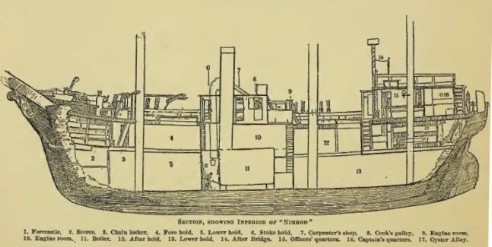
D1. SECTION SHOWING INTERIOR OF NIMROD
It was made of stout fir timbering of best quality in walls, roofs, and floors, and the parts were all morticed and tenoned to facilitate erection in the Antarctic. The walls were strengthened with iron cleats bolted to main posts and horizontal timbering, and the roof principals were provided with strong iron tie rods. The hut was lined with match-boarding, and the walls and roof were covered externally first with strong roofing felt, then with one-inch tongued and grooved boards, and finally with another covering of felt. In addition to these precautions against the extreme cold the four-inch space in framing between the match-boarding and the first covering of felt was packed with granulated cork, which assisted materially to render the wall non-conducting. The hut was to be erected on wooden piles let into the ground or ice, and rings were fixed to the apex of the roof so that guy ropes might be used to give additional resistance to the gales. The hut had two doors, connected by a small porch, so that ingress and egress would not mean the admission of a draught of cold air, and the windows were double, in order that the warmth of the hut might be retained. There were two louvre ventilators in the roof, controlled from the inside. The hut had no fittings, and we took little furniture, only some chairs. I proposed to use cases for the construction of benches, beds and other necessary articles of internal equipment. The hut was to be lit with acetylene gas, and we took a generator, the necessary piping, and a supply of carbide.
The cooking-range we used in the hut was manufactured by Messrs. Smith and Wellstead, of London, and was four feet wide by two feet four inches deep. It had a fire chamber designed to burn anthracite coal continuously day and night and to heat a large superficial area of outer plate, so that there might be plenty of warmth given off in the hut. The stove had two ovens and a chimney of galvanised steel pipe, capped by a revolving cowl. It was mounted on legs. This stove was erected in the hut at the winter quarters, and with it we heated the building and did all our cooking while we were there. We took also a portable stove on legs, with a hot-water generator at the back of the fire, connected with a fifteen-gallon tank, but this stove was not erected, as we did not find that a second stove was required.
For use on the sledging expeditions I took six "Nansen" cookers made of aluminium, and of the pattern that has been adopted, with slight modifications, ever since Nansen made his famous journey in 1893-96. The sledging-tents, of which I bought six, were made of light Willesden rot-proof drill, with a "spout" entrance of Burberry gaberdine. They were green in colour, as the shade is very restful to the eyes on the white snow plains, and weighed thirty pounds each, complete with five poles and floorcloth.
Each member of the expedition was supplied with two winter suits made of heavy blue pilot cloth, lined with Jaeger fleece. A suit consisted of a double-breasted jacket, vest and trousers, and weighed complete fourteen and three-quarter pounds. The underclothing was secured from the Dr. Jaeger Sanitary Woollen Company, and I ordered the following articles:
48 double-breasted vests.144 pairs socks.
48 double-fronted pants.144 pairs stockings.
24 pyjama suits.48 sweaters.
96 double-breasted shirts144 pairs fleece wool bed-socks.
24 colic belts.48 pairs mits.
12 cardigans.48 pairs gloves.
12 [pairs] lined slippers.48 pairs mittens.
48 travelling-caps lined with zanella 12 Buxton fleece boots.
48 felt mits.12 under-waistcoats with sleeves.
An outer suit of windproof material is necessary in the polar regions, and I secured twenty-four suits of Burberry gaberdine, each suit consisting of a short blouse, trouser overalls and a helmet cover. For use in the winter quarters we took four dozen Jaeger camel-hair blankets and sixteen camel-hair triple sleeping-bags.
I decided to take ponies, dogs, and a motor-car to assist in hauling our sledges on the long journeys that I had in view, but my hopes were based mainly on the ponies. Dogs had not proved satisfactory on the Barrier surface, and I had not expected my dogs to do as well as they actually did. The use of a motor-car was an experiment which I thought justified by my experience of the character of the Barrier surface, but I knew that it would not do to place much reliance on the machine in view of the uncertainty of the conditions. I felt confident, however, that the hardy ponies used in Northern China and Manchuria would be useful if they could be landed on the ice in good condition. I had seen these ponies in Shanghai, and I had heard of the good work they did on the Jackson-Harmsworth expedition. They are accustomed to hauling heavy loads in a very low temperature, and they are hardy, sure-footed and plucky. I noticed that they had been used with success for very rough work during the Russo-Japanese War, and a friend who had lived in Siberia gave me some more information regarding their capabilities.
I therefore got into communication with the London manager of the Hong Kong and Shanghai Bank (Mr. C. S. Addis), and he was able to secure the services of a leading firm of veterinary surgeons in Shanghai. A qualified man went to Tientsin on my behalf, and from a mob of about two thousand of the ponies, brought down for sale from the northern regions, he selected fifteen of the little animals for my expedition. The ponies chosen were all over twelve and under seventeen years in age, and had spent the early part of their lives in the interior of Manchuria. They were practically unbroken, were about fourteen hands high, and were of various colours. They were all splendidly strong and healthy, full of tricks and wickedness, and ready for any amount of hard work over the snowfields. The fifteen ponies were taken to the coast and shipped by direct steamer to Australia. They came through the test of tropical temperatures unscathed, and at the end of October 1908 arrived in Sydney, where they were met by Mr. Reid and at once transferred to a New Zealand bound steamer. The Colonial Governments kindly consented to suspend the quarantine restrictions, which would have entailed exposure to summer heat for many weeks, and thirty-five days after leaving China the ponies were landed on Quail Island in Port Lyttelton, and were free to scamper about and feed in idle luxury.
I decided to take a motor-car because I thought it possible, from my previous experience, that we might meet with a hard surface on the Great Ice Barrier, over which the first part at any rate of the journey towards the south would have to be performed. On a reasonably good surface the machine would be able to haul a heavy load at a rapid pace. I selected a 12-15 horsepower New Arrol-Johnston car, fitted with a specially designed air-cooled four-cylinder engine and Simms Bosch magneto ignition. Water could not be used for cooling, as it would certainly freeze. Round the carburetter was placed a small jacket, and the exhaust gases from one cylinder were passed through this in order that they might warm the mixing chamber before passing into the air. The exhaust from the other cylinders was conveyed into a silencer that was also to act as a foot-warmer. The frame of the car was of the standard pattern, but the manufacturers had taken care to secure the maximum of strength, in view of the fact that the car was likely to experience severe strains at low temperature. I ordered a good supply of spare parts in order to provide for breakages, and a special non-freezing oil was prepared for me by Messrs. Price and Company. Petrol was taken in the ordinary tins. I secured wheels of several special patterns as well as ordinary wheels with rubber tyres, and I had manufactured wooden runners to be placed under the front wheels for soft surfaces, the wheels resting in chocks on top of the runners. The car in its original form had two bracket seats, and a large trough behind for carrying stores. It was packed in a large case and lashed firmly amidships on the Nimrod, in which position it made the journey to the Antarctic continent in safety.
I placed little reliance on the dogs, as I have already stated, but I thought it advisable to take some of these animals. I knew that a breeder in Stewart Island, New Zealand, had dogs descended from the Siberian dogs used on the Newnes-Borchgrevink expedition, and I cabled to him to supply as many as he could up to forty. He was only able to let me have nine, but this team proved quite sufficient for the purposes of the expedition, as the arrival of pups brought the number up to twenty-two during the course of the work in the south.
The equipment of a polar expedition on the scientific side involved the expenditure of a large sum of money and I felt the pinch of necessary economies in this branch. I approached the Royal Society with a view to securing the loan of the Eschenhagen magnetic instruments that had been used by the Discovery, but that body was unable to lend them, as they had been promised in connection with some other work. I was lent three chronometer watches by the Royal Geographical Society, which very kindly had them thoroughly overhauled and examined. I bought one chronometer watch, and three wardens of the Skinners' Company gave me one which proved the most accurate of all and was carried by me on the journey towards the Pole.
The Geographical Society was able to send forward an application made by me for the loan of some instruments and charts from the Admiralty, and that body generously lent me the articles contained in the following list:
3 Lloyd-Creak dip circles.
3 marine chronometers.
1 station pointer 6 ft.
1 set of charts, England to Cape and Cape to New Zealand.
1 set of Antarctic charts.
1 set of charts from New Zealand through Indian Ocean to Aden.
1 set of charts, New Zealand to Europe viâ Cape Horn.
12 deep-sea thermometers.
2 marine standard barometers.
1 navy-pattern ship's telescope.
1 ship's standard compass.
2 azimuth mirrors (Lord Kelvin's type).
1 deep-sea sounding-machine.
3 heeling error instruments.
1 3-in, portable astronomical telescope.
1 Lucas deep sea sounding machine.
I placed an order for further scientific instruments with Messrs. Cary, Porter and Company, Limited, of London, and amongst other instruments I took the following:
1 6-in. theodolite transit with micrometers to circle and limb, reading to 5".
1 electric thermometer complete with 440 yards of cable, including recorder, battery, and 100 recorder sheets, recording-drum to record every twenty-five hours.
3 3-in. alt-azimuth theodolites, portable, complete with sliding leg-stand.
1 small observing sextant.
6 explorers' compasses with luminous dial and shifting needle.
3 3-in. surveying aneroids with altitude scale to 15,000 ft.
3 pocket aneroids.
4 standard thermometers.
12 deep-sea thermometers, Admiralty pattern.
12 deep-sea registering Admiralty pattern.
4 prismatic compasses (R.G.S.) pattern.
1 portable artificial horizon, aluminium.
2 small plane tables complete with alidade.
2 barographs.
2 thermographs.
1 Oertling balance and one set of weights.
1 Robinson anemometer.
75 various thermometers.
1 5-in. transit theodolite reading to 20" with short tripod stand.
15 magnifiers.
1 pair night binoculars.
1 pair high-power binoculars.
Quantity of special charts, drawing materials and instruments, steel chains and tapes, levelling staves, ranging poles, &c.
2 microscopes.
Amongst other instruments that we had with us on the expedition was a four-inch transit theodolite, with Reeve's micrometers fitted to horizontal and vertical circles. The photographic equipment included nine cameras by various makers, plant for the dark-room, and a large stock of plates, films and chemicals. We took also a cinematograph machine in order that we might place on record the curious movements and habits of the seals and penguins, and give the people at home a graphic idea of what it means to haul sledges over the ice and snow.
The miscellaneous articles of equipment were too numerous to be mentioned here in any detail. I had tried to provide for every contingency, and the gear ranged from needles and nails to a Remington typewriter and two Singer sewing machines. There was a gramophone to provide us with music, and a printing press, with type, rollers, paper and other necessaries, for the production of a book during the winter night. We even had hockey sticks and a football.
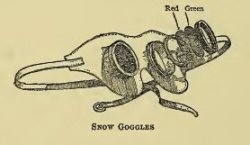
D2. SNOW GOGGLES
CHAPTER II. THE STAFF
THE personnel of an expedition of the character I proposed is a factor on which success depends to a very large extent. The men selected must be qualified for the work, and they must also have the special qualifications required to meet polar conditions. They must be able to live together in harmony for a long period without outside communication, and it must be remembered that the men whose desires lead them to the untrodden paths of the world have generally marked individuality. It was no easy matter for me to select the staff, although over four hundred applications arrived from persons wishing to join the expedition. I wanted to have two surgeons with the shore-party, and also to have a thoroughly capable biologist and geologist, for the study of these two branches of science in the Antarctic seemed to me to be of especial importance. After much consideration I selected eleven men for the shore-party. Three of them only, Adams, Wild and Joyce, had been known to me previously, while only Wild and Joyce had previous experience of polar work, having been members of the Discovery expedition. Every man, however, was highly recommended, and this was the case also with the officers whom I selected for the Nimrod. The names of the men appointed, with their particular branches of work, were as follows:
SHORE-PARTY
LIEUTENANT J. B. ADAMS, R.N.R., meteorologist.
SIR PHILIP BROCKLEHURST, Bart., assistant geologist, and in charge of current observations.
BERNARD DAY, electrician and motor expert.
ERNEST JOYCE, in charge of general stores, dogs, sledges and zoological collections.
DR. A. F. MACKAY, surgeon.
DR. ERIC MARSHALL, surgeon, cartographer.
G. E. MARSTON, artist.
JAMES MURRAY, biologist.
RAYMOND PRIESTLEY, geologist.
WILLIAM ROBERTS, cook.
FRANK WILD, in charge of provisions.
PORTRAITS:
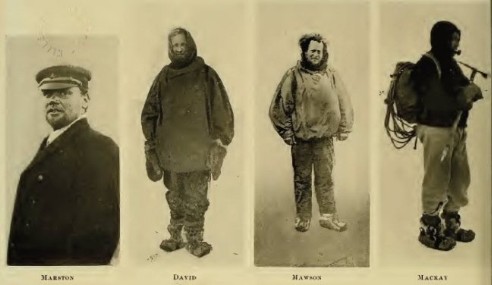
1A. MARSTON; DAVID; MAWSON; MACKAY
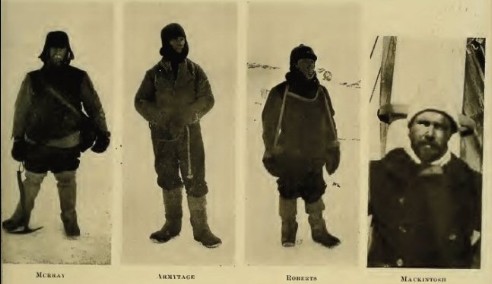
1B. MURRAY; ARMYTAGE; ROBERTS; MACKINTOSH
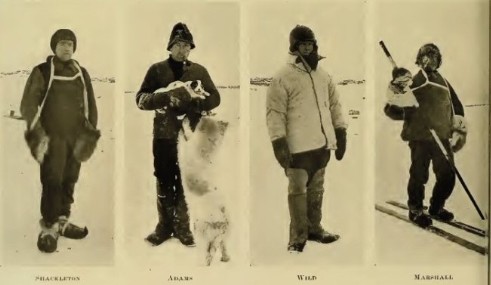
1C. SHACKLETON; ADAMS; WILD; MARSHALL
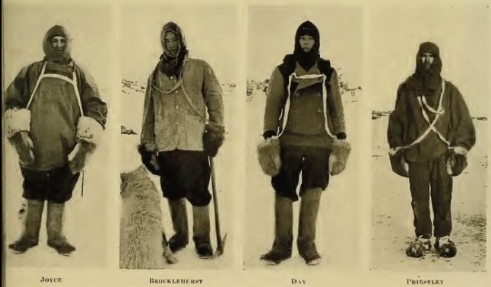
1D. JOYCE; BROCKLEHURST; DAY; PRIESTLEY
After the expedition had reached New Zealand and the generous assistance of the Australian and New Zealand Governments had relieved me from some financial anxiety, I was able to add to the strength of the staff. I engaged Douglas Mawson, lecturer of mineralogy and petrology at the Adelaide University, as physicist, and Bertram Armytage as a member of the expedition for general work. Professor Edgeworth David, F.R.S., of Sydney University, consented to accompany us as far as the winter quarters, with the idea of returning in the Nimrod, but I persuaded him eventually to stay in the Antarctic, and his assistance in connection with the scientific work, and particularly the geology, was invaluable. Leo Cotton, a young Australian, arranged to come south with us and help with the preliminary work before the Nimrod returned to New Zealand, and at the last moment George Buckley, residing in New Zealand, accompanied us on the voyage south, returning in the steamer that towed the Nimrod. The members of the ship's staff, at the time when the Nimrod left Great Britain, were as follows:
LIEUTENANT RUPERT ENGLAND, R.H.R., master.
JOHN K. DAVIS, first officer.
A. L. A. MACKINTOSH, second officer.
DR. W. A. R. MICHELL, surgeon.
H. J. L. DUNLOP, chief engineer.
ALFRED CHEETHAM, third officer and boatswain.
Captain England, whom I placed in command of the Nimrod, had been first officer of the Morning when that vessel proceeded to the relief of the Discovery expedition, and had therefore had previous experience of work in the Antarctic. Immediately before joining the Nimrod he had been in the Government service on the west coast of Africa.
Davis, first officer and later captain, had not been in the Antarctic before, but he was a first-class seaman.
Mackintosh came from the service of the Peninsular and Oriental Steam Navigation Company. He was transferred to the shore-party at a later date, but an unfortunate accident finally prevented his remaining in the Antarctic with us. Dr. Michell, the ship's surgeon, was a Canadian, and Dunlop the chief engineer, was an Irishman. Cheetham, the third officer and boatswain had served on the Morning and some of the men had also Antarctic experience.
After the Nimrod reached New Zealand, A. E. Harbord, an Englishman, joined as second officer in place of Mackintosh, whom I intended to transfer to the shore-party.
The following brief notes regarding the members of the shore-party may be of interest to readers:
ERNEST HENRY SHACKLETON, commander of the expedition. Born 1874, and educated at Dulwich College. Went to sea in the merchant service at the age of sixteen, became a lieutenant in the Royal Naval Reserve, and in 1901 joined the British National Antarctic expedition. Was a member of the party which established a "furthest south" record, and on return to the winter quarters was invalided. Fitted out the Discovery relief expeditions under the Admiralty Committee, and also assisted fitting out the Argentine expedition that went to the relief of the Swedish Antarctic expedition. Married in 1904, and became secretary and treasurer of the Royal Scottish Geographical Society. Resigned to contest the Dundee seat as a Unionist at the election of 1906, and after being defeated became personal assistant to Mr. William Beardmore, head of the Glasgow firm of battleship builders and armour plate manufacturers. Then decided to take an expedition to the Antarctic.
JAMESON BOYD ADAMS, born in 1880 at Rippingale, Lincolnshire. Went to sea in the merchant service in 1893, served three years as a lieutenant in the Royal Naval Reserve, and joined the expedition in March 1907. Appointed second in command in February 1908. Unmarried.
BERTRAM ARMYTAGE, born in Australia in 1869. Educated at Melbourne Grammar School and Jesus College, Cambridge. After serving for several years with the Victorian Militia and one year with the Victorian Permanent Artillery, he was appointed to the Carabiniers, 6th Division Guards, when on active service in South Africa (Queen's medal and three clasps. King's medal and two clasps). Joined the expedition in Australia. Married.
SIR PHILIP LEE BROCKLEHURST, Bart., born at Swythamley Park, Staffordshire, in 1887, educated at Eton and Trinity Hall, Cambridge. Holds a commission in the Derbyshire Yeomanry, represented Cambridge in the light weight boxing competitions for 1905 and 1906. Unmarried.
THOMAS W. EDGEWORTH DAVID, F.R.S., Professor of Geology at the Sydney University, is a Welshman by birth, and is fifty years of age. He was educated at New College, Oxford, and afterwards studied geology at the Royal College of Science. He went to Australia to take up the post of Geological Surveyor to the New South Wales Government, and for the past eighteen years has held his present appointment. He is an authority on dynamical geology and glaciation, and has made a study of Australian coal-fields. Married.
BERNARD C. DAY, born at Wymondham, Leicestershire, in August 1884; educated at Wellingborough Grammar School. He was connected with engineering from 1903 until September 1907, when he left the service of the New Arroll Johnston Motor-Car Company in order to join the expedition. Unmarried.
ERNEST JOYCE, born in 1875, entered the Navy from the Greenwich Royal Hospital School in 1891, became a first-class petty officer, and served in South Africa with the Naval Brigade (medal and clasp). Joined the Discovery expedition from the Cape, and served in the Antarctic (polar medal and clasp. Geographical Society's silver medal). Served in the Whale Island Gunnery School. Left the Navy in December 1905, rejoined in August 1906, and left by purchase in order to join to expedition in May 1907. Unmarried.
ALISTAIR FORBES MACKAY, born in 1878, son of the late Colonel A. Forbes Mackay, of the 92nd Gordon Highlanders. Educated in Edinburgh, and then did biological work under Professors Geddes and D'Arcy Thompson at Dundee. Served in South Africa as a trooper in the C.I.V. (Queen's medal and clasps), and later with Baden Powell's police, then returned to pass his final examinations in medicine, and went to the front again as a civil surgeon. Entered the Navy as a surgeon, retired after four years' service, and then joined the expedition. Unmarried.
ÆNEAS LIONEL ACTON MACKINTOSH, born in Tirhoot, Bengal, India, in 1881, and educated at the Bedford Modern School. Went to sea in 1894 in the merchant service, and in 1899, entered the service of the Peninsular and Oriental Steam Navigation Company. Was lent to the expedition in 1907. Received commission in the Royal Naval Reserve in July 1908. Unmarried.
ERIC STEWART MARSHALL, born in 1879, educated at Monckton Combe School and at Emmanual College, Cambridge. Represented his college in rowing and football. Studied for the Church. Entered St. Bartholomew's Hospital in 1899, and qualified as a surgeon in 1906. Was captain St. Bartholomew's Hospital Rugby football team, 1903-4, and played for the Richmond Club; 1903-4-5. Joined the expedition as surgeon and cartographer. Unmarried.
GEORGE EDWARD MARSTON was born at Portsmouth in 1882, and received the greater part of his art education at the Regent Street Polytechnic. He is a qualified art teacher, and joined the expedition as artist. Unmarried.
DOUGLAS MAWSON was born in Australia in 1880, his parents coming from the Isle of Man. He was educated in Australia and is lecturer in mineralogy and petrology at the Adelaide University and honorary curator of the South Australian Museum. He joined the expedition in Australia. Unmarried.
JAMES MURRAY was born in Glasgow in 1865. In early life was occupied in various branches of art work. Was interested in natural history, especially botany, and in 1901, turned his attention to microscopic zoology. In 1902 was engaged by Sir John Murray as biologist on Scottish Lake Survey. Was still engaged in this work when he joined the expedition as biologist. Married in 1892.
RAYMOND E. PRIESTLEY, born 1886, and educated at Tewkesbury School. Matriculated in London in 1903, and held mastership at Tewkesbury until 1905. Then became a student at the Bristol University College, and passed the intermediate examination in science in 1906. He was taking the final course when appointed geologist to the expedition.
WILLIAM C. ROBERTS, born in London in 1872, and has worked as cook on sea and land. Engaged as cook for the expedition. Married.
FRANK WILD, born in Yorkshire in 1873. His mother was a direct descendant of Captain Cook, and one of his uncles was three times in the Arctic regions. Entered the merchant service in 1889, and in 1900 joined the Navy. He was a member of the National Antarctic expedition between 1901 and 1904 (polar medal and clasp. Royal Geographical Society's silver medal). Was at the Sheerness Gunnery School when the Admiralty consented to his appointment to the British Antarctic expedition.
CHAPTER III. THE FIRST STAGE
THE work of preparing for the expedition made rapid progress towards completion, and as the end of July approached, the stores and equipment were stowed away in the holds of the Nimrod in readiness for the voyage to New Zealand. The final departure for the south was to be made from Lyttelton, a well-equipped port at which I felt sure, from the experience of the three vessels of the Discovery expedition, that I should receive every assistance that lay in the power of the authorities. Early in July we exhibited in a room in Regent Street samples of our stores and equipment, and some thousands of people paid us a visit. The days were all too short, for scores of details demanded attention and small difficulties of all sorts had to be overcome, but there were no delays, and on July 30, 1907, the Nimrod was able to sail from the East India Docks for Torquay, the first stage of the journey of sixteen thousand miles to New Zealand. Most of the members of the shore staff, including myself, intended to make this journey by steamer, but I left the docks with the Nimrod, intending to travel as far as Torquay.
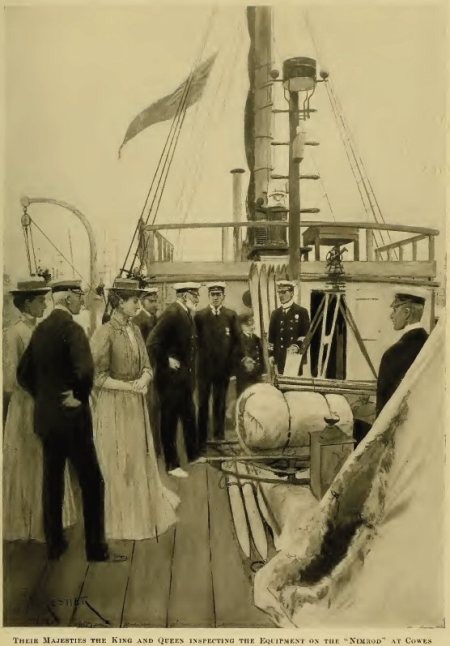
2. THEIR MAJESTIES THE KING AND QUEEN INSPECTING THE
EQUIPMENT ON THE NIMROD AT COWES
We anchored for the first night at Greenhithe, and on the morning of the 31st continued on our way to Torquay, landing Mr. Reid at Tilbury in order that he might return to London for letters. When he reached London that afternoon, he found at the office a telegram from the King's equerry, commanding the Nimrod to visit Cowes in order to enable their Majesties the King and Queen to come on board and inspect the ship and equipment on Sunday, August 4. Mr. Reid had considerable difficulty in delivering this message to me, but the Admiral Superintendent at Sheerness kindly despatched a tug which overtook the Nimrod off Ramsgate, and conveyed the news that an alteration in our plans was necessary. We sailed in the night for Cowes, and on the morning of August I stopped for an hour off Eastbourne in order to enable some of the supporters of the expedition to pay us a farewell visit. On the Sunday we were anchored at Cowes, and their Majesties the King and Queen, their Royal Highnesses the Prince of Wales, the Princess Victoria, Prince Edward and the Duke of Connaught came on board. The King graciously conferred upon me the Victorian Order, and the Queen entrusted me with a Union Jack, to carry on the southern sledge journey.
The Nimrod sailed for Torquay early on the following morning, and arrived there on August 6. We drank success to the expedition at a farewell dinner that evening, and on the morning of Wednesday, August 7, the ship sailed for New Zealand, and after calling at St. Vincent and Capetown, arrived at Lyttelton on November 23, the voyage having occupied three months and a half. Mr. Reid reached Australian waters a month ahead of the Nimrod, in order to make the necessary arrangements and meet the Manchurian ponies, and I arrived early in December, my intention being to leave Lyttelton on January 1, 1908.
The people of New Zealand and Australia took a keen and sympathetic interest in the expedition from the first. The Commonwealth Government gave me £5000 and the New Zealand Government £1000, and this sum of money placed me in a position to increase the number of the shore-party, to add to the stores and equipment in certain directions and to strengthen the ship still further, which I could not afford to do earlier. The New Zealand Government also agreed to pay half the cost of towing the Nimrod down to the Antarctic Circle, so that coal might be saved for the heavy work amongst the ice, and in many other ways assisted us. The Postmaster-General of the Dominion had printed off for us a small issue of special stamps, and constituted me a postmaster for the period of my stay in the Antarctic, an arrangement that much simplified the handling of the correspondence sent back from the winter quarters with the Nimrod.
The ponies were enjoying their holiday on Quail Island and were becoming sleek and fat, and it was necessary that they should be broken to handling and sledge-hauling. Mr. C. Tubman undertook this work, with the assistance of Dr. Mackay, and there were some exciting moments on the island. The ponies were very wild, and more than once Mackay and Tubman had to make a rapid retreat from the animal they were schooling at the time. The white ponies, which later proved the most hardy, were the least tractable, and there was one white pony in particular that was left behind, because, though a splendid specimen physically, it could not be brought to a reasonable state of docility in the time at our disposal. I intended to take only ten ponies out of the fifteen, having allowed a margin for losses on the voyage to New Zealand, and Tubman and Mackay devoted their attention to the most promising animals. All the ponies had names, although I do not know from whom they received them, and we finally left New Zealand with "Socks", "Quan", "Grisi", "Chinaman", "Billy", "Zulu", "Doctor", "Sandy", "Nimrod", and "Mac".
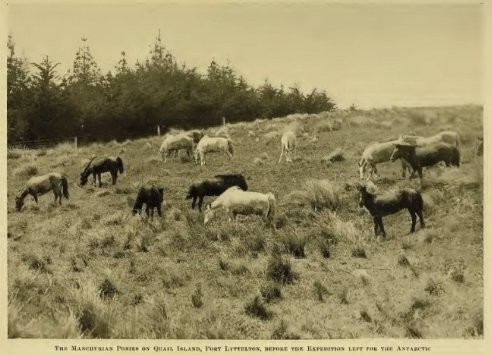
3. THE MANCHURIAN PONIES ON QUAIL ISLAND, PORT LYTTELTON, BEFORE THE EXPEDITION LEFT FOR THE ANTARCTIC
I had secured in London twenty tons of maize and ten hundredweight of compressed Maujee ration for the feeding of the ponies in the Antarctic. The maize was packed in about seven hundred tin-lined, airtight cases, and the ration was in one-pound, airtight tins. This ration consists of dried beef, carrots, milk, currants and sugar, and it provides a large amount of nourishment with comparatively little weight. One pound of the ration will absorb four pounds of water, and the ponies were very fond of it. We also secured in Australia ten tons of compressed fodder, consisting of oats, bran and chaff. This fodder was packed in two hundred and fifty small bales. I purchased for the dogs one ton and a half of dog biscuits, and proposed to make up their rations with seal meat.
The final preparations involved an enormous amount of work, but by December 31 everything was ready, quarters were provided on the Nimrod for the scientific staff by enclosing a portion of the afterhold, and constructing cabins which were entered by a steep ladder from the deckhouse. The quarters were certainly small, in fact there was just room for the bunks and nothing else, and they were promptly named Oyster Alley, for some reason not on record. As the day of departure approached and the scientists brought their personal belongings, the alley reached a state of congestion that can hardly be imagined. The ponies were to be carried on deck, and ten stout stalls were built for them. The motor-car was enclosed in a large case and made fast with chains on the after-hatch from whence it could be transferred easily on to the ice when the occasion arose. The deck load was heavy and included cases of maize, tins of carbide for the manufacture of acetylene gas, a certain quantity of coal and the sledges. The Nimrod was low in the water as a result, and when we left Lyttelton the little ship had only three feet six inches of freeboard. Some live sheep presented to us by New Zealand farmers were placed on board the Koonya, the steamer which was to tow the Nimrod to the south.
I had been anxious to have the Nimrod towed south in order to save coal. The ship could not take in a large quantity of coal after our provisions and equipment had been placed on board, for she was considerably overloaded, and it was important that there should be enough coal to take the ship through the ice and back to New Zealand, and also to provide for the warming of the hut during the winter. The Government of the Dominion consented to pay half the cost of the tow, and Sir James Mills, chairman of the Union Steamship Company, offered to pay the other half. The Koonya, a steel-built steamer of about 1100 tons, was chartered and placed under the command of Captain F. P. Evans. The wisdom of this selection was proved by after events. The pressure of work was at this time tremendous, and I owed a very great deal to the assistance and advice I received from Mr. J. J. Kinsey, of Christchurch. Before my departure I placed the conduct of the affairs of the expedition in New Zealand in his hands.
December 81 was the last day of our stay in New Zealand, for as I had stated when announcing the expedition, we were to leave Lyttelton on the first day of the new year. The stores and equipment were on board and were as complete as we could make them, and I had written my final letters, both business and personal. The ponies and the dogs were to be placed on board the Nimrod early the following morning.
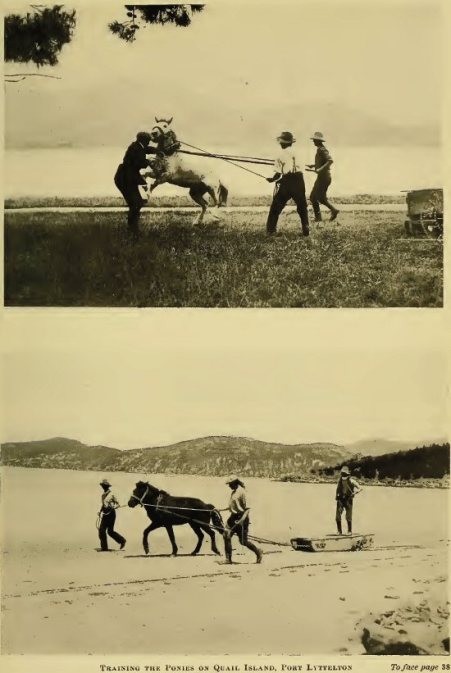
4. TRAINING THE PONIES ON QUAIL ISLAND, PORT LYTTELTON
CHAPTER IV. LYTTELTON TO THE ANTARCTIC CIRCLE
JANUARY 1, 1908, arrived at last! Warm, fine, and clear broke the morning of our last day in civilisation. Before sunset we were to sever all ties with the outer world and more than a year must elapse ere we could look again on the scenes familiar to ordinary daily life. For me this day brought a feeling of relief, after all the strenuous work of the previous year, though the new work I was entering upon was fraught with more anxiety and was more exacting than any that had gone before. We all looked forward eagerly to our coming venture, for the glamour of the unknown was with us and the South was calling.
My personal belongings were gathered out of the chaos of papers and odds and ends in my office at the hotel; I knew that the legacy of unanswered letters, requests for special stamps, and the hundred and one things that collect under such circumstances would be faithfully administered by Mr. Reid. Orders had been given to Captain England to have all in readiness for casting off at 4 p.m., and early in the afternoon most of us were on board. It was Regatta day and Lyttelton was crowded with holiday-makers, many thousands of whom had come to see the Nimrod. All day the deck of our little vessel was thronged by the general public, who evinced the greatest interest in everything connected with the ship and her equipment. Naturally the ten ponies, now safely housed in their stalls on the forward deck, were a special attraction. Our nine dogs also claimed a share of attention, although it was a gymnastic feat to climb through the supports of the pony structure, stretching across the decks, in order to reach the forecastle, where the dogs lay panting in the hot sun. To the uninitiated the number and size of the beams belonging to the pony structure seemed excessive, but we knew we might encounter heavy weather which would tax their strength to the utmost. The Nimrod was deep in the water, for every available corner had been stowed with stores and coal and, if we could have carried it, we would have added at least another fifty tons to our two hundred and fifty; but the risk was too great. Indeed I was somewhat anxious as to the weather she might make, though I knew she was a good sea boat and had great confidence in her. There were many whose criticisms were frankly pessimistic as to our chances of weathering an Antarctic gale; and as I stood on deck I could hear the remarks of these Job's comforters. Such criticisms, however, did not disturb us, for we were confident in the ship.
Oyster Alley was crammed with the personal belongings of at least fourteen of the shore-party; it was the temporary resting place for many of the scientific instruments, so that both ingress and egress were matters of extreme difficulty. The entrance to this twentieth-century Black Hole was through a narrow doorway and down a ladder, which ushered one into almost complete darkness, for the doorway was practically filled up with cases, and the single narrow deck light generally covered by the feet of sightseers. The shore party's fourteen bunks were crammed with luggage, which also occupied the whole of the available floor space. It was in this uncomfortable place that the spirit of romance, the desire for the wind-whitened Southern Seas, and the still whiter wastes of the silent Antarctic grew stronger in the heart of George Buckley, as he sat there talking over the days and doings before us, longing for a share in the work, even though he might only go as far as the Antarctic circle. He knew that time would not permit him to do more than this. Suddenly he jumped up, came to me, and asked if I would take him as far as the ice. I was only too glad to consent, for his interest in the expedition showed that his heart was in our venture, and his personality had already appealed to us all. It was 2 p.m. when the decision was made, and the Nimrod was to sail at 4 p.m. He managed to catch a train to Christchurch, dashed into his club, gave his power of attorney to a friend; slung his toothbrush and some underclothing into a bag; struggled through one seething crowd at Christchurch Station and another at the wharf, and arrived on board the Nimrod, a few minutes before sailing time equipped for the most rigorous weather in the world with only the summer suit he was wearing: surely a record in the way of joining a Polar expedition.
Time was passing quickly, it was nearing four o'clock and all our party were on board save Professor David. I had seen him earlier in the afternoon, struggling along the crowded wharf, bending under the weight of one end of a long iron pipe, a railway porter attached to the other. This precious burden, he had informed me, when it was safely on board, was part of the boring gear to be used in obtaining samples of ice from the Great Ice Barrier; he had found it at the railway station, where it had been overlooked. Doubtless he was having a last skirmish round in case there was anything else that had been left, and just as I was getting anxious, for I did not want to delay the departure of the ship, he appeared. His arms were filled with delicate glass apparatus and other scientific paraphernalia. As he was gingerly crossing the narrow gangway he was confronted by a stout female, of whom the Professor afterwards said: "She was for the shore, let who would be for the Pole." They met in the middle of the gangway. Hampered by the things he was carrying, the Professor could not move aside; he was simply charged down by superior weight, and clutching his precious goods, fell off the gangway on to the heads of some of our party. Wonderful to relate nothing was broken.
At one minute to four orders were given to stand by the engines, at 4 p.m. the lines were cast off from the wharf and the Nimrod moved slowly ahead. Cheer after cheer broke from the watching thousands as we moved towards the harbour entrance, with the Queen's flag flying at the fore and our ensign dipping farewell at the stern. The cheering broke out afresh as we passed the United States' magnetic survey ship Galilee. She also was engaged in a scientific mission, but her lines were laid in warmer climes and calmer seas. Hearty as was this send-off it seemed mild compared to that which we received on passing the pier-head lighthouse. The air trembled with the crash of guns, the piercing steam whistles and sirens of every steamship in the port; and a roar of cheering from the throats of the thirty thousand people who were watching the little black-hulled barque moving slowly towards the open sea. With our powerful ally, the Koonya, steaming in front, and on each side passenger boats of the Union Company carrying some six or seven thousand persons, we passed down the Roads, receiving such a farewell and "God-speed" from New Zealand as left no man of us unmoved. The farewells were not over, for we were to receive one more expression of goodwill, and one that came nearer to the hearts of those of us who were sailors than any other could. Lying inside the Heads were three of his Majesty's ships of the Australian Squadron, the flagship Powerful, the Pegasus and the Pioneer. As we steamed past the last-named her crew mustered on the forecastle head and gave us three hearty cheers; we received the same from the Pegasus as we came abeam of her, our party of thirty-nine returning the cheers as we passed each ship in turn. Then we drew abreast of the flagship and from the throats of the nine hundred odd bluejackets on board her we got a ringing farewell, and across the water came the sound of her band playing "Hearts of oak are our ships", followed by "Auld Lang Syne". We responded with three cheers and gave another cheer for Lady Fawkes, who had taken a kindly interest in the expedition.
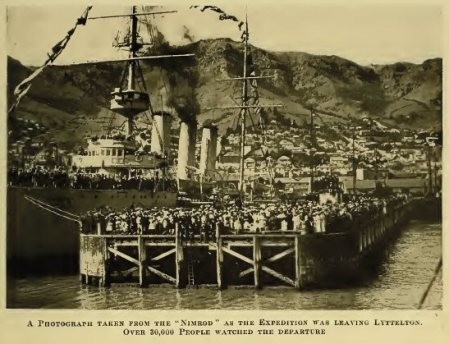
5. A PHOTOGRAPH TAKEN FROM THE NIMROD AS THE
EXPEDITION WAS LEAVING LYTTELTON. OVER 30,000
PEOPLE WATCHED THE DEPARTURE
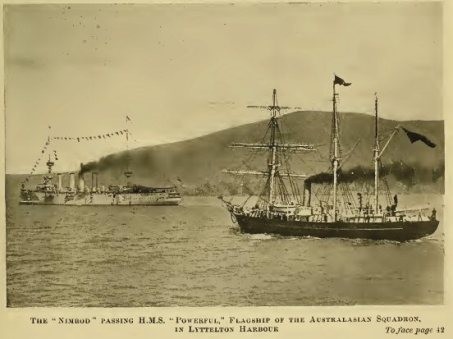
6. THE NIMROD PASSING H.M.S. "POWERFUL", FLAGSHIP OF
THE AUSTRALASIAN SQUADRON, IN LYTTELTON HARBOUR
Shortly after passing the Powerful we stopped to pick up our tow-line from the Koonya, but before doing this we transferred to the tug-boat Canterbury the few personal friends who had accompanied some of the members of the expedition down the harbour. We then came close up to the stern of the Koonya and hauled in the 4-in. wire cable she was to tow us with. A 4-in. wire is measured not as 4 in. diameter, but 4 in. in circumference, and is made of the finest steel. We passed a shackle through the eye at the end of this wire and shackled on to the free ends of both our chain cables. We then let out thirty fathoms of each cable, one on each side of the bow, and made the inner ends fast round the foremast in the 'tween decks. This cable acted as a "spring", to use a nautical term; that is to say, it lessened the danger of the wire snapping if a sudden strain were put upon it, for the cable hung down in the water owing to its weight, even when the ship was being towed at seven or eight knots. This operation being completed we signalled the Koonya to go ahead and we were soon in the open sea. There was a slight breeze and a small choppy sea. Before we had been under way for an hour water began to come in at the scupper holes and through the wash ports. This looked ominous to us, for if the Nimrod was going to be wet in such fine weather, what was she going to be like when we got a southerly gale! She moved through the water astern of Koonya like a reluctant child being dragged to school; she seemed to have no vitality of her own. This was due to her deeply loaded condition, and more especially to the seven tons of cable and the weight of the wire on her bows dragging her nose down into the sea. No Antarctic exploring ship had been towed to the ice before, but it meant the saving of coal to us for a time when the tons saved in this manner might prove the salvation of the expedition.
Night came down on us, and the last we saw of New Zealand was a bold headland growing fainter and fainter in the gathering gloom. The occupants of Oyster Alley, after a somewhat sketchy meal in the wardroom, were endeavouring to reduce the chaos of their quarters into some sort of order. The efforts of some of the scientific staff were interrupted at times by sudden attacks of seasickness, and indeed one would not have been surprised if the seafaring portion of the staff had also succumbed, for the atmosphere of the alley, combined with the peculiar motion of the ship, was far from pleasant. A few of the members of the party preferred to sleep on deck in any odd corner they could find, and one man in particular was so overcome by the sea that for three days and nights he lay prostrate amongst the vegetables and cases of butter and carbide, on the unused forebridge of the ship. He seemed to recover at mealtimes, and as his lair was just above the galley, he simply appeared from under his sodden blankets, reached down his hand, and in a plaintive voice asked for something to fill the yawning cavern that existed in his interior. Professor David was given Dr. Michell's cabin, the latter taking up his abode in Oyster Alley. The cabin measured about 5 ft. 10 in. by 3 ft., and as the Professor had nearly a quarter of a ton of scientific instruments, books and cameras, one can imagine that he had not much room for himself. The wardroom of the Nimrod was about 12 ft. long and 9 ft. broad, and as there were twenty-two mouths to feed there three times a day, difficulties were present from the beginning of the voyage. Dunlop's cabin came into service as the largest overflow dining room, for it accommodated three people. Davis and Mackintosh each found room for another hungry explorer in his cabin. When the food arrived it was passed along to the outside dining rooms first. Then people in the main room were served. All went well that first night out, for there was comparatively little movement, but later on the story of an ordinary meal became a record of adventure. I took up my quarters in the captain's cabin, and fluctuated between the bunk and the settee for a resting-place, until the carpenter made me a plank bed about four inches off the deck. We did not know that we were not to take our clothes off for the next two weeks, but were to live in a constant state of wetness, wakefulness, and watchfulness until the Nimrod arrived in the neighbourhood of the winter quarters.
Bad weather was not long delayed. As the night of January 1 wore on, the wind began to freshen from the south-west, and the following morning the two vessel? were pitching somewhat heavily and steering wildly. The Koonya signalled us to veer, that is, to slack out thirty more fathoms on each of our two cables, and with great difficulty we managed to do this. The ship was pitching and rolling, flinging the cables from one side of the deck to the other, and with our forty-year-old windlass it was no light task to handle the heavy chains. Then I felt one of the first real pinches of the stringent economy that had to be practised from the inception of the expedition. How I wished for the splendid modern gear of the Discovery the large, specially built vessel that we had on the previous expedition. During the afternoon the wind and sea increased greatly, and the Nimrod pitched about, shifting everything that could be moved on deck. The seas began to break over her, and we were soon wet through, not to be properly dry again for the next fortnight. The decks were flooded with heavy seas, which poured, white-capped, over the side, and even the topsail yards were drenched with the spray of breaking waves. Lifelines were stretched along the deck, and it was a risky thing to go forward without holding on.
Our chief anxiety was the care of the ponies, and looking back now to those days, it remains a matter of wonder to me how they survived the hardships that fell to their lot. That night I arranged for a two-hour watch, 'consisting of two members of the shore staff, to be always in attendance on the ponies. The pony shelter had five stalls on the port side and five on the starboard side of the deck, with the fore hatch between them. The watch-keepers named this place "The Cavalry Club", and here in the bleak and bitter stormy nights, swept off their feet every now and then by the seas washing over the fore-hatch, the members of the shore party passed many a bad quarter of an hour. They bore all the buffeting and discomfort cheerfully, even as those men of old, who "ever with a frolic welcome took the thunder and the sunshine". Night in the pony-stables was a weird experience with inky blackness all round, save only where the salt-encrusted hurricane lamp, jerking to and fro, made a glimmer of light. The roar of the tempest rose into a shriek as the wind struck the rigid rigging, the creaking and swaying of the roof of the stable and the boat-skids, which partly rested their weight on it, seemed to threaten a sudden collapse with each succeeding and heavier roll, and the seas crashed dully as they fell on board. The swirling waters, foam-white in the dim rays of the lamp, rushed through the stable and over the hatch, and even from the bridge far aft, we could hear the frightened whinnies of the animals, as they desperately struggled to keep their feet in the water that flooded the rolling stables. Every now and then some wave, larger and fiercer than the one before, would sweep the decks, tear the mats from under the feet of the ponies, and wash the watch-keepers almost under the struggling beasts. When the bulk of the water had passed, the mats were nailed down again with difficulty, and the two watchers resumed their seats on a bag of fodder that had been fastened to the hatch. One can imagine that after a two-hours' watch a rest was welcome. Oyster Alley was wet enough, and the beds were soaking, while the atmosphere was thick and heavy; but these conditions did not prevent the wearied men from falling asleep after wedging themselves into their bunks, lest some extra heavy lurch should send them to keep company with the miscellaneous collection of articles careering up and down the deck of the alley.

A. THE AUTUMN SUNSET
All during our second night out, the weather was so bad that we kept going slow, having requested the Koonya to slacken speed late in the afternoon. Next morning found us plunging, swerving, and rolling in a high sea, with a dull grey stormy sky overhead, and apparently no prospect of the weather becoming settled. We were moving little more than a mile an hour towards the south, and the ship seemed to be straining herself on account of the heavy pull on her bows, and the resulting lack of buoyancy. The weather moderated somewhat in the afternoon, and we signalled the Koonya to "increase speed". By midnight the improvement in the weather was much more marked. The following morning, January 4, we set loose the carrier pigeon which one of the New Zealand sailors had brought with him. We attached a message to the bird, briefly describing our passage so far, and hoped it would safely accomplish the three hundred odd miles to the land. On releasing our messenger it made one or two wide circles round the ship, and then set off in a bee-line towards its home. We wondered at the time whether any of the albatrosses, which were now fairly numerous about our stern, especially at meal times, would attack the stranger, and we heard afterwards that the pigeon had not reached its home.
The hope that we were going to keep finer weather was dispelled in the afternoon, for the wind began to increase and the rising sea to break on board again, and within a couple of hours we were bearing the full brunt of another furious gale. The sea-going qualities of the Nimrod were severely taxed, but the little vessel rose to the occasion. As the gale increased in vehemence, she seemed to throw off the lethargy, one might almost say the sulkiness, which possessed her when she found herself outward bound at the end of a tow-line, for the first time in her strenuous life of forty years. Now that the tow-line, in the fury of the gale, was but of little use, save to steady us, the Nimrod began to play her own hand. It was wonderful to see how she rose to the largest oncoming waves. She was flung to and fro, a tiny speck in this waste of waters, now poised on the summit of a huge sea, whence we got almost a bird's-eye view of the gallant Koonya smashing into the turmoil ahead; now dipping into the wave valleys, from which all we could discern of our consort was in very truth "just a funnel and a mast lurching through the spray".
As the afternoon wore on, those of us who were not still in the clutches of sea-sickness watched the grandeur of the gale. I shall always remember Buckley, who stood for hour after hour on the Nimrod's poop, revelling in the clash and strife of the elements. Keen yachtsman that he was, his admiration was aroused by the way the two ships battled with the storm. Professor David also, hanging to the dripping rails, was fascinated by the wild scene, and between the gusts, we spoke of many things. Somehow or another the conversation turned to one's favourite poets, and it is but natural that, under these circumstances of stress and strain. Browning's verse was often the subject of conversation. Night drew on, sullen and black, our only light the lamp we steered by on the Koonya's mast. We could imagine the stalwart figure of that splendid seaman. Captain Evans, as he stood on his spray-drenched bridge, alert, calm and keen, doing his best to ease the little ship astern. We had nothing but admiration for the consummate seamanship that anticipated our every need and wish. All that night it blew harder than ever; on the morning of the 5th, I told Captain England to signal the Koonya and ask her to pour oil on the water in the hope that it might help us. To a certain extent I think it did, but not enough to prevent the heaviest seas from breaking on board. I thought that the gale had reached its height on the previous day, but certainly this evening it was much stronger. The Nimrod rolled over fifty degrees from the perpendicular to each side; how much more than that I cannot say, for the indicator recording the roll of the ship was only marked up to fifty degrees, and the pointer had passed that mark. Let the reader hold a pencil on end on a table, and then incline it fifty degrees one way, and back again till it reaches fifty degrees on the other side, and he will realise the length of arc through which the masts and deck of the Nimrod swung. It was only natural, under these circumstances, that the sturdy little ponies had their strength taxed to the utmost to keep their footing at all. It was impracticable to sling them, for they were only half broken, and the attempt to put a sling under one drove it nearly crazy with fright. All we could do was to try and soothe them, and the animals evidently appreciated the human voice and touch. Buckley had a wonderful way with them, and they seemed to understand that he was trying to help them.
Occasionally there were clear patches of sky to the south and east between the squalls. We had sleet for the first time on January 5, and the wind, ranging between west, south, and south-west, was chilly for the height of summer, the temperature being about 46° Fahr. We passed large masses of floating kelp, which may have torn from the islands to the south-west of us, for at noon on January 5, we were still north of the fiftieth parallel, a latitude corresponding to the South of England. Our course lay practically south, for I wanted to enter the pack-ice somewhere about the 178th meridian east, previous experience having shown that the pack is less dense about that meridian than it is further west. About 9 p.m. that night, during an extra heavy roll, one of the ponies slipped down in its stall, and when the ship rolled the opposite way, turned right over on its back, as it could not regain its footing. We tried everything in our power to get the poor beast up again, but there was no room to work in the narrow stall, and in the darkness and rushing water it would have been madness to have tried to shift the other ponies out of the adjacent stalls in order to take down the partition, and so give the poor animal room to get up itself. We had perforce to leave it for the night, trusting that when daylight came the weather might have moderated, and that with the light we might be able to do more. It speaks wonders for the vitality of the animal that in spite of its cramped position and the constant washing of the cold seas over it during the whole night, it greedily ate the handfuls of hay which were given it from time to time. Every now and then the pony made frantic efforts to get on to its feet again, but without avail, and before the morning its struggles gradually grew weaker and weaker. The morning of January 6 broke with the gale blowing more strongly than ever. There was a mountainous sea running, and at ten o'clock, after having made another futile attempt to get "Doctor", as he was called, on his legs, and finding that he had no strength of his own, I had regretfully to give orders to have him shot. One bullet from a heavy service revolver ended his troubles. During the morning the gale moderated somewhat, and at noon we were in latitude 50° 58' South, and longitude 175° 19' East.
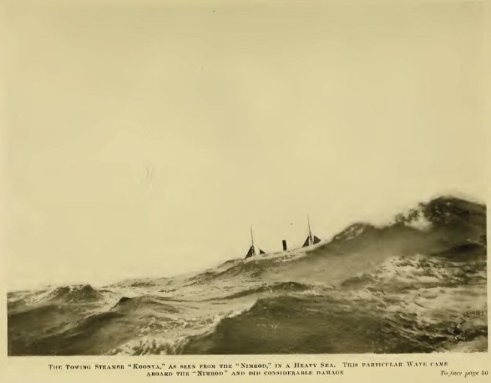
7. THE TOWING STEAMER "KOONYA", AS SEEN FROM THE NIMROD, IN A HEAVY SEA. THIS PARTICULAR WAVE CAME ABOARD THE NIMROD AND DID CONSIDERABLE DAMAGE
During the afternoon of January 6, the wind increased again, the squalls being of hurricane force, and the wind shifting to between west and north-west. The Koonya ahead was making bad weather of it, but was steaming as fast as practicable, for with the wind and sea coming more abeam she was able to make better headway than when she was plunging into a head sea with the weight and bulk of the towing cable and the Nimrod astern of her, factors in the situation that made the handling and steering of the steamer very difficult.
The temperature of the air that day was up to 49° Fahr., but the sea temperature had dropped to 44°. This continuous bad weather was attributed by some on board to the fact that we had captured an albatross on the second day out. It is generally supposed by seamen to be unlucky to kill this bird, but as we did it for the purposes of scientific collections and not with the wantonness of the "Ancient Mariner", the superstitious must seek for some other reason for the weather. By this time most of the scientific staff had recovered from seasickness, so to employ their time when they were not on pony-guard, meteorological observations were taken every hour. There sometimes was an inclination to obtain the temperature of the seawater from the never-failing stream which poured over the deck, but to the observers' credit this feeling was sternly suppressed, and the more legitimate and accurate, if less simple means, that of drawing it from over the side, was adopted. It is not at all an easy operation to draw water in this way from the sea when a ship is under way, and in our particular circumstances, the observer often got premature knowledge of the temperature by the contents of the bucket, or the top of a sea, drenching him. On this day we began to feel the serious effects of the towing strain on the ship. For days the sailors' quarters below the fore-deck had been in a state of constant wetness from the leaking of the fore-deck, and the inhabitants of Oyster Alley had come to the conclusion that it might more suitably be named "Moisture Alley". But when Dunlop, the chief engineer, came on the poop bridge that afternoon and reported that the ship was making about three feet of water in an hour, matters assumed a more serious complexion. I had not expected that we would get off scot free, as the ship had to endure a very severe strain, and was old, but three feet of water in an hour showed that she was feeling the effects of the towing very much. It was necessary to rig the hand-pump to help the steam-pumps to keep the water under, and this became, as the Professor remarked, the occasion for an additional scientific instrument to be used by the shore-party. A watch was set to use this pump, and two members of the staff worked it for two hours, or as long as occasion demanded, and at the end of that time were relieved by two more. The weather grew steadily worse, and by midnight the squalls were of hurricane force. Even the mastheads of the Koonya disappeared from view at times, and the light we were steering by would only be seen for a few seconds, and would then disappear behind the mounting wall of waters that separated the two ships. A moderate estimate of the height of the waves is forty-two feet. During the squalls, which were accompanied by hail and sleet, the tops of the seas were cut off by the force of the wind and flung in showers of stinging spray against our faces, drenching even the topsail yards of the Nimrod. Each green wave rushed at us as though it meant to swamp the ship, but each time the Nimrod rose bravely, and, riding over the seemingly overwhelming mass, steadied for a moment on the other side as it passed on, seething and white, baffled of its prey. All night there were squalls of terrific force, and the morning of January 7 brought no abatement of the storm. The seas now came on board with increasing frequency, finding out any odd article that had escaped our vigilance and survived the rolling of the ship. A sack of potatoes was washed on to the deck, and the contents were floating in two or three feet of water. But standing on the poop bridge I heard one of the crew, in no way disheartened, singing, as he gathered them up, "Here we go gathering nuts in May".
At noon we were in latitude 53° 26' South and longitude 127° 42' East. In the afternoon the weather moderated slightly, though there was a heavy, lumpy sea. Albatrosses were becoming much more numerous, especially the sooty species, the death of which, on Shelvoke's voyage, inspired Coleridge's memorable poem. I noticed one, flying low between the two ships, strike its wings against the wire tow-line, which had suddenly emerged from the waves owing to the lift of the Koonya's stern upon a sea. The weather became fairly moderate during the night and remained so next morning, with the wind in the north-west. After the second day out we had shifted the dogs from the forecastle head to the fore bridge, and one of these in its struggles to get down on to the main deck, strangled itself before we knew that it was in trouble.
There was constant rain during the morning of January 8, but it did not beat the sea down much, and during the evening, with the wind shifting to the south-south-west the gale increased again. It was so bad, owing to the confused sea, that we had to signal the Koonya to heave to. We did this with the sea on our starboard quarter. Suddenly one enormous wave rushed at us, and it appeared as though nothing could prevent our decks being swept, but the ship rose to it, and missed the greater part, though to us it seemed as if the full weight of water had come on board. We clung tightly to the poop rails, and as soon as the water had passed over us we wiped the salt from our eyes and surveyed the scene. The sea had smashed in part of the starboard bulwarks and destroyed a small house on the upper deck, pieces of this house and the bulwarks floating out to the leeward; the port washport was torn from its hinges, so that water now surged on board and swept away at its own sweet will, and the stout wooden rails of the poop deck, to which we had been clinging, were cracked and displaced, but no vital damage was done. The look of disgust on the faces of the dripping pony watch-keepers, as they emerged from the waterlogged "Cavalry Club", was eloquent of their feelings. The galley was washed out and the fire extinguished. This happened more than once, but so pluckily did the members of the cooking-department work, that never during the whole of this very uncomfortable time had we been without a warm meal. This means far more than one is apt to think, for the galley was only five feet square, and thirty-nine persons blessed with extremely hearty appetites had to be provided for.
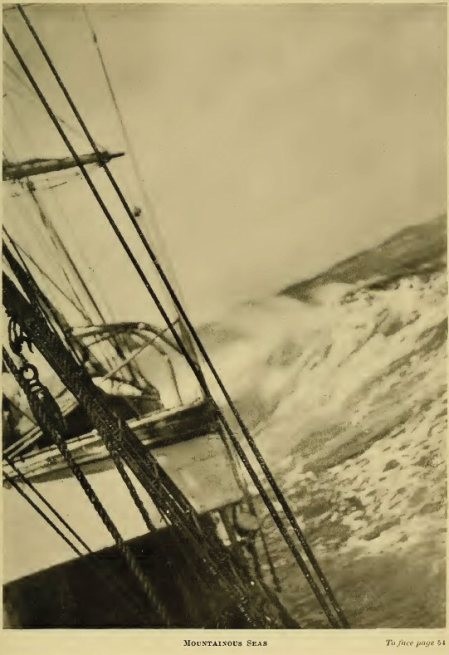
8. MOUNTAINOUS SEAS
In a large measure, this unbroken routine of hot meals, the three oases of what I might call pleasure in the daily desert of discomfort, was due to Roberts, who besides being assistant zoologist to the expedition, was going to act as cook. Seeing that the ship's staff would have more work to do than they could well carry out in providing for the thirty-nine people on board, he volunteered the first day out to assist the ship's cook, and the result was that we were always provided with fresh bread and hot cocoa and tea, Montague, the ship's cook, was ever at work, though the galley was in a constant state of flood. The stewards, Handcock and Ansell, worked wonders in getting the food across the danger zone between the galley and the wardroom. Ansell, with ten plates in one hand, overlapping one another up his arm, would arrive safely at his destination, though his boots were often filled with water on the way aft. Of course there were times when he was not so successful, and he would emerge from a sea with his clothes, hair, and face plentifully sprinkled with food. As a rule the accidents occurred in the wardroom, after the arrival of the food. The tablecloth, after two or three days, assumed an écru colour, owing to the constant upsetting of tea and coffee. Some of the staff had perforce to take their meals standing, from lack of seating accommodation, and the balancing of a plate of soup when the ship was rolling heavily required skill and experience. The meal was generally accompanied by the spurting of seawater through the wardroom door, or through cracks in the skylight, and the water washed to and fro unheeded until the meal was ended, and the indefatigable Ansell turned his attention to it. It was in the wardroom that I salved a small wooden case from the water, and found that it contained a patent mixture for extinguishing fires. The rooms of the ship's officers, opening out of the wardroom, were in a similar state of dampness, and when an officer finished his watch and turned in for a well-earned sleep, he merely substituted for clothes that were soaked through, others which were a little less wet.
The water, however, did not damp the spirits of those on board, for nearly every night extemporary concerts were held, and laughter and mirth filled the little wardroom. It is usual on Saturday nights at sea to drink the toasts, "Absent Friends", and "Sweethearts and Wives". I was generally at this time in the after cabin or on the bridge, and if, as sometimes happened, I had forgotten that particular day, a gentle hint was conveyed to me by Wild or Dunlop starting a popular song, entitled "Sweethearts and Wives", the chorus of which was heartily rendered by all hands. This hint used to bring my neglect to my mind, and I would produce the necessary bottle.
On January 10 we had a clear sky during the morning until about ten o'clock, and then, with a westerly wind, the breeze became heavier, and rain commenced. Most of us that day, taking advantage of the comparative steadiness of the ship, managed to wash our salt-encrusted faces and hair; we had become practically pickled during the past week. About midnight we had a light wind from the north-north-east, and the almost continual rain of the previous twelve hours had flattened the sea considerably.
At noon, on January 11, we were in latitude 57° 38' South, and longitude 178° 39' West, and during the day the wind and sea increased again from the north-west. The nature of this particular sea made it necessary for us to keep the ship away, altering our course from south to south-east, and before midnight the gale had reached its now customary force and violence. As I was standing on the bridge at 2 a.m., peering out to windward through a heavy snow-squall that enveloped us, I saw, in the faint light of breaking day, a huge sea, apparently independent of its companions, rear itself up alongside the ship. Fortunately only the crest of the wave struck us, but away went the starboard bulwarks forward and abreast of the pony stalls, leaving a free run for the water through the stables. When we left port it was our augean problem how best to clean out the stables, but after the first experience of the herculean waves, the difficulty was to try and stop the flushing of them by every sea that came on board forward, and now not only every wave that fell on board, but the swell of the ocean itself swept the stables clean. This particular sea shifted the heavy starboard whaleboat from its chocks, landing it almost amidships on top of the "Cavalry Club," and swept some of our bales of fodder down on to the main deck, where they mingled with the drums of oil and cases of carbide torn from their lashings. Our latitude at noon was 59° 8' South, and 179° SO' East. The squalls of sleet and snow gave place later to clearer weather with a mackerel sky, which was of special interest to the meteorologists, as indicating the trend of the upper currents of the air.
During the afternoon the strength of the expedition was increased by Possum, one of our dogs, giving birth to six fine puppies. The mother and family were found a warm bed on the engine room skylight, where a number of our cases were stowed. We signalled the happy event to the Koonya by flags, and received Captain Evans' congratulations. Signalling by flags was necessarily a somewhat slow operation, especially as the commercial code of signals is not exactly adapted for this particular sort of information, and we could see by the length of time they took to verify each signal that they were at a loss as to the subject-matter of our communication, the incident of a birth naturally being farthest removed from their thoughts at such a time. Whenever the weather moderated at all the two ships always held short conversations by flags, and the Commander of the Koonya used to make inquiries in particular after the health of the scientific staff.
January 13 brought with it a gentle breeze from the eastward, the heavy leaden sky broke into blue, flecked with light cirrus clouds, and the day seemed warmer and more pleasant than any we had experienced since we left Lyttelton, though the temperature of the air and sea water were down to 34° and 37° Fahr. respectively The warm sun tempted those who had not before been much in evidence on to the poop deck, and the whole vessel began to look like a veritable Petticoat Lane. Blankets, coats, boots, bags that might once have been leather but which now looked like lumps of dilapidated brown paper; pyjamas that had been intended to be worn when the owners first came aboard the Nimrod; books that had parted with their covers after sundry adventures in dripping Oyster Alley, but whose leaves evinced the strongest disinclination to separate; pillows of pulp that had once been pillows of feathers; carpet slippers, now merely bits of carpet; in short, all the personal belongings of each member of the expedition, including their most sacred Penates and Lares, were lying in a heterogeneous mass on the poop deck, in order that they might dry. A few of us ventured on baths, but it was chilly work in the open air, with the temperature only two degrees above freezing-point.
Some of our party, who were old sailors, had not much impedimenta to look after and to dry, the hard-won experience of early days having taught them the lesson that the fewer things you have to get wet, the fewer you have to get dry. Adams in particular observed this rule, for he wore the flannel trousers in which he came on board the ship at Lyttelton through all this weather, allowing them to dry on him after each successive wetting. He fondly clung to them throughout the period we were navigating in the ice, and whilst working the ship at winter quarters, and would doubtless have worn them on the ascent of Erebus if they had not practically come to pieces.
We were now keeping a sharp lookout for icebergs and pack; we had been steering a little more to the east, as I felt that our delay owing to bad weather would give us little time for navigation if we had to pass through much pack-ice, and a few degrees more easting might perhaps give us a more open sea. The meeting with the pack-ice was to terminate the Koonya,s tow, and that also meant our parting with Buckley, who had endeared himself to every man on board, from able seaman upwards, and had been of the greatest assistance to us in the matter of the ponies. It was due to his prompt action on one occasion that the life of "Zulu" was saved. We decided to give a farewell dinner to our friend that night, and Marston designed special menu cards for the occasion. At noon this day we were in latitude 61° 29' South, longitude 179° 53' East. During the afternoon the weather kept fine and we set some square sail. Occasionally during the bad weather of the previous week we had put "fore and afters" on to try and steady the ship, but the wind had carried them away. The Koonya had done the same, with a similar result. Our dinner that night was a great success, and it was early in the morning before we turned in.
Next morning, January 14, we sighted our first iceberg, and passed it at a distance of about two and a half miles. It had all the usual characteristics of the Antarctic bergs, being practically tabular in form, and its sides being of a dead white colour. The sight of this, the first sentinel of the frozen south, increased Buckley's desire to stay with us, and it was evident that the thought of leaving our little company was not a pleasant one to him. There was a remarkable belt of clouds across the sky during the morning, and their direction indicated the movement of the upper air, so the Professor and Cotton made several estimates of the height of this belt of cloud to try to determine the lower limit of the higher current. The mean measurements were taken, partly with a sextant and partly with an Abney level, to the edge of the belt of mackerel sky. The result of the observations was that the height of this belt was fixed at about thirteen thousand feet. The belt of cloud was travelling in an east-north-east direction at the rate of about fourteen miles an hour. The surface wind, at this time the longitude was blowing lightly from the west. Our latitude at noon was 63° 59' South and the longitude 179° 47' West, so we had crossed the 180th meridian.
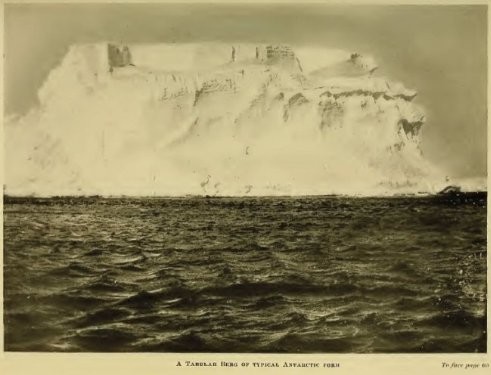
9. A TABULAR BERG OF TYPICAL ANTARCTIC FORM
During the afternoon we passed two more icebergs with their usual tails of brash ice floating out to leeward. The sea had changed colour from a leaden blue to a greenish grey. Albatrosses were not nearly so numerous, and of those following the ship the majority were the sooty species. The Cape pigeon and Wilson's petrel were occasionally to be seen, also a small grey-coloured bird, which is generally found near the pack, the name of which I do not know. We called them "ice-birds". Another sign of the nearness of the ice was that the temperature of the air and water had dropped to 32° Fahr. Everything pointed to our proximity to the pack, so we signalled the Koonya that we were likely to sight the ice at any moment. I also asked Captain Evans to kill and skin the sheep he was carrying for our supplies, as they would be much more easily transported when the time came to cast off. The weather remained fine with light winds during the night.
Next morning it was fairly thick with occasional light squalls of snow, and about 9 a.m. we saw the ice looming up through the mist to the southward. It seemed to stretch from south-west to south-east, and was apparently the forerunner of the pack. Now had come the time for the Koonya to drop us, after a tow of 1510 miles—a record in towage for a vessel not built for the purpose. Before the Koonya finally cast off from us, she had achieved another record, by being the first steel vessel to cross the Antarctic Circle.
About 10 a.m. I decided to send Captain England across to the Koonya with Buckley and the mail. Our letters were all stamped with the special stamp given by the New Zealand Government. The sea was rising again, and the wind increasing, so we lost no time in making the necessary communication by boat between the two ships. During a favourable roll the whale-boat was dropped into the water, and Buckley, with his weekend handbag, jumped into her. We gave him three cheers as the boat pushed off on its boisterous journey to the Koonya. With his usual forethought, to make matters lighter for the boat crew, Captain Evans had floated a line astern, attached to a life-buoy, and after about twenty-five minutes' hard pulling against wind and sea, the buoy was picked up, and the boat hauled alongside the steamer. I was glad to see the boat coming back again shortly afterwards, for the wind kept increasing and the sea was rising every moment, but in a lull, after pouring oil on the water, we hauled the boat up safely.
A thin line had been brought back from the Koonya, and at a signal from us Captain Evans paid out a heavier one, which we hauled on board. He then manoeuvred his ship, so as to get her as near as possible to us, in order that we might haul the carcases of the sheep on board. Ten of these were lashed on the line, and by dint of pulling hard, we got them on board. Meanwhile the greater part of our crew were working the old-fashioned windlass, getting in slowly, link by link, the port-towing cable, whilst the Koonya took in as much of her wire hawser as she conveniently could. Our heavy line was carried away, owing to a sudden strain, before we received the second instalment of waterlogged mutton. Captain Evans brought the Koonya round our stern, and a heaving-line, to which the sheep were attached, was thrown on board, but as soon as we began to haul on it, it broke, and we had the chagrin of seeing our fresh mutton floating away on the billows. It was lost to sight shortly afterwards, but we could locate its position by the albatrosses hovering above, doubtless surprised and delighted with this feast.
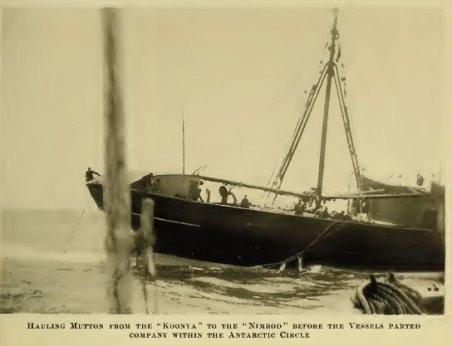
10. HAULING MUTTON FROM THE "KOONYA" TO THE NIMROD
BEFORE THE VESSELS PARTED COMPANY WITHIN THE
ANTARCTIC CIRCLE
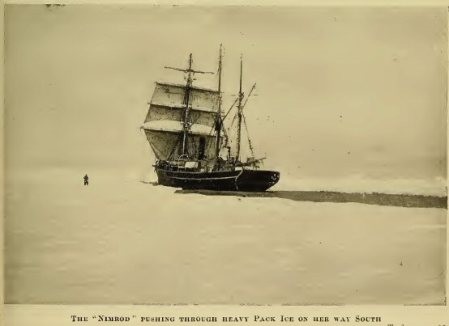
11. THE NIMROD PUSHING THROUGH HEAVY PACK-ICE ON
HER WAY SOUTH
About a quarter to one Captain Evans signalled that he was going to cut his hawser, for in the rising sea the two vessels were in dangerous proximity to each other. We saw the axe rise and fall, rise and fall again, and the tie was severed. The Koonya' s work was done, and the Nimrod was dependent on her own resources at last. Our consort steamed round us, all hands on both ships cheering, then her bows were set north and she vanished into a grey, snowy mist, homeward bound. We spent a long afternoon struggling to get on board the one hundred and forty fathoms of cable and thirty fathoms of wire that were hanging from our bows. The windlass was worked by means of levers, and all hands were divided into two parties, one section manning the port levers, the other the starboard. All that afternoon, and up to seven o'clock in the evening, they unremittingly toiled at getting the cable in link by link. At last we were able to proceed, the ship's head was put due south, and we prepared to work our way through the floating belt of pack that guards the approach to the Ross Sea. The weather had cleared, and we passed the ice which we had seen in the morning. It was a fairly loose patch of what appeared to be thick land ice. We gradually made our way through similar streams of ice and small hummocky bergs, most of them between forty and fifty feet in height, but a few reaching a hundred feet.
By 2 a.m. on the morning of January 16, the bergs were much more numerous; perhaps they could hardly be classed as bergs, for their average height was only about twenty feet, and I am of opinion, from what I saw later, that this ice originally formed part of an ice-foot from some coastline. None of the ice that we passed through at this time had the slightest resemblance to ordinary pack-ice. About 3 a.m., we entered an area of tabular bergs, varying from eighty to one hundred and fifty feet in height, and all the morning we steamed in beautiful weather with a light northerly wind, through the lanes and streets of a wonderful snowy Venice. Tongue and pen fail in attempting to describe the magic of such a scene. As far as the eye could see from the crow's-nest of the Nimrod, the great, white, wall-sided bergs stretched east, west and south, making a striking contrast with the lanes of blue-black water between them. A stillness, weird and uncanny, seemed to have fallen upon everything when we entered the silent water streets of this vast unpeopled white city. Here there was no sign of life, except when one of the little snow petrels, invisible when flying across the glistening bergs, flashed for a moment into sight, as it came against the dark water, its pure white wings just skimming the surface. The threshing of our screw raised a small wave astern of the ship, and at times huge masses of ice and snow from the bergs, disturbed by the unaccustomed motion, fell thundering in our wake. Some of these bergs had been weathered into the fantastic shapes more characteristic of the Arctic regions, and from peak and spire flashed out the new caught rays of the morning sun. Beautiful as this scene was, it gave rise to some anxiety in my mind, for I knew that if we were caught in a breeze amidst this maze of floating ice, it would go hard with us. Already an ominous dark cloud was sweeping down from the north, and a few flakes of falling snow heralded the approach of the misty northerly wind. I was unfeignedly thankful, when, about three in the afternoon, I saw from the crow's-nest open water ahead. A few more turnings and twistings through the devious water lanes, and we entered the ice free Ross Sea. This was the first time that a passage had been made into the Ross Sea without the vessel having been held up by pack-ice. I think our success was due to the fact that we were away to the eastward of the pack, which had separated from the land and the Barrier, and had drifted in a north-west direction. All my experience goes to prove that the easterly route is the best. Behind us lay the long line of bergs through which we had threaded our way for more than eighty miles from north to south, and which stretched east and west for an unknown distance, but far enough for me to say without exaggeration that there must have been thousands of these floating masses of ice. Whence they had come was open to conjecture; it was possible for them to have drifted from a barrier edge to the eastward of King Edward VII Land. If that were so, the barrier must be much lower than the Great Ice Barrier, and also much more even in height, for the vast majority of the bergs we passed were not more than one hundred and thirty feet high, and seemed to be of a fairly uniform thickness. The lights and shadows on the bergs to the eastward at times almost gave them the appearance of land, but as they were congregated most thickly in this direction, we did not venture to make closer acquaintance with them. Of one thing I am certain, this ice had not long left the parent barrier or coastline, for there was no sign of weathering or wind action on the sides; and if they had been afloat for even a short period they must infallibly have shown some traces of weathering, as the soft snow was at least fifteen to twenty feet thick. This was apparent when pieces broke off from the bergs, and in one or two cases, where sections had been sheared off the top of particular bergs, evidently by collision with their fellows. There were no indications or signs of embedded rocks or earthy material on the bergs, so I am led to believe that this great mass of ice must have been set free only a short time previously from some barrier edge at no great distance. Our latitude at noon on the 16th was 68° 6' South, and the longitude 179° 21' West.
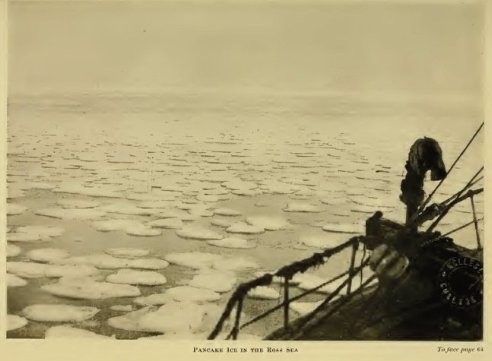
12. PANCAKE ICE IN THE ROSS SEA
Before we entered the actual line of bergs a couple of seals appeared on the floe-ice. I did not see them myself, but from descriptions I gathered that one was a crabeater, and the other a Weddell seal. A few of the Adelie penguins were observed also, and their quaint walk and insatiable curiosity afforded great amusement to our people, the surprise of the birds on seeing the ship was so thoroughly genuine. Marston, our artist, whose sense of the ludicrous is very fully developed, was in ecstasies at their solemn astonishment and profound concern, and at the way they communicated their feelings to one another by flapping their makeshift wings, craning their necks forward with ruffled feathers, and uttering short squawks. Marston's imitation of the penguin was perfect, and he and the rest of us always responded eagerly to the call on deck whenever we were passing a group of these polar inhabitants.
When we were clear of the icebergs a distinct swell was felt coming from the south, and for once the movement of the ocean was welcome to us, for it showed that we might expect open water ahead. I was fairly confident that we had managed to elude the pack, and without doubt for a ship, well found and capable of fair speed, the passage between the bergs on the meridian down which we steered is preferable to the slower progress through the ordinary pack farther west. I doubt if I would, except under similar circumstances, when time and coal were very precious, risk an old vessel like the Nimrod, which steams but slowly in this labyrinth of heavy ice, but a faster vessel could make the passage with safety. It may be that in future seasons the Antarctic Ocean in this particular part will be found to be quite ice-free, and a later expedition may be able to work more to the eastward, and solve the riddle as to the existence of land in that neighbourhood.

13. FLIGHT OF ANTARCTIC PETRELS
It was fortunate that we cleared the ice that afternoon, for shortly afterwards the wind increased from the north, and the weather became thick with falling snow.
The temperature was just at freezing-point, and the snow melted on the decks when it fell. Altogether about an inch of snow fell between 2 p.m. and midnight. We saw no ice until eight o'clock next morning (January 17), and then only one small berg. The wind shifted to the south-east, the sky cleared somewhat, and with an open horizon all round we observed no sign of ice at all.
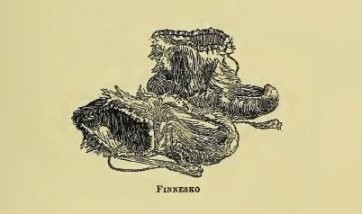
D3. FINNESKO