


автордың кітабын онлайн тегін оқу The Canterbury Puzzles / And Other Curious Problems
The Project Gutenberg eBook of The Canterbury Puzzles, by Henry Ernest Dudeney
This eBook is for the use of anyone anywhere at no cost and with
almost no restrictions whatsoever. You may copy it, give it away or
re-use it under the terms of the Project Gutenberg License included
with this eBook or online at www.gutenberg.org
Title: The Canterbury Puzzles
And Other Curious Problems
Author: Henry Ernest Dudeney
Release Date: December 27, 2008 [eBook #27635]
Language: English
Character set encoding: ISO-8859-1
***START OF THE PROJECT GUTENBERG EBOOK THE CANTERBURY PUZZLES***
E-text prepared by Malcolm Farmer, Christine D.,
and the Project Gutenberg Online Distributed Proofreading Team
(http://www.pgdp.net)
PRESS OPINIONS ON "THE CANTERBURY PUZZLES."
"It is a book of remarkable ingenuity and interest."—Educational Times.
"The most ingenious brain in England ... a fascinating new book."—Evening News.
"A capital book of posers."—Daily News.
"The Puzzles ... reach the limit of ingenuity and intricacy; and it is well for the sanity of his readers that the author gives a list of solutions at the end of the book."—Observer.
"A book that will provide much entertainment for Christmas gatherings ... ingenious puzzles and problems invented by 'Sphinx,' the Puzzle King."—The Captain.
"Mr. Dudeney, whose reputation is world-wide as the puzzle and problem maker of the age ... sure to find a wide circulation ... as attractive in appearance as its contents are fascinating."—English Mechanic and World of Science.
"An exceedingly ingenious constructor and solver of fascinating puzzles, mathematical and otherwise."—School Guardian.
"A book which ought to be highly popular ... it is all mighty ingenious, and very intelligently put before the reader."—Sheffield Telegraph.
"It is matter for delight that Mr. Henry E. Dudeney has collected into a volume those mysterious puzzles of his which have appeared in many journals ... contains quite a number of ingenious new mental problems ... a valuable introduction."—The Lady.
"For the long winter evenings Mr. Dudeney's book of puzzledom is to be recommended. Mr. Dudeney has made a study of every kind of puzzle there is ... he supplies you with every kind of brain-twister."—The Daily Chronicle.
"Took up more of the reviewer's time than he could well afford to give it; he wanted to solve some of the curious problems that it contains, and for ingenious persons who want employment on a wet day, he promises from it abundant scope."—Yorkshire Post.
"A well-known master puzzler ... provides an abundance of seasonable occupation for the ingenious, with an introduction on the general question of puzzles, which is one of the most interesting parts of the book. He is a skilful inventor."—Nottingham Guardian.
"Will enjoy the entertainment provided ... ingenious and witty."—The Guardian.
"Extremely ingenious book, which abounds in problems that will keep the reader busy for hours—until in despair he turns to the answers at the end."—Manchester Guardian.
"The setting of these perplexities is novel ... a dramatic background being thus provided which prevents too great aridity.... The book should be much in request."—The Morning Leader.
THE CANTERBURY PUZZLES
By the same Author
"AMUSEMENTS IN MATHEMATICS"
3s. 6d.
First Edition, 1907
THE
CANTERBURY PUZZLES
AND OTHER CURIOUS PROBLEMS
BY
HENRY ERNEST DUDENEY
AUTHOR OF
"AMUSEMENTS IN MATHEMATICS," ETC.
Second Edition
(With Some Fuller Solutions and Additional Notes)
THOMAS NELSON AND SONS, LTD.
LONDON, EDINBURGH, AND NEW YORK
1919
CONTENTS
Preface 9 Introduction 11 The Canterbury Puzzles 23 Puzzling Times at Solvamhall Castle 58 The Merry Monks of Riddlewell 68 The Strange Escape of the King's Jester 78 The Squire's Christmas Puzzle Party 86 Adventures of the Puzzle Club 94 The Professor's Puzzles 110 Miscellaneous Puzzles 118 Solutions 163 Index 251PREFACE
When preparing this new edition for the press, my first inclination was to withdraw a few puzzles that appeared to be of inferior interest, and to substitute others for them. But, on second thoughts, I decided to let the book stand in its original form and add extended solutions and some short notes to certain problems that have in the past involved me in correspondence with interested readers who desired additional information.
I have also provided—what was clearly needed for reference—an index. The very nature and form of the book prevented any separation of the puzzles into classes, but a certain amount of classification will be found in the index. Thus, for example, if the reader has a predilection for problems with Moving Counters, or for Magic Squares, or for Combination and Group Puzzles, he will find that in the index these are brought together for his convenience.
Though the problems are quite different, with the exception of just one or two little variations or extensions, from those in my book Amusements in Mathematics, each work being complete in itself, I have thought it would help the reader who happens to have both books before him if I made occasional references that would direct him to solutions and analyses in the later book calculated to elucidate matter in these pages. This course has also obviated the necessity of my repeating myself. For the sake of brevity, Amusements in Mathematics is throughout referred to as A. in M.
HENRY E. DUDENEY.
The Authors' Club,
July 2, 1919.
INTRODUCTION
Readers of The Mill on the Floss will remember that whenever Mr. Tulliver found himself confronted by any little difficulty he was accustomed to make the trite remark, "It's a puzzling world." There can be no denying the fact that we are surrounded on every hand by posers, some of which the intellect of man has mastered, and many of which may be said to be impossible of solution. Solomon himself, who may be supposed to have been as sharp as most men at solving a puzzle, had to admit "there be three things which are too wonderful for me; yea, four which I know not: the way of an eagle in the air; the way of a serpent upon a rock; the way of a ship in the midst of the sea; and the way of a man with a maid."
Probing into the secrets of Nature is a passion with all men; only we select different lines of research. Men have spent long lives in such attempts as to turn the baser metals into gold, to discover perpetual motion, to find a cure for certain malignant diseases, and to navigate the air.
From morning to night we are being perpetually brought face to face with puzzles. But there are puzzles and puzzles. Those that are usually devised for recreation and pastime may be roughly divided into two classes: Puzzles that are built up on some interesting or informing little principle; and puzzles that conceal no principle whatever—such as a picture cut at random into little bits to be put together again, or the juvenile imbecility known as the "rebus," or "picture puzzle." The former species may be said to be adapted to the amusement of the sane man or woman; the latter can be confidently recommended to the feeble-minded.
The curious propensity for propounding puzzles is not peculiar to any race or to any period of history. It is simply innate in every intelligent man, woman, and child that has ever lived, though it is always showing itself in different forms; whether the individual be a Sphinx of Egypt, a Samson of Hebrew lore, an Indian fakir, a Chinese philosopher, a mahatma of Tibet, or a European mathematician makes little difference.
Theologian, scientist, and artisan are perpetually engaged in attempting to solve puzzles, while every game, sport, and pastime is built up of problems of greater or less difficulty. The spontaneous question asked by the child of his parent, by one cyclist of another while taking a brief rest on a stile, by a cricketer during the luncheon hour, or by a yachtsman lazily scanning the horizon, is frequently a problem of considerable difficulty. In short, we are all propounding puzzles to one another every day of our lives—without always knowing it.
A good puzzle should demand the exercise of our best wit and ingenuity, and although a knowledge of mathematics and a certain familiarity with the methods of logic are often of great service in the solution of these things, yet it sometimes happens that a kind of natural cunning and sagacity is of considerable value. For many of the best problems cannot be solved by any familiar scholastic methods, but must be attacked on entirely original lines. This is why, after a long and wide experience, one finds that particular puzzles will sometimes be solved more readily by persons possessing only naturally alert faculties than by the better educated. The best players of such puzzle games as chess and draughts are not mathematicians, though it is just possible that often they may have undeveloped mathematical minds.
It is extraordinary what fascination a good puzzle has for a great many people. We know the thing to be of trivial importance, yet we are impelled to master it; and when we have succeeded there is a pleasure and a sense of satisfaction that are a quite sufficient reward for our trouble, even when there is no prize to be won. What is this mysterious charm that many find irresistible? Why do we like to be puzzled? The curious thing is that directly the enigma is solved the interest generally vanishes. We have done it, and that is enough. But why did we ever attempt to do it?
The answer is simply that it gave us pleasure to seek the solution—that the pleasure was all in the seeking and finding for their own sakes. A good puzzle, like virtue, is its own reward. Man loves to be confronted by a mystery, and he is not entirely happy until he has solved it. We never like to feel our mental inferiority to those around us. The spirit of rivalry is innate in man; it stimulates the smallest child, in play or education, to keep level with his fellows, and in later life it turns men into great discoverers, inventors, orators, heroes, artists, and (if they have more material aims) perhaps millionaires.
In starting on a tour through the wide realm of Puzzledom we do well to remember that we shall meet with points of interest of a very varied character. I shall take advantage of this variety. People often make the mistake of confining themselves to one little corner of the realm, and thereby miss opportunities of new pleasures that lie within their reach around them. One person will keep to acrostics and other word puzzles, another to mathematical brain-rackers, another to chess problems (which are merely puzzles on the chess-board, and have little practical relation to the game of chess), and so on. This is a mistake, because it restricts one's pleasures, and neglects that variety which is so good for the brain.
And there is really a practical utility in puzzle-solving. Regular exercise is supposed to be as necessary for the brain as for the body, and in both cases it is not so much what we do as the doing of it from which we derive benefit. The daily walk recommended by the doctor for the good of the body, or the daily exercise for the brain, may in itself appear to be so much waste of time; but it is the truest economy in the end. Albert Smith, in one of his amusing novels, describes a woman who was convinced that she suffered from "cobwigs on the brain." This may be a very rare complaint, but in a more metaphorical sense many of us are very apt to suffer from mental cobwebs, and there is nothing equal to the solving of puzzles and problems for sweeping them away. They keep the brain alert, stimulate the imagination, and develop the reasoning faculties. And not only are they useful in this indirect way, but they often directly help us by teaching us some little tricks and "wrinkles" that can be applied in the affairs of life at the most unexpected times and in the most unexpected ways.
There is an interesting passage in praise of puzzles in the quaint letters of Fitzosborne. Here is an extract: "The ingenious study of making and solving puzzles is a science undoubtedly of most necessary acquirement, and deserves to make a part in the meditation of both sexes. It is an art, indeed, that I would recommend to the encouragement of both the Universities, as it affords the easiest and shortest method of conveying some of the most useful principles of logic. It was the maxim of a very wise prince that 'he who knows not how to dissemble knows not how to reign'; and I desire you to receive it as mine, that 'he who knows not how to riddle knows not how to live.'"
How are good puzzles invented? I am not referring to acrostics, anagrams, charades, and that sort of thing, but to puzzles that contain an original idea. Well, you cannot invent a good puzzle to order, any more than you can invent anything else in that manner. Notions for puzzles come at strange times and in strange ways. They are suggested by something we see or hear, and are led up to by other puzzles that come under our notice. It is useless to say, "I will sit down and invent an original puzzle," because there is no way of creating an idea; you can only make use of it when it comes. You may think this is wrong, because an expert in these things will make scores of puzzles while another person, equally clever, cannot invent one "to save his life," as we say. The explanation is very simple. The expert knows an idea when he sees one, and is able by long experience to judge of its value. Fertility, like facility, comes by practice.
Sometimes a new and most interesting idea is suggested by the blunder of somebody over another puzzle. A boy was given a puzzle to solve by a friend, but he misunderstood what he had to do, and set about attempting what most likely everybody would have told him was impossible. But he was a boy with a will, and he stuck at it for six months, off and on, until he actually succeeded. When his friend saw the solution, he said, "This is not the puzzle I intended—you misunderstood me—but you have found out something much greater!" And the puzzle which that boy accidentally discovered is now in all the old puzzle books.
Puzzles can be made out of almost anything, in the hands of the ingenious person with an idea. Coins, matches, cards, counters, bits of wire or string, all come in useful. An immense number of puzzles have been made out of the letters of the alphabet, and from those nine little digits and cipher, 1, 2, 3, 4, 5, 6, 7, 8, 9, and 0.
It should always be remembered that a very simple person may propound a problem that can only be solved by clever heads—if at all. A child asked, "Can God do everything?" On receiving an affirmative reply, she at once said: "Then can He make a stone so heavy that He can't lift it?" Many wide-awake grown-up people do not at once see a satisfactory answer. Yet the difficulty lies merely in the absurd, though cunning, form of the question, which really amounts to asking, "Can the Almighty destroy His own omnipotence?" It is somewhat similar to the other question, "What would happen if an irresistible moving body came in contact with an immovable body?" Here we have simply a contradiction in terms, for if there existed such a thing as an immovable body, there could not at the same time exist a moving body that nothing could resist.
Professor Tyndall used to invite children to ask him puzzling questions, and some of them were very hard nuts to crack. One child asked him why that part of a towel that was dipped in water was of a darker colour than the dry part. How many readers could give the correct reply? Many people are satisfied with the most ridiculous answers to puzzling questions. If you ask, "Why can we see through glass?" nine people out of ten will reply, "Because it is transparent;" which is, of course, simply another way of saying, "Because we can see through it."
Puzzles have such an infinite variety that it is sometimes very difficult to divide them into distinct classes. They often so merge in character that the best we can do is to sort them into a few broad types. Let us take three or four examples in illustration of what I mean.
First there is the ancient Riddle, that draws upon the imagination and play of fancy. Readers will remember the riddle of the Sphinx, the monster of Bœotia who propounded enigmas to the inhabitants and devoured them if they failed to solve them. It was said that the Sphinx would destroy herself if one of her riddles was ever correctly answered. It was this: "What animal walks on four legs in the morning, two at noon, and three in the evening?" It was explained by Œdipus, who pointed out that man walked on his hands and feet in the morning of life, at the noon of life he walked erect, and in the evening of his days he supported his infirmities with a stick. When the Sphinx heard this explanation, she dashed her head against a rock and immediately expired. This shows that puzzle solvers may be really useful on occasion.
Then there is the riddle propounded by Samson. It is perhaps the first prize competition in this line on record, the prize being thirty sheets and thirty changes of garments for a correct solution. The riddle was this: "Out of the eater came forth meat, and out of the strong came forth sweetness." The answer was, "A honey-comb in the body of a dead lion." To-day this sort of riddle survives in such a form as, "Why does a chicken cross the road?" to which most people give the answer, "To get to the other side;" though the correct reply is, "To worry the chauffeur." It has degenerated into the conundrum, which is usually based on a mere pun. For example, we have been asked from our infancy, "When is a door not a door?" and here again the answer usually furnished ("When it is a-jar") is not the correct one. It should be, "When it is a negress (an egress)."
There is the large class of Letter Puzzles, which are based on the little peculiarities of the language in which they are written—such as anagrams, acrostics, word-squares, and charades. In this class we also find palindromes, or words and sentences that read backwards and forwards alike. These must be very ancient indeed, if it be true that Adam introduced himself to Eve (in the English language, be it noted) with the palindromic words, "Madam, I'm Adam," to which his consort replied with the modest palindrome "Eve."
Then we have Arithmetical Puzzles, an immense class, full of diversity. These range from the puzzle that the algebraist finds to be nothing but a "simple equation," quite easy of direct solution, up to the profoundest problems in the elegant domain of the theory of numbers.
Next we have the Geometrical Puzzle, a favourite and very ancient branch of which is the puzzle in dissection, requiring some plane figure to be cut into a certain number of pieces that will fit together and form another figure. Most of the wire puzzles sold in the streets and toy-shops are concerned with the geometry of position.
But these classes do not nearly embrace all kinds of puzzles even when we allow for those that belong at once to several of the classes. There are many ingenious mechanical puzzles that you cannot classify, as they stand quite alone: there are puzzles in logic, in chess, in draughts, in cards, and in dominoes, while every conjuring trick is nothing but a puzzle, the solution to which the performer tries to keep to himself.
There are puzzles that look easy and are easy, puzzles that look easy and are difficult, puzzles that look difficult and are difficult, and puzzles that look difficult and are easy, and in each class we may of course have degrees of easiness and difficulty. But it does not follow that a puzzle that has conditions that are easily understood by the merest child is in itself easy. Such a puzzle might, however, look simple to the uninformed, and only prove to be a very hard nut to him after he had actually tackled it.
For example, if we write down nineteen ones to form the number 1,111,111,111,111,111,111, and then ask for a number (other than 1 or itself) that will divide it without remainder, the conditions are perfectly simple, but the task is terribly difficult. Nobody in the world knows yet whether that number has a divisor or not. If you can find one, you will have succeeded in doing something that nobody else has ever done.[A]
The number composed of seventeen ones, 11,111,111,111,111,111, has only these two divisors, 2,071,723 and 5,363,222,357, and their discovery is an exceedingly heavy task. The only number composed only of ones that we know with certainty to have no divisor is 11. Such a number is, of course, called a prime number.
The maxim that there are always a right way and a wrong way of doing anything applies in a very marked degree to the solving of puzzles. Here the wrong way consists in making aimless trials without method, hoping to hit on the answer by accident—a process that generally results in our getting hopelessly entangled in the trap that has been artfully laid for us.
Occasionally, however, a problem is of such a character that, though it may be solved immediately by trial, it is very difficult to do by a process of pure reason. But in most cases the latter method is the only one that gives any real pleasure.
When we sit down to solve a puzzle, the first thing to do is to make sure, as far as we can, that we understand the conditions. For if we do not understand what it is we have to do, we are not very likely to succeed in doing it. We all know the story of the man who was asked the question, "If a herring and a half cost three-halfpence, how much will a dozen herrings cost?" After several unsuccessful attempts he gave it up, when the propounder explained to him that a dozen herrings would cost a shilling. "Herrings!" exclaimed the other apologetically; "I was working it out in haddocks!"
It sometimes requires more care than the reader might suppose so to word the conditions of a new puzzle that they are at once clear and exact and not so prolix as to destroy all interest in the thing. I remember once propounding a problem that required something to be done in the "fewest possible straight lines," and a person who was either very clever or very foolish (I have never quite determined which) claimed to have solved it in only one straight line, because, as she said, "I have taken care to make all the others crooked!" Who could have anticipated such a quibble?
Then if you give a "crossing the river" puzzle, in which people have to be got over in a boat that will only hold a certain number or combination of persons, directly the would-be solver fails to master the difficulty he boldly introduces a rope to pull the boat across. You say that a rope is forbidden; and he then falls back on the use of a current in the stream. I once thought I had carefully excluded all such tricks in a particular puzzle of this class. But a sapient reader made all the people swim across without using the boat at all! Of course, some few puzzles are intended to be solved by some trick of this kind; and if there happens to be no solution without the trick it is perfectly legitimate. We have to use our best judgment as to whether a puzzle contains a catch or not; but we should never hastily assume it. To quibble over the conditions is the last resort of the defeated would-be solver.
Sometimes people will attempt to bewilder you by curious little twists in the meaning of words. A man recently propounded to me the old familiar problem, "A boy walks round a pole on which is a monkey, but as the boy walks the monkey turns on the pole so as to be always facing him on the opposite side. Does the boy go around the monkey?" I replied that if he would first give me his definition of "to go around" I would supply him with the answer. Of course, he demurred, so that he might catch me either way. I therefore said that, taking the words in their ordinary and correct meaning, most certainly the boy went around the monkey. As was expected, he retorted that it was not so, because he understood by "going around" a thing that you went in such a way as to see all sides of it. To this I made the obvious reply that consequently a blind man could not go around anything.
He then amended his definition by saying that the actual seeing all sides was not essential, but you went in such a way that, given sight, you could see all sides. Upon which it was suggested that consequently you could not walk around a man who had been shut up in a box! And so on. The whole thing is amusingly stupid, and if at the start you, very properly, decline to admit any but a simple and correct definition of "to go around," there is no puzzle left, and you prevent an idle, and often heated, argument.
When you have grasped your conditions, always see if you cannot simplify them, for a lot of confusion is got rid of in this way. Many people are puzzled over the old question of the man who, while pointing at a portrait, says, "Brothers and sisters have I none, but that man's father is my father's son." What relation did the man in the picture bear to the speaker? Here you simplify by saying that "my father's son" must be either "myself" or "my brother." But, since the speaker has no brother, it is clearly "myself." The statement simplified is thus nothing more than, "That man's father is myself," and it was obviously his son's portrait. Yet people fight over this question by the hour!
There are mysteries that have never been solved in many branches of Puzzledom. Let us consider a few in the world of numbers—little things the conditions of which a child can understand, though the greatest minds cannot master. Everybody has heard the remark, "It is as hard as squaring a circle," though many people have a very hazy notion of what it means. If you have a circle of given diameter and wish to find the side of a square that shall contain exactly the same area, you are confronted with the problem of squaring the circle. Well, it cannot be done with exactitude (though we can get an answer near enough for all practical purposes), because it is not possible to say in exact numbers what is the ratio of the diameter to the circumference. But it is only in recent times that it has been proved to be impossible, for it is one thing not to be able to perform a certain feat, but quite another to prove that it cannot be done. Only uninstructed cranks now waste their time in trying to square the circle.
Again, we can never measure exactly in numbers the diagonal of a square. If you have a window pane exactly a foot on every side, there is the distance from corner to corner staring you in the face, yet you can never say in exact numbers what is the length of that diagonal. The simple person will at once suggest that we might take our diagonal first, say an exact foot, and then construct our square. Yes, you can do this, but then you can never say exactly what is the length of the side. You can have it which way you like, but you cannot have it both ways.
All my readers know what a magic square is. The numbers 1 to 9 can be arranged in a square of nine cells, so that all the columns and rows and each of the diagonals will add up 15. It is quite easy; and there is only one way of doing it, for we do not count as different the arrangements obtained by merely turning round the square and reflecting it in a mirror. Now if we wish to make a magic square of the 16 numbers, 1 to 16, there are just 880 different ways of doing it, again not counting reversals and reflections. This has been finally proved of recent years. But how many magic squares may be formed with the 25 numbers, 1 to 25, nobody knows, and we shall have to extend our knowledge in certain directions before we can hope to solve the puzzle. But it is surprising to find that exactly 174,240 such squares may be formed of one particular restricted kind only—the bordered square, in which the inner square of nine cells is itself magic. And I have shown how this number may be at once doubled by merely converting every bordered square—by a simple rule—into a non-bordered one.
Then vain attempts have been made to construct a magic square by what is called a "knight's tour" over the chess-board, numbering each square that the knight visits in succession, 1, 2, 3, 4, etc.; and it has been done, with the exception of the two diagonals, which so far have baffled all efforts. But it is not certain that it cannot be done.
Though the contents of the present volume are in the main entirely original, some very few old friends will be found; but these will not, I trust, prove unwelcome in the new dress that they have received. The puzzles are of every degree of difficulty, and so varied in character that perhaps it is not too much to hope that every true puzzle lover will find ample material to interest—and possibly instruct. In some cases I have dealt with the methods of solution at considerable length, but at other times I have reluctantly felt obliged to restrict myself to giving the bare answers. Had the full solutions and proofs been given in the case of every puzzle, either half the problems would have had to be omitted, or the size of the book greatly increased. And the plan that I have adopted has its advantages, for it leaves scope for the mathematical enthusiast to work out his own analysis. Even in those cases where I have given a general formula for the solution of a puzzle, he will find great interest in verifying it for himself.
THE CANTERBURY PUZZLES
A Chance-gathered company of pilgrims, on their way to the shrine of Saint Thomas à Becket at Canterbury, met at the old Tabard Inn, later called the Talbot, in Southwark, and the host proposed that they should beguile the ride by each telling a tale to his fellow-pilgrims. This we all know was the origin of the immortal Canterbury Tales of our great fourteenth-century poet, Geoffrey Chaucer. Unfortunately, the tales were never completed, and perhaps that is why the quaint and curious "Canterbury Puzzles," devised and propounded by the same body of pilgrims, were not also recorded by the poet's pen. This is greatly to be regretted, since Chaucer, who, as Leland tells us, was an "ingenious mathematician" and the author of a learned treatise on the astrolabe, was peculiarly fitted for the propounding of problems. In presenting for the first time some of these old-world posers, I will not stop to explain the singular manner in which they came into my possession, but proceed at once, without unnecessary preamble, to give my readers an opportunity of solving them and testing their quality. There are certainly far more difficult puzzles extant, but difficulty and interest are two qualities of puzzledom that do not necessarily go together.
1.—The Reve's Puzzle.
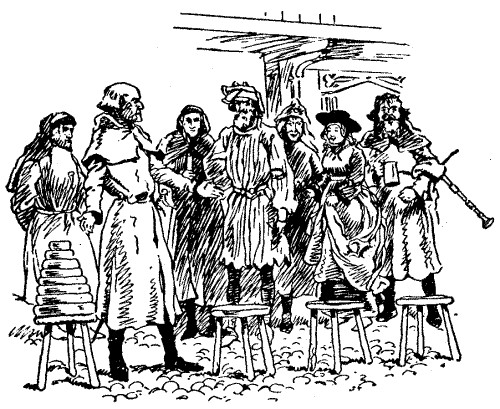
The Reve was a wily man and something of a scholar. As Chaucer tells us, "There was no auditor could of him win," and "there could no man bring him in arrear." The poet also noticed that "ever he rode the hindermost of the route." This he did that he might the better, without interruption, work out the fanciful problems and ideas that passed through his active brain. When the pilgrims were stopping at a wayside tavern, a number of cheeses of varying sizes caught his alert eye; and calling for four stools, he told the company that he would show them a puzzle of his own that would keep them amused during their rest. He then placed eight cheeses of graduating sizes on one of the end stools, the smallest cheese being at the top, as clearly shown in the illustration. "This is a riddle," quoth he, "that I did once set before my fellow townsmen at Baldeswell, that is in Norfolk, and, by Saint Joce, there was no man among them that could rede it aright. And yet it is withal full easy, for all that I do desire is that, by the moving of one cheese at a time from one stool unto another, ye shall remove all the cheeses to the stool at the other end without ever putting any cheese on one that is smaller than itself. To him that will perform this feat in the least number of moves that be possible will I give a draught of the best that our good host can provide." To solve this puzzle in the fewest possible moves, first with 8, then with 10, and afterwards with 21 cheeses, is an interesting recreation.
2.—The Pardoner's Puzzle.
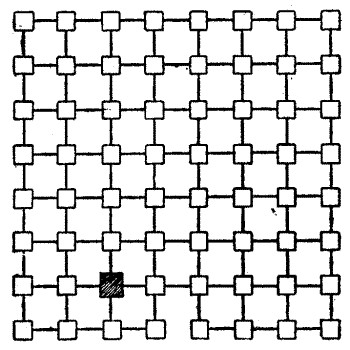
The gentle Pardoner, "that straight was come from the court of Rome," begged to be excused; but the company would not spare him. "Friends and fellow-pilgrims," said he, "of a truth the riddle that I have made is but a poor thing, but it is the best that I have been able to devise. Blame my lack of knowledge of such matters if it be not to your liking." But his invention was very well received. He produced the accompanying plan, and said that it represented sixty-four towns through which he had to pass during some of his pilgrimages, and the lines connecting them were roads. He explained that the puzzle was to start from the large black town and visit all the other towns once, and once only, in fifteen straight pilgrimages. Try to trace the route in fifteen straight lines with your pencil. You may end where you like, but note that the omission of a little road at the bottom is intentional, as it seems that it was impossible to go that way.
3.—The Miller's Puzzle.
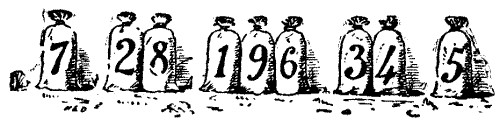
The Miller next took the company aside and showed them nine sacks of flour that were standing as depicted in the sketch. "Now, hearken, all and some," said he, "while that I do set ye the riddle of the nine sacks of flour. And mark ye, my lords and masters, that there be single sacks on the outside, pairs next unto them, and three together in the middle thereof. By Saint Benedict, it doth so happen that if we do but multiply the pair, 28, by the single one, 7, the answer is 196, which is of a truth the number shown by the sacks in the middle. Yet it be not true that the other pair, 34, when so multiplied by its neighbour, 5, will also make 196. Wherefore I do beg you, gentle sirs, so to place anew the nine sacks with as little trouble as possible that each pair when thus multiplied by its single neighbour shall make the number in the middle." As the Miller has stipulated in effect that as few bags as possible shall be moved, there is only one answer to this puzzle, which everybody should be able to solve.
4.—The Knight's Puzzle.
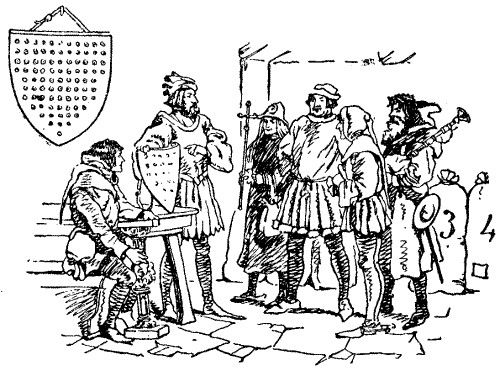
This worthy man was, as Chaucer tells us, "a very perfect, gentle knight," and "In many a noble army had he been: At mortal battles had he been fifteen." His shield, as he is seen showing it to the company at the "Tabard" in the illustration, was, in the peculiar language of the heralds, "argent, semée of roses, gules," which means that on a white ground red roses were scattered or strewn, as seed is sown by the hand. When this knight was called on to propound a puzzle, he said to the company, "This riddle a wight did ask of me when that I fought with the lord of Palatine against the heathen in Turkey. In thy hand take a piece of chalk and learn how many perfect squares thou canst make with one of the eighty-seven roses at each corner thereof." The reader may find it an interesting problem to count the number of squares that may be formed on the shield by uniting four roses.
5.—The Wife of Bath's Riddles.
The frolicsome Wife of Bath, when called upon to favour the company, protested that she had no aptitude for such things, but that her fourth husband had had a liking for them, and she remembered one of his riddles that might be new to her fellow pilgrims: "Why is a bung that hath been made fast in a barrel like unto another bung that is just falling out of a barrel?" As the company promptly answered this easy conundrum, the lady went on to say that when she was one day seated sewing in her private chamber her son entered. "Upon receiving," saith she, "the parental command, 'Depart, my son, and do not disturb me!' he did reply, 'I am, of a truth, thy son; but thou art not my mother, and until thou hast shown me how this may be I shall not go forth.'" This perplexed the company a good deal, but it is not likely to give the reader much difficulty.
6.—The Host's Puzzle.
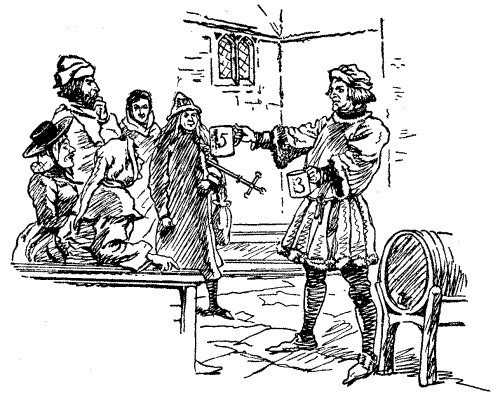
Perhaps no puzzle of the whole collection caused more jollity or was found more entertaining than that produced by the Host of the "Tabard," who accompanied the party all the way. He called the pilgrims together and spoke as follows: "My merry masters all, now that it be my turn to give your brains a twist, I will show ye a little piece of craft that will try your wits to their full bent. And yet methinks it is but a simple matter when the doing of it is made clear. Here be a cask of fine London ale, and in my hands do I hold two measures—one of five pints, and the other of three pints. Pray show how it is possible for me to put a true pint into each of the measures." Of course, no other vessel or article is to be used, and no marking of the measures is allowed. It is a knotty little problem and a fascinating one. A good many persons to-day will find it by no means an easy task. Yet it can be done.
7.—The Clerk of Oxenford's Puzzle.
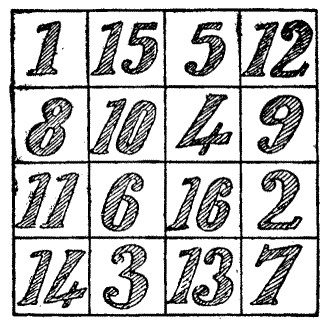
The silent and thoughtful Clerk of Oxenford, of whom it is recorded that "Every farthing that his friends e'er lent, In books and learning was it always spent," was prevailed upon to give his companions a puzzle. He said, "Ofttimes of late have I given much thought to the study of those strange talismans to ward off the plague and such evils that are yclept magic squares, and the secret of such things is very deep and the number of such squares truly great. But the small riddle that I did make yester eve for the purpose of this company is not so hard that any may not find it out with a little patience." He then produced the square shown in the illustration and said that it was desired so to cut it into four pieces (by cuts along the lines) that they would fit together again and form a perfect magic square, in which the four columns, the four rows, and the two long diagonals should add up 34. It will be found that this is a just sufficiently easy puzzle for most people's tastes.
8.—The Tapiser's Puzzle.
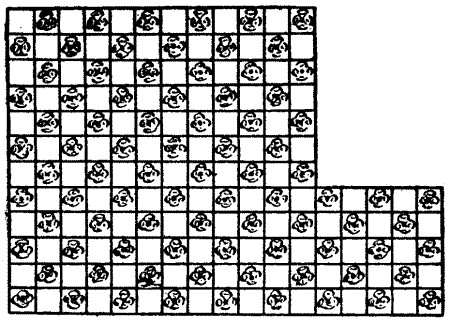
Then came forward the Tapiser, who was, of course, a maker of tapestry, and must not be confounded with a tapster, who draws and sells ale.
He produced a beautiful piece of tapestry, worked in a simple chequered pattern, as shown in the diagram. "This piece of tapestry, sirs," quoth he, "hath one hundred and sixty-nine small squares, and I do desire you to tell me the manner of cutting the tapestry into three pieces that shall fit together and make one whole piece in shape of a perfect square.
"Moreover, since there be divers ways of so doing, I do wish to know that way wherein two of the pieces shall together contain as much as possible of the rich fabric." It is clear that the Tapiser intended the cuts to be made along the lines dividing the squares only, and, as the material was not both sides alike, no piece may be reversed, but care must be observed that the chequered pattern matches properly.
9.—The Carpenter's Puzzle.
The Carpenter produced the carved wooden pillar that he is seen holding in the illustration, wherein the knight is propounding his knotty problem to the goodly company (No. 4), and spoke as follows: "There dwelleth in the city of London a certain scholar that is learned in astrology and other strange arts. Some few days gone he did bring unto me a piece of wood that had three feet in length, one foot in breadth and one foot in depth, and did desire that it be carved and made into the pillar that you do now behold. Also did he promise certain payment for every cubic inch of wood cut away by the carving thereof.
"Now I did at first weigh the block, and found it truly to contain thirty pounds, whereas the pillar doth now weigh but twenty pounds. Of a truth I have therefore cut away one cubic foot (which is to say one-third) of the three cubic feet of the block; but this scholar withal doth hold that payment may not thus be fairly made by weight, since the heart of the block may be heavier, or perchance may be more light, than the outside. How then may I with ease satisfy the scholar as to the quantity of wood that hath been cut away?" This at first sight looks a difficult question, but it is so absurdly simple that the method employed by the carpenter should be known to everybody to-day, for it is a very useful little "wrinkle."
10.—The Puzzle of the Squire's Yeoman.
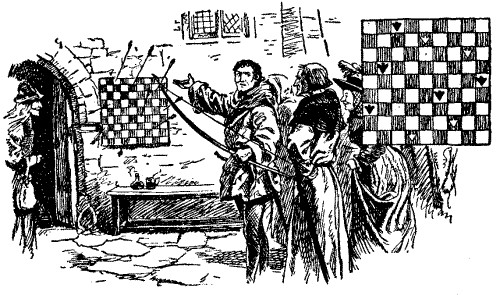
Chaucer says of the Squire's Yeoman, who formed one of his party of pilgrims, "A forester was he truly as I guess," and tells us that "His arrows drooped not with feathers low, And in his hand he bare a mighty bow." When a halt was made one day at a wayside inn, bearing the old sign of the "Chequers," this yeoman consented to give the company an exhibition of his skill. Selecting nine good arrows, he said, "Mark ye, good sirs, how that I shall shoot these nine arrows in such manner that each of them shall lodge in the middle of one of the squares that be upon the sign of the 'Chequers,' and yet of a truth shall no arrow be in line with any other arrow." The diagram will show exactly how he did this, and no two arrows will be found in line, horizontally, vertically, or diagonally. Then the Yeoman said: "Here then is a riddle for ye. Remove three of the arrows each to one of its neighbouring squares, so that the nine shall yet be so placed that none thereof may be in line with another." By a "neighbouring square" is meant one that adjoins, either laterally or diagonally.
11.—The Nun's Puzzle.
"I trow there be not one among ye," quoth the Nun, on a later occasion, "that doth not know that many monks do oft pass the time in play at certain games, albeit they be not lawful for them. These games, such as cards and the game of chess, do they cunningly hide from the abbot's eye by putting them away in holes that they have cut out of the very hearts of great books that be upon their shelves. Shall the nun therefore be greatly blamed if she do likewise? I will show a little riddle game that we do sometimes play among ourselves when the good abbess doth hap to be away."
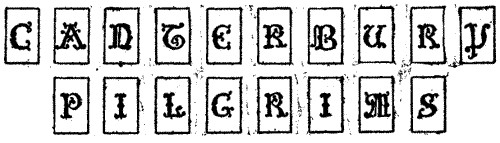
The Nun then produced the eighteen cards that are shown in the illustration. She explained that the puzzle was so to arrange the cards in a pack, that by placing the uppermost one on the table, placing the next one at the bottom of the pack, the next one on the table, the next at the bottom of the pack, and so on, until all are on the table, the eighteen cards shall then read "CANTERBURY PILGRIMS." Of course each card must be placed on the table to the immediate right of the one that preceded it. It is easy enough if you work backwards, but the reader should try to arrive at the required order without doing this, or using any actual cards.
12.—The Merchant's Puzzle.
Of the Merchant the poet writes, "Forsooth he was a worthy man withal." He was thoughtful, full of schemes, and a good manipulator of figures. "His reasons spake he eke full solemnly. Sounding away the increase of his winning." One morning, when they were on the road, the Knight and the Squire, who were riding beside him, reminded the Merchant that he had not yet propounded the puzzle that he owed the company. He thereupon said, "Be it so? Here then is a riddle in numbers that I will set before this merry company when next we do make a halt. There be thirty of us in all riding over the common this morn. Truly we may ride one and one, in what they do call the single file, or two and two, or three and three, or five and five, or six and six, or ten and ten, or fifteen and fifteen, or all thirty in a row. In no other way may we ride so that there be no lack of equal numbers in the rows. Now, a party of pilgrims were able thus to ride in as many as sixty-four different ways. Prithee tell me how many there must perforce have been in the company." The Merchant clearly required the smallest number of persons that could so ride in the sixty-four ways.
13.—The Man of Law's Puzzle.
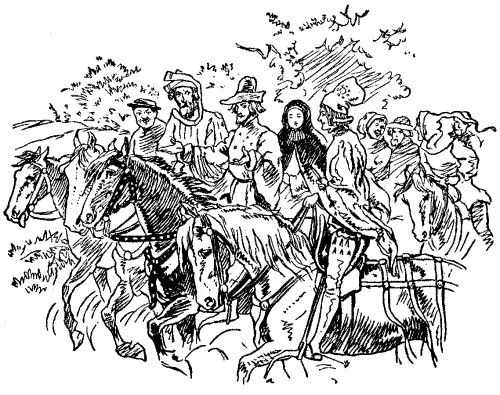
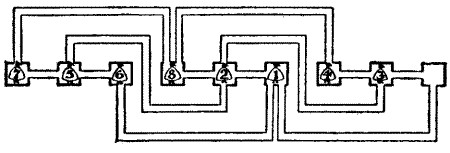
The Sergeant of the Law was "full rich of excellence. Discreet he was, and of great reverence." He was a very busy man, but, like many of us to-day, "he seemed busier than he was." He was talking one evening of prisons and prisoners, and at length made the following remarks: "And that which I have been saying doth forsooth call to my mind that this morn I bethought me of a riddle that I will now put forth." He then produced a slip of vellum, on which was drawn the curious plan that is now given. "Here," saith he, "be nine dungeons, with a prisoner in every dungeon save one, which is empty. These prisoners be numbered in order, 7, 5, 6, 8, 2, 1, 4, 3, and I desire to know how they can, in as few moves as possible, put themselves in the order 1, 2, 3, 4, 5, 6, 7, 8. One prisoner may move at a time along the passage to the dungeon that doth happen to be empty, but never, on pain of death, may two men be in any dungeon at the same time. How may it be done?" If the reader makes a rough plan on a sheet of paper and uses numbered counters, he will find it an interesting pastime to arrange the prisoners in the fewest possible moves. As there is never more than one vacant dungeon at a time to be moved into, the moves may be recorded in this simple way: 3—2—1—6, and so on.
14.—The Weaver's Puzzle.
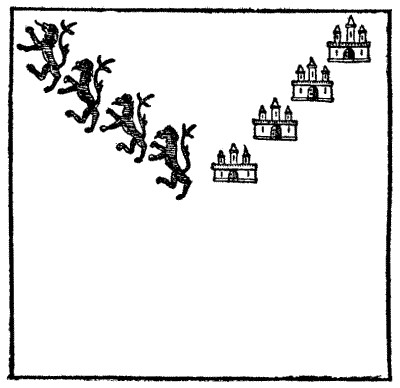
When the Weaver brought out a square piece of beautiful cloth, daintily embroidered with lions and castles, as depicted in the illustration, the pilgrims disputed among themselves as to the meaning of these ornaments. The Knight, however, who was skilled in heraldry, explained that they were probably derived from the lions and castles borne in the arms of Ferdinand III., the King of Castile and Leon, whose daughter was the first wife of our Edward I. In this he was undoubtedly correct. The puzzle that the Weaver proposed was this. "Let us, for the nonce, see," saith he, "if there be any of the company that can show how this piece of cloth may be cut into four several pieces, each of the same size and shape, and each piece bearing a lion and a castle." It is not recorded that anybody mastered this puzzle, though it is quite possible of solution in a satisfactory manner. No cut may pass through any part of a lion or a castle.
15.—The Cook's Puzzle.
We find that there was a cook among the company; and his services were no doubt at times in great request, "For he could roast and seethe, and broil and fry, And make a mortress and well bake a pie." One night when the pilgrims were seated at a country hostelry, about to begin their repast, the cook presented himself at the head of the table that was presided over by the Franklin, and said, "Listen awhile, my masters, while that I do ask ye a riddle, and by Saint Moden it is one that I cannot answer myself withal. There be eleven pilgrims seated at this board on which is set a warden pie and a venison pasty, each of which may truly be divided into four parts and no more. Now, mark ye, five out of the eleven pilgrims can eat the pie, but will not touch the pasty, while four will eat the pasty but turn away from the pie. Moreover, the two that do remain be able and willing to eat of either. By my halidame, is there any that can tell me in how many different ways the good Franklin may choose whom he will serve?" I will just caution the reader that if he is not careful he will find, when he sees the answer, that he has made a mistake of forty, as all the company did, with the exception of the Clerk of Oxenford, who got it right by accident, through putting down a wrong figure.
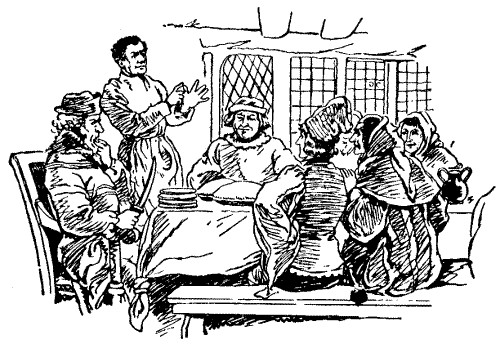
Strange to say, while the company perplexed their wits about this riddle the cook played upon them a merry jest. In the midst of their deep thinking and hot dispute what should the cunning knave do but stealthily take away both the pie and the pasty. Then, when hunger made them desire to go on with the repast, finding there was nought upon the table, they called clamorously for the cook.
"My masters," he explained, "seeing you were so deep set in the riddle, I did take them to the next room, where others did eat them with relish ere they had grown cold. There be excellent bread and cheese in the pantry."
16.—The Sompnour's Puzzle.
The Sompnour, or Summoner, who, according to Chaucer, joined the party of pilgrims, was an officer whose duty was to summon delinquents to appear in ecclesiastical courts. In later times he became known as the apparitor. Our particular individual was a somewhat quaint though worthy man. "He was a gentle hireling and a kind; A better fellow should a man not find." In order that the reader may understand his appearance in the picture, it must be explained that his peculiar headgear is duly recorded by the poet. "A garland had he set upon his head, As great as if it were for an ale-stake."
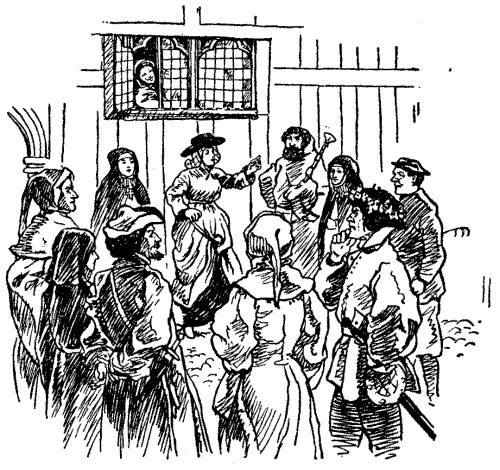
One evening ten of the company stopped at a village inn and requested to be put up for the night, but mine host could only accommodate five of them. The Sompnour suggested that they should draw lots, and as he had had experience in such matters in the summoning of juries and in other ways, he arranged the company in a circle and proposed a "count out." Being of a chivalrous nature, his little plot was so to arrange that the men should all fall out and leave the ladies in possession. He therefore gave the Wife of Bath a number and directed her to count round and round the circle, in a clockwise direction, and the person on whom that number fell was immediately to step out of the ring. The count then began afresh at the next person. But the lady misunderstood her instructions, and selected in mistake the number eleven and started the count at herself. As will be found, this resulted in all the women falling out in turn instead of the men, for every eleventh person withdrawn from the circle is a lady.
"Of a truth it was no fault of mine," said the Sompnour next day to the company, "and herein is methinks a riddle. Can any tell me what number the good Wife should have used withal, and at which pilgrim she should have begun her count so that no other than the five men should have been counted out?" Of course, the point is to find the smallest number that will have the desired effect.
17.—The Monk's Puzzle.
The Monk that went with the party was a great lover of sport. "Greyhounds he had as swift as fowl of flight: Of riding and of hunting for the hare Was all his love, for no cost would he spare." One day he addressed the pilgrims as follows:—
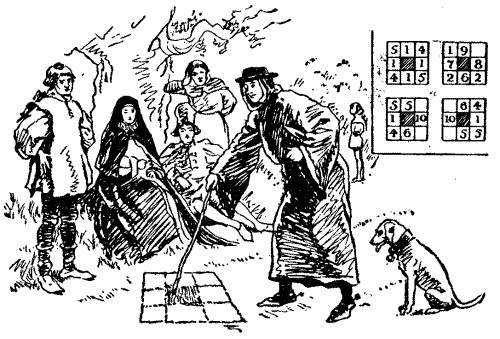
"There is a little matter that hath at times perplexed me greatly, though certes it is of no great weight; yet may it serve to try the wits of some that be cunning in such things. Nine kennels have I for the use of my dogs, and they be put in the form of a square; though the one in the middle I do never use, it not being of a useful nature. Now the riddle is to find in how many different ways I may place my dogs in all or any of the outside kennels so that the number of dogs on every side of the square may be just ten." The small diagrams show four ways of doing it, and though the fourth way is merely a reversal of the third, it counts as different. Any kennels may be left empty. This puzzle was evidently a variation of the ancient one of the Abbess and her Nuns.
18.—The Shipman's Puzzle.
Of this person we are told, "He knew well all the havens, as they were, From Gothland to the Cape of Finisterre, And every creek in Brittany and Spain: His barque yclepéd was the Magdalen." The strange puzzle in navigation that he propounded was as follows.
"Here be a chart," quoth the Shipman, "of five islands, with the inhabitants of which I do trade. In each year my good ship doth sail over every one of the ten courses depicted thereon, but never may she pass along the same course twice in any year. Is there any among the company who can tell me in how many different ways I may direct the Magdalen's ten yearly voyages, always setting out from the same island?"
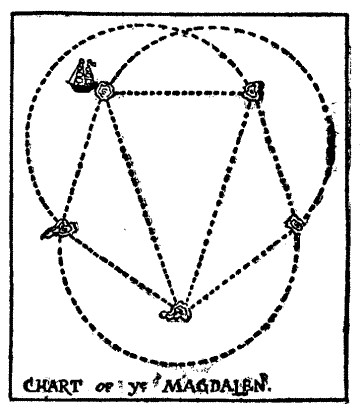
CHART of ye MAGDALEN
19.—The Puzzle of the Prioress.
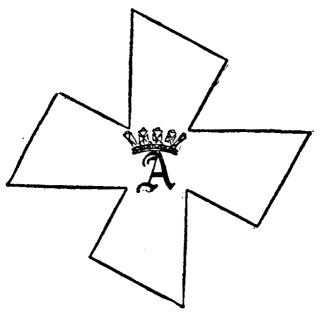
The Prioress, who went by the name of Eglantine, is best remembered on account of Chaucer's remark, "And French she spake full fair and properly, After the school of Stratford-atté-Bow, For French of Paris was to her unknow." But our puzzle has to do less with her character and education than with her dress. "And thereon hung a brooch of gold full sheen, On which was written first a crownéd A." It is with the brooch that we are concerned, for when asked to give a puzzle she showed this jewel to the company and said: "A learned man from Normandy did once give me this brooch as a charm, saying strange and mystic things anent it, how that it hath an affinity for the square, and such other wise words that were too subtle for me. But the good Abbot of Chertsey did once tell me that the cross may be so cunningly cut into four pieces that they will join and make a perfect square; though on my faith I know not the manner of doing it."
It is recorded that "the pilgrims did find no answer to the riddle, and the Clerk of Oxenford thought that the Prioress had been deceived in the matter thereof; whereupon the lady was sore vexed, though the gentle knight did flout and gibe at the poor clerk because of his lack of understanding over other of the riddles, which did fill him with shame and make merry the company."
20.—The Puzzle of the Doctor of Physic.
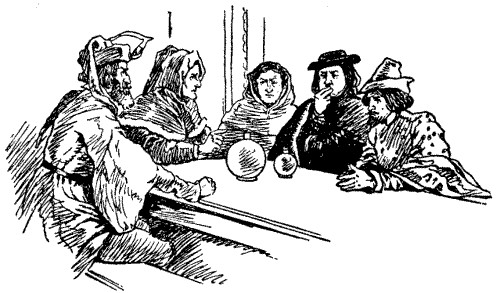
This Doctor, learned though he was, for "In all this world to him there was none like To speak of physic and of surgery," and "He knew the cause of every malady," yet was he not indifferent to the more material side of life. "Gold in physic is a cordial; Therefore he lovéd gold in special." The problem that the Doctor propounded to the assembled pilgrims was this. He produced two spherical phials, as shown in our illustration, and pointed out that one phial was exactly a foot in circumference, and the other two feet in circumference.
"I do wish," said the Doctor, addressing the company, "to have the exact measures of two other phials, of a like shape but different in size, that may together contain just as much liquid as is contained by these two." To find exact dimensions in the smallest possible numbers is one of the toughest nuts I have attempted. Of course the thickness of the glass, and the neck and base, are to be ignored.
21.—The Ploughman's Puzzle.
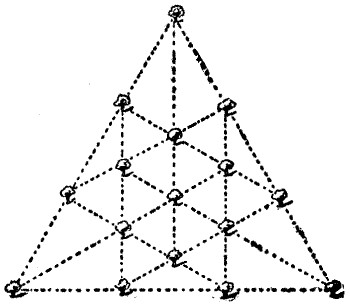
The Ploughman—of whom Chaucer remarked, "A worker true and very good was he, Living in perfect peace and charity"—protested that riddles were not for simple minds like his, but he would show the good pilgrims, if they willed it, one that he had frequently heard certain clever folk in his own neighbourhood discuss. "The lord of the manor in the part of Sussex whence I come hath a plantation of sixteen fair oak trees, and they be so set out that they make twelve rows with four trees in every row. Once on a time a man of deep learning, who happened to be travelling in those parts, did say that the sixteen trees might have been so planted that they would make so many as fifteen straight rows, with four trees in every row thereof. Can ye show me how this might be? Many have doubted that 'twere possible to be done." The illustration shows one of many ways of forming the twelve rows. How can we make fifteen?
22.—The Franklin's Puzzle.
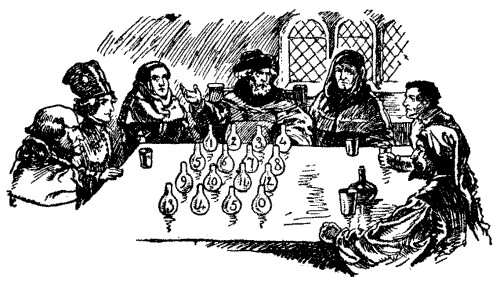
"A Franklin was in this company; White was his beard as is the daisy." We are told by Chaucer that he was a great householder and an epicure. "Without baked meat never was his house. Of fish and flesh, and that so plenteous, It snowed in his house of meat and drink, Of every dainty that men could bethink." He was a hospitable and generous man. "His table dormant in his hall alway Stood ready covered all throughout the day." At the repasts of the Pilgrims he usually presided at one of the tables, as we found him doing on the occasion when the cook propounded his problem of the two pies.
One day, at an inn just outside Canterbury, the company called on him to produce the puzzle required of him; whereupon he placed on the table sixteen bottles numbered 1, 2, 3, up to 15, with the last one marked 0. "Now, my masters," quoth he, "it will be fresh in your memories how that the good Clerk of Oxenford did show us a riddle touching what hath been called the magic square. Of a truth will I set before ye another that may seem to be somewhat of a like kind, albeit there be little in common betwixt them. Here be set out sixteen bottles in form of a square, and I pray you so place them afresh that they shall form a magic square, adding up to thirty in all the ten straight ways. But mark well that ye may not remove more than ten of the bottles from their present places, for therein layeth the subtlety of the riddle." This is a little puzzle that may be conveniently tried with sixteen numbered counters.
23.—The Squire's Puzzle.
The young Squire, twenty years of age, was the son of the Knight that accompanied him on the historic pilgrimage. He was undoubtedly what in later times we should call a dandy, for, "Embroideréd was he as is a mead, All full of fresh flowers, white and red. Singing he was or fluting all the day, He was as fresh as is the month of May." As will be seen in the illustration to No. 26, while the Haberdasher was propounding his problem of the triangle, this young Squire was standing in the background making a drawing of some kind; for "He could songs make and well indite, Joust and eke dance, and well portray and write."
The Knight turned to him after a while and said, "My son, what is it over which thou dost take so great pains withal?" and the Squire answered, "I have bethought me how I might portray in one only stroke a picture of our late sovereign lord King Edward the Third, who hath been dead these ten years. 'Tis a riddle to find where the stroke doth begin and where it doth also end. To him who first shall show it unto me will I give the portraiture."
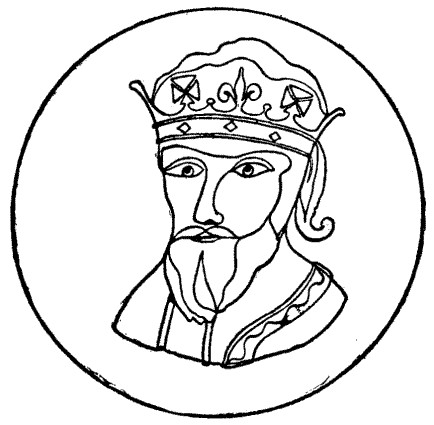
I am able to present a facsimile of the original drawing, which was won by the Man of Law. It may be here remarked that the pilgrimage set out from Southwark on 17th April 1387, and Edward the Third died in 1377.
24.—The Friar's Puzzle.
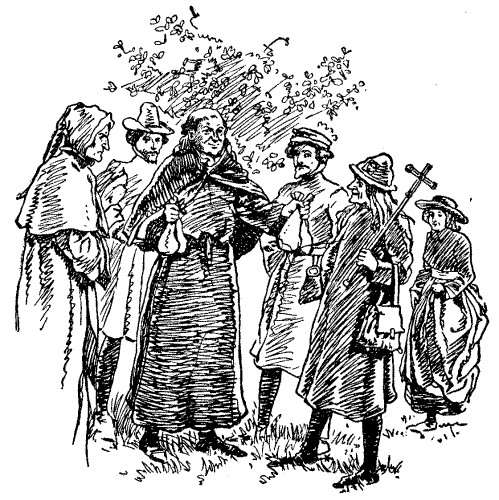
The Friar was a merry fellow, with a sweet tongue and twinkling eyes. "Courteous he was and lowly of service. There was a man nowhere so virtuous." Yet he was "the best beggar in all his house," and gave reasons why "Therefore, instead of weeping and much prayer, Men must give silver to the needy friar." He went by the name of Hubert. One day he produced four money bags and spoke as follows: "If the needy friar doth receive in alms five hundred silver pennies, prithee tell in how many different ways they may be placed in the four bags." The good man explained that order made no difference (so that the distribution 50, 100, 150, 200 would be the same as 100, 50, 200, 150, or 200, 50, 100, 150), and one, two, or three bags may at any time be empty.
25.—The Parson's Puzzle.
The Parson was a really devout and good man. "A better priest I trow there nowhere is." His virtues and charity made him beloved by all his flock, to whom he presented his teaching with patience and simplicity; "but first he followed it himself." Now, Chaucer is careful to tell us that "Wide was his parish, and houses far asunder, But he neglected nought for rain or thunder;" and it is with his parochial visitations that the Parson's puzzle actually dealt. He produced a plan of part of his parish, through which a small river ran that joined the sea some hundreds of miles to the south. I give a facsimile of the plan.
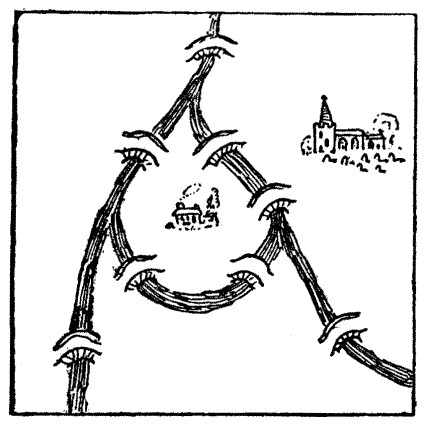
"Here, my worthy Pilgrims, is a strange riddle," quoth the Parson. "Behold how at the branching of the river is an island. Upon this island doth stand my own poor parsonage, and ye may all see the whereabouts of the village church. Mark ye, also, that there be eight bridges and no more over the river in my parish. On my way to church it is my wont to visit sundry of my flock, and in the doing thereof I do pass over every one of the eight bridges once and no more. Can any of ye find the path, after this manner, from the house to the church, without going out of the parish? Nay, nay, my friends, I do never cross the river in any boat, neither by swimming nor wading, nor do I go underground like unto the mole, nor fly in the air as doth the eagle; but only pass over by the bridges." There is a way in which the Parson might have made this curious journey. Can the reader discover it? At first it seems impossible, but the conditions offer a loophole.
26.—The Haberdasher's Puzzle.
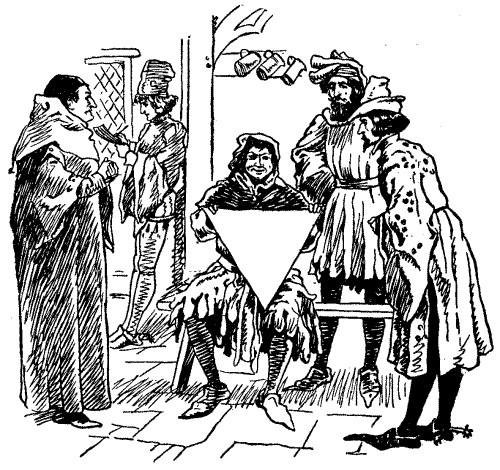
Many attempts were made to induce the Haberdasher, who was of the party, to propound a puzzle of some kind, but for a long time without success. At last, at one of the Pilgrims' stopping-places, he said that he would show them something that would "put their brains into a twist like unto a bell-rope." As a matter of fact, he was really playing off a practical joke on the company, for he was quite ignorant of any answer to the puzzle that he set them. He produced a piece of cloth in the shape of a perfect equilateral triangle, as shown in the illustration, and said, "Be there any among ye full wise in the true cutting of cloth? I trow not. Every man to his trade, and the scholar may learn from the varlet and the wise man from the fool. Show me, then, if ye can, in what manner this piece of cloth may be cut into four several pieces that may be put together to make a perfect square."
Now some of the more learned of the company found a way of doing it in five pieces, but not in four. But when they pressed the Haberdasher for the correct answer he was forced to admit, after much beating about the bush, that he knew no way of doing it in any number of pieces. "By Saint Francis," saith he, "any knave can make a riddle methinks, but it is for them that may to rede it aright." For this he narrowly escaped a sound beating. But the curious point of the puzzle is that I have found that the feat may really be performed in so few as four pieces, and without turning over any piece when placing them together. The method of doing this is subtle, but I think the reader will find the problem a most interesting one.
27.—The Dyer's Puzzle.
One of the pilgrims was a Dyer, but Chaucer tells us nothing about him, the Tales being incomplete. Time after time the company had pressed this individual to produce a puzzle of some kind, but without effect. The poor fellow tried his best to follow the examples of his friends the Tapiser, the Weaver, and the Haberdasher; but the necessary idea would not come, rack his brains as he would. All things, however, come to those who wait—and persevere—and one morning he announced, in a state of considerable excitement, that he had a poser to set before them. He brought out a square piece of silk on which were embroidered a number of fleurs-de-lys in rows, as shown in our illustration.
"Lordings," said the Dyer, "hearken anon unto my riddle. Since I was awakened at dawn by the crowing of cocks—for which din may our host never thrive—I have sought an answer thereto, but by St. Bernard I have found it not. There be sixty-and-four flowers-de-luce, and the riddle is to show how I may remove six of these so that there may yet be an even number of the flowers in every row and every column."
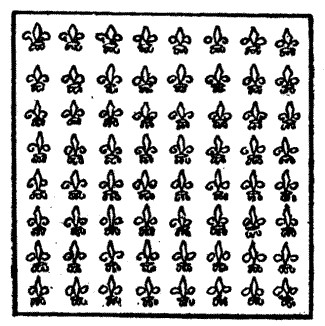
The Dyer was abashed when every one of the company showed without any difficulty whatever, and each in a different way, how this might be done. But the good Clerk of Oxenford was seen to whisper something to the Dyer, who added, "Hold, my masters! What I have said is not all. Ye must find in how many different ways it may be done!" All agreed that this was quite another matter. And only a few of the company got the right answer.
28.—The Great Dispute between the Friar and the Sompnour.
Chaucer records the painful fact that the harmony of the pilgrimage was broken on occasions by the quarrels between the Friar and the Sompnour. At one stage the latter threatened that ere they reached Sittingbourne he would make the Friar's "heart for to mourn;" but the worthy Host intervened and patched up a temporary peace. Unfortunately trouble broke out again over a very curious dispute in this way.
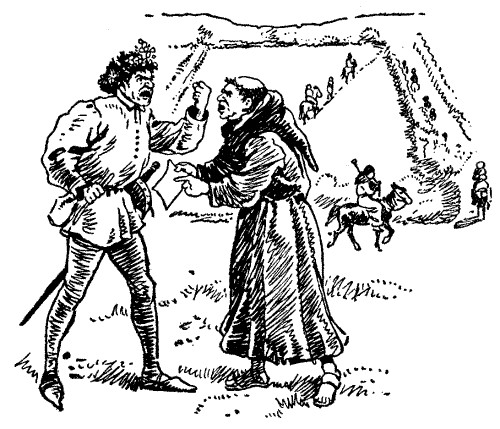
At one point of the journey the road lay along two sides of a square field, and some of the pilgrims persisted, in spite of trespass, in cutting across from corner to corner, as they are seen to be doing in the illustration. Now, the Friar startled the company by stating that there was no need for the trespass, since one way was exactly the same distance as the other! "On my faith, then," exclaimed the Sompnour, "thou art a very fool!" "Nay," replied the Friar, "if the company will but listen with patience, I shall presently show how that thou art the fool, for thou hast not wit enough in thy poor brain to prove that the diagonal of any square is less than two of the sides."
If the reader will refer to the diagrams that we have given, he will be able to follow the Friar's argument. If we suppose the side of the field to be 100 yards, then the distance along the two sides, A to B, and B to C, is 200 yards. He undertook to prove that the diagonal distance direct from A to C is also 200 yards. Now, if we take the diagonal path shown in Fig. 1, it is evident that we go the same distance, for every one of the eight straight portions of this path measures exactly 25 yards. Similarly in Fig. 2, the zigzag contains ten straight portions, each 20 yards long: that path is also the same length—200 yards. No matter how many steps we make in our zigzag path, the result is most certainly always the same. Thus, in Fig. 3 the steps are very small, yet the distance must be 200 yards; as is also the case in Fig. 4, and would yet be if we needed a microscope to detect the steps. In this way, the Friar argued, we may go on straightening out that zigzag path until we ultimately reach a perfectly straight line, and it therefore follows that the diagonal of a square is of exactly the same length as two of the sides.
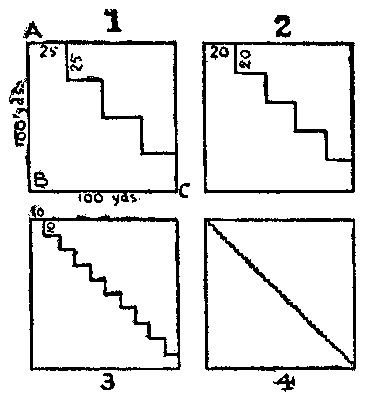
Now, in the face of it, this must be wrong; and it is in fact absurdly so, as we can at once prove by actual measurement if we have any doubt. Yet the Sompnour could not for the life of him point out the fallacy, and so upset the Friar's reasoning. It was this that so exasperated him, and consequently, like many of us to-day when we get entangled in an argument, he utterly lost his temper and resorted to abuse. In fact, if some of the other pilgrims had not interposed the two would have undoubtedly come to blows. The reader will perhaps at once see the flaw in the Friar's argument.
29.—Chaucer's Puzzle.
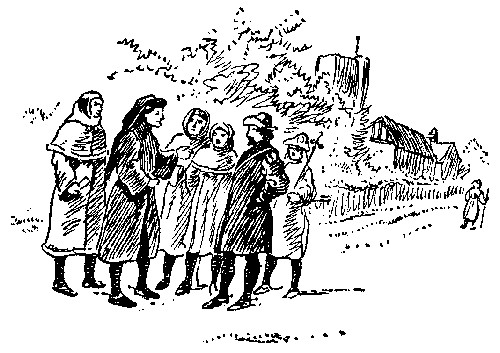
Chaucer himself accompanied the pilgrims. Being a mathematician and a man of a thoughtful habit, the Host made fun of him, he tells us, saying, "Thou lookest as thou wouldst find a hare, For ever on the ground I see thee stare." The poet replied to the request for a tale by launching into a long-spun-out and ridiculous poem, intended to ridicule the popular romances of the day, after twenty-two stanzas of which the company refused to hear any more, and induced him to start another tale in prose. It is an interesting fact that in the "Parson's Prologue" Chaucer actually introduces a little astronomical problem. In modern English this reads somewhat as follows:—
"The sun from the south line was descended so low that it was not to my sight more than twenty-nine degrees. I calculate that it was four o'clock, for, assuming my height to be six feet, my shadow was eleven feet, a little more or less. At the same moment the moon's altitude (she being in mid-Libra) was steadily increasing as we entered at the west end of the village." A correspondent has taken the trouble to work this out, and finds that the local time was 3.58 p.m., correct to a minute, and that the day of the year was the 22nd or 23rd of April, modern style. This speaks well for Chaucer's accuracy, for the first line of the Tales tells us that the pilgrimage was in April—they are supposed to have set out on 17th April 1387, as stated in No. 23.
Though Chaucer made this little puzzle and recorded it for the interest of his readers, he did not venture to propound it to his fellow-pilgrims. The puzzle that he gave them was of a simpler kind altogether: it may be called a geographical one. "When, in the year 1372, I did go into Italy as the envoy of our sovereign lord King Edward the Third, and while there did visit Francesco Petrarch, that learned poet did take me to the top of a certain mountain in his country. Of a truth, as he did show me, a mug will hold less liquor at the top of this mountain than in the valley beneath. Prythee tell me what mountain this may be that has so strange a property withal." A very elementary knowledge of geography will suffice for arriving at the correct answer.
30.—The Puzzle of the Canon's Yeoman.
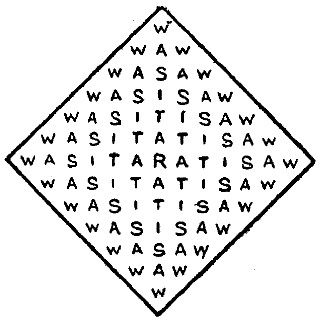
This person joined the party on the road. "'God save,' quoth he, 'this jolly company! Fast have I ridden,' saith he, 'for your sake, Because I would I might you overtake, To ride among this merry company.'" Of course, he was asked to entertain the pilgrims with a puzzle, and the one he propounded was the following. He showed them the diamond-shaped arrangement of letters presented in the accompanying illustration, and said, "I do call it the rat-catcher's riddle. In how many different ways canst thou read the words, 'Was it a rat I saw?'" You may go in any direction backwards and forwards, upwards or downwards, only the successive letters in any reading must always adjoin one another.
31.—The Manciple's Puzzle.
The Manciple was an officer who had the care of buying victuals for an Inn of Court—like the Temple. The particular individual who accompanied the party was a wily man who had more than thirty masters, and made fools of them all. Yet he was a man "whom purchasers might take as an example How to be wise in buying of their victual."
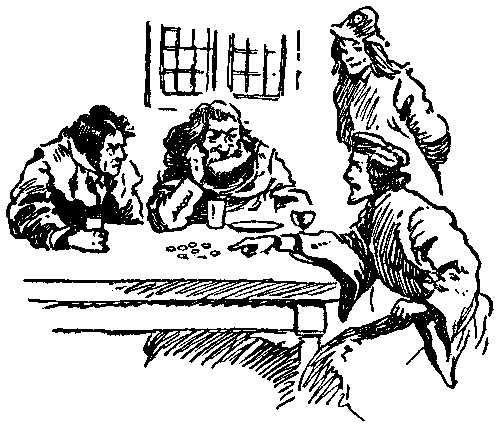
It happened that at a certain stage of the journey the Miller and the Weaver sat down to a light repast. The Miller produced five loaves and the Weaver three. The Manciple coming upon the scene asked permission to eat with them, to which they agreed. When the Manciple had fed he laid down eight pieces of money and said with a sly smile, "Settle betwixt yourselves how the money shall be fairly divided. 'Tis a riddle for thy wits."
A discussion followed, and many of the pilgrims joined in it. The Reve and the Sompnour held that the Miller should receive five pieces and the Weaver three, the simple Ploughman was ridiculed for suggesting that the Miller should receive seven and the Weaver only one, while the Carpenter, the Monk, and the Cook insisted that the money should be divided equally between the two men. Various other opinions were urged with considerable vigour, until it was finally decided that the Manciple, as an expert in such matters, should himself settle the point. His decision was quite correct. What was it? Of course, all three are supposed to have eaten equal shares of the bread.
PUZZLING TIMES AT SOLVAMHALL CASTLE
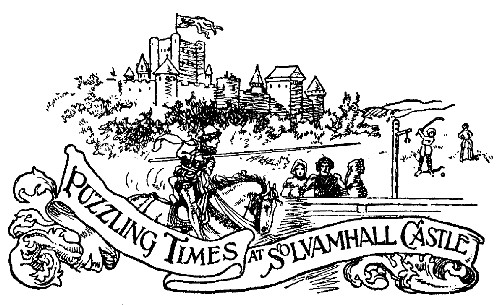
Everybody that has heard of Solvamhall Castle, and of the quaint customs and ceremonies that obtained there in the olden times, is familiar with the fact that Sir Hugh de Fortibus was a lover of all kinds of puzzles and enigmas. Sir Robert de Riddlesdale himself declared on one occasion, "By the bones of Saint Jingo, this Sir Hugh hath a sharp wit. Certes, I wot not the riddle that he may not rede withal." It is, therefore, a source of particular satisfaction that the recent discovery of some ancient rolls and documents relating mainly to the family of De Fortibus enables me to place before my readers a few of the posers that racked people's brains in the good old days. The selection has been made to suit all tastes, and while the majority will be found sufficiently easy to interest those who like a puzzle that is a puzzle, but well within the scope of all, two that I have included may perhaps be found worthy of engaging the attention of the more advanced student of these things.
32.—The Game of Bandy-Ball.
Bandy-ball, cambuc, or goff (the game so well known to-day by the name of golf), is of great antiquity, and was a special favourite at Solvamhall Castle. Sir Hugh de Fortibus was himself a master of the game, and he once proposed this question.
They had nine holes, 300, 250, 200, 325, 275, 350, 225, 375, and 400 yards apart. If a man could always strike the ball in a perfectly straight line and send it exactly one of two distances, so that it would either go towards the hole, pass over it, or drop into it, what would the two distances be that would carry him in the least number of strokes round the whole course?
"Beshrew me," Sir Hugh would say, "if I know any who could do it in this perfect way; albeit, the point is a pretty one."
Two very good distances are 125 and 75, which carry you round in 28 strokes, but this is not the correct answer. Can the reader get round in fewer strokes with two other distances?
33.—Tilting at the Ring.
Another favourite sport at the castle was tilting at the ring. A horizontal bar was fixed in a post, and at the end of a hanging supporter was placed a circular ring, as shown in the above illustrated title. By raising or lowering the bar the ring could be adjusted to the proper height—generally about the level of the left eyebrow of the horseman. The object was to ride swiftly some eighty paces and run the lance through the ring, which was easily detached, and remained on the lance as the property of the skilful winner. It was a very difficult feat, and men were not unnaturally proud of the rings they had succeeded in capturing.
At one tournament at the castle Henry de Gournay beat Stephen Malet by six rings. Each had his rings made into a chain—De Gournay's chain being exactly sixteen inches in length, and Malet's six inches. Now, as the rings were all of the same size and made of metal half an inch thick, the little puzzle proposed by Sir Hugh was to discover just how many rings each man had won.
34.—The Noble Demoiselle.
Seated one night in the hall of the castle, Sir Hugh desired the company to fill their cups and listen while he told the tale of his adventure as a youth in rescuing from captivity a noble demoiselle who was languishing in the dungeon of the castle belonging to his father's greatest enemy. The story was a thrilling one, and when he related the final escape from all the dangers and horrors of the great Death's-head Dungeon with the fair but unconscious maiden in his arms, all exclaimed, "'Twas marvellous valiant!" But Sir Hugh said, "I would never have turned from my purpose, not even to save my body from the bernicles."
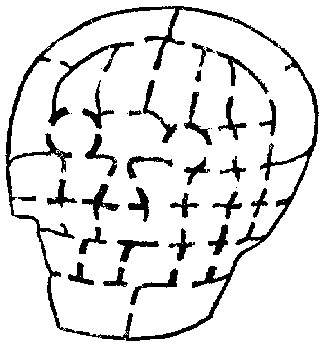
Sir Hugh then produced a plan of the thirty-five cells in the dungeon and asked his companions to discover the particular cell that the demoiselle occupied. He said that if you started at one of the outside cells and passed through every doorway once, and once only, you were bound to end at the cell that was sought. Can you find the cell? Unless you start at the correct outside cell it is impossible to pass through all the doorways once and once only. Try tracing out the route with your pencil.
35.—The Archery Butt.
The butt or target used in archery at Solvamhall was not marked out in concentric rings as at the present day, but was prepared in fanciful designs. In the illustration is shown a numbered target prepared by Sir Hugh himself. It is something of a curiosity, because it will be found that he has so cleverly arranged the numbers that every one of the twelve lines of three adds up to exactly twenty-two.
One day, when the archers were a little tired of their sport, Sir Hugh de Fortibus said, "What ho, merry archers! Of a truth it is said that a fool's bolt is soon shot, but, by my faith, I know not any man among you who shall do that which I will now put forth. Let these numbers that are upon the butt be set down afresh, so that the twelve lines thereof shall make twenty and three instead of twenty and two."
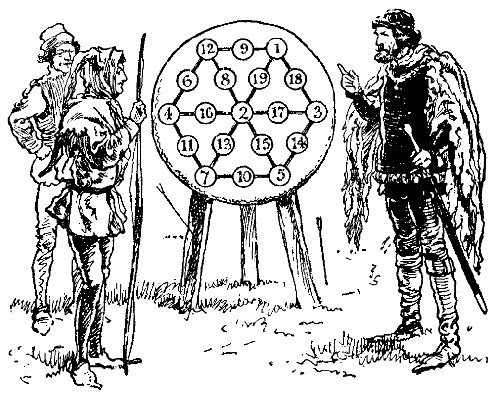
To rearrange the numbers one to nineteen so that all the twelve lines shall add up to twenty-three will be found a fascinating puzzle. Half the lines are, of course, on the sides, and the others radiate from the centre.
36.—The Donjon Keep Window.
On one occasion Sir Hugh greatly perplexed his chief builder. He took this worthy man to the walls of the donjon keep and pointed to a window there.
"Methinks," said he, "yon window is square, and measures, on the inside, one foot every way, and is divided by the narrow bars into four lights, measuring half a foot on every side."
"Of a truth that is so, Sir Hugh."
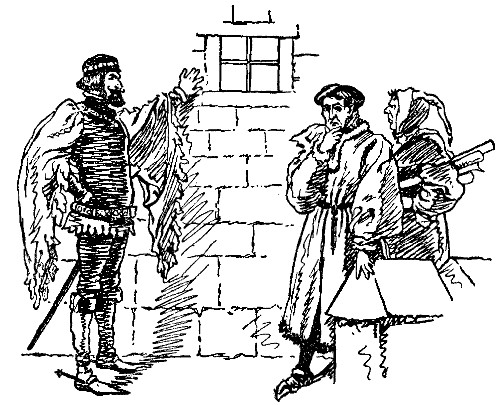
"Then I desire that another window be made higher up whose four sides shall also be each one foot, but it shall be divided by bars into eight lights, whose sides shall be all equal."
"Truly, Sir Hugh," said the bewildered chief builder, "I know not how it may be done."
"By my halidame!" exclaimed De Fortibus in pretended rage, "let it be done forthwith. I trow thou art but a sorry craftsman if thou canst not, forsooth, set such a window in a keep wall."
It will be noticed that Sir Hugh ignores the thickness of the bars.
37.—The Crescent and the Cross.
When Sir Hugh's kinsman, Sir John de Collingham, came back from the Holy Land, he brought with him a flag bearing the sign of a crescent, as shown in the illustration. It was noticed that De Fortibus spent much time in examining this crescent and comparing it with the cross borne by the Crusaders on their own banners. One day, in the presence of a goodly company, he made the following striking announcement:—
"I have thought much of late, friends and masters, of the conversion of the crescent to the cross, and this has led me to the finding of matters at which I marvel greatly, for that which I shall now make known is mystical and deep. Truly it was shown to me in a dream that this crescent of the enemy may be exactly converted into the cross of our own banner. Herein is a sign that bodes good for our wars in the Holy Land."
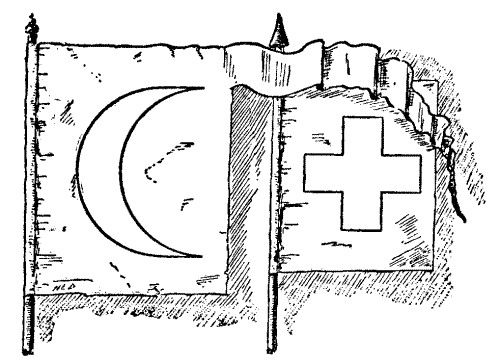
Sir Hugh de Fortibus then explained that the crescent in one banner might be cut into pieces that would exactly form the perfect cross in the other. It is certainly rather curious; and I show how the conversion from crescent to cross may be made in ten pieces, using every part of the crescent. The flag was alike on both sides, so pieces may be turned over where required.
38.—The Amulet.
A strange man was one day found loitering in the courtyard of the castle, and the retainers, noticing that his speech had a foreign accent, suspected him of being a spy. So the fellow was brought before Sir Hugh, who could make nothing of him. He ordered the varlet to be removed and examined, in order to discover whether any secret letters were concealed about him. All they found was a piece of parchment securely suspended from the neck, bearing this mysterious inscription:—
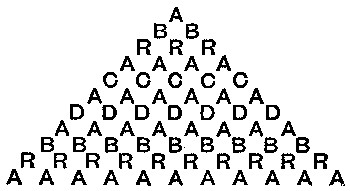
To-day we know that Abracadabra was the supreme deity of the Assyrians, and this curious arrangement of the letters of the word was commonly worn in Europe as an amulet or charm against diseases. But Sir Hugh had never heard of it, and, regarding the document rather seriously, he sent for a learned priest.
"I pray you, Sir Clerk," said he, "show me the true intent of this strange writing."
"Sir Hugh," replied the holy man, after he had spoken in a foreign tongue with the stranger, "it is but an amulet that this poor wight doth wear upon his breast to ward off the ague, the toothache, and such other afflictions of the body."
"Then give the varlet food and raiment and set him on his way," said Sir Hugh. "Meanwhile, Sir Clerk, canst thou tell me in how many ways this word 'Abracadabra' may be read on the amulet, always starting from the A at the top thereof?"
Place your pencil on the A at the top and count in how many different ways you can trace out the word downwards, always passing from a letter to an adjoining one.
39.—The Snail on the Flagstaff.
It would often be interesting if we could trace back to their origin many of the best known puzzles. Some of them would be found to have been first propounded in very ancient times, and there can be very little doubt that while a certain number may have improved with age, others will have deteriorated and even lost their original point and bearing. It is curious to find in the Solvamhall records our familiar friend the climbing snail puzzle, and it will be seen that in its modern form it has lost its original subtlety.
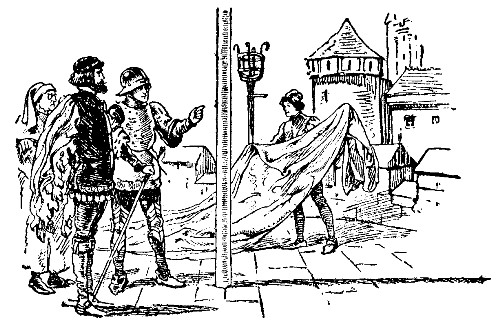
On the occasion of some great rejoicings at the Castle, Sir Hugh was superintending the flying of flags and banners, when somebody pointed out that a wandering snail was climbing up the flagstaff. One wise old fellow said:—
"They do say, Sir Knight, albeit I hold such stories as mere fables, that the snail doth climb upwards three feet in the daytime, but slippeth back two feet by night."
"Then," replied Sir Hugh, "tell us how many days it will take this snail to get from the bottom to the top of the pole."
"By bread and water, I much marvel if the same can be done unless we take down and measure the staff."
"Credit me," replied the knight, "there is no need to measure the staff."
Can the reader give the answer to this version of a puzzle that we all know so well?
40.—Lady Isabel's Casket.
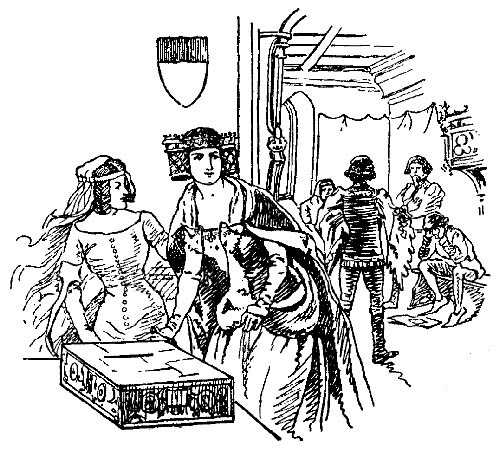
Sir Hugh's young kinswoman and ward, Lady Isabel de Fitzarnulph, was known far and wide as "Isabel the Fair." Amongst her treasures was a casket, the top of which was perfectly square in shape. It was inlaid with pieces of wood, and a strip of gold ten inches long by a quarter of an inch wide.
When young men sued for the hand of Lady Isabel, Sir Hugh promised his consent to the one who would tell him the dimensions of the top of the box from these facts alone: that there was a rectangular strip of gold, ten inches by 1/4-inch; and the rest of the surface was exactly inlaid with pieces of wood, each piece being a perfect square, and no two pieces of the same size. Many young men failed, but one at length succeeded. The puzzle is not an easy one, but the dimensions of that strip of gold, combined with those other conditions, absolutely determine the size of the top of the casket.
THE MERRY MONKS OF RIDDLEWELL
Their Quaint Puzzles and Enigmas.
"Friar Andrew," quoth the Lord Abbot, as he lay a-dying, "methinks I could now rede thee the riddle of riddles—an I had—the time—and—" The good friar put his ear close to the holy Abbot's lips, but alas! they were silenced for ever. Thus passed away the life of the jovial and greatly beloved Abbot of the old monastery of Riddlewell.
The monks of Riddlewell Abbey were noted in their day for the quaint enigmas and puzzles that they were in the habit of propounding. The Abbey was built in the fourteenth century, near a sacred spring known as the Red-hill Well. This became in the vernacular Reddlewell and Riddlewell, and under the Lord Abbot David the monks evidently tried to justify the latter form by the riddles they propounded so well. The solving of puzzles became the favourite recreation, no matter whether they happened to be of a metaphysical, philosophical, mathematical, or mechanical kind. It grew into an absorbing passion with them, and as I have shown above, in the case of the Abbot this passion was strong even in death.
It would seem that the words "puzzle," "problem," "enigma," etc., did not occur in their vocabulary. They were accustomed to call every poser a "riddle," no matter whether it took the form of "Where was Moses when the light went out?" or the Squaring of the Circle. On one of the walls in the refectory were inscribed the words of Samson, "I will now put forth a riddle to you," to remind the brethren of what was expected of them, and the rule was that each monk in turn should propose some riddle weekly to the community, the others being always free to cap it with another if disposed to do so. Abbot David was, undoubtedly, the puzzle genius of the monastery, and everybody naturally bowed to his decision. Only a few of the Abbey riddles have been preserved, and I propose to select those that seem most interesting. I shall try to make the conditions of the puzzles perfectly clear, so that the modern reader may fully understand them, and be amused in trying to find some of the solutions.
41.—The Riddle of the Fish-pond.
At the bottom of the Abbey meads was a small fish-pond where the monks used to spend many a contemplative hour with rod and line. One day, when they had had very bad luck and only caught twelve fishes amongst them, Brother Jonathan suddenly declared that as there was no sport that day he would put forth a riddle for their entertainment. He thereupon took twelve fish baskets and placed them at equal distances round the pond, as shown in our illustration, with one fish in each basket.
"Now, gentle anglers," said he, "rede me this riddle of the Twelve Fishes. Start at any basket you like, and, always going in one direction round the pond, take up one fish, pass it over two other fishes, and place it in the next basket. Go on again; take up another single fish, and, having passed that also over two fishes, place it in a basket; and so continue your journey. Six fishes only are to be removed, and when these have been placed, there should be two fishes in each of six baskets, and six baskets empty. Which of you merry wights will do this in such a manner that you shall go round the pond as few times as possible?"
I will explain to the reader that it does not matter whether the two fishes that are passed over are in one or two baskets, nor how many empty baskets you pass. And, as Brother Jonathan said, you must always go in one direction round the pond (without any doubling back) and end at the spot from which you set out.
42.—The Riddle of the Pilgrims.
One day, when the monks were seated at their repast, the Abbot announced that a messenger had that morning brought news that a number of pilgrims were on the road and would require their hospitality.
"You will put them," he said, "in the square dormitory that has two floors with eight rooms on each floor. There must be eleven persons sleeping on each side of the building, and twice as many on the upper floor as on the lower floor. Of course every room must be occupied, and you know my rule that not more than three persons may occupy the same room."
I give a plan of the two floors, from which it will be seen that the sixteen rooms are approached by a well staircase in the centre. After the monks had solved this little problem and arranged for the accommodation, the pilgrims arrived, when it was found that they were three more in number than was at first stated. This necessitated a reconsideration of the question, but the wily monks succeeded in getting over the new difficulty without breaking the Abbot's rules. The curious point of this puzzle is to discover the total number of pilgrims.
Plan of Dormitory.
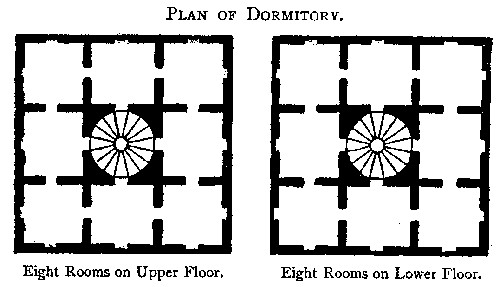
43.—The Riddle of the Tiled Hearth.
It seems that it was Friar Andrew who first managed to "rede the riddle of the Tiled Hearth." Yet it was a simple enough little puzzle. The square hearth, where they burnt their Yule logs and round which they had such merry carousings, was floored with sixteen large ornamental tiles. When these became cracked and burnt with the heat of the great fire, it was decided to put down new tiles, which had to be selected from four different patterns (the Cross, the Fleur-de-lys, the Lion, and the Star); but plain tiles were also available. The Abbot proposed that they should be laid as shown in our sketch, without any plain tiles at all; but Brother Richard broke in,—
"I trow, my Lord Abbot, that a riddle is required of me this day. Listen, then, to that which I shall put forth. Let these sixteen tiles be so placed that no tile shall be in line with another of the same design"—(he meant, of course, not in line horizontally, vertically, or diagonally)—"and in such manner that as few plain tiles as possible be required." When the monks handed in their plans it was found that only Friar Andrew had hit upon the correct answer, even Friar Richard himself being wrong. All had used too many plain tiles.
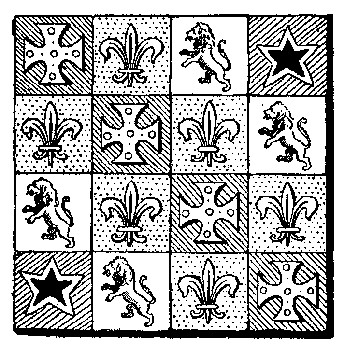
44.—The Riddle of the Sack Wine.
One evening, when seated at table, Brother Benjamin was called upon by the Abbot to give the riddle that was that day demanded of him.
"Forsooth," said he, "I am no good at the making of riddles, as thou knowest full well; but I have been teasing my poor brain over a matter that I trust some among you will expound to me, for I cannot rede it myself. It is this. Mark me take a glass of sack from this bottle that contains a pint of wine and pour it into that jug which contains a pint of water. Now, I fill the glass with the mixture from the jug and pour it back into the bottle holding the sack. Pray tell me, have I taken more wine from the bottle than water from the jug? Or have I taken more water from the jug than wine from the bottle?"
I gather that the monks got nearer to a great quarrel over this little poser than had ever happened before. One brother so far forgot himself as to tell his neighbour that "more wine had got into his pate than wit came out of it," while another noisily insisted that it all depended on the shape of the glass and the age of the wine. But the Lord Abbot intervened, showed them what a simple question it really was, and restored good feeling all round.
45.—The Riddle of the Cellarer.
Then Abbot David looked grave, and said that this incident brought to his mind the painful fact that John the Cellarer had been caught robbing the cask of best Malvoisie that was reserved for special occasions. He ordered him to be brought in.
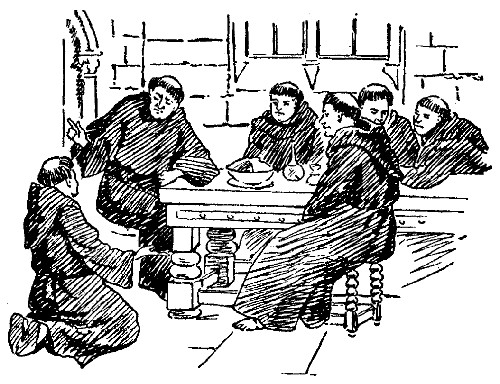
"Now, varlet," said the Abbot, as the ruddy-faced Cellarer came before him, "thou knowest that thou wast taken this morning in the act of stealing good wine that was forbidden thee. What hast thou to say for thyself?"
"Prithee, my Lord Abbot, forgive me!" he cried, falling on his knees. "Of a truth, the Evil One did come and tempt me, and the cask was so handy, and the wine was so good withal, and—and I had drunk of it ofttimes without being found out, and—"
"Rascal! that but maketh thy fault the worse! How much wine hast thou taken?"
"Alack-a-day! There were a hundred pints in the cask at the start, and I have taken me a pint every day this month of June—it being to-day the thirtieth thereof—and if my Lord Abbot can tell me to a nicety how much good wine I have taken in all, let him punish me as he will."
"Why, knave, that is thirty pints."
"Nay, nay; for each time I drew a pint out of the cask, I put in a pint of water in its stead!"
It is a curious fact that this is the only riddle in the old record that is not accompanied by its solution. Is it possible that it proved too hard a nut for the monks? There is merely the note, "John suffered no punishment for his sad fault."
46.—The Riddle of the Crusaders.
On another occasion a certain knight, Sir Ralph de Bohun, was a guest of the monks at Riddlewell Abbey. Towards the close of a sumptuous repast he spoke as follows:—
"My Lord Abbot, knowing full well that riddles are greatly to thy liking, I will, by your leave, put forth one that was told unto me in foreign lands. A body of Crusaders went forth to fight the good cause, and such was their number that they were able to form themselves into a square. But on the way a stranger took up arms and joined them, and they were then able to form exactly thirteen smaller squares. Pray tell me, merry monks, how many men went forth to battle?"
Abbot David pushed aside his plate of warden pie, and made a few hasty calculations.
"Sir Knight," said he at length, "the riddle is easy to rede. In the first place there were 324 men, who would make a square 18 by 18, and afterwards 325 men would make 13 squares of 25 Crusaders each. But which of you can tell me how many men there would have been if, instead of 13, they had been able to form 113 squares under exactly the like conditions?"
The monks gave up this riddle, but the Abbot showed them the answer next morning.
47.—The Riddle of St. Edmondsbury.
"It used to be told at St. Edmondsbury," said Father Peter on one occasion, "that many years ago they were so overrun with mice that the good abbot gave orders that all the cats from the country round should be obtained to exterminate the vermin. A record was kept, and at the end of the year it was found that every cat had killed an equal number of mice, and the total was exactly 1,111,111 mice. How many cats do you suppose there were?"
"Methinks one cat killed the lot," said Brother Benjamin.
"Out upon thee, brother! I said 'cats.'"
"Well, then," persisted Benjamin, "perchance 1,111,111 cats each killed one mouse."
"No," replied Father Peter, after the monks' jovial laughter had ended, "I said 'mice;' and all I need add is this—that each cat killed more mice than there were cats. They told me it was merely a question of the division of numbers, but I know not the answer to the riddle."
The correct answer is recorded, but it is not shown how they arrived at it.
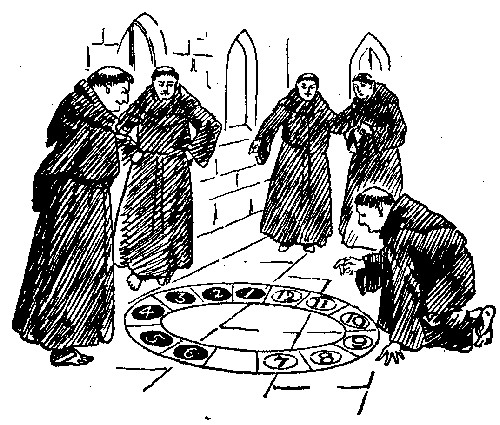
48.—The Riddle of the Frogs' Ring.
One Christmas the Abbot offered a prize of a large black jack mounted in silver, to be engraved with the name of the monk who should put forth the best new riddle. This tournament of wit was won by Brother Benedict, who, curiously enough, never before or after gave out anything that did not excite the ridicule of his brethren. It was called the "Frogs' Ring."
A ring was made with chalk on the floor of the hall, and divided into thirteen compartments, in which twelve discs of wood (called "frogs") were placed in the order shown in our illustration, one place being left vacant. The numbers 1 to 6 were painted white and the numbers 7 to 12 black. The puzzle was to get all the white numbers where the black ones were, and vice versa. The white frogs move round in one direction, and the black ones the opposite way. They may move in any order one step at a time, or jumping over one of the opposite colour to the place beyond, just as we play draughts to-day. The only other condition is that when all the frogs have changed sides, the 1 must be where the 12 now is and the 12 in the place now occupied by 1. The puzzle was to perform the feat in as few moves as possible. How many moves are necessary?
I will conclude in the words of the old writer: "These be some of the riddles which the monks of Riddlewell did set forth and expound each to the others in the merry days of the good Abbot David."
THE STRANGE ESCAPE OF THE KING'S JESTER.
A PUZZLING ADVENTURE.
At one time I was greatly in favour with the king, and his Majesty never seemed to weary of the companionship of the court fool. I had a gift for making riddles and quaint puzzles which ofttimes caused great sport; for albeit the king never found the right answer of one of these things in all his life, yet would he make merry at the bewilderment of those about him.
But let every cobbler stick unto his last; for when I did set out to learn the art of performing strange tricks in the magic, wherein the hand doth ever deceive the eye, the king was affrighted, and did accuse me of being a wizard, even commanding that I should be put to death. Luckily my wit did save my life. I begged that I might be slain by the royal hand and not by that of the executioner.
"By the saints," said his Majesty, "what difference can it make unto thee? But since it is thy wish, thou shalt have thy choice whether I kill thee or the executioner."
"Your Majesty," I answered, "I accept the choice that thou hast so graciously offered to me: I prefer that your Majesty should kill the executioner."
Yet is the life of a royal jester beset with great dangers, and the king having once gotten it into his royal head that I was a wizard, it was not long before I again fell into trouble, from which my wit did not a second time in a like way save me. I was cast into the dungeon to await my death. How, by the help of my gift in answering riddles and puzzles, I did escape from captivity I will now set forth; and in case it doth perplex any to know how some of the strange feats were performed, I will hereafter make the manner thereof plain to all.
49.—The Mysterious Rope.
My dungeon did not lie beneath the moat, but was in one of the most high parts of the castle. So stout was the door, and so well locked and secured withal, that escape that way was not to be found. By hard work I did, after many days, remove one of the bars from the narrow window, and was able to crush my body through the opening; but the distance to the courtyard below was so exceeding great that it was certain death to drop thereto. Yet by great good fortune did I find in the corner of the cell a rope that had been there left and lay hid in the great darkness. But this rope had not length enough, and to drop in safety from the end was nowise possible. Then did I remember how the wise man from Ireland did lengthen the blanket that was too short for him by cutting a yard off the bottom of the same and joining it on to the top. So I made haste to divide the rope in half and to tie the two parts thereof together again. It was then full long, and did reach the ground, and I went down in safety. How could this have been?
50.—The Underground Maze.
The only way out of the yard that I now was in was to descend a few stairs that led up into the centre (A) of an underground maze, through the winding of which I must pass before I could take my leave by the door (B). But I knew full well that in the great darkness of this dreadful place I might well wander for hours and yet return to the place from which I set out. How was I then to reach the door with certainty? With a plan of the maze it is but a simple matter to trace out the route, but how was the way to be found in the place itself in utter darkness?
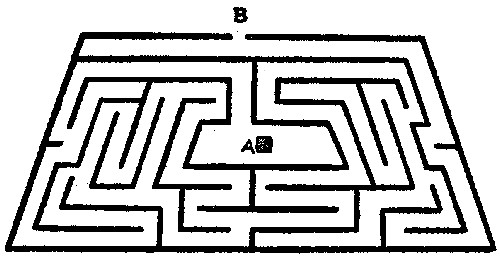
51.—The Secret Lock.
When I did at last reach the door it was fast closed, and on sliding a panel set before a grating the light that came in thereby showed unto me that my passage was barred by the king's secret lock. Before the handle of the door might be turned, it was needful to place the hands of three several dials in their proper places. If you but knew the proper letter for each dial, the secret was of a truth to your hand; but as ten letters were upon the face of every dial, you might try nine hundred and ninety-nine times and only succeed on the thousandth attempt withal. If I was indeed to escape I must waste not a moment.
Now, once had I heard the learned monk who did invent the lock say that he feared that the king's servants, having such bad memories, would mayhap forget the right letters; so perchance, thought I, he had on this account devised some way to aid their memories. And what more natural than to make the letters form some word? I soon found a word that was English, made of three letters—one letter being on each of the three dials. After that I had pointed the hands properly to the letters the door opened and I passed out. What was the secret word?
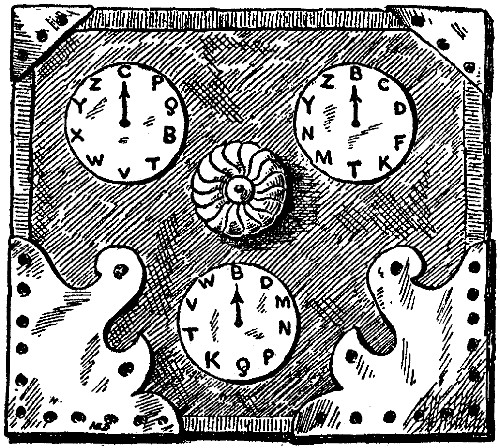
52.—Crossing the Moat.
I was now face to face with the castle moat, which was, indeed, very wide and very deep. Alas! I could not swim, and my chance of escape seemed of a truth hopeless, as, doubtless, it would have been had I not espied a boat tied to the wall by a rope. But after I had got into it I did find that the oars had been taken away, and that there was nothing that I could use to row me across. When I had untied the rope and pushed off upon the water the boat lay quite still, there being no stream or current to help me. How, then, did I yet take the boat across the moat?
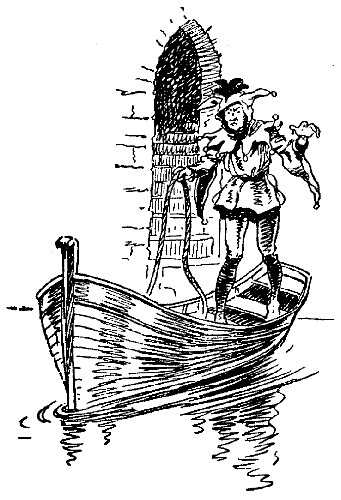
53.—The Royal Gardens.
It was now daylight, and still had I to pass through the royal gardens outside of the castle walls. These gardens had once been laid out by an old king's gardener, who had become bereft of his senses, but was allowed to amuse himself therein. They were square, and divided into 16 parts by high walls, as shown in the plan thereof, so that there were openings from one garden to another, but only two different ways of entrance. Now, it was needful that I enter at the gate A and leave by the other gate B; but as there were gardeners going and coming about their work, I had to slip with agility from one garden to another, so that I might not be seen, but escape unobserved. I did succeed in so doing, but afterwards remembered that I had of a truth entered every one of the 16 gardens once, and never more than once. This was, indeed, a curious thing. How might it have been done?
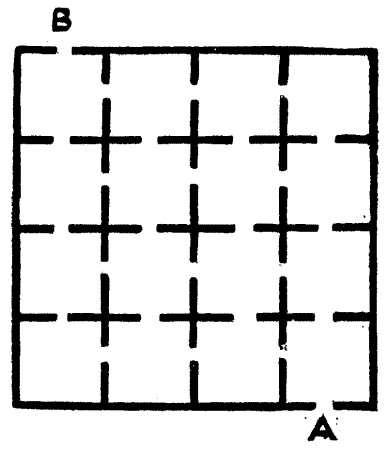
54.—Bridging the Ditch.
I now did truly think that at last was I a free man, but I had quite forgot that I must yet cross a deep ditch before I might get right away. This ditch was 10 feet wide, and I durst not attempt to jump it, as I had sprained an ankle in leaving the garden. Looking around for something to help me over my difficulty, I soon found eight narrow planks of wood lying together in a heap. With these alone, and the planks were each no more than 9 feet long, I did at last manage to make a bridge across the ditch. How was this done?
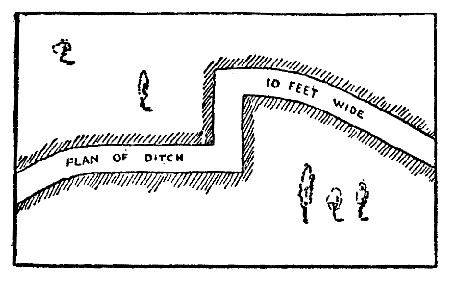
Being now free I did hasten to the house of a friend who provided me with a horse and a disguise, with which I soon succeeded in placing myself out of all fear of capture.
Through the goodly offices of divers persons at the king's court I did at length obtain the royal pardon, though, indeed, I was never restored to that full favour that was once my joy and pride.
Ofttimes have I been asked by many that do know me to set forth to them the strange manner of my escape, which more than one hath deemed to be of a truth wonderful, albeit the feat was nothing astonishing withal if we do but remember that from my youth upwards I had trained my wit to the making and answering of cunning enigmas. And I do hold that the study of such crafty matters is good, not alone for the pleasure that is created thereby, but because a man may never be sure that in some sudden and untoward difficulty that may beset him in passing through this life of ours such strange learning may not serve his ends greatly, and, mayhap, help him out of many difficulties.
I am now an aged man, and have not quite lost all my taste for quaint puzzles and conceits; but, of a truth, never have I found greater pleasure in making out the answers to any of these things than I had in mastering them that did enable me, as the king's jester in disgrace, to gain my freedom from the castle dungeon and so save my life.
THE SQUIRE'S CHRISTMAS PUZZLE PARTY
A fine specimen of the old English country gentleman was Squire Davidge, of Stoke Courcy Hall, in Somerset. When the last century was yet in its youth, there were few men in the west country more widely known and more generally respected and beloved than he. A born sportsman, his fame extended to Exmoor itself, where his daring and splendid riding in pursuit of the red deer had excited the admiration and envy of innumerable younger huntsmen. But it was in his own parish, and particularly in his own home, that his genial hospitality, generosity, and rare jovial humour made him the idol of his friends—and even of his relations, which sometimes means a good deal.
At Christmas it was always an open house at Stoke Courcy Hall, for if there was one thing more than another upon which Squire Davidge had very pronounced views, it was on the question of keeping up in a royal fashion the great festival of Yule-tide. "Hark ye, my lads," he would say to his sons: "our country will begin to fall on evil days if ever we grow indifferent to the claims of those Christmas festivities that have helped to win us the proud name of Merrie England." Therefore, when I say that Christmas at Stoke Courcy was kept up in the good old happy, rollicking, festive style that our grandfathers and great-grandfathers so dearly loved, it will be unnecessary for me to attempt a description. We have a faithful picture of these merry scenes in the Bracebridge Hall of Washington Irving. I must confine myself in this sketch to one special feature in the Squire's round of jollification during the season of peace and good will.
He took a curious and intelligent interest in puzzles of every kind, and there was always one night devoted to what was known as "Squire Davidge's Puzzle Party." Every guest was expected to come armed with some riddle or puzzle for the bewilderment and possible delectation of the company. The old gentleman always presented a new watch to the guest who was most successful in his answers. It is a pity that all the puzzles were not preserved; but I propose to present to my readers a few selected from a number that have passed down to a surviving member of the family, who has kindly allowed me to use them on this occasion. There are some very easy ones, a few that are moderately difficult, and one hard brain-racker, so all should be able to find something to their taste.
The little record is written in the neat angular hand of a young lady of that day, and the puzzles, the conditions of which I think it best to give mainly in my own words for the sake of greater clearness, appear to have been all propounded on one occasion.
55.—The Three Teacups.
One young lady—of whom our fair historian records with delightful inconsequence: "This Miss Charity Lockyer has since been married to a curate from Taunton Vale"—placed three empty teacups on a table, and challenged anybody to put ten lumps of sugar in them so that there would be an odd number of lumps in every cup. "One young man, who has been to Oxford University, and is studying the law, declared with some heat that, beyond a doubt, there was no possible way of doing it, and he offered to give proof of the fact to the company." It must have been interesting to see his face when he was shown Miss Charity's correct answer.
56.—The Eleven Pennies.
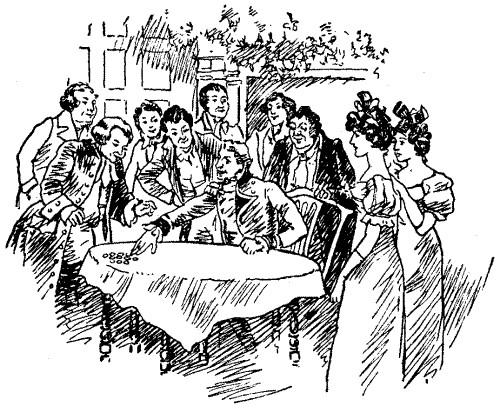
A guest asked some one to favour him with eleven pennies, and he passed the coins to the company, as depicted in our illustration. The writer says: "He then requested us to remove five coins from the eleven, add four coins and leave nine. We could not but think there must needs be ten pennies left. We were a good deal amused at the answer hereof."
57.—The Christmas Geese.
Squire Hembrow, from Weston Zoyland—wherever that may be—proposed the following little arithmetical puzzle, from which it is probable that several somewhat similar modern ones have been derived: Farmer Rouse sent his man to market with a flock of geese, telling him that he might sell all or any of them, as he considered best, for he was sure the man knew how to make a good bargain. This is the report that Jabez made, though I have taken it out of the old Somerset dialect, which might puzzle some readers in a way not desired. "Well, first of all I sold Mr. Jasper Tyler half of the flock and half a goose over; then I sold Farmer Avent a third of what remained and a third of a goose over; then I sold Widow Foster a quarter of what remained and three-quarters of a goose over; and as I was coming home, whom should I meet but Ned Collier: so we had a mug of cider together at the Barley Mow, where I sold him exactly a fifth of what I had left, and gave him a fifth of a goose over for the missus. These nineteen that I have brought back I couldn't get rid of at any price." Now, how many geese did Farmer Rouse send to market? My humane readers may be relieved to know that no goose was divided or put to any inconvenience whatever by the sales.
58.—The Chalked Numbers.
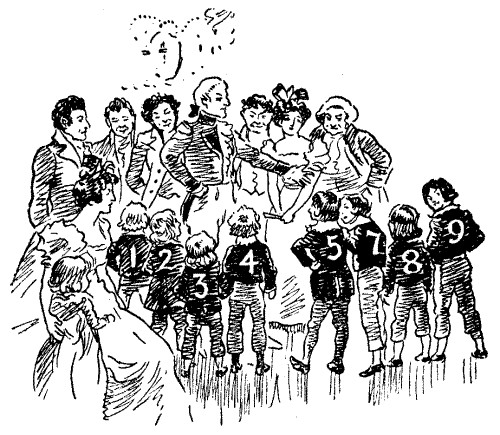
"We laughed greatly at a pretty jest on the part of Major Trenchard, a merry friend of the Squire's. With a piece of chalk he marked a different number on the backs of eight lads who were at the party." Then, it seems, he divided them in two groups, as shown in the illustration, 1, 2, 3, 4 being on one side, and 5, 7, 8, 9 on the other. It will be seen that the numbers of the left-hand group add up to 10, while the numbers in the other group add up to 29. The Major's puzzle was to rearrange the eight boys in two new groups, so that the four numbers in each group should add up alike. The Squire's niece asked if the 5 should not be a 6; but the Major explained that the numbers were quite correct if properly regarded.
59.—Tasting the Plum Puddings.
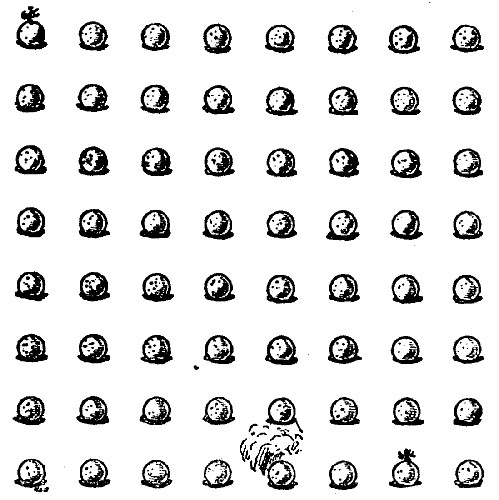
"Everybody, as I suppose, knows well that the number of different Christmas plum puddings that you taste will bring you the same number of lucky days in the new year. One of the guests (and his name has escaped my memory) brought with him a sheet of paper on which were drawn sixty-four puddings, and he said the puzzle was an allegory of a sort, and he intended to show how we might manage our pudding-tasting with as much dispatch as possible." I fail to fully understand this fanciful and rather overstrained view of the puzzle. But it would appear that the puddings were arranged regularly, as I have shown them in the illustration, and that to strike out a pudding was to indicate that it had been duly tasted. You have simply to put the point of your pencil on the pudding in the top corner, bearing a sprig of holly, and strike out all the sixty-four puddings through their centres in twenty-one straight strokes. You can go up or down or horizontally, but not diagonally or obliquely; and you must never strike out a pudding twice, as that would imply a second and unnecessary tasting of those indigestible dainties. But the peculiar part of the thing is that you are required to taste the pudding that is seen steaming hot at the end of your tenth stroke, and to taste the one decked with holly in the bottom row the very last of all.
60.—Under the Mistletoe Bough.
"At the party was a widower who has but lately come into these parts," says the record; "and, to be sure, he was an exceedingly melancholy man, for he did sit away from the company during the most part of the evening. We afterwards heard that he had been keeping a secret account of all the kisses that were given and received under the mistletoe bough. Truly, I would not have suffered any one to kiss me in that manner had I known that so unfair a watch was being kept. Other maids beside were in a like way shocked, as Betty Marchant has since told me." But it seems that the melancholy widower was merely collecting material for the following little osculatory problem.
The company consisted of the Squire and his wife and six other married couples, one widower and three widows, twelve bachelors and boys, and ten maidens and little girls. Now, everybody was found to have kissed everybody else, with the following exceptions and additions: No male, of course, kissed a male. No married man kissed a married woman, except his own wife. All the bachelors and boys kissed all the maidens and girls twice. The widower did not kiss anybody, and the widows did not kiss each other. The puzzle was to ascertain just how many kisses had been thus given under the mistletoe bough, assuming, as it is charitable to do, that every kiss was returned—the double act being counted as one kiss.
The idea of a Christmas Puzzle Party, as devised by the old Squire, seems to have been excellent, and it might well be revived at the present day by people who are fond of puzzles and who have grown tired of Book Teas and similar recent introductions for the amusement of evening parties. Prizes could be awarded to the best solvers of the puzzles propounded by the guests.
40.—Lady Isabel's Casket.
41.—The Riddle of the Fish-pond.
10.—The Puzzle of the Squire's Yeoman.
42.—The Riddle of the Pilgrims.
11.—The Nun's Puzzle.
43.—The Riddle of the Tiled Hearth.
12.—The Merchant's Puzzle.
44.—The Riddle of the Sack of Wine.
13.—The Man of Law's Puzzle.
45.—The Riddle of the Cellarer.
14.—The Weaver's Puzzle.
46.—The Riddle of the Crusaders.
15.—The Cook's Puzzle.
because if it were the only possible answers would be those proposed by Brother Benjamin and rejected by Father Peter. Also it cannot have more than two factors, or the answer would be indeterminate. As a matter of fact, 1,111,111 equals 239 x 4649 (both primes), and since each cat killed more mice than there were cats, the answer must be 239 cats. See also the Introduction, p.
47.—The Riddle of St. Edmondsbury.
16.—The Sompnour's Puzzle.
1.—The Reve's Puzzle.
48.—The Riddle of the Frogs' Ring.
17.—The Monk's Puzzle.
2.—The Pardoner's Puzzle.
49.—The Mysterious Rope.
18.—The Shipman's Puzzle.
3.—The Miller's Puzzle.
19.—The Puzzle of the Prioress.
4.—The Knight's Puzzle.
The smallest number of biscuits must have been 1021, from which it is evident that they were of that miniature description that finds favour in the nursery. The general solution is that for n men the number must be m (nn+1) - (n - 1), where m is any integer. Each man will receive m (n - 1)n - 1 biscuits at the final division, though in the case of two men, when m = 1, the final distribution only benefits the dog. Of course, in every case each man steals an nth of the number of biscuits, after giving the odd one to the dog.
5.—The Wife of Bath's Riddles.
6.—The Host's Puzzle.
7.—Clerk of Oxenford's Puzzle.
8.—The Tapiser's Puzzle.
9.—The Carpenter's Puzzle.
23.—The Squire's Puzzle.
24.—The Friar's Puzzle.
25.—The Parson's Puzzle.
26.—The Haberdasher's Puzzle.
27.—The Dyer's Puzzle.
28.—The Great Dispute between the Friar and the Sompnour.
For example, if we write down nineteen ones to form the number 1,111,111,111,111,111,111, and then ask for a number (other than 1 or itself) that will divide it without remainder, the conditions are perfectly simple, but the task is terribly difficult. Nobody in the world knows yet whether that number has a divisor or not. If you can find one, you will have succeeded in doing something that nobody else has ever done.[A]
29.—Chaucer's Puzzle.
I am now an aged man, and have not quite lost all my taste for quaint puzzles and conceits; but, of a truth, never have I found greater pleasure in making out the answers to any of these things than I had in mastering them that did enable me, as the king's jester in disgrace, to gain my freedom from the castle dungeon and so save my life.
50.—The Underground Maze.
51.—The Secret Lock.
20.—The Puzzle of the Doctor of Physic.
52.—Crossing the Moat.
21.—The Ploughman's Puzzle.
53.—The Royal Gardens.
22.—The Franklin's Puzzle.
54.—Bridging the Ditch.
55.—The Three Teacups.
56.—The Eleven Pennies.
57.—The Christmas Geese.
58.—The Chalked Numbers.
59.—Tasting the Plum Puddings.
When young men sued for the hand of Lady Isabel, Sir Hugh promised his consent to the one who would tell him the dimensions of the top of the box from these facts alone: that there was a rectangular strip of gold, ten inches by 1/4-inch; and the rest of the surface was exactly inlaid with pieces of wood, each piece being a perfect square, and no two pieces of the same size. Many young men failed, but one at length succeeded. The puzzle is not an easy one, but the dimensions of that strip of gold, combined with those other conditions, absolutely determine the size of the top of the casket.
Could the reader have discovered the required area of the field from those details overheard in the wineshop? It is an elegant little puzzle, and furnishes another example of the practical utility, on unexpected occasions, of a knowledge of the art of problem-solving.
30.—The Puzzle of the Canon's Yeoman.
31.—The Manciple's Puzzle.
32.—The Game of Bandy-Ball.
33.—Tilting at the Ring.
The Professor gathered up his Japanese reptiles and wished us good-night with the usual seasonable compliments. We three who remained had one more pipe together, and then also left for our respective homes. Each believes that the other two racked their brains over Christmas in the determined attempt to master the Professor's puzzles; but when we next met at the club we were all unanimous in declaring that those puzzles which we had failed to solve "we really had not had time to look at," while those we had mastered after an enormous amount of labour "we had seen at the first glance directly we got home."
34.—The Noble Demoiselle.
35.—The Archery Butt.
36.—The Donjon Keep Window.
[A] See footnote on page 198.
37.—The Crescent and the Cross.
38.—The Amulet.
39.—The Snail on the Flagstaff.
60.—Under the Mistletoe Bough.
Though the contents of the present volume are in the main entirely original, some very few old friends will be found; but these will not, I trust, prove unwelcome in the new dress that they have received. The puzzles are of every degree of difficulty, and so varied in character that perhaps it is not too much to hope that every true puzzle lover will find ample material to interest—and possibly instruct. In some cases I have dealt with the methods of solution at considerable length, but at other times I have reluctantly felt obliged to restrict myself to giving the bare answers. Had the full solutions and proofs been given in the case of every puzzle, either half the problems would have had to be omitted, or the size of the book greatly increased. And the plan that I have adopted has its advantages, for it leaves scope for the mathematical enthusiast to work out his own analysis. Even in those cases where I have given a general formula for the solution of a puzzle, he will find great interest in verifying it for himself.
I will conclude in the words of the old writer: "These be some of the riddles which the monks of Riddlewell did set forth and expound each to the others in the merry days of the good Abbot David."
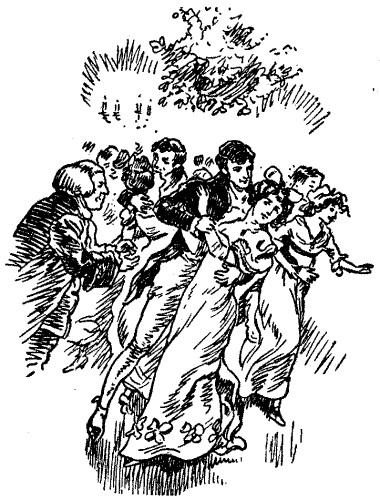
61.—The Silver Cubes.
The last extract that I will give is one that will, I think, interest those readers who may find some of the above puzzles too easy. It is a hard nut, and should only be attempted by those who flatter themselves that they possess strong intellectual teeth.
"Master Herbert Spearing, the son of a widow lady in our parish, proposed a puzzle in arithmetic that looks simple, but nobody present was able to solve it. Of a truth I did not venture to attempt it myself, after the young lawyer from Oxford, who they say is very learned in the mathematics and a great scholar, failed to show us the answer. He did assure us that he believed it could not be done, but I have since been told that it is possible, though, of a certainty, I may not vouch for it. Master Herbert brought with him two cubes of solid silver that belonged to his mother. He showed that, as they measured two inches every way, each contained eight cubic inches of silver, and therefore the two contained together sixteen cubic inches. That which he wanted to know was—'Could anybody give him exact dimensions for two cubes that should together contain just seventeen cubic inches of silver?'" Of course the cubes may be of different sizes.
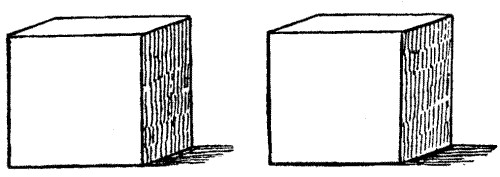
The idea of a Christmas Puzzle Party, as devised by the old Squire, seems to have been excellent, and it might well be revived at the present day by people who are fond of puzzles and who have grown tired of Book Teas and similar recent introductions for the amusement of evening parties. Prizes could be awarded to the best solvers of the puzzles propounded by the guests.
Adventures of the Puzzle Club
When it recently became known that the bewildering mystery of the Prince and the Lost Balloon was really solved by the members of the Puzzle Club, the general public was quite unaware that any such club existed. The fact is that the members always deprecated publicity; but since they have been dragged into the light in connection with this celebrated case, so many absurd and untrue stories have become current respecting their doings that I have been permitted to publish a correct account of some of their more interesting achievements. It was, however, decided that the real names of the members should not be given.
The club was started a few years ago to bring together those interested in the solution of puzzles of all kinds, and it contains some of the profoundest mathematicians and some of the most subtle thinkers resident in London. These have done some excellent work of a high and dry kind. But the main body soon took to investigating the problems of real life that are perpetually cropping up.
It is only right to say that they take no interest in crimes as such, but only investigate a case when it possesses features of a distinctly puzzling character. They seek perplexity for its own sake—something to unravel. As often as not the circumstances are of no importance to anybody, but they just form a little puzzle in real life, and that is sufficient.
62.—The Ambiguous Photograph.
A good example of the lighter kind of problem that occasionally comes before them is that which is known amongst them by the name of "The Ambiguous Photograph." Though it is perplexing to the inexperienced, it is regarded in the club as quite a trivial thing. Yet it serves to show the close observation of these sharp-witted fellows. The original photograph hangs on the club wall, and has baffled every guest who has examined it. Yet any child should be able to solve the mystery. I will give the reader an opportunity of trying his wits at it.
Some of the members were one evening seated together in their clubhouse in the Adelphi. Those present were: Henry Melville, a barrister not overburdened with briefs, who was discussing a problem with Ernest Russell, a bearded man of middle age, who held some easy post in Somerset House, and was a Senior Wrangler and one of the most subtle thinkers of the club; Fred Wilson, a journalist of very buoyant spirits, who had more real capacity than one would at first suspect; John Macdonald, a Scotsman, whose record was that he had never solved a puzzle himself since the club was formed, though frequently he had put others on the track of a deep solution; Tim Churton, a bank clerk, full of cranky, unorthodox ideas as to perpetual motion; also Harold Tomkins, a prosperous accountant, remarkably familiar with the elegant branch of mathematics—the theory of numbers.
Suddenly Herbert Baynes entered the room, and everybody saw at once from his face that he had something interesting to communicate. Baynes was a man of private means, with no occupation.
"Here's a quaint little poser for you all," said Baynes. "I have received it to-day from Dovey."
Dovey was proprietor of one of the many private detective agencies that found it to their advantage to keep in touch with the club.
"Is it another of those easy cryptograms?" asked Wilson. "If so, I would suggest sending it upstairs to the billiard-marker."
"Don't be sarcastic, Wilson," said Melville. "Remember, we are indebted to Dovey for the great Railway Signal Problem that gave us all a week's amusement in the solving."
"If you fellows want to hear," resumed Baynes, "just try to keep quiet while I relate the amusing affair to you. You all know of the jealous little Yankee who married Lord Marksford two years ago? Lady Marksford and her husband have been in Paris for two or three months. Well, the poor creature soon got under the influence of the green-eyed monster, and formed the opinion that Lord Marksford was flirting with other ladies of his acquaintance.
"Now, she has actually put one of Dovey's spies on to that excellent husband of hers; and the myrmidon has been shadowing him about for a fortnight with a pocket camera. A few days ago he came to Lady Marksford in great glee. He had snapshotted his lordship while actually walking in the public streets with a lady who was not his wife."
"'What is the use of this at all?' asked the jealous woman.
"'Well, it is evidence, your ladyship, that your husband was walking with the lady. I know where she is staying, and in a few days shall have found out all about her.'
"'But, you stupid man,' cried her ladyship, in tones of great contempt, 'how can any one swear that this is his lordship, when the greater part of him, including his head and shoulders, is hidden from sight? And—and'—she scrutinized the photo carefully—'why, I guess it is impossible from this photograph to say whether the gentleman is walking with the lady or going in the opposite direction!'
"Thereupon she dismissed the detective in high dudgeon. Dovey has himself just returned from Paris, and got this account of the incident from her ladyship. He wants to justify his man, if possible, by showing that the photo does disclose which way the man is going. Here it is. See what you fellows can make of it."
Our illustration is a faithful drawing made from the original photograph. It will be seen that a slight but sudden summer shower is the real cause of the difficulty.
All agreed that Lady Marksford was right—that it is impossible to determine whether the man is walking with the lady or not.
"Her ladyship is wrong," said Baynes, after everybody had made a close scrutiny. "I find there is important evidence in the picture. Look at it carefully."
"Of course," said Melville, "we can tell nothing from the frock-coat. It may be the front or the tails. Blessed if I can say! Then he has his overcoat over his arm, but which way his arm goes it is impossible to see."
"How about the bend of the legs?" asked Churton.
"Bend! why, there isn't any bend," put in Wilson, as he glanced over the other's shoulder. "From the picture you might suspect that his lordship has no knees. The fellow took his snapshot just when the legs happened to be perfectly straight."
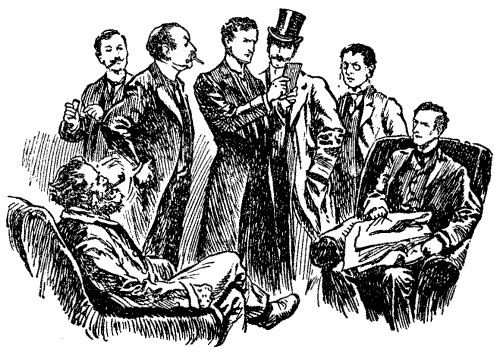
"I'm thinking that perhaps——" began Macdonald, adjusting his eye-glasses.
"Don't think, Mac," advised Wilson. "It might hurt you. Besides, it is no use you thinking that if the dog would kindly pass on things would be easy. He won't."
"The man's general pose seems to me to imply movement to the left," Tomkins thought.
"On the contrary," Melville declared, "it appears to me clearly to suggest movement to the right."
"Now, look here, you men," said Russell, whose opinions always carried respect in the club. "It strikes me that what we have to do is to consider the attitude of the lady rather than that of the man. Does her attention seem to be directed to somebody by her side?"
Everybody agreed that it was impossible to say.
"I've got it!" shouted Wilson. "Extraordinary that none of you have seen it. It is as clear as possible. It all came to me in a flash!"
"Well, what is it?" asked Baynes.
"Why, it is perfectly obvious. You see which way the dog is going—to the left. Very well. Now, Baynes, to whom does the dog belong?"
"To the detective!"
The laughter against Wilson that followed this announcement was simply boisterous, and so prolonged that Russell, who had at the time possession of the photo, seized the opportunity for making a most minute examination of it. In a few moments he held up his hands to invoke silence.
"Baynes is right," he said. "There is important evidence there which settles the matter with certainty. Assuming that the gentleman is really Lord Marksford—and the figure, so far as it is visible, is his—I have no hesitation myself in saying that—"
"Stop!" all the members shouted at once.
"Don't break the rules of the club, Russell, though Wilson did," said Melville. "Recollect that 'no member shall openly disclose his solution to a puzzle unless all present consent.'"
"You need not have been alarmed," explained Russell. "I was simply going to say that I have no hesitation in declaring that Lord Marksford is walking in one particular direction. In which direction I will tell you when you have all 'given it up.'"
63.—The Cornish Cliff Mystery.
Though the incident known in the Club as "The Cornish Cliff Mystery" has never been published, every one remembers the case with which it was connected—an embezzlement at Todd's Bank in Cornhill a few years ago. Lamson and Marsh, two of the firm's clerks, suddenly disappeared; and it was found that they had absconded with a very large sum of money. There was an exciting hunt for them by the police, who were so prompt in their action that it was impossible for the thieves to get out of the country. They were traced as far as Truro, and were known to be in hiding in Cornwall.
Just at this time it happened that Henry Melville and Fred Wilson were away together on a walking tour round the Cornish coast. Like most people, they were interested in the case; and one morning, while at breakfast at a little inn, they learnt that the absconding men had been tracked to that very neighbourhood, and that a strong cordon of police had been drawn round the district, making an escape very improbable. In fact, an inspector and a constable came into the inn to make some inquiries, and exchanged civilities with the two members of the Puzzle Club. A few references to some of the leading London detectives, and the production of a confidential letter Melville happened to have in his pocket from one of them, soon established complete confidence, and the inspector opened out.
He said that he had just been to examine a very important clue a quarter of a mile from there, and expressed the opinion that Messrs. Lamson and Marsh would never again be found alive. At the suggestion of Melville the four men walked along the road together.
"There is our stile in the distance," said the inspector. "This constable found beside it the pocket-book that I have shown you, containing the name of Marsh and some memoranda in his handwriting. It had evidently been dropped by accident. On looking over the stone stile he noticed the footprints of two men—which I have already proved from particulars previously supplied to the police to be those of the men we want—and I am sure you will agree that they point to only one possible conclusion."
Arrived at the spot, they left the hard road and got over the stile. The footprints of the two men were here very clearly impressed in the thin but soft soil, and they all took care not to trample on the tracks. They followed the prints closely, and found that they led straight to the edge of a cliff forming a sheer precipice, almost perpendicular, at the foot of which the sea, some two hundred feet below, was breaking among the boulders.
"Here, gentlemen, you see," said the inspector, "that the footprints lead straight to the edge of the cliff, where there is a good deal of trampling about, and there end. The soil has nowhere been disturbed for yards around, except by the footprints that you see. The conclusion is obvious."
"That, knowing they were unable to escape capture, they decided not to be taken alive, and threw themselves over the cliff?" asked Wilson.
"Exactly. Look to the right and the left, and you will find no footprints or other marks anywhere. Go round there to the left, and you will be satisfied that the most experienced mountaineer that ever lived could not make a descent, or even anywhere get over the edge of the cliff. There is no ledge or foothold within fifty feet."
"Utterly impossible," said Melville, after an inspection. "What do you propose to do?"
"I am going straight back to communicate the discovery to headquarters. We shall withdraw the cordon and search the coast for the dead bodies."
"Then you will make a fatal mistake," said Melville. "The men are alive and in hiding in the district. Just examine the prints again. Whose is the large foot?"
"That is Lamson's, and the small print is Marsh's. Lamson was a tall man, just over six feet, and Marsh was a little fellow."
"I thought as much," said Melville. "And yet you will find that Lamson takes a shorter stride than Marsh. Notice, also, the peculiarity that Marsh walks heavily on his heels, while Lamson treads more on his toes. Nothing remarkable in that? Perhaps not; but has it occurred to you that Lamson walked behind Marsh? Because you will find that he sometimes treads over Marsh's footsteps, though you will never find Marsh treading in the steps of the other."
"Do you suppose that the men walked backwards in their own footprints?" asked the inspector.
"No; that is impossible. No two men could walk backwards some two hundred yards in that way with such exactitude. You will not find a single place where they have missed the print by even an eighth of an inch. Quite impossible. Nor do I suppose that two men, hunted as they were, could have provided themselves with flying-machines, balloons, or even parachutes. They did not drop over the cliff."
Melville then explained how the men had got away. His account proved to be quite correct, for it will be remembered that they were caught, hiding under some straw in a barn, within two miles of the spot. How did they get away from the edge of the cliff?
64.—The Runaway Motor-Car.
The little affair of the "Runaway Motor-car" is a good illustration of how a knowledge of some branch of puzzledom may be put to unexpected use. A member of the Club, whose name I have at the moment of writing forgotten, came in one night and said that a friend of his was bicycling in Surrey on the previous day, when a motor-car came from behind, round a corner, at a terrific speed, caught one of his wheels, and sent him flying in the road. He was badly knocked about, and fractured his left arm, while his machine was wrecked. The motor-car was not stopped, and he had been unable to trace it.
There were two witnesses to the accident, which was beyond question the fault of the driver of the car. An old woman, a Mrs. Wadey, saw the whole thing, and tried to take the number of the car. She was positive as to the letters, which need not be given, and was certain also that the first figure was a 1. The other figures she failed to read on account of the speed and dust.
The other witness was the village simpleton, who just escapes being an arithmetical genius, but is excessively stupid in everything else.
He is always working out sums in his head; and all he could say was that there were five figures in the number, and that he found that when he multiplied the first two figures by the last three they made the same figures, only in different order—just as 24 multiplied by 651 makes 15,624 (the same five figures), in which case the number of the car would have been 24,651; and he knew there was no 0 in the number.
"It will be easy enough to find that car," said Russell. "The known facts are possibly sufficient to enable one to discover the exact number. You see, there must be a limit to the five-figure numbers having the peculiarity observed by the simpleton. And these are further limited by the fact that, as Mrs. Wadey states, the number began with the figure 1. We have therefore to find these numbers. It may conceivably happen that there is only one such number, in which case the thing is solved. But even if there are several cases, the owner of the actual car may easily be found.
"How will you manage that?" somebody asked.
"Surely," replied Russell, "the method is quite obvious. By the process of elimination. Every owner except the one in fault will be able to prove an alibi. Yet, merely guessing offhand, I think it quite probable that there is only one number that fits the case. We shall see."
Russell was right, for that very night he sent the number by post, with the result that the runaway car was at once traced, and its owner, who was himself driving, had to pay the cost of the damages resulting from his carelessness. What was the number of the car?
65.—The Mystery of Ravensdene Park.
The mystery of Ravensdene Park, which I will now present, was a tragic affair, as it involved the assassination of Mr. Cyril Hastings at his country house a short distance from London.
On February 17th, at 11 p.m., there was a heavy fall of snow, and though it lasted only half an hour, the ground was covered to a depth of several inches. Mr. Hastings had been spending the evening at the house of a neighbour, and left at midnight to walk home, taking the short route that lay through Ravensdene Park—that is, from D to A in the sketch-plan. But in the early morning he was found dead, at the point indicated by the star in our diagram, stabbed to the heart. All the seven gates were promptly closed, and the footprints in the snow examined. These were fortunately very distinct, and the police obtained the following facts:—
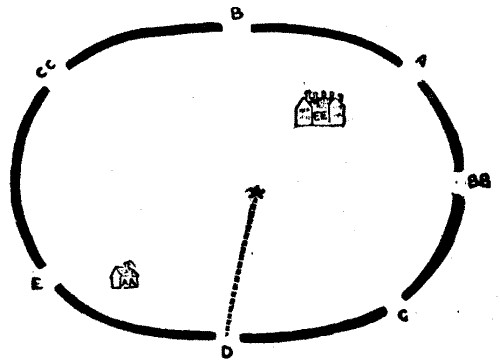
The footprints of Mr. Hastings were very clear, straight from D to the spot where he was found. There were the footprints of the Ravensdene butler—who retired to bed five minutes before midnight—from E to EE. There were the footprints of the gamekeeper from A to his lodge at AA. Other footprints showed that one individual had come in at gate B and left at gate BB, while another had entered by gate C and left at gate CC.
Only these five persons had entered the park since the fall of snow. Now, it was a very foggy night, and some of these pedestrians had consequently taken circuitous routes, but it was particularly noticed that no track ever crossed another track. Of this the police were absolutely certain, but they stupidly omitted to make a sketch of the various routes before the snow had melted and utterly effaced them.
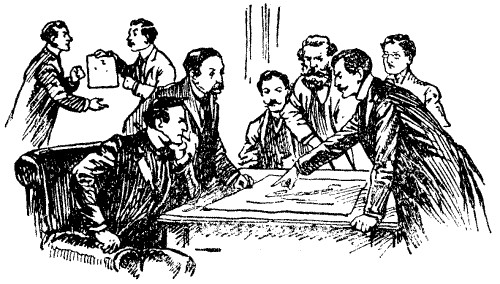
The mystery was brought before the members of the Puzzle Club, who at once set themselves the task of solving it. Was it possible to discover who committed the crime? Was it the butler? Or the gamekeeper? Or the man who came in at B and went out at BB? Or the man who went in at C and left at CC? They provided themselves with diagrams—sketch-plans, like the one we have reproduced, which simplified the real form of Ravensdene Park without destroying the necessary conditions of the problem.
Our friends then proceeded to trace out the route of each person, in accordance with the positive statements of the police that we have given. It was soon evident that, as no path ever crossed another, some of the pedestrians must have lost their way considerably in the fog. But when the tracks were recorded in all possible ways, they had no difficulty in deciding on the assassin's route; and as the police luckily knew whose footprints this route represented, an arrest was made that led to the man's conviction.
Can our readers discover whether A, B, C, or E committed the deed? Just trace out the route of each of the four persons, and the key to the mystery will reveal itself.
66.—The Buried Treasure.
The problem of the Buried Treasure was of quite a different character. A young fellow named Dawkins, just home from Australia, was introduced to the club by one of the members, in order that he might relate an extraordinary stroke of luck that he had experienced "down under," as the circumstances involved the solution of a poser that could not fail to interest all lovers of puzzle problems. After the club dinner, Dawkins was asked to tell his story, which he did, to the following effect:—
"I have told you, gentlemen, that I was very much down on my luck. I had gone out to Australia to try to retrieve my fortunes, but had met with no success, and the future was looking very dark. I was, in fact, beginning to feel desperate. One hot summer day I happened to be seated in a Melbourne wineshop, when two fellows entered, and engaged in conversation. They thought I was asleep, but I assure you I was very wide awake.
"'If only I could find the right field,' said one man, 'the treasure would be mine; and as the original owner left no heir, I have as much right to it as anybody else.'
"'How would you proceed?' asked the other.
"'Well, it is like this: The document that fell into my hands states clearly that the field is square, and that the treasure is buried in it at a point exactly two furlongs from one corner, three furlongs from the next corner, and four furlongs from the next corner to that. You see, the worst of it is that nearly all the fields in the district are square; and I doubt whether there are two of exactly the same size. If only I knew the size of the field I could soon discover it, and, by taking these simple measurements, quickly secure the treasure.'
"'But you would not know which corner to start from, nor which direction to go to the next corner.'
"'My dear chap, that only means eight spots at the most to dig over; and as the paper says that the treasure is three feet deep, you bet that wouldn't take me long.'
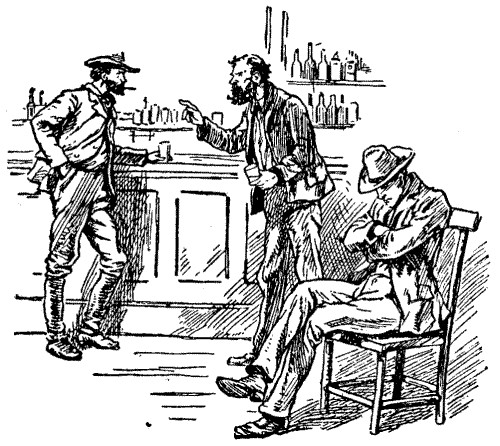
"Now, gentlemen," continued Dawkins, "I happen to be a bit of a mathematician; and hearing the conversation, I saw at once that for a spot to be exactly two, three, and four furlongs from successive corners of a square, the square must be of a particular area. You can't get such measurements to meet at one point in any square you choose. They can only happen in a field of one size, and that is just what these men never suspected. I will leave you the puzzle of working out just what that area is.
"Well, when I found the size of the field, I was not long in discovering the field itself, for the man had let out the district in the conversation. And I did not need to make the eight digs, for, as luck would have it, the third spot I tried was the right one. The treasure was a substantial sum, for it has brought me home and enabled me to start in a business that already shows signs of being a particularly lucrative one. I often smile when I think of that poor fellow going about for the rest of his life saying: 'If only I knew the size of the field!' while he has placed the treasure safe in my own possession. I tried to find the man, to make him some compensation anonymously, but without success. Perhaps he stood in little need of the money, while it has saved me from ruin."
Could the reader have discovered the required area of the field from those details overheard in the wineshop? It is an elegant little puzzle, and furnishes another example of the practical utility, on unexpected occasions, of a knowledge of the art of problem-solving.
THE PROFESSOR'S PUZZLES
"Why, here is the Professor!" exclaimed Grigsby. "We'll make him show us some new puzzles."
It was Christmas Eve, and the club was nearly deserted. Only Grigsby, Hawkhurst, and myself, of all the members, seemed to be detained in town over the season of mirth and mince-pies. The man, however, who had just entered was a welcome addition to our number. "The Professor of Puzzles," as we had nicknamed him, was very popular at the club, and when, as on the present occasion, things got a little slow, his arrival was a positive blessing.
He was a man of middle age, cheery and kind-hearted, but inclined to be cynical. He had all his life dabbled in puzzles, problems, and enigmas of every kind, and what the Professor didn't know about these matters was admittedly not worth knowing. His puzzles always had a charm of their own, and this was mainly because he was so happy in dishing them up in palatable form.
"You are the man of all others that we were hoping would drop in," said Hawkhurst. "Have you got anything new?"
"I have always something new," was the reply, uttered with feigned conceit—for the Professor was really a modest man—"I'm simply glutted with ideas."
"Where do you get all your notions?" I asked.
"Everywhere, anywhere, during all my waking moments. Indeed, two or three of my best puzzles have come to me in my dreams."
"Then all the good ideas are not used up?"
"Certainly not. And all the old puzzles are capable of improvement, embellishment, and extension. Take, for example, magic squares. These were constructed in India before the Christian era, and introduced into Europe about the fourteenth century, when they were supposed to possess certain magical properties that I am afraid they have since lost. Any child can arrange the numbers one to nine in a square that will add up fifteen in eight ways; but you will see it can be developed into quite a new problem if you use coins instead of numbers."
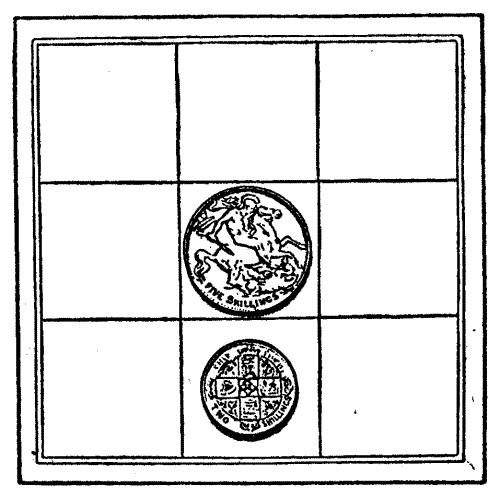
67.—The Coinage Puzzle.
He made a rough diagram, and placed a crown and a florin in two of the divisions, as indicated in the illustration.
"Now," he continued, "place the fewest possible current English coins in the seven empty divisions, so that each of the three columns, three rows, and two diagonals shall add up fifteen shillings. Of course, no division may be without at least one coin, and no two divisions may contain the same value."
"But how can the coins affect the question?" asked Grigsby.
"That you will find out when you approach the solution."
"I shall do it with numbers first," said Hawkhurst, "and then substitute coins."
Five minutes later, however, he exclaimed, "Hang it all! I can't help getting the 2 in a corner. May the florin be moved from its present position?"
"Certainly not."
"Then I give it up."
But Grigsby and I decided that we would work at it another time, so the Professor showed Hawkhurst the solution privately, and then went on with his chat.
68.—The Postage Stamps Puzzles.
"Now, instead of coins we'll substitute postage-stamps. Take ten current English stamps, nine of them being all of different values, and the tenth a duplicate. Stick two of them in one division and one in each of the others, so that the square shall this time add up ninepence in the eight directions as before."
"Here you are!" cried Grigsby, after he had been scribbling for a few minutes on the back of an envelope.
The Professor smiled indulgently.
"Are you sure that there is a current English postage-stamp of the value of threepence-halfpenny?"
"For the life of me, I don't know. Isn't there?"
"That's just like the Professor," put in Hawkhurst. "There never was such a 'tricky' man. You never know when you have got to the bottom of his puzzles. Just when you make sure you have found a solution, he trips you up over some little point you never thought of."
"When you have done that," said the Professor, "here is a much better one for you. Stick English postage stamps so that every three divisions in a line shall add up alike, using as many stamps as you choose, so long as they are all of different values. It is a hard nut."
69.—The Frogs and Tumblers.
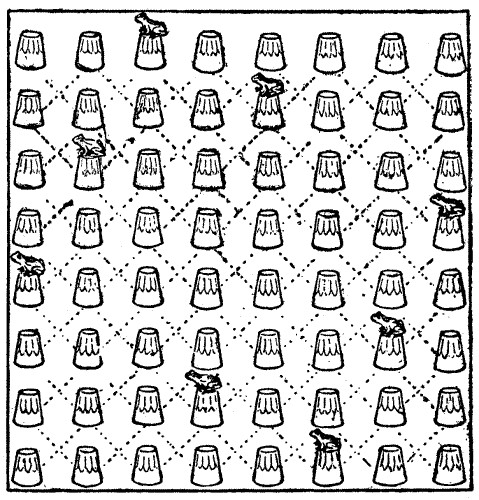
"What do you think of these?"
The Professor brought from his capacious pockets a number of frogs, snails, lizards, and other creatures of Japanese manufacture—very grotesque in form and brilliant in colour. While we were looking at them he asked the waiter to place sixty-four tumblers on the club table. When these had been brought and arranged in the form of a square, as shown in the illustration, he placed eight of the little green frogs on the glasses as shown.
"Now," he said, "you see these tumblers form eight horizontal and eight vertical lines, and if you look at them diagonally (both ways) there are twenty-six other lines. If you run your eye along all these forty-two lines, you will find no two frogs are anywhere in a line.
"The puzzle is this. Three of the frogs are supposed to jump from their present position to three vacant glasses, so that in their new relative positions still no two frogs shall be in a line. What are the jumps made?"
"I suppose——" began Hawkhurst.
"I know what you are going to ask," anticipated the Professor. "No; the frogs do not exchange positions, but each of the three jumps to a glass that was not previously occupied."
"But surely there must be scores of solutions?" I said.
"I shall be very glad if you can find them," replied the Professor with a dry smile. "I only know of one—or rather two, counting a reversal, which occurs in consequence of the position being symmetrical."
70.—Romeo and Juliet.
For some time we tried to make these little reptiles perform the feat allotted to them, and failed. The Professor, however, would not give away his solution, but said he would instead introduce to us a little thing that is childishly simple when you have once seen it, but cannot be mastered by everybody at the very first attempt.
"Waiter!" he called again. "Just take away these glasses, please, and bring the chessboards."
"I hope to goodness," exclaimed Grigsby, "you are not going to show us some of those awful chess problems of yours. 'White to mate Black in 427 moves without moving his pieces.' 'The bishop rooks the king, and pawns his Giuoco Piano in half a jiff.'"
"No, it is not chess. You see these two snails. They are Romeo and Juliet. Juliet is on her balcony, waiting the arrival of her love; but Romeo has been dining, and forgets, for the life of him, the number of her house. The squares represent sixty-four houses, and the amorous swain visits every house once and only once before reaching his beloved. Now, make him do this with the fewest possible turnings. The snail can move up, down, and across the board and through the diagonals. Mark his track with this piece of chalk."
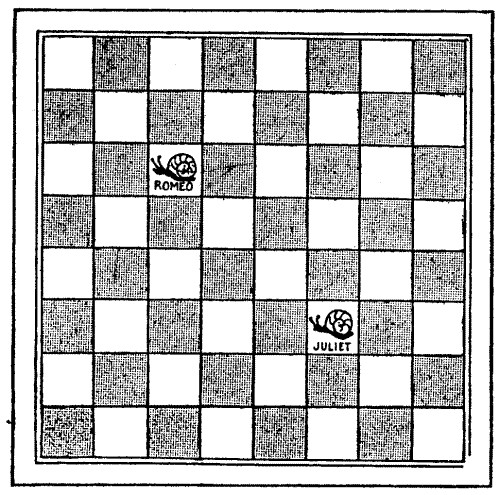
"Seems easy enough," said Grigsby, running the chalk along the squares. "Look! that does it."
"Yes," said the Professor: "Romeo has got there, it is true, and visited every square once, and only once; but you have made him turn nineteen times, and that is not doing the trick in the fewest turns possible."
Hawkhurst, curiously enough, hit on the solution at once, and the Professor remarked that this was just one of those puzzles that a person might solve at a glance or not master in six months.
71.—Romeo's Second Journey.
"It was a sheer stroke of luck on your part, Hawkhurst," he added. "Here is a much easier puzzle, because it is capable of more systematic analysis; yet it may just happen that you will not do it in an hour. Put Romeo on a white square and make him crawl into every other white square once with the fewest possible turnings. This time a white square may be visited twice, but the snail must never pass a second time through the same corner of a square nor ever enter the black squares."
"May he leave the board for refreshments?" asked Grigsby.
"No; he is not allowed out until he has performed his feat."
72.—The Frogs who would a-wooing go.
While we were vainly attempting to solve this puzzle, the Professor arranged on the table ten of the frogs in two rows, as they will be found in the illustration.
"That seems entertaining," I said. "What is it?"
"It is a little puzzle I made a year ago, and a favourite with the few people who have seen it. It is called 'The Frogs who would a-wooing go.' Four of them are supposed to go a-wooing, and after the four have each made a jump upon the table, they are in such a position that they form five straight rows with four frogs in every row."
"What's that?" asked Hawkhurst. "I think I can do that." A few minutes later he exclaimed, "How's this?"
"They form only four rows instead of five, and you have moved six of them," explained the Professor.
"Hawkhurst," said Grigsby severely, "you are a duffer. I see the solution at a glance. Here you are! These two jump on their comrades' backs."
"No, no," admonished the Professor; "that is not allowed. I distinctly said that the jumps were to be made upon the table. Sometimes it passes the wit of man so to word the conditions of a problem that the quibbler will not persuade himself that he has found a flaw through which the solution may be mastered by a child of five."
After we had been vainly puzzling with these batrachian lovers for some time, the Professor revealed his secret.
The Professor gathered up his Japanese reptiles and wished us good-night with the usual seasonable compliments. We three who remained had one more pipe together, and then also left for our respective homes. Each believes that the other two racked their brains over Christmas in the determined attempt to master the Professor's puzzles; but when we next met at the club we were all unanimous in declaring that those puzzles which we had failed to solve "we really had not had time to look at," while those we had mastered after an enormous amount of labour "we had seen at the first glance directly we got home."
MISCELLANEOUS PUZZLES
73.—The Game of Kayles.
Nearly all of our most popular games are of very ancient origin, though in many cases they have been considerably developed and improved. Kayles—derived from the French word quilles—was a great favourite in the fourteenth century, and was undoubtedly the parent of our modern game of ninepins. Kayle-pins were not confined in those days to any particular number, and they were generally made of a conical shape and set up in a straight row.
At first they were knocked down by a club that was thrown at them from a distance, which at once suggests the origin of the pastime of "shying for cocoanuts" that is to-day so popular on Bank Holidays on Hampstead Heath and elsewhere. Then the players introduced balls, as an improvement on the club.
In the illustration we get a picture of some of our fourteenth-century ancestors playing at kayle-pins in this manner.
Now, I will introduce to my readers a new game of parlour kayle-pins, that can be played across the table without any preparation whatever. You simply place in a straight row thirteen dominoes, chess-pawns, draughtsmen, counters, coins, or beans—anything will do—all close together, and then remove the second one as shown in the picture.
It is assumed that the ancient players had become so expert that they could always knock down any single kayle-pin, or any two kayle-pins that stood close together. They therefore altered the game, and it was agreed that the player who knocked down the last pin was the winner.
Therefore, in playing our table-game, all you have to do is to knock down with your fingers, or take away, any single kayle-pin or two adjoining kayle-pins, playing alternately until one of the two players makes the last capture, and so wins. I think it will be found a fascinating little game, and I will show the secret of winning.
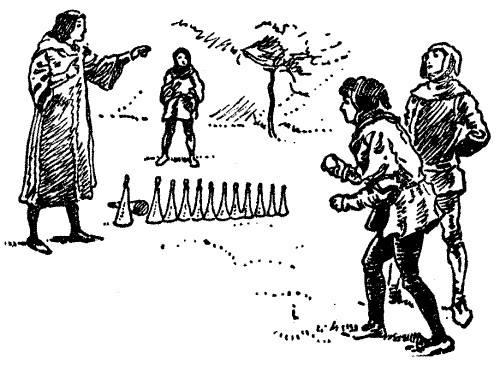
Remember that the second kayle-pin must be removed before you begin to play, and that if you knock down two at once those two must be close together, because in the real game the ball could not do more than this.
74.—The Broken Chessboard.
There is a story of Prince Henry, son of William the Conqueror, afterwards Henry I., that is so frequently recorded in the old chronicles that it is doubtless authentic. The following version of the incident is taken from Hayward's Life of William the Conqueror, published in 1613—
"Towards the end of his reigne he appointed his two sonnes Robert and Henry, with joynt authoritie, governours of Normandie; the one to suppresse either the insolence or levitie of the other. These went together to visit the French king lying at Constance: where, entertaining the time with varietie of disports, Henry played with Louis, then Daulphine of France, at chesse, and did win of him very much.
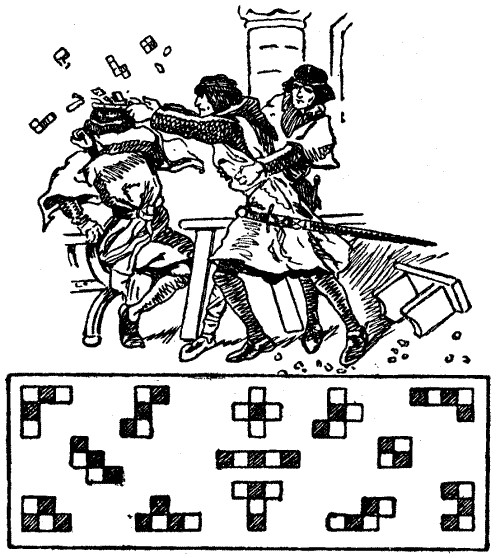
"Hereat Louis beganne to growe warme in words, and was therein little respected by Henry. The great impatience of the one and the small forbearance of the other did strike in the end such a heat between them that Louis threw the chessmen at Henry's face.
"Henry again stroke Louis with the chessboard, drew blood with the blowe, and had presently slain him upon the place had he not been stayed by his brother Robert.
"Hereupon they presently went to horse, and their spurres claimed so good haste as they recovered Pontoise, albeit they were sharply pursued by the French."
Now, tradition—on this point not trustworthy—says that the chessboard broke into the thirteen fragments shown in our illustration. It will be seen that there are twelve pieces, all different in shape, each containing five squares, and one little piece of four squares only.
We thus have all the sixty-four squares of the chess-board, and the puzzle is simply to cut them out and fit them together, so as to make a perfect board properly chequered. The pieces may be easily cut out of a sheet of "squared" paper, and, if mounted on cardboard, they will form a source of perpetual amusement in the home.
If you succeed in constructing the chessboard, but do not record the arrangement, you will find it just as puzzling the next time you feel disposed to attack it.
Prince Henry himself, with all his skill and learning, would have found it an amusing pastime.
75.—The Spider and the Fly.
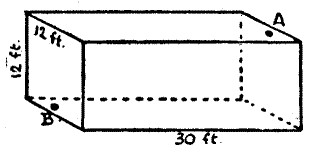
Inside a rectangular room, measuring 30 feet in length and 12 feet in width and height, a spider is at a point on the middle of one of the end walls, 1 foot from the ceiling, as at A; and a fly is on the opposite wall, 1 foot from the floor in the centre, as shown at B. What is the shortest distance that the spider must crawl in order to reach the fly, which remains stationary? Of course the spider never drops or uses its web, but crawls fairly.
76.—The Perplexed Cellarman.
Here is a little puzzle culled from the traditions of an old monastery in the west of England. Abbot Francis, it seems, was a very worthy man; and his methods of equity extended to those little acts of charity for which he was noted for miles round.
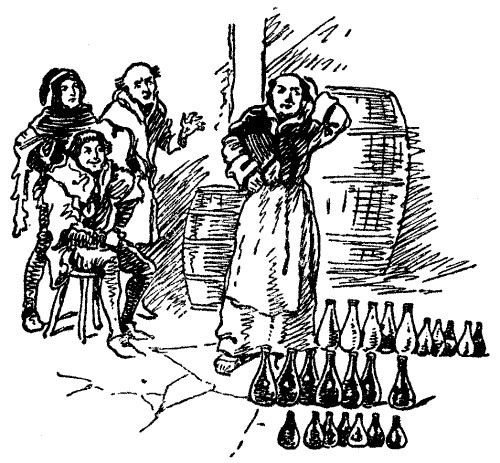
The Abbot, moreover, had a fine taste in wines. On one occasion he sent for the cellarman, and complained that a particular bottling was not to his palate.
"Pray tell me, Brother John, how much of this wine thou didst bottle withal."
"A fair dozen in large bottles, my lord abbot, and the like in the small," replied the cellarman, "whereof five of each have been drunk in the refectory."
"So be it. There be three varlets waiting at the gate. Let the two dozen bottles be given unto them, both full and empty; and see that the dole be fairly made, so that no man receive more wine than another, nor any difference in bottles."
Poor John returned to his cellar, taking the three men with him, and then his task began to perplex him. Of full bottles he had seven large and seven small, and of empty bottles five large and five small, as shown in the illustration. How was he to make the required equitable division?
He divided the bottles into three groups in several ways that at first sight seemed to be quite fair, since two small bottles held just the same quantity of wine as one large one. But the large bottles themselves, when empty, were not worth two small ones.
Hence the abbot's order that each man must take away the same number of bottles of each size.
Finally, the cellarman had to consult one of the monks who was good at puzzles of this kind, and who showed him how the thing was done. Can you find out just how the distribution was made?
77.—Making a Flag.
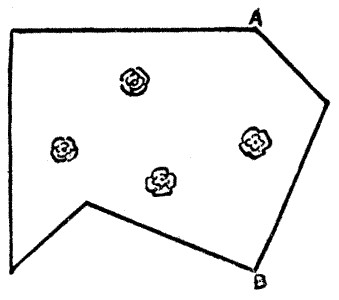
A good dissection puzzle in so few as two pieces is rather a rarity, so perhaps the reader will be interested in the following. The diagram represents a piece of bunting, and it is required to cut it into two pieces (without any waste) that will fit together and form a perfectly square flag, with the four roses symmetrically placed. This would be easy enough if it were not for the four roses, as we should merely have to cut from A to B, and insert the piece at the bottom of the flag. But we are not allowed to cut through any of the roses, and therein lies the difficulty of the puzzle. Of course we make no allowance for "turnings."
78.—Catching the Hogs.
In the illustration Hendrick and Katrün are seen engaged in the exhilarating sport of attempting the capture of a couple of hogs.
Why did they fail?
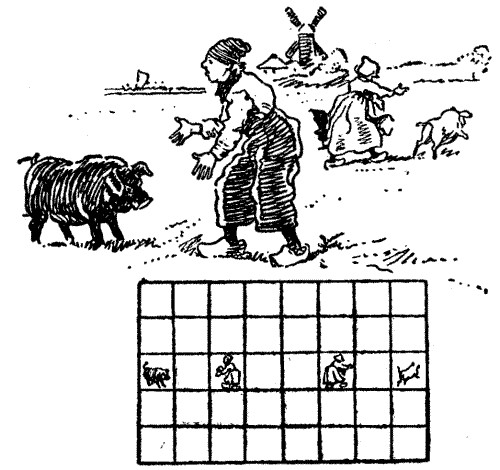
Strange as it may seem, a complete answer is afforded in the little puzzle game that I will now explain.
Copy the simple diagram on a conveniently large sheet of cardboard or paper, and use four marked counters to represent the Dutchman, his wife, and the two hogs.
At the beginning of the game these must be placed on the squares on which they are shown. One player represents Hendrick and Katrün, and the other the hogs. The first player moves the Dutchman and his wife one square each in any direction (but not diagonally), and then the second player moves both pigs one square each (not diagonally); and so on, in turns, until Hendrick catches one hog and Katrün the other.
This you will find would be absurdly easy if the hogs moved first, but this is just what Dutch pigs will not do.
79.—The Thirty-one Game.
This is a game that used to be (and may be to this day, for aught I know) a favourite means of swindling employed by card-sharpers at racecourses and in railway carriages.
As, on its own merits, however, the game is particularly interesting, I will make no apology for presenting it to my readers.
The cardsharper lays down the twenty-four cards shown in the illustration, and invites the innocent wayfarer to try his luck or skill by seeing which of them can first score thirty-one, or drive his opponent beyond, in the following manner:—
One player turns down a card, say a 2, and counts "two"; the second player turns down a card, say a 5, and, adding this to the score, counts "seven"; the first player turns down another card, say a 1, and counts "eight"; and so the play proceeds alternately until one of them scores the "thirty-one," and so wins.
Now, the question is, in order to win, should you turn down the first card, or courteously request your opponent to do so? And how should you conduct your play? The reader will perhaps say: "Oh, that is easy enough. You must play first, and turn down a 3; then, whatever your opponent does, he cannot stop your making ten, or stop your making seventeen, twenty-four, and the winning thirty-one. You have only to secure these numbers to win."
But this is just that little knowledge which is such a dangerous thing, and it places you in the hands of the sharper.
You play 3, and the sharper plays 4 and counts "seven"; you play 3 and count "ten"; the sharper turns down 3 and scores "thirteen"; you play 4 and count "seventeen"; the sharper plays a 4 and counts "twenty-one"; you play 3 and make your "twenty-four."
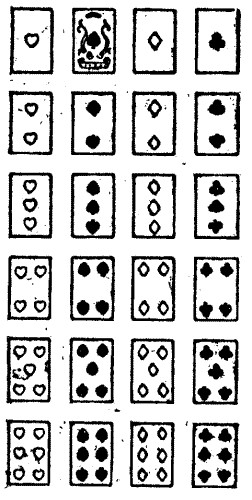
Now the sharper plays the last 4 and scores "twenty-eight." You look in vain for another 3 with which to win, for they are all turned down! So you are compelled either to let him make the "thirty-one" or to go yourself beyond, and so lose the game.
You thus see that your method of certainly winning breaks down utterly, by what may be called the "method of exhaustion." I will give the key to the game, showing how you may always win; but I will not here say whether you must play first or second: you may like to find it out for yourself.
80.—The Chinese Railways.
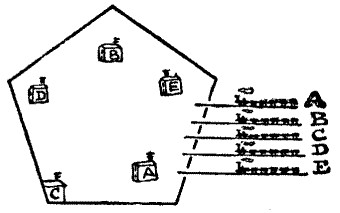
Our illustration shows the plan of a Chinese city protected by pentagonal fortifications. Five European Powers were scheming and clamouring for a concession to run a railway to the place; and at last one of the Emperor's more brilliant advisers said, "Let every one of them have a concession!" So the Celestial Government officials were kept busy arranging the details. The letters in the diagram show the different nationalities, and indicate not only just where each line must enter the city, but also where the station belonging to that line must be located. As it was agreed that the line of one company must never cross the line of another, the representatives of the various countries concerned were engaged so many weeks in trying to find a solution to the problem, that in the meantime a change in the Chinese Government was brought about, and the whole scheme fell through. Take your pencil and trace out the route for the line A to A, B to B, C to C, and so on, without ever allowing one line to cross another or pass through another company's station.
81.—The Eight Clowns.
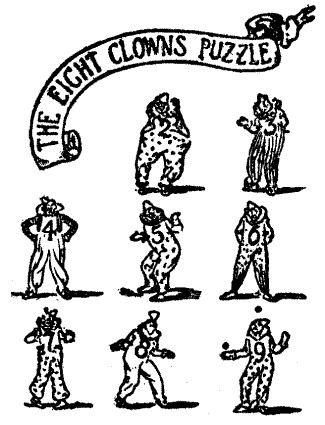
This illustration represents a troupe of clowns I once saw on the Continent. Each clown bore one of the numbers 1 to 9 on his body. After going through the usual tumbling, juggling, and other antics, they generally concluded with a few curious little numerical tricks, one of which was the rapid formation of a number of magic squares. It occurred to me that if clown No. 1 failed to appear (as happens in the illustration), this last item of their performance might not be so easy. The reader is asked to discover how these eight clowns may arrange themselves in the form of a square (one place being vacant), so that every one of the three columns, three rows, and each of the two diagonals shall add up the same. The vacant place may be at any part of the square, but it is No. 1 that must be absent.
82.—The Wizard's Arithmetic.
Once upon a time a knight went to consult a certain famous wizard. The interview had to do with an affair of the heart; but after the man of magic had foretold the most favourable issues, and concocted a love-potion that was certain to help his visitor's cause, the conversation drifted on to occult subjects generally.
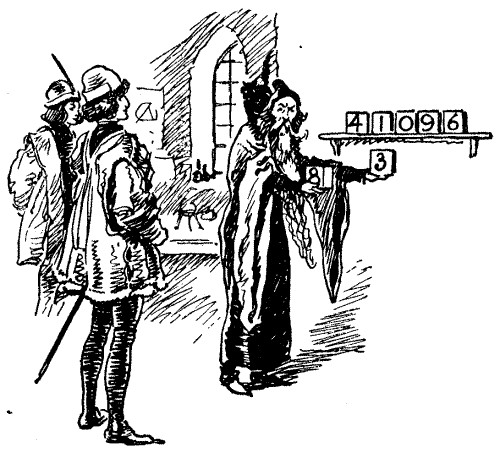
"And art thou learned also in the magic of numbers?" asked the knight. "Show me but one sample of thy wit in these matters."
The old wizard took five blocks bearing numbers, and placed them on a shelf, apparently at random, so that they stood in the order 41096, as shown in our illustration. He then took in his hands an 8 and a 3, and held them together to form the number 83.
"Sir Knight, tell me," said the wizard, "canst thou multiply one number into the other in thy mind?"
"Nay, of a truth," the good knight replied. "I should need to set out upon the task with pen and scrip."
"Yet mark ye how right easy a thing it is to a man learned in the lore of far Araby, who knoweth all the magic that is hid in the philosophy of numbers!"
The wizard simply placed the 3 next to the 4 on the shelf, and the 8 at the other end. It will be found that this gives the answer quite correctly—3410968. Very curious, is it not? How many other two-figure multipliers can you find that will produce the same effect? You may place just as many blocks as you like on the shelf, bearing any figures you choose.
83.—The Ribbon Problem.
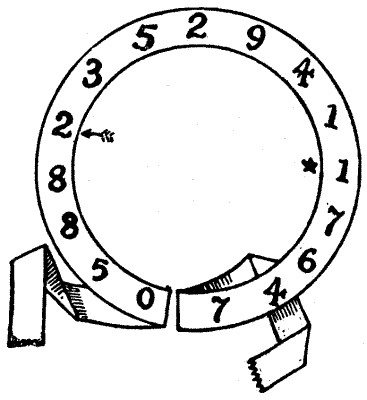
If we take the ribbon by the ends and pull it out straight, we have the number 0588235294117647. This number has the peculiarity that, if we multiply it by any one of the numbers, 2, 3, 4, 5, 6, 7, 8, or 9, we get exactly the same number in the circle, starting from a different place. For example, multiply by 4, and the product is 2352941176470588, which starts from the dart in the circle. So, if we multiply by 3, we get the same result starting from the star. Now, the puzzle is to place a different arrangement of figures on the ribbon that will produce similar results when so multiplied; only the 0 and the 7 appearing at the ends of the ribbon must not be removed.
84.—The Japanese Ladies and the Carpet.
Three Japanese ladies possessed a square ancestral carpet of considerable intrinsic value, but treasured also as an interesting heirloom in the family. They decided to cut it up and make three square rugs of it, so that each should possess a share in her own house.
One lady suggested that the simplest way would be for her to take a smaller share than the other two, because then the carpet need not be cut into more than four pieces.
There are three easy ways of doing this, which I will leave the reader for the present the amusement of finding for himself, merely saying that if you suppose the carpet to be nine square feet, then one lady may take a piece two feet square whole, another a two feet square in two pieces, and the third a square foot whole.
But this generous offer would not for a moment be entertained by the other two sisters, who insisted that the square carpet should be so cut that each should get a square mat of exactly the same size.
Now, according to the best Western authorities, they would have found it necessary to cut the carpet into seven pieces; but a correspondent in Tokio assures me that the legend is that they did it in as few as six pieces, and he wants to know whether such a thing is possible.
Yes; it can be done.
Can you cut out the six pieces that will form three square mats of equal size?
85.—Captain Longbow and the Bears.
That eminent and more or less veracious traveller Captain Longbow has a great grievance with the public. He claims that during a recent expedition in Arctic regions he actually reached the North Pole, but cannot induce anybody to believe him. Of course, the difficulty in such cases is to produce proof, but he avers that future travellers, when they succeed in accomplishing the same feat, will find evidence on the spot. He says that when he got there he saw a bear going round and round the top of the pole (which he declares is a pole), evidently perplexed by the peculiar fact that no matter in what direction he looked it was always due south. Captain Longbow put an end to the bear's meditations by shooting him, and afterwards impaling him, in the manner shown in the illustration, as the evidence for future travellers to which I have alluded.
When the Captain got one hundred miles south on his return journey he had a little experience that is somewhat puzzling. He was surprised one morning, on looking down from an elevation, to see no fewer than eleven bears in his immediate vicinity. But what astonished him more than anything else was the curious fact that they had so placed themselves that there were seven rows of bears, with four bears in every row. Whether or not this was the result of pure accident he cannot say, but such a thing might have happened. If the reader tries to make eleven dots on a sheet of paper so that there shall be seven rows of dots with four dots in every row, he will find some difficulty; but the captain's alleged grouping of the bears is quite possible. Can you discover how they were arranged?
86.—The English Tour.
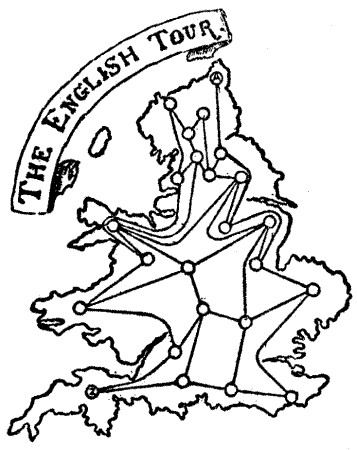
This puzzle has to do with railway routes, and in these days of much travelling should prove useful. The map of England shows twenty-four towns, connected by a system of railways. A resident at the town marked A at the top of the map proposes to visit every one of the towns once and only once, and to finish up his tour at Z. This would be easy enough if he were able to cut across country by road, as well as by rail, but he is not. How does he perform the feat? Take your pencil and, starting from A, pass from town to town, making a dot in the towns you have visited, and see if you can end at Z.
87.—The Chifu-Chemulpo Puzzle.
Here is a puzzle that was once on sale in the London shops. It represents a military train—an engine and eight cars. The puzzle is to reverse the cars, so that they shall be in the order 8, 7, 6, 5, 4, 3, 2, 1, instead of 1, 2, 3, 4, 5, 6, 7, 8, with the engine left, as at first, on the side track. Do this in the fewest possible moves. Every time the engine or a car is moved from the main to the side track, or vice versa, it counts a move for each car or engine passed over one of the points. Moves along the main track are not counted. With 8 at the extremity, as shown, there is just room to pass 7 on to the side track, run 8 up to 6, and bring down 7 again; or you can put as many as five cars, or four and the engine, on the siding at the same time. The cars move without the aid of the engine. The purchaser is invited to "try to do it in 20 moves." How many do you require?
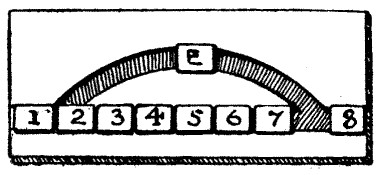
88.—The Eccentric Market-woman.
Mrs. Covey, who keeps a little poultry farm in Surrey, is one of the most eccentric women I ever met. Her manner of doing business is always original, and sometimes quite weird and wonderful. She was once found explaining to a few of her choice friends how she had disposed of her day's eggs. She had evidently got the idea from an old puzzle with which we are all familiar; but as it is an improvement on it, I have no hesitation in presenting it to my readers. She related that she had that day taken a certain number of eggs to market. She sold half of them to one customer, and gave him half an egg over. She next sold a third of what she had left, and gave a third of an egg over. She then sold a fourth of the remainder, and gave a fourth of an egg over. Finally, she disposed of a fifth of the remainder, and gave a fifth of an egg over. Then what she had left she divided equally among thirteen of her friends. And, strange to say, she had not throughout all these transactions broken a single egg. Now, the puzzle is to find the smallest possible number of eggs that Mrs. Covey could have taken to market. Can you say how many?
89.—The Primrose Puzzle.
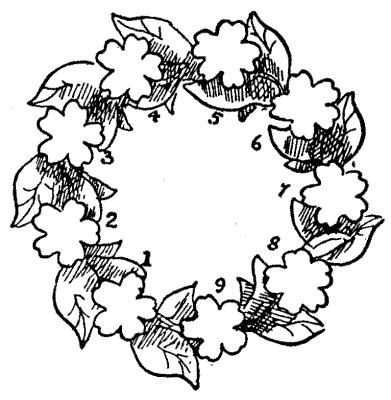
Select the name of any flower that you think suitable, and that contains eight letters. Touch one of the primroses with your pencil and jump over one of the adjoining flowers to another, on which you mark the first letter of your word. Then touch another vacant flower, and again jump over one in another direction, and write down the second letter. Continue this (taking the letters in their proper order) until all the letters have been written down, and the original word can be correctly read round the garland. You must always touch an unoccupied flower, but the flower jumped over may be occupied or not. The name of a tree may also be selected. Only English words may be used.
90.—The Round Table.
Seven friends, named Adams, Brooks, Cater, Dobson, Edwards, Fry, and Green, were spending fifteen days together at the seaside, and they had a round breakfast table at the hotel all to themselves. It was agreed that no man should ever sit down twice with the same two neighbours. As they can be seated, under these conditions, in just fifteen ways, the plan was quite practicable. But could the reader have prepared an arrangement for every sitting? The hotel proprietor was asked to draw up a scheme, but he miserably failed.
91.—The Five Tea Tins.
Sometimes people will speak of mere counting as one of the simplest operations in the world; but on occasions, as I shall show, it is far from easy. Sometimes the labour can be diminished by the use of little artifices; sometimes it is practically impossible to make the required enumeration without having a very clear head indeed. An ordinary child, buying twelve postage stamps, will almost instinctively say, when he sees there are four along one side and three along the other, "Four times three are twelve;" while his tiny brother will count them all in rows, "1, 2, 3, 4," etc. If the child's mother has occasion to add up the numbers 1, 2, 3, up to 50, she will most probably make a long addition sum of the fifty numbers; while her husband, more used to arithmetical operations, will see at a glance that by joining the numbers at the extremes there are 25 pairs of 51; therefore, 25×51=1,275. But his smart son of twenty may go one better and say, "Why multiply by 25? Just add two 0's to the 51 and divide by 4, and there you are!"
A tea merchant has five tin tea boxes of cubical shape, which he keeps on his counter in a row, as shown in our illustration. Every box has a picture on each of its six sides, so there are thirty pictures in all; but one picture on No. 1 is repeated on No. 4, and two other pictures on No. 4 are repeated on No. 3. There are, therefore, only twenty-seven different pictures. The owner always keeps No. 1 at one end of the row, and never allows Nos. 3 and 5 to be put side by side.
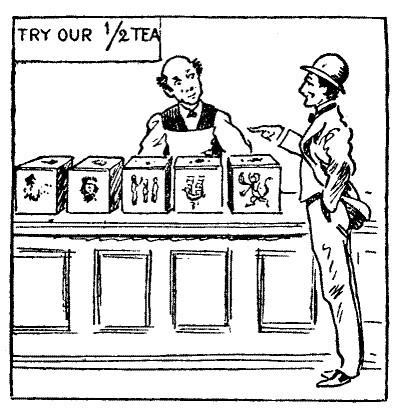
The tradesman's customer, having obtained this information, thinks it a good puzzle to work out in how many ways the boxes may be arranged on the counter so that the order of the five pictures in front shall never be twice alike. He found the making of the count a tough little nut. Can you work out the answer without getting your brain into a tangle? Of course, two similar pictures may be in a row, as it is all a question of their order.
92.—The Four Porkers.
The four pigs are so placed, each in a separate sty, that although every one of the thirty-six sties is in a straight line (either horizontally, vertically, or diagonally), with at least one of the pigs, yet no pig is in line with another. In how many different ways may the four pigs be placed to fulfil these conditions? If you turn this page round you get three more arrangements, and if you turn it round in front of a mirror you get four more. These are not to be counted as different arrangements.
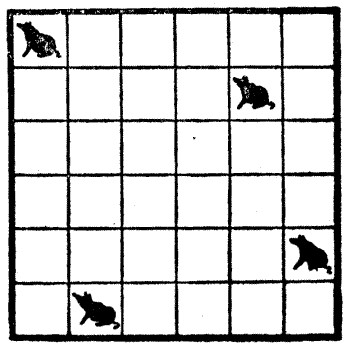
93.—The Number Blocks.
The children in the illustration have found that a large number of very interesting and instructive puzzles may be made out of number blocks; that is, blocks bearing the ten digits or Arabic figures—1, 2, 3, 4, 5, 6, 7, 8, 9, and 0. The particular puzzle that they have been amusing themselves with is to divide the blocks into two groups of five, and then so arrange them in the form of two multiplication sums that one product shall be the same as the other. The number of possible solutions is very considerable, but they have hit on that arrangement that gives the smallest possible product. Thus, 3,485 multiplied by 2 is 6,970, and 6,970 multiplied by 1 is the same. You will find it quite impossible to get any smaller result.
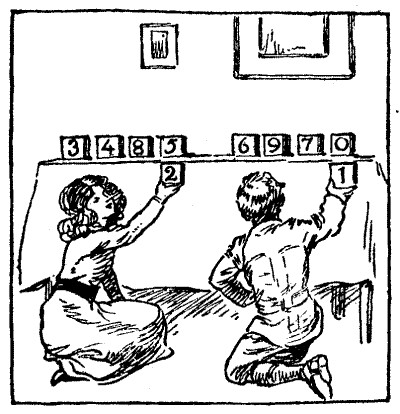
Now, my puzzle is to find the largest possible result. Divide the blocks into any two groups of five that you like, and arrange them to form two multiplication sums that shall produce the same product and the largest amount possible. That is all, and yet it is a nut that requires some cracking. Of course, fractions are not allowed, nor any tricks whatever. The puzzle is quite interesting enough in the simple form in which I have given it. Perhaps it should be added that the multipliers may contain two figures.
94.—Foxes and Geese.
Here is a little puzzle of the moving counters class that my readers will probably find entertaining. Make a diagram of any convenient size similar to that shown in our illustration, and provide six counters—three marked to represent foxes and three to represent geese. Place the geese on the discs 1, 2, and 3, and the foxes on the discs numbered 10, 11, and 12
Now the puzzle is this. By moving one at a time, fox and goose alternately, along a straight line from one disc to the next one, try to get the foxes on 1, 2, and 3, and the geese on 10, 11, and 12—that is, make them exchange places—in the fewest possible moves.
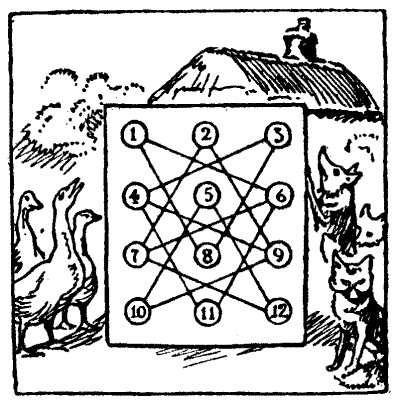
But you must be careful never to let a fox and goose get within reach of each other, or there will be trouble. This rule, you will find, prevents you moving the fox from 11 on the first move, as on either 4 or 6 he would be within reach of a goose. It also prevents your moving a fox from 10 to 9, or from 12 to 7. If you play 10 to 5, then your next move may be 2 to 9 with a goose, which you could not have played if the fox had not previously gone from 10. It is perhaps unnecessary to say that only one fox or one goose can be on a disc at the same time. Now, what is the smallest number of moves necessary to make the foxes and geese change places?
95.—Robinson Crusoe's Table.
Here is a curious extract from Robinson Crusoe's diary. It is not to be found in the modern editions of the Adventures, and is omitted in the old. This has always seemed to me to be a pity.
"The third day in the morning, the wind having abated during the night, I went down to the shore hoping to find a typewriter and other useful things washed up from the wreck of the ship; but all that fell in my way was a piece of timber with many holes in it. My man Friday had many times said that we stood sadly in need of a square table for our afternoon tea, and I bethought me how this piece of wood might be used for that purpose. And since during the long time that Friday had now been with me I was not wanting to lay a foundation of useful knowledge in his mind, I told him that it was my wish to make the table from the timber I had found, without there being any holes in the top thereof.
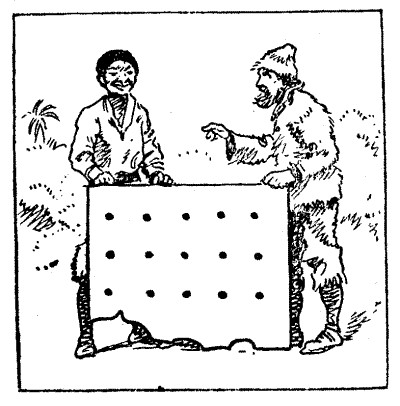
"Friday was sadly put to it to say how this might be, more especially as I said it should consist of no more than two pieces joined together; but I taught him how it could be done in such a way that the table might be as large as was possible, though, to be sure, I was amused when he said, 'My nation do much better: they stop up holes, so pieces sugars not fall through.'"
Now, the illustration gives the exact proportion of the piece of wood with the positions of the fifteen holes. How did Robinson Crusoe make the largest possible square table-top in two pieces, so that it should not have any holes in it?
96.—The Fifteen Orchards.
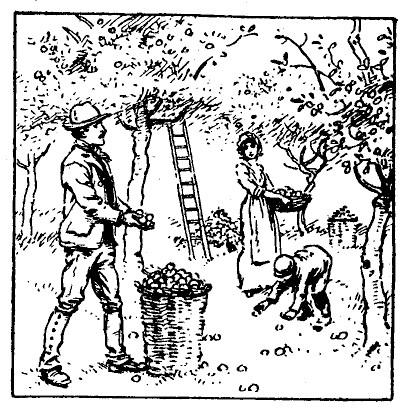
In the county of Devon, where the cider comes from, fifteen of the inhabitants of a village are imbued with an excellent spirit of friendly rivalry, and a few years ago they decided to settle by actual experiment a little difference of opinion as to the cultivation of apple trees. Some said they want plenty of light and air, while others stoutly maintained that they ought to be planted pretty closely, in order that they might get shade and protection from cold winds. So they agreed to plant a lot of young trees, a different number in each orchard, in order to compare results.
One man had a single tree in his field, another had two trees, another had three trees, another had four trees, another five, and so on, the last man having as many as fifteen trees in his little orchard. Last year a very curious result was found to have come about. Each of the fifteen individuals discovered that every tree in his own orchard bore exactly the same number of apples. But, what was stranger still, on comparing notes they found that the total gathered in every allotment was almost the same. In fact, if the man with eleven trees had given one apple to the man who had seven trees, and the man with fourteen trees had given three each to the men with nine and thirteen trees, they would all have had exactly the same.
Now, the puzzle is to discover how many apples each would have had (the same in every case) if that little distribution had been carried out. It is quite easy if you set to work in the right way.
97.—The Perplexed Plumber.
When I paid a visit to Peckham recently I found everybody asking, "What has happened to Sam Solders, the plumber?" He seemed to be in a bad way, and his wife was seriously anxious about the state of his mind. As he had fitted up a hot-water apparatus for me some years ago which did not lead to an explosion for at least three months (and then only damaged the complexion of one of the cook's followers), I had considerable regard for him.
"There he is," said Mrs. Solders, when I called to inquire. "That's how he's been for three weeks. He hardly eats anything, and takes no rest, whilst his business is so neglected that I don't know what is going to happen to me and the five children. All day long—and night too—there he is, figuring and figuring, and tearing his hair like a mad thing. It's worrying me into an early grave."
I persuaded Mrs. Solders to explain matters to me. It seems that he had received an order from a customer to make two rectangular zinc cisterns, one with a top and the other without a top. Each was to hold exactly 1,000 cubic feet of water when filled to the brim. The price was to be a certain amount per cistern, including cost of labour. Now Mr. Solders is a thrifty man, so he naturally desired to make the two cisterns of such dimensions that the smallest possible quantity of metal should be required. This was the little question that was so worrying him.
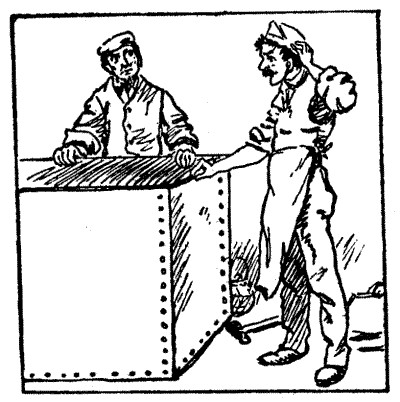
Can my ingenious readers find the dimensions of the most economical cistern with a top, and also the exact proportions of such a cistern without a top, each to hold 1,000 cubic feet of water? By "economical" is meant the method that requires the smallest possible quantity of metal. No margin need be allowed for what ladies would call "turnings." I shall show how I helped Mr. Solders out of his dilemma. He says: "That little wrinkle you gave me would be useful to others in my trade."
98.—The Nelson Column.
During a Nelson celebration I was standing in Trafalgar Square with a friend of puzzling proclivities. He had for some time been gazing at the column in an abstracted way, and seemed quite unconscious of the casual remarks that I addressed to him.
"What are you dreaming about?" I said at last.
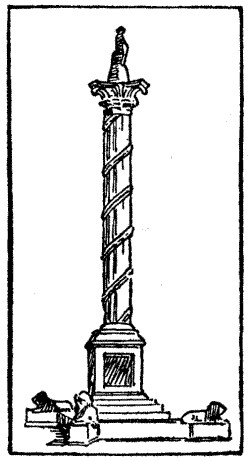
"Two feet——" he murmured.
"Somebody's Trilbys?" I inquired.
"Five times round——"
"Two feet, five times round! What on earth are you saying?"
"Wait a minute," he said, beginning to figure something out on the back of an envelope. I now detected that he was in the throes of producing a new problem of some sort, for I well knew his methods of working at these things.
"Here you are!" he suddenly exclaimed. "That's it! A very interesting little puzzle. The height of the shaft of the Nelson column being 200 feet and its circumference 16 feet 8 inches, it is wreathed in a spiral garland which passes round it exactly five times. What is the length of the garland? It looks rather difficult, but is really remarkably easy."
He was right. The puzzle is quite easy if properly attacked. Of course the height and circumference are not correct, but chosen for the purposes of the puzzle. The artist has also intentionally drawn the cylindrical shaft of the column of equal circumference throughout. If it were tapering, the puzzle would be less easy.
99.—The Two Errand Boys.
A country baker sent off his boy with a message to the butcher in the next village, and at the same time the butcher sent his boy to the baker. One ran faster than the other, and they were seen to pass at a spot 720 yards from the baker's shop. Each stopped ten minutes at his destination and then started on the return journey, when it was found that they passed each other at a spot 400 yards from the butcher's. How far apart are the two tradesmen's shops? Of course each boy went at a uniform pace throughout.
100.—On the Ramsgate Sands.
Thirteen youngsters were seen dancing in a ring on the Ramsgate sands. Apparently they were playing "Round the Mulberry Bush." The puzzle is this. How many rings may they form without any child ever taking twice the hand of any other child—right hand or left? That is, no child may ever have a second time the same neighbour.
101.—The Three Motor-Cars.
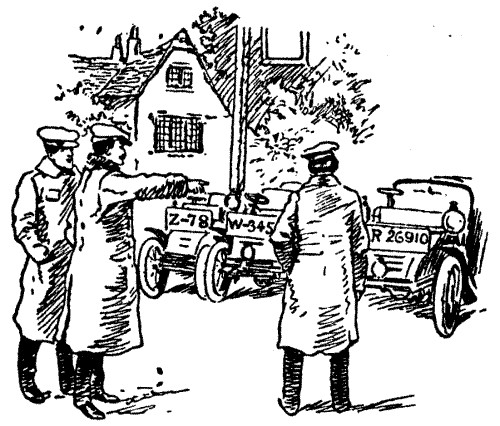
Pope has told us that all chance is but "direction which thou canst not see," and certainly we all occasionally come across remarkable coincidences—little things against the probability of the occurrence of which the odds are immense—that fill us with bewilderment. One of the three motor men in the illustration has just happened on one of these queer coincidences. He is pointing out to his two friends that the three numbers on their cars contain all the figures 1 to 9 and 0, and, what is more remarkable, that if the numbers on the first and second cars are multiplied together they will make the number on the third car. That is, 78, 345, and 26,910 contain all the ten figures, and 78 multiplied by 345 makes 26,910. Now, the reader will be able to find many similar sets of numbers of two, three, and five figures respectively that have the same peculiarity. But there is one set, and one only, in which the numbers have this additional peculiarity—that the second number is a multiple of the first. In other words, if 345 could be divided by 78 without a remainder, the numbers on the cars would themselves fulfil this extra condition. What are the three numbers that we want? Remember that they must have two, three, and five figures respectively.
102.—A Reversible Magic Square.
Can you construct a square of sixteen different numbers so that it shall be magic (that is, adding up alike in the four rows, four columns, and two diagonals), whether you turn the diagram upside down or not? You must not use a 3, 4, or 5, as these figures will not reverse; but a 6 may become a 9 when reversed, a 9 a 6, a 7 a 2, and a 2 a 7. The 1, 8, and 0 will read the same both ways. Remember that the constant must not be changed by the reversal.
103.—The Tube Railway.
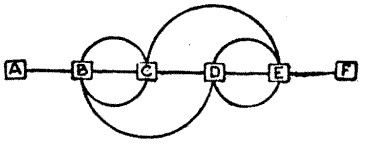
The above diagram is the plan of an underground railway. The fare is uniform for any distance, so long as you do not go twice along any portion of the line during the same journey. Now a certain passenger, with plenty of time on his hands, goes daily from A to F. How many different routes are there from which he may select? For example, he can take the short direct route, A, B, C, D, E, F, in a straight line; or he can go one of the long routes, such as A, B, D, C, B, C, E, D, E, F. It will be noted that he has optional lines between certain stations, and his selections of these lead to variations of the complete route. Many readers will find it a very perplexing little problem, though its conditions are so simple.
104.—The Skipper and the Sea-Serpent.
Mr. Simon Softleigh had spent most of his life between Tooting Bec and Fenchurch Street. His knowledge of the sea was therefore very limited. So, as he was taking a holiday on the south coast, he thought this was a splendid opportunity for picking up a little useful information. He therefore proceeded to "draw" the natives.
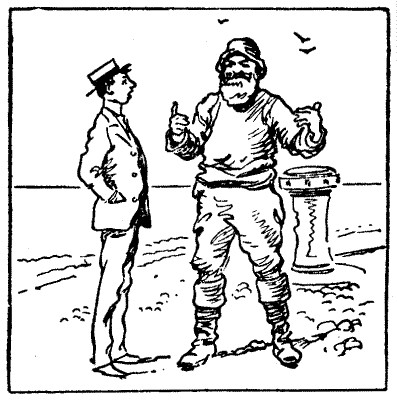
"I suppose," said Mr. Softleigh one morning to a jovial, weather-beaten skipper, "you have seen many wonderful sights on the rolling seas?"
"Bless you, sir, yes," said the skipper. "P'raps you've never seen a vanilla iceberg, or a mermaid a-hanging out her things to dry on the equatorial line, or the blue-winged shark what flies through the air in pursuit of his prey, or the sea-sarpint——"
"Have you really seen a sea-serpent? I thought it was uncertain whether they existed."
"Uncertin! You wouldn't say there was anything uncertin about a sea-sarpint if once you'd seen one. The first as I seed was when I was skipper of the Saucy Sally. We was a-coming round Cape Horn with a cargo of shrimps from the Pacific Islands when I looks over the port side and sees a tremenjus monster like a snake, with its 'ead out of the water and its eyes flashing fire, a-bearing down on our ship. So I shouts to the bo'sun to let down the boat, while I runs below and fetches my sword—the same what I used when I killed King Chokee, the cannibal chief as eat our cabin-boy—and we pulls straight into the track of that there sea-sarpint. Well, to make a long story short, when we come alongside o' the beast I just let drive at him with that sword o' mine, and before you could say 'Tom Bowling' I cut him into three pieces, all of exactually the same length, and afterwards we hauled 'em aboard the Saucy Sally. What did I do with 'em? Well, I sold 'em to a feller in Rio Janeiro. And what do you suppose he done with 'em? He used 'em to make tyres for his motor-car—takes a lot to puncture a sea-sarpint's skin."
"What was the length of the creature?" asked Simon.
"Well, each piece was equal in length to three-quarters the length of a piece added to three-quarters of a cable. There's a little puzzle for you to work out, young gentleman. How many cables long must that there sea-sarpint 'ave been?"
Now, it is not at all to the discredit of Mr. Simon Softleigh that he never succeeded in working out the correct answer to that little puzzle, for it may confidently be said that out of a thousand readers who attempt the solution not one will get it exactly right.
105.—The Dorcas Society.
At the close of four and a half months' hard work, the ladies of a certain Dorcas Society were so delighted with the completion of a beautiful silk patchwork quilt for the dear curate that everybody kissed everybody else, except, of course, the bashful young man himself, who only kissed his sisters, whom he had called for, to escort home. There were just a gross of osculations altogether. How much longer would the ladies have taken over their needlework task if the sisters of the curate referred to had played lawn tennis instead of attending the meetings? Of course we must assume that the ladies attended regularly, and I am sure that they all worked equally well. A mutual kiss here counts as two osculations.
106.—The Adventurous Snail.
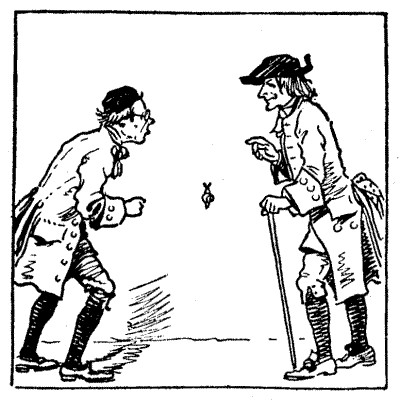
A simple version of the puzzle of the climbing snail is familiar to everybody. We were all taught it in the nursery, and it was apparently intended to inculcate the simple moral that we should never slip if we can help it. This is the popular story. A snail crawls up a pole 12 feet high, ascending 3 feet every day and slipping back 2 feet every night. How long does it take to get to the top? Of course, we are expected to say the answer is twelve days, because the creature makes an actual advance of 1 foot in every twenty-four hours. But the modern infant in arms is not taken in in this way. He says, correctly enough, that at the end of the ninth day the snail is 3 feet from the top, and therefore reaches the summit of its ambition on the tenth day, for it would cease to slip when it had got to the top.
Let us, however, consider the original story. Once upon a time two philosophers were walking in their garden, when one of them espied a highly respectable member of the Helix Aspersa family, a pioneer in mountaineering, in the act of making the perilous ascent of a wall 20 feet high. Judging by the trail, the gentleman calculated that the snail ascended 3 feet each day, sleeping and slipping back 2 feet every night.
"Pray tell me," said the philosopher to his friend, who was in the same line of business, "how long will it take Sir Snail to climb to the top of the wall and descend the other side? The top of the wall, as you know, has a sharp edge, so that when he gets there he will instantly begin to descend, putting precisely the same exertion into his daily climbing down as he did in his climbing up, and sleeping and slipping at night as before."
This is the true version of the puzzle, and my readers will perhaps be interested in working out the exact number of days. Of course, in a puzzle of this kind the day is always supposed to be equally divided into twelve hours' daytime and twelve hours' night.
107.—The Four Princes.
The dominions of a certain Eastern monarch formed a perfectly square tract of country. It happened that the king one day discovered that his four sons were not only plotting against each other, but were in secret rebellion against himself. After consulting with his advisers he decided not to exile the princes, but to confine them to the four corners of the country, where each should be given a triangular territory of equal area, beyond the boundaries of which they would pass at the cost of their lives. Now, the royal surveyor found himself confronted by great natural difficulties, owing to the wild character of the country. The result was that while each was given exactly the same area, the four triangular districts were all of different shapes, somewhat in the manner shown in the illustration. The puzzle is to give the three measurements for each of the four districts in the smallest possible numbers—all whole furlongs. In other words, it is required to find (in the smallest possible numbers) four rational right-angled triangles of equal area.
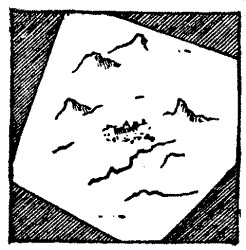
108.—Plato and the Nines.
Both in ancient and in modern times the number nine has been considered to possess peculiarly mystic qualities. We know, for instance, that there were nine Muses, nine rivers of Hades, and that Vulcan was nine days falling down from heaven. Then it has been confidently held that nine tailors make a man; while we know that there are nine planets, nine days' wonders, and that a cat has nine lives—and sometimes nine tails.
Most people are acquainted with some of the curious properties of the number nine in ordinary arithmetic. For example, write down a number containing as many figures as you like, add these figures together, and deduct the sum from the first number. Now, the sum of the figures in this new number will always be a multiple of nine.
There was once a worthy man at Athens who was not only a cranky arithmetician, but also a mystic. He was deeply convinced of the magic properties of the number nine, and was perpetually strolling out to the groves of Academia to bother poor old Plato with his nonsensical ideas about what he called his "lucky number." But Plato devised a way of getting rid of him. When the seer one day proposed to inflict on him a lengthy disquisition on his favourite topic, the philosopher cut him short with the remark, "Look here, old chappie" (that is the nearest translation of the original Greek term of familiarity): "when you can bring me the solution of this little mystery of the three nines I shall be happy to listen to your treatise, and, in fact, record it on my phonograph for the benefit of posterity."
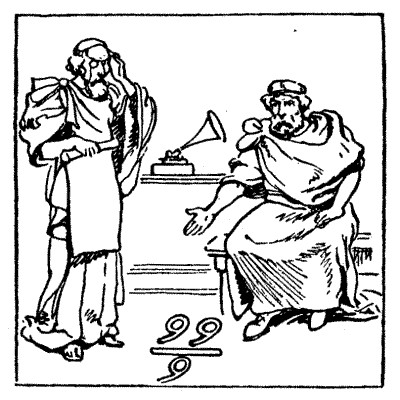
Plato then showed, in the manner depicted in our illustration, that three nines may be arranged so as to represent the number eleven, by putting them into the form of a fraction. The puzzle he then propounded was so to arrange the three nines that they will represent the number twenty.
It is recorded of the old crank that, after working hard at the problem for nine years, he one day, at nine o'clock on the morning of the ninth day of the ninth month, fell down nine steps, knocked out nine teeth, and expired in nine minutes. It will be remembered that nine was his lucky number. It was evidently also Plato's.
In solving the above little puzzle, only the most elementary arithmetical signs are necessary. Though the answer is absurdly simple when you see it, many readers will have no little difficulty in discovering it. Take your pencil and see if you can arrange the three nines to represent twenty.
109.—Noughts and Crosses.
Every child knows how to play this game. You make a square of nine cells, and each of the two players, playing alternately, puts his mark (a nought or a cross, as the case may be) in a cell with the object of getting three in a line. Whichever player first gets three in a line wins with the exulting cry:—
"Tit, tat, toe, My last go; Three jolly butcher boys All in a row."
It is a very ancient game. But if the two players have a perfect knowledge of it, one of three things must always happen. (1) The first player should win; (2) the first player should lose; or (3) the game should always be drawn. Which is correct?
110.—Ovid's Game.
Having examined "Noughts and Crosses," we will now consider an extension of the game that is distinctly mentioned in the works of Ovid. It is, in fact, the parent of "Nine Men's Morris," referred to by Shakespeare in A Midsummer Night's Dream (Act ii., Scene 2). Each player has three counters, which they play alternately on to the nine points shown in the diagram, with the object of getting three in a line and so winning. But after the six counters are played they then proceed to move (always to an adjacent unoccupied point) with the same object. In the example below White played first, and Black has just played on point 7. It is now White's move, and he will undoubtedly play from 8 to 9, and then, whatever Black may do, he will continue with 5 to 6, and so win. That is the simple game. Now, if both players are equally perfect at the game what should happen? Should the first player always win? Or should the second player win? Or should every game be a draw? One only of these things should always occur. Which is it?
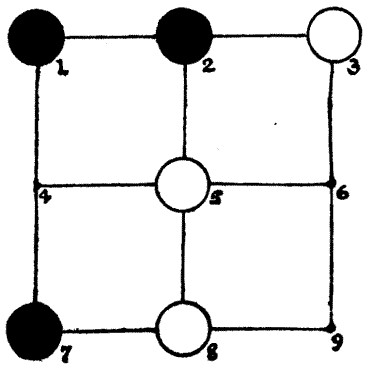
111.—The Farmer's Oxen.
A child may propose a problem that a sage cannot answer. A farmer propounded the following question: "That ten-acre meadow of mine will feed twelve bullocks for sixteen weeks or eighteen bullocks for eight weeks. How many bullocks could I feed on a forty-acre field for six weeks, the grass growing regularly all the time?"
It will be seen that the sting lies in the tail. That steady growth of the grass is such a reasonable point to be considered, and yet to some readers it will cause considerable perplexity. The grass is, of course, assumed to be of equal length and uniform thickness in every case when the cattle begin to eat. The difficulty is not so great as it appears, if you properly attack the question.
112.—The Great Grangemoor Mystery.
Mr. Stanton Mowbray was a very wealthy man, a reputed millionaire, residing in that beautiful old mansion that has figured so much in English history, Grangemoor Park. He was a bachelor, spent most of the year at home, and lived quietly enough.
According to the evidence given, on the day preceding the night of the crime he received by the second post a single letter, the contents of which evidently gave him a shock. At ten o'clock at night he dismissed the servants, saying that he had some important business matters to look into, and would be sitting up late. He would require no attendance. It was supposed that after all had gone to bed he had admitted some person to the house, for one of the servants was positive that she had heard loud conversation at a very late hour.
Next morning, at a quarter to seven o'clock, one of the man-servants, on entering the room, found Mr. Mowbray lying on the floor, shot through the head, and quite dead. Now we come to the curious circumstance of the case. It was clear that after the bullet had passed out of the dead man's head it had struck the tall clock in the room, right in the very centre of the face, and actually welded together the three hands; for the clock had a seconds hand that revolved round the same dial as the hour and minute hands. But although the three hands had become welded together exactly as they stood in relation to each other at the moment of impact, yet they were free to revolve round the swivel in one piece, and had been stupidly spun round several times by the servants before Mr. Wiley Slyman was called upon the spot. But they would not move separately.
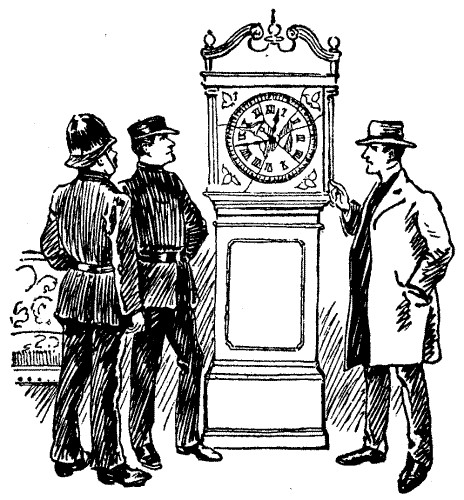
Now, inquiries by the police in the neighbourhood led to the arrest in London of a stranger who was identified by several persons as having been seen in the district the day before the murder, but it was ascertained beyond doubt at what time on the fateful morning he went away by train. If the crime took place after his departure, his innocence was established. For this and other reasons it was of the first importance to fix the exact time of the pistol shot, the sound of which nobody in the house had heard. The clock face in the illustration shows exactly how the hands were found. Mr. Slyman was asked to give the police the benefit of his sagacity and experience, and directly he was shown the clock he smiled and said:
"The matter is supremely simple. You will notice that the three hands appear to be at equal distances from one another. The hour hand, for example, is exactly twenty minutes removed from the minute hand—that is, the third of the circumference of the dial. You attach a lot of importance to the fact that the servants have been revolving the welded hands, but their act is of no consequence whatever; for although they were welded instantaneously, as they are free on the swivel, they would swing round of themselves into equilibrium. Give me a few moments, and I can tell you beyond any doubt the exact time that the pistol was fired."
Mr. Wiley Slyman took from his pocket a notebook, and began to figure it out. In a few minutes he handed the police inspector a slip of paper, on which he had written the precise moment of the crime. The stranger was proved to be an old enemy of Mr. Mowbray's, was convicted on other evidence that was discovered; but before he paid the penalty for his wicked act, he admitted that Mr. Slyman's statement of the time was perfectly correct.
Can you also give the exact time?
113.—Cutting a Wood Block.
An economical carpenter had a block of wood measuring eight inches long by four inches wide by three and three-quarter inches deep. How many pieces, each measuring two and a half inches by one inch and a half by one inch and a quarter, could he cut out of it? It is all a question of how you cut them out. Most people would have more waste material left over than is necessary. How many pieces could you get out of the block?
114.—The Tramps and the Biscuits.
Four merry tramps bought, borrowed, found, or in some other manner obtained possession of a box of biscuits, which they agreed to divide equally amongst themselves at breakfast next morning. In the night, while the others were fast asleep under the greenwood tree, one man approached the box, devoured exactly a quarter of the number of biscuits, except the odd one left over, which he threw as a bribe to their dog. Later in the night a second man awoke and hit on the same idea, taking a quarter of what remained and giving the odd biscuit to the dog. The third and fourth men did precisely the same in turn, taking a quarter of what they found and giving the odd biscuit to the dog. In the morning they divided what remained equally amongst them, and again gave the odd biscuit to the animal. Every man noticed the reduction in the contents of the box, but, believing himself to be alone responsible, made no comments. What is the smallest possible number of biscuits that there could have been in the box when they first acquired it?
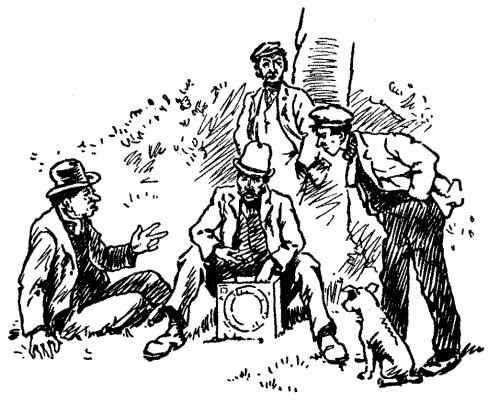
SOLUTIONS
THE CANTERBURY PUZZLES
1.—The Reve's Puzzle.
The 8 cheeses can be removed in 33 moves, 10 cheeses in 49 moves, and 21 cheeses in 321 moves. I will give my general method of solution in the cases of 3, 4, and 5 stools.
Write out the following table to any required length:—
Stools.
Number of Cheeses.
3
1
2
3
4
5
6
7
Natural Numbers.
4
1
3
6
10
15
21
28
Triangular Numbers.
5
1
4
10
20
35
56
84
Triangular Pyramids.
Number of Moves.
3
1
3
7
15
31
63
127
4
1
5
17
49
129
321
769
5
1
7
31
111
351
1023
2815
The first row contains the natural numbers. The second row is found by adding the natural numbers together from the beginning. The numbers in the third row are obtained by adding together the numbers in the second row from the beginning. The fourth row contains the successive powers of 2, less 1. The next series is found by doubling in turn each number of that series and adding the number that stands above the place where you write the result. The last row is obtained in the same way. This table will at once give solutions for any number of cheeses with three stools, for triangular numbers with four stools, and for pyramidal numbers with five stools. In these cases there is always only one method of solution—that is, of piling the cheeses.
In the case of three stools, the first and fourth rows tell us that 4 cheeses may be removed in 15 moves, 5 in 31, 7 in 127. The second and fifth rows show that, with four stools, 10 may be removed in 49, and 21 in 321 moves. Also, with five stools, we find from the third and sixth rows that 20 cheeses require 111 moves, and 35 cheeses 351 moves. But we also learn from the table the necessary method of piling. Thus, with four stools and 10 cheeses, the previous column shows that we must make piles of 6 and 3, which will take 17 and 7 moves respectively—that is, we first pile the six smallest cheeses in 17 moves on one stool; then we pile the next 3 cheeses on another stool in 7 moves; then remove the largest cheese in 1 move; then replace the 3 in 7 moves; and finally replace the 6 in 17: making in all the necessary 49 moves. Similarly we are told that with five stools 35 cheeses must form piles of 20, 10, and 4, which will respectively take 111, 49, and 15 moves.
If the number of cheeses in the case of four stools is not triangular, and in the case of five stools pyramidal, then there will be more than one way of making the piles, and subsidiary tables will be required. This is the case with the Reve's 8 cheeses. But I will leave the reader to work out for himself the extension of the problem.
2.—The Pardoner's Puzzle.
The diagram on page 165 will show how the Pardoner started from the large black town and visited all the other towns once, and once only, in fifteen straight pilgrimages.
See No. 320, "The Rook's Tour," in A. in M.
3.—The Miller's Puzzle.
The way to arrange the sacks of flour is as follows:—2, 78, 156, 39, 4. Here each pair when multiplied by its single neighbour makes the number in the middle, and only five of the sacks need be moved. There are just three other ways in which they might have been arranged (4, 39, 156, 78, 2; or 3, 58, 174, 29, 6; or 6, 29, 174, 58, 3), but they all require the moving of seven sacks.
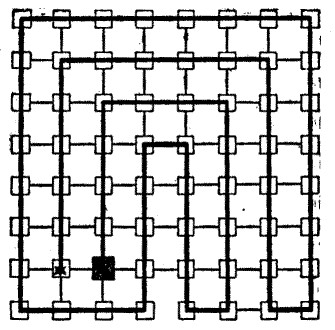
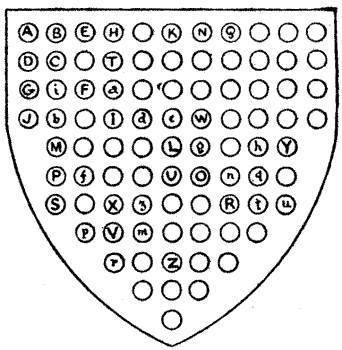
4.—The Knight's Puzzle.
The Knight declared that as many as 575 squares could be marked off on his shield, with a rose at every corner. How this result is achieved may be realized by reference to the accompanying diagram:—Join A, B, C, and D, and there are 66 squares of this size to be formed; the size A, E, F, G gives 48; A, H, I, J, 32; B, K, L, M, 19; B, N, O, P, 10; B, Q, R, S, 4; E, T, F, C, 57; I, U, V, P, 33; H, W, X, J, 15; K, Y, Z, M, 3; E, a, b, D, 82; H, d, M, D, 56; H, e, f, G, 42; K, g, f, C, 32; N, h, z, F, 24; K, h, m, b, 14; K, O, S, D, 16; K, n, p, G, 10; K, q, r, J, 6; Q, t, p, C, 4; Q, u, r, i, 2. The total number is thus 575. These groups have been treated as if each of them represented a different sized square. This is correct, with the one exception that the squares of the form B, N, O, P are exactly the same size as those of the form K, h, m, b.
5.—The Wife of Bath's Riddles.
The good lady explained that a bung that is made fast in a barrel is like another bung that is falling out of a barrel because one of them is in secure and the other is also insecure. The little relationship poser is readily understood when we are told that the parental command came from the father (who was also in the room) and not from the mother.
6.—The Host's Puzzle.
The puzzle propounded by the jovial host of the "Tabard" Inn of Southwark had proved more popular than any other of the whole collection. "I see, my merry masters," he cried, "that I have sorely twisted thy brains by my little piece of craft. Yet it is but a simple matter for me to put a true pint of fine old ale in each of these two measures, albeit one is of five pints and the other of three pints, without using any other measure whatever."
The host of the "Tabard" Inn thereupon proceeded to explain to the pilgrims how this apparently impossible task could be done. He first filled the 5-pint and 3-pint measures, and then, turning the tap, allowed the barrel to run to waste—a proceeding against which the company protested; but the wily man showed that he was aware that the cask did not contain much more than eight pints of ale. The contents, however, do not affect the solution of the puzzle. He then closed the tap and emptied the 3-pint into the barrel; filled the 3-pint from the 5-pint; emptied the 3-pint into the barrel; transferred the two pints from the 5-pint to the 3-pint; filled the 5-pint from the barrel, leaving one pint now in the barrel; filled 3-pint from 5-pint; allowed the company to drink the contents of the 3-pint; filled the 3-pint from the 5-pint, leaving one pint now in the 5-pint; drank the contents of the 3-pint; and finally drew off one pint from the barrel into the 3-pint. He had thus obtained the required one pint of ale in each measure, to the great astonishment of the admiring crowd of pilgrims.
7.—Clerk of Oxenford's Puzzle.
The illustration shows how the square is to be cut into four pieces, and how these pieces are to be put together again to make a magic square. It will be found that the four columns, four rows, and two long diagonals now add up to 34 in every case.
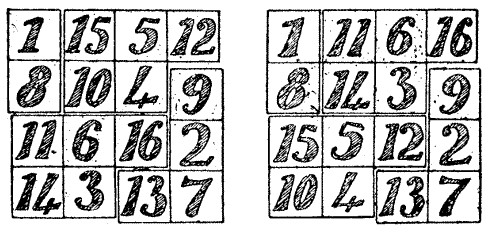
8.—The Tapiser's Puzzle.
The piece of tapestry had to be cut along the lines into three pieces so as to fit together and form a perfect square, with the pattern properly matched. It was also stipulated in effect that one of the three pieces must be as small as possible. The illustration shows how to make the cuts and how to put the pieces together, while one of the pieces contains only twelve of the little squares.
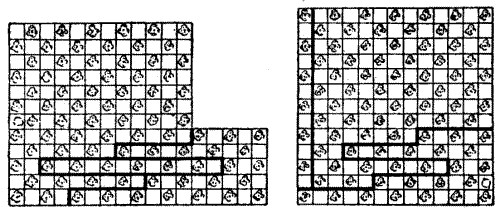
9.—The Carpenter's Puzzle.
The carpenter said that he made a box whose internal dimensions were exactly the same as the original block of wood—that is, 3 feet by 1 foot by 1 foot. He then placed the carved pillar in this box and filled up all the vacant space with a fine, dry sand, which he carefully shook down until he could get no more into the box. Then he removed the pillar, taking great care not to lose any of the sand, which, on being shaken down alone in the box, filled a space equal to one cubic foot. This was, therefore, the quantity of wood that had been cut away.
10.—The Puzzle of the Squire's Yeoman.
The illustration will show how three of the arrows were removed each to a neighbouring square on the signboard of the "Chequers" Inn, so that still no arrow was in line with another. The black dots indicate the squares on which the three arrows originally stood.
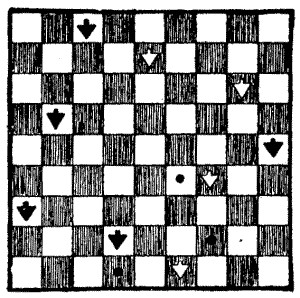
11.—The Nun's Puzzle.
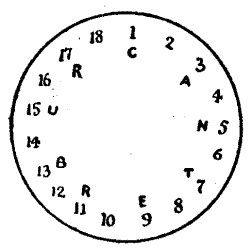
As there are eighteen cards bearing the letters "CANTERBURY PILGRIMS," write the numbers 1 to 18 in a circle, as shown in the diagram. Then write the first letter C against 1, and each successive letter against the second number that happens to be vacant. This has been done as far as the second R. If the reader completes the process by placing Y against 2, P against 6, I against 10, and so on, he will get the letters all placed in the following order:—CYASNPTREIRMBLUIRG, which is the required arrangement for the cards, C being at the top of the pack and G at the bottom.
12.—The Merchant's Puzzle.
This puzzle amounts to finding the smallest possible number that has exactly sixty-four divisors, counting 1 and the number itself as divisors. The least number is 7,560. The pilgrims might, therefore, have ridden in single file, two and two, three and three, four and four, and so on, in exactly sixty-four different ways, the last manner being in a single row of 7,560.
The Merchant was careful to say that they were going over a common, and not to mention its size, for it certainly would not be possible along an ordinary road!
To find how many different numbers will divide a given number, N, let N = ap bq cr ..., where a, b, c ... are prime numbers. Then the number of divisors will be (p + 1) (q + 1) (r + 1) ..., which includes as divisors 1 and N itself. Thus in the case of my puzzle—
7,560 =
2
3×
3
3×
5
×
7
Powers =
3
3
1
1
Therefore
4
×
4
×
2
×
2
= 64 divisors.
To find the smallest number that has a given number of divisors we must proceed by trial. But it is important sometimes to note whether or not the condition is that there shall be a given number of divisors and no more. For example, the smallest number that has seven divisors and no more is 64, while 24 has eight divisors, and might equally fulfil the conditions. The stipulation as to "no more" was not necessary in the case of my puzzle, for no smaller number has more than sixty-four divisors.
13.—The Man of Law's Puzzle.
The fewest possible moves for getting the prisoners into their dungeons in the required numerical order are twenty-six. The men move in the following order:—1, 2, 3, 1, 2, 6, 5, 3, 1, 2, 6, 5, 3, 1, 2, 4, 8, 7, 1, 2, 4, 8, 7, 4, 5, 6. As there are never more than one vacant dungeon to be moved into, there can be no ambiguity in the notation.
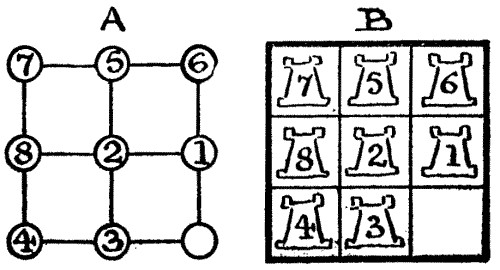
The diagram may be simplified by my "buttons and string" method, fully explained in A. in M., p. 230. It then takes one of the simple forms of A or B, and the solution is much easier. In A we use counters; in B we can employ rooks on a corner of a chessboard. In both cases we have to get the order

in the fewest possible moves.
See also solution to No. 94.
14.—The Weaver's Puzzle.
The illustration shows clearly how the Weaver cut his square of beautiful cloth into four pieces of exactly the same size and shape, so that each piece contained an embroidered lion and castle unmutilated in any way.
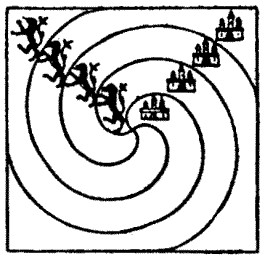
15.—The Cook's Puzzle.
There were four portions of warden pie and four portions of venison pasty to be distributed among eight out of eleven guests. But five out of the eleven will only eat the pie, four will only eat the pasty, and two are willing to eat of either. Any possible combination must fall into one of the following groups. (i.) Where the warden pie is distributed entirely among the five first mentioned; (ii.) where only one of the accommodating pair is given pie; (iii.) where the other of the pair is given pie; (iv.) where both of the pair are given pie. The numbers of combinations are: (i.) = 75, (ii.) = 50, (iii.) = 10, (iv.) = 10—making in all 145 ways of selecting the eight participants. A great many people will give the answer as 185, by overlooking the fact that in forty cases in class (iii.) precisely the same eight guests would be sharing the meal as in class (ii.), though the accommodating pair would be eating differently of the two dishes. This is the point that upset the calculations of the company.
16.—The Sompnour's Puzzle.
The number that the Sompnour confided to the Wife of Bath was twenty-nine, and she was told to begin her count at the Doctor of Physic, who will be seen in the illustration standing the second on her right. The first count of twenty-nine falls on the Shipman, who steps out of the ring. The second count falls on the Doctor, who next steps out. The remaining three counts fall respectively on the Cook, the Sompnour, and the Miller. The ladies would, therefore, have been left in possession had it not been for the unfortunate error of the good Wife. Any multiple of 2,520 added to 29 would also have served the same purpose, beginning the count at the Doctor.
17.—The Monk's Puzzle.
The Monk might have placed dogs in the kennels in two thousand nine hundred and twenty-six different ways, so that there should be ten dogs on every side. The number of dogs might vary from twenty to forty, and as long as the Monk kept his animals within these limits the thing was always possible.
The general solution to this puzzle is difficult. I find that for n dogs on every side of the square, the number of different ways is (n4 + 10n3 + 38n2 + 62n + 33) / 48, where n is odd, and ((n4 + 10n3 + 38n2 + 68n) / 48) + 1, where n is even, if we count only those arrangements that are fundamentally different. But if we count all reversals and reflections as different, as the Monk himself did, then n dogs (odd or even) may be placed in ((n4 + 6n3 + 14n2 + 15n) / 6) + 1 ways. In order that there may be n dogs on every side, the number must not be less than 2n nor greater than 4n, but it may be any number within these limits.
An extension of the principle involved in this puzzle is given in No. 42, "The Riddle of the Pilgrims." See also "The Eight Villas" and "A Dormitory Puzzle" in A. in M.
18.—The Shipman's Puzzle.
There are just two hundred and sixty-four different ways in which the ship Magdalen might have made her ten annual voyages without ever going over the same course twice in a year. Every year she must necessarily end her tenth voyage at the island from which she first set out.
19.—The Puzzle of the Prioress.
The Abbot of Chertsey was quite correct. The curiously-shaped cross may be cut into four pieces that will fit together and form a perfect square. How this is done is shown in the illustration.
See also p. 31 in A. in M.
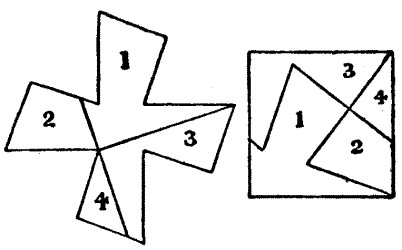
20.—The Puzzle of the Doctor of Physic.
Here we have indeed a knotty problem. Our text-books tell us that all spheres are similar, and that similar solids are as the cubes of corresponding lengths. Therefore, as the circumferences of the two phials were one foot and two feet respectively and the cubes of one and two added together make nine, what we have to find is two other numbers whose cubes added together make nine. These numbers clearly must be fractional. Now, this little question has really engaged the attention of learned men for two hundred and fifty years; but although Peter de Fermat showed in the seventeenth century how an answer may be found in two fractions with a denominator of no fewer than twenty-one figures, not only are all the published answers, by his method, that I have seen inaccurate, but nobody has ever published the much smaller result that I now print. The cubes of (415280564497 / 348671682660) and (676702467503 / 348671682660) added together make exactly nine, and therefore these fractions of a foot are the measurements of the circumferences of the two phials that the Doctor required to contain the same quantity of liquid as those produced. An eminent actuary and another correspondent have taken the trouble to cube out these numbers, and they both find my result quite correct.
If the phials were one foot and three feet in circumference respectively, then an answer would be that the cubes of (63284705 / 21446828) and (28340511 / 21446828) added together make exactly 28. See also No. 61, "The Silver Cubes."
Given a known case for the expression of a number as the sum or difference of two cubes, we can, by formula, derive from it an infinite number of other cases alternately positive and negative. Thus Fermat, starting from the known case 13 + 23 = 9 (which we will call a fundamental case), first obtained a negative solution in bigger figures, and from this his positive solution in bigger figures still. But there is an infinite number of fundamentals, and I found by trial a negative fundamental solution in smaller figures than his derived negative solution, from which I obtained the result shown above. That is the simple explanation.
We can say of any number up to 100 whether it is possible or not to express it as the sum of two cubes, except 66. Students should read the Introduction to Lucas's Théorie des Nombres, p. xxx.
Some years ago I published a solution for the case of
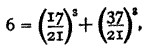
of which Legendre gave at some length a "proof" of impossibility; but I have since found that Lucas anticipated me in a communication to Sylvester.
21.—The Ploughman's Puzzle.
The illustration shows how the sixteen trees might have been planted so as to form as many as fifteen straight rows with four trees in every row. This is in excess of what was for a long time believed to be the maximum number of rows possible; and though with our present knowledge I cannot rigorously demonstrate that fifteen rows cannot be beaten, I have a strong "pious opinion" that it is the highest number of rows obtainable.
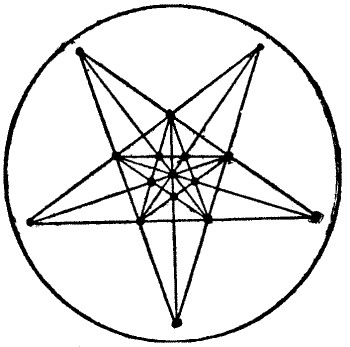
22.—The Franklin's Puzzle.
The answer to this puzzle is shown in the illustration, where the numbers on the sixteen bottles all add up to 30 in the ten straight directions. The trick consists in the fact that, although the six bottles (3, 5, 6, 9, 10, and 15) in which the flowers have been placed are not removed, yet the sixteen need not occupy exactly the same position on the table as before. The square is, in fact, formed one step further to the left.
74.—The Broken Chessboard.
71.—Romeo's Second Journey.
76.—The Perplexed Cellarman.
114.—The Tramps and the Biscuits.
92.—The Four Porkers.
113.—Cutting a Wood Block.
18.—The Shipman's Puzzle.
61.—The Silver Cubes.
95.—Robinson Crusoe's Table.
86.—The English Tour.
100.—On the Ramsgate Sands.
111.—The Farmer's Oxen.
84.—The Japanese Ladies and the Carpet.
75.—The Spider and the Fly.
21.—The Ploughman's Puzzle.
15.—The Cook's Puzzle.
106.—The Adventurous Snail.
99.—The Two Errand Boys.
8.—The Tapiser's Puzzle.
88.—The Eccentric Market-woman.
69.—The Frogs and Tumblers.
83.—The Ribbon Problem.
20.—The Puzzle of the Doctor of Physic.
102.—A Reversible Magic Square.
89.—The Primrose Puzzle.
67.—The Coinage Puzzle.
79.—The Thirty-one Game.
9.—The Carpenter's Puzzle.
98.—The Nelson Column.
2.—The Pardoner's Puzzle.
85.—Captain Longbow and the Bears.
90.—The Round Table.
105.—The Dorcas Society.
112.—The Great Grangemoor Mystery.
10.—The Puzzle of the Squire's Yeoman.
77.—Making a Flag.
82.—The Wizard's Arithmetic.
7.—The Clerk of Oxenford's Puzzle.
110.—Ovid's Game.
104.—The Skipper and the Sea-Serpent.
94.—Foxes and Geese.
12.—The Merchant's Puzzle.
13.—The Man of Law's Puzzle.
19.—The Puzzle of the Prioress.
61.—The Silver Cubes.
80.—The Chinese Railways.
109.—Noughts and Crosses.
64.—The Runaway Motor-Car.
4.—The Knight's Puzzle.
14.—The Weaver's Puzzle.
1.—The Reve's Puzzle.
103.—The Tube Railway.
87.—The Chifu-Chemulpo Puzzle.
3.—The Miller's Puzzle.
16.—The Sompnour's Puzzle.
78.—Catching the Hogs.
63.—The Cornish Cliff Mystery.
96.—The Fifteen Orchards.
91.—The Five Tea Tins.
66.—The Buried Treasure.
73.—The Game of Kayles.
93.—The Number Blocks.
108.—Plato and the Nines.
5.—The Wife of Bath's Riddles.
68.—The Postage Stamps Puzzles.
107.—The Four Princes.
17.—The Monk's Puzzle.
81.—The Eight Clowns.
6.—The Host's Puzzle.
72.—The Frogs who would a-wooing go.
70.—Romeo and Juliet.
11.—The Nun's Puzzle.
101.—The Three Motor-Cars.
62.—The Ambiguous Photograph.
22.—The Franklin's Puzzle.
65.—The Mystery of Ravensdene Park.
97.—The Perplexed Plumber.
*** START: FULL LICENSE ***
THE FULL PROJECT GUTENBERG LICENSE
PLEASE READ THIS BEFORE YOU DISTRIBUTE OR USE THIS WORK
To protect the Project Gutenberg-tm mission of promoting the free
distribution of electronic works, by using or distributing this work
(or any other work associated in any way with the phrase "Project
Gutenberg"), you agree to comply with all the terms of the Full Project
Gutenberg-tm License (available with this file or online at
http://www.gutenberg.org/license).
Section 1. General Terms of Use and Redistributing Project Gutenberg-tm
electronic works
1.A. By reading or using any part of this Project Gutenberg-tm
electronic work, you indicate that you have read, understand, agree to
and accept all the terms of this license and intellectual property
(trademark/copyright) agreement. If you do not agree to abide by all
the terms of this agreement, you must cease using and return or destroy
all copies of Project Gutenberg-tm electronic works in your possession.
If you paid a fee for obtaining a copy of or access to a Project
Gutenberg-tm electronic work and you do not agree to be bound by the
terms of this agreement, you may obtain a refund from the person or
entity to whom you paid the fee as set forth in paragraph 1.E.8.
1.B. "Project Gutenberg" is a registered trademark. It may only be
used on or associated in any way with an electronic work by people who
agree to be bound by the terms of this agreement. There are a few
things that you can do with most Project Gutenberg-tm electronic works
even without complying with the full terms of this agreement. See
paragraph 1.C below. There are a lot of things you can do with Project
Gutenberg-tm electronic works if you follow the terms of this agreement
and help preserve free future access to Project Gutenberg-tm electronic
works. See paragraph 1.E below.
1.C. The Project Gutenberg Literary Archive Foundation ("the Foundation"
or PGLAF), owns a compilation copyright in the collection of Project
Gutenberg-tm electronic works. Nearly all the individual works in the
collection are in the public domain in the United States. If an
individual work is in the public domain in the United States and you are
located in the United States, we do not claim a right to prevent you from
copying, distributing, performing, displaying or creating derivative
works based on the work as long as all references to Project Gutenberg
are removed. Of course, we hope that you will support the Project
Gutenberg-tm mission of promoting free access to electronic works by
freely sharing Project Gutenberg-tm works in compliance with the terms of
this agreement for keeping the Project Gutenberg-tm name associated with
the work. You can easily comply with the terms of this agreement by
keeping this work in the same format with its attached full Project
Gutenberg-tm License when you share it without charge with others.
1.D. The copyright laws of the place where you are located also govern
what you can do with this work. Copyright laws in most countries are in
a constant state of change. If you are outside the United States, check
the laws of your country in addition to the terms of this agreement
before downloading, copying, displaying, performing, distributing or
creating derivative works based on this work or any other Project
Gutenberg-tm work. The Foundation makes no representations concerning
the copyright status of any work in any country outside the United
States.
1.E. Unless you have removed all references to Project Gutenberg:
1.E.1. The following sentence, with active links to, or other immediate
access to, the full Project Gutenberg-tm License must appear prominently
whenever any copy of a Project Gutenberg-tm work (any work on which the
phrase "Project Gutenberg" appears, or with which the phrase "Project
Gutenberg" is associated) is accessed, displayed, performed, viewed,
copied or distributed:
This eBook is for the use of anyone anywhere at no cost and with
almost no restrictions whatsoever. You may copy it, give it away or
re-use it under the terms of the Project Gutenberg License included
with this eBook or online at www.gutenberg.org
1.E.2. If an individual Project Gutenberg-tm electronic work is derived
from the public domain (does not contain a notice indicating that it is
posted with permission of the copyright holder), the work can be copied
and distributed to anyone in the United States without paying any fees
or charges. If you are redistributing or providing access to a work
with the phrase "Project Gutenberg" associated with or appearing on the
work, you must comply either with the requirements of paragraphs 1.E.1
through 1.E.7 or obtain permission for the use of the work and the
Project Gutenberg-tm trademark as set forth in paragraphs 1.E.8 or
1.E.9.
1.E.3. If an individual Project Gutenberg-tm electronic work is posted
with the permission of the copyright holder, your use and distribution
must comply with both paragraphs 1.E.1 through 1.E.7 and any additional
terms imposed by the copyright holder. Additional terms will be linked
to the Project Gutenberg-tm License for all works posted with the
permission of the copyright holder found at the beginning of this work.
1.E.4. Do not unlink or detach or remove the full Project Gutenberg-tm
License terms from this work, or any files containing a part of this
work or any other work associated with Project Gutenberg-tm.
1.E.5. Do not copy, display, perform, distribute or redistribute this
electronic work, or any part of this electronic work, without
prominently displaying the sentence set forth in paragraph 1.E.1 with
active links or immediate access to the full terms of the Project
Gutenberg-tm License.
1.E.6. You may convert to and distribute this work in any binary,
compressed, marked up, nonproprietary or proprietary form, including any
word processing or hypertext form. However, if you provide access to or
distribute copies of a Project Gutenberg-tm work in a format other than
"Plain Vanilla ASCII" or other format used in the official version
posted on the official Project Gutenberg-tm web site (www.gutenberg.org),
you must, at no additional cost, fee or expense to the user, provide a
copy, a means of exporting a copy, or a means of obtaining a copy upon
request, of the work in its original "Plain Vanilla ASCII" or other
form. Any alternate format must include the full Project Gutenberg-tm
License as specified in paragraph 1.E.1.
1.E.7. Do not charge a fee for access to, viewing, displaying,
performing, copying or distributing any Project Gutenberg-tm works
unless you comply with paragraph 1.E.8 or 1.E.9.
1.E.8. You may charge a reasonable fee for copies of or providing
access to or distributing Project Gutenberg-tm electronic works provided
that
- You pay a royalty fee of 20% of the gross profits you derive from
the use of Project Gutenberg-tm works calculated using the method
you already use to calculate your applicable taxes. The fee is
owed to the owner of the Project Gutenberg-tm trademark, but he
has agreed to donate royalties under this paragraph to the
Project Gutenberg Literary Archive Foundation. Royalty payments
must be paid within 60 days following each date on which you
prepare (or are legally required to prepare) your periodic tax
returns. Royalty payments should be clearly marked as such and
sent to the Project Gutenberg Literary Archive Foundation at the
address specified in Section 4, "Information about donations to
the Project Gutenberg Literary Archive Foundation."
- You provide a full refund of any money paid by a user who notifies
you in writing (or by e-mail) within 30 days of receipt that s/he
does not agree to the terms of the full Project Gutenberg-tm
License. You must require such a user to return or
destroy all copies of the works possessed in a physical medium
and discontinue all use of and all access to other copies of
Project Gutenberg-tm works.
- You provide, in accordance with paragraph 1.F.3, a full refund of any
money paid for a work or a replacement copy, if a defect in the
electronic work is discovered and reported to you within 90 days
of receipt of the work.
- You comply with all other terms of this agreement for free
distribution of Project Gutenberg-tm works.
1.E.9. If you wish to charge a fee or distribute a Project Gutenberg-tm
electronic work or group of works on different terms than are set
forth in this agreement, you must obtain permission in writing from
both the Project Gutenberg Literary Archive Foundation and Michael
Hart, the owner of the Project Gutenberg-tm trademark. Contact the
Foundation as set forth in Section 3 below.
1.F.
1.F.1. Project Gutenberg volunteers and employees expend considerable
effort to identify, do copyright research on, transcribe and proofread
public domain works in creating the Project Gutenberg-tm
collection. Despite these efforts, Project Gutenberg-tm electronic
works, and the medium on which they may be stored, may contain
"Defects," such as, but not limited to, incomplete, inaccurate or
corrupt data, transcription errors, a copyright or other intellectual
property infringement, a defective or damaged disk or other medium, a
computer virus, or computer codes that damage or cannot be read by
your equipment.
1.F.2. LIMITED WARRANTY, DISCLAIMER OF DAMAGES - Except for the "Right
of Replacement or Refund" described in paragraph 1.F.3, the Project
Gutenberg Literary Archive Foundation, the owner of the Project
Gutenberg-tm trademark, and any other party distributing a Project
Gutenberg-tm electronic work under this agreement, disclaim all
liability to you for damages, costs and expenses, including legal
fees. YOU AGREE THAT YOU HAVE NO REMEDIES FOR NEGLIGENCE, STRICT
LIABILITY, BREACH OF WARRANTY OR BREACH OF CONTRACT EXCEPT THOSE
PROVIDED IN PARAGRAPH F3. YOU AGREE THAT THE FOUNDATION, THE
TRADEMARK OWNER, AND ANY DISTRIBUTOR UNDER THIS AGREEMENT WILL NOT BE
LIABLE TO YOU FOR ACTUAL, DIRECT, INDIRECT, CONSEQUENTIAL, PUNITIVE OR
INCIDENTAL DAMAGES EVEN IF YOU GIVE NOTICE OF THE POSSIBILITY OF SUCH
DAMAGE.
1.F.3. LIMITED RIGHT OF REPLACEMENT OR REFUND - If you discover a
defect in this electronic work within 90 days of receiving it, you can
receive a refund of the money (if any) you paid for it by sending a
written explanation to the person you received the work from. If you
received the work on a physical medium, you must return the medium with
your written explanation. The person or entity that provided you with
the defective work may elect to provide a replacement copy in lieu of a
refund. If you received the work electronically, the person or entity
providing it to you may choose to give you a second opportunity to
receive the work electronically in lieu of a refund. If the second copy
is also defective, you may demand a refund in writing without further
opportunities to fix the problem.
1.F.4. Except for the limited right of replacement or refund set forth
in paragraph 1.F.3, this work is provided to you 'AS-IS,' WITH NO OTHER
WARRANTIES OF ANY KIND, EXPRESS OR IMPLIED, INCLUDING BUT NOT LIMITED TO
WARRANTIES OF MERCHANTIBILITY OR FITNESS FOR ANY PURPOSE.
1.F.5. Some states do not allow disclaimers of certain implied
warranties or the exclusion or limitation of certain types of damages.
If any disclaimer or limitation set forth in this agreement violates the
law of the state applicable to this agreement, the agreement shall be
interpreted to make the maximum disclaimer or limitation permitted by
the applicable state law. The invalidity or unenforceability of any
provision of this agreement shall not void the remaining provisions.
1.F.6. INDEMNITY - You agree to indemnify and hold the Foundation, the
trademark owner, any agent or employee of the Foundation, anyone
providing copies of Project Gutenberg-tm electronic works in accordance
with this agreement, and any volunteers associated with the production,
promotion and distribution of Project Gutenberg-tm electronic works,
harmless from all liability, costs and expenses, including legal fees,
that arise directly or indirectly from any of the following which you do
or cause to occur: (a) distribution of this or any Project Gutenberg-tm
work, (b) alteration, modification, or additions or deletions to any
Project Gutenberg-tm work, and (c) any Defect you cause.
Section 2. Information about the Mission of Project Gutenberg-tm
Project Gutenberg-tm is synonymous with the free distribution of
electronic works in formats readable by the widest variety of computers
including obsolete, old, middle-aged and new computers. It exists
because of the efforts of hundreds of volunteers and donations from
people in all walks of life.
Volunteers and financial support to provide volunteers with the
assistance they need, is critical to reaching Project Gutenberg-tm's
goals and ensuring that the Project Gutenberg-tm collection will
remain freely available for generations to come. In 2001, the Project
Gutenberg Literary Archive Foundation was created to provide a secure
and permanent future for Project Gutenberg-tm and future generations.
To learn more about the Project Gutenberg Literary Archive Foundation
and how your efforts and donations can help, see Sections 3 and 4
and the Foundation web page at http://www.gutenberg.org/fundraising/pglaf.
Section 3. Information about the Project Gutenberg Literary Archive
Foundation
The Project Gutenberg Literary Archive Foundation is a non profit
501(c)(3) educational corporation organized under the laws of the
state of Mississippi and granted tax exempt status by the Internal
Revenue Service. The Foundation's EIN or federal tax identification
number is 64-6221541. Contributions to the Project Gutenberg
Literary Archive Foundation are tax deductible to the full extent
permitted by U.S. federal laws and your state's laws.
The Foundation's principal office is located at 4557 Melan Dr. S.
Fairbanks, AK, 99712., but its volunteers and employees are scattered
throughout numerous locations. Its business office is located at
809 North 1500 West, Salt Lake City, UT 84116, (801) 596-1887, email
business@pglaf.org. Email contact links and up to date contact
information can be found at the Foundation's web site and official
page at http://www.gutenberg.org/about/contact
For additional contact information:
Dr. Gregory B. Newby
Chief Executive and Director
gbnewby@pglaf.org
Section 4. Information about Donations to the Project Gutenberg
Literary Archive Foundation
Project Gutenberg-tm depends upon and cannot survive without wide
spread public support and donations to carry out its mission of
increasing the number of public domain and licensed works that can be
freely distributed in machine readable form accessible by the widest
array of equipment including outdated equipment. Many small donations
($1 to $5,000) are particularly important to maintaining tax exempt
status with the IRS.
The Foundation is committed to complying with the laws regulating
charities and charitable donations in all 50 states of the United
States. Compliance requirements are not uniform and it takes a
considerable effort, much paperwork and many fees to meet and keep up
with these requirements. We do not solicit donations in locations
where we have not received written confirmation of compliance. To
SEND DONATIONS or determine the status of compliance for any
particular state visit http://www.gutenberg.org/fundraising/pglaf
While we cannot and do not solicit contributions from states where we
have not met the solicitation requirements, we know of no prohibition
against accepting unsolicited donations from donors in such states who
approach us with offers to donate.
International donations are gratefully accepted, but we cannot make
any statements concerning tax treatment of donations received from
outside the United States. U.S. laws alone swamp our small staff.
Please check the Project Gutenberg Web pages for current donation
methods and addresses. Donations are accepted in a number of other
ways including checks, online payments and credit card donations.
To donate, please visit: http://www.gutenberg.org/fundraising/donate
Section 5. General Information About Project Gutenberg-tm electronic
works.
Professor Michael S. Hart is the originator of the Project Gutenberg-tm
concept of a library of electronic works that could be freely shared
with anyone. For thirty years, he produced and distributed Project
Gutenberg-tm eBooks with only a loose network of volunteer support.
Project Gutenberg-tm eBooks are often created from several printed
editions, all of which are confirmed as Public Domain in the U.S.
unless a copyright notice is included. Thus, we do not necessarily
keep eBooks in compliance with any particular paper edition.
Each eBook is in a subdirectory of the same number as the eBook's
eBook number, often in several formats including plain vanilla ASCII,
compressed (zipped), HTML and others.
Corrected EDITIONS of our eBooks replace the old file and take over
the old filename and etext number. The replaced older file is renamed.
VERSIONS based on separate sources are treated as new eBooks receiving
new filenames and etext numbers.
Most people start at our Web site which has the main PG search facility:
http://www.gutenberg.org
This Web site includes information about Project Gutenberg-tm,
including how to make donations to the Project Gutenberg Literary
Archive Foundation, how to help produce our new eBooks, and how to
subscribe to our email newsletter to hear about new eBooks.
EBooks posted prior to November 2003, with eBook numbers BELOW #10000,
are filed in directories based on their release date. If you want to
download any of these eBooks directly, rather than using the regular
search system you may utilize the following addresses and just
download by the etext year.
http://www.gutenberg.org/dirs/etext06/
(Or /etext 05, 04, 03, 02, 01, 00, 99,
98, 97, 96, 95, 94, 93, 92, 92, 91 or 90)
EBooks posted since November 2003, with etext numbers OVER #10000, are
filed in a different way. The year of a release date is no longer part
of the directory path. The path is based on the etext number (which is
identical to the filename). The path to the file is made up of single
digits corresponding to all but the last digit in the filename. For
example an eBook of filename 10234 would be found at:
http://www.gutenberg.org/dirs/1/0/2/3/10234
or filename 24689 would be found at:
http://www.gutenberg.org/dirs/2/4/6/8/24689
An alternative method of locating eBooks:
http://www.gutenberg.org/dirs/GUTINDEX.ALL
*** END: FULL LICENSE ***