


автордың кітабын онлайн тегін оқу The Motley Muse (Rhymes for the Times)
THE MOTLEY MUSE
BY THE SAME AUTHOR
RUTHLESS RHYMES FOR HEARTLESS HOMES
BALLADS OF THE BOER WAR
MISREPRESENTATIVE MEN
FISCAL BALLADS
VERSE AND WORSE
MISREPRESENTATIVE WOMEN
DEPORTMENTAL DITTIES
CANNED CLASSICS
THE BOLSTER BOOK
LORD BELLINGER
THE PERFECT GENTLEMAN
A GROUP OF SCOTTISH WOMEN
THE MOTHER OF PARLIAMENTS
SPLENDID FAILURES
THE MOTLEY MUSE
(RHYMES FOR THE TIMES)
BY
HARRY GRAHAM
AUTHOR OF 'RUTHLESS RHYMES FOR HEARTLESS HOMES'
ETC. ETC.
With Illustrations by
LEWIS BAUMER
Second Impression
NEW YORK
LONGMANS, GREEN, AND CO.
LONDON: EDWARD ARNOLD
1913
[All rights reserved]
TO
N. B.
WHO DESIGNED
THE COVER OF THIS BOOK
ITS CONTENTS
ARE
GRATEFULLY DEDICATED
NOTE
Many of the verses published in this volume have appeared in the pages of 'The Observer,' 'The Pall Mall Gazette,' and 'The Graphic,' and are here reprinted by kind permission.
CONTENTS
PAGEFOREWORD—THE WORLD WE LAUGH IN!
xi RHYMES FOR THE TIMES'WHAT'S IN A NAME?'
1NOBODY'S DARLING!
3ROSES ALL THE WAY
6THE TRIUMPH OF JAM
8EGREGIOUS EASTBOURNE
10SARAH OWEN
12THE LAST HORSED 'BUS
15STAGE SUPPORT
17SCRIBBLERS ALL!
20THE LYONS CUBS
22'THE CRIES OF LONDON'
25THE MODEL FARM
27THE ADVENTURER
29A PLEA FOR PONTO
31THE 'WASTER'
33THE CHOICE
36ODE ON A DISTANT PROSPECT OF BOSTON SCHOOL
38THE SPORTING SPIRIT
40PERSPECTIVE
43'RAG-TIME'
45'THE PIPES'
47MODERN DANCING
49THE PUBLIC INTEREST
52THE MILITANTS
54PLAGUES AT THE PLAY
57A SUGGESTION
59THE MODEL MOTORIST
61THE PARISH PUMP
64POLICE COURT SENSE
66 CLUB CANTOSCANTO I. THE ATHENÆUM
69CANTO II. WHITE'S
72CANTO III. THE BACHELORS'
74CANTO IV. THE GARRICK
76CANTO V. THE AUTOMOBILE
79CANTO VI. BROOKS'S
81CANTO VII. 'THE BEEFSTEAK'
84CANTO VIII. THE TRAVELLERS'
87CANTO IX. 'THE BATH'
90 SONGS IN SEASONNEW YEAR'S EVE
93FEBRUARY
95SPRING
97SPRING-CLEANING
100'ROYAL ASCOT'
102'ROSES'
105THE END OF THE SEASON
107THE COCKNEY OF THE NORTH
109'THE TWELFTH'
111NOVEMBER
113THE CYNIC'S CHRISTMAS
115ENVOI
119FOREWORD
THE WORLD WE LAUGH IN!
['Sadness, once a favourite pose of poets, is no longer fashionable. Nowadays melancholy people are looked upon as depressing.'—The Gentlewoman.]
Bygone bards in baleful ballads would betoken
Worlds of wretchedness and globes compact of gloom;Pensive poets of the past have sung or spoken
Of the misery of mortals' daily doom,Of the hearts that are as hard as something oaken,
Of the blossoms that are blighted ere they bloom,Of the ease with which a lover's vows are broken,
And the terrors of the tomb!Now no longer 'tis the minstrel's mawkish fashion
To narrate a tale of melancholy woe,Of some wight whose face was haggard, wan, and ashen,
And who languished in the days of long ago,Who adored, with pure but unrequited passion,
And a heart that was as soft as any dough,A divine but unsusceptible Circassian
Who continued to say 'No'!For to-day our lays are light, our sonnets sprightly,
We adopt a tone inspiriting and blithe;We can treat the saddest subjects fairly brightly,
And we never make our fellow-creatures writhe.We regard all signs of sorrow as unsightly
And as dreary as the Esplanade at Hythe,And in seas of lyric joy we swim as lightly
As a saith[1] else a lythe[2])!And a poet who the populace enrages
By an out-of-date endeavour to combineThe dispiriting solemnity of sages
With the quill-work of the fretful porcupine,Is considered so unworthy of his wages
That the public will not read a single line,And his gems will never sparkle in the pages
Of a volume such as mine!RHYMES FOR THE TIMES
'WHAT'S IN A NAME?'
[Lord Lincolnshire pointed out that Britain's glory has always depended very largely upon men whose names suggest no historical associations; upon the Browns and the McGhees, as well as upon the Willoughbys, the Talbots, and the Cecils.]
In praise of many a noble name,
Let lesser poets chaunt a pæan;The deathless fame will I proclaim
Of others, more plebeian.Let minstrels sing of Montagues,
Of Scots and Brabazons and Percys,While lovers of the Muse (or Meux)
On Lambtons base their verses.My lyre, which neither mocks nor mimics,
Shall laud the humbler patronymics.
Though Talbots may have led the van,
And fought the battles of the nation,'Twas but a simple Elliman
Invented embrocation!Though Churchills many a triumph won,
And Stanleys made their world adore them,'Twas Pickford—ay, and Paterson—
Who 'carried' all before them!Not twice, in our rough island story,
Was Smith synonymous with glory!
The snob may snigger, if he likes;
But on the rolls of Greater BritainThe famous name of William Sikes
Immortally is written;And when men speak, in sneering tones,
Of Brown, Jones, Robinson (They do so!),I always cite
JohnBrown,
Burne-Jones
And Robinson Caruso,And thus, with bright examples, teach 'em
That Beecham's quite as good as Beauchamp!
NOBODY'S DARLING!
['Nobody loves millionaires any more.'—Mr. Zimmerman.]
Time was when Society wooed me,
The populace fawned at my feet;Men petted and praised and pursued me,
My social success was complete.The pick of the Peerage, with smiles on their faces,
Would sell me their family portraits and places.
With stairs of pure marble below me,
My stand as a host I would take,While guests (who, of course, didn't know me)
The hand of my butler would shake,Averring, in phrases delightfully hearty,
How much they enjoyed his agreeable party.
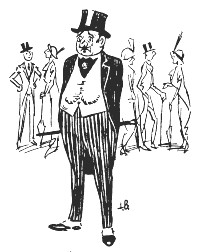
I gave away libraries gratis,
Each village and town to adorn,Till with the expression '
Jam satis!'
Lord Rosebery laughed them to scorn;And soon Mr. Gosse and the groundlings were snarling
At one who must style himself Nobody's Darling!
And now when I purchase their pictures,
Or bid for some family seat,Men pass most disparaging strictures,
Discussing my action with heat;While newspapers term it a 'public disaster'
Each time I endeavour to buy an Old Master!
The country I rob of its treasures
(By carting its ruins away!);I lessen all popular pleasures
By spoiling the market, they say;And so they invoke Mr. George's assistance
To tax the poor plutocrat out of existence!
ROSES ALL THE WAY
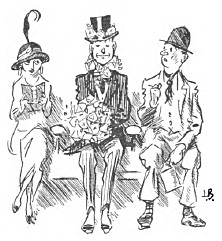
['Mr. Frank Lascelles left London yesterday for Calcutta. As he entered the railway carriage at Victoria, Lady Jane Kenney-Herbert handed him a basket of roses.'—The Times.]
Each year in vain I take the train
To Dinard, Trouville or Le Touquet;No lady fair is ever there
To speed me with a bouquet;No maiden on my brow imposes
A snood of Gloire de Dijon roses!
No purple phlox adorns the locks
Of scanty hair that fringe my cranium;No garlands deck my shapely neck
With jasmine or geranium.I travel, like a social pariah,
Without a single calceolaria!
Though up and down I 'train' to town,
Each day, with fellow-clerk or broker,No female hand has ever planned
To trim my third-class 'smoker,'To wreathe the rack with scarlet dahlias,
Or drape the seats with pink azaleas!
Let others envy wealthy men
—The Rothschilds, Vanderbilts or Cassels—I'd much prefer, I must aver,
Like lucky Mr. Lascelles,To travel well supplied with posies
Of (on the 'Underground')
Tube-roses!
THE TRIUMPH OF JAM
(With shamefaced apologies to the author of a beautiful poem)
[The Daily Mirror, in a leading article, deplored the fact that 'roly-poly' pudding, otherwise known as 'jam-roll,' was not to be obtained at fashionable West End restaurants.]
Although our wives deride for ever,
Though cooks grow captious or gaze aghast(Cooks, swift to sunder, to slash and sever
The ties that bind us to things long past),We will say as much as a man might wish
Whose whole life's love comes up on a dish,
Which he never again may feast on, and never
Shall taste of more while the ages last.I shall never again be friends with 'rolies,'
I shall lack sweet 'polies' where, thick like glue,The jam in some secret Holy of Holies
Crouches and cowers from mortal view.There are tastes that a tongue would fain forget,
There are savours the soul must e'er regret;
My tongue how hungry, how starved my soul is!
I shall miss 'jam-pudding' my whole life through!The gleam and the glamour, glimmering through it,
The steam that rises, to greet the sun,The fragrant fumes of the jam and suet
That mix and mingle, to blend as one;The white-capped cook who stirs so hard,
To twine the treacle and knead the lard,
To soak and season, to blend and brew it—
These things are over, and no more done!I must go
myways (others shall follow),
Filling myself, till I rise replete,With fugitive things not good to swallow,
Drink as my friends drink, eat what they eat;But if I could hear that sound (O squish!)
Of the 'roly-poly' leaving its dish,
My heart would be lighter, my life less hollow,
At sight of my childhood's favourite sweet!Ah, why do I live in an age that winces
At 'shape' (blanc-mange) of a bygone brand,At tripe and trotters, at stews and minces,
At hash or at haggis, heavy in hand?Come lunch, come dinner, no word is said
Of the jam that in suet so veils its head.
I shall never eat it again, for at Princes'
If I cry for it there, will they understand?EGREGIOUS EASTBOURNE
[A recent by-law of the Eastbourne Town Council renders the owner of any dog who barks upon the beach liable to a fine of forty shillings.]
Never more shall I and Ponto
Traverse the Marine Parade,Pass the Pier and wander onto
Eastbourne's Esplanade;Never more, with lungs like leather,
And a heart as light as feather,
Shall we stray and play together
Where we strayed and played!On the cruel Council's shingle
Man and beast no more may mingle!
With what never-ending rapture
Ponto would retrieve a stone,Leap into the sea and capture
Sticks, wherever thrown;Issue dripping from the ocean,
With his tail in constant motion,
And express his true devotion
In a strident tone,Till the Judge, his license marking,
Fined him forty bob for barking!
Still, upon the sands, sopranos
Topmost notes in anguish reach,Masked musicians thump pianos,
Negro minstrels screech;German bandsmen blare and bellow,
But my Ponto, poor old fellow,
May not raise his loud but mellow
Bark upon the beach!'Dumb,' indeed, is every beast born
In the neighbourhood of Eastbourne!
SARAH OWEN
[A provincial schoolmaster wrote to the Daily Mail to say that he had canvassed his employees on the subject of the Insurance Bill and found that out of forty-two domestics only one—'Sarah Owen, sewing-maid'—was in favour of the Servant Tax.]
Come, children, gather round and hark
To my entrancing tale!For though you've heard of Joan of Arc,
Of brave Grace Darling in her barque,
Of Florence Nightingale,Not one of these such nerve displayed
As Sarah Owen, sewing-maid!
Her master ranged his forty-two
Domestics in a row.As from his breast the Bill he drew,
'Shall this be borne,' he asked, 'by you?'
Though forty-one said 'No!''
Mythreepence will be gladly paid!'
Said Sarah Owen, sewing-maid.
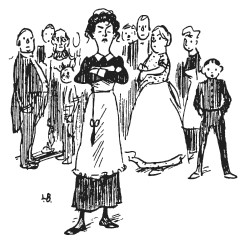
In vain his head the butler shook,
The gard'ner's grins grew broad,The housemaids wore a scornful look,
'What imperence!' exclaimed the cook,
The 'handy man' guffawed.Serene, intrepid, unafraid,
Stood Sarah Owen, sewing-maid!
And whether she was right or wrong,
She showed a dauntless will,A firm resolve, a purpose strong,
Which move me like a battle-song
And make my bosom thrill!The fame and name shall never fade
Of Sarah Owen, sewing-maid!
THE LAST HORSED 'BUS
Fare thee well, thou plum-faced driver,
Poised upon thine airy seat!Final, ultimate survivor
Of an order obsolete!Fare thee well! Thy days are numbered.
Long, full long, by weight encumbered,
Tardily thy team hath lumbered
Down each London Street,Passed by carts, bath-chairs, and hearses,
And the cause of constant curses!
Fare thee well, conductor sprightly,
Gay and buoyant pachyderm,Holding up thy 'bus politely
For each passenger infirm;Yet, when roused to indignation
By a rival's reprobation,
How adroit in the creation
Of some caustic term!Deft to ridicule or rally,
Swift with satire as with sally!
Ancient Omnibus ungainly,
We shall miss thee, day by day,When thy swift successors vainly
We with signals would delay;When upon their platforms perching,
With each oscillation lurching,
We are perilously searching
For the safest wayTo alight without disaster,
While we speed each moment faster!
As our means of locomotion,
Year by year, more deadly grow,We shall think with fond devotion
Of thy stately gait and slow.Harassed, vexed, fatigued, and flurried,
Shaken, discomposed, and worried,
As in motors we are hurried
Wildly to and fro,We perchance shall not disparage
Horse-drawn omnibus or carriage!
STAGE SUPPORT
[The prospective Unionist candidate for Hoxton, at his first meeting, was supported by Lord Shrewsbury, the Hon. Claude Hay, and Mr. George Robey.]
When I stand as 'Independent' next election,
I shall vanquish my opponents, Smith and Brown.(Smith's a Unionist, in favour of Protection,
Brown's a Radical Free Trader of renown.)But my triumph at the polls I shall attribute, I confess,
To the men of light and leading whose assistance spelt success.
Smith may marshal Austen Chamberlains and Carsons
On his platform, for the populace to view;Brown may muster all his Nonconformist parsons,
And a member of the Cabinet or two;I shall need no brilliant orators, no Ministers of State,
If I only can rely on the support of Harry Tate!
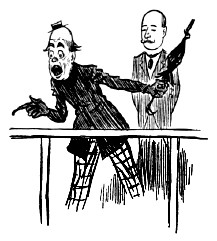
Brown has posters: 'Vote for Brown and Old Age Pensions!'
Smith has placards: 'Vote for Smith and Work for All!'I shall calmly call constituents' attentions
To the pet of ev'ry London music hall,When I publish, as his message, on each flaming window-card:
'Every Vote you give to Johnson is a vote for Wilkie Bard!'
Can you wonder, then, that Independents rally
Round a candidate to whom the Fates allotThat his meetings shall be graced by Cinquevalli,
And his policy endorsed by Malcolm Scott?Or that ev'ry one should mention—proud and humble, poor and rich—
That a vote for Mr. Johnson is a vote for Little Tich?
SCRIBBLERS ALL!
[In the House of Commons, Lord Claud Hamilton referred to Mr. Birrell as a 'distinguished scribbler.']
Who would be a Man of Letters,
Ink on paper daily dribbling,In a fashion which his betters
Scornfully describe as 'scribbling'?Who would practise a vocation
So unlucrative and painful,To deserve a designation
Cruelly disdainful?Pity pen- or pencil-nibblers
Labelled as 'distinguished scribblers'!
Sculptors are but seldom branded—
'Those illustrious plaster-shapers';Violinists' friends, though candid,
Never call them 'catgut-scrapers.'Styling painters 'canvas-scratchers'
Would offend against convention;Surgeons as 'appendix-snatchers'
Nobody would mention.Who would term Lord Claud's directors
'Guinea-pigs' or 'fee collectors'?
Yet, although no politicians
We entitle 'platform-stumpers,'Nor refer to great musicians
As 'immortal pedal-thumpers,'Though we name no leading jurist:
'This notorious legal-quibbler,'Ev'ry writer of the purest
Prose shall be a 'scribbler,'Till the Gribbles cease to gribble
And no more the Whibleys whibble!
THE LYONS CUBS
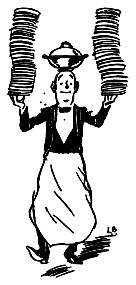
['Waiting is a good, and often a lucrative profession, which must be freed from the hostile prejudice entertained by the ordinary British family. On the Continent and in America there is no such prejudice, and University men often find the profession worth entering.'—Evening Paper.]
I said to George, my eldest son,
'Now that your college days are done,
'And high opinions you have won
'For wisdom and discretion,'The time has come, as I suspect,
'When you should ponder and reflect
'Upon your future, and select
'A calling or profession.'He answered brightly, 'Righto, pater!
'I'd like to be a British waiter!'
'Come, George,' I said, 'don't be absurd!
'I asked what
callingyou preferred.
'The Bar (although, I've always heard,
'The work is something frightful),'The Church, the Services, the Bench,
'Diplomacy—nay, do not blench,
'You know how good you are at French—
'Is each of them delightful;'I'll come for your decision later.'
Said George, 'I wish to be a waiter!
'Yes, at some café let me wait;
'For though I stroked my College eight,
'The year they won the Ladies' Plate,
'How mean a triumph that is,'Compared with his who daily bears
'Whole stacks of Ladies' Plates downstairs,
'Or "bumps" the backs of diners' chairs,
'At Evans's or Gatti's!'A "first" in "Greats" I deem no greater
'Than every exploit of the waiter.
'When single-handed he controls
'Some half-a-dozen finger-bowls,
'Than any Fellow of All Souls
'More talent he evinces,'And shows why those who feel the charm
'Of balancing without alarm
'Six soup-plates upon either arm,
'At Kettner's, Scott's, or Prince's,'To Judge's wig or Bishop's gaiter
'Prefer the napkin of the waiter!'
'THE CRIES OF LONDON'
No 'Milk below maid' now awakes
The city with her plaintive pipe;No tuneful pedlar hawks 'Hot Cakes!'
No wench at dawn the silence breaks
With strains of 'Cherry Ripe!'No cries of 'Mack'rel!' subtly blend
With 'Knives to grind!' or 'Chairs to mend!'
The fireman's shout no more we hear;
'Punch' and his satellites are dumb;No more, when autumn days draw near,
Do songs of 'Lavender!' rise clear
Above the traffic's hum.No 'China orange' now is sold;
The muffin's knell is mutely toll'd!
And yet our nerves are sorely tried—
Since Nature's lute has many a rift—By 'cries' which Tube and 'bus provide:
'Fares please!' ''Old tight, miss!' 'Full inside!'
'No smoking in the lift!' · · · ·And oh! the gulf that separates
'Sweet lavender!' from 'Mind the gates!'
THE MODEL FARM
['If you want good milk, butter, cheese, beef, mutton, and bacon, keep the animals which supply these things amused—give them toys, in fact.'—The Daily Mirror.]
When a friend after breakfast some compliment pays
To the nourishment recently taken,When he mentions the eggs with expressions of praise,
And says flattering things of the bacon,I conduct him at once to my farm on the Downs
Which is managed so blithely and brightlyThat the brows of my cows are unwrinkled by frowns
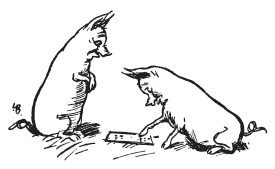
And my chickens are jocund and sprightly,Where dogs in their kennels avoid being snappy,
And ev'ry dumb creature is healthy and happy.
Each sheep is diverted with suitable toys
That shall keep it obese and contented;Ev'ry pig, whose delectable flesh one enjoys,
With a doll or a drum is presented;For 'tis thus that I nurture those succulent lambs
That are always so sweet and so tender,And secure those remarkably delicate hams
Which the sow is so loth to surrender;Ev'ry egg (as supplied to our own Royal Fam'ly)
Is hatched by a hen who has patronised Hamley!
Each ox is devoted to 'Animal Grab,'
Ev'ry heifer plays 'tag' with a wether;There's a swan who at 'Pool' is no end of a dab,
And the pigs play 'Backgammon' together.'Pitch-and-toss' is the favourite game of the bull,
'Ducks-and-drakes' makes the goslings feel perky,While the crossest old ram never 'loses his wool'
When he plays 'Rouge-et-noir' with the turkey;Which is why all my produce—cheese, poultry or mutton—
Appeals to the taste of both gourmet and glutton!
THE ADVENTURER
['Gentleman, aged 26, seeks adventure; well up in finance, badminton, tennis, swimming, canoeing, bridge, and mechanics; banker's reference, if required.'—The Times.]
My word! I'm the chap for adventures!
There's nothing on earth I can't do,From dabbling in doubtful debentures
To paddling a birch-bark canoe!At golf, when I get into trouble,
How 'dead' my approaches are laid!At bridge, how I dauntlessly double
Each spade!While as for lawn-tennis, there never was yet
A player who volleyed so hard at the net!
At chess I've invented a gambit
That fills my opponents with dread;At billiards I don't care a d—— bit
How often I pocket the red!In water I swim like a salmon,
At football I kick all the goals;I'm simply first-class at backgammon
Or bowls,And, really, I'm equally deft and adroit
When I'm handling a mallet or pitching a quoit!
And now for employment I hanker
Where gifts such as mine are of use;(A character, backed by my banker,
I'm only too glad to produce).A life of adventure that's brimming
With badminton, bridge, and canoes,With simple mechanics and swimming,
I'd choose——A life for a man who's 'well up in finance,'
With a sprinkling of sport and a dash of romance!
A PLEA FOR PONTO
[Sir Frederick Banbury moved in the House of Commons:—'That in the opinion of this House no operation for the purpose of vivisection should be performed upon dogs.']
When you're studying the habits Of the germ of German measles,When you're searching out a cure for indigestion,
You may practise upon rabbits, Upon guinea-pigs, or weasels,If you think that they throw light upon the question;
You may note how bad the bite is Of the microbe of bronchitis,By performing operations upon frogs,
But I've yet to hear the mention Of a surgical inventionThat can justify experiments on DOGS.
I would sooner people perished Of lumbago or swine-fever(Or, at any rate, I'd rather they should chance it!)
Than that any hound I cherished From a 'pom' to a retriever,Should be subject to the vivisector's lancet.
I know nought of theoretics, But in spite of anæsthetics—Ether, chloroform or other soothing drug—
(Though perhaps I argue wrongly) I should disapprove most strongly,If I found a person puncturing my pug!
If we wish to make a bee-line For the chicken-pox bacillus,From the hen-house there is nothing to debar us;
We may learn from creatures feline What the causes are that kill us When we suffer from infirmities catarrhous! But when dogs' insides we study, Then our hands and hearts grow bloody,And we needn't be a crank or partisan
To display a strong objection To the so-called vivisectionOf that animal we style the Friend of Man!
THE 'WASTER'
['I think that in certain respects the 'Waster' is one of the great forces of Empire; it is in him that the spirit of the Elizabethan gentleman adventurer survives most vigorously. To me the waster is a peculiarly English product; in many respects he appeals to me more than any one in the community.'—Sir Herbert Tree.]
When others praise the pious,
My own response is faint;I feel no morbid bias
In favour of the saint.My pæans, rather, let me raise
To laud the 'Waster' and his ways!
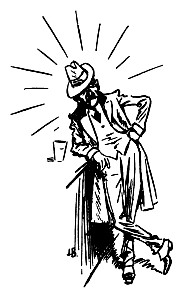
I love to watch my hero,
As through the streets he struts,With loud 'Pip! Pip!' or 'Cheer Oh!'
Greeting his fellow-Nuts,And haunting ev'ry public bar
To cadge a cocktail or cigar!
Each Saturday, at Brighton,
How well he plays the rôleOf Admirable Crichton,
At Grand or Metropole!The British Lion's whelp, indeed,
True scion of the Bulldog Breed!
The 'unco guid' may censure,
The prudes their eyebrows raise;His passion for adventure
Recalls those spacious daysWhen Britain's flag, from sea to sea,
Was borne by 'Wasters' such as he!
And soon 'twill be his mission,
When fall'n on evil times,To bear the old tradition
To far Colonial climes;The seeds of Empire there he'll sow.
Meanwhile, I wish to Heav'n he'd go!
THE CHOICE
[A well-known lady dog-fancier informed a representative of the Daily Mirror that, in case of fire, she would most certainly save her dog rather than her husband.]
'Go! Sound the fire alarm!' she cried.
'My house is all ablaze inside!
'The flames are spreading far and wide;
'The air with smoke is laden!'My darling's in an upper room!
'Oh, save him from a fiery tomb!'
Straight, as she spoke, through sparks and fume
Came brave Lieutenant Sladen.Quoth he: 'The horsed-escape is here, ma'am;
'We'll save your husband, never fear, ma'am!'
'My
husband?' she replied. 'Nay, nay!
'Don't waste your time on
him, I pray,
'But turn your thoughts without delay
'To things that really matter.'For though my weaker-half's asleep,
'A faithful lap-dog, too, I keep,
'And if I hold the former cheap,
'I idolise the latter.'Gladly, to save the best of bow-wows,
'I'd sacrifice,' she sobbed, 'my spou-ouse!
'How prettily my nose he licks!
'(I'm speaking of the dog) and pricks
'His ears and barks, while as for tricks
'He never seems to tire, man!'He'll balance sugar on his snout——'
From burning windows came a shout;
Her husband suddenly leaned out
And thus addressed the fireman:'You've seen the sort of wife I cherish;
'Then be humane and—let me perish!'
ODE ON A DISTANT PROSPECT OF BOSTON SCHOOL
(With apologies to Thomas Gray)
[Lord Tankerville was reported to have removed his son from Eton and sent him to school at Boston, U.S.A., where he would be known as Charles Bennet and be free from 'the kowtowing of a sycophantic crowd of pseudo-aristocrats who lick the boots of our young noblemen' at English schools!]
Ye modern spires, ye fireproof floors,
Of Boston's boarding-school,Each grateful scion still adores
Your Hiram's homely rule;For here no boy would ever brag
That he employed a ducal 'fag,'
His 'brolly' for to furl,Or sent a Baronet 'up town'
To fetch his tea from 'Little Brown,'
Or caned a belted Earl!His scorn of lords the youthful Yank
Can openly display,For here, regardless of their rank,
The little Viscounts play.The Earl of Byfleet's eldest son
Is known as Percival T. Bunn,
And joins the common scrum,As daily he delights to share
With Chas. K. Grubb (Lord Woking's heir)
His wad of chewing-gum!Here Reginald, Lord Swaffield's boy,
Protects beneath his wingThe family of Kid McCoy,
The famous Doughnut King;While John, the Duke of Portsmouth's child
('Jawn' by his school-companions styled),
Forgets his kith and kin,And soon begets a taste, alack!
For 'highballs,' 'cocktails,' 'canvasback,'
For clams and terrapin!To each his fancies! I have done.
And yet, for auld lang syne,Though Boston suits another's son,
Eton I'll choose for mine!And though he won't acquire a twang,
Or get the hang of Yankee slang,
Like others of his class,My son I'll seek to Anglicise;
For, if Lord Tankerville be wise,
I'd sooner be an ass!THE SPORTING SPIRIT
['The emotional surprise and the unexpected suddenness in the rise of game require great accuracy, rapidity, and nerve control, and experience is in my favour that there are some who are improved in these essentials of good shooting by a little alcohol at lunch.'—Dr. T. Claye Shaw in the Times.]
It once was my habit to miss ev'ry rabbit
At which I might happen to fire;I wasted each cartridge despatching some partridge
To die in a neighbouring shire.By nature ungainly, I struggled, but vainly,
A duck or a woodcock to kill,And cut a poor figure when pressing the trigger
With far greater vigour than skill,Until, all at once, I discovered a tonic,
And now (so to speak) my adroitness is chronic!
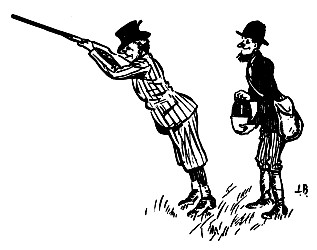
A flask of old brandy I always keep handy,
And, after an opportune nip,My wits are collected, my aim is corrected,
My weapon with firmness I grip.I notice, untroubled, that all things are doubled;
Two outlines I hazily traceOf ev'ry cock-pheasant, and shooting grows pleasant
When each single bird is a brace;Each teal has a twin, ev'ry black-cock a brother,
And so I am bound to hit one or the other!
My methods may flurry those neighbours in Surrey
Whose eyes I persistently wipe,And startle the Vicar whom once, when in liquor,
I shot, in mistake for a snipe;At Bolton or Belvoir my faithful retriever
Retrieves more than any dog there;No bag is so heavy as that which I levy
At Welbeck, so what do I care?Sustained by old brandy, in covert or stubble,
My fame (and my game) I can daily redouble!
PERSPECTIVE
['It is sad and humiliating, but true, that our humanity is a matter of geography.'—The Pall Mall Gazette.]
When told that twenty thousand Japs
Are drowned in a typhoon,We feel a trifle shocked, perhaps,
But neither faint nor swoon.'Dear me! How tragic!' we repeat;
'Ah, well! Such things must be!'Our ordinary lunch we eat
And make a hearty tea;Such loss of life (with shame I write)
Creates no loss of appetite!
When on a Rocky Mountain ranch
Two hundred souls, all told,Are buried in an avalanche,
The tidings leave us cold.'Poor fellows!' we remark. 'Poor things!'
'All crushed to little bits!'Then go to
Bunty Pulls the Strings,
Have supper at the Ritz,And never even think again
Of land-slides in the State of Maine!
But when the paper we take in
Describes how Mr. JonesHas slipped on a banana-skin
And broken sev'ral bones,'Good Heavens! What a world!' we shout;
'Disasters never cease!''What
isthe Government about?'
'And where are the Police?'Distraught by such appalling news
All creature comforts we refuse!
Though plagues exterminate the Lapp,
And famines ravage Spain,They move us not like some mishap
To a suburban train.Each foreign tale of fire or flood,
How trumpery it growsBeside a broken collar-stud,
A smut upon the nose!For Charity (Alas! how true!)
Begins At Home—and ends there, too!
'RAG-TIME'
At dawn, beneath my casement,
Scrubbing the area stairs,The boot-boy in the basement
Is whistling rag-time airs.At breakfast, while I'm eating,
A German band outsideWith unction keeps repeating
The latest 'Wedding Glide.'Where'er I go, whate'er I do,
I can't escape from 'Hitchykoo'!
Pursued, as by a pixy,
By each infectious air,I 'Want to be in Dixie'
When ev'rybody's there!Though 'Honolulu-looing'
I've done my best to shun,What 'Ev'rybody's Doing'
I cannot leave undone!The subtle spell I can't withstand
Of 'Alexander's Rag-Time Band'!
Like ancient hosts of Midian,
I kneel, enslaved and tame,Before a modern Gideon,
And Melville is his name!He grips me without pity,
He binds me with a thongOf contrapuntal ditty,
Of syncopated song!And in his sweet, seductive strains
I hear the rattle of my chains!
So, when you next behold me
Perform a Turkey-trot,In fashion which (they've told me)
Makes chaperones feel hot;Or with a strict adherence
To rules of Bunny-hug,Combine the ape's appearance
With manners of the Thug,I beg you won't find fault with me,
But lay the blame on Melville G.!
'THE PIPES'
The voice of the violoncello
Brings peace and enjoyment to some,The cornet appeals to one fellow,
Another enjoys a big drum;The horn and the bugle, of melody frugal,
A third deems agreeably stirring,The twang of the zither, the piccolo's twitter,
A fourth is preferring;But none who attains to the years known as riper
Can fail to be moved by the pipes of the Piper!
O Piper, processioning proudly
Round tables where men sit at meat,Performing your pibrochs so loudly
That no human voice can compete,What memories tender your dirges engender!
Your wind-bag successfully squeezing,You stir the affections and wake recollections,
Both painful and pleasing,That soothe (like a poultice) or sting (like a viper)
The hearts that respond to the pipes of the Piper!
O Piper, persistently plodding
At dawn round some castle in Skye,Where guests (with their ears full of wadding)
On couches of agony lie,No thrush in the thicket, no frog, and no cricket,
No creature on land or in ocean,Expressing its passion in musical fashion,
Can rouse such emotionAs sets the most soulless of Sassenachs wiping
The tears from his eyes at the sound of your piping!
Though many may term you infestive,
Discordant, or dull, as they please,Or say that your skirls are suggestive
Of pigs being bitten by bees;There's nought so exciting, for marching or fighting,
As sounds that your chanter produces;No strains so entrancing, for dining, or dancing,
Or similar uses!In peace or in war, for civilian or 'sniper,'
There's nothing on earth like the pipes of the Piper!
MODERN DANCING
When the Waltz was first invented,
Grandmamma was much upset;Long she mourned, and loud lamented,
Staid Quadrille and Minuet.In her eyes (a bit oldfashioned)
Waltzing called for condemnation,As a somewhat too empassioned
Form of social relaxation!Grandma, with averted head,
Swept her daughters home to bed!
When the practice of 'reversing'
Revolutionised the dance,Dear Mamma was heard aspersing
Fashions introduced from France.With invectives harsh and stinging
She abused those youthful dancersWho were over fond of 'swinging'
Partners in the Kitchen Lancers;Ragging, as a ballroom sport,
Made Mamma get up and snort!
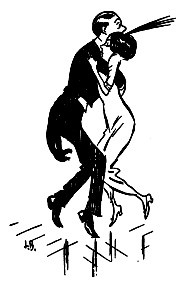
Now, when Bunny-hugging habits
Elevate maternal hairs,When our daughters act like rabbits,
And our sons behave like bears;When the modern ballroom gang goes
Through the complicated mazesOf those pseudo-Spanish Tangoes
(Last of corybantic crazes!),We can only gaze aghast,
Like our forbears in the past!
But although each he (or she) grows
More and more inclined to romp,Emulating am'rous negroes
In some Mississippi swamp,Recollect, when Gossip chatters,
Though the best hotels taboo it,'Tisn't
whatwe dance that matters,
But the way in which we do it!Chaperones may look askance:
Honi soit qui mal y—dance!
THE PUBLIC INTEREST
['We are entitled to use courteous or discourteous language, according as we think the public interest requires it.'—Lord Hugh Cecil.]
When rivals in the Party fray,
Their sluggish blood unwarmed,An old-world courtesy display
('My honourable friend,' they say,
'Is surely misinformed?')Such feeble methods I despise,
My principles are higher;Opponents I apostrophise
With piercing and persistent cries
Of 'Renegade!' or 'Liar!'For I can hear, above the din,
A voice within my breastThat bids me use such language, in
The public interest.Some golfers, when they miss a putt,
Look mortified or frown,Keeping their lips discreetly shut,
They say 'Good gracious!' or 'Tut-tut,'That makes me seven down!'
Such self-control is hard to bear,
I loathe their sickly phrases,And much prefer, to clear the air,
An honest 'Blast!' or 'Blazes!'Explaining, if the caddies grin
Or partners should protest,That I am simply swearing, in
The public interest!When ladies whom I chance to meet
In crowded Tube or tramAttempt to oust me from my seat
Or tread upon my tender feet,
I always murmur 'Damn!'And when upon the telephone,
'Exchange' remarks, 'Line's busy!'My choice of language, and its tone,
Makes hardened operators groan
And supervisors dizzy.For I maintain, through thick and thin,
Discourtesy is best,So long as you display it in
The public interest!THE MILITANTS
Though Man, who alas! is our master,
Declares us unfit to be free,Ignoring the placards we playfully plaster
On paling and pavement and tree;And though ev'ry journal, with cunning infernal,
Our speeches refuses to quote,Our conduct bears witness to feminine fitness,
And shows we are ripe for the Vote!On roofs and in cellars we've hidden,
We've chained ourselves firmly to posts,Attended receptions, without being bidden,
And heckled political hosts.With dog-whip and missile, with bell and with whistle,
Our cause we have sought to promote;By scratching and squalling, by biting and brawling,
We've proved ourselves fit for the Vote!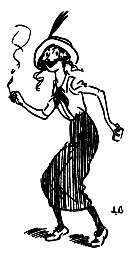
What tales of our feats could be written!
Of damage we love to inflict,Of constables wounded with hatpins, and bitten,
Of Cabinet Ministers kicked!Of how, when in Holloway, nought would we swallow
Until it was forced down our throat,To prove to the nation by auto-starvation
How worthy we were of the Vote!The gardens at Kew we've uprooted,
We've ruined the 'greens' on the links,The letters of innocent strangers polluted
With poisonous acids and inks!Like lunatics turning to wrecking and burning,
For others we care not a groat,But meditate gaily fresh outrages daily,
To prove ourselves fit for the Vote!PLAGUES AT THE PLAY
['Last night even the postprandial conversation of some well-dressed members of the audience failed to neutralise the effect of the music, though they did their best.'—The Times.]
'Well-dressed,' and well-fed, and well-meaning (God knows!),
They arrive when the play is half ended;As they pass to their stalls, through the tightly-packed rows,
They beruffle your hair and they tread on your toes,
Quite unconscious of having offended!Then they argue a bit as to how they shall sit,
And uncloak in a leisurely fashion,While they act as a blind to the people behind
Who grow perfectly purple with passion;Till at last, by the time they are seated and settled,
Their neighbours all round them are thoroughly nettled!
A programme, of course, they've forgotten to buy
(This in audible accents they mention),And whenever some distant attendant they spy,
They halloo or give vent to remarks such as 'Hi!'
In attempts to attract her attention.After this (which is worse) they will loudly converse,
And enjoy a good gossip togetherOn the clothes they have bought and the colds they have caught,
On the state of the crops and the weather,Till they leave, in the midst of some tense 'situation,'
That's spoilt by their flow of inane conversation.
O managers, pray, am I asking too much
If I beg that these 'persons of leisure'Be kept in a sound-proof and separate hutch,
If their nightly theatrical manners are such
As to spoil other playgoers' pleasure?For it can't be denied that a playhouse supplied
With a cage for such talkative parrots,Or a series of stalls (of the kind that have walls
And some hay and a couple of carrots)Would bestow on the public a boon and a blessing
And deal with an evil in need of redressing!
A SUGGESTION
[Addressed to the lady or gentleman who had abstracted two pictures from the Royal Academy.]
My friend, why did you hold your hand,
Why falter, why desist,When there are treasures in the land
That never would be missed?Next time you plunder the R.A.,
Its precincts do not quitTill you have made, as plumbers say,
A thorough job of it.Take ev'ry so-called work of art
And (with a nation's thanks) depart!
Remove each Royal Portrait, do,
Each Presentation Bust,And all those Problem Pictures, too,
Which have to be discussed.Take ev'ry daub that's labelled 'Spring'
Or 'Chelsea in a Fog,'Or 'Home again!' or 'Baby's Swing,'
Or 'Mrs. A. and Dog.'Take 'Hanging up the Mistletoe!'
And (with the public's blessing) go!
Then prosecute your search elsewhere,
If fame you wish to win;Take Shakespeare's bust from Leicester Square
And Cleopatra's Pin.Take sculptured Statesmen, hand to breast,
Who on our pavements smile,And half the statues that congest
The Abbey's crowded aisle.And, last of all, whate'er befall,
Don't fail to take the Albert Hall!
NOBODY'S DARLING!
ROSES ALL THE WAY
THE TRIUMPH OF JAM
EGREGIOUS EASTBOURNE
SARAH OWEN
THE LAST HORSED 'BUS
STAGE SUPPORT
SCRIBBLERS ALL!
THE LYONS CUBS
'THE CRIES OF LONDON'
THE MODEL FARM
THE ADVENTURER
A PLEA FOR PONTO
THE 'WASTER'
THE CHOICE
ODE ON A DISTANT PROSPECT OF BOSTON SCHOOL
THE SPORTING SPIRIT
PERSPECTIVE
'RAG-TIME'
'THE PIPES'
MODERN DANCING
THE PUBLIC INTEREST
THE MILITANTS
PLAGUES AT THE PLAY
A SUGGESTION
THE MODEL MOTORIST
THE PARISH PUMP
POLICE COURT SENSE
CANTO II
CANTO III
CANTO IV
CANTO V
CANTO VI
CANTO VII
CANTO VIII
CANTO IX
FEBRUARY
SPRING
SPRING-CLEANING
'ROYAL ASCOT'
'ROSES'
THE END OF THE SEASON
THE COCKNEY OF THE NORTH
'THE TWELFTH'
NOVEMBER
THE CYNIC'S CHRISTMAS
ENVOI
[1] A species of pollack.
[2] Another species of pollack.
THE MODEL MOTORIST
[Sir Thomas Lipton, when stopped by the Chertsey police for 'scorching,' remarked: 'You have your duty to do, boys. I have always found you to be correct. I'm sorry.']
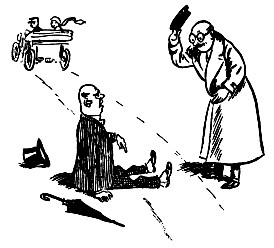
Ye murderous, motoring scorchers,
With manners of Gadarene hogs,Inflicting unspeakable tortures
On children and chickens and dogs;Alarming your fellows with hoots and with bellows,
And filling their infants with terror,Their cattle stampeding, and never conceding
That you could perhaps be in error,Who fall upon Fido and squash little Florrie,
And hasten away without saying you're sorry!
O listen, I beg,
con amore,
Pray pause in your Juggernaut flight,And hark, while I tell you the story
Of Lipton, that chivalrous knight!When charged with exceeding the limit of speeding
By constables ambushed in Chertsey,He scorned to tell 'whoppers' or browbeat those 'coppers,'
But, donning (with marvellous court'sy)The smile that he wears at a ball or a 'swarry,'
Remarked: 'You are always correct, boys. I'm sorry!'
With awe and respect did each 'cop' watch
A creature so rare, so unique,Who questioned no constable's stop-watch,
Who showed neither temper nor pique,But said, 'Do your duty!' in tones rich and fruity,
Admitting at once his transgression,Content to take
theirword, with never a swear-word,
To leave an unpleasant impression;Exclaiming—his parents were Irish—'Begorry!
''Tis me that's the scorcher, and faith, bhoys, I'm sorry!'
Then follow his brilliant example,
Ye chauffeurs to 'joy-riding' prone,And seek by apologies ample
For sins of the past to atone.Your pace do not quicken when dog or when chicken
In 'bonnet' or brake gets entangled,Nor fly in a flutter, and leave in the gutter
The man whom your motor has mangled;But after you've pounced like a hawk on your quarry,
Just stop for a moment, and say that you're sorry!
THE PARISH PUMP
(A BALLADE)
['The parish pump is the best friend of the teacher of history, and the man who, on the basis of Imperialism, sneers at the parish pump, does not know what he is talking about.'—Canon Masterman.]
The pedagogue his desk may thump
And lecture, with a skill profound,On Parliaments called 'Long' or 'Rump,'
On Scone (where Scottish kings were crowned); On butts of Malmsey wine which drownedThe Prince who chanced therein to jump;
On Richard, Gloucester's Duke, renownedFor having a perpetual 'hump';
On Runnymede's immoral clump,
Where poor King John was run to groundAnd signed the Charter (on a stump)
Whereon our liberties we found; On Windsor, where, with horse and hound,The eighth King Henry grew so plump,
And where the doleful courtiers frownedWhen George the Third went off his chump!
Such facts I simply cannot lump,
Preferring greatly to expoundThe tale of how Sir Joseph Crump
Expended many a well-earned pound (No better Mayor was ever found,Although his lady
isa frump!)
On giving Mugley-on-the-MoundA presentation Parish Pump.
Then beat the tabor, blow the trump!
Let welkins with your shouts resound!The cause of Empire cannot slump
While noble deeds like this abound! Go, children, pass the story roundOf how the head of Crump and Comp:
(Whose enemies may Fate confound!)Supplied the Parish with a Pump!
POLICE COURT SENSE
['The evidence that I heard totally failed to satisfy me that he was drunk at all in what, for want of a better definition of the term, I may call the Police Court sense.'—Mr. Chester Jones.]
When Uncle Edward comes to dine,
He drinks such quantities of wine,
You never know How far he'll go, Or what he'll leave unsaid;He frequently insults his host,
And quotes things from the
Winning Post,
Until, with sighs, His friends arise And bear him off to bed.But as they leave him in his bunk,
With what a joy intenseThey realise he is not drunk—
In the Police Court sense!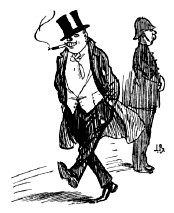
He played bezique with me, one day,
To find that, at the close of play,
He'd lost each game; The total came To three pounds seventeen.He never paid a cent of that,
And took away my new top-hat,
Leaving behind A hideous kind Of gibus, old and green.But still it filled me with relief,
Observing his offence,To think that he was not a thief—
In the Police Court sense!The details of his private life,
The way he treats his luckless wife,
Make all aware That he can care For nothing but himself;But what on earth is she to do,
Though snubbed and beaten black and blue?
To sue, of course, For a divorce Would be a waste of pelf.Yet, all the same, my aunt avows,
It saves her much expenseTo feel she has a faithful spouse—
In the Police Court sense!CLUB CANTOS
CANTO I
THE ATHENÆUM
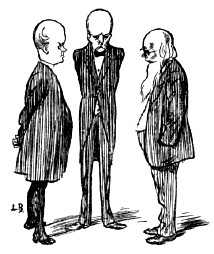
Dignified, austere, infestive,
Stands the stately Athenæum,With an atmosphere suggestive
Of a mausoleum.Freezing silence reigns within
(You can hear the falling pin!)
And the punster points with pride
To the
friezeyou get outside!
Here the Bishop, with his nether
Limbs in leggings swathed demurely(Hatbrim fastened by a tether
To the crown securely),Buttonholes some friendly Duke,
To discuss the Pentateuch,
Or abstracts (with absent mind)
All th' umbrellas he can find.
Here each great and famous Briton
Snored and slumbered almost daily:Thackeray and Bulwer Lytton,
Dickens and Disraeli.Trollope through this doorway stept,
In that chair Macaulay slept,
While, with cotton in his ears,
Herbert Spencer snubbed his peers.
Here our scientific pedants
Write their Monographs on RabbitsOr their studies of the Red-ant's
Socialistic habits.Here the statesman threshes out
Themes of Philosophic Doubt,
While the Laureate scours each shelf
For a rhyme to 'Guelph' and 'self.'
Poet, painter, politician,
Throng this Hall of the Immortals;Sophist, sage, and statistician
Cross these pompous portals.Here the pundits of the State
Herd with the Episcopate;
Scientist and learned lord
Mix with Mr. H-mphr-y W-rd.
If the roof fell in, ah me!
Where would Mother England be?
CANTO II
WHITE'S
Observe the élite, staring into the street,
Through that famous elliptical casement;How coldly they eye all the friends who pass by,
With a look of self-conscious effacement!This ancient tradition of non-recognition
Is dear to all clubs (save Soho ones!),Where Brummels and Nashes still twirl their moustaches,
And even the windows are Beau-ones!Here, once the resort of all lovers of sport,
Are the counters and dice of past players;The belt, too, bestowed upon Heenan, who showed
So much grit when he battled with Sayers.Here, loudly proclaiming their passion for gaming,
Our prodigal ancestors betted;Their shekels they squandered, and home again wandered,
Stone-broke or profoundly indebted!Less prone to high play is the member to-day
Than his forbear, that fire-eating gamester.His pleasure he takes in more moderate stakes,
And his losses don't cause quite the same stir.But, still, a White's-clubber can win a big rubber,
With all of his forefathers' vigour,And double 'no trumps,' too, until the score jumps to
A really respectable figure!A cursory look at the old wager-book
Will discover full many an entryRecalling the age when this club was the rage
Of the pick of our peerage and gentry.But now the old places are filled with fresh faces,
Of members less wise and less witty,Of hearty old busters, of pool-playing thrusters,
Of brokers and blokes from the City,Whose names are less worthy recording on vellum
Than those of a Walpole, a Pulteney, or Pelham!
CANTO III
THE BACHELORS'
While clerks lunch at Lockhart's or Lyons',
And labourers meet at some 'pub,'Society's celibate scions
Resort to the Bachelors' Club;For here all the members elected
Belong to a very smart set,And bask in the sunshine reflected
From Mr. Gillett.Here youths of the Governing Classes
At regular intervals call,To tap barometrical glasses
Or study the tape in the Hall;Discussing the 'latest from Lincoln,'
Comparing the odds of each bet,Or reading out jokes from the '
Pink 'Un'
To Mr. Gillett.And though they severely disparage
Those trammels that Benedicks bind,And members who contemplate marriage
Are spoken to sharply and fined;'The Sex' they regard as no sinners,
And ladies may often be met,Partaking of luncheons or dinners
With Mr. Gillett.Here, too, for young persons of leisure
Who wish to develop the mind,Instruction is tempered with pleasure,
Tuition with fun is combined;New knowledge they gain (one conjectures)
And cerebral stimulus get,Attending the Radium Lectures
Of Mr. Gillett.Then ho! for this celibate centre
For youths who are loth to espouse,Though fish-knives (the gift of their mentor)
May tempt them to cancel their vows!And ho! for that guide and dictator!
Their whistles let bachelors wet(A whisky and soda, please, waiter!)
To Mr. Gillett!CANTO IV
THE GARRICK
If for solitude you feel a partiality,
If you chance to be unsociably inclined,If (like other men of British nationality)
You abominate the presence of your kind; If you take your pleasures glumly And delight in dining dumbly, And if table-talk's a thing you nearly die of; If you look with detestation Upon Gen'ral Conversation, Then the Garrick is a club you should fight shy of!If you hunger for companionship and jollity,
If you much prefer to chatter while you eat,If you condescend at moments to frivolity,
And will fraternise with any one you meet; If your interest is chronic In the art called histrionic, If your passion for the drama's hot and strong, too; If you welcome its professors Telling tales about their 'dressers,' Then the Garrick is a club you should belong to!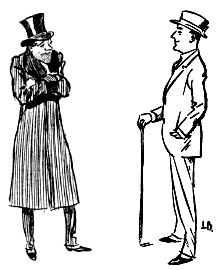
If you come here (say) at supper-time on Saturdays,
You will meet with all the patrons of the stage(Though the place is not so popular, these latter days,
As it was before 'week-ends' became the rage). Here each notable 'first-nighter,' Critic, journalist, and writer, Sprinkles pepper on this club's especial oyster, And you hear a well-known jurist Or some literary purist Telling anecdotes unsuited to the cloister!Here you'll notice, too, a perfect portrait-gallery
Of those mummers who immortal have become,Though they earned, no doubt, a less prodigious salary
Than the moderns who more lucratively mum. On these walls they all assemble, Garrick, Matthews, Irving, Kemble, Men who knew what the traditions of the stage meant, In the days when ev'ry mummer Wore a sealskin coat in summer And would scorn a common music-hall engagement!'Tis a club for ev'ry section of the laity,
Where the Services, the Press, the Bench, the Bar,Find delight in S-m-r H-cks's verbal gaiety
And the anecdotal wit of C-m-ns C-rr. Here the members who are crafty Seek a seat that isn't draughty— In the anteroom or lounge you may discern 'em— And postprandially cluster, Gaining dignity and lustre From the presence of a B-ncr-ft and a B-rnh-m!CANTO V
THE AUTOMOBILE
Pall Mall was a sober and dignified street
In the days (say) of Dickens or Marryat,Where statesmen their peers would with courtesy greet,
Where the senator sauntered on leisurely feet,
And the dowager drove in her chariot. The War Office entries Were guarded by sentries; But Mars was polite to the Graces, And officers' mothers, Their sisters, and others, Called daily on those in high places,Demanding, with true patriotic devotion,
Their sons' (or their brothers') more rapid promotion!
Times changed. The old War Office warren was scrapped,
And this suitable site was selectedBy motorists, goggled, befurred, and peak-capped,
As a central position excessively apt
For the Palace of Fun they erected. In place of old quiet Came racket and riot, As cars at the club kept arriving, Or p'licemen in torrents Poured in, to serve warrants On members for 'furious driving';Where amateur chauffeurs, resolved to be jolly,
Were drowning dull care in a 'Petrol and Polly'!
For those who enjoy fellow-men in the bunch
This is really a fine place of meeting;For here in a crowd men may guzzle and munch
(Though the orchestra makes such a noise while they lunch
That the members can't hear themselves eating). Here thousands forgather, To feed and to blather— Each day brings a fresh reinforcement— And tell (with a dry sense Of fun) how their licence Got marked with its latest endorsement,Or how many yokels and dogs they ran over
The day that they fractured the 'record' to Dover!
CANTO VI
BROOKS'S
How soft those whiskered waiters tread,
Their dishes dexterously handing!'Twould seem (as some one aptly said)
As though a nobleman lay dead
Upon an upper landing,In such tranquillity and quiet
Do members masticate their diet!
Yes, here is peace, that 'perfect peace,'
With loved ones safely at a distance,Which men demand who seek release
From cares that cause the brow to crease
And poison the existence;Peace, comatose—nay, cataleptic—
Dear to the dotard and dyspeptic!
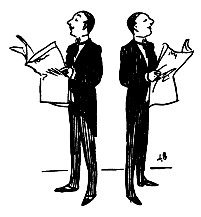
The special feature of the place
Is that it has no special feature;Its tone is that of frigid grace
With which the Briton loves to face
Each human fellow-creature.Here sire meets son, or brother brother,
And neither need address the other!
Within this dignified retreat,
From Government or Opposition,The Whigs of all opinions meet,
Eyeing each other, as they eat,
With looks of dumb suspicion.Here Unionist regards Home Ruler
With feelings daily growing cooler.
Through Brooks's battered ballot-box
His way to fame a man may well win,Who sits where Sheridan and Fox
Discoursed of dice or fighting-cocks
With Wilberforce and Selwyn;Where modern wits and legislators
Converse with no one but the waiters!
CANTO VII
'THE BEEFSTEAK'
While Germans eat flesh that is said to be equine,
And Chinamen batten on birds' nests and dogs,While Frenchmen with
vin ordinaire(such a weak wine!)
Ingurgitate molluscs and frogs,The Briton, old-fashioned, in language empassioned,
On underdone oxen demands to be fed;His soul seems to glory in steaks that are gory,
He 'looks on the kine when they're red,'And all his carnivorous cravings awake
When somebody happens to name 'The Beefsteak.'
'Tis years since the first of those chops began grilling,
Whose smell caused so many choice spirits to throngWhere wags would insist though 'the spirits were swilling,
The flesh was undoubtedly strong'!When Harlequin Rich entertained in his kitchen
That circle which met round his sociable hearth,Where kidneys were roasted and cheese could be toasted
By Johnson and Wilkes and Hogarth,And by most of Great Britain's more notable wits
Whose counterparts nowadays dine at the Ritz.
Some centuries later we find a revival;
Once more 'Beef and Liberty' mingle and blend,Where now 'The Beefsteak' represents, without rival,
La vie de Bohème du West End!Here humorous rallies and jocular sallies
Are heard at a board where the diet is plain,Where Clayton and Wortley conversed so alertly
With Morris or poor Corney Grain,While Brookfield would coin some satirical phrase
Which to-day he discovers in other men's plays!
'Tis said that the neophyte's nerves are affected,
When first introduced here, his throat becomes dry;At sight of the eminent persons collected,
He feels unaccountably shy;Till Bourchier, so breezy, makes ev'rything easy
By slapping the newcomer hard on the back,Or Elliot (our Willie) says, 'Dinna be silly!
Set doon an' we'll hae a gude crack!'When, greatly encouraged, though somewhat abashed,
He orders stewed tripe or a 'sausage and mashed.'
Here friendship and talk are the principal factors
That make of this Club a resort beyond praise,For writers and soldiers, for lawyers and actors
(Who dine here on matinée days).No cards are permitted, but wits can be pitted,
And members in rivalry verbal may vieWho never play poker (although they've a Joe-Carr!)
And deprecate steaks that are high!While brains never weary and tongues never flag,
As they do, I believe, at the Turf or the 'Rag'!
CANTO VIII
THE TRAVELLERS'
Though clubs without number are suited to slumber,
How few (as has often been noted)To rest and reposing, to dreaming and dozing,
Are quite so completely devotedAs that which is labelled, in language poetic,
The final resort of the peripatetic!
Here peace may be relished, in rooms unembellished
By portraits, by prints or engravings,On sofas of leather, designed altogether
To satisfy somnolent cravings,Where, clutching the
Timesor the
Chronicletightly,
A member may slumber in public politely.
A subtle aroma, conducive to coma,
Which renders the coffee-room pleasant,Proves gratefully cloying to diners enjoying
A snooze 'twixt the fish and the pheasant.The air, as it were, is with somnolence seething,
And nothing is heard but their stertorous breathing!
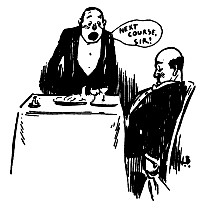
No card-games are played here, and even 'Old Maid' here
Its votaries find uninviting;You might get a quorum for (say) 'Snip-snap-
snorem,'
But 'Patience' is deemed too exciting;While rubbers of Bridge (should you chance to require some)
With partners all 'sleeping' prove terribly tiresome!
These precincts hypnotic provide a narcotic,
And trav'llers (all subterfuge scorning)Curl up on their quarters, and tell the hall-porters
To call them next Saturday morning;And even explorers, their rambles arrested,
Become as 'Club-footed' as some one suggested!
CANTO IX
'THE BATH'
Ye citizens of common clay
Who, squinting in a painful way,
Remove (with grimy hands and grey)
The smuts upon your noses,Come, follow me to Dover Street
Where, any moment, we may meet
Figures as fragrant and as sweet
As new-mown hay or roses,Tripping along the primrose path
That leads each member to 'The Bath'!
Ye breadwinners, who seek in vain
To keep your features free from stain,
When in some matutinal train
To town you daily rush up,Observe the cleanly creatures, please,
Who in this club recline at ease!
Existence for such men as these
Is one long 'Wash and Brush Up'!Perfumed and scented, combed and curled,
They live unspotted of the world!
Here Indian clubs are deftly swung,
And dumb-bells twirled, by old and young;
Here 'horizontal bars' are hung
With eminent patricians;And when, at times, on Sunday nights,
The lady-members (clad in tights),
From swimming-bath's sublimest heights,
Give diving exhibitions,Tis 'Water, water ev'rywhere'—
And sopped spectators get their share!
Observe that youth, with purple socks
And chest suggestive of an ox;
He comes to 'punch the ball' or box
With (possibly) Lord Desb'rough.Observe that Admiral; though old,
He takes a daily plunge, I'm told,
Though when the water's rather cold
He very often says 'Brrrh!'Or, if the suds get in his eyes,
'Here! What the
douche!' he crossly cries.
That warning, to the sloven dear:
'Abandon Soap who enter here!'
Upon these walls does not appear,
To reassure the dirty;But on the Turkish bathroom screen,
Pinned to a notice-board of green,
This statement, day by day, is seen:
'Pores Open, 7.30.'Till Bishops at 'The Bath,' they say,
Are moved to murmur, 'Let us Spray!'
Then, Gentle Reader, I advise
(Should opportunity arise)
That you should be extremely wise
And join this institution;And thus, though deeming dumb-bells 'Bosh!'
And scorning hectic games of 'Squash,'
You may enjoy a thorough wash,
A top-to-toe ablution,Nor die, in deep dejection plunged,
'Unsoapt, unlathered, and unsponged!'
SONGS IN SEASON
NEW YEAR'S EVE
In fashion reflective, with plaint or invective,
We view in perspective the year in eclipse,The duties neglected, the faults uncorrected,
The blunders, the failures, the slips!We note with depression that painful procession
Of lapse and transgression which held us in thrall,The sins of omission, the vaulting ambition,
The pride that preceded each fall!Regretful, alas! we are loth to remember
The good resolutions we made last December!
The keen politicians who cherished ambitions
To better conditions for sons of the State,Make private confession of wasting each session
In fruitless and futile debate;The Peer of position regards with contrition
That past inanition, so hard to resist;The social reformer grows sensibly warmer,
To note opportunities miss'd;While Cabinet statesmen still seek (somewhat sadly)
For patience to suffer the Suffragettes gladly!
But never despairing, each mind, greatly daring,
Fresh programmes preparing, fresh projects revolves;New plans undertaking, new promises making,
New plots, new designs, new resolves!With hopes unabated, and spirits elated,
We feel ourselves fated, this year, to succeed,Devising and dreaming, suggesting and scheming
To triumph, to conquer, to lead!With hearts that are wiser (though probably sadder),
We start once again at the foot of the ladder!
FEBRUARY
['Really, there must be something rather fine in the English character that enables it to triumph over the English climate.'—The Pall Mall Gazette.]
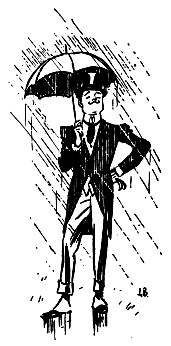
I gaze each morning through my rainswept casement,
Into the murky, mud-bound street below;I grimly note the slush that floods the basement,
The hail, the sleet—and oh! I feel that I am greater than I know! Only a demigod could thrive 'Mid such surroundings drear; Only a hero could survive In such an atmosphere!Each day the sullen sky becomes more leaden,
The weather grows less suited to a dog;Each night damp mists arise, to chill and deaden!
(The golf-course is a bog: Twice has my ball been stymied by a frog!) Still sweetly in my bosom wakes The knowledge nought can mar, That 'tis our island climate makes Us Britons what we are!For if we basked in fragrant, warm oases,
We should not wear that air of self-controlWhich, round about our placid British faces,
Shines like an aureole, Expressing true stolidity of soul. To chill and gloom, to frost and thaw, Our country owes to-day The dogged jaw of Bonar Law, The eye of Edward Grey!O Mother England, wettest of wet nurses,
Where would a poet be without your clime,Which gives him such a subject for his verses,
Supplying (ev'ry time) A reason for his undistinguished rhyme? His lesson may be sharp and stern, His anguish keen and long; But so in sniffing he may learn What he expounds in song!SPRING
When the hand of ev'ry Briton, 'spite of glove or woolly mitten,
By the frost severely bitten, grows as frigid as a stone,When he scuttles like a lizard through the bitter biting blizzard,
Which benumbs his very gizzard and which chills him to the bone;When the constable stands scowling, where the hurricane is howling,
Or goes miserably prowling, with no shelter from the storm,And the working-man, half-fuddled, jug to bosom closely cuddled,
In each public-house is huddled, in his efforts to get warm;Then the poet (known as 'minor') deems it suitable to sing
That there's nothing much diviner than the pleasures of the Spring!
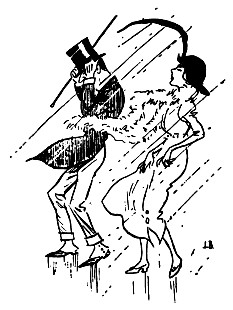
When the maiden, matinéeing, from some playhouse portals straying
(Where her favourite is playing), grows as crusty as a crab,While her fiancé ungainly—so unlike dear Harry Ainley!—
In the snow is seeking vainly (ah! how vainly!) for a cab;When he cusses and she fusses, as they note how full each 'bus is
Of that crowd of oafs and hussies it refuses to disgorge,Till they hail some passing taxi, with expressions wild and waxy
(Like the language Leo Maxse always uses of Lloyd George)!With her windswept skirt she battles, to his hat he tries to cling,
While the poet sweetly prattles of the pleasures of the Spring!
Though I hate to be pedantic, and it may seem unromantic,
I am driven nearly frantic when I hear the praises sungOf those ruthless vernal breezes which engender coughs and sneezes
And disseminate diseases in the ranks of old and young.So, although it sounds like treason, when I celebrate this season,
I will mix my rhymes with reason, and substantiate, I trust,That there's nought so uninviting, so depressing, and so blighting,
As the time of which I'm writing with such genuine disgust.As I hover round the fender, and for fuel loudly ring,
I decline to see the splendour or the witchery of Spring!
SPRING-CLEANING
['The only way to get workmen out of the house is to move in oneself.'—The Bromide's Handbook.]
Let me sing in mournful numbers
Of the sorrows of the Spring,When the house is full of plumbers
And the builder has his fling!Ladders lean on ev'ry landing,
Pails repose on ev'ry stair,Painters, who on planks are standing,
Block the road to ev'rywhere,And with pigments evil-smelling
Drive us from our dismal dwelling.
Stairs are carpetless to step on,
Bannisters are far from dry,While (like Damocles's weapon)
Plaster threatens from on high.Any room we chance to enter
Our depression but completes:Chairs and tables in the centre
Hide beneath encircling sheets,And the painters (horrid vandals!)
Have deprived the doors of handles.
Workmen through our windows peering
Spread their pitfalls in our path;Daily we are found adhering
To some freshly-painted bath;Daily have our cooks contended
That, however great our grief,Till the kitchen-range be mended,
We must live on frigid beef;And at last we grasp the meaning
Of that fatal phrase, 'Spring-Cleaning'!
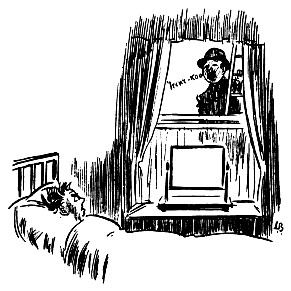
'ROYAL ASCOT'
Ho! find me my faithful field-glasses
(The kind with collapsible joints);Ho! bring me my bundle of passes,
My pencils (the ones that have points); Ho! give me my 'topper,' The head-dress that's proper For meetings where Royalties muster; Put scent on my 'hanky' (That's quite enough, thankye!) And polish my boots with a duster;That so I may venture, with grace and composure,
To mix with my peers in the Royal Enclosure!
At Ascot, where beautiful dresses
Enrapture the masculine gaze,How oft I've indulged in excesses
Of hock-cup and cold mayonnaise! How oft in the Paddock (Though squashed like a haddock) Each thoroughbred's heels I've eluded! What fortunes I've flung to The Ring, which they've clung to, Those touts who my pockets denuded!What niggardly odds did those bookmakers lay me!
(How often have ladies forgotten to pay me!)
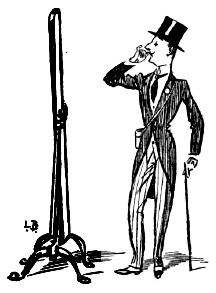
At Ascot, that popular function,
Society leans on the rails,And sport is enjoyed in conjunction
With lobsters and underdone quails! While Rank and while Fashion Regard with compassion The antics of clown or of nigger, But one imperfection Appears, on inspection, This party to mar or disfigure:'Twould be the most perfect of meetings and courses,
If only——if only there weren't any horses!
'ROSES'
A MEMORY OF 'ALEXANDRA DAY'
(With apologies to Wordsworth)
I wandered shyly as a ghost
That prowls in haunted keeps and tow'rs,When all at once I saw a host,
A crowd of ladies selling flow'rs;Along the Mall, beside the Pond,
From Lady Cr-we to Lady M-nd!
Continuous as the stars that shine,
Like poppies in a field of wheat,They stretched in never-ending line
Along the kerb of ev'ry street;Ten thousand saw I, file by file,
Selling their 'blooms' with sprightly smile.
The world about them smiled, for they
Bedecked the dingy thoroughfares;A fellow could not fail to pay
His penny for such wares as theirs.I bought and bought—but little guessed
What wealth those simple flowers expressed.
For all the cash they helped to net,
In streets where stood their rosy stalls,Went to reduce that endless debt
Which is the curse of hospitals;And Chairmen cast dull care away
And danced on Alexandra Day!
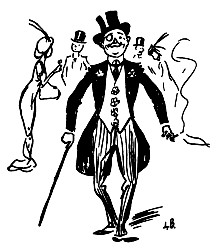
THE END OF THE SEASON
How grimy and gritty are streets in the City,
How parched is each pavement and park,Where Londoners harried in thoroughfares arid
Forgather from dawn until dark!An atmosphere torrid, oppressive and horrid,
With leather-like lungs we inhale,While odorous motors (more pungent than bloaters)
Our impotent nostrils assail,And whistles and catcalls and horns without number
Combine to destroy all our chances of slumber!
How weary my heart is of dinners and parties,
How sick of each concert and play!All social exertion I view with aversion,
Of banquets I dream with dismay.Each moment enhances my hatred of dances,
All luncheons with loathing I hail;At ev'ry collation, in sheer detestation,
I shrink from each cutlet or quail;For though I enjoy such delights within reason,
I gratefully welcome the end of the Season!
The holiday feeling is over me stealing,
I long to escape from the town,Exchanging its highways for hedges and byways,
For moorland and meadow and down.In cobble-paved alleys how verdant the valleys,
How fragrant the forests appear,Where fountains are flashing, and rivulets splashing
Make melody sweet to the ear;Where Orpheus his musical message delivers,
And Pan and his piping are heard by the rivers!
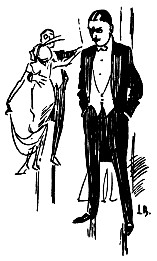
THE COCKNEY OF THE NORTH
(With apologies to W. B. Yeats)
I will arise and go now, and go to Inverness,
And a small villa rent there, of lath and plaster built;Nine bedrooms will I have there, and I'll don my native dress,
And walk about in a d—— loud kilt.And I will have some sport there, when grouse come driven slow,
Driven from purple hill-tops to where the loaders quail;While midges bite their ankles, and shots are flying low,
And the air is full of the grey-hen's tail.I will arise and go now, for ever, day and night,
I hear the taxis bleating and the motor-'buses roar,And over tarred macadam and pavements parched and white
I've walked till my feet are sore!For it's oh, to be in Scotland! now that August's nearly there,
Where the capercailzie warble on the mountain's rugged brow;There's pleasure and contentment, there's sport and bracing air,
In Scotland——now!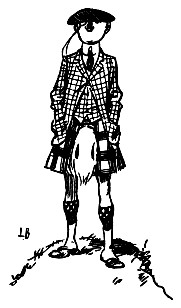
'THE TWELFTH'
If you're waking, call me early,
Call me early, Rob MacDougall,When the skies are pale and pearly
And the air is keen and chill;And we'll break our fast together,
In a fashion somewhat frugal,And be off across the heather
To 'the hill.'Soon will coveys come a-flitting,
Over purple slopes and ridges,To the butts where we are sitting
With our loaders close behind.Though the mist obscure our vision,
And our necks are stung by midges,And we shoot without precision,
Never mind!If the birds fly fast and freely
O'er the lair where we are lyingWith the cartridges that Eley
So obligingly supplies,When the drive is duly ended
We can count the dead and dyingWe have rent (or is it 'rended'?)
From the skies!As we stimulate the labours
Of retrievers bent on findingStricken birds our next-door neighbours
Will indubitably claim,We declare to one another
(Though we scarcely need reminding)That a grouse beats any other
Kind of game,And that, given sport and weather,
There is nothing like the thrillOf a day among the heather
On the hill!NOVEMBER
Poets may proclaim the praises
Of some fragrant April day,Search their lexicons for phrases
To describe the dew-drenched daisies
Of each merry May;Minor bards may work like niggers,
Framing epic rhyme or rune,To extol the timely rigours
Of an English June;Though its charms I well remember,
I prefer November!Though the tourists sing together
When July is warm and bright,While to sportsmen on the heather,
Bent on bagging fur and feather,
August brings delight;Though September's seldom stormy,
And October, chill and dry,Carries joy to every Dormy-
House from Wick to Rye;Yet (since I am not a member)
I prefer November!In the street the slime may spatter
Ev'ry wretched passer-by;Hail and sleet and snow may batter
On my window-pane—what matter?
What on earth care I?Other months may be less muddy,
Or a fairer face present;In my cheerful firelit study
I am quite content!Seated by the glowing ember,
I prefer November!THE CYNIC'S CHRISTMAS
Christmas is here! Let us deck ev'ry dwelling
With evergreen branches and mistletoe boughs!With thoughts philanthropic our bosoms are swelling,
No shadow should darken our brows!(But, alas! when we're fixing festoons to the ceiling,
The ladders we stand on are apt to give way,When a desolate feeling comes over us stealing;
'Tis hard to be merry and gay!And it's difficult, too, to feel thoroughly jolly
When painfully punctured by pieces of holly!)
Christmas is here! Let the plums and the suet
Be mingled once more in ungrudging supplies!Let the lover of punch hasten swiftly to brew it!
Make ready a score of mince-pies!(But, alas! let us not be completely forgetful
Of how indigestion is fostered and bred,How a surfeit of food makes the family fretful,
While alcohol flies to the head;Lest a fortnight devoted to over-nutrition
Entail a recourse to the nearest physician!)
Christmas is here! Ev'ry mother shall borrow
Her spouse's best stockings to tie to the cotOf the baby, who hopes they'll contain, on the morrow,
Drums, trumpets, and goodness knows what!(But it's rather a blow when the footwear allotted
To hang full of goodies and toys through the night,Is returned to its owner, misshapen and clotted
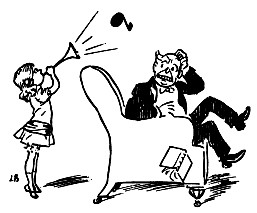
With toffee and Turkish Delight;While a drum is a bore if you constantly thump it,
And life can be poisoned by sounds from a trumpet!)
Christmas is here! All our nephews and nieces
Troop happily home to delight us at Yule!We rejoice when the holiday season releases
The inmates of college and school!(But perhaps when at dawn they awake us by shouting
'When Shepherds'—a hymn which they sing out of tune—They may furnish some fifty good reasons for doubting
If holidays are such a boon;And even the kindliest relative wearies
Of constantly answering juvenile queries!)
Christmas is here! Little children excited
Make domiciles vocal with shrieks of applause,As they ask that the candle-decked fir-tree be lighted,
In honour of kind Santa Claus!(But, alas! for the person of years known as 'riper'!
By clatter and racket his nerves are unstrung;He is followed about, like a second Pied Piper,
By droves of the clamorous young!All in vain does he seek for some haven of quiet;
No room in the building is free from their riot!)
Christmas is here! Let us load our relations
With presents expensive and offerings rare,And assume, as we lavish our tips and donations,
A noble and bountiful air!(But, alas! when we've purchased the costliest jewel
For dear Cousin Jane, and despatched it by post,And she sends in return a small mat, worked in crewel,
And worth eighteenpence at the most,Shall we say, recollecting the gift that we bought her,
'Dear Jane is a trifle more
dearthan we thought her'?)
Christmas is here! Let us go serenading,
In glees and in madrigals raising our voice,In the snow of the street, 'neath your windows parading,
O maidens divine of our choice!(But we mustn't forget how our
lastChristmas carols
Were spoilt by your parents' inhuman attacks,When they brought out their shot-guns and emptied both barrels
Bang into the smalls of our backs!If one justly expects some applause and encoring,
A ball in the back is excessively boring!)
Christmas is here! At a season so sprightly
We banish all thoughts about mundane affairs,And attempt to be gay and to smile fairly brightly,
In spite of our worries and cares.(But financial embarrassments mortify most men
Whose hearts a prognostic of bankruptcy grips,When the dustmen and milkmen, policemen and postmen,
Demand their habitual tips!) · · · · · ·Then tell me—and grateful I'll be to you, very—
Oh, tell me why Christmas was ever called 'Merry'!
ENVOI
[All work, says a well-known humorist, is an unutterable bore. All that concerns the writer are the cheques his work brings him in.]
Simple is the man who fancies,
In his fond and foolish heart,That the author weaves romances
For the love of Art;That the poet's torch, ignited
By some sacred inner fire,Is a spark of genius lighted
To illume his lyre;That 'tis Honour or Ambition
Prompts the bard to composition!
No celestial inspiration
Gilds the poet's cheerless den,Kindles his imagination,
Stirs his sluggish pen;No divine
afflatus, blowing
From some charmed Pierian font,Starts the springs of fancy flowing
Like the spur of Want.This, poor Pegasus controlling,
Sets the eye in frenzy rolling!
Not in search of fame or rank is
He who drives this fretful quill,But his balance at the bank is
Practically nil,And the cause, the motive, lying
At his inspiration's roots,Is the sound of children crying,
Crying out for boots;'Tis the need for ready money
Makes the humorist so funny!
Printed by T. and A. Constable, Printers to His Majesty
at the Edinburgh University Press
FOOTNOTES:
[1] A species of pollack.
[2] Another species of pollack.
TRANSCRIBER'S NOTES:
Inconsistencies in spelling and hyphenation have been retained from the original.
Punctuation has been corrected without note.
As a saith[1] else a lythe[2])!
As a saith[1] else a lythe[2])!