


автордың кітабын онлайн тегін оқу Silver Cross
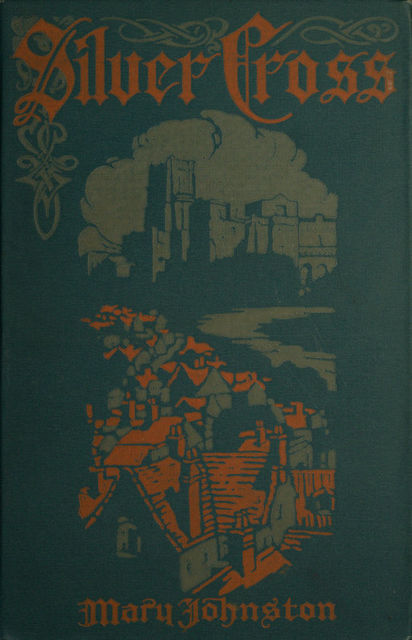
SILVER CROSS
Transcriber’s Note
Variant spelling is retained, a very few changes have been made to standardize punctuation and spelling.
SILVER CROSS
By
MARY JOHNSTON
BOSTON
LITTLE, BROWN, AND COMPANY
1922
Copyright, 1922
By Little, Brown, and Company.
All rights reserved
Published March, 1922
Printed in the United States of America
SILVER CROSS
CHAPTER I
Henry the Seventh sat upon the throne.
The town of Middle Forest had long since pushed the forest from all sides. Its streets, forked as lightning, ran up to the castle and down to the river. The river here was near its mouth, and wide. The bridge that crossed it had many arches. Below the bridge quite large craft, white and brown and dull red, sailed or dropping sail, came to anchor. Answering to hour and weather the water spread carnation, gold, sapphire, jade, opal, lead and ebony. Now it slept glassy, and now wind made of it a fretful, ridged thing. The note of the town was a bleached grey, but with strong splashes of red and umber. A sharp, steep hill upheld the castle that was of middle size and importance, built by the lords Montjoy and held now by William of that name.
Behind the town a downward sloping wood tied the castle hill to fields and meadows. The small river Wander ran by these on its way to join the greater stream. Up the Wander, two leagues or so, in a fertile vale couched the Abbey of Silver Cross. Materially speaking, a knot of stone houses for monks—Cistercians, White Monks—a stately stone house for God and his Son and Mary; near-by a quite unstately hamlet, timber, daub and thatch, grown haphazard by church and cloister; many score broad acres, wood and field, stream and pasture, mill, forge, weirs, and a tenant roll of goodly length,—such was Silver Cross. So far as physical possessions went what in this region Montjoy did not hold Silver Cross did and what the two did not hold Middle Forest had managed to wrest from them in Henry Sixth’s time. Silver Cross had, too, immaterial possessions. But once she had been wealthier here than she was now. That time had been even with a time of material poverty. Now she had goods, but she did not have so much sanctity. Yet there were values still, marked with that other world’s seal; it is useless to doubt that.
The thorn in Silver Cross’ flesh was not now Montjoy nor Middle Forest, with both of whom she had for years lived in amity. The thorn was the Friary of Saint Leofric—Dominican—across the river from Middle Forest, but tied to it by the bridge, holding its lands well away from Montjoy and Silver Cross, but rival nevertheless, with an eye to king’s favour, cardinal’s favour, and bidding latterly, with a distinctness, for popular favour. That was the wretched, irritating thorn, likely to produce inflammation! Prior Hugh of Saint Leofric—ah, the ambitious one!
Silver Cross possessed in a splendid loculus the span-long silver cross that the lips of Saint Willebrod, the martyr, had kissed after head and trunk were parted. In ancient times it had worked many miracles, but in this modern day the miraculous was grown drowsy. Saint Leofric had the bones of Saint Leofric,—all, that is, save the right hand and arm. That is, once and for ages these had lacked. But now—this very Easter—the missing members had been found: miraculously pointed out, miraculously found! There had been long pause in working miracles, but now Saint Leofric was working them again. Middle Forest talked more of Saint Leofric who was, as it were, a foreigner, being across the river, lord of nothing on this side—than it talked of Silver Cross that was its own. Not alone Middle Forest, but all this slice of England. Silver Cross found the mounting bruit discordant, a very peacock scream. Silver Cross slurred the fresh miracles of Saint Leofric and detested Prior Hugh. Silver Cross’s own abbot, Abbot Mark, said that Apollyon made somewhere a market.
The river lay stretched and still, red with the sunset, deep blue where the blue summer sky yet abided. “Like the Blessed Virgin’s robe and cloak!” said Morgen Fay. “The bridge is her gemmed girdle.”
Morgen Fay’s house was a river-side one, built up sheer indeed from the river so that one might take welcomes, flung toys, from passing boats. Morgen Fay took them, leaning from her window. Her voice floated down in return; sometimes she flung a flower. She had a garden, large as a kerchief, beside the house, hidden almost by a jut of the old town wall. Here she gathered the flowers she flung. Sometimes he who had been in the boat came again, walking, to her door that was discreet, in the shadow of the wall. But he only gained entry if he were somehow friend of a friend. And all alike must be armiger, or at least not the least in the burgher world. And, logically, only those of these entered who could be friends and pay. Would you have love for nothing? She had an answer always ready to that. “I must live!”
The sunset spread. There was more red than blue. “She is so close wrapped in her mantle that you can hardly see the heavenly blue core of her.—Oh, Mother and Mother and Mother—where are we and what are we?”
Morgen Fay went into her garden. Company was coming for supper. Best break a few more flowers. The flowers were June flowers, roses and yellow lilies, larkspur and pinks. They had the sunset hues. The owner of the garden broke them, tall herself as the lilies, white and vermeil like the roses.
The sunset died out and the river stretched first pearl and then lead and then ebony.
Morgen Fay had a little oaken room where boards were laid upon trestles and covered with a fringed cloth, and dishes and flasks and goblets set upon this. An old woman, large but light upon her feet, spread the table, Morgen helping. The old woman’s son kept the street door. He was a lazy lout but obedient, strong, too, of his fists and with a voice that could summon, if need were, not the dead but the watch. His name was Anthony, the old woman’s Ailsa, and Morgen Fay had known them since she was a young child. Now they were in her employ.
Said Ailsa, “’Tis Somerville’s company?”
“Yes. You know that. How many candles? You’d best bring three more.”
“Yes, I will. Is that the gown you’re going to wear?”
“Yes. It’s my best.”
“It’s not the one you like the best—so ’t isn’t your best after all, is it? You don’t like Somerville as well as you did last Lady Day.”
“What does it matter if I like him or don’t like him?”
“Oh, you won’t keep him if you don’t like him! He’ll go as others have gone. ‘Keep!’ Lord! With most of blessed women it’s the other way ’round!”
She brought the candles. “Do you like Master Bettany?”
“I don’t know.”
“He’s richer than the knight—just as he’s younger. I say that Somerville’s holding a light for his own house’s sacking!”
“I say that I am tired. I like neither man nor woman, I nor thou.”
“Are you cold? Will you have a little fire? Here, take wine!”
“Joy from wine is falseness like the rest. Give it to me!”
Morgen drank. “I’ll have just time to put on the other dress if you think it sets me better.”
She went and put it on, returning to the oak room. Ailsa regarded results with eyes of a friendly critic. “It does! Montjoy knows how to choose—learned it, I reckon, in France!” She stood with her hands on her hips. She, too, had taken wine and now she loosed tongue, regarding all the time the younger woman with a selfish and unselfish affection, submitting to the wonder of her, but standing up for the right by prescription of half-ruling the wonder. Morgen had a voice of frankincense and music with a drop of clear oil. Ailsa had more of the oil and a humbler music. “Say you ‘Falseness?’ Say you ‘Coldness?’ Say you ‘Darkness!’ You’re a bright fool, Morgen-live-by-the-river!”
“Granted I am a fool,” said Morgen, and kneeled on the window seat.
The older woman’s voice rose. “Doesn’t fire warm you, and good sweet sack? Don’t you lie soft? Don’t you have jewels and gold work and silk of Cyprus? Don’t gentlemen and rich merchants come for your stroking? Haven’t you got a garden where you can walk and a tight house, and a pearl net for your hair, and a velvet shoe? Doesn’t Montjoy protect you for old time’s sake—even though now the fool goes off after religion? Religion! Don’t you go to Mass and give candles—wax ones—and doesn’t Father Edwin, your cousin, make all safe for you in that quarter? Oh, the Saints! There’s king’s power, and there’s priest’s power, and there’s woman’s power! World slurs you and world loves you, Morgen and Morgen! Go to! Fie on you! Shorten your long face! Where’s falseness—anything to speak of, that is? Where’s coldness and darkness? The world’s been a good world to you, mistress, ever since you danced at the Great Fair here, and Warham House saw you and took you and taught you! A pretty good world!”
“As worlds go—poor, dumb things! Yes, I say they are poor, dumb things! Light the candles!”
The large woman drew close the curtains over the window that gave upon the street and lighted the candles. There was wood laid within the fireplace. She regarded this. “It’s a cool June—and, Our Lady! we seem to need mirth here to-night! Fire and wine—wine and fire!”
She left the room for the kitchen, and returning with a flaming brand, struck it amid the cold wood. All took fire. “Better, isn’t it? I hear company’s footfall!”
The company thought the oak room shining to-night. They thought Morgen Fay fair and joyous. Sir Robert Somerville was yet in love,—none of her old loves went wholly out of love. But he was not so fathoms deep in love as once he had been. He had left the miser stage and now he was at the expansive, willing to feed pride by showing his easy wealth. He moved a tall man of forty-odd, with a quick, odd grimacing face, not unpleasing. He had a decisive voice and more gesture than was the country’s custom. With him came a guest in his house to whom he wished to show the oak casket and the gem it contained, a cousin from the other side of England, Sir Humphrey Somerville, to wit,—and Master Thomas Bettany, son and heir of the richest merchant in Middle Forest. They kissed Morgen Fay who put on magic and welcomed them. It was as though the river outside, that had been lead to ebony, ran now through faint silver back to rose.
There was a settle by the fire and Morgen sat here, and by her Sir Robert, and Sir Humphrey opposite, and Master Bettany in a poorer chair in front of the flames. Master Bettany was the youngest there,—a great, blond boy with blue eyes of daring, with enormous desire for adventure, experience, plots and mysteries. Salt and sugar must be elaborately planned for, approached with a delicate, shivering sense of danger, of play and play again and something to risk, or truly life was not sugared nor salted! He was for islands said to be danger-circled and with a witch for queen! He was likewise modest and kind-hearted, and as he could not devise evil, the evil he believed in was highly artificial. Sir Humphrey Somerville was as large for man as Ailsa was for women. He had brown hair and a beak of a nose and the eyes of a wag, but behind the waggery something formidable in his face.
Such as they were, they had a merry evening, when the food was brought and the wine was poured; and Morgen, too, turned merry, though, as ever, she kept measure, for that was the way she ruled.
CHAPTER II
Up in the castle also was company to supper. William, Lord of Montjoy, entertained his cousin, Abbot Mark from Silver Cross, and Prior Matthew of Westforest, a dependent House further up the Wander. Montjoy showed a small, dark, wistful man. The Abbot had too much flesh for comfort, a great, handsome, egg-shaped face, and a manner that oozed bland, undoubting authority. He had long ago settled that he was good and wise. But, strangely, was left the struggle to be happy! It took a man’s time! Just there, something or some one perpetually interfered! But it was something to be sure that you served God and Holy Church. Asked how he served, he might, after cogitation, have answered that he served by his being. Moreover, as times went, he was scrupulous, gave small houseroom to scandal, ruled monk and tenant, beautified the great church of Silver Cross, bought Italian altar pictures.
Matthew of Westforest was another sort. Tall and shrivelled and reddish, he had another manner of wit.
The three supped in the castle hall, at the upper end of a table accommodating a half-score above the salt and thrice that number below. Beside Montjoy sat Lady Alice, his wife. There were likewise a young girl, his daughter Isabel, and his sister, also young, married and widowed, Dame Elenore.
Abbot Mark talked much to these three, benevolently, with gallantry looking around corners. The Prior maintained silence here. The features he secretly praised were the beautiful features of Outward Advancement. Montjoy at supper talked little. After a life of apparent unconcern he was beginning to think of soul’s life. Perhaps once a day he felt a shift of consciousness. Now it came like a zephyr from some differing, surely sweeter clime, and now like a clean dagger stroke. After these events, which never took more time to happen than the winking of an eye, he saw some great expanse of things differently. He was learning to lie in wait for these instants. Laid one to another, they were becoming the hub around which the day’s wheel ran. But truly they were but instants and came but once in so often, taking him when it pleased them. And the lightning might have showed him—perhaps did show him—that there was an unknown number of things yet to change. They might be very many. He knew in no wise definitely whence came the fragrant air and the dagger strokes.
At the moment when the chronicle opens, he had turned back, in his questing, to the broad realm of Holy Church. Holy Church said that she sat, acquiescent, wise, at the door through which such things came. In fact, she said, she had the keys. Montjoy, being no fool, saw, indeed, how much of the portress was lewd and drunken. But for all that surely she had been given the keys! Given them once, surely she could not have parted with them! He rebuked the notion. And truly he knew much that was good of the portress, much that was very good. He thought, “I will better serve Religion”—conceiving that to be Holy Church’s high name. But he was bewildered between high name and low name, between the saint there in the portress and the evident harlot. Between the goodness and the evil!
He was led by a longing for union and he only knew that it was not for old unions that once had contented. He could have those at any time if he willed them again. But he knew that they would not content. The longing was larger and demanded a larger reciprocal. He was knight-errant now in the interior land of romance, out to find that reciprocal, visited with gleams from some presence, but wandering often, turning in mistake now here, now there.
Supper ended. Abbot Mark had come to the castle for counsel, or at the least, for intelligent sympathy. It was too general in the hall. The withdrawing room would be better. They went to this, but still there was play, with a fire for a cool June evening, with lights and musical instruments, Dame Elenore’s hands upon the virginals, young Isabel’s fresh voice singing with a young knight, man of Montjoy’s, two gentlewomen serving Lady Alice murmuring over a tapestry frame,—and the Abbot soothed, happy, in the great chair near Dame Elenore. Prior Matthew shook himself. “Business! Business!” was his true motto and inner word. He spoke in a low voice to the Abbot, deferentially, for the Priory deduced from the Abbey, but monitory also, perhaps even minatory. Abbot and Prior alike knew that when it came to business the Prior had the head.
The Abbot sighed and turned from Dame Elenore to Montjoy who was brooding, chin on fist, eyes on fire. “We must ride early to Silver Cross, Montjoy! Counsel is good, they say, taken in the warm, still hour before bedtime.”
Dame Elenore lifted her hands from the virginals. Montjoy’s wife spoke to her women and, the song being done, to her daughter. “We will go, my lord. Give you good night! Your blessing, Lord Abbot!” She kneeled for it, as did young Isabel and Dame Elenore and the two gentlewomen and the young knight and Gilbert the page. The Abbot blessed; the women and the young men took their departure. Montjoy and Silver Cross and Westforest had the room and the fire and through the window the view, did they choose to regard it, of the town roofs and twisting, crack-like streets, and of the river, now under the gleaming of a rising moon, and a line that was the bridge, and a mound on the farther side crowned by a twinkling constellation, lights of Saint Leofric’s monks. The Abbot did so look, walking heavily the room and pausing by the window. It was with peevish face and gesture that he returned to the great chair “Do you hear each day, Montjoy, louder news of what Hugh is doing?”
“Is it Prior Hugh, or is it Saint Leofric? If it be Hugh, I say that long since we knew that he was ambitious and glory-covetous. If it be the saint—how shall you war against him?”
“If Saint Willebrod would arise to war—”
“Would they war—two saints?”
“Would he not come to aid of St. Robert, St. Bernard, St. Stephen and Abbey of Silver Cross? Just as Montjoy would draw blade for his suzerain? Chivalry, loyalty and fealty must hold in heaven,” said the Abbot.
“If there is One behind Saint Leofric—”
“Never believe it!” The Prior spoke hastily. “Moreover, my son, it is certainly not Leofric. It is Hugh!”
Montjoy sat brooding. His guests watched him. Presently he spoke. “Two days ago, returning from hawking in Long Fields, I met a man who had sat and woven baskets from his youth because he could not walk, being smitten in both feet. He was walking, he was skipping and running. ‘Saint Leofric! Saint Leofric!’ he kept crying out, and those with him cried, ‘Saint Leofric! Saint Leofric!’ I halted one of them. ‘The right hand and arm—the right hand and arm that were found, lord! He touched but the little finger—and look how he leaps and runs!’”
The Abbot groaned.
“I rode on farther and I met a stream of folk on their way to the bridge. They had made themselves into a procession and were chanting. I remember easily and I can almost give you their chant. It ran something like this.”
He began to chant, but not loudly.
“‘They were found through a dream,
They were shown to Brother Paul,
A saintly monk,
Where they rested
Under a stone
In a place prepared of old
In Saint Leofric’s great church!
The white bones,
The right arm and the right hand,
Miraculous!
In the monk’s dream
They shone through the stone
Making a pool of light.
Saint Leofric painted in the window
Came down and kneeled over it.’”
Again the Abbot groaned. “So saith Hugh!”
“‘Good Prior Hugh made to dig.
There in sweet earth,
In spices and linen,
The right hand and arm
At last!
Yea, it shineth forth—
Saint Leofric smileth in his window!’”
The Abbot groaned the third time. “Sathanas smileth!”
“‘Now are the bones together,
They shine with a sunny light,
Working miracles!—
From the four corners come
The sick and the sorrowful—’”
“Aye! Bringing gifts!”
“‘Saint Leofric’s name is in all mouths,
His glory encreaseth over Silver Cross!’”
“I should not have said it—I should not have said it!” cried the Abbot. “But with the inconstant and weak generality it doth! What is it this part England rings with—yea, that the rest of England begins to learn? Do we not hear that a pilgrimage comes from London itself? The missing bones of Saint Leofric have been found!”
“And have they not?” said Montjoy.
There followed a pause. A log cracked and fell upon the hearth. Light and shadow leaped about the room. The Prior spoke. “It is a matter of observation,” he said, and seemed to study his ring, “that there are cases when acts belief as belief, whether it be correctly addressed to a reality or squandered before a falsity.”
“I have met that witch,” answered Montjoy, “and she palsies me!” He went to the window and stood looking out at the moon-silvered town and river. Presently back he came. “Against what or whom do you shake a lance? If it be against a saint and his true miracles, I lay the quarrel down—”
Abbot Mark spoke weightily. “And so should I, Montjoy, and so should I! But if it be against falsity? If it be against Hugh and his frauds?”
“Prove that!”
The Abbot turned toward the Prior. The latter nodded and spoke. “We brought with us two wandering friars—Franciscans. Westforest has known them long. They are not the idle and greedy rogues that bring us down with the people. They are right Mendicants, travelling from place to place to do good. Will it please you have them summoned?”
A silver bell stood upon the table. Montjoy struck it. His page appeared, took commands and bowing vanished. Abbot Mark began to speak of the church at Silver Cross and how he would make it so rich and beautiful! Now Montjoy loved this church. Buried beneath it were his parents, and buried his first young wife, the one whom he loved as he did not love Dame Alice. It was she he had loved through and beyond Morgen Fay, loving something of her in that sinner from whom, in concern for his soul, he had parted. He listened to the Abbot. Certainly Silver Cross was the highest, the most beauteous, and must be kept so! He knew Silver Cross, church and cloister, in and out, when he was a boy and after. He had love and concern for it—love almost of a lover—jealous love. Prior Hugh and Saint Leofric must not go beyond bounds!
The two friars entered, Andrew and Barnaby, honest-looking men, Andrew the more intelligent. They stood by the door with hands crossed and Montjoy observed them. Given permission to advance and speak they came discreetly, with modesty, into conclave. Without preamble, they began.
The Abbot spoke. “My sons, the Lord Montjoy who hath ever been devout toward Saint Willebrod and his Abbey of Silver Cross—yea, who hath been, like his father before him, advocate and protector and enricher of the same, bringing from overseas emeralds, rubies and sapphires for that marvel the casket where lies that world’s marvel, the cross of Saint Willebrod—the Lord Montjoy, my sons, would have from your own lips that which you heard and saw in April, it now being late June.—Question them, Matthew, so that they may show it forth expeditiously.”
The Prior squared himself to the task. “Where were you, my sons, two weeks before Easter?”
“Across the river, reverend father. The granddame of Brother Barnaby here, living at Damson Lane, was breathing her last and greatly wishful to see him. She died—may her soul rest—and we buried her. Then we would go a little further, not having been upon yonder side for some while.”
“You did not go brawling along, nor fled into every alehouse as if Satan were after you?”
“Lord of Montjoy, we are not friars of that stripe. We are clean men and sober, praise God and Our Lady!”
“Aye, aye, they speak truth, Montjoy.—Well, you walked in country over there, avoiding Friary and town—if one can call that clump of mud, pebble and thatch a town!”
“Why did you do that?”
“Brother Barnaby, lord, had had a dream. In it a Shining One plucked up towns like weeds and threw them one by one into a great and deep pit. There was left alive only country road, heath and field and wood. So he awoke quaking and said, ‘I go through never a town gate this journey!’”
“That was a discomfortable dream!”
The Abbot spoke. “I interpret it. The towns, one by one, are that one which Hugh, dreaming and dreaming again, thinks to see rise beside his Friary, built from pilgrims’ wealth, with hostels for pilgrims and merchants to sell them goods, and a great house for nobles who come!—But a Shining One, Hugh! topples them into ditches, yea, into gulfs, as fast as you build them! Ha! Go on, my son!”
“So we passed the town and we wandered, reverend father, until we came to the chapel of Damson Hill, three miles from Saint Leofric’s, where the dead country folk lie under green grass. Damson Wood is hard by, where watches and prays the good hermit Gregory—”
“Aye, aye, a good man!” said Montjoy.
“By now the sun was setting. He gave us water and bread, and after praying we lay down to sleep with only our gowns for bed and bedding. Brother Barnaby and I slept, but on the middle of the night we waked. Then saw we the hermit standing praying, and when he saw that we no longer slept he said to us, ‘Misdoing is moving through this night. Misdoing in high places!’ So he went to the door and stood a long time looking out, then took his staff and strode forth, and Brother Barnaby and I followed.”
“I know that he is said to have the greater vision,” said Montjoy. “Moreover, once in my life, he told me high truth.”
“Where did the holy man go, my son?”
“He went through the black night, reverend father, to Damson Hill and to the great and ill-kept graveyard under the shadow. Brother Barnaby and I followed him. He walked softly and he walked swiftly and he walked silently, and when we came there we did not stop by the chapel which truly is a ruin, but we went on to the far slope of the yard—”
The Prior said, “Where they are buried who died long since, of the plague that came in King Richard’s time.”
“I know the place,” said Montjoy.
“Reverend father, there are three yew trees, old, I reckon, as Damson Hill, and thick. Like one who knows what he is about he passed within the castle of these and we followed and made a place whence we looked forth like eyes out of a skull. And we saw, across the dead field, a little light burning blue and coming toward us. Arm of the hill hid it from the road. But had any belated seen it he would most certainly have thought, ‘A ghost among the graves!’ and taken to his heels.”
“It came toward you. Who carried it?”
“One of six, reverend father. We were there in the yew clump with less noise than maketh a bat. They came closer and closer and at last they came close, and now they did not shelter their lantern for they thought, ‘The shoulder of the hill and the yew trees hide, and who should be abroad in this place in the black and middle night, and who should know of a villainy working?’”
The Abbot brought his finger tips together. “It is ever discovered!—They dig a pit and fall into it; they open a grave and lift out their own perdition!”
“They opened a grave?”
“Yes, lord. A very ancient, sunken one.”
“Some unknown,” said the Prior. “Some wretch of ancient time, seized by the plague, dying—who knows?—unshriven, lazar mayhap or thief! Proceed, my son!”
“Two had spades. They spread a great cloth. They lay the green turf to one side of this, and in the middle the earth of the grave. They work hard and they work fast, and a monk directs—”
“Monk of Saint Leofric’s?”
“Aye, lord, Dominican. White-and-black. They open the grave and they bring forth bones—the frame of that perished one.”
The Abbot groaned. “Perished mayhap in his sins—yea, almost certainly in his sins—and so no better than heathen or than sorcerer!”
“They spread a second cloth, and having shaken forth the earth, they put in it the bones of that obscure—yea, right arm and hand with the rest—”
“See you, Montjoy?”
“Then, having that which they need, they fill in the grave with care. They put over it the sod they had taken away. Rain and sun must presently make it whole. And probably no man hath ever gone that way to look. So the six went away as though they had moth wings, and now with no light—”
“Yet they give forth that right hand and arm doth shine, giving light whereby a reading man may read! Wherefore—oh, Hugh!—shone it not by Damson Hill?”
Said Montjoy, “All this is enough to father Suspicion, but the child must be named Certainty.”
“Then listen further!—Proceed, my son. You two and the hermit followed?”
“We followed, reverend father. Under Damson Hill those six parted, and three went by divers ways, belike to their own dwellings. But the three with the bones they had digged went Saint Leofric’s road. We followed Blackfriar and his fellows who would be lay brethren. The moon shone out. We followed to Friary Gate and saw them enter.”
“And then?”
“Gregory the hermit turned and went again to Damson Wood, and we with him. When we came to his cell there was red east.”
“What did you think of what you had seen?”
“We could conceive naught, lord. We did not know that which was to be proclaimed in Easter week. But the hermit said thrice, ‘Villainy! Villainy! Villainy! A shepherd hath turned villain!’”
Brother Barnaby came in. “He said besides, ‘I see what you cannot see, good brothers! But dimly, and I cannot explain to myself what I see.’”
“I had forgot that.”
“He said also. ‘Talk not, till you know of what you are talking,’ and he took from us a promise of silence.”
“I was coming to that, brother.—We are not gabblers, reverend father. We left Damson Wood and came down to the bridge and crossed river to our own side. We said naught, remembering, ‘Talk not till you know of what you are talking.’ Two days went by, and then near Little Winching, up the Wander, down lay Brother Barnaby with a fever, and I must nurse him for a month. He, being very sick, forgot, and I being busy and concerned, nigh forgot Damson Graveyard and Saint Leofric’s Gate. Then, Brother Barnaby getting well and we walking in a fair morning to Little Winching, there meets us all the bruit!”
“And still”—Brother Barnaby came in again—“we said nothing. But it burned our hearts. So said Brother Andrew, ‘We will go take this thing to Prior Matthew of Westforest.’”
“And so they did, according to right inner counsel,” said the Prior. He turned in his chair. “You may go now, my sons. But on your obedience, speak as yet to none other of these things!”
Brother Andrew and Brother Barnaby craved blessing, received it and vanished. There was pause, then, “If we check not Hugh,” said the Abbot, “we shall have loss and shame, being no longer the first, the pupil of the eye, to this part England!”
“If they spoke,” said Montjoy, “none would believe them against the miracles. Nor do I know if I would believe. Say that one saw the robbed grave—what then? One travels not much further! I would believe, I think, the hermit.”
“Then will you ride, Montjoy, to Damson Wood?”
“Yes, I will go there. But my believing and yours and Gregory’s and the friars’ make not yet the people’s believing. Here is stuff for splendid quarrel with Hugh—but in the meantime go the folk in rivers, touch the relics and are healed!”
“What we need,” said the Prior, and he spoke slowly and cautiously, “is counter-miracle.”
“Yes, but you cannot order the Saints!”
“No.”
It was again the Prior who spoke and apparently in agreement. The Abbot sighed. “Well, let us to bed!—Go to Damson Wood, Montjoy, and then ride to Silver Cross.”
“I will do that. I see,” said Montjoy, “the mischief that this thing does you—”
Even as he spoke he had a vision of the Abbey church of Silver Cross. He saw the tombs and the sculptured figure of Isabel whom he had loved, and the great altar painting of Our Lady done in Italy. Under the breath of his mind he thought that that form and face were like Isabel’s. So like that almost she might have been in that Italian painter’s mind when he painted this glorified woman standing buoyant, in carnation and sapphire, among clouds that thinned into clear blue that passed in its turn into light that blinded. He saw the glowing glass in the great windows; he saw the gems—the gems that he had given among them—sparkling in the golden box that held the silver cross. He saw the people on holy days flooding the famous church. They warmed with eyes of life the stone mother and father, the stone Isabel. The many people’s bended knees, their recognition, helped to assure eternal life in the Queen of Heaven pictured in the great painting,—and surely so in Isabel, the picture was so like her! The more people the more life—Isabel surely safely there in the eternal Bride and Mother—and if Isabel then surely he, too, her lover and husband, he, too, Montjoy! The people must flow there still, recognising life when they saw it and as it were, giving life, increasing life.
Anything that turned the people away from Silver Cross became in that act the enemy of Montjoy; anything that kept them flowing there, that made them more in number, the friend of Montjoy.
But Abbot and Prior, lodged in connecting chambers and speaking together before they laid themselves to sleep in huge beds, shook their heads over him. Or rather the Abbot did so. The Prior was not liberal with sighs and gestures. “He’ll agree to no shift that smacks of the lie, however slight, necessary, simply defensive, pious it be—”
“Are you sure? I am not,” answered Matthew. “But if he will not—keep him blind like other men, blind and usable! He may indeed prove more usable for being blind.”
CHAPTER III
That same night the monk, Richard Englefield, lay upon his pallet in his cell at Silver Cross. The moon shone in at the small window. He was addressed to observing with his mind’s eye a round of other places upon which she shone. The grange where he had been born and had spent childhood and somewhat of boyhood, rose softly. The mill water caught light, the gable end of the house stood, a figure like a silver shield enlarged,—shield of Arthur, shield of Tristram, shield of an old enchanter! The fields spread in moonlight where he worked. He smelled the upturned clods and the springing corn, and he smelled the sere fields under October moon. The moon shone on the town, that was not Middle Forest, where he had been apprenticed to a worker in gold. The moon made the roofs that mounted with their windows, and the plastered house with the criss-cross of timbers, into a rood screen for a giant’s church. Beyond lay the sea, and the moon made for herself a path across that.
Stella Maris—
The sea under moon. He had been across the sea, to France and to Italy, but that was after the rood-screen town. It was when he had become a master workman, a skilled goldsmith, working for princes, working as an artist works, and when he had come to books—to books—to books.—The moon on the sea, on the coasts of Italy!
The moon on the graves of kindred and friends,—the cold moon. The moon above weariness and sighing—nights unsleeping, walkings abroad—plans spun and plans torn apart and shredded to the winds. The moon upon sins, the moon upon sorrows.
The moon shining down on the sea, on the coasts of Italy!
The moon upon the hours after work, when he read by the candle, when he put it out and looked upon the night.—Moonlight streaming in at the old room’s window, the window so high in the high roof of the tall, old house.
Thought and thought and thought!—Conviction that there was some adventure—
Warfare, warring and sinning, lusting. Pride that beset him. Pride of being proud. Very love of self-love. Very care of self-care. Self!
The moon on the coasts of Italy!
Men he had known, out of many men, and talk with them. The old priest.
The moon on the coasts of Italy!
The old priest.—Illness. Long illness when death’s door had seemed to open. The priest still. Recovery—and still the priest.
Wickedness again. Self-will and self-laudation. Self! Longing, longing and discontent, and ashes in the mouth. Longing and naught to still it. Not work and not thought!
The priest again. Longing. One thing laid down and another taken up and laid down. Hunger—hunger and thirst—cold and hunger and thirst. If you were in warm taverns, if you were in palaces, yet cold and hunger and thirst. You must hunt warmth, you must hunt bread, you must hunt water. And when you thought you had found came the snow in at the door, came the harpies and snatched the tables away!
God—Christ and His Mother—heaven. They had the food—the water that quenched thirst,—the inner fire.
Where were you nearest, nearest?
Work fallen away because he must hunt. Cronies and those whom he thought friends estranged.
Hunt and hunt and hunt. Dig inside, and outside serve—
Where was the outer land that was nearest inner?
God and Christ and His Mother and heaven. They dwelled in the inner that he was hunting. Holy Church was the nearest land.
The moon on monastery fields—the moon on the coasts of Italy!
The rising moon in the dark wood where he walked and tried to talk to God and his soul—and at last shut his hands and buried his forehead upon them against an oak tree, and said, “I become a monk.”
The moon on the garden of herbs, the moon on Silver Cross cemetery.
He had been thirty then, and the dark wood was six years ago.
At first had seemed quenching—but now was cold, hunger and thirst again!
O God—O Christ—O Star of the Sea, shine forth! Oh, heaven, appear!
The moon on the coasts of Italy!
They were fair, with rock and olive, with gray and creamy and rose-hued towns, and over the towns sky that was heart of blue, and in the towns Italian life.
He must tell in confession how all that was coming of late to haunt him. When he plunged into these towns the hunger vanished for a time. But it came again. And in his heart he knew that he wished it to come. “O All-Knowledge and All-Beauty, let me not cease to be driven and to be drawn until I find thee—until I find thee!”
The bell rang for the office of the night. He rose and presently stood chanting, with his brother monks, in the church of Silver Cross. The candles burned, the windows were lead against the starry sky. He knew the stars that were behind them, he saw them in their clusters.
The candles showed in part the great painting of the Blessed among women. He could piece out here also what they did not show. There was splendour in the figure and face, a magic of beauty, and he loved it.
The chanting filled the dark hollow of the church.
The Abbot had dispensation from the night office. The sub-prior was in his place. Moreover, the Abbot was away, having ridden on his white mule, with attendants, to Middle Forest, to the castle of Montjoy.
The office ended, the cell again and sleep. Dawn. Lauds. Breakfast. The reader for the day reading from the life of a saint. “And an angel came nightly to his cell and showed him the scenery of heaven and the Blessed moving there. And his brethren began to know of this, for the light shined out of his cell.”
Brother Richard Englefield did not work in field or garden. He had worked so for two years. Then Abbot Mark making discoveries, there had been given him a stone room with a furnace, goldsmith’s tools and two Brothers for helpers. If you had a master maker among your monks waste him not in digging, sowing, weeding and gathering! Now he made lovely things for the church, and for the Abbot’s table. He made presents for the Abbot to send prelates and princes. The Abbot bragged of his work. When great visitors came they were shown him in his smithy.
Not only so, but because he was silent—brown-blond, tall and still, like King David in the picture—and evidently a hunter after God, and scrupulous to do all the Rule demanded, and all that it allowed of austerity supererogative—he had fame as monk. Some of his brethren wished him well and leaned upon his presence, taking as it were his sunlight, valuing him in and for Silver Cross. Two or three who also hunted God met him and understood him. Others found in him a reproach, and others were indifferent or secretly laughed. Silver Cross was much like the world. Brother Richard continued his struggle and his hunting, under an exterior still as the church, stripped and simple.
Work this day—work on a rich silver salt cellar for the Abbot to give to a bishop. As he worked in his stone room with his hammers and gravers it was coming across him with a breath of mockery—it was coming with a breath of mockery like a wind from a foggy sea—“Above and below the salt at a bishop’s table. Above and below the salt—Christ’s table. Nicodemus above the salt—blind Bartimeus and the woman of Samaria below?”
He shook off phantasy. The Abbot was his spiritual father whom he had undertaken to obey, not criticise. True monk must obey and not question,—not question, not doubt, not compare, not judge. He must kill Imagination, wagging so. Oh, Truth and Beauty—Truth and Beauty—Truth and Beauty!
The sun on Gethsemane. The sun on the Blessed among women sitting on her doorstep, behind her the sound of the carpenters working.
Sext. The chanting, and the windows ruby and emerald, sapphire and amethyst glass, the glowing patterns, the rows of small figures. The dark vault of the church and the shafts of gold dust. The cool, the sense of suspension. The great picture burning forth—the Blessed among women!
For long now the picture had taken his heart. She was so glorious—she was so sure—she was an ardent flame mounting with a golden passion upward! And yet she was tender, compassionate. None might doubt that, looking at her lips and the light and shadow, the modelling, beneath the eyes. She was so tall—did she turn her head, so and so would be the exquisite long line of the throat. Almost at times he thought she turned her head. She was alive—splendidly so, with glory. “Blessed among women—Blessed among women—hold me more fully—take me with you into heaven—take me—!”
Afternoon and work still. The sun going down. Vespers. The Magnificat. The red-gold light on the picture, uncertain, making her to seem to move. So would she stand in the round. “Blessed among women—Blessed among women, I am here, thy child and lover! Make me whole—take me with thee. Speak, speak to me!”
Night. He did not sleep in the dormitory. There were six cells of privilege, established when Abbot Reginald of old had made certain alterations. Brother Oswald who was writing the Chronicle of Silver Cross, Brothers Peter and Allen who illuminated the great Psalter, Brother Timothy who had been longest monk of Silver Cross and was growing like a child, Brother Norbert who was the Abbot’s kinsman had the five, and Brother Richard who made wealthy things in gold and silver the sixth. So was not the Rule, but in many things nowadays abbots modified Rule.
Compline. Night in his cell. “Ah, if the noble and rich visions were but more real! Ah, if I had the power to move and make move! Ah, if the picture would become Herself—for me, for me!”
CHAPTER IV
Montjoy rode through a dewy June morning. He crossed the bridge, his horse’s hoofs sounding deeply, an air from the sea filling nostrils, the light striking sails of fishing boats gliding away below the arches where all widened. Montjoy was bound for Damson Wood.
Montjoy rode homeward in the evening, after a day in the deep wood, after a visit to Damson Hill graveyard. His two stout serving men, riding the brown and the roan behind him, thought it a strange visit.
Nearing the bridge Montjoy checked the black horse and turning slightly, looked back at Saint Leofric’s mound. There was now full, level flow of reddened light, and the mound was bathed in it. The church stood up in that light, the cloister walls were made faery.
“Oh, Hugh and Hugh! I walk in your heart and I see the dark engines, and I walk in your mind and it is a hold for sorceries!”
He put his horse into motion. “Such a plan and such a course could never have come to Mark! Though it might have come to Prior Matthew.”
He was upon the bridge. Others were crossing. Sir Robert Somerville he caught up with. “Well met, Somerville!”
“My lord Montjoy—” Somerville presented his kinsman riding beside him. The sunset reddened and reddened. The waters glowed below the arches, the boats moved, a barge slipped underneath, emerged and went up stream, its rowers singing. The dark houses rose from the river bank. One that was narrow and latticed, close to the old wall, drew their eyes. The sunset made its windows to blaze. Somerville and Montjoy both saw, without the physical eye, the courtesan, Morgen Fay.
Somerville began to talk of where he had been. He had been to show his kinsman Saint Leofric’s and a miracle.
Said Sir Humphrey, “I have always desired to see a miracle.”
“Saw you one?”
“You gibe!” said Somerville. “But we did see one. It would not be wise, even for Montjoy, to doubt to the throng that we saw one!”
“What happened?”
“A woman received her sight.”
They left the bridge. The dying rose of the sun touched Middle Forest’s High Street. Folk were yet abroad, going this way and going that; most or all going home. Droning sound was in the air; then Saint Ethelred’s bell began to ring.
Somerville talked on. He lived so, with vivacity, like a quick sword playing with joy in its own point and edge, like wine liking its own sparkle from beaker to cup. To a certain depth he could read Montjoy. Old rivalries, jealousies conflicts existed between Somerville and Montjoy. Now all the sea above was calm, but those ancient tendencies stayed like reefs below. Light-drawing boats could pass above them, but greater craft might be in danger.
Somerville’s quick and agreeable voice jetted on. His eye, quick as a hawk’s, marked the small erect man riding the black horse. If Montjoy in his nature had sensitive tracts, far be it from Somerville not to touch these! Do it always, though with swordly skill, keeping one’s self invisible, invulnerable!
Montjoy, it was evident, did not like Saint Leofric’s miracles. Why? Somerville, using wit, found part of it. All affairs were seesaw! You go up; I go down. Up Saint Leofric; down Saint Willebrod. Up Dominican; down Cistercian. Up Prior Hugh; down Abbot Mark, Montjoy’s kinsman. Up Friary; down Silver Cross, enriched by, linked to, the castle on the hill. Up neighbour’s glory; down my glory! If Montjoy, as apparently was the case, identified his glory with that of Silver Cross—Why, or to what extent, who cared? He did it, that was evident! His doing it answered for Somerville’s cue.
Somerville with malice dilated upon the throng at Saint Leofric’s and the mounting excitement. He had a vigour and colour of speech that lifted the scene bodily across the river and set it in the High Street. He appealed for corroboration to his cousin. The latter, though he could not guess all, guessed some motive and fell easily in with his kinsman and host. Not only the great play over there, the singing and weeping, the light in the church and the shout of joy—but he could report the stir that was spreading through England. Indeed, it was said that the Princess of Spain was coming—
Montjoy thought, “That Princess should give her presence to Silver Cross. She should smooth Isabel’s tomb with her hand. Life should come from her eyes to the picture.”
Somerville was drawing comparisons, and yet he lived this side the river, up the Wander indeed, where from any hilltop he might see Silver Cross!
“It’s an ill bird that fouls its own nest!” said Montjoy, harshly.
Somerville laughed and shot across a hawk glance. “But if it is true? Look at Abbot Mark and then at Prior Hugh! The last ascetic, fired, ever praying; the first—But he is your kinsman, Montjoy, and I touch him not—”
“I want truth,” said Montjoy, and his voice had an angry croak.
“Then in truth is he one whose abbey would show miracles? Who says great sanctity shows anywhere at Silver Cross? Is it carping to cry out against sloth and indulgence? If they are near home, I believe in confessing they are near home! Has Silver Cross one monk who may stand with the Friar to whom hand and arm appeared?”
“I could tell you—,” burst forth Montjoy, then checked himself. “I know not of the monks,” he said, “though there be two or three—I know not in these days of any place more or less slothful than another. We are all drunken and dazed, we have sinned so long! But of old Silver Cross was a saintly place!”
“Oh, I’ll give you ‘of old’! Well, Saint Leofric may redeem the time! And surely for that we must rejoice!”
“If it be redeemer and not Iscariot—yes! But Saint Leofric’s miracles are false miracles!”
He spoke with an energy of passion, forgetting caution. He spoke louder than his wont. They were passing through the market square and folk in numbers were about. Montjoy’s voice reached the nearer circle of these. There fell upon the centre of Middle Forest a pause, a hush. It was as though the world had come to an end! Then like a bolt from the tawny sky laced with blue and rose, fell a great voice, “You lie, lord of Montjoy!”
It was so thick, loud and startling that Montjoy himself, thrilling, dragged his horse back upon haunches. Somerville, too, started. It took a moment to see that the voice proceeded from a Black Friar, a man with the frame of a giant, who had been climbing the stone stair to the upper street. They were passing the stair foot; he heard and turned. Now he was set as in a pulpit above them. His great bell voice reached half the dwindled market. The folk were already looking Montjoy and Somerville way. Those hearing Montjoy needed no explanation, but explained to their fellows. Montjoy’s words ran around the market place. With agitation a wave of folk lifted itself and began to flow toward steps and toward checked horses. The Black Friar’s voice took thunder tone. “Who discredits Saint Leofric discredits God and Our Lady and Her Son!”
A woman shrilled from a booth of earthenware and hats of plaited straw. “Don’t ye anger the Saint and dry up his miracles, Montjoy! Don’t ye! My dumb daughter is coming from up the Wander. Don’t ye!”
“Don’t ye!”
“My palsied brother is going!”
“The morn I take my child—”
“Don’t ye!”
A mob was gathering. Above their heads the Dominican, great figure in great pulpit, with point and energy recited as it were a rosary of Saint Leofric’s deeds, and between them scarified doubt. Said Somerville with an excited laugh, “Wasp’s nest was not empty, Montjoy!”
Montjoy had power, Montjoy had his own kind of popularity. He was thought a lord of his word and of generous notions, rather a godly lord. He had the gift of shy and subtle loving, and so he loved Middle Forest and it hurt him always when they differed.—Now what? He saw in a grim flash of cold, uncaring light, that his world was not going to have Saint Leofric’s miracles false.
No use saying anything—
He must even recover if he could its liking, must render harmless to himself Black Friar’s lightning.
What to say? How positively to lie? Excuse stuck in his throat. At last he managed to shout forth. “You know me, good folk. If I doubt, it is not Saint Leofric that I doubt!”
“Whom dost thou doubt? Prior Hugh, whose austerities, whose prayers and fastings brought the blessing? What dost thou doubt? That the woman who this morn was blind now sees?”
“That you cannot doubt, Lord of Montjoy!” said Somerville in a loud voice. “Sir Humphrey Somerville and I saw that wonder! The woman sees—praise Our Lady and Saint Leofric!”
Having cleared himself he found himself willing to aid in extricating Montjoy. Give him the prick of being aided! “The sun is strong to-day, and my lord Montjoy hath been long in saddle and is weary and half-sick! So for one instant, good friends, the devil had his ear! It is naught—he will shake the fiend off. Hurt him not by mistrusting him! Presently will you see him on pilgrimage himself to Saint Leofric’s!”
Montjoy, dry-voiced, tried to speak. He was dark red, his voice broke in his throat. Suddenly, sharply turning Black King, he touched him with his heel and rode from the market place. “See you, he is really a sick man!” cried Somerville and pushed his bay after him. Sir Humphrey followed, and Montjoy’s two serving men.
Middle Forest knew the lord of the castle for an encreasingly devout man. It could not even now see him as scoffer. Sir Robert Somerville, now, was much more like a scoffer than was Montjoy! For a moment folk hung in the wind, then the larger number agreed to give Montjoy the benefit of the doubt. Probably to-morrow he would come praising Saint Leofric! Envious Satan did attack each one in turn! The buzz and hum continued, but it left the key of anger. The Black Friar, having vindicated the right, climbed triumphantly the stair to the upper street.
On castle road where the Wander road diverged Montjoy abruptly said good night. His voice was moved, sonorous, thrilling with hurt pride. He seemed eager to leave them, to mount to his old castle that was not so large, not so threatening, after all!
When he was gone Somerville laughed, and Sir Humphrey complaisantly with him. They trotted on upon the Wander road, a great manor house and supper before them, three miles up the vale. “When all’s spoken,” said Somerville, “I have a back-handed liking for that lord that’s just left us! I like him enough inwardly to quarrel with him, and frustrate him, and make sure that he thinks not too well of himself! I preoccupy myself with him. The day is stale when I run not somehow against him! What miracle he decrys, will I cry up; or what he cries up, will I decry!”
He began to whistle, sweet and clear as a blackbird.
“Lyken I wander
My love for to see—
My love for to see
On a May morning,
Where she goes dressed
In cramoisie—”
CHAPTER V
Not on a May but on a June morning—five days in fact after his supper at the house of Morgen Fay—Master Thomas Bettany found himself some miles up the Wander, and with him, riding the gray mare, a bale of sample cloths strapped to saddle, John Cobb the apprentice, with whom, when he did not think to be stiff, he was upon the best of terms. He was up the Wander upon business for his father, that rich merchant who would one day leave him house and gear and trade. Then would he himself, Thomas Bettany, be Middle Forest merchant,—who wanted only to sail for the New World that one Columbus had recently discovered!
He rode absorbed in discontent. Finally he again took up speech with John Cobb.
“It’s a dull life! I wish something would happen—anything!”
“There be the miracles.”
“I haven’t any hand in them. You can’t be interested unless you’re doing something yourself.—I’d rather be a robber than just trotting from shop and trotting back again.—Hist, John! What’s behind yon tree?”
“Where?”
“There! A big, black man! Two—four, five! Draw your weapon, man!”
John struck hand to the dirk at his waist. His eyes enlarged, his lips clapped shut. Then, “They bain’t but little fir trees!—You’re grinning!—Your pranking and mystery-playing’ll break you one day!”
“I wish it had been Robin Hood—”
They rode through the wood. It was a bright morn after rain. The trees showered them with diamonds, the world smelled like a pomander box. When they were out from the trees and amid tilled land every blade of springing grain carried jewels. Far up in a light blue sky a lark was singing.
“By’re lady!” said John Cobb. “If I were taken up by Somerville and went to sup with Morgen Fay, I’d not be saying life was dull!”
“He nor no one else has ‘taken me up.’ His uncle married my father’s cousin. Bettany’s a name that has sounded well since long time. My father helped him, too, with monies—but that’s nothing either!—Somerville and I are friends.”
“Like you and me?”
“No!—His being ‘Sir Robert’ and older doesn’t make any difference.”
He was superbly sure of that and rode with his blond head up like a youthful, adventurous king. “As for Morgen Fay, I’d think more of her if I hadn’t seen last Candlemas—you know whom!”
“That’s Mistress Cecily. She’s a fair one! But I don’t believe she’s pricked your heart much either. You’re just for the New World and men and adventure. It would make me proud though to sup with Morgen Fay.”
“Oh, you’ll never, my poor John! I tell you what she’s like. She’s like something you see in poetry. But Cecily walked in first, into my keep and hold. Besides, I wouldn’t interfere with Robert.”
“Robert!” John Cobb could but admire, while Master Thomas Bettany tossed his clear whistle up to the lark singing.
So many birds were singing! The two were now riding by the Wander, through Westforest land. Mounting a little hill they saw below them monastery walls and roofs, not a large place, set among trees by the water’s side. Some of the old forest held here.
Their business was with Westforest. The house of Bettany sold Silver Cross and Westforest woollen cloth for monks’ gowns. Presently they were at the gate. The porter opened to them, and the stable Brother took their horses, and a third Brother carried them to the guest house where they were set in a room. All was very grave and in order. Master Thomas Bettany at the window heard bells and saw the monks pacing two by two. He had never before been to Westforest. Saint Ethelred in Middle Forest was his church. Neither with any sufficiency did he know Silver Cross. He had been five times perhaps, when there was festival, in the great church. Only this year was his father using him thus in business.
The monk reappeared and had them to the refectory where they were served with ale and bread and cheese. Thence they went to a business-like room where met them Brother Oswald, steward and purchaser for the Priory. He gave Master Thomas Bettany good greeting, and John Cobb a shorter one. John Cobb opened the bale of cloths.
Business advanced. A Brother appeared to do duty as steward’s clerk. Thomas Bettany turned into merchant not unshrewd. He did things with his might, when he could be brought to do them at all. Now he pictured and bargained and was not behind Brother Oswald in ability.
The hour and more of marketing passed. Brother Oswald, straightening himself from the table at last, paid his compliment. “No manner of doubt, my son, but that you be merchant, son of merchant!”
“If Westforest be not content—”
“Oh, we are content.”
“—and I have here,” said the younger Bettany, “the fine white wool—”
“That is for reverend father the Prior to see. Let your man take it up and we will go to the parlour.”
They crossed the cloister to a large, well-windowed room that gave upon walled garden. On a bench without sat a monk with book and rosary, and he would get audience for them with reverend father. Presently the inner door opened and Prior Matthew stood before them. Thomas Bettany and John Cobb kneeled for his blessing, and when that was had John Cobb spread the table with lengths of fine white cloth. The Prior chose, nor was long about it. The Abbot of Silver Cross loved finery, dressing much like a lord of this world. But Prior Matthew scorned all that and kept near in apparel to ancient simplicities.
Selection made, orders given and taken, the Prior leaned back in his seat. His deep-set eyes surveyed the younger Bettany. “I know your father for a sensible man. I have heard that you are a wild youth, a will-o’-the-wisp, ready for God knoweth what plots and pranks!”
If Thomas inwardly recognised large portion of himself he could outwardly but lift deprecating, bright blue eyes. “I am changing what I can change, reverend father.”
“Ha! Let us hope it,” said the Prior. “Well, and what makes most ado just now in Middle Forest?”
“Reverend father, the miracles across the river.”
Prior Matthew bit his nail. “That is as I supposed. It mounts and mounts.—I would get from you, too, the cry after that burst of wonders!—But there is the vesper bell. Go into church, my son! afterwards I will talk with you in the garden.”
The church at Westforest was not like the church of Silver Cross. That was great, this was small. That had starry windows of rich glass, that had tombs of lords and ladies, that had the great altar picture. This was plain and cold of aspect. Yet was there an altar painting, and now sunlight and candle light showed it for what it was,—copy, done half as large, of the Silver Cross great picture. The Lady of Heaven lifted a rich Italian face, rose toward heaven, toward God the Father and God the Son, with a rich, Italian beauty, nobly done by the great Italian, her painter,—rose with love and majesty, with memory of sorrow and of earth-stain falling away, fading, falling, with height of joy opening; rose with bliss and power, who yet understood, who knew children’s crying and would answer; rose from world’s woe, from the dust, to heaven. She was heaven, the Rose of Heaven. Yet had she been painted in Italy from mortal woman. Queen of Heaven, but with framework of likeness to earthly faces. “Like Isabel—like Isabel!” at this moment Montjoy cried to himself, in the church of Silver Cross.
In the small grey church at Westforest young Thomas Bettany had place where he might well and plainly view the smaller picture, but well copied from the first and greater. Light beat against draperies pure red and pure blue and upon form and face, rising from darkness into glory. He looked worshipfully, and he felt worship.
But when vespers were done, and the Prior kept him alone with him walking in the garden, John Cobb not here, only Prior Matthew and Thomas Bettany pacing between the blue flags and the rose trees, he burst out suddenly, very young and very bold. “Reverend father, did ever you see Morgen Fay?”
“God forbid! No!”
“She is much like yonder picture.”
“What picture?—Not the altar picture!”
“Of course this is holy and heavenly—and she is only faery—”
“‘Faery!’—She is an accursed woman!”
The Prior stood still, his hand upon the espaliered pear tree against the south wall. His thin face, his tall thin figure grew extraordinarily alive. “Do you never tell that fancy!” His voice had a fearful sternness. “Do you never tell that fancy to any living wight!”
Thomas Bettany himself was afraid of it. “Jesu knows I would not do Our Lady disrespect!”
“It will be heinous disrespect if you say that that sinner hath her face—”
Bettany carefully made distinctions. “I meant not like Her—but like the woman the painter must have used just for hint of form and face! Once I saw a monk painting on a missal border where it said ‘Rose of Sharon.’ But he had in a cup beside him which he looked often upon a rose from the garden.”
“Well, speak not of such things!” said the Prior impatiently. “The generality understands them not. They think not that things are but lifted or lowered, set in light or in darkness. You but hurt yourself!”
“That is true enough!” thought the merchant’s son.
They paced the walk to a stone bench set before fruit trees whose shadow was now long upon the grass. The Prior, head sunk in cowl, was thinking. He sat down, the young man standing before him. “The miracles—”
Bettany set sail upon that story. Last week a woman had received her sight. Three days ago a man for years bedridden had walked. Yesterday had come a shipmaster carrying his daughter in his arms. “Praise! Praise!” shouted the people. It was like a Great Fair for numbers, at Saint Leofric’s! At times bridge was thick with folk.
And then midway in his recital to which he was warming, which he was now colouring rightly, Prior Matthew, with a sudden start and jerk, returned to the picture and had from him promise not to let pass his lips to any other that sinful fancy.
He promised, seeing himself that facts were not always for shouting.
Morgen Fay who was merchant and sold herself, who had great beauty and dark eyes, and who wore those reds and blues, might be picked—or one like her might be picked—a common rose out of common garden, and a painter might take her for line and feature and hue and sublimate all—and yet the Rosa Mystica, the God Bride and Mother, be never hurt, be never the worse for that, where she looked from high heaven, pitying all and helping who would be helped,—pitying, perchance, Morgen Fay!
CHAPTER VI
June vanished, July rode in heat, August had golden armour, September was russet clad and walked through crimson orchards and by wine presses. In Italy, by wine presses!
In the Abbey of Silver Cross more and more did note fall upon Englefield. He was unaware of that. He had entered upon a stretch of the inward way where the landscape was absorbing,—the inner landscape and the inner encounters. Outwardly he grew more and more conformed to the Abbey idea of fledgling saint, but he hardly held it in consciousness that he did so. He was rapt to the inner land where he hunted the Word, where he sought for the Grail. But he put his body in the attitudes that the great adventurers, where they were monks, seemed to have worn. He wished their assurances and blisses, and he imitated.
Not having come to monastery from indolence and softness, he found in this no especial difficulty. First artisan, then artist, he well enough knew hard and spare living, vigil, concentered action, swift, deep and still. He had that over many an one who would be saint, but must first develop muscle. He had will, he had mind, though both were restive beings, with wings that seemed between Lucifer’s and Gabriel’s. Richard Englefield’s problem was to draw all the Lucifer into Gabriel. As a detail in the achievement he conformed, with what absoluteness was possible at Silver Cross, to the first hard discipline of the Order. Where for long had been relaxation, his procedure here astonished and here rebuked, pleased and displeased. He went on, in a preoccupation too great to note that watching, hunting the Word. “Blessed among women, help me toward it!”
The great picture was become integral to his life. “Beauty like that—Beauty with Holiness—I would Beauty and I would Holiness! I would Power to make my Beauty and Holiness come true!”
He prayed to the Blessed among women. “Blessed among women, show me how! Bring me sunshine for my growth!”
He worked in his stone room, with the precious metals that they gave him. The furnace glowed. His long, strong and skilful fingers moved with their old skill, as on a lute. But he worked scarce seeing the beauty of what he made, with the taller man in him gone elsewhere, gone out hunting, gone hawking for pure Wisdom, pure Beauty, pure Power. He prayed in the church and the monks watched him. When he turned toward the picture light seemed to pass from it to him.
The Abbot noted him. The sub-prior brought the Abbot refectory talk, talk of the brethren’s common room. He brought comment of Brother Norbert whose cell was next Brother Richard’s. The Abbot heaved a sigh. “Well, we have need of a saintly monk!”
He was not silent upon the growing saintliness of Brother Richard. Visitors of high degree, pausing at Silver Cross, heard him say, “Even as Friar Paul of Saint Leofric’s—”Visitors pursuing their road, going, it might well chance, straight to Saint Leofric’s, made mention of this monk. The vale of Wander spoke of him. The Prior of Westforest said in chapter house, “Had we one brother like Brother Richard of Silver Cross—” Not only to his monks, but he said it to the country around, “Brother Richard of Silver Cross—”
Montjoy said “Brother Richard of Silver Cross,” but he said it very differently from the Abbot and the Prior. He said with a kind of passionate reverence and hope. He wished there to be true saints; he wished there to arise one out of Silver Cross. He wished a saint, a saint kneeling beside Isabel, kneeling with Isabel beneath the great picture, whose form, whose face in which God was dawning, was like Isabel. Isabel like Her, though maybe in that degree from Her—that was Morgen Fay from Isabel whom surely, too, she resembled.
Middle Forest had rumour of the monk at Silver Cross.
Prior Hugh spoke of him at Saint Leofric’s but he spoke in scorn and drew plans for greater and greater guest houses.
Sir Robert Somerville, having need to see Silver Cross as to a bit of debatable ground touching Abbey fields and manor wood, rode into Abbey close upon a misty, pearly day. He had his talk in the Abbot’s most comfortable parlour, sub-prior at hand to aid memory. The land certainly leaned to the Abbey side of the wall, or had been brought skilfully to lean by Abbey lawyers. Somerville saw that it were wisest to leave it debatable, awaiting some more fortunate aspect of manor stars. He slid from the subject, but with a sparkle in his eye. That glint always came when he ticketed a grudge and put it somewhere for safe keeping until it could be paid.
And as he thought it would be unpleasing to the Abbot, he began presently to talk of Saint Leofric’s, to whom by now great fame had cleaved, by whose wall was building a town—
“Friar Paul—his visions—!” exclaimed the Abbot and broke off. There was no good, as Montjoy had proved, in casting pebble or boulder of discredit. The people were besotted, joined to their idol, this very Dagon that Hugh had set up! If Contrariousness were not already in possession then the hermit Gregory’s death in July had set her high on throne! The Abbot covered his eyes with his hand, then said, “There is a monk here that I hold to be holy as any living Dominican!”
“Hath he vision?”
“Yea,” said the Abbot, then in his heart. “He must have!”
“It is not sufficient!” said Somerville. “Nothing now but revelations and healings following will even Silver Cross! Greater revelations, greater healings than Saint Leofric. You can’t go down the stair in such things. You must go up.”
He spoke with fine malice. Abbot Mark glanced at him and said smoothly, “Very true, my son! but Heaven does not ask our will nor way in such matters! If it smiles, it smiles. Nor can it be limited to one handful. It may be that in this England we have touched a harvest week, as it were, and that many a sheaf will be thrown down.”
He rose. “Come! I will show you Brother Richard.”
He whom they sought was standing at the table in the room where he worked. Between his hands was a bowl of silver whereon he had wrought vine leaves and grapes. He put down his work and kneeled before the Abbot, then stood with crossed hands and lowered eyes. He was brown-blond, tall and still, with a face of dimmed power, dimmed beauty.
When they had gone away, said Somerville, “Lord Abbot, Friar Paul is twice as thin and pale as yonder monk, and hath eyes that burn like coals! He would never see within him nor bring forth, vine leaves around a silver bowl! He sees but saints and martyrs filling his cell and speaking to him out of glories!” He nodded as he finished.
The staccato of his voice drummed like a rude heel upon the Abbot’s now fevered desire. Said the Abbot’s will, deep down, “He shall see all that is necessary. Oh, Hugh. I will oust you yet!”
Somerville rode away. Halfway to his house, up the Wander, his mind perceived something that made him laugh. “I am not prophet, yet will I prophesy! Before spring there will be miracles at Silver Cross!”
It was a foggy day, a grey pearl, with shadows that were trees.
“Aha and Aho!
Mankind and its woe,
Children at their playing,
Straying, straying!
Little marsh fire
That the sun is,
Thou art a liar,
Little marsh fire!”
Somerville often made poems as he rode. Now he made this one.
The next day was foggy still, and the Abbot was not wont to ride abroad in fog. Yet he called for his white mule and for two Brothers to attend him, and rode, booted and wrapped warm, to Westforest.
There may be imagined a chessboard, and Prior Matthew, with Abbot Mark for backer, sitting studying, mouth covered by hand. He must play against Prior Hugh, invisible there, or perhaps against mere cosmic insensibility to advantages accruing from full streams of profit and glory, fuller than the Wander, flowing down Wander vale. Chess takes time and thought. If there come inspirational gleams take them as evidence that Nature begins to lean with you—but continue your study, mentally advancing now this piece and now that, going slow, going sure, making your combinations with more than grey spider’s skill! So Prior Matthew played. Abbot Mark was more impatient and would have things without working for them, which is to say without deserving them. In the mysterious cave of this world where all players must play, failure always impended. If it did not fall, that was because you were a good player. The Prior’s hollow cheek grew more hollow, his intent, small, deep-set eyes more intent.
On this day, folded as in wool, in the parlour that was warmed by blazing logs on stone hearth, that gave upon the autumn garden, much to-day like a ghost-garden, Prior indicated to Abbot move and then move and then move again.
“God pardon us!” breathed the Abbot. “That’s a bold thing!”
“Bolder than Hugh? I think not so. Or if it is we need to be bolder than he. Boldness hurts not, but the lack of skill in boldness. Attain the miracles, and Silver Cross arises re-gilt. Streams of pilgrims—nay, you may tap and dry up his stream of pilgrims! Abbey built and magnified for ages. Attain them not, and all is vain, for our lifetime at least! We may go sleep, fogged and obscured forever, in the vale of Wander! Both houses and in us the Order.”
“I know that we need to be bolder than Hugh.”
“We need more living colour to draw, and a louder drum.”
The Abbot took for his own, saying of Somerville’s, “You cannot go down the stair in such things. You must go up the stair. There’s too much risk.”
“Oh, yes, plenteous! So had Hugh risk. But when the fish had once bitten no mortal man could get hook from its mouth!”
“Meaning by the fish the people? Yes. But if Hugh and me and you, Matthew, be all three taken in mortal sin?”
“Has he hurt Saint Leofric? Or Saint Dominic his Order? Or the folk whose bodies are healed? Does not glory go up to heaven like incense?”
“It is true. If it be venial sin, then Our Lady, an altar of pure silver to thee!”
“That will be well! It will still more beautify the church. But cease,” said Matthew, “to have this monk work at thy gold and silver! It goes not with kneeling and fasting all day and vigil at night, with great and sole visions and voices, and favour from the Saints!”
“Very good. I will put him to his book and solitude.”
The Prior took quill and drew upon a leaf of paper a plot of cells and passageways. “You will empty these five cells.”
“Aye. They shall go back to dormitory.”
“Door is to be here and door there. To get it done, while masons are upon it—and for other reasons as well—give your monk penance for some fault, sending him out of Silver Cross to Westforest. Let me have him for a month, no less.”
“What will you do with him?”
“I will indoctrinate him with expectancy.”
“Do you know,” said Mark doubtfully, “he is one that might one day become true saint.”
“Think you so? Well, I wish him innocent and believing—even as I hold Friar Paul across river may be innocent and believing!”
“‘Innocent!’” The Abbot groaned. “But you and I and Hugh will not be innocent!”
“No. We shall be wise and bold for the glory of our heritage. Choose—and choose now—which you will have!”
The Abbot chose. The chess game went on. Outside the day folded in, fold on fold of white wool and grey wool, fog coming up from the sea.