


автордың кітабын онлайн тегін оқу The Fortunes of Garin
TRANSCRIBER’S NOTE:
—Obvious print and punctuation errors were corrected.
By Mary Johnston
THE FORTUNES OF GARIN. Illustrated.
THE WITCH. With frontispiece.
HAGAR.
THE LONG ROLL. The first of two books dealing with the war between the States. With Illustrations in color by N. C. Wyeth.
CEASE FIRING. The second of two books dealing with the war between the States. With Illustrations in color by N. C. Wyeth.
LEWIS RAND. With Illustrations in color by F. C. Yohn.
AUDREY. With Illustrations in color by F. C. Yohn.
PRISONERS OF HOPE. With Frontispiece.
TO HAVE AND TO HOLD. With 8 Illustrations by Howard Pyle, E. B. Thompson, A. W. Betts, and Emlen McConnell.
THE GODDESS OF REASON. A Drama.
HOUGHTON MIFFLIN COMPANY
Boston and New York
THE FORTUNES OF GARIN
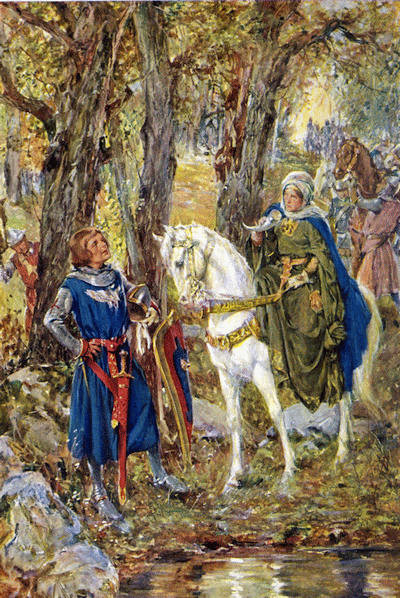
THE MEETING BY ST. MARTHA’S WELL
THE FORTUNES OF GARIN
BY
MARY JOHNSTON

BOSTON AND NEW YORK
HOUGHTON MIFFLIN COMPANY
The Riverside Press Cambridge
1915
COPYRIGHT, 1915, BY MARY JOHNSTON
ALL RIGHTS RESERVED
Published October 1915
The Riverside Press
CAMBRIDGE . MASSACHUSETTS
U . S . A
CONTENTS
I.
Roche-de-Frêne 1II.
The Jongleur and the Herd-Girl 13III.
The Nightingale 31IV.
The Abbot 47V.
Raimbaut the Six-fingered 61VI.
The Garden 73VII.
The Ugly Princess 85VIII.
Tournament 99IX.
Garin seeks his Fortune 115X.
Garin takes the Cross 127XI.
Thibaut Canteleu 144XII.
Montmaure 159XIII.
The Venetian 174XIV.
Our Lady in Egypt 189XV.
Saint Martha’s Well 204XVI.
Garin and Jaufre 219XVII.
Our Lady of Roche-de-Frêne 231XVIII.
Count Jaufre 246XIX.
The Siege 261XX.
The White Tower 272XXI.
The Rock-Gate 282XXII.
The Saffron Cross 295XXIII.
Cap-du-Loup 309XXIV.
The Abbey of the Fountain 319XXV.
Richard Lion-Heart 335XXVI.
The Fair Goal 346XXVII.
Spring Time 361CHAPTER I
CHAPTER II
CHAPTER III
CHAPTER IV
CHAPTER V
CHAPTER VI
CHAPTER VII
CHAPTER VIII
CHAPTER IX
CHAPTER X
CHAPTER XI
CHAPTER XII
CHAPTER XIII
CHAPTER XIV
CHAPTER XV
CHAPTER XVI
CHAPTER XVII
CHAPTER XVIII
CHAPTER XIX
CHAPTER XX
CHAPTER XXI
CHAPTER XXII
CHAPTER XXIII
CHAPTER XXIV
CHAPTER XXV
CHAPTER XXVI
CHAPTER XXVII
THE FORTUNES
OF GARIN
CHAPTER I
ROCHE-DE-FRÊNE
Without blazed autumn sunshine, strong as summer sunshine in northern lands. Within the cathedral dusk ruled, rich and mysterious. The sanctuary light burned, a star. The candles were yet smoking, the incense yet clung, thick and pungent. Vanishing through the sacristy door went the last flutter of acolyte or chorister. The throng that worshipped dwindled to a few lingering shapes. The rest disappeared by the huge portal, marvellously sculptured. It had been a great throng, for Bishop Ugo had preached. Now the cathedral was almost empty, and more rich, more mysterious because of that. The saints in their niches could be seen the better, and the gold dust from the windows came in unbroken shafts to the pavement. There they splintered and light lay in fragments. One of these patches made a strange glory for the head of Boniface of Beaucaire who was doing penance, stretched out on the pavement like a cross. Lost in the shadows of nave, aisles, and chapels were other penitents, on their knees, muttering prayers. Hugues from up the river lay on his face, half in light, half in shadow, before the shrine of Saint Martial. Hugues’s penance had been heavy, for he was a captain of Free Lances and had beset and robbed a travelling monk. But in Hugues’s cavern that night the monk turned preacher and wrought so mightily that he brought Hugues—who was a simple, emotional soul—to his knees, and the next day, when they parted, sent him here for penance. He lay bare to the waist, and his back was bloody from the scourging he had received before the church doors.
The church was a marvel. It had been building for long, long while, and it was not yet finished. It was begun by a grateful population, at the instigation of the then bishop, in the year 1035. All Christendom had set the year 1000 for the Second Coming and the Judgement Day, and as the time approached had waited in deep gloom and with a palsied will for those august arrivals. When the year passed, with miseries enough, but with no rolling back of the firmament like a scroll, it was concluded that what had been meant was the thousandth from the Crucifixion. 1033 was now set for the Final Event, and the neglect of each day, the torpor and terror of the mind, continued. But 1033 passed, marked by nothing more dreadful than famine and common wretchedness. Christendom woke from that particular trance, sighed with relief, and began to grow—to grow with vigour and rapidity, with luxuriance and flourishes.
In 1035, then, the cathedral had been begun, and to-morrow morning, here in the last quarter of the twelfth century, the stone masons would go clinking, clinking up yonder, atop of the first of the two towers. No man really knew when it would be finished. But for a century nave, aisles, choir, and chapels had been completed. Under the wonderful roof three generations of the people of Roche-de-Frêne had bowed themselves when the bell rang and the Host was elevated. The cathedral had the hallowing of time. It was an Inheritance as was the Faith that bred it. The atmosphere of this place was the atmosphere of emotion, and strong as were the pillars, they were no stronger than was the Habit which brought the feet this way and bowed the heads; and clinging and permeating as was the incense, it was no more so than the sentiment that stretched yonder Boniface of Beaucaire and here Hugues the Free Lance. Boniface of Beaucaire would cheat again and Hugues the Free Lance rob and slay, but here they were, no hypocrites, and cleaner in this moment than they had been.
There were two pillars, one twisted, one straight, that had been brought from Palestine by Gaucelm the Crusader, father of Gaucelm the Fortunate, the present Prince, and set on either side the shrine of Our Lady of Roche-de-Frêne. A shaft of light from the great window struck across the two, broke, and made the pavement sunny.
Just here knelt a youth, in a squire’s dress of green and brown. He had no penance to perform. He was kneeling because he was in a kneeling mood. The light showed a well-made, supple figure, with powerful shoulders. The head and throat were good, the face rather long, with strong features, the colouring blonde inclining to brown, the eyes grey with blue glints. They were directed now to the image of the Virgin, above him in her niche, the other side of the gold light. She stood, incredibly slender, and taller than human, rose-cheeked, dressed in azure samite sewn with gems, with a crown, and in her two hands a crimson heart pierced by an iron arrow. A lamp burned before her, and there were flowers around.
The youth knelt with a fixed gaze, asking for inspiration.... The Virgin of Roche-de-Frêne seemed to move, to dilate, to breathe, to smile! The young man sank his head, stretched forth his arms. “O Our Lady, smile on me! O Our Lady, give me to-day a sign!”
The cathedral grew a place of mystery, of high, transcendent passion. The lamp appeared to brighten, the heart in the two hands to glow.
“Is it a sign that I am to serve Her in Holy Church?” thought Garin de Castel-Noir, “or, may-hap, that I am to serve Her with lance and shield? Is it a sign, or am I mistaken? If it were a sign, would I ask if I were mistaken?” He sighed. “O High God, give me a sign!”
He had to decide no less a thing than his career. Until a little while ago he had thought that matter settled. He was esquire to a poor lord, a fierce and a stupid lord, and he had no hope but to remain esquire for years perhaps to come. But, come soon or come late, one day his lord would make him knight. That done, and his saint favouring, he might somehow achieve honour. Three months ago his lot had seemed as fixed as that of a fir tree growing below his lord Raimbaut’s black keep. Then into the matter had stepped the Abbot of Saint Pamphilius, that was kinsman of Garin and of his brother, Foulque the Cripple, who bided at Castel-Noir.
With simplicity, the squire explained it to Our Lady of Roche-de-Frêne: “He is our near kinsman, and he knows how poor are Foulque and I, and he knows, too, Lord Raimbaut, and the little we may expect. And now he says that if I will give up hope of chivalry and take the tonsure, he will be my good patron. And if I work well with head and pen and prove myself able, he will charge himself that I advance and win great promotion. If I serve him well, so will he serve me well. O Our Lady,” ended Garin, “he is a great man as you know, and close friend to Bishop Ugo. Moreover, he and Foulque have made application to my lord Raimbaut and won him to consent. And Foulque urges me toward Holy Church. But O Blessed Lady,” cried Garin, and stretched forth his arms, “do I wish to go? I know not—I know not!”
The Virgin of Roche-de-Frêne, crowned and dazzling, stood in blue samite with her heart and arrow, but said no word and gave no sign.... Raimbaut and his knighthood—the Abbot and Holy Church—and Foulque with his song, “Choose the Abbot! Work hard and be supple and further the ends of Holy Church, twining your own ends with that golden cord. No telling to what height you may rise! Great wealth and power fall to them who serve her to her profit and liking. You crave learning. On which road, I put it to you, will you gather most of that?” So Foulque. And Bishop Ugo had preached, this morn, of the glory and power of Holy Church and of the crowns laid up for them who served her.
The squire sighed deeply. He must make decision. The Abbot would not always keep that look of invitation. He had other young and needy kinsmen. Worldly considerations enough flitted through Garin’s head, but they found something there beside themselves. “In deep truth, which is mine? To endure until I may ride as knight and find or make some door in a high, thick wall? To take the tonsure—to study, work and plan—to become, maybe, canon, and after long time, larger things?... Which is mine? This—or that—or either? O Blessed Lady, I would choose from within!”
The tall, jewelled Queen of Heaven looked serenely down upon him. She had ceased to breathe. The sign seemed not to be coming. He had before him a long ride, and he must go, with or without the token. He kept his position yet another minute, then, with a deep sigh, relinquished the quest. Rising, he stepped backward from the presence of the Virgin of Roche-de-Frêne, out of the line of the Saracen pillars. As he went, the climbing shaft of amber light caught his eye and forthwith Jacob’s ladder came into his head, and he began to send slim angels up and down it. He had a potent fancy.
Leaving the church, he passed Boniface of Beaucaire and Hugues the Free Lance. His step made a ringing on the pavement beside their prone heads. He felt for them no contempt. They were making, more or less, an honourable amende. Everybody in their lives had done or would do penance, and after life came purgatory. He passed them as he might pass any other quite usual phenomenon, and so quitted the cathedral.
Outside was Roche-de-Frêne, grey, close-built, massed upon the long hill-top, sending spurs of houses down the hillsides between olive and cypress, almond and plane and pine—Roche-de-Frêne, so well-walled, Roche-de-Frêne beat upon, laved, drowned by the southern sun.
Crown of its wide-browed craggy hill rose another hill; crown of this, a grey dream in the fiery day, sprang the castle of its prince, of that Gaucelm the Fortunate whose father had brought the pillars. The cathedral had its lesser rise of earth and faced the castle, and beside the cathedral was the bishop’s palace, and between the church and the castle, up and down and over the hillsides, spread the town. The sky was as blue as the robe of the Virgin of Roche-de-Frêne. The southern horizon showed a gleam of the Mediterranean, and north and west had purple mountains. In the narrow streets between the high houses, and in every little opening and chance square the people of Roche-de-Frêne, men, women and children, talked, laughed, and gestured. It was a feast day, holiday, merry in the sun. Wine was being drunk, jongleurs were telling tales and playing the mountebank.
Garin sought his inn and his horse. He was in Roche-de-Frêne upon Raimbaut’s business, but that over, he had leave to ride to Castel-Noir and spend three days with his brother. The merry-making in the town tempted, but the way was long and he must go. A chain of five girls crossed his path, brown, laughing, making dancing steps, their robes kilted high, red and yellow flowers in their hair. “What a beautiful young man!” said their eyes. “Stay—stay!” Garin wanted to stay—but he was not without judgement and he went. At the inn he had a spare dinner, the only kind for which he could pay. A bit of meat, a piece of bread, a bunch of grapes, a cup of wine—then his horse at the door.
Half a dozen men-at-arms from the castle passed this way. They stopped. “That’s a good steed!”
Garin mounted. “None better,” he said briefly.
The grizzled chief of the six laid an approving touch upon the silken flank. “Where did you get him?”
Garin took the reins. “At home.”
“Good page, where is that?”
“I am not page, I am esquire,” said Garin.
“Good esquire, where is that?”
“‘That’ is Castel-Noir.”
“A little black tower in a big black wood? I know the place,” said the grizzled one. “Your lord is Raimbaut of the Six Fingers.”
“Just.”
“Whose lord is the Count of Montmaure, whose lord is our Prince Gaucelm, whose lord is the King at Paris, whose lord is the Pope in Rome, whose lord is God on His Throne.—Do you wish to sell your horse?”
“I do not.”
“I have taken a fancy to him,” said the man-at-arms. “But there! the land is at peace. Go your ways—go your ways! Are you for the jousting in the castle lists?”
“No. I would see it, but I have not time.”
“You would see a pretty sight,” quoth the man-at-arms. “There is Prince Gaucelm’s second princess, to wit Madame Alazais that is the most beautiful woman in the world, and sitting beside her the prince’s daughter, our princess Audiart, that is not so beautiful.”
“They say,” spoke Garin, “that she is not beautiful at all.”
“That same ‘They say’ is a shifty knave.—Better go, and I will go with you,” said the man-at-arms, “for truly I have not been lately to the lists.”
But Garin adhered to it that he could not. He made Paladin to curvet, bound and caracole, then with a backward laugh and wave of his hand went his way—but caused his way to lead him past the castle of Roche-de-Frêne.
So riding by, he looked up wistfully to barbican and walls and towers. The place was vast, a great example of what a castle might be. Enough folk for a town housed within it. At one point tree tops, peering over the walls, spoke of an included garden. Above the donjon just stirred in the autumn air the great blue banner of Gaucelm the Fortunate. The mighty gates were open, the drawbridge down, the water in the moat smiled as if it had neither memory nor premonition of dead men in its arms. People were crossing, gay of dress. The sunny noon, the holiday time, softened all the hugeness, kept one from seeing what a frown Roche-de-Frêne might wear. Garin heard trumpets. The esquire of Raimbaut the Six-fingered, the brother of Foulque the Cripple, the youth from the small black tower in the black wood, gazed and listened with parted lips. Raimbaut held from Montmaure, but for Raimbaut’s fief and other fiefs adjacent, Montmaure who held mainly from the House of Aquitaine, owed Roche-de-Frêne fealty. Being feudal lord of his lord, Gaucelm the Fortunate was lord of Foulque the Cripple and Garin the Squire. The latter wondered if ever he would enter there where the trumpets were blowing.
The great pile passed, the town itself passed, he found himself upon a downward sweeping road and so, by zig-zags, left the hill of Roche-de-Frêne and coming to the plain rode west by north between shorn fields and vineyards. The way was fair but lonely, for the country folk were gone to the town for this day of the patron saint and were not yet returning. Before him lay woods—for much of the country was wooded then—and craggy hills, and in the distance purple mountains. He had some leagues to ride. Now and again he might see, to this hand or to that, a castle upon a height, below it a huddled brown hamlet. Late in the afternoon there would lie to his right the Convent of Our Lady in Egypt. But his road was not one of the great travelled ways. It traversed a sparsely populated region, and it was going, presently, to be lonely enough.
Garin rode with sunken head, trying to settle matters before he should see Foulque. If Raimbaut had been a liberal, noble, joyous lord! But he was none such. It was little that page or esquire could learn in his gloomy castle, and little chance might have knight of his. A gloomy castle, and a lord of little worth, and a lady old and shrewish.... Every man must have a lord—or so was Garin’s world arranged. But if only every man could choose one to his liking—
The road bent. Rounding a craggy corner, Paladin and he well-nigh trod upon a sleeping man, propped at the road edge against a grey boulder. Paladin curvetted aside, Garin swore by his favourite saint, the man awoke and stretched his arms. He was young,—five or six years older, perhaps, than Garin. His dress, when it came to hue and cut, showed extravagant and gay, but the stuffs of which it was composed were far from costly. Here showed a rent, rather neatly darned, and here a soil rubbed away as thoroughly as might be. He was dark and thin, with long, narrow eyes that gave him an Eastern look. Beside him, slung from his neck by a ribbon, lay a lute, and he smiled with professional brilliancy.
CHAPTER II
THE JONGLEUR AND THE HERD-GIRL
“Jongleur,” said Garin, “some miles from this spot there is a feast day in a fair town. This is the strangest thing that ever I saw, that a jongleur should be here and not there!”
“Esquire,” said the other, “I have certain information that the prince holds to-day a great tourney, and that every knight and baron in forty miles around has gone to the joust. I know not an odder thing than that all the knights should be riding in one direction and all the esquires in another!”
“Two odd things in one day is good measure,” said Garin. “That is a fine lute you have.”
The thin dark person drew the musical instrument in front of him and began to play, and then to sing in a fair-to-middling voice.
“In the spring all hidden close,
Lives many a bud will be a rose.
In the spring ’tis crescent morn,
But then, ah then, the man is born!
In the spring ’tis yea or nay;
Then cometh Love makes gold of clay!
Love is the rose and truest gold,
Love is the day and soldan bold,
Love—”
The jongleur yawned and ceased to sing. “Why,” he asked the air, “why should I sing Guy of Perpignan’s doggerel and give it immortality when Guy of Perpignan, turning on his heel, hath turned me off?”
He drew the ribbon over his head, laid the lute on the grass, and leaning back, closed his eyes. Garin gazed at the lute for a moment then, dismounting, picked it up and tried his hand. He sang a hunting stave, in a better voice by far than was the jongleur’s. None had ever told him that he had a nightingale in his throat.
The jongleur opened his eyes. “Good squire, I could teach you to sing not so badly! But sing of love—sing of love! Hunting is, poetically speaking, out of court favour.”
“I sing of that which I know of,” said Garin.
The other sat up. “Have I found the phœnix? Nay, nay, I trow not! Love is the theme, and I have not found a man—no, not in cloister—who could not rhyme and carol and expound it! Love is extremely in fashion.—Have you a lord?”
“Aye.”
“Has not that lord a lady?”
“Aye, so.”
“Then love thy lady, and sing of it.”
“I know,” said Garin, “that love is the fashion.”
“The height of it,” answered the other. “It has been so now for fifty years and there seems no declining. It rages.”
Garin left his horse to crop the sweet grass and came and sat upon the boulder above the jongleur. “Tell me,” he said, “how it came to be so. I have a brother, older than me, who scoffs and saith that women did not use to be of such account.”
The jongleur took up his lute again. “The troubadour whom, until the other day, I served, discusses that. He is proud and ungrateful, but yet for your edification, I will repeat what he says:—
“As earthly man walks earthly ways,
At times he findeth, God the praise!
Far leagues apart, thousand no less,
Fresh life, fresh light, that will him bless.
It cometh not save he do beckon.
He groweth to it as I reckon.
And when it comes the past seems grey,
And only now the golden day.
Then in its turn the golden day
Fadeth before new gold alway.
And yet he holds the ancient gain,
And carryeth it with him o’er the plain.
And so we fare and so we grow,
Wise men would not have it other so.”
“That is a good rede,” said Garin.
“It continueth thus,” answered the jongleur.
“In time of old came Reason, King,—
Ill fares the bow that lacks that string!
When time was full, to give great light,
Came Jesu’s word and churches’ might.
Then Knighthood rose and Courtesy,
And all we mean by Chivalry.
These had not come, I rede you well,
Save that before them rang a bell,
‘Turn you, and look at Eve beside,
Who with you roameth the world wide,
And look no more as hart on hind.’
Now Love is seen by those were blind.
Full day it is of high Love’s power.
Her sceptre stands; it is her hour.
And well I wis her lovely face
To Time his reign will lend a grace!—
But think ye not is made the ring!
Morn will come a further thing.”
The jongleur ceased to finger his lute; Garin sat silent on the boulder. The light, sifting through the trees, chequered his olive-green, close-fitting dress and his brown mantle. He sat, clasping his knee, his eyes with the blue glints at once bright and dreamy.
“I have read,” he said, “that it is a great thing to be a great lover.”
“So all the troubadours say,” quoth the jongleur.
He put the ribbon of the lute around his neck, stretched himself and rose. “Miles still to the town! The day is getting on, and I will bid you adieu.”
Garin, too, looked at the sun, whistled to Paladin and left the boulder.
“My name is Elias,” said the jongleur, “and I was born at Montaudon. If you make acquaintance with a rich baron who would like to hear a new tale or song each night for a thousand running, bear me in mind. I play harp, viol and lute, and so well and timedly that when they hear me, mourners leave their weeping and fall to dancing. Moreover, I know how to walk upon my hands and to vault and tumble, and I have a trick with eggs and another with platters in the air that no man or woman hath ever seen into. I have also a great store of riddles. In addition, if need be, I can back a horse and thrust with a spear.”
“I know no such lord,” said Garin sadly. “I would I were he myself.”
“Then perhaps you may meet with some famous troubadour. I will serve none,” said Elias, “who is not in some measure famous. I prefer that he be knight as well as poet. Be so kind as to round it in such an one’s ear that you know a famed jongleur. Say to him that if God has not given him voice wherewith to sing or to relate his chansons, tensos, and sirventes, I, who sing like rossignol and who learned narration in Tripoli and Alexandria, will do him at least some justice. But if he sings like rossignol himself or, God-like, speaks his own compositions, then say that I am the best accompanist—harp, lute, or viol—between Spain and Italy. Say that, even though he be armed so cap-à-pie, there will arise occasions when he is not in voice, or is weary or out of spirits. Then how well to have such as I beside him! Then tell him that I have the completest memory, that I learn most quickly and neither forget nor misplace, and that never do I take a liberty with my master’s verse. When you have come that far, make a pause; then, while he ponders, resume. Say that, doubtless, at that moment, a hundred jongleurs, scattered up and down the land, are chance learning and wrongly giving forth his mightiest, sweetest poems. Were it not well—ask him—himself to teach them to one with memory and delivery beyond reproach, who in turn might teach others? So, from mouth to mouth, all would go as it should, and he be published correctly. Let that sink in. Then tell him that I am helpful in lesser ways,—silent when silence is wanted, always discreet, a good bearer of letters and messages, quick at extrications, subtle as an Italian. Say that I am a good servant and honour him who feeds me and never mistake where the salt stands. Say that I am skilful beyond most, and earnest ever for the advancement and honour of my master. Lastly, say that I am agreeable, but not too agreeable, in the eyes of women.”
“That is necessary?” asked Garin.
“Absolutely,” answered the jongleur. “Your lover is as jealous as God. There must not be two Gods in one miracle play.”
“Does every troubadour,” asked Garin, “love greatly?”
“He thinks he does,” said Elias. “Do not forget, if you meet a truly famed one, Elias of Montaudon. You may also say that I have been in the company of many poets, and that I know the secret soul of Guy of Perpignan.”
Both left the boulder and stepped into the road. Garin laid his hand on Paladin’s neck.
“My lord is Raimbaut the Six-fingered,” he said. “His wife, my lady, is half-aged and evil to look upon, and she rails at every one save Raimbaut, whom she fears.”
“That is ill-luck,” said the jongleur. “There is, perhaps, some neighbouring lady—”
“No. Not one.”
“To be very courtly,” said the jongleur, “one must be in love with Love. You need not at all see a woman as she is. It suffices if she is young and not deformed, and of noble station.”
“She must always be noble?”
“It doth not yet descend to shepherdesses,” said the jongleur. “For them the antique way suffices.”
Garin mounted his horse and sat still in saddle, his eyes upon a fair green branch that the sun was transfiguring, making it very lively and intense in hue.
“Great love,” he said. “By the soul of my father, I think it is a great thing! But if there is none set in your eyes to love—”
“Can you not,” said the jongleur, “like Lord Rudel, love one unseen?”
Garin sat regarding the green branch. “I do not know.... We love the unseen when we love Honour.” He sat for a moment in silence, then drew a sigh and spoke as though to himself. “It is with me as if all things were between coming and going, and a half-light, and a fulness that presses and yet knows not its path where it will go. I know not what I shall do, nor how I shall carry life. Now I feel afire and now I am sad—” He broke off and looked beyond the green branch; then, before the other could speak, shook Paladin’s reins and moved down the leafy way. He glanced over his shoulder at the jongleur. “I will remember you.”
“Aye, remember!” returned the jongleur. He faced toward the town, put one leg before the other, and, going, swept his fingers across the strings of his lute. He, too, looked over his shoulder and called across the widening distance. “Choose Love!” he called.
Garin, turning the corner of the jutty hill, lost sight of him. The tinkle of the lute came a moment longer, then it, too, vanished. The wind in the leaves sighed and sighed. “O Our Lady,” prayed Garin, “give thy guidance to the best man within me!”
It was now full afternoon, the road growing narrower and worse, until at last it was a mere track. It ran through a forest large and old, and it grew quite lonely. The squire passed no one at all, saw only the great wood and its inmates that were four-footed or feathered. He was sympathetic to such life, and ordinarily gave it attention and found in an inward and disinterested pleasure attention’s reward. But to-day his mind was divided and troubled, and he rode unseeingly.
“The Abbot and Holy Church,” said part of his mind. “Raimbaut and some day knighthood,” said another part. “There is earthly power,” said the first part, “for those who serve Holy Church—serve Her to Her profit and liking. Earthly power—and in Heaven, prelates still!” Spoke the second part; “Ripe grapes of power fall, too, to the warrior’s hand. Only be tall enough, strong enough to pluck them from the stoutest fortress wall! Knights have become barons, barons counts, counts kings!—And is not a good knight welcome in Heaven? I trow that he is, and that the angels vie with one another to do him honour!”
It seemed to Garin, though it seemed dimly enough, that other voices were trying to make themselves heard. But the first two were the loud ones, the distinct ones. They were the fully formed, the sinewy, the inherited concepts.
He rode on. He was now near the end of the forest. It began to break into grassy glades. In a little time it had so thinned that looking between the tree trunks one saw open country. Paladin raised his head, pricked his ears.
“What is it?” asked Garin. “Those yonder are only sheep upon the hillside.”
The next moment he heard a woman scream, “Help! Help!”
He pricked Paladin forward and together they burst into a little open space, rounded by a thicket and shadowed by oaks. To one of these a horse was tied. Its dismounted rider, a young man, richly dressed, had by the arms and had forced to her knees, a peasant girl, herd, as it seemed, of a few sheep who might be seen upon the hillside beyond the thicket.
She cried again, “A moi! A moi!” She fought like a young tigress, twisting her body this way and that, striving to wrench her arms free, and that failing, bending her face and biting. The man was big-boned and strong, with red-gold locks, inclining to auburn, and face and eyes just now red and gleaming. He was young,—a very few years older than Garin,—but his heel showed a knight’s spur. He bent the girl backward, struck her a blow that fairly stunned her outcry.
Garin burst into the ring. “Thou caitiff! Turn and fight!”
As he spoke he leaped to the ground and drew his dagger—a long and good one it chanced to be.
The attacker turned upon him a face of surprise and fury. “Meddler! Meddler! Begone from here!” Snatching from his belt a small, silver-mounted horn, he blew it shrilly, for he had followers with him whom he had sent ahead when he came upon the herd-girl and would stop for ill passion’s sake. But they had gone too considerable a way, or the wind blew against the horn, or a hill came between. Whatever it was, he summoned in vain.
“O thou coward!” cried Garin. “Turn and fight!”
The knight stamped upon the ground. “Fight with a page or a squire at best! My men shall scourge that green coat from your back! Begone with your life—”
“Now,” answered Garin, “if you were heir of France, yet are you to me churl and recreant!”
Whereupon the other took his hands from the herd-girl, drew his short sword, and sprang upon him.
Raimbaut the Six-fingered had faults many and heavy, but those about him lacked not for instruction in the art of attack and defence. Garin was skilful to make the difference not so pronounced between that long dagger of his and the other’s sword, and he was as strong as his opponent, and his eyes nothing like so clouded with despite and fury. The knight had far the wider experience, was counted bold and successful. But to-day he was at a disadvantage; he knew cold rages in which he fought or tilted well; but this was a hot rage, and his arm shook and he struck wide. Still the summoned men did not come, and still the two struggled for mastery. As for the herd-girl—she had risen to her knees and then to her feet, and now was standing beneath a young oak, her eyes upon the combat. At first she had made a move to leave the place, and then had shaken her head and stayed.
Garin gained, his antagonist fighting now in a blind fury. Presently the squire gave a stroke so effective that the blood spouted and the knight, reeling, let fall his weapon. He himself followed, sinking first upon his knee and then upon his face.
“Now have I slain you?” demanded Garin, and thrusting the sword aside with his foot, kneeled to see.
Whereupon the other turned swiftly and struck upward with his dagger. The squire, jerking aside, went free of the intended hurt.
“Now! by the soul of my father!” swore Garin, “this is a noble knight and must be nobly dealt with!” And so he took the other’s wrists, forced away the dagger, and wrestling with him, bound his hands with his belt, then dragged him to the nearest tree, and, cutting the bridle from his horse, ran the leather beneath his arms and tied him to the trunk. This done, he took from him the horn, and stooping, glanced at his wound. “It will not kill you. Live and learn knightliness!”
The other, bound to the tree, twisted and strove, trying to free himself. His face was no longer flushed but pale from loss of blood and huge anger. His eyes burned like coals and he gnashed his teeth. He had a hawk nose, a sensuous mouth, and across his cheek a long and curiously shaped scar, traced there by a poignard. Garin, gazing upon him, saw that he promised to be a mighty man.
The bound one spoke, his voice shaking with passion. “Who are you and what is your name? Who is your lord? My father and I will come, level your house with earth, flay you alive and nail you head downward to a tree—”
“If you can, fair sir,” said Garin. Stepping back, he saw upon the earth the herd-girl’s distaff where she had dropped it when the knight came against her. The squire picked it up, came back to the captive’s side and thrust it between his tied hands. “Now,” he said, “let your men find you with no sword, but with a distaff!”
But the herd-girl moved at that from beneath the oak. Garin found her at his side, a slim, dark girl, with torn dress and long, black, loosened hair. “You are all alike!” she cried. “You would shame him with my distaff! But I tell you that it is my distaff that you shame!” With that she came to the bound man, caught the distaff from between his hands, and with it burst through the thicket and went again among her sheep.
There, presently, Garin found her, lying beneath a green bank, her head buried in her arms.
“You were right,” said Garin, standing with Paladin beside her, “to take your distaff away. I am sorry that I did that.—Now what will you do? He had those with him who will come to seek him.”
The girl stood up. “I have been a fool,” she said, succinctly. “But there! we learn by folly.” She looked about her. “Where will I go? Well, that is the question.”
“Where do you live?”
The herd-girl seemed to regard the horizon from west to east and from east to west. Then she said, “In a hut, two miles yonder. But his men went that way.”
“Then you cannot go there now.”
“No.—Not now.”
Garin pondered. “It is less than two leagues,” he said, “to the Convent of Our Lady in Egypt. I could take you there. The good nuns will give you shelter and send you safe to-morrow to your people.”
The herd-girl seemed to consider it, then she nodded her head. She said something, but her voice was half lost in the black torrent of her loosened hair. The sun’s rays were slant—it was growing late.
Garin mounted and drew her up behind him. At a little distance the road forked.
“They went that way,” she said, pointing.
“Then it’s as well,” said Garin, “that we go this. Now we had best ride fast for a time.”
They rode fast for a good long way; then, as no hoof-sound or cry came from behind, the squire checked Paladin, and they went slowly enough to talk.
“I have hopes,” said Garin, “that he swooned, and when they found him could tell them naught. Do you know his name?”
“No. I was asleep in the sun.”
“What is your name?”
“Jael.”
“The nuns will care for you.”
“I will ask them to let me stay and keep their sheep.”
They rode on through a fair, smiling country. Garin fell silent and the herd-girl was not talkative. He could not but ride wondering about that knight back there, and who he might be and how powerful. He saw that it was possible that he had provided a hornet’s nest for the ears of Castel-Noir and Foulque. He drew a sigh, half-frighted and half-proud of a proved prowess.
The girl behind him moved slightly. “I had forgot to say it,” she murmured. “I will say it now. Fair sir, I am humbly grateful—”
Garin had a great idiosyncrasy. He disliked to be thanked. “I liked that fighting,” he said. “It was no sacrifice. That is,” he thought, “it will not be if he never find out my name.”
Paladin carried them a way farther. Said Garin, remembering chivalry, “It is man’s part to protect the weaker being, that is woman.”
“It puzzles so!” said the herd-girl. “I am not very weak. Is it man’s part, too, to lay hands upon a woman against her will? If man did not that, then man need not do, at such cost, the other. What credit to put water on the house you yourself set afire?”
“Now by Our Lady,” said Garin, “you are a strange herd-girl!” He twisted in the saddle so that he might look at her. She sat still,—young, slim and forlorn to the eye, dark as a berry, her feet bare and her dress so torn that her limbs showed. Her long, black loosened hair almost hid her face, which seemed thin, with irregular features. She had her distaff still, the forlorn serf’s daughter, herself a serf.
“If we plume ourselves it is a mistake, and foolishness,” said Garin. “But yet though one man act villainously, another may act well.”
“Just,” said the herd-girl. “And I thank the one who has acted well—but not all men. I thank a man, but not mankind.”
“How old are you?”
“I am eighteen.”
“Where got you your thoughts?”
“There is time and need for thinking,” said the herd-girl, “when you keep sheep.”
With that she sighed and fell silent. They were going now by a swift stream; when, presently, they came to the ford and crossed, they were upon convent lands. Our Lady in Egypt was a Cistercian convent, ample and rich, and her grey-clad nuns came from noble houses. There were humbly born lay sisters. The abbess was the sister of a prince. The place had wealth, and being of the order of Saint Bernard, then in its first strength, was like a hive for work. From the ford on, the road was mended, the fields fat, the hedges trim. The convent had its serfs, and the huts of these people were not miserable, nor did the people themselves look hunger-stricken and woe-begone. The hillsides smiled with vineyards, the sky arched all with an Egyptian blue, the westering sun, tempering his fierceness, looked benignly on. Presently, in a vale beside the stream, they saw the great place, set four-square, a tiny hamlet clinging like an infant to its skirts. Behind, covering a pleasant slope, were olive groves with tall cypresses mounting like spires. Grey sisters worked among the grey trees. A bell rang slowly, with a silver tone.
“I will take you to the gate,” said Garin. “Then you can knock and the sister will let you in.”
“Aye, that will she. And you, fair squire, where will you go? Where is your home?”
Now Garin was thinking, “If that knight is a powerful man it is well that I gave him no inkling of where to find me!” Assuredly he had no thought nor fear that the herd-girl might betray. And yet he did not say, “I was born at Castel-Noir,” or “I live now in the castle of Raimbaut the Six-fingered.” He said, “I dwell by the sea, a long way from here.”
“Dusk is at hand,” said the herd-girl. “There, among those houses, is one set apart for benighted travellers.”
“How do you know that? Have you been here before?”
“Aye, once.—If you have far to ride, or the way is not clear before you, you had best rest to-night in the traveller’s house.”
But Garin shook his head. “I will go on.”
With that they came, just before the sun went down, to the wall of the convent, and the door beneath a round arch where the needy applied for shelter or relief. The squire checked Paladin. He made a motion to dismount, but the girl put a brown hand upon his knee.
“Stay,” she said, “where you are! I will ring the bell and speak to the portress.” So saying, she slipped to the earth like brown running water; then turned and spoke to the rescuer. “Fair squire,” she said, “take again my thanks. If ever I can pay good turn with good turn, be sure that I will do it!” She moved within the arch, put her hand to the bell and set it jangling, then again turned her head. “Will you remove from so close before the door? You will frighten the sister. And the sun is down and you had best be going. Farewell!”
Involuntarily Garin backed Paladin further from the round arch. The horse was eager for his stable, wheeled in that direction, and chafed at the yet restraining hand. Garin looked as in a dream at the herd-girl. Even now he could not see her face for that streaming hair. A grating in the convent door opened and the sister who was portress looked forth. The herd-girl spoke, but he could not hear what was the word she said. A key grated, the convent door swung open. “Lord God!” cried the grey sister. He heard that, and had a glimpse of her standing with lifted hands. The herd-girl crossed the threshold. Paladin, insisting upon the road, took for a moment the squire’s full attention. When he looked back the convent wall was blank; door and grating alike were closed.
CHAPTER III
THE NIGHTINGALE
Foulque the Cripple listened with a perturbed brow. “You should have left him alone! A wretched herd-girl!”
“If I am to be knight,” said Garin hotly, “I will not read knighthood so.”
“Psha!” said Foulque. “They put resistance on! It is a mask when they seem unwilling. And if it were real, what then?—Saint Pol, what then?—And you saw naught to tell you who he was?”
“No.”
Foulque fretted. “If I had been there, I should have found some colour or sign! But you go as dreamily as if you were bewitched! You see naught that’s to the point.”
“He had a blue robe and a surcoat of crimson, and shoes of brown cordovan,” said Garin. “His sword had a rich hilt, and his gloves were embroidered. I noted them where he had thrust them in the bosom of his robe when I knelt to look at his wound. He was red-gold of hair and hawk nosed, full-lipped, and with a scar on his cheek. I think that he is older than I, but not much older.”
“Well, well!” said Foulque, “he may have been some wanderer from a distance, with no recourse but his own hand. Moreover, for fame’s sake, he will not be quick to talk about a younger man, and one of less degree. If he found out neither your name nor house,—perhaps we’ll hear no more of it.... Well, what have you to say? I have news for you! The abbot hath been to Roche-de-Frêne, and on his way home is pleased to sleep one night at Castel-Noir. A man of his brought notice this morning. This is Tuesday—Friday he will be here.” Foulque rose and limped across the hall in some excitement. “Poor and bare, God knows! is Castel-Noir, but we will do what we can! My bed here he shall have, and we will put up the hangings from Genoa, and strew the floor with fair herbs. There’s wine enough, and Pierre shall begin his baking to-morrow morn! Friday.—He will have, his man said, twenty in his train. The sub-prior—five or six brothers—the rest stout serfs with staves.—Friday!—Every man of ours must be set to fishing!”
When every man was sent to the stream, the company of fishermen covered no great length of bank. Moreover all could not settle to fishing, for some must forth to forage for the approaching horse, and to find venison, fowls, and other matters for the Saturday morn. For poor was the small black tower in the black wood! Foulque could furnish to his lord a young brother for esquire, and, if a levy were made, ten men, by no means prize men, with ten horses, by no means horses for a king’s stable. Paladin was the only horse of that nature. A poor, small fief was Castel-Noir—black keep and tower on a crag, set in a dark wood, with a few fields beyond, and all under shadow of the mountains to the north. South of it, only, ran the bright stream where fish were to be caught.
Thursday sunrise, Garin took a fishing-rod and went down the crag by the road cut, long since, in the rock, and through the wood to this stream. In a great leather pouch slung over his shoulder he had, with other matters, bread and meat. He meant to make a day of it, bringing home in the evening good fish for Pierre’s larder. When he reached the stream, he found there old Jean and his two grandsons and they had a great basket, its bottom already flashing silver and iris.
“Good-morning, Jean and Pol and Arnaut,” said Garin.
“Good-morning, master! The Blessed Maries have sent good fishing! They snap as soon as you touch the water.”
Farther down the stream he found Sicart. “How great a man, master, is the abbot? Very great he must be if he eats all the fish we are taking! It is a miracle!”
Garin moved down the stream seeking for a place that should seize his fancy. The eagerness with which he had risen and sallied forth disappeared. They would have enough for the Abbot and his train—more than enough. At times he cared for fishing, but not, he found, to-day. Why then fish, if there was no need? He still carried the rod, but he continued to walk, making no motion to stop and put it into use. There was a foot-path by the stream, and it and the gliding water led him on. He wanted to think, or, more truly, to dream. Back in the black castle all was topsy-turvy, and Foulque concerned only with family fortunes.
Now Garin walked, and now he leaned against some tree and gazed at the flowing water; but on the whole he moved forward with such steadiness that before the sun was much above the tree-tops the foot-path ceased, having brought him to a great round stone and an overhanging pine, and the end, on this side, of the fief of Castel-Noir. Beyond came a strip of stony and unprofitable land, a debated possession, claimed by two barons and of no especial use to any man. Garin threw himself down upon the boundary stone and, chin in hand, regarded the sliding stream.
It was this stone, perhaps, that brought into mind Tuesday’s boulder and the jongleur. Rather than the jongleur came the figure of the jongleur’s lute. Garin’s fingers moved as though they felt beneath them the strings. A verse was running, running through his head. Only after a slow, lilting, inward saying of it over twice or thrice did it come to him, like the opening of a flower, that it was his own, not another’s. He had made it, lying there. He rose from the stone and walked forward, still going with the gliding stream. As he walked, the second verse came to him. He said over the two, said over his first poem and said it over again, tasting it, savouring it, hearing it now with music. He was in a dream of dawn....
There was no longer a path, but he went on over the stony soil, beneath old gnarled and stunted trees. The sun rode high and made the water a flood of diamonds. Garin walked with a light and rapid step. When a tree came in his way he swerved and rounded it and went on, but he was hardly conscious that it had been there. The fishing-rod was yet in his hand, but he did not think of the rod, nor of fishing, nor of Castel-Noir, nor Foulque, nor the abbot, nor of the decision which the abbot’s visit would force. He hardly knew of what he was thinking. It was diffused,—the world was diffused,—drifting and swinging, and in the mist he touched a new power.
A hawk shot downwards, plunged beak in water, rose with the taken fish and soared into the eye of day. Garin started, shook himself, and looked about him. He had come farther than he meant. He half-turned, then stood irresolute, then again faced downstream. The day was not old, and a distaste seized him for going back and listening to Foulque on what the abbot might or might not do. He wandered on.
An hour later he came upon another boundary mark. This was a cross cut in stone, with a rude carving upon the block that formed the base. Garin sat down to rest, and sitting so, fell to scraping with his knife the encrusting lichen from this carving. There was a palm tree and a pyramid, which stamped Egypt in mind. Here was Saint Joseph, and here was the ass bearing the Mother and Child. Above was Latin, to the effect that you were upon the lands of the Convent of Our Lady in Egypt. Garin knew that, and that two miles down the stream the nuns would be now at the noon office. He wondered if, yesterday or to-day, they had sent Jael the herd back to her own. But, on the surface, at least, of consciousness there floated no long thought of that matter. His mood was one of half-melancholy, half-exaltation, all threaded with the warm wonder of making verses.
The nature of the land changed here. For stone and dwarfed growth there began a richer soil and nobler trees. The latter made, all along the water’s edge, a narrow grove, with here and there a fairy opening and lawn of fine grass. Garin, having scraped away the lichen, looked at the sun, which was now past the meridian, and thought that he would retrace his steps.
Before him, out of a covert a little way down the stream, a nightingale sang suddenly. Garin listened, and it might be his mood of to-day that made him think that never before had he heard any bird sing so sweetly. It carolled on, rich and deep, and the young man went toward it. The ribbon of wood was dark and sweet; the bird sang like a soul imprisoned. When it silenced itself Garin still stood looking up into its tree. Presently it flew from that bower and, crossing one of the elfin lawns, lost itself in the farther trees. Garin went on to this grove and it sang for him again. When it ceased he did not go back to the boundary stone. This country pleased him and he thought, “I will go on and see how Our Lady in Egypt looks from this side.”
He followed the stream a mile and more. It was slipping now beneath mighty trees. Their arching boughs made a roof; it was like walking in cloisters. Between the pillars, inland, could be seen fields and vineyards and, at last, the convent’s self, with her olive trees behind her. Garin came now to thickly planted laurels, a grove within a grove. This he threaded, pushing aside the heavy leaves. The laurels ended suddenly, standing close and trim, a high green wall. This followed a curving line and half enclosed a goodly space of turf, a shaven floor of emerald, laved by the little river and shaded by a plane, a poplar, and a cedar. The cedar stood close to the laurels and close to Garin, and beneath the cedar was placed a seat of stone carved like a great chair. The spot was all chequered with light and shade, the air was sweet and fine, and the water sang as it passed. A fairer place for dreaming, for talk or sober merry-making, might not be found. Just now it was as clean as fairyland of human occupancy.
Garin stepped from the laurel wall and sat in the stone seat. It pleased him, this place! A sense of mystery gathered; he began to dream, dream. All manner of coloured, gleaming thought-motes danced over the threshold. The minutes passed.
Voices—women’s voices! Doubly a trespasser that he was, he was not willing to be found here, reigning it from this seat over the sweep of lawn, the three trees, and the singing water. He rose, and stepped back into the wall of laurel; then, being young and not incurious, waited to see who it was that was coming. Lay sisters, perhaps, going from vineyard to vineyard, or bringing clothes for the washing to the river bank which here was rightly shelving. A gleam of grey garments between the tree-trunks on the other side of the sylvan theatre seemed to prove him right; and indeed, in a moment, there did emerge three or four of these same lay sisters—strong, tanned, peasant women, roughly dressed, fit for outdoor labour. They carried on their heads huge osier baskets, but when they set these down, what was taken out was not linen or woollen for washing, but rugs of Eastern weave and cushions of Eastern make.
Moreover, with or following the lay sisters came others—young women—who were certainly not under convent rule. These seized the rugs and cushions and scattered them here and there, to advantage, over the grass. They also set out dishes of fruit and Eastern comfits, and one placed a harp upon a square of gold silk which she spread beneath the poplar. As they worked they chattered like magpies. They were dressed well and fancifully but not richly; it was to be made out that they were waiting-women of those who did dress richly. One cocked her ear, then raised her hand in a gesture to the others, whereupon all fell into a demure silence. The lay sisters who had been stolid and still throughout, now drew off by a path which carried them to the vineyards. The waiting women cast a look around, then, with nods of satisfaction, picked up the empty baskets and found for them and for themselves some pleasant subordinate haven down by the stream, around the corner of the lawn.
The little lawn lay prepared, festive and a desert. Now was the moment when Garin might withdraw and the rustle of the laurel leaves tell no tale where were no ears to hear. Truly, he thought once and twice of departing, but then before the third thought which might have passed into action, he caught, floating out of the opposite wood, delightful voices, laughter that rippled, and a sheen and flash of colours. What he forthwith determined to do was to please a little longer eye and ear and sate curiosity. Then—and it need not be long—he would turn, and as noiselessly as an innocent green-and-brown serpent, slip away toward Castel-Noir. Given that he were discovered, plain truth-telling were not bad. Discovery might bring him rebuke not too scornful, with, perhaps, some laughter in her eye.
He laid his fishing-rod down, then knelt beside it upon the brown earth between the laurel stems. Couched so, he could look past the stone seat and the cedar trunk, and so observe what pageant might appear. Had he had a wand in his hand he could have touched with it this carven chair.
Out from the shadowy opposite grove came bright ladies, seven or eight. One was dressed in violet and one in rose, one in green and white, and one in daffodil, one in a bright medley, one in white sprigged with gold, and one in the colour of the sky. After the fashion of the time their hair hung in long braids from beneath fillet, or garland, or veil of gauze twisted turban-wise or floating loose. Their shoes were of soft-coloured leather or of silk, their dress close-fitting and sweeping the grass. The wide and long mantles that were worn by both sexes were not in evidence here—the day was warm and the convent, whence alone these fair ones could have come, at no distance. Garin wondered, and then he bethought himself that some great reigning countess—perhaps some duchess or princess of Italy or Spain or further yet afield, perhaps some queen—might be travelling through the land, going from one court to another and by the way pausing to refresh herself in the house of Our Lady in Egypt. From Roche-de-Frêne, he knew, there was no such absence. The man-at-arms at the inn had said that the princesses Alazais and Audiart were seated with their ladies to mark the jousts.... He lay and watched.
Of the bright apparitions two seemed of their full summer and prime, more stately, more authoritative than the others. The others were in their spring and early spring. Light or dark, blonde or brunette, all had beauty. Garin’s eyes darkened and softened, and the corners of his lips moved upward to see such an array, and the swimming movement with which they dispersed themselves over the lawn, and to hear their trained voices. All seemed gay and laughing, and yet there presently appeared a discontent. The dame in daffodil took up the harp and swept the strings.
“Ah!” cried the one in azure, “for a true troubadour!”
“For even a jongleur!”
“Ah, what is life without men!”
“Ah, for the tourney!”
“Ah, if there were in sight but a monastery!”
The older two, who had an air of responsibility, rebuked the others. “Life is made up of to and fro, and sounds and silences! Be content! It is but one month out of many.”
“As if months were as plentiful as cherries!”
“Ah, if I were a princess—”
“Hush!” warned the daffodil-clad, and began to play upon the harp.
Garin saw that another two were coming through the grove. One of these would be the noble lady for whom it was all planned. His imagination was active to-day with a deep, involuntary pulsing. Foix or Toulouse, or the greater domains to the north and west, or it might be Aragon, or it might be Italy? Or she might have come from Sicily, or like Prince Rudel’s far lady, from a kingdom or duchy carved from Paynim lands. Some Eastern touch in the scene made him dwell upon that. No matter whence now she came, she must have lived on a day in the long, the outspread, the curving and sunny lands of this very south. The tongue of her ladies proved that. Wedded she might have been to some great prince and borne away, and now returned for a time and a pilgrimage to the land of birth.... All this and more was of his imaging. He lay upon the dark earth and parted the laurel leaves that he might see more clearly.
The two were now plain among the trees. One was a blonde of much beauty, dressed in grey cendal and carrying a book which seemed to belong to her companion. The latter was a little in advance, and she came on without speaking, and so stepped from the wood upon the lawn. The seven already arrived beneath the plane, the poplar, and the cedar made a formal movement of courtesy, then gathered like a rainbow about the one of first importance. Plaintiveness and discontent retired from evidence, court habit came up paramount. You might have thought that these were dryads or Dian’s nymphs, and no other spot than this wood their loved home! There came to Garin’s ear a ripple of sweet voices, but it seemed that their lady for whom had been spread the feast was either silent or seldom-and low-speaking. She stood beneath the shimmering, tremulous poplar, a slender shape of fair height. She was dressed in some fine weave of dark blue with a girdle of samite studded with gems. The ends of this girdle hung to her silken shoe. Her hair, black and long, was braided with gems. She seemed young, young as the youngest there. “Seemed” is used, because Garin saw not her face. She wore, as did several of the others, a veil of Eastern device, but hers was long and wide and threaded with gold and silver, and so worn that it overhung and shielded every feature.
Attention was called to the placing of the rugs, the cushions, the harp, the dishes of fruit and comfits. The one for whom they had waited nodded her head and seemed to approve. She was not garrulous; there seemed to breathe about her, he knew not what, a tone of difference. All now moved to the water-edge, and for a time loitered there upon the green and rushy bank. One raised her voice and sang,—
“Green are the boughs when lovers meet,
Grey when they part—”
The bevy turned and came up the sloping lawn to the three trees and the cushions upon the grass. The shape in dark blue with the Eastern veil moved beyond them to the cedar and the stone chair. Here she took her seat, and when the others would have gathered about her waved them back with a slender, long-fingered hand. One brought to her a basket of grapes. She chose a purple cluster resting upon a web of vine leaves but laid it untouched beside her upon the wide seat. There was a space between her and the dark enshadowing cedar and those others resting now upon the cushions. She sat quite still, a hand upon each arm of the chair, the deep blue of her dress flowing about her, the gems of the girdle ends making a sombre gleaming. The veil hid all her face from Garin, lying so near. He felt in her something solitary, something powerful, yet felt that she was young, young—She sat with her gaze straight before her upon the blue crests that showed afar. She sat as still as though an enchanter had bid her stay. And between her and the young man crouching in the laurels streamed no wide ocean of the autumn air, of the subtle ether. The moments passed, slow, plangent, like the notes of the harp that was being played....
What happened to one or both? Did one only feel it, the one that knew there were two—or did, in some degree, the other also, and think it was a day-dream? All that Garin knew, kneeling there, was that something touched him, entered him. It came across that space, or it came from some background and space not perceived. It was measureless, or it seemed to him without measure. It was clothed in marvel; it was fulness and redoubling, it was more life. It was as loud as thunder, and as still as the stillest inner whisper. It was so sweet that he wished to weep, and yet he wished too to leap and spring and exult aloud, to send his cry of possession to the skies. He felt akin to all that his senses touched. But as for the form in the stone chair—he sat with her there, she knelt with him here, they were one body.... With a swimming feeling, her being seemed to pass from his. He knelt here, Garin of the Black Castle, squire of Raimbaut the Six-fingered, and she sat there whose face he had not seen—a great dame, lady doubtless of some lord of a hundred barons each worthier than Raimbaut.
Garin gazed across the little space between, and now it was as though it were half the firmament. She sat like a figure among the stars, blue-robed, amid the deep blue, and the cloudy world was between them. She grew like to a goddess—like to the Unattainable Ideal, and he felt no longer like a king, but like the acolyte that lights the lamp and kneels as he places it. Now it was the Age for this to happen, and for one man to act as had acted that knight in the wood toward Roche-de-Frêne, and for another to do as now did Garin.
For now he wished no longer to play the spy, and he turned very carefully and silently in the laurels and crept away. In all his movements he was lithe and clean, and he made no sound that the brooding young figure in the stone chair attended to. Presently, looking back, his eyes saw only the great height of the cedar, its dark head against the blue heaven. The liquid, dropping notes of the harp pursued him a little farther, but when he was forth from the laurel grove they, too, passed upon the air. He was soon at the boundary cross of Our Lady in Egypt, and then upon the waste and stony land that set toward the fief of Castel-Noir. Was it only this morning, thought Garin, that he had come this way? And the nightingale that sang so deep and full—it was not in the boughs above—it was singing now in his own heart!
CHAPTER IV
THE ABBOT
Friday the mistral blew, and Foulque was always wretched in that wind. He gloomed now from this narrow window and now from that in the black castle’s thick walls. The abbot was not expected before the dial showed twelve, but Foulque looked from here and looked from there, and kept a man atop of the tower to scan the road beyond the wood. The hall was ready for the abbot, the arras hung, the floor strewn with leaves and autumn buds, the great chair placed aright, a rich coverlet spread upon the state bed. Pierre was ready,—the sauce for the fish, the fish themselves were ready for the oven. Castel-Noir rested clean and festive, and every man knew that he was to sink down upon both knees and ask the abbot’s blessing.
The wind blew and hurled the leaves on high. The sun shone, the sky was bright, but the moving air, dry and keen, was as a grindstone upon which tempers were edged. A shrivelled, lame man must feel it. Under the hooded mantel a fire was laid, but not kindled. Foulque could not decide whether the abbot would feel the wind as he felt it, and want to be welcomed with physical as well as other warmth, or whether, riding hard, he would be heated and would frown at the sight of the fire. Foulque would have liked a roaring blaze, out-sounding the wind. But the Abbot of Saint Pamphilius was of a full body, tall and stout, a hunter and a hawker. Foulque determined to have a torch from the kitchen immediately at hand and kindle or not kindle according to the first glimpse of his kinsman’s face.
The window embrasures were deep enough to swallow a family. Foulque, a sensitive, knew without turning his head when Garin, too, stood within the one that overlooked the road where it emerged from the wood. “He should be here at any minute,” said Foulque. “Well? Well?”
“Brother Foulque,” said Garin, “I have determined, an it please you, to bide with Lord Raimbaut and become a knight.”
Foulque let his wrath gather to a head. When it was at the withering point, his gaze having been directed upon Garin for full thirty seconds, he spoke. “Marry and crave pardon! Who is it hath determined?”
“I,” said Garin. “I.”
Foulque moistened his lips. “What has come to you? Raimbaut will let you go. The Abbot of Saint Pamphilius invites—nay, he will himself smooth your way to Holy Church’s high places. I, your elder brother, command—”
“Your entreaty would do more, brother,” said Garin. “But I can no other.”
“‘Can no other!—can no other!’ Does the fool see himself Alexander or Roland or Arthur?” Foulque laughed. “Raimbaut the Six-fingered’s squire!”
Garin was patient. “All the same he can give me knighthood.”
His brother laughed again and struck his hands together. “Knighthood! Knighthood! Oh, your advantage from his buffet on your shoulder! Raimbaut!” He held by the wall and stamped with the foot that was not lamed. “Fight—fight—fight! then eat an ox and drink a cask and go sleep! Ride abroad whenever you hear of a tourney that’s not too difficult to enter. Tilt—tilt—tilt! and if you are not killed or dragged to the barrier, win maybe prizes enough to keep body and soul together until you hear of another joust! Between times, eat, drink, and sleep and have not a thought in your head! Sprawl in the sun by the keep, or yawn in the hall, or perhaps hunt a boar until there’s more fighting! When there is, be dragged from the wall or smothered in the moat or killed in the breach when the castle’s taken! Oh aye! Your lord may take his foe’s castle and you be drunk for a day with victory and smothering and hanging and slaying on your part! Yet forecast the day when you’ll drink the cup you’re giving others! Look at the dice in your hand and know that if you throw six, yet will you throw ace!”
“I may not be always bound to Raimbaut.”
“He is not old, and hath the strength of a bull! And what of the young Raimbaut? Son grows like sire—”
“Even so,” said Garin desperately, “things happen.”
Foulque’s anger and scorn flowed on. “Oh, I grant you! Have I forgotten large wars that may arise—fighting behind your lord for Prince or King or Emperor? I have not. Cities and great castles instead of small—thousands to kill and be killed instead of hundreds—the same thing but more of it! Still a poor knight—still in the train of Raimbaut the Six-fingered! The young Raimbaut hath six fingers also, hath he not?—Oh, you may go crusading, too, and see strange lands and kill the infidel who dares have his country spread around the Holy Sepulchre! Go!—and die of thirst or be slain with a scimitar, or have your eyes taken out and no new ones put in! Or, if you can, slay and slay and slay the infidel! What have you got? Tired arm and bloody hands and leave to go eat, drink, and sleep! A crusade! Your crusade enriches one, beggars fifty! Returns one, keeps the bones of a hundred—”
“I do not think of taking the cross,” said Garin.
His brother laughed again with a bitter mirth. “Well, what’s left? Let’s see! If you can get Raimbaut’s consent, you might become an errant knight and go vagabonding through the land! ‘Fair sir, may I fight thee—all for the glory of valour and for thy horse and trappings?’—‘Fair dame, having no business of mine own, may I take thine upon me? Tell me thy grievance, and I will not enquire if it be founded or no. Nor when, pursuing chivalry, I have redressed it, will I refuse rich gifts.’—Bah!” cried Foulque. “I had rather eat, drink, fight, and sleep with Raimbaut!”
“Aye,” said Garin; then painfully, “You are picturing the common run of things. There have been and there are and there will be true and famous knights—aye, and learned, who make good poesy and honour fair ladies, and are courteous and noble and welcome in every castle hall! I mean not to be of the baser sort. And those knights I speak of had, some of them, as meagre a setting forth as mine—”
“In romans!” answered Foulque. “You are a fool, Garin! Take the other road—take the other road!”
“I’ve made my choice.”
“Raimbaut the Six-fingered against the Abbot of Saint Pamphilius, who is close friend to Bishop Ugo, who is ear and hand to the Pope—”
“I choose.”
“Now,” cried Foulque, choking, “by the soul of our father, little lacks but I call Sicart and Jean and have you down into the dungeon! You are too untamed—you are too untamed!”
“In your dungeon,” said Garin, “I would think, ‘How like is this to abbey cell and cloister!’”
A silence fell. Only mistral whistled and eddied around the black tower. Then said Foulque tensely: “What has come to you? Two nights ago I saw you ready to put your hands in those of Holy Church—” He broke off, facing the man from the tower top, framed now in the great door.
“Horsemen, my masters!” cried the watchman; “horsemen at the two pines!”
Foulque flung up his arms. “He is coming! Mayhap he will work upon you—seeing that a brother cannot! Let me by—”
Garin stood at the window watching the abbot and the twenty with him—ecclesiastical great noble and his cowled following—stout lay brothers and abbey serfs well clad and fed—the abbot’s palfrey, sleek mules and horses—all mounting with a jingle of bits and creaking of leather, but with a suave lack of boisterous laughter, whoop, and shout, the grey zig-zag cut in the crag upon which was perched Castel-Noir. When they were immediately below the loophole window, he turned and, leaving the hall, went to the castle gate and stood beside Foulque.
When Abbot Arnaut and his palfrey reached them he sprang, squire-like, to the stirrup, gave his shoulder to the abbot’s gloved hand. When the great man was dismounted, he knelt with his brother for the lifted fingers and blessing. The abbot was marshalled across the court to the hall, followed by those two from Saint Pamphilius whom his nod indicated. Jean and Sicart disposed of the following. Foulque’s anxious drill bore fruits; everything went as if oiled.
Mistral still blew, high, cold and keen. “Have you a fire, kinsman?” cried Abbot Arnaut. “I am as cold as a merman in the sea!”
Foulque made haste. The torch was at hand—in a moment there sprang a blaze—the hangings from Genoa were all firelit and the great beams of the roof.
“Hungry!” cried the abbot. “I am as hungry as Tantalus in hell! I remember when once I came here, a boy, good fishing—”
The fish were good, Pierre’s sauce was good. All received commendation. The abbot was portly and tall, with a massy head, with a countenance so genial, a voice so bland, an eye so approving, that all appeared nature and no art. His lips seemed made for golden syllables, he had an unctuous and a mellow tongue. It was much to hear him speak Latin and much to hear him discourse in the vernacular. The langue d’oc came richly from his mouth. He was a mighty abbot, a gracious power, timber from which were made papal legates.
Foulque sat with him at the raised end of the table, the monks of his company being ranged a foot lower. But Garin, as was squire-like, waited upon the great guest and his brother. The abbot, the keen edge of hunger abated, showed himself gracious and golden, friendly, almost familiar. He spoke of the past, and of the father of his hosts. He asked questions that showed that he knew Castel-Noir, dark wood and craggy hills, mountains to the north, stream to the south. It even seemed that he remembered old foresters and bowmen. He knew the neighbouring fiefs, the disputed ground, the Convent of Our Lady in Egypt. He was warm and pleasant with his kinsmen; he said that he had loved their father and that their mother had been a fair, wise lady. He remarked that poverty was a sore that might be salved; and when he had drunk a great cup of spiced wine,—having, for his health’s sake, a perpetual dispensation in that wise,—he said that he was of mind that a man should serve and be served by his own blood. “Kin may prove faithless, but unkin beats them to the post!”
Dinner was eaten, wine drunken, hands washed. The abbot and Foulque rose, the monks of Saint Pamphilius rose, the table was cleared, the boards and trestles taken from the hall.
Abbot Arnaut, standing by the fire, looked at the great bed. “By the rood!” he said, “to face mistral clean from Roche-de-Frêne to this rock is a wearisome thing! I will repose myself, kinsman, for one hour.”
All withdrew save the lay brother whom he retained for chamberlain. Foulque offered Garin’s service, who stood with ready hands. But the abbot was used to Brother Anselm, said as much, and with a sleepy and mellow voice dismissed the two brothers. “Return in an hour when I shall be refreshed. Then will we talk of that of which I wrote.”
The two left the hall. Without, Foulque must discover from Jean and Sicart if all went well and the abbot’s train was in good humour. “I’ve known a discontented horse-boy make a prince as discontented!” But they who followed the abbot were laughing in the small, bare court, and the bare ward room. Even mistral did not seem to trouble them.
South of the tower, in the angle between it and the wall, lay the tiniest of grass-plots, upbearing one tall cypress. Foulque, his mantle close around him, beckoned hither Garin. Here was a stone seat in the sun, and the black tower between one and that wind from the mountains. Foulque sat and argued, Garin stood with his back against the cypress. The hour dropped away, and Foulque saw nothing gained. He shook with wrath and concern for slipping fortunes. “Since yesterday! This has happened since yesterday! You took your rod and went down to the river to fish. What siren sang to you from what pool?”
Garin lifted his head. “No siren. Something wakened within me, and now I will be neither monk nor priest. I am sorry to grieve you, Foulque.”
But Foulque nursed his wrath. “The hour has passed,” he said. “So we go back to the abbot and spurn a rich offer!” He rose and with a bleak face left the grass-plot.
Garin followed, but not immediately. He stood, beneath the cypress tree and tried to see his life. He could not do so; he could only tell that his heart was parted between sorrow and joy, and that a nightingale sang and sang. He could tell that he wished to live beautifully, to do noble deeds, to win honour, to serve, if need be to die for, a goddess whose face was veiled. His life whirled; at once he felt generous, wealthy, and great, and poor, humble, and despairing. He seemed to see through drifting mists a Great Meaning; then the cloud thickened and he was only Garin, Raimbaut’s squire—then again images and music, then aching sadness. He stood with parted lips, beneath the cypress, and he looked south. At last he sighed and covered his eyes with his hand, then turned and went back to the hall.
The abbot was awake, had left the great bed and come to the great chair. Seated at ease in the light of the renewed fire, he was goldenly discoursing to Foulque who sat on a stool, of Roche-de-Frêne and its prince and his court, and of Bishop Ugo. “Ah, the great chances in the fair lap of Mother Church! Ugo is ambitious. There it is that we differ. I am not ambitious—no, no! I am an easy soul, and but take things as they come my way!” He turned in his chair and looked at Garin standing behind his brother. “Ha!” he said, “and this is the squire who would become canon?”
Foulque groaned. “Most Reverend Father, the boy is mad! I think that he is bewitched. I pray that of your goodness, wisdom and eloquence you bring him to a right mind—”
The Abbot of Saint Pamphilius smiled, assured as the sun. “What is it? Does he think that already he has Fortune for mistress?”
“He will choose knighthood,” said Foulque. “He has no doubt of winning it.”
The abbot lifted his brows. He looked with dignity into the fire, then back at Foulque and at Garin the squire. “It pains me,” he said, “the folly of mankind! Are you born prince, count or baron, then in reason, you must run the course where you are set. Though indeed, time out of mind, have been found castellans, vavasours, barons, dukes, and princes who have laid aside hauberk, shield, and banner, and blithely come with all their wealth into the peaceful hive of Holy Church—so rightly could they weigh great value against low! But such as you, young man—but such as you—poor liegemen of poor lords! What would you have? Verily, the folly is deep! By no means all who would have knighthood gain it, and if it is gained, what then? Another poor knight in a world where they are as thick and undistinguishable as locusts!—Ha, what do you say?”
Garin’s lips had moved, but now he flushed red.
“Speak out!” commanded the abbot, blandly imperious. “What was it that you said?”
Garin lowered his eyes. “I said that there were many churchmen in the world, as thick and undistinguishable—”
Foulque drew a dismayed breath. But the Abbot of Saint Pamphilius laughed. He sat well back in his chair and looked at the squire with freshened interest. “Granted, Bold Wit! The point is this. Did you show me here the signet ring, not—God defend us!—of Raimbaut the Six-fingered, but of Raimbaut’s lord and yours, Savaric of Montmaure, then would I say, ‘So you have your patron! Good fortune, fair kinsman, who are half-way up the ladder!’” He looked at the squire and laughed. “You have it not by you, I think?” Garin shook his head. “Well then,” said the abbot, “choose Holy Church. For here, I think,”—he spoke very goldenly,—“you may show a patron. A feeble one, my son—of course, a feeble one—”
Garin came from behind Foulque, kneeled before the abbot, and thanked him for great kindness and condescension. “But, Reverend Father, with all gratefulness and humbleness, yet I will not the tonsure—”
The abbot with a gesture kept him kneeling. “There is some reason here that you hide. You are young, you are young! I guess that your reason goes by name of woman—”
Garin knelt silent, but Foulque uttered an exclamation. “No, Reverend Father, no! What has changed him I know not, but it has happened here at Castel-Noir, since yesterday! There is no woman here, in hut or tower, that could tempt him—”
But the Abbot of Saint Pamphilius continued to gaze upon Garin, and to tap gently with his fingers upon the arm of the great chair. “I hold not,” he said softly, “with those who would condone concubinage, and who see no harm in a too fair cousin, niece, or servant in priests’ dwellings. It is all sin—it is all sin—and Holy Church must reprobate—yea, must chastise. But flesh is weak, my son, flesh is weak! Somewhat may be compounded—somewhat overlooked—somewhat pardoned! Especially, if not solely, in the case of those whose service is great. As for courtly love—” The abbot smiled. “When you come to courtly love,” he said, “there are many lordly churchmen have praised fair ladies!—Do I resolve your scruples, my son?”
But Garin’s look showed no shaken determination. The abbot leaned back in his chair. “The time grows tender,” he said. “Womanish and tender! Your father would have known how to bring you to reason. Your grandfather would have disposed of you like any Roman of old. But now any sir squire is let to say, ‘I will’—or ‘I will not!’—Think not that I wish him about me who is sullen and intractable! Nor that I lack other kinsmen who are pleaders for that kindness I would have shown Castel-Noir! There is young Enric, Bernart’s son—and there are others.—Rise and begone to Raimbaut the Six-fingered’s keep!”
Garin stood up. Foulque made to speak, but the abbot waved the matter down.
“All is said. It is a trifle, and we will disturb ourselves no further. God knows, ungrateful young men are no rarity! Doubtless he hath, after all, Montmaure’s signet—What is it now?”
Into the hall, from the court without, had come a sound of trampling hoofs and of voices—one voice sullen and heavy. Garin started violently, Foulque sprang to his feet. The great door was flung open, admitting a burst of wind that shook the hangings, and behind it, Sicart open-mouthed and breathless.
“Master, master! here is Lord Raimbaut!”
CHAPTER V
RAIMBAUT THE SIX-FINGERED
A lord might of course visit one who held from him, often did so. But it was not Raimbaut’s use to ride to Castel-Noir. And Garin, parting from him less than a week ago, had heard no word of his coming.
But here he was, pushing Sicart aside, striding into the hall, a low-browed, thick-skulled giant, savage with his foes, dull and grudging with his friends—Raimbaut the Six-fingered! Foulque hastened to do him reverence, make him welcome; Garin, stepping to his side, took from him his wide, rust-hued mantle and furred cap.
“Well met, my Lord Raimbaut!” said the abbot in his golden tones.
Raimbaut gloomed upon him. “Ha, Lord Abbot! Are you here for this springald, my esquire? Well, I have said that you might have him.”
“Nay,” said the abbot mellowly, “I think that I want him not.”
“—have him,” pursued Raimbaut. “And likewise his quarrel with Savaric of Montmaure.”
He spoke with a deep, growling voice, as of an angered mastiff, and as he spoke turned like one upon Garin. “Why, by every fiend in hell, did you fight a Tuesday, with his son?”
Garin stared. He heard Foulque’s distressed exclamation, saw the abbot purse his lips, but beyond all that he had a vision of a forest glade and heard a clash of steel. He drew breath. “Was he that knight in crimson? Was that Jaufre de Montmaure?”
Raimbaut doubled his fist and advanced it. Before this Garin had come to earth beneath his lord’s buffet. He awaited it now, standing as squarely as he might. He was aware that Raimbaut had for him a kind of thwart liking—a liking that made, in Raimbaut’s mind, no reason why he should not strike when angry. It was not the expected blow that set Garin’s mind whirling. But Jaufre de Montmaure! To his knowledge he had never, until that Tuesday, seen that same Jaufre. But he knew of him, oh, knew of him! Montmaure was a great count, overlord of towns and many castles. In Garin’s world Savaric of Montmaure was only less than Gaucelm of Roche-de-Frêne—Gaucelm the Fortunate from whom Savaric held certain fiefs. Immediately, Montmaure loomed larger than Roche-de-Frêne, for Raimbaut the Six-fingered owed direct fealty to Montmaure and in war must furnish a hundred men-at-arms.
Garin knew of the young count, Sir Jaufre. He knew that Jaufre had been long time in Italy, at the court where his mother was born, but that now he was looked for home again. He knew that he had fought boldly in sieges of cities, and in tournaments was acclaimed brave and fortunate. Perhaps Garin had dreamed of his own chance coming to him by way of Montmaure—perhaps he had dreamed of somehow recommending himself to this same Jaufre. That gibe of the abbot’s about the signet ring had struck from the squire an answering thought, “Some day I may—” Now came the reversal, now Garin felt a faintness, an icy fall. He was young and in a thousand ways, unfree. For a day and a night his conscious being had strained high. Now there came a dull subsidence, a slipping toward the abyss. “Jaufre de Montmaure!”
Raimbaut did not deliver the meditated blow—too angered and concerned was Raimbaut to dispense slight tokens. He let his hand drop, but ground beneath his heavy foot the rushes on the floor. “I would I had had you chained in the pit below the dungeon before I let you go to Roche-de-Frêne!” He turned on Foulque who stood, grey-faced and dry-lipped. “Knew you what this fool did?”
Foulque struck his hands together. “He told me that eve. He did not know and I did not know—He thought it might be some wandering knight—Ah, my Lord Raimbaut, as we owe you service, so do you owe us protection!”
Raimbaut strode up and down, heavy and black as his own ancient donjon. “Comes to me yestereve, as formal as you please, a herald from Montmaure! ‘Hark and hear,’ says he, puffing out his cheeks, ‘to what befell our young lord, Sir Jaufre, riding through the forest called La Belle, and for some matter or other sending a good way ahead those that rode with him. Came a squire out of the wood, drunken and, as it were, mad, and with him, plain to be seen, a stark fiend! Then did the two fall upon Sir Jaufre from behind and forced him to fight, and by necromancy overthrew and wounded him, and, ignobly and villainously, bound him to a tree. Which, when they had done, they vanished. And straightway his men found him and brought him home. And now that fiend may perchance not be found, but assuredly the man may be discovered! When he is, for his foul pride, treason, and wizardry, the Count of Montmaure will flay him alive and nail him head downward to a tree.’”
Mistral sent into the hall a withering blast. The smoke from the fire blew out and went here and there in wreaths. It set the abbot coughing. Raimbaut the Six-fingered continued his striding up and down. “Then he puffs his cheeks out and says on, and wits me to know that Savaric of Montmaure calls on every man that owes him fealty to discover—an he is known to them—that churl and misdoer. And thereupon,” ended Raimbaut on a note of thunder, “to my face he describes Garin my esquire!”
Garin stood silent, but Foulque panted hard. “Ah, thou unhappy! Ah, the end of Castel-Noir! Ah, my Lord Raimbaut, have we not been faithful liegemen?” He caught his brother by the arm. “Kneel, Garin—and I will kneel—”
But Garin did not kneel. He stood young, straight, pale with indignation. “Brother and Reverend Father and my Lord Raimbaut,” he cried, “never in my life had I to do with a fiend! Nor was I drunken nor without sense! Nor did I come upon him from behind! Does he say that, then am I more glad than I was that I brought him fairly to the earth and, because of his own treachery, tied him to a tree and bound his hands with his stirrup leather—”
Raimbaut, in his striding up and down being close to his squire, turned upon him at this and delivered the buffet. It brought Garin, hand and knee, upon the rushes, but he rose with lightness. Raimbaut, striding on by, came to the abbot, who, having ended coughing, sat, double chin on hand and foot in furred slipper, tapping the floor. He stopped short, feudal lord beside as massive ecclesiastic. “The Church says it is her part to counsel! Out then with good counsel!”
The abbot looked at him aslant, then spoke with a golden voice. “Did you tell the count’s herald that it was your esquire?”
“Not I! I said that it had a sound of Aimeric of the Forest’s men.” Aimeric of the Forest was a lord with whom Raimbaut was wont to wage private war.
The abbot murmured “Ah!” then, “Did any in your castle betray him?”
“No,” said Raimbaut. “Only Guilhelm, and Hugonet heard surely and knew for certain. Six-fingered we may be and rude, but we wait a bit before we give our esquires to other men’s deaths!” Again he covered with his stride the space before the wide hearth. He was as huge as a boar and as grim, but a certain black tenseness and danger seemed to go out of the air of the hall. Turning, he again faced the abbot. “So I think, now the best wit that I can find is to say ‘Aye’ twice where I have already said it once, and speed this same Garin the fighter into Church’s fold! Let him as best he may convoy himself to the Abbey of Saint Pamphilius. There he may be turned at once into Brother Such-an-one. So he will be as safe and hid as if he were in Heaven and Our Lady drooped her mantle over him. By degrees Montmaure may forget, or he may flay the wrong man—”
The abbot covered his mouth with his hand and looked into the blaze that mistral drove this way and that. Foulque came close, with a haggard, wrinkling face; but Garin, having risen from Raimbaut’s buffet, made no other motion.
The abbot dropped his hand and spoke. “Do you not know that last year the Count of Montmaure became Advocate and Protector of the Abbey of Saint Pamphilius? As little as Lord Raimbaut do I will openly to offend Count Savaric.”
“‘Openly,’” cried Foulque. “Ah, Reverend Father, it would not be ‘openly’—”
But Abbot Arnaut shook his head. “I know your ‘secret help,’” he said goldenly. “It is that which most in this world getteth simple and noble, lay and cleric, into trouble!” He spread his hands. “Moreover, our Squire-who-fights-knights hath just declined the tonsure.”
“Hath he so?” exclaimed Raimbaut. “He is the more to my liking!—So the abbot will let Count Savaric take him?”
The abbot put his fingers together. “I will do nothing,” he said, “that will imperil the least interest of Holy Mother Church. I will never act to the endangering of one small ornament upon her robe.”
Raimbaut made a sound like the grunt of a boar. Foulque covered his face with his hands.
“But,” pursued the abbot, “kin is kin, and in the little, narrow lane that is left me I will do what I can!” He spoke to Raimbaut. “Has Count Savaric bands out in search of him?”
“Aye. They will look here as elsewhere.”
Garin stood forth. Above his eye was a darkening mark, sign of Raimbaut’s buffet. It was there, but it did not depreciate something else which was likewise there and which, for the moment, made of his whole body a symbol, enduing it to an extent with visible bloom, apparent power. For many hours there had been an inward glowing. But heretofore to-day, what with Foulque and Abbot Arnaut and disputes, anxieties, and preoccupation, it had been somewhat pushed away, stifled under. Now it burst forth, to be seen and felt by others, though not understood. Anger and outrage at that knight’s false accusation helped it forth. And—though Garin himself did not understand this—that glade in the forest toward Roche-de-Frêne, and that lawn of the poplar, the plane, and the cedar by the Convent of Our Lady in Egypt, that Tuesday and that Thursday, came somehow into contact, embraced, reinforced each the other. Aware, or unaware, in his conscious or in his unconscious experience, there was present a deep and harmonious vibration, an expansion and intensification of being. Something of this came outward and crossed space, to the others’ apprehension. They felt bloom and they felt beauty, and they stared at him strangely, as though he were palely demigod.
He spoke. “Brother Foulque and Lord Raimbaut and Reverend Father, let me cut this knot! I must leave Castel-Noir and leave my Lord Raimbaut’s castle, and I must take my leave without delay. That is plain. Plain, too, that I must not go in this green and brown that I wore when I fought him! Sicart can find me serf’s clothing. When it is night, I will quit Castel-Noir, and I will lie in the fir wood, near the little shrine, five miles west of here. In the morning you, Reverend Father, pass with your train. The help that Foulque and I ask is that you will let me join the Abbey people. They have scarcely seen me—Sicart shall cut my hair and darken my face—they will not know me. But do you, of your charity, bid one of the brothers take me up behind him. Let me overtravel in safe company sufficient leagues to put me out of instant clutch of Count Savaric and that noble knight, Sir Jaufre! I will leave you short of the Abbey of Saint Pamphilius.”
“And where then, Garin, where then?” cried Foulque.
“I will go,” said Garin, “toward Toulouse and Foix and Spain. Give me, Foulque, what money you can. I will go in churl’s guise until I am out and away from Montmaure’s reach. Then in some town I will get me a fit squire’s dress. If you can give me enough to buy a horse—very good will that be!” He lifted and stretched his arms—a gesture that ordinarily he would not have used in the presence of elder brother, lord, or churchman. “Ah!” cried Garin, “then will I truly begin life—how, I know not now, but I will begin it! Moreover, I will live it, in some fashion, well!”
The three elder men still stared at him. Mature years, advantageous place, bulked large indeed in their day. A young Daniel might be very wise, but was he not young? A squire might propose the solution of a riddle, but it were unmannerly for the squire to take credit; a mouse might gnaw the lion’s net, but the mouse remained mouse, and the lion lion. The Abbot of Saint Pamphilius, and Raimbaut the Six-fingered, and Foulque the elder brother looked doubtfully at Garin. But the air of bloom and light and power held long enough. They devised no better plan, and, for the time at least, their minds subdued themselves and put away anger and ceased to consider rebuke.
Raimbaut spoke. “I give you leave. I have not been a bad lord to you.”
His squire looked at him with shining eyes. “No, lord, you have not. I thank you for much. And some day if I may I will return good for good, and pay the service that I owe!”
Foulque the Cripple limped from the hearth to a chest by the wall, unlocked it with a key hanging from his belt, and took out a bag of soft leather—a small bag and a lank. He turned with it. “You shall have wherewith to fit you out. Escape harm now, little brother! But when the wind has ceased to blow, come back—”
The abbot seemed to awake from a dream, and, awakening, became golden and expansive even beyond his wont. “You hear him say himself that he has no vocation.... Nay, if he begins so early by overthrowing knights he may be called, who knoweth? to become a column and pattern of chivalry! I will bring him safe out of the immediate clutch of danger.”
An hour, and Raimbaut departed, and none outside the hall of Castel-Noir knew aught but that, hunting a stag, he had come riding that way. The sun set, and the abbot and his following had supper and Garin served his brother and Abbot Arnaut. Afterwards, it was said about the place that the company—having a long way to make—would ride away before dawn. So, after a few hours sleep, all did arise by torchlight and ate a hasty breakfast, and the horses and mules and the abbot’s palfrey stamped in the courtyard. Mistral was dead and the air cool, still, and dark. The swung torches confused shadow and substance. In the trampling and neighing and barking of dogs, clamour and shifting of shapes, it went unnoticed that only Foulque was there to bid farewell to the abbot and kinsman.
In the early night, under the one cypress between the tower and the wall, Foulque and Garin had said farewell. The light was gone from about Garin; he seemed but a youth, poor and stricken, fleeing before a very actual danger. The two brothers embraced. They shed tears, for in their time men wept when they felt like doing so. They commended each other to God and Our Lady and all the saints, and they parted, not knowing if ever they would see each other again.
The abbot and his company wound down the zig-zag road and turned face toward the distant Abbey of Saint Pamphilius. Riding westward they came into the fir wood. The sun was at the hill-tops, when they overtook a limping pedestrian,—a youth in a coarse and worn dress, with shoes of poor leather and leggings of bark bound with thongs, and with a caped hood that obscured his features. Questioned, he said that his father sowed grain and reaped it for Castel-Noir, but that he had an uncle who was a dyer and lived beyond Albi. His uncle was an old man and had somewhat to leave and his father had got permission for him to go on a visit—and he had hurt his foot. With that he looked wistfully at the horse of the lay brother who had summoned him to the abbot.
“Saint Gilles!” exclaimed the abbot, and he spoke loud and goldenly. “It were a long way to hop to Albi! Not a day but I strive to plant one kindly deed—Take him up, my son, behind thee!”