автордың кітабын онлайн тегін оқу Demonology and Devil-lore
Demonology and Devil-lore
By
Moncure Daniel Conway, M.A.
B. D. of Divinity College, Harvard University
Member of the Anthropological Institute, London
With numerous illustrations
New York
Henry Holt and Company
1879
Copyright, 1879, by
Moncure Daniel Conway.
Preface.
Three Friars, says a legend, hid themselves near the Witch Sabbath orgies that they might count the devils; but the Chief of these, discovering the friars, said—‘Reverend Brothers, our army is such that if all the Alps, their rocks and glaciers, were equally divided among us, none would have a pound’s weight.’ This was in one Alpine valley. Any one who has caught but a glimpse of the world’s Walpurgis Night, as revealed in Mythology and Folklore, must agree that this courteous devil did not overstate the case. Any attempt to catalogue the evil spectres which have haunted mankind were like trying to count the shadows cast upon the earth by the rising sun. This conviction has grown upon the author of this work at every step in his studies of the subject.
In 1859 I contributed, as one of the American ‘Tracts for the Times,’ a pamphlet entitled ‘The Natural History of the Devil.’ Probably the chief value of that essay was to myself, and this in that its preparation had revealed to me how pregnant with interest and importance was the subject selected. Subsequent researches in the same direction, after I had come to reside in Europe, revealed how slight had been my conception of the vastness of the domain upon which that early venture was made. In 1872, while preparing a series of lectures for the Royal Institution on Demonology, it appeared to me that the best I could do was to print those lectures with some notes and additions; but after they were delivered there still remained with me unused the greater part of materials collected in many countries, and the phantasmal creatures which I had evoked would not permit me to rest from my labours until I had dealt with them more thoroughly.
The fable of Thor’s attempt to drink up a small spring, and his failure because it was fed by the ocean, seems aimed at such efforts as mine. But there is another aspect of the case which has yielded me more encouragement. These phantom hosts, however unmanageable as to number, when closely examined, present comparatively few types; they coalesce by hundreds; from being at first overwhelmed by their multiplicity, the classifier finds himself at length beating bushes to start a new variety. Around some single form—the physiognomy, it may be, of Hunger or Disease, of Lust or Cruelty—ignorant imagination has broken up nature into innumerable bits which, like mirrors of various surface, reflect the same in endless sizes and distortions; but they vanish if that central fact be withdrawn.
In trying to conquer, as it were, these imaginary monsters, they have sometimes swarmed and gibbered around me in a mad comedy which travestied their tragic sway over those who believed in their reality. Gargoyles extended their grin over the finest architecture, cornices coiled to serpents, the very words of speakers started out of their conventional sense into images that tripped my attention. Only as what I believed right solutions were given to their problems were my sphinxes laid; but through this psychological experience it appeared that when one was so laid his or her legion disappeared also. Long ago such phantasms ceased to haunt my nerves, because I discovered their unreality; I am now venturing to believe that their mythologic forms cease to haunt my studies, because I have found out their reality.
Why slay the slain? Such may be the question that will arise in the minds of many who see this book. A Scotch song says, ‘The Devil is dead, and buried at Kirkcaldy;’ if so, he did not die until he had created a world in his image. The natural world is overlaid by an unnatural religion, breeding bitterness around simplest thoughts, obstructions to science, estrangements not more reasonable than if they resulted from varying notions of lunar figures,—all derived from the Devil-bequeathed dogma that certain beliefs and disbeliefs are of infernal instigation. Dogmas moulded in a fossil demonology make the foundation of institutions which divert wealth, learning, enterprise, to fictitious ends. It has not, therefore, been mere intellectual curiosity which has kept me working at this subject these many years, but an increasing conviction that the sequelæ of such superstitions are exercising a still formidable influence. When Father Delaporte lately published his book on the Devil, his Bishop wrote—‘Reverend Father, if every one busied himself with the Devil as you do, the kingdom of God would gain by it.’ Identifying the kingdom here spoken of as that of Truth, it has been with a certain concurrence in the Bishop’s sentiment that I have busied myself with the work now given to the public.
Contents
Volume I.
Part I.
Chapter I.
Dualism.
Page
Origin of Deism—Evolution from the far to the near—Illustrations from Witchcraft—The primitive Pantheism—The dawn of Dualism 1
Chapter II.
The Genesis of Demons.
Their good names euphemistic—Their mixed character—Illustrations: Beelzebub, Loki—Demon-germs—The knowledge of good and evil—Distinction between Demon and Devil 7
Chapter III.
Degradation.
The degradation of Deities—Indicated in names—Legends of their fall—Incidental signs of the divine origin of Demons and Devils 15
Chapter IV.
The Abgott.
The ex-god—Deities demonised by conquest—Theological animosity—Illustration from the Avesta—Devil-worship an arrested Deism—Sheik Adi—Why Demons were painted ugly—Survivals of their beauty 22
Chapter V.
Classification.
The obstructions of man—The twelve chief classes—Modifications of particular forms for various functions—Theological Demons 34
Part II.
Chapter I.
Hunger.
Hunger-demons—Kephn—Miru—Kagura—Ráhu the Hindu sun-devourer—The earth monster at Pelsall—A Franconian custom—Sheitan as moon-devourer—Hindu offerings to the dead—Ghoul—Goblin—Vampyres—Leanness of demons—Old Scotch custom—The origin of sacrifices 41
Chapter II.
Heat.
Demons of fire—Agni—Asmodeus—Prometheus—Feast of fire—Moloch—Tophet—Genii of the lamp—Bel-fires—Hallowe’en—Negro superstitions—Chinese fire-god—Volcanic and incendiary demons—Mangaian fire-demon—Demons’ fear of water 57
Chapter III.
Cold.
Descent of Ishtar into Hades—Bardism—Baldur—Herakles—Christ—Survivals of the Frost Giant in Slavonic and other countries—The Clavie—The Frozen Hell—The Northern abode of Demons—North side of churches 77
Chapter IV.
Elements.
A Scottish Munasa—Rudra—Siva’s lightning eye—The flaming sword—Limping Demons—Demons of the storm—Helios, Elias, Perun—Thor arrows—The Bob-tailed Dragon—Whirlwind—Japanese Thunder God—Christian survivals—Jinni—Inundations—Noah—Nik, Nicholas, Old Nick—Nixies—Hydras—Demons of the Danube—Tides—Survivals in Russia and England 92
Chapter V.
Animals.
Animal demons distinguished—Trivial sources of Mythology—Hedgehog—Fox—Transmigrations in Japan—Horses bewitched—Rats—Lions—Cats—The Dog—Goethe’s horror of dogs—Superstitions of the Parsees, people of Travancore, and American Negroes, Red Indians, &c.—Cynocephaloi—The Wolf—Traditions of the Nez Perces—Fenris—Fables—The Boar—The Bear—Serpent—Every animal power to harm demonised—Horns 121
Chapter VI.
Enemies.
Aryas, Dasyus, Nagas—Yakkhos—Lycians—Ethiopians—Hirpini—Polites—Sosipolis—Were-wolves—Goths and Scythians—Giants and Dwarfs—Berserkers—Britons—Iceland—Mimacs—Gog and Magog 150
Chapter VII.
Barrenness.
Indian Famine and Sun-spots—Sun-worship—Demon of the Desert—The Sphinx—Egyptian Plagues described by Lepsius: Locusts, Hurricane, Flood, Mice, Flies—The Sheikh’s ride—Abaddon—Set—Typhon—The Cain wind—Seth—Mirage—The Desert Eden—Azazel—Tawiscara and the Wild-rose 170
Chapter VIII.
Obstacles.
Mephistopheles on crags—Emerson on Monadnoc—Ruskin on Alpine peasants—Holy and unholy mountains—The Devil’s Pulpit—Montagnards—Tarns—Tenjo—T’ai-shan—Apocatequil—Tyrolese legends—Rock ordeal—Scylla and Charybdis—Scottish giants—Pontifex—Devil’s bridges—Le géant Yéous 190
Chapter IX.
Illusion.
Maya—Natural Treacheries—Misleaders—Glamour—Lorelei—Chinese Mermaid—Transformations—Swan Maidens—Pigeon Maidens—The Seal-skin—Nudity—Teufelsee—Gohlitsee—Japanese Siren—Dropping Cave—Venusberg—Godiva—Will-o’-Wisp—Holy Fräulein—The Forsaken Merman—The Water-Man—Sea Phantom—Sunken Treasures—Suicide 210
Chapter X.
Darkness.
Shadows—Night Deities—Kobolds—Walpurgisnacht—Night as Abettor of Evil-doers—Nightmare—Dreams—Invisible Foes—Jacob and his Phantom—Nott—The Prince of Darkness—The Brood of Midnight—Second-Sight—Spectres of Souter Fell—The Moonshine Vampyre—Glamour—Glam and Grettir—A-Story of Dartmoor 231
Chapter XI.
Disease.
The Plague Phantom—Devil-dances—Destroying Angels—Ahriman in Astrology—Saturn—Satan and Job—Set—The Fatal Seven—Yakseyo—The Singhalese Pretraya—Reeri—Maha Sohon—Morotoo—Luther on Disease-demons—Gopolu—Madan—Cattle-demon in Russia—Bihlweisen—The Plough 249
Chapter XII.
Death.
The Vendetta of Death—Teoyaomiqui—Demon of Serpents—Death on the Pale Horse—Kali—War-gods—Satan as Death—Death-beds—Thanatos—Yama—Yimi—Towers of Silence—Alcestis—Herakles, Christ, and Death—Hell—Salt—Azraël—Death and the Cobbler—Dance of Death—Death as Foe and as Friend 269
Part III.
Chapter I.
Decline of Demons.
The Holy Tree of Travancore—The growth of Demons in India, and their decline—The Nepaul Iconoclast—Moral Man and unmoral Nature—Man’s physical and mental migrations—Heine’s ‘Gods in Exile’—The Goban Saor—Master Smith—A Greek caricature of the Gods—The Carpenter v. Deity and Devil—Extermination of the Were-wolf—Refuges of Demons—The Giants reduced to Little People—Deities and Demons returning to nature 299
Chapter II.
Generalisation of Demons.
The Demons’ bequest to their conquerors—Nondescripts—Exaggerations of Tradition—Saurian Theory of Dragons—The Dragon not primitive in Mythology—Monsters of Egyptian, Iranian, Vedic, and Jewish Mythologies—Turner’s Dragon—Della Bella—The Conventional Dragon 318
Chapter III.
The Serpent.
The beauty of the Serpent—Emerson on ideal forms—Michelet’s thoughts on the viper’s head—Unique characters of the Serpent—The Monkey’s horror of Snakes—The Serpent protected by superstition—Human defencelessness against its subtle powers—Dubufe’s picture of the Fall of Man 325
Chapter IV.
The Worm.
An African Serpent-drama in America—The Veiled Serpent—The Ark of the Covenant—Aaron’s Rod—The Worm—An Episode on the Dii Involuti—The Serapes—The Bambino at Rome—Serpent-transformations 332
Chapter V.
Apophis.
The Naturalistic Theory of Apophis—The Serpent of Time—Epic of the Worm—The Asp of Melite—Vanquishers of Time—Nachash-Beriach—The Serpent-Spy—Treading on Serpents 340
Chapter VI.
The Serpent in India.
The Kankato na—The Vedic Serpents not worshipful—Ananta and Sesha—The Healing Serpent—The guardian of treasures—Miss Buckland’s theory—Primitive rationalism—Underworld plutocracy—Rain and lightning—Vritra—History of the word ‘Ahi’—The Adder—Zohak—A Teutonic Laokoon 348
Chapter VII.
The Basilisk.
The Serpent’s gem—The Basilisk’s eye—Basiliscus mitratus—House-snakes in Russia and Germany—King-snakes—Heraldic Dragon—Henry III.—Melusina—The Laidley Worm—Victorious Dragons—Pendragon—Merlin and Vortigern—Medicinal dragons 361
Chapter VIII.
The Dragon’s Eye.
The Eye of Evil—Turner’s Dragons—Cloud-phantoms—Paradise and the Snake—Prometheus and Jove—Art and Nature—Dragon forms: Anglo-Saxon, Italian, Egyptian, Greek, German—The modern conventional Dragon 372
Chapter IX.
The Combat.
The pre-Munchausenite world—The Colonial Dragon—Io’s journey—Medusa—British Dragons—The Communal Dragon—Savage Saviours—A Mimac helper—The Brutal Dragon—Woman protected—The Saint of the Mikados 384
Chapter X.
The Dragon-slayer.
Demi-gods—Alcestis—Herakles—The Ghilghit Fiend—Incarnate deliverer of Ghilghit—A Dardistan Madonna—The religion of Atheism—Resuscitation of Dragons—St. George and his Dragon—Emerson and Ruskin on George—Saintly allies of the Dragon 394
Chapter XI.
The Dragon’s Breath.
Medusa—Phenomena of recurrence—The Brood of Echidna and their survival—Behemoth and Leviathan—The Mouth of Hell—The Lambton Worm—Ragnar—The Lambton Doom—The Worm’s Orthodoxy—The Serpent, Superstition, and Science 406
Chapter XII.
Fate.
Doré’s ‘Love and Fate’—Moira and Moiræ—The ‘Fates’ of Æschylus—Divine absolutism surrendered—Jove and Typhon—Commutation of the Demon’s share—Popular fatalism—Theological fatalism—Fate and Necessity—Deification of Will—Metaphysics, past and present 420
Volume II.
Part IV.
Chapter I.
Diabolism. Page
Dragon and Devil distinguished—Dragons’ wings—War in Heaven—Expulsion of Serpents—Dissolution of the Dragon—Theological origin of the Devil—Ideal and Actual—Devil Dogma—Debasement of ideal persons—Transmigration of phantoms 1
Chapter II.
The Second Best.
Respect for the Devil—Primitive Atheism—Idealisation—Birth of new gods—New gods diabolised—Compromise between new gods and old—Foreign deities degraded—Their utilisation 13
Chapter III.
Ahriman, the Divine Devil.
Mr. Irving’s impersonation of Superstition—Revolution against pious privilege—Doctrine of ‘Merits’—Saintly immorality in India—A Pantheon turned Inferno—Zendavesta on Good and Evil—Parsî Mythology—The Combat of Ahriman with Ormuzd—Optimism—Parsî Eschatology—Final Restoration of Ahriman 20
Chapter IV.
Viswámitra, the Theocratic Devil.
Priestcraft and Pessimism—An Aryan Tetzel and his Luther—Brahman Frogs—Evolution of the Sacerdotal Saint—Viswámitra the Accuser of Virtue—The Tamil Passion-Play ‘Harischandra’—Ordeal of Goblins—The Martyr of Truth—Virtue triumphant over ceremonial ‘Merits’—Harischandra and Job 31
Chapter V.
Elohim and Jehovah.
Deified power—Giants and Jehovah—Jehovah’s manifesto—The various Elohim—Two Jehovahs and two Tables—Contradictions—Detachment of the Elohim from Jehovah 46
Chapter VI.
The Consuming Fire.
The Shekinah—Jewish idols—Attributes of the fiery and cruel Elohim compared with those of the Devil—The powers of evil combined under a head—Continuity—The consuming fire spiritualised 54
Chapter VII.
Paradise and the Serpent.
Herakles and Athena in a holy picture—Human significance of Eden—The legend in Genesis puzzling—Silence of later books concerning it—Its Vedic elements—Its explanation—Episode of the Mahábhárata—Scandinavian variant—The name of Adam—The story re-read—Rabbinical interpretations 63
Chapter VIII.
Eve.
The Fall of Man—Fall of gods—Giants—Prajápati and Ráhu—Woman and Star-Serpent in Persia—Meschia and Meschiane—Bráhman legends of the creation of Man—The strength of Woman—Elohist and Jehovist creations of Man—The Forbidden Fruit—Eve reappears as Sara—Abraham surrenders his wife to Jehovah—The idea not sensual—Abraham’s circumcision—The evil name of Woman—Noah’s wife—The temptation of Abraham—Rabbinical legends concerning Eve—Pandora—Sentiment of the Myth of Eve 73
Chapter IX.
Lilith.
Madonnas—Adam’s first wife—Her flight and doom—Creation of Devils—Lilith marries Samaël—Tree of Life—Lilith’s part in the Temptation—Her locks—Lamia—Bodeima—Meschia and Meschiane—Amazons—Maternity—Rib-theory of Woman—Káli and Durga—Captivity of Woman 91
Chapter X.
War in Heaven.
The ‘Other’—Tiamat, Bohu, ‘the Deep’—Ra and Apophis—Hathors—Bel’s combat—Revolt in Heaven—Lilith—Myth of the Devil at the creation of Light 105
Chapter XI.
War on Earth.
The Abode of Devils—Ketef—Disorder—Talmudic legends—The restless Spirit—The Fall of Lucifer—Asteria, Hecate, Lilith—The Dragon’s triumph—A Gipsy legend—Cædmon’s Poem of the Rebellious Angels—Milton’s version—The Puritans and Prince Rupert—Bel as ally of the Dragon—A ‘Mystery’ in Marionettes—European Hells 115
Chapter XII.
Strife.
Hebrew God of War—Samaël—The father’s blessing and curse—Esau—Edom—Jacob and the Phantom—The planet Mars—Tradesman and Huntsman—‘The Devil’s Dream’ 130
Chapter XIII.
Barbaric Aristocracy.
Jacob, the ‘Impostor’—The Barterer—Esau, the ‘Warrior’—Barbarian Dukes—Trade and War—Reconciliation of Jacob and Esau—Their Ghosts—Legend of Iblis—Pagan Warriors of Europe—Russian Hierarchy of Hell 138
Chapter XIV.
Job and the Divider.
Hebrew Polytheism—Problem of Evil—Job’s disbelief in a future life—The Divider’s realm—Salted sacrifices—Theory of Orthodoxy—Job’s reasoning—His humour—Impartiality of Fortune between the evil and good—Agnosticism of Job—Elihu’s Eclecticism—Jehovah of the Whirlwind—Heresies of Job—Rabbinical legend of Job—Universality of the legend 147
Chapter XV.
Satan.
Public Prosecutors—Satan as Accuser—English Devil-Worshipper—Conversion by Terror—Satan in the Old Testament—The trial of Joshua—Sender of Plagues—Satan and Serpent—Portrait of Satan—Scapegoat of Christendom—Catholic ‘Sight of Hell’—The ally of Priesthoods 159
Chapter XVI.
Religious Despotism.
Pharaoh and Herod—Zoroaster’s mother—Ahriman’s emissaries—Kansa and Krishna—Emissaries of Kansa—Astyages and Cyrus—Zohák—Bel and the Christian 172
Chapter XVII.
The Prince of this World.
Temptations—Birth of Buddha—Mara—Temptation of Power—Asceticism and Luxury—Mara’s menaces—Appearance of the Buddha’s Vindicator—Ahriman tempts Zoroaster—Satan and Christ—Criticism of Strauss—Jewish traditions—Hunger—Variants 178
Chapter XVIII.
Trial of the Great.
A ‘Morality’ at Tours—The ‘St. Anthony’ of Spagnoletto—Bunyan’s Pilgrim—Milton on Christ’s Temptation—An Edinburgh saint and Unitarian fiend—A haunted Jewess—Conversion by fever—Limit of courage—Woman and sorcery—Luther and the Devil—The ink-spot at Wartburg—Carlyle’s interpretation—The cowled Devil—Carlyle’s trial—In Rue St. Thomas d’Enfer—The Everlasting No—Devil of Vauvert—The latter-day conflict—New conditions—The Victory of Man—The Scholar and the World 190
Chapter XIX.
The Man of Sin.
Hindu myth—Gnostic theories—Ophite scheme of redemption—Rabbinical traditions of Primitive Man—Pauline Pessimism—Law of death—Satan’s ownership of Man—Redemption of the Elect—Contemporary statements—Baptism—Exorcism—The ‘new man’s’ food—Eucharist—Herbert Spencer’s explanation—Primitive ideas—Legends of Adam and Seth—Adamites—A Mormon ‘Mystery’ of initiation 206
Chapter XX.
The Holy Ghost.
A Hanover relic—Mr. Atkinson on the Dove—The Dove in the Old Testament—Ecclesiastical symbol—Judicial symbol—A vision of St. Dunstan’s—The witness of chastity—Dove and Serpent—The unpardonable sin—Inexpiable sin among the Jews—Destructive power of Jehovah—Potency of the breath—Third persons of Trinities—Pentecost—Christian superstitions—Mr. Moody on the sin against the Holy Ghost—Mysterious fear—Idols of the cave 226
Chapter XXI.
Antichrist.
The Kali Age—Satan sifting Simon—Satan as Angel of Light—Epithets of Antichrist—The Cæsars—Nero—Sacraments imitated by Pagans—Satanic signs and wonders—Jerome on Antichrist—Armillus—Al Dajjail—Luther on Mohammed—‘Mawmet’—Satan ‘God’s ape’—Mediæval notions—Witches’ Sabbath—An Infernal Trinity—Serpent of Sins—Antichrist Popes—Luther as Antichrist—Modern notions of Antichrist 240
Chapter XXII.
The Pride of Life.
The curse of Iblis—Samaël as Democrat—His vindication by Christ and Paul—Asmodäus—History of the name—Aschmedai of the Jews—Book of Tobit—Doré’s ‘Triumph of Christianity’—Aucassin and Nicolette—Asmodeus in the convent—The Asmodeus of Le Sage—Mephistopheles—Blake’s ‘Marriage of Heaven and Hell’—The Devil and the artists—Sádi’s Vision of Satan—Arts of the Devil—Suspicion of beauty—Earthly and heavenly mansions—Deacon versus Devil 260
Chapter XXIII.
The Curse on Knowledge.
A Bishop on intellect—The Bible on learning—The Serpent and Seth—A Hebrew Renaissance—Spells—Shelley at Oxford—Book-burning—Japanese ink-devil—Book of Cyprianus—Devil’s Bible—Red Letters—Dread of Science—Roger Bacon—Luther’s Devil—Lutherans and Science 277
Chapter XXIV.
Witchcraft.
Minor gods—Saint and Satyr—Tutelaries—Spells—Early Christianity and the poor—Its doctrine as to pagan deities—Mediæval Devils—Devils on the stage—An Abbot’s revelations—The fairer deities—Oriental dreams and spirits—Calls for Nemesis—Lilith and her children—Neoplatonicism—Astrology and Alchemy—Devil’s College—Shem-hammphorásch—Apollonius of Tyana—Faustus—Black Art Schools—Compacts with the Devil—Blood covenant—Spirit-seances in old times—The Fairfax delusion—Origin of its devil—Witch, goat, and cat—Confessions of Witches—Witchcraft in New England—Witch trials—Salem demonology—Testing witches—Witch trials in Sweden—Witch Sabbath—Mythological elements—Carriers—Scotch Witches—The cauldron—Vervain—Rue—Invocation of Hecaté—Factors of Witch persecution—Three centuries of massacre—Würzburg horrors—Last victims—Modern Spiritualism 288
Chapter XXV.
Faust and Mephistopheles.
Mephisto and Mephitis—The Raven Book—Papal sorcery—Magic seals—Mephistopheles as dog—George Sabellicus alias Faustus—The Faust myth—Marlowe’s ‘Faust’—Good and evil angels—‘El Magico Prodigioso’—Cyprian and Justina—Klinger’s ‘Faust’—Satan’s sermon—Goethe’s Mephistopheles—His German characters—Moral scepticism—Devil’s gifts—Helena—Redemption through Art—Defeat of Mephistopheles 332
Chapter XXVI.
The Wild Huntsman.
The Wild Hunt—Euphemisms—Schimmelreiter—Odinwald—Pied Piper—Lyeshy—Waldemar’s Hunt—Palne Hunter—King Abel’s Hunt—Lords of Glorup—Le Grand Veneur—Robert le Diable—Arthur—Hugo—Herne—Tregeagle—Der Freischütz—Elijah’s chariot—Mahan Bali—Déhak—Nimrod—Nimrod’s defiance of Jehovah—His Tower—Robber Knights—The Devil in Leipzig—Olaf hunting pagans—Hunting-horns—Raven—Boar—Hounds—Horse—Dapplegrimm—Sleipnir—Horse-flesh—The mare Chetiya—Stags—St. Hubert—The White Lady—Myths of Mother Rose—Wodan hunting St. Walpurga—Friar Eckhardt 353
Chapter XXVII.
Le Bon Diable.
The Devil repainted—Satan a divine agent—St. Orain’s heresy—Primitive universalism—Father Sinistrari—Salvation of demons—Mediæval sects—Aquinas—His prayer for Satan—Popular antipathies—The Devil’s gratitude—Devil defending innocence—Devil against idle lords—The wicked ale-wife—Pious offenders punished—Anachronistic Devils—Devils turn to poems—Devil’s good advice—Devil sticks to his word—His love of justice—Charlemagne and the Serpent—Merlin—His prison of Air—Mephistopheles in Heaven 381
Chapter XXVIII.
Animalism.
Celsus on Satan—Ferocities of inward nature—The Devil of Lust—Celibacy—Blue Beards—Shudendozi—A lady in distress—Bahirawa—The Black Prince—Madana Yaksenyo—Fair fascinators—Devil of Jealousy—Eve’s jealousy—Noah’s wife—How Satan entered the Ark—Shipwright’s Dirge—The Second Fall—The Drunken curse—Solomon’s Fall—Cellar Devils—Gluttony—The Vatican haunted—Avarice—Animalised Devils—Man-shaped Animals 401
Chapter XXIX.
Thoughts and Interpretations 421
List of Illustrations
Volume I.
Fig.
Page
1.
Beelzebub (Calmet)9
2.
Handle of Hindu Chalice31
3.
A Swallower44
4.
St. Anthony’s Lean Persecutor54
5.
Ancient Persian Medal103
6.
Hercules and the Hydra (Louvre)114
7.
Japanese Demon123
8.
Cerberus (Calmet)133
9.
Canine Lar (Herculaneum)135
10.
The Wolf as Confessor (probably Dutch)143
11.
Singhalese Demon of Serpents148
12.
American Indian Demon149
13.
Italian and Roman Genii157
14.
Typhon (Wilkinson)185
15.
Snouted Demon197
16.
Demon found at Ostia265
17.
Teoyaomiqui273
18.
Kali277
19.
Dives and Lazarus (Russian, seventeenth century)281
20.
The Knight and Death293
21.
Greek Caricature of the Gods311
22.
A Witch Mounted (Della Bella)323
23.
Serpent and Egg (Tyre)325
24.
Serpent and Ark (from a Greek coin)334
25.
Anguish358
26.
Swan-Dragon (French)379
27.
Anglo-Saxon Dragons (Cædmon MS., tenth century)379
28.
From the Fresco at Arezzo380
29.
From Albert Durer’s ‘Passion’381
30.
Chimæra382
31.
Bellerophon and Chimæra (Corinthian)386
32.
From the Temptation of St. Anthony417
Volume II.
Fig.
Page
1.
Lilith and Eve96
2.
Temptation and Expulsion of Adam and Eve97
3.
Satan Punished125
4.
Hierarchy of Hell144
5.
Gnostic Figure of Satan168
6.
Temptation of Christ185
7.
Adam Signing Contract for his Posterity to Satan214
8.
Seth Offering a Branch to Adam222
9.
Procession of the Serpent of Sins253
10.
Ancient Russian Wall-Painting254
11.
Alexander VI. as Antichrist255
12.
The Pope nursed by Megæra256
13.
Antichrist’s Descent257
14.
Luther’s Devil as seen by Catholics258
15.
The Pride of Life260
16.
The Artist’s Rescue271
17.
Luther’s Devil286
18.
Devils from Old Missal294
19.
Carving at Corbeil295
20.
Lilith as Cat301
21.
A Witch from Lyons Cathedral312
22.
Seal from Raven Book335
23.
The Wicked Ale-Wife390
24.
A Mediæval Death-Bed394
25.
From Hogarth’s ‘Raree Show’399
26.
A Soul’s Doom403
27.
Cruelty and Lust407
28.
Jealousy410
29.
Satan and Noraita413
30.
Monkish Gluttony417
31.
Devil of Danegeld Treasure418
32.
St. James and Devils419
33.
Devil from Notre Dame, Paris456
Part I.
Demonolatry.
Chapter I.
Dualism.
Origin of Deism—Evolution from the far to the near—Illustrations from witchcraft—The primitive Pantheism—The dawn of Dualism.
A college in the State of Ohio has adopted for its motto the words ‘Orient thyself.’ This significant admonition to Western youth represents one condition of attaining truth in the science of mythology. Through neglect of it the glowing personifications and metaphors of the East have too generally migrated to the West only to find it a Medusa turning them to stone. Our prosaic literalism changes their ideals to idols. The time has come when we must learn rather to see ourselves in them: out of an age and civilisation where we live in habitual recognition of natural forces we may transport ourselves to a period and region where no sophisticated eye looks upon nature. The sun is a chariot drawn by shining steeds and driven by a refulgent deity; the stars ascend and move by arbitrary power or command; the tree is the bower of a spirit; the fountain leaps from the urn of a naiad. In such gay costumes did the laws of nature hold their carnival until Science struck the hour for unmasking. The costumes and masks have with us become materials for studying the history of the human mind, but to know them we must translate our senses back into that phase of our own early existence, so far as is consistent with carrying our culture with us.
Without conceding too much to Solar mythology, it may be pronounced tolerably clear that the earliest emotion of worship was born out of the wonder with which man looked up to the heavens above him. The splendours of the morning and evening; the azure vault, painted with frescoes of cloud or blackened by the storm; the night, crowned with constellations: these awakened imagination, inspired awe, kindled admiration, and at length adoration, in the being who had reached intervals in which his eye was lifted above the earth. Amid the rapture of Vedic hymns to these sublimities we meet sharp questionings whether there be any such gods as the priests say, and suspicion is sometimes cast on sacrifices. The forms that peopled the celestial spaces may have been those of ancestors, kings, and great men, but anterior to all forms was the poetic enthusiasm which built heavenly mansions for them; and the crude cosmogonies of primitive science were probably caught up by this spirit, and consecrated as slowly as scientific generalisations now are.
Our modern ideas of evolution might suggest the reverse of this—that human worship began with things low and gradually ascended to high objects; that from rude ages, in which adoration was directed to stock and stone, tree and reptile, the human mind climbed by degrees to the contemplation and reverence of celestial grandeurs. But the accord of this view with our ideas of evolution is apparent only. The real progress seems here to have been from the far to the near, from the great to the small. It is, indeed, probably inexact to speak of the worship of stock and stone, weed and wort, insect and reptile, as primitive. There are many indications that such things were by no race considered intrinsically sacred, nor were they really worshipped until the origin of their sanctity was lost; and even now, ages after their oracular or symbolical character has been forgotten, the superstitions that have survived in connection with such insignificant objects point to an original association with the phenomena of the heavens. No religions could, at first glance, seem wider apart than the worship of the serpent and that of the glorious sun; yet many ancient temples are covered with symbols combining sun and snake, and no form is more familiar in Egypt than the solar serpent standing erect upon its tail, with rays around its head.
Nor is this high relationship of the adored reptile found only in regions where it might have been raised up by ethnical combinations as the mere survival of a savage symbol. William Craft, an African who resided for some time in the kingdom of Dahomey, informed me of the following incident which he had witnessed there. The sacred serpents are kept in a grand house, which they sometimes leave to crawl in their neighbouring grounds. One day a negro from some distant region encountered one of these animals and killed it. The people learning that one of their gods had been slain, seized the stranger, and having surrounded him with a circle of brushwood, set it on fire. The poor wretch broke through the circle of fire and ran, pursued by the crowd, who struck him with heavy sticks. Smarting from the flames and blows, he rushed into a river; but no sooner had he entered there than the pursuit ceased, and he was told that, having gone through fire and water, he was purified, and might emerge with safety. Thus, even in that distant and savage region, serpent-worship was associated with fire-worship and river-worship, which have a wide representation in both Aryan and Semitic symbolism. To this day the orthodox Israelites set beside their dead, before burial, the lighted candle and a basin of pure water. These have been associated in rabbinical mythology with the angels Michael (genius of Water) and Gabriel (genius of Fire); but they refer both to the phenomenal glories and the purifying effects of the two elements as reverenced by the Africans in one direction and the Parsees in another.
Not less significant are the facts which were attested at the witch-trials. It was shown that for their pretended divinations they used plants—as rue and vervain—well known in the ancient Northern religions, and often recognised as examples of tree-worship; but it also appeared that around the cauldron a mock zodiacal circle was drawn, and that every herb employed was alleged to have derived its potency from having been gathered at a certain hour of the night or day, a particular quarter of the moon, or from some spot where sun or moon did or did not shine upon it. Ancient planet-worship is, indeed, still reflected in the habit of village herbalists, who gather their simples at certain phases of the moon, or at certain of those holy periods of the year which conform more or less to the pre-christian festivals.
These are a few out of many indications that the small and senseless things which have become almost or quite fetishes were by no means such at first, but were mystically connected with the heavenly elements and splendours, like the animal forms in the zodiac. In one of the earliest hymns of the Rig-Veda it is said—‘This earth belongs to Varuna (Οὐρανός) the king, and the wide sky: he is contained also in this drop of water.’ As the sky was seen reflected in the shining curve of a dew-drop, even so in the shape or colour of a leaf or flower, the transformation of a chrysalis, or the burial and resurrection of a scarabæus’ egg, some sign could be detected making it answer in place of the typical image which could not yet be painted or carved.
The necessities of expression would, of course, operate to invest the primitive conceptions and interpretations of celestial phenomena with those pictorial images drawn from earthly objects of which the early languages are chiefly composed. In many cases that are met in the most ancient hymns, the designations of exalted objects are so little descriptive of them, that we may refer them to a period anterior to the formation of that refined and complex symbolism by which primitive religions have acquired a representation in definite characters. The Vedic comparisons of the various colours of the dawn to horses, or the rain-clouds to cows, denotes a much less mature development of thought than the fine observation implied in the connection of the forked lightning with the forked serpent-tongue and forked mistletoe, or symbolisation of the universe in the concentric folds of an onion. It is the presence of these more mystical and complex ideas in religions which indicate a progress of the human mind from the large and obvious to the more delicate and occult, and the growth of the higher vision which can see small things in their large relationships. Although the exaltation in the Vedas of Varuna as king of heaven, and as contained also in a drop of water, is in one verse, we may well recognise an immense distance in time between the two ideas there embodied. The first represents that primitive pantheism which is the counterpart of ignorance. An unclassified outward universe is the reflection of a mind without form and void: it is while all within is as yet undiscriminating wonder that the religious vesture of nature will be this undefined pantheism. The fruit of the tree of the knowledge of good and evil has not yet been tasted. In some of the earlier hymns of the Rig-Veda, the Maruts, the storm-deities, are praised along with Indra, the sun; Yama, king of Death, is equally adored with the goddess of Dawn. ‘No real foe of yours is known in heaven, nor in earth.’ ‘The storms are thy allies.’ Such is the high optimism of sentences found even in sacred books which elsewhere mask the dawn of the Dualism which ultimately superseded the harmony of the elemental Powers. ‘I create light and I create darkness, I create good and I create evil.’ ‘Look unto Yezdan, who causeth the shadow to fall.’ But it is easy to see what must be the result when this happy family of sun-god and storm-god and fire-god, and their innumerable co-ordinate divinities, shall be divided by discord. When each shall have become associated with some earthly object or fact, he or she will appear as friend or foe, and their connection with the sources of human pleasure and pain will be reflected in collisions and wars in the heavens. The rebel clouds will be transformed to Titans and Dragons. The adored Maruts will be no longer storm-heroes with unsheathed swords of lightning, marching as the retinue of Indra, but fire-breathing monsters—Vritras and Ahis,—and the morning and evening shadows from faithful watch-dogs become the treacherous hell-hounds, like Orthros and Cerberus. The vehement antagonisms between animals and men and of tribe against tribe, will be expressed in the conception of struggles among gods, who will thus be classified as good or evil deities.
This was precisely what did occur. The primitive pantheism was broken up: in its place the later ages beheld the universe as the arena of a tremendous conflict between good and evil Powers, who severally, in the process of time, marshalled each and everything, from a world to a worm, under their flaming banners.
Chapter II.
The Genesis of Demons.
Their good names euphemistic—Their mixed character—Illustrations: Beelzebub, Loki—Demon-germs—The knowledge of good and evil—Distinction between Demon and Devil.
The first pantheon of each race was built of intellectual speculations. In a moral sense, each form in it might be described as more or less demonic; and, indeed, it may almost be affirmed that religion, considered as a service rendered to superhuman beings, began with the propitiation of demons, albeit they might be called gods. Man found that in the earth good things came with difficulty, while thorns and weeds sprang up everywhere. The evil powers seemed to be the strongest. The best deity had a touch of the demon in him. The sun is the most beneficent, yet he bears the sunstroke along with the sunbeam, and withers the blooms he calls forth. The splendour, the might, the majesty, the menace, the grandeur and wrath of the heavens and the elements were blended in these personifications, and reflected in the trembling adoration paid to them. The flattering names given to these powers by their worshippers must be interpreted by the costly sacrifices with which men sought to propitiate them. No sacrifice would have been offered originally to a purely benevolent power. The Furies were called the Eumenides, ‘the well-meaning,’ and there arises a temptation to regard the name as preserving the primitive meaning of the Sanskrit original of Erinyes, namely, Saranyu, which signifies the morning light stealing over the sky. But the descriptions of the Erinyes by the Greek poets—especially of Æschylus, who pictures them as black, serpent-locked, with eyes dropping blood, and calls them hounds—show that Saranyu as morning light, and thus the revealer of deeds of darkness, had gradually been degraded into a personification of the Curse. And yet, while recognising the name Eumenides as euphemistic, we may admire none the less the growth of that rationalism which ultimately found in the epithet a suggestion of the soul of good in things evil, and almost restored the beneficent sense of Saranyu. ‘I have settled in this place,’ says Athene in the ‘Eumenides’ of Æschylus, ‘these mighty deities, hard to be appeased; they have obtained by lot to administer all things concerning men. But he who has not found them gentle knows not whence come the ills of life.’ But before the dread Erinyes of Homer’s age had become the ‘venerable goddesses’ (σεμναὶ θεαὶ) of popular phrase in Athens, or the Eumenides of the later poet’s high insight, piercing their Gorgon form as portrayed by himself, they had passed through all the phases of human terror. Cowering generations had tried to soothe the remorseless avengers by complimentary phrases. The worship of the serpent, originating in the same fear, similarly raised that animal into the region where poets could invest it with many profound and beautiful significances. But these more distinctly terrible deities are found in the shadowy border-land of mythology, from which we may look back into ages when the fear in which worship is born had not yet been separated into its elements of awe and admiration, nor the heaven of supreme forces divided into ranks of benevolent and malevolent beings; and, on the other hand, we may look forward to the ages in which the moral consciousness of man begins to form the distinctions between good and evil, right and wrong, which changes cosmogony into religion, and impresses every deity of the mind’s creation to do his or her part in reflecting the physical and moral struggles of mankind.
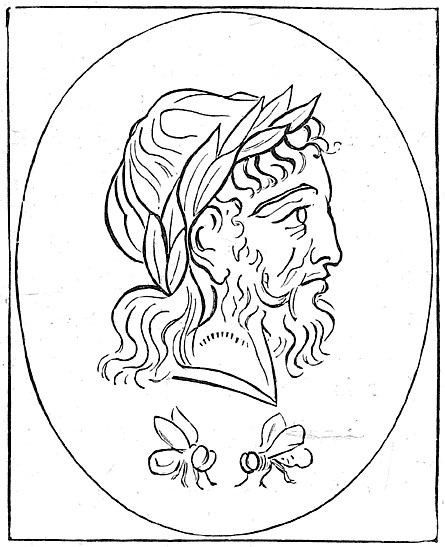
Fig. 1.—Beelzebub (Calmet).
The intermediate processes by which the good and evil were detached, and advanced to separate personification, cannot always be traced, but the indications of their work are in most cases sufficiently clear. The relationship, for instance, between Baal and Baal-zebub cannot be doubted. The one represents the Sun in his glory as quickener of Nature and painter of its beauty, the other the insect-breeding power of the Sun. Baal-zebub is the Fly-god. Only at a comparatively recent period did the deity of the Philistines, whose oracle was consulted by Ahaziah (2 Kings i.), suffer under the reputation of being ‘the Prince of Devils,’ his name being changed by a mere pun to Beelzebul (dung-god). It is not impossible that the modern Egyptian mother’s hesitation to disturb flies settling on her sleeping child, and the sanctity attributed to various insects, originated in the awe felt for him. The title Fly-god is parallelled by the reverent epithet ἀπόμυιος, applied to Zeus as worshipped at Elis,1 the Myiagrus deus of the Romans,2 and the Myiodes mentioned by Pliny.3 Our picture is probably from a protecting charm, and evidently by the god’s believers. There is a story of a peasant woman in a French church who was found kneeling before a marble group, and was warned by a priest that she was worshipping the wrong figure—namely, Beelzebub. ‘Never mind,’ she replied, ‘it is well enough to have friends on both sides.’ The story, though now only ben trovato, would represent the actual state of mind in many a Babylonian invoking the protection of the Fly-god against formidable swarms of his venomous subjects.
Not less clear is the illustration supplied by Scandinavian mythology. In Sæmund’s Edda the evil-minded Loki says:—
Odin! dost thou remember
When we in early days
Blended our blood together?
The two became detached very slowly; for their separation implied the crumbling away of a great religion, and its distribution into new forms; and a religion requires, relatively, as long to decay as it does to grow, as we who live under a crumbling religion have good reason to know. Protap Chunder Mozoomdar, of the Brahmo-Somaj, in an address in London, said, ‘The Indian Pantheon has many millions of deities, and no space is left for the Devil.’ He might have added that these deities have distributed between them all the work that the Devil could perform if he were admitted. His remark recalled to me the Eddaic story of Loki’s entrance into the assembly of gods in the halls of Oegir. Loki—destined in a later age to be identified with Satan—is angrily received by the deities, but he goes round and mentions incidents in the life of each one which show them to be little if any better than himself. The gods and goddesses, unable to reply, confirm the cynic’s criticisms in theologic fashion by tying him up with a serpent for cord.
The late Theodore Parker is said to have replied to a Calvinist who sought to convert him—‘The difference between us is simple: your god is my devil.’ There can be little question that the Hebrews, from whom the Calvinist inherited his deity, had no devil in their mythology, because the jealous and vindictive Jehovah was quite equal to any work of that kind,—as the hardening of Pharaoh’s heart, bringing plagues upon the land, or deceiving a prophet and then destroying him for his false prophecies.4 The same accommodating relation of the primitive deities to all natural phenomena will account for the absence of distinct representatives of evil of the most primitive religions.
The earliest exceptions to this primeval harmony of the gods, implying moral chaos in man, were trifling enough: the occasional monster seems worthy of mention only to display the valour of the god who slew him. But such were demon-germs, born out of the structural action of the human mind so soon as it began to form some philosophy concerning a universe upon which it had at first looked with simple wonder, and destined to an evolution of vast import when the work of moralising upon them should follow.
Let us take our stand beside our barbarian, but no longer savage, ancestor in the far past. We have watched the rosy morning as it waxed to a blazing noon: then swiftly the sun is blotted out, the tempest rages, it is a sudden night lit only by the forked lightning that strikes tree, house, man, with angry thunder-peal. From an instructed age man can look upon the storm blackening the sky not as an enemy of the sun, but one of its own superlative effects; but some thousands of years ago, when we were all living in Eastern barbarism, we could not conceive that a luminary whose very business it was to give light, could be a party to his own obscuration. We then looked with pity upon the ignorance of our ancestors, who had sung hymns to the storm-dragons, hoping to flatter them into quietness; and we came by irresistible logic to that Dualism which long divided the visible, and still divides the moral, universe into two hostile camps.
This is the mother-principle out of which demons (in the ordinary sense of the term) proceeded. At first few, as distinguished from the host of deities by exceptional harmfulness, they were multiplied with man’s growth in the classification of his world. Their principle of existence is capable of indefinite expansion, until it shall include all the realms of darkness, fear, and pain. In the names of demons, and in the fables concerning them, the struggles of man in his ages of weakness with peril, want, and death, are recorded more fully than in any inscriptions on stone. Dualism is a creed which all superficial appearances attest. Side by side the desert and the fruitful land, the sunshine and the frost, sorrow and joy, life and death, sit weaving around every life its vesture of bright and sombre threads, and Science alone can detect how each of these casts the shuttle to the other. Enemies to each other they will appear in every realm which knowledge has not mastered. There is a refrain, gathered from many ages, in William Blake’s apostrophe to the tiger:—
Tiger! tiger! burning bright
In the forests of the night;
What immortal hand or eye
Framed thy fearful symmetry?
In what distant deeps or skies
Burned that fire within thine eyes?
On what wings dared he aspire?
What the hand dared seize the fire?
When the stars threw down their spears
And water heaven with their tears,
Did he smile his work to see?
Did he who made the lamb make thee?
That which one of the devoutest men of genius whom England has produced thus asked was silently answered in India by the serpent-worshipper kneeling with his tongue held in his hand; in Egypt, by Osiris seated on a throne of chequer.5
It is necessary to distinguish clearly between the Demon and the Devil, though, for some purposes, they must be mentioned together. The world was haunted with demons for many ages before there was any embodiment of their spirit in any central form, much less any conception of a Principle of Evil in the universe. The early demons had no moral character, not any more than the man-eating tiger. There is no outburst of moral indignation mingling with the shout of victory when Indra slays Vritra, and Apollo’s face is serene when his dart pierces the Python. It required a much higher development of the moral sentiment to give rise to the conception of a devil. Only that intensest light could cast so black a shadow athwart the world as the belief in a purely malignant spirit. To such a conception—love of evil for its own sake—the word Devil is limited in this work; Demon is applied to beings whose harmfulness is not gratuitous, but incidental to their own satisfactions.
Deity and Demon are from words once interchangeable, and the latter has simply suffered degradation by the conventional use of it to designate the less beneficent powers and qualities, which originally inhered in every deity, after they were detached from these and separately personified. Every bright god had his shadow, so to say; and under the influence of Dualism this shadow attained a distinct existence and personality in the popular imagination. The principle having once been established, that what seemed beneficent and what seemed the reverse must be ascribed to different powers, it is obvious that the evolution of demons must be continuous, and their distribution co-extensive with the ills that flesh is heir to.
1 Pausan. v. 14, 2.
2 Solin. Polyhistor, i.
3 Pliny, xxix. 6, 34, init.
4 Ezekiel xiv. 9.
5 As in the Bembine Tablet in the Bodleian Library.
Chapter III.
Degradation.
The degradation of deities—Indicated in names—Legends of their fall—Incidental signs of the divine origin of demons and devils.
The atmospheric conditions having been prepared in the human mind for the production of demons, the particular shapes or names they would assume would be determined by a variety of circumstances, ethnical, climatic, political, or even accidental. They would, indeed, be rarely accidental; but Professor Max Müller, in his notes to the Rig-Veda, has called attention to a remarkable instance in which the formation of an imposing mythological figure of this kind had its name determined by what, in all probability, was an accident. There appears in the earliest Vedic hymns the name of Aditi, as the holy Mother of many gods, and thrice there is mentioned the female name Diti. But there is reason to believe that Diti is a mere reflex of Aditi, the a being dropped originally by a reciter’s license. The later reciters, however, regarding every letter in so sacred a book, or even the omission of a letter, as of eternal significance, Diti—this decapitated Aditi—was evolved into a separate and powerful being, and, every niche of beneficence being occupied by its god or goddess, the new form was at once relegated to the newly-defined realm of evil, where she remained as the mother of the enemies of the gods, the Daityas. Unhappily this accident followed the ancient tendency by which the Furies and Vices have, with scandalous constancy, been described in the feminine gender.
The close resemblance between these two names of Hindu mythology, severally representing the best and the worst, may be thus accidental, and only serve to show how the demon-forming tendency, after it began, was able to press even the most trivial incidents into its service. But generally the names of demons, and for whole races of demons, report far more than this; and in no inquiry more than that before us is it necessary to remember that names are things. The philological facts supply a remarkable confirmation of the statements already made as to the original identity of demon and deity. The word ‘demon’ itself, as we have said, originally bore a good instead of an evil meaning. The Sanskrit deva, ‘the shining one,’ Zend daêva, correspond with the Greek θεος, Latin deus, Anglo-Saxon Tiw; and remain in ‘deity,’ ‘deuce’ (probably; it exists in Armorican, teuz, a phantom), ‘devel’ (the gipsy name for God), and Persian dīv, demon. The Demon of Socrates represents the personification of a being still good, but no doubt on the path of decline from pure divinity. Plato declares that good men when they die become ‘demons,’ and he says ‘demons are reporters and carriers between gods and men.’ Our familiar word bogey, a sort of nickname for an evil spirit, comes from the Slavonic word for God—bog. Appearing here in the West as bogey (Welsh bwg, a goblin), this word bog began, probably, as the ‘Baga’ of cuneiform inscriptions, a name of the Supreme Being, or possibly the Hindu ‘Bhaga,’ Lord of Life. In the ‘Bishop’s Bible’ the passage occurs, ‘Thou shalt not be afraid of any bugs by night:’ the word has been altered to ‘terror.’ When we come to the particular names of demons, we find many of them bearing traces of the splendours from which they have declined. ‘Siva,’ the Hindu god of destruction, has a meaning (‘auspicious’) derived from Svī, ‘thrive’—thus related ideally to Pluto, ‘wealth’—and, indeed, in later ages, appears to have gained the greatest elevation. In a story of the Persian poem Masnavi, Ahriman is mentioned with Bahman as a fire-fiend, of which class are the Magian demons and the Jinns generally; which, the sanctity of fire being considered, is an evidence of their high origin. Avicenna says that the genii are ethereal animals. Lucifer—light-bearing—is the fallen angel of the morning star. Loki—the nearest to an evil power of the Scandinavian personifications—is the German leucht, or light. Azazel—a word inaccurately rendered ‘scape-goat’ in the Bible—appears to have been originally a deity, as the Israelites were originally required to offer up one goat to Jehovah and another to Azazel, a name which appears to signify the ‘strength of God.’ Gesenius and Ewald regard Azazel as a demon belonging to the pre-Mosaic religion, but it can hardly be doubted that the four arch-demons mentioned by the Rabbins—Samaël, Azazel, Asaël, and Maccathiel—are personifications of the elements as energies of the deity. Samaël would appear to mean the ‘left hand of God;’ Azazel, his strength; Asaël, his reproductive force; and Maccathiel, his retributive power, but the origin of these names is doubtful..
Although Azazel is now one of the Mussulman names for a devil, it would appear to be nearly related to Al Uzza of the Koran, one of the goddesses of whom the significant tradition exists, that once when Mohammed had read, from the Sura called ‘The Star,’ the question, ‘What think ye of Allat, Al Uzza, and Manah, that other third goddess?’ he himself added, ‘These are the most high and beauteous damsels, whose intercession is to be hoped for,’ the response being afterwards attributed to a suggestion of Satan.1 Belial is merely a word for godlessness; it has become personified through the misunderstanding of the phrase in the Old Testament by the translators of the Septuagint, and thus passed into christian use, as in 2 Cor. vi. 15, ‘What concord hath Christ with Belial?’ The word is not used as a proper name in the Old Testament, and the late creation of a demon out of it may be set down to accident.
Even where the names of demons and devils bear no such traces of their degradation from the state of deities, there are apt to be characteristics attributed to them, or myths connected with them, which point in the direction indicated. Such is the case with Satan, of whom much must be said hereafter, whose Hebrew name signifies the adversary, but who, in the Book of Job, appears among the sons of God. The name given to the devil in the Koran—Eblis—is almost certainly diabolos Arabicised; and while this Greek word is found in Pindar2 (5th century B.C.), meaning a slanderer, the fables in the Koran concerning Eblis describe him as a fallen angel of the highest rank.
One of the most striking indications of the fall of demons from heaven is the wide-spread belief that they are lame. Mr. Tylor has pointed out the curious persistence of this idea in various ethnical lines of development.3 Hephaistos was lamed by his fall when hurled by Zeus from Olympos; and it is not a little singular that in the English travesty of limping Vulcan, represented in Wayland the Smith,4 there should appear the suggestion, remarked by Mr. Cox, of the name ‘Vala’ (coverer), one of the designations of the dragon destroyed by Indra. ‘In Sir Walter Scott’s romance,’ says Mr. Cox, ‘Wayland is a mere impostor, who avails himself of a popular superstition to keep up an air of mystery about himself and his work, but the character to which he makes pretence belongs to the genuine Teutonic legend.’5 The Persian demon Aeshma—the Asmodeus of the Book of Tobit—appears with the same characteristic of lameness in the ‘Diable Boiteux’ of Le Sage. The christian devil’s clubbed or cloven foot is notorious.
Even the horns popularly attributed to the devil may possibly have originated with the aureole which indicates the glory of his ‘first estate.’ Satan is depicted in various relics of early art wearing the aureole, as in a miniature of the tenth century (from Bible No. 6, Bib. Roy.), given by M. Didron.6 The same author has shown that Pan and the Satyrs, who had so much to do with the shaping of our horned and hoofed devil, originally got their horns from the same high source as Moses in the old Bibles,7 and in the great statue of him at Rome by Michel Angelo.
It is through this mythologic history that the most powerful demons have been associated in the popular imagination with stars, planets,—Ketu in India, Saturn and Mercury the ‘Infortunes,’—comets, and other celestial phenomena. The examples of this are so numerous that it is impossible to deal with them here, where I can only hope to offer a few illustrations of the principles affirmed; and in this case it is of less importance for the English reader, because of the interesting volume in which the subject has been specially dealt with.8 Incidentally, too, the astrological demons and devils must recur from time to time in the process of our inquiry. But it will probably be within the knowledge of some of my readers that the dread of comets and of meteoric showers yet lingers in many parts of Christendom, and that fear of unlucky stars has not passed away with astrologers. There is a Scottish legend told by Hugh Miller of an avenging meteoric demon. A shipmaster who had moored his vessel near Morial’s Den, amused himself by watching the lights of the scattered farmhouses. After all the rest had gone out one light lingered for some time. When that light too had disappeared, the shipmaster beheld a large meteor, which, with a hissing noise, moved towards the cottage. A dog howled, an owl whooped; but when the fire-ball had almost reached the roof, a cock crew from within the cottage, and the meteor rose again. Thrice this was repeated, the meteor at the third cock-crow ascending among the stars. On the following day the shipmaster went on shore, purchased the cock, and took it away with him. Returned from his voyage, he looked for the cottage, and found nothing but a few blackened stones. Nearly sixty years ago a human skeleton was found near the spot, doubled up as if the body had been huddled into a hole: this revived the legend, and probably added some of those traits which make it a true bit of mosaic in the mythology of Astræa.9
The fabled ‘fall of Lucifer’ really signifies a process similar to that which has been noticed in the case of Saranyu. The morning star, like the morning light, as revealer of the deeds of darkness, becomes an avenger, and by evolution an instigator of the evil it originally disclosed and punished. It may be remarked also that though we have inherited the phrase ‘Demons of Darkness,’ it was an ancient rabbinical belief that the demons went abroad in darkness not only because it facilitated their attacks on man, but because being of luminous forms, they could recognise each other better with a background of darkness.
1 See Sale’s Koran, p. 281.
2 Pindar, Fragm., 270.
3 Tylor’s ‘Early Hist. of Mankind,’ p. 358; ‘Prim. Cult.,’ vol. ii. p. 230.
4 The Gascons of Labourd call the devil ‘Seigneur Voland,’ and some revere him as a patron.
5 ‘Myth. of the Aryan Nations,’ vol. ii. p. 327.
6 ‘Christian Iconography,’ Bohn, p. 158.
7 ‘Videbant faciem egredientis Moysis esse cornutam.’—Vulg. Exod. xxxiv. 35.
8 ‘Myths and Marvels of Astronomy.’ By R. A. Proctor. Chatto & Windus, 1878.
9 ‘Scenes and Legends,’ &c., p. 73.
Chapter IV.
The Abgott.
The ex-god—Deities demonised by conquest—Theological animosity—Illustration from the Avesta—Devil-worship an arrested Deism—Sheik Adi—Why demons were painted ugly—Survivals of their beauty.
The phenomena of the transformation of deities into demons meet the student of Demonology at every step. We shall have to consider many examples of a kind similar to those which have been mentioned in the preceding chapter; but it is necessary to present at this stage of our inquiry a sufficient number of examples to establish the fact that in every country forces have been at work to degrade the primitive gods into types of evil, as preliminary to a consideration of the nature of those forces.
We find the history of the phenomena suggested in the German word for idol, Abgott—ex-god. Then we have ‘pagan,’ villager, and ‘heathen,’ of the heath, denoting those who stood by their old gods after others had transferred their faith to the new. These words bring us to consider the influence upon religious conceptions of the struggles which have occurred between races and nations, and consequently between their religions. It must be borne in mind that by the time any tribes had gathered to the consistency of a nation, one of the strongest forces of its coherence would be its priesthood. So soon as it became a general belief that there were in the universe good and evil Powers, there must arise a popular demand for the means of obtaining their favour; and this demand has never failed to obtain a supply of priesthoods claiming to bind or influence the præternatural beings. These priesthoods represent the strongest motives and fears of a people, and they were gradually intrenched in great institutions involving powerful interests. Every invasion or collision or mingling of races thus brought their respective religions into contact and rivalry; and as no priesthood has been known to consent peaceably to its own downfall and the degradation of its own deities, we need not wonder that there have been perpetual wars for religious ascendency. It is not unusual to hear sects among ourselves accusing each other of idolatry. In earlier times the rule was for each religion to denounce its opponent’s gods as devils. Gregory the Great wrote to his missionary in Britain, the Abbot Mellitus, second Bishop of Canterbury, that ‘whereas the people were accustomed to sacrifice many oxen in honour of demons, let them celebrate a religious and solemn festival, and not slay the animals to the devil (diabolo), but to be eaten by themselves to the glory of God.’ Thus the devotion of meats to those deities of our ancestors which the Pope pronounces demons, which took place chiefly at Yule-tide, has survived in our more comfortable Christmas banquets. This was the fate of all the deities which Christianity undertook to suppress. But it had been the habit of religions for many ages before. They never denied the actual existence of the deities they were engaged in suppressing. That would have been too great an outrage upon popular beliefs, and might have caused a reaction; and, besides, each new religion had an interest of its own in preserving the basis of belief in these invisible beings. Disbelief in the very existence of the old gods might be followed by a sceptical spirit that might endanger the new. So the propagandists maintained the existence of native gods, but called them devils. Sometimes wars or intercourse between tribes led to their fusion; the battle between opposing religions was drawn, in which case there would be a compromise by which several deities of different origin might continue together in the same race and receive equal homage. The differing degrees of importance ascribed to the separate persons of the Hindu triad in various localities of India, suggest it as quite probable that Brahma, Vishnu, and Siva signalled in their union the political unity of certain districts in that country.1 The blending of the names of Confucius and Buddha, in many Chinese and Japanese temples, may show us an analogous process now going on, and, indeed, the various ethnical ideas combined in the christian Trinity render the fact stated one of easy interpretation. But the religious difficulty was sometimes not susceptible of compromise. The most powerful priesthood carried the day, and they used every ingenuity to degrade the gods of their opponents. Agathodemons were turned into kakodemons. The serpent, worshipped in many lands, might be adopted as the support of sleeping Vishnu in India, might be associated with the rainbow (‘the heavenly serpent’) in Persia, but elsewhere was cursed as the very genius of evil.
The operation of this force in the degradation of deities, is particularly revealed in the Sacred Books of Persia. In that country the great religions of the East would appear to have contended against each other with especial fury, and their struggles were probably instrumental in causing one or more of the early migrations into Western Europe. The great celestial war between Ormuzd and Ahriman—Light and Darkness—corresponded with a violent theological conflict, one result of which is that the word deva, meaning ‘deity’ to Brahmans, means ‘devil’ to Parsees. The following extract from the Zend-Avesta will serve as an example of the spirit in which the war was waged:—
‘All your devas are only manifold children of the Evil Mind—and the great one who worships the Saoma of lies and deceits; besides the treacherous acts for which you are notorious throughout the seven regions of the earth.
‘You have invented all the evil which men speak and do, which is indeed pleasant to the Devas, but is devoid of all goodness, and therefore perishes before the insight of the truth of the wise.
‘Thus you defraud men of their good minds and of their immortality by your evil minds—as well through those of the Devas as that of the Evil Spirit—through evil deeds and evil words, whereby the power of liars grows.’2
That is to say—Ours is the true god: your god is a devil.
The Zoroastrian conversion of deva (deus) into devil does not alone represent the work of this odium theologicum. In the early hymns of India the appellation asuras is given to the gods. Asura means a spirit. But in the process of time asura, like dæmon, came to have a sinister meaning: the gods were called suras, the demons asuras, and these were said to contend together. But in Persia the asuras—demonised in India—retained their divinity, and gave the name ahura to the supreme deity, Ormuzd (Ahura-mazda). On the other hand, as Mr. Muir supposes, Varenya, applied to evil spirits of darkness in the Zendavesta, is cognate with Varuna (Heaven); and the Vedic Indra, king of the gods—the Sun—is named in the Zoroastrian religion as one of the chief councillors of that Prince of Darkness.
But in every country conquered by a new religion, there will always be found some, as we have seen, who will hold on to the old deity under all his changed fortunes. These will be called ‘bigots,’ but still they will adhere to the ancient belief and practise the old rites. Sometimes even after they have had to yield to the popular terminology, and call the old god a devil, they will find some reason for continuing the transmitted forms. It is probable that to this cause was originally due the religions which have been developed into what is now termed Devil-worship. The distinct and avowed worship of the evil Power in preference to the good is a rather startling phenomenon when presented baldly; as, for example, in a prayer of the Madagascans to Nyang, author of evil, quoted by Dr. Réville:—‘O Zamhor! to thee we offer no prayers. The good god needs no asking. But we must pray to Nyang. Nyang must be appeased. O Nyang, bad and strong spirit, let not the thunder roar over our heads! Tell the sea to keep within its bounds! Spare, O Nyang, the ripening fruit, and dry not up the blossoming rice! Let not our women bring forth children on the accursed days. Thou reignest, and this thou knowest, over the wicked; and great is their number, O Nyang. Torment not, then, any longer the good folk!’3
This is natural, and suggestive of the criminal under sentence of death, who, when asked if he was not afraid to meet his God, replied, ‘Not in the least; it’s that other party I’m afraid of.’ Yet it is hardly doubtful that the worship of Nyang began in an era when he was by no means considered morally baser than Zamhor. How the theory of Dualism, when attained, might produce the phenomenon called Devil-worship, is illustrated in the case of the Yezedis, now so notorious for that species of religion. Their theory is usually supposed to be entirely represented by the expression uttered by one of them, ‘Will not Satan, then, reward the poor Izedis, who alone have never spoken ill of him, and have suffered so much for him?’4 But these words are significant, no doubt, of the underlying fact: they ‘have never spoken ill of’ the Satan they worship. The Mussulman calls the Yezedi a Satan-worshipper only as the early Zoroastrian held the worshipper of a deva to be the same. The chief object of worship among the Yezedis is the figure of the bird Taous, a half-mythical peacock. Professor King of Cambridge traces the Taous of this Assyrian sect to the “sacred bird called a phœnix,” whose picture, as seen by Herodotus (ii. 73) in Egypt, is described by him as ‘very like an eagle in outline and in size, but with plumage partly gold-coloured, partly crimson,’ and which was said to return to Heliopolis every five hundred years, there to burn itself on the altar of the Sun, that another might rise from its ashes.5 Now the name Yezedis is simply Izeds, genii; and we are thus pointed to Arabia, where we find the belief in genii is strongest, and also associated with the mythical bird Rokh of its folklore. There we find Mohammed rebuking the popular belief in a certain bird called Hamâh, which was said to take form from the blood near the brain of a dead person and fly away, to return, however, at the end of every hundred years to visit that person’s sepulchre. But this is by no means Devil-worship, nor can we find any trace of that in the most sacred scripture of the Yezedis, the ‘Eulogy of Sheikh Adi.’ This Sheikh inherited from his father, Moosafir, the sanctity of an incarnation of the divine essence, of which he (Adi) speaks as ‘the All-merciful.’
By his light he hath lighted the lamp of the morning.
I am he that placed Adam in my Paradise.
I am he that made Nimrod a hot burning fire.
I am he that guided Ahmet mine elect,
I gifted him with my way and guidance.
Mine are all existences together,
They are my gift and under my direction.
I am he that possesseth all majesty,
And beneficence and charity are from my grace,
I am he that entereth the heart in my zeal;
And I shine through the power of my awfulness and majesty.
I am he to whom the lion of the desert came:
I rebuked him and he became like stone.
I am he to whom the serpent came,
And by my will I made him like dust.
I am he that shook the rock and made it tremble,
And sweet water flowed therefrom from every side.6
The reverence shown in these sacred sentences for Hebrew names and traditions—as of Adam in Paradise, Marah, and the smitten rock—and for Ahmet (Mohammed), appears to have had its only requital in the odious designation of the worshippers of Taous as Devil-worshippers, a label which the Yezedis perhaps accepted as the Wesleyans and Friends accepted such names as ‘Methodist’ and ‘Quaker.’
Mohammed has expiated the many deities he degraded to devils by being himself turned to an idol (mawmet), a term of contempt all the more popular for its resemblance to ‘mummery.’ Despite his denunciations of idolatry, it is certain that this earlier religion represented by the Yezedis has never been entirely suppressed even among his own followers. In Dr. Leitner’s interesting collection there is a lamp, which he obtained from a mosque, made in the shape of a peacock, and this is but one of many similar relics of primitive or alien symbolism found among the Mussulman tribes.
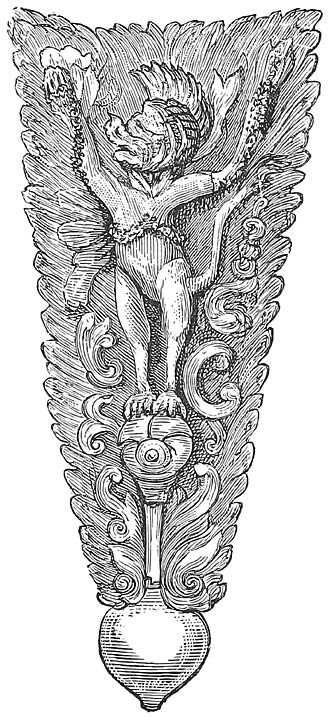
Fig. 2.—Handle of Hindu Chalice.
The evolution of demons and devils out of deities was made real to the popular imagination in every country where the new religion found art existing, and by alliance with it was enabled to shape the ideas of the people. The theoretical degradation of deities of previously fair association could only be completed where they were presented to the eye in repulsive forms. It will readily occur to every one that a rationally conceived demon or devil would not be repulsive. If it were a demon that man wished to represent, mere euphemism would prevent its being rendered odious. The main characteristic of a demon—that which distinguishes it from a devil—is, as we have seen, that it has a real and human-like motive for whatever evil it causes. If it afflict or consume man, it is not from mere malignancy, but because impelled by the pangs of hunger, lust, or other suffering, like the famished wolf or shark. And if sacrifices of food were offered to satisfy its need, equally we might expect that no unnecessary insult would be offered in the attempt to portray it. But if it were a devil—a being actuated by simple malevolence—one of its essential functions, temptation, would be destroyed by hideousness. For the work of seduction we might expect a devil to wear the form of an angel of light, but by no means to approach his intended victim in any horrible shape, such as would repel every mortal. The great representations of evil, whether imagined by the speculative or the religious sense, have never been, originally, ugly. The gods might be described as falling swiftly like lightning out of heaven, but in the popular imagination they retained for a long time much of their splendour. The very ingenuity with which they were afterwards invested with ugliness in religious art, attests that there were certain popular sentiments about them which had to be distinctly reversed. It was because they were thought beautiful that they must be painted ugly; it was because they were—even among converts to the new religion—still secretly believed to be kind and helpful, that there was employed such elaboration of hideous designs to deform them. The pictorial representations of demons and devils will come under a more detailed examination hereafter: it is for the present sufficient to point out that the traditional blackness or ugliness of demons and devils, as now thought of, by no means militates against the fact that they were once the popular deities. The contrast, for instance, between the horrible physiognomy given to Satan in ordinary christian art, and the theological representation of him as the Tempter, is obvious. Had the design of Art been to represent the theological theory, Satan would have been portrayed in a fascinating form. But the design was not that; it was to arouse horror and antipathy for the native deities to which the ignorant clung tenaciously. It was to train children to think of the still secretly-worshipped idols as frightful and bestial beings. It is important, therefore, that we should guard against confusing the speculative or moral attempts of mankind to personify pain and evil with the ugly and brutal demons and devils of artificial superstition, oftenest pictured on church walls. Sometimes they are set to support water-spouts, often the brackets that hold their foes, the saints. It is a very ancient device. Our figure 2 is from the handle of a chalice in possession of Sir James Hooker, meant probably to hold the holy water of Ganges. These are not genuine demons or devils, but carefully caricatured deities. Who that looks upon the grinning bestial forms carved about the roof of any old church—as those on Melrose Abbey and York Cathedral7—which, there is reason to believe, represent the primitive deities driven from the interior by potency of holy water, and chained to the uncongenial service of supporting the roof-gutter—can see in these gargoyles (Fr. gargouille, dragon), anything but carved imprecations? Was it to such ugly beings, guardians of their streams, hills, and forests, that our ancestors consecrated the holly and mistletoe, or with such that they associated their flowers, fruits, and homes? They were caricatures inspired by missionaries, made to repel and disgust, as the images of saints beside them were carved in beauty to attract. If the pagans had been the artists, the good looks would have been on the other side. And indeed there was an art of which those pagans were the unconscious possessors, through which the true characters of the imaginary beings they adored have been transmitted to us. In the fables of their folklore we find the Fairies that represent the spirit of the gods and goddesses to which they are easily traceable. That goddess who in christian times was pictured as a hag riding on a broom-stick was Frigga, the Earth-mother, associated with the first sacred affections clustering around the hearth; or Freya, whose very name was consecrated in frau, woman and wife. The mantle of Bertha did not cover more tenderness when it fell to the shoulders of Mary. The German child’s name for the pre-christian Madonna was Mother Rose: distaff in hand, she watched over the industrious at their household work: she hovered near the cottage, perhaps to find there some weeping Cinderella and give her beauty for ashes.
1 ‘Any Orientalist will appreciate the wonderful hotchpot of Hindu and Arabic language and religion in the following details, noted down among rude tribes of the Malay Peninsula. We hear of Jin Bumi, the earth-god (Arabic jin = demon, Sanskrit bhümi = earth); incense is burnt to Jewajewa (Sanskrit dewa = god), who intercedes with Pirman, the supreme invisible deity above the sky (Brahma?); the Moslem Allah Táala, with his wife Nabi Mahamad (Prophet Mohammed), appear in the Hinduised characters of creator and destroyer of all things; and while the spirits worshipped in stones are called by the Hindu term of ‘dewa’ or deity, Moslem conversion has so far influenced the mind of the stone-worshipper that he will give to his sacred boulder the name of Prophet Mohammed.’—Tylor’s ‘Primitive Culture,’ vol. ii. p. 230.
2 Yaçna, 32.
3 ‘The Devil,’ &c., from the French of the Rev. A. Réville, p. 5.
4 Tylor’s ‘Primitive Culture,’ vol. ii. p. 299.
5 ‘The Gnostics,’ &c., by C. W. King, M.A., p. 153.
6 Those who wish to examine this matter further will do well to refer to Badger, ‘Nestorians and their Rituals,’ in which the whole of the ‘Eulogy’ is translated; and to Layard, ‘Ninevah and Babylon,’ in which there is a translation of the same by Hormuzd Rassam, the King of Abyssinia’s late prisoner.
7 The significance of the gargoyles on the churches built on the foundations of pagan temples may be especially observed at York, where the forms of various animals well known to Indo-Germanic mythology appear. They are probably copies of earlier designs, surviving from the days when the plan of Gregory for the conversion of temples prevailed. ‘The temples of the idols in that nation,’ wrote the Pope, A.C. 601, ‘ought not to be destroyed; but let the idols that are in them be destroyed; let holy water be made and sprinkled in the said temples, let altars be erected and relics placed. For if those temples are well built, it is requisite that they be converted from the worship of devils to the service of the true God.’—Bede, Eccl. Hist. ch. 30.
Chapter V.
Classification.
The obstructions of man—The twelve chief classes—Modifications of particular forms for various functions—Theological demons.
The statements made concerning the fair names of the chief demons and devils which have haunted the imagination of mankind, heighten the contrast between their celestial origin and the functions attributed to them in their degraded forms. The theory of Dualism, representing a necessary stage in the mental development of every race, called for a supply of demons, and the supply came from the innumerable dethroned, outlawed, and fallen deities and angels which had followed the subjugation of races and their religions. But though their celestial origin might linger around them in some slight legend or characteristic as well as in their names, the evil phenomenon to which each was attached as an explanation assigned the real form and work with which he or she was associated in popular superstition. We therefore find in the demons in which men have believed a complete catalogue of the obstacles with which they have had to contend in the long struggle for existence. In the devils we discover equally the history of the moral and religious struggles through which priesthoods and churches have had to pass. And the relative extent of this or that particular class of demons or devils, and the intensity of belief in any class as shown in the number of survivals from it, will be found to reflect pretty faithfully the degree to which the special evil represented by it afflicted primitive man, as attested by other branches of pre-historic investigation.
As to function, the demons we shall have to consider are those representing—1. Hunger; 2. Excessive Heat; 3. Excessive Cold; 4. Destructive elements and physical convulsions; 5. Destructive animals; 6. Human enemies; 7. The Barrenness of the Earth, as rock and desert; 8. Obstacles, as the river or mountain; 9. Illusion, seductive, invisible, and mysterious agents, causing delusions; 10. Darkness (especially when unusual), Dreams, Nightmare; 11. Disease; 12. Death.
These classes are selected, in obedience to necessary limitations, as representing the twelve chief labours of man which have given shape to the majority of his haunting demons, as distinguished from his devils. Of course all classifications of this character must be understood as made for convenience, and the divisions are not to be too sharply taken. What Plotinus said of the gods, that each contained all the rest, is equally true of both demons and devils. The demons of Hunger are closely related to the demons of Fire: Agni devoured his parents (two sticks consumed by the flame they produce); and from them we pass easily to elemental demons, like the lightning, or demons of fever. And similarly we find a relationship between other destructive forces. Nevertheless, the distinctions drawn are not fanciful, but exist in clear and unmistakable beliefs as to the special dispositions and employments of demons; and as we are not engaged in dealing with natural phenomena, but with superstitions concerning them, the only necessity of this classification is that it shall not be arbitrary, but shall really simplify the immense mass of facts which the student of Demonology has to encounter.
But there are several points which require especial attention as preliminary to a consideration of these various classes of demons.
First, it is to be borne in mind that a single demonic form will often appear in various functions, and that these must not be confused. The serpent may represent the lightning, or the coil of the whirlwind, or fatal venom; the earthquake may represent a swallowing Hunger-demon, or the rage of a chained giant. The separate functions must not be lost sight of because sometimes traceable to a single form, nor their practical character suffer disguise through their fair euphemistic or mythological names.
Secondly, the same form appears repeatedly in a diabolic as well as a demonic function, and here a clear distinction must be maintained in the reader’s mind. The distinction already taken between a demon and a devil is not arbitrary: the word demon is related to deity; the word devil, though sometimes connected with the Sanskrit deva, has really no relation to it, but has a bad sense as ‘calumniator:’ but even if there were no such etymological identity and difference, it would be necessary to distinguish such widely separate offices as those representing the afflictive forces of nature where attributed to humanly appreciable motives on the one hand, and evils ascribed to pure malignancy or a principle of evil on the other. The Devil may, indeed, represent a further evolution in the line on which the Demon has appeared; Ahriman the Bad in conflict with Ormuzd the Good may be a spiritualisation of the conflict between Light and Darkness, Sun and Cloud, as represented in the Vedic Indra and Vritra; but the two phases represent different classes of ideas, indeed different worlds, and the apprehension of both requires that they shall be carefully distinguished even when associated with the same forms and names.
Thirdly, there is an important class of demons which the reader may expect to find fully treated of in the part of my work more particularly devoted to Demonology, which must be deferred, or further traced in that portion relating to the Devil; they are forms which in their original conception were largely beneficent, and have become of evil repute mainly through the anathema of theology. The chequer-board on which Osiris sat had its development in hosts of primitive shapes of light opposing shapes of darkness. The evil of some of these is ideal; others are morally amphibious: Teraphim, Lares, genii, were ancestors of the guardian angels and patron saints of the present day; they were oftenest in the shapes of dogs and cats and aged human ancestors, supposed to keep watch and ward about the house, like the friendly Domovoi respected in Russia; the evil disposition and harmfulness ascribed to them are partly natural but partly also theological, and due to the difficulty of superseding them with patron saints and angels. The degradation of beneficent beings, already described in relation to large demonic and diabolic forms, must be understood as constantly acting in the smallest details of household superstition, with what strange reaction and momentous result will appear when we come to consider the phenomena of Witchcraft.
Finally, it must be remarked that the nature of our inquiry renders the consideration of the origin of myths—whether ‘solar’ or other—of secondary importance. Such origin it will be necessary to point out and discuss incidentally, but our main point will always be the forms in which the myths have become incarnate, and their modifications in various places and times, these being the result of those actual experiences with which Demonology is chiefly concerned. A myth, as many able writers have pointed out, is, in its origin, an explanation by the uncivilised mind of some natural phenomenon—not an allegory, not an esoteric conceit. For this reason it possesses fluidity, and takes on manifold shapes. The apparent sleep of the sun in winter may be represented in a vast range of myths, from the Seven Sleepers to the Man in the Moon of our nursery rhyme; but the variations all have relation to facts and circumstances. Comparative Mythology is mainly concerned with the one thread running through them, and binding them all to the original myth; the task of Demonology is rather to discover the agencies which have given their several shapes. If it be shown that Orthros and Cerberus were primarily the morning and evening twilight or howling winds, either interpretation is here secondary to their personification as dogs. Demonology would ask, Why dogs? why not bulls? Its answer in each case detaches from the anterior myth its mode, and shows this as the determining force of further myths.
1 Pausan. v. 14, 2.
2 Solin. Polyhistor, i.
3 Pliny, xxix. 6, 34, init.
4 Ezekiel xiv. 9.
5 As in the Bembine Tablet in the Bodleian Library.
1 See Sale’s Koran, p. 281.
2 Pindar, Fragm., 270.
3 Tylor’s ‘Early Hist. of Mankind,’ p. 358; ‘Prim. Cult.,’ vol. ii. p. 230.
4 The Gascons of Labourd call the devil ‘Seigneur Voland,’ and some revere him as a patron.
5 ‘Myth. of the Aryan Nations,’ vol. ii. p. 327.
6 ‘Christian Iconography,’ Bohn, p. 158.
7 ‘Videbant faciem egredientis Moysis esse cornutam.’—Vulg. Exod. xxxiv. 35.
8 ‘Myths and Marvels of Astronomy.’ By R. A. Proctor. Chatto & Windus, 1878.
9 ‘Scenes and Legends,’ &c., p. 73.
1 ‘Any Orientalist will appreciate the wonderful hotchpot of Hindu and Arabic language and religion in the following details, noted down among rude tribes of the Malay Peninsula. We hear of Jin Bumi, the earth-god (Arabic jin = demon, Sanskrit bhümi = earth); incense is burnt to Jewajewa (Sanskrit dewa = god), who intercedes with Pirman, the supreme invisible deity above the sky (Brahma?); the Moslem Allah Táala, with his wife Nabi Mahamad (Prophet Mohammed), appear in the Hinduised characters of creator and destroyer of all things; and while the spirits worshipped in stones are called by the Hindu term of ‘dewa’ or deity, Moslem conversion has so far influenced the mind of the stone-worshipper that he will give to his sacred boulder the name of Prophet Mohammed.’—Tylor’s ‘Primitive Culture,’ vol. ii. p. 230.
2 Yaçna, 32.
3 ‘The Devil,’ &c., from the French of the Rev. A. Réville, p. 5.
4 Tylor’s ‘Primitive Culture,’ vol. ii. p. 299.
5 ‘The Gnostics,’ &c., by C. W. King, M.A., p. 153.
6 Those who wish to examine this matter further will do well to refer to Badger, ‘Nestorians and their Rituals,’ in which the whole of the ‘Eulogy’ is translated; and to Layard, ‘Ninevah and Babylon,’ in which there is a translation of the same by Hormuzd Rassam, the King of Abyssinia’s late prisoner.
7 The significance of the gargoyles on the churches built on the foundations of pagan temples may be especially observed at York, where the forms of various animals well known to Indo-Germanic mythology appear. They are probably copies of earlier designs, surviving from the days when the plan of Gregory for the conversion of temples prevailed. ‘The temples of the idols in that nation,’ wrote the Pope, A.C. 601, ‘ought not to be destroyed; but let the idols that are in them be destroyed; let holy water be made and sprinkled in the said temples, let altars be erected and relics placed. For if those temples are well built, it is requisite that they be converted from the worship of devils to the service of the true God.’—Bede, Eccl. Hist. ch. 30.
Part II.
The Demon.
Chapter I.
Hunger.
Hunger-demons—Kephn—Miru—Kagura—Ráhu the Hindu sun-devourer—The earth monster at Pelsall—A Franconian custom—Sheitan as moon-devourer—Hindu offerings to the dead—Ghoul—Goblin—Vampyres—Leanness of demons—Old Scotch custom.—The origin of sacrifices.
In every part of the earth man’s first struggle was for his daily food. With only a rude implement of stone or bone he had to get fish from the sea, bird from the air, beast from the forest. For ages, with such poor equipment, he had to wring a precarious livelihood from nature. He saw, too, every living form around him similarly trying to satisfy its hunger. There seemed to be a Spirit of Hunger abroad. And, at the same time, there was such a resistance to man’s satisfaction of his need—the bird and fish so hard to get, the stingy earth so ready to give him a stone when he asked for bread—that he came to the conclusion that there must be invisible voracious beings who wanted all good things for themselves. So the ancient world was haunted by a vast brood of Hunger-demons. There is an African tribe, the Karens, whose representation of the Devil (Kephn) is a huge stomach floating through the air; and this repulsive image may be regarded as the type of nearly half the demons which have haunted the human imagination. This, too, is the terrible Miru, with her daughters and slave, haunting the South Sea Islander. ‘The esoteric doctrine of the priests was, that souls leave the body ere breath has quite gone, and travel to the edge of a cliff facing the setting sun (Rā). A large wave now approaches the base of the cliff, and a gigantic bua tree, covered with fragrant blossoms, springs up from Avaiki (nether world) to receive on its far-reaching branches human spirits, who are mysteriously impelled to cluster on its limbs. When at length the mystic tree is covered with human spirits, it goes down with its living freight to the nether world. Akaanga, the slave of fearful Miru, mistress of the invisible world, infallibly catches all these unhappy spirits in his net and laves them to and fro in a lake. In these waters the captive ghosts exhaust themselves by wriggling about like fishes, in the vain hope of escape. The net is pulled up, and the half-drowned spirits enter into the presence of dread Miru, who is ugliness personified. The secret of Miru’s power over her intended victims is the ‘kava’ root (Piper mythisticum). A bowl of this drink is prepared for each visitor to the shades by her four lovely daughters. Stupefied with the draught, the unresisting victims are borne off to a mighty oven and cooked. Miru, her peerless daughters, her dance-loving son, and the attendants, subsist exclusively on human spirits decoyed to the nether world and then cooked. The drinking-cups of Miru are the skulls of her victims. She is called in song ‘Miru-the-ruddy,’ because her cheeks ever glow with the heat of the oven where her captives are cooked. As the surest way to Miru’s oven is to die a natural death, one need not marvel that the Rev. Mr. Gill, who made these statements before the Anthropological Institute in London (February 8, 1876), had heard ‘many anecdotes of aged warriors, scarcely able to hold a spear, insisting on being led to the field of battle in the hope of gaining the house of the brave.’ As the South Sea paradise seems to consist in an eternal war-dance, or, in one island, in an eternal chewing of sugar-cane, it is not unlikely that the aged seek violent death chiefly to avoid the oven. We have here a remarkable illustration of the distinguishing characteristic of the demon. Fearful as Miru is, it may be noted that there is not one gratuitous element of cruelty in her procedure. On the contrary, she even provides her victims with an anæsthetic draught. Her prey is simply netted, washed, and cooked, as for man are his animal inferiors. In one of the islands (Aitutaki), Miru is believed to resort to a device which is certainly terrible—namely, the contrivance that each soul entering the nether world shall drink a bowl of living centipedes; but this is simply with the one end in view of appeasing her own pangs of hunger, for the object and effect of the draught is to cause the souls to drown themselves, it being apparently only after entire death that they can be cooked and devoured by Miru and her household.
Fortunately for the islanders, Miru is limited in her tortures to a transmundane sphere, and room is left for many a slip between her dreadful cup and the human lip. The floating stomach Kephn is, however, not other-worldly. We see, however, a softened form of him in some other tribes. The Greenlanders, Finns, Laps, conceived the idea that there is a large paunch-demon which people could invoke to go and suck the cows or consume the herds of their enemies; and the Icelanders have a superstition that some people can construct such a demon out of bones and skins, and send him forth to transmute the milk or flesh of cattle into a supply of flesh and blood. A form of this kind is represented in the Japanese Kagura (figure 3), the favourite mask of January dancers and drum-beaters seeking money. The Kagura is in precise contrast with the Pretas (Siam), which, though twelve miles in height, are too thin to be seen, their mouths being so small as to render it impossible to satisfy their fearful hunger.
The pot-bellies given to demons in Travancore and other districts of India, and the blood-sacrifices by which the natives propitiate them—concerning which a missionary naively remarks, that even these heathen recognise, though in corrupted form, ‘the great truth that without shedding of blood there is no remission of sins’1—refer to the Hunger-demon. They are the brood of Kali, girt round with human skulls.
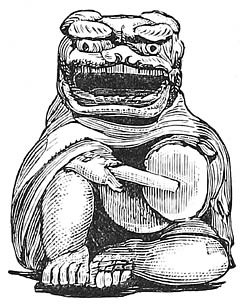
Fig. 3—A Swallower.
The expedition which went out to India to observe the last solar eclipse was incidentally the means of calling attention to a remarkable survival of the Hunger-demon in connection with astronomic phenomena. While the English observers were arranging their apparatus, the natives prepared a pile of brushwood, and, so soon as the eclipse began, they set fire to this pile and began to shout and yell as they danced around it. Not less significant were the popular observances generally. There was a semi-holiday in honour of the eclipse. The ghauts were crowded with pious worshippers. No Hindu, it is thought, ought to do any work whatever during an eclipse, and there was a general tendency to prolong the holiday a little beyond the exact time when the shadow disappears, and indeed to prolong it throughout the day. All earthenware vessels used for cooking were broken, and all cooked food in the houses at the time of the eclipse was thrown out. It is regarded as a time of peculiar blessings if taken in the right way, and of dread consequences to persons inclined to heterodoxy or neglect of the proper observances. Between nine and ten in the evening two shocks of an earthquake occurred, the latter a rather unpleasant one, shaking the tables and doors in an uncomfortable fashion for several seconds. To the natives it was no surprise—they believe firmly in the connection of eclipses and earthquakes.2
Especially notable is the breaking of their culinary utensils by the Hindus during an eclipse. In Copenhagen there is a collection of the votive weapons of ancient Norsemen, every one broken as it was offered up to the god of their victory in token of good faith, lest they should be suspected of any intention to use again what they had given away. For the same reason the cup was offered—broken—with the libation. The Northman felt himself in the presence of the Jötunn (giants), whose name Grimm identifies as the Eaters. For the Hindu of to-day the ceremonies appropriate at an eclipse, however important, have probably as little rational meaning as the occasional Belfire that lights up certain dark corners of Europe has for those who build it. But the traditional observances have come up from the childhood of the world, when the eclipse represented a demon devouring the sun, who was to have his attention called by outcries and prayers to the fact that if it was fire he needed there was plenty on earth; and if food, he might have all in their houses, provided he would consent to satisfy his appetite with articles of food less important than the luminaries of heaven.
Such is the shape now taken in India of the ancient myth of the eclipse. When at the churning of the ocean to find the nectar of immortality, a demon with dragon-tail was tasting that nectar, the sun and moon told on him, but not until his head had become immortal; and it is this head of Ráhu which seeks now to devour the informers—the Sun and Moon.3 Mythologically, too, this Ráhu has been divided; for we shall hereafter trace the dragon-tail of him to the garden of Eden and in the christian devil, whereas in India he has been improved from a vindictive to a merely voracious demon.
The fires kindled by the Hindus to frighten Ráhu on his latest appearance might have defeated the purpose of the expedition by the smoke it was sending up, had not two officers leaped upon the fire and scattered its fuel; but just about the time when these courageous gentlemen were trampling out the fires of superstition whose smoke would obscure the vision of science, an event occurred in England which must be traced to the same ancient belief—the belief, namely, that when anything is apparently swallowed up, as the sun and moon by an eclipse, or a village by earthquake or flood, it is the work of a hungry dragon, earthworm, or other monster. The Pelsall mine was flooded, and a large number of miners drowned. When the accident became known in the village, the women went out with the families of the unfortunate men, and sat beside the mouth of the flooded pit, at the bottom of which the dead bodies yet remained. These women then yelled down the pit with voices very different from ordinary lamentation. They also refused unanimously to taste food of any kind, saying, when pressed to do so, that so long as they could refrain from eating, their husbands might still be spared to them. When, finally, one poor woman, driven by the pangs of hunger, was observed to eat a crust of bread, the cries ceased, and the women, renouncing all hope, proceeded in silent procession to their homes in Pelsall.
The Hindu people casting their food out of the window during an eclipse, the Pelsall wives refusing to eat when the mine is flooded, are acting by force of immemorial tradition, and so are doing unconsciously what the African woman does consciously when she surrounds the bed of her sick husband with rice and meat, and beseeches the demon to devour them instead of the man. To the same class of notions belong the old custom of trying to discover the body of one drowned by means of a loaf of bread with a candle stuck in it, which it was said would pause above the body, and the body might be made to appear by firing a gun over it—that is, the demon holding it would be frightened off. A variant, too, is the Persian custom of protecting a woman in parturition by spreading a table, with a lamp at each corner, with seven kinds of fruits and seven different aromatic seeds upon it.
In 1769, when Pennant made his ‘Scottish Tour,’ he found fully observed in the Highlands the ceremony of making the Beltane Cake on the first of May, and dedicating its distributed fragments to birds and beasts of prey, with invocation to the dread being of whom they were the supposed agents to spare the herds. Demons especially love milk: the Lambton Worm required nine cows’ milk daily; and Jerome mentions a diabolical baby which exhausted six nurses.
The Devil nominally inherits, among the peasantry of Christendom, the attributes of the demons which preceded him; but it must be understood that in every case where mere voracity is ascribed to the Devil, a primitive demon is meant, and of this fact the superstitious peasant is dimly conscious. In Franconia, when a baker is about to put dough biscuits into an oven to be baked, he will first throw half-a-dozen of them into the fire, saying, ‘There, poor devil! those are for you.’ If pressed for an explanation, he will admit his fear that but for this offering his biscuits are in danger of coming out burnt; but that the ‘poor devil’ is not bad-hearted, only driven by his hunger to make mischief. The being he fears is, therefore, clearly not the Devil at all—whose distinction is a love of wickedness for its own sake—but the half-starved gobbling ghosts of whom, in Christian countries, ‘Devil’ has become the generic name. Of their sacrifices, Grace before meat is a remnant. In Moslem countries, however, ‘Sheitan’ combines the demonic and the malignant voracities. During the late lunar eclipse, the inhabitants of Pera and Constantinople fired guns over their houses to drive ‘Sheitan’ (Satan) away from the moon, for, whoever the foe, the Turk trusts in gunpowder. But superstitions representing Satan as a devourer are becoming rare. In the church of Nôtre Dame at Hal, Belgium, the lectern shows a dragon attempting to swallow the Bible, which is supported on the back of an eagle.
There is another and much more formidable form in which the Hunger-demon appears in Demonology. The fondness for blood, so characteristic of supreme gods, was distributed as a special thirst through a large class of demons. In the legend of Ishtar descending to Hades4 to seek some beloved one, she threatens if the door be not opened—
I will raise the dead to be devourers of the living!
Upon the living shall the dead prey!
This menace shows that the Chaldæan and Babylonian belief in the vampyre, called Akhkharu in Assyrian, was fully developed at a very early date. Although the Hunger-demon was very fully developed in India, it does not appear to have been at any time so cannibalistic, possibly because the natives were not great flesh-eaters. In some cases, indeed, we meet with the vampyre superstition; as in the story of Vikram and the Vampyre, and in the Tamil drama of Harichándra, where the frenzied Sandramáti says to the king, ‘I belong to the race of elves, and I have killed thy child in order that I might feed on its delicate flesh.’ Such expressions are rare enough to warrant suspicion of their being importations. The Vetala’s appetite is chiefly for corpses. The poor hungry demons of India—such as the Bhút, a dismal, ravenous ghost, dreaded at the moon-wane of the month Katik (Oct.-Nov.)—was not supposed to devour man, but only man’s food. The Hindu demons of this class may be explained by reference to the sráddha, or oblation to ancestors, concerning which we read directions in the Manu Code. ‘The ancestors of men are satisfied a whole month with tila, rice, &c.; two months with fish, &c. The Manes say, Oh, may that man be born in our line who may give us milky food, with honey and pure butter, both on the thirteenth of the moon and when the shadow of an elephant falls to the east!’ The bloodthirsty demons of India have pretty generally been caught up like Kali into a higher symbolism, and their voracity systematised and satisfied in sacrificial commutations. The popular belief in the southern part of that country is indicated by Professor Monier Williams, in a letter written from Southern India, wherein he remarks that the devils alone require propitiation. It is generally a simple procedure, performed by offerings of food or other articles supposed to be acceptable to disembodied beings. For example, when a certain European, once a terror to the district in which he lived, died in the South of India, the natives were in the constant habit of depositing brandy and cigars on his tomb to propitiate his spirit, supposed to roam about the neighbourhood in a restless manner, and with evil proclivities. The very same was done to secure the good offices of the philanthropic spirit of a great European sportsman, who, when he was alive, delivered his district from the ravages of tigers. Indeed all evil spirits are thought to be opposed by good ones, who, if duly propitiated, make it their business to guard the inhabitants of particular places from demonic intruders. Each district, and even every village, has its guardian genius, often called its Mother.5
Such ideas as these are represented in Europe in some varieties of the Kobold and the Goblin (Gk. κόβαλος). Though the goblin must, according to folk-philosophy, be fed with nice food, it is not a deadly being; on the contrary, it is said the Gobelin tapestry derives its name because the secret of its colours was gained from these ghosts. Though St. Taurin expelled one from Evreux, he found it so polite that he would not send it to hell, and it still haunts the credulous there and at Caen, without being thought very formidable.
The demon that ‘lurks in graveyards’ is universal, and may have suggested cremation. In the East it is represented mainly by such forms as the repulsive ghoul, which preys on dead bodies; but it has been developed in some strange way to the Slavonic phantom called Vampyre, whose peculiar fearfulness is that it represents the form in which any deceased person may reappear, not ghoul-like to batten on the dead, but to suck the blood of the living. This is perhaps the most formidable survival of demonic superstition now existing in the world.
A people who still have in their dictionary such a word as ‘miscreant’ (misbeliever) can hardly wonder that the priests of the Eastern Church fostered the popular belief that heretics at death changed into drinkers of the blood of the living. The Slavonic vampyres have declined in England and America to be the ‘Ogres,’ who ‘smell the blood of an Englishman,’ but are rarely supposed to enjoy it; but it exposes the real ugliness of the pious superstitions sometimes deemed pretty, that, in proportion to the intensity of belief in supernaturalism, the people live in terror of the demons that go about seeking whom they may devour. In Russia the watcher beside a corpse is armed with holy charms against attack from it at midnight. A vampyre may be the soul of any outcast from the Church, or one over whose corpse, before burial, a cat has leaped or a bird flown. It may be discovered in a graveyard by leading a black colt through; the animal will refuse to tread on the vampyre’s grave, and the body is taken out and a stake driven through it, always by a single blow. A related class of demons are the ‘heart-devourers.’ They touch their victim with an aspen or other magical twig; the heart falls out, and is, perhaps, replaced by some baser one. Mr. Ralston mentions a Mazovian story in which a hero awakes with the heart of a hare, and remains a coward ever after;6 and in another case a quiet peasant received a cock’s heart and was always crowing. The Werewolf, in some respects closely related to the vampyre, also pursues his ravages among the priest-ridden peasantry of the South and East.
In Germany, though the more horrible forms of the superstition are rare, the ‘Nachzehrer’ is much dreaded. Even in various Protestant regions it is thought safest that a cross should be set beside every grave to impede any demonic propensities that may take possession of the person interred; and where food is not still buried with the corpse to assuage any pangs of hunger that may arise, a few grains of corn or rice are scattered upon it in reminiscence of the old custom. In Diesdorf it is believed that if money is not placed in the dead person’s mouth at burial, or his name not cut from his shirt, he is likely to become a Nachzehrer, and that the ghost will come forth in the form of a pig. It is considered a sure preventative of such a result to break the neck of the dead body. On one occasion, it is there related, several persons of one family having died, the suspected corpse was exhumed, and found to have eaten up its own grave-clothes.
Dr. Dyer, an eminent physician of Chicago, Illinois, told me (1875) that a case occurred in that city within his personal knowledge, where the body of a woman who had died of consumption was taken out of the grave and the lungs burned, under a belief that she was drawing after her into the grave some of her surviving relatives. In 1874, according to the Providence Journal, in the village of Peacedale, Rhode Island, U.S., Mr. William Rose dug up the body of his own daughter, and burned her heart, under the belief that she was wasting away the lives of other members of his family.
The characteristics of modern ‘Spiritualism’ appear to indicate that the superstitious have outgrown this ancient fear of ghostly malevolence where surrounded by civilisation. It is very rare in the ancient world or in barbarous regions to find any invocations for the return of the spirits of the dead. Mr. Tylor has quoted a beautiful dirge used by the Ho tribe of India, beginning—
We never scolded you, never wronged you;
Come to us back!
But generally funereal customs are very significant of the fear that spirits may return, and their dirges more in the vein of the Bodo of North-East India: ‘Take and eat: heretofore you have eaten and drunk with us, you can do so no more: you were one of us, you can be so no longer: we come no more to you, come you not to us.’ ‘Even,’ says Mr. Tylor, ‘in the lowest culture we find flesh holding its own against spirit, and at higher stages the householder rids himself with little scruple of an unwelcome inmate. The Greenlanders would carry the dead out by the window, not by the door, while an old woman, waving a firebrand behind, cried ‘Piklerrukpok!’ i.e., ‘There is nothing more to be had here!’ the Hottentots removed the dead from the hut by an opening broken out on purpose, to prevent him from finding the way back; the Siamese, with the same intention, break an opening through the house wall to carry the coffin through, and then hurry it at full speed thrice round the house; the Siberian Chuwashes fling a red-hot stone after the corpse is carried out, for an obstacle to bar the soul from coming back; so Brandenburg peasants pour out a pail of water at the door after the coffin to prevent the ghost from walking; and Pomeranian mourners returning from the churchyard leave behind the straw from the hearse, that the wandering soul may rest there, and not come back so far as home.’7
It may be remarked, in this connection, that in nearly all the pictures of demons and devils, they are represented as very lean. The exceptions will be found generally in certain Southern and tropical demons which represent cloud or storm—Typhon, for instance—and present a swollen or bloated appearance. No Northern devil is fat. Shakespeare ascribes to Cæsar a suspicion of leanness—
Yond’ Cassius hath a lean and hungry look:
He thinks too much: such men are dangerous.
When Antony defends Cassius, Cæsar only replies, ‘Would he were fatter!’ This mistrust of leanness is a reflection from all the Hunger-demons; it interprets the old sayings that a devil, however fair in front, may be detected by hollowness of the back, and that he is usually so thin as to cast no shadow.8
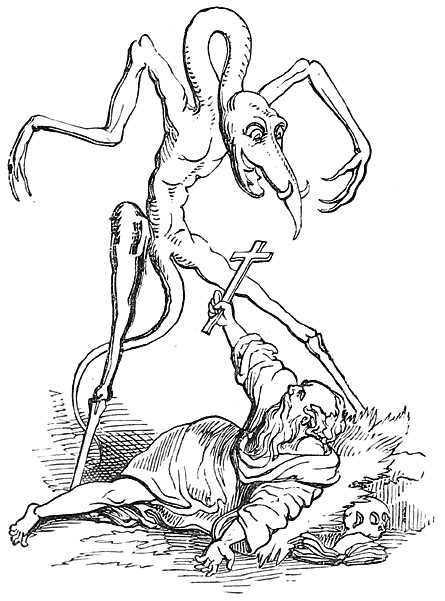
Fig. 4.—St. Anthony’s Lean Persecutor (Salvator Rosa).
Illustrations of the Hunger-demon and its survivals might be greatly multiplied, were it necessary. It need only, however, be mentioned that it is to this early and most universal conception of præternatural danger that the idea of sacrifice as well as of fasting must be ascribed. It is, indeed, too obvious to require extended demonstration that the notion of offering fruits and meat to an invisible being could only have originated in the belief that such being was hungry, however much the spiritualisation of such offerings may have attended their continuance among enlightened peoples. In the evolution of purer deities, Fire—‘the devouring element’—was substituted for a coarser method of accepting sacrifices, and it became a sign of baser beings—such as the Assyrian Akhkharu, and the later Lamia—to consume dead bodies with their teeth; and this fire was the spiritual element in the idolatries whose objects were visible. But the original accent of sacrifice never left it. The Levitical Law says: ‘The two kidneys, and the fat that is upon them, which is by the flanks, and the caul above the liver, with the kidneys, it shall he take away. And the priest shall burn them upon the altar: it is the food of the offering made by fire for a sweet savour: all the fat is the Lord’s. It shall be a perpetual statute for your generations throughout all your dwellings, that ye eat neither fat nor blood.’9 We find the Hunger-demon shown as well in the wrath of Jehovah against the sons of Eli for eating the choice parts of the meats offered on his altar, as in that offering of tender infants to Moloch which his priests denounced, or in Saturn devouring his children, whom Aryan faith dethroned; and they all reappear as phantoms thinly veiled above the spotless Lamb offered up on Calvary, the sacrificed Macaria (‘Blessed’), the pierced heart of Mary. The beautiful boy Menœceus must be sacrificed to save Thebes; the gods will not have aged and tough Creon, though a king, in his place. Iphigenia, though herself saved from the refined palate of Artemis, through the huntress’s fondness for kid’s blood, becomes the priestess of human sacrifices. The human offering deemed half-divine could alone at last satisfy the Deity, gathered in his side this sheaf of sacrificial knives, whetted in many lands and ages, and in his self-sacrifice the Hunger-demon himself was made the victim. Theologians have been glad to rescue the First Person of their Trinity from association with the bloodthirsty demons of barbarous ages by describing the sacrifice of Jesus as God himself becoming the victim of an eternal law. But, whatever may be said of this complex device, it is sufficient evidence that man’s primitive demon which personified his hunger has ended with being consumed on his own altar. For though fasting is a survival of the same savage notion that man may secure benefits from invisible beings by leaving them the food, it is a practice which survives rather through the desire of imitating ascetic saints than because of any understood principle. The strange yet natural consummation adds depth of meaning to the legend of Odin being himself sacrificed in his disguise on the Holy Tree at Upsala, where human victims were hung as offerings to him; and to his rune in the Havamal—
I know that I hung
On a wind-rocked tree
Nine whole nights,
With a spear wounded,
And to Odin offered
Myself to myself.
1 ‘The Land of Charity,’ by Rev. Samuel Mateer, p. 214.
2 London ‘Times’ Calcutta correspondence.
3 The Persian poet Sádi uses the phrase, ‘The whale swallowed Jonah,’ as a familiar expression for sunset; which is in curious coincidence with a Mimac (Nova Scotian) myth that the holy hero Glooscap was carried to the happy Sunset Land in a whale. The story of Jonah has indeed had interesting variants, one of them being that legend of Oannes, the fish-god, emerging from the Red Sea to teach Babylonians the arts (a saga of Dagon); but the phrase in the Book of Jonah—‘the belly of Hell’—had a prosaic significance for the christian mind, and, in connection with speculations concerning Behemoth and Leviathan, gave us the mediæval Mouth of Hell.
4 Tablet K 162 in the British Museum. See ‘Records of the Past,’ i. 141.
5 London ‘Times,’ July 11, 1877.
6 ‘Songs of the Russian People,’ p. 409.
7 ‘Primitive Culture.’
8 Cæsarius D’Heisterbach, Miracul. iii.
9 Lev. iii. 15.
1 ‘The Land of Charity,’ by Rev. Samuel Mateer, p. 214.
2 London ‘Times’ Calcutta correspondence.
3 The Persian poet Sádi uses the phrase, ‘The whale swallowed Jonah,’ as a familiar expression for sunset; which is in curious coincidence with a Mimac (Nova Scotian) myth that the holy hero Glooscap was carried to the happy Sunset Land in a whale. The story of Jonah has indeed had interesting variants, one of them being that legend of Oannes, the fish-god, emerging from the Red Sea to teach Babylonians the arts (a saga of Dagon); but the phrase in the Book of Jonah—‘the belly of Hell’—had a prosaic significance for the christian mind, and, in connection with speculations concerning Behemoth and Leviathan, gave us the mediæval Mouth of Hell.
4 Tablet K 162 in the British Museum. See ‘Records of the Past,’ i. 141.
5 London ‘Times,’ July 11, 1877.
6 ‘Songs of the Russian People,’ p. 409.
7 ‘Primitive Culture.’
8 Cæsarius D’Heisterbach, Miracul. iii.
9 Lev. iii. 15.
Chapter II.
Heat.
Demons of Fire—Agni—Asmodeus—Prometheus—Feast of fire—Moloch—Tophet—Genii of the lamp—Bel-fires—Hallowe’en—Negro superstitions—Chinese fire-god—Volcanic and incendiary demons—Mangaian fire-demon—Demons’ fear of water.
Fire was of old the element of fiends. No doubt this was in part due to the fact that it also was a devouring element. Sacrifices were burnt; the demon visibly consumed them. But the great flame-demons represent chiefly the destructive and painful action of intense heat. They originate in regions of burning desert, of sunstroke, and drouth.
Agni, the Hindu god of fire, was adored in Vedic hymns as the twin of Indra.
‘Thy appearance is fair to behold, thou bright-faced Agni, when like gold thou shinest at hand; thy brightness comes like the lightning of heaven; thou showest splendour like the splendour of the bright sun.
‘Adorable and excellent Agni, emit the moving and graceful smoke.
‘The flames of Agni are luminous, powerful, fearful, and not to be trusted.
‘I extol the greatness of that showerer of rain, whom men celebrate as the slayer of Vritra: the Agni, Vaiswanara, slew the stealer of the waters.’
The slaying of Vritra, the monster, being the chief exploit of Indra, Agni could only share in it as being the flame that darted with Indra’s weapon, the disc (of the sun).
‘Thou (Agni) art laid hold off with difficulty, like the young of tortuously twining snakes, thou who art a consumer of many forests as a beast is of fodder.’
Petrifaction awaits all these glowing metaphors of early time. Verbal inspiration will make Agni a literally tortuous serpent and consuming fire. His smoke, called Kali (black), is now the name of Siva’s terrible bride.
Much is said in Vedic hymns of the method of producing the sacred flame symbolising Agni; namely, the rubbing together of two sticks. ‘He it is whom the two sticks have engendered, like a new-born babe.’ It is a curious coincidence that a similar phrase should describe ‘the devil on two sticks,’ who has come by way of Persia into European romance. Asmodeus was a lame demon, and his ‘two sticks’ as ‘Diable Boiteux’ are crutches; but his lameness may be referable to the attenuated extremities suggested by spires of flame—‘tortuously twining snakes,’—rather than to the rabbinical myth that he broke his leg on his way to meet Solomon. Benfey identified Asmodeus as Zend Aêshma-daêva, demon of lust. His goat-feet and fire-coal eyes are described by Le Sage, and the demon says he was lamed by falling from the air, like Vulcan, when contending with Pillardoc. It is not difficult to imagine how flame engendered by the rubbing of sticks might have attained personification as sensual passion, especially among Zoroastrians, who would detach from the adorable Fire all associations of evil. It would harmonise well with the Persian tendency to diabolise Indian gods, that they should note the lustful character occasionally ascribed to Agni in the Vedas. ‘Him alone, the ever-youthful Agni, men groom like a horse in the evening and at dawn; they bed him as a stranger in his couch; the light of Agni, the worshipped male, is lighted.’ Agni was the Indian ‘Brulefer’ or love-charmer, and patron of marriage; the fire-god Hephaistos was the husband of Aphrodite; the day of the Norse thunder-and-lightning god Thor (Thursday), is in Scandinavian regions considered the luckiest for marriages.
The process of obtaining fire by friction is represented by a nobler class of myths than that referred to. In the Mahábhárata the gods and demons together churn the ocean for the nectar of immortality; and they use for their churning-stick the mountain Manthara. This word appears in pramantha, which means a fire-drill, and from it comes the great name of Prometheus, who stole fire from heaven, and conferred on mankind a boon which rendered them so powerful that the jealousy and wrath of Zeus were excited. This fable is generally read in its highly rationalised and mystical form, and on this account belongs to another part of our general subject; but it may be remarked here that the Titan so terribly tortured by Zeus could hardly have been regarded, originally, as the friend of man. At the time when Zeus was a god genuinely worshipped—when he first stood forth as the supplanter of the malign devourer Saturn—it could have been no friend of man who was seen chained on the rock for ever to be the vulture’s prey. It was fire in some destructive form which must have been then associated with Prometheus, and not that power by which later myths represented his animating with a divine spark the man of clay. The Hindu myth of churning the ocean for the immortal draught, even if it be proved that the ocean is heaven and the draught lightning, does not help us much. The traditional association of Prometheus with the Arts might almost lead one to imagine that the early use of fire by some primitive inventor had brought upon him the wrath of his mates, and that Zeus’ thunderbolts represented some early ‘strike’ against machinery.
It is not quite certain that it may not have been through some euphemistic process that Fire-worship arose in Persia. Not only does fire occupy a prominent place in the tortures inflicted by Ahriman in the primitive Parsee Inferno, but it was one of the weapons by which he attempted to destroy the heavenly child Zoroaster. The evil magicians kindled a fire in the desert and threw the child on it; but his mother, Dogdo, found him sleeping tranquilly on the flames, which were as a pleasant bath, and his face shining like Zohore and Moschteri (Jupiter and Mercury).1 The Zoroastrians also held that the earth would ultimately be destroyed by fire; its metals and minerals, ignited by a comet, would form streams which all souls would have to pass through: they would be pleasant to the righteous, but terrible to the sinful,—who, however, would come through, purified, into paradise, the last to arrive being Ahriman himself.
The combustible nature of many minerals under the surface of the earth,—which was all the realm of Hades (invisible),—would assist the notion of a fiery abode for the infernal gods. Our phrase ‘plutonic rock’ would then have a very prosaic sense. Pliny says that in his time sulphur was used to keep off evil spirits, and it is not impossible that it first came to be used as a medicine by this route.2
Fire-festivals still exist in India, where the ancient raiment of Agni has been divided up and distributed among many deities. At the popular annual festival in honour of Dharma Rajah, called the Feast of Fire, the devotees walk barefoot over a glowing fire extending forty feet. It lasts eighteen days, during which time those that make a vow to keep it must fast, abstain from women, lie on the bare ground, and walk on a brisk fire. The eighteenth day they assemble on the sound of instruments, their heads crowned with flowers, their bodies daubed with saffron, and follow the figures of Dharma Rajah and Draupadi his wife in procession. When they come to the fire, they stir it to animate its activity, and take a little of the ashes, with which they rub their foreheads; and when the gods have been carried three times round it they walk over a hot fire, about forty feet. Some carry their children in their arms, and others lances, sabres, and standards. After the ceremony the people press to collect the ashes to rub their foreheads with, and obtain from devotees the flowers with which they were adorned, and which they carefully preserve.3
The passion of Agni reappears in Draupadi purified by fire for her five husbands, and especially her union with Dharma Rajah, son of Yama, is celebrated in this unorthodox passion-feast. It has been so much the fashion for travellers to look upon all ‘idolatry’ with biblical eyes, that we cannot feel certain with Sonnerat that there was anything more significant in the carrying of children by the devotees, than the supposition that what was good for the parent was equally beneficial to the child. But the identification of Moloch with an Aryan deity is not important; the Indian Feast of Fire and the rites of Moloch are derived by a very simple mental process from the most obvious aspects of the Sun as the quickening and the consuming power in nature. The child offered to Moloch was offered to the god by whom he was generated, and as the most precious of all the fruits of the earth for which his genial aid was implored and his destructive intensity deprecated. Moloch, a word that means ‘king,’ was a name almost synonymous with human sacrifice. It was in all probability at first only a local (Ammonite) personification growing out of an ancient shrine of Baal. The Midianite Baal accompanied the Israelites into the wilderness, and that worship was never thoroughly eradicated. In the Egyptian Confession of Faith, which the initiated took even into their graves inscribed upon a scroll, the name of God is not mentioned, but is expressed only by the words Nuk pu Nuk, ‘I am he who I am.’4 The flames of the burning bush, from which these same words came to Moses, were kindled from Baal, the Sun; and we need not wonder that while the more enlightened chiefs of Israel preserved the higher ideas and symbols of the countries they abandoned, the ignorant would still cling to Apis (the Golden Calf), to Ashtaroth, and to Moloch. Amos (v. 26), and after him Stephen the martyr (Acts vii. 43), reproach the Hebrews with having carried into the wilderness the tabernacle of their god Moloch. And though the passing of children through the fire to Moloch was, by the Mosaic Law, made a capital crime, the superstition and the corresponding practice retained such strength that we find Solomon building a temple to Moloch on the Mount of Olives (1 Kings xi. 7), and, long after, Manasseh making his son pass through the fire in honour of the same god.
It is certain from the denunciations of the prophets5 that the destruction of children in these flames was actual. From Jeremiah xix. 6, as well as other sources, we know that the burnings took place in the Valley of Tophet or Hinnom (Gehenna). The idol Moloch was of brass, and its throne of brass; its head was that of a calf, and wore a royal crown; its stomach was a furnace, and when the children were placed in its arms they were consumed by the fierce heat,—their cries being drowned by the beating of drums; from which, toph meaning a ‘drum,’ the place was also called Tophet. In the fierce war waged against alien superstitions by Josiah, he defiled Gehenna, filling it with ordure and dead men’s bones to make it odious, ‘that no man might make his son or his daughter to pass through the fire to Moloch’ (2 Kings xxiii. 10), and a perpetual fire was kept there to consume the filth of Jerusalem.
From this horrible Gehenna, with its perpetual fire, its loathsome worm, its cruelties, has been derived the picture of a never-ending Hell prepared for the majority of human beings by One who, while they live on earth, sends the rain and sunshine alike on the evil and the good. Wo Chang, a Chinaman in London, has written to a journal6 his surprise that our religious teachers should be seized with such concern for the victims of Turkish atrocities in Bulgaria, while they are so calm in view of the millions burning, and destined to burn endlessly, in the flames of hell. Our Oriental brothers will learn a great deal from our missionaries; among other things, that the theological god of Christendom is still Moloch.
The Ammonites, of whom Moloch was the special demon, appear to have gradually blended with the Arabians. These received from many sources their mongrel superstitions, but among them were always prominent the planet-gods and fire-gods, whom their growing monotheism (to use the word still in a loose sense) transformed to powerful angels and genii. The genii of Arabia are slaves of the lamp; they are evoked by burning tufts of hair; they ascend as clouds of smoke. Though, as subordinate agents of the Fire-fiend, they may be consumed by flames, yet those who so fight them are apt to suffer a like fate, as in the case of the Lady of Beauty in the Arabian Nights’ Entertainments. Many stories of this kind preceded the declarations of the Old Testament, that Jehovah breathes fire and brimstone, his breath kindling Tophet; and also the passages of the Koran, and of the New Testament describing Satan as a fiery fiend.
Various superstitions connecting infernal powers with fire survive among the Jews of some remote districts of Europe. The Passover is kept a week by the Jewish inhabitants in the villages on the Vosges mountains and on the banks of the Rhine. The time of omer is the interval between the Passover and Pentecost, the seven weeks elapsing from the departure from Egypt and the giving of the law, marked in former days by the offering of an omer of barley daily at the temple. It is considered a fearful time, during which every Jew is particularly exposed to the evil influence of evil spirits. There is something dangerous and fatal in the air; every one should be on the watch, and not tempt the schedim (demons) in any way. Have a strict eye upon your cattle, say the Jews, for the sorceress will get into your stables, mount your cows and goats, bring diseases upon them, and turn their milk sour. In the latter case, try to lay your hand upon the suspected person; shut her up in a room with a basin of sour milk, and beat the milk with a hazel-wand, pronouncing God’s name three times. Whilst you are doing this, the sorceress will make great lamentation, for the blows are falling upon her. Only stop when you see blue flames dancing on the surface of the milk, for then the charm is broken. If at nightfall a beggar comes to ask for a little charcoal to light his fire, be very careful not to give it, and do not let him go without drawing him three times by his coat-tail; and without losing time, throw some large handfuls of salt on the fire. In all of which we may trace traditions of parched wildernesses and fiery serpents, as well as of Abraham’s long warfare with the Fire-worshippers, until, according to the tradition, he was thrown into the flames he refused to worship.
It is probable that in all the popular superstitions which now connect devils and future punishments with fire are blended both the apotheosis and the degradation of demons. The first and most universal of deities being the Sun, whose earthly representative is fire, the student of Comparative Mythology has to pick his way very carefully in tracing by any ethnological path the innumerable superstitions of European folklore in which Fire-worship is apparently reflected. The collection of facts and records contained in a work so accessible to all who care to pursue the subject as that of Brand and his editors,7 renders it unnecessary that I should go into the curious facts to any great extent here. The uniformity of the traditions by which the midsummer fires of Northern Europe have been called Baal-fires or Bel-fires warrant the belief that they are actually descended from the ancient rites of Baal, even apart from the notorious fact that they have so generally been accompanied by the superstition that it is a benefit to children to leap over or be passed through such fires. That this practice still survives in out-of-the way places of the British Empire appears from such communications as the following (from the Times), which are occasionally addressed to the London journals:—‘Lerwick (Shetland), July 7, 1871.—Sir,—It may interest some of your readers to know that last night (being St. John’s Eve, old style) I observed, within a mile or so of this town, seven bonfires blazing, in accordance with the immemorial custom of celebrating the Midsummer solstice. These fires were kindled on various heights around the ancient hamlet of Sound, and the children leaped over them, and ‘passed through the fire to Moloch,’ just as their ancestors would have done a thousand years ago on the same heights, and their still remoter progenitors in Eastern lands many thousand years ago. This persistent adherence to mystic rites in this scientific epoch seems to me worth taking note of.—A. J.’
To this may be added the following recent extract from a Scotch journal:—
‘Hallowe’en was celebrated at Balmoral Castle with unusual ceremony, in the presence of her Majesty, the Princess Beatrice, the ladies and gentlemen of the royal household, and a large gathering of the tenantry. The leading features of the celebration were a torchlight procession, the lighting of large bonfires, and the burning in effigy of witches and warlocks. Upwards of 150 torch-bearers assembled at the castle as dark set in, and separated into two parties, one band proceeding to Invergelder, and the other remaining at Balmoral. The torches were lighted at a quarter before six o’clock, and shortly after the Queen and Princess Beatrice drove to Invergelder, followed by the Balmoral party of torchbearers. The two parties then united and returned in procession to the front of Balmoral Castle, where refreshments were served to all, and dancing was engaged in round a huge bonfire. Suddenly there appeared from the rear of the Castle a grotesque apparition representing a witch with a train of followers dressed like sprites, who danced and gesticulated in all fashions. Then followed a warlock of demoniac shape, who was succeeded by another warlock drawing a car, on which was seated the figure of a witch, surrounded by other figures in the garb of demons. The unearthly visitors having marched several times round the burning pile, the principal figure was taken from the car and tossed into the flames amid the burning of blue lights and a display of crackers and fireworks. The health of her Majesty the Queen was then pledged, and drunk with Highland honours by the assembled hundreds. Dancing was then resumed, and was carried on till a late hour at night.’
The Sixth Council of Constantinople (an. 680), by its sixty-fifth canon, forbids these fires in the following terms:—‘Those bonefires that are kindled by certain people before their shops and houses, over which also they use ridiculously to leap, by a certain ancient custom, we command them from henceforth to cease. Whoever, therefore, shall do any such thing, if he be a clergyman, let him be deposed; if he be a layman, let him be excommunicated. For in the Fourth Book of the Kings it is thus written: And Manasseh built an altar to all the host of heaven, in the two courts of the Lord’s house, and made his children to pass through the fire.’ There is a charming naïveté in this denunciation. It is no longer doubtful that this ‘bonefire’ over which people leaped came from the same source as that Gehenna from which the Church derived the orthodox theory of hell, as we have already seen. When Shakespeare speaks (Macbeth) of ‘the primrose way to the everlasting bonfire,’8 he is, with his wonted felicity, assigning the flames of hell and the fires of Moloch and Baal their right archæological relation.
In my boyhood I have often leaped over a bonfire in a part of the State of Virginia mainly settled by Scotch families, with whom probably the custom migrated thither. In the superstitions of the negroes of that and other Southern States fire plays a large part, but it is hardly possible now to determine whether they have drifted there from Africa or England. Sometimes there are queer coincidences between their notions and some of the early legends of Britain. Thus, the tradition of the shepherd guided by a distant fire to the entrance of King Arthur’s subterranean hall, where a flame fed by no fuel coming through the floor reveals the slumbering monarch and his court, resembles somewhat stories I have heard from negroes of their being led by distant fires to lucky—others say unlucky—or at any rate enchanted spots. A negro belonging to my father told me that once, as he was walking on a country road, he saw a great fire in the distance; he supposed it must be a house on fire, and hastened towards it, meantime much puzzled, since he knew of no house in that direction. As he went on his way he turned into a small wood near which the fire seemed to be, but when he emerged, all he found was a single fire-coal burning in the path. There were no other traces whatever of fire, but just then a large dog leaped past him with a loud bark and disappeared.
In a letter on ‘Voudouism in Virginia,’ which appeared in the New York Tribune, dated Richmond, September 17, 1875, occurs an account of a class of superstitions generally kept close from the whites, as I have always believed because of their purely African origin. As will be seen, fire represents an important element in the superstitious practices.
‘If an ignorant negro is smitten with a disease which he cannot comprehend, he often imagines himself the victim of witchcraft, and having no faith in ‘white folks’ physic’ for such ailments, must apply to one of these quacks. A physician residing near this city was invited by such a one to witness his mode of procedure with a dropsical patient for whom the physician in question had occasionally charitably prescribed. Curiosity led him to attend the seance, having previously informed the quack that since the case was in such hands he relinquished all connection with it. On the coverlet of the bed on which the sick man lay was spread a quantity of bones, feathers, and other trash. The charlatan went through with a series of so-called conjurations, burned feathers, hair, and tiny fragments of wood in a charcoal furnace, and mumbled gibberish past the physician’s comprehension. He then proceeded to rip open the pillows and bolsters, and took from them some queer conglomerations of feathers. These he said had caused all the trouble. Sprinkling a whitish powder over them, he burnt them in his furnace. A black offensive smoke was produced, and he announced triumphantly that the evil influence was destroyed and that the patient would surely get well. He died not many days later, believing, in common with all his friends and relatives, that the conjurations of the ‘trick doctor’ had failed to save him only because resorted to too late.’
The following account of a spell from which his wife was rescued, was given me by a negro in Virginia:—
‘The wizard,’ to quote the exact words of my informant, ‘threw a stick on a chest; the stick bounded like a trapball three times; then he opened the chest, took out something looking like dust or clay, and put it into a cup with water over a fire; then he poured it over a board (after chopping it three times), which he then put up beneath the shingles of the house. Returning to the chest he took a piece of old chain, near the length of my hand, took a hoe and buried the chain near the sill of the door of my wife’s house where she would pass; then he went away. I saw my wife coming and called to her not to pass, and to go for a hoe and dig up the place. She did this, and I took up the chain, which burned the ends of all my fingers clean off. The same night the conjuror came back: my wife took two half dollars and a quarter in silver and threw them on the ground before him. The man seemed as if he was shocked, and then offered her his hand, which she refused to take, as I had bid her not to let him touch her. He left and never came to the house again. The spell was broken.’
I am convinced that this is a pure Voudou procedure, and it is interesting in several regards. The introduction of the chain may have been the result of the excitement of the time, for it was during the war when negroes were breaking their chains. The fire and water show how wide-spread in Africa is that double ordeal which, as we have seen, is well known in the kingdom of Dahomey.9 But the mingling of ‘something like dust’ with the water held in a cup over the fire, is strongly suggestive of the Jewish method of preparing holy water, ‘the water of separation.’ ‘For an unclean person they shall take of the dust of the burnt heifer of purification for sin, and running water shall be put thereto in a vessel.’10 The fiery element of the mixture was in this case imported with the ashes of the red heifer. As for this sacrifice of the red heifer itself11 it was plainly the propitiation of a fiery demon. In Egypt red hair and red animals of all kinds were considered infernal, and all the details of this sacrifice show that the colour of this selected heifer was typical. The heifer was not a usual sacrifice: a red one was obviously by its colour marked for the genii of fire—the terrible Seven—and not to be denied them. Its blood was sprinkled seven times before the tabernacle, and the rest was utterly consumed—including the hide, which is particularly mentioned—and the ashes taken to make the ‘water of separation.’ Calmet notes, in this connection, that the Apis of India was red-coloured.
The following interesting story of the Chinese Fire-god was supplied to Mr. Dennys12 by Mr. Playfair of H.M. Consulate, to whom it was related in Peking:—
‘The temples of the God of Fire are numerous in Peking, as is natural in a city built for the most part of very combustible materials. The idols representing the god are, with one exception, decked with red beards, typifying by their colour the element under his control. The exceptional god has a white beard, and ‘thereby hangs a tale.’
‘A hundred years ago the Chinese imperial revenue was in much better case than it is now. At that time they had not yet come into collision with Western Powers, and the word ‘indemnity’ had not, so far, found a place in their vocabulary; internal rebellions were checked as soon as they broke out, and, in one word, Kien Lung was in less embarrassed circumstances than Kwang Hsu; he had more money to spend, and did lay out a good deal in the way of palaces. His favourite building, and one on which no expense had been spared, was the ‘Hall of Contemplation.’ This hall was of very large dimensions; the rafters and the pillars which supported the roof were of a size such as no trees in China furnish now-a-days. They were not improbably originally sent as an offering by the tributary monarch of some tropical country, such as Burmah or Siam. Two men could barely join hands round the pillars; they were cased in lustrous jet-black lacquer, which, while adding to the beauty of their appearance, was also supposed to make them less liable to combustion. Indeed, every care was taken that no fire should approach the building; no lighted lamp was allowed in the precincts, and to have smoked a pipe inside those walls would have been punished with death. The floor of the hall was of different-coloured marbles, in a mosaic of flowers and mystic Chinese characters, always kept polished like a mirror. The sides of the room were lined with rare books and precious manuscripts. It was, in short, the finest palace in the imperial city, and it was the pride of Kien Lung.
‘Alas for the vanity of human wishes! In spite of every precaution, one night a fire broke out, and the Hall of Contemplation was in danger. The Chinese of a century ago were not without fire-engines, and though miserably inefficient as compared with those of our London fire brigade, they were better than nothing, and a hundred of them were soon working round the burning building. The Emperor himself came out to superintend their efforts and encourage them to renewed exertions. But the hall was doomed; a more than earthly power was directing the flames, and mortal efforts were of no avail. For on one of the burning rafters Kien Lung saw the figure of a little old man, with a long white beard, standing in a triumphant attitude. ‘It is the God of Fire,’ said the Emperor, ‘we can do nothing;’ so the building was allowed to blaze in peace. Next day Kien Lung appointed a commission to go the round of the Peking temples in order to discover in which of them there was a Fire-god with a white beard, that he might worship him, and appease the offended deity. The search was fruitless; all the Fire-gods had red beards. But the commission had done its work badly; being highly respectable mandarins of genteel families, they had confined their search to such temples as were in good repair and of creditable exterior. Outside the north gate of the imperial city was one old, dilapidated, disreputable shrine which they had overlooked. It had been crumbling away for years, and even the dread figure of the God of Fire, which sat above the altar, had not escaped desecration. ‘Time had thinned his flowing locks,’ and the beard had fallen away altogether. One day some water-carriers who frequented the locality thought, either in charity or by way of a joke, that the face would look the better for a new beard. So they unravelled some cord, and with the frayed-out hemp adorned the beardless chin. An official passing the temple one day peeped in out of curiosity, and saw the hempen beard. ‘Just the thing the Emperor was inquiring about,’ said he to himself, and he took the news to the palace without delay. Next day there was a state visit to the dilapidated temple, and Kien Lung made obeisance and vowed a vow.
‘O Fire-god,’ said he, ‘thou hast been wroth with me in that I have built me palaces, and left thy shrine unhonoured and in ruins. Here do I vow to build thee a temple surpassed by none other of the Fire-gods in Peking; but I shall expect thee in future not to meddle with my palaces.’
‘The Emperor was as good as his word. The new temple is on the site of the old one, and the Fire-god has a flowing beard of fine white hair.’
In the San Francisco Bulletin, I recently read a description of the celebration by the Chinese in that city of their Feast for the Dead, in which there are some significant features. The chief attention was paid, says the reporter, to a figure ‘representing what answers in their theology to our devil, and whom they evidently think it necessary to propitiate before proceeding with their worship over individual graves.’ This figure is on the west side of their temple; before and around it candles and joss-sticks were kept burning. On the east side was the better-looking figure, to which they paid comparatively little attention.
It was of course but natural that the demons of fire should gradually be dispelled from that element in its normal aspects, as its uses became more important through human invention, and its evil possibilities were mastered. Such demons became gradually located in the region of especially dangerous fires, as volcanoes and boiling springs. The Titan whom the ancients believed struggling beneath Ætna remained there as the Devil in the christian age. St. Agatha is said to have prevented his vomiting fire for a century by her prayers. St. Philip ascended the same mountain, and with book and candle pronounced a prayer of exorcism, at which three devils came out like fiery flying stones, crying, ‘Woe is us! we are still hunted by Peter through Philip the Elder!’ The volcanoes originated the belief that hell is at the earth’s centre, and their busy Vulcans of classic ages have been easily transformed into sulphurous lords of the christian Hell. Such is the mediæval Haborym, demon of arson, with his three heads—man, cat, and serpent—who rides through the air mounted on a serpent, and bears in his hand a flaming torch. The astrologers assigned him command of twenty-six legions of demons in hell, and the superstitious often saw him laughing on the roofs of burning houses.13 But still more dignified is Raum, who commands thirty legions, and who destroys villages; hence, also, concerned in the destructions of war, he became the demon who awards dignities; and although this made his usual form of apparition on the right bank of the Rhine that of the Odinistic raven, on the left bank he may be detected in the little red man who was reported as the familiar of Napoleon I. during his career.
Among Mr. Gill’s South Pacific myths is one of a Prometheus, Maui, who by assistance of a red pigeon gets from the subterranean fire-demon the secret of producing fire (by rubbing sticks), the demon (Mauike) being then consumed with his realm, and fire being brought to the upper world to remain the friend of man. In Vedic legend, when the world was enveloped in darkness, the gods prayed to Agni, who suddenly burst out as Tvashtri—pure fire, the Vedic Vulcan—to the dismay of the universe. In Eddaic sagas, Loki was deemed the most voracious of beings until defeated in an eating match with Logi (devouring fire).
Survivals of belief in the fiery nature of demons are very numerous. Thus it is a very common belief that the Devil cannot touch or cross water, and may therefore be escaped by leaping a stream. This has sometimes been supposed to have something to do with the purifying character of water; but there are many instances in Christian folklore where the Devil is shown quite independent of even holy water if it is not sprinkled on him or does not wet his feet. Thus in the Norfolk legend concerning St. Godric, the Devil is said to have thrown the vessel with its holy water at the saint’s head out of anger at his singing a canticle which the Virgin taught him. But when the Devil attacked him in various ferocious animal shapes, St. Godric escaped by running into the Wear, where he sometimes stood all night in water up to his neck.
The Kobolds get the red jackets they are said to wear from their fiery nature. Originally the lar familiaris of Germany, the Kobold became of many varieties; but in one line he has been developed from the house-spirit, whose good or evil temper was recognised in the comforts or dangers of fire, to a special Stone-demon. The hell-dog in Faust’s room takes refuge from the spell of ‘Solomon’s Key’ behind the stone, and is there transformed to human shape. The German maidens read many pretty oracles in the behaviour of the fire, and the like in that of its fellow Wahrsager the house-dog. It is indeed a widespread notion that imps and witches lurk about the fireside, obviously in cat and dog, and ride through the air on implements that usually stand about the fire,—shovel, tongs, or broom. In Paris it was formerly the custom to throw twenty-four cats into the fire on St. John’s night, the animals being, according to M. De Plancy, emblems of the devil. So was replaced the holocaust of human witches, until at last civilisation rang out its curfew for all such fires as that.
1 Du Perron, ‘Vie de Zoroastre.’
2 The principle similia similibus curantur is a very ancient one; but though it may have originated in a euphemistic or propitiatory aim, the homoeopathist may claim that it could hardly have lived unless it had been found to have some practical advantages.
3 Sonnerat’s ‘Travels,’ ii. 38.
4 Deutsch, ‘Literary Remains,’ p. 178.
5 Isa. lvii. 5; Ezek. xvi. 20; Jer. xix. 5.
6 The ‘Jewish World.’
7 ‘Observations on Popular Antiquities,’ &c., by John Brand. With the additions of Sir Henry Ellis. An entirely new and revised edition. Chatto & Windus, 1877. See especially the chapter on ‘Summer Solstice,’ p. 165.
8 ‘Pyra, a bonefire, wherein men’s bodyes were burned.’—Cooper’s Thesaurus. Probably from Fr. bon; Wedgewood gives Dan. baun, beacon.
9 See Chapter i. Compare Numbers xxxi. 23.
10 Numbers xix. 17.
11 Ibid. xix. 2, seq.
12 ‘Folklore of China,’ p. 121.
13 In Russia the pigeon, from being anciently consecrated to the thunder god, has become emblem of the Holy Ghost, or celestial fire, and as such the foe of earthly fire. Pigeons are trusted as insurers against fire, and the flight of one through a house is regarded as a kindly warning of conflagration.
1 Du Perron, ‘Vie de Zoroastre.’
2 The principle similia similibus curantur is a very ancient one; but though it may have originated in a euphemistic or propitiatory aim, the homoeopathist may claim that it could hardly have lived unless it had been found to have some practical advantages.
3 Sonnerat’s ‘Travels,’ ii. 38.
4 Deutsch, ‘Literary Remains,’ p. 178.
5 Isa. lvii. 5; Ezek. xvi. 20; Jer. xix. 5.
6 The ‘Jewish World.’
7 ‘Observations on Popular Antiquities,’ &c., by John Brand. With the additions of Sir Henry Ellis. An entirely new and revised edition. Chatto & Windus, 1877. See especially the chapter on ‘Summer Solstice,’ p. 165.
8 ‘Pyra, a bonefire, wherein men’s bodyes were burned.’—Cooper’s Thesaurus. Probably from Fr. bon; Wedgewood gives Dan. baun, beacon.
9 See Chapter i. Compare Numbers xxxi. 23.
10 Numbers xix. 17.
11 Ibid. xix. 2, seq.
12 ‘Folklore of China,’ p. 121.
13 In Russia the pigeon, from being anciently consecrated to the thunder god, has become emblem of the Holy Ghost, or celestial fire, and as such the foe of earthly fire. Pigeons are trusted as insurers against fire, and the flight of one through a house is regarded as a kindly warning of conflagration.
Chapter III.
Cold.
Descent of Ishtar into Hades—Bardism—Baldur—Hercules—Christ—Survivals of the Frost Giant in Slavonic and other countries—The Clavie—The Frozen Hell—The Northern abode of demons—North side of churches.
Even across immemorial generations it is impossible to read without emotion the legend of the Descent of Ishtar into Hades.1 Through seven gates the goddess of Love passes in search of her beloved, and at each some of her ornaments and clothing are removed by the dread guardian. Ishtar enters naked into the presence of the Queen of Death. But gods, men, and herds languish in her absence, and the wonder-working Hea, the Saviour, so charms the Infernal Queen, that she bids the Judge of her realm, Annunak, absolve Ishtar from his golden throne.
‘He poured out for Ishtar the waters of life and let her go.
Then the first gate let her forth, and restored to her the first garment of her body.
The second gate let her forth, and restored to her the diamonds of her hands and feet.
The third gate let her forth, and restored to her the central girdle of her waist.
The fourth gate let her forth, and restored to her the small lovely gems of her forehead.
The fifth gate let her forth, and restored to her the precious stones of her head.
The sixth gate let her forth, and restored to her the earrings of her ears.
The seventh gate let her forth, and restored to her the great crown on her head.’
This old miracle-play of Nature—the return of summer flower by flower—is deciphered from an ancient Assyrian tablet in a town within only a few hours of another, where a circle of worshippers repeat the same at every solstice! Myfyr Morganwg, the Arch-Druid, adores still Hea by name as his Saviour, and at the winter solstice assembles his brethren to celebrate his coming to bruise the head of the Serpent of Hades (Annwn, nearly the same as in the tablet), that seedtime and harvest shall not fail.2
Is this a survival? No doubt; but there is no cult in the world which, if ‘scratched,’ as the proverb says, will not reveal beneath it the same conception. However it may be spiritualised, every ‘plan of salvation’ is cast in the mould of Winter conquered by the Sun, the Descent of Love to the Under World, the delivery of the imprisoned germs of Life.
It is very instructive to compare with the myth of Ishtar that of Hermödr, seeking the release of Baldur the Beautiful from Helheim.
The deadly powers of Winter are represented in the Eddaic account of the death of Baldur, soft summer Light, the Norse Baal. His blind brother Hödr is Darkness; the demon who directed his arrow is Loki, subterranean fire; the arrow itself is of mistletoe, which, fostered by Winter, owes no duty to Baldur; and the realm to which he is borne is that of Hel, the frozen zone. Hermödr, having arrived, assured Hel that the gods were in despair for the loss of Baldur. The Queen replied that it should now be tried whether Baldur was so beloved. ‘If, therefore, all things in the world, both living and lifeless, weep for him, he shall return to the Æsir.’ In the end all wept but the old hag Thokk (Darkness), who from her cavern sang—
Thokk will wail
With dry eyes
Baldur’s bale-fire.
Nought quick or dead
For Carl’s son care I.
Let Hel hold her own.
So Baldur remained in Helheim. The myth very closely resembles that of Ishtar’s Descent. In similar accent the messenger of the Southern gods weeps and lacerates himself as he relates the grief of the upper world, and all men and animals ‘since the time that mother Ishtar descended into Hades.’ But in the latter the messenger is successful, in the North he is unsuccessful. In the corresponding myths of warm and sunny climes the effort at release is more or less successful, in proportion to the extent of winter. In Adonis released from Hades for four months every year, and another four if he chose to abandon Persephone for Aphrodite, we have a reflection of a variable year. That, and the similar myth of Persephone, varied in the time specified for their passing in the upper and under worlds, probably in accordance with the climatic averages of the regions in which they were told. But in the tropics it was easy to believe the release complete, as in the myth of Ishtar. In Mangaian myths the hero, Maui, escapes from a nether world of fire, aided by a red pigeon.
When this contest between Winter’s Death and Spring’s Life became humanised, it was as Hercules vanquishing Death and completely releasing Alcestis. When it became spiritualised it was as Christ conquering Death and Hell, and releasing the spirits from prison. The wintry desolation had to be artificially imitated in a forty days’ fast and Lent, closing with a thrust from the spear (the mistletoe arrow) amid darkness (blind Hödr). But the myth of a swift resurrection had to be artificially preserved in the far North. The legend of a full triumph over Death and Hell could never have originated among our Norse ancestors. Their only story resembling it, that of Iduna, related how her recovery from the Giants brought back health to the gods, not men. But it was from the South that men had to hear tidings of a rescue for the earth and man.
We cannot realise now what glad tidings were they which told this new gospel to peoples sitting in regions of ice and gloom, after it had been imposed on them against their reluctant fears. In manifold forms the old combat was renewed in their festivals, and peoples who had long been prostrate and helpless before the terrible powers of nature were never weary of the Southern fables of heroic triumphs over them, long interpreted in the simple physical sense.
The great Demon of the Northern World is still Winter, and the hereditary hatred of him is such that he is still cursed, scourged, killed, and buried or drowned under various names and disguises. In every Slavonic country, says Mr. Ralston, there are to be found, about carnival time, traces of ancient rites, intended to typify the death of Winter and the birth of Spring or Summer. In Poland a puppet made of hemp or straw is flung into a pond or swamp with the words, ‘The Devil take thee!’ Then the participators in the deed scamper home, and if one of them stumbles and falls it is believed he will die within the year. In Upper Lausatia a similar figure is fastened on a pole to be pelted, then taken to the village boundary and thrown across it or cast into the water, its bearers returning with green boughs. Sometimes the figure is shrouded in white, representing snow, and bears in its hands a broom (the sweeping storm) and a sickle (the fatal reaper). In Russia the ‘Straw Mujik’ is burned, and also in Bulgaria; in the latter the bonfire is accompanied by the firing of guns, and by dances and songs to Lado, goddess of Spring. This reminiscence of Leto, on whose account Apollo slew the Python, is rendered yet more striking by the week of archery which accompanies it, recalling the sunbeam darts of the god. In Spain and Italy the demon puppet is scourged under the name of Judas, as indeed is the case in the annual Good Friday performance of Portuguese sailors in the London Docks. Mr. Tylor found in Mexico a similar custom, the Judas being a regular horned and hoofed devil. In Scotland the pre-christian accessories of a corresponding custom are more pronounced both in the time selected (the last day of the year, old style) and the place. ‘The Clavie,’ as the custom of burning the puppet of Winter is mysteriously called, occurred on January 12 of this year (1878) at Burghead, a fishing village near Forres, where stands an old Roman altar locally named the ‘Douro.’ A tar-barrel was set on fire and carried by a fisherman round the town, while the people shouted and hallooed. (If the man who carries the barrel falls it is an evil omen.) The lighted barrel, having gone round the town, was carried to the top of the hill and placed on the Douro. More fuel was added. The sparks as they fly upwards are supposed to be witches and evil spirits leaving the town; the people therefore shout at and curse them as they disappear in vacancy. When the burning tar-barrel falls in pieces, the fishwomen rush in and endeavour to get a lighted bit of wood from its remains; with this light the fire on the cottage hearth is at once kindled, and it is considered lucky to keep this flame alive all the rest of the year. The charcoal of the Clavie is collected and put in bits up the chimney to prevent the witches and evil spirits coming into the house. The Douro is covered with a thick layer of tar from the fires that are annually lighted upon it. Close to it is a very ancient Roman well.
It is an instance of the irony of etymology that the word ‘Hell’ means a place of fireless darkness. Nor is the fact that the name of the Scandinavian demoness Hel, phonetically corresponding with Kali, ‘the Black One’ (Goth. Halja), whose abode was an icy hole, has her name preserved as a place of fiery torment, without significance. In regions where cold was known to an uncomfortable extent as well as heat, we usually find it represented in the ideas of future punishment. The realm called Hades, meaning just the same as Hell, suggests cold. Tertullian and Jerome say that Christ’s own phrases ‘outer darkness’ and the ‘gnashing (chattering) of teeth’ suggest a place of extreme cold alternating with the excessive heat. Traces of similar speculations are found with the Rabbins. Thus Rabbi Joseph says Gehenna had both water and fire. Noah saw the angel of death approaching and hid from him twelve months. Why twelve? Because (explains Rabbi Jehuda) such is the trial of sinners,—six in water, six in fire. Dante (following Virgil) has frigid as well as burning hells; and the idea was refined by some scholiasts to a statement which would seem to make the alternations of future punishment amount to a severe ague and fever. Milton (Paradise Lost, ii.) has blended the rabbinical notions with those of Virgil (Æn. vi.) in his terrible picture of the frozen continent, where
The parching air
Burns frore, and cold performs th’ effect of fire:
Thither by harpy-footed Furies haled
At certain revolutions all the damn’d
Are brought; and feel by turns the bitter change
Of fierce extremes, extremes by change more fierce,
From beds of raging fire to starve in ice
Their soft etherial warmth, and there to pine
Immovable, infix’d, and frozen round.
With which may be compared Shakespeare’s lines in ‘Measure for Measure’—
The de-lighted spirit
To bathe in fiery floods, or to reside
In thrilling region of thick-ribbed ice.
In Thibet hell is believed to have sixteen circles, eight burning, eight frozen, which M. Delepierre attributes to the rapid changes of their climate between the extremes of heat and cold.3 Plutarch, relating the vision of Thespesius in Hades, speaks of the frozen region there. Denys le Chartreux (De Pœnis Inferni) says the severest of infernal torments is freezing. In the ‘Kalendar of Shepherds’ (1506) a legend runs:—‘Lazarus sayde, ‘I sawe a flode of frosone yce in the whiche envyous men and women were plonged unto the navyll, and then sodynly came a colde wynde ryght great that blewe and dyd depe downe all the envyous into the colde water that nothynge was seen of them.’ Such, too, is Persian Ardá Viráf’s vision.
The Demon of Cold has a habitat, naturally, in every Northern region. He is the Ke-mung of China, who—man-shaped, dragon-headed—haunts the Chang river, and causes rain-storms.4 In Greenland it is Erleursortok, who suffers perpetual agues, and leaps on souls at death to satisfy his hunger. The Chenoos (demons) of the Mimacs of Nova Scotia present certain features of the race-demons, but are fearfully cold. The Chenoo weapon is a dragon’s horn, his yell is fatal to the hearer, his heart is a block of ice. This heart must be destroyed if the demon is to be slain, but it can only be done by melting in the fire: the chief precaution required is that one is not drowned in the flood so caused. The icy demon survived long in Scotland. Sir James Melville, in his ‘Memoirs,’ says ‘the spirit or devil that helped the Scottish witches to raise a storm in the sea of Norway was cold as ice and his body hard as iron; his face was terrible, his nose like the beak of an eagle, great burning eyes, his hands and legs hairy, with claws on his nails like a griffin.’ Dr. Fian was burnt for raising this demon to oppose James I. on his stormy passage from Denmark.
This type of demon haunted people’s minds in Scandinavia, where, though traditions of a flame demon (Loki) and the end of the world by fire were imported, the popular belief seems to have been mainly occupied with Frost giants, and the formidable Oegir, god of the bleak sea east winds, preserved in our word awe (Anglo-Saxon ege), and more directly in the name of our familiar demon, the Ogre, so often slain in the child’s Gladsheim. Loki (fire) was, indeed, speedily relegated by the Æsir (gods) to a hidden subterraneous realm, where his existence could only be known by the earthquakes, geysers, and Hecla eruptions which he occasioned. Yet he was to come forth at Ragnarök, the Twilight of the Gods. We can see a singular blending of tropical and frigid zones—the one traditional, the other native—in the Prose Edda. Thus:—‘What will remain,’ said Gangler, ‘after heaven and earth and the whole universe shall be consumed, and after all the gods and the homes of Valhalla and all mankind shall have perished?’ ‘There will be many abodes,’ replied Thridi, ‘some good, some bad. The best place of all to be in will be Gimil, in heaven; and all who delight in quaffing good drink will find a great store in the hall called Brimir, which is also in heaven in the region Okolni. There is also a fair hall of ruddy gold, (for) Sindri, which stands on the mountains of Nida. In those halls righteous and well-minded men shall abide. In Ná-strönd there is a vast and direful structure with doors that face the north. It is formed entirely of the backs of serpents, wattled together like wicker-work. But the serpents’ heads are turned towards the inside of the hall, and continually vomit forth floods of venom, in which wade all those who commit murder or who forswear themselves. As it is said in the Völuspá:—
She saw a hall
Far from the sun
In Náströnd standing,
Northward the doors look,
And venom-drops
Fall in through loopholes.
Formed is that hall
Of wreathed serpents.
There saw she wade
Through heavy streams
Men forsworn
And murderers.
These names for the heavenly regions and their occupants indicate sunshine and fire. Gimil means fire (gímr): Brimir (brími, flame), the giant, and Sindri (cinder), the dwarf, jeweller of the gods, are raised to halls of gold. Nothing is said of a garden, or walking therein ‘in the cool of the day.’ On the other hand, Ná-strönd means Strand of the Dead, in that region whose ‘doors face the north, far from the sun,’ we behold an inferno of extreme cold. Christianity has not availed to give the Icelanders any demonic name suggestive of fire. They speak of ‘Skratti’ (the roarer, perhaps our Old Scratch), and ‘Kolski’ (the coal black one), but promise nothing so luminous and comfortable as fire or fire-fiend to the evil-doer.
In the great Epic of the Nibelungen Lied we have probably the shape in which the Northman’s dream of Paradise finally cohered,—a Rose-garden in the South, guarded by a huge Worm (water-snake, or glittering glacial sea intervening), whose glowing charms, with Beauty (Chriemhild) for their queen, could be won only by a brave dragon-slaying Siegfried. In passing by the pretty lakeside home of Richard Wagner, on my way to witness the Ammergau version of another dragon-binding and paradise-regaining legend, I noted that the old name of the (Starnberg) lake was Wurmsee, from the dragon that once haunted it, while from the composer’s window might be seen its ‘Isle of Roses,’ which the dragon guarded. Since then the myth of many forms has had its musical apotheosis at Bayreuth under his wand.
England, partly perhaps on account of its harsh climate, once had the reputation of being the chief abode of demons. A demoness leaving her lover on the Continent says, ‘My mother is calling me in England.’5 But England assigned them still higher latitudes; in christianising Ireland, Iona, and other islands far north, it was preliminary to expel the demons. ‘The Clavie,’ the ‘Deis-iuil’ of Lewis and other Hebrides islands—fire carried round cattle to defend them from demons, and around mothers not yet churched, to keep the babes from being ‘changed’—show that the expulsion still goes on, though in such regions Norse and christian notions have become so jumbled that it is ‘fighting the devil with fire.’ So in the Havamal men are warned to invoke ‘fire for distempers;’ and Gudrun sings—
Raise, ye Jarls, an oaken pile;
Let it under heaven the lightest be.
May it burn a breast full of woes!
The fire round my heart its sorrows melt.
The last line is in contrast with the Hindu saying, ‘the flame of her husband’s pyre cools the widow’s breast.’
The characters of the Northern Heaven and Hell survive in the English custom of burying the dead on the southern side of a church. How widely this usage prevailed in Brand’s time may be seen by reference to his chapter on churchyards. The north side of the graveyard was set apart for unbaptized infants and executed criminals, and it was permitted the people to dance or play tennis in that part. Dr. Lee says that in the churchyard at Morwenstow the southern portion only contains graves, the north part being untenanted; as the Cornish believe (following old traditions) that the north is the region of demons. In some parishes of Cornwall when a baptism occurs the north door of the nave opposite the font is thrown open, so that the devil cast out may retire to his own region, the north.6 This accords with the saying in Martin’s ‘Month’s Mind’—ab aquilone omne malum.
Indeed, it is not improbable that the fact noted by White, in his ‘History of Selborne,’ that ‘the usual approach to most country churches is by the south,’ indicated a belief that the sacred edifice should turn its back on the region of demons. It is a singular instance of survival which has brought about the fact that people who listen devoutly to sermons describing the fiery character of Satan and his abode should surround the very churches in which those sermons are heard with evidences of their lingering faith that the devil belongs to the region of ice, and that their dead must be buried in the direction of the happy abodes of Brimir and Sindri,—Fire and Cinders!
M. François Lenormant has written an extremely instructive chapter in comparison of the Accadian and the Finnish mythologies. He there shows that they are as one and the same tree, adapted to antagonistic climates.7 With similar triad, runes, charms, and even names in some cases, their regard for the fire worshipped by both varies in a way that seems at first glance somewhat anomalous. The Accadians in their fire-worship exhausted the resources of praise in ascription of glory and power to the flames; the Finns in their cold home celebrated the fire festival at the winter solstice, uttered invocations over the fire, and the mother of the family, with her domestic libation, said: ‘Always rise so high, O my flame, but burn not larger nor more ardent!’ This diminution of enthusiasm in the Northern fire-worshipper, as compared with the Southern, may only be the result of euphemism in the latter; or perhaps while the formidable character of the fire-god among the primitive Assyrians is indicated in the utter prostration before him characteristic of their litanies and invocations, in the case of the Finns the perpetual presence of the more potent cold led to the less excessive adoration. These ventured to recognise the faults of fire.
The true nature of this anomaly becomes visible when we consider that the great demon, dreaded by the two countries drawing their cult from a common source, represented the excess of the power most dreaded. The demon in each case was a wind; among the Finns the north wind, among the Accadians the south-west (the most fiery) wind. The Finnish demon was Hiisi, speeding on his pale horse through the air, with a terrible train of monster dogs, cats, furies, scattering pain, disease, and death.8 The Accadian demon, of which the bronze image is in the Louvre, is the body of a dog, erect on eagle’s feet, its arms pointed with lion’s paws; it has the tail of a scorpion and the head of a skeleton, half stripped of flesh, preserving the eyes, and mounted with the horns of a goat. It has four outspread wings. On the back of this ingeniously horrible image is an inscription in the Accadian language, apprising us that it is the demon of the south-west wind, made to be placed at the door or window, to avert its hostile action.
As we observe such figures as these on the one hand, and on the other the fair beings imagined to be antagonistic to them; as we note in runes and incantations how intensely the ancients felt themselves to be surrounded by these good and evil powers, and, reading nature so, learned to see in the seasons successively conquering and conquered by each other, and alternation of longer days and longer nights, the changing fortunes of a never-ending battle; we may better realise the meaning of solstitial festivals, the customs that gathered around Yuletide and New Year, and the manifold survivals from them which annually masquerade in Christian costume and names. To our sun-worshipping ancestor the new year meant the first faint advantage of the warmer time over winter, as nearly as he could fix it. The hovering of day between superiority of light and darkness is now named after doubting Thomas. At Yuletide the dawning victory of the sun is seen as a holy infant in a manger amid beasts of the stall. The old nature-worship has bequeathed to christian belief a close-fitting mantle. But the old idea of a war between the wintry and the warm powers still haunts the period of the New Year; and the twelve days and nights, once believed to be the period of a fiercely-contested battle between good and evil demons, are still regarded by many as a period for especial watchfulness and prayer. New Year’s Eve, in the north of England still ‘Hogmanay,’—probably O. N. höku-nött, midwinter-night, when the sacrifices of Thor were prepared,—formerly had many observances which reflected the belief that good and evil ghosts were contending for every man and woman: the air was believed to be swarming with them, and watch must be kept to see that the protecting fire did not go out in any household; that no strange man, woman, or animal approached,—possibly a demon in disguise. Sacred plants were set in doors and windows to prevent the entrance of any malevolent being from the multitudes filling the air. John Wesley, whose noble heart was allied with a mind strangely open to stories of hobgoblins, led the way of churches and sects back into this ancient atmosphere. Nevertheless, the rationalism of the age has influenced St. Wesley’s Feast—Watchnight. It can hardly recognise its brother in the Boar’s Head Banquet of Queen’s College, Oxford, which celebrated victory over tusky winter, the decapitated demon whose bristles were once icicles fallen beneath the sylvan spirits of holly and rosemary. Yet what the Watchnight really signifies in the antiquarian sense is just that old culminating combat between the powers of fire and frost, once believed to determine human fates. In White Russia, on New Year’s Day, when the annual elemental battle has been decided, the killed and wounded on one hand, and the fortunate on the other, are told by carrying from house to house the rich and the poor Kolyadas. These are two children, one dressed in fine attire, and crowned with a wreath of full ears of grain, the other ragged, and wearing a wreath of threshed straw. These having been closely covered, each householder is called in, and chooses one. If his choice chances upon the ‘poor Kolyada,’ the attending chorus chant a mournful strain, in which he is warned to expect a bad harvest, poverty, and perhaps death; if he selects the ‘rich Kolyada,’ a cheerful song is sung promising him harvest, health, and wealth.
The natives of certain districts of Dardistan assign political and social significance to their Feast of Fire, which is celebrated in the month preceding winter, at new moon, just after their meat provision for the season is laid in to dry. Their legend is, that it was then their national hero slew their ancient tyrant and introduced good government. This legend, related elsewhere, is of a tyrant slain through the discovery that his heart was made of snow. He was slain by the warmth of torches. In the celebrations all the men of the villages go forth with torches, which they swing round their heads, and throw in the direction of Ghilgit, where the snow-hearted tyrant so long held his castle. When the husbands return home from their torch-throwing a little drama is rehearsed. The wives refuse them entrance till they have entreated, recounting the benefits they have brought them; after admission the husband affects sulkiness, and must be brought round with caresses to join in the banquet. The wife leads him forward with this song:—‘Thou hast made me glad, thou favourite of the Rajah! Thou hast rejoiced me, oh bold horseman! I am pleased with thee who so well usest the gun and sword! Thou hast delighted me, oh thou invested with a mantle of honours! Oh great happiness, I will buy it by giving pleasure’s price! Oh thou nourishment to us, heap of corn, store of ghee—delighted will I buy it all by giving pleasure’s price!’
1 Tablet K 162 in Brit. Mus. Tr. by H. F. Talbot in ‘Records of the Past.’
2 The Western Mail, March 12, 1874, contains a remarkable letter by the Arch-Druid, in which he maintains that ‘Jesus’ is a derivation from Hea or Hu, Light, and the Christian system a corruption of Bardism.
3 ‘L’Enfer,’ p. 5.
4 Dennys’ ‘Folklore of China,’ p. 98.
5 Procopius, ‘De Bello Gothico,’ iv. 20.
6 ‘Memorials of the Rev. R. S. Hawkes’.
7 ‘La Magie chez les Chaldéens,’ iii.
8 Lönnrot, ‘Abhandlung über die Magische Medicin der Finnen.’
1 Tablet K 162 in Brit. Mus. Tr. by H. F. Talbot in ‘Records of the Past.’
2 The Western Mail, March 12, 1874, contains a remarkable letter by the Arch-Druid, in which he maintains that ‘Jesus’ is a derivation from Hea or Hu, Light, and the Christian system a corruption of Bardism.
3 ‘L’Enfer,’ p. 5.
4 Dennys’ ‘Folklore of China,’ p. 98.
5 Procopius, ‘De Bello Gothico,’ iv. 20.
6 ‘Memorials of the Rev. R. S. Hawkes’.
7 ‘La Magie chez les Chaldéens,’ iii.
8 Lönnrot, ‘Abhandlung über die Magische Medicin der Finnen.’
Chapter IV.
Elements.
A Scottish Munasa—Rudra—Siva’s lightning eye—The flaming sword—Limping demons—Demons of the storm—Helios, Elias, Perun—Thor arrows—The Bob-tailed Dragon—Whirlwind—Japanese thunder god—Christian survivals—Jinni—Inundations—Noah—Nik, Nicholas, Old Nick—Nixies—Hydras—Demons of the Danube—Tides—Survivals in Russia and England.
During some recent years curious advertisements have appeared in a journal of Edinburgh, calling for pious persons to occupy certain hours of the night with holy exercises. It would appear that they refer to a band of prayerful persons who provide that there shall be an unbroken round of prayers during every moment of the day and night. Their theory is, that it is the usual cessation of christian prayers at night which causes so many disasters. The devils being then less restrained, raise storms and all elemental perils. The praying circle, which hopes to bind these demons by an uninterrupted chain of prayers, originated, as I am informed, in the pious enthusiasm of a lady whose kindly solicitude in some pre-existent sister was no doubt personified in the Hindu Munasa, who, while all gods slept, sat in the shape of a serpent on a branch of Euphorbia to preserve mankind from the venom of snakes. It is to be feared, however, that it is hardly the wisdom of the serpent which is on prayerful watch at Edinburgh, but rather a vigilance of that perilous kind which was exercised by ‘Meggie o’ the Shore,’ anno 1785, as related by Hugh Miller.1 On a boisterous night, when two young girls had taken refuge in her cottage, they all heard about midnight cries of distress mingling with the roar of the sea, ‘Raise the window curtain and look out,’ said Meggie. The terrified girls did so, and said, ‘There is a bright light in the middle of the Bay of Udall. It hangs over the water about the height of a ship’s mast, and we can see something below it like a boat riding at anchor, with the white sea raging around her.’ ‘Now drop the curtain,’ said Meggie; ‘I am no stranger, my lasses, to sights and noises like these—sights and noises of another world; but I have been taught that God is nearer to me than any spirit can be; and so have learned not to be afraid.’ Afterwards it is not wonderful that a Cromarty yawl was discovered to have foundered, and all on board to have been drowned; though Meggie’s neighbours seemed to have preserved the legend after her faith, and made the scene described a premonition of what actually occurred. It was in a region where mariners when becalmed invoke the wind by whistling; and both the whistling and the praying, though their prospects in the future may be slender, have had a long career in the past.
In the ‘Rig-Veda’ there is a remarkable hymn to Rudra (the Roarer), which may be properly quoted here:—
1. Sire of the storm gods, let thy favour extend to us; shut us not out from the sight of the sun; may our hero be successful in the onslaught. O Rudra, may we wax mighty in our offspring.
2. Through the assuaging remedies conferred by thee, O Rudra, may we reach a hundred winters; drive away far from us hatred, distress, and all-pervading diseases.
3. Thou, O Rudra, art the most excellent of beings in glory, the strongest of the strong, O wielder of the bolt; bear us safely through evil to the further shore; ward off all the assaults of sin.
4. May we not provoke thee to anger, O Rudra, by our adorations, neither through faultiness in praises, nor through wantonness in invocations; lift up our heroes by thy remedies; thou art, I hear, the chief physician among physicians.
5. May I propitiate with hymns this Rudra who is worshipped with invocations and oblations; may the tender-hearted, easily-entreated, tawny-haired, beautiful-chinned god not deliver us up to the plotter of evil [literally, to the mind meditating ‘I kill’].
6. The bounteous giver, escorted by the storm-gods, hath gladdened me, his suppliant, with most invigorating food; as one distressed by heat seeketh the shade, may I, free from harm, find shelter in the good-will of Rudra.
7. Where, O Rudra, is that gracious hand of thine, which is healing and comforting? Do thou, removing the evil which cometh from the gods, O bounteous giver, have mercy upon me.
8. To the tawny, the fair-complexioned dispenser of bounties, I send forth a great and beautiful song of praise; adore the radiant god with prostrations; we hymn the illustrious name of Rudra.
9. Sturdy-limbed, many-shaped, fierce, tawny, he hath decked himself with brilliant ornaments of gold; truly strength is inseparable from Rudra, the sovereign of this vast world.
10. Worthy of worship, thou bearest the arrows and the bow; worthy of worship, thou wearest a resplendent necklace of many forms; worthy of worship, thou rulest over this immense universe; there is none, O Rudra, mightier than thou.
11. Celebrate the renowned and ever-youthful god who is seated on a chariot, who is, like a wild beast, terrible, fierce, and destructive; have mercy upon the singer, O Rudra, when thou art praised; may thy hosts strike down another than us.
12. As a boy saluteth his father who approacheth and speaketh to him, so, O Rudra, I greet thee, the giver of much, the lord of the good; grant us remedies when thou art praised.
13. Your remedies, O storm-gods, which are pure and helping, O bounteous givers, which are joy-conferring, which our father Manu chose, these and the blessing and succour of Rudra I crave.
14. May the dart of Rudra be turned aside from us, may the great malevolence of the flaming-god be averted; unbend thy strong bow from those who are liberal with their wealth; O generous god, have mercy upon our offspring and our posterity (i.e., our children and children’s children).
15. Thus, O tawny Rudra, wise giver of gifts, listen to our cry, give heed to us here, that thou mayest not be angry with us, O god, nor slay us; may we, rich in heroic sons, utter great praise at the sacrifice.2
In other hymns the malevolent character of Rudra is made still more prominent:—
7. Slay not our strong man nor our little child, neither him who is growing nor him who is grown, neither our father nor our mother; hurt not, O Rudra, our dear selves.
8. Harm us not in our children and children’s children, nor in our men, nor in our kine, nor in our horses. Smite not our heroes in thy wrath; we wait upon thee perpetually with offerings.3
In this hymn (verse 1) Rudra is described as ‘having braided hair;’ and in the ‘Yajur-veda’ and the ‘Atharva-veda’ other attributes of Siva are ascribed to him, such as the epithet nîla-grîva, or blue-necked. In the ‘Rig-veda’ Siva occurs frequently as an epithet, and means auspicious. It was used as a euphemistic epithet to appease Rudra, the lord of tempests; and finally, the epithet developed into a distinct god.
The parentage of Siva is further indicated in the legends that his glance destroyed the head of the youthful deity Ganesa, who now wears the elephant head, with which it was replaced; and that the gods persuaded him to keep his eyes perpetually winking (like sheet-lightning), lest his concentrated look (the thunderbolt) should reduce the universe to ashes. With the latter legend the gaze of the evil eye in India might naturally be associated, though in the majority of countries this was rather associated with the malign influences ascribed to certain planets, especially Saturn; the charms against the evil eye being marked over with zodiacal signs. The very myth of Siva’s eye survives in the Russian demon Magarko (‘Winker’) and the Servian Vii, whose glance is said to have power to reduce men, and even cities, to ashes.
The terrible Rudra is represented in a vast number of beliefs, some of them perhaps survivals; in the rough sea and east-wind demon Oegir of the northern world, and Typhon in the south; and in Luther’s faith that ‘devils do house in the dense black clouds, and send storms, hail, thunder and lightning, and poison the air with their infernal stench,’ a doctrine which Burton, the Anatomist of Melancholy, too, maintained against the meteorologists of his time.
Among the ancient Aryans lightning seems to have been the supreme type of divine destructiveness. Rudra’s dart, Siva’s eye, reappear with the Singhalese prince of demons Wessamonny, described as wielding a golden sword, which, when he is angry, flies out of his hand, to which it spontaneously returns, after cutting off a thousand heads.4 A wonderful spear was borne by Odin, and was possibly the original Excalibur. The four-faced Sviatevit of Russia, whose mantle has fallen to St. George, whose statue was found at Zbrucz in 1851, bore a horn of wine (rain) and a sword (lightning).
In Greece similar swords were wielded by Zeus, and also by the god of war. Through Zeus and Ares, the original wielders of the lightning—Indra and Siva—became types of many gods and semi-divine heroes. The evil eye of Siva glared from the forehead of the Cyclopes, forgers of thunderbolts; and the saving disc of Indra flashed in the swords and arrows of famous dragon-slayers—Perseus, Pegasus, Hercules, and St. George. The same sword defended the Tree of Life in Eden, and was borne in the hand of Death on the Pale Horse (a white horse was sacrificed to Sviatevit in Russia within christian times). And, finally, we have the wonderful sword which obeys the command ‘Heads off!’ delighting all nurseries by the service it does to the King of the Golden Mountain.
‘I beheld Satan as lightning falling out of heaven.’ To the Greeks this falling of rebellious deities out of heaven accounted, as we have seen explained, for their lameness. But a universal phenomenon can alone account for the many demons with crooked or crippled legs (like ‘Diable Boiteux’)5 all around the world. The Namaquas of South Africa have a ‘deity’ whose occupation it is to cause pain and death; his name is Tsui’knap, that is ‘wounded knee.’6 Livingstone says of the Bakwains, another people of South Africa, ‘It is curious that in all their pretended dreams or visions of their god he has always a crooked leg, like the Egyptian Thau.’7 In Mainas, South America, they believe in a treacherous demon, Uchuella-chaqui, or Lame-foot, who in dark forests puts on a friendly shape to lure Indians to destruction; but the huntsmen say they can never be deceived if they examine this demon’s foot-track, because of the unequal size of the two feet.8 The native Australians believed in a demon named Biam; he is black and deformed in his lower extremities; they attributed to him many of their songs and dances, but also a sort of small-pox to which they were liable.9 We have no evidence that these superstitions migrated from a common centre; and there can be little doubt that many of these crooked legs are traceable to the crooked lightning.10 At the same time this is by no means inconsistent with what has been already said of the fall of Titans and angels from heaven as often accounting for their lameness in popular myths. But in such details it is hard to reach certainty, since so many of the facts bear a suspicious resemblance to each other. A wild boar with ‘distorted legs’ attacked St. Godric, and the temptation is strong to generalise on the story, but the legs probably mean only to certify that it was the devil.
Dr. Schliemann has unearthed among his other treasures the remarkable fact that a temple of Helios (the sun) once stood near the site of the present Church of Elias, at Mycenæ, which has from time immemorial been the place to which people repair to pray for rain.11 When the storm-breeding Sun was succeeded by the Prophet whose prayer evoked the cloud, even the name of the latter did not need to be changed. The discovery is the more interesting because it has always been a part of the christian folklore of that region that, when a storm with lightning occurs, it is ‘Elias in his chariot of fire.’ A similar phrase is used in some part of every Aryan country, with variation of the name: it is Woden, or King Waldemar, or the Grand Veneur, or sometimes God, who is said to be going forth in his chariot.
These storm-demons in their chariots have their forerunner in Vata or Vayu, the subject of one of the most beautiful Vedic hymns. ‘I celebrate the glory of Vata’s chariot; its noise comes rending and resounding. Touching the sky he moves onward, making all things ruddy; and he comes propelling the dust of the earth.
‘Soul of the gods, source of the universe, this deity moves as he lists. His sounds have been heard, but his form is not seen; this Vata let us worship with an oblation.’12
This last verse, as Mr. Muir has pointed out, bears a startling resemblance to the passage in John, ‘The Wind bloweth where it listeth, and thou canst not tell whence it cometh or whither it goeth; so is every one that is born of the Wind.’13
But an equally striking development of the Vedic idea is represented in the Siamese legend of Buddha, and in this case the Vedic Wind-god Vayu reappears by name for the Angels of Tempests, or Loka Phayu. The first portent which preceded the descent of Buddha from the Tushita heavens was ‘when the Angels of the Tempest, clothed in red garments, and with streaming hair, travel among the abodes of mankind crying, ‘Attend all ye who are near to death; repent and be not heedless! The end of the world approaches, but one hundred thousand years more and it will be destroyed. Exert yourselves, then, exert yourselves to acquire merit. Above all things be charitable; abstain from doing evil; meditate with love to all beings, and listen to the teachings of holiness. For we are all in the mouth of the king of death. Strive then earnestly for meritorious fruits, and seek that which is good.’14
Not less remarkable is the Targum of Jonathan Ben Uzziel to 1 Kings xix., where around Elias on the mountain gather ‘a host of angels of the wind, cleaving the mountain and breaking the rocks before the Lord;’ and after these, ‘angels of commotion,’ and next ‘of fire,’ and, finally, ‘voices singing in silence’ preceded the descent of Jehovah. It can hardly be wondered that a prophet of whom this story was told, and that of the storm evoked from a small cloud, should be caught up into that chariot of the Vedic Vayu which has rolled on through all the ages of mythology.
Mythologic streams seem to keep their channels almost as steadfastly as rivers, but as even these change at last or blend, so do the old traditions. Thus we find that while Thor and Odin remain as separate in survivals as Vayu and Parjanya in India, in Russia Elias has inherited not the mantle of the wind-god or storm-breeding sun, but of the Slavonic Thunderer Perun. There is little doubt that this is Parjanya, described in the ‘Rig-Veda’ as ‘the thunderer, the showerer, the bountiful,’15 who ‘strikes down trees’ and ‘the wicked.’ ‘The people of Novgorod,’ says Herberstein, ‘formerly offered their chief worship and adoration to a certain idol named Perun. When subsequently they received baptism they removed it from its place, and threw it into the river Volchov; and the story goes that it swam against the stream, and that near the bridge a voice was heard saying, ‘This for you, O inhabitants of Novgorod, in memory of me;’ and at the same time a certain rope was thrown upon the bridge. Even now it happens from time to time on certain days of the year that this voice of Perun may be heard, and on these occasions the citizens run together and lash each other with ropes, and such a tumult arises therefrom that all the efforts of the governor can scarcely assuage it.’16 The statue of Perun in Kief, says Mr. Ralston, had a trunk of wood, while the head was of silver, with moustaches of gold, and among its weapons was a mace. Afanasief states that in White-Russian traditions Perun is tall and well-shaped, with black hair and a long golden beard. This beard relates him to Barbarossa, and, perhaps, though distantly, with the wood-demon Barbatos, the Wild Archer, who divined by the songs of birds.17 Perun also has a bow which is ‘sometimes identified with the rainbow, an idea which is known also to the Finns. From it, according to the White Russians, are shot burning arrows, which set on fire all things that they touch. In many parts of Russia (as well as of Germany) it is supposed that these bolts sink deep into the soil, but that at the end of three or seven years they return to the surface in the shape of longish stones of a black or dark grey colour—probably belemnites, or masses of fused sand—which are called thunderbolts, and considered as excellent preservations against lightning and conflagrations. The Finns call them Ukonkiwi—the stone of thunder-god Ukko, and in Courland their name is Perkuhnsteine, which explains itself. In some cases the flaming dart of Perun became, in the imagination of the people, a golden key. With it he unlocked the earth, and brought to light its concealed treasures, its restrained waters, its captive founts of light. With it also he locked away in safety fugitives who wished to be put out of the power of malignant conjurors, and performed various other good offices. Appeals to him to exercise these functions still exist in the spells used by the peasants, but his name has given way to that of some christian personage. In one of them, for instance, the Archangel Michael is called upon to secure the invoker behind an iron door fastened by twenty-seven locks, the keys of which are given to the angels to be carried to heaven. In another, John the Baptist is represented as standing upon a stone in the Holy Sea [i.e., in heaven], resting upon an iron crook or staff, and is called upon to stay the flow of blood from a wound, locking the invoker’s veins ‘with his heavenly key.’ In this case the myth has passed into a rite. In order to stay a violent bleeding from the nose, a locked padlock is brought, and the blood is allowed to drop through its aperture, or the sufferer grasps a key in each hand, either plan being expected to prove efficacious. As far as the key is concerned, the belief seems to be still maintained among ourselves.’18
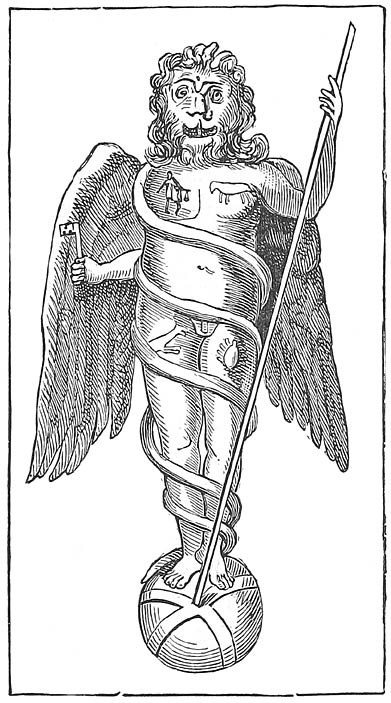
Fig. 5.
The Key has a holy sense in various religions, and consequently an infernal key is its natural counterpart. The Vedic hymns, which say so much about the shutting and opening, imprisoning and releasing, of heavenly rains and earthly fruits by demons and deities, interpret many phenomena of nature, and the same ideas have arisen in many lands. We cannot be certain, therefore, that Calmet is right in assigning an Indian origin to the subjoined Figure 5, an ancient Persian medal. The signs of the zodiac on its body show it to be one of those celestial demons believed able to bind the beneficent or loose the formidable powers of nature. The Key is of especial import in Hebrew faith. It was the high-priest Eliakim’s symbol of office, as being also prefect in the king’s house. ‘The key of the house of David will I lay upon his shoulder: he shall open and none shall shut; he shall shut and none shall open.’19 The Rabbins had a saying that God reserves to himself four keys, which he will intrust not even to the angels: the key of rain, the key of the grave, the key of fruitfulness, and the key of barrenness. It was the sign of one set above angels when Christ was seen with the keys of Hell and Death, or when he delivered the keys of heaven to Peter,20—still thrust down the backs of protestant children to cure nose-bleed.
The ubiquitous superstition which attributes the flint arrows of pre-historic races to gods, shot by them as lightning, and, as some said, from a rainbow, is too childlike a theory to call for elaborate treatment. We need not, ethnographically, connect our ‘Thor arrows’ and ‘Elf shots’ with the stones hurled at mortals by the Thunder-Duke (Lui-tsz) of China. The ancient Parthians, who used to reply to the thunderstorm by shooting arrows at it, and the Turks, who attack an eclipse with guns, fairly represent the infancy of the human race, though perhaps with more than its average pluck. Dr. Macgowan relates, concerning the Lei-chau (Thunder District) of China, various myths which resemble those which surround the world. After thunderstorms, black stones, it is believed, may be found which emit light and peculiar sounds on being struck. In a temple consecrated to the Thunder Duke the people annually place a drum for that stormy demon to beat. The drum was formerly left on a mountain-top with a little boy as a sacrifice.21 Mr. Dennys22 speaks of the belief in the same country that violent winds and typhoons are caused by the passage through the air of the ‘Bob-tailed Dragon,’ and also of the rain-god Yü-Shüh. A storm-god connected with the ‘Eagre,’ or bore of the river Tsien-tang, presents a coincidence of name with the Scandinavian Oegir, which would be hardly noticeable were it not for the very close resemblance between the folklore concerning the ‘Bob-tailed Dragon’ and the storm-dragons of several Aryan races. Generally, in both China and Japan the Dragon is regarded with a veneration equal to the horror with which the serpent is visited. Of this phenomenon and its analogies in Britain I shall have an explanation to submit when we come to consider Dragon-myths more particularly. To this general rule the ‘Bob-tailed Dragon’ of China is a partial exception. His fidelity as a friend led to the ill return of an attack by which his tail was amputated, and ever since his soured temper has shown itself in raising storms. When a violent tempest arises the Cantonese say, ‘The Bob-tailed Dragon is passing,’ in the same proverbial way as the Aryan peasantries attribute the same phenomenon to their storm-gods.
The notion is widely prevalent in some districts of France that all whirlwinds, however slight, are caused by wizards or witches, who are in them, careering through the air; and it is stated by the Melusine that in the department of the Orne storms are attributed to the clergy, who are supposed to be circling in them. The same excellent journal states that some years ago, in that department, a parishioner who saw his crops threatened by a hail-storm fired into the cloud. The next day he heard that the parish priest had broken his leg by a fall for which he could not account.
The following examples are given by Kuhn. Near Stangenhagen is a treasure hid in a mountain which Lord von Thümen tried to seek, but was caught up with his horse by a whirlwind and deposited at home again. The Devil is believed to be seated at the centre of every whirlwind. At Biesenthal it is said a noble lady became the Wind’s bride. She was in her time a famous rider and huntress, who rode recklessly over farmers’ fields and gardens; now she is herself hunted by snakes and dragons, and may be heard howling in every storm.
I suspect that the bristling hair so frequently portrayed in the Japanese Oni, Devils, refers to their frequent residence at the centre of a gale of wind. Their demon of the storm is generally pictured throned upon a flower of flames, his upraised and extended fingers emitting the most terrific lightnings, which fall upon his victims and envelop them in flames. Sometimes, however, the Japanese artists poke fun at their thunder-god, and show him sprawling on the ground from the recoil of his own lightnings. The following extract from The Christian Herald (London, April 12, 1877) will show how far the dread of this Japanese Oni extends: ‘A pious father writes, ‘A few days ago there was a severe thunderstorm, which seemed to gather very heavily in the direction where my son lived; and I had a feeling that I must go and pray that he might be protected, and not be killed by the lightning. The impression seemed to say, ‘There is no time to be lost.’ I obeyed, and went and knelt down and prayed that the Lord would spare his life. I believe he heard my prayer. My son called on me afterwards, and, speaking of the shower, said, ‘The lightning came downwards and struck the very hoe in my hands, and numbed me.’ I said, ‘Perhaps you would have been killed if some one had not been praying for you.’ Since then he has been converted, and, I trust, will be saved in God’s everlasting kingdom.’’
Such paragraphs may now strike even many christians as ‘survivals.’ But it is not so very long since some eminent clergymen looked upon Benjamin Franklin as the heaven-defying Ajax of Christendom, because he undertook to show people how they might divert the lightnings from their habitations. In those days Franklin personally visited a church at Streatham, whose steeple had been struck by lightning, and, after observing the region, gave an opinion that if the steeple were again erected without a lightning-rod, it would again be struck. The audacious man who ‘snatched sceptres from tyrants and lightnings from heaven,’ as the proverb ran, was not listened to: the steeple was rebuilt, and again demolished by lightning.
The supreme god of the Quichuas (American), Viracocha (‘sea foam’), rises out of Lake Titicaca, and journeys with lightnings for all opposers, to disappear in the Western Ocean. The Quichua is mentally brother of the Arab camel-driver. ‘The sea,’ it is said in the ‘Arabian Nights,’—‘the sea became troubled before them, and there arose from it a black pillar, ascending towards the sky, and approaching the meadow,’ and ‘behold it was a Jinn23 of gigantic stature.’ The Jinn is sometimes helpful as it is formidable; it repays the fisherman who unseals it from the casket fished up from the sea, as fruitfulness comes out of the cloud no larger than a man’s hand evoked by Elijah. The perilous Jinn described in the above extract is the waterspout. Waterspouts are attributed in China to the battles of dragons in the air, and the same country recognises a demon of high tides. The newest goddess in China is a canonised protectress against the shipwrecking storm-demons of the coast, an exaltation recently proclaimed by the Government of the empire in obedience, as the edict stated, to the belief prevailing among sailors. In this the Chinese are a long way behind the mariners and fishermen of the French coast, who have for centuries, by a pious philology, connected ‘Maria’ with ‘La Marée’ and ‘La Mer;’ and whenever they have been saved from storms, bring their votive offerings to sea-side shrines of the Star of the Sea.
The old Jewish theology, in its eagerness to claim for Jehovah the absolutism which would make him ‘Lord of lords,’ instituted his responsibility for many doubtful performances, the burthen of which is now escaped by the device of saying that he ‘permitted’ them. In this way the Elohim who brought on the Deluge have been identified with Jehovah. None the less must we see in the biblical account of the Flood the action of tempestuous water-demons. What power a christian would recognise in such an event were it related in the sacred books of another religion may be seen in the vision of the Apocalypse—‘The Serpent cast out of his mouth a flood of water after the woman, that he might cause her to be carried away with the flood; and the earth helped the woman and opened its mouth and swallowed up the flood.’ This Demon of Inundation meets the explorer of Egyptian and Accadian inscriptions at every turn. The terrible Seven, whom even the God of Fire cannot control, ‘break down the banks of the Abyss of Waters.’24 The God of the Tigris, Tourtak (Tartak of the Bible), is ‘the great destroyer.’25 Leviathan ‘maketh the deep to boil like a pot:’ ‘when he raises up himself the mighty are afraid; by reason of breakings they purify themselves.’26
In the Astronomical Tablets, which Professor Sayce dates about B.C. 1600, we have the continual association of eclipse and flood: ‘On the fifteenth day an eclipse takes place. The king dies; and rains in the heaven, floods in the channels are.’ ‘In the month of Elul (August), the fourteenth day, an eclipse takes place.... Northward ... its shadow is seen; and to the King of Mullias a crown is given. To the king the crown is an omen; and over the king the eclipse passes. Rains in heaven, floods in the channels flow. A famine is in the country. Men their sons for silver sell.’ ‘After a year the Air-god inundates.’27
In the Chaldæo-Babylonian cosmogony the three zones of the universe were ruled over by a Triad as follows: the Heaven by Anu; the surface of the earth, including the atmosphere, by Bel; the under-world by Nouah.28 This same Nouah is the Assyrian Hea or Saviour; and it is Noah of the Bible. The name means a rest or residence,—the place where man may dwell. When Tiamat the Dragon, or the Leviathan, opens ‘the fountains of the great deep,’ and Anu ‘the windows of Heaven,’ it is Hea or Noah who saves the life of man. M. François Lenormant has shown this to be the probable sense of one of the most ancient Accadian fragments in the British Museum. In it allusion is made to ‘the serpent of seven heads ... that beats the sea.’29 Hea, however, appears to be more clearly indicated in a fragment which Professor Sayce appends to this:—
Below in the abyss the forceful multitudes may they sacrifice.
The overwhelming fear of Anu in the midst of Heaven encircles his path.
The spirits of earth, the mighty gods, withstand him not.
The king like a lightning-flash opened.
Adar, the striker of the fortresses of the rebel band, opened.
Like the streams in the circle of heaven I besprinkled the seed of men.
His marching in the fealty of Bel to the temple I directed,
(He is) the hero of the gods, the protector of mankind, far (and) near....
O my lord, life of Nebo (breathe thy inspiration), incline thine ear.
O Adar, hero, crown of light, (breathe) thy inspiration, (incline) thine ear.
The overwhelming fear of thee may the sea know....
Thy setting (is) the herald of his rest from marching,
In thy marching Merodach (is) at rest30....
Thy father on his throne thou dost not smite.
Bel on his throne thou dost not smite.
The spirits of earth on their throne may he consume.
May thy father into the hands of thy valour cause (them) to go forth.
May Bel into the hands of thy valour cause (them) to go forth.
(The king, the proclaimed) of Anu, the firstborn of the gods.
He that stands before Bel, the heart of the life of the House of the Beloved.31
The hero of the mountain (for those that) die in multitudes.... the one god, he will not urge.32
In this primitive fragment we find the hero of the mountain (Noah), invoking both Bel and Nebo, aerial and infernal Intelligences, and Adar the Chaldæan Hercules, for their ‘inspiration’—that breath which, in the biblical story, goes forth in the form of the Dove (‘the herald of his rest’ in the Accadian fragment), and in the ‘wind’ by which the waters were assuaged (in the fragment ‘the spirits of the earth’ which are given into the hand of the violent ‘hero of the mountain,’ whom alone the gods ‘will not urge’).
The Hydra may be taken as a type of the destructive water-demon in a double sense, for its heads remain in many mythical forms. The Syrian Dagon and Atergatis, fish-deities, have bequeathed but their element to our Undines of romance. Some nymphs have so long been detached from aqueous associations as to have made their names puzzling, and their place in demonology more so. To the Nixy (νήχω) of Germany, now merely mischievous like the British Pixy, many philologists trace the common phrase for the Devil,—‘Old Nick.’ I believe, however, that this phrase owes its popularity to St. Nicholas rather than to the Norse water-god whose place he was assigned after the christian accession. This saintly Poseidon, who, from being the patron of fishermen, gradually became associated with that demon whom, Sir Walter Scott said, ‘the British sailor feared when he feared nothing else,’ was also of old the patron of pirates; and robbers were called ‘St. Nicholas’ clerks.’33 In Norway and the Netherlands the ancient belief in the demon Nikke was strong; he was a kind of Wild Huntsman of the Sea, and has left many legends, of which ‘The Flying Dutchman’ is one. But my belief is that, through his legendary relation to boys, St. Nicholas gave the name Old Nick its modern moral accent. Because of his reputation for having restored to life three murdered children St. Nicholas was made their patron, and on his day, December 6, it was the old custom to consecrate a Boy-Bishop, who held office until the 28th of the month. By this means he became the moral appendage of the old Wodan god of the Germanic races, who was believed in winter time to find shelter in and shower benefits from evergreens, especially firs, on his favourite children who happened to wander beneath them. ‘Bartel,’ ‘Klaubauf,’ or whatever he might be called, was reduced to be the servant of St. Nicholas, whose name is now jumbled into ‘Santaclaus.’ According to the old custom he appeared attended by his Knecht Klaubauf—personated by those who knew all about the children—bringing a sort of doomsday. The gifts having been bestowed on the good children, St. Nicholas then ordered Klaubauf to put the naughty ones into his pannier and carry them off for punishment. The terror and shrieks thus caused have created vast misery among children, and in Munich and some other places the authorities have very properly made such tragedies illegal. But for many centuries it was the custom of nurses and mothers to threaten refractory children with being carried off at the end of the year by Nicholas; and in this way each year closed, in the young apprehension, with a Judgment Day, a Weighing of Souls, and a Devil or Old Nick as agent of retribution.
Nick has long since lost his aquatic character, and we find his name in the Far West (America) turning up as ‘The Nick of the Woods,’—the wild legend of a settler who, following a vow of vengeance for his wrongs, used to kill the red men while they slept, and was supposed to be a demon. The Japanese have a water-dragon—Kappa—of a retributive and moral kind, whose office it is to swallow bad boys who go to swim in disobedience to their parents’ commands, or at improper times and places. It is not improbable that such dangers to the young originated some of the water-demons,—probably such as are thought of as diminutive and mischievous,—e.g., Nixies. The Nixa was for a long time on the Baltic coast the female ‘Old Nick,’ and much feared by fishermen. Her malign disposition is represented in the Kelpie of Scotland,—a water-horse, believed to carry away the unwary by sudden floods to devour them. In Germany there was a river-goddess whose temple stood at Magdeburg, whence its name. A legend exists of her having appeared in the market there in christian costume, but she was detected by a continual dripping of water from the corner of her apron. In Germany the Nixies generally played the part of the naiads of ancient times.34 In Russia similar beings, called Rusalkas, are much more formidable.
In many regions of Christendom it is related that these demons, relatives of the Swan-maidens, considered in another chapter, have been converted into friendly or even pious creatures, and baptized into saintly names. Sometimes there are legends which reveal this transition. Thus it is related that in the year 1440, the dikes of Holland being broken down by a violent tempest, the sea overflowed the meadows; and some maidens of the town of Edam, in West Friesland, going in a boat to milk their cows, espied a mermaid embarrassed in the mud, the waters being very shallow. They took it into their boat and brought it to Edam, and dressed it in women’s apparel, and taught it to spin. It ate as they did, but could not be brought to speak. It was carried to Haarlem, where it lived for some years, though showing an inclination to water. Parival, who tells the story, relates that they had conveyed to it some notions of the existence of a deity, and it made its reverences devoutly whenever it passed a crucifix.
Another creature of the same species was in the year 1531 caught in the Baltic, and sent as a present to Sigismund, King of Poland. It was seen by all the persons about the court, but only lived three days.
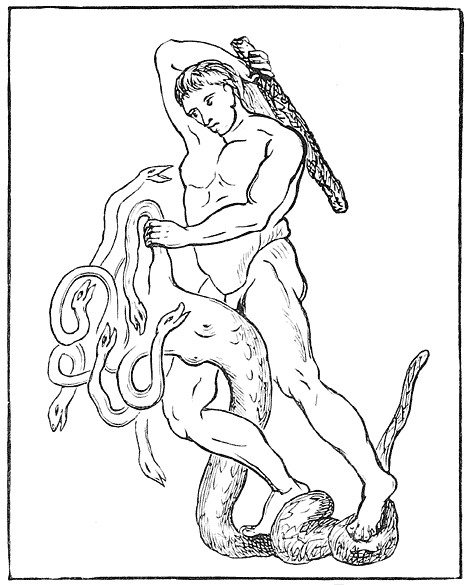
Fig. 6.—Hercules and the Hydra (Louvre).
The Hydra—the torrent which, cut off in one direction, makes many headways in others—has its survivals in the many diabolical names assigned to boiling springs and to torrents that become dangerously swollen. In California the boiling springs called ‘Devil’s Tea-kettle’ and ‘Devil’s Mush-pot’ repeat the ‘Devil’s Punch-bowls’ of Europe, and the innumerable Devil’s Dikes and Ditches. St. Gerard’s Hill, near Pesth, on which the saint suffered martyrdom, is believed to be crowded with devils whenever an inundation threatens the city; they indulge in fiendish laughter, and play with the telescopes of the observatory, so that they who look through them afterwards see only devils’ and witches’ dances!35 At Buda, across the river from Pesth, is the famous ‘Devil’s Ditch,’ which the inhabitants use as a sewer while it is dry, making it a Gehenna to poison them with stenches, but which often becomes a devastating torrent when thaw comes on the Blocksberg. In 1874 the inhabitants vaulted it over to keep away the normal stench, but the Hydra-head so lopped off grew again, and in July 1875 swallowed up a hundred people.36
The once perilous Strudel and Wirbel of the Danube are haunted by diabolical legends. From Dr. William Beattie’s admirable work on ‘The Danube’ I quote the following passages:—‘After descending the Greinerschwall, or rapids of Grein above mentioned, the river rolls on for a considerable space, in a deep and almost tranquil volume, which, by contrast with the approaching turmoil, gives increased effect to its wild, stormy, and romantic features. At first a hollow, subdued roar, like that of distant thunder, strikes the ear and rouses the traveller’s attention. This increases every second, and the stir and activity which now prevail among the hands on board show that additional force, vigilance, and caution are to be employed in the use of the helm and oars. The water is now changed in its colour—chafed into foam, and agitated like a seething cauldron. In front, and in the centre of the channel, rises an abrupt, isolated, and colossal rock, fringed with wood, and crested with a mouldering tower, on the summit of which is planted a lofty cross, to which in the moment of danger the ancient boatmen were wont to address their prayers for deliverance. The first sight of this used to create no little excitement and apprehension on board; the master ordered strict silence to be observed, the steersman grasped the helm with a firmer hand, the passengers moved aside, so as to leave free space for the boatmen, while the women and children were hurried into the cabin, there to await, with feelings of no little anxiety, the result of the enterprise. Every boatman, with his head uncovered, muttered a prayer to his patron saint; and away dashed the barge through the tumbling breakers, that seemed as if hurrying it on to inevitable destruction. All these preparations, joined by the wildness of the adjacent scenery, the terrific aspect of the rocks, and the tempestuous state of the water, were sufficient to produce a powerful sensation on the minds even of those who had been all their lives familiar with dangers; while the shadowy phantoms with which superstition had peopled it threw a deeper gloom over the whole scene.’
Concerning the whirlpool called Wirbel, and the surrounding ruins, the same author writes: ‘Each of these mouldering fortresses was the subject of some miraculous tradition, which circulated at every hearth. The sombre and mysterious aspect of the place, its wild scenery, and the frequent accidents which occurred in the passage, invested it with awe and terror; but above all, the superstitions of the time, a belief in the marvellous, and the credulity of the boatmen, made the navigation of the Strudel and the Wirbel a theme of the wildest romance. At night, sounds that were heard far above the roar of the Danube issued from every ruin. Magical lights flashed through their loopholes and casements, festivals were held in the long-deserted halls, maskers glided from room to room, the waltzers maddened to the strains of an infernal orchestra, armed sentinels paraded the battlements, while at intervals the clash of arms, the neighing of steeds, and the shrieks of unearthly combatants smote fitfully on the boatmen’s ear. But the tower on which these scenes were most fearfully enacted was that on the Longstone, commonly called the ‘Devil’s Tower,’ as it well deserved to be—for here, in close communion with his master, resided the ‘Black Monk,’ whose office it was to exhibit false lights and landmarks along the gulf, so as to decoy the vessels into the whirlpool, or dash them against the rocks. He was considerably annoyed in his quarters, however, on the arrival of the great Soliman in these regions; for to repel the turbaned host, or at least to check their triumphant progress to the Upper Danube, the inhabitants were summoned to join the national standard, and each to defend his own hearth. Fortifications were suddenly thrown up, even churches and other religious edifices were placed in a state of military defence; women and children, the aged and the sick, as already mentioned in our notice of Schaumburg, were lodged in fortresses, and thus secured from the violence of the approaching Moslem. Among the other points at which the greatest efforts were made to check the enemy, the passage of the Strudel and Wirbel was rendered as impregnable as the time and circumstances of the case would allow. To supply materials for the work, patriotism for a time got the better of superstition, and the said Devil’s Tower was demolished and converted into a strong breastwork. Thus forcibly dislodged, the Black Monk is said to have pronounced a malediction on the intruders, and to have chosen a new haunt among the recesses of the Harz mountains.’
When the glaciers send down their torrents and flood the Rhone, it is the immemorial belief that the Devil may be sometimes seen swimming in it, with a sword in one hand and a golden globe in the other. Since it is contrary to all orthodox folklore that the Devil should be so friendly with water, the name must be regarded as a modern substitute for the earlier Rhone demon. We probably get closer to the original form of the superstition in the Swiss Oberland, which interprets the noises of the Furka Glacier, which feeds the Rhone, as the groans of wicked souls condemned for ever to labour there in directing the river’s course; their mistress being a demoness who sometimes appears just before the floods, floating on a raft, and ordering the river to rise.
There is a tidal demonolatry also. The author of ‘Rambles in Northumberland’ gives a tradition concerning the river Wansbeck: ‘This river discharges itself into the sea at a place called Cambois, about nine miles to the eastward, and the tide flows to within five miles of Morpeth. Tradition reports that Michael Scott, whose fame as a wizard is not confined to Scotland, would have brought the tide to the town had not the courage of the person failed upon whom the execution of this project depended. This agent of Michael, after his principal had performed certain spells, was to run from the neighbourhood of Cambois to Morpeth without looking behind, and the tide would follow him. After having advanced a certain distance he became alarmed at the roaring of the waters behind him, and forgetting the injunction, gave a glance over his shoulder to see if the danger was imminent, when the advancing tide immediately stopped, and the burgesses of Morpeth thus lost the chance of having the Wansbeck navigable between their town and the sea. It is also said that Michael intended to confer a similar favour on the inhabitants of Durham, by making the Wear navigable to their city; but his good intentions, which were to be carried into effect in the same manner, were also frustrated by the cowardice of the person who had to guide the tide.’
The gentle and just king Æolus, who taught his islanders navigation, in his mythologic transfiguration had to share the wayward dispositions of the winds he was said to rule; but though he wrecked the Trojan fleet and many a ship, his old human heart remained to be trusted on the appearance of Halcyon. His unhappy daughter of that name cast herself into the sea after the shipwreck of her husband (Cėyx), and the two were changed into birds. It was believed that for seven days before and seven after the shortest day of the year, when the halcyon is breeding, Æolus restrains his winds, and the sea is calm. The accent of this fable has been transmitted to some variants of the folklore of swans. In Russia the Tsar Morskoi or Water Demon’s beautiful daughters (swans) may naturally be supposed to influence the tides which the fair bathers of our time are reduced to obey. In various regions the tides are believed to have some relation to swans, and to respect them. I have met with a notion of this kind in England. On the day of Livingstone’s funeral there was an extraordinary tide in the Thames, which had been predicted and provided for. The crowds which had gathered at the Abbey on that occasion repaired after the funeral to Westminster Bridge to observe the tide, and among them was a venerable disbeliever in science, who announced to a group that there would be no high tide, ‘because the swans were nesting.’ This sceptic was speedily put to confusion by the result, and perhaps one superstition the less remained in the circle that seemed to regard him as an oracle.
The Russian peasantry live in much fear of the Rusalkas and Vodyanuie, water-spirits who, of course, have for their chief the surly Neptune Tsar Morskoi. In deprecation of this tribe, the peasant is careful not to bathe without a cross round the neck, nor to ford a stream on horseback without signing a cross on the water with a scythe or knife. In the Ukrain these water-demons are supposed to be the transformed souls of Pharaoh and his host when they were drowned, and they are increased by people who drown themselves. In Bohemia fishermen are known sometimes to refuse aid to one drowning, for fear the Vodyany will be offended and prevent the fish, over which he holds rule, from entering their nets. The wrath of such beings is indicated by the upheavals of water and foam; and they are supposed especially mischievous in the spring, when torrents and floods are pouring from melted snow. Those undefined monsters which Beowulf slew, Grendel and his mother, are interpreted by Simrock as personifications of the untamed sea and stormy floods invading the low flat shores, whose devastations so filled Faust with horror (II. iv.), and in combating which his own hitherto desolating powers found their task.
The Sea sweeps on in thousand quarters flowing,
Itself unfruitful, barrenness bestowing;
It breaks, and swells, and rolls, and overwhelms
The desert stretch of desolated realms....
Let that high joy be mine for evermore,
To shut the lordly Ocean from the shore,
The watery waste to limit and to bar,
And push it back upon itself afar!
In such brave work Faust had many forerunners, whose art and courage have their monument in the fairer fables of all these elemental powers in which fear saw demons. Pavana, in India, messenger of the gods, rides upon the winds, and in his forty-nine forms, corresponding with the points of the Hindu compass, guards the earth. Solomon, too, journeyed on a magic carpet woven of the winds, which still serves the purposes of the Wise. From the churned ocean rose Lakshmí (after the solar origin was lost to the myth), Hindu goddess of prosperity; and from the sea-foam rose Aphrodite, Beauty. These fair forms had their true worshipper in the Northman, who left on mastered wind and wave his song as Emerson found it—
The gale that wrecked you on the sand,
It helped my rowers to row;
The storm is my best galley hand,
And drives me where I go.
1 ‘Scenes and Legends of the North of Scotland.’ Nimmo, 1876.
2 ‘Rig-Veda,’ ii. 33. Tr. by Professor Evans of Michigan.
3 ‘Rig-Veda,’ i. 114.
4 ‘Jour. Ceylon R. A. Soc.,’ 1865–66.
5 Welcker, ‘Griechische Götterlehre,’ vol. i. p. 661.
6 Moffat, p. 257.
7 Livingstone, p. 124.
8 Pöppig, ‘Reise in Chile,’ vol. ii. p. 358.
9 Eyre, vol. ii. p. 362.
10 Tylor, ‘Early Hist.,’ p. 359.
11 So confirming the conjecture of Wachsmuth, in ‘Das alte Griechenland im neuen,’ p. 23. Elias might also easily be associated with the name Æolus.
12 ‘Rig-Veda,’ x. (Muir).
13 John iii. 8.
14 ‘The Wheel of the Law,’ by Henry Alabaster, Trübner & Co.
15 ‘Rig-Veda,’ v. 83 (Wilson).
16 ‘Major’s Tr.,’ ii. 26.
17 Wierus’ ‘Pseudomonarchia Dæmon.’
18 ‘Songs of the Russian People,’ by W. R. S. Ralston, M.A.
19 Isa. xxii. 22. It is remarkable that (according to Callimachus) Ceres bore a key on her shoulder. She kept the granary of the earth.
20 Rev. i. 18.; Matt. xvi. 19.
21 ‘Journal N. C. B. R. A. S.,’ 1853.
22 ‘Folklore of China,’ p. 124. The drum held by the imp in Fig. 3 shows his relation to the thunder-god. In Japan the thunder-god is represented as having five drums strung together. The wind-god has a large bag of compressed air between his shoulders; and he has steel claws, representing the keen and piercing wind. The Tartars in Siberia believe that a potent demon may be evoked by beating a drum; their sorcerers provide a tame bear, who starts upon the scene, and from whom they pretend to get answers to questions. In Nova Scotian superstition we find demons charmed by drums into quietude. In India the temple-drum preserved such solemn associations even for the new theistic sect, the Brahmo-Somaj, that it is said to be still beaten as accompaniment to the organ sent to their chief church by their English friends.
23 Although the Koran and other authorities, as already stated, have associated the Jinn with etherial fire, Arabic folklore is nearer the meaning of the word in assigning the name to all demons. The learned Arabic lexicographer of Beirut, P. Bustani, says ‘The Jinn is the opposite of mankind, or it is whatever is veiled from the sense, whether angel or devil.’
24 ‘Cuneiform Ins.,’ iv. 15.
25 Ib. ii. 27.
26 Job xli.
27 ‘Records of the Past,’ i.
28 Lenormant, ‘La Magie.’
29 ‘Records of the Past,’ iii. 129.
30 The god of the Euphrates.
31 The Assyrian has ‘of the high places.’
32 ‘Records of the Past,’ iii. 129, 130.
33 ‘Henry IV.,’ Part 1st, Act 2. ‘Heart of Mid-Lothian,’ xxv. An interesting paper on this subject by Mr. Alexander Wilder appeared in The Evolution, New York, December 16, 1877.
34 De Plancy.
35 An individual by this means saw his wife among the witches, so detecting her unhallowed nature, which gave rise to a saying there that husbands must not be star-gazing on St. Gerard’s Eve.
36 London ‘Times,’ July 8, 1875.
1 ‘Scenes and Legends of the North of Scotland.’ Nimmo, 1876.
2 ‘Rig-Veda,’ ii. 33. Tr. by Professor Evans of Michigan.
3 ‘Rig-Veda,’ i. 114.
4 ‘Jour. Ceylon R. A. Soc.,’ 1865–66.
5 Welcker, ‘Griechische Götterlehre,’ vol. i. p. 661.
6 Moffat, p. 257.
7 Livingstone, p. 124.
8 Pöppig, ‘Reise in Chile,’ vol. ii. p. 358.
9 Eyre, vol. ii. p. 362.
10 Tylor, ‘Early Hist.,’ p. 359.
11 So confirming the conjecture of Wachsmuth, in ‘Das alte Griechenland im neuen,’ p. 23. Elias might also easily be associated with the name Æolus.
12 ‘Rig-Veda,’ x. (Muir).
13 John iii. 8.
14 ‘The Wheel of the Law,’ by Henry Alabaster, Trübner & Co.
15 ‘Rig-Veda,’ v. 83 (Wilson).
16 ‘Major’s Tr.,’ ii. 26.
17 Wierus’ ‘Pseudomonarchia Dæmon.’
18 ‘Songs of the Russian People,’ by W. R. S. Ralston, M.A.
19 Isa. xxii. 22. It is remarkable that (according to Callimachus) Ceres bore a key on her shoulder. She kept the granary of the earth.
20 Rev. i. 18.; Matt. xvi. 19.
21 ‘Journal N. C. B. R. A. S.,’ 1853.
22 ‘Folklore of China,’ p. 124. The drum held by the imp in Fig. 3 shows his relation to the thunder-god. In Japan the thunder-god is represented as having five drums strung together. The wind-god has a large bag of compressed air between his shoulders; and he has steel claws, representing the keen and piercing wind. The Tartars in Siberia believe that a potent demon may be evoked by beating a drum; their sorcerers provide a tame bear, who starts upon the scene, and from whom they pretend to get answers to questions. In Nova Scotian superstition we find demons charmed by drums into quietude. In India the temple-drum preserved such solemn associations even for the new theistic sect, the Brahmo-Somaj, that it is said to be still beaten as accompaniment to the organ sent to their chief church by their English friends.
23 Although the Koran and other authorities, as already stated, have associated the Jinn with etherial fire, Arabic folklore is nearer the meaning of the word in assigning the name to all demons. The learned Arabic lexicographer of Beirut, P. Bustani, says ‘The Jinn is the opposite of mankind, or it is whatever is veiled from the sense, whether angel or devil.’
24 ‘Cuneiform Ins.,’ iv. 15.
25 Ib. ii. 27.
26 Job xli.
27 ‘Records of the Past,’ i.
28 Lenormant, ‘La Magie.’
29 ‘Records of the Past,’ iii. 129.
30 The god of the Euphrates.
31 The Assyrian has ‘of the high places.’
32 ‘Records of the Past,’ iii. 129, 130.
33 ‘Henry IV.,’ Part 1st, Act 2. ‘Heart of Mid-Lothian,’ xxv. An interesting paper on this subject by Mr. Alexander Wilder appeared in The Evolution, New York, December 16, 1877.
34 De Plancy.
35 An individual by this means saw his wife among the witches, so detecting her unhallowed nature, which gave rise to a saying there that husbands must not be star-gazing on St. Gerard’s Eve.
36 London ‘Times,’ July 8, 1875.
Chapter V.
Animals.
Animal demons distinguished—Trivial sources of Mythology—Hedgehog—Fox—Transmigrations in Japan—Horses bewitched—Rats—Lions—Cats—The Dog—Goethe’s horror of dogs—Superstitions of the Parsees, people of Travancore, and American Negroes, Red Indians, &c.—Cynocephaloi—The Wolf—Traditions of the Nez Perces—Fenris—Fables—The Boar—The Bear—Serpent—Every animal power to harm demonised—Horns.
The animal demons—those whose evil repute is the result of something in their nature which may be inimical to man—should be distinguished from the forms which have been diabolised by association with mythological personages or ideas. The lion, tiger, and wolf are examples of the one class; the stag, horse, owl, and raven of the other. But there are circumstances which render it very difficult to observe this distinction. The line has to be drawn, if at all, between the measureless forces of degradation on the one side, discovering some evil in animals which, but for their bad associations, would not have been much thought of; and of euphemism on the other, transforming harmful beasts to benignant agents by dwelling upon some minor characteristic.
There are a few obviously dangerous animals, such as the serpent, where it is easy to pick our way; we can recognise the fear that flatters it to an agathodemon and the diminished fear that pronounces it accurst.1 But what shall be said of the Goat? Was there really anything in its smell or in its flesh when first eaten, its butting, or injury to plants, which originally classed it among the unclean animals? or was it merely demonised because of its uncanny and shaggy appearance? What explanation can be given of the evil repute of our household friend the Cat? Is it derived by inheritance from its fierce ancestors of the jungle? Was it first suggested by its horrible human-like sleep-murdering caterwaulings at night? or has it simply suffered from a theological curse on the cats said to draw the chariots of the goddesses of Beauty? The demonic Dog is, if anything, a still more complex subject. The student of mythology and folklore speedily becomes familiar with the trivial sources from which vast streams of superstition often issue. The cock’s challenge to the all-detecting sun no doubt originated his ominous career from the Code of Manu to the cock-headed devils frescoed in the cathedrals of Russia. The fleshy, forked roots of a soporific plant issued in that vast Mandrake Mythology which has been the subject of many volumes, without being even yet fully explored. The Italians have a saying that ‘One knavery of the hedgehog is worth more than many of the fox;’ yet the nocturnal and hibernating habits and general quaintness of the humble hedgehog, rather than his furtive propensity to prey on eggs and chickens, must have raised him to the honours of demonhood. In various popular fables this little animal proves more than a match for the wolf and the serpent. It was in the form of a hedgehog that the Devil is said to have made the attempt to let in the sea through the Brighton Downs, which was prevented by a light being brought, though the seriousness of the scheme is still attested in the Devil’s Dyke. There is an ancient tradition that when the Devil had smuggled himself into Noah’s Ark, he tried to sink it by boring a hole; but this scheme was defeated, and the human race saved, by the hedgehog stuffing himself into the hole. In the Brighton story the Devil would appear to have remembered his former failure in drowning people, and to have appropriated the form which defeated him.
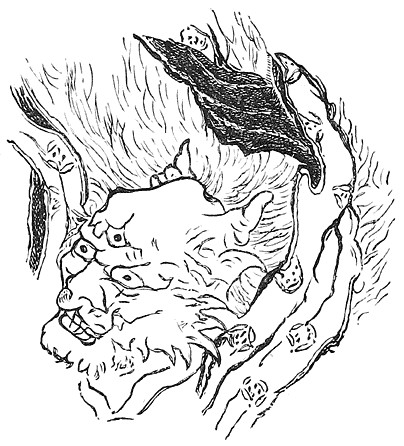
Fig. 7.—Japanese Demon.
The Fox, as incarnation of cunning, holds in the primitive belief of the Japanese almost the same position as the Serpent in the nations that have worshipped, until bold enough to curse it. In many of the early pictures of Japanese demons one may generally detect amid their human, wolfish, or other characters some traits of the kitsune (fox). He is always the soul of the three-eyed demon of Japan (fig. 7). He is the sagacious ‘Vizier,’ as the Persian Desatir calls him, and is practically the Japanese scape-goat. If a fox has appeared in any neighbourhood, the next trouble is attributed to his visit; and on such occasions the sufferers and their friends repair to some ancient gnarled tree in which the fox is theoretically resident and propitiate him, just as would be done to a serpent in other regions. In Japan the fox is not regarded as always harmful, but generally so. He is not to be killed on any account. Being thus spared through superstition, the foxes increase sufficiently to supply abundant material for the continuance of its demonic character. ‘Take us the foxes, the little foxes that spoil the vines,’2 is an admonition reversed in Japan. The correspondence between the cunning respected in this animal and that of the serpent, reverenced elsewhere, is confirmed by Mr. Fitz Cunliffe Owen, who observed, as he informs me, that the Japanese will not kill even the poisonous snakes which crawl freely amid the decaying Buddhist temples of Nikko, one of the most sacred places in Japan, where once as many as eight thousand monastic Buddhists were harboured. It is the red fox that abounds in Japan, and its human-like cry at night near human habitations is such as might easily encourage these superstitions. But, furthermore, mythology supplies many illustrations of a creditable tendency among rude tribes to mark out for special veneration or fear any force in nature finer than mere strength. Emerson says, ‘Foxes are so cunning because they are not strong.’ In our Japanese demon, whose three eyes alone connect it with the præternatural vision ascribed by that race to the fox, the harelip is very pronounced. That little animal, the Hare, is associated with a large mythology, perhaps because out of its weakness proceeds its main forces of survival—timidity, vigilance, and swiftness. The superstition concerning the hare is found in Africa. The same animal is the much-venerated good genius of the Calmucs, who call him Sákya-muni (Buddha), and say that on earth he submitted himself to be eaten by a starving man, for which gracious deed he was raised to dominion over the moon, where they profess to see him. The legend is probably traceable back to the Sanskrit word sasin, moon, which means literally ‘the hare-marked.’ Sasa means ‘hare.’ Pausanias relates the story of the moon-goddess instructing exiles to build their city where they shall see a hare take refuge in a myrtle-grove.3 In the demonic fauna of Japan another cunning animal figures—the Weasel. The name of this demon is ‘the sickle weasel,’ and it also seems to occupy the position of a scape-goat. In the language of a Japanese report, ‘When a person’s clogs slip from under his feet, and he falls and cuts his face on the gravel, or when a person, who is out at night when he ought to have been at home, presents himself to his family with a freshly-scarred face, the wound is referred to the agency of the malignant invisible weasel and his sharp sickle.’ In an aboriginal legend of America, also, two sister demons commonly take the form of weasels.
The popular feeling which underlay much of the animal-worship in ancient times was probably that which is reflected in the Japanese notions of to-day, as told in the subjoined sketch from an amusing book.
‘One of these visitors was an old man, who himself was at the time a victim of a popular superstition that the departed revisit the scenes of their life in this world in shapes of different animals. We noticed that he was not in his usual spirits, and pressed him to unburden his mind to us. He said he had lost his little son Chiosin, but that was not so much the cause of his grief as the absurd way in which his wife, backed up by a whole conclave of old women who had taken up their abode in his house to comfort her, was going on. ‘What do they all do?’ we asked sympathetically. ‘Why,’ he replied, ‘every beastly animal that comes to my house, there is a cry amongst them all, ‘Chiosin, Chiosin has come back!’ and the whole house swarms with cats and dogs and bats—for they say they are not quite sure which is Chiosin, and that they had better be kind to the lot than run the chance of treating him badly; the consequence is, all these brutes are fed on my rice and meat, and now I am driven out of doors and called an unnatural parent because I killed a mosquito which bit me!’4
The strange and inexplicable behaviour of animals in cases of fear, panic, or pain has been generally attributed by ignorant races to their possession by demons. Of this nature is the story of the devil entering the herd of swine and carrying them into the sea, related in the New Testament. It is said that even yet in some parts of Scotland the milkmaid carries a switch of the magical rowan to expel the demon that sometimes enters the cow. Professor Monier Williams writes from Southern India—‘When my fellow-travellers and myself were nearly dashed to pieces over a precipice the other day by some restive horses on a ghat near Poona, we were told that the road at this particular point was haunted by devils who often caused similar accidents, and we were given to understand that we should have done well to conciliate Ganesa, son of the god Siva, and all his troops of evil spirits, before starting.’ The same writer also tells us that the guardian spirits or ‘mothers’ who haunt most regions of the Peninsula are believed to ride about on horses, and if they are angry, scatter blight and disease. Hence the traveller just arrived from Europe is startled and puzzled by apparitions of rudely-formed terra-cotta horses, often as large as life, placed by the peasantry round shrines in the middle of fields as acceptable propitiatory offerings, or in the fulfilment of vows in periods of sickness.5
This was the belief of the Corinthians in the Taraxippos, or shade of Glaucus, who, having been torn in pieces by the horses with which he had been racing, and which he had fed on human flesh to make more spirited, remained to haunt the Isthmus and frighten horses during the races.
There is a modern legend in the Far West (America) of a horse called ‘The White Devil,’ which, in revenge for some harm to its comrades, slew men by biting and trampling them, and was itself slain after defying many attempts at its capture; but among the many ancient legends of demon-horses there are few which suggest anything about that animal hostile to man. His occasional evil character is simply derived from his association with man, and is therefore postponed. For a similar reason the Goat also must be dealt with hereafter, and as a symbolical animal. A few myths are met with which relate to its unpleasant characteristics. In South Guinea the odour of goats is accounted for by the Saga that their ancestor having had the presumption to ask a goddess for her aromatic ointment, she angrily rubbed him with ointment of a reverse kind. It has also been said that it was regarded as a demon by the worshippers of Bacchus, because it cropped the vines; and that it thus originated the Trageluphoi, or goat-stag monsters mentioned by Plato,6 and gave us also the word tragedy.7 But such traits of the Goat can have very little to do with its important relations to Mythology and Demonology. To the list of animals demonised by association must also be added the Stag. No doubt the anxious mothers, wives, or sweethearts of rash young huntsmen utilised the old fables of beautiful hinds which in the deep forests changed to demons and devoured their pursuers,8 for admonition; but the fact that such stags had to transform themselves for evil work is a sufficient certificate of character to prevent their being included among the animal demons proper, that is, such as have in whole or part supplied in their disposition to harm man the basis of a demonic representation.
It will not be deemed wonderful that Rats bear a venerable rank in Demonology. The shudder which some nervous persons feel at sight of even a harmless mouse is a survival from the time when it was believed that in this form unshriven souls or unbaptized children haunted their former homes; and probably it would be difficult to estimate the number of ghost-stories which have originated in their nocturnal scamperings. Many legends report the departure of unhallowed souls from human mouths in the shape of a Mouse. During the earlier Napoleonic wars mice were used in Southern Germany as diviners, by being set with inked feet on the map of Europe to show where the fatal Frenchmen would march. They gained this sanctity by a series of associations with force stretching back to the Hindu fable of a mouse delivering the elephant and the lion by gnawing the cords that bound them. The battle of the Frogs and Mice is ascribed to Homer. Mice are said to have foretold the first civil war in Rome by gnawing the gold in the temple. Rats appear in various legends as avengers. The uncles of King Popelus II., murdered by him and his wife and thrown into a lake, reappear as rats and gnaw the king and queen to death. The same fate overtakes Miskilaus of Poland, through the transformed widows and orphans he had wronged. Mouse Tower, standing in the middle of the Rhine, is the haunted monument of cruel Archbishop Hatto, of Mainz, who (anno 970) bade the famine-stricken people repair to his barn, wherein he shut them fast and burned them. But next morning an army of rats, having eaten all the corn in his granaries, darkened the roads to the palace. The prelate sought refuge from them in the Tower, but they swam after, gnawed through the walls and devoured him.9
St. Gertrude, wearing the funereal mantle of Holda, commands an army of mice. In this respect she succeeds to the Pied Piper of Hamelin, who also leads off children; and my ingenious friend Mr. John Fiske suggests that this may be the reason why Irish servant-maids often show such frantic terror at sight of a mouse.10 The care of children is often intrusted to them, and the appearance of mice prognosticated of old the appearance of the præternatural rat-catcher and psychopomp. Pliny says that in his time it was considered fortunate to meet a white rat. The people of Bassorah always bow to these revered animals when seen, no doubt to propitiate them.
The Lion is a symbol of majesty and of the sun in his glory (reached in the zodiacal Leo), though here and there his original demonic character appears,—as in the combats of Indra, Samson, and Herakles with terrible lions. Euphemism, in one sense, fulfils the conditions of Samson’s riddle—Sweetness coming out of the Strong—and has brought honey out of the Lion. His cruel character has subtly fallen to Sirius the Dog-star, to whom are ascribed the drought and malaria of ‘dog-days’ (when the sun is in Leo); but the primitive fact is intimated in several fables like that of Aristæus, who, born after his mother had been rescued from the Lybian lion, was worshipped in Ceos as a saviour from both droughts and lions. The Lion couching at the feet of beautiful Doorga in India, reappears drawing the chariot of Aphrodite, and typifies the potency of beauty rather than, as Emerson interprets, that beauty depends on strength. The chariot of the Norse Venus, Freyja, was drawn by Cats, diminished forms of her Southern sister’s steeds. It was partly by these routes the Cat came to play the sometimes beneficent rôle in Russian, and to some extent in German, French, and English folklore,—e.g., Puss in Boots, Whittington and his Cat, and Madame D’Aulnoy’s La Chatte Blanche. The demonic characteristics of the destructive cats have been inherited by the black,—or, as in Macbeth, the brindled,—cat. In Germany the approach of a cat to a sick-bed announces death; to dream of one is an evil omen. In Hungary it is said every black cat becomes a witch at the age of seven. It is the witch’s favourite riding-horse, but may sometimes be saved from such servitude by incision of the sign of the cross. A scratch from a black cat is thought to be the beginning of a fatal spell.
De Gubernatis11 has a very curious speculation concerning the origin of our familiar fable the Kilkenny Cats, which he traces to the German superstition which dreads the combat between cats as presaging death to one who witnesses it; and this belief he finds reflected in the Tuscan child’s ‘game of souls,’ in which the devil and angel are supposed to contend for the soul. The author thinks this may be one outcome of the contest between Night and Twilight in Mythology; but, if the connection can be traced, it would probably prove to be derived from the struggle between the two angels of Death, one variation of which is associated with the legend of the strife for the body of Moses. The Book of Enoch says that Gabriel was sent, before the Flood, to excite the man-devouring giants to destroy one another. In an ancient Persian picture in my possession, animal monsters are shown devouring each other, while their proffered victim, like Daniel, is unharmed. The idea is a natural one, and hardly requires comparative tracing.
Dr. Dennys tells us that in China there exists precisely the same superstition as in Scotland as to the evil omen of a cat (or dog) passing over a corpse. Brand and Pennant both mention this, the latter stating that the cat or dog that has so done is killed without mercy. This fact would seem to show that the fear is for the living, lest the soul of the deceased should enter the animal and become one of the innumerable werewolf or vampyre class of demons. But the origin of the superstition is no doubt told in the Slavonic belief that if a cat leap over a corpse the deceased person will become a vampyre.
In Russia the cat enjoys a somewhat better reputation than it does in most other countries. Several peasants in the neighbourhood of Moscow assured me that while they would never be willing to remain in a church where a dog had entered, they would esteem it a good sign if a cat came to church. One aged woman near Moscow told me that when the Devil once tried to creep into Paradise he took the form of a mouse: the Dog and Cat were on guard at the gates, and the Dog allowed the evil one to pass, but the Cat pounced on him, and so defeated another treacherous attempt against human felicity.
The Cat superstition has always been strong in Great Britain. It is, indeed, in one sense true, as old Howell wrote (1647)—‘We need not cross the sea for examples of this kind, we have too many (God wot) at home: King James a great while was loath to believe there were witches; but that which happened to my Lord Francis of Rutland’s children convinced him, who were bewitched by an old woman that was a servant of Belvoir Castle, but, being displeased, she contracted with the Devil, who conversed with her in the form of a Cat, whom she called Rutterkin, to make away those children out of mere malignity and thirst of revenge.’ It is to be feared that many a poor woman has been burned as a witch against whom her cherished cat was the chief witness. It would be a curious psychological study to trace how far the superstition owns a survival in even scientific minds,—as in Buffon’s vituperation of the cat, and in the astonishing story, told by Mr. Wood, of a cat which saw a ghost (anno 1877)!
The Dog, so long the faithful friend of man, and even, possibly, because of the degree to which he has caught his master’s manners, has a large demonic history. In the Semitic stories there are many that indicate the path by which ‘dog’ became the Mussulman synonym of infidel; and the one dog Katmir who in Arabic legend was admitted to Paradise for his faithful watching three hundred and nine years before the cave of the Seven Sleepers,12 must have drifted among the Moslems from India as the Ephesian Sleepers did from the christian world. In the beautiful episode of the ‘Mahábhárata,’ Yudhisthira having journeyed to the door of heaven, refuses to enter into that happy abode unless his faithful dog is admitted also. He is told by Indra, ‘My heaven hath no place for dogs; they steal away our offerings on earth;’ and again, ‘If a dog but behold a sacrifice, men esteem it unholy and void.’ This difficulty was solved by the Dog—Yama in disguise—revealing himself and praising his friend’s fidelity. It is tolerably clear that it is to his connection with Yama, god of Death, and under the evolution of that dualism which divided the universe into upper and nether, that the Dog was degraded among our Aryan ancestors; at the same time his sometimes wolfish disposition and some other natural characters supplied the basis of his demonic character. He was at once a dangerous and a corruptible guard.
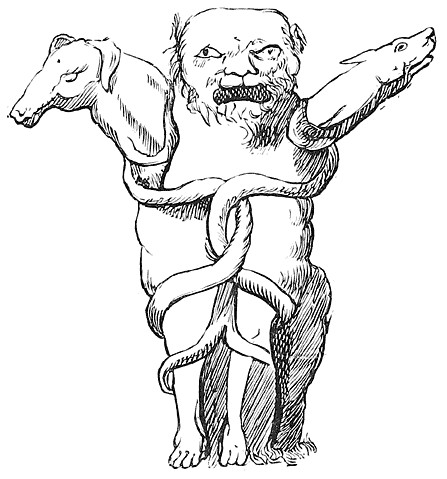
Fig. 8.—Cerberus (Calmet).
In the early Vedic Mythology it is the abode of the gods that is guarded by the two dogs, identified by solar mythologists as the morning and evening twilight: a later phase shows them in the service of Yama, and they reappear in the guardian of the Greek Hades, Cerberus, and Orthros. The first of these has been traced to the Vedic Sarvara, the latter to the monster Vritra. ‘Orthros’ is the phonetical equivalent of Vritra. The bitch Sarama, mother of the two Vedic dogs, proved a treacherous guard, and was slain by Indra. Hence the Russian peasant comes fairly by another version of how the Dog, while on guard, admitted the Devil into heaven on being thrown a bone. But the two watch-dogs of the Hindu myth do not seem to bear an evil character. In a funeral hymn of the ‘Rig-Veda’ (x. 14), addressed to Yama, King of Death, we read:—‘By an auspicious path do thou hasten past the two four-eyed brindled dogs, the offspring of Sarama; then approach the beautiful Pitris who rejoice together with Yama. Intrust him, O Yama, to thy two watch-dogs, four-eyed, road-guarding, and man-observing. The two brown messengers of Yama, broad of nostril and insatiable, wander about among men; may they give us again to-day the auspicious breath of life that we may see the sun!’
And now thousands of years after this was said we find the Dog still regarded as the seer of ghosts, and watcher at the gates of death, of whose opening his howl forewarns. The howling of a dog on the night of December 9, 1871, at Sandringham, where the Prince of Wales lay ill, was thought important enough for newspapers to report to a shuddering country. I read lately of a dog in a German village which was supposed to have announced so many deaths that he became an object of general terror, and was put to death. In that country belief in the demonic character of the dog seems to have been strong enough to transmit an influence even to the powerful brain of Goethe.
In Goethe’s poem, it was when Faust was walking with the student Wagner that the black Dog appeared, rushing around them in spiral curves—spreading, as Faust said, ‘a magic coil as a snare around them;’13 that after this dog had followed Faust into his study, it assumed a monstrous shape, until changed to a mist, from which Mephistopheles steps forth—‘the kernel of the brute’—in guise of a travelling scholar. This is in notable coincidence with the archaic symbolism of the Dog as the most frequent form of the ‘Lares’ (fig. 9), or household genii, originally because of its vigilance. The form here presented is nearly identical with the Cynocephalus, whom the learned author of ‘Mankind: their Origin and Destiny,’ identifies as the Adamic being set as a watch and instructor in Eden (Gen. xvi. 15), an example of which, holding pen and tablet (as described by Horapollo), is given in that work from Philæ. Chrysippus says that these were afterwards represented as young men clothed with dog-skins. Remnants of the tutelary character of the dog are scattered through German folklore: he is regarded as oracle, ghost-seer, and gifted with second sight; in Bohemia he is sometimes made to lick an infant’s face that it may see well.
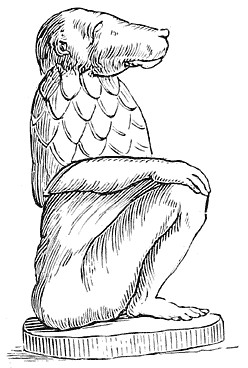
Fig. 9.—Canine Lar (Herculaneum).
The passage in ‘Faust’ has been traced to Goethe’s antipathy to dogs, as expressed in his conversation with Falk at the time of Wieland’s death. ‘Annihilation is utterly out of the question; but the possibility of being caught on the way by some more powerful and yet baser monas, and subordinated to it; this is unquestionably a very serious consideration; and I, for my part, have never been able entirely to divest myself of the fear of it, in the way of a mere observation of nature.’ At this moment, says Falk, a dog was heard repeatedly barking in the street. Goethe, sprang hastily to the window and called to it: ‘Take what form you will, vile larva, you shall not subjugate me!’ After some pause, he resumed with the remark: ‘This rabble of creation is extremely offensive. It is a perfect pack of monades with which we are thrown together in this planetary nook; their company will do us little honour with the inhabitants of other planets, if they happen to hear anything about them.’
In visiting the house where Goethe once resided in Weimar, I was startled to find as the chief ornament of the hall a large bronze dog, of full size, and very dark, looking proudly forth, as if he possessed the Goethean monas after all. However, it is not probable that the poet’s real dislike of dogs arose solely from that speculation about monades. It is more probable that in observing the old wall-picture in Auerbach’s cellar, wherein a dog stands beside Mephistopheles, Goethe was led to consider carefully the causes of that intimacy. Unfortunately, and notwithstanding the fables and the sentiment which invest that animal, there are some very repulsive things about him, such as his tendency to madness and the infliction on man of a frightful death. The Greek Mania’s ‘fleet hounds’ (Bacchæ 977) have spread terrors far and wide.
Those who carefully peruse the account given by Mr. Lewes of the quarrel between Karl August and Goethe, on account of the opposition of the latter to the introduction of a performing dog on the Weimar stage—an incident which led to his resignation of his position of intendant of the theatre—may detect this aversion mingling with his disgust as an artist; and it may be also suspected that it was not the mere noise which caused the tortures he described himself as having once endured at Göttingen from the barking of dogs.
It is, however, not improbable that in the wild notion of Goethe, joined with his cynophobia, we find a survival of the belief of the Parsees of Surat, who venerate the Dog above all other animals, and who, when one is dying, place a dog’s muzzle near his mouth, and make it bark twice, so that it may catch the departing soul, and bear it to the waiting angel.
The devil-worshippers of Travancore to this day declare that the evil power approaches them in the form of a Dog, as Mephistopheles approached Faust. But before the superstition reached Goethe’s poem it had undergone many modifications; and especially its keen scent had influenced the Norse imagination to ascribe to it præternatural wisdom. Thus we read in the Saga of Hakon the Good, that when Eystein the Bad had conquered Drontheim, he offered the people choice of his slave Thorer or his dog Sauer to be their king. They chose the Dog. ‘Now the dog was by witchcraft gifted with three men’s wisdom; and when he barked he spoke one word and barked two.’ This Dog wore a collar of gold, and sat on a throne, but, for all his wisdom and power, seems to have been a dog still; for when some wolves invaded the cattle, he attacked and was torn to pieces by them.
Among the negroes of the Southern States in America I have found the belief that the most frequent form of a diabolical apparition is that of a large Dog with fiery eyes, which may be among them an original superstition attributable to their horror of the bloodhound, by which, in some regions, they were pursued when attempting to escape. Among the whites of the same region I have never been able to find any instance of the same belief, though belief in the presage of the howling dog is frequent; and it is possible that this is a survival from some region in Africa, where the Dog has an evil name of the same kind as the scape-goat. Among some tribes in Fazogl there is an annual carnival at which every one does as he likes. The king is then seated in the open air, a dog tied to the leg of his chair, and the animal is then stoned to death.
Mark Twain14 records the folklore of a village of Missouri, where we find lads quaking with fear at the howling of a ‘stray dog’ in the night, but indifferent to the howling of a dog they recognise, which may be a form of the common English belief that it is unlucky to be followed by a ‘strange’ dog. From the same book it appears also that the dog will always have his head in the direction of the person whose doom is signified: the lads are entirely relieved when they find the howling animal has his back turned to them.
It is remarkable that these fragments of European superstition should meet in the Far West a plentiful crop of their like which has sprung up among the aborigines, as the following extract from Mr. Brinton’s work, ‘Myths of the New World,’ will show: ‘Dogs were supposed to stand in some peculiar relation to the moon, probably because they howl at it and run at night, uncanny practices which have cost them dear in reputation. The custom prevailed among tribes so widely asunder as Peruvians, Tupis, Creeks, Iroquois, Algonquins, and Greenland Eskimos to thrash the curs most soundly during an eclipse. The Creeks explained this by saying that the big Dog was swallowing the sun, and that by whipping the little ones they could make him desist. What the big Dog was they were not prepared to say. We know. It was the night goddess, represented by the Dog, who was thus shrouding the world at mid-day. In a better sense, they represented the more agreeable characteristics of the lunar goddess. Xochiquetzal, most fecund of Aztec divinities, patroness of love, of sexual pleasure, and of child-birth, was likewise called Itzcuinan, which, literally translated, is ‘bitch-mother.’ This strange and to us so repugnant title for a goddess was not without parallel elsewhere. When in his wars the Inca Pachacutec carried his arms into the province of Huanca, he found its inhabitants had installed in their temples the figure of a Dog as their highest deity.... This canine canonisation explains why in some parts of Peru a priest was called, by way of honour, allco, Dog!... Many tribes on the Pacific coast united in the adoration of a wild species, the coyote, the Canis latrans of naturalists.’ Of the Dog-demon Chantico the legend of the Nahuas was, ‘that he made a sacrifice to the gods without observing a preparatory fast, for which he was punished by being changed into a Dog. He then invoked the god of death to deliver him, which attempt to evade a just punishment so enraged the divinities that they immersed the world in water.’
The common phrase ‘hell-hounds’ has come to us by various routes. Diana being degraded to Hecate, the dogs of Hades, Orthros and Cerberus, multiplied into a pack of hounds for her chase, were degraded with her into infernal howlers and hunters. A like degradation of Odin’s hunt took place at a later date. The Wild Huntsman, being a diabolical character, is considered elsewhere. Concerning the Dog, it may be further said here, that there are probably various characteristics of that animal reflected in his demonic character. His liability to become rabid, and to afflict human beings with hydrophobia, appears to have had some part in it. Spinoza alludes to the custom in his time of destroying persons suffering from this canine rabies by suffocation; and his English biographer and editor, Dr. Willis, tells me that in his boyhood in Scotland he always heard this spoken of as the old custom. That such treatment could have prevailed can hardly be ascribed to anything but a belief in the demonic character of the rabid dog, cognate with the unconscious superstition which still causes rural magistrates to order a dog which has bitten any one to be slain. The notion is, that if the dog goes mad thereafter, the man will also. Of course it would be rational to preserve the dog’s life carefully, in order that, if it continues healthy, the bitten may feel reassured, as he cannot be if it be dead.
But the degradation of the dog had a cause even in his fidelity as a watch. For this, as we have just seen, made him a common form among Lares or domestic demons. The teraphim also were often in this shape. Christianity had therefore a special reason for ascribing an infernal character to these little idols, which interfered with the popular dependence on the saints. It will thus be seen that there were many causes operating to create that formidable class of demons which were called in the Middle Ages Cynocephaloi. The ancient holy pictures of Russia especially abound in these dog-headed devils; in the sixteenth century they were frequently represented rending souls in hell; and sometimes the dragon of the Apocalypse is represented with seven horrible canine heads.
M. Toussenel, in his transcendental interpretations, has identified the Wolf as the bandit and outlaw.15 The proverbial mediæval phrase for an outlaw—one who wears a teste lœve, caput lupinum, wulfesheofod, which the ingenious author perhaps remembered—is of good antiquity. The wolf is called robber in the ‘Rig-Veda,’ and he is there also demonised, since we find him fleeing before a devotee. (In the Zend ‘Vendidad’ the souls of the pious fear to meet the wolf on the way to heaven.) The god Pushan is invoked against the evil wolf, the malignant spirit.16 Cardano says that to dream of a wolf announces a robber. There is in the wolf, at the same time, that always attractive love of liberty which, in the well-known fable, makes him prefer leanness to the comfort of the collar-wearing dog, which makes him among demonic animals sometimes the same as the mighty huntsmen Nimrod and shaggy Esau among humanised demons. One is not surprised to find occasionally good stories about the wolf. Thus the Nez Perces tribe in America trace the origin of the human race to a wolf. They say that originally, when there were nothing but animals, there was a huge monster which devoured them whole and alive. This monster swallowed a wolf, who, when he entered its belly, found the animals therein snarling at and biting one another as they had done on the earth outside. The wolf exhorted them that their common sufferings should teach them friendliness, and finally he induced them to a system of co-operation by which they made their way out through the side of the monster, which instantly perished. The animals so released were at once transformed to men, how and why the advocates of co-operation will readily understand, and founded the Nez Perces Indians. The myths of Asia and Europe are unhappily antipodal to this in spirit and form, telling of human beings transformed to wolves. In the Norse Mythology, however, there stands a demon wolf whose story bears a touch of feeling, though perhaps it was originally the mere expression for physical law. This is the wolf Fenris, which, from being at first the pet of the gods and lapdog of the goddesses, became so huge and formidable that Asgard itself was endangered. All the skill and power of the gods could not forge chains which might chain him; he snapped them like straws and toppled over the mountains to which he was fastened. But the little Elves working underground made that chain so fine that none could see or feel it,—fashioned it out of the beards of women, the breath of fish, noise of the cat’s footfall, spittle of birds, sinews of bears, roots of stones,—by which are meant things non-existent. This held him. Fenris is chained till the final destruction, when he shall break loose and devour Odin. The fine chain that binds ferocity,—is it the love that can tame all creatures? Is it the sunbeam that defines to the strongest creature its habitat?
The two monsters formed when Ráhu was cloven in twain, in Hindu Mythology, reappear in Eddaic fable as the wolves Sköll and Hati, who pursue the sun and moon. As it is said in the Völuspá:—
Eastward in the Iron-wood
The old one sitteth,
And there bringeth forth
Fenrir’s fell kindred.
Of these one, the mightiest,
The moon’s devourer,
In form most fiend-like,
And filled with the life-blood
Of the dead and the dying,
Reddens with ruddy gore
The seats of the high gods.
Euphemism attending propitiation of such monsters may partly explain the many good things told of wolves in popular legend. The stories of the she-wolf nourishing children, as Romulus and Remus, are found in many lands. They must, indeed, have had some prestige, to have been so largely adopted in saintly tradition. Like the bears that Elisha called to devour the children, the wolves do not lose their natural ferocity by becoming pious. They devour heretics and sacrilegious people. One guarded the head of St. Edmund the Martyr of England; another escorted St. Oddo, Abbot of Cluny, as his ancestors did the priests of Cluny. The skin of the wolf appears in folklore as a charm against hydrophobia; its teeth are best for cutting children’s gums, and its bite, if survived, is an assurance against any future wound or pain.

Fig. 10.—The Wolf as Confessor (probably Dutch).
The tragedy which is so foolishly sprung upon the nerves of children, Little Red Riding-Hood, shows the wolf as a crafty animal. There are many legends of a like character which have made it a favourite figure in which to represent pious impostors. In our figure 10, the wolf appears as the ‘dangerous confessor;’ it was intended, as Mr. Wright thought, for Mary of Modena, Queen of James II., and Father Petre. At the top of the original are the words ‘Converte Angliam’ and beneath, ‘It is a foolish sheep that makes the wolf her confessor.’ The craft of the wolf is represented in a partly political partly social turn given by an American fabulist to one of Æsop’s fables. The wolf having accused the lamb he means to devour of fouling the stream, and receiving answer that the lamb was drinking farther down the current, alters the charge and says, ‘You opposed my candidature at the caucus two years ago.’ ‘I was not then born,’ replies the lamb. The wolf then says, ‘Any one hearing my accusations would testify that I am insane and not responsible for my actions,’ and thereupon devours the lamb with full faith in a jury of his countrymen. M. Toussenel says the wolf is a terrible strategist, albeit the less observant have found little in his character to warrant this attribute of craft, his physiognomy and habits showing him a rather transparent highwayman. It is probable that the fables of this character have derived that trait from his association with demons and devils supposed to take on his shape.
In a beautiful hymn to the Earth in the ‘Atharva Veda’ it is said, ‘The Earth, which endureth the burden of the oppressor, beareth up the abode of the lofty and of the lowly, suffereth the hog, and giveth entrance to the wild boar.’ Boar-hounds in Brittany and some other regions are still kept at Government expense. There are many indications of this kind that in early times men had to defend themselves vigorously against the ravages of the wild boar, and, as De Gubernatis remarks,17 its character is generally demoniacal. The contests of Hercules with the Erymanthian, and of Meleager with the Calydonian, Boar, are enough to show that it was through its dangerous character that he became sacred to the gods of war, Mars and Odin. But it is also to be remembered that the third incarnation of Vishnu was as a Wild Boar; and as the fearless exterminator of snakes the pig merited this association with the Preserver. Provided with a thick coat of fat, no venom can harm him unless it be on the lip. It may be this ability to defy the snake-ordeal which, after its uncleanliness had excepted the hog from human voracity in some regions, assigned it a diabolical character. In rabbinical fable the hog and rat were created by Noah to clear the Ark of filth; but the rats becoming a nuisance, he evoked a cat from the lion’s nose.
It is clear that our Asiatic and Norse ancestors never had such a ferocious beast to encounter as the Grisly Bear (Ursus horribilis) of America, else the appearances of this animal in Demonology could never have been so respectable. The comparatively timid Asiatic Bear (U. labiatus), the small and almost harmless Thibetan species (U. Thibetanus), would appear to have preponderated over the fiercer but rarer Bears of the North in giving us the Indo-Germanic fables, in which this animal is, on the whole, a favourite. Emerson finds in the fondness of the English for their national legend of ‘Beauty and the Beast’ a sign of the Englishman’s own nature. ‘He is a bear with a soft place in his heart; he says No, and helps you.’ The old legend found place in the heart of a particularly representative American also—Theodore Parker, who loved to call his dearest friend ‘Bear,’ and who, on arriving in Europe, went to Berne to see his favourites, from which its name is derived. The fondness of the Bear for honey—whence its Russian name, medv-jed, ‘honey-eater’—had probably something to do with its dainty taste for roses and its admiration for female beauty, as told in many myths. In his comparative treatment of the mythology of the Bear, De Gubernatis18 mentions the transformation of King Trisankus into a bear, and connects this with the constellation of the Great Bear; but it may with equal probability be related to the many fables of princes who remain under the form of a bear until the spell is broken by the kiss of some maiden. It is worthy of note that in the Russian legends the Bear is by no means so amiable as in those of our Western folklore. In one, the Bear-prince lurking in his fountain holds by the beard the king who, while hunting, tries to quench his thirst, and releases him only after a promise to deliver up whatever he has at home without his knowledge; the twins, Ivan and Maria, born during his absence, are thus doomed—are concealed, but discovered by the bear, who carries them away. They are saved by help of the bull. When escaping the bear Ivan throws down a comb, which becomes a tangled forest, which, however, the bear penetrates; but the spread-out towel which becomes a lake of fire sends the bear back.19 It is thus the ferocious Arctic Bear which gives the story its sombre character. Such also is the Russian tale of the Bear with iron hairs, which devastates the kingdom, devouring the inhabitants until Ivan and Helena alone remain; after the two in various ways try to escape, their success is secured by the Bull, which, more kindly than Elisha, blinds the Bear with his horns.20 (The Bear retires in winter.) In Norwegian story the Bear becomes milder,—a beautiful youth by night, whose wife loses him because she wishes to see him by lamplight: her place is taken by a long-nosed princess, until, by aid of the golden apple and the rose, she recovers her husband. In the Pentameron,21 Pretiosa, to escape the persecutions of her father, goes into the forest disguised as a she-bear; she nurses and cures the prince, who is enamoured of her, and at his kiss becomes a beautiful maid. The Bear thus has a twofold development in folklore. He used to be killed (13th century) at the end of the Carnival in Rome, as the Devil.22 The Siberians, if they have killed a bear, hang his skin on a tree and apologise humbly to it, declaring that they did not forge the metal that pierced it, and they meant the arrow for a bird; from which it is plain that they rely more on its stupidity than its good heart. In Canada, when the hunters kill a bear, one of them approaches it and places between his teeth the stem of his pipe, breathes in the bowl, and thus, filling with smoke the animal’s mouth, conjures its soul not to be offended at his death. As the bear’s ghost makes no reply, the huntsman, in order to know if his prayer is granted, cuts the thread under the bear’s tongue, and keeps it until the end of the hunt, when a large fire is kindled, and all the band solemnly throw in it what threads of this kind they have; if these sparkle and vanish, as is natural, it is a sign that the bears are appeased.23 In Greenland the great demon, at once feared and invoked, especially by fishermen, is Torngarsuk, a huge Bear with a human arm. He is invisible to all except his priests, the Anguekkoks, who are the only physicians of that people.
The extreme point of demonic power has always been held by the Serpent. So much, however, will have to be said of the destructiveness and other characteristics of this animal when we come to consider at length its unique position in Mythology, that I content myself here with a pictorial representation of the Singhalese Demon of Serpents. If any one find himself shuddering at sight of a snake, even in a country where they are few and comparatively harmless, perhaps this figure (11) may suggest the final cause of the shudder.
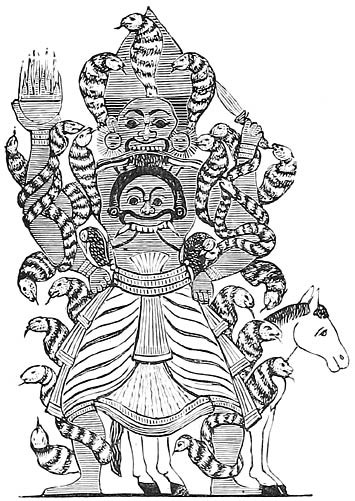
Fig. 11.—Singhalese Demon of Serpents.
In conclusion, it may be said that not only every animal ferocity, but every force which can be exerted injuriously, has had its demonic representations. Every claw, fang, sting, hoof, horn, has been as certain to be catalogued and labelled in demonology as in physical science. It is remarkable also how superstition rationalises. Thus the horn in the animal world, though sometimes dangerous to man, was more dangerous to animals, which, as foes of the horned animals, were foes to man’s interests. The early herdsman knew the value of the horn as a defence against dog and wolf, besides its other utilities. Consequently, although it was necessary that the horn-principle, so to say, in nature must be regarded as one of its retractile and cruel features, man never demonised the animals whose butt was most dangerous, but for such purpose transferred the horns to the head of some nondescript creature. The horn has thus become a natural weapon of man-demons. The same evolution has taken place in America; for, although among its aboriginal legends we may meet with an occasional demon-buffalo, such are rare and of apocryphal antiquity. The accompanying American figure (12) is from a photograph sent me by the President of Vanderbilt University, Tennessee, who found it in an old mound (Red Indian) in the State of Georgia. It is probably as ancient as any example of a human head with horns in the world; and as it could not have been influenced by European notions, it supplies striking evidence that the demonisation of the forces and dangers of nature belongs to the structural action of the human mind.
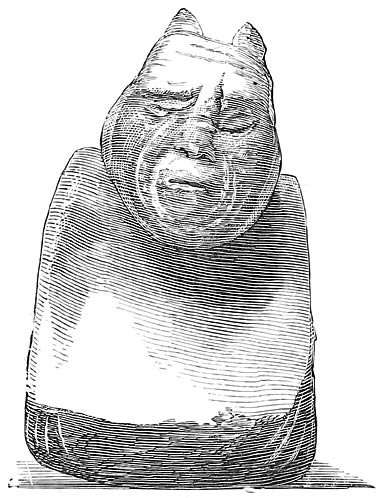
Fig. 12.—American Indian Demon.
1 This Protean type of both demon and devil must accompany us so continually through this volume that but little need be said of it in this chapter.
2 Canticles ii. 15.
3 De Gubernatis, II. viii.
4 ‘Our Life in Japan’ (Jephson and Elmhirst, 9th Regiment), Chapman & Hall, 1869.
5 London ‘Times,’ June 11, 1877.
6 Rep. 488.
7 Literally, goat-song. More probably it has an astrological sense.
8 E.g., the demon Huorco in the ‘Pentamerone.’
9 See De Gubernatis’ ‘Zoological Mythology,’ which contains further curious details on this subject.
10 ‘Myths and Myth-makers.’ Boston: Osgood & Co.
11 ‘Zoological Mythology,’ p. 64.
12 Koran, xviii.
13
Wagner. Behold him stop—upon his belly crawl....
The clever scholar of the students, he!
14 ‘The Adventures of Tom Sawyer.’ London: Chatto & Windus.
15 ‘Spirit of the Beasts of France,’ ch. i.
16 ‘Rigv.’ i. 105, 18, 42, 2; ‘Vendidad,’ xix. 108. Quoted by De Gubernatis (‘Zoolog. Mythology,’ ii. 142), to whose invaluable work I am largely indebted in this chapter.
17 ‘Zoolog. Myth.,’ ii. 7. Trübner & Co.
18 ‘Zoolog. Myth.,’ ii. 108 seq.
19 Afanasief, v. 28.
20 Ibid., v. 27.
21 ii. 6 (De Gubernatis, ii. 117).
22 Rather the devil of lust than of cruelty, according to Du Cange: “Occidunt ursum, occiditur diabolus, id est, temptator nostræ carnis.”
23 De Plancy (Dict. Inf.), who also relates an amusing legend of the bear who came to a German choir, as seen by a sleepy chorister as he awoke; the naïve narrator of which adds, that this was the devil sent to hold the singers to their duty! The Lives of the Saints abound with legends of pious bears, such as that commemorated along with St. Sergius in Troitska Lavra, near Moscow; and that which St. Gallus was ungracious enough to banish from Switzerland after it had brought him firewood in proof of its conversion.
1 This Protean type of both demon and devil must accompany us so continually through this volume that but little need be said of it in this chapter.
2 Canticles ii. 15.
3 De Gubernatis, II. viii.
4 ‘Our Life in Japan’ (Jephson and Elmhirst, 9th Regiment), Chapman & Hall, 1869.
5 London ‘Times,’ June 11, 1877.
6 Rep. 488.
7 Literally, goat-song. More probably it has an astrological sense.
8 E.g., the demon Huorco in the ‘Pentamerone.’
9 See De Gubernatis’ ‘Zoological Mythology,’ which contains further curious details on this subject.
10 ‘Myths and Myth-makers.’ Boston: Osgood & Co.
11 ‘Zoological Mythology,’ p. 64.
12 Koran, xviii.
1 This Protean type of both demon and devil must accompany us so continually through this volume that but little need be said of it in this chapter.
2 Canticles ii. 15.
3 De Gubernatis, II. viii.
4 ‘Our Life in Japan’ (Jephson and Elmhirst, 9th Regiment), Chapman & Hall, 1869.
5 London ‘Times,’ June 11, 1877.
6 Rep. 488.
7 Literally, goat-song. More probably it has an astrological sense.
8 E.g., the demon Huorco in the ‘Pentamerone.’
9 See De Gubernatis’ ‘Zoological Mythology,’ which contains further curious details on this subject.
10 ‘Myths and Myth-makers.’ Boston: Osgood & Co.
11 ‘Zoological Mythology,’ p. 64.
12 Koran, xviii.
13
Wagner. Behold him stop—upon his belly crawl....
The clever scholar of the students, he!
14 ‘The Adventures of Tom Sawyer.’ London: Chatto & Windus.
15 ‘Spirit of the Beasts of France,’ ch. i.
16 ‘Rigv.’ i. 105, 18, 42, 2; ‘Vendidad,’ xix. 108. Quoted by De Gubernatis (‘Zoolog. Mythology,’ ii. 142), to whose invaluable work I am largely indebted in this chapter.
17 ‘Zoolog. Myth.,’ ii. 7. Trübner & Co.
18 ‘Zoolog. Myth.,’ ii. 108 seq.
19 Afanasief, v. 28.
20 Ibid., v. 27.
21 ii. 6 (De Gubernatis, ii. 117).
22 Rather the devil of lust than of cruelty, according to Du Cange: “Occidunt ursum, occiditur diabolus, id est, temptator nostræ carnis.”
23 De Plancy (Dict. Inf.), who also relates an amusing legend of the bear who came to a German choir, as seen by a sleepy chorister as he awoke; the naïve narrator of which adds, that this was the devil sent to hold the singers to their duty! The Lives of the Saints abound with legends of pious bears, such as that commemorated along with St. Sergius in Troitska Lavra, near Moscow; and that which St. Gallus was ungracious enough to banish from Switzerland after it had brought him firewood in proof of its conversion.
14 ‘The Adventures of Tom Sawyer.’ London: Chatto & Windus.
15 ‘Spirit of the Beasts of France,’ ch. i.
16 ‘Rigv.’ i. 105, 18, 42, 2; ‘Vendidad,’ xix. 108. Quoted by De Gubernatis (‘Zoolog. Mythology,’ ii. 142), to whose invaluable work I am largely indebted in this chapter.
17 ‘Zoolog. Myth.,’ ii. 7. Trübner & Co.
18 ‘Zoolog. Myth.,’ ii. 108 seq.
19 Afanasief, v. 28.
20 Ibid., v. 27.
21 ii. 6 (De Gubernatis, ii. 117).
22 Rather the devil of lust than of cruelty, according to Du Cange: “Occidunt ursum, occiditur diabolus, id est, temptator nostræ carnis.”
23 De Plancy (Dict. Inf.), who also relates an amusing legend of the bear who came to a German choir, as seen by a sleepy chorister as he awoke; the naïve narrator of which adds, that this was the devil sent to hold the singers to their duty! The Lives of the Saints abound with legends of pious bears, such as that commemorated along with St. Sergius in Troitska Lavra, near Moscow; and that which St. Gallus was ungracious enough to banish from Switzerland after it had brought him firewood in proof of its conversion.
Fig. 11.—Singhalese Demon of Serpents.
Fig. 12.—American Indian Demon.
Chapter VI.
Enemies.
Aryas, Dasyus, Nagas—Yakkhos—Lycians—Ethiopians—Hirpini—Polites—Sosipolis—Were-wolves—Goths and Scythians—Giants and Dwarfs—Berserkers—Britons—Iceland—Mimacs—Gog and Magog.
We paint the Devil black, says George Herbert. On the other hand the negro paints him white, with reason enough. The name of the Devil at Mozambique is Muzungu Maya, or Wicked White Man. Of this demon they make little images of extreme hideousness, which are kept by people on the coast, and occasionally displayed, in the belief that if the White Devil is lurking near them he will vanish out of sheer disgust with a glimpse of his own ugliness. The hereditary horror of the kidnapper displayed in this droll superstition may possibly have been assisted by the familiarity with all things infernal represented in the language of the white sailors visiting the coast. Captain Basil Hall, on visiting Mozambique about fifty years ago, found that the native dignitaries had appropriated the titles of English noblemen, and a dumpy little Duke of Devonshire met him with his whole vocabulary of English,—‘How do you do, sir. Very glad see you. Damn your eyes. Johanna man like English very much. God damn. That very good? Eh? Devilish hot, sir. What news? Hope your ship stay too long while very. Damn my eye. Very fine day.’
In most parts of India Siva also is painted white, which would indicate that there too was found reason to associate diabolism with the white face. It is said the Thugs spared Englishmen because their white faces suggested relationship to Siva. In some of the ancient Indian books the monster whom Indra slew, Vritra, is called Dasyu (enemy), a name which in the Vedas designates the Aborigines as contrasted with the Aryans of the North. ‘In the old Sanskrit, in the hymns of the Veda, ârya occurs frequently as a national name and as a name of honour, comprising the worshippers of the gods of the Brahmans, as opposed to their enemies, who are called in the Veda Dasyus. Thus one of the gods, Indra, who in some respects answers to the Greek Zeus, is invoked in the following words (Rigveda, i. 57, 8):—‘Know thou the Aryas, O Indra, and those who are Dasyus; punish the lawless, and deliver them unto thy servant! Be thou the mighty helper of the worshippers, and I will praise all these thy deeds at the festivals.’1
Naglok (snakeland) was at an early period a Hindu name for hell. But the Nagas were not real snakes,—in that case they might have fared better,—but an aboriginal tribe in Ceylon, believed by the Hindus to be of serpent origin,—‘naga’ being an epithet for ‘native.’2 The Singhalese, on the other hand, have adapted the popular name for demons in India, ‘Rakshasa,’ in their Rakseyo, a tribe of invisible cannibals without supernatural powers (except invisibility), who no doubt merely embody the traditions of some early race. The dreaded powers were from another tribe designated Yakkhos (demons), and believed to have the power of rendering themselves invisible. Buddha’s victories over these demonic beings are related in the ‘Mahawanso.’ ‘It was known (by inspiration) by the vanquishers that in Lanka, filled by yakkhos, ... would be the place where his religion would be glorified. In like manner, knowing that in the centre of Lanka, on the delightful bank of a river, ... in the agreeable Mahanaga garden, ... there was a great assembly of the principal yakkhos, ... the deity of happy advent, approaching that great congregation, ... immediately over their heads hovering in the air, ... struck terror into them by rains, tempests, and darkness. The yakkhos, overwhelmed with awe, supplicated of the vanquisher to be released from their terror.... The consoling vanquisher thus replied: ‘I will release ye yakkhos from this your terror and affliction: give ye unto me here by unanimous consent a place for me to alight on.’ All these yakkhos replied: ‘Lord, we confer on thee the whole of Lanka, grant thou comfort to us.’ The vanquisher thereupon dispelling their terror and cold shivering, and spreading his carpet of skin on the spot bestowed on him, he there seated himself. He then caused the aforesaid carpet, refulgent with a fringe of flames, to extend itself on all sides: they, scorched by the flames, (receding) stood around on the shores (of the island) terrified. The Saviour then caused the delightful isle of Giri to approach for them. As soon as they transferred themselves thereto (to escape the conflagration), he restored it to its former position.’3
This legend, which reminds one irresistibly of the expulsion of reptiles by saints from Ireland, and other Western regions, is the more interesting if it be considered that these Yakkhos are the Sanskrit Yakshas, attendants on Kuvera, the god of wealth, employed in the care of his garden and treasures. They are regarded as generally inoffensive. The transfer by English authorities of the Tasmanians from their native island to another, with the result of their extermination, may suggest the possible origin of the story of Giri.
Buddha’s dealings with the serpent-men or nagas is related as follows in the same volume:—
‘The vanquisher (i.e., of the five deadly sins), ... in the fifth year of his buddhahood, while residing at the garden of (the prince) Jeto, observing that, on account of a disputed claim for a gem-set throne between the naga Mahodaro and a similar Chalodaro, a maternal uncle and nephew, a conflict was at hand, ... taking with him his sacred dish and robes, out of compassion to the nagas, visited Nagadipo.... These mountain nagas were, moreover, gifted with supernatural powers.... The Saviour and dispeller of the darkness of sin, poising himself in the air over the centre of the assembly, caused a terrifying darkness to these nagas. Attending to the prayer of the dismayed nagas, he again called forth the light of day. They, overjoyed at having seen the deity of felicitous advent, bowed down at the feet of the divine teacher. To them the vanquisher preached a sermon of reconciliation. Both parties rejoicing thereat, made an offering of the gem-throne to the divine sage. The divine teacher, alighting on the earth, seated himself on the throne, and was served by the naga kings with celestial food and beverage. The lord of the universe procured for eighty kotis of nagas, dwelling on land and in the waters, the salvation of the faith and the state of piety.’
At every step in the conversion of the native Singhalese,—the demons and serpent-men,—Buddha and his apostles are represented as being attended by the devas,—the deities of India,—who are spoken of as if glad to become menials of the new religion. But we find Zoroaster using this term in a demonic sense, and describing alien worshippers as children of the Devas (a Semite would say, Sons of Belial). And in the conventional Persian pictures of the Last Judgment (moslem), the archfiend has the Hindu complexion. A similar phenomenon may be observed in various regions. In the mediæval frescoes of Moscow, representing infernal tortures, it is not very difficult to pick out devils representing the physical characteristics of most of the races with which the Muscovite has struggled in early times. There are also black Ethiopians among them, which may be a result of devils being considered the brood of Tchernibog, god of Darkness; but may also, not impossibly, have come of such apocryphal narratives as that ascribed to St. Augustine. ‘I was already Bishop of Hippo when I went into Ethiopia with some servants of Christ, there to preach the gospel. In this country we saw many men and women without heads, who had two great eyes in their breasts; and in countries still more southerly we saw a people who had but one eye in their foreheads.’4
In considering animal demons, the primitive demonisation of the Wolf has been discussed. But it is mainly as a transformation of man and a type of savage foes that this animal has been a prominent figure in Mythology.
Professor Max Müller has made it tolerably clear that Bellerophon means Slayer of the Hairy; and that Belleros is the transliteration of Sanskrit varvara, a term applied to the dark Aborigines by their Aryan invaders, equivalent to barbarians.5 This points us for the origin of the title rather to Bellerophon’s conquest of the Lycians, or Wolf-men, than to his victory over the Chimæra. The story of Lycaon and his sons—barbarians defying the gods and devouring human flesh—turned into wolves by Zeus, connects itself with the Lycians (hairy, wolfish barbarians), whom Bellerophon conquered.
It was not always, however, the deity that conquered in such encounters. In the myth of Soracte, the Wolf is seen able to hold his own against the gods. Soranus, worshipped on Mount Soracte, was at Rome the god of Light, and is identified with Apollo by Virgil.6 A legend states that he became associated with the infernal gods, though called Diespiter, because of the sulphurous exhalations from the side of Mount Soracte. It is said that once when some shepherds were performing a sacrifice, some wolves seized the flesh; the shepherds, following them, were killed by the poisonous vapours of the mountain to which the wolves retreated. An oracle gave out that this was a punishment for their pursuing the sacred animals; and a general pestilence also having followed, it was declared that it could only cease if the people were all changed to wolves and lived by prey. Hence the Hirpini, from the Sabine ‘hirpus,’ a wolf. The story is a variant of that of the Hirpinian Samnites, who were said to have received their name from their ancestors having followed a sacred wolf when seeking their new home. The Wolf ceremonies were, like the Roman Lupercalia, for purposes of purification. The worshippers ran naked through blazing fires. The annual festival, which Strabo describes as occurring in the grove of Feronia, goddess of Nature, became at last a sort of fair. Its history, however, is very significant of the formidable character of the Hirpini, or Wolf-tribe, which could alone have given rise to such euphemistic celebrations of the wolf.
It is interesting to note that in some regions this wolf of superstition was domesticated into a dog. Pierius says there was a temple of Vulcan in Mount Ætna, in whose grove were dogs that fawned on the pious, but rent the polluted worshippers. It will be seen by the left form of Fig. 13 that the wolf had a diminution, in pictorial representation similar to that which the canine Lares underwent (p. 135). This picture is referred by John Beaumont7 to Cartarius’ work on ‘The Images of the Gods of the Ancients;’ the form wearing a wolf’s skin and head is that of the demon Polites, who infested Temesa in Italy, according to a story related by Pausanias. Ulysses, in his wanderings, having come to this town, one of his companions was stoned to death for having ravished a virgin; after which his ghost appeared in form of this demon, which had to be appeased, by the direction of the oracle of Apollo, by the annual sacrifice to him of the most beautiful virgin in the place. Euthymus, enamoured of a virgin about to be so offered, gave battle to this demon, and, having expelled him from the country, married the virgin. However, since the infernal powers cannot be deprived of their rights without substitution, this saviour of Temesa disappeared in the river Cæcinus.
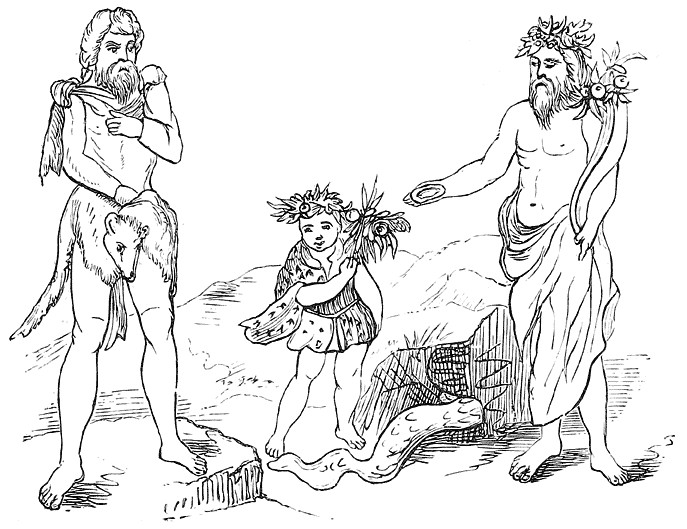
Fig. 13.—Italian and Roman Genii.
The form on the right in Fig. 13 represents the genius of the city of Rome, and is found on some of Hadrian’s coins; he holds the cornucopia and the sacrificial dish. The child and the serpent in the same picture represent the origin of the demonic character attributed to the Eleans by the Arcadians. This child-and-serpent symbol, which bears resemblance to certain variants of Bel and the Dragon, no doubt was brought to Elea, or Velia in Italy, by the Phocæans, when they abandoned their Ionian homes rather than submit to Cyrus, and founded that town, B.C. 544. The two forms were jointly worshipped with annual sacrifices in the temple of Lucina, under the name Sosipolis. The legend of this title is related by Pausanias. When the Arcadians invaded the Eleans, a woman came to the Elean commander with an infant at her breast, and said that she had been admonished in a dream to place her child in front of the army. This was done; as the Arcadians approached the child was changed to a serpent, and, astounded at the prodigy, they fled without giving battle. The child was represented by the Eleans decorated with stars, and holding the cornucopia; by the Arcadians, no doubt, in a less celestial way. It is not uncommon in Mythology to find the most dangerous demons represented under some guise of weakness, as, for instance, among the South Africans, some of whom recently informed English officers that the Galeikas were led against them by a terrible sorcerer in the form of a hare. The most fearful traditional demon ever slain by hero in Japan was Shuden Dozi—the Child-faced Drinker. In Ceylon the apparition of a demon is said to be frequently under the form of a woman with a child in her arms.
Many animal demons are mere fables for the ferocity of human tribes. The Were-wolf superstition, which exists still in Russia, where the transformed monster is called volkodlák (volk, a wolf, and dlak, hair), might even have originated in the costume of Norse barbarians and huntsmen. The belief was always more or less rationalised, resembling that held by Verstegan three hundred years ago, and which may be regarded as prevalent among both the English and Flemish people of his day. ‘These Were-wolves,’ he says, ‘are certain sorcerers, who, having anointed their bodies with an ointment they make by the instinct of the devil, and putting on a certain enchanted girdle, do not only unto the view of others seem as wolves, but to their own thinking have both the nature and shape of wolves so long as they wear the said girdle; and they do dispose themselves as very wolves, in worrying and killing, and waste of human creatures.’ During the Franco-German war of 1870–71, a family of ladies on the German side of the Rhine, sitting up all night in apprehension, related to me such stories of the ‘Turcos’ that I have since found no difficulty in understanding the belief in weird and præternatural wolves which once filled Europe with horror. The facility with which the old Lycian wolf-girdle, so to say, was caught up and worn in so many countries where race-wars were chronic for many ages, renders it nearly certain that this superstition (Lycanthropy), however it may have originated, was continued through the custom of ascribing demonic characteristics to hostile and fierce races. It has been, indeed, a general opinion that the theoretical belief originated in the Pythagorean doctrine of metempsychosis. Thus Shakspere:—
Thou almost makest me waver in my faith,
To hold opinion with Pythagoras,
That souls of animals infuse themselves
Into the trunks of men: thy currish spirit
Governed a wolf, who, hanged for human slaughter,
Even from the gallows did his fell soul fleet,
And whilst thou layest in thy unhallowed dam
Infused itself in thee; for thy desires
Are wolfish, bloody, starved, and ravenous.
But the superstition is much older than Pythagoras, who, no doubt, tried to turn it into a moral theory of retributions,—as indeed did Plato in his story of the Vision of Er the Armenian.
Professor Weber and others have adduced evidence indicating that although belief in the transformation of men into beasts was not developed in the Vedic age of India, the matrix of it was there. But of our main fact—the association of demonic characters with certain tribes—India has presented many examples. In the mountains of Travancore there are tribes which are still generally believed to be on terms of especial familiarity with the devils of that region; and the dwellers on the plains relate that on these mountains gigantic demons, sixteen or seventeen feet high, may sometimes be seen hurling firebrands at each other.
Professor Monier Williams contributes an interesting note concerning this general phase of South-Indian demonology. ‘Furthermore, it must not be forgotten that although a belief in devils and homage to bhutas, or spirits, of all kinds is common all over India, yet what is called devil-worship is far more systematically practised in the South of India and Ceylon than in the North. And the reason may be that as the invading Aryans advanced towards Southern India, they found portions of it peopled by wild aboriginal savages, whose behaviour and aspect appeared to them to resemble that of devils. The Aryan mind, therefore, naturally pictured to itself the regions of the South as the chief resort and stronghold of the demon race, and the dread of demonical agency became more deeply rooted in Southern India than in the North. Curiously enough, too, it is commonly believed in Southern India that every wicked man contributes by his death to swell the ever-increasing ranks of devil legions. His evil passions do not die with him; they are intensified, concentrated, and perpetuated in the form of a malignant and mischievous spirit.’8
It is obvious that this principle may be extended from individuals to entire tribes. The Cimmerians were regarded as dwelling in a land allied with hell. In the legend of the Alhambra, as told by Washington Irving, the astrologer warns the Moorish king that the beautiful damsel is no doubt one of those Gothic sorceresses of whom they have heard so much. Although, as we have seen, England was regarded on the Continent as an island of demons because of its northern latitude, probably some of its tribes were of a character dangerous enough to prolong the superstition. The nightmare elves were believed to come from England, and to hurry away through the keyholes at daybreak, saying ‘The bells are calling in England.’9 Visigoth probably left us our word bigot; and ‘Goths and Vandals’ sometimes designate English roughs, as ‘Turks’ those of Constantinople. Herodotus says the Scythians of the Black Sea regarded the Neurians as wizards, who transformed themselves into wolves for a few days annually; but the Scythians themselves are said by Herodotus to have sprung from a monster, half-woman half-serpent; and possibly the association of the Scotch with the Scythians by the Germans, who called them both Scutten, had something to do with the uncanny character ascribed to the British Isles. Sir Walter Raleigh described the Red Men of America as gigantic monsters. ‘Red Devils’ is still the pioneer’s epithet for them in the Far West. The hairy Dukes of Esau were connected with the goat, and demonised as Edom; and Ishmael was not believed much better by the more peaceful Semitic tribes. Such notions are akin to those which many now have of the Thugs and Bashi-Bazouks, and are too uniform and natural to tax much the ingenuity of Comparative Mythology.
Underlying many of the legends of giants and dwarfs may be found a similar demonologic formation. A principle of natural selection would explain the existence of tribes, which, though of small stature, are able to hold their own against the larger and more powerful by their superior cunning. That such equalisation of apparently unequal forces has been known in pre-historic ages may be gathered from many fables. Before Bali, the monarch already mentioned, whose power alarmed the gods themselves, Vishnu appeared as a dwarf, asking only so much land as he could measure with three steps; the apparently ridiculous request granted, the god strode over the whole earth with two steps and brought his third on the head of Bali. In Scandinavian fable we have the young giantess coming to her mother with the plough and ploughman in her apron, which she had picked up in the field. To her child’s inquiry, ‘What sort of beetle is this I found wriggling in the sand?’ the giantess replies, ‘Go put it back in the place where thou hast found it. We must be gone out of this land, for these little people will dwell in it.’
The Sagas contain many stories which, while written in glorification of the ‘giant’ race, relate the destruction of their chiefs by the magical powers of the dwarfs. I must limit myself to a few notes on the Ynglinga Saga. ‘In Swithiod,’ we are told, ‘are many great domains, and many wonderful races of men, and many kinds of languages. There are giants, and there are dwarfs, and there are also blue men. There are wild beasts, and dreadfully large dragons.’ We learn that in Asaland was a great chief, Odin, who went out to conquer Vanaland. The Vanalanders are declared to have magic arts,—such as are ascribed to Finns and Lapps to this day by the more ignorant of their neighbours. But that the people of Asaland learned their magic charms. ‘Odin was the cleverest of them all, and from him all the others learned their magic arts.’ ‘Odin could make his enemies in battle blind, or deaf, or terror-struck, and their weapons so blunt that they could no more cut than a willow twig; on the other hand, his men rushed forward without armour, were as mad as dogs or wolves, bit their shields, and were as strong as bears or wild bulls, and killed people at a blow, and neither fire nor iron told upon them. These were called Berserkers.’ (From ber, bear, and serkr, sark or coat; the word being probably, as Maurer says, a survival of an earlier belief in the transformation of men into bears.) But the successors of Odin did not preserve his occult power. Svegdir, for instance, saw a large stone and a dwarf at the door entering in it. The dwarf called him to come in and he should see Odin. ‘Swedger ran into the stone, which instantly closed behind him, and Swedger never came back.’ The witchcraft of the Finn people is said to have led Vanlandi (Svegdir’s son) to his death by Mara (night-mare). Vanlandi’s son too, Visbur, fell a victim to sorcery. Such legends as these, and many others which may be found in Sturleson’s Heimskringla, have influenced our popular stories whose interest turns on the skill with which some little Jack or Thumbling overcomes his adversary by superior cunning.
Superstitions concerning dwarf-powers are especially rife in Northumberland, where they used to be called Duergar, and they were thought to abound on the hills between Rothbury and Elsdon. They mislead with torches. One story relates that a traveller, beguiled at night into a hut where a dwarf prepared a comfortable fire for him, found himself when daylight returned sitting upon the edge of a deep rugged precipice, where the slightest movement had caused him to be dashed to pieces.10 The Northumbrian stories generally, however, do not bear the emphasis of having grown out of aboriginal conditions, or even of having been borrowed for such. The legends of Scotland, and of the South-West of England, appear to me much more suggestive of original struggles between large races and small. They are recalled by the superstitions which still linger in Norway concerning the Lapps, who are said to carry on unholy dealings with gnomes.
In the last century the ‘Brownie’ was commonly spoken of in Scotland as appearing in shape of ‘a tall man,’ and the name seems to refer to the brown complexion of that bogey, and its long brown hair, hardly Scottish.11 It is generally the case that Second Sight, which once attained the dignity of being called ‘Deuteroscopia,’ sees a doomed man or woman shrink to the size of a dwarf. The ‘tall man’ is not far off in such cases. ‘In some age of the world more remote than even that of Alypos,’ says Hugh Miller, ‘the whole of Britain was peopled by giants—a fact amply supported by early English historians and the traditions of the North of Scotland. Diocletian, king of Syria, say the historians, had thirty-three daughters, who, like the daughters of Danaus, killed their husbands on their wedding night. The king, their father, in abhorrence of the crime, crowded them all into a ship, which he abandoned to the mercy of the waves, and which was drifted by tides and winds till it arrived on the coast of Britain, then an uninhabited island. There they lived solitary, subsisting on roots and berries, the natural produce of the soil, until an order of demons, becoming enamoured of them, took them for their wives; and a tribe of giants, who must be regarded as the true aborigines of the country, if indeed the demons have not a prior claim, were the fruit of these marriages. Less fortunate, however, than even their prototypes the Cyclops, the whole tribe was extirpated a few ages after by Brutus the parricide, who, with a valour to which mere bulk could offer no effectual resistance, overthrew Gog-Magog and Termagol, and a whole host of others with names equally terrible. Tradition is less explicit than the historians in what relates to the origin and extinction of the race, but its narratives of their prowess are more minute. There is a large and ponderous stone in the parish of Edderston which a giantess of the tribe is said to have flung from the point of a spindle across the Dornoch Firth; and another, within a few miles of Dingwall, still larger and more ponderous, which was thrown by a person of the same family, and which still bears the marks of a gigantic finger and thumb.’12
Perhaps we may find the mythological descendants of these Titans, and also of the Druids, in the so-called ‘Great Men’ once dreaded by Highlanders. The natives of South Uist believed that a valley, called Glenslyte, situated between two mountains on the east side of the island, was haunted by these Great Men, and that if any one entered the valley without formally resigning themselves to the conduct of those beings, they would infallibly become mad. Martin, having remonstrated with the people against this superstition, was told of a woman’s having come out of the valley a lunatic because she had not uttered the spell of three sentences. They also told him of voices heard in the air. The Brownie (‘a tall man with very long brown hair’), who has cow’s milk poured out for him on a hill in the same region, probably of this giant tribe, might easily have been demonised at the time when the Druids were giving St. Columba so much trouble, and trying to retain their influence over the people by professing supernatural powers.13
The man of the smaller stature, making up for his inferiority by invention, perhaps first forged the sword, the coat of mail, and the shield, and so confronted the giant with success. The god with the Hammer might thus supersede the god of the Flint Spear. Magic art seemed to have rendered invulnerable the man from whom the arrow rebounded.
It would appear from King Olaf Tryggvason’s Saga that nine hundred years ago the Icelanders and the Danes reciprocally regarded each other as giants and dwarfs. The Icelanders indited lampoons against the Danes which allude to their diminutive size:—
The gallant Harald in the field
Between his legs lets drop his shield,
Into a pony he was changed, &c.
On the other hand, the Danes had by no means a contemptuous idea of their Icelandic enemies, as the following narrative from Heimskringla proves. ‘King Harald told a warlock to hie to Iceland in some altered shape, and to try what he could learn there to tell him: and he set out in the shape of a whale. And when he came near to the land he went to the west side of Iceland, north around the land, when he saw all the mountains and hills full of land-serpents, some great, some small. When he came to Vapnafiord he went in towards the land, intending to go on shore; but a huge dragon rushed down the dale against him, with a train of serpents, paddocks, and toads, that blew poison towards him. Then he turned to go westward around the land as far as Eyafiord, and he went into the fiord. Then a bird flew against him, which was so great that its wings stretched over the mountains on either side of the fiord, and many birds, great and small, with it. Then he swam further west, and then south into Breidafiord. When he came into the fiord a large grey bull ran against him, wading into the sea, and bellowing fearfully, and he was followed by a crowd of land-serpents. From thence he went round by Reikaness and wanted to land at Vikarsted, but there came down a hill-giant against him with an iron staff in his hands. He was a head higher than the mountains, and many other giants followed him.’ The most seductive Hesperian gardens of the South and East do not appear to have been so thoroughly guarded or defended as Iceland, and one can hardly call it cowardice when (after the wizard-whale brought back the log of its voyage) it is recorded: ‘Then the Danish king turned about with his fleet and sailed back to Denmark.’
It is a sufficiently curious fact that the Mimacs, aborigines of Nova Scotia,14 were found with a whale-story, already referred to (p. 46), so much like this. They also have the legend of an ancient warrior named Booin, who possessed the præternatural powers especially ascribed to Odin, those of raising storms, causing excessive cold, increasing or diminishing his size, and assuming any shape. Besides the fearful race of gigantic ice-demons dreaded by this tribe, as elsewhere stated (p. 84), they dread also a yellow-horned dragon called Cheepichealm, (whose form the great Booin sometimes assumes). They make offerings to the new moon. They believe in pixies, calling them Wigguladum-moochkik, ‘very little people.’ They anciently believed in two great spirits, good and evil, both called Manitoos; since their contact with christians only the evil one has been so called.
The entire motif of the Mimac Demonology is, to my mind, that of early conflicts with some formidable races. It is to be hoped that travellers will pay more attention to this unique race before it has ceased to exist. The Chinese theory of genii is almost exactly that of the Mimacs. The Chinese genii are now small as a moth, now fill the world; can assume any form; they command demons; they never die, but, at the end of some centuries, ride to heaven on a dragon’s back.15 Ordinarily the Chinese genii use the yellow heron as an aerial courser. The Mimacs believe in a large præternatural water-bird, Culloo, which devours ordinary people, but bears on its back those who can tame it by magic.
Mr. Mayers, in his ‘Chinese Reader’s Manual,’ suggests that the designation of Formosa as ‘Isles of the Genii’ (San Shén Shan) by the Chinese, has some reference to their early attempts at colonisation in Japan. Su Fuh, a necromancer, who lived B.C. 219, is said to have announced their discovery, and at the head of a troop of young men and maidens, voyaged with an expedition towards them, but, when within sight of the magic islands, were driven back by contrary winds.
Gog and Magog stand in London Guildhall, though much diminished in stature, to suit the English muscles that had to bear them in processions, monuments of the præternatural size attributed to the enemies which the Aryan race encountered in its great westward migrations. Even to-day, when the progress of civilisation is harassed by untamed Scythian hordes, how strangely fall upon our ears the ancient legends and prophecies concerning them!
Thus saith the Lord Jehovah:
Behold I am against thee, O Gog,
Prince of Rosh, of Meshech, and of Tubul:
And I will turn thee back, and leave but the sixth part of thee;
And I will cause thee to come up from the north parts,
And will bring thee upon the mountains of Israel:
And I will smite thy bow out of thy left hand,
And will cause thine arrows to fall from thy right hand.
Thou shalt fall upon the mountains of Israel,
Thou and all thy bands.16
In the Koran it is related of Dhulkarnein:—‘He journeyed from south to north until he came between the two mountains, beneath which he found a people who could scarce understand what was said. And they said, O Dhulkarnein, verily Gog and Magog waste the land; shall we, therefore, pay thee tribute, on condition that thou build a rampart between us and them? He answered, The power wherewith my Lord hath strengthened me is better than your tribute; but assist me strenuously and I will set a strong wall between you and them.... Wherefore when this wall was finished, Gog and Magog could not scale it, neither could they dig through it. And Dhulkarnein said, This is a mercy from my Lord; but when the prediction of my Lord shall come to be fulfilled, he will reduce the wall to dust.’
The terror inspired by these barbarians is reflected in the prophecies of their certain irruption from their supernaturally-built fastnesses; as in Ezekiel:—
Thou shalt ascend and come like a storm,
Thou shalt be like a cloud to cover the land,
Thou and all thy bands,
And many people with thee;
and in the Koran, ‘Gog and Magog shall have a passage open for them, and they shall hasten from every high hill;’ and in the Apocalypse, ‘Satan shall be loosed out of his prison, and shall go out to deceive the nations which are in the four quarters of the earth, Gog and Magog, to gather them in battle: the number of whom is as the sand of the sea.’ Five centuries ago Sir John Maundeville was telling in England the legend he had heard in the East. ‘In that same regioun ben the mountaynes of Caspye, that men clepen Uber in the contree. Betwene the mountaynes the Jews of 10 lynages ben enclosed, that men clepen Gothe and Magothe: and they mowe not gon out on no syde. There weren enclosed 22 kynges, with hire peple, that dwelleden betwene the mountayns of Sythe. There King Alisandre chacede hem betwene the mountaynes, and there he thought for to enclose hem thorghe work of his men. But when he saughe that he might not doon it, ne bringe it to an ende, he preyed to God of Nature, that he wolde performe that that he had begoune. And all were it so, that he was a Payneme, and not worthi to ben herd, zit God of his grace closed the mountaynes to gydre: so that thei dwellen there, all fast ylokked and enclosed with highe mountaynes all aboute, saf only on o syde; and on that syde is the See of Caspye.’
1 Max Müller, ‘Science of Language,’ i. 275.
2 The term is now used very vaguely. Mr. Talboys Wheeler, speaking of the ‘Scythic Nagas’ (Hist. of India, i. 147), says: ‘In process of time these Nagas became identified with serpents, and the result has been a strange confusion between serpents and human beings.’ In the ‘Padma Purana’ we read of ‘serpent-like men.’ (See my ‘Sacred Anthology,’ p. 263.)
3 ‘Mahawanso’ (Turnour), pp. 3, 6.
4 Ser. xxxiii. Hardly consistent with De Civ. Dei, xvi. 8.
5 ‘Chips,’ ii.
6 ‘Sancti custos Soractis Apollo.’—Æn. xi. 785.
7 ‘Treatise of Spirits,’ by John Beaumont, Gent., London, 1705.
8 London ‘Times,’ June 11, 1877.
9 Wuttke, ‘Volksaberglaube,’ 402. Pliny (iv. 16) says: ‘Albion insula sic dicta ab albis rupibus quas mare alluit.’ This etymon of Albion from the white cliffs is very questionable; but, since Alb and Elf are generally related, it might have suggested the notion about English demons. Heine identifies the ‘White Island,’ or Pluto’s realm of Continental folklore, as England.
10 Richardson’s ‘Borderer’s Fable-Book,’ vi. 97.
11 Martin, Appendix to Report on ‘Ossian,’ p. 310.
12 ‘Scenes and Legends,’ p. 13.
13 Dr. James Browne’s ‘History of the Highlands,’ p. 113.
14 ‘North American Review,’ January 1871.
15 Dennys, p. 81 et seq.
16 Ezekiel xxxix.
1 Max Müller, ‘Science of Language,’ i. 275.
2 The term is now used very vaguely. Mr. Talboys Wheeler, speaking of the ‘Scythic Nagas’ (Hist. of India, i. 147), says: ‘In process of time these Nagas became identified with serpents, and the result has been a strange confusion between serpents and human beings.’ In the ‘Padma Purana’ we read of ‘serpent-like men.’ (See my ‘Sacred Anthology,’ p. 263.)
3 ‘Mahawanso’ (Turnour), pp. 3, 6.
4 Ser. xxxiii. Hardly consistent with De Civ. Dei, xvi. 8.
5 ‘Chips,’ ii.
6 ‘Sancti custos Soractis Apollo.’—Æn. xi. 785.
7 ‘Treatise of Spirits,’ by John Beaumont, Gent., London, 1705.
8 London ‘Times,’ June 11, 1877.
9 Wuttke, ‘Volksaberglaube,’ 402. Pliny (iv. 16) says: ‘Albion insula sic dicta ab albis rupibus quas mare alluit.’ This etymon of Albion from the white cliffs is very questionable; but, since Alb and Elf are generally related, it might have suggested the notion about English demons. Heine identifies the ‘White Island,’ or Pluto’s realm of Continental folklore, as England.
10 Richardson’s ‘Borderer’s Fable-Book,’ vi. 97.
11 Martin, Appendix to Report on ‘Ossian,’ p. 310.
12 ‘Scenes and Legends,’ p. 13.
13 Dr. James Browne’s ‘History of the Highlands,’ p. 113.
14 ‘North American Review,’ January 1871.
15 Dennys, p. 81 et seq.
16 Ezekiel xxxix.