



автордың кітабын онлайн тегін оқу Heart's Kindred
TRANSCRIBER’S NOTES:
—Obvious print and punctuation errors were corrected.
—A Table of Contents was not in the original work; one has been produced and added by Transcriber.
HEART’S KINDRED
THE MACMILLAN COMPANY
NEW YORK · BOSTON · CHICAGO · DALLAS
ATLANTA · SAN FRANCISCO
MACMILLAN & CO., Limited
LONDON · BOMBAY · CALCUTTA
MELBOURNE
THE MACMILLAN CO. OF CANADA, Ltd.
TORONTO
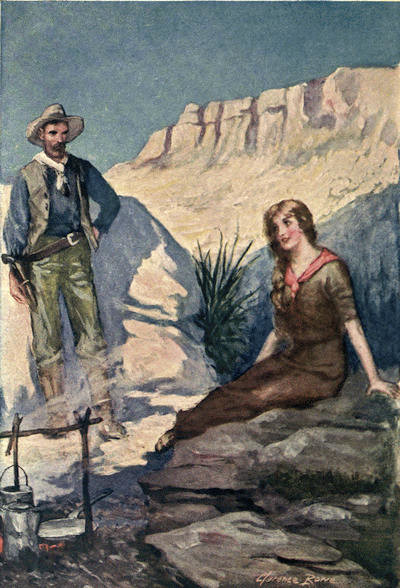
For a moment he let himself watch her, and catching his look, she smiled, as she had smiled when his eyes had met hers as he woke.
HEART’S KINDRED
BY
ZONA GALE
AUTHOR OF
“FRIENDSHIP VILLAGE,” “NEIGHBORHOOD STORIES”
“THE LOVES OF PELLEAS AND ETARRE”
“CHRISTMAS,” ETC.
WITH FRONTISPIECE
New York
THE MACMILLAN COMPANY
1915
All rights reserved
Copyright, 1915,
By THE MACMILLAN COMPANY.
Set up and electrotyped. Published September, 1915.
Norwood Press
J. S. Cushing Co.—Berwick & Smith Co.
Norwood, Mass., U.S.A.
TO
THOSE WHO OBEY
THE
SIXTH COMMANDMENT
HEART’S KINDRED
I
A hut of bark, thatched with palm-leaves; a gigantic rock at whose base lay old ashes; an open grassy space bordering a narrow mountain stream, and a little garden—these made the home of the Inger, where a man might live and die as a man was meant, neither planning like a maniac nor yet idling like an idiot, but well content with what the day brought forth.
Toward a June sunset, the Inger sat outside his doorway, fashioning a bowl from half a turtle shell. Before him the ground sloped down to the edge of the garden, and beyond dropped to the clearing’s edge. When he lifted his eyes, he could look for miles along thick tops of live oaks and larches, and beyond to a white line of western sea. At his back rose the foothills, cleft by cañons still quite freshly green. Above them, the monstrous mountains swept the sky, and here their flanks were shaggy with great pines. The whole lay now in that glory of clear yellow by which the West gives to the evenings some hint of a desert ancestry.
The Inger worked in silence. He was not a man to sing or whistle—those who live alone are seldom whistling men. Perhaps the silence becomes something definite, and not lightly to be shattered. A man camping alone will work away quietly day-long—and his dog understands. The Inger had no dog any more. He had owned a wolf hound whom, in a fit of passion, he had kicked so that the dog had died. And such was his remorse that he would own no other, and the sight of another man’s dog pulled at him as at an old wound.
It was so still that, presently, in that clear air the sound of a bell in the valley came up to him with distinctness. He looked to the south, and in a deep place in the trees, already lights twinkled out as if they, like the bells, would announce something. The Inger remembered and understood.
“Hell,” he said aloud. “The wedding.”
He went on scraping at his turtle shell, his mind on the man who would be married that night—early, so that there would be ample time for much merrymaking and drunkenness before the east bound train at midnight. Bunchy Haight was the man, the owner of the run-down inn in the village of Inch. The woman was the Moor girl, whose father, abetted by the Inger himself, had killed a sheriff or two for interfering with his gambling place and had gone free, because no one was sure whether it was he or the Inger who did the shooting. Moor’s promissory notes had been accumulating in the hands of Bunchy Haight for a dozen years, and it was no secret that the wedding settled the long score.
“And in dead luck to get a good provider like Bunchy, the Moor girl is,” was the way Inch took it.
Inch welcomed a wedding. In the old days it had been different, and nobody cared whether anybody had a wedding or not. For then there had been a race track at Inch, and a summer hotel, and a fine glass-front showing of saloons, and other magnificence. With the passing of the California law, the track had been closed, the resort keepers had moved away, and the bottom had fallen from Inch.
Mothers amused their children by telling of the traps and the four-in-hands and the tally-ho’s with rollicking horns, and the gaily dressed strangers who used to throng the town for a fortnight in Spring and in Autumn, when Inch knew no night and no darkness and no silence, and abundantly prospered.
Now all this was changed. There were, literally, no excitements save shootings and weddings. Jem Moor, being supposed to have achieved his share of the former, was prepared further to adorn his position by setting up drinks for the whole village and all strangers, to celebrate his daughter’s nuptial day.
These things the Inger turned over in his mind as he scraped away at his shell; and when the dark had nearly fallen, he rose, shook out from the shell the last fragments, polished it with his elbow, balanced it between his hands to regard it, and came to his conclusion:
“Hell,” he said again, “I’m bust if I don’t go to it.”
The next instant he laid down the shell, slipped to his door and caught up the gun that lay inside, on a shelf of the rude scantling. A wood duck had appeared over the lower tree tops, flying languidly to its nest, somewhere in the foothills. Long before it reached the wood’s edge, the Inger was in his doorway. The bird’s heavy flight led straight across the clearing. One moment the big body came sailing above the hut, then it seemed to go out in a dozen ugly angles and dropped like a stone to the edge of the garden. It lay fluttering strongly when the Inger reached it. He lifted and examined it approvingly. One wing was shot almost clear of the body. That was the mark he liked to make. He swung the bird under his arm, took out his jack-knife, pried open the mouth, slit the long tongue, tied the feet together and hung it outside his door to bleed to death. This death, he had heard, improved the flavor.
Without washing his hands, he prepared his supper—salt pork and bacon fried together, corn cakes soaked in the gravy, and coffee. The fire glowed in the hollow of the great rock, and the smell of the cooking crept about. The Inger was almost ready to eat by the clear light of the transparent sky, when he saw a figure coming across the clearing.
He leapt for his rifle—since the last sheriff had been shot he was never perfectly at ease with any stranger. But before his hand had closed, it relaxed at the sound of a triple whistle. He wheeled and looked again. The stranger had almost reached the bourne of the firelight.
“Blast my bones and blast me!” cried the Inger. “Dad!”
Something deep and big had come in his voice. As the two men met and shook hands, there was a gladness in them both. They moved apart in a minute, the Inger took the pack which the older man swung off, and went about cutting more salt pork and bacon. His father found the wash basin, and washed, breathing noisily through the water cupped in his hands. Not much was said, but any one would have known that the two were glad of the moment.
“Not much grub,” said his father. “I ain’t grub hungry,” and flung himself on the ground before the camp fire. “I’m dead beat—and my bones ache,” he added.
The Inger filled his father’s plate and went on frying meat. In the firelight, their faces looked alike. The older man’s skin was beginning to draw tightly, showing the rugged modelling of the thick bones. His huge hands looked loose and ineffectual. Something welled up and flooded the Inger when he saw his father’s hand tremble as it lifted his tin cup.
Larger in scale, more definite in drawing, and triumphantly younger the Inger was, brown skinned, level eyed, and deep chested, his naked, veined right arm grasping the handle of the skillet as if it were a battering ram. When the Inger registered in the inn at Inch or signed a check in his bank in the City, his pen bit through the paper like acid, because he did everything as if his tool were a battering ram. But his eyes, as they rested now on his father’s hand that trembled, were soft and mute, like a dog’s eyes.
“What kind of luck, Dad?” he said.
The older man looked across his wooden platter and smiled whimsically.
“Same kind,” he answered. “None. But look a-here, Sonny—” he added, “I found out something.”
“I bet you did,” said the Inger.
“I ain’t ever going to have any luck,” said the old man. “I’m done for. I’m done. A year or two more and I’ll be spaded in. It’s the darndest, funniest feeling,” he said musingly, “to get on to it that you’re all in—a back number—got to quit plannin’ it.”
“Not on your life—” the Inger began, but his father roared at him.
“Shut up!” he said fondly. “You danged runt you, you must have knowed it for two years back.”
“Knowed nothin’,” said the Inger, stoutly.
The older man put his plate on the ground and lay down beside it, his head on his hand.
“It’s a devil of a feel,” he said.
“Don’t feel it,” said the Inger.
“Cut it,” said his father, almost sternly. “I brought you up to kill a man if you have to—but not to lie to him, ain’t I? Well, don’t you lie to me now.”
The Inger was silent, and his father went on.
“I was always so dead sure,” he said, “that
I was cut out to be rich. When I was a kid in the tannery, I was dead sure. When I hit the trail for the mines I thought the time was right ahead. That was fifty years ago....”
“Quit, Dad,” said the Inger, uncomfortably. “I’ve got it—what’s the difference? The Flag-pole is good for all either of us will ever want.”
“I ain’t forgot, though,” said the older man, quickly, “that you banked on the Flag-pole agin’ my advice. If you’d done as I said, you’d been grubbin’ yet, same as me.”
“It’s all luck,” said the Inger. “What can anybody tell? We’re gettin’ the stuff—and there’s a long sight more’n we need. Ain’t that enough? What you want to wear yourself out for?”
His father leaned against the end of the warm rock, and lighted his pipe.
“Did I say I wanted to?” he asked. “I done it so long I can’t help myself. I’ll be schemin’ out deals, and bein’ let in on the ground floor, and findin’ a sure thing till I croak. And gettin’ took in, regular.”
He regarded his son curiously.
“What you goin’ to do with your pile?” he inquired.
The Inger sat clasping his knees, looking up at the height of Whiteface, thick black in the thin darkness. His face was relaxed and there was a boyishness and a sweetness in his grave mouth.
“Nothin’,” he said, “till I get the pull to leave here.”
“To leave Inch?” said his father, incredulously.
“To leave here,” the Inger repeated, throwing out his arm to the wood. “This is good enough for me—for a while yet.”
“I thought mebbe the society down there,” said his father, with a jerk of his head to the lights in the valley, “was givin’ you some call to sit by.”
The Inger sprang up.
“So it is,” he said, “to-night. Bunchy’s gettin’ spliced.”
“Who’s the antagonist?” asked the other.
“The Moor girl,” said the Inger. “Bunchy’s a fine lot to draw her,” he added. “She’s too good a hand for him. Want to go down and see it pulled off?” he asked.
His father hesitated, looking down the valley to the humble sparkling of Inch.
“I don’t reckon I really want to get drunk to-night,” he said slowly. “I’ll save up till I do.”
The Inger stretched prodigiously, bunching his great shoulders, lifting his tense arms, baring their magnificent muscles.
“I gotta, I guess,” he said. “But, gosh, how I hate it.”
He carried the remnants of the food into the hut, and made his simple preparation for festivity. As he emerged he was arrested by a faint stirring and fluttering. He listened and it was near at hand, and then he saw the wood duck, writhing at the end of the string that bound its legs. Beneath it lay a little dark pool.
“No sense in bleedin’ all the good out of ye,” thought the Inger, and with the butt of the six-shooter that he was pocketing, he struck the bird a friendly blow on the head and stilled it.
The forest lay in premature night, save where a little mountain brook caught and treasured the dying daylight. It was intensely still. The Inger’s tread and brushing at the thickets silenced whatever movement of tiny life had been stirring before him. The trail wound for half a mile down the incline, in the never-broken growth.
Once in the preceding winter when the Flag-pole mine was at last known with certainty to be the sensation of the year, the Inger had sewed a neat sum in the lining of his coat and had gone to inspect San Francisco. He had wanted to see a library, and he saw one, and stood baffled among books of which he had never heard, stammering before a polite young woman who said, “Make out your card, please, over there, and present it at the further desk.” He had wanted to see an art gallery, and he went confused among alien shapes and nameless figures, and had obediently bought a catalogue, of which he made nothing. Then he had gone to dinner with the family of one of the stockholders, and had suffered anguish among slipping rugs and ambiguous silver. The next night, the new collar and cravat discarded, he had turned up in one of his old haunts on the Barbary Coast. On his experience he made only one comment:
“They know too damn much, and there’s too damn much they don’t know,” he said.
But the woods he understood. All that he had hoped to feel in the library and the art gallery and in that home, he felt when the woods had him. Out there he was his own man.
As he went he shouted out a roaring music-hall song. Then when he had ceased, as if he became conscious of some incongruity, he stood still, perhaps with some vague idea of restoring silence. In a moment, he heard something move in the tree above his head—an anxious “Cheep—cheep!” in the leaves, as if some soft breast were beating in fear and an inquiring head were poised, listening. Instantly he lifted his revolver and fired, and fired again. He heard nothing. Had anything fallen, he could certainly not have come upon it next day. It was the need to do something.
As he cleared the wood, the lights of the town lay sparkling in a cup of the desert. At sight of them there was something that he wanted to do or to be. The vastness of the sky, the nearness of the stars, the imminence of people, these possessed him. He caught off his cap, and broke into a run, tossing back his hair like a mane.
“Damn that little town—damn it, damn it!” he chanted, like an invocation to the desert and to the night.
II
Inch was in glory. On the little streets and in the one-story shops, all the lights were kindled. Bursts of music, and screaming laughter, came from the saloons, whose doors stood wide open to the street, and at whose bars already men and women were congregating. In the Mission Saloon, the largest of these hospitable places, an impromptu stage had been arranged, and the seats about the tables were nearly all filled. Here the Inger went in and called for his first drink, negligently including everybody present. He was greeted boisterously by those who knew him and pointed out to those who did not know him. Not one of them understood the sources of his power, or what it signified. He was the only man in the county to be called by his last name and the definite article. This was a title of which a man might be proud, conferred upon him by common consent of his peers.
There was no formality of introduction. The Inger merely scanned the crowd, flashing a smile at one or two of the women who nearly pleased him. When the drinking began, it was to one of these that he lifted his glass. But when immediately she came and sat beside him, linking her arm in his, he drew away laughing, and addressed the crowd at large.
“What’s up?” he demanded. “What’s doin’?”
“B-basket o’ peaches,” volunteered one of the cow punchers, who early in the day had begun to observe the occasion. “B-Bunchy’s complimumps!”
When the improvised curtain of sheets drew back, revealing ten or twelve half-clothed strange women, the Inger understood. This was Bunchy’s magnanimous contribution to the general jollity of his marriage night.
“Let me have an absinthe,” he said to the barkeeper.
The man leaned across the bar and whispered something.
“No absinthe!” shouted the Inger. “What the hell kind of a joint is this?”
“Leadpipe Pete licked up the bottom of the bottle,” growled the barkeeper, pointing with the stump of a thumb.
The Inger looked. Beside him a big ranchman, swarthy and sweaty and hairy, was just lifting to his lips a tall tumbler of the absinthe. He leered at the Inger, closed one eye, and began to drink luxuriously. The Inger leapt a pace backward; and in an instant a bullet crashed through the glass, shattered it, and the man stood, dripping, with the bottom of the tumbler in his hand. The bullet buried itself in the tin mirror of the bar.
“About how much do I owe you for the lookin’ glass?” inquired the Inger, easily, resting his elbows on the bar. “And charge me up with Pete’s drink he’s mussed himself up with so bad. What’ll be the next one, Pete?”
“Leave Pete name the damages,” said the barkeeper, unconcernedly wiping up the liquid.
“You’re too hellish handy with your tools, you are,” grumbled Pete, combing the glass from his beard. “Make it brandy, neat.”
“Brandy, neat, one two,” repeated the Inger. “Bein’ your absinthe has run out.
”
Presently he strolled up the street toward the hotel, where the evening’s interest centred. He glanced indifferently into the saloons, nodded a greeting when he wished, but more often ignored one. At a corner a beggar, attracted to the little place from some limbo where news of the wedding had filtered, held out his cap.
“It’s my thirty-third birthday to-day, pal,” he said. “It’ll bring you good luck to cough up somethin’ on me, see if it don’t.”
The Inger stopped with simulated interest. The man—a thin, degenerate creature, with a wrinkled smile—approached him hopefully. Abruptly the Inger’s powerful arm shot out, caught him below the waist, lifted him squirming in the air, and laid him carefully in the gutter.
“What you need is rest,” he said, with perfect gentleness, and left him there.
The hotel where the wedding was to be celebrated had light in every window. Here Bunchy’s preparations had been prodigal. Blankets and skins lined the walls and covered the floor of the office where a fire was roaring and the card tables were in readiness. Shouting and imprecation, chiefly from women, came from the kitchen, where the wedding supper was in preparation. In the hotel desk was Bunchy himself, engaged in somewhat delayed attention to his nails. His hair, still wet from its brushing, ran away from his temples, lifting the corners of his forehead so that it seemed to be smiling. He had a large face, and a little tight mouth, with raw-looking, shiny lips. There was something pathetic in his careful black clothes and his uncomfortable collar and his plaid cravat.
“How much would you sink to back out?” was the Inger’s salutation.
Bunchy grinned sheepishly.
“How much did it cost you?” he inquired.
“Done it for nothing,” the Inger declared. “I ain’t the charmer you are, Bunchy. Never was.”
The groom leaned nearer the light, minutely examining a black, cracked finger.
“She ain’t goin’ to be very much in the way,” said he, confidentially.
“What?” asked the Inger, attentively.
Bunchy shook his head, pursing the tight, raw lips.
“Not her,” he said. “She believes anything you tell her—the whole works. There won’t never be no kickin’ from her about me not loafin’ home.”
“Well,” said the Inger, still with minute attention, “what you gettin’ married for, then?”
“Huh?” said Bunchy, an obstinate finger between his lips.
“I thought,” explained the Inger, “that a fellow got married for to have a home. Far as I can see, though,” he added with an air of great intellectual candor, “home is hell.”
Bunchy threw back his head and looked at him. Curiously, when he laughed, his little tight mouth revealed no teeth. His answer was deliberate, detailed, unspeakable.
For a minute the Inger looked at him, quietly, himself wondering at the surge of something hot through all his veins. In his slow swing round the end of the desk where Bunchy stood, there was no hint of what he meant to do. Bunchy did not even look up from the fat forefinger which he scrupulously pruned. Nor was there anything passionate in the Inger’s voice when he spoke.
“You ain’t got the time to-night,” he said, “but when you get back from your honeymoon, look me up and—remember this!”
The last words came with a rush, as the Inger lifted his hand, and with his open palm, struck Bunchy full in the face. He struck harder than he had intended, and the blood spurted. Even as he caught the ugly look of wrath and amazement in that face, the Inger tore the handkerchief knotted about his own neck and wiped the blood from Bunchy’s chin.
“No call to splash on the weddin’-finery,” the Inger said, with compunction. “Any time’ll do to bleed. She’s Jem Moor’s girl—you hound!” he blazed out again, and flung toward the door.
Bunchy, having recovered his speech, gave vent to it long and variously. All that he said was worse than the observation which had caused his trouble. In the doorway, the Inger halted and turned, and listened. He seemed to be seeing Bunchy for the first time. And yet he had heard all this from the man scores of times before, and for that matter, from all the men of Inch. But this was about Jem Moor’s girl.
As he passed into the street, he wondered at himself. Though she had been a familiar figure ever since he had lived near Inch, he had spoken to the girl no more than twice: once when he had come riding into town from the camp, warm with the knowledge, not yet quite certainty, that the Flag-pole was to pan out, Lory Moor had crossed his path singing, a great coil of clothes-line over one bare arm, the other hand fastening her hair. The Inger, inwardly exultant with life and his lot, had called out to her in the manner of his kind:
“Hello, sweetie! What you got for me this morning?”
Without lowering her brown arm, she had looked up at him, and he had been startled by the sheer ripe loveliness of her. While he stared, wholly unprepared for her sudden movement, a twist of wrist and a fling of hand had let out the length of rope, and it fell in a neat lasso about his neck.
“This!” she said and laughed. He had never forgotten her laugh. Once or twice afterward he had ineffectually tried to mock its scale, softly, in his throat.
“Done,” cried the Inger, “and by the Lord Harry, now you take me along with you!”
At this her laughter had doubled, and realizing that, in her obvious advantage, his command was absurd, he had laughed with her. For a few paces she had run before him, over the sand and mesquite, and he had liked to see the sun falling on her brown neck and thick hair, and her tight, torn sleeves. And as he looked and looked, suddenly he pricked at his horse, thundered down on her, leaned sideways in his saddle, and with one arm swept her up before him.
She did not cry out, but her laughter was suddenly silenced, and she looked in his face, swiftly and searchingly, as if to read it through. She disdained to cling to him, and sat erect, but her body was in his arm, and with his free hand he gathered in the rope and held it bunched on his mare’s neck. Then they galloped. They were a quarter of a mile from the town, and they took a great circle about it. When she saw what he meant to do, her tenseness relaxed, and she sat at ease, but still she did not speak nor did he. The Inger threw back his head, and felt the ground leave his horse’s hoofs, and felt the sky come near. He swam in the sun and the sands blurred, and there was nothing but the girl and the gallop of his horse. And then suddenly, as they bore toward the town, he had been intoxicated to see her throw out her arms, toss them out and up, and laugh again.
Had not the appraisers been waiting at the hotel for him, the Inger might have turned to the desert with her. As it was, at the edge of the settlement, where she suddenly and imperiously pointed, he set her down, ducking from the loop of rope and tossing it to her when she had dismounted.
“You took me along with you all right,” he reminded her.
She laughed and ran away.
“What have you got for me now?” the Inger called after her.
“This!” she said, and threw a kiss somewhere in the air.
There followed days of anxiety when the men at the mine doubted, and the appraisers hung fire, and pretended to less than they knew. In the midst of it, the Inger had ridden away to the desert and camped for three days, and had returned to find them cursing him out and making an estimate of millions. Riding in after dark to send the message to his father, still grub-staking to the north, the Inger for the second time had seen Lory Moor. She was in the crowd which he was breasting, outside a motion picture house. She was in tawdry pink, with a flame of rose in her hat, and she was with Bunchy. His hands were upon her and he was saying something in her ear from one corner of his mouth. She was not listening, the Inger thought as he passed her. She did not see him, and for this he felt vaguely thankful—as if he had come on her in some shame. A day or two after this Jem had told him that she was to marry Bunchy.
To marry Bunchy, the Inger thought as he lounged in the street outside the Inn on her wedding night, was the worst that could come to her. He drifted into a saloon across the way, one of the meaner places, and on this night of plenty almost unfrequented. He sat down at a table in range with the doors of the Inn, and drank reflectively. That day that he had had her, what if he had galloped away with her to the foothills, to the camp, to the other side of somewhere? He sat thinking of her, wondering why he had not dared it, playing at what might have been.
On the table lay a San Francisco newspaper, three days old. As he drank he glanced at the headlines. “War May Last Another Year,” he read. “Reserves of Three Nations to be Called Out Within the Month.”
The thought had come to him before, since the money came. To-night he turned to it in a kind of relief: Why not go there? There was fighting worth a man’s hand. Drunken Indians, an outlaw or two, a horse thief strung up in a wink and all over—these were all that he knew of warfare. Was he to die with no more understanding than this of how a man might live and die? The thing was happening now—the adventure of the great guns and the many deaths. Yet he, a man like other men, sat here idle. He closed his eyes and lay with those men in the trenches, or leapt up to kill again and again at fifty yards, saw the men roll in torture, saw them red and grovelling in red.... A lust of the thing came on him. He wanted it, as he wanted no other thing that his mind had ever played with. He forgot Jem Moor’s daughter in that imaginary desert. He swallowed and tasted and opened his eyes as on a forgotten world. He pounded the table for more liquor.
“Why don’t you go to the war, you scared, snivelling Pale-liver?” he demanded of the shuffling bartender.
The small man’s little red-rimmed and red-shot eyes lighted, and his lips drew back over black teeth.
“If I was a young dog like you, I’d be there stickin’ in the lead, you bet,” he said. “What you ’fraid of?”
“Nothin’,” said the Inger, suddenly; “I’m goin’!”
“Plough some of ’em up prime for me,” begged the old man. “I croaked two men myself afore I was your age. It were in a sheriff’s raid, though,” he regretfully added.
The Inger looked at him thoughtfully. It occurred to him that though he was credited with it, he himself had never killed a man in his life. Yet killing was a man’s job, and over there was the war, and he had the means to get to it. There was need of more to kill—and to be killed. And he had been hanging on a shelf of Whiteface for all these months!
He drained his glass and went to the door, as if the need to do something at once were upon him. He saw that the wedding guests were filling the streets, and moving into the Inn. All of Inch was out there—the women gorgeous in all that they had, and even some of the men dressed in the clothes which they wore on a journey. Already some were drunken, and all were loud with merriment, which they somehow felt was required of them, like eating three times a day or scorning a stranger. Everywhere there were children, who must needs go where the grown folk went or be left alone. “Parents Must Keep Children Off the Floor,” was posted on the walls of the Inch public dance halls.
Next to the office door, the door of the hotel bar stood open now, and by the array of cut colored paper hanging from the chandeliers, he guessed that the wedding was to be solemnized in there. This was natural—the bar was the largest room in the house, and the most magnificent in the town—the only bar, in fact, with a real mirror at the back. Moreover, Bunchy’s barkeeper was a man of parts, being a bass singer and a justice of the peace. With his apron laid aside, he was to give a tune while the guests assembled, and afterward it was he who was to perform the ceremony. Nobody thought of expecting the ceremony to be held in Jem Moor’s ’dobe.
It was Jem Moor himself who, while the wedding guests were still noisily passing in the hotel, the Inger saw coming down the street. He was neatly dressed in the best he had, and though one trouser leg had crept to the top of a boot, and his red cravat was under an ear, still he bore signs of a sometime careful toilet. He broke into an uneven run—the running of a man whose feet are old and sore—and disappeared in the doorway of the Inn office.
The Inger’s look followed him, speculatively.
“But one more drink and I could be over there makin’ more kinds of hell than usual,” he said to himself, and went back to the bar.
He was draining his glass when the sound of confused talk and movement came to him, and, as he wheeled, he saw that across the street the interior of the Inn bar and office were in an uproar. The wedding guests were rising, there were shouts and groans, and a shrill scream or two. Some came running to the street, and over all there burst occasional great jets of men’s laughter.
“’S up?” asked the old barkeeper behind him.
The Inger did not answer. He stood in the doorway waiting for something. He did not know what he waited for, but the imminent thing, whatever it was, held him still. A hope, which he could not have formulated, came shining slowly toward him, in him.
In a moment, Jem Moor emerged from the office door, still brokenly running, seeking to escape from those who crowded with him, questioning him. The Inger strolled from the doorway, across the street, took his way through the little group which fell back for him, and brought his hand down on the old man’s shoulder.
“Anything wrong?” he inquired.
Jem Moor looked up at him. He was pinched and the lines of his nose were drawn, and his lips were pulling.
“She’s skipped,” he said. “I’m in for ’Leven Hundred odd, to Bunchy.”
Something in the Inger leaped out and soared. He stood there, saying what he had to say, conscious all the time that as soon as might be he should be free to soar with it.
“Alone?” he demanded.
Jem Moor held out a scrap of paper. The Inger took it and read, the others peering over his arms and shoulders.
“Dad,” it said, “I can’t go Bunchy. I know what this’ll do to you, but I can’t never do it—I can’t. I’ve gone for good. Dear old Dad, don’t you hate me.
“Lory.”
The tears were running down Jem Moor’s face.
“‘Leven Hundred odd,” said he, “and I ain’t a red. Not a red.”
The Inger threw up his head.
“Lord Harry,” he cried. “Why didn’t I think of it before? Buck up!” he cried, bringing down his hand on Jem’s little shoulder. “And drink up! Come along in!”
He led the way to the Mission Saloon, and bade the man take orders for everybody. Then he went to the back of the place, and found for himself ink and a pen, and tore a leaf from a handy account book. When he had filled in the name of his bank, he wrote and signed:
“Pay to Bunchy Haight, Twelve Hundred Dollars and be damned to him.”
Then he wrote out a receipt to Jem Moor, with a blank for the sum and for Bunchy’s signature.
When he could, he drew Jem in a corner and thrust at him the papers. The little man stared at them, with a peculiarly ugly, square dropping of his jaw, and eyes pointed at top.
“Don’t bust,” said the Inger, “and don’t think it’s you. It ain’t you. The check isn’t drawn to you, is it? I want to hell-and-devil Bunchy some, that’s all. Shut up your mouth!” he added, when Jem tried gaspingly to thank him.
Then he got out of the place, where sharp music was beginning and the ten or twelve women were dancing among the tables, and went down the street, thronged now with the disappointed guests, intent on forcing the ruined evening to some wild festivity. When they called to him to join them, he hardly heard. He went straight through the town and shook it from him and met the desert, and took his own trail.
The night was now one of soft, thick blackness, on which the near stars pressed. The air had a sharp chill—as if it bore no essence of its own but hung empty of warmth when the daylight was drained from it. The stillness was insistent. In a place of water, left from the rains, and still deep enough to run in ripples over the sedge, frogs were in chorus.
There was a sentinel pepper tree on the edge of the town and here a mocking-bird sang out, once, and was still. These left behind, and the saw and crack and beat of the music dying, the Inger faced the dark, gave himself to the exultation which flowed in him, mounted with it to a new place.
The liquor which he had drunk was in his veins, and to this the part of him which understood all the rest of him credited his swimming delight. But separate from this, as his breath was separate, there came and went like a pulse, something else which he could not possibly have defined, born in him in the street, when he had heard Jem Moor’s bad news.
He threw out his arms and ran, staggering. What was there that he must do? Here he was, ready for it. What was there that he must do? Then he remembered. The War! He would have that. That was what he could do.
He stood still on the desert, and imagined himself one of thousands on the plain. What if he were with them there in the darkness? What if the rise of the sand were the edge of the opposite trenches, with men breathing behind them, waiting? With a drunken laugh, he pulled his revolver, and fired and shouted. Why, he could plough his way through anything. He should not go down—not he! But he should be fighting like this in the field of civilized men, and not taking his adventures piecemeal, in a back lot of the world, with a skulking sheriff or two and Bunchy for adversary. To-morrow! He would go to-morrow, and find what his life could give him.
But this other thing that was pulsing in him ... the girl! What about her? Was he not to find her, was he not to have her? He closed his eyes and swam in the thought of her. War and the woman—suddenly he was aflame with them both.
When he went into the wood, he went singing. He himself was the centre of the night and of his universe. The wood, Whiteface, his journey, the war, lay ready to his hand as accessory and secondary to his consciousness. He felt his own life, and other life was its background. He made a long crying guttural noise, like an animal. He shook his great body and crashed through the undergrowth, the young saplings stinging his cheeks. To-morrow—he would be off to-morrow....
He emerged upon the little space which was his home. The fire had fallen and was a red glow, and a watching eye. Rolled in his blanket beside it lay his father, deeply breathing. In a moment the Inger became another being. He stood tense, stepped softly, entered quietly the open door of his hut.
Within something stirred, was silent, stirred again, with a movement as of garments. Out of the darkness, her voice came:
“Mr. Inger: ... It’s Lory Moor.”
III
For a moment he thought that this would be a part of his crazy dreaming, and he said nothing. But then he knew that she had risen and was standing before him; and he heard her breath, taken tremblingly. Her words came rushing—almost the first words that he had ever heard her say:
“You been down there. You know. I don’t know where to go. Oh—don’t tell ’em!”
“Tell ’em,” he muttered, stupidly. “Tell ’em?”
“I can’t do it,” she said gaspingly. “I can’t—I can’t.”
She was sobbing, and the Inger, so lately a flame of intent and desire, did not dare to touch her, and had no least idea what to say to her. In a moment she was able to speak again.
“I thought I could hide here for a day or two,” she said, “till they quit huntin’. Then I could get away. Would you hide me, somehow?—would you?”
He was silent, trying to think, with a head not too clear, how best to do it; and she misunderstood.
“Don’t make me go back—don’t tell Dad and Bunchy! If you can’t hide me, I’ll go now,” she said.
“What you talkin’?” he said, roughly. “I’m thinkin’. Thinkin’ up how. Thinkin’ up how.” He put his hands to his temples. “My head don’t think,” he said thickly.
“Here in the hut,” she said, eagerly and clearly. “They’ll never think of comin’ up here. Why, I don’t hardly know you.”
“Won’t they though?” said the Inger, suddenly, and dimly remembered Bunchy, and the blow for the sake of the girl. Last, there came dancing to him something about a check for the debt to Bunchy which she had not paid.
“As it happens,” said the Inger, “this is jus’ the first place where they will come lookin’ for you. Jus’ the first place....”
“Why?” she cried.
“Nev’ you mind,” he said.
He could almost see her, standing within his door, her white face blooming from the black. But his sense of her was obscured to him by the need for immediate action, and by his utter present inability to cope with that need.
“How’d you come—to come—to come up here?” he asked curiously.
For a breath she hesitated, and there was a soft taking of breath in her answer.
“I didn’t know no woman I could tell,” she said, “nor no other decent man.”
From head to foot a fire went over the Inger, such as he had never known. And first he was weak with her words, and then he was jubilantly strong. He put them away, but they lay within him burning, where again and again he could turn to them for warmth.
“How—how’d you hit the trail up?” he asked almost gently.
Again she was silent for a moment, and her answer was very low.
“I’d been by here once-to-twice before,” she said.
Hazily he turned this over. The trail led only to his hut. No one ever came who had not come to be there. Unless—
He threw back his head as something new swam to consciousness. She stood quietly, waiting to hear what he would do. Some sense of this sudden new dependence on him beset him like words.
“They’s a way over the mountain,” he muttered. “I made it in that sheriff business. Can you take that?”
“I’ll go any way,” she said.
“It’s pretty rough,” he told her. “It’s pretty rough,” he repeated with intense care. “I’ll take you. I’ll take you,” he insisted thickly.
“You mean you’d go with me?” she asked.
“You’d never fin’ it if I didn’t,” he told her. “Y-you’d never fin’ it. Never.”
“I’ll go any way,” she repeated. “But I didn’t mean to—to come down on to you like that.”
“Tha’s nothing,” he said. “Tha’s nothing. Tha’s nothing.”
He put his hand to his head, with the need to touch it and to make it work properly. He had to think of things to do, and how could he do that? His father, for example—what should he do about him? He went a few steps without the door, and tried to consider, looking at the sleeping figure by the fire. The faint glow of the coals made a little ring of dim light. In it he stood, swaying.
“Oh my God,” she said, behind him. “You are drunk.”
“Li’l bit,” he admitted. “Li’l bit. Not enough to scare a b-baby.”
She put this away scornfully. “Scare nothin’,” she said sharply. “Can you keep to the trail? That’s all.”
He laughed foolishly. “Tha’s all right,” he repeated, “I can find trail, drunk or sober.”
She stood pressing her hands in and out and turning helplessly to the dark. The dark gave her back only the lights of Inch.
“There’s nothing else to do,” she said dully. “If you show me the trail, maybe I can keep you on it.”
In some indeterminate shame, he went without a word, brought his blanket, and turned again to the hut.
“I’ve got a kit,” she said. “It’s got enough to eat. Do you understand? Don’t get anything else. Oh, let’s start, let’s start!”
As he emerged, his hand had brushed the feathers of the wood duck. He took it down and slung it fumblingly to his roll of blanket. Less by taking thought than by old instinct, he remembered his cartridge belt, and found and strapped it on. Then he stood hesitating.
“Gotta tell ’em,” he suggested, looking at his father.
She had shouldered her pack and stood waiting.
“Why?” she demanded. “It’ll only be harder for him if they come. This way he won’t know, and he can tell ’em so.”
In this there was reason, but not, it seemed, enough reason. The Inger stood trying to recall something pressing on him for remembrance: if not his father, what was it that he must do or fetch, before he left. He put both hands to his head, but in there was only a current and a beating.
“There’s s’more to do,” he said indistinctly.
Lory Moor stepped toward him and laid her hand briskly on his shoulder, with a boy’s gesture of eager haste.
“The trail—the trail!” she said, with authority. “Find us the trail.”
Without a word he started, went round the end of the hut, and plunged into the wood, which ran down to the very wall. In a half dozen steps the ascent began.
Even by daylight the trail was little more than an irregular line of bent branches and blazed trunks. Since he had finished it, the Inger had taken it a dozen times by daylight with a boy’s delight in a secret way. By night he had never taken it at all. But he had the woodsman’s instinct and, now that his thoughts were stilled or lost in a maze of their own inconsequent making, this secondary consciousness was for a time paramount. He went as a man goes who treads his own ways, and though he went irregularly and sometimes staggeringly, he managed at first to keep to the course that he had taken.
Over the mountain by the trail to the railway station—that had become clear to him. When they should reach it or how the railway should serve, was not his concern at all. Meanwhile, here she was with him. He tried to get this straight, and cursed his head that only buzzed with the knowledge and whipped him with the need to keep to the trail.
“Lory Moor,” he tried to grasp it; “Jem Moor’s girl. She never married Bunchy at all. She’s here—with me. I’ve got her with me....”
The girl was not a pace behind him. She had stretched out her hand and laid it on his roll of blanket and thus, though seeing nothing, she was able to fit her steps somewhat to his, to halt when he halted, to swerve or to slow or to retrace. She was profoundly thankful for his consent to take her away, and in that consent she rested without thought or plan.
An hour passed before the Inger missed the trail. In a stretch fairly free of undergrowth, he stood still for a moment to take his bearings, and thrust out his hand against a declivity, sharp with fallen rock. To the right the wall extended to meet the abrupt shoulder of the slope; to the left it dropped away so that a stone, sent down, went crashing far below.
“Stay here,” the Inger commanded, and found his way up in a shower of falling rocks, to the summit of the obstruction. He clung to a tree, and listened. The mountain brook, which they should cross some rods ahead, was not yet audible. On the other side the rocks fell precipitately; and leaning out, he seemed to sense tree-tops.
“Look out!” he called, and clambered down again, and bade her wait while he went and came back and went and came back in vain. She heard him stumbling, no more fit to find a trail than to think his thoughts.
“I’m stumped,” he said. “We’ve got wrong somewheres.”
She answered nothing. She was sitting on the ground where he had left her. Her silence touched him somehow as a rebuke. “You think it’s because I’m drunk,” he said, in a challenge.
“I don’t think anything,” she answered. “Rest a little—then mebbe we can get right again.”
He flung himself down on his face. The scent of pine needles and dead leaves was there, waiting for him. The stillness of the wood took them both, and for a few minutes they were silent.
And as he lay there, with her sitting beside him, something of the desert, of an hour before, came running along his veins and took him, and, something, too, of the time when he had had her before him on his horse, galloping. When that time had been he could not say; but he remembered it with distinctness, and that day he had had his arms about her.
“We rode—on a horse,” he submitted, suddenly. “C’n you ’member that day?”
“Yes,” she answered. “Don’t talk,” she begged him, “just rest. I want to rest.”
The Inger was silent. His mind was busy trying to piece together what he knew of that day—of her there before him on his horse, of her face laughing at him as she ran away.
“You threw me a kiss,” he offered, after a pause.
“Don’t talk, don’t talk,” she begged him. “I can’t breathe—let me rest.”
“I wish it was that day now,” he said foolishly, and drew a deep breath, and lay quiet. But in a few minutes he roused himself, his mind struggling with a new problem. What a fool he was, wishing for that day, when here she was, just the same as then. What was the matter with this day?
“Wha’s the matter with this day?” he inquired, reasonably. Then he remembered. They were lost, of course. The trail was gone—gone clean off.
“Gone clean off,” he muttered, reproachfully. “Damn dirty trick to play.”
Then he was shot through with his dominant consciousness. Here she was, here she was—with him. There was something else, something that she had said which made a reason why he should not touch her. But what was that? It was gone—gone clean off, gone with the trail....
Back upon him came flooding the desire of the desert, as he had run with the thought of her and with the thought of battle. Then he had believed that she belonged to Bunchy. That was a lie and Bunchy was a fool. Everything was different, and now here she was and nobody knew....
He lifted himself, and scrambled forward toward her.
“We’re lost,” he said thickly. “Wha’d we care? Wha’d we care....”
He put out his arms, but they did not touch her. He swept a circle, and they did not enclose her. Alarmed, he rose and lurched forward, feeling out in all directions, an arm’s span. And she was not within his reach nor within the crazy length which he ran, with outspread hands, trying to find her.
At last his foot caught in a root and he fell, and lay there, and began quietly weeping. Now she was gone and the trail was gone. He was treated like a dog by both of them. He fumbled for his pack, but he had slipped that off when he climbed the rocks, and now that was gone too. He wept, and lay still. In a few moments he was sleeping.
IV
When he awoke, he looked into soft branches, gray in dim light. The whole mountain was lyric with birds. There was no other sound, save the lift and touch of branches, and the chatter of a squirrel, and there was as yet no sun.
He remembered. And with the memory, a rush of aching, eating shame seized on him and he closed his eyes again. Then he thought that he must have dreamed it all. And that it was impossible that such a thing should be. Yet here he was in the woods, where she had left him because he was a fool. Where had she gone? He sprang up, mad to find her, possessed by the need to make amends, and by the sheer need to find her.
As he sat up, he threw off his blanket, and he marvelled that this should have been covering him. Then he found himself looking into Lory Moor’s face.
She was sitting near him, wrapped in her own blanket, leaning against a tree. She was wide awake, and by all signs she had been so for a long time, for a great cluster of mountain violets lay on her blanket.
When she saw that he was awake, she smiled, and this seemed to the Inger the most marvellous thing that ever had befallen him: that she was there and that she smiled.
He looked at her silently, and slowly under the even brownness of his skin, the color rose from his throat to his forehead, and burned crimson. But more than this color of shame, it was his eyes that told. They were upon her, brown, deep, like the eyes of a dog that has disobeyed, and has come back. For a moment he looked at her, then he dropped his face in his hands.
She moved so quietly that he did not hear her rise. He merely felt her hand on his shoulder. And when he looked up again, she was sitting there beside him.
“Don’t,” she said.
He looked at her in amazement. Her look was gentle, her voice had been gentle.
“You mustn’t,” she said. “It’s all over now.”
“What do you think of me? What do you think of me?” he muttered, stupidly.
She shrugged lightly. “It don’t make any difference what I think of you,” she said. “Ain’t it whether I’m goin’ to get away from Inch or not? Ain’t that the idea?”
When he came to think of it, that was the immediate concern. With his first utterance he had blundered, as he had blundered since the moment when she had put herself in his keeping. None the less his misery was too sharp to dismiss. But he had no clear idea how to ask a woman’s forgiveness—a thing that he had never done in his life.
“I feel as bad as hell,” he blurted out.
“What for?” she asked.
“For all I’ve done,” he put it.
She considered this.
“Look here,” she said slowly. “You’ve been drunk before often enough, ain’t you?”
“Yes,” he answered, miserably.
“Well, don’t feel bad about this just because I mixed up in it,” she said. “I’m used to it. I see Dad and all of ’em drunk more times ’n I see ’em sober.”
He looked away from her.
“I wasn’t thinking just about being drunk,” he said. “I meant—what I said to you.”
“Oh—that!” she said. “Well. All men say that, I guess.” She looked at him. “I did guess you was differ’nt, but I ought to knowed better.”
Then in a flash of intense joy, he remembered what she had said to him in the hut. Her words came back as if she were speaking them again: “I didn’t know no woman I could tell. Nor no other decent man.” Once more the warmth of this was upon him, within him. Then the recollection of how he had failed her invaded him in an anguish new, impossible to combat. For she had thought that he was different from Jem Moor and Bunchy....
The Inger got to his feet.
“I am differ’nt,” he heard himself surprisingly saying.
She regarded him curiously, and with nothing in her eyes. It came to him as he stood looking down at her, that he would give all that might be asked if he could have seen her eyes as she looked up at him in the hut the night before and told him why she had come to him to help her. In the face of what had happened, the foolishness of protesting that he was different overcame him, and he fell silent.
A new anxiety beset him.
“Did you sleep?” he asked her.
She shook her head. “I was afraid,” she answered, simply.
The Inger stood for a moment as if the strength had run from his body. She had sat there, afraid, while he had slept—and he himself had been a part of her fear....
He turned away, and across the tops of the trees, he looked over the valley, still lying in the shadow. There was mist, and down there the pointed tops of the trees showed like green buds fastened to soft wool. Where they two were, the sun was already smiting the branches, and silencing the birds. Overhead, the clear blue, touched by sunny clouds, lay very near. It was as if he were trying to find, among them, something that could help him to tell her what he was feeling. But he found nothing and he said nothing. He caught up the blanket and flung it savagely aside, seized a great dead limb lying beside him and broke it over his knee.
“Get out the stuff,” he bade her. “We’ll have a fire.”
He built and lighted the fire, brought the water, and found his way down to the brook. He threw off his clothes, and lay flat in the bed of the stream, his head on a rock. The sharp stones cut his flesh, and the water somehow helped to heal him. He shook himself, dried by a run down the trail, dressed, and returned, glowing.
The coffee was on the fire, and she was making toast on a stick. She had spread what food she had brought, chiefly fruit and cooked meat and cheese.
“Didn’t I bring any grub?” he demanded.
“The bird,” she answered. “The big bird.”
“That’s for dinner,” he observed, gruffly, and said no more.
He took the stick from her and made the toast. When she poured the coffee, it was clear and golden and fragrant. She had two plates and two cups, the Inger noticed. She made him roll the blankets for seats. In spite of his suffering—which was the more real that it was new to him—the cheer and the invitation of the time warmed him. But as for her loveliness, he found himself now hardly looking at that, save when he must, as if what she was had become to him something utterly forbidden.
As for her, while she ate, she continually listened, and if a twig broke, she started. For this she laughed at herself once.
“But if he should come,” she said, “if he should come....”
The Inger looked at her, that once, steadfastly.
“If he should come,” he said, “I could save you—now.”
The elusive trail which had baffled him, led with perfect distinctness along a little shelf three steps up and around that sharp height of rocks which he had scaled, and then the trail dipped down into a narrow cañon, and up. Before the sun was an hour high, they were on their way again.
With their brisk progress, her spirits rose, and once, to the Inger’s exquisite delight, she broke into a lilt of song.
“You sing the way you laugh,” he said awkwardly. And she flashed him a smile, over shoulder, as she had done that morning on the desert.
A tanager drew a line of scarlet through the trees, and burned from a bough before them. In an instant the Inger’s hand was raised, and he had aimed. But in that second, his arm was struck aside, the shot glanced harmlessly among the trees, and the bird flashed safe to the thicket.
He looked round at her in open amazement.
“What did y’ do that for?” he demanded.
“What did you want to go and kill him for?” she cried.
He considered this: what had he wanted to kill that red bird for?
“He was such a pretty little fellow,” she said, but instead of a rebuke, this seemed to him a reason.
“Yes,” he seized it eagerly. “That’s why. You want to get up close to ’em.”
“But if they’re dead....” she protested.
“You want to get up nearer to ’em,” he repeated. “Don’t you see? It’s the only way you can.”
She said nothing. She was walking before him now, and he watched her. She had braided her hair, and he liked the way the bright braids moved on her shoulders when she walked, and hung against the hollow of her waist. She must have braided her hair, he reflected, before he woke. Then he remembered the blanket which he had found folded across his shoulders. She must have found it, unstrapped it, covered him as he lay. He longed to let her know that he knew, but he could not bring himself to recall the time. “She seems to do everything so careful,” he thought, and remembered the red bird and tried to fathom her care for that. When she stooped to pick up a shining stone, he laughed out.
“See!” he said. “You want to pick up that stone to see it. Well, I wanted to kill the bird—to see it.”
“But the bird was alive!” she exclaimed.
He stared at her.
“What of it?” said he. “Look at the lots of ’em there are!”
She said nothing.
“Who’d miss it?” he argued. “Who wants it? You always kill things.”
“I don’t know,” she said vaguely. “I don’t know why. But it don’t seem right.”
Women were like that, he reflected. They hated blood. But—a bird! It was unfathomable.
High noon found them on the summit of Whiteface, looking down upon the crouching shoulders of the east foothills. Where they stood, the sun beat hotly, and the bare rocks and the coarse growth lay in intense brooding quiet. Everything there was flat, as if the long pressure of the sun had told, like weight.
Electrically, the Inger’s spirits returned to him. Here on the height, kindling fire, boiling water, spreading food, were no such business as these had been to him down on his little shelf. Here everything had a way of being that was hitherto unknown to him. When their table was spread in the shade of a pine, and the wood duck roasted slowly over the fire on a spit which he had fashioned, he stood up and surveyed their work, and his look fell on the girl, sitting relaxed, with loosely fallen hands, the sun striking her hair to brightness.
For a moment he let himself watch her, and catching his look, she smiled, as she had smiled when his eyes had met hers as he woke.
“Yi—eh! Yi—eh! Yi—e—h!” he suddenly shouted with the strength of his lungs.
The echo rolled back to them like a taunt.
She sprang up.
“If they’re huntin’ us—” she said, trembling, “oh, they’ll hear that!”
He looked at her in horror. Fool! Would he never have done with his blundering....
“Oh, my God, I forgot,” he exclaimed, contritely, and dropped to the ground. “I don’t get rested between kicking myself for being a damn fool,” he said.
While they ate, he was quiet. There was no way to let her know how much he hated himself, and his thought was occupied with nothing else. And it was as if she divined, for she became very gentle.
“I guess maybe you wanted to do somethin’ else to-day,” she said.
He shook his head.
“It’s awful, me makin’ you do this,” she added. “Don’t you think I don’t know that.”
“I ain’t doin’ anything—what am I doin’?” he burst out.
She looked at him gravely.
“You’re takin’ me out of a good sight worse’n death,” she answered. “And don’t you think I’ll ever forget it.”
There was about her manner of saying this something infinitely alluring. She fell in a sudden breathlessness, and her voice had a tremor which seemed to lie in the very words themselves. And with this, and with what she said, the Inger found himself suddenly utterly unable to deal.
“Oh, g’on,” he said, feebly.
She said no more, and for a moment he was wretched again lest he had offended her. But the gentleness and softness of her manner reassured him. Moreover, he became conscious that of the cheese and bread she was leaving the greater part for him, and pretending to have finished.
After their lunch, a consuming content fell upon the man, and he lay stretched on his back, under the pine, staring upward, thinking of nothing. For a little she moved about, and then she came and sat beside him, saying nothing. More than he knew, this power of hers for silence conquered him. When a man knows how to live alone, he may or may not understand words, but he always understands silence.
Presently he looked over at her, and seeing that her eyes were heavy, he sat erect, with the memory of her night’s vigil.
“Could you go to sleep?” he demanded.
She nodded. “I could,” she said. “I guess there ain’t the time,” she added.
“Yes, there is,” he said eagerly. “We can get down from here in no time. You rest yourself.”
She regarded him for a moment. Then, without a word, she drew her blanket toward her, rested her head upon it, and relaxed like a child. In a moment she lay sleeping.
Then he looked at her. All that day he had averted his eyes, in his shame. But now that there could be in her look no rebuke, no reminiscence of the night, he looked at her as freely as he had looked that day on the desert, when she had sat his horse before him. Only then his look had been a flame, and now it was as if the sight of her was to him a healing power. For she still trusted him. She was lying here asleep, and she had set him to watch. Immeasurably, she was giving him back his self-respect, restoring to him his own place in her eyes and in his own. He had no knowledge that this bore so strong a part in the creeping sweetness which possessed him. He only knew that he was happy, that he dreaded the time when she should awaken almost as much as he longed for it; and he hoped with childish intensity that the afternoon would never end.
That was an hour such as the man had never known. Women had followed him, tempted him, run from him, but never in his life had a woman either begged his help, as one being of another, or walked with him, comradely. And with women he had always moved as lord and dispenser, avoiding them, taking them for granted, occasionally pursuing them, but always as chief actor. Now, suddenly, he had become in his own sight, infinitely the lesser of the two; and even that grateful return of belief in himself was a thing which she was, so gently, bestowing. He sat, sunk in the newness of what had come upon him, making no effort to understand, and looking neither forward nor back. He was beset alike by the knowledge that she trusted him, and by the soft movement of her breathing and by the flushed ripeness of her, and by the fact that, at any second, she might waken and then smile upon him.
When, toward four o’clock, she did waken, her smile, that was as instant as at a child’s awakening, was straightway darkened by a cloud of fear.
“It’s late,” she said. “The train—can we get it now?”
“Can we get it now....” The Inger paused to taste this before he answered.
“Easy,” he said. “You mean the eight: fifteen for Barstow?”
“Yes,” she said. “The eight: fifteen.” She had not meant for Barstow, but that, as the farthest eastern destination of those who usually took train from Inch, was the limit of the Inger’s imagining.
“Easy,” he repeated.
The way of descent, in the slanting light, was incredibly lovely. The time had assumed another air. With that low sun, everything was thrown sharply against the sky, like a pattern on a background. Something of the magic of the Northern days lay upon that Southern land.
Once, feeling suddenly articulate, the Inger looked over his shoulder at her, as she followed.
“It’s hell, ain’t it?” he said admiringly.
She understood this as the extreme of expression, anywhere applied.
“Ain’t it?” she agreed fervently.
It was not yet seven o’clock when they emerged from the last cañon, and tramped across the sage brush toward the town. There the lights were slowly shining out, and all the tawdry, squalid play of the night was beginning, as night after night it begins in the ugly settlements where men herd on the Great Desert under solemn skies. As the first sound of rattling music came to the man and the woman, she turned to him.
“Is big towns like little ones, do you know?” she asked.
He reflected, remembered San Francisco, and replied:
“Yes,” he said, “I s’pose so, mostly. But the parts where the folks try to be nice,” he added, vindictively, “are worse’n this and Inch.”
“Why?” she demanded, in surprise.
“Because,” he said, “they get too nice. They’re slush nice,” he explained it.
She mulled this.
“I saw a lady, once,” she said. “She got off at Inch to mail a letter. Her hair was combed pretty and she had her gloves on and her shoes fit her feet—I donno. She must of come from somewheres,” she added vaguely.
He was silent and she tried to be clear.
“She wasn’t good-dressed like Beautiful Kate and them,” she added anxiously. “She spoke nice, too. I heard her get a stamp from Leadpipe Pete. Her words come so—easy.”
He nodded.
“There are them,” he said from his experience. “But not many.”
As they approached the station some stragglers were gathering to wait for the train, and the two remained near the far end of the platform. A monotonously repeated command forced itself to their attention. On a stretch of bare, hard-trodden sand, a company of the town guard was drilling in the twilight. About forty slim, loose-jointed youths were advancing and wheeling under the direction of a stocky, middle-aged man who walked like a rooster and shouted indistinguishably, in the evident belief that the tone was the thing. The Inger walked to the edge of the platform, and stared at them.
“That’s the United States Army,” he said, not without reverence.
She made no comment, and they watched the whole line in columns of four, advancing in double time. The rhythmic motion of the khaki legs vaguely touched the Inger with sensuous pleasure.
“Ain’t it grand?” he said.
“Grand!” repeated the girl. “It’s the limit.”
“What do you mean?” he asked, looking round at her.
“When they march,” she said, “I always think: ‘Dead legs, dead legs, dead legs.’ I hate ’em.”
He smiled tolerantly.
“Women are lame ducks on the war game,” he admitted. “Look-a-here,” he added. “I might as well tell you: I’m goin’ to Europe to get into the fight.”
“On purpose?” she asked, incredulously.
He nodded. “It’s the only man’s job on the place just now,” he told her. “Everybody else is just hangin’ round, lookin’ on. I want to be in on it.”
She stood very still, and in the half light her face seemed white and suddenly tired.
“Why don’t you ask which side?” he prompted her.
“I don’t care which side,” she answered, and walked back toward the end of the platform.
He kept beside her, curiously beset by the need to follow his spectacular announcement with some explanation. And abruptly he thought that he understood her attitude.
“I s’pose,” he said, shamefacedly, “you’re thinkin’ I won’t be much of a soldier if I behave as I did last night.”
“Oh no,” she said, “I don’t see as it matters much whether they’re shot drunk or shot sober.”
While he was groping at this, she added:
“I donno but they’re better off drunk—they can’t kill so many o’ the others.”
“You don’t understand—” he began, but she cut him short curtly.
“I better get my ticket,” she said.
“I’ll get it,” he told her. “Barstow—ain’t it?”
“No, I’m not going to Barstow,” she answered. “Get it to Lamy.”
He faced her in astonishment.
“Lamy!” he cried. “Murderation. Clear east?”
“I’ve counted up,” she explained. “That’s as far as I’ve got the money to get. I can stay there till I earn some to go on with. I’ve got an aunt in Chicago.”
“East!” he said weakly. “Why, I never thought o’ you goin’ East.”
The station platform led with that amazing informality of the western American railway station, to the raw elemental sand of the desert. Within sight of the electric lamps of the station, were the tall flowers of the Yucca and the leaves of the Spanish bayonet and the flare of the spineless cactus under uninterrupted areas of dusky sky, stretched as sand and sky had stretched for countless ages. Of the faint tread of the soldiers, the commands of the captain, the trundle of a truck, the click of the telegraph instrument, those sands and those stars were as unconscious as they had been in the beginning. And abruptly, as he looked at these lifelong friends of his, the Inger felt intolerably alone.
“What do you want to go East for?” he demanded.
“Chicago’s the only place I’ve got anybody I could go to,” she said. “But that ain’t the reason,” she added. “I want to get as far as I can, ’count of Bunchy.”
She looked back at the group gathering at the station to see the train come in.
“You better get the ticket just to Albuquerque,” she said. “Somebody might try to follow me up.”
“Albuquerque nothing,” he said roughly. “I’ll buy you your ticket right through—to Chicago.” He went toward her. “Don’t go—don’t go!” he said.
She looked at him, intently, as if she were trying to fathom what he would have said. But in that intentness of her look, he saw only her memory of the night before. He drew sharply back, and turned away. “I hate for you to go ’way off there alone,” he mumbled.
Across the desert, clear against the dusk of the mountains, a red eye came toward them. She saw it.
“Oh quick,” she said. “There’s the train. Get it just to Albuquerque. I’ll be all right.”
She gave him a knotted handkerchief, and he took it and ran down the platform. This handkerchief he could give back to her as she was leaving, and he would of course buy the ticket through—
He stopped short on the platform.
“What with, you fool?” he thought.
He remembered his drunken impression of the night before that there was, before he should leave, something more to do, or to fetch. His hand went to his pocket. Half a dozen silver dollars were there, no more. In his wallet, which he searched under the light, were two five dollar bills. By now he could hear the rumble of the Overland.
Outside the station two or three Mexicans were lounging. Half a dozen renegade Indians were faithfully arriving with their bead chains and baskets. The waiting-room was empty.
The Inger went in the waiting-room and closed the door. The ticket agent stood behind his window, counting that which ticket-agents perpetually count. The Inger thrust his own head and shoulders through the window, and with them went his revolver.
“I’m Inger of Inch,” he said. “I guess you know me, don’t you? Just you give me a through ticket and all the trimmings to Chicago, till I can get to a bank, or I’ll blow all your brains out of you. Can you understand?”
The ticket agent glanced up, looked into the muzzle, and went on quietly counting.
“All right, Mr. Inger,” he said. “I guess the Flag-pole can stand that much. But you hadn’t ought to be so devilish lordly in your ways,” he complained.
The Inger pocketed his revolver, and smiled—the slow, indolent, adorable smile which had made all Inch and the men at the mines his friends.
“If you feel that way about it, my friend—” he said, and leaned forward and added something, his hand outstretched.
The man nodded, shook the hand, and went to his ticket rack. The Inger wrote out a message to his father, instructing him to pay to the agent a sum which he named; and to his bank he scribbled and posted a brief note. Then as the train pulled in, he turned back to where Lory waited.
“It’s all right,” he told her. “Everything’s all right,” he added jubilantly. “Come on!”
Beside the train she would have taken his hand, but he followed her. “I’m coming in,” he said brusquely, and in the coach sat down beside her in her seat.
Then she turned to him, and in her voice were the tremor and the breathlessness which had been there for an instant when, in the morning, she had tried to say her thanks:
“I wish’t I could thank you,” she said. “I wish’t I could!”
He met her eyes, and he longed inexpressibly for a way of speech which should say the thing that he meant to try to say.
“You know, don’t you,” he asked awkwardly, “that I’d do anything to make up—”
“Don’t,” she begged. “I know. Don’t you think I don’t know.”
With this his courage mounted.
“Tell me,” he burst out. “Will you tell me? Am I different—ain’t I different—from the way you thought?”
It was blind enough, but she seemed to understand.
“You’ve treated me whiter to-day than I’ve ever been treated,” she said, very low. “Now good-bye!”
The Inger sat silent, but in his face came light, as if back upon him were that which she had kindled there in the hut, by her trust in him, and as if it were not again to darken. The train began to move, and he sat there and did not heed it.
“Good-bye—oh, good-bye!” she said. “We’re going!”
“Yes,” he said, “we’re going! I donno what you’ll say—I got me a ticket too.”
V
It was black dawn when Lory and the Inger reached Chicago. Not the gray dawn that he had sometimes known slipping down the sides of the cañons; not the red dawn that had drawn him to his hut door to face upward to the flaming sky, and had sent him naked and joyous, into the pool of the mountain stream; and not the occasional white dawn, which had left him silent on his shelf of Whiteface, staring at the flare of silver in the east, and afterward letting fall into his skillet bacon and dripping—but without thinking of bacon and dripping at all.
There in the railway sheds this Chicago dawn had no red, no white, no gray. It was merely a thinning of the dark, so that the station lamps began to be unnecessary. In this strange chill air of day, the men and women dropped from the Overland, and streamed steadfastly away, each in an incredible faith of destination. And from invisible sources there came those creeping gases which are slaves to man, but fasten upon his throat like hands, and press and twist, and take their toll of him.
Lory looked up at the Inger questioningly:
“Had it ought to be like this,” she asked, “or is something happening?”
“Seems as if something must be happening,” he answered.
They went into the street, and the Inger took from her the slip of paper on which was written her aunt’s address. He held it out to the first man he saw, to the second, to the third, and each one answered him with much pointing, in a broken tongue which was indistinguishable, and hurried on. Lory looked at the stream of absorbed, leaden faces of those tramping to their work, heard their speech as they passed, and turned a startled face to the Inger:
“I never thought of it,” she said. “Mebbe they don’t talk American, East?”
“They won’t stop for us,” said the Inger. “That’s all.”
From one or two others they caught “South,” “Kedzie,” “Indiana Avenue.” Some frankly shook their heads with “From th’ old country.” No officer was in sight, and it occurred to neither of them to look for one. They merely instinctively threw themselves on the stream of those others whom they took to be like themselves.
Abruptly the Inger set down his pack in the middle of the walk, and advanced upon the first man whom he saw. On both shoulders of this one he brought down his hands with the grasp of a Titan. Also he shook him slightly:
“You tell me how to get to where I’m goin’ or I’ll lamm the lights out of you!” he roared.
The man—a young timekeeper whose work took him out earlier, so to speak, than his station—regarded the Inger in alarm.
“Lord Heavens,” the young timekeeper said, “how do I know where you’re goin’?”
Still grasping him with one hand, the Inger opened the other and shook Lory’s paper in the man’s face.
“That’s where,” he said. “Now do you know?”
The man looked right and left and took the paper, on which the Inger’s fingers did not loosen.
“Well, get on an Indiana Avenue car and transfer,” he said. “Anybody could tell you that.”
“Where?” yelled the Inger. “Where is that car?”
A crowd was gathering, and the clerk inclined to jest by way of discounting that disconcerting clutch on his shoulder.
“Depends on which one you catch—” he was beginning, but the Inger, with his one hand, shook him deliberately and mightily:
“Where?” he said. “And none of your lip about north or south! Point your finger. Where?”
It was at that minute that the young timekeeper caught sight of Lory. She had pressed forward, and she stood with the Inger’s pack on the ground at her feet, and her own on her shoulder. She was, of course, still hatless, but she had knotted upon her head a scarlet handkerchief; and in that dull air, her hair and face, under their cap of color, bloomed exquisitely. The man, having stared at her for a moment, and at that strange luggage of theirs, took out his watch:
“Come along,” he said curtly. “I’ll put you on your car.”
The Inger searched his face. “No tricks?” he demanded. Then, swiftly, he released his hold. “Obliged to ye,” he said, and picked up his pack and followed.
They slipped on the black stones, breasted the mass waiting to board the same car, and somehow found a foothold. Already there was no seat. The patient crowd herded in the aisles. Elated with the success of his method, the Inger looked round at the seated men, screened by newspapers, then reached out to the nearest one, slipped his hand in his collar, and jerked him to his feet.
The man whirled on him in amazement and then in a wrath which reddened his face to fever. But for a breath he hesitated before the sheer bulk of the Inger.
“You’ll be locked up by dark,” he said only, “I don’t need to get you.”
He treated himself to a deliberate, luxurious look at Lory, leaned negligently against the shoulder of the man seated nearest, and went back to his newspaper.
It seemed incredible that one should ride for an hour on a street car to get anywhere. At the end of ten minutes the Inger had gone back to the platform and:
“Say,” he said. “We wasn’t goin’ in the country, you know.”
The conductor went on counting transfers.
“Say—” the Inger went on, slightly louder, and the man glanced up imperturbably.
“I says I’d leave you off, didn’t I?” he demanded. “It’s ten mile yet.”
Ten miles! The Inger stood by Lory and looked at the streets. Amazing piles of dirty masonry, highways of dirty stone, processions of carts, armies of people.
“He lied,” he thought. “They couldn’t keep it up for ten miles.”
When at last the two were set down, it was on one of those vast, treeless stretches outside Chicago, where completed sidewalks cut the uncompleted lengths of sand and coarse grass, and where an occasional house stands out like a fungus—as quickly evolved as a fungus, too, and almost as parti-colored. But these open spaces the two hailed in thanksgiving.
The Inger dropped his pack and stretched mightily.
“What’d they want to go and muss up the earth for?” he said. “It’s good enough for me, naked.”
The girl footed beside him, looking everywhere in wonder. Her scarlet handkerchief cap had slipped sidewise on her hair which was loosened and fallen on her neck. Her dress, of some rough brown, was scant and short, and it was tight on her full arms and bosom, beneath a little blue knit shawl that had been her mother’s. But she was as lovely here as ever she had been in the desert and on Whiteface. And as soon as they were alone, the Inger always fell silent, with the perpetual sense of trying to understand.
The days on the train had not left them as their meeting had found them. There had been hours, side by side, drawing over the burning yellow and rose of their desert; and over the flat emptiness and fulness of Kansas; nights on the rear platform, close to the rail, so that the overhead lights should not extinguish the stars; hours when the train waited for a bridge to be mended, and they had walked on the prairie, and secretly had been homesick for the friendly huddling shapes against the horizons. To the Inger, with the Flag-pole for his background, the luxury of a Pullman had occurred no more than to Lory. It was a way for some folk to ride, as diamonds were for certain folk to buy. But as for them, they had sat in the day-coach, and at night had laid their heads on their packs, as simply as they had eaten the remains of their lunch, and of food snatched at station counters.
And all the way, he had been trying to understand. She was very gentle with him—sometimes he felt as if she were almost pitying. Always she seemed the elder. How was it possible, he wondered, that she could be to him like this?
For in these days he had come to understand her, with a man’s curiously clear understanding of a “good” woman. He knew the crystal candor of her, the wholesomeness, the humanness, and, for all her merriment and her charm and her comradeship, the exquisite aloofness of her, a quality as strange in Jem Moor’s daughter as it was unusual in any womanhood of Inch. But, these things being so, how was it possible that she could tolerate him? She could not have forgiven him—that was unthinkable, and, he dimly felt, undesirable. How then could she be to him so gentle, so genuinely human?
Of exactly what had occurred that night on Whiteface, he could not be sure. He wearied himself, trying to remember what he had said, what he had done. Of one thing he was certain: he had not laid his hands on her. That he should have remembered, and that, he knew, she would not have let pass by as she was letting memory of that night pass. Yet it was the same thing, for he had tried. What, then, exactly, was she thinking?
These things he did not cease to turn in his mind. And bit by bit it seemed to him that he understood: for at first, on the mountain, she had needed him. Without him she could not have followed that imperceptible trail. Then, here on the train, she was deeply his debtor, as he had forced her to be. Whatever, in her heart, she was thinking of him, she could not now reveal to him. Indeed how was it possible that she did not despise him? So, as she had sat beside him on the Overland, he had been torturing himself.
Yet never once did her gentleness to him fail. There was, in her manner now, as she spoke to him, something of this incomparable care:
“Will you do something?” she said, looking away from him.
“If it’s for you, I reckon you can reckon on it,” he said.
“I donno who it’s for,” she told him. “But will you be just as nice to my uncle as you are to me?”
He stared at her.
“Be kind of polite to him,” she said. “Don’t pull your revolver on him,” she explained.
“I hardly ever pull my revolver,” he defended himself indignantly.
“Well, don’t shake him or—or lift him up by the collar for anything,” she suggested.
“Oh,” he comprehended. “You want me to trot out my Chicago manners—is that it? He laughed. “All right,” he said. “I’m on.”
“Uncle Hiram is good,” she cried earnestly. “He come to see us, once—he’s good! You treat him right—please.”
The Inger sunk his chin on his chest and walked, mulling this. So she hadn’t liked his way with folks! He felt vaguely uneasy, and as if he had stumbled on some unsuspected standard of hers.
“I don’t know,” she said, troubled, “what Aunt ’Cretia’s goin’ to think. I mean about your coming with me.”
He raised his head.
“What about me coming with you?” he demanded.
Before the clear candor of his eyes, her own fell.
“She’ll think the truth,” he blazed, “or I’ll burn the house down!”
At this they both laughed, and now it was she who was feeling a dim shame, as if from some high standard of his, she had been the one to vary.
At the intersection of two paved roads, whose sidewalks were grass-grown, in their long waiting for footsteps, stood the house which they had been seeking. It was of dullish blue clapboards whose gabled ends were covered with red-brown toothed shingles. The house was too high for its area, and a hideous porch of cement blocks and posts looked like a spreading cow-catcher. On a clothes line, bed blankets and colored quilts were flapping, as if they were rejoicing in their one legitimate liberty from privacy.
Everywhere, on the porch, and on the scrubby lawn, and within the open door, stood packing boxes. The leap of alarm which Lory felt at sight of them was not allayed by the unknown woman in blue calico, with swathed head, who bent over the box in the hall.
At Lory’s question, the woman stared.
“You mean the family that’s just went out of here?” she asked. “Well, they’ve moved to Washington, D.C.”
“What’s that?” cried the Inger, suddenly.
“If you mean the family that’s just went out of here—” the woman was beginning.
The Inger struck his hand sharply on the post.
“We mean Mr. and Mrs. Hiram Folts,” he shouted. “And if you’re trying to be insulting—”
The woman looked at him, open-mouthed.
“Why, my land,” she said, “I never heard their names in my life. I just happened to know the family moved to Washington. You better ask next door—mebbe they knew ’em.”
Lory interposed, thanked her, got back to the street.
“S’posin’ she was puttin’ on,” she urged. “It don’t hurt us any.”
“Puttin’ on,” raged the Inger. “Well, I should say. Pretendin’ not to know the name of whoever moved out of the same house she’s movin’ into!”
It was true, the neighbor told them. Mr. and Mrs. Hiram Folts had been gone for almost a month. She found the Washington address for them, and in a moment they were back on the Illinois prairie again, with grass-grown sidewalks leading them nowhere.
“I must look for a job,” Lory said, only. “I must begin now and look for a job.”
The Inger’s look travelled over the waste stretches, cut by neat real estate signs. The sun was struggling through a high fog, the sky was murky, and on the horizon where Chicago lay, the black smoke hung like storm clouds.
“What a devil of a hole,” he said. “It looks like something had swelled up big, and bust, and scattered all over the place.”
“I donno how to look for a job,” Lory said only, staring toward that black horizon cloud where lay the city.
“Don’t you want to go on to Washington?” the Inger asked casually.
Lory shook her head.
“I can’t,” she said. “An’ I ain’t goin’ to come down on to you again.”
He looked down at her, and for the first time since they had boarded the Overland, he saw the hunted look in her eyes. She was turning toward the City with exactly the look with which she had turned, over shoulder, toward Inch and Bunchy.
... He looked at her bright fallen hair, at the white curve of her throat, at the strong brown hand with which she held her pack that she steadfastly refused to let him carry. Here she was, remote from all the places and people that she had ever known. Here she was, almost penniless. He thought of her bright insolence as she had sat his horse that morning on the desert, of her breathless appeal to him in the dark of his hut, of her self-sufficiency in the night of his cowardice and failure.... Now here she was, haunted by another fear.
In the days of their comradeship, he had felt in her presence shame, humility, the desire to protect; and passion, steadfastly put down by the memory of that night for which he was trying desperately to make amends. But never till that moment had he felt for her a flash of tenderness. Now—it must have been the brown hand nearest him, on her pack, which so moved him—he felt a great longing just to give her comfort and strength and a moment of cherishing.
She looked up at him. And abruptly, and with no warning, it seemed to the Inger as they walked there together, and he looking down at her, that he was she. He seemed to move as she moved, to be breathing as she breathed, to be looking from her eyes at that storm-cloud of a city lying in wait for her. For an instant of time, he seemed to cease to exist of himself, and to be wholly Lory. Then she looked away, and he lifted his eyes to the flat green and brown, and was striding on, himself again.
“I never thought of it before,” he burst out. “It is a job to be a woman. And alone in Chicago—Lord!”
Her look flashed back at him.
“I can get along just as well there, or anywhere else, as you can,” she challenged.
Going back on the car, he argued it with her. Why should they not go on to Washington. His bank was to telegraph him funds—these were probably waiting for him now. Why should she not find work with her aunt, in Washington as well as in Chicago—and be that much farther from Bunchy in the bargain?
She listened, imperturbably bought a newspaper, and looked out an employment agency; and ended by being left at the agency while the Inger went off to the telegraph office.
He had gone but a step or two when he felt her touch on his arm.
“And oh, listen!” she said. “If the money ain’t come, don’t kill the man!”
He laughed, a great ringing laugh that made the passers-by on Wabash Avenue look amusedly after him. Then he strode off among them. At intervals, all the way to the telegraph office, he cursed the town. The noise confused him, the smoke blinded and choked him, he understood nobody’s talk of “east” and “west.” Unmercifully he jostled people who got in his way, and he pushed by them, unmindful of remonstrance. At a corner a traffic policeman roared out at him to halt. He stared at the officer, then leaped on the running board of a motor that was making a left-hand turn, and dropped off on the other side of the causeway.
“Get a grown man’s job, little fellow!” he yelled in derision.
He could find neither the signs nor the numbers. The beat of the traffic made indistinguishable the voices of those who tried to reply to his questions. To the fifth or sixth man whom he sought to understand, he roared out in a terrible voice:
“My Lord, haven’t you got any lungs?”
The man fled. The Inger tramped on, to a chant which was growing in his soul:
“Give me Inch. Give me Inch. Give me Inch....”
But by the time he had gained the telegraph office, and the man at the window, after long delay, had told him that identification would be necessary before he could collect his money, the Inger’s mood had changed. He stood before the window and broke into a roar of laughter.
“Identify me!” he said. “Me! Why, man, I’m Inger. I own the Flag-pole mine. I just got here, from Inch, Balboa County. You might as well try to identify the West coast. Look at me, you fool!”
“I’m sorry, Mr. Inger,” said the man, respectfully. “You’ll have to bring somebody here who knows you. A resident.”
“There ain’t a resident of nothing this side the Rockies that ever laid eyes to me,” said the Inger. “You guess twice.”
The clerk meditated.
“Haven’t you got your name on something about you?” he said softly.
The Inger thought. He rarely had a letter, he never carried one. He had never in his life owned a business card or an embroidered initial. Suddenly his face cleared.
“You bet!” he cried, and drew his six-shooter, which the men at the mines had given him, and levelled it through the bars.
“There’s my name on the handle,” he said. “Want I should fire, just to prove it’s mine?”
The man hesitated, glanced once about the office, looked in the Inger’s eyes,—and risked his job.
“That’ll be sufficient,” said he. “But if you’ll allow me, you’d best cover that thing up.”
“I donno,” said the Inger, reflectively, “but I’d best shoot my way down State Street. I don’t seem to get along very fast any other way.”
He had one more visit to make. This was to a railway ticket office, where he deliberately made a purchase and took away a time-card. Then he returned to the employment office.
There he faced a curious sight. The outer room was small and squalid with its bare, dirty floor, its discolored walls, the dusty, curtainless panes of its one window which looked in on a dingy court. About the edge of the room, either seated on deal benches without backs, or standing by the wall, were perhaps twenty women. They were old, they were young, they were relaxed and hopeless, or tense and strained—but the most of them were middle-aged and shabby and utterly negligible. They had not the character of the defeated or the ill or the wretched. They were simply drained of life, and were living. Occasionally an inner door opened and a man’s voice called “Next.” Few of the women talked. One or two of them slept. The window was closed and the air was intolerable.
To all this it took the Inger a moment or two to accustom his eyes. Then he saw Lory. She was sitting on her pack, on the floor, amusing a fretting baby on the knees of its mother, who dozed. In that dun place, the girl’s loveliness was startling, electric. The women felt it, and some sat staring at her.
“If I had that face—” he caught from one.
“Come along out of this, for the Lord’s sake!” said the Inger.
They all turned toward him and toward Lory as she rose, crimsoning as they looked at her. She went to the doorway where he stood.
“I’ll lose my turn if I come now,” she said.
He held her wrist and drew her into the hall. Other women were waiting to get into the room. Well-dressed, watching men went and came.
“You come with me,” said the Inger.
“But—” she tried to say.
“You come along with me,” he repeated. And as her troubled look questioned him:
“I’ve got two tickets to Washington,” he said. “You don’t want no job here if you get one.”
“You hadn’t ought—” she began, breathlessly.
“I know it,” he told her. “What I’d ought to ’a’ done was to get two tickets to Whiteface and the hut. Hadn’t I?”
The baby, deserted, began to cry weakly. Lory turned back to her, stooped over her, comforted her. As he stood there, leaning in the doorway, once more there came to the Inger that curiously sharp sense of the morning on the prairie.
For a flash as he looked at those empty faces and worn figures, he knew—positively and as at first hand—what it was to be, not Lory alone now, but all the rest. Abruptly, with some great wrench of the understanding, it was almost as if momentarily he were those other wretched creatures. When Lory had brought her pack and joined him, he stood for a moment, still staring into that room.
“My God,” he said. “I wish I could do something for ’em!”
He struggled with this.
“‘Seems as if it’d help if I’d canter in and shoot every one of ’em dead,” he said.
They went out on the street again, intent on finding a place to lunch. There were two hours until the Washington train left. The Inger refusing utterly to ask anybody anything, they walked until they came to a place which, by hot flapjacks in the making in the great window, the Inger loudly recognized to be his own.
Seated at a little white oil-cloth covered table beneath which the Inger insisted on stowing the packs, the two relaxed in that moment of rest and well-being.
The Inger, seeing her there across from him, spoke out in a kind of wonder.
“It seems like I can’t remember the time when you wasn’t along,” he said.
She laughed—and it was pathetic to see how an interval of comfort and quiet warmed her back to security and girlishness. But not to the remotest coquetry. Of that, since the morning on the desert, he had had in her no glimpse. By this he knew dimly all that he had forfeited. He made wistful attempts to call forth even a shadow of her old way.
“A week ago,” he said, “I hardly knew you.”
She assented gravely, and found no more to say about it.
“A week ago,” he said, “I was fishing, and didn’t bring home nothin’ but a turtle.” He smiled at a recollection. “I was scrapin’ him out,” he said, “when I heard your weddin’ bell. How’d you ever come to have a weddin’ bell?” he wondered.
“It was Bunchy’s doing,” she said, listlessly. “He sent the priest a case o’ somethin’, to have it rung. I hated it.”
“Well,” said the Inger, “it was Bunchy’s own rope, then, that hung him. I shouldn’t have come down if I hadn’t heard the bell—” he paused perplexed. “You didn’t know I was down there, though?” he said.
“No, I thought you’d be up on the mountain when I went up. I didn’t think you’d be in town. You hardly ever,” she added, “did come down.”
He did not miss this: she had noticed, then, that he hardly ever came down.
“When I did come,” he said, “I always saw you with Bunchy. Only that once.”
“Only that once,” she assented, and did not meet his eyes. “Oh!” she cried, “I’ll be glad when we get to Washington and I’m off your hands! That’s why I wanted a job here—to be off your hands!”
On this the Inger was stabbed through with his certainty. It was true, then. She was longing to be free of him—and no wonder! To hide his hurt and his chagrin he turned to the waiter, who was arriving with flapjacks, and lifted candidly inquiring eyes.
“See anything the matter with my hands?” he drawled.
“No, sir,” said the man, in surprise.
“Well, neither do I,” said the Inger. “What is the matter with ’em?” he demanded of Lory, as the man departed.
“Why, if it wasn’t for me on ’em,” said Lory, “you’d be starting for war.”
War! The Inger heard the word in astonishment. That was so, he had been going to the war. He had been bent on going to the war, and had so announced his intention. In that day on the mountain, those days on the train, these hours in the city, he had never once thought of war. He flooded his flapjacks with syrup, and said nothing.
“Washington ain’t much out of your way,” she added. “You can get started by day after to-morrow anyway.”
Still he was silent. Then, feeling that something was required of him, he observed nonchalantly:
“Well, we don’t have to talk about it now, as I know of.”
In this, however, he reckoned without his host of the restaurant. As the Inger paid the bill, there was thrust in his hands a white poster, printed in great letters:
GIANT MASS MEETING
THE COLISEUM
TO-NIGHT! TO-NIGHT! TO-NIGHT!
WHAT IS AMERICA
TO DO
IN THE PRESENT CRISIS
The Inger read it through twice.
“What crisis?” he asked.
The restaurant keeper—a man with meeting eyebrows, who looked as if he had just sipped something acid—stopped counting change in piles, and stared at him.
“Where you from?” he asked, and saw the packs, and added “Boat, eh? Ain’t you heard about the vessel?”
The Inger shook his head.
“Well, man,” said the restaurant keeper with enjoyment, “another nice big U. S. merchantman is blowed into flinders a couple o’ days ago, a-sailin’ neutral seas. Nobody much killed, I guess—but leave ’em wait and see what we give ’em!”
“Does it mean war?” asked the Inger, eagerly.
“That’s for the meetin’ to say,” said the man, and winked, and, still winking, reached for somebody’s pink check.
The Inger turned to Lory with eyes alight.
“Let’s get a train in the night,” he said. “Let’s stay here for this meeting.”
In the circumstances, there was nothing that she could well say against this. She nodded. The Inger consulted his timetable, found a train toward morning, and the thing was done. He left the place like a boy.
“Let’s see some of this Mouth o’ the Pit this afternoon,” he said, “being we’re here. And then we’ll head for that war meeting. It’s grand we got here for it,” he added.
Lory looked up at him in a kind of fear. On the mountain that night she had not once really feared him. But here, she now understood, was a man with whom, in their days together, she had after all never yet come face to face.
VI
They sat where they could see the great audience gather. The people came by thousands. They poured in the aisles, advanced, separated, sifted into the rows of seats, climbed to the boxes, the galleries, ranged along those sloping floors like puppets. The stage filled. There were men and women, young, old, clothed in a mass of black shot through with color. Here were more people than ever in their lives Lory or the Inger had seen. The stage alone was a vast audience hall.
The people talked. A dull roar came from them, fed by voices, by shuffling feet, by the moving of garments and papers and bodies. They all moved. No one was still. The human mass, spread so thinly in the hollow shell of the hall, moved like maggots.
The Inger leaned forward, watching. His eyes were lit and his breath quickened. His huge frame obscured the outlook of a little white-faced youth who sat beside him, continually stroking and twisting at a high and small moustache.
“Sit back, sir, can’t you?” this exasperated youth finally demanded.
The Inger, his hand spread massively as he leaned on his leg, tossed him a glance, over shoulder, and with lifted brows.
“Why, you little lizard,” he observed, only, and did not change his posture.
A group of men and women in evening clothes sat beside Lory, who frankly stared at them. One of the women, elderly, pallidly powdered, delicately worn down by long, scrupulous care of her person, sat with one blue and boned hand in evidence, heavily clad with rings.
“Look at the white bird’s claw,” the Inger said suddenly. “I’d like to snap it off its bloomin’ stem.”
And as the people ceased to come in, and now were merely sitting there, breathing, and incredibly alive, he suddenly spoke aloud:
“If hundreds of ’em fell dead and was dragged out,” he said, “we’d never know the difference, would we?”
Lory’s look was the speculative look which always embarrassed him.
“If two of ’em was us, we would,” she said.
The Inger laughed boisterously.
“You bet,—then!” he agreed. “Lord, ain’t it grand that the rest of ’em could go, for all we care!”
She pondered it.
“What if they was a big fire,” she said, “like the Hess House?”
The Hess House, an unsavory place of Inch, had burned the year before, and with it five nameless women.
“Oh gosh,” said the Inger, “you could hand ’em out like fish off the coals, and save ’em, alive and kicking, and cord ’em up somewheres, and rip back for more.”
“Why?” asked Lory. “Why would you do that—if it didn’t make any difference?”
“Because you’d be a dub if you didn’t,” he replied simply.
He was silent for a minute, played at picking her up in his arms, holding her, hewing through the crowd, trampling them out of the way, and as he went, kissing her when he pleased. To him the hall dimmed and went out.... Then he heard the chairman speaking.
The chairman was a man of thick body and bent head, with watching eyes, and a mouth that shut as a fist shuts. His voice went over the hall like a horn.
The meeting had been called because something must be done—something must be done. The war had dragged on until the world was sucked. Men, women, children, money, arms, cities, nations, were heaped on the wreck. The wreck was the world. Something must be done—something must be done. In all the earth stood only one great nation, untouched of carnage, fat, peopled—and peopled with sons of the warring world. This meeting had been called because something must be done. There were those who had come to tell what to do.
To those who comprehended, the weight of the moment lay in the chaos of applause which took the house. The air of the place, languid, silent, casual, for all that one observed, abruptly solidified and snapped, and flew asunder. In its place leaped something electric, which played from the people to the speaker who came first to his place, and from him back to the people.
This man began to speak slowly. He was slow-moving, slow of eyelid and of glance, and his words came half sleepily. It was so that he told them about themselves: Children of those who had come to America for escape, for retreat, for a place of self-expression. Who had sought liberty, free schools, manhood suffrage, womanhood suffrage, religious freedom, and had found some of these and were seeking more. Picture by picture he showed them a country which, save for its enduring era of industrial babyhood, and its political and judicial error, gave them richly of what they had sought, developed them, fed them, comforted them. A place of plenty, a happy paradise, a walled world, he pictured theirs.
In the same sleepy, casual fashion, he went on: Why should they set about all this talk of “something must be done”? This was none of our quarrel. Perfectly, by this time, we recognized its causes as capitalistic issues. If they chose to murder one another, should we add terror unto terror by slaying more, and ourselves? Why ourselves and our sons? Why not stay soft in the nest we had made, while men of the soil which had nourished our fathers called to us vainly, the death rattle in their throats? Sigh delicately for this rattle of death in millions of throats and fill our own with the fat of the land whose prosperity must not be imperilled. Read of a people decimated, and answer by filing a protest. Pray for peace incessantly, beside our comfortable beds. Read of atrocities and shudder in our warm libraries. Hear of dead men who fought and dead men who rotted, and talk it over on our safe, sunlit streets. Meet insult on the high seas, and merely hold mass meetings. And speculate, speculate, speculate, at our laden dinner tables, on the probable outcome.
“The part of men is being played by us all,” the slow voice went on, “of men and of descendants of men of Europe. It was so that they acted in ’76—the men of Europe, was it not? And we are the sons of those who, before ’76, made Europe as they made America—and us. The destruction of one of our vessels—what is that to us? Let’s turn the other cheek. And let’s meet here often, friends, what do you say? Here it is warm and light—you come from good dinners—you come in good clothes—in automobiles. Let us meet to-morrow and to-morrow and to-morrow! Let us have music—Where is the music to-night? ‘Tipperary’—‘Marseillaise’—‘Wacht Am Rhein’—‘God Save the King’—why are we not being stirred by these to sign a protest, to take a collection which shall keep them fighting on? ‘Something must be done!’ So we meet—and meet—and meet again. And we play a part that in the history of the next century will make the very schoolboys say: ‘Thank God, America locked her door and kept her safety and let them die!’ Next week—let us meet here again next week, pleasantly and together. ‘Something must be done!’ In the name of all the bleeding nations, let us keep on meeting, in this large and lighted hall.”
Before the silence in which he turned away had been rent by the applause that followed on the surprise of it, another man sprang from his seat on the stage and strode to the front. In a gesture curiously awkward and involuntary, he signed them to let him speak, and his voice burst out before they could hear him.
“... he is right—he is right—and I burn in flesh and soul and blood and bone of these peoples of Europe who made me. Their flesh cries to my flesh and it answers with a tongue that has been dumb too long. Men of America! Men who have lately been sons of the warring nations and have crept off here just in time—by a decade or by a century—to stand with whole skins and unbroken bones—let’s have done with it! Do we face our insults as men—or do we stand silent and bid for more? And are we another kind of creature? Do we understand what those men suffer? Are their cries of agony to us in another tongue? Have blood and misery and madness a language of their own, and are we deaf to it—or do we know with every fibre in us what it is they are going through, what it is they ask of us, what it is that if we are men we must give them—and give them now! For now their provocation is our provocation. I ask you what it shall be—the safe way of intervention? Or the hands of human beings, to succor the naked hands of the desperate and the dying of our own kin—our own kin! And to revenge our wrong!”
In an instant the hall was shattered by a thousand cries. Men leaped to their feet. Some sat still. Some wept. But the cries which came from no one knew whom of them, rose and roared distinguishably!
“To war ... war ... war!”
The Inger had risen and stood stooping forward, his hands on the rail, his eyes sweeping the crowd. His look seemed to lick up something that it had long wanted, and to burn it in his face. He was smiling with his teeth slightly showing.
“Ah-h-h,” he said within his breath, and said it again, and stood rocking a little and breathing hard.
The demonstration lasted on as if a pent presence had lapped them to itself and possessed them. A man, and another tried to speak, but no one listened. A few in the front rows left the hall, and, ominous, and barely audible, a hissing began in the galleries and ran down the great bank of heads, and scourged the few as they gained the door.
What at last silenced them was the dignity and status of a man who took the stage. He made no effort to speak. He merely waited. Presently they were quiet, though not all reseated themselves.
He was a man of more than middle years, with a face worn and tortured—but it was as if the torture had been long ago.
“My neighbors,” he said, “will some one tell me why you want to kill your neighbors across the water?”
“To vindicate our honor! To help our neighbors and our kin!” shouted the lean man who had spoken last.
The older man regarded him quietly:
“You want to kill your neighbors,” he repeated. “You want to go over there with arms and be at war. You want to kill your neighbors. I am asking you why?”
From the upper gallery came a cry that was like a signal. Up there a hundred throats took up a national hymn. Instantly from the balconies below, from pit, from stage, a thousand were on their feet and a thousand throats took up the air. Not an instant later, something cut the current of the tune, wavered, broke, swelled—and another nation’s hymn, by another thousand, rose and bore upon the first, and the two shook the place with discord. A third nation’s air—a fourth—the hall was a warfare of jarring voices—and out of the horror of sound came the old exquisite phrases, struggling for dominance: “God Save the Queen”—”Watch on the Rhine,” “The Marseillaise,” “The Italian Hymn,” and rollicking over all, the sickening wistfulness and hopelessness and sweetness of “Tipperary.”
The Inger raised his great form and stretched up his arms and shook them above his head, and swung out his right arm as if it flung a rope.
“Yi—eih—ai—la—o-o-o-oh—!” he shouted, like the cry of all the galloping cow-punchers of the West, galloping, and galloping, to a thing on which, with sovereign intensity, they were bent. He silenced those about him, and they looked and laughed, and gave themselves back to their shouting. The woman with the blue-boned hand looked over to Lory, and smiled with a liquid brightness in her eyes, and her pink spangled fan tapped her hand in tune with the nearest of the songs about her. This woman looked like a woman of the revolution, who believed that good has always come out of war, and that from war good will always come. She smiled. Tears rolled on her face. She sank back weakly, but she waved her pink spangled fan.
As his hand came down, Lory caught at the Inger’s sleeve.
“Can’t we go?” she begged. “Can’t we?”
He pulled his sleeve from her hand, hardly knowing that it was there, and kept at his shouting.
The only man to whom they would listen was, at last, the man who had so roused them. When, after a hurried conference with the chairman, and others, this man rose again, they listened—in the vague expectation that something would now be said which would excite them further.
“Don’t be senseless fools!” he shouted. “This is no better than a neat, printed protest. ‘Something must be done!’ Say what it is that you are going to do, or you may as well go home.”
He turned pointedly toward a dark-bearded man who was evidently expected to follow him. This man rose and shook out a paper. He shouted shrilly and wagged his head in his effort to make himself heard, and his long hair swung at the sides.
“At this moment,” he rehearsed, “eighteen meetings such as this are being held in eighteen towns—New York, Baltimore, New Orleans, Los Angeles, San Francisco, Salt Lake, Denver, Omaha, Portland, Spokane, St. Louis, Cleveland, Minneapolis, Milwaukee—these and the others are holding meetings like this. You know how each meeting is to take action and transmit that action to-night to each of the other meeting places. I ask you: what is it that this meeting is going to do? And Mr. Chairman, I make you a motion.”
The hall was so silent that it seemed drained of breathing: so electric with listening that it seemed drained of thought.
“Mr. Chairman and Gentlemen, ay, and Ladies, for I deem you fully worthy to have a share in these deliberations,” said he, with a magnificent bow. “I move you, that, Whereas our government in its wisdom has seen fit to withhold itself from the great drama of the world’s business for a length of time not to be tolerated by a great mass of its citizens: and, Whereas, since the destruction of the steamship Fowler, a merchant vessel, belonging to the United States and sailing neutral waters, three days have elapsed without action on the part of the government thus outraged past all precedent in conduct toward neutral nations—save only one nation!—That now, therefore, we here assembled, citizens of the United States, do voice our protest and demand of our government that if within the week no adequate explanation or apology shall be forthcoming from the offending power, we do proceed without further delay to declare war against that power.
“And I further move you that it be the sense of this meeting that we hereby petition for immediate mobilization of our army.
“And I further move you that, on the carrying of this motion, a copy of it be telegraphed to the President of the United States, and to the Chairmen of the eighteen similar meetings held in the United States this night, in the common name of liberty and humanity.”
The hall became a medley of sound with but one meaning. Men leaped to the seats, to the rails of balconies, shouting. The thing they had wanted to have said had been said. The fire that had been smouldering since early in the war, that had occasionally blazed in public meetings, in the press, in private denunciation, had at last eaten through the long silence to burn now with a devouring flame, and the people gave it fuel.
A dozen men and women there were who fought their way forward, and stood on the platform, appealing for silence. One by one these tried to speak. To each the hall listened until it had determined the temper of the speaker: then, if it was, as it was from several, a passionate denunciation of the policy, groans and hisses drowned the speaker’s voice. And if it was a ringing cry of “Patriots of the world, show your patriotism in the cause of the stricken world and of this offended nation!”—the fury of applauding hands and stamping feet silenced speech no less.
“Question! Question! Question!” they called—not here and there and otherwhere, but in a great wave of hoarse shouting, like a pulse.
The Chairman rose to put the motion, and as silence fell for him to speak, a youth of twenty, lithe, dark, with a face of the fineness of some race more like to all peoples than peoples now are like to one another, hurled himself before him, and shouted into the quiet:
“Comrades! Comrades! In the name of God—of the hope of the International....”
A yell went up from the hall. A dozen hands drew the youth away. He waved his arms toward the hall. From above and below, came voices—some of men, some of women, hoarse or clear or passionate:
“Comrades! Comrades!...”
But in that moment’s breath of another meaning, the speaker who first had fired them stood beside the chairman, and held up a telegram. They let him read:
“Resolution almost unanimously passed by Metropolitan mass meeting and by two overflow meetings....”
If there was more to the telegram, no one but the reader knew. The clamor was like a stretching of hands across the miles to New York, to clasp those other hands in their brother-lust. The youth of twenty flung himself free of those who had held him, and dropped to the floor, and sat hugging his knees and staring out over the hall as if death sat there, infinitely repeated, and naked.
The Chairman lifted his hand. “You have heard the motion. Does any one desire to hear it re-read?”
Again that amazing, pulsing, unanimity of the cry:
“Question! Question! Question!”
“All those in favor—” the Chairman’s bent head was raised so that he peered at them from under his lids—“will make it manifest by saying ‘ay.’”
Out of the depth of their experience and practice at meetings for charity, for philanthropy, for church, for state, for home, they voted, so that it was like One Great Thing with a voice of its own.
“Ay!”
In this “ay” the Inger’s voice boomed out so that some remembered and wondered, and even in that moment, a few turned to see him.
“Those opposed will make it manifest by saying ‘no.’”
The boy sprang to his feet, and with the clear call of a few hundred no’s, his own voice rang out in agony:
“Oh my God,” he said, “No! No! No!”
There must have been a thousand who laughed at him and called him a name. But the others were gone wild again. And with them the Inger was shouting his wildest, so that for a moment he did not hear Lory. Then he realized that she was standing beside him crying with the few hundred their ‘No!’”
He took her by the shoulder and shook her roughly.
“What do you want to do that for?” he said. “Are you a white feather?”
It smote him with dull surprise that she was so calm.
She answered him as she might have spoken on the mountain trail:
“If that means that I ain’t like them,” she said, “then I am a white feather, I guess.”
“But look here,” he burst out, “you’re no mollycoddle. You’re the West! You know how things go—”
She broke in then, with her face turned toward the hall again.
“Yes,” she said. “I know how things go. They’re voting to kill folks—Oh my God!”
The Inger blazed up in a flame.
“It ain’t any such thing!” he burst out. “They don’t care a hang about killing folks—not for the fun o’ killing!”
He hurled his new fact at her, passionately anxious that she should understand.
“Don’t you see?” he cried. “It’s for somethin’—it’s for somethin’! That’s all the difference. It’s grand! It’s—it’s grand—” He shook with his effort to make her know.
“It’s killing ’em just as dead!” she said, and she wept.
Here the Inger received an unexpected ally. The woman with the blue-boned hand beside Lory leaned forward, and touched the girl’s arm with her pink, spangled fan:
“My child,” she said, “try to understand: killing is so small a part of it all!”
Lory faced her, and her eyes blazed into the faded eyes of her.
“Did you ever see your father kill a sheriff?” she asked. “Well, mine did—and I watched him. And I tell you, no matter how murderin’ is done, it’s hell. If you don’t know that, take it from me!”
About them, the crowd, waiting for no adjournment, was rising, streaming out, falling back as it got to the doors. The Inger, marshalling Lory before him, made his way with the rest. He looked across Lory’s head and above most of the others. He was noticing the people.
There was a fine stalwart lad, he thought—good for the army, and looking ready to shoulder his gun. That chap with the shoulders—what a seat he’d have in the cavalry—or on a broncho, for the matter of that. That fellow there was too old, but he was in excited talk with some one, and both were as eager as boys. Some were still shouting to one another, flushed with immediate purpose. Others were quiet and moved out soberly, as when the lights come back after the great climax. But every one was thrilled and fired by a powerful emotion, and it lived in their faces. The Inger read it there, because he felt it in his own. He warmed to them all.
A man about town, fashionably dressed, and in absorbed talk, came down on the Inger’s foot with shocking vigor.
“I’m so sorry!” he exclaimed in a hurrying falsetto, pitching down three notes of the scale.
“Don’t you give a damn,” said the Inger unexpectedly.
At the door, in the bewilderment of lights and carriage calls and traffic, the Inger stood in complete uncertainty.
“Can you tell me—” “Say, could you tell me—” “Say, which way—” he addressed one or two, but in the inner turmoil of them and in the clamor without, they did not heed him.
The Inger faced the next man, a fat being, with two nieces—one knew that they were nieces; and demanded of him to be told the way to his station.
“Lord bless me,” said the man. “Get on any car going that way!”
“Thank you to hell,” said the Inger heartily. “Hope we’re on the same side,” he warmed to it. “Hope we’re in the same regiment!” he mounted with it.
As the two swung out on the sidewalk, he was silent with the vague mulling of this.
“Could we walk?” Lory suggested. “Is there time?”
He welcomed it. They went up Wabash Avenue with the slow-moving crowd.
It had been raining, and the asphalt between the rails, and the rails themselves, were wet and shining. The black cobblestones were covered thinly with glossy mud. Even the sidewalks palely mirrored the amazing flame of the lights.
It was another Chicago from the city which they had entered with the dawn. Here was a gracious place of warm-looking ways, and a time of leisure, and the people meant other than the people of the morning. The Inger moved among them, swam with them, looked on them all with something new stirring him.
Lory went silently. She had slipped her handkerchief cap away, and her hair was bright and uncovered in the lamplight. But she seemed not to be looking anywhere.
“You did get on to it there to-night, didn’t you?” he asked, wistfully.
“What do you mean?” she said.
“Why—the new part,” he told her. “Didn’t you notice? Every last one of ’em was goin’ on about country and folks. That’s why they want to go.”
She was silent, and he was afraid that she did not understand.
“I never thought of it till to-night, either,” he excused her. “Don’t you see? Fellows don’t want to go to war just to smash around for a fight. It’s for somethin’ else.”
He stopped, vaguely uncomfortable in his exaltation.
“It’s killin’,” she said, “an’ killin’ ’s killin’.”
He stood still on the walk, regardless of the passers, and shook her arm.
“Good heavens,” he said, “women had ought to see that. Women are better’n men, and they’d ought to see it! Can’t you get past the killin’? Can’t you understand they might have a thunderin’ reason?”
“No reason don’t matter,” she said. “It’s killin’. And it ain’t anything else.”
He walked on, his head bent, his eyes on the ground. She knew that he was disappointed in her—but she was too much shaken to think about that. She remembered how her mother had watched her brother go out to fight after some mean uprising of drunken whites against the Indians. Nobody knew now what it had been about, but six men had been shot. That stayed.
Presently the Inger raised his head, and walked with it thrown back again. Women, he supposed, wouldn’t understand. They were afraid—they hated a gun—they hated a scratch. There was the woman with the blue-boned hand and wrist and the pink spangled fan—she understood, it seemed. But somehow that proved nothing, and he freed his thought of her.
A window of birds took his fancy. The poor things, trying to sleep in the night light, were tucked uncomfortably about their cages, while their soft breasts and wings attracted to the feather shop possible buyers. The Inger looked at them, thinking. He turned excitedly.
“I get you about that red bird,” he cried, “when you said not kill it! Well, there wasn’t any reason for killin’ the red bird—not any real reason. I don’t blame you for rowin’ at it. But can’t you see that killin’ men in war is differ’nt?”
She looked upon him with sudden attention. While he was being directed to their street, she stood thinking about what he had said.
“Is that the way you felt about it when you first said you was going to the war?” she asked when he joined her.
“Gosh, no,” he replied almost reverently. “All I been wantin’ to go to war for was to raise hell—legitimate. Don’t you see no differ’nce?” he repeated.
It was then that she began to understand what a mighty thing had happened to him. Her insistence that war was merely killing, was merely murder, had done violence to his new idealism. And without the skill to correlate her impressions of this, she divined that here was something which was showing her, once more, the measure of this man. And she saw, too, that now she should not fail him.
She could say nothing, but as they crossed the street to the station, she suddenly slipped her hand within his great swinging arm.
He caught at her hand with a passion that amazed her. As his own closed over hers, she drew breathlessly away again.
“Oh,” she said. “Maybe it’s late. We didn’t hurry....”
He made no comment. At the station they claimed their packs and sat down to wait. Two hours or more later, as they stood by the gate, a man with many bundles jostled Lory and stood beside her, unseeing, with a long parcel jabbing at her neck. The Inger laid his great hand on him.
“Say, Snickerfritz,” he said, in perfect good humor, “lamp the lady there.”
And when the man apologized, the Inger smiled his slow smile, and waved his huge hand at him.
As he looked at this man and at the tired woman beside the man, it occurred to the Inger that these people must all have homes. This was a thing that he had never thought about before. Always he had seen people, as it were, in the one dimension of their personal presence, taking no account of them otherwise—neither of that second dimension of their inner beings, nor of the third dimension of their relationships.
“I bet they all got some little old hole they crawl into,” he said, aloud. And as the gate opened, and the two filed down the platform behind the man with the parcels and the tired woman, the Inger added: “That gink and his dame—they looked spliced. Doggone it, I bet they got a dug-out somewheres!”
“Why, yes,” said Lory, in surprise. “Sure they have. What of it?”
“Oh well, I donno,” he mumbled. “Nothin’ much.”
In the day coach, he turned over a seat, and in the forward one, he deposited the two packs.
“I don’t need two seats,” she objected.
“No,” he assented. “You sit down there.”
She sat by the window, and he beside her. On the way across the desert, she had sat alone at night, with her pack for a pillow, and he in a seat near by. She said nothing now, and when the train began to move, they still sat in silence, watching the lights wheel and march, run to the windows, and vanish with no chance to explain themselves, and an edge of dawn streaking the sky. When he saw her eyes droop, he put his arm about her, and drew her head down until it lay upon his shoulder.
“I want you should go to sleep there,” he said.
For a moment he held her so, not the less tenderly that his great arms would not let her move. But this obedience was, after all, not what he wanted. “Do you want to?” he demanded, and half loosed his clasp.
“I don’t know,” she answered sleepily—but she did not move away.
In a little while she fell asleep, and he sat so and held her. Her weight became a delicious discomfort. He was not thinking either of that night on the trail, or of what might be. He was hardly thinking at all. He was swept by the sweetness of the hour and by the sense of an exalted living, such as he had never dreamed; an exalted warfare, in which men killed for great reasons. And once his feeling was shot through with the recognition that every one in the car would be believing that she was his wife; that every one in the car would be thinking that they had a home somewhere.
He put his lips on her hair, and then rested his cheek there. So, sleeping, they sped through that new world.