WITHOBSESSION
INCHARGE
The relevance of research on this topic is due to the need to develop new approaches to managing innovative projects in the hospitality industry, taking into account institutional factors and industry specifics. This will increase the efficiency of innovative activities in the restaurant business and ensure its sustainable development in the face of high competition and constant changes.
The aim of the study is to clarify the theoretical provisions and propose methodological solutions for the implementation of innovative projects in the hospitality industry, taking into account the institutional approach.
Research objectives:
— Analyze the theoretical foundations of innovation project management through the prism of institutional theory.
— To identify the features of managing innovative projects in the hospitality industry.
— To investigate the influence of institutional factors on the success of innovative projects in the hospitality industry.
— To develop a methodology for managing innovative projects in the hospitality industry, taking into account the institutional approach.
— Develop recommendations for improving the management of innovative projects in the restaurant and hotel business.
The object of research is innovative projects in the hospitality industry.
The subject of the research is organizational and economic relations that arise in the process of management in the hospitality industry.
Research methods:
— Analysis of scientific literature and regulatory documents.
— System analysis and synthesis.
— Expert surveys and interviews.
— Survey results.
— Mathematical and statistical methods.
The scientific novelty of the study is as follows:
— Theoretical foundations of innovative project management in the restaurant and hotel business are developed, taking into account the institutional approach.
— Features of management of innovative projects in the restaurantindustry are revealed.
— The influence of institutional factors on the success of innovative projects in the hospitality industryis studied.
— A methodology for managing innovative projects in the restaurant business has been developed and verified, taking into account the institutional approach.
The practical significance of the study lies in the fact that its results can be used for:
— Improving the efficiency of innovative project management in the restaurant and hotel businessе.
— Development of state support measures for innovative activities in the hospitality industry enterprises.
— Training of personnel in the field of innovative project management in restaurantsand hotels in Russia.
The results of the study were tested on the materials of the Federation of Restaurateurs and Hoteliers of Russia and restaurant enterprises in Moscow. The results of the study were presented at scientific conferences and published in scientific journals.
Chapter 1. Theoretical principles of innovative project management in the hospitality industry
1.1 Formation and development of the concept of innovative project management.
An innovative project is a program of changes that allows you to achieve strategic business goals. The project may include separate marketing, production, research, process management activities, as well as complex work in several areas simultaneously.
The development of many states, regions, small and large companies today largely depends on innovation activities. Innovation is the engine of modern development, so this area attracts a lot of attention not only in the practical plane, but also in the theoretical one.
Innovation is a fairly strong advantage for any company operating in a market environment, and the development of innovation is an important factor in the economic growth of the national economy. Innovations can take many forms, including new products, services, technologies, and so on. At the same time, almost every innovation is created within the project. Thus, an innovation project is a set and sequence of stages of an enterprise’s activity aimed at creating and distributing innovations.
In a broad sense, the implementation of an innovation project can be divided into two large stages. As part of the first stage, strategic goals and objectives are formulated that should be achieved based on the results of allinnovative activities. At this preparatory stage, the current state is also analyzed, the prospects of the entire project are evaluated, goals are decomposed into specific tasks and activities, and the entire project is drawn up. [1,c.100]
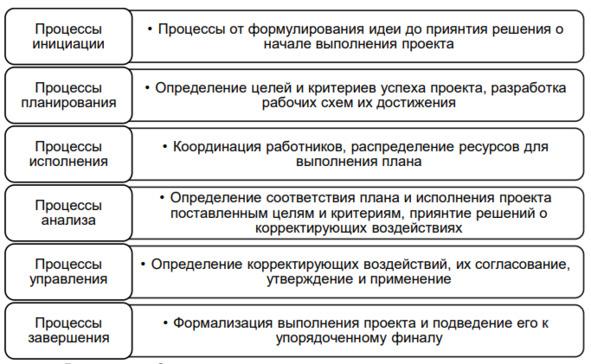
Within the second stage, all planned activities are implemented, constant monitoring and control of activities is carried out, and the results of solving all the main tasks are evaluated. In general, all the processes and stages of an innovation project can be divided into 6 groups, which are shown in Figure 1.
Figure 1-Main processes of the innovation project
Free implementation of innovations is limited by the company’s existing resources: finances, deadlines, personnel, and technical equipment. When implementing a project, the company also faces various types of risks that prevent it from achieving the planned results.
Risks in innovative projects. The general concept of risk is uncertainty that can cause losses. This is a hard-to-predict probability of problems occurring. Risks can be internal or external, acceptable or critical, as well as technical, political, environmental or commercial. [2,c.240]
Their appearance is influenced by the human factor, global changes in the world, or market mechanisms. The complete classificationof risks is shown in the diagram (Fig. 2).
Figure 2-Classification of business risks
In innovation, a special role is played by mixed risks directly related to the novelty of the project — it is difficult to predict in advance how successfully it will be implemented. For example, the risk that new products or services are not required as a result of innovation is important. It occurs due to the uncertainty of the external environment and the capabilities of the organization.
External risk factors for non-demand for products during the implementation of the innovationproject::
— political reasons, including sanctions restrictions;
— regulatory changes, such as the entry into force of new laws;
— demographic factors — falling birth rate, rising life expectancy, population migration;
— socio-economic — changes in the solvency of consumers and demand;
— financial — changes in the key rate and rates on business loans, inflation, currency fluctuations;
— environmental or climatic factors, for example, the impact on the environment, stricter environmental regulations, man-made accidents, natural disasters;
— market-the appearance of competitors or similar products. These reasons cannot be influenced by the organization. They must be taken into account and predicted. The activity of the company itself also affects the risk of non-demand for products and these factors canbe adjusted.
These internal reasons are:
— incorrect organization of business processes, violations in the production scheme;
— low qualification of personnel, which affects the quality of products and production efficiency;
— lack of own funds, irrational use of resources, failures in supplies and supplies;
— mistakes in sales policy and incorrectmarketing decisions;
— problems in managing the team and lack of leadership qualities in the management;
— lack of state support and underdeveloped innovation infrastructure
— lack of banking, legal, intermediary services and services.
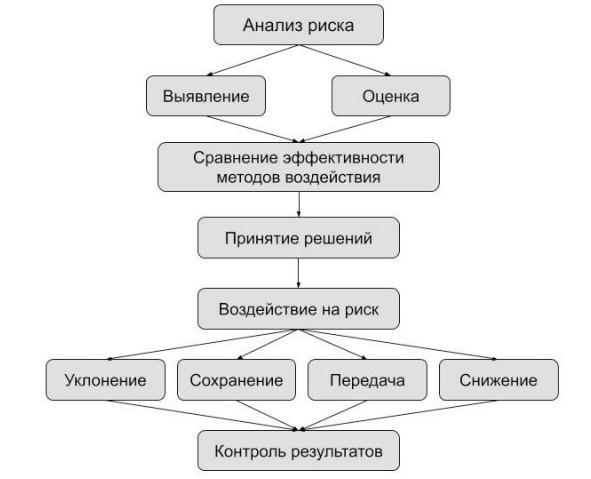
If any of the risks arise, you need to make a decision and adjust your actions so that the project does not fail. Risk management. The process of identifying, evaluating, minimizing, and controlling risks is called risk management.
FigureK 3-Risk management scheme
Ways to protect yourself from risks that are available when implementing innovative projects:
— avoiding, evading, avoiding solving the problem, ignoring the risk;
— maintaining and accepting the risk and its consequences;
— transfer of risk, for example, to insurance companies, venture funds or partners;
— minimizing the consequences, reducing the degree of risk impact on the project, reducing possible losses and reducing the likelihood of impact.
One of the most effective protection options is a management solution based on information analysis and the use of big data.
Today, it is easier to make a complete analysis of the market, the preferences of potential customers and the offers of competitors, using modern technologies. Data analysis should be actively used to manage project risks.
Another way to protect the project from risks is to limit the amount of investment, respectively, and possible losses. So, you can limit the cost of a project and not go beyond a pre-defined budget. Diversification of project activities will also allow the company to reduce the risk of losses in the implementation of individual projects. This will work if you run several projects in different industries and directions in parallel.
You can transfer risks not only to third-party organizations, for example, in insurance, but also take care of yourself by creating an internal insurance fund, a kind of reserve of funds to cover unexpected losses, or by using hedging — entering into counter-transactions to cover project risks with other requirementsand obligations.
In general, risk management in innovative projects is at the heart of all decisions — financial, industrial, and technical. There is always the possibility of events that can affect the project. The company must be prepared for this in order to reduce the impact of external and internal factors on the final results of its activities.
УManaging an innovative project is a complex process consisting of many stages. It is important to note that in innovation activities, the qualityof implementation and each stage directly affects the final results of the activity. To date, quite a large number of project management methodologies and standards have been developed.
Strategic management of innovative projects includes situational analysis, forecasting the impact of a range of entrepreneurial and industrial success factors, the main ones being the management system and its organizational forms, the potential of the development and research sphere, and the culture and ethics of entrepreneurshipринимательства. [3,c.200]
In the field of innovative technologies, project life cycles are the main innovation processes, the strategic management of which is divided into a number of areas, such as: the system of ensuring innovative projects; the life cycle of innovative projects; the system of strategic planning of innovative projects.
Strategic management of the project support system is focused on increasing the efficiency of investments; the quality of labor resources participating in project activities; transparency of expenses and compliance of costs with the result obtained; accounting for the impact of business risks on the tasks and goals of implemented projects.
In the system of strategic planning of innovations, the following targets of the project generation process are identified:
— ensure the achievement of project goals;
— achieve compliance of the information system with the requirements of contracts, regulations, and legislation;
— determine the order of business needs.
— respond appropriately to organizational and business requirements that are consistent with the adopted strategy.
Any methodology is a set of rules, recommendations, and tips on how to most effectively build all project management processes. Not all methodologies will be effective in implementing an innovation project, but it is recommended to use them as a specific reference point. Thus, the most popular and widely used methodology is the PMI Code of Project Management PMBOK (Project Management Institute ProjectManagement Body Of Knowledge). This set of rules is periodically reviewed and updated, the last seventh version was published in 2021, and it reviews the project through tencore areas of expertise.
Each of these sections contains recommendations for managing processes. The innovation sphere is characterized by a high degree of risk and uncertainty, so it is important to avoid forming even minor deviations. To do this, it is customary to monitor the main stages of activity. That is, at each stage, planned indicators are compared with actual ones, but in an innovativeом projectе it is important to act more quickly. That is why, among other recommendations, the need for daily monitoring of activities is particularly highlighted.
Ubiquitous monitoring of all internal processes allows you to identify deviations in real time and quickly eliminate them. This approach will allow you to implement any innovative project with high efficiency, as a result of which all strategic goals will be achieved. The controlling system has a number of advantages for implementing projects, including in the field of innovation.