автордың кітабын онлайн тегін оқу Modern Painters, Volume 5 (of 5)
Library Edition
THE COMPLETE WORKS
OF
JOHN RUSKIN
MODERN PAINTERS
VolumeIV—
OF MOUNTAIN BEAUTY
VolumeV
OF LEAF BEAUTY
OF CLOUD BEAUTY
OF IDEAS OF RELATION
NATIONAL LIBRARY ASSOCIATION
NEW YORK CHICAGO
MODERN PAINTERS.
VOLUME V.,
COMPLETING THE WORK AND CONTAINING
PARTS
VI. OF LEAF BEAUTY.—VII. OF CLOUD BEAUTY.
VIII. OF IDEAS OF RELATION.
1. OF INVENTION FORMAL.
IX. OF IDEAS OF RELATION.
2. OF INVENTION SPIRITUAL.
PREFACE.
The disproportion, between the length of time occupied in the preparation of this volume, and the slightness of apparent result, is so vexatious to me, and must seem so strange to the reader, that he will perhaps bear with my stating some of the matters which have employed or interrupted me between 1855 and 1860. I needed rest after finishing the fourth volume, and did little in the following summer. The winter of 1856 was spent in writing the “Elements of Drawing,” for which I thought there was immediate need; and in examining with more attention than they deserved some of the modern theories of political economy, to which there was necessarily reference in my addresses at Manchester. The Manchester Exhibition then gave me some work, chiefly in its magnificent Reynolds’ constellation; and thence I went on into Scotland, to look at Dumblane and Jedburgh, and some other favorite sites of Turner’s; which I had not all seen, when I received notice from Mr. Wornum that he had obtained for me permission, from the Trustees of the National Gallery, to arrange, as I thought best, the Turner drawings belonging to the nation; on which I returned to London immediately.
In seven tin boxes in the lower room of the National Gallery I found upwards of nineteen thousand pieces of paper, drawn upon by Turner in one way or another. Many on both sides; some with four, five, or six subjects on each side (the pencil point digging spiritedly through from the foregrounds of the front into the tender pieces of sky on the back); some in chalk, which the touch of the finger would sweep away;1 others in ink, rotted into holes; others (some splendid colored drawings among them) long eaten away by damp and mildew, and falling into dust at the edges, in capes and bays of fragile decay; others worm-eaten, some mouse-eaten, many torn half-way through; numbers doubled (quadrupled, I should say) up into four, being Turner’s favorite mode of packing for travelling; nearly all rudely flattened out from the bundles in which Turner had finally rolled them up and squeezed them into his drawers in Queen Anne Street. Dust of thirty years’ accumulation, black, dense, and sooty, lay in the rents of the crushed and crumpled edges of these flattened bundles, looking like a jagged black frame, and producing altogether unexpected effects in brilliant portions of skies, whence an accidental or experimental finger mark of the first bundle-unfolder had swept it away.
About half, or rather more, of the entire number consisted of pencil sketches, in flat oblong pocket-books, dropping to pieces at the back, tearing laterally whenever opened, and every drawing rubbing itself into the one opposite. These first I paged with my own hand; then unbound; and laid every leaf separately in a clean sheet of perfectly smooth writing paper, so that it might receive no farther injury. Then, enclosing the contents and boards of each book (usually ninety-two leaves, more or less drawn on both sides, with two sketches on the boards at the beginning and end) in a separate sealed packet, I returned it to its tin box. The loose sketches needed more trouble. The dust had first to be got off them (from the chalk ones it could only be blown off); then they had to be variously flattened; the torn ones to be laid down, the loveliest guarded, so as to prevent all future friction; and four hundred of the most characteristic framed and glazed, and cabinets constructed for them which would admit of their free use by the public. With two assistants, I was at work all the autumn and winter of 1857, every day, all day long, and often far into the night.
The manual labor would not have hurt me; but the excitement involved in seeing unfolded the whole career of Turner’s mind during his life, joined with much sorrow at the state in which nearly all his most precious work had been left, and with great anxiety, and heavy sense of responsibility besides, were very trying; and I have never in my life felt so much exhausted as when I locked the last box, and gave the keys to Mr. Wornum, in May, 1858. Among the later colored sketches, there was one magnificent series, which appeared to be of some towns along the course of the Rhine on the north of Switzerland. Knowing that these towns were peculiarly liable to be injured by modern railroad works, I thought I might rest myself by hunting down these Turner subjects, and sketching what I could of them, in order to illustrate his compositions.
As I expected, the subjects in question were all on, or near, that east and west reach of the Rhine between Constance and Basle. Most of them are of Rheinfelden, Seckingen, Lauffenbourg, Schaffhausen, and the Swiss Baden.
Having made what notes were possible to me of these subjects in the summer (one or two are used in this volume), I was crossing Lombardy in order to examine some points of the shepherd character in the Vaudois valleys, thinking to get my book finished next spring; when I unexpectedly found some good Paul Veroneses at Turin. There were several questions respecting the real motives of Venetian work that still troubled me not a little, and which I had intended to work out in the Louvre; but seeing that Turin was a good place wherein to keep out of people’s way, I settled there instead, and began with Veronese’s Queen of Sheba;—when, with much consternation, but more delight, I found that I had never got to the roots of the moral power of the Venetians, and that they needed still another and a very stern course of study. There was nothing for it but to give up the book for that year. The winter was spent mainly in trying to get at the mind of Titian; not a light winter’s task; of which the issue, being in many ways very unexpected to me (the reader will find it partly told towards the close of this volume), necessitated my going in the spring to Berlin, to see Titian’s portrait of Lavinia there, and to Dresden to see the Tribute Money, the elder Lavinia, and girl in white, with the flag fan. Another portrait, at Dresden, of a lady in a dress of rose and gold, by me unheard of before, and one of an admiral, at Munich, had like to have kept me in Germany all summer.
Getting home at last, and having put myself to arrange materials of which it was not easy, after so much interruption, to recover the command;—which also were now not reducible to a single volume—two questions occurred in the outset, one in the section on vegetation, respecting the origin of wood; the other in the section on sea, respecting curves of waves; to neither of which, from botanist or mathematicians, any sufficient answer seemed obtainable.
In other respects also the section on the sea was wholly unsatisfactory to me: I knew little of ships, nothing of blue open water. Turner’s pathetic interest in the sea, and his inexhaustible knowledge of shipping, deserved more complete and accurate illustration than was at all possible to me; and the mathematical difficulty lay at the beginning of all demonstration of facts. I determined to do this piece of work well, or not at all, and threw the proposed section out of this volume. If I ever am able to do what I want with it (and this is barely probable), it will be a separate book; which, on other accounts, I do not regret, since many persons might be interested in studies of the shipping of the old Nelson times, and of the sea-waves and sailor character of all times, who would not care to encumber themselves with five volumes of a work on Art.
The vegetation question had, however, at all cost, to be made out as best might be; and again lost me much time. Many of the results of this inquiry, also, can only be given, if ever, in a detached form.
During these various discouragements, the preparation of the Plates could not go on prosperously. Drawing is difficult enough, undertaken in quietness: it is impossible to bring it to any point of fine rightness with half-applied energy.
Many experiments were made in hope of expressing Turner’s peculiar execution and touch by facsimile. They cost time, and strength, and, for the present, have failed; many elaborate drawings, made during the winter of 1858, having been at last thrown aside. Some good may afterwards come of these; but certainly not by reduction to the size of the page of this book, for which, even of smaller subjects, I have not prepared the most interesting, for I do not wish the possession of any effective and valuable engravings from Turner to be contingent on the purchasing a book of mine.2
Feebly and faultfully, therefore, yet as well as I can do it under these discouragements, the book is at last done; respecting the general course of which, it will be kind and well if the reader will note these few points that follow.
The first volume was the expansion of a reply to a magazine article; and was not begun because I then thought myself qualified to write a systematic treatise on Art; but because I at least knew, and knew it to be demonstrable, that Turner was right and true, and that his critics were wrong, false, and base. At that time I had seen much of nature, and had been several times in Italy, wintering once in Rome; but had chiefly delighted in northern art, beginning, when a mere boy, with Rubens and Rembrandt. It was long before I got quit of a boy’s veneration for Rubens’ physical art-power; and the reader will, perhaps, on this ground forgive the strong expressions of admiration for Rubens, which, to my great regret, occur in the first volume.
Finding myself, however, engaged seriously in the essay, I went, before writing the second volume, to study in Italy; where the strong reaction from the influence of Rubens threw me at first too far under that of Angelico and Raphael, and, which was the worst harm that came of that Rubens influence, blinded me long to the deepest qualities of Venetian art; which, the reader may see by expressions occurring not only in the second, but even in the third and fourth volumes, I thought, however powerful, yet partly luxurious and sensual, until I was led into the final inquiries above related.
These oscillations of temper, and progressions of discovery, extending over a period of seventeen years, ought not to diminish the reader’s confidence in the book. Let him be assured of this, that unless important changes are occurring in his opinions continually, all his life long, not one of those opinions can be on any questionable subject true. All true opinions are living, and show their life by being capable of nourishment; therefore of change. But their change is that of a tree—not of a cloud.
In the main aim and principle of the book, there is no variation, from its first syllable to its last. It declares the perfectness and eternal beauty of the work of God; and tests all work of man by concurrence with, or subjection to that. And it differs from most books, and has a chance of being in some respects better for the difference, in that it has not been written either for fame, or for money, or for conscience-sake, but of necessity.
It has not been written for praise. Had I wished to gain present reputation, by a little flattery adroitly used in some places, a sharp word or two withheld in others, and the substitution of verbiage generally for investigation, I could have made the circulation of these volumes tenfold what it has been in modern society. Had I wished for future fame, I should have written one volume, not five. Also, it has not been written for money. In this wealth-producing country, seventeen years’ labor could hardly have been invested with less chance of equivalent return.
Also, it has not been written for conscience-sake. I had no definite hope in writing it; still less any sense of its being required of me as a duty. It seems to me, and seemed always, probable, that I might have done much more good in some other way. But it has been written of necessity. I saw an injustice done, and tried to remedy it. I heard falsehood taught, and was compelled to deny it. Nothing else was possible to me. I knew not how little or how much might come of the business, or whether I was fit for it; but here was the lie full set in front of me, and there was no way round it, but only over it. So that, as the work changed like a tree, it was also rooted like a tree—not where it would, but where need was; on which, if any fruit grow such as you can like, you are welcome to gather it without thanks; and so far as it is poor or bitter, it will be your justice to refuse it without reviling.
1 The best book of studies for his great shipwrecks contained about a quarter of a pound of chalk débris, black and white, broken off the crayons with which Turner had drawn furiously on both sides of the leaves; every leaf, with peculiar foresight and consideration of difficulties to be met by future mounters, containing half of one subject on the front of it, and half of another on the back.
2 To Mr. Armytage, Mr. Cuff, and Mr. Cousen, I have to express my sincere thanks for the patience, and my sincere admiration of the skill, with which they have helped me. Their patience, especially, has been put to severe trial by the rewardless toil required to produce facsimiles of drawings in which the slightness of subject could never attract any due notice to the excellence of workmanship.
Aid, just as disinterested, and deserving of as earnest acknowledgment, has been given me by Miss Byfield, in her faultless facsimiles of my careless sketches; by Miss O. Hill, who prepared the copies which I required from portions of the pictures of the old masters; and by Mr. Robin Allen, in accurate line studies from nature, of which, though only one is engraved in this volume, many others have been most serviceable, both to it and to me.

TABLE OF CONTENTS.
—————
PART VI.
ON LEAF BEAUTY.
—————
PAGE
Prefacev
ChapterI.
—The Earth-Veil
1”
II.
—The Leaf Orders
6”
III.
—The Bud
10”
IV.
—The Leaf
21”
V.
—Leaf Aspects
34”
VI.
—The Branch
39”
VII.
—The Stem
49”
VIII.
—The Leaf Monuments
63”
IX.
—The Leaf Shadows
77”
X.
—Leaves Motionless
88—————
PART VII.
OF CLOUD BEAUTY.
—————
ChapterI.
—The Cloud Balancings
101”
II.
—The Cloud-Flocks
108”
III.
—The Cloud-Chariots
122”
IV.
—The Angel of the Sea
133—————
PART VIII.
OF IDEAS OF RELATION:—I. OF INVENTION FORMAL.
—————
ChapterI.
—The Law of Help
153”
II.
—The Task of the Least
164”
III.
—The Rule of the Greatest
175”
IV.
—The Law of Perfectness
180—————
PART IX.
OF IDEAS OF RELATION:—II. OF INVENTION SPIRITUAL.
—————
ChapterI.
—The Dark Mirror
193”
II.
—The Lance of Pallas
202”
III.
—The Wings of the Lion
214”
IV.
—Durer and Salvator
230”
V.
—Claude and Poussin
241”
VI.
—Rubens and Cuyp
249”
VII.
—Of Vulgarity
261”
VIII.
—Wouvermans and Angelico
277”
IX.
—The Two Boyhoods
286”
X.
—The Nereid’s Guard
298”
XI.
—The Hesperid Æglé
314”
XII.
—Peace
339—————
Local Index.
Index to Painters and Pictures.
Topical Index.
LIST OF PLATES TO VOL. V.
—————
Drawn by
Engraved by
Frontispiece, Ancilla Domini
Fra Angelico
Wm. HallPlate
Facing page
51. The Dryad’s Toil
J. Ruskin
J. C. Armytage 1252. Spirals of Thorn
R. Allen
R. P. Cuff 2653. The Dryad’s Crown
J. Ruskin
J. C. Armytage 3654. Dutch Leafage
Cuyp and Hobbima
J. Cousen 3755. By the Way-side
J. M. W. Turner
J. C. Armytage 3856. Sketch by a Clerk of the Works
J. Ruskin
J. Emslie 6157. Leafage by Durer and Veronese
Durer and Veronese
R. P. Cuff 6558. Branch Curvature
R. Allen
R. P. Cuff 6959. The Dryad’s Waywardness
J. Ruskin
R. P. Cuff 7160. The Rending of Leaves
J. Ruskin
J. Cousen 9461. Richmond, from the Moors
J. M. W. Turner
J. C. Armytage 9862. By the Brookside
J. M. W. Turner
J. C. Armytage 9863. The Cloud Flocks
J. Ruskin
J. C. Armytage 10964. Cloud Perspective (Rectilinear)
J. Ruskin
J. Emslie 11565. Cloud Perspective (Curvilinear)
J. Ruskin
J. Emslie 11666. Light in the West, Beauvais
J. Ruskin
J. C. Armytage 12167. Clouds
J. M. W. Turner
J. C. Armytage 11868. Monte Rosa
J. Ruskin
J. C. Armytage 33969. Aiguilles and their Friends
J. Ruskin
J. C. Armytage 12570. The Graiæ
J. Ruskin
J. C. Armytage 12771. “Venga Medusa”
J. Ruskin
J. C. Armytage 12772. The Locks of Typhon
J. M. W. Turner
J. C. Armytage 14273. Loire Side
J. M. W. Turner
J. Ruskin 16574. The Mill Stream
J. M. W. Turner
J. Ruskin 16875. The Castle of Lauffen
J. M. W. Turner
R. P. Cuff 16976. The Moat of Nuremberg
J. Ruskin
J. H. Le Keux 23378. Quivi Trovammo
J. M. W. Turner
J. Ruskin 29879. Hesperid Æglé
Giorgione
Wm. Hall 31480. Rocks at Rest
J. Ruskin, from J. M. W. Turner
J. C. Armytage 31981. Rocks in Unrest
J. Ruskin, from J. M. W. Turner
J. C. Armytage 32082. The Nets in the Rapids
J. M. W. Turner
J. H. Le Keux 33683. The Bridge of Rheinfelden
J. Ruskin
J. H. Le Keux 33784. Peace
J. Ruskin
J. H. Le Keux 338SEPARATE ENGRAVINGS ON WOOD.
Figure
56,
to face page
65”
61,
”
69”
75 to 78,
”
97”
85,
”
118”
87,
”
127”
88 to 90,
”
128”
98,
”
184”
100,
”
284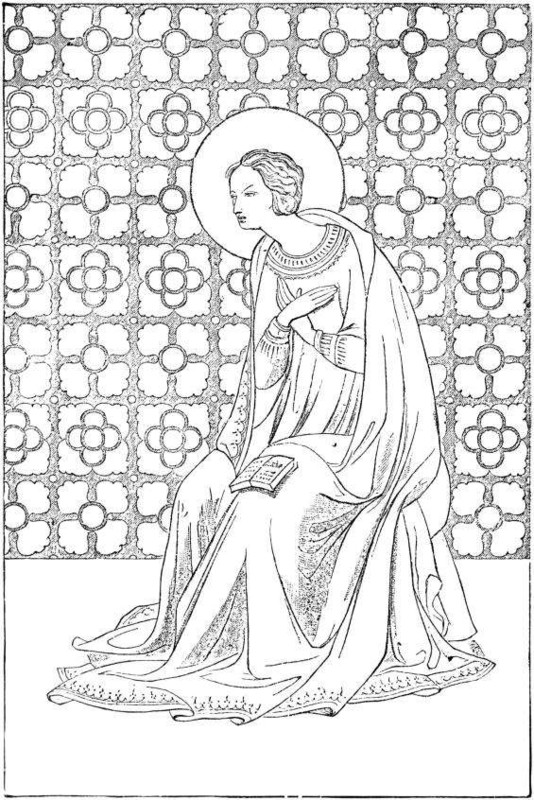
Ancilla Domini.
MODERN PAINTERS.
—————
PART VI.
OF LEAF BEAUTY.
—————
CHAPTER I.
THE EARTH-VEIL.
§ 1. “To dress it and to keep it.”
That, then, was to be our work. Alas! what work have we set ourselves upon instead! How have we ravaged the garden instead of kept it—feeding our war-horses with its flowers, and splintering its trees into spear-shafts!
“And at the East a flaming sword.”
Is its flame quenchless? and are those gates that keep the way indeed passable no more? or is it not rather that we no more desire to enter? For what can we conceive of that first Eden which we might not yet win back, if we chose? It was a place full of flowers, we say. Well: the flowers are always striving to grow wherever we suffer them; and the fairer, the closer. There may indeed have been a Fall of Flowers, as a Fall of Man; but assuredly creatures such as we are can now fancy nothing lovelier than roses and lilies, which would grow for us side by side, leaf overlapping leaf, till the Earth was white and red with them, if we cared to have it so. And Paradise was full of pleasant shades and fruitful avenues. Well: what hinders us from covering as much of the world as we like with pleasant shade and pure blossom, and goodly fruit? Who forbids its valleys to be covered over with corn, till they laugh and sing? Who prevents its dark forests, ghostly and uninhabitable, from being changed into infinite orchards, wreathing the hills with frail-floretted snow, far away to the half-lighted horizon of April, and flushing the face of all the autumnal earth with glow of clustered food? But Paradise was a place of peace, we say, and all the animals were gentle servants to us. Well: the world would yet be a place of peace if we were all peacemakers, and gentle service should we have of its creatures if we gave them gentle mastery. But so long as we make sport of slaying bird and beast, so long as we choose to contend rather with our fellows than with our faults, and make battlefield of our meadows instead of pasture—so long, truly, the Flaming Sword will still turn every way, and the gates of Eden remain barred close enough, till we have sheathed the sharper flame of our own passions, and broken down the closer gates of our own hearts.
§ 2. I have been led to see and feel this more and more, as I considered the service which the flowers and trees, which man was at first appointed to keep, were intended to render to him in return for his care; and the services they still render to him, as far as he allows their influence, or fulfils his own task towards them. For what infinite wonderfulness there is in this vegetation, considered, as indeed it is, as the means by which the earth becomes the companion of man—his friend and his teacher! In the conditions which we have traced in its rocks, there could only be seen preparation for his existence;—the characters which enable him to live on it safely, and to work with it easily—in all these it has been inanimate and passive; but vegetation is to it as an imperfect soul, given to meet the soul of man. The earth in its depths must remain dead and cold, incapable except of slow crystalline change; but at its surface, which human beings look upon and deal with, it ministers to them through a veil of strange intermediate being; which breathes, but has no voice; moves, but cannot leave its appointed place; passes through life without consciousness, to death without bitterness; wears the beauty of youth, without its passion; and declines to the weakness of age, without its regret.
§ 3. And in this mystery of intermediate being, entirely subordinate to us, with which we can deal as we choose, having just the greater power as we have the less responsibility for our treatment of the unsuffering creature, most of the pleasures which we need from the external world are gathered, and most of the lessons we need are written, all kinds of precious grace and teaching being united in this link between the Earth and Man: wonderful in universal adaptation to his need, desire, and discipline; God’s daily preparation of the earth for him, with beautiful means of life. First a carpet to make it soft for him; then, a colored fantasy of embroidery thereon; then, tall spreading of foliage to shade him from sunheat, and shade also the fallen rain, that it may not dry quickly back into the clouds, but stay to nourish the springs among the moss. Stout wood to bear this leafage: easily to be cut, yet tough and light, to make houses for him, or instruments (lance-shaft, or plough-handle, according to his temper); useless it had been, if harder; useless, if less fibrous; useless, if less elastic. Winter comes, and the shade of leafage falls away, to let the sun warm the earth; the strong boughs remain, breaking the strength of winter winds. The seeds which are to prolong the race, innumerable according to the need, are made beautiful and palatable, varied into infinitude of appeal to the fancy of man, or provision for his service: cold juice, or glowing spice, or balm, or incense, softening oil, preserving resin, medicine of styptic, febrifuge, or lulling charm: and all these presented in forms of endless change. Fragility or force, softness and strength, in all degrees and aspects; unerring uprightness, as of temple pillars, or undivided wandering of feeble tendrils on the ground; mighty resistances of rigid arm and limb to the storms of ages, or wavings to and fro with faintest pulse of summer streamlet. Roots cleaving the strength of rock, or binding the transience of the sand; crests basking in sunshine of the desert, or hiding by dripping spring and lightless cave; foliage far tossing in entangled fields beneath every wave of ocean—clothing with variegated, everlasting films, the peaks of the trackless mountains, or ministering at cottage doors to every gentlest passion and simplest joy of humanity.
§ 4. Being thus prepared for us in all ways, and made beautiful, and good for food, and for building, and for instruments of our hands, this race of plants, deserving boundless affection and admiration from us, become, in proportion to their obtaining it, a nearly perfect test of our being in right temper of mind and way of life; so that no one can be far wrong in either who loves the trees enough, and every one is assuredly wrong in both, who does not love them, if his life has brought them in his way. It is clearly possible to do without them, for the great companionship of the sea and sky are all that sailors need; and many a noble heart has been taught the best it had to learn between dark stone walls. Still if human life be cast among trees at all, the love borne to them is a sure test of its purity. And it is a sorrowful proof of the mistaken ways of the world that the “country,” in the simple sense of a place of fields and trees, has hitherto been the source of reproach to its inhabitants, and that the words “countryman,” “rustic,” “clown,” “paysan,” “villager,” still signify a rude and untaught person, as opposed to the words “townsman,” and “citizen.” We accept this usage of words, or the evil which it signifies, somewhat too quietly; as if it were quite necessary and natural that country-people should be rude, and towns-people gentle. Whereas I believe that the result of each mode of life may, in some stages of the world’s progress, be the exact reverse; and that another use of words may be forced upon us by a new aspect of facts, so that we may find ourselves saying: “Such and such a person is very gentle and kind—he is quite rustic; and such and such another person is very rude and ill-taught—he is quite urbane.”
§ 5. At all events, cities have hitherto gained the better part of their good report through our evil ways of going on in the world generally;—chiefly and eminently through our bad habit of fighting with each other. No field, in the middle ages, being safe from devastation, and every country lane yielding easier passage to the marauders, peacefully-minded men necessarily congregated in cities, and walled themselves in, making as few cross-country roads as possible: while the men who sowed and reaped the harvests of Europe were only the servants or slaves of the barons. The disdain of all agricultural pursuits by the nobility, and of all plain facts by the monks, kept educated Europe in a state of mind over which natural phenomena could have no power; body and intellect being lost in the practice of war without purpose, and the meditation of words without meaning. Men learned the dexterity with sword and syllogism, which they mistook for education, within cloister and tilt-yard; and looked on all the broad space of the world of God mainly as a place for exercise of horses, or for growth of food.
§ 6. There is a beautiful type of this neglect of the perfectness of the Earth’s beauty, by reason of the passions of men, in that picture of Paul Uccello’s of the battle of Sant’ Egidio,1 in which the armies meet on a country road beside a hedge of wild roses; the tender red flowers tossing above the helmets, and glowing between the lowered lances. For in like manner the whole of Nature only shone hitherto for man between the tossing of helmet-crests; and sometimes I cannot but think of the trees of the earth as capable of a kind of sorrow, in that imperfect life of theirs, as they opened their innocent leaves in the warm spring-time, in vain for men; and all along the dells of England her beeches cast their dappled shade only where the outlaw drew his bow, and the king rode his careless chase; and by the sweet French rivers their long ranks of poplar waved in the twilight, only to show the flames of burning cities, on the horizon, through the tracery of their stems: amidst the fair defiles of the Apennines, the twisted olive-trunks hid the ambushes of treachery; and on their valley meadows, day by day, the lilies which were white at the dawn were washed with crimson at sunset.
§ 7. And indeed I had once purposed, in this work, to show what kind of evidence existed respecting the possible influence of country life on men; it seeming to me, then, likely that here and there a reader would perceive this to be a grave question, more than most which we contend about, political or social, and might care to follow it out with me earnestly.
The day will assuredly come when men will see that it is a grave question; at which period, also, I doubt not, there will arise persons able to investigate it. For the present, the movements of the world seem little likely to be influenced by botanical law; or by any other considerations respecting trees, than the probable price of timber. I shall limit myself, therefore, to my own simple woodman’s work, and try to hew this book into its final shape, with the limited and humble aim that I had in beginning it, namely, to prove how far the idle and peaceable persons, who have hitherto cared about leaves and clouds, have rightly seen, or faithfully reported of them.
1 The best book of studies for his great shipwrecks contained about a quarter of a pound of chalk débris, black and white, broken off the crayons with which Turner had drawn furiously on both sides of the leaves; every leaf, with peculiar foresight and consideration of difficulties to be met by future mounters, containing half of one subject on the front of it, and half of another on the back.
2 To Mr. Armytage, Mr. Cuff, and Mr. Cousen, I have to express my sincere thanks for the patience, and my sincere admiration of the skill, with which they have helped me. Their patience, especially, has been put to severe trial by the rewardless toil required to produce facsimiles of drawings in which the slightness of subject could never attract any due notice to the excellence of workmanship.
In strong-leaved shrubs or trees it is shown with great distinctness and beauty: the phillyrea shoot, for instance, Fig. 24, is almost in as true symmetry as a Greek honeysuckle ornament. In the hawthorn shoot, central in Plate 52, opposite, the law is seen very slightly, yet it rules all the play and fantasy of the varied leaves, gradually depressing their lines as they are set lower. In crowded foliage of large trees the disposition of each separate leaf is not so manifest. For there is a strange coincidence in this between trees and communities of men. When the community is small, people fall more easily into their places, and take, each in his place, a firmer standing than can be obtained by the individuals of a great nation. The members of a vast community are separately weaker, as an aspen or elm leaf is thin, tremulous, and directionless, compared with the spear-like setting and firm substance of a rhododendron or laurel leaf. The laurel and rhododendron are like the Athenian or Florentine republics; the aspen like England—strong-trunked enough when put to proof, and very good for making cartwheels of, but shaking pale with epidemic panic at every breeze. Nevertheless, the aspen has the better of the great nation, in that if you take it bough by bough, you shall find the gentle law of respect and room for each other truly observed by the leaves in such broken way as they can manage it; but in the nation you find every one scrambling for his neighbor’s place.
§ 5. The greatest draughtsmen draw leaves, like everything else, of their full-life size in the nearest part of the picture. They cannot be rightly drawn on any other terms. It is impossible to reduce a group so treated without losing much of its character; and more painfully impossible to represent by engraving any good workman’s handling. I intended to have inserted in this place an engraving of the cluster of oak-leaves above Correggio’s Antiope in the Louvre, but it is too lovely; and if I am able to engrave it at all, it must be separately, and of its own size. So I draw, roughly, instead, a group of oak-leaves on a young shoot, a little curled with autumn frost: Plate 53. I could not draw them accurately enough if I drew them in spring. They would droop and lose their relations. Thus roughly drawn, and losing some of their grace, by withering, they, nevertheless, have enough left to show how noble leaf-form is; and to prove, it seems to me, that Dutch draughtsmen do not wholly express it. For instance, Fig. 3, Plate 54, is a facsimile of a bit of the nearest oak foliage out of Hobbima’s Scene with the Water-mill, No. 131, in the Dulwich Gallery. Compared with the real forms of oak-leaf, in Plate 53, it may, I hope, at least enable my readers to understand, if they choose, why, never having ceased to rate the Dutch painters for their meanness or minuteness, I yet accepted the leaf-painting of the pre-Raphaelites with reverence and hope.
§ 8. Hence what I said in our first inquiry about foliage, “A single dusty roll of Turner’s brush is more truly expressive of the infinitude of foliage than the niggling of Hobbima could have rendered his canvas, if he had worked on it till doomsday.” And this brings me to the main difficulty I have had in preparing this section. That infinitude of Turner’s execution attaches not only to his distant work, but in due degree to the nearest pieces of his trees. As I have shown in the chapter on mystery, he perfected the system of art, as applicable to landscape, by the introduction of this infiniteness. In other qualities he is often only equal, in some inferior, to great preceding painters; but in this mystery he stands alone. He could not paint a cluster of leaves better than Titian; but he could a bough, much more a distant mass of foliage. No man ever before painted a distant tree rightly, or a full-leaved branch rightly. All Titian’s distant branches are ponderous flakes, as if covered with seaweed, while Veronese’s and Raphael’s are conventional, being exquisitely ornamental arrangements of small perfect leaves. See the background of the Parnassus in Volpato’s plate. It is very lovely, however.
§ 17. Let X, Fig. 54, represent a shoot of any opposite-leaved tree. The mode in which it will grow into a tree depends, mainly, on its disposition to lose the leader or a lateral shoot. If it keeps the leader, but drops the lateral, it takes the form A, and next year by a repetition of the process, B. But if it keeps the laterals, and drops the leader, it becomes first, C and next year, D. The form A is almost universal in spiral or alternate trees; and it is especially to be noted as bringing about this result, that in any given forking, one bough always goes on in its own direct course, and the other leaves it softly; they do not separate as if one was repelled from the other. Thus in Fig. 55, a perfect and nearly symmetrical piece of ramification, by Turner (lowest bough but one in the tree on the left in the “Château of La belle Gabrielle”), the leading bough, going on in its own curve, throws off, first, a bough to the right, then one to the left, then two small ones to the right, and proceeds itself, hidden by leaves, to form the farthest upper point of the branch.
§ 5. I am not sure how far, by any illustration, I can exemplify these subtle conditions of form. All my plans have been shortened, and I have learned to content myself with yet more contracted issues of them after the shortening, because I know that nearly all in such matters must be said or shown, unavailably. No saying will teach the truth. Nothing but doing. If the reader will draw boughs of trees long and faithfully, giving previous pains to gain the power (how rare!) of drawing anything faithfully, he will come to see what Turner’s work is, or any other right work, but not by reading, nor thinking, nor idly looking. However, in some degree, even our ordinary instinctive perception of grace and balance may serve us, if we choose to pay any accurate attention to the matter.
§ 10. To show how the principle of balance is carried out by Nature herself, here is a little terminal upright spray of willow, the most graceful of English trees (Fig. 59). I have drawn it carefully; and if the reader will study its curves, or, better, trace and pencil them with a perfectly fine point, he will feel, I think, without difficulty, their finished relation to the leaves they sustain. Then if we turn suddenly to a piece of Dutch branch-drawing (Fig. 60), facsimiled from No. 160, Dulwich Gallery (Berghem), he will understand, I believe, also the qualities of that, without comment of mine. It is of course not so dark in the original, being drawn with the chance dashes of a brush loaded with brown, but the contours are absolutely as in the woodcut. This Dutch design is a very characteristic example of two faults in tree-drawing; namely, the loss not only of grace and spring, but of woodiness. A branch is not elastic as steel is, neither as a carter’s whip is. It is a combination, wholly peculiar, of elasticity with half-dead and sapless stubbornness, and of continuous curve with pauses of knottiness, every bough having its blunted, affronted, fatigued, or repentant moments of existence, and mingling crabbed rugosities and fretful changes of mind with the main tendencies of its growth. The piece of pollard willow opposite (Fig. 61), facsimiled from Turner’s etching of “Young Anglers,” in the Liber Studiorum, has all these characters in perfectness, and may serve for sufficient study of them. It is impossible to explain in what the expression of the woody strength consists, unless it be felt. One very obvious condition is the excessive fineness of curvature, approximating continually to a straight line. In order to get a piece of branch curvature given as accurately as I could by an unprejudiced person, I set one of my pupils at the Working Men’s College (a joiner by trade) to draw, last spring, a lilac branch of its real size, as it grew, before it budded. It was about six feet long, and before he could get it quite right, the buds came out and interrupted him; but the fragment he got drawn is engraved in flat profile, in Plate 58. It has suffered much by reduction, one or two of its finest curves having become lost in the mere thickness of the lines. Nevertheless, if the reader will compare it carefully with the Dutch work, it will teach him something about trees.
§ 12. Again: As it seldom struck the old painters that boughs must cross each other, so it never seems to have occurred to them that they must be sometimes foreshortened. I chose this bit from “Aske Hall,” that you might see at once, both how Turner foreshortens the main stem, and how, in doing so, he shows the turning aside, and outwards, of the one next to it, to the left, to get more air.6 Indeed, this foreshortening lies at the core of the business; for unless it be well understood, no branch-form can ever be rightly drawn. I placed the oak spray in Plate 51 so as to be seen as nearly straight on its flank as possible. It is the most uninteresting position in which a bough can be drawn; but it shows the first simple action of the law of resilience. I will now turn the bough with its extremity towards us, and foreshorten it (Plate 59), which being done, you perceive another tendency in the whole branch, not seen at all in the first Plate, to throw its sprays to its own right (or to your left), which it does to avoid the branch next it, while the forward action is in a sweeping curve round to your right, or to the branch’s left: a curve which it takes to recover position after its first concession. The lines of the nearer and smaller shoots are very nearly—thus foreshortened—those of a boat’s bow. Here is a piece of Dutch foreshortening for you to compare with it, Fig. 64.7
§ 12. One class, however, of these torn leaves, peculiar to the tented plants, has, it seems to me, a strange expressional function. I mean the group of leaves rent into alternate gaps, typically represented by the thistle. The alternation of the rent, if not absolutely, is effectively, peculiar to the earth-plants. Leaves of the builders are rent symmetrically, so as to form radiating groups, as in the horse-chestnut, or they are irregularly sinuous, as in the oak; but the earth-plants continually present forms such as those in the opposite Plate: a kind of web-footed leaf, so to speak; a continuous tissue, enlarged alternately on each side of the stalk. Leaves of this form have necessarily a kind of limping gait, as if they grew not all at once, but first a little bit on one side, and then a little bit on the other, and wherever they occur in quantity, give the expression to foreground vegetation which we feel and call “ragged.”
§ 19. I feel sorely tempted to draw one of these same spires of the fine grasses, with its sweet changing proportions of pendent grain, but it would be a useless piece of finesse, as such form of course never enters into general foreground effect.3 I have, however, engraved, at the top of the group of woodcuts opposite (Fig. 74), a single leaf cluster of Durer’s foreground in the St. Hubert, which is interesting in several ways; as an example of modern work, no less than old; for it is a facsimile twice removed; being first drawn from the plate with the pen, by Mr. Allen, and then facsimiled on wood by Miss Byfield; and if the reader can compare it with the original, he will find it still come tolerably close in most parts (though the nearest large leaf has got spoiled), and of course some of the finest and most precious qualities of Durer’s work are lost. Still, it gives a fair idea of his perfectness of conception, every leaf being thoroughly set in perspective, and drawn with unerring decision. On each side of it (Figs. 75, 76) are two pieces from a fairly good modern etching, which I oppose to the Durer in order to show the difference between true work and that which pretends to give detail, but is without feeling or knowledge. There are a great many leaves in the piece on the left, but they are all set the same way; the draughtsman has not conceived their real positions, but draws one after another as he would deliver a tale of bricks. The grasses on the right look delicate, but are a mere series of inorganic lines. Look how Durer’s grass-blades cross each other. If you take a pen and copy a little piece of each example, you will soon feel the difference. Underneath, in the centre (Fig. 77), is a piece of grass out of Landseer’s etching of the “Ladies’ Pets,” more massive and effective than the two lateral fragments, but still loose and uncomposed. Then underneath is a piece of firm and good work again, which will stand with Durer’s; it is the outline only of a group of leaves out of Turner’s foreground in the Richmond from the Moors, of which I give a reduced etching, Plate 61, for the sake of the foreground principally, and in Plate 62, the group of leaves in question, in their light and shade, with the bridge beyond. What I have chiefly to say of them belongs to our section on composition; but this mere fragment of a Turner foreground may perhaps lead the reader to take note in his great pictures of the almost inconceivable labor with which he has sought to express the redundance and delicacy of ground leafage.
§ 11. Referring the reader to my Elements of Perspective for statements of law which would be in this place tiresome, I can only ask him to take my word for it that the three figures in Plate 64 represent limiting lines of sky perspective, as they would appear over a large space of the sky. Supposing that the breadth included was one-fourth of the horizon, the shaded portions in the central figure represent square fields of cloud,2 and those in the uppermost figure narrow triangles, with their shortest side next us, but sloping a little away from us.
§ 12. Still greater confusion in aspect is induced by the apparent change caused by perspective in the direction of the wind. If Fig. 3 be supposed to include a quarter of the horizon, the spaces, into which its straight lines divide it, represent squares of sky. The curved lines, which cross these spaces from corner to corner, are precisely parallel throughout; and, therefore, two clouds moving, one on the curved line from a to b, and the other on the other side, from c to d, would, in reality, be moving with the same wind, in parallel lines. In Plate 66, which is a sketch of an actual sunset behind Beauvais cathedral (the point of the roof of the apse, a little to the left of the centre, shows it to be a summer sunset), the white cirri in the high light are all moving eastward, away from the sun, in perfectly parallel lines, curving a little round to the south. Underneath, are two straight ranks of rainy cirri, crossing each other; one directed south-east; the other, north-west. The meeting perspective of these, in extreme distance, determines the shape of the angular light which opens above the cathedral. Underneath all, fragments of true rain-cloud are floating between us and the sun, governed by curves of their own. They are, nevertheless, connected with the straight cirri, by the dark semi-cumulus in the middle of the shade above the cathedral.
§ 19. Without, however, troubling ourselves at all about laws, or causes of color, the visible consequences of their operation are notably these—that when near us, clouds present only subdued and uncertain colors; but when far from us, and struck by the sun on their under surfaces—so that the greater part of the light they receive is reflected—they may become golden, purple, scarlet, and intense fiery white, mingled in all kinds of gradations, such as I tried to describe in the chapter on the upper clouds in the first volume, in hope of being able to return to them “when we knew what was beautiful.”
§ 14. And in these figures, which, if we look up the subject rightly, would be but the first and simplest of the series necessary to illustrate the action of the upper cirri, the reader may see, at once, how necessarily painters, untrained in observance of proportion, and ignorant of perspective, must lose in every touch the expression of buoyancy and space in sky. The absolute forms of each cloud are, indeed, not alike, as the ellipses in the engraving; but assuredly, when moving in groups of this kind, there are among them the same proportioned inequalities of relative distance, the same gradated changes from ponderous to elongated form, the same exquisite suggestions of including curve; and a common painter, dotting his clouds down at random, or in more or less equal masses, can no more paint a sky, than he could, by random dashes for its ruined arches, paint the Coliseum.
§ 5. The fact is, that the explanation given in that fourth paragraph can, in reality, account only for what may properly be termed “lee-side cloud,” slightly noticed in the continuation of the same chapter, but deserving most attentive illustration, as one of the most beautiful phenomena of the Alps. When a moist wind blows in clear weather over a cold summit, it has not time to get chilled as it approaches the rock, and therefore the air remains clear, and the sky bright on the windward side; but under the lee of the peak, there is partly a back eddy, and partly still air; and in that lull and eddy the wind gets time to be chilled by the rock, and the cloud appears as a boiling mass of white vapor, rising continually with the return current to the upper edge of the mountain, where it is caught by the straight wind, and partly torn, partly melted away in broken fragments. In Fig. 86 the dark mass represents the mountain peak, the arrow the main direction of the wind, the curved lines show the directions of such current and its concentration, and the dotted lines enclose the space in which cloud forms densely, floating away beyond and above in irregular tongues and flakes. The second figure from the top in Plate 69 represents the actual aspect of it when in full development, with a strong south wind, in a clear day, on the Aiguille Dru, the sky being perfectly blue and lovely around.
§ 10. The ordinary mountain cloud, therefore, if well defined, divides itself into two kinds: a broken condition of cumulus, grand in proportion as it is solid and quiet,—and a strange modification of drift-cloud, midway, as I said, between the helmet and the lee-side forms. The broken, quiet cumulus impressed Turner exceedingly when he first saw it on hills. He uses it, slightly exaggerating its definiteness, in all his early studies among the mountains of the Chartreuse, and very beautifully in the vignette of St. Maurice in Rogers’s Italy. There is nothing, however, to be specially observed of it, as it only differs from the cumulus of the plains, by being smaller and more broken.
Yet they never saw it fly, as we may in our own England. So far, at least, as I know the clouds of the south, they are often more terrible than ours, but the English Pegasus is swifter. On the Yorkshire and Derbyshire hills, when the rain-cloud is low and much broken, and the steady west-wind fills all space with its strength,6 the sun-gleams fly like golden vultures: they are flashes rather than shinings; the dark spaces and the dazzling race and skim along the acclivities, and dart and dip from crag to dell, swallow-like;—no Graiæ these,—gray and withered: Grey Hounds rather, following the Cerinthian stag with the golden antlers.
These banks are excavated by the peasantry, partly for houses, partly for cellars, so economizing vineyard space above; and thus a kind of continuous village runs along the river-side, composed half of caves, half of rude buildings, backed by the cliff, propped against it, therefore always leaning away from the river; mingled with overlappings of vineyard trellis from above, and little towers or summer-houses for outlook, when the grapes are ripe, or for gossip over the garden wall.
§ 8. Next to this piece of quietness, let us glance at a composition in which the motive is one of tumult: that of the Fall of Schaffhausen. It is engraved in the Keepsake. I have etched in Plate 74, at the top, the chief lines of its composition,2 in which the first great purpose is to give swing enough to the water. The line of fall is straight and monotonous in reality. Turner wants to get the great concave sweep and rush of the river well felt, in spite of the unbroken form. The column of spray, rocks, mills, and bank, all radiate like a plume, sweeping round together in grand curves to the left, where the group of figures, hurried about the ferry boat, rises like a dash of spray; they also radiating: so as to form one perfectly connected cluster, with the two gens-d’armes and the millstones; the millstones at the bottom being the root of it; the two soldiers laid right and left to sustain the branch of figures beyond, balanced just as a tree bough would be.
§ 10. This spring exists on the spot, and so does everything else in the picture; but the combinations are wholly arbitrary; it being Turner’s fixed principle to collect out of any scene whatever was characteristic, and put it together just as he liked. The changes made in this instance are highly curious. The mills have no resemblance whatever to the real group as seen from this spot; for there is a vulgar and formal dwelling-house in front of them. But if you climb the rock behind them, you find they form on that side a towering cluster, which Turner has put with little modification into the drawing. What he has done to the mills, he has done with still greater audacity to the central rock. Seen from this spot, it shows, in reality, its greatest breadth, and is heavy and uninteresting; but on the Lauffen side, exposes its consumed base, worn away by the rush of water, which Turner resolving to show, serenely draws the rock as it appears from the other side of the Rhine, and brings that view of it over to this side. I have etched the bit with the rock a little larger below; and if the reader knows the spot, he will see that this piece of the drawing, reversed in the etching, is almost a bonâ fide unreversed study of the fall from the Lauffen side.3
§ 6. Nuremberg is gathered at the base of a sandstone rock, rising in the midst of a dry but fertile plain. The rock forms a prolonged and curved ridge, of which the concave side, at the highest point, is precipitous; the other slopes gradually to the plain. Fortified with wall and tower along its whole crest, and crowned with a stately castle, it defends the city—not with its precipitous side—but with its slope. The precipice is turned to the town. It wears no aspect of hostility towards the surrounding fields; the roads lead down into them by gentle descents from the gates. To the south and east the walls are on the level of the plain; within them, the city itself stands on two swells of hill, divided by a winding river. Its architecture has, however, been much overrated. The effect of the streets, so delightful to the eye of the passing traveller, depends chiefly on one appendage of the roof, namely, its warehouse windows. Every house, almost without exception, has at least one boldly opening dormer window, the roof of which sustains a pulley for raising goods; and the underpart of this strong overhanging roof is always carved with a rich pattern, not of refined design, but effective.1 Among these comparatively modern structures are mingled, however, not unfrequently, others, turreted at the angles, which are true Gothic of the fifteenth, some of the fourteenth, century; and the principal churches remain nearly as in Durer’s time. Their Gothic is none of it good, nor even rich (though the façades have their ornament so distributed as to give them a sufficiently elaborate effect at a distance); their size is diminutive; their interiors mean, rude, and ill-proportioned, wholly dependent for their interest on ingenious stone cutting in corners, and finely-twisted ironwork; of these the mason’s exercises are in the worst possible taste, possessing not even the merit of delicate execution; but the designs in metal are usually meritorious, and Fischer’s shrine of St. Sebald is good, and may rank with Italian work.2
§ 8. Unforeseen requirements have compelled me to disperse through various works, undertaken between the first and last portions of this essay, the examination of many points respecting color, which I had intended to reserve for this place. I can now only refer the reader to these several passages,3 and sum their import: which is briefly, that color generally, but chiefly the scarlet, used with the hyssop, in the Levitical law, is the great sanctifying element of visible beauty inseparably connected with purity and life.
§ 31. I need not trace the dark clue farther, the reader may follow it unbroken through all his work and life, this thread of Atropos.13 I will only point, in conclusion, to the intensity with which his imagination dwelt always on the three great cities of Carthage, Rome, and Venice—Carthage in connection especially with the thoughts and study which led to the painting of the Hesperides’ Garden, showing the death which attends the vain pursuit of wealth; Rome, showing the death which attends the vain pursuit of power; Venice, the death which attends the vain pursuit of beauty.
§ 31. I need not trace the dark clue farther, the reader may follow it unbroken through all his work and life, this thread of Atropos.13 I will only point, in conclusion, to the intensity with which his imagination dwelt always on the three great cities of Carthage, Rome, and Venice—Carthage in connection especially with the thoughts and study which led to the painting of the Hesperides’ Garden, showing the death which attends the vain pursuit of wealth; Rome, showing the death which attends the vain pursuit of power; Venice, the death which attends the vain pursuit of beauty.
§ 32. Vain beauty; yet not all in vain. Unlike in birth, how like in their labor, and their power over the future, these masters of England and Venice—Turner and Giorgione. But ten years ago, I saw the last traces of the greatest works of Giorgione yet glowing, like a scarlet cloud, on the Fondaco de Tedeschi.14 And though that scarlet cloud (sanguigna e fiammeggiante, per cui le pitture cominciarono con dolce violenza a rapire il cuore delle genti) may, indeed, melt away into paleness of night, and Venice herself waste from her islands as a wreath of wind-driven foam fades from their weedy beach;—that which she won of faithful light and truth shall never pass away. Deiphobe of the sea,—the Sun God measures her immortality to her by its sand. Flushed, above the Avernus of the Adrian lake, her spirit is still seen holding the golden bough; from the lips of the Sea Sibyl men shall learn for ages yet to come what is most noble and most fair; and, far away, as the whisper in the coils of the shell, withdrawn through the deep hearts of nations, shall sound for ever the enchanted voice of Venice.
§ 18. This being so, we find another element of very complex effect added to the others which exist in tented plants, namely, that of minute, granular, feathery, or downy seed-vessels, mingling quaint brown punctuation, and dusty tremors of dancing grain, with the bloom of the nearer fields; and casting a gossamered grayness and softness of plumy mist along their surfaces far away; mysterious evermore, not only with dew in the morning or mirage at noon, but with the shaking threads of fine arborescence, each a little belfry of grain-bells, all a-chime.
§ 12. The absolute scale of such clouds may be seen, or at least demonstrated, more clearly in Fig. 88, which is a rough note of an effect of sky behind the tower of Berne Cathedral. It was made from the mound beside the railroad bridge. The Cathedral tower is half-a-mile distant. The great Eiger of Grindelwald is seen just on the right of it. This mountain is distant from the tower thirty-four miles as the crow flies, and ten thousand feet above it in height. The drift-cloud behind it, therefore, being in full light, and showing no overhanging surfaces, must rise at least twenty thousand feet into the air.
§ 7. When the sketch is made merely as a memorandum, it is impossible to say how little, or what kind of drawing, may be sufficient for the purpose. It is of course likely to be hasty from its very nature, and unless the exact purpose be understood, it may be as unintelligible as a piece of shorthand writing. For instance, in the corner of a sheet of sketches made at sea, among those of Turner, at the National Gallery, occurs this one, Fig. 97. I suppose most persons would not see much use in it. It nevertheless was probably one of the most important sketches made in Turner’s life, fixing for ever in his mind certain facts respecting the sunrise from a clear sea-horizon. Having myself watched such sunrise, occasionally, I perceive this sketch to mean as follows:—
§ 14. In order to mark the temper of Angelico, by a contrast of another kind, I give, in Fig. 99, a facsimile of one of the heads in Salvator’s etching of the Academy of Plato. It is accurately characteristic of Salvator, showing, by quite a central type, his indignant, desolate, and degraded power. I could have taken unspeakably baser examples from others of his etchings, but they would have polluted my book, and been in some sort unjust, representing only the worst part of his work. This head, which is as elevated a type as he ever reaches, is assuredly debased enough; and a sufficient image of the mind of the painter of Catiline and the Witch of Endor.
1: In our own National Gallery. It is quaint and imperfect, but of great interest.
1: In our own National Gallery. It is quaint and imperfect, but of great interest.
CHAPTER II.
THE LEAF ORDERS.
§ 1. As in our sketch of the structure of mountains it seemed advisable to adopt a classification of their forms, which, though inconsistent with absolute scientific precision, was convenient for order of successive inquiry, and gave useful largeness of view; so, and with yet stronger reason, in glancing at the first laws of vegetable life, it will be best to follow an arrangement easily remembered and broadly true, however incapable of being carried out into entirely consistent detail. I say, “with yet stronger reason,” because more questions are at issue among botanists than among geologists; a greater number of classifications have been suggested for plants than for rocks; nor is it unlikely that those now accepted may be hereafter modified. I take an arrangement, therefore, involving no theory; serviceable enough for all working purposes, and sure to remain thus serviceable, in its rough generality, whatever views may hereafter be developed among botanists.
§ 2. A child’s division of plants is into “trees and flowers.” If, however, we were to take him in spring, after he had gathered his lapful of daisies, from the lawn into the orchard, and ask him how he would call those wreaths of richer floret, whose frail petals tossed their foam of promise between him and the sky, he would at once see the need of some intermediate name, and call them, perhaps, “tree-flowers.” If, then, we took him to a birch-wood, and showed him that catkins were flowers, as well as cherry-blossoms, he might, with a little help, reach so far as to divide all flowers into two classes; one, those that grew on ground; and another, those that grew on trees. The botanist might smile at such a division; but an artist would not. To him, as the child, there is something specific and distinctive in those rough trunks that carry the higher flowers. To him, it makes the main difference between one plant and another, whether it is to tell as a light upon the ground, or as a shade upon the sky. And if, after this, we asked for a little help from the botanist, and he were to lead us, leaving the blossoms, to look more carefully at leaves and buds, we should find ourselves able in some sort to justify, even to him, our childish classification. For our present purposes, justifiable or not, it is the most suggestive and convenient. Plants are, indeed, broadly referable to two great classes. The first we may, perhaps, not inexpediently call TENTED PLANTS. They live in encampments, on the ground, as lilies; or on surfaces of rock, or stems of other plants, as lichens and mosses. They live—some for a year, some for many years, some for myriads of years; but, perishing, they pass as the tented Arab passes; they leave no memorials of themselves, except the seed, or bulb, or root which is to perpetuate the race.
§ 3. The other great class of plants we may perhaps best call BUILDING PLANTS. These will not live on the ground, but eagerly raise edifices above it. Each works hard with solemn forethought all its life. Perishing, it leaves its work in the form which will be most useful to its successors—its own monument, and their inheritance. These architectural edifices we call “Trees.”
It may be thought that this nomenclature already involves a theory. But I care about neither the nomenclature, nor about anything questionable in my description of the classes. The reader is welcome to give them what names he likes, and to render what account of them he thinks fittest. But to us, as artists, or lovers of art, this is the first and most vital question concerning a plant: “Has it a fixed form or a changing one? Shall I find it always as I do to-day—this Parnassia palustris—with one leaf and one flower? or may it some day have incalculable pomp of leaves and unmeasured treasure of flowers? Will it rise only to the height of a man—as an ear of corn—and perish like a man; or will it spread its boughs to the sea and branches to the river, and enlarge its circle of shade in heaven for a thousand years?”
§ 4. This, I repeat, is the first question I ask the plant. And as it answers, I range it on one side or the other, among those that rest or those that toil: tent-dwellers, who toil not, neither do they spin; or tree-builders, whose days are as the days of the people. I find again, on farther questioning these plants who rest, that one group of them does indeed rest always, contentedly, on the ground, but that those of another group, more ambitious, emulate the builders; and though they cannot build rightly, raise for themselves pillars out of the remains of past generations, on which they themselves, living the life of St. Simeon Stylites, are called, by courtesy, Trees; being, in fact, many of them (palms, for instance) quite as stately as real trees.1
These two classes we might call earth-plants, and pillar-plants.
§ 5. Again, in questioning the true builders as to their modes of work, I find that they also are divisible into two great classes. Without in the least wishing the reader to accept the fanciful nomenclature, I think he may yet most conveniently remember these as “Builders with the shield,” and “Builders with the sword.”
Builders with the shield have expanded leaves, more or less resembling shields, partly in shape, but still more in office; for under their lifted shadow the young bud of the next year is kept from harm. These are the gentlest of the builders, and live in pleasant places, providing food and shelter for man. Builders with the sword, on the contrary, have sharp leaves in the shape of swords, and the young buds, instead of being as numerous as the leaves, crouching each under a leaf-shadow, are few in number, and grow fearlessly, each in the midst of a sheaf of swords. These builders live in savage places, are sternly dark in color, and though they give much help to man by their merely physical strength, they (with few exceptions) give him no food, and imperfect shelter. Their mode of building is ruder than that of the shield-builders, and they in many ways resemble the pillar-plants of the opposite order. We call them generally “Pines.”
§ 6. Our work, in this section, will lie only among the shield-builders, sword-builders, and plants of rest. The Pillar-plants belong, for the most part, to other climates. I could not analyze them rightly; and the labor given to them would be comparatively useless for our present purposes. The chief mystery of vegetation, so far as respects external form, is among the fair shield-builders. These, at least, we must examine fondly and earnestly.
1 I am not sure that this is a fair account of palms. I have never had opportunity of studying stems of Endogens, and I cannot understand the description given of them in books, nor do I know how far some of their branched conditions approximate to real tree-structure. If this work, whatever errors it may involve, provokes the curiosity of the reader so as to lead him to seek for more and better knowledge, it will do all the service I hope from it.
CHAPTER III.
THE BUD.
§ 1. If you gather in summer time an outer spray of any shield-leaved tree, you will find it consists of a slender rod, throwing out leaves, perhaps on every side, perhaps on two sides only, with usually a cluster of closer leaves at the end. In order to understand its structure, we must reduce it to a simple general type. Nay, even to a very inaccurate type. For a tree-branch is essentially a complex thing, and no “simple” type can, therefore, be a right one.
This type I am going to give you is full of fallacies and inaccuracies; but out of these fallacies we will bring the truth, by casting them aside one by one.
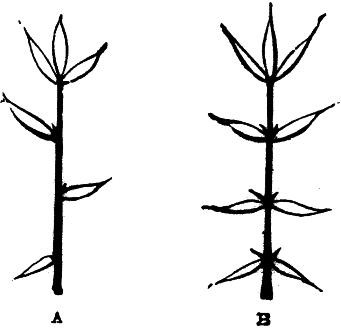
§ 2. Let the tree spray be represented under one of these two types, A or B, Fig. 1, the cluster at the end being in each case supposed to consist of three leaves only (a most impertinent supposition, for it must at least have four, only the fourth would be in a puzzling perspective in A, and hidden behind the central leaf in B). So, receive this false type patiently. When leaves are set on the stalk one after another, as in A, they are called “alternate;” when placed as in B, “opposite.” It is necessary you should remember this not very difficult piece of nomenclature.
If you examine the branch you have gathered, you will see that for some little way below the full-leaf cluster at the end, the stalk is smooth, and the leaves are set regularly on it. But at six, eight, or ten inches down, there comes an awkward knot; something seems to have gone wrong, perhaps another spray branches off there; at all events, the stem gets suddenly thicker, and you may break it there (probably) easier than anywhere else.
That is the junction of two stories of the building. The smooth piece has all been done this summer. At the knot the foundation was left during the winter.
The year’s work is called a “shoot.” I shall be glad if you will break it off to look at; as my A and B types are supposed to go no farther down than the knot.
The alternate form A is more frequent than B, and some botanists think includes B. We will, therefore, begin with it.
§ 3. If you look close at the figure, you will see small projecting points at the roots of the leaves. These represent buds, which you may find, most probably, in the shoot you have in your hand. Whether you find them or not, they are there—visible, or latent, does not matter. Every leaf has assuredly an infant bud to take care of, laid tenderly, as in a cradle, just where the leaf-stalk forms a safe niche between it and the main stem. The child-bud is thus fondly guarded all summer; but its protecting leaf dies in the autumn; and then the boy-bud is put out to rough winter-schooling, by which he is prepared for personal entrance into public life in the spring.
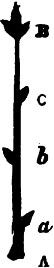
Let us suppose autumn to have come, and the leaves to have fallen. Then our A of Fig. I, the buds only being left, one for each leaf, will appear as A B, in Fig. 2. We will call the buds grouped at B, terminal buds, and those at a, b, and c, lateral buds.
This budded rod is the true year’s work of the building plant, at that part of its edifice. You may consider the little spray, if you like, as one pinnacle of the tree-cathedral, which has taken a year to fashion; innumerable other pinnacles having been built at the same time on other branches.
§ 4. Now, every one of these buds, a, b, and c, as well as every terminal bud, has the power and disposition to raise himself in the spring, into just such another pinnacle as A B is.
This development is the process we have mainly to study in this chapter; but, in the outset, let us see clearly what it is to end in.
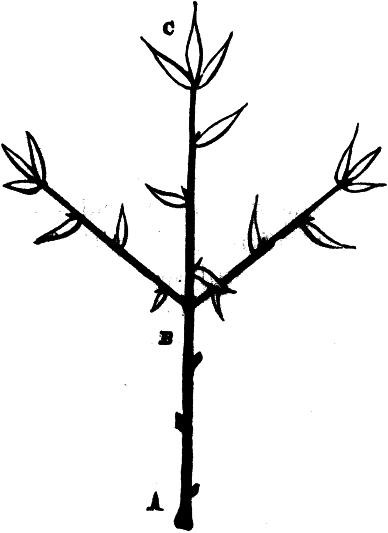
Each bud, I said, has the power and disposition to make a pinnacle of himself, but he has not always the opportunity. What may hinder him we shall see presently. Meantime, the reader will, perhaps, kindly allow me to assume that the buds a, b, and c, come to nothing, and only the three terminal ones build forward. Each of these producing the image of the first pinnacle, we have the type for our next summer bough of Fig. 3; in which observe the original shoot A B, has become thicker; its lateral buds having proved abortive, are now only seen as little knobs on its sides. Its terminal buds have each risen into a new pinnacle. The central or strongest one B C, has become the very image of what his parent shoot A B, was last year. The two lateral ones are weaker and shorter, one probably longer than the other. The joint at B is the knot or foundation for each shoot above spoken of.
Knowing now what we are about, we will go into closer detail.
51. The Dryad’s Toil.
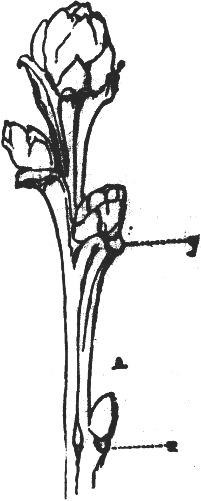
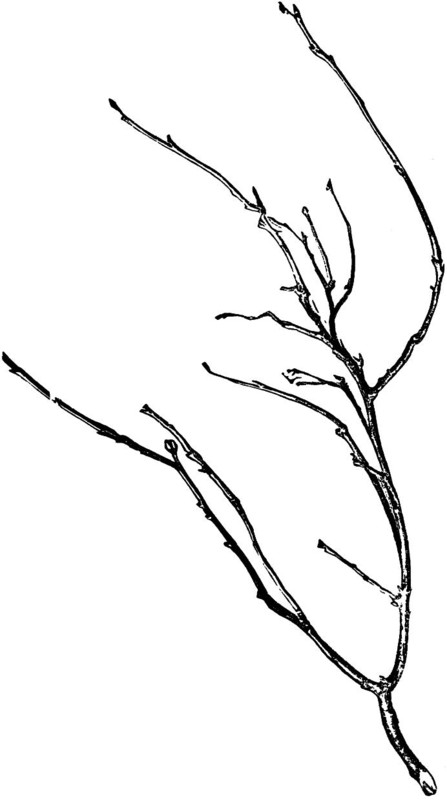
§ 5. Let us return to the type in Fig. 2, of the fully accomplished summer’s work: the rod with its bare buds. Plate 51, opposite, represents, of about half its real size, an outer spray of oak in winter. It is not growing strongly, and is as simple as possible in ramification. You may easily see, in each branch, the continuous piece of shoot produced last year. The wrinkles which make these shoots look like old branches are caused by drying, as the stalk of a bunch of raisins is furrowed (the oak-shoot fresh gathered is round as a grape-stalk). I draw them thus, because the furrows are important clues to structure. Fig. 4 is the top of one of these oak sprays magnified for reference. The little brackets, x, y, &c., which project beneath each bud and sustain it, are the remains of the leaf-stalks. Those stalks were jointed at that place, and the leaves fell without leaving a scar, only a crescent-shaped, somewhat blank-looking flat space, which you may study at your ease on a horse-chestnut stem, where these spaces are very large.
§ 6. Now if you cut your oak spray neatly through, just above a bud, as at A, Fig. 4, and look at it with a not very powerful magnifier, you will find it present the pretty section, Fig. 5.
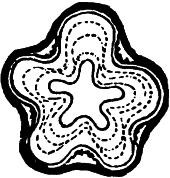
That is the proper or normal section of an oak spray. Never quite regular. Sure to have one of the projections a little larger than the rest, and to have its bark (the black line) not quite regularly put round it, but exquisitely finished, down to a little white star in the very centre, which I have not drawn, because it would look in the woodcut black, not white; and be too conspicuous.
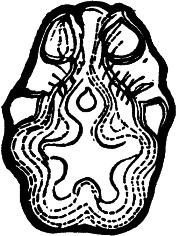
The oak spray, however, will not keep this form unchanged for an instant. Cut it through a little way above your first section, and you will find the largest projection is increasing till, just where it opens1 at last into the leaf-stalk, its section is Fig. 6. If, therefore, you choose to consider every interval between bud and bud as one story of your tower or pinnacle, you find that there is literally not a hair’s-breadth of the work in which the plan of the tower does not change. You may see in Plate 51 that every shoot is suffused by a subtle (in nature an infinitely subtle) change of contour between bud and bud.

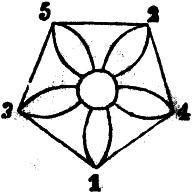
§ 7. But farther, observe in what succession those buds are put round the bearing stem. Let the section of the stem be represented by the small central circle in Fig. 8; and suppose it surrounded by a nearly regular pentagon (in the figure it is quite regular for clearness’ sake). Let the first of any ascending series of buds be represented by the curved projection filling the nearest angle of the pentagon at 1. Then the next bud, above, will fill the angle at 2; the next above, at 3, the next at 4, the next at 5. The sixth will come nearly over the first. That is to say, each projecting portion of the section, Fig. 5, expands into its bud, not successively, but by leaps, always to the next but one; the buds being thus placed in a nearly regular spiral order.
§ 8. I say nearly regular—for there are subtleties of variation in plan which it would be merely tiresome to enter into. All that we need care about is the general law, of which the oak spray furnishes a striking example,—that the buds of the first great group of alternate builders rise in a spiral order round the stem (I believe, for the most part, the spiral proceeds from right to left). And this spiral succession very frequently approximates to the pentagonal order, which it takes with great accuracy in an oak; for, merely assuming that each ascending bud places itself as far as it can easily out of the way of the one beneath, and yet not quite on the opposite side of the stem, we find the interval between the two must generally approximate to that left between 1 and 2, or 2 and 3, in Fig. 8.2
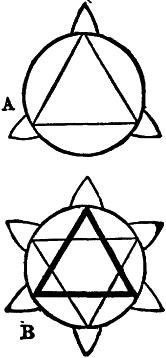
§ 9. Should the interval be consistently a little less than that which brings out the pentagonal structure, the plant seems to get at first into much difficulty. For, in such case, there is a probability of the buds falling into a triangle, as at A, Fig. 9; and then the fourth must come over the first, which would be inadmissible (we shall soon see why). Nevertheless, the plant seems to like the triangular result for its outline, and sets itself to get out of the difficulty with much ingenuity, by methods of succession, which I will examine farther in the next chapter: it being enough for us to know at present that the puzzled, but persevering, vegetable does get out of its difficulty and issues triumphantly, and with a peculiar expression of leafy exultation, in a hexagonal star, composed of two distinct triangles, normally as at B, Fig. 9. Why the buds do not like to be one above the other, we shall see in next chapter. Meantime I must shortly warn the reader of what we shall then discover, that, though we have spoken of the projections of our pentagonal tower as if they were first built to sustain each its leaf, they are themselves chiefly built by the leaf they seem to sustain. Without troubling ourselves about this yet, let us fix in our minds broadly the effective aspect of the matter, which is all we want, by a simple practical illustration.
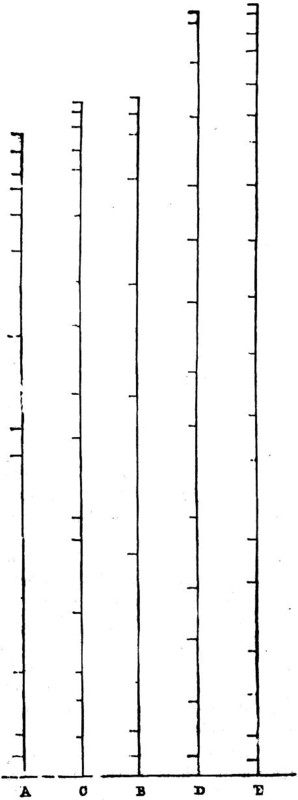
§ 10. Take a piece of stick half-an-inch thick, and a yard or two long, and tie large knots, at any equal distances you choose, on a piece of pack-thread. Then wind the pack-thread round the stick, with any number of equidistant turns you choose, from one end to the other, and the knots will take the position of buds in the general type of alternate vegetation. By varying the number of knots and the turns of the thread, you may get the system of any tree, with the exception of one character only—viz., that since the shoot grows faster at one time than another, the buds run closer together when the growth is slow. You cannot imitate this structure by closing the coils of your string, for that would alter the positions of your knots irregularly. The intervals between the buds are, by this gradual acceleration or retardation of growth, usually varied in lovely proportions. Fig. 10 shows the elevations of the buds on five different sprays of oak; A and B being of the real size (short shoots); C, D, and E, on a reduced scale. I have not traced the cause of the apparent tendency of the buds to follow in pairs, in these longer shoots.
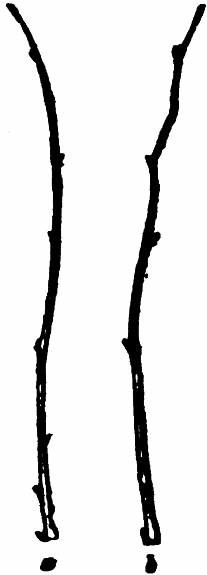
§ 11. Lastly: If the spiral be constructed so as to bring the buds nearly on opposite sides of the stem, though alternate in succession, the stem, most probably, will shoot a little away from each bud after throwing it off, and thus establish the oscillatory form b, Fig. 11, which, when the buds are placed, as in this case, at diminishing intervals, is very beautiful.3
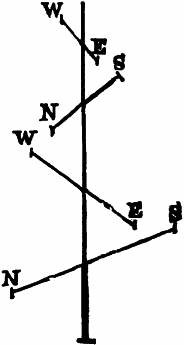
§ 12. I fear this has been a tiresome chapter; but it is necessary to master the elementary structure, if we are to understand anything of trees; and the reader will therefore, perhaps, take patience enough to look at one or two examples of the spray structure of the second great class of builders, in which the leaves are opposite. Nearly all opposite-leaved trees grow, normally, like vegetable weathercocks run to seed, with north and south, and east and west pointers thrown off alternately one over another, as in Fig. 12.
This, I say, is the normal condition. Under certain circumstances, north and south pointers set themselves north-east and south-west; this concession being acknowledged and imitated by the east and west pointers at the next opportunity; but, for the present, let us keep to our simple form.
The first business of the budding stem, is to get every pair of buds set accurately at right angles to the one below. Here are some examples of the way it contrives this. A, Fig. 13, is the section of the stem of a spray of box, magnified eight or nine times, just where it throws off two of its leaves, suppose on north and south sides. The crescents below and above are sections through the leaf-stalks thrown off on each side. Just above this joint, the section of the stem is B, which is the normal section of a box-stem, as Fig. 5 is of an oak’s. This, as it ascends, becomes C, elongating itself now east and west; and the section next to C, would be again A turned that way; or, taking the succession completely through two joints, and of the real size, it would be thus: Fig. 14.
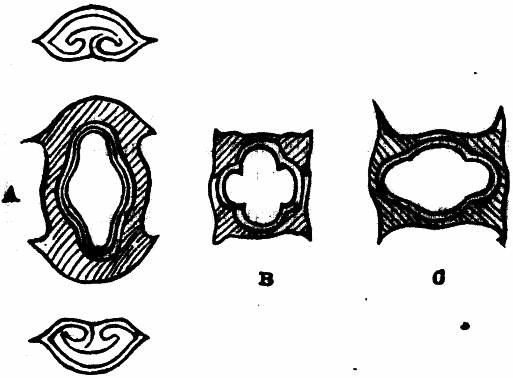
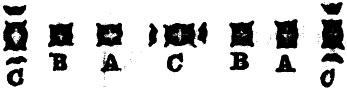
The stem of the spotted aucuba is normally hexagonal, as that of the box is normally square. It is very dexterous and delicate in its mode of transformation to the two sides. Through the joint it is A, Fig. 15. Above joint, B, normal, passing on into C, and D for the next joint.
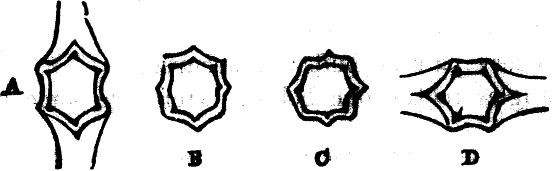
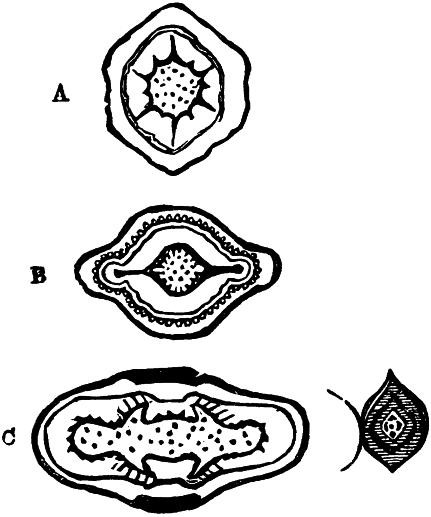
While in the horse-chestnut, a larger tree, and, as we shall see hereafter, therefore less regular in conduct, the section, normally hexagonal, is much rounded and softened into irregularities; A, Fig. 16, becoming, as it buds, B and C. The dark diamond beside C is a section through a bud, in which, however small, the quatrefoil disposition is always seen complete: the four little infant leaves with a queen leaf in the middle, all laid in their fan-shaped feebleness, safe in a white cloud of miniature woollen blanket.
§ 13. The elementary structure of all important trees may, I think, thus be resolved into three principal forms: three-leaved, Fig. 9; four-leaved, Figs. 13 to 16; and five-leaved, Fig. 8. Or, in well-known terms, trefoil, quatrefoil, cinqfoil. And these are essential classes, more complicated forms being usually, it seems to me, resolvable into these, but these not into each other. The simplest arrangement (Fig. 11), in which the buds are nearly opposite in position, though alternate in elevation, cannot, I believe, constitute a separate class, being only an accidental condition of the spiral. If it did, it might be called difoil; but the important classes are three:—
Trefoil,
Fig. 9: Type, Rhododendron.
Quatrefoil,
Fig. 13: Type, Horse-chestnut.
Cinqfoil,
Fig. 5: Type, Oak.
§ 14. The coincidences between beautiful architecture and the construction of trees must more and more have become marked in the reader’s mind as we advanced; and if he will now look at what I have said in other places of the use and meaning of the trefoil, quatrefoil, and cinqfoil, in Gothic architecture, he will see why I could hardly help thinking and speaking of all trees as builders. But there is yet one more subtlety in their way of building which we have not noticed. If the reader will look carefully at the separate shoots in Plate 51, he will see that the furrows of the stems fall in almost every case into continuous spiral curves, carrying the whole system of buds with them. This superinduced spiral action, of which we shall perhaps presently discover the cause, often takes place vigorously, producing completely twisted stems of great thickness. It is nearly always existent slightly, giving farther grace and change to the whole wonderful structure. And thus we have, as the final result of one year’s vegetative labor on any single spray, a twisted tower, not similar at any height of its building: or (for, as we shall see presently, it loses in diameter at each bud) a twisted spire, correspondent somewhat in principle to the twisted spire of Dijon, or twisted fountain of Ulm, or twisted shafts of Verona. Bossed as it ascends with living sculpture, chiselled, not by diminution but through increase, it rises by one consistent impulse from its base to its minaret, ready, in spring-time, to throw round it at the crest at once the radiance of fresh youth and the promise of restoration after that youth has passed away. A marvellous creation: nay might we not almost say, a marvellous creature full of prescience in its infancy, foreboding even, in the earliest gladness of its opening to sunshine, the hour of fainting strength and falling leaf, and guarding under the shade of its faithful shields the bud that is to bear its hope through winter’s shieldless sleep?
Men often look to bring about great results by violent and unprepared effort. But it is only in fair and forecast order, “as the earth bringeth forth her bud,” that righteousness and praise may spring forth before the nations.
1 The added portion, surrounding two of the sides of the pentagon, is the preparation for the stalk of the leaf, which, on detaching itself from the stem, presents variable sections, of which those numbered 1 to 4, Fig. 7, are examples. I cannot determine the proper normal form. The bulb-shaped spot in the heart of the uppermost of the five projections in Fig. 6 is the root of the bud.
2 For more accurate information the reader may consult Professor Lindley’s Introduction to Botany (Longman, 1848), vol. i. p. 245, et seqq.
3 Fig. 11 is a shoot of the line, drawn on two sides, to show its continuous curve in one direction, and alternated curves in another. The buds, which may be seen to be at equal heights in the two figures, are exquisitely proportioned in their distances. There is no end to the refinement of system, if we choose to pursue it.
CHAPTER IV.
THE LEAF.
§ 1. Having now some clear idea of the position of the bud, we have next to examine the forms and structure of its shield—the leaf which guards it. You will form the best general idea of the flattened leaf of shield-builders by thinking of it as you would of a mast and sail. More consistently with our classification, we might perhaps say, by thinking always of the arm sustaining the shield; but we should be in danger of carrying fancy too far, and the likeness of mast and sail is closer, for the mast tapers as the leaf-rib does, while the hand holding the uppermost strap of the buckler clenches itself. Whichever figure we use, it will cure us of the bad habit of imagining a leaf composed of a short stalk with a broad expansion at the end of it. Whereas we should always think of the stalk as running right up the leaf to its point, and carrying the expanded, or foliate part, as the mast of a lugger does its sail. To some extent, indeed, it has yards also, ribs branching from the innermost one; only the yards of the leaf will not run up and down, which is one essential function of a sailyard.
§ 2. The analogy will, however, serve one step more. As the sail must be on one side of the mast, so the expansion of a leaf is on one side of its central rib, or of its system of ribs. It is laid over them as if it were stretched over a frame, so that on the upper surface it is comparatively smooth; on the lower, barred. The understanding of the broad relations of these parts is the principal work we have to do in this chapter.
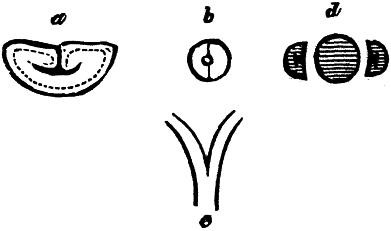
§ 3. First, then, you may roughly assume that the section of any leaf-mast will be a crescent, as at a, Fig. 17 (compare Fig. 7 above). The flat side is the uppermost, the round side underneath, and the flat or upper side caries the leaf. You can at once see the convenience of this structure for fitting to a central stem. Suppose the central stem has a little hole in the centre, b, Fig. 17, and that you cut it down through the middle (as terrible knights used to cut their enemies in the dark ages, so that half the head fell on one side, and half on the other): Pull the two halves separate, c, and they will nearly represent the shape and position of opposite leaf-ribs. In reality the leaf-stalks have to fit themselves to the central stem, a, and as we shall see presently, to lap round it: but we must not go too fast.
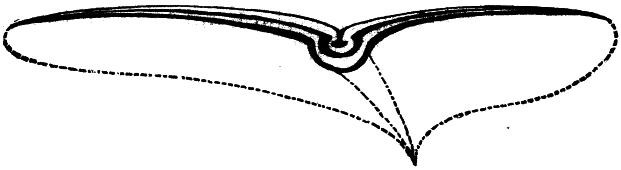
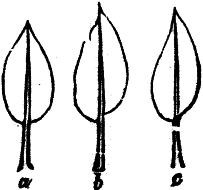
§ 4. Now, a, Fig. 17, being the general type of a leaf-stalk, Fig. 18 is the general type of the way it expands into and carries its leaf;1 this figure being the enlargement of a typical section right across any leaf, the dotted lines show the under surface foreshortened. You see I have made one side broader than the other. I mean that. It is typically so. Nature cannot endure two sides of a leaf to be alike. By encouraging one side more than the other, either by giving it more air or light, or perhaps in a chief degree by the mere fact of the moisture necessarily accumulating on the lower edge when it rains, and the other always drying first, she contrives it so, that if the essential form or idea of the leaf be a, Fig. 19, the actual form will always be c, or an approximate to it; one half being pushed in advance of the other, as at b, and all reconciled by soft curvature, c. The effort of the leaf to keep itself symmetrical rights it, however, often at the point, so that the insertion of the stalk only makes the inequality manifest. But it follows that the sides of a straight section across the leaf are unequal all the way up, as in my drawing, except at one point.
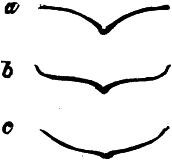
§ 5. I have represented the two wings of the leaf as slightly convex on the upper surface. This is also on the whole a typical character. I use the expression “wings of the leaf,” because supposing we exaggerate the main rib a little, the section will generally resemble a bad painter’s type of a bird (a, Fig. 20). Sometimes the outer edges curl up, b, but an entirely concave form, c, is rare. When b is strongly developed, closing well in, the leaf gets a good deal the look of a boat with a keel.
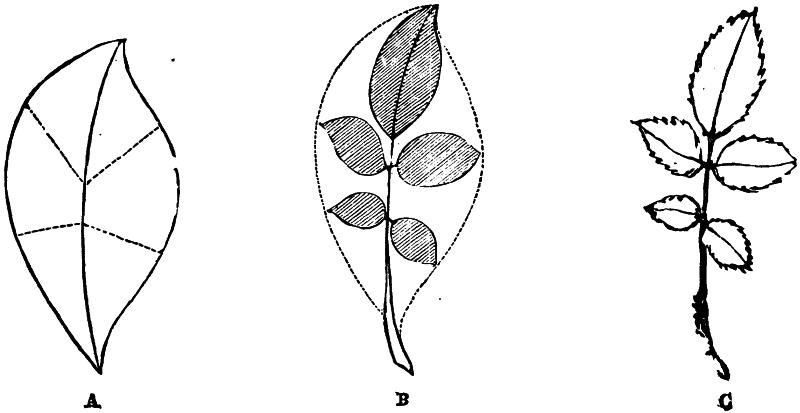
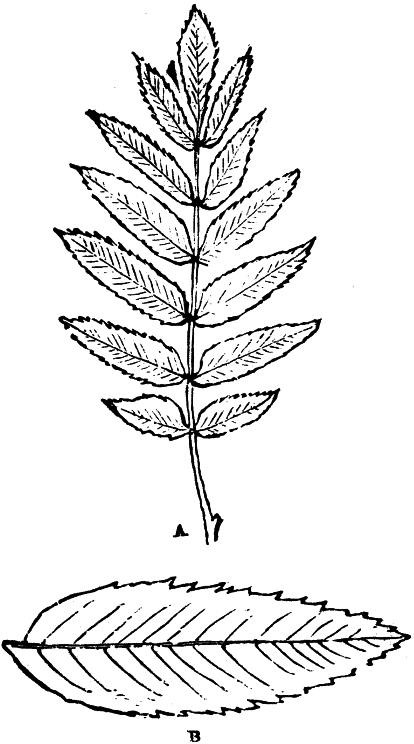
§ 6. If now you take this oblique form of sail, and cut it into any number of required pieces down to its mast, as in Fig. 21, A, and then suppose each of the pieces to contract into studding-sails at the side, you will have whatever type of divided leaf you choose to shape it for. In Fig. 21, A, B, I have taken the rose as the simplest type. The leaf is given in separate contour at C; but that of the mountain ash, A, Fig. 22, suggests the original oval form which encloses all the subdivisions much more beautifully. Each of the studding-sails in this ash-leaf looks much at first as if he were himself a mainsail. But you may know him always to be a subordinate, by observing that the inequality of the two sides which is brought about by accidental influences in the mainsail, is an organic law in the studding-sail. The real leaf tries to set itself evenly on its mast; and the inequality is only a graceful concession to circumstances. But the subordinate or studding-sail is always by law larger at one side than the other; and if he is himself again divided into smaller sails, he will have larger sails on the lowest side, or one more sail on the lowest side, than he has on the other. He always wears, therefore, a servant’s, or, at least, subordinate’s dress. You may know him anywhere as not the master. Even in the ash leaflet, of which I have outlined one separately, B, Fig. 22, this is clearly seen; but it is much more distinct in more finely divided leaves.2
§ 7. Observe, then, that leaves are broadly divisible into mainsails and studding-sails; but that the word leaf is properly to be used only of the mainsail; leaflet is the best word for minor divisions; and whether these minor members are only separated by deep cuts, or become complete stalked leaflets, still they are always to be thought of merely as parts of a true leaf.
It follows from the mode of their construction that leaflets must always lie more or less flat, or edge to edge, in a continuous plane. This position distinguishes them from true leaves as much as their oblique form, and distinguishes them with the same delicate likeness of system; for as the true leaf takes, accidentally and partially, the oblique outline which is legally required in the subordinate, so the true leaf takes accidentally and partially the flat disposition which is legally required in the subordinate. And this point of position we must now study. Henceforward, throughout this chapter, the reader will please note that I speak only of true leaves, not of leaflets.
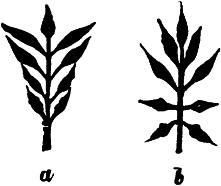
§ 8. LAW I. The Law of Deflection.—The first law, then, respecting position in true leaves, is that they fall gradually back from the uppermost one, or uppermost group. They are never set as at a, Fig. 23, but always as at b. The reader may see at once that they have more room and comfort by means of the latter arrangement. The law is carried out with more or less distinctness according to the habit of the plant; but is always acknowledged.
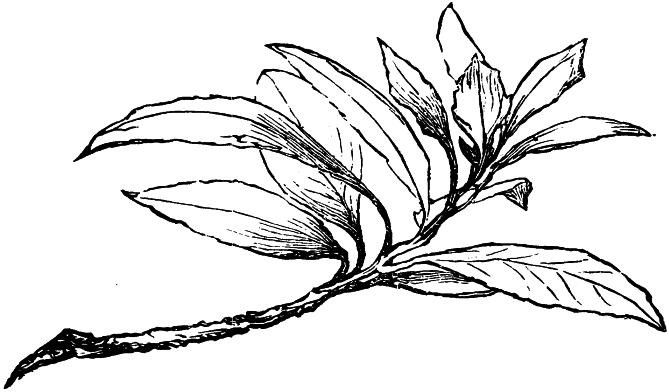
In strong-leaved shrubs or trees it is shown with great distinctness and beauty: the phillyrea shoot, for instance, Fig. 24, is almost in as true symmetry as a Greek honeysuckle ornament. In the hawthorn shoot, central in Plate 52, opposite, the law is seen very slightly, yet it rules all the play and fantasy of the varied leaves, gradually depressing their lines as they are set lower. In crowded foliage of large trees the disposition of each separate leaf is not so manifest. For there is a strange coincidence in this between trees and communities of men. When the community is small, people fall more easily into their places, and take, each in his place, a firmer standing than can be obtained by the individuals of a great nation. The members of a vast community are separately weaker, as an aspen or elm leaf is thin, tremulous, and directionless, compared with the spear-like setting and firm substance of a rhododendron or laurel leaf. The laurel and rhododendron are like the Athenian or Florentine republics; the aspen like England—strong-trunked enough when put to proof, and very good for making cartwheels of, but shaking pale with epidemic panic at every breeze. Nevertheless, the aspen has the better of the great nation, in that if you take it bough by bough, you shall find the gentle law of respect and room for each other truly observed by the leaves in such broken way as they can manage it; but in the nation you find every one scrambling for his neighbor’s place.
This, then, is our first law, which we may generally call the Law of Deflection; or, if the position of the leaves with respect to the root be regarded, of Radiation. The second is more curious, and we must go back over our ground a little to get at it.
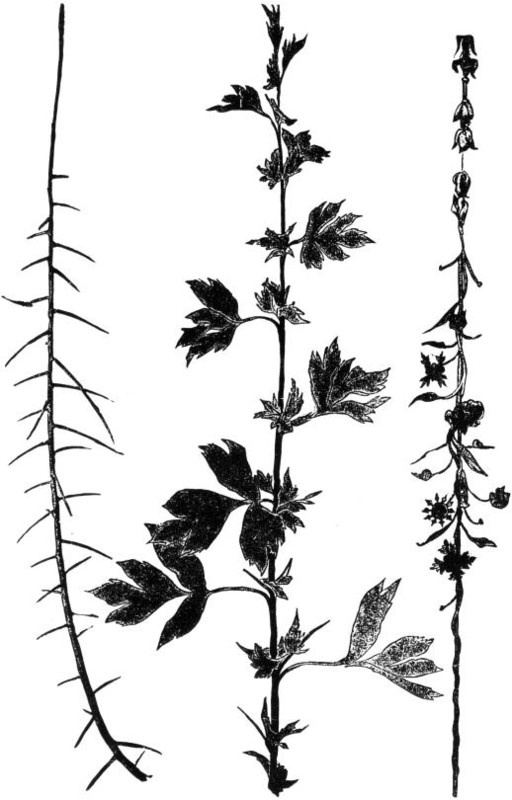
52. Spirals of Thorn.
§ 9. LAW II. The Law of Succession.—From what we saw of the position of buds, it follows that in every tree the leaves at the end of the spray, taking the direction given them by the uppermost cycle or spiral of the buds, will fall naturally into a starry group, expressive of the order of their growth. In an oak we shall have a cluster of five leaves, in a horse-chestnut of four, in a rhododendron of six, and so on. But observe, if we draw the oak-leaves all equal, as at a, Fig. 25, or the chestnut’s (b), or the rhododendron’s (c), you instantly will feel, or ought to feel, that something is wrong; that those are not foliage forms—not even normally or typically so—but dead forms, like crystals of snow. Considering this, and looking back to last chapter, you will see that the buds which throw out these leaves do not grow side by side, but one above another. In the oak and rhododendron, all five and all six buds are at different heights; in the chestnut, one couple is above the other couple.
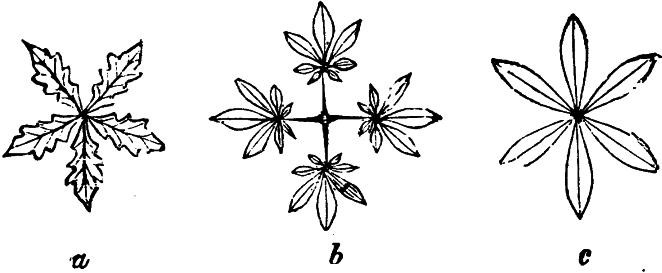
§ 10. Now so surely as one bud is above another, it must be stronger or weaker than that other. The shoot may either be increasing in strength as it advances, or declining; in either case, the buds must vary in power, and the leaves in size. At the top of the shoot, the last or uppermost leaves are mostly the smallest; of course always so in spring as they develope.
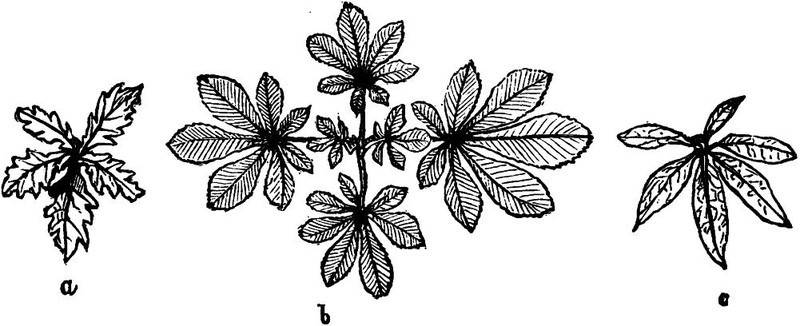
Let us then apply these conditions to our formal figure above, and suppose each leaf to be weaker in its order of succession. The oak becomes as a, Fig. 26, the chestnut shoot as b, the rhododendron, c. These, I should think, it can hardly be necessary to tell the reader, are true normal forms;—respecting which one or two points must be noticed in detail.
§ 11. The magnitude of the leaves in the oak star diminishes, of course, in alternate order. The largest leaf is the lowest, 1 in Figure 8, p. 14. While the largest leaf forms the bottom, next it, opposite each other, come the third and fourth, in order and magnitude, and the fifth and second form the top. An oak star is, therefore, always an oblique star; but in the chestnut and other quatrefoil trees, though the uppermost couple of leaves must always be smaller than the lowermost couple, there appears no geometrical reason why the opposite leaves of each couple should vary in size. Nevertheless, they always do, so that the quatrefoil becomes oblique as well as the cinqfoil, as you see it is in Fig. 26.
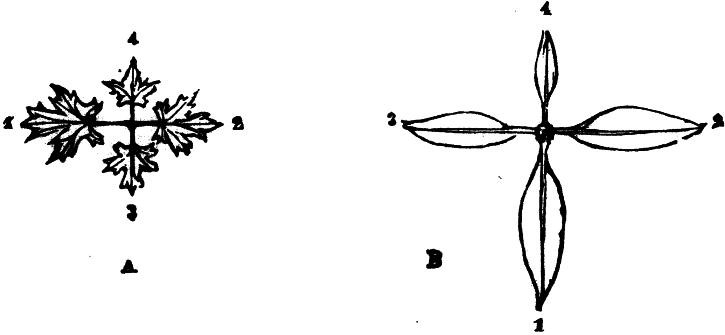

The normal of four-foils is therefore as in Fig. 27, A (maple): with magnitudes, in order numbered; but it often happens that an opposite pair agree to become largest and smallest; thus giving the pretty symmetry, Fig. 27, B (spotted aucuba). Of course the quatrefoil in reality is always less formal, one pair of leaves more or less hiding or preceding the other. Fig. 28 is the outline of a young one in the maple.
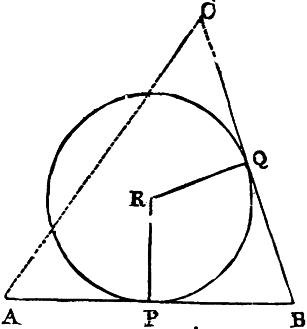
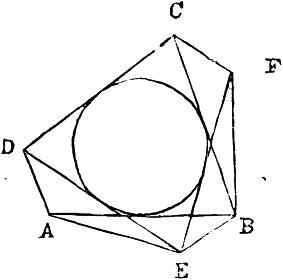
§ 12. The third form is more complex, and we must take the pains to follow out what we left unobserved in last chapter respecting the way a triplicate plant gets out of its difficulties.
Draw a circle as in Fig. 29, and two lines, AB, BC, touching it, equal to each other, and each divided accurately in half where they touch the circle, so that AP shall be equal to PB, BQ, and QC. And let the lines AB and BC be so placed that a dotted line AC, joining their extremities, would not be much longer than either of them.
Continue to draw lines of the same length all round the circle. Lay five of them, AB, BC, CD, DE, EF. Then join the points AD, EB, and CF, and you have Fig. 30, which is a hexagon, with the following curious properties. It has one side largest, CD, two sides less, but equal to each other, AE and BF; and three sides less still, and equal to each other, AD, CF, and BE.
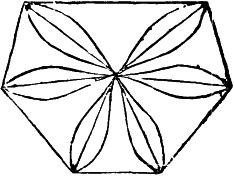
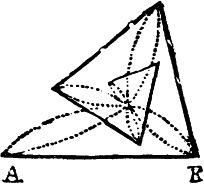
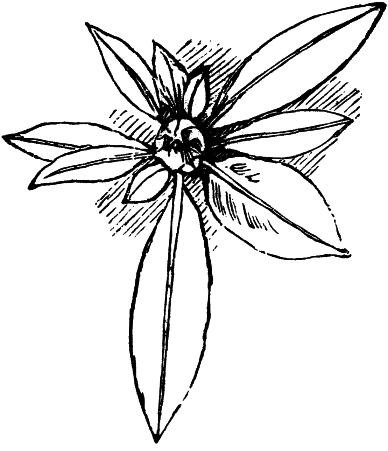
Now put leaves into this hexagon, Fig. 31, and you will see how charmingly the rhododendron has got out of its difficulties. The next cycle will put a leaf in at the gap at the top, and begin a new hexagon. Observe, however, this geometrical figure is only to the rhododendron what the a in Fig. 25 is to the oak, the icy or dead form. To get the living normal form we must introduce our law of succession. That is to say, the five lines AB, BC, &c., must continually diminish, as they proceed, and therefore continually approach the centre; roughly, as in Fig. 32.
§ 13. I dread entering into the finer properties of this construction, but the reader cannot now fail to feel their beautiful result either in the cluster in Fig. 26, or here in Fig. 33, which is a richer and more oblique one. The three leaves of the uppermost triad are perfectly seen, closing over the bud; and the general form is clear, though the lower triads are confused to the eye by unequal development, as in these complex arrangements is almost always the case. The more difficulties are to be encountered the more licence is given to the plant in dealing with them, and we shall hardly ever find a rhododendron shoot fulfilling its splendid spiral as an oak does its simple one.
Here, for instance, is the actual order of ascending leaves in four rhododendron shoots which I gather at random.
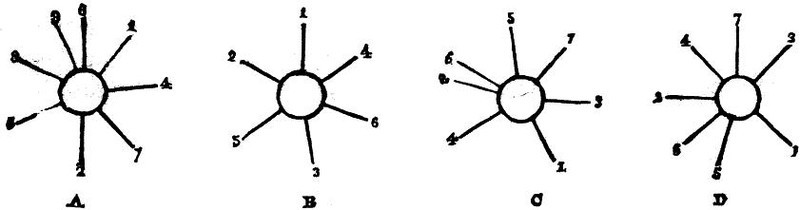
Of these, A is the only quite well-conducted one; B takes one short step, C, one step backwards, and D, two steps back and one, too short, forward.
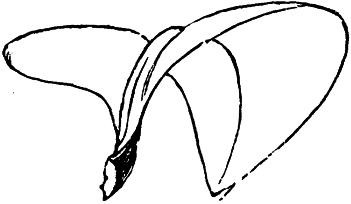
§ 14. LAW III. The Law of Resilience.—If you have been gathering any branches from the trees I have named among quatrefoils (the box is the best for exemplification), you have perhaps been embarrassed by finding that the leaves, instead of growing on four sides of the stem, did practically grow oppositely on two. But if you look closely at the places of their insertion, you will find they indeed spring on all four sides; and that in order to take the flattened opposite position, each leaf twists round on its stalk, as in Fig. 35, which represents a box-leaf magnified and foreshortened. The leaves do this in order to avoid growing downwards, where the position of the bough and bud would, if the leaves regularly kept their places, involve downward growth. The leaves always rise up on each side from beneath, and form a flattened group, more or less distinctly in proportion to the horizontality of the bough, and the contiguity of foliage below and above. I shall not trouble myself to illustrate this law, as you have only to gather a few tree-sprays to see its effect. But you must note the resulting characters on every leaf; namely, that not one leaf in a thousand grows without a fixed turn in its stalk; warping and varying the whole of the curve on the two edges, throughout its length, and thus producing the loveliest conditions of its form. We shall presently trace the law of resilience farther on a larger scale: meanwhile, in summing the results of our inquiry thus far, let us remember that every one of these laws is observed with varying accuracy and gentle equity, according not only to the strength and fellowship of foliage on the spray itself, but according to the place and circumstances of its growth.
§ 15. For the leaves, as we shall see immediately, are the feeders of the plant. Their own orderly habits of succession must not interfere with their main business of finding food. Where the sun and air are, the leaf must go, whether it be out of order or not. So, therefore, in any group, the first consideration with the young leaves is much like that of young bees, how to keep out of each other’s way, that every one may at once leave its neighbors as much free-air pasture as possible, and obtain a relative freedom for itself. This would be a quite simple matter, and produce other simply balanced forms, if each branch, with open air all round it, had nothing to think of but reconcilement of interests among its own leaves. But every branch has others to meet or to cross, sharing with them, in various advantage, what shade, or sun, or rain is to be had. Hence every single leaf-cluster presents the general aspect of a little family, entirely at unity among themselves, but obliged to get their living by various shifts, concessions, and infringements of the family rules, in order not to invade the privileges of other people in their neighborhood.
§ 16. And in the arrangement of these concessions there is an exquisite sensibility among the leaves. They do not grow each to his own liking, till they run against one another, and then turn back sulkily; but by a watchful instinct, far apart, they anticipate their companions’ courses, as ships at sea, and in every new unfolding of their edged tissue, guide themselves by the sense of each other’s remote presence, and by a watchful penetration of leafy purpose in the far future. So that every shadow which one casts on the next, and every glint of sun which each reflects to the next, and every touch which in toss of storm each receives from the next, aid or arrest the development of their advancing form, and direct, as will be safest and best, the curve of every fold and the current of every vein.
§ 17. And this peculiar character exists in all the structures thus developed, that they are always visibly the result of a volition on the part of the leaf, meeting an external force or fate, to which it is never passively subjected. Upon it, as on a mineral in the course of formation, the great merciless influences of the universe, and the oppressive powers of minor things immediately near it, act continually. Heat and cold, gravity and the other attractions, windy pressure, or local and unhealthy restraint, must, in certain inevitable degrees, affect the whole of its life. But it is life which they affect;—a life of progress and will,—not a merely passive accumulation of substance. This may be seen by a single glance. The mineral,—suppose an agate in the course of formation—shows in every line nothing but a dead submission to surrounding force. Flowing, or congealing, its substance is here repelled, there attracted, unresistingly to its place, and its languid sinuosities follow the clefts of the rock that contains them, in servile deflexion and compulsory cohesion, impotently calculable, and cold. But the leaf, full of fears and affections, shrinks and seeks, as it obeys. Not thrust, but awed into its retiring; not dragged, but won to its advance; not bent aside, as by a bridle, into new courses of growth: but persuaded and converted through tender continuance of voluntary change.
§ 18. The mineral and it differing thus widely in separate being, they differ no less in modes of companionship. The mineral crystals group themselves neither in succession, nor in sympathy; but great and small recklessly strive for place, and deface or distort each other as they gather into opponent asperities. The confused crowd fills the rock cavity, hanging together in a glittering, yet sordid heap, in which nearly every crystal, owing to their vain contention, is imperfect, or impure. Here and there one, at the cost and in defiance of the rest, rises into unwarped shape or unstained clearness. But the order of the leaves is one of soft and subdued concession. Patiently each awaits its appointed time, accepts its prepared place, yields its required observance. Under every oppression of external accident, the group yet follows a law laid down in its own heart; and all the members of it, whether in sickness or health, in strength or languor, combine to carry out this first and last heart law; receiving, and seeming to desire for themselves and for each other, only life which they may communicate, and loveliness which they may reflect.
1 I am not sure that this is a fair account of palms. I have never had opportunity of studying stems of Endogens, and I cannot understand the description given of them in books, nor do I know how far some of their branched conditions approximate to real tree-structure. If this work, whatever errors it may involve, provokes the curiosity of the reader so as to lead him to seek for more and better knowledge, it will do all the service I hope from it.
1 The added portion, surrounding two of the sides of the pentagon, is the preparation for the stalk of the leaf, which, on detaching itself from the stem, presents variable sections, of which those numbered 1 to 4, Fig. 7, are examples. I cannot determine the proper normal form. The bulb-shaped spot in the heart of the uppermost of the five projections in Fig. 6 is the root of the bud.
2 For more accurate information the reader may consult Professor Lindley’s Introduction to Botany (Longman, 1848), vol. i. p. 245, et seqq.
3 Fig. 11 is a shoot of the line, drawn on two sides, to show its continuous curve in one direction, and alternated curves in another. The buds, which may be seen to be at equal heights in the two figures, are exquisitely proportioned in their distances. There is no end to the refinement of system, if we choose to pursue it.
1 I believe the undermost of the two divisions of the leaf represents vegetable tissue returning from the extremity. See Lindley’s Introduction to Botany (1848), vol. i. p. 253.
2 For farther notes on this subject, see my Elements of Drawing, p. 286.
1 I believe the undermost of the two divisions of the leaf represents vegetable tissue returning from the extremity. See Lindley’s Introduction to Botany (1848), vol. i. p. 253.
2 For farther notes on this subject, see my Elements of Drawing, p. 286.
CHAPTER V.
LEAF ASPECTS.
§ 1. Before following farther our inquiry into tree structure, it will rest us, and perhaps forward our work a little, to make some use of what we know already.
It results generally from what we have seen that any group of four or five leaves presenting itself in its natural position to the eye, consists of a series of forms connected by exquisite and complex symmetries, and that these forms will be not only varied in themselves, but every one of them seen under a different condition of foreshortening.
The facility of drawing the group may be judged of by a comparison. Suppose five or six boats, very beautifully built, and sharp in the prow, to start all from one point, and the first bearing up into the wind, the other three or four to fall off from it in succession an equal number of points,1 taking each, in consequence, a different slope of deck from the stem of the sail. Suppose, also, that the bows of these boats were transparent, so that you could see the under sides of their decks as well as the upper;—and that it were required of you to draw all their five decks, the under or upper side, as their curve showed it, in true foreshortened perspective, indicating the exact distance each boat had reached at a given moment from the central point they started from.
If you can do that, you can draw a rose-leaf. Not otherwise.
§ 2. When, some few years ago, the pre-Raphaelites began to lead our wandering artists back into the eternal paths of all great Art, and showed that whatever men drew at all, ought to be drawn accurately and knowingly; not blunderingly nor by guess (leaves of trees among other things): as ignorant pride on the one hand refused their teaching, ignorant hope caught at it on the other. “What!” said many a feeble young student to himself. “Painting is not a matter of science then, nor of supreme skill, nor of inventive brain. I have only to go and paint the leaves of the trees as they grow, and I shall produce beautiful landscapes directly.”
Alas! my innocent young friend. “Paint the leaves as they grow!” If you can paint one leaf, you can paint the world. These pre-Raphaelite laws, which you think so light, lay stern on the strength of Apelles and Zeuxis; put Titian to thoughtful trouble; are unrelaxed yet, and unrelaxable for ever. Paint a leaf indeed! Above-named Titian has done it: Correggio, moreover, and Giorgione: and Leonardo, very nearly, trying hard. Holbein, three or four times, in precious pieces, highest wrought. Raphael, it may be, in one or two crowns of Muse or Sibyl. If any one else, in later times, we have to consider.
§ 3. At least until recently, the perception of organic leaf form was absolutely, in all painters whatsoever, proportionate to their power of drawing the human figure. All the great Italian designers drew leaves thoroughly well, though none quite so fondly as Correggio. Rubens drew them coarsely and vigorously, just as he drew limbs. Among the inferior Dutch painters, the leaf-painting degenerates in proportion to the diminishing power in figure. Cuyp, Wouvermans, and Paul Potter, paint better foliage than either Hobbima or Ruysdael.
§ 4. In like manner the power of treating vegetation in sculpture is absolutely commensurate with nobleness of figure design. The quantity, richness, or deceptive finish may be greater in third-rate work; but in true understanding and force of arrangement the leaf and the human figure show always parallel skill. The leaf-mouldings of Lorenzo Ghiberti are unrivalled, as his bas-reliefs are, and the severe foliage of the Cathedral of Chartres is as grand as its queen-statues.
§ 5. The greatest draughtsmen draw leaves, like everything else, of their full-life size in the nearest part of the picture. They cannot be rightly drawn on any other terms. It is impossible to reduce a group so treated without losing much of its character; and more painfully impossible to represent by engraving any good workman’s handling. I intended to have inserted in this place an engraving of the cluster of oak-leaves above Correggio’s Antiope in the Louvre, but it is too lovely; and if I am able to engrave it at all, it must be separately, and of its own size. So I draw, roughly, instead, a group of oak-leaves on a young shoot, a little curled with autumn frost: Plate 53. I could not draw them accurately enough if I drew them in spring. They would droop and lose their relations. Thus roughly drawn, and losing some of their grace, by withering, they, nevertheless, have enough left to show how noble leaf-form is; and to prove, it seems to me, that Dutch draughtsmen do not wholly express it. For instance, Fig. 3, Plate 54, is a facsimile of a bit of the nearest oak foliage out of Hobbima’s Scene with the Water-mill, No. 131, in the Dulwich Gallery. Compared with the real forms of oak-leaf, in Plate 53, it may, I hope, at least enable my readers to understand, if they choose, why, never having ceased to rate the Dutch painters for their meanness or minuteness, I yet accepted the leaf-painting of the pre-Raphaelites with reverence and hope.
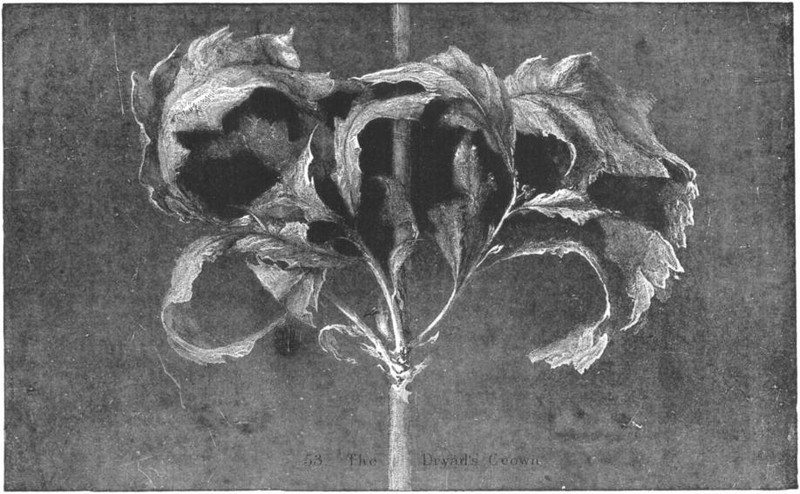
53. The Dryad’s Crown.
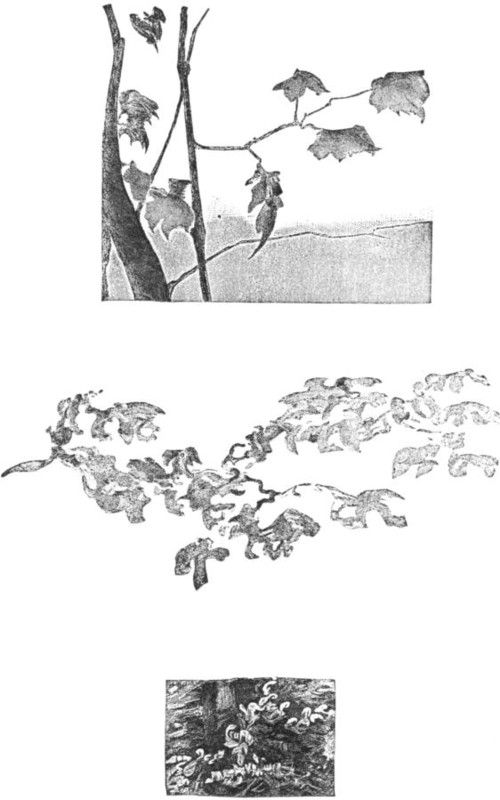
54. Dutch Leafage.
§ 6. No word has been more harmfully misused than that ugly one of “niggling.” I should be glad if it were entirely banished from service and record. The only essential question about drawing is whether it be right or wrong; that it be small or large, swift or slow, is a matter of convenience only. But so far as the word may be legitimately used at all, it belongs especially to such execution as this of Hobbima’s—execution which substitutes, on whatever scale, a mechanical trick or habit of hand for true drawing of known or intended forms. So long as the work is thoughtfully directed, there is no niggling. In a small Greek coin the muscles of the human body are as grandly treated as in a colossal statue; and a fine vignette of Turner’s will show separate touches often more extended in intention, and stronger in result, than those of his largest oil pictures. In the vignette of the picture of Ginevra, at page 90 of Roger’s Italy, the forefinger touching the lip is entirely and rightly drawn, bent at the two joints, within the length of the thirtieth of an inch, and the whole hand within the space of one of those “niggling” touches of Hobbima. But if this work were magnified, it would be seen to be a strong and simple expression of a hand by thick black lines.
§ 7. Niggling, therefore, essentially means disorganized and mechanical work, applied on a scale which may deceive a vulgar or ignorant person into the idea of its being true:—a definition applicable to the whole of the leaf-painting of the Dutch landscapists in distant effect, and for the most part to that of their near subjects also. Cuyp and Wouvermans, as before stated, and others, in proportion to their power over the figure, drew leaves better in the foreground, yet never altogether well; for though Cuyp often draws a single leaf carefully (weedy ground-vegetation especially, with great truth), he never felt the connection of leaves, but scattered them on the boughs at random. Fig. 1 in Plate 54 is nearly a facsimile of part of the branch on the left side in our National Gallery picture. Its entire want of grace and organization ought to be felt at a glance, after the work we have gone through. The average conditions of leafage-painting among the Dutch are better represented by Fig. 2, Plate 54, which is a piece of the foliage from the Cuyp in the Dulwich Gallery, No. 163. It is merely wrought with a mechanical play of brush in a well-trained hand, gradating the color irregularly and agreeably, but with no more feeling or knowledge of leafage than a paperstainer shows in graining a pattern. A bit of the stalk is seen on the left; it might just as well have been on the other side, for any connection the leaves have with it. As the leafage retires into distance, the Dutch painters merely diminish their scale of touch. The touch itself remains the same, but its effect is falser; for though the separate stains or blots in Fig. 2, do not rightly represent the forms of leaves, they may not inaccurately represent the number of leaves on that spray. But in distance, when, instead of one spray, we have thousands in sight, no human industry, nor possible diminution of touch can represent their mist of foliage, and the Dutch work becomes doubly base, by reason of false form, and lost infinity.
§ 8. Hence what I said in our first inquiry about foliage, “A single dusty roll of Turner’s brush is more truly expressive of the infinitude of foliage than the niggling of Hobbima could have rendered his canvas, if he had worked on it till doomsday.” And this brings me to the main difficulty I have had in preparing this section. That infinitude of Turner’s execution attaches not only to his distant work, but in due degree to the nearest pieces of his trees. As I have shown in the chapter on mystery, he perfected the system of art, as applicable to landscape, by the introduction of this infiniteness. In other qualities he is often only equal, in some inferior, to great preceding painters; but in this mystery he stands alone. He could not paint a cluster of leaves better than Titian; but he could a bough, much more a distant mass of foliage. No man ever before painted a distant tree rightly, or a full-leaved branch rightly. All Titian’s distant branches are ponderous flakes, as if covered with seaweed, while Veronese’s and Raphael’s are conventional, being exquisitely ornamental arrangements of small perfect leaves. See the background of the Parnassus in Volpato’s plate. It is very lovely, however.
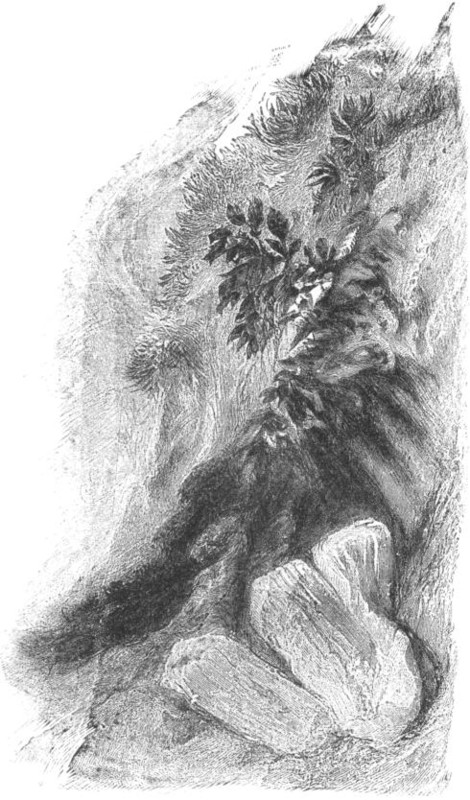
55. By the Way-side.
§ 9. But this peculiar execution of Turner’s is entirely uncopiable; least of all to be copied in engraving. It is at once so dexterous and so keenly cunning, swiftest play of hand being applied with concentrated attention on every movement, that no care in facsimile will render it. The delay in the conclusion of this work has been partly caused by the failure of repeated attempts to express this execution. I see my way now to some partial result; but must get the writing done, and give undivided care to it before I attempt to produce costly plates. Meanwhile, the little cluster of foliage opposite, from the thicket which runs up the bank on the right-hand side of the drawing of Richmond, looking up the river, in the Yorkshire series, will give the reader some idea of the mingled definiteness and mystery of Turner’s work, as opposed to the mechanism of the Dutch on the one side, and the conventional severity of the Italians on the other. It should be compared with the published engraving in the Yorkshire series; for just as much increase, both in quantity and refinement, would be necessary in every portion of the picture, before any true conception could be given of the richness of Turner’s designs. A fragment of distant foliage I may give farther on; but, in order to judge rightly of either example, we must know one or two points in the structure of branches, requiring yet some irksome patience of inquiry, which I am compelled to ask the reader to grant me through another two chapters.
1 I don’t know that this is rightly expressed; but the meaning will be understood.
CHAPTER VI.
THE BRANCH.
§ 1. We have hitherto spoken of each shoot as either straight or only warped by its spiral tendency; but no shoot of any length, except those of the sapling, ever can be straight; for, as the family of leaves which it bears are forced unanimously to take some given direction in search of food or light, the stalk necessarily obeys the same impulse, and bends itself so as to sustain them in their adopted position, with the greatest ease to itself and comfort for them.
In doing this, it has two main influences to comply or contend with: the first, the direct action of the leaves in drawing it this way or that, as they themselves seek particular situations; the second, the pressure of their absolute weight after they have taken their places, depressing each bough in a given degree; the leverage increasing as the leaf extends. To these principal forces may frequently be added that of some prevalent wind, which, on a majority of days in the year, bends the bough, leaves and all, for hours together, out of its normal position. Owing to these three forces, the shoot is nearly sure to be curved in at least two directions;1 that is to say, not merely as the rim of a wine-glass is curved (so that, looking at it horizontally, the circle becomes a straight line), but as the edge of a lip or an eyebrow is curved, partly upward, partly forwards, so that in no possible perspective can it be seen as a straight line. Similarly, no perspective will usually bring a shoot of a free-growing tree to appear a straight line.
§ 2. It is evident that the more leaves the stalk has to sustain, the more strength it requires. It might appear, therefore, not unadvisable, that every leaf should, as it grew, pay a small tax to the stalk for its sustenance; so that there might be no fear of any number of leaves being too oppressive to their bearer. Which, accordingly, is just what the leaves do. Each, from the moment of his complete majority, pays a stated tax to the stalk; that is to say, collects for it a certain quantity of wood, or materials for wood, and sends this wood, or what ultimately will become wood, down the stalk to add to its thickness.
§ 3. “Down the stalk?” yes, and down a great way farther. For, as the leaves, if they did not thus contribute to their own support, would soon be too heavy for the spray, so if the spray, with its family of leaves, contributed nothing to the thickness of the branch, the leaf-families would soon break down their sustaining branches. And, similarly, if the branches gave nothing to the stem, the stem would soon fall under its boughs. Therefore, by a power of which I believe no sufficient account exists,2 as each leaf adds to the thickness of the shoot, so each shoot to the branch, so each branch to the stem, and that with so perfect an order and regularity of duty, that from every leaf in all the countless crowd at the tree’s summit, one slender fibre, or at least fibre’s thickness of wood, descends through shoot, through spray, through branch, and through stem; and having thus added, in its due proportion, to form the strength of the tree, labors yet farther and more painfully to provide for its security; and thrusting forward into the root, loses nothing of its mighty energy, until, mining through the darkness, it has taken hold in cleft of rock or depth of earth, as extended as the sweep of its green crest in the free air.
§ 4. Such, at least, is the mechanical aspect of the tree. The work of its construction, considered as a branch tower, partly propped by buttresses, partly lashed by cables, is thus shared in by every leaf. But considering it as a living body to be nourished, it is probably an inaccurate analogy to speak of the leaves being taxed for the enlargement of the trunk. Strictly speaking, the trunk enlarges by sustaining them. For each leaf, however far removed from the ground, stands in need of nourishment derived from the ground, as well as of that which it finds in the air; and it simply sends its root down along the stem of the tree, until it reaches the ground and obtains the necessary mineral elements. The trunk has been therefore called by some botanists a “bundle of roots,” but I think inaccurately. It is rather a messenger to the roots.3 A root, properly so called, is a fibre, spongy or absorbent at the extremity, which secretes certain elements from the earth. The stem is by this definition no more a cluster of roots than a cluster of leaves, but a channel of intercourse between the roots and the leaves. It can gather no nourishment. It only carries nourishment, being, in fact, a group of canals for the conveyance of marketable commodities, with an electric telegraph attached to each, transmitting messages from leaf to root, and root to leaf, up and down the tree. But whatever view we take of the operative causes, the external and visible fact is simply that every leaf does send down from its stalk a slender thread of woody matter along the sides of the shoot it grows upon; and that the increase of thickness in stem, proportioned to the advance of the leaves, corresponds with an increase of thickness in roots, proportioned to the advance of their outer fibres. How far interchange of elements takes place between root and leaf, it is not our work here to examine; the general and broad idea is this, that the whole tree is fed partly by the earth, partly by the air;—strengthened and sustained by the one, agitated and educated by the other;—all of it which is best, in substance, life, and beauty, being drawn more from the dew of heaven than the fatness of the earth. The results of this nourishment of the bough by the leaf in external aspect, are the object of our immediate inquiry.
§ 5. Hitherto we have considered the shoot as an ascending body, throwing off buds at intervals. This it is indeed; but the part of it which ascends is not seen externally. Look back to Plate 51. You will observe that each shoot is furrowed, and that the ridges between the furrows rise in slightly spiral lines, terminating in the armlets under the buds which bore last year’s leaves. These ridges, which rib the shoot so distinctly, are not on the ascending part of it. They are the contributions of each successive leaf thrown out as it ascended. Every leaf sent down a slender cord, covering and clinging to the shoot beneath, and increasing its thickness. Each, according to his size and strength, wove his little strand of cable, as a spider his thread; and cast it down the side of the springing tower by a marvellous magic—irresistible! The fall of a granite pyramid from an Alp may perhaps be stayed; the descending force of that silver thread shall not be stayed. It will split the rocks themselves at its roots, if need be, rather than fail in its work.
So many leaves, so many silver cords. Count—for by just the thickness of one cord, beneath each leaf, let fall in fivefold order round and round, the shoot increases in thickness to its root:—a spire built downwards from the heaven.
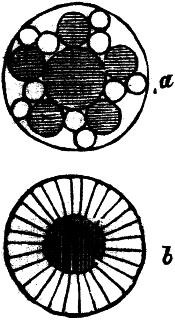
And now we see why the leaves dislike being above each other. Each seeks a vacant place, where he may freely let fall the cord. The turning aside of the cable to avoid the buds beneath, is one of the main causes of spiral curvature, as the shoot increases. It required all the care I could give to the drawing, and all Mr. Armytage’s skill in engraving Plate 51, to express, though drawing them nearly of their full size, the principal courses of curvature in even this least graceful of trees.
§ 6. According to the structure thus ascertained, the body of the shoot may at any point be considered as formed by a central rod, represented by the shaded inner circle, a, Fig. 36, surrounded by as many rods of descending external wood as there are leaves above the point where the section is made. The first five leaves above send down the first dark rods; and the next above send down those between, which, being from younger leaves, are less liable to interstices; then the third group sending down the side, it will be seen at a glance how a spiral action is produced. It would lead us into too subtile detail, if I traced the forces of this spiral superimposition. I must be content to let the reader peruse this part of the subject for himself, if it amuses him, and lead to larger questions.
§ 7. Broadly and practically, we may consider the whole cluster of woody material in Fig. 36 as one circle of fibrous substance formed round a small central rod. The real appearance in most trees is approximately as in b, Fig. 36, the radiating structure becoming more distinct in proportion to the largeness and compactness of the wood.4
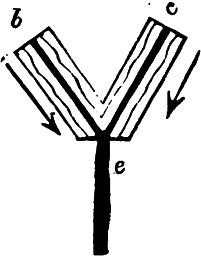
Now the next question is, how this descending external coating of wood will behave itself when it comes to the forking of the shoots. To simplify the examination of this, let us suppose the original or growing shoot (whose section is the shaded inner circle in Fig. 36) to have been in the form of a letter Y, and no thicker than a stout iron wire, as in Fig. 37. Down the arms of this letter Y, we have two fibrous streams running in the direction of the arrows. If the depth or thickness of these streams be such as at b and c, what will their thickness be when they unite at e? Evidently, the quantity of wood surrounding the vertical wire at e must be twice as great as that surrounding the wires b and c.
§ 8. The reader will, perhaps, be good enough to take it on my word (if he does not know enough of geometry to ascertain), that the large circle, in Fig. 38, contains twice as much area as either of the two smaller circles. Putting these circles in position, so as to guide us, and supposing the trunk to be bounded by straight lines, we have for the outline of the fork that in Fig. 38. How, then, do the two minor circles change into one large one? The section of the stem at a is a circle; and at b, is a circle; and at c, a circle. But what is it at e? Evidently, if the two circles merely united gradually, without change of form through a series of figures, such as those at the top of Fig. 39, the quantity of wood, instead of remaining the same, would diminish from the contents of two circles to the contents of one. So for every loss which the circles sustain at this junction, an equal quantity of wood must be thrust out somehow to the side. Thus, to enable the circles to run into each other, as far as shown at b, in Fig. 39, there must be a loss between them of as much wood as the shaded space. Therefore, half of that space must be added, or rather pushed out on each side, and the section of the uniting branch becomes approximately as in c, Fig. 39; the wood squeezed out encompassing the stem more as the circles close, until the whole is reconciled into one larger single circle.
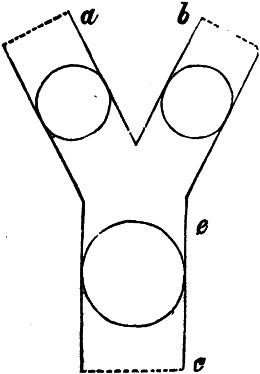
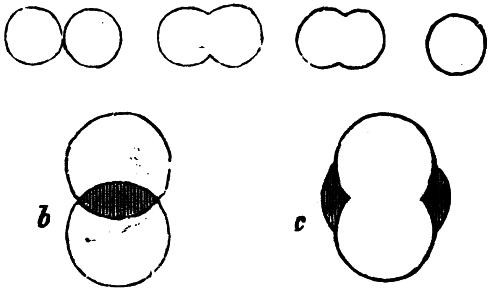
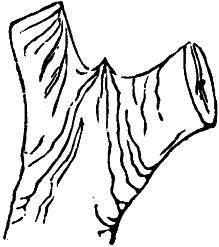
§ 9. I fear the reader would have no patience with me, if I asked him to examine, in longitudinal section, the lines of the descending currents of wood as they eddy into the increased single river. Of course, it is just what would take place if two strong streams, filling each a cylindrical pipe, ran together into one larger cylinder, with a central rod passing up every tube. But, as this central rod increases, and, at the same time, the supply of the stream from above, every added leaf contributing its little current, the eddies of wood about the fork become intensely curious and interesting; of which thus much the reader may observe in a moment by gathering a branch of any tree (laburnum shows it better, I think, than most), that the two meeting currents, first wrinkling a little, then rise in a low wave in the hollow of the fork, and flow over at the side, making their way to diffuse themselves round the stem, as in Fig. 40. Seen laterally, the bough bulges out below the fork, rather curiously and awkwardly, especially if more than two boughs meet at the same place, growing in one plane, so as to show the sudden increase on the profile. If the reader is interested in the subject, he will find strangely complicated and wonderful arrangements of stream when smaller boughs meet larger (one example is given in Plate 3, Vol. III., where the current of a smaller bough, entering upwards, pushes its way into the stronger rivers of the stem). But I cannot, of course, enter into such detail here.
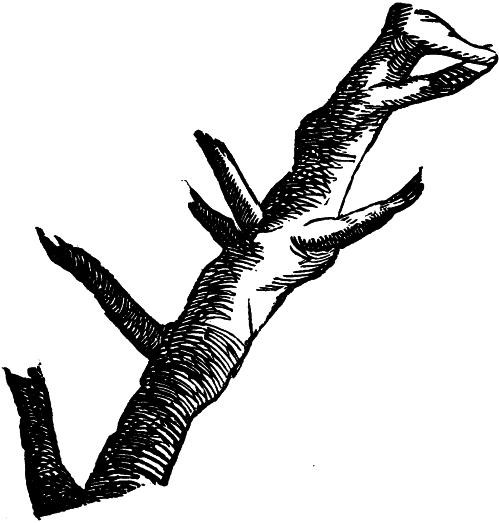
§ 10. The little ringed accumulation, repelled from the wood of the larger trunk at the base of small boughs, may be seen at a glance in any tree, and needs no illustration; but I give one from Salvator, Fig. 41 (from his own etching, Democritus omnium Derisor), which is interesting, because it shows the swelling at the bases of insertion, which yet, Salvator’s eye not being quick enough to detect the law of descent in the fibres, he, with his usual love of ugliness, fastens on this swollen character, and exaggerates it into an appearance of disease. The same bloated aspect may be seen in the example already given from another etching, Vol. III., Plate 4, Fig. 8.
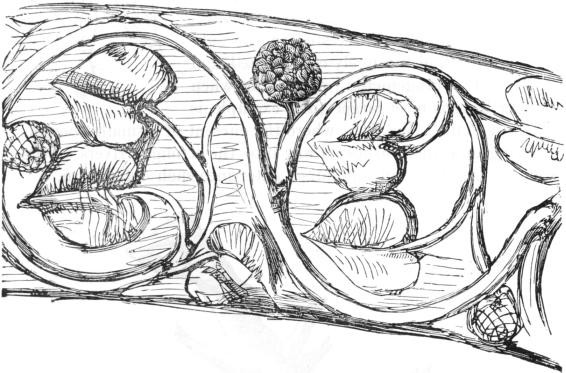
§ 11. I do not give any more examples from Claude. We have had enough already in Plate 4, Vol. III., which the reader should examine carefully. If he will then look forward to Fig. 61 here, he will see how Turner inserts branches, and with what certain and strange instinct of fidelity he marks the wrinkled enlargement and sinuous eddies of the wood rivers where they meet.
And remember always that Turner’s greatness and rightness in all these points successively depend on no scientific knowledge. He was entirely ignorant of all the laws we have been developing. He had merely accustomed himself to see impartially, intensely, and fearlessly.

§ 12. It may, perhaps, be interesting to compare, with the rude fallacies of Claude and Salvator, a little piece of earliest art, wrought by men who could see and feel. The scroll, Fig. 42, is a portion of that which surrounds the arch in San Zeno of Verona, above the pillar engraved in the Stones of Venice, Plate 17, Vol. I. It is, therefore, twelfth, or earliest thirteenth century work. Yet the foliage is already full of spring and life; and in the part of the stem, which I have given of its real size in Fig. 43, the reader will perhaps be surprised to see at the junctions the laws of vegetation, which escaped the sight of all the degenerate landscape-painters of Italy, expressed by one of her simple architectural workmen six hundred years ago.
We now know enough, I think, of the internal conditions which regulate tree-structure to enable us to investigate finally, the great laws of branch and stem aspect. But they are very beautiful; and we will give them a separate chapter.
1 See the note on Fig. 11, at page 17, which shows these two directions in a shoot of lime.
2 I find that the office and nature of cambium, the causes of the action of the sap, and the real mode of the formation of buds, are all still under the investigation of botanists. I do not lose time in stating the doubts or probabilities which exist on these subjects. For us, the mechanical fact of the increase of thickness by every leaf’s action is all that needs attention. The reader who wishes for information as accurate as the present state of science admits, may consult Lindley’s Introduction to Botany, and an interesting little book by Dr. Alexander Harvey on Trees and their Nature (Nisbet & Co., 1856), to which I owe much help.
3 In the true sense a “mediator,” (μεσίτης).
4 The gradual development of this radiating structure, which is organic and essential, composed of what are called by botanists medullary rays, is still a great mystery and wonder to me.
CHAPTER VII.
THE STEM.
§ 1. We must be content, in this most complex subject, to advance very slowly: and our easiest, if not our only way, will be to examine, first, the conditions under which boughs would form, supposing them all to divide in one plane, as your hand divides when you lay it flat on the table, with the fingers as wide apart as you can. And then we will deduce the laws of ramification which follow on the real structure of branches, which truly divide, not in one plane, but as your fingers separate if you hold a large round ball with them.
The reader has, I hope, a clear idea by this time of the main principle of tree-growth; namely, that the increase is by addition, or superimposition, not extension. A branch does not stretch itself out as a leech stretches its body. But it receives additions at its extremity, and proportional additions to its thickness. For although the actual living shoot, or growing point, of any year, lengthens itself gradually until it reaches its terminal bud, after that bud is formed, its length is fixed. It is thenceforth one joint of the tree, like the joint of a pillar, on which other joints of marble may be laid to elongate the pillar, but which will not itself stretch. A tree is thus truly edified, or built, like a house.
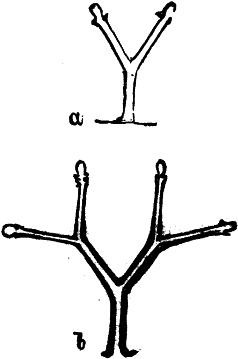
§ 2. I am not sure with what absolute stringency this law is observed, or what slight lengthening of substance may be traceable by close measurement among inferior branches. For practical purposes, we may assume that the law is final, and that if we represent the state of a plant, or extremity of branch, in any given year under the simplest possible type, Fig. 44, a, of two shoots, with terminal buds, springing from one stem, its growth next year may be expressed by the type, Fig. 44, b, in which, the original stems not changing or increasing, the terminal buds have built up each another story of plant, or repetition of the original form; and, in order to support this new edifice, have sent down roots all the way to the ground, so as to enclose and thicken the inferior stem.
But if this is so, how does the original stem, which never lengthens, ever become the tall trunk of a tree? The arrangement just stated provides very satisfactorily for making it stout, but not for making it tall. If the ramification proceeds in this way, the tree must assuredly become a round compact ball of short sticks, attached to the ground by a very stout, almost invisible, stem, like a puff-ball.
For if we take the form above, on a small scale, merely to see what comes of it, and carry its branching three steps farther, we get the successive conditions in Fig. 45, of which the last comes already round to the ground.

“But those forms really look something like trees!” Yes, if they were on a large scale. But each of the little shoots is only six or seven inches long; the whole cluster would but be three or four feet over, and touches the ground already at its extremity. It would enlarge if it went on growing, but never rise from the ground.
§ 3. This is an interesting question: one, also, which, I fear, we must solve, so far as yet it can be solved, with little help. Perhaps nothing is more curious in the history of human mind than the way in which the science of botany has become oppressed by nomenclature. Here is perhaps the first question which an intelligent child would think of asking about a tree: “Mamma, how does it make its trunk?” and you may open one botanical work after another, and good ones too, and by sensible men,—you shall not find this child’s question fairly put, much less fairly answered. You will be told gravely that a stem has received many names, such as culmus, stipes, and truncus; that twigs were once called flagella, but are now called ramuli; and that Mr. Link calls a straight stem, with branches on its sides, a caulis excurrens; and a stem, which at a certain distance above the earth breaks out into irregular ramifications, a caulis deliquescens. All thanks and honor be to Mr. Link! But at this moment, when we want to know why one stem breaks “at a certain distance,” and the other not at all, we find no great help in those splendid excurrencies and deliquescencies. “At a certain distance?” Yes: but why not before? or why then? How was it that, for many and many a year, the young shoots agreed to construct a vertical tower, or, at least, the nucleus of one, and then, one merry day, changed their minds, and built about their metropolis in all directions, nobody knows where, far into the air in free delight? How is it that yonder larch-stem grows straight and true, while all its branches, constructed by the same process as the mother trunk, and under the mother trunk’s careful inspection and direction, nevertheless have lost all their manners, and go forking and flashing about, more like cracklings of spitefullest lightning than decent branches of trees that dip green leaves in dew?
§ 4. We have probably, many of us, missed the point of such questions as these, because we too readily associated the structure of trees with that of flowers. The flowering part of a plant shoots out or up, in some given direction, until, at a stated period, it opens or branches into perfect form by a law just as fixed, and just as inexplicable, as that which numbers the joints of an animal’s skeleton, and puts the head on its right joint. In many forms of flowers—foxglove, aloe, hemlock, or blossom of maize—the structure of the flowering part so far assimilates itself to that of a tree, that we not unnaturally think of a tree only as a large flower, or large remnant of flower, run to seed. And we suppose the time and place of its branching to be just as organically determined as the height of the stalk of straw, or hemlock pipe, and the fashion of its branching just as fixed as the shape of petals in a pansy or cowslip.
§ 5. But that is not so; not so in anywise. So far as you can watch a tree, it is produced throughout by repetitions of the same process, which repetitions, however, are arbitrarily directed so as to produce one effect at one time, and another at another time. A young sapling has his branches as much as the tall tree. He does not shoot up in a long thin rod, and begin to branch when he is ten or fifteen feet high, as the hemlock or foxglove does when each has reached its ten or fifteen inches. The young sapling conducts himself with all the dignity of a tree from the first;—only he so manages his branches as to form a support for his future life, in a strong straight trunk, that will hold him well off the ground. Prudent little sapling!—but how does he manage this? how keep the young branches from rambling about, till the proper time, or on what plea dismiss them from his service if they will not help his provident purpose? So again, there is no difference in mode of construction between the trunk of a pine and its branch. But external circumstances so far interfere with the results of this repeated construction, that a stone pine rises for a hundred feet like a pillar, and then suddenly bursts into a cloud. It is the knowledge of the mode in which such change may take place which forms the true natural history of trees:—or, more accurately, their moral history. An animal is born with so many limbs, and a head of such a shape. That is, strictly speaking, not its history, but one fact of its history: a fact of which no other account can be given than that it was so appointed. But a tree is born without a head. It has got to make its own head. It is born like a little family from which a great nation is to spring; and at a certain time, under peculiar external circumstances, this nation, every individual of which remains the same in nature and temper, yet gives itself a new political constitution, and sends out branch colonies, which enforce forms of law and life entirely different from those of the parent state. That is the history of the state. It is also the history of a tree.
§ 6. Of these hidden histories, I know and can tell you as little as I did of the making of rocks. It will be enough for me if I can put the difficulty fairly before you, show you clearly such facts as are necessary to the understanding of great Art, and so leave you to pursue, at your pleasure, the graceful mystery of this imperfect leafage life.
I took in the outset the type of a triple but as the most general that could be given of all trees, because it represents a prevalently upright main tendency, with a capacity of branching on both sides. I would have shown the power of branching on all sides if I could; but we must be content at first with the simplest condition. From what we have seen since of bud structure, we may now make our type more complete by giving each bud a root proportioned to its size. And our elementary type of tree plant will be as in Fig. 46.
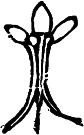
§ 7. Now these three buds, though differently placed, have all one mind. No bud has an oblique mind. Every one would like, if he could, to grow upright, and it is because the midmost one has entirely his own way in this matter, that he is largest. He is an elder brother;—his birthright is to grow straight towards the sky. A younger child may perhaps supplant him, if he does not care for his privilege. In the meantime all are of one family, and love each other,—so that the two lateral buds do not stoop aside because they like it, but to let their more favored brother grow in peace. All the three buds and roots have at heart the same desire;—which is, the one to grow as straight as he can towards bright heaven, the other as deep as he can into dark earth. Up to light, and down to shade;—into air and into rock:—that is their mind and purpose for ever. So far as they can, in kindness to each other, and by sufferance of external circumstances, work out that destiny, they will. But their beauty will not result from their working it out,—only from their maintained purpose and resolve to do so, if it may be. They will fail—certainly two, perhaps all three of them: fail egregiously;—ridiculously;—it may be agonizingly. Instead of growing up, they may be wholly sacrificed to happier buds above, and have to grow down, sideways, roundabout ways, all sorts of ways. Instead of getting down quietly into the convent of the earth, they may have to cling and crawl about hardest and hottest angles of it, full in sight of man and beast, and roughly trodden under foot by them;—stumbling-blocks to many.
Yet out of such sacrifice, gracefully made—such misfortune, gloriously sustained—all their true beauty is to arise. Yes, and from more than sacrifice—more than misfortune: from death. Yes, and more than death:—from the worst kind of death: not natural, coming to each in its due time; but premature, oppressed, unnatural, misguided—or so it would seem—to the poor dying sprays. Yet, without such death, no strong trunk were ever possible; no grace of glorious limb or glittering leaf; no companionship with the rest of nature or with man.
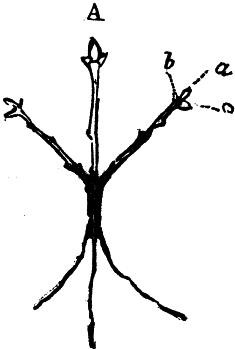
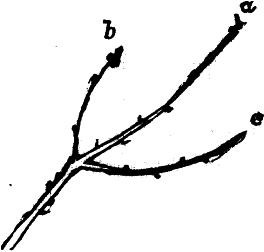
§ 8. Let us see how this must be. We return to our poor little threefold type, Fig. 46, above. Next year he will become as in Fig. 47. The two lateral buds keeping as much as may be out of their brother’s way, and yet growing upwards with a will, strike diagonal lines, and in moderate comfort accomplish their year’s life and terminal buds. But what is to be done next? Forming the triple terminal head on this diagonal line, we find that one of our next year’s buds, c, will have to grow down again, which is very hard; and another, b, will run right against the lateral branch of the upper bud, A, which must not be allowed under any circumstances.
What are we to do?
§ 9. The best we can. Give up our straightness, and some of our length, and consent to grow short, and crooked. But b shall be ordered to stoop forward and keep his head out of the great bough’s way, as in Fig. 48, and grow as he best may, with the consumptive pain in his chest. To give him a little more room, the elder brother, a, shall stoop a little forward also, recovering himself when he has got out of b’s way; and bud c shall be encouraged to bend himself bravely round and up, after his first start in that disagreeable downward direction. Poor b, withdrawn from air and light between a and A, and having to live stooping besides, cannot make much of himself, and is stunted and feeble. c, having free play for his energies, bends up with a will, and becomes handsomer, to our minds, than if he had been straight; and a is none the worse for his concession to unhappy b in early life.
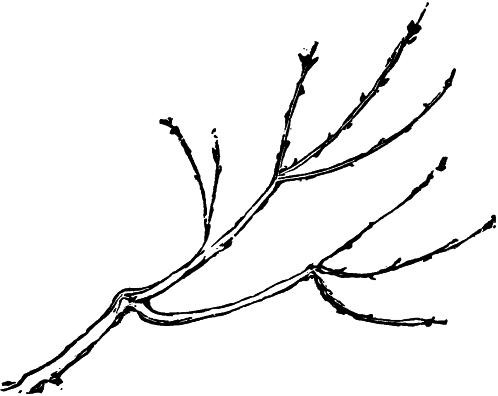
So far well for this year. But how for next? b is already too near the spray above him, even for his own strength and comfort; much less, with his weak constitution, will he be able to throw up any strong new shoots. And if he did, they would only run into those of the bough above. (If the reader will proceed in the construction of the whole figure he will see that this is so.) Under these discouragements and deficiencies, b is probably frostbitten, and drops off. The bough proceeds, mutilated, and itself somewhat discouraged. But it repeats its sincere and good-natured compliances, and at the close of the year, new wood from all the leaves having concealed the stump, and effaced the memory of poor lost b, and perhaps a consolatory bud lower down having thrown out a tiny spray to make the most of the vacant space near the main stem, we shall find the bough in some such shape as Fig. 49.
§ 10. Wherein we already see the germ of our irregularly bending branch, which might ultimately be much the prettier for the loss of b. Alas! the Fates have forbidden even this. While the low bough is making all these exertions, the boughs of A, above him, higher in air, have made the same under happier auspices. Every year their thicker leaves more and more forbid the light; and, after rain, shed their own drops unwittingly on the unfortunate lower bough, and prevent the air or sun from drying his bark or checking the chill in his medullary rays. Slowly a hopeless languor gains upon him. He buds here or there, faintly, in the spring; but the flow of strong wood from above oppresses him even about his root, where it joins the trunk. The very sap does not turn aside to him, but rushes up to the stronger, laughing leaves far above. Life is no more worth having; and abandoning all effort, the poor bough drops, and finds consummation of destiny in helping an old woman’s fire.
When he is gone, the one next above is left with greater freedom, and will shoot now from points of its sprays which were before likely to perish. Hence another condition of irregularity in form. But that bough also will fall in its turn, though after longer persistence. Gradually thus the central trunk is built, and the branches by whose help it was formed cast off, leaving here and there scars, which are all effaced by years, or lost sight of among the roughnesses and furrows of the aged surface. The work is continually advancing, and thus the head of foliage on any tree is not an expansion at a given height, like a flower-bell, but the collective group of boughs, or workmen, who have got up so far, and will get up higher next year, still losing one or two of their number underneath.
§ 11. So far well. But this only accounts for the formation of a vertical trunk. How is it that at a certain height this vertical trunk ceases to be built; and irregular branches spread in all directions?
First: In a great number of trees, the vertical trunk never ceases to be built. It is confused, at the top of the tree, among other radiating branches, being at first, of course, just as slender as they, and only prevailing over them in time. It shows at the top the same degree of irregularity and undulation as a sapling; and is transformed gradually into straightness lower down (see Fig. 50). The reader has only to take an hour’s ramble, to see for himself how many trees are thus constructed, if circumstances are favorable to their growth. Again, the mystery of blossoming has great influence in increasing the tendency to dispersion among the upper boughs: but this part of vegetative structure I cannot enter into; it is too subtle, and has, besides, no absolute bearing on our subject; the principal conditions which produce the varied play of branches being purely mechanical. The point at which they show a determined tendency to spread is generally to be conceived as a place of rest for the tree, where it has reached the height from the ground at which ground-mist, imperfect circulation of air, &c., have ceased to operate injuriously on it, and where it has free room, and air, and light for its growth.
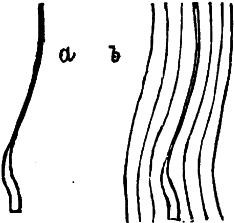
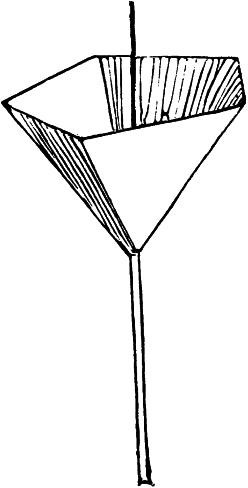
§ 12. I find there is quite an infinite interest in watching the different ways in which trees part their sprays at this resting-place, and the sometimes abrupt, sometimes gentle and undiscoverable, severing of the upright stem into the wandering and wilful branches; but a volume, instead of a chapter or two, and quite a little gallery of plates, would be needed to illustrate the various grace of this division, associated as it is with an exquisitely subtle effacing of undulation in the thicker stems, by the flowing down of the wood from above; the curves which are too violent in the branches being filled up, so that what was at a, Fig. 50, becomes as at b, and when the main stem is old, passes at last into straightness by almost imperceptible curves, a continually gradated emphasis of curvature being carried to the branch extremities.
§ 13. Hitherto we have confined ourselves entirely to examination of stems in one plane. We must glance—though only to ascertain how impossible it is to do more than glance—at the conditions of form which result from the throwing out of branches, not in one plane, but on all sides. “As your fingers divide when they hold a ball,” I said: or, better, a large cup, without a handle. Consider how such ramification will appear in one of the bud groups, that of our old friend the oak. We saw it opened usually into five shoots. Imagine, then (Fig. 51), a five-sided cup or funnel with a stout rod running through the centre of it. In the figure it is seen from above, so as partly to show the inside, and a little obliquely, that the central rod may not hide any of the angles. Then let us suppose that, where the angles of this cup were, we have, instead, five rods, as in Fig. 52, A, like the ribs of a pentagonal umbrella turned inside out by the wind. I dot the pentagon which connects their extremities, to keep their positions clear. Then these five rods, with the central one, will represent the five shoots, and the leader, from a vigorous young oak-spray. Put the leaves on each; the five-foiled star at its extremity, and the others, now not quite formally, but still on the whole as in Fig. 3 above, and we have the result, Fig. 52, B—rather a pretty one.
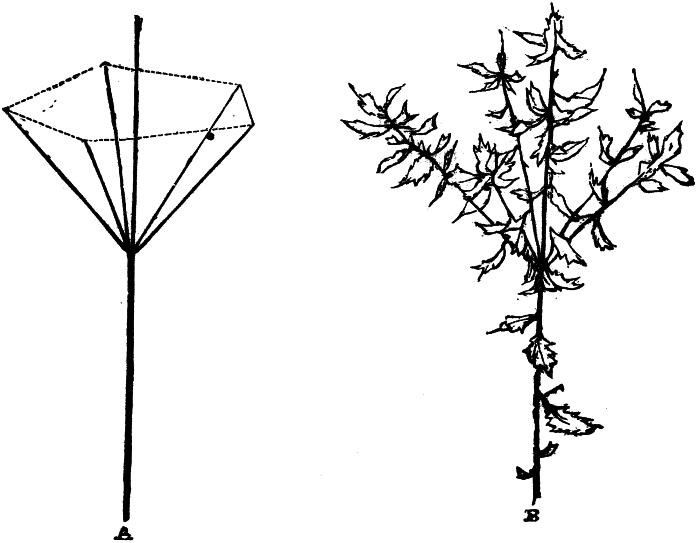
§ 14. By considering the various aspects which the five rods would take in Fig. 52, as the entire group was seen from below or above, and at different angles and distances, the reader may find out for himself what changes of aspect are possible in even so regular a structure as this. But the branchings soon take more complex symmetry. We know that next year each of these five subordinate rods is to enter into life on its own account, and to repeat the branching of the first. Thus, we shall have five pentagonal cups surrounding a large central pentagonal cup. This figure, if the reader likes a pretty perspective problem, he may construct for his own pleasure:—which having done, or conceived, he is then to apply the great principles of subjection and resilience, not to three branches only, as in Fig. 49, but to the five of each cup;—by which the cups get flattened out and bent up, as you may have seen vessels of Venetian glass, so that every cup actually takes something the shape of a thick aloe or artichoke leaf; and they surround the central one, not as a bunch of grapes surrounds a grape at the end of it, but as the petals grow round the centre of a rose. So that any one of these lateral branches—though, seen from above, it would present a symmetrical figure, as if it were not flattened (A, Fig. 53)—seen sideways, or in profile, will show itself to be at least as much flattened as at B.
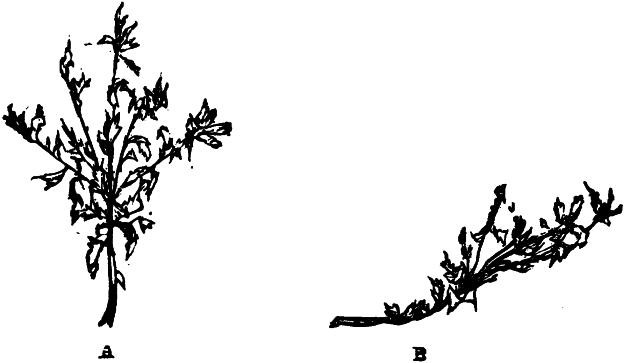
§ 15. You may thus regard the whole tree as composed of a series of such thick, flat, branch-leaves; only incomparably more varied and enriched in framework as they spread; and arranged more or less in spirals round the trunk. Gather a cone of a Scotch fir; begin at the bottom of it, and pull off the seeds, so as to show one of the spiral rows of them continuously, from the bottom to the top, leaving enough seeds above them to support the row. Then the gradual lengthening of the seeds from the root, their spiral arrangement, and their limitation within a curved, convex form, furnish the best severe type you can have of the branch system of all stemmed trees; and each seed of the cone represents, not badly, the sort of flattened solid leaf-shape which all complete branches have. Also, if you will try to draw the spiral of the fir-cone, you will understand something about tree-perspective, which may be generally useful. Finally, if you note the way in which the seeds of the cone slip each farther and farther over each other, so as to change sides in the middle of the cone, and obtain a reversed action of spiral lines in the upper half, you may imagine what a piece of work it would be for both of us, if we were to try to follow the complexities of branch order in trees of irregular growth, such as the rhododendron. I tried to do it, at least, for the pine, in section, but saw I was getting into a perfect maelström of spirals, from which no efforts would have freed me, in any imaginable time, and the only safe way was to keep wholly out of the stream.
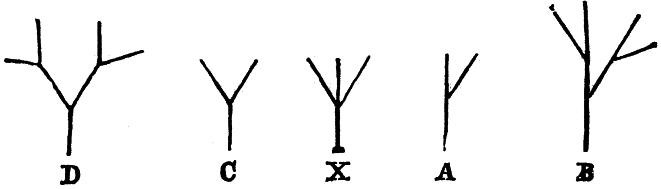
§ 16. The alternate system, leading especially to the formation of forked trees, is more manageable; and if the reader is master of perspective, he may proceed some distance in the examination of that for himself. But I do not care to frighten the general reader by many diagrams: the book is always sure to open at them when he takes it up. I will venture on one which has perhaps something a little amusing about it, and is really of importance.
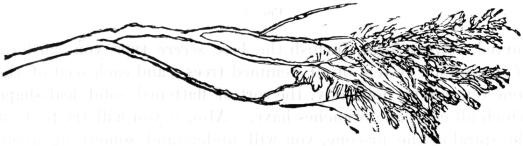
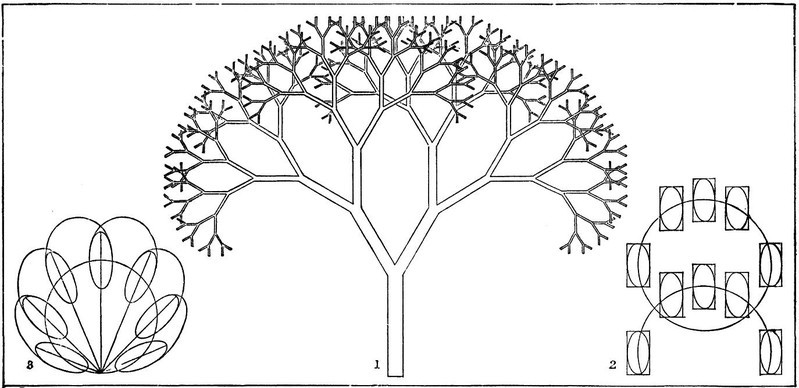
J. Ruskin
J. Emslie
56. Sketch by a Clerk of the Works.
§ 17. Let X, Fig. 54, represent a shoot of any opposite-leaved tree. The mode in which it will grow into a tree depends, mainly, on its disposition to lose the leader or a lateral shoot. If it keeps the leader, but drops the lateral, it takes the form A, and next year by a repetition of the process, B. But if it keeps the laterals, and drops the leader, it becomes first, C and next year, D. The form A is almost universal in spiral or alternate trees; and it is especially to be noted as bringing about this result, that in any given forking, one bough always goes on in its own direct course, and the other leaves it softly; they do not separate as if one was repelled from the other. Thus in Fig. 55, a perfect and nearly symmetrical piece of ramification, by Turner (lowest bough but one in the tree on the left in the “Château of La belle Gabrielle”), the leading bough, going on in its own curve, throws off, first, a bough to the right, then one to the left, then two small ones to the right, and proceeds itself, hidden by leaves, to form the farthest upper point of the branch.
The lower secondary bough—the first thrown off—proceeds in its own curve, branching first to the left, then to the right.
The upper bough proceeds in the same way, throwing off first to left, then to right. And this is the commonest and most graceful structure. But if the tree loses the leader, as at C, Fig. 54 (and many opposite trees have a trick of doing so), a very curious result is arrived at, which I will give in a geometrical form.
§ 18. The number of branches which die, so as to leave the main stem bare, is always greatest low down, or near the interior of the tree. It follows that the lengths of stem which do not fork diminish gradually to the extremities, in a fixed proportion. This is a general law. Assume, for example’s sake, the stem to separate always into two branches, at an equal angle, and that each branch is three quarters of the length of the preceding one. Diminish their thickness in proportion, and carry out the figure any extent you like. In Plate 56, opposite, Fig. 1, you have it at its ninth branch; in which I wish you to notice, first, the delicate curve formed by every complete line of the branches (compare Vol. IV. Fig. 91); and, secondly, the very curious result of the top of the tree being a broad flat line, which passes at an angle into lateral shorter lines, and so down to the extremities. It is this property which renders the contours of tops of trees so intensely difficult to draw rightly, without making their curves too smooth and insipid.
Observe, also, that the great weight of the foliage being thrown on the outside of each main fork, the tendency of forked trees is very often to droop and diminish the bough on one side, and erect the other into a principal mass.1
§ 19. But the form in a perfect tree is dependent on the revolution of this sectional profile, so as to produce a mushroom-shaped or cauliflower-shaped mass, of which I leave the reader to enjoy the perspective drawing by himself, adding, after he has completed it, the effect of the law of resilience to the extremities. Only, he must note this: that in real trees, as the branches rise from the ground, the open spaces underneath are partly filled by subsequent branchings, so that a real tree has not so much the shape of a mushroom, as of an apple, or, if elongated, a pear.
§ 20. And now you may just begin to understand a little of Turner’s meaning in those odd pear-shaped trees of his, in the “Mercury and Argus,” and other such compositions: which, however, before we can do completely, we must gather our evidence together, and see what general results will come of it respecting the hearts and fancies of trees, no less than their forms.
1 I don’t know that this is rightly expressed; but the meaning will be understood.
1 See the note on Fig. 11, at page 17, which shows these two directions in a shoot of lime.
2 I find that the office and nature of cambium, the causes of the action of the sap, and the real mode of the formation of buds, are all still under the investigation of botanists. I do not lose time in stating the doubts or probabilities which exist on these subjects. For us, the mechanical fact of the increase of thickness by every leaf’s action is all that needs attention. The reader who wishes for information as accurate as the present state of science admits, may consult Lindley’s Introduction to Botany, and an interesting little book by Dr. Alexander Harvey on Trees and their Nature (Nisbet & Co., 1856), to which I owe much help.
3 In the true sense a “mediator,” (μεσίτης).
4 The gradual development of this radiating structure, which is organic and essential, composed of what are called by botanists medullary rays, is still a great mystery and wonder to me.
1 This is Harding’s favorite form of tree. You will find it much insisted on in his works on foliage. I intended to have given a figure to show the results of the pressure of the weight of all the leafage on a great lateral bough, in modifying its curves, the strength of timber being greatest where the leverage of the mass tells most. But I find nobody ever reads things which it takes any trouble to understand, so that it is of no use to write them.
1 This is Harding’s favorite form of tree. You will find it much insisted on in his works on foliage. I intended to have given a figure to show the results of the pressure of the weight of all the leafage on a great lateral bough, in modifying its curves, the strength of timber being greatest where the leverage of the mass tells most. But I find nobody ever reads things which it takes any trouble to understand, so that it is of no use to write them.
CHAPTER VIII.
THE LEAF MONUMENTS.
§ 1. And now, having ascertained in its main points the system on which the leaf-workers build, let us see, finally, what results in aspect, and appeal to human mind, their building must present. In some sort it resembles that of the coral animal, differing, however, in two points. First, the animal which forms branched coral, builds, I believe, in calm water, and has few accidents of current, light, or heat to contend with. He builds in monotonous ramification, untormented, therefore unbeautiful. Secondly, each coral animal builds for himself, adding his cell to what has been before constructed, as a bee adds another cell to the comb. He obtains no essential connection with the root and foundation of the whole structure. That foundation is thickened clumsily, by a fused and encumbering aggregation, as a stalactite increases;—not by threads proceeding from the extremities to the root.
§ 2. The leaf, as we have seen, builds in both respects under opposite conditions. It leads a life of endurance, effort, and various success, issuing in various beauty; and it connects itself with the whole previous edifice by one sustaining thread, continuing its appointed piece of work all the way from top to root. Whence result three great conditions in branch aspect, for which I cannot find good names, but must use the imperfect ones of “Spring,” “Caprice,” “Fellowship.”
§ 3. I. Spring: or the appearance of elastic and progressive power, as opposed to that look of a bent piece of cord.—This follows partly on the poise of the bough, partly on its action in seeking or shunning. Every branch-line expresses both these. It takes a curve accurately showing the relations between the strength of the sprays in that position (growing downward, upward, or laterally), and the weight of leaves they carry; and again, it takes a curve expressive of the will or aim of those sprays, during all their life, and handed down from sire to son, in steady inheritance of resolution to reach forward in a given direction, or bend away from some given evil influence.
And all these proportionate strengths and measured efforts of the bough produce its loveliness, and ought to be felt, in looking at it, not by any mathematical evidence, but by the same fine instinct which enables us to perceive, when a girl dances rightly, that she moves easily, and with delight to herself; that her limbs are strong enough, and her body tender enough, to move precisely as she wills them to move. You cannot say of any bend of arm or foot what precise relations of their curves to the whole figure manifest, in their changeful melodies, that ease of motion; yet you feel that they do so, and you feel it by a true instinct. And if you reason on the matter farther, you may know, though you cannot see, that an absolute mathematical necessity proportions every bend of the body to the rate and direction of its motion; and that the momentary fancy and fire of the will measure themselves, even in their gaily-fancied freedom, by stern laws of nervous life, and material attraction, which regulate eternally every pulse of the strength of man, and every sweep of the stars of heaven.
§ 4. Observe, also, the balance of the bough of a tree is quite as subtle as that of a figure in motion. It is a balance between the elasticity of the bough and the weight of leaves, affected in curvature, literally, by the growth of every leaf; and besides this, when it moves, it is partly supported by the resistance of the air, greater or less, according to the shape of leaf;—so that branches float on the wind more than they yield to it; and in their tossing do not so much bend under a force, as rise on a wave, which penetrates in liquid threads through all their sprays.
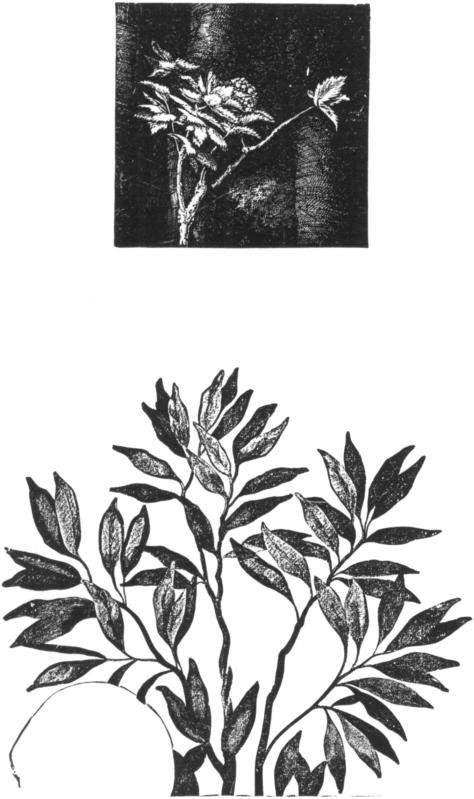
57. Leafage by Durer and Veronese.

To face page 65.
Fig. 56.§ 5. I am not sure how far, by any illustration, I can exemplify these subtle conditions of form. All my plans have been shortened, and I have learned to content myself with yet more contracted issues of them after the shortening, because I know that nearly all in such matters must be said or shown, unavailably. No saying will teach the truth. Nothing but doing. If the reader will draw boughs of trees long and faithfully, giving previous pains to gain the power (how rare!) of drawing anything faithfully, he will come to see what Turner’s work is, or any other right work, but not by reading, nor thinking, nor idly looking. However, in some degree, even our ordinary instinctive perception of grace and balance may serve us, if we choose to pay any accurate attention to the matter.
§ 6. Look back to Fig. 55. That bough of Turner’s is exactly and exquisitely poised, leaves and all, for its present horizontal position. Turn the book so as to put the spray upright, with the leaves at the top. You ought to see they would then be wrong;—that they must, in that position, have adjusted themselves more directly above the main stem, and more firmly, the curves of the lighter sprays being a deflection caused by their weight in the horizontal position. Again, Fig. 56 represents, enlarged to four times the size of the original, the two Scotch firs in Turner’s etching of Inverary.1 These are both in perfect poise, representing a double action: the warping of the trees away from the sea-wind, and the continual growing out of the boughs on the right-hand side, to recover the balance.
Turn the page so as to be horizontal, and you ought to feel that, considered now as branches, both would be out of balance. If you turn the heads of the trees to your right, they are wrong, because gravity would have bent them more downwards; if to your left, wrong, because the law of resilience would have raised them more at the extremities.
§ 7. Now take two branches of Salvator’s, Figs. 57 and 58.2 You ought to feel that these have neither poise nor spring: their leaves are incoherent, ragged, hanging together in decay.
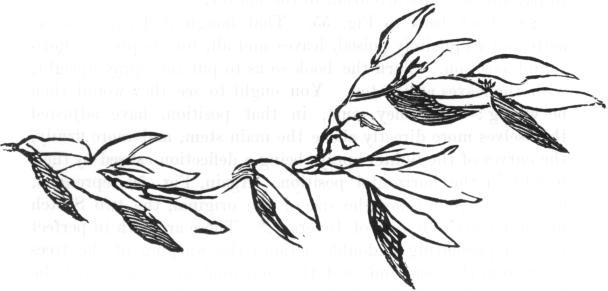
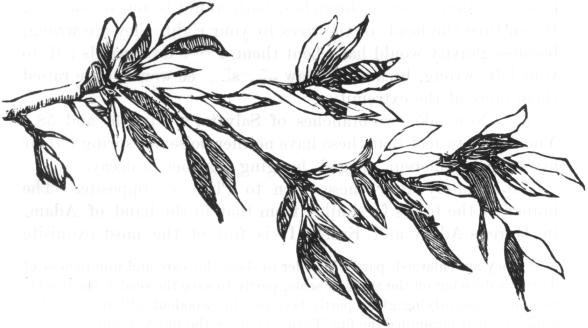
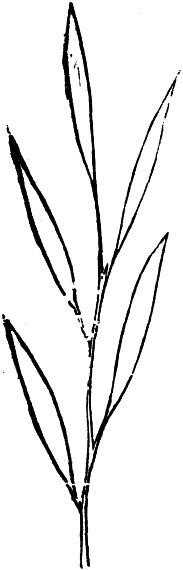
Immediately after these, turn to Plate 57, opposite. The branch at the top is facsimiled from that in the hand of Adam, in Durer’s Adam and Eve.3 It is full of the most exquisite vitality and spring in every line. Look at it for five minutes carefully. Then turn back to Salvator’s, Fig. 57. Are you as well satisfied with it? You ought to feel that it is not strong enough at the origin to sustain the leaves; and that if it were, those leaves themselves are in broken or forced relations with each other. Such relations might, indeed, exist in a partially withered tree, and one of these branches is intended to be partially withered, but the other is not; and if it were, Salvator’s choice of the withered tree is precisely the sign of his preferring ugliness to beauty, decrepitude and disorganization to life and youth. The leaves on the spray, by Durer, hold themselves as the girl holds herself in dancing; those on Salvator’s as an old man, partially palsied, totters along with broken motion, and loose deflection of limb.
§ 8. Next, let us take a spray by Paul Veronese4—the lower figure in Plate 57. It is just as if we had gathered one out of the garden. Though every line and leaf in the quadruple group is necessary to join with other parts of the composition of the noble picture, every line and leaf is also as free and true as if it were growing. None are confused, yet none are loose; all are individual, yet none separate, in tender poise of pliant strength and fair order of accomplished grace, each, by due force of the indulgent bough, set and sustained.
§ 9. Observe, however, that in all these instances from earlier masters, the expression of the universal botanical law of poise is independent of accuracy in rendering of species. As before noticed, the neglect of specific distinction long restrained the advance of landscape, and even hindered Turner himself in many respects. The sprays of Veronese are a conventional type of laurel; Albert Durer’s an imaginary branch of paradisaical vegetation; Salvator’s, a rude reminiscence of sweet chestnut; Turner’s only is a faithful rendering of the Scotch fir.
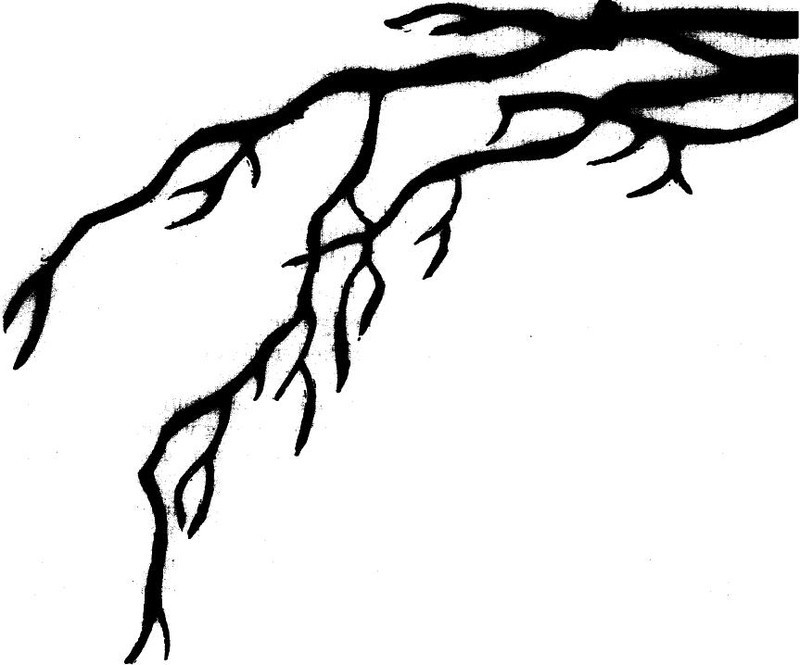

58. Branch Curvature.
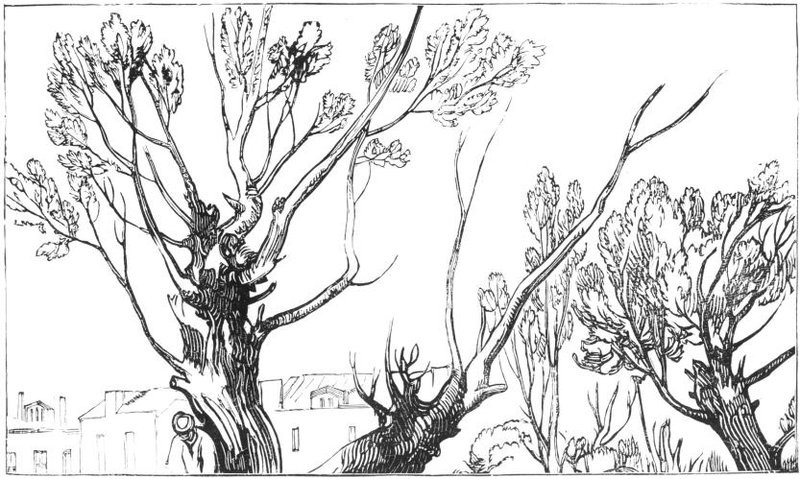
To face page 69.
Fig. 61§ 10. To show how the principle of balance is carried out by Nature herself, here is a little terminal upright spray of willow, the most graceful of English trees (Fig. 59). I have drawn it carefully; and if the reader will study its curves, or, better, trace and pencil them with a perfectly fine point, he will feel, I think, without difficulty, their finished relation to the leaves they sustain. Then if we turn suddenly to a piece of Dutch branch-drawing (Fig. 60), facsimiled from No. 160, Dulwich Gallery (Berghem), he will understand, I believe, also the qualities of that, without comment of mine. It is of course not so dark in the original, being drawn with the chance dashes of a brush loaded with brown, but the contours are absolutely as in the woodcut. This Dutch design is a very characteristic example of two faults in tree-drawing; namely, the loss not only of grace and spring, but of woodiness. A branch is not elastic as steel is, neither as a carter’s whip is. It is a combination, wholly peculiar, of elasticity with half-dead and sapless stubbornness, and of continuous curve with pauses of knottiness, every bough having its blunted, affronted, fatigued, or repentant moments of existence, and mingling crabbed rugosities and fretful changes of mind with the main tendencies of its growth. The piece of pollard willow opposite (Fig. 61), facsimiled from Turner’s etching of “Young Anglers,” in the Liber Studiorum, has all these characters in perfectness, and may serve for sufficient study of them. It is impossible to explain in what the expression of the woody strength consists, unless it be felt. One very obvious condition is the excessive fineness of curvature, approximating continually to a straight line. In order to get a piece of branch curvature given as accurately as I could by an unprejudiced person, I set one of my pupils at the Working Men’s College (a joiner by trade) to draw, last spring, a lilac branch of its real size, as it grew, before it budded. It was about six feet long, and before he could get it quite right, the buds came out and interrupted him; but the fragment he got drawn is engraved in flat profile, in Plate 58. It has suffered much by reduction, one or two of its finest curves having become lost in the mere thickness of the lines. Nevertheless, if the reader will compare it carefully with the Dutch work, it will teach him something about trees.
§ 11. II. Caprice.—The next character we had to note of the leaf-builders was their capriciousness, noted, partly, in Vol. III. chap. ix. § 14. It is a character connected with the ruggedness and ill-temperedness just spoken of, and an essential source of branch beauty: being in reality the written story of all the branch’s life,—of the theories it formed, the accidents it suffered, the fits of enthusiasm to which it yielded in certain delicious warm springs; the disgusts at weeks of east wind, the mortifications of itself for its friends’ sakes; or the sudden and successful inventions of new ways of getting out to the sun. The reader will understand this character in a moment, by merely comparing Fig. 62, which is a branch of Salvator’s,5 with Fig. 63, which I have traced from the engraving, in the Yorkshire series, of Turner’s “Aske Hall.” You cannot but feel at once, not only the wrongness of Salvator’s, but its dulness. It is not now a question either of poise, or grace, or gravity; only of wit. That bough has got no sense; it has not been struck by a single new idea from the beginning of it to the end; dares not even cross itself with one of its own sprays. You will be amazed, in taking up any of these old engravings, to see how seldom the boughs do cross each other. Whereas, in nature, not only is the intersection of extremities a mathematical necessity (see Plate 56), but out of this intersection and crossing of curve by curve, and the opposition of line it involves, the best part of their composition arises. Look at the way the boughs are interwoven in that piece of lilac stem (Plate 58).
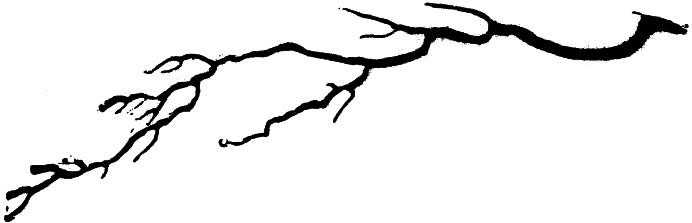
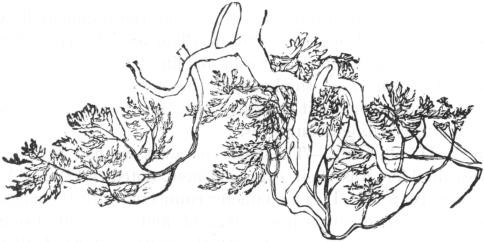
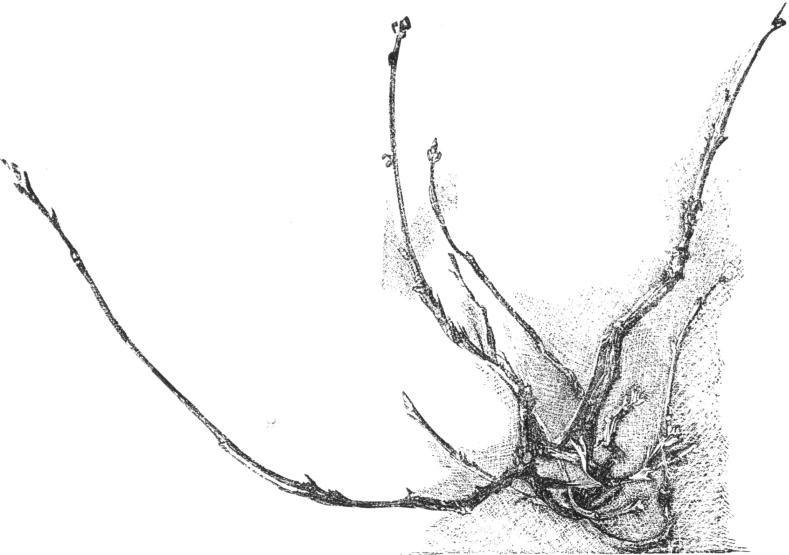
59. The Dryad’s Waywardness.
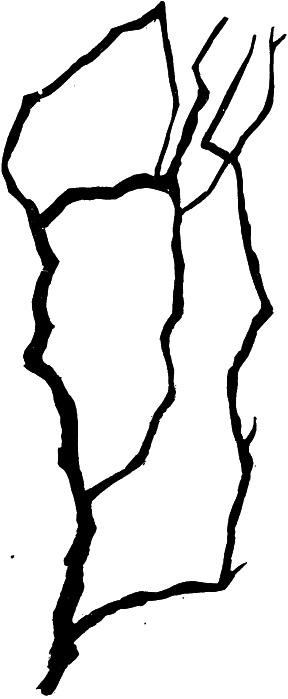
§ 12. Again: As it seldom struck the old painters that boughs must cross each other, so it never seems to have occurred to them that they must be sometimes foreshortened. I chose this bit from “Aske Hall,” that you might see at once, both how Turner foreshortens the main stem, and how, in doing so, he shows the turning aside, and outwards, of the one next to it, to the left, to get more air.6 Indeed, this foreshortening lies at the core of the business; for unless it be well understood, no branch-form can ever be rightly drawn. I placed the oak spray in Plate 51 so as to be seen as nearly straight on its flank as possible. It is the most uninteresting position in which a bough can be drawn; but it shows the first simple action of the law of resilience. I will now turn the bough with its extremity towards us, and foreshorten it (Plate 59), which being done, you perceive another tendency in the whole branch, not seen at all in the first Plate, to throw its sprays to its own right (or to your left), which it does to avoid the branch next it, while the forward action is in a sweeping curve round to your right, or to the branch’s left: a curve which it takes to recover position after its first concession. The lines of the nearer and smaller shoots are very nearly—thus foreshortened—those of a boat’s bow. Here is a piece of Dutch foreshortening for you to compare with it, Fig. 64.7
§ 13. In this final perfection of bough-drawing, Turner stands wholly alone. Even Titian does not foreshorten his boughs rightly. Of course he could, if he had cared to do so; for if you can foreshorten a limb or a hand, much more a tree branch. But either he had never looked at a tree carefully enough to feel that it was necessary, or, which is more likely, he disliked to introduce in a background elements of vigorous projection. Be the reason what it may, if you take Lefèvre’s plates of the Peter Martyr and St. Jerome—the only ones I know which give any idea of Titian’s tree-drawing, you will observe at once that the boughs lie in flakes, artificially set to the right and left, and are not intricate or varied, even where the foliage indicates some foreshortening;—completing thus the evidence for my statement long ago given, that no man but Turner had ever drawn the stem of a tree.
§ 14. It may be well also to note, for the advantage of the general student of design, that, in foliage and bough drawing, all the final grace and general utility of the study depend on its being well foreshortened; and that, till the power of doing so quite accurately is obtained, no landscape-drawing is of the least value; nor can the character of any tree be known at all until not only its branches, but its minutest extremities, have been drawn in the severest foreshortening, with little accompanying plans of the arrangements of the leaves or buds, or thorns, on the stem. Thus Fig. 65 is the extremity of a single shoot of spruce foreshortened, showing the resilience of its swords from beneath, and Fig. 66 is a little ground-plan, showing the position of the three lowest triple groups of thorn on a shoot of gooseberry.8 The fir shoot is carelessly drawn; but it is not worth while to do it better, unless I engraved it on steel, so as to show the fine relations of shade.
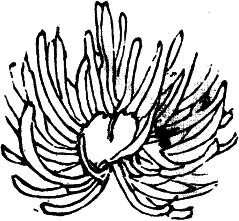
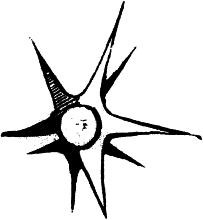
§ 15. III. Fellowship.—The compactness of mass presented by this little sheaf of pine-swords may lead us to the consideration of the last character I have to note of boughs; namely, the mode of their association in masses. It follows, of course, from all the laws of growth we have ascertained, that the terminal outline of any tree or branch must be a simple one, containing within it, at a given height or level, the series of leaves of the year; only we have not yet noticed the kind of form which results, in each branch, from the part it has to take in forming the mass of the tree. The systems of branching are indeed infinite, and could not be exemplified by any number of types; but here are two common types, in section, which will enough explain what I mean.
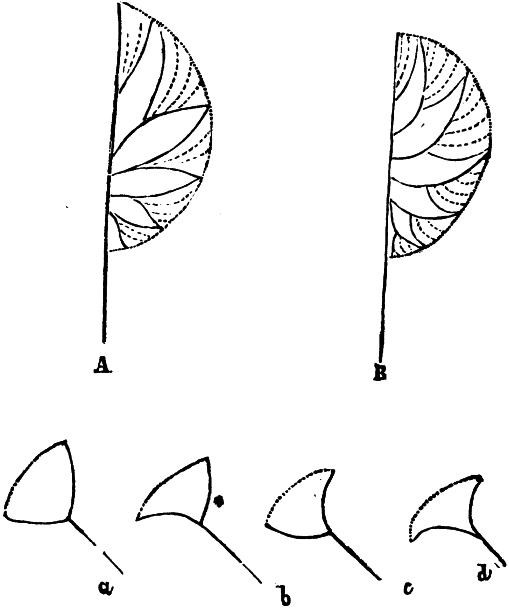
§ 16. If a tree branches with a concave tendency, it is apt to carry its boughs to the outer curve of limitation, as at A, Fig. 67, and if with a convex tendency, as at B. In either case the vertical section, or profile, of a bough will give a triangular mass, terminated by curves, and elongated at one extremity. These triangular masses you may see at a glance, prevailing in the branch system of any tree in winter. They may, of course, be mathematically reduced to the four types a, b, c, and d, Fig. 67, but are capable of endless variety of expression in action, and in the adjustment of their weights to the bearing stem.
§ 17. To conclude, then, we find that the beauty of these buildings of the leaves consists, from the first step of it to the last, in its showing their perfect fellowship; and a single aim uniting them under circumstances of various distress, trial, and pleasure. Without the fellowship, no beauty; without the steady purpose, no beauty; without trouble, and death, no beauty; without individual pleasure, freedom, and caprice, so far as may be consistent with the universal good, no beauty.
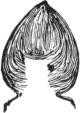
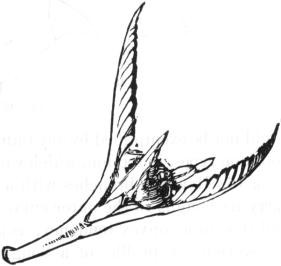
§ 18. Tree-loveliness might be thus lost or killed in many ways. Discordance would kill it—of one leaf with another; disobedience would kill it—of any leaf to the ruling law; indulgence would kill it, and the doing away with pain; or slavish symmetry would kill it, and the doing away with delight. And this is so, down to the smallest atom and beginning of life: so soon as there is life at all, there are these four conditions of it;—harmony, obedience, distress, and delightsome inequality. Here is the magnified section of an oak-bud, not the size of a wheat grain (Fig. 68). Already its nascent leaves are seen arranged under the perfect law of resilience, preparing for stoutest work on the right side. Here is a dogwood bud just opening into life (Fig. 69). Its ruling law is to be four square, but see how the uppermost leaf takes the lead, and the lower bends up, already a little distressed by the effort. Here is a birch-bud, farther advanced, Fig. 70. Who shall say how many humors the little thing has in its mind already; or how many adventures it has passed through? And so to the end. Help, submission, sorrow, dissimilarity, are the sources of all good;—war, disobedience, luxury, equality, the sources of all evil.
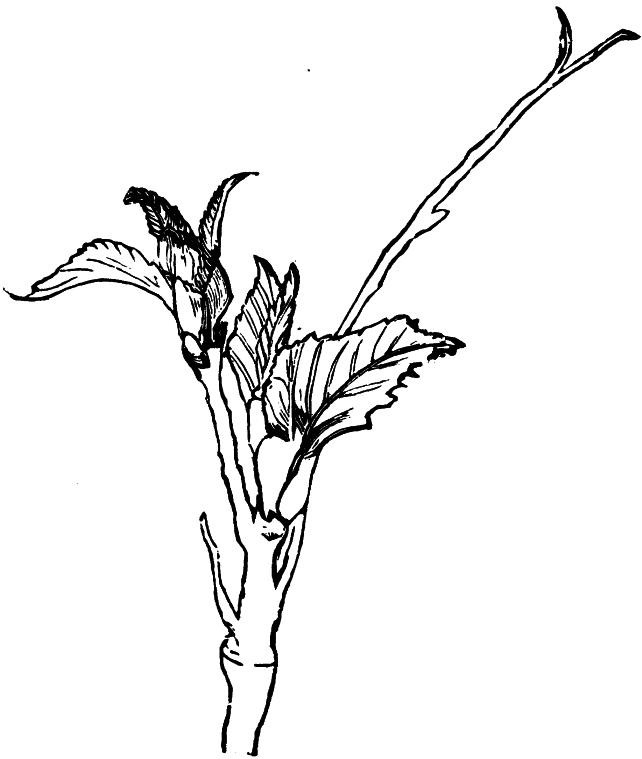
§ 19. There is yet another and a deeply laid lesson to be received from the leaf-builders, which I hope the reader has already perceived. Every leaf, we have seen, connects its work with the entire and accumulated result of the work of its predecessors. Their previous construction served it during its life, raised it towards the light, gave it more free sway and motion in the wind, and removed it from the noxiousness of earth exhalation. Dying, it leaves its own small but well-labored thread, adding, though imperceptibly, yet essentially, to the strength, from root to crest, of the trunk on which it had lived, and fitting that trunk for better service to succeeding races of leaves.
We men, sometimes, in what we presume to be humility, compare ourselves with leaves; but we have as yet no right to do so. The leaves may well scorn the comparison. We who live for ourselves, and neither know how to use nor keep the work of past time, may humbly learn,—as from the ant, foresight,—from the leaf, reverence. The power of every great people, as of every living tree, depends on its not effacing, but confirming and concluding, the labors of its ancestors. Looking back to the history of nations, we may date the beginning of their decline from the moment when they ceased to be reverent in heart, and accumulative in hand and brain; from the moment when the redundant fruit of age hid in them the hollowness of heart, whence the simplicities of custom and sinews of tradition had withered away. Had men but guarded the righteous laws, and protected the precious works of their fathers, with half the industry they have given to change and to ravage, they would not now have been seeking vainly, in millennial visions and mechanic servitudes, the accomplishment of the promise made to them so long ago: “As the days of a tree are the days of my people, and mine elect shall long enjoy the work of their hands; they shall not labor in vain, nor bring forth for trouble; for they are the seed of the blessed of the Lord, and their offspring with them.”
§ 20. This lesson we have to take from the leaf’s life. One more we may receive from its death. If ever in autumn a pensiveness falls upon us as the leaves drift by in their fading, may we not wisely look up in hope to their mighty monuments? Behold how fair, how far prolonged, in arch and aisle, the avenues of the valleys; the fringes of the hills! So stately,—so eternal; the joy of man, the comfort of all living creatures, the glory of the earth,—they are but the monuments of those poor leaves that flit faintly past us to die. Let them not pass, without our understanding their last counsel and example: that we also, careless of monument by the grave, may build it in the world—monument by which men may be taught to remember, not where we died, but where we lived.
1 They are enlarged, partly in order to show the care and minuteness of Turner’s drawing on the smallest scale, partly to save the reader the trouble of using a magnifying glass, partly because this woodcut will print safely; while if I had facsimiled the fine Turner etching, the block might have been spoiled after a hundred impressions.
2 Magnified to twice the size of the original, but otherwise facsimiled from his own etching of Œdipus, and the School of Plato.
3 The parrot perched on it is removed, which may be done without altering the curve, as the bird is set where its weight would not have bent the wood.
4 The largest laurel spray in the background of the “Susanna,” Louvre—reduced to about a fifth of the original. The drawing was made for me by M. Hippolyte Dubois, and I am glad it is not one of my own, lest I should be charged with exaggerating Veronese’s accuracy.
This group of leaves is, in the original, of the life-size; the circle which interferes with the spray on the right being the outline of the head and of one of the elders; and, as painted for distant effect, there is no care in completing the stems:—they are struck with a few broken touches of the brush, which cannot be imitated in the engraving, and much of their spirit is lost in consequence.
5 The longest in “Apollo and the Sibyl,” engraved by Boydell. (Reduced one-half.)
6 The foreshortening of the bough to the right is a piece of great audacity; it comes towards us two or three feet sharply, after forking, so as to look half as thick again as at the fork;—then bends back again, and outwards.
7 Hobbima. Dulwich Gallery, No. 131. Turn the book with its inner edge up.
8 Their change from groups of three to groups of two, and then to single thorns at the end of the spray, will be found very beautiful in a real shoot. The figure on the left in Plate 52 is a branch of blackthorn with its spines (which are a peculiar condition of branch, and can bud like branches, while thorns have no root nor power of development). Such a branch gives good practice without too much difficulty.
CHAPTER IX.
THE LEAF SHADOWS.
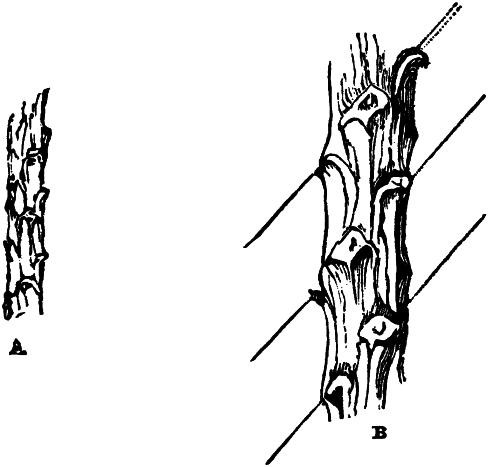
§ 1. It may be judged, by the time which it has taken to arrive at any clear idea of the structure of shield-builders, what a task would open to us if we endeavored to trace the more wonderful forms of the wild builders with the sword. Not that they are more complex; but they are more definite, and cannot be so easily generalized. The conditions which produce the spire of the cypress, and flaked breadth of the cedar, the rounded head of the stone pine, and perfect pyramid of the black spruce, are far more distinct, and would require more accurate and curious diagrams to illustrate them, than the graceful, but in some degree monotonous branching of leaf-builders. In broad principle they are, however, alike. The leaves construct the sprays in the same accumulative way: the only essential difference being that in the sword-builders the leaves are all set close, and at equal intervals. Instead of admitting extended and variable spaces between them, the whole spray is one tower of leaf-roots, set in a perfect spiral. Thus, Fig. 71, at A, represents a fragment of spray of Scotch fir of its real size. B is the same piece magnified, the diamond-like spaces being the points on which the leaves grew. The dotted lines show the regularity of the spiral. As the minor stems join in boughs, the scars left by the leaves are gradually effaced, and a thick but broken and scaly bark forms instead.
§ 2. A sword-builder may therefore be generally considered as a shield-builder put under the severest military restraint. The graceful and thin leaf is concentrated into a strong, narrow, pointed rod; and the insertion of these rods on them is in a close and perfectly timed order. In some ambiguous trees connected with the tribe (as the arbor vitæ) there is no proper stem to the outer leaves, but all the extremities form a kind of coralline leaf, flat and fern-like, but articulated like a crustacean animal, which gradually concentrates and embrowns itself into the stem. The thicker branches of these trees are exquisitely fantastic; and the mode in which the flat system of leaf first produces an irregular branch, and then adapts itself to the symmetrical cone of the whole tree, is one of the most interesting processes of form which I know in vegetation.
§ 3. Neither this, however, nor any other of the pine formations, have we space here to examine in detail; while without detail, all discussion of them is in vain. I shall only permit myself to note a few points respecting my favorite tree, the black spruce, not with any view to art criticism (though we might get at some curious results by a comparison of popular pine-drawing in Germany, America, and other dark-wooded countries, with the true natural forms), but because I think the expression of this tree has not been rightly understood by travellers in Switzerland, and that, with a little watching of it, they might easily obtain a juster feeling.
§ 4. Of the many marked adaptations of nature to the mind of man, it seems one of the most singular, that trees intended especially for the adornment of the wildest mountains should be in broad outline the most formal of trees. The vine, which is to be the companion of man, is waywardly docile in its growth, falling into festoons beside his cornfields, or roofing his garden-walks, or casting its shadow all summer upon his door. Associated always with the trimness of cultivation, it introduces all possible elements of sweet wildness. The pine, placed nearly always among scenes disordered and desolate, brings into them all possible elements of order and precision. Lowland trees may lean to this side and that, though it is but a meadow breeze that bends them, or a bank of cowslips from which their trunks lean aslope. But let storm and avalanche do their worst, and let the pine find only a ledge of vertical precipice to cling to, it will nevertheless grow straight. Thrust a rod from its last shoot down the stem;—it shall point to the centre of the earth as long as the tree lives.
§ 5. Also it may be well for lowland branches to reach hither and thither for what they need, and to take all kinds of irregular shape and extension. But the pine is trained to need nothing, and to endure everything. It is resolvedly whole, self-contained, desiring nothing but rightness, content with restricted completion. Tall or short, it will be straight. Small or large, it will be round. It may be permitted also to these soft lowland trees that they should make themselves gay with show of blossom, and glad with pretty charities of fruitfulness. We builders with the sword have harder work to do for man, and must do it in close-set troops. To stay the sliding of the mountain snows, which would bury him; to hold in divided drops, at our sword-points, the rain, which would sweep away him and his treasure-fields; to nurse in shade among our brown fallen leaves the tricklings that feed the brooks in drought; to give massive shield against the winter wind, which shrieks through the bare branches of the plain:—such service must we do him steadfastly while we live. Our bodies, also, are at his service: softer than the bodies of other trees, though our toil is harder than theirs. Let him take them as pleases him, for his houses and ships. So also it may be well for these timid lowland trees to tremble with all their leaves, or turn their paleness to the sky, if but a rush of rain passes by them; or to let fall their leaves at last, sick and sere. But we pines must live carelessly amidst the wrath of clouds. We only wave our branches to and fro when the storm pleads with us, as men toss their arms in a dream.
And finally, these weak lowland trees may struggle fondly for the last remnants of life, and send up feeble saplings again from their roots when they are cut down. But we builders with the sword perish boldly; our dying shall be perfect and solemn, as our warring: we give up our lives without reluctance, and for ever.1
§ 6. I wish the reader to fix his attention for a moment on these two great characters of the pine, its straightness and rounded perfectness; both wonderful, and in their issue lovely, though they have hitherto prevented the tree from being drawn. I say, first, its straightness. Because we constantly see it in the wildest scenery, we are apt to remember only as characteristic examples of it those which have been disturbed by violent accident or disease. Of course such instances are frequent. The soil of the pine is subject to continual change; perhaps the rock in which it is rooted splits in frost and falls forward, throwing the young stems aslope, or the whole mass of earth around it is undermined by rain, or a huge boulder falls on its stem from above, and forces it for twenty years to grow with weight of a couple of tons leaning on its side. Hence, especially at edges of loose cliffs, about waterfalls, or at glacier banks, and in other places liable to disturbance, the pine may be seen distorted and oblique; and in Turner’s “Source of the Arveron,” he has, with his usual unerring perception of the main point in any matter, fastened on this means of relating the glacier’s history. The glacier cannot explain its own motion; and ordinary observers saw in it only its rigidity; but Turner saw that the wonderful thing was its non-rigidity. Other ice is fixed, only this ice stirs. All the banks are staggering beneath its waves, crumbling and withered as by the blast of a perpetual storm. He made the rocks of his foreground loose—rolling and tottering down together; the pines, smitten aside by them, their tops dead, bared by the ice wind.
§ 7. Nevertheless, this is not the truest or universal expression of the pine’s character. I said long ago, even of Turner: “Into the spirit of the pine he cannot enter.” He understood the glacier at once; he had seen the force of sea on shore too often to miss the action of those crystal-crested waves. But the pine was strange to him, adverse to his delight in broad and flowing line; he refused its magnificent erectness. Magnificent!—nay, sometimes, almost terrible. Other trees, tufting crag or hill, yield to the form and sway of the ground, clothe it with soft compliance, are partly its subjects, partly its flatterers, partly its comforters. But the pine rises in serene resistance, self-contained; nor can I ever without awe stay long under a great Alpine cliff, far from all house or work of men, looking up to its companies of pine, as they stand on the inaccessible juts and perilous ledges of the enormous wall, in quiet multitudes, each like the shadow of the one beside it—upright, fixed, spectral, as troops of ghosts standing on the walls of Hades, not knowing each other—dumb for ever. You cannot reach them, cannot cry to them;—those trees never heard human voice; they are far above all sound but of the winds. No foot ever stirred fallen leaf of theirs. All comfortless they stand, between the two eternities of the Vacancy and the Rock: yet with such iron will, that the rock itself looks bent and shattered beside them—fragile, weak, inconsistent, compared to their dark energy of delicate life, and monotony of enchanted pride:—unnumbered, unconquerable.
§ 8. Then note, farther, their perfectness. The impression on most people’s minds must have been received more from pictures than reality, so far as I can judge;—so ragged they think the pine; whereas its chief character in health is green and full roundness. It stands compact, like one of its own cones, slightly curved on its sides, finished and quaint as a carved tree in some Elizabethan garden; and instead of being wild in expression, forms the softest of all forest scenery; for other trees show their trunks and twisting boughs: but the pine, growing either in luxuriant mass or in happy isolation, allows no branch to be seen. Summit behind summit rise its pyramidal ranges, or down to the very grass sweep the circlets of its boughs; so that there is nothing but green cone and green carpet. Nor is it only softer, but in one sense more cheerful than other foliage; for it casts only a pyramidal shadow. Lowland forest arches overhead, and chequers the ground with darkness; but the pine, growing in scattered groups, leaves the glades between emerald-bright. Its gloom is all its own; narrowing into the sky, it lets the sunshine strike down to the dew. And if ever a superstitious feeling comes over me among the pine-glades, it is never tainted with the old German forest fear; but is only a more solemn tone of the fairy enchantment that haunts our English meadows; so that I have always called the prettiest pine glade in Chamouni, “Fairies’ Hollow.” It is in the glen beneath the steep ascent above Pont Pelissier, and may be reached by a little winding path which goes down from the top of the hill; being, indeed, not truly a glen, but a broad ledge of moss and turf, leaning in a formidable precipice (which, however, the gentle branches hide) over the Arve. An almost isolated rock promontory, many-colored, rises at the end of it. On the other sides it is bordered by cliffs, from which a little cascade falls, literally down among the pines, for it is so light, shaking itself into mere showers of seed pearl in the sun, that the pines don’t know it from mist, and grow through it without minding. Underneath, there is only the mossy silence, and above, for ever, the snow of the nameless Aiguille.
§ 9. And then the third character which I want you to notice in the pine is its exquisite fineness. Other trees rise against the sky in dots and knots, but this in fringes.2 You never see the edges of it, so subtle are they; and for this reason, it alone of trees, so far as I know, is capable of the fiery change which we saw before had been noticed by Shakespeare. When the sun rises behind a ridge crested with pine, provided the ridge be at a distance of about two miles, and seen clear, all the trees, for about three or four degrees on each side of the sun, become trees of light, seen in clear flame against the darker sky, and dazzling as the sun itself. I thought at first this was owing to the actual lustre of the leaves; but I believe now it is caused by the cloud-dew upon them,—every minutest leaf carrying its diamond. It seems as if these trees, living always among the clouds, had caught part of their glory from them; and themselves the darkest of vegetation, could yet add splendor to the sun itself.
§ 10. Yet I have been more struck by their character of finished delicacy at a distance from the central Alps, among the pastoral hills of the Emmenthal, or lowland districts of Berne, where they are set in groups between the cottages, whose shingle roofs (they also of pine) of deep gray blue, and lightly carved fronts, golden and orange in the autumn sunshine,3 gleam on the banks and lawns of hill-side,—endless lawns, mounded, and studded, and bossed all over with deeper green hay-heaps, orderly set, like jewellery (the mountain hay, when the pastures are full of springs, being strangely dark and fresh in verdure for a whole day after it is cut). And amidst this delicate delight of cottage and field, the young pines stand delicatest of all, scented as with frankincense, their slender stems straight as arrows, and crystal white, looking as if they would break with a touch, like needles; and their arabesques of dark leaf pierced through and through by the pale radiance of clear sky, opal blue, where they follow each other along the soft hill-ridges, up and down.
§ 11. I have watched them in such scenes with the deeper interest, because of all trees they have hitherto had most influence on human character. The effect of other vegetation, however great, has been divided by mingled species; elm and oak in England, poplar in France, birch in Scotland, olive in Italy and Spain, share their power with inferior trees, and with all the changing charm of successive agriculture. But the tremendous unity of the pine absorbs and moulds the life of a race. The pine shadows rest upon a nation. The Northern peoples, century after century, lived under one or other of the two great powers of the Pine and the Sea, both infinite. They dwelt amidst the forests, as they wandered on the waves, and saw no end, nor any other horizon;—still the dark green trees, or the dark green waters, jagged the dawn with their fringe, or their foam. And whatever elements of imagination, or of warrior strength, or of domestic justice, were brought down by the Norwegian and the Goth against the dissoluteness or degradation of the South of Europe, were taught them under the green roofs and wild penetralia of the pine.
§ 12. I do not attempt, delightful as the task would be, to trace this influence (mixed with superstition) in Scandinavia, or North Germany; but let us at least note it in the instance which we speak of so frequently, yet so seldom take to heart. There has been much dispute respecting the character of the Swiss, arising out of the difficulty which other nations had to understand their simplicity. They were assumed to be either romantically virtuous, or basely mercenary, when in fact they were neither heroic nor base, but were true-hearted men, stubborn with more than any recorded stubbornness; not much regarding their lives, yet not casting them causelessly away; forming no high ideal of improvement, but never relaxing their grasp of a good they had once gained; devoid of all romantic sentiment, yet loving with a practical and patient love that neither wearied nor forsook; little given to enthusiasm in religion, but maintaining their faith in a purity which no worldliness deadened and no hypocrisy soiled; neither chivalrously generous nor pathetically humane, yet never pursuing their defeated enemies, nor suffering their poor to perish: proud, yet not allowing their pride to prick them into unwary or unworthy quarrel; avaricious, yet contentedly rendering to their neighbor his due; dull, but clear-sighted to all the principles of justice; and patient, without ever allowing delay to be prolonged by sloth, or forbearance by fear.
§ 13. This temper of Swiss mind, while it animated the whole confederacy, was rooted chiefly in one small district which formed the heart of their country, yet lay not among its highest mountains. Beneath the glaciers of Zermatt and Evolena, and on the scorching slopes of the Valais, the peasants remained in an aimless torpor, unheard of but as the obedient vassals of the great Bishopric of Sion. But where the lower ledges of calcareous rock were broken by the inlets of the Lake Lucerne, and bracing winds penetrating from the north forbade the growth of the vine, compelling the peasantry to adopt an entirely pastoral life, was reared another race of men. Their narrow domain should be marked by a small green spot on every map of Europe. It is about forty miles from east to west; as many from north to south: yet on that shred of rugged ground, while every kingdom of the world around it rose or fell in fatal change, and every multitudinous race mingled or wasted itself in various dispersion and decline, the simple shepherd dynasty remained changeless. There is no record of their origin. They are neither Goths, Burgundians, Romans, nor Germans. They have been for ever Helvetii, and for ever free. Voluntarily placing themselves under the protection of the House of Hapsburg, they acknowledged its supremacy, but resisted its oppression; and rose against the unjust governors it appointed over them, not to gain, but to redeem, their liberties. Victorious in the struggle by the Lake of Egeri, they stood the foremost standard-bearers among the nations of Europe in the cause of loyalty and life—loyalty in its highest sense, to the laws of God’s helpful justice, and of man’s faithful and brotherly fortitude.
§ 14. You will find among them, as I said, no subtle wit nor high enthusiasm, only an undeceivable common sense, and an obstinate rectitude. They cannot be persuaded into their duties, but they feel them; they use no phrases of friendship, but do not fail you at your need. Questions of creed, which other nations sought to solve by logic or reverie, these shepherds brought to practical tests: sustained with tranquillity the excommunication of abbots who wanted to feed their cattle on other people’s fields, and, halbert in hand, struck down the Swiss Reformation, because the Evangelicals of Zurich refused to send them their due supplies of salt. Not readily yielding to the demands of superstition, they were patient under those of economy; they would purchase the remission of taxes, but not of sins; and while the sale of indulgences was arrested in the church of Ensiedlen as boldly as at the gates of Wittenberg, the inhabitants of the valley of Frütigen4 ate no meat for seven years, in order peacefully to free themselves and their descendants from the seigniorial claims of the Baron of Thurm.
§ 15. What praise may be justly due to this modest and rational virtue, we have perhaps no sufficient grounds for defining. It must long remain questionable how far the vices of superior civilization may be atoned for by its achievements, and the errors of more transcendental devotion forgiven to its rapture. But, take it for what we may, the character of this peasantry is, at least, serviceable to others and sufficient for their own peace; and in its consistency and simplicity, it stands alone in the history of the human heart. How far it was developed by circumstances of natural phenomena may also be disputed; nor should I enter into such dispute with any strongly held conviction. The Swiss have certainly no feelings respecting their mountains in anywise correspondent to ours. It was rather as fortresses of defence, than as spectacles of splendor, that the cliffs of the Rothstock bare rule over the destinies of those who dwelt at their feet; and the training for which the mountain children had to thank the slopes of the Muotta-Thal, was in soundness of breath, and steadiness of limb, far more than in elevation of idea. But the point which I desire the reader to note is, that the character of the scene which, if any, appears to have been impressive to the inhabitant, is not that which we ourselves feel when we enter the district. It was not from their lakes, nor their cliffs, nor their glaciers—though these were all peculiarly their possession, that the three venerable cantons or states received their name. They were not called the States of the Rock, nor the States of the Lake, but the States of the Forest. And the one of the three which contains the most touching record of the spiritual power of Swiss religion, in the name of the convent of the “Hill of Angels,” has, for its own, none but the sweet childish name of “Under the Woods.”
§ 16. And indeed you may pass under them if, leaving the most sacred spot in Swiss history, the Meadow of the Three Fountains, you bid the boatman row southward a little way by the shore of the Bay of Uri. Steepest there on its western side, the walls of its rocks ascend to heaven. Far, in the blue of evening, like a great cathedral pavement, lies the lake in its darkness; and you may hear the whisper of innumerable falling waters return from the hollows of the cliff, like the voices of a multitude praying under their breath. From time to time the beat of a wave, slow lifted, where the rocks lean over the black depth, dies heavily as the last note of a requiem. Opposite, green with steep grass, and set with chalet villages, the Fron-Alp rises in one solemn glow of pastoral light and peace; and above, against the clouds of twilight, ghostly on the gray precipice, stand, myriad by myriad, the shadowy armies of the Unterwalden pine.5
I have seen that it is possible for the stranger to pass through this great chapel, with its font of waters, and mountain pillars, and vaults of cloud, without being touched by one noble thought, or stirred by any sacred passion; but for those who received from its waves the baptism of their youth, and learned beneath its rocks the fidelity of their manhood, and watched amidst its clouds the likeness of the dream of life, with the eyes of age—for these I will not believe that the mountain shrine was built, or the calm of its forest-shadows guarded by their God, in vain.
1 They are enlarged, partly in order to show the care and minuteness of Turner’s drawing on the smallest scale, partly to save the reader the trouble of using a magnifying glass, partly because this woodcut will print safely; while if I had facsimiled the fine Turner etching, the block might have been spoiled after a hundred impressions.
2 Magnified to twice the size of the original, but otherwise facsimiled from his own etching of Œdipus, and the School of Plato.
3 The parrot perched on it is removed, which may be done without altering the curve, as the bird is set where its weight would not have bent the wood.
4 The largest laurel spray in the background of the “Susanna,” Louvre—reduced to about a fifth of the original. The drawing was made for me by M. Hippolyte Dubois, and I am glad it is not one of my own, lest I should be charged with exaggerating Veronese’s accuracy.
5 The longest in “Apollo and the Sibyl,” engraved by Boydell. (Reduced one-half.)
6 The foreshortening of the bough to the right is a piece of great audacity; it comes towards us two or three feet sharply, after forking, so as to look half as thick again as at the fork;—then bends back again, and outwards.
7 Hobbima. Dulwich Gallery, No. 131. Turn the book with its inner edge up.
8 Their change from groups of three to groups of two, and then to single thorns at the end of the spray, will be found very beautiful in a real shoot. The figure on the left in Plate 52 is a branch of blackthorn with its spines (which are a peculiar condition of branch, and can bud like branches, while thorns have no root nor power of development). Such a branch gives good practice without too much difficulty.
1 “Crœsus, therefore, having heard these things, sent word to the people of Lampsacus that they should let Miltiades go; and, if not, he would cut them down like a pine-tree.”—Herod. vi. 37.
2 Keats (as is his way) puts nearly all that may be said of the pine into one verse, though they are only figurative pines of which he is speaking. I have come to that pass of admiration for him now, that I dare not read him, so discontented he makes me with my own work: but others must not leave unread, in considering the influence of trees upon the human soul, that marvellous ode to Psyche. Here is the piece about pines:—
3 There has been much cottage-building about the hills lately, with very pretty carving, the skill in which has been encouraged by travellers; and the fresh-cut larch is splendid in color under rosy sunlight.
4 This valley is on the pass of the Gemmi in Canton Berne, but the people are the same in temper as those of the Waldstetten.
5 The cliff immediately bordering the lake is in Canton Uri: the green hills of Unterwalden rise above. This is the grandest piece of the shore of Lake Lucerne; the rocks near Tell’s Chapel are neither so lofty nor so precipitous.
1 “Crœsus, therefore, having heard these things, sent word to the people of Lampsacus that they should let Miltiades go; and, if not, he would cut them down like a pine-tree.”—Herod. vi. 37.
2 Keats (as is his way) puts nearly all that may be said of the pine into one verse, though they are only figurative pines of which he is speaking. I have come to that pass of admiration for him now, that I dare not read him, so discontented he makes me with my own work: but others must not leave unread, in considering the influence of trees upon the human soul, that marvellous ode to Psyche. Here is the piece about pines:—
“Yes, I will be thy priest, and build a fane
In some untrodden region of my mind,
Where branchéd thoughts, new grown with pleasant pain,
Instead of pines, shall murmur in the wind:
Far, far around shall those dark-clustered trees
Fledge the wild-ridged mountains, steep by steep;
And there by zephyrs, streams, and birds, and bees,
The moss-lain Dryads shall be lull’d to sleep;
And in the midst of this wide quietness
A rosy sanctuary will I dress
With the wreath’d trellis of a working brain,
With buds, and bells, and stars without a name,
With all the Gardener Fancy e’er could feign,
Who, breeding flowers, will never breed the same.
And there shall be for thee all soft delight
That shadowy thought can win;
A bright torch, and a casement ope, at night,
To let the warm Love in.”
3 There has been much cottage-building about the hills lately, with very pretty carving, the skill in which has been encouraged by travellers; and the fresh-cut larch is splendid in color under rosy sunlight.
4 This valley is on the pass of the Gemmi in Canton Berne, but the people are the same in temper as those of the Waldstetten.
5 The cliff immediately bordering the lake is in Canton Uri: the green hills of Unterwalden rise above. This is the grandest piece of the shore of Lake Lucerne; the rocks near Tell’s Chapel are neither so lofty nor so precipitous.
CHAPTER X.
LEAVES MOTIONLESS.
§ 1. It will be remembered that our final inquiry was to be into the sources of beauty in the tented plants, or flowers of the field; which the reader may perhaps suppose one of no great difficulty, the beauty of flowers being somewhat generally admitted and comprehended.
Admitted? yes. Comprehended? no; and, which is worse, in all its highest characters, for many a day yet, incomprehensible: though with a little steady application, I suppose we might soon know more than we do now about the colors of flowers,—being tangible enough, and staying longer than those of clouds. We have discovered something definite about colors of opal and of peacock’s plume; perhaps, also, in due time we may give some account of that true gold (the only gold of intrinsic value) which gilds buttercups; and understand how the spots are laid, in painting a pansy.
Art is of interest, when we may win any of its secrets; but to such knowledge the road lies not up brick streets. And howsoever that flower-painting may be done, one thing is certain, it is not by machinery.
§ 2. Perhaps, it may be thought, if we understood flowers better, we might love them less.
We do not love them much, as it is. Few people care about flowers. Many, indeed, are fond of finding a new shape of blossom, caring for it as a child cares about a kaleidoscope. Many, also, like a fair service of flowers in the greenhouse, as a fair service of plate on the table. Many are scientifically interested in them, though even these in the nomenclature rather than the flowers. And a few enjoy their gardens; but I have never heard of a piece of land, which would let well on a building lease, remaining unlet because it was a flowery piece. I have never heard of parks being kept for wild hyacinths, though often of their being kept for wild beasts. And the blossoming time of the year being principally spring, I perceive it to be the mind of most people, during that period, to stay in towns.
§ 3. A year or two ago, a keen-sighted and eccentrically-minded friend of mine, having taken it into his head to violate this national custom, and go to the Tyrol in spring, was passing through a valley near Landech, with several similarly headstrong companions. A strange mountain appeared in the distance, belted about its breast with a zone of blue, like our English Queen. Was it a blue cloud? A blue horizontal bar of the air that Titian breathed in youth, seen now far away, which mortal might never breathe again? Was it a mirage—a meteor? Would it stay to be approached? (ten miles of winding road yet between them and the foot of its mountain.) Such questioning had they concerning it. My keen-sighted friend alone maintained it to be substantial: whatever it might be, it was not air, and would not vanish. The ten miles of road were overpassed, the carriage left, the mountain climbed. It stayed patiently, expanding still into richer breadth and heavenlier glow—a belt of gentians. Such things may verily be seen among the Alps in spring, and in spring only. Which being so, I observe most people prefer going in autumn.
§ 4. Nevertheless, without any special affection for them, most of us, at least, languidly consent to the beauty of flowers, and occasionally gather them, and prefer them from among other forms of vegetation. This, strange to say, is precisely what great painters do not.
Every other kind of object they paint, in its due place and office, with respect;—but, except compulsorily and imperfectly, never flowers. A curious fact, this! Here are men whose lives are spent in the study of color, and the one thing they will not paint is a flower! Anything but that. A furred mantle, a jewelled zone, a silken gown, a brazen corslet, nay, an old leathern chair, or a wall-paper if you will, with utmost care and delight;—but a flower by no manner of means, if avoidable. When the thing has perforce to be done, the great painters of course do it rightly. Titian, in his early work, sometimes carries a blossom or two out with affection, as the columbines in our Bacchus and Ariadne. So also Holbein. But in his later and mightier work, Titian will only paint a fan or a wristband intensely, never a flower. In his portrait of Lavinia, at Berlin, the roses are just touched finely enough to fill their place, with no affection whatever, and with the most subdued red possible; while in the later portrait of her, at Dresden, there are no roses at all, but a belt of chased golden balls, on every stud of which Titian has concentrated his strength, and I verily believe forgot the face a little, so much has his mind been set on them.
§ 5. In Paul Veronese’s Europa, at Dresden, the entire foreground is covered with flowers, but they are executed with sharp and crude touches like those of a decorative painter. In Correggio’s paintings, at Dresden, and in the Antiope of the Louvre, there are lovely pieces of foliage, but no flowers. A large garland of oranges and lemons, with their leaves, above the St. George, at Dresden, is connected traditionally with the garlanded backgrounds of Ghirlandajo and Mantegna, but the studious absence of flowers renders it almost disagreeably ponderous. I do not remember any painted by Velasquez, or by Tintoret, except compulsory Annunciation lilies. The flowers of Rubens are gross and rude; those of Vandyck vague, slight, and subdued in color, so as not to contend with the flesh. In his portraits of King Charles’s children, at Turin, an enchanting picture, there is a rose-thicket, in which the roses seem to be enchanted the wrong way, for their leaves are all gray, and the flowers dull brick-red. Yet it is right.
§ 6. One reason for this is that all great men like their inferior forms to follow and obey contours of large surfaces, or group themselves in connected masses. Patterns do the first, leaves the last; but flowers stand separately.
Another reason is that the beauty of flower-petals and texture can only be seen by looking at it close; but flat patterns can be seen far off, as well as gleaming of metal-work. All the great men calculate their work for effect at some distance, and with that object, know it to be lost time to complete the drawing of flowers. Farther, the forms of flowers being determined, require a painful attention, and restrain the fancy; whereas, in painting fur, jewels, or bronze, the color and touch may be varied almost at pleasure, and without effort.
Again, much of what is best in flowers is inimitable in painting; and a thoroughly good workman feels the feebleness of his means when he matches them fairly with Nature, and gives up the attempt frankly—painting the rose dull red, rather than trying to rival its flush in sunshine.
And, lastly, in nearly all good landscape-painting, the breadth of foreground included implies such a distance of the spectator from the nearest object as must entirely prevent his seeing flower detail.
§ 7. There is, however, a deeper reason than all these; namely, that flowers have no sublimity. We shall have to examine the nature of sublimity in our following and last section, among other ideas of relation. Here I only note the fact briefly, that impressions of awe and sorrow being at the root of the sensation of sublimity, and the beauty of separate flowers not being of the kind which connects itself with such sensation, there is a wide distinction, in general, between flower-loving minds and minds of the highest order. Flowers seem intended for the solace of ordinary humanity: children love them; quiet, tender, contented ordinary people love them as they grow; luxurious and disorderly people rejoice in them gathered: They are the cottager’s treasure; and in the crowded town, mark, as with a little broken fragment of rainbow, the windows of the workers in whose heart rests the covenant of peace. Passionate or religious minds contemplate them with fond, feverish intensity; the affection is seen severely calm in the works of many old religious painters, and mixed with more open and true country sentiment in those of our own pre-Raphaelites. To the child and the girl, the peasant and the manufacturing operative, to the grisette and the nun, the lover and monk, they are precious always. But to the men of supreme power and thoughtfulness, precious only at times; symbolically and pathetically often to the poets, but rarely for their own sake. They fall forgotten from the great workmen’s and soldiers’ hands. Such men will take, in thankfulness, crowns of leaves, or crowns of thorns—not crowns of flowers.
§ 8. Some beautiful things have been done lately, and more beautiful are likely to be done, by our younger painters, in representing blossoms of the orchard and the field in mass and extent. I have had something to do with the encouragement of this impulse; and truly, if pictures are to be essentially imitative rather than inventive, it is better to spend care in painting hyacinths than dead leaves, and roses rather than stubble. Such work, however, as I stated in my first essay on this subject, in the year 1851,1 can only connect itself with the great schools by becoming inventive instead of copyist; and for the most part, I believe these young painters would do well to remember that the best beauty of flowers being wholly inimitable, and their sweetest service unrenderable by art, the picture involves some approach to an unsatisfying mockery, in the cold imagery of what Nature has given to be breathed with the profuse winds of spring, and touched by the happy footsteps of youth.
§ 9. Among the greater masters, as I have said, there is little laborious or affectionate flower-painting. The utmost that Turner ever allows in his foregrounds is a water-lily or two, a cluster of heath or foxglove, a thistle sometimes, a violet or daisy, or a bindweed-bell; just enough to lead the eye into the understanding of the rich mystery of his more distant leafage. Rich mystery, indeed, respecting which these following facts about the foliage of tented plants must be noted carefully.
§ 10. Two characters seem especially aimed at by Nature in the earth-plants: first, that they should be characteristic and interesting; secondly, that they should not be very visibly injured by crushing.
I say, first, characteristic. The leaves of large trees take approximately simple forms, slightly monotonous. They are intended to be seen in mass. But the leaves of the herbage at our feet take all kinds of strange shapes, as if to invite us to examine them. Star-shaped, heart-shaped, spear-shaped, arrow-shaped, fretted, fringed, cleft, furrowed, serrated, sinuated; in whorls, in tufts, in spires, in wreaths endlessly expressive, deceptive, fantastic, never the same from footstalk to blossom; they seem perpetually to tempt our watchfulness, and take delight in outstripping our wonder.
§ 11. Secondly, observe, their forms are such as will not be visibly injured by crushing. Their complexity is already disordered: jags and rents are their laws of being; rent by the footstep they betray no harm. Here, for instance (Fig. 72), is the mere outline of a buttercup-leaf in full free growth; which, perhaps, may be taken as a good common type of earth foliage. Fig. 73 is a less advanced one, placed so as to show its symmetrical bounding form. But both, how various;—how delicately rent into beauty! As in the aiguilles of the great Alps, so in this lowest field-herb, where rending is the law of being, it is the law of loveliness.
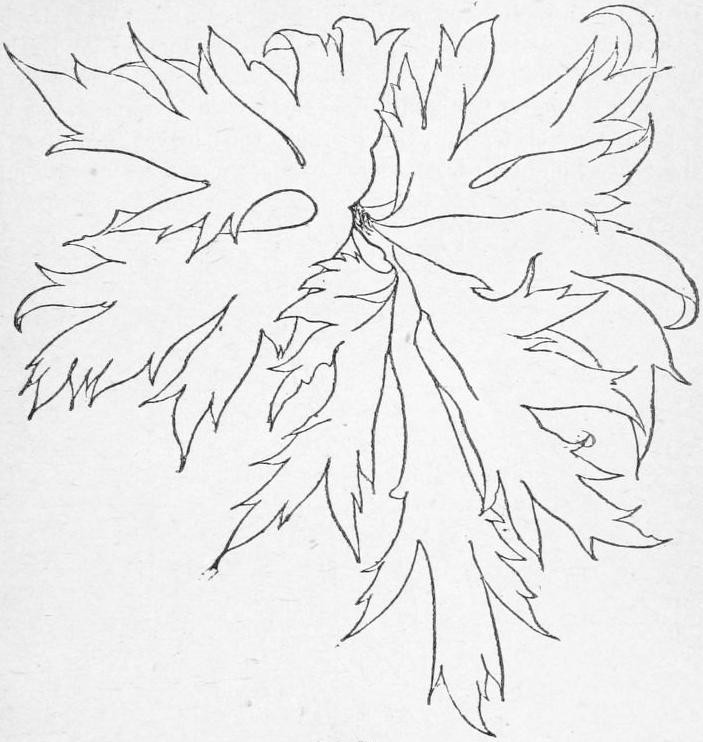
§ 12. One class, however, of these torn leaves, peculiar to the tented plants, has, it seems to me, a strange expressional function. I mean the group of leaves rent into alternate gaps, typically represented by the thistle. The alternation of the rent, if not absolutely, is effectively, peculiar to the earth-plants. Leaves of the builders are rent symmetrically, so as to form radiating groups, as in the horse-chestnut, or they are irregularly sinuous, as in the oak; but the earth-plants continually present forms such as those in the opposite Plate: a kind of web-footed leaf, so to speak; a continuous tissue, enlarged alternately on each side of the stalk. Leaves of this form have necessarily a kind of limping gait, as if they grew not all at once, but first a little bit on one side, and then a little bit on the other, and wherever they occur in quantity, give the expression to foreground vegetation which we feel and call “ragged.”
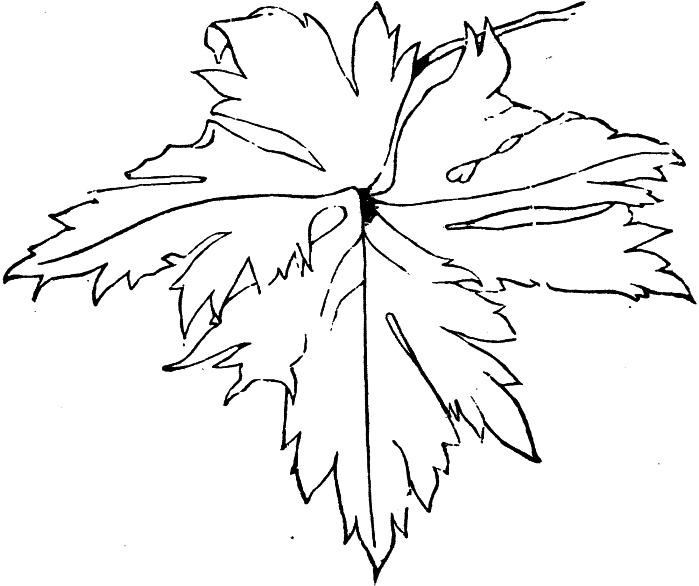
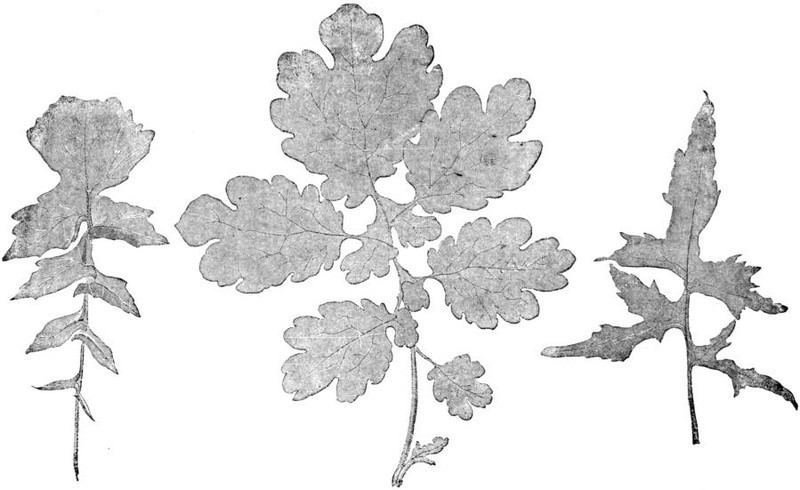
60. The Rending of Leaves.
§ 13. It is strange that the mere alternation of the rent should give this effect; the more so, because alternate leaves, completely separate from each other, produce one of the most graceful types of building plants. Yet the fact is indeed so, that the alternate rent in the earth-leaf is the principal cause of its ragged effect. However deeply it may be rent symmetrically, as in the alchemilla, or buttercup, just instanced, and however finely divided, as in the parsleys, the result is always a delicate richness, unless the jags are alternate, and the leaf-tissue continuous at the stem; and the moment these conditions appear, so does the raggedness.
§ 14. It is yet more worthy of note that the proper duty of these leaves, which catch the eye so clearly and powerfully, would appear to be to draw the attention of man to spots where his work is needed, for they nearly all habitually grow on ruins or neglected ground: not noble ruins, or on wild ground, but on heaps of rubbish, or pieces of land which have been indolently cultivated or much disturbed. The leaf on the right of the three in the Plate, which is the most characteristic of the class, is that of the Sisymbrium Irio, which grows, by choice, always on ruins left by fire. The plant, which, as far as I have observed, grows first on earth that has been moved, is the colts-foot: its broad covering leaf is much jagged, but only irregular, not alternate in the rent; but the weeds that mark habitual neglect, such as the thistle, give clear alternation.
§ 15. The aspects of complexity and carelessness of injury are farther increased in the herb of the field, because it is “herb yielding seed;” that is to say, a seed different in character from that which trees form in their fruit.
I am somewhat alarmed in reading over the above sentence, lest a botanist, or other scientific person, should open the book at it. For of course the essential character of either fruit or seed being only that in the smallest compass the vital principle of the plant is rendered portable, and for some time, preservable, we ought to call every such vegetable dormitory a “fruit” or a “seed” indifferently. But with respect to man there is a notable difference between them.
A seed is what we “sow.”
A fruit, what we “enjoy.”
Fruit is seed prepared especially for the sight and taste of man and animals; and in this sense we have true fruit and traitorous fruit (poisonous); but it is perhaps the best available distinction,2 that seed being the part necessary for the renewed birth of the plant, a fruit is such seed enclosed or sustained by some extraneous substance, which is soft and juicy, and beautifully colored, pleasing and useful to animals and men.
§ 16. I find it convenient in this volume, and wish I had thought of the expedient before, whenever I get into a difficulty, to leave the reader to work it out. He will perhaps, therefore, be so good as to define fruit for himself. Having defined it, he will find that the sentence about which I was alarmed above is, in the main, true, and that tented plants principally are herb yielding seed, while building plants give fruit. The berried shrubs of rock and wood, however dwarfed in stature, are true builders. The strawberry-plant is the only important exception—a tender Bedouin.
§ 17. Of course the principal reason for this is the plain, practical one, that fruit should not be trampled on, and had better perhaps be put a little out of easy reach than too near the hand, so that it may not be gathered wantonly or without some little trouble, and may be waited for until it is properly ripe: while the plants meant to be trampled on have small and multitudinous seed, hard and wooden, which may be shaken and scattered about without harm.
Also, fine fruit is often only to be brought forth with patience; not by young and hurried trees—but in due time, after much suffering; and the best fruit is often to be an adornment of old age, so as to supply the want of other grace. While the plants which will not work, but only bloom and wander, do not (except the grasses) bring forth fruit of high service, but only the seed that prolongs their race, the grasses alone having great honor put on them for their humility, as we saw in our first account of them.
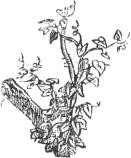
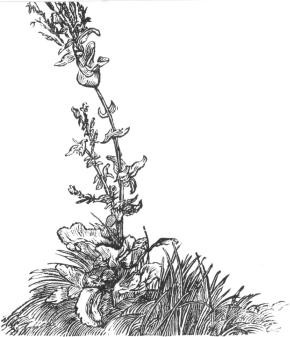
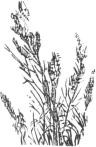
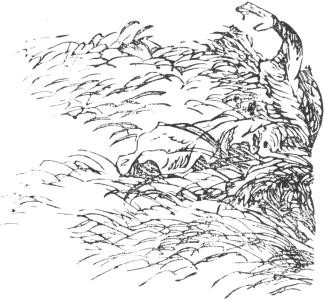
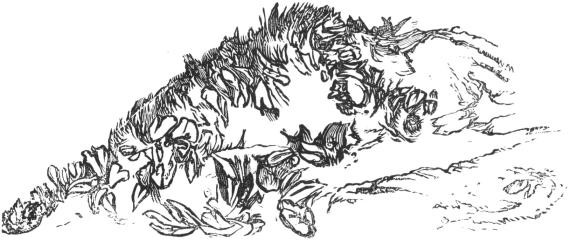
To face page 97.
Fig. 78.§ 18. This being so, we find another element of very complex effect added to the others which exist in tented plants, namely, that of minute, granular, feathery, or downy seed-vessels, mingling quaint brown punctuation, and dusty tremors of dancing grain, with the bloom of the nearer fields; and casting a gossamered grayness and softness of plumy mist along their surfaces far away; mysterious evermore, not only with dew in the morning or mirage at noon, but with the shaking threads of fine arborescence, each a little belfry of grain-bells, all a-chime.
§ 19. I feel sorely tempted to draw one of these same spires of the fine grasses, with its sweet changing proportions of pendent grain, but it would be a useless piece of finesse, as such form of course never enters into general foreground effect.3 I have, however, engraved, at the top of the group of woodcuts opposite (Fig. 74), a single leaf cluster of Durer’s foreground in the St. Hubert, which is interesting in several ways; as an example of modern work, no less than old; for it is a facsimile twice removed; being first drawn from the plate with the pen, by Mr. Allen, and then facsimiled on wood by Miss Byfield; and if the reader can compare it with the original, he will find it still come tolerably close in most parts (though the nearest large leaf has got spoiled), and of course some of the finest and most precious qualities of Durer’s work are lost. Still, it gives a fair idea of his perfectness of conception, every leaf being thoroughly set in perspective, and drawn with unerring decision. On each side of it (Figs. 75, 76) are two pieces from a fairly good modern etching, which I oppose to the Durer in order to show the difference between true work and that which pretends to give detail, but is without feeling or knowledge. There are a great many leaves in the piece on the left, but they are all set the same way; the draughtsman has not conceived their real positions, but draws one after another as he would deliver a tale of bricks. The grasses on the right look delicate, but are a mere series of inorganic lines. Look how Durer’s grass-blades cross each other. If you take a pen and copy a little piece of each example, you will soon feel the difference. Underneath, in the centre (Fig. 77), is a piece of grass out of Landseer’s etching of the “Ladies’ Pets,” more massive and effective than the two lateral fragments, but still loose and uncomposed. Then underneath is a piece of firm and good work again, which will stand with Durer’s; it is the outline only of a group of leaves out of Turner’s foreground in the Richmond from the Moors, of which I give a reduced etching, Plate 61, for the sake of the foreground principally, and in Plate 62, the group of leaves in question, in their light and shade, with the bridge beyond. What I have chiefly to say of them belongs to our section on composition; but this mere fragment of a Turner foreground may perhaps lead the reader to take note in his great pictures of the almost inconceivable labor with which he has sought to express the redundance and delicacy of ground leafage.
§ 20. By comparing the etching in Plate 61 with the published engraving, it will be seen how much yet remains to be done before any approximately just representation of Turner foreground can be put within the reach of the public. This Plate has been reduced by Mr. Armytage from a pen-drawing of mine, as large as the original of Turner’s (18 inches by 11 inches). It will look a little better under a magnifying glass; but only a most costly engraving, of the real size, could give any idea of the richness of mossy and ferny leafage included in the real design. And if this be so on one of the ordinary England drawings of a barren Yorkshire moor, it may be imagined what the task would be of engraving truly such a foreground as that of the “Bay of Baiæ” or “Daphne and Leucippus,” in which Turner’s aim has been luxuriance.
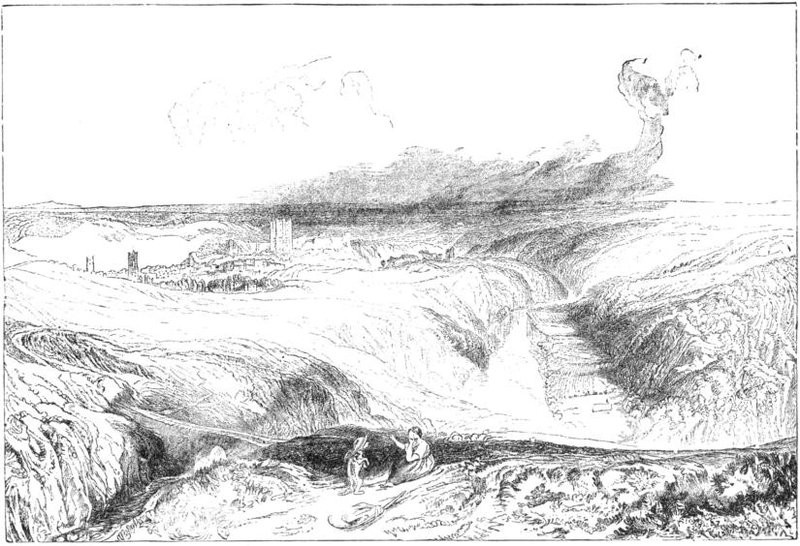
61. Richmond from the Moors.
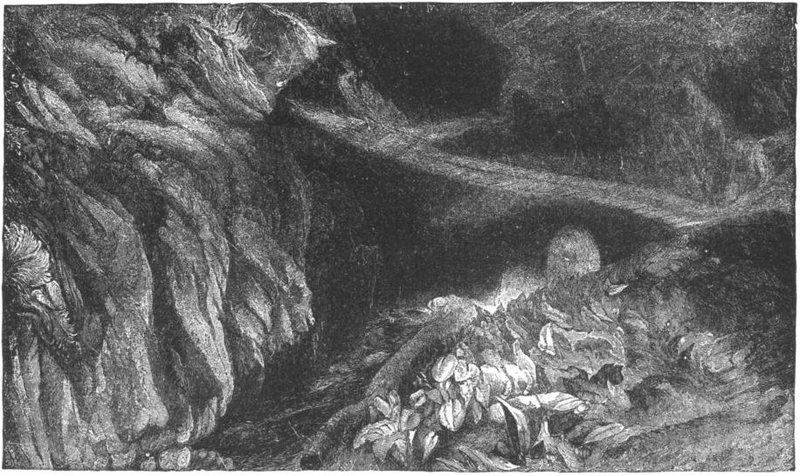
62. By the Brookside.
§ 21. His mind recurred, in all these classical foregrounds, to strong impressions made upon him during his studies at Rome, by the masses of vegetation which enrich its heaps of ruin with their embroidery and bloom. I have always partly regretted these Roman studies, thinking that they led him into too great fondness of pandering luxuriance in vegetation, associated with decay; and prevented his giving affection enough to the more solemn and more sacred infinity with which, among the mightier ruins of the Alpine Rome, glow the pure and motionless splendors of the gentian and the rose.
§ 22. Leaves motionless. The strong pines wave above them, and the weak grasses tremble beside them; but the blue stars rest upon the earth with a peace as of heaven; and far along the ridges of iron rock, moveless as they, the rubied crests of Alpine rose flush in the low rays of morning. Nor these yet the stillest leaves. Others there are subdued to a deeper quietness, the mute slaves of the earth, to whom we owe, perhaps, thanks, and tenderness, the most profound of all we have to render for the leaf ministries.
§ 23. It is strange to think of the gradually diminished power and withdrawn freedom among the orders of leaves—from the sweep of the chestnut and gadding of the vine, down to the close shrinking trefoil, and contented daisy, pressed on earth; and, at last, to the leaves that are not merely close to earth, but themselves a part of it; fastened down to it by their sides, here and there only a wrinkled edge rising from the granite crystals. We have found beauty in the tree yielding fruit, and in the herb yielding seed. How of the herb yielding no seed,4 the fruitless, flowerless lichen of the rock?
§ 24. Lichen, and mosses (though these last in their luxuriance are deep and rich as herbage, yet both for the most part humblest of the green things that live),—how of these? Meek creatures! the first mercy of the earth, veiling with hushed softness its dintless rocks; creatures full of pity, covering with strange and tender honor the scarred disgrace of ruin,—laying quiet finger on the trembling stones, to teach them rest. No words, that I know of, will say what these mosses are. None are delicate enough, none perfect enough, none rich enough. How is one to tell of the rounded bosses of furred and beaming green,—the starred divisions of rubied bloom, fine-filmed, as if the Rock Spirits could spin porphyry as we do glass,—the traceries of intricate silver, and fringes of amber, lustrous, arborescent, burnished through every fibre into fitful brightness and glossy traverses of silken change, yet all subdued and pensive, and framed for simplest, sweetest offices of grace. They will not be gathered, like the flowers, for chaplet or love-token; but of these the wild bird will make its nest, and the wearied child his pillow.
And, as the earth’s first mercy, so they are its last gift to us. When all other service is vain, from plant and tree, the soft mosses and gray lichen take up their watch by the head-stone. The woods, the blossoms, the gift-bearing grasses, have done their parts for a time, but these do service for ever. Trees for the builder’s yard, flowers for the bride’s chamber, corn for the granary, moss for the grave.
§ 25. Yet as in one sense the humblest, in another they are the most honored of the earth-children. Unfading, as motionless, the worm frets them not, and the autumn wastes not. Strong in lowliness, they neither blanch in heat nor pine in frost. To them, slow-fingered, constant-hearted, is entrusted the weaving of the dark, eternal, tapestries of the hills; to them, slow-pencilled, iris-dyed, the tender framing of their endless imagery. Sharing the stillness of the unimpassioned rock, they share also its endurance; and while the winds of departing spring scatter the white hawthorn blossom like drifted snow, and summer dims on the parched meadow the drooping of its cowslip-gold,—far above, among the mountains, the silver lichen-spots rest, star-like, on the stone; and the gathering orange stain upon the edge of yonder western peak reflects the sunsets of a thousand years.
1 Pre-Raphaelitism. The essay contains some important notes on Turner’s work, which, therefore, I do not repeat in this volume.
2 I say the “best available distinction.” It is, of course, no real distinction. A peapod is a kind of central type of seed and seed-vessel, and it is difficult so to define fruit as to keep clear of it. Pea-shells are boiled and eaten in some countries rather than pease. It does not sound like a scientific distinction to say that fruit is a “shell which is good without being boiled.” Nay, even if we humiliate ourselves into this practical reference to the kitchen, we are still far from success. For the pulp of a strawberry is not a “shell,” the seeds being on the outside of it. The available part of a pomegranate or orange, though a seed envelope, is itself shut within a less useful rind. While in an almond the shell becomes less profitable still, and all goodness retires into the seed itself, as in a grain of corn.
3 For the same reason, I enter into no considerations respecting the geometrical forms of flowers, though they are deeply interesting, and perhaps some day I may give a few studies of them separately. The reader should note, however, that beauty of form in flowers is chiefly dependent on a more accurately finished or more studiously varied development of the tre-foil, quatre-foil, and cinq-foil structures which we have seen irregularly approached by leaf-buds. The most beautiful six-foiled flowers (like the rhododendron-shoot) are composed of two triangular groups, one superimposed on the other, as in the narcissus; and the most interesting types both of six-foils and cinq-foils are unequally leaved, symmetrical on opposite sides, as the iris and violet.
4 The reader must remember always that my work is concerning the aspects of things only. Of course, a lichen has seeds, just as other plants have, but not effectually or visibly for man.
PART VII.
OF CLOUD BEAUTY.
—————
CHAPTER I.
THE CLOUD-BALANCINGS.
§ 1. We have seen that when the earth had to be prepared for the habitation of man, a veil, as it were, of intermediate being was spread between him and its darkness, in which were joined, in a subdued measure, the stability and insensibility of the earth, and the passion and perishing of mankind.
But the heavens, also, had to be prepared for his habitation.
Between their burning light,—their deep vacuity, and man, as between the earth’s gloom of iron substance, and man, a veil had to be spread of intermediate being;—which should appease the unendurable glory to the level of human feebleness, and sign the changeless motion of the heavens with a semblance of human vicissitude.
Between earth and man arose the leaf. Between the heaven and man came the cloud. His life being partly as the falling leaf, and partly as the flying vapor.
§ 2. Has the reader any distinct idea of what clouds are? We had some talk about them long ago, and perhaps thought their nature, though at that time not clear to us, would be easily enough understandable when we put ourselves seriously to make it out. Shall we begin with one or two easiest questions?
That mist which lies in the morning so softly in the valley, level and white, through which the tops of the trees rise as if through an inundation—why is it so heavy? and why does it lie so low, being yet so thin and frail that it will melt away utterly into splendor of morning, when the sun has shone on it but a few moments more? Those colossal pyramids, huge and firm, with outlines as of rocks, and strength to bear the beating of the high sun full on their fiery flanks—why are they so light,—their bases high over our heads, high over the heads of Alps? why will these melt away, not as the sun rises, but as he descends, and leave the stars of twilight clear, while the valley vapor gains again upon the earth like a shroud?
Or that ghost of a cloud, which steals by yonder clump of pines; nay, which does not steal by them, but haunts them, wreathing yet round them, and yet—and yet, slowly: now falling in a fair waved line like a woman’s veil; now fading, now gone: we look away for an instant, and look back, and it is again there. What has it to do with that clump of pines, that it broods by them and weaves itself among their branches, to and fro? Has it hidden a cloudy treasure among the moss at their roots, which it watches thus? Or has some strong enchanter charmed it into fond returning, or bound it fast within those bars of bough? And yonder filmy crescent, bent like an archer’s bow above the snowy summit, the highest of all the hill,—that white arch which never forms but over the supreme crest,—how is it stayed there, repelled apparently from the snow—nowhere touching it, the clear sky seen between it and the mountain edge, yet never leaving it—poised as a white bird hovers over its nest?
Or those war-clouds that gather on the horizon, dragon-crested, tongued with fire;—how is their barbed strength bridled? what bits are these they are champing with their vaporous lips; flinging off flakes of black foam? Leagued leviathans of the Sea of Heaven, out of their nostrils goeth smoke, and their eyes are like the eyelids of the morning. The sword of him that layeth at them cannot hold the spear, the dart, nor the habergeon. Where ride the captains of their armies? Where are set the measures of their march? Fierce murmurers, answering each other from morning until evening—what rebuke is this which has awed them into peace? what hand has reined them back by the way by which they came?
§ 3. I know not if the reader will think at first that questions like these are easily answered. So far from it, I rather believe that some of the mysteries of the clouds never will be understood by us at all. “Knowest thou the balancings of the clouds?” Is the answer ever to be one of pride? “The wondrous works of Him which is perfect in knowledge?” Is our knowledge ever to be so?
It is one of the most discouraging consequences of the varied character of this work of mine, that I am wholly unable to take note of the advance of modern science. What has conclusively been discovered or observed about clouds, I know not; but by the chance inquiry possible to me I find no book which fairly states the difficulties of accounting for even the ordinary aspects of the sky. I shall, therefore, be able in this section to do little more than suggest inquiries to the reader, putting the subject in a clear form for him. All men accustomed to investigation will confirm me in saying that it is a great step when we are personally quite certain what we do not know.
§ 4. First, then, I believe we do not know what makes clouds float. Clouds are water, in some fine form or another; but water is heavier than air, and the finest form you can give a heavy thing will not make it float in a light thing. On it, yes; as a boat: but in it, no. Clouds are not boats, nor boat-shaped, and they float in the air, not on the top of it. “Nay, but though unlike boats, may they not be like feathers? If out of quill substance there may be constructed eider-down, and out of vegetable tissue, thistle-down, both buoyant enough for a time, surely of water-tissue may be constructed also water-down, which will be buoyant enough for all cloudy purposes.” Not so. Throw out your eider plumage in a calm day, and it will all come settling to the ground: slowly indeed, to aspect; but practically so fast that all our finest clouds would be here in a heap about our ears in an hour or two, if they were only made of water-feathers. “But may they not be quill-feathers, and have air inside them? May not all their particles be minute little balloons?”
A balloon only floats when the air inside it is either specifically, or by heating, lighter than the air it floats in. If the cloud-feathers had warm air inside their quills, a cloud would be warmer than the air about it, which it is not (I believe). And if the cloud-feathers had hydrogen inside their quills, a cloud would be unwholesome for breathing, which it is not—at least so it seems to me.
“But may they not have nothing inside their quills?” Then they would rise, as bubbles do through water, just as certainly as, if they were solid feathers, they would fall. All our clouds would go up to the top of the air, and swim in eddies of cloud-foam.
“But is not that just what they do?” No. They float at different heights, and with definite forms, in the body of the air itself. If they rose like foam, the sky on a cloudy day would look like a very large flat glass of champagne seen from below, with a stream of bubbles (or clouds) going up as fast as they could to a flat foam-ceiling.
“But may they not be just so nicely mixed out of something and nothing, as to float where they are wanted?”
Yes: that is just what they not only may, but must be: only this way of mixing something and nothing is the very thing I want to explain or have explained, and cannot do it, nor get it done.
§ 5. Except thus far. It is conceivable that minute hollow spherical globules might be formed of water, in which the enclosed vacuity just balanced the weight of the enclosing water, and that the arched sphere formed by the watery film was strong enough to prevent the pressure of the atmosphere from breaking it in. Such a globule would float like a balloon at the height in the atmosphere where the equipoise between the vacuum it enclosed, and its own excess of weight above that of the air, was exact. It would, probably, approach its companion globules by reciprocal attraction, and form aggregations which might be visible.
This is, I believe, the view usually taken by meteorologists. I state it as a possibility, to be taken into account in examining the question—a possibility confirmed by the scriptural words which I have taken for the title of this chapter.
§ 6. Nevertheless, I state it as a possibility only, not seeing how any known operation of physical law could explain the formation of such molecules. This, however, is not the only difficulty. Whatever shape the water is thrown into, it seems at first improbable that it should lose its property of wetness. Minute division of rain, as in “Scotch mist,” makes it capable of floating farther,1 or floating up and down a little, just as dust will float, though pebbles will not; or gold-leaf, though a sovereign will not; but minutely divided rain wets as much as any other kind, whereas a cloud, partially always, sometimes entirely, loses its power of moistening. Some low clouds look, when you are in them, as if they were made of specks of dust, like short hairs; and these clouds are entirely dry. And also many clouds will wet some substances, but not others. So that we must grant farther, if we are to be happy in our theory, that the spherical molecules are held together by an attraction which prevents their adhering to any foreign body, or perhaps ceases only under some peculiar electric conditions.
§ 7. The question remains, even supposing their production accounted for,—What intermediate states of water may exist between these spherical hollow molecules and pure vapor?
Has the reader ever considered the relations of commonest forms of volatile substance? The invisible particles which cause the scent of a rose-leaf, how minute, how multitudinous, passing richly away into the air continually! The visible cloud of frankincense—why visible? Is it in consequence of the greater quantity, or larger size of the particles, and how does the heat act in throwing them off in this quantity, or of this size?
Ask the same questions respecting water. It dries, that is, becomes volatile, invisibly, at (any?) temperature. Snow dries, as water does. Under increase of heat, it volatilizes faster, so as to become dimly visible in large mass, as a heat-haze. It reaches boiling point, then becomes entirely visible. But compress it, so that no air shall get between the watery particles—it is invisible again. At the first issuing from the steam-pipe the steam is transparent; but opaque, or visible, as it diffuses itself. The water is indeed closer, because cooler, in that diffusion; but more air is between its particles. Then this very question of visibility is an endless one, wavering between form of substance and action of light. The clearest (or least visible) stream becomes brightly opaque by more minute division in its foam, and the clearest dew in hoar-frost. Dust, unperceived in shade, becomes constantly visible in sunbeam; and watery vapor in the atmosphere, which is itself opaque, when there is promise of fine weather, becomes exquisitely transparent; and (questionably) blue, when it is going to rain.
§ 8. Questionably blue: for besides knowing very little about water, we know what, except by courtesy, must, I think, be called Nothing—about air. Is it the watery vapor, or the air itself, which is blue? Are neither blue, but only white, producing blue when seen over dark spaces? If either blue, or white, why, when crimson is their commanded dress, are the most distant clouds crimsonest? Clouds close to us may be blue, but far off, golden,—a strange result, if the air is blue. And again, if blue, why are rays that come through large spaces of it red; and that Alp, or anything else that catches far-away light, why colored red at dawn and sunset? No one knows, I believe. It is true that many substances, as opal, are blue, or green, by reflected light, yellow by transmitted; but air, if blue at all, is blue always by transmitted light. I hear of a wonderful solution of nettles, or other unlovely herb, which is green when shallow,—red when deep. Perhaps some day, as the motion of the heavenly bodies by help of an apple, their light by help of a nettle, may be explained to mankind.
§ 9. But farther: these questions of volatility, and visibility, and hue, are all complicated with those of shape. How is a cloud outlined? Granted whatever you choose to ask, concerning its material, or its aspect, its loftiness and luminousness,—how of its limitation? What hews it into a heap, or spins it into a web? Cold is usually shapeless, I suppose, extending over large spaces equally, or with gradual diminution. You cannot have, in the open air, angles, and wedges, and coils, and cliffs of cold. Yet the vapor stops suddenly, sharp and steep as a rock, or thrusts itself across the gates of heaven in likeness of a brazen bar; or braids itself in and out, and across and across, like a tissue of tapestry; or falls into ripples, like sand; or into waving shreds and tongues, as fire. On what anvils and wheels is the vapor pointed, twisted, hammered, whirled, as the potter’s clay? By what hands is the incense of the sea built up into domes of marble?
And, lastly, all these questions respecting substance, and aspect, and shape, and line, and division, are involved with others as inscrutable, concerning action. The curves in which clouds move are unknown;—nay, the very method of their motion, or apparent motion, how far it is by change of place, how far by appearance in one place and vanishing from another. And these questions about movement lead partly far away into high mathematics, where I cannot follow them, and partly into theories concerning electricity and infinite space, where I suppose at present no one can follow them.
What, then, is the use of asking the questions?
For my own part, I enjoy the mystery, and perhaps the reader may. I think he ought. He should not be less grateful for summer rain, or see less beauty in the clouds of morning, because they come to prove him with hard questions; to which, perhaps, if we look close at the heavenly scroll,2 we may find also a syllable or two of answer illuminated here and there.
1 Pre-Raphaelitism. The essay contains some important notes on Turner’s work, which, therefore, I do not repeat in this volume.
2 I say the “best available distinction.” It is, of course, no real distinction. A peapod is a kind of central type of seed and seed-vessel, and it is difficult so to define fruit as to keep clear of it. Pea-shells are boiled and eaten in some countries rather than pease. It does not sound like a scientific distinction to say that fruit is a “shell which is good without being boiled.” Nay, even if we humiliate ourselves into this practical reference to the kitchen, we are still far from success. For the pulp of a strawberry is not a “shell,” the seeds being on the outside of it. The available part of a pomegranate or orange, though a seed envelope, is itself shut within a less useful rind. While in an almond the shell becomes less profitable still, and all goodness retires into the seed itself, as in a grain of corn.
3 For the same reason, I enter into no considerations respecting the geometrical forms of flowers, though they are deeply interesting, and perhaps some day I may give a few studies of them separately. The reader should note, however, that beauty of form in flowers is chiefly dependent on a more accurately finished or more studiously varied development of the tre-foil, quatre-foil, and cinq-foil structures which we have seen irregularly approached by leaf-buds. The most beautiful six-foiled flowers (like the rhododendron-shoot) are composed of two triangular groups, one superimposed on the other, as in the narcissus; and the most interesting types both of six-foils and cinq-foils are unequally leaved, symmetrical on opposite sides, as the iris and violet.
4 The reader must remember always that my work is concerning the aspects of things only. Of course, a lichen has seeds, just as other plants have, but not effectually or visibly for man.
1 The buoyancy of solid bodies of a given specific gravity, in a given fluid, depends, first on their size, then on their forms.
2 There is a beautiful passage in Sartor Resartus concerning this old Hebrew scroll, in its deeper meanings, and the child’s watching it, though long illegible for him, yet “with an eye to the gilding.” It signifies in a word or two nearly all that is to be said about clouds.
1 The buoyancy of solid bodies of a given specific gravity, in a given fluid, depends, first on their size, then on their forms.
First, on their size; that is to say, on the proportion of the magnitude of the object (irrespective of the distribution of its particles) to the magnitude of the particles of the air.
Thus, a grain of sand is buoyant in wind, but a large stone is not; and pebbles and sand are buoyant in water in proportion to their smallness, fine dust taking long to sink, while a large stone sinks at once. Thus, we see that water may be arranged in drops of any magnitude, from the largest rain-drop, about the size of a large pea, to an atom so small as not to be separately visible, the smallest rain passing gradually into mist. Of these drops of different sizes (supposing the strength of the wind the same), the largest fall fastest, the smaller drops are more buoyant, and the small misty rain floats about like a cloud, as often up as down, so that an umbrella is useless in it; though in a heavy thunder-storm, if there is no wind, one may stand gathered up under an umbrella without a drop touching the feet.
Secondly, buoyancy depends on the amount of surface which a given weight of the substance exposes to the resistance of the substance it floats in. Thus, gold-leaf is in a high degree buoyant, while the same quantity of gold in a compact grain would fall like a shot; and a feather is buoyant, though the same quantity of animal matter in a compact form would be as heavy as a little stone. A slate blows far from a house-top, while a brick falls vertically, or nearly so.
2 There is a beautiful passage in Sartor Resartus concerning this old Hebrew scroll, in its deeper meanings, and the child’s watching it, though long illegible for him, yet “with an eye to the gilding.” It signifies in a word or two nearly all that is to be said about clouds.
CHAPTER II.
THE CLOUD-FLOCKS.
§ 1. From the tenor of the foregoing chapter, the reader will, I hope, be prepared to find me, though dogmatic (it is said) upon some occasions, anything rather than dogmatic respecting clouds. I will assume nothing concerning them, beyond the simple fact, that as a floating sediment forms in a saturated liquid, vapor forms in the body of the air; and all that I want the reader to be clear about in the outset is that this vapor floats in and with the wind (as, if you throw any thick coloring matter into a river, it floats with the stream), and that it is not blown before a denser volume of the wind, as a fleece of wool would be.
§ 2. At whatever height they form, clouds may be broadly considered as of two species only, massive and striated. I cannot find a better word than massive, though it is not a good one, for I mean it only to signify a fleecy arrangement in which no lines are visible. The fleece may be so bright as to look like flying thistle-down, or so diffused as to show no visible outline at all. Still if it is all of one common texture, like a handful of wool, or a wreath of smoke, I call it massive.
On the other hand, if divided by parallel lines, so as to look more or less like spun-glass, I call it striated. In Plate 69, Fig. 4, the top of the Aiguille Dru (Chamouni) is seen emergent above low striated clouds, with heaped massive cloud beyond. I do not know in the least what causes this striation, except that it depends on the nature of the cloud, not on the wind. The strongest wind will not throw a cloud, massive by nature, into the linear form. It will toss it about, and tear it to pieces, but not spin it into threads. On the other hand, often without any wind at all, the cloud will spin itself into threads fine as gossamer. These threads are often said to be a prognostic of storm; but they are not produced by storm.
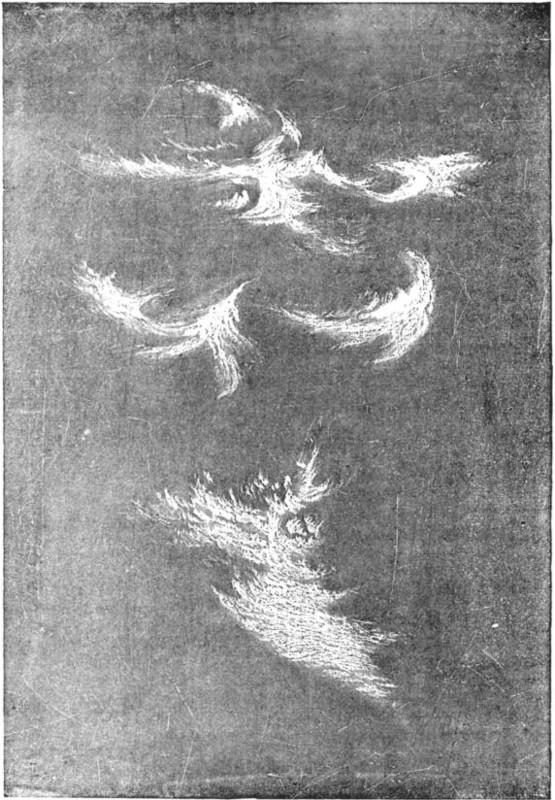
J. Ruskin
J.C. Armytage
63. The Cloud-Flocks.
§ 3. In the first volume, we considered all clouds as belonging to three regions, that of the cirrous, the central cloud, and the rain-cloud. It is of course an arrangement more of convenience than of true description, for cirrous clouds sometimes form low as well as high; and rain sometimes falls high as well as low. I will, nevertheless, retain this old arrangement, which is practically as serviceable as any.
Allowing, also, for various exceptions and modifications, these three bodies of cloud may be generally distinguished in our minds thus. The clouds of upper region are for the most part quiet, or seem to be so, owing to their distance. They are formed now of striated, now of massive substance; but always finely divided into large ragged flakes or ponderous heaps. These heaps (cumuli) and flakes, or drifts, present different phenomena, but must be joined in our minds under the head of central cloud. The lower clouds, bearing rain abundantly, are composed partly of striated, partly of massive substance; but may generally be comprehended under the term rain-cloud.
Our business in this chapter, then, is with the upper clouds, which, owing to their quietness and multitude, we may perhaps conveniently think of as the “cloud-flocks.” And we have to discover if any laws of beauty attach to them, such as we have seen in mountains or tree-branches.
§ 4. On one of the few mornings of this winter, when the sky was clear, and one of the far fewer, on which its clearness was visible from the neighborhood of London,—which now entirely loses at least two out of three sunrises, owing to the environing smoke,—the dawn broke beneath a broad field of level purple cloud, under which floated ranks of divided cirri, composed of finely striated vapor.
It was not a sky containing any extraordinary number of these minor clouds; but each was more than usually distinct in separation from its neighbor, and as they showed in nearly pure pale scarlet on the dark purple ground, they were easily to be counted.
§ 5. There were five or six ranks, from the zenith to the horizon; that is to say, three distinct ones, and then two or three more running together, and losing themselves in distance, in the manner roughly shown in Fig. 79. The nearest rank was composed of more than 150 rows of cloud, set obliquely, as in the figure. I counted 150 which was near the mark, and then stopped, lest the light should fail, to count the separate clouds in some of the rows. The average number was 60 in each row, rather more than less.
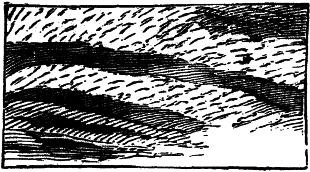
There were therefore 150×60, that is, 9,000, separate clouds in this one rank, or about 50,000 in the field of sight. Flocks of Admetus under Apollo’s keeping. Who else could shepherd such? He by day, dog Sirius by night; or huntress Diana herself—her bright arrows driving away the clouds of prey that would ravage her fair flocks. We must leave fancies, however; these wonderful clouds need close looking at. I will try to draw one or two of them before they fade.
§ 6. On doing which we find, after all, they are not much more like sheep than Canis Major is like a dog. They resemble more some of our old friends, the pine branches, covered with snow. The three forming the uppermost figure, in the Plate opposite, are as like three of the fifty thousand as I could get them, complex enough in structure, even this single group. Busy workers they must be, that twine the braiding of them all to the horizon, and down beyond it.
And who are these workers? You have two questions here, both difficult. What separates these thousands of clouds each from the other, and each about equally from the other? How can they be drawn asunder, yet not allowed to part? Looped lace as it were, richest point—invisible threads fastening embroidered cloud to cloud—the “plighted clouds” of Milton,—creatures of the element—
“That in the colors of the rainbow live
And play in the plighted clouds.”
Compare Geraldine dressing:—
“Puts on her silken vestments white,
And tricks her hair in lovely plight.”
And Britomart’s—
“Her well-plighted frock
She low let fall, that flowed from her lanck side
Down to her foot, with careless modesty.”
And, secondly, what bends each of them into these flame-like curves, tender and various, as motions of a bird, hither and thither? Perhaps you may hardly see the curves well in the softly finished forms; here they are plainer in rude outline, Fig. 80.1
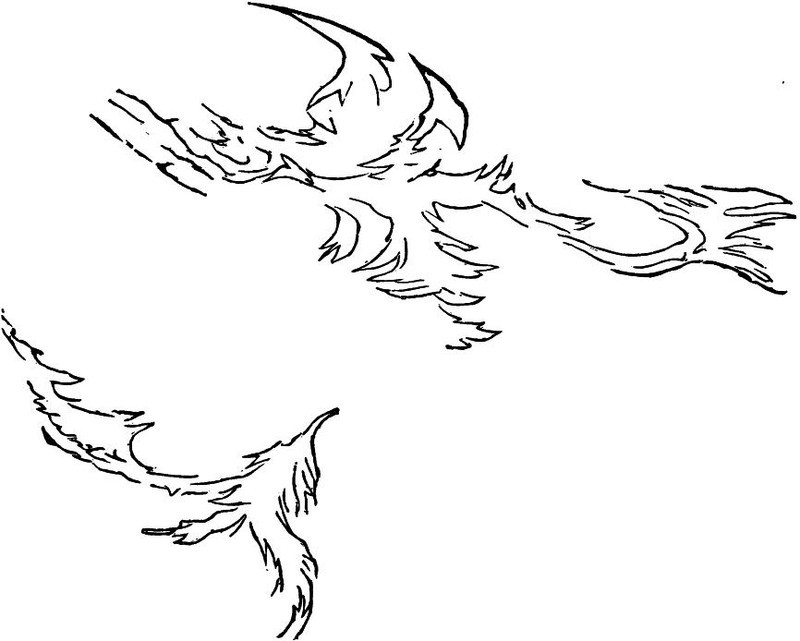
§ 7. What is it that throws them into these lines?
Eddies of wind?
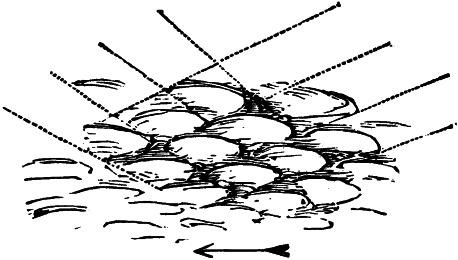
Nay, an eddy of wind will not stay quiet for three minutes, as that cloud did to be drawn; as all the others did, each in his place. You see there is perfect harmony among the curves. They all flow into each other as the currents of a stream do. If you throw dust that will float on the surface of a slow river, it will arrange itself in lines somewhat like these. To a certain extent, indeed, it is true that there are gentle currents of change in the atmosphere, which move slowly enough to permit in the clouds that follow them some appearance of stability. But how to obtain change so complex in an infinite number of consecutive spaces;—fifty thousand separate groups of current in half of a morning sky, with quiet invisible vapor between, or none—and yet all obedient to one ruling law, gone forth through their companies;—each marshalled to their white standards, in great unity of warlike march, unarrested, unconfused? “One shall not thrust another, they shall walk every one in his own path.”

§ 8. These questions occur, at first sight, respecting every group of cirrus cloud. Whatever the form may be, whether branched, as in this instance, or merely rippled, or thrown into shield-like segments, as in Fig. 81—a frequent arrangement—there is still the same difficulty in accounting satisfactorily for the individual forces which regulate the similar shape of each mass, while all are moved by a general force that has apparently no influence on the divided structure. Thus the mass of clouds disposed as in Fig. 81, will probably move, mutually, in the direction of the arrow; that is to say, sideways, as far as their separate curvature is concerned. I suppose it probable that as the science of electricity is more perfectly systematized, the explanation of many circumstances of cloud-form will be rendered by it. At present I see no use in troubling the reader or myself with conjectures which a year’s progress in science might either effectively contradict or supersede. All that I want is, that we should have our questions ready to put clearly to the electricians when the electricians are ready to answer us.
§ 9. It is possible that some of the loveliest conditions of these parallel clouds may be owing to a structure which I forgot to explain, when it occurred in rocks, in the course of the last volume.
When they are finely stratified, and their surfaces abraded by broad, shallow furrows, the edges of the beds, of course, are thrown into undulations, and at some distance, where the furrows disappear, the surface looks as if the rock had flowed over it in successive waves. Such a condition is seen on the left at the top in Fig. 17, in Vol. IV. Supposing a series of beds of vapor cut across by a straight sloping current of air, and so placed as to catch the light on their edges, we should have a series of curved lights, looking like independent clouds.
§ 10. I believe conditions of form like those in Fig. 82 (turn the book with its outer edge down) may not unfrequently be thus, owing to stratification, when they occur in the nearer sky. This line of cloud is far off at the horizon, drifting towards the left (the points of course forward), and is, I suppose, a series of nearly circular eddies seen in perspective.
Which question of perspective we must examine a little before going a step farther. In order to simplify it, let us assume that the under surfaces of clouds are flat, and lie in a horizontal extended field. This is in great measure the fact, and notable perspective phenomena depend on the approximation of clouds to such a condition.
§ 11. Referring the reader to my Elements of Perspective for statements of law which would be in this place tiresome, I can only ask him to take my word for it that the three figures in Plate 64 represent limiting lines of sky perspective, as they would appear over a large space of the sky. Supposing that the breadth included was one-fourth of the horizon, the shaded portions in the central figure represent square fields of cloud,2 and those in the uppermost figure narrow triangles, with their shortest side next us, but sloping a little away from us.
In each figure, the shaded portions show the perspective limits of cloud-masses, which, in reality, are arranged in perfectly straight lines, are all similar, and are equidistant from each other. Their exact relative positions are marked by the lines connecting them, and may be determined by the reader if he knows perspective. If he does not, he may be surprised at first to be told that the stubborn and blunt little triangle, b, Fig. 1, Plate 64, represents a cloud precisely similar, and similarly situated, to that represented by the thin triangle, a; and, in like manner, the stout diamond, a, Fig. 2, represents precisely the same form and size of cloud as the thin strip at b. He may perhaps think it still more curious that the retiring perspective which causes stoutness in the triangle, causes leanness in the diamond.3
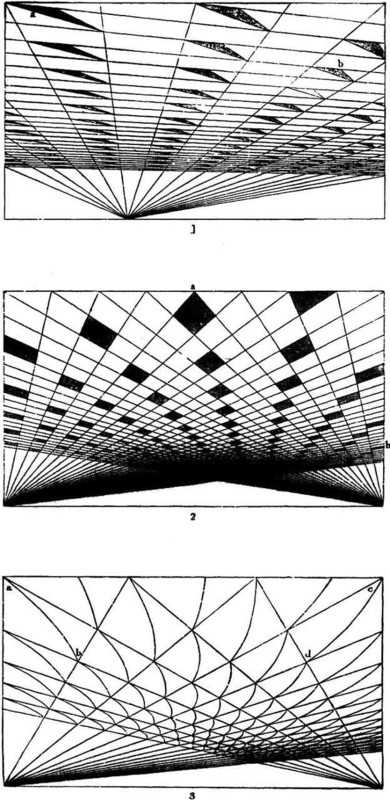
64. Cloud Perspective. (Rectilinear.)
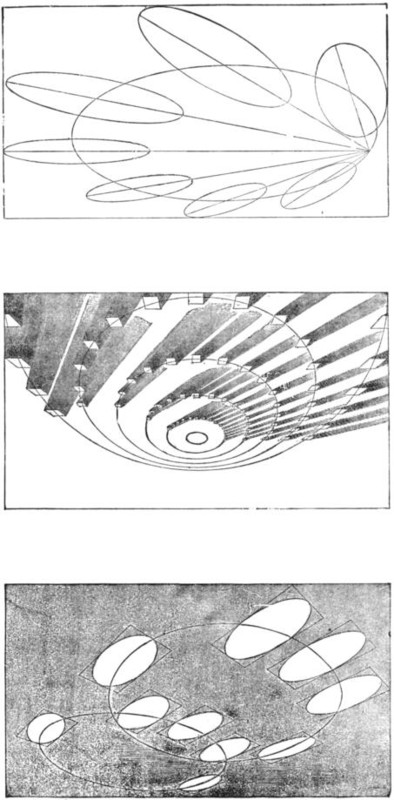
65. Cloud Perspective. (Curvilinear.)
§ 12. Still greater confusion in aspect is induced by the apparent change caused by perspective in the direction of the wind. If Fig. 3 be supposed to include a quarter of the horizon, the spaces, into which its straight lines divide it, represent squares of sky. The curved lines, which cross these spaces from corner to corner, are precisely parallel throughout; and, therefore, two clouds moving, one on the curved line from a to b, and the other on the other side, from c to d, would, in reality, be moving with the same wind, in parallel lines. In Plate 66, which is a sketch of an actual sunset behind Beauvais cathedral (the point of the roof of the apse, a little to the left of the centre, shows it to be a summer sunset), the white cirri in the high light are all moving eastward, away from the sun, in perfectly parallel lines, curving a little round to the south. Underneath, are two straight ranks of rainy cirri, crossing each other; one directed south-east; the other, north-west. The meeting perspective of these, in extreme distance, determines the shape of the angular light which opens above the cathedral. Underneath all, fragments of true rain-cloud are floating between us and the sun, governed by curves of their own. They are, nevertheless, connected with the straight cirri, by the dark semi-cumulus in the middle of the shade above the cathedral.
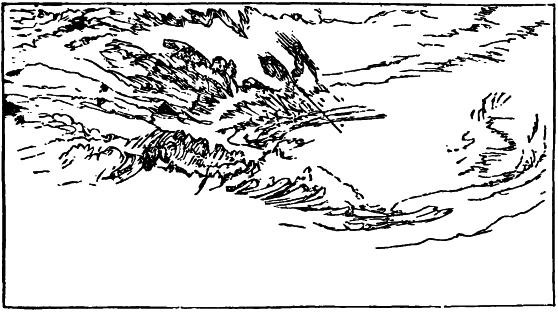
§ 13. Sky perspective, however, remains perfectly simple, so long as it can be reduced to any rectilinear arrangement; but when nearly the whole system is curved, which nine times out of ten is the case, it becomes embarrassing. The central figure in Plate 65 represents the simplest possible combination of perspective of straight lines with that of curves, a group of concentric circles of small clouds being supposed to cast shadows from the sun near the horizon. Such shadows are often cast in misty air; the aspect of rays about the sun being, in fact, only caused by spaces between them. They are carried out formally and far in the Plate, to show how curiously they may modify the arrangement of light in a sky. The woodcut, Fig. 83, gives roughly the arrangement of the clouds in Turner’s Pools of Solomon, in which he has employed a concentric system of circles of this kind, and thus lighted. In the perspective figure the clouds are represented as small square masses, for the sake of greater simplicity, and are so beaded or strung as it were on the curves in which they move, as to keep their distances precisely equal, and their sides parallel. This is the usual condition of cloud: for though arranged in curved ranks, each cloud has its face to the front, or, at all events, acts in some parallel line—generally another curve—with those next to it: being rarely, except in the form of fine radiating striæ, arranged on the curves as at a, Fig. 84; but as at b, or c. It would make the diagram too complex if I gave one of intersecting curves; but the lowest figure in Plate 65 represents, in perspective, two groups of ellipses arranged in equidistant straight and parallel lines, and following each other on two circular curves. Their exact relative position is shown in Fig. 2, Plate 56. While the uppermost figure in Plate 65 represents, in parallel perspective, a series of ellipses arranged in radiation on a circle, their exact relative size and position are shown in Fig. 3, Plate 56, and the lines of such a sky as would be produced by them, roughly, in Fig. 90, facing page 128.4

§ 14. And in these figures, which, if we look up the subject rightly, would be but the first and simplest of the series necessary to illustrate the action of the upper cirri, the reader may see, at once, how necessarily painters, untrained in observance of proportion, and ignorant of perspective, must lose in every touch the expression of buoyancy and space in sky. The absolute forms of each cloud are, indeed, not alike, as the ellipses in the engraving; but assuredly, when moving in groups of this kind, there are among them the same proportioned inequalities of relative distance, the same gradated changes from ponderous to elongated form, the same exquisite suggestions of including curve; and a common painter, dotting his clouds down at random, or in more or less equal masses, can no more paint a sky, than he could, by random dashes for its ruined arches, paint the Coliseum.
§ 15. Whatever approximation to the character of upper clouds may have been reached by some of our modern students, it will be found, on careful analysis, that Turner stands more absolutely alone in this gift of cloud-drawing, than in any other of his great powers. Observe, I say, cloud-drawing; other great men colored clouds beautifully; none but he ever drew them truly: this power coming from his constant habit of drawing skies, like everything else, with the pencil point. It is quite impossible to engrave any of his large finished skies on a small scale; but the woodcut, Fig. 85, will give some idea of the forms of cloud involved in one of his small drawings. It is only half of the sky in question, that of Rouen from St. Catherine’s Hill, in the Rivers of France. Its clouds are arranged on two systems of intersecting circles, crossed beneath by long bars very slightly bent. The form of every separate cloud is completely studied; the manner of drawing them will be understood better by help of the Plate opposite, which is a piece of the sky above the “Campo Santo,”5 at Venice, exhibited in 1842. It is exquisite in rounding of the separate fragments and buoyancy of the rising central group, as well as in its expression of the wayward influence of curved lines of breeze on a generally rectilinear system of cloud.
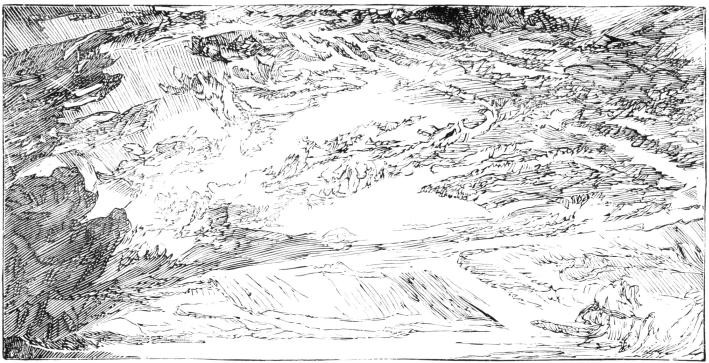
To face page 118.
Fig. 85.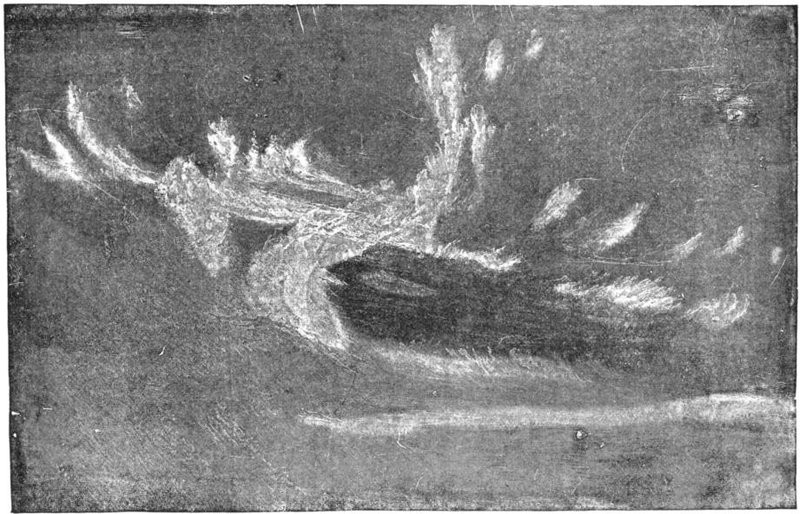
67. Clouds.
§ 16. To follow the subject farther would, however, lead us into doctrine of circular storms, and all kinds of pleasant, but infinite, difficulty, from which temptation I keep clear, believing that enough is now stated to enable the reader to understand what he is to look for in Turner’s skies; and what kind of power, thought, and science are involved continually in the little white or purple dashes of cloud-spray, which, in such pictures as the San Benedetto, looking to Fusina, the Napoleon, or the Temeraire, guide the eye to the horizon more by their true perspective than by their aërial tone, and are buoyant, not so much by expression of lightness as of motion.6
§ 17. I say the “white or purple” cloud-spray. One word yet may be permitted me respecting the mystery of that color. What should we have thought—if we had lived in a country where there were no clouds, but only low mist or fog—of any stranger who had told us that, in his country, these mists rose into the air, and became purple, crimson, scarlet, and gold? I am aware of no sufficient explanation of these hues of the upper clouds, nor of their strange mingling of opacity with a power of absorbing light. All clouds are so opaque that, however delicate they may be, you never see one through another. Six feet depth of them, at a little distance, will wholly veil the darkest mountain edge; so that, whether for light or shade, they tell upon the sky as body color on canvas; they have always a perfect surface and bloom;—delicate as a rose-leaf, when required of them, but never poor or meagre in hue, like old-fashioned water-colors. And, if needed, in mass, they will bear themselves for solid force of hue against any rock. Facing p. 339, I have engraved a memorandum made of a clear sunset after rain, from the top of Milan cathedral. The greater part of the outline is granite—Monte Rosa—the rest cloud; but it and the granite were dark alike. Frequently, in effects of this kind, the cloud is darker of the two.7 And this opacity is, nevertheless, obtained without destroying the gift they have of letting broken light through them, so that, between us and the sun, they may become golden fleeces, and float as fields of light.
Now their distant colors depend on these two properties together; partly on the opacity, which enables them to reflect light strongly; partly on a spongelike power of gathering light into their bodies.
§ 18. Long ago it was noted by Aristotle, and again by Leonardo, that vaporous bodies looked russet, or even red, when warm light was seen through them, and blue when deep shade was seen through them. Both colors may, generally, be seen on any wreath of cottage smoke.
Whereon, easy conclusion has sometimes been founded by modern reasoners. All red in sky is caused by light seen through vapor, and all blue by shade seen through vapor.
Easy, indeed, but not sure, even in cloud-color only. It is true that the smoke of a town may be of a rich brick red against golden twilight; and of a very lovely, though not bright, blue against shade. But I never saw crimson or scarlet smoke, nor ultramarine smoke.
Even granting that watery vapor in its purity may give the colors more clearly, the red colors are by no means always relieved against light. The finest scarlets are constantly seen in broken flakes on a deep purple ground of heavier cloud beyond, and some of the loveliest rose-colors on clouds in the east, opposite the sunset, or in the west in the morning. Nor are blues always attainable by throwing vapor over shade. Especially, you cannot get them by putting it over blue itself. A thin vapor on dark blue sky is of a warm gray, not blue. A thunder-cloud, deep enough to conceal everything behind it, is often dark lead-color, or sulphurous blue; but the thin vapors crossing it, milky-white. The vividest hues are connected also with another attribute of clouds, their lustre—metallic in effect, watery in reality. They not only reflect color as dust or wool would, but, when far off, as water would; sometimes even giving a distinct image of the sun underneath the orb itself;—in all cases becoming dazzling in lustre, when at a low angle, capable of strong reflection. Practically, this low angle is only obtained when the cloud seems near the sun, and hence we get into the careless habit of looking at the golden reflected light as if it were actually caused by nearness to the fiery ball.
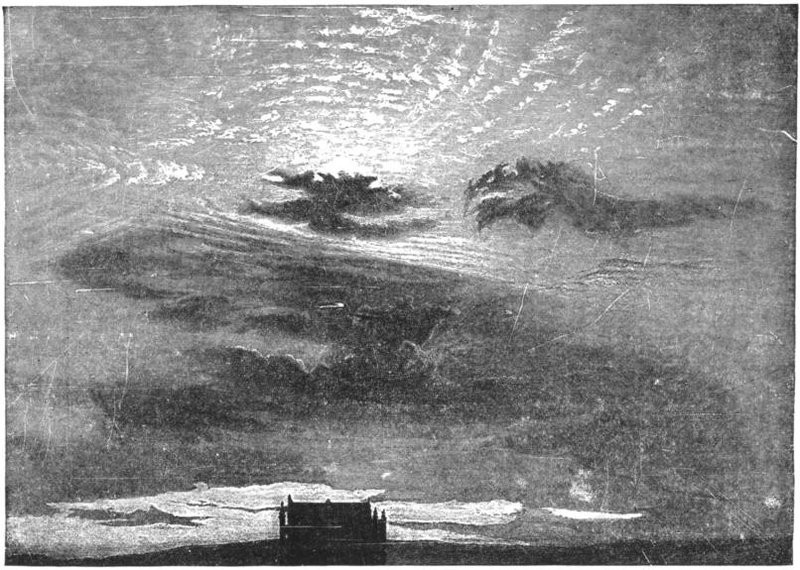
66. Light in the West, Beauvais.
§ 19. Without, however, troubling ourselves at all about laws, or causes of color, the visible consequences of their operation are notably these—that when near us, clouds present only subdued and uncertain colors; but when far from us, and struck by the sun on their under surfaces—so that the greater part of the light they receive is reflected—they may become golden, purple, scarlet, and intense fiery white, mingled in all kinds of gradations, such as I tried to describe in the chapter on the upper clouds in the first volume, in hope of being able to return to them “when we knew what was beautiful.”
The question before us now is, therefore, What value ought this attribute of clouds to possess in the human mind? Ought we to admire their colors, or despise them? Is it well to watch them as Turner does, and strive to paint them through all deficiency and darkness of inadequate material? Or, is it wiser and nobler—like Claude, Salvator, Ruysdael, Wouvermans—never to look for them—never to portray? We must yet have patience a little before deciding this, because we have to ascertain some facts respecting the typical meaning of color itself; which, reserving for another place, let us proceed here to learn the forms of the inferior clouds.
1 Before going farther, I must say a word or two respecting method of drawing clouds.
Absolutely well no cloud can be drawn with the point; nothing but the most delicate management of the brush will express its variety of edge and texture. By laborious and tender engraving, a close approximation may be obtained either to nature or to good painting; and the engravings of sky by our modern line engravers are often admirable;—in many respects as good as can be, and to my mind the best part of their work. There still exist some early proofs of Miller’s plate of the Grand Canal, Venice, in which the sky is the likest thing to Turner’s work I have ever seen in large engravings. The plate was spoiled after a few impressions were taken off by desire of the publisher. The sky was so exactly like Turner’s that he thought it would not please the public, and had all the fine cloud-drawing rubbed away to make it soft.
The Plate opposite page 118, by Mr. Armytage, is also, I think, a superb specimen of engraving, though in result not so good as the one just spoken of, because this was done from my copy of Turner’s sky, not from the picture itself.
But engraving of this finished kind cannot, by reason of its costliness, be given for every illustration of cloud form. Nor, if it could, can skies be sketched with the completion which would bear it. It is sometimes possible to draw one cloud out of fifty thousand with something like fidelity before it fades. But if we want the arrangement of the fifty thousand, they can only be indicated with the rudest lines, and finished from memory. It was, as we shall see presently, only by his gigantic powers of memory that Turner was enabled to draw skies as he did.
Now, I look upon my own memory of clouds, or of anything else, as of no value whatever. All the drawings on which I have ever rested an assertion have been made without stirring from the spot; and in sketching clouds from nature, it is very seldom desirable to use the brush. For broad effects and notes of color (though these, hastily made, are always inaccurate, and letters indicating the color do nearly as well) the brush may be sometimes useful, but, in most cases, a dark pencil, which will lay shade with its side and draw lines with its point, is the best instrument. Turner almost always outlined merely with the point, being able to remember the relations of shade without the slightest chance of error. The point, at all events, is needful, however much stump work may be added to it.
Now, in translating sketches made with the pencil point into engraving, we must either engrave delicately and expensively, or be content to substitute for the soft varied pencil lines the finer and uncloudlike touches of the pen. It is best to do this boldly, if at all, and without the least aim at fineness of effect, to lay down a vigorous black line as the limit of the cloud form or action. The more subtle a painter’s finished work, the more fearless he is in using the vigorous black line when he is making memoranda, of treating his subject conventionally. At the top of page 224, Vol. IV., the reader may see the kind of outline which Titian uses for clouds in his pen work. Usually he is even bolder and coarser. And in the rude woodcuts I am going to employ here, I believe the reader will find ultimately that, with whatever ill success used by me, the means of expression are the fullest and most convenient that can be adopted, short of finished engraving, while there are some conditions of cloud-action which I satisfy myself better in expressing by these coarse lines than in any other way.
2 If the figures are supposed to include less than one-fourth of the horizon, the shaded figures represent diamond-shaped clouds; but the reader cannot understand this without studying perspective laws accurately.
3 In reality, the retiring ranks of cloud, if long enough, would, of course, go on converging to the horizon. I do not continue them, because the figures would become too compressed.
4 I use ellipses in order to make these figures easily intelligible; the curves actually are variable curves, of the nature of the cycloid, or other curves of continuous motion; probably produced by a current moving in some such direction as that indicated by the dotted line in Fig. 3, Plate 56.
5 Now in the possession of E. Bicknell, Esq., who kindly lent me the picture, that I might make this drawing from it carefully.
6 I cannot yet engrave these; but the little study of a single rank of cirrus, the lowest in Plate 63, may serve to show the value of perspective in expressing buoyancy. It is not, however, though beautifully engraved by Mr. Armytage, as delicate as it should be, in the finer threads which indicate increasing distance at the extremity. Compare the rising of the lines of curve at the edges of this mass, with the similar action on a larger scale, of Turner’s cloud, opposite.
7 In the autobiography of John Newton there is an interesting account of the deception of a whole ship’s company by cloud, taking the aspect and outline of mountainous land. They ate the last provision in the ship, so sure were they of its being land, and were nearly starved to death in consequence.
CHAPTER III.
THE CLOUD-CHARIOTS.
§ 1. Between the flocks of small countless clouds which occupy the highest heavens, and the gray undivided film of the true rain-cloud, form the fixed masses or torn fleeces, sometimes collected and calm, sometimes fiercely drifting, which are, nevertheless, known under one general name of cumulus, or heaped cloud.
The true cumulus, the most majestic of all clouds, and almost the only one which attracts the notice of ordinary observers, is for the most part windless; the movement of its masses being solemn, continuous, inexplicable, a steady advance or retiring, as if they were animated by an inner will, or compelled by an unseen power. They appear to be peculiarly connected with heat, forming perfectly only in the afternoon, and melting away in the evening. Their noblest conditions are strongly electric, and connect themselves with storm-cloud and true thunder-cloud. When there is thunder in the air, they will form in cold weather, or early in the day.
§ 2. I have never succeeded in drawing a cumulus. Its divisions of surface are grotesque and endless, as those of a mountain;—perfectly defined, brilliant beyond all power of color, and transitory as a dream. Even Turner never attempted to paint them, any more than he did the snows of the high Alps.
Nor can I explain them any more than I can draw them. The ordinary account given of their structure is, I believe, that the moisture raised from the earth by the sun’s heat becomes visible by condensation at a certain height in the colder air, that the level of the condensing point is that of the cloud’s base, and that above it, the heaps are pushed up higher and higher as more vapor accumulates, till, towards evening, the supply beneath ceases; and at sunset, the fall of dew enables the surrounding atmosphere to absorb and melt them away. Very plausible. But it seems to me herein unexplained how the vapor is held together in those heaps. If the clear air about and above it has no aqueous vapor in it, or at least a much less quantity, why does not the clear air keep pulling the cloud to pieces, eating it away, as steam is consumed in open air? Or, if any cause prevents such rapid devouring of it, why does not the aqueous vapor diffuse itself softly in the air like smoke, so that one would not know where the cloud ended? What should make it bind itself in those solid mounds, and stay so:—positive, fantastic, defiant, determined?
§ 3. If ever I am able to understand the process of the cumulus formation,1 it will become to me one of the most interesting of all subjects of study to trace the connection of the threatening and terrible outlines of thunder-cloud with the increased action of the electric power. I am for the present utterly unable to speak respecting this matter, and must pass it by, in all humility, to say what little I have ascertained respecting the more broken and rapidly moving forms of the central clouds, which connect themselves with mountains, and may, therefore, among mountains, be seen close and truly.
§ 4. Yet even of these, I can only reason with great doubt and continual pause. This last volume ought certainly to be better than the first of the series, for two reasons. I have learned, during the sixteen years, to say little where I said much, and to see difficulties where I saw none. And I am in a great state of marvel in looking back to my first account of clouds, not only at myself, but even at my dear master, M. de Saussure. To think that both of us should have looked at drifting mountain clouds, for years together, and been content with the theory which you will find set forth in § 4, of the chapter on the central cloud region (Vol. I.), respecting the action of the snowy summits and watery vapor passing them. It is quite true that this action takes place, and that the said fourth paragraph is right, as far as it reaches. But both Saussure and I ought to have known—we both did know, but did not think of it—that the covering or cap-cloud forms on hot summits as well as cold ones;—that the red and bare rocks of Mont Pilate, hotter, certainly, after a day’s sunshine than the cold storm-wind which sweeps to them from the Alps, nevertheless have been renowned for their helmet of cloud, ever since the Romans watched the cloven summit, gray against the south, from the ramparts of Vindonissa, giving it the name from which the good Catholics of Lucerne have warped out their favorite piece of terrific sacred biography.2 And both my master and I should also have reflected, that if our theory about its formation had been generally true, the helmet cloud ought to form on every cold summit, at the approach of rain, in approximating proportions to the bulk of the glaciers; which is so far from being the case that not only (A) the cap-cloud may often be seen on lower summits of grass or rock, while the higher ones are splendidly clear (which may be accounted for by supposing the wind containing the moisture not to have risen so high), but (B) the cap-cloud always shows a preference for hills of a conical form, such as the Mole or Niesen, which can have very little power in chilling the air, even supposing they were cold themselves, while it will entirely refuse to form round huge masses of mountain, which, supposing them of chilly temperament, must have discomforted the atmosphere in their neighborhood for leagues. And finally (C) reversing the principle under letter A, the cap-cloud constantly forms on the summit of Mont Blanc, while it will obstinately refuse to appear on the Dome du Goûte or Aiguille Sans-nom, where the snow-fields are of greater extent, and the air must be moister, because lower.
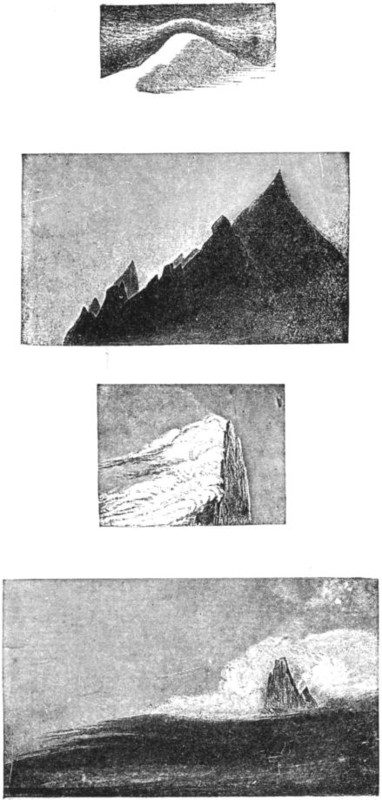
J. Ruskin.
J. C. Armytage.
69. Aiguilles and their Friends.
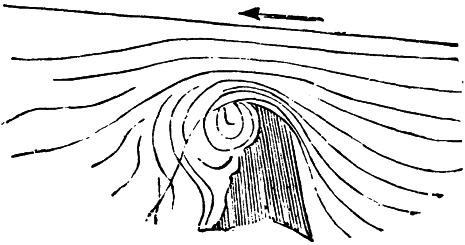
§ 5. The fact is, that the explanation given in that fourth paragraph can, in reality, account only for what may properly be termed “lee-side cloud,” slightly noticed in the continuation of the same chapter, but deserving most attentive illustration, as one of the most beautiful phenomena of the Alps. When a moist wind blows in clear weather over a cold summit, it has not time to get chilled as it approaches the rock, and therefore the air remains clear, and the sky bright on the windward side; but under the lee of the peak, there is partly a back eddy, and partly still air; and in that lull and eddy the wind gets time to be chilled by the rock, and the cloud appears as a boiling mass of white vapor, rising continually with the return current to the upper edge of the mountain, where it is caught by the straight wind, and partly torn, partly melted away in broken fragments. In Fig. 86 the dark mass represents the mountain peak, the arrow the main direction of the wind, the curved lines show the directions of such current and its concentration, and the dotted lines enclose the space in which cloud forms densely, floating away beyond and above in irregular tongues and flakes. The second figure from the top in Plate 69 represents the actual aspect of it when in full development, with a strong south wind, in a clear day, on the Aiguille Dru, the sky being perfectly blue and lovely around.
So far all is satisfactory. But the true helmet cloud will not allow itself to be thus explained away. The uppermost figure in Plate 69 represents the loveliest form of it, seen in that perfect arch, so far as I know, only over the highest piece of earth in Europe.
§ 6. Respecting which there are two mysteries:—First, why it should form only at a certain distance above the snow, showing blue sky between it and the summit. Secondly, why, so forming, it should always show as an arch, not as a concave cup. This last question puzzles me especially. For, if it be a true arch, and not a cup, it ought to show itself in certain positions of the spectator, or directions of the wind, like the ring of Saturn, as a mere line, or as a spot of cloud pausing over the hill-top. But I never saw it so. While, as above noticed, the lowest form of the helmet cloud is not white as of silver, but like Dolon’s helmet of wolf-skin,—it is a gray, flaky veil, lapping itself over the shoulders of a more or less conical peak; and of this, also, I have no word to utter but the old one, “Electricity,” and I might as well say nothing.
§ 7. Neither the helmet cloud, nor the lee-side cloud, however, though most interesting and beautiful, are of much importance in picturesque effect. They are too isolated and strange. But the great mountain cloud, which seems to be a blending of the two with independent forms of vapor (that is to say, a greater development, in consequence of the mountain’s action, of clouds which would in some way or other have formed anywhere), requires prolonged attention, as the principal element of the sky in noblest landscape.
§ 8. For which purpose, first, it may be well to clear a few clouds out of the way. I believe the true cumulus is never seen in a great mountain region, at least never associated with hills. It is always broken up and modified by them. Boiling and rounded masses of vapor occur continually, as behind the Aiguille Dru (lowest figure in Plate 69); but the quiet, thoroughly defined, infinitely divided and modelled pyramid never develops itself. It would be very grand if one ever saw a great mountain peak breaking through the domed shoulders of a true cumulus; but this I have never seen.
§ 9. Again, the true high cirri never cross a mountain in Europe. How often have I hoped to see an Alp rising through and above their level-laid and rippled fields! but those white harvest-fields are heaven’s own. And, finally, even the low, level, cirrus (used so largely in Martin’s pictures) rarely crosses a mountain. If it does, it usually becomes slightly waved or broken, so as to destroy its character. Sometimes, however, at great distances, a very level bar of cloud will strike across a peak; but nearer, too much of the under surface of the field is seen, so that a well-defined bar across a peak, seen at a high angle, is of the greatest rarity.
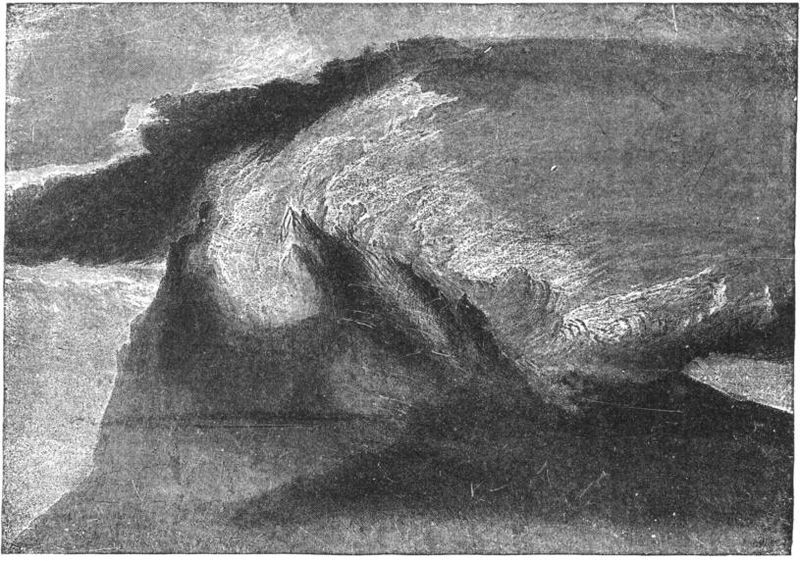
J. Ruskin.
J. C. Armytage.
70. The Graiæ.
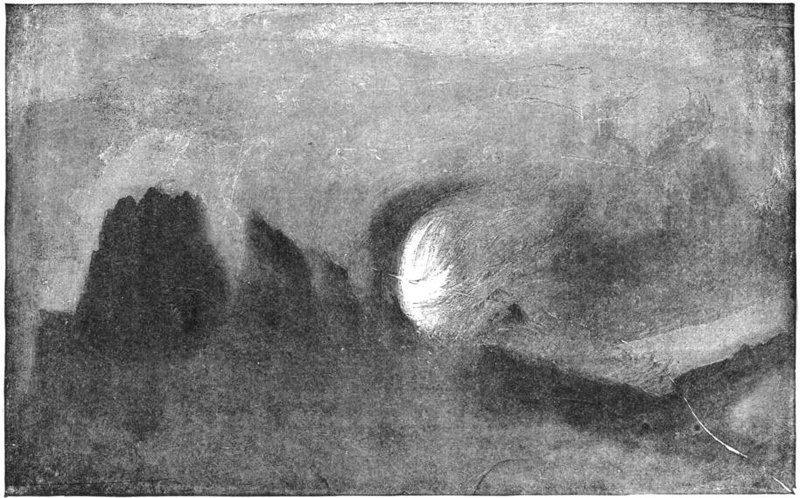
71. “Venga Medusa.”
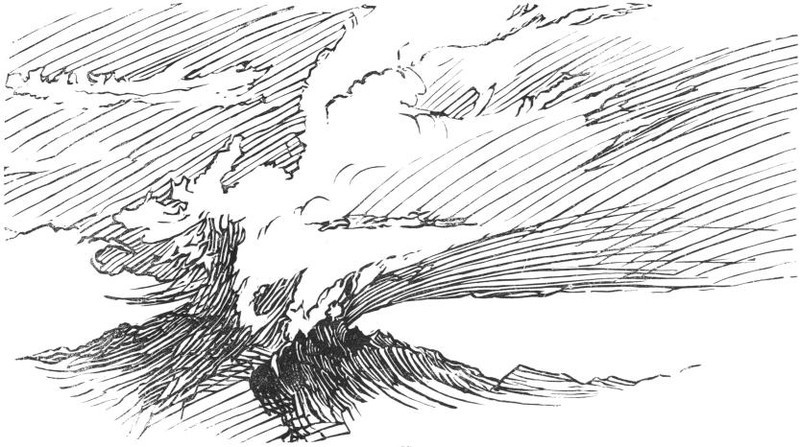
To face page 127.
Fig. 87.§ 10. The ordinary mountain cloud, therefore, if well defined, divides itself into two kinds: a broken condition of cumulus, grand in proportion as it is solid and quiet,—and a strange modification of drift-cloud, midway, as I said, between the helmet and the lee-side forms. The broken, quiet cumulus impressed Turner exceedingly when he first saw it on hills. He uses it, slightly exaggerating its definiteness, in all his early studies among the mountains of the Chartreuse, and very beautifully in the vignette of St. Maurice in Rogers’s Italy. There is nothing, however, to be specially observed of it, as it only differs from the cumulus of the plains, by being smaller and more broken.
§ 11. Not so the mountain drift-cloud, which is as peculiar as it is majestic. The Plates 70 and 71 show, as well as I can express, two successive phases of it on a mountain crest; (in this instance the great limestone ridge above St. Michel, in Savoy.) But what colossal proportions this noble cloud assumes may be best gathered from the rude sketch, Fig. 87, in which I have simply put firm black ink over the actual pencil lines made at the moment, giving the form of a single wreath of the drift-cloud, stretching about five miles in a direct line from the summit of one of the Alps of the Val d’Aosta, as seen from the plain of Turin. It has a grand volcanic look, but I believe its aspect of rising from the peak to be almost, if not altogether, deceptive; and that the apparently gigantic column is a nearly horizontal stream of lee-side cloud, tapered into the distance by perspective, and thus rising at its apparently lowest but in reality most distant point, from the mountain summit whose shade calls it into being out of the clear winds.
Whether this be so or not, the apparent origin of the cloud on the peak, and radiation from it, distinguish it from the drift-cloud of level country, which arranges itself at the horizon in broken masses, such as Fig. 89, showing no point of origin; and I do not know how far they are vertical cliffs or horizontally extended fields. They are apt to be very precipitous in aspect, breaking into fragments with an apparently concentric motion, as in the figure; but of this motion also—whether vertical or horizontal—I can say nothing positive.
§ 12. The absolute scale of such clouds may be seen, or at least demonstrated, more clearly in Fig. 88, which is a rough note of an effect of sky behind the tower of Berne Cathedral. It was made from the mound beside the railroad bridge. The Cathedral tower is half-a-mile distant. The great Eiger of Grindelwald is seen just on the right of it. This mountain is distant from the tower thirty-four miles as the crow flies, and ten thousand feet above it in height. The drift-cloud behind it, therefore, being in full light, and showing no overhanging surfaces, must rise at least twenty thousand feet into the air.
§ 13. The extreme whiteness of the volume of vapor in this case (not, I fear, very intelligible in the woodcut3) may be partly owing to recent rain, which, by its evaporation, gives a peculiar density and brightness to some forms of clearing cloud. In order to understand this, we must consider another set of facts. When weather is thoroughly wet among hills, we ought no more to accuse the mountains of forming the clouds, than we do the plains in similar circumstances. The unbroken mist buries the mountains to their bases; but that is not their fault. It may be just as wet and just as cloudy elsewhere. (This is not true of Scottish mountain, by the way.) But when the wet weather is breaking, and the clouds pass, perhaps, in great measure, away from the plains leaving large spaces of blue sky, the mountains begin to shape clouds for themselves. The fallen moisture evaporates from the plain invisibly; but not so from the hill-side. There, what quantity of rain has not gone down in the torrents, ascends again to heaven instantly in white clouds. The storm passes as if it had tormented the crags, and the strong mountains smoke like tired horses.
§ 14. Here is another question for us of some interest. Why does the much greater quantity of moisture lying on the horizontal fields send up no visible vapor, and the less quantity left on the rocks glorify itself into a magnificent wreath of soaring snow?
First, for the very reason, that it is less in quantity, and more distributed; as a wet cloth smokes when you put it near the fire, but a basin of water not.
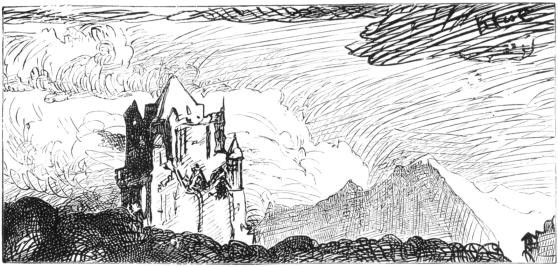
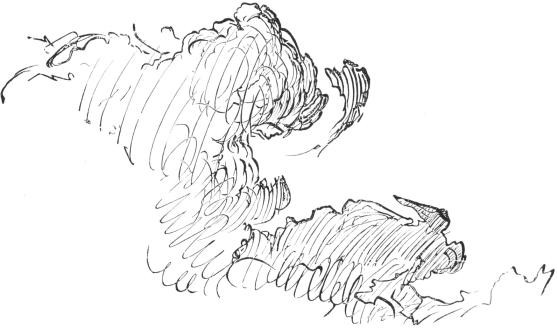

To face page 128.
Fig. 90.The previous heat of the crags, noticed in the first volume, p. 249, is only a part of the cause. It operates only locally, and on remains of sudden showers. But after any number of days and nights of rain, and in all places exposed to returning sunshine and breezes, the distribution of the moisture tells. So soon as the rain has ceased, all water that can run off is of course gone from the steep hill-sides; there remains only the thin adherent film of moisture to be dried; but that film is spread over a complex texture—all manner of crannies, and bosses, and projections, and filaments of moss and lichen, exposing a vast extent of drying surface to the air. And the evaporation is rapid in proportion.
§ 15. Its rapidity, however, observe, does not account for its visibility, and this is one of the questions I cannot clearly solve, unless I were sure of the nature of the vesicular vapor. When our breath becomes visible on a frosty day, it is easily enough understood that the moisture which was invisible, carried by the warm air from the lungs, becomes visible when condensed or precipitated by the surrounding chill; but one does not see why air passing over a moist surface quite as cold as itself should take up one particle of water more than it can conveniently—that is to say, invisibly—carry. Whenever you see vapor, you may not inaccurately consider the air as having got more than it can properly hold, and dropping some. Now it is easily understood how it should take up much in the lungs, and let some of it fall when it is pinched by the frost outside; but why should it overload itself there on the hills, when it is at perfect liberty to fly away as soon as it likes, and come back for more? I do not see my way well in this. I do not see it clearly, even through the wet cloth. I shall leave all the embarrassment of the matter, however, to my reader, contenting myself, as usual, with the actual fact, that the hill-side air does behave in this covetous and unreasonable manner; and that, in consequence, when the weather is breaking (and sometimes, provokingly, when it is not), phantom clouds form and rise in sudden crowds of wild and spectral imagery along all the far succession of the hill-slopes and ravines.
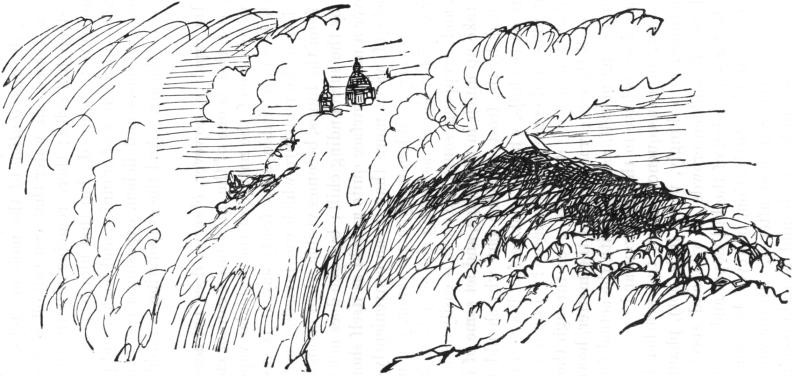
§ 16. There is this distinction, however, between the clouds that form during the rain and after it. In the worst weather, the rain-cloud keeps rather high, and is unbroken; but when there is a disposition in the rain to relax, every now and then a sudden company of white clouds will form quite low down (in Chamouni or Grindelwald, and such high districts, even down to the bottom of the valley), which will remain, perhaps, for ten minutes, filling all the air, then disappear as suddenly as they came, leaving the gray upper cloud and steady rain to their work. These “clouds of relaxation,” if we may so call them, are usually flaky and horizontal, sometimes tending to the silky cirrus, yet showing no fine forms of drift; but when the rain has passed, and the air is getting warm, forms the true clearing cloud, in wreaths that ascend continually with a slow circling motion, melting as they rise. The woodcut, Fig. 91, is a rude note of it floating more quietly from the hill of the Superga, the church (nearly as large as St. Paul’s) appearing above, and thus showing the scale of the wreath.
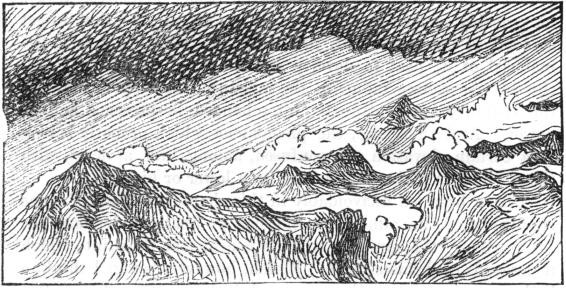
92.
§ 17. This cloud of evaporation, however, does not always rise. It sometimes rests in absolute stillness, low laid in the hollows of the hills, their peaks emergent from it. Fig. 92 shows this condition of it, seen from a distance, among the Cenis hills. I do not know what gives it this disposition to rest in the ravines, nor whether there is a greater chill in the hollows, or a real action of gravity on the particles of cloud. In general, the position seems to depend on the temperature. Thus, in Chamouni, the crests of La Côte and Taconay continually appear in stormy weather as in Plate 36, Vol. IV., in which I intended to represent rising drift-cloud, made dense between the crests by the chill from the glaciers. But in the condition shown in Fig. 92, on a comparatively open sweep of hill-side, the thermometer would certainly indicate a higher temperature in the sheltered valley than on the exposed peaks; yet the cloud still subsides into the valleys like folds of a garment; and, more than this, sometimes conditions of morning cloud, dependent, I believe, chiefly on dew evaporation, form first on the tops of the soft hills of wooded Switzerland, and droop down in rent fringes, and separate tongues, clinging close to all the hill-sides, and giving them exactly the appearance of being covered with white fringed cloth, falling over them in torn or divided folds. It always looks like a true action of gravity. How far it is, in reality, the indication of the power of the rising sun causing evaporation, first on the hill-top, and then in separate streams, by its divided light on the ravines, I cannot tell. The subject is, as the reader perceives, always inextricably complicated by these three necessities—that to get a cloud in any given spot, you must have moisture to form the material of it, heat to develop it, and cold4 to show it; and the adverse causes inducing the moisture, the evaporation, and the visibility are continually interchanged in presence and in power. And thus, also, the phenomena which properly belong to a certain elevation are confused, among hills at least, with those which in plains would have been lower or higher.
I have been led unavoidably in this chapter to speak of some conditions of the rain-cloud; nor can we finally understand the forms even of the cumulus, without considering those into which it descends or diffuses itself. Which, however, being, I think, a little more interesting than our work hitherto, we will leave this chapter to its dulness, and begin another.
1 Before going farther, I must say a word or two respecting method of drawing clouds.
2 If the figures are supposed to include less than one-fourth of the horizon, the shaded figures represent diamond-shaped clouds; but the reader cannot understand this without studying perspective laws accurately.
3 In reality, the retiring ranks of cloud, if long enough, would, of course, go on converging to the horizon. I do not continue them, because the figures would become too compressed.
4 I use ellipses in order to make these figures easily intelligible; the curves actually are variable curves, of the nature of the cycloid, or other curves of continuous motion; probably produced by a current moving in some such direction as that indicated by the dotted line in Fig. 3, Plate 56.
5 Now in the possession of E. Bicknell, Esq., who kindly lent me the picture, that I might make this drawing from it carefully.
6 I cannot yet engrave these; but the little study of a single rank of cirrus, the lowest in Plate 63, may serve to show the value of perspective in expressing buoyancy. It is not, however, though beautifully engraved by Mr. Armytage, as delicate as it should be, in the finer threads which indicate increasing distance at the extremity. Compare the rising of the lines of curve at the edges of this mass, with the similar action on a larger scale, of Turner’s cloud, opposite.
7 In the autobiography of John Newton there is an interesting account of the deception of a whole ship’s company by cloud, taking the aspect and outline of mountainous land. They ate the last provision in the ship, so sure were they of its being land, and were nearly starved to death in consequence.
1 One of the great difficulties in doing this is to distinguish the portions of cloud outline which really slope upwards from those which only appear to do so, being in reality horizontal, and thrown into apparent inclination by perspective.
2 Pileatus, capped (strictly speaking, with the cap of liberty;—stormy cloud enough sometimes on men’s brows as well as on mountains), corrupted into Pilatus, and Pilate.
3 I could not properly illustrate the subject of clouds without numbers of these rude drawings, which would probably offend the general reader by their coarseness, while the cost of engraving them in facsimile is considerable, and would much add to the price of the book. If I find people at all interested in the subject, I may, perhaps, some day systematize and publish my studies of cloud separately. I am sorry not to have given in this volume a careful study of a rich cirrus sky, but no wood-engraving that I can employ on this scale will express the finer threads and waves.
4 We might say light, as well as cold; for it wholly depends on the degree of light in the sky how far delicate cloud is seen.
1 One of the great difficulties in doing this is to distinguish the portions of cloud outline which really slope upwards from those which only appear to do so, being in reality horizontal, and thrown into apparent inclination by perspective.
2 Pileatus, capped (strictly speaking, with the cap of liberty;—stormy cloud enough sometimes on men’s brows as well as on mountains), corrupted into Pilatus, and Pilate.
3 I could not properly illustrate the subject of clouds without numbers of these rude drawings, which would probably offend the general reader by their coarseness, while the cost of engraving them in facsimile is considerable, and would much add to the price of the book. If I find people at all interested in the subject, I may, perhaps, some day systematize and publish my studies of cloud separately. I am sorry not to have given in this volume a careful study of a rich cirrus sky, but no wood-engraving that I can employ on this scale will express the finer threads and waves.
4 We might say light, as well as cold; for it wholly depends on the degree of light in the sky how far delicate cloud is seen.
The second figure from the top in Plate 69 shows an effect of morning light on the range of the Aiguille Bouchard (Chamouni). Every crag casts its shadow up into apparently clear sky. The shadow is, in such cases, a bluish gray, the color of clear sky; and the defining light is caused by the sunbeams showing mist which otherwise would have been unperceived. The shadows are not irregular enough in outline—the sketch was made for their color and sharpness, not their shape,—and I cannot now put them right, so I leave them as they were drawn at the moment.
CHAPTER IV.
THE ANGEL OF THE SEA.
§ 1. Perhaps the best and truest piece of work done in the first volume of this book, was the account given in it of the rain-cloud; to which I have here little, descriptively, to add. But the question before us now is, not who has drawn the rain-cloud best, but if it were worth drawing at all. Our English artists naturally painted it often and rightly; but are their pictures the better for it? We have seen how mountains are beautiful; how trees are beautiful; how sun-lighted clouds are beautiful; but can rain be beautiful?
I spoke roughly of the Italian painters in that chapter, because they could only draw distinct clouds, or violent storms, “massive concretions,” while our northern painters could represent every phase of mist and fall of shower.
But is this indeed so delightful? Is English wet weather, indeed, one of the things which we should desire to see Art give perpetuity to?
Yes, assuredly. I have given some reasons for this answer in the fifth chapter of last volume; one or two, yet unnoticed, belong to the present division of our subject.
§ 2. The climates or lands into which our globe is divided may, with respect to their fitness for Art, be perhaps conveniently ranged under five heads:—
1. Forest-lands, sustaining the great mass of the magnificent vegetation of the tropics, for the most part characterized by moist and unhealthy heat, and watered by enormous rivers, or periodical rains. This country cannot, I believe, develop the mind or art of man. He may reach great subtlety of intellect, as the Indian, but not become learned, nor produce any noble art, only a savage or grotesque form of it. Even supposing the evil influences of climate could be vanquished, the scenery is on too large a scale. It would be difficult to conceive of groves less fit for academic purposes than those mentioned by Humboldt, into which no one can enter except under a stout wooden shield, to avoid the chance of being killed by the fall of a nut.
2. Sand-lands, including the desert and dry-rock plains of the earth, inhabited generally by a nomade population, capable of high mental cultivation and of solemn monumental or religious art, but not of art in which pleasurableness forms a large element, their life being essentially one of hardship.
3. Grape and wheat lands, namely, rocks and hills, such as are good for the vine, associated with arable ground forming the noblest and best ground given to man. In these districts only art of the highest kind seems possible, the religious art of the sand-lands being here joined with that of pleasure or sense.
4. Meadow-lands, including the great pastoral and agricultural districts of the North, capable only of an inferior art: apt to lose its spirituality and become wholly material.
5. Moss-lands, including the rude forest-mountain and ground of the North, inhabited by a healthy race, capable of high mental cultivation and moral energy, but wholly incapable of art, except savage, like that of the forest-lands, or as in Scandinavia.
We might carry out these divisions into others, but these are I think essential, and easily remembered in a tabular form; saying “wood” instead of “forest,” and “field” for “meadow,” we can get such a form shortly worded:—
Wood-lands
Shrewd intellect
No art.
Sand-lands
High intellect
Religious art.
Vine-lands
Highest intellect
Perfect art.
Field-lands
High intellect
Material art.
Moss-lands
Shrewd intellect
No art.
§ 3. In this table the moss-lands appear symmetrically opposed to the wood-lands, which in a sort they are; the too diminutive vegetation under bleakest heaven, opposed to the too colossal under sultriest heaven, while the perfect ministry of the elements, represented by bread and wine, produces the perfect soul of man.
But this is not altogether so. The moss-lands have one great advantage over the forest-lands, namely, sight of the sky.
And not only sight of it, but continual and beneficent help from it. What they have to separate them from barren rock, namely, their moss and streams, being dependent on its direct help, not on great rivers coming from distant mountain chains, nor on vast tracts of ocean-mist coming up at evening, but on the continual play and change of sun and cloud.
§ 4. Note this word “change.” The moss-lands have an infinite advantage, not only in sight, but in liberty; they are the freest ground in all the world. You can only traverse the great woods by crawling like a lizard, or climbing like a monkey—the great sands with slow steps and veiled head. But bare-headed, and open-eyed, and free-limbed, commanding all the horizon’s space of changeful light, and all the horizon’s compass of tossing ground, you traverse the moss-land. In discipline it is severe as the desert, but it is a discipline compelling to action; and the moss-lands seem, therefore, the rough schools of the world, in which its strongest human frames are knit and tried, and so bent down, like the northern winds, to brace and brighten the languor into which the repose of more favored districts may degenerate.
§ 5. It would be strange, indeed, if there were no beauty in the phenomena by which this great renovating and purifying work is done. And it is done almost entirely by the great Angel of the Sea—rain;—the Angel, observe, the messenger sent to a special place on a special errand. Not the diffused perpetual presence of the burden of mist, but the going and returning of intermittent cloud. All turns upon that intermittence. Soft moss on stone and rock;—cave-fern of tangled glen; wayside well—perennial, patient, silent, clear; stealing through its square font of rough-hewn stone; ever thus deep—no more—which the winter wreck sullies not, the summer thirst wastes not, incapable of stain as of decline—where the fallen leaf floats undecayed, and the insect darts undefiling. Cressed brook and ever-eddying river, lifted even in flood scarcely over its stepping-stones,—but through all sweet summer keeping tremulous music with harp-strings of dark water among the silver fingering of the pebbles. Far away in the south the strong river Gods have all hasted, and gone down to the sea. Wasted and burning, white furnaces of blasting sand, their broad beds lie ghastly and bare; but here the soft wings of the Sea Angel droop still with dew, and the shadows of their plumes falter on the hills: strange laughings, and glitterings of silver streamlets, born suddenly, and twined about the mossy heights in trickling tinsel, answering to them as they wave.1
§ 6. Nor are those wings colorless. We habitually think of the rain-cloud only as dark and gray; not knowing that we owe to it perhaps the fairest, though not the most dazzling of the hues of heaven. Often in our English mornings, the rain-clouds in the dawn form soft level fields, which melt imperceptibly into the blue; or when of less extent, gather into apparent bars, crossing the sheets of broader cloud above; and all these bathed throughout in an unspeakable light of pure rose-color, and purple, and amber, and blue; not shining, but misty-soft; the barred masses, when seen nearer, composed of clusters or tresses of cloud, like floss silk; looking as if each knot were a little swathe or sheaf of lighted rain. No clouds form such skies, none are so tender, various, inimitable. Turner himself never caught them. Correggio, putting out his whole strength, could have painted them, no other man.2
§ 7. For these are the robes of love of the Angel of the Sea. To these that name is chiefly given, the “spreadings of the clouds,” from their extent, their gentleness, their fulness of rain. Note how they are spoken of in Job xxxvi. v. 29-31. “By them judgeth he the people; he giveth meat in abundance. With clouds he covereth the light.3 He hath hidden the light in his hands, and commanded that it should return. He speaks of it to his friend; that it is his possession, and that he may ascend thereto.”
That, then, is the Sea Angel’s message to God’s friends; that, the meaning of those strange golden lights and purple flushes before the morning rain. The rain is sent to judge, and feed us; but the light is the possession of the friends of God, and they may ascend thereto,—where the tabernacle veil will cross and part its rays no more.
§ 8. But the Angel of the Sea has also another message,—in the “great rain of his strength,” rain of trial, sweeping away ill-set foundations. Then his robe is not spread softly over the whole heaven, as a veil, but sweeps back from his shoulders, ponderous, oblique, terrible—leaving his sword-arm free.
The approach of trial-storm, hurricane-storm, is indeed in its vastness as the clouds of the softer rain. But it is not slow nor horizontal, but swift and steep: swift with passion of ravenous winds; steep as slope of some dark, hollowed hill. The fronting clouds come leaning forward, one thrusting the other aside, or on; impatient, ponderous, impendent, like globes of rock tossed of Titans—Ossa on Olympus—but hurled forward all, in one wave of cloud-lava—cloud whose throat is as a sepulchre. Fierce behind them rages the oblique wrath of the rain, white as ashes, dense as showers of driven steel; the pillars of it full of ghastly life; Rain-Furies, shrieking as they fly;—scourging, as with whips of scorpions;—the earth ringing and trembling under them, heaven wailing wildly, the trees stooped blindly down, covering their faces, quivering in every leaf with horror, ruin of their branches flying by them like black stubble.
§ 9. I wrote Furies. I ought to have written Gorgons. Perhaps the reader does not know that the Gorgons are not dead, are ever undying. We shall have to take our chance of being turned into stones by looking them in the face, presently. Meantime, I gather what part of the great Greek story of the Sea Angels, has meaning for us here.
Nereus, the God of the Sea, who dwells in it always (Neptune being the God who rules it from Olympus), has children by the Earth; namely, Thaumas, the father of Iris; that is, the “wonderful” or miracle-working angel of the sea; Phorcys, the malignant angel of it (you will find him degraded through many forms, at last, in the story of Sindbad, into the Old Man of the Sea); Ceto, the deep places of the sea, meaning its bays among rocks, therefore called by Hesiod “Fair-cheeked” Ceto; and Eurybia, the tidal force or sway of the sea, of whom more hereafter.
§ 10. Phorcys and Ceto, the malignant angel of the sea, and the spirit of its deep rocky places, have children, namely, first, Graiæ, the soft rain-clouds. The Greeks had a greater dislike of storm than we have, and therefore whatever violence is in the action of rain, they represented by harsher types than we should—types given in one group by Aristophanes (speaking in mockery of the poets): “This was the reason, then, that they made so much talk about the fierce rushing of the moist clouds, coiled in glittering; and the locks of the hundred-headed Typhon; and the blowing storms; and the bent-clawed birds drifted on the breeze, fresh, and aërial.” Note the expression “bent-clawed birds.” It illustrates two characters of these clouds; partly their coiling form; but more directly the way they tear down the earth from the hill-sides; especially those twisted storm-clouds which in violent action become the waterspout. These always strike at a narrow point, often opening the earth on a hill-side into a trench as a great pickaxe would (whence the Graiæ are said to have only one beak between them). Nevertheless, the rain-cloud was, on the whole, looked upon by the Greeks as beneficent, so that it is boasted of in the Œdipus Coloneus for its perpetual feeding of the springs of Cephisus,4 and elsewhere often; and the opening song of the rain-clouds in Aristophanes is entirely beautiful:—
“O eternal Clouds! let us raise into open sight our dewy existence, from the deep-sounding Sea, our Father, up to the crests of the wooded hills, whence we look down over the sacred land, nourishing its fruits, and over the rippling of the divine rivers, and over the low murmuring bays of the deep.” I cannot satisfy myself about the meaning of the names of the Graiæ—Pephredo and Enuo—but the epithets which Hesiod gives them are interesting: “Pephredo, the well-robed; Enuo, the crocus-robed;” probably, it seems to me, from their beautiful colors in morning.
§ 11. Next to the Graiæ, Phorcys and Ceto begat the Gorgons, which are the true storm-clouds. The Graiæ have only one beak or tooth, but all the Gorgons have tusks like boars; brazen hands (brass being the word used for the metal of which the Greeks made their spears), and golden wings.
Their names are “Steino” (straitened), of storms compressed into narrow compass; “Euryale” (having wide threshing-floor), of storms spread over great space; “Medusa” (the dominant), the most terrible. She is essentially the highest storm-cloud; therefore the hail-cloud or cloud of cold, her countenance turning all who behold it to stone. (“He casteth forth his ice like morsels. Who can stand before his cold?”) The serpents about her head are the fringes of the hail, the idea of coldness being connected by the Greeks with the bite of the serpent, as with the hemlock.
§ 12. On Minerva’s shield, her head signifies, I believe, the cloudy coldness of knowledge, and its venomous character (“Knowledge puffeth up.” Compare Bacon in Advancement of Learning). But the idea of serpents rose essentially from the change of form in the cloud as it broke; the cumulus cloud not breaking into full storm till it is cloven by the cirrus; which is twice hinted at in the story of Perseus; only we must go back a little to gather it together.
Perseus was the son of Jupiter by Danaë, who being shut in a brazen tower, Jupiter came to her in a shower of gold: the brazen tower being, I think, only another expression for the cumulus or Medusa cloud; and the golden rain for the rays of the sun striking it; but we have not only this rain of Danaë’s to remember in connection with the Gorgon, but that also of the sieves of the Danaïdes, said to represent the provision of Argos with water by their father Danaüs, who dug wells about the Acropolis; nor only wells, but opened, I doubt not, channels of irrigation for the fields, because the Danaïdes are said to have brought the mysteries of Ceres from Egypt. And though I cannot trace the root of the names Danaüs and Danaë, there is assuredly some farther link of connection in the deaths of the lovers of the Danaïdes, whom they slew, as Perseus Medusa. And again note, that when the father of Danaë, Acrisius, is detained in Seriphos by storms, a disk thrown by Perseus is carried by the wind against his head, and kills him; and lastly, when Perseus cuts off the head of Medusa, from her blood springs Chrysaor, “wielder of the golden sword,” the Angel of the Lightning, and Pegasus, the Angel of the “Wild Fountains,” that is to say, the fastest flying or lower rain-cloud; winged, but racing as upon the earth.
§ 13. I say, “wild” fountains; because the kind of fountain from which Pegasus is named is especially the “fountain of the great deep” of Genesis; sudden and furious, (cataracts of heaven, not windows, in the Septuagint);—the mountain torrent caused by thunderous storm, or as our “fountain”—a Geyser-like leaping forth of water. Therefore, it is the deep and full source of streams, and so used typically of the source of evils, or of passions; whereas the word “spring” with the Greeks is like our “well-head”—a gentle issuing forth of water continually. But, because both the lightning-fire and the gushing forth, as of a fountain, are the signs of the poet’s true power, together with perpetuity, it is Pegasus who strikes the earth with his foot, on Helicon,5 and causes Hippocrene to spring forth—“the horse’s well-head.” It is perpetual; but has, nevertheless, the Pegasean storm-power.
§ 14. Wherein we may find, I think, sufficient cause for putting honor upon the rain-cloud. Few of us, perhaps, have thought, in watching its career across our own mossy hills, or listening to the murmur of the springs amidst the mountain quietness, that the chief masters of the human imagination owed, and confessed that they owed, the force of their noblest thoughts, not to the flowers of the valley, nor the majesty of the hill, but to the flying cloud.
Yet they never saw it fly, as we may in our own England. So far, at least, as I know the clouds of the south, they are often more terrible than ours, but the English Pegasus is swifter. On the Yorkshire and Derbyshire hills, when the rain-cloud is low and much broken, and the steady west-wind fills all space with its strength,6 the sun-gleams fly like golden vultures: they are flashes rather than shinings; the dark spaces and the dazzling race and skim along the acclivities, and dart and dip from crag to dell, swallow-like;—no Graiæ these,—gray and withered: Grey Hounds rather, following the Cerinthian stag with the golden antlers.
§ 15. There is one character about these lower rain-clouds, partly affecting all their connection with the upper sky, which I have never been able to account for; that which, as before noticed, Aristophanes fastened on at once for their distinctive character—their obliquity. They always fly in an oblique position, as in the Plate opposite, which is a careful facsimile of the first advancing mass of the rain-cloud in Turner’s Slave Ship. When the head of the cloud is foremost, as in this instance, and rain falling beneath, it is easy to imagine that its drops, increasing in size as they fall, may exercise some retarding action on the wind. But the head of the cloud is not always first, the base of it is sometimes advanced.7 The only certainty is, that it will not shape itself horizontally, its thin drawn lines and main contours will always be oblique, though its motion is horizontal; and, which is still more curious, their sloping lines are hardly ever modified in their descent by any distinct retiring tendency or perspective convergence. A troop of leaning clouds will follow one another, each stooping forward at the same apparent slope, round a fourth of the horizon.
§ 16. Another circumstance which the reader should note in this cloud of Turner’s, is the witch-like look of drifted or erected locks of hair at its left side. We have just read the words of the old Greek poet: “Locks of the hundred-headed Typhon;” and must remember that Turner’s account of this picture, in the Academy catalogue, was “Slaver throwing overboard the Dead and Dying. Typhoon coming on.” The resemblance to wildly drifted hair is stronger in the picture than in the engraving; the gray and purple tints of torn cloud being relieved against golden sky beyond.
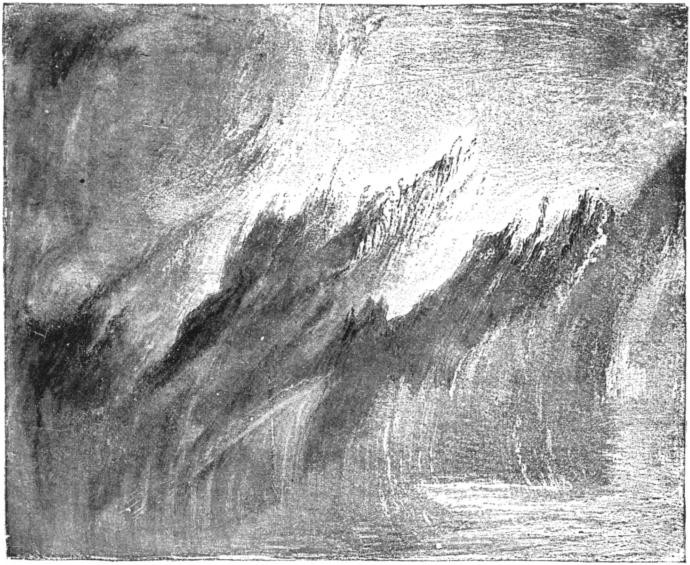
72. The Locks of Typhon.
§ 17. It was not, however, as we saw, merely to locks of hair, but to serpents, that the Greeks likened the dissolving of the Medusa cloud in blood. Of that sanguine rain, or of its meaning, I cannot yet speak. It is connected with other and higher types, which must be traced in another place.8
But the likeness to serpents we may illustrate here. The two Plates already given, 70 and 71 (at page 127), represent successive conditions of the Medusa cloud on one of the Cenis hills (the great limestone precipice above St. Michel, between Lanslebourg and St. Jean di Maurienne).9 In the first, the cloud is approaching, with the lee-side cloud forming beyond it; in the second, it has approached, increased, and broken, the Medusa serpents writhing about the central peak, the rounded tops of the broken cumulus showing above. In this instance, they take nearly the forms of flame; but when the storm is more violent, they are torn into fragments, and magnificent revolving wheels of vapor are formed, broken, and tossed into the air, as the grass is tossed in the hay-field from the toothed wheels of the mowing-machine; perhaps, in common with all other inventions of the kind, likely to bring more evil upon men than ever the Medusa cloud did, and turn them more effectually into stone.10
§ 18. I have named in the first volume the principal works of Turner representing these clouds; and until I am able to draw them better, it is useless to say more of them; but in connection with the subject we have been examining, I should be glad if the reader could turn to the engravings of the England drawings of Salisbury and Stonehenge. What opportunities Turner had of acquainting himself with classical literature, and how he used them, we shall see presently. In the meantime, let me simply assure the reader that, in various byways, he had gained a knowledge of most of the great Greek traditions, and that he felt them more than he knew them; his mind being affected, up to a certain point, precisely as an ancient painter’s would have been, by external phenomena of nature. To him, as to the Greek, the storm-clouds seemed messengers of fate. He feared them, while he reverenced; nor does he ever introduce them without some hidden purpose, bearing upon the expression of the scene he is painting.
§ 19. On that plain of Salisbury, he had been struck first by its widely-spacious pastoral life; and secondly, by its monuments of the two great religions of England—Druidical and Christian.
He was not a man to miss the possible connection of these impressions. He treats the shepherd life as a type of the ecclesiastical; and composes his two drawings so as to illustrate both.
In the drawing of Salisbury, the plain is swept by rapid but not distressful rain. The cathedral occupies the centre of the picture, towering high over the city, of which the houses (made on purpose smaller than they really are) are scattered about it like a flock of sheep. The cathedral is surrounded by a great light. The storm gives way at first in a subdued gleam over a distant parish church, then bursts down again, breaks away into full light about the cathedral, and passes over the city, in various sun and shade. In the foreground stands a shepherd leaning on his staff, watching his flock—bare-headed; he has given his cloak to a group of children, who have covered themselves up with it, and are shrinking from the rain; his dog crouches under a bank; his sheep, for the most part, are resting quietly, some coming up the slope of the bank towards him.11
§ 20. The rain-clouds in this picture are wrought with a care which I have never seen equalled in any other sky of the same kind. It is the rain of blessing—abundant, but full of brightness; golden gleams are flying across the wet grass, and fall softly on the lines of willows in the valley—willows by the watercourses; the little brooks flash out here and there between them and the fields. Turn now to the Stonehenge. That, also, stands in great light; but it is the Gorgon light—the sword of Chrysaor is bared against it. The cloud of judgment hangs above. The rock pillars seem to reel before its slope, pale beneath the lightning. And nearer, in the darkness, the shepherd lies dead, his flock scattered.
I alluded, in speaking before of this Stonehenge, to Turner’s use of the same symbol in the drawing of Pæstum for Rogers’s Italy; but a more striking instance of its employment occurs in a Study of Pæstum, which he engraved himself before undertaking the Liber Studiorum and another in his drawing of the Temple of Minerva, on Cape Colonna: and observe farther that he rarely introduces lightning, if the ruined building has not been devoted to religion. The wrath of man may destroy the fortress, but only the wrath of heaven can destroy the temple.
§ 21. Of these secret meanings of Turner’s, we shall see enough in the course of the inquiry we have to undertake, lastly, respecting ideas of relation; but one more instance of his opposed use of the lightning symbol, and of the rain of blessing, I name here, to confirm what has been noted above. For, in this last instance, he was questioned respecting his meaning, and explained it. I refer to the drawings of Sinai and Lebanon, made for Finden’s Bible. The sketches from which Turner prepared that series were, I believe, careful and accurate; but the treatment of the subjects was left wholly to him. He took the Sinai and Lebanon to show the opposite influences of the Law and the Gospel. The Rock of Moses is shown in the burning of the desert, among fallen stones, forked lightning cleaving the blue mist which veils the summit of Sinai. Armed Arabs pause at the foot of the rock. No human habitation is seen, nor any herb or tree, nor any brook, and the lightning strikes without rain.12 Over the Mount Lebanon an intensely soft gray-blue sky is melting into dewy rain. Every ravine is filled, every promontory crowned, by tenderest foliage, golden in slanting sunshine.13 The white convent nestles into the hollow of the rock; and a little brook runs under the shadow of the nearer trees, beside which two monks sit reading.
§ 22. It was a beautiful thought, yet an erring one, as all thoughts are which oppose the Law to the Gospel. When people read, “the law came by Moses, but grace and truth by Christ,” do they suppose that the law was ungracious and untrue? The law was given for a foundation; the grace (or mercy) and truth for fulfilment;—the whole forming one glorious Trinity of judgment, mercy, and truth. And if people would but read the text of their Bibles with heartier purpose of understanding it, instead of superstitiously, they would see that throughout the parts which they are intended to make most personally their own (the Psalms) it is always the Law which is spoken of with chief joy. The Psalms respecting mercy are often sorrowful, as in thought of what it cost; but those respecting the law are always full of delight. David cannot contain himself for joy in thinking of it,—he is never weary of its praise:—“How love I thy law! it is my meditation all the day. Thy testimonies are my delight and my counsellors; sweeter, also, than honey and the honeycomb.”
§ 23. And I desire, especially, that the reader should note this, in now closing the work through which we have passed together in the investigation of the beauty of the visible world. For perhaps he expected more pleasure and freedom in that work; he thought that it would lead him at once into fields of fond imagination, and may have been surprised to find that the following of beauty brought him always under a sterner dominion of mysterious law; the brightness was continually based upon obedience, and all majesty only another form of submission. But this is indeed so. I have been perpetually hindered in this inquiry into the sources of beauty by fear of wearying the reader with their severities. It was always accuracy I had to ask of him, not sympathy; patience, not zeal; apprehension, not sensation. The thing to be shown him was not a pleasure to be snatched, but a law to be learned.
§ 24. It is in this character, however, that the beauty of the natural world completes its message. We saw long ago, how its various powers of appeal to the mind of men might be traced to some typical expression of Divine attributes. We have seen since how its modes of appeal present constant types of human obedience to the Divine law, and constant proofs that this law, instead of being contrary to mercy, is the foundation of all delight, and the guide of all fair and fortunate existence.
§ 25. Which understanding, let us receive our last message from the Angel of the Sea.
Take up the 19th Psalm and look at it verse by verse. Perhaps to my younger readers, one word may be permitted respecting their Bible-reading in general.14 The Bible is, indeed, a deep book, when depth is required, that is to say, for deep people. But it is not intended, particularly, for profound persons; on the contrary, much more for shallow and simple persons. And therefore the first, and generally the main and leading idea of the Bible, is on its surface, written in plainest possible Greek, Hebrew, or English, needing no penetration, nor amplification, needing nothing but what we all might give—attention.
But this, which is in every one’s power, and is the only thing that God wants, is just the last thing any one will give Him. We are delighted to ramble away into day-dreams, to repeat pet verses from other places, suggested by chance words; to snap at an expression which suits our own particular views, or to dig up a meaning from under a verse, which we should be amiably grieved to think any human being had been so happy as to find before. But the plain, intended, immediate, fruitful meaning, which every one ought to find always, and especially that which depends on our seeing the relation of the verse to those near it, and getting the force of the whole passage, in due relation—this sort of significance we do not look for;—it being, truly, not to be discovered, unless we really attend to what is said, instead of to our own feelings.
§ 26. It is unfortunate also, but very certain, that in order to attend to what is said, we must go through the irksomeness of knowing the meaning of the words. And the first thing that children should be taught about their Bibles is, to distinguish clearly between words that they understand and words that they do not; and to put aside the words they do not understand, and verses connected with them, to be asked about, or for a future time; and never to think they are reading the Bible when they are merely repeating phrases of an unknown tongue.
§ 27. Let us try, by way of example, this 19th Psalm, and see what plain meaning is uppermost in it.
“The heavens declare the glory of God.”
What are the heavens?
The word occurring in the Lord’s Prayer, and the thing expressed being what a child may, with some advantage, be led to look at, it might be supposed among a schoolmaster’s first duties to explain this word clearly.
Now there can be no question that in the minds of the sacred writers, it stood naturally for the entire system of cloud, and of space beyond it, conceived by them as a vault set with stars. But there can, also, be no question, as we saw in previous inquiry, that the firmament, which is said to have been “called” heaven, at the creation, expresses, in all definite use of the word, the system of clouds, as spreading the power of the water over the earth; hence the constant expressions dew of heaven, rain of heaven, &c., where heaven is used in the singular; while “the heavens,” when used plurally, and especially when in distinction, as here, from the word “firmament,” remained expressive of the starry space beyond.
§ 28. A child might therefore be told (surely, with advantage), that our beautiful word Heaven may possibly have been formed from a Hebrew word, meaning “the high place;” that the great warrior Roman nation, camping much out at night, generally overtired and not in moods for thinking, are believed, by many people, to have seen in the stars only the likeness of the glittering studs of their armor, and to have called the sky “The bossed, or studded;” but that others think those Roman soldiers on their might-watches had rather been impressed by the great emptiness and void of night, and by the far coming of sounds through its darkness, and had called the heaven “The Hollow place.” Finally, I should tell the children, showing them first the setting of a star, how the great Greeks had found out the truest power of the heavens, and had called them “The Rolling.” But whatever different nations had called them, at least I would make it clear to the child’s mind that in this 19th Psalm, their whole power being intended, the two words are used which express it: the Heavens, for the great vault or void, with all its planets, and stars, and ceaseless march of orbs innumerable; and the Firmament, for the ordinance of the clouds.
These heavens, then, “declare the glory of God;” that is, the light of God, the eternal glory, stable and changeless. As their orbs fail not—but pursue their course for ever, to give light upon the earth—so God’s glory surrounds man for ever—changeless, in its fulness insupportable—infinite.
“And the firmament showeth his handywork.”
§ 29. The clouds, prepared by the hand of God for the help of man, varied in their ministration—veiling the inner splendor—show, not His eternal glory, but His daily handiwork. So He dealt with Moses. I will cover thee “with my hand” as I pass by. Compare Job xxxvi. 24: “Remember that thou magnify his work, which men behold. Every man may see it.” Not so the glory—that only in part; the courses of these stars are to be seen imperfectly, and but by a few. But this firmament, “every man may see it, man may behold it afar off.” “Behold, God is great, and we know him not. For he maketh small the drops of water: they pour down rain according to the vapor thereof.”
§ 30. “Day unto day uttereth speech, and night unto night showeth knowledge. They have no speech nor language, yet without these their voice is heard. Their rule is gone out throughout the earth, and their words to the end of the world.”
Note that. Their rule throughout the earth, whether inhabited or not—their law of right is thereon; but their words, spoken to human souls, to the end of the inhabited world.
“In them hath he set a tabernacle for the sun,” &c. Literally, a tabernacle, or curtained tent, with its veil and its hangings; also of the colors of His desert tabernacle—blue, and purple, and scarlet.
Thus far the psalm describes the manner of this great heaven’s message.
Thenceforward, it comes to the matter of it.
§ 31. Observe, you have the two divisions of the declaration. The heavens (compare Psalm viii.) declare the eternal glory of God before men, and the firmament the daily mercy of God towards men. And the eternal glory is in this—that the law of the Lord is perfect, and His testimony sure, and His statutes right.
And the daily mercy in this—that the commandment of the Lord is pure, and His fear is clean, and His judgments true and righteous.
There are three oppositions:—
Between law and commandment.
Between testimony and fear.
Between statute and judgment.
§ 32. I. Between law and commandment.
The law is fixed and everlasting; uttered once, abiding for ever, as the sun, it may not be moved. It is “perfect, converting the soul:” the whole question about the soul being, whether it has been turned from darkness to light, acknowledged this law or not,—whether it is godly or ungodly? But the commandment is given momentarily to each man, according to the need. It does not convert: it guides. It does not concern the entire purpose of the soul; but it enlightens the eyes, respecting a special act. The law is, “Do this always;” the commandment, “Do thou this now:” often mysterious enough, and through the cloud; chilling, and with strange rain of tears; yet always pure (the law converting, but the commandment cleansing): a rod not for guiding merely, but for strengthening, and tasting honey with. “Look how mine eyes have been enlightened, because I tasted a little of this honey.”
§ 33. II. Between testimony and fear.
The testimony is everlasting: the true promise of salvation. Bright as the sun beyond all the earth-cloud, it makes wise the simple; all wisdom being assured in perceiving it and trusting it; all wisdom brought to nothing which does not perceive it.
But the fear of God is taught through special encouragement and special withdrawal of it, according to each man’s need—by the earth-cloud—smile and frown alternately: it also, as the commandment, is clean, purging and casting out all other fear, it only remaining for ever.
§ 34. III. Between statute and judgment.
The statutes are the appointments of the Eternal justice; fixed and bright, and constant as the stars; equal and balanced as their courses. They “are right, rejoicing the heart.” But the judgments are special judgments of given acts of men. “True,” that is to say, fulfilling the warning or promise given to each man; “righteous altogether,” that is, done or executed in truth and righteousness. The statute is right, in appointment. The judgment righteous altogether, in appointment and fulfilment;—yet not always rejoicing the heart.
Then, respecting all these, comes the expression of passionate desire, and of joy; that also divided with respect to each. The glory of God, eternal in the Heavens, is future, “to be desired more than gold, than much fine gold”—treasure in the heavens that faileth not. But the present guidance and teaching of God are on earth; they are now possessed, sweeter than all earthly food—“sweeter than honey and the honeycomb. Moreover by them” (the law and the testimony) “is thy servant warned”—warned of the ways of death and life.
“And in keeping them” (the commandments and the judgments) “there is great reward:” pain now, and bitterness of tears, but reward unspeakable.
§ 35. Thus far the psalm has been descriptive and interpreting. It ends in prayer.
“Who can understand his errors?” (wanderings from the perfect law.) “Cleanse thou me from secret faults; from all that I have done against thy will, and far from thy way, in the darkness. Keep back thy servant from presumptuous sins” (sins against the commandment) “against thy will when it is seen and direct, pleading with heart and conscience. So shall I be undefiled, and innocent from the great transgression—the transgression that crucifies afresh.
“Let the words of my mouth (for I have set them to declare thy law), and the meditation of my heart (for I have set it to keep thy commandments), be acceptable in thy sight, whose glory is my strength, and whose work, my redemption; my Strength, and my Redeemer.”
1 Compare the beautiful stanza beginning the epilogue of the “Golden Legend.”
2 I do not mean that Correggio is greater than Turner, but that only his way of work, the touch which he has used for the golden hair of Antiope for instance, could have painted these clouds. In open lowland country I have never been able to come to any satisfactory conclusion about their height, so strangely do they blend with each other. Here, for instance, is the arrangement of an actual group of them. The space at A was deep, purest ultramarine blue, traversed by streaks of absolutely pure and perfect rose-color. The blue passed downwards imperceptibly into gray at G, and then into amber, and at the white edge below into gold. On this amber ground the streaks P were dark purple, and, finally, the spaces at B B, again, clearest and most precious blue, paler than that at A. The two levels of these clouds are always very notable. After a continuance of fine weather among the Alps, the determined approach of rain is usually announced by a soft, unbroken film of level cloud, white and thin at the approaching edge, gray at the horizon, covering the whole sky from side to side, and advancing steadily from the south-west. Under its gray veil, as it approaches, are formed detached bars, darker or lighter than the field above, according to the position of the sun. These bars are usually of a very sharply elongated oval shape, something like fish. I habitually call them “fish clouds,” and look upon them with much discomfort, if any excursions of interest have been planned within the next three days. Their oval shape is a perspective deception dependent on their flatness; they are probably thin, extended fields, irregularly circular.
3 I do not copy the interpolated words which follow, “and commandeth it not to shine.” The closing verse of the chapter, as we have it, is unintelligible; not so in the Vulgate, the reading of which I give.
4 I assume the ἅυπνοι κρῆναι νομάδες to mean clouds, not springs; but this does not matter, the whole passage being one of rejoicing in moisture and dew of heaven.
5 I believe, however, that when Pegasus strikes forth this fountain, he is to be regarded, not as springing from Medusa’s blood, but as born of Medusa by Neptune; the true horse was given by Neptune striking the earth with his trident; the divine horse is born to Neptune and the storm-cloud.
6 I have been often at great heights on the Alps in rough weather, and have seen strong gusts of storm in the plains of the south. But, to get full expression of the very heart and meaning of wind, there is no place like a Yorkshire moor. I think Scottish breezes are thinner, very bleak and piercing, but not substantial. If you lean on them they will let you fall, but one may rest against a Yorkshire breeze as one would on a quickset hedge. I shall not soon forget,—having had the good fortune to meet a vigorous one on an April morning, between Hawes and Settle, just on the flat under Wharnside,—the vague sense of wonder with which I watched Ingleborough stand without rocking.
7 When there is a violent current of wind near the ground, the rain columns slope forward at the foot. See the Entrance to Fowey Harbor, of the England Series.
8 See Part IX. chap. 2, “The Hesperid Æglé.”
9 The reader must remember that sketches made as these are, on the instant, cannot be far carried, and would lose all their use if they were finished at home. These were both made in pencil, and merely washed with gray on returning to the inn, enough to secure the main forms.
10 I do not say this carelessly, nor because machines throw the laboring man “out of work.” The laboring man will always have more work than he wants. I speak thus, because the use of such machinery involves the destruction of all pleasures in rural labor; and I doubt not, in that destruction, the essential deterioration of the national mind.
11 You may see the arrangement of subject in the published engraving, but nothing more; it is among the worst engravings in the England Series.
12 Hosea xiii. 5, 15.
13 Hosea xiv. 4, 5, 6. Compare Psalm lxxii. 6-16.
14 I believe few sermons are more false or dangerous than those in which the teacher professes to impress his audience by showing “how much there is in a verse.” If he examined his own heart closely before beginning, he would often find that his real desire was to show how much he, the expounder, could make out of the verse. But entirely honest and earnest men often fall into the same error. They have been taught that they should always look deep, and that Scripture is full of hidden meanings; and they easily yield to the flattering conviction that every chance idea which comes into their heads in looking at a word, is put there by Divine agency. Hence they wander away into what they believe to be an inspired meditation, but which is, in reality, a meaningless jumble of ideas; perhaps very proper ideas, but with which the text in question has nothing whatever to do.
1 Compare the beautiful stanza beginning the epilogue of the “Golden Legend.”
2 I do not mean that Correggio is greater than Turner, but that only his way of work, the touch which he has used for the golden hair of Antiope for instance, could have painted these clouds. In open lowland country I have never been able to come to any satisfactory conclusion about their height, so strangely do they blend with each other. Here, for instance, is the arrangement of an actual group of them. The space at A was deep, purest ultramarine blue, traversed by streaks of absolutely pure and perfect rose-color. The blue passed downwards imperceptibly into gray at G, and then into amber, and at the white edge below into gold. On this amber ground the streaks P were dark purple, and, finally, the spaces at B B, again, clearest and most precious blue, paler than that at A. The two levels of these clouds are always very notable. After a continuance of fine weather among the Alps, the determined approach of rain is usually announced by a soft, unbroken film of level cloud, white and thin at the approaching edge, gray at the horizon, covering the whole sky from side to side, and advancing steadily from the south-west. Under its gray veil, as it approaches, are formed detached bars, darker or lighter than the field above, according to the position of the sun. These bars are usually of a very sharply elongated oval shape, something like fish. I habitually call them “fish clouds,” and look upon them with much discomfort, if any excursions of interest have been planned within the next three days. Their oval shape is a perspective deception dependent on their flatness; they are probably thin, extended fields, irregularly circular.
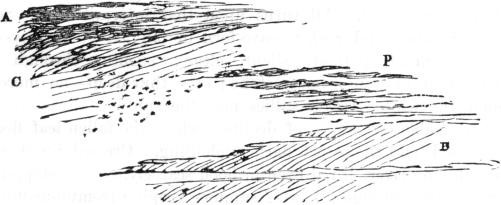
3 I do not copy the interpolated words which follow, “and commandeth it not to shine.” The closing verse of the chapter, as we have it, is unintelligible; not so in the Vulgate, the reading of which I give.
4 I assume the ἅυπνοι κρῆναι νομάδες to mean clouds, not springs; but this does not matter, the whole passage being one of rejoicing in moisture and dew of heaven.
5 I believe, however, that when Pegasus strikes forth this fountain, he is to be regarded, not as springing from Medusa’s blood, but as born of Medusa by Neptune; the true horse was given by Neptune striking the earth with his trident; the divine horse is born to Neptune and the storm-cloud.
6 I have been often at great heights on the Alps in rough weather, and have seen strong gusts of storm in the plains of the south. But, to get full expression of the very heart and meaning of wind, there is no place like a Yorkshire moor. I think Scottish breezes are thinner, very bleak and piercing, but not substantial. If you lean on them they will let you fall, but one may rest against a Yorkshire breeze as one would on a quickset hedge. I shall not soon forget,—having had the good fortune to meet a vigorous one on an April morning, between Hawes and Settle, just on the flat under Wharnside,—the vague sense of wonder with which I watched Ingleborough stand without rocking.
7 When there is a violent current of wind near the ground, the rain columns slope forward at the foot. See the Entrance to Fowey Harbor, of the England Series.
8 See Part IX. chap. 2, “The Hesperid Æglé.”
9 The reader must remember that sketches made as these are, on the instant, cannot be far carried, and would lose all their use if they were finished at home. These were both made in pencil, and merely washed with gray on returning to the inn, enough to secure the main forms.
10 I do not say this carelessly, nor because machines throw the laboring man “out of work.” The laboring man will always have more work than he wants. I speak thus, because the use of such machinery involves the destruction of all pleasures in rural labor; and I doubt not, in that destruction, the essential deterioration of the national mind.
11 You may see the arrangement of subject in the published engraving, but nothing more; it is among the worst engravings in the England Series.
12 Hosea xiii. 5, 15.
13 Hosea xiv. 4, 5, 6. Compare Psalm lxxii. 6-16.
14 I believe few sermons are more false or dangerous than those in which the teacher professes to impress his audience by showing “how much there is in a verse.” If he examined his own heart closely before beginning, he would often find that his real desire was to show how much he, the expounder, could make out of the verse. But entirely honest and earnest men often fall into the same error. They have been taught that they should always look deep, and that Scripture is full of hidden meanings; and they easily yield to the flattering conviction that every chance idea which comes into their heads in looking at a word, is put there by Divine agency. Hence they wander away into what they believe to be an inspired meditation, but which is, in reality, a meaningless jumble of ideas; perhaps very proper ideas, but with which the text in question has nothing whatever to do.
PART VIII.
OF IDEAS OF RELATION:—FIRST, OF INVENTION FORMAL.
—————
CHAPTER I.
THE LAW OF HELP.
§ 1. We have now reached the last and the most important part of our subject. We have seen, in the first division of this book, how far art may be, and has been, consistent with physical or material facts. In its second division, we examined how far it may be and has been obedient to the laws of physical beauty. In this last division we have to consider its relations of art to God and man. Its work in the help of human beings, and service of their Creator.
We have to inquire into the various Powers, Conditions, and Aims of mind involved in the conception or creation of pictures; in the choice of subject, and the mode and order of its history;—the choice of forms, and the modes of their arrangement.
And these phases of mind being concerned, partly with choice and arrangement of incidents, partly with choice and arrangement of forms and colors, the whole subject will fall into two main divisions, namely, expressional or spiritual invention; and material or formal invention.
They are of course connected;—all good formal invention being expressional also; but as a matter of convenience it is best to say what may be ascertained of the nature of formal invention, before attempting to illustrate the faculty in its higher field.
§ 2. First, then, of Invention Formal, otherwise and most commonly called technical composition; that is to say, the arrangement of lines, forms, or colors, so as to produce the best possible effect.1
I have often been accused of slighting this quality in pictures; the fact being that I have avoided it only because I considered it too great and wonderful for me to deal with. The longer I thought, the more wonderful it always seemed; and it is, to myself personally, the quality, above all others, which gives me delight in pictures. Many others I admire, or respect; but this one I rejoice in. Expression, sentiment, truth to nature, are essential; but all these are not enough. I never care to look at a picture again, if it be ill composed; and if well composed I can hardly leave off looking at it.
“Well composed.” Does that mean according to rule?
No. Precisely the contrary. Composed as only the man who did it could have done it; composed as no other picture is, or was, or ever can be again. Every great work stands alone.
§ 3. Yet there are certain elementary laws of arrangement traceable a little way; a few of these only I shall note, not caring to pursue the subject far in this work, so intricate it becomes even in its first elements: nor could it be treated with any approach to completeness, unless I were to give many and elaborate outlines of large pictures. I have a vague hope of entering on such a task, some future day. Meantime I shall only indicate the place which technical composition should hold in our scheme.
And, first, let us understand what composition is, and how far it is required.
§ 4. Composition may be best defined as the help of everything in the picture by everything else.
I wish the reader to dwell a little on this word “Help.” It is a grave one.
In substance which we call “inanimate,” as of clouds, or stones, their atoms may cohere to each other, or consist with each other, but they do not help each other. The removal of one part does not injure the rest.
But in a plant, the taking away of any one part does injure the rest. Hurt or remove any portion of the sap, bark, or pith, the rest is injured. If any part enters into a state in which it no more assists the rest, and has thus become “helpless,” we call it also “dead.”
The power which causes the several portions of the plant to help each other, we call life. Much more is this so in an animal. We may take away the branch of a tree without much harm to it; but not the animal’s limb. Thus, intensity of life is also intensity of helpfulness—completeness of depending of each part on all the rest. The ceasing of this help is what we call corruption; and in proportion to the perfectness of the help, is the dreadfulness of the loss. The more intense the life has been, the more terrible is its corruption.
The decomposition of a crystal is not necessarily impure at all. The fermentation of a wholesome liquid begins to admit the idea slightly; the decay of leaves yet more; of flowers, more; of animals, with greater painfulness and terribleness in exact proportion to their original vitality; and the foulest of all corruption is that of the body of man; and, in his body, that which is occasioned by disease, more than that of natural death.
§ 5. I said just now, that though atoms of inanimate substance could not help each other, they could “consist” with each other. “Consistence” is their virtue. Thus the parts of a crystal are consistent, but of dust, inconsistent. Orderly adherence, the best help its atoms can give, constitutes the nobleness of such substance.
When matter is either consistent, or living, we call it pure, or clean; when inconsistent, or corrupting (unhelpful), we call it impure, or unclean. The greatest uncleanliness being that which is essentially most opposite to life.
Life and consistency, then, both expressing one character (namely, helpfulness, of a higher or lower order), the Maker of all creatures and things, “by whom all creatures live, and all things consist,” is essentially and for ever the Helpful One, or in softer Saxon, the “Holy” One.
The word has no other ultimate meaning: Helpful, harmless, undefiled: “living” or “Lord of life.”
The idea is clear and mighty in the cherubim’s cry: “Helpful, helpful, helpful, Lord God of Hosts;” i.e. of all the hosts, armies, and creatures of the earth.2
§ 6. A pure or holy state of anything, therefore, is that in which all its parts are helpful or consistent. They may or may not be homogeneous. The highest or organic purities are composed of many elements in an entirely helpful state. The highest and first law of the universe—and the other name of life, is, therefore, “help.” The other name of death is “separation.” Government and co-operation are in all things and eternally the laws of life. Anarchy and competition, eternally, and in all things, the laws of death.
§ 7. Perhaps the best, though the most familiar example we could take of the nature and power of consistence, will be that of the possible changes in the dust we tread on.
Exclusive of animal decay, we can hardly arrive at a more absolute type of impurity than the mud or slime of a damp over-trodden path, in the outskirts of a manufacturing town. I do not say mud of the road, because that is mixed with animal refuse; but take merely an ounce or two of the blackest slime of a beaten footpath on a rainy day, near a large manufacturing town.
§ 8. That slime we shall find in most cases composed of clay (or brickdust, which is burnt clay) mixed with soot, a little sand, and water. All these elements are at helpless war with each other, and destroy reciprocally each other’s nature and power, competing and fighting for place at every tread of your foot;—sand squeezing out clay, and clay squeezing out water, and soot meddling everywhere and defiling the whole. Let us suppose that this ounce of mud is left in perfect rest, and that its elements gather together, like to like, so that their atoms may get into the closest relations possible.
§ 9. Let the clay begin. Ridding itself of all foreign substance, it gradually becomes a white earth, already very beautiful; and fit, with help of congealing fire, to be made into finest porcelain, and painted on, and be kept in kings’ palaces. But such artificial consistence is not its best. Leave it still quiet to follow its own instinct of unity, and it becomes not only white, but clear; not only clear, but hard; not only clear and hard, but so set that it can deal with light in a wonderful way, and gather out of it the loveliest blue rays only, refusing the rest. We call it then a sapphire.
Such being the consummation of the clay, we give similar permission of quiet to the sand. It also becomes, first, a white earth, then proceeds to grow clear and hard, and at last arranges itself in mysterious, infinitely fine, parallel lines, which have the power of reflecting not merely the blue rays, but the blue, green, purple, and red rays in the greatest beauty in which they can be seen through any hard material whatsoever. We call it then an opal.
In next order the soot sets to work; it cannot make itself white at first, but instead of being discouraged, tries harder and harder, and comes out clear at last, and the hardest thing in the world; and for the blackness that it had, obtains in exchange the power of reflecting all the rays of the sun at once in the vividest blaze that any solid thing can shoot. We call it then a diamond.
Last of all the water purifies or unites itself, contented enough if it only reach the form of a dew-drop; but if we insist on its proceeding to a more perfect consistence, it crystallizes into the shape of a star.
And for the ounce of slime which we had by political economy of competition, we have by political economy of co-operation, a sapphire, an opal, and a diamond, set in the midst of a star of snow.
§ 10. Now invention in art signifies an arrangement, in which everything in the work is thus consistent with all things else, and helpful to all else.
It is the greatest and rarest of all the qualities of art. The power by which it is effected is absolutely inexplicable and incommunicable; but exercised with entire facility by those who possess it, in many cases even unconsciously.3
In work which is not composed, there may be many beautiful things, but they do not help each other. They at the best only stand beside, and more usually compete with and destroy, each other. They may be connected artificially in many ways, but the test of there being no invention is, that if one of them be taken away, the others are no worse than before. But in true composition, if one be taken away, all the rest are helpless and valueless. Generally, in falsely composed work, if anything be taken away, the rest will look better; because the attention is less distracted. Hence the pleasure of inferior artists in sketching, and their inability to finish; all that they add destroys.
§ 11. Also in true composition, everything not only helps everything else a little, but helps with its utmost power. Every atom is in full energy; and all that energy is kind. Not a line, nor spark of color, but is doing its very best, and that best is aid. The extent to which this law is carried in truly right and noble work is wholly inconceivable to the ordinary observer, and no true account of it would be believed.
§ 12. True composition being entirely easy to the man who can compose, he is seldom proud of it, though he clearly recognizes it. Also, true composition is inexplicable. No one can explain how the notes of a Mozart melody, or the folds of a piece of Titian’s drapery, produce their essential effect on each other. If you do not feel it, no one can by reasoning make you feel it. And, the highest composition is so subtle, that it is apt to become unpopular, and sometimes seem insipid.
§ 13. The reader may be surprised at my giving so high a place to invention. But if he ever come to know true invention from false, he will find that it is not only the highest quality of art, but is simply the most wonderful act or power of humanity. It is pre-eminently the deed of human creation; ποίησις, otherwise, poetry.
If the reader will look back to my definition of poetry, he will find it is “the suggestion, by the imagination, of noble grounds for the noble emotions” (Vol. III. p. 10), amplified below (§ 14) into “assembling by help of the imagination;” that is to say, imagination associative, described at length in Vol. II., in the chapter just referred to. The mystery of the power is sufficiently set forth in that place. Of its dignity I have a word or two to say here.
§ 14. Men in their several professed employments, looked at broadly, may be properly arranged under five classes:—
1. Persons who see. These in modern language are sometimes called sight-seers, that being an occupation coming more and more into vogue every day. Anciently they used to be called, simply, seers.
2. Persons who talk. These, in modern language, are usually called talkers, or speakers, as in the House of Commons, and elsewhere. They used to be called prophets.
3. Persons who make. These, in modern language, are usually called manufacturers. Anciently they were called poets.
4. Persons who think. There seems to be no very distinct modern title for this kind of person, anciently called philosophers; nevertheless we have a few of them among us.
5. Persons who do: in modern language, called practical persons; anciently, believers.
Of the first two classes I have only this to note,—that we ought neither to say that a person sees, if he sees falsely, nor speaks, if he speaks falsely. For seeing falsely is worse than blindness, and speaking falsely, than silence. A man who is too dim-sighted to discern the road from the ditch, may feel which is which;—but if the ditch appears manifestly to him to be the road, and the road to be the ditch, what shall become of him? False seeing is unseeing,—on the negative side of blindness; and false speaking, unspeaking,—on the negative side of silence.
To the persons who think, also, the same test applies very shrewdly. Theirs is a dangerous profession; and from the time of the Aristophanes thought-shop to the great German establishment, or thought-manufactory, whose productions have, unhappily, taken in part the place of the older and more serviceable commodities of Nuremberg toys and Berlin wool, it has been often harmful enough to mankind. It should not be so, for a false thought is more distinctly and visibly no thought than a false saying is no saying. But it is touching the two great productive classes of the doers and makers, that we have one or two important points to note here.
§ 15. Has the reader ever considered, carefully, what is the meaning of “doing” a thing?
Suppose a rock falls from a hill-side, crushes a group of cottages, and kills a number of people. The stone has produced a great effect in the world. If any one asks, respecting the broken roofs, “What did it?” you say the stone did it. Yet you don’t talk of the deed of the stone. If you inquire farther, and find that a goat had been feeding beside the rock, and had loosened it by gnawing the roots of the grasses beneath, you find the goat to be the active cause of the calamity, and you say the goat did it. Yet you don’t call the goat the doer, nor talk of its evil deed. But if you find any one went up to the rock, in the night, and with deliberate purpose loosened it, that it might fall on the cottages, you say in quite a different sense, “It is his deed: he is the doer of it.”
§ 16. It appears, then, that deliberate purpose and resolve are needed to constitute a deed or doing, in the true sense of the word; and that when, accidentally or mechanically, events take place without such purpose, we have indeed effects or results, and agents or causes, but neither deeds nor doers.
Now it so happens, as we all well know, that by far the largest part of things happening in practical life are brought about with no deliberate purpose. There are always a number of people who have the nature of stones; they fall on other persons and crush them. Some again have the nature of weeds, and twist about other people’s feet and entangle them. More have the nature of logs, and lie in the way, so that every one falls over them. And most of all have the nature of thorns, and set themselves by waysides, so that every passer-by must be torn, and all good seed choked; or perhaps make wonderful crackling under various pots, even to the extent of practically boiling water and working pistons. All these people produce immense and sorrowful effect in the world. Yet none of them are doers: it is their nature to crush, impede, and prick: but deed is not in them.4
§ 17. And farther, observe, that even when some effect is finally intended, you cannot call it the person’s deed, unless it is what he intended.
If an ignorant person, purposing evil, accidentally does good, (as if a thief’s disturbing a family should lead them to discover in time that their house was on fire); or vice versâ, if an ignorant person intending good, accidentally does evil (as if a child should give hemlock to his companions for celery), in neither case do you call them the doers of what may result. So that in order to be a true deed, it is necessary that the effect of it should be foreseen. Which, ultimately, it cannot be, but by a person who knows, and in his deed obeys, the laws of the universe, and of its Maker. And this knowledge is in its highest form, respecting the will of the Ruling Spirit, called Trust. For it is not the knowledge that a thing is, but that, according to the promise and nature of the Ruling Spirit, a thing will be. Also obedience in its highest form is not obedience to a constant and compulsory law, but a persuaded or voluntary yielded obedience to an issued command; and so far as it was a persuaded submission to command, it was anciently called, in a passive sense, “persuasion,” or πίστις, and in so far as it alone assuredly did, and it alone could do, what it meant to do, and was therefore the root and essence of all human deed, it was called by the Latins the “doing,” or fides, which has passed into the French foi and the English faith. And therefore because in His doing always certain, and in His speaking always true, His name who leads the armies of Heaven is “Faithful and True,”5 and all deeds which are done in alliance with those armies, be they small or great, are essentially deeds of faith, which therefore, and in this one stern, eternal, sense, subdues all kingdoms, and turns to flight the armies of the aliens, and is at once the source and the substance of all human deed, rightly so called.
§ 18. Thus far then of practical persons, once called believers, as set forth in the last word of the noblest group of words ever, so far as I know, uttered by simple man concerning his practice, being the final testimony of the leaders of a great practical nation, whose deed thenceforward became an example of deed to mankind:
Ω ξεῖν᾿, ἀγγέλλειν Λακεδαιμονίοις, ὃτι τῇδε
Κείμεθα, τοῖς κείνων ῥήμασί πειθόμενοι.
“O stranger! (we pray thee), tell the Lacedæmonians that we are lying here, having obeyed their words.”
§ 19. What, let us ask next, is the ruling character of the person who produces—the creator or maker, anciently called the poet?
We have seen what a deed is. What then is a “creation”? Nay, it may be replied, to “create” cannot be said of man’s labor.
On the contrary, it not only can be said, but is and must be said continually. You certainly do not talk of creating a watch, or creating a shoe; nevertheless you do talk of creating a feeling. Why is this?
Look back to the greatest of all creation, that of the world. Suppose the trees had been ever so well or so ingeniously put together, stem and leaf, yet if they had not been able to grow, would they have been well created? Or suppose the fish had been cut and stitched finely out of skin and whalebone; yet, cast upon the waters, had not been able to swim? Or suppose Adam and Eve had been made in the softest clay, ever so neatly, and set at the foot of the tree of knowledge, fastened up to it, quite unable to fall, or do anything else, would they have been well created, or in any true sense created at all?
§ 20. It will, perhaps, appear to you, after a little farther thought, that to create anything in reality is to put life into it.
A poet, or creator, is therefore a person who puts things together, not as a watchmaker steel, or a shoemaker leather, but who puts life into them.
His work is essentially this: it is the gathering and arranging of material by imagination, so as to have in it at last the harmony or helpfulness of life, and the passion or emotion of life. Mere fitting and adjustment of material is nothing; that is watchmaking. But helpful and passionate harmony, essentially choral harmony, so called from the Greek word “rejoicing,”6 is the harmony of Apollo and the Muses; the word Muse and Mother being derived from the same root, meaning “passionate seeking,” or love, of which the issue is passionate finding, or sacred INVENTION. For which reason I could not bear to use any baser word than this of invention. And if the reader will think over all these things, and follow them out, as I think he may easily with this much of clue given him, he will not any more think it wrong in me to place invention so high among the powers of man.7
Or any more think it strange that the last act of the life of Socrates8 should have been to purify himself from the sin of having negligently listened to the voice within him, which, through all his past life, had bid him “labor, and make harmony.”
1 The word composition has been so much abused, and is in itself so inexpressive, that when I wrote the first part of this work I intended always to use, in this final section of it, the word “invention,” and to reserve the term “composition” for that false composition which can be taught on principles; as I have already so employed the term in the chapter on “Imagination Associative,” in the second volume. But, in arranging this section, I find it is not conveniently possible to avoid the ordinary modes of parlance; I therefore only head the section as I intended (and as is, indeed, best), using in the text the ordinarily accepted term; only, the reader must be careful to note that what I spoke of shortly as “composition” in the chapters on “Imagination,” I here always call, distinctly, “false composition;” using here, as I find most convenient, the words “invention” or “composition” indifferently for the true faculty.
2 “The cries of them which have reaped have entered into the ears of the Lord of Sabaoth (of all the creatures of the earth).” You will find a wonderful clearness come into many texts by reading, habitually, “helpful” and “helpfulness” for “holy” and “holiness,” or else “living,” as in Rom. xi. 16. The sense “dedicated” (the Latin sanctus), being, of course, inapplicable to the Supreme Being, is an entirely secondary and accidental one.
3 By diligent study of good compositions it is possible to put work together so that the parts shall help each other, a little, or at all events do no harm; and when some tact and taste are associated with this diligence, semblances of real invention are often produced, which, being the results of great labor, the artist is always proud of; and which, being capable of learned explanation and imitation, the spectator naturally takes interest in. The common precepts about composition all produce and teach this false kind, which, as true composition is the noblest, being the corruption of it, is the ignoblest condition of art.
4 We may, perhaps, expediently recollect as much of our botany as to teach us that there may be sharp and rough persons, like spines, who yet have good in them, and are essentially branches, and can bud. But the true thorny person is no spine, only an excrescence; rootless evermore,—leafless evermore. No crown made of such can ever meet glory of Angel’s hand. (In Memoriam, lxviii.)
5 “True,” means, etymologically, not “consistent with fact,” but “which may be trusted.” “This is a true saying, and worthy of all acceptation,” &c., meaning a trusty saying,—a saying to be rested on, leant upon.
6 Χορούς τε ὠνομακέναι παρὰ τῆς χαρᾶς ἔμφυτον ονομα. (Dé leg. II. 1.)
7 This being, indeed, among the visiblest signs of the Divine or immortal life. We have got a base habit of opposing the word “mortal” or “deathful” merely to “im-mortal;” whereas it is essentially contrary to “divine” (to θείος, not to ἀθανάτος, Phaedo, 66), that which is deathful being anarchic or disobedient, and that which is divine ruling and obedient; this being the true distinction between flesh and spirit.
8 Πολλάκις μοι φοιτῶν τὸ αὐτὸ ἐνύπνιον ἐν τῷ παρελθόντι βίῳ, ἄλλοτ᾽ ἐν ἄλλη ὄψει φαινόμενον, τὰ αὐτὰ δὲ λέγον, Ω Σώκρα τες, ἔφη, μουδικὴν ποίει καὶ ἐργαζου. (Phaedo, 11.)
CHAPTER II.
THE TASK OF THE LEAST.
§ 1. The reader has probably been surprised at my assertions made often before now, and reiterated here, that the minutest portion of a great composition is helpful to the whole. It certainly does not seem easily conceivable that this should be so. I will go farther, and say that it is inconceivable. But it is the fact.
We shall discern it to be so by taking one or two compositions to pieces, and examining the fragments. In doing which, we must remember that a great composition always has a leading emotional purpose, technically called its motive, to which all its lines and forms have some relation. Undulating lines, for instance, are expressive of action; and would be false in effect if the motive of the picture was one of repose. Horizontal and angular lines are expressive of rest and strength; and would destroy a design whose purpose was to express disquiet and feebleness. It is therefore necessary to ascertain the motive before descending to the detail.
§ 2. One of the simplest subjects, in the series of the Rivers of France, is “Rietz, near Saumur.” The published Plate gives a better rendering than usual of its tone of light; and my rough etching, Plate 73, sufficiently shows the arrangement of its lines. What is their motive?
To get at it completely, we must know something of the Loire.
The district through which it here flows is, for the most part, a low place, yet not altogether at the level of the stream, but cut into steep banks of chalk or gravel, thirty or forty feet high, running for miles at about an equal height above the water.
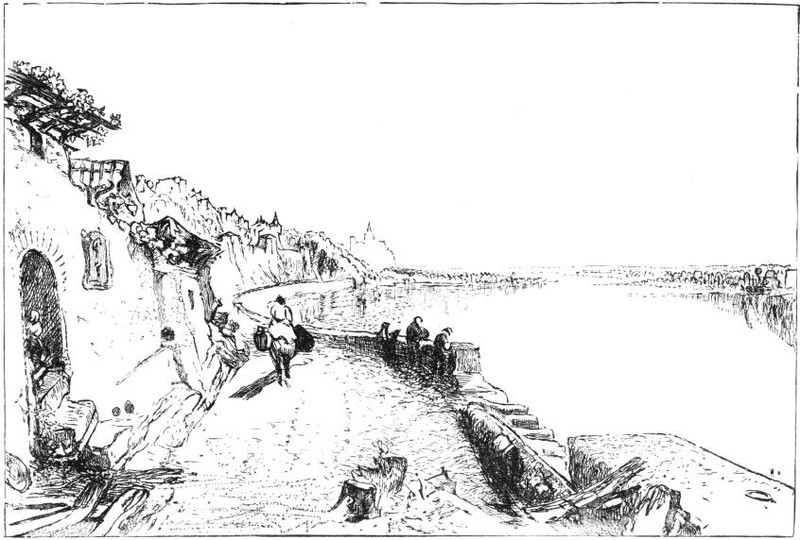
73. Loire-side.
These banks are excavated by the peasantry, partly for houses, partly for cellars, so economizing vineyard space above; and thus a kind of continuous village runs along the river-side, composed half of caves, half of rude buildings, backed by the cliff, propped against it, therefore always leaning away from the river; mingled with overlappings of vineyard trellis from above, and little towers or summer-houses for outlook, when the grapes are ripe, or for gossip over the garden wall.
§ 3. It is an autumnal evening, then, by this Loire side. The day has been hot, and the air is heavy and misty still; the sunlight warm, but dim; the brown vine-leaves motionless: all else quiet. Not a sail in sight on the river,1 its strong, noiseless current lengthening the stream of low sunlight.
The motive of the picture, therefore, is the expression of rude but perfect peace, slightly mingled with an indolent languor and despondency; the peace between intervals of enforced labor; happy, but listless, and having little care or hope about the future; cutting its home out of this gravel bank, and letting the vine and the river twine and undermine as they will; careless to mend or build, so long as the walls hold together, and the black fruit swells in the sunshine.
§ 4. To get this repose, together with rude stability, we have therefore horizontal lines and bold angles. The grand horizontal space and sweep of Turner’s distant river show perhaps better in the etching than in the Plate; but depend wholly for value on the piece of near wall. It is the vertical line of its dark side which drives the eye up into the distance, right against the horizontal, and so makes it felt, while the flatness of the stone prepares the eye to understand the flatness of the river. Farther: hide with your finger the little ring on that stone, and you will find the river has stopped flowing. That ring is to repeat the curved lines of the river bank, which express its line of current, and to bring the feeling of them down near us. On the other side of the road the horizontal lines are taken up again by the dark pieces of wood, without which we should still lose half our space.
Next: The repose is to be not only perfect, but indolent: the repose of out-wearied people: not caring much what becomes of them.
You see the road is covered with litter. Even the crockery is left outside the cottage to dry in the sun, after being washed up. The steps of the cottage door have been too high for comfort originally, only it was less trouble to cut three large stones than four or five small. They are now all aslope and broken, not repaired for years. Their weighty forms increase the sense of languor throughout the scene, and of stability also, because we feel how difficult it would be to stir them. The crockery has its work to do also;—the arched door on the left being necessary to show the great thickness of walls and the strength they require to prevent falling in of the cliff above;—as the horizontal lines must be diffused on the right, so this arch must be diffused on the left; and the large round plate on one side of the steps, with the two small ones on the other, are to carry down the element of circular curvature. Hide them, and see the result.
As they carry the arched group of forms down, the arched window-shutter diffuses it upwards, where all the lines of the distant buildings suggest one and the same idea of disorderly and careless strength, mingling masonry with rock.
§ 5. So far of the horizontal and curved lines. How of the radiating ones? What has the black vine trellis got to do?
Lay a pencil or ruler parallel with its lines. You will find that they point to the massive building in the distance. To which, as nearly as is possible without at once showing the artifice, every other radiating line points also; almost ludicrously when it is once pointed out; even the curved line of the top of the terrace runs into it, and the last sweep of the river evidently leads to its base. And so nearly is it in the exact centre of the picture, that one diagonal from corner to corner passes through it, and the other only misses the base by the twentieth of an inch.
If you are accustomed to France, you will know in a moment by its outline that this massive building is an old church.
Without it, the repose would not have been essentially the laborer’s rest—rest as of the Sabbath. Among all the groups of lines that point to it, two are principal: the first, those of the vine trellis: the second, those of the handles of the saw left in the beam:—the blessing of human life and its labor.
Whenever Turner wishes to express profound repose, he puts in the foreground some instrument of labor cast aside. See, in Roger’s Poems, the last vignette, “Datur hora quieti,” with the plough in the furrow; and in the first vignette of the same book, the scythe on the shoulder of the peasant going home. (There is nothing about the scythe in the passage of the poem which this vignette illustrates.)
§ 6. Observe, farther, the outline of the church itself. As our habitations are, so is our church, evidently a heap of old, but massive, walls, patched, and repaired, and roofed in, and over and over, until its original shape is hardly recognizable. I know the kind of church well—can tell even here, two miles off, that I shall find some Norman arches in the apse, and a flamboyant porch, rich and dark, with every statue broken out of it; and a rude wooden belfry above all; and a quantity of miserable shops built in among the buttresses; and that I may walk in and out as much as I please, but that how often soever, I shall always find some one praying at the Holy Sepulchre, in the darkest aisle, and my going in and out will not disturb them. For they are praying, which in many a handsomer and highlier-furbished edifice might, perhaps, not be so assuredly the case.
§ 7. Lastly: What kind of people have we on this winding road? Three indolent ones, leaning on the wall to look over into the gliding water; and a matron with her market panniers, by her figure, not a fast rider. The road, besides, is bad, and seems unsafe for trotting, and she has passed without disturbing the cat, who sits comfortably on the block of wood in the middle of it.
§ 8. Next to this piece of quietness, let us glance at a composition in which the motive is one of tumult: that of the Fall of Schaffhausen. It is engraved in the Keepsake. I have etched in Plate 74, at the top, the chief lines of its composition,2 in which the first great purpose is to give swing enough to the water. The line of fall is straight and monotonous in reality. Turner wants to get the great concave sweep and rush of the river well felt, in spite of the unbroken form. The column of spray, rocks, mills, and bank, all radiate like a plume, sweeping round together in grand curves to the left, where the group of figures, hurried about the ferry boat, rises like a dash of spray; they also radiating: so as to form one perfectly connected cluster, with the two gens-d’armes and the millstones; the millstones at the bottom being the root of it; the two soldiers laid right and left to sustain the branch of figures beyond, balanced just as a tree bough would be.
§ 9. One of the gens-d’armes is flirting with a young lady in a round cap and full sleeves, under pretence of wanting her to show him what she has in her bandbox. The motive of which flirtation is, so far as Turner is concerned in it, primarily the bandbox: this and the millstones below, give him a series of concave lines, which, concentrated by the recumbent soldiers, intensify the hollow sweep of the fall, precisely as the ring on the stone does the Loire eddies. These curves are carried out on the right by the small plate of eggs, laid to be washed at the spring; and, all these concave lines being a little too quiet and recumbent, the staggering casks are set on the left, and the ill-balanced milk-pail on the right, to give a general feeling of things being rolled over and over. The things which are to give this sense of rolling are dark, in order to hint at the way in which the cataract rolls boulders of rock; while the forms which are to give the sense of its sweeping force are white. The little spring, splashing out of its pine-trough, is to give contrast with the power of the fall,—while it carries out the general sense of splashing water.
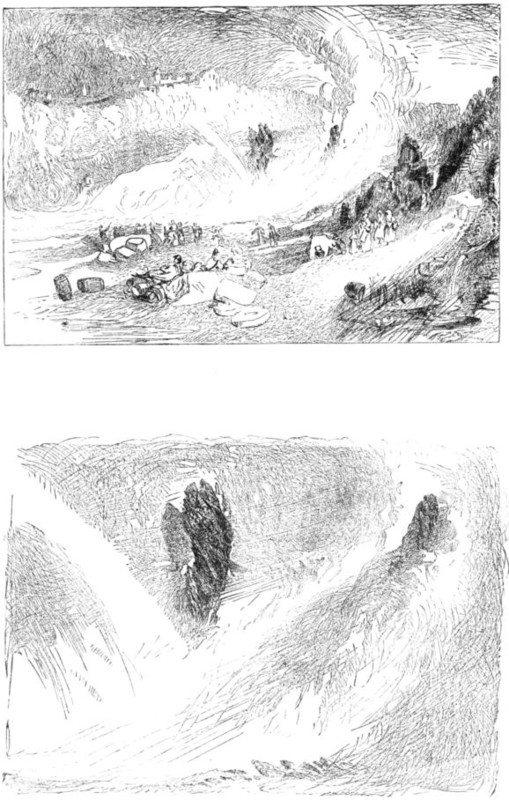
74. The Mill-stream.
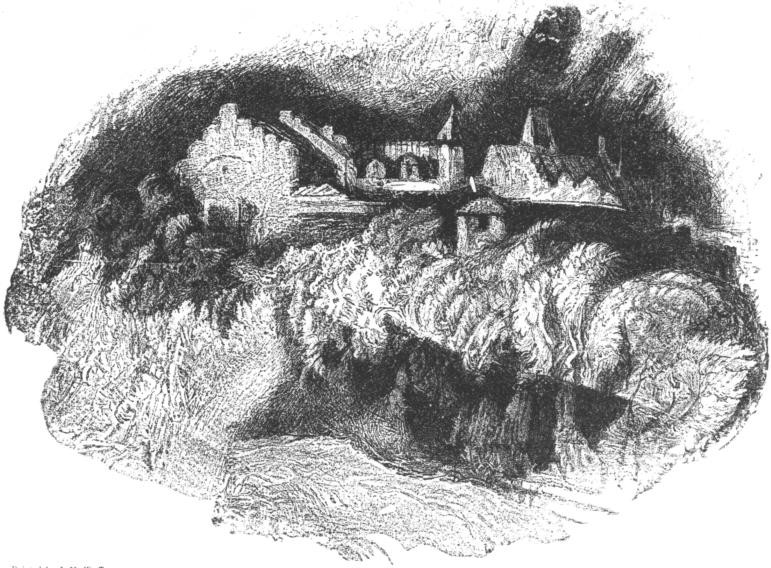
Painted by J. N. W. Turner
Drawn by J. Ruskin.
Engraved by R. P. Cuff.
75. The Castle of Lauffen.
§ 10. This spring exists on the spot, and so does everything else in the picture; but the combinations are wholly arbitrary; it being Turner’s fixed principle to collect out of any scene whatever was characteristic, and put it together just as he liked. The changes made in this instance are highly curious. The mills have no resemblance whatever to the real group as seen from this spot; for there is a vulgar and formal dwelling-house in front of them. But if you climb the rock behind them, you find they form on that side a towering cluster, which Turner has put with little modification into the drawing. What he has done to the mills, he has done with still greater audacity to the central rock. Seen from this spot, it shows, in reality, its greatest breadth, and is heavy and uninteresting; but on the Lauffen side, exposes its consumed base, worn away by the rush of water, which Turner resolving to show, serenely draws the rock as it appears from the other side of the Rhine, and brings that view of it over to this side. I have etched the bit with the rock a little larger below; and if the reader knows the spot, he will see that this piece of the drawing, reversed in the etching, is almost a bonâ fide unreversed study of the fall from the Lauffen side.3
Finally, the castle of Lauffen itself, being, when seen from this spot, too much foreshortened to show its extent, Turner walks a quarter of a mile lower down the river, draws the castle accurately there, brings it back with him, and puts it in all its extent, where he chooses to have it, beyond the rocks.
I tried to copy and engrave this piece of the drawing of its real size, merely to show the forms of the trees, drifted back by the breeze from the fall, and wet with its spray; but in the endeavor to facsimile the touches, great part of their grace and ease has been lost; still, Plate 75 may, if compared with the same piece in the Keepsake engraving, at least show that the original drawing has not yet been rendered with completeness.
§ 11. These two examples may sufficiently serve to show the mode in which minor details, both in form and spirit, are used by Turner to aid his main motives; of course I cannot, in the space of this volume, go on examining subjects at this length, even if I had time to etch them; but every design of Turner’s would be equally instructive, examined in a similar manner. Thus far, however, we have only seen the help of the parts to the whole: we must give yet a little attention to the mode of combining the smallest details.
I am always led away, in spite of myself, from my proper subject here, invention formal, or the merely pleasant placing of lines and masses, into the emotional results of such arrangement.
The chief reason of this is that the emotional power can be explained; but the perfection of formative arrangement, as I said, cannot be explained, any more than that of melody in music. An instance or two of it, however, may be given.
§ 12. Much fine formative arrangement depends on a more or less elliptical or pear-shaped balance of the group, obtained by arranging the principal members of it on two opposite curves, and either centralizing it by some powerful feature at the base, centre, or summit; or else clasping it together by some conspicuous point or knot. A very small object will often do this satisfactorily.
If you can get the complete series of Lefèbre’s engravings from Titian and Veronese, they will be quite enough to teach you, in their dumb way, everything that is teachable of composition; at all events, try to get the Madonna, with St. Peter and St. George under the two great pillars; the Madonna and Child, with mitred bishop on her left, and St. Andrew on her right; and Veronese’s Triumph of Venice. The first of these Plates unites two formative symmetries; that of the two pillars, clasped by the square altar-cloth below and cloud above, catches the eye first; but the main group is the fivefold one rising to the left, crowned by the Madonna. St. Francis and St. Peter form its two wings, and the kneeling portrait figures, its base. It is clasped at the bottom by the key of St. Peter, which points straight at the Madonna’s head, and is laid on the steps solely for this purpose; the curved lines, which enclose the group, meet also in her face; and the straight line of light, on the cloak of the nearest senator, points at her also. If you have Turner’s Liber Studiorum, turn to the Lauffenburg, and compare the figure group there: a fivefold chain, one standing figure, central; two recumbent, for wings; two half-recumbent, for bases; and a cluster of weeds to clasp. Then turn to Lefèbre’s Europa (there are two in the series—I mean the one with the two tree trunks over her head). It is a wonderful ninefold group. Europa central; two stooping figures, each surmounted by a standing one, for wings; a cupid on one side, and dog on the other, for bases; a cupid and trunk of tree, on each side, to terminate above; and a garland for clasp.
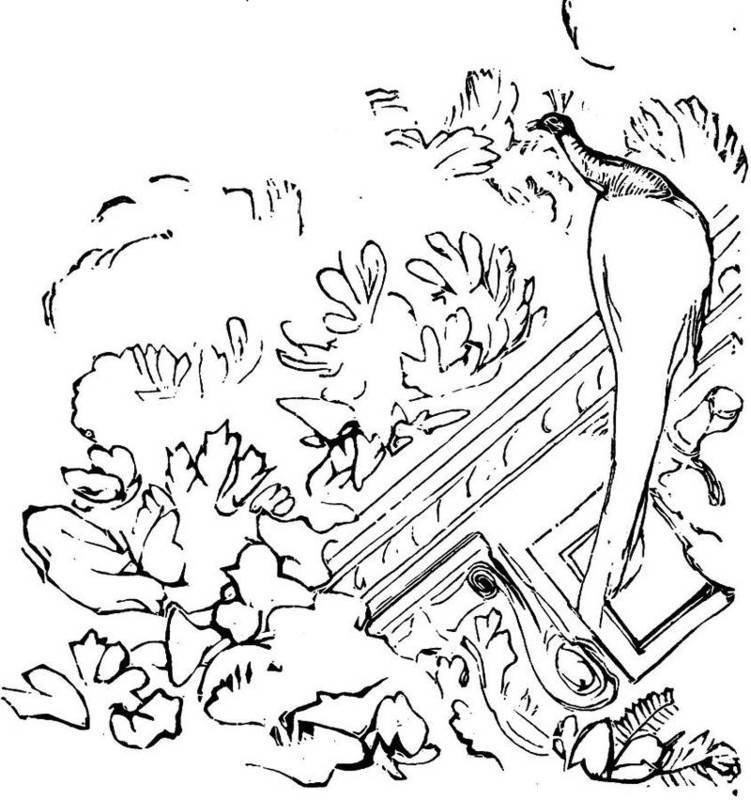
§ 13. Fig. 94, page 171, will serve to show the mode in which similar arrangements are carried into the smallest detail. It is magnified four times from a cluster of leaves in the foreground of the “Isis” (Liber Studiorum). Figs. 95 and 96, page 172, show the arrangement of the two groups composing it; the lower is purely symmetrical, with trefoiled centre and broad masses for wings; the uppermost is a sweeping continuous curve, symmetrical, but foreshortened. Both are clasped by arrow-shaped leaves. The two whole groups themselves are, in turn, members of another larger group, composing the entire foreground, and consisting of broad dock-leaves, with minor clusters on the right and left, of which these form the chief portion on the right side.
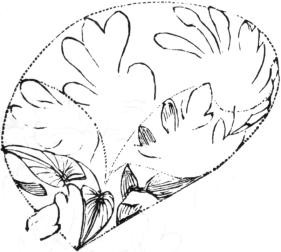
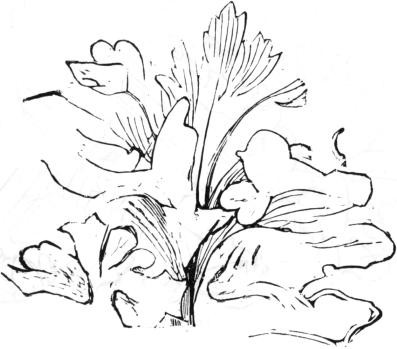
§ 14. Unless every leaf, and every visible point or object, however small, forms a part of some harmony of this kind (these symmetrical conditions being only the most simple and obvious), it has no business in the picture. It is the necessary connection of all the forms and colors, down to the last touch, which constitutes great or inventive work, separated from all common work by an impassable gulf.
By diligently copying the etchings of the Liber Studiorum, the reader may, however, easily attain the perception of the existence of these relations, and be prepared to understand Turner’s more elaborate composition. It would take many figures to disentangle and explain the arrangements merely of the leaf cluster, Fig. 78, facing page 97; but that there is a system, and that every leaf has a fixed value and place in it, can hardly but be felt at a glance.
It is curious that, in spite of all the constant talkings of “composition” which goes on among art students, true composition is just the last thing which appears to be perceived. One would have thought that in this group, at least, the value of the central black leaf would have been seen, of which the principal function is to point towards, and continue, the line of bank above. See Plate 62. But a glance at the published Plate in the England series will show that no idea of the composition had occurred to the engraver’s mind. He thought any leaves would do, and supplied them from his own repertory of hack vegetation.
§ 15. I would willingly enlarge farther on this subject—it is a favorite one with me; but the figures required for any exhaustive treatment of it would form a separate volume. All that I can do is to indicate, as these examples do sufficiently, the vast field open to the student’s analysis if he cares to pursue the subject; and to mark for the general reader these two strong conclusions:—that nothing in great work is ever either fortuitous or contentious.
It is not fortuitous; that is to say, not left to fortune. The “must do it by a kind of felicity” of Bacon is true; it is true also that an accident is often suggestive to an inventor. Turner himself said, “I never lose an accident.” But it is this not losing it, this taking things out of the hands of Fortune, and putting them into those of force and foresight, which attest the master. Chance may sometimes help, and sometimes provoke, a success; but must never rule, and rarely allure.
And, lastly, nothing must be contentious. Art has many uses and many pleasantnesses; but of all its services, none are higher than its setting forth, by a visible and enduring image, the nature of all true authority and freedom; Authority which defines and directs the action of benevolent law; and Freedom which consists in deep and soft consent of individual4 helpfulness.
1 The word composition has been so much abused, and is in itself so inexpressive, that when I wrote the first part of this work I intended always to use, in this final section of it, the word “invention,” and to reserve the term “composition” for that false composition which can be taught on principles; as I have already so employed the term in the chapter on “Imagination Associative,” in the second volume. But, in arranging this section, I find it is not conveniently possible to avoid the ordinary modes of parlance; I therefore only head the section as I intended (and as is, indeed, best), using in the text the ordinarily accepted term; only, the reader must be careful to note that what I spoke of shortly as “composition” in the chapters on “Imagination,” I here always call, distinctly, “false composition;” using here, as I find most convenient, the words “invention” or “composition” indifferently for the true faculty.
2 “The cries of them which have reaped have entered into the ears of the Lord of Sabaoth (of all the creatures of the earth).” You will find a wonderful clearness come into many texts by reading, habitually, “helpful” and “helpfulness” for “holy” and “holiness,” or else “living,” as in Rom. xi. 16. The sense “dedicated” (the Latin sanctus), being, of course, inapplicable to the Supreme Being, is an entirely secondary and accidental one.
3 By diligent study of good compositions it is possible to put work together so that the parts shall help each other, a little, or at all events do no harm; and when some tact and taste are associated with this diligence, semblances of real invention are often produced, which, being the results of great labor, the artist is always proud of; and which, being capable of learned explanation and imitation, the spectator naturally takes interest in. The common precepts about composition all produce and teach this false kind, which, as true composition is the noblest, being the corruption of it, is the ignoblest condition of art.
4 We may, perhaps, expediently recollect as much of our botany as to teach us that there may be sharp and rough persons, like spines, who yet have good in them, and are essentially branches, and can bud. But the true thorny person is no spine, only an excrescence; rootless evermore,—leafless evermore. No crown made of such can ever meet glory of Angel’s hand. (In Memoriam, lxviii.)
5 “True,” means, etymologically, not “consistent with fact,” but “which may be trusted.” “This is a true saying, and worthy of all acceptation,” &c., meaning a trusty saying,—a saying to be rested on, leant upon.
6 Χορούς τε ὠνομακέναι παρὰ τῆς χαρᾶς ἔμφυτον ονομα. (Dé leg. II. 1.)
7 This being, indeed, among the visiblest signs of the Divine or immortal life. We have got a base habit of opposing the word “mortal” or “deathful” merely to “im-mortal;” whereas it is essentially contrary to “divine” (to θείος, not to ἀθανάτος, Phaedo, 66), that which is deathful being anarchic or disobedient, and that which is divine ruling and obedient; this being the true distinction between flesh and spirit.
8 Πολλάκις μοι φοιτῶν τὸ αὐτὸ ἐνύπνιον ἐν τῷ παρελθόντι βίῳ, ἄλλοτ᾽ ἐν ἄλλη ὄψει φαινόμενον, τὰ αὐτὰ δὲ λέγον, Ω Σώκρα τες, ἔφη, μουδικὴν ποίει καὶ ἐργαζου. (Phaedo, 11.)
1 The sails in the engraving were put in to catch the public eye. There are none in the drawing.
2 These etchings of compositions are all reversed, for they are merely sketches on the steel, and I cannot sketch easily except straight from the drawing, and without reversing. The looking-glass plagues me with cross lights. As examples of composition, it does not the least matter which way they are turned; and the reader may see this Schaffhausen subject from the right side of the Rhine, by holding the book before a glass. The rude indications of the figures in the Loire subject are nearly facsimiles of Turner’s.
3 With the exception of the jagged ledge rising out of the foam below which comes from the north side, and is admirable in its expression of the position of the limestone-beds, which, rising from below the drift gravel of Constance, are the real cause of the fall of Schaffhausen.
4 “Individual,” that is to say, distinct and separate in character, though joined in purpose. I might have enlarged on this head, but that all I should care to say has been already said admirably by Mr. J. S. Mill in his essay on Liberty.
1 The sails in the engraving were put in to catch the public eye. There are none in the drawing.
2 These etchings of compositions are all reversed, for they are merely sketches on the steel, and I cannot sketch easily except straight from the drawing, and without reversing. The looking-glass plagues me with cross lights. As examples of composition, it does not the least matter which way they are turned; and the reader may see this Schaffhausen subject from the right side of the Rhine, by holding the book before a glass. The rude indications of the figures in the Loire subject are nearly facsimiles of Turner’s.
3 With the exception of the jagged ledge rising out of the foam below which comes from the north side, and is admirable in its expression of the position of the limestone-beds, which, rising from below the drift gravel of Constance, are the real cause of the fall of Schaffhausen.
4 “Individual,” that is to say, distinct and separate in character, though joined in purpose. I might have enlarged on this head, but that all I should care to say has been already said admirably by Mr. J. S. Mill in his essay on Liberty.
CHAPTER III.
THE RULE OF THE GREATEST.
§ 1. In the entire range of art principles, none perhaps present a difficulty so great to the student, or require from the teacher expression so cautious, and yet so strong, as those which concern the nature and influence of magnitude.
In one sense, and that deep, there is no such thing as magnitude. The least thing is as the greatest, and one day as a thousand years, in the eyes of the Maker of great and small things. In another sense, and that close to us and necessary, there exist both magnitude and value. Though not a sparrow falls to the ground unnoted, there are yet creatures who are of more value than many; and the same Spirit which weighs the dust of the earth in a balance, counts the isles as a little thing.
§ 2. The just temper of human mind in this matter may, nevertheless, be told shortly. Greatness can only be rightly estimated when minuteness is justly reverenced. Greatness is the aggregation of minuteness; nor can its sublimity be felt truthfully by any mind unaccustomed to the affectionate watching of what is least.
But if this affection for the least be unaccompanied by the powers of comparison and reflection; if it be intemperate in its thirst, restless in curiosity, and incapable of the patient and self-commandant pause which is wise to arrange, and submissive to refuse, it will close the paths of noble art to the student as effectually, and hopelessly, as even the blindness of pride, or impatience of ambition.
§ 3. I say the paths of noble art, not of useful art. All accurate investigation will have its reward; the morbid curiosity will at least slake the thirst of others, if not its own; and the diffused and petty affections will distribute, in serviceable measure, their minute delights and narrow discoveries. The opposite error, the desire of greatness as such, or rather of what appears great to indolence and vanity;—the instinct which I have described in the “Seven Lamps,” noting it, among the Renaissance builders, to be an especial and unfailing sign of baseness of mind, is as fruitless as it is vile; no way profitable—every way harmful: the widest and most corrupting expression of vulgarity. The microscopic drawing of an insect may be precious; but nothing except disgrace and misguidance will ever be gathered from such work as that of Haydon or Barry.
§ 4. The work I have mostly had to do, since this essay was begun, has been that of contention against such debased issues of swollen insolence and windy conceit; but I have noticed lately, that some lightly-budding philosophers have depreciated true greatness; confusing the relations of scale, as they bear upon human instinct and morality; reasoning as if a mountain were no nobler than a grain of sand, or as if many souls were not of mightier interest than one. To whom it must be shortly answered that the Lord of power and life knew which were His noblest works, when He bade His servant watch the play of the Leviathan, rather than dissect the spawn of the minnow; and that when it comes to practical question whether a single soul is to be jeoparded for many, and this Leonidas, or Curtius, or Winkelried shall abolish—so far as abolishable—his own spirit, that he may save more numerous spirits, such question is to be solved by the simple human instinct respecting number and magnitude, not by reasonings on infinity:—
“Le navigateur, qui, la nuit, voit l’océan étinceler de lumière, danser en guirlandes de feu, s’égaye d’abord de ce spectacle. Il fait dix lieues; la guirlande s’allonge indéfiniment, elle s’agite, se tord, se noue, aux mouvements de la lame; c’est un serpent monstrueux qui va toujours s’allongeant, jusqu’à trente lieues, quarante lieues. Et tout cela n’est qu’une danse d’animalcules imperceptibles. En quel nombre? A cette question l’imagination s’effraye; elle sent là une nature de puissance immense, de richesse epouvantable.... Que sont ces petits des petits? Rien moins que les constructeurs du globe où nous sommes. De leurs corps, de leurs débris, ils ont préparé le sol qui est sous nos pas.... Et ce sont les plus petits qui ont fait les plus grandes choses. L’imperceptible rhizopode s’est bâti un monument bien autre que les pyramides, pas moins que l’Italie centrale, une notable partie de la chaîne des Apennins. Mais c’était trop peu encore; les masses énormes du Chili, les prodigieuses Cordillères, qui regardent le monde à leurs pieds, sont le monument funéraire où cet être insaisissable, et pour ainsi dire, invisible, a enseveli les débris de son espèce dïsparue.”—(Michelet: L’Insecte.)
§ 5. In these passages, and those connected with them in the chapter from which they are taken, itself so vast in scope, and therefore so sublime, we may perhaps find the true relations of minuteness, multitude, and magnitude. We shall not feel that there is no such thing as littleness, or no such thing as magnitude. Nor shall we be disposed to confuse a Volvox with the Cordilleras; but we may learn that they both are bound together by links of eternal life and toil; we shall see the vastest thing noble, chiefly for what it includes; and the meanest for what it accomplishes. Thence we might gather—and the conclusion will be found in experience true—that the sense of largeness would be most grateful to minds capable of comprehending, balancing, and comparing; but capable also of great patience and expectation; while the sense of minute wonderfulness would be attractive to minds acted upon by sharp, small, penetrative sympathies, and apt to be impatient, irregular, and partial. This fact is curiously shown in the relations between the temper of the great composers and the modern pathetic school. I was surprised at the first rise of that school, now some years ago, by observing how they restrained themselves to subjects which in other hands would have been wholly uninteresting (compare Vol. IV., p. 19); and in their succeeding efforts, I saw with increasing wonder, that they were almost destitute of the power of feeling vastness, or enjoying the forms which expressed it. A mountain or great building only appeared to them as a piece of color of a certain shape. The powers it represented, or included, were invisible to them. In general they avoided subjects expressing space or mass, and fastened on confined, broken, and sharp forms; liking furze, fern, reeds, straw, stubble, dead leaves, and such like, better than strong stones, broad-flowing leaves, or rounded hills: in all such greater things, when forced to paint them, they missed the main and mighty lines; and this no less in what they loved than in what they disliked; for though fond of foliage, their trees always had a tendency to congeal into little acicular thorn-hedges, and never tossed free. Which modes of choice proceed naturally from a petulant sympathy with local and immediately visible interests or sorrows, not regarding their large consequences, nor capable of understanding more massive view or more deeply deliberate mercifulness;—but peevish and horror-struck, and often incapable of self-control, though not of self-sacrifice. There are more people who can forget themselves than govern themselves.
This narrowly pungent and bitter virtue has, however, its beautiful uses, and is of special value in the present day, when surface-work, shallow generalization, and cold arithmetical estimates of things, are among the chief dangers and causes of misery which men have to deal with.
§ 6. On the other hand, and in clear distinction from all such workers, it is to be remembered that the great composers, not less deep in feeling, are in the fixed habit of regarding as much the relations and positions, as the separate nature, of things; that they reap and thrash in the sheaf, never pluck ears to rub in the hand; fish with net, not line, and sweep their prey together within great cords of errorless curve;—that nothing ever bears to them a separate or isolated aspect, but leads or links a chain of aspects—that to them it is not merely the surface, nor the substance, of anything that is of import; but its circumference and continence: that they are pre-eminently patient and reserved; observant, not curious;—comprehensive, not conjectural; calm exceedingly; unerring, constant, terrible in steadfastness of intent; unconquerable: incomprehensible: always suggesting, implying, including, more than can be told.
§ 7. And this may be seen down to their treatment of the smallest things.
For there is nothing so small but we may, as we choose, see it in the whole, or in part, and in subdued connection with other things, or in individual and petty prominence. The greatest treatment is always that which gives conception the widest range, and most harmonious guidance;—it being permitted us to employ a certain quantity of time, and certain number of touches of pencil—he who with these embraces the largest sphere of thought, and suggests within that sphere the most perfect order of thought, has wrought the most wisely, and therefore most nobly.
§ 8. I do not, however, purpose here to examine or illustrate the nature of great treatment—to do so effectually would need many examples from the figure composers; and it will be better (if I have time to work out the subject carefully) that I should do so in a form which may be easily accessible to young students. Here I will only state in conclusion what it is chiefly important for all students to be convinced of, that all the technical qualities by which greatness of treatment is known, such as reserve in color, tranquillity and largeness of line, and refusal of unnecessary objects of interest, are, when they are real, the exponents of an habitually noble temper of mind, never the observances of a precept supposed to be useful. The refusal or reserve of a mighty painter cannot be imitated; it is only by reaching the same intellectual strength that you will be able to give an equal dignity to your self-denial. No one can tell you beforehand what to accept, or what to ignore; only remember always, in painting as in eloquence, the greater your strength, the quieter will be your manner, and the fewer your words; and in painting, as in all the arts and acts of life, the secret of high success will be found, not in a fretful, and various excellence, but in a quiet singleness of justly chosen aim.
CHAPTER IV.
THE LAW OF PERFECTNESS.
§1. Among the several characteristics of great treatment which in the last chapter were alluded to without being enlarged upon, one will be found several times named;—reserve.
It is necessary for our present purpose that we should understand this quality more distinctly. I mean by it the power which a great painter exercises over himself in fixing certain limits, either of force, of color, or of quantity of work;—limits which he will not transgress in any part of his picture, even though here and there a painful sense of incompletion may exist, under the fixed conditions, and might tempt an inferior workman to infringe them. The nature of this reserve we must understand in order that we may also determine the nature of true completion or perfectness, which is the end of composition.
§ 2. For perfectness, properly so called, means harmony. The word signifies, literally, the doing our work thoroughly. It does not mean carrying it up to any constant and established degree of finish, but carrying the whole of it up to a degree determined upon. In a chalk or pencil sketch by a great master, it will often be found that the deepest shades are feeble tints of pale gray; the outlines nearly invisible, and the forms brought out by a ghostly delicacy of touch, which, on looking close to the paper, will be indistinguishable from its general texture. A single line of ink, occurring anywhere in such a drawing, would of course destroy it; placed in the darkness of a mouth or nostril, it would turn the expression into a caricature; on a cheek or brow it would be simply a blot. Yet let the blot remain, and let the master work up to it with lines of similar force; and the drawing which was before perfect, in terms of pencil, will become, under his hand, perfect in terms of ink; and what was before a scratch on the cheek will become a necessary and beautiful part of its gradation.
All great work is thus reduced under certain conditions, and its right to be called complete depends on its fulfilment of them, not on the nature of the conditions chosen. Habitually, indeed, we call a colored work which is satisfactory to us, finished, and a chalk drawing unfinished; but in the mind of the master, all his work is, according to the sense in which you use the word, equally perfect or imperfect. Perfect, if you regard its purpose and limitation; imperfect, if you compare it with the natural standard. In what appears to you consummate, the master has assigned to himself terms of shortcoming, and marked with a sad severity the point up to which he will permit himself to contend with nature. Were it not for his acceptance of such restraint, he could neither quit his work, nor endure it. He could not quit it, for he would always perceive more that might be done; he could not endure it, because all doing ended only in more elaborate deficiency.
§ 3. But we are apt to forget, in modern days, that the reserve of a man who is not putting forth half his strength is different in manner and dignity from the effort of one who can do no more. Charmed, and justly charmed, by the harmonious sketches of great painters, and by the grandeur of their acquiescence in the point of pause, we have put ourselves to produce sketches as an end instead of a means, and thought to imitate the painter’s scornful restraint of his own power, by a scornful rejection of the things beyond ours. For many reasons, therefore, it becomes desirable to understand precisely and finally what a good painter means by completion.
§ 4. The sketches of true painters may be classed under the following heads:—
I. Experimental.—In which they are assisting an imperfect conception of a subject by trying the look of it on paper in different ways.
By the greatest men this kind of sketch is hardly ever made; they conceive their subjects distinctly at once, and their sketch is not to try them, but to fasten them down. Raphael’s form the only important exception—and the numerous examples of experimental work by him are evidence of his composition being technical rather than imaginative. I have never seen a drawing of the kind by any great Venetian. Among the nineteen thousand sketches by Turner—which I arranged in the National Gallery—there was, to the best of my recollection, not one. In several instances the work, after being carried forward a certain length, had been abandoned and begun again with another view; sometimes also two or more modes of treatment had been set side by side with a view to choice. But there were always two distinct imaginations contending for realization—not experimental modifications of one.
§ 5. II. Determinant.—The fastening down of an idea in the simplest terms, in order that it may not be disturbed or confused by after work. Nearly all the great composers do this, methodically, before beginning a painting. Such sketches are usually in a high degree resolute and compressive; the best of them outlined or marked calmly with the pen, and deliberately washed with color, indicating the places of the principal lights.
Fine drawings of this class never show any hurry or confusion. They are the expression of concluded operations of mind, are drawn slowly, and are not so much sketches, as maps.
§ 6. III. Commemorative.—Containing records of facts which the master required. These in their most elaborate form are “studies,” or drawings, from Nature, of parts needed in the composition, often highly finished in the part which is to be introduced. In this form, however, they never occur by the greatest imaginative masters. For by a truly great inventor everything is invented; no atom of the work is unmodified by his mind; and no study from nature, however beautiful, could be introduced by him into his design without change; it would not fit with the rest. Finished studies for introduction are therefore chiefly by Leonardo and Raphael, both technical designers rather than imaginative ones.
Commemorative sketches, by great masters, are generally hasty, merely to put them in mind of motives of invention, or they are shorthand memoranda of things with which they do not care to trouble their memory; or, finally, accurate notes of things which they must not modify by invention, as local detail, costume, and such like. You may find perfectly accurate drawings of coats of arms, portions of dresses, pieces of architecture, and so on, by all the great men; but you will not find elaborate studies of bits of their pictures.
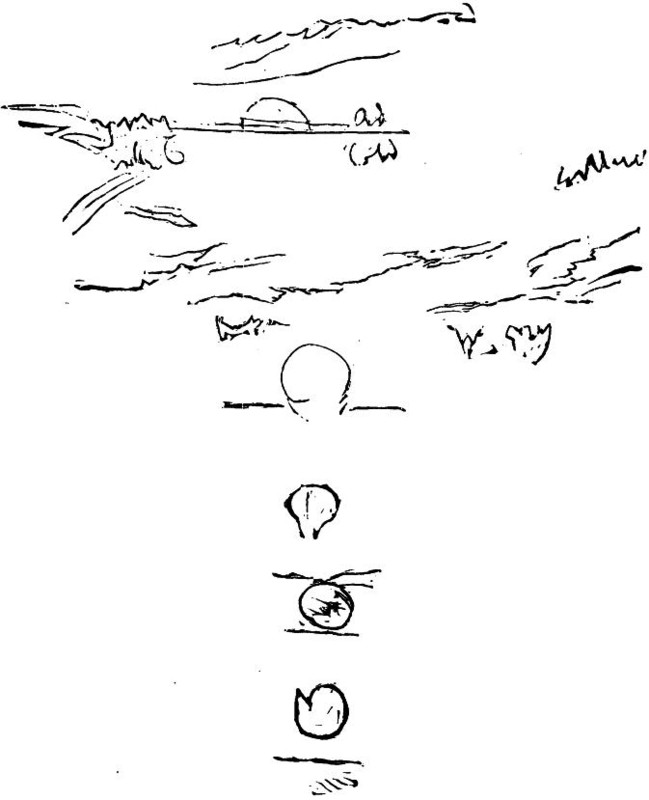
§ 7. When the sketch is made merely as a memorandum, it is impossible to say how little, or what kind of drawing, may be sufficient for the purpose. It is of course likely to be hasty from its very nature, and unless the exact purpose be understood, it may be as unintelligible as a piece of shorthand writing. For instance, in the corner of a sheet of sketches made at sea, among those of Turner, at the National Gallery, occurs this one, Fig. 97. I suppose most persons would not see much use in it. It nevertheless was probably one of the most important sketches made in Turner’s life, fixing for ever in his mind certain facts respecting the sunrise from a clear sea-horizon. Having myself watched such sunrise, occasionally, I perceive this sketch to mean as follows:—
(Half circle at the top.) When the sun was only half out of the sea, the horizon was sharply traced across its disk, and red streaks of vapor crossed the lower part of it.
(Horseshoe underneath.) When the sun had risen so far as to show three-quarters of its diameter, its light became so great as to conceal the sea-horizon, consuming it away in descending rays.
(Smaller horseshoe below.) When on the point of detaching itself from the horizon, the sun still consumed away the line of the sea, and looked as if pulled down by it.
(Broken oval.) Having risen about a fourth of its diameter above the horizon, the sea-line reappeared; but the risen orb was flattened by refraction into an oval.
(Broken circle.) Having risen a little farther above the sea-line, the sun, at last, got itself round, and all right, with sparkling reflection on the waves just below the sea-line.
This memorandum is for its purpose entirely perfect and efficient, though the sun is not drawn carefully round, but with a dash of the pencil; but there is no affected or desired slightness. Could it have been drawn round as instantaneously, it would have been. The purpose is throughout determined; there is no scrawling, as in vulgar sketching.1
§ 8. Again, Fig. 98 is a facsimile of one of Turner’s “memoranda,” of a complete subject,2 Lausanne, from the road to Fribourg.

To face page 184.
Fig. 98.This example is entirely characteristic of his usual drawings from nature, which unite two characters, being both commemorative and determinant:—Commemorative, in so far as they note certain facts about the place: determinant, in that they record an impression received from the place there and then, together with the principal arrangement of the composition in which it was afterwards to be recorded. In this mode of sketching, Turner differs from all other men whose work I have studied. He never draws accurately on the spot, with the intention of modifying or composing afterwards from the materials; but instantly modifies as he draws, placing his memoranda where they are to be ultimately used, and taking exactly what he wants, not a fragment or line more.
§ 9. This sketch has been made in the afternoon. He had been impressed as he walked up the hill, by the vanishing of the lake in the golden horizon, without end of waters, and by the opposition of the pinnacled castle and cathedral to its level breadth. That must be drawn! and from this spot, where all the buildings are set well together. But it lucklessly happens that, though the buildings come just where he wants them in situation, they don’t in height. For the castle (the square mass on the right) is in reality higher than the cathedral, and would block out the end of the lake. Down it goes instantly a hundred feet, that we may see the lake over it; without the smallest regard for the military position of Lausanne.
§ 10. Next: The last low spire on the left is in truth concealed behind the nearer bank, the town running far down the hill (and climbing another hill) in that direction. But the group oi spires, without it, would not be rich enough to give a proper impression of Lausanne, as a spiry place. Turner quietly sends to fetch the church from round the corner, places it where he likes, and indicates its distance only by aërial perspective (much greater in the pencil drawing than in the woodcut).
§ 11. But again: Not only the spire of the lower church, but the peak of the Rochers d’Enfer (that highest in the distance) would in reality be out of sight; it is much farther round to the left. This would never do either; for without it, we should have no idea that Lausanne was opposite the mountains, nor should we have a nice sloping line to lead us into the distance.
With the same unblushing tranquillity of mind in which he had ordered up the church, Turner sends also to fetch the Rochers d’Enfer; and puts them also where he chooses, to crown the slope of distant hill, which, as every traveller knows, in its decline to the west, is one of the most notable features of the view from Lausanne.
§ 12. These modifications, easily traceable in the large features of the design, are carried out with equal audacity and precision in every part of it. Every one of those confused lines on the right indicates something that is really there, only everything is shifted and sorted into the exact places that Turner chose. The group of dark objects near us at the foot of the bank is a cluster of mills, which, when the picture was completed, were to be the blackest things in it, and to throw back the castle, and the golden horizon; while the rounded touches at the bottom, under the castle, indicate a row of trees, which follow a brook coming out of the ravine behind us; and were going to be made very round indeed in the picture (to oppose the spiky and angular masses of castle) and very consecutive, in order to form another conducting line into the distance.
§ 13. These motives, or motives like them, might perhaps be guessed on looking at the sketch. But no one without going to the spot would understand the meaning of the vertical lines in the left-hand lowest corner.
They are a “memorandum” of the artificial verticalness of a low sandstone cliff, which has been cut down there to give space for a bit of garden belonging to a public-house beneath, from which garden a path leads along the ravine to the Lausanne rifle ground. The value of these vertical lines in repeating those of the cathedral is very great; it would be greater still in the completed picture, increasing the sense of looking down from a height, and giving grasp of, and power over, the whole scene.
§ 14. Throughout the sketch, as in all that Turner made, the observing and combining intellect acts in the same manner. Not a line is lost, nor a moment of time; and though the pencil flies, and the whole thing is literally done as fast as a piece of shorthand writing, it is to the full as purposeful and compressed, so that while there are indeed dashes of the pencil which are unintentional, they are only unintentional as the form of a letter is, in fast writing, not from want of intention, but from the accident of haste.
§ 15. I know not if the reader can understand,—I myself cannot, though I see it to be demonstrable,—the simultaneous occurrence of idea which produces such a drawing as this: the grasp of the whole, from the laying of the first line, which induces continual modifications of all that is done, out of respect to parts not done yet. No line is ever changed or effaced: no experiment made; but every touch is placed with reference to all that are to succeed, as to all that have gone before; every addition takes its part, as the stones in an arch of a bridge; the last touch locks the arch. Remove that keystone, or remove any other of the stones of the vault, and the whole will fall.
§ 16. I repeat—the power of mind which accomplishes this, is yet wholly inexplicable to me, as it was when first I defined it in the chapter on imagination associative, in the second volume. But the grandeur of the power impresses me daily more and more; and, in quitting the subject of invention, let me assert finally, in clearest and strongest terms, that no painting is of any true imaginative perfectness at all, unless it has been thus conceived.
One sign of its being thus conceived may be always found in the straightforwardness of its work. There are continual disputes among artists as to the best way of doing things, which may nearly all be resolved into confessions of indetermination. If you know precisely what you want, you will not feel much hesitation in setting about it; and a picture may be painted almost any way, so only that it can be a straight way. Give a true painter a ground of black, white, scarlet, or green, and out of it he will bring what you choose. From the black, brightness; from the white, sadness; from the scarlet, coolness; from the green, glow: he will make anything out of anything, but in each case his method will be pure, direct, perfect, the shortest and simplest possible. You will find him, moreover, indifferent as to succession of process. Ask him to begin at the bottom of the picture instead of the top,—to finish two square inches of it without touching the rest, or to lay a separate ground for every part before finishing any;—it is all the same to him! What he will do if left to himself, depends on mechanical convenience, and on the time at his disposal. If he has a large brush in his hand, and plenty of one color ground, he may lay as much as is wanted of that color, at once, in every part of the picture where it is to occur; and if any is left, perhaps walk to another canvas, and lay the rest of it where it will be wanted on that. If, on the contrary, he has a small brush in his hand, and is interested in a particular spot of the picture, he will, perhaps, not stir from it till that bit is finished. But the absolutely best, or centrally, and entirely right way of painting is as follows:—
§ 17. A light ground, white, red, yellow, or gray, not brown, or black. On that an entirely accurate, and firm black outline of the whole picture, in its principal masses. The outline to be exquisitely correct as far as it reaches, but not to include small details; the use of it being to limit the masses of first color. The ground-colors then to be laid firmly, each on its own proper part of the picture, as inlaid work in a mosaic table, meeting each other truly at the edges: as much of each being laid as will get itself into the state which the artist requires it to be in for his second painting, by the time he comes to it. On this first color, the second colors and subordinate masses laid in due order, now, of course, necessarily without previous outline, and all small detail reserved to the last, the bracelet being not touched, nor indicated in the last, till the arm is finished.3
§ 18. This is, as far as it can be expressed in few words, the right, or Venetian way of painting; but it is incapable of absolute definition, for it depends on the scale, the material, and the nature of the object represented, how much a great painter will do with his first color; or how many after processes he will use. Very often the first color, richly blended and worked into, is also the last; sometimes it wants a glaze only to modify it; sometimes an entirely different color above it. Turner’s storm-blues, for instance, were produced by a black ground, with opaque blue, mixed with white, struck over it.4 The amount of detail given in the first color will also depend on convenience. For instance, if a jewel fastens a fold of dress, a Venetian will lay probably a piece of the jewel color in its place at the time he draws the fold; but if the jewel falls upon the dress, he will paint the folds only in the ground color, and the jewel afterwards. For in the first case his hand must pause, at any rate, where the fold is fastened; so that he may as well mark the color of the gem: but he would have to check his hand in the sweep with which he drew the drapery, if he painted a jewel that fell upon it with the first color. So far, however, as he can possibly use the under color, he will, in whatever he has to superimpose. There is a pretty little instance of such economical work in the painting of the pearls on the breast of the elder princess, in our best Paul Veronese (Family of Darius). The lowest is about the size of a small hazel-nut, and falls on her rose-red dress. Any other but a Venetian would have put a complete piece of white paint over the dress, for the whole pearl, and painted into that the colors of the stone. But Veronese knows beforehand that all the dark side of the pearl will reflect the red of the dress. He will not put white over the red, only to put red over the white again. He leaves the actual dress for the dark side of the pearl, and with two small separate touches, one white, another brown, places its high light and shadow. This he does with perfect care and calm; but in two decisive seconds. There is no dash, nor display, nor hurry, nor error. The exactly right thing is done in the exactly right place, and not one atom of color, nor moment of time spent vainly. Look close at the two touches,—you wonder what they mean. Retire six feet from the picture—the pearl is there!
§ 19. The degree in which the ground colors are extended over his picture, as he works, is to a great painter absolutely indifferent. It is all the same to him whether he grounds a head, and finishes it at once to the shoulders, leaving all round it white; or whether he grounds the whole picture. His harmony, paint as he will, never can be complete till the last touch is given; so long as it remains incomplete, he does not care how little of it is suggested, or how many notes are missing. All is wrong till all is right; and he must be able to bear the all-wrongness till his work is done, or he cannot paint at all. His mode of treatment will, therefore, depend on the nature of his subject; as is beautifully shown in the water-color sketches by Turner in the National Gallery. His general system was to complete inch by inch; leaving the paper quite white all round, especially if the work was to be delicate. The most exquisite drawings left unfinished in the collection—those at Rome and Naples—are thus outlined accurately on pure white paper, begun in the middle of the sheet, and worked out to the side, finishing as he proceeds. If, however, any united effect of light or color is to embrace a large part of the subject, he will lay it in with a broad wash over the whole paper at once; then paint into it using it as a ground, and modifying it in the pure Venetian manner. His oil pictures were laid roughly with ground colors, and painted into with such rapid skill, that the artists who used to see him finishing at the Academy sometimes suspected him of having the picture finished underneath the colors he showed, and removing, instead of adding, as they watched.
§ 20. But, whatever the means used may be, the certainty and directness of them imply absolute grasp of the whole subject, and without this grasp there is no good painting. This, finally, let me declare, without qualification—that partial conception is no conception. The whole picture must be imagined, or none of it is. And this grasp of the whole implies very strange and sublime qualities of mind. It is not possible, unless the feelings are completely under control; the least excitement or passion will disturb the measured equity of power; a painter needs to be as cool as a general; and as little moved or subdued by his sense of pleasure, as a soldier by the sense of pain. Nothing good can be done without intense feeling; but it must be feeling so crushed, that the work is set about with mechanical steadiness, absolutely untroubled, as a surgeon,—not without pity, but conquering it and putting it aside—begins an operation. Until the feelings can give strength enough to the will to enable it to conquer them, they are not strong enough. If you cannot leave your picture at any moment;—cannot turn from it and go on with another, while the color is drying;—cannot work at any part of it you choose with equal contentment—you have not firm enough grasp of it.
§ 21. It follows also, that no vain or selfish person can possibly paint, in the noble sense of the word. Vanity and selfishness are troublous, eager, anxious, petulant:—painting can only be done in calm of mind. Resolution is not enough to secure this; it must be secured by disposition as well. You may resolve to think of your picture only; but, if you have been fretted before beginning, no manly or clear grasp of it will be possible for you. No forced calm is calm enough. Only honest calm,—natural calm. You might as well try by external pressure to smoothe a lake till it could reflect the sky, as by violence of effort to secure the peace through which only you can reach imagination. That peace must come in its own time; as the waters settle themselves into clearness as well as quietness; you can no more filter your mind into purity than you can compress it into calmness; you must keep it pure, if you would have it pure; and throw no stones into it, if you would have it quiet. Great courage and self-command may, to a certain extent, give power of painting without the true calmness underneath; but never of doing first-rate work. There is sufficient evidence of this, in even what we know of great men, though of the greatest, we nearly always know the least (and that necessarily; they being very silent, and not much given to setting themselves forth to questioners; apt to be contemptuously reserved, no less than unselfishly). But in such writings and sayings as we possess of theirs, we may trace a quite curious gentleness and serene courtesy. Rubens’ letters are almost ludicrous in their unhurried politeness. Reynolds, swiftest of painters, was gentlest of companions; so also Velasquez, Titian, and Veronese.
§ 22. It is gratuitous to add that no shallow or petty person can paint. Mere cleverness or special gift never made an artist. It is only perfectness of mind, unity, depth, decision, the highest qualities, in fine, of the intellect, which will form the imagination.
§ 23. And, lastly, no false person can paint. A person false at heart may, when it suits his purposes, seize a stray truth here or there; but the relations of truth,—its perfectness,—that which makes it wholesome truth, he can never perceive. As wholeness and wholesomeness go together, so also sight with sincerity; it is only the constant desire of, and submissiveness to truth, which can measure its strange angles and mark its infinite aspects; and fit them and knit them into the strength of sacred invention.
Sacred, I call it deliberately; for it is thus, in the most accurate senses, humble as well as helpful; meek in its receiving, as magnificent in its disposing; the name it bears being rightly given to invention formal, not because it forms, but because it finds. For you cannot find a lie; you must make it for yourself. False things may be imagined, and false things composed; but only truth can be invented.
1 The word in the uppermost note, to the right of the sun, is “red;” the others, “yellow,” “purple,” “cold” light gray. He always noted the colors of the skies in this way.
2 It is not so good a facsimile as those I have given from Durer, for the original sketch is in light pencil; and the thickening and delicate emphasis of the lines, on which nearly all the beauty of the drawing depended, cannot be expressed in the woodcut, though marked by a double line as well as I could. But the figure will answer its purpose well enough in showing Turner’s mode of sketching.
3 Thus, in the Holy Family of Titian, lately purchased for the National Gallery, the piece of St. Catherine’s dress over her shoulders is painted on the under dress, after that was dry. All its value would have been lost, had the slightest tint or trace of it been given previously. This picture, I think, and certainly many of Tintoret’s, are painted on dark grounds; but this is to save time, and with some loss to the future brightness of the color.
4 In cleaning the “Hero and Leander,” now in the National collection, these upper glazes were taken off, and only the black ground left. I remember the picture when its distance was of the most exquisite blue. I have no doubt the “Fire at Sea” has had its distance destroyed in the same manner.
PART IX.
OF IDEAS OF RELATION:—II. OF INVENTION SPIRITUAL.
—————
CHAPTER I.
THE DARK MIRROR.
§ 1. In the course of our inquiry into the moral of landscape (Vol. III., chap. 17), we promised, at the close of our work, to seek for some better, or at least clearer, conclusions than were then possible to us. We confined ourselves in that chapter to the vindication of the probable utility of the love of natural scenery. We made no assertion of the usefulness of painting such scenery. It might be well to delight in the real country, or admire the real flowers and true mountains. But it did not follow that it was advisable to paint them.
Far from it. Many reasons might be given why we should not paint them. All the purposes of good which we saw that the beauty of nature could accomplish, may be better fulfilled by the meanest of her realities than by the brightest of imitations. For prolonged entertainment, no picture can be compared with the wealth of interest which may be found in the herbage of the poorest field, or blossoms of the narrowest copse. As suggestive of supernatural power, the passing away of a fitful rain-cloud, or opening of dawn, are in their change and mystery more pregnant than any pictures. A child would, I suppose, receive a religious lesson from a flower more willingly than from a print of one, and might be taught to understand the nineteenth Psalm, on a starry night, better than by diagrams of the constellations.
Whence it might seem a waste of time to draw landscape at all.
I believe it is;—to draw landscape mere and solitary, however beautiful (unless it be for the sake of geographical or other science, or of historical record). But there is a kind of landscape which it is not inexpedient to draw. What kind, we may probably discover by considering that which mankind has hitherto contented itself with painting.
§ 2. We may arrange nearly all existing landscape under the following heads:—
I. Heroic.—Representing an imaginary world, inhabited by men not perhaps perfectly civilized, but noble, and usually subjected to severe trials, and by spiritual powers of the highest order. It is frequently without architecture; never without figure-action, or emotion. Its principal master is Titian.
II. Classical.—Representing an imaginary world, inhabited by perfectly civilized men, and by spiritual powers of an inferior order.
It generally assumes this condition of things to have existed among the Greek and Roman nations. It contains usually architecture of an elevated character, and always incidents of figure-action and emotion. Its principal master is Nicolo Poussin.
III. Pastoral.—Representing peasant life and its daily work, or such scenery as may naturally be suggestive of it, consisting usually of simple landscape, in part subjected to agriculture, with figures, cattle, and domestic buildings. No supernatural being is ever visibly present. It does not in ordinary cases admit architecture of an elevated character, nor exciting incident. Its principal master is Cuyp.
IV. Contemplative.—Directed principally to the observance of the powers of Nature, and record of the historical associations connected with landscape, illustrated by, or contrasted with, existing states of human life. No supernatural being is visibly present. It admits every variety of subject, and requires, in general, figure incident, but not of an exciting character. It was not developed completely until recent times. Its principal master is Turner.1
§ 3. These are the four true orders of landscape, not of course distinctly separated from each other in all cases, but very distinctly in typical examples. Two spurious forms require separate note.
(A.) Picturesque.—This is indeed rather the degradation (or sometimes the undeveloped state) of the Contemplative, than a distinct class; but it may be considered generally as including pictures meant to display the skill of the artist, and his powers of composition; or to give agreeable forms and colors, irrespective of sentiment. It will include much modern art, with the street views and church interiors of the Dutch, and the works of Canaletto, Guardi, Tempesta, and the like.
(B.) Hybrid.—Landscape in which the painter endeavors to unite the irreconcileable sentiment of two or more of the above-named classes. Its principal masters are Berghem and Wouvermans.
§ 4. Passing for the present by these inferior schools, we find that all true landscape, whether simple or exalted, depends primarily for its interest on connection with humanity, or with spiritual powers. Banish your heroes and nymphs from the classical landscape—its laurel shades will move you no more. Show that the dark clefts of the most romantic mountain are uninhabited and untraversed; it will cease to be romantic. Fields without shepherds and without fairies will have no gaiety in their green, nor will the noblest masses of ground or colors of cloud arrest or raise your thoughts, if the earth has no life to sustain, and the heaven none to refresh.
§ 5. It might perhaps be thought that, since from scenes in which the figure was principal, and landscape symbolical and subordinate (as in the art of Egypt), the process of ages had led us to scenes in which landscape was principal and the figure subordinate,—a continuance in the same current of feeling might bring forth at last an art from which humanity and its interests should wholly vanish, leaving us to the passionless admiration of herbage and stone. But this will not, and cannot be. For observe the parallel instance in the gradually increasing importance of dress. From the simplicity of Greek design, concentrating, I suppose, its skill chiefly on the naked form, the course of time developed conditions of Venetian imagination which found nearly as much interest, and expressed nearly as much dignity, in folds of dress and fancies of decoration as in the faces of the figures themselves; so that if from Veronese’s Marriage in Cana we remove the architecture and the gay dresses, we shall not in the faces and hands remaining, find a satisfactory abstract of the picture. But try it the other way. Take out the faces; leave the draperies, and how then? Put the fine dresses and jewelled girdles into the best group you can; paint them with all Veronese’s skill: will they satisfy you?
§ 6. Not so. As long as they are in their due service and subjection—while their folds are formed by the motion of men, and their lustre adorns the nobleness of men—so long the lustre and the folds are lovely. But cast them from the human limbs;—golden circlet and silken tissue are withered; the dead leaves of autumn are more precious than they.
This is just as true, but in a far deeper sense, of the weaving of the natural robe of man’s soul. Fragrant tissue of flowers, golden circlets of clouds, are only fair when they meet the fondness of human thoughts, and glorify human visions of heaven.
§ 7. It is the leaning on this truth which, more than any other, has been the distinctive character of all my own past work. And in closing a series of Art-studies, prolonged during so many years, it may be perhaps permitted me to point out this specialty—the rather that it has been, of all their characters, the one most denied. I constantly see that the same thing takes place in the estimation formed by the modern public of the work of almost any true person, living or dead. It is not needful to state here the causes of such error: but the fact is indeed so, that precisely the distinctive root and leading force of any true man’s work and way are the things denied concerning him.
And in these books of mine, their distinctive character, as essays on art, is their bringing everything to a root in human passion or human hope. Arising first not in any desire to explain the principles of art, but in the endeavor to defend an individual painter from injustice, they have been colored throughout,—nay, continually altered in shape, and even warped and broken, by digressions respecting social questions, which had for me an interest tenfold greater than the work I had been forced into undertaking. Every principle of painting which I have stated is traced to some vital or spiritual fact; and in my works on architecture the preference accorded finally to one school over another, is founded on a comparison of their influences on the life of the workman—a question by all other writers on the subject of architecture wholly forgotten or despised.
§ 8. The essential connection of the power of landscape with human emotion is not less certain, because in many impressive pictures the link is slight or local. That the connection should exist at a single point is all that we need. The comparison with the dress of the body may be carried out into the extremest parallelism. It may often happen that no part of the figure wearing the dress is discernible, nevertheless, the perceivable fact that the drapery is worn by a figure makes all the difference. In one of the most sublime figures in the world this is actually so: one of the fainting Marys in Tintoret’s Crucifixion has cast her mantle over her head, and her face is lost in its shade, and her whole figure veiled in folds of gray. But what the difference is between that gray woof, that gathers round her as she falls, and the same folds cast in a heap upon the ground, that difference, and more, exists between the power of Nature through which humanity is seen, and her power in the desert. Desert—whether of leaf or sand—true desertness is not in the want of leaves, but of life. Where humanity is not, and was not, the best natural beauty is more than vain. It is even terrible; not as the dress cast aside from the body; but as an embroidered shroud hiding a skeleton.
§ 9. And on each side of a right feeling in this matter there lie, as usual, two opposite errors.
The first, that of caring for man only; and for the rest of the universe, little, or not at all, which, in a measure, was the error of the Greeks and Florentines; the other, that of caring for the universe only;—for man, not at all,—which, in a measure, is the error of modern science, and of the Art connecting itself with such science.
The degree of power which any man may ultimately possess in landscape-painting will depend finally on his perception of this influence. If he has to paint the desert, its awfulness—if the garden, its gladsomeness—will arise simply and only from his sensibility to the story of life. Without this he is nothing but a scientific mechanist; this, though it cannot make him yet a painter, raises him to the sphere in which he may become one. Nay, the mere shadow and semblance of this have given dangerous power to works in all other respects unnoticeable; and the least degree of its true presence has given value to work in all other respects vain.
The true presence, observe, of sympathy with the spirit of man. Where this is not, sympathy with any higher spirit is impossible.
For the directest manifestation of Deity to man is in His own image, that is, in man.
§ 10. “In his own image. After his likeness.” Ad imaginem et similitudinem Suam. I do not know what people in general understand by those words. I suppose they ought to be understood. The truth they contain seems to lie at the foundation of our knowledge both of God and man; yet do we not usually pass the sentence by, in dull reverence, attaching no definite sense to it at all? For all practical purpose, might it not as well be out of the text?
I have no time, nor much desire, to examine the vague expressions of belief with which the verse has been encumbered. Let us try to find its only possible plain significance.
§ 11. It cannot be supposed that the bodily shape of man resembles, or resembled, any bodily shape in Deity. The likeness must therefore be, or have been, in the soul. Had it wholly passed away, and the Divine soul been altered into a soul brutal or diabolic, I suppose we should have been told of the change. But we are told nothing of the kind. The verse still stands as if for our use and trust. It was only death which was to be our punishment. Not change. So far as we live, the image is still there; defiled, if you will; broken, if you will; all but effaced, if you will, by death and the shadow of it. But not changed. We are not made now in any other image than God’s. There are, indeed, the two states of this image—the earthly and heavenly, but both Adamite, both human, both the same likeness; only one defiled, and one pure. So that the soul of man is still a mirror, wherein may be seen, darkly, the image of the mind of God.
These may seem daring words. I am sorry that they do; but I am helpless to soften them. Discover any other meaning of the text if you are able;—but be sure that it is a meaning—a meaning in your head and heart;—not a subtle gloss, nor a shifting of one verbal expression into another, both idealess. I repeat, that, to me, the verse has, and can have, no other signification than this—that the soul of man is a mirror of the mind of God. A mirror dark, distorted, broken, use what blameful words you please of its state; yet in the main, a true mirror, out of which alone, and by which alone, we can know anything of God at all.
“How?” the reader, perhaps, answers indignantly. “I know the nature of God by revelation, not by looking into myself.”
Revelation to what? To a nature incapable of receiving truth? That cannot be; for only to a nature capable of truth, desirous of it, distinguishing it, feeding upon it, revelation is possible. To a being undesirous of it, and hating it, revelation is impossible. There can be none to a brute, or fiend. In so far, therefore, as you love truth, and live therein, in so far revelation can exist for you;—and in so far, your mind is the image of God’s.
§ 12. But consider farther, not only to what, but by what, is the revelation. By sight? or word? If by sight, then to eyes which see justly. Otherwise, no sight would be revelation. So far, then, as your sight is just, it is the image of God’s sight.
If by words,—how do you know their meanings? Here is a short piece of precious word revelation, for instance. “God is love.”
Love! yes. But what is that? The revelation does not tell you that, I think. Look into the mirror, and you will see. Out of your own heart you may know what love is. In no other possible way,—by no other help or sign. All the words and sounds ever uttered, all the revelations of cloud, or flame, or crystal, are utterly powerless. They cannot tell you, in the smallest point, what love means. Only the broken mirror can.
§ 13. Here is more revelation. “God is just!” Just! What is that? The revelation cannot help you to discover. You say it is dealing equitably or equally. But how do you discern the equality? Not by inequality of mind; not by a mind incapable of weighing, judging, or distributing. If the lengths seem unequal in the broken mirror, for you they are unequal; but if they seem equal, then the mirror is true. So far as you recognize equality, and your conscience tells you what is just, so far your mind is the image of God’s: and so far as you do not discern this nature of justice or equality, the words “God is just” bring no revelation to you.
§ 14. “But His thoughts are not as our thoughts.” No: the sea is not as the standing pool by the wayside. Yet when the breeze crisps the pool, you may see the image of the breakers, and a likeness of the foam. Nay, in some sort, the same foam. If the sea is for ever invisible to you, something you may learn of it from the pool. Nothing, assuredly, any otherwise.
“But this poor miserable Me! Is this, then, all the book I have got to read about God in?” Yes, truly so. No other book, nor fragment of book, than that, will you ever find;—no velvet-bound missal, nor frankincensed manuscript;—nothing hieroglyphic nor cuneiform; papyrus and pyramid are alike silent on this matter;—nothing in the clouds above, nor in the earth beneath. That flesh-bound volume is the only revelation that is, that was, or that can be. In that is the image of God painted; in that is the law of God written; in that is the promise of God revealed. Know thyself; for through thyself only thou canst know God.
§ 15. Through the glass, darkly. But, except through the glass, in nowise.
A tremulous crystal, waved as water, poured out upon the ground;—you may defile it, despise it, pollute it at your pleasure, and at your peril; for on the peace of those weak waves must all the heaven you shall ever gain be first seen; and through such purity as you can win for those dark waves, must all the light of the risen Sun of righteousness be bent down, by faint refraction. Cleanse them, and calm them, as you love your life.
Therefore it is that all the power of nature depends on subjection to the human soul. Man is the sun of the world; more than the real sun. The fire of his wonderful heart is the only light and heat worth gauge or measure. Where he is, are the tropics; where he is not, the ice-world.
1 The word in the uppermost note, to the right of the sun, is “red;” the others, “yellow,” “purple,” “cold” light gray. He always noted the colors of the skies in this way.
2 It is not so good a facsimile as those I have given from Durer, for the original sketch is in light pencil; and the thickening and delicate emphasis of the lines, on which nearly all the beauty of the drawing depended, cannot be expressed in the woodcut, though marked by a double line as well as I could. But the figure will answer its purpose well enough in showing Turner’s mode of sketching.
3 Thus, in the Holy Family of Titian, lately purchased for the National Gallery, the piece of St. Catherine’s dress over her shoulders is painted on the under dress, after that was dry. All its value would have been lost, had the slightest tint or trace of it been given previously. This picture, I think, and certainly many of Tintoret’s, are painted on dark grounds; but this is to save time, and with some loss to the future brightness of the color.
4 In cleaning the “Hero and Leander,” now in the National collection, these upper glazes were taken off, and only the black ground left. I remember the picture when its distance was of the most exquisite blue. I have no doubt the “Fire at Sea” has had its distance destroyed in the same manner.
1 I have been embarrassed in assigning the names to these orders of art, the term “Contemplative” belonging in justice nearly as much to the romantic and pastoral conception as to the modern landscape. I intended, originally, to call the four schools—Romantic, Classic, Georgic, and Theoretic—which would have been more accurate; and more consistent with the nomenclature of the second volume; but would not have been pleasant in sound, nor to the general reader, very clear in sense.
1 I have been embarrassed in assigning the names to these orders of art, the term “Contemplative” belonging in justice nearly as much to the romantic and pastoral conception as to the modern landscape. I intended, originally, to call the four schools—Romantic, Classic, Georgic, and Theoretic—which would have been more accurate; and more consistent with the nomenclature of the second volume; but would not have been pleasant in sound, nor to the general reader, very clear in sense.
CHAPTER II.
THE LANCE OF PALLAS.
§ 1. It might be thought that the tenor of the preceding chapter was in some sort adverse to my repeated statement that all great art is the expression of man’s delight in God’s work, not in his own. But observe, he is not himself his own work: he is himself precisely the most wonderful piece of God’s workmanship extant. In this best piece not only he is bound to take delight, but cannot, in a right state of thought, take delight in anything else, otherwise than through himself. Through himself, however, as the sun of creation, not as the creation. In himself, as the light of the world.1 Not as being the world. Let him stand in his due relation to other creatures, and to inanimate things—know them all and love them, as made for him, and he for them;—and he becomes himself the greatest and holiest of them. But let him cast off this relation, despise and forget the less creation around him, and instead of being the light of the world, he is as a sun in space—a fiery ball, spotted with storm.
§ 2. All the diseases of mind leading to fatalest ruin consist primarily in this isolation. They are the concentration of man upon himself, whether his heavenly interests or his worldly interests, matters not; it is the being his own interests which makes the regard of them so mortal. Every form of asceticism on one side, of sensualism on the other, is an isolation of his soul or of his body; the fixing his thoughts upon them alone: while every healthy state of nations and of individual minds consists in the unselfish presence of the human spirit everywhere, energizing over all things; speaking and living through all things.
§ 3. Man being thus the crowning and ruling work of God, it will follow that all his best art must have something to tell about himself, as the soul of things, and ruler of creatures. It must also make this reference to himself under a true conception of his own nature. Therefore all art which involves no reference to man is inferior or nugatory. And all art which involves misconception of man, or base thought of him, is in that degree false, and base.
Now the basest thought possible concerning him is, that he has no spiritual nature; and the foolishest misunderstanding of him possible is, that he has or should have, no animal nature. For his nature is nobly animal, nobly spiritual—coherently and irrevocably so; neither part of it may, but at its peril, expel, despise, or defy the other. All great art confesses and worships both.
§ 4. The art which, since the writings of Rio and Lord Lindsay, is specially known as “Christian,” erred by pride in its denial of the animal nature of man;—and, in connection with all monkish and fanatical forms of religion, by looking always to another world instead of this. It wasted its strength in visions, and was therefore swept away, notwithstanding all its good and glory, by the strong truth of the naturalist art of the sixteenth century. But that naturalist art erred on the other side; denied at last the spiritual nature of man, and perished in corruption.
A contemplative reaction is taking place in modern times, out of which it may be hoped a new spiritual art may be developed. The first school of landscape, named, in the foregoing chapter, the Heroic, is that of the noble naturalists. The second (Classical), and third (Pastoral), belong to the time of sensual decline. The fourth (Contemplative) is that of modern revival.
§ 5. But why, the reader will ask, is no place given in this scheme to the “Christian” or spiritual art which preceded the naturalists? Because all landscape belonging to that art is subordinate, and in one essential principle false. It is subordinate, because intended only to exalt the conception of saintly or Divine presence:—rather therefore to be considered as a landscape decoration or type, than an effort to paint nature. If I included it in my list of schools, I should have to go still farther back, and include with it the conventional and illustrative landscape of the Greeks and Egyptians.
§ 6. But also it cannot constitute a real school, because its first assumption is false, namely, that the natural world can be represented without the element of death.
The real schools of landscape are primarily distinguished from the preceding unreal ones by their introduction of this element. They are not at first in any sort the worthier for it. But they are more true, and capable, therefore, in the issue, of becoming worthier.
It will be a hard piece of work for us to think this rightly out, but it must be done.
§ 7. Perhaps an accurate analysis of the schools of art of all time might show us that when the immortality of the soul was practically and completely believed, the elements of decay, danger, and grief in visible things were always disregarded. However this may be, it is assuredly so in the early Christian schools. The ideas of danger or decay seem not merely repugnant, but inconceivable to them; the expression of immortality and perpetuity is alone possible. I do not mean that they take no note of the absolute fact of corruption. This fact the early painters often compel themselves to look fuller in the front than any other men: as in the way they usually paint the Deluge (the raven feeding on the bodies), and in all the various triumphs and processions of the Power of Death, which formed one great chapter of religious teaching and painting, from Orcagna’s time to the close of the Purist epoch. But I mean that this external fact of corruption is separated in their minds from the main conditions of their work; and its horror enters no more into their general treatment of landscape than the fear of murder or martyrdom, both of which they had nevertheless continually to represent. None of these things appeared to them as affecting the general dealings of the Deity with His world. Death, pain, and decay were simply momentary accidents in the course of immortality, which never ought to exercise any depressing influence over the hearts of men, or in the life of Nature. God, in intense life, peace, and helping power, was always and everywhere. Human bodies, at one time or another, had indeed to be made dust of, and raised from it; and this becoming dust was hurtful and humiliating, but not in the least melancholy, nor, in any very high degree, important; except to thoughtless persons, who needed sometimes to be reminded of it, and whom, not at all fearing the things much himself, the painter accordingly did remind of it, somewhat sharply.
§ 8. A similar condition of mind seems to have been attained, not unfrequently, in modern times, by persons whom either narrowness of circumstance or education, or vigorous moral efforts have guarded from the troubling of the world, so as to give them firm and childlike trust in the power and presence of God, together with peace of conscience, and a belief in the passing of all evil into some form of good. It is impossible that a person thus disciplined should feel, in any of its more acute phases, the sorrow for any of the phenomena of nature, or terror in any material danger which would occur to another. The absence of personal fear, the consciousness of security as great in the midst of pestilence and storm, as amidst beds of flowers on a summer morning, and the certainty that whatever appeared evil, or was assuredly painful, must eventually issue in a far greater and enduring good—this general feeling and conviction, I say, would gradually lull, and at last put to entire rest, the physical sensations of grief and fear; so that the man would look upon danger without dread,—accept pain without lamentation.
§ 9. It may perhaps be thought that this is a very high and right state of mind.
Unfortunately, it appears that the attainment of it is never possible without inducing some form of intellectual weakness.
No painter belonging to the purest religious schools ever mastered his art. Perugino nearly did so; but it was because he was more rational—more a man of the world—than the rest. No literature exists of a high class produced by minds in the pure religious temper. On the contrary, a great deal of literature exists, produced by persons in that temper, which is markedly, and very far, below average literary work.
§ 10. The reason of this I believe to be, that the right faith of man is not intended to give him repose, but to enable him to do his work. It is not intended that he should look away from the place he lives in now, and cheer himself with thoughts of the place he is to live in next, but that he should look stoutly into this world, in faith that if he does his work thoroughly here, some good to others or himself, with which, however, he is not at present concerned, will come of it hereafter. And this kind of brave, but not very hopeful or cheerful faith, I perceive to be always rewarded by clear practical success and splendid intellectual power; while the faith which dwells on the future fades away into rosy mist, and emptiness of musical air. That result indeed follows naturally enough on its habit of assuming that things must be right, or must come right, when, probably, the fact is, that so far as we are concerned, they are entirely wrong; and going wrong: and also on its weak and false way of looking on what these religious persons call “the bright side of things,” that is to say, on one side of them only, when God has given them two sides, and intended us to see both.
§ 11. I was reading but the other day, in a book by a zealous, useful, and able Scotch clergyman, one of these rhapsodies, in which he described a scene in the Highlands to show (he said) the goodness of God. In this Highland scene there was nothing but sunshine, and fresh breezes, and bleating lambs, and clean tartans, and all manner of pleasantness. Now a Highland scene is, beyond dispute, pleasant enough in its own way; but, looked close at, has its shadows. Here, for instance, is the very fact of one, as pretty as I can remember—having seen many. It is a little valley of soft turf, enclosed in its narrow oval by jutting rocks and broad flakes of nodding fern. From one side of it to the other winds, serpentine, a clear brown stream, drooping into quicker ripple as it reaches the end of the oval field, and then, first islanding a purple and white rock with an amber pool, it dashes away into a narrow fall of foam under a thicket of mountain ash and alder. The autumn sun, low but clear, shines on the scarlet ash-berries and on the golden birch-leaves, which, fallen here and there, when the breeze has not caught them, rest quiet in the crannies of the purple rock. Beside the rock, in the hollow under the thicket, the carcass of a ewe, drowned in the last flood, lies nearly bare to the bone, its white ribs protruding through the skin, raven-torn; and the rags of its wool still flickering from the branches that first stayed it as the stream swept it down. A little lower, the current plunges, roaring, into a circular chasm like a well, surrounded on three sides by a chimney-like hollowness of polished rock, down which the foam slips in detached snow-flakes. Round the edges of the pool beneath, the water circles slowly, like black oil; a little butterfly lies on its back, its wings glued to one of the eddies, its limbs feebly quivering; a fish rises and it is gone. Lower down the stream, I can just see, over a knoll, the green and damp turf roofs of four or five hovels, built at the edge of a morass, which is trodden by the cattle into a black Slough of Despond at their doors, and traversed by a few ill-set stepping-stones, with here and there a flat slab on the tops, where they have sunk out of sight; and at the turn of the brook I see a man fishing, with a boy and a dog—a picturesque and pretty group enough certainly, if they had not been there all day starving. I know them, and I know the dog’s ribs also, which are nearly as bare as the dead ewe’s; and the child’s wasted shoulders, cutting his old tartan jacket through, so sharp are they. We will go down and talk with the man.
§ 12. Or, that I may not piece pure truth with fancy, for I have none of his words set down, let us hear a word or two from another such, a Scotchman also, and as true hearted, and in just as fair a scene. I write out the passage, in which I have kept his few sentences, word for word, as it stands in my private diary:—“22nd April (1851). Yesterday I had a long walk up the Via Gellia, at Matlock, coming down upon it from the hills above, all sown with anemones and violets, and murmuring with sweet springs. Above all the mills in the valley, the brook, in its first purity, forms a small shallow pool, with a sandy bottom covered with cresses, and other water plants. A man was wading in it for cresses as I passed up the valley, and bade me good-day. I did not go much farther; he was there when I returned. I passed him again, about one hundred yards, when it struck me I might as well learn all I could about watercresses: so I turned back. I asked the man, among other questions, what he called the common weed, something like watercress, but with a serrated leaf, which grows at the edge of nearly all such pools. ‘We calls that brooklime, hereabouts,’ said a voice behind me. I turned, and saw three men, miners or manufacturers—two evidently Derbyshire men, and respectable-looking in their way; the third, thin, poor, old, and harder-featured, and utterly in rags. ‘Brooklime?’ I said. ‘What do you call it lime for?’ The man said he did not know, it was called that. ‘You’ll find that in the British ‘Erba,’ said the weak, calm voice of the old man. I turned to him in much surprise; but he went on saying something drily (I hardly understood what) to the cress-gatherer; who contradicting him, the old man said he ‘didn’t know fresh water,’ he ‘knew enough of sa’t.’ ‘Have you been a sailor?’ I asked. ‘I was a sailor for eleven years and ten months of my life,’ he said, in the same strangely quiet manner. ‘And what are you now?’ ‘I lived for ten years after my wife’s death by picking up rags and bones; I hadn’t much occasion afore.’ ‘And now how do you live?’ ‘Why, I lives hard and honest, and haven’t got to live long,’ or something to that effect. He then went on, in a kind of maundering way, about his wife. ‘She had rheumatism and fever very bad; and her second rib grow’d over her hench-bone. A’ was a clever woman, but a’ grow’d to be a very little one’ (this with an expression of deep melancholy). ‘Eighteen years after her first lad she was in the family-way again, and they had doctors up from Lunnon about it. They wanted to rip her open and take the child out of her side. But I never would give my consent.’ (Then, after a pause:) ‘She died twenty-six hours and ten minutes after it. I never cared much what come of me since; but I know that I shall soon reach her; that’s a knowledge I would na gie for the king’s crown.’ ‘You are a Scotchman, are not you?’ I asked. ‘I’m from the Isle of Skye, sir; I’m a McGregor.’ I said something about his religious faith. ‘Ye’ll know I was bred in the Church of Scotland, sir,’ he said, ‘and I love it as I love my own soul; but I think thae Wesleyan Methodists ha’ got salvation among them, too.’”
Truly, this Highland and English hill-scenery is fair enough; but has its shadows; and deeper coloring, here and there, than that of heath and rose.
§ 13. Now, as far as I have watched the main powers of human mind, they have risen first from the resolution to see fearlessly, pitifully, and to its very worst, what these deep colors mean, wheresoever they fall; not by any means to pass on the other side looking pleasantly up to the sky, but to stoop to the horror, and let the sky, for the present, take care of its own clouds. However this may be in moral matters, with which I have nothing here to do, in my own field of inquiry the fact is so; and all great and beautiful work has come of first gazing without shrinking into the darkness. If, having done so, the human spirit can, by its courage and faith, conquer the evil, it rises into conceptions of victorious and consummated beauty. It is then the spirit of the highest Greek and Venetian Art. If unable to conquer the evil, but remaining in strong, though melancholy war with it, not rising into supreme beauty, it is the spirit of the best northern art, typically represented by that of Holbein and Durer. If, itself conquered by the evil, infected by the dragon breath of it, and at last brought into captivity, so as to take delight in evil for ever, it becomes the spirit of the dark, but still powerful sensualistic art, represented typically by that of Salvator. We must trace this fact briefly through Greek, Venetian, and Dureresque art; we shall then see how the art of decline came of avoiding the evil, and seeking pleasure only; and thus obtain, at last, some power of judging whether the tendency of our own contemplative art be right or ignoble.
§ 14. The ruling purpose of Greek poetry is the assertion of victory, by heroism, over fate, sin, and death. The terror of these great enemies is dwelt upon chiefly by the tragedians. The victory over them by Homer.
The adversary chiefly contemplated by the tragedians is Fate, or predestinate misfortune. And that under three principal forms.
A. Blindness, or ignorance; not in itself guilty, but inducing acts which otherwise would have been guilty; and leading, no less than guilt, to destruction.2
B. Visitation upon one person of the sin of another.
C. Repression, by brutal or tyrannous strength, of a benevolent will.
§ 15. In all these cases sorrow is much more definitely connected with sin by the Greek tragedians than by Shakspere. The “fate” of Shakspere is, indeed, a form of blindness, but it issues in little more than haste or indiscretion. It is, in the literal sense, “fatal,” but hardly criminal.
The “I am fortune’s fool” of Romeo, expresses Shakspere’s primary idea of tragic circumstance. Often his victims are entirely innocent, swept away by mere current of strong encompassing calamity (Ophelia, Cordelia, Arthur, Queen Katharine). This is rarely so with the Greeks. The victim may indeed be innocent, as Antigone, but is in some way resolutely entangled with crime, and destroyed by it, as if it struck by pollution, no less than participation.
The victory over sin and death is therefore also with the Greek tragedians more complete than with Shakspere. As the enemy has more direct moral personality,—as it is sinfulness more than mischance, it is met by a higher moral resolve, a greater preparation of heart, a more solemn patience and purposed self-sacrifice. At the close of a Shakspere tragedy nothing remains but dead march and clothes of burial. At the close of a Greek tragedy there are far-off sounds of a divine triumph, and a glory as of resurrection.3
§ 16. The Homeric temper is wholly different. Far more tender, more practical, more cheerful; bent chiefly on present things and giving victory now, and here, rather than in hope, and hereafter. The enemies of mankind, in Homer’s conception, are more distinctly conquerable; they are ungoverned passions, especially anger, and unreasonable impulse generally (ἀτὴ). Hence the anger of Achilles, misdirected by pride, but rightly directed by friendship, is the subject of the Iliad. The anger of Ulysses (Ὀδυσσεὺς “the angry”), misdirected at first into idle and irregular hostilities, directed at last to execution of sternest justice, is the subject of the Odyssey.
Though this is the central idea of the two poems, it is connected with general display of the evil of all unbridled passions, pride, sensuality, indolence, or curiosity. The pride of Atrides, the passion of Paris, the sluggishness of Elpenor, the curiosity of Ulysses himself about the Cyclops, the impatience of his sailors in untying the winds, and all other faults or follies, down to that—(evidently no small one in Homer’s mind)—of domestic disorderliness, are throughout shown in contrast with conditions of patient affection and household peace.
Also, the wild powers and mysteries of Nature are in the Homeric mind among the enemies of man; so that all the labors of Ulysses are an expression of the contest of manhood, not only with its own passions or with the folly of others, but with the merciless and mysterious powers of the natural world.
§ 17. This is perhaps the chief signification of the seven years’ stay with Calypso, “the concealer.” Not, as vulgarly thought, the concealer of Ulysses, but the great concealer—the hidden power of natural things. She is the daughter of Atlas and the Sea (Atlas, the sustainer of heaven, and the Sea, the disturber of the Earth). She dwells in the island of Ogygia (“the ancient or venerable”). (Whenever Athens, or any other Greek city, is spoken of with any peculiar reverence, it is called “Ogygian.”) Escaping from this goddess of secrets, and from other spirits, some of destructive natural force (Scylla), others signifying the enchantment of mere natural beauty (Circe, daughter of the Sun and Sea), he arrives at last at the Phæacian land, whose king is “strength with intellect,” and whose queen, “virtue.” These restore him to his country.
§ 18. Now observe that in their dealing with all these subjects the Greeks never shrink from horror; down to its uttermost depth, to its most appalling physical detail, they strive to sound the secrets of sorrow. For them there is no passing by on the other side, no turning away the eyes to vanity from pain. Literally, they have not “lifted up their souls unto vanity.” Whether there be consolation for them or not, neither apathy nor blindness shall be their saviours; if, for them, thus knowing the facts of the grief of earth, any hope, relief, or triumph may hereafter seem possible,—well; but if not, still hopeless, reliefless, eternal, the sorrow shall be met face to face. This Hector, so righteous, so merciful, so brave, has, nevertheless, to look upon his dearest brother in miserablest death. His own soul passes away in hopeless sobs through the throat-wound of the Grecian spear. That is one aspect of things in this world, a fair world truly, but having, among its other aspects, this one, highly ambiguous.
§ 19. Meeting it boldly as they may, gazing right into the skeleton face of it, the ambiguity remains; nay, in some sort gains upon them. We trusted in the gods;—we thought that wisdom and courage would save us. Our wisdom and courage themselves deceive us to our death. Athena had the aspect of Deiphobus—terror of the enemy. She has not terrified him, but left us, in our mortal need.
And, beyond that mortality, what hope have we? Nothing is clear to us on that horizon, nor comforting. Funeral honors; perhaps also rest; perhaps a shadowy life—artless, joyless, loveless. No devices in that darkness of the grave, nor daring, nor delight. Neither marrying nor giving in marriage, nor casting of spears, nor rolling of chariots, nor voice of fame. Lapped in pale Elysian mist, chilling the forgetful heart and feeble frame, shall we waste on forever? Can the dust of earth claim more of immortality than this? Or shall we have even so much as rest? May we, indeed, lie down again in the dust, or have our sins not hidden from us even the things that belong to that peace? May not chance and the whirl of passion govern us there; when there shall be no thought, nor work, nor wisdom, nor breathing of the soul?4
Be it so. With no better reward, no brighter hope, we will be men while we may: men, just, and strong, and fearless, and up to our power, perfect. Athena herself, our wisdom and our strength, may betray us;—Phœbus, our sun, smite us with plague, or hide his face from us helpless;—Jove and all the powers of fate oppress us, or give us up to destruction. While we live, we will hold fast our integrity; no weak tears shall blind us, no untimely tremors abate our strength of arm nor swiftness of limb. The gods have given us at least this glorious body and this righteous conscience; these will we keep bright and pure to the end. So may we fall to misery, but not to baseness; so may we sink to sleep, but not to shame.
§ 20. And herein was conquest. So defied, the betraying and accusing shadows shrank back; the mysterious horror subdued itself to majestic sorrow. Death was swallowed up in victory. Their blood, which seemed to be poured out upon the ground, rose into hyacinthine flowers. All the beauty of earth opened to them; they had ploughed into its darkness, and they reaped its gold; the gods, in whom they had trusted through all semblance of oppression, came down to love them and be their helpmates. All nature round them became divine,—one harmony of power and peace. The sun hurt them not by day, nor the moon by night; the earth opened no more her jaws into the pit; the sea whitened no more against them the teeth of his devouring waves. Sun, and moon, and earth, and sea,—all melted into grace and love; the fatal arrows rang not now at the shoulders of Apollo the healer; lord of life and of the three great spirits of life—Care, Memory, and Melody. Great Artemis guarded their flocks by night; Selene kissed in love the eyes of those who slept. And from all came the help of heaven to body and soul; a strange spirit lifting the lovely limbs; strange light glowing on the golden hair; and strangest comfort filling the trustful heart, so that they could put off their armor, and lie down to sleep,—their work well done, whether at the gates of their temples5 or of their mountains;6 accepting the death they once thought terrible, as the gift of Him who knew and granted what was best.
1 Matt. v. 14.
2 The speech of Achilles to Priam expresses this idea of fatality and submission clearly, there being two vessels—one full of sorrow, the other of great and noble gifts (a sense of disgrace mixing with that of sorrow, and of honor with that of joy), from which Jupiter pours forth the destinies of men; the idea partly corresponding to the scriptural—“In the hand of the Lord there is a cup, and the wine is red; it is full mixed, and He poureth out of the same.” But the title of the gods, nevertheless, both with Homer and Hesiod, is given not from the cup of sorrow, but of good; “givers of good” (δωτὴρες ἐάων).—Hes. Theog. 664: Odyss. viii. 325.
3 The Alcestis is perhaps the central example of the idea of all Greek drama.
4
τῷ καὶ τεθνειῶτι νόον πόρε Περσεφόνεια,
οἴω πεπνύσθαί τοὶ δὲ σκιαὶ ἀἴσσουσιν.
Od. x. 495.
5 οὐκέτι ὰνέστησαν, αλλ᾽ ἐν τέλει τουτῳ ἔσχοντο. Herod, i. 31.
6 ὁ δὲ ὰποπεμπόμενος, αὐτὸς μὲν οὐκ άπελίπετο τὸν δὲ παῖδα συστρατευόμενον, ἐόντα οἱ μουνογενέα, ἀπέπεμψε. Herod, vii. 221.
CHAPTER III.
THE WINGS OF THE LION.
§ 1. Such being the heroic spirit of Greek religion and art, we may now with ease trace the relations between it and that which animated the Italian, and chiefly the Venetian, schools.
Observe, all the nobleness, as well as the faults, of the Greek art were dependent on its making the most of this present life. It might do so in the Anacreontic temper—Τί Πλειάδεσσι, κᾀμοί; “What have I to do with the Pleiads?” or in the defiant or the trustful endurance of fate;—but its dominion was in this world.
Florentine art was essentially Christian, ascetic, expectant of a better world, and antagonistic, therefore, to the Greek temper. So that the Greek element, once forced upon it, destroyed it. There was absolute incompatibility between them. Florentine art, also, could not produce landscape. It despised the rock, the tree, the vital air itself, aspiring to breathe empyreal air.
Venetian art began with the same aim and under the same restrictions. Both are healthy in the youth of art. Heavenly aim and severe law for boyhood; earthly work and fair freedom for manhood.
§ 2. The Venetians began, I repeat, with asceticism; always, however, delighting in more massive and deep color than other religious painters. They are especially fond of saints who have been cardinals, because of their red hats, and they sunburn all their hermits into splendid russet brown.
They differed from the Pisans in having no Maremma between them and the sea; from the Romans, in continually quarrelling with the Pope; and from the Florentines in having no gardens.
They had another kind of garden, deep-furrowed, with blossom in white wreaths—fruitless. Perpetual May therein, and singing of wild, nestless birds. And they had no Maremma to separate them from this garden of theirs. The destiny of Pisa was changed, in all probability, by the ten miles of marsh-land and poisonous air between it and the beach. The Genoese energy was feverish; too much heat reflected from their torrid Apennine. But the Venetian had his free horizon, his salt breeze, and sandy Lido-shore; sloped far and flat,—ridged sometimes under the Tramontane winds with half a mile’s breadth of rollers;—sea and sand shrivelled up together in one yellow careering field of fall and roar.
§ 3. They were, also, we said, always quarrelling with the Pope. Their religious liberty came, like their bodily health, from that wave-training; for it is one notable effect of a life passed on shipboard to destroy weak beliefs in appointed forms of religion. A sailor may be grossly superstitious, but his superstitions will be connected with amulets and omens, not cast in systems. He must accustom himself, if he prays at all, to pray anywhere and anyhow. Candlesticks and incense not being portable into the maintop, he perceives those decorations to be, on the whole, inessential to a maintop mass. Sails must be set and cables bent, be it never so strict a saint’s day, and it is found that no harm comes of it. Absolution on a lee-shore must be had of the breakers, it appears, if at all, and they give it plenary and brief, without listening to confession.
Whereupon our religious opinions become vague, but our religious confidences strong; and the end of it all is that we perceive the Pope to be on the other side of the Apennines, and able, indeed, to sell indulgences, but not winds, for any money. Whereas, God and the sea are with us, and we must even trust them both, and take what they shall send.
§ 4. Then, farther. This ocean-work is wholly adverse to any morbid conditions of sentiment. Reverie, above all things, is forbidden by Scylla and Charybdis. By the dogs and the depths, no dreaming! The first thing required of us is presence of mind. Neither love, nor poetry, nor piety, must ever so take up our thoughts as to make us slow or unready. In sweet Val d’Arno it is permissible enough to dream among the orange-blossoms, and forget the day in twilight of ilex. But along the avenues of the Adrian waves there can be no careless walking. Vigilance, might and day, required of us, besides learning of many practical lessons in severe and humble dexterities. It is enough for the Florentine to know how to use his sword and to ride. We Venetians, also, must be able to use our swords, and on ground which is none of the steadiest; but, besides, we must be able to do nearly everything that hands can turn to—rudders, and yards, and cables, all needing workmanly handling and workmanly knowledge, from captain as well as from men. To drive a nail, lash a spear, reef a sail—rude work this for noble hands; but to be done sometimes, and done well, on pain of death. All which not only takes mean pride out of us, and puts nobler pride of power in its stead; but it tends partly to soothe, partly to chasten, partly to employ and direct, the hot Italian temper, and make us every way greater, calmer, and happier.
§ 5. Moreover, it tends to induce in us great respect for the whole human body; for its limbs, as much as for its tongue or its wit. Policy and eloquence are well; and, indeed, we Venetians can be politic enough, and can speak melodiously when we choose; but to put the helm up at the right moment is the beginning of all cunning—and for that we need arm and eye;—not tongue. And with this respect for the body as such, comes also the sailor’s preference of massive beauty in bodily form. The landsmen, among their roses and orange-blossoms, and chequered shadows of twisted vine, may well please themselves with pale faces, and finely drawn eyebrows, and fantastic braiding of hair. But from the sweeping glory of the sea we learn to love another kind of beauty; broad-breasted; level-browed, like the horizon;—thighed and shouldered like the billows;—footed like their stealing foam;—bathed in cloud of golden hair, like their sunsets.
§ 6. Such were the physical influences constantly in operation on the Venetians; their painters, however, were partly prepared for their work by others in their infancy. Associations connected with early life among mountains softened and deepened the teaching of the sea; and the wildness of form of the Tyrolese Alps gave greater strength and grotesqueness to their imaginations than the Greek painters could have found among the cliffs of the Ægean. Thus far, however, the influences on both are nearly similar. The Greek sea was indeed less bleak, and the Greek hills less grand; but the difference was in degree rather than in the nature of their power. The moral influences at work on the two races were far more sharply opposed.
§ 7. Evil, as we saw, had been fronted by the Greek, and thrust out of his path. Once conquered, if he thought of it more, it was involuntarily, as we remember a painful dream, yet with a secret dread that the dream might return and continue for ever. But the teaching of the church in the middle ages had made the contemplation of evil one of the duties of men. As sin, it was to be duly thought upon, that it might be confessed. As suffering, endured joyfully, in hope of future reward. Hence conditions of bodily distemper which an Athenian would have looked upon with the severest contempt and aversion, were in the Christian church regarded always with pity, and often with respect; while the partial practice of celibacy by the clergy, and by those over whom they had influence,—together with the whole system of conventual penance and pathetic ritual (with the vicious reactionary tendencies necessarily following), introduced calamitous conditions both of body and soul, which added largely to the pagan’s simple list of elements of evil, and introduced the most complicated states of mental suffering and decrepitude.
§ 8. Therefore the Christian painters differed from the Greek in two main points. They had been taught a faith which put an end to restless questioning and discouragement. All was at last to be well—and their best genius might be peacefully given to imagining the glories of heaven and the happiness of its redeemed. But on the other hand, though suffering was to cease in heaven, it was to be not only endured, but honored upon earth. And from the Crucifixion, down to a beggar’s lameness, all the tortures and maladies of men were to be made, at least in part, the subjects of art. The Venetian was, therefore, in his inner mind, less serious than the Greek: in his superficial temper, sadder. In his heart there was none of the deep horror which vexed the soul of Æschylus or Homer. His Pallas-shield was the shield of Faith, not the shield of the Gorgon. All was at last to issue happily; in sweetest harpings and seven-fold circles of light. But for the present he had to dwell with the maimed and the blind, and to revere Lazarus more than Achilles.
§ 9. This reference to a future world has a morbid influence on all their conclusions. For the earth and all its natural elements are despised. They are to pass away like a scroll. Man, the immortal, is alone revered; his work and presence are all that can be noble or desirable. Men, and fair architecture, temples and courts such as may be in a celestial city, or the clouds and angels of Paradise; these are what we must paint when we want beautiful things. But the sea, the mountains, the forests, are all adverse to us,—a desolation. The ground that was cursed for our sake;—the sea that executed judgment on all our race, and rages against us still, though bridled;—storm-demons churning it into foam in nightly glare on Lido, and hissing from it against our palaces. Nature is but a terror, or a temptation. She is for hermits, martyrs, murderers,—for St. Jerome, and St. Mary of Egypt, and the Magdalen in the desert, and monk Peter, falling before the sword.
§ 10. But the worst point we have to note respecting the spirit of Venetian landscape is its pride.
It was observed in the course of the third volume how the mediæval temper had rejected agricultural pursuits, and whatever pleasures could come of them.
At Venice this negation had reached its extreme. Though the Florentines and Romans had no delight in farming, they had in gardening. The Venetian possessed, and cared for, neither fields nor pastures. Being delivered, to his loss, from all the wholesome labors of tillage, he was also shut out from the sweet wonders and charities of the earth, and from the pleasant natural history of the year. Birds and beasts, and times and seasons, all unknown to him. No swallow chattered at his window,1 nor, nested under his golden roofs, claimed the sacredness of his mercy;2 no Pythagorean fowl taught him the blessings of the poor,3 nor did the grave spirit of poverty rise at his side to set forth the delicate grace and honor of lowly life.4 No humble thoughts of grasshopper sire had he, like the Athenian; no gratitude for gifts of olive; no childish care for figs, any more than thistles. The rich Venetian feast had no need of the figtree spoon.5 Dramas about birds, and wasps, and frogs, would have passed unheeded by his proud fancy; carol or murmur of them had fallen unrecognized on ears accustomed only to grave syllables of war-tried men, and wash of songless wave.
§ 11. No simple joy was possible to him. Only stateliness and power; high intercourse with kingly and beautiful humanity, proud thoughts, or splendid pleasures; throned sensualities, and ennobled appetites. But of innocent, childish, helpful, holy pleasures, he had none. As in the classical landscape, nearly all rural labor is banished from the Titianesque: there is one bold etching of a landscape, with grand ploughing in the foreground, but this is only a caprice; the customary Venetian background is without sign of laborious rural life. We find indeed often a shepherd with his flock, sometimes a woman spinning, but no division of fields, no growing crops nor nestling villages. In the numerous drawings and woodcuts variously connected with or representative of Venetian work, a watermill is a frequent object, a river constant, generally the sea. But the prevailing idea in all the great pictures I have seen, is that of mountainous land with wild but graceful forest, and rolling or horizontal clouds. The mountains are dark blue; the clouds glowing or soft gray, always massive; the light, deep, clear, melancholy; the foliage, neither intricate nor graceful, but compact and sweeping (with undulated trunks), dividing much into horizontal flakes, like the clouds; the ground rocky and broken somewhat monotonously, but richly green with wild herbage; here and there a flower, by preference white or blue, rarely yellow, still more rarely red.
§ 12. It was stated that this heroic landscape of theirs was peopled by spiritual beings of the highest order. And in this rested the dominion of the Venetians over all later schools. They were the last believing school of Italy. Although, as I said above, always quarrelling with the Pope, there is all the more evidence of an earnest faith in their religion. People who trusted the Madonna less, flattered the Pope more. But down to Tintoret’s time, the Roman Catholic religion was still real and sincere at Venice; and though faith in it was compatible with much which to us appears criminal or absurd, the religion itself was entirely sincere.
§ 13. Perhaps when you see one of Titian’s splendidly passionate subjects, or find Veronese making the marriage in Cana one blaze of worldly pomp, you imagine that Titian must have been a sensualist, and Veronese an unbeliever.
Put the idea from you at once, and be assured of this for ever;—it will guide you through many a labyrinth of life, as well as of painting,—that of an evil tree, men never gather good fruit—good of any sort or kind;—even good sensualism.
Let us look to this calmly. We have seen what physical advantage the Venetian had, in his sea and sky; also what moral disadvantage he had, in scorn of the poor; now finally, let us see with what power he was invested, which men since his time have never recovered more.
§ 14. “Neither of a bramble bush, gather they grapes.”
The great saying has twofold help for us. Be assured, first, that if it were bramble from which you gathered them, these are not grapes in your hand, though they look like grapes. Or if these are indeed grapes, it was no bramble you gathered them from, though it looked like one.
It is difficult for persons, accustomed to receive, without questioning, the modern English idea of religion, to understand the temper of the Venetian Catholics. I do not enter into examination of our own feelings; but I have to note this one significant point of difference between us.
§ 15. An English gentleman, desiring his portrait, gives probably to the painter a choice of several actions, in any of which he is willing to be represented. As for instance, riding his best horse, shooting with his favorite pointer, manifesting himself in his robes of state on some great public occasion, meditating in his study, playing with his children, or visiting his tenants; in any of these or other such circumstances, he will give the artist free leave to paint him. But in one important action he would shrink even from the suggestion of being drawn. He will assuredly not let himself be painted praying.
Strangely, this is the action, which of all others, a Venetian desires to be painted in. If they want a noble and complete portrait, they nearly always choose to be painted on their knees.
§ 16. “Hypocrisy,” you say; and “that they might be seen of men.” If we examine ourselves, or any one else, who will give trustworthy answer on this point, so as to ascertain, to the best of our judgment, what the feeling is, which would make a modern English person dislike to be painted praying, we shall not find it, I believe, to be excess of sincerity. Whatever we find it to be, the opposite Venetian feeling is certainly not hypocrisy. It is often conventionalism, implying as little devotion in the person represented, as regular attendance at church does with us. But that it is not hypocrisy, you may ascertain by one simple consideration (supposing you not to have enough knowledge of the expression of sincere persons to judge by the portraits themselves). The Venetians, when they desired to deceive, were much too subtle to attempt it clumsily. If they assumed the mask of religion, the mask must have been of some use. The persons whom it deceived must, therefore, have been religious, and, being so, have believed in the Venetians’ sincerity. If therefore, among other contemporary nations with whom they had intercourse, we can find any, more religious than they, who were duped, or even influenced, by their external religiousness, we might have some ground for suspecting that religiousness to be assumed. But if we can find no one likely to have been deceived, we must believe the Venetian to have been, in reality, what there was no advantage in seeming.
§ 17. I leave the matter to your examination, forewarning you, confidently, that you will discover by severest evidence, that the Venetian religion was true. Not only true, but one of the main motives of their lives. In the field of investigation to which we are here limited, I will collect some of the evidence of this.
For one profane picture by great Venetians, you will find ten of sacred subjects; and those, also, including their grandest, most labored, and most beloved works. Tintoret’s power culminates in two great religious pictures: the Crucifixion, and the Paradise. Titian’s in the Assumption, the Peter Martyr, and Presentation of the Virgin. Veronese’s in the Marriage in Cana. John Bellini and Basaiti never, so far as I remember, painted any other than sacred subjects. By the Palmas, Vincenzo, Catena, and Bonifazio, I remember no profane subject of importance.
§ 18. There is, moreover, one distinction of the very highest import between the treatment of sacred subjects by Venetian painters and by all others.
Throughout the rest of Italy, piety had become abstract, and opposed theoretically to worldly life; hence the Florentine and Umbrian painters generally separated their saints from living men. They delighted in imagining scenes of spiritual perfectness;—Paradises, and companies of the redeemed at the judgment;—glorified meetings of martyrs;—madonnas surrounded by circles of angels. If, which was rare, definite portraitures of living men were introduced, these real characters formed a kind of chorus or attendant company, taking no part in the action. At Venice all this was reversed, and so boldly as at first to shock, with its seeming irreverence, a spectator accustomed to the formalities and abstractions of the so-called sacred schools. The madonnas are no more seated apart on their thrones, the saints no more breathe celestial air. They are on our own plain ground—nay, here in our houses with us. All kind of worldly business going on in their presence, fearlessly; our own friends and respected acquaintances, with all their mortal faults, and in their mortal flesh, looking at them face to face unalarmed: nay, our dearest children playing with their pet dogs at Christ’s very feet.
I once myself thought this irreverent. How foolishly! As if children whom He loved could play anywhere else.
§ 19. The picture most illustrative of this feeling is perhaps that at Dresden, of Veronese’s family, painted by himself.
He wishes to represent them as happy and honored. The best happiness and highest honor he can imagine for them is that they should be presented to the Madonna, to whom, therefore, they are being brought by the three virtues—Faith, Hope, and Charity.
The Virgin stands in a recess behind two marble shafts, such as may be seen in any house belonging to an old family in Venice. She places the boy Christ on the edge of a balustrade before her. At her side are St. John the Baptist, and St. Jerome. This group occupies the left side of the picture. The pillars, seen sideways, divide it from the group formed by the Virtues, with the wife and children of Veronese. He himself stands a little behind, his hands clasped in prayer.
§ 20. His wife kneels full in front, a strong Venetian woman, well advanced in years. She has brought up her children in fear of God, and is not afraid to meet the Virgin’s eyes. She gazes steadfastly on them; her proud head and gentle, self-possessed face are relieved in one broad mass of shadow against a space of light, formed by the white robes of Faith, who stands beside her,—guardian, and companion. Perhaps a somewhat disappointing Faith at the first sight, for her face is not in any way exalted or refined. Veronese knew that Faith had to companion simple and slow-hearted people perhaps oftener than able or refined people—does not therefore insist on her being severely intellectual, or looking as if she were always in the best company. So she is only distinguished by her pure white (not bright white) dress, her delicate hand, her golden hair drifted in light ripples across her breast, from which the white robes fall nearly in the shape of a shield—the shield of Faith. A little behind her stands Hope; she also, at first, not to most people a recognizable Hope. We usually paint Hope as young, and joyous. Veronese knows better. That young hope is vain hope—passing away in rain of tears; but the Hope of Veronese is aged, assured, remaining when all else had been taken away. “For tribulation worketh patience, and patience experience, and experience hope;” and that hope maketh not ashamed.
She has a black veil on her head.
Then again, in the front, is Charity, red-robed; stout in the arms,—a servant of all work, she; but small-headed, not being specially given to thinking; soft-eyed, her hair braided brightly, her lips rich red, sweet-blossoming. She has got some work to do even now, for a nephew of Veronese’s is doubtful about coming forward, and looks very humbly and penitently towards the Virgin—his life perhaps not having been quite so exemplary as might at present be wished. Faith reaches her small white hand lightly back to him, lays the tips of her fingers on his; but Charity takes firm hold of him by the wrist from behind, and will push him on presently, if he still hangs back.
§ 21. In front of the mother kneel her two eldest children, a girl of about sixteen, and a boy a year or two younger. They are both wrapt in adoration—the boy’s being the deepest. Nearer us, at their left side, is a younger boy, about nine years old—a black-eyed fellow, full of life—and evidently his father’s darling (for Veronese has put him full in light in the front; and given him a beautiful white silken jacket, barred with black, that nobody may ever miss seeing him to the end of time). He is a little shy about being presented to the Madonna, and for the present has got behind the pillar, blushing, but opening his black eyes wide; he is just summoning courage to peep round, and see if she looks kind. A still younger child, about six years old, is really frightened, and has run back to his mother, catching hold of her dress at the waist. She throws her right arm round him and over him, with exquisite instinctive action, not moving her eyes from the Madonna’s face. Last of all, the youngest child, perhaps about three years old, is neither frightened nor interested, but finds the ceremony tedious, and is trying to coax the dog to play with him; but the dog, which is one of the little curly, short-nosed, fringy-pawed things, which all Venetian ladies petted, will not now be coaxed. For the dog is the last link in the chain of lowering feeling, and takes his doggish views of the matter. He cannot understand, first, how the Madonna got into the house; nor, secondly, why she is allowed to stay, disturbing the family, and taking all their attention from his dogship. And he is walking away, much offended.
§ 22. The dog is thus constantly introduced by the Venetians in order to give the fullest contrast to the highest tones of human thought and feeling. I shall examine this point presently farther, in speaking of pastoral landscape and animal painting; but at present we will merely compare the use of the same mode of expression in Veronese’s Presentation of the Queen of Sheba.
§ 23. This picture is at Turin, and is of quite inestimable value. It is hung high; and the really principal figure—the Solomon, being in the shade, can hardly be seen, but is painted with Veronese’s utmost tenderness, in the bloom of perfect youth, his hair golden, short, crisply curled. He is seated high on his lion throne; two elders on each side beneath him, the whole group forming a tower of solemn shade. I have alluded, elsewhere, to the principle on which all the best composers act, of supporting these lofty groups by some vigorous mass of foundation. This column of noble shade is curiously sustained. A falconer leans forward from the left-hand side, bearing on his wrist a snow-white falcon, its wings spread, and brilliantly relieved against the purple robe of one of the elders. It touches with its wings one of the golden lions of the throne, on which the light also flashes strongly; thus forming, together with it, the lion and eagle symbol, which is the type of Christ throughout mediæval work. In order to show the meaning of this symbol, and that Solomon is typically invested with the Christian royalty, one of the elders, by a bold anachronism, holds a jewel in his hand of the shape of a cross, with which he (by accident of gesture) points to Solomon; his other hand is laid on an open book.
§ 24. The group opposite, of which the queen forms the centre, is also painted with Veronese’s highest skill; but contains no point of interest bearing on our present subject, except its connection by a chain of descending emotion. The Queen is wholly oppressed and subdued; kneeling, and nearly fainting, she looks up to Solomon with tears in her eyes; he, startled by fear for her, stoops forward from the throne, opening his right hand, as if to support her, so as almost to drop the sceptre. At her side her first maid of honor is kneeling also, but does not care about Solomon; and is gathering up her dress that it may not be crushed; and looking back to encourage a negro girl, who, carrying two toy-birds, made of enamel and jewels, for presenting to the King, is frightened at seeing her Queen fainting, and does not know what she ought to do; while lastly, the Queen’s dog, another of the little fringy-paws, is wholly unabashed by Solomon’s presence, or anybody else’s; and stands with his fore legs well apart, right in front of his mistress, thinking everybody has lost their wits; and barking violently at one of the attendants, who has set down a golden vase disrespectfully near him.
§ 25. Throughout these designs I want the reader to notice the purpose of representing things as they were likely to have occurred, down to trivial, or even ludicrous detail—the nobleness of all that was intended to be noble being so great that nothing could detract from it. A farther instance, however, and a prettier one, of this familiar realization, occurs in a Holy Family, by Veronese, at Brussels. The Madonna has laid the infant Christ on a projecting base of pillar, and stands behind, looking down on him. St. Catherine, having knelt down in front, the child turns round to receive her—so suddenly, and so far, that any other child must have fallen over the edge of the stone. St. Catherine, terrified, thinking he is really going to fall, stretches out her arms to catch him. But the Madonna looking down, only smiles, “He will not fall.”
§ 26. A more touching instance of this realization occurs, however, in the treatment of the saint Veronica (in the Ascent to Calvary), at Dresden. Most painters merely represent her as one of the gentle, weeping, attendant women; and show her giving the handkerchief as though these women had been allowed to approach Christ without any difficulty. But in Veronese’s conception, she has to break through the executioners to him. She is not weeping; and the expression of pity, though intense, is overborne by that of resolution. She is determined to reach Christ; has set her teeth close, and thrusts aside one of the executioners, who strikes fiercely at her with a heavy doubled cord.
§ 27. These instances are enough to explain the general character of the mind of Veronese, capable of tragic power to the utmost, if he chooses to exert it in that direction, but, by habitual preference, exquisitely graceful and playful; religious without severity, and winningly noble; delighting in slight, sweet, every-day incident, but hiding deep meanings underneath it; rarely painting a gloomy subject, and never a base one.
§ 28. I have, in other places, entered enough into the examination of the great religious mind of Tintoret; supposing then that he was distinguished from Titian chiefly by this character. But in this I was mistaken; the religion of Titian is like that of Shakspere—occult behind his magnificent equity. It is not possible, however, within the limits of this work, to give any just account of the mind of Titian: nor shall I attempt it; but will only explain some of those more strange and apparently inconsistent attributes of it, which might otherwise prevent the reader from getting clue to its real tone. The first of these is its occasional coarseness in choice of type of feature.
§ 29. In the second volume I had to speak of Titian’s Magdalen, in the Pitti Palace, as treated basely, and that in strong terms, “the disgusting Magdalen of the Pitti.”
Truly she is so as compared with the received types of the Magdalen. A stout, redfaced woman, dull, and coarse of feature, with much of the animal in even her expression of repentance—her eyes strained, and inflamed with weeping. I ought, however, to have remembered another picture of the Magdalen by Titian (Mr. Rogers’s, now in the National Gallery), in which she is just as refined, as in the Pitti Palace she is gross; and had I done so, I should have seen Titian’s meaning. It had been the fashion before his time to make the Magdalen always young and beautiful; her, if no one else, even the rudest painters flattered; her repentance was not thought perfect unless she had lustrous hair and lovely lips. Titian first dared to doubt the romantic fable, and reject the narrowness of sentimental faith. He saw that it was possible for plain women to love no less than beautiful ones; and for stout persons to repent as well as those more delicately made. It seemed to him that the Magdalen would have received her pardon not the less quickly because her wit was none of the readiest; and would not have been regarded with less compassion by her Master because her eyes were swollen, or her dress disordered. It is just because he has set himself sternly to enforce this lesson that the picture is so painful: the only instance, so far as I remember, of Titian’s painting a woman markedly and entirely belonging to the lowest class.
§ 30. It may perhaps appear more difficult to account for the alternation of Titian’s great religious pictures with others devoted wholly to the expression of sensual qualities, or to exulting and bright representation of heathen deities.
The Venetian mind, we have said, and Titian’s especially, as the central type of it, was wholly realist, universal, and manly.
In this breadth and realism, the painter saw that sensual passion in man was, not only a fact, but a Divine fact; the human creature, though the highest of the animals, was, nevertheless, a perfect animal, and his happiness, health, and nobleness depended on the due power of every animal passion, as well as the cultivation of every spiritual tendency.
He thought that every feeling of the mind and heart, as well as every form of the body, deserved painting. Also to a painter’s true and highly trained instinct, the human body is the loveliest of all objects. I do not stay to trace the reasons why, at Venice, the female body could be found in more perfect beauty than the male; but so it was, and it becomes the principal subject therefore, both with Giorgione and Titian. They painted it fearlessly, with all right and natural qualities; never, however, representing it as exercising any overpowering attractive influence on man; but only on the Faun or Satyr.
Yet they did this so majestically that I am perfectly certain no untouched Venetian picture ever yet excited one base thought (otherwise than in base persons anything may do so); while in the greatest studies of the female body by the Venetians, all other characters are overborne by majesty, and the form becomes as pure as that of a Greek statue.
§ 31. There is no need, I should think, to point out how this contemplation of the entire personal nature was reconcilable with the severest conceptions of religious duty and faith.
But the fond introduction of heathen gods may appear less explicable.
On examination, however, it will be found, that these deities are never painted with any heart-reverence or affection. They are introduced for the most part symbolically (Bacchus and Venus oftenest, as incarnations of the spirit of revelry and beauty), of course always conceived with deep imaginative truth, much resembling the mode of Keats’s conception; but never so as to withdraw any of the deep devotion referred to the objects of Christian faith.
In all its roots of power, and modes of work;—in its belief, its breadth, and its judgment, I find the Venetian mind perfect.
How, then, did its art so swiftly pass away? How become, what it became unquestionably, one of the chief causes of the corruption of the mind of Italy, and of her subsequent decline in moral and political power?
§ 32. By reason of one great, one fatal fault;—recklessness in aim. Wholly noble in its sources, it was wholly unworthy in its purposes.
Separate and strong, like Samson, chosen from its youth, and with the spirit of God visibly resting on it,—like him, it warred in careless strength, and wantoned in untimely pleasure. No Venetian painter ever worked with any aim beyond that of delighting the eye, or expressing fancies agreeable to himself or flattering to his nation. They could not be either unless they were religious. But he did not desire the religion. He desired the delight.
The Assumption is a noble picture, because Titian believed in the Madonna. But he did not paint it to make any one else believe in her. He painted it because he enjoyed rich masses of red and blue, and faces flushed with sunlight.
Tintoret’s Paradise is a noble picture, because he believed in Paradise. But he did not paint it to make any one think of heaven; but to form a beautiful termination for the hall of the greater council.
Other men used their effete faiths and mean faculties with a high moral purpose. The Venetian gave the most earnest faith, and the lordliest faculty, to gild the shadows of an ante-chamber, or heighten the splendors of a holiday.
§ 33. Strange, and lamentable as this carelessness may appear, I find it to be almost the law with the great workers. Weak and vain men have acute consciences, and labor under a profound sense of responsibility. The strong men, sternly disdainful of themselves, do what they can, too often merely as it pleases them at the moment, reckless what comes of it.
I know not how far in humility, or how far in bitter and hopeless levity, the great Venetians gave their art to be blasted by the sea-winds or wasted by the worm. I know not whether in sorrowful obedience, or in wanton compliance, they fostered the folly, and enriched the luxury of their age. This only I know, that in proportion to the greatness of their power was the shame of its desecration and the suddenness of its fall. The enchanter’s spell, woven by centuries of toil, was broken in the weakness of a moment; and swiftly, and utterly, as a rainbow vanishes, the radiance and the strength faded from the wings of the Lion.
1 Matt. v. 14.
2 The speech of Achilles to Priam expresses this idea of fatality and submission clearly, there being two vessels—one full of sorrow, the other of great and noble gifts (a sense of disgrace mixing with that of sorrow, and of honor with that of joy), from which Jupiter pours forth the destinies of men; the idea partly corresponding to the scriptural—“In the hand of the Lord there is a cup, and the wine is red; it is full mixed, and He poureth out of the same.” But the title of the gods, nevertheless, both with Homer and Hesiod, is given not from the cup of sorrow, but of good; “givers of good” (δωτὴρες ἐάων).—Hes. Theog. 664: Odyss. viii. 325.
3 The Alcestis is perhaps the central example of the idea of all Greek drama.
1 Matt. v. 14.
2 The speech of Achilles to Priam expresses this idea of fatality and submission clearly, there being two vessels—one full of sorrow, the other of great and noble gifts (a sense of disgrace mixing with that of sorrow, and of honor with that of joy), from which Jupiter pours forth the destinies of men; the idea partly corresponding to the scriptural—“In the hand of the Lord there is a cup, and the wine is red; it is full mixed, and He poureth out of the same.” But the title of the gods, nevertheless, both with Homer and Hesiod, is given not from the cup of sorrow, but of good; “givers of good” (δωτὴρες ἐάων).—Hes. Theog. 664: Odyss. viii. 325.
3 The Alcestis is perhaps the central example of the idea of all Greek drama.
4
τῷ καὶ τεθνειῶτι νόον πόρε Περσεφόνεια,
οἴω πεπνύσθαί τοὶ δὲ σκιαὶ ἀἴσσουσιν.
Od. x. 495.
5 οὐκέτι ὰνέστησαν, αλλ᾽ ἐν τέλει τουτῳ ἔσχοντο. Herod, i. 31.
6 ὁ δὲ ὰποπεμπόμενος, αὐτὸς μὲν οὐκ άπελίπετο τὸν δὲ παῖδα συστρατευόμενον, ἐόντα οἱ μουνογενέα, ἀπέπεμψε. Herod, vii. 221.
5 οὐκέτι ὰνέστησαν, αλλ᾽ ἐν τέλει τουτῳ ἔσχοντο. Herod, i. 31.
6 ὁ δὲ ὰποπεμπόμενος, αὐτὸς μὲν οὐκ άπελίπετο τὸν δὲ παῖδα συστρατευόμενον, ἐόντα οἱ μουνογενέα, ἀπέπεμψε. Herod, vii. 221.
1 Anacreon, Ode 12th.
2 Herod, i. 59.
3 Lucian (Micyllus).
4 Aristophanes, Plutus.
5 Hippias Major, 208.