автордың кітабын онлайн тегін оқу Colour in the flower garden
Transcriber's Notes
Obvious typographical errors have been silently corrected.
Variations in hyphenation have been standardised, but other variations in spelling, punctuation and accents remain as in the original.
The index entry for Solomon's seal has been corrected from 53, 37 to 25, 33.
The sequence of the table of illustrations has been altered by exchanging A SEPTEMBER GREY GARDEN and THE GREY BORDERS: GYPSOPHILA, ECHINOPS, &C. to correspond with the sequence of the illustrations in the book.
The images of garden plans link to larger, higher definition, images on readers which support this facility.
COLOUR IN THE
FLOWER GARDEN
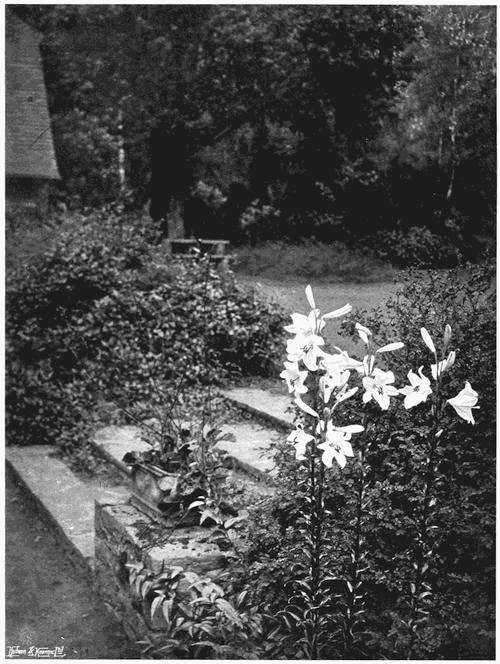
WHITE LILIES.
The "Country Life"
Library
COLOUR IN THE
FLOWER GARDEN
BY
GERTRUDE JEKYLL
PUBLISHED BY
"COUNTRY LIFE,"
Ltd.GEORGE NEWNES,
Ltd.20, TAVISTOCK STREET
7-12, SOUTHAMPTON ST.
COVENT GARDEN, W.C.
COVENT GARDEN, W.C.
1908
INTRODUCTION
To plant and maintain a flower-border, with a good scheme for colour, is by no means the easy thing that is commonly supposed.
I believe that the only way in which it can be made successful is to devote certain borders to certain times of year; each border or garden region to be bright for from one to three months.
Nothing seems to me more unsatisfactory than the border that in spring shows a few patches of flowering bulbs in ground otherwise looking empty, or with tufts of herbaceous plants just coming through. Then the bulbs die down, and their place is wanted for something that comes later. Either the ground will then show bare patches, or the place of the bulbs will be forgotten and they will be cruelly stabbed by fork or trowel when it is wished to put something in the apparently empty space.
For many years I have been working at these problems in my own garden, and having come to certain conclusions, can venture to put them forth with some confidence. I may mention that from the nature of the ground, in its original state partly wooded and partly bare field, and from its having been brought into cultivation and some sort of shape before it was known where the house now upon it would exactly stand, the garden has less general unity of design than I should have wished. The position and general form of its various portions were accepted mainly according to their natural conditions, so that the garden ground, though but of small extent, falls into different regions, with a general, but not altogether definite, cohesion.
I am strongly of opinion that the possession of a quantity of plants, however good the plants may be themselves and however ample their number, does not make a garden; it only makes a collection. Having got the plants, the great thing is to use them with careful selection and definite intention. Merely having them, or having them planted unassorted in garden spaces, is only like having a box of paints from the best colourman, or, to go one step further, it is like having portions of these paints set out upon a palette. This does not constitute a picture; and it seems to me that the duty we owe to our gardens and to our own bettering in our gardens is so to use the plants that they shall form beautiful pictures; and that, while delighting our eyes, they should be always training those eyes to a more exalted criticism; to a state of mind and artistic conscience that will not tolerate bad or careless combination or any sort of misuse of plants, but in which it becomes a point of honour to be always striving for the best.
It is just in the way it is done that lies the whole difference between commonplace gardening and gardening that may rightly claim to rank as a fine art. Given the same space of ground and the same material, they may either be fashioned into a dream of beauty, a place of perfect rest and refreshment of mind and body—a series of soul-satisfying pictures—a treasure of well-set jewels; or they may be so misused that everything is jarring and displeasing. To learn how to perceive the difference and how to do right is to apprehend gardening as a fine art. In practice it is to place every plant or group of plants with such thoughtful care and definite intention that they shall form a part of a harmonious whole, and that successive portions, or in some cases even single details, shall show a series of pictures. It is so to regulate the trees and undergrowth of the wood that their lines and masses come into beautiful form and harmonious proportion; it is to be always watching, noting and doing, and putting oneself meanwhile into closest acquaintance and sympathy with the growing things.
In this spirit, the garden and woodland, such as they are, have been formed. There have been many failures, but, every now and then, I am encouraged and rewarded by a certain measure of success. Yet, as the critical faculty becomes keener, so does the standard of aim rise higher; and, year by year, the desired point seems always to elude attainment.
But, as I may perhaps have taken more trouble in working out certain problems, and given more thought to methods of arranging growing flowers, especially in ways of colour-combination, than amateurs in general, I have thought that it may be helpful to some of them to describe as well as I can by word, and to show by plan and picture, what I have tried to do, and to point out where I have succeeded and where I have failed.
I must ask my kind readers not to take it amiss if I mention here that I cannot undertake to show it them on the spot. I am a solitary worker; I am growing old and tired, and suffer from very bad and painful sight. My garden is my workshop, my private study and place of rest. For the sake of health and reasonable enjoyment of life it is necessary to keep it quite private, and to refuse the many applications of those who offer it visits. My oldest friends can now only be admitted. So I ask my readers to spare me the painful task of writing long letters of excuse and explanation; a task that has come upon me almost daily of late years in the summer months, that has sorely tried my weak and painful eyes, and has added much to the difficulty of getting through an already over-large correspondence.
CONTENTS
PAGE INTRODUCTIONv
CHAPTER IA MARCH STUDY AND THE BORDER OF EARLY BULBS
1
CHAPTER IITHE WOOD
8
CHAPTER IIITHE SPRING GARDEN
21
CHAPTER IVBETWEEN SPRING AND SUMMER
32
CHAPTER VTHE JUNE GARDEN
39
CHAPTER VITHE MAIN HARDY FLOWER BORDER
49
CHAPTER VIITHE FLOWER BORDER IN JULY
58
CHAPTER VIIITHE FLOWER BORDER IN AUGUST
65
CHAPTER IXTHE FLOWER BORDERS IN SEPTEMBER
78
CHAPTER XWOOD AND SHRUBBERY EDGES
83
CHAPTER XIGARDENS OF SPECIAL COLOURING
89
CHAPTER XIICLIMBING PLANTS
106
CHAPTER XIIIGROUPING OF PLANTS IN POTS
112
CHAPTER XIVSOME GARDEN PICTURES
121
CHAPTER XVA BEAUTIFUL FRUIT GARDEN
127
CHAPTER XVIPLANTING FOR WINTER COLOUR
133
CHAPTER XVIIFORM IN PLANTING
138
INDEX143
LIST OF ILLUSTRATIONS
White LiliesFrontispiece
To face page Iris Stylosa4
Magnolia Conspicua5
Magnolia Stellata6
Ferns in the Bulb Border7
The Bank of Early Bulbs7
Daffodils by a Woodland Path10
Wild Primroses in thin Woodland11
The Wide Wood Path12
Cistus Laurifolius13
A Wood Path among Chestnuts14
A Wood Path among Birches15
Cistus Cyprius16
Cistus by the Wood Path17
Gaultheria Shallon in Flower18
Gaultheria Shallon in Fruit19
White Irish Heath20
The Spring Garden from D on Plan21
Plan of the Spring Garden23
The Fern-like Sweet Cicely24
The Spring Garden from E on Plan25
"Further Rock" from G on Plan28
"Further Rock" from H on Plan29
"Near Rock" from F on Plan30
The Primrose Garden31
Steps to the Hidden Garden32
Phlox Divaricata and Arenaria Montana33
Male Fern in the Hidden Garden34
Exochorda Grandiflora35
Plan of the Hidden Garden35
Euphorbia Wulfenii36
Irises and Lupines in the June Garden37
Part of the Garland Rose at the Angle39
Rose Blush Gallica on Dry Walling42
Spanish Iris43
Plan of the June Garden44
Plan of Iris and Lupine Borders44
White Tree Lupine46
Catmint in June47
Scotch Briars48
Geranium Ibericum Platyphyllum49
The Flower Border in Late Summer50
The Cross Walk51
The East End of the Flower Border52
Plan of the Main Flower Border53
Good Staking—Campanula Persicifolia54
Careful Staking of Michaelmas Daisies55
White Rose La Guirlande; Grey Borders Beyond60
Clematis Recta61
Delphinium Belladonna62
Canterbury Bells63
Rose The Garland in a Silver Holly64
Eryngium Oliverianum65
Tall Campanulas in a Grey Border66
Yucca Filamentosa70
The Grey Borders: Stachys, &c.71
A Lavender Hedge74
Æsculus and Olearia75
Plan of Garden of China Asters77
Some of the Early Asters78
The September Garden79
The September Garden80
The September Garden80
Begonias with Megasea Foliage80
Early Asters and Pyrethrum Uliginosum81
Plan of September Borders81
Garland Rose, where Garden joins Wood84
Polygonum and Megasea at a Wood Edge84
Lilies and Funkias at a Shrubbery Edge84
Olearia Gunni, Fern and Funkia85
Ferns and Lilies at a Shrubbery Edge86
Gypsophila and Megasea87
Lilies and Ferns at the Wood Edge88
Small Wire-stemmed Aster; Second Year88
Small Wire-stemmed Aster; Third Year88
Stobæa Purpurea89
The Grey Borders: Gypsophila, Echinops, &c.92
October Borders of Michaelmas Daisies92
A September Grey Garden92
The Grey Border: Pink Hollyhock, &c.93
Plans of Special Colour Gardens93
A Detail of the Grey September Garden100
Yuccas and Grey Foliage102
A Front Edge of Grey Foliage103
Hardy Grape Vine on South Side of House106
Hardy Grape Vine on House Wall107
Vine and Fig at Door of Mushroom House108
Clematis Montana at Angle of Court108
Clematis Montana over Workshop Window108
Clematis Montana trained as Garlands108
Clematis Flammula and Spiræa Lindleyana108
Abutilon Vitifolium108
Ipomœa "Heavenly Blue"108
Solanum Jasminoides108
Clematis Flammula on Angle of Cottage108
Clematis Flammula on Cottage109
Clematis Flammula on a Wooden Fence110
Sweet Verbena111
Pot Plants just placed112
Plants in Pots in the Shaded Court112
Maiden's Wreath (Francoa Ramosa)112
Maiden's Wreath by Tank113
Geraniums, &c., in a Stone-edged Bed116
Maiden's Wreath in Pots above Tank116
Funkia, Hydrangea and Lily in the Shaded Court116
Funkia and Lilium Speciosum117
Lilium Auratum120
A Tub Hydrangea120
Steps and Hydrangeas120
The Narrow South Lawn121
Hydrangea Tubs and Birch-Tree Seat124
Hydrangea Tubs and Nut Walk124
White Lilies124
The Steps and Their Incidents125
Plan—The Beautiful Fruit Garden129
Plan—A Wild Heath Garden139
COLOUR IN THE FLOWER
GARDEN
CHAPTER I
A MARCH STUDY AND THE BORDER OF EARLY BULBS
There comes a day towards the end of March when there is but little wind, and that is from the west or even south-west. The sun has gained much power, so that it is pleasant to sit out in the garden, or, better still, in some sunny nook of sheltered woodland. There is such a place among silver-trunked Birches, with here and there the splendid richness of masses of dark Holly. The rest of the background above eye-level is of the warm bud-colour of the summer-leafing trees, and, below, the fading rust of the now nearly flattened fronds of last year's Bracken, and the still paler drifts of leaves from neighbouring Oaks and Chestnuts. The sunlight strikes brightly on the silver stems of the Birches, and casts their shadows clear-cut across the grassy woodland ride. The grass is barely green as yet, but has the faint winter green of herbage not yet grown and still powdered with the short remnants of the fine-leaved, last-year-mown heath grasses. Brown leaves still hang on young Beech and Oak. The trunks of the Spanish Chestnuts are elephant-grey, a notable contrast to the sudden, vivid shafts of the Birches. Some groups of the pale early Pyrenean Daffodil gleam level on the ground a little way forward.
It is the year's first complete picture of flower-effect in the woodland landscape. The place is not very far from the house, in the nearest hundred yards of the copse; where flowers seem to be more in place than further away. Looking to the left, the long ridge and south slope of the house-roof is seen through the leafless trees, though the main wall-block is hidden by the sheltering Hollies and Junipers.
Coming down towards the garden by another broad grassy way, that goes westward through the Chestnuts and then turns towards the down-hill north, there comes yet another deviation through Rhododendrons and Birches to the main lawn. But before the last turn there is a pleasant mass of colour showing in the wood-edge on the dead-leaf carpet. It is a straggling group of Daphne Mezereon, with some clumps of red Lent Hellebores, and, to the front, some half-connected patches of the common Dog-tooth Violet. The nearly related combination of colour is a delight to the trained colour-eye. There is nothing brilliant; it is all restrained, refined, in harmony with the veiled light that reaches the flowers through the great clumps of Hollies and tall half-overhead Chestnuts and neighbouring Beech. The colours are all a little "sad," as the old writers so aptly say of the flower-tints of secondary strength. But it is a perfect picture. One comes to it again and again as one does to any picture that is good to live with.
To devise these living pictures with simple well-known flowers seems to me the best thing to do in gardening. Whether it is the putting together of two or three kinds of plants, or even of one kind only in some happy setting, or whether it is the ordering of a much larger number of plants, as in a flower-border of middle and late summer, the intention is always the same. Whether the arrangement is simple and modest, whether it is obvious or whether it is subtle, whether it is bold and gorgeous, the aim is always to use the plants to the best of one's means and intelligence so as to form pictures of living beauty.
It is a thing that I see so rarely attempted, and that seems to me so important, that the wish to suggest it to others, and to give an idea of examples that I have worked out, in however modest a way, is the purpose of this book.
These early examples within the days of March are of special interest because as yet flowers are but few; the mind is less distracted by much variety than later in the year, and is more readily concentrated on the few things that may be done and observed; so that the necessary restriction is a good preparation, by easy steps, for the wider field of observation that is presented later.
Now we pass on through the dark masses of Rhododendron and the Birches that shoot up among them. How the silver stems, blotched and banded with varied browns and greys so deep in tone that they show like a luminous black, tell among the glossy Rhododendron green; and how strangely different is the way of growth of the two kinds of tree; the tall white trunks spearing up through the dense, dark, leathery leaf-masses of solid, roundish outline, with their delicate network of reddish branch and spray gently swaying far overhead!
Now we come to the lawn, which slopes a little downward to the north. On the right it has a low retaining-wall, whose top line is level; it bears up a border and pathway next the house's western face. The border and wall are all of a piece, for it is a dry wall partly planted with the same shrubby and half-shrubby things that are in the earth above. They have been comforting to look at all the winter; a pleasant grey coating of Phlomis, Lavender, Rosemary, Cistus and Santolina; and at the end and angle where the wall is highest, a mass of Pyrus japonica, planted both above and below, already showing its rose-red bloom. At one point at the foot of the wall is a strong tuft of Iris stylosa whose first blooms appeared in November. This capital plant flowers bravely all through the winter in any intervals of open weather. It likes a sunny place against a wall in poor soil. If it is planted in better ground the leaves grow very tall and it gives but little bloom.
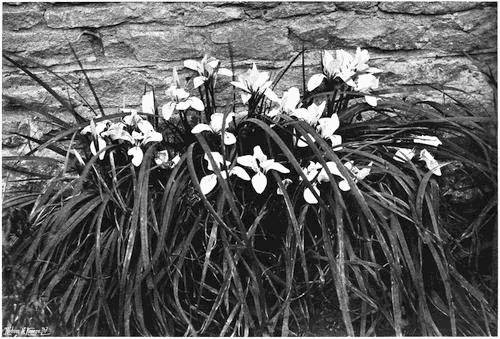
IRIS STYLOSA.
Now we pass among some shrub-clumps, and at the end come upon a cheering sight; a tree of Magnolia conspicua bearing hundreds of its great white cups of fragrant bloom. Just before reaching it, and taking part with it in the garden picture, are some tall bushes of Forsythia suspensa, tossing out many-feet-long branches loaded with their burden of clear yellow flowers. They are ten to twelve feet high, and one looks up at much of the bloom clear-cut against the pure blue of the sky; the upper part of the Magnolia also shows against the sky. Here there is a third flower-picture; this time of warm white and finest yellow on brilliant blue, and out in open sunlight. Among the Forsythias is also a large bush of Magnolia stellata, whose milk-white flowers may be counted by the thousand. As the earlier M. conspicua goes out of bloom it comes into full bearing, keeping pace with the Forsythia, whose season runs on well into April.
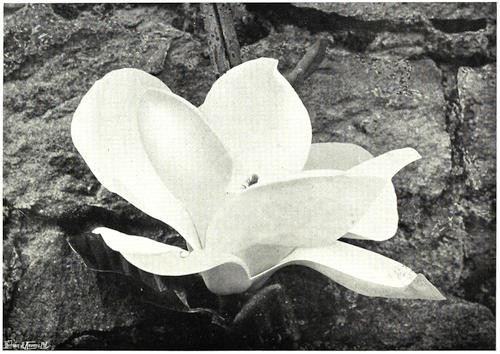
MAGNOLIA CONSPICUA.
It is always a little difficult to find suitable places for the early bulbs. Many of them can be enjoyed in rough and grassy places, but we also want to combine them into pretty living pictures in the garden proper.
Nothing seems to me more unsatisfactory than the usual way of having them scattered about in small patches in the edges of flower-borders, where they only show as little disconnected dabs of colour, and where they are necessarily in danger of disturbance and probable injury when their foliage has died down and their places are wanted for summer flowers.
It was a puzzle for many years to know how to treat these early bulbs, but at last a plan was devised that seems so satisfactory that I have no hesitation in advising it for general adoption.
On the further side of a path that bounds my June garden is a border about seventy feet long and ten feet wide. At every ten feet along the back is a larch post planted with a free-growing Rose. These are not only to clothe their posts but are to grow into garlands swinging on slack chains from post to post. Beyond are Bamboos, and then an old hedge-bank with Scotch Firs, Oaks, Thorns, &c. The border slopes upwards from the path, forming a bank of gentle ascent. It was first planted with hardy Ferns in bold drifts; Male Fern for the most part, because it is not only handsome but extremely persistent; the fronds remaining green into the winter. The Fern-spaces are shown in the plan by diagonal hatching; between them come the bulbs, with a general edging to the front of mossy Saxifrage.
The colour-scheme begins with the pink of Megasea ligulata, and with the lower-toned pinks of Fumaria bulbosa and the Dog-tooth Violets (Erythronium). At the back of these are Lent Hellebores of dull red colouring, agreeing charmingly with the colour of the bulbs. A few white Lent Hellebores are at the end; they have turned to greenish white by the time the rather late Scilla amœna is in bloom. Then comes a brilliant patch of pure blue with white—Scilla sibirica and white Hyacinths, followed by the also pure blues of Scilla bifolia and Chionodoxa and the later, more purple-blue of Grape Hyacinth. A long drift of white Crocus comes next, in beauty in the border's earliest days; and later, the blue-white of Puschkinia; then again pure blue and white of Chionodoxa and white Hyacinth.
Now the colours change to white and yellow and golden foliage, with the pretty little pale trumpet Daffodil Consul Crawford, and beyond it the stronger yellow of two other small early kinds—N. nanus and the charming little N. minor, quite distinct though so often confounded with nanus in gardens. With these, and in other strips and patches towards the end of the border, are plantings of the Golden Valerian, so useful for its bright yellow foliage quite early in the year. The leaves of the Orange Day-lily are also of a pale yellowish green colour when they first come up, and are used at the end of the border. These plants of golden and pale foliage are also placed in a further region beyond the plan, and show to great advantage as the eye enfilades the border and reaches the more distant places. Before the end of the bulb-border is reached there is once more a drift of harmonised faint pink colouring of Megasea and the little Fumaria (also known as Corydalis bulbosa) with the pale early Pyrenean Daffodil, N. pallidus præcox.
The bulb-flowers are not all in bloom exactly at the same time, but there is enough of the colour intended to give the right effect in each grouping. Standing at the end, just beyond the Dog-tooth Violets, the arrangement and progression of colour is pleasant and interesting, and in some portions vivid; the pure blues in the middle spaces being much enhanced by the yellow flowers and golden foliage that follow.
Through April and May the leaves of the bulbs are growing tall, and their seed-pods are carefully removed to prevent exhaustion. By the end of May the Ferns are throwing up their leafy crooks; by June the feathery fronds are displayed in all their tender freshness; they spread over the whole bank, and we forget that there are any bulbs between. By the time the June garden, whose western boundary it forms, has come into fullest bloom it has become a completely furnished bank of Fern-beauty.
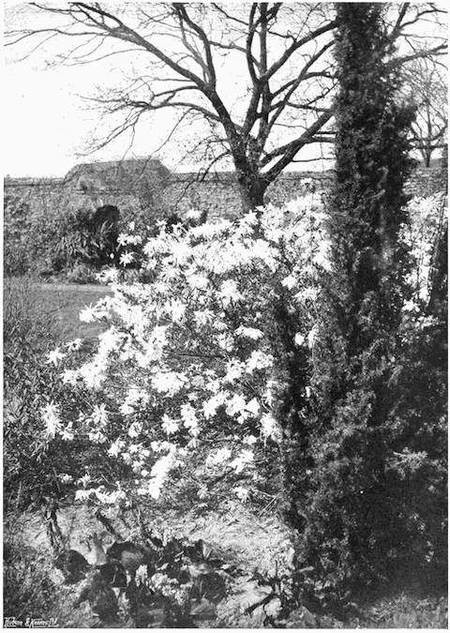
MAGNOLIA STELLATA.
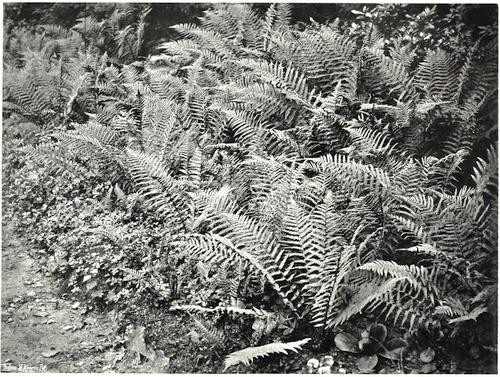
FERNS IN THE BULB BORDER.

THE BANK OF EARLY BULBS.
CHAPTER II
THE WOOD
Ten acres is but a small area for a bit of woodland, yet it can be made apparently much larger by well-considered treatment. As the years pass and the different portions answer to careful guidance, I am myself surprised to see the number and wonderful variety of the pictures of sylvan beauty that it displays throughout the year. I did not specially aim at variety, but, guided by the natural conditions of each region, tried to think out how best they might be fostered and perhaps a little bettered.
The only way in which variety of aspect was deliberately chosen was in the way of thinning out the natural growths. It was a wood of seedling trees that had come up naturally after an old wood of Scotch Fir had been cut down, and it seemed well to clear away all but one, or in some cases two kinds of trees in the several regions. Even in this the intention was to secure simplicity rather than variety, so that in moving about the ground there should be one thing at a time to see and enjoy. It is just this quality of singleness or simplicity of aim that I find wanting in gardens in general, where one may see quantities of the best plants grandly grown and yet no garden pictures.
Of course one has to remember that there are many minds to which this need of an artist's treatment of garden and woodland does not appeal, just as there are some who do not care for music or for poetry, or who see no difference between the sculpture of the old Greeks and that of any modern artist who is not of the first rank, or to whom architectural refinement is as an unknown language. And in the case of the more superficial enjoyment of flowers one has sympathy too. For a love of flowers, of any kind, however shallow, is a sentiment that makes for human sympathy and kindness, and is in itself uplifting, as everything must be that is a source of reverence and admiration. Still, the object of this book is to draw attention, however slightly and imperfectly, to the better ways of gardening, and to bring to bear upon the subject some consideration of that combination of common sense, sense of beauty and artistic knowledge that can make plain ground and growing things into a year-long succession of living pictures. Common sense I put first, because it restrains from any sort of folly or sham or affectation. Sense of beauty is the gift of God, for which those who have received it in good measure can never be thankful enough. The nurturing of this gift through long years of study, observation, and close application in any one of the ways in which fine art finds expression is the training of the artist's brain and heart and hand. The better a human mind is trained to the perception of beauty the more opportunities will it find of exercising this precious gift and the more directly will it be brought to bear upon even the very simplest matters of everyday life, and always to their bettering.
So it was in the wood of young seedling trees, where Oak and Holly, Birch, Beech and Mountain Ash, came up together in a close thicket of young saplings. It seemed well to consider, in the first place, how to bring something like order into the mixed jumble, and, the better to do this, to appeal to the little trees themselves and see what they had to say about it.
The ground runs on a natural slope downward to the north, or, to be more exact, as the highest point is at one corner, its surface is tilted diagonally all over. So, beginning at the lower end of the woody growth, near the place where the house some day might stand, the first thing that appeared was a well-grown Holly, and rather near it, another; both older trees than the more recent seedling growth. Close to the second Holly was a young Birch, the trunk about four inches thick and already in the early pride of its silvering bark. That was enough to prompt the decision that this part of the wood should be of silver Birch and Holly, so nearly all other growths were cut down or pulled up. A hundred yards higher up there were some strong young Oaks, then some Beeches, and, all over the top of the ground a thick growth of young Scotch Fir, while the western region had a good sprinkling of promising Spanish Chestnut.
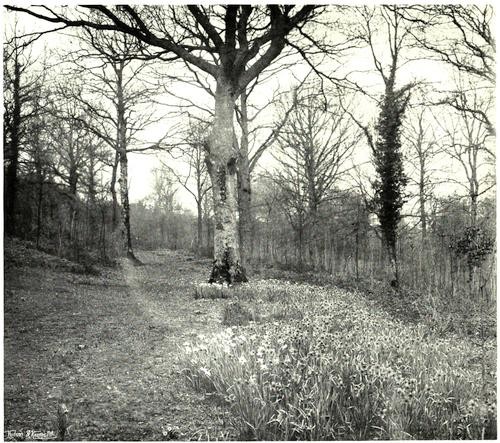
DAFFODILS BY A WOODLAND PATH.
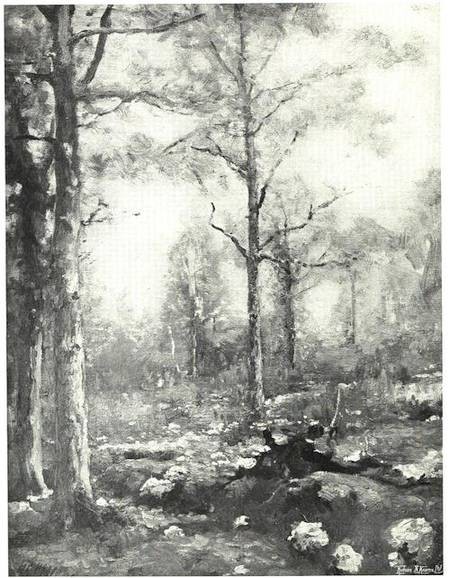
WILD PRIMROSES IN THIN WOODLAND.
(From a Picture by Henry Moon.)
All these natural groupings were accepted, and a first thinning was made of the smallest stuff of other kinds. But it was done with the most careful watching, for there were to be no harsh frontiers. One kind of tree was to join hands with the next, and often a distinct deviation was made to the general rule. For the beautiful growth of the future wood was the thing that mattered, rather than obedience to any inflexible law.
Now, after twenty years, the saplings have become trees and the preponderance of one kind of tree at a time has given a feeling of repose and dignity. Here and there something exceptional occurs, but it causes interest, not confusion. Five woodland walks pass upward through the trees; every one has its own character, while its details change during the progress—never abruptly but in leisurely sequence; as if inviting the quiet stroller to stop a moment to enjoy some little woodland suavity, and then gently enticing him to go further, with agreeable anticipation of what may come next. And if I may judge by the pleasure that these woodland ways give to some of my friends that I know are in sympathy with what I am trying to do, and by my own thankful delight in them, I may take it that my little sylvan pictures have come fairly right, so that I may ask my reader to go with me in spirit through some of them.
My house, a big cottage, stands facing a little to the east of south, just below the wood. The windows of the sitting-room and its outer door, which stands open in all fine summer weather, look up a straight wide grassy way, the vista being ended by a fine old Scotch Fir with a background of dark wood. This old Fir and one other, and a number in and near the southern hedge, are all that remain of the older wood which was all of Scotch Fir.
This green wood walk, being the widest and most important, is treated more boldly than the others—with groups of Rhododendrons in the region rather near the house, and for the rest only a biggish patch of the two North American Brambles, the white-flowered Rubus nutkanus, and the rosy R. odoratus. In spring the western region of tall Spanish Chestnuts, which begins just beyond the Rhododendrons, is carpeted with Poets' Narcissus; the note of tender white blossom being taken up and repeated by the bloom-clouds of Amelanchier, that charming little woodland flowering tree whose use in such ways is so much neglected. Close to the ground in the distance the light comes with brilliant effect through the young leaves of a wide-spread carpet of Lily of the Valley, whose clusters of sweet little white bells will be a delight to see a month hence.
The Rhododendrons are carefully grouped for colour—pink, white, rose and red of the best qualities are in the sunniest part, while, kept well apart from them, near the tall Chestnuts and rejoicing in their partial shade, are the purple colourings, of as pure and cool a purple as may be found among carefully selected ponticum seedlings and the few named kinds that associate well with them. Some details of this planting were given at length in my former book "Wood and Garden."
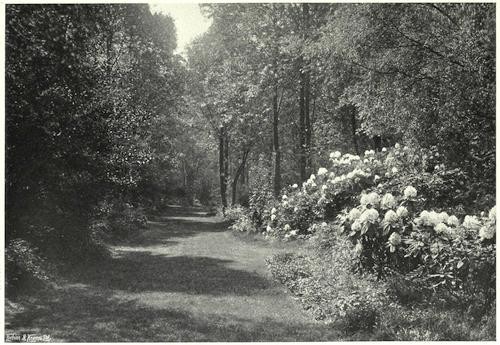
THE WIDE WOOD-PATH.
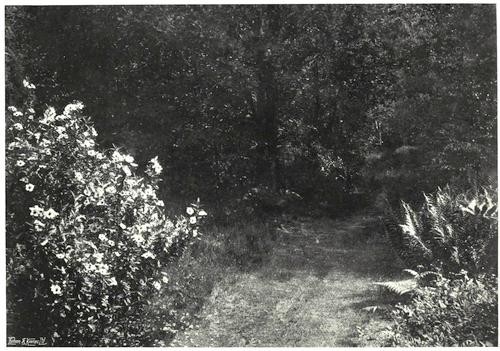
CISTUS LAURIFOLIUS AT THE SUNNY ENTRANCE OF THE FERN WALK.
Among the Rhododendrons, at points carefully devised to be of good effect, either from the house or from various points of the lawn and grass paths, are strong groups of Lilium auratum; they give a new picture of flower-beauty in the late summer and autumn and till near the end of October. The dark, strong foliage makes the best possible setting for the Lilies, and gives each group of them its fullest value. Another, narrower path, more to the east, is called the Fern walk, because, besides the general growth of Bracken that clothes the whole of the wood, there are groups of common hardy Ferns in easy patches, planted in such a way as to suggest that they grew there naturally. The Male Fern, the beautiful Dilated Shield Fern, and Polypody are native to the ground, and it was easy to place these, in some cases merely adding to a naturally grown tuft, so that they look quite at home. Lady Fern, Blechnum and Osmunda, and Oak and Beech Ferns have been added, the Osmunda in a depression that collects the water from any storms of rain.
At the beginning of all these paths I took some pains to make the garden melt imperceptibly into the wood, and in each case to do it a different way. Where this path begins the lawn ends at a group of Oak, Holly and Cistus, with an undergrowth of Gaultheria and Andromeda. The larger trees are to the left and the small evergreen shrubs on a rocky mound to the right. Within a few yards the turf path becomes a true wood path. Just as wild gardening should never look like garden gardening, or, as it so sadly often does, like garden plants gone astray and quite out of place, so wood paths should never look like garden paths. There must be no hard edges, no conscious boundaries. The wood path is merely an easy way that the eye just perceives and the foot follows. It dies away imperceptibly on either side into the floor of the wood and is of exactly the same nature, only that it is smooth and easy and is not encumbered by projecting tree-roots, Bracken or Bramble, these being all removed when the path is made.
If it is open enough to allow of the growth of grass, and the grass has to be cut, and is cut with a machine, then a man with a faghook must follow to cut away slantingly the hard edge of standing grass that is left on each side. For the track of the machine not only leaves the hard, unlovely edges, but also brings into the wood the incongruous sentiment of that discipline of trimness which belongs to the garden, and that, even there in its own place, is often overdone.
Now we are in the true wood-path among Oaks and Birches. Looking round, the view is here and there stopped by prosperous-looking Hollies, but for the most part one can see a fair way into the wood. In April the wood-floor is plentifully furnished with Daffodils. Here, in the region furthest removed from the white Poets' Daffodil of the upper ground, they are all of trumpet kinds, and the greater number of strong yellow colour. For the Daffodils range through the wood in a regular sequence of kinds that is not only the prettiest way to have them, but that I have often found, in the case of people who did not know their Daffodils well, served to make the whole story of their general kinds and relationships clear and plain; the hybrids of each group standing between the parent kinds; these again leading through other hybrids to further clearly defined species, ending with the pure trumpets. As the sorts are intergrouped at their edges, so that at least two removes are in view at one time, the lesson in the general relationship of kinds is easily learnt.
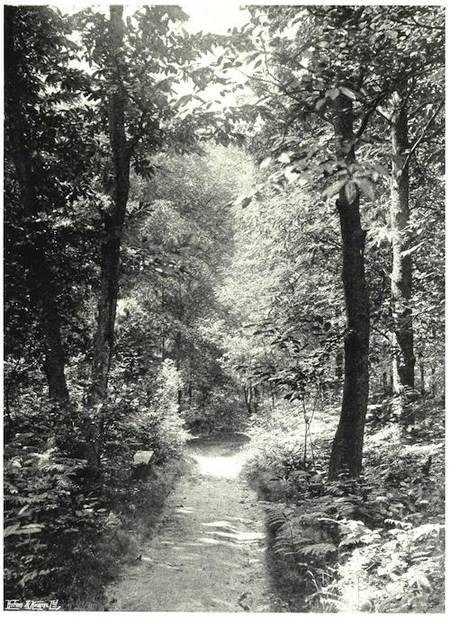
A WOOD-PATH AMONG CHESTNUTS.
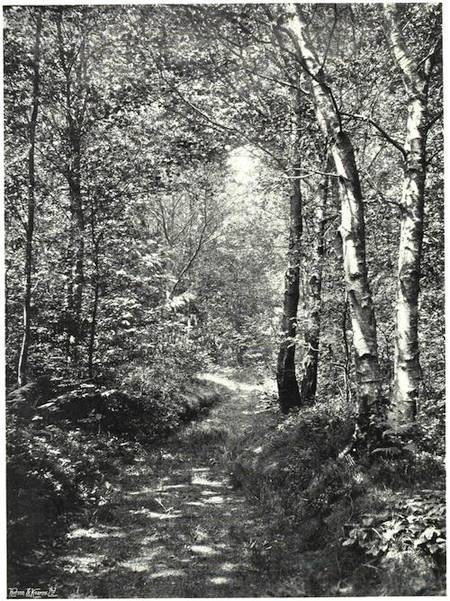
A WOOD-PATH AMONG BIRCHES.
They are planted, not in patches but in long drifts, a way that not only shows the plant in good number to better advantage, but that is singularly happy in its effect in the woodland landscape. This is specially noticeable towards the close of the day, when the sunlight, yellowing as it nears the horizon, lights up the long stretches of yellow bloom with an increase of colour strength, while the wide-stretching shadow-lengths throw the woodland shades into large phrases of broadened mass, all subdued and harmonised by the same yellow light that illuminates the long level ranks of golden bloom.
From this same walk in June, looking westward through the Birch stems, the value of the careful colour-scheme of the Rhododendrons is fully felt. They are about a hundred yards away, and their mass is broken by the groups of intervening tree-trunks, but their brightness is all the more apparent seen from under the nearer roofing mass of tree-top, and the yellowing light makes the intended colour-effect still more successful by throwing its warm tone over the whole.
But nearer at hand the Fern walk has its own little pictures. In early summer there are patches of Trillium, the white Wood Lily, in cool hollows among the ferns, and, some twenty paces further up, another wider group of the same. Between the two, spreading through a mossy bank, in and out among the ferns and right down to the path, next to a coming patch of Oak Fern, is a charming little white flower. Its rambling roots thread their way under the mossy carpet, and every few inches throw up a neat little stem and leaves crowned with a starry flower of tenderest white. It is Trientalis, a native of our most northern hill-woods, the daintiest of all woodland flowers.
To right and left white Foxgloves spire up among the Bracken. When the Foxglove-seed is ripe, we remember places in the wood where tree-stumps were grubbed last winter. A little of the seed is scattered in these places and raked in. Meanwhile one forgets all about it till two years afterwards there are the stately Foxgloves. It is good to see their strong spikes of solid bloom standing six to seven feet high, and then to look down again at the lowly Trientalis and to note how the tender little blossom, poised on its thread-like stem, holds its own in interest and importance.
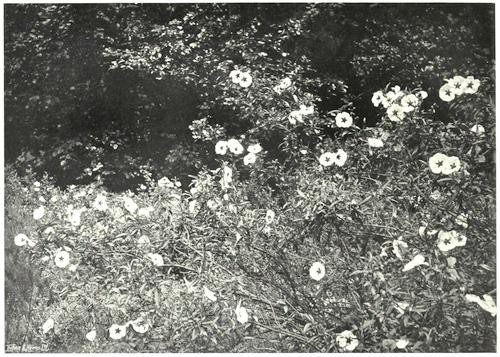
CISTUS CYPRIUS IN THE CISTUS CLEARING.

CISTUS BY THE WOOD-PATH.
Further up the Fern walk, near the upper group of Trillium, are some patches of a plant with roundish, glittering leaves. It is a North American Asarum (A. virginicum); the curious wax-like brown and greenish flower, after the usual manner of its kind, is short-stalked and hidden at the base of the leaf-stems. Near it, and growing close to the ground in a tuft of dark-green moss, is an interesting plant—Goodyera repens, a terrestrial Orchid. One might easily pass it by, for its curiously white-veined leaves are half hidden in the moss, and its spike of pale greenish white flower is not conspicuous; but, knowing it is there, I never pass without kneeling down, both to admire its beauty and to ensure its well-being by a careful removal of a little of the deep moss here and there where it threatens too close an invasion.
Now there comes a break in the Fern walk, or rather it takes another character. The end of one of the wide green ways that we call the Lily path comes into it on the right, and, immediately beyond this, stands the second of the great Scotch Firs of the older wood. The trunk, at five feet from the ground, has a girth of nine and a half feet. The colour of the rugged bark is a wonder of lovely tones of cool greys and greens, and of a luminous deep brown in the fissures and cavities. Where the outer layers have flaked off it is a warm reddish grey, of a quality that is almost peculiar to itself. This great tree's storm-rent head towers up some seventy feet, far above the surrounding foliage of Oak and Birch. Close to its foot, and showing behind it as one comes up the Fern walk, are a Holly and a Mountain Ash.
This spot is a meeting-place of several ways. On the right the wide green of the Lily path; then, still bearing diagonally to the right, one of the ways into the region of Azalia and Cistus; then, straight past the big tree, a wood walk carpeted with Whortleberry and passing through a whole Whortleberry region under Oaks, Hollies and Beeches, and, lastly, the path which is the continuation of the Fern walk. Looking along it one sees, a little way ahead, a closer shade of trees, for the most part Oak, but before entering this, on the right-hand gently rising bank, is a sheet of bright green leaves, closely set in May with neat spikes of white bloom. It is Smilacina bifolia, otherwise known as Maianthemum bifolium. The pretty little plant has taken to the place in a way that rejoices the heart of the wild gardener, joining in perfect accord with the natural growth of short Whortleberry and a background of the graceful fronds of Dilated Shield Fern, and looking as if it was of spontaneous growth.
Now the path passes a large Holly, laced through and through with wild Honeysuckle. The Honeysuckle stems that run up into the tree look like great ropes, and a quantity of the small ends come showering out of the tree-top and over the path, like a tangled veil of small cordage.
The path has been steadily rising, and now the ascent is a little steeper. The character of the trees is changing; Oaks are giving way to Scotch Firs. Just where this change begins the bank to right and left is covered with the fresh, strong greenery of Gaultheria Shallon. About twenty years ago a few small pieces were planted. Now it is a mass of close green growth two to three feet high and thirty paces long, and extending for several yards into the wood to right and left. In a light, peaty soil such as this, it is the best of undershrubs. It is in full leaf-beauty in the dead of winter, while in early summer it bears clusters of good flowers of the Arbutus type. These are followed by handsome dark berries nearly as large as black currants, covered with a blue-grey bloom.

GAULTHERIA SHALLON IN FLOWER.
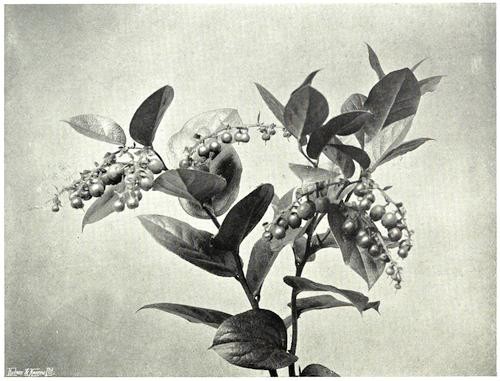
GAULTHERIA SHALLON IN FRUIT.
Now the path crosses another of the broad turfy ways, but here the turf is all of Heath; a fourteen-foot wide road of grey-rosy bloom in August; and now we are in the topmost region of Scotch Fir, with undergrowth of Whortleberry.
The wood path next to this goes nearly straight up through the middle of the ground. It begins at another point of the small lawn next the house, and passes first by a turf walk through a mounded region of small shrubs and carefully placed pieces of the local sandstone. Andromeda, Skimmia, and Alpenrose have grown into solid masses, so that the rocky ridges peer out only here and there. And when my friends say, "But then, what a chance you had with that shelf of rock coming naturally out of the ground," I feel the glowing warmth of an inward smile and think that perhaps the stones have not been so badly placed.
Near the middle of the woody ground a space was cleared that would be large enough to be sunny throughout the greater part of the day. This was for Cistuses. It is one of the compensations for gardening on the poorest of soils that these delightful shrubs do well with only the preparation of digging up and loosening the sand, for my soil is nothing better. The kinds that are best in the woody landscape are C. laurifolius and C. cyprius; laurifolius is the hardiest, cyprius rather the more beautiful, with its three-and-a-half-inch wide flowers of tenderest white with a red-purple blotch at the base of each petal. Its growth, also, is rather more free and graceful. It is the kind usually sold as ladaniferus, and flowers in July. C. laurifolius is a bush of rather denser habit; it bears an abundance of bloom rather smaller than that of C. cyprius, and without the coloured blotch. But when it grows old and some of its stems are borne down and lie along the ground, the habit changes and it acquires a free pictorial character. These two large-growing Cistuses are admirable for wild planting in sunny wood edges. The illustrations (pp. 16, 17) show their use, not only in their own ground, but by the sides of the grassy ways and the regions where the wood paths leave the lawn.
The sheltered, sunny Cistus clearing has an undergrowth of wild heaths that are native to the ground, but a very few other Heaths are added, namely, Erica ciliata and the Cornish Heath; and there is a fine patch at the joining of two of the little grassy paths of the white form of the Irish Heath (Menziesia polifolia).
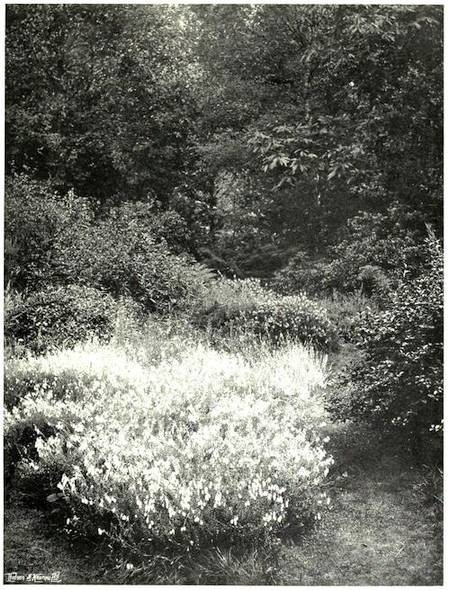
WHITE IRISH HEATH.
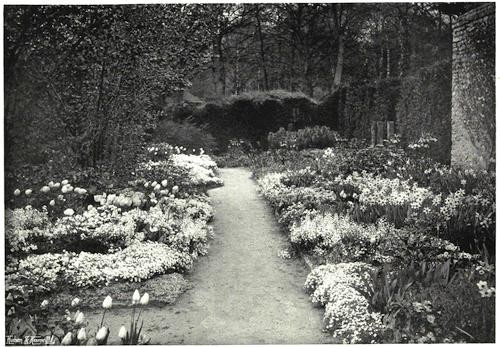
THE SPRING GARDEN FROM D ON PLAN. "NEAR ROCK" IS TO THE LEFT.
CISTUS CYPRIUS IN THE CISTUS CLEARING.
CISTUS BY THE WOOD-PATH.
CHAPTER III
THE SPRING GARDEN
As my garden falls naturally into various portions, distinct enough from each other to allow of separate treatment, I have found it well to devote one space at a time, sometimes mainly, sometimes entirely, to the flowers of one season of the year.
There is therefore one portion that is a complete little garden of spring flowers. It begins to show some bloom by the end of March, but its proper season is the month of April and three weeks of May.
In many places the spring garden has to give way to the summer garden, a plan that greatly restricts the choice of plants, and necessarily excludes some of the finest flowers of the early year.
My spring garden lies at the end and back of a high wall that shelters the big summer flower border from the north and north-west winds. The line of the wall is continued as a Yew hedge that in time will rise to nearly the same height, about eleven feet. At the far end the Yew hedge returns to the left so as to fence in the spring flowers from the east and to hide some sheds. The space also encloses some beds of Tree Peonies and a plot of grass, roughly circular in shape, about eight yards across, which is nearly surrounded by Oaks, Hollies and Cobnuts. The plan shows its disposition. It is of no design; the space was accepted with its own conditions, arranged in the simplest way as to paths, and treated very carefully for colour. It really makes as pretty a picture of spring flowers as one could wish to see.
The chief mass of colour is in the main border. The circles marked V and M are strong plants of Veratrum and Myrrhis. Gardens of spring flowers generally have a thin, poor effect for want of plants of important foliage. The greater number of them look what they are—temporary makeshifts. It seemed important that in this little space, which is given almost entirely to spring flowers, this weakness should not be allowed. But herbaceous plants of rather large growth with fine foliage in April and May are not many. The best I could think of are Veratrum nigrum, Myrrhis odorata and the newer Euphorbia Wulfenii. The Myrrhis is the Sweet Cicely of old English gardens. It is an umbelliferous plant with large fern-like foliage, that makes early growth and flowers in the beginning of May. At three years old a well-grown plant is a yard high and across. After that, if the plants are not replaced by young ones they grow too large, though they can be kept in check by a careful removal of the outer leaves and by cutting out some whole crowns when the plant is making its first growth. The Veratrum, with its large, deeply plaited, undivided leaves is in striking contrast, but the two kinds of plants, in groups as the plan shows, with running patches of the large form of Megasea cordifolia, the great Euphorbia Wulfenii and[Pg 23] [Pg 24] some groups of Black Hellebore, just give that comfortable impression of permanence and distinct intention that are usually so lamentably absent from gardens of spring flowers.
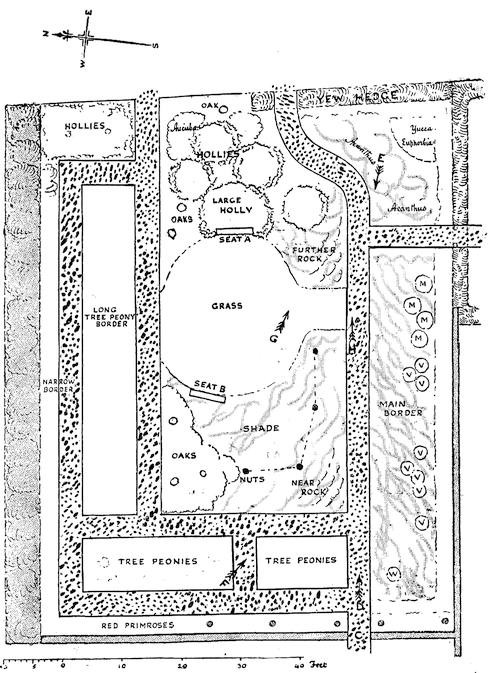
PLAN OF THE SPRING GARDEN.
Many years ago I came to the conclusion that in all flower borders it is better to plant in long rather than block-shaped patches. It not only has a more pictorial effect, but a thin long planting does not leave an unsightly empty space when the flowers are done and the leaves have perhaps died down. The word "drift" conveniently describes the shape I have in mind and I commonly use it in speaking of these long-shaped plantings.
Such drifts are shown faintly in the plan, reduced in number and simplified in form, but serving to show the general manner of planting. There are of course many plants that look best in a distinct clump or even as single examples, such as Dictamnus (the Burning Bush), and the beautiful pale yellow Pæonia wittmanniana, a single plant of which is marked W near the beginning of the main border.
For the first seven or eight yards, in the front and middle spaces, there are plants of tender colouring—pale Primroses, Tiarella, pale yellow Daffodils, pale yellow early Iris, pale lemon Wallflower, double Arabis, white Anemones and the palest of the lilac Aubrietias; also a beautiful pale lilac Iris, one of the Caparne hybrids; with long drifts of white and pale yellow Tulips—nothing deeper in colour than the graceful Tulipa retroflexa. At the back of the border the colours are darker; purple Wallflower and the great dull red-purple double Tulip so absurdly called Bleu Celeste. These run through and among and behind the first clump of Veratrums.
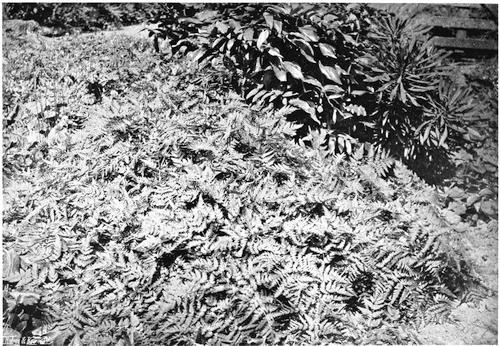
THE FERN-LIKE SWEET CICELY.
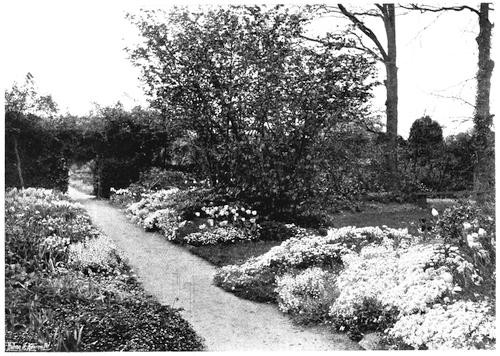
THE SPRING GARDEN FROM E ON PLAN. "FURTHER ROCK" IS ON THE NEAR RIGHT HAND.
In the middle of the length of the border there is still a good proportion of tender and light colouring in front: white Primroses and Daffodils; the pale yellow Uvularia and Adonis vernalis; but with these there are stronger colours. Tulip Chrysolora of fuller yellow, yellow Wallflowers, the tall Doronicum, and, towards the back, several patches of yellow Crown Imperial.
Then again in front, with more double Arabis, is the lovely pale blue of Myosotis dissitiflora and Mertensia virginica, and, with sheets of the foam-like Tiarella, the tender pink of Dicentra eximia and pink and rose-red Tulips. At the back of this come scarlet Tulips, the stately cream-white form of Camassia Leichtlini and a bold tuft of Solomon's Seal; then Orange Tulips, brown Wallflowers, Orange Crown Imperial, and taller scarlet Tulips of the gesneriana class. The strong colouring is repeated beyond the cross-path where the patches of Acanthus are shown, with more orange Tulips, brown Wallflowers, orange Crown Imperial and great flaming scarlet gesneriana Tulips. All this shows up finely against the background of dark yew. At the extreme end, where the yew hedge returns forward at a right angle, this point is accentuated by a raised mound of triangular shape, dry-walled and slightly curved forward on the side facing the border and the spectator. On this at the back is a young plant of Yucca gloriosa for display in future years and a front planting of the large growing Euphorbia Wulfenii, one of the grandest and most pictorial of plants of recent acquirement for garden use.
The Acanthus and Yucca are of course plants of middle and late summer; between them are some Tritomas. These plants are here because one of the most often used of the garden thoroughfares passes the point C, which is a thick-roofed arch of Rose and Clematis, and, seen from this point and framed by the near greenery, they form a striking picture of middle-distant form and colour in the later summer.
The space marked Further Rock is an upward-sloping bank; the Hollies standing in rather higher ground. Here the plants are between, and tumbling over, rocky ridges. Next the large Holly, and extending to the middle of the rocky promontory, are again the strong reds and browns, with accompanying bronze-red foliage of Heuchera Richardsoni. This gives place to dark green carpeting masses of Iberis with cold-white bloom, and, nearer the path, Lithospermum prostratum; the flower-colour here changing, through white, to blue and bluish; Myosotis in front telling charmingly against the dark-leaved Lithospermum. At the highest points, next to a great crowning boulder, is the Common Blue Iris and a paler one of the beautiful Caparne series. Then down to the path where it begins to turn is a drift of the bluish lilac Phlox divaricata, and, opposite the cross-path, some jewels of the newer pale yellow Alyssum sulphureum. This rocky shoulder is also enlivened by a natural-looking but very carefully considered planting of white Tulips that run through both the blue and the red regions.
The corner marked Near Rock is also a slightly raised bank. The dark dots are cobnuts; the dotted line between is where there are garlands of Clematis montana that swing on ropes between the nuts. The garlands dip down and nearly meet the flowers of some pale pink Tree Peonies. Open spaces above the garlands and under the meeting branches of the nuts give glimpses of distant points where some little scheme has been devised to please the eye, such as the bit of bank to the left of Seat A, where there are two little fish-like drifts of palest Aubrietia in a dense grey setting of Cerastium.
The point of the Near Rock next the path agrees with the colouring opposite, but also has features of its own; a groundwork of grey Antennaria, the soft lilac-pink of the good Aubrietia Moorheimi changing to the left to the fuller pink of Phlox amœna, and above to the type colour of Aubrietia and the newer strong purples such as the variety Dr. Mules. To the left, towards the oaks, the colouring is mostly purple, with strong tufts of the Spring Bitter Vetch (Orobus vernus), purple Wallflowers, and, under and behind the nuts, purple Honesty. Thin streams of white Tulips intermingle with other streams of pink Tulips that crown the angle and flow down again to the main path between ridges of double Arabis, white Iberis, and cloudy masses of the pretty pale yellow Corydalis ochroleuca, which spreads into a wide carpet under the Tree Peonies and Clematis garlands.
Further along, just clear of the nuts, are some patches of Dielytra spectabilis, its graceful growth arching out over the lower stature of pink Tulips and harmonising charmingly with the pinkish-green foliage of the Tree Peonies just behind. The pink Tulips are here in some quantity; they run boldly into pools of pale blue Myosotis, with more Iberis where the picture demands the strongest, deepest green, and more Corydalis where the softer, greyer tones will make it better.
The space marked Shade, always in shade from the nuts and oaks, is planted with rather large patches of the handsome white-flowered Dentaria, the graceful North American Uvularia grandiflora, in habit like a small Solomon's Seal but with yellow flowers much larger in proportion; with Myrrhis and purple Honesty at the back and sheets of Sweet Woodruff to the front.
There are Tree Peonies in the long border and the two others. It is difficult to grow them in my hot, dry, sandy soil, even though I make them a liberal provision of just such a compost as I think they will like. I have noticed that they do best when closely overshadowed by some other growing thing. In the two near beds there are some Mme. Alfred Carrière Roses that are trained to arch over to the angles, so to comfort and encourage the Peonies. These beds have an informal edging of Stachys lanata, one of the most useful of plants for grey effects. Through it come white Tulips in irregular patches.
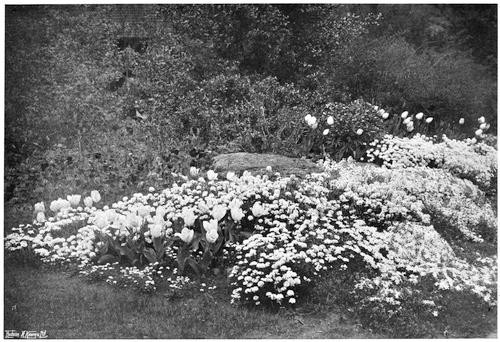
"FURTHER ROCK," FROM G ON PLAN.
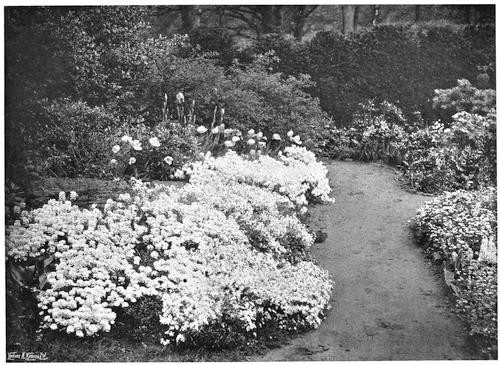
"FURTHER ROCK" FROM H ON PLAN: IBERIS, PHLOX STELLARIA AND PHLOX DIVARICATA, WHITE TULIPS AND BLUE IRIS.
The long border has also Tree Peonies planted about two and a half feet from the edge. Partly to give the bed a sort of backbone, and partly to shelter the Tree Peonies, it has some bushes of Veronica Traversi and one or two Leycesteria formosa. In the middle of the length is a clump of Lilium giganteum and a biggish grouping of Dielytra spectabilis. All along the outer border there are patches and long straggling groups of the pretty dwarf Irises of the pumila, olbiensis and chamæ-iris sections, with others of the same class of stature and habit. Any bare spaces are filled with Wallflowers and Honesty in colours that accord with the general arrangement. The narrow border has mostly small shrubs, Berberis and so on, forming one mass with the hedge to the left, which consists of a double dry wall about four feet high, with earth between and a thick growth on the top of Berberis, Rosa lucida and Scotch Briers. Except the Berberis these make no show of flower within the blooming time of the spring garden, but the whole is excellent as a background.
Red primroses are in the narrow border next to the cross-wall; the wall here is much lower than the longer one on the right. The Primroses are grouped with the reddish leaved Heuchera Richardsoni, the two together making a rich colour-harmony. Beyond them are scarlet Tulips. The small shaded rounds in this border and its continuation across the path into the near end of the main border are stout larch posts supporting a strong growth of Rose Mme. Alfred Carrière and Clematis montana. These have grown together into a solid continuously-intermingling mass, the path at C passing under a low arch of their united branches. The high wall on the right is also covered with flowering things of the early year, Morella Cherries, Rubus deliciosus and Clematis montana, some of this foaming over from the other side of the wall.
The wall is a part, about a third of the length, of the high wall that protects the large border of summer and autumn flowers from the north, and that forms the dividing-line between the pleasure garden proper and the working garden beyond.
On the plan are letters with arrows referring to the illustrations. The letter is at the spot where the camera stood; the arrow points to the middle of the picture. Thus the one taken from D shows two-thirds of the longest path with the end of the big wall and the Yew hedge that prolongs its line on the right and the Nut-trees on the left. The colouring on the right is of pale purple Aubrietia and double white Arabis, with pale Daffodils, and, at the back, groups of sulphur Crown Imperial.
The more distant colouring is of brown Wallflower and red Tulip and the bright mahogany-coloured Crown Imperial. The picture from E is done from among the reds and strong yellows and looks to point C, and further, through the arch of Rose and Clematis, to the Peony garden beyond. The other illustrations show groups of colouring more in detail. The one from F looks at Near Rock from one side. Over the grey Stachys and its milk-white Tulips is seen the flowery mass of pale and deep lilac, and pinkish lilac with grey foliage, crowned with pink and white Tulips near the foot of the Nuts. The picture from G looks at the bit of bank called Further Rock with its big piece of sandstone that looks as if it came naturally out of the ground. Here is a mass of dead-white Iberis with Tulips of a softer white, then the lilac white of Phlox stellaria and the bluish lilac of Phlox divaricata. The picture from H was done a few days later. It shows the further mass of Phlox divaricata more fully in bloom, and, among the white Tulips above, a pretty pale lilac-blue hybrid Iris and some taller stems of the common Blue Flag Iris just coming into blossom. This picture shows the value of the dark Yew hedge as a background to the flowers. Just at the back of the flowery bank are Hollies, and then the hedge. This has not yet come to its full height and the top still shows a ragged outline, but in two years' time it will have grown into shape.

"NEAR ROCK" FROM F ON PLAN: AUBRIETIAS, PHLOX AMŒNA AND WHITE AND PINK TULIP.

THE PRIMROSE GARDEN.
The Primrose garden is in a separate place among Oaks and Hazels. It is for my special strain of large yellow and white bunch Primroses, now arrived at a state of fine quality and development by a system of careful seed-selection that has been carried on for more than thirty years.
CHAPTER IV
BETWEEN SPRING AND SUMMER
When the Spring flowers are done, and before the full June days come with the great Flag Irises and the perennial Lupines, there is a kind of mid-season. If it can be given a space of ground it will be well bestowed. I have a place that I call the Hidden Garden, because it is in a corner that might so easily be overlooked if one did not know where to find it. No important path leads into it, though two pass within ten yards of it on either side. It is in a sort of clearing among Ilex and Holly, and the three small ways into it are devious and scarcely noticeable from the outside. The most important of these, marked 1 on the plan, passes between some clumps of overarching Bamboo and through a short curved tunnel of Yew and Ilex. Another, marked 2, is only just traceable among Berberis under a large Birch, and comes sharply round a tall Monterey Cypress. The third turns out of one of the shady woodland glades and comes into the little garden by some rough stone steps.
The plan shows the simple arrangement; the paths following the most natural lines that the place suggests. The main path goes down some shallow, rough stone steps with a sunny bank to the left and a rocky mound to the right. The mound is crowned with small shrubs, Alpine Rhododendrons and Andromeda. Both this and the left-hand bank have a few courses of rough dry-walling next the path on its lowest level. A little cross-path curves into the main one from the right.
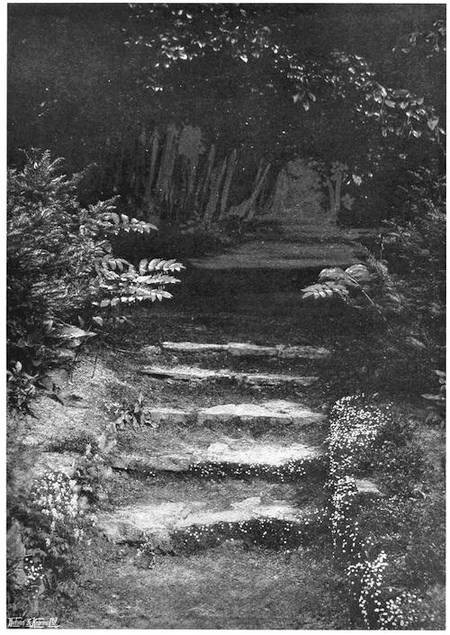
STEPS TO THE HIDDEN GARDEN AT 3 ON PLAN.
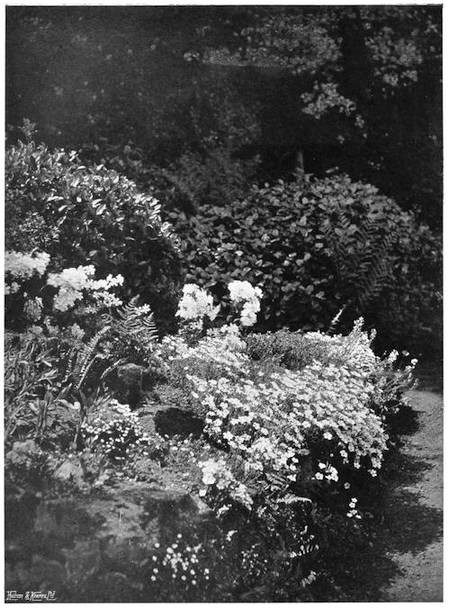
PHLOX DIVARICATA AND ARENARIA MONTANA.
The path leaves the garden again by a repetition of the rough stone steps. The mossy growth of Arenaria balearica clings closely to the stones on their cooler faces, and the frond-like growths of Solomon's Seal hang out on either side as a fitting prelude to the dim mysteries of the wide green wood-path beyond.
It is a garden for the last days of May and the first fortnight of June.
Passing through the Yew tunnel, the little place bursts on the sight with good effect. What is most striking is the beauty of the blue-lilac Phlox divaricata and that of two clumps of Tree Peony—the rosy Baronne d'Alès and the pale salmon-pink Comtesse de Tuder. The little garden, with its quiet environment of dark foliage, forbids the use of strong colouring, or perhaps one should say that it suggested a restriction of the scheme of colouring to the tenderer tones. There seemed to be no place here for the gorgeous Oriental Poppies, although they too are finest in partial shade, or for any strong yellows, their character needing wider spaces and clearer sunlight.
The Tree Peonies are in two groups of the two kinds only; it seemed enough for the limited space. In front of Comtesse de Tuder is a group of Funkia Sieboldi, its bluish leaves harmonising delightfully with the leaf-colour of the Peonies; next to them is a corner of glistening deep green Asarum. No other flowers of any size are near, but there are sheets of the tender yellow bloom and pale foliage of Corydalis ochroleuca, of the white-bloomed Woodruff, and the pale green leafage of Epimedium; and among them tufts of Lent Hellebores, also in fresh young leaf, and a backing of the feathery fronds of Lady Fern and of the large Solomon's Seal; with drooping garlands of Clematis montana hanging informally from some rough branching posts. Yew-trees are at the back, and then Beeches in tender young leaf.
The foot of the near mound is a pink cloud of London Pride. Shooting up among it and just beyond is the white St. Bruno's Lily. More of this lovely little lily-like Anthericum is again a few feet further along, grouped with Iris Cengialti, one of the bluest of the Irises. The back of the mound has some of the tenderly tinted Caparne hybrid Irises two feet high, of pale lilac colouring, rising from among dark-leaved, white-bloomed Iberis, and next the path a pretty, large-flowered tufted Pansy that nearly matches the Iris.
But the glory of the mound is the long stretch of blue-lilac Phlox divaricata, whose colour is again repeated by a little of the same on the sunny bank to the left. Here it is grouped with pale pink Scotch Brier, more pale yellow Corydalis and Arenaria montana smothered in its masses of white bloom. At the end of the bank the colour of the Phlox divaricata is deepened by sheaves of Camassia esculenta that spear up through it. The whole back of this bank has a free planting of graceful pale-coloured Columbines with long spurs, garden kinds that come easily from seed and that were originally derived from some North American species. They are pale yellow and warm white; some have the outer portion of the flower of a faint purple, much like that of some of the patches in an old, much-washed, cotton patchwork quilt.
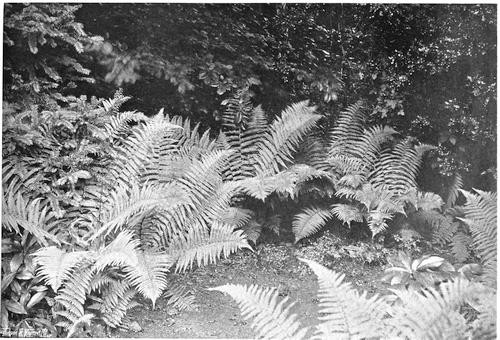
MALE FERN IN THE HIDDEN GARDEN.
EXOCHORDA GRANDIFLORA.
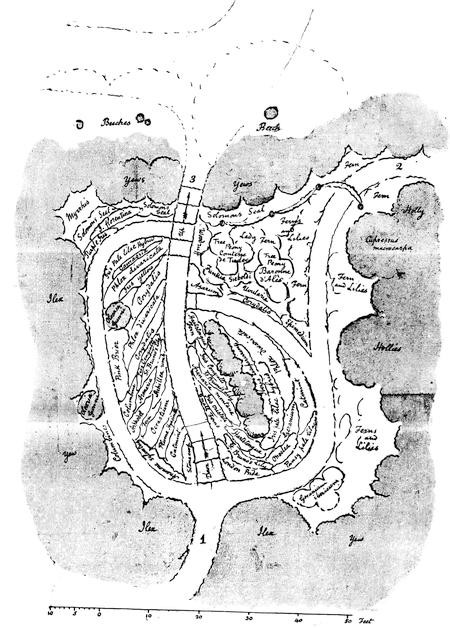
PLAN OF THE HIDDEN GARDEN.
The dark trees on the right have rambling Roses growing into them—Paul's Carmine Pillar and the Himalayan R. Brunonis. The red Rose does not flower so freely here as on a pillar in sunlight, but its fewer stems clamber high into the Holly and the bloom shows in thin natural wreaths that are even more pleasing to an artist's eye than the more ordered abundance of the flowery post. At the foot of the Hollies hardy Ferns grow luxuriantly in the constant shade. A little later a few clumps of Lilies will spring up from among them; the lovely pink rubellum, the fine yellow szovitzianum, and the buff testaceum.
On the left-hand side, behind the sunny bank, a Garland Rose comes through and tumbles out of a Yew, and some sprays of an old bush of the single R. polyantha, that has spread to a circumference of one hundred and fifty feet, have pushed their way through the Ilex.
The Hollies and Ilexes all round are growing fast, and before many years are over the little garden will become too shady for the well-being of the flowers that now occupy it. It will then change its character and become a Fern garden.
All gardening involves constant change. It is even more so in woodland. A young bit of wood such as mine is for ever changing. Happily, each new development reveals new beauty of aspect or new possibility of good treatment, such as, rightly apprehended and then guided, tends to a better state than before.
Meanwhile the little tree-embowered garden has a quiet charm of its own. It seems to delight in its character of a Hidden Garden, and in the pleasant surprise that its sudden discovery provokes. For between it and its owner there is always a pretty little play of pretending that there is no garden there, and of being much surprised and delighted at finding, not only that there is one, but quite a pretty one.
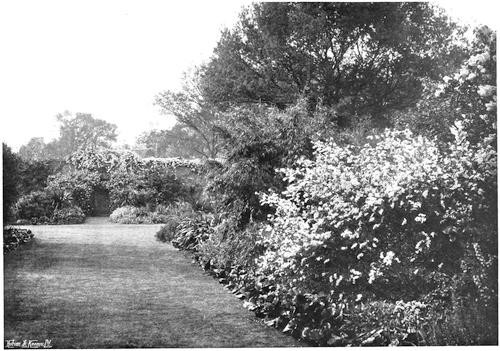
The Hidden Garden is so small in extent, and its boundaries are already so well grown, that there is no room for many of the beautiful things of the time of year. For May is the time for the blooming of the most important of our well-known flowering shrubs—Lilac, Guelder Rose, White Broom, Laburnum, and Pyrus Malus floribunda. But one shrub, as beautiful as any of these and as easily grown, seems to be forgotten. This is Exochorda grandiflora—related to the Spiræas. Its pearl-like buds have earned it the name of Pearl Bush, but its whole lovely bloom should before now have secured it a place in every good garden.
Every one knows the Guelder Rose, with its round white flower-balls, but the wild shrub of which this is a garden variety is also a valuable ornamental bush and should not be neglected. It is a native plant, growing in damp places, such as the hedges of water-meadows and the sides of streams. The English name is Water Elder. Its merit as a garden shrub does not lie, as in the Guelder Rose, in its bloom, but in its singularly beautiful fruit. This, in autumn, lights up the whole shrub with a ruddy radiance. Grown on drier ground than that of its natural habitat, it takes a closer, more compact form.
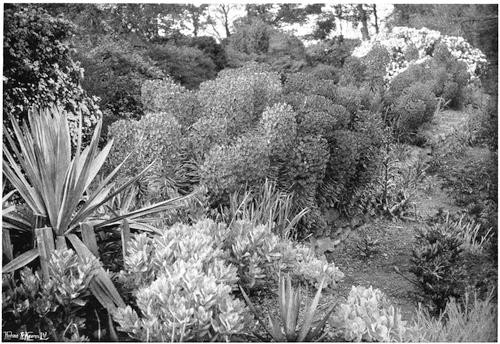
EUPHORBIA WULFENII.
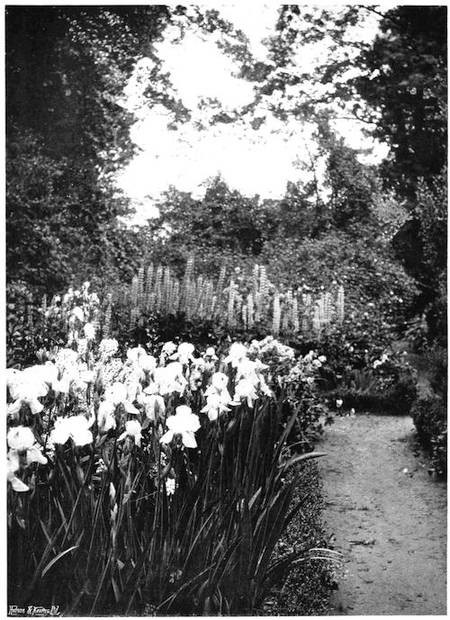
IRISES AND LUPINES IN THE JUNE GARDEN.
White Broom is in flower from the middle of May to the second week of June. There is a fine Flag Iris of a rich purple colour called "Purple King." It is well to grow it just in front of some young bushes of White Broom. Then, if one of the hybrid Irises of pale lilac colour is there as well, and a bush of Rosa altaica, the colour-effect will be surprisingly beautiful. This Rose is the bolder-growing, Asiatic equivalent of our Burnet Rose (R. spinosissima), with the same lemon-white flowers. When any such group containing White Broom is planted, it should be remembered that the tendency of the Broom is to grow tall and leggy. It bears pruning, but it is a good plan to plant some extra ones behind the others. After a couple of years, if the front plants have grown out of bounds, the back ones can be bent down and fastened to sticks, so that their heads come in the required places. It is one of the many ways in which a pretty garden picture may be maintained from year to year by the exercise of a little thought and ingenuity. The undergrowth of such a group may be of Solomon's Seal at the back, and, if the bank or border is in sun, of a lower groundwork of Iberis and Corydalis ochroleuca, or, if it is shaded, of Tiarella, Woodruff or Anemone sylvestris. With these, for the sake of their tender green foliage, there may well be Uvularia grandiflora and Epimedium pinnatum.
A wonderful plant of May is the great Euphorbia Wulfenii. It adapts itself to many ways of use, for, though the immense yellow-green heads of bloom are at their best in May, they are still of pictorial value in June and July, while the deep-toned, grey-blue foliage is in full beauty throughout the greater part of the year. It is valuable in boldly arranged flower borders, and holds its own among shrubs of moderate size, but I always think its best use would be in the boldest kind of rock-work.
One of my desires that can never be fulfilled is to have a rocky hillside in full sun, so steep as to be almost precipitous, with walls of bare rock only broken by ledges that can be planted. I would have great groups of Yucca standing up against the sky and others in the rock-face, and some bushes of this great Euphorbia and only a few other plants, all of rather large grey effect; Phlomis, Lavender, Rosemary and Cistus, with Othonna hanging down in long sheets over the bare face of the warm rock. It would be a rock-garden on an immense scale, planted as Nature plants, with not many different things at a time. The restriction to a few kinds of plants would give the impression of spontaneous growth; of that large, free, natural effect that is so rarely achieved in artificial planting. Besides natural hillsides, there must be old quarries within or near the pleasure-grounds of many places in our islands where such a scheme of planting could worthily be carried out.

PART OF THE GARLAND ROSE AT THE ANGLE.
CHAPTER V
THE JUNE GARDEN
Beyond the lawn and a belt of Spanish Chestnut I have a little cottage that is known as the Hut. I lived in it for two years while my house was building, and may possibly live in it again for the sake of replenishing an over-drained exchequer, if the ideal well-to-do invalid flower-lover or some such very quiet summer tenant, to whom alone I could consent to surrender my dear home for a few weeks, should be presented by a kind Providence. Meanwhile it is always in good use for various purposes, such as seed-drying, pot-pourri preparing, and the like.
The garden in front and at the back is mainly a June garden. It has Peonies, Irises, Lupines, and others of the best flowers of the season, and a few for later blooming. The entrance to the Hut is through Yews that arch overhead. Close to the right is a tall Holly with a Clematis montana growing into it and tumbling out at the top. The space of garden to the left, being of too deep a shape to be easily got at from the path on the one side and the stone paving on the other, has a kind of dividing backbone made of a double row of Rose hoops or low arches, rising from good greenery of Male Fern and the fern-like Sweet Cicely. This handsome plant (Myrrhis odorata) is of great use in many ways. It will grow anywhere, and has the unusual merit of making a good show of foliage quite early in the year. It takes two years to get to a good size, sending its large, fleshy, aromatic roots deep down into the soil. By the end of May, when the bloom is over and the leaves are full grown, they can be cut right down, when the plant will at once form a new set of leaves that remain fresh for the rest of the summer. Its chief use is as a good foliage accompaniment or background to flowers, and no plant is better for filling up at the bases of shrubs that look a little leggy near the ground, or for any furnishing of waste or empty spaces, especially in shade. From among the Ferns and Myrrhis at the back of this bit of eastern border rise white Foxgloves, the great white Columbine, and the tall stems of white Peach-leaved Campanula. Nearer to the front are clumps of Peonies. But, as one of the most frequented paths passes along this eastern border, it was thought best not to confine it to June flowers only, but to have something also for the later months. All vacant places are therefore filled with Pentstemons and Snapdragons, which make a show throughout the summer; while for the early days of July there are clumps of the old garden Roses—Damask and Provence. The whole south-western angle is occupied by a well-grown Garland Rose that every summer is loaded with its graceful wreaths of bloom. It has never been trained or staked, but grows as a natural fountain; the branches are neither pruned nor shortened. The only attention it receives is that every three or four years the internal mass of old dead wood is cut right out, when the bush seems to spring into new life.
Passing this angle and going along the path leading to the studio door in the little stone-paved court, there is a seat under an arbour formed by the Yews; the front of it has a Dundee Rambler Rose supported by a rough wooden framework. On the right, next the paving, are two large standard Roses with heads three and four feet through. They are old garden Roses, worked in cottage fashion on a common Dog-rose stock. One is Celeste, of loveliest tender rose colour, its broad bluish leaves showing its near relationship to Rosa alba; the other the white Mme. Plantier. This old Rose, with its abundant bunches of pure white flowers, always seems to me to be one of the most charming of the older garden kinds. It will grow in almost any way, and is delightful in all; as a pillar, as a hedge, as a bush, as a big cottage standard, or in the border tumbling about among early summer flowers. Like the Blush Gallica, which just precedes it in time of blooming, it is one of the old picture Roses. Both should be in quantity in every garden, and yet they are but rarely seen.
The border next the paving has clumps of the old garden Peonies (P. officinalis). By the time these are over, towards the end of June, groups of the earlier orange Herring Lilies are in bloom. A thick and rather high Box edging neatly trims these borders, and favours the cottage-garden sentiment that is fostered in this region. At the back of the Yews that form the arbour is one end of the Hidden Garden. Going along the path, past the projection on the block-plan of the Hut, which represents the large ingle of the studio, we come to the other bit of June garden behind the little cottage. Here again, the space being over-wide, it is divided in the middle by a double border of Rosemary that is kept clipped and is not allowed to rise high enough to prevent access to the border on each side.
On the side next the Hut the flowers are mostly of lilac and purple colouring with white. Pale lilac Irises, including the fine I. pallida dalmatica and the rosy lilac variety, Queen of the May, perennial Lupines, white, bluish lilac and purple—one of a conspicuous and rare deep red-purple of extreme richness without the slightest taint of a rank quality—a colour I can only call a strong wine-purple; then a clump of the feathery, ivory-white Spiræa Aruncus, the large Meadowsweet that is so fine by the side of alpine torrents. There are also some flesh-pink Albiflora Peonies and lower growths of Catmint, and of the grand blue-purple Cranesbill, Geranium ibericum platyphyllum; with white and pale yellow Spanish Irises in generous tufts springing up between. At the blunt angle nearly opposite the dovecote is a pink cloud of London Pride; beyond it pale yellow Violas with more white Spanish Iris, leading to a happy combination of the blue Iris Cengialti and the bushy Aster Olearia Gunni, smothered in its white starry bloom. An early flowering Flag Iris, named Chamæleon, nearly matches the colour of I. Cengialti; it is the bluest that I know of the Flag Irises, and is planted between and around the Olearias to form part of the colour-picture.
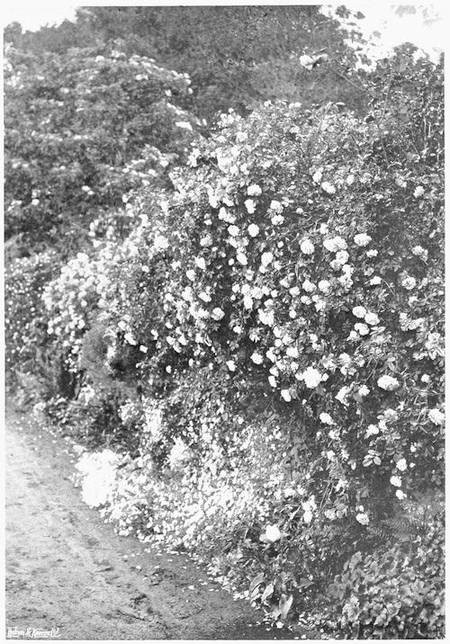
ROSE BLUSH GALLICA PLANTED ON THE TOP OF DRY WALLING.
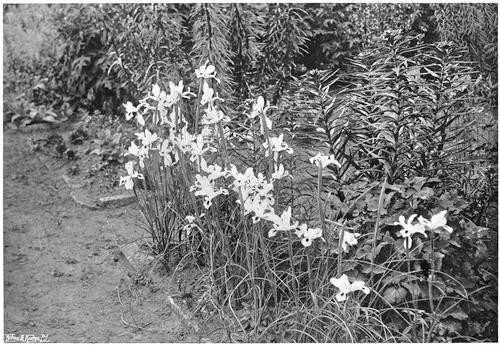
SPANISH IRIS.
Beyond this group, and only separated from it by some pale yellow Irises, are two plants of the Dropmore Anchusa, marked A on the plan, of pure pale blue, and another clump of Spiræa Aruncus, marked S, and one of a good pure white Lupine, with some tall clear yellow Irises and white Foxgloves. Now the colouring changes, passing through a group or two of the rich half-tones of Irises of the squalens section to the perennial Poppies; P. rupifragum nearest the path and, next to it, P. pilosum; both of a rich apricot colour. Backing these is a group of the larger hybrid that nearly always occurs in gardens where there are both P. rupifragum and P. orientale. In appearance it is a small orientale with a strong look of rupifragum about the foliage. As a garden plant it has the advantages of being of an intermediate size and of having a long season of bloom, a quality no doubt inherited from rupifragum, which will flower more or less throughout the summer if the seed-pods are removed. A plant of Oriental Poppy of the tone of orange-scarlet that I know as red-lead colour, and some deep orange Lilies complete this strongly coloured group.
In the north-western clump, where there are some Thorn-trees and two Thuyas, the dominant feature is the great bush of an old garden rambling Rose that looks as if its parentage was somewhere between sempervirens and arvensis. I can neither remember how I came by it nor match it with any nursery kind. It stands nearly opposite the Hut kitchen window, and when in full bloom actually sheds light into the room. I know it as the Kitchen Rose. The diameter of the bush is even greater than the plan shows, for it overwhelms the nearest Thuya and rushes through the Thorn, and many of its shoots are within hand-reach of the back path. The rest of this clump is occupied by plants of tall habit—the great Mullein (Verbascum orientale), the Giant Cow-Parsnip (Heracleum), and white Foxgloves.
The plan shows how the border of early bulbs, described in a former chapter (now a mass of hardy Ferns, as shown at p. 7), lies in relation to this part of the garden. There is also a grand mass of Oriental Poppy and Orange Lilies in half-shade on the other side of the path, where it turns and is bordered with Berberis. This makes a fine distant effect of strong colour looking north-west from the southern end of the bulb-border.
I greatly wish I could have some other June borders for the still better use of the Flag Irises, but not only have I quite as much dressed ground as I can afford to keep up, but the only space where such borders could be made has to be nursery-ground of plants for sale. But though I am denied this pleasure myself, I should like to suggest it to others, and therefore give plans of two borders of different colourings. There would be no great harm if they came opposite each other, though perhaps, as colour-schemes, they would be rather better seen singly and quite detached from each other.
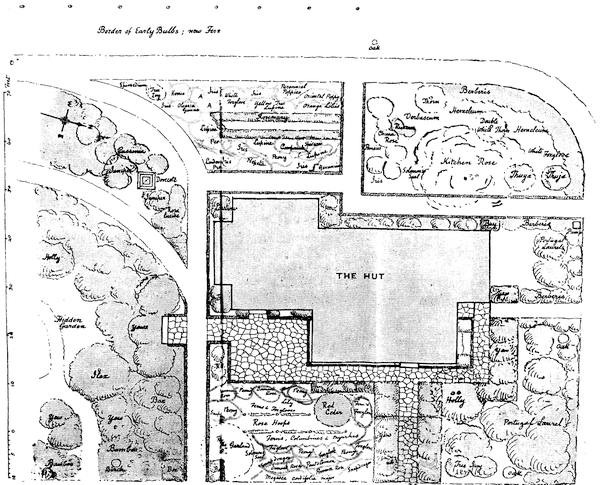
THE JUNE GARDEN.
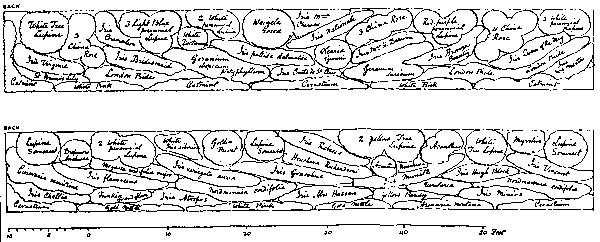
IRIS AND LUPINE BORDERS.
It must be remembered, as in all cases of planting flower borders, that they cannot be expected to show their full beauty the year after planting. Irises will give a few blooms the first season, but are not in strength till their second and third years. China Roses must have time to grow. Tree Lupines must be planted young, and, though they make rapid growth, they also do not fill their spaces till the third year. Lupine Somerset is a desirable hybrid, not quite a true Tree Lupine, though it has a half-woody growth. Its best colour is a clear, lively light yellow, but it readily varies from seed to whitish or washy purplish tints. As the seedlings often show bloom the first season in the seed-bed, the colours should be noted and marked, for some of the light purples are pretty things, with more refinement of character than the same colourings in the old Tree Lupines. Both the tree and hybrid kinds may have their lives much prolonged—for if they are not specially treated they are short-lived things—by judicious pruning. After flowering, each branch should be cut well back. It is not enough to cut away the flowers, but every branch should be shortened about two-thirds as soon as the bloom is over and the seed-pods begin to form.
The plans show the two schemes of colouring. The upper is of white, lilac, purple and pink, with grey foliage; the lower of white, yellow, bronze-yellow and, for the most part, rich green foliage. They will show mainly as Iris and Lupine borders, and are intended to display the beauty of these two grand plants of early summer. The kinds of Iris are carefully considered for their height, time of blooming, and colour-value. In the yellow border is one patch of clear, pale pure blue, the Dropmore Anchusa, grouped with pale yellows and white.
In the purple border are some important front-edge patches of the beautiful Catmint (Nepeta Mussini), a plant that can hardly be over-praised. The illustration shows it in a part of a border-front that is to be for August. For a good three weeks in June it makes this border a pretty place, although the Catmint is its only flower. But with the white-grey woolly patches of Stachys and the half-grown bushes of Gypsophila, and the Lavender and other plants of greyish foliage, the picture is by no means incomplete. Its flowery masses, seen against the warm yellow of the sandy path, give the impression of remarkably strong and yet delightfully soft colouring. The colour itself is a midway purple, between light and dark, of just the most pleasing quality. As soon as the best of the bloom is done it is carefully cut over; then the lateral shoots just below the main flower-spike that has been taken out will gain strength and bloom again at the border's best show-time in August. In another double flower border that is mostly for the September-blooming Michaelmas Daisies the Catmint is cut back a little later.
One of the joys of June is the beauty of the Scotch Briers. On the south side of the house there are Figs and Vines, Rosemary and China Roses; a path and then some easy stone steps leading up to the strip of lawn some fifty feet wide that skirts the wood. To right and left of the steps, for a length equal to that of the house-front, is a hedge of these charming little Roses. They are mostly double white, but some are rosy and some yellow. When it is not in flower the mass of small foliage is pleasant to see, and even in winter leaflessness the tangle of close-locked branches has an appearance of warm brown comfort that makes it good to have near a house.

WHITE TREE LUPINE.
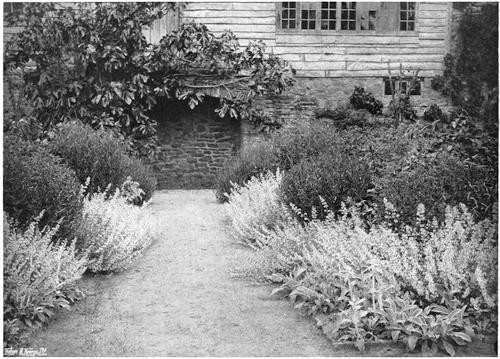
CATMINT IN JUNE IN THE GREY AUGUST BORDER.
June is also the time of some of the best of the climbing plants and slightly tender shrubs that we have against walls and treat as climbers, such as Solamum crispum and Abutilon vitifolium and the hardy Clematis montana; but some notes on these will be offered in a further chapter.
One is always watching and trying for good combinations of colour that occur or that may be composed. Besides such as are shown in the plans, the following have been noted for June:
In rock-work the tiny China Rose Pompon de Paris, also the tender pink Fairy Rose, with pale lilac tufted Pansy and Achillea umbellata.
The pretty pale pink dwarf Rose Mignonette, with the lilac of Catmint (Nepeta Mussini) and the grey-white foliage of Stachys and Cineraria maritima.
In a cool, retired place in a shrubbery margin, away from other flowers, the misty red-grey-purple of Thalictrum purpureum with the warm white foam-colour of Spiræa Aruncus.
On bold rock-work, a mass of a fine-coloured strain of Valerian (Centranthus) with a deep scarlet-crimson Snapdragon. This is a success of reciprocally becoming texture as well as colour; the texture having that satisfying quality that one recognises in the relation of the cut and uncut portions of the fine old Italian cut-velvets.
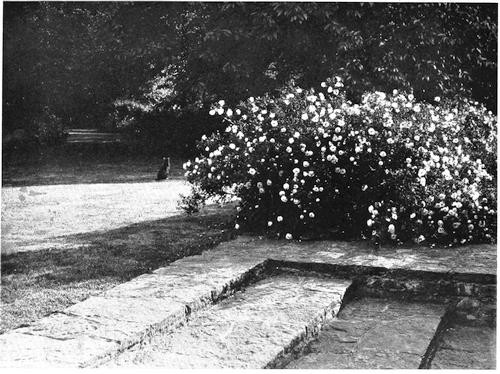
SCOTCH BRIARS.

GERANIUM IBERICUM PLATYPHYLLUM;
THE BEST OF THE CRANEBILLS. (See page 42.)
The border next the paving has clumps of the old garden Peonies (P. officinalis). By the time these are over, towards the end of June, groups of the earlier orange Herring Lilies are in bloom. A thick and rather high Box edging neatly trims these borders, and favours the cottage-garden sentiment that is fostered in this region. At the back of the Yews that form the arbour is one end of the Hidden Garden. Going along the path, past the projection on the block-plan of the Hut, which represents the large ingle of the studio, we come to the other bit of June garden behind the little cottage. Here again, the space being over-wide, it is divided in the middle by a double border of Rosemary that is kept clipped and is not allowed to rise high enough to prevent access to the border on each side.