Taiga, Arctic, and apple orchards in one window
Southern lands of Kazakhstan are a unique geographic margin, a distinct border, separating two orthographic extremes. To the north of the country, up to the very Arctic Ocean, there stretch the greatest plains and lowlands, and to the south, up to the Indian Ocean, there tower the highest mountains of the planet.
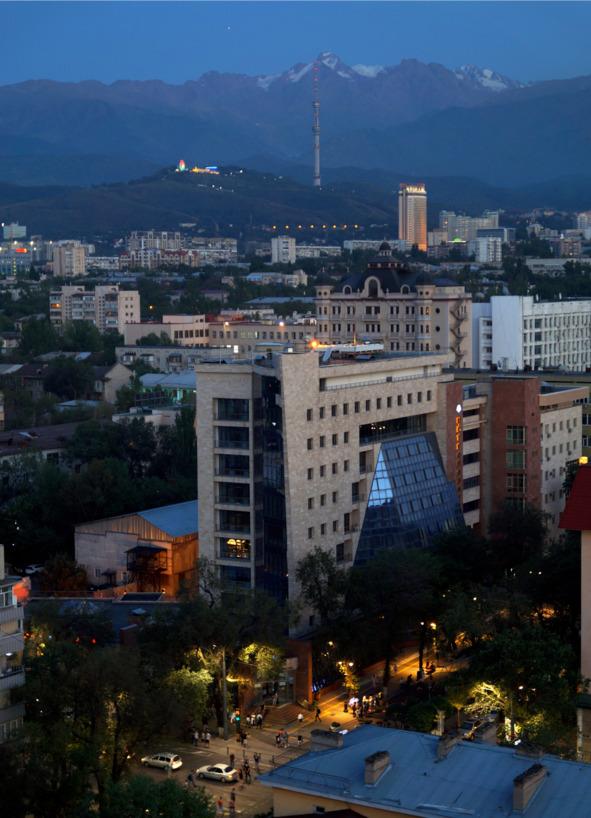
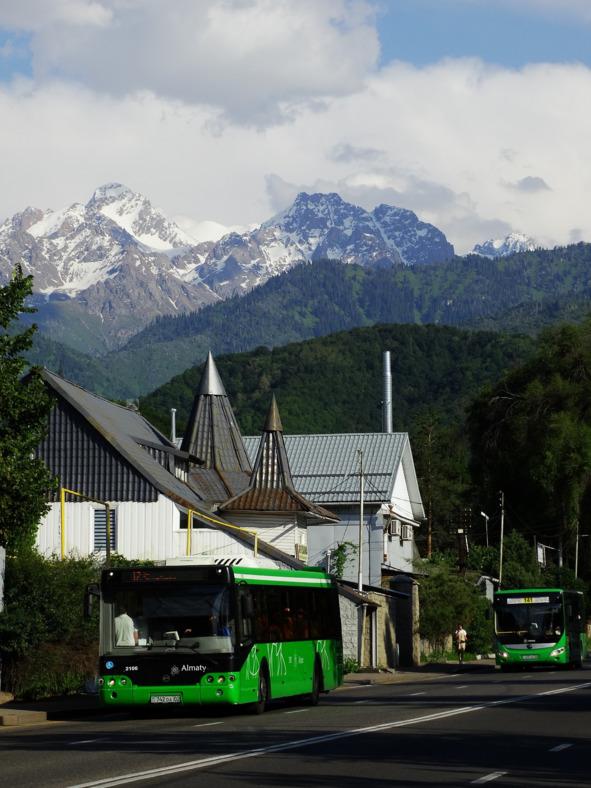
And this border is so obvious that in the clear day one can see from the mountains hundreds of kilometers of surrounding steppes and deserts, and from the hot plain one can view from the same distance the sparkle of glaciers at the mountain peaks. There are not so many places of this kind on Earth. Very few, to be exact. And to be entirely exact, there are no places like this at all! And the first among equals is Alma-Ata, snuggling up at the foothills of Zailiiskiy Alatau. Many of its residents see glaciers and deserts from the windows of their apartments.
…Mountains aggrandize a human. The higher climbers ge up t, the proud they become. The one who climbed up the stairs in Medeo looks scornfully at those who are just at their start. Mushroom hunters crawling among the fir trees feel sorry for eaters, who are thronging near shashlyk grills down by the riversides. And from above, from ice-covered peaks, arrogant mountain-climbers observe all of them with a smile. (Imagine, if only mountain goats possessed human traits and thought like we do, they would just burst up with hoity-toity!)
But mountains are interesting not only because of their ability to boost someone’s pride. They are a unique manual for studying the nature, too. All those who learnt geography some time ago (and this science, the most people’s one of all sciences, all of us did learn) certainly remember about the altitudinal zones of mountains, which vertically repeat Earth’s natural zones, encircling our planets along its latitudes.
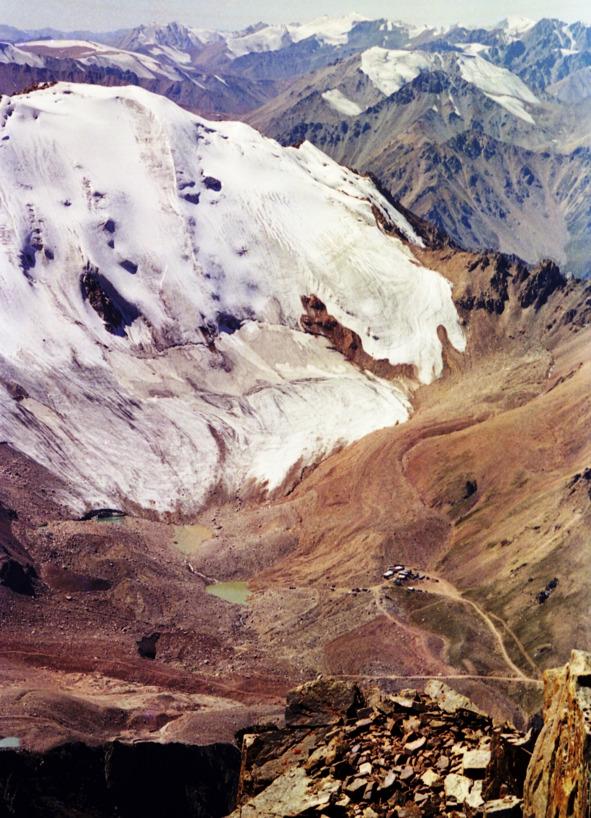
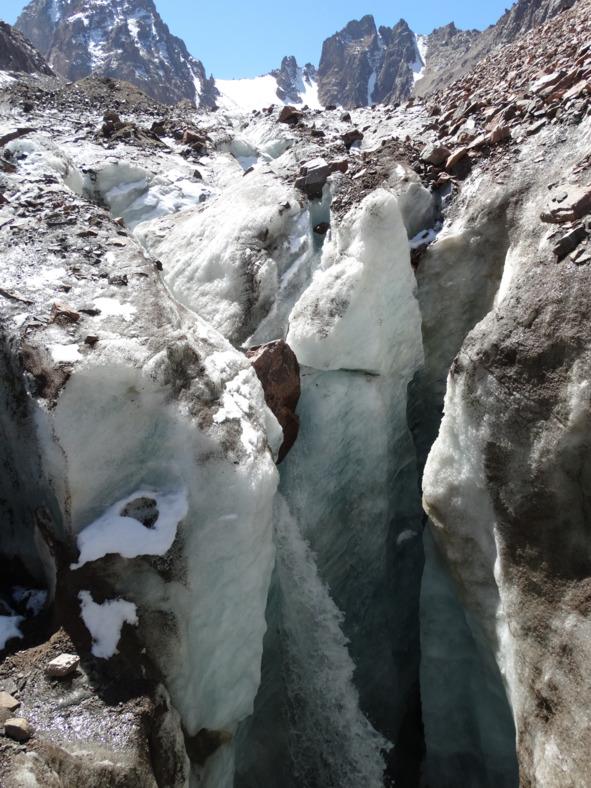
So, to reach the arctic ice, we, Almaty residents, do not need to go thousands kilometers up to the coast of the Arctic Ocean. We only need to take a cable car at our Medeo, and, provided we have enough money, within two hours we’ll wander about the real eternal ice of the glacier Bogdanovich, which differs little from those of Greenland or Spitsbergen.
But mountains are the Earth shrunk not only in space, but also compressed within time. The thing is that mountain slopes environments do not just repeat climate zones, moreover, they maintain conditions for the existence of relic plants and animals, which once swarmed these places. And thus, they are a unique shelter for many natural kings of the past and the source of species diversity for us. Examples are not far to seek: woods of wild apricot trees and famous apple thickets that gave our Apple city its name are relics of the past epochs as well. Just like alpine spruce forests.
For the convenience of outdoorsmen the nature thoughtfully cut mountain ranges with deep gorges. Each of our gorges is peculiar, each keeps its own zest down in its depths, and each possesses its own beauties and tourist attractions.
Thus, in Aksayskoye gorge, at the spot where two monks were shot by Bolsheviks, an Orthodox chapel was built, a popular place of pilgrimage today.
Bolshaya Almatinka gorge is noted by its alpine lake and a series of unique scientific institutions. Among them there is a sun observatory with its Carl Zeiss telescopes, which fell to the Soviet Union’s lot as a war booty after the World War II.
At the banks of Malaya Almatinka River there are famous sports bases of Kazakhstan: the alpine ice-skating stadium Medeo and Chimbulak ski centre with its piste of international class, going down 3,200 meters long.
The Talgar gorge leads to nature reserve of Alma-Ata, the oldest one in Kazakhstan, where under the protection of humans (from humans) a lot of unique species of mountain fauna live. And among them there is the animal that is the symbol of Kazakhstan, but not everyone can run into it. It is a snow leopard.
The Issyk gorge is known for its tragic event in 1963, when the severe mud flow devastated the alpine lake that was there, a popular place of public out-of-door recreation. Today this lake is being reconstructed and Issyk is returning to life again.
But in recent years the most popular place for tourists is the nearby g Turgen gorge with its beautiful waterfalls, forests full of mushrooms, lakes, alpine meadows, and the trout farm, where everyone at his/her pleasure can pay for the bite beforehand, cast the fishing rod to water and take out a strong wriggling fish.
Eternal glaciers within the precincts of Almaty city
Residents of the south capital of Kazakhstan Almaty, who wish to visit eternal ice, have two alternative ways. Either to go as far as a few thousand kilometers to Novaya Zemlya in the Arctic Zone (its glaciers are the closest), or to climb a few kilometers up to the mountains of Zailiyskyi Alatau, to the glaciers at the upper reaches of Malaya Almatinka river.
We know that the first European explorers of Tian Shan in the middle of the 19th century expected to find there a lot of volcanoes, but it was a great surprise for them to find glaciers. Such confusion was the result of theories of the great Germans, Humboldt and Ritter, who in their turn relied on half-magic Chinese sources. Somehow or other, the famous Semyonov-Tien-Shanskiy in his travels initially refused pointblank to see local mountain glaciers and took the eternal ice for “snow clusters”.
But now we know that all more or less great rivers of Semirech’ye are thoroughly replenished from the melting mountain ice. As a rule, glaciers get their names from a peak which slopes they slide down. Thus, among Malaya Almatinka glaciers that can be seen from streets of Almaty there are glaciers of Ordzhonikidze, Tuyuksu, Pogrebetskiy, Molodezhnyi, etc.
One of the Zailiyskyi Alatau glaciers has the name of the specialist in local history Dmitriyev. It was he who first explored glaciers of Zailiyskyi Alatau. In the “Proceedings of the Emperor’s Russian Geographical Society’ as of 1907, the specialist in local history S.E. Dmitriev described the experience he had had during his expedition to Malaya Almatinka glaciers in the late summer of 1902.
At that, no one had ever provided Dmitriyev with any “grants” for his research, and no one even had asked him to do it. All his explorations are just his personal initiative for the study of the surrounding world. The following facts expressively speak about many unknown and unexplored things of those years. Glaciers that were described by the amateur glaciologist hundred years ago were one and all untitled. They were not even registered on the three-verst scale army topographic map of that period.
Dmitriyev’s studies continued for several years, being very occasional, though. He measured the glaciers by eye and by footsteps, and, what is more, he built the first weather shelter here and also tried to answer such questions as what was happening to glaciers. What speed they move at? Does the ice array decrease or increase? Those who are eager to know that can read this information in his works and reports.
Residents and visitors of Almaty may escape studying all the facts of the secret activity of glaciers. They have a unique opportunity of waking up in the morning in their warm cozy beds, climb up to the real ice tongue (arctic!), have a lunch out in the fresh frosty air, and come back home for dinner. Personally, most of all nearby glaciers, I like a walk towards Molodyozhnyi (“of youth’) glacier (somewhere around there stood Dmitriyev’s weather shelter). This glacier looks like a huge wall of ice that covers up half of the sky.
If you find yourselves here at the end of August you may see everything sparkle in thousands of streamlets in the last summer sun, sing in dozens of clear voices, savoury crisp in azure granular snow, or firn, under your feet, and excites with its unmatched cool fragrance. And in case you reject any transport and come here by foot, you will add to all this the feeling of self-esteem, which will grow right before your eyes!
Alpine crown of Alma-Ata
The route to many alpine peaks, crowning the Alma-Ata scenery, goes through the “Small Almaty” gorge, nearest to the city, known far beyond the borders of Kazakhstan for its high-altitude skating rink “Medeo”.