


автордың кітабын онлайн тегін оқу A Select Collection of Old English Plays, Volume 13
The cover image was created by the transcriber and is placed in the public domain.
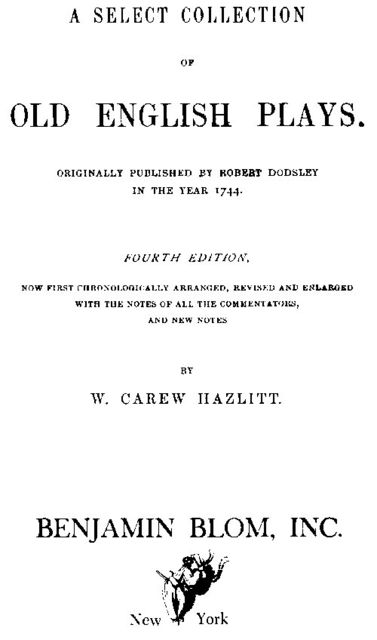
A SELECT COLLECTION
OF
OLD ENGLISH PLAYS.
ORIGINALLY PUBLISHED BY ROBERT DODSLEY IN THE YEAR 1744. FOURTH EDITION, NOW FIRST CHRONOLOGICALLY ARRANGED, REVISED AND ENLARGED WITH THE NOTES OF ALL THE COMMENTATORS, AND NEW NOTES
BY
W. CAREW HAZLITT.
BENJAMIN BLOM, INC.

New York
[Pg ii] [Pg 1]
CONTENTS
A MATCH AT MIDNIGHT.
DRAMATIS PERSONÆ.
ACT I., SCENE I.
ACT II., SCENE I.
ACT III., SCENE I.
ACT IV., SCENE I.
ACT V., SCENE I.
THE CITY NIGHTCAP.
DRAMATIS PERSONÆ.
ACT I.
ACT II.
ACT III.
ACT IV.
ACT V.
THE CITY-MATCH.
THE PROLOGUE TO THE KING AND QUEEN.
THE PROLOGUE AT BLACKFRIARS.
DRAMATIS PERSONÆ.
ACT I., SCENE I.
ACT II., SCENE I.
ACT III., SCENE I.
ACT IV., SCENE I.
ACT V., SCENE I.
THE EPILOGUE AT WHITEHALL.
THE EPILOGUE AT BLACKFRIARS.
THE QUEEN OF ARRAGON.
THE PROLOGUE AT COURT.
THE PROLOGUE AT THE FRIARS.
THE ACTOR'S NAMES.
ACT I., SCENE I.
ACT II., SCENE I.
ACT III., SCENE I.
ACT IV., SCENE I.
ACT V., SCENE I.
THE EPILOGUE AT COURT.
THE EPILOGUE AT THE FRIARS.
THE ANTIQUARY.
DRAMATIS PERSONÆ.
ACT I., SCENE I.
ACT II., SCENE I.
ACT III., SCENE I.
ACT IV., SCENE I.
ACT V., SCENE I.
TRANSCRIBER'S NOTES
TRANSCRIBER'S NOTES
Contents added by transcriber.
Silently corrected simple spelling, grammar, and typographical errors.
Retained anachronistic and non-standard spellings as printed.
A MATCH AT MIDNIGHT.
EDITION.
A Match at Mid-night. A Pleasant Comœdie: As it hath beene Acted by the Children of the Revells. Written by W. R. London: Printed by Aug. Mathewes, for William Sheares, and are to be sold at his Shop, in Brittaines Bursse. 1633. 4o.
DRAMATIS PERSONÆ.
Sir Marmaduke Many-Minds. Sir Janus Ambexter. Captain Carvegut. Lieutenant Bottom. Ancient Young. Bloodhound,
a usurer.
Alexander Bloodhound,
his two sons.
Tim Bloodhound,
Randall,
a Welshman.
Ear-lack,
a scrivener.
Sim,
the clown.
John,
servant to the Widow.
Jarvis,
the Widow's husband, disguised like her servant.
A Smith. Busy,
a Constable.
Watch.[
Women.]
Widow Wag. Moll,
Bloodhound's daughter.
Widow's Maid. Mistress Coote,
a bawd.
Sue Shortheels,
a whore.
[Pg 4] [Pg 5]
A MATCH AT MIDNIGHT.

ACT I., SCENE I.
Enter, as making themselves ready, Tim Bloodhound, and Sim the man.
Sim. Good morrow, Master Tim.
Tim. Morrow, Sim; my father stirring, Sim?
Sim. Not yet, I think; he heard some ill-news of your brother Alexander last night, that will make him lie an hour extraordinary.
Tim. Hum: I'm sorry the old man should lie by the hour; but, O, these wicked elder brothers, that swear refuse them,[1] and drink nothing but wicked sack; when we swear nothing but niggers-noggers, make a meal of a bloat herring, water it with four-shillings' beer, and then swear we have dined as well as my lord mayor.
Sim. Here was goody Fin, the fishwoman, fetched home her ring last night.
Tim. You should have put her money by itself, for fear of wronging of the whole heap.
Sim. So I did, sir, and washed it first in two waters.
Tim. All these petty pawns, sirrah, my father commits to my managing, to instruct me in this craft that, when he dies, the commonwealth may not[2] want a good member.
Enter Mistress Mary.
Sim. Nay, you are cursed as much as he already.
Mis. Mary. O brother, 'tis well you are up.
Tim. Why, why?
Mis. Mary. Now you shall see the dainty widow, the sweet widow, the delicate widow, that to-morrow morning must be our mother-in-law.
Tim. What, the widow Wag?
Sim. Yes, yes; she that dwells in Blackfriars, next to the sign of the Fool laughing at a feather.[3]
Mis. Mary. She, she; good brother, make yourself handsome, for my father will bring her hither presently.
Tim. Niggers-noggers, I thought he had been sick, and had not been up, Sim.
Sim. Why, so did I too; but it seems the widow took him at a better hand, and raised him so much the sooner.
Tim. While I tie my band, prythee stroke up my foretop a little: niggers, an' I had but dreamed of this an hour before I waked, I would have put on my Sunday clothes. 'Snails, my shoes are pale as the cheek of a stewed pander; a clout, a clout, Sim.
Sim. More haste the worse speed; here's ne'er a clout now.
Tim. What's that lies by the hooks?
Sim. This? 'tis a sumner's coat.[4]
Tim. Prythee, lend's a sleeve of that; he had a noble on't last night, and never paid me my bill-money.
Enter Old Bloodhound, the Widow, her Maid, and Man.[5]
Blood. Look, look, up[6] and ready; all is ready, widow. He is in some deep discourse with Sim, concerning moneys out to one or another.
Wid. Has he said his prayers, sir?
Blood. Prayer before providence! When did ye know any thrive and swell that uses it? He's a chip o' th' old block; I exercise him in the trade of thrift, by turning him to all the petty pawns. If they come to me, I tell them I have given over brokering, moiling for muck and trash, and that I mean to live a life monastic, a praying life: pull out the tale of Crœsus from my pocket, and swear 'tis called "Charity's Looking-Glass, or an exhortation to forsake the world."
Maid. Dainty hypocrite! [Aside.
Wid. Peace!
Blood. But let a fine fool that's well-feathered come, and withal good meat, I have a friend, it may be, that may compassionate his wants. I'll tell you an old saw[7] for't over my chimney yonder—
A poor man seem to him that's poor, And prays thee for to lend; But tell the prodigal (not quite spent) Thou wilt procure a friend.
Wid. Trust me, a thrifty saw.
Blood. Many will have virtuous admonitions on their walls, but not a piece in their coffers: give me these witty politic saws; and indeed my house is furnished with no other.
Wid. How happy shall I be to wed such wisdom!
Blood. Shalt bed it, shalt bed it, wench; shalt ha't by infusion. Look, look!
Enter a Smith.
Smith. Save ye, Master Tim.
Tim. Who's this? goodman File, the blacksmith! I thought it had been our old collier. Did you go to bed with that dirty face, goodman File?
Smith. And rise with it too, sir.
Tim. What have you bumming out there, goodman File?
Smith. A vice, sir, that I would fain be furnished with a little money upon.
Tim. Why, how will you do to work then, goodman File?
Smith. This is my spare vice, not that I live by.
Tim. Hum! you did not buy this spare vice of a lean courtier, did ye?
Smith. No, sir, of a fat cook, that 'strained[8] of a smith for's rent.
Sim. O hard-hearted man of grease!
Tim. Nay, nay, Sim, we must do't sometimes.
Blood. Ha, thrifty whoreson!
Tim. And what would serve your turn, goodman File?
Smith. A noble, sir.
Tim. What! upon a spare vice to lend a noble?
Sim. Why, sir, for ten groats you may make yourself drunk, and so buy a vice outright for half the money.
Tim. That is a noble vice, I assure you.
Sim. How long would you have it?
Smith. But a fortnight; 'tis to buy stuff, I protest, sir.
Tim. Look you, being a neighbour, and born one for another——
Blood. Ha, villain, shalt have all!
Tim. There is five shillings upon't, which, at the fortnight's end, goodman File, you must make five shillings sixpence.
Smith. How, sir?
Tim. Nay, an' it were not to do you a courtesy——
Blood. Ha, boy!
Tim. And then I had forgot threepence for my bill; so there is four shillings and ninepence,[9] which you are to tender back five shillings sixpence, goodman File, at the end of the fortnight.
Smith. Well, an' it were not for earnest necessity——Ha, boys! I come, I come, you black rascals, let the cans go round. [Exit Smith.
Tim. Sim, because the man's an honest man, I pray lay up his vice, as safe as it were our own.
Sim. And if he miss his day, and forfeit, it shall be yours and your heirs for ever.
Blood. What, disbursing money, boy? Here is thy mother-in-law.
Sim. Your nose drops: 'twill spoil her ruff.
Tim. Pray, forsooth, what's a clock?
Maid. O, fie upon him, mistress, I thought he had begun to ask you blessing.
Wid. Peace, we'll have more on't. [Walks towards him.
Tim. I wonnot kiss, indeed.
Sim. An' he wonnot, here are those that will, forsooth.
Blood. Get you in, you rogue. [Exit Sim.
Wid. I hope you will, sir: I was bred in Ireland, where the women begin the salutation.
Tim. I wonnot kiss truly.
Wid. Indeed you must.
Tim. Would my girdle may break if I do.[10]
Wid. I have a mind.
Tim. Niggers-noggers, I wonnot.
Blood. Nay, nay, now his great oath's pass'd, there's no talk on't. I like him ne'er the worse; there's an old saw for't—
A kiss first, next the feeling sense, Crack say the purse-strings, out fly the pence.
But he can talk, though: whose boy are you, Tim?
Tim. Your boy, forsooth, father.
Blood. Can you turn and wind a penny, Tim?
Tim. Better than yourself, forsooth, father.
Blood. You have looked in the church-book of late; how old are you, Tim?
Tim. Two and twenty years, three months, three days, and three quarters of an hour, forsooth, father.
Wid. He has arithmetic.
Blood. And grammar too: what's Latin for your head, Tim?
Tim. Caput.
Wid. But what for the head of a block?
Tim. Caput blockhead.
Blood. Do you hear; your ear?
Tim. Aura.
Blood. Your eye?
Tim. Oculus.
Blood. That's for one eye; what's Latin for two?
Tim. Oculus-Oculus.[11]
Widow. An admirable accidental grammarian, I protest, sir.
Blood. This boy shall have all: I have an elder rogue that sucks and draws me; a tavern academian; one that protests to whores, and shares with highway lawyers; an arrant unclarified rogue, that drinks nothing but wicked sack.
Enter Sim and Alexander drunk.
Sim. Here's a gentleman would speak with you.
Blood. Look, look; now he's come for more money.
Wid. A very hopeful house to match into, wench; the father a knave, one son a drunkard, and t'other a fool. [Aside.
Tim. O monster, father! Look if he be not drunk; the very sight of him makes me long for a cup of six.[12]
Alex. Pray, father, pray to God to bless me. [To Tim.
Blood. Look, look! takes his brother for his father!
Sim. Alas, sir! when the drink's in, the wit's out? and none but wise children know their own fathers.
Tim. Why, I am none of your father, brother; I am Tim; do you know Tim?
Alex. Yes, umph—for a coxcomb.
Wid. How wild he looks! Good sir, we'll take our leaves.
Blood. Shalt not go, faith, widow: you cheater, rogue; must I have my friends frighted out of my house by you? Look he[13] steal nothing to feast his bawds. Get you out, sirrah! there are constables, beadles, whips, and the college of extravagants, yclept Bridewell, you rogue; you rogue, there is, there is, mark that.
Alex. Can you lend me a mark upon this ring, sir? and there set it down in your book, and, umph—mark that.
Blood. I'll have no stolen rings picked out of pockets, or taken upon the way,[14] not I.
Alex. I'll give you an old saw for't.
Blood. There's a rogue mocks his father: sirrah, get you gone. Sim, go let loose the mastiff.
Sim. Alas, sir! he'll tear and pull out your son's throat.
Blood. Better pull't out than halter stretch it. Away, out of my doors! rogue, I defy thee.
Alex. Must you be my mother-in-law?
Wid. So your father says, sir.
Alex. You see the worst of your eldest son; I abuse nobody.
Blood. The rogue will fall upon her.
Alex. I will tell you an old saw.
Wid. Pray let's hear it.
Alex.
An old man is a bedful of bones, And who can it deny? By whom (umph)[15] a young wench lies and groans For better company.
Blood. Did you ever hear such a rascal? Come, come, let's leave him: I'll go buy thy wedding-ring presently. You're best be gone, sirrah: I am going for the constable—ay, and one of the churchwardens; and, now I think on't, he shall pay five shillings to the poor for being drunk: twelve pence shall go into the box, and t'other four my partner and I will share betwixt us. There's a new path to thrift, wench; we must live, we must live, girl.
Wid. And at last die for all together.
[Exeunt Bloodhound, Widow, Maid, and Man.
Sim. 'Tis a diamond.[16] [Aside.
Tim. You'll be at the Fountain[17] after dinner?
Alex. While 'twill run, boy.
Tim. Here's a noble now, and I'll bring you t'other as I come by to the tavern; but I'll make you swear I shall drink nothing but small beer.
Alex. Niggers-noggers, thou shalt not; there's thine own oath for thee: thou shalt eat nothing, an' thou wilt, but a poached spider, and drive it down with syrup of toads. [Exit.
Tim. Ah! prythee, Sim, bid the maid eat my breakfast herself. [Exit.
Sim. H' has turned his stomach, for all the world like a Puritan's at the sight of a surplice.[18] But your breakfast shall be devoured by a stomach of a stronger constitution, I warrant you. [Exit.
Enter Captain Carvegut and Lieutenant Bottom.[19]
Capt. No game abroad this morning? This Coxcomb park,[20] I think, be past the best: I have known the time the bottom 'twixt those hills has been better fledged.
Lieut. Look out, Captain, there's matter of employment at foot o' th' hill.
Capt. A business?
Lieut. Yes, and hopeful. There's a morning bird, his flight, it seems, for London: he halloos and sings sweetly: prythee, let's go and put him out of tune.
Capt. Thee and I have crotchets in our pates; and thou knowest two crotchets make one quaver;[21] he shall shake for't. [Exeunt.
Enter Randall.
Ran.
Did hur not see hur true loves, As hur came from London? O, if hur saw not hur fine prave loves, Randall is quite undone.
Well, was never mortal man in Wales could have waged praver, finers, and nimblers, than Randalls have done, to get service in Londons: whoope, where was hur now? just upon a pridge of stone, between the legs of a couple of pretty hills, but no more near mountains in Wales, than Clim of the Clough's bow to hur cozen David's harp. And now hur prattle of Davie, I think yonder come prancing down the hills from Kingston a couple of hur t'other cozens, Saint Nicholas' clerks;[22] the morning was so red as an egg, and the place fery full of dangers, perils, and bloody businesses by reports: augh! her swords was trawn; Cod pless us! and hur cozen Hercules was not stand against two. Which shall hur take? If they take Randalls, will rip Randalls cuts out; and then Randalls shall see Paul's steeples no more; therefore hur shall go directly under the pridge, here was but standing to knees in little fine cool fair waters; and by cat, if hur have Randalls out, hur shall come and fetch Randalls, and hur will, were hur nineteen Nicholas' clerks. [Exit.
Enter Captain and Lieutenant.
Lieut. Which way took he?
Capt. On straight, I think.
Lieut. Then we should see him, man; he was just in mine eye when we were at foot o' th' hill, and, to my thinking, stood here looking towards us upon the bridge.
Capt. So thought I; but with the cloud of dust we raised about us, with the speed our horses made, it seems we lost him. Now I could stamp, and bite my horse's ears off.
Lieut. Let's spur towards Coomb House:[23] he struck that way; sure, he's not upon the road.
Capt. 'Sfoot, if we miss him, how shall we keep our word with Saunder Bloodhound in Fleet Street, after dinner, at the Fountain? he's out of cash; and thou know'st, by Cutter's law,[24] we are bound to relieve one another.
Lieut. Let's scour towards Coomb House; but if we miss him?
Capt. No matter; dost see yonder barn o' th' left hand?
Lieut. What of that?
Capt. At the west end I tore a piece of board out, And stuff'd in close amongst the straw a bag Of a hundred pound at least, all in round shillings, Which I made my last night's purchase from a lawyer.
Lieut. Dost know the place to fetch it again?
Capt. The torn board is my landmark; if we miss this, We make for that; and, whilst that lasts, O London, Thou labyrinth that puzzlest strictest search, Convenient inns-of-court for highway-lawyers, How with rich wine, tobacco, and sweet wenches, We'll canvas thy dark case!
Lieut. Away, let's spur. [Exeunt.
Enter Randall.
Ran. Spur did hur call hur? have made Randalls stand without poots in fery pitiful pickles; but hur will run as nimbles to Londons as creyhound after rabbits. And yet, now hur remember what hur cozens talkt, was some wiser and some, too, Randalls heard talk of parn upon left hand, and a prave bag with hundred pounds in round shillings, Cod pless us! And yonder was parns, and upon left hands too: now here was questions and demands to be made, why Randalls should not rob them would rob Randalls? hur will go to parns, pluck away pords, pull out pags, and show hur cozen a round pair of heels, with all hur round shillings; mark hur now. [Exit.
Enter Captain and Lieutenant.
Lieut. The rogue rose[25] right, and has outstripped us. This was staying in Kingston with our unlucky hostess, that must be dandled, and made drunk next her heart; she made us slip the very cream o' th' morning: if anything stand awkward, a woman's at one end on't.
Capt. Come, we've a hundred pieces good yet in the barn; they shall last us and Sander[26] a month's mirth at least.
Lieut. O these sweet hundred pieces! how I will kiss you and hug you with the zeal a usurer does his bastard money when he comes from church. Were't not for them, where were our hopes? But come, they shall be sure to thunder in the taverns. I but now, just now, see pottle-pots thrown down the stairs, just like serjeants and yeomen, one i' th' neck of another.
Capt. Delicate vision! [Exeunt.
Enter Randall.
Ran. Hur have got hur pag and all by the hand, and hur had ferily thought in conscience, had not been so many round sillings in whole worlds, but in Wales: 'twas time to supply hur store, hur had but thirteenpence halfpenny in all the worlds, and that hur have left in hur little white purse, with a rope hur found py the parn, just in the place hur had this. Randalls will be no servingmans now; hur will buy her prave parels, prave swords, prave taggers, and prave feathers, and go a-wooing to prave, comely, pretty maids. Rob Randalls, becat! and hur were ten dozen of cousins, Randalls rob hur; mark hur now. [Exit.
Enter Captain and Lieutenant.
Lieut. A plague of Friday mornings! the most unfortunate day in the whole week.
Capt. Was ever the like fate? 'sfoot, when I put it in, I was so wary, though it were midnight, that I watched till a cloud had masked the moon, for fear she should have seen't.
Lieut. O luck!
Capt. A gale of wind did but creep o'er the bottom, and, because I heard things stir, I stayed; 'twas twelve score past me.
Lieut. The pottle-pots will sleep in peace to-night.
Capt. And the sweet clinks.
Lieut. The clattering of pipes.
Capt. The Spanish fumes.
Lieut. The More wine, boy, the nimble Anon, anon, sir.[27]
Capt. All to-night will be nothing; come, we must shift. 'Sfoot, what a witty rogue 'twas to leave this fair thirteenpence halfpenny and this old halter; intimating aptly,
Had the hangman met us there, by these presages, Here had been his work, and here his wages.[28]
Lieut. Come, come, we must make friends. [Exeunt.
Enter Bloodhound, Tim, and Sim.
Blood. There, sirrah, there's his bond: run into the Strand, 'tis six weeks since the tallow-chandler fetched my hundred marks I lent him to set him up, and to buy grease; this is his day, I'll have his bones for't else, so pray tell him.
Tim. But are a chandler's bones worth so much, father?
Blood. Out, coxcomb!
Sim. Worth so much! I know my master will make dice of them; then 'tis but letting Master Alexander carry them next Christmas to the Temple,[29] he'll make a hundred marks a night of them.
[Pg 21] [Pg 22]
Tim. Mass, that's true.
Blood. And run to Master Ear-lack's the informer, in Thieving Lane, and ask him what he has done in my business. He gets abundance; and if he carry my cause with one false oath, he shall have Moll; he will take her with a little. Are you gone, sir?
Tim. No, forsooth.
Blood. As you come by Temple Bar, make a step to th' Devil.
Tim. To the Devil, father?
Sim. My master means the sign of the Devil;[30] and he cannot hurt you, fool; there's a saint holds him by the nose.
Tim. Sniggers! what does the devil and a saint both in a sign?
Sim. What a question's that? what does my master and his prayer-book o' Sunday both in a pew?
Blood.[31] Well, well, ye gipsy, what do we both in a pew?
Sim. Why, make a fair show; and the devil and the saint does no more.
Blood. You're witty, you're witty. Call to the man o' th' house, bid him send in the bottles of wine to-night; they will be at hand i' th' morning. Will you run, sir?
Tim. To the devil, as fast as I can, sir; the world shall know whose son I am. [Exit.
Blood. Let me see now for a poesy for the ring: never an end of an old saw? 'Tis a quick widow, Sim, and would have a witty poesy.
Sim. If she be quick, she's with child; whosoever got it, you must father it; so that
You come o' th' nick, For the widow's quick.
There's a witty poesy for your quick widow.
Blood. No, no; I'll have one shall savour of a saw.
Sim. Why then, 'twill smell of the painted cloth.[32]
Blood. Let me see, a widow witty——
Sim. Is pastime pretty:—put in that for the sport's sake.
Blood. No, no, I can make the sport. Then, an old man——
Sim. Then will she answer, If you cannot, a younger can.[33] And look, look, sir, now I talk of the younger, yonder's Ancient Young come over again, that mortgaged sixty pound per annum before he went; I'm deceived if he come not a day after the fair.
Blood. Mine almanac!
Sim. A prayer-book, sir?
Blood. A prayer-book; for devout beggars I hate; look, I beseech thee. Fortune, now befriend me, and I will call the plaguy whore in. Let me see, six months.
Enter Ancient Young.
Anc. Yes, 'tis he, certain: this is a business must not be slackened, sir.
Sim. Look, I beseech thee; we shall have oatmeal in our pottage six weeks after.
Blood. Four days too late, Sim; four days too late, Sim.
Sim. Plumbs in our pudding a Sunday, plumbs in our pudding.
Anc. Master Bloodhound, as I take it.
Blood. You're a stranger, sir. [Aside.] You shall be witness, I shall be railed at else, they will call me devil. I pray you, how many months from the first of May to the sixth of November following?
Anc. Six months and four days, just.
Blood. I ask, because the first of May last, a noble gentleman, one Ancient Young——
Anc. I am the man, sir.
Blood. My spectacles, Sim: look, Sim, is this Ancient Young?
Sim. 'Twas Ancient Young, sir.
Blood. And is't not Ancient Young?
Sim. No, sir, you have made him a young ancient.
Blood. O Sim, a chair. I know him now, but I shall not live to tell him.
Anc. How fare you, sir?
Sim. The better for you; he thanks you, sir.
Blood. Sick, sick, exceeding sick.
Anc. O' th' sudden? Strange!
Sim. A qualm of threescore years come over his stomach, nothing else.[34] [Aside.
Blood. That you, beloved you, who, of all men i' th' world, my poor heart doated on, whom I loved better than father, mother, brother, sister, uncles, aunts—what would you have? that you should stay four days too late!
Anc. I have your money ready; And, sir, I hope your old love to my father——
Blood. Nay, nay, I am noble, fellow, very noble, a very rock of friendship; but—but I had a house and barn burnt down to the ground since you were here.
Anc. How?
Blood. How? burned—ask Sim.
Sim. By fire, sir, by fire.
Blood. To build up which, for I am a poor man—a poor man, I was forced by course of law to enter upon your land, and so, for less money than you had of me, I was fain to sell it to another. That, by four days' stay, a man should lose his blood! our livings! our blood! O my heart! O my head!
Anc. Pray, take it not so heinous, we'll go to him: I'll buy it again of him, he won't be too cruel.
Blood. A dog, a very dog; there's more mercy in a pair of unbribed bailiffs. To shun all such solicitings, he's rid to York. A very cut-throat rogue! But I'll send to him.
Anc. An honest old man, how it moves him! [Aside.] This was my negligence. Good Sim, convey him into some warmer room; and I pray, however Fortune—she that gives ever with the dexterity she takes—shall please to fashion out my sufferings, yet for his sake, my deceased father, the long friend of your heart, in your health keep me happy.
Blood. O right honest young man! Sim.
Sim. Sir.
Blood. Have I done't well?
Sim. The devil himself could not have done't better.
Blood. I tell thee an old saw, sirrah— He that dissembles in wealth shall not want; They say doomsday's coming, but think you not on't. This will make the pot seethe, Sim.
Anc.[35] Good sir, talk no more, my mouth runs over. [Exeunt Bloodhound and Sim.] Sleep, wake, worthy beggar, worthy indeed to be one, and am one worthily. How fine it is to wanton without affliction! I must look out for fortunes over again: no, I have money here, and 'tis the curse of merit not to work when she has money. There was a handsome widow, whose wild-mad-jealous husband died at sea; let me see, I am near Blackfriars, I'll have one start at her, or else——
Enter Bloodhound's daughter Moll, with a bowl of beer.
Moll. By my troth, 'tis he! Captain Young's son. I have loved him even with languishings, ever since I was a girl; but should he know it, I should run mad, sure. What handsome gentlemen travel and manners make! my father begun to you, sir, in a cup of small beer.
Anc. How does he, pray?
Moll. Pretty well now, sir.
Anc. Mass, 'tis small indeed. [Aside.] You'll pledge me?
Moll. Yes, sir.
Anc. Pray, will you tell me one thing?
Moll. What is't?
Anc. Which is smaller, this beer or your maidenhead?
Moll. The beer a great deal, sir.
Anc. Ay, in quality.
Moll. But not in quantity?
Anc. No.
Moll. Why?
Anc. Let me try, and I'll tell you.
Moll. Will you tell me one thing before you try?
Anc. Yes.
Moll. Which is smaller, this beer or your wit?
Anc. O the beer, the beer.
Moll. In quality?
Anc. Yes, and in the quantity.
Moll. Why, then, I pray, keep the quantity of your wit from the quality of my maidenhead, and you shall find my maidenhead more than your wit.
Anc. A witty maidenhead, by this hand. [Exeunt severally.
FOOTNOTES:
[1] Refuse me, or God refuse me, appears to have been among the fashionable modes of swearing in our author's time. So in "The White Devil," act i. sc. 1, Flamineo says, God refuse me. Again, in "A Dogge of Warre," by Taylor the Water-poet, Works, 1630, p. 229—
"Some like Dominicall Letters goe, In scarlet from the top to toe, Whose valours talke and smoake all; Who make (God sink 'em) their discourse Refuse, Renounce, or Dam that's worse: I wish a halter choake all."
Again, in "The Gamester," by Shirley, Wilding says, "Refuse me, if I did."
[2] Not is omitted in the 4o.—Collier.
[3] See [Randolph's Works, by Hazlitt, p. 179.]
[4] See note to "The Heir," [vol. xi. 535.]
[5] Standing unseen for the present.—Collier.
[6] The 4o reads Look, look upon, and ready, &c.—Collier.
[7] A proverb or wise saying. So in "The Wife of Bath's Prologue," l. 6240—
"But all for nought, I sette not an hawe Of his Proverbes, ne of his olde sawe."
[8] Distrained. So in "Thomas, Lord Cromwell," 1602—
"His furniture fully worth half so much, Which being all strain'd for the king, He frankly gave it to the Antwerp merchants."
[9] The 4o reads four pence and ninepence. This play, in the former editions, is very incorrectly printed.
[10] So in Massinger's "Maid of Honour," act iv. sc. 5, Sylli says, "The King ... break girdle, break!" Again, Falstaff says, in the "First Part of King Henry IV."—
"Dost thou think I'll fear thee as I fear thy father? Nay, an' if I do, let my girdle break."
To explain the phrase "may my girdle break," it should be remembered that the purse was anciently worn hanging at the girdle. Hence the propriety of Trincalo's complaint, that while Ronca embraced him his "purse shook dangerously." See "Albumazar," act iii. sc. 7 [xi. 368].
[11] The 4o reads Oculies, Oculies.—Collier.
[12] [Six-shilling beer, a stronger kind than that previously described as four-shilling.]
[13] Look, he'll steal nothing to feast his bawds, is the reading of the old copy.—Collier.
[14] Highway.
[15] These interjections probably mean to express that Alexander hiccups in the course of what he says.—Collier.
[16] [In allusion to Alexander.]
[17] [A tavern so called.]
[18] The aversion of the Puritans to a surplice is alluded to in many of the old comedies. See several instances in Mr Steevens's note to "All's Well that Ends Well," act i. sc. 3.
[19] [Two footpads, who seem to have frequented the purlieus of Coomb Park. Sham military men were as common at that time as now.]
[20] The park belonging to Coomb House.
[21] But two quavers make one crotchet: this seems to be false wit, having no foundation in truth.—Pegge.
[22] Highwaymen or robbers were formerly called Saint Nicholas' clerks. See notes by Bishop Warburton and Mr Steevens on the "First Part of King Henry IV.," act ii. sc. 1.
So in Dekker's "Belman of London," 1616: "The theefe that commits the robery, and is chiefe clarke to Saint Nicholas, is called the high lawyer."
And in "Looke on me London," 1613, sig. C: "Here closely lie Saint Nicholas Clearkes, that, with a good northerne gelding, will gaine more by a halter, than an honest yeoman with a teame of good horses."
[23] This ancient fabric, which is now destroyed, was the seat of the Nevils, Earls of Warwick. It stood about a mile from Kingston-upon-Thames, near Wolsey's Aqueducts, which convey water to Hampton Court.—Steevens.
[24] A cutter was, about the beginning of the last century, a cant word for a swaggering fellow. This appears in the old black-letter play entitled "The Faire Maid of Bristow," sig. A iij., where Sir Godfrey says of Challener—
"He was a cutter and a swaggerer."
He is elsewhere (sig. A 4) called a swaggering fellow.—MS. note in Oldys's Langbaine.
[25] [Old copy, rise. The meaning seems to be that Randall had got up betimes.]
[26] i.e., Alexander Bloodhound.—Pegge.
[27] i.e., The reply of drawers when they are called.
[28] [See "Popular Antiquities of Great Britain," ii. 247-8.]
[29] It was formerly usual to celebrate Christmas, at the several inns of court, with extraordinary festivity. Sometimes plays or masques were performed; and when these were omitted, a greater degree of licence appears to have been allowed to the students than at other times. In societies where so many young men, possessed of high spirits, and abounding with superfluous sums of money, were assembled, it will not seem wonderful to find the liberty granted at this season should be productive of many irregularities. Among others, gaming, in the reign of James I., when this play was probably written, had been carried to such an extravagant height as to demand the interposition of the heads of some of the societies to prevent the evil consequences attending it. In the 12th of James I. orders for reformation and better government of the inns of court and Chancery were made by the readers and benchers of the four houses of court; among which is the following:—"For that disorders in the Christmas-time, may both infect the minds, and prejudice the estates and fortunes, of the young gentlemen in the same societies: it is therefore ordered, that there shall be commons of the house kept, in every house of court, during the Christmas; and that none shall play in their several halls at the dice, except he be a gentleman of the same society, and in commons; and the benefits of the boxes to go to the butlers of every house respectively."—Dugdale's "Orig. Jurid.," p. 318. In the 4th of Car. I. (Nov. 17) the society of Gray's Inn direct, "that all playing at dice, cards, or otherwise, in the hall, buttry, or butler's chamber, should be thenceforth barred and forbidden, at all times of the year, the twenty days in Christmas only excepted."—Ibid. p. 286. And in the 7th of Car. I. (7th Nov.) the society of the Inner Temple made several regulations for keeping good rule in Christmas-time, two of which will show how much gaming had been practised there before that time. "8. That there shall not be any knocking with boxes, or calling aloud for gamesters. 9. That no play be continued within the house upon any Saturday night, or upon Christmas-eve at night, after twelve of the clock."
Sir Simon D'Ewes also, in the MS. life of himself in the British Museum, takes notice of the Christmas irregularities about this period (p. 52, Dec. 1620)—"At the saied Temple was a lieutenant chosen, and much gaming, and other excesses increased during these festivall dayes, by his residing and keeping a standing table ther; and, when sometimes I turned in thither to behold ther sportes, and saw the many oaths, execrations, and quarrels, that accompanied ther dicing, I began seriously to loath it, though at the time I conceived the sporte of itselfe to bee lawfull."—["Life of D'Ewes," edit. 1845, i. 161.] "The first day of Januarie [i.e., 1622-23] at night, I came into commons at the Temple, wheere ther was a lieftenant choosen, and all manner of gaming and vanitie practiced, as if the church had not at all groaned under those heavie desolations which it did. Wherefore I was verie gladd, when, on the Tuesday following, being the seventh day of the same moneth, the howse broake upp ther Christmas, and added an end to those excesses."—[Life, ut supr., i. 223.]
To what excess gaming was carried on in the inns-of-court at this period may be judged from the following circumstance, that in taking up the floor of one of the Temple halls about 1764, near one hundred pair of dice were found, which had dropt at times through the chinks or joints of the boards. They were very small, scarce more than two-thirds as large as our modern ones. The hall was built in the reign of Queen Elizabeth. [See on this subject "Popular Antiquities of Great Britain," i., where copious collections will be found upon this subject.]
[30] This tavern, with the same sign as above described, [existed till 1787. See Gifford's Ben Jonson, 1816, ix. 84-5.]
[31] This question is improperly given to Sim in the 4o.—Collier.
[32] [See Dyce's Middleton, iii. 97, and v. 208.]
[33] [A line of an old song altered.]
[34] This is the reading of the quarto, but Mr Reed, without necessity or notice, changed it thus—
"A qualm of threescore pounds a year came over his stomach."
Sim refers to the age and infirmity of Bloodhound.—Collier.
[35] All that follows, to the entrance of Moll, in the 4o is made a continuation of what is said by Bloodhound.—Collier.
[1] Refuse me, or God refuse me, appears to have been among the fashionable modes of swearing in our author's time. So in "The White Devil," act i. sc. 1, Flamineo says, God refuse me. Again, in "A Dogge of Warre," by Taylor the Water-poet, Works, 1630, p. 229—
[2] Not is omitted in the 4o.—Collier.
[3] See [Randolph's Works, by Hazlitt, p. 179.]
[4] See note to "The Heir," [vol. xi. 535.]
[5] Standing unseen for the present.—Collier.
[6] The 4o reads Look, look upon, and ready, &c.—Collier.
[7] A proverb or wise saying. So in "The Wife of Bath's Prologue," l. 6240—
[8] Distrained. So in "Thomas, Lord Cromwell," 1602—
[9] The 4o reads four pence and ninepence. This play, in the former editions, is very incorrectly printed.
[10] So in Massinger's "Maid of Honour," act iv. sc. 5, Sylli says, "The King ... break girdle, break!" Again, Falstaff says, in the "First Part of King Henry IV."—
[11] The 4o reads Oculies, Oculies.—Collier.
[12] [Six-shilling beer, a stronger kind than that previously described as four-shilling.]
[13] Look, he'll steal nothing to feast his bawds, is the reading of the old copy.—Collier.
[14] Highway.
[15] These interjections probably mean to express that Alexander hiccups in the course of what he says.—Collier.
[16] [In allusion to Alexander.]
[17] [A tavern so called.]
[18] The aversion of the Puritans to a surplice is alluded to in many of the old comedies. See several instances in Mr Steevens's note to "All's Well that Ends Well," act i. sc. 3.
[19] [Two footpads, who seem to have frequented the purlieus of Coomb Park. Sham military men were as common at that time as now.]
[20] The park belonging to Coomb House.
[21] But two quavers make one crotchet: this seems to be false wit, having no foundation in truth.—Pegge.
[22] Highwaymen or robbers were formerly called Saint Nicholas' clerks. See notes by Bishop Warburton and Mr Steevens on the "First Part of King Henry IV.," act ii. sc. 1.
[23] This ancient fabric, which is now destroyed, was the seat of the Nevils, Earls of Warwick. It stood about a mile from Kingston-upon-Thames, near Wolsey's Aqueducts, which convey water to Hampton Court.—Steevens.
[24] A cutter was, about the beginning of the last century, a cant word for a swaggering fellow. This appears in the old black-letter play entitled "The Faire Maid of Bristow," sig. A iij., where Sir Godfrey says of Challener—
[25] [Old copy, rise. The meaning seems to be that Randall had got up betimes.]
[26] i.e., Alexander Bloodhound.—Pegge.
[27] i.e., The reply of drawers when they are called.
[28] [See "Popular Antiquities of Great Britain," ii. 247-8.]
[29] It was formerly usual to celebrate Christmas, at the several inns of court, with extraordinary festivity. Sometimes plays or masques were performed; and when these were omitted, a greater degree of licence appears to have been allowed to the students than at other times. In societies where so many young men, possessed of high spirits, and abounding with superfluous sums of money, were assembled, it will not seem wonderful to find the liberty granted at this season should be productive of many irregularities. Among others, gaming, in the reign of James I., when this play was probably written, had been carried to such an extravagant height as to demand the interposition of the heads of some of the societies to prevent the evil consequences attending it. In the 12th of James I. orders for reformation and better government of the inns of court and Chancery were made by the readers and benchers of the four houses of court; among which is the following:—"For that disorders in the Christmas-time, may both infect the minds, and prejudice the estates and fortunes, of the young gentlemen in the same societies: it is therefore ordered, that there shall be commons of the house kept, in every house of court, during the Christmas; and that none shall play in their several halls at the dice, except he be a gentleman of the same society, and in commons; and the benefits of the boxes to go to the butlers of every house respectively."—Dugdale's "Orig. Jurid.," p. 318. In the 4th of Car. I. (Nov. 17) the society of Gray's Inn direct, "that all playing at dice, cards, or otherwise, in the hall, buttry, or butler's chamber, should be thenceforth barred and forbidden, at all times of the year, the twenty days in Christmas only excepted."—Ibid. p. 286. And in the 7th of Car. I. (7th Nov.) the society of the Inner Temple made several regulations for keeping good rule in Christmas-time, two of which will show how much gaming had been practised there before that time. "8. That there shall not be any knocking with boxes, or calling aloud for gamesters. 9. That no play be continued within the house upon any Saturday night, or upon Christmas-eve at night, after twelve of the clock."
[30] This tavern, with the same sign as above described, [existed till 1787. See Gifford's Ben Jonson, 1816, ix. 84-5.]
[31] This question is improperly given to Sim in the 4o.—Collier.
[32] [See Dyce's Middleton, iii. 97, and v. 208.]
[33] [A line of an old song altered.]
[34] This is the reading of the quarto, but Mr Reed, without necessity or notice, changed it thus—
[35] All that follows, to the entrance of Moll, in the 4o is made a continuation of what is said by Bloodhound.—Collier.
Tim. Hum: I'm sorry the old man should lie by the hour; but, O, these wicked elder brothers, that swear refuse them,[1] and drink nothing but wicked sack; when we swear nothing but niggers-noggers, make a meal of a bloat herring, water it with four-shillings' beer, and then swear we have dined as well as my lord mayor.
Tim. All these petty pawns, sirrah, my father commits to my managing, to instruct me in this craft that, when he dies, the commonwealth may not[2] want a good member.
Sim. Yes, yes; she that dwells in Blackfriars, next to the sign of the Fool laughing at a feather.[3]
Sim. This? 'tis a sumner's coat.[4]
Enter Old Bloodhound, the Widow, her Maid, and Man.[5]
Blood. Look, look, up[6] and ready; all is ready, widow. He is in some deep discourse with Sim, concerning moneys out to one or another.
Blood. But let a fine fool that's well-feathered come, and withal good meat, I have a friend, it may be, that may compassionate his wants. I'll tell you an old saw[7] for't over my chimney yonder—
Smith. No, sir, of a fat cook, that 'strained[8] of a smith for's rent.
Tim. And then I had forgot threepence for my bill; so there is four shillings and ninepence,[9] which you are to tender back five shillings sixpence, goodman File, at the end of the fortnight.
Tim. Would my girdle may break if I do.[10]
Tim. Oculus-Oculus.[11]
Tim. O monster, father! Look if he be not drunk; the very sight of him makes me long for a cup of six.[12]
Blood. Shalt not go, faith, widow: you cheater, rogue; must I have my friends frighted out of my house by you? Look he[13] steal nothing to feast his bawds. Get you out, sirrah! there are constables, beadles, whips, and the college of extravagants, yclept Bridewell, you rogue; you rogue, there is, there is, mark that.
Blood. I'll have no stolen rings picked out of pockets, or taken upon the way,[14] not I.
By whom (umph)[15] a young wench lies and groans
Sim. 'Tis a diamond.[16] [Aside.
Tim. You'll be at the Fountain[17] after dinner?
Sim. H' has turned his stomach, for all the world like a Puritan's at the sight of a surplice.[18] But your breakfast shall be devoured by a stomach of a stronger constitution, I warrant you. [Exit.
Enter Captain Carvegut and Lieutenant Bottom.[19]
Coxcomb park,[20] I think, be past the best: I have
and thou knowest two crotchets make one quaver;[21]
Well, was never mortal man in Wales could have waged praver, finers, and nimblers, than Randalls have done, to get service in Londons: whoope, where was hur now? just upon a pridge of stone, between the legs of a couple of pretty hills, but no more near mountains in Wales, than Clim of the Clough's bow to hur cozen David's harp. And now hur prattle of Davie, I think yonder come prancing down the hills from Kingston a couple of hur t'other cozens, Saint Nicholas' clerks;[22] the morning was so red as an egg, and the place fery full of dangers, perils, and bloody businesses by reports: augh! her swords was trawn; Cod pless us! and hur cozen Hercules was not stand against two. Which shall hur take? If they take Randalls, will rip Randalls cuts out; and then Randalls shall see Paul's steeples no more; therefore hur shall go directly under the pridge, here was but standing to knees in little fine cool fair waters; and by cat, if hur have Randalls out, hur shall come and fetch Randalls, and hur will, were hur nineteen Nicholas' clerks. [Exit.
Lieut. Let's spur towards Coomb House:[23] he struck that way; sure, he's not upon the road.
Capt. 'Sfoot, if we miss him, how shall we keep our word with Saunder Bloodhound in Fleet Street, after dinner, at the Fountain? he's out of cash; and thou know'st, by Cutter's law,[24] we are bound to relieve one another.
Lieut. The rogue rose[25] right, and has outstripped us. This was staying in Kingston with our unlucky hostess, that must be dandled, and made drunk next her heart; she made us slip the very cream o' th' morning: if anything stand awkward, a woman's at one end on't.
Capt. Come, we've a hundred pieces good yet in the barn; they shall last us and Sander[26] a month's mirth at least.
Lieut. The More wine, boy, the nimble Anon, anon, sir.[27]
Here had been his work, and here his wages.[28]
Sim. Worth so much! I know my master will make dice of them; then 'tis but letting Master Alexander carry them next Christmas to the Temple,[29] he'll make a hundred marks a night of them.
Sim. My master means the sign of the Devil;[30] and he cannot hurt you, fool; there's a saint holds him by the nose.
Blood.[31] Well, well, ye gipsy, what do we both in a pew?
Sim. Why then, 'twill smell of the painted cloth.[32]
Sim. Then will she answer, If you cannot, a younger can.[33] And look, look, sir, now I talk of the younger, yonder's Ancient Young come over again, that mortgaged sixty pound per annum before he went; I'm deceived if he come not a day after the fair.
Sim. A qualm of threescore years come over his stomach, nothing else.[34] [Aside.
Anc.[35] Good sir, talk no more, my mouth runs over. [Exeunt Bloodhound and Sim.] Sleep, wake, worthy beggar, worthy indeed to be one, and am one worthily. How fine it is to wanton without affliction! I must look out for fortunes over again: no, I have money here, and 'tis the curse of merit not to work when she has money. There was a handsome widow, whose wild-mad-jealous husband died at sea; let me see, I am near Blackfriars, I'll have one start at her, or else——
ACT II., SCENE I.
A table set out. Enter two servants, Jarvis and John, as to cover it for dinner.
John. Is my mistress ready for dinner?
Jar. Yes, if dinner be ready for my mistress.
John. Half an hour ago, man.
Jar. But, prythee, sir, is't for certain? for yet it cannot sink into my head that she is to be married to-morrow.
John. Troth, she makes little preparation; but it may be, she would be wedded, as she would be bedded, privately.
Jar. Bedded, call you it? and she be bedded no better than he'll bed her, she may lie tantalised, and eat wishes.
John. Pox on him! they say he's the arrantest miser: we shall never live a good day with him.
Jar. Well, and she be snipped by threescore and ten, may she live six score and eleven, and repent twelve times a day—that's once an hour. [Exit.
Enter Widow.
Wid. Set meat o' th' board.
John. Yes.
Wid. Why does your fellow grumble so?
John. I do not know. They say you're to marry one that will feed us with horse-plums instead of beef and cabbage.
Wid. And are you grieved at that?
John. No, but my friends are.
Wid. What friends are grieved?
John. My guts.
Wid. So, it seems, you begun clown——
John. Yes, and shall conclude coxcomb, and I be fed with herring-bones. 'Sfoot, I say no more; but if we do want as much bread of our daily allowance as would dine a sparrow, or as much drink as would fox a fly,[36] I know what I know.
Wid. And what do you know, sir?
John. Why, that there goes but a pair of shears[37] between a promoter and a knave; if you know more, take your choice of either.
Wid. 'Tis well; set on dinner.
Enter Jarvis with a rabbit in one hand and a dish of eggs in another, and the Maid.
Jar. O mistress, yonder's the mad gallant, Master Alexander Bloodhound, entered into the hall.
Wid. You should have kept him out.
Maid. Alas! ne'er a wench in town could do't, he's so nimble: I had no sooner opened the door, but he thrust in ere I was aware.
Enter Alexander.
Alex. And how does my little, handsome, dainty, delicate, well-favoured, straight and comely, delicious, bewitching widow?
Jar. 'Sfoot, here's one runs division before the fiddlers.
Wid. Sir, this is no seasonable time of visit.
Alex. 'Tis pudding-time, wench, pudding-time; and a dainty time, dinner-time, my nimble-eyed, witty one. Woot be married to-morrow, sirrah? [Sits to table.
Jar. She'll be mad to-morrow, sirrah.
Alex. What, art thou a fortune-teller?
Jar. A chip of the same block—a fool, sir.
Alex. Good fool, give me a cup of cool beer.
Jar. Fill your master a cup of cool beer.
Alex. Pish! I spoke to the fool.
Jar. I thought you'd brought the fool with you, sir.
Alex. Fool, 'tis my man: shalt sit, i' faith, wench.
Wid. For once I'll be as merry as you are mad, and learn fashions. I am set, you see, sir; but you must pardon, sir, our rudeness—Friday's fare for myself, a dish of eggs and a rabbit; I looked for no strange faces.
Alex. Strange: mine's a good face, i' faith; prythee, buss.
Jar. Why, here's one comes to the business now.
Alex. Sirrah, woot have the old fellow?
Wid. Your father? Yes.
Alex. I tell thee thou shalt not; no, no; I have such [a rare one][38]—this rabbit's raw too.
Jar. There's but one raw bit, sir.
Alex. Thy jester, sure, shall have a coat.[39]
Wid. Let it be of your own cut, sir.
Alex. Nay, nay, nay; two to one is extremity—but, as I was telling thee, I have such a husband for thee: so knowing, so discreet, so sprightly—fill a cup of claret—so admirable in desires, so excellently deserving, that an old man—fie, fie, prythee. Here's to thee.
Wid. The man's mad, sure.
Jar. Mad! by this hand, a witty gallant.
John. Prythee, peace, shalt hear a song.
Enter Ancient Young.
Wid. What cope's-mate's[40] this, trow? who let him in?
Jar. By this light, a fellow of an excellent breeding. He came unbidden, and brought his stool with him.
John. Look, mistress, how they stare one at another.
Jar. Yes, and swell like a couple of gibbed cats[41] met both by chance i' th' dark in an old garret.
Wid. Look, look; now there's no fear of the wild beasts: they have forgot their spleens, and look prettily; they fall to their pasture. I thought they had been angry, and they are hungry.
Jar. Are they none of Duke Humphrey's[42] furies? Do you think that they devised this plot in Paul's to get a dinner?
Wid. Time may produce as strange a truth. Let's note them.
Enter Randall.
Ran. Hur loved hur once: hur loved hur no more, Saint Tavie, so well as hur loved hur then.
Wid. Another burr! this is the cookmaid's leaving ope the door; and this is the daintiest dish she has sent in—a widgeon in Welsh sauce! Pray, let's make a merry day on't.
Ran. What! do hur keep open house? Had heard hur was widows that dwelt here: are you widows, good womans?
Wid. I want a husband, sir.[43]
Ran. Augh, Randalls comes in very good times: you keep ordinaries, hur think. What, have you set a cat before gallants there?
Jar. They will eat him for the second course. [Aside.] These are suitors to my mistress sure—things that she slights. Set your feet boldly in; widows are not caught as maids kiss—faintly, but as mastiffs fight—valiantly.
Ran. Is hur so: I pray pid hur mistress observe Randalls for valours and prave adventures?
Anc. Some beer.
Wid. Let them want nothing.
Anc. Here, widow.
Wid. I thank you, sir.
Alex. Some wine.
Jar. Here is wine for you, sir.
Ran. Randalls will not be outpraved, I warrant hur.
Alex. Here, widow.
Wid. I thank you too, sir.
Ran. Sounds, some metheglins here.
Wid. What does he call for?
Jar. Here are some eggs for you, sir.
Ran. Eggs, man! some metheglins, the wine of Wales.
Jar. Troth, sir, here's none i' th' house: pray, make a virtue of necessity, and drink to her in this glass of claret.
Ran. Well, because hur will make a great deals of necessities of virtues, mark, with what a grace Randalls will drink to hur mistress.
Maid. He makes at you, forsooth.
Wid. Let him come, I have ever an English virtue to put by a Welsh.
Ran. O noble widows, hur heart was full of woes.
Alex. No, noble Welshman, hur heart was in hur hose. [Takes away his cup.
Ran. Sounds, was that hur manners, to take away Randall's cups?
Anc. No, it showed scurvy.
Alex. Take't you at worst, then.
Anc. Whelp of the devil, thou shalt see thy sire[44] for't.
John, Jar. Gentlemen, what mean you?
Ran. Let hur come, let hur come; Randalls will redeem reputations, hur warrant hur.
Wid. Redeem your wit, sir. First for you, sir, you are a stranger; but you—fie, Master Bloodhound!
Anc. Ha! Bloodhound! good sir, let me speak with you.
Ran. Sounds, what does Randalls amongst ploodhounds? Good widows, lend hur an ear.
Alex. Ancient Young! how false our memories have played through long discontinuance![45] But why met here, man? Is Mars so bad a paymaster that our ancients fight under Cupid's banner?
Anc. Faith, this was but a sudden start, begotten from distraction of some fortunes: I pursue this widow but for want of wiser work.
Jar. The Welshman labours at it. [Aside.
Ran. A pair of a hundred of seeps, thirty prave cows, and twelve dozen of runts.
Wid. Twelve dozen of goose!
Ran. Give hur but another hark!
Alex. He has the mortgage still, and I have a handsome sister: do but meet at the Fountain in Fleet Street after dinner; O, I will read thee a history of happiness, and thou shalt thank me.
Anc. Ay, read, all's well or weapons.
Alex. A word, Jarvis. [Whispers him.
Ran. O prave widows, hur will meet hur there, hur knows hur times and hur seasons, hur warrant hur. Randalls will make these prave gallants hang hurselfs in those garters of willow-garlands apout hur pates; mark hur now, and remember. [Exit.
Anc. Adieu, sweet widow; for my ordinary—— [Kisses her.
Wid. 'Twas not so much worth, sir.
Anc. You mean, 'twas worth more then; and that's another handsomely begged. [Kisses her again.
Wid. You conclude women cunning beggars, then.
Anc. Yes, and men good benefactors. My best wishes wait on so sweet a mistress. Will you walk? [Exit Ancient.
Alex. I'll follow you. Woot think on't soon at night, or not at all? [Aside to Jarvis.
Jar. I would not have my wishes wronged; if I should bring it about handsomely, you can be honest. [Aside.
Alex. Can [I]? dost conclude me a satin cheat? [Aside.
Jar. No, a smooth gallant, sir. Do not you fail to be here soon at nine, still provided you will be honest: if I convey you not under her bed, throw me a top o' th' tester, and lay me out o' th' way like a rusty bilbo. [Aside.
Alex. Enough; drink that. [Aside, giving him money.] Farewell, widow; Fate, the Destinies, and the three ill-favoured Sisters have concluded the means, and when I am thy husband——
Wid. I shall be your wife.
Alex. Do but remember these cross capers then, ye bitter-sweet one.[46] [Exit.
Wid. Till then adieu, you bitter-sweet one. [Exit.
Jar. This dinner would have showed better in bed-lane; and she at the other side holdeth her whole nest of suitors [at] play. What art decks the dark labyrinth of a woman's heart! [Exit.
Enter Mary Bloodhound and Sim.
Moll. Marry old Ear-lack! is my father mad?
Sim. They're both a-concluding on't yonder; to-morrow's the day; one wedding-dinner must serve both marriages.
Moll. O Sim! the Ancient, the delicate Ancient; there's a man, and thou talk'st of a man; a good face, a sparkling eye, a straight body, a delicate hand, a clean leg and foot. Ah, sweet Sim! there's a man worth a maidenhead.
Enter Bloodhound and Ear-lack.
Sim. But I say, Master Ear-lack, the old man! a foot like a bear, a leg like a bed-staff, a hand like a hatchet, an eye like a pig, and a face like a winter peony;[47] there's a man for a maidenhead.
Moll. O look, look! O, alas! what shall I do with him?
Sim. What? why, what shall fifteen do with sixty and twelve? make a screen of him; stand next the fire, whilst you sit behind him and keep a friend's lips warm. Many a wench would be glad of such a fortune.
Blood. Your oath struck it dead then, o' my side?
Ear. Five hundred deep of your side, i' faith, father.
Blood. Moll, come hither, Moll; I hope Sim has discovered the project.
Ear. And to-morrow must be the day, Moll; both of a day: one dinner shall serve. We may have store of little ones; we must save for our family.
Moll. Good sir, what rashness was parent to this madness? marry an old man—Ear-lack the informer!
Blood. Madness! You're a whore.
Ear. Is she a whore, Sim?
Sim. She must be your wife, I tell——-
Blood. An arrant whore, to refuse Master Innocent Ear-lack of Rogue-land!—that for his dwelling: next, that he doth inform now and then against enormities, and hath been blanketed—it may be, pumped in's time; yet the world knows he does it not out of need: he's of mighty means, but takes delight now and then to trot up and down to avoid idleness, you whore.
Sim. Good sir!
Ear. Pray, father!
Moll. This wound wants oil. Good sir, in all my paths I will make you my guide; I was only startled With the suddenness of the marriage, In that I knew that this deserving gentleman And I had never so much conference, Whereby this coal of Paphos—by the rhetoric Of his love-stealing, heart-captivating language— Might be blown into a flame.
Ear. Does she take tobacco, father?
Blood. No, no, man; these are out of ballads; she has all the Garland of Good-will[48] by heart.
Ear. Snails, she may sing me asleep o' nights then, Sim.
Sim. Why, right, sir; and then 'tis but tickling you o' th' forehead with her heels, you are awake again, and ne'er the worse man.
Moll. Is he but five years older than yourself, sir?
Ear. Nay, I want a week and three days of that too.
Blood. I'll tell thee an old saw for't, girl—
Old say he be, old blades are best, Young hearts are never old.
Ear. Ha, ha!
Blood.
Gold is great glee, gold begets rest, What fault is found in gold?
Sim. I will answer presently, sir, with another saw.
Blood. Let's ha't, let's ha't.
Ear. Mark, Moll.
Sim.
Young? say she be young, young mutton's sweet, Content is above gold; If, like an old cock, he with young mutton meet, He feeds like a cuckold.
Blood. A very pretty pithy one, I protest; look, an' Moll do not laugh: shalt have a pair of gloves for that. What leather dost love?
Sim. Calf, sir; sheep's too simple for me.
Blood. Nay, 'tis a witty notable knave; he should never serve me else.
Enter John with a letter.
John. My mistress remembers her love, and requests you would inure her so much to your patience as to read that.
Blood. Love-letters, love-lies: dost mark, Sim; these women are violent, Sim. Whilst I read the lie,[49] do you rail to him upon the brewer: swear he has deceived us, and save a cup of beer by't.
Sim. I will not save you a cup at that rate, sir.
Ear. I can make thee a hundred a year jointure, wench. At the first, indeed, I began with petty businesses, wench; and here I picked, and there I picked; but now I run through none but things of value.
Moll. Sir, many thoughts trouble me; and your words carry such weight, that I will choose a time, when I have nothing else to do, to think on 'em.
Ear. By my troth, she talks the wittiliest, an' I would understand her.
Blood. O nimble, nimble widow! I am sorry we have no better friends; [To John] but pray, commend me, though in a blunt, dry commendation; at the time and place appointed I wonnot fail. I know she has a nest of suitors, and would carry it close, because she fears surprisal. [Exit John.
Ear. What news, father?
Blood. Shalt lie there all night, son.
Ear. Was that the first news I heard on't?
Blood. I must meet a friend i' th' dark soon: let me see, we lovers are all a little mad; do you and Moll take a turn or two i' th' garden, whilst Sim and I go up into the garret and devise till the guests come. [Exit.
Sim. He's a little mad. I had best hang him upon the cross-beam in the garret. [Exit.
Ear. Come, Moll, come, Malkin:[50] we'll even to the camomile bed, and talk of household stuff; and be sure thou rememberest a trade.
Moll. Please you go before, sir.
Ear. Nay, an old ape has an old eye; I shall go before, an' thou woot show me a love-trick, and lock me into the garden. I will come discreetly behind, Moll.
Moll. Out upon him, what a suitor have I got! I am sorry you're so bad an archer, sir.
Ear. Why, bird, why, bird?
Moll. Why, to shoot at butts, when you should use prick-shafts: short shooting will lose you the game, I assure you, sir.
Ear. Her mind runs, sure, upon a fletcher[51] or a bowyer: howsoever, I'll inform against both; the fletcher, for taking whole money for pierced arrows: the bowyer, for horning the headmen of his parish, and taking money for his pains. [Exeunt.
Enter in the tavern, Alexander, the Captain, Lieutenant, Sue Shortheels, and Mistress Coote, a bawd.
Alex. Some rich canary, boy.
Drawer. Anon, anon, sir.
Alex. [Is't] possible? Thus cheated of a hundred Pieces? A handsome halter, and the hangman's Wages popp'd in the place! What an acute wit We have in wickedness!
Capt. 'Tis done, and handsomely.
Enter Drawer.
Drawer. Here's a pottle of rich canary and a quart of neat claret, gentlemen; and there's a gentleman below, he says he is your brother, Master Bloodhound: he appointed to meet you here.
Capt. The expected thing, that bought the Bristow stone.
Alex. Send him up, prythee. Remember how it must be carried.
Mis. Coote. I am her grandmother; forget not that, by any means.
Alex. And pray remember that you do not mump, as if you were chewing bacon, and spoil all.
Mis. Coote. I warrant you.
Enter Ancient Young.
Alex. And hark.
Drawer. Are these the company, sir?
Anc. Yes, but those I like not; these are not they: I'll stay i' th' next room till my company come.
Drawer. Where you please, sir; pray follow me. [Exeunt.
Capt. I hear him coming up gingerly.
Alex. O, he tramples upon the bosom of a tavern with that dexterity, as your lawyers' clerks do to Westminster Hall upon a dirty day with a pair of white silk stockings.
Enter Tim.
Brother Tim, why, now you're a man of your word, I see.
Tim. Nay, I love to be as good as my say. See, brother, look, there's the rest of your money upon the ring. I cannot spend a penny, for I have ne'er a penny left. What are these? what are these?
Alex. Gallants of note and quality; he that sits taking tobacco is a captain, Captain Carvegut.
Tim. He will not make a capon of me, will he?
Alex. Are you not my brother? He that pours out the sparkling sprightly claret is a lieutenant under him, Lieutenant Bottom. He was a serjeant first.
Tim. Of the Poultry or of Wood Street?
Alex. Of the Poultry?[52] of a woodcock! A serjeant in the field, a man of blood.
Tim. I'll take my leave, brother, I am in great haste.
Alex. That delicate, sweet young gentlewoman——
Tim. Foh! this tobacco!
Alex. That bears the blush of morning on her cheeks, Whose eyes are like a pair of talking twins.
Tim. She looks just upon me.
Alex. I think you are in haste.
Tim. No, no, no, pray.
Alex. Whose lips are beds of roses, betwixt which There steals a breath sweeter than Indian spices.
Tim. Sweeter than ginger!
Alex. But then to touch those lips you stay too long, sure?
Tim. Pish, I tell you I do not; I know my time. Pray, what's her name?
Alex. But 'tis descended from the ancient stem, [O'] the great Trebatio,[53] Lindabride's her name; That ancient matron is her reverend grannum.
Tim. Niggers, I have read of her in the Mirror of Knighthood.[54]
Alex. Come, they shall know you.
Tim. Nay, brother.
Alex. I say they shall.
Tim. Let me go down and wash my face first.
Alex. Your face is a fine face. My brother, gentlemen.
Capt. Sir, you're victoriously welcome.
Tim. That word has e'en conquered me.
Lieut. I desire to kiss your hand, sir.
Tim. Indeed, but you shall not, sir: I went out early, and forgot to wash them.
Mis. Coote. Precious dotterel! [Aside.
Capt. Sir, I shall call it a courtesy if you shall please to vouchsafe to pledge me.
Tim. What is't, brother? Four or six?[55]
Capt. Four or six! 'tis rich Canary: it came from beyond the seas.
Tim. I will do no courtesy at this time, sir; yet for one cup I care not, because it comes from beyond the seas. I think 'tis outlandish wine.
Sue. Look how it glides!
Mis. Coote. Now, truly, the gentleman drinks as like one Master Widgeon, a kinsman of mine——
Lieut. Pox on you! heildom![56]
Tim. I ha' heard of that Widgeon, I ha' been taken for him; and now I think on't, a cup of this is better than our four-shilling beer at home.
Lieut. You must drink another, sir: you drank to nobody.
Tim. Is it the law that, if a man drinks to nobody, he must drink again?
Omnes. Ay, ay, ay. Fill his glass.
Tim. Why, then, I will drink to nobody once more, because I will drink again.
Alex. Did not I tell you? More wine there, drawer.
Sue. This pageant's worth the seeing, by this hand.
Tim. Methinks this glass was better that t'other, gentlemen.
Capt. O sir, the deeper the sweeter ever.
Tim. Do you think so?
Lieut. Ever that when ye drink to nobody.
Tim. Why, then, I pray give me t'other cup, that I may drink to somebody.
Mis. Coote. I have not drunk yet, sir.
Alex. Again, ye witch! Drink to the young gentlewoman.
Tim. Mistress Lindabrides.
Sue. Thanks, most ingenious sir.
Tim. She's a little shame-faced. The deeper the sweeter, forsooth.
Alex. Pox on you for a coxcomb!
Enter Ancient Young [standing aside].
Anc. I' th' next room I have seen and heard all. O noble soldiers!
Tim. Here, boys, give us some more wine. There's a hundred marks, gallants; 'tis your own, an' do but let me bear an office amongst ye. I know as great a matter has been done for as small a sum. Pray let me follow the fashion.
Capt. Well, for once take up the money. Give me a cup of sack, and give me your hand, sir; and, because our Flemish corporal was lately choked at Delft with a flap-dragon,[57] bear you his name and place, and be henceforth called Corporal Cods-head. Let the health go round!
Tim. Round! An' this go not round!—Some wine there, tapster. Is there ne'er a tapster i' th' house? [Ancient shows himself.
Alex. My worthy friend, thou'rt master of thy word. Gentlemen, 'tis Ancient Young; you're soldiers; come, come, save cap: compliment in cup. Prythee, sit down.
Anc. Are you a captain, sir?
Capt. Yes.
Anc. And you a lieutenant?
Lieut. Yes.
Anc. I pray, where served you last?
Capt. Why, at the battle of Prague.[58]
Anc. Under what colonel? In what regiment?
Capt. Why, let me see—but come, in company? Let's sit, sir. True soldiers scorn unnecessary discourse, especially in taverns.
Anc. 'Tis true, true soldiers do: but you are tavern-rats.
Capt. How?
Alex. Prythee!
Anc. Foul food, that lies all day undigested Upon the queasy stomach of some tavern, And are spew'd out at midnight.
Tim. Corporal Cods-head's health, sir.
Anc. In thy face, fool. [Tim retires.
Alex. This is cruel, Ancient.
Anc. You are but The worms of worth, the sons of shame and baseness, That in a tavern dare outsit the sun, And, rather than a whore shall part unpledg'd, You'll pawn your souls for a superfluous cup, Though ye cast it into the reckoning. The true soldier, who is all o'er, a history of man, Noble and valiant; wisdom is the mould In which he casts his actions. Such a discreet temperance Doth daily deck his doings, that by his modesty He's guess'd the son of merit, and by his mildness Is believed valiant. Go, and build no more These airy castles of hatched fame, which fools Only admire and fear you for: the wise man Derides and jeers you as puffs. [Be] really of[59] Virtue and valour, those fair twins, That are born, breathe, and die together: then You'll no more be called butterflies, but men: Think on't, and pay your reckoning. [Exit.
Capt. Shall we suffer this, Saunder?
Alex. I must go after him.
Sue. Kill him, an' there be no more men in Christendom.
Alex. I know my sister loves him, and he swears he loves her; and, by this hand, it shall go hard if he have her not, smock and all. Brave, excellent man! With what a strength of zeal we admire that goodness in another which we cannot call our own! [Exit.
Lieut. He's a dead man, I warrant him.
Capt. But where's our corporal? Corporal, corporal!
Tim. Well, here's your corporal, an' you can be quiet. [Looks out.[60]
Sue. Look, an' he have not ensconced[61] himself in a wooden castle.
Tim. Is he gone that called us butterflies?
Mis. Coote. Yes, yes; h' has taken wing; and your brother's gone after him, to fight with him.
Tim. That's well; he cannot in conscience but do us the courtesy to kill him for us. Come, gallants, what shall we do? I'll never go home to go to bed with my guts full of four-shillings beer, when I may replenish them with sack. Ha! now am I as lusty! Methinks we two have blue beards. Is there ne'er a wench to be had? Drawer, bring us up impossibilities, an honest whore and a conscionable reckoning.
Lieut. Why, here's all fire-wit, whe'r[62] he will or no.
Sue. A whore! O tempting, handsome sir! think of a rich wife rather.
Tim. Tempting, handsome sir! She's not married, is she, gentlemen?
Capt. A woodcock springed! Let us but keep him in this bacchanalian mist till morning, and 'tis done. [Aside.
Tim. Tempting, handsome sir! I've known a woman of handsome, tempting fortunes throw herself away upon a handsome, tempting sir.
Lieut. Hark you, sir: if she had, and could be tempted to't, have you a mind to marry? Would you marry her?
Tim. O, and a man were so worthy, tempting sir.
Lieut. Give me but a piece from you.
Tim. And when will you give it me again?
Lieut. Pray, give me but a piece from you. I'll pay this reckoning into the bargain; and if I have not a trick to make it your own, I'll give you ten for't—here's my witness.
Tim. There 'tis; send thee good luck with't, and go drunk to bed.
Lieut. Do not you be too rash, for she observes you, and is infinitely affected to good breeding.
Tim. I wonnot speak, I tell you, till you hold up your finger or fall a-whistling.
Capt. Come, we'll pay at bar, and to the Mitre in Bread Street;[63] we'll make a mad night on't. Please you, sweet ladies, but to walk into Bread Street; this gentleman has [had] a foolish slight supper, and he most ingeniously professes it would appear to him the meridian altitude of his desired happiness but to have the table decked with a pair of perfections so exquisitely refulgent.
Tim. He talks all sack, and he will drink no small beer.
Mis. Coote. Pray lead, and we[64] shall follow.
Sue. Bless mine eyes! my heart is full of changes. [Exit.
Tim. O, is it so? I have heard there may be more changes in a woman's heart in an hour than can be rung upon six bells in seven days. Well, go thy ways: little dost thou think how thou shalt be betrayed. Within this four-and-twenty hours thou shalt be mine own wife, flesh and blood, by father and mother, O tempting, handsome sir! [Exeunt.
FOOTNOTES:
[36] i.e., Intoxicate a fly.
[37] The 4o reads a pair of sheets, but evidently wrong. See Marston's "Malcontent," iv. 5.
[38] [These words seem to have dropped out of the old copy, as Alexander immediately after puns on the word rare (pronounced sometimes like raw).]
[39] i.e., A fool's coat, such as the jesters or fools anciently wore. See notes to "Tempest," act iii. sc. 2, by Dr Johnson and Mr Steevens.
[40] Copesmate Dr Johnson conjectures to be the same as copsmate, a companion in drinking, or one that dwells under the same cope, or house. I find the word used in "The Curtain-Drawer of the World," 1612, p. 31, but not according to either of the above explanations. "Hee that trusts a tradesman on his word, a usurer with his bond, a phisitian with his body, and the divell with his soule, needes not care who he trusts afterwards, nor what copesmate encounters him next."
Copesmate, I believe, means only companion, a word which was used both in a bad and good sense by our ancestors. To cope is to meet with, to encounter. Thus Hamlet—
"As e'er my conversation cop'd withall."
—Steevens.
Again, in Wither's "Abuses Stript and Whipt," 1613, bk. ii. s. 1—
"Nay be advised (quoth his copesmate) harke, Lets stay all night, for it grows pest'lence darke."
[41] See note to "Gammer Gurton's Needle," [iii. 178], and also the notes of Dr Percy, Mr Steevens, and Mr Tollet, to the "First Part of King Henry IV.," act i. sc. 2.
[42] [A constant allusion in our old plays.]
[43] This reply, and the preceding question of Randall, were omitted by Dodsley and Reed.
[44] [It is still a common expression, that a person will "see his grandmother" after taking so and so.]
[45] Mr Reed allowed it to stand continuance instead of discontinuance, which made nonsense of the passage.—Collier.
[46] See note to "Romeo and Juliet," act ii. sc. 3, vol. x. edit. 1778.—Steevens.
[47] [Old copy and former editions, pigme. The peony is very apt to be nipped by the frost, and so to be pinched up; hence Sim's similitude.]
[48] One of the miscellaneous collections of songs and poems, formerly published, called "Garlands." The names of a great number of these, and, amongst the rest, "The Garland of Good-will," by T. D., [1604,] are enumerated in [Hazlitt's "Handbook," 1867, art. Garlands, Deloney, &c.]
[49] [A play on the similarity between lye and lie, the former being the dregs or lees of beer.]
[50] [Moll and Malkin are the same, of course. Ear-lack, just after, plays on the meanings of the words bed and stuff.]
[51] Flechier, Fr., a maker of arrows. We have still the Fletchers' Company in the city of London.
[52] [The Poultry in Wood Street is meant.]
[53] [Former edits., Tributie.]
[54] [The "Mirror of Knighthood," better known as the "Knight of the Sun," a romance in nine parts, translated into English by Margaret Tyler and others, between 1579 and 1601. Complete sets are of the greatest rarity. The bibliography of the work may be seen in Hazlitt v. Knight of the Sun.]
It appears that Thomas Este, the printer, [originally] undertook the publication of this work, which is executed by different translators, and dedicated to different patrons. Margaret Tyler (thine to use, as she says at the conclusion of her address to the reader) having no concern with any part but the first.—Steevens.
[55] Tim means to ask, is it four or six shilling beer, supposing that such was the beverage, to which the Captain replies scornfully, Four or six! 'Tis rich Canary, &c. This was omitted by Mr Reed.—Collier.
[56] [Former edits., Pox on you heilding. Heildom is a health, and the lieutenant means to say that Tim should propose one.]
[57] [See Dyce's Middleton, i. 66.]
[58] This battle was fought at Weisenberg, near Prague, 18th November 1620, and was fatally decisive against the Elector Palatine who, in consequence of it, not only lost his new kingdom of Bohemia, but also was deprived by the Emperor of his hereditary dominions.
[59] [In the former edits, this passage stands, "jeers ye puffs really of."]
[60] Tim, who has hidden or ensconced himself, looks out, and not the Captain, as Mr Reed made it, by misplacing the stage direction.—Collier.
[61] A sconce is a petty fortification. The verb to ensconce occurs more than once in Shakespeare. See note on "The Merry Wives of Windsor," act ii. sc. 2.—Steevens. [This note amounts to nothing, as the word ensconce is very common, and all that is here intended is that Tim, frightened at the Ancient, had hidden himself behind a chest of drawers (a very petty fortification!) or some other article of furniture.]
[62] i.e., Whether. It is frequently so [spelled] in ancient writers. See Ben Jonson's "New Inn," act v. sc. 2., and Mr Whalley's note, [Gifford's edit., v. 428.]
[63] From a passage in "Ram Alley," [x. 313], it has already appeared there were two taverns at this time with the same sign.
[64] [Former edits., he.]
[36] i.e., Intoxicate a fly.
[37] The 4o reads a pair of sheets, but evidently wrong. See Marston's "Malcontent," iv. 5.
[38] [These words seem to have dropped out of the old copy, as Alexander immediately after puns on the word rare (pronounced sometimes like raw).]
[39] i.e., A fool's coat, such as the jesters or fools anciently wore. See notes to "Tempest," act iii. sc. 2, by Dr Johnson and Mr Steevens.
[40] Copesmate Dr Johnson conjectures to be the same as copsmate, a companion in drinking, or one that dwells under the same cope, or house. I find the word used in "The Curtain-Drawer of the World," 1612, p. 31, but not according to either of the above explanations. "Hee that trusts a tradesman on his word, a usurer with his bond, a phisitian with his body, and the divell with his soule, needes not care who he trusts afterwards, nor what copesmate encounters him next."
[41] See note to "Gammer Gurton's Needle," [iii. 178], and also the notes of Dr Percy, Mr Steevens, and Mr Tollet, to the "First Part of King Henry IV.," act i. sc. 2.
[42] [A constant allusion in our old plays.]
[43] This reply, and the preceding question of Randall, were omitted by Dodsley and Reed.
[44] [It is still a common expression, that a person will "see his grandmother" after taking so and so.]
[45] Mr Reed allowed it to stand continuance instead of discontinuance, which made nonsense of the passage.—Collier.
[46] See note to "Romeo and Juliet," act ii. sc. 3, vol. x. edit. 1778.—Steevens.
[47] [Old copy and former editions, pigme. The peony is very apt to be nipped by the frost, and so to be pinched up; hence Sim's similitude.]
[48] One of the miscellaneous collections of songs and poems, formerly published, called "Garlands." The names of a great number of these, and, amongst the rest, "The Garland of Good-will," by T. D., [1604,] are enumerated in [Hazlitt's "Handbook," 1867, art. Garlands, Deloney, &c.]
[49] [A play on the similarity between lye and lie, the former being the dregs or lees of beer.]
[50] [Moll and Malkin are the same, of course. Ear-lack, just after, plays on the meanings of the words bed and stuff.]
[51] Flechier, Fr., a maker of arrows. We have still the Fletchers' Company in the city of London.
[52] [The Poultry in Wood Street is meant.]
[53] [Former edits., Tributie.]
[54] [The "Mirror of Knighthood," better known as the "Knight of the Sun," a romance in nine parts, translated into English by Margaret Tyler and others, between 1579 and 1601. Complete sets are of the greatest rarity. The bibliography of the work may be seen in Hazlitt v. Knight of the Sun.]
[55] Tim means to ask, is it four or six shilling beer, supposing that such was the beverage, to which the Captain replies scornfully, Four or six! 'Tis rich Canary, &c. This was omitted by Mr Reed.—Collier.
[56] [Former edits., Pox on you heilding. Heildom is a health, and the lieutenant means to say that Tim should propose one.]
[57] [See Dyce's Middleton, i. 66.]
[58] This battle was fought at Weisenberg, near Prague, 18th November 1620, and was fatally decisive against the Elector Palatine who, in consequence of it, not only lost his new kingdom of Bohemia, but also was deprived by the Emperor of his hereditary dominions.
[59] [In the former edits, this passage stands, "jeers ye puffs really of."]
[60] Tim, who has hidden or ensconced himself, looks out, and not the Captain, as Mr Reed made it, by misplacing the stage direction.—Collier.
[61] A sconce is a petty fortification. The verb to ensconce occurs more than once in Shakespeare. See note on "The Merry Wives of Windsor," act ii. sc. 2.—Steevens. [This note amounts to nothing, as the word ensconce is very common, and all that is here intended is that Tim, frightened at the Ancient, had hidden himself behind a chest of drawers (a very petty fortification!) or some other article of furniture.]
[62] i.e., Whether. It is frequently so [spelled] in ancient writers. See Ben Jonson's "New Inn," act v. sc. 2., and Mr Whalley's note, [Gifford's edit., v. 428.]
[63] From a passage in "Ram Alley," [x. 313], it has already appeared there were two taverns at this time with the same sign.
[64] [Former edits., he.]
John. Yes, and shall conclude coxcomb, and I be fed with herring-bones. 'Sfoot, I say no more; but if we do want as much bread of our daily allowance as would dine a sparrow, or as much drink as would fox a fly,[36] I know what I know.
John. Why, that there goes but a pair of shears[37] between a promoter and a knave; if you know more, take your choice of either.
Alex. I tell thee thou shalt not; no, no; I have such [a rare one][38]—this rabbit's raw too.
Alex. Thy jester, sure, shall have a coat.[39]
Wid. What cope's-mate's[40] this, trow? who let him in?
Jar. Yes, and swell like a couple of gibbed cats[41] met both by chance i' th' dark in an old garret.
Jar. Are they none of Duke Humphrey's[42] furies? Do you think that they devised this plot in Paul's to get a dinner?
Wid. I want a husband, sir.[43]
Anc. Whelp of the devil, thou shalt see thy sire[44] for't.
Alex. Ancient Young! how false our memories have played through long discontinuance![45] But why met here, man? Is Mars so bad a paymaster that our ancients fight under Cupid's banner?
Alex. Do but remember these cross capers then, ye bitter-sweet one.[46] [Exit.
Sim. But I say, Master Ear-lack, the old man! a foot like a bear, a leg like a bed-staff, a hand like a hatchet, an eye like a pig, and a face like a winter peony;[47] there's a man for a maidenhead.
Blood. No, no, man; these are out of ballads; she has all the Garland of Good-will[48] by heart.
Blood. Love-letters, love-lies: dost mark, Sim; these women are violent, Sim. Whilst I read the lie,[49] do you rail to him upon the brewer: swear he has deceived us, and save a cup of beer by't.
Ear. Come, Moll, come, Malkin:[50] we'll even to the camomile bed, and talk of household stuff; and be sure thou rememberest a trade.
Ear. Her mind runs, sure, upon a fletcher[51] or a bowyer: howsoever, I'll inform against both; the fletcher, for taking whole money for pierced arrows: the bowyer, for horning the headmen of his parish, and taking money for his pains. [Exeunt.
Alex. Of the Poultry?[52] of a woodcock! A serjeant in the field, a man of blood.
[O'] the great Trebatio,[53] Lindabride's her name;
Tim. Niggers, I have read of her in the Mirror of Knighthood.[54]
Tim. What is't, brother? Four or six?[55]
Lieut. Pox on you! heildom![56]
Capt. Well, for once take up the money. Give me a cup of sack, and give me your hand, sir; and, because our Flemish corporal was lately choked at Delft with a flap-dragon,[57] bear you his name and place, and be henceforth called Corporal Cods-head. Let the health go round!
Capt. Why, at the battle of Prague.[58]
Derides and jeers you as puffs. [Be] really of[59]
[Looks out.[60]
Sue. Look, an' he have not ensconced[61] himself in a wooden castle.
Lieut. Why, here's all fire-wit, whe'r[62] he will or no.
Capt. Come, we'll pay at bar, and to the Mitre in Bread Street;[63] we'll make a mad night on't. Please you, sweet ladies, but to walk into Bread Street; this gentleman has [had] a foolish slight supper, and he most ingeniously professes it would appear to him the meridian altitude of his desired happiness but to have the table decked with a pair of perfections so exquisitely refulgent.
Mis. Coote. Pray lead, and we[64] shall follow.
ACT III., SCENE I.
Enter John and the Maid.
John. But, sirrah, canst tell what my mistress means to do with her suitors?
Maid. Nay, nay, I know not; but there is one of them, I am sure, worth looking after.
John. Which is he, I prythee?
Maid. O John, Master Randall, John.
John. The Welshman?
Maid. The witty man, the pretty man, the singing-man. He has the daintiest ditty, so full of pith, so full of spirit, as they say.
John. Ditties! they are the old ends of ballads.[65]
Maid. Old ends! I am sure they are new beginnings with me.
John. Here comes my mistress.
Enter Widow and Jarvis.
Wid. Who was that knocked at the gate?
Jar. Why, your Welsh wooer.
Maid. Alas! the sight on's eyes is enough to singe my little maidenhead. I shall never be able to endure him. [Exit Maid.
Enter Randall.
Ran.
When high King Henry rul'd this land,[66] The couple of her name, Besides hur queen was tearly lov'd, A fair and princely—widows.
Hark you, widows; Randalls was disturbed in cogitations about lands, ploughs, and cheesepresses in Wales; and, by cat, hur have forgot where hur and hur meet soon at pright dark evenings.
Wid. Why, on the 'Change, in the Dutch walks.
Ran. O haw, have hur? but Randalls was talk no Dutch; pray meet her in the Welsh walk. Was no Welsh walk there?
Wid. Fie, no! There are no Welsh merchants there?
Ran. Mass, was fery true, was all shentlemen in Wales. Hur never saw hur shambermaid; pray, where was her shambermaid?
Jar. Taken up i' th' kitchen, sir.
Ran. Can hur make wedding-ped pravely for Randalls and widows?
Wid. Pray tell him, Jarvis, whe'r[67] she can or no.
Jar. Sir, not to delay, but to debilitate the strength of your active apprehension of my mistress's favour——
Ran. Was fery good words.
Jar. Hark in your ear: she will have her nest feathered with no British breed.
Ran. Sounds, was not British so good as English?
Jar. Yes, where there's wisdom, wit, and valour; but, as amongst our English, we may have one fool, a knave, a coxcomb, and a coward, she bid me tell you, she has seen such wonders come out of Wales. In one word,[68] you're an ass, and she'll have none of you.
Ran. Augh, Saint Tavie, Owen, Morgan, and all hur cousins! was widow herself say so?
Wid. Good sir, let every circumstance make up one answer, take it with you.
Jar. And the Roman answer is, the English goose, sir.[69]
Ran. Sounds! hur was kill now! Gog and Gogmagog! a whole dozen of shiants. Make fool of Randalls! Randalls was wisht to as prave match as widows; was know one Mary Bloodhound, was ha' all, when her father kick up heels; and, by cat, though hur never saw hur, hur will send hur love-letters presently, get hur good-wills, and go to shurch and marry, and hur were eight-and-thirty, two hundred and nine and fifty widows. Mark hur now. [Exit Randall.
Jar. He pelts as he goes pitifully.
Wid. Where's Mary?
John. Mary!
Enter Maid.
Wid. Pray go to Aldgate, to my sempstress, for my ruff; I must use it, say, to-morrow. Did ye bid her hollow it just in the French fashion cut?
Maid. Yes, forsooth.
Wid. 'Twas well; we have no other proof in use that we are English, if we do not zany them. Let John go with you.
Maid. Yes, forsooth. [Exit.
Jar. But pray, forsooth, how do you mean to dispose of your suitors?
Wid. Shall I tell thee? For this, thou hast given him his cure, and he is past care; for old Bloodhound the sawmonger, I writ to him to meet me soon, at ten in the dark, upon the 'Change; and if I come not by ten, he should stay till twelve: intimating something mystically that, to avoid surprisals of other rivals, I mean to go from thence with him to lie at his house all night, and go to church with him i' th' morning; when my meaning is only knavery, to make myself merry, and let him cool his heels[70] there till morning.
Jar. And now have I a whimsy, newly jumped into the coll of ingenious apprehension, to sauce him daintily; that for that. What think you of the gentleman that brought a stool with him out of the hall, and sat down at dinner with you in the parlour?
Wid. They say he's an ancient, but I affect not his colours.
Jar. But what say you to the mad, victorious Alexander?
Wid. A wild, mad roarer, a trouble not worth minding.
Jar. He will mind you ere morning, troth, mistress. [Aside.] There waits a gentleman i' th' next room that hath a long time loved you, and has watched for such an hour, when all was out of doors, to tell you so; and, none being within but you and I, he desires you would hear him speak, and there's an end on't.
Wid. What is he?
Jar. An honest man.
Wid. How know you?
Jar. Why, he told me so.
Wid. And why were you such a fool to take his own word.
Jar. Because all the wit I had could get nobody's else.
Wid. A knave will ever tell you he's an honest man.
Jar. But an honest man will never tell you he's a knave.
Wid. Well, sir, your mistress dares look upon the honest man.
Jar. And the honest man dares look upon my mistress. [Exit.
Wid. 'Tis the roughest, bluntest fellow. Yet, when I take young Bloodhound to a retired collection of scattered judgment, which often lies disjointed with the confused distraction of so many, methinks he dwells in my opinion a right ingenious[71] spirit, veiled merely with the vanity of youth and wildness. He looks, methinks, like one that could retract himself from his mad starts, and, when he pleased, turn tame. His handsome wildness, methinks, becomes him, could he keep it bounded in thrift and temperance. But down, these thoughts; my resolve rests here in private.
But from a fool, a miser, and a man too jealous for a little sweetness [in] love, Cupid defend me!
Enter Jarvis like a gentleman, very brave, with his former clothes in his hand.[72]
Jar. And to a widow wise, nobly liberal and discreetly credulous, Cupid hath sent me.
Wid. Pray prove you, as you appear, a gentleman. Why, Jarvis?
Jar. Look you, here's Jarvis hangs by geometry [Hangs up his livery]; and here's the gentleman—for less I am not—that afar off, taken with the fainted praises of your wealthy beauty, your person, wisdom, modesty, and all that can make woman gracious, in this habit sought and obtained your service.
Wid. For heaven's sake whats your intent?
Jar. I love you.
Wid. Pray, keep off.
Jar. I would keep from you. Had my desires bodies, How I could beat them into better fashion, And teach them temperance. For I rid to find you; And, at a meeting amongst many dames, I saw you first. O, how your talking eyes, Those active, sparkling sweet, discoursing[73] twins, In their strong captivating motion told me The story of your heart! A thousand Cupids, Methought, sat playing on that pair of crystals,[74] Carrying, to the swiftness of covetous fancy, The very letters we spell love with.
Wid. Fie, fie!
Jar. I have struck her to the heart, though my face Apparelled with this shield of gravity, [bear][75] The neglected roughness of a soldier's dart. These diamond-pointed eyes but hither throw, And you will see a young spring on't; but question Time's fair ones, they'll confess, though with a blush. They have often found good wine at an old bush. My blood is young, and full of amorous heats, Which but branch'd out into these lusty veins, Would play and dally, and in wanton turnings Would teach you strange constructions, [madam.] Let time and place then, with love's old friend, Opportunity, instruct you to be wise.
Wid. Alas, sir! Where learned you to catch occasions thus?
Jar. Of a lawyer's clerk, wench, that, with six such catches, leaped in five years from his desk to his coach, drawn with four horses.
Wid. Do you mean marriage?
Jar. Marriage is a cloying meat; marry who thou woot to make a show to shroud thee from the storms round-headed opinion, that sways all the world, may let fall on thee. Me cousin thou shalt call. Once in a month or so, I'll read false letters from a far-distant uncle, insert his commendations to thee, hug thy believing husband into a pair of handsome horns; look upon him with one eye, and wink upon thee with the other. Wouldst have any more?
Wid. The return of servants, or some friendly visit, will intercept us now: re-assume your habit, and be but Jarvis till to-morrow morning, and, by the potent truth of friendship, I will give you plenty of cause to confess I love you truly and strongly.
Jar. You're in earnest?
Wid. On my life, serious; let this kiss seal it.
Jar. The softest wax ever sealed bawdy business! Now for old Bloodhound: I'll meet you upon the 'Change, sir, with a blind bargain, and then help your son to a good pennyworth; this night shall be all mirth, a mistress of delight. [Exeunt.
Enter Bloodhound,[76] Sim, and Moll.
Blood. Nay, nay, nay, mark what follows; I must bring her home i' th' dark, turn her up to bed, and here she goes to church. My cloak, sirrah.
Sim. 'Tis a very dark night, sir; you'll not have a cloak for the rain.[77]
Blood. I'm going to steal the widow from I know not how many.
Sim. Nay, then I'll let your cloak for the rain alone, and fetch you a cloak for your knavery.
Blood. To bed, to bed, good Sim. What, Moll, I say!
Moll. Sir.
Blood. I charge you, let not one be up i' th' house but yourself after the clock strikes ten, nor a light be stirring. Moll, trick up the green bed-chamber very daintily.
Moll. I shall, sir.
Blood. And—well-remembered, Moll—the keys of my compting-house are in the left pocket of my hose[78] above i' th' wicker chair; look to them, and have a care of the black box there I have often told thee of: look to that as to thy maidenhead.
Moll. I shall, sir.
Blood. Pray for me, all; pray for me, all.
Sim. Have you left out anything for supper?
Blood. Out, rogue! shall not I be at infinite expense to-morrow? fast to-night, and pray for me.
Sim. An old devil in a greasy satin doublet keep you company! [Aside.
Blood. Ha, what's that?
Sim. I say, the satin doublet you will wear to-morrow will be the best in the company, sir.
Blood. That's true, that's true. I come, widow, I come, wench. [Exit Bloodhound.
Moll. O sweet Sim, what shall I do to-morrow? To-morrow must be the day, the doleful day, the dismal day! Alas, Sim! what dost thou think in thy conscience I shall do with an old man?
Sim. Nay, you're well enough served; you know how your brother, not an hour ago, lay at you to have the Ancient, one that your teeth e'en water at; and yet you cry, I cannot love him, I wonnot have him.
Moll. I could willingly marry him, if I might do nothing but look on him all day, where he might not see me; but to lie with him—alas! I shall be undone the first night.
Sim. That's true: how will you go to bed else? But, remember, he is a man of war, an ancient, you are his colours: now, when he has nimbly displayed you, and handsomely folded you up against the next fight, then we shall have you cry, O sweet Sim, I had been undone, if I had not been undone.[79]
Moll. Nay, and then the old fellow would mumble me to bed.
Sim. Abed! a bawd with two teeth would not mumble bacon so: then he is so sparing, you shall wear nothing but from the broker's at second-hand; when, being an ancient's wife, you shall be sure to flourish.
Moll. Prythee, go in and busy the old man with a piece of Reynard the Fox,[80] that he may not disturb us; for at this hour I expect Ancient Young and my brother.
Sim. Well, I leave you to the managing of Ancient Young, while I go in and flap the old man i' th' mouth with a fox-tail. [Exit.
Enter Alexander and Ancient.
Moll. Look, look, an' he have not brought him just upon the minute. O sweet, silken Ancient, my mind gives me thee and I shall dance the shaking of the sheets[81] together.
Alex. Now, you Mistress Figtail, is the wind come about yet? I ha' brought the gentleman: do not you tell him now, you had rather have his room than his company, and so show your breeding.
Moll. Now, fie upon you; by this light you're the wickedest fellow! My brother but abuses you: pray, sir, go over again, you've a handsome spying wit, you may send more truth over in one of your well-penned pamphlets, than all the weekly news we buy for our penny.
Anc. Pox on't! I'll stay no longer.
Alex. 'Sfoot, thou shalt stay longer; we'll stay her heart—her guts out.
Moll. Ha, ha! how will you do for a sister then?
Alex. Prythee, Moll, do but look upon him.
Moll. Yes, when I ha' no better object.
Alex. What canst thou see in him, thou unhandsome hideous thing, that merits not above thee?
Moll. What would I give to kiss him! [Aside.
Alex. Has he not a handsome body, straight legs,[82] a good face?
Moll. Yes, but his lips look as if they were as hard as his heart.
Anc. 'Sfoot, shalt try that presently.
Moll. You're basely, sir, conditioned. Pah!
Alex. Why do you spit?
Moll. You may go. By this light, he kisses sweetly. [Aside.
Alex. Do but stay a little, Moll: prythee, Moll, thou knowest my father has wronged him; make him amends, and marry him.
Moll. Sweet Master Spendall, spare your busy breath; I must have a wise man, or else none.
Alex. And is not he a wise man?
Moll. No.
Alex. Why?
Moll. Because he keeps a fool company.
Alex. Why, you are now in's company.
Moll. But birds of a feather will fly together; and you and he are seldom asunder.
Alex. Why, you young witch, call your elder brother fool! But go thy ways, and keep thy maidenhead till it grow more deservedly despised than are the old base boots of a half-stewed pander: lead a Welsh morris with the apes in hell amongst the little devils; or, when thou shalt lie sighing by the side of some rich fool, remember, thou thing of thread and needles, not worth threepence halfpenny.
Moll. Too late, I fear; I ha' been too coy. [Aside.] You are to be married then, sir?
Anc. I am indeed, sweet mistress, to a maid Of excellent parentage, breeding, and beauty.
Alex. I ha' thought of such musicians for thee!
Anc. But let it not be any way distasteful unto you, that thus I tried you; for your brother persuaded me to pretend to love you, that he might perceive how your mind stood to marriage, in that, as I guess, he has a husband kept in store for you.
Alex. Ay, I have provided a husband for thee, Moll.
Moll. But I'll have no husband of your providing; for, alas! now I shall have the old man, whether I will or no.
Alex. I have such a stripling for thee, he wants one eye, and is crooked-legged; but that was broke at football.
Anc. Alas! we cannot mould men, you know.
Alex. He's rich, he's rich, Moll.
Moll. I hate him and his riches. Good sir, are you to be married in earnest?
Alex. In earnest! Why, do you think men marry, as fencers sometimes fight, in jest? Shall I show her Mistress Elizabeth's letter I snatched from thee? [To Ancient.
Anc. Not, and thou lovest me.
Moll. Good brother, let me see it; sweet brother, dainty brother, honey brother.
Alex. No indeed, you shall not see it, sweet sister, dainty sister, honey sister.
Moll. O good sir, since so long time I have loved you, let me not die for your sake.
Alex. The tide turns. [Aside.
Anc. Long time loved me!
Moll. Long ere you went to sea, I did. I have lov'd you very long with all my heart.
Alex. Think of Bess, think of Bess; 'tis the better match.
Moll. You wicked brother! Indeed I love you better than all the Besses in the world; and if to-night I shift not into better fortunes, to-morrow I am made the miserablest wife marriage and misery can produce.
Alex. Is't possible?
Moll. Alas, sir! I am to marry an old man—a very old man, trust me. I was strange[83] in the nice timorous temper of a maid: I know 'tis against our sex to say we love; but rather than match with sixty and ten, threescore and ten times I would tell you so, and tell them ten times over, too. Truth loves not virtue with more of virtuous truth than I do you; and wonnot you love me then? [Weeps.
Anc. And lie with thee too, by this hand, wench. Come, let us have fair weather; thou art mine, and I am thine; there's an end o' th' business. This was but a trick, there's the projector.
Moll. O, you're a sweet brother!
Alex. And now thou'rt my sweet sister. I know the old man's gone to meet with an old wench that will meet with him,[84] or Jarvis has no juice in his brains; and while I, i' th' meantime, set another wheel agoing at the widow's, do thou soon—about ten, for 'tis to be very conveniently dark—meet this gentleman at the Nag's Head corner, just against Leadenhall. We lie in Lime Street; thither he shall carry thee, accommodate thee daintily all night with Mistress Dorothy, and marry i' th' morning very methodically.
Moll. But I have the charge of my father's keys, where all his writings lie.
Anc. How all things jump in a just equivalency, To keep thee from the thing of threescore and ten! Didst thou not see my mortgage lately there?
Moll. Stay, stay.
Alex. A white devil with a red fox-tail in a black box. [Aside.
Moll. But yesterday my father showed it me, and swears, if I pleased him well, it should serve to jump[85] out my portion.
Anc. Prove thine old dad a prophet; bring it with thee, wench.
Moll. But now, at's parting, he charged me to have a care to that as to my maidenhead.
Alex. Why, if he have thy maidenhead and that into the bargain, thy charge is performed. Away, get thee in, forget not the hour; and you had better fight under Ancient Young's colours than the old man's standard of sixty and ten.
Anc.[86] Remember this, mad-brain! [Exeunt.
FOOTNOTES:
[65] [Old copy, ends of old ballets.]
[66] A stanza, with some alterations, of the old ballad of "Fair Rosamond," [printed in Deloney's "Garland of Good-Will."] See Percy's "Reliques," vol. ii.
[68] The 4o reads in one shirt.—Collier.
[69] A pun on the Latin word anser, which signifies a goose.
[70] To cool his heels is a very common expression, which for some reason, or perhaps no reason, was altered in the edition of 1780, to cool himself.—Collier.
[71] Ingenious and ingenuous were formerly used indiscriminately for each other. [The truth seems to be that ingenuous was merely understood formerly in the sense in which we use it now, and that ingenious, on the contrary, had a larger meaning, standing generally for the gifts of the mind or intellect. Old-fashioned people only would say of such an one, "He's an ingenious man," meaning a person of intellectual culture.]
[72] The stage direction in the old copy is not very intelligible: Enter like a gentleman very brave, with Jarvis cloaths in's hand.—Collier.
[73] The 4o reads sweet discovered twins.—Collier.
[74] A common expression to signify the eyes. See several instances in Mr Steevens's note on "King Henry V.," act ii. sc. 3.
[75] [The text has been changed here, with what degree of success the reader has to determine. In the former editions it stood thus—
"Through my face Apparelled with this field of gravity, The neglected roughness of a soldier's dart."
Perhaps this passage was intended as an aside.]
[76] The 4o has Enter Bloodhound, Ear-lack with letters, Sim, and Moll. But as there is no business nor speech for Ear-lack during the whole scene, I have expunged his name.
[77] [An allusion to the proverb, "He has a cloak for every rain"—i.e., an expedient for every turn of fortune.]
[78] Mr Reed altered hose to coat without any warrant whatever.—Collier.
[79] A parody of that Latin saying, Periissem nisi periissem.—Pegge.
[80] i.e., The story-book with that name, [first printed in 1481. The abridged and modernised version was probably the one with which Moll was familiar. The earliest edition of this yet discovered is dated 1620.]—Steevens.
[81] [A play on the name of] a dance, [which is constantly mentioned in old plays.]
[82] [Old copy, legg'd.]
[83] i.e., Shy, coy. See note to "Cymbeline," act i. sc. 7, edit. 1778.—Steevens.
[84] i.e., Be even with him. The phrase occurs in Shakespeare's "Much Ado about Nothing," act i. sc. 1. See note thereon.—Stevens.
[85] Jump is the word in the 4o, though altered in the edit. of 1780 without notice to eke. Moll only repeats the term used by the Ancient just before—
"How all things jump in a just equivalency."
—Collier.
[86] [Old copy gives this speech to Moll.]
[65] [Old copy, ends of old ballets.]
[66] A stanza, with some alterations, of the old ballad of "Fair Rosamond," [printed in Deloney's "Garland of Good-Will."] See Percy's "Reliques," vol. ii.
[67] See note on p. 47.
[68] The 4o reads in one shirt.—Collier.
[69] A pun on the Latin word anser, which signifies a goose.
[70] To cool his heels is a very common expression, which for some reason, or perhaps no reason, was altered in the edition of 1780, to cool himself.—Collier.
[71] Ingenious and ingenuous were formerly used indiscriminately for each other. [The truth seems to be that ingenuous was merely understood formerly in the sense in which we use it now, and that ingenious, on the contrary, had a larger meaning, standing generally for the gifts of the mind or intellect. Old-fashioned people only would say of such an one, "He's an ingenious man," meaning a person of intellectual culture.]
[72] The stage direction in the old copy is not very intelligible: Enter like a gentleman very brave, with Jarvis cloaths in's hand.—Collier.
[73] The 4o reads sweet discovered twins.—Collier.
[74] A common expression to signify the eyes. See several instances in Mr Steevens's note on "King Henry V.," act ii. sc. 3.
[75] [The text has been changed here, with what degree of success the reader has to determine. In the former editions it stood thus—
[76] The 4o has Enter Bloodhound, Ear-lack with letters, Sim, and Moll. But as there is no business nor speech for Ear-lack during the whole scene, I have expunged his name.
[77] [An allusion to the proverb, "He has a cloak for every rain"—i.e., an expedient for every turn of fortune.]
[78] Mr Reed altered hose to coat without any warrant whatever.—Collier.
[79] A parody of that Latin saying, Periissem nisi periissem.—Pegge.
[80] i.e., The story-book with that name, [first printed in 1481. The abridged and modernised version was probably the one with which Moll was familiar. The earliest edition of this yet discovered is dated 1620.]—Steevens.
[81] [A play on the name of] a dance, [which is constantly mentioned in old plays.]
[82] [Old copy, legg'd.]
[83] i.e., Shy, coy. See note to "Cymbeline," act i. sc. 7, edit. 1778.—Steevens.
[84] i.e., Be even with him. The phrase occurs in Shakespeare's "Much Ado about Nothing," act i. sc. 1. See note thereon.—Stevens.
[85] Jump is the word in the 4o, though altered in the edit. of 1780 without notice to eke. Moll only repeats the term used by the Ancient just before—
[86] [Old copy gives this speech to Moll.]
John. Ditties! they are the old ends of ballads.[65]
When high King Henry rul'd this land,[66]
Wid. Pray tell him, Jarvis, whe'r[67] she can or no.
Capt. Shall we suffer this, Saunder?
Alex. I must go after him.
Sue. Kill him, an' there be no more men in Christendom.
Alex. I know my sister loves him, and he swears he loves her; and, by this hand, it shall go hard if he have her not, smock and all. Brave, excellent man! With what a strength of zeal we admire that goodness in another which we cannot call our own! [Exit.
Lieut. He's a dead man, I warrant him.
Capt. But where's our corporal? Corporal, corporal!
Tim. Well, here's your corporal, an' you can be quiet. [Looks out.[60]
Sue. Look, an' he have not ensconced[61] himself in a wooden castle.
Tim. Is he gone that called us butterflies?
Mis. Coote. Yes, yes; h' has taken wing; and your brother's gone after him, to fight with him.
Tim. That's well; he cannot in conscience but do us the courtesy to kill him for us. Come, gallants, what shall we do? I'll never go home to go to bed with my guts full of four-shillings beer, when I may replenish them with sack. Ha! now am I as lusty! Methinks we two have blue beards. Is there ne'er a wench to be had? Drawer, bring us up impossibilities, an honest whore and a conscionable reckoning.
Lieut. Why, here's all fire-wit, whe'r[62] he will or no.
Sue. A whore! O tempting, handsome sir! think of a rich wife rather.
Tim. Tempting, handsome sir! She's not married, is she, gentlemen?
Capt. A woodcock springed! Let us but keep him in this bacchanalian mist till morning, and 'tis done. [Aside.
Tim. Tempting, handsome sir! I've known a woman of handsome, tempting fortunes throw herself away upon a handsome, tempting sir.
Lieut. Hark you, sir: if she had, and could be tempted to't, have you a mind to marry? Would you marry her?
Tim. O, and a man were so worthy, tempting sir.
Lieut. Give me but a piece from you.
Tim. And when will you give it me again?
Lieut. Pray, give me but a piece from you. I'll pay this reckoning into the bargain; and if I have not a trick to make it your own, I'll give you ten for't—here's my witness.
Tim. There 'tis; send thee good luck with't, and go drunk to bed.
Lieut. Do not you be too rash, for she observes you, and is infinitely affected to good breeding.
Tim. I wonnot speak, I tell you, till you hold up your finger or fall a-whistling.
Capt. Come, we'll pay at bar, and to the Mitre in Bread Street;[63] we'll make a mad night on't. Please you, sweet ladies, but to walk into Bread Street; this gentleman has [had] a foolish slight supper, and he most ingeniously professes it would appear to him the meridian altitude of his desired happiness but to have the table decked with a pair of perfections so exquisitely refulgent.
Tim. He talks all sack, and he will drink no small beer.
Mis. Coote. Pray lead, and we[64] shall follow.
Sue. Bless mine eyes! my heart is full of changes. [Exit.
Tim. O, is it so? I have heard there may be more changes in a woman's heart in an hour than can be rung upon six bells in seven days. Well, go thy ways: little dost thou think how thou shalt be betrayed. Within this four-and-twenty hours thou shalt be mine own wife, flesh and blood, by father and mother, O tempting, handsome sir! [Exeunt.
Jar. Yes, where there's wisdom, wit, and valour; but, as amongst our English, we may have one fool, a knave, a coxcomb, and a coward, she bid me tell you, she has seen such wonders come out of Wales. In one word,[68] you're an ass, and she'll have none of you.
Jar. And the Roman answer is, the English goose, sir.[69]
Wid. Shall I tell thee? For this, thou hast given him his cure, and he is past care; for old Bloodhound the sawmonger, I writ to him to meet me soon, at ten in the dark, upon the 'Change; and if I come not by ten, he should stay till twelve: intimating something mystically that, to avoid surprisals of other rivals, I mean to go from thence with him to lie at his house all night, and go to church with him i' th' morning; when my meaning is only knavery, to make myself merry, and let him cool his heels[70] there till morning.
Wid. 'Tis the roughest, bluntest fellow. Yet, when I take young Bloodhound to a retired collection of scattered judgment, which often lies disjointed with the confused distraction of so many, methinks he dwells in my opinion a right ingenious[71] spirit, veiled merely with the vanity of youth and wildness. He looks, methinks, like one that could retract himself from his mad starts, and, when he pleased, turn tame. His handsome wildness, methinks, becomes him, could he keep it bounded in thrift and temperance. But down, these thoughts; my resolve rests here in private.
Enter Jarvis like a gentleman, very brave, with his former clothes in his hand.[72]
Those active, sparkling sweet, discoursing[73] twins,
Methought, sat playing on that pair of crystals,[74]
Apparelled with this shield of gravity, [bear][75]
Enter Bloodhound,[76] Sim, and Moll.
Sim. 'Tis a very dark night, sir; you'll not have a cloak for the rain.[77]
Blood. And—well-remembered, Moll—the keys of my compting-house are in the left pocket of my hose[78] above i' th' wicker chair; look to them, and have a care of the black box there I have often told thee of: look to that as to thy maidenhead.
Sim. That's true: how will you go to bed else? But, remember, he is a man of war, an ancient, you are his colours: now, when he has nimbly displayed you, and handsomely folded you up against the next fight, then we shall have you cry, O sweet Sim, I had been undone, if I had not been undone.[79]
Moll. Prythee, go in and busy the old man with a piece of Reynard the Fox,[80] that he may not disturb us; for at this hour I expect Ancient Young and my brother.
Moll. Look, look, an' he have not brought him just upon the minute. O sweet, silken Ancient, my mind gives me thee and I shall dance the shaking of the sheets[81] together.
Alex. Has he not a handsome body, straight legs,[82] a good face?
Moll. Alas, sir! I am to marry an old man—a very old man, trust me. I was strange[83] in the nice timorous temper of a maid: I know 'tis against our sex to say we love; but rather than match with sixty and ten, threescore and ten times I would tell you so, and tell them ten times over, too. Truth loves not virtue with more of virtuous truth than I do you; and wonnot you love me then? [Weeps.
Alex. And now thou'rt my sweet sister. I know the old man's gone to meet with an old wench that will meet with him,[84] or Jarvis has no juice in his brains; and while I, i' th' meantime, set another wheel agoing at the widow's, do thou soon—about ten, for 'tis to be very conveniently dark—meet this gentleman at the Nag's Head corner, just against Leadenhall. We lie in Lime Street; thither he shall carry thee, accommodate thee daintily all night with Mistress Dorothy, and marry i' th' morning very methodically.
Moll. But yesterday my father showed it me, and swears, if I pleased him well, it should serve to jump[85] out my portion.
Anc.[86] Remember this, mad-brain! [Exeunt.
ACT IV., SCENE I.
Enter Sue, Tim, Captain, and Mistress Coote.
Tim. Ha, ha, ha, grandmother! I'll tell thee the best jest.
Sue. Prythee, chick.
Mis. Coote. Jest, quotha'! Here will be jesting of all sides, I think, if Jarvis keep his word.
Tim. Sirrah, whilst thou wert sent for into the next room, up came our second course; amongst others, in a dish of blackbirds, there lay one that I swore was a woodcock: you were at table, captain?
Capt. That I was, and our brave mad crew, which for my sake you are pleased to make welcome.
Tim. Pish, we'll have as many more to-morrow night; but still I swore 'twas a woodcock: she swore 'twas a blackbird; now who shall we be tried by but Serjeant Sliceman, Captain Carvegut's cousin here? a trifling wager, a matter of the reckoning was laid; the serjeant swore 'twas a blackbird. I presently paid the reckoning, and she clapped o' the breast presently, and swore 'twas a woodcock, as if any other would pass after the reckoning was paid.
Mis. Coote. This was a pretty one, I protest.
Tim. Made sure before such a mad crew of witnesses, sirrah. Grannum, all's agreed, Sue's——
Sue. Ay, you may see how you men can betray poor maids.
Enter Lieutenant.
Lieut. Do you hear, corporal? yonder's Serjeant Sliceman, and the brave crew that supped with us, have called for three or four gallons of wine, and are offering money.
Tim. How! prythee, grannum, look to Dab: do you two but hold them in talk, whilst I steal down and pay the reckoning.
Lieut. Do't daintily: they'll stay all night.
Tim. That's it I would have, man: we'll make them all drunk; they'll never leave us else, and still as it comes to a crown, I'll steal down and pay it in spite of their teeth. Remember, therefore, that ye make them all drunk; but be sure you keep me sober to pay the reckonings.
Omnes. Agreed, agreed.
Mis. Coote. O Jarvis, Jarvis, how I long till I see thee! [Exeunt.
Enter Moll Bloodhound, and Sim with a letter.
Moll. There we must meet soon, and be married to-morrow morning, Sim: is't not a mad brother?
Sim. Yes, and I can tell you news of a mad lover.
Moll. What is he, in the name of Cupid?
Sim. Why, one Master Randalls, a Welshman: I have had such a fit with him; he says he was wished[87] to a very wealthy widow; but of you he has heard such histories, that he will marry you, though he never saw you; and that the parboiled Ætna of his bosom might be quenched by the consequent pastime in the Prittish flames of his Prittish plood, he salutes you with that love-letter.
Moll. This is a mad lover, indeed; prythee, read it.
Sim. Mass, h' has writ it in the Welsh-English; we had been spoiled else for want of an interpreter. But thus he begins:—Mistress Maries—
Moll. He makes two Maries serve one mistress.
Sim. Ever while you live, 'tis your first rule in Welsh grammars—[88]
That hur forsake widows, and take maids, was no great wonder, for sentlemen ever love the first cut.
Moll. But not o' th' coxcomb; he should have put in that.
Sim. The coxcomb follows by consequence, mark else.
I Randall Crack, of Carmarden, do love thee Mary Ploodhounds, of Houndsditch, dwelling near Aldgate, and Pishop's-gate, just as between hawk and buzzard.
Moll. He makes an indifferent wooing.
Sim. And that hur loves Maries so monstrous, yet never saw her, was because hur hear hur in all societies so fery fillanously commended, but specially before one Master Pusy, constables of hur parish, who made hurself half foxed by swearing by the wines, that Maries would be monstrous good marriages for Randalls.
Moll. Master Busy, it seems, was not idle.
Sim. If Maries can love a Pritain of the plood of Cadwallader, which Cadwallader was Prut's great grandfather, Randalls was come in proper persons, pring round sillings in hur pockets, get father's goodwill, and go to shurch a Sunday with a whole dozen of Welsh harps before hur. So hur rest hur constant lovers,
Randall William ap Thomas, ap Tavy, ap Robert, ap Rice, ap Sheffery, Crack.
Moll. Fie! what shall I do with all them?
Sim. Why, he said these all rest your constant lovers, whereof, for manners'-sake, he puts himself in the first place. He will call here presently; will you answer him by letter or word of mouth?
Moll. Troth, neither of either, so let him understand.
Sim. Will ye not answer the love-sick gentleman?
Moll. If he be sick with the love of me, prythee, tell him I cannot endure him: let him make a virtue of necessity, and apply my hate for's health. [Exit.
Sim. Ay, but I'll have more care of the gentleman, I warrant you: if I do not make myself merry, and startle your midnight meeting, say Sim has no more wit than his godfathers, and they were both head-men of his parish.
Enter Randall.
Ran.
Farewell widows prave, her sall no Randalls have. Widows was very full of wiles; Mary Ploodhounds now, Randalls make a vow, Was run for Moll a couple of miles.
Honest Simkins, what said Maries to Randall's letters?
Sim. You're a madman.
Ran. Augh, hur was very glad hur was mad.
Sim. The old man has money enough for her; and if you marry her, as, if her project take, you may, she'll make you more than a man.
Ran. More than mans! what's that?
Sim. Troth, cannot you tell that? this is the truth on't; she would be married to-morrow to one Ancient Young, a fellow she cannot endure: now, she says, if you could meet her privately to-night, between ten and eleven, just at the great cross-way by the Nag's Head tavern at Leadenhall.
Ran. Was high-high pump, there, as her turn in Graces Street?
Sim. There's the very place. Now, because you come the welcomest man in the world to hinder the match against her mind with the Ancient, there she will meet you, go with you to your lodging, lie there all night, and be married to you i' th' morning at the Tower, as soon as you shall please.
Ran. By cat, hur will go and prepare priests presently. Look you, Simkins, there is a great deal of round sillings for hur, hur was very lucky sillings, for came to Randalls shust for all the world as fortune was come to fool: tell Maries hur will meet hur, hur warrant hur; make many puppy fools of Ancients, and love her very monstrously. [Exit.
Sim. Ha, ha, ha! so, so; this midnight match shall be mine; she told me she was to meet the Ancient there. I'll be sure the Ancient shall meet him there; so I shall lie abed and laugh, to think, if he meet her there, how she will be startled; and if the Ancient meet him there, how he will be cudgelled. Beware your ribs, Master Randall. [Exit.
Enter Old Bloodhound.
Blood. I wonder where this young rogue spends the day. I hear he has received my hundred marks and my advantage with it; and, it may be, he went home since I went out. Jarvis was with me but even now, and bid me watch, and narrowly, for fear of some of my rival spies, for I know she has many wealthy suitors. All love money. This Jarvis is most neat in a love business, and, when we are married (because many mouths, much meat), I will requite his courtesy, and turn him away: the widow's all I look for. Nay, let her fling to see I have her possessions; there's a saw for't—
There's thriving in wiving: for when we bury Wives by half-dozens, the money makes merry.
O money, money, money! I will build thee An altar on my heart, and offer thee My morning longings and my evening wishes, And, hadst thou life, kill thee with covetous kisses.
Enter John and Jarvis.
John. But now, and she speak, she spoils all; or if he call her by my mistress's name, hast thou not tricks to enjoin them both to silence, till they come sure?
Jar. Phaw! that's a stale one: she shall speak to him in her own accent; he shall call her by her own name, leaving out the bawd, yet she shall violently believe he loves her, and he shall confidently believe the same which he requires, and she but presents. Fall off; she comes.
Enter Mistress Coote.
Mis. Coote. Jarvis!
Jar. Here I have discovered him; 'tis he, by his coughs. Remember your instructions, and use few words; say, though till night you knew it not, you will be married early in the morning, to prevent a vintner's widow that lays claim to him.
Blood. Jarvis!
Jar. Good old man, I know him by his tongue.
Blood. Is she come? Is she come, Jarvis?
Jar. Ask her if she would live, sir. She walks aloof yonder.
Blood. We shall cosen all her wooers.
Jar. Nay, amongst all of you, we'll cosen one great one, that had laid a pernicious plot this night, with a cluster of his roaring friends, to surprise her, carry her down to the waterside, pop her in at Puddle-dock,[89] and carry her to Gravesend in a pair of oars.
Blood. What, what is his name, I prythee?
Jar. He's a knight abounding in deeds of charity; his name Sir Nicholas Nemo.
Blood. And would he pop her in at Puddle-dock?
Jar. And he could but get her down there.
Blood. By my troth, we shall pop him fairly. Where is she? where is she?
Jar. Ha! do you not perceive a fellow walk up and down muffled yonder?
Blood. There is something walks.
Jar. That fellow has dogged us all the way, and I fear all is frustrate.
Blood. Not, I hope, man.
Mis. Coote. This it is to be in love; if I do not dwindle——
Jar. I know him now.
Blood. 'Tis none of Sir Nicholas' spies, is't?
Jar. He serves him.
Blood. He wonnot murder me, will he?
Jar. He shall not touch you: only, I remember, this afternoon this fellow, by what he had gathered by eavesdropping, or by frequent observation, asked me privately if there were no meeting betwixt you and my mistress to-night in this place, for a widow, he said, he knew you were to meet.
Blood. Good.
Jar. Now I handsomely threw dust in's eyes, and yet kept the plot swift afoot too. I told him you were here to meet a widow too, whom you long loved, but would not let her know't till this afternoon, naming to him one of my aunts[90], a widow by Fleet-ditch. Her name is Mistress Gray, and keeps divers gentlewomen lodgers.
Blood. Good again.
Jar. To turn the scent then, and to cheat inquisition the more ingeniously——
Blood. And to bob Sir Nicholas most neatly.
Jar. Be sure, all this night, in the hearing of any that you shall but suspect to be within hearing, to call her nothing but Mistress Coote.
Blood. Or Widow Coote.
Jar. Yes, you may put her in so; but be sure you cohere in every particle with the precedent fallacy, as that you have loved her long, though till this day—and so as I did demonstrate.
Blood. But how an' she should say she is not Widow Coote, and that she knows no such woman, and so spoil all?
Jar. Trust that with her wit and my instructions. We suspected a spy, and therefore she will change her voice.
Blood. Thou hast a delicate mistress of her.
Jar. One thing more, and you meet presently. Mine aunt has had nine husbands; tell her you'll hazard a limb, and make the tenth.
Blood. Prythee, let me alone; and Sir Nicholas were here himself, he should swear 'twere thine aunt.
Jar. [To Mistress Coote.] Go forwards towards him; be not too full of prattle, but make use of your instructions.
Blood. Who's there? Widow Coote?
Mis. Coote. Master Bloodhound, as I take it.
Blood. She changes her voice bravely. I must tell thee, true widow, I have loved thee a long time (look how the rogue looks!), but had never the wit to let thee know it till to-day.
Mis. Coote. So I was given to understand, sir.
Jar. Is't not a fool finely? [Aside.
John. Handsome, by this hand.
Blood. I like thy dwelling well upon the Fleet-ditch.
Mis. Coote. A pretty wholesome air, sir, in the summer-time.
Blood. Who would think 'twere she, Jarvis? [Aside.
Jar. I told ye she was tutored. [Aside.
Blood. I'll home with her presently; some stays up in the dark.
Jar. Fool! and he have any private discourse with her, they discover themselves one to another, and so spoil the plot. No trick! no, by no means, sir, hazard your person with her; the bold rogue may come up close, so discover her to be my mistress, and recover her with much danger to you.
Blood. He has got a dagger.
Jar. And a sword six foot in length. I'll carry her home for you, therefore [let] not a light be stirring. For I know your rivals will watch your house. Sim shall show us the chamber, we'll conduct her up i' th' dark, shut the door to her above, and presently come down and let you in below.
Blood. There was never such a Jarvis heard of. Bid Sim to be careful; by the same token, I told him he should feed to-morrow for all the week after. Good night, Widow Coote; my man stayeth up; we will bob Sir Nicholas bravely. Good night, sweet Widow Coote; I do but seem to part; we'll meet at home, wench. [Exit.
Mis. Coote. Adieu, my sweet dear heart.
Jar. Go you with me. So, so, I'll cage this cuckoo, And then for my young madcap; if all hit right, This morning's mirth shall crown the craft o' th' night. Follow me warily.
Mis. Coote. I warrant thee, Jarvis, let me alone to right myself into the garb of a lady. O, strange! to see how dreams fall by contraries; I shall be coached to-morrow, and yet last night dreamed I was carted. Prythee, keep a little state; go, Jarvis. [Exeunt.
Enter Randall. [Midnight.]
Ran. Was fery exceeding dark, but here is high pumps, sure, here is two couple of cross-ways, and there was the street where Grace dwells. One hundred pound in mornings in round shillings, and wife worth one thousand, ere hur go to bed. Randall's fortunes comes tumbling in like lawyers' fees, huddle upon huddle.
Enter Moll.
Moll. O sweet Ancient, keep thy word and win my heart. They say a moonshine night is good to run away with another man's wife; but I am sure a dark night is best to steal away my father's daughter.
Ran. Mary.
Moll. O, are you come, sir? there's a box of land and livings, I know not what you call it.
Ran. Lands and livings?
Moll. Nay, nay; and we talk, we are undone. Do you not see the watch coming up Gracious Street yonder? This cross-way was the worst place we could have met at; but that is yours, and I am yours; but, good sir, do not blame me, that I so suddenly yielded to your love; alas! you know what a match on't I should have to-morrow else.
Ran. Hur means the scurvy Ancient. [Aside.
Moll. I' th' morning we shall be man and wife, and then—Alas, I am undone! the watch are hard upon us: go you back through Cornhill, I'll run round about the 'Change by the Church Corner, down Cateaton Street, and meet you at Bartholomew Lane end. [Exit.
Ran. Cat's Street was call hur? sure, Randalls was wrapped in['s][91] mother's smock.
Enter Constable and Watch.
Con. Keep straight towards Bishopsgate: I'm deceived if I heard not somebody run that way.
Enter Maid with a bandbox.[92]
Watch. Stay, sir; her's somebody come from Aldgate Ward?
Maid. Alas! I shall be hanged for staying so long for this cuff.
Watch. Come before the constable here.
Maid. Let the constable come before me, and he please.
Con. How now! where ha' you been, pray, dame, ha!
Maid. For my mistress's ruff at her sempstress', sir; she must needs use it to-morrow, and that made me stay till it was done.
Con. Pray, who's your mistress? where dwell you?
Maid. With one Mistress Wag, in Blackfriars, next to the sign of the Feathers and the Fool, sir.
Con. O, I know her very well; make haste home; 'tis late. Come, come, let's back to Gracechurch; all's well, all's well. [Exeunt.
Enter severally, Ancient and Moll.
Anc. I 'scaped the watch at Bishopsgate with ease: there is somebody turning down the church corner towards the Exchange; it may be Mistress Mary.
Moll. Ancient!
Anc. Yes.
Moll. Are you here again? you have nimbly followed me: what said the watch to you?
Anc. I passed them easily; the gates are but now shut in.
Moll. As we go, I'll tell thee such a tale of a Welsh wooer and a lamentable love-letter.
Anc. Yes, Sim told me of such a rat, and where he lodges: I thought I should have met him here.
Moll. Here? out upon him! But the watches walk their station, and in few words is safety. I hope you will play fair, and lodge me with the maid you told me of.
Anc. She stays up for us, wench: in the word of a gentleman, all shall be fair and civil.
Moll. I believe you. [Exeunt.
Enter at several doors, Randall and Maid.
Ran. Sounds, was another fire-drake[93] walk in shange, we'll run pack; was Maries have saved her labours, and was come after Randalls. Maries, was Randall, that loves hur mightily Maries.
Maid. Master Randall.
Ran. How did watch let her go to Grace's Street?
Maid. They knew me, and let me pass.
Ran. Well now hur understands Maries loves Randalls so mighty deal.
Maid. If John have not told him, I'll be hanged. [Aside.
Ran. Maries shall go with Randalls to lodgings, and that hur father work no divorcements, he will lie with her all to-night, and marry her betimes next morning: meantime, hur will make lands and livings fast.
Maid. How? father! this is a mistake sure; and, to fashion it fit for mine own following, I will both question and answer in ambiguities that if he snap me one way, I may make myself good i' th' other; and as he shall discover himself, I'll pursue the conceit accordingly. [Aside.] But will ye not deceive me? maids[94] are many men's almanacs; the dates of your desires out, we serve for nothing but to light tobacco.
Ran.
If Randall false to Maries prove, Then let not Maries Randalls love: For Randalls was so true as Jove, And Maries was hur joy. If Randalls was not Pritain born, Let Maries Randalls prow adorn, And let her give a foul great horn To Randalls.
Hur will love hur creat deal of much, hur warrant hur.
Maid. And 'tis but venturing a maidenhead; if the worst come to the worst, it may come back with advantage. [Exeunt.
Enter in her night-clothes, as going to bed, Widow and Maid.
Wid. Is not Mary come home yet?
Maid. No, forsooth.
Wid. 'Tis a fine time of night, I shall thank her for't: 'tis past eleven, I am sure. Fetch the prayer-book lies within upon my bed.
Maid. Yes, forsooth. [Exit.
Wid. I wonder what this gentleman should be that catched me so like Jarvis: he said he has fitted old Bloodhound according to his quality; but I must not let him dally too long upon my daily company: lust is a hand-wolf, who with daily feeding, one time or other, takes a sudden start upon his benefactor.
Enter Maid.
Maid. O mistress, mistress!
Wid. What's the matter, wench?
Maid. A man, a man under your bed, mistress.
Wid. A man! what man?
Maid. A neat man, a proper man, a well-favoured man, a handsome man.
Wid. Call up John: where's Jarvis?
Maid. Alas! I had no power to speak; his very looks are able to make a woman stand as still as a miller's horse, when he's loading. O, he comes, he comes! [Exit.
Enter Alexander.
Wid. How came you hither, sir? how got you in?
Alex. As citizens' wives do into masques, whether I would or no. Nay, nay, do not doubt the discretion of my constitution: I have brought ne'er a groat in my bosom; and, by this hand, I lay under thy bed with a heart as honest and a blood as cold as had my sister lain at top. Will you have me yet?
Wid. You're a very rude, uncivil fellow.
Alex. Uncivil! and lay so tame while you set up your foot upon the bed to untie your shoe! such another word, I will uncivilise that injured civility which you so scurvily slander, and reward you with an undecency proportionable to your understandings. Will you have me? will you marry me?
Wid. You! why, to-morrow morning I am to be married to your father.
Alex. What, to sixty and I know not how many? that will lie by your side, and divide the hours with coughs, as cocks do the night by instinct of nature.
Wid. And provide for his family all day.
Alex. And only wish well to a fair wife all night.
Wid. And keep's credit all day in all companies.
Alex. And discredit himself all night in your company.
Wid. Fie, fie! pray quit my house, sir.
Alex. Yours? 'tis my house.
Wid. Your house! since when?
Alex. Even since I was begotten; I was born to't. I must have thee, and I will have thee; and this house is mine, and none of thine.
Enter Jarvis.
Jar. O mistress, the saddest accident i' th' street yonder.
Wid. What accident, prythee?
Jar. You must pardon my boldness in coming into your bed-chamber: there is a gentleman slain in a fray at the door yonder, and the people won't be persuaded but that he that did it took this house. There is a constable, churchwardens, and all the head-men of the parish be now searching; and they say they will come up hither to your bed-chamber, but they'll find him. I'll keep them down as long as I can; I can do no more than I can. [Exit.
Wid. Are not you the murderer, sir?
Alex. I ha' been under thy bed, by this hand, this three hours.
Wid. Pray, get you down then: they will all come up, and find you here and all, and what will the parish think then? Pray get you down.
Alex. No, no, no; I will not go down, now I think on't. [Makes himself unready.[95]
Wid. Why, what do you mean; you will not be so uncivil to unbrace you here?
Alex. By these buckles, I will, and what will they think on't——
Wid. Alas! you will undo me.
Alex. No, no, I will undo myself, look ye.
Wid. Good sir.
Alex. I will off with my doublet to my very shirt.
Wid. Pray, sir, have more care of a woman's reputation.
Alex. Have a care on't thyself, woman, and marry me then.[96]
Wid. Should they come up and see this, what could they think, but that some foul, uncivil act of shame had this night stained my house? and as good marry him as my name lost for ever. [Aside.
Alex. Will you have me, afore t'other sleeve goes off?
Wid. Do, hang yourself; I will not have you—look, look, if he have not pulled it off quite: why, you wonnot pull off your boots too, will you?
Alex. Breeches and all, by this flesh.
Wid. What, and stand naked in a widow's chamber?
Alex. As naked as Grantham steeple or the Strand May-pole, by this spur: and what your grave parishioners will think on't?
Jar. Gentlemen, pray keep down.
Wid. Alas! they are at the stairs' foot; for heaven's sake, sir!
Alex. Will you have me?
Wid. What shall I do? no.
Alex. This is the last time of asking; they come up, and down go my breeches. Will you have me?
Wid. Ay, ay, ay, alas! and your breeches go down, I am undone for ever.
Alex. Why, then, kiss me upon't. And yet there's no cracking your credit: Jarvis, come in, Jarvis.
Enter Jarvis.
Jar. I have kept my promise, sir; you've catched the old one.
Wid. How, catched? is there nobody below, then?
Jar. Nobody but John, forsooth, recovering a tobacco snuff, that departed before supper.
Wid. And did you promise this, sir?
Jar. A woman cannot have a handsomer cloud than a hair-brained husband: I will be your coz, he shall be my cuckold. [Aside.
Wid. I love you for your art. [Aside.
Jar. Come, come, put on, sir; I've acquainted you both with your father's intended marriage. I' th' morning you shall certify him very early by letter the quality of your fortunes, and return to your obedience; and that you and your wife, still concealing the parties, will attend him to church. John and I'll be there early, as commanded by my mistress, to discharge our attendance: about goes the plot, out comes the project, and there's a wedding-dinner dressed to your hands.
Alex. As pat as a fat heir to a lean shark; we shall hunger for't: honest Jarvis, I am thy bedfellow to-night, and to-morrow thy master.
Wid. You're a fine man to use a woman thus.
Alex. Pish! come, come. Fine men must use fine women thus, 'tis fit. Plain truth takes maids, widows are won with wit.
Jar. You shall wear horns with wisdom; that is in your pocket. [Exeunt.
FOOTNOTES:
[87] i.e., Recommended.
[88] Ever while you live, 'tis your first rule in We'sh grammars, which is clearly a reply to Moll's remark, has been hitherto very absurdly made a part of Randall's letter, which begins only at That hur forsake, &c.
[89] On the banks of the river Thames, formerly used for a laystall for the soil of the streets, and much frequented by barges and lighters for taking the same away; also for landing corn and other goods.—"Stowe's Survey," bk. iii., p. 229, vol. i edit 1720.
[90] [The cant meaning of aunt at that time was procuress. See Dyce's Middleton, i. 444. The word in this acceptation is not unusual.]
[91] [See Hazlitt's "Proverbs," 1869, p. 149. To be wrapped in his mother's smock is a synonym for good fortune.]
[92] In the 4o it runs Enter Chambermaid, Hugh with a bandbox: probably Hugh, though he says nothing, carried the box for the maid. Mr. Reed made the change.—Collier.
[93] See note to "The Miseries of Enforced Marriage," [ix. 572.]
[94] [Old copy, many minds.]
[95] To make one's-self unready was the common term for undressing. See several instances in Mr Steevens's note on the "First Part of King Henry VI.," act ii. sc. 1.
[96] In the old copy, the dialogue is here confused, what is said by Alexander being given to the widow, and what is said by the widow to Jarvis.—Collier.
[87] i.e., Recommended.
[88] Ever while you live, 'tis your first rule in We'sh grammars, which is clearly a reply to Moll's remark, has been hitherto very absurdly made a part of Randall's letter, which begins only at That hur forsake, &c.
[89] On the banks of the river Thames, formerly used for a laystall for the soil of the streets, and much frequented by barges and lighters for taking the same away; also for landing corn and other goods.—"Stowe's Survey," bk. iii., p. 229, vol. i edit 1720.
[90] [The cant meaning of aunt at that time was procuress. See Dyce's Middleton, i. 444. The word in this acceptation is not unusual.]
[91] [See Hazlitt's "Proverbs," 1869, p. 149. To be wrapped in his mother's smock is a synonym for good fortune.]
[92] In the 4o it runs Enter Chambermaid, Hugh with a bandbox: probably Hugh, though he says nothing, carried the box for the maid. Mr. Reed made the change.—Collier.
[93] See note to "The Miseries of Enforced Marriage," [ix. 572.]
[94] [Old copy, many minds.]
[95] To make one's-self unready was the common term for undressing. See several instances in Mr Steevens's note on the "First Part of King Henry VI.," act ii. sc. 1.
[96] In the old copy, the dialogue is here confused, what is said by Alexander being given to the widow, and what is said by the widow to Jarvis.—Collier.
Sim. Why, one Master Randalls, a Welshman: I have had such a fit with him; he says he was wished[87] to a very wealthy widow; but of you he has heard such histories, that he will marry you, though he never saw you; and that the parboiled Ætna of his bosom might be quenched by the consequent pastime in the Prittish flames of his Prittish plood, he salutes you with that love-letter.
Sim. Ever while you live, 'tis your first rule in Welsh grammars—[88]
Jar. Nay, amongst all of you, we'll cosen one great one, that had laid a pernicious plot this night, with a cluster of his roaring friends, to surprise her, carry her down to the waterside, pop her in at Puddle-dock,[89] and carry her to Gravesend in a pair of oars.
Jar. Now I handsomely threw dust in's eyes, and yet kept the plot swift afoot too. I told him you were here to meet a widow too, whom you long loved, but would not let her know't till this afternoon, naming to him one of my aunts[90], a widow by Fleet-ditch. Her name is Mistress Gray, and keeps divers gentlewomen lodgers.
Ran. Cat's Street was call hur? sure, Randalls was wrapped in['s][91] mother's smock.
Enter Maid with a bandbox.[92]
Ran. Sounds, was another fire-drake[93] walk in shange, we'll run pack; was Maries have saved her labours, and was come after Randalls. Maries, was Randall, that loves hur mightily Maries.
Maid. How? father! this is a mistake sure; and, to fashion it fit for mine own following, I will both question and answer in ambiguities that if he snap me one way, I may make myself good i' th' other; and as he shall discover himself, I'll pursue the conceit accordingly. [Aside.] But will ye not deceive me? maids[94] are many men's almanacs; the dates of your desires out, we serve for nothing but to light tobacco.
[Makes himself unready.[95]
Alex. Have a care on't thyself, woman, and marry me then.[96]
ACT V., SCENE I.
Enter Sim and John, passing over with a basin of rosemary[97] and a great flagon with wine.
Sim. Come, John, carry your hand steadily; the guests drop in apace, do not let your wine drop out.[98]
John. 'Tis as I told thee; Master Alexander, thy mistress' eldest son will be here.
Sim. Rose, I pray burn some pitch i' th' parlour, 'tis good against ill airs; Master Alexander will be here. [Exeunt.
Enter Old Bloodhound and Jarvis.
Blood. I am up before you, son Ear-lack. Will Ancient Young be here with a rich wife too? Thy mistress is not stirring yet, sirrah. I'll hold my life the baggage slipped to thy mistress; there they have e'en locked the door to them, and are tricking up one another: O these women! But this rogue Tim, he lay out to-night too; he received my hundred mark, and (I fear) is murdered. Truss, truss, good Jarvis.
Jar. He has been a-wooing, sir, and has fetched over the delicatest young virgin! Her father died but a week since, and left her to her marriage five thousand pound in money and a parcel of land worth three hundred per annum.
Blood. Nay, nay, 'tis like; the boy had ever a captivating tongue to take a woman. O excellent money, excellent money, mistress of my devotions! My widow's estate is little less too; and then Sander—he has got a moneyed woman too; there will be a bulk of money. Tim is puling, I may tell thee, one that by nature's course cannot live long: t'other a midnight surfeit cuts off: then have I a trick to cosen both their widows, and make all mine. O Jarvis, what a moneyed generation shall I then get upon thy mistress?
Jar. A very virtuous brood.
Blood. Hast done?
Jar. I have done, sir.
Blood. I'll in and get some music for thy mistress, to quicken her this morning; and then to church in earnest. When 'tis done, where is Sir Nicholas Nemo and his wards.[99]
That watch so for her? Ha, ha, ha! all's mixed with honey: I have mirth, a sweet young widow, and her money. O that sweet saint, call'd Money! [Exeunt.
Enter Alexander, Widow, Ancient, Moll, and Sim.
Anc. Joy! ay, and a hundred pound a year in a black box to the bargain, given away i' th' dark last night to we know not who, and to be heard of, we know not when. 'Sfoot, an' this be joy, would we had a handsome slice of sorrow to season it.
Alex. By this light, 'twas strange.
Moll. Believe me, sir, I thought I had given it you: he that took it called me by my name.
Sim. Did he speak Welsh or English?
Moll. Alas! I know not; I enjoined him silence, seeing the watch coming, who parted us.
Sim. If this were not Master Randalls of Randall Hall, that I told you of, I'll be flayed.
Alex. Be masked, and withdraw awhile; here comes our dad. [Exeunt.
Enter Bloodhound, Sir Marmaduke Many-Minds, Sir Janus Ambidexter, and Master Busy.
Blood. Why, Master Busy, asleep as thou stand'st, man!
Sim. Some horse taught him that; 'tis worth god-a-mercy.[100]
Con. I watch all night, I protest, sir; the compters pray for me: I send all in, cut and long tail.[101]
Sir Mar. What, what?
Con. I sent twelve gentlewomen, our own neighbours, last night, for being so late but at a woman's labour.
Blood. Alas, sir! a woman in that kind, you know, must have help.
Con. What's that to me? I am to take no notice of that: they might have let her alone till morning, or she might have cried out some other time.
Sir Mar. Nay, nay, Master Busy knows his place, I warrant you.
Enter Alexander, Ancient Young, Widow, and Moll.[102]
Blood. Son Alexander, welcome; and Ancient Young too: I have heard all.
Alex. You must pardon the rudeness of the gentlewomen, sir, in not unmasking; they entreated me to inform you, there are some i' th' house to whom they would by no means be laid open.
Blood. They are witty, they are witty.
Alex. But, for myself, I am now your most obedient, virtuous Alexander.
Blood. Obedience! hang Virtue, let her starve. Has she money? has she money?
Alex. Two chests of silver and two Utopian trunks[103] full of gold and jewels.
Blood. They are all Alexander's women, do you mark?
Sim. Alexander was the conqueror, sir?
Blood. Come, come, we'll to church presently. Prythee, Jarvis, whilst the music plays just upon the delicious close, usher in the brides, the widow, and my Moll. [Exit Jarvis.
Sim. I tell you true, gallants, I have seen neither of them to-day. Shall I give him the lie?
Blood. They are both locked up, i' faith, trimming of one another. O these women, they are so secret in their business, they will make very coxcombs of us men, and do 't at pleasure too. 'Tis well said, friends; play, play. Where's Sim?
Anc. How he bestirs him!
Alex. Yes, he will sweat by and by.
Sim. Here is the sign of Sim, sir.
Blood. Have the guests rosemary without?
Sim. They have Rose the cookmaid without; but they say you have Mistress Mary within.
Alex. Well said, rascal.
Blood. Mary's above, goodman blockhead. Call my son, Ear-lack, bid him for shame make haste.
Sim. He shall make haste for shame. [Exit.
Blood. I am so busied; you must bear with me, gentlemen: they leave it all to me here.
Con. But I will go charge some of the inferior guests, in the king's name, to fill some wine.
Blood. No, no, good Master Busy; we will first usher the brides.
Enter Sim.
Sim. O gentlemen, where are you? Where are you? Where are you, gentlemen?
Omnes. What's the matter?
Blood. Where's Moll, Sim? the widow, Sim, the dainty widow?
Sim. There's no Moll; there is no dainty young widow; but a damnable bawd we found abed, with a face like an apple half-roasted.
Omnes. How's this?
Blood. Why, gentlemen!
Anc. Now it works.
Blood. Jarvis, you're a rogue: a cutpurse, Jarvis. Run, Sim, call my son Ear-lack: he shall put her into the spiritual court for this.
Sim. Nay, he has put her in there already, for we found him abed with her.
Omnes. Possible!
Blood. Ha, boys! the informer and the bawd, the bawd and the informer have got a devil betwixt them, gentlemen.
Sim. Nay, sir, the jest was, that they should fall asleep together, and forget themselves; for very lovingly we found them together, like the Gemini, or the two winter mornings met together. Look, look, look, where they come, sir, and Jarvis between 'em—just like the picture of knavery betwixt fraud and lechery.
Enter Jarvis, Ear-lack, and Mistress Coote.
Jar. Tim is a puling sirrah, I may tell it thee: a midnight surfeit too may cut off Sander; I'll cosen their wives, make all mine own; and then, O Jarvis, what a moneyed generation shall I get upon this Widow Coote that hath two teeth!
Blood. Did we bring you to music, with a mischief? Ear-lack, thou'rt a goat; thou hast abused the best bed in my house; I'll set a sumner[104] upon thee.
Ear. Bloodhound, thou art a usurer, and takest forty in the hundred; I'll inform against thee.
Blood. Are you a bawd, huswife, ha?
Mis. Coote. Alas, sir! I was merely conied, betrayed by Jarvis; but as I have been bawd to the flesh, you have been bawd to your money; so set the hare-pie against the goose-giblets, and you and I are as daintily matched as can be, sir.
Blood. Sim, run to the Widow Wag's; tell her we are both abused; this Jarvis is a juggler, say.
Anc. I can save Sim that labour, sir. I assure you the widow is married to your son Alexander, and, as a confirmation, she is come herself to witness it. [Discovers.
Alex. Your fair young daughter is wife to this Ancient, who is come likewise to witness it.
Wid. The plain truth is, Master Bloodhound, I would entreat you to keep the kennel: the younger dog, being of the better scent, has borne the game before you.
Alex. We have clapped hands on't, sir; and the priest that should have married you to her is to marry her to me: so, sister, talk for yourself.
Blood. Ha, brave tricks and conceits! Can you dance, Master Ear-lack?
Ear. Ha, ha! the old man's a little mad. But thou art not married, Moll?
Moll. Yes, indeed, sir, and will lie with this gentleman soon at night. Do you think I would chew ram-mutton when I might swallow venison? That's none of Venus's documents, Monsieur Dotterel.
Ear. Pox of that Venus! she's a whore, I warrant her.
Blood. And were not you the other juggler with Jarvis in this, hey? pass and repass!
Alex. Good sir, be satisfied; the widow and my sister sung both one song, and what was't, but Crabbed age and youth cannot live together.[105] Now we persuaded them, and they could not live together, they would never endure to lie together; this consequently descended, there was the antecedent: we clapped hands, sealed lips, and so fell unto the relative.
Sim. This was your bargain upon the exchange, sir, and because you have ever been addicted to old proverbs and pithy saws, pray let me seal up the mistake with one that will appear very seasonably.
Blood. And I pray let's hear it, sir.
Sim. You, a new-fangled fowler, came to show your art i' th' dark; but take this truth, you catched in truth a cuckoo for't.
Enter Tim and Sue.
Blood. Heyday, we are cheated by the rule, i' faith. Now, sirrah, they say you are to be married too.
Tim. Yes, indeed, father, I am going to the business; and, gentlemen all, I am come, whether you will or no, to invite you all to my marriage to this gentlewoman who, though a good face needs no mask, she's masked, to make a man think she has a scurvy face, when I know she has a good face. This is sack to them, and out of their element.
Blood. But, sirrah, setting aside marriages, where's my hundred marks you went to receive?
Tim. Hum!—upon such a match of mine, talk of a hundred marks! this is to drink ignoble four-shillings beer. A hundred marks! why your lawyer there can clear such a trifle in a term, and his clients ne'er the better.
Blood. Such a match! I pray discover her; what is she?
Tim. What is she! here's my brother knows what she is well enough. Come hither, Dab, and be it known unto you, her name is Lindabrides, descended from the Emperor Trebatio of Greece, and half-niece, some six-and-fifty descents, to the most unvanquished Clarindiana.
Alex. Who's this? Pox on't! what makes that bawd yonder? [Unmasks her.
Con. I am very much deceived if I did not send this gentlewoman very drunk t'other night to the Compter.
Tim. I tell thee, prattling constable, 'tis a lie: Lindabrides a drunkard!
Alex. Harkee, brother, where lies her living?
Tim. Where? why, in Greece.
Alex. In grease.
Sim. She looks as if she had sold kitchen-stuff.
Alex. This is a common whore, and you a cheated coxcomb. Come hither, you rotten hospital, hung round with greasy satin; do not you know this vermin?
Mis. Coote. I winked at you, Sue, and you could have seen me: there's one Jarvis, a rope on him, h' has juggled me into the suds too.
Con. Now I know her name too: do not you pass under the name of Sue Shortheels, minion?
Sue. Go look, Master Littlewit. Will not any woman thrust herself upon a good fortune when it is offered her?
Blood. Sir Marmaduke, you are a justice of peace; I charge you in the king's name, you and Master Ambidexter, to assist me with the whore and the bawd to Bridewell.
Sir Mar. By my troth, we will, and we shall have an excellent stomach by that time dinner's ready.
Amb. Ay, ay, away with them, away with them!
Mis. Coote. O this rogue Jarvis!
[Exeunt Coote and Shortheels.
Blood. Now, now, you look like a melancholy dog, that had lost his dinner; where's my hundred marks now, you coxcomb?
Tim. Truly, father, I have paid some sixteen reckonings since I saw you: I was never sober since you sent me to the devil yesterday; and for the rest of your money, I sent it to one Captain Carvegut. He swore to me his father was my Lord Mayor's cook, and that by Easter next you should have the principal and eggs for the use, indeed, sir.
Blood. O rogue, rogue! I shall have eggs for my money:[106] I must hang myself.
Sim. Not before dinner, pray, sir; the pies are almost baked.
Enter Randall.
Ran. And Maries now was won, And all her pusiness done, And Randalls now was run; Hur have made all sure, I warrant hur.
Alex. Look, look, yonder's the conceit the mistake happened upon last night.
Anc. And the very box at's girdle.
Ran. Cot pless hur father Ploothounds, Randalls have robbed Ancients, hur warrant hur.
Anc. Sir, 'tis known how you came by that box.
Ran. Augh! was hur so? Will you hear a noble Pritain, How her gull an English Flag?[107]
Anc. And you ought to cry.
Ran. O noble Randalls, as hur meet by Nag's-head, with Maries plood, prave.
Blood. Here's another madman.
Anc. Harkee in your ear, you must deliver that box to me.
Ran. Harkee in hur t'other ear, hur will not deliver hur, and hur were nine-and-forty Ancients, and five-and-fourscore Flags.
Anc. Let my foe write mine epitaph if I tear not my birthright from thy bosom? [Draws.
Sim. Gentlemen, there's Aligant[108] i' th' house, pray set no more abroach.
Ran. Nay, let hur come with hur pack of needles, Randalls can pox and bob as well as hur, hur warrant hur.
Blood. What box is that? I should know that box.
Alex. I will resolve you, sir; keep them asunder.
Anc. You will restore that box?
Ran. Hur will not restore hur: 'twas Mary Ploodhounds gave hur the box; Randalls have married Mary Ploodhounds, and gulled Ancient, mark hur now.
Wid. Mark him, good sir; methinks he says he has married Mary Bloodhound.
Anc. Hang him, he's mad!
Ran. Souns, make tog of Randalls? come out here, Maries. Look, here was Mary Ploodhounds.
Enter Maid and Hugh.
Now I pray tumble down of hur marrow-pones, and ask hur father plessing?
Alex. This! why this is your maid, widow.
Ear. This is Mary the widow's maid, man.
Alex. And here is Mary Bloodhound, my choleric shred of Cadwallader, married to this gentleman, who has a hundred a year dangling at your girdle there.
Wid. I pray, mistress, are you married to this gentleman?
Maid. By six i' th' morning, forsooth: he took me for Mary Bloodhound, having, it seems, never seen either of us before, and I being something amorously affected, as they say, to his Welsh ditties, answered to her name, lay with him all night, and married him this morning; so that as he took me for her, I took him as he was, forsooth.
Sim. She means for a fool; I'm fain to answer you.
Blood. Ha, ha, ha! Cupid, this twenty-four hours, has done nothing but cut cross-capers.
Alex. Do ye hear, Sir Bartholomew Bayard,[109] that leap before you look? it will handsomely become you to restore the box to that gentleman, and the magnitude of your desires upon this dainty, that is so amorously taken with your ditties.
Ran. Hur wail[110] in woe, her plunge in pain.
And yet, by cat, her do not neither. Randalls will prove hurself Pritains born, and because hur understands Ancients was prave fellows and great travellers, there is hur box for hur.
Anc. I thank you.
Ran. And because was no remedies, before hur all, here will Randalls embrace Maries, and take a puss. [Kisses.
Enter Jarvis brave.
Jar. Save you, gallants, do you want any guest? Call me thy coz, and carry it handsomely.
[To the Widow.
Blood. Who have we here, trow?
Alex. Dost thou know the gentleman that whispered to thee?
Wid. O, wondrous well! He bid me call him coz, and carry it handsomely.
Jar. Widow, would I were off again.
Wid. Know, all: this gentleman has, to obtain his lust and loose desires, served me this seven months under the shape and name of Jarvis.
Omnes. Possible!
Wid. Look well; do you not know him?
Blood. The very face of Jarvis.
Tim. Ay truly, father, and he were anything like him, I would swear 'twere he.
Jar. I must cast my skin, and am catch'd. Why, coz.
Wid. Come, you're cosen'd, And with a noble craft. He tempted me In mine own house, and I bid him keep's disguise But till this morning, and he should perceive I loved him truly; intending here before you To let him know't, especially i' th' presence Of you, sir, that intend me for your wife.
Anc. What should this mean?
Alex. Some witty trick, I warrant thee: prythee, despatch him presently, that we were at church!
Wid. First, then, know you for truth, sir, I mean never to marry.
Blood. How, woman?
Sim. She has despatched you, sir!
Wid. And for a truth, sir, know you, I never mean to be your whore.
Blood. This is strange.[111]
Wid. But true, as she, whose chaste, immaculate soul Retains the noble stamp of her integrity With an undefac'd perfection—perchance as these. Nay, common fame hath scattered, you conceive me, Because pale Jealousy (Cupid's angry fool) Was frequent lodger at that sign of Folly— My husband's soon suspicious heart—that I, In a close-clouded looseness, should expose him To that desperate distraction of his fortunes That sent him to the sea, to nourish her With your vain hope, that the fame of frequent suitors Was but a mask of loose 'scapes: like men at lotteries, You thought to put in for one, sir; but, believe me, You have drawn a blank.
Ran. By cat, hur look fery blank indeed.
Wid. O my beloved husband! However in thy life thy jealousy Sent thee so far to find death, I will be Married to nothing but thy memory!
Alex. But shall the pies be spoiled then?
Jar. Let her alone, if her husband do not know this——
Omnes. Ha, ha, ha, ha, ha!
Blood. Her husband, I told you, was a madman.
Anc. Why, her husband's dead, sir.
Jar. He is not dead, sir; he had it spread o' purpose; he is in England, and in your house; and look, do you not see him?
Wid. Where, where?
Jar. Here, here he is that hath found rash jealousy, Love's joys, and a wife whose discreet carriage Can intimate to all men a fair freedom, And to one be faithful. Such a wife I prove, Her husband's glory, worth a wealthy love.
Wid. You're welcome to my soul, sir.
Blood. By my troth, Master Wag, this was a wag's trick indeed; but I knew I knew you; I remembered you a month ago, but that I had forgotten where I saw you.
Sim. I knew you were a crafty merchant;[112] you helped my master to such bargains upon the Exchange last night: here has been the merriest morning after it.
Alex. My pitcher's broke just at the well-head; but give me leave to tell you, sir, that you have a noble wife, and indeed such a one as would worthily feast the very discretion of a wise man's desire. Her wit ingeniously waits upon her virtue, and her virtue advisedly gives freedom to her wit; but because my marriage shall seriously proceed, I wed myself, sir, to obedience and filial regularity, and vow to redeem, in the duty of a son, the affection of a father.
Ran. By cat, was as well spoke as Randall hurself could talk.
Blood. All's forgotten now, my best son Alexander; And that thy wedding want no good company, I invite you all.
Jar. Come, my deserving wife, Wisdom this day re-marries us. And, gentlemen, From all our errors we'll extract this truth: Who vicious ends propose,[113] they stand on wheels, And the least turn of chance throws up their heels; But virtuous lovers ever green do last, Like laurel, which no lightening can blast.
FOOTNOTES:
[97] "Rosemary," as Mr Steevens observes (note to "Hamlet," act iv. sc. 5), "was anciently supposed to strengthen the memory; and was not only carried at funerals, but worn at weddings." See the several instances there quoted. Again, in Dekker's "Wonderful Yeare," 1603: "Heere is a strange alteration; for the rosemary that was washt in sweet water to set out the bridall, is now wet in teares to furnish her buriall."
Again, in "The Old Law," act iv. sc. 1: "Besides, there will be charges saved, too; the same rosemary that serves for the funeral will serve for the wedding."
And in "The Fair Quarrell," act v. sc. 1—
"Phis. Your Maister is to bee married to-day.
Trim. Else all this rosemaries lost."
It appears also to have been customary to drink wine at church, immediately after the marriage ceremony was performed. So in Dekker's "Satiro-mastix:" "And, Peter, when we are at church, bring wine and cakes." At the marriage of the Elector Palatine with the Princess Elizabeth, daughter of James the First, it is said, "In conclusion, a joy pronounced by the king and queen, and seconded with congratulations of the lords there present, which crowned with draughts of Ippocras, out of a great golden bowle, as a health to the prosperitie of the marriage (began by the Prince Palatine, and answered by the Princess), after which were served up by six or seaven barons, so many bowles filled with wafers, so much of that worke was consummate."—Finett's "Philoxenis," 1656, fol. 11.
[98] [Old copy, on't.]
[99] The old copy reads Sir Nicholas Nemo and his words, but the sense seems to require that it should be Sir Nicholas Nemo and his wards, or watchmen or spies.—Collier.
[100] [See "Old English Jest-Books," ii. 217-18.]
[101] [Equivalent to our modern phrase, tag, rag, and bobtail. The original signification seems to have been descriptive of the different kinds of horses, cuts, curtails, and longtails, and hence it came to mean generally all sorts and kinds, like the modern term. Compare Dyce's "Shakespeare Glossary," 1868, in v.] This phrase occurs in "The Merry Wives of Windsor," act iii. sc. 4. Steevens says the origin of it was from Forest Laws, by which the dog of a man who had no right to the privilege of chase, was obliged to be cut or lawed; and amongst other modes of disabling him, one was by depriving him of his tail. Cut and long tail therefore signified the dog of a clown and the dog of a gentleman. [Reed (more correctly) remarks:] "Cut and long tail, I apprehend referred originally to horses, when their tails were either docked, or left to grow their full length; and this distinction might formerly be made according to their qualities and values. A horse therefore used for drudgery might have his tail cut, while the tails of those which served for pomp or show, might be allowed their utmost growth. A cut appears to have been the term used for a bad horse in many contemporary writers, and from thence to call a person cut became a common opprobrious word employed by the vulgar, when they abused each other. See note to 'Gammer Gurton's Needle' [iii. 211.] In confirmation of this idea, it may be added, that Sim says in the text, Some horse taught him that, which naturally introduces the phrase cut and long tail into the Constable's answer. The words cut and long tail occur also in 'The Return from Parnassus,' act iv. sc. 1: 'As long as it lasts, come cut and long tail, we'll spend it as liberally for his sake.' There seems no doubt that cut and long tail has reference to horses. Sir J. Vanbrugh, in his 'Æsop,' so employs the phrase: the groom says, 'Your worship has six coach horses, cut and long tail, two runners, half a dozen hunters,' &c."—Collier.
[102] Their entrance is not mentioned in the 4o.—Collier.
[103] i.e., Ideal ones, like the Utopian schemes of government.—Steevens.
[104] See note to "The Heir," [xi. 535.]
[105] This elegant song was the production of our great poet Shakespeare. It is printed in his collection of sonnets, entitled "The Passionate Pilgrim." The reader may likewise see it in "Percy's Reliques of Antient Poetry," vol. i. p. 259.
[106] The same phrase occurs in Shakespeare's "Winter's Tale," act i. sc. 2, where Leontes says to Mamillius—
"Mine honest friend, Will you take eggs for money?"
Dr Johnson says that it seems to be a proverbial expression used when a man sees himself wronged and makes no resistance; and Mr Smith is of opinion that it means Will you put up affronts? In the present instance it seems intended to express the speaker's fears that he shall receive nothing in return for his money.
[107] These lines seem intended as a parody on the beginning of the old song called "The Spanish Lady's Love." See Percy's "Reliques," vol. ii. p. 233. An English Flag means the Ancient; a name which was formerly used as synonymous to Ensign.
[108] i.e., Wine of Alicant. [But Sim means to dissuade them from bloodshed, as there is red wine already in the house.]
[109] [See Nares, edit. 1859, in v. Bayard meant originally a bay horse, and afterward any kind or colour.]
[110] This tune is mentioned in "Eastward Hoe," 1605. In Gascoigne's works, 1587, fol. 278, is the following line—
"I wept for woe, I pin'd for deadly paine."
[111] Mr Reed transferred this exclamation to Alexander, but it is just as probably what old Bloodhound says, and the old copy gives it to him.—Collier.
[112] [This word has been already explained more than once.]
[113] The 4o has it, Where vicious ends prepose, and in the next line but one virtuous lovers are called virtue's lovers. The last may be right.—Collier.
[97] "Rosemary," as Mr Steevens observes (note to "Hamlet," act iv. sc. 5), "was anciently supposed to strengthen the memory; and was not only carried at funerals, but worn at weddings." See the several instances there quoted. Again, in Dekker's "Wonderful Yeare," 1603: "Heere is a strange alteration; for the rosemary that was washt in sweet water to set out the bridall, is now wet in teares to furnish her buriall."
[98] [Old copy, on't.]
[99] The old copy reads Sir Nicholas Nemo and his words, but the sense seems to require that it should be Sir Nicholas Nemo and his wards, or watchmen or spies.—Collier.
[100] [See "Old English Jest-Books," ii. 217-18.]
[101] [Equivalent to our modern phrase, tag, rag, and bobtail. The original signification seems to have been descriptive of the different kinds of horses, cuts, curtails, and longtails, and hence it came to mean generally all sorts and kinds, like the modern term. Compare Dyce's "Shakespeare Glossary," 1868, in v.] This phrase occurs in "The Merry Wives of Windsor," act iii. sc. 4. Steevens says the origin of it was from Forest Laws, by which the dog of a man who had no right to the privilege of chase, was obliged to be cut or lawed; and amongst other modes of disabling him, one was by depriving him of his tail. Cut and long tail therefore signified the dog of a clown and the dog of a gentleman. [Reed (more correctly) remarks:] "Cut and long tail, I apprehend referred originally to horses, when their tails were either docked, or left to grow their full length; and this distinction might formerly be made according to their qualities and values. A horse therefore used for drudgery might have his tail cut, while the tails of those which served for pomp or show, might be allowed their utmost growth. A cut appears to have been the term used for a bad horse in many contemporary writers, and from thence to call a person cut became a common opprobrious word employed by the vulgar, when they abused each other. See note to 'Gammer Gurton's Needle' [iii. 211.] In confirmation of this idea, it may be added, that Sim says in the text, Some horse taught him that, which naturally introduces the phrase cut and long tail into the Constable's answer. The words cut and long tail occur also in 'The Return from Parnassus,' act iv. sc. 1: 'As long as it lasts, come cut and long tail, we'll spend it as liberally for his sake.' There seems no doubt that cut and long tail has reference to horses. Sir J. Vanbrugh, in his 'Æsop,' so employs the phrase: the groom says, 'Your worship has six coach horses, cut and long tail, two runners, half a dozen hunters,' &c."—Collier.
[102] Their entrance is not mentioned in the 4o.—Collier.
[103] i.e., Ideal ones, like the Utopian schemes of government.—Steevens.
[104] See note to "The Heir," [xi. 535.]
[105] This elegant song was the production of our great poet Shakespeare. It is printed in his collection of sonnets, entitled "The Passionate Pilgrim." The reader may likewise see it in "Percy's Reliques of Antient Poetry," vol. i. p. 259.
[106] The same phrase occurs in Shakespeare's "Winter's Tale," act i. sc. 2, where Leontes says to Mamillius—
[107] These lines seem intended as a parody on the beginning of the old song called "The Spanish Lady's Love." See Percy's "Reliques," vol. ii. p. 233. An English Flag means the Ancient; a name which was formerly used as synonymous to Ensign.
[108] i.e., Wine of Alicant. [But Sim means to dissuade them from bloodshed, as there is red wine already in the house.]
[109] [See Nares, edit. 1859, in v. Bayard meant originally a bay horse, and afterward any kind or colour.]
[110] This tune is mentioned in "Eastward Hoe," 1605. In Gascoigne's works, 1587, fol. 278, is the following line—
[111] Mr Reed transferred this exclamation to Alexander, but it is just as probably what old Bloodhound says, and the old copy gives it to him.—Collier.
[112] [This word has been already explained more than once.]
[113] The 4o has it, Where vicious ends prepose, and in the next line but one virtuous lovers are called virtue's lovers. The last may be right.—Collier.
Enter Sim and John, passing over with a basin of rosemary[97] and a great flagon with wine.
Sim. Come, John, carry your hand steadily; the guests drop in apace, do not let your wine drop out.[98]
Blood. I'll in and get some music for thy mistress, to quicken her this morning; and then to church in earnest. When 'tis done, where is Sir Nicholas Nemo and his wards.[99]
Sim. Some horse taught him that; 'tis worth god-a-mercy.[100]
Con. I watch all night, I protest, sir; the compters pray for me: I send all in, cut and long tail.[101]
Enter Alexander, Ancient Young, Widow, and Moll.[102]
Alex. Two chests of silver and two Utopian trunks[103] full of gold and jewels.
Blood. Did we bring you to music, with a mischief? Ear-lack, thou'rt a goat; thou hast abused the best bed in my house; I'll set a sumner[104] upon thee.
Alex. Good sir, be satisfied; the widow and my sister sung both one song, and what was't, but Crabbed age and youth cannot live together.[105] Now we persuaded them, and they could not live together, they would never endure to lie together; this consequently descended, there was the antecedent: we clapped hands, sealed lips, and so fell unto the relative.
Blood. O rogue, rogue! I shall have eggs for my money:[106] I must hang myself.
How her gull an English Flag?[107]
Sim. Gentlemen, there's Aligant[108] i' th' house, pray set no more abroach.
Alex. Do ye hear, Sir Bartholomew Bayard,[109] that leap before you look? it will handsomely become you to restore the box to that gentleman, and the magnitude of your desires upon this dainty, that is so amorously taken with your ditties.
Hur wail[110] in woe, her plunge in pain.
Blood. This is strange.[111]
Sim. I knew you were a crafty merchant;[112] you helped my master to such bargains upon the Exchange last night: here has been the merriest morning after it.
Who vicious ends propose,[113] they stand on wheels,