


автордың кітабын онлайн тегін оқу A Select Collection of Old English Plays, Volume 12
The cover image was created by the transcriber and is placed in the public domain.
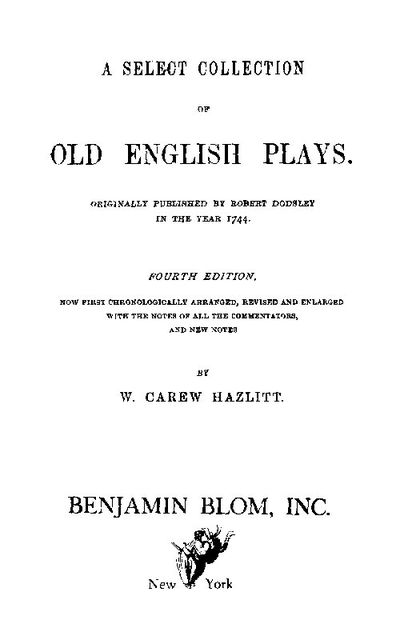
A SELECT COLLECTION OF OLD ENGLISH PLAYS.
ORIGINALLY PUBLISHED BY ROBERT DODSLEY IN THE YEAR 1744. FOURTH EDITION.
NOW FIRST CHRONOLOGICALLY ARRANGED, REVISED AND ENLARGED WITH THE NOTES OF ALL THE COMMENTATORS, AND NEW NOTES
BY
W. CAREW HAZLITT.
BENJAMIN BLOM, INC.
New York
First published 1874-1876
Reissued 1964 by Benjamin Blom, Inc.
L.C. Catalog Card No.: 64-14702
Printed in U.S.A. by
NOBLE OFFSET PRINTERS, INC.
NEW YORK 3, N.Y.
THE OLD COUPLE
A WOMAN NEVER VEXED.
THE ORDINARY
THE LONDON CHANTICLEERS.
THE SHEPHERDS' HOLIDAY.
FUIMUS TROES: THE TRUE TROJANS
THE LOST LADY.
THE OLD COUPLE
EDITION.
The Old Couple. A Comedy. By Thomas May, Esq.; London, Printed by J. Cottrel, for Samuel Speed, at the signe of the Printing-press in S. Paul's Churchyard. 1658. 4o.
[A MS. note in one of the former editions says: "This comedy is pleasingly and fluently written, and though it contains little poetry, is not without some eloquent and beautiful passages. The first scene is the best in the play."]
INTRODUCTION
It seems probable that this comedy, as it is called, was never acted, and on the title-page of the old edition (not printed until 1658, eight years after the death of the author), it is not mentioned that it was performed by any private or public company. This fact was usually stated, though during the period when the theatres were silenced exceptions were not very uncommon. It is pretty obvious, however, from the general structure of the piece and the nature of the dialogue, that "The Old Couple" was not calculated or intended by the author to please the multitude. No inconsiderable part of the plot, and some of the characters, may be considered allegorical, and for the sake of preserving it, some constraint is used in a few of the incidents, and forced and unnatural conversions take place among the persons.[1]
As to the period when it was written, judging from internal evidence, it might be thought that May produced "The Old Couple" late in life, and it was certainly the last printed of any of his works. It will be observed that two lines in the last scene of this play close "The Goblins" of Sir John Suckling.
"Gently my joys distil, Lest you should break the vessel you should fill."
Sir J. Suckling does not introduce them as a quotation, but nevertheless, from the situation in which they are found in his comedy, it seems likely that they were so, and that they originally belong to May. If this supposition be correct, "The Old Couple" must have been written before 1641, in which year Suckling died, and the latter must have seen it in MS.[2]
DRAMATIS PERSONÆ
MEN.
- Sir Argent Scrape, an old covetous rich knight.
- Earthworm, an old miserly niggard.
- Master Freeman.
- Eugeny, Sir Argent Scrape's nephew.
- Euphues (Freeman's nephew) Scudmore's friend.
- Theodore, Earthworm's virtuous son.
- Scudmore, supposed to be slain by Eugeny.
- Fruitful, the Lady Covet's chaplain (Scudmore disguised).
- Barnet.
- Dotterel, a gull, married to the Lady Whimsey.
- Trusty, the Lady Covet's steward.
- Jasper, Earthworm's servant.
- Three neighbours of Earthworm's.
- Officers.
WOMEN.
- The Lady Covet, betrothed to Sir Argent Scrape.
- Matilda (Earthworm's niece), Scudmore's love.
- Artemia (Freeman's daughter), Eugeny's love.
- The Lady Whimsey, married to Dotterel.
[Pg 6] [Pg 7]
THE OLD COUPLE
ACT I.
Eugeny solus.
Eug. This is the hour which fair Artemia Promis'd to borrow from all company, And bless me only with it; to deny Her beauteous presence to all else, and shine On me, poor me! Within this garden here, This happy garden once, while I was happy,[3] And wanted not a free access unto it; Before my fatal and accursed crime Had shut these gates of paradise against me; When I, without control alone might spend With sweet Artemia in these fragrant walks The day's short-seeming hours; and (ravish'd) hear Her sweet discourses of the lily's whiteness, The blushing rose, blue-mantled violet, Pale daffodil, and purple hyacinth: With all the various sweets and painted glories Of Nature's wardrobe, which were all eclips'd By her diviner beauty. But alas! What boots the former happiness I had, But to increase my sorrow?[4] My sad crime Has left me now no entrance but by stealth, When death and danger dog my vent'rous steps. But welcome danger, since thou find'st so fair A recompense as my Artemia's sight!
Enter Artemia.
Art. And art thou come, my dearest Eugeny? Has thy true love broke through so many hazards To visit me? I prythee, chide my fondness, That did command thee such a dangerous task. I did repent it since, and was in hope Thou wouldst not come.
Eug. Why hop'd Artemia so? Wouldst thou not see me then? Or can the hazard Of ten such lives as mine is countervail One glance of favour from thy beauteous eyes?
Art. Why dost thou use that language to a heart, Which is thy captive, Eugeny, and lives, In nothing happy but in thee?
Eug. Ah, love! There lies my greatest sorrow; that the storms Of spiteful fortune, which o'erwhelm my state, Should draw thy constant goodness to a suff'ring— A goodness worthy of the happiest man.
Art. Those storms of fortune will be soon o'er-blown, When once thy cause shall be but truly known, That chance, not malice, wrought it; and thy pardon Will be with ease obtain'd.
Eug. It may be, love, If old Sir Argent do deal truly in it.
Art. But keep thyself conceal'd: do not rashly Venture two lives in one: or, when thou com'st, Let it be still in silence of the night. No visitation then, or other strange Unlook'd-for accident, can bar our joys. The moon is now in her full orb, and lends Securer light to lovers than the sun: Then only come. But prythee, tell me, love, How dost thou spend thy melancholy time?
Eug. Within the covert of yon shady wood, Which clothes the mountain's rough and craggy top, A little hovel built of boughs and reeds Is my abode: from whence the spreading trees Keep out the sun, and do bestow in lieu A greater benefit, a safe concealment. In that secure and solitary place I give my pleas'd imagination leave To feast itself with thy supposed presence, Whose only shadow brings more joy to me, Than all the substance of the world beside.
Art. Just so alone am I; nay, want the presence Of mine own heart, which strays to find out thee. But who comes to thee to supply thy wants?
Eug. There Artemia names my happiness— A happiness which, next thy love, I hold To be the greatest that the world can give, And I am proud to name it. I do there Enjoy a friend, whose sweet society Makes that dark wood a palace of delight: One stor'd with all that can commend a man; In whom refined knowledge and pure art, Mixing with true and sound morality, Is crown'd with piety.
Art. What wonder's this, Whom thou describ'st?
Eug. But I in vain, alas! Do strive to make with my imperfect skill A true dissection of his noble parts: He loses, love, by all that I can say; For praise can come no nearer to his worth Than can a painter with his mimic sun Express the beauty of Hyperion.
Art. What is his name?
Eug. His name is Theodore, Rich Earthworm's son, lately come home from travel.
Art. O heavens! his son? Can such a caitiff wretch, Hated and curs'd by all, have such a son? The miser lives alone, abhorr'd by all, Like a disease, yet cannot so be 'scap'd; But, canker-like, eats through the poor men's hearts, That live about him: never has commerce With any, but to ruin them; his house Inhospitable as the wilderness, And never look'd upon but with a curse. He hoards, in secret places of the earth, Not only bags of treasure, but his corn, Whose every grain he prizes 'bove a life, And never prays at all but for dear years.
Eug. For his son's sake, tread gently on his fame.
Art. O love! his fame cannot be redeemed From obloquy; but thee I trust so far, As highly to esteem his worthy son.
Eug. That man is all, and more than I have said: His wondrous virtues will hereafter make The people all forgive his father's ill: I was acquainted with him long ago In foreign parts. And, now I think on't, love, He'll be the fittest man to be acquainted With all our secrecies, and be a means To further us; and think I trust his truth, That dare so much commend his worth to thee.
Art. He is my neighbour here: that house is Earthworm's, That stands alone beside yon grove of trees; And fear not, dearest love, I'll find a means To send for him: do you acquaint him first. [Exeunt.
Euphues, Dotterel, Barnet.
Euph. Then shall I tell my cousin that you are A younger brother, Master Dotterel?
Dot. O yes, by any means, sir.
Euph. What's your reason?
Dot. A crotchet, sir, a crotchet that I have: Here's one can tell you I have twenty of 'em.
Bar. Euphues, dissuade him not; he is resolv'd To keep his birth and fortunes both conceal'd; Yet win her so, or no way. He would know Whether himself be truly lov'd or no; And not his fortunes only.
Euph. Well, access You have already found; pursue it, sir, But give me leave to wonder at your way. Another wooer, to obtain his love, Would put on all his colours; stretch t' appear At his full height, or a degree beyond it; Belie his fortunes; borrow what he wanted; Not make himself less than he truly is. What reason is there that a man possess'd Of fortunes large enough, that they may come boldly A welcome suitor to herself and friends, And, ten to one, speed in his suit the fair And usual way, should play the fool, and lose His precious time in such a hopeless wooing?
Dot. Alas, sir! what is a gentleman's time?
Bar. Euphues, he tells you true; there are some brains Can never lose their time, whate'er they do: Yet I can tell you, he has read some books.
Dot. Do not disparage me.
Bar. I warrant thee; And in those books he says he finds examples Of greatest beauties that have so been won.
Euph. O, in "Parismus" and the "Knight o' th' Sun!"[5] Are those your authors?
Dot. Yes, and those are good ones. Why should a man of worth, though but a shepherd, Despair to get the love of a king's daughter?
Euph. I prythee, Barnet, how hast thou screw'd up This fool to such a monstrous confidence?
Bar. He needs no screwing up; but let him have His swing a little.
Euph. He shall have it freely. But you have seen your mistress, Master Dotterel? How do you find her? coming?
Dot. That's all one; I know what I know.
Bar. He has already got Some footing in her favour.
Euph. But I doubt He'll play the tyrant; make her doat too long, Wear the green-sickness as his livery, And pine a year or two.
Dot. She's not the first That has done so for me.
Euph. But if you use My cousin so, I shall not take it well.
Dot. O, I protest I have no such meaning, sir. See, here she comes! the Lady Whimsey too.
Enter Lady Whimsey, with Artemia.
Lady W. I thought, sweetheart, th' hadst wanted company.
Art. Why, so I did—yours, madam.
Lady W. Had I known Your house had been so full of gallants now, I would have spar'd my visit. But 'tis all one, I have met a friend here.
Euph. Your poor servant, madam.
Lady W. I was confessing of your cousin here About th' affairs of love.
Euph. Your ladyship, I hope, will shrieve her gently.[6]
Lady W. But I tell her She shall not thank me now for seeing her; For I have business hard by. I am going A suitor to your old rich neighbour here— Earthworm.
Euph. A suitor! He is very hard In granting anything, especially If it be money.
Lady W. Yes, my suit's for money; Nay, all his money, and himself to boot.
Bar. His money would do well without himself.
Lady W. And with himself.
Bar. Alas! your ladyship Should too much wrong your beauty, to bestow it Upon one that cannot use it, and debar More able men their wishes.
Euph. That's true, Barnet, If she should bar all other men: but that Would be too great a cruelty.
Art. Do you hear my cousin, madam?
Lady W. Yes, he will be heard: Rather than fail, he'll give himself the hearing. But, prythee, Euphues, tell me plainly now, What thou dost think of me? I love thy freeness Better than any flattery in the world.
Euph. I think you wondrous wise.
Lady W. In what?
Euph. In that That makes or mars a woman—I mean love.
Lady W. Why, prythee?
Euph. I think you understand so well What the true use of man is, that you'll ne'er Trouble your thoughts with care, or spoil your beauty With the green-sickness, to obtain a thing Which you can purchase a discreeter way.
Art. How do you like this, madam?
Lady W. Wondrous well; 'Tis that I look'd for. But what entertainment Would old rich Earthworm give us, do you think?
Bar. Unless your presence, madam, could infuse A nobler soul into him, 'tis much fear'd 'Twould be but mean.
Lady W. Because (you'll say) he's covetous? Tut! I can work a change in any man. If I were married to him, you should see What I would make him.
Euph. I believe we should, If cuckold's horns were visible.
Art. But could Your ladyship be pleas'd with such a husband?
Lady W. Who could not well be pleas'd with such a fortune?
Art. Wealth cannot make a man.
Lady W. But his wealth, lady, Can make a woman.
Euph. Yet, I doubt, old Earthworm Would prove too subtle to be govern'd so. You'll find him, madam, an old crabbed piece: Some gentle fool were better for a husband.
Art. Fie, cousin, how thou talk'st!
Lady W. He's in the right: Fools are the only husbands; one may rule 'em. Why should not we desire to use men so, As they would us? I have heard men protest They would have their wives silly, and not studied In anything, but how to dress themselves; And not so much as able to write letters. Just such a husband would I wish to have, So qualifi'd, and not a jot beyond it; He should not have the skill to write or read.
Art. What could you get by that?
Lady W. I should be sure He could not read my letters; and for bonds, When I should have occasion to use money, His mark would serve.
Art. I am not of your mind: I would not have a fool for all the world.
Bar. No, fairest lady, your perfections None but the wisest and the best of men Can truly find and value.
Dot. And I protest, lady, I honour you for not loving a fool.
Lady W. You would love a wife, it seems, that loves not you?
Euph. A tart jest, Barnet!
Bar. But he feels it not. [Aside.
Euph. Fie, Master Dotterel! 'tis not nobly done In you to hate a fool: a generous spirit Would take the weakest' part; and fools, you know, Are weakest still.
Dot. Faith, Master Euphues, I must confess I have a generous spirit, And do a little sympathise with fools: I learn'd that word from a good honest man. But hark you, cousin Barnet, this same lady Is a brave woman.
Bar. Are you taken with her?
Dot. I love a wit with all my heart.
Bar. 'Tis well; He is already taken off, I see, From fair Artemia, or may be soon; Upon this t'other I may build a fortune. [Aside.
Euph. But, madam, if your ladyship would marry Upon those terms, 'twere better that you took Old Earthworm's son.
Lady W. Has he a son, I prythee?
Euph. Yes, lately come from travel, as they say, We have not seen him yet; he has kept close Since his arrival; people give him out To be his father's own.
Lady W. Nay, then I swear I'll none of him. If he be covetous, And young, I shall be troubled too long with him: I had rather have the old one.
Art. Here's my father.
Enter Master Freeman.
Free. Health to this good society: I am sorry That my poor house must not to-day enjoy The happiness to entertain you all. We are invited to th' old Lady Covet's; And thither must our company remove.
Lady W. Sir, I'll be govern'd by you. I was bold To come and see Mistress Artemia.
Free. She's much beholden to your ladyship For doing her that honour.
Euph. Tell me, uncle: I hear Sir Argent Scrape is at her house.
Free. Nephew, 'tis true; and, which thou'lt wonder at, That marriage, which we talk'd of as a jest, In earnest now's concluded of, and shall To-morrow morning be solemnised.
Euph. Betwixt Sir Argent and the Lady Covet? I do not think it strange; there's but one hedge Has a long time divided them—I mean Their large estates; and 'tis th' estate that marries.
Free. But is't not strange, nay, most unnatural— And I may say ridiculous, for those years To marry, and abuse the ordinance? My Lady Covet is, at least, fourscore, And he, this year, is fourscore and fifteen: Besides, he has been bed-rid long, and lame Of both his feet.
Euph. Uncle, he's not too old To love—I mean her money; and in that The chiefest end of marriage is fulfill'd: He will increase and multiply his fortunes: Increase, you know, is the true end of marriage!
Free. They have already almost the whole country.
Euph. But you shall see how now they'll propagate.
Free. Is such a marriage lawful?
Euph. Ah! good uncle, Dispute not that, the church has nought in this; Their lawyer is the priest that marries them, The banns of matrimony are the indentures, The bounds and landmarks are the ring that joins them.
Art. But there's no love at all.
Euph. Yes, pretty cousin, If thou art read in amorous books, thou'lt find That Cupid's arrow has a golden head; And 'twas a golden shaft that wounded them.
Free. Well, thither we must go; but, prythee, nephew, Forbear thy jesting there.
Euph. I warrant you; I'll flatter the old lady, and persuade her How well she looks: but when they go to bed, I'll write their epitaph.
Free. How, man! their epitaph? Their epithalamium thou mean'st.
Euph. No, sirs; Over their marriage-bed I'll write their ages, And only say, Here lies Sir Argent Scrape, Together with his wife, the Lady Covet. And whosoever reads it will suppose The place to be a tomb, no marriage-bed.
Lady W. How strangely thou art taken with this wedding, Before thou see'st it!
Euph. And then, let me see: To fit them for an Hymeneal song, Instead of those so high and spirited strains, Which the old Grecian lovers us'd to sing When lusty bridegrooms rifled maidenheads, I'll sing a quiet dirge, and bid them sleep In peaceful rest, and bid the clothes, instead Of earth, lie gently on their aged bones——[7]
Free. Thou'lt ne'er have done. Well, gallants, 'tis almost The time that calls us: I must needs be gone.
Lady W. We'll wait upon you, sir.
Free. Your servant, madam.
[Exeunt Lady Whimsey, Freeman, Dotterel, and Barnet.
Art. Stay, cousin, I have a request to thee.
Euph. Thou canst not fear that I'll deny it thee. Speak it: 'tis done.
Art. Why, then, in short, 'tis this— Old Earthworm, cousin, has a son (they say) Lately come home; his name, as I have heard, Is Theodore.
Euph. Yes, I have heard of him.
Art. I would entreat you, by some means or other, To draw him hither; I'd fain speak with him: Ask not the cause, but do what I request— You may hereafter know.
Eup. Well, I'll not question't, But bring him hither, though I know him not.
Art. Cousin, farewell; I shall be look'd for straight.
[Exit Artemia.
Manet Euphues.
Euph. Rich Earthworm's son! why, in the name of wonder, Should it be her desire to speak with him? She knows him not. Well, let it be a riddle; I have not so much wit as to expound it; Nor yet so little as to lose my thoughts Or study to find out what the no reason Of a young wench's will is. Should I guess— I know not what to think; she may have heard That he's a proper man, and so desire To satisfy herself? What reason then Can she allege to him? Tut, that's not it: Her beauty and large dow'r need not to seek Out any suitors; and the odious name Of his old wretched father would quite choke it. Or have some tattling gossips or the maids Told her, perchance, that he's a conjuror? He goes in black: they say he is a scholar: Has been beyond sea, too; there it may lie: And he must satisfy her longing thought, What or how many husbands she shall have; Of what degree; upon what night she shall Dream of the man; when she shall fast,[8] and walk In the churchyard, to see him passing by, Just in those clothes that first he comes a suitor. These things may be; but why should she make me To be her instrument? Some of the men Or maids might do't as well. Well, since you have Us'd me, fair cousin, I will sound your drifts, Or't shall go hard. The fellow may abuse her; Therefore, I'll watch him too, and straight about it. But now I think on't, I'll solicit him By letter first, and meet him afterward. [Exit.
FOOTNOTES:
[1] [It is difficult to allow that this piece is particularly allegorical in any of its parts or characters. It has the air of a drama which had lain by for some time, and been hastily finished, as some of the incidents and characters are not developed with due regard to dramatic propriety. The conversion of Earthworm, especially, is unnaturally abrupt and violent.]
[2] "The Goblins" was publicly performed, whereas the "Old Couple" does not seem to have been so. Suckling died early in 1641. I confess that the evidence appears to me to lie strongly against May, who was a great borrower—even from himself, the most allowable kind of plagiarism.
[3] Former editions—
"This happy garden, once while I was happy."
—Pegge.
[4] Dante ("Inferno," c. v.) says—
"Nessun maggior dolore Che ricordarsi del tempo felice Ne la miseria."
—Collier.
[5] Two romances of the time, very well known, often reprinted, and frequently mentioned in old authors.—Collier.
[6] i.e., Shrive her, hear her at confession. So in Shakespeare's "King Richard III."—
"What, talking with a priest, Lord Chamberlain? Your lordship hath no shriving-work in hand."
—Steevens.
[7] These lines seem a parody on the following one in "Bonduca," by Beaumont and Fletcher, act iv. sc. 3—
"Lie lightly on my ashes, gentle earth."
The time when Prior wrote his beautiful Ode to the Memory of Colonel George Villiers, drowned in the river Piave, in Friuli, 1703, is so near the period in which Mr Pope composed his elegy to the memory of an unfortunate lady, that it is difficult to say which of these great men borrowed from the other. It appears certain, however, that one of them, in the following lines, was indebted to his friend, unless it can be supposed that both of them were obliged to the above line of Beaumont and Fletcher. Prior says—
"Lay the dead hero graceful in a grave (The only honour he can now receive), And fragrant mould upon his body throw. And plant the warrior laurel o'er his brow; Light lie the earth, and flourish green the bough."
Mr Pope writes thus—
"What though no sacred earth allow thee room, Nor hallow'd dirge be mutter'd o'er thy tomb; Yet shall thy grave with rising flowers be drest, And thy green turf lie lightly on thy breast."
I know not why we should suppose that Pope borrowed from Prior, or that either of them was indebted to Beaumont and Fletcher on this occasion. Sit tibi terra levis! is a wish expressed in many of the ancient Roman inscriptions. So in that on Pylades—
"Dicite qui legitis, solito de more, sepulto, Pro meritis, Pylade, sit tibi terra levis!"
Again, in the sepulchral dialogue supposed to pass between Atimetus and Homonœa—
"Sit tibi terra levis, mulier dignissima vita!"
Again, in Propertius, El. xvii. lib. 1—
"Et mihi non ullo pondere terra foret."
Again, in Ovid—
"Et sit humus cineri non onerosa tuo!"
Thus also Juvenal, Sat. vii.—
"Di majorum umbris tenuem et sine pondere terram, Spirantesque crocos, et in urna perpetuum ver!"
Again, in Persius, Sat. i.—
"Non levior cippus nunc imprimit ossa? ... nunc non e manibus illis, Nunc non e tumulo fortunataque favilla Nascentur violæ?"
On the contrary, Sit tibi terra gravis and Urgeat ossa lapis were usual maledictions, the ancients supposing that the soul remained for some time after death with the body, and was partner in its confinement. The latter of these wishes is ludicrously adopted by Dr Evans, in his epitaph on Sir J. Vanbrugh—
"Lie heavy on him, earth! for he Laid many a heavy weight on thee."
It may be observed that such ideas, however poetical, have no great degree of propriety when introduced into Christian elegies, as we have no belief that the soul is in danger of being oppressed by a monument or stifled in a grave.—Steevens.
[8] These customs are still preserved by the inferior ranks of females in different parts of the kingdom. Among others, they frequently fast on St Agnes' Eve, and at the same time make use of several singular rites and ceremonies; all which are described and ridiculed in Gay's comedy of the "Wife of Bath." See also ["Popular Antiquities of Great Britain," 1870, i. 20, et alibi.]
ACT II.
Earthworm, Theodore.
[1] [It is difficult to allow that this piece is particularly allegorical in any of its parts or characters. It has the air of a drama which had lain by for some time, and been hastily finished, as some of the incidents and characters are not developed with due regard to dramatic propriety. The conversion of Earthworm, especially, is unnaturally abrupt and violent.]
[2] "The Goblins" was publicly performed, whereas the "Old Couple" does not seem to have been so. Suckling died early in 1641. I confess that the evidence appears to me to lie strongly against May, who was a great borrower—even from himself, the most allowable kind of plagiarism.
[3] Former editions—
[4] Dante ("Inferno," c. v.) says—
[5] Two romances of the time, very well known, often reprinted, and frequently mentioned in old authors.—Collier.
[6] i.e., Shrive her, hear her at confession. So in Shakespeare's "King Richard III."—
[7] These lines seem a parody on the following one in "Bonduca," by Beaumont and Fletcher, act iv. sc. 3—
[8] These customs are still preserved by the inferior ranks of females in different parts of the kingdom. Among others, they frequently fast on St Agnes' Eve, and at the same time make use of several singular rites and ceremonies; all which are described and ridiculed in Gay's comedy of the "Wife of Bath." See also ["Popular Antiquities of Great Britain," 1870, i. 20, et alibi.]
It seems probable that this comedy, as it is called, was never acted, and on the title-page of the old edition (not printed until 1658, eight years after the death of the author), it is not mentioned that it was performed by any private or public company. This fact was usually stated, though during the period when the theatres were silenced exceptions were not very uncommon. It is pretty obvious, however, from the general structure of the piece and the nature of the dialogue, that "The Old Couple" was not calculated or intended by the author to please the multitude. No inconsiderable part of the plot, and some of the characters, may be considered allegorical, and for the sake of preserving it, some constraint is used in a few of the incidents, and forced and unnatural conversions take place among the persons.[1]
Sir J. Suckling does not introduce them as a quotation, but nevertheless, from the situation in which they are found in his comedy, it seems likely that they were so, and that they originally belong to May. If this supposition be correct, "The Old Couple" must have been written before 1641, in which year Suckling died, and the latter must have seen it in MS.[2]
This happy garden once, while I was happy,[3]
But to increase my sorrow?[4] My sad crime
Euph. O, in "Parismus" and the "Knight o' th' Sun!"[5]
Euph. Your ladyship, I hope, will shrieve her gently.[6]
Of earth, lie gently on their aged bones——[7]
Dream of the man; when she shall fast,[8] and walk
Earth. I do not more rejoice in all my stores, My wealthy bags, fill'd garners, crowded chests, And all the envi'd heaps that I have glean'd With so long care and labour, than I do In thy most frugal nature, Theodore, Concurring just with mine. In thee, my son, I see, methinks, a perpetuity Of all the projects which my soul has hatch'd, And their rich fruits: I see my happiness, When I consider what great hoards of wealth, With long care rak'd together, I have seen Even in a moment scatter'd; when I view The gaudy heirs of thriving aldermen Fleeting like short-liv'd bubbles into air, And all that fire expiring in one blaze, That was so long a-kindling. But do thou, Do thou, my son, go on, and grow in thrift; It is a virtue that rewards itself. 'Tis matterless in goodness who excels; He that hath coins hath all perfections else.
Theo. Sir, I am wholly yours, and never can Degenerate from your frugality; Or, if my nature did a little stray, Your good example would direct it still, Till it were grown in me habitual.
Earth. 'Twill be a greater patrimony to thee Than all my wealth: strive to be perfect in't; Study the rules. One rule is general. And that is, give away nothing, son; For thrift is like a journey; every gift, Though ne'er so small, is a step back again. He that would rise to riches or renown Must not regard, though he pull millions down.
Theo. That lesson, sir, is easy to be learn'd.
Earth. Laugh at those fools that are ambitious Of empty air, to be styl'd liberal! That sell their substance for the breath of others, And with the flattering thanks of idle drones Are swelled, while their solid parts decay. What clothes to wear?—the first occasion Of wearing clothes will teach a wise man best.
Theo. True, sir; it teacheth us how vain a thing It is for men to take a pride in that, Which was at first the emblem of their shame.[9]
Earth. Thou hitt'st it right: but canst thou be content With my poor diet too?
Theo. O, wondrous well! 'Twas such a diet which that happy age, That poets style the golden, first did use.
Earth. And such a diet to our chests will bring The golden age again.
Theo. Beside the gain That flows upon us, health and liberty Attend on these bare meals: if we all were bless'd With such a temperance, what man would fawn, Or to his belly sell his liberty? There would be then no slaves, no sycophants At great men's tables. If the base Sarmentus Or that vile Galba[10] had been thus content, They had not borne the scoffs of Cæsar's board. He whose cheap thirst the springs and brooks can quench, How many cares is he exempted from? He's not indebted to the merchant's toil, Nor fears that pirates' force or storms should rob him Of rich Canaries or sweet Candian wines: He smells nor seeks no feasts; but in his own True strength contracted lives, and there enjoys A greater freedom than the Parthian king.
Earth. Thou mak'st me more in love with my bless'd life.
Theo. Besides, pure cheerful health ever attends it; Which made the former ages live so long. With riotous banquets sicknesses came in; When death 'gan muster all his dismal band Of pale diseases, such as poets feign Keep sentinel before the gates of hell, And bad them wait about the gluttons' tables, Whom they, like venom'd pills in sweetest wines, Deceiv'd, swallow down, and hasten on What most they would eschew—untimely death. But from our tables here no painful surfeits, No fed diseases grow, to strangle nature And suffocate the active brain; no fevers, No apoplexies, palsies, or catarrhs Are here, where nature, not entic'd at all With such a dangerous bait as pleasant cates, Takes in no more than she can govern well.
Earth. But that which is the greatest comfort, son, Is to observe with pleasure our rich hoards Daily increase, and stuff the swelling bags. Come, thou art mine, I see! Here, take these keys.
[Gives Theodore the keys.
These keys can show thee such amazing plenty, Whose very sight would feed a famish'd country. I durst not trust my servants.
Theo. Me you may, Who equal with my life do prize your profit.
Earth. Well, I'll go in: I feel myself half sleepy After the drink I took. [Exit.
Theo. 'Twill do you good, sir. Work sweetly, gentle cordial! and restore Those spirits again which pining avarice Has 'reft him of. Ah me! how wondrous thin, How lean and wan he looks! How much, alas! Has he defrauded his poor genius In raking wealth, while the pale, grisly sighs Of famine dwell upon his aged cheeks. O avarice! than thee a greater plague Did ne'er infest the life of wretched man! Heaven aid my work! That rare extraction Which he has drunk, beside the nourishment, Will cast him in a safe and gentle sleep, While I have liberty to work my ends; And with his body's cure a means I'll find To cure his fame, and (which is more) his mind. Jasper!
Enter Jasper.
Jas. Sir!
Theo. Are those disguises ready, Which I bespoke?
Jas. They are all fitted, sir.
Theo. Then at the hour, which I appointed thee, Invite those people, Jasper; but be true And secret to me.
Jas. As your own heart, sir.
Theo. Take this: I will reward thy service better, As soon as these occasions are dispatch'd.
Jas. I thank you, sir. I have a letter for you, Left here but now, from Master Euphues, Old Master Freeman's nephew.
Theo. Give it me; I will anon peruse it. But my haste Permits not now: Eugeny waits my coming. [Exit Theodore.
Jas. I like this well; yet, if I should prove false To my old master for my young master's sake, Who can accuse me? For the reason's plain And very palpable; I feel it here. This will buy ale; so will not all the hoards, Which my old master has: his money serves For nothing but to look upon; but this Knows what the common use of money is. Well, for my own part, I'm resolv'd to do Whatever he commands me; he's too honest To wrong his father in it: if he should, The worst would be his own another day. [Exit.
Eugeny solus.
Eug. Just thus, in woods and solitary caves, The ancient hermits liv'd; but they liv'd happy! And in their quiet contemplations found More real comforts than society Of men could yield, than cities could afford, Or all the lustres of a court could give. But I have no such sweet preservatives Against the sadness of this desert place. I am myself a greater wilderness Than are these woods, where horror and dismay Make their abodes; while different passions By turn do reign in my distracted soul. Fortune makes this conclusion general— All things shall help th' unfortunate man to fall. First sorrow comes, and tells me I have done A crime whose foulness must deserve a sea Of penitent tears to wash me clean again. Then sear[11] steps in, and tells me, if surpris'd, My wretched life is forfeit to the law. When these have done, enters the tyrant love, And sets before me fair Artemia; Displays her virtues and perfections; Tells me that all those graces, all those beauties, Suffer for me, for my unhappiness, And wounds me more in her than in myself. Ah, Theodore! would I could ever sleep But when thou com'st, for in myself I find No drop of comfort? Welcome, dearest friend!
Enter Theodore.
Theo. Pardon the slowness of my visit, friend; For such occasions have detain'd me hence, As, if thou knew'st, I know thou wouldst excuse.
Eug. I must confess, I thought the hours too long; But the fruition of thy presence now Makes me forget it all.
Theo. Collect thyself,
Thou droop'st too much, my dearest Eugeny, And art too harsh and sour a censurer Of that unhappy crime which thou wert forc'd Lately to act. I did allow in thee That lawful sorrow that was fit; but let Well-grounded comforts cure thee: nought extreme Is safe in man.
Eug. 'Tis time must work that cure.
Theo. But why thy pardon is not yet obtain'd, Let me be free in my conjectures to thee.
Eug. Speak, friend, as to thyself.
Theo. Sir Argent Scrape, Your old rich kinsman, who to-morrow morning Is to be married to the Lady Covet——
Eug. Is that match come about? O avarice! What monsters thou begett'st in this vile age!
Theo. Sir Argent Scrape, I say, is next heir male, On whom thy whole estate was long ago Entail'd.
Eug. 'Tis true.
Theo. He must inherit it, Should thy life fail.
Eug. 'Tis granted.
Theo. Then, friend, hear What not a bare conjecture, but strong grounds Move me to utter. Think upon that word Thou spok'st so lately: think what avarice Can make her bondmen do—that such a price As fifteen hundred pounds a year will make Him labour, not thy pardon, but thy death.
Eug. Can there be such a miscreant in nature?
Theo. I should not think so, if I weigh'd him only, As he's thy kinsman. I have been inform'd He labours underhand to apprehend thee Just at the assizes now, and has laid plots To stop all pardons, which in that short time Might be procur'd: and then what bribes may do In hastening execution, do but consider. If this be false, some courtiers have abus'd His fame: and pardon me, my dearest friend, If I suspect the worst for fear of thee.
Eug. When I consider what accurs'd effects Proceed from wretched avarice, I begin To feel a fear.
Theo. This very age hath given Horrid examples lately: brothers have been Betray'd by brothers in that very kind. When pardons have been got by the next heirs, They have arriv'd too late. No tie so near, No band so sacred, but the cursed hunger Of gold has broke it, and made wretched men To fly from nature, mock religion, And trample under feet the holiest laws.
Eug. He has been ever noted for that vice Which, with his age, has still grown stronger in him.
Theo. Ah, Eugeny! how happy were that last Age of a man, when long experience Has taught him knowledge, taught him temperance, And freed him from so many loose desires In which rash youth is plung'd, were not this vice— But hark, hark, friend! what ravishing sound is that?
Eug. Ha! wondrous sweet! 'tis from th' adjoining thicket.
Song.
This is not the Elysian grove; Nor can I meet my slaughter'd love Within these shades. Come, Death, and be At last as merciful to me, As in my dearest Scudmore's fall, Thou show'dst thyself tyrannical. Then did I die when he was slain; But kill me now, I live again, And shall go meet him in a grove Fairer than any here above.
O, let this woful breath expire! Why should I wish Evadne's fire, Sad Portia's coals, or Lucrece' knife, To rid me of a loathed life? 'Tis shame enough that grief alone Kills me not now, when thou art gone! But, life, since thou art slow to go, I'll punish thee for lasting so; And make thee piecemeal every day Dissolve to tears, and melt away.
Theo. Ah, Eugeny! some heavenly nymph descends To make thee music in these desert woods, To quench or feed thy baleful melancholy: It is so sweet, I could almost believe, But that 'tis sad, it were an angel's voice.
Eug. What, in the name of miracle, is this?
Theo. Remove not thou; I'll make discovery Within this thicket.
Eug. Ha! what means thy wonder? What dost thou see?
Theo. I know not how to tell thee: Now I could wish myself to be all eyes, As erst all ears. I see a shape as fair, And as divine, as was the voice it sent; But clouded all with sorrow: a fair woman, If by a name so mortal I may term her. In such a sorrow sat the Queen of Love, When in the wood she wail'd Adonis' death, And from her crystal-dropping eyes did pay A lover's obsequy.
Eug. Let me come near.
Theo. Sure, black is Cupid's colour; Death and he Have chang'd their liveries now, as in the fable They did their quivers once.[12]
Eug. Ah, woe is me!
Theo. What means that woe?
Eug. Ah, Theodore! my guilt Pursues me to the woods! No place can keep The monuments of my misdeeds away.
Theo. I understand you not.
Eug. It is Matilda, The slaughter'd Scudmore's love, his virtuous love, Whose life by me unhappily was spilt. The sad, melodious ditty, which so late Did pierce our ravish'd ears, was but the note Of this fair turtle for her slaughter'd mate; In which perchance, amidst her woes, she sends Black curses up against my spotted self. But I with prayers and blessings will repay Whate'er thou vent'st 'gainst me. O, do not wish More wretchedness to my distracted soul Than I already feel! Sad sighs and tears Are all the satisfaction that is left For me to make to thy dead love and thee.
Theo. Those lips can vent no curses; 'twould take off Much from the sweetness of her virtuous sorrow. Where lives this lovely maid?
Eug. In the next village.
Theo. Has she a father living?
Eug. No, friend; he died When she was in her infancy. Her mother Two years ago deceas'd, and left her all The substance that she had; which was not great, But does maintain her. In that little house, E'er since this fatal accident, she lives A miracle of truth and constancy, Wailing her love; and now, it seems, has[13] come To vent her woful passions to the woods.
Theo. How happy had he been in such a love, If fate had spar'd his life! But he is dead, And time at last may wear this sorrow off, And make her relish the true joys of love. But why do I thus wander in my thoughts? This passion must be curb'd in the beginning; 'Twill prove too stubborn for me, if it grow. [Aside.
Eug. Come, let us to my cave, as we intended, Ere this sad object stay'd us.
Theo. Sad indeed! Believe me, friend, I suffer with thee in it; But we were wounded in two different kinds. [Aside. Come, let's be gone; though—I could still—dwell here. [Exeunt.
Enter Matilda.
Mat. Methought I heard a noise within the wood; As if men talk'd together not far off; But could discover none. The time has been,[14] In such a solitary place as this, I should have trembled at each moving leaf; But sorrow and my miserable state Have made me bold. If there be savages That live by rapine in such woods as these, As I have heard in ancient times there were, My wretched state would move their pity rather Than violence. I'll confidently go, Guarded with nothing but my innocence. [Exit.
Enter Fruitful, Trusty.
Fruit. Come, master steward, you have had a time Of sweating for this wedding.
Trusty. I have ta'en A little pains to-day: yours, Master Fruitful, Is yet to come; I mean your sermon.
Fruit. Yes, but the pains are pass'd; and that's the study. But to our business that more concerns us: Is the deed ready-written that my lady Must seal to-day?
Trusty. Do you believe she'll seal it?
Fruit. I warrant you; I have so followed her, And laid it to her conscience, that I dare Hazard my life 'tis done.
Trusty. Well, here's the deed: 'tis plainly written.
Fruit. I'll peruse't anon. I know the other feoffees are as true And honest men as any are i' th' world. [Exit Trusty.
Enter Freeman, Euphues, Barnet, Dotterel, Lady Whimsey.
Free. Save you, Master Fruitful!
Fruit. Worthy Master Freeman!
Free. How does my lady, sir? I have made bold To bring her company.
Fruit. Please you draw near, sir; I will go up and signify unto my lady That you are here. [Exit Fruitful.
Bar. What's he? her chaplain, Euphues?
Euph. O yes.
Lady W. She uses praying then, it seems?
Euph. Yes, madam, and fasting too, but gives no alms.
Lady W. Cannot he teach her that?
Euph. 'Tis to be doubted: But he has other ways, which are far safer— To speak against the fashion, against painting, Or fornication. If he were your chaplain, He would inveigh as much 'gainst covetousness.
Lady W. He would hurt me little in that. But has he learning?
Euph. No, surely, madam; he is full of knowledge, But has no learning at all: he can expound, But understands nothing. One thing in him Is excellent: though he do hate the bishops, He would not make them guilty of one sin, Which was to give him orders; for he hates Orders as much as them.
Free. Well, I have heard, Though he came lately to her, he has got A great hand over her, and sways her conscience Which way he list.
Euph. Uncle, 'tis very easy To rule a thing so weak as is her conscience. I'll undertake, that a twin'd thread would do it As well as a strong cable. If he could Rule her estate too, he would have a place on't.
Free. Why, that will follow t'other.
Euph. I think not; Rather her conscience follows her estate, Oppression had not else increas'd it so. She wrong'd a worthy friend of mine—young Scudmore, And by mere fraud and bribery took away His whole estate, five hundred pound a year.
Free. I must confess, 'twas a foul cause indeed; And he, poor man, lack'd means to prosecute The cause against her. But he feels it not At this time, nephew.
Bar. Was't that Scudmore, sir, Whom Eugeny, Sir Argent Scrape's young kinsman, Unfortunately kill'd?
Free. The same. Well, let All these things pass: we come now to be merry.
Lady W. Let's eat up her good cheer: a niggard's feast Is best, they say.
Dot. Shall we have wine good store?
Bar. O, fear not that.
Dot. Hold, belly, hold, i' faith!
Bar. Yes, and brain too.
Dot. Nay, for my brain, Let me alone, I fear not that: no wine Can hurt my brain.
Lady W. Say you so, Master Dotterel? Why, such a brain I love.
Dot. Madam, I am glad I had it for you.
Lady W. For me, sir?
Dot. Yes, lady, 'Tis at your service; so is the whole body. Did I not tickle her there, old lad?
Bar. Yes, rarely.
Lady W. Shall I presume to call you servant, then?
Dot. O Lord, madam! if I were worthy to be.
Lady W. Nay, I know you have good courtship, servant. Wear this for my sake. [Gives him a scarf.
Dot. 'Tis your livery, madam.
Bar. Well, th' art a happy man, if thou knew'st all.
Euph. Madam, I see your ladyship can tell How to make choice in dealing of your favours.
Dot. It pleases you to say so, good Master Euphues.
Euph. Why, sir, I speak of the lady's judgment.
Dot. 'Twas more of her courtesy than my desert.
Enter Lady Covet on crutches.
Euph. Here comes the lady bride.
Free. Joy to your ladyship!
Lady C. I thank you, sir: y' are very welcome all.
Free. I have made bold to bring my friends along, As you commanded, lady.
Lady C. They are most welcome.
Euph. Methinks your ladyship looks fresh to-day, And like a bride indeed.
Lady C. Ah, Master Euphues! You, I perceive, can flatter.
Euph. Does your glass Tell you I flatter, madam?
Lady C. Bestow this Upon young maids; but let me tell you, sir, Old folks may marry too. It was ordain'd At first to be as well a stay to age As to please youth. We have our comforts too, Though we be old.
Euph. Madam, I doubt it not: You are not yet so old but you may have Your comfort well; and if Sir Argent Scrape Were but one threescore years younger than he is——
Bar. What a strange but thou mak'st!
Euph. You would perceive it.
Lady W. Servant, could you find in your heart to marry Such an old bride?
Dot. No, mistress, I protest I had rather have none.
Lady W. What age would you desire To choose your wife of?
Dot. Just as old as you are.
Lady W. Well, servant, I believe you can dissemble.
Lady C. Will't please you to draw near? Sir Argent stays Expecting within.
Free. We'll wait upon you. [Exeunt.
Manent Barnet, Dotterel.
Bar. To what strange fortune, friend, are some men born, I mean by thee. Surely, when thou wert young, The fairies dandled thee.
Dot. Why, prythee, Barnet?
Bar. That ladies thus should doat upon thy person. Dost thou not see how soon the Lady Whimsey Is caught in love with thee?
Dot. But is she, think'st thou?
Bar. Is she! Come, thou perceiv'st it well enough; What else should make her court thee, and bestow Her favours openly? And such a lady! So full of wit as she is, too! Would she Betray the secrets of her heart so far, But that love plays the tyrant in her breast, And forces her?
Dot. True, and, as thou say'st, Barnet, She's a brave, witty lady; and I love A wit with all my heart. What would she say If she should know me truly, that thus loves, And thinks I am but a poor younger brother?
Bar. Why, still the greater is thy happiness: Thou may'st be sure she loves thee truly now, And not thy fortunes.
Dot. Has she found me out, For all I sought to hide myself?
Bar. The more Thy worth appears, the more her judgment's seen. O, 'tis a gallant lady! Well, she might Have cast her eye on me or Euphues; But 'twas not our good fortune!
Dot. Do not despair; Some other woman may love thee as well: Come, thou hast worth, Barnet, as well as I.
Bar. Nay, nay, abuse not your poor friends; but tell me, What dost thou think of young Artemia now?
Dot. Of her! a foolish girl, a simple thing! She'd make a pretty wife for me! I confess I courted her; but she had not the wit To find out what I was, for all my talk.
Bar. And that was strange she should not; but 'tis fate That governs marriages.
Dot. Let her repent, And know what she hath lost, when 'tis too late. But dost thou think this gallant Lady Whimsey Will marry me?
Bar. Mak'st thou a doubt of that? 'Tis thy own fault, boy, if thou hast her not.
Dot. That I protest it shall not be; but, tell me, Shall I express my love to her in verse Or prose?
Bar. In which you will.
Dot. I am alike at both of them indeed.
Bar. I know thou art.
Dot. Come, let's go in.
Bar. Thou long'st to see thy mistress?
Dot. We'll drink her health in a crown'd cup,[15] my lad. [Exeunt.
FOOTNOTES:
[9] Richard Braithwaite printed precisely the same thought in 1621, in his "Times Curtaine Drawne"—
"For who (remembering the cause why clothes were made, Even then when Adam fled unto his shade, For covert nakedness) will not blame Himself to glory in his parents' shame?"
The coincidence is remarkable.—Collier.
"Quæ nec Sarmentus iniquas Cæsaris ad mensas, nec vilis Galba tulisset."
—Juv., Sat. v. 3.
[11] [Conscience.]
[12] Mr Gifford, in a note on Massinger's "Virgin Martyr," points out an elegy by Secundus as the origin of this pretty fancy, which is thus employed by Fairfax in his translation of Tasso's "Jerusalem Delivered"—
"Death hath again exchanged his darts with Love, And Cupid thus lets borrow'd arrows fly."
The allusion is not to be found in the original Italian (bk. ii. s. 34). Davenant, in bk. ii. c. 7, of his "Gondibert," also mentions the fable, and it would be easy among foreign writers to point out many instances in which more extensive use has been made of it. The sonnets by Annibale Nozzolini and by Girolamo Pompei are well known.—Collier.
[13] [Old copy, was.]
[14] So in "Macbeth," act v. sc. 5—
"I have almost forgot the taste of fears: The time has been, my senses would have cool'd To hear a night-shriek; and my fell of hair Would at a dismal treatise rouse, and stir As life were in't. I have supt full with horrors! Direness, familiar to my slaught'rous thoughts, Cannot once start me."
[And see note to the "Heir," xi. 449.]
ACT III.
[Earthworm's house.]
Theodore, Neighbours with sacks.
[9] Richard Braithwaite printed precisely the same thought in 1621, in his "Times Curtaine Drawne"—
[10]
"Quæ nec Sarmentus iniquas Cæsaris ad mensas, nec vilis Galba tulisset."
—Juv., Sat. v. 3.
[11] [Conscience.]
[12] Mr Gifford, in a note on Massinger's "Virgin Martyr," points out an elegy by Secundus as the origin of this pretty fancy, which is thus employed by Fairfax in his translation of Tasso's "Jerusalem Delivered"—
[13] [Old copy, was.]
[14] So in "Macbeth," act v. sc. 5—
[15] I suppose he means a bumper, a cup filled till the wine rises above the top of it. Such a character as Dotterel is hardly made to allude to the pocula coronata of the Romans.—Steevens.
Which was at first the emblem of their shame.[9]
Or that vile Galba[10] had been thus content,
Then sear[11] steps in, and tells me, if surpris'd,
They did their quivers once.[12]
Wailing her love; and now, it seems, has[13] come
But could discover none. The time has been,[14]
Theo. Come, neighbours, pray draw near; my fellow Jasper Has told you wherefore you were sent for hither.
1st Neigh. Ay, I thank you, friend.
2d Neigh. And my good master too.
Theo. My master, touch'd with sorrow and remorse For that unhappy error of his life— That fault (alas!) which by too true a name Is termed misery, determines now By deeds of tender charity to make The wronged poor amends, and to the world Declare the fruits of a reformed life. And first your pardon, neighbours, he would beg, And, next to heaven, be reconcil'd to you.
1st Neigh. Now blessing on his heart!
2d Neigh. Good tender soul!
3d Neigh. I ever thought him a right honest man.
Theo. He that before did churlishly engross And lock those blessings up, which from the hand Of heaven were shower'd upon him, has at last Found their true use, and will henceforth redeem The former misspent time. His wealthy stores Shall be no longer shut against the poor; His bags seal'd up no longer, to debar The course of fitting bounty. To you all, Of corn and money, weekly he'll allow In recompense a greater quantity By far than men of greater rank shall do: Nor will he come himself to take your thanks, Till, as he says, he has deserv'd them better. Meantime, by me he pours his bounty forth, Which he desires with greatest secrecy May be perform'd; for all vainglorious shows And ostentation does his soul abhor. He sounds no trumpet to bestow his alms; Nor in the streets proclaims his charity, Which makes the virtue vice; nor would he have The world take notice of you at his doors.
1st Neigh. See, see, religious man!
2d Neigh. Ah, neighbour! Some in the world have been mistaken in him.
Theo. Nor would he have you blaze his bounty forth, And praise him openly: forbear it, neighbours; Your private prayers only he desires And hearty wishes; for true charity, Though ne'er so secret, finds a just reward. I am his servant, newly entertain'd, But one to whom he does commit the trust Of his desires in this; and I should wrong His goodness strangely, if I should keep The least of what his bounty doth intend. Come in with me; I'll fill your sacks with corn, And let you see what money he bestows.
Omnes Neigh. We'll pray to heaven to reward his goodness.
[Exeunt.
Euphues, Barnet.
Euph. Our Dotterel, then, is caught?
Bar. He is, and just As Dotterels[16] used to be: the lady first Advanc'd toward him, stretch'd forth her wing, and he Met her with all expressions; and he's caught As fast in her lime-twigs as he can be, Until the church confirm it.
Euph. There will be Another brave estate for her to spend.
Bar. Others will be the better for't; and if None but a Dotterel suffer for't, what loss Of his can countervail the least good fortune That may from thence blow to another man?
Euph. She spent her t'other husband a great fortune.
Bar. Dotterel's estate will find her work again For a great while: two thousand pounds a year Cannot be melted suddenly; when 'tis, Men can but say her prodigality Has done an act of justice, and translated That wealth, which fortune's blindness had misplac'd On such a fellow. What should he do with it?
Euph. And thou say'st right: some men[17] were made to be The conduit-pipes of an estate, or rather The sieves of fortune, through whose leaking holes She means to scatter a large flood of wealth, Besprinkling many with refreshing showers. So usurers, so dying aldermen Pour out at once upon their sieve-like heirs Whole gusts of envi'd wealth; which they together Through many holes let out again in showers, And with their ruin water a whole country. But will it surely be a match?
Bar. As sure As the two old death's-heads to-morrow morning Are to be join'd together.
Euph. Who, Sir Argent and his lady?
Bar. Yes, if she keep touch In what she promis'd me, I'll undertake Her Dotterel shall be sure, and given to her In matrimony.
Euph. Given to his wife? I see thou mean'st in Dotterel to bring back The ancient Spanish custom, where the women Inherited the land, rul'd the estates; The men were given in marriage to the women With portions, and had jointures made to them: Just so will be his case; he will be married Unto a brave subjection. How the fool Is caught in his own noose! What confidence Had he, that he would never marry any, But such, forsooth, as must first fall in love With him, not knowing of his wealth at all?
Bar. Well, now he's fitted: he begun at first With fair Artemia.
Euph. He might have told Her of his wealth, and miss'd her too, or else I am deceiv'd in her: true virtuous love Cannot be bought so basely; she besides Has been in love, I'm sure; and may be still, Though he be fled the land. But, now I think on't, I must go see whether old Earthworm's son Has yet perform'd what she desir'd: she stays At home.
Bar. I'll in, and see how Dotterel Courts his brave mistress: I left him composing A sonnet to her. There are the old couple Within too.
Euph. If a man could get to hear Their way of courting, 'twould be full as strange As Dotterel's is ridiculous: but stay,
Sir Argent Scrape and Lady Covet brought in in chairs.
Here come the lovely bride and bridegroom forth. Prythee, let's venture to stay here a little Behind the hangings, man: we shall be sure To hear their love; they are both somewhat deaf, And must speak loud.
Bar. Content, I'll stay with thee.
Sir Arg. Leave us awhile. Now, madam, you have seen, So have your learned counsel, that I deal Squarely with you: my personal estate Is no less worth than I profess'd, when first I mov'd my loving suit.
Bar. Ay, marry, sir, a loving suit indeed!
[Aside.
Euph. Let 'em go on in their own proper dialect.
[Aside.
Lady C. I find it; And should be loth but to requite your truth In the same kind: you seem'd at first to question, How strong my title was in that estate Which was young Scudmore's once: 'tis a fair manor.
Euph. 'Tis true, old rottenness—too good for you.
[Aside.
Lady C. My counsel can inform you that I kept it, And did enjoy possession while he liv'd; And now he's dead, who should recover it? The heirs are poor and beggarly.
Sir Arg. Nay, I think We need not fear their suing against us.
Lady C. If they should stir, a little piece of money Would stop their mouths.
Euph. A little piece of dirt Will stop your mouth ere long, and then the suit Will go against thee, mischief!
[Aside.
Bar. Prythee, peace; Thou art not merry now, but choleric. [Aside.
Euph. I think of my wrong'd friend. [Aside.
Lady C. But you were saying You made no doubt but shortly to enjoy Your kinsman Eugeny's estate: that were A fair addition to your land; they say It goes at fifteen hundred pounds a year.
Sir Arg. 'Tis true, and 'tis well worth it.
Lady C. But what hopes have you to gain it shortly?
Sir Arg. He, you know, By Scudmore's death has forfeited his life Unto the law; and the estate's entail'd On me as the next heir.
Lady C. But he is fled.
Sir Arg. No, no; I know he lurks not far from hence, And I shall shortly learn the very place By some intelligence. I have provided My secret scouts; and then you know th' assizes Are now at hand: the time will be too short To get a pardon, specially as I Have laid some friends to stall it underhand.
Euph. Here's a new mischief, Barnet! [Aside.
Bar. And a strange one. [Aside.
Lady C. And then you must not spare a little money To hasten execution at an hour Unusual. Those things may well be done: Else what were money good for?
Sir Arg. You say right. If 'twere once come to that, I fear it not.
Lady C. Well, sir, I see all's right and straight between us. You understand how welcome you are hither; I need not tell it o'er again.
Sir Arg. No, lady; I will be bold to say, I do not come Now as a stranger, but to take possession Both of your house and you.
Euph. He cannot speak Out of that thriving language in his love. [Aside.
Lady C. Will you go in again? our guests, perhaps, Think the time long.
Sir Arg. With all my heart: A cup of sack would not do much amiss.
Lady C. We'll have it with a toast. Who's near there, ho!
Enter Servants, and carry them out.
Bar. What a strange kind of pageant have we seen?
Euph. Barnet, I cannot tell whether such strange Unsatiable desires in these old folks, That are half earth already, should be thought More impious or more ridiculous.
Bar. They are both alike.
Euph. But such a monstrous Unnatural plot as his, to apprehend His kinsman, I ne'er heard of! If I knew Where Eugeny remain'd, though 'twere his fortune To kill a friend of mine, I'd rescue him From this unnatural and wolfish man.
Bar. That would betray his life to satisfy His avarice, not justice of the law.
Enter Dotterel, Lady Whimsey.
Here comes another piece of matrimony, That may be shortly.
Euph. 'Tis better far than t'other: They are the last couple in hell.
Dot. Save you, gallants!
Bar. You are the gallant, sir, that on your arm Do wear the trophies of a conquer'd lady.
Euph. Madam, I had almost mistaken my salutation, And bid God give you joy.
Lady W. Of what, I prythee?
Euph. Of this young gallant, call him by what name Or title you are pleas'd, husband or servant.
Bar. He may be both, sir: he is not the first Has been a husband and a servant too.
Dot. I am her servant, sir: and I confess Have an ambition, and so forth.
Lady W. How now, servant!
Euph. I tell you truly, madam, 'tis reported (And those reports are fatal still, you know) That Master Dotterel and you are purpos'd To bear the old knight and lady company To-morrow to the church.
Lady W. That I confess, and so will you, I think.
Euph. Nay, but to do As they do, madam—tie the lasting knot.
Lady W. Do you hear, servant? This it is to have So proper a servant: every one supposes I must needs be in love.
Dot. I would you were As deep in Cupid's books as I.
Euph. That is In Cupid's favour: you are a happy man.
Lady W. My servant has been searching Cupid's books, I think, to find that sonnet that he gave me. Are you content that I should show your poetry?
Dot. Do, mistress, I am not asham'd on't; But you shall give me leave to read it to 'em. 'Tis but a sonnet, gentlemen, that I fitted To my fair mistress here.
Euph. Let us be happy To hear it, sir.
Dot. Take it as it is— [He reads.
Dear, do not your fair beauty wrong; In thinking still you are too young.
Euph. How! too young?
Bar. Let him alone; I know the song.
Dot. The rose and lilies in your cheek Flourish, and no more ripeness seek; Your cherry lip, red, soft and sweet, Proclaims such fruit for taste most meet: Then lose no time, for love has wings, And flies away from aged things.
How do you like it, gentlemen?
Euph. Very well. The song's a good one.
Bar. O, monstrous! Never man stole with so little judgment.
Euph. Of all the love-songs that were ever made, He could not have chose out one more unfit, More palpably unfit, that must betray His most ridiculous theft.
Lady W. Who would have thought My servant should suppose I think myself Too young to love, that have already had One husband!
Euph. O, excuse him, gentle madam, He found it in the song.
Bar. And, it should seem, He could get no other song but this.
Lady W. Surely a woman of five-and-thirty year old Is not too young to love!
Bar. O, spare him, madam!
Euph. Let's raise him up. I think the sonnet's good: There's somewhat in't to th' purpose. Read it again.
[He reads it again.
Euph. ——For taste most meet. Very good; and there he tickled it? Mark'd you that, madam! The two last of all? Then lose no time, for love hath wings— He gives you fitting counsel.
Lady W. Yes, I like it.
Dot. I thought, when they understood it, they would like it: I am sure, I have heard this song prais'd ere now.
Lady W. This does deserve a double favour, servant.
Dot. Let this be the favour, sweet mistress. [Kisses her.
Euph. How some men's poetry happens to be rewarded!
Lady W. Shall we go in? But, prythee, Euphues, What is the reason sweet Artemia, Thy cousin, is not here?
Euph. I know not, madam; But her pretence was business. I am going To visit her. If you go in to keep Th' old couple company, I'll fetch her to you.
Lady W. I prythee, do! Farewell. Come, servant, Shall we go in?
Dot. I'll wait upon you, mistress. [Exeunt.
Theodore, Artemia.
Theo. I will acquaint him, lady, with the hour, And to his longing ear deliver all Your sweet salutes; which is the only air Of life and comfort Eugeny takes in. Your constant love and virtues, sweetest lady, Are those preservatives, which from his heart Expel the killing fits of melancholy, And do, in spite of fortune, quicken him.
Art. O, would those comforts could arrive at him, That from my wishing thoughts are hourly sent!
Theo. Such virtuous wishes seldom are in vain.
Art. I should be far more sad in the behalf Of my dear Eugeny, but that I know He does enjoy your sweet society, Which he beyond all value does esteem.
Theo. His own is recompense enough for mine. And I the gainer in it; did not grief For his misfortune stain that perfect joy, Which I could take in his dear company.
Art. If I should speak, sir, how he values you, I should too much oppress your modesty.
Theo. Our friendship, fairest lady, is more old, And he more true, than that his heart so long Should be unknown to me. I'll not be long, Before I visit him to let him know, What hour shall make him happy in your sight. My longer stay, sweet lady, might be more Observ'd and pry'd into: let me be bold To leave you now, but be your servant ever.
Art. All happiness attend you, worthy sir. [Exit Theodore. Would I myself might go as well as send, And see that seeming solitary place, That place of woe. Sure, it would be to me No desert wood, while Eugeny were there, But a delightful palace. Here at home, The more that company comes in, the more I am alone, methinks. Wanting that object On which my heart is fix'd, I cannot be Possess'd of anything. Nothing can be My comfort but a hope that these sad clouds Of our misfortunes will at last blow over. But mischief's like a cockatrice's eyes— Sees first and kills, or is seen first and dies.
Enter Euphues.
Euph. How dost thou, coz? I wrote a letter for thee To Earthworm's son: has the young ten-i'-th'-hundred Been here?
Art. I thank you, cousin; the gentleman Was with me, and but newly parted hence.
Euph. H' has got a title then by coming hither: But he may be a gentleman; his wealth Will make it good.
Art. His virtues make it good: Believe it, cousin, there's a wealthy mind Within that plain outside.
Euph. How's this? Have your quick eyes found out his worth already?
Art. They must be blind that cannot, when they know him. Well, cousin, you may laugh at me.
Euph. By no means; I know your judgment's good.
Art. As good as 'tis, It must content a woman. When you know him, You'll find a man that may deserve your friendship, And far above all slighting.
Euph. I am sorry I came not soon enough: but prythee, cousin, What are the ways have taken thee so soon?
Art. What taking do you mean? You promis'd me You would not ask the cause I sent for him, Though you shall know hereafter. But I hope You do not think I am in love with him?
Euph. I'll look upon the man, and then resolve you.
Art. Well, do; perhaps you'll know him better, then: He knows you well.
Euph. Me! Has he told you how?
Art. Did you ne'er meet one Theodore at Venice?
Euph. Can this be he?
Art. Yes, very well; although He be old Earthworm's son, and make no shew At home.
Euph. And have you found out so much worth In him already?
Art. How do you esteem him? We women well may err.
Euph. I smell a rat; And, if my brain fail not, have found out all Your drifts, though ne'er so politicly carri'd.
Art. I know your brain, cousin, is very good; But it may fail.
Euph. It comes into my head What old Sir Argent Scrape told to his lady. His kinsman Eugeny lurk'd hereabouts: He was her sweetheart once, and may be still; I think she's constant, though she keep it close. This Theodore and he were fam'd for friendship.
[Aside.
I have collected, cousin, and have at you?
Art. Let's hear it, pray.
Euph. You shall. This Theodore I do confess a most deserving man; And so perchance your lover Eugeny Has told you, cousin. Ha! do you begin To blush already? I am sure those two Were most entirely friends; and I am sorry To hear what I have heard to-day, concerning Young Eugeny.
Art. What, prythee, cousin? Tell me.
Euph. Now you are mov'd; but I may err, you know.
Art. Good cousin, tell me what.
Euph. Nay, I believe I shall worse startle you, though you would make Such fools as I believe he is in France. Yes, yes, it may be so; and then, you know, He's safe enough.
Art. O cousin, I'll confess What you would have me do; but tell me this.
Euph. Nay, now I will not thank you; I have found it: And though you dealt in riddles so with me, I'll plainly tell you all, and teach you how You may perchance prevent your lover's danger.
Art. O, I shall ever love you.
Euph. Well, come in; I'll tell you all, and by what means I knew it.
FOOTNOTES:
[15] I suppose he means a bumper, a cup filled till the wine rises above the top of it. Such a character as Dotterel is hardly made to allude to the pocula coronata of the Romans.—Steevens.
A crowned cup was not an unusual expression for a bumper: thus, in "All Fools," Fortunio says—
"True, and to welcome Dariotto's lateness He shall (unpledg'd) carouse one crowned cup To all these ladies' health."
Dotterel might therefore very properly employ words in ordinary use, without supposing him acquainted with "the pocula coronata of the Romans."—Collier.
[16] [Compare vol. iv. p. 68.]
[17] So Pope—
"Who sees pale Mammon pine amidst his store, Sees but a backward steward for the poor; This year a reservoir to keep and spare; The next, a fountain, spouting through his heir, In lavish streams to quench a country's thirst, And men and dogs shall drink him till they burst."
—"Moral Essays," Ep. iii. l. 170.
ACT IV.
Earthworm, Jasper.
Earth. Out, villain! how could any fire come there But by thy negligence? I do not use To keep such fires as should at all endanger My house, much less my barn.
Jas. I know not, sir; But there I'm sure it was, and still continues, Though without danger now; for the poor people, Ere this, have quench'd it.
Earth. There my wonder lies. Why should the people come to quench my fire? Had it been a city, where one house Might have endanger'd all, it justly then Might have engag'd the people's utmost aid, And I ne'er bound to give them thanks at all; But my house stands alone, and could endanger No other building. Why should all the people Come running hither so to quench the fire? They love not me.
Jas. Sure, sir, I cannot tell; Perhaps the people knew not what to do, And might be glad to see a sight.
Earth. Methought, As I came by, I saw them wondrous busy; Nay, more—methought I heard them pray for me, As if they lov'd me. Why should they do so? I ne'er deserv'd it at the people's hands. Go, Jasper, tell me whether it be quench'd, And all secure: I long to hear the news.
Enter Theodore.
Theo. I come to bring you happy tidings, sir. The fire is quench'd, and little hurt is done.
Earth. That's well, my son.
Theo. But, sir, if you had seen How the poor people labour'd to effect it, And (like so many salamanders) rush'd Into the fire, scorching their clothes and beards, You would have wonder'd justly, and have thought That each man toil'd to save his father's house Or his own dear estate; but I conceive 'Twas nothing but an honest charity, That wrought it in them.
Earth. Ha! a charity! Why should that charity be show'd to me?
Theo. If I mistake not strangely, he begins To apprehend it.
Earth. As I came along, I heard them pray for me; but those good prayers Can never pierce the skies in my behalf, But will return again, and ever lodge Within those honest breasts, that sent them forth.
Theo. Surely it works.
Earth. O! all the world but I are honest men! [He weeps.
Theo. What is't that troubles you? Your goods are safe; there's nothing lost at all. You should rejoice, methinks. You might have suffer'd A wondrous loss in your estate!
Earth. Ah, son! 'Tis not the thought of what I might have lost, That draws these tears from me.
Theo. Does he not weep, Or do my flattering hopes deceive my sight? He weeps, and fully too; large show'rs of tears Bedew his aged cheeks. O happy sorrow, That makes me weep for joy! Never did son So justly glory in a father's tears. [Aside. Sir, you are sad, methinks.
Earth. No sadness, son, Can be enough to expiate the crimes That my accursed avarice has wrought. Where are the poor?
Theo. Why, sir, what would you do?[18]
Earth. Ask me not, Theodore. Alas, I fear Thou art too much my son; my bad example Has done thee much more harm than all the large Increase of treasure I shall leave behind Can recompence. But leave those wretched thoughts, And let me teach thee a new lesson now: But thou art learned, Theodore, and soon Wilt find the reasons of it.
Theo. Do you please To speak it, sir, and I will strive to frame Myself to follow.
Earth. Where are all the poor? Jasper, go call them in. Now, prythee, learn (For this late accident may truly teach A man what value he should set on wealth) Fire may consume my houses; thieves may steal My plate and jewels; all my merchandise Is at the mercy of the winds and seas; And nothing can be truly term'd mine own, But what I make mine own by using well. Those deeds of charity which we have done, Shall stay for ever with us; and that wealth Which we have so bestowed, we only keep: The other is not ours.
Theo. Sir, you have taught me Not to give anything at all away.
Earth. When I was blind, my son, and did miscall My sordid vice of avarice true thrift: But now forget that lesson; I prythee, do. That cosening vice, although it seem to keep Our wealth, debars us from possessing it, And makes us more than poor.
Theo. How far beyond All hope my happy project works upon him!
Enter Neighbours.
[16] [Compare vol. iv. p. 68.]
[17] So Pope—
Dot. We'll drink her health in a crown'd cup,[15] my lad. [Exeunt.
As Dotterels[16] used to be: the lady first
Euph. And thou say'st right: some men[17] were made to be
[18] [A MS. note in one of the former edits. says: "This sudden and total change, unnatural as it is, is one of the characteristics of the old plays."]
Earth. Y' are welcome, neighbours; welcome heartily! I thank you all, and will hereafter study To recompence your undeserved love. My house shall stand more open to the poor, More hospitable, and my wealth more free To feed and clothe the naked hungry souls. I will redeem the ill that I have done (If heaven be pleas'd to spare my life awhile) With true unfeigned deeds of charity.
1st Neigh. We thank your worship.
2d Neigh. We know full well Your worship has a good heart toward us.
Earth. Alas! you do not know it; but have had Too sad a cause to know the contrary. Pray do not thank me, till you truly find How much my heart is chang'd from what it was; Till you, by real and substantial deeds, Shall see my penitence, and be fully taught How to forget or pardon all the errors Of that my former miserable life. Jasper, go in with them; show them the way Into my house.
Jas. I think I had need to show 'em; No poor folks heretofore have us'd this way.
Earth. And I'll come to you, neighbours, presently.
1st Neigh. Long may you live.
2d Neigh. All happiness betide you.
3d Neigh. And a reward fourfold in th' other world.
Earth. How dost thou like this music, Theodore? I mean, the hearty prayers of the poor, Whose curses pierce more than two-edged swords. What comfort like to this can riches give? What joy can be so great, as to be able To feed the hungry, clothe the naked man?
Theo. Now, sir, you think aright; for to bestow Is greater pleasure far than to receive.
Earth. No vice, so much as avarice, deprives Our life of sweetest comforts, and debars So much the fair society of men. I taught thee once far otherwise, but now Study this last and better lesson, son.
Theo. With more delight than e'er I did the former. You never yet knew scholar covetous.
Earth. And now I think on't, Theodore, I have A niece, the daughter of my only sister; Her mother died a widow two years since. How she has left her orphan daughter there, I do not know; if she have left her ill, I'll be a father to her. Prythee, go Inquire her out, and bring her to my house, How well soe'er the world may go with her Bounty's a spice of virtue. Whoso can, And won't, relieve the poor, he is no man.
Theo. Where lives she, sir?
Earth. 'Tis not a mile from hence, In the next village. Thou ne'er saw'st her yet; But fame has spoke her for a virtuous maid. Young Scudmore, while he liv'd, and was possess'd Of his estate, thought to have married her, Whose death, they say, she takes most heavily, And with a wond'rous constant sorrow mourns.
Theo. Sure, 'tis the same fair maid. [Aside.
Earth. Her name's Matilda.
Theo. The very same! [Aside.] I can inquire her out; And, if you please, will presently about it.
Earth. Do, while I my neighbours visit. He doth live Mighty that hath the pow'r and will to give. [Exit.
Theo. This is the same fair nightingale that tun'd Her sweet sad accents lately to the woods, And did so far enthral my heart: but that Fond love is vanish'd. Like a kinsman now I'll comfort her, and love her virtuous soul. O, what a blessed change this day has wrought In my old father's heart! You pow'rs, that gave Those thoughts, continue them! This day will I Still celebrate as my nativity. [Exit.
Lady Covet, Fruitful.
Lady C. But is that lawful, to convey away All my estate, before I marry him?
Fruit. 'Tis more than lawful, madam: I must Tell you 'tis necessary; and your ladyship Is bound in conscience so to do; for else 'Twill be no longer yours, but all is his, When he has married you. You cannot then Dispose of anything to pious uses; You cannot show your charity at all, But must be govern'd by Sir Argent Scrape: And can you tell how he'll dispose of it?
Lady C. 'Tis true: perchance he'll take my money all, And purchase for himself, to give away To his own name, and put me, while I live, To a poor stipend.
Fruit. There you think aright. You can relieve no friends; you can bequeath Nothing at all, if he survive you, madam, As 'tis his hope he shall.
Lady C. That hope may fail him. I am not yet so weak, but I may hop Over his grave.
Fruit. That is not in our knowledge. But if you do survive him, as I hope, Madam, you will, there is no law at all Can bar you of your thirds in all his land, And you besides are mistress of your own. And all the charitable deeds, which you After your death shall do, as building schools Or hospitals, shall go in your own name; Which otherwise Sir Argent Scrape would have, And with your riches build himself a fame.
Lady C. I grant 'tis true: but will it not seem strange That I should serve him so?
Fruit. Strange, madam! no; Nothing is now more usual: all your widows Of aldermen, that marry lords of late, Make over their estates, and by that means Retain a power to curb their lordly husbands. When they, to raise the ruins of their houses, Do marry so: instead of purchasing What was expected, they do more engage Their land in thirds for them.
Lady C. Well, I must trust The feoffees then: but they are honest men.
Fruit. You need not fear them; they are zealous men, Honest in all their dealings, and well known In London, madam. Will you seal it now?
Enter Trusty.
Lady C. Yes, have you it?
Fruit. 'Tis here: Here's Master Trusty too, Your steward, madam; he and I shall be Enough for witnesses.
Lady C. 'Tis true: give me The seal. So now dispose of it as I Intended, Master Fruitful. [Seals and delivers.
Fruit. I will, madam.
Lady C. Trusty, come you along with me. [Exeunt.
Manet Fruitful.
Fruit. Now all our ends are wrought! this is the thing, Which I so long have labour'd to effect. Old covetous lady, I will purge your mind Of all this wealth, that lay so heavy there, And by evacuation make a cure Of that your golden dropsy, whose strange thirst Could ne'er be satisfied with taking in. You once had wealth—But soft, let me consider! If she should marry old Sir Argent Scrape, We could not keep it; for his money then Would make a suit against us, and perchance Recover hers again; which to prevent I will go spoil the marriage presently. The sight of this will soon forbid the banns, And stop his love. Then she wants means to sue us. Be sure to keep thine adversary poor, If thou wouldst thrive in suits. The way to 'scape Revenge for one wrong is to do another: The second injury secures the former. I'll presently to old Sir Argent Scrape, And tell him this: he's meditating now, What strange additions to his large revenue Are coming at one happy clap; what heaps Of wealth to-morrow he shall be possess'd of; What purchases to make; how to dispose Of her and hers. But soft, the cards must turn: The man must be deceived, and she much more. To cosen the deceitful is no fraud. [Exit.
Enter Sir Argent Scrape.
Sir Arg. Methinks a youthful figure doth possess My late stiff limbs; and (like a snake) I feel A second spring succeed my age of winter. O gold! how cordial, how restorative Art thou! What, though thou canst not give me legs Nor active hands, alas! I need them not; Possess'd of thee, I can command the legs, The hands, the tongues, the brains, of other men To move for me. What need he hands or brains, That may command the lawyer's subtlety, The soldier's valour, the best poet's wit, Or any writer's skill? O gold! to thee The sciences are servants; the best trades Are but thy slaves, indeed thy creatures rather: For thee they were invented, and by thee Are still maintained. 'Tis thou alone that art The nerves of war, the cement of the state, And guide of human actions. 'Tis for thee Old Argent lives. O, what a golden shower Will rain on me to-morrow! Let me see: Her personal estate alone will buy Upon good rates a thousand pound a year. Where must that lie? Not in our country here— Not all together; no; then my revenue Will have too great a notice taken of it; I shall be rais'd in subsidies, and 'sess'd More to the poor. No, no, that must not be. I'll purchase all in parcels, far from home, And closely as I can: a piece in Cornwall; In Hampshire some; some in Northumberland. I'll have my factors forth in all those parts, To know what prodigals there be abroad, What pennyworths may be had: so it shall be.
Enter Fruitful.
Sir Arg. Ha! Master Fruitful! welcome. How go the squares? What do you think of me to make a bridegroom? Do I look young enough?
Fruit. Sir, I am come To tell you news; such news as will, perhaps, A little trouble you; but, if your worship Should not have known it, 'twould have vex'd you more.
Sir Arg. Vex'd me! What's that can vex me now? speak, man.
Fruit. I thought that I was bound in conscience, sir, To tell it you: 'tis conscience, and the love I bear to truth, makes me reveal it now.
Sir Arg. What is the business? speak.
Fruit. Do not suppose That I am treacherous to my Lady Covet, To whom I do belong, in uttering this. In such a case I serve not her, but truth, And hate dishonest dealing.
Sir Arg. Come to th' purpose.
Fruit. Then thus it is: my Lady Covet, sir, Merely to cosen you, has pass'd away Her whole estate; you shall not get a penny By marrying her.
Sir Arg. How, man? is't possible?
Fruit. 'Tis very certain, sir; I, for a need, Could show you the conveyance; for my hand Is as a witness there; so is her steward's.
Sir Arg. O horrible deceit!
Fruit. Ask her herself; If she deny it, I can justify it; So can her steward too.
Sir Arg. You make me mad.
Fruit. I keep you from being so by a mature Prevention of your cosening.
Sir Arg. O, what hopes Am I fall'n from; who would believe these false Deceitful creatures?
Fruit. Sir, I could but wonder, That she would cheat so honest a gentleman, That came a suitor to her for pure love.
Sir Arg. Love! Mischief of love!
Fruit. Alas, I know It was not her estate that you sought after, Your love was honester: and then that she Should cosen you!
Sir Arg. She shall not cosen me: I'll have my horse-litter made ready straight, And leave her house.
Fruit. But when you see her, sir, It may be your affection will return. If you should leave her only upon this, The world would think that you were covetous; And covetousness is such a sin, you know.
Sir Arg. You do not mock me, do you?
Fruit. Who? I, sir? I know your worship does abhor the sin Of covetousness; but I confess indeed 'Twould vex a man to have been cosen'd so.
Sir Arg. Have I liv'd all this while to be o'er-reach'd And cheated by a woman? I'll forsake her Immediately.
Fruit. Sir, 'tis a happy thing, When men can love with such discretion, As to forsake when they shall see just cause. Some are so fond in their affections That, though provok'd by all the injuries That can be offer'd, they can never leave The mistress of their hearts.
Sir Arg. I warrant her, For any such affection in old Argent.
Fruit. I do believe it, sir; you are too wise. [Retires.
Enter Lady Covet.
Lady C. How do you, sir?
Sir Arg. E'en as I may: You do not mean I shall be e'er the better For you.
Lady C. How's this? I do not understand What you should mean.
Sir Arg. You may, if you consider: But if you do not, I'll explain it to you. Have I deserv'd such dealing at your hands?
Lady C. As what?
Sir Arg. As that you should speak one thing to me And mean another; but I'll make it plainer; You seem'd to love me, and for love it seems, Thinking to marry me, have made away All your estate.
Lady C. How's this?
Sir Arg. Nay, 'tis too true, Or else your chaplain does you wrong.
Lady C. O villain!
Sir Arg. Nay, villain him no villains; is it so, Or not?
Fruit. If she deny it to you, sir, I can produce her hand, and have the deed.
Lady C. O monstrous villany! O impudence! Can'st thou abuse me thus, that first of all Did'st counsel me to do it?
Fruit. I confess I gave you way, and for the time did wink At your false dealing; but at last my conscience Would not permit me to conceal it longer. I have discharg'd it now, and told the truth.
Sir Arg. Twas well done of you, sir: well, I'll away. Madam, seek out some other man to cheat. For me you shall not.
Lady. C. Stay, sir, my estate Shall still be good; the feoffees will be honest.
Fruit. Ay, that they will, to keep what is their own.
Lady C. O monstrous wickedness! was e'er the like Heard of before?
Fruit. I know the feoffees' minds.
Enter Freeman, Euphues, Barnet, Dotterel, Lady Whimsey.
Free. How fare you, madam. Wherefore look you sadly At such a joyful time?
Lady C. O Master Freeman, I am undone and ruin'd.
Fruit. No, good madam, We'll see you shall not want.
Free. How's this?
Fruit. You shall have a fair competence allow'd you.
Euph. What riddle have we here?
Lady C. Out, thou ungracious, dissembling villain.
Fruit. An indifferent means Will keep your ladyship; for you are past Those vanities which younger ladies use: You need no gaudy clothes, no change of fashions, No paintings nor perfumes.
Euph. I would fain know the bottom of this.
Lady W. Servant, can you discover What this should mean?
Dot. No, mistress, I protest: With all the wit I have.
Fruit. And for your house, You shall have leave to stay here, till we have Provided for you.
Lady C. O, my heart will break!
Euph. Here is the finest turn that e'er I saw.
Sir Arg. I will resolve you, gentlemen. This lady, To cosen me in marriage, had (it seems) Pass'd her estate away: into what hands 'Tis fallen, I know not, nor I care not, I.
Fruit. 'Tis fallen into the hands of wise men, sir, That know how to make use of what is theirs.
Lady C. This hypocrite persuaded me to do't, And then discover'd all, as if on purposes He sought my ruin.
Fruit. No, not I, good madam: 'Twas for your soul's health; I have done you good, And eas'd you of a burden, and a great one. So much estate would have been still a cause Of cares unto you, and those cares have hinder'd Your quiet passage to a better life.
Euph. Excellent devil! how I love him now! Never did knavery play a juster part.
Fruit. And why should you, at such an age as this, Dream of a marriage? A thing so far Unfit, nay most unnatural and profane, To stain that holy ordinance, and make it But a mere bargain! For two clods of earth Might have been join'd as well in matrimony. Tis for your soul's health, madam, I do this.
Euph. How much was I mistaken in this chaplain! I see he has brains.
Free. Though't be dishonesty In him, yet justly was it plac'd on her: And I could even applaud it.
Lady W. I protest I love this chaplain.
Dot. So do I, sweet mistress, or I am an errant fool.
Lady C. But yet I hope The feoffees may prove honest: I'll try them.
Fruit. I'll go and bring them to your ladyship. [Exit Fruitful.
Sir Arg. I'll stay no longer. Make my litter ready. Lady, farewell; and to you all.
Free. Nay, sir. Then let me interpose; let me entreat you, By all the rites of neighbourhood, Sir Argent, Make not so sudden a departure now. What, though the business has gone so cross, You may part fairly yet. Stay till to-morrow; Let not the country take too great a notice Of these proceedings and strange breach: 'twill be Nothing but a dishonour to you both. Pray, sir, consent: give me your hand, Sir Argent.
Sir Arg. At your entreaty, sir, I'll stay till morning.
Free. Before that time, you may consider better. [Exeunt.
FOOTNOTES:
[18] [A MS. note in one of the former edits. says: "This sudden and total change, unnatural as it is, is one of the characteristics of the old plays."]
ACT V.
Matilda, Theodore.
Mat. I'll not refuse my uncle's courtesy, But go and see his house. I should before Have done that duty to him, but I thought My visits were not welcome, since he liv'd So close and privately.
Theo. Sweet cousin, you'll find A happy alteration in my father, And that there dwells a kind and honest soul Within his breast. Though wretched avarice, The usual fault of age, has heretofore Too much kept back the good expressions Of such-like thoughts, he now will make amends To all the world; and has begun already With his poor neighbours.
Mat. Cousin, I shall be Too bad a guest at this sad time, and bring Nothing but sorrow to my uncle's house.
Theo. You'll be yourself a welcome guest to him; And I shall think our roof exceeding happy, If it may mitigate that killing grief, Which your so solitary life too much Has nourish'd in you. Cousin, feed it not: 'Tis a disease that will in time consume you. I have already given the best advice, That my poor knowledge will afford, to ease Your troubled thoughts. If time, which Heaven allows To cure all griefs, should not have power to do it: If death of father, mother, husband, wife, Should be lamented still, the world would wear Nothing but black: sorrow alone would reign In every family that lives, and bring Upon poor mortals a perpetual night. You must forget it, cousin.
Mat. Never can I Forget my love to him.
Theo. Nor do I strive To teach you to forget that love you bear To his dear memory; but that grief which lies Wrapp'd in amongst it, and turns all to poison, Making it mortal to that soul that tastes it— 'Tis that, sweet cousin, which I hope that time May by degrees extinguish. Will you please To walk along? My father long ere this Expects us, I am sure, and longs to see you. [Exeunt.
Eugeny in the Officers' hands.
Eug. I blame you not at all, that by the law And virtue of your places are requir'd To apprehend me.
Officer. We are sorry, sir, we were enforc'd to seize you.
Eug. But I wonder What curious eye it was that search'd so far Into my secret walks, that did discover This dark abode of mine, and envied me My solitary sorrow: such a life, As I enjoy'd, a man might well afford To his most great and mortal enemy.
Officer. 'Twas a plain fellow, sir, that brought us hither In the king's name, and left us when we had you. But, sir, we wish you all the good we may.
Eug. I thank you, friends: I cannot tell at all Whom to suspect; nor will I further vex My thoughts in search of such a needless thing. I call to mind what once my Theodore Told me by way of a surmise; but, sure, It cannot be so foul. Shall I entreat you To carry me to old Sir Argent Scrape, My kinsman? I would only speak with him, Before I go to prison: and let one, If you can spare a man, go run for me To Master Earthworm's house, and bid his son Meet me with old Sir Argent; he lies now At my Lady Covet's house. I have about me What will reward your pains, and highly too.
Officer. It shall be done, as you would have it, sir.
Eug. I dare not send to fair Artemia: The sight of her and of so dear a sorrow As she would show, would but afflict me more. Perchance I may come safely off; till then I would conceal this accident from her. But fame is swiftest still, when she goes laden With news of mischief: she too soon will hear, And in her sorrow I shall doubly suffer. Thus are we fortune's pastimes: one day live Advanc'd to heaven by the people's breath, The next, hurl'd down into th' abyss of death.
Enter Euphues, Artemia.
Euph. But are you sure 'tis hereabouts he lives? Ha! who is that? 'Tis he, and in the hands Of officers! Cousin, the mischief's done Before we come.
Art. O my dear Eugeny!
Eug. Artemia too! Ah me! she swoons! Help, help! Look up, my love! There is no fear at all For me; no danger: all is safe, and full Of hope and comfort.
Euph. She begins to come Unto herself again.
Eug. But pray, sir, tell How came you hither, noble Euphues?
Euph. I never knew the place; but now, by her Instructions, found it out. I came to bear Her company, and her intent of coming Was to inform you of a danger near— Of such a monstrous mischief, as perchance You scarce can credit. Old Sir Argent Scrape, By me and by another gentleman, Was overheard to say that he had scouts, And had laid certain plots to apprehend His kinsman Eugeny, just before th' assizes. Besides, what further means he did intend, Closely to work your death, he then declar'd To the old covetous lady, whom he came A suitor to.
Eug. Prophetic Theodore, how right thou wert!
Euph. This thing, when I had heard, I told it her, and we with speed made hither; But ere we came, the mischief was fulfill'd.
Eug. I thank you, sir, for this discovery: Howe'er I speed, pray pardon me, if I Shall by the hand of justice die your debtor. How soon from virtue and an honour'd spirit Man may receive what he can never merit! Be not thou cruel, my Artemia; Do not torment me with thy grief, and make Me die before my time: let hope a while Suspend thy sorrow; if the worst should fall, Thy sorrow would but more enfeeble me, And make me suffer faintly for thy sake.
Art. If worst should fall, my love (which heaven forfend), How could I choose but suffer?
Euph. I will hope Your safety yet may well be wrought; and knowing Sir Argent's mind, you know what ways to trust.
Art. Good cousin, help us with thy counsel now, If thou dost love my life.
Euph. Fear it not, cousin: If I may aid you, sir, in anything, You shall command it.
Eug. Sir, I cannot thank you So much as it deserves: this timely favour, If not in life, yet shall at least in death Endear me to you.
Art. Do not name that word, My dearest love!
Euph. You must be speedy, sir, In all your courses now.
Eug. Then let me beg That you would meet me at my Lady Covet's. I'll ring Sir Argent Scrape so loud a peal, As shall, perchance, awake his bed-rid soul, And rouse it, though so deeply sunk in dross— Drown'd and o'erwhelm'd with muck. Go you together, And leave me to my way.
Art. Farewell, dear love! [Exeunt severally.
Enter Barnet, Lady Whimsey.
Bar. Madam, 'tis sure; I know your ladyship Is so possess'd.
Lady W. I think he loves me well, And will not now start back from marrying me.
Bar. That is the happy hour he only longs for; But if so strange a thing should come to pass, Which yet I think impossible, that this Your marriage should break off, I will give back Into your hand this bond, which I receiv'd; And 'tis worth nothing, madam, as you know By the condition.
Lady W. True, I fear it not; But I durst trust you, if 'twere otherwise.
Bar. He waits the hour, when you will please to tie The happy knot with him.
Lady W. He shall no longer Wait for it now: I'll go confirm him.
Bar. But think not, gentle madam, that I shark[19] Or cheat him in it: I have to a sum Greater than this from him as good a title As right can give, though my unhappy fortunes Made me forbear the trial of my title, While his old crafty father was alive. He held from me a farm of greater value, As all the neighbours know: I then forbore it, And will do still, since by an easier way I may have satisfaction. But here comes One that has lost a marriage.
Enter Trusty, Lady Covet.
Theo. Why, sir, what would you do?[18]
[19] i.e., Collect my prey like the shark-fish. So in "Hamlet"—
Lady C. Tell me, Trusty, what say the feoffees?
Trusty. They'll say nothing, madam; Make me no answer, but that they know how To manage their own fortunes.
Lady C. All the world Conspires against me; I am quite undone!
Trusty. I promise you truly, madam, I believe They mean little better than plain knavery.
Lady C. Ay, 'tis too true.
Lady W. How does your ladyship? I was in hope to-day we should have seen you A joyful bride.
Lady C. Ah, madam! 'twas my folly To dream of such a thing; 'tis that has brought me To all this sorrow, and undone me quite.
Lady W. I hope not so. But, madam, I confess The marriage could have done you little good: One of your years, and then a man so old!
Lady C. O, do not mention it; I am justly punish'd.
Lady W. Pardon me, madam; I must make so bold As leave you for a while. Come, Master Barnet, Shall we go see the party?
Bar. I wait you, madam. [Exeunt.
Lady C. My sorrow will not leave me. But, alas! 'Tis a deserved punishment I suffer For my unjust oppressions; I detain'd Scudmore's estate injuriously, and had No conscience to restore what was not mine, And now all's ta'en away! What then I would not, I cannot now perform, though I desire.
Enter Freeman, Artemia.
Free. Fear not, Artemia, there shall no means Be left untri'd to save the gentleman. I did approve thy choice, and still will do, If fortune will consent. My Lady Covet, Are you sad still?
Lady C. Never had any woman A greater cause of sorrow, Master Freeman; For I protest it does not trouble me So much, that by this cheat I lose the power Of my estate, as that I lose all means Of charity or restitution To any person whom I wrong'd before.
Free. Why, then, you make a true and perfect use Of such a cross, and may hereafter take True comfort from it.
Lady C. If my conscience Were satisfi'd, I could forsake the rest.
Enter Euphues.
Euph. My cousin, I perceive, has made more haste Hither than I; but I have seen a pageant That, in the saddest time, would make one laugh.
Free. What, prythee?
Euph. I have seen your neighbour Earthworm In such a mood, as you would wonder at, And all that ever knew him heretofore. He is inveighing 'gainst Sir Argent Scrape For being so basely covetous, as thus For hope of lucre to betray his kinsman: A thing that he himself would scorn as much, He does protest, as can be.
Free. I have known It otherwise. What may not come to pass, When Earthworm is a foe to avarice?
Euph. But he, they say, has made it good in deeds.
Free. He has been so exceeding bountiful Now to our poor, and vows to be so still, That we may well believe he is quite chang'd, And strives to make amends for what is pass'd. He has, they say, a brave and virtuous son, Lately come home, that has been cause of all.
Euph. It well may be: I know young Theodore. Uncle, he is of strange abilities; And to convert his father was an act Worthy of him.
Enter Servant, and Sir Argent in his chair.
Ser. Madam, Sir Argent Scrape would take his leave Of you.
Lady C. When it pleases him.
Sir Arg. Get me my litter Ready presently; I will be gone. Madam, I now am come to give you loving thanks For my good cheer, and so bid you farewell. But let me tell you this, before we part: Things might have been carried another way For your own good; but you may thank yourself For what has happened now.
Lady C. If you suppose It had been for my good to marry you, You are deceiv'd; for that, in my esteem (Though once I was so foolish to give way To that ridiculous motion), had brought with it As great a misery as that which now Is fall'n upon me.
Sir Arg. How! as great a misery As to be beggar'd?
Lady C. Yes, sir, I'll assure you, I am of that opinion, and still shall be. But know, Sir Argent, though I now want pow'r To give you that which you still gap'd for, wealth, I can be charitable, and bestow Somewhat upon you that is better far.
Sir Arg. Better than wealth! what's that?
Lady C. Honest counsel. Let my calamity admonish you To make a better use of your large wealth, While you may call it yours. Things may be chang'd; For know, that hand that has afflicted me, Can find out you. You do not stand above it.
Sir Arg. I hope I shall know how to keep mine own.
Euph. I do begin to pity the poor lady.
Free. This has wrought goodness in her. Who are these?
Enter Earthworm and Theodore.
My neighbour Earthworm? Lord! how he is chang'd!
Earth. 'Twas basely done, and like a covetous wretch, I'll tell him to his face: what care I for him? I have a purse as well as he.
Euph. How's this?
Earth. Betray a kinsman's life to purchase wealth! O, detestable!
Euph. O miraculous change! Do you not hear him, uncle?
Earth. Master Freeman, happily met.
Free. Sir, I am glad to see you.
Earth. I have been long your neighbour, sir, but liv'd In such a fashion, as I must endeavour To make amends hereafter for, and strive To recompence with better neighbourhood.
Free. It joys me much to see this change in you.
Earth. Pardon my boldness, madam, that I make This intrusion.
Lady C. Y'are welcome, Master Earthworm.
Euph. Let me be bold, then, noble Theodore, To claim our old acquaintance.
Theo. I shall think it My honour, worthy sir, to hold that name.
Earth. Is that Sir Argent Scrape in the chair yonder?
Free. Yes, sir.
Earth. O, fie upon him! But soft, He will be told on't now. [Eugeny brought in.
Sir Arg. Ha! Eugeny! Why have they brought him hither?
Eug. I am come. Methinks these looks of mine, inhumane wretch! Though I were silent, should have power to pierce That treacherous breast, and wound thy conscience, Though it be hard and senseless as the idol Which thou ador'st, thy gold.
Sir Arg. Is this to me, kinsman, you speak?
Eug. Kinsman! Do not wrong That honest name with thy unhallowed lips. To find a name for thee and thy foul guilt, Has so far pos'd me, as I cannot make Choice of a language fit to tell thee of it. Treacherous, bloody man! that has betray'd And sold my life to thy base avarice!
Sir Arg. Who? I betray you?
Eug. Yes; can you deny it?
Lady C. I'll witness it against him, if he do. 'Twas his intent, I know.
Euph. And so do I: I overheard his counsels.
Earth. Out upon him, Unworthy man!
Euph. I could e'en laugh to hear Old Earthworm chide.
Eug. But think upon the deed, Think on your own decrepit age, and know That day, by nature's possibility, Cannot be far from hence, when you must leave Those wealthy hoards that you so basely lov'd, And carry nothing with thee, but the guilt Of impious getting: then, if you would give To pious uses what you cannot keep, Think what a wretched charity it is; And know, this act shall leave a greater stain On your detested memory, than all Those seeming deeds of charity can have A pow'r to wash away: when men shall say In the next age: this goodly hospital, This house of alms, this school, though seeming fair, Was the foul issue of a cursed murder, And took foundation in a kinsman's blood. The privilege that rich men have in evil, Is, that they go unpunish'd to the devil.
Sir Arg. O! I could wish the deed undone again. Ah me! what means are left to help it now?
Free. Sure, the old man begins to melt indeed.
Eug. Now let me turn to you, my truer friends, And take my last farewell.
Enter Fruitful and Trusty.
Euph. My noble chaplain! What pranks comes he to play now? I had thought His business had been done.
Fruit. Health to you, madam!
Lady C. How can you wish me health, that have so labour'd To ruin me in all things?
Fruit. No, good madam; 'Twas not your ruin, but your good I sought: Nor was it to deprive you of your means, But only rectify your conscience.
Free. How's this?
Euph. Another fetch! this may be worth the hearing.
Fruit. Madam, you convey'd away To three good honest men your whole estate.
Lady C. They have not prov'd so honest: I had thought I might have trusted them.
Fruit. Then give me hearing. They, by the virtue of that deed possess'd, Have back again convey'd it all to you.
Lady C. Ha!
Fruit. Madam, 'twas done before good witnesses, Of which your steward here was one.
Trusty. Most true.
Fruit. And all the other are well-known to you. Here is the deed.
Free. Let me peruse it, madam.
Lady C. Good Master Freeman, do.
[Freeman reads it to himself.
Euph. What plot is this?
Fruit. One manor only they except from hence. Which they suppose you did unjustly hold From the true heir: his name was Scudmore, madam.
Lady C. I do confess I did unjustly hold it; And since have griev'd me much, that while I might, I made not restitution.
Fruit. He was poor, And by the law could not recover it; Therefore this means was taken. By this deed They have convey'd it hither, where it ought Of right to be: are you content with this? And all the rest of your estate is yours.
Lady C. With all my heart.
Free. Madam, the deed is good.
Lady C. For that estate which justly is pass'd over To Scudmore's heir, I am so well content, As that, before these gentlemen, I promise To pay him back all the arrearages Of whatsoever profits I have made.
Fruit. I thank your ladyship. Now know your chaplain, That wanted orders. [Discovers himself.
Lady C. Master Scudmore living!
Euph. My friend, how couldst thou keep conceal'd so long From me?
Scud. Excuse it, noble Euphues.
Art. O happiness beyond what could be hop'd! My Eugeny is safe, and all his griefs At quiet now.
Eug. Is this a vision, A mere fantastic show, or do I see Scudmore himself alive? then let me beg Pardon from him.
Scud. Long ago 'twas granted: Thy love I now shall seek. But though awhile For these my ends I have conceal'd myself, I ever meant to secure thee from danger.
Eug. What strange unlook'd-for happiness this day Has brought forth with it!
Scud. To tell you by what means I was most strangely cur'd, and found a way How to conceal my life, will be too long Now to discourse of here; I will anon Relate at large. But one thing much has griev'd me, That my too long concealment has been cause Of so much sorrow to my constant love, The fair Matilda. Sir, she is your niece, Let me intreat my pardon, next to her, From you.
Earth. You have it. Go, good Theodore, And bring her hither, but prepare her first: Too sudden apprehension of a joy Is sometimes fatal.
Theo. I'll about it gladly. [Exit.
Sir Arg. Dear cousin Eugeny, if I yet may be Thought worthy of that name, pardon my crime, And my whole life, how short soe'er it be, Shall testify my love to be unfeigned.
Eug. I do forgive you freely. Now to you, Grave sir, in whose rich bounty it must lie, To make me happy in conferring on me So bright a jewel as Artemia, 'Tis your consent I beg.
Free. You have it freely; Her heart I know she gave you long ago, And here I give her hand.
Eug. A richer gift Than any monarch of the world can give: Bless'd happiness? Gently my joys distil,[20] Lest you do break the vessel you should fill.
Enter Barnet, Dotterel, Lady Whimsey.
Euph. Here comes another couple to make up The day's festivity. Joy to you, madam!
Lady W. Thanks, noble Euphues.
Dot. We have tied the knot, That cannot be undone: this gentleman is witness Of it.
Bar. Yes, I saw it finish'd.
Lady W. Mistress Artemia, as I suppose, I may pronounce as much to you?
Art. You may as much as I shall wish your ladyship.
Enter Theodore and Matilda.
Scud. Here comes the dearest object of my soul, In whom too much I see my cruelty, And chide myself. O, pardon me, dear love, That I too long a time have tyranniz'd Over thy constant sorrow.
Mat. Dearest Scudmore, But that my worthy cousin has prepar'd My heart for this, I should not have believ'd My flattering eyes.
Scud. To know brave Theodore, Next to enjoying thee, was my ambition; Which now affinity hath bless'd me with.
Eug. His friendship, worthy Scudmore, is a treasure.
Theo. I shall endeavour to deserve your loves.
Earth. Come, leave your compliments at all hands now, And hear an old man speak. I must intreat This favour from all this noble company, Especially from you, good Master Freeman, Although this be your daughter's wedding-day, That you would all be pleas'd to be my guests, And keep with me your marriage festivals. Grant my request.
Free. 'Tis granted, sir, from me.
Eug. And so, I think, from all the company.
Earth. Then let's be merry: Earthworm's jovial now, And that's as much as he desires from you. [To the Pit.
[Pg 84] [Pg 85]
FOOTNOTES:
[19] i.e., Collect my prey like the shark-fish. So in "Hamlet"—
"Shark'd up a troop of landless resolutes."
—Steevens.
[20] [See Introduction to this play, p. 4.]
A WOMAN NEVER VEXED.
EDITION.
A New Wonder, A Woman never Vext. A Pleasant Conceited Comedy: sundry times Acted: never before printed. Written by William Rowley, one of his Maiesties Servants. London, Imprinted by G. P., for Francis Constable, and are to be sold at his shop, at the signe of the Crane in Saint Pauls Churchyard. 1632. 4o.
DILKE'S PREFACE
(With Additions, &c.)[21]
This writer is ranked by the editors of the "Biographia Dramatica" in the third class of dramatic writers, and Mr Gifford justly observes it is impossible to place him higher. [Mr Collier, in a note to Rowley's "Match at Midnight," 1633, Introd., supposed that Samuel Rowley, the writer of the historical play on "Henry VIII.," 1605, might be the "Master Rowley, once a rare scholar of Pembroke Hall," mentioned by Meres ("Politeuphuia," 1598, "Anc. Crit. Essays," iii. 154), as one of the best for comedy; but Meres, who was himself a university man, would scarcely confound either Samuel or William Rowley with the Ralph Rowley of Pembroke Hall, writer of certain occasional poetry now forgotten (Cooper's "Athenæ," ii. 388); and it is grossly improbable, surely, that Meres should cite Ralph Rowley as "one of the best for comedy" on the strength of such pieces as are connected with Samuel Rowley's name. Mr Collier remarks, that it appears from Henslowe's memoranda ("Diary," pp. 120, 218) that "in the very year in which Meres wrote, [Samuel Rowley] was reduced to accept the situation of a hireling at Henslowe's theatre." There is no trace of anything written by him earlier than Jan. 7, 1601-2, when he assisted William Haughton and William Borne in writing a piece called "Judas." As to William, he could scarcely have acquired any reputation so early, and what, on the whole, is most likely to have been the truth is, that Ralph Rowley composed pieces which, like those of the Earl of Oxford and others, have not survived.[22] Of the time or place of his birth, or decease, we are altogether ignorant. Of his life it is only known that he was a player. That he lived on terms of intimacy with the dramatic writers of his time is sufficiently evident from his having written in conjunction with many of them; and, if we may believe the title-page, [which we cannot, we should be able to believe that] in one[23] he received assistance from Shakespeare himself. He was a comedian, and one of the Prince's company of players; and Oldys observes, in his MSS. notes to Langbaine, on the authority of [transcripts made by Vertue from] the office books of Lord Harrington, Treasurer of the Chambers in those years, that "One William Rowley was head of the Prince's company of comedians from 1613 to 1616:" this, there can be [no] doubt, was our author; and [he continued to belong to that company till the death of James I.[24]] The tragedy of "All's Lost by Lust" (as it is better known) would perhaps have been selected in preference, but for the resemblance it bears, in the general outline, to the "Women beware Women" of Middleton, and the "Appius and Virginia" of Webster,[25] to either of which, in my opinion, it is inferior. On the present play Langbaine observes that the passage of the widow's finding her wedding-ring, which she dropped in crossing the Thames, in the belly of a fish which her maid bought accidently in the market, is founded either upon the story of Polycrates of Samos, as the author may read at large in Herodotus, lib. 3, sive Thalia; or upon the like story related of one Anderson of Newcastle, by Doctor Fuller, in his "Worthies of England." The story here referred to is this: "A citizen of Newcastle (whose name I take to be M. Anderson) talking with a friend of his upon Newcastle bridge, and fingering his ring, before he was aware let it fall into the river; and was much troubled with the losse of it, till by a fish caught in the river that losse was repaired, and his ring restored to him." It is quite impossible, however, that our author could have had this story from Fuller's "Worthies," which was not published till many years after this drama was in print: he might, however, have found it, whence indeed Fuller himself took it (and the story of Polycrates is likewise quoted there), in the Preface to a little work called "Vox Piscis, or the Book-Fish, containing three Treatises, which were found in the belly of a Cod-fish in Cambridge Market, on Midsummer Eve last, Anno Domini 1626;" published in London in 1627. It is not noticed either by Langbaine or the editors of the "Biographia Dramatica" that this play is, in part, historical. This, however, is the case; and I have collected together, from various scattered notices in Stow and Strype, the best account I was enabled of Stephen Foster, his wife, and Alderman Brewen,[26] three of the principal persons in the drama. Sir Stephen Foster was the son of Robert Foster of London, stock-fishmonger; he was elected Sheriff of London in the year 1444, and Lord Mayor in 1454, and served as member for that city in the parliament held at Westminster in the thirteenth of Henry VI. Speaking of Ludgate, Strype says, (Append, p. 26), "There happened to be prisoner there, one Stephen Foster, who (as poor men are at this day) was a cryer at the grate, to beg the benevolent charities of pious and commiserate benefactors that passed by. As he was doing his doleful office, a rich widow of London hearing his complaint, enquired of him what would release him? To which he answered, Twenty pound; which she in charity expended; and clearing him out of prison, entertained him in her service; who, afterward falling into the way of merchandise, and increasing as well in wealth as courage, wooed his mistress, Dame Agnes, and married her.
"Her riches and his industry brought him both great wealth and honour, being afterwards no less than Sir Stephen Foster, Lord Mayor of the honourable city of London: yet whilst he lived in this great honour and dignity, he forgot not the place of his captivity; but, mindful of the sad and irksome place wherein poor men were imprisoned, bethought himself of enlarging it, to make it a little more delightful and pleasant for those who in aftertimes should be imprisoned and shut up therein. And, in order thereunto, acquainted his lady with this his pious purpose and intention, in whom likewise he found so affable and willing a mind to do good to the poor, that she promised to expend as much as he should do for the carrying on of the work; and, having possessions adjoining thereunto, they caused to be erected and built the rooms and places following, that is to say, the paper house, the porch, the watch-hall, the upper and lower lumbries, the cellar, the long ward, and the chapel for divine service; in which chapel is an inscription upon the wall, containing these words—
"This chapel was erected and ordained for the divine worship and service of God, by the Right Honourable Sir Stephen Foster, Knight, some time Lord Maior of this honourable city, and by Dame Agnes his wife, for the use and godly exercise of the prisoners in this prison of Ludgate, Anno 1454.
" ... He likewise gave maintenance for a preaching minister," ... and "ordained what he had so built, with that little which was before, should be free for all free-men, and that they providing their own bedding should pay nothing at their departure for lodging or chamber-rent."[27]
There can be little doubt from the inscription in the chapel, that this worthy man was alive in the year 1454; it is still more certain from the following extract from Stow, that he was dead in 1463: "In the year 1463, the third of Edward the Fourth, Mathew Philip being mayor, in a common counsaile, at the request of the well-disposed, blessed, and devout woman, Dame Agnes Foster, widow, late wife to Stephen Foster, fishmonger, sometime mayor, for the comfort and reliefe of all the poore prisoners, certaine articles were established. In primis, that the new works then late edified by the same Dame Agnes, for the inlarging of the prison of Ludgate, from thenceforth should be had and taken as a parte and parcell of the saide prison of Ludgate, so that both the old and new works of Ludgate aforesaid, be one prison, gaile, keeping, and charge for evermore." To this Stow adds, "The said quadrant strongly builded of stone, by the fore-named Stephen Foster, and Agnes his wife, contayneth a large walking-place by ground, ... the like roome it hath over it for lodgings, and over all a fayre leades to walke upon, well imbattayled, all for ease of prisoners, to the ende they shoulde have lodging and water free without charge: as by certaine verses grauen in copper, and fixed on the said quadrant, I have read in forme following—
'Deuout soules that passe this way, for Stephen Foster late mayor, hartely pray, And Dame Agnes his spouse, to God consecrate, that of pitty this house made for Lōdoners in Ludgate. So that for lodging and water prisoners here nought pay, as there keepers shall answere at dreadfull domes day.'
"This plate, and one other of his armes, taken downe with the old gate, I caused to be fixed over the entrie of the said quadrant, but the verses being unhappily turned inward to the wall, the like in effect is graven outward in prose, declaring him to be a fishmonger, because some upon a light occasion (as a maydens heade in a glasse window) had fabuled him to bee a mercer, and to have begged there at Ludgate." "They were both buried (Stow, p. 163, edit. 1598) at Butolph's church, Billingsgate." How far the poet has deviated from the tradition as recorded by Strype, the reader will be now as well able to decide as myself: when I speak of the tradition, I allude only to the circumstance of his having been confined a prisoner in Ludgate, and to his release by his wife (by his nephew according to the drama); and this I do on the authority of Stow, the elder of the historians who, in his concluding remarks, refers to it as a fable. Of the charitable acts of these worthy people there can be no doubt. In relation to the character of Bruin, I find (Strype, ii. 260) that "In the year 1197, Walter Brune, a citizen of London, and Rosia his wife, founded the hospital of Our Lady, called Domus Dei, or St Mary the Spittle, without Bishopsgate in London, an house of such relief to the needy, that there was found standing at the surrender thereof nine score beds well furnished for receipt of poor people." The reader cannot fail to notice the gross anachronisms with which the plot of this drama abounds; something, however, may be said in excuse of the bringing together such men as Foster and Bruin; but the introduction of Henry III. is so wanton and unnecessary, that there can be little doubt it is an error of the printer's, and that Henry VI. is the character intended, in whose time Sir Stephen Foster lived. I did not, however, think it necessary to disturb the text; not out of respect to the quarto, for a more disgraceful work never issued from the press even of the printers of that age, but because, the circumstance having been once noticed, it becomes of little consequence. While on this subject I may just observe, that in the original this play is, with very trifling limitations, throughout printed as blank verse: by what possible rule or ear the division was made it is absolutely impossible to conceive; some scenes have without hesitation been reduced to prose; and by changing the construction of whole speeches, innumerable couplets have been restored: if yet the attentive reader shall discover passages (and that many have escaped my notice I cannot doubt), on which he would willingly exercise his skill, I can only observe that he must not make too free with the pruning knife; that it is difficult to distinguish between a licentious metre and measured prose; and that very little good dramatic dialogue of the higher walks can be found, that, with moderate torturing to the eye and ear, may not pass for such metre.
The following is a list of his dramatic works—
1. "A New Wonder," "A Woman never vext," C. 4o, 1632.
2. A Tragedy called, All's Lost by Lust. Written by William Rowley. Divers times Acted by the Lady Elizabeths Servants. And now lately by her Maiesties Servants, with great applause, at the Phœnix in Drury-Lane. 4o, 1633.
3. "A Match at Midnight," C. 4o, 1633, printed post.
4. "A Shoemaker's a Gentleman," C. 4o, 1638.
He wrote also, in conjunction with Day and Wilkins,
5. "The Travels of Three English Brothers," Sir Thomas, Sir Anthony, and Mr Robert Sherley. 4o, 1607.
With Middleton,
6. "A Fair Quarrel," C. 4o, 1617.
7. "The World toss'd at Tennis," M. 4o, 1620.
8. "The Spanish Gipsy," C. 4o, 1663.
And,
9. "The Changeling," T. 4o, 1653.
With Fletcher,
10. "The Maid of the Mill," fol. 1647.
With Massinger and Middleton,
11. "The Old Law," T. C. 4o, 1656.
With Dekker and Ford,
12. "The Witch of Edmonton," T. C. 4o, 1658.
And (it is, however, very doubtful) with Shakespeare,
13. "The Birth of Merlin." T. C. 4o, 1662.
With Webster (though Webster's participation is equally problematical),
14. "A Cure for a Cuckold," C. 1661.
And,
15. "The Thracian Wonder," C. H. 4o, 1661.
And with Heywood,
16. "Fortune by Land and Sea," C. 4o, 1655.
The following are also entered in his name on the Books of the Stationers' Company—
- "The Fool without Book."
- "A Knave in Print; or, One for Another."
- "The Nonesuch."[28]
- "The Book of the Four Honoured Loves."
- And,
- "The Parliament of Love."
In the Dramatis Personæ, prefixed to his own play of "All's Lost by Lust," the part of Jaques, a simple clownish gentleman, is said to have been personated by the poet; and in Middleton's "Inner Temple Masque," 1619, he performed the part of Plumb-porridge.
It appears from Sir H. Herbert's office book, that one of the Rowleys wrote "A Match or No Match;" this is most probably our author's "Match at Midnight." Rowley wrote also a [prose] pamphlet called, "A Search for Money; or, The Lamentable Complaint for the Loss of the Wandering Knight, Monsieur L'Argent," &c., 4o, 1609;[29] [an elegy on a fellow-performer, Hugh Atwell, who died on the 25th September 1621; printed on a broadside, and two or three other poetical trifles.][30]
[20] [See Introduction to this play, p. 4.]
Bar. But think not, gentle madam, that I shark[19]
Bless'd happiness? Gently my joys distil,[20]
[21] [This play having been printed by Dilke, and the following one (by the same author) in Dodsley's collection, the two prefaces presented, of course, many repetitions, as well as certain mistakes. That now given (from a collation of the two) will, it is hoped, be found to contain the whole matter of both without these accidental oversights.]
[22] Malone (Sh. by Bosw. II. 172) expresses his conviction that this "rare scholar of Pembroke Hall" was neither William nor Samuel Rowley, but Ralph Rowley, who became a student of Pembroke Hall in 1579, and was elected fellow in 1583.—Collier.
[23] ["The Birth of Merlin," 1662.]
[24] [Halliwell's "New Illustrations of the Life of Shakespeare," 1875, pp. 29, 30, where a curious anecdote of him is given.]
[25] The title of "All's Lost by Lust" might, at least with equal propriety, be given to the others.
[26] [In the old copy and by Dilke the name is given as Bruin.]
[27] [See further Stow, edit. 1720, bk. i. p. 21.]
[28] [This and the two following plays were in Warburton's collection of MSS. dramas, and appear to have perished.]
[29] [Chalmers, and after him Dilke, confounded Samuel with William Rowley, supposing the latter to be the writer of the historical play on the reign of Henry VIII. 4o, 1605, 1613, &c.]
[30] [Hazlitt's "Handbook," in v.]
FOOTNOTES:
[21] [This play having been printed by Dilke, and the following one (by the same author) in Dodsley's collection, the two prefaces presented, of course, many repetitions, as well as certain mistakes. That now given (from a collation of the two) will, it is hoped, be found to contain the whole matter of both without these accidental oversights.]
[22] Malone (Sh. by Bosw. II. 172) expresses his conviction that this "rare scholar of Pembroke Hall" was neither William nor Samuel Rowley, but Ralph Rowley, who became a student of Pembroke Hall in 1579, and was elected fellow in 1583.—Collier.
[23] ["The Birth of Merlin," 1662.]
[24] [Halliwell's "New Illustrations of the Life of Shakespeare," 1875, pp. 29, 30, where a curious anecdote of him is given.]
[25] The title of "All's Lost by Lust" might, at least with equal propriety, be given to the others.
[26] [In the old copy and by Dilke the name is given as Bruin.]
[27] [See further Stow, edit. 1720, bk. i. p. 21.]
[28] [This and the two following plays were in Warburton's collection of MSS. dramas, and appear to have perished.]
[29] [Chalmers, and after him Dilke, confounded Samuel with William Rowley, supposing the latter to be the writer of the historical play on the reign of Henry VIII. 4o, 1605, 1613, &c.]
[30] [Hazlitt's "Handbook," in v.]
DRAMATIS PERSONÆ.
- King Henry III.
- Mountford.
- Pembroke.
- Arundel.
- Cardinal.
- Lord Mayor.
- Old Foster.
- Alderman Brewen.
- Stephen, brother to Old Foster.
- Ropert, son to Old Foster.
- Sir Godfrey Speedwell, } suitors to Jane.
- Innocent Lambskin, }
- Richard, factor to Old Foster.
- George, factor to Brewen.
- Doctor.
- Host Boxall.
- Jack, }
- Dick, } Gamesters.
- Hugh, }
- Roger, the clown, servant to the Widow.
- Keeper of Ludgate.
- Widow, the woman never vex'd.
- Mistress Foster, wife to Old Foster.
- Jane, daughter to Brewen.
- Joan, servant to Widow.
[Pg 98] [Pg 99]
A NEW WONDER:
A WOMAN NEVER VEXED.[31]
ACT I., SCENE I.
Enter Old Foster, Alderman Brewen, and two factors,[32] Richard and George.
O. Fos. This air has a sweet breath, Master Brewen.
Brew. Your partner, sir.
O. Fos. Ay, and in good, I hope: this halcyon gale Plays the lewd wanton with our dancing sails, And makes 'em big[33] with vaporous embryo.[34]
Brew. 'Tis no more yet; but then our fraught is full, When she returns laden with merchandise, And safe deliver'd with our customage.
O. Fos. Such a delivery heaven send us; But time must ripen it. Are our accounts made even?
George. To the quantity of a penny, if his agree with mine. What's yours, Richard?
Rich. Five hundred sixty pounds. Read the gross sum of your broadcloths.
George. 68 pieces at B, ss, and l; 57 at l, ss, and o.[35]
Rich. Just: lead nineteen ton.
O. Fos. As evenly we will lay our bosoms As our bottoms, with love as merchandise, And may they both increase t' infinities.
Brew. Especially at home; that golden traffic, love, Is scantier far than gold; and one mine of that More worth than twenty argosies[36] Of the world's richest treasure.
O. Fos. Here you shall dig [Laying his hand on his breast], and find your lading.
Brew. Here's your exchange: and, as in love, So we'll participate in merchandise.
O. Fos. The merchant's casualty: We always venture on uncertain odds, Although we bear hope's emblem, the anchor, With us. The wind brought it; let the wind blow 't Away again; should not the sea sometimes Be partner with us, our wealth would swallow us.
Brew. A good resolve: but now I must be bold To touch you with somewhat that concerns you.
O. Fos. I could prevent[37] you: is't not my unthrifty brother?
Brew. Nay, leave out th' adjective (unthrifty); Your brother, sir—'tis he that I would speak of.
O. Fos. He cannot be nam'd without unthrifty, sir; 'Tis his proper epithet: would you conceit But what my love has done for him: So oft, so chargeable, and so expensive, You would not urge another addition.
Brew. Nay, sir, you must not stay at quantity, Till he forfeit the name of brother, Which is inseparable: he's now in Ludgate, sir. And part of your treasure lies buried with him.
O. Fos. Ay, by vulgar blemish, but not by any good account: There let him howl; 'tis the best stay he hath; For nothing but a prison can contain him, So boundless is his riot: twice have I rais'd His decayed fortunes to a fair estate; But with as fruitless charity as if I had thrown My safe-landed substance back into the sea; Or dress in pity some corrupted jade, And he should kick me for my courtesy. I am sure you cannot but hear what quicksands He finds out; as dice, cards, pigeon-holes,[38]
And which is more, should I not restrain it, He'd make my state his prodigality.[39]
Brew. All this may be, sir; yet examples daily show To our eyes that prodigals return at last; And the loudest roarer[40] (as our city phrase is) Will speak calm and smooth; you must help with hope, sir: Had I such a brother, I should think That heaven had made him as an instrument For my best charity to work upon: This is a maxim sure, Some are made poor, That rich men by giving may increase their store. Nor think, sir, That I do tax your labours and mean myself For to stand idly by; for I have vow'd, If heaven but bless this voyage now abroad, To leave some memorable relic after me, That shall preserve my name alive till doomsday.
O. Fos. Ay, sir, that work is good, and therein could I Join with your good intents; but to relieve A waste-good, a spendthrift——
Brew. O, no more, no more, good sir!
O. Fos. [To Rich.] Sirrah, when saw you my son Robert?
Rich. This morning, sir; he said he would go visit his uncle.
O. Fos. I pay for their meetings, I am sure: that boy Makes prize of all his fingers 'light upon To relieve his unthrifty uncle.
Brew. Does he rob![41] In troth, I commend him. [Aside.
O. Fos. [To Rich.] 'Tis partly your fault, sirrah; you see't and suffer it.
Rich. Sir, mine's a servant's duty, his a son's; Nor know I better how to express my love Unto yourself, than by loving your son.
O. Fos. By concealing of his pilferings.
Rich. I dare not call them so; he is my second master, And methinks 'tis far above my limits Either to check or to complain of him.
Brew. Gramercy, Dick, thou mak'st a good construction; [To O. Fos.] And your son Robert a natural nephew's part To relieve his poor uncle.
O. Fos. 'Tis in neither well, sir: for note but the Condition of my estate; I'm lately married To a wealthy widow, from whom my substance Chiefly does arise: she has observed this in her Son-in-law, often complains and grudges at it, And what foul broils such civil discords bring, Few married men are ignorant of.
Enter Mistress Foster.
Nay, will you see a present proof of it?
Mrs Fos. Shall I not live to breathe a quiet hour?
I would I were a beggar with content Rather than thus be thwarted for mine own.
O. Fos. Why, what's the matter, woman?
Mrs Fos. I'll rouse 'em up, Though you regard not of my just complaints, Neither in love to me, nor [for] preserving me From other injuries, both which you're tied to By all the rightful laws, heavenly or humane— But I'll complain, sir, where I will be heard.
O. Fos. Nay, thou'lt be heard too far.
Mrs Fos. Nay, sir, I will be heard: Some awkward star threw out's unhappy fire At my conception, and 'twill never quench, While I have heat in me. Would I were cold! There would be bonfires made to warm defame: My death would be a jubilee to some.
O. Fos. Why, sir, how should I minister remedy And know not the cause?
Brew. Mother-o'-pearl![42] Woman, shew your husband the cause.
Mrs Fos. Had he been a husband, sir, I had no cause. [So] to complain: I threw down at his feet The subjection of his whole estate: he did not Marry me for love's sake, nor for pity; But love to that I had; he now neglects The love he had before: a prodigal Is suffer'd to lay waste those worldly blessings, Which I enclosed long,[43] intending for good uses.
O. Fos. That's my son.
Mrs Fos. Ay, thou know'st it well enough; He's the conduit-pipe That throws it forth into the common shore.
O. Fos. And th' other's my brother.
Mrs Fos. You may well shame, As I do grieve the kindred; but I'd make The one a stranger, the other a servant— No son nor brother; for they deserve neither Of those offices.
O. Fos. Why, did I ever cherish him! have not I threaten'd him With disinheritance for this disorder?
Mrs Fos. Why do you not perform it?
O. Fos. The other's in Ludgate.
Mrs Fos. No; he's in my house, approving to my face The charitable office of his kind nephew Who with his pilfering purloin'd from me, Has set him at liberty; if this may be suffer'd, I'll have no eyes to see.
O. Fos. Prythee, content thyself, I'll see A present remedy. Sirrah, go call 'em in: This worthy gentleman shall know the cause, And censure for us both with equity.
Brew. Nay, good sir, let not me be so employ'd, For I shall favour one for pity, The other for your love's sake.
Enter Robert and Stephen Foster.
O. Fos. Now, sir, Are all my words with you so light esteem'd, That they can take no hold upon your duty?
Rob. Misconstrue not, I beseech you.
Mrs Fos. Nay, he'll approve his good deeds, I warrant you.
O. Fos. And you, sir?
Steph. Well, sir.
O. Fos. I had thought you had been in Ludgate, sir?
Steph. Why, you see where I am, sir.
O. Fos. Why, where are you, sir?
Steph. In debt, sir, in debt.
O. Fos. Indeed, that is a place you hardly can be Removed from; but this is not a place fit For one in debt. How came you out of prison, sirrah?[44]
Steph. As I went into prison, sirrah—by the keepers.
O. Fos. [To Rob.] This was your work, to let this bandog loose.
Rob. Sir, it was my duty to let my uncle loose.
O. Fos. Your duty did belong to me, and I Did not command it.
Rob. You cannot make a separation, sir, Betwixt the duty that belongs to me And love unto my uncle: as well you may Bid me [to] love my maker, and neglect The creature which he hath bid me [to] love:[45] If man to man join not a love on earth, They love not heaven, nor him that dwells above it; Such is my duty; a strong correlative Unto my uncle—why, he's half yourself.
Brew. Believe me, sir, he has answer'd you well.
O. Fos. He has not, worthy sir; But to make void that false construction. Here I disclaim the title of a brother; And by that disclaim hast thou lost thy child's part: Be thou engag'd for any debts of his, In prison rot with him; my goods shall not Purchase such fruitless recompence.
Steph. Then thou'rt a scurvy father and a filthy brother.
Mrs Fos. Ay, ay, sir, your tongue cannot defame his reputation.
Steph. But yours can; for all the city reports what an abominable scold he has got to his wife.
O. Fos. If e'er I know thou keep'st him company, I'll take my blessing from thee whilst I live, And that which after me should bless thy 'state.
Steph. And I'll proclaim thy baseness to the world; Ballads I'll make, and make 'em tavern music, To sing thy churlish cruelty.
O. Fos. Tut, tut, these are babbles.[46]
Steph. Each festival day I'll come unto thy house, And I will piss upon thy threshold.
O. Fos. You must be out of prison first, sir.
Steph. If e'er I live to see thee sheriff of London, I'll gild thy painted posts[47] cum privilegio, And kick thy sergeants.
Rob. Nay, good uncle!
Steph. Why, I'll beg for thee, boy; I'll break this leg, and bind it up again, To pull out pity from a stony breast, Rather than thou shalt want.
O. Fos. Ay, do; let him sear up his arm, and scarf it up With two yards of rope; counterfeit two villains; Beg under a hedge, and share your bounty:[48] But come not near my house; Nor thou in's company, if thou'lt obey: There's punishment for thee; for thee there's worse: The loss of all that's mine, with my dear curse. [Exeunt.
Manent Stephen and Robert.
Steph. Churl! dog! you churlish rascally miser!
Rob. Nay, good uncle, throw not foul language; This is but heat, sir, and I doubt not but To cool this rage with my obedience: But, uncle, you must not then heap[49] such fuel.
Steph. Coz, I grieve for thee, that thou hast undergone Thy father's curse for love unto thy uncle.
Rob. Tut! that bond shall ne'er be cancell'd, sir.
Steph. I pity that, i'faith.
Rob. Let pity then for me turn to yourself: Bethink yourself, sir, of some course that might Befit your estate, and let me guide it.
Steph. Ha, a course? 'Sfoot! I have't![50] Coz, canst lend me forty shillings? Could I but repair this old decay'd tenement of mine with some new plaister; for, alas, what can a man do in such a case as this?
Rob. Ay, but your course, uncle?
Steph. Tush! leave that to me, because thou shalt wonder at it: if you should see me in a scarlet gown within the compass of a gold chain, then I hope you'll say that I do keep myself in good compass: then, sir, if the cap of maintenance[51] do march before me, and not a cap be suffer'd to be worn in my presence, pray do not upbraid me with my former poverty. I cannot tell, state and wealth may make a man forget himself; but, I beseech you, do not; there are things in my head that you dream not of; dare you try me, coz?
Rob. Why, forty shillings, uncle, shall not keep back Your fortunes.
Steph. Why, gramercy, coz. [Aside.] Now if the dice do run right, this forty shillings may set me up again: to lay't on my back, and so to pawn it, there's ne'er a damn'd broker in the world will give me half the worth on't: no, whilst 'tis in ready cash, that's the surest way: seven is better than eleven; a pox take the bones![52] an they will not favour a man sometimes.
Rob. Look you, uncle, there's forty shillings for you.
Steph. As many good angels guard thee, as thou hast given me bad ones to seduce me! for these deputy devils damn worse than the old ones. Now, coz, pray listen; listen after my transformation: I will henceforth turn an apostate to prodigality; I will eat cheese and onions, and buy lordships; and will not you think this strange?
Rob. I am glad you're merry, uncle; but this is fix'd Betwixt an uncle and a nephew's love; Though my estate be poor, revenues scant, Whilst I have any left, you shall not want.
Steph. Why, gramercy! by this hand I'll make thee an alderman, before I die, do but follow my steps. [Exeunt.
Enter Widow and Clown.
Wid. Sirrah, will the churchman come I sent you for?
Clown. Yes, mistress, he will come; but pray, resolve me one thing for my long service. What business have you with the churchman? Is it to make your will, or to get you a new husband?
Wid. Suppose to make my will, how then?
Clown. Then I would desire you to remember me, mistress; I have serv'd you long, and that's the best service to a woman: make a good will, if you mean to die, that it may not be said, Though most women be long-liv'd, yet they all die with an ill-will.
Wid. So, sir; suppose it be for marriage?
Clown. Why, then, remember yourself, mistress: take heed how you give away the head; it stands yet upon the shoulders of your widowhood: the loving, embracing ivy has yet the upper place in the house; if you give it to the holly, take heed, there's pricks in holly; or if you fear not the pricks, take heed of the wands; you cannot have the pricks without the wands: you give away the sword, and must defend yourself with the scabbard: these are pretty instructions of a friend; I would be loth to see you cast down, and not well taken up.
Wid. Well, sir, well, let not all this trouble you; see, he's come: will you begone?
Enter Doctor.[53]
Clown. I will first give him a caveat, to use you as kindly as he can. [To the Doctor.] If you find my mistress have a mind to this coupling at barley-break, let her not be the last couple to be left in hell.[54]
Doc. I would I knew your meaning, sir.
Clown. If she have a mind to a fresh husband or so, use her as well as you can; let her enter into as easy bands as may be.
Doc. Sir, this is none of my traffic; I sell no husbands.
Clown. Then you do wrong, sir; for you take money for 'em: what woman can have a husband, but you must have custom for him? and often the ware proves naught too—not worth the impost.
Doc. Your man's pregnant[55] and merry, mistress.
Wid. He's saucy, sir. Sirrah, you'll begone?
Clown. Nay, at the second hand you'll have a fee too; you sell in the church; and[56] they bring 'em again to your churchyard, you must have tollage: methinks, if a man die whether you will or no, he should be buried whether you would or no.
Doc. Nay, now you wade too far, sir.
Wid. You'll begone, sirrah!
Clown. Mistress, make him your friend; for he knows what rate good husbands are at; if there hath been a dearth of women of late, you may chance pick out a good prize; but take heed of a clerk.
Wid. Will you yet, sir, after your needless trouble? Begone, and bid the maids dress dinner!
Clown. Mistress, 'tis fasting day to-day, there's nothing But fish.
Wid. Let there be store of that; let bounty Furnish the table, and charity Shall be the voider. What fish is there, sirrah?
Clown. Marry, there is salmon, pike, and fresh cod, soles, maids,[57] and plaice.
Wid. Bid 'em haste to dress 'em then.
Clown. Nay, mistress, I'll help 'em too; the maids shall first dress the pike and the cod, and then [Aside] I'll dress the maids in the place you wot on. [Exit Clown.
Doc. You sent for me, gentlewoman?
Wid. Sir, I did: and to this end: I have some scruples in my conscience; Some doubtful problems which I cannot answer Nor reconcile; I'd have you make them plain.
Doc. This is my duty; pray [you], speak your mind.
Wid. And as I speak, I must remember heaven, That gave those blessings which I must relate: Sir, you now behold a wond'rous woman; You only wonder at the epithet; I can approve it good: guess at mine age.
Doc. At the half-way 'twixt thirty and forty.
Wid. 'Twas not much amiss; yet nearest to the last. How think you then, is not this a wonder? That a woman lives full seven-and-thirty years Maid to a wife, and wife unto a widow, Now widow'd, and mine own, yet all this while From the extremest verge of my remembrance, Even from my weaning-hour unto this minute, Did never taste what was calamity? I know not yet what grief is, yet have sought An hundred ways for its acquaintance: with me Prosperity hath kept so close a watch, That even those things that I have meant a cross, Have that way turn'd a blessing. Is it not strange?
Doc. Unparallel'd; this gift is singular, And to you alone belonging: you are the moon, For there's but one: all women else are stars, For there are none of like condition. Full oft and many have I heard complain Of discontents, thwarts, and adversities, But a second to yourself I never knew: To groan under the superflux of blessings, To have ever been alien unto sorrow, No trip of fate? Sure, it is wonderful.
Wid. Ay, sir, 'tis wonderful: but is it well? For it is now my chief affliction. I have heard you say, that the child of heaven Shall suffer many tribulations; Nay, kings and princes share them with their subjects: Then I that know not any chastisement, How may I know my part of childhood?[58]
Doc. 'Tis a good doubt; but make it not extreme. 'Tis some affliction that you are afflicted For want of affliction; cherish that: Yet wrest it not to misconstruction; For all your blessings are free gifts from heaven— Health, wealth, and peace; nor can they turn to curses But by abuse. Pray, let me question you: You lost a husband—was it no grief to you?
Wid. It was; but very small. No sooner I Had given it entertainment as a sorrow, But straight it turn'd unto my treble joy: A comfortable revelation prompts me then, That husband (whom in life I held so dear) Had chang'd a frailty to unchanging joys; Methought I saw him stellified in heaven, And singing hallelujahs 'mongst a quire Of white-sainted souls: then again it spake, And said it was a sin for me to grieve At his best good, that I esteemed best: And thus this slender shadow of a grief Vanish'd again.
Doc. All this was happy; nor can you wrest it from A heavenly blessing: do not appoint the rod; Leave still the stroke unto the magistrate: The time is not passed, but you may feel enough.
Wid. One taste more I had, although but little, Yet I would aggravate to make the most on't; Thus 'twas: the other day it was my hap, In crossing of the Thames, To drop that wedlock ring from off my finger That once conjoin'd me and my dead husband; It sank; I priz'd it dear—the dearer, 'cause it kept Still in mine eye the memory of my loss; Yet I griev'd [less] the loss; and [I] did joy withal, That I had found a grief: and this is all The sorrow I can boast of.
Doc. This is but small.
Wid. Nay, sure I am of this opinion, That had I suffered a draught to be made for it, The bottom would have sent it up again, I am so wondrously fortunate.
Doc. You would not suffer it?
Enter Clown.
Wid. Not for my whole estate.
Clown. O mistress! where are you? I think you are the fortunatest woman that ever breathed on two shoes: the thief is found.
Wid. The thief! what thief? I never was so happy to be robbed.
Clown. Bring him away, Jug: nay, you shall see the strangest piece of felony discovered that ever you saw, or your great grandmother's grandam before, or after; a pirate, a water-thief.
Wid. What's all this?
Clown. Bring him away, Jug: yet the villain would not confess a word, till it was found about him.
Wid. I think the fellow's mad.
Clown. Did you not lose your wedding-ring the other day?
Wid. Yes, sir, but I was not robbed of it.
Enter Joan with a fish.
(With Additions, &c.)[21]
This writer is ranked by the editors of the "Biographia Dramatica" in the third class of dramatic writers, and Mr Gifford justly observes it is impossible to place him higher. [Mr Collier, in a note to Rowley's "Match at Midnight," 1633, Introd., supposed that Samuel Rowley, the writer of the historical play on "Henry VIII.," 1605, might be the "Master Rowley, once a rare scholar of Pembroke Hall," mentioned by Meres ("Politeuphuia," 1598, "Anc. Crit. Essays," iii. 154), as one of the best for comedy; but Meres, who was himself a university man, would scarcely confound either Samuel or William Rowley with the Ralph Rowley of Pembroke Hall, writer of certain occasional poetry now forgotten (Cooper's "Athenæ," ii. 388); and it is grossly improbable, surely, that Meres should cite Ralph Rowley as "one of the best for comedy" on the strength of such pieces as are connected with Samuel Rowley's name. Mr Collier remarks, that it appears from Henslowe's memoranda ("Diary," pp. 120, 218) that "in the very year in which Meres wrote, [Samuel Rowley] was reduced to accept the situation of a hireling at Henslowe's theatre." There is no trace of anything written by him earlier than Jan. 7, 1601-2, when he assisted William Haughton and William Borne in writing a piece called "Judas." As to William, he could scarcely have acquired any reputation so early, and what, on the whole, is most likely to have been the truth is, that Ralph Rowley composed pieces which, like those of the Earl of Oxford and others, have not survived.[22] Of the time or place of his birth, or decease, we are altogether ignorant. Of his life it is only known that he was a player. That he lived on terms of intimacy with the dramatic writers of his time is sufficiently evident from his having written in conjunction with many of them; and, if we may believe the title-page, [which we cannot, we should be able to believe that] in one[23] he received assistance from Shakespeare himself. He was a comedian, and one of the Prince's company of players; and Oldys observes, in his MSS. notes to Langbaine, on the authority of [transcripts made by Vertue from] the office books of Lord Harrington, Treasurer of the Chambers in those years, that "One William Rowley was head of the Prince's company of comedians from 1613 to 1616:" this, there can be [no] doubt, was our author; and [he continued to belong to that company till the death of James I.[24]] The tragedy of "All's Lost by Lust" (as it is better known) would perhaps have been selected in preference, but for the resemblance it bears, in the general outline, to the "Women beware Women" of Middleton, and the "Appius and Virginia" of Webster,[25] to either of which, in my opinion, it is inferior. On the present play Langbaine observes that the passage of the widow's finding her wedding-ring, which she dropped in crossing the Thames, in the belly of a fish which her maid bought accidently in the market, is founded either upon the story of Polycrates of Samos, as the author may read at large in Herodotus, lib. 3, sive Thalia; or upon the like story related of one Anderson of Newcastle, by Doctor Fuller, in his "Worthies of England." The story here referred to is this: "A citizen of Newcastle (whose name I take to be M. Anderson) talking with a friend of his upon Newcastle bridge, and fingering his ring, before he was aware let it fall into the river; and was much troubled with the losse of it, till by a fish caught in the river that losse was repaired, and his ring restored to him." It is quite impossible, however, that our author could have had this story from Fuller's "Worthies," which was not published till many years after this drama was in print: he might, however, have found it, whence indeed Fuller himself took it (and the story of Polycrates is likewise quoted there), in the Preface to a little work called "Vox Piscis, or the Book-Fish, containing three Treatises, which were found in the belly of a Cod-fish in Cambridge Market, on Midsummer Eve last, Anno Domini 1626;" published in London in 1627. It is not noticed either by Langbaine or the editors of the "Biographia Dramatica" that this play is, in part, historical. This, however, is the case; and I have collected together, from various scattered notices in Stow and Strype, the best account I was enabled of Stephen Foster, his wife, and Alderman Brewen,[26] three of the principal persons in the drama. Sir Stephen Foster was the son of Robert Foster of London, stock-fishmonger; he was elected Sheriff of London in the year 1444, and Lord Mayor in 1454, and served as member for that city in the parliament held at Westminster in the thirteenth of Henry VI. Speaking of Ludgate, Strype says, (Append, p. 26), "There happened to be prisoner there, one Stephen Foster, who (as poor men are at this day) was a cryer at the grate, to beg the benevolent charities of pious and commiserate benefactors that passed by. As he was doing his doleful office, a rich widow of London hearing his complaint, enquired of him what would release him? To which he answered, Twenty pound; which she in charity expended; and clearing him out of prison, entertained him in her service; who, afterward falling into the way of merchandise, and increasing as well in wealth as courage, wooed his mistress, Dame Agnes, and married her.
This writer is ranked by the editors of the "Biographia Dramatica" in the third class of dramatic writers, and Mr Gifford justly observes it is impossible to place him higher. [Mr Collier, in a note to Rowley's "Match at Midnight," 1633, Introd., supposed that Samuel Rowley, the writer of the historical play on "Henry VIII.," 1605, might be the "Master Rowley, once a rare scholar of Pembroke Hall," mentioned by Meres ("Politeuphuia," 1598, "Anc. Crit. Essays," iii. 154), as one of the best for comedy; but Meres, who was himself a university man, would scarcely confound either Samuel or William Rowley with the Ralph Rowley of Pembroke Hall, writer of certain occasional poetry now forgotten (Cooper's "Athenæ," ii. 388); and it is grossly improbable, surely, that Meres should cite Ralph Rowley as "one of the best for comedy" on the strength of such pieces as are connected with Samuel Rowley's name. Mr Collier remarks, that it appears from Henslowe's memoranda ("Diary," pp. 120, 218) that "in the very year in which Meres wrote, [Samuel Rowley] was reduced to accept the situation of a hireling at Henslowe's theatre." There is no trace of anything written by him earlier than Jan. 7, 1601-2, when he assisted William Haughton and William Borne in writing a piece called "Judas." As to William, he could scarcely have acquired any reputation so early, and what, on the whole, is most likely to have been the truth is, that Ralph Rowley composed pieces which, like those of the Earl of Oxford and others, have not survived.[22] Of the time or place of his birth, or decease, we are altogether ignorant. Of his life it is only known that he was a player. That he lived on terms of intimacy with the dramatic writers of his time is sufficiently evident from his having written in conjunction with many of them; and, if we may believe the title-page, [which we cannot, we should be able to believe that] in one[23] he received assistance from Shakespeare himself. He was a comedian, and one of the Prince's company of players; and Oldys observes, in his MSS. notes to Langbaine, on the authority of [transcripts made by Vertue from] the office books of Lord Harrington, Treasurer of the Chambers in those years, that "One William Rowley was head of the Prince's company of comedians from 1613 to 1616:" this, there can be [no] doubt, was our author; and [he continued to belong to that company till the death of James I.[24]] The tragedy of "All's Lost by Lust" (as it is better known) would perhaps have been selected in preference, but for the resemblance it bears, in the general outline, to the "Women beware Women" of Middleton, and the "Appius and Virginia" of Webster,[25] to either of which, in my opinion, it is inferior. On the present play Langbaine observes that the passage of the widow's finding her wedding-ring, which she dropped in crossing the Thames, in the belly of a fish which her maid bought accidently in the market, is founded either upon the story of Polycrates of Samos, as the author may read at large in Herodotus, lib. 3, sive Thalia; or upon the like story related of one Anderson of Newcastle, by Doctor Fuller, in his "Worthies of England." The story here referred to is this: "A citizen of Newcastle (whose name I take to be M. Anderson) talking with a friend of his upon Newcastle bridge, and fingering his ring, before he was aware let it fall into the river; and was much troubled with the losse of it, till by a fish caught in the river that losse was repaired, and his ring restored to him." It is quite impossible, however, that our author could have had this story from Fuller's "Worthies," which was not published till many years after this drama was in print: he might, however, have found it, whence indeed Fuller himself took it (and the story of Polycrates is likewise quoted there), in the Preface to a little work called "Vox Piscis, or the Book-Fish, containing three Treatises, which were found in the belly of a Cod-fish in Cambridge Market, on Midsummer Eve last, Anno Domini 1626;" published in London in 1627. It is not noticed either by Langbaine or the editors of the "Biographia Dramatica" that this play is, in part, historical. This, however, is the case; and I have collected together, from various scattered notices in Stow and Strype, the best account I was enabled of Stephen Foster, his wife, and Alderman Brewen,[26] three of the principal persons in the drama. Sir Stephen Foster was the son of Robert Foster of London, stock-fishmonger; he was elected Sheriff of London in the year 1444, and Lord Mayor in 1454, and served as member for that city in the parliament held at Westminster in the thirteenth of Henry VI. Speaking of Ludgate, Strype says, (Append, p. 26), "There happened to be prisoner there, one Stephen Foster, who (as poor men are at this day) was a cryer at the grate, to beg the benevolent charities of pious and commiserate benefactors that passed by. As he was doing his doleful office, a rich widow of London hearing his complaint, enquired of him what would release him? To which he answered, Twenty pound; which she in charity expended; and clearing him out of prison, entertained him in her service; who, afterward falling into the way of merchandise, and increasing as well in wealth as courage, wooed his mistress, Dame Agnes, and married her.
This writer is ranked by the editors of the "Biographia Dramatica" in the third class of dramatic writers, and Mr Gifford justly observes it is impossible to place him higher. [Mr Collier, in a note to Rowley's "Match at Midnight," 1633, Introd., supposed that Samuel Rowley, the writer of the historical play on "Henry VIII.," 1605, might be the "Master Rowley, once a rare scholar of Pembroke Hall," mentioned by Meres ("Politeuphuia," 1598, "Anc. Crit. Essays," iii. 154), as one of the best for comedy; but Meres, who was himself a university man, would scarcely confound either Samuel or William Rowley with the Ralph Rowley of Pembroke Hall, writer of certain occasional poetry now forgotten (Cooper's "Athenæ," ii. 388); and it is grossly improbable, surely, that Meres should cite Ralph Rowley as "one of the best for comedy" on the strength of such pieces as are connected with Samuel Rowley's name. Mr Collier remarks, that it appears from Henslowe's memoranda ("Diary," pp. 120, 218) that "in the very year in which Meres wrote, [Samuel Rowley] was reduced to accept the situation of a hireling at Henslowe's theatre." There is no trace of anything written by him earlier than Jan. 7, 1601-2, when he assisted William Haughton and William Borne in writing a piece called "Judas." As to William, he could scarcely have acquired any reputation so early, and what, on the whole, is most likely to have been the truth is, that Ralph Rowley composed pieces which, like those of the Earl of Oxford and others, have not survived.[22] Of the time or place of his birth, or decease, we are altogether ignorant. Of his life it is only known that he was a player. That he lived on terms of intimacy with the dramatic writers of his time is sufficiently evident from his having written in conjunction with many of them; and, if we may believe the title-page, [which we cannot, we should be able to believe that] in one[23] he received assistance from Shakespeare himself. He was a comedian, and one of the Prince's company of players; and Oldys observes, in his MSS. notes to Langbaine, on the authority of [transcripts made by Vertue from] the office books of Lord Harrington, Treasurer of the Chambers in those years, that "One William Rowley was head of the Prince's company of comedians from 1613 to 1616:" this, there can be [no] doubt, was our author; and [he continued to belong to that company till the death of James I.[24]] The tragedy of "All's Lost by Lust" (as it is better known) would perhaps have been selected in preference, but for the resemblance it bears, in the general outline, to the "Women beware Women" of Middleton, and the "Appius and Virginia" of Webster,[25] to either of which, in my opinion, it is inferior. On the present play Langbaine observes that the passage of the widow's finding her wedding-ring, which she dropped in crossing the Thames, in the belly of a fish which her maid bought accidently in the market, is founded either upon the story of Polycrates of Samos, as the author may read at large in Herodotus, lib. 3, sive Thalia; or upon the like story related of one Anderson of Newcastle, by Doctor Fuller, in his "Worthies of England." The story here referred to is this: "A citizen of Newcastle (whose name I take to be M. Anderson) talking with a friend of his upon Newcastle bridge, and fingering his ring, before he was aware let it fall into the river; and was much troubled with the losse of it, till by a fish caught in the river that losse was repaired, and his ring restored to him." It is quite impossible, however, that our author could have had this story from Fuller's "Worthies," which was not published till many years after this drama was in print: he might, however, have found it, whence indeed Fuller himself took it (and the story of Polycrates is likewise quoted there), in the Preface to a little work called "Vox Piscis, or the Book-Fish, containing three Treatises, which were found in the belly of a Cod-fish in Cambridge Market, on Midsummer Eve last, Anno Domini 1626;" published in London in 1627. It is not noticed either by Langbaine or the editors of the "Biographia Dramatica" that this play is, in part, historical. This, however, is the case; and I have collected together, from various scattered notices in Stow and Strype, the best account I was enabled of Stephen Foster, his wife, and Alderman Brewen,[26] three of the principal persons in the drama. Sir Stephen Foster was the son of Robert Foster of London, stock-fishmonger; he was elected Sheriff of London in the year 1444, and Lord Mayor in 1454, and served as member for that city in the parliament held at Westminster in the thirteenth of Henry VI. Speaking of Ludgate, Strype says, (Append, p. 26), "There happened to be prisoner there, one Stephen Foster, who (as poor men are at this day) was a cryer at the grate, to beg the benevolent charities of pious and commiserate benefactors that passed by. As he was doing his doleful office, a rich widow of London hearing his complaint, enquired of him what would release him? To which he answered, Twenty pound; which she in charity expended; and clearing him out of prison, entertained him in her service; who, afterward falling into the way of merchandise, and increasing as well in wealth as courage, wooed his mistress, Dame Agnes, and married her.
This writer is ranked by the editors of the "Biographia Dramatica" in the third class of dramatic writers, and Mr Gifford justly observes it is impossible to place him higher. [Mr Collier, in a note to Rowley's "Match at Midnight," 1633, Introd., supposed that Samuel Rowley, the writer of the historical play on "Henry VIII.," 1605, might be the "Master Rowley, once a rare scholar of Pembroke Hall," mentioned by Meres ("Politeuphuia," 1598, "Anc. Crit. Essays," iii. 154), as one of the best for comedy; but Meres, who was himself a university man, would scarcely confound either Samuel or William Rowley with the Ralph Rowley of Pembroke Hall, writer of certain occasional poetry now forgotten (Cooper's "Athenæ," ii. 388); and it is grossly improbable, surely, that Meres should cite Ralph Rowley as "one of the best for comedy" on the strength of such pieces as are connected with Samuel Rowley's name. Mr Collier remarks, that it appears from Henslowe's memoranda ("Diary," pp. 120, 218) that "in the very year in which Meres wrote, [Samuel Rowley] was reduced to accept the situation of a hireling at Henslowe's theatre." There is no trace of anything written by him earlier than Jan. 7, 1601-2, when he assisted William Haughton and William Borne in writing a piece called "Judas." As to William, he could scarcely have acquired any reputation so early, and what, on the whole, is most likely to have been the truth is, that Ralph Rowley composed pieces which, like those of the Earl of Oxford and others, have not survived.[22] Of the time or place of his birth, or decease, we are altogether ignorant. Of his life it is only known that he was a player. That he lived on terms of intimacy with the dramatic writers of his time is sufficiently evident from his having written in conjunction with many of them; and, if we may believe the title-page, [which we cannot, we should be able to believe that] in one[23] he received assistance from Shakespeare himself. He was a comedian, and one of the Prince's company of players; and Oldys observes, in his MSS. notes to Langbaine, on the authority of [transcripts made by Vertue from] the office books of Lord Harrington, Treasurer of the Chambers in those years, that "One William Rowley was head of the Prince's company of comedians from 1613 to 1616:" this, there can be [no] doubt, was our author; and [he continued to belong to that company till the death of James I.[24]] The tragedy of "All's Lost by Lust" (as it is better known) would perhaps have been selected in preference, but for the resemblance it bears, in the general outline, to the "Women beware Women" of Middleton, and the "Appius and Virginia" of Webster,[25] to either of which, in my opinion, it is inferior. On the present play Langbaine observes that the passage of the widow's finding her wedding-ring, which she dropped in crossing the Thames, in the belly of a fish which her maid bought accidently in the market, is founded either upon the story of Polycrates of Samos, as the author may read at large in Herodotus, lib. 3, sive Thalia; or upon the like story related of one Anderson of Newcastle, by Doctor Fuller, in his "Worthies of England." The story here referred to is this: "A citizen of Newcastle (whose name I take to be M. Anderson) talking with a friend of his upon Newcastle bridge, and fingering his ring, before he was aware let it fall into the river; and was much troubled with the losse of it, till by a fish caught in the river that losse was repaired, and his ring restored to him." It is quite impossible, however, that our author could have had this story from Fuller's "Worthies," which was not published till many years after this drama was in print: he might, however, have found it, whence indeed Fuller himself took it (and the story of Polycrates is likewise quoted there), in the Preface to a little work called "Vox Piscis, or the Book-Fish, containing three Treatises, which were found in the belly of a Cod-fish in Cambridge Market, on Midsummer Eve last, Anno Domini 1626;" published in London in 1627. It is not noticed either by Langbaine or the editors of the "Biographia Dramatica" that this play is, in part, historical. This, however, is the case; and I have collected together, from various scattered notices in Stow and Strype, the best account I was enabled of Stephen Foster, his wife, and Alderman Brewen,[26] three of the principal persons in the drama. Sir Stephen Foster was the son of Robert Foster of London, stock-fishmonger; he was elected Sheriff of London in the year 1444, and Lord Mayor in 1454, and served as member for that city in the parliament held at Westminster in the thirteenth of Henry VI. Speaking of Ludgate, Strype says, (Append, p. 26), "There happened to be prisoner there, one Stephen Foster, who (as poor men are at this day) was a cryer at the grate, to beg the benevolent charities of pious and commiserate benefactors that passed by. As he was doing his doleful office, a rich widow of London hearing his complaint, enquired of him what would release him? To which he answered, Twenty pound; which she in charity expended; and clearing him out of prison, entertained him in her service; who, afterward falling into the way of merchandise, and increasing as well in wealth as courage, wooed his mistress, Dame Agnes, and married her.
This writer is ranked by the editors of the "Biographia Dramatica" in the third class of dramatic writers, and Mr Gifford justly observes it is impossible to place him higher. [Mr Collier, in a note to Rowley's "Match at Midnight," 1633, Introd., supposed that Samuel Rowley, the writer of the historical play on "Henry VIII.," 1605, might be the "Master Rowley, once a rare scholar of Pembroke Hall," mentioned by Meres ("Politeuphuia," 1598, "Anc. Crit. Essays," iii. 154), as one of the best for comedy; but Meres, who was himself a university man, would scarcely confound either Samuel or William Rowley with the Ralph Rowley of Pembroke Hall, writer of certain occasional poetry now forgotten (Cooper's "Athenæ," ii. 388); and it is grossly improbable, surely, that Meres should cite Ralph Rowley as "one of the best for comedy" on the strength of such pieces as are connected with Samuel Rowley's name. Mr Collier remarks, that it appears from Henslowe's memoranda ("Diary," pp. 120, 218) that "in the very year in which Meres wrote, [Samuel Rowley] was reduced to accept the situation of a hireling at Henslowe's theatre." There is no trace of anything written by him earlier than Jan. 7, 1601-2, when he assisted William Haughton and William Borne in writing a piece called "Judas." As to William, he could scarcely have acquired any reputation so early, and what, on the whole, is most likely to have been the truth is, that Ralph Rowley composed pieces which, like those of the Earl of Oxford and others, have not survived.[22] Of the time or place of his birth, or decease, we are altogether ignorant. Of his life it is only known that he was a player. That he lived on terms of intimacy with the dramatic writers of his time is sufficiently evident from his having written in conjunction with many of them; and, if we may believe the title-page, [which we cannot, we should be able to believe that] in one[23] he received assistance from Shakespeare himself. He was a comedian, and one of the Prince's company of players; and Oldys observes, in his MSS. notes to Langbaine, on the authority of [transcripts made by Vertue from] the office books of Lord Harrington, Treasurer of the Chambers in those years, that "One William Rowley was head of the Prince's company of comedians from 1613 to 1616:" this, there can be [no] doubt, was our author; and [he continued to belong to that company till the death of James I.[24]] The tragedy of "All's Lost by Lust" (as it is better known) would perhaps have been selected in preference, but for the resemblance it bears, in the general outline, to the "Women beware Women" of Middleton, and the "Appius and Virginia" of Webster,[25] to either of which, in my opinion, it is inferior. On the present play Langbaine observes that the passage of the widow's finding her wedding-ring, which she dropped in crossing the Thames, in the belly of a fish which her maid bought accidently in the market, is founded either upon the story of Polycrates of Samos, as the author may read at large in Herodotus, lib. 3, sive Thalia; or upon the like story related of one Anderson of Newcastle, by Doctor Fuller, in his "Worthies of England." The story here referred to is this: "A citizen of Newcastle (whose name I take to be M. Anderson) talking with a friend of his upon Newcastle bridge, and fingering his ring, before he was aware let it fall into the river; and was much troubled with the losse of it, till by a fish caught in the river that losse was repaired, and his ring restored to him." It is quite impossible, however, that our author could have had this story from Fuller's "Worthies," which was not published till many years after this drama was in print: he might, however, have found it, whence indeed Fuller himself took it (and the story of Polycrates is likewise quoted there), in the Preface to a little work called "Vox Piscis, or the Book-Fish, containing three Treatises, which were found in the belly of a Cod-fish in Cambridge Market, on Midsummer Eve last, Anno Domini 1626;" published in London in 1627. It is not noticed either by Langbaine or the editors of the "Biographia Dramatica" that this play is, in part, historical. This, however, is the case; and I have collected together, from various scattered notices in Stow and Strype, the best account I was enabled of Stephen Foster, his wife, and Alderman Brewen,[26] three of the principal persons in the drama. Sir Stephen Foster was the son of Robert Foster of London, stock-fishmonger; he was elected Sheriff of London in the year 1444, and Lord Mayor in 1454, and served as member for that city in the parliament held at Westminster in the thirteenth of Henry VI. Speaking of Ludgate, Strype says, (Append, p. 26), "There happened to be prisoner there, one Stephen Foster, who (as poor men are at this day) was a cryer at the grate, to beg the benevolent charities of pious and commiserate benefactors that passed by. As he was doing his doleful office, a rich widow of London hearing his complaint, enquired of him what would release him? To which he answered, Twenty pound; which she in charity expended; and clearing him out of prison, entertained him in her service; who, afterward falling into the way of merchandise, and increasing as well in wealth as courage, wooed his mistress, Dame Agnes, and married her.
" ... He likewise gave maintenance for a preaching minister," ... and "ordained what he had so built, with that little which was before, should be free for all free-men, and that they providing their own bedding should pay nothing at their departure for lodging or chamber-rent."[27]
"The Nonesuch."[28]
It appears from Sir H. Herbert's office book, that one of the Rowleys wrote "A Match or No Match;" this is most probably our author's "Match at Midnight." Rowley wrote also a [prose] pamphlet called, "A Search for Money; or, The Lamentable Complaint for the Loss of the Wandering Knight, Monsieur L'Argent," &c., 4o, 1609;[29] [an elegy on a fellow-performer, Hugh Atwell, who died on the 25th September 1621; printed on a broadside, and two or three other poetical trifles.][30]
It appears from Sir H. Herbert's office book, that one of the Rowleys wrote "A Match or No Match;" this is most probably our author's "Match at Midnight." Rowley wrote also a [prose] pamphlet called, "A Search for Money; or, The Lamentable Complaint for the Loss of the Wandering Knight, Monsieur L'Argent," &c., 4o, 1609;[29] [an elegy on a fellow-performer, Hugh Atwell, who died on the 25th September 1621; printed on a broadside, and two or three other poetical trifles.][30]
[31] [This play was first reprinted by Dilke in his "Old English Plays," 1816.]
[32] The word factor is here used in a more limited sense than at present, as Richard and George appear to have been the exclusive servants of the other two.
[33] So Titania, in "A Midsummer Night's Dream"—
[34] [Old copy and Dilke, envy.]
[35] These are, I believe, the private marks of the merchants to denote the value of their goods, a sort of cipher known only to themselves. They may, however, allude to the marks affixed to the different packages in which the pieces were contained.
[36] Argosies [were ships chiefly used for commercial purposes, but also occasionally employed in what was known at Venice as the mercantile marine. They were of large size. The origin of the word is doubtful; but it probably comes from Argo, the name of the vessel which sailed, according to tradition, in the Argonautic cruise.] Gremio, in the "Taming of the Shrew," talks of an argosy which he would settle on Bianca, and then tauntingly asks—
[37] [Anticipate.]
[38] Pigeon-holes seems to have been the game which is sometimes called trow-madame, or trol-my-dames. See Steevens's note on "The Winter's Tale," act iv. sc. 2; and in Farmer's note on the same passage, the reader will find a description of the manner of playing it. [See "Popular Antiquities of Great Britain," ii. 325.]
[39] [This expression is repeated lower down, or it might have been supposed that a word was wanting to complete the sense. As it is, the meaning can be easily guessed at.]
[40] Roarer was the common cant word for the swaggering drunkard of our poet's age. Its occurrence is sufficiently common. So in Dekker's play, "If it be not a Good Play, the Devil's in it"—
[41] [A play may be intended on rob and Robert.]
[42] This seems a cant expression, as Brewen several times uses it.
[43] [Old copy and Dilke, long enclosed.]
[44] [In the old copy and Dilke this speech is printed as prose. The old copy reads that's—can hardly.]
[45] Our poet here evidently alludes to a passage in the First Epistle to St John, chap. iii. ver. 10.
[46] i.e., Idle tales.
[47] It appears to have been the custom for the sheriff to have a post set up at his door as an indication of his office. So in the "Twelfth Night" of Shakespeare, Malvolio says of Cesario, "He'll stand at your door like a sheriff's post." See notes on act i. sc. 5, where the passage in the text has been quoted by Steevens.
[48] Our poet alludes here to the methods which are still frequently practised amongst beggars, of making artificial sores. The reader will find many of these mentioned by Prigg in act ii. sc. 1 of the "Beggar's Bush" of Beaumont and Fletcher. In the quarto this speech is in horrible metre; and the same may be observed of nearly the whole remainder of this scene, and until the clown quits the stage in the next.
[49] [Old copy and Dilke, heap on.]
[50] "'Sfoot I hate," [i.e., ha't] is the reading of the 4o.
[51] Caps of maintenance are said to be carried in state on occasions of great solemnity before the mayors of several cities in England. Stephen had before imagined himself arrayed with the gown and chain of an alderman; he is now describing his consequence as the future Lord Mayor of London.
[52] The dice.
[53] It is to be remembered that the doctor here introduced is a divine, and not a physician.
[54] [See "Popular Antiquities of Great Britain," ii., 293-5.]
[55] [Full of wit] So in "Hamlet"—
[56] [If.]
[57] [Thornbacks.]
[58] Our poet alludes here to a passage in the Epistle to the Hebrews, chap. xii. vers. 7 and 8.
Clown. No! well, thank him that brings it home then, and will ask nothing for his pains. You see this salmon?
Wid. Yes, what of it?
Clown. It cost but sixpence: but had the fisher known the worth of it, 'twould have cost you forty shillings. Is not this your ring?
Wid. The very same.
Clown. Your maid Joan, examining this salmon, that she bought in the market, found that he had swallowed this gudgeon.
Wid. How am I vex'd with blessings! how think you, sir, Is not this above wonder?
Doc. I am amaz'd at it.
Wid. First, that this fish should snatch it as a bait; Then that my servant needs must buy that fish 'Mongst such infinities of fish and buyers: What fate is mine that runs all by itself In unhappy happiness? My conscience dreads it. Would thou hadst not swallowed it, or thou not bought it.
Clown. Alas! blame not the poor fish, mistress: he, being a phlegmatic creature, took gold for restorative.[59] He took it fair; and he that gets gold, let him eat gold.
Wid. Nothing can hinder fate.
Doc. Seek not to cross it, then.
Wid. [To Joan.] About your business! you have not pleased me in this.
Joan. By my maidenhead! if I had thought you would have ta'en it no kindlier, you should ne'er have been vexed with the sight on't; the garbage should have been the cook's fees at this time. [Exit Joan.
Clown. Now do I see the old proverb come to pass—Give a woman luck, and cast her into the sea: there's many a man would wish his wife good luck on that condition he might throw her away so. But, mistress, there's one within would speak with you, that vexeth as fast against crosses as you do against good luck.
Wid. I know her sure, then; 'tis my gossip Foster. Request her in; here's good company, tell her.
Clown. I'll tell her so for my own credit's sake. [Exit.
Wid. Yon shall now see an absolute contrary: Would I had chang'd bosoms with her for a time! 'Twould make me better relish happiness.
Enter Mistress Foster and Clown.
Mrs Fos. O friend and gossip, where are you? I am O'erladen with my griefs, and but in your bosom I know not where to ease me.
Clown. I had rather Help you to a close-stool, an't please you. [Aside.
Mrs Fos. Ne'er had woman more sinister fate; All ominous stars were in conjunction Even at my birth, and do still attend me.
Doc. This is a perfect contrary indeed.
Wid. What ails you, woman?
Mrs Fos. Unless seven witches had set spells about me, I could not be so cross'd; never at quiet, Never a happy hour, not a minute's content.
Doc. You hurt yourself most with impatience.
Mrs Fos. Ay, ay, physicians 'minister with ease, Although the patient do receive in pain: Would I could think but of one joyful hour!
Clown. You have had two husbands to my knowledge; and if you had not one joyful hour between both, I would you were hanged, i' faith. [Aside.
Mrs Fos. Full fourteen years I liv'd a weary maid, Thinking no joy till I had got a husband.
Clown. That was a tedious time indeed. [Aside.
Mrs Fos. I had one lov'd me well, and then ere long I grew into my longing peevishness.
Clown. There was some pleasure ere you came to that. [Aside.
Mrs Fos. Then all the kindness that he would apply, Nothing could please: soon after it he died.
Clown. That could be but little grief. [Aside.
Mrs Fos. Then worldly care did so o'erload my weakness, That I must have a second stay; I chose again, And there begins my griefs to multiply.
Wid. It cannot be, friend; your husband's kind.
Doc. A man of fair condition, well-reputed.
Clown. But it may be he has not that should please her.
Wid. Peace, sirrah! How can your sorrows increase from him?
Mrs Fos. How can they but o'erwhelm me? He keeps a son, That makes my state his prodigality; To him a brother, one of the city scandals. The one the hand, the other is the maw; And between both my goods are swallowed up. The full quantity that I brought amongst 'em Is now consum'd to half.
Wid. The fire of your spleen wastes it: Good sooth, gossip, I could laugh at thee, and only grieve I have not some cause of sorrow with thee: Prythee, be temperate, and suffer.
Doc. 'Tis good counsel, mistress; receive it so.
Wid. Canst thou devise to lay them half on me? And I'll bear 'em willingly.
Mrs Fos. Would I could! that I might laugh another while: But you are wise to heed at others' harms; You'll keep you happy in your widowhood.
Wid. Not I, in good faith, were I sure marriage Would make me unhappy.
Mrs Fos. Try, try, you shall not need to wish; You'll sing another song, and bear a part In my grief's descant, when you're vex'd at heart: Your second choice will differ from the first; So oft as widows marry, they are accurs'd.
Clown. Ay, cursed widows are; but if they had all stiff husbands to tame 'em, they'd be quiet enough.
Wid. You'll be gone, sir, and see dinner ready.
Clown. I care not if I do, mistress, now my stomach's ready; Yet I'll stay a little, an't be but to vex you.
Wid. When go you, sirrah?
Clown. I will not go yet.
Wid. Ha, ha, ha! thou makest me laugh at thee; prythee, stay.
Clown. Nay, then, I'll go to vex you. [Exit Clown.
Mrs Fos. You have a light heart, gossip.
Wid. So should you, woman, would you be rul'd by me. Come, we'll dine together; after walk abroad Unto my suburb garden,[60] where, if thou'lt hear, I'll read my heart to thee, and thou from thence Shall learn to vex thy cares with patience. [Exeunt.
FOOTNOTES:
[31] [This play was first reprinted by Dilke in his "Old English Plays," 1816.]
[32] The word factor is here used in a more limited sense than at present, as Richard and George appear to have been the exclusive servants of the other two.
[33] So Titania, in "A Midsummer Night's Dream"—
"We have laugh'd to see the sails conceive, And grow big-bellied with the wanton wind."
[34] [Old copy and Dilke, envy.]
[35] These are, I believe, the private marks of the merchants to denote the value of their goods, a sort of cipher known only to themselves. They may, however, allude to the marks affixed to the different packages in which the pieces were contained.
[36] Argosies [were ships chiefly used for commercial purposes, but also occasionally employed in what was known at Venice as the mercantile marine. They were of large size. The origin of the word is doubtful; but it probably comes from Argo, the name of the vessel which sailed, according to tradition, in the Argonautic cruise.] Gremio, in the "Taming of the Shrew," talks of an argosy which he would settle on Bianca, and then tauntingly asks—
"What, have I chok'd you with an argosy?"
[37] [Anticipate.]
[38] Pigeon-holes seems to have been the game which is sometimes called trow-madame, or trol-my-dames. See Steevens's note on "The Winter's Tale," act iv. sc. 2; and in Farmer's note on the same passage, the reader will find a description of the manner of playing it. [See "Popular Antiquities of Great Britain," ii. 325.]
[39] [This expression is repeated lower down, or it might have been supposed that a word was wanting to complete the sense. As it is, the meaning can be easily guessed at.]
[40] Roarer was the common cant word for the swaggering drunkard of our poet's age. Its occurrence is sufficiently common. So in Dekker's play, "If it be not a Good Play, the Devil's in it"—
"Those bloody thoughts will damn you into hell.
Sou. Do you think so? What becomes of our roaring boys then, that stab healths one to another?"
[41] [A play may be intended on rob and Robert.]
[42] This seems a cant expression, as Brewen several times uses it.
[43] [Old copy and Dilke, long enclosed.]
[44] [In the old copy and Dilke this speech is printed as prose. The old copy reads that's—can hardly.]
[45] Our poet here evidently alludes to a passage in the First Epistle to St John, chap. iii. ver. 10.
[46] i.e., Idle tales.
[47] It appears to have been the custom for the sheriff to have a post set up at his door as an indication of his office. So in the "Twelfth Night" of Shakespeare, Malvolio says of Cesario, "He'll stand at your door like a sheriff's post." See notes on act i. sc. 5, where the passage in the text has been quoted by Steevens.
[48] Our poet alludes here to the methods which are still frequently practised amongst beggars, of making artificial sores. The reader will find many of these mentioned by Prigg in act ii. sc. 1 of the "Beggar's Bush" of Beaumont and Fletcher. In the quarto this speech is in horrible metre; and the same may be observed of nearly the whole remainder of this scene, and until the clown quits the stage in the next.
[49] [Old copy and Dilke, heap on.]
[50] "'Sfoot I hate," [i.e., ha't] is the reading of the 4o.
[51] Caps of maintenance are said to be carried in state on occasions of great solemnity before the mayors of several cities in England. Stephen had before imagined himself arrayed with the gown and chain of an alderman; he is now describing his consequence as the future Lord Mayor of London.
[52] The dice.
[53] It is to be remembered that the doctor here introduced is a divine, and not a physician.
[54] [See "Popular Antiquities of Great Britain," ii., 293-5.]
[55] [Full of wit] So in "Hamlet"—
"How pregnant sometimes his replies are."
[56] [If.]
[57] [Thornbacks.]
[58] Our poet alludes here to a passage in the Epistle to the Hebrews, chap. xii. vers. 7 and 8.
[59] Gold was formerly used in medicine, and many imaginary virtues ascribed to it.
[60] These suburb gardens and garden-houses are constantly mentioned by the writers of that age. An extract from Stubbs's "Anatomy of Abuses," 1585 (quoted by Mr Gifford in a note on "The Bondman"), will afford the reader some information: "In the suberbes of the citie, they [the women] have gardens either paled or walled round about very high, with their harbours and bowers fit for the purpose; and lest they might be espied in these open places, they have their banqueting houses, with galleries, turrets, and what not, therein sumptuously erected, wherein they may, and doubtless do, many of them, play the filthy persons."
ACT II., SCENE I.
Enter Host Boxall, Stephen, Jack, Dick, and Hugh.
Host. Welcome still, my merchants of bona Speranza; what's your traffic, bullies? What ware deal you in?—cards, dice, bowls, or pigeon-holes? Sort 'em yourselves: either passage, Novem, or mumchance?[61] Say, my brave bursemen, what's your recreation?
Steph. Dice, mine host. Is there no other room empty?
Host. Not a hole unstopped in my house but this, my thrifts.
Jack. Miscall us not for our money, good mine host; we are none of your thrifts. We have 'scaped that scandal long ago.
Dick. Yes, his thrifts we are, Jack, though not our own.
Host. Tush, you are young men; 'tis too soon to thrive yet. He that gathers young, spends when he's old. 'Tis better to begin ill and end well, than to begin well and end ill. Miserable fathers have, for the most part, unthrifty sons. Leave not too much for your heirs, boys.
Jack. He says well, i' faith: why should a man trust to executors?
Steph. As good trust to hangmen as to executors. Who's in the bowling-alley, mine host?
Host. Honest traders, thrifty lads, they are rubbing on't; towardly boys, every one strives to lie nearest the mistress.[62]
Steph. Give's a bale of dice.[63]
Host. Here, my brave wags.
Steph. We fear no counters now, mine host, so long as we have your bale so ready.[64] Come, trip.
Jack. Up with's heels.
Dick. Down with them.
Hugh. Now the dice are mine; set me now a fair board; a fair passage, sweet bones! Boreas![65]
[A noise below in the bowling-alley of betting and wrangling.
Host. How now, my fine trundletails;[66] my wooden cosmographers; my bowling-alley in an uproar? Is Orlando up in arms? I must be stickler; I am constable, justice, and beadle in mine own house; I accuse, sentence, and punish: have amongst you! look to my box, boys![67] He that breaks the peace, I brake his pate for recompense: look to my box, I say! [Exit.
Steph. A pox o' your box! I shall ne'er be so happy to reward it better; set me fair; aloft now. [The dice are thrown.
Jack. Out.
Steph. What was't?
Dick. Two treys and an ace.
Steph. Seven still, pox on't! that number of the deadly sins haunts me damnably. Come, sir, throw.
Jack. Prythee, invoke not so: all sinks too fast already.
Hugh. It will be found again in mine host's box. [The dice are thrown.
Jack. In still, two thieves and choose thy fellow.
Steph. Take the miller.
Jack. Have at them, i' faith. [Throws.
Hugh. For a thief, I'll warrant you; who'll you have next?
Jack. Two quatres and a trey.
Steph. I hope we shall have good cheer, when two caters and a tray go to the market.[68]
Enter Host.
Host. So all's whist; they play upon the still pipes now; the bull-beggar[69] comes when I show my head. Silence is a virtue, and I have made 'em virtuous. Let 'em play still till they be penniless; pawn till they be naked; so they be quiet, welcome and welcome. (A noise above at cards.) How now! how now! my roaring Tamberlain? take heed, the Soldan comes: and 'twere not for profit, who would live amongst such bears? Why, Ursa Major, I say, what, in Capite Draconis? is there no hope to reclaim you? shall I never live in quiet for you?
Dick. Good mine host, still 'em; civil gamesters cannot play for 'em.
Host. I come amongst you, you maledictious slaves! I'll utter you all; some I'll take ready money for, and lay up the rest in the stocks: look to my box, I say!
Steph. Your box is like your belly, mine host: it draws all. Now for a suit of apparel. [Throws the dice.
Jack. At whose suit, I pray? You're out again with the threes.
Steph. Foot! I think my father threw three when I was begotten: pox on't! I know now why I am so haunted with threes.
Jack. Why, I prythee?
Steph. I met the third part of a knave as I came.
Jack. The third part of a knave? 'sfoot! what thing's that?
Steph. Why, a serjeant's yeoman, man; the supervisor himself is but a whole one, and he shares but a groat in the shilling with him.
Dick. That's but the third part indeed: but goes he no further?
Steph. No, he rests there.
Hugh. Come, let's give o'er.
Steph. I thank you, sir, and so much a loser? there's but the waistband of my suit left:[70] now, sweet bones!
Hugh. Twelve at all. [Throws.
Steph. Soft, this die is false.
Hugh. False? you do him wrong, sir; he's true to his master.
Steph. Fullam!
Dick. I'll be hanged, then! where's Putney, then, I pray you?[71]
Steph. 'Tis false, and I'll have my money again.
Hugh. You shall have cold iron with your silver, then.
Steph. Ay, have at you, sir!
Enter Host and Young Foster.
Host. I think he's here, sir.
[They draw their swords and fight. Young Foster assists his uncle and the host, and the cheats are beaten. Whilst they are fighting, the bowlers enter and steal away their cloaks.
Rob. I am sure he's now, sir.
Hugh. Hold! hold! an' you be gentlemen, hold!
Rob. Get you gone, varlets, or there's hold to be taken!
Host. Nay, sweet sir, no bloodshed in my house; I am lord of misrule; pray you, put up, sir.
Omnes. 'Sfoot! mine host, where are our cloaks?
Host. Why, this is quarrelling: make after in time: some of your own crew, to try the weight, has lifted them: look out, I say.
Jack. There will ever be thieves in a dicing house till thou be'st hanged, I'll warrant thee. [Exit.
Steph. Mine host, my cloak was lined through with orange-tawny velvet.
Host. How, your cloak? I ne'er knew thee worth one.
Steph. You're a company of coneycatching rascals: is this a suit to walk without a cloak in?
Rob. Uncle, is this the reformation that you promised me?
Steph. Coz, shall I tell thee the truth? I had diminished but sixpence of the forty shillings; by chance meeting with a friend, I went to a tailor, bargained for a suit: it came to full forty: I tendered my thirty-nine and a half, and (do you think) the scabby-wristed rascal would [not] trust me for sixpence!
Rob. Your credit is the better, uncle.
Steph. Pox on him! if the tailor had been a man, I had had a fair suit on my back: so venturing for the other tester——
Rob. You lost the whole bedstead.[72]
Steph. But after this day, I protest, coz, you shall never see me handle those bones again; this day I break up school: if ever you call me unthrift after this day, you do me wrong.
Rob. I should be glad to wrong you so, uncle.
Steph. And what says your father yet, coz?
Rob. I'll tell you that in your ear.
Enter Mistress Foster, Widow, and Clown.
Mrs Fos. Nay, I pray you, friend, bear me company a little this way; for into this dicing-house I saw my good son-in-law enter, and 'tis odds but he meets his uncle here.
Wid. You cannot tire me, gossip, in your company; 'tis the best affliction I have to see you impatient.
Mrs Fos. Ay, ay, you may make mirth of my sorrow.
Clown. We have hunted well, mistress; do you not see the hare's in sight?
Mrs Fos. Did not I tell you so? ay, ay, there's good counsel between you; the one would go afoot to hell, the other the horseway.
Rob. Mother, I am sorry you have trod this path.
Mrs Fos. Mother? hang thee, wretch! I bore thee not; But many afflictions I have borne for thee: Wert thou mine own, I'd see thee stretch'd (a handful), And put thee a coffin into the cart Ere thou shouldst vex me thus.
Rob. Were I your own, You could not use me worse than you do.
Mrs Fos. I'll make thy father turn thee out for ever, Or else I'll make him wish him in his grave. You'll witness with me, gossip, where I've found him.
Clown. Nay, I'll be sworn upon a book of calico for that.
Rob. It shall not need; I'll not deny that I was with my uncle.
Mrs Fos. And that shall disinherit thee, if thy father Be an honest man: thou hadst been better To have been born a viper, and eat thy way Through thy mother's womb into the world, Than to tempt my displeasure.
Steph. Thou liest, Xantippe! it had been better Thou'dst been press'd to death under two Irish rugs, Than to ride honest Socrates, thy husband, thus, And abuse his honest child.
Mrs Fos. Out, raggamuffin? dost thou talk? I shall see thee In Ludgate again shortly.
Steph. Thou liest again: 'twill be at Moorgate, beldam, where I shall see thee in the ditch dancing in a cucking-stool.[73]
Mrs Fos. I'll see thee hanged first.
Steph. Thou liest again.
Clown. Nay, sir, you do wrong to give a woman so many lies: she had rather have had twice so many standings than one lie.
Mrs Fos. I'll lie with him, I'll warrant him.
Steph. You'll be a whore, then.
Clown. Little less, I promise you, if you lie with him.
Steph. If you complain upon mine honest coz, And that his father be offended with him, The next time I meet thee, though it be i' the street, I'll dance i' th' dirt upon thy velvet cap; Nay, worse, I'll stain thy ruff; nay, worse than that, I'll do thus. [Holds a wisp.[74]
Mrs Fos. O my heart; gossip, do you see this? Was ever Woman thus abus'd?
Wid. Methinks 'tis good sport, i' faith.
Mrs Fos. Ay, I am well recompens'd to complain to you? Had you such a kindred——
Wid. I would rejoice in't, gossip.
Mrs Fos. Do so; choose here then. O my heart! but I'll do your errand! O that my nails were not pared! but I'll do your errand! Will you go, gossip?
Wid. No, I'll stay awhile, and tell 'em out with patience.
Mrs Fos. I cannot hold a joint still! Dost wisp me, thou tatterdemalion? I'll do your errands! if I have a husband. O that I could spit wild-fire! My heart! O my heart! if it does not go pantle, pantle, pantle in my belly, I am no honest woman: but I'll do your errands!
[Exit Mistress Foster.
Rob. Kind gentlewoman, you have some patience.
Wid. I have too much, sir.
Rob. You may do a good office, and make yourself a peaceful moderator betwixt me and my angry father, whom his wife hath moved to spleen against me.
Wid. Sir, I do not disallow the kindness Your consanguinity renders; I would not teach You otherwise: I'd speak with your uncle, sir, If you'll give me leave.
Clown. [To Robert.] You may talk with me, sir, in the meantime. [Exit Robert and Clown.
Steph. With me would you talk, gentlewoman?
Wid. Yes, sir, with you: you are a brave unthrift.
Steph. Not very brave neither, yet I make a shift.
Wid. When you have a clean shirt.
Steph. I'll be no pupil to a woman. Leave your discipline.
Wid. Nay, pray you, hear me, sir, I cannot chide; I'll but give you good counsel: 'tis not a good Course that you run.
Steph. Yet I must run to th' end of it.
Wid. I would teach you a better, if you'd stay where you are.
Steph. I would stay where I am, if I had any money.
Wid. In the dicing-house?
Steph. I think so too; I have played at passage all this while, now I'd go to hazard.
Wid. Dost thou want money? Thou art worthy to be tattered! Hast thou no wit, now thy money's gone?
Steph. 'Tis all the portion I have. I have nothing to maintain me but my wit; my money is too little, I'm sure.
Wid. I cannot believe thy wit's more than thy money—a fellow so well-limbed, so able to do good service, and want?
Steph. Why, mistress, my shoulders were not made for a frock and a basket, nor a coal-sack; no, nor my hands to turn a trencher at a table's side.
Wid. I like that resolution well; but how comes it then that thy wit leaves thy body unfurnished? Thou art very poor?
Steph. The fortune of the dice, you see.
Wid. They are the only wizards, I confess, The only fortune-tellers; but he that goes To seek his fortune from them must never hope To have a good destiny allotted him. Yet it is not the course that I dislike in thee, But that thou canst not supply that course, And outcross them that cross thee; were I as thou art—
Steph. You'd be as beggarly as I am.
Wid. I'll be hanged first.
Steph. Nay, you must be well hanged ere you can be as I am.
Wid. So, sir: I conceit you. Were I as well hanged, then, as you could imagine, I would tell some rich widow such a tale in her ear—
Steph. Ha! some rich widow? By this penniless pocket, I think 'twere not the worst way.
Wid. I'd be ashamed to take such a fruitless oath. I say, seek me out some rich widow; promise her fair—she's apt to believe a young man. Marry her, and let her estate fly. No matter: 'tis charity. Twenty to one some rich miser raked it together. This is none of Hercules' labours.
Steph. Ha? Let me recount these articles: seek her out; promise her fair; marry her; let her estate fly. But where should I find her?
Wid. The easiest of all. Why, man, they are more common than tavern-bushes; two fairs might be furnished every week in London with 'em, though no foreigners came in, if the charter were granted once: nay, 'tis thought, if the horsemarket be removed, that Smithfield shall be so employed; and then, I'll warrant you, 'twill be as well furnished with widows as 'twas with sows, cows, and old trotting jades before.
Steph. 'Sfoot! if it were, I would be a chapman; I'd see for my pleasure, and buy for my love, for money I have none.
Wid. Thou shalt not stay the market, if thou'lt be ruled. I'll find thee out a widow, and help in some of the rest too, if thou'lt but promise me the last, but to let her estate fly; for she's one I love not, and I'd be glad to see that revenge on her.
Steph. Spend her estate? were't five aldermen's. I'll put you in security for that; 'sfoot! all my neighbours shall be bound for me; nay, my kind sister-in-law shall pass her word for that.
Wid. Only this I'll enjoin you: to be matrimonially honest to her for your own health's sake. All other injuries shall be blessings to her.
Steph. I'll bless her, then; I ever drank so much, that I was never great feeder. Give me drink and my pleasure, and a little flesh serves my turn.
Wid. I'll show thee the party. What sayest thou to myself?
Steph. Yourself, gentlewoman? I would it were no worse. I have heard you reputed a rich widow.
Wid. I have a lease of thousands at least, sir.
Steph. I'll let out your leases for you, if you'll allow me the power, I'll warrant you.
Wid. That's my hope, sir; but you must be honest withal.
Steph. I'll be honest with some; if I can be honest with all, I will too.
Wid. Give me thy hand; go home with me, I'll give thee better clothes; and, as I like thee then, we'll go further; we may chance make a blind bargain of it.
Steph. I can make no blind bargain, unless I be in your bed, widow.
Wid. No, I bar that, sir; let's begin honestly, howe'er we end: marry, for the waste of my estate, spare it not; do thy worst.
Steph. I'll do bad enough, fear it not.
Wid. Come, will you walk, sir?
Steph. No, widow, I'll stand to no hazard of blind bargains; either promise me marriage, and give me earnest in a handfast, or I'll not budge a foot.
Wid. No, sir? are you grown so stout already?
Steph. I'll grow stouter when I'm married.
Wid. I hope thou'lt vex me.
Steph. I'll give you cause, I'll warrant you.
Wid. I shall rail and curse thee, I hope; yet I'd not have thee give over neither; for I would be vexed. Here's my hand! I am thine, thou art mine: I'll have thee with all faults.
Steph. You shall have one with some, an' you have me.
Enter Robert and Clown.
[59] Gold was formerly used in medicine, and many imaginary virtues ascribed to it.
[60] These suburb gardens and garden-houses are constantly mentioned by the writers of that age. An extract from Stubbs's "Anatomy of Abuses," 1585 (quoted by Mr Gifford in a note on "The Bondman"), will afford the reader some information: "In the suberbes of the citie, they [the women] have gardens either paled or walled round about very high, with their harbours and bowers fit for the purpose; and lest they might be espied in these open places, they have their banqueting houses, with galleries, turrets, and what not, therein sumptuously erected, wherein they may, and doubtless do, many of them, play the filthy persons."
A WOMAN NEVER VEXED.[31]
Enter Old Foster, Alderman Brewen, and two factors,[32] Richard and George.
And makes 'em big[33] with vaporous embryo.[34]
And makes 'em big[33] with vaporous embryo.[34]
George. 68 pieces at B, ss, and l; 57 at l, ss, and o.[35]
More worth than twenty argosies[36]
O. Fos. I could prevent[37] you: is't not my unthrifty brother?
He finds out; as dice, cards, pigeon-holes,[38]
He'd make my state his prodigality.[39]
And the loudest roarer[40] (as our city phrase is)
Brew. Does he rob![41] In troth, I commend him. [Aside.
Brew. Mother-o'-pearl![42] Woman, shew your husband the cause.
Which I enclosed long,[43] intending for good uses.
For one in debt. How came you out of prison, sirrah?[44]
The creature which he hath bid me [to] love:[45]
O. Fos. Tut, tut, these are babbles.[46]
I'll gild thy painted posts[47] cum privilegio,
Beg under a hedge, and share your bounty:[48]
But, uncle, you must not then heap[49] such fuel.
Steph. Ha, a course? 'Sfoot! I have't![50] Coz, canst lend me forty shillings? Could I but repair this old decay'd tenement of mine with some new plaister; for, alas, what can a man do in such a case as this?
Steph. Tush! leave that to me, because thou shalt wonder at it: if you should see me in a scarlet gown within the compass of a gold chain, then I hope you'll say that I do keep myself in good compass: then, sir, if the cap of maintenance[51] do march before me, and not a cap be suffer'd to be worn in my presence, pray do not upbraid me with my former poverty. I cannot tell, state and wealth may make a man forget himself; but, I beseech you, do not; there are things in my head that you dream not of; dare you try me, coz?
Steph. Why, gramercy, coz. [Aside.] Now if the dice do run right, this forty shillings may set me up again: to lay't on my back, and so to pawn it, there's ne'er a damn'd broker in the world will give me half the worth on't: no, whilst 'tis in ready cash, that's the surest way: seven is better than eleven; a pox take the bones![52] an they will not favour a man sometimes.
Enter Doctor.[53]
Clown. I will first give him a caveat, to use you as kindly as he can. [To the Doctor.] If you find my mistress have a mind to this coupling at barley-break, let her not be the last couple to be left in hell.[54]
Doc. Your man's pregnant[55] and merry, mistress.
Clown. Nay, at the second hand you'll have a fee too; you sell in the church; and[56] they bring 'em again to your churchyard, you must have tollage: methinks, if a man die whether you will or no, he should be buried whether you would or no.
Clown. Marry, there is salmon, pike, and fresh cod, soles, maids,[57] and plaice.
How may I know my part of childhood?[58]
Clown. Alas! blame not the poor fish, mistress: he, being a phlegmatic creature, took gold for restorative.[59] He took it fair; and he that gets gold, let him eat gold.
Unto my suburb garden,[60] where, if thou'lt hear,
[61] Passage and Novem were games at dice, and mumchance one at cards. See Steevens's note on a passage in "Love's Labour Lost," act v.
[62] [The jack.]
[63] By a bale a pair of dice only is meant.
[64] Stephen puns on the words bale and bail.
[65] It appears from an after-remark of Stephen's, that the game they were playing at was passage. Boreas may be a punning invocation to the north wind to assist him in his passage, or an allusion to the noise which arises at the same time in the bowling-alley.
[66] The trundletail was a species of dog in little estimation, I believe; it is mentioned in the "Lear" of Shakespeare. So Ursula to Quar. in "Bartholomew Fair:" "Do you sneer, you dog's-head, you trundletail!" But here the host only puns on the rolling or trundling the bowl at the game.
[67] The host was probably box-keeper or groom-porter; and it appears by an extract from the Monthly Mirror (quoted by Mr Gifford), that "if the caster throws three mains, or wins by throwing three times successively, he pays to the box-keeper, for the use of the house, a stipulated sum." It was probably these profits that the host directs them to look to; or that in our poet's time, or at a different game, a regular percentage might have been paid to the box-keeper on the money staked; or the host might have been banker, and staked against the players, as now at Rouge-et-Noir, and some other games, I believe.
[68] It is perhaps unnecessary to notice that Stephen puns between the quatre and trey on the dice, and the cater or caterer who buys the provisions, and the tray in which it is brought home.
[69] [i.e., bogie. See "Popular Antiquities of Great Britain," iii. 330.]
[70] Stephen means, perhaps, that but one shilling was left of the forty his nephew had supplied him with.
[71] Fullam or Fulham was a well-known name for false dice. One of the cheats therefore sneeringly asks if one of the dice was Fulham, which of them was Putney, as Putney is on the Thames immediately opposite to Fulham.
[72] Robert puns on the word tester, which signifies the cover of a bed as well as a sixpence.
[73] There was formerly a prison at Moorgate as well as at Ludgate; though Stephen means, I conceive, that the next time she would see him would be when attracted to that spot to see the operation of ducking performed on her as a scold. The ditch, as appears from Stow, was called deep ditch; but whether celebrated for exhibitions of this nature or not, I cannot say. It is mentioned in the "First Part of Henry IV."
[74] That a wisp was in some way made use of for the punishment or exposure of a scold, is evident from the notes on a passage in the "Third Part of Henry VI.," ii. 2. From the verses quoted by Malone, it seems probable that the wearing of the wisp was in some way connected with, or made part of, the ceremony of the skimmington. [See "Popular Antiquities of Great Britain," ii, 128.]
Wid. Here's witness[es]. [To Robert.] Come hither, sir—cousin I must call you shortly; and you, sirrah, be witness to this match; here's man and wife.
Rob. I joy at mine uncle's happiness, widow.
Clown. I do forbid the banns: alas! poor shag-rag, my mistress does but gull him. [To Stephen.] You may imagine it to be twelfth-day at night, and the bean found in the corner of your cake, but 'tis not worth a vetch, I'll assure you[75].
Wid. You'll let me dispose of myself, I hope?
Clown. You love to be merry, mistress: come, come, give him four farthings, and let him go. He'll pray for his good dame, and be drunk. Why, if your blood does itch that way, we'll stand together. [Places himself by the side of Stephen.] How think you? I think here is the sweeter bit; [Pointing to himself] you see this nit[76], and you see this louse! you may crack o' your choice, if you choose here.
Wid. You have put me to my choice, then; see, here I choose: this is my husband; thus I begin the contract. [Kisses Stephen.
Steph. 'Tis sealed; I am thine. Now, coz, fear no black storms: if thy father thunder, come to me for shelter.
Wid. His word is now a deed, sir.
Rob. I thank you both. Uncle, what my joy conceives, I cannot utter yet.
Clown. I will make black Monday of this! ere I suffer this disgrace, the kennel shall run with blood and rags.
Rob. Sir, I am your opposite.
Clown. I have nothing to say to you, sir; I aim at your uncle.
Rob. He has no weapon.
Clown. That's all one, I'll take him as I find him.
Wid. I have taken him so before you, sir: will you be quiet?
Steph. Thou shalt take me so too, Hodge, for I'll be thy fellow, though thy mistress's husband. Give me thy hand.
[Exeunt Widow, Stephen, and Robert.
Clown. I'll make you seek your fingers among the dogs, if you come to me. My fellow? You lousy companion, I scorn thee. 'Sfoot! is't come to this? Have I stood all this while to my mistress an honest, handsome, plain-dealing serving-creature, and she to marry a whoreson tityre tu tattere with never a good rag about him? [Draws his sword, and puts his cap on the point of it.] Stand thou to me, and be my friend; and since my mistress has forsaken me——
Enter Robert.
Rob. How now? what's the matter?
Clown. 'Twas well you came in good time.
Rob. Why, man?
Clown. I was going the wrong way.
Rob. But tell me one thing I apprehend not: why didst lay thy cap upon the sword's point?
Clown. Dost not thou know the reason of that? why, 'twas to save my belly: dost thou think I am so mad to cast myself away for e'er a woman of 'em all? I'll see 'em hanged first!
Rob. Come, Roger, will you go?
Clown. Well, since there is no remedy. O tears! be you my friend.
Rob. Nay, prythee, Roger, do not cry.
Clown. I cannot choose; nay, I will steep Mine eyes in crying tears, and crying weep. [Exeunt.
FOOTNOTES:
[61] Passage and Novem were games at dice, and mumchance one at cards. See Steevens's note on a passage in "Love's Labour Lost," act v.
[62] [The jack.]
[63] By a bale a pair of dice only is meant.
[64] Stephen puns on the words bale and bail.
[65] It appears from an after-remark of Stephen's, that the game they were playing at was passage. Boreas may be a punning invocation to the north wind to assist him in his passage, or an allusion to the noise which arises at the same time in the bowling-alley.
[66] The trundletail was a species of dog in little estimation, I believe; it is mentioned in the "Lear" of Shakespeare. So Ursula to Quar. in "Bartholomew Fair:" "Do you sneer, you dog's-head, you trundletail!" But here the host only puns on the rolling or trundling the bowl at the game.
[67] The host was probably box-keeper or groom-porter; and it appears by an extract from the Monthly Mirror (quoted by Mr Gifford), that "if the caster throws three mains, or wins by throwing three times successively, he pays to the box-keeper, for the use of the house, a stipulated sum." It was probably these profits that the host directs them to look to; or that in our poet's time, or at a different game, a regular percentage might have been paid to the box-keeper on the money staked; or the host might have been banker, and staked against the players, as now at Rouge-et-Noir, and some other games, I believe.
[68] It is perhaps unnecessary to notice that Stephen puns between the quatre and trey on the dice, and the cater or caterer who buys the provisions, and the tray in which it is brought home.
[69] [i.e., bogie. See "Popular Antiquities of Great Britain," iii. 330.]
[70] Stephen means, perhaps, that but one shilling was left of the forty his nephew had supplied him with.
[71] Fullam or Fulham was a well-known name for false dice. One of the cheats therefore sneeringly asks if one of the dice was Fulham, which of them was Putney, as Putney is on the Thames immediately opposite to Fulham.
[72] Robert puns on the word tester, which signifies the cover of a bed as well as a sixpence.
[73] There was formerly a prison at Moorgate as well as at Ludgate; though Stephen means, I conceive, that the next time she would see him would be when attracted to that spot to see the operation of ducking performed on her as a scold. The ditch, as appears from Stow, was called deep ditch; but whether celebrated for exhibitions of this nature or not, I cannot say. It is mentioned in the "First Part of Henry IV."
[74] That a wisp was in some way made use of for the punishment or exposure of a scold, is evident from the notes on a passage in the "Third Part of Henry VI.," ii. 2. From the verses quoted by Malone, it seems probable that the wearing of the wisp was in some way connected with, or made part of, the ceremony of the skimmington. [See "Popular Antiquities of Great Britain," ii, 128.]
[75] The clown alludes to the then manner of choosing the king and queen on Twelfth Day, which was as follows. With the ingredients of which the cake or cakes, for there was probably one for each sex, were composed, a bean and pea were mixed up, and the two persons who were so fortunate as to find these in their respective portions were declared king and queen for the night. Thus in Herrick's "Hesperides"—
"Now, now, the mirth comes. With the cake fall of plums, Where bean's the king of the sport here; Besides we must know, The pea also Must revel, as queen, in the court here."
This method of election, which we find referred to as early as Edward III., was common at the beginning of the sixteenth century to both our universities. The curious reader will collect further information on the subject from ["Popular Antiquities of Great Britain," 1870, i. 13 et seq.]
[76] The 4o reads nap; and I am not certain of the propriety of the alteration, as the Clown may allude to Stephen's dress.
ACT III., SCENE I.
Enter Alderman Brewen, Sir Godfrey Speedwell, Innocent Lambskin, and Mistress Jane.
Brew. Gentlemen, you're welcome; that once well-pronounced has a thousand echoes. Let it suffice, I have spoke it to the full. Here's your affairs, here's your merchandise—this is your prize. [Pointing to Jane.
If you can mix your names and gentle bloods With the poor daughter of a citizen, I make the passage free, to greet and court, Traffic the mart of love, clap hands, and strike The bargain through; she pleas'd, and I shall like.
Speed. 'Tis good ware, believe me, sir: I know that by mine own experience, for I have handled the like many times in my first wife's days. Ay, by knighthood! sometimes before I was married, too; therefore I know't by mine own experience.
Lamb. Well, sir, I know by observation as much as you do by experience; for I have known many gentlemen have taken up such ware as this is, but it has lain on their hands as long as they lived. This I have seen by observation.
Jane. [Aside.] I am like to have a couple of fair chapmen. If they were at my own dispose, I would willingly raffle them both at twelvepence a share. They would be good food for a new plantation. The one might mend his experience, and the other his observation very much.[77]
Speed. Sir, let me advise you; I see you want experience. Meddle no further in this case; 'twill be the more credit for your observation, for I find by my experience you are but shallow.
Lamb. But shallow, sir? Your experience is a little wide; you shall find I will be as deep in this case as yourself. My observation has been where your experience must wait at door; yet I will give you the fore-horse place, and I will be in the thills[78], because you are the elder tree, and I the young plant. Put on your experience, and I will observe.
Speed. Sweet virgin, to be prolix and tedious fits not experience. Short words and large deeds are best pleasing to women.
Jane. So, sir.
Speed. My name is Speedwell by my father's copy.
Jane. Then you never served for't, it seems[79].
Speed. Yes, sweet feminine! I have served for it too; for I found my nativity suited to my name. As my name is Speedwell, so have I sped well in divers actions.
Jane. It must needs be a fair and comely suit, then.
Lamb. You observe very well, sweet virgin; for his nativity is his doublet, which is the upper part of his suit; and his name is in's breeches, for that part, which is his name, he defiles many times.
Speed. Your observation is corrupt, sir. Let me show mine own tale. I say, sweet beauty, my name is Speedwell. My godfather, by his bounty (being an old soldier, and having served in the wars as far as Boulogne) therefore called my name Godfrey, a title of large renown.[80] My wealth and wit has added to those the paraphrase of knighthood, so that my name in the full longitude is called Sir Godfrey Speedwell, a name of good experience.
Jane. If every quality you have be as large in relation as your name, sir, I should imagine the best of them, rather than hear them reported.
Speed. You say well, sweet modesty; a good imagination is good, and shows your good experience.
Lamb. Nay, if names can do any good, I beseech you observe mine. My name is Lambskin, a thing both hot and harmless.
Jane. On, sir; I would not interrupt you, because you should be brief.
Lamb. My godfather, seeing in my face some notes of disposition, in my cradle did give me the title of Innocent,[81] which I have practised all my lifetime; and since my father's decease, my wealth has purchased me in the vanguard of my name the paraphrase of gentility, so that I am called Master Innocent Lambskin.
Jane. In good time: and what trade was your father, sir?
Lamb. My father was of an occupation before he was a tradesman; for, as I have observed in my father's and mother's report, they set up together in their youth. My father was a starch-maker, and my mother a laundress; so, being partners, they did occupy[82] long together before they were married; then was I born.
Jane. What, before your father was married?
Lamb. Truly a little after. I was the first-fruits, as they say. Then did my father change his copy, and set up a brewhouse.
Jane. Ay, then came your wealth in, sir.
Lamb. Your observation's good. I have carried the tallies[83] at my girdle seven year together with much delight and observation, for I did ever love to deal honestly in the nick.
Jane. A very innocent resolution.
Speed. Your experience may see his coarse education; but to the purpose, sweet female. I do love that face of yours.
Jane. Sir, if you love nothing but my face, I cannot sell it from the rest.
Lamb. You may see his slender observation. Sweet virgin, I do love your lower parts better than your face.
Speed. Sir, you do interrupt and thwart my love.
Lamb. Ay, sir, I am your rival, and I will thwart your love; for your love licks at the face, and my love shall be arsy-versy to yours.
Jane. I would desire no better wooing of so bad suitors.
Steph. Mistake me not, kind-heart.
Lamb. He calls you tooth-drawer by way of experience.[84]
Speed. In loving your face, I love all the rest of your body, as you shall find by experience.
Jane. Well, sir, you love me, then?
Speed. Let your experience make a trial.
Jane. No, sir, I'll believe you rather, and I thank you for't.
Lamb. I love you too, fair maid, double and treble, if it please you.
Jane. I thank you too, sir; I am so much beholding to you both, I am afraid I shall never requite it.
Speed. Requite one, sweet chastity, and let it be Sir Godfrey, with the correspondency of your love to him. I will maintain you like a lady; and it is brave, as I know by experience.
Lamb. I will maintain you like a gentlewoman: and that may be better maintenance than a lady's, as I have found by observation.
Speed. How dare you maintain that, sir?
Lamb. I dare maintain it with my purse, sir.
Speed. I dare cross it with my sword, sir.
[Lays his hand on his sword.
Lamb. If you dare cross my purse with your sword, sir, I'll lay an action of suspicion of felony to you; that's flat, sir.
Jane. Nay, pray you, gentlemen, do not quarrel till you know for what.
Brew. O, no quarrelling, I beseech you, gentlemen! the reputation of my house is soiled if any uncivil noise arise in't.
Lamb. Let him but shake his blade at me, and I'll throw down my purse and cry a rape; I scorn to kill him, but I'll hang his knighthood, I warrant him, if he offer assault and battery on my purse.
Brew. Nay, good sir, put up your sword.
Speed. You have confined him prisoner for ever: I hope your experience sees he's a harmless thing.
Enter George.
George. Sir, here's young Master Foster requests to speak with you.
Brew. Does he? Prythee, request him [in]. Gentlemen, please you taste the sweetness of my garden awhile, and let my daughter bear you company.
Speed. Where she is leader, there will be followers.
Jane. [Aside to her father.] You send me to the galleys, sir; pray you, redeem me as soon as you can: these are pretty things for mirth, but not for serious uses.
Brew. Prythee, be merry with them then awhile, if but for courtesy; thou hast wit enough: but take heed they quarrel not.
Jane. Nay, I dare take in hand to part 'em without any danger; but I beseech you, let me not be too long a prisoner. Will you walk, gentlemen.
Lamb. If it please you to place one of us for your conduct, otherwise this old coxcomb and I shall quarrel.
Jane. Sir Godfrey, you are the eldest; pray, lead the way.
Speed. With all my heart, sweet virgin. [Aside.] Ah! ah! this place promises well in the eyes of experience. Master Innocent, come you behind.
Lamb. Right, sir; but I put the gentlewoman before, and that is the thing I desire; and there your experience halts a little.
Speed. When I look back, sir, I see your nose behind.
Lamb. Then when I look back your nose stands here.
Speed. Sweet lady, follow experience.
Lamb. And let observation follow you. [Exeunt.
Brew. So: now request you Master Foster in, George; but hark! does that news hold his own still, that our ships are so near return, as laden on the Downs with such a wealthy fraughtage?
George. Yes, sir, and the next tide [do] purpose to Put into the river. Master Foster, your partner, Hath now receiv'd more such intelligence, with Most o' the particulars of your merchandise; Your venture is return'd with treble blessings.
Brew. Let him be ever blessed that sent [it]! George, now call in the young man; and hark ye, George, from him run to my partner, and request him to me. This news, I'm sure, makes him a joyful merchant; for my own part, I'll not forget my vow. [Exit George.
This free addition heaven hath lent my state, As freely back to heaven I'll dedicate.
Enter Robert Foster.
Ay, marry, sir, would this were a third suitor to My daughter Jane! I should better like him than All that's come yet. Now, Master Foster, are Your father and yourself yet reconcil'd?
Rob. Sir, 'twas my business in your courteous tongue To put the arbitration. I have again (Discover'd by my mother) reliev'd my poor uncle; Whose anger now so great is multiplied, I dare not venture in the eye of either, Till your persuasions [shall] with fair excuse Have made my satisfaction.
Brew. Mother-o'-pearl! sir, 'tis a shrewd task; Yet I'll do my best: your father hath so good news, That I hope 'twill be a fair motive to't; But women's tongues are dangerous stumbling-blocks To lie in the way of peace.
Enter George.
Now, George?
George. Master Foster's coming, sir.
Rob. I beseech you, sir, let not me see him Till you have conferr'd with him.
Brew. Well, well! [To George.] Ere your return to Master Foster, call my daughter forth of the garden. [Exit George.
And how does your uncle, Master Foster?
Rob. Sir, so well, I'd be loth to anticipate the fame That shortly will o'erspread the city Of his good fortunes.
Brew. Why, I commend thee still; He wants no good from thee—no, not in report: 'Tis well done, sir, and you show duty in't.
Enter Jane.
Now, daughter, where are your lusty suitors?
Jane. I was glad of my release, sir. Suitors call you 'em? I'd keep dish-water continually boiling, but I'd seethe such suitors: I have had much ado to keep 'em from bloodshed. I have seen for all the world a couple of cowardly curs quarrel in that fashion; as the one turns his head, the other snaps behind; and as he turns, his mouth recoils again: but I thank my pains for't, I have leagued with 'em for a week without any further intercourse.
Brew. Well, daughter, well; say a third trouble come; say in the person of young Master Foster here came a third suitor: how then?
Jane. Three's the woman's total arithmetic: indeed I would learn to number no farther, if there was a good account made of that.
Rob. I can instruct you so far, sweet beauty.
Jane. Take heed, sir; I have had ill-handsel to-day; perhaps 'tis not the fortunate season; you were best adjourn your journey to some happier time.
Rob. There shall no augurism fright my plain dealing: sweet, I fear no hours.
Jane. You'll not betray me with love-powder?
Rob. Nor with gunpowder neither, i' faith; yet I'll make you yield, if I can.
Brew. Go, get you together; your father will be coming; leave me with your suit to him, ply this yourself: and, Jane, use him kindly; he shall be his father's heir, I can tell you.
Jane. Never the more for that, father; if I use him kindly, it shall be for something I like in himself, and not for any good he borrows of his father. But come, sir, will you walk into the garden? for that's the field I have best fortune to overcome my suitors in.
Rob. I fear not that fate neither; but if I walk into your garden, I shall be tasting your sweets.
Jane. Taste sweetly, and welcome, sir; for there grows honesty, I can tell you.
Rob. I shall be plucking at your honesty.
Jane. By my honesty, but you shall not, sir: I'll hold you a handful of pennyroyal of that; i' faith, if you touch my honesty there, I'll make you eat sorrel to your supper, though I eat sullenwood[85] myself: no, sir, gather first time and sage, and such wholesome herbs, and honesty and heart's-ease will ripen the whilst.
Rob. You have fair roses, have you not.
Jane. Yes, sir, roses; but no gilliflowers.[86]
Brew. Go, go, and rest on Venus' violets: Show her a dozen of bachelor's buttons, boy. [Exit Robert and Jane. Here comes his father.
Enter Old Master Foster and his Wife.
Now, my kind partner, have we good news?
O. Fos. Sir, in a word take it: your full lading And venture is return'd at sixtyfold increase.
Brew. Heaven take the glory! a wondrous blessing; O, keep us strong against these flowing tides! Man is too weak to bound himself below, When such high waves do mount him.
O. Fos. O, sir, care and ambition seldom meet; Let us be thrifty; titles will faster come, Than we shall wish to have them.
Brew. Faith, I desire none.
O. Fos. Why, sir, if so you please, I'll ease your cares; Shall I, like a full adventurer, now bid you A certain ready sum for your half traffic.
Brew. Ay, and I'd make you gainer by it, too; For then would I lay by my trouble, and begin A work which I have promis'd unto heaven; A house, a Domus Dei shall be rais'd, Which shall to doomsday be established For succour to the poor; for in all ages There must be such.
O. Fos. Shall I bid your venture at a venture?
Brew. Pray you, do, sir.
O. Fos. Twenty thousand pounds?
Brew. Nay, then you underrate your own value much: will you make it thirty?
O. Fos. Shall I meet you half-way?
Brew. I meet you there, sir: for five-and-twenty thousand pounds the full venture's yours.
O. Fos. If you like my payment, 'tis the one-half in ready cash, the other seal'd for six months.
Brew. 'Tis merchant-like and fair. George, you observe this? Let the contents be drawn.
George. They shall, sir.
O. Fos. Your hazard is now all pass'd, sir.
Brew. I rejoice at it, sir, and shall not grudge your gains, Though multiplied to thousands.
O. Fos. Believe me, sir, I account myself a large gainer by you.
Brew. Much good may it be to you, sir: but one thing At this advantage of my love to you Let me entreat.
O. Fos. What is it, sir?
Brew. Faith, my old suit—to reconcile those breaches 'Twixt your kind son and you: let not the love He shows unto his uncle be any more a bar To sunder your blessings and his duty.
O. Fos. I would you had enjoin'd me some great labour For your own love's sake: but to that my vow Stands fix'd against; I'm deaf, obdurate To either of them.
Mrs Fos. Nay, sir, if you knew all, You would not waste your words in so vain expense: Since his last reformation, he has flown Out again, and in my sight relieved His uncle in the dicing-house; for which Either he shall be no father to him, Or no husband to me.
Brew. Well, sir, go call my daughter forth of the garden, and bid her bring her friend along with her: troth, sir, I must not leave you thus; I must needs make him your son again.
O. Fos. Sir, I have no such thing akin to me.
Enter Robert; Robert kneels to his father.
Brew. Look you, sir, know you this duty?
O. Fos. Not I, sir; he's a stranger to me. Save your knee; I have no blessing for you.
Mrs Fos. Go, go to your uncle, sir; you know where to find him; he's at his old haunt; he wants more money by this time; but I think the conduit-pipe is stopped from whence it ran.
O. Fos. Did he not say he'd beg for you? you'd best make use of's bounty.
Brew. Nay, good sir.
O. Fos. Sir, if your daughter cast any eye of favour upon this unthrift, restrain't, he's a beggar. Mistress Jane, take heed what you do.
Mrs Fos. Ay, ay, be wise, Mistress Jane; do not you trust to spleen in time worn to pity,[87] you'll not find it so; therefore, good gentlewoman, take heed.
Brew. Nay, then, you are too impenetrable.
O. Fos. Sir, your money shall be ready, and your bills; other business I have none.
[To Rob.] For thee, beg, hang, die like a slave; Such blessings ever thou from me shalt have.
[Exit Foster and his Wife.
Brew. Well, sir, I'll follow you. [To Robert. And, sir, be comforted, I will not leave, till I find some remorse; Meantime let not want trouble you; You shall not know it.
Rob. Sir, 'tis not want I fear, but want of blessing My knee was bent for; for mine uncle's state, Which now (I daresay) outweighs my father's far, Confirms my hopes as rich as with my father's, His love excepted only.
Brew. Thy uncle's state! how, for heaven's love?
Rob. By his late marriage to the wealthiest widow That London had; who has not only made him Lord of herself, but of her whole estate.
Brew. Mother-o'-pearl! I rejoice in't: this news Is yet but young.
Rob. Fame will soon speak it loud, sir.
Brew. This may help happily to make all peace: But how, have you parley'd with my daughter, sir?
Enter Jane.
Jane. Very well, father; we spake something, but did nothing at all: I requested him to pull me a Catherine pear, and had I not looked to him, he would have mistook and given me a poperin: and to requite his kindness I plucked him a rose, and had almost pricked my finger for my pains.
Brew. Well-said, wag; are there sparks kindled? Quench 'em not for me: 'tis not a father's roughness, Nor doubtful hazard of an uncle's kindness Can me deter. I must to your father; Where (as a chief affair) I'll once more move, And (if I can) return him back to love. [Exeunt.
Enter Doctor and Stephen's Wife.
Wife. Sir, you see I have made a speedy choice And as swift a marriage: be it as it will, I like the man: if his qualities afflict me, I shall be happy in't.
Doc. I must not distaste what I have help'd to make; 'Tis I that join'd you.
Wife. A good bargain, I hope.
Enter Clown.
Roger, where's your master?
Clown. The good man of the house is within, forsooth.
Wife. Not your master, sir?
Clown. 'Tis hard of digestion. Yes, my master is within. He masters you; therefore I must be content. You have longed for crosses a good while, and now you are like to be farther off them than e'er you were; for I'm afraid your good husband will leave you ne'er a cross i' th' house to bless you with.
Wife. Well, sir, I shall be bless'd in't. But where is he?
Clown. Where he has mistaken the place a little, being his wedding-day; he is in nomine, when he should be in re.
Wife. And where's that?
Clown. In your counting-house: if he were a kind husband, he would have been in another counting-house by this time: he's tumbling over all his money-bags yonder; you shall hear of him in the bowling-alley again.
Wife. Why, sir, all is his, and at his dispose; Who shall dare to thwart him?
Enter Stephen with bills and bonds.
Clown. Look where he comes.
Wife. How now, sweetheart? what hast thou there?
Steph. I find much debts belonging to you, sweet; And my care must be now to fetch them in.
Wife. Ha, ha! prythee, do not mistake thyself, Nor my true purpose; I did not wed to thrall, Or bind thy large expense, but rather to add A plenty to that liberty. I thought by this, Thou wouldst have stuff'd thy pockets full of gold, And thrown it at a hazard; made ducks and drakes, And baited fishes with thy silver flies; Lost, and fetch'd more: why, this had been my joy! Perhaps at length thou wouldst have wasted my store: Why, this had been a blessing too good for me.
Steph. Content thee, sweet, those days are gone— Ay, even from my memory; I have forgot that e'er I had such follies, And I'll not call 'em back: my cares[88] are bent To keep your state, and give you all content. Roger, go, call your fellow-servants up to me, And to my chamber bring all books of debt; I will o'erlook and cast up all accounts, That I may know the weight of all my cares, And once a year give up my stewardship.
[75] The clown alludes to the then manner of choosing the king and queen on Twelfth Day, which was as follows. With the ingredients of which the cake or cakes, for there was probably one for each sex, were composed, a bean and pea were mixed up, and the two persons who were so fortunate as to find these in their respective portions were declared king and queen for the night. Thus in Herrick's "Hesperides"—
[76] The 4o reads nap; and I am not certain of the propriety of the alteration, as the Clown may allude to Stephen's dress.
Host. Welcome still, my merchants of bona Speranza; what's your traffic, bullies? What ware deal you in?—cards, dice, bowls, or pigeon-holes? Sort 'em yourselves: either passage, Novem, or mumchance?[61] Say, my brave bursemen, what's your recreation?
Host. Honest traders, thrifty lads, they are rubbing on't; towardly boys, every one strives to lie nearest the mistress.[62]
Steph. Give's a bale of dice.[63]
Steph. We fear no counters now, mine host, so long as we have your bale so ready.[64] Come, trip.
Hugh. Now the dice are mine; set me now a fair board; a fair passage, sweet bones! Boreas![65]
Host. How now, my fine trundletails;[66] my wooden cosmographers; my bowling-alley in an uproar? Is Orlando up in arms? I must be stickler; I am constable, justice, and beadle in mine own house; I accuse, sentence, and punish: have amongst you! look to my box, boys![67] He that breaks the peace, I brake his pate for recompense: look to my box, I say! [Exit.
Host. How now, my fine trundletails;[66] my wooden cosmographers; my bowling-alley in an uproar? Is Orlando up in arms? I must be stickler; I am constable, justice, and beadle in mine own house; I accuse, sentence, and punish: have amongst you! look to my box, boys![67] He that breaks the peace, I brake his pate for recompense: look to my box, I say! [Exit.
Steph. I hope we shall have good cheer, when two caters and a tray go to the market.[68]
Host. So all's whist; they play upon the still pipes now; the bull-beggar[69] comes when I show my head. Silence is a virtue, and I have made 'em virtuous. Let 'em play still till they be penniless; pawn till they be naked; so they be quiet, welcome and welcome. (A noise above at cards.) How now! how now! my roaring Tamberlain? take heed, the Soldan comes: and 'twere not for profit, who would live amongst such bears? Why, Ursa Major, I say, what, in Capite Draconis? is there no hope to reclaim you? shall I never live in quiet for you?
Steph. I thank you, sir, and so much a loser? there's but the waistband of my suit left:[70] now, sweet bones!
Dick. I'll be hanged, then! where's Putney, then, I pray you?[71]
Rob. You lost the whole bedstead.[72]
Steph. Thou liest again: 'twill be at Moorgate, beldam, where I shall see thee in the ditch dancing in a cucking-stool.[73]
[Holds a wisp.[74]
Clown. I do forbid the banns: alas! poor shag-rag, my mistress does but gull him. [To Stephen.] You may imagine it to be twelfth-day at night, and the bean found in the corner of your cake, but 'tis not worth a vetch, I'll assure you[75].
Clown. You love to be merry, mistress: come, come, give him four farthings, and let him go. He'll pray for his good dame, and be drunk. Why, if your blood does itch that way, we'll stand together. [Places himself by the side of Stephen.] How think you? I think here is the sweeter bit; [Pointing to himself] you see this nit[76], and you see this louse! you may crack o' your choice, if you choose here.
[77] There were several works published about this time containing the results of the various writers' experiences and observations in the new plantations in America.
[78] [Shafts.]
[79] You acquired citizenship in right of your father, and without personal service.
[80] An allusion to Godfrey of Boulogne or Bulloigne.
[81] Innocent, it must be remembered, in the language of our old dramatic writers, denotes an idiot.
[82] [Enjoy, in the sense of a man having knowledge of a woman.] Doll Tearsheet says of Pistol, in the "Second Part of Henry IV.," "These villains will make the word captain as odious as the word occupy, which, was an excellent good word before it was ill-sorted," [See Nares, edit. 1859, in v.; and Percy Folio MS. ("Loose and Humorous Songs," p. 29.)]
[83] "Tallies," says Johnson, "are sticks cut in conformity to others, by which accounts were kept." Jack Cade reproaches the Lord Say, "with having caused printing to be used, whereas before no other books were made use of by their forefathers but the score and tally. And Cade has the Exchequer Office on his side, where accounts are still partially kept after this most barbarous fashion."
[84] The name of a tooth-drawer, real or imaginary, who attended fairs. In 1592 Chettle printed his tract called "Kindhart's Dream." Dilke observes: "I am inclined to think, however, that kind-heart was the 'travelling name' of some notorious quack tooth-drawer, or a cant name given to the whole race of them. So the stage-keeper, in the induction to 'Bartholomew Fair,' when expressing his fear of the author's success, says: 'He has ne'er a sword-and-buckler man in his fair, nor a little Davy, to take toll of the bawds there, as in my time; nor a kind-heart, if anybody's teeth should chance to ake in his play.' And further, it is part of the 'covenant and agreement,' in the same induction, that the audience shall not 'look back to the sword-and-buckler age of Smithfield, but content themselves with the present. Instead of a little Davy, to take toll of the bawds, the author doth promise a strutting horse-courser, with a leer drunkard, two or three to attend him in as good equipage as you would wish. And then for kind-heart the tooth-drawer, a fine oily pig-woman, with,'" &c., &c. [Lambskin's reply is obviously allusive to the name by which Stephen has just addressed the widow.]
[85] The artemisia or southern wood is meant.
[86] Jane has been too successful in her play on the names and qualities of the flowers to have chosen this at random; and I am inclined to think the following extract from the "Winter's Tale" will serve to elucidate her meaning—
[87] [Old copy, and.]
[88] [The 4o reads eares.]
Clown. [Aside to the Wife.] Now you may see what hasty matching is. You had thought to have been vexed, and now you cannot; you have married a husband, that (sir reverence of the title) now being my master-in-law, I do think he'll prove the miserablest covetous rascal that ever beat beggar from his gate. But 'tis no matter. Time was when you were fairly offered, if you would have took it. You might have had other matches, i' faith, if it had pleased you; and those that would have crossed you. I would have sold away all that ever you had had; have kept two or three whores at livery under your nose; have turned you out in your smock, and have used you like a woman: whereas now, if you'd hang yourself, you can have none of these blessings. But 'tis well enough—now you must take what follows.
Wife. I'm to new[89] seek for crosses: the hopes I meant Turn to despair, and smother in content.
Enter Robert.
Steph. O nephew, are you come! the welcom'st wish That my heart has; this is my kinsman, sweet.
Wife. Let him be largely texted in your love, That all the city may read it fairly; You cannot remember me, and him forget: We were alike to you in poverty.
Steph. I should have begg'd that bounty of your love, Though you had scanted me to have given't him; For we are one: I an uncle-nephew, He a nephew-uncle. But, my sweet self, My slow request you have anticipated With proffer'd kindness; and I thank you for it. But how, kind cousin, does your father use you? Is your name found again within his books? Can he read son there?
Rob. 'Tis now blotted quite: For by the violent instigation Of my cruel stepmother, his vows and oaths Are stamp'd against me, ne'er to acknowledge me, Never to call or bless me as a child; But in his brow, his bounty and behaviour I read it all most plainly.
Steph. Cousin, grieve Not at it; that father, lost at home, you shall Find here; and with the loss of his inheritance, You meet another amply proffer'd you; Be my adopted son, no more my kinsman: [To his Wife.] So that this borrowed bounty do not stray From your consent.
Wife. Call it not borrow'd, sir; 'tis all your own; Here 'fore this reverend man I make it known, Thou art our child as free by adoption, As deriv'd from us by conception, Birth, and propinquity; inheritor To our full substance.
Rob. You were born To bless us both; my knee shall practise A son's duty even beneath [a] son's; Giving you all the comely dues of parents; yet Not forgetting my duty to my father: Where'er I meet him, he shall have my knee, Although his blessing ne'er return to me.
Steph. Come then, my dearest son, I'll now give thee A taste of my love to thee: be thou my deputy, The factor and disposer of my business; Keep my accounts, and order my affairs; They must be all your own: for you, dear sweet, Be merry, take your pleasure at home—abroad; Visit your neighbours—aught that may seem good To your own will; down to the country ride; For cares and troubles, lay them all aside, And I will take them up: it's fit that weight Should now lie all on me: take thou the height Of quiet and content: let nothing grieve thee. I brought thee nothing else, and that I'll give thee.
[Exit Stephen and Robert.
Wife. Will the tide never turn? Was ever woman Thus burden'd with unhappy happiness? Did I from riot take him to waste my goods, And he strives to augment it? I did mistake him.
Doc. Spoil not a good text with a false comment; All these are blessings, and from heaven sent; It is your husband's good; he's now transform'd To a better shade; the prodigal's return'd. Come, come, know joy, make not abundance scant; You 'plain of that which thousand women want. [Exeunt.
Enter Brewen and Old Foster; George and Richard follow them, carrying several bags of money across the stage.
Brew. So, so, Haste home, good lads, and return for the rest. Would they were cover'd, George; 'tis too public Blazon of my estate; but 'tis no matter now; I'll bring it abroad again, ere it be long. Sir, I acknowledge receipt of my full half debt, Twelve thousand five hundred pounds; it now remains You seal those writings as assurance for the rest, And I am satisfied for this time.
O. Fos. Pray stay, sir, I have bethought me: let me once Throw dice at all, and either be a complete Merchant, or wrack my estate for ever: Hear me, sir; I have of wares, that are now vendible, So much as will defray your utmost penny; Will you accept of them, and save this charge Of wax and parchment?
Brew. Be they vendible, sir, I am your chapman: What are they, Master Foster?
O. Fos. Broadcloths, kerseys, cochineal, such as will not stay two days upon your hands.
Brew. I find your purpose; you'd have your warehouses empty for the receipt of your full fraught: I'll be your furtherer; make so your rates that I may be no loser.
Enter George and Richard.
O. Fos. I have no other end, sir; let our factors peruse and deal for both.
Brew. Mine is returned. George, here's a new business; you and Richard must deal for some commodities betwixt us; if you find 'em even gain or but little loss, take carriage presently, and carry 'em home.
George. I shall.
O. Fos. Richard, have you any further news yet from our shipping?
Rich Not yet, sir; but by account from the last, when they put from Dover, this tide should bring them into Saint Catherine's pool; the wind has been friendly.
O. Fos. Listen their arrival, and bid the gunner speak it In his loud thunder all the city over; Tingle the merchants' ears at the report Of my abundant wealth. Now go with George.
Rich I shall do both, sir. [Exeunt Factors.
O. Fos. I must plainly now confess, master alderman, I shall gain much by you. The half of your ship Defrays my full cost.
Brew. Beshrew me, if I grudge it, being myself A sufficient gainer by my venture, sir.
Enter Mistress Foster.
Mrs Fos. Still flows the tide of my unhappiness; The stars shoot mischief, and every hour Is critical to me.
O. Fos. How now, woman? Wrecked in the haven of felicity? What ail'st thou?
Mrs Fos. I think the devil's mine enemy.
O. Fos. I hope so too; his hate is better than his friendship.
Mrs Fos. Your brother—your good brother, sir——
O. Fos. What of him? he's in Ludgate again.
Mrs Fos. No, he's in Highgate; he struts it bravely— An alderman's pace at least.
O. Fos. Why, these Are oracles, doubtful enigmas!
Mrs Fos. Why, I'm sure you have heard the news; he's married, forsooth.
O. Fos. How, married? No woman of repute would choose so slightly.
Mrs Fos. A woman, in whose breast I'd thought had liv'd The very quintessence of discretion: And who is't, think you? nay, you cannot guess, Though I should give you a day to [un]riddle it: It is my gossip, man, the rich Widow of Cornhill.
O. Fos. Fie, fie! 'tis fabulous.
Mrs Fos. Are you my husband? then is she his wife. How will this upstart beggar shoulder up, And take the wall of you! his new-found pride Will know no eldership.
O. Fos. But, wife, my wealth will five times double his Ere this tide ebb again: I wonder I hear not The brazen cannon proclaim the arrival Of my infinite substance.
Mrs Fos. But beggars Will be proud of little, and shoulder at the best.
O. Fos. Let him first pay his old score, and then reckon: But that she——
Mrs Fos. Ay, that's it mads me too. Would any woman, 'less to spite herself, So much profane the sacred name of wedlock: A dove to couple with a stork, or a lamb a viper?
O. Fos. Content thee; forgive her; she'll do so no more. She was a rich widow: a wife he'll make her poor.
Brew. So, sir, you have clos'd it well; if so ill it prove, Leave it to proof, and wish not misery
Enter Stephen and Robert.
Unto your enemy. Look, here he comes.
O. Fos. You say true; 'tis my enemy indeed.
Steph. Save you, master alderman, I have some business with you.
Brew. With me, sir? and most welcome; I rejoice to see you.
Mrs Fos. Do you observe, sir, he will not know you now? Jockey's a gentleman now.[90]
O. Fos. Well fare rich widows, when such beggars flourish; But ill shall they fare that flourish o'er such beggars.
Steph. Ha! ha! ha!
Mrs Fos. He laughs at you.
O. Fos. No wonder, woman, he would do that in Ludgate; But 'twas when his kind nephew did relieve him: I shall hear him cry there again shortly.
Steph. Oysters, new Walfleet oysters!
O. Fos. The gentleman is merry.
Mrs Fos. No, no, no; he does this to spite me; as who should say, I had been a fishwife in my younger days.
Brew. Fie, fie, gentlemen! this is not well; My ears are guilty to hear such discords.
[Robert kneels to his father.
Look, Master Foster; turn your eye that way; There's duty unregarded, while envy struts In too much state: believe me, gentlemen, I know not which to chide first.
O. Fos. What idol kneels that heretic to?
Steph. Rise, boy, thou art now my son, and owest no knee To that unnatural: I charge you, rise.
O. Fos. Do, sir, or turn your adoration that way; You were kind to him in his tatter'd state; Let him requite it now.
Mrs Fos. Do, do, we have paid for't aforehand.
Rob. I would I were divided in two halves, So that might reconcile your harsh division.
Steph. Proud sir, this son, which you have alienated For my love's sake, shall by my love's bounty Ride side by side in the best equipage Your scorns dare pattern him.
O. Fos. Ay, ay, a beggar's gallop up and down.
Mrs Fos. Ay, 'tis up now, the next step down.
Steph. Ha, ha! I laugh at your envy, sir. My business Is to you.
Brew. Good sir, speak of anything but this.
Steph. Sir, I am furnishing some shipping forth, And want some English traffic, broadcloths, kerseys, Or suchlike; my voyage is to the Straits: If you can supply me, sir, I'll be your chapman.
Brew. That I shall soon resolve you, sir.
Enter Factors.
Come hither, George.
O. Fos. This is the rich merchantman;
Mrs Fos. That's neither grave nor wise;
O. Fos. Who will kill a man at Tyburn shortly.
Mrs Fos. By carts that may arise;[91] Or if the hangman die, he may have his office.
Brew. Then you have bargain'd, George?
George. And the ware carried home, sir; you must look To be little gainer; but lose you cannot.
Brew. 'Tis all I desire from thence. Sir, I can furnish you With wares I lately from your brother bought: Please you go see them, for I would fain divide you, Since I can win no nearer friendship.
Steph. I'll go with you, sir.
[Exeunt Brewen, Stephen, and George.
O. Fos. Take your adoption with you, sir.
Rob. I crave but your blessing with me, sir.
O. Fos. 'Tis my curse then; get thee out of mine eye:
Thou art a beam in't, and I'll tear it out, Ere it offend to look on thee.[92]
Mrs Fos. Go, go, sir; follow your uncle-father, Help him to spend what thrift has got together; It will be charity in you to spend, Because your charity it was to lend.
Rob. My charity! you can a virtue name, And teach the use, yet never knew the same. [Exit.
Enter Richard.
O. Fos. See, wife, here comes Richard; now listen, And hear me crown'd the wealthiest London merchant. Why dost thou look so sadly?
Mrs Fos. Why dost not speak? hast lost thy tongue?
Rich. I never could speak worse.
O. Fos. Why, thy voice is good enough.
Rich. But the worst accent that ever you heard; I speak a screech-owl's note. O, you have made The most unhappiest bargain that ever merchant did!
O. Fos. Ha? What can so baleful be, as thou wouldst seem To make by this sad prologue? I am no traitor, To confiscate my goods: speak, whate'er it be.
Rich. I would you could conceit it, that I might Not speak it.
O. Fos. Dally not with torments, Sink me at once.
Rich. Now you've spoke it half; 'Tis sinking I must treat of: your ships are all sunk.
O. Fos. Ha!
Mrs Fos. O thou fatal raven! let me pull thine eyes out For this sad croak. [Flies at Richard.
O. Fos. Hold, woman! hold, prythee! 'tis none of his fault.
Mrs Fos. No, no, 'tis thine, thou wretch; and therefore Let me turn my vengeance all on thee; thou Hast made hot haste to empty all my warehouses, And made room for that the sea hath drunk before thee.
O. Fos. Undone for ever! Where could this mischief fall? Were not my ships in their full pride at Dover; And what English Charybdis has the devil digg'd To swallow nearer home.
Rich. Even in the mouth And entrance of the Thames they were all cast away.
O. Fos. Dam up thy mouth From any further mischievous relation.
Rich. Some men were sav'd, but not one pennyworth Of goods.
O. Fos. Even now thy baleful utterance Was chok'd, and now it runs too fast; Thou fatal bird, no more.
Mrs Fos. May serpents breed, And fill this fatal stream, and poison her for ever.
O. Fos. O, curse not; they come too fast!
Mrs Fos. Let me curse somewhere, wretch, or else I'll throw Them all on thee; 'tis thou, ungodly slave, That art the mark unto the wrath of heaven: I thriv'd ere I knew thee.
O. Fos. I prythee, split me too.
Mrs Fos. I would I could! I would I had ne'er seen thee, For I ne'er saw hour of comfort since I knew thee.
O. Fos. Undone for ever! My credit I have crack'd To buy a venture, which the sea has soak'd; What worse can woe report?
Mrs Fos. Yes, worse than all, Thy enemies will laugh, and scorn thy fall.
O. Fos. Be it the worst, then: that place I did assign My unthrifty brother, Ludgate, must now be mine. Break, and take Ludgate.
Mrs Fos. Take Newgate rather.
O. Fos. I scorn'd my child, now he may scorn his father.
Mrs Fos. Scorn him still!
O. Fos. I will: would he my wants relieve, I'd scorn to take what he would yield to give. My heart be still my friend, although no other. I'll scorn the help of either son or brother. My portion's begging now: seldom before, In one sad hour, was man so rich and poor. [Exeunt.
FOOTNOTES:
[77] There were several works published about this time containing the results of the various writers' experiences and observations in the new plantations in America.
[78] [Shafts.]
[79] You acquired citizenship in right of your father, and without personal service.
[80] An allusion to Godfrey of Boulogne or Bulloigne.
[81] Innocent, it must be remembered, in the language of our old dramatic writers, denotes an idiot.
[82] [Enjoy, in the sense of a man having knowledge of a woman.] Doll Tearsheet says of Pistol, in the "Second Part of Henry IV.," "These villains will make the word captain as odious as the word occupy, which, was an excellent good word before it was ill-sorted," [See Nares, edit. 1859, in v.; and Percy Folio MS. ("Loose and Humorous Songs," p. 29.)]
[83] "Tallies," says Johnson, "are sticks cut in conformity to others, by which accounts were kept." Jack Cade reproaches the Lord Say, "with having caused printing to be used, whereas before no other books were made use of by their forefathers but the score and tally. And Cade has the Exchequer Office on his side, where accounts are still partially kept after this most barbarous fashion."
[84] The name of a tooth-drawer, real or imaginary, who attended fairs. In 1592 Chettle printed his tract called "Kindhart's Dream." Dilke observes: "I am inclined to think, however, that kind-heart was the 'travelling name' of some notorious quack tooth-drawer, or a cant name given to the whole race of them. So the stage-keeper, in the induction to 'Bartholomew Fair,' when expressing his fear of the author's success, says: 'He has ne'er a sword-and-buckler man in his fair, nor a little Davy, to take toll of the bawds there, as in my time; nor a kind-heart, if anybody's teeth should chance to ake in his play.' And further, it is part of the 'covenant and agreement,' in the same induction, that the audience shall not 'look back to the sword-and-buckler age of Smithfield, but content themselves with the present. Instead of a little Davy, to take toll of the bawds, the author doth promise a strutting horse-courser, with a leer drunkard, two or three to attend him in as good equipage as you would wish. And then for kind-heart the tooth-drawer, a fine oily pig-woman, with,'" &c., &c. [Lambskin's reply is obviously allusive to the name by which Stephen has just addressed the widow.]
[85] The artemisia or southern wood is meant.
[86] Jane has been too successful in her play on the names and qualities of the flowers to have chosen this at random; and I am inclined to think the following extract from the "Winter's Tale" will serve to elucidate her meaning—
"The fairest flowers o' the season Are our carnations and streak'd gilliflowers. Which some call nature's bastards: of that kind Our rustic garden's barren; and I care not To get slips of them. Pol. Wherefore, gentle maiden, Do you neglect them? Per. For I have heard it said, There is an art, which, in their piedness, shares With great creating nature."
"This art," says Steevens, in a note on that passage, "is pretended to be taught at the end of some of the old books that treat of cookery." As I understand the passage then, Jane means to say, I have such good qualities and beauty as nature has given, but none that are produced by art. If the passage be thus understood, the opposition of the rose and the gilliflower is complete. If the reader is not satisfied with this conjecture, I will further suggest that gill-flirt was then a well-known term for a wanton; and Steevens has informed us that gilly'vors (the vulgar way of calling gilly-flowers) is still in use in Sussex to denote a harlot. Jane has spoken more than once of her honesty, and here may be the allusion.
[87] [Old copy, and.]
[88] [The 4o reads eares.]
[89] [Old copy, new to.]
[90] [Or, Jack will be a gentleman. This is a common proverb. It occurs in "A Garden of Spiritual Flowers," 1610, edit. 1638, part ii. p. 303.]
[91] These four lines seem to be a quotation, probably from some old ballad.
[92] Here is an evident allusion to two passages in the Gospel of St Matthew.
ACT IV., SCENE I.
Enter Mistress Jane, Godfrey Speedwell, and Master Lambskin.
Jane. Gentlemen, my father's not within; please you to walk a turn or two in the garden; he'll not be long.
Lamb. Your father, Mistress Jane? I hope you have observation in you, and know our humours; we come not a-wooing to your father.
Speed. Experience must bear with folly; thou art all innocent, and thy name is Lambskin; grave sapience guides me, and I care not a pin for thy squibs and thy crackers. My old dry wood shall make a lusty bonfire when thy green chips shall lie hissing in the chimney-corner. Remember, mistress, I can make you a lady by mine own experience.
Lamb. Prythee, do not stand troubling the gentlewoman with thy musty sentences, but let her love be laid down betwixt us like a pair of cudgels, and into whose hands she thrusts the weapons first, let him take up the bucklers.[93]
Speed. A match between us.
Jane. Must I be stickler, then?
Lamb. We are both to run at the ring of your setting-up, and you must tell us who deserves most favour.
Jane. But will you stand both at my disposing?
Lamb. Else let me never stand but in a pillory.
Jane. You love me both, you say?
Speed. By this hand!
Lamb. Hand? Zounds! by the four-and-twenty elements.
Jane. Pray spare your oaths; I do believe you do, You would not else make all this stir to woo. Sir Godfrey, you are a knight both tough and old; A rotten building cannot long time hold.
Lamb. Speedwell, live well, die well, and be hanged well, change your copy well, your experience will not carry it else.
Jane. You're rich too, at least yourself so say; What, though you're but a gilded man of clay.
Lamb. A man of gingerbread; i' faith, I could find in my heart to eat him.
Jane. Should I wed you, the fire with frost must marry, January and May! I for a younger tarry.
Lamb. That's I! In troth, I'll be thy young Lambskin; thou shalt find me as innocent as a sucking dove. Speak, sweet mistress, am I the youth in a basket?
Jane. You are the sweet youth, sir, whose pretty eyes Would make me love; but you must first be wise.
Speed. Ha, ha! Is your coxcomb cut? I see experience must board this fair pinnace. A word in private.
Lamb. I'll have no words in private, unless I hear too. [Retire.
Enter Master Brewen, Stephen, and Robert.
Brew. Come, gentlemen, we'll make few words about it: Merchants in bargaining must not, like soldiers Lying at a siege, stay moneths, weeks, days, But strike at the first parley. Broadcloths and wools, and other rich commodities, I lately from your brother brought, are all your own.
Steph. 'Tis well.
Brew. Then be not angry, gentle sir, If now a string be touch'd, which hath too long Sounded so harshly over all the city; I now would wind it to a musical height.
Steph. Good master alderman, I think that string Will still offend mine ear; you mean the jarring 'Twixt me and my brother?
Brew. In troth, the same.
Steph. I hate no poison like that brother's name.
Brew. O fie! not so.
Steph. Uncivil churl, when all his sails were up, And that his proud heart danc'd on golden waves——
Brew. As, heaven be thanked, it still does!
Steph. Yet, sir, then, I being sunk, and drown'd in mine own misery, He would not cast out a poor line of thread, And bring me to the shore; I had been dead, And might have starv'd for him.
Brew. A better fate, sir, Stood at your elbow.
Steph. True, sir: this was he, That lifted me from want and misery; Whose cruel father, for that [act of] good, Cast him away, scorning his name and blood; Lopp'd from his side this branch that held me dear; For which he's now my son, my joy, my heir. But, for his father, hang him!
Brew. Fie, fie!
Steph. By heaven!
Brew. Come, come, Live in more charity, he is your brother; If that name offend, I'll sing that tune no more. Yonder's my daughter busy with her suitors; We'll visit them. Now, Jane, bid your friends welcome.
Jane. They must be welcome, sir, that come with you; To thee ten thousand welcomes still are due.
Rob. My sweet mistress! [Kisses her.
Lamb. Zounds! Sir knight, we have stood beating the bush, and the bird's flown away; this city bowler has kissed the mistress[94] at first cast.
Brew. How fare ye, gentlemen? what cheer, sir knight?
Speed. An adventurer still, sir, to this new-found land.[95]
Lamb. He sails about the point, sir; but he cannot put in yet.
Brew. The wind may turn, sir. [To Stephen.] A word, Master Foster. [They converse apart.
Lamb. You see, Sir Speedwell, what card is turned up for trump; I hold my life, this spruce citizen will forestall the market: O, these brisk factors are notable firkers.
Speed. I doubt, sir, he will play the merchant[96] with us.
[89] [Old copy, new to.]
[90] [Or, Jack will be a gentleman. This is a common proverb. It occurs in "A Garden of Spiritual Flowers," 1610, edit. 1638, part ii. p. 303.]
[91] These four lines seem to be a quotation, probably from some old ballad.
[92] Here is an evident allusion to two passages in the Gospel of St Matthew.
Jane. [Aside.] I am like to have a couple of fair chapmen. If they were at my own dispose, I would willingly raffle them both at twelvepence a share. They would be good food for a new plantation. The one might mend his experience, and the other his observation very much.[77]
Lamb. But shallow, sir? Your experience is a little wide; you shall find I will be as deep in this case as yourself. My observation has been where your experience must wait at door; yet I will give you the fore-horse place, and I will be in the thills[78], because you are the elder tree, and I the young plant. Put on your experience, and I will observe.
Jane. Then you never served for't, it seems[79].
Speed. Your observation is corrupt, sir. Let me show mine own tale. I say, sweet beauty, my name is Speedwell. My godfather, by his bounty (being an old soldier, and having served in the wars as far as Boulogne) therefore called my name Godfrey, a title of large renown.[80] My wealth and wit has added to those the paraphrase of knighthood, so that my name in the full longitude is called Sir Godfrey Speedwell, a name of good experience.
Lamb. My godfather, seeing in my face some notes of disposition, in my cradle did give me the title of Innocent,[81] which I have practised all my lifetime; and since my father's decease, my wealth has purchased me in the vanguard of my name the paraphrase of gentility, so that I am called Master Innocent Lambskin.
Lamb. My father was of an occupation before he was a tradesman; for, as I have observed in my father's and mother's report, they set up together in their youth. My father was a starch-maker, and my mother a laundress; so, being partners, they did occupy[82] long together before they were married; then was I born.
Lamb. Your observation's good. I have carried the tallies[83] at my girdle seven year together with much delight and observation, for I did ever love to deal honestly in the nick.
Lamb. He calls you tooth-drawer by way of experience.[84]
Jane. By my honesty, but you shall not, sir: I'll hold you a handful of pennyroyal of that; i' faith, if you touch my honesty there, I'll make you eat sorrel to your supper, though I eat sullenwood[85] myself: no, sir, gather first time and sage, and such wholesome herbs, and honesty and heart's-ease will ripen the whilst.
Jane. Yes, sir, roses; but no gilliflowers.[86]
Mrs Fos. Ay, ay, be wise, Mistress Jane; do not you trust to spleen in time worn to pity,[87] you'll not find it so; therefore, good gentlewoman, take heed.
And I'll not call 'em back: my cares[88] are bent
Wife. I'm to new[89] seek for crosses: the hopes I meant
Jockey's a gentleman now.[90]
Mrs Fos. By carts that may arise;[91]
Ere it offend to look on thee.[92]
[93] i.e., Let him be declared victor. The expression is not uncommon in our old dramatic writers.
[94] This phrase is, I believe, still common among bowlers, with the exception that the mistress is now called the jack.
[95] [An apparent allusion to the then recent settlement of Newfoundland, an account of which is to be found in Vaughan's "Golden Fleece," 1626, and "Newlander's Cure," 1630, besides other works.]
[96] [The word began, even before this, to acquire a bad sense, and was used contemptuously, as we use chapman or chap now.]