



автордың кітабын онлайн тегін оқу In the Land of Mosques & Minarets
Francis Miltoun
In the Land of Mosques & Minarets
CHAPTER I
GOING AND COMING
“Say, dear friend, wouldst thou go to the land where pass the caravans beneath the shadow of the palm trees of the Oasis; where even in mid-winter all is in flower as in spring-time elsewhere.” – Villiers de l’Isle Adam.
THE taste for travel is an acquired accomplishment. Not every one likes to rough it. Some demand home comforts; others luxurious appointments; but you don’t get either of these in North Africa, save in the palace hotels of Algiers, Biskra and Tunis, and even there these things are less complete than many would wish.
We knew all this when we started out. We had become habituated as it were, for we had been there before. The railways of North Africa are poor, uncomfortable things, and excruciatingly slow; the steamships between Marseilles or Genoa and the African littoral are either uncomfortably crowded, or wobbly, slow-going tubs; and there are many discomforts of travel – not forgetting fleas – which considerably mitigate the joys of the conventional traveller who affects floating hotels and Pullman car luxuries.
The wonderful African-Mediterranean setting is a patent attraction and is very lovely. Every one thinks that; but it is best always to take ways and means into consideration when journeying, and if the game is not worth the candle, let it alone.
This book is not written in commendation only of the good things of life which one meets with in North Africa, but is a personal record of things seen and heard by the artist and the author. As such it may be accepted as a faithful transcript of sights and scenes – and many correlative things that matter – which will prove to be the portion of others who follow after. These things have been seen by many who have gone before who, however, have not had the courage to paint or describe them as they found them.
Victor Hugo discovered the Rhine, Théophile Gautier Italy, De Nerval the Orient, and Merimée Spain; but they did not blush over the dark side and include only the more charming. For this reason the French descriptive writer has often given a more faithful picture of strange lands than that limned by Anglo-Saxon writers who have mostly praised them in an ignorant, sentimental fashion, or reviled them because they had left their own damp sheets and stogy food behind, and really did not enjoy travel – or even life – without them. There is a happy mean for the travellers’ mood which must be cultivated, if one is not born with it, else all hope of pleasurable travel is lost for ever.
The comparison holds good with regard to North Africa and its Arab population. Sir Richard Burton certainly wrote a masterful work in his “Pilgrimage to Mecca and Medina,” and set forth the Arab character as no one else has done; but he said some things, and did some things, too, that his fellow countrymen did not like, and so they were loth to accept his great work at its face value.
The African Mediterranean littoral, the mountains and the desert beyond, and all that lies between, have found their only true exponents in Mme. Myriam Harry, MM. Louis Bertrand, Arnaud and Maryval, André Gide and Isabelle Eberhardt, and Victor Barrucaud. These and some others mentioned further on are the latter-day authorities on the Arab life of Africa, though the makers of English books on Algeria and Tunisia seem never to have heard of them, much less profited by their next-to-the-soil knowledge. Instead they have preferred to weave their romances and novels on “home-country” lines, using a Mediterranean or Saharan setting for characters which are not of Africa and which have no place therein.
This book is a record of various journeyings in that domain of North Africa where French influence is paramount; and is confidently offered as the result of much absorption of first-hand experiences and observations, coupled with authenticated facts of history and romance. All the elements have been found sur place and have been woven into the pages which follow in order that nothing desirable of local colour should be lost by allowing too great an expanse of sea and land to intervene.
The story of Algeria and Tunisia has so often been told by the French, and its moods have so often been painted by les “gens d’esprit et de talent,” that a foreigner has a considerable task laid out for him in his effort to do the subject justice. Think of trying to catch the fire and spirit of Fromentin, of Loti, of the Maupassants or Masqueray, or the local colour of the canvases of Dinet, Armand Point, Potter, Besnard, Constant, Cabannes, Guillaumet, or Ziem! Then go and try to paint the picture as it looks to you. Yet why not? We live to learn; and, as all the phases of this subtropical land have not been exploited, why should we – the author and artist – not have a hand in it?
So we started out. The mistral had begun to blow at Martigues (la Venise Provençal known by artist folk of all nationalities, but unknown – as yet – to the world of tourists), where we had made our Mediterranean headquarters for some years, but the sirocco was still blowing contrariwise from the south on the African coast, and it was for that reason that the author, the artist and another – the agreeable travelling companion, a rara avis by the way – made a hurried start.
We were tired of the grime and grind of cities of convention; and were minded, after another round of travel, to repose a bit in some half-dormant, half-progressive little town of the Barbary coast, or some desert oasis where one might, if he would, still dream the dreams of the Arabian nights and days, regardless of a certain reflected glamour of vulgar modernity which filters through to the utmost Saharan outposts from the great ports of the coast.
By a fortunate chance weather and circumstances favoured this last journey, and thus the making of this book became a most enjoyable labour.
We left Marseilles for the land of the sun at six of an early autumn evening, the “heure verte” of the Marseillais, when the whole Cannebière smells of absinthe, alcohol, and anise, and all the world is at ease after a bustling, rustling day of busy affairs. These men of the Midi, though they seemingly take things easy are a very industrious race. There is no such virile movement in Paris, even on the boulevards, as one may witness on Marseilles’ famous Cannebière at the seducing hour of the Frenchman’s apéritif. Marseilles is a ceaseless turmoil of busy workaday affairs as well. From the ever-present gaiety of the Cannebière cafés it is but a step to the great quais and their creaking capstans and shouting longshoremen.
From the quais of La Joliette all the world and his wife come and go in an interminable and constant tide of travel, to Africa, to Corsica and Sardinia; to Jaffa and Constantinople; to Port Said and the East, India, Australia, China and Japan; and westward, through Gibraltar’s Strait to the Mexican Gulf and the Argentine. The like of Marseilles exists nowhere on earth; it is the most brilliant and lively of all the ports of the world. It is the principal seaport of the Mediterranean and the third city of France.
Our small, tubby steamer slipped slowly and silently out between the Joliette quais and past the towering Notre Dame de la Garde and the great Byzantine Cathedral of Sainte Marie Majeur, leaving the twinkling lights of the Vieux Port and the Pharo soon far behind. Past Château d’If, the Point des Catalans, Ratonneau and Pomègue we steamed, all reminiscent of Dumas and that masterpiece of his gallant portrait gallery, – “The Count of Monte Cristo.”
The great Planier light flashed its rays in our way for thirty odd miles seaward, keeping us company long after we had eaten a good dinner, a very good dinner indeed, with café-cognac– or chartreuse, real chartreuse, not the base imitation, mark you, tout compris, to top off with. The boat was a poor, wallowing thing of eight hundred tons or so, but the dinner was much better than many an Atlantic liner gives. It had character, and was served in a tiny saloon on deck, with doors and ports all open, and a gentle, sighing Mediterranean brise wafting about our heads.
We were six passengers all told, and we were very, very comfortably installed on the Isly of the Compagnie Touache, in spite of the fact that the craft owned to twenty-seven years and made only ten knots. The Compagnie Générale Transatlantique has boats of the comparatively youthful age of twelve and seventeen, but they are so crowded that one is infinitely less comfortable, though they make the voyage at a gait of fifteen or sixteen knots. Then again the food is by no means so good or well served as that we had on the Isly. We have tried them both, and, as we asked no favours of price or accommodation in either case, the opinion may be set down as frank, truthful and personal. What others may think all depends on themselves and circumstance.
In Algeria, at any rate, one doesn’t find trippers, and there are surprisingly few of what the French call “Anglaises sans-gêne” and “Allemands grotesques.”
The traveller in Algeria should by all means eliminate his countrymen and study the native races and the French colons, if he wishes to know something of the country. Otherwise he will know nothing, and might as well have gone to a magic-lantern show at home.
It is a delightfully soft, exotic land which the geographers know as Mediterranean Africa, and which is fast becoming known to the world of modern travellers as the newest winter playground. The tide of pleasure-seeking travel has turned towards Algeria and Tunisia, but the plea is herein made to those who follow after for the better knowing of the places off the beaten track, Bou-Saada, Kairouan, the Oasis of Gabès, Oued-Souf or Tlemcen, for instance, something besides Mustapha, Biskra and Tunis.
Darkest Africa is no more darkest Africa. That idea was exploded when Stanley uttered his famous words: “Doctor Livingstone, I presume.” And since that day the late Cecil Rhodes launched his Cape to Cairo scheme, and Africa has been given over to diamond-mine exploiters, rubber collectors and semi-invalids, who, hearing wonderful tales of the climatic conditions of Assouan and Biskra, have foregathered in these places, to the joy of the native and the profit of the hotel director – usually a Swiss.
Occasionally one has heard of an adventurous tourist who has hunted the wild gazelle in the Atlas or the mountains of Kabylie, the gentlest man-fearing creature God ever made, or who has “camped-out” in a tent furnished by Cook, and has come home and told of his exploits which in truth were more Tartarinesque than daring.
The trail of the traveller is over all to-day; but he follows as a rule only the well-worn pistes. In addition to those strangers who live in Algiers or Tunis and have made of those cities weak imitations of European capitals and their suburbs as characterless as those of Paris, London or Chicago, they have also imported such conventions as “bars” and “tea-rooms” to Biskra and Hammam-R’hira.
Tlemcen and its mosques, however; Figuig and its fortress-looking Grand Hôtel du Sahara at Beni-Ounif; Touggourt and its market and its military posts; and Bou-Saada and Tozeur with their oases are as yet comparatively unknown ground to all except artists who have the passion of going everywhere and anywhere in search of the unspoiled.
When it comes to Oued-Souf with its one “Maison française,” which, by the way, is inhabited by the Frenchified Sheik of the Msaâba to whom a chapter is devoted in this book later on; or Ghardaïa, the Holy City of the Sud-Constantinois, the case were still more different. This is still virgin ground for the stranger, and can only be reached by diligence or caravan.
The railway with a fairly good equipment runs all the length of Algeria and Tunisia, from the Moroccan frontier at Tlemcen to Gabès and beyond, almost to the boundary of Tripoli in Barbary. An automobile would be much quicker, and in some parts even a donkey, but the railway serves as well as it ever does in a new-old country where it has recently been installed.
If one enters by Algiers or Oran and leaves by Tunis or even Sfax or Gabès he has done the round; but if opportunity offers, he should go south from Tlemcen into the real desert at Figuig; from Biskra to Touggourt; or from Gabès to Tozeur. Otherwise he will have so kept “in touch” with things that he can, for the asking, have oatmeal for breakfast and marmalade for tea, which is not what one comes, or should come, to Africa for. One takes his departure from French Mediterranean Africa from Tunis or Bizerte.
Leaving Tunis and its domes and minarets behind, his ship makes its way gingerly out through the straight-cut canal, a matter of six or eight miles to La Goulette, a veritable Italian fishing village in Africa which the Italian population themselves call La Goletta. Here the pilot is sent ashore, – he was a useless personage anyway, but he touches a hundred and fifty francs for standing on the bridge and doing nothing, – the ship turns a sharp right angle and sets its course northward for Marseilles, leaving Korbus and the great double-horned mountain far in the distance to starboard.
Carthage and its cathedral, and Sidi-bou-Saïd and its minarets are to port, the red soil forming a rich frame for the scintillating white walls scattered here and there over the landscape. La Marsa and the Bey’s summer palace loom next in view, Cap Carthage and Cap Bon, and then the open sea.
Midway between Tunis and Marseilles, one sees the red porphyry rocks of Sardinia. Offshore are the little isles which terminate the greater island, the “Taureau,” the “Vache” and the “Veau.” They are only interesting as landmarks, and look like the outcroppings of other Mediterranean islands. In bad weather the mariners give them a wide berth.
The sight of Sardinia makes no impression on the French passengers. They stare at it, and remark it not. The profound contempt of the Frenchman of the Midi for all things Italian is to be remarked. Corsica is left to starboard, still farther away, in fact not visible, but the Frenchman apparently does not regret this either, even though it has become a French Département. “Peuh: la Corse,” he says, “un vilain pays,” where men pass their existence killing each other off. Such is the outcome of traditional, racial rancour, and yet the most patriotic Frenchman the writer has ever known was a Corsican.
“Voilà! le Cap Sicié!” said the commandant the second morning at ten o’clock, as he stood on the bridge straining his eyes for a sight of land. We didn’t see it, but we took his word for it. A quarter of an hour later it came into view, the great landmark promontory, which juts out into the Mediterranean just west of Toulon.
Just then with a swish and a swirl, and with as icy a breath as ever blew south from the snow-clad Alps, down came the mistral upon us, and we all went below and passed the most uncomfortable five hours imaginable, anchored off the Estaque, in full view of Marseilles, and yet not able to enter harbour. The Gulf of Lyons and the mistral form an irresistible combination of forces once they get together.
At last in port; the douanier keeps a sharp lookout for cigars and cigarettes (which in Algeria and Tunisia sell for about a quarter of what they do in France), and in a quarter of an hour we are installed in that remarkably equipped “Touring Hotel” of Marseilles’ Cours Belzunce. Art nouveau furniture, no heavy rugs or draperies, metallic bedsteads, and hot and cold running water in every room. This is a good deal to find on this side of the Atlantic. The house should be made note of by all coming this way. Not in the palace hotels of Algiers, Biskra or Tunis can you find such a combination.
CHAPTER II
THE REAL NORTH AFRICA
“Africque apporte tousjours quelque chose de nouveau.”
– Rabelais
Algeria and Tunisia are already the vogue, and Biskra, Hammam-R’hira and Mustapha are already names as familiar as Cairo, Amalfi or Teneriffe, even though the throng of “colis vivants expédiés par Cook,” as the French call them, have not as yet overrun the land. For the most part the travellers in these delightful lands, be they Americans, English or Germans (and the Germans are almost as numerous as the others), are strictly unlabelled, and each goes about his own affairs, one to Tlemcen to paint the Moorish architecture of its mosques, another to Biskra for his health, and another to Tunis merely to while away his time amid exotic surroundings.
This describes well enough the majority of travellers here, but the other categories are increasing every day, and occasionally a “tourist-steamship” drops down three or four hundred at one fell swoop on the quais of Algiers or Tunis, and then those cities become as the Place de l’Opéra, or Piccadilly Circus. These tourists only skirt the fringe of this interesting land, and after thirty-six hours or so go their ways.
One does not become acquainted with the real North Africa in any such fashion.
The picturesque is everywhere in Algeria and Tunisia, and the incoming manners and customs of outre-mer only make the contrast more remarkable. It is not the extraordinary thing that astonishes us to-day, for there is no more virgin land to exploit as a touring-ground. It is the rubbing of shoulders with the dwellers in foreign lands who, after all, are human, and have relatively the same desires as ourselves, which they often satisfy in a different manner, that makes travel enjoyable.
What Nubian and Arab Africa will become later, when European races have still further blended the centuries-old tropical and subtropical blood in a gentle assimilated adaptation of men and things, no one can predict. The Arab has become a very good engineer, the Berber can be trained to become a respectable herder of cattle, as the Egyptian fellah has been made into a good farmer, or a motorman on the electric railway from Cairo to the Pyramids.
What the French call the “Empire Européen” is bound to envelop Africa some day, and France will be in for the chief part in the division without question. The French seem to understand the situation thoroughly; and, with the storehouse of food products (Algeria and Tunisia, and perhaps by the time these lines are printed, Morocco) at her very door, she is more than fortunately placed with regard to the development of this part of Africa. The individual German may come and do a little trading on his own account, but it is France as a nation that is going to prosper out of Africa. This is the one paramount aspect of the real North Africa of to-day as it has been for some generations past, a fact which the Foreign Offices of many powers have overlooked.
It is a pity that the whole gamut of the current affairs of North Africa is summed up in many minds by the memory of the palpably false sentiment of the school of fictionists which began with Ouida. Let us hope it has ended, for the picturing of the local colour of Mediterranean and Saharan Africa is really beyond the romancer who writes love-stories for the young ladies of the boarding-schools, and the new women of the art nouveau boudoirs. The lithe, dreamy young Arab of fiction, who falls in love with lonesome young women en voyage alone to some tourist centre, is purely a myth. There is not a real thing about him, not even his clothes, much less his sentiments; and he and his picturesque natural surroundings jar horribly against each other at best.
The Cigarette of “Under Two Flags” was not even a classically conventional figure, but simply a passionate, tumultuous creature, lovable only for her inconsistencies, which in reality were nothing African in act or sentiment, though that was her environment.
The English lord who became a “Chasseur d’Afrique” was even more unreal – he wasn’t a “Chasseur d’Afrique,” anyway, he was simply a member of the “Légion Étrangère;” but doubtless Ouida cared less for minutely precise detail than she did to exploit her unconventional convictions. The best novels of to-day are something our parents never dreamed of! Exclamations and exhortations of the characters of “Under Two Flags,” “Mon Amour,” “Ma Patrie,” “Les Enfants,” are not African. They belong to the parasite faubourgs of Paris’ fortifications. Let no one make the mistake, then, of taking this crop of North African novels for their guide and mentor. Much better go with Cook and be done with it, if one lacks the initiative to launch out for himself, and make the itinerary by railway, diligence and caravan. If he will, one can travel by diligence all over Mediterranean Africa, and by such a means of locomotion he will best see and know the country.
The diligence of the plain and mountain roads of Algeria and Tunisia is as remarkable a structure as still rolls on wheels. Its counterpart does not exist to-day in France, Switzerland or Italy. It is generally driven by a portly Arab, with three wheelers and four leaders, seven horses in all. It is made up of many compartments and stories. There is a rez-de-chaussée, a mezzanine floor and a roof garden, with prices varying accordingly as comfort increases or decreases. A fifty or a hundred kilometre journey therein, or thereon, is an experience one does not readily forget. To begin with, one usually starts at an hour varying from four to seven in the morning, an hour which, even in Algeria, in winter, is dark and chill.
The stage-driver of the “Far West” is a fearsome, capable individual, but the Arab conductor of a “voiture publique,” with a rope-wound turban on his head, a flowing, entangling burnous, and a five-yard whip, can take more chances in getting around corners or down a sharp incline than any other coach-driver that ever handled the ribbons. Sometimes he has an assistant who handles a shorter whip, and belabours it over the backs of the wheelers, when additional risks accrue. Sometimes, even, this is not enough and the man-at-the-wheel jumps down and runs alongside, slashing viciously at the flying heels of the seven horse power, after which he crawls up aloft and dozes awhile.
Under the hood of the impériale is stowed away as miscellaneous a lot of baggage as one can imagine, including perhaps a dozen fowls, a sheep or two, or even a calf. Amidst all this, three or four cross-legged natives wobble and lurch as the equipage makes its perilsome way.
Down below everything is full, too; so that, with its human freight of fifteen or sixteen persons, and the unweighed kilos of merchandise on the roof, the journey may well be described as being fraught with possibilities of disaster. There is treasure aboard, too, – a strong-box bolted to the floor beneath the drivers’ feet; and at the rear a weather-proof cast-iron letter-box, padlocked tight and only opened at wayside post-offices. The sequestered colonist, living far from the rail or post, has his only communication with the outside world through the medium of this mobile bureau de poste.
The roads of Algeria and Tunisia are marvellously good – where they exist. The Arab roads and routes of old were simple trails, trod down in the herb-grown, sandy soil by the bare feet of men, or camels, or the hoofs of horses and mules. So narrow were these trails that two caravans could not pass each other, so there were two trails, like the steamship “lanes” of the Atlantic.
Tradition still prompts the Kabyles to march in single file on the sixteen meter wide high-roads, which now cross and recross their country, the results of a beneficent French administration. Morocco some day will come in line.
In Tunisia, the roads are as good as they are in Algeria, and they are many and being added to yearly.
There are still to be seen, in the interior, little pyramids of stones, perhaps made up of tens of thousands, or a hundred thousand even, of desert pebbles, each unit placed by some devoted traveller who has recalled that on that spot occurred the death, or perhaps murder, of some pioneer. The Arabs call these monuments Nza, and would not think for a moment of passing one by without making their offering. It is a delicate, natural expression of sentiment, and one that might well be imitated.
There is no more danger to the tourist travelling through Algeria and Tunisia by road than there would be in France or Italy – and considerably less than might be met with in Spain. There are some brigands and robbers left hiding in the mountains, perhaps, but their raids are on flocks and herds, and not for the mere dross of the gold of tourists, or the gasolene of automobilists. The desert lion is a myth of Tartarinesque poets and artists, and one is not likely to meet anything more savage than a rabbit or a hedgehog all the fifteen hundred or two thousand kilometres from Tlemcen to Gabès.
The African lion is a dweller only in the forest-grown mountains; and the popular belief that it can track for weeks across the desert, drinking only air, and eating only sand, is pure folly of the romantic brand perpetuated by the painter Gérome.
During the last ten years, in all Algeria there were killed only: —
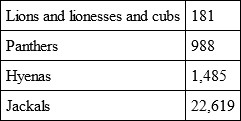
It may be taken for granted, then, that there are no great dangers to be experienced on the well-worn roads and pistes of Tunisia and Algeria. The hyenas and lions are hidden away in the great mountain fastnesses, and the jackals themselves are harmless enough so far as human beings are concerned. The sanglier, or wild boar, is savage enough if attacked when met with, otherwise it is he who flees, whilst the jack-rabbits and the gazelles make up the majority of the “savage life” seen contiguous to the main travelled roads away from the railways.
Scorpions and horned vipers are everywhere – if one looks for them, otherwise one scarcely ever sees one or the other. The greatest enemy of mankind hereabouts is the flea; and, as the remedy is an obvious and personal one, no more need be said. Another plague is the cricket, grasshopper or sauterelle. The sauterelle, says the Arab, is the wonder among nature’s living things. It has the face of a horse, the eyes of an elephant, the neck of a bull, the horns of a deer, the breast of a lion, the stomach of a scorpion, the legs of an ostrich, the tail of a snake, and is more to be feared than any of the before enumerated menagerie. It all but devastated the chief wheat-growing lands of the plateaux of the provinces of Alger and Constantine a generation or more ago, and brought great misery in its wake.
The scorpion and the gazelle are the two chief novelties among living things (after the camel) with which the stranger makes acquaintance here. The former is unlovely but not dangerous. “Il pique, mais ne mord pas,” say the French; but no one likes to find them in his shoes in the morning all the same. The gazelle is more likable, a gentle, endearing creature, with great liquid eyes, such as poets attribute to their most lovely feminine creations.
The gazelle is an attribute of all fountain courtyards. It lives and thrives in captivity, can be tamed to follow you like a dog, and is as affectionate as a caressing kitten. It will eat condensed milk, dates, cabbage and cigarettes; but it balks at Pear’s soap.
In the open country the nomad Arab or even the house-dweller that one meets by the roadside is an agreeable, willing person, and when he understands French (as he frequently does), he is quite as “useful” as would be his European prototype under similar conditions. The country Arab is courteous, for courtesy’s sake, moreover, and not for profit. This is not apt to be the case in the cities and towns.
The Arab speech of the ports and railway cities and towns is of the solicitous kind. One can’t learn anything here of phraseology that will be useful to him in the least and it’s bad French. “Sidi mousi! Moi porter! Moi forsa besef!” is nothing at all, though it is eloquent, and probably means that the gamin, old or young, wants to carry your baggage or call a cab. And for this you pay in Algiers and Tunis as you pay in London or Paris, but you are not blackmailed as you are in Alexandria or Cairo.
One may not rest two minutes on the terrace of any café in a large Algerian town without having an Arab, a Kabyle, or a Jewish ragamuffin come up and bawl at one incessantly, “Ciri, ciri, ciri!” If you have just left your hotel, your boots brilliant as jet from the best Algerian substitute for “Day & Martin’s Best,” it doesn’t matter in the least; they still cry, “Ciri, ciri, ciri, m’siou!” Sometimes it is, “Ciri bien, m’siou!” and sometimes “Ciri, kif, kif la glace de Paris!” But the object of their plaint is always the same. Finally, if you won’t let them dull the polish of your shine, they will cire their faces and demand “quat’ sous” from you because you witnessed the operation. Very businesslike are the shoeblacks of Algiers; they don’t mind what they cire as long as they cire something.
The Café d’Apollon in Algiers is the rendezvous of the “high-life Arab.” Here Sheiks from the deserts’ great tents, Caïds from the settlements, and others of the vast army of great and small Arab officialdom assemble to take an afternoon bock or apéritif; for in spite of his religion the Mussulman will sometimes drink beer and white wine. Some, too, are “decorated,” and some wear even the ruban or bouton of the Legion of Honour on their chests where that otherwise useless buttonhole of the coat of civilization would be. Grim, taciturn figures are these, whose only exclamation is a mechanical clacking of the lips or a cynical, gurgling chuckle coming from deep down, expressive of much or little, according as much or little is meant.
The foreign population in Algeria and Tunisia is very mixed; and though all nationalities mingle in trade the foreigners will not become naturalized to any great extent. Out of forty-one naturalized foreigners in Tunis in 1891, 27 were Italians, 2 Alsatians, 2 Luxembourgeois, 2 Maltese, 1 German, 1 Belgian, 1 Moroccan, and 5 individuals of undetermined nationality.
Civilization and progress has marked North Africa for exploitation, but it will never overturn Mohammedanism. The trail of Islam is a long one and plainly marked. From the Moghreb to the Levant and beyond extends the memory and tradition of Moorish civilization of days long gone by. The field is unlimited, and ranges from the Giralda of Andalusia to the Ottoman mosques of the Dardanelles, though we may regret, with all the Arab poets and historians, the decadence of Granada more than all else. The Arab-Moorish overrunning of North Africa defined an epoch full of the incident of romance, whatever may have been the cruelties of the barbarians. This period endured until finally the sombre cities of the corsairs became the commercial capitals of to-day, just as glorious Carthage became a residential suburb of Tunis. The hand of time has left its mark plainly imprinted on all Mediterranean Africa, and not even the desire for up-to-dateness on the part of its exploiters will ever efface these memories, nor further desecrate the monuments which still remain.
The French African possessions include more than a third of the continent, an area considerably more extensive than the United States, Alaska, Porto Rico, and the Philippines combined. One hears a lot about the development of the British sphere of influence in Africa; but not much concerning that of the French which, since the unhappy affair of Fashoda, has been more active than ever. The French are not the garrulous nation one sometimes thinks them. They have a way of doing things, and saying nothing, which is often fraught with surprises for the outside world. Perhaps Morocco and Tripoli de Barbarie may come into the fold some day; and, then, with the French holding the railways of Egypt and the Suez Canal, as at present, they will certainly be the dominant Mediterranean and African power, if they may not be reckoned so already.
The Saharan desert is French down to its last grain of sand and the last oasis palm-tree, and it alone has an area half the size of the United States.
Of Mediterranean French Africa, Tunisia is a protectorate, but almost as absolutely governed by the French as if it were a part of the Ile de France. Algérie is a part of France, a Department across the seas like Corse. It holds its own elections and has three senators and six deputies at Paris. Its governor-general is a Frenchman (usually promoted from the Préfecture of some mainland Département) and most of the officialdom and bureaucracy are French.
Trade between Algeria and France, mostly in wines and food stuffs on one side, and manufactured products on the other, approximates three hundred millions of francs in each direction. Algeria, “la belle Algérie” as the French fondly call it, is not a mere strip of mountain land and desert. It is one of the richest agricultural lands on earth, running eastward from the Moroccan frontier well over into Tunisia; and, for ages, it has been known as the granary of Europe. The Carthaginians and the Phœnicians built colonies and empires here, and Rome was nourished from its wheat-fields and olive-groves.
The wheat of Africa was revered by the Romans of the capital above all others. One of the pro-consuls sent Augustus a little packet of four hundred grains, all grown from one sole seed, whereupon great national granaries were built and the commerce in the wheat of Africa took on forthwith almost the complexion of a monopoly. The sowing and the harvest were most primitive. “I have seen,” wrote Pliny (H. N. XVIII, 21), “the sowing and the reaping accomplished here by the aid of a primitive plough, an old woman and a tiny donkey.” The visitor may see the same to-day!
At the moment of the first autumn rains the Arab or Berber cultivator works over his soil, or sets his wives on the job, and sows his winter wheat. The planting finished, the small Arab farmer seeks the sunny side of a wall and basks there, watching things grow, smoking much tobacco and drinking much coffee, each of these narcotics very black and strong. Four months later his ample, or meagre, crop comes by chance. Then he flays it, not by means of a flail swung by hand, but by borrowing a little donkey from some neighbour, – if he hasn’t one of his own, – and letting the donkey’s hoofs trample it out. Now he takes it – or most likely sends it – to market, and his year’s work is done. He rolls over to the shady side of his gourbi (the sunny side is getting too warm) and loafs along until another autumn. He might grow maize in the interval, but he doesn’t.
The Barbary fig, or prickly-pear cactus, is everywhere in Algeria and Tunisia. It grows wild by the roadside, in great fields, and as a barrier transplanted to the top of the universal mud walls. Frost is its only enemy. Everything and everybody else flees before it except the native who eats its spiny, juicy bulbs and finds them good. The rest of us only find the spines, and throw the fruit away in disgust when we attempt to taste it. The Barbary fig is the Arab’s sole food supply when crops fail, the only thing which stands between him and starvation – unless he steals dates or figs from some richer man’s plantation. The Arab’s wants are not great, and with fifty francs and some ingenuity he can live a year.
The palm-trees of Africa number scores of varieties, but those of the Mediterranean states and provinces, the date-bearing palm, come within three well-defined classes: the Phœnix-dactylifera, the chamaerops-humilis and the cucifera-thebaica.
Even the smallest Arab proprietor of land or sheep or goats pays taxes. The French leave its collection to the local Caïds or Sheiks, but it gets into the official coffers ultimately, – or most of it does.
In Algeria there are four principal taxes, or impôts:
The Achour on cereals; the Zekai, on sheep and cattle to-day, but originally a tax collected for the general good, as prescribed by the Koran; the Hokar (in Constantine), a tax on land; the Lezma, the generic term for various contributions, such as the right to carry firearms (the only tax levied in Kabylie), and the tax on date-palms in the Sud-Algérie and Sud-Oranais. The Arab carries a gun only after he gets a permit, which he must show every time he buys powder or shot.
In Tunisia the taxes are much the same; but there is a specific tax on olive-trees as well as date-palms, and on the markets and the products sold there.
The wines of Algeria and Tunisia are the product of foreign vines whose roots were transplanted here but little more than half a century ago. These vines came from all parts, from France, Switzerland, Spain, Italy, Malta and America; and now the “vin d’Algérie” goes out to the ends of the earth, – usually under the name of a cru more famous. It is very good wine nevertheless, this rich, hybrid juice of the grape; and, though the Provençal of Chateauneuf, the sons of the Aude, the Garde and the Hérault, or the men of Roussillon do not recognize Algerian wine as a worthy competitor of their own vintages, it is such all the same. And the Peroximen, supposed to be a product only of Andalusia, and the Muscatel of Alexandria, are very nearly as good grown on Algerian soil as when gathered in the place of their birth.
The “vin rosé” of Kolea, the really superb wines of Médea, and the “vin blanc de Carthage,” should carry the fame of these North African vintages to all who are, or think they are, judges of good wine.
With such a rich larder at their very doors, the mediæval Mediterranean nations were in a constant quarrel over its possession. Vandals and Greeks fought for the right to populate it after the Romans, but the Moorish wave was too strong; the Arab crowded the Berber to the wall and made him a Mussulman instead of a Christian, a religious faith which the French have held inviolate so far as proselytizing goes. It is this one fundamental principle which has done much to make the French rule in Algeria the success that it is. Britain should leave religion out of her colonizing schemes if she would avoid the unrest which is continually cropping up in various parts of the empire; and the United States should leave the friars of the Philippines alone, and let them grow fat if they will, and develop the country on business lines. We are apt to think that the French are slow in business matters, but they get results sometimes in an astonishingly successful manner, and by methods which they copy from no one.
The ports of Algeria and Tunisia are of great antiquity. The Romans, not content with the natural advantages offered as harbours, frequently cut them out of the soft rock itself, or built out jetties or quais, as have all dock engineers since when occasion demanded. There are vestiges of these old Roman quais at Bougie, at Collo, at Cherchell, at Stora and at Bona. These Roman works, destroyed or abandoned at the Vandal invasion, were never rebuilt; and the great oversea traders of the Italian Republics, of France and of Spain, merely hung around offshore and transacted their business, as do the tourist steamers at Jaffa to-day, while their personally conducted hordes descend upon Jerusalem and the Jordan.
The Barbary pirates had little inlets and outlets which they alone knew, and flitted in and out of on their nefarious projects; but only at Algiers, until in comparatively recent times, were there any ports or harbours, legitimately so called, in either Algeria or Tunisia, though the Spaniards, when in occupation of Oran in the eighteenth century, made some inefficient attempts towards waterside improvements of a permanent character.
In thinking of North Africa it is well to recall that it is not a tropical belt, nor even a subtropical one. It is very like the climate of the latitude of Washington, though perhaps with less rain in winter. It is not for a moment to be compared with California or Bermuda.
The temperature on the Algerian coast is normally as follows: —
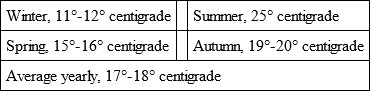
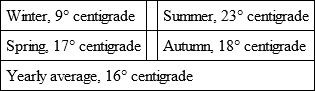
As compared with the temperature of the French Riviera, taking Nice as an example, the balance swings in favour of Algeria in winter, and a trifle against it for summer, as the following figures show: —
One pertinent observation on North Africa is that regarding the influx of outside civilizing influences. The American invasion of manufactured products is here something considerable; but as yet it has achieved nothing like its possibilities, save perhaps in electrical tramway installation, sewing machines and five-gallon tins of kerosene. The French have got North Africa, mostly; the Germans the trade in cutlery; the English (or the Scotch) that in whiskey and marmalade; but the American shipments of “Singers” and “Standards” must in total figures swamp any of the other single “foreign imports” in value. One does not speak of course of imports from France. As the argument of the dealers, who push the sewing-machine into the desert gourbis of the nomads and the mountain dwellings of the Kabyles, has it, the civilizing influences of Algeria have been railways, public schools and “Singers.” What progressive Arab could be expected to resist such an argument for progress, with easy-payment terms of a franc a week as the chief inducement? The only objection seems to be that his delicately fashioned, creamy, woollen burnous of old is fast becoming a ready-made “lock-stitch” affair, which lacks the loving marks of the real hand-made article. Other things from America are agricultural machinery, ice-cream freezers, oil-stoves, corn meal, corned beef, salmon from Seattle, and pickles from Bunker Hill. As yet the trade in these “staples” is infinitesimal when compared with what it might be if “pushed,” which it is not because all these things come mostly through London warehouse men, who “push” something else when they can.
A few things America will not be able to sell in North Africa are boots and shoes, the Arab wears his neatly folded down at the heel, and ours are not that kind; nor socks, nor stockings, the Arab buys a gaudy “near-silk,” made in the Vosges, when he buys any, and the women don’t wear them; nor hats, though a Stetson, No. 7, would please them mightily, all but the price. There is no demand for folding-beds or elastic bookcases. The Arab sleeps on the floor, and the only book he possesses, if he can read, is a copy of the Koran, which he tucks away inside his burnous and carries about with him everywhere. Chairs he has no need for; when the Arab doesn’t lie or huddle on the ground, he sits dangle-legged or cross-legged on a bench, which is a home-made affair. The women mostly squat on their heels, which looks uncomfortable, but which they seem to enjoy.
Besides the American invasion, there is the German occupation to reckon with – in a trade sense.
“Those terrible Germans,” is a newspaper phrase of recent coinage which is applicable to almost any reference to the German trade invasion of every country under the sun, save perhaps the United States and Canada. In South America, in Russia, and in the African Mediterranean States and Provinces, the Teuton has pushed his trading instincts to the utmost. He may be no sort of a colonizer himself, but he knows how to sell goods. In North Africa, in the coast towns, over a thousand German firms have established themselves within the last ten years, all the way from Tangier to Port Saïd. This may mean little or nothing to the offhand thinker; but when one recalls that the blackamoor and the Arab have learned to use matches and folding pocket-knives, and have even been known to invest in talking machines, it is also well to recall that the German can produce these things, “machine-made,” and market them cheaper than any other nation. For this reason he floods the market, where the taste is not too critical, and the cry is here for cheapness above all things. This is the Arab’s point of view, hence the increasing hordes of German traders.
To show the German is indefatigable, and that he knows North Africa to its depths, the case of the late German consul at Cairo, Paul Gerhard, who wrote a monumental work on the butterflies of North Africa, is worth recalling.
CHAPTER III
ALGERIA OF TO-DAY
“Le coq Gaulois est le coq de la gloire.
Il chante bien fort quand il gagne une victoire
Et encore plus fort quand il est battu.”
Algeria is by no means savage Africa, even though its population is mostly indigène. It forms a “circonscription académique” of France. It has a national observatory, a branch of that at Paris, founded in 1858; a school of medicine and pharmacy; a school of law; a faculty of letters and sciences, and three endowed chairs of Arabic, at Algiers (founded in 1836); Oran (1850) and Constantine (1858).
Algeria has a great future in store, although it has cost France 8,593,000,000 francs since its occupation seventy years ago, and has only produced a revenue of 2,330,000,000 francs, which represents the loss of a sum greater than the war indemnity of 1870. The Algerian budget balanced for the first time in 1901 without subsidies from home.
The entire population of Algeria is 4,124,732, of which 3,524,000 are Arabs, Kabyles or
Berbers, and the subdivided races hereafter mentioned, leaving in the neighbourhood of 600,000 Europeans, whose numbers are largely increasing each year.
The rate of increase of the European population, from 1836, when the French first occupied the country, has been notable. In 1836 there were 14,561 Europeans in the colony; in 1881, 423,881, of which 233,937 were French, 112,047 Spanish, and 31,865 Italians, and to-day the figure is over 600,000.
The Arab and Berber population, too, are notably increasing; they are not disappearing like the red man. From 2,320,000, in 1851, they have increased, in 1891, to 3,524,000.
In addition to the Arab and Berber population of Algeria, and the “foreigners” and Europeans, there are the following:
Moors – (90,500), the mixed issue of the Berbers and all the races inhabiting Algeria.
Koulouglis – (20,000), born of Turks and Moorish women.
Jews – (47,667), who by the decree of 1870 were made French. (This does not include unnaturalized Jews.)
Negroes – (5,000), the former slaves who were freed in 1848.
The French colonist in Algeria, the man on the spot, understands the Arab question better than the minister and officials of the Colonial Office of the Pavilion Sully, though the French have succeeded in making of Algeria what they have never accomplished with their other colonies – a paying proposition at last. Still France governs Algeria under a sort of “up-the-state,” “Raines-law” rule, and treats the indigène of Laghouat or Touggourt as they would a boatman of Pontoise or a farm labourer of Étampes. The French colonial howls against all the mistakes and indiscretions of a “Boulevard Government” for the Sahara, and even revile the Governor General, whom he calls a civilian dressed up in military garb and no governor at all. Que diable! This savours of partisanship and politics, but it is an echo of what one hears as “café talk” any time he opens his ears in Algiers.
All is peace and concord within, however, in spite of the small talk of the cafés; and the Arab and European live side by side, each enjoying practically the same rights and protection that they would if they lived in suburban Paris.
The Caïd or Sheik or head man of a tribe is the go-between in all that concerns the affairs of the native with the French government.
The name Caïd was formerly given to the governors of the provinces of the Barbary States, but to-day that individual has absolutely disappeared, though he still remains as an administrator of French law, under the surveillance of the military government. In reality the Caïd still remains the official head of his tribe, and in this position is sustained by the French authorities.
The Arab has adopted the new order of things very graciously, but he can’t get over his ancient desire to hoard gold; and, for that reason, no Algerian gold coin exists, and there is no gold in circulation to speak of. The Arab, when he gets it, buries it, forgets where, or dies and forgets to tell any one where, which is the same thing, and thus a certain very considerable amount is lost to circulation.
Paper money, in values of twenty and fifty francs, takes the place of gold; the Arab thinks that it is something that is perishable, and accordingly spends it and keeps the country prosperous. The French understand the Arab and his foibles; there is no doubt about that. They solved the question of a circulating currency in Algeria. New York and Washington representatives of haute finance might take a few lessons here.
With regard to the money question, the stranger in Algeria must beware of false and non-current coin. Anything that’s a coin looks good to an Arab, and for that reason a large amount of spurious stuff is in circulation. It was originally made by counterfeiters to gull the native, but to-day the stranger gets his share, or more than his share.
To replace the gold “louis” of France, the Banque d’Algérie issues “shin-plasters” of twenty francs. They are convenient, but one must get rid of them before leaving the country or else sell them to a money changer at a discount. These Algerian bank-notes now pass current in Tunisia, a branch of the parent bank having recently been opened there.
The commercial possibilities of Algeria have hardly, as yet, begun to be exploited, though the wine and wheat-growing lands are highly developed; and, since their opening, have suffered no lack of prosperity, save for a plague of phylloxera which set back the vines on one occasion, and a plague of locusts which one day devastated almost the entire region of the wheat-growing plateaux. It was then the Arabs became locust-eaters, though indeed they are not become a cult as in Japan. With the Arab it was a case of eating locusts or nothing, for there was no grain.
This plague of locusts fell upon the province of Constantine in 1885, and from Laghouat to Bou-Saada, and from Kenchela to Aumale they were brought in myriads by the sirocco of the desert from no one knows where.
For two years these great cereal-growing areas were cleared of their crops as though a wild-fire had passed over them, until finally the government by strenuous efforts, and the employment of many thousands of labourers, was able to control and arrest the march of the plague.
During this period many of the new colonists saw their utmost resources disappear; but gallantly they took up their task anew, and for the past dozen years only occasional slight recurrences of the pest have been noted, and they, fortunately, have been suppressed as they appeared.
Besides wheat and wine, tobacco is an almost equal source of profit to Algeria. In France no one may grow a tobacco plant, even as an embellishment to his garden-plot, without first informing the excise authorities, who, afterwards, will come around periodically and count the leaves. In Africa the tobacco crop is something that brings peace and plenty to any who will cultivate it judiciously, for the consumption of the weed is great.
Manufactured tobacco is cheap in Algeria. Neither cigars, cigarettes nor pipe mixtures, nor snuff either, pay any excise duties; and even foreign tobaccos, which mostly come from Hungary and the Turkish provinces, pay very little.
Two-thirds of the Algerian manufactured product is made from home-grown tobacco, and a very large quantity of the same is sent to France to be sold as “Maryland;” though, indeed, if the original plants ever came from the other side of the water, it was by a very roundabout route. Certainly the broom-corn tobacco of France does not resemble that of Maryland in the least. The hope of France and her colonies is to grow all the tobacco consumed within her frontiers, whether it is labelled “Maryland,” “Turkish” or “Scaferlati.” The French government puts out some awful stuff it calls tobacco and sells under fancy names.
The tobacco tax in Algeria is nil, and that on wine is nearly so. Four sous a hectolitre (100 litres) is not a heavy tax to pay, though when it was first applied (in 1907) it was the excuse for the retail wine dealer (who in Algeria is but human, when he seeks to make what profit he can) to add two sous to the price of his wine per litre. There is a law in France against unfair trading, and the same applies to Algeria. It has been a dead law in many places for many years, but when a tax of four sous a hectolitre, originally paid to the state, by the dealer, finally came out of the consumer’s pocket as ten francs, an increase of 5,000 per cent., popular clamour and threats of the law caused the dealer to drop back to his original price. This is the way Algeria protects its growing wine industry. Publicists and economists elsewhere should study the system.
The African landscape is very simple and very expressive, severe but not sad, lively but not gay. The great level horizon bars the way south towards the wastes of the Sahara, and the mountains of the Atlas are ever present nearer at hand. The desert of romance, le vrai désert, is still a long way off; and, though there is now a macadamized road to Bou-Saada and Biskra, and a railway to Figuig and beyond, civilization is still only at the vestibule of the Sahara. The real development and exploitation of North Africa and its peoples and riches is yet to come.
As for the climate, that of California is undoubtedly superior to that of Algeria, but the topographical and agricultural characteristics are much the same. The greatest difference which will be remarked by an American crossing Algeria from Oran to Souk-Ahras will be the distinct “foreign note” of the installation of its farming communities. Haystacks are plastered over with mud; carts are drawn by mules or horses hitched tandemwise, three, four or five on end, and the carts are mostly two-wheeled at that. There are no fences and no great barns for stocking fodder or sheltering cattle; the farmhouses are all of stone, bare or stucco-covered, and range in colour from sky-blue to pale pink and vivid yellow. There is some American farming machinery in use, but the Arab son of the soil still largely works with the implements of Biblical times.
The winter of Algeria is the winter of Syria, of Japan, and reminiscent to some extent of California; perhaps not so mild on the whole, but still something of an approach thereto. Another contrast favourable to California is that in Algeria there is a lack of certain refinements of modern travel which are to be had in the “land of sunshine.” Winter, properly speaking, does not come to Algeria except on the high plateaux of the provinces of Oran, Alger and Constantine, and on the mountain peaks of the Atlas, and in Kabylie.
South of Algiers stretches the great plain of the Mitidja, which is like no other part of the earth’s surface so much as it is like Normandy with respect to its prairies, “la Beauce” for its wheat-fields and its grazing-grounds, and the Bordelais for its vineyards.
At the western extremity of the Mitidja commence the orange-groves of Blida, the forests of olive-trees, and the eucalyptus of La Trappe. The scene is immensely varied and suggestive of untold wealth and prosperity at every kilometre.
Suburban Algiers is thickly built with villas, more or less after the Moorish style, but owned by Europeans. Recently the wealthy Arab has taken to building his “country house” on similar gracious lines; and, when he does, he keeps pretty near to accepted Moorish elements and details, whereas the European, the colon, or the commerçant grown rich, carries out his idea on the Meudon or St. Cloud plan. The Moorish part is all there, but the thing often doesn’t hang together.
To the eastward back of the mountains of Kabylie lies the great plateau region of the Tell.
The Tell is a region vastly different in manners and customs from either the desert or the Algerian littoral. The manners of the nomad of the Sahara here blend into those of the farming peasant; but, by the time Batna is reached, they become tainted with the commercialism of the outside world. At Constantine there is much European influence at work, and at the seacoast towns of Bona or Philippeville the Oriental perfume of the date-palm is lost in that of the smells and cosmopolitanism usually associated with great seaports. These four distinct characteristics mark four distinct regions of the Numidia of the ancients, to-day the wheat-growing region of the Tell.
The principal mountain peaks in Algeria rise to no great heights. Touabet, near Tlemcen, is 1,620 metres in height; the highest peak of the Grand Kabylie Range, in the province of Alger, is 2,308 metres; and Chelia, in Constantine, 2,328 metres. They are not bold, rugged mountains, but rolling, rounded crests, often destitute of verdure to the point of desolation.
The development of the regions forming the hinterland– practically one may so call the Sahara – is of constant and assiduous care to the authorities. They have done much and are doing much more as statistics indicate.
In the valley of the Oued-Righ and the Ziban, one of the most favoured of these borderlands, the government statistics of springs and oases are as follows (1880-90): —
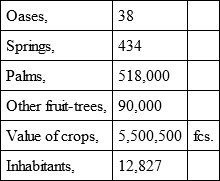
And as the population increases and fruit-growing areas are further developed, the military engineers come along and dig more wells.
The following average temperatures and rainfall show the contrast between various regions: —
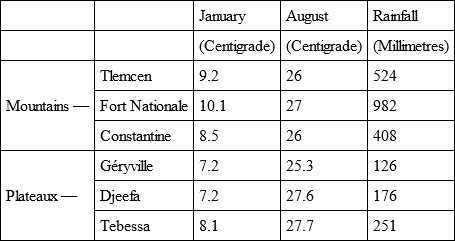
It will be noted that, normally, there is very little difference in temperature, and a very considerable difference in rainfall.
The extreme recorded winter temperatures are as follows: —
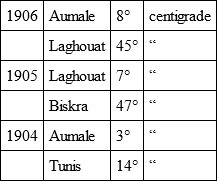
Algeria has something like 3,100 kilometres of standard gauge railway, and various light railways, or narrow gauge roads, of from ten to fifty kilometres in length, aggregating perhaps five hundred kilometres more. Railway building and development is going on constantly, but they don’t yet know what an express train is, and the sleeping and dining car services are almost as bad as they are in England. The real up-to-date sleeping-car has electric lights and hot and cold water as well as steam heat. They have dreamed of none of these things yet in England or Africa.
The railway is the chief civilizing developer of a country. The railway receipts in Algeria in 1870 were 2,500,000 francs. In 1900 they were 26,000,000 francs. That’s an increase of a thousand per cent., and it all came out of the country.
The “Routes Nationales” of Algeria (not counting by-roads, etc.), the real arteries of the life-blood of the country, at the same periods numbered almost an equal extent, and they are still being built. Give a new country good roads and good railways and it is bound to prosper.
Four millions of the total population of Algeria (including something over two hundred thousand Europeans) are dependent upon agriculture for their livelihood. Wheat, wine and tobacco rank in importance in the order named.
The growth of the wine industry has been most remarkable.
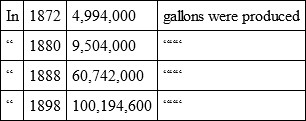
None of it is sold as Bordeaux or Burgundy, at least not by the Algerian grower or dealer. It is quite good enough to sell on its own merits. Let Australia, then, fabricate so-called “Burgundy” and Germany “Champagne” – Algeria has no need for any of these wiles.
Grapes, figs and plums are seemingly better in Algeria than elsewhere. Not better, perhaps, but they are so abundant that one eats only of the best. The rest are exported to England and Germany. The little mandarin oranges from Blida and about there, are one of the stand-bys of Algerian trade. So are olives and dates.
CHAPTER IV
THE RÉGENCE OF TUNISIA AND THE TUNISIANS
FOR twenty years France has been putting forth her best efforts and energies into the development of Tunisia, to make it a worthy and helpful sister to Algeria. From a French population of seven hundred at the time of the occupation in 1882, the number has risen to fifty thousand.
Tunisia of to-day was the Lybia of the ancients; but whether it was peopled originally from Spain, from Egypt or from peoples from the south, history is silent, or at least is not convincingly loud-voiced.
Lybian, Punic, Roman, Vandal and Byzantine, the country became in turn, then Mussulman; for the native Tunisian has not yet become French. The Bey still reigns, though with a shorn fragment of his former powers. The Bey is still the titular head of his Régence, but the French Résident Général is really the premier fonctionnaire, as also he is the Bey’s Ministère des Affaires Étrangères.
The ancient governmental organization of the Bey has been retained with respect to interior affairs. The Caïds are the local governors or administrators of the territorial divisions and are appointed by the Bey himself. They are charged with the policing of their districts, the collecting of taxes, and are vested with a certain military authority with which to impress their tribes. Associated with the Caïds, as seconds in command, are a class called Khalifas, and as tax collectors, mere civil authorities, there are finally the Sheiks.
It was a bitter pill for Italy when France took the ascendancy in Tunis. The population of the city of Tunis to-day still figures 30,000 Italians and Maltese as against 10,000 French, – and ever have the French anti-expansionists called it a “chinoiserie.” Call it what you will, Tunis, in spite of its preponderant Italian influence, is fast becoming French. It is also becoming prosperous, which is the chief end of man’s existence. This proves France’s intervention to have been a good thing, in spite of the fact that it accounts for seventy-five per cent. of the Italian’s animosity towards his Gallic sister.
The death of S. A. Saddok-Bey in 1882, by which the Tunisian sovereign became subservient to the French Resident, was an event which caused some apprehension in France.
The new ruler, Si-Ali-Bey, embraced gladly the French suzerainty in his land that his sons might see the institutions of the Régence prosper under the benign guidance of a world power. Ali-Bey resisted nothing French, – even as a Prince, – and when he came to the Beylicale throne in 1882 he gave no thought whatever to the ultimate political independence of his country. He was ever, until his death, the faithful, liberal coöperator with the succession of Résidents Généreaux who superseded him in the control of the real destinies of Tunisia.
As a sovereign he formerly stood as the absolute ruler of a million souls, not only their political ruler, but their religious head as well. The latter title still belongs to the Bey. (The present ruler, Mohammed-en-Nacer-Bey, came into power upon the death of his predecessor, Mohammed-el-Hadi-Bey in 1906.)
French political administration has robbed the power of the Bey of many of its picturesque and romantic accessories; but the usages of Islam are tolerated not only in the entourage of the Bey, but in all his subjects as well. This toleration even grants them the sanctity of their mosques, and does not allow the hordes of Christian tourists, who now make a playground of Mediterranean Africa from Cairo to Fez, to desecrate them by writing their names in Mohammedan sacred places. In other words, Europeans are forbidden to enter any of the Tunisian mosques save those at Kairouan.
It was Ali-Bey who achieved the task of making the masses understand that their duty was to obey the new régime; that it was a law common to them all that would assure the prosperity of the nation; and that it was he, the Bey, who was still the titular head of their religion, which, after all, is the Mussulman’s chief concern in life.
Might makes right, often enough in a maladroit fashion, but sometimes it comes as a real blessing. This was the case with the coming of the French to Tunisia. A highly organized army was a necessity for Tunisia, and within the last quarter of a century she has got it. The French were far-seeing enough to anticipate the probable eventuality which might grow out of England’s side-long glances towards Bizerte, and the Italian sphere of influence in Tripoli. Now those fears, not by any means imaginary ones at the time, are dead. England must be content with Gibraltar, and Italy with Sardinia. There are no more Mediterranean worlds to conquer, or there will not be after France absorbs Tripoli in Barbary, and Morocco, and the mortgages are maturing fast.
To-day the Tunisians are taxed less than they ever were before, and are better policed, protected and cared for in every way. Their millennium seems to have arrived. France, with the coöperation of the Bey, dispenses the law and the prophets after the patriarchal manner which Saint Louis inaugurated at Carthage in the thirteenth century.
The justice of Ali-Bey and Mohammed-el-Hadi-Bey was an improvement over that of their predecessors, which was tyrannical to an extreme. The Spartan or Druidical under-the-oak justice, and worse, gave way to a formal recognized code of laws which the French authorities evolved from the heritage of the Koran, and very well indeed it has worked.
The Bey had become a veritable father of his people, and was accessible to all who had business with him, meriting and receiving the true veneration of all the Tunisian population of Turks, Jews and Arabs. He interpreted the laws of Mahomet with liberality to all, and from his palace of La Marsa dispensed an incalculable charity.
The present Bey is not an old and tried law-maker or soldier like his predecessors, and beyond a few simple phrases is not even conversant with the French language. He is a Mussulman in toto, but his régime seems to run smoothly, and day by day the country of his forefathers prospers and its people grow fat. Some day an even greater prosperity is due to come to Tunisia, and then the Beylicale incumbent will be covered with further glories, if not further powers. This will come when the great trade-route from the Mediterranean to the heart of Africa, to Lake Tchad, is opened through the Sud-Tunisien and Tripoli, which will be long before the African interior railway dreamed of by the late Cecil Rhodes comes into being.
French influence in Africa will then receive a commercial expansion that is its due, and another Islamic land will come unconsciously under the sway of Christian civilization.
The obsequies of the late Bey of Tunis were an impressive and unusual ceremony. The eve before, the prince who was to reign henceforth received the proclamation of his powers at the Bardo, when he was invested with the Beylicale honours by the authorities of France and Tunisia.
The funeral of the dead Bey was more pompous than any other of his predecessors. He died at his palace at La Marsa and lay in state for a time in his own particular “Holy City,” Kassar-Saïd, on the route to Bizerte, where were present all his immediate family. Prince Mohammed-en-Nacer, the Bey to be, was so overcome with a crisis of nerves that he fell swooning at the ceremony, with difficulty pulling himself together sufficiently to proceed.
The progress of the cortége towards Tunis, the capital, was through the lined-up ranks of fifty thousand Mussulmans lying prostrate on the ground. Entrance to the city was by the Sidi-Abdallah Gate, and thence to the Kasba. The Mussulman population crowded the roof-tops and towers of the entire city. The military guard of the Zouaves, the Chasseurs d’Afrique, and the Beylicale cavalry formed a contrasting lively note to the solemnity of the religious proceedings, though nothing could drown the fervent wails and shouts of “La illah allah, Mohammed Rassone Allah! Sidi Ali-Bey!” the Arabic substitute for “The King is dead! Long live the King!”
Before the Grande Mosquée the Unans-Muftis and the Bach-Muftis recited their special prayers, and all the dignitaries of the new court came to kiss the hand of the reigning prince, who, at the Gate of Dar-el-Bey, was saluted by the Résident Général of France.
The Tomb of the Beys, the Tourbet et Bey, is the sepulchre of all the princes of the house, each being buried in a separate marble sarcophagus, but practically in a common grave.
A fanatical expression which was not countenanced, but which frequently came to pass nevertheless, was the crawling beneath the litter on which reposed the remains of the defunct Bey by numerous Mussulman devotees. The necromancy of it all is to the effect that he who should pass beneath the body of a dead Mussulman ruler would attain pardon for any faults ever afterwards committed. Seemingly it occurred to the authorities that it was putting a premium on crime, and so it was suppressed, and rightly enough.
The political status of the native of Tunisia to-day is similar to that of his brother of Algeria. It is incontestable that the Tunisian’s status under Beylicale rule was not wholly comfortable, for the indigènes were ruled in a manner little short of tyrannical; but the Arab lived always in expectation of bettering his position, in spite of being either a serf or a ground-down menial. To-day he has only the state of the ordinary French citizen to look forward to, and has no hope of becoming a tyrant himself. This is his chief grievance as seen by an outsider, though indeed when you discuss the matter with him he has a long line of complaints to enumerate.
Things have greatly improved in Tunisia since the French came into control. Formerly the native, or the outlander, had no appeal from the Beylicale rule short of being hanged if he didn’t like his original sentence. To-day, with a mixed tribunal of Tunisian and French officials, he has a far easier time of it even though he be a delinquent. He gets his deserts, but no vituperative punishments.
One thing the Tunisian Arab may not do under French rule. He may not leave the Régence, even though he objects to living there. The French forbid this. They keep the indigènes at home for their country’s good, instead of sending them away. It keeps a good balance of things anyway, and the law of the Koran as interpreted by the powers of Tunis is as good for the control of a subject people as that of the Code Napoleon.
The Tunisians, the common people of Tunis, are protégés of France, and France is doing her best to protect them and lead them to prosperity, assisted of course by the good-will and influence of the ruling Bey, whom she keeps in luxury and quasi-power.
Formerly when the native ruler did not care to be bothered with any particular class of subjects, whether they were Turks or Jews, he banished them, but the French officials consider this a superfluous prodigality, and keep all ranks at home and as contented as possible in their work of developing their country.
The one thing that the French will not have is a wholesale immigration of the Arab population of either Algeria or Tunisia. To benefit by a change of air, the indigène of whatever rank must have a special permission from the government before he will be allowed to embark on board ship, or he will have to become a stowaway. Very many get this special permission, for one reason or another, but to many it is refused, and for good and sufficient reasons. To the merchant who would develop a commerce in the wheat of the plateau-lands, the barley of the Sahel, or the dates of the oasis, permission is granted readily enough; and to the young student who would study law or medicine at Aix, Montpellier or Paris; but not to the able-bodied cultivator of the fields. He is wanted at home to grow up with the country.
Tunis la ville and Tunisia le pays are more mediæval and more Oriental than Algiers or Algeria. In Tunis, as in every Arab town, as in Constantinople or Cairo, you may yet walk the streets feeling all the oppression of that silence which “follows you still,” and of a patient, lack-lustre stare, still regarding you as “an unaccountable, uncomfortable work of God, that may have been sent for some good purpose – to be revealed hereafter.”
The morality and the methods of the traders of the bazars and souks remain as Kinglake and Burton described them in their day, something not yet understood by the ordinary Occidental.
This sort of thing is at its best at Tunis. Wine, olives, dates and phosphates are each contributing to the prosperity of Tunis to a remarkable degree, and the development of each industry is increasing as nowhere else, not even in Algeria. In 1900 the vineyards of Tunisia increased over two thousand hectares, and in all numbered nearly twelve thousand hectares, of which one-quarter at least were native owned.
The wine crop in 1900 was 225,000 hectolitres, an increase of nearly thirty per cent, over the season before, and it is still increasing. The olive brings an enormous profit to its exploiters, and the Tunisian olive and Tunisian olive oil rank high in the markets of the world. Originally ancient Lybia was one of the first countries known to produce olive oil on a commercial scale. All varieties of olive are grown on Tunisian soil. The illustration herewith marks the species.
The art of making olive oil goes back to the god Mercury. In the time of Moses and of Job the culture of the olive was greatly in repute. The exotics of the East and of Greece took the olive-leaf for a symbol, but the fighting, quarrelsome Romans would have none of it; the bay leaf and the palm of victory were all-sufficient for them.
They soon came to know its value, however, when they overran North Africa, and they exploited the olive-groves as they did the plateau wheat belt. Cæsar even nourished his armies on such other local products as figs and dates and found them strength-giving and sinew-making. North Africa has ever been a garde-manger of nations.
What Tunisia needs is capital, and everybody knows it. The date-palm and the olive give the greatest return of all the agricultural exploitations of the country, and after them the vine, and finally the orange-tree, the lemon-tree, the fig and the almond. Each and every one of these fruits requires a different condition of soil and climate. Fortunately all are here, and that is why Tunisia is going some day to be a gold mine for all who invest their capital in the exploitation of its soil.
The date requires a warmth and dryness of atmosphere which is found nowhere so suitable as in the Djerid and the Nefzaoua in the south. Here the soil is of just the right sandy composition, and rain is comparatively unknown. For this reason the date here flourishes better than the olive, which accommodates itself readily to the Sahel and the mountains of the north. Of the vast production of dates in this region, by far the greater part is consumed at home, the exportation of a million francs’ worth per annum being but a small proportion of the whole.
Almost every newly exploited tourist ground has an individual brand of pottery which collectors rave over, though it may be the ordinary variety of cooking utensils which are common to the region. This is true of Tunis and the potteries of Nabeul.
Besides mere utilitarian articles for domestic use, the shapes and forms which these Arab pottery-workers give to their vases and jugs make them really characteristic and beautiful objets d’art; and they are not expensive. The loving marks of the potter’s thumb are over all, and his crude ideas of form and colour are something which more highly trained craftsmen often miss when they come to manufacturing “art-pottery,” as the name is known to collectors.
A cruchon decorated with a band of angular camels and queer zigzag rows of green or red has more of that quality called “character” than the finest lustre of the Golfe de Jouan or the faïence of Rouen. For five francs one may buy three very imposing examples of jugs, vases or water-bottles, and make his friends at home as happy as if he brought them a string of coral (made of celluloid, which is mostly what one gets in Italy to-day), or a carved ivory elephant of the Indies (made in Belgium of zylonite). The real art sense often expresses itself in the common, ordinary products of a country, though not every tourist seems to know this. Let the collector who wants a new fad collect “peasant pottery,” and never pay over half a dollar for any one piece.
Closely allied with the pottery of Nabeul is a more commercially grand enterprise which has recently been undertaken in the Sahel south of Tunis. Not all the wealth of the vastly productive though undeveloped countryside lies in cereals, phosphates or olive-trees. There is a species of clay which is suitable, apparently, to all forms of ceramic fabrication.
In one of the most picturesque corners of the littoral, just south of Monastir, is a factory which turns out the most beautiful glazed brick and tiles that one ever cast his eye upon. The red-tiled roof of convention may now be expected to give way to one of iridescent, dazzling green, if the industry goes on prospering; and no more will the brick-yards of Marseilles sell their dull, conventional product throughout Tunisia; and no more will the steamship companies grow wealthy off this dead-weight freight. The Italian or Maltese balancelle will deliver these magnificent coloured bricks and tiles of Monastir all over the Mediterranean shores; and a variety of colour will come into the landscape of the fishermen’s huts and the farmhouses which the artists of a former generation knew not of.
Tunis is undergoing a great commercial development, and if the gold of Ophir is not some day found beneath its soil, many who have predicted its undeveloped riches will be surprised and disappointed.
The railways of Tunisia are not at all adequate to the needs of the country, but they are growing rapidly. When the line is finally built linking Sousse and Sfax (the service is now performed by automobile by travellers, or on camel-back; or by Italian or Arab barques by water, for merchandise), there will be approximately 1,700 kilometres of single-track road. Algeria with an area four times as great has but 3,100 kilometres of railway.
The railway exploitation of Tunisia has not as yet brought any great profit to its founders. The net profit after the cost of exploitation, in 1904, was but half a million francs; but it has a bright future.
Great efforts are being made by the government authorities, and the railway officials as well, towards colonizing the Régence with French citizens. A million and a half of francs have already been spent by the government, in addition to free grants of land, towards this colonization, and in 1904 alone land to the value of a million and a half was sold to French immigrants.
If one wants to travel into the interior of Tunisia, off the beaten track, say to Médenine, beyond Gabès; or to Tozeur, he should find some way of fitting himself out with an authorization and recommendation from the French “civil control.” This recommendation will be written in Arabic, and one will not be able to read it, nor will half the officials to whom it is shown en route; but one and all will be impressed by the official seal, the parchment, the heading “Praise to Allah the only God,” and the date at the bottom, – which will read something as follows: 22 Djoumada 2d, 1307, – this being the date of the Hegira. Any document as mysterious and formal as this will accomplish much anywhere, so far as its powers as an open sesame are concerned.
CHAPTER V
THE RELIGION OF THE MUSSULMAN
NO one unless he be a Mohammedan can hope to experience the sentiments and emotions born of the Mussulman religion, or explain the fundamental principles of the Koran. It is a thing apart from all other religions, and though we may recognize many of its principles as being good and worthy, only one of the faithful can really absorb them as a part of his daily life.
The one underlying tenet which we all recognize as being something understood of all people, be they fanatics or not, is that of the purification by water. No Mussulman commences his devotions without first washing himself; he may take a conventional bath; he may wash his feet, face and hands; or he may go through a mere perfunctory sprinkling; but the form or ceremony has been complied with, and then, and then only, may he invoke Allah and his Prophet.
From the Atlantic to the Malay seas, from Turkestan to the Congo, more than two hundred millions of men proclaim that there is no God but Allah and that Mohammed is his Prophet. Besides these well-defined geographical limits, the Mohammedans are everywhere. You find them in China, in Japan, in India, in the Philippines, and scattered throughout Continental Europe. The strength of Islam is everywhere in evidence. And whether it is mere tribal warfare that brings it to our notice, or a “Holy War” against the infidels of Christians, as is really the case in Morocco at the present time, it is to be reckoned with as a power, as much so as the “yellow plague” of the Chinese and Japanese.
In all Islamic lands religion stands first. The Sultans – those of Constantinople and Fez – are religious heads even before they are accounted as chiefs of the state. And through its sub-heads and brotherhoods and secret societies, Islamism is spreading with a rapidity which most of the supposedly worldly-wise have hitherto ignored entirely.
In the African possessions of France alone there are in the neighbourhood of a hundred head-centres of Islamism which, until a very recent time, preached obstruction to the foreigner – and perhaps still does so in secret. France came to know and realize this very soon, and when she took over the civil and military charge of Algeria and Tunisia, she recognized the only successful policy as being one of coöperation and not of coercion. Three hundred organizations, then, – more religious sects or communities than political divisions of a people – were kept intact in most instances, and the Sheiks who formerly got obedience from their people as the sub-religious heads of this vast organization became practically mayors, councillors and justices of the peace. It was the only thing to do, and how well it has worked is best shown by the fact that Algeria has become the most flourishing and loyal of all French colonies.
These Sheiks of Algeria and Tunisia, to whom France has granted so much complimentary power, contributed in cash, in 1890, the sum of sixteen millions of francs which they had collected of their fellow Mussulmans. A gigantic sum when it is realized that it may originally have been paid to the Sheik in kind, a quintal of wheat, a half dozen sheep, or a few hundred kilos of dates. The Sheik doubtless makes something for himself as all this commodity passes through his hands, but what would you, official sinning is not confined to Mohammedans.
In return for his services the Arab Sheik, the emissary of the French civil control, gets a more modest salary than would his Gallic substitute, and he does his work more efficiently. His powers, with the backing of France, have been largely increased, even with his own people, and he is a part of a great political machine. He may even be a very learned person, an expert linguist in French, and the bearer of many decorations, even the Grand Cross of the Legion of Honour. Is it any wonder that his country is peaceful and everybody satisfied! He breaks out once and again with some childish, petulant protest and compromises the whole thing; but then some French official at headquarters makes him a present of a gross of wax candles, a bird-cage or a phonograph, and again everything runs smoothly for a space.
Before the time of Mohammed the Arabs professed diverse religions; some were Christians; some were Jews; some were fire-worshippers; and some mere idol-worshippers. Among this latter were a sect who made great idols of dough which in time became baked or very nearly petrified, and thus served the tribe of the Beni Hafa as food in time of famine. A very practical religion this!
“There is no God but Allah
And Mohammed is his prophet.”
The faith of Islam is an obscure thing. It is supposedly a compound of the Christian and Hebrew religions – with variations. The sects of Islam are many, the two chief being the Shiites and the Sunnites. The former recognized Ali, the cousin of Mohammed, as the true successor of the Prophet, and collectively they form the major part of the Mussulman faith of India and Persia.
The orthodox followers of the Prophet, the faithful of Turkey, Arabia, Egypt, Algeria, Tunisia and Morocco, have added to the precepts of the Koran the books of traditional sayings and maxims of the Prophet (a sort of Apocrypha, it would seem), and recognize as his successors the first four Kalifs – those of Bagdad, Cairo, Constantinople and Fez – as the legitimate successors of Mohammed.
This chief orthodox sect is further subdivided into Hanefites, Malikites, Shafiites and Hanabites, – foundations of various relations of the Prophet. They vary somewhat in their interpretations of the Koran and certain conclusions with regard to the “law” of the Prophet, but they are as one with regard to the precepts of purification, prayer, fasting, pilgrimage and charity towards their fellow men, and against the outside world of infidels.
The Arabs and Berbères Arabisés of North Africa are mostly Hanefites and Malikites.
Five times a day the Mussulman prays: (i) at fedjeur (daybreak – before sunrise); (ii) at eulam (after meridian); (iii) at dohar (midway between noon and nightfall); (iv) at aseur (just after sunset, when his day of labour is finished); and (v) at mogreb (when night actually falls). There is sometimes a sixth prayer at eucha (supper-time).
Not all professing Mussulmans pray five times a day. There are backsliders in the Mussulman religion as in other religions; but both in the cities and the countryside the truly devout, singly, or even in groups of a score or a hundred at a time, make their “sunset devotions” with regularity and impressiveness. The devout Arab will dismount from his horse, mule or camel, will come out of his tent or house, and will even alight from a railway train or diligence if opportunity offers, and say his sunset prayer in the open air. The Mussulman does not invariably need the stimulus of a temple to express himself towards his God. In that respect he is certainly far ahead of some of the other sects found throughout the world.
The spectacle of the Mussulman’s sunset prayer in the desert – standing barefooted on his little rug or carpet and facing the east and Mecca – is impressive beyond words; and not even the most skeptical would deny to the simple faith of Islam the virtues granted to many religions more ceremoniously complicated. The ceremonies in the mosques are less impressive than those in the open air.
The following résumé of the symbolism of the eight positions of the Mussulmans’ prayer explains the attitudes and postures that one remarks everywhere in the world of Islam.
I. Standing. “I offer my God, with sincere heart and with my face towards Mecca, two rakôh (prayers).
II. Still standing, but with open palms raised to each side of the face, the thumbs touching the ears – “God is Great!”
III. Still standing; with the right hand crossing the left over the chest, he repeats, “Holiness to Thee, oh, God! Praise be to
Thee! Great is Thy name!” – and other prayers from the Koran.
IV. Still standing; the body inclined forward and the hands, with fingers separated, placed upon the knees. “I extol the Sanctity of the Great God!”
V. Falling upon the knees – “God is Great!”
VI. Still on the knees he makes a bow (three times repeated), the forehead and nose touching the ground, “I extol the Sanctity of my God, the Most High!”
This practically finishes one rakôh, but there are usually added certain recitations from the first chapter of the Koran, with perhaps a repetition of the postures.
VII. Before finally leaving the place of prayer the act of witness, Tashabhud, is given. He raises the forefinger of his right hand and repeats: “I affirm that there is no God but God and that Mohammed is the Apostle of God.”
VIII. The last position is the Munjat, or supplication, when are repeated certain suitable verses of the Koran.
Christ enters into the Mussulman religion as one of the Prophets of God. They believe that Christ was, before the coming of Mohammed, the greatest of all Prophets.
All good Mussulmans recite the prayers of their beads, just as all good Catholics say their chaplets. The Mussulman has a string of ninety-nine beads, each standing for one of the ninety-nine perfections of Allah. This rosary is often elaborate and costly, interspersed here and there with jewels; but more often than not, even with wealthy Mussulmans, it is a string of crude wooden beads. The faith of Islam is a simple one, not a showy one.
The Friday prayer at the mosques is one of the events to see in a Mussulman country. Public prayer is a social event with Mohammedans, as it is with many Christians. Soon after the sun has marked high noon, and while the siesta is still the chief blessing with many, the throng follows the first zoual or call of the muezzin.
Everything is burning and brilliant under an ardent southern sun, and a scintillating, dazzling reflection comes from each whitewashed wall until one is almost blinded. After this the cool shadows of the mosque are most refreshing. Barefooted the Mussulman throng threads its way among the myriad pillars of the court and enters the sanctuary where daylight filters dimly through a sieve of iron-latticed windows.
Praying men are everywhere, – men of the town, and nomad Arabs from the desert whose business has brought them thither. The women are all at the cemetery talking scandal, for except on special occasions, the Mussulman women are not admitted to the Holy Day (Friday) prayers in the mosques. This is in accordance to the law of the Prophet. Under a great dome a ruddier, more brilliant light showers down on the students and professors who psalm the verses of the Koran in a monotonous wail; while still farther to the rear is the infants’ school, whose pupils repeat their lessons in crackling singsong voices all day long to a pair of bearded, turbaned elders. Here and there, backed up against a pillar, a taleb recites his litany to the Prophet. All these voices blend in a murmur undistinguishable from any other conglomerate sound, except that it is manifestly human.
Suddenly, from high above, on the gallery of the minaret, rings out the muezzin’s second call to prayer, and like the reverberant light, it seems to filter down from the unknown.
With face towards Mecca the imam reads the Khotba, a long, dreary prayer of exhortation, but no more monotonous than the cut and dried sermon which one mostly gets in Christian churches. The imam is not a priest as is known of Christendom; the religion of Islam has no regular clergy; he is simply the wisest elder among the personnel of the mosque.
All through the service, as indeed at all times, a great calm reigns throughout every Mohammedan mosque. At the end of the last exhorting couplet issuing from between the lips of the imam a naïve joy, as of a relief from a great oppression, spreads over the assembled faithful and all rush for the open, as do congregations of other faiths. One religion is not so very different from another after all. It is only a matter of belief, not of the mode of expressing one’s adherence to that belief.
“May peace be thine, O Mohammed, Prophet of God. Ruler of Mecca and Medina and Lord of all Mussulmans now and always.”
This finishes the service of the mosque.
From the opaque obscurity of the maze of the mosque’s interior one comes suddenly again into the light of day. To a burning African landscape from the humidity of a cloister.
Woman’s position in Islam is peculiar. It is not according to our notions of what is right and proper, and there is no looked-for or hoped-for emancipation to be thought of. The question is both a social and a religious one. Those few Europeans who have really studied the harem as an institution have found, however, that its establishment and continuance is a plan that works well, and that the majority of these supposedly unhappy wives really love their husbands, and their destiny. If this is so, what business is it of ours to criticize the conduct of the ménage of the Arab or the Turk. The Prophet himself said that woman was the jewel and the perfume of this world.
Theoretically the Mussulman idea is that man is the superior creature physically, and that it is his business alone to mingle and rub shoulders with the world, leaving his wives, members of the fragile sex, to raise his family, embellish his life and console him in time of grief. All other things apart, surely these are good enough principles for anybody to found domestic bliss upon. And these are the principal tenets of the domestic creed of the Moslem. He is often not the villain he is painted. To continue the words of the Prophet – Mohammed said one day to his companions: “Would you know the most valuable possession of man? It is, then, an honest woman. She charms the eye, and is obedient, and guards his reputation intact during his absence from home.” Really the Islamic faith goes a bit farther, for it counsels man to “cloister his wife as a prevention of jealousy and doubt, the mortal poisons, the terrible unpitying destroyers of conjugal quietude.” This, too, seems good advice, like many other of the precepts of the Koran.
Many of these Arab women were born within the harem’s walls, and know not any other modes of life as preferable to their own. They regard the daily round of liberty of the European woman as an unreal, undesirable state. The harem has been the theatre of their joys since infancy, and they have become so habituated to it that their life of seclusion becomes a second nature. They would not flee the sill of the great doorway into the outer world if they could, and their only change of locale is to pass from the harem of the husband of their mother to that of their spouse. In the harem the Arab woman is cared for with an unthought-of luxury. All the goods and chattels that their husband values most go to enrich the harem walls and floors. The harem is a sumptuous, glorious apartment compared to the simplicity with which the master of the house surrounds himself in his own quarters.
It is the opinion of that indefatigable traveller and student of exotic things, Edmond de Amicis, that the Arab concedes nothing to the European in his chivalrous treatment of woman. “No Arab dares lift an offending hand against a woman in public.” “No Arab soldier, even in the tumult of attack, would think of maltreating even the most insolent of womenkind.” And yet Europeans of most nationalities have been known to do both these things.
In her cloister, or to be more exact, in her boudoir, the Arab woman, and particularly the mother, receives the most respectful homage and solicitude from all the household. According to the Koran the children are admonished to respect the persons of those who bore them, and a verbal declaration of the Prophet is set down as: “A child may gain Paradise only by following in the footsteps of its mother.”
The educated and advanced Arabs of the towns have done much to disabuse the public of any false preconceived ideas concerning Arab womenfolk. Contrary to common belief the Arab woman is often the intellectual and social equal of her spouse. It was only the absurd jealousy of the old-school Mussulmans that annihilated for ever the faculties of their wives.
The portrait gallery of celebrated Mussulman women is not large, but one does not forget Zobeïdah, who inspired and aided the illustrious Haroun-Al-Rachid. Islam is not in its decadence, but its sponsors are awakening to the fact that they must keep abreast of the times.
The Friday promenade of the Mussulman woman of the towns to the cemetery is her only outing, the only day off allowed her. She makes as much of it as possible, but it is a sad proceeding at best.
The Arab tomb is, generally speaking, a thing of simplicity, a simple slab bearing the Arab words for the sentiment “Hic jacet.” The exception is in the marabout tombs or koubas, which are often monumental, though of comparatively small dimensions, well built, symmetrical, and surmounted by a dome or cupola.
The word marabout signifies first of all a holy man of the Mohammedan sect, a réligieux in fact, one whose vows, life and service is devoted to his God. Furthermore the same word is applied to the tiny mosque-like tombs distributed throughout the Arab peopled lands, which are served by a marabout. The two entities have become somehow indistinguishable as to name.
The mosque-marabout is practically a tiny house of worship, its four box-like walls surmounted by one great dome or others smaller, with never, never a minaret, the invariable adjunct of a full-grown mosque. The quaint, kindly welcome of the marabout of Algeria and Tunisia will long remain in the memory of those who have come under its influence, as did the author in the course of some months’ sojourn in a little desert oasis, peopled only by indigènes and the small garrison of a French military post. An excursion to visit the marabout in his humble dwelling, some kilometres away under another little clump of palm-trees, was an almost weekly occurrence. Conversation was difficult, but we all sat and looked at each other and made signs, and nodded, and clasped hands, and again nodded a farewell, the white-clad marabout’s kindly, bearded face lighting up meanwhile as if in appreciation of the glimmer of light from the outside world which had filtered through to his tranquil abode. Nothing ever more belied the words of a proverb than a marabout. The French have a remark in which he is made out an ugly, uncouth man: “Affreux comme un marabout.” The illustration herewith belies these words.
If you are a clergyman of the Christian church, and there are many “conducted tourists” of that order in Algeria to-day, you need have no hesitancy in making your profession of faith known to the marabout. Say simply that you are a “marabout d’Aïssa.” He will recognize and respect your religion, which is more than the Confucian or Buddhist will, who simply rolls his tongue in his cheek and smiles blandly. The Mohammedan’s religion is a very plausible and a very well-working one. He has no false gods or idols. That’s a good thing of itself. And superstition plays a very small part therein. That’s another good thing. The marabout is not a Mussulman priest, but a member, merely, of a religious order, – a monk virtually, and, as there are communities of monkish orders elsewhere, there are also whole tribes in Africa composed entirely of marabouts. They are looked up to by the Mussulman faithful as shepherds of the flock in the absence of a specially credentialled priest or father.
The marabouts are most numerous in Morocco, Algeria and Tunisia, though their vocation properly belongs to the entire Mussulman religion.
A whole tribe of the sect of marabouts, under the pretext of wishing to be free to practise their rites away from worldly contaminating influences, voluntarily exiled themselves centuries ago in the Atlas range bordering the northern limits of the Sahara. This was in 1050. From this procedure these religionists grew to such power and influence that they became virtually political rulers as well. They conquered the kingdoms of Fez and Morocco, and even sought to conquer Spain, emigrating to the southern peninsula in vast numbers, only to be chased from there to seek a refuge in Majorca, which they were able to do because of the bounty of the Mussulman King of Cordova, to whom the suzerainty belonged. Here they were known under the name of Almoravides, and to them was due the invention of the Spanish money known as maravédis.
The marabout is caricatured a little, too, in the name given to a fat-bellied copper coffee-pot frequently met with in the Mediterranean countries. Balzac describes the batterie de cuisine of one of his characters as consisting of un chaudron, un gril, une casserole et trois marabouts.
One of the greatest Mussulman saints, and the one who is the most frequently invoked, was Sidi-el-Hadji-Abd-el-Kader-el-Djilali. His tomb is at Bagdad, but all Algeria is strewn with koubas in his honour. He is particularly the patron saint of the blind, but the lame and the halt invoke his aid as well, for he has the reputation of being the most potent and efficacious of all Mussulman saints. A marabout is generally in charge of these koubas, as he is with the proper tombs of other holy men. The marabout tombs, the koubas and the mosques are all Mussulman shrines of the same rank so far as their being holy, sanctified places is concerned.
The pilgrimage to Mecca from all Mohammedan lands is the event of their lives for the faithful who participate therein. The pilgrims going from Algeria and Tunisia are yearly becoming greater in numbers. It is as queer a composite caravan as one has ever seen which lines up at the wharves of Bona or Sfax, there to take ship for the East. By this time it has ceased to be a caravan, and has become a personally conducted excursion. The return is quite as impressive as the departure. It is then that a sort of cantata is sung or chanted, running something like the following: —
First the waiting folk on shore shout out, —
Then the pilgrims reply: —
“O pilgrims from the house of God
Hast thou seen the Prophet of God.”
Then the pilgrims reply: —
“We have seen! We have seen!
And we have left him in the House of God:
There he makes his devotions,
There he reads his holy books.”
The marabouts then endorse it all, —
“Our Seigneur Abraham is the beloved of God,
Our Seigneur Moses is the mouthpiece of God,
Our Seigneur Aïssa1 is the spirit of God,
But our Seigneur Mohammed is the Prophet of God.”
The memory of a Mussulman who has departed this life is not put lightly aside with the rising of the next day’s sun, but a real devotion, if a silent one, goes out towards the departed for many months, and perhaps years, after his corpse is first laid out on its mat of straw in the courtyard of his domicile or before his tent.
At this moment the vague, rigid form compels the devotion of all who were near and dear to him in life. In soft cadence they bewail his death, and prayers of the utmost fervour are sent upward on his behalf. All is calm, solemn, and well-ordered, there is no hysterical excitement, no wailing clamour, and no jealous quarrellings among the heirs.
Above all others one voice cries out a sad voluminous chant. It is the “Borda,” the funeral elegy of a departed soul.
An Arab funeral is a solemn affair, though not necessarily imposing. A little group of indeterminate numbers lead off, then four others carrying a litter, covered with a flowing white cloth, on their shoulders. All this is usually in the first hour after sunrise. On a little plateau of desert sand, just above the deep-dug grave, the corpse is finally placed, the company ranged about in a semicircle for one last, long, lingering prayer. The face of the corpse is turned always towards the holy city, Mecca, and when the body has been lowered into its eternal sandy cradle, and covered with a layer of sun-baked clay, and then more sand, three tiny palms are planted above. They soon wither and die, or they live, accordingly as chance favours or not, but the thing is that they be planted.
This is the end; nothing remains but for the women to come along after a decent interval and weep, never by any chance missing a Friday.
The name the Arabs give Jesus Christ.
Back
CHAPTER VI
ARCHITECTURE OF THE MOSQUES
GOTHIC architecture is expressive of much that a mixed or transitory style lacks, but again the Roman, or Lombard, or the later architecture of the Renaissance, have their own particular cachet quite as recognizable and quite as well defined.
Mohammedan architecture, so different in motif and treatment, is quite as expressive and, in many ways, quite as civilized as the architectural forms of Europe, and possesses in addition a certain feeling which baked clay and plaster suggests better than all other materials. A feeling which is often entirely wanting in cut stone when used to reproduce animal and plant forms.
Saracenic, Assyrian, Persian and Byzantine architectural details are all of them beautiful, if bizarre, but the Mohammedan architecture of the Moors outranks them all for sheer appeal, fantastic and less consistent though it be. Fantastic it is, but often in a simple, suggestive way, depending upon design and proportion rather than profuse decoration. This is why the mosques of Kairouan in Tunisia, or those of Tlemcen in Algeria are even more interesting than the great Mosque of Saint Sophia, or the palace corridors of the Alhambra itself, which are, in fact, but a mixture of several styles. Terra-cotta and baked clay are all right in their way, but their way is the Mohammedan builders’ way, not that of the modern school architects who simulate cut stone in the same plastic products, and build up Turkish baths in palatial twenty-story Broadway hotels with the pagan decorations of ancient Rome, when what they had in mind all the time was the fountained courtyard of a Mohammedan mosque – not by any means a symbolism of paganism. Our new-school architects of the Western world sadly muddle things at times. Moorish arabesques do not mingle well with the palmer’s shells of the Italian Renaissance and the English fan-lights of the brothers Adam.
The word mosque comes properly from the word mesgid, signifying place of adoration. The Italians make of the word, moscheta; the Spaniards, meschita; and the French, mosquée. All these variations are met with in North Africa. It is well to recognize them, for both Algeria and Tunisia are more “mixed” in their language and institutions than any other lands yet become affected of twentieth-century tourists. The mixture is perhaps the more likable because of its catholicity. It is certainly more interesting; but school-board and self-taught linguists will need all their wits about them to make the most of the soft, sweet tongue of a desert Arab who lisps first in French, then in Spanish and then in Italian, with perhaps an “Oh, yes!” or an “All right!” here and there. He modestly reserves his own Arabic for an exclusive harangue among his intimates.
The conventional type of mosque is undoubtedly reminiscent of the Greek basilica, but in every way more amply disposed. The plan herewith is the accepted conventional type of great mosque before it got crowded up in the cities. To-day in most large towns and cities the mosque has been shorn of many of its attributes, leaving only the inner sanctuaries remaining.
The plainness of the exterior of the mosques of North Africa is no indication of the gorgeousness of their interiors. An imposing sobriety of exterior, of all the mosques of Islam in the Moghreb, from Tlemcen to Kairouan, invariably clothes dentelled sculpture and mouldings, fine rugs and hangings, and a labyrinth of architectural fantasies possessed by no other class of civil or religious edifices extant.
The architecture of the mosques of Algeria and Tunisia, as of those of Constantinople and Cairo, is the apotheosis of a mysterious symbolism, at which the infidel can but wonder and speculate. He will never understand it, at least he will never feel it as does the Mussulman himself. It is unfortunate that we outsiders are thought of as unbelievers, but so it is. One does not forget that even twentieth-century Arab gamins at Suez and Port Saïd revile the Christian with their guttural:
“Ya Nasrani
Kalb awani!”
This venerable abuse means nothing more or less than:
“O Nazarene
O dog obscene!”
This comes down from tradition, for the same thing is recounted in Percy’s “Reliques.” There, in a certain anecdote, a knight calls his Mussulman opponent “unchristian hound,” to which the retort courteous was given as, “christen dogge.”
Of all the dainty features of a Moorish mosque none appeals to the artist as does the minaret. Minaret is the Arab name for a chandelier, lantern, signal fire, and finally the slim, graceful tower of purely Arab origin. Properly speaking it is in the application to the Mussulman place of worship, the mosque, that we know the minaret in its most poetic form. In its architectural sense, however, it is that slim, graceful, arrow-like tower which is so frequently a component part of a Moorish or Byzantine structure.
The Hebrews had a similar word for a tower which performed similar functions —menorah; and the Chaldeans the word menora; while, finally, the Syrians adopted menortho. Of the exotic origin of the word there is no doubt, but a minaret is first of all something more than a mere tower. It must be of special proportions, and it must be an adjunct to a more pretentious structure. Never is a minaret a thing apart.
For a comparison between the Byzantine minaret and that born of the ingenuity of the Moorish builder, the words of Théophile Gautier must be accepted as final: “The minarets of Saint Sophia (Constantinople) have not the elegance nor sveltesse of those of the Moor.”
The minaret of the mosque of the Sultan Kalaûn at Cairo is perhaps the most splendid of all contemporary works. Its height approximates two hundred feet, and though the mosque itself is ruined, its firm, square minaret, brilliant with all the fantasy of the best of Mussulman art, is to-day quite the most splendid example of its class above ground.
The minaret of El Bardenei, also at Cairo, runs the former a close second.
The square, dazzling white and more severe, though none less beautiful, minarets of Tunis and Algiers seem almost as if they were another species from the Cairene type. In reality they are not. They are one and the same thing, differing in no essential constructive element, but only in detail of decoration.
The Arabs, seemingly, have a horror of symmetry. No two structures in one street are on the same building line or at the same angle, and the sky-lines of even the Frenchified cities of Algiers and Tunis are as bizarre as that of lower New York, though not as elevated.
The Arab’s idea of a street building line is most rudimentary, but French engineers are helping him out, and boulevards, avenues and streets are being laid out, and roads and alleys straightened as opportunity offers. The Arab looks on stolidly and doesn’t in the least seem to object, though it answered him well enough previously that the doorway of his favourite mosque should be half-hidden and almost obstructed by the jutting veranda of a Moorish café, a sheep butcher’s, a silversmith’s, or a red and yellow awninged bath-house, and these, be it noted, were all set at varying angles and inclinations.
A moucharabia is a component of every Arab, Moorish or Turkish structure of any pretence. Its name sounds as though it might have some relation to a fly-screen, and in a certain sense it is that, though not an impenetrable one. It is more like the choir-screen of a Renaissance church.
In reality the moucharabia is a lattice or grille of wood or even iron, sometimes ornate and finely carved, and sometimes merely a barred gate or door.
When these fine latticed grilles are taken away by the housebreaker, and offered the dealer in curios, they take on an exalted value that the original owners never knew. It is difficult to buy old-time woodwork anywhere, whether one is searching out Chippendale chairs in Yorkshire, panétiers in Provence, or moucharabias in the Mitidja; but the Arab curio dealer can give the Christian or Hebrew antique dealer of other lands a good fair start and then beat him as to the profits he can draw from the inexperienced tourist collector. One thing you may be sure of, Arab or Moorish antiques are seldom imitations, and though the “asking price” of a moucharabia may (at first) be excessive, and the “talking points” of dubious value, the article in question is probably authentic, and actually could not be duplicated by the workmen of to-day for a similar price.
The native dealer of Tunis or Algiers will ask two or three hundred francs for a fine example of a moucharabia, all green and red and gold, but he will probably take seventy-five if you will spend the day with him arguing it out.
The little temples or shrines called koubas scattered all over Algeria are not unlike the pagan temples of the Greeks in their general proportions. Literally the word in Arabic means a square house, though indeed it was the patriarch Abraham who supposedly set the conventional design upon which all others have since been built. Two workmen, one a Greek and another a Copt, built the first kouba at Mecca, and it was out of this that the typical Arab mosque grew, as distinct from the frequently more splendid mosques of the Byzants.
The Arabs had no religious art previous to their adoption of the faith of Mahomet. The true Mussulman thinks that the form and style of the mosque and all its dependencies was preconceived in the heavens, before even the creation of man, and that that poor mortal was only formed in the image of God when everything was ready and in place. With what success man has made use of his opportunities each must judge for himself.
The mosque-marabout is often a monument which marks a holy place, the tomb, for instance, of a celebrated marabout or holy man. That erected at Algiers, above the remains of the Marabout Sidi-Brahim, famous because of his defence of a French captain and his soldiers in the Algerian warfare of 1845, is as admirable and worthy a sepulchral monument as one will find in any land.
The religious architecture of Islam, as far as its symbolism is concerned, is a thing that will never be understood by the Christian. A mosque to most people is simply a public monument, a thing of domes and minarets and many columns. The winter bird of passage at Cairo thinks it a great inconvenience that he should be made to put on a pair of babouches over his shoes in order to enter, forgetting that it is a Holy Place and that one of the tenets of the Mussulman religion forbids walking rough-shod over the rugs and carpets of a place of worship. In Algeria the practice is similar, except that the “infidel” simply removes his shoes and enters stocking-footed. In Tunisia, with the exception of the mosques at Kairouan, none but the Mussulman may pass their thresholds.
The fine Moorish architecture which radiated from Granada in the golden days of its best epoch has in our day sadly degenerated. The primitive Arab of Africa intermingled with the Moors and absorbed to a certain degree the pure fundamental principles of Moorish architecture. The town-dwelling Arab built his mosques and his houses, during the last two centuries, less luxuriously perhaps than his predecessors (and often with the aid of Italian workmen), but he did not debase the Moorish formulæ. What he kept of constructive elements was pure, the debasement has only come in later years with the additions and reconstructions incident to keeping pace with the times. This is where the Arab architect beats the European at the same game.
The religious edifices of Islam, whether the simple kouba of a saint, or the elaborate mosque of the city, possess always a certain infallible form. The fundamental principles are the same, whether one takes an example from the Holy Land, or from one within sight of Gibraltar.
In Arabia, in Syria, Egypt, Tunisia and Algeria this Arab expression of the architecture of the Moors predominates, but in Persia, Turkestan and in the Ottoman Empire there is a certain specious Byzantine cachet, which, if not actually a debasement, is a qualifying note which differentiates the two varieties. The Arab variety has always been, however, the pattern-mould from which has sprung forth the Islamic religious architecture of to-day.
Before the birth of Islamism, Arabia, properly called, had no great artistic monuments. The first mosque of magnificent proportions was erected in the year 20 of the Hegira (642 A.D.) under the Khalifat of Omar – this was the mosque of Hmrou at Cairo.
On this model many others were afterwards constructed, with variations of little importance. These comprise for the most part the mosques of the Arabian peninsula, of Egypt, of Africa, and of Andalusia. The most famous of this class are those at Mecca and Medina; that of Iba Touloum at Cairo; that of Djama Ez-Zitouna at Tunis; those at Mahdia and Gafsa; of Okba Ibm Maffî at Kairouan; and El Mansourah at Tlemcen. Besides these most of the mosques of Morocco are in the same style, as is also the grand mosque of Cordova in Spain.
Omar’s great mosque at Jerusalem was built at the inspiration of that Kalif. He said to the Patriarch of Jerusalem after one of the periodical religious quarrels of the time: “Show me a place, then, where I may build a mosque, where Mussulmans may henceforth assemble for their prayers without coming into contact with those of the Christian cult.” Then finally grew up the mosque of Omar, the Khalif himself working with the common labourers. Thus came into being the mosque commonly reputed to be the most beautiful in existence to-day.
We know that the minarets of the mosques were primarily instituted that the muezzins might make their call to prayer in full view and hearing of the faithful. It is to the honour of the Khalif el-Walid that the first of these svelt, sky-piercing towers was raised, and its name derived from the Arab menora.
The minaret plays a preponderant role in all Arab art, and is the distinguishing characteristic between Arab and Moorish architecture. In the Moghreb (that is the Barbary States and Spain, bordering on the western Mediterranean) the form of the minaret is nearly always quadrangular, and the tiny terrace or platform high above supports, invariably, a smaller pavilion whose roof is usually composed of four sloping sides which, in turn, is surmounted by the conventional three balls and crescent of copper, silver or even gold. The four sides forming the base of this square tower are sometimes of carved stone, or faïence, or of rough-hewn stone covered with plaster, which is afterwards carved or gilded.
Amongst the most beautiful of these minarets of the Moghreb there is an exquisite delicacy of design, a remarkable warmth of colour and an elegant, piquant suggestion of daintiness as they rise up into the unalterable azure of the African skies. Of this class are those of Ez-Zitouna and the Kasba at Tunis; of Sidi-bou-Medine and Mansourah at Tlemcen; those at Tangier and Fez; and of course that of the Giralda at Seville. The Giralda is assuredly one of the most beautiful types of Arabic-Andalusian architecture, and was built in the twelfth century during the reign of the Sultan Yacoub-el-Nansourd.
In Egypt, quaint and mysterious as the roof-tops and minarets are to the untrained eye, they possess no systematic regularity of form or feature. They are of all dimensions and proportions. The gamut runs from the square to the hexagon, to the octagon, and to the circle even, with always numerous openings too small to be called windows, and above all a plethora of finely chiselled stone.
This résumé outlines the brilliant art of the builder of the Arab mosque, beginning with the twelfth century in Spain, the thirteenth in the Moghreb, and finally the thirteenth, fourteenth and fifteenth in Egypt and Syria.
Beyond the pale of these perfect types are the Perso-Byzantine varieties of the Ottoman Empire; and still farther east, types which are quite beyond the scope of these pages.
CHAPTER VII
POETRY, MUSIC, AND DANCING
THE Arab is not wholly a silent, morose individual. He has his joys and sorrows, and his own proper means of expressing them like the rest of us. Here in Mediterranean Africa he has kept his traditions alight, and the darkness of the historic past is only relative, even though the Arab does belong to the unprogressive school.
The Arab countries, as the French, the only real masters the Arab has ever had, know them, are a broad belt bordering upon the eastern and southern shores of the Mediterranean, from the Dardanelles to the Straits of Gibraltar; and comprise Arabia proper, the Holy Land, Egypt, Tripoli, Tunisia, Algeria and Morocco. Throughout this region the influence is wholly French, whatever may be the destinies of the various political divisions. Turkey holds the custom-house arrangements, but the language spoken with the outsider is French. Egypt is garrisoned by the English, and its prosperity of to-day was, it is true, born of Lord Cromer’s English administration, but for all that the whole complexion is French, the great Suez Canal, the railways and the hotels. Tripoli in Barbary is Turkish, but the trading steamships, the hotels and most of the merchants, are French. Tunisia and Algeria are French through and through, and Morocco may yet become French.
All these Arab lands are peopled with natives of the same tongue, speech and sentiments, though they belong to widely differing tribes.
First of all, be it understood that the Arab of North Africa is no wild, savage, untamed manner of man, but virtually a highly civilized one, so far as tradition goes, whether he be Berber, Kabyle or Nomad. The Arabs’ popular literature, their tales, their legends, their proverbs and their songs, are known to be many and great by all who have studied the folk-lore of the ancients. Furthermore they occupy a field which has been but slightly explored save in the “Thousand and One Nights” and certain other works more speculative than popular.
It was Solomon who said that speech was a passing wind, and that to harness it one must know how to write. The Arab writes from right to left, and uses no capitals nor punctuation. The Arab knows two forms of writing: neskhi, that belonging to the common people; and the diouani, of officialdom. The Arabs and Moors of Spain of other days wrote with a beauty and elegance which to-day has sadly degenerated among all the tribes.
A good handwriting is greatly in honour among the Arabs. “Fine writing augments one’s reputation for truth,” says Qalqachandi. The Arab writes with a sort of bamboo or rose-tree switch, which he cuts into a point, and he has never yet heard of a steel or gold pen, nor suspected that a goose-quill would answer. For ink he burns sheep’s wool, adds gum-water to the cinders, and makes a concoction which, for his purpose, answers well enough. We who are rather particular about such things will not care for its colour or quality.
The Arab, as a matter of fact, writes but little, and composes his letters after traditional types and forms. Formalities have a prominent place. He “begs to intimate” and “has the honour to be” all through the list, until one doubts if he ever can get the kernel out of the nut, and the subject-matter is treated in cyclopædic form.
If the Arab who writes is “classy,” and if he occupies a sufficiently high social position, he seals his letter with a cachet, as did our own forefathers, and he also imprints a mark or cipher for a signature; otherwise he signs himself “Ali-Ben something or other, the poor-devil-of-a-sheep-herder-in-the-mountains-of-the far-away-never-never-land.” According to the briefness of the signature you are thus enabled to judge of the importance of a letter without reading it through.
This doesn’t matter to the Arab, for he has a very poor idea of the value of time or even of the passing of time. His notions with regard to many things may only be described as vague. If he is ill, he goes to a doctor, perhaps even a French one, if he lives near the towns, but immediately the practitioner begins interrogating him he asks: “Why is it, you, who are a savant, do not know what is the matter with me without asking all these questions?” Many of us have thought the same about our own doctors!
The Arabs have a sort of “Jo Miller Joke Book,” or “Old Farmer’s Almanac,” containing many antiquated sayings. Here is an example:
A man asked confidingly of another, “Will you lend me fifty piastres?”
“But I don’t know you,” was the reply.
“It is for that reason that I ask,” said the seeker after unearned wealth.
Pretty bad, even in the translation; but our own comic almanacs and Sunday supplements do considerably worse sometimes.
The Arab’s proverbs, or sayings, have become classic, and he has perverted or perhaps simplified many of the sayings of other tongues:
“All is not water that flows down-hill.”
“Not every roof is a heaven.”
“Not every house is a House of God.”
The sentiments expressed by the above are not possible of being misunderstood, and our own similar sayings are not improvements. Chief among Arab tales and proverbs are those concerning horses and mules. “The fortresses of the Arabs are their horses and guns.”
The folk-lore and tales, current mostly by word of mouth, of the Arab of the Sahara is apparently very abundant. Each tribe, nay, each encampment, one meets on the march has its Tusitala or teller of tales, as do the South Sea Island communities. Tales, legends, traditions, fables and even accounts of travel make up the repertory of the Arab story-teller; besides which there are songs and chants, religious and profane, many of them perhaps dating back before the days of Mohammed.
The mule has ever been the butt of Arab proverb and legend. There is a story of a wood-cutter of the forests of Kabylie who, having left his mule tied to a tree in a half-hidden spot, found it gone when he went to look for it after finishing his day’s work. Two robbers – just plain horse-thieves – had come up previously, and one had made away with the mule, leaving its bridle and saddle harnessed on the other fellow who remained behind.
“Who are you?” asked the wood-chopper, “and where is my mule?” as he came up.
“I was your mule, good master; years ago I insulted my parents and God turned me into a mule.”
The wood-chopper, astonished, knew not what to say or do.
“But I will stay with you always,” said the thieving rascal, merely to gain time.
“Well, I don’t want you; you are free,” the woodman replied generously.
Three days later, in the public market-place, he saw and recognized his mule in the hands of a trader. He did not dare claim him, or rather he could not make his claim good, so he tweaked the mule’s ears and shouted at him: “So you’ve been insulting your parents again, have you? Well, to serve you right, may you find a harsher master than I.”
Another favourite subject of Arab story and proverb makers is that of the farmer and his crops. The following is a fair sample: —
Satan appeared one day before an Arab sowing his fields, introduced himself and said that half the world belonged to him, and that he claimed half the coming crop.
“Very well,” said the labourer, “which half? That which is above ground or that which is below?”
The Devil was no agriculturist, he could not tell pumpkin seeds from turnip seeds, so he said simply that he wouldn’t be put off with the roots. That what he wanted was that which grew above ground. On the day of the harvest the Devil came around for his share – and got it, turnip tops, good for greens, if boiled, but otherwise food for cattle.
The next sowing time he came again. This time he claimed that which was below ground – and got it. The Arab had sown buckwheat, of which all Arabs are very fond.
Furious and speechless with anger, the Devil took flight and vowed he would have no more to do with the race. This tale bears some resemblance to the European legend of St. Crepin and the Devil, which the peasant of Mid-France tells regularly to his family twice each year, once at the sowing and once at the reaping. It is a classic. Query: Did the Arab steal his tale from the Auvergnat, or did the latter appropriate it from the former?
The native music of all African tribes is of slight importance. It never reaches a great height. It is simply a piercing, dismal wail, and since it is invariably produced by instruments which look as if they could produce nothing else, this is not to be wondered at.
There is method in the native musician’s effort, however, whether he hails from Kabylie, the Soudan or the Congo.
Chiefly their instruments are of the appearance and value of penny whistles, toy drums and home-made fiddles.
It may be true that the soul of a people manifests itself in musical expression, but if so the African’s soul is a very minor thing in his make-up.
The vibrating chant of the Bedouin Arab, accompanied by the music of his crude instruments, reminds one of Théophile Gautier’s phrase: “The making of music was a troublesome, noisy amusement.” Coming out from beneath one of the “Great Tents” of an encampment, or from behind a sand-dune of the desert, it is suggestive of an exotic mystery. But when one comes actually to face “La musique Arabe,” one calls it simply idiotic, and nothing else. This even though the stolid Berber affirms that it is an expression of his very soul. Musical intuition is one thing and musical education quite another.
The real king of an Arab orchestra is the bendir player. His is the most violent exercises of all the players. The bendir is a drum, a sort of a cross between a tambourine and a flour-sieve. There may be a whole battery of accompanying musical instruments, or there may be only a supporting pipe or flute. The pipe may be played alone, but the bendir never. These two instruments are the invariable accompaniment of the serpent charmer and the man who eats scorpions for the delectation of tourists, at a franc a time. He doesn’t really eat them – but that is another story.
Seriously, those who have delved into the subject pretend to have discovered method in the music of the Arab; but the “Hymne Khédivial,” which charms Mediterranean tourists on the terrace of Shepheard’s Hotel at Cairo is nothing Arab at all. On the other hand, the “Marche Hamidiè,” which one hears at Tangier, is banal enough to be pure Arab, and “La Musique Beylicale” at Tunis sounds more like the blows of a pick-axe on a water-pipe than anything else.
When it comes to the street music of the big towns, that of the dancers, and of the followers of marriage and funeral processions, there is a repetition of the same dreary wail; a mild imitation of the Scotch pibroch or the binou one hears in Brittany.
Arab music possesses, however, we learn, a certain formal notation which is seemingly too complicated to admit of setting forth here.
The composition of an Arab orchestra is not always the same; there are divers combinations. There is always a bendir, and there are tabellas and chekacheks or pipes; and again more pipes or flutes, smaller in size; and a gambri and perhaps a mejoued, the latter practically imitations of European mandolines and violas. With these crazily mixed elements are given the concerts that one hears so often in the open air or in the Moorish cafés. The music, if music it is, rises and falls in erratic cadences, sometimes brutal and sometimes soft; but never melodious and always shrill and brassy.
Whether or no Arab music is great music is no part of the writer of this book to attempt to explain. The following anecdote of the late Bey of Tunis, who died in 1906, has some bearing on the question of native taste in that line.
About fifty years ago, before the legions of France invaded the country, the Mussulman sovereigns of the period regularly bought European slaves, brought to them by pirate ships cruising in the Mediterranean. One of these unfortunate captives, brought before the Bey of Tunis and questioned as to his capabilities, admitted in a rash moment that he was the leader of an orchestra.
“Just what I want,” said the Bey. “I always wished to have a band.”
The prisoner began to feel uncomfortable. He saw the grave danger which menaced him. There were no instruments, and to his Majesty he explained that he must have a big drum, several little ones, large and small flutes, violins and violoncellos, trombones and cymbals.
“I have more than enough to pay for all you want,” was the answer of the Bey. And he gave an order to buy the instruments.
“But the musicians?” queried the prisoner in alarm.
“Musicians! I will give you fifty negroes.”
“But,” asked the orchestra leader, in despair, “do the negroes know music?”
“That,” answered the Bey, “is your affair, and if in a month they cannot play an air before me, you will be impaled, that’s all.”
The captive turned away, feeling that he had only one more month to live. But he thought he would see what the negroes could do. So he began to teach them, and for fourteen hours a day he made them practise on their instruments, giving them – as he was a Frenchman – a simple air, “Maman, les p’tits bateaux – qui vont sur l’eau – ont-ils des jambes?” But his efforts only plunged him in a deeper despair. One of the flute-players managed to repeat more or less accurately four or five measures, but the violinists could never get more than one note from their instruments. The trombones produced a series of most melancholy sounds. Only the big drum rose to the height of the occasion. When the fatal date arrived, the Bey summoned the leader of the orchestra before him.
“Are you ready?” he asked.
“Your Majesty – ” began the trembling musician.
“Then play!” was the imperative command.
The fifty negroes commenced to tune up their instruments. But no two of them ever got the same key, and the discord they made was indescribable. However, when they seemed to have reached some semblance of unison, the leader gave the signal to commence, and the dusky orchestra attacked “Les p’tits bateaux.” The result was heartrending, and as the ear-splitting torture proceeded the leader said to himself: “In another ten minutes I shall be impaled.”
The concert finally came to an end unexpectedly with a solo on the big drum. The Bey kept silence for a minute, while the leader’s knees quaked against each other.
“It is not bad,” said his Majesty, slowly, “but I liked the first air best.”
The first air was the discordant attempt made by the negroes to tune their instruments. The leader of the orchestra began to breathe again. And from that time he gave concerts every day, and grew old and wealthy in the service of the court of the Bey of Tunis.
If one had only ears with which to hear, and no eyes with which to see, this music could readily be likened to that which accompanied the dancers of the King of Cambodia. This, at any rate, is the impression given the writer; he has heard both kinds, and there is no choice between them.
Dancing among the Arabs is a profession abandoned to the lower classes of women, and to slaves. There are two schools, as one might say: those who go around to the houses of the rich and dance for the edification of their employers and their guests, like the entertainers, the “lady-whistlers” and unsuccessful opera stars of other lands; and a less recherché class who are to all intents and purposes mere street dancers of a morality several shades removed from Esmeralda.
These latter, the “anâlem publiques,” as they are designated in the Frenchified towns of the littoral, are known otherwise as ghaouâzy, and by supposedly blasé travellers as almas, which indeed they are not, any more than are they houris. A musician of questionable talent usually accompanies these street dancers, and picks out a monotonous minor twang to which the “dancers” jerk and twist and shrug, and then come around for a collection if they don’t “dance” themselves into a state of coma – in which case they take up the collection first.
The danseuses of Biskra, Tunis and Constantine are daring, dusky beauties whose lives at any rate are more wholesome than those lived by the same class in the dance halls of Europe. There is a savagery about them and their dress that makes for a suggestion of another world; and if they are immoral it is because the strangers who have come among them have made them so. “It wasn’t so before the white man came,” is the plaint of many an exotic race. The Gringo complains of the American and his innovations, the Hindu wails loudly against the Englishman, and the Arab protests against the Latin and the Turk.
CHAPTER VIII
ARABS, TURKS, AND JEWS
THROUGHOUT North Africa, from Oran to Tunis, one encounters everywhere, in the town as in the country, the distinct traits which mark the seven races which make up the native population: the Moors, the Berbers, the Arabs, the Negroes, the Jews, the Turks and the Koulouglis. One may see all these types, living their own distinct and characteristic lives, all within a radius of a half a dozen leagues of Algiers’ port and quais.
The Moors and the Berbers are the oldest inhabitants of the region, descended, Sallust says, “from a mingling of the soldiers of the army of Hercules, campaigning in Spain and Africa, with the Lybians and Gétules of the region.”
The indigène Mussulman population of Algeria and Tunisia is divided into many groups, the chief of which are the following: —
Moors, called by the Arabs the Hadars; not a race apart, but the result of a crossing to infinity of all the diverse races of North Africa.
Koulouglis, descendants of Turks and Arab women.
Kabyles, the pure Berber race, speaking still their primitive language uncorrupted.
Arabs, descendants of the pure Arab of east of the Red Sea, but in reality “Berber-Arabs,” as the French know them, who still preserve in all its purity the Arab tongue, manners, and retain its ancient dress.
The Moors and the Koulouglis tend more and more to lose their individuality; the Kabyle is practically stationary; whilst the Berber-Arab is increasing in numbers at his traditional rate, – and here and there becoming so highly civilized that he wears store clothes and carries a revolver instead of a gun. He has also learned to drink absinthe and beer, in the towns, at least those of him who have become less orthodox.
There are two distinct classes of Arabs, those of the cities and those of the “Great Tents.” The former, by rubbing up with civilization, have become contaminated, whilst the real nomads of the interior still retain all their pristine force of character. The Arab hides with jealousy all particulars of his domestic life, and is a very taciturn individual, as taciturn almost as that classic type that one meets in south-eastern railway trains in England, fortified behind a copy of “The Thunderer.”
The docile, contemplative nature of the Arab permits him to pass long hours in a state of mental abstraction that would drive a man of affairs of the western world crazy. The Arab, however, is not hostile to activity, or even amusement, and will gamble for hours at some silly little game.
The Arab of the town apparently spends a good part of his time in a café. He drinks the subtle infusion, grounds and all, in innumerable potions, and plays at chess, cards or checkers.
For further amusement the Arab is quite content to gaze drowsily at the singing and dancing girls, the er rnaïa and ech chtahat, who make music, of a kind, and gyrate with considerably more fervour than grace. All the time his ear is soothed by as howling a discord as one will hear out of the practice hall of a village band in America or of “La Musique des Sapeurs-Pompiers” of the small town in France. Two guitars of sorts, and of most bizarre shape, a two-stringed fiddle (called a rbab) and a half a dozen Arab flutes (jouaks), each being played independently, cannot be expected to make harmony.
The Arab has his story-teller, too, a species of ballad singer or reciter who, for a price, tells stories, fables, and legends.
Among this class of professional story-tellers are the gouals, the improvisers, and the médahs, who are more like revivalists than mountebanks, and about as fanatical as the shrieking sisters of a “down-south” camp-meeting.
The Arab himself regards all stolidly, smokes and drink away, and doesn’t leave the café sometimes for days. It’s an orgie, if you like, but less reprehensible than the bridge-playing, drinking bouts of civilization, which last too often from Saturday until Monday morning.
The Arab of the desert, or the Bedouin, shows to advantage when compared with the town-dwelling Arab of the coast settlements, and whether he be Sheik of a tribe or Cadi of a community, is a hospitable, kindly person with even – at times – a sense of humour, and a guile which is rare in these days of artfulness. The town Arab, the “dweller within the walls,” is not primarily wicked or unreliable, but he has mixed with the sordid ways of commercialism, and his favours – extended always with a smile – are apt to bear a distinct relation to what he hopes to get out of you. If he is simply an ordinary individual, or a gamin who points out your road, his quid pro quo is not likely to be more than a cigarette, but the merchant of a bazaar who offers you coffee – and makes you take it, too – charges for it in the bill, if even your purchase of a “fatmah” charm, or a pair of “babouches” amounts to no more than two francs in value, – bargained down, of course, from his original demand of a hundred sous.
Like the Chinaman, the Arab can smile blandly when he wants to put you off the track. A smile that begins at the corners of the mouth and extends so that it makes a wrinkle at the nape of the neck is disconcerting to all but the smiler. That’s the Arab kind of a smile.
With all his faults and virtues the Arab of to-day is not a great offender; he is only an obstructionist. Indolent, insouciant and apathetic, the Arab lives to-day as in the past, indifferent to all progress. If you show him your typewriter, your fountain-pen or your kodak, he shrugs his shoulders and says simply, “Maboule! Maboule! You are fools! You are fools! Why try to kill time!”
At Msaken, a frontier post in Tunisia, which was established only fifteen or a score of years ago, and has already attained a population of ten thousand souls, a protest was actually presented to the government by the Arab population, asking that the great trading-route into the desert be not laid down through their city, but that they, the indigènes, be left to peace and tranquillity.
To sum the Arab up in a few words is difficult. He is a frequenter of that path which lies between the straight way of virtue and the quagmire of deceit. He is not alone in his profession, but it is well to define his position exactly. Like the Indian and the Chinaman, the Arab is deceitful, but scrupulously honest as far as appropriating anything that may rightly belong to you is concerned, when it comes to actual business transactions. A bargain once made with an Arab is inviolate. “Ils ne sont pas mauvais ces gens, mais ils sont voleurs quand même,” says every Frenchman of the Arab, unjustly in many cases, no doubt, but true enough in the general run. You must make your bargain first.
The real Arab – meaning literally a tent-dweller, for, in a certain sense, the town-dweller is no Arab – loves first and above all his horse. Next he loves his firearm, which poetically ought to be a six-foot, gold-inlaid, muzzle-loading matchlock, which would kick any man but an Arab flat on his back at every shot; actually in Algeria or Tunis the Arab is the possessor of a modern breech-loader. Next to his gun he loves his eldest son. Last comes his wife – or wives. Daughters don’t even count; he doesn’t even know how many he has. Until some neighbour comes along and proposes to marry one of them, a daughter is only a chattel, a soulless thing, though often a pretty, amiable, helpful being. The Arab of the settlements may be a lover of horse-flesh, too, but he only professes it; any old hack is good enough for him to ride. He will descant to you all the livelong day on the beauties and qualities of some rare specimen of the equine race which he has at the home of his father, back in the “Great Tents;” but meanwhile he drives, or rides, a sorry spavined nag fit only for the bone-yard.
North Africa is not only the Land of Sunshine; it is also the land of the burnous. This soft, floating drapery which clothes the Arab so majestically, whatever may be his social rank, – miserable meskine or opulent Caïd, – is a thing fearfully and wonderfully made.
There are burnouses and burnouses, as there are cheeses and cheeses. This ideal garment of the Mussulman Arab differs at times in form and colour and quality, but it is always a simple burnous. The Sheik of a tribe or the Caïd of a village wraps himself in a rich red robe, and the poor vagabond Arab of the hills and desert makes the best showing he can with his sordid pieced-up rag of a mantle.
The classic burnous is woven of a creamy white lamb’s wool, or that of a baby camel, though often its immaculateness is of but a brief duration. The Caïd and the Sheik rise above this, and the nomad often descends to a gunny-sack, from which exhales an odour sui generis; but one and all carry it off with grace and éclat, as does the Arlésienne the fichu, and the Madrillienne the mantilla. It is the garment that is worn by the Arab of the towns, by the lone sheep-herder of the plains, and by the nomad of the desert.
An Arab shepherd is a happy mortal if he can gain twenty francs a month, a little pap for breakfast, a dish of couscous for dinner, and a new burnous once a year. He will spend all his income (for he, apparently, as all his tribe, has acquired a taste for strong drink, though even he will not partake of it when it is red) on absinthe, of a kind, and tobacco, of a considerably better kind, every time he comes to town. How he clothes himself had best not be inquired into too closely, for excepting the burnous, he is mostly clothed in rags. The burnous is as effectual a covering as charity.
The Arab officials, the Sheik of a tribe, the Caïd, and the Cadi even, are all “decorated” as a sort of supernumerary reward for their services on behalf of the established government.
One day en voyage– in a compartiment of that slow-going express train which runs daily from Algiers to El Guerrah, and takes fourteen hours to do what it ought to, and will accomplish, in six, when they get some American locomotives to take the place of the old crocks now in service, – we met a young Caïd of a tribe of the Tell who had been summoned to Algiers to get the collaret of the Legion bestowed upon his manly breast. He was decorated already, for he was the son of the “Great Tents” and a powerful man in his community, but he was ready enough to make a place for another étoile. He said in his queer jargon French: “Li gouvernement y vian di me donni l’Itoile di Ligien. Ji suis content d’avoir.” We sympathized with him, were glad for him, and we parted, each on our respective ways, and by this time he is home waiting and hoping for the next. What won’t a man do for a bout de ruban or a silver star?
The Arab’s French is much like our own – queer at times, but it is expressive. The following beauties of judicial eloquence, from the bench of an Arab justice of the peace will explain the situation better than any further comment. With the Arab the Irish “bull” becomes a French “goat.”
“On peut entrer dans un cabaret sans être l’amant de quelqu’n.”
This is good enough French, though the sentiment is of doubtful morality.
“Le plaignant a lancé, alors, un coup de sifflet de désespoir.”
A “sifflet de désespoir” is presumably something akin to a wail.
“Le plaignant s’est adressé à la police parce qu’il désirait rentrer dans ses bouteilles.”
“Dans ses bouteilles,” may be Arab-French for “in his cups” – or it may not.
“Il portera de deuil aussi longtemps que sa femme sera morte.”
She will be dead a long time, no doubt, once having taken the fatal step.
“Je dirai encore deux mots, mais je serai très brief.”
Two words! That is very brief.
“Il n’a laissé que des descendants en ligne collatérale.”
What is a collateral descendant?
The Arabs’ struggles with French should give the rest of the world, who are not French, courage. They seem to care little for tenses or numbers, but they make their way nevertheless. A Zou Zou, in calling your attention to something, says simply, “Regarde,” but you understand, and so does he when you say “Regardez,” so what matter!
The Arab nourishes himself well, as well as circumstances will allow, though it must be remembered that the tenets of his religion call for abstemiousness. He differs from the Greek of old in that he believes in a good dinner and a light supper. “Eh bien!” said the traveller Montmaur, “I will dine with the Arab and sup with the Greeks.”
The Arab is a connoisseur in tea and coffee, and an adept at cigarette smoking.
Couscous is the plat du jour with the Arab. It is his national dish. Mutton or lamb (kebeh or kherouf) is almost the only meat, and most frequently the Arab roasts the carcass whole, spitted on a branch. He roasts it before, or over, an open fire, and accordingly it is all the better for that. In America we bake our meats, which is barbaric; and in England they boil them, which is worse. The Arab knows better.
The Arab eats his meat à la main, gnaws it with his teeth, and pulls it apart with his fingers; the delicate morsel, the titbit, is the kidney, and he is a lucky Arab who grabs it first, though if you are a guest in his tent he reserves it for you. Beef is seldom, if ever, eaten, but camel is in high esteem, the hump (hadba) being the best “cut.” Pork (el hallouf) is abhorred by the true Mussulman. He has reason! Dried meat or smoked meat, like the jerked beef of the Far West, is often carried on long desert journeys, when fresh meat is as scarce a commodity as it was on an Indiaman a hundred days out from Bombay a century ago.
The Arab eats soup, when he takes the trouble to make it, and he knows well its concocting. For pastry, too, the Arab has a sweet tooth, and it also frequently comes into the menu, with honey and dates predominating in its make-up.
The Arab smokes kif also, a concoction whose iniquitous effects are only equalled by those of the state-protected opium of Bengal.
These voluptuous epicurean Arabs smoke kif, not surreptitiously, but guiltily. Carefully they wipe their pipes and cook the little ball of drug, and offer it to you first with all the grace and seductiveness of a houri. You don’t accept, and they smoke it themselves, and in a short space drop off into a semi-intoxicated condition, forgetful of the world in the stupefying smoke which haloes about their heads. Like opium with the Chinaman, kif is the curse of the Arab.
After the Arabs and the Berbers, the Jews are the most striking race one meets on the African coast, or even in the interior, where they herd to themselves in some dingy quarter of an Arab village and ply their trades of jewellers, leather workers, embroiderers and, of course, as money changers. They talk Hebrew among themselves and Arabic with natives, and they are as clannish as Scotchmen.
The Berber and the Jew and the Arab are necessary to each other, whether they are town dwellers, village inhabitants or nomads. They make business, each of them, and they don’t live by taking in each other’s washing – as does the indigenous population of the Scilly Islands, or by exploiting tourists – as do the Swiss. Altogether the social system as worked out by the mixed races of North Africa seems to be a success.
One curses the Jews in Algeria and Tunisia, but then one curses them everywhere for the same attributes. The Hebrew of Algeria is in no way different from those of his brethren in other Mediterranean countries, and here he has a craftsman’s mission to fill and he fills it very well. Catch a Jew and make him into a tailor, a jeweller or a banker, and he is more adept at these professions than men of any other race on earth.
Are the Jews and Mussulmans men like other sons of Adam? This is a question which has been asked and reasked since the earliest times of history, and no one yet seems to have decided the question. When the Papal See was transferred to Avignon in the Comtat Venaissin (it was for seventy years rooted in France), the position of the Jews seems to have been defined, and they were put on a par with orthodox religionists. But before and since, their status has been less readily defined. Froissart put it in non-contradictory words when he said that except in the lands of the church (in the Comtat), these aliens were everywhere chased and persecuted.
This reference to the church and the Jews recalls the fact that many Arab slaves of Barbary were owned by the Papal powers in the days when the traffic was a profitable one for Turkish pachas.
The slaves of Barbary were known all through the Mediterranean. Civita Vecchia in the eighteenth century, directly under Papal patronage, held a number of them of which the following is a description from an old record: —
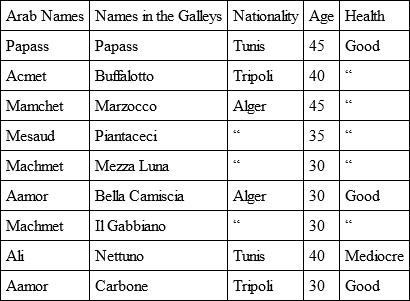
These men in fact were for service in the Pontifical galley.
They were a fine race of servants, evidently!
The Jews are much less numerous in Algeria than in Morocco and Tunisia, but they take on a very considerable commercial importance in the picturesque conglomerate ensemble of peoples in the cities like Algiers, Oran or Tunis; they gather the small savings of the nomad races in a way that is the marvel of all who know their trade. Furthermore, as French citizens, they play no small part in political affairs. What they lack in numbers they make up in power, and the money-lending trade, while seemingly in disrepute, is quite a necessary one in commercial communities.
The Jews lend money to Christians the world over, men and nations alike, and in Africa they do the same to the improvident Arab. Clearly the Jew has a mission in life; he has found it out, and he sticks to it, and has ever since that historic hour in the Temple.
Of all the mixed races with which one rubs shoulders in Northern Africa, it is the Arab who interests us most. It is his country that we are in. It is the Arab who must be our guide, philosopher and friend. “Ask an Arab anything you like,” say the French, “but ask nothing of a Maltese or an Italian.” Why, they do not tell you, but simply shrug their shoulders in the expressive Frenchman’s way.
CHAPTER IX
SOME THINGS THAT MATTER – TO THE ARAB
THERE are three kinds of noblesse among the Arabs: there is the aristocrat class, the noblesse de race, descended, so they think, from Fatma, the daughter of the Prophet; the noblesse militaire, descendants of the Arab conquerors, of which Mohammed and his family are also descended; and finally the noblesse réligieuse, a hereditary noblesse like the preceding, but a distinction that can only be acquired by meritorious performance of a religious duty.
The tribes each have a head known as a Caïd, and each tribe is divided into smaller tribes and factions who obey implicitly the sub-head or Cheikh (sheik). The head of a douar, – a group of tents, – if the collection is not great enough to have a presiding Sheik, is a sort of committee, like the bodies of selectmen of a New England village.
Over and above all indigène control, the French administration is the real head of the Arabs in Algeria, and the Tunisian French fonctionnaires hold the same powers in Tunisia.
The Arab or Kabyle chiefs in Algeria are merely the agents for the execution of the government’s laws, civil or military, and in Tunisia the laws for each province (outhan) are made known to the Caïd by the authorities, and it is he who is held responsible for their observance. As for punishment for a crime committed, – for they are not all plaster saints, – the Arabs would much prefer the old Turkish bastinado to a sentence behind prison walls or a fine in money, sheep or goats. Does civilization civilize?
The Arabs are full of wise saws mostly adopted from the Koran, or from the Apocryphal books of the Prophet. They have a saying which might well be put into a motto suitable for the creed of any man: —
“El-Khams, El-Miter, El-Ansab and El-Aglane are the inventions of the devil.”
El-Khams is worry; El-Miter is gambling; El-Ansab are the stones or thorns in one’s road; and El-Aglane is the argument by sword instead of by reason. The following might well be printed in Gothic script and hung in our own “dens” and boudoirs along with Stevenson’s “Prayer.”
“When a woman says to her husband, I have never received a single benefit from you, all the good acts she may have done lose their value.”
“God detests those who show pride before their companions.”
“Go a mile to visit a sick man, two miles to reconcile a pair of quarrellers and three miles to see a holy man.”
“When you think of the faults of your neighbours, think also of your own.”
“He who salutes thee first is free from pride.”
“God hates dirtiness and disorder.”
With respect to this last, the Arab performs his ablutions with great regularity and devotion, but by contrast, curiously enough, enshrouds himself frequently in dirty, verminous rags.
The most detested sequence of events that can happen to an Arab are ranked as follows: —
I. The drunkenness which makes a fool of a man.
II. The sleep which dissipates the drunkenness.
III. And the chagrin which destroys the sleep.
The emotion has been felt by others, who cannot slip on and off the peau de chagrin as did Balzac’s hero.
The Arabs explain their abstention from wine by an act of the Prophet forbidding its use.
One day the Prophet saw, in passing, a group of young men who were making free and drinking of wine. He blessed them, saying, “Drink at your ease, you have the benediction of God.” At the end of a brief interval the Prophet, passing that way again, saw them disputing among themselves, and learned that one had been killed. Thereupon he vowed upon their heads that “wine was a curse upon them, and that not one who was given to it should hope to enter Heaven.”
Among the Arab indigènes to-day, one remarks an almost total abstention from the “wine when it is red.” Contrariwise they may frequently be seen drinking white wine, and indeed they have a great fondness for champagne, – but they are not particular about the brand, the label on the bottle means nothing to them, so long as it is a gaudy one, and so, like many Americans, they drink something which they think is champagne, and is just as “heady.”
Arab hospitality is famous, their very manner of life, even to-day, as in olden times, makes it a sort of compulsory tenet of their creed.
“Ida andek ktir, ati men mulek.
Ida andek glil, ati men galbeck.”
“If you have much, give of your best.
`If you have little, give from the heart.”
Never ask an Arab his age; you will be disappointed if you do. The Arabs have no civil register and generally ignore their exact age, frequently reckoning only by some great event which may have happened within their memories, like the “Uncle Toms” and “Old Mammies” of “way down Souf.” With such a rule-of-thumb reckoning, you are likely to remain as much in the dark as before.
It is a belief among the Arabs that they can carry on a conversation with animals. Not all amongst them are thus accomplished, but the speech of animals, they say, can be learned, and many of their head men know it. They share this belief with other Orientals; but there is no proof that they have learned their lessons as well as did Garner in his attempts to acquire “monkey talk.” The Arabs, too, are superstitious. They believe in the evil eye, and they object most decidedly and vociferously if you point your finger at them; also, they wear charms and amulets against disease and disaster.
They used to object to the camera man and the artist, but to-day, since they have come to learn that you carry away with you no actual part of themselves, only an impression, their attitude has changed.
The Arab warrior must have ten qualities, or he is déclassé in the favour of all other Arabs.
I. The courage of a cock.
II. The painstaking of a chicken.
III. The heart of a lion.
IV. The brusqueness of a wild boar.
V. The tricks of a fox.
VI. The prudence of a hedgehog.
VII. The swiftness of a wolf.
VIII. The resignation of a dog.
IX. The hand always open.
X. The sword always drawn, and one sole speech for friend or foe.
The Arab warrior, save as he now serves France, has disappeared, but his precepts were good ones for a soldier.
The Arabs’ regard for womankind has often been misunderstood and misstated. Not all Mussulmans have the same noble regard for womankind. The Turk and the Persian is notably a tyrant in his home; and, among the Arabs, the Bedouin is frequently a brute towards his wives and daughters; but the conventional Arab-Berberisé is quite compassionate and liberal in his views and treatment of the female members of his family.
“Auprès de Dieu, le maître du monde, une fille vaut un garçon.”
Thus say the Arabs, but in practice it’s all the other way. The boy stays with the family and adds his strength and talents to his father’s tribe; but the daughter, arriving at the marrying age, which comes early with the Arabs, leaves not only her family, but the ancestral douar or community, perhaps even the tribe, and goes where her new master pleases.
In a word, the boy is another sword or brain for his family’s interests, whilst the daughter goes to augment those who may, perhaps, at some future time, be enemies of her parents.
From this one judges that with the Arabs, as with many other exotic nations, the birth of a son brings real joy to the parental roof-tree; but that of a girl merely a lukewarm expression of gratification, or perhaps nothing more than a disappointed resignation. If it is a boy that is new-born, the parents are congratulated with: “God has made you a good gift!” If it is a girl: “May you be as happy as possible!” is considered as all that is needful, a sort of commiserating congratulation this, and the father perforce responds ordinarily: “Zaddat di nââla!” (“It is my sorrow.”)
Once the child is born, the sex determined, the “rejoicings,” properly called, do not differ in one case from the other, for the Arab believes profoundly in Mohammed’s diction – “These are the innocents and the Fête des Anges must be the same in each case.”
Seven days after the birth, the baby daughter’s Fête de Naîssance takes place in presence of the Caïd, the marabout, parents and friends. The women cry and sob joyfully, and dance with the abandon of a dervish, and the screech and roll of the guellal and the flute make things hideous for one who has no special responsibility bound up in the event. The men, too, give themselves over to the dance quite as vigorously and quite as gracefully as do the women, and a feast – all birth and wedding celebrations end with a feast – terminates the great event so far as a general participation goes. The eternal couscous is the pièce de résistance, with dates, raisins, figs, honey, butter and milk in addition.
For a choice of names for their little daughter, the Arab parents, almost without exception, choose one of the following: —
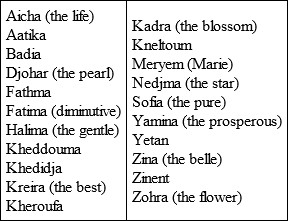
Sometimes the child is given the name of some female friend of the family, who agrees to act as godmother through the early years of its life, and is obliged to spend a relatively large sum of money in supplying a baptismal present, as do godmothers the world over. The boy under the same circumstances would probably have been named Mohammed or Achmed and have done with it.
After the actual naming ceremony the great bracelet talismans are put on the girl-child’s arms, and a little later a similar decoration will be given her for her neck. If the parents are rich their children are often rudely sent away to be nourished and given strength beneath the shade of some Saharan oasis, not too far away but that they can be visited once a year. The nurse who guards the children in their desert home is called the second mother, but she is a nurse pure and simple and bears no relation to the godmother.
The child is carried pick-a-back by day, by one or another of its mothers, clumsily swathed in a none too clean-looking woollen cloth during the first few months, and at night is securely stowed away in a fig-leaf basket which is hung from the tent poles, a cradle which is soft, flexible and cheap.
In time light foods, such as the milk of goats, cows, or camels is given the child, and as early as possible it is told or shown how to take a bath – and made to take it whenever the idea enters the parents’ heads.
For dress, the girl is clothed as becomes the station and wealth of her parents; her ears are pierced in two or three places, but as no jewelry is worn by infants the holes are kept open by silk cords.
The home life of these early years is very much en famille among the Arabs of the countryside, with horses, oxen, and cows as dwellers under the same roof.
As soon as possible the child is taught to pray according to the religion of its parents. Each prayer is preceded by an ablution. Truly the Mohammedan religion is a cleanly and purifying one!
The practical education of an Arab girl commences when she is shown how to cut and fit a burnous (nothing of the tailor-made or Paris mode about this to make it difficult; any one who can handle a pair of scissors can do the thing), to sew a tent-covering together, and the thousand and one domestic accomplishments of women everywhere, not forgetting spinning and weaving.
In the poorer families, those who live in mean, ragged tents, not the “Great Tents,” the child is most likely first set to doing the cooking. At the age of fourteen or fifteen, she begins to “take notice” of the youth of the other sex, meanwhile partaking of the fare of the family board only when there are no strangers present. During visits to friends and neighbours, or to the marabouts, or at fêtes given in her honour, the young Arab girl of whatever social rank is closely chaperoned, always accompanied by her mother. The daughters of the “Great Tents” are veiled from their tenth year onwards, only the poor remain with their visage uncovered. Music is a part of the early education of the Arab girl. She learns to dance, yatagan in hand; and to play the bendir, a sort of Spanish tambourin, and the touiba, a similar instrument, somewhat smaller and less sonorous.
At an early age, too, she learns the rudiments of the arts of coquetry. She puts rouge (zerkoun) on her face, and blacks her eyelids with koheul; and, finally, colours the tips of her toes and fingers a coppery red with henna. She has her wrists and ankles tattooed in bands or bracelets; and paints beauty spots, a star or a crude imitation of a fly, on her cheeks or forehead. By this time she is thought to be a ravishing beauty.
Even the poorest of Arab families guard their daughter’s honour with the greatest circumspection, never a doubtful word or phrase is uttered in her presence. She is brought up in the greatest purity of atmosphere. Should there be any doubts as to this, her spouse, even on the marriage day, will send her back to her parents dressed in a white burnous – with no thanks. Dishonour can be punished by death. The Cadi is the referee in all matters of dispute or doubt of this nature, and his word is final.
Among the wealthiest tribes the daughters are often promised in marriage at the age of four or five, and frequently they marry between ten and fifteen. Indeed they must marry at an early age or people say unkind things about them. In the Sahara the rich marry three or four wives, the poor one, rarely two. One may not marry but one wife in any one year.
The Arab proverbs concerning women are many and mostly complimentary.
“The quarrelsome wife is for her spouse a heavy burden, but a happy wife is as a crown of gold.”
The Arab poet says of his chosen type of female beauty: —
Hair black as the feathers of the ostrich.
Forehead wide and eyebrows thick and arched.
Eyes black like a gazelle’s.
Nose straight and finely modelled.
Cheeks like bouquets of roses.
Mouth small and round.
Teeth like pearls set in coral.
Lips small and coloured like vermilion.
Neck white and long.
Shoulders broad.
Hands and feet small.
Manners agreeable.
Laughter delicate.
“She must laugh soberly, must not gad about nor dispute with her husband or neighbours, have a well-governed tongue, may rouge slightly, guard well the house, and ever give good counsel.”
The formula might well be any man’s ideal; though the Arabs say when you meet this paragon of a woman, you become crazy, and if she leaves you, you will die. All of which may be true also! The ideal is one made up of an appalling array of virtues.
An Arab tale tells of a warrior horseman, El Faad-ben-Mohammed, rich in this world’s goods and lands, who met a certain Oumya-bent-Abdallah, and would marry her, so beautiful was she. He sent his emissary to her to plead his cause, for he was timid in love, if brave in war.
The young girl asked what might be her wooer’s position in life, whereupon his friend replied: “He is a warrior; when the fight is at its thickest, it is he who cleaves a passage through the ranks of the foe. He is taciturn and sober and knows well how to take adversity.” This seems a good enough send-off for a proxy to give, but the maid would have none of it. She said simply: “Go back to your friend. It is a lion that you tell me of. He wants a lioness, not a woman. I would not suit.”
The suitor for a young girl’s hand among the Arabs often does make his demand of her parents by proxy; and much bargaining and giving and taking of concessions goes on, all without embarrassment to the swain. It’s not a bad plan! A contract follows, and finally legal sanction. Every Mussulman marriage must have the consideration of the dot as a part of the legal agreement. The dot may vary with the fortunes of the girl’s family, or with the condition of the suitor; and, in case of divorce, this dot must be returned to the unfortunate lady’s parents, not to her, whatever may be the cause.
The wedding trousseau of the young wife, that which she brings in the way of clothes and jewelry, must comport with her former station in life; but her dot, which may be in kind, not necessarily in money, may be as great as the prospective husband can worm out of the girl’s parents. A rich Arab of the “Great Tents” whom we heard of at Jouggourt gave up the following: Three camels, fifty sheep, eighteen skins, three bolts of cotton cloth (made in Manchester – the “Manchester goods” of commerce as it is known in the near and far East); a gun (a Remington so-called, most likely made in Belgium), with brass and silver inlaid in the stock; two pairs of silver rings for ankles and wrists; two buckles for the haïk, a silken burnous, a silk sash, a string of coral beads (made of celluloid at Birmingham), earrings, a mirror (of course) and a red haïk, and a melhafa or haïk of cotton.
Among the desert tribes the women of all classes of society frequently have their faces unveiled; but, as they approach the great trade-routes and the cities, they closely enwrap the face so that only a pair of glittering black eyes peep out. Without regard to class distinctions or age all Arab women are passionately fond of jewelry of all kinds, finger-rings, anklets, bracelets, chains, and brooches.
Repudiation, or divorce, is legal among the Arabs if accomplished in a legal way, and is simply and expeditiously brought about. The following is an account reported recently in an Algerian journal: —
El Batah had presented himself before the Cadi for the purpose of “repudiating” his wife, “une femme grande et forte, d’une éclatante beauté.” “Well, what is it?” said the Cadi, scenting in the affair a big fee, at least big for him. The Cadi was very much smitten by the lady, it appears, though he did not know it, or at any rate admit it, at the time.
“I come to complain of my wife, who has beaten me and nearly broken in my head,” said the poor man.
“It is true,” echoed the woman, “but I did not mean to do it, I am sorry; I ought not to be punished.” (This doesn’t seem logical, does it?)
“Well, I shall ‘repudiate’ her” said the man; “I will have none of her.”
“Return her dot, then, to her family,” said the Cadi.
“Great Allah! It is impossible, it is four thousand dirhems, how can I pay it?”
By this time the Cadi saw his fat fee vanishing, and his ardour for the lady of the striking beauty rising. He had just lost his fourth wife, the Cadi, and there was a place in the ranks for another.
“If I will give you the sum,” said he, “will you ‘repudiate’ this woman?”
“Yes, willingly,” said the fellow.
“Well, here’s your money,” said the accommodating official.
No consideration of the women of North Africa ought to terminate without a reference to the Mauresque, that gracious type found all through Northwestern Africa, a product of the mixture of the races, an outcome of civilization and the growth of the great cities of the seaboard. They are usually named Fathma, Zohra, Aicha, Houria, Mami, Mimi, Roza, Ourida, Kheira, etc.; and they leave the bed and board of their parents usually between the ages of twelve and fourteen to be married, or for other reasons. Practically all the world looks upon the Mauresques as social outcasts. The class had become so numerous about the middle of the nineteenth century that the hand of philanthropy was held out to them to enable them to better their condition in life. They were given a rudimentary book education, and were taught the art of Oriental embroidery with all its extravagance of capricious arabesques and threads of gold.
As for the other class of Mauresques, the rikats, those who have become contaminated, – for not all are saved, nor ever will be, – one recognizes them plainly as of the world worldly whenever they take their walks abroad. The sad amusement of visiting mosques and cemeteries is not their sole pleasure, as it is that of the legitimate Arab wife, or Mauresque, even though her spouse be wealthy.
The Mauresque partner de convenance of a wealthy indigène or European may have her own horses and carriages, perhaps by this time even her own automobile; and rolls off the kilometres in her daily promenades on the fine suburban roads of Algiers, in company with the haute société of the city, and the thronging American, English and German tourists from Mustapha. She even dines at the cabarets of Saint Eugène, Pointe Pescade or the Jardin d’Essai, and no one does more than look askance at her. Algiers is very mondaine, and its morals as varied as its population.
Even though the rikat dresses after the European mode, there is no mistaking her origin. Her great, snappy black eyes, livened and set off by dashes of koheul, are fine to look upon; and her figure, as she sits in her cabriolet or opera-box, is so well hidden that one does not realize its cumbersomeness. At home she wears the seraglio “pantalon” of the Arabian Nights, ankles bare and feet stuffed into babouches– which an Indian or a plainsman would call moccasins. Over all is the r’lila, a sort of cloak of gold-embroidered, silken stuff, very light and wavy. It’s not so graceful as the kimona of the Japanese, but it’s far more picturesque and useful than the most ravishing tea-gown ever donned in Fifth Avenue or Mayfair.
The Mussulman calendar is simple, and, except in the nomenclature of its divisions, is not greatly different from our own. The Arab year has twelve lunar months, making in all three hundred and fifty-four or three hundred and fifty-five days.
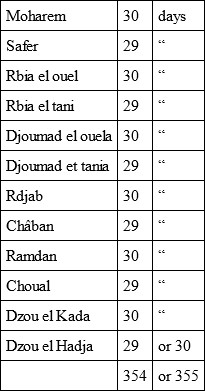
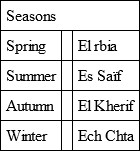
The principal fêtes of the Arab are those of the Mussulman religion, the same one observes in Bombay, Constantinople and Cairo.
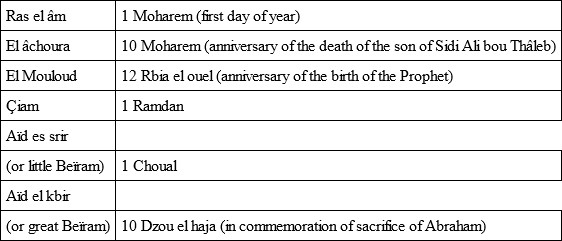
The following glossary of commonly met with Arab words is curious and useful: —
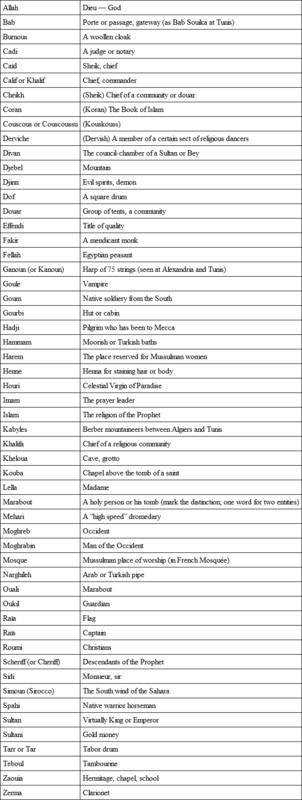
CHAPTER X
“THE ARAB SHOD WITH FIRE”
(Horses, Donkeys, and Mules)
AS a Kentucky colonel once said, the pure-bred Arabian horse is a fine thing in his native land; but there is more good horse-flesh, per head of population, in the United States than the first home of the ancestor of the blooded horse ever possessed. Everything points to the fact that the gentleman knew what he was talking about, as fine specimens of Arabian horse-flesh are rare to-day, even in Arabia and North Africa. They exist, of course, but the majority of horses one sees in Algeria and Tunisia are sorry-looking hacks.
In the desert the case is somewhat different. There the beautiful Arabian horses of which romance and history tell are more numerous than the diminutive bronchos of the coast plains and mountains. The descendants of the Anazeh mares, the parent branch of royal Arabian blood, are not many; but an Arab of good lineage may still be had by one who knows how to pick him out, or gets some friendly Sheik to give him his.
No one seems to know where the original Arabian horse was bred, though it was known in the Mauritania of the Romans, in the environs of Carthage, long before that little affair of Romulus and Remus startled an astonished world. In all probability he was a descendant of the same horses which made up the Numidian cavalry which overran Rome during the Punic wars, and that’s a pretty ancient pedigree.
To-day all through North Africa, in Morocco, Algeria, Tunisia, Tripoli, Egypt, and in Arabia across the Red Sea, the type is recognizable in all variations of purity and debasement.
The “Arab shod with fire” of the Bedouin love-song may not be all that sentiment has pictured, but he is an exceedingly high-bred animal nevertheless.
Here are his fine points: —
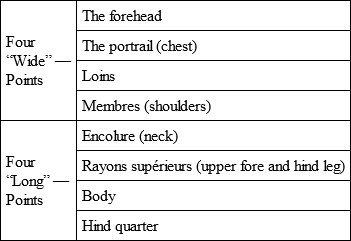
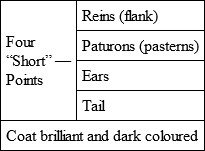
This is the formulæ upon which the French remount officers choose their Arabian horses, and for hard work they take always a “traineur avec sa queue,” a horse of seven years or more.
Each chief of an Arab family possesses one or more of the blooded Arabians of classic renown. It is his friend in joy and sorrow, and his constant companion when he is away from his family. If the Arab chief has many horses he always keeps one, the favourite, as a war-charger. If there are no wars or rumours of war in sight, he only rides this favourite on gala or parade occasions; but at all times he gives it more care and attention than many heads of families, in more conventionally civilized lands, give their wives. The Arab knows the ancestors of his horse as well as he knows his own; and he has its pedigree writ on parchment, which is more trouble than he has taken to perpetuate the memory of his own remote parents. The Algerian Arab horse has been called a “mixed-pur sang,” whatever that may mean, but certainly it will take somebody more expert than a mere “horsey” person (the kind that go around talking about their “mounts” and how “fit and saucy” was the one they rode that morning) to mark the distinction between the best of the Algerian variety and those of Egypt, Syria or Arabia.
The Arab trains his horses for his own personal use, to pace, canter, or gallop, never to trot, a gait which is only fit for the European who is afraid to sit on, or behind, a horse with a quick-moving pace. This is the Arab version of it, and an Arab horse owner will hobble his beast with a rope if he shows the least inclination to trot or single foot. If this won’t break him, why he sells him to some one who will stand for it – at the best price he can get. The Arab horse owner thinks with the late A. T. Stewart: “If you have got a loss to meet, meet it at once and get your capital working on something else.”
The writer recently met an Italian trying to bargain with an Arab for a saddle-horse. The Arab was with difficulty convinced that the gentleman was not an Englishman who would buy only a “trotting saddle-horse.” Quel horreur! “Allah be praised!” said Ali-something-or-other, the trader, all Europeans are not imitators of the English taste in saddle-horses. Once in awhile an Italian or a Spaniard or a Frenchman wants a horse for a carrousel and not for an amble in the Bois, which is his idea of doing as they do in London.
The reputation of the blooded Arabian horse, whether it is found in Arabia, Algeria or Morocco, is classic, and the mule, too, seems here to take on qualities not its birthright elsewhere. With the donkey, the petit âne with a cross down its back and a silver museau, the same thing holds good. North Africa is the donkey’s paradise. Here, if he finds herbage scant once and again, he thrives as nowhere else, and attains often an age of thirty-five years. The donkey in Africa is worked hard, but is neither unduly maltreated nor misunderstood. Perhaps that is why he lives long, though if the present race of donkey boys, who have been trained at the Paris and Chicago exhibitions, go on their unruly ways now they have got back to their homes at Cairo, Tunis or Algiers, even the patient, sad little donkeys may take on moods that hitherto they have never known.
The horses and donkeys of the big towns may well become spoiled by vanity, for they are often the subjects of an assiduous and inexplicable care on the parts of their owners, who comb their locks, and braid them, and cosmétique them and put rouge on their foreheads, and even stain them with henna until they are a regular “Zaza” tint. Darkest Africa is not so backward as one might think!
All classes of native riders, whether on the camel, mehari, horse, mule, or donkey, beat the ribs of the creature with a heel-tap tattoo in what must be an annoying manner for the beast. From the way the native, rich or poor, sits on his horse, spurs would be of no use to him, and only the Spahi, or native cavalry, has adopted them.
Donkey riding is the same dubious rocheting proceeding in all Mediterranean countries. It is no worse here than in Greece or on the Riviera. “The donkey’s a disgrace,” says the Arab; and he runs along behind, beating his onery little beast and calling it a fille de chacal, a graine de calamité or a chienne. This need awaken no sentiments of pity whatever – for the donkey. They are as much terms of endearment as the occasion calls for. The most common four-footed beast of burden in Algeria is undoubtedly the despised donkey of tradition. Every one does seem to despise the donkey, except the Mexican “greaser,” who asks as affectionately after his neighbour’s burro as he does his wife or children. Here the bourriquet or h’mar is quite a secondary consideration in the Arab’s domestic entourage.
The bourriquet is an economical little beast, costing only from ten francs upward. He usually feeds himself, browsing as he goes, and trots twenty or thirty kilometres a day, encouraged by the whacks and expletives of his driver who may often be found perched on top of the donkey’s load of a hundred and fifty pounds or more.
To us it all savours of cruelty, and perhaps some real cruelty does take place; but much of the “coaxing” of a donkey into his gait is necessary, unless one is disposed to let him stand still for hours at a time, too lazy to do anything but swish and kick the flies away. Æsop’s ass prayed to Jove for a less cruel master, but that deity replied that he could not change human nature nor that of donkeys, so things were left to stand as before.
The Arabs often slit the nostrils of their donkeys, on the supposition that the Maker did not fashion them amply enough to allow them to breathe readily. The more readily the donkey breathes, the more capable he is to carry heavy burdens long distances. Logical, this! And the procedure, too, improves the tonal quality of the donkey’s bray. Well, perhaps, though most of us are not devotees of that sort of music. Compared to Italy or Spain, there are considerably fewer suffering sore-backed donkeys in Algeria or Tunisia.
There is no question but that for economical service the donkey will kill any horse or mule; and it is clear that, weight for weight and load for load, he daily outdoes the camel. The latter, weighing fifteen hundred pounds, carries perhaps a weight of three to five hundred. The ass weighs two hundred and fifty to four hundred pounds, and, carrying one hundred and fifty to two hundred, outpaces the camel by a mile an hour.
The donkey is guided by the voice, a stick, or a rope halter, which lies on the left side, and is pulled to turn him to the left, or borne across his neck to turn him to the right. The stick serves the double purpose of striking and guiding, and the stick must needs come into play only too often.
The donkey here in the Mediterranean countries is often very small, not thirty-two inches in many cases, no bigger than a St. Bernard. When one hires a donkey to carry him over an étape on some mountain road, it is often a beast from whose back one’s toes touch the ground, though one is seated on a pad, not a saddle, and measures only five feet seven.
CHAPTER XI
THE SHIP OF THE DESERT AND HIS OCEAN OF SAND
A CAMEL may be a cumbersome, ungainly and unlovely creature, and may be destined to be succeeded by the automobile, to which he seems to have taken a violent dislike; but there is no underrating the great and valuable part which he has played in the development of the African provinces and protectorates of France. He has borne most of their burdens, literally; has ploughed their fields, pumped their water, and even exploited the tourists, to say nothing of having been the companion of the Mussulman faithful on their pilgrimages.
The camel caravans which set out across the desert from Tlemcen, Tunis, and Constantine (there are no camels nearer Algiers than Arba) are in charge of a very exalted personage, – or he thinks he is. His official title is gellâby. Each and every beast of burden is loaded to the limit, and pads his way with his great nubbly hoofs across untold leagues of sand or brush-covered soil without complaint. At every stop, however, and every time a start is made, he always gives vent to shrieks and groans; but as this procedure takes place at each end of a day’s journey as well, it is probably pure bluff, as the camel-sheik claims. To one unused to it the noise seems like the wails which are supposed to come up out of the inferno.
The camel of Africa, so-called, is really not a camel, he is a dromedary; the camel has two humps, the dromedary but one, but camel is the word commonly used. The two-humped quadruped, then, is a camel, – the direct descendant of the camel of Asia, whilst that of the single hump is the dromedary of Africa. The distinction must be remembered by all who talk or write on the subject, with the same precision that one differentiates between African and Indian elephants.
The camel has by no means the rude health and strength which has so often been attributed to him, indeed he is a very delicate beast and demands a climate dry and hot. Cold and snow and persistent rains are death to a camel. A camel must be well nourished, and with a certain regularity, or he soon becomes ill and dies. He is easily frightened and can spread a panic among his fellows with the rapidity of wild-fire.
For the most part the camel is kindly and temperate, but he can get in a rage and can be very dangerous to all who approach him on foot.
The camel of the south cannot live in the north and vice versa. They are not acclimated to the varying conditions. One judges a good camel (dromedary) by his hump; firm and hard, it is a sure sign of a good-natured, hard-working, friendly sort of a camel; if flabby and mangy, then beware.
A camel eats normally thirty or forty kilos of fodder a day, and must be allowed four hours to do it in. As to drink, once in two or three days in summer is enough, but in winter he can go perhaps ten days, and his food bill is increased nothing thereby.
He can carry 150-160 kilos, a parcel hung over each side in saddle-bag fashion. The mehari, or long-distance, fast-gaited camel of the Sahara, is to the ordinary dromedary what a blooded Arabian is to a Percheron. He can better stand hunger and thirst, and on an average needs drink only once in five days; furthermore is not as liable to fright as is the djemel, as the Arab calls the camel, and is more patient and more courageous. Less rapid than a race-horse for short distances, the mehari, well-trained and well-driven, can make his hundred kilometres a day, day in and day out.
The saddle is called a rahala and has a concave seat, a large, high back, and an elevated pommel. The rider sits in the bowl-like saddle, his legs crossed on the beast’s neck. The mehari is driven through a ring in its nose, to which is attached a rope of camel’s hair. The beast is somewhat difficult to drive, more so than the djemel, and only its master can get good results. To mount, the beast kneels as do ordinary camels.
En route the mehari does not graze, but waits for a decent interval and takes its meal comfortably. A mehari, not accustomed to the sight of a horse, is often put into a terrible fright thereby. The education of a mehari is very difficult; it takes a year to break one.
The policing of the great Saharan tracts would not be possible without troops mounted on mehara, – the plural of the word mehari, – and France owes much of the development of her African provinces to the mehari and the slower-going camel.
The dromedary, or camel, as it is referred to in common speech, was an importation into Algeria away back in some unrecalled epoch, at any rate anterior to the Arab invasion of the eleventh century.
The mehari was a warlike beast as far back into antiquity as the days of Herodotus, Tacitus, and Pliny. Herodotus, recounting the battle of Sardes, said, according to Pliny: “Camelos inter jumeuta pascit Oriens, quorum duo genera Bactriani et Arabici…”
If an Arab is owner of a thousand camels, he wards off any evil that may befall them by leading out the oldest and blinding it with a rod of white hot iron.
A camel that has fallen ill may be cured, many superstitious Arabs believe, by allowing it to witness the operation of searing the hoofs of another, tied and thrown upon the ground. This is auto-suggestion surely, though where the curative powers come in it is hard to see.
When a bayra, a female camel, has given birth to five camels, the last being a male, her ears are bored and she is sent out to pasture, never more to be put to the rough work of caravaning. Like putting an old horse to pasture in perpetuity, it seems a humane act, and it solves the race question in the camel world, or would if the camels only knew the why and the wherefore.
The camel’s feet are admirably made for the sands of the desert; they form by nature a sort of adapted ski or snow-shoe. The hoof (though really it is no hoof) is bifurcated and has no horny substance, merely a short, crooked claw, or nail, at the rear of each bifurcation, a sort of elastic sole – the predecessor of rubber heels, no doubt – covering the base. The camel travels well in sand, but with difficulty over stony ground, where frequently the Arabs envelop his feet with cloths or leather wrappings.
The camel possesses further four other callosities, one on each knee, and he uses them all four every time he gets up or lies down. These callous places are something the beast is born with; they get ragged and mangy-looking with time, but they are there from birth.
The boss, or hump, of the camel-dromedary is mere gristle; it contains no bone, and is more or less abundant according to the health of the animal.
A well-fed and happy camel, starting out on a long march, regards his well-rounded hump with pride. Excessive travel and forced marches diminish its shape and size and the beast seemingly becomes ashamed and literally feels sore about it. But, like the conquered general on a battle-field who loses his sword, he ultimately gets it all back again, and a little rest, a change of diet, and a good, long drink – “a camel’s neck,” you might call it – makes a difference with the camel and his hump in the course of a very few days.
A camel gets unruly and cries out at times, and often becomes unmanageable, but an application of a sticky gob of tar or pitch on his forehead usually quiets him down.
The baby camels usually come into the world one at a time; and can stand up on their four legs the first day, and run around like their elders at the end of a week.
At the age of four years the young camel is put to work, and carries a rider, two barrels of wine or two gunny-sacks filled with crockery or ironware indiscriminately. His average life is twenty years, and, as with the horse, one reckons his age by his teeth.
The Arab gets an astonishing amount of work out of an apparently unwilling camel. He encourages him with punches, and beatings and oaths and songs. Yes, the Arab camel-driver even sings to his camel to induce him to get along faster, and plays a screechy air on the galoubet; and the curious thing is that the flagging energies of a camel will revive immediately his driver begins to drone. It is a custom which has come down from antiquity, and soon one may expect every caravan to carry its own phonograph and megaphone.
The chief of these airs, rendered into French for us by a lisping, blue-eyed Arab, was, as near as may be: —
“Battez pour nous,
Battez pour nous,
O Chameaux!
Battez pour nous,
Battez pour nous,
Chameaux, pour vos maîtres!”
No very great rhyme or rhythm there, but it suits the camel’s taste in poesy.
To “vagabond” with a camel caravan would be the very ideal of a simple life. The life of a caravan to-day is as it was in Bible times, except that one carries a “Smith and Wesson” or a “Colt” instead of a spear.
The following essential facts apply to all the camel caravans making their respective ways from the coast towns of the northern provinces down into the Soudan and the Sahara. The caravan usually makes its day’s journey between wells, or at least plans to stop at a source of water at night rather than push on; this in case one has not been previously passed by, and every one become refreshed a short time before.
A dozen to thirty kilometres or so a day is the average commercial caravan journey, – for a part of the outfit walks, it must be remembered, – and an eight or ten weeks’ itinerary is the duration of the average journey. Such food as is carried is generally of pounded dates and figs in the form of a paste, which the dry climate more or less petrifies.
The Arab trader, the chief of the trading caravan, and the city merchant en voyage, be he Arab. Turk, or Jew, is a man of position, the others are mere helpers, employés or perhaps slaves.
At each important halting-place of a caravan the Sheik’s great tent is unstrapped from its camel bearer and set up on a pied de terre in as likely a spot as may be found. The Arab tent is no haphazard shack or shelter; it is a thing of convention, and has its shape and size laid down by tradition.
The great central post or pillar has a height of two and a half metres, and the perches, or entrance posts, have a height of two metres, and a considerable inclination, whereas the central one is perpendicular.
The tent proper, the covering, is invariably of alternate black and brown or brown and white woollen bands, sewn together with a stout thread of camel’s-hair. These bands are called felidj and have a width usually of seventy-five centimetres.
Within there is no furniture properly called, simply the provision for a nomad life, sacks of grain, dates, figs or olives, a few pots and pans, harness, etc., and a few smaller sacks or bags, cachettes, where the womenfolk hide their earrings, corals, and brooches. These last are usually used as pillows at night. It is a law of somebody – perhaps the Prophet – that none of the Arabs’ tent accessories must be of wood or iron, save the tent poles, which are of both, being made of wood and shod with iron; thus all utensils and other furnishings are of skins or mats, and dishes of woven grass, and all cords are of spun camel’s-hair. A few copper pots and pans there are of necessity, and a few rude crockery bowls.
The desert caravans form to-day the same classic pictures as of yore as they thread the trails and paths, obscure and involved enough to the stranger, but plain sailing to the chief or guide of a caravan who precedes the following “squadrons” as a Malay pilot precedes his ship.
“At the head of his dusty caravan,
Laden with treasures from realms afar
…
Through the clouds of dust by the caravan raised
Came the flash of harness and jewelled sheath.”
The chief of a tribe, or even a caravan, is a very grand personage among his fellows, and when he is en route rides apart and sleeps in a palanquin or attouch, an attouch being no other thing than a cabin on a ship; here a cabin on the ship of the desert.
The attouch, to be à la mode, must have a tall, chimney-like ventilator rising in the middle and tipped with ostrich plumes. Generally this retreat is large enough to shelter two persons, – always persons of importance in an ostrich-feather-tipped attouch, a sheik and his favourite wife, for example.
The caravans of to-day vary in size from a dozen to fifty camels to a train of four, five, or seven hundred (in Tripoli). Under certain conditions, after a long journey, the camel carriers – the freighters – are usually allowed to rest a matter of days, weeks, or even months, according to the lack of necessitous conditions for pushing on and for recuperation. One of the chief trading towns of the Tripoli caravans to-day in Africa is Kano, a place ruled by a native chief and inhabited by a black population. The chief, for a consideration, affords shelter and protection, and the Arabs of the caravan open up shop and do business in the real county-fair style that they knew before county fairs were even thought of. Native products are bought or traded for in return, and such currency as passes is a sort of wampum made of shells and a few Maria Theresa dollars. Barter, or mere swapping, with a bonus on one side or the other, is the usual caravan Arabs’ idea of merchandizing, and the European can as often get a native-made woollen burnous or a camel’s-hair blanket by the exchange of a “dollar watch” or a “Seth Thomas clock,” as he can by giving up two or three gold louis.
The proper benediction to cast down on the head of any Sheik who may have shown you a courtesy en route is to say in simple French: – “Merci, noble Sheik, de ta générosité. Que la bénédiction d’Allah descende sur toi, sur tes femmes, tes enfants, tes troupeaux et ta tribu.” If you can give him a slab of milk chocolate or a piece of “pepsin” chewing gum, he will appreciate that, too.
The negroes and negresses accompanying the caravans walk, but the Arab either rides camel-back or horseback, like the veritable king of his own little kingdom, which, virtually, every Arab is when he is on the open plain.
The Touaregs, south of Touggourt, one of the real, genuine, Simon-pure tribes of desert Arabs, are not given to the trafficking and merchandizing of those who live down on the coast. Their chief, and in many cases, sole occupation consists in catering for the migratory caravan outfits, selling them dates and mutton and water, for if a Touareg can discover anywhere an unworked oasis with a spring, he has got something which to him is very nearly as good as a gold mine.
Among the Touaregs there are blacks and whites; the whites dress like the conventional Arabs, but the blacks after a fashion more like that of the savage blacks further south. The three superimposed blouses are never too great a weight or thickness for the genuine Arab, even in the blazing furnace of the Sahara. They ward off heat and cold alike.
One of Napoleon’s famous sayings, forgotten almost in favour of others still more famous, was: “Of all obstacles which oppose an army on the march, the greatest, the most difficult to remove, is the desert.”
One imagines the desert as a great, flat, sandy plain with illimitable horizons, like the flat bed of a dried-out ocean. This is a misconception of our youth, brought about by too diligent an application to the precepts of the copy-book and the school geography. All things are possible in the vrai désert. The oasis is not the only interpolation in the monotonous landscape. There are great chotts or marsh tracts, even depressions where a murky alkaline water, unfit for man or beast, is always to be found, vast stretches of rocky plateau, great dunes of sand and even jutting peaks of bare and wind-swept rock, with surfaces as smooth as if washed by the waves of the ocean. These are the common desert characteristics throughout the Sahara, from the Gulf of Gabès to the Moroccan frontier and beyond. Occasionally there are the palpable evidences of new-made volcanic soil, and even granite and sandstone eminences half buried in some engulfing wave of sand swept up by the last sirocco that passed that way.
Over all, however, is an evident and almost impenetrable haze. At a certain moment of one’s progress in the desert, he sees nothing of distinction before or behind or right or left, and at the next finds himself close to a pyramid of rock fifty feet high. Really the desert is very bewildering and enigmatic, and the Arab who navigates it with his caravan is like the sailor on the deep sea. He has to take his bearings every once and again or he is lost and perhaps engulfed.
It is the fashion to write and speak of the mystery of the desert, but in truth there is no mystery about it, albeit its moods are varied and inexplicable at times. To the solitary traveller there is an interest in the desert unknown to seas, or mountains, or even to rolling prairies. Above is a sky of stainless beauty, and the splendour of a pitiless, blinding glare; the sirocco caresses you like a lion with flaming breath; all round lie drifted sand-heaps, where the wind leaves its trace in solid waves. Flayed rocks are here, skeletons of mountains, and hard, unbroken, sun-dried plains, over which he who rides is spurred by the idea that the bursting of a water-skin, or the pricking of a camel’s hoof, would be a certain lingering death of torture. The springs seem to cry the warning words, “Drink and away!” There is nothing mysterious or dull about such a land, indeed it is very real and exciting, and man has as much opportunity here as anywhere of measuring his forces with Nature’s, and of emerging, if possible, triumphant from the trial. This explains the Arab’s proverb: “Voyaging is victory.” In the desert, even more than upon the ocean, there is present death; hardship is there, and piracy, and ship-wreck.
Newcomers to Algeria and Tunisia talk of the monotonous calm of the sand dunes of the desert; but those who know its silences best find nothing monotonous about them. It is as the automobilist expresses it with regard to the great tree-lined “Routes Nationales” of France – “there is sameness, but not monotony.” One does not become ennuied in the desert. He may be alone within a circle of many miles radius, but each glint and glimmer of sunlight, each leaping gazelle and Saharan hare – really a jack-rabbit – keeps him company, and when a camel caravan or a patrol of Spahis rises on the horizon, he feels as “crowded” as he would in a “bridge crush” in New York, or on the Boulevard des Italiens on a fête-day.
Here at one side is a shepherd’s striped tent, surrounded by bleating sheep and goats and tended by a lean, lonesome Arab who is apparently bored stiff with lonesomeness. His is a lonesome life indeed, like that of a shepherd anywhere, and when night comes – often drear and chill even in the Sahara – he slips under his tent flap, pulls his burnous up around his ears and trusts to luck that no jackal will make away with a kid or lamb while he sleeps. He is not paid to sleep by the owner of the flock (a franc and a quarter a day, out of which he feeds himself), but still, sleep he must. Fatigue comes even to a lazy Arab sheep-herder, and he’d rather fall sound asleep beside a brazier inside his tent than doze intermittently before a fire of brushwood in the open. Who would not, at a franc and a quarter a day; particularly as the day includes the night! There is no eight-hour day in the desert.
Before he sleeps, he munches a “pain Arab” and pulls his matoui from his belt, from which he fills his pipe with kif and soon smokes himself into insensibility. Poor sheep and goats, what may not happen to them whilst their guardian is in his paradise of burnt hemp!
In the little oasis settlements where there are natural springs, and not at the Bordjs or government posts of relays, one’s sight is gladdened with flowering fig and almond blooms or fruits and bizarre spiny cacti with pink laurel and palms in all the subtropical profusion of a happy sunlight land. The chief characteristics of an oasis are the superb giant palm-trees, their aigrettes reaching skywards almost to infinity, the azure blue cut into fantastic, fairy shapes, which no artist can paint and no kodakist snap in all their fleeting grace.
Here dwell a few score of sheep, goat, horse, or camel owning Arabs, who mysteriously live off of nothing at all, except when they sell a kid or a baby camel to a passing caravan. It is the simple life with a vengeance! And the children play about in the shadow of the tents naked as worms, and, as they grow up, marry, and adopt by instinct the same idle life. They know no ideas of progress, and perhaps are the happier for it.
The colour effects in the desert are things to make an artist rave. The dunes change colour with each hour of the day, and the silver light of the sunrise and the streaky blood-red and orange of the sunsets are marvels to be seen nowhere else on earth.
The temperature in the desert frequently changes with a suddenness that would be remarked in Paris, the place par excellence in Europe where the changes in temperature are most trying; or in Marseilles, where, from a subtropical summer sun, one can be transplanted on the breath of the mistral into the midst of an Alpine winter in the twinkling of an eye. Fifty degrees centigrade at high noon in the desert may be followed by ten degrees at midnight. That’s a change of seventy-two degrees Fahrenheit, and that’s something.


