автордың кітабын онлайн тегін оқу Italian Highways and Byways from a Motor Car
Francis Miltoun
Italian Highways and Byways from a Motor Car
CHAPTER I
THE WAY ABOUT ITALY
ONE travels in Italy chiefly in search of the picturesque, but in Florence, Rome, Naples, Venice or Milan, and in the larger towns lying between, there is, in spite of the romantic association of great names, little that appeals to one in a personal sense. One admires what Ruskin, Hare or Symonds tells one to admire, gets a smattering of the romantic history of the great families of the palaces and villas of Rome and Florence, but absorbs little or nothing of the genuine feudal traditions of the background regions away from the well-worn roads.
Along the highways and byways runs the itinerary of the author and illustrator of this book, and they have thus been able to view many of the beauties and charms of the countryside which have been unknown to most travellers in Italy in these days of the modern railway.
Alla Campagna was our watchword as we set out to pass as many of our Italian days and nights as possible in places little celebrated in popular annals, a better way of knowing Italy than one will ever know it when viewed simply from the Vatican steps or Frascati’s gardens.
The palaces and villas of Rome, Florence and Venice are known to most European travellers – as they know Capri, Vesuvius or Amalfi; but of the grim castles of Ancona, of Rimini and Ravenna, and of the classic charms of Taormina or of Sarazza they know considerably less; and still less of Monte Cristo’s Island, of Elba, of Otranto, and of the little hidden-away mountain towns of the Alps of Piedmont and the Val d’Aoste.
The automobile, as a means of getting about, has opened up many old and half-used byways, and the automobile traveller of to-day may confidently assert that he has come to know the countryside of a beloved land as it was not even possible for his grandfathers to know it.
The Italian tour may be made as a conducted tour, as an educative tour, as a mere butterfly tour (as it often has been), or as a honeymoon trip, but the reason for its making is always the same; the fact that Italy is a soft, fair, romantic land where many things have existed, and still exist, that may be found nowhere else on earth.
The romance of travel and the process of gathering legends and tales of local manners and customs is in no way spoiled because of modern means of travel. Many a hitherto unexploited locality, with as worthy a monumental shrine as many more celebrated, will now become accessible, perhaps even well known.
The pilgrim goes to Italy because of his devotion to religion, or to art or architecture, and, since this is the reason for his going, it is this reason, too, which has caused the making of more travel books on Italy than on all other continental countries combined. There are some who affect only “old masters” or literary shrines, others who crave palaces or villas, and yet others who haunt the roulette tables of Monte Carlo, Biarritz, or some exclusive Club in the “Eternal City.” European travel is all things to all men.
The pilgrims that come to Italy in increasing numbers each year are not all born and bred of artistic tastes, but the expedition soon brings a glimmer of it to the most sordid soul that ever took his amusements apart from his edification, and therein lies the secret of pleasurable travel for all classes. The automobilist should bear this in mind and not eat up the roadway through Æmilia at sixty miles an hour simply because it is possible. There are things to see en route, though none of your speeding friends have ever mentioned them. Get acquainted with them yourself and pass the information on to the next. That is what the automobile is doing for modern travel – more than the stage or the railway ever did, and more than the aeroplane ever will!
One does not forget the American who went home to the “Far West” and recalled Rome as the city where he bought an alleged panama hat (made probably at Leghorn). He is no myth. One sees his like every day. He who hurried his daughter away from the dim outlined aisles of Milan’s Gothic wonder to see the new electric light works and the model tramway station was one of these, but he was the better for having done a round of the cathedrals of Italy, even if he did get a hazy idea of them mixed up with his practical observations on street-lighting and transportation.
Superficial Italian itineraries have been made often, and their chronicles set down. They are still being made, and chronicled, but the makers of guide books have, as yet, catered but little to the class of leisurely travellers, a class who would like to know where some of these unexploited monuments exist; where these unfamiliar histories and legends may be heard, and how they may all be arrived at, absorbed and digested. The people of the countryside, too, are usually more interesting than those of the towns. One has only to compare the Italian peasant and his picturesque life with the top-hatted and frock-coated Roman of to-day to arrive quickly to a conclusion as to which is typical of his surroundings. The Medicis, the Borgias, and the Colonnas have gone, and to find the real romantic Italian and his manner of life one has to hunt him in the small towns.
The modern traveller in Italy by road will do well to recall the conditions which met the traveller of past days. The mere recollection of a few names and dates will enable the automobilist to classify his impressions on the road in a more definite and satisfying manner than if he took no cognizance of the pilgrims who have gone before.
Chaucer set out ostensibly for Genoa in 1373 and incidentally met Petrarch at Padua and talked shop. A monk named Felix, from Ulm on the banks of the Danube, en route for Jerusalem, stopped off at Venice and wrote things down about it in his diary, which he called a “faithful description.” Albrecht Durer visited Venice in 1505 and made friends with many there, and from Venice went to Bologna and Ferrara. An English crusading knight in the same century “took in” Italy en route to the Holy Land, entering the country via Chambéry and Aiguebelle – the most delightful gateway even to-day. Automobilists should work this itinerary out on some diagrammatic road map. Martin Luther, “with some business to transact with the Pope’s Vicar,” passed through Milan, Pavia, Bologna and Florence on his way to Rome, and Rabelais in 1532 followed in the train of Cardinal du Bellay, and his account of how he “saw the Pope” is interesting reading in these days when even personally-conducted tourists look forward to the same thing. Joachim du Bellay’s “visions of Rome” are good poetry, but as he was partisan to his own beloved Loire gaulois, to the disparagement of the Tiber latin, their topographical worth is somewhat discounted.
Sir Philip Sidney was in Padua and Venice in 1573, and he brought back a portrait of himself painted in the latter city by Paul Veronese, as tourists to-day carry away wine glasses with their initials embossed on them. The sentiment is the same, but taste was better in the old days.
Rubens was at Venice in 1600, and there are those who say that Shakespeare got his local colour “on the spot.” Mr. Sidney Lee says no!
Back to the land, as Dante, Petrarch, even Horace and Virgil, have said. Dante the wayfarer was a mighty traveller, and so was Petrach. Horace and Virgil took their viewpoints from the Roman capital, but they penned faithful pictures which in setting and colouring have, in but few instances, changed unto this day.
Dante is believed to have been in Rome when the first sentence was passed upon him, and from the Eternal City one can follow his journeyings northward by easy stages to Siena and Arezzo, to the Alps, to Padua, on the Aemilian Way, his wandering on Roman roads, his flight by sea to Marseilles, again at Verona and finally at Ravenna, the last refuge.
This was an Italian itinerary worth the doing. Why should we modern travellers not take some historical personage and follow his (or her) footsteps from the cradle to the grave? To follow in the footsteps of Jeanne d’Arc, of Dante Alighieri, or of Petrarch and his Laura – though their ways were widely divergent – or of Henri IV, François I, or Charles V, would add a zest and reason for being to an automobile tour of Europe which no twenty-four hour record from London to Monte Carlo, or eighteen hours from Naples to Geneva could possibly have.
There is another class of travellers who will prefer to wax solemn over the notorious journey to Italy of Alfred de Musset and Georges Sand. It was a most romantic trip, as the world knows. De Musset even had to ask his mother’s consent to make it. The past mistress of eloquence appeared at once on the maternal threshold and promised to look after the young man – like a mother.
De Musset’s brother saw the pair off “on a misty melancholy evening,” and noted amongst other dark omens, that “the coach in which the travellers took their seats was the thirteenth to leave the yard,” but for the life of us we cannot share his solemnity. The travellers met Stendhal at Lyons. After supper “he was very merry, got rather drunk and danced round the table in his big topboots.” In Florence they could not make up their minds whether to go to Rome or to Venice, and settled the matter by the toss of a coin. Is it possible to care much for the fortunes of two such heedless cynics?
It is such itineraries as have here been outlined, the picking up of more or less indistinct trails and following them a while, that gives that peculiar charm to Italian travel. Not the dreamy, idling mood that the sentimentalists would have us adopt, but a burning feverishness that hardly allows one to linger before any individual shrine. Rather one is pushed from behind and drawn from in front to an ever unreachable goal. One never finishes his Italian travels. Once the habit is formed, it becomes a disease. We care not that Cimabue is no longer considered to be throned the painter of the celebrated Madonna in Santa Maria Novella, or that Andrea del Sarto and his wife are no longer Andrea del Sarto and his wife, so long as we can weave together a fabric which pleases us, regardless of the new criticism, – or the old, for that matter.
We used to go to the places marked on our railway tickets, and “stopped off” only as the regulations allowed. Now we go where fancy wills and stop off where the vagaries of our automobile force us to. And we get more notions of Italy into our heads in six weeks than could otherwise be acquired in six months.
One need not go so very far afield to get away from the conventional in Italy. Even that strip of coastline running from Menton in France to Reggio in Calabria is replete with unknown, or at least unexploited, little corners, which have a wealth of picturesque and romantic charm, and as noble and impressive architectural monuments as one may find in the peninsula.
Com è bella, say the French honeymoon couples as they enter Italy via the Milan Express over the Simplon; com è bella, say one and all who have trod or ridden the highways and byways up and down and across Italy; com è bella is the pæan of every one who has made the Italian round, whether they have been frequenters of the great cities and towns, or have struck out across country for themselves and found some creeper-clad ruin, or a villa in some ideally romantic situation which the makers of guide-books never heard of, or have failed to mention. All this is possible to the traveller by road in Italy, and one’s only unpleasant memories are of the buona mano of the brigands of hotel servants which infest the large cities and towns – about the only brigands one meets in Italy to-day.
The real Italy, the old Italy, still exists, though half hidden by the wall of progress built up by young liberty-loving Italy since the days of Garibaldi; but one has to step aside and look for the old régime. It cannot always be discovered from the window of a railway carriage or a hotel omnibus, though it is often brought into much plainer view from the cushions of an automobile. “Motor Cars and the Genus Loci” was a very good title indeed for an article which recently appeared in a quarterly review. The writer ingeniously discovered – as some of the rest of us have also – the real mission of the automobile. It takes us into the heart of the life of a country instead of forcing us to travel in a prison van on iron rails.
Let the tourist in Italy “do” – and “do” as thoroughly as he likes – the galleries of Rome, Florence, Siena, and Venice, but let him not neglect the more appealing and far more natural uncontaminated beauties of the countryside and the smaller towns, such as Caserta, Arezzo, Lucca, Montepulciana, Barberino in Mugello and Ancona, and as many others as fit well into his itinerary from the Alps to Ætna or from Reggio to Ragusa. They lack much of the popular renown that the great centres possess, but they still have an aspect of the reality of the life of mediævalism which is difficult to trace when surrounded by all the up-to-date and supposedly necessitous things which are burying Rome’s ruins deeper than they have ever yet been buried. It is difficult indeed to imagine what old Rome was like, with Frascati given over to “hunt parties” and the hotel drawing rooms replete with Hungarian orchestras. It is difficult, indeed!
Italy is a vast kinetoscope of heterogeneous sights and scenes and memories and traditions such as exist on no other part of the earth’s surface. Of this there is no doubt, and yet each for himself may find something new, whether it is a supposed “secret of the Vatican” or an unheard of or forgotten romance of an Italian villa. This is the genus loci of Italy, the charm of Italy, the unresistible lodestone which draws tens of thousands and perhaps hundreds of thousands thither each year, from England and America. Italy is the most romantic touring ground in all the world, and, though its highways and byways are not the equal in surface of the “good roads” of France, they are, in good weather, considerably better than the automobilist from overseas is used to at home. At one place we found fifty kilometres of the worst road we had ever seen in Italy immediately followed by a like stretch of the best. The writer does not profess to be able to explain the anomaly. In general the roads in the mountains are better than those at low level, so one should plan his itineraries accordingly.
The towns and cities of Italy are very well known to all well-read persons, but of the countryside and its manners and customs this is not so true. Modern painters have limned the outlines of San Marco at Venice and the Castle of St. Angelo at Rome, on countless canvases, and pictures of the “Grand Canal” and of “Vesuvius in Eruption” are familiar enough; but paintings of the little hill towns, the wayside shrines, the olive and orange groves, and vineyards, or a sketch of some quaint roadside albergo made whilst the automobile was temporarily held up by a tire blow out, is quite as interesting and not so common. There is many a pine-clad slope, convent-crowned hill-top and castled crag in Italy as interesting as the more famous, historic sites.
To appreciate Italy one must know it from all sides and in all its moods. The hurried itinerary which comprises getting off the ship at Naples, doing the satellite resorts and “sights” which fringe Naples Bay, and so on to Rome, Florence and Venice, and thence across Switzerland, France and home is too frequently a reality. The automobilist may have a better time of it if he will but be rational; but, for the hurried flight above outlined, he should leave his automobile at home and make the trip by “train de luxe.” It would be less costly and he would see quite as much of Italy – perhaps more. The leisurely automobile traveller who rolls gently in and out of hitherto unheard of little towns and villages is in another class and learns something of a beloved land and the life of the people that the hurried tourist will never suspect.
The genuine vagabond traveller, even though he may be a lover of art and architecture, and knows just how bad Canova’s lions really are, is quite as much concerned with the question as to why Italians drink wine red instead of white, or why the sunny Sicilian will do more quarrelling and less shovelling of dirt on a railroad or a canal job than his northern brother. It is interesting, too, to learn something – by stumbling upon it as we did – about Carrara marble, Leghorn hats and macaroni, which used to form the bulk of the cargoes of ships sailing from Italian ports to those of the United States. The Canovas, like the Botticellis, are always there – it is forbidden to export art treasures from Italy, so one can always return to confirm his suspicions – but the marble has found its competitor elsewhere, Leghorn hats are now made in far larger quantities in Philadelphia, and the macaroni sent out from Brooklyn in a month would keep all Italy from starvation for a year.
The Italian picture and its framing is like no other, whether one commences with the snow-crested Alps of Piedmont and finishes with Bella Napoli and its dazzling blue, or whether he finishes with the Queen of the Adriatic and begins with Capri. It is always Italy. The same is not true of France. Provence might, at times, and in parts, be taken for Spain, Algeria or Corsica; Brittany for Ireland and Lorraine for Germany. On the contrary Piedmont, in Italy, is nothing at all like neighbouring Dauphiné or Savoie, nor is Liguria like Nice.
As for the disadvantages of Italian travel, they do undoubtedly exist, as well for the automobilist as for him who travels by rail. In the first place, in spite of the picturesque charm of the Italian countryside, the roads are, as a whole, not by any means the equal of those of the rest of Europe – always, of course, excepting Spain. They are far better indeed in Algeria and Tunisia. Hotel expenses are double what they are in France for the same sort of accommodation – for the automobilist at any rate. Garage accommodation is seldom, if ever, to be found in the hotel, at least not of a satisfactory kind, and when found costs anywhere from two to three, or even five, francs a night. Gasoline and oil are held at inflated figures, though no one seems to know who gets all the profit that comes from the fourteen to eighteen francs which the Italian garage keeper or grocer or druggist takes for the usual five gallons.
With this information as a forewarning the stranger automobilist in Italy will meet with no undue surprises except that bad weather, if he happens to strike a spell, will considerably affect a journey that would otherwise have proved enjoyable.
The climate of Italy is far from being uniform. It is not all orange groves and palm trees. Throughout Piedmont and Lombardy snow and frost are the frequent accompaniments of winter. On the other hand the summers are hot and prolific in thunder storms. In Venetia, thanks to the influence of the Adriatic, the climate is more equable. In the centre, Tuscany has a more nearly regular climate. From Naples south, one encounters almost a North African temperature, and the south wind of the desert, the sirocco, here blows as it does in Algeria and Tunisia, though tempered somewhat by having crossed the Mediterranean.
There are a hundred and twenty-five varieties of mosquitoes in Italy, but with most of them their singing is worse than their stinging. The Pontine Marches have long been the worst breeding places for mosquitoes known to a suffering world. The mosquitoes of this region were supposed to have been transmitters of malaria, so one day some Italian physicians caught a good round batch of them and sent them up into a little village in the Apennines whose inhabitants had never known malaria. Straightway the whole population began to shake with the ague. That settled it, the mosquito was a breeder of disease.
The topography of Italy is of an extraordinary variety. The plains and wastes of Calabria are the very antitheses of that semi-circular mountain rampart of the Alps which defines the northern frontier or of the great solid mass of the Apennines in Central Italy. Italy by no means covers the vast extent of territory that the stranger at first presupposes. From the northern frontier of Lombardy to the toe of the Calabrian boot is considerable of a stretch to be sure, but for all that the actual area is quite restricted, when compared with that of other great continental powers. This is all the more reason for the automobilist to go comfortably along and not speed up at every town and village he comes to.
The automobilist in Italy should make three vows before crossing the frontier. The first not to attempt to see everything; the second to review some of the things he has already seen or heard of; and the third to leave the beaten track at least once and launch out for himself and try to discover something that none of his friends have ever seen.
The beaten track in Italy is not by any means an uninteresting itinerary, and there is no really unbeaten track any more. What one can do, and does, if he is imbued with the proper spirit of travel, is to cover as much little-travelled ground as his instincts prompt him. Between Florence and Rome and between Rome and Naples there is quite as much to interest even the conventional traveller as in those cities themselves, if he only knows where to look for it and knows the purport of all the remarkable and frequent historical monuments continually springing into view. Obscure villages, with good country inns where the arrival of foreigners is an event, are quite as likely to offer pleasurable sensations as those to be had at the six, eight or ten franc a day pension of the cities.
The landscape motives for the artist, to be found in Italy, are the most varied of any country on earth. It is a wide range indeed from the vineyard covered hillsides of Vicenza to the more grandiose country around Bologna, to the dead-water lagoons before Venice is reached, to the rocky coasts of Calabria, or to the chestnut groves of Ætna and the Roman Campagna.
The travelling American or Englishman is himself responsible for many of the inconveniences to which he is subjected in Italy. The Italian may know how to read his own class distinctions, but all Americans are alike to him. Englishmen, as a rule, know the language better and they get on better – very little. The Frenchman and the German have very little trouble. They have less false pride than we.
The American who comes to Italy in an automobile represents untold wealth to the simple Italian; those who drive in two horse carriages and stop at big hotels are classed in the same category. One may scarcely buy anything in a decent shop, or enter an ambitious looking café, but that the hangers-on outside mark him for a millionaire, while, if he is so foolish as to fling handfuls of soldi to an indiscriminate crowd of ragamuffins from the balcony of his hotel, he will be pestered half to death as long as he stays in the neighbourhood. And he deserves what he gets! There is a way to counteract all this but each must learn it for himself. There is no set formula.
Beggars are importunate in certain places in Italy be-ridden of tourists, but after all no more so than elsewhere, and the travelling public, as much as anything else, conduces to the continued existence of the plague. If Italy had to choose between suppressing beggars or foregoing the privilege of having strangers from overseas coming to view her monuments she would very soon choose the former. If the beggars could not make a living at their little game they too would stop of their own accord. The question resolves itself into a strictly personal one. If it pleases you to throw pennies from your balcony, your carriage or your automobile to a gathered assembly of curious, do so! It is the chief means of proving, to many, that they are superior to “foreigners!” The little-travelled person does this everywhere, – on the terrace of Shepheard’s at Cairo, on the boulevard café terraces at Algiers, from the deck of his ship at Port Said, from the tables even of the Café de la Paix; – so why should he not do it at Naples, at Venice, at Rome? For no reason in the world, except that it’s a nuisance to other travellers, decidedly an objectionable practice to hotel, restaurant and shop keepers, and a cause of great annoyance and trouble to police and civic authorities. The following pages have been written and illustrated as a truthful record of what two indefatigable automobile travellers have seen and felt.
We were dutifully ravished by the splendours of the Venetian palaces, and duly impressed by the massiveness of Sant’Angelo; but we were more pleased by far in coming unexpectedly upon the Castle of Fénis in the Valle d’Aoste, one of the finest of all feudal fortresses; or the Castle of Rimini sitting grim and sad in the Adriatic plain; or the Villa Cesarini outside of Perugia, which no one has ever reckoned as a wonder-work of architecture, but which all the same shows all of the best of Italian villa elements.
Our taste has been catholic, and the impressions set forth herein are our own. Others might have preferred to admire some splendid church whilst we were speculating as to some great barbican gateway or watch tower. A saintly shrine might have for some more appeal than a hillside fortified Rocca; and again some convent nunnery might have a fascination that a rare old Renaissance house, now turned into a macaroni factory, or a wine press, might not.
CHAPTER II
OF ITALIAN MEN AND MANNERS
ITALIAN politics have ever been a game of intrigue, and of the exploiting of personal ambition. It was so in the days of the Popes; it is so in these days of premiers. The pilots of the ships of state have never had a more perilous passage to navigate than when manœuvring in the waters of Italian politics.
There is great and jealous rivalry between the cities of Italy. The Roman hates the Piedmontese and the Neapolitan and the Bolognese, and they all hate the Roman, – capital though Rome is of Church and State.
The Evolution of Nationality has ever been an interesting subject to the stranger in a strange land. When the national spirit at last arose Italy had reached modern times and become modern instead of mediæval. National character is born of environment, but nationalism is born only of unassailable unity, a thorough absorbing of a love of country. The inhabitant of Rouen, the ancient Norman capital, is first, last and all the time a Norman, but he is also French; and the dweller in Rome or Milan is as much an Italian as the Neapolitan, though one and all jealously put the Campagna, Piedmont, or the Kingdom of Naples before the Italian boot as a geographical division. Sometimes the same idea is carried into politics, but not often. Political warfare in Italy is mostly confined to the unquenchable prejudices existing between the Quirinal and the Vatican, a sort of inter urban warfare, which has very little of the aspect of an international question, except as some new-come diplomat disturbs the existing order of things. The Italian has a fondness for the Frenchman, and the French nation. At least the Italian politician has, or professes to have, when he says to his constituency: “I wish always for happy peaceful relations with France … but I don’t forget Magenta and Solferino.”
The Italians of the north are the emigrating Italians, and make one of the best classes of labourers, when transplanted to a foreign soil. The steamship recruiting agents placard every little background village of Tuscany and Lombardy with the attractions of New York, Chicago, New Orleans and Buenos Ayres, and a hundred or so lire paid into the agent’s coffers does the rest.
Calabria and Sicily are less productive. The sunny Sicilian always wants to take his gaudily-painted farm cart with him, and as there is no economic place for such a useless thing in America, he contents himself with a twenty-hour sea voyage to Tunisia where he can easily get back home again with his cart, if he doesn’t like it.
Every Italian peasant, man, woman and child, knows America. You may not pass the night at Barberino di Mugello, may not stop for a glass of wine at the Osteria on the Futa Pass, or for a repast at some classically named borgo on the Voie Æmilia but that you will set up longings in the heart of the natives who stand around in shoals and gaze at your automobile.
They all have relatives in America, in New York, New Orleans or Cripple Creek, or perhaps Brazil or the Argentine, and, since money comes regularly once or twice a year, and since thousands of touring Americans climb about the rocks at Capri or drive fire-spouting automobiles up through the Casentino, they know the new world as a land of dollars, and dream of the day when they will be able to pick them up in the streets paved with gold. That is a fairy-tale of America that still lives in Italy.
Besides emigrating to foreign lands, the Italian peasant moves about his own country to an astonishing extent, often working in the country in summer, and in the towns the rest of the time as a labourer, or artisan. The typical Italian of the poorer class is of course the peasant of the countryside, for it is a notable fact that the labourer of the cities is as likely to be of one nationality as another. Different sections of Italy have each their distinct classes of country folk. There are landowners, tenants, others who work their land on shares, mere labourers and again simple farming folk who hire others to aid them in their work.
The braccianti, or farm labourers, are worthy fellows and seemingly as intelligent workers as their class elsewhere. In Calabria they are probably less accomplished than in the region of the great areas of worked land in central Italy and the valley of the Po.
The mezzadria system of working land on shares is found all over Italy. On a certain prearranged basis of working, the landlord and tenant divide the produce of the farm. There are, accordingly, no starving Italians, a living seemingly being assured the worker in the soil. In Ireland where it is rental pure and simple, and foreclosure and eviction if the rent is not promptly paid, the reverse is the case. Landlordism of even the paternal kind – if there is such a thing – is bad, but co-operation between landlord and tenant seems to work well in Italy. It probably would elsewhere.
The average Italian small farm, or podere, worked only by the family, is a very unambitious affair, but it produces a livelihood. The house is nothing of the vine-clad Kent or Surrey order, and the principal apartment is the kitchen. One or two bedrooms complete its appointments, with a stone terrace in front of the door as it sits cosily backed up against some pleasant hillside.
There are few gimcracks and dust-harbouring rubbish within, and what simple furniture there is is clean – above all the bed-linen. The stable is a building apart, and there is usually some sort of an out-house devoted to wine-pressing and the like.
A kitchen garden and an orchard are near by, and farther afield the larger area of workable land. A thousand or twelve hundred lire a year of ready money passing through the hands of the head of the family will keep father, mother and two children going, besides which there is the “living,” the major part of the eatables and drinkables coming off the property itself.
The Italians are as cleanly in their mode of life as the people of any other nation in similar walks. Let us not be prejudiced against the Italian, but make some allowance for surrounding conditions. In the twelfth century in Italy the grossness and uncleanliness were incredible, and the manners laid down for behaviour at table make us thankful that we have forks, pocket-handkerchiefs, soap and other blessings! But then, where were we in the twelfth century!
No branch of Italian farming is carried on on a very magnificent scale. In America the harvests are worked with mechanical reapers; in England it is done with sickle and flail or out of date patterns of American machines, but in Italy the peasant still works with the agricultural implements of Bible times, and works as hard to raise and harvest one bushel of wheat as a Kansas farmer does to grow, harvest and market six. The American farmer has become a financier; the Italian is still in the bread-winning stage. Five hundred labourers in Dakota, of all nationalities under the sun, be it remarked, on the Dalrymple farm, cut more wheat than any five thousand peasants in Europe. The peasant of Europe is chiefly in the stage of begging the Lord for his daily bread, but as soon as he gets out west in America, he buys store things, automatic pianos and automobile buggies. No wonder he emigrates!
The Italian peasant doesn’t live so badly as many think, though true it is that meat is rare enough on his table. He eats something more than a greasy rag and an olive, as the well-fed Briton would have us believe; and something more than macaroni, as the American fondly thinks. For one thing, he has his eternal minestra, a good, thick soup of many things which Anglo-Saxons would hardly know how to turn into as wholesome and nourishing a broth; meat of any kind, always what the French call pate d’Italie, and herbs of the field. The macaroni, the olives, the cheese and the wine – always the wine – come after. Not bad that; considerably better than corned beef and pie, and far, far better than boiled mutton and cauliflower as a steady diet! Britons and Americans should wake up and learn something about gastronomy.
The general expenses of middle-class domestic town life in Italy are lower than in most other countries, and the necessities for outlay are smaller. The Italian, even comfortably off in the working class, is less inclined to spend money on luxurious trivialities than most of us. He prefers to save or invest his surplus. One takes central Italy as typical because, if it is not the most prosperous, considered from an industrial point of view, it is still the region endowed with the greatest natural wealth. By this is meant that the conditions of life are there the easiest and most comfortable.
A middle class town family with an income of six or seven thousand lire spends very little on rent to begin with; pretence based upon the size of the front door knob cuts no figure in the Italian code of pride. This family will live in a flat, not in a villini as separate town houses are called. One sixth of the family income will go for rent, and though the apartment may be bare and grim and lack actual luxury it will possess amplitude, ten or twelve rooms, and be near the centre of the town. This applies in the smaller cities of from twenty to fifty thousand inhabitants. With very little modification the same will apply in Rome or Naples, and, with perhaps none at all, at Florence.
The all important servant question would seem to be more easily solved in Italy than elsewhere, but it is commonly the custom to treat Italian servants as one of the family – so far as certain intimacies and affections go – though, perhaps this of itself has some unanticipated objections. The Italian servants have the reputation of becoming like feudal retainers; that is, they “stay on the job,” and from eight to twenty-five lire a month pays their wages. In reality they become almost personal or body servants, for in few Italian cities, and certainly not in Italian towns, are they obliged to occupy themselves with the slogging work of the London slavey, or the New York chore-woman. An Italian servant, be she young or old, however, has a seeming disregard for a uniform or badge of servitude, and is often rather sloppy in appearance. She is, for that, all the more picturesque since, if untidy, she is not apt to be loathsomely dirty in her apparel or her manner of working.
The Italian of all ranks is content with two meals a day, as indeed we all ought to be. The continental morning coffee and roll, or more likely a sweet cake, is universal here, though sometimes the roll is omitted. Lunch is comparatively a light meal, and dinner at six or seven is simply an amplified lunch. The chianti of Tuscany is the usual wine drunk at all meals, or a substitute for it less good, though all red wine in Italy seems to be good, cheap and pure. Adulteration is apparently too costly a process. Wine and biscuits take the place of afternoon tea – and with advantage. The wine commonly used en famille is seldom bought at more than 1.50 lira the flagon of two and a half litres, and can be had for half that price. Sugar and salt are heavily taxed, and though that may be a small matter with regard to salt it is something of an item with sugar.
Wood is almost entirely the fuel for cooking and heating, and the latter is very inefficient coming often from simple braziers or scaldini filled with embers and set about where they are supposed to do the most good. If one does not expire from the cold before the last spark has departed from the already dying embers when they are brought in, he orders another and keeps it warm by enveloping it as much as possible with his person. Italian heating arrangements are certainly more economical than those in Britain, but are even less efficient, as most of the caloric value of wood and coal goes up the chimney with the smoke. The American system of steam heat – on the “chauffage centrale” plan – will some day strike Europe, and then the householder will buy his heat on the water, gas and electric light plan. Till then southern Europe will freeze in winter.
In Rome and Florence it is a very difficult proceeding to be able to control enough heat – by any means whatever – to properly warm an apartment in winter. If the apartment has no chimney, and many haven’t in the living rooms, one perforce falls back again on the classic scaldini placed in the middle of the room and fired up with charcoal. Then you huddle around it like Indians in a wigwam and, if you don’t take a short route into eternity by asphyxiation, your extremities ultimately begin to warm up; when they begin to get chilly again you recommence the firing up. This is more than difficult; it is inconvenient and annoying.
The manners and customs of the Italians of the great cities differ greatly from those of the towns and villages, and those of the Romans differ greatly from those of the inhabitants of Milan, Turin or Genoa. The Roman, for instance, hates rain – and he has his share of it too – and accordingly is more often seen with an umbrella than without one. Brigands are supposedly the only Italians who don’t own an umbrella, though why the distinction is so apparent a mere dweller beyond the frontier cannot answer.
In Rome, in Naples, and in all the cities and large towns of Italy, the population rises early, but they don’t get down to business as speedily as they might. The Italian has not, however, a prejudice against new ideas, and the Italian cities and large towns are certainly very much up-to-date. Italians are at heart democrats, and rank and title have little effect upon them.
The Italian government still gives scant consideration to savings banks, but legalizes, authorizes and sometimes backs up lotteries. At all times it controls them. This is one of the inconsistencies of the tunes played by the political machine in modern Italy. Anglo-Saxons may bribe and graft; but they do not countenance lotteries, which are the greatest thieving institutions ever invented by the ingenuity of man, in that they do rob the poor. It is the poor almost entirely who support them. The rich have bridge, baccarat, Monte Carlo and the Stock Exchange.
It may be bad for the public, this legalized gambling, but all gambling is bad, and certainly state-controlled lotteries are no worse than licensed or unlicensed pool-rooms and bucket shops, winked-at dice-throwing in bar rooms, or crap games on every corner.
The Italian administration received the enormous total of 74,400,000 lire for lottery tickets in 1906, and of this sum 35,000,000 lire were returned in prizes, and 6,500,000 went for expenses. A fine net profit of 33,000,000 lire, all of which, save what stuck to the fingers of the bureaucracy in passing through, went to reduce taxation which would otherwise be levied.
The Italian plays the lottery with the enthusiastic excitement of a too shallow and too confident brain.
Various combinations of figures seem possible of success to the Italian who at the weekend puts some bauble in pawn with the hope that something will come his way. After the drawing, before the Sunday dawns, he is quite another person, considerably less confident of anything to happen in the future, and as downcast as a sunny Italian can be.
This passion for drawing lots is something born in him; even if lotteries were not legalized, he would still play lotto in secret, for in enthusiasm for games of chance, he rivals the Spaniard.
But Italy is not the country of illiterates that the stranger presupposes. Campania is the province where one finds the largest number of lettered, and Basilicate the least.
Military service begins and is compulsory for all male Italians at the age of twenty. It lasts for nineteen years, of which three only are in active service. The next five or six in the reserve, the next three or four in the Militia and the next seven in the “territorial” Militia, or landguard.
Conscription also applies to the naval service for the term of twelve years.
The military element, which one meets all over Italy, is astonishingly resplendent in colours and plentiful in numbers. At most, among hundreds, perhaps thousands, of officers of all ranks, there can hardly be more than a few score of privates. It is either this or the officers keep continually on the move in order to create an illusion of numbers!
Class distinctions, in all military grades, and in all lands, are very marked, but in Italy the obeisance of a private before the slightest loose end of gold braid is very marked. The Italian private doesn’t seem to mark distinctions among the official world beyond the sight of gold braid. A steamboat captain, or a hall porter in some palatial hotel would quite stun him.
The Italian gendarmes are a picturesque and resplendent detail of every gathering of folk in city, town or village. On a festa they shine more grandly than at other times, and the privilege of being arrested by such a gorgeous policeman must be accounted as something of a social distinction. The holding up of an automobilist by one of these gentry is an affair which is regulated with as much pomp and circumstance as the crowning of a king. The writer knows!!
Just how far the Italian’s criminal instincts are more developed than those of other races and climes has no place here, but is it not fair to suppose that the half a million of Italians – mostly of the lower classes – who form a part of the population of cosmopolitan New York are of a baser instinct than any half million living together on the peninsula? Probably they are; the Italian on his native shore does not strike us as a very villainous individual.
But he is usually a lively person; there is nothing calm and sedentary about him; though he has neither the grace of the Gascon, the joy of the Kelt, or the pretence of the Provençal, he does not seem wicked or criminal, and those who habitually carry dirks and daggers and play in Black Hand dramas live for the most part across the seas.
The Italian secret societies are supposed hot beds of crime, and many of them certainly exist, though they do not practise their rites in the full limelight of publicity as they do in America.
The Neapolitan Camarra is the best organized of all the Italian secret societies. It is divided, military-like, into companies, and is recruited, also in military fashion, to make up for those who have died or been “replaced.”
The origin of secret societies will probably never be known. Italy was badly prepared to gather the fruits to be derived from the French Revolution, and it is possible that then the activity of the Carbonari, Italy’s most popular secret society, began. The Mafia is more ancient and has a direct ancestry for nearly a thousand years.
A hundred and twenty-five years ago the seed of secret dissatisfaction had already been spread for years through Italy. The names of the societies were many. Some of them were called the Protectori Republicani, the Adelfi, the Spilla Nera, the Fortezza, the Speranza, the Fratelli, and a dozen other names. On the surface the code of the Carbonari reads fairly enough, but there is nothing to show that any attempt was made to stamp out perhaps the most generally honoured of the traditions of Naples – that of homicide.
The long political blight of the centuries, the curse of feudalism, the rottenness of ignorance and superstition, had eaten out nearly every vestige of political and self-respecting spirit. After the restoration of the Bourbons the influences of the secret societies in Southern Italy were manifested by the large increase of murders.
CHAPTER III
CHIANTI AND MACARONIA
Chapter for Travellers by Road or Rail
THE hotels of Italy are dear or not, according to whether one patronizes a certain class of establishment. At Trouville, at Aix-les-Bains in France, at Cernobbio in the Italian Lake region, or on the Quai Parthenope at Naples, there is little difference in price or quality, and the cuisine is always French.
The automobilist who demands garage accommodation as well will not always find it in the big city hotel in Italy. He may patronize the F. I. A. T. Garages in Rome, Naples, Genoa, Milan, Florence, Venice, Turin and Padua and find the best of accommodation and fair prices. For a demonstration of this he may compare what he gets and what he pays for it at Pisa – where a F. I. A. T. garage is wanting – and note the difference.
The real Italian hotel, outside the great centres, has less of a clientèle of snobs and malades imaginaires than one finds in France – in the Pyrenees or on the Riviera, or in Switzerland among the Alps, and accordingly there is always accommodation to be found that is in a class between the resplendent gold-lace and silver-gilt establishments of the resorts and working-men’s lodging houses. True there is the same class of establishment existing in the smaller cities in France, but the small towns of France are not yet as much “travelled” by strangers as are those of Italy, and hence the difference to be remarked.
The real Italian hotels, not the tourist establishments, will cater for one at about one half the price demanded by even the second order of tourist hotels, and the Italian landlord shows no disrespect towards a client who would know his price beforehand – and he will usually make it favourable at the first demand, for fear you will “shop around” and finally go elsewhere.
The automobile here, as everywhere, tends to elevate prices, but much depends on the individual attitude of the traveller. A convincing air of independence and knowledge on the part of the automobilist, as he arrives, will speedily put him en rapport with the Italian landlord. Look as wise as possible and always ask the price beforehand – even while your motor is still chugging away. That never fails to bring things to a just and proper relation.
It is at Florence, and in the environs of Naples, of all the great tourist centres, that one finds the best fare at the most favourable prices, but certainly at Rome and Venice, in the great hotels, it is far less attractive and a great deal dearer, delightful though it may be to sojourn in a palace of other days.
The Italian wayside inns, or trattoria, are not all bad; neither are they all good. The average is better than it has usually been given the credit of being, and the automobile is doing much here, as in France, towards a general improvement. A dozen automobiles, with a score or more of people aboard, may come and go in a day to a little inn in some picturesque framing on a main road, say that between Siena and Rome via Orvieto, or to Finale Marina or Varazze in Liguria, to one carriage and pair with two persons and a driver. Accordingly, this means increased prosperity for the inn-holder, and he would be a dull wit indeed if he didn’t see it. He does see it in France, with a very clear vision; in Italy, with a point of view very little dimmed; in Switzerland, when the governmental authorities will let him; and in England, when the country boniface comes anywhere near to being the intelligent person that his continental compeer finds himself. This is truth, plain, unvarnished truth, just as the writer has found it. Others may have their own ideas about the subject, but this is the record of one man’s experiences, and presumably of some others.
The chief disadvantages of the hotel of the small Italian town are its often crowded and incomplete accessories, and its proximity to a stable of braying donkeys, bellowing cows, or an industrious blacksmith who begins before sun-up to pound out the same metallic ring that his confrères do all over the world. There is nothing especially Italian about a blacksmith’s shop in Italy. All blacksmith interiors are the same whether painted by “Old Crome,” Eastman Johnson or Jean François Millet.
The idiosyncrasies of the inns of the small Italian towns do not necessarily preclude their offering good wholesome fare to the traveller, and this in spite of the fact that not every one likes his salad with garlic in liberal doses or his macaroni smothered in oil. Each, however, is better than steak smothered in onions or potatoes fried in lard; any “hygienist” will tell you that.
The trouble with most foreigners in Italy, when they begin to talk about the rancid oil and other strange tasting native products, is that they have not previously known the real thing. Olive oil, real olive oil, tastes like – well, like olive oil. The other kinds, those we are mostly used to elsewhere, taste like cotton seed or peanut oil, which is probably what they are. One need not blame the Italian for this, though when he himself eats of it, or gives it you to eat, it is the genuine article. You may eat it or not, according as you may like it or not, but the Italian isn’t trying to poison you or work off anything on your stomach half so bad as the rancid bacon one sometimes gets in Germany or the kippers of two seasons ago that appear all over England in the small towns.
As before intimated, the chief trouble with the small hotels in Italy is their deficiencies, but the Touring Club Italiano in Italy, like the Touring Club de France in France, is doing heroic work in educating the country inn-keeper. Why should not some similar institution do the same thing in England and America? How many American country hotels, in towns of three or five thousand people, in say Georgia or Missouri, would get up, for the chance traveller who dropped in on them unexpectedly, a satisfactory meal? Not many, the writer fancies.
There is, all over Europe, a desire on the part of the small or large hotel keeper to furnish meals out of hours, and often at no increase in price. The automobilist appreciates this, and has come to learn in Italy that the old Italian proverb “chi tardi arriva mal alloggia” is entirely a myth of the guide books of a couple of generations ago. A cold bird, a dish of macaroni, a salad and a flask of wine will try no inn-keeper’s capabilities, even with no notice beforehand. The Italian would seemingly prefer to serve meals in this fashion than at the tavola rotonda, which is the Italian’s way of referring to a table d’hôte. If you have doubts as to your Italian Boniface treating you right as to price (after you have eaten of his fare) arrange things beforehand a prezzo fisso and you will be safe.
As for wine, the cheapest is often as good as the best in the small towns, and is commonly included in the prezzo fisso, or should be. It’s for you to see that you get it on that basis of reckoning.
The padrona of an Italian country inn is very democratic; he believes in equality and fraternity, and whether you come in a sixty-horse Mercédès or on donkey-back he sits you down in a room with a mixed crew of his countrymen and pays no more attention to you than if you were one of them. That is, he doesn’t exploit you as does the Swiss, he doesn’t overcharge you, and he doesn’t try to tempt your palate with poor imitation of the bacon and eggs of old England, or the tenderloins of America. He gives you simply the fare of the country and lets it go at that.
Of Italian inns, it may be truly said the day has passed when the traveller wished he was a horse in order that he might eat their food; oats being good everywhere.
The fare of the great Italian cities, at least that of the hotels frequented by tourists, has very little that is national about it. To find these one has to go elsewhere, to the small Italian hotels in the large towns, along with the priests and the soldiers, or keep to the byways.
The polenta, or corn-meal bread, and the companatico, sardines, anchovies or herrings which are worked over into a paste and spread on it butter-wise, is everywhere found, and it is good. No osteria or trattoria by the roadside, but will give you this on short order if you do not seek anything more substantial. The minestra, or cabbage soup – it may not be cabbage at all, but it looks it – a sort of “omnium gatherum” soup – is warming and filling. Polenta, companatico, minestra and a salad, with fromaggio to wind up with, and red wine to drink, ought not to cost more than a lira, or a lira and a half at the most wherever found. You won’t want to continue the same fare for dinner the same day, perhaps, but it works well for luncheon.
Pay no charges for attendance. No one does anyway, but tourists of convention. Let the buono mano to the waiter who serves you be the sole largess that you distribute, save to the man-of-all-work who brings you water for the thirsty maw of your automobile, or to the amiable, sunshiny individual who lugs your baggage up and down to and from your room. This is quite enough, heaven knows, according to our democratic ideas. At any rate, pay only those who serve you, in Italy, as elsewhere, and don’t merely tip to impress the waiter with your importance. He won’t see it that way.
The Italian albergo, or hotel of the small town, is apt to be poorly and meanly furnished, even in what may be called “public rooms,” though, indeed, there are frequently no public rooms in many more or less pretentious Italian inns. If there ever is a salon or reception room it is furnished scantily with a rough, uncomfortable sofa covered with a gunny sack, a small square of fibre carpeting (if indeed it has any covering whatever to its chilly tile or stone floor), and a few rush covered chairs. Usually there is no chimney, but there is always a stuffy lambrequined curtain at each window, almost obliterating any rays of light which may filter feebly through. In general the average reception room of any Italian albergo (except those great joint-stock affairs of the large cities which adopt the word hotel) is an uncomfortable and unwholesome apartment. One regrets to say this but it is so.
Beds in Italian hotels are often “queer,” but they are surprisingly and comfortably clean, considering their antiquity. Every one who has observed the Italian in his home, in Italy or in some stranger land, even in a crowded New York tenement, knows that the Italian sets great store by his sleeping arrangements and their proper care. It is an ever-to-be-praised and emulated fact that the common people of continental Europe are more frequently “luxurious” with regard to their beds and bed linen than is commonly supposed. They may eat off of an oilcloth (which by some vague conjecture they call “American cloth”) covered table, may dip their fingers deep in the polenta and throw bones on the tile or brick floor to the dogs and cats edging about their feet, but the draps of their beds are real, rough old linen, not the ninety-nine-cent-store kind of the complete house-furnishing establishments.
The tiled floor of the average Italian house, and of the kitchens and dining room of many an Italian inn, is the ever at hand receptacle of much refuse food that elsewhere is relegated to the garbage barrel. Between meals, and bright and early in the morning, everything is flushed out with as generous a supply of water as is used by the Dutch housvrou in washing down the front steps. Result: the microbes don’t rest behind, as they do on our own carpeted dining rooms, a despicable custom which is “growing” with the hotel keepers of England and America. Another idol shattered!
What you don’t find in the small Italian hotels are baths, nor in many large ones either. When you do find a baignoir in Europe (except those of the very latest fashion) it is a poor, shallow affair with a plug that pulls up to let the water out, but with no means of getting it in except to pour it in from buckets. This is a fault, sure enough, and it’s not the American’s idea of a bath tub at all, though it seems to suit well enough the Englishman en tour.
France is, undoubtedly, the land of good cooks par excellence, but the Italian of all ranks is more of a gourmet than he is usually accounted. There may be some of his tribe that live on bread and cheese, but if he isn’t outrageously poor he usually eats well, devotes much time to the preparing and cooking of his meals, and considerably more to the eating of them. The Italian’s cooking utensils are many and varied and above all picturesque, and his table ware invariably well conditioned and cleanly. Let this opinion (one man’s only, again let it be remembered) be recorded as a protest against the universally condemned dirty Italian, who supposedly eats cats and dogs, as the Chinaman supposedly eats rats and mice. We are not above reproach ourselves; we eat mushrooms, frog legs and some other things besides which are certainly not cleanly or healthful.
More than one Italian inn owes its present day prosperity to the travel by road which frequently stops before its doors. Twenty-five years ago, indeed much less, the vetturino deposited his load of sentimental travellers, accompanied perhaps by a courier, at many a miserable wayside osteria, which fell far short of what it should be. To-day this has all changed for the better.
Tourists of all nationalities and all ranks make Italy their playground to-day, as indeed they have for generations. There is no diminution in their numbers. English minor dignitaries of the church jostle Pa and Ma and the girls from the Far West, and Germans, fiercely and wondrously clad, peer around corners and across lagoons with field glasses of a size and power suited to a Polar Expedition. Everybody is “doing” everything, as though their very lives depended upon their absorbing as much as possible of local colour, and that as speedily as possible. It will all be down in the bill, and they mean to have what they are paying for. This is one phase of Italian travel that is unlovely, but it is the phase that one sees in the great tourist hotels and in the chief tourist cities, not elsewhere.
To best know Italian fare as also Italian manners and customs, one must avoid the restaurants and trattoria asterisked by Baedeker and search others out for himself; they will most likely be as good, much cheaper, more characteristic of the country and one will not be eternally pestered to eat beefsteak, ham and saurkraut, or to drink paleale or whiskey. Instead, he will get macaroni in all shapes and sizes, and tomato sauce and cheese over everything, to say nothing of rice, artichokes and onions now and again, and oil, of the olive brand, in nearly every plat. If you don’t like these things, of course, there is no need going where they are. Stick to the beefsteak and paleale then! Romantic, sentimental Italy is disappearing, the Italians are becoming practical and matter of fact; it is only those with memories of Browning, Byron, Shelley, Leopold Robert and Boeklin that would have Italy sentimental anyway.
Maximilien Mission, a Protestant refugee from France in 1688, had something to say of the inns at Venice, which is interesting reading to-day. He says: – “There are some good inns at Venice; the ‘Louvre,’ the ‘White Lyon,’ the ‘Arms of France;’ the first entertains you for eight livres (lire) per day, the other two somewhat cheaper, but you must always remember to bargain for everything that you have. A gondola costs something less than a livre (lire) an hour, or for a superior looking craft seven or eight livres a day.”
This is about the price of the Venetian water craft when hired to-day, two centuries and more after. The hotel prices too are about what one pays to-day in the smaller inns of the cities and in those of the towns. All over Italy, even on the shores of the Bay of Naples, crowded as they are with tourists of all nationalities and all ranks, one finds isolated little Italian inns, backed up against a hillside or crowning some rocky promontory, where one may live in peace and plenitude for six or seven francs a day. And one is not condemned to eating only the national macaroni either. Frankly, the Neapolitan restaurateur often scruples as much to put macaroni before his stranger guests as does the Bavarian inn-keeper to offer sausage at each repast. Some of us regret that this is so, but since macaroni in some form or other can always be had in Italy, and sausages in Germany, for the asking, no great inconvenience is caused.
Macaroni is the national dish of Italy, and very good it is too, though by no means does one have to live off it as many suppose. Notwithstanding, macaroni goes with Italy, as do crackers with cheese. There are more shapes and sizes of macaroni than there are beggars in Naples.
The long, hollow pipe stem, known as Neapolitan, and the vermicelli, which isn’t hollow, but is as long as a shoe string, are the leading varieties. Tiny grains, stars, letters of the alphabet and extraordinary animals that never came out of any ark are also fashioned out of the same pasta, or again you get it in sheets as big as a good sized handkerchief, or in piping of a diameter of an inch, or more.
The Romans kneaded their flour by means of a stone cylinder called a maccaro. The name macaroni is supposed to have been derived from this origin.
Naples is the centre of the macaroni industry, but it is made all over the world. That made in Brooklyn would be as good as that made in Naples if it was made of Russian wheat instead of that from Dakota. As it is now made it is decidedly inferior to the Italian variety. By contrast, that made in Tunis is as good as the Naples variety. Russian wheat again!
A macaroni factory looks, from the outside, like a place devoted to making rope. Inside it feels like an inferno. It doesn’t pay to get too well acquainted with the process of making macaroni.
The flour paste is run out of little tubes, or rolled out by big rollers, or cut out by little dies, thus taking its desired forms. The long, stringy macaroni is taken outside and hung up to dry like clothes on a line, except that it is hung on poles. The workmen are lightly and innocently clad, and the workshops themselves are kept at as high a temperature as the stoke-room of a liner. Whether this is really necessary or not, the writer does not know, but he feels sure that some genius will, some day, evolve a process which will do away with hand labour in the making of macaroni. It will be mixed by machinery, baked by electricity and loaded up on cars and steamships by the same power.
The street macaroni merchants of Naples sell the long ropy kind to all comers, and at a very small price one can get a “filling” meal. You get it served on a dish, but without knives, forks or chop sticks. You eat it with your fingers and your mouth.
The meat is tough in Italy, often enough. There is no doubt about that. But it is usually a great deal better than it is given credit for being. The day is past, if it ever existed, when the Anglo-Saxon traveller was forced to quit Italy “because he could not live without good meat.” This was the classic complaint of the innocents abroad of other days, whether they hailed from Kensington or Kalamazoo. They should never have left those superlatively excellent places. The food and Mazzini were the sole topics of travel talk once, but to-day it is more a question of whether one can get his railway connection at some hitherto unheard of little junction, or whether the road via this river valley or that mountain pass is as good as the main road. These are the things that really matter to the traveller, not whether he has got to sleep in a four poster in a bedroom with a tile or marble floor, or eat macaroni and ravioli when he might have – if he were at home – his beloved “ham” and blood-red beefsteaks.
The Italian waiter is usually a sunny, confiding person, something after the style of the negro, and, like his dark-skinned brother, often incompetent beyond a certain point. You like him for what he is though, almost as good a thing in his line as the French garçon, in that he is obliging and a great deal better than the mutton-chopped, bewhiskered nonentity who shuffles about behind your chair in England with his expectant palm forever outstretched.
The Italian camerière, or waiter, takes a pride in his profession – as far as he knows it, and quite loses sight of its commercial possibilities in the technicalities of his craft, and his seeming desire only to please. Subito momento is his ever ready phrase, though often it seems as though he might have replied never.
Seated in some roadside or seashore trattoria one pounds on the bare table for the camerière, orders another “Torino,” pays his reckoning and is off again. Nothing extraordinarily amusing has happened the while, but the mere lolling about on a terrace of a café overlooking the lapping Mediterranean waves at one’s feet is one of the things that one comes to Italy for, and one is content for the nonce never to recur to palazzos, villas, cathedrals, or picture galleries. There have been too many travellers in past times – and they exist to-day – who do not seek to fill the gaps between a round of churches and art galleries, save to rush back to some palace hotel and eat the same kind of a dinner that they would in London, Paris or New York – a little worse cooked and served to be sure. It’s the country and its people that impress one most in a land not his own. Why do so many omit these “attractions?”
The buona mano is everywhere in evidence in Italy, but the Italian himself seems to understand how to handle the question better than strangers. The Italian guest at a hotel is fairly lavish with the quantity of his tips, but each is minute, and for a small service he pays a small fee. We who like to impress the waiter – for we all do, though we fancy we don’t – will often pay as much to a waiter for bringing us a drink as the price of the drink. Not so the Italian; and that’s the difference.
Ten per cent, on the bill at a hotel is always a lavish fee, and five would be ample, though now and again the head waiter may look askance at his share. Follow the Italian’s own system then, give everybody who serves you something, however little, and give to those only, and then their little jealousies between each other will take the odium off you – if you really care what a waiter thinks about you anyway, which of course you shouldn’t.
These little disbursements are everywhere present in Italy. One pays a franc to enter a museum, a picture gallery or a great library, and one tips his cabman as he does elsewhere, and a dozen francs spent in riding about on Venetian gondolas for a day incurs the implied liability for another two francs as well.
CHAPTER IV
ITALIAN ROADS AND ROUTES
THE cordiality of the Italian for the stranger within his gates is undeniable, but the automobilist would appreciate this more if the Latin would keep his great highways (a tradition left by the Romans of old, the finest road-builders the world has ever known) in better condition.
Italy, next to France, is an ideal touring ground for the automobilist. The Italian population everywhere seems to understand the tourist and his general wants and, above all, his motive for coming thither, and whether one journeys by the railway, by automobile or by the more humble bicycle, he finds a genial reception everywhere, though coupled with it is always an abounding curiosity which is at times annoying. The native is lenient with you and painstaking to the extreme if you do not speak his language, and will struggle with lean scraps of English, French and German in his effort to understand your wants.
Admirably surveyed and usually very well graded, some of the most important of the north and south thoroughfares in Italy have been lately so sadly neglected that the briefest spell of bad weather makes them all but impassable.
There is one stretch between Bologna and Imola of thirty-two kilometres, straightaway and perfectly flat. It is a good road or a bad road, according as one sees it after six weeks of good weather or after a ten days’ rainy spell. It is at once the best and worst of its kind, but it is badly kept up and for that reason may be taken as a representative Italian road. The mountain roads up back of the lake region and over the Alpine passes, in time of snow and ice and rain – if they are not actually buried under – are thoroughly good roads. They are built on different lines. Road-building is a national affair in Italy as it is in France, but the central power does not ramify its forces in all directions as it does across the border. There is only one kind of road-building worth taking into consideration, and that is national road-building. It is not enough that Massachusetts should build good roads and have them degenerate into mere wagon tracks when they get to the State border, or that the good roads of Middlesex should become mere sloughs as soon as they come within the domain of the London County Council. Italy is slack and incompetent with regard to her road-building, but England and America are considerably worse at the present writing.
Entering Italy by the Riviera gateway one leaves the good roads of France behind him at Menton and, between Grimaldi, where he passes the Italian dogana and its formalities, and Ventimiglia, or at least San Remo, twenty-five kilometres away, punctures his tires one, three or five times over a kilometre stretch of unrolled stone bristling with flints, whereas in France a side path would have been left on which the automobilist might pass comfortably.
It isn’t the Italian’s inability to handle the good roads question as successfully as the French; it is his woefully incompetent, careless, unthinking way of doing things. This is not saying that good roads do not exist in Italy. Far from it. But the good road in Italy suddenly descends into a bad road for a dozen kilometres and as abruptly becomes a good road again, and this without apparent reason. Lack of unity of purpose on the part of individual road-building bodies is what does it.
Road-building throughout Italy never rose to the height that it did in France. The Romans were great exploiters beyond the frontiers and often left things at home to shuffle along as best they might whilst their greatest energies were spent abroad.
One well defined Roman road of antiquity (aside from the tracings of the great trunk lines like the Appian or Æmilian Ways) is well known to all automobilists entering Naples via Posilippo. It runs through a tunnel, alongside a hooting, puffing tram and loose-wheeled iron-tired carts all in a deafening uproar.
This marvellous tunnelled road by the sea, with glimpses of daylight now and then, but mostly as dark as the cavern through which flowed the Styx, is the legitimate successor of an engineering work of the time of Augustus. In Nero’s reign, Seneca, the historian, wrote of it as a narrow, gloomy pass, and mediæval superstition claimed it as the work of necromancy, since the hand of man never could have achieved it. The foundation of the roadway is well authenticated by history however. In 1442 Alphonso I, the Spaniard, widened and heightened the gallery, and Don Pedro of Toledo a century later paved it with good solid blocks of granite which were renewed again by Charles III in 1754. Here is a good road that has endured for centuries. We should do as well to-day.
There are, of course, countless other short lengths of highway, coming down from historic times, left in Italy, but the Roman viae with which we have become familiar in the classical geographies and histories of our schooldays are now replaced by modern thoroughfares which, however, in many cases, follow, or frequently cut in on, the old itineraries. Of these old Roman Ways that most readily traced, and of the greatest possible interest to the automobilist who would do something a little different from what his fellows have done, is the Via Æmilia.
With Bologna as its central station, the ancient Via Æmilia, begun by the Consul Marcus Æmilius Lepidus, continues towards Cisalpine Gaul the Via Flamina leading out from Rome. It is a delightfully varied itinerary that one covers in following up this old Roman road from Placentia (Piacenza) to Ariminum (Rimini), and should indeed be followed leisurely from end to end if one would experience something of the spirit of olden times, which one can hardly do if travelling by schedule and stopping only at the places lettered large on the maps.
The following are the ancient and modern place-names on this itinerary:
Placentia (Piacenza)
Florentia (Firenzuola)
Fidentia (Borgo S. Donnino)
Parma (Parma)
Tannetum (Taneto)
Regium Lepidi (Reggio)
Mutina (Modena)
Forum Gallorum (near Castel Franco)
Bononia (Bologna)
Claterna (Quaderna)
Forum Cornelii (Imola)
Faventia (Faenza)
Forum Livii (Forli)
Forum Populii (Forlimpopoli)
Caesena (Cesena)
Ad Confluentes (near Savignamo)
Ariminum (Rimini)
Connecting with the Via Æmilia another important Roman road ran from the valley of the Casentino across the Apennines to Piacenza. It was the route traced by a part of the itinerary of Dante in the “Divina Commedia,” and as such it is a historic highway with which the least sentimentally inclined might be glad to make acquaintance.
Another itinerary, perhaps better known to the automobilist, is that which follows the Ligurian coast from Nice to Spezia, continuing thence to Rome by the Via Aurelia. This coast road of Liguria passed through Nice to Luna on the Gulf of Spezia, the towns en route being as follows: —
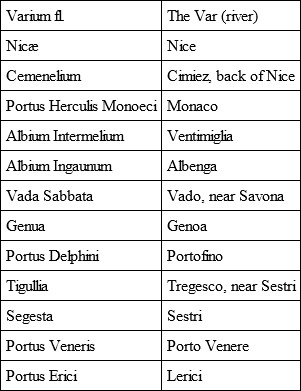
The chief of these great Roman roadways of old whose itineraries can be traced to-day are:
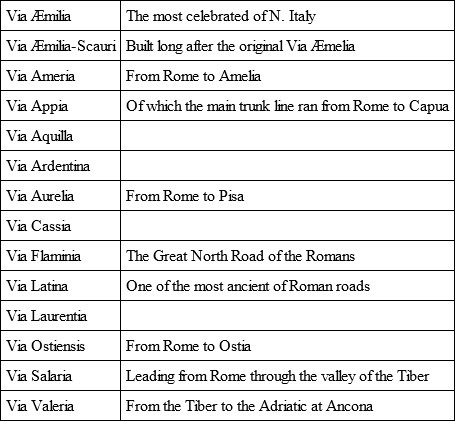
These ancient Roman roads were at their best in Campania and Etruria. Campania was traversed by the Appian Way, the greatest highway of the Romans, though indeed its original construction by Appius Claudius only extended to Capua. The great highroads proceeding from Rome crossed Etruria almost to the full extent; the Via Aurelia, from Rome to Pisa and Luna; the Via Cassia and the Via Clodia.
The great Roman roads were marked with division stones or bornes every thousand paces, practically a kilometre and a half, a little more than our own mile. These mile-stones of Roman times, many of which are still above ground (milliarii lapides), were sometimes round and sometimes square, and were entirely bare of capitals, being mere stone posts usually standing on a squared base of a somewhat larger area.
A graven inscription bore in Latin the name of the Consul or Emperor under whom each stone was set up and a numerical indication as well.
Caius Gracchus, away back in the second century before Christ, was the inventor of these aids to travel. The automobilist appreciates the development of this accessory next to good roads themselves, and if he stops to think a minute he will see that the old Romans were the inventors of many things which he fondly thinks are modern.
The automobilist in Italy has, it will be inferred, cause to regret the absence of the fine roads of France once and again, and he will regret it whenever he wallows into a six inch deep rut and finds himself not able to pull up or out, whilst the drivers of ten yoke ox-teams, drawing a block of Carrara marble as big as a house, call down the imprecations of all the saints in the calendar on his head. It’s not the automobilist’s fault, such an occurrence, nor the ox-driver’s either; but for fifty kilometres after leaving Spezia, and until Lucca and Livorno are reached, this is what may happen every half hour, and you have no recourse except to accept the situation with fortitude and revile the administration for allowing a roadway to wear down to such a state, or for not providing a parallel thoroughfare so as to divide the different classes of traffic. There is no such disgracefully used and kept highway in Europe as this stretch between Spezia and Lucca, and one must of necessity pass over it going from Genoa to Pisa unless he strikes inland through the mountainous country just beyond Spezia, by the Strada di Reggio for a détour of a hundred kilometres or more, coming back to the sea level road at Lucca.
Throughout the peninsula the inland roads are better as to surface than those by the coast, though by no means are they more attractive to the tourist by road. This is best exemplified by a comparison of the inland and shore roads, each of them more or less direct, between Florence and Rome.
The great Strada di grande Communicazione from Florence to Rome (something less than three hundred kilometres all told, a mere mouthful for a modern automobile) runs straight through the heart of old Siena, entering the city by the Porta Camollia and leaving by the Porta Romana, two kilometres of treacherous, narrow thoroughfare, though readily enough traced because it is in a bee-line. The details are here given as being typical of what the automobilist may expect to find in the smaller Italian cities. There are, in Italy, none of those unexpected right-angle turns that one comes upon so often in French towns, at least not so many of them, and there are no cork-screw thoroughfares though many have the “rainbow curve,” to borrow Mark Twain’s expression.
On through Chiusi, Orvieto and Viterbo runs the highroad direct to the gates of Rome, for the most part a fair road, but rising and falling from one level to another in trying fashion to one who would set a steady pace.
It is with respect to the grades on Italian roads, too, that one remarks a falling off from French standards. North of Florence, in the valley of the Mugello, we, having left the well-worn roads in search of something out of the common, found a bit of seventeen per cent. grade. This was negotiated readily enough, since it was of brief extent, but another rise of twenty-five per cent. (it looked forty-five from the cushions of a low-hung car) followed and on this we could do nothing. Fortunately there was a way around, as there usually is in Europe, so nothing was lost but time, and we benefited by the acquisition of some knowledge concerning various things which we did not before possess. And we were content, for that was what we came for anyway.
From Florence south, by the less direct road via Arezzo, Perugia and Terni, there is another surprisingly sudden rise but likewise brief. It is on this same road that one remarks from a great distance the towers of Spoleto piercing the sky at a seemingly enormous height, while the background mountain road over the Passo della Somma rises six hundred and thirty metres and tries the courage of every automobilist passing this way.
To achieve many of these Italian hill-towns one does not often rise abruptly but rather almost imperceptibly, but here, in ten kilometres, say half a dozen miles, the Strada di grande Communicazione rises a thousand feet, and that is considerable for a road supposedly laid out by military strategists.
As a contrast to these hilly, switch-back roads running inland from the north to the south may be compared that running from Rome to Naples, not the route usually followed via Vallombrosa and Frosinone, but that via Velletri, Terracina and Gaeta. Here the highroad is nearly flat, though truth to tell of none too good surface, all the way to Naples. Practically it is as good a road as that which runs inland and offers to any who choose to pass that way certain delights that most other travellers in Italy know not of.
At Cisterna di Roma, forty-eight kilometres from Rome, one is in the midst of the Pontine Marshes it is true, and it is also more or less of a marvel that a decent road could have been built here at all. From this point of view it is interesting to the automobilist who has a hobby of studying the road-building systems of the countries through which he travels. Of the Pontine Marshes themselves it is certain that they are not salubrious, and malaria is most prevalent near them. Appius Claudius, in 312 B. C., tried to drain the marsh and so did Cæsar, Augustus and Theodoric after him, and the Popes Boniface VIII, Martinus V and Sixtus V, but the morass is still there in spite of the fact that a company calling itself Ufficio della Bonificazione delle Paludi Pontine is to-day working continuously at the same problem.
Putting these various classes of Italian roads aside for the moment there remains but one other variety to consider, that of the mountain roads of the high Alpine valleys and those crossing the Oberland and, further east, those in communication with the Austrian Tyrol. On the west these converge on Milan and Turin via the region of the lakes and the valleys of Aosta and Susa, and in the centre and east give communication from Brescia, Verona and Venice with West Germany and Austria.
These are the best planned and best kept roads in Italy, take them by and large. The most celebrated are those leading from Turin into France; via Susa and the Col du Mont Genevre to Briançon, and via Mont Cenis to Modane and Grenoble; via the Val d’Aosta and the Petit Saint Bernard to Albertville in France, or via the Grand Saint Bernard to Switzerland.
Just north of the Lago di Maggiore, accessible either from Como or from Milan direct via Arona, is the famous road over the Simplon Pass, at an elevation of 2,008 metres above the sea. By this road, the best road in all Italy, without question, one enters or leaves the kingdom by the gateway of Domodossola.
On entering Italy by this route one passes the last rock-cut gallery near Crevola and, by a high-built viaduct, thirty metres or more above the bed of the river, it crosses the Diveria. Soon the vineyards and all the signs of the insect life of the southland meet the eye. Italy has at last been reached, no more eternal snow and ice, no more peaked rooftops, the whole region now flattens out into the Lombard plain. Domodossola has all the ear-marks of the Italian’s manner of life and building of houses, albeit that the town itself has no splendid monuments.
Another entrance to the Italian lake region through the mountain barrier beyond is by the road over the San Bernardino Pass and Bellinzona. The San Bernardino Pass is not to be confounded with those of the Grand and Petit Saint Bernard. The present roadway dates from 1822, when it was built by the engineer Pocobelle, at the joint expense of the Sardinian and Grisons governments. Its chief object was to connect Genoa and Turin directly with Switzerland and west Germany. The pass crosses the Rheinwald at a height of 2,063 metres.
This passage across the Alps was known to the ancient Romans, and down to the fifteenth century it was known as the Vogelberg. A mission brother, Bernardino of Siena, preaching the gospel in the high valleys, erected a chapel here which gave the pass the name which it bears to-day.
In part the road tunnels through the hillsides, in part runs along a shelf beside the precipice, and here and there crosses a mountain torrent by some massive bridge of masonry.
Like most of the mountain roads leading into Italy from Switzerland and Germany the southern slope descends more abruptly than that on the north. The coach driver may trot his horses down hill, though, so well has the descent been engineered, and the automobilist may rush things with considerably more safety here than on the better known routes.
Another celebrated gateway into Italy is that over the Splugen Pass from Coire (in Italian nomenclature: Colmo dell’Orso). It was completed by the Austrian government in 1823 to compete with the new-made road a few kilometres to the west over the Bernardino which favoured Switzerland and Germany and took no consideration whatever of the interests of Austria. The summit of the Splugen Pass is 2,117 metres above sea-level and on a narrow ridge near by runs for six kilometres the boundary between Switzerland and Italy.
Entering Italy by the Splugen Pass one finds the dogana a dull, ugly group of buildings just below the first series of facets which drop down from the crest. It is as lonesome and gloomy a place of residence as one can possibly conceive as existing on the earth’s surface. One forgets entirely that it is very nearly the heart of civilized Europe; there is nothing within view to suggest it in the least, not a scrap of vegetation, not a silvery streak of water, not a habitation even that might not be as appropriately set upon a shelf of rock by the side of Hecla.
The French army under Maréchal Macdonald crossed the pass in 1800 when but a mere trail existed, but with a loss of a hundred men and as many horses.
Of late years the passage of the Col has been rendered the easier by the cutting of two long galleries. Another engineering work of note is met a little farther on in the Gorge of San Giacomo, a work completed by Carlo Donegani in the reign of the Emperor Francis II, and, just beyond, the boiling torrent of the Liro is spanned by a daring bridge of masonry.
Road signs in Italy are not as good or as frequent as one finds in France, but where they exist they are at least serviceable. The Roman milestone of old has ceased to serve its purpose, though solitary examples still exist, and their place is taken by the governmental “bornes” and the placards posted at the initiation of the Touring Club and various automobile organizations in certain parts, particularly in the north.
The signboards of the Touring Club Italiano are distinctly good as far as they go, but they are infrequent.
All hotels and garages affiliated with the club hang out a characteristic and ever welcome sign, and there one is sure of finding the best welcome and the best accommodations for man and his modern beast of burden, the mechanical horses of iron and bronze harnessed to his luxurious tonneau or limousine.
With regard to road maps for Italy there exist certain governmental maps like those of the Ordnance Survey in England or of the État Major in France, but they are practically useless for the automobilist, and are only interesting from a topographic sense.
Taride, the French map publisher, issues a cheap series of Italian road maps, covering the entire peninsula in three sheets printed in three colours, with main roads marked plainly in red. They are easily read and clear and have the advantage of being cheap, the three sheets costing but a franc each, but one suspects that they were not composed entirely from first hand, well-authenticated, recent sources of information. Little discrepancies such as just where a railway crosses a road, etc., etc., are frequently to be noted. This is perhaps a small matter, but the genuine vagabond tourist, whether he is plodding along on foot or rolling smoothly on his five inch pneumatics, likes to know his exact whereabouts at every step of the way. On the whole the Italian “Taride” maps are fairly satisfactory, and they are much more easily read than the more elaborate series in fifty-six sheets on a scale of 1-1,250,000 issued by the Touring Club Italiano, or the thirty-five sheets of the Carta Stradale d’Italia Sistema Becherel-Marieni, which by reason of the number of sheets alone are in no way as convenient as the three sheet map.
The Becherel-Marieni maps are, however, beautifully printed and have a system of marking localities where one finds supplies of gasoline, a mechanician or a garage which is very useful to the automobilist, besides giving warning of all hills and, with some attempt at precision, also marking the good, mediocre and bad roads. This is important but, as the writer has so often found that a good road of yesterday has become a bad road of to-day, and will be perhaps a worse one to-morrow, he realizes that the fluctuating quality of Italian roads prevents any genius of a map-maker from doing his best. These maps in seven colours are perhaps the best works of their kind in Italy, at least ranking with the Touring Club maps, and completely cover the country, whereas the other series is not as yet wholly complete.
Membership in the great Touring Club Italiano is almost a necessity for one who would enjoy his Italian tour to the full. The “Annuario,” giving information as to hotels and garages and miniature plans of all the cities and principal towns – presented gratis to members – is all but indispensable, while the three pocket volumes entitled Strade di Grande Communicazione, with the kilometric distances between all Italian places except the merest hamlets and the profile elevations (miniature maps, hundreds of them) of the great highways are a boon and a blessing to one who would know the easiest and least hilly road between two points. The accompanying diagram explains this better than words.
CHAPTER V
IN LIGURIA
THE most ravishingly beautiful entrance into Italy is by the road along the Mediterranean shore. The French Riviera and its gilded pleasures, its great hotels, its chic resorts and its entrancing combination of seascape and landscape are known to all classes of travellers, but at Menton, almost on the frontier, one is within arm’s reach of things Italian, where life is less feverish, in strong contrast to the French atmosphere which envelops everything to the west of the great white triangle painted on the cliff above the Pont Saint Louis and marking the boundary between the two great Latin countries.
The “Route Internationale,” leading from France to Italy, crosses a deep ravine by the Pont Saint Louis with the railway running close beside.
Not so very long ago there was a unity of speech and manners among the inhabitants of Menton and the neighbouring Italian towns of Grimaldi, Mortola and Ventimiglia, but little by little the Ravine of Saint Louis has become a hostile frontier, where the custom house officials of France and Italy regard each other, if not as enemies, at least as aliens. The two peoples are, however, of the same race and have the same historic traditions.
It was just here, on passing the frontier, that we asked a deep-eyed, sun-burnt young girl of eighteen or twenty if she was an Italian, thinking perhaps she might be a Niçoise, who, among the world’s beautiful women, occupy a very high place. She replied in French-Italian: “Oui, aussi bien Venitienne!” This was strange, for most Venetians, since Titian set the style for them, have been blondes.
A château of the Grimaldi family crowns the porphyry height just to the eastward of the Italian frontier, and below is the Italian Dogana, where the automobilist and other travellers by road go through the formalities made necessary by governmental red tape. Red tape is all right in the right place, but it should be cut off in proper lengths, so that officials need not be obliged to quibble over a few soldi while individuals lose a dozen francs or more in valuable time.
This matter of customs formalities at Grimaldi is only an incident. The automobilist’s troubles really commence at a little shack in Menton, on French soil, just before the Pont Saint Louis is crossed. Here he has his “passavant” made out, an official taking a lot of valuable time to decide whether the cushions of your automobile are red, orange or brown. You stick out for orange because they were that colour when you bought the outfit, but the representative of the law sticks out too – he for red. The result is, you compromise on brown, and hope that the other customs guardian on duty at the frontier post by which you will enter France again will be blessed with the same sense of colour-blindness as was his fellow of Menton. Once this formality gone through – and you pay only two sous for the documents – you have no trouble getting back into France again by whichever frontier town you pass. There are no duties to pay and no disputes, so really one cannot complain. It is for his benefit anyway that the “passavant” describing the peculiarities of automobile is issued.
At the Grimaldi Dogana on entering Italy you are made to pay duty on what little gasoline you may have in your tanks, even for as little as a litre. Presumably you pass your machine through the Italian customs with one of the “triptyches” issued by any of the great automobile clubs or touring associations, as otherwise you have to put down gold, and a thousand or fifteen hundred francs in gold one does not usually carry around loose in his pocket. We passed through readily enough, but a poor non-French, non-Italian speaking American who followed in our wheel-tracks had not made his preparations beforehand, and French banknotes didn’t look good enough to the Italian customs official, and a day was lost accordingly while the poor unfortunate rolled back down hill to Menton and sought to turn the notes into gold. The banks having just closed he was not able to do this as readily as he thought he might, and it was well on after sunrise that he followed our trail – and never caught up with us all the way to Grosetto.
Mortola is the first town of note that one passes on entering Italian soil, but beyond its aspect, so alien to that of the small town in France, it is not worthy of remark.
Ventimiglia comes next, where the traveller by rail goes through equally annoying customs formalities to those experienced by the traveller by road at Grimaldi. These are not apt to be so costly, as the customs officials take him at his word, graciously chalk his luggage and pass him on. The Guardie-Finanze, or customs officer, of Italy is a genteel looking young person with a bowler hat, topped with a feather cockade. He is even as gay and picturesque as the “carabinieri reales,” though he is a mere plebeian among the noblesse of soldierdom.
The Vintimille of the French, or the Ventimiglia of the Italians, was the ancient Intemilium of the Romans. To-day, on the left bank of the Roja, is a new city made up of the attributes of a great railway and frontier station and a numerous assemblage of alberghi, hotels, restaurants and the like.
Ventimiglia is not unlovely, neither is it lovely in a picturesque romantic sense. Its site is charming, on the banks of the tumbling Roja at the base of the Alps of Piedmont, just where they plunge, from a height of a thousand or twelve hundred metres, down into the lapping Mediterranean waves.
Ventimiglia is, practically, the frontier town of Piedmont, and it was fought for by all the warring houses of these parts in the middle ages. The Genoese held it for a time, then the Counts of Provence and the Duke of Savoy. It was a game of give-and-take all round, and in the mêlée most of the town’s mediæval monuments have disappeared.
Across the Nervia, to the north, is Monte Appio, one of the chief spurs of the Maritime Alps in Italy. On a jutting crag of rock, in plain view from the town below, is an ancient Roman castellum. Two fragmentary towers alone remain, and as a ruin, even, it is beneath consideration. One only notices it in passing and recalls the more magnificent Tower of Augustus at La Turbie, high above Monte Carlo’s rock, and still in plain view of Ventimiglia – with a good glass.
A fine relic of the Dorias – that great family of great Genoese – is still to be seen in picturesque ruin at Dolce Acqua, a few miles further up the valley of the torrent.
Bordighera is the first of the Italian Riviera winter stations for invalids. That describes it perfectly. Its surroundings are delightful enough, but there is little that is attractive about the place itself. The automobilist will have no trouble finding his way through the town if he keeps straight on but drives carefully and avoids the invalids and baby carriages.
It was a sailor of Bordighera who gave the order to “wet the ropes” – an old seafaring trick, known the world over – when the obelisk on the Piazza san Pietro at Rome, erected by Sixte-Quint, was tottering on its base. In return for the service he asked the favour of the Pope that his native town should have the honour of supplying the churches of Rome with their greenery on Palm Sunday. The supplying of palm branches and the exploiting of semi-invalids are the chief industries of Bordighera.
San Remo is very like Bordighera, except that it is an improvement on it. The quarter where the great hotels are found looks like all towns of its class, but the old town with its narrow canyon-like streets, its buttressed roofs and walls, still breathes of the mediæval spirit. It is as crowded a quarter, where dwell men, women and children, – seemingly children mostly, – as can be found east of Grand, Canal or Hester Streets, in down-town New York. The automobile tourist will not care much for San Remo unless he is hungry, in which case the Hotel de Paris will cater for him a little better than any other of the town’s resort hotels.
The road continues close beside the sea, as it has since Fréjus in the Var was passed, sweeping around bold promontories on a shelf of rock, tunnelling through some mountain spur, dipping down to sea-level here and rising three or five hundred metres ten kilometres further on.
This delightfully disposed road by the sea may well be reviled by the automobilist because of the fact that every half dozen kilometres or so it crosses the railway at the same level. These level crossings are about as dangerous as the American variety; in a way more so. They are barred simply by a great swinging tree-trunk, which, of all things, swings outwards and across the road when not in use. Even when closed this bar is so placed that an automobile at speed could well enough slip beneath it, and the passengers who were not thrown out and killed by this operation surely would be by the train which would probably come along before they could pick themselves up.
These railway barriers are almost always closed, whether a train is due or not, and it is commonly said that they are only opened for the automobilist on the payment of a few soldi. This, the writer knows to be calumny. It is conceivable that the circumstance has been met with, and it is conceivable that, in many more instances, stranger automobilists have scattered coin in their wake which led to the development of the practice, but all the same one need not, should not, in fact, countenance any such practice of blackmail. The mere fact that these obstructions are there is enough of a penance for the automobilist, who in ten hours of running will certainly lose one or two hours waiting for the gates to be opened.
These Italian coast line vistas are quite the most savagely beautiful of any along the Mediterranean. We rave over the strip dominated by La Turbie and Monte Carlo’s rock, and over the Corniche d’Or of the Estérel in France, but really there is nothing quite so primitive and unspoiled in its beauty as this less-known itinerary. The background mountains rise, grim, behind, and beneath. At the bottom of the cliff, a hundred metres below the road on which you ride, break the soapy waves of the sea. Gulls circle about uttering their shrill cries, an eagle soars above, and far below a fisherman pushes lazily at his oar in the conventional stand-up Mediterranean fashion, or a red-brown latteen-rigged fishing boat darts in or out of some half-hidden bay or calanque. The whole poetic ensemble is hard to beat, and yet this part of the average Italian journey is usually rolled off in express trains, with never a stop between the frontier and Genoa, most of the time passing through the fifty rock-cut tunnels which allow the railway access to these parts. To see this wonderful strip of coast line at its best it must be seen from the highroad.
At Arma, as the road runs along at the water’s very edge, is an old square donjon tower, reminding one of those great keeps of England and of Foulque’s Nerra in Normandy. Its history is lost in oblivion, but it is a landmark to be noted.
Porto Maurizio is the very ideal of a small Mediterranean sea-port. It is a hill-top town too, in that it crowns a promontory jutting seawards, forming a sheltering harbour for its busy coming and going of small-fry shipping.
Olive oil and a sweet white wine, like that of Cyprus, grown on the hillsides roundabout, form the chief of the merchandise sent out from the little port; but the whole town bears a prosperous well-kept air that makes one regret that it had not a battery of “sights,” in order that one might linger a while in so pleasant a place. Porto Maurizio’s church is a remarkably vast and handsome building.
Oneglia, the birthplace of the great Genoese admiral, Andrea Doria, lies just beyond. Wine in skins, hung up on rafters to mellow, seems to be Oneglia’s substitute for wine cellars, but otherwise the hurried traveller at Oneglia remarks nothing but that it is a “resort” with big hotels and big gardens and many guests lolling about killing time. The older part of the town, with the wine skins, is decidedly the most interesting feature.
At Marina-Andora is the ruin of an old castle with a ghostly legend to it to add an attraction it might not otherwise have. A Papal Nuncio was one day murdered here within its walls and “in extremis” the prelate called down curses upon the surrounding country, praying that it might wither and dry up. It must have been an efficacious imprecation as the country roundabout looks like a desert waste. Not an olive nor an orange grove is in sight and only a few scrubby vineyards dot the landscape.
At the Capo delle Melle, a dozen kilometres beyond, it all changes and the land blossoms again, though truth to tell both the wine and olive products have the reputation of falling off in quality as one goes further east.
Alassio is a now well-developed Italian seaside resort. The Italians and the Germans fill it to overflowing at all seasons of the year, and prices are mounting skywards with a rapidity which would do credit to Monte Carlo itself. There is a considerable fishing and coastwise trade at Alassio which along the quais endows it with a certain picturesqueness, and the chief hotel is quartered in a seventeenth century palazzo, formerly belonging to the Marchese Durante. Alassio took its name from Alassia, a daughter of Otho the Great, who, fleeing from the paternal roof, came here with her lover long years ago. This was the beginning of the development of Alassio as a Mediterranean resort. And the Germans have been coming in increasing numbers ever since.
Off shore is the isle of Gallinaria. It has a circular tower on it, and a legend goes with it that the name of the island is derived from a species of hens and chickens which were bred here. The connection seems a little vague, but for the sake of variation, it is here given.
Here and there as the road winds along the coast some vine-clad ruin of a castle tower is passed, and the background foot-hills of the Alps are peopled with toy villages and towns like Switzerland itself.
Albenga is primarily a great big overgrown coast town of to-day, but was formerly the ancient metropolis of a minor political division of Liguria, and the one time ally of Carthage. Evidences of this fallen pride of place are not wanting in Albenga to-day. There are innumerable great brick and stone towers, now often built into some surrounding structure. Three may be remarked as landmarks of the town’s great civic and military glory of the past: the Torre de Marchese Malespina, the Torre dei Guelfi, and another, unnamed, built up into the present Casa del Commune.
Albenga is not a resort, since it has the reputation of being an unhealthful place, but probably this is not so as there is no particular squalidness to be noticed, save that incident to the workaday affairs of factories, workshops and shipping. The inhabitants of the neighbouring towns profess to recognize the native of Albenga at a glance when they hail him with the remark: “Hai faccia di Albenga.” – “You have the Albenga face.” This is probably local jealousy only, and is not really contempt.
A short way out from Albenga is the Ponte Lungo, an old Roman bridge of the time of the Emperor Honorius. Savona, the largest place between the frontier and Genoa, is still fifty kilometres to the eastward, but midway between it and Albenga is Finale Marina, a town of one main street, two enormous painted churches, an imposing fortification wall, a palm-planted promenade and a municipal palace bearing, over its portal, the arms of a visiting Spanish monarch who ruled here temporarily in the fifteenth century.
The Castello Gavone, on a hillside above the town and back from the coast, is a ruin, but its picturesque outer walls, with diamond-cut stone facets, like those of the great round tower of Milan or of Tantallon Castle in Scotland, are quite remarkable.
Finale Marina’s Albergo Grimaldi is housed in an old château of some noble of the days when the town was the capital of a Marquisate. Not much changed is the old château, except to put new wine in the old bottles and new linen on the antique beds. To be sure there are electric push-buttons in the chambers, but as they are useless they can hardly be taken into consideration.
The Albergo Grimaldi has scant accommodation for automobiles. Three might range themselves along the wall in the lower corridor, and would indeed be well enough housed, though in no sense is there the least semblance of a garage. You pay nothing additional for this, and that’s something in Italy where automobiles – in the small towns – are still regarded as mechanical curiosities and their occupants as fanatics with more money than good sense. The Italian country population is by no means hostile to the automobilist, but their good nature, even, is often exasperating.
Finale Marina is the best stopping place between Menton and Genoa if one is travelling by road, and would avoid the resorts.
Noli, just beyond the Capo di Noli, is an unimportant small town; nevertheless it is the proud possessor of a collection of ruined walls and towers which would be a pride to any mediæval “borgo.” Noli, like Albenga, was once the chief town of a little political division; but to-day it is a complete nonentity.
In bright sunshine, from the road winding over the Capo di Noli, one may see the smoke of Genoa’s chimneys and shipping rising, cloud-like, on the horizon far away to the eastward, and may even descry that classic landmark, the great lighthouse called “La Lanterna” at the end of the mole jutting out between San Pier d’Arena and Genoa.
A castle-crowned rocky islet, the Isola dei Bergeggi, lies close off shore beneath the Capo di Vado, itself crowned with a seventeenth century fortress cut out of the very rock.
Still following the rocky coastline, one draws slowly up on Savona. Savona is backed up by olive gardens and pine-clad hills, while above, away from the coast, roll the first foot-hills of the Apennines, their nearby slopes and crests dotted, here and there, with some grim fortress of to-day or a watch tower of mediæval times. The Alps are now dwindling into the Apennines, but the change is hardly perceptible.
Above the roofs and chimneys of the town itself rises an old tower of masonry on which is perched a colossal madonna, a venerated shrine of the Ligurian sailor-folk. It bears an inscription which seems to scan equally well in school-book Latin or colloquial Italian.
“In mare irato, in subita procella
Invoco te, nostra benigna stella.”
Mago, the Carthaginian, made Savona a refuge after his sack of Genoa. The Genoese, in turn, came along and blocked up the port out of sheer jealousy, lest it might become a commercial rival of Genoa itself.
The bay of Savona is delightful, even Wordsworth, who mostly sang of lakes and larks, remarked it, though in no way is it superior in beauty to a score of other indentations in the Mediterranean coastline from Marseilles around to Naples.
The automobilist will best remember Savona for its exceedingly bad exits and entrances, and the clean and unencumbered streets in the town itself. Here are great wide park-like thoroughfares flagged with flat smooth stones which are a dream to the automobilist. There never were such superbly laid paving blocks as one finds in Savona.
As one leaves Savona he actually begins to sense the smoke and activities of Genoa in his nostrils, albeit they are a good fifty kilometres away as yet; around a half a dozen jutting barrier capes, and across innumerable railway tracks.
Varazze is not a stopping point on many travellers’ Italian journeyings and, to state it frankly, perhaps, for the majority, it is not worth visiting. It is a sort of overflow Sunday resort for the people of Genoa, in that each of its two hotels have dining accommodation for a hundred people or more. Aside from this it is endowed with a certain quaint picturesqueness. It has a palm-tree-lined quay which borders a string of ship-building yards where the wooden walls of Genoa’s commerce-carrying craft were formerly built in large numbers, and where, to-day, a remnant of this industry is still carried on. Great long-horned white oxen haul timber through the crooked streets and along the quays, and there is ever a smell of tar and the sound of sawing and hammering. An artist with pen or brush will like Varazze better than any other class of traveller. The automobilist will have all he can manage in dodging the ox teams and their great trundling loads of timber.
There is a fragment of a ruined castle near by on the outskirts of the town, and farther away, back in the hills, is a monastery called “Il Deserto,” and properly enough named it is. It was founded by a lady of the Pallavicini family who as a recompense – it is to be presumed – insisted on being represented in the painted altar-piece as the Madonna, though clad in mediæval Genoese dress. What vanity!
Cogoletto, practically a Genoese suburb, claims to be the birth place of Columbus. Perhaps indeed it is so, as his father Dominico was known to be a property owner near Genoa. Savona, Oneglia and Genoa itself all have memories of the family, so the discoverer was of Ligurian parentage without doubt.
“Sestri-Ponente! Cornigliano-Ligure! San Pier d’Arena!” (with its Villa Serra and its Babylonian-like gardens) cry out the railway employees at each stop of the Genoa-bound train; and the same names roll up on the automobilist’s road map with a like persistency. Each class of traveller wonders why Genoa is not reached more quickly, and the automobilist, for the last dozen kilometres, has been cursed with a most exasperating, always-in-the-way tramway, with innumerable carts, badly paved roads and much mud. The approaches to almost all great cities are equally vile; Genoa is no exception and the traffic in the city – and in all the built up suburbs —keeps to the left, a local custom which is inexplicable since in the open country it goes to the right.
Voltri is a long drawn-out, uninteresting, waterside town with more chimneys belching smoke and cinders in strong contrast to the pine-clad background hills, in which nestle the suburban villas of the Doria, the Galliera and the Brignole families of other days.
Pegli is but a continuation of Voltri, Genoa La Superba is still a dozen kilometres away. Pegli is a resort of some importance and its chief attraction is the Villa Pallavicini, with a labyrinth of grottoes, subterranean lakes, cement moulded rocks, Chinese pagodas and the like. It is not lovely, but is commonly reckoned a sight worth stopping off to see. The Italians call this hodge podge “a ferocity of invention.” The phrase is worthy of perpetuation.
The Palazzo Pallavicini was the suburban residence of the banker of the Court of Rome, but he was a sort of renegade financier, for he went off to England with the churchly funds and became an English country gentleman, in the reign of Queen Elizabeth. His “past” was known, for some poet-historian of the time branded him with the following couplet: —
“Sir Horatio Palvasene,
Who robbed the Pope to pay the Queen.”
The Villa Doria at Pegli was a work of Canzio built for one of the richest merchants of Genoa in the days of Charles V. It was, like its contemporaries, a gorgeous establishment, but in popular fancy it enjoys not a whit of the enthusiasm bestowed upon the stagy, tricky bric-à-brac and stucco Villa Pallavicini.
The entrance to “Genoa la Superba” by road from the west is a sorry spectacle, a grim, crowded thoroughfare decidedly workaday and none too cleanly. From San Pier d’Arena one comes immediately within the confines of Genoa itself, just after circling the western port and passing the sky-piercing “La Lanterna,” one of the most ancient lighthouses extant, dating from 1547.
Genoa is neglected or ignored by most travellers and searchers after the picturesque in Italy. This is a mistake, for Genoa’s park of Acquasola, the gardens of the Villa Rosazza and of the Villa de Negroni, and the terraces of the Palazzo Doria offer as enchanting a series of panoramas as those of Rome or Florence, and quite different, in that they have always the vista of the blue Mediterranean as a background.
Genoa is a bizarre combination of the old and the new, of the mountain and the plain, of great docks and wharves, and of streets of stairs rising almost vertically.
The general effect of Genoa is as if everything in it had been piled one on top of another until finally it had to spread out at the base. Enormous caserns fringe the heights and great barracks line the wharves, while in between, and here, there and everywhere, are great and venerable palaces and churches of marble, many of them built in layers of black and white stone, indicating that they were built by the commune in mediæval days, or by one of the four great families of Doria, Grimaldi, Spinola or Fieschi, the only ones who had the privilege of using it.
Genoa’s labyrinth of twisting, climbing streets and alleys are all but impracticable for wheeled traffic, and, for that reason, strangers, who do not walk “en tour” as much as they ought, save in the corridors of picture galleries and the aisles of churches, know not Genoa save its main arteries – nor ever will, unless they change their tactics.
The automobile is only useful in Genoa in getting in and out of town, and even that is accomplished with fear and trembling by the most cold-blooded chauffeur that ever lived. What with the vile roads, the magnificent distances and the ceaseless irresponsible traffic of carts and drays, tramways and what not, Genoa is indeed, of all other cities on earth, in need of a boulevard for the new traffic. To get to your hotel at the further end of the town as you make your entrance by the road circling the base of “La Lanterna,” can only be likened to a trip down Broadway in New York at four o’clock in the afternoon. That would not be pleasure; neither is getting in and out of Genoa at any time between five in the morning and seven at night.
To what degenerate depths these great palaces of the Genoa of other days have fallen only the curious and inquisitive are likely to know. One into which we penetrated – looking for something which wasn’t there – was a veritable hive of industry, and as cosmopolitan as Babylon. It was near the Bourse and one entered marble halls by a marble staircase, flanked by a marble balustrade and finished off with newel posts supported by marble lions. The great entrance hall was surrounded by a colonnade of svelt marble columns, and in the centre ascended a monumental marble staircase. Two marble fountains played in an inner courtyard, which was paved with marble flags, and a statue, also marble, in a niche faced the great doorway.
On the first floor were more marble columns and a frescoed vaulting. From the corridors opened a battery of doors into offices of all sorts of industrial enterprises, from one given to exploiting a new combustible to another which was financing a rubber plantation in Abyssinia. A chestnut-roaster was perambulating the corridors with his stock in trade, furnace all alight, and a brown-robed monk was begging his daily bread.
On the next floor, up another marble staircase, were still other business offices, – shipping firms, wine-factors and one Guiseppe Bellini, representing an American factory, whose output of agricultural machinery is found in all four quarters of the globe. Breakfast foods were there, too, and there was a big lithograph of a Fall River Line Steamer on the walls. A whole city of merchants and agents were cloistered here in the five stories of this one-time ducal abode.
Up under the roof was a photographer and an artist’s studio, where a long-haired Italian (Signor something or other, the sign read) painted the bluest of blue sky pictures, and the most fiery Vesuvian eruptions, to sell to tourists through the medium of the hotel porters of the town below.
Thus it was that an antique shrine of gallantry and romance had become the temple of twentieth century commerce. The noble arms, with a heraldic angel still to be seen over the entrance doorway, count for nothing to-day, but exist as a vivid reminder of a glorious past. In 1500 the palace was the shrine of an artistic nobility; to-day it is a temple of chicanery.
The new part of Genoa imitates Milan, as Milan imitates Paris. The galleries or arcades of Milan, Genoa and Naples, full of shops, cafés and restaurants, would be admirable institutions in a more northerly clime, where the sun is less strong and rain more frequent. Here their glass roofs radiate an insufferable heat, which only in the coldest and most intemperate months is at all bearable. Nevertheless these arcades are an amusing and characteristic feature of the large Italian cities.
Hotels in Genoa for the automobilist are of all ranks and at all prices. Bertolini’s has garage accommodation for twenty-five automobiles, and charges two francs and a half to four francs a night for the accommodation, which is dear or not accordingly as you may feel.
The Albergo Unione, on the Palazzo Campetto, has no garage (you will have to seek out the F. I. A. T. garage a mile or more away), but you get something that is thoroughly Italian and very well appointed too, at most reasonable prices.
The Genoese suburban villas are a part of Genoa itself, in that they were built and inhabited by nobles of the city.
To the east of Genoa, at Albaro, is a collection of villas which comes upon one as a great surprise.
In reality they are suburban palaces, with here and there more modest villas, and again mere modest dwellings. All are surrounded with hedges of aloes, vines, olive and orange groves, and the effect is of the country.
In the Villa del Paradiso Lord Byron was once a guest. Its loggia was a favourite lounging place, and the whole aspect of the villa and its grounds is as paradisal as one has any right to expect to find on earth.
The Villa Cambiaso was built in 1557 by Alessi from designs, it is commonly said, of the great Michael Angelo. The ancient Sardinian Palazzo Imperiali is also here, and is popularly known as the Albero d’Oro.
A dozen miles to the east the gardens of the Villa de Franchi extend down, stair by stair, and fountain by fountain, to the Mediterranean rocks. The villa is a typical terrace-house, long, and almost dwarfish on the front, where the “piano nobile” is also the ground floor; but on the side facing the sea it is a story higher, and of stately proportions, and is flanked by widely extending wings. It is the typical Ligurian coast villa, one of a species which has set the copy for many other seacoast villas and grounds.
CHAPTER VI
THE RIVIERA DI LEVANTE
THE gorgeous panorama of coast scenery continues east of Genoa as it has obtained for some three hundred kilometres to the west. In fact the road through Nervi and Recco is finer, if anything, and more hilly, though less precipitous, than that portion immediately to the westward of Genoa.
Between Genoa and Spezia the railway passes through fifty tunnels. The traveller by the high road has decidedly the best of it, but there are always those level crossings to take into consideration though fewer of them.
Nervi is a place of German hotels, much beer and an unaccommodating tram line. The Grand Hotel gives access to the gardens of the villa of the Marchese Gropollo, and this of itself is an attraction that Nervi’s other rather tawdry inns lack.
Recco is an attractive and populous town, but has no monuments of note.
The highroad here climbs up the mountain of Portofino where the promontory joins the mainland, and drops down the other side to Rapallo, Santa Margherita, Cervara and Portofino. High up on the mountain cape is the Monastery of San Fruttoso, a picturesque and solitary conventual establishment in whose chapel are many tombs of the Dorias, all with good Gothic sculptures. In the convent of Cervara, en route to the village of Portofino on the east side of the cape, François I, just after he lost “all save honour” at the battle of Pavia, was imprisoned previous to his voyage to Spain in the galleys which were to carry him a captive to the domain of Charles Quint.
The roads along here are quite the best of the whole extent of the eastern and western Italian Rivieras. They are encumbered with a new class of traffic not met with further west. Up over the mountain of Portofino winds the road in genuine mountain fashion though beautifully graded and kept. At almost any turning one is likely to meet a great lumbering char-a-banc crowded with tourists, with five, six or eight horses caparisoned like a circus pageant, with bells around their necks, pheasants’ feathers bobbing in their top-knots, and a lusty Ligurian on the hindermost seat blowing a coaching horn for all he is worth. This is the Italian and German pleasure seeker’s way of amusing himself. He likes it, the rest of us don’t!
Santa Margherita is now a full-blown resort with great hotels, bathing-machines and all the usual attributes of a place of its class. Lace-making and coral-fishing are the occupations of the inhabitants who do not live off of exploiting the tourists. Both products are made here (and in Belgium and Birmingham) in the imitation varieties, so one had best beware.
If one doesn’t speak Italian, German will answer in all these resorts of the Levantine Riviera, quite as well as French or English. The “Tea-Shop” and “American Bar” signs here give way to those of “Munich” and “Pilsner.”
The village of Portofino itself is delightful; a quaint little fishing port surrounded by tree-clad hills running to the water’s edge. There is a Hôtel Splendide, once a villa of the accepted Ligurian order, and a less pretentious, more characteristic, Albergo Delfino lower down on the quay. The arms of the little port are a spouting dolphin as befits its seafaring aspect, so the Albergo Delfino certainly ought to have the preference for this reason if no other.
On the cliff road running around the promontory from Portofino to Rapallo are a half a dozen more or less modern villas of questionable architecture, but of imposing proportions, and one and all delightfully disposed.
The Villa Pagana is the property of the Marchese Spinola, and the Castel Paraggi, the property of a gentleman prosaically named Brown, is theatrically and delightfully disposed, though bizarre in form.
Rapallo, at the head of the bay, is a continuation of what has gone before. There are great hotels and pensions, and many of them. Its campaniles and church towers set off the framing of Rapallo delightfully. The Hôtel de l’Europe has more than once been the abode of Queen Margherita of Italy, and most of the notables who pass this way. The hotel curiously enough seems none the worse for it; it is good, reasonable in price and conveniently situated on the quay, overlooking a picturesque granite tower built up from a foundation sunk in the waters of the Mediterranean. The Corsair Dragutte, a buccaneer of romantic days, came along and plundered these Ligurian towns as often as he felt like it. Frequently they paid no attention to his visits, save to give up what blackmail and tribute he demanded; but Rapallo built this tower as a sort of watch tower or fortress. It is an admirable example of a sentinel watch tower, and might well be classed as a diminutive fortress-château.
From Rapallo to Chiavari the coast road winds and rises and falls with wonderful variety between villa gardens and vineyards. On the slopes above are dotted tiny dwellings, and church towers point skywards in most unexpected places.
The chief architectural attributes of Chiavari are its arcaded house fronts, a queer blend of round and pointed arches, and columns of all orders. The effect is undeniably good. The town was one of the most important in the old Genoese Republic, save the capital itself.
The towers scattered here and there through the town and in the neighbourhood are all feudal relics, albeit they are fragmentary. The Castle which the native points out with pride is neither very magnificent nor very elegant, but is indicative of the style of building of the feudal time in these parts. Decidedly the best things of Chiavari are its house fronts, and some crazy old streets running back from the main thoroughfares. There are some slate quarries in the neighbourhood and a ten foot slab, larger than the top of a billiard table, can be cut if occasion requires. The church of San Salvatore near Lavagna, where the quarries are, was founded by Pope Innocent IV in 1243.
Lavagna, near by, has a Palazzo Rosso, in that it is built of a reddish stone, though that is not its official name. It was an appanage of the Fieschi family, who owned to Popes, Cardinals and soldiers in the gallant days of the Genoese Republic. Sestri-Levante, a half a dozen kilometres beyond Chiavari, is the last of the Riviera resorts. It is a mere strip of villa and hotel-lined roadway with a delightful water front and a charming and idyllic background.
Spezia is reached only by climbing a lengthy mountain road up over the Pass of the Bracco; sixty kilometres in all from Sestri to Spezia. The highroad now leaves the coast to wind around inland over the lower slopes of the Apennines. The railway itself follows the shore.
It is a finely graded road with entrancing far-away vistas of the sea, the distant snow-capped summits of the mountains to the north and, off southward, the more gently rising Tuscan hills.
After having climbed some twenty-one hundred feet above the sea, the highroad runs down through the valley of the Vara, until finally at Spezia, Italy’s great marine arsenal, one comes again to the Mediterranean shore.
Just before Spezia is reached, snuggled close in a little bay, is Vernazza – where the wine comes from, at least, the wine the praises of which were sung by Boccaccio “as the paragon of wines.” Wine is still a product of the region, but its quality may not be what it once was.
Spezia is a snug, conservative and exclusive military and naval town. The gold-lace and blue-cloth individuals of the “service” dominate everything, even to the waiters in the hotels and cafés. No one else has a show.
The Hotel Croix de Malte (with a French name be it observed) is the chic hotel of Spezia, with prices on a corresponding scale, and no garage. The Albergo Italia, equally well situated, a typical Italian house of its class, is more modest in its prices and better as to its food. It has no garage either, but under the circumstances, that of itself is no drawback. Across the street, in a vacant store, you may lodge your automobile for two francs a night, or for one franc if you tell the ambitious and obliging little man who runs it that he demands too much. He is really the best thing we found in Spezia. We had run out of gasoline in entering the city, the long run down hill flattened out into a plain just before the town was reached, but he accommodatingly sent out a five gallon tin (“original package” goods from Philadelphia) and would take no increase in price for his trouble. Such a thing in the automobile line ought to be encouraged. We pay “through the nose,” as the French say, often enough as it is.
Spezia’s suburban villas are a natural outcome of its environment, but they are all modern and have, none of them, the flavour of historic romanticism about them.
An ancient castle tower on the hills above Spezia is about the only feudal ruin near by. The viper, the device of the Viscontis, is still graven above its entrance door to recall the fact that the device of the Milanese nobles was a viper, and that their natures, too, took after that of the unlovely thing. The Viper of Milan and the Viscontis is a worthy cage companion to the hedgehog of François I.
Spezia’s gulf is all that Spezia is not; romantic, lovely and varied. It was described in ancient times by Strabo, the geographer, and by Persius. Little of its topographical surroundings or climatic attributes have changed since that day.
The road down the coast from Spezia is marked on the maps as perfectly flat, but within a dozen kilometres, before Arcola is reached, is as stiff a couple of hair-pin turns as one will remember ever having come across suddenly in his travels. They are not formidable hills, perhaps, but they are surprising, and since one has to drop down again immediately to sea level they seem entirely unnecessary.
The river Magra which enters the sea just east of Spezia divided the Genoese territory from that of Tuscany.
“Macra che per cammin corto
Lo Gonovese parta dal Toscano.”
– Dante, “Paradisio.”
Sarzana is not a tourist point, but the traveller by road will not be in a hurry to pass it by. It has, curiously enough, an Albergo della Nuova York, built on the fortification walls of feudal days. It is not for this, though, that one lingers at Sarzana. The Bonapartes were originally descended from Sarzana ancestry. It was proven by contemporary documents that a certain Buonaparte, a notary, lived here in 1264. Supposedly, it was this limb of the law who became the chief of the Corsican family.
The old feudal castle of Sarzana, with its round tower, its moat and its later Renaissance gateway is the very ideal of mouldy mediævalism.
From Sarzana, it is, figuratively speaking, but a step to Carrara and Massa, the centres of the marble industry. Of all the materials the artist requires, none is so much sought after as the pure white marble of Carrara. The sculptured marble of Carrara goes out into the world from thousands of ateliers to thousands of resting places but it all comes from this great white mountainside in the Apennines which has made the region famous and rich. This little Tuscan town of Carrara owes its all to its, seemingly, inexhaustible stores of milk-white, fine-grained marbles. More especially is the marble of Carrara in demand for statuary; but in all the finer forms of carven stone it finds its place supreme.
Men and beasts, oxen, horses and mules, and carts of all shapes and sizes, make the vicinity of Carrara the centre of an uproar that would be maddening if one had to live in it; but it is all very interesting to the stranger, and speaks more loudly than words of the importance of the great industry of the neighbourhood.
All around are great heaps – mountains almost – of broken, splintered marble; the débris merely of the great blocks which have, in times past, been quarried and sent to all quarters of the earth.
The quarries of Carrara have been worked ever since the Roman epoch, and the tufted hillsides round about have been burrowed to their bowels in taking out this untold wealth which, without exaggeration, has been as great as that of many mines of gold.
Quite twenty per cent. of the population work at the industry, and five hundred men are actually engaged in hewing out and slicing off the great blocks. Ten thousand, at least, find their livelihood dependent upon the industry, and two hundred thousand tons is a normal annual output; in price, valued at from 150 to 1,500 francs the cubic metre.
At Massa one joins the main road again running south by the shore. One never hears of the conventional tourist stopping at Massa; but we found the Hotel Massa and its dinner in the garden worth the taking and agreed that the Château, in base rococo style, (now the public administrative buildings), a curiosity worth seeing. Massa has a Napoleonic memory hanging over it, too, in that it was once the residence of the Little Corporal’s sister. Massa’s Castello, high above all else in the town, is grim, lofty and spectacular though to be viewed only from without. Massa is worth making a note of, even by the hurried traveller.
Since leaving Sarzana the high road has become worse and worse, until in the vicinity of Carrara and Massa it is almost indescribably bad. There is no such stretch of bad road in Europe as this awful fifty kilometres, for it continues all the way to Lucca and Livorno. The vast amount of traffic drawn by ten head of oxen at a time is what does it of course, and as there is no way around one has to go through it, though it’s a heart-breaking job to one that cares anything for his automobile.
Pietrasanta, eight kilometres farther on, was, for us, an undiscovered beauty spot and historic shrine; at least, none of us had ever heard of it till we passed the portals. Now we know that the walls, through which we passed, were the same that the blood-thirsty, battling Lorenzo di Medici besieged in 1482; and that the ancient bronze font in the Baptistery was the work of Donatello. We were glad that Massa and Pietrasanta were counted in, as they should be by everyone passing this way, even though they did take up half a day’s time – all on account of the awful road – part of which time, however, you are eating that excellent lunch in the garden of the Hotel Massa. That time will not be lost anyway, one must eat somewhere.
Eight kilometres beyond Massa is Viareggio, an unlovely, incipient seaside resort for dwellers in the Tuscan towns; but a historic spot nevertheless, and interesting from that viewpoint at any rate.
Viareggio has no villas or palaces of note, and its chief associations for the traveller lie in its memories of Shelley and Ouida, the Marquise de la Ramée. There is a monument, erected to Shelley in 1894, commemorating the fact that he was drowned here, in the Tyrrhenian Sea, and his body consumed by fire, on the shore.
It was in the village of Massarosa, near Viareggio, that that much-abused and very abusive old lady, Ouida, the Marquis de la Ramée, died in January, 1908. Since 1877 she had made Italy her home, and for years she had lived here alone, not in poverty or misery, for she had a “civil pension” which was more than sufficient to keep the wolf from the door. She died miserable and alone however. Ouida was a more real, more charitable person than she was given credit for being. She didn’t like the English, and Americans she liked still less, but she loved the Italians. Whose business was it then if she chose to live among them, with her unkempt and unwholesome-looking dogs and her slatternly maid-of-all-work? Ouida, as she herself said, did not hate humanity; she hated society; and she had more courage than some of the rest of us in that she would have nothing to do with it.
The vineyards lying back of Viareggio may not be the most luxuriant in Italy, but they blossom abundantly enough.
Lucca is thirty-five kilometres from Viareggio and the road still bad – on to Livorno, turning to the right instead of the left at Viareggio, it is worse.
Lucca has a right to its claim as one of the most ancient cities of Tuscany, for it is one of the least up-to-date of Italian cities. When Florence was still sunk in its marsh Lucca was already old, and filled with a commercial importance which to-day finds its echo in the distribution of the Lucca olive oil of trade which one may buy at Vancouver, Johannesburg or Rio. Indeed the label on the bottle of olive oil is the only reminiscence many have of Lucca.
The decadence came to Lucca in due time and it degenerated sadly, about its last magnificent ray being that shot out when Napoleon gave the city to his sister Eliza Bacciochi, with the title of Princess of Lucca. She was a real benefactress to the country, but with the fall of Napoleon all his satellites were snuffed out, too, and then the benign influences of the Princess Eliza were forgotten and ignored.
Southwest from Lucca, with Pisa lying between, is the great port of Leghorn, whence are shipped the marbles of Carrara, the oil of Lucca, the wines of Chianti and the Leghorn hats and braids of all Tuscany. These four things keep Livorno going.
Leghorn is as modern as Lucca is antiquated and is the most cosmopolitan of all Italian cities.
When Philip III expelled the Moors from Spain Cosmo II, Duke of Livorno, invited two thousand of them to come to his Dukedom.
Montesquieu remarked upon this conglomerate population, and approved of it apparently, as he called the founding and populating of the city the master work of the Medici dynasty.
CHAPTER VII
ON TUSCAN ROADS
THE valley of the Arno, as the river flows through the heart of Tuscany from its source high in the hills just south of Monte Falterona, is the most romantic region in all Italy. It is the borderland between the south and the north, and, as it was a battle-ground between Guelph and Ghibellines, so too is it the common ground where the blood of the northerner and southerner mingles to-day.
As great rivers go, the Arno is neither grand nor magnificent, but, though its proportions are not great, its banks are lined with historic and artistic ruins, from the old fortress at Marina di Pisa to Poppi, the ancient capital of the Casentino, perched so quaintly upon its river-washed rock.
Pisa, Leghorn and Lucca are a triumvirate of Tuscan towns which should be viewed and considered collectively. One should not be included in an itinerary without the others, though indeed they have little in common, save the memories of the past.
Pisa is another of these dead cities of Europe, like Bruges, Leyden, and Rothenburg. Once ardent and lively in every activity of life, its population now has sunk into a state of lethargy. Industry and commerce, and the men who should busy themselves therewith, are in the background, hidden behind a barrier of bureaucracy. Pisa, a town of twenty-six thousand inhabitants, has a tribunal of nine civil judges, a criminal court presided over by sixty-three more, and a “roll” of more than half a hundred notaries. Then there is a service of Domains, of Registry and of Public Debt; besides an array of functionaries in charge of seminaries, orphan asylums, schools and colleges. All these belong to the state.
Pisa, sitting distant and proud on the banks of the Arno, enjoys a softer climate than most of the coast cities or interior towns of central Italy. The Tyrrhenian Sea is but a gulf of the Mediterranean, but just where it bathes the shore about the mouth of the Arno, it has a higher temperature than most northern Mediterranean waters.
Pisa is more of a sanitarium than it is a gay watering place however. The city is, in fact, like its celebrated leaning tower, half tottering on the brink of its grave. Commerce and industry are far from active and its streets are half deserted; many of them are literally grass-grown and all the others are paved with great flat clean-swept flags, a delight for the automobilist, whose chief experience of pavements has been in France and Belgium.
The entrance to Pisa by road from the north is one of the most pleasing of that of any Italian city. For the last half dozen kilometres the road steadily improves until it becomes one of the best as it circles around that wonderful triumvirate of architectural splendours, the Duomo, the Baptistery and the tottering Torre. The group is one of the scenic surprises of Italy, and the automobilist has decidedly the best opportunity of experiencing the emotions it awakes, for he does not have to come out from town (for the monuments are some ways from the centre) to see it. It is the first impression that the traveller by road gets of Pisa and of its architectural wonders, as he draws suddenly upon it from the slough-like road through which he has literally ploughed his way for many kilometres. And it is an impression he will never forget.
All along the banks of the Arno, as it flows through Pisa, are dotted here and there palaces of Renaissance days. One is now a dependence of a hotel; another has been appropriated by the post office; others are turned into banks and offices; but there are still some as well ordered and livable as in their best days.
The Palazzo Agostini on the Lung’ Arno, its façade ornamented with terra cotta medallions, is now a part of the Hotel Nettuno which, as well as any other of Pisa’s hotels, cares for the automobilist in a satisfactory manner. Its garage accommodations are abominably confined, and to get in and out one takes a considerable risk of damaging his mud-guards, otherwise they are satisfactory, though one pays two francs a night for them, which one should not be obliged to do. Here is another point where France is superior to Italy as an automobile touring ground.
Pisa and its palaces are a delight from every point of view, though indeed none of the edifices are very grand, or even luxurious. They strike a middle course however, and are indicative of the solid comfort and content in which their original owners must have lived at Pisa in latter Renaissance times.
Pisa’s Campo Santo is the most famous example of graveyard design and building in all the world. It is calm and dignified, but stupendous and startling in its immensity.
From Pisa to Florence by road, following the valley of the Arno, one passes through the typical Tuscan countryside, although the hill-country lies either to one side or the other. It is the accessible route however, and the one usually claimed by the local garage and hotel keepers to be one of the best of Italian roads. It is and it isn’t; it all depends upon the time of the year, the fact that the road may recently have been repaired or not, and the state of the weather. We went over it in a rain which had been falling steadily for three days and found it very bad, though unquestionably it would have been much more comfortable going in dry weather. It is the approved route between the two cities however, and unless one is going directly down the coast to Rome, via Grosseto, Pisa is the best place from which to commence the inland détour.
Cascina, a dozen kilometres away, was the scene of a sanguinary defeat of the Pisans by the Florentines on the feast of San Vittorio in 1364, and each year the event is celebrated by the inhabitants. It seems singular that a people should seek to perpetuate the memory of a defeat, but perhaps the original inhabitants sympathized with Florence rather than with Pisa.
Pontedera is a big country town at the juncture of the Era and the Arno. It has no monuments and no history worth remarking, but is indicative of the prosperity of the country round about. Pontedera has no hotel with garage accommodations, and if you get caught in a thunder storm, as we did, you will have to grin and bear it and plug along.
San Miniato de Tedeschi rises on its hill top a few kilometres farther on in an imposing manner. It is the most conspicuous thing in the landscape for a wide radius. Francesco Sforza was born here, and Frederic II made it the seat of the Imperial vicarage. San Miniato is a hill town of the very first rank, and like others of the same class – Fiesole, Colle and Volterra – (though its hill-top site may have nothing to do with this) it had the privilege of conferring nobility on plebeians. The Grand Duke of Tuscany in the nineteenth century accordingly made “an English gentleman of Hebrew extraction” – so history reads – the Marquis of San Miniato. At any rate it was probably as good a title as is usually conferred on any one, and served its soi-disant owner well enough for a crest for his note paper or automobile door. One wonders what the gentleman took for his motto. History does not say.
Empoli is a thriving town, engaged principally in killing fowls and sending them to the Florence market, plaiting straw to be made into hats, and covering chianti bottles with the same material.
The Ghibellines would have made Empoli their capital in 1260, after their meeting or “parliament” here. It was proposed too, that Florence should be razed. One man only, Farinata degli Uberti, opposed it. “Never,” said he, “will I consent that our beloved city, which our enemies have spared, shall be destroyed or insulted by our own hands.”
The old palace in which the Ghibelline parliament met still stands on the Piazza del Mercato.
No automobilist who “happens” on Empoli will ever want to see it again, on account of the indignities which will be heaped on his automobile, though the Albergo Guippone, run by a mother and son in most competent, but astonishing, fashion, is the real thing. The food and cooking are extraordinarily good, and the house itself new and cleanly. You eat at a big round table, with a great long-necked bottle of chianti swung on a balance in the centre. It must hold at least two gallons, and, without the well-sweep arrangement for pouring out its contents, you would go dry. The wine served is as good as the rest of the fare offered. The fault with Empoli’s hotel is that there is no garage and the proprietors recommend no one as competent to house your automobile, saying you can take your choice of any one of a half a dozen renters of stallagio near by. They are all bad doubtless; but the one we tried, who permitted us to put the automobile in an uncovered dirty hole with horses, donkeys and pigs, took – yes, took, that’s the word – two lire for the service! If you do go to Empoli keep away from this ignorant, unprogressive individual.
North of Empoli, on the direct road from Lucca to Florence, are Pistoja and Prato.
Pistoja is one of the daintiest of Tuscan cities, but not many of the habitués of Florence know it, at least not as they know Pisa or Siena.
Its past is closely intermingled with Florentine and Italian history, and indeed has been most interesting. Practically it is a little mountain city, though lying quite at the base of the Apennines, just before they flatten out into the seashore plain. Its country people, in town for a market-day, are chiefly people of the hills, shepherds and the like, but their speech is Tuscan, the purest speech of Italy, the nearest that is left us to the speech of Boccaccio’s day.
Pistoja’s old walls and ramparts are not the least of its crumbling glories. They are a relic of the Medicis and the arms and crests of this family are still seen carved over several of the entrance gates. One has only to glance upward as he drives his automobile noisily through some mediæval gateway to have memories of the days when cavalcades of lords and ladies passed over the same road on horseback or in state coaches.
All is primitive and unworldly at Pistoja, but there is no ruinous decay, though here and there a transformed or rebuilt palace has been turned into some institution or even a workshop.
Prato, a near neighbour of Pistoja on the road to Florence, is also a fine relic of an old walled Tuscan town. Aside from this its specialty is churches, which are numerous, curious and beautiful, but except for the opportunity for viewing them the lover of the romantic and picturesque will not want to linger long within the city.
Between Empoli and Florence is seen at a distance the Villa Ambrogiana; a transformation by Ferdinand I of an old castle of the Ardinghelli; its towers and pinnacles still well preserved, but the whole forming a hybrid, uncouth structure.
Further on at Montelupo there is a castle, now in ruins, built and fortified by the Florentines in 1203. It owes its name, Montelupo, to the adoption of the word lupo, wolf, by the Florentines when they sought to destroy a neighbouring clan called the Capraja (capra, goat).
Signa is reached after crossing the Arno for the first time. The city walls, towers and pinnacles, with their battlements and machicolations, are still as they were when the Florentines caused them to be erected to guard the high road leading to their city.
Suburban sights, in the shape of modern villas, market gardens and what not, announce the approach to Florence, which is entered by a broad straight road, the Strada Pisana, running beneath the Porta S. Frediano. Instinctively one asks for the Lung’ Arno that he may get his bearings, and then straightway makes for his hotel or pension.
Hotels for the automobilist in Florence are numerous. The Automobile Club de France vouches for the Palace Hotel, where you pay two francs and a half for garage, and for the Grand Hotel de la Ville with no garage. The writer prefers the Hotel Helvetia, or better yet the Hotel Porta Rossa, a genuine Italian albergo, patronized only by such strangers as come upon it unawares. It is very good, reasonable in price, and you may put your automobile in the remissa, which houses the hotel omnibus, for a franc a night. It is convenient to have your automobile close at hand instead of at the F. I. A. T. garage a mile or more away, and the hotel itself is most central, directly to the rear of the Strozzi Palace.
“What sort of city is this Florence?” asked Boniface VIII, amazed at the splendour of the Florentine procession sent to Rome to honour his jubilee. No one was found ready with an answer, but at last a Cardinal timidly remarked, “Your Holiness, the City of Florence is a good city.” “Nonsense,” replied the Pope, “she is far away the greatest of all cities! She feeds, clothes and governs us all… She and her people are the fifth element of the universe.”
One comes to Florence for pictures and palaces, and, for as long or short a time as fancy suggests, the automobile and the chauffeur, if you have one, take a needed repose. Your automobile safely housed, your chauffeur will most likely be found, when wanted, at the Reininghaus on the Piazza Vittorio-Emanuel drinking German beer and reading “Puck” or “Judge” or “Punch” or “Le Rire.” This is a café with more foreign papers, one thinks, than any other on earth.
Down through the heart of Tuscany, and through the Chianti district, runs the highroad from Florence to Rome, via Siena. It is a delightful itinerary, whether made by road or rail, and, whether one’s motive is the admiration and contemplation of art or architecture, or the sampling of the chianti, en route, the journey through the Tuscan Apennines will ever remain as a most fragrant memory. It is a lovely country of vineyards and wheatfields, intermingled, and, here and there, clumps of mulberry trees, and always great yoked oxen and contadini working, walking or sleeping.
These, indeed, are the general characteristics of all the countryside of central Italy, but here they are superlatively idyllic. The simple life must be very nearly at its best here, for the almost unalterable fare of bread and cheese and wine, which the peasants, by the roadside, seem always to be munching and drinking, is not conducive to grossness of thought or action.
From Florence to Rome there are three principal roads favoured by automobilists: that via Siena and Grosseto, 332 kilometres; via Siena, Orvieto and Viterbo, 325 kilometres; and via Arezzo, Perugia and Terni, 308 kilometres. They are all equally interesting, but the latter two are hilly throughout and the former, in rainy weather, is apt to be bad as to surface.
The towers of Tuscany might well be made the interesting subject of an entire book. Some of them, existing to-day, date from the Etruscans, many centuries before Christ, and Dionysius wrote that the Etruscans were called Tyrrhene or Turreno because they inhabited towers, or strong places —Typeie.
In the twelfth century, local laws, throughout Tuscany, reduced all towers to a height of fifty braccia. Pisa, Siena and Florence in the past had several hundred towers, but Volterra and San Gimignano in the Val d’Elsa are the only remarkable collections still grouped after the original manner. “San Gimignano delle belle Torri” is a classic phrase and has inspired many chapters in books and many magazine articles.
Massimo d’Azeglio, whose opinions most people who write books on Italy exploit as their own, said, with reason, that San Gimignano was as extraordinary a relic of the past as Pompeii. Of all the fifty odd towers of the city, none is more imposing than that of the Palazzo Publico, rising up above the very apartment, where, in the thirteenth century, Dante was received when he was sent from Florence to parley with the Guelphs of San Gimignano.
San Gimignano’s Palazzo del Commune dates from 1298, but its tower was an afterthought, built a century later. This tower of the Palazzo del Commune is, perhaps, the best preserved of all the “belle torri” of the city.
San Gimignano and Volterra are much alike, though the latter’s strong point lies more in its fortification walls. Volterra and its Etruscan lore and pottery have ever been a source of pride among Italian antiquarians. The Etruscans of old must have been passionately fond of pottery, for, so plentifully were the environs of Volterra strewn with broken pitchers, that one suspects that each square yard must have contained a well. Some one called the Etruscans lunatics, who were shut up in Volterra and allowed to pursue their craze for pottery in peace; but they were harmless lunatics, who devoted themselves to the arts of peace, rather than those of war. The alabaster bric-à-brac trade and traffic still exists, and provides a livelihood for a large part of the population of the city; but thousands of Tuscans, many of them from Volterra, doubtless, have deserted their former arts for the pleasure of dragging a hand organ from street to street, in London and New York, and gathering soldi by ministering to the pleasures of the populace. It is easy for the superior person to sneer at the hand organ, as he sneers, by the way, at the phonograph and the pianola, but dull alleys and mean streets are brightened by the music of the itinerant Italian.
“It is a vision of the moyen-age,” wrote Paul Bourget when he first saw Volterra’s Etruscan walls. High up on its rocky plateau sits Volterra, protected by its walls and gorges and ravines, in almost impregnable fashion.
With this incentive no automobilist north or southbound should omit San Gimignano or Volterra from his itinerary. They are but a few kilometres off the main road, from Poggibonzi via Val d’Elsa between Siena and Florence.
On a height overlooking Volterra, just over the Romitorio, and almost within sight of San Gimignano’s towers, Campanello, the celebrated brigand, was captured, a quarter of a century ago. He had quartered himself upon an unsuspecting, though unwilling, peasant, as was the fashion with brigands of the time, and, through a “faux pas,” offended a youth who was in love with one of his host’s daughters. This was his undoing. The youth informed the local authorities; and Campanello led away himself by the blind passion of love, fell precipitately into the trap which the injured youth had helped to set.
Thus ended another brigand’s tale, which in these days are growing fewer and fewer. One has to go to Corsica or Sardinia to experience the sensation of being held up, or to the Paris boulevards where apaches still reign, or to the east end of London.
Going south from Florence by this road the automobilist has simply to ask his way via the “Strada per Siena;” after Siena it is the “Strada per Roma;” and so on from one great town to another. In finding one’s way out of town the plan is simple, easily remembered and efficient; there are no false and confusing directions such as one frequently gets in France. You are either on the Via This or That which ultimately leads to the Strada of the same name, or you are not. Start right and you can’t miss the road in Italy.
Among all the secondary cities of Italy, none equals Siena in romantic appeal. Its site is most picturesque, its climate is salubrious, and it has an entirely mediæval stamp so far as the arrangement of its palaces is concerned. Siena possesses something unique in church architecture, as might be expected of a city which once contained sixty places of worship, a special patois, and women of surpassing beauty. More than by anything else, Siena is brought to mind by the recollection of that Saint Catherine, who, according to Pope Pius II, made all who approached her better for her presence.
The railway and its appurtenances, automobiles and their belongings, the electric light and the telegraph, are almost the only signs of modernity in Siena to-day. The rest is of the middle ages, and the chief characters who stand out to-day are not the political personages of our time; but Bianca Capello and Marie de Medici and Charles V, who of all other aliens is best remembered of Siena, because of the Holbein reproduction of his face and figure which he presented to its citizens.
CHAPTER VIII
FLORENTINE BACKGROUNDS
THE hills and valleys around Florence offer delightful promenades by road to the automobilist as well as to those who have not the means at hand of going so far afield. A commercial enterprise is exploiting them by means of a great char-a-banc, or “sightseeing” automobile, which detracts from the sentiments and emotions which might otherwise be evoked, and at the same time annoys the driver of a private automobile, for the reason that this public conveyance often crowds him on a narrow road and prevents his passing. However, this is better than being obstructed, as in former days, by a string of forty lazy cabs and their drivers.
The round to Fiesole, San Miniato, Vallombrosa, and on through the Casentino of romantic memory is delightful and may be made in a day or a week, as one’s fancy dictates.
The new road from Florence to Fiesole, that is the road made in the mid-nineteenth century, was not a piece of jobbery or graft, but was paid for by patents of nobility given by the municipality of Fiesole to those who furnished the means. This was in the days when a Grand Duke ruled Tuscany and monarchical institutions found favour.
Fiesole had its Libro d’Oro, and inscribed thereon as noble any individual who would pay the required price. From fifteen hundred lire upward was the price for which marquises, counts and barons were created in Florence’s patrician suburb.
Coming out from Florence by another gateway, through the Porta San Gallo, runs the Fiesole highway. A landmark, which can be readily pointed out by anyone, is the villa once possessed by Walter Savage Landor and inhabited by him for nearly thirty years. Here the famous men of letters of the middle years of the last century visited him. Here he revelled amid memories of Boccaccio and wrote the Pentameron. There is talk of buying the place and consecrating it to his memory.
All the way from Florence to Fiesole the roads are lined with typical Florentine villas and country houses. The Villa at Poggio Cajano was built by Lorenzo the Magnificent, who employed Giuliano da San Gallo as his architect. In 1587 Francesco I died within its walls, and the profligate Bianca Capello, whose history had best stay buried, also died here on the following day. Their brother Ferdinand was responsible for their taking off, as they had already prepared to put him out of the way by the administration of a dose of poison. He stood over them, with dagger drawn, and made them eat their own poisoned viands.
The Villa Petraja was a strong-hold of the Brunelleschi family which defended itself ably against the Pisans and the marauders of Sir John Hawkwood in 1364, when that rollicking rascal sold his services to the enemies of Florence. The old tower of the castle, as it then was, still remains, but the major portion of the present structure dates from quite modern times.
The Villa Medici in Careggi was built by Cosimo Pater from the designs of Michelozzi, and though no longer royal it is to-day practically unchanged in general outline. It, too, was one of the favourite residences of Lorenzo the Magnificent, and the conclaves of the famous Platonic Academy were held here on the seventh of November, the anniversary of the date of the birth and death of Plato. Here died both Cosimo and Lorenzo, the latter on the eighth of April, 1492, just after his celebrated interview with Savonarola. The Orsi family came into possession of the villa later on, then “an English gentleman” and then a certain Signor Segré.
Between Careggi and Fiesole, and on towards Vallombrosa, the villas and palatial country houses of the Florentines are scattered as thickly as the leaves of the famous vale itself.
The Villa Salviati is a fine sixteenth century work with a blood-red memory of the middle ages, at one time the property of the singer Mario, remembered by a former generation. The Villa Rinuccini has its grounds laid out in the style of an English formal garden, and the Villa Guadagni was once the home of the historian, Bartolommeo della Scala.
Of all the Florentine suburban villas none has a tithe of the popular romantic interest possessed by the Villa Palmieri. The Villa Palmieri is best seen from its approach by the highroad, up hill, from Florence. At the right of the iron gate, the cancello, runs the old road to Fiesole. Upward still the road runs, through the cancello, through a wind-break of trees and around to the north façade by which one enters. The entire south side of the house is in the form of a loggia, with a great wide terrace in front, below which is the sloping garden with its palm trees and azaleas.
The Villa Palmieri and its gardens are somewhat the worse for stress of time; and the wind and the hot sun have burned up the shrubs and trees since the days when Zocchi the draughtsman made that series of formal drawings of Italian gardens, that of the Villa Palmieri among the number, which are so useful to the compilers of books on Italian villas and gardens.
Fiesole sits proudly on its height a thousand feet above the level of the sea. The following anonymous lines – “newspaper verse” they may be contemptuously described by some – make as admirable a pen picture of the little town as it were possible to reproduce.
“A little town on a far off hill —
(Fiesole, Fiesole!)
Mossy walls that defy Time’s will,
Olive groves in the sun a-thrill
Thickets of roses where thrushes trill
Winds that quiver and then are still —
Fiesole, Fiesole!”
Fiesole forms an irregular ground plan, rising and falling on the unequal ground upon which it is built. The long and almost unbroken line of Cyclopean walls towards the north is the portion which has suffered least from time or violence. The huge stones of which the Etruscan wall is composed are somewhat irregular in shape and unequal in size, seldom assuming a polygonal form. This Cyclopean construction varies with the geological nature of the rock employed. In all the Etruscan and Pelasgic towns it is found that, when sandstone was used, the form of the stones has been that of the parallelopipedon or nearly so, as at Fiesole and Cortona; whereas, when limestone was the subjacent rock, the polygonal construction alone is found, as at Cosa and Segni. This same observation will be found to apply to every part of the world, and in a marked degree to the Cyclopean constructions of Greece and Asia Minor, and even to the far-distant edifices raised by the Peruvian Incas. Sometimes the pieces of rock are dovetailed into each other; others stand joint above joint; but, however placed, the face, or outward front, is perfectly smooth. No projection, or work advancing beyond the line of the wall, appears in the remains of the original structure.
Fiesole is a built-up fabric in all its parts; its foundation is architecture, and its churches, palaces and villas are mere protuberances extending out from a concrete whole. Fiesole is one of the most remarkably built towns above ground.
Fiesole’s great charm lies in its surrounding and ingredient elements; in the palaces and villas of the hilltops always in plain view, and in its massive construction of walls, rather than in its specific monuments, though indeed its Duomo possesses a crudity and rudeness of constructive and decorative elements which marks it as a distinct, if barbarous, Romanesque style.
The views from Fiesole’s height are peculiarly fine. On the north is the valley of the Mugello, and just below is the Villa of Scipione Ammirato, the Florentine historian. Towards the south, the view commands the central Val d’Arno, from its eastern extremity to the gorge of the Gonfolina, by which it communicates with the Val d’Arno di Sotto, with Florence as the main object in the rich landscape below.
The following is a mediæval point of view as conceived by a Renaissance historian. He wrote it of Lorenzo the Magnificent, but the emotions it describes may as well become the possession of plebeian travellers of to-day.
“Lorenzo ever retained a predilection for his country house just below Fiesole, and the terrace still remains which was his favourite walk. Pleasant gardens and walks bordered by cypresses add to the beauty of the spot, from which a splendid view of Florence encircled by its amphitheatre of mountains is obtained.”
“In a villa overhanging the towers of Florence, on the steep slopes of that lofty hill crowned by the mother city, the ancient Fiesole, in gardens which Tully might have envied, with Ficino, Landino, and Politian at his side, he delighted his hours of leisure with the beautiful visions of Platonic philosophy, for which the summer stillness of an Italian sky appears the most congenial accompaniment.”
This is the twentieth century, but those of mood and mind may experience the same as did Lorenzo di Medici four hundred years ago. The hills and vales, the Arno and the City of the Lily, with its domes and towers, have little changed during the many passing years.
Out from Florence by the Porta alla Croce runs the road to Vallombrosa, which may be reached also from Fiesole without entering Florence by taking the road leading over the Ponte a Mensola. Just beyond Pontassieve, some twenty kilometres distant, the road to Vallombrosa leaves the Arezzo highway and plunges boldly into the heart of the Apennines.
Of Vallombrosa Lamartine said: “Abbey monumental, the Grande Chartreuse of Italy built on the summit of the Apennines behind a rocky rampart, protected by precipices at every turn, by torrents of rushing water and by dark, dank forests of fir-pines.” The description is good to-day, and, while the ways of access are many, including even a funiculaire from Pontassieve to Vallombrosa, to approach the sainted pile in the true and reverend spirit of the pilgrim one should make his way by the winding mountain road – even if he has to walk. Indeed, walking is the way to do it; the horses hereabouts are more inert than vigorous; they mislead one; they start out bravely, but, if they don’t fall by the wayside, they come home limping. But for the fact that the road uphill to Vallombrosa is none too good as to surface and the turns are many and sharp, it is accessible enough by automobile.
Various granges, hermitages and convent walls are passed en route. At Sant’Ellero was a Benedictine nunnery belonging to the monks of Vallombrosa in the thirteenth century, and in its donjon tower – a queer adjunct for a nunnery by the way – a band of fleeing Ghibellines were besieged by a horde of Guelphs in 1267.
Domini and Saltino mark various stages in the ascent from the valley. Up to this latter point indeed one may come by the funiculaire, but that is not the true pilgrim way.
Up to within a couple of kilometres of the summit chestnuts, oaks, and beech are seen, justifying Milton’s simile, the accuracy of which has been called in question on the ground that the forest consisted entirely of fir.
“Thick as autumnal leaves that strew the brooks
In Vallombrosa, where the Etrurian shades,
High overarch’d, embower.”
Four miles beyond Paterno, after passing through a fine forest of pines, the traveller arrives at the Santuario of Vallombrosa:
“Cosi fu nominata una badia,
Ricca e bella ne men religiosa
E cortese a chiunque vi venia.”
– Orl. Fur. can. 22, st. 36.
Among the remarkable men who have been monks of Vallombrosa, was Guido Aretino, who was a member of this house when he first became known as a writer upon music (about A. D. 1020). After having visited Rome twice, upon the invitation of two succeeding popes, he was prevailed upon by the abbot of a monastery at Ferrara to settle there. Some writers have ascribed to this Guido the invention of counterpoint, which is scarcely less absurd than ascribing the invention of a language to any individual. However, it is pretty certain that he was the first person to use, or to recommend the use of “lines” and “spaces” for musical notation.
High above the convent of Vallombrosa itself rises Il Paradisino (1,036 metres) with a small hermitage, while Monte Secchieta is higher still, 1,447 metres. Vallombrosa, its convent and its hermitages are in the midst of solitude, as indeed a retreat, pious or otherwise, should be. If only some of us who are more worldly than a monk would go into a retreat occasionally and commune with solitude awhile, what a clarifying of ideas one would experience!
Back of Vallombrosa and the Paradisino the upper valley of the Arno circles around through Arezzo, Bibbiena and Poppi and rises just under the brow of Monte Falterona which, in its very uppermost reaches, forms a part of the Casentino.
From Pontassieve where one branches off for Vallombrosa one may descend on Arezzo either by Poppi-Bibbiena or Montevarchi, say seventy kilometres either way.
The Casentino and the Valley of the Arno form one of the most romantically unspoiled tracts in Italy, although modern civilization is crowding in on all sides. The memories of Saint Francis, La Verna, Saint Romuald the Camaldoli and Dante and the great array of Renaissance splendours of its towns and villages, will live for ever.
Here took place some of the severest conflicts in the civil wars of the Guelphs and Ghibellines, and in numerous ruins of castles and hill-forts are retained memorials of the many struggles.
Just where the Arno traverses the plain of Campaldino was the scene of a celebrated battle on the 11th of June, 1289. The Aretines, who formed the chief portion of the Ghibelline party, were routed with a loss of 1,700 men killed, and 2,000 taken prisoners. Among the former was the celebrated Guglielmino Ubertini, Bishop of Arezzo, who fell fighting desperately in the thickest of the fray, having rallied his troops upon the bridge at Poppi, half a mile further on. Dante was present at this battle, being then twenty-four years old, and serving in the Guelph cavalry.
The Casentino is the most opulent district in all the region of the Apennines. Six centuries ago the Counts Palatine of Tuscany held it; then came the Popes, and then Dante and his followers. The chronicles of the Casentino are most fascinating reading, particularly those concerned with the Counts of Guidi.
Guidoguerra IV, Count Palatine of Tuscany in the early thirteenth century, was a sort of Robin Hood, except that he was not an outlaw. He made a road near the home of the monks of Camaldoli, and intruded armed men into their solitude, “and worse still, play actors and women,” where all women had been forbidden: moreover, he had all the oxen of the monks driven off. He played pranks on the minstrels and buffoons who came to his palace. One minstrel, named Malanotte, he compelled to spend a bad night on the rooftop in the snow; another, Maldecorpo, had to lie and sizzle between two fires; while a third, Abbas, he tonsured by pulling out his hair.
Literally translated Casentino means “the valley enclosed.” It is a most romantic region, and the praises of its mountain walls and chestnut woods have been sung by all sojourners there, ever since Dante set the fashion.
The life of the peasant of the Casentino to-day is much the same as in Dante’s time, and his pleasures and sorrows are expressed in much the same manner as of old. Strange folksongs and dances, strange dramas of courtship, and strange religious ceremonies all find place here in this unspoiled little forest tract between Florence and Arezzo; along whose silent paths one may wander for hours and come across no one but a few contented charcoal-burners who know nothing beyond their own woods.
On the lower levels, the highway leading from Florence to Perugia and Foligno rolls along, as silent as it was in mediæval times. It is by no means a dull monotonous road, though containing fewer historic places than the road by Siena or Viterbo. It is an alternative route from north to south; and the most direct one into the heart of Umbria.
On arriving from Florence by the highroad one passes through the long main street of Montevarchi, threading his way carefully to avoid, if possible, the dogs and ducks which run riot everywhere.
A great fertile plain stretches out on each side of the Arno, the railway sounding the only modern note to be heard, save the honk! honk! (the French say coin, coin, which is better) of an occasional passing automobile.
Up and down the hills ox teams plough furrows as straight as on the level, and the general view is pastoral until one strikes the forests neighbouring upon Arezzo, eighty kilometres from Florence.
Here all is savage and primeval. Here was many a brigand’s haunt in the old days, but the Government has wiped out the roving banditti; and to-day the greatest discomfort which would result from a hold-up would be a demand for a cigar, or a box of matches. At Palazzaccio, a mere hamlet en route, was the hiding place of the once notorious brigand Spadolino; a sort of stage hero, who affected to rob the rich for the benefit of the poor – a kind of socialism which was never successful. Robin Hood tried it, so did Macaire, Gaspard de Besse and Robert le Diable and they all came to timely capture.
Spadolino one day stopped a carriage near Palazzaccio, cut the throats of its occupants and gave their gold to a poor miller, Giacomo by name, who wanted ninety francesconi to pay his rent. This was the last cunning trick of Spadolino, for he was soon captured and hung at the Porta Santa Croce at Florence, as a warning to his kind.
Not every hurried traveller who flies by express train from Florence to Rome puts foot to earth and makes acquaintance with Arezzo. The automobilist does better, he stops here, for one reason or another, and he sees things and learns things hitherto unknown to him.
Arezzo should not be omitted from the itinerary of any pilgrim to Italy. It was one of the twelve cities of the Etruscan federation, and made peace with Rome in 310 A. D. and for ever remained its ally.
The Flaminian Way, built by the Consul Flaminius in 187 B. C., between Aretium (Arezzo) and Bononia (Bologna), is still traceable in the neighbourhood.
Petrarch is Arezzo’s deity, and his birthplace is to be found to-day on the Via del Orto. On the occasion of the great fête given in 1904 in honour of the six hundredth anniversary of his birth, the municipality made this place a historic monument.
Vasari, who as a biographer has been very useful to makers of books on art, was also born at Arezzo in 1512. His house is a landmark. Local guides miscall it a palace, but in reality it is a very humble edifice; not at all palatial.
The Palazzo Pretoria at Arezzo has one of the most bizarre façades extant, albeit its decorative and cypher panels add no great architectural beauty.
Arezzo’s cathedral is about the saddest, ugliest religious edifice in Italy. Within is the tomb of Pope Gregory X.
Poppi and Bibbiena are the two chief towns of the upper valley. Each is blissfully unaware of the world that has gone before, and has little in common with the life of to-day, save such intimacy as is brought by the railroad train, as it screeches along in the valley between them half a dozen times a day.
Poppi sits on a high table rock, its feet washed by the flowing Arno. The town itself is dead or sleeping; but most of its houses are frankly modern, in that they are well kept and freshly painted or whitewashed.
The only old building in Poppi, not in ruins, is its castle, occupying the highest part of the rock; a place of some strength before the use of heavy guns. It was built by Lapo in 1230, and bears a family resemblance to the Palazzo Vecchio at Florence. The court-yard contains some curious architecture, and a staircase celebrated for the skill shown in its construction. It resembles that in the Bargello at Florence, and leads to a chapel containing frescoes which, according to Vasari, are by Spinello Aretino.
Poppi is a good point from which to explore the western slopes of Vallombrosa or Monte Secchieta. The landlord and the local guides will lead one up through the celebrated groves at a fixed price “tutto compreso,” and, if you are liberal with your tip, will open a bottle of “vino santo” for you. Could hospitality and fair dealing go further?
Bibbiena, the native town of Francesco Berni, and of the Cardinal Bibbiena, who was the patron of Raphael, has many of the characteristics of Poppi, in point of site and surroundings. It is the point of departure for the convent of La Verna, built by St. Francis of Assisi in 1215; situated high on a shoulder of rugged rock. The highest point of the mountain, on which it stands, is called La Penna, the “rock” or “divide” between the valleys of the Arno and the Tiber. To the eastward are seen Umbria and the mountains of Perugia; on the west, the valley of the Casentino and the chain of the Prato Magno; to the northward is the source of the Arno, and to the northeast, that of the Tiber.
To the east, just where the Casentino, by means of the cross road connecting with the Via Æmilia, held its line of communication with the Adriatic, is the Romagna, a district where feudal strife and warfare were rampant throughout the middle ages. From its story it would seem as though the region never had a tranquil moment.
The chain of little towns of the Romagna is full of souvenirs of the days when seigneuries were carved out of pontifical lands by the sword of some rebel who flaunted the temporal power of the church. These were strictly personal properties, and their owners owed territorial allegiance to the Pope no more than they did to the descendants of the Emperors.
Rex Romanorum as a doctrine was dead for ever. Guelph and Ghibelline held these little seigneuries, turn by turn, and from the Adriatic to the Gulf of Spezia there was almost constant warfare, sometimes petty, sometimes great. It was warfare, too, between families, between people of the same race, the most bloody, disastrous and sad of all warfare.
CHAPTER IX
THE ROAD TO ROME
SIENA, crowning its precipitous hillside, stands, to-day, unchanged from what it was in the days of the Triumvirate. Church tower and castle wall jut out into a vague mystery of silhouetted outline, whether viewed by daylight or moonlight. The great gates of the ramparts still guard the approach on all sides, and the Porta Camollia of to-day is the same through which the sons of Remus entered when fleeing from their scheming Uncle, Romulus.
Siena’s Piazza Vittorio Emanuele is a landmark. Dante called it “a great square where men live gloriously free,” though then it was simply the Piazza; and the picture is true to-day, in a different sense. In former days it was a bloody “mis-en-scène” for intrigue and jealousy; but, to-day, simply the centre of the life and movement of a prosperous, thriving, though less romantic city of thirty thousand souls.
This great Piazza is rounded off by a halo of magnificent feudal palaces, whose very names are romantic.
All about Siena’s squares and street corners are innumerable gurgling, spouting fountains, many of them artistically and monumentally beautiful, and a few even dating from the glorious days of old.
Dante sang of Siena’s famous fountains which, in truth, form a galaxy of artistic accessories of life hardly to be equalled in any other city of Siena’s class. Leaving that “noble extravagance in marble,” Siena’s Cathedral, and its churches quite apart, the city ranks as one of the most interesting tourist points of Italy.
Siena has still left a relic of mediævalism in the revival of its ancient horse racing festa, when its great Piazza Vittorio Emanuele is built up and barricaded like a circus of Roman times. Chariot races, gladiatorial combats and bull fights, all had their partisans among municipalities, but Siena’s choice was horse racing. And each year, “Il Palio,” on July the 2nd and on August the 16th, becomes a great popular amusement of the Sienese. It is most interesting, and still picturesquely mediæval in costuming and setting; and is a civic function and fête a great deal more artistically done – as goes without saying – than the Guy Fawkes celebrations of London, or the fourth of July “horribles” in America. For the thoroughly genuine and artistic pageant Anglo Saxons have to go to Italy. There is nothing to be learned from the Mardi-Gras celebrations of Paris nor the carnivals of the Cote d’Azur.
Some one has said that Siena sits on the border land between idyllic Tuscany and the great central Italian plain. Literally this is so. It marks the distinction between the grave and the gay so far as manners and customs and conditions of life go. On the north are the charming, smiling hills and vales, bright with villas, groves and vines; whilst to the south, towards Rome and the Campagna, all is of an austerity of present day fact and past tradition. Indeed, the landscape would be stern and repellent, were it not picturesquely savage.
Straight runs the highroad to Rome via Viterbo, or makes a détour via Montepulciano and Orvieto. At Asinalunga, Garibaldi was arrested by government spies, by the order of the monarch to whom he had presented the sovereignty of Naples. Such is official ingratitude, ofttimes! The town itself is unworthy of remark, save for that incident of history.
By the direct road the mountains of Orvieto and Montepulciano rise grimly to the left. The towns bearing the same names are charming enough from the artistic point of view, but are not usually reckoned tourist sights.
Montepulciano is commonly thought of slight interest, but it is the very ideal of an unspoiled mediæval town, with a half dozen palazzo façades, which might make the name and fame of some modern scene painter if he would copy them.
Chiusi, on the direct road, lies embedded in a circle of hills and surrounded by orange groves. It is nothing more nor less than a glorified graveyard, but is unique in its class. Lars Porsena of Clusium comes down to us as a memory of school-time days, and for that reason, if no other, we consider it our duty to visit the Etruscan tombs of Clusium, the modern Chiusi.
There are three distinct tiers, or shelves, of these ancient tombs, and interesting enough they are to all, but only the antiquary will have any real passion for them, so most of us are glad enough to spin our way by road another fifty odd kilometres to Orvieto.
Four kilometres of a precipitous hill climb leads from the lower road up into Orvieto, zig-zagging all the way. It is the same bit of roadway up which the Popes fled in the middle ages when hard pressed by their enemies. Clement VII, one of the unhappy Medici, fled here after the sinning Connétable Bourbon attempted the sacking of Rome; and a sheltering stronghold he found it.
This Papal city of refuge is, to-day, a more or less squalid place, with here and there a note of something more splendid. On the whole Orvieto’s charm is not so much in the grandeur of its monuments as in their character. The cathedral is reckoned one of the great Gothic shrines of Italy, and that, indeed, is the chief reason for most of the tourist travel. The few mediæval palaces that Orvieto possesses are very splendid, though they, one and all, suffer from their cramped surroundings.
The Hotel Belle Arti, to-day, with a garage for automobiles, was the ancient Palazzo Bisenzi. It had a reputation among travellers, of a decade or a generation ago, of being a broken-down palace and a worse hotel. If one wants to dwell in marble halls and sleep where royal heads have slept, one can do all this, at Orvieto, for eight or nine lire a day.
One enters Viterbo, forty-seven kilometres from Orvieto, by the highroad to Rome. The little town preserves much of its mediæval characteristics to-day, though, indeed, it is a progressive, busy place, of something like twenty thousand souls, most of whom, appear to be engaged in the wine industry. On the Piazza Fontana is a magnificent Gothic fountain dating from the thirteenth century, and the Municipio, on the Piazza del Plebiscito, is of a contemporary period, with a fine fountained court-yard.
In the environs of Viterbo is a splendid palace, built by Vignola for the Cardinal Farnese, nephew of the Pope Paul III. In form it was a great square mass with its angles reinforced by square towers, with a circular court within, surrounded by an arcade by which one entered the various apartments. It was, perhaps, the most originally conceived work of its particular epoch of Renaissance times; and all the master minds and hands of the builders of the day seem to have had more or less to do with it. These Italians of the Renaissance were inventors of nothing; but their daring and ingenuity in combining ideas taken, bodily, from those of antiquity, made more successful and happy combinations than those of the architects of to-day, who build theatres after the models of Venetian palaces, and add a Moorish minaret; or railway stations on the plan of the Parthenon, and put a campanile in the middle, like the chimney of a blast furnace. The Italian campanile was a bell-tower, to be sure, but it had nothing in common with the minaret of the east, nor the church spire of the Gothic builder in northern climes.
From Siena the coast road to Rome, practically the same distance as the inland route, is one of surprising contrast. It approaches the coast at Grosseto, seventy kilometres from Siena, and thence, all the way to Rome, skirts the lapping waves of the Tyrrhenian Sea. Off shore is Elba, with its Napoleonic memories, and the Island of Monte Cristo which is considered usually a myth, but which exists in the real to-day, as it did when Dumas romanced (sic) about it. A long pull of a hundred kilometres over a flat country, half land, half water, brings one to Civita-Vecchia, eighty kilometres from the Eternal City itself.
Civita-Vecchia is a watering-place without historical interest, where the Romans come to make a seaside holiday. Hotels of all ranks are here, and garage accommodations as well. The Italian mail boats for Sardinia leave daily, if one is inclined to make a side trip to that land of brigandage and the evil-eye, which are reputed a little worse than the Corsican or Sicilian varieties.
One enters the heart of Rome by the Porta Cavalleggeri and crosses the Ponte S. Angelo to get his bearings.
The hotels of Rome are like those of Florence. One must hunt his abiding place out for himself, according to his likes and dislikes. The Grand-Hotel and the Hotel de la Minerve are vouched for by the Touring Club, and the former has garage accommodation. At either of these modern establishments you get the fare of Paris, Vienna, London and New York, and very little that is Italian. You may even bathe in porcelain tubs installed by a London plumber and drink cocktails mixed by an expert from Broadway.
This makes one long for the days when a former generation ate in a famous eating house which stood at the southeast corner of the Square Saint Eustace. It was the resort of artists and men of letters and the plats that it served were famous the world over.
The Romans’ pride in Rome is as conventional as it is ancient. They promptly took sides when the “Italians” entered their beloved city in 1870. The priests, the higher prelates, and the papal nobility were “for the Pope,” but the great middle class, the common people, were for the “Italians.” Traditions die hard in Rome, and many an old resident will tell tales to-day of the blessings of a Papal Government, which formerly forbade the discussion of religion or politics in public places, and “contaminating” books and newspapers were stopped at the frontier. Even a non-smoker was considered a protestor against the Papacy, because to smoke was to be a supporter of the Papal Government’s revenue from the tobacco trade.
Rome without the forestieri, or strangers, would lose considerable of its present day prosperity. Rome exploits strangers; there is no doubt about that; that is almost its sole industry. As Henri Taine said: “Rome is nothing but a shop which sells bric-à-brac.” He might have added: “with a branch establishment which furnishes food and lodging.”
The Roman population, as Roman, is now entirely absorbed by “the Italian.” No more are the contadini, the peasants of the Campagna, or the bearded mountaineers of the Sabine hills, different from their brothers of Tuscany or Lombardy; their physiognomies have become the same. The monks and seminarists and priests and prelates are still there, but only by sufferance, like ourselves. They are no more Romans than are we. Tourists in knickerbockers, awe-struck before the art treasures of the Vatican, and cassocked priests on pilgrimage are everywhere in the city of the Cæsars and the Popes. The venerable Bede was half right only in his prophecy.
“While stands the Coliseum, Rome shall stand;
When falls the Coliseum, Rome shall fall;
And when Rome falls – the world!”
Rome is still there, and many of its monuments, fragmentary though they be.
The difference in the grade (ground level) of modern Rome, as compared with that of antiquity, a difference of from sixty to seventy feet, may still be expected to give up finds to the industrious pick and shovel properly and intelligently handled. The archæological stratum is estimated as nine miles square.
Rome is a much worked-over field, but the desecrations of the middle ages were hardly less disastrous to its “antiquities” than the new municipality’s transformations. Some day the seven hills will be levelled, and boulevards and public gardens laid out and trees planted in the Forum; then where will be the Rome of the Cæsars? “Rome, Unhappy City!” some one has said, and truly; not for its past, but for its present. Whatever the fascination of Rome may be it is not born of first impressions; the new quarters are painfully new and the streets are unpicturesque and the Tiber is dirty, muddy and ill-smelling. Byron in his day thought differently, for he sang: “the most living crystal that was e’er.” Should he come back again he would sing another song. These elements find their proper places in the city’s ensemble after a time, but at first they are a disappointment.
Next to Saint Peter’s, the Vatican and the Colosseum, the Castle of Sant’Angelo is Rome’s most popular monument. It has been a fortress for a thousand years. For a thousand years a guard has been posted at its gateway.
The ruin of men which has passed within its walls is too lengthy a chronicle to recount here. Lorenzo Colonna, of all others, shed his blood most nobly. Because he would not say “Long live the Orsini,” he was led to the block, a new block ready made for this special purpose, and having delivered himself in Latin of the words: “Lord, into Thy hands I commend my spirit,” gave up his life in the last quarter of the fifteenth century, “on the last day of June when the people of Rome were celebrating the festivity of the decapitation of Saint Paul the Apostle.” This was four centuries and more ago, but the circling walls and the dull, damp corridors of the Castel Sant’Angelo still echo the terror and suffering which formerly went on within them. It is the very epitome of the character of the structure. Its architecture and its history are in grim accord.
Within the great round tower of Sant’Angelo was imprisoned the unnatural Catherine Sforza while the Borgias were besieging her city.
The Castel of Sant’Angelo and the bridge of the same name are so called in honour of an Angel who descended before Saint Gregory the Great and saved Rome from a pest which threatened to decimate it.
Close to the bridge of Sant’Angelo, just opposite Nona’s Tower, once stood the “Lion Inn,” kept by the lovely Vanozza de Catanei, the mother of Cæsar, Gandia and Lucrezia Borgia. She was an inn-keeper of repute, according to history, and her career was most momentus. The automobilist wonders if this inn were not a purveyor of good cheer as satisfactory as the great establishments with French, English and German names which cater for tourists to-day.
The Villa Medici just within the walls, and the Villa Borghese just without, form a group which tourists usually do as a morning’s sight seeing. They do too much! Anyway one doesn’t need to take his automobile from its garage for the excursion, so these classic villas are only mentioned here.
To describe and illustrate the Villa Medici one must have the magic pen of a Virgil and the palette of a Poussin and a Claude Lorrain. In antiquity the site was known as the Collis Hortorum, the Hillside of Gardens. Lucullus, Prince of Voluptuousness, and Messaline, the Empress of debauch, there celebrated their fêtes of luxury and passion, and it became in time even a picnic ground for holiday making Romans.
The Villa Medici was originally built for Cardinal Ricci in 1540, but by the end of the century had come into the hands of Cardinal Alessandro di Medici. The Tuscan Grand Dukes owned it a century or so later on, and it was finally sold to the French to house the academy of arts founded at Rome by Louis XV.
It is useless for a modern writer to attempt to describe the quiet charm of the surroundings of the Villa Borghese, the nearest of the great country houses to the centre of Rome. Many have tried to do so, but few have succeeded. Better far that one should point the way thither, make a personal observation or two and then onward to Tivoli, Albano or Frascati.
One word on the Forum ere leaving. Not even the most restless automobilist neglects a stroll about the Forum, no matter how often he may have been here before, though its palaces of antiquity have little more than their outline foundations to tell their story to-day.
Commendatore Boni, who has charge of the excavations, brought to light recently a curiously inscribed stone tablet, which, owing to the archaic Latin it contained, he found it impossible to read. A number of learned Latinists and archæologists soon gathered about him. This is what they read:
QUE
STAELA VI
A
DEGLIA SINI
While some declared that “que” was an enclitic conjunction, and that therefore the inscription must be incomplete, others asserted that the word was an abbreviation of “queo,” and that the inscription might be read: “I am able to gaze upon the star without pain.”
While the dispute was on, a peasant of the Campagna passed by. He approached and asked the reason of the crowd. He was told, and gazing at the inscription for several minutes he read slowly:
“Questa e la via degli asini” (“This is the way of asses.”).
And the Latinists, the archæologists, and the other savants crept quietly away, while the Commendatore in good, modern Tuscan made some remarks unprintable and untranslatable.
CHAPTER X
THE CAMPAGNA AND BEYOND
THE environs of Rome – those parts not given over to fox-hunting and horse-racing, importations which have been absorbed by the latter day Roman from the forestieri– still retain most of their characteristics of historic times. The Campagna is still the Campagna; the Alban Hills are still classic ground, and Tivoli and Frascati – in spite of the modernisms which have, here and there, crept in – are still the romantic Tivoli and Frascati of the ages long gone by.
The surrounding hills of Rome are, really, what give it its charm. The city is strong in contrast from every aspect, modernity nudging and crowding antiquity. Rome itself is not lovely, only superbly and majestically overpowering in its complexity.
The Rome of romantic times went as far afield as Otricoli, Ostia, Tivoli and Albano, and, on the east, these outposts were further encircled by a girdle of villas, gardens and vineyards too numerous to plot on any map that was ever made.
Such is the charm of Rome; not its ruined temples, fountains and statues alone; nor yet its great churches and palaces, and above all not the view of the Colosseum lit up by coloured fires, but Rome the city and the Campagna.
There is no question that the Roman Campagna is a sad, dreary land without a parallel in the well populated centres of Europe. Said Chateaubriand: “It possesses a silence and solitude so vast that even the echoes of the tumults of the past enacted upon its soil are lost in the very expansiveness of the flat marshy plain.”
Balzac too wrote in the same vein: “Imagine something of the desolation of the country of Tyre and Babylon and you will have a picture of the sadness and lonesomeness of this vast, wide, thinly populated region.”
The similes of Balzac and of Chateaubriand hold good to-day. Long horned cattle and crows are the chief living things – and mosquitoes. One can’t forget the mosquitoes.
Here and there a jagged stump of a pier of a Roman aqueduct pushes up through the herb-grown soil, perhaps even an arch or two, or three or five; but hardly a tangible remembrance of the work of the hand of man is left to-day, to indicate the myriads of comers and goers who once passed over its famous Appian Way. The Appian Way is still there, loose ended fragments joined up here and there with a modern roadway which has become its successor, and there is a very appreciable traffic, such as it is, on the main lines of roadway north and south; but east and west and round about, save for a few squalid huts and droves of cattle, sheep and goats, a wayside inn, a fountain beneath a cypress and a few sleepy, dusty hamlets and villages, there is nothing to indicate a progressive modern existence. All is as dead and dull as it was when Rome first decayed.
Out from Rome, a couple of leagues on the Via Campagna, on the right bank of the Tiber, one comes to the sad relic of La Magliana, the hunting lodge of the Renaissance Popes. The evolution of the name of this country house comes from a corruption of the patronymic of the original owners of the land, the family of Manlian, who were farmers in 390 B. C.
The road out from Rome, by the crumbling Circus Maxentius, the lone fragments of Aqueduct, and the moss-grown tomb of Cecilia Metellag, runs for a dozen kilometres at a dead level, to rise in the next dozen or so to a height of four hundred and sixty odd metres just beyond Albano, when it descends and then rises again to Velletri ultimately to flatten out and continue along practically at sea-level all the way to Cassino, a hundred and ninety kilometres from Rome. The classification given to this road by the Touring Club Italiano is “mediocre e polveroso,” and one need not be a deep student of the language to evolve its meaning.
A little farther away, but still within sight of the Eternal City, just before coming to Albano, is Castel Gandolfo, a Papal stronghold since the middle ages. Urban VIII built a Papal palace here, and the seigniorial château, since transformed into a convent, was a sort of summer habitation of the Popes. The status of the little city of two thousand souls is peculiar. It enjoys extra-territorial rights which were granted to the papal powers by the new order of things which came into being in 1871. A zone of loveliness surrounds the site which overlooks, on one side, the dazzling little Albano Lake and, on the other, stretches off across the Campagna to the shores of the Mediterranean.
Just beyond Castel Gandolfo is Albano, still showing vestiges of the city of Domitian, which, in turn, was built upon the ruins of that of Pompey. Albano’s fortifications rank as the most perfect examples of their class in all Italy. They tell a story of many epochs; they are all massive, and are largely built in rough polygonal masonry. Towers, turrets and temples are all here at Albano. Still the town is not ranked as one of the tourist sights.
The Albano Lake is another one of those mysterious bodies of water without source or outlet. It occupies the crater of an extinct volcano, so some day it may disappear as quickly as it came. Concerning its origin the following local legend is here related: “Where the lake now lies there stood once a great city. Here, when Jesus Christ came to Italy, he begged alms. None took compassion on Him but an old woman who gave Him some meal. He then bade her leave the city: she obeyed; the city instantly sank and the lake rose in its place.”
This legend is probably founded on some vague recollection or tradition of the fall of the city of Veii, which was so flourishing a state at the time of the foundation of Rome, and possessed so many attractions, that it became a question whether Rome itself should not be abandoned for Veii. The lake of Albano is intimately connected with the siege of Veii and no place has more vivid memories of ancient Roman history.
Here, overlooking the lake, once rose Alba Longa, the mother city of Rome, built by Ascanius, the son of Æneas, who named it after the white sow which gave birth to the prodigious number of thirty young.
On the shore of the lake, opposite Albano, is Rocca di Papa. The convent of the Passionist Fathers at Rocca di Papa, (the city itself being the one-time residence of the Anti-pope John) was built by Cardinal York, the last of the Stuarts, of materials taken from an ancient temple on the shores of Lake Albano.
Rocca di Papa is a most picturesque little hilltop village. Its sugar-loaf cone is crowned with an old castle of the Colonnas which remained their possession until 1487, when the Orsini in their turn took possession.
Frascati, on the Via Tusculum, about opposite Castel Gandolfo, as this historic roadway parallels that of Claudius Appius, was Rome’s patrician suburb, and to-day is the resort of nine-tenths of the excursionists out from Rome for a day or an afternoon.
Frascati, the villa suburb, and Tivoli alike depend upon their sylvan charms to set off the beauties of their palaces and villas. It was ever the custom among the princely Italian families – the Farnese, the Borghese, and the Medici – to lavish their wealth on the laying out of the grounds quite as much as on the building of their palaces.
Frascati’s villas and palaces cannot be catalogued here. One and all are the outgrowth of an ancient Roman pleasure house of the ninth century, and followed after as a natural course of events, the chief attraction of the place being the wild-wood site (frasche), really a country faubourg of Rome itself.
The Popes and Cardinals favoured the spot for their country houses, and the nobles followed in their train. The chief of Frascati’s architectural glories are the Villa Conti, its fountains and its gardens; the Villa Aldobrandini of the Cardinal of that name, the nephew of Pope Clement VIII; and the Villa Tusculana, or Villa Ruffinella, of the sixteenth century, but afterwards the property of Lucien Bonaparte and the scene of one of Washington Irving’s little known sketches, “The Adventure of an Artist.” The Villa Falconieri at Frascati, built by the Cardinal Ruffini in the sixteenth century, formerly belonged to a long line of Counts and Cardinals, but the hand of the German, which is grasping everything in sight, in all quarters of the globe, that other people by lack of foresight do not seem to care for, has acquired it as a home for “convalescent” German artists. Perhaps the omnific German Emperor seeks to rival the functions of the Villa Medici with his Villa Falconieri. He calls it a hospital, but it has studios, lecture rooms and what not. What it all means no one seems to know.
Minor villas are found dotted all over Frascati’s hills, with charming vistas opening out here and there in surprising manner. Not all are magnificently grand, few are superlatively excellent according to the highest æsthetic standards, but all are of the satisfying, gratifying quality that the layman will ever accept as something better than his own conceptions would lead up to. That is the chief pleasure of contemplation, after all.
Above Frascati itself lies Tusculum, founded, says tradition, by a son of Ulysses, the birthplace of Cato and a one time residence of Cicero. This would seem enough fame for any small town hardly important enough to have its name marked on the map, and certainly not noted down in many of the itineraries for automobile tourists which cross Italy in every direction. More than this, Tusculum has the ruins of an ancient castle, one day belonging to a race of fire-eating, quarrelsome counts who leagued themselves with any one who had a cause, just or unjust, for which to fight. Fighting was their trade, but Frederic I in 1167 beat them at their own game and razed their castle and its town of allies huddled about its walls. That is why Tusculum has not become a tourist resort to-day, but the ruin is still there and one can imagine a different destiny had fate, or a stronger hand, had full sway.
From Albano, another cross road, via Velletri to Valmontone, leads in twenty odd kilometres to Palestrina, whence one may continue his way to Subiaco and thence to Tivoli and enter Rome again via the Porta San Lorenzo, having made a round of perhaps a hundred and fifty kilometres of as varied a stretch of Italian roadway as could possibly be found. The gamut of scenic and architectural joys runs all the way from those of the sea level Campagna and its monumental remains to the verdure and romance of the Alban and Sabine Hills and the splendours of the memories of the Villa of Hadrian at Tivoli.
Lying well back from the Alban hills is Palestrina, the greatest stronghold of the Colonnas and where a branch of the family still maintains a country house. The cradle of this great family, which gave so many popes to Rome, and an inspiration and a divinity to Michelangelo, was a village near Palestrina. It had a Corinthian column rising in its piazza and from it the Colonna took their family arms. It is found on all documents relating to their history; on tapestries, furniture and medals in many museums and in many wood carvings in old Roman churches.
Palestrina, too, has memories of Michelangelo. The treasures of masterpieces left by him are scattered all over Italy to keep fresh the memory of his name and fame.
Subiaco should be made a stopping place on every automobilist’s itinerary out from Rome. Some wit has said that any one living in a place ending with o was bound to be unhappy. He had in mind one or two sad romances of Subiaco, though for all that one can hardly see what the letters of its name have got to do with it. Subiaco has for long been the haunt of artists and others in search of the picturesque, but not the general run of tourists.
Subiaco is still primitive in most things, and this in spite of the fact that a railway has been built through it in recent years. In feudal times the town could hardly have been more primitive than now, in fact the only thing that ever woke it from lethargy was a little game of warfare, sometimes with disaster for the inhabitants and sometimes for the other side.
The castle of the ruling baron sat high upon the height. What is left of it is there to-day, but its capture has been made easier with the march of progress. Down from the castle walls slopes the town, its happy, unprogressive people as somnolent as of yore.
Subiaco is one of the most accessible and conveniently situated hill towns of Italy, if any would seek it out. Nero first exploited Subiaco when he built a villa here, as he did in other likely spots round about. Nero built up and he burned down and he fiddled all the while. He was decidedly a capricious character. History or legend says that Nero’s cup of cheer was struck from his hand by lightning one day when he was drinking the wine of Subiaco here at his hillside villa. He escaped miraculously, but he got a good scare, though it is not recorded that he signed the pledge!
Subiaco’s humble inn, “The Partridge,” is typical of its class throughout Italy. It is in no sense a very comfortably installed establishment, but it is better, far better, than the same class of inn in England and America, and above all its cooking is better. A fowl and a salad and a bottle of wine and some gorgonzola are just a little better at “La Pernice” than the writer remembers to have eaten elsewhere under similar conditions.
Tourists now come by dozens by road and rail to Subiaco – with a preponderance of arrivals by road – whereas a few years ago only a few venturesome artists and other lovers of the open knew its charms. Some day of course this charm will be gone, but it is still lingering on and, if you do not put on too great a pretense, you will get the same good cheer at five francs a day at “The Partridge” whether you arrive in a Mercédès or come as the artist does, white umbrella and canvases slung across your back. The proprietor of “La Pernice” has not as yet succumbed to exploiting his clients.
From Subiaco back to Rome via Tivoli is seventy kilometres and all down hill.
One can have no complete idea of Roman life without an acquaintance with the villas and palaces of Frascati and Tivoli. Tivoli was the summer resort of the old Romans. Mecenate, Horace, Catullus and Hadrian built villas there and enjoyed it, though in a later day it was reviled thus:
Tivoli di mal conforto – O piove, o tira vento, o suona a morto!
Tivoli may be said to have received its boom under the Roman nobles of the Augustan age who came here and set the fashion of the place as a country residence. Things prospered beyond expectations, it would seem, land agents being modest in those days, and by the time of Hadrian reached their luxurious climax.
Pope Pius II founded Tivoli’s citadel on the site of an already ruined amphitheatre in 1460. The Villa d’Este at Tivoli, built by the Cardinal Ippolito d’Este in 1549, is usually considered the most typical suburban villa in Italy. The house itself is an enormous pile, on one side being three stories higher than on the other. It is a terrace house in every sense of the word. Statuary, originally dug up from Hadrian’s villa, once embellished the house and grounds to a greater extent than now, but under the régime of late years many of these pieces have disappeared. Where? The palace itself is comparatively a modest, dignified though extensive structure, the views from its higher terraces stretching out far over the distant campagna.
Hadrian’s Villa, with its magnificent grounds, occupies an area of vast extent. According to Spartian, Hadrian, in the second century B. C., built this marvel of architecture and landscape gardening according to a fond and luxurious fancy which would have been inconceivable by any other who lived at his time. All its great extent of buildings have suffered the stress of time, and some even have entirely disappeared, as a considerable part of the later monuments of Tivoli were built up from their stones. Many of its art treasures were removed to distant points, many found their ways into public and private museums, and many have even been transported to foreign lands. The Italian government has now stopped all this by purchasing the site and making of it a national monument.
With Hadrian’s Villa is connected a sad remembrance. Piranesi, that accomplished and erratic draughtsman whose etchings and drawings of Roman monuments have delighted an admiring world, died as a result of overwork in connection with a series of measured drawings he was making of this great memorial of Rome’s globe-trotting Emperor.