автордың кітабын онлайн тегін оқу The British Expedition to the Crimea
Every attempt has been made to replicate the original as printed.
No attempt has been made to correct or normalize the spelling of non-English words.
Some typographical errors have been corrected; a list follows the text.
Some illustrations have been moved from mid-paragraph for ease of reading.
In certain versions of this etext, in certain browsers, clicking on this symbol

Contents.
Appendix.
Index.
(etext transcriber's note)
THE
B R I T I S H E X P E D I T I O N
TO THE
C R I M E A
BY
WILLIAM HOWARD RUSSELL, LL.D.
NEW AND REVISED EDITION
WITH MAPS AND PLANS
LONDON
G E O R G E R O U T L E D G E A N D S O N S
THE BROADWAY, LUDGATE
NEW YORK: 416, BROOME STREET
1877
THE INDIAN MUTINY.
In crown 8vo, cloth, price 7s. 6d.
MY DIARY IN INDIA,
In the Year 1858-9.
BY
WILLIAM HOWARD RUSSELL, LL.D.
SPECIAL CORRESPONDENT OF "THE TIMES."
NOTICE TO THE READER.
EDITION OF 1858.
THE interest excited by the events of the Campaign in the Crimea has not died away. Many years, indeed, must elapse ere the recital of the details of that great struggle, its glories, and its disasters, cease to revive the emotions of joy or grief with which a contemporary generation regarded the sublime efforts of their countrymen. As records on which the future history of the war must be founded, none can be more valuable than letters written from the scene, read by the light documents, such as those which will shortly be made public, can throw upon them.[1] There may be misconception respecting the nature of the motives by which statesmen and leaders of armies are governed, but there can be no mistake as to what they do; and, although one cannot always ascertain the reasons which determine their outward conduct, their acts are recorded in historical memoranda not to be disputed or denied. For the first time in modern days the commanders of armies have been compelled to give to the world an exposition of the considerations by which they were actuated during a war, in which much of the sufferings of our troops was imputed to their ignorance, mismanagement, and apathy. They were not obliged to adopt that course by the orders of their superiors, but by the pressure of public opinion; and that pressure became so great that each, as he felt himself subjected to its influence, endeavoured to escape from it by throwing the blame on the shoulders of his colleagues, or on a military scapegoat, known as "the system." As each in self-defence flourished his pen or his tongue against his brother, he made sad rents in the mantle of official responsibility and secrecy. Even in Russia the press, to its own astonishment, was called on to expound the merits of captains and explain grand strategical operations; and the public there, read in the official organs of their Government very much the same kind of matter as our British public in the evidence given before the Chelsea Commissioners. Much of what was hidden has been revealed. We know more than we did; but we never shall know all.
I avail myself of a brief leisure to revise, for the first time, letters written under very difficult circumstances, and to re-write those portions of them which relate to the most critical actions of the war. From the day the Guards landed in Malta down to the fall of Sebastopol, and the virtual conclusion of the war, I had but one short interval of repose. I was with the first detachment of the British army which set foot on Turkish soil, and it was my good fortune to land with the first at Scutari, at Varna, and at Old Fort, to be present at Alma, Balaklava, Inkerman, to accompany the Kertch and the Kinburn expeditions, and to witness every great event of the siege—the assaults on Sebastopol, and the battle of the Tchernaya. It was my still greater good fortune to be able to leave the Crimea with the last detachment of our army. My sincere desire is, to tell the truth, as far as I knew it, respecting all I have witnessed. I had no alternative but to write fully, freely, fearlessly, for that was my duty, and to the best of my knowledge and ability it was fulfilled. There have been many emendations, and many versions of incidents in the war, sent to me from various hands—many now cold forever—of which I have made use, but the work is chiefly based on the letters which, by permission of the proprietors of the Times, I was allowed to place in a new form before the public.
W. H. RUSSELL.
July, 1858.
PREFACE TO THE EDITION OF 1876.
For several years the "History of the British Expedition to the Crimea," founded on the "Letters from the Crimea of the Times Correspondent," has been out of print, and the publishers have been unable to execute orders continually arriving for copies of the work. At the present moment the interest of the public in what is called the Eastern Question has been revived very forcibly, and the policy of this country in entering upon the war of 1854, has been much discussed in the Press and in Parliament. "Bulgaria,"[2] in which the allied armies failed to discover the misery or discontent which might, at the time, have been found in Ireland or Italy, is now the scene of "atrocities," the accounts of which are exercising a powerful influence on the passions and the judgment of the country, and the balance of public opinion is fast inclining against the Turk, for whom we made so many sacrifices, and who proved that he was a valiant soldier and a faithful and patient ally. The Treaty of Paris has been torn up, the pieces have been thrown in our faces, and a powerful party in England is taking, in 1876, energetic action to promote the objects which we so strenuously resisted in 1854. "Qui facit per alium facit per se." Prince Gortschakoff must be very grateful for effective help where Count Nesselrode encountered the most intense hostility. He finds "sympathy" as strong as gunpowder, and sees a chance of securing the spoils of war without the cost of fighting for them. Since 1854-6 the map of Europe has undergone changes almost as great as those temporary alterations which endured with the success of the First French Empire, and these apparently are but the signs and tokens of changes to come, of which no man can forecast the extent and importance.
The British fleet is once more in Besika Bay, but there is now no allied squadron by its side. No British minister ventures to say that our fleet is stationed there to protect the integrity of Turkey. If the record of what Great Britain did in her haste twenty-two years ago be of any use in causing her to reflect on the consequences of a violent reaction now, the publication of this revised edition of the "History of the Expedition to the Crimea," may not be quite inopportune.
W. H. RUSSELL.
Temple, August, 1876.
Note.—In addition to the despatches relating to the landing in the Crimea, the battles of the Alma, Balaklava, Inkerman, and the Tchernaya, the assaults on the place, &c., there will be found in the present edition the text of the most important clauses of the Treaty of Paris in 1856, the correspondence between Prince Gortschakoff and Lord Granville on the denunciation of the Treaty in 1870, &c.
CONTENTS.
BOOK I.THE CONCENTRATION OF THE BRITISH TROOPS IN TURKEY—THEIR CAMPS AND CAMP-LIFE AT GALLIPOLI, SCUTARI, AND IN BULGARIA
BOOK II.DEPARTURE OF THE EXPEDITION FOR THE CRIMEA—THE LANDING—THE MARCH—THE AFFAIR OF BARLJANAK—THE BATTLE OF THE ALMA—THE FLANK MARCH
BOOK III.THE COMMENCEMENT OF THE SIEGE—THE FIRST BOMBARDMENT—ITS FAILURE—THE BATTLE OF BALAKLAVA—CAVALRY CHARGE—THE BATTLE OF INKERMAN—ITS CONSEQUENCES
BOOK IV.PREPARATIONS FOR A WINTER CAMPAIGN—THE HURRICANE—THE CONDITION OF THE ARMY—THE TRENCHES IN WINTER—BALAKLAVA—THE COMMISSARIAT AND MEDICAL STAFF
BOOK V.THE COMMENCEMENT OF ACTIVE OPERATIONS—THE SPRING—REINFORCEMENTS—THE SECOND BOMBARDMENT—ITS FAILURE—THIRD BOMBARDMENT, AND FAILURE—PERIOD OF PREPARATION
BOOK VI.COMBINED ATTACKS ON THE ENEMY'S COUNTER APPROACHES—CAPTURE OF THE QUARRIES AND MAMELON—THE ASSAULT OF THE 18TH OF JUNE—LORD RAGLAN'S DEATH
BOOK VII.EFFORTS TO RAISE THE SIEGE—BATTLE OF THE TCHERNAYA—THE SECOND ASSAULT—CAPTURE OF THE MALAKOFF—RETREAT OF THE RUSSIANS TO THE NORTH SIDE
BOOK VIII.THE ATTITUDE OF THE TWO ARMIES—THE DEMONSTRATIONS FROM BAIDAR—THE RECONNAISSANCE—THE MARCH FROM EUPATORIA—ITS FAILURE—THE EXPEDITION TO KINBURN AND ODESSA
BOOK IX.THE WINTER—POSITION OF THE FRENCH—THE TURKISH CONTINGENT—PREPARATIONS FOR THE NEXT CAMPAIGN—THE ARMISTICE—THE PEACE AND THE EVACUATION
Appendix
Index:
A,
B,
C,
D,
E,
F,
G,
H,
I,
J,
K,
L,
M,
N,
O,
P,
Q,
R,
S,
T,
U,
V,
W,
Y,
ZTHE BRITISH EXPEDITION TO THE
CRIMEA.
BOOK I.
CHAPTER I.
Causes of the quarrel—Influence of the press—Preparations—Departure from England—Malta—Warnings.
THE causes of the last war with Russia, overwhelmed by verbiage, and wrapped up in coatings of protocols and dispatches, at the time are now patent to the world. The independence of Turkey was menaced by the Czar, but France and England would have cared little if Turkey had been a power whose fate could affect in no degree the commerce or the reputation of the allies. France, ever jealous of her prestige, was anxious to uphold the power of a nation and a name which, to the oriental, represents the force, intelligence, and civilization of Europe. England, with a growing commerce in the Levant, and with a prodigious empire nearer to the rising sun, could not permit the one to be absorbed and the other to be threatened by a most aggressive and ambitious state. With Russia, and France by her side, she had not hesitated to inflict a wound on the independence of Turkey which had been growing deeper every day. But when insatiable Russia, impatient of the slowness of the process, sought to rend the wounds of the dying man, England felt bound to stay her hands, and to prop the falling throne of the Sultan.
Although England had nothing to do with the quarrels of the Greek and Latin Churches, she could not be indifferent to the results of the struggle. If Russia had been permitted to exercise a protectorate over the Greek subjects of the Porte, and to hold as material guarantee the provinces of the Danube, she would be the mistress of the Bosphorus, the Dardanelles, and even the Mediterranean. France would have seen her moral weight in the East destroyed. England would have been severed from her Indian Empire, and menaced in the outposts of her naval power. All Christian States have now a right to protect the Christian subjects of the Porte; and in proportion as the latter increase in intelligence, wealth, and numbers, the hold of the Osmanli on Europe will relax. The sick man is not yet dead, but his heirs and administrators are counting their share of his worldly goods, and are preparing for the suit which must follow his demise. Whatever might have been the considerations and pretences which actuated our statesmen, the people of England entered, with honesty of purpose and singleness of heart, upon the conflict with the sole object of averting a blow aimed at an old friend. To that end they devoted their treasure, and in that cause they freely shed their blood.
Conscious of their integrity, the nation began the war with as much spirit and energy as they continued it with calm resolution and manly self-reliance. Their rulers were lifted up by the popular wave, and carried further than they listed. The vessel of the State was nearly dashed to pieces by the great surge, and our dislocated battalions, swept together and called an army, were suddenly plunged into the realities of war. But the British soldier is ready to meet mortal foes. What he cannot resist are the cruel strokes of neglect and mal-administration. In the excitement caused by the news of victory the heart's pulse of the nation was almost frozen by a bitter cry of distress from the heights of Sebastopol. Then followed accounts of horrors which revived the memories of the most disgraceful episodes in our military history. Men who remembered Walcheren sought in vain for a parallel to the wretchedness and mortality in our army. The press, faithful to its mission, threw a full light on scenes three thousand miles from our shores, and sustained the nation by its counsels. "Had it not been for the English press," said an Austrian officer of high rank, "I know not what would have become of the English army. Ministers in Parliament denied that it suffered, and therefore Parliament would not have helped it. The French papers represented it as suffering, but neither hoping nor enduring. Europe heard that Marshal St. Arnaud won the Alma, and that the English, aided by French guns, late in the day, swarmed up the heights when their allies had won the battle. We should have known only of Inkerman as a victory gained by the French coming to the aid of surprised and discomfited Englishmen, and of the assaults on Sebastopol as disgraceful and abortive, but your press, in a thousand translations, told us the truth all over Europe, and enabled us to appreciate your valour, your discipline, your élan, your courage and patience, and taught us to feel that even in misfortune the English army was noble and magnificent."
DEPARTURE OF THE GUARDS.
The press upheld the Ministry in its efforts to remedy the effects of an unwise and unreasoning parsimony, prepared the public mind for the subversion of an effete system, encouraged the nation in the moment of depression by recitals of the deeds of our countrymen, elevated the condition and self-respect of the soldiery, and whilst celebrating with myriad tongues the feats of the combatants in the ranks, with all the fire of Tyrtæus, but with greater power and happier results, denounced the men responsible for huge disasters—"told the truth and feared not"—carried the people to the battlefield—placed them beside their bleeding comrades—spoke of fame to the dying and of hope to those who lived—and by its magic power spanned great seas and continents, and bade England and her army in the Crimea endure, fight, and conquer together.
The army saved, resuscitated, and raised to a place which it never occupied till recently in the estimation of the country, has much for which to thank the press. Had its deeds and sufferings never been known except through the medium of frigid dispatches, it would have stood in a very different position this day, not only abroad but at home. But gratitude is not a virtue of corporations. It is rare enough to find it in individuals; and, although the press has permission to exhaust laudation and flattery, its censure is resented as impertinence. From the departure of our first battalions till the close of the war, there were occasions on which the shortcomings of great departments and the inefficiency of extemporary arrangements were exposed beyond denial or explanation; and if the optimist is satisfied they were the inevitable consequences of all human organization, the mass of mankind will seek to provide against their recurrence and to obviate their results. With all their hopes, the people at the outset were little prepared for the costs and disasters of war. They fondly believed they were a military power, because they possessed invincible battalions of brave men, officered by gallant, high-spirited gentlemen, who, for the most part, regarded with dislike the calling, and disdained the knowledge, of the mere "professional" soldier. There were no reserves to take the place of those dauntless legions which melted in the crucible of battle, and left a void which time alone could fill. When the Guards[3] left London, on 22nd February, 1854, those who saw them march off to the railway station, unaccustomed to the sight of large bodies of men, and impressed by the bearing of those stalwart soldiers, might be pardoned if they supposed the household troops could encounter a world in arms. As they were the first British regiments which left England for the East, as they bore a grand part worthy of their name in the earlier, most trying, and most glorious period of our struggles, their voyage possesses a certain interest which entitles it to be retained in this revised history; and with some few alterations, it is presented to the reader.
Their cheers—re-echoed from Alma and Inkerman—bear now a glorious significance, the "morituri te salutant" of devoted soldiers addressed to their sorrowing country.
"They will never go farther than Malta!"—Such was the general feeling and expression at the time. It was supposed that the very news of their arrival in Malta would check the hordes of Russia, and shake the iron will which broke ere it would bend. To that march, in less than one year, there was a terrible antithesis. A handful of weary men—wasted and worn and ragged—crept slowly down from the plateau of Inkerman where their comrades lay thick in frequent graves, and sought the cheerless shelter of the hills of Balaklava. They had fought and had sickened and died till that proud brigade had nearly ceased to exist.
The swarm of red-coats which after a day of marching, of excitement, of leave-taking, and cheering, buzzed over the Orinoco, Ripon, Manilla, in Southampton Docks, was hived at last in hammock or blanket, while the vessels rode quietly in the waters of the Solent. Fourteen inches is man-of-war allowance, but eighteen inches were allowed for the Guards. On the following morning, February 23rd, the steamers weighed and sailed. The Ripon was off by 7 o'clock A.M., followed by the Manilla and the Orinoco. They were soon bowling along with a fresh N.W. breeze in the channel.
Good domestic beef, sea-pudding, and excellent bread, with pea-soup every second day, formed substantial pieces of resistance to the best appetites. Half a gill of rum to two of water was served out once a day to each man. On the first day Tom Firelock was rather too liberal to his brother Jack Tar. On the next occasion, the ponderous Sergeant-Major of the Grenadiers presided over the grog-tub, and delivered the order, "Men served—two steps to the front, and swallow!" The men were not insubordinate.
The second day the long swell of Biscay began to tell on the Guards. The figure-heads of the ships plunged deep, and the heads of the soldiers hung despondingly over gunwale, portsill, stay, and mess-tin, as their bodies bobbed to and fro. At night they brightened up, and when the bugle sounded at nine o'clock, nearly all were able to crawl into their hammocks for sleep. On Saturday the speed of the vessels was increased from nine-and-a-half to ten knots per hour; and the little Manilla was left by the large paddle-wheel steamers far away. On Sunday all the men had recovered; and when, at half-past ten, the ship's company and troops were mustered for prayers, they looked as fresh as could be expected under the circumstances;—in fact, as the day advanced, they became lively, and the sense of joyfulness for release from the clutches of their enemy was so strong that in reply to a stentorian demand for "three cheers for the jolly old whale!" they cheered a grampus which blew alongside.
ARRIVAL AT MALTA.
On Tuesday the Ripon passed Tarifa, at fifty minutes past five A.M., and anchored in the quarantine ground of Gibraltar to coal half-an-hour afterwards. In consequence of the quarantine regulations there was no communication with the shore, but the soldiers lined the walls, H.M.S. Cruiser manned yards, and as the Ripon steamed off at half-past three P.M., after taking on board coals, tents and tent-poles, they gave three hearty cheers, which were replied to with goodwill. On Thursday a target painted like a Russian soldier was run up for practice. The Orinoco reached Malta on Sunday morning at ten A.M., and the Ripon on Saturday night soon after twelve o'clock. The Coldstreams were disembarked in the course of the day, and the Grenadiers were all ashore ere Monday evening, to the delight of the Maltese, who made a harvest from the excursions of the "plenty big men" to and from the town.
The Manilla arrived at Malta on the morning of March 7th, after a run of eighteen days from Southampton. The men left their floating prisons only to relinquish comfort and to "rough it." One regiment was left without coals, another had no lights or candles, another suffered from cold under canvas, in some cases short commons tried the patience of the men, and forage was not to be had for the officers' horses. Acting on the old formula when transports took eight weeks to Malta, the Admiralty supplied steamers which make the passage in as many days with eight weeks' "medical comforts." By a rigid order, the officers were debarred from bringing more than 90lb. weight of baggage. Many of them omitted beds, canteen and mess traps, and were horror-stricken when they were politely invited to pitch their tents and "make themselves comfortable" on the ravelins, outside Valetta.
The arrival of the Himalaya before midnight on the same day, after a run of seven days and three hours from Plymouth, with upwards of 1,500 men on board, afforded good proof of our transport resources. Ordinary troop-ships would have taken at least six weeks, and of course it would have cost the Government a proportionate sum for their maintenance, while they were wasting precious moments, fighting against head winds. The only inconvenience attendant on this great celerity is, that many human creatures, with the usual appetites of the species, are rapidly collected upon one spot, and supplies can scarcely be procured to meet the demand. The increase of meat-consuming animals at Malta nearly produced the effects of a famine; there were only four hundred head of cattle left in the island and its dependencies, and with a population of 120,000—with the Brigade of Guards and 11 Regiments in garrison, and three frigates to feed, it may easily be imagined that the Commissariat were severely taxed to provide for this influx.
The Simoom, with the Scots Fusileer Guards, sixteen days from Portsmouth, reached Malta on the 18th of March. The troops were disembarked the following day, in excellent order. A pile of low buildings running along the edge of the Quarantine Harbour, with abundance of casements, sheltered terraces, piazzas, and large arched rooms, was soon completely filled. The men in spite of the local derangements caused on their arrival by "liberty" carousing in acid wine and fiery brandy, enjoyed good health, though the average of disease was rather augmented by the results of an imprudent use of the time allowed to them in London, to bid good-bye to their friends.
For the three last weeks in March, Valetta was like a fair. Money circulated briskly. Every tradesman was busy, and the pressure of demand raised the cost of supply. Saddlers, tinmen, outfitters, tailors, shoemakers, cutlers, increased their charges till they attained the West-End scale. Boatmen and the amphibious harpies who prey upon the traveller reaped a copper and silver harvest of great weight. It must, however, be said of Malta boatmen, that they are a hardworking, patient, and honest race; the latter adjective is applied comparatively, and not absolutely. They would set our Portsmouth or Southampton boatmen an example rather to be wondered at than followed. The vendors of oranges, dates, olives, apples, and street luxuries of all kinds, enjoyed a full share of public favour; and (a proof of the fine digestive apparatus of our soldiery) their lavish enjoyment of these delicacies was unattended by physical suffering. A thirsty private, after munching the ends of Minié cartridges for an hour on the hot rocks at the seaside, would send to the rear and buy four or five oranges for a penny. He ate them all, trifled with an apple or two afterwards, and, duty over, rushed across the harbour or strutted off to Valetta. A cool café, shining out on the street with its tarnished gilding and mirrors more radiant than all the taps of all our country inns put together, invited him to enter, and a quantity of alcoholic stimulus was supplied, at the small charge of one penny, quite sufficient to encourage him to spend two-pence more on the same stuff, till he was rendered insensible to all sublunary cares, and brought to a state which was certain to induce him to the attention of the guard and to a raging headache. "I can live like a duke here—I can smoke my cigar, and drink my glass of wine, and what could a duke do more?" But the cigar made by very dirty manufacturers, who might be seen sitting out in the streets compounding them of the leaves of plants and saliva was villanous; and the wine endured much after it had left Sicily. As to the brandy and spirits, they were simply abominable, but the men were soon "choked off" when they found that indulgence in them was followed by punishment worse than that of the black hole or barrack confinement. The biscuit mills were baking 30,000lb. of biscuit per day. Bills posted in every street for "parties desirous of joining the commissariat department, under the orders of Commissary-General Filder, about to proceed with the force to the East, as temporary clerks, assistant store-keepers, interpreters," to "freely apply to Assistant Commissary-General Strickland;" had this significant addition,—"those conversant with English, Italian, modern Greek, and Turkish languages, or the Lingua-Franca of the East will be preferred." Warlike mechanics, armourers, farriers, wheelwrights, waggon-equipment and harness-makers, were in request.
WARNINGS.
As might naturally be expected where so great a demand, horses were scarcely to be obtained. To Tunis the contagion of high prices spread from Malta, and the Moors asked £25 and £30 for the veriest bundles of skin and bone that were ever fastened together by muscle and pluck. Our allies began to show themselves. The Christophe Colomb, steam-sloop, towing the Mistral, a small sailing transport, laden with 27 soldiers' and 40 officers' horses arrived in Malta Harbour on the night of the 7th, and ran into the Grand Harbour at six A.M. the following morning. On board were Lieutenant-General Canrobert, and his Chef d'État; Major Lieutenant-General Martimprey, 45 officers, 800 soldiers, 150 horses. Their reception was most enthusiastic. The French Generals were lodged at the Palace, and their soldiers were fêted in every tavern. Reviews were held in their honour, and the air rang with the friendly shouts and answering cheers of "natural enemies".
In a few days after the arrival of the Guards, it became plain that the Allies were to proceed to Turkey, and that hostilities were inevitable. On the 28th March war was declared, but the preparations for it showed that the Government had looked upon war as certain some time previously.
Every exertion was made by the authorities to enable the expedition to take the field. General Ferguson and Admiral Houston Stewart received the expression of the Duke of Newcastle's satisfaction at the manner in which they co-operated in making "the extensive preparations for the reception of the expeditionary force, which could only have been successfully carried on by the absence of needless departmental etiquette,"—a virtue which has been expected to become more common after this official laudation. This expression of satisfaction was well deserved by both these gallant officers, and Sir W. Reid emulated them in his exertions to secure the comfort of the troops. The Admiral early and late worked with his usual energy. He had a modus operandi of making the conditional mood mean the imperative. Soldiers were stowed away in sailors' barracks and penned up in hammocks under its potent influence; and ships were cleared of their freight, or laden with a fresh one, with extraordinary facility.
It was at this time that in a letter to the Times I wrote as follows:—"With our men well clothed, well fed, well housed (whether in camp or town does not much matter), and well attended to, there is little to fear. They were all in the best possible spirits, and fit to go anywhere, and perhaps to do anything. But inaction might bring listlessness and despondency, and in their train follows disease. What is most to be feared in an encampment is an enemy that musket and bayonet cannot meet or repel. Of this the records of the Russo-Turkish campaign of 1828-9, in which 80,000 men perished by 'plague, pestilence, and famine,' afford a fearful lesson, and let those who have the interests of the army at heart just turn to Moltke's history of that miserable invasion, and they will grudge no expense, and spare no precaution, to avoid, as far as human skill can do it, a repetition of such horrors. Let us have plenty of doctors. Let us have an overwhelming army of medical men to combat disease. Let us have a staff—full and strong—of young and active and experienced men. Do not suffer our soldiers to be killed by antiquated imbecility. Do not hand them over to the mercies of ignorant etiquette and effete seniority, but give the sick every chance which skill, energy, and abundance of the best specifics can afford them. The heads of departments may rest assured that the country will grudge no expense on this point, nor on any other connected with the interest and efficiency of the corps d'élite which England has sent from her shores.[4] There were three first-class staff-surgeons at Constantinople—Messrs. Dumbreck Linton, and Mitchell. At Malta there were—Dr. Burrell, at the head of the department; Dr. Alexander, Dr. Tice, Mr. Smith, and a great accession was expected every day."
The commissariat department appeared to be daily more efficient, and every possible effort was made to secure proper supplies for the troops. This, however, was a matter that could be best tested in the field.
On Tuesday, the 28th of March, the Montezuma, and the Albatross with Chasseurs, Zouaves, and horses, arrived in the Great Harbour. The Zouave was then an object of curiosity. The quarters of the men were not by any means so good as our own. A considerable number had to sleep on deck, and in rain or sea-way they must have been wet. Their kit seemed very light. The officers did not carry many necessaries, and the average weight of their luggage was not more than 50lb. They were all in the highest spirits, and looked forward eagerly to their first brush in company with the English.
Sir George Brown and staff arrived on the 29th in the Valetta. The 2nd Battalion Rifle Brigade, the advance of the Light Division, which Sir George Brown was to command, embarked on board the Golden Fleece. On the 30th, Sir John Burgoyne arrived from Constantinople in the Caradoc.
The Pluton and another vessel arrived with Zouaves and the usual freight of horses the same day, and the streets were full of scarlet and blue uniforms walking arm and arm together in uncommunicative friendliness, their conversation being carried on by signs, such as pointing to their throats and stomachs, to express the primitive sensations of hunger and thirst. The French sailed the following day for Gallipoli.
When the declaration of war reached Malta, the excitement was indescribable. Crowds assembled on the shores of the harbours and lined the quays and landing-places, the crash of music drowned in the enthusiastic cheers of the soldiers cheering their comrades as the vessels glided along, the cheers from one fort being taken up by the troops in the others, and as joyously responded to from those on board.
CHAPTER II.
Departure of the first portion of the British Expedition from Malta—Sea passage—Classical Antiquities—Caught in a Levanter—The Dardanelles—Gallipoli—Gallipoli described—Turkish Architecture—Superiority of the French arrangements—Close shaving, tight stocking, and light marching.
DEPARTURE FROM MALTA.
Whilst the French were rapidly moving to Gallipoli, the English were losing the prestige which might have been earned by a first appearance on the stage, as well as the substantial advantages of an occupation of the town. But on 30th March Sir George Brown and Staff, the 2nd Battalion of the Rifle Brigade, under Lt. Colonel Lawrence, Colonel Victor, R.E., Captain Gibb, R.E., and two companies of Sappers, embarked in the Golden Fleece, and a cabin having been placed at my disposal, I embarked and sailed with them for Gallipoli, at five A.M. on 31st.
An early fisherman, a boatman in the Great Harbour, solitary sentinels perched here and there on the long lines of white bastions, were the only persons who saw the departure of the advanced guard of the only British expedition that has ever sailed to the land of the Moslem since the days of the great Plantagenet. The morning was dark and overcast. The Mediterranean assumed an indigo colour, stippled with patches of white foam, as heavy squalls of wind and drenching rain flew over its surface. The showers were tropical in their vehemence and suddenness. Nothing was visible except some wretched-looking gulls flapping in our wake hour after hour in the hope of unintentional contributions from the ship, and two or three dilapidated coasters running as hard as they could for the dangerous shelter of the land. Jason himself and his crew could scarcely have looked more uncomfortable than the men, though there was small resemblance indeed between the cruiser in which he took his passage and the Golden Fleece. "It all comes of sailing on a Friday," said a grumbling forecastle Jack.
The anticipations of the tarry prophet were not fully justified. Towards evening the sky cleared, the fine sharp edge of the great circle of waters of which we were the black murky centre, revealed itself, and the sun rushed out of his coat of cumuli, all bright and fervent, and sank to rest in a sea of fire. Even the gulls brightened up and began to look comfortable, and the sails of the flying craft, far away on the verge of the landscape, shone white. The soldiers dried their coats, and tried to forget sloppy decks and limited exercise ground, and night closed round the ship with peace and hilarity on her wings. As the moon rose a wonder appeared in the heavens—"a blazing comet with a fiery tail," which covered five or six degrees of the horizon, and shone through the deep blue above. Here was the old world-known omen of war and troubles! Many as they gazed felt the influence of ancient tales and associated the lurid apparition with the convulsion impending over Europe, though Mr. Hind and Professor Airy and Sir J. South might have proved to demonstration that the comet aforesaid was born or baptized in space hundreds of centuries before Prince Menschikoff was thought of.
At last the comet was lost in the moon's light, and the gazers put out their cigars, forgot their philosophy and their fears, and went to bed. The next day, Saturday (1st April), passed as most days do at sea in smooth weather. The men ate and drank, and walked on deck till they were able to eat and drink again, and so on till bed time. Curious little brown owls, as if determined to keep up the traditions of the neighbourhood, flew on board, and were caught in the rigging. They seemed to come right from the land of Minerva. In the course of the day small birds fluttered on the yards, masts, and bulwarks, plumed their jaded wings, and after a short rest launched themselves once more across the bosom of the deep. Some were common titlarks, others greyish buntings, others yellow and black fellows. Three of the owls and a titlark were at once introduced to each other in a cage, and the ship's cat was thrown in by way of making an impromptu "happy family." The result rather increased one's admiration for the itinerant zoologist of Trafalgar-square and Waterloo Bridge, inasmuch as pussy obstinately refused to hold any communication with the owls—they seemed in turn to hate each other—and all evinced determined animosity towards the unfortunate titlark, which speedily languished and died.
This and the following day there was a head wind. No land appeared, and the only object to be seen was a French paddle-wheel steamer with troops on board and a transport in tow, which was conjectured to be one of those that had left Malta some days previously. After dinner, when the band had ceased playing, the Sappers assembled on the quarter-deck, and sang glees excellently well, while the Rifles had a select band of vocal performers of their own of comic and sentimental songs. Some of these, à propos of the expedition, were rather hard on the Guards and their bearskins. At daylight the coast was visible N. by E.—a heavy cloudlike line resting on the grey water. It was the Morea—the old land of the Messenians. If not greatly changed, it is wonderful what attractions it could have had for the Spartans. A more barren-looking coast one need not wish to see. It is like a section of the west coast of Sutherland in winter. The mountains—cold, rocky, barren ridges of land—culminate in snow-covered peaks, and the numerous villages of white cabins or houses dotting the declivity towards the sea did not relieve the place of an air of savage primitiveness, which little consorted with its ancient fame. About 9.40 A.M. we passed Cape Matapan, which concentrated in itself all the rude characteristics of the surrounding coast. We passed between the Morea and Cerigo. One could not help wondering what on earth could have possessed Venus to select such a wretched rock for her island home. Verily the poets have much to answer for. Not the boldest would have dared to fly into ecstasies about the terrestrial landing-place of Venus had he once beheld the same. The fact is, the place is like Ireland's Eye, pulled out and expanded. Although the whole reputation of the Cape was not sustained by our annihilation, the sea showed every inclination to be troublesome, and the wind began to rise.
After breakfast the men were mustered, and the captain read prayers. When prayers were over, we had a proof that the Greeks were tolerably right about the weather. Even bolder boatmen than the ancients might fear the heavy squalls off these snowy headlands, which gave a bad idea of sunny Greece in early spring. Their writers represented the performance of a voyage round Capes Matapan and Malea as attended with danger; and, if the best of triremes was caught in the breeze encountered by the Golden Fleece hereabouts, the crew would never have been troubled to hang up a votive tablet to their preserving deity.
[1] The letter which appeared in the Times giving an account of the Battle of the Alma was written at a plank which Captain Montagu's sappers put on two barrels to form a table.
[2] The districts which were the scenes of such brutal excesses in the suppression of a conspiracy are not in Bulgaria.
Monday, September the 4th, was spent by the authorities in final preparations, in embarking stragglers of all kinds, in closing the departments no longer needed at Varna, such as the principal commissariat offices, the post-office, the ordnance and field train, &c. The narrow lanes were blocked up with mules and carts on their way to the beach with luggage, and the happy proprietors, emerging from the squalid courtyards of their whilome quarters, thronged the piers in search of boats, the supply of which was not by any means equal to the demand. Some of those most industrious fellows, the Maltese, who had come out and taken their harbour boats with them, made a golden harvest, for each ceased his usual avocation of floating stationer, baker, butcher, spirit merchant, tobacconist, and poultryman for the time, and plied for hire all along the shores of the bay.
Dr. Thomson, of the 44th, and Mr. Reade, Assistant-Surgeon Staff, died of cholera on the 5th of October, in Balaklava. The town was in a revolting state. Lord Raglan ordered it to be cleansed, but there was no one to obey the order, and consequently no one attended to it.
The Brigade of the Guards lost fourteen officers killed; the wonder is that any escaped the murderous fire. The Alma did not present anything like the scene round the Sandbag Battery. Upwards of 1,200 dead and dying Russians laid behind and around and in front of it, and many a tall English Grenadier was there amid the frequent corpses of Chasseur and Zouave. At one time, while the Duke was rallying his men, a body of Russians came at him. Mr. Wilson, surgeon, 7th Hussars, attached to the brigade, perceived the danger of his Royal Highness, and with great gallantry assembled a few Guardsmen, led them to the charge, and dispersed the Russians. The Duke's horse was killed. At the close of the day he called Mr. Wilson in front and thanked him for having saved his life.
In addition to the old lines thrown up by Liprandi close to the Woronzoff road, the Russians erected, to the rear and north of it, a very large hexagonal work, capable of containing a large number of men, and of being converted into a kind of intrenched camp. The lines of these works were very plain as they were marked out by the snow, which lay in the trench after that which fell on the ground outside and inside had melted. There were, however, no infantry in sight, nor did any movement of troops take place over the valley of the Tchernaya. Emboldened by the success of the 24th, the Russians were apparently preparing to throw up another work on the right of the new trenches, as if they had made up their minds to besiege the French at Inkerman, and assail their right attack. They sent up two steamers to the head of the harbour, which greatly annoyed the right attack, and it occurred to Captain Peel, of the Diamond, that it would be quite possible to get boats down to the water's edge and cut these steamers out, or sink them. Lord Raglan and Sir Edmund Lyons reconnoitred their position, but on reflection the latter refused to sanction an operation which would have gone far to raise the prestige of our navy, and to maintain their old character for dash and daring.
Subsequently an attack was made on Taganrog, but the depth of water off the port did not permit the larger vessels to approach near enough to cover the landing of armed parties, to destroy the immense stores of corn effectually; nevertheless a good deal of harm was done to the Russians, and public and private property largely injured. It was on the occasion of the demonstration against this important town, apparently, that the germ of the great idea of the Monitor, which has revolutionized the navies of the world, was developed by Lt. Cowper Coles, R.N. He mounted a gun on a raft and defended it with gabions, and he was enabled to bring this floating battery, which he called the Lady Nancy, into action with great effect against Taganrog. In the development of that idea called the Captain he lost his life in 1870. These operations along the coasts of the Sea of Azoff certainly caused losses to the enemy, and may have done something to create temporary inconvenience; they were effected in a legitimate if rather barbarous exercise of the rights of war, but when a few months subsequently the British Army before Sebastopol was in such need of corn that contractors were sent out to buy it in the United States, it must have occurred to the authorities that they had countenanced senseless waste, and authorized wanton destruction, to their great eventual detriment. As the naval forces were obliged to retire after each bombardment, and the landing of armed parties was only temporary, the enemy generally claimed the credit of having repulsed them, and Russia was inundated with accounts of the disasters caused by the bravery of priests and peasants, and divine interposition, to the audacious invaders who had ventured to pollute her holy soil. Cheap prints of the defence of Taganrog, &c., were published and sold by the thousand, and the people were excited by accounts of the death of innocent people, of the sacking of undefended cities, and of arson and pillage and wreck. Kertch and Yenikale were placed in a state of defence and garrisoned, and eventually the Turkish Contingent was stationed on the coast and in the town, and a small force of infantry and cavalry was detached from the British to aid them. The Contingent, composed of Turks under British officers, became a highly disciplined body, fit for any duty, but its value and conduct were not exhibited in the field, and it was employed as a corps of defence and observation on the Bay of Kertch till the war was over, when it and the other corps raised abroad under British officers, such as the Swiss Legion, the German Legion, &c., were disbanded. The Russians soon sent a corps to observe the movements of the force stationed at Kertch and Yenikale, and hemmed them in with Cossacks, and some slight affairs of outposts and reconnoitring parties occurred during the autumn and winter, in one of which a party of the 10th Hussars had difficulty in extricating itself, and suffered some loss from a larger body of the enemy. The work of the expedition to Kertch having been accomplished by the occupation of the town and straits, and by obtaining complete command of the entrance of the Sea of Azoff, the Allied fleets returned to Kamiesh and to the anchorage off Sebastopol, to participate as far as they could in the task of the siege.
On the 21st, Captain Lushington, who had been promoted to the rank of Admiral, was relieved in the command of the Naval Brigade by Captain the Hon. H. Keppel. Commissary-General Filder, at the same date, returned home on the recommendation of a Medical Board.
Many of the officers were hutted, some constructed semi-subterranean residences, and the camp was studded all over with the dingy roofs, which at a distance looked much like an aggregate of molehills. In order to prevent ennui or listlessness after the great excitement of so many months in the trenches, the Generals of Division began to drill our veterans, and to renew the long-forgotten pleasures of parades, field-days, and inspections. In all parts of the open ground about the camps, the visitor might have seen men with Crimean medals and Balaklava and Inkerman clasps, practising goose-step or going through extension movements, learning, in fact, the A B C of their military education, though they had already seen a good deal of fighting and soldiering. Still there were periods when the most inveterate of martinets rested from their labour, and the soldier, having nothing else to do, availed himself of the time and money at his disposal to indulge in the delights of the canteen. Road-making occupied some leisure hours, but the officers had very little to do, and found it difficult to kill time, riding about Sebastopol, visiting Balaklava, foraging at Kamiesch, or hunting for quail, which were occasionally found in swarms all over the steppe, and formed most grateful additions to the mess-table. There was no excitement in front; the Russians remained immovable in their position at Mackenzie's Farm. The principal streets of Sebastopol lost the charm of novelty and possession. Even Cathcart's Hill was deserted, except by the "look-out officer" for the day, or by a few wandering strangers and visitors.
The extraordinary fineness of the weather all this time afforded a daily reproach to the inactivity of our armies. Within one day of the first anniversary of that terrible 14th of November, which will never be forgotten by those who spent it on the plateau of Sebastopol, the air was quite calm. From the time the expedition returned from Kinburn not one drop of rain fell, and each day was cloudless, sunny, and almost too warm. The mornings and nights, however, began to warn us that winter was impending. It is certainly to be regretted that the Admirals could not have undertaken their expedition against Kaffa, for the only ostensible obstacle to the enterprise was the weather, and our experience and traditions of the year before certainly suggested extreme caution ere we ventured upon sending a flotilla, filled with soldiers, on such an awful coast, even for the very short passage to Theodosia.
Sir George Cathcart's resting-place was marked by a very fine monument, for which his widow expressed her thanks to those who raised it to the memory of their beloved commander. There was an inscription upon it commemorating the General's services, and the fact that he served with the Russian armies in one of their most memorable campaigns—the date of his untimely and glorious death, and an inscription in the Russian language stating who and what he was who reposed beneath. In the second row to the east there were two graves, without any inscription on the stones; the third was marked by a very handsome circular pillar of hewn stone, surmounted by a cross, and placed upon two horizontal slabs. On the pillar below the cross in front was this inscription: "To Lieutenant-Colonel C. F. Seymour, Scots Fusileer Guards, killed in action, November 5, 1854." Beneath these words were a cross sculptured in the stone, and the letters "I.H.S.;" and a Russian inscription on the back, requesting that the tomb might be saved from desecration. At the foot of the tomb there was an elaborately carved stone lozenge surmounting a slab, and on the lozenge was engraved the crest of the deceased, with some heraldic bird springing from the base of a coronet, with the legend "Foy pour devoir, C.F.S. Æt. 36." How many an absent friend would have mourned around this tomb! Close at hand was a handsome monument to Sir John Campbell, than whom no soldier was ever more regretted or more beloved by those serving under him; and not far apart in another row was a magnificent sarcophagus in black Devonshire marble, to the memory of Sir R. Newman, of the Grenadier Guards, who also fell at Inkerman. With all these memorials of death behind us, the front wall at Cathcart's Hill was ever a favourite spot for gossips and spectators, and sayers of jokes, and raconteurs of bons mots or such jeux d'esprit as find favour in military circles.
[3] The 3rd Battalion Grenadier Guards, and 1st Battalion Coldstream Guards. The 1st Battalion Scots Fusilier Guards embarked on February 28th.
[4] This was a timely warning—almost a prophetic warning—sounded long ere a British soldier set foot in the East.
CAUGHT IN A LEVANTER.
From 10 o'clock till 3.30 P.M. the ship ran along the diameter of the semicircle between the two Capes which mark the southern extremities of Greece. Cape Malea, or St. Angelo, is just such another bluff, mountainous, and desolate headland as Cape Matapan, and is not so civilized-looking, for there are no villages visible near it. However, in a hole on its south-east face resides a Greek hermit, who must have enormous opportunities for improving his mind, if Zimmerman be at all trustworthy. He is not quite lost to the calls of nature, and has a great tenderness for ships' biscuit. He generally hoists a little flag when a vessel passes near, and is often gratified by a supply of hard-bake. Had we wished to administer to his luxuries we could not have done so, for the wind off this angle rushed at us with fury, and the instant we rounded it we saw the sea broken into crests of foam making right at our bows. The old mariners were not without warranty when they advised "him who doubled Cape Malea to forget his home." We had got right into the Etesian wind—one of those violent Levanters which the learned among us said ought to be the Euroclydon which drove St. Paul to Malta. Sheltered as we were to eastward by clusters of little islands, the sea got up and rolled in confused wedges towards the ship. She behaved nobly, but with her small auxiliary steam power she could scarcely hold her own. We were driven away to leeward, and did not make much headway. The gusts came down furiously between all kinds of classical islands, which we could not make out, for our Maltese pilot got frightened, and revealed the important secret that he did not know one of them from the other. The men bore up well against their Euroclydon, and emulated the conduct of the ship. Night came upon us, labouring in black jolting seas, dashing them into white spray, and running away into dangerous unknown parts. It passed songless, dark, and uncomfortable: much was the suffering in the hermetically sealed cells in which our officers "reposed" and grumbled at fortune.
At daylight next morning, Falconero was north, and Milo south. The clouds were black and low, the sea white and high, and the junction between them on the far horizon of a broken and promiscuous character. The good steamer had run thirty miles to leeward of her course, making not the smallest progress. Grey islets with foam flying over them lay around indistinctly seen through the driving vapour from the Ægean. To mistrust of the pilot fear of accident was added, so the helm was put up, and we wore ship at 6.30 A.M. in a heavy sea-way. A screw-steamer was seen on our port quarter plunging through the heavy sea, and we made her out to be the Cape of Good Hope. She followed our example. The gale increased till 8 A.M.; the sailors considered it deserved to be called "stormy, with heavy squalls." The heavy sea on our starboard quarter, as we approached Malea, caused the ship to roll heavily; the men could only hold on by tight grip, and they and their officers were well drenched by great lumbering water louts, who tossed themselves in over the bulwarks. At 3.30 P.M., the ship cast anchor in Vatika Bay, in twenty fathoms. A French steamer and brig lay close in the shore. We cheered them vigorously, but the men could not hear us. Some time afterwards the Cape of Good Hope and a French screw-steamer also ran in and anchored near us. This little flotilla alarmed the inhabitants, for the few who were fishing in boats fled to shore, and we saw a great effervescence at a distant village. No doubt the apparition in the bay of a force flying the tricolor and the union-jack frightened the people. They could be seen running to and fro along the shore like ants when their nest is stirred.
At dusk our bands played, and the mountains of the Morea, for the first time since they rose from the sea, echoed the strains of "God save the Queen." Our vocalists assembled, and sang glees or vigorous choruses, and the night passed pleasantly in smooth water on an even keel. The people lighted bonfires upon the hills, but the lights soon died out. At six o'clock on Tuesday morning the Golden Fleece left Vatika Bay, and passed Poulo Bello at 10.45 A.M. The Greek coast trending away to the left, showed in rugged masses of mountains capped by snowy peaks, and occasionally the towns—clusters of white specks on the dark purple of the hills—were visible; and before evening, the ship having run safely through all the terrors of the Ægean and its islands, bore away for the entrance to the Dardanelles. At 2 A.M. on Wednesday morning, however, it began to blow furiously again, the wind springing up as if "Æolus had just opened and put on fresh hands at the bellows," to use the nautical simile. The breeze, however, went down in a few hours, with the same rapidity with which it rose. Smooth seas greeted the ship as she steamed by Mitylene. On the left lay the entrance to the Gulf of Athens—Eubœa was on our left hand—Tenedos was before us—on our right rose the snowy heights of Mount Ida—and the Troad (atrociously and unforgivably like the "Bog of Allen!") lay stretching its brown folds, dotted with rare tumuli, from the sea to the mountain side for leagues away. Athos (said to be ninety miles distant) stood between us and the setting sun—a pyramid of purple cloud bathed in golden light; and the Leander frigate showed her number and went right away in the very waters that lay between Sestos and Abydos, past the shadow of the giant mountain, stretching away on our port beam. As the vessel entered the portals of the Dardanelles, and rushed swiftly up between its dark banks, the sentinels on the forts and along the ridges challenged loudly—shouting to each other to be on the alert—the band of the Rifles all the while playing the latest fashionable polkas, or making the rocks acquainted with "Rule Britannia," and "God save the Queen."
At 9.30 P.M., our ship passed the Castles of the Dardanelles. She was not stopped nor fired at, but the sentinels screeched horribly and showed lights, and seemed to execute a convulsive pas of fright or valour on the rocks. The only reply was the calm sounding of second post on the bugles—the first time that the blast of English light infantry trumpets broke the silence of those antique shores.[5]
GALLIPOLI.
After midnight we arrived at Gallipoli, and anchored. No one took the slightest notice of us, nor was any communication made with shore. When the Golden Fleece arrived there was no pilot to show her where to anchor, and it was nearly an hour ere she ran out her cable in nineteen fathoms water. No one came off, for it was after midnight, and there was something depressing in this silent reception of the first British army that ever landed on the shores of these straits.
When morning came we only felt sorry that nature had made Gallipoli, a desirable place for us to land at. The tricolor was floating right and left, and the blue coats of the French were well marked on shore, the long lines of bullock-carts stealing along the strand towards their camp making it evident that they were taking care of themselves.
Take some hundreds of dilapidated farms, outhouses, a lot of rickety tenements of Holywell-street, Wych-street, and the Borough—catch up, wherever you can, any of the seedy, cracked, shutterless structures of planks and tiles to be seen in our cathedral towns—carry off odd sheds and stalls from Billingsgate, add to them a selection of the huts along the Thames between London-bridge and Greenwich—bring them, then, all together to the European side of the Straits of the Dardanelles, and having pitched on a bare round hill sloping away to the water's edge, on the most exposed portion of the coast, with scarcely tree or shrub, tumble them "higgledy piggledy" on its declivity, in such wise that the lines of the streets may follow on a large scale the lines of a bookworm through some old tome—let the roadways be very narrow, of irregular breadth, varying according to the bulgings and projections of the houses, and paved with large round slippery stones, painful and hazardous to walk upon—here and there borrow a dirty gutter from a back street in Boulogne—let the houses lean across to each other so that the tiles meet, or a plank thrown across forms a sort of "passage" or arcade—steal some of the popular monuments of London, the shafts of national testimonials, a half dozen of Irish Round Towers—surround these with a light gallery about twelve feet from the top, put on a large extinguisher-shaped roof, paint them white, and having thus made them into minarets, clap them down into the maze of buildings—then let fall big stones all over the place—plant little windmills with odd-looking sails on the crests of the hill over the town—transport the ruins of a feudal fortress from Northern Italy, and put it into the centre of the town, with a flanking tower at the water's edge—erect a few wooden cribs by the waterside to serve as café, custom-house, and government stores—and, when you have done this, you have to all appearance imitated the process by which Gallipoli was created. The receipt, if tried, will be found to answer beyond belief.
To fill up the scene, however, you must catch a number of the biggest breeched, longest bearded, dirtiest, and stateliest old Turks to be had at any price in the Ottoman empire; provide them with pipes, keep them smoking all day on wooden stages or platforms about two feet from the ground, everywhere by the water's edge or up the main streets, in the shops of the bazaar which is one of the "passages" or arcades already described; see that they have no slippers on, nothing but stout woollen hose, their foot gear being left on the ground, shawl turbans (one or two being green, for the real descendant of the Prophet), flowing fur-lined coats, and bright-hued sashes, in which are to be stuck silver-sheathed yataghans and ornamented Damascus pistols; don't let them move more than their eyes, or express any emotion at the sight of anything except an English lady; then gather a noisy crowd of fez-capped Greeks in baggy blue breeches, smart jackets, sashes, and rich vests—of soberly-dressed Armenians—of keen-looking Jews, with flashing eyes—of Chasseurs de Vincennes, Zouaves, British riflemen, vivandières, Sappers and Miners, Nubian slaves, Camel-drivers, Commissaries and Sailors, and direct them in streams round the little islets on which the smoking Turks are harboured, and you will populate the place.
It will be observed that women are not mentioned in this description, but children were not by any means wanting—on the contrary, there was a glut of them, in the Greek quarter particularly, and now and then a bundle of clothes, in yellow leather boots, covered at the top with a piece of white linen, might be seen moving about, which you will do well to believe contained a woman neither young nor pretty. Dogs, so large, savage, tailless, hairy, and curiously-shaped, that Wombwell could make a fortune out of them if aided by any clever zoological nomenclator, prowled along the shore and walked through the shallow water, in which stood bullocks and buffaloes, French steamers and transports, with the tricolor flying, and the paddlebox boats full of troops on their way to land—a solitary English steamer, with the red ensign, at anchor in the bay—and Greek polaccas, with their beautiful white sails and trim rig, flying down the straits, which are here about three and a half miles broad, so that the villages on the rich swelling hills of the Asia Minor side are plainly visible,—must be added, and then the picture will be tolerably complete.
In truth, Gallipoli is a wretched place—picturesque to a degree, but, like all picturesque things or places, horribly uncomfortable. The breadth of the Dardanelles is about five miles opposite the town, but the Asiatic and the European coasts run towards each other just ere the Straits expand into the Sea of Marmora. The country behind the town is hilly, and at the time of our arrival had not recovered from the effects of the late very severe weather, being covered with patches of snow. Gallipoli is situated on the narrowest portion of the tongue of land or peninsula which, running between the Gulf of Saros on the west and the Dardanelles on the east, forms the western side of the strait. An army encamped here commands the Ægean and the Sea of Marmora, and can be marched northwards to the Balkan, or sent across to Asia or up to Constantinople with equal facility.
SUPERIORITY OF FRENCH ARRANGEMENTS.
As the crow flies, it is about 120 miles from Constantinople across the Sea of Marmora. If the capital were in danger, troops could be sent there in a few days, and our army and fleet effectually commanded the Dardanelles and the entrance to the Sea of Marmora, and made it a mare clausum. Enos, a small town, on a spit of land opposite the mouth of the Maritza, on the coast of Turkey to the north-east of Samothrace, was surveyed and examined for an encampment by French and English engineers. It is obvious that if some daring Muscovite general forcing the passage across the Danube were to beat the Turks and cross the western ridges of the Balkans, he might advance southwards with very little hindrance to the Ægean; and a dashing march to the south-east would bring his troops to the western shore of the Dardanelles. An army at Gallipoli could check such a movement, if it ever entered into the head of any one to attempt to put it in practice.
Early on the morning after the arrival of the Golden Fleece a boat came off with two commissariat officers, Turner and Bartlett, and an interpreter. The consul had gone up the Dardanelles to look for us. The General desired to send for the Consul, but the only vessel available was a small Turkish Imperial steamer. The Consul's dragoman, a grand-looking Israelite, was ready to go, but the engineer had just managed to break his leg. He requested the loan of our engineer, as no one could be found to undertake the care of the steamer's engines.
After breakfast, Lieutenant-General Brown, Colonel Sullivan, Captain Hallewell, and Captain Whitmore, started to visit the Pasha of Adrianople (Rustum Pasha), who was sent here to facilitate the arrangements and debarkation of the troops. On their return, about half-past two o'clock, Lieutenant-General Canrobert came on board the vessel, and was received by the Lieutenant-General. The visit lasted an hour, and was marked at its close with greater cordiality, if possible, than at the commencement.
In the evening the Consul, Mr. Calvert, came on board, when it turned out that no instructions whatever had been sent to prepare for the reception of the force, except that two commissariat officers, without interpreters or staff, had been dispatched to the town a few days before the troops landed. These officers could not speak the language. However, the English Consul was a man of energy. Mr. Calvert went to the Turkish Governor, and succeeded in having half of the quarters in the town reserved. Next day he visited and marked off the houses; but the French authorities said they had made a mistake as to the portion of the town they had handed over to him. They had the Turkish part of the town close to the water, with an honest and favourable population; the English had the Greek quarter, further up the hill, and perhaps the healthier, and a population which hated them bitterly.
Sir George Brown arrived on Wednesday, the 5th of April, but it was midday on Saturday the 8th, ere the troops were landed and sent to their quarters. The force consisted of only some thousand and odd men, and it had to lie idle for two days and a half watching the seagulls, or with half averted eye regarding the ceaseless activity of the French, the daily arrival of their steamers, the rapid transmission of their men to shore. On our side not a British pendant was afloat in the harbour! Well might a Turkish boatman ask, "Oh, why is this? Oh, why is this, Chelebee? By the beard of the Prophet, for the sake of your father's father, tell me, O English Lord, how is it? The French infidels have got one, two, three, four, five, six, seven ships, with fierce little soldiers; the English infidels, who say they can defile the graves of these French (may Heaven avert it!), and who are big as the giants of Asli, have only one big ship. Do they tell lies?" (Such was the translation given to me of my interesting waterman's address.)
The troops were disembarked in the course of the day, and marched out to encamp, eight miles and a half north of Gallipoli, at a place called Bulair. The camp was occupied by the Rifles and Sappers and Miners, within three miles of the village. It was seated on a gentle slope of the ridge which runs along the isthmus, and commanded a view of the Gulf of Saros, but the Sea of Marmora was not visible. Sanitary and certain other considerations may have rendered it advisable not to select this village itself, or some point closer to it, as the position for the camp; but the isthmus was narrower at Bulair, could be more easily defended, would not have required so much time or labour to put it into a good state of defence, and appeared to be better adapted for an army as regards shelter and water than the position chosen. Bulair is ten and a half miles from Gallipoli, so the camp was about seven and a half from the port at which its supplies were landed, and where its reinforcements arrived.
SCARCITY OF PROVISIONS.
On Thursday there was a general hunt for quarters through the town. The General got a very fine place in a beau quartier, with a view of an old Turk on a counter looking at his toes in perpetual perspective. The consul, attended by the dragoman and a train of lodging seekers, went from house to house; but it was not till the eye had got accustomed to the general style of the buildings and fittings that any of them seemed willing to accept the places offered them. The hall door, which is an antiquated concern—not affording any particular resistance to the air to speak of—opens on an apartment with clay walls about ten feet high, and of the length and breadth of the whole house. It is garnished with the odds and ends of the domestic deity—empty barrels, casks of home-made wine, buckets, baskets, &c. At one side a rough staircase, creaking at every step, conducts one to a saloon on the first floor. This is of the plainest possible appearance. On the sides are stuck prints of the "Nicolaus ho basileus," of the Virgin and Child, and engravings from Jerusalem. The Greeks are iconoclasts, and hate images, but they adore pictures. A yellow Jonah in a crimson whale with fiery entrails is a favourite subject, and doubtless bears some allegorical meaning to their own position in Turkey. From this saloon open the two or three rooms of the house—the kitchen, the divan, and the principal bedroom. There is no furniture. The floors are covered with matting, but with the exception of the cushions on the raised platform round the wall of the room (about eighteen inches from the floor), there is nothing else in the rooms offered for general competition to the public. Above are dark attics. In such a lodging as this, in the house of the widow Papadoulos, was I at last established to do the best I could without servant or equipment.
Water was some way off, and I might have been seen stalking up the street with as much dignity as was compatible with carrying a sheep's liver on a stick in one hand, some lard in the other, and a loaf of black bread under my arm back from market. There was not a pound of butter in the whole country, meat was very scarce, fowls impossible; but the country wine was fair enough, and eggs were not so rare as might be imagined from the want of poultry.
While our sick men had not a mattress to lie down upon, and were without blankets, the French were well provided for. No medical comforts were forwarded from Malta,—and so when a poor fellow was sinking the doctor had to go to the General's and get a bottle of wine for him. The hospital sergeant was sent out with a sovereign to buy coffee, sugar, and other things of the kind for the sick, but he could not get them, as no change was to be had in the place. In the French hospital everything requisite was nicely made up in small packages and marked with labels, so that what was wanted might be procured in a minute.
The French Commandant de Place posted a tariff of all articles which the men were likely to want on the walls of the town, and regulated the exchanges like a local Rothschild. A Zouave wanted a fowl; he saw one in the hand of an itinerant poultry merchant, and he at once seized the bird, and giving the proprietor a franc—the tariff price—walked off with the prize. The Englishman, on the contrary, more considerate and less protected, was left to make hard bargains, and generally paid twenty or twenty-five per cent. more than his ally. These Zouaves were first-rate foragers. They might be seen in all directions, laden with eggs, meat, fish, vegetables (onions), and other good things, while our fellows could get nothing. Sometimes a servant was sent out to cater for breakfast or dinner: he returned with the usual "Me and the Colonel's servant has been all over the town, and can get nothing but eggs and onions, Sir;" and lo! round the corner appeared a red-breeched Zouave or Chasseur, a bottle of wine under his left arm, half a lamb under the other, and poultry, fish, and other luxuries dangling round him. "I'm sure I don't know how these French manages it, Sir," said the crestfallen Mercury, retiring to cook the eggs.
The French established a restaurant for their officers, and at the "Auberge de l'Armée Expeditionnaire," close to General Bosquet's quarters, one could get a dinner which, after the black bread and eggs of the domestic hearth, appeared worthy of Philippe.
There seemed to be a general impression among the French soldiers that it would be some time ere they left Gallipoli or the Chersonese. They were in military occupation of the place. The tricolor floated from the old tower of Gallipoli. The café had been turned into an office—Direction du Port et Commissariat de la Marine. French soldiers patrolled the town at night, and kept the soldiery of both armies in order; of course, we sent out a patrol also, but the regulations of the place were directly organized at the French head-quarters, and even the miserable house which served as our Trois Frères, or London Tavern, and where one could get a morsel of meat and a draught of country wine for dinner, was under their control. A notice on the walls of this Restaurant de l'Armée Auxiliaire informed the public that, par ordre de la police Française, no person would be admitted after seven o'clock in the evening. In spite of their strict regulations there was a good deal of drunkenness among the French soldiery, though perhaps it was not in excess of our proportion, considering the numbers of both armies. They had fourgons for the commissariat, and all through their quarter of the town one might see the best houses occupied by their officers. On one door was inscribed Magasin des Liquides, on another Magasin des Distributions. M. l'Aumonier de l'Armée Française resides on one side of the street; l'Intendant Général, &c., on the other. Opposite the commissariat stores a score or two of sturdy Turks worked away at neat little hand-mills marked Moulin de Café—Subsistence Militaire. No. A., Compagnie B., &c., and roasting the beans in large rotatory ovens; the place selected for the operation being a burial-ground, the turbaned tombstones of which seemed to frown severely on the degenerate posterity of the Osmanli. In fact, the French appear to have acted uniformly on the sentiment conveyed in the phrase of one of their officers, in reply to a remark about the veneration in which the Turks hold the remains of the dead—"Mais il faut rectifier tous ces préjuges et barbarismes!"
The greatest cordiality existed between the chiefs of the armies. Sir George Brown and some of his staff dined one day with General Canrobert; another day with General Martimprey; another day the drowsy shores of the Dardanelles were awakened by the thunders of the French cannon saluting him as he went on board Admiral Bruat's flagship to accept the hospitalities of the naval commander; and then on alternate days the dull old alleys of Gallipoli were brightened up by an apparition of these officers and their staffs in full uniform, clanking their spurs and jingling their sabres over the excruciating rocks which form the pavement as they proceeded on their way to the humble quarters of "Sir Brown," to sit at return banquets.
The natives preferred the French uniform to ours. In their sight there can be no more effeminate object than a warrior in a shell jacket, with closely-shaven chin and lip and cropped whiskers. He looks, in fact, like one of their dancing troops, and cuts a sorry figure beside a great Gaul in his blazing red pantaloons and padded frock, epaulettes, beard d'Afrique, and well-twisted moustache. The pashas think much of our men, but they are not struck with our officers. The French made an impression quite the reverse. The Turks could see nothing in the men, except that they thought the Zouaves and Chasseurs Indigènes dashing-looking fellows; but they considered their officers superior to ours in all but exact discipline. One day, as a man of the 4th was standing quietly before the door of the English Consulate, with a horse belonging to an officer of his regiment, some drunken French soldiers came reeling up the street; one of them kicked the horse, and caused it to rear violently; and, not content with doing so, struck it on the head as he passed. Several French officers witnessed this scene, and one of them exclaimed, "Why did not you cut the brigand over the head with your whip when he struck the horse?" The Englishman was not a master of languages, and did not understand the question. When it was explained to him, he said with the most sovereign contempt, "Lord forbid I'd touch sich a poor drunken little baste of a crayture as that!"
TROUBLES OF THE TURKISH COMMISSION.
The Turkish Commission had a troublesome time of it. All kinds of impossible requisitions were made to them every moment. Osman Bey, Eman Bey, and Kabouli Effendi, formed the martyred triumvirate, who were kept in a state of unnatural activity and excitement by the constant demands of the officers of the allied armies for all conceivable stores, luxuries, and necessaries for the troops, as well as for other things over which they had no control. One man had a complaint against an unknown Frenchman for beating his servant—another wanted them to get lodgings for him—a third wished them to send a cavass with self and friends on a shooting excursion—in fact, very unreasonable and absurd requests were made to these poor gentlemen, who could scarcely get through their legitimate work, in spite of the aid of numberless pipes and cups of coffee. One of the medical officers went to make a requisition for hospital accommodation, and got through the business very well. When it was over, the President descended from the divan. In the height of his delusions respecting Oriental magnificence and splendour, led away by reminiscences of "Tales of the Genii" and the "Arabian Nights," the reader must not imagine that this divan was covered with cloth of gold, or glittering with precious stones. It was clad in a garb of honest Manchester print, with those remarkable birds of prey or pleasure, in green and yellow plumage, depicted thereupon, familiar to us from our earliest days. The council chamber was a room of lath and plaster, with whitewashed walls; its sole furniture a carpet in the centre, the raised platform or divan round its sides, and a few chairs for the Franks. The President advanced gravely to the great Hakim, and through the interpreter made him acquainted with particulars of a toothache, for which he desired a remedy. The doctor insinuated that His Highness must have had a cold in the head, from which the symptoms had arisen, and the diagnosis was thought so wonderful it was communicated to the other members of the Council, and produced a marked sensation. When he had ordered a simple prescription he was consulted by the other members in turn: one had a sore chin, the other had weak eyes; and the knowledge evinced by the doctor of these complaints excited great admiration and confidence, so that he departed, after giving some simple prescriptions, amid marks of much esteem and respect.
Djemel Pasha, who commanded the pashalic of the Dardanelles, was a very enlightened Turk, and possessed a fund of information and a grasp of intellect not at all common among his countrymen, even in the most exalted stations. He was busily engaged on a work on the constitution of Turkey, in which he proposed to remodel the existing state of things completely. He had been much struck by the notion of an hereditary aristocracy, which he considered very suitable for Turkey, and was fascinated by our armorial bearings and mottoes, as he thought them calculated to make members of a family act in such a way as to sustain the reputation of their ancestors. Talking of the intended visit of the Sultan to Adrianople, he said, one day, that it was mere folly. If the Sultan went as his martial ancestors—surrounded by his generals—to take the command of his armies and share the privations of his soldiers, he granted it would be productive of good, and inflame the ardour of his soldiery; but it would produce no beneficial result to visit Adrianople with a crowded Court, and would only lead to a vast outlay of money in repairing the old palace for his reception, and in conveying his officers of State, his harem, and his horses and carriages to a city which had ceased to be fit for an imperial residence. He was very much of the opinion of General Canrobert, who, at the close of a splendid reception by the pashas, at Constantinople, in which pipes mounted with diamonds and begemmed coffee-cups were handed about by a numerous retinue, said, "I am much obliged by your attention, but you will forgive me for saying I should be much better pleased if all these diamonds and gold were turned into money to pay your troops, and if you sent away all these servants of yours, except two or three, to fight against your enemy!" Djemel Pasha declared there could be no good in tanzimats or in new laws, unless steps were taken to carry them out and administer them. The pashas in distant provinces would never give them effect until they were forced to do so, and therefore it will be necessary, in his opinion, to have the ambassadors of the great Powers admitted as members of the Turkish Council of State for some years, in order that these reforms may be productive of good. The Koran he considered as little suitable to be the basis and textbook of civil law now in Turkey, as the Old Testament would be in England. It will be long indeed ere the doctrines of this enlightened Turk prevail among his countrymen, and when they do the Osmanlis will have ceased to be a nation. The prejudices of the true believers were but little shaken by these events. The genuine old green-turbaned Turk viewed our intervention with suspicion, and attributed our polluting presence on his soil to interested motives, which aim at the overthrow of the Faith. This was seen in their leaden eyes as they fell on one through the clouds of tobacco-smoke from the khans or cafés. You are still a giaour, whom Mahomet has forced into his service, but care must be taken that you do not gain any advantage at the hands of the faithful.
In the English general orders the greatest stress was laid on treating the Turks with proper respect, and both officers and men were strictly enjoined to pay every deference to "the most ancient and faithful of our allies." The soldiers appeared to act in strict conformity with the spirit of these instructions. They bought everything they wanted, but on going for a walk into the country one might see the fields dotted by stragglers from the French camp, tearing up hedgestakes, vines, and sticks for fuel, and looking out generally with eyes wide open for the pot à feu.
CHASSEURS INDIGÈNES.
With the exception of the vivandières, the French brought no women whatever with them. The Malta authorities had the egregious folly to send out ninety-seven women in the "Georgiana" to this desolate and miserable place, where men were hard set to live. This indiscretion was not repeated.
The camps in the neighbourhood of Gallipoli extended every day, and with the augmentation of the allied forces, the privations to which the men were exposed became greater, the inefficiency of our arrangements more evident, and the comparative excellence of the French commissariat administration more striking. Amid the multitude of complaints which met the ear from every side, the most prominent were charges against the British commissariat; but the officers at Gallipoli were not to blame. The persons really culpable were those who sent them out without a proper staff, and without the smallest foresight. Early and late these officers might be seen toiling amid a set of apathetic Turks and stupid araba drivers, trying in vain to make bargains and give orders in the language of signs, or aided by interpreters who understood neither the language of the contractor nor contractee. And then the officers of a newly-arrived regiment rushed on shore, demanded bullock-carts for the luggage, guides, interpreters, rations, &c., till the unfortunate commissary became quite bewildered. There were only four commissary officers, Turner, Bartlett, Thompson, and Smith, and they were obliged to get on as well as they could with the natives.
The worst thing was the want of comforts for the sick. Many of the men labouring under diseases contracted at Malta were obliged to camp in the cold, with only one blanket, as there was no provision for them at the temporary hospital. Mr. Alexander succeeded in getting hold of some hundreds of blankets by taking on himself the responsibility of giving a receipt for them, and taking them off the hands of the commanding officer of one of the regiments from Malta. This responsibility is a horrid bugbear, but no man is worth his salt who does not boldly incur it whenever he thinks the service is to be benefited thereby. It would be lucky if more people had a supply of desirable recklessness, and things would have gone on much better.
Regiments arrived daily, and encamped near the town. The 4th, 28th, 50th, 93rd, and 2nd Battalion Rifle Brigade were stationed between Bulair and Gallipoli. The 33rd, 41st, 49th, 77th, and 88th, lay in Scutari or in the adjoining barracks.
The French poured in their troops. Towards the end of April they had 22,000 men in the neighbourhood of Gallipoli, and the narrow streets were almost impassable. The Zouaves, from their picturesque costume, quite threw our men in the shade—all but their heads and shoulders, which rose in unmistakable broadness above the fez caps of their Gallic allies. Even the Zouaves yielded the prize of effectiveness to the Chasseurs Indigènes, or French Sepoys. These troops wore a white turban, loose powder-blue jackets, faced and slashed with yellow, embroidered vests with red sashes, and blue breeches extremely wide and loose, so that they looked like kilts, falling to the knees, where they were confined by a band; the calf of the leg encased in greaves of yellow leather with black stripes; and white gaiters, falling from the ankle over the shoe.
Long strings of camels laden with skins of wine, raki, and corn, might be seen stalking along the dusty roads and filing through the dingy bazaar, and wild-looking countrymen with droves of little shaggy ponies trooped in hour after hour to sell the produce they carried and the beasts that bore it. Instead of piastres, they began to demand lire, shillings, pounds, and Napoleons, and displayed ingenuity in the art of selling horses and doctoring them that would have done honour to Yorkshiremen. The coarse brown bread of the country was to be had at the bakers' shops early in the morning by those who were not so fortunate as to have rations, and after a little preparatory disgust was not quite uneatable. Wine, formerly two or three piastres (4d. or 5d.) a bottle, soon sold for 1s. 6d. or 2s. Meat was bad and dear, the beef being very like coarse mahogany; the mutton was rather better, but very lean. Eggs were becoming scarce and dear, in consequence of the razzias of the army on the producing powers. Milk was an article of the highest luxury, and only to be seen on the tables of the great; and the sole attempt at butter was rancid lard packed in strong-smelling camel's-hair bags. It was really wonderful that no Englishman had sufficient enterprise to go out to Gallipoli with a stock of creature comforts and camp necessaries. One man set up a shop, at which bad foreign beer was sold as English ale at 1s. 6d. a bottle; a hard little old Yankee ham fetched about 20s.; brandy was very dear, scarce, and bad; bacon was not to be had, except by great good fortune and large outlay; and Dutch cheeses were selling at 8s. each. A stock of saddlery would have been at once bought up at very remunerating rates to the importer; and there was scarcely an article of common use in England which could not have been disposed of at a very considerable profit.
CLOSE SHAVING.
As change was very scarce, there was great difficulty in obtaining articles of small value, and a sum of 19s. was occasionally made up in piastres, half-piastres, gold pieces of 5, 10, 20, and 50 piastres each, francs, soldi, lire, halfpence, sixpences, and zwanzigers, collected at several shops up and down the street. Let the reader imagine Mr. John Robinson, Patrick Casey, or Saunders Macpherson of Her Majesty's 50th Regiment, suddenly plunged into such a mass of cheats and sharpers, who combine the avidity of the Jew with the subtlety of the Greek, and trying to purchase some little article of necessity or luxury with his well-saved sovereign, and he can guess how he would suffer. "I expect at last they'll give me a handful of wafers for a sovereign," said a disconsolate sapper one day, as he gazed on the dirty equivalent for a piece of English gold which he had received from an Israelite. Towards evening, when raki and wine had done their work, the crowds became more social and turbulent, and English and French might be seen engaged in assisting each other to preserve the perpendicular, or toiling off to their camps laden with bags of coffee, sugar, and rice, and large bottles of wine. At sunset patrols cleared the streets, taking up any intoxicated stragglers they might find there or in the cafés, and when the brief twilight had passed away the whole town was left in silence and in darkness, except when the barking and yelping of the innumerable dogs which infested it woke up the echoes, and now and then the challenge of a distant sentry or the trumpet-calls of the camp fell on the ear.
The Lieutenant-General was determined to secure efficiency according to the light that was in him. If Sir George Brown had his way, Rowland, Oldridge, and the whole race of bears'-grease manufacturers and pomade merchants would have scant grace and no profit. His hatred of hair amounted to almost a mania. "Where there is hair there is dirt, and where there is dirt there will be disease." That was an axiom on which was founded a vigorous war against all capillary adornments. Stocks were ordered to be kept up, stiff as ever. The General would not allow the little black pouches hitherto worn on the belt by officers. They are supposed to carry no pockets, and are not to open their shell jackets; and the question they ask is, "Does the General think we are to have no money?" But the order which gave the greatest dissatisfaction was that each officer must carry his own tent. They were warned to provide mules for that purpose, and to carry their baggage, but mules were not to be had at any price. For close shaving, tight stocking, and light marching, Lieut.-General Sir George Brown was not to be excelled. A kinder man to the soldiers, or one who looked more to their rights, never lived, and no "but" need be added to this praise.
CHAPTER III.
Works at Bulair—Scutari—Return to Gallipoli—French Troops—Intricate Monetary Arrangements—The Turkish Commissions—Army Chaplains—Fire in a Turkish Town—Prevalence of High Winds at Gallipoli—Arrival of Lord Raglan at Gallipoli—Review of French Troops—Greek Apathy and Turkish Indifference.
WHILST part of the army was engaged on the works at Bulair, arrangements were made for the reception of English regiments in the Bosphorus. On the 13th of April the Himalaya arrived with the 33rd Regiment (Colonel Blake) and the 41st Regiment (Colonel Adams) on board, and anchored off Gallipoli; Sir George Brown ordered her off to Scutari after a short delay, and as I was miserably lodged at Gallipoli, I took a passage on board. On the 15th (Good Friday) she arrived in the midst of a snow-storm, and moored at the Asiatic side of the Bosphorus. These regiments were the first that landed at Scutari—a place about to acquire a sad notoriety as the head-quarters of death and sickness, and a happier interest as the scene of the labours of Florence Nightingale and her sisters. The day was bitterly cold; Constantinople and Pera, black-looking and desolate, contrasted with the white hills behind them, covered with deep snow; and the Asiatic mountains in the distance had an Alpine wintry aspect, which gave a shock to our notions of an Oriental spring. The barracks were given up to the men just as they had been left by the Turkish troops, and were inhabited by legions of fleas, and less active but more nauseous insects. It was late in the day when the regiment arrived at quarters, and several officers lay for the night in the guard-room, which had an open brasier of charcoal to keep warmth in it. All night we could scarcely sleep, and at dawn we began to receive visits from Turks, who were kind enough to see if they could relieve us of anything they thought we did not want.
A fire broke out at Gallipoli on the morning of Saturday, the 22nd of April. The previous Friday was the Good Friday of the Greeks, and they kept it as is their wont on a great festival, staying up late and feasting and revelling. It was late, therefore—about 9 o'clock in the morning—when, in the middle of a comfortable sleep, we were awakened by Assistant-Surgeon Irwin, of the 28th, who slept in a den in the next room with Captain Mansell, of the same regiment, rushing in and exclaiming—"Get up! get up! Alexander's house is on fire!" The house in which the principal medical officer lived was on the other side of the street, about three houses lower down. Flames were issuing through the windows of Papa Zonani's residence, and the Greek population were gazing idly on while those who lived on either side were removing their effects as rapidly as possible. The Turks stroked their beards, and considered that the will of God was directly concerned in the destruction of the premises, while the Greeks wrung their hands, and did nothing further. The Major in his excitement dashed his hand through a pane of glass, and shouted out, "Get up and bundle out your things, or we're done for." A jump out of bed and a rush at the few spare articles of clothing lying about followed, and then commenced a rapid flight down stairs into a garden of onions and garlic at the rear of the house, which seemed especially formed as a refuge for us. There were in the house Mr. Irwin, of the 28th, Captain Mansell, of the 28th, Major Collingwood Dickson, R.A., two soldiers of the 28th, servants of the officers, an old woman, several children, cocks, hens, &c., immediately a secession of lares and penates to this land of refuge began; beds, coats, trunks, portmanteaus, boxes, were hurled down the stairs, and fierce struggles took place for precedence in the narrow passage, while the old lady and the children howled dismally as they flew about with pipkins and spinning-reels and inexplicable chattels.
A FIRE AT GALLIPOLI.
In the midst of all our confusion a heavy tramp was heard in the street—the door of our house was burst open, and in rushed a body of French infantry, shouting out, "Cassez tous, cassez tous; il faut abattre la maison!" However, it was explained to them that this necessity was not absolute, and that it would be much better for them to devote themselves to saving our property. They at once assented, and rushing on the various things in the room, transported them with incredible rapidity into the garden. Their comrades outside were as energetic as demons. They mounted on the roofs of the houses next to the burning mansion, smashed in the tiles, destroyed the walls, and left them a mass of ruins in as little time as it takes me to write these lines. They saved the quarter of the town, for there was but little water, and the few small hand-engines were of no service. The marines and sailors of the Jean Bart and Montebello were landed very speedily.
The Doctor's house and two others, as well as the greater part of the hospital, were destroyed. Several of the French soldiers were hurt severely, but no lives were lost. There was no pillage, owing to the vigilance of the French guards. The only mischief, beyond the destruction of property in the houses, the loss of twenty pounds' worth of Dr. Alexander's effects, and the fright, was that we were compelled to take refuge in a tent pitched in the onion-garden at the back of the cabin, which would have formed a very agreeable residence for an enthusiastic entomologist, but was by no means agreeable, on those cold and windy nights, to unscientific individuals.
On the same day Sir De Lacy Evans and staff, in the City of London, passed, after a short delay, on their way to Scutari, to form the Second Division. On the 23rd the Emperor Nicholas passed Gallipoli early in the morning, with Sir Richard England on board, on his way to Constantinople, to take the command of the Third Division. Later in the day the Trent, with the 23rd Regiment; the Tonning, with Brigadiers Sir C. Campbell and Pennefather; and the Medway, with the 95th Regiment, arrived, and after a short delay proceeded northwards to Scutari. Eyre, who arrived in the Tonning, was at once secured by Sir George Brown, who had been anxiously waiting to catch a brigadier. He set to work to drill his men with energy a day or two after his arrival. The 44th (to whom the General paid a compliment on their efficient condition), the 28th, and 4th, were under arms daily at 5½ A.M., and they thought themselves lucky if they got released after three hours' drill and marching. The Brigadier was always at the camp soon after dawn.
Æolus must have taken his abode somewhere in the neighbourhood of Gallipoli since he removed his Court from Lipari. The unseasonable rapidity with which he opens his bags, and the violence with which he sends forth the sharpest and most truculent of all the winds to sweep over the hills around this miserable spot, would satisfy Juno in her most indignant mood if the place were a Trojan colony. The extraordinary suddenness of these changes and the excessive variations of temperature were very trying to the men in camp, but the average of illness and disease was rather below that of most camps in ordinary circumstances. The sun rises, perchance, from behind the hills of Asia Minor without a cloud to mar his splendour; the Sea of Marmora, bounded by the faint blue lines of the highlands of Asia and the distinctive sweep of the European coast, spreads out towards the north-west like a sheet of burnished silver; the Dardanelles flows swiftly between the contracted channel as smoothly as the Thames in summer time by the pleasant meads of Chertsey. There is a rich sylvan look about the scenery, for at a distance the hills around Lampsaki, across the straits, appear to be dotted with verdant lawns and plantations; and the outline of the high grounds, rising tier after tier till they are capped by the lofty range which stretches along the background from Ida in the Troad, is subdued and regular.
The villages built in the recesses of the hills and in the little bays and creeks of the straits, surrounded by all the enchantment of distance, look clean and picturesque, the dark groves of cypress casting into bright relief the whitewash of the houses and the tall shafts of minarets standing out gracefully from the confused mass of roofs, gables, masts, yards, and sails by the seaside. Further south the coasts close in abruptly, and the straits are like a long Highland loch. The land around Gallipoli on the European side of the straits is more bleak and more level. Indeed, for miles around the town (except towards the south, where there is a very small table-land with patches of trees), and all the way across to the Gulf of Saros, the country very much resembles the downs about Brighton. It is nearly as destitute of wood or plantations. The soil, which is light, but deep and rather sandy, produces excellent crops, but bears no trees, except a few figs and olives. The vines, which are planted in rows, not trailed as in Italy, are abundant, and the grape yields a rich, full, and generous wine, which is highly esteemed. Into the soil, which is just scratched up by ploughs rather inferior to those described by Virgil 1800 years ago, the dejected rayahs are busied throwing the corn and barley seed; and as the slow steers or huge lumbering buffaloes pace along the furrows, they are followed by a stately army of storks, which march gravely at the very heels of beast and ploughman, and engage themselves busily in destroying the grubs and larvæ. On all the heights around glisten the white tents of French or English, and here and there the eye rests upon their serrated lines on the slope of some pleasant valley, or lights on the encampment of some detached party posted in a recess of the hills. Faint clouds of dust, through which may be seen the glistening of steel and dark masses of uniform, blur the landscape here and there, and betray the march of troops along the sandy roads, which are exactly like those worn by the tramp of men and horses through Chobham-common, and had neither fence, boundary-metal, nor drainage.
[5] It is a fact that at one time the Turks were busily engaged strengthening the batteries at the entrance of the Dardanelles, in order to prevent the entrance of the Allied fleets without their consent.
WORKS AT BULAIR.
In a moment the whole scene changes. A violent storm of wind rushes over the face of the sea and straits, lashing them into fury, and sending the Turkish boats flying with drooping peaks to the shelter of the shore—the coast is obscured by masses of black clouds, which burst into torrents of rain resembling tropical water-spouts. The French men-of-war in the bay send down top masts, the merchantmen run out cable and let go another anchor; the rayahs plod across the fields, and crouch in holes and corners till the storm abates; and the luckless troops on their march are covered with mud by the action of the rain. In such times as these canvas is a sorry shelter—the pegs draw from the loose soil, and let in wind and rain. On Saturday, the 29th of April, tents were blown down by such a storm in all directions. In the two English camps about twenty were down at the same time, and exposed the men to all the drenching rain. Lady Errol, who was living with her husband in the Rifle Camp, had to crawl from under the dripping canvas in most sorry plight.
Prince Jerome Napoleon arrived on the 30th. The town was shaken by the Imperial salute of 101 guns from each of the five French line-of-battle ships. He left the ship for the shore in a storm of wind, under a similar salute, which frightened the Greeks out of their lives. Next Sunday, Prince Napoleon, General Canrobert, and the état major reviewed the French troops, and the English General and staff attended upon the occasion.
Lord Raglan, accompanied by Lord de Ros, Quartermaster-General, and staff, Mr. Burrell, Dr. Tice, &c., arrived May 2nd, at noon, on board the Emeu. He proceeded to General Brown's quarters, and they had a long interview. Lord Raglan visited Admiral Bruat on board his flag-ship, and sailed the same night for the Bosphorus and for Scutari.
The works at the intrenched camp at Bulair progressed with such speed that our portion of them was at this time expected to be finished by the middle of May. The emulation between the French and English troops at the diggings was immense, and at the same time most good-humoured. The lines were about seven miles long, and about two and three-quarters or three miles were executed by our men. They were simple field works, running along the crest of a natural ridge, from the Gulf of Saros to the Sea of Marmora. They consisted of a trench seven feet deep; the bottom, from scarp to counterscarp, six feet broad; the top thirteen feet broad. There was then a berm of three feet wide, above which was the parapet of earthwork (to be revetted in due course) of five feet thick, a banquette three feet six inches broad, and a slope inside of one in two.
The spectator who selects a high point of land on the undulating country round Brighton, and looks across the valley below, might form a tolerable idea of the terrain around Gallipoli. Crossing the hills in all directions, and piercing the ravines between them, the dark masses of French infantry advancing from their numerous encampments might at the period referred to be seen formed for miles around on every sloping plateau. The shrill trumpets of the Zouaves were frequently heard sounding a wild and eccentric march, and these fierce-looking soldiers of Africa, burnt brown by constant exposure to the sun, with beards which easily distinguish them from the native Arabs, came rushing past, for their pace is so quick that it fully justifies the term. The open collars of their coats allow free play to the lungs; the easy jacket, the loose trouser, and the well-supported ankle, constitute the beau ideal of a soldier's dress; their firelocks and the brasses of their swords and bayonets are polished to a nicety. Each man was then fully equipped for the field, with great-coat strapped over his knapsack, canteen by his side, a billhook, hatchet, or cooking-tin fastened over all. In the rear, mounted on a packhorse, followed a vivandière, in the uniform of the regiment, with natty little panniers and neatly-polished barrels of diminutive size dangling over the saddle; and then came a sumpter-mule, with two wooden boxes fastened to the pack, containing small creature comforts for the officers. The word was given to halt—stand at ease—pile arms. In a moment the whole regiment seemed disorganized. The men scattered far and wide over the fields collecting sticks and brushwood, and it appeared incredible that they could have gathered all the piles of brambles and dried wood and leaves which they deposited in the rear of the lines from the country that looked so bare. The officers gathered in groups, lighted cigars, chatted and laughed, or sat on the ground while their coffee was being boiled.
The moment the halt took place, off came the boxes from the mule—a little portable table was set up—knives, forks, glasses and cups were laid out—a capacious coffee-tin was put upon three stones over a heap of bramble, and in three minutes each officer could take a cup of this refreshing drink after his hot march, with a biscuit and morsel of cheese, and a chasse of brandy afterwards. The men were equally alert in providing themselves with their favourite beverage. In a very short space of time two or three hundred little camp-fires were lighted, sending up tiny columns of smoke, and coffee-tins were boiling, and the busy brisk vivandière, with a smile for every one, and a joke or box on the ear for a favourite vieux moustache, passed along through the blaze, and filled out tiny cups of Cognac to the thirsty soldiers. Pipes of every conceivable variety of shape were lighted, and a hum and bustle rose up from the animated scene, so rich in ever-shifting combinations of form and colour that Maclise might have looked on it with wonder and despair. Regiment after regiment came up on the flanks of the Zouaves, halted, and repeated the process, the only remarkable corps being the Indigènes, or native Zouaves, dressed exactly the same as the French, except that jackets, trousers, and vest are of a bright powder blue, trimmed with yellow, and their turbans, or the folds of linen round the fez, are of pure white.
REVIEW OF FRENCH TROOPS.
In an hour or so the crest of the hill, which extended in undulating folds for two or three miles, was covered by battalions of infantry, and they might be seen toiling up the opposite ridge, till nothing was visible from one extremity to the other but the broken lines of these stalwart battalions. There was a ready, dashing, serviceable look about the men that justified the remark of one of the captains—"We are ready as we stand to go on to St. Petersburg this instant." There was a vivacity, so to speak, about the appearance of the troops which caught the eye at once. The air of reality about this review distinguished it from sham fights and field-days, and all holiday demonstrations of the kind. Before twelve o'clock there were about 20,000 troops on the opposite ridges of hills—an excellently-appointed train of artillery of nine-pounder guns, with appointments complete, being stationed in the valley below. The columns, taken lineally, extended upwards of eight miles. Strange as such a spectacle must have been to Turks and Greeks, there was scarcely a native on the ground. Whether fear or apathy kept them away, it is impossible to say; but Gallipoli, with its 15,000 inhabitants, sent not a soul to gaze upon the splendid spectacle. If Horace be right, the Gallipolitans have indeed discovered the secret of the only true happiness. They absolutely revel in the most voluptuous indulgence of the nil admirari. While six or seven French men-of-war were anchored in their waters, while frigates and steamers and line-of-battle ships kept passing up and down in continuous streams, waking the echoes of the Dardanelles with endless salutes, not a being ever came down to glance at the scene. The old crones sat knitting in their dingy hovels; the men, i.e., the Greeks, slouched about the corners in their baggy breeches, and the pretty and dirty little children continued their games without showing the smallest sign of curiosity, though a whole fleet was blazing away its thunder in an Imperial welcome within a few yards of them.
As for the Turks, they sat so obstinately on their shelves and smoked their apathetic pipes so pertinaciously—they were so determined in resenting the impulses of curiosity—that one's fingers were perpetually itching to indulge in the luxury of giving them a slap in the face, and it was all but impossible to resist the impulse of trying what effect a kick would have had in disturbing such irritating equanimity. There were no Chobham crowds to break the uniformity of the lines of military, but great numbers of the English soldiery, in their Sunday costume, turned out and "assisted" at the ceremony. Shortly before twelve o'clock, a brilliant staff—it did indeed literally blaze in gold and silver, brass and polished steel, as the hot sun played on rich uniforms and accoutrements—was visible coming up the valley from the direction of the town. They were preceded by four vedettes, French dragoons with brazen helmets and leopard-skin mountings; the various staff officers in advance; then Prince Napoleon, in the uniform of a Lieutenant-General, and General Canrobert, in full dress and covered with orders, on one side, and Sir George Brown on the other, both somewhat in the rear. The effect of the cortége as it swept past, the vision of prancing horses and gorgeous caparisons, of dancing plumes, of gold and silver lace, of hussar, dragoon, artillery, rifle, Zouave, spahi, lancer, of officers of all arms, dressed with that eye to effect which in France is very just as long as men are on horseback, was wonderful. It flashed by like some grand procession of the stage, if one can so degrade its power and reality by the comparison. It was not gratifying to an Englishman to observe the red coatee and cocked hat; the gold epaulettes and twist of the British officers looked very ill amid all the variety of costume in which the French indulged, nor was it without reason that the latter complained they could not tell which was the general or which the captain by their uniforms.
As the vedettes came in view the drums of each regiment rolled, the trumpets and bugles sounded, and all the men who had been scattered over the ground in disorderly multitudes came running in from all sides, and dressed up, unpiled arms, and with great celerity fell into lines three deep, with bands, vivandières, mules, and smoking fires hastily extinguished in the rear. When General Canrobert reached the first regiment he raised his cocked hat, and shouted lustily, "Vive l'Empereur." The officers repeated the cry, and three times it ran along the line of the regiment. The band struck up, the men presented arms, and the Prince rode past bowing and raising his hat in acknowledgment, and again the band, out of compliment to the English General, played "God save the Queen."
Soon after daybreak on the 6th of May, the Rifle Brigade, the 50th Regiment, and the 93rd Regiment, forming the working brigade of Bulair, struck tents. At the same time the 4th, 28th, and 44th Regiments, at the Soulari encampment, about two miles from the town of Gallipoli, proceeded towards Bulair, to take up the quarters vacated by the other brigade. The mass of baggage was enormous. The trains of buffalo and bullock carts, of pack-horses, and mules, and of led horses, which filed along the road to Gallipoli, seemed sufficient for the army of Xerxes. For seven or eight miles the teams of country carts, piled up with beds and trunks, and soldiers' wives and tents, were almost unbroken; now and then an overladen mule tumbled down, or a wheel came off, and the whole line of march became a confused struggle of angry men and goaded cattle. It so happened that two French battalions were moving out to fresh quarters (they change their camps once a fortnight), and it became perceptible at a glance that, pro rata, they carried much less impedimenta than our regiments. There is considerable difficulty in accounting for this; because without a complete knowledge of the internal economy of both armies comparison would be difficult; but the absence of women—the small kit of the officers, as well as the size of the tents, went far to account for it. Frenchmen live in uniform, while no British soldier is quite happy without mufti. He must have his wide-awake and shooting jacket, and dressing gown, and evening dress, and a tub of some sort or other, a variety of gay shirting, pictorial and figurative, while the Gaul does very well without them.
CHAPTER IV.
Mishaps—Omar Pasha's Plans—Preparations for a Move—Lord Raglan—Jew and Armenian Money-changers—Review of the English Forces—Off to Varna.
THE GUARDS' CAMP.
The Duke of Cambridge arrived in the Caradoc at 3 P.M. on Tuesday, the 6th. Marshal St. Arnaud arrived at Gallipoli on Sunday, the 7th of May. On May 9th, the Rifle Brigade and 93rd Regiment left Gallipoli for Scutari. Sir George Brown and staff also departed, leaving the force encamped under the command of Sir Richard England, with Brigadiers Sir J. Campbell and Eyre; Major Colborne and Captain Hallewell, Deputy Assistant Quarter-Master-Generals; Colonel Doyle, Assistant Adjutant-General; Brigade-Major Hope; Brigade-Major Wood, &c. In a few days I bade good-bye to Gallipoli, and proceeded to Scutari, where I remained in quarters for some days, but finally took up my abode at Messurir Hotel, in Pera, and awaited the course of events.
In a book called "Letters from Head-Quarters," newspaper correspondents are censured because they had the audacity to ask the commissariat for tents and rations. Concerning the application to head-quarters, it may be as well to state that it was made in consequence of directions from home, for the Government ordered that the accommodation which is seldom refused to gentlemen who may accompany in any recognized capacity the course of armies in the field should be afforded to the correspondents of the London journals. I called on Lord Raglan before he left Scutari, because I was requested to do so. Whilst waiting till his lordship could see me, the correspondent of a London morning journal came into the ante-room, and told me he was on the same errand as myself. "Lord Raglan being very much engaged," I was asked by one of the officers in waiting to see Colonel Steele, and on stating the object of my visit to the military secretary, he assured me that it could not be acceded to, whereupon I made my bow and withdrew without any further observation. A few days afterwards I received permission to draw rations from the commissariat, by order of the Secretary of State.
On a slope rising up from the water's edge, close to Lord Raglan's quarters, the camp of the brigade of Guards was pitched; a kind of ravine, about a quarter of a mile wide, divided it from the plateau and valley at the back of the barracks, in which were pitched the camps of the other regiments, and of the Light Division. Clumps of tall shady trees were scattered here and there down towards the water's edge, under which a horde of sutlers had erected sheds of canvas and plank for the sale of provisions, spirits, and wines, combined with a more wholesome traffic in cakes, Turkish sweetmeats, lemonade, and sherbet. The proprietors were nearly all Smyrniotes or Greeks from Pera, not bearing the highest character in the world. The regular canteens established within the lines were kept by a better class of people, under the surveillance of the military authorities.
Syces, with horses for sale, rode about at full speed through the lanes and pathways leading to the camp; the steeds they bestrode were bony animals with mouths like a vice, stuffed out with grass and green food, and not worth a tithe of the prices asked for them. All this scene, so full of picturesque animation—these files of snowy tents sweeping away tier after tier over hillock and meadow, till they were bounded by the solemn black outlines of the forest of cypress—these patches of men at drill here and there all over the plain—these steadier and larger columns at parade—this constant play and glitter of bayonet and accoutrement as the numerous sentries wheeled on their beaten tracks—this confused crowd of araba drivers, match-sellers, fruit and cigar and tobacco vendors, of hamals or porters, of horse-dealers and gaily-dressed rogues, and rapparees of all nations, disappeared in a few hours, and left no trace behind, except the barren circle which marked where the tent once stood, and the plain all seared and scorched by the camp-fires. What became of the mushroom tribe which had started as it were from the ground to supply the wants of the soldiery it would be difficult to say, and not very interesting to inquire.
Among the most amusing specimens of the race must be reckoned the Jew and Armenian money-changers—squalid, lean, and hungry-looking fellows—whose turbans and ragged gabardines were ostentatiously dirty and poverty-stricken,—who prowled about the camp with an eternal raven-croak of "I say, John, change de monnish—change de monnish," relieved occasionally by a sly tinkle of a leathern purse well filled with dollars and small Turkish coin. They evaded the vigilance of the sentries, and startled officers half asleep in the heat of the sun, by the apparition of their skinny hands and yellow visages within the tent, and the cuckoo-cry, "I say, John, change de monnish." Their appearance was the greatest compliment that could be paid to the national character. The oldest Turk had never seen one of them near a native camp, and the tradition of ages affirmed that where soldiers come the race disappeared. Indeed, they only showed at the English camp in the sun-time. They were a sort of day-ghost which vanished at the approach of darkness, and the croak and the jingle were silent, and they spirited themselves gently away ere twilight, and where they lived no man could tell. Any one who has seen Vernet's picture, at Versailles, of the taking of Abd-el-Kader's Smala, will at once recognize the type of these people in the wonderful figure of the Jew who is flying with his treasure from the grasp of the French swordsman.
A fleet of thirty transports was anchored off the barracks. The Sappers were engaged fitting up horse-boxes on board the transports. The Sea of Marmora was covered with the white sails of transports and store-ships, making way against the current, and the little wharf and landing-place at Scutari were alive with men loading boats with provisions or munitions of war.
DISPOSITION OF THE BRITISH ARMY.
In strange contrast to all this life and activity, the natives idled on the shore, scarcely raising their heads to look at what was passing around them; or taking a very unobtrusive and contemplative interest in the labours of the soldiery, as they watched them from their smoking-perches in front of the cafés of the town, or of the sutlers' booths pitched along the shore. Lord Raglan's quarters seemed to be an especial resort for them. The house, a low wooden building two stories high, very clean, and neatly painted and matted within, was situated on the beach, about three-quarters of a mile from the barrack. In front was a tolerably spacious courtyard, with high walls, well provided with little stone boxes for the sparrows and swallows to build in, and inside this court led horses and chargers, belonging to the aides and officers on duty, might be seen pacing about. Directly opposite to the entrance of the court was a wooded knoll, with a few gravestones peering above the rich grass; and a Turkish fountain, in front of a group of pine-trees, usually surrounded by water-carriers, was in the foreground.
Groups of Turks, Greeks, and Armenians, each distinct, were to be seen reclining at the foot of these trees, gazing listlessly into the courtyard, while they carried on monosyllabic conversations at long intervals between puffs of smoke. The beach, which somewhat resembled that at Folkestone at high water, was bounded by a tolerable road, a favourite walk of the women and children of Chalcedon and the suburbs beyond it; but these animated bundles of bright-coloured clothing scarcely deigned to look at the men in uniforms, or to turn their heads at the jingle of sword and spur. In the stagnant water which ripples almost imperceptibly on the shore there floated all forms of nastiness and corruption, which the prowling dogs, standing leg-deep as they wade about in search of offal, cannot destroy. The smell from the shore was noisome, but a few yards out from the fringe of buoyant cats, dogs, birds, straw, sticks—in fact, of all sorts of abominable flotsam and jetsam, which bob about on the pebbles unceasingly—the water is exquisitely clear. The slaughter-houses for the troops, erected by the seaside, did not contribute, as may readily be imagined, to the cleanliness of this filthy beach, or the wholesomeness of the atmosphere.
The disposition of the British army was as follows:—At Scutari, the Guards, three battalions, the 7th, 19th, 23rd, 30th, 33rd, 41st, 47th, 49th, 77th, 88th, 93rd, 95th, and Rifle Brigade; at Gallipoli the 1st Royals, 4th, 29th, 38th, 44th and 50th; in all about 22,000 men. Our cavalry consisted of Lord Lucan, his aides-de-camp, and a few staff officers, who were awaiting the arrival of the force to which they were attached. The artillery which had arrived was not in a very efficient condition, owing to the loss of horses on the passage out. It was while our army was in this state that we heard of the march of the Russians upon Silistria, and their advance from the Dobrudscha along the banks of the Danube. Lord de Ros was dispatched to Varna, and had an interview with Omar Pasha, who impressed upon him the necessity of an advance on the part of the allies into Bulgaria. The Russian army on the right bank of the Danube, with their left resting on Kostendje, and their right on Rassova, covering their front with clouds of Cossack plunderers, were within twelve miles of Silistria, and their light cavalry swept all the northern portions of Bulgaria, and threatened to cut off the communications.
On the 17th of May, a state dinner was given to the Duke of Cambridge by the Sultan, at which it was said that Marshal St. Arnaud made an allusion to a third Power which would join France and England in the struggle. The Austrian Ambassador, who was present, did not utter any expression of opinion upon the subject.
A tremendous storm broke over the camp on the night of the 18th of May. Two officers of the 93rd, Lieutenant W. L. Macnish and Ensign R. Crowe, set out from the barracks, about nine o'clock, to go to the encampment of their regiments. The distance was about a third of a mile. Just outside the barrack-wall was a small gully, at the bottom of which there is usually a few inches of water, so narrow that a child might step across. As they were groping along they suddenly plunged into the current, now far beyond their depth. Mr. Crowe managed to scramble up the bank, but his calls to his companion were unanswered. Mr. Macnish's body was discovered in the ditch a few days later, and was interred by the regiment.
On the same night Lord Raglan, in the Caradoc, Marshal St. Arnaud and staff, in the Berthollet, and Riza Pasha, Minister of War, and Mehemet Kiprisli Pasha, Minister of the Interior, in the steam-frigate Cheh-Per, sailed for Varna to hold a council of war with Omar Pasha, Admirals Hamelin and Dundas. Omar Pasha was anxious for the arrival of an Anglo-French army to occupy the country between Varna and Shumla, and to feel their way in advance of that line, so as to menace the Russians from Chernavoda to Kostendje, while he endangered their right flank by pushing a large force on Bucharest. He placed great reliance on the position of Varna. A general at the head of a large army, who kept his own counsel, could, according to the ideas he then expressed, paralyse the whole Russian invasion, when once he had got his men into the neighbourhood of this place, aided, as he must be, by the fleets. Omar Pasha declared that his plans were known to the Russians in twenty-four hours after he mentioned them. Presuming that the officer in command had a close mouth, according to Omar Pasha, a moral and physical strength might be found in the position almost irresistible. He might from that point move on Shumla, and on the passes of the Balkan, with equal ease; he could attack the right flank or the left flank of the Russians, or, by landing in their rear, covered by the fleet, he might break up their position in front of the Danube, and frustrate all their plans of campaign. With similar facility he could have sent an army across to the Asiatic shores of the Black Sea, to aid the Turkish army, or to attack the forces of the Caucasus, or could direct his attention to the Crimea, so as to make an attempt on Sebastopol.
The allied Generals visited Pravadi and Shumla, and inspected the Turkish army, which numbered about 40,000 men, many of whom were sick. On the evening of their visit, Omar Pasha received dispatches announcing that 70,000 Russians, under Paskiewitch, had commenced the bombardment of Silistria.
On the 23rd Lord Raglan returned from Varna to Scutari. It would appear that Omar Pasha had succeeded in convincing the allied generals that it would be desirable to effect a concentration of their forces between Varna and Shumla.
It was decided that Omar Pasha should concentrate in front of Shumla, and that the English and French should move their disposable forces to his assistance. On the return of the Generals arrangements for moving from Scutari were pushed forward with great vigour.
REVIEW OF ENGLISH FORCES.
On the 23rd of May, the generals of brigade received instructions to prepare for active operations; and transports were detached from the fleet to proceed up the Black Sea with stores on the evening of the same day.
At a quarter to eleven o'clock on the 24th of May, all the regiments in barrack and camp were paraded separately, and afterwards marched to the ridge which bounded one side of the shallow but broad ravine that separated the Brigade of Guards from the other brigades. The total force on the ground consisted of about 15,000 men.
The Guards were ordered to appear on parade without—Muskets?—No. Coatees?—No. Epaulettes?—No. Cartouch-boxes?—No. Boots?—No. In fact, Her Majesty's Guards were actually commanded to parade "WITHOUT STOCKS!" to celebrate Her Majesty's birthday.
At twelve o'clock, Lord Raglan and staff, to the number of thirty or forty, appeared on the ground. Lord Raglan having ridden slowly along the line, wheeled round and took his post in front of the centre regiment. After a short pause, just as the guns of the Niger were heard thundering out a royal salute from the Bosphorus, the bands struck up the national air again, and down at once fell the colours of every regiment drooping to the ground. The thing was well done, and the effect of these thirty-two masses of richly dyed silk encrusted with the names of great victories, falling so suddenly to the earth as if struck down by one blow, was very fine. In another minute a shout of "God save the Queen" ran from the Rifles on the left to the Guards on the right, and three tremendous cheers, gathering force as they rolled on with accumulated strength from regiment after regiment, made the very air ring, the ears tingle, and the heart throb.
After the cheering died away the march past began. The Guards marched magnificently. The Highlanders were scarcely a whit inferior, and their pipes and dress created a sensation among the Greeks, who are fond of calling them Scotch Albanians, and comparing them to the Klephtic tribes, among whom pipes and kilts still flourish.
Games—racing in sacks, leaping, running, &c., and cricket, and other manly sports—occupied the men in the afternoon, in spite of the heat of the day. In the evening, a handsome obelisk, erected in the centre of the Guards' camp, and crowned with laurel, was surrounded by fireworks.
The apathy of the Turks was astonishing. Though Scutari, with its population of 100,000 souls, was within a mile and a half, it did not appear that half a dozen people had been added to the usual crowd of camp followers who attend on such occasions. The Greeks were more numerous; Pera sent over a fair share of foreigners, all dressed in the newest Paris fashions.
Vessels were sent up to Varna daily with stores; but we were not prepared to take the field. There was great want of saddlery, pack-saddles, saddle-bags, and matters of that kind, and the officers found that their portmanteaus were utterly useless. If John Bull could only have seen the evil effects of strangling the services in times of peace by ill-judged parsimony, he would not for the future listen so readily to the counsellors who tell him that it is economy to tighten his purse-strings round the neck of army and navy. Who was the wise man who warned us in time of peace that we should pay dearly for shutting our eyes to the possibility of war, and who preached in vain to us about our want of baggage, and pontoon trains, and our locomotive deficiencies? No outlay, however prodigal, can atone for the effects of a griping penuriousness, and all the gold in the Treasury cannot produce at command those great qualities in administrative and executive departments which are the fruits of experience alone. A soldier, an artilleryman, a commissariat officer, cannot be created suddenly, not even with profuse expenditure in the attempt. It would be a great national blessing if all our political economists could, at this time, have been caught and enlisted in the army at Scutari for a month or so, or even if they could have been provided with temporary commissions, till they had obtained some practical knowledge of the results of their system.
CHAPTER V.
Departure of the Light Division—Scenery of the Bosphorus—The Black Sea—Varna—Encampment at Aladyn—Bulgarian Cart-drivers—The Commissariat.
DEPARTURE OF THE LIGHT DIVISION.
On Sunday, the 28th of May, Sir George Brown left the barracks at Scutari, and proceeded to Varna in the Banshee. Before his departure orders were issued that the men belonging to the Light Division under his command should embark early the following morning—the baggage to be on board at six o'clock, the men at nine o'clock. At daylight on the 29th of May the réveillé woke up the camp of the Light Division, and the regiments were ready for inspection at five o'clock. The Light Division, which was destined to play an important part in this campaign, and whose highest glory was to emulate the successes of the famous legion of the Peninsula whose name they bore, consisted of the following regiments:—The 7th Fusileers, the 23rd Fusileers, the 19th Foot, the 33rd or Wellington's Regiment, the 77th Foot, the 88th Connaught Rangers, and the Rifle Brigade, 2nd Battalion. They formed in front of their tents, and after a rapid inspection were ordered to strike tents. In a moment or two file after file of canvas cones collapsed and fell to the earth, the poles were unspliced and packed up, the canvas rolled up and placed in layers on bullock carts, the various articles of regimental baggage collected into the same vehicles,—ants in a swarm could not have been more active and bustling than the men; they formed into masses, broke up again, moved in single files in little companies, in broken groups all over the ground, while the araba drivers looked stupidly on, exhibiting the most perfect indifference to the appropriation of their carts, and evidently regarding the Giaours as unpleasant demons, by whose preternatural energies they were to be agitated and perturbed as punishment for their sins. It would seem, indeed, very difficult to re-form this shifting, diffusive crowd of red-coats into the steady columns which were drawn up so rigidly a short time previously along the canvas walls, now fluttering in the dust or packed helplessly in bales. Their labours were, however, decisive, and in some half-hour or so they had transformed the scene completely, and had left nothing behind them but the bare circles of baked earth, marking where tents had stood, the blackened spot where once the camp-fires blazed, tethering sticks, and a curious débris of jam-pots, preserved meat cases, bottles, sweetmeat boxes, sardine tins, broken delf, bones of fowl and ham, pomatum pots, and tobacco pipes.
A few words of command running through the toiling crowd—some blasts on the bugle—and the regiments got together, steady and solid, with long lines of bullock carts and buffalo arabas drawn up between them, and commenced their march over the sandy slopes which led to the sea. There lay the fleet of transports, anchored with their attendant steamers in long lines, as close inshore as they could approach with safety. The Vesuvius, steam sloop, Commander Powell, the Simoom and the Megæra troop ships (screw-steamers), sent in their boats to aid those of the merchantmen and steamers in embarking the men and baggage, and Admiral Boxer, aided by Captain Christie, Commander Powell, and Lieutenant Rundle, R.N., superintended the arrangements for stowing away and getting on board the little army, which consisted of about 6,500 men. The morning was fine, but hot. The men were in excellent spirits, and as they marched over the dusty plain to the landing-places, they were greeted with repeated peals of cheering from the regiments of the other division. The order and regularity with which they were got on board the boats, and the safety and celerity with which they were embarked—baggage, horses, women, and stores—were creditable to the authorities, and to the discipline and good order of the men themselves, both officers and privates.
No voyager or artist can do justice to the scenery of the Bosphorus. It has much the character of a Norwegian fiord. Perhaps the rounded outline of the hills, the light rich green of the vegetation, the luxuriance of tree and flower and herbage, make it resemble more closely the banks of Killarney or Windermere. The waters escaping from the Black Sea, in one part compressed by swelling hillocks to a breadth of little more than a mile, at another expanding into a sheet of four times that breadth, run for thirteen miles in a blue flood, like the Rhone as it issues from the Lake of Geneva, till they mingle with the Sea of Marmora, passing in their course beautiful groupings of wood and dale, ravine and hill-side, covered with the profusest carpeting of leaf and blade. Kiosk and pleasure-ground, embrasured bastion and loopholed curtain, gay garden, villa, mosque, and mansion, decorate the banks in unbroken lines from the foot of the forts which command the entrance up to the crowning glory of the scene, where the imperial city of Constantine, rising in many-coloured terraces from the verge of the Golden Horn, confuses the eye with masses of foliage, red roofs, divers-hued walls, and gables, surmounted by a frieze of snow-white minarets with golden summits, and by the symmetrical sweep of St. Sophia. The hills strike abruptly upwards to heights varying from 200 feet to 600 feet, and are bounded at the foot by quays, which run along the European side, almost without interruption, from Pera to Bujukderé, about five miles from the Black Sea. These quays are also very numerous on the Asiatic side.
The villages by the water-side are so close together, that Pera may be said to extend from Tophané to the forts beyond Bujukderé. The residences of the pashas, the imperial palaces of the Sultan, and the retreats of opulence, lined these favoured shores; and as the stranger passes on, in steamer or caique, he may catch a view of some hoary pasha or ex-governor sitting cross-legged in his garden or verandah, smoking away, and each looking so like the other that they might all pass for brothers. The windows of one portion of these houses are mostly closely latticed and fastened, but here and there a bright flash of a yellow or red robe shows the harem is not untenanted. These dwellings succeed each other the whole length of the Bosphorus, quite as numerously as the houses on the road from Hyde Park Corner to Hammersmith; and at places such as Therapia and Bujukderé they are dense enough to form large villages, provided with hotels, shops, cafés, and lodging-houses. The Turks delight in going up in their caiques to some of these places, and sitting out on the platforms over the water, while the chibouque or narghile confers on them a zoophytic happiness; and the greatest object of Turkish ambition is to enjoy the pleasures of a kiosk on the Bosphorus. The waters abound in fish, and droves of porpoises and dolphins disport in myriads on its surface, plashing and playing about, as with easy roll they cleave their way against its rapid flood, or gambolling about in the plenitude of their strength and security, till a sword-fish takes a dig at them, and sets them off curvetting and snorting like sea-horses. Hawks, kites, buzzards, and sea eagles are numerous, and large flocks of a kind of gregarious petrel of a dusky hue, with whitish breasts, called by the French âmes damneés, which are believed never to rest, keep flying up and down close to the water.
Amidst such scenery the expeditionary flotilla began its voyage at eleven o'clock. It consisted of two steamers for staff officers and horses, seven steamers for troops and chargers, one for 300 pack horses, four sailing transports for horse artillery, and two transports for commissariat animals. Off Tophané, frigates, some of them double-banked, displayed the red flag with the silver crescent moon and star of the Ottoman Porte. They were lying idly at rest there, and might have been much better employed, if not at Kavarna Bay, certainly in cruising about the Greek Archipelago.
VARNA.
It was five o'clock ere the last steamer which had to wait for the transports got under weigh again, and night had set in before they reached the entrance of the Black Sea. As they passed the forts (which are pretty frequent towards the Euxine), the sentries yelled out strange challenges and burned blue lights, and blue lights answered from our vessels in return; so that at times the whole of the scene put one in mind of a grand fairy spectacle; and it did not require any great stretch of the imagination to believe that the trees were the work of Grieve—that Stanfield had dashed in the waters and ships—that the forts were of pasteboard, and the clouds of gauze lighted up by a property man—while those moustachioed soldiers, with red fez caps or tarbouches, eccentric blue coats and breeches, and white belts, might fairly pass for Surrey supernumeraries. Out went the blue lights!—we were all left as blind as owls at noontide; but our eyes recovered, the stars at last began to twinkle, two lights shone, or rather bleared hazily on either bow—they marked the opening of the Bosphorus into the Euxine. We shot past them, and a farewell challenge and another blue halo showed the sentries were wide-awake. We were in the Black Sea, and, lo! sea and sky and land were at once shut out from us! A fog, a drifting, clammy, nasty mist, bluish-white, and cold and raw, fell down upon us like a shroud, obscured the stars and all the lights of heaven, and stole with a slug-like pace down yard and mast and stays, stuck to the face and beard, rendered the deck dark as a graveyard, and forced us all down to a rubber and coffee. This was genuine Black Sea weather.
Later in the night we passed through a fleet which we took to be Turkish men-of-war, but it was impossible to make them out, and but for the blockade of their ports these vessels might have been Russians.[6] In the morning the same haze continued drifting about and hugging the land; but once it rose and disclosed a steamer in shore, with a transport cast off hovering about it, just as a hen watches a chicken. The Vesuvius fired a gun, and after some time the steamer managed to take the transport in tow again, and proceeded to rejoin the squadron. We subsequently found it was the Megæra. The line of land was marked by a bank of white clouds, and the edge of the sea horizon was equally obscured.
The bulk of the convoy arrived and cast anchor in Varna Bay before the evening, and the disembarkation of the troops was conducted with such admirable celerity, that they were landed as fast as the vessels came in. Large boats had been provided for the purpose, and the French and English men-of-war lent their launches and cutters to tow and carry, in addition to those furnished by the merchantmen. The Rifles marched off to their temporary camp under canvas, about a mile away. The 88th Connaught Rangers followed, and on our arrival, the bay was alive with boats full of red-coats. The various regiments cheered tremendously as vessel after vessel arrived, but they met with no response from the Turkish troops.
With difficulty I succeeded in getting a very poor lodging in the house of an Armenian dragoman, who forces himself on the staff of the English consulate, and, in company with several officers, remained there for several days, living and eating after the Armenian fashion by day, and "pigging" in some very lively "divans" at night, till my horses and servants arrived, when I proceeded to Aladyn. In consequence of instructions from home, Mr. Filder gave orders for the issue of rations for self, servants, and horses.
BULGARIAN CART-DRIVERS.
Varna is such a town as only could have been devised by a nomadic race aping the habits of civilized nations. If the lanes are not so ill-paved, so rugged, and so painful to the pedestrian as those of Gallipoli; if they are not so crooked and jagged and tortuous; if they are not so complicated and fantastically devious, it is only because nature has set the efforts of man at defiance, and has forbidden the Turk to render a town built upon a surface nearly level as unpleasant to perambulate as one founded on a hill-side. After a course of 100 miles,—by shores which remind you, when they can be seen through fogs and vapours, of the coast of Devonshire, and which stretch away on the western side of the Black Sea in undulating folds of greensward rising one above the other, or swell into hilly peaks, all covered with fine verdure, and natural plantations of the densest foliage, so that the scenery has a park-like and cultivated air, which is only belied by the search of the telescope,—the vessel bound to Varna rounds a promontory of moderate height on the left, and passing by an earthen fort perched on the summit, anchors in a semicircular bay about a mile and a half in length and two miles across, on the northern side of which is situated the town, so well known by its important relations with the history of the struggles between Russia and the Porte, and by its siege in 1829. The bay shoals up to the beach, at the apex of the semicircle formed by its shores, and the land is so low at that point that the fresh waters from the neighbouring hills form a large lake, which extends for many miles through the marsh lands and plains which run westward towards Shumla. Varna is built on a slightly elevated bank of sand on the verge of the sea, of such varying height that in some places the base of the wall around it is on a level with the water, and at others stand twenty or thirty feet above it. Below this bank are a series of plains inland, which spread all round the town till they are lost in the hills, which, dipping into the sea in an abrupt promontory on the north-east side, rise in terraces to the height of 700 or 800 feet at the distance of three miles from the town, and stretch away to the westward to meet the corresponding chain of hills on the southern extremities of the bay, thus enclosing the lake and plains between in a sort of natural wall, which is like all the rest of the country, covered with brushwood and small trees. A stone wall of ten feet high, painted white, and loopholed, is built all round the place; and some detached batteries, well provided with heavy guns, but not of much pretension as works of defence, have been erected in advance of the walls on the land side. On the sea-face four batteries are erected provided with heavy guns also—two of them of earthwork and gabions, the other two built with stone parapets and embrasures. Peering above these walls, in an irregular jungle of red-tiled roofs, are the houses of the place, with a few minarets towering from the mosques above them. The angles of the work are irregular, but in most instances the walls are so constructed as to admit of a fair amount of flanking fire on an assaulting force. Nevertheless, a portion of the inner side of the bay, and other parts are equally accessible to the fire of batteries on the trifling hillocks around the town. The houses of the town are built of wood; it contains about 12,000 or 14,000 inhabitants, but there is more bustle, and animation, and life in the smallest hamlet in Dorsetshire, than here, unless one goes down to the landing place, or visits the bazaar, where the inhabitants flock for pleasure or business.
General Canrobert and staff reached Varna on the morning of the 2nd of June. He landed about mid-day, and after an extempore levee of the French officers on the beach, proceeded to call on Sir George Brown. The first thing they did when their Sappers arrived at Varna, before the English came up, was to break a gateway through the town wall, on its sea-face, to allow troops and provisions to be landed and sent off without a long detour. This proceeding drove the Pasha of the place almost deranged, and he died soon afterwards.
The cavalry sent by Omar Pasha was of infinite service in transporting provisions, horses, and cattle. The latter were wretchedly small and lean. A strong man could lift one of the beasts, and there was not so much meat on one of them as on a good English sheep. Food was good enough, and plentiful; a fowl could be had for seven piastres—1s. 2d.; bread and meat were about the same price as in London; a turkey could be procured for half-a-crown; wine was dear, and not good; spirits as cheap as they were bad. Omar Pasha prohibited the export of grain from all the ports of Roumelia.
Owing to the exertions of Omar Pasha, and the activity of the commissariat, the quantity of open and covered arabas, or bullock and buffalo carts, which had been collected, was nearly sufficient for the wants of the First Division. There was a small army of hairy, wild-looking drivers stalking about the place, admiring the beauties of Varna, spear or buffalo goad in hand.
The British camp was at first pitched on a plain, covered with scrub and clumps of sweet-brier, about a mile from the town, and half a mile from the fresh-water lake. The water of the lake, however, was not good for drinking—it abounded in animalculæ, not to mention enormous leeches—and the men had to go to the fountains and wells near the town to fill their canteens and cooking-tins.
Admirals Dundas and Hamelin came into the bay in order that they might assist at the conferences. A new pasha also arrived, who was supposed to be better fitted to the exigencies of the times than his predecessor.
At three o'clock on Monday, June 5th, the Light Division of the army, consisting of the 7th, 19th, 23rd, 33rd, 77th and 88th Regiments, and the Second Battalion of Rifle Brigade, with part of the 8th Hussars, the 17th Lancers, and four guns attached, commenced its march from the encampment at Varna, on their way to their new encampment at Aladyn between Kojuk and Devna (called in some of the maps Dewnos). The infantry halted on a plain about nine miles and a half from the town of Varna, close to a fresh-water lake, but the cavalry and artillery continued their march, and pitched tents about eighteen miles from Varna, the route being through a rich and fertile country, perfectly deserted and lifeless—not a house, not a human creature to be seen along the whole line of march.
When once the traveller left the sandy plain and flat meadow lands which sweep westward for two or three miles from Varna, he passed through a succession of fine landscapes, with a waving outline of hills, which he could see on all sides above the thick mass of scrub or cover, pierced by the road, or rather the track, made by horsemen and araba drivers. Never were tents pitched in a more lovely spot. When the morning sun had risen it was scarcely possible for one to imagine himself far from England. At the other side of the lake which waters the meadows beneath the hill on which the camp was placed, was a range of high ground, so finely wooded, with such verdant sheets of short crisp grass between the clumps of forest timber, that every one who saw it at once exclaimed, "Surely there must be a fine mansion somewhere among those trees!"
The camp was pitched on a dry, sandy table-land. On the right-hand side the artillery (Captain Levinge's troop), the small-arm and ammunition train (Captain Anderson), and the rocket carriages, caissons, artillery horses, &c., had their quarters. The valley between them and the table-land on which the camp was situated was unoccupied. On the left-hand side, on a beautiful spot overlooking the lake, at a considerable elevation, was the little camp of the commissariat, surrounded by carts and araba drivers, flocks of sheep and goats, and cattle, and vast piles of bread and corn. The Rifle camp was placed at the distance of 300 yards from the commissariat camp, on the slope of the table-land, and commanded a beautiful view of the lakes and of the surrounding country; and the 7th, 19th, 23rd, 33rd, 77th, and 88th Regiments were encamped close together, so that the lines of canvas were almost unbroken, from one extremity to the other. Brigadier-General Airey and staff, and Drs. Alexander, Tice, and Jameson, had pitched their tents in a meadow close by some trees at the upper end of the encampment. Brigadier Buller's marquee was close to the lines of his brigade. Captain Gordon, R.E., the Rev. Mr. Egan, and Captain Halliwell, had formed a little encampment of their own in a valley a little further on, which is formed by two spurs of land, covered with the thickest foliage and brushwood—hazels, clematis, wild vines, birch, and creeper,—and near at hand were the tents of the Sappers and Miners. The cavalry were stationed about nine miles further on, close to the village of Devna.
[6] It did happen that a Russian man-of-war very nearly captured one of our screw transports off the mouth of the Bosphorus as she was running up to Varna with the commissariat chest full of gold on board.
ALADYN.
In front of the Rifle camp was a rural burial-ground, long abandoned, probably because there were not many people left to die in the district. It was of the rudest kind. No sculptured stone, not even a scratch of a chisel, distinguished one resting-place from another, but a block of unhewn granite was placed at each grave, and the Sappers and Miners, who were a most utilitarian corps, selected some of the largest and best of them to serve in the construction of their bridge over one of the narrow channels which join lake to lake. These same Sappers had hard work of it in building this bridge. The 10th company who laboured at it, worked entirely naked and up to their breasts in water for one whole day. It is no wonder that a few of them suffered from fever in consequence.
The open country was finely diversified, with abundance of wood and water all around, within easy distance of the route. Long lines of storks flew overhead or held solemn reviews among the frogs in the meadows. As for the latter, they were innumerable, and their concerts by day and night would delight the classical scholar who remembered his Aristophanes, and who could test the accuracy of the chorus. Eagles soared overhead, looking out for dead horses; and vultures, kites, and huge buzzards scoured the plains in quest of vermin, hares, or partridges. Beautiful orioles, a blaze of green and yellow, gaudy woodpeckers, apiasters, jays, and grosbeaks, shrieked and chattered among the bushes, while the nightingale poured forth a flood of plaintive melody, aided by a lovely little warbler in a black cap and red waistcoat with bluish facings, who darted about after the flies, and who, when he had caught and eaten one, lighted on a twig and expressed his satisfaction in a gush of exquisite music. Blackbirds and thrushes joined in the chorus, and birds of all sorts flitted around in multitudes. The commonest bird of all was the dove, and he was found so good to eat, that his cooing was often abruptly terminated by a dose of No. 6.
On the first morning of my visit, as I rode from the camp, a large snake, about eight feet long and as thick as my arm, wriggled across the path; my horse plunged violently when he saw him, but the snake went leisurely and with great difficulty across the sandy road; when he gained the grass, however, he turned his head round, and darted out a little spiteful-looking tongue with great quickness. A Turk behind drew a long barrelled pistol, and was adjusting his aim, when with the quickness of lightning the snake darted into the thicket, and though four of us rode our horses through the cover, we could not find him. He was of a dark green, mottled with white, had a large head of a lighter hue, and protuberant, bright eyes. Jackals were said to abound, but probably the wild dogs were mistaken for them. There were traditions in camp concerning roe deer in the hill forests, and the sportsmen found out the tracks of wild boars through the neighbouring hills. Huge carp abounded in the lake; and very fine perch, enormous bream, and pike might be had for the taking, but tackle, rods and lines were very scarce in camp. There were no trout in these waters, but perch and pike took large flies very freely, whenever the angler could get through the weeds and marshy borders to take a cast for them.
But where are the natives all this time?—come, here is one driving an araba—let us stop and look at him. He is a stout, well-made, and handsome man, with finely-shaped features and large dark eyes; but for all this there is a dull, dejected look about him which rivets the attention. There is no speculation in the orbs which gaze on you, half in dread half in wonder; and if there should be a cavass or armed Turk with you, the poor wretch dare not take his look away for a moment, lest he should meet the ready lash, or provoke some arbitrary act of violence. His head is covered with a cap of black sheepskin, with the wool on, beneath which falls a mass of tangled hair, which unites with beard, and whisker, and moustache in forming a rugged mat about the lower part of the face. A jacket made of coarse brown cloth hangs loosely from the shoulders, leaving visible the breast, burnt almost black by exposure to the sun. Underneath the jacket is a kind of vest, which is confined round the waist by several folds of a shawl or sash, in which are stuck a yataghan or knife, and a reed pipe-stick. The breeches are made of very rudely-manufactured cloth, wide above and gathered in at the knee; and the lower part of the leg is protected by rags, tied round with bits of old string, which put one in mind of the Italian bandit, à la Wallack, in a state of extreme dilapidation and poverty.
If you could speak with this poor Bulgarian, you would find his mind as waste as the land around you. He is a Christian after a fashion, but he puts far more faith in charms, in amulets, and in an uncleanly priest and a certain saint of his village, than in prayer or works. He believes the Turks are his natural masters; that he must endure meekly what they please to inflict, and that between him and Heaven there is only one power and one man strong enough to save him from the most cruel outrages, or to withstand the sovereign sway of the Osmanli—and that power is Russia, and that man is the Czar. His whole fortune is that wretched cart, which he regards as a triumph of construction; and he has driven those lean, fierce-eyed buffaloes many a mile, from some distant village, in the hope of being employed by the commissariat, who offer him what seems to him to be the most munificent remuneration of 3s. 4d. a day for the services of himself, his beasts, and araba. His food is coarse brown bread, or a mess of rice and grease, flavoured with garlic, the odour of which has penetrated his very bones, and spreads in vapour around him. His drink is water, and now and then an intoxicating draught of bad raki or sour country wine. In that abject figure you look in vain for the dash of Thracian blood, or seek the descendant of the Roman legionary. From whatever race he springs, the Bulgarian peasant hereabouts is the veriest slave that ever tyranny created, and as he walks slowly away with downcast eyes and stooping head, by the side of his cart, the hardest heart must be touched with pity at his mute dejection, and hate the people and the rule that have ground him to the dust.
THE COMMISSARIAT.
Let the reader imagine he is riding in Bulgaria any hot eventide in June, 1854; he will pass many a group of such poor fellows as these. A few miles before him, after leaving Varna, he will catch glimpses of English hill-tents through the trees on a beautiful knoll, running down towards the rich marshes at the head of the lake, which he has kept on his left all the way. Let us water our horses, for the place is yet some way off. Now and then encountering English travellers going to pester Omar Pasha at Shumla, or returning proudly from having done so, we at last draw towards the camp. The report of a gun rings through the woods and covers, and an honest English shout of "What have you hit, Jack?" or, "By Jove, he's off!" from among the bushes, shows that Ensign Brown or Captain Johnson is busy in the pursuit of the sports of the field. Private Smith, of the Rifle Brigade, with a goose in each hand, is stalking homewards from the hamlet by the lake-side. Mr. Flynn, of the Connaught Rangers, a little the worse for raki, is carrying a lamb on his shoulders, which he is soothing with sentimental ditties; and Sergeant Macgregor, of the 7th, and Sergeant Aprice, of the 23rd Welsh Fusileers, are gravely discussing a difficult point of theology on a knoll in front of you. Men in fatigue-frocks laden with bundles of sticks or corn, or swathes of fresh grass, are met at every step; and by the stream-side, half hidden by the bushes, there is a rural laundry, whence come snatches of song, mingled with the familiar sounds of washing and lines of fluttering linen, attesting the energies of the British laundress under the most unfavourable circumstances. In a short time the stranger arrives at a mass of araba carts drawn up along the road, through which he threads his way with difficulty, and just as he tops the last hill the tents of the Light Division, stretching their snowy canvas in regular lines up the slope of the opposite side, come into view.
The people of England, who had looked with complacency on the reduction of expenditure in all branches of our warlike establishments, ought not to have been surprised at finding the movements of our army hampered by the results of an injudicious economy. A commissariat officer is not made in a day, nor can the most lavish expenditure effect the work of years, or atone for the want of experience. The hardest-working treasury clerk had necessarily much to learn ere he could become an efficient commissariat officer, in a country which our old campaigners declare to be the most difficult they ever were in for procuring supplies. Let those who have any recollections of Chobham, just imagine that famous encampment to be placed about ten miles from the sea, in the midst of a country utterly deserted by the inhabitants, the railways from London stopped up, the supplies by the cart or wagon cut off, corn scarcely procurable, carriages impossible, and the only communication between the camp and port carried on by means of buffalo and bullock arabas, travelling about one mile and a half an hour, and they will be able to form some faint idea of the difficulties experienced by those who had to procure the requisite necessaries for the expeditionary forces. To give the reader a notion of the requirements of such a body as an expeditionary army of 25,000 men, it may be stated that not less than 13,000 horses and mules would be required for the conveyance of their ammunition, baggage, and stores in the field.
The movements of the troops were often delayed on account of want of transport. Buffalo and bullock carts, and their drivers, vanished into thin air in the space of a night. A Bulgarian is a human being after all. A Pasha's cavass might tear him away from "his young barbarians all at play;" but when he had received a few three-and-eightpences a day, off he started the moment the eye of the guard was removed, and, taking unknown paths and mountain roadways, sought again the miserable home from which he had been taken.
The people were so shy, it was impossible to establish friendly relations with them. The inhabitants of the Bulgarian village of Aladyn, close to the camp at the borders of the lake, abandoned their houses altogether. Not one living creature remained out of the 350 or 400 people who were there on our arrival. Their houses were left wide open, and such of their household goods as they could not remove, and a few cocks and hens that could not be caught, were all that was left behind. The cause generally assigned for this exodus was the violence of a few ruffians on two or three occasions, coupled with groundless apprehension of further outrages—others said it was because we established our slaughter-houses there. Certainly the smell was abominable. Diarrhoea broke out in the camp soon after my arrival, and continued to haunt us all during the summer. Much of this increase of disease must be attributed to the use of the red wine of the country, sold at the canteens of the camp; but, as the men could get nothing else, they thought it was better to drink than the water of the place. There were loud complaints from officers and men from this score, and especially on account of the porter and ale they were promised not being dealt out to them; and the blame was laid, as a matter of course, on the shoulders of Sir George Brown. While the men of the light division lay outside Varna they were furnished with porter; but on moving further off they were deprived of it, and the reasons given for the deprivation were various, but the result was manifest. The men heard that the soldiers of the other divisions near Varna got their pint of porter a day, and that they should be dissatisfied at this distinction is not surprising. A draught of good porter, with the thermometer at 93° or 95° in the shade, would be a luxury which a "thirsty soul" in London could never understand. It was evident that some wholesome drink ought to have been provided for the men, to preserve them from the attacks of sickness in a climate where the heat was so great and the supply of pure water inadequate. Many of the officers rode into Varna, bought salt, tobacco, tea, and spirits, and brought it out in the saddle-bags, either to distribute gratuitously or at cost price to their men. This was an immense boon, particularly as the men, except servants on leave, were not allowed to go into Varna. A small stock of preserved potatoes was sent out, but it was soon exhausted.
ARRIVAL OF THE GUARDS AT VARNA.
After I had been a few days at Aladyn, I rode down to Varna, and was astonished at the change which the place had undergone. Old blind side walls had been broken down, and shops opened, in which not only necessaries, but even luxuries, could be purchased; the streets, once so dull and silent, re-echoed the laughter and rattle of dominoes in the newly-established cafés. Wine merchants and sutlers from Algiers, Oran, Constantine, Marseilles, Toulon, had set up booths and shops, at which liqueurs, spirits, and French and country wines, could be purchased at prices not intolerably high. The natives had followed the example. Strings of German sausages, of dried tongues, of wiry hams, of bottles of pickles, hung from the rafters of an old Turkish khan, which but a few days before was the abode of nothing but unseemly insects; and an empty storehouse was turned into a nicely whitewashed and gaily painted "Restaurant de l'Armée d'Orient pour Messieurs les Officiers et Sous-officiers." The names of the streets, according to a Gallic nomenclature, printed in black on neat deal slips, were fixed to the walls, so that one could find his way from place to place without going through the erratic wanderings which generally mark the stranger's progress through a Turkish town. One lane was named the Rue Ibrahim, another Rue de l'Hôpital, a third Rue Yusuf; the principal lane was termed the Corso, the next was Rue des Postes Françaises; and, as all these names were very convenient, and had a meaning attached to them, no sneering ought to deter one from confessing that the French manage these things better than we do. Did any one want to find General Canrobert? He had but to ask the first Frenchman he met and he would tell him to go up the Corso, turn to the right, by the end of the Rue de l'Hôpital, and there was the name of the General painted in large letters over the door of his quarters. The French post-office and the French hospital were sufficiently indicated by the names of the streets. Where at this period was the English post-office? No one knew. Where did the English general live? No one knew. Where was the hospital for sick soldiers? No one knew.
On the 12th, the 5th Dragoon Guards, which left Cork on the 28th of May, were landed from the Himalaya. The French from Gallipoli had already approached the lower Balkans. Lord Raglan was confined for some days to his quarters at Scutari by illness. The Duke of Cambridge and his staff landed on the 14th of June, and with him came the Brigade of Guards.
The disembarkation of the Guards was effected, and with a rapidity and comfort which conferred great credit on the officers. The French assisted with the most hearty goodwill. Of their own accord the men of the Artillery and the Chasseurs came down to the beach, helped to load buffalo carts, and to thump the drivers, to push the natives out of the way, to show the road, and, in fact, to make themselves generally useful.
CHAPTER VI.
Camp life—Good news from Silistria—Forces in and near Varna—Egyptian troops—Omar Pasha visits the camp—Bono, Johnny—Affair at Giurgevo—The Black Virgin—Levies from India—Council of War—Ominous signs.
THE fraternity established between the French and English troops became daily more affectionate, and individual friendships soon sprang up, all the closer, perhaps, for a squabble now and then, which ended in the redintegratio amoris; but it was evident that it did not answer to let the troops of the two nations mingle indiscriminately in crowded market-places, and we were well satisfied that we were in advance towards the Danube. From all I could see, I was convinced of the sagacity of the opinion of Marshal St. Arnaud, who objected to the march of the English Dragoons through France on their way to the East.
On Saturday, the 24th of June, a Tatar with an escort rode past the camp by the Shumla road, at full speed for Varna, and, on arriving there, repaired to the quarters of Marshal St. Arnaud and Lord Raglan, with dispatches from Omar Pasha. The two commanders-in-chief held a conference, at which several of the French and English generals were present, and on the same evening two steamers left the port of Varna with dispatches, one for Constantinople, and the other for the Admirals at Baltschik. On the previous Wednesday, Thursday, and Friday the noise of a distant cannonade had been heard at intervals by the outlying pickets in the direction of Silistria, and hypothesis and conjecture were busy hatching canards, which flew about the tents in ever-varying plumage and form. But on Saturday the great fact was known in Varna, and soon travelled out here, that the siege of Silistra was raised, and that the Russians were in full retreat from the scene of their discomfiture—so precipitately that their route could not be ascertained. A reconnaissance was ordered to be undertaken by Lord Cardigan by Yeni Bazaar and to the eastward of Shumla, towards Hadschi Oghlu, to ascertain if the enemy had retreated across the Danube.
TURCO-EGYPTIAN TROOPS.
On the 24th Prince Napoleon arrived, to take the command of his division, and was received with the usual salute of 101 guns from each French man-of-war in harbour. Our vessels paid him the more modest compliment of one royal salute, and hoisting the French imperial ensign. On the same day a part of the 50th Regiment, and detachments of the rest of the Gallipoli division, under Sir R. England, arrived in Varna, and some of the baggage of Adams's brigade, as well as detachments of the 41st, 55th, and 95th Regiments. Portions of several French regiments also landed. The plain round Varna, for three miles, was covered with tents. Grass, herbage, and shrubs disappeared, and the fields were turned into an expanse of sand, ploughed up by araba wheels, and the feet of oxen and horses, and covered with towns of canvas. There could not have been less than 40,000 men encamped around the place, including French, English, Egyptians, and Turks, and the town itself was choked in every street with soldiery. More than 300 vessels were at anchor in the bay, in readiness to sail at a moment's notice. Upwards of 500 carts came in from the Turkish army to carry stores and provisions towards Shumla and the Danube.
A review of about 8,000 Turco-Egyptian troops was held on the plain behind Varna, on the day the Tatar brought the news of the raising of the Siege of Silistria. The men, who were dressed in clean white trousers, blue frocks, and green jackets, looked well, in spite of their ill-shod feet and ragged jerkins; but their manœuvres were carelessly performed and done in a listless manner. Physically the soldiers were square-built, bow-legged men, of fair average height, with fierce, eager eyes, and handsome features. A number of negroes, of savage aspect, were among the Egyptian contingent, and some of their best regiments did not disdain the command of Nubian eunuchs. Some of these Egyptians were mutilated in the hands, and had deprived themselves of their thumbs or fore-fingers—a useless attempt to escape conscription altogether. The French and English officers did not form a high opinion of anything but the raw material of which the troops were composed,—a raw material which, like everything else in Turkey, had been spoilt as much as possible by the genius of mal-administration. Behind stone walls, defending a breach, or in a sortie, the Osmanli, with his courage, fanaticism, and disregard of death, which he considers indeed as his passport to heaven, may repel organized European troops; but no one who sees the slow, cautious, and confused evolutions of the Turks, their straggling advance and march, their shaky squares and wavering columns, can believe they could long stand against a regular army in the open field.
Their file firing was anything but good, and a spattering of musketry was kept up from rank to rank long after the general discharge had ceased. The men had all polished musket-barrels, in imitation of the French, and their arms appeared to be kept in a most creditable order. The Egyptian field-pieces, six and nine-pounder guns of brass, were beautifully clean and neat, and the carriages, though rather heavy, were, perhaps, well suited to the country. The gunners seemed to understand their business thoroughly, and the carriages shone with scrubbing, varnish, and fresh paint; the men alone were dirty. They retired to their tents very little fatigued, and partook of very excellent rations, beef and mutton made into pilaff, and lard or grease in lieu of butter. Their tents were just as commodious and as good as our own, but they put more men into each than we were in the habit of doing.
On the 30th of June the bulk of the British troops quitted their original position at Varna. The Light Division, under Sir George Brown, left their quarters on the plateau near Aladyn, and marched to Devna, about eight and a half or nine miles off; on that day, and on Saturday morning, the First Division, under his Royal Highness the Duke of Cambridge, marched from their encampment outside Varna, and pitched their tents on the plateau of Aladyn, with their left flank resting on the ground which had just been abandoned by the Rifle Brigade, and their right extending to the plains lately used by the Light Division as parading and drill ground.
Sickness and diarrhœa in the camp were greatly on the decline; sore lips were common, principally from exposure to the sun. The Duke's Division seemed to grow beards with impunity. His Royal Highness, who lived out close to his division under canvas, having abandoned his quarters in Varna within a few days after he got into them, had his men's parades and field-days before nine o'clock. The brigadiers preferred the hours between nine and noon, under the impression that the sun was not so powerful then, on account of the forenoon breezes, as it was earlier in the morning. We had a thunderstorm almost every day, and very grateful it was, for the temperature was always lowered ten or twelve degrees by the rain and electrical discharges. The commissariat were doing their duty manfully. The quality of the meat was really very good, though the doctors thought a pound a day was not enough for each man in such a climate, especially as the meat was rather deficient in nutritious quality.
OMAR PASHA VISITS THE CAMP.
On the 3rd of July, news arrived that Omar Pasha was on his way from Silistria to Varna, and might be expected in an hour. The Turkish infantry on the plains below were observed to fall in, and draw up in front of their tents. About two o'clock a faint streak of dust rose over the white lines of the road winding far in the distance over the hills which lie towards Shumla, and through the glass could be discerned two travelling carriages, with a small escort of horse, moving rapidly towards the village of Devna, and the whole of the staff hastened to pay their respects to Omar Pasha, who mounted his horse, and attended by his suite and followers, rode up the hill towards the camp, in the front of which the division was drawn up in line. The coup d'œil was magnificent. The blue outlines of the distant hills, over which played the heavy shadows of rapidly-gathering thunder-clouds—the green sweep of the valley below dotted with tents, and marked here and there with black masses of Turkish infantry—the arid banks of sand, and grey cliffs, displaying every variety of light and shadow—and then the crest of the hill, along which for a mile shone the bayonets of the British infantry, topped by the canvas walls behind them—formed a spectacle worth coming far to see. Omar Pasha was dressed with neatness and simplicity—no order but the Star of the Medjidji glittered on his breast, and his close-fitting blue frock-coat displayed no ornament beyond a plain gold shoulder-strap and gilt buttons. He wore the fez cap, which showed to advantage the clear, well-marked lines of his calm and resolute face, embrowned by exposure to wind and weather for many a year of a soldier's life, and the hue of which was well contrasted with his snow-white whiskers. In the rude and rather sensual mouth, with compressed thick lips, were traceable, if physiognomy have truth, enormous firmness and resolution. The chin, full and square, evinced the same qualities, which might also be discerned in the general form of the head. Those who remember the statue of Radetsky, at the Great Exhibition, will understand what this means. All the rougher features, the coarse nose, and the slight prominence of the cheek-bones, were more than redeemed by the quick, penetrating, and expressive eye, full of quiet courage and genius, and by the calm though rather stubborn brow, marked by lines of thought, rising above the thick shaggy eyebrow. In person he appeared to be rather below than above the ordinary height; but his horse, a well-trained grey, was not so tall as the English chargers beside him, and he may really be more than five feet seven or eight. His figure was light, spare, and active, and his seat on horseback, though too Turkish for our notions of equestrian propriety, was firm and easy. He wore white gloves and neat boots, and altogether would have passed muster very well in the ring at Hyde-park as a well-appointed quiet gentleman. His staff were by no means so well turned out, but the few hussars of the escort were stout, soldierlike-looking fellows. One of them led a strong chestnut Arab, which was the Pasha's battle charger.
As he rode by the troops presented arms, and when he had reached the end of the line they broke into column, advanced and performed some simple field-day manœuvres, to the great delight of the Pasha. As the men moved off after exercising for about three-quarters of an hour, the cavalry came up at full trot, and at once riveted the attention of the Pasha. There were one and a half squadron of the 17th Lancers, a troop of the 8th, and a troop of the 11th Hussars. The artillery horses and dragoon horses were out at water. About six o'clock, after reviewing the Turks in the plain, he drove on to Varna. Sir George Brown returned soon after from a forty-mile ride through the rain, and rode over to see the Brigadier. He was much disappointed at not being in time to receive Omar Pasha.
For some days 3,000 Bashi-Bazouks and Militia were encamped close to our cavalry camp, and every day performed irregular evolutions in the plains below, and made the night hideous with their yells and challenges. On Wednesday, the 5th of July, to the great relief of all their neighbours, our friends moved off to Varna, with great flourishing of lances, swords, and trumpets, headed by ragged red banners, there to be placed under the mild rule of General Yusuf, the famous Algerine commander, who had tamed so many of the wild tribes of the desert to the French yoke. In all the villages about tales were told of the violence of these ruffians—they were true types of the Mussulman "soldiery" as they are yet to be found in Asia, and as they would have been, perhaps, even in the camp, if the eye of Europe had not been upon them. A common practice among them during their march through this very district was to take away the sons and young children of the miserable Bulgarians, and demand a ransom. A poor widow's only son was carried off by them. They put a price on his head she could not pay. She told the chief of the party so, and offered all she had to give to the scoundrel, but he would not accept the sum; and she had never seen her son since. One would have thought that General Yusuf was the very man to get these gentry into order; but the result proved that he was unable to subdue their settled habits of irregularity. Omar Pasha did great good by a little wholesome severity. He seized on whole hordes of them, took their horses and accoutrements, and sent them off to be enlisted by compulsory levy into the armies of the faithful as foot soldiers.
Their camp, just outside the town, was worth a journey to see. Their tents were all pitched regularly, instead of being thrown down higgledy-piggledy all over the ground, and their horses (nearly all stallions—such neighing and kicking, and biting and fighting as goes on among them all day!) were neatly tethered in lines, like those of regular cavalry. There were about 3,000 of these wild cavaliers, and it would have been difficult to find more picturesque-looking scoundrels, if the world was picked for them from Scinde to Mexico. Many of them were splendid-looking fellows, with fine sinewy legs, beautifully proportioned, muscular arms, and noble, well-set heads, of the true Caucasian mould; others were hideous negroes from Nubia, or lean, malignant-looking Arabs, with sinister eyes and hungry aspect; and some were dirty Marabouts, fanatics from Mecca, inflamed by the influence of their Hadj, or pilgrimage. They were divided into five regiments, and each man was paid a franc a-day by the French authorities. For this reason many of our Bashis "bolted" from Colonel Beatson and the English officers, and joined the French. Colonel Beatson had no money to pay them, and, indeed, it was not very clear that he had the sanction, or at all events the approbation, of Lord Raglan, whatever countenance he may have received from the home authorities. As Omar Pasha moved northwards, and left a larger extent of ground between his army and the Allies without military occupation, these wild and reckless men, deserting from both Beatson and Yusuf, became more and more troublesome, and began to indulge in their old habits of violence and plunder.
BONO, JOHNNY!
Omar Pasha left Varna early on Thursday, the 6th of July, and, on arriving at Aladyn, found the Duke of Cambridge's Division ready to receive him. He expressed his admiration at the magnificent appearance of the Guards and Highlanders, and after the review he retired with His Royal Highness the Duke to his tent, where he remained for some time, and partook of some refreshment. About two o'clock Omar Pasha's travelling carriages, escorted by Turkish cavalry, appeared in sight of our camp. The Pasha was received by Lord Raglan, Sir George Brown, Brigadier-General Scarlett, the Brigadiers of Division. After a time the 5th Dragoon Guards went past in splendid order, and then the two troops of Royal Horse Artillery and the battery, which did just what they are wont to do when his Royal Highness Saxe-some-place-or-other visits Woolwich, moving like one man, wheeling as if men, horses, and guns formed part of one machine, sweeping the plain with the force and almost the speed of steam engines, unlimbering guns, taking them to pieces, putting them together, and vanishing in columns of dust. They came by at a trot, which was gradually quickened into a dashing gallop, so that the six-pound and nine-pound guns, and carriages, and tumbrils, went hopping and bounding over the sward. A charge in line, which shook the very earth as men and horses flew past like a whirlwind, wreathed in clouds of dust, particularly excited the Pasha's admiration, and he is reported to have said, "With one such regiment as that I would ride over and grind into the earth four Russian regiments at least." He was particularly struck by the stature of the men, and the size and fine condition of the horses, both dragoon and artillery; but these things did not lead him away from examining into the more important question of their efficiency, and he looked closely at accoutrements, weapons, and carriages. At his request Sir George Brown called a dragoon, and made him take off his helmet. The Pasha examined it minutely, had the white cover taken off, and requested that the man should be asked whether it was comfortable or not. The inspection was over at half-past three o'clock, to the great delight of the men; and Omar Pasha, who repeatedly expressed his gratification and delight at the spectacle, retired with the Generals to Sir George Brown's quarters, and in the course of the evening renewed his journey to Shumla.
There was one phrase which served as the universal exponent of peace, goodwill, praise, and satisfaction between the natives and the soldiery. Its origin cannot be exactly determined, but it probably arose from the habit of our men at Malta in addressing every native as "Johnny." At Gallipoli the soldiers persisted in applying the same word to Turk and Greek, and at length Turk and Greek began to apply it to ourselves, so that stately generals and pompous colonels, as they stalked down the bazaar, heard themselves addressed by the proprietors as "Johnny;" and to this appellation "bono" was added, to signify the excellence of the wares offered for public competition. It became the established cry of the army. The natives walked through the camp calling out "Bono, Johnny! Sood, sood" (milk)! "Bono, Johnny! Yoomoortler" (eggs)! or, "Bono, Johnny! Kasler" (geese)! as the case might be; and the dislike of the contracting parties to the terms offered on either side was expressed by the simple phrase of "No bono, Johnny." As you rode along the road friendly natives grinned at you, and thought, no matter what your rank, that they had set themselves right with you and paid a graceful compliment by a shout of "Bono, Johnny."
Even the dignified reserve of Royal Dukes and Generals of Division had to undergo the ordeal of this salutation from Pashas and other dignitaries. If a benighted Turk, riding homewards, was encountered by a picquet of the Light Division, he answered the challenge of "Who goes there?" with a "Bono, Johnny," and was immediately invited to "advance, friend, and all's well!" and the native servants sometimes used the same phrase to disarm the anger of their masters. It was really a most wonderful form of speech, and, judiciously applied, it might, at that time, have "worked" a man from one end of Turkey in Europe to the other.
The most singular use of it was made when Omar Pasha first visited the camp. After the infantry had been dismissed to their tents, they crowded to the front of their lines in fatigue jackets and frocks to see the Pasha go by, and as he approached them a shout of "Bono! bono! Johnny!" rent the air, to the great astonishment of Omar, while a flight of "foragers" gave him some notion of a British welcome. He smiled and bowed several times in acknowledgment, but it was said that as the whoops, hurrahs, and yells of the Connaught Rangers rang in his ears, he turned to one of the officers near him, and said, "These are noble-looking fellows, but it must be very hard to keep them in order!" He could not comprehend how such freedom could be made consistent with strict discipline in the ranks.
Early in July Lord Cardigan returned to camp with the detachments of Light Cavalry, with which he effected an extended reconnaissance along the banks of the Danube, towards Rustchuk and Silistria. The men were without tents, and bivouacked for seventeen nights; in a military point of view, the reconnaissance effected very little service.
On the 16th, the Vesuvius, Captain Powell, and the Spitfire, Captain Spratt, were cruising off the Sulina mouth of the Danube, and it occurred to the two captains that they would feel their way up to the scene of poor Captain Parker's death. On the morning of the 17th, Lieut. A. L. Mansell, of the Spitfire, went up towards the bar in one of the boats, and ascertained from the captain of an Austrian vessel coming down that there was one small buoy left to mark the channel over the bar. He ran up accordingly, found the buoy, and discovered that there was eleven feet of water on the bar, instead of six or seven as is generally reported. The channel was found to be about a cable's length across, and when Lieut. A. L. Mansell had buoyed it down he returned to the ships, which were ready with their paddle-box boats, their launches, gigs, and cutters. This little flotilla proceeded up the river, destroying the stockades as it passed, without a show of resistance, and at last came to the small town of Sulina, on which the boats opened fire. Only three musket-shots were fired in return, and at three o'clock P.M. the place was a heap of ruins, nothing being spared but the church and lighthouse.
On the 17th of July, Omar Pasha having slowly advanced from his camp opposite Rutschuk, on the track of the retreating Russians, entered the town of Bucharest, and took military possession of Wallachia.
THE BLACK VIRGIN.
On the 18th, an old woman, said to be Fatima Honoum, the Karakizla (Black Virgin), Kurdish chieftainess, passed through Devno on her way from Varna, attended by a rabble rout of thirty or forty Bashi-Bazouks. She stopped at a rude khan or café, and enjoyed her pipe for a time, so that one had an opportunity of seeing this Turkish Semiramis. She appeared to be a lean, withered, angular old woman, of some seventy years of age, with a face seamed and marked in every part of its dark mahogany-coloured surface with rigid wrinkles. Her nose was hooked and skinny—her mouth toothless and puckered—her eyes piercing black, restless, and sinister, with bleary lids, and overhung by tufty grey brows. Her neck, far too liberally exhibited, resembled nothing so much as the stem of an ill-conditioned, gnarly young olive tree. With most wanton and unjustifiable disregard of the teachings of Mahomet and of the prejudices of Mussulmans, she showed all her face, and wore no yashmak. Her attire consisted of a green turban, dirty and wrinkled as her face; an antiquated red jacket, with remnants of embroidery, open in front, and showing, as far as mortal sight could gaze upon it, the lady's bosom; a handsome shawl waist scarf, filled with weapons, such as knives, pistols, and yataghans, and wide blue breeches. Hanoum was a spinster, and her followers believed her to be a prophetess. The followers were Bashi-Bazouks pur sang, very wild and very ragged, and stuck all over with weapons, like porcupines with spines. Their horses were lean and scraggy, and altogether it was a comfort to see this interesting Virgin Queen of the Kurds on her way to Shumla. The lady refused to visit our camp, and seemed to hold the Giaour in profound contempt. We never heard of her afterwards, but she was remarkable as being the only lady who took up arms for the cause in this celebrated war.
Next day, some five-and-twenty horsemen rode into the village, attired in the most picturesque excesses of the Osmanli; fine, handsome, well-kempt men, with robes and turbans a blaze of gay colours, and with arms neat and shining from the care bestowed on them. They said they came from Peshawur and other remote portions of the north-western provinces of the Indian Peninsula, and while the officer who was conversing with them was wondering if their tale could be true, the officer in charge of the party came forward and announced himself as an Englishman. It turned out to be Mr. Walpole, formerly an officer in our Navy, whose charming book on the East is so well known, and it appeared that the men under his command were Indian Mahomedans, who had come up on their pilgrimage to Mecca, and who, hearing of the Turkish crusade against the Infidels, had rushed to join the standard of the Sultan. They were ordered to be attached to Colonel Beatson's corps of Bashi-Bazouks, and to form a kind of body-guard to the colonel, whose name is so well known in India. Mr. Walpole seemed quite delighted with his command, and, as he had the power of life and death, he imagined there would be no difficulty in repressing the irregularities of his men.
A council of war was held on Tuesday, July 18th, at Varna, at which Marshal St. Arnaud, Lord Raglan, Admiral Hamelin, Admiral Dundas, Admiral Lyons, and Admiral Bruat were present, and it was resolved that the time had come for an active exercise of the powers of the allied forces by sea and land. The English Cabinet, urged probably by the English press, which on this occasion displayed unusual boldness in its military counsels and decision in its suggestions of hostility against the enemy, had despatched the most positive orders to Lord Raglan to make a descent in the Crimea, and to besiege Sebastopol, of which little was known except that it was the great arsenal of Russia in the Black Sea. On the 19th orders were sent out by Lord Raglan to Sir George Brown, at Devno, to proceed to headquarters at Varna immediately. Sir George Brown lost no time in obeying the summons. He sent a portion of his baggage on at once, and went on to Varna, attended by his aide-de-camp, Captain Pearson. Lord Raglan and his second in command had a long conversation, and on Thursday morning, the 20th, Sir George Brown, attended by Captain Pearson, Colonel Lake, of the Royal Artillery, Captain Lovell, of the Royal Engineers, &c., went on board the Emeu, Captain Smart, and immediately proceeded to the fleets at Baltschik. At the same time General Canrobert, attended by Colonels Trochu, Lebœuf, and Sabatier, took ship for the same destination. The generals went on board the flag ships of the respective admirals, and stood out to sea, steering towards the Crimea, on board her Majesty's ship Fury. Of course, the object of this expedition was kept a dead secret; but it was known, nevertheless, that they went to explore the coast in the neighbourhood of Sebastopol, in order to fix upon a place for the descent.
On the 21st the 1st Division of the French army, General Canrobert and General Forey's Division, struck their tents, and broke up their camp outside Varna. They took the road which led towards the Dobrudscha, which they were to reconnoitre as far as the Danube, and on the 22nd General Yusuf followed with his wild gathering of Bashi-Bazouks, numbering 3,000 sabres, lances, and pistols.
OMINOUS SIGNS.
The result of this expedition was one of the most fruitless and lamentable that has ever occurred in the history of warfare. The French Marshal, terrified by the losses of his troops, which the cholera was devastating by hundreds in their camps at Gallipoli and Varna, and alarmed by the deaths of the Duc d'Elchingen and General Carbuccia, resolved to send an expedition into the Dobrudscha, where there were—as Colonel Desaint, chief of the French topographical department, declared on his return from an exploration—about 10,000 Russians, two regiments of regular cavalry, 10 Sotnias of Cossacks, and 35 pieces of artillery. Marshal St. Arnaud, who was confident that the expedition for the Crimea would be ready by the 5th of August, and that the descent would take place on the 10th of the same month, imagined that by a vigorous attack on these detached bodies of men he might strike a serious blow at the enemy, raise the spirits and excite the confidence of the Allies, remove his troops from the camp where they were subject to such depressing influences, and effect all this in time to enable them to return and embark with the rest of the army. It has been said that he proposed to Lord Raglan to send a body of English troops along with his own, but there is, I believe, no evidence of the fact. The 1st Division was commanded by General Espinasse, and started on the 21st for Kostendji; the 2nd Division, under General Bosquet, marched on the 22nd towards Bajardik, and the 3rd Division, under Prince Napoleon, followed the next day and served as a support to the 2nd. All the arrangements were under the control of General Yusuf. Having passed through the ruined districts of Mangalia, the 1st Division reached Kostendji on the 28th of July. They found that the whole country had been laid waste by fire and sword—the towns and villages burnt and destroyed, the stock and crops carried off. A cavalry affair took place on the same day between Yusuf's Bashi-Bazouks and some Russian cavalry, in which the former behaved so well that the General, aided by 1,200 Zouaves, pushed forward to make an attack on the enemy, and wrote to General Espinasse to march to his assistance. On that night, just ere the French broke up their camp at Babadagh, in order to set out on this march, the cholera declared itself among them with an extraordinary and dreadful violence. Between midnight and eight o'clock next morning nearly 600 men lay dead in their tents smitten by the angel of death! At the same moment the division of Espinasse was stricken with equal rapidity and violence at Kerjelouk. All that night men suffered and died, and on the 31st of July General Yusuf made his appearance at Kostendji with the remains of his haggard and horror-stricken troops, and proceeded towards Mangalia in his death march. On the 1st of August General Canrobert, who had returned from his reconnaissance, arrived at Kostendji from Varna, and was horrified to find that his camp was but a miserable hospital, where the living could scarcely bury the remains of their comrades. He could pity and could suffer, but he could not save. That day and the next the pestilence redoubled in intensity, and in the midst of all these horrors food fell short, although the General had sent most urgent messages by sea to Varna for means of transport, and for medicine and the necessaries of life. The 2nd and the 3rd Divisions were also afflicted by the same terrible scourge, and there was nothing left for the Generals but to lead their men back to their encampments as soon as they could, leaving behind them the dead and the dying. The details of the history of this expedition, which cost the French more than 7,000 men, are among the most horrifying and dreadful of the campaign. On returning to Varna the Bashi-Bazouks, tired of the settled forms of a camp life, and impatient of French drill, and the superintendence of brutal or rude non-commissioned officers, began to desert en masse, and on the 15th of August the corps was declared disbanded, and General Yusuf was obliged to admit his complete failure.
We return to Varna, where we find the same awful plague of the later days of the world developing itself with increasing strength and vigour. All June and July I lived in camp at Aladyn and Devno, with the Light Division, making occasional excursions into Varna or over to the camps of the other divisions; and although, the heat was at times very great indeed, there were no complaints among the men, except that diarrhœa began to get common about the beginning of July. On St. Swithin's day we had a heavy fall of rain, some thunder and lightning, and a high wind. On the 17th I heard several of my friends complaining of depression, heaviness, ennui, &c., and "wishing to do something," and the men exhibited traces of the same feeling. On the night of the 19th, having gone down towards the river to visit Captain Anderson, of the Artillery, I was struck by the appearance of prodigious multitudes of small dark beetles, which blew out our candles, and crawled all over the tents in swarms. On the 20th, as I expected there would be a move down to Varna, and wanted to get some articles of outfits, I rode down there with some officers. Up to this time there had been no case of cholera in the Light Division; but early on Sunday morning, 23rd, it broke out with the same extraordinary violence and fatal effect which had marked its appearance in the French columns, and the camp was broken up forthwith, and the men marched to Monastir, nine miles further on, towards the Balkans.
CHAPTER VII.
The Angel of Death—Rations—Army Payments—Turkish Outrages—Cholera—French Hospital—Captain Burke—The Fire at Varna—Progress of the Cholera—Preparations for a Move—Final Deliberations—Embarkation of the Troops—Array of Transports—Suspense.
IT will be seen that the cholera first appeared among the troops at Varna, but the English forces were tolerably free from it till it had been among the French for nearly three weeks. A good deal of sickness prevailed among the Turkish and Egyptian troops. Diarrhœa was only too prevalent. Nearly every one had it in his turn. The quantity of apricots ("Kill Johns") and hard crude fruit which were devoured by the men, might in some degree account for the prevalence of this debilitating malady. The commissariat bread was not so good as at first, and speedily turned sour; but the officers took steps to remedy the evil by the erection of ovens in the camp. As the intensity of the sun's rays increased, the bread served out to us from the Varna bakeries became darker, more sour, and less baked. As a general rule, the French bread was lighter and better than our own, and yet they suffered as much from diarrhœa as our troops.
In Varna the inhabitants suffered from the pestilence as much as the troops. Many of them fled from the town, and encamped near the neighbouring villages. Turks and Greeks suffered alike, and perished "like flies," to use their own image.
Illness increased; on the 28th of July there were thirty-three cases of cholera in our hospital, and a much larger number in the French hospital. The Duke of Cambridge was suffering from diarrhœa; indeed, a large percentage of officers of the different divisions had been attacked by this complaint, but great precautions were taken by the medical officers to prevent neglect in the early stages, and to cheek the premonitory symptoms.
ARMY PAYMENTS.
The Heavy Dragoons at Varna, although encamped on a lovely plateau on a promontory by the sea-side, the healthiest-looking site that could have been chosen by a medical board, in a few days lost twenty-six men from cholera—a large number out of such skeleton regiments.
The ration was increased to 1½lb. of meat, and a ration of rum was issued. Drilling and tight stocking began to fall into disuse, and, by a general order, moustachios were allowed, according to the pleasure of officers and men.
No less than 110,000 pounds' weight of corn, chopped straw, &c., was issued daily for the horses. To this was added all the full rations of meat, 27,000lb. of bread, proportionate quantities of rice, tea, coffee, sugar, &c., for the men. The commissariat had, besides, the horses, carts, saddles, packsaddles, tents, carriages for Dragoons, Light Cavalry, Infantry, Artillery, Sappers and Miners, to find interpreters. Commissary-General Filder's office in Varna was like a bank in the City in the height of business. The officers at the other branch departments were equally busy, and it was not unusual for some of them to ride to Varna and back to Devno, a distance of more than forty miles, between sunrise and sunset.
We paid in ready money, and a commissariat chest, under the care of Mr. Cowan, was established at Shumla, to keep our officers supplied with gold and silver. The French, on the contrary, gave cheques on their commissariat chest at Varna, which were only payable on presentation there. It can readily be imagined that a peasant at the other side of the Balkans, or an ignorant Bulgarian up the country, regarded this printed paper with huge disdain, and it was certainly rather hard to have to journey from Roumelia into Bulgaria in order to get 10s. or 12s. for the hire of an araba. The araba drivers were suspicious, and grew sulky and discontented. As soon as they were paid any large sum they sought, and generally with success, the first opportunity of getting away from our service.
Sir George Brown and Sir E. Lyons went down to Constantinople on board the Agamemnon, on the 1st of August, and for several days they were busily engaged in making arrangements for the transport of the fleet, and in the preparation of boats and provisions.
Positive orders were received by Lord Raglan to attack Sebastopol. On the 20th he had despatched Sir George Brown and several English officers to make a reconnaissance conjointly with General Canrobert and officers of the French Head-quarters Staff. On the 28th of July the commission returned after a cruise, in which they had been enabled to count the very guns of Sebastopol. In the course of their reconnaissance they coasted slowly along the west face of the shore from Eupatoria southwards, and at the mouth of the Katcha discovered a beach, which the English and French generals decided on making the site of their landing. The Fury stood off the port quietly at night, and about two o'clock ran in softly, and stopped within 2,000 yards of the batteries. There she remained till six o'clock in the morning. As the General was counting the guns, an officer observed a suspicious movement, and in a moment afterwards a shot roared through the rigging. This was a signal to quit, and the Fury steamed out of the harbour as fast as she could; but the shot came after her still faster. A shell burst close to her, and one shot went through her hull.
Signs of a move soon became unmistakable. On the 29th July the Turkish fleet and the transports, which had been lying in the Bosphorus, left their anchorage for Varna, carrying with them pontoons and siege guns. The preparations made at Varna for the embarkation of the English forces were hailed with satisfaction by officers and men, tired of the monotony of life in this wretched country, and depressed by the influence of illness and laborious idleness. It was not then known where they were going to; but, in the absence of any exact knowledge respecting the destination of the troops, conjecture pointed with unsteady finger to Odessa, Anapa, Suchum-Kaleh, or Sebastopol. There were, however, divided counsels and timides avis. Lord de Ros, Admiral Dundas, and Admiral Hamelin, were notoriously opposed to the descent on the Crimea; Marshal St. Arnaud did not like to attack Sebastopol, nor was Sir George Brown very sanguine of success.
The force of the Russians in the Crimea was supposed to be upwards of 55,000 men, but considerable reinforcements might have been sent there of which we knew nothing. The Russians were well served by their spies, and were acquainted with all our movements; neither Marshal St. Arnaud nor Lord Raglan had equal means of intelligence. Speaking merely in reference to strategic considerations, there appeared to be some rashness in attempting the reduction of such a fortress as Sebastopol with an army inferior in force to that of the enemy inside and outside the walls—an army liable to be attacked by all the masses which Russia could direct, in her last extremity, to defend the "very navel of her power"—unless the fleet was able to neutralize the preponderance of the hostile army, and place our troops upon equal terms. It was not impregnable, either from the quality of the works or natural position, and, like all such fortresses, it could not but fall before the regular uninterrupted continuance and progress of sap, and mine, and blockade. The result showed, however, that the usual conditions of a siege were not complied with in this case; and the character of the expedition, which was at first a dashing, sudden onslaught, was, perhaps inevitably, changed by the course of events. Colonel Maule, Assistant Adjutant-General, Major Levinge, Mr. Newbury, Pay-master of the 2nd battalion Rifle Brigade, and Gregg, of the 55th Regiment, died. The hospital was quite full, and, numerous as our medical staff was, and unremitting as were our medical officers in doing all that skill and humanity could suggest for the sufferers, there were painful cases, of not rare occurrence, in which the men did not procure the attention they required paid to them till it was too late. Many of the poor fellows, too, who desired the attendance of a clergyman or priest at their dying hour, were denied that last consolation, for the chaplains were few, or at least not numerous enough for the sad exigencies of the season.
CHOLERA.
The French losses from cholera were frightful. The hospital had been formerly used as a Turkish barrack. It was a huge quadrangular building, like the barracks at Scutari, with a courtyard in the centre. The sides of the square were about 150 feet long, and each of them contained three floors, consisting of spacious corridors, with numerous rooms off them of fair height and good proportions. About one-third of the building was reserved for our use; the remainder was occupied by the French. Although not very old, the building was far from being in thorough repair. The windows were broken, the walls in parts were cracked and shaky, and the floors were mouldering and rotten. Like all places which have been inhabited by Turkish soldiers for any time, the smell of the buildings was abominable. Men sent in there with fevers and other disorders were frequently attacked with the cholera in its worst form, and died with unusual rapidity, in spite of all that could be done to save them. I visited the hospital one memorable night in search of medical aid for my friend Dickson, who was suddenly seized with cholera. I never can forget the aspect of the place—a long train of thirty-five carts filled with sick was drawn up by the wall. There were three or four men in each. These were soldiers sent in from the camps waiting till room could be found for them; others were sitting by the roadside, and the moonbeams flashed brightly off their piled arms. All were silent; the quiet that prevailed was only broken by the moans and cries of the sufferers in the carts. Observing many empty arabas were waiting in the square, I asked a sous officer for what they were required. His answer, sullen and short, was,—"Pour les morts."
On the night of Tuesday (Aug. 10th) a great fire broke out at Varna, which utterly destroyed more than a quarter of the town. The sailors of the ships, and the French and English soldiery stationed near the town, worked for the ten hours during which the fire lasted with the greatest energy; but as a brisk wind prevailed, which fanned the flames as they leapt along the wooden streets, their efforts were not as successful as they deserved. The fire broke out near the French commissariat stores, in a spirit shop. The officers in charge broached many casks of spirits, and as the liquid ran down the streets, a Greek was seen to set fire to it. He was cut down to the chin by a French officer, and fell into the fiery torrent. The howling of the inhabitants, the yells of the Turks, the clamour of the women, children, dogs, and horses, were appalling. Marshal St. Arnaud displayed great vigour and coolness in superintending the operations of the troops, and by his exertions aggravated the symptoms of the malady from which he had long been suffering. The French lost great quantities of provisions, and we had many thousand rations of biscuit utterly consumed. In addition to the bread (biscuit) which was lost, immense quantities of stores were destroyed. 19,000 pairs of soldiers' shoes and an immense quantity of cavalry sabres, which were found amid the ruins, fused into the most fantastic shapes, were burnt. The soldiers plundered a good deal, and outrages of a grave character were attributed to the Zouaves during the fire. Tongues and potted meats, most probably abstracted from sutlers' stores, were to be had in the outskirts of the camp for very little money soon after the occurrence, and some of the camp canteen keepers were completely ruined by their losses. To add to our misfortunes, the cholera broke out in the fleets in Varna Bay and at Baltschik with extraordinary virulence. The Friedland and Montebello suffered in particular—in the latter upwards of 100 died in twenty-four hours. The depression of the army was increased by this event. They "supped full of horrors," and listened greedily to tales of death, which served to weaken and terrify.
We lost fifteen or sixteen men a day. Some people said we pitched our camps too closely; but Sir George Brown's division covered nearly twice the space which would have been occupied by the encampment of a Roman legion consisting of nearly the same number of men, and yet there is no account in history of any of these camp epidemics in Gaul, or Thrace, or Pannonia, or in any of the standing camps of the Romans, and we must believe that the cholera and its cognate pests arise out of some combination of atmospherical and physical conditions which did not occur in former times. The conduct of many of the men, French and English, seemed characterized by a recklessness verging on insanity. They might be seen lying drunk in the kennels, or in the ditches by the road-sides, under the blazing rays of the sun, covered with swarms of flies. They might be seen in stupid sobriety gravely paring the rind off cucumbers of portentous dimensions, to the number of six or eight, and eating the deadly cylinders one after another, till there was no room for more—all the while sitting in groups in the fields, or on the flags by the shops in the open street, and looking as if they thought they were adopting highly sanitary measures for their health's sake; or frequently three or four of them would make a happy bargain with a Greek for a large basketful of apricots ("kill Johns"), scarlet pumpkins, water melons, wooden-bodied pears, green-gages, and plums, and then retire beneath the shade of a tree, where they divided and ate the luscious food till nought remained but a heap of peel, rind, and stones. They then diluted the mass of fruit with raki, or peach brandy, and struggled home or to sleep as best they could. One day I saw a Zouave and a huge Grenadier staggering up the street arm in arm, each being literally laden with enormous pumpkins and cucumbers, and in the intervals of song—for one was shouting out "Cheer, boys, cheer," in irregular spasms, and the other was chanting some love ditty of a very lachrymose character—they were feeding each other with cucumbers. One took a bit and handed it to his friend, who did the same, and thus they were continuing their amphibœan banquet till the Englishman slipped on a stone and went down into the mud, bringing his friend after him—pumpkins, cucumbers, and all. The Frenchman disengaged himself briskly; but the Grenadier at once composed himself to sleep, notwithstanding the entreaties of his companion. After dragging at him, head, legs, arms, and shoulders, the Zouave found he could make no impression on the inert mass of his friend, and regarding him in the most tragic manner possible, he clasped his hands, and exclaimed, "Tu es là, donc, mon ami, mon cher Jeeon! Eh bien, je me coucherai avec toi;" and calmly fixing a couple of cucumbers for his pillow, he lay down, and was soon snoring in the gutter in unison with his ally. The Turkish soldiers were equally careless of their diet and living. It was no wonder, indeed, that cholera throve and fattened among us.
All the tokens of an impending expedition were eagerly caught up and circulated among the camps. A number of boats, ordered by Admiral Lyons at Constantinople, now arrived at Varna, and their construction showed they were intended for the disembarkation of troops. Each vessel consisted of two of the large Turkish boats of the Bosphorus, which are about fifty feet long, and about eight feet broad, fastened together, and planked over at top, so as to form a kind of raft, and drawing more than a foot of water, and capable of landing two heavy guns and their men, or of carrying 150 or 200 men with the greatest of ease. The fleet was assembled in the bay, and consisted of steamers of a magnitude and speed hitherto unknown in any operation of war, and of sailing vessels which would have constituted a formidable navy of themselves. It was calculated that the disembarkation of 20,000 could be effected by the boats of our steamers in two hours. Cavalry would be more difficult to manage; but at this time our strength in that arm was not very great, for we had two Generals in command of a force which mustered in the Crimea less than 1,200 sabres. The artillery, under General Cator, consisted of the siege train (30 guns out), commanded by Colonel Gambia; the Royal Horse Artillery, Colonel Strangeways; the Artillery of the Light Division, Colonel Dacres; of the First Division, Colonel Lake; of the Second Division, Colonel Dupuis; and of the Third Division, Colonel Fitzmayer. Each division had twelve field guns attached to it, so that there were forty-eight field guns in all. The C and I troops of the Royal Horse Artillery acted with the Cavalry.
But the armies of the allies were about to enter upon the career of active warfare, and to escape from a spot fraught with memories of death unredeemed by a ray of glory. It was no secret that in the middle of July a council of generals and admirals had, by a majority, overcome the timides avis of some, and had decided upon an expedition to the Crimea, in compliance with the positive orders of the English Cabinet, and with the less decided suggestions of the Emperor of the French. That project had been arrested by the sickness and calamities which had fallen on the French and English armies, but it had not been abandoned.
In the second week in August the cholera assumed such an alarming character that both Admirals (French and English) resolved to leave their anchorage at Baltschik, and stand out to sea for a cruise. On Wednesday the 16th the Caradoc, Lieutenant Derriman, which left Constantinople with the mails for the fleet and army the previous evening, came up with the English fleet. The Caradoc was boarded by a boat from the Britannia, and the officer who came on board communicated the appalling intelligence that the flag-ship had lost 70 men since she left Baltschik, and that she had buried 10 men that morning. Upwards of 100 men were on the sick list at that time. Some of the other ships had lost several men, but not in the same proportion.
After the great fire on the night of the 10th the cholera seemed to diminish in the town itself, and the reports from the various camps were much more favourable than before. The British army was scattered broadcast all over the country, from Monastir to Varna, a distance of twenty-six or twenty-seven miles. The Duke of Cambridge's division marched in from Aladyn, and encamped towards the south-western side of the bay. It appeared that notwithstanding the exquisite beauty of the country around Aladyn, it was a hot-bed of fever and dysentery. The same was true of Devno, which was called by the Turks "the Valley of Death;" and had we consulted the natives ere we pitched our camps, we assuredly should never have gone either to Aladyn or Devno, notwithstanding the charms of their position and the temptations offered by the abundant supply of water and by the adjacent woods. It was the duty of the general in command to pay attention to the representations of the medical officers and the traditions of the natives, which assigned to this locality a most unfavourable character for the preservation of health.
Whoever gazed on these rich meadows, stretching for long miles away, and bordered by heights on which the dense forests struggled all but in vain to pierce the masses of wild vine, clematis, dwarf acacia, and many-coloured brushwoods—on the verdant hill-sides, and on the dancing waters of lake and stream below, lighted up by the golden rays of a Bulgarian summer's sun—might well have imagined that no English glade or hill-top could well be healthier or better suited for the residence of man. But these meadows nurtured the fever, the ague, dysentery, and pestilence in their bosom—the lake and the stream exhaled death, and at night fat unctuous vapours rose fold after fold from the valleys, and crept up in the dark and stole into the tent of the sleeper and wrapped him in their deadly embrace. So completely exhausted was the Brigade of Guards, that these 3,000 men, the flower of England, had to make two marches from Aladyn to Varna, which was not more than (not so much many people said as) ten miles. Their packs were carried for them. How astonished must have been the good people of England, sitting anxiously in their homes, day after day, expecting every morning to gladden their eyes with the sight of the announcement, in large type, of "Fall of Sebastopol," when they heard that their Guards—their corps d'élite—the pride of their hearts—the delight of their eyes—these Anakims, whose stature, strength, and massive bulk they exhibited to kingly visitors as no inapt symbols of our nation, had been so reduced by sickness, disease, and a depressing climate, that it was judged inexpedient to allow them to carry their own packs, or to permit them to march more than five miles a day, even though these packs were carried for them! In the Brigade there were before the march to Varna upwards of 600 sick men.
FINAL DELIBERATIONS.
The Highland Brigade was in better condition, but even the three noble regiments which composed it were far from being in good health. The Light Division had lost 110 or 112 men. The Second Division had suffered somewhat less. The little cavalry force had been sadly reduced, and the Third (Sir R. England's) Division, which had been encamped to the north-west of Varna, close outside the town, had lost upwards of 100 men also, the 50th Regiment, who were much worked, being particularly cut up. The ambulance corps had been completely crippled by the death of the drivers and men belonging to it, and the medical officers were called upon to make a special report on the mortality among them.
In truth, it may be taken as an actual fact that each division of the army had been weakened by nearly one regiment, and that the arrival of the division of Sir George Cathcart did little more than raise the force to its original strength.
The same day Lieutenant A. Saltmarshe, of the 11th Hussars, died of cholera. Dead bodies rose from the bottom in the harbour, and bobbed grimly around in the water, or floated in from sea, and drifted past the sickened gazers on board the ships—all buoyant, bolt upright, and hideous in the sun.
At a Council of War, held at Marshal St. Arnaud's quarters on the 24th of August, the final decision was taken. There were present the Marshal, Lord Raglan, General Canrobert, Sir George Brown, Sir Edmund Lyons, Sir John Burgoyne, Admirals Dundas, Hamelin, and Bruat, and the deliberation lasted several hours. Sir John Burgoyne's views with regard to the point selected for our landing in the Crimea were not quite in unison with those of the Generals who have lately reconnoitred the best locality. It would not have been very politic to have published the decisions of this Council, even if they had been known, though secrets did leak out through closed doors and fastened windows. It was, indeed, said at the time, that the London journals did great mischief by publishing intelligence respecting the points to be attacked. Some people were absurd enough to say, with all possible gravity, that they would not be at all surprised if the whole expedition against Sebastopol were to be abandoned in consequence of articles in the English newspapers. Certainly, if any "dangerous information" were conveyed to the Czar in this way, it was not sent home from the head-quarters of the army, but was derived from sources beyond a correspondent's reach. Considerations connected with geographical position did not appear to exercise the slightest influence on the reason of persons who urged the extraordinary proposition that the publication in a London newspaper of a probable plan of campaign influenced the Czar in the dispositions he made to meet our attack. Even if the Czar believed that plan to be correct—and he might well entertain suspicions on that point—is it likely that he would take the trouble, as soon as he has read his morning paper, to send off a courier to the Crimea to prepare his Generals for an attack on a certain point which they must have hitherto left undefended? His spies in London rendered him much surer and better service. The debates in Parliament threw a much plainer and steadier light upon our movements. And yet so positive was the Emperor Nicholas that all our preparations were shams intended to deceive him, so unintelligible to him were the operations of a free press and free speech, that he persisted in thinking, up the very eve of the descent, that our armies were in reality destined to follow up his retreating legions on the Danube, and he obstinately rejected all Prince Menschikoff's appeals for reinforcements.
Under any circumstances the Russian engineers knew their coast well enough to be ready to defend its weak points, and to occupy the best ground of defence against the hostile descent. They knew our object, if we went to the Crimea at all, must be the reduction of Sebastopol, and of course they took care to render the primos aditus difficiles. When the Furious returned to the fleet, after a cruise along the south-western coast of the Crimea, she saw a Russian intrenched camp of about 6000 men placed above the very spot at which it seemed desirable we should effect a landing. Who told the Russians what the intentions of our chiefs were? Why, they saw an English steam frigate, with Sir George Brown, General Canrobert, and Sir E. Lyons on board, making a deliberate survey of that very spot days before, and it was only natural to suppose that the same strategical knowledge which led the English and French Generals to select this place for the landing warned the Russians that it would be wise to defend it. Certainly it was not any article in a London journal which enabled the Russians to know the point selected by our Generals, so as to induce them to throw up an intrenchment and to form a camp of 6000 men there.
However, Marshal St. Arnaud prevented much doubt existing as to our real intentions, for on the 25th he published the following Ordre Général. (No. 100.)
"ARMÉE D'ORIENT.
"État Major-Général.
"Soldats,—Vous venez de donner de beaux spectacles de persévérance, de calme et d'énergie, au milieu de circonstances douleureuses qu'il faut oublier. L'heure est venue de combattre, et de vaincre.
"L'ennemi ne nous a pas attendu sur le Danube. Ses colonnes démoralisées, détruites par la maladie, s'en éloignent péniblement. C'est la Providence, peut-étre, qui a voulu nous épargner l'épreuve de ces contrées malsaines. C'est elle, aussi, qui nous appelle en Crimée, pays salubre comme le notre, et à Sebastopol, siége de la puissance Russe, dans ces murs où nous allons chercher ensemble le gage de la paix et de notre rétour dans nos foyers.
"L'enterprise est grande, et digne de vous; vous la réaliserez à l'aide du plus formidable appareil militaire et maritime qui se vit jamais. Les flottes alliées, avec leurs trois mille canons et leurs vingt-cinq mille braves matelots, vos émules et vos compagnons d'armes, porteront sur la terre de Crimée une armée Anglaise, dont vos pères ont appris à respecter la haute valeur, une division choisie de ces soldats Ottomans qui viennent de faire leurs preuves sous vos yeux, et une armée Française que j'ai le droit et l'orgueil d'appeler l'élite de notre armée toute entière.
"Je vois là plus que des gages de succès; j'y vois le succès lui-même. Généraux, Chefs de Corps, Officiers de toutes armes, vous partagerez, et vous ferez passer dans lâme de vos soldats la confiance dont la mienne est remplie. Bientôt, nous saluerons ensemble les trois drapeaux réunis flottant sur les ramparts de Sebastopol de notre cri nationale, 'Vive l'Empéreur!'
"Au Quartier-général de Varna, Août 25, 1854.
(Signée) "Le Maréchal de France, Comm.-en-Chef l'Armée d'Orient,
"A. ST. ARNAUD."
EMBARKATION OF THE TROOPS.
In curious contrast to the above order, Lord Raglan issued a memorandum, requesting "Mr. Commissary-General Filder to take steps to insure that the troops should all be provided with a ration of porter for the next few days." It reminded one of the bathos of the Scotch Colonel's address to his men before the Pyramids, compared to Napoleon's high-flown appeal.
The Light Division began its march from Monastir to Varna at five A.M. on Wednesday, the 23rd. The men were in the highest spirits on their march, and sang songs on the way; their packs were carried by mules and horses. They arrived at Yursakova, ten miles from Monastir, near the old camp of Sir De Lacy Evans's division, who had already left for Varna, at one o'clock in the day, and pitched their camp there. Sunday was a day of rest, and many of the men availed themselves of the opportunity afforded to them of receiving the Sacrament. Through the valley of Devno, "the Valley of Death," the men marched in mournful silence, for it was the place where they had left so many of their comrades, and where they had suffered so much. The air was tainted by the carcases of dead horses; and as some of the officers rode near the burial-places of the poor fellows in the division who had died of cholera, they were horrified to discover that the corpses had been dug up, most probably by the Bulgarians, for the sake of the blankets in which they had been interred, and had been left half-covered a prey to the dogs and vultures. On Monday the brigade again advanced and reached Karaguel, seven miles from Varna. All the other divisions began to move towards Varna at the same time, and prepared for embarkation as fast as they could be shipped from the neighbourhood of the town. The greatest care was taken to reduce the baggage and impedimenta of the army to a minimum. To each regiment there was only allowed five horses; and as every officer had at least one—some, indeed, had two, and others three—there were some thirty-five or forty horses from every regiment to be provided for, so that the park formed near Varna for the derelicts consisted of 4000 government animals and 1200 officers' horses.
On the 27th of August, most of the English men-of-war which had lain at Baltschik came down to Varna; and, including French, Turkish, and English vessels, there were seventeen sail of the line in the bay. All this time the sickness, though decreasing, continued to affect us. The 5th Dragoon Guards suffered so much—their commanding officer (Major Le Marchant) absent from ill-health, the senior Captain (Duckworth), the surgeon (Pitcairn), and the veterinary-surgeon (Fisher), dead, as well as a number of non-commissioned officers and privates—that it was dis-regimented for a time, and was placed under the command of Colonel Hodge, who incorporated it with his own regiment, the 4th (Royal Irish) Dragoons.
On the morning of the 29th of August, the brigade of Guards and the brigade of Highlanders moved down to the beach, and were embarked on board the Simoom, the Kangaroo, and other large steamers. Captain L. T. Jones, H. M. S. Samson, Captain King of the Leander, and Captain Goldsmith, of the Sidon, deserved the greatest praise. The plan of fitting the paddle-box boats, so that they were capable of carrying seven horses each, was due to Lieutenant Roberts, Her Majesty's Steamer Cyclops, who worked hard, fitting up boats and pontoons.
On 1st of September, the 1st, the 2nd, and the 3rd Divisions of the French army were embarked on board the vessels destined for their conveyance to the Crimea. Marshal St. Arnaud and his staff embarked at Varna, on board the Berthollet, on the 2nd of September, and at six o'clock the same evening shifted his headquarters to the Ville de Paris in Baltjik Bay.
Monday, September the 4th, was spent by the authorities in final preparations, in embarking stragglers of all kinds, in closing the departments no longer needed at Varna, such as the principal commissariat offices, the post-office, the ordnance and field train, &c. The narrow lanes were blocked up with mules and carts on their way to the beach with luggage, and the happy proprietors, emerging from the squalid courtyards of their whilome quarters, thronged the piers in search of boats, the supply of which was not by any means equal to the demand. Some of those most industrious fellows, the Maltese, who had come out and taken their harbour boats with them, made a golden harvest, for each ceased his usual avocation of floating stationer, baker, butcher, spirit merchant, tobacconist, and poultryman for the time, and plied for hire all along the shores of the bay.
PARTING SCENES.
BOOK II.
DEPARTURE OF THE EXPEDITION FOR THE CRIMEA—THE LANDING—THE MARCH—THE AFFAIR OF BARLJANAK—THE BATTLE OF THE ALMA—THE FLANK MARCH.
CHAPTER I.
Parting scenes—Extent of the Armada—Life at sea—Waiting for orders—Slow progress—The shores of the Crimea—Anchorage.
THE arrangements for the conveyance of the troops to their destination were of the largest and most perfect character; and when all the transports were united, they constituted an armada of 600 vessels, covered by a fleet with 3000 pieces of artillery.
Although, at first sight, this force appeared irresistible, it could not be overlooked that the enemy had a large fleet within a few hours' sail—that in using our men-of-war as transports, we lost their services in case of a naval action—that our army had suffered much from illness and death, and that the expedition had something of uncertainty, if not audacity, in its character—all that was fixed being this, that we were to descend at the Katcha, beat the Russians, and take Sebastopol.
Writing at the time, I said—"I am firmly persuaded that the patience of people at home, who are hungering and thirsting for the news of 'the Fall of Sebastopol,' will be severely tried, and that the chances are a little against the incidents of its capture being ready by Christmas for repetition at Astley's. It is late, very late, in the year for such a siege as there is before us, and I should not be surprised if we are forced to content ourselves with the occupation of a portion of the Crimea, which may become the basis of larger and more successful operations next year."
Few but our generals, admirals, and some old officers, troubled their heads much about these things, except a few notorious old grumblers. The only persons who were dejected or melancholy were those who were compelled to stay behind. Such vast establishments as had been created at Varna for the use of our army could not be broken up without many fragments remaining, and these fragments must be watched. There were, besides, the poor invalids in the hospitals, the officers and men in charge of them and of various regimental stores, of depôts, of commissariat supplies, the commissariat officers themselves—in fact, the guardians of the débris which an army leaves behind it, all melancholy, and lamenting their hard fate. The most extravagant efforts were made by some of the officers on whom the lot fell to remain, in order to evade so great a calamity.
At the last moment many an aching heart was made happy by an order from head-quarters. The women of several of the regiments who had mournfully followed their husbands to the beach, and rent the air with their wailings when they heard they were to be separated from those with whom they had shared privation and pestilence, were allowed to go on board. It was found that no provision had been made for their domicile or feeding. A camp of women!—the very idea was ludicrous and appalling; and so, as they could not be left behind, the British Andromaches were perforce shipped on board the transports and restored to their Hectors.
In the course of (Monday) September 4th, six English men-of-war and four French men-of-war left Varna Bay, and from morning to evening not an hour passed that some six or eight transports did not weigh anchor and steer away to the northward to the rendezvous at Baltschik. Sir Edmund Lyons, who had charge of the arrangements connected with the expedition, was busy all the day on board his flagship communicating with the shore and with the fleet.
The signal for starting was very anxiously expected, but evening closed in on the bulk of the English flotilla still anchored in the waters of Varna, and for the last time, perhaps, in the history of the world, the echoes of its shores were woke up by the roll of English drums, and by the music of the bands of our regiments, which will, in all probability, never re-visit these ill-omened lands. As the sun set and shot his yellow rays across the distant hills, the summit of which formed our camping grounds, and lighted up the flat expanse of rolling vapours above the lake, one could not but give a sigh to the memory of those who were lying far away from the land of their fathers—whose nameless graves are scattered in every glade and on every knoll in that unkindly Mœsian soil.
However, the morrow came, and with it life and motion. A gun from the Admiral! Signals from the Emperor, the seat of power of the Admiralty agents! The joyful news throughout the fleet that we were to weigh, and to get off to our rendezvous in Baltschik as soon as we could. Many sailing transports were already stealing out to the southwards under all light canvas, in order to get a good offing. All the steamers were busy, clothing the bay and the adjacent coast with clouds of smoke as they got up steam, through which, as it shifted, and rose and fell, and thinned away under the influence of a crisp, fresh breeze, one could see the town of Varna, all burnt up and withered by fire, its white minarets standing up stiffly through the haze, its beach hemmed by innumerable boats, its be-cannoned walls, the blanched expanse around it of hill and plain, still thickly dotted with the camps of the French.
EXTENT OF THE ARMADA.
At ten o'clock A.M., Tuesday, September 4th, we were fairly under way, with a ship in tow. The City of London, in which I had a berth, carried the head-quarters of the 2nd Division, Sir De Lacy Evans, Lieutenant-General Commanding, Colonel Percy Herbert, Deputy Assistant Quarter Master General, Colonel Wilbraham, Deputy Assistant General, Captain Lane Fox, Captain Allix, aide-de-camp, Captain Gubbins, aide-de-camp, Captain Bryan, aide-de-camp, and Major Eman, 41st Regiment. The coast from Varna to Baltschik very much resembles that of Devonshire. It was as green, more richly wooded, and crowned by verdant expanses of dwarf forest trees, which undulate from the very verge of the sea to the horizon. For some four or five miles outside Varna, the French, camps dotted these pleasant-looking hills—the abode of fever and cholera. Then came the reign of solitude—not a homestead, not a path, not a sign of life visible as for the next eight or ten miles one coasted along the silent forest! Just about Baltschik the wood disappears, and the land becomes like our coast between the Forelands, with high white cliffs and bare green hills above them. The town itself, or rather the overgrown village, seemed through the glass to be as dirty and straggling as any Bulgaro-Turkish town it had been our lot to witness, and offered no temptation to go ashore. On steaming out of the bay northwards the number of steamers and sailing transports in sight was wonderful, but when, after a run of two hours, we anchored in Baltschik roads, one was almost disappointed at the spectacle, for the line of coast is so long, and the height of the cliffs inland so considerable, that the numerous vessels anchored in lines along the shore were dwarfed, as it were, by the magnitude of the landscape. It was only as the eye learnt to pick out three-deckers and large vessels—to recognize the Britannia here, the Trafalgar there, the Himalaya further on—that the grandeur of these leviathans grew upon one, just as a simple attempt to count the vessels along the coast gave an idea of their numbers. In addition to the transports, there were several coal vessels for the supply of the steamers; some laden with Turkish coal from Heraclea, and others with coal from England.
Towards evening Lord Raglan came from Varna on board H.M.S. Caradoc, Lieutenant Reynolds, which he had selected as his headquarters afloat. The Duke of Cambridge, and a portion of his staff, took up their quarters on board Her Majesty's ship Triton, Commander Lloyd. Many of the ships had to get water from the beach, to complete coaling, &c., and the masters were twice summoned on board the Emperor, to receive instructions from Captain Christie, R.N., respecting the sailing of the expedition, and the landing of the troops, &c., conveyed to him by the Rear-Admiral.
The French were nowhere visible, and we learnt, on inquiry, that their fleet, with the few transports under their charge, had left on the previous Friday, Saturday, and Sunday, and were to rendezvous at Fidonisi, or Serpents' Island, off the mouth of the Danube, near which they were to be joined by the fleets from Bourgas and Varna. Their men were nearly all on board line-of-battle ships. A squadron of steamers, with a multitude of brigs and transports in tow, was visible towards evening, steering north-east, and the tricolor could be seen ere evening flying from the peaks of the steamers; they passed by Baltschik with a stiff breeze off the land on their quarter. Towards evening the wind freshened and hauled round more to the northward; but the fleet rode easily at anchor all night.
Wednesday, the 6th of September, was passed in absolute inactivity, so far as the bulk of the officers and men of the expedition were concerned. There was a fresh wind to the eastward, which would have carried the transports out rapidly to sea. We thought at the time that some arrangement with the French, or some deficiency to be made good, not known to us, was the cause of the delay.[7] The ships of the various divisions were got into order as far as possible, and the officers and men were in great measure consoled for the detention by the exchange of good fare on board ship for ration beef and bread and camp living. The soldier may have the sunny side of the wall in peace, but assuredly he has the bleaker side in times of war. Wherever the sailor goes he has his roof over his head, his good bed, his warm meal. He moves with his house about him. If he gets wet on deck he has a snug hammock to get into below, or a change of dry clothing, and his butcher and his baker travel beside him. From a wet watch outside, the soldier is lucky if he gets into a wet tent; a saturated blanket is his covering, and the earth is his pillow. He must carry his cold victuals for three days to come, and eat them as best he may, exposed to the inclemency of the weather, with no change of clothing and no prospect of warmth or shelter.
These and such other topics could not fail to be discussed on board ship, and the discussion necessarily promoted a better understanding between the services, for Jack saw that these rigid gentlemen in red coats and straps and buckles, whom he is rather apt to look upon as Sybaritical and effeminate creatures, had to go through as much hard work and exposure as himself; and the soldier was not a little surprised, perhaps, to find that those whose business is upon the waters lived in comfort which he would gladly find in the best-appointed barrack. Sailors and soldiers worked together in the greatest harmony, although it was trying to the best of tempers to be turned out of bed for a stranger, and although people with only six feet square a-piece to live, move, and have their being in, when stowed away in thousands, might be expected to view their neighbours with a little reasonable dislike.
SIGNAL FOR SAILING.
At half-past four o'clock on Thursday morning, the 7th of September, three guns from the Agamemnon fired in quick succession woke up the sleepers of the fleet. The signal-men made out through the haze of morning twilight the joyful order fluttering in the coloured bunting from the mizen of the Admiral, "Prepare to weigh anchor," and in a quarter of an hour the volumes of smoke rising from the steamers, mingled with white streaks of steam, showed that not much time would be lost in obeying it. Ere seven o'clock arrived the steamers had weighed anchor, and each was busy "dodging about" the mass of transports to pick up its own particular charges. This was a work of time, of trouble, and of difficulty. Towing is at all times an unpleasant operation, but it is especially difficult to arrange the details and to get the towed vessels under weigh when there is such a mass of shipping to thread as there was at present. When the vessels were found, and the hawsers passed and secured, then came the next great difficulty—to get them into their assigned places in the several lines of the different divisions. There was some time lost before the lines were formed, and the signal "to sail" was given. With a gentle breeze off shore the flotilla started in nearly the order assigned to it. The lines were about half a mile apart, and each line was four or five miles long, for the towing power of the several steamers was so unequal, that the weaker ones tailed off and the stronger got ahead, in spite of repeated orders to keep station.
It was a vast armada. No pen could describe its effect. Ere an hour had elapsed it had extended itself over half the circumference of the horizon. Possibly no expedition so complete and so terrible in its means of destruction, with such enormous power in engines of war and such capabilities of locomotion, was ever yet sent forth. The speed was restricted to four miles and a half per hour, but with a favouring wind it was difficult to restrain the vessels to that rate, and the transports set no sail. The course lay N.E. by E., and the fleet was ordered to make for a point 40 miles due west of Cape Tarkan. On looking to the map it will be seen that the point thus indicated is about 50 miles east of Fidonisi, or Serpents' Island, off the mouth of the Danube, and that it lies about 100 miles to the north-east of Sebastopol, Cape Tarkan being a promontory of the Crimea, 63 miles north of the fortress. It was understood that this point was the rendezvous given to our French and Turkish allies. The fleet, in five irregular and straggling lines, flanked by men-of-war and war steamers, advanced slowly, filling the atmosphere with innumerable columns of smoke, which gradually flattened out into streaks and joined the clouds, adding to the sombre appearance of this well-named "Black" Sea. The land was lost to view very speedily beneath the coal clouds and the steam clouds of the fleet, and as we advanced, not an object was visible in the half of the great circle which lay before us, save the dark waves and the cold sky.
Not a bird flew, not a fish leaped, not a sail dotted the horizon. Behind us was all life and power—vitality, force, and motion—a strange scene in this so-called Russian lake! From time to time signals were made to keep the stragglers in order, and to whip up the laggards, but the execution of the plan by no means equalled the accuracy with which it had been set forth upon paper, and the deviations from the mathematical regularity of the programme were very natural. The effect was not marred by these trifling departures from strict rectilinearity, for the fleet seemed all the greater and the more imposing as the eye rested on these huge black hulls weighing down upon the face of the waters, and the infinite diversity of rigging which covered the background with a giant network.
Towards three o'clock we came up with eight French and Turkish steamers, towing about 50 small brigs and schooners under the French flag, which appeared to be laden with commissariat stores, for there were very few men on board. They steered rather more to the east than we did, and we soon passed them. Soon afterwards several large French men-of-war steamers, with transports in tow, appeared in the distance on our starboard quarter (right-hand side), steering the same course with ourselves, and they seemed to get very close to the stragglers of our fleet. One could not but contrast the comfort of our soldiers in their splendid transports with the discomfort to which our brave allies must have been exposed in their small shallops of 150 and 200 tons burden.
Towards night, quick steamers were sent on in advance and on the flanks, to look out, as a matter of precaution. At daybreak they returned, and reported to the Admiral that the French and Turkish fleets were steering eastward across our bows a long way in advance. In the course of Friday morning, the 8th, the wind chopped round, and blew rather freshly right in our teeth. The result was a severe strain upon hawsers and steamers; in some instances the hawsers parted and the transports drifted away.
Our progress against a head wind and light head sea was tedious, and on taking our observation at noon we found we were in lat. 48 33 N., long. 31 10 E., which gave us an average speed of 3 7-10ths miles since we started on Thursday. At ten A.M. we steered by signal N.E. ½ N. About eleven o'clock the topgallantsails of a large fleet steering in two lines were seen above the horizon. Signals were made for the transports to close up and keep in their stations, and the Agamemnon stood on in advance to communicate with the strangers. The Britannia, towed by a man-of-war steamer and followed by the Caradoc, went in the same direction. At the same time the Napoleon, with a convoy of steamers and transports, rose well into sight on our starboard quarter. The Trafalgar, the Terrible, and the Retribution, followed the Britannia, and other men-of-war were in advance on our bows.
[7] The French aver that it was our tardiness.
SLOW PROGRESS.
At half-past twelve o'clock the Turco-French fleet was clearly visible, steering nearly E.N.E. in two lines. They were all under plain sail aloft and alow—27 sail of the line, frigates and steamers. As we came up, they laid their maintopsails aback, and hove-to while we passed. They were in two lines, and the decks of those steamers we came near were covered with troops, as thickly packed as they could stand. Large boats and flats were slung over the sides and lashed amidships. Some of the Turks (who appeared to have six line-of-battle ships—one three-decker and five two-deckers, and a couple of frigates) carried troops also. We passed through the fleet slowly, and about three o'clock they were hull down on our starboard quarter. The wind went down towards evening, but the weather became raw and cold. When we came up with the French fleet, Admiral Dundas went on board the Ville de Paris, where there was a conference, at which Marshal St. Arnaud was seized with such a violent attack of his old malady that he was obliged to leave the table. It had been reported to the French General that there was a Russian camp on the Katcha, which was the spot indicated by the reconnaissance under Sir George Brown and General Canrobert as the best place for the disembarkation; and this circumstance, coupled with the fact that the gallant officers in recommending the place had not duly considered the small size of the bay, and the great size of the fleet, caused some difference of opinion in the council. Lord Raglan could not attend this conference on account of the swell, which prevented his getting up the side of the Ville de Paris, and Marshal St. Arnaud requested Admiral Hamelin and Colonel Trochu to repair on board the Caradoc and ask his opinion. It was there decided that a second commission of exploration should be sent to examine the coast from Eupatoria to Sebastopol, but not until the French Marshal had faintly recommended a descent on Theodosia (Kaffa), instead of the west coast of the Crimea. General Canrobert, Colonel Trochu, Colonel Lebœuf, Admiral Bruat, General Thierry, General Bizot, General Martimprey, and Colonel Rose[8] were deputed on this service by the French. Sir John Burgoyne, Sir George Brown, Admiral Lyons, and some other officers, represented the English.
About six o'clock on Saturday morning, the Agamemnon and Caradoc, accompanied by the Samson and the Primauguet, left the fleet and steered due east, a course which would bring them to the coast of the Crimea, a little above Sebastopol. For the rest of the fleet, the greater part of Saturday was almost lost, for we did not move eight miles in the interval between eight A.M. and noon. The advanced ships were ordered by signal to lie-to for the rear of the fleet, which was very far astern. Our observation at noon gave our position lat. 44 30 N., long. 30 11 E., which is 22 miles north-west of the point, 40 miles west of Cape Tarkan, for which we were ordered to steer, and it appeared we were keeping away considerably to the westward and northward at present. From ten A.M. till three P.M. we scarcely moved a mile. Finally, all cast anchor in the middle of the Black Sea, in 25 fathoms water. The weather fine—the precious time going fast. So passed the greater part of Saturday and all day Sunday.
Night came on, but still there was no sign of the Agamemnon or of the French and English Generals-in-Chief. The French and Turkish fleets combined were ten leagues south this morning, trying to beat up to us. The Napoleon arrived and anchored near us, and several French steamers with transports in tow hove in sight. All the Generals not in the secret of our policy were sorely puzzled.
Our exact bearings at noon, verified and amended, were, lat. 45 36 north, long. 31 23 east. This was about 25 miles north and west of the original rendezvous given to the fleet at starting.
Many of the ships were so short of coal they would have had some difficulty in steaming to Sebastopol, in case it was resolved to go there.
We made very slow progress. At half-past two o'clock the French fleet was visible on the starboard or right-hand bow, hull down, and with their topmasts only visible above the horizon. They seemed to be steering towards the south-east. The sun was hot, but the wind felt cold and piercing; at times slight showers fell. The sea was very smooth and tranquil, and of that peculiar dark colour which has induced so many nations to agree in giving it names of similar significance. The fleet stretched across the whole diameter of the circle—that is, they had a front of some eighteen miles broad, and gradually the irregular and broken lines tapered away till they were lost in little mounds and dots of smoke, denoting the position of the steamers far down below the horizon.
As many of the seamen in the merchant vessels and transports had been grumbling at the expected boat service, which rendered them liable to shot and shell if the enemy should oppose the landing of the troops, and some had gone so far, indeed, as to say they would not serve at all—particularly the seamen of the Golden Fleece, a communication was made to Admiral Dundas, before the departure of the ships from their anchorage, and his reply, to the following effect, was circulated and read among the crews of the transports, to their great satisfaction, on Sunday morning:—
"Having been in communication with General Lord Raglan on the subject of officers and men employed in the transport-service receiving pensions for wounds, I beg you will make known to them that the same pensions as are given to the officers and seamen of the Royal Navy will be granted to them for wounds sustained in action.
"W. Deans Dundas."
THE SHORES OF THE CRIMEA.
The Caradoc and Primauguet returned at seven A.M., on the morning of the 11th September, with their attendant guardians, after a cruise along the coast; on the morning of the 10th they arrived off Sebastopol, which they reconnoitred from the distance of three miles, and then proceeded to Cape Chersonese, where the beach appeared favourable for a descent, but the timides avis opposed the proposition on the ground that the men would have to fight for their landing. Some camps were seen near the town, and on turning towards the north, and arriving off the mouth of the Belbek, the Commissioners saw a small camp on the heights over the river. It was decided that this beach and little bay were too close to the enemy for the landing. Then they went upwards to the Katcha, which Sir George Brown had recommended, but all the officers at once condemned the spot, as the beach was much too small. There were some troops visible on shore. The Caradoc next ran on to the Alma, which was found to be protected by large camps along the southern ridges—proceeding towards Eupatoria she lay off a beach between the sea and a salt-water lake about fourteen miles south of that town, which after some consideration, the Generals fixed upon as the scene of their landing, and having reconnoitred Eupatoria, they made for the rendezvous. In about half an hour after they joined us, signal was made to the transports to steer to Eupatoria. Soon afterwards this signal was recalled, and was replaced by another to "steer S.S.E." For the whole day we ran very quietly on this course without any incident worthy of notice. The night closed in very darkly. The lightning flashed in sheets and forked streams every two or three minutes, from heavy masses of clouds behind us, and the fleet was greatly scattered. We were driving through a squall of rain and wind, varied by hailstorms. The thermometer was still at 65°. Our course was rather hazardous at times, and so many steamers were steering across us that great care was required to steer clear of them in the dark. The moon, which would otherwise have aided us, was quite obscured by banks of clouds.
During the night the expedition altered its course slightly to the eastward, and stood in more directly towards the land. The night was fine, but the sharpness of the air told of the approach of winter. Two heavy showers of hail, which fell at intervals in the morning, covered the decks with coatings of ice a couple of inches thick, but the sun and the broom soon removed them. Early in the morning of the 12th, just after dawn, a dark line was visible on our port (or left-hand) side, which became an object of interest and discussion, for some maintained it was land, others declared it was cloud-land. The rising sun decided the question in favour of those who maintained the substantiality of the appearance. It was indeed the shore of the Crimea.
The first impression as we drew near was, that the coast presented a remarkable resemblance to the dunes which fortify the northern shores of La Belle France against her old enemy Neptune; but when the leading ships had got within a distance of 18 or 20 miles, it was evident that the country beyond the line of beach was tolerably well cultivated to the margin of the sand. Clumps of trees, very few and wide apart, could be made out with the glass, and at last a whitewashed farm-house or fishing-station, surrounded by outhouses, was visible on the sea-shore. The land was evidently a promontory, for it tapered away at each end to a thin line, which was lifted up by the mirage above the sea horizon, and was lost in air. We had, in fact, struck on the coast south of Cape Tarkan. At seven o'clock a remarkable table-land came into view in quite an opposite direction, namely, on our starboard or right-hand side, showing that we were running into a deep indentation of the coast. By degrees, as we advanced, this hill, which was in the form of the section of a truncated cone, became a very prominent object, and was generally supposed to be Tchatyr Dagh, a remarkable mountain of some 5000 feet high, east of Sebastopol. As no course had been given to steer by during the night, the fleet scattered greatly, and was seen steering in all directions. At 9.30 A.M. the steamer leading the second division was stopped, her head lying N.E. by E. The other divisions "slowed" and stopped also, or quickened their speed, as they happened to be before or behind their positions.
At 10 A.M. a fleet of eleven men-of-war appeared in the north-west, steering towards us. Signal was made to close up and keep in order. At a quarter past ten signal was made to steer E.N.E. by compass. This unexpected change of course puzzled us all greatly, and we were thus ordered to go back on the very course we had just come. About 8 A.M. we had been in about 44 45 lat., 32 30 long., as we now began to steer away from land towards our original rendezvous. The average speed of the expedition was about three miles an hour. At one o'clock we steered due N. by W., the fleet of transports and of men-of-war being visible in all directions, some going south, others east, others west, others north—in fact, it puzzled every one but the Admiral, or those who were in the secret, to form the slightest notion of what we were doing. Three three-deckers, two two-deckers, two frigates, and four steamers, ran away on our starboard side, as our head was turned from the land, to which we had been steering, and lapped over, as it were, the wing of the fleet of transports.
Out of all this apparent chaos, however, order was springing, for these changes of our course were no doubt made with the view of picking up stragglers, and sweeping up all the scattered ships. The Emperor led the way towards the N.E., and great was the grumbling and surprise of the captains, Admiralty agents, and military men with a taste for aquatics. "We have been steering S.E. all night, and now we are steering N.W., and going back again—very strange!" &c., was the cry. Others believed the expedition was only intended as a demonstration. In fact, "they knew all along" that was all that was meant, and that we were going to Anapa or Odessa, or some other pet destination of the speakers, after we had thoroughly frightened the Russ in Sebastopol. There were wise men, too, who said the expedition was a feint at that particular point, and that when we had drawn the garrison out of Sebastopol we should run suddenly down and take it with comparative ease, while deprived of its usual number of defenders. We had, however, only gone on this course for two hours when the leading ships of the lines stopped engines, the fleet passing slowly through the rear of the transports towards the southward, with a fine leading breeze. None of the French expedition were clearly visible, but some steamers and sailing ships far away to the N.W. were supposed to belong to it. At 3.15 signal was made from the Emperor to steer W.N.W. This order completely baffled even the sagest of our soothsayers, and took the wind out of the sails of all the prophets, who were rendered gloomy and disconsolate for the rest of the day. But when, in a few minutes after, the Emperor made signal to steer by compass N.E. by E., and we turned our head once more in-shore, it was felt that any attempt to divine the intentions of our rulers was hopeless. We were also desired to prepare to anchor, but in the depth of water under us—not less than forty fathoms—it was very likely that many ships would never be able to get up their anchors and cables again if we had done so, as they were not strong enough to stand so great a strain. The expedition had been got together pretty well by this time, and with a freshening breeze stood in for the land. It presented the same aspect as the other portion of it, which we had seen closely earlier in the day.
ANCHORAGE.
A few farm-houses were dimly discernible in the distance over the waste and low-lying plains, which seemed embrowned by great heats. Little dark specks, supposed to be cattle, could also be distinguished. Shortly before six o'clock the anchor was let go in sixteen fathoms of water, at the distance of twelve or fifteen miles from shore. The number of vessels was prodigious—forty-four steamers could be counted, though many of the French vessels were not visible. When evening set in, the bands of the various regiments, the drums and fifes of those who had no bands, the trumpets of cavalry and horse artillery, and the infantry bugles formed a concert monstre, which must have been heard on shore in spite of the contrary breeze. Some of the ships lay closer in than we did, and they were so thick that collisions took place more than once, happily without any serious consequences.
The sunset was of singular beauty and splendour. Heavy masses of rich blue clouds hung in the west, through innumerable golden chasms of which the sun poured a flood of yellow glory over the dancing waters, laden with great merchantmen, with men-of-war staggering under press of canvas, and over line after line of black steamers, contending in vain to deface the splendour of the scene. When night came on, and all the ships' lights were hung out, it seemed as if the stars had settled down on the face of the waters. Wherever the eye turned were little constellations twinkling far and near, till they were lost in faint halos in the distance. The only idea one could give of this strange appearance is that suggested by the sight from some eminence of a huge city lighted up, street after street, on a very dark night. Flashes of the most brilliant lightning, however, from time to time lifted the veil of night from the ocean, and disclosed for an instant ships and steamers lying at anchor as far as could be seen. About eight o'clock, just as every one had turned in for the night, orders were sent on board to the deputy-quartermaster-general of each division respecting the preparations for the disembarkation of the men. The men seemed in excellent health and spirits. The number of fever and cholera cases, though greater than we could have wished, was not sufficient to cause any very great alarm. No doubt the voyage had done the army good, and they all looked forward with confidence to their landing next day.
The place off which we anchored on the night of Tuesday, September 12th, was marked on the charts as Schapan. It is fourteen miles distant N.N.E. from our starting-point on Tuesday at noon, so that we only ran that length the whole of the afternoon from twelve to six o'clock.
CHAPTER II.
Eupatoria—Orders for the landing—The French land first—Cossacks in sight—Sir George Brown's escape—A brush with the Cossacks—Tartar allies—Shelling a Russian camp—An unpleasant night—A garrison at Eupatoria.
AT six o'clock on the morning of the 13th, signal was given to weigh and proceed, and at eight o'clock the lines were formed and the expedition proceeded, steering towards the S.E. The French and Turkish line-of-battle ships joined us in the course of the day. A division of the allies went on in front, and cruised towards Sebastopol. It was evident, from the course we had taken, that the expedition was going towards Eupatoria, a town situated on a low promontory of land about thirty-four miles distant from Sebastopol. Towards noon the ships of the expedition closed in with the shore. The country was flat, but numerous herds of cattle were to be seen in the plains and salt marshes, and the farm-houses became more frequent as we proceeded southwards. At noon Eupatoria bore ten miles S.E. by E. from us. We soon after saw the Cossacks in twos or threes—or at least horsemen whom every one declared to be those famous irregulars—scouring along towards the town, but there were very few of them, and they were at long intervals; now and then a farmer-looking man, in a covered cart, was visible, jogging along, as it appeared, with perfect indifference to the formidable apparition of some 400 vessels keeping company with him at the distance of some five or six miles only.
Eupatoria soon became visible. It lies on a spit of sand, and for a long time we imagined that it was defended by heavy works, for the solid stone houses close by the sea-coast were so increased by refraction and lifted up so high, that they looked like forts. The town is astonishingly clean, perhaps by contrast with Varna and Gallipoli. A large barrack was in course of erection near the town on the north side. Towards the south side were innumerable windmills, and several bathing-boxes, gaily painted, along the beach gave an air of civilization to the place, in spite of the old Turkish minarets which peered above the walls in a very dilapidated state. The chapel was a conspicuous object, and boasted of a large dome. Many square stone buildings were in view. At a quarter past three the expedition anchored off the town, at the distance of two or three miles.
We could see up the main streets of the town with our glasses very clearly. Cossacks dotted all the hills, watching us, and some of them were "driving" the cattle across the sandy hillocks towards the interior. There seemed to be a blockhouse on shore, and a kind of earthwork, near which was a flagstaff, but no flag was exhibited. The Caradoc slowly coasted by the flat and very low shore close in. A boat with Colonel Steele, Colonel Trochu, and Mr. Calvert, interpreter, proceeded towards the quay with a flag of truce, and summoned the town, which the governor surrendered at once, as he had only 200 invalids under his command. He said, very brusquely, "Nous sommes tous rendus, faites ce que vous voulez." Some Russian soldiers stood gazing on the expedition from the mounds of earth near the town, and we were amused by seeing the process of relieving guard, which was done in very good style by three regulars. They left a sentry behind, in lieu of the man whom they relieved.
THE PLACE OF LANDING.
There was only one vessel in the roadstead—a Tartar sloop of sixty or seventy tons. The Tribune stood leisurely in as soon as the fleet anchored, till she was within half a mile of the town. A boat put off with four men, who pulled towards the sloop, got into her, and immediately hoisted a white flag; the first prize on the shore of the Crimea! All this time the people were gazing at us out of the windows, from the corners of the streets, and from the roofs of the houses.
All the vessels were drawn up in immense lines, with a front extending over nine miles, and with an unknown depth—for the rigging and sails of the distant transports belonging to the expedition were lost far below the horizon; and after we had anchored, stragglers arrived every hour. After a short conversation by signal between generals and admirals, towards eight o'clock P.M. the Agamemnon sent off boats to the steamers and transports with the following order to the quartermasters-general of division:—
"Orders for Sailing.
"Wednesday night.
"The Light Division to be actually under way at one A.M. to-morrow morning.
"The Fourth Division to sail at two A.M.
"The First Division to sail at three A.M.
"The Third Division and the Fifth Division to sail at four A.M.
"Steer S.S.E. for eight miles. Rendezvous in lat. 45 degrees. Do not go nearer to shore than eight fathoms."
These orders were obeyed, and after an interchange of rockets from the admirals, the divisions weighed in the order indicated, and slowly stood along the coast till about eight o'clock in the morning, when we anchored off Staroe Ukroplenie, or the Old Fort.
The place thus selected for our landing was a low strip of beach and shingle, cast up by the violence of the surf, and forming a sort of causeway between the sea and a stagnant salt-water lake. The lake is about one mile long, and half a mile broad, and when we first arrived, its borders and surface were frequented by vast flocks of wildfowl. The causeway was not more than two hundred yards broad, leading, at the right or southern extremity of the lake, by a gentle ascent, to an irregular table-land or plateau of trifling elevation, dotted with tumuli or barrows, such as are seen in several parts of England. Towards the sea this plateau presented a precipitous face of red clay and sandstone, varying in height from a hundred to a hundred and fifty feet, and it terminated by a descent almost to the sea-level, at the distance of nearly two miles from the shores of the lake. Thence towards the south there was a low sandy beach, with a fringe of shingle raised by the action of the waves above the level of the land, and saving it from inundation. This low coast stretched along as far as the eye could reach, till it was lost beneath the base of the mountain ranges over Sebastopol. The country inland, visible from the decks of our ships, was covered with cattle, with grain in stack, with farm-houses. The stubble-fields were covered with wild lavender, southernwood, and other fragrant shrubs, which the troops collected for fuel, and which filled the air with an aromatic perfume. As we cruised towards Eupatoria, we could see the people driving their carts and busy in their ordinary occupations.
Now and then some Cossacks were visible, scouring along the roads to the interior, and down south towards the menaced stronghold of the Czar; but they were not numerous, and at times it was doubtful whether the people we saw were those freebooters of the Don, or merely Crim Tartar herdsmen, armed with cattle-spears. The post carriage from Sebastopol to Odessa was also seen rolling leisurely along, and conveying, probably, news of the great armament with which the coast was menaced.
We were further disappointed to find the natives in dress and aspect very like our friends of Bulgaria. They were better kempt, and seemed better clad; but the "style" of the men was the same as that of the people with whom we had been so long and so unpleasantly familiar.
The daybreak of Thursday (September 14) gave promise of a lovely morning, but the pledge was not quite fulfilled. The sun rose from a cloudless sky. Towards noon the heat of his mid-day beams was tempered by a gentle breeze, and by some floating fleecy vapours, which turned speedily into showers of rain, and the afternoon was dark and gloomy. The vast armada, which had moved on during the night in perfect order, studded the horizon with a second heaven of stars, and, covering the face of the sea with innumerable lights, advanced parallel with the coast till it gradually closed in towards the shore near Lake Saki.
At seven A.M. most of the fleet were in shore near their prescribed positions, but it was found necessary to send the Firebrand and some other steamer to sea, in order to tow up the slower transports of men-of-war. The Emperor, which was our guiding star, did not keep exactly in her position, or the places taken by the leading steamers of the rest of the fleet were wrong, and some doubt and a little confusion arose in consequence; but the absence of an enemy rendered any slight deviations from order of comparatively trifling importance. The greatest offender against the prescribed order of disembarkation was the Admiral himself, who, instead of filling the place assigned to him in the centre of his fleet, stood out four miles from the shore, and signalled for four ships of the line to come out from among us and reconnoitre.
THE FRENCH THE FIRST TO LAND.
As the ships of our expedition drew up in lines parallel to the beach, the French fleet passed us under steam, and extended itself on our right, and ran in close to shore below the cliffs of the plateau. Their small war steamers went much nearer than ours were allowed to do, and a little after seven o'clock the first French boat put off from one of the men-of-war; not more than fifteen or sixteen men were on board her. She was beached quietly on shore at the southern extremity of the real cliff already mentioned. The crew leaped out; they formed into a knot on the strand, and seemed busily engaged for a few moments over one spot of ground, as though they were digging a grave. Presently a flag-staff was visible above their heads, and in a moment more the tricolor was run up to the top, and fluttered out gaily in the wind, while the men took off their hats, and no doubt did their "Vive l'Empereur!" in good style. The French were thus the first to take possession and seisin of the Crimea.[9]
There was no enemy in sight. The most scrutinizing gaze at this moment could not have detected a hostile uniform along the coast. The French Admiral fired a gun shortly after eight o'clock, and the disembarkation of their troops commenced. In little more than an hour they got 6000 men on shore. This was very smart work, but it must be remembered that nearly all the French army were on board line-of-battle ships, and were at once carried from their decks to the land by the men-of-war's boats. The instant the French had landed a regiment, a company was pushed on to reconnoitre—skirmishers or pickets were sent on in front. As each regiment followed in column, its predecessors deployed, extended front, and advanced in light marching order en tirailleur, spreading out like a fan over the plains. It was most curious and interesting to observe their progress, and to note the rapid manner in which they were appropriating the soil. In about an hour after their first detachment had landed, nearly 9000 troops were on shore, and their advanced posts were faintly discernible between three and four miles from the beach, like little black specks moving over the cornfields, and darkening the highways and meadow paths. The Montebello carried upwards of 1400 men, in addition to her crew. The Valmy had in all 3000. The Ville de Paris and Henri Quatre were laden with men in proportion; and all the line-of-battle ships and steamers had full cargoes of troops. In fact, it was found that their small brigs and schooners were neither safe nor comfortable, and that they were better suited for carrying stores and horses than men. The fleet of French men-of-war carried more than 20,000 men. Their whole force to be landed consisted of 23,600 men.
Our army amounted to 27,000 men, who were embarked in a vast number of transports, covering a great extent of water. But they were carried in comfort and safety; and, though there was still much sickness on board, it was as nothing compared to the mortality among the closely-packed French. Perhaps no army ever was conveyed with such luxury and security from shore to shore as ours in the whole history of war. A body of French Spahis, under Lieutenant de Moleyn, were the first cavalry to land. Next morning these men attacked an advanced post, and cut off a Russian officer and a few soldiers, whom they carried back to camp.
About nine o'clock one black ball was run up to the fore of the Agamemnon and a gun was fired to enforce attention to the signal. This meant, "Divisions of boats to assemble round ships for which they are told off, to disembark infantry and artillery." In an instant the sea was covered with a flotilla of launches, gigs, cutters, splashing through the water, some towing flats, and the large Turkish boats, others with horse-floats plunging heavily after them. They proceeded with as great regularity as could be expected to their appointed ships, and the process of landing commenced. Up to this moment not an enemy was to be seen; but as the boats began to shove off from the ships, five horsemen slowly rose above the ridge on the elevated ground, to the right of the strip of beach which separated the salt-water lake from the sea in front of us. After awhile four of them retired to one of the tumuli inland opposite the French fleet. The other retained his position, and was soon the cynosure of all neighbouring eyes. The Russian was within about 1100 yards of us, and through a good telescope we could watch his every action. He rode slowly along by the edge of the cliff, apparently noting the number and disposition of the fleet, and taking notes with great calmness in a memorandum book. He wore a dark green frock-coat, with a little silver lace, a cap of the same colour, a sash round his waist, and long leather boots. His horse, a fine bay charger, was a strange contrast to the shaggy rough little steeds of his followers. There they were, "the Cossacks," at last!—stout, compact-looking fellows, with sheepskin caps, uncouth clothing of indiscriminate cut, high saddles, and little fiery ponies, which carried them with wonderful ease and strength. Each of these Cossacks carried a thick lance of some fifteen feet in length, and a heavy sabre. At times they took rapid turns by the edge of the cliff in front of us—now to the left, now to the rear, of their officer, and occasionally they dipped out of sight, over the hill, altogether. Then they came back, flourishing their lances, and pointed to the accumulating masses of the French on their right, and more than half-a-mile from them, on the shore, or scampered over the hill to report progress as to the lines of English boats advancing to the beach. Their officer behaved very well. He remained for an hour within range of a Minié rifle, and making a sketch in his portfolio of our appearance, we all expected she was going to drop a shell over himself and his little party. We were glad our expectations were not realized, if it were only on the chance of the sketch being tolerably good, so that the Czar might really see what our armada was like.
FIRST TRACES OF THE ENEMY.
Meantime the English boats were nearing the shore, not in the order of the programme, but in irregular groups; a company of a regiment of the Light Division, the 7th Fusileers, under Lieutenant-Colonel Yea, I think, landed first on the beach to the left of the cliffs;[10] then came a company of the 2nd Battalion of the Rifle Brigade, commanded by Lieutenant-Colonel Lawrence: a small boat from the Britannia commanded by Lieutenant Vesey, had, however, preceded the Fusileers, and disembarked some men on the beach, who went down into the hollow at the foot of the cliffs. The Russian continued his sketching. Suddenly a Cossack crouched down and pointed with his lance to the ascent of the cliffs. The officer turned and looked in the direction. We looked too, and, lo! a cocked hat rose above the horizon. Another figure, with, a similar head-dress, came also in view. The first was on the head of Sir George Brown, on foot; the second we found out to be the property of the Assistant Quartermaster-general Airey. Sir George had landed immediately after the company of the Fusileers on their right, and having called Colonel Lysons' attention to the ground where he wished the Light Division to form, he walked on towards the cliff or rising ground on the right of the salt-water lake. The scene was exciting. It was evident the Russian and the Cossack saw Sir George, but that he did not see them. The Russian got on his horse, the Cossacks followed his example, and one of them cantered to the left to see that the French were not cutting off their retreat, while the others stooped down over their saddle-bows and rode stealthily, with lowered lances, towards the Englishmen.
Sir George was in danger, but he did not know it. Neither did the Russians see the picket advancing towards the brow of the hill, for our General was not alone, Sergeant Maunsell and two privates of the 23rd had followed him as he advanced towards the hill; and they had not gone very far when Sir George ordered one of them to go back, and tell the officer commanding the company to advance, and extend his men along the brow of the hill. Sir George was busy scanning the country, and pointing out various spots to the Quartermaster-general. Suddenly the two turned and slowly descended the hill—the gold sash disappeared—the cocked hat was eclipsed—Cossacks and officers dismounted and stole along by the side of their horses. They, too, were hid from sight in a short time, and on the brow of the cliff appeared a string of native carts. General Airey had seen these arabas, and applied to Colonel Lysons to know if he should not intercept them. In about five minutes two or three tiny puffs of smoke rose over the cliff, and presently the faint cracks of a rifle were audible to the men in the nearest ships. In a few minutes more the Cossacks were flying like wind on the road towards Sebastopol, and crossing close to the left of the French lines of skirmishers.
Sir George Brown, whose sight was very indifferent, had a near escape of being taken prisoner. The Cossacks, who had been dodging him, made a dash when they were within less than a hundred yards. The General had to run, and was only saved from capture by the fire of the Fusileers. The Cossacks bolted. The first blood spilt in this campaign was that of a poor boy, an arabajee, who was wounded in the foot by the volley which dislodged them; and our capture consisted of fourteen arabas, in which were found abundance of delicious fruit and stores of firewood. The Cossacks beat the drivers to hasten them in taking the bullocks out of the carts, nor did they desist in their attempts till one of them was badly hit, and our men were close at hand. The drivers came in to us when the Cossacks rode off.
The Light Division got on shore very speedily, and were all landed, with the exception of a few companies, in an hour. The First Division landed simultaneously with the leading division; the Duke of Cambridge and his staff being early on the beach, the Brigadiers Sir C. Campbell and Major-General Bentinck preceding their respective brigades. As the regiments landed, the brigades were formed in contiguous columns at quarter distance. The Light Division was on the left, the First Division the next, and so on in order towards the right. The Second Division had landed. Sir De Lacy Evans got on shore with his staff about half-past ten o'clock. By eleven o'clock, the Rifles and Fusileers had been inspected, and were marching from the left of the line, along the front of the other regiments, towards the right. They ascended the slope of the hill over the cliffs, passing by the pickets and sentries who had been placed on outpost duty by Sir George Brown, and marching straight on over the plain I have described inland.
Very amusing was it to watch the loading and unloading of the boats. A gig or cutter, pulled by eight or twelve sailors, with a paddle-box boat, flat, or Turkish pinnace in tow (the latter purchased for the service), would come up alongside a steamer or transport in which troops were ready for disembarkation. The officers of each company first descended, each man in full dress. Over his shoulder was slung his havresack, containing what had been, ere it underwent the process of cooking, four pounds and a half of salt meat, and a bulky mass of biscuit of the same weight. This was his ration for three days. Besides this, each officer carried his greatcoat, rolled up and fastened in a hoop round his body, a wooden canteen to hold water, a small ration of spirits, whatever change of under-clothing he could manage to stow away, his forage-cap, and, in most instances, a revolver. Each private carried his blanket and greatcoat strapped up into a kind of knapsack, inside which was a pair of boots, a pair of socks, a shirt, and, at the request of the men themselves, a forage-cap; he also carried his water canteen, and the same rations as the officer, a portion of the mess cooking apparatus, firelock and bayonet of course, cartouch box and fifty rounds of ball-cartridge for Minié, sixty rounds for smooth-bore arms.
OUR BLUE-JACKETS ASHORE.
As each man came creeping down the ladder, Jack helped him along tenderly from rung to rung till he was safe in the boat, took his firelock and stowed it away, removed his knapsack and packed it snugly under the seat, patted him on the back, and told him "not to be afeerd on the water;" treated "the sojer," in fact, in a very kind and tender way, as though he were a large but not a very sagacious "pet," who was not to be frightened or lost sight of on any account, and did it all so quickly, that the large paddle-box boats, containing 100 men, were filled in five minutes. Then the latter took the paddle-box in tow, leaving her, however, in charge of a careful coxswain, and the same attention was paid to getting the "sojer" on shore that was evinced in getting him into the boat; the sailors (half or wholly naked in the surf) standing by at the bows, and handing each man and his accoutrement down the plank to the shingle, for fear "he'd fall off and hurt himself." Never did men work better than our blue-jackets; especially valuable were they with horses and artillery; and their delight at having a horse to hold and to pat all to themselves was excessive. When the gun-carriages stuck fast in the shingle, half a dozen herculean seamen rushed at the wheels, and, with a "Give way, my lad—all together," soon spoked it out with a run, and landed it on the hard sand. No praise can do justice to the willing labour of these fine fellows. They never relaxed their efforts as long as man or horse of the expedition remained to be landed, and many of them, officers as well as men, were twenty-four hours in their boats. Our force consisted of:—
The Light Division, Sir George Brown—2nd Battalion Rifle Brigade, 7th Fusileers, 19th Regiment, 23rd Fusileers, Brigadier Major-General Codrington, 33rd Regiment, 77th Regiment, 88th Regiment, and Brigadier-General Buller.
The First Division, under the Duke of Cambridge, included the Grenadier, Coldstream, and Scots Fusileer Guards, under Major-General Bentinck, and the 42nd, 79th, and 93rd Highlanders, under Brigadier Sir C. Campbell.
The Second Division, under Sir De Lacy Evans, consisted of the 30th, 55th, and 95th, under Brigadier-General Pennefather, and the 41st, 47th, and 49th, under Brigadier-General Adams.
The Third Division, under Sir R. England, was composed of the 1st Royals, 28th, 38th, 44th, 50th, and 68th Regiments—Brigadiers Sir John Campbell and Eyre. (4th Regiment only six companies.)
The Fourth Division, under Sir George Cathcart—the 20th Regiment, 21st Regiment, Rifle Brigade, 2nd Battalion, 63rd Regiment. (46th Regiment en route; 57th Regiment en route.)
The Cavalry Division (Lord Lucan) was made up of the 4th Light Dragoons, 8th Hussars, 11th Hussars, 13th Light Dragoons, 17th Lancers, forming a Light Cavalry Brigade, under Lord Cardigan; the Scots Greys (not yet arrived here), 4th Dragoon Guards, 5th Dragoon Guards, 6th Dragoons, making the Heavy Cavalry Brigade, under Brigadier-General Scarlett.
By twelve o'clock, that barren and desolate beach, inhabited but a short time before only by the seagull and wild-fowl, was swarming with life. From one extremity to the other, bayonets glistened, and redcoats and brass-mounted shakoes gleamed in solid masses. The air was filled with our English speech, and the hum of voices mingled with loud notes of command, cries of comrades to each other, the familiar address of "Bill" to "Tom," or of "Pat" to "Sandy," and an occasional shout of laughter.
At one o'clock most of the regiments of the Light Division had moved off the beach over the hill, and across the country towards a village, to which the advanced parties of the French left had already approached. The Second Battalion of the Rifle Brigade led the way, covering the advance with a cloud of skirmishers, and pushed on to the villages of Bagaili and Kamishli, four miles and three-quarters from the beach, and lying in the road between Tchobatar and the Alma; and the other regiments followed in order of their seniority, the artillery, under Captain Anderson, bringing up the rear. One wing of the Rifles, under Major Norcott, occupied Kamishli—the other, under Lieutenant-Colonel Lawrence, was installed in Bagaili, and they were supported and connected by a small party of cavalry. By this time the rain began to fall pretty heavily, and the wind rose so as to send a little surf on the beach. The Duke of Cambridge's division followed next in order. The 2nd Division followed, and Sir De Lacy Evans and staff inspected them on the beach. Up to three o'clock we landed 14,200 men, and two batteries of artillery. Many of the staff-officers, who ought to have been mounted, marched on foot, as their horses were not yet landed. Generals might be seen sitting on powder-barrels on the beach, awaiting the arrival of "divisional staff horses," or retiring gloomily within the folds of their macintoshes. Disconsolate doctors, too, were there, groaning after hospital panniers—but too sorely needed, for more than one man died on the beach. During the voyage several cases of cholera occurred; 150 men were buried on the passage from Varna, and there were about 300 men on board not able to move when we landed. The beach was partitioned off by flagstaffs, with colours corresponding to that of each division, in compartments for the landing of each class of man and beast; but it was, of course, almost beyond the limits of possibility to observe these nice distinctions in conducting an operation which must have extended over many square miles of water. Shortly before two o'clock, Brigadier-General Rose, the Commissioner for the British Army, with Marshal St. Arnaud, rode over from the French quarters to inform Lord Raglan, by the authority of the Marshal, that "the whole of the French troops had landed." Disembarkation was carried on long after sunset, and a part of the 3rd and 4th Divisions remained on the beach and on the hill near it for the night.
All the regiments were the better for the sea voyage. The 20th and 21st Regiments and the 1st Battalion of the Rifle Brigade looked remarkably fresh and clean, but that was accounted for, without disparagement to their companions in arms, by the circumstance of their having so recently come out, and that the polish had not been taken off them by a Bulgarian summer. The Guards had much improved in health during their sojourn on shipboard, and were in good spirits and condition.
After a short time the country people began to come in, and we found they were decidedly well inclined towards us. Of course they were rather scared at first, but before the day was over they had begun to approach the beach, and to bring cattle, sheep, and vegetables for sale. Their carts, or rather arabas, were detained, but liberally paid for; and so well satisfied were the owners, that they went home, promising increased supplies to-morrow. The men were apparently of pure Tartar race, with small eyes very wide apart, nose very much sunk, and a square substantial figure. They generally wore turbans of lambswool, and jackets of sheepskin with the wool inwards. They spoke indifferent Turkish, and were most ready with information respecting their Russian masters, by whom they had been most carefully disarmed. A deputation of them waited on Lord Raglan to beg for muskets and powder to fight the Muscovite.
MISERIES OF THE FIRST BIVOUAC.
They told us that the ground round Sebastopol had been mined for miles, but such rumours are always current about a fortress to be defended, and Russian mines not better constructed than those at Silistria could not do much harm. They said, too, that the cholera, of which we had had such dreadful experience, had been most fatal at Sebastopol, that 20,000 of the troops and seamen were dead, and that the latter had been landed to man the forts. They estimated the force between us and Sebastopol at about 15,000 men, and the garrison at 40,000 more. They added, however, that there was an army south of Sebastopol, which had been sent to meet an expected attack on Kaffa. On the whole, the information we at first obtained was encouraging, and the favourable disposition of the people, and their willingness to furnish supplies, were advantages which had not been expected.
While the troops were disembarking, one of the reconnoitring steamers returned with news of a Russian camp situated near the beach, about eight miles south of the place where we were landing. The Samson, the Fury, and the Vesuvius, in company with three French steamers, at once proceeded to the spot. They found a camp of about 6000 men formed at a mile's distance from the sea. The steamers opened fire with shell at 2500 yards, knocking them over right and left, and driving the soldiery in swarms out of the camp, which was broken up after less than an hour's firing. The squadron returned to the fleet, having effected this service, and were ordered to cruise off Sebastopol.
Few of those who were with the expedition will forget the night of the 14th of September. Seldom or never were 27,000 Englishmen more miserable. No tents had been sent on shore, partly because there had been no time to land them, partly because there was no certainty of our being able to find carriage for them in case of a move. Towards night the sky looked very black and lowering; the wind rose, and the rain fell in torrents. The showers increased in violence about midnight, and early in the morning fell in drenching sheets, which pierced through the blankets and greatcoats of the houseless and tentless soldiers. It was their first bivouac—a hard trial enough, in all conscience, worse than all their experiences of Bulgaria or Gallipoli, for there they had their tents, and now they learned to value their canvas coverings at their true worth. Let the reader imagine old generals[11] and young gentlemen exposed to the violence of pitiless storms, with no bed but the reeking puddle under the saturated blankets, or bits of useless waterproof wrappers, and the twenty-odd thousand poor fellows who could not get "dry bits" of ground, and had to sleep or try to sleep, in little lochs and watercourses—no fire to cheer them, no hot grog, and the prospect of no breakfast;—let him imagine this, and add to it that the nice "change of linen" had become a wet abomination, which weighed the poor men's kits down, and he will admit that this "seasoning" was of rather a violent character—particularly as it came after all the luxuries of dry ship stowage. Sir George Brown slept under a cart tilted over. The Duke of Cambridge, wrapped in a waterproof coat, spent most of the night riding about among his men. Sir De Lacy Evans was the only general whose staff had been careful enough to provide him with a tent. In one respect the rain was of service: it gave the men a temporary supply of water; but then it put a fire out of the question, even if enough wood could have been scraped together to make it. The country was, however, destitute of timber.
During the night it blew freshly from the west, a heavy sea tumbled into the bay, and sent a high surf upon the beach, which much interfered with the process of landing cavalry and artillery on the 15th. Early in the day signal was made to the steamers to get up steam for Eupatoria, and it was no doubt intended to land the cavalry and artillery there, in consequence of the facility afforded by a pier and harbour; but towards noon the wind went down, and the swell somewhat abated. Several valuable animals were drowned in an attempt to land some staff horses. Lord Raglan lost one charger and another swam off seaward, and was only recovered two miles from the shore. Some boats were staved and rendered useless, and several others were injured by the roll of the surf on the beach; nor did the horse-boats and flats escape uninjured. Operations went on slowly, and the smooth days we had wasted at sea were bitterly lamented.
The work was, however, to be done, and in the afternoon orders were given to land cavalry. For this purpose it was desirable to approach the beach as close as possible, and a signal to this effect was made to the cavalry steamers. The Himalaya in a few minutes ran in so far that she lay inside every ship in our fleet, with the exception of the little Spitfire, and immediately commenced discharging her enormous cargo of 390 horses, and nearly 700 men. The attendance of cutters, launches, paddle-box boats, and horse-floats from the navy was prompt, and the seamen of the Royal and mercantile marine rivalled each other in their efforts. Never did men work so hard, so cheerfully, or so well. The horses, too, were so acclimated to ship life—they were so accustomed to an existence of unstable equilibrium in slings, and to rapid ascents and descents from the tight ropes, that they became comparatively docile. Besides this, they were very tired from standing for fourteen days in one narrow box, were rather thin and sickly, and were glad of change of air and position.
[8] Now Lord Strathnairn.
[9] It seems to have been a sort of passion with the French to be "the first" to do everything—or was it a passion with our generals to be second? Our allies were the first at Gallipoli, first at Varna, first in the Crimea—all our attacks depended on them. They attacked first at the Alma, and when they turned the Russian right our attack was to take place. They also attacked first in the two great assaults, and our assaults were made to depend on the success of their demonstrations.
[10] No. 1 company of the 22nd Royal Welsh Fusileers now claim the honour, and Colonel Lysons, who was in the boat along with Lieutenant Drew, asserts that he was the first man to spring on shore.
[11] Lord Raglan and staff, and several officers of rank, remained on board ship that night. His lordship did not take up his quarters on shore till the next day.
ESTABLISHMENT OF A MARKET.
Before the disembarkation had concluded for the day, signal was made for all ships to "land tents." It need not be said that this order was most gratefully received. But alas! the order was countermanded, and the tents which had been landed were sent back to the ships again. Our French allies, deficient as they had been in means of accommodation and stowage and transport, had yet managed to land their little scraps of tents the day they disembarked. Whilst our poor fellows were soaked through and through, their blankets and greatcoats saturated with wet, and without any change of raiment, the French close at hand, and the Turks, whose tents were much more bulky than our own, were lying snugly under cover. The most serious result of the wetting was, however, a great increase in illness among the troops.
CHAPTER III.
Sad scenes—French foragers—Order for the advance—First view of the enemy—Skirmish at Bouljanak.
IT was decided to garrison Eupatoria, and Captain Brock and 500 Marines were sent away for the purpose, in conjunction with a French, force. On the 15th of September, signal had been made from the Emperor for all ships to send their sick on board the Kangaroo. Before evening she had about 1500 invalids in all stages of suffering on board. When the time for sailing arrived, the Kangaroo hoisted, in reply to orders to proceed, this signal—"It is a dangerous experiment." The Emperor then signalled—"What do you mean?" The reply was—"The ship is unmanageable." All the day she was lying with the signal up—"Send boats to assistance;" and at last orders were given to transfer some of her melancholy freight to other vessels also proceeding to Constantinople. Many deaths occurred on board—many miserable scenes took place which it would be useless to describe. It was clear, however, that neither afloat nor on shore was the medical staff sufficient. More surgeons were required, both in the fleet and in the army. Often—too often—medical aid could not be obtained at all; and it frequently came too late.
Provisions were at first plentiful. Sixty arabas, laden with flour for Sebastopol, were seized on the 15th of September. More came in for sale or hire the next day: horses also were brought in, and men offered themselves as servants. A market was established for meat and vegetables, and the confidence of the country people in their new customers was confirmed by prompt payment and good treatment. A village near the head-quarters of the Light Division was sacked by some Zouaves, who deprived the inhabitants of everything they could lay their hands upon, in spite of the exertions of the Rifles who were stationed in the place. Lord Raglan gave strict orders that no French soldiers should be permitted to enter the village.
On the evening of Saturday, September 16th, a lengthened dark line was seen approaching along the sea coast. As it came nearer, it was resolved by the telescope into a train of Spahis, under the command of some cavalry officers, driving in immense flocks of sheep and cattle for the use of their troops in the camp situated on the extreme right of our lines. First came a drove of some hundreds of sheep captured, natives, drivers, and all guarded in the rear by some Spahis, flourishing their long lances in high delight. Close after them appeared a mighty herd of cattle, tossing their horns and bellowing, as the remorseless Spahis goaded them on over the hard shingle, and circled like drovers' dogs around them. Next came the French officers in command of the party. They were followed by a string of country carts driven by sad-looking Cimmerians, who seemed very anxious to be out of the hands of their Arab captors. Lastly appeared, with all the gravity of their race, a few camels, which the Spahis had laden heavily with grain. Such razzias caused an amount of evil quite disproportionate to any paltry gains made by plundering those poor people. They frightened them from our markets, and, though for the moment successful, threatened to deprive us of the vast supplies to be obtained from their goodwill. The much-abused Turks remained quietly in their well-ordered camp, living contentedly on the slender rations supplied from their fleet. Their appearance was very acceptable to the large Mussulman population, and they were very proud of serving on equal terms with their French and English allies.
On the 17th the disembarkation of stores continued and was completed, and the tents were carried up to the various divisions with great labour by large fatigue parties. The siege train still remained on board ship, and it was intended to land it at the mouth of the river Belbeck, close to Sebastopol, as we could not stay to put it ashore at Old Fort. The Cossacks came round our outposts, and the sky at night was reddened by the glare of their burnings. The Tartars said the Russians had 15,000 men posted in an entrenched camp on the Alma river, about twelve miles distant, on the road to Sebastopol. A troop of the 11th Hussars, who went out reconnoitring, were pursued by a regiment of Cossacks, but retired in order without any casualty. Captain Creswell, an officer of the regiment, who was a great favourite with his comrades, died of cholera in the little village in which his troop was quartered.
At twelve o'clock on the night of Monday, September 18th, orders were given by Lord Raglan that the troops should strike tents at daybreak, and that all tents should be sent on board the ships of the fleet. M. de Bazancourt asserts that the French Marshal was ready to march on the 17th, and that he all along hoped to do so, but that the English were not prepared, as they had an immense quantity of impedimenta. He further says that it was arranged between the Generals to defer the march till 11 A.M. on the 18th, but that we again delayed the movement when the time came, and that Marshal St. Arnaud wrote to Lord Raglan to say he would move without him if he was not ready the following morning.
ADVANCE OF THE ARMIES.
At three o'clock in the morning of the 19th, the camp was roused by the réveil, and the 50,000 sleepers woke into active life. The boats from the ships lined the beach to receive the tents which were again returned to the ships. The English commissariat officers struggled in vain with the very deficient means at their disposal to meet the enormous requirements of an army of 26,000 men, for the transport of baggage, ammunition, and food; and a scene, which to an unpractised eye seemed one of utter confusion, began and continued for several hours, relieved only by the steadiness and order of the regiments as they paraded previous to marching.
The right of the allied forces was covered by the fleet, which moved along with it in magnificent order, darkening the air with innumerable columns of smoke, ready to shell the enemy should they threaten to attack our right, and commanding the land for nearly two miles from the shore.
It was nine o'clock ere the whole of our army was ready. The day was warm. On the extreme right and in advance, next the sea, was the 1st Division of the French army, under Bosquet, marching by battalion in columns par peloton, the artillery being in the centre. The 2nd Division, under Canrobert, marching in column by division, protected the right flank, which, however, was in no need of such defence, as it was covered by the allied fleets. The 3rd Division was on the left flank of the French army. The 4th Division and the Turks formed the rear guard. The formation of our allies was of a lozenge shape, with the 1st Division at the salient angle, the 2nd and 3rd Divisions at the lateral angles, and the 4th Division at the other angle, the baggage being in the centre. Next to Prince Napoleon's Division was the 2nd British, under Sir De Lacy Evans, with Sir Richard England's (the 3rd) Division in his rear in support. On a parallel line with the 2nd Division marched the Light Division, under Sir George Brown, with the 1st Division under the Duke of Cambridge in support in his rear. The order of the English advance was by double columns of companies from the centre of divisions. The 8th Hussars and 17th Lancers moved on our left flank, to protect it, and the 13th Light Dragoons and 11th Hussars, in extended order, preceded the infantry, so as to cover our front. The commissariat and baggage followed behind the 3rd and 1st Divisions, and were covered by the 4th Division as a rear guard. Part of the 4th Division and of the 4th Light Dragoons were left to protect and clear the beach of stores. They joined the army late on the evening of the 20th.
The country beyond the salt lake, near which we were encamped, was entirely destitute of tree or shrub, and consisted of wide plains, marked at intervals of two or three miles with hillocks and long irregular ridges of hills running down towards the sea at right angles to the beach. It was but little cultivated, except in the patches of land around the unfrequent villages built in the higher recesses of the valleys. Hares were started in abundance, and afforded great sport to the soldiers whenever they halted, and several were fairly hunted down among the lines. All oxen, horses, or cattle, had been driven off by the Cossacks. The soil was hard and elastic, and was in excellent order for artillery. The troops presented a splendid appearance. The effect of these grand masses of soldiery descending the ridges of the hills, rank after rank, with the sun playing over forests of glittering steel, can never be forgotten by those who witnessed it. Onward the torrent of war swept; wave after wave, huge stately billows of armed men, while the rumble of the artillery and tramp of cavalry accompanied their progress.
After a march of an hour a halt took place for fifty minutes, during which Lord Raglan, accompanied by a very large staff, Marshal St. Arnaud, Generals Bosquet, Forey, and a number of French officers, rode along the front of the columns. The men of their own accord got up from the ground, rushed forward, and column after column rent the air with three thundering English cheers. It was a good omen. As the Marshal passed the 55th Regiment, he exclaimed, "English, I hope you will fight well to-day!" "Hope!" exclaimed a voice from the ranks, "sure you know we will!" Many sick men fell out, and were carried to the rear. It was a painful sight—a sad contrast to the magnificent appearance of the army in front, to behold litter after litter borne past to the carts, with the poor sufferers who had dropped from illness and fatigue. However, the march went on, grand and irresistible. At last, the smoke of burning villages and farm-houses announced that the enemy in front were aware of our march. It was melancholy to see the white walls of the houses blackened with smoke—the flames ascending through the roofs of peaceful homesteads—and the ruined outlines of deserted hamlets.
Presently, from the top of a hill, a wide plain was visible, beyond which rose a ridge darkened here and there by masses which the practised eye recognised as cavalry. It was our first view of the enemy, and we soon lost sight of them again. On the left of the plain, up in a recess formed by the inward sweep of the two ridges, lay a large village in flames; right before us was a neat white house unburnt, though the outhouses and farm-yard were burning. This was the Imperial Post-house of Bouljanak, just twenty miles from Sebastopol, and some of our officers and myself were soon busily engaged in exploring the place.
FIRST SKIRMISH WITH THE COSSACKS.
The house was deserted and gutted. Only a picture of a saint, bunches of herbs in the kitchen, and a few household utensils, were left; and a solitary pea-hen stalked sadly about the threshold, which soon fell a victim to a revolver. A small stream ran past us, which was an object of delight to our thirsty soldiers who had marched more than eight miles from their late camp. After a short halt for men and horses by the stream, over which the post-road was carried by a bridge which the enemy had left unbroken for the passage of our artillery, the army pushed on again. The cavalry (about 500 men of the 8th Hussars, the 11th Hussars, and 13th Light Dragoons) pushed on in front, and on arriving about a mile beyond the post-house, we clearly made out the Cossack Lancers on the hills in front. Lord Cardigan threw out skirmishers in line, who covered the front at intervals of ten or twelve yards from each other. The Cossacks advanced to meet us in like order, man for man, the steel of their long lances glittering in the sun. They were rough-looking fellows, mounted on sturdy little horses; but the regularity of their order and the celerity of their movements showed that they were by no means despicable foes. As our skirmishers advanced, the Cossacks halted at the foot of the hill. From time to time a clump of lances rose over the summit of the hill and disappeared.
Lord Cardigan was eager to try their strength, and permission was given to him to advance somewhat nearer; but as he did so, dark columns of cavalry appeared in the recesses of the hills. Lord Lucan therefore ordered the cavalry to halt, gather in their skirmishers, and retire slowly. When our skirmishers halted, the Cossacks commenced a fire of carabines from their line of vedettes, which was quite harmless. Few of the balls came near enough to let the whiz be heard. I was riding between the cavalry and the skirmishers, with Lieutenant-Colonel Dickson, R.A., Captain Fellowes, 12th Lancers, Dr. Elliott, R.A., and we were looking out anxiously for the arrival of Maude's Troop, when the Russians, emboldened by our halt, came over the brow of the hill, and descended the slope in three columns, the centre of which advanced nearer than the others.
"Now," said Dickson, "we'll catch it. These fellows mean mischief." I conceived that it would be a very pleasant thing to look at, whatever they meant. Our skirmishers, who had replied smartly to the fire of the Cossacks, but without effect, retired and joined their squadrons. At every fifty paces our cavalry faced. Fellowes rode off to quicken the advance of the artillery. Suddenly one of the Russian squares opened—a spurt of white smoke rose out of the gap, and a round shot, which first pitched close to my horse and covered me with dust, tore over the column of cavalry behind, and rolled away between the ranks of the riflemen in the rear, just as they came in view. In another instant a second shot bowled right through the 11th Hussars, and knocked over a horse, taking off his rider's leg above the ankle. Another and another followed. Meantime the C Troop followed by the I Troop, galloped over the hillock, but were halted by Lord Raglan's order at the base in rear of the cavalry on the left flank.
Our cavalry was drawn up as targets for the enemy's guns, and had they been of iron they could not have been more solid and immovable. The Russian gunners were rather slow, but their balls came bounding along, quite visible as they passed, right from the centre of the cavalry columns. After some thirty rounds from the enemy, our artillery, having cleared their front, opened fire. Captain Brandling laid the first gun, No. 5, and fired with so true an aim that the shell was seen to burst right over a Russian gun, and apparently to shut it up. All our shells were not so successful as the first, but one, better directed than the rest, burst right in the centre of a column of light infantry, which the Russians had advanced to support their cavalry. Our fire became so hot that the enemy retired in fifteen minutes after we opened on them, and manœuvring on our left with their light cavalry, seemed to threaten us in that direction; but Captains Maude and Henry having shifted their guns so as to meet their front, the enemy finally withdrew over the hills, and seemed to fall back on the Alma.
While this affair was going on the French had crept up on the right, and surprised a body of Russian cavalry with a round from a battery of nine-pounders, which scattered them in all directions.
It is impossible to form an accurate notion of the effect of our fire, but it must have caused the Russians a greater loss than they inflicted on us. There is reason to believe they lost about twelve men killed, thirty-five wounded, and thirty-two horses hors de combat. We lost six horses, and four men were wounded. Two men lost their legs. The others, up to yesterday, though injured severely, were not in danger. A sergeant in the 11th Hussars rode coolly to the rear with his foot dangling by a piece of skin to the bone, and told the doctor he had just come to have his leg dressed. Another trooper behaved with equal fortitude, and refused the use of a litter to carry him to the rear, though his leg was broken into splinters.
When the Russians had retired beyond the heights orders were given to halt and bivouac for the night, and our tired men set to work to gather weeds for fuel. So ended the affair of the Bouljanak. Lord Cardigan was, it is said, anxious to charge, but received most positive orders from Lord Lucan not to do so. Lord Raglan was anxious not to bring on any serious affair in the position in which the army was placed, and the cavalry were ordered to retire towards the Bouljanak, their retreat being supported by the 1st Brigade Light Division, and part of the 2nd Division.
As our skirmishers retired and formed, the Cossacks raised a derisive yell, but did not attempt to pursue or molest them. It is now known that this was a reconnaissance made by the General Kiriakoff with the 2nd Brigade of the 17th Division, No. 4 Light Field Battery, the 2nd Brigade of the 6th Division of Cavalry, consisting of the Saxe Weimar and another Regiment of Hussars, 900 Don Cossacks, and one Cossack battery. The infantry kept out of sight behind the ridge, and we were not aware of their presence in such force.
As soon as the rations of rum and meat had been served out, the casks were broken up, and the staves used to make fires for cooking, aided by nettles and long grass. At night the watch-fires of the Russians were visible on our left and front. It was cold and dreary, and if I could intrude the recital of the sorrows of a tentless, baggageless man wandering about in the dark from regiment to regiment in hope of finding his missing traps,[12] I might tell a tale amusing enough to read, the incidents of which were very distressing to the individual concerned. The night was damp, the watch-fires were mere flashes, which gave little heat, and barely sufficed to warm the rations; but the camp of British soldiers is ever animated by the very soul of hospitality; and the wanderer was lucky enough to get a lodging on the ground beside Colonel Yea, of the 7th Fusileers, who was fortunate enough to have a little field-tent, and a bit of bread and biscuit to spare after a march of ten miles and a fast of ten hours.
EXPECTATION OF AN ATTACK.
All night arabas continued to arrive, and soldiers who had fallen out or gone astray. Sir George Brown, Sir De Lacy Evans, the Brigadier-Generals, and staff-officers, went about among their divisions ere the men lay down. It was admitted that, as a military spectacle, the advance of our troops, and the little affair of our artillery, as well as the management of the cavalry, formed one of the most picturesque and beautiful that could be imagined.
All night we could see the Russian position on the Alma clearly defined by the watch-fires, which illuminated the sky. A heavy dew fell, but the night was clear, and many a debate did we hold as to the strength of the enemy—of the ground they occupied—of their qualities as soldiers. It was by no means sure that the Russian cavalry might not beat up our quarters during the night, and the cavalry were placed in advance, and the 1st Brigade Light Division supported them, lying down in rear. There is every reason to be thankful that they gave us a quiet night, for an alarm on the part of an enemy who knew the ground might have greatly distressed us, at little risk to them. Lord Raglan and part of his staff occupied the rooms of the deserted post-house at Bouljanak, which were tolerably comfortable. Colonel Lagondie, of the Head-quarters Staff, who had been sent by Lord Raglan to take a message to Prince Napoleon, to place his division nearer to Sir De Lacy Evans, was taken prisoner, owing to his having mistaken a party of Cossacks for English cavalry. When the armies halted, the French had their right resting a good deal in advance towards the Alma, so that they were nearer to it than we were. The line of the armies was in an oblique position, the English on the left being thrown back on the Bouljanak, and the French on the right being a good deal in advance of it.
CHAPTER IV.
M. de Bazancourt's Strictures—The Advance—French Attack—A Delicate Question—Advance of the British—The Light Division—The Guards—The Victory—Russian Account—Humane Efforts—Advance from the Alma—Eskel.
WITH early morning on Tuesday, September 20th, the troops were up and stirring; but the march did not begin for some hours afterwards, and this circumstance has given rise to severe strictures by several French writers on the conduct of our generals on the occasion. At 5 o'clock on the evening of the 19th, says M. de Bazancourt, M. St. Arnaud convened the French Generals before his tent, and explained to them verbally his plan of battle, concerted with the English Commander-in-Chief. This plan was that the English army should execute "a turning movement on the Russian right, whilst its attention was seriously drawn on its left by a French division, and that the bulk of the army should make a powerful effort to force the Russian centre." General Bosquet, who had charge of the French right, consisting of the 2nd Division, supported by the Turks, was to turn the Russian left by the abrupt slopes, "judged (by the Russians) to be inaccessible," and therefore not defended by artillery. The 1st and 3rd Divisions were to assault the centre of the position—the 4th Division forming the reserve. The hour of starting was fixed as follows:—The French right wing at 5.30 A.M.; the left wing, formed by the English, at 6 A.M.; the centre at 7 A.M. Having given these explanations to his generals, M. St. Arnaud sent Colonel Trochu, with General Rose, across to Lord Raglan, to inform him of the plan, and the hours fixed for the march of the troops, which Lord Raglan "accepted entirely" in detail. On this statement it may be remarked, that if the plan had been "concerted" between the Generals, as the French writer declares, there was no necessity for Lord Raglan's acceptance of a proposition which he had, conjointly with another, previously agreed to. In order to obtain unity of action in the allied movements Prince Napoleon and General Canrobert received orders to communicate with Lord Raglan and with Sir De Lacy Evans, who commanded the 2nd Division, immediately in proximity with the French.
PLAN OF ATTACK.
The French writer proceeds:—"At 5.30 the 2nd Division quitted its bivouac, and descended into the plain towards the Alma, which it reached at 6.30, but no movement was visible among the English army. General Canrobert and Prince Napoleon, astonished at this immobility, so contrary to the instructions, went in all haste to Sir De Lacy Evans, whom they found in his tent, and expressed their astonishment at a delay which might gravely compromise the success of the day. 'I have not received the order,' replied Sir De Lacy Evans. They were at once obliged to arrest the march of Bosquet's division, and on informing the Marshal, who was already mounted, of what had passed, he sent over a staff officer, Major Renson, to order them to wait for the English troops, who were en retard, and despatched Colonel Trochu in all haste to Lord Raglan, whom he found on horseback, although the English troops were still in the encampment as he passed the lines, and not at all prepared for the march as agreed upon. It was half-past 7 o'clock when Colonel Trochu reached the head-quarters of our army; and when Lord Raglan had received the message which the Marshal sent, to the effect that he thought, after what his lordship said to the Colonel the night before, that the English should push on in front at 6 o'clock, he said with that calm which distinguished him,—'I am giving orders at this moment, and we are just about to start. Part of my troops did not arrive at their bivouac till late at night. Tell the Marshal that at this moment the orders are being carried all along the line.'" It will be observed that General Evans was not only not asked for his opinion in concerting the plan of attack, but that he was not even made acquainted with it. This is the more inexplicable, that General Evans' Division, from its position, would necessarily have to co-operate with the French. As it is desirable that the point of order as to this march should be fully illustrated, I think it best to let Sir De Lacy Evans speak for himself.
"Shortly after daybreak on the morning of this battle his Imperial Highness Prince Napoleon and General Canrobert did me the honour to come into my tent to confer on the co-operation of my division with that of the Prince in the ensuing conflict. They informed me that this co-operation had been agreed to the previous evening between the two commanders-in-chief, expressed surprise that I had not been made acquainted with it, and showed me a well-executed plan by the French staff of the Russian position, and of the proposed lines of movement of the allied columns of attack.
"According to this plan, General Bosquet's troops and the Turks, supported by the powerful fire of the shipping, were to turn the enemy's left. The second British division, that of the Prince, and two other French divisions, were to attack their centre. The whole of the remainder of the British army was to turn the enemy's right.
"I expressed the very great pleasure I should have in fulfilling my share of these operations, and with this view sent forthwith to Lord Raglan for permission—which was given—to place at once my right as proposed, in contact with the left of the Prince, which was promptly done.
"About three hours, however, elapsed before the armies (excepting the corps of General Bosquet) received orders to advance. To the unavoidable want of unity in command this delay was probably attributable.
"But before moving off, both head-quarter staffs passed along the front. On reaching my division Lord Raglan expressed to me a dissent from part of the plan alluded to, not necessary to observe on here; mentioning also, in the course of his remarks, a disposition he supposed to exist on the part of the Marshal or the French chiefs to appropriate me and my division altogether, which he could not allow; that he had no objection to my communicating and co-operating with and regulating my advance by that of the Prince's division, but could not consent to my receiving orders through any one but himself.
"On hearing this, I requested him to send to acquaint the Marshal that such was his lordship's desire, as I believed a different expectation was entertained, which, if not removed, might lead during the action to misunderstanding. This his lordship immediately did. And it was arranged that Major Claremont, one of the British commissioners with the French army, was to be the medium of any communications to me which the French chiefs might find it desirable to make.
"The armies advanced. After about three miles a halt for a short interval took place by order of the commander of the force. On the arrival of the Second Division in front of the village of Bourliouk, which, having been prepared for conflagration by the Russians, became suddenly, for some hundred yards, an impenetrable blaze, Major Claremont came to me in great haste, to say from the Marshal that a part of the French army, having ascended the heights on the south of the river, became threatened by large bodies of Russians, and might be compromised, unless the attention of the enemy were immediately drawn away by pressing them in our front.
"I made instant dispositions to conform to this wish—sending at the same time, as was my duty, an officer of my staff (Colonel the Hon. P. Herbert) to Lord Raglan, who was then a short distance in our rear, for his lordship's approval—which was instantly granted."
"It was," says M. de Bazancourt, in the next paragraph, "10.30 before Colonel Trochu announced that the English were ready to march, and the result was that it was impossible to execute the original plan of battle," for the enemy had full time to counteract the dispositions of the army, and Menschikoff, seeing that Bosquet's attack was of secondary importance, weakened his left wing to reinforce his centre and his right. At 11 o'clock Bosquet received the order to march, which was countermanded soon afterwards, as he was still too far in advance, and whilst the halt took place, that active and able general made a reconnaissance, the first of the day, of the enemy's position, and discovered two passes to the heights in front—one a mere path on the mountain side, close to the sea; the second about two-thirds of a mile to the left of that path, running from the burning village of Almatamak, and ascending the heights by a very narrow ravine. It was plain that infantry could get up, but it seemed very doubtful if guns could be brought up the second of these passes to the heights, and the first was utterly impracticable for artillery. One of the Russian officers, speaking of this battle, says that the French, in making this reconnaissance, brought up a large white stone, and fixed it on the north bank of the river; but I think it much more likely that it was the white cart belonging to Colonel Desaint, the topographical officer attached to the French army, for it is not likely that our allies would have taken such trouble as to move down an enormous stone for no possible object.
SCALING THE ALMA HEIGHTS.
It appears somewhat strange that no reconnaissance was made of the Russian position by the generals. They did not reconnoitre the Alma, nor did they procure any information respecting the strength of the enemy or of the ground they occupied. They even concerted their plan before they had seen the enemy at all, relying on the bravery of the troops, not only to force the Russians from their lines, but, if necessary, to swim, or to ford a stream of unknown depth, with steep rotten banks, the bridges across which might, for all they knew, and certainly ought, according to the practice of war, to have been effectually destroyed by the enemy, so as to make the passage of guns all but impossible. We shall first follow the French attack. On returning to his troops, Bosquet, with the brigade of d'Autemarre, followed by its artillery, moved on the village, whilst the brigade of General Bouat was directed to march to the very mouth of the river, and to ascend by the first of the paths indicated, after having crossed the shallow bar, in single file, up to their waists on a sort of narrow rib of hard sand which had been discovered by the officers of the Roland. The artillery of the brigade, being unable to pass, was sent back to join that of d'Autemarre's brigade; and the soldiers of Bouat's brigade, having crossed the river, commenced to climb up the steep paths to the top of the opposite height without meeting any obstruction from the enemy, who had, indeed, been driven away from the seaside by the heavy guns of the steamers.
The brigade of d'Autemarre, which passed the Alma without any difficulty, by the bridge close to the burnt village of Almatamak, moving forward at the same time with great celerity, swarmed up the very steep cliffs on the opposite side, and gaining the heights in a few minutes, after immense exertions, crowned the summit, and dispersed a feeble troop of Cossacks who were posted there. It will be seen that the French right had thus been permitted to ascend the very difficult heights in front of them without opposition from the enemy; and although the cliffs were so precipitous as to create considerable difficulties to even the most active, hardy, and intelligent troops in scaling their rugged face, yet it would seem very bad generalship on the part of Prince Menschikoff to have permitted them to have established themselves on the plateau, if we did not know, by the angry controversy which has taken place between him, General Kiriakoff, and Prince Gortschakoff I., that it was part of his plan to allow a certain number of battalions to gain the edge of the cliffs, and then, relying on the bayonet, to send heavy masses of infantry against them and hurl them down into the Alma, and the ravines which run towards its banks. General Bosquet, when he observed this success, at once spurred up the steep road of which mention has already been made; and Major Barral, who commanded the artillery, having satisfied himself that the guns could just be brought up by the most tremendous exertions, orders were given for their advance, and they were, by prodigious efforts of horses and infantry soldiers, urged up the incline, and placed on the plateau at right angles to the line of the cliffs, so as to enfilade the Russians, on whom, protected by the 3rd Zouaves, who lay down in a small ravine about a hundred yards in front, they at once opened fire.
Prince Menschikoff, surprised by the extraordinary rapidity of this advance, and apprized of its success by the roar of the French guns, ordered up three batteries of eight pieces each to silence the French fire, and to cover an advance of his infantry against the two brigades which were forming on his left; and finding that the French maintained themselves against this superior fire, in a rage despatched two field batteries to crush them utterly. These guns were badly managed, and opened in line at the distance of 900 yards, and the fire, for nearly an hour, was confined to a duel of artillery, in which the French, though suffering severely, kept their ground with great intrepidity and courage. All at once the Russians ordered some cavalry and a field battery to menace the right of the line of French guns; but Bouat's brigade having pushed on to meet them, and a few well-directed shells having burst among the horsemen, they turned round and retired with alacrity. According to the concerted plan, the Division Canrobert and the Division Napoleon were not to attack till the Division Bosquet had gained the heights, and were engaged with the enemy. The directions given by the Marshal to the Generals ere they advanced were simply, "Keep straight before you, and follow your own inspiration for your manœuvres. We must gain these heights. I have no other instructions to give to men on whom I rely." On hearing the first guns of Bosquet's artillery, the French, in the centre and in the left, deployed and advanced, covered by a number of riflemen. The 1st Zouaves, under Colonel Bourbaki, at once rushed to the front, driving before them a line of Russian riflemen and skirmishers placed among the orchard trees and rivers which skirted the deep banks of the Alma, and availing themselves of the branches of these trees to swing themselves across the narrow stream into which others plunged up to the waist. The Russian regiment of Moscow came down the opposite slopes to support their skirmishers, but were driven back with loss by the sudden fire of the batteries of the First Division, that had just come into action. Having thus cleared the way, the 1st and 9th battalions of Chasseurs, the 7th of the line, and the 1st Zouaves advanced amid a storm of grape, round shot, and musketry up the high banks before them, at the other side of which were deployed masses of the enemy, concealed from view in the ravines and by the inequalities of the ground.
A SHARP ENCOUNTER.
At the same time, the Prince's division advancing towards Bourliouk, which was in flames, was met by a very serious fire of riflemen and skirmishing parties of infantry from the vineyards and rugged ground on the other side of the stream, and by a plunging fire of artillery, which was answered by the batteries of his division; but, after a short pause, the first line, consisting of Cler's Zouaves and the infantry of marine, supported by the second line under General Thomas, passed the Alma and drove back the enemy, who opened a masked battery upon them, which occasioned considerable loss. Canrobert's division, meantime, was compelled to attack without the aid of its artillery; for the river in their front was not practicable for guns, and they were obliged to be carried round to the right to follow the road by which Bosquet's batteries had already reached the summit; but the column pushed on energetically, and forming on the crest of the plateau by battalions, in double columns on two lines, ready to form square under the fire of the enemy's artillery, which had been engaged with that of the French second division, drove back the Russian regiments in front, which, on retiring, formed in square in front of their right flank. It was then that the officers perceived a white stone tower, about 800 yards on their left, behind which was formed a dense mass of the enemy's infantry. These with great precision advanced, at the same time pouring in a tremendous fire, at the distance of 200 yards, upon Canrobert's division, which was, as we have seen, left without its artillery. The general, perceiving his danger, sent off a staff-officer to Bosquet's division, and a battery, commanded by Captain. Fievet, coming up to his assistance in all haste, opened fire with grape on the ponderous mass of the enemy, checking their fire, whilst Bosquet, by a flank movement, threatened to take its battalions in the rear.
The third division, with equal success and greater losses, attacking a mamelon occupied in force by the enemy, drove them back with great intrepidity: but it was evident by the movements of the Russians that they were about to make a great effort to save their centre, and M. St. Arnaud sent off orders to General Forey, who commanded the reserve, to move one of his brigades (de Lourmel's) to General Canrobert's support, and to proceed with the other (d'Aurelle's) to the extreme right of the battle. This was a happy inspiration: d'Aurelle's brigade, with great speed, crossed the river, and arrived to the support of Canrobert's division at a most critical moment. The Russians seemed to consider the Telegraph Tower as the key of the centre of their position. Sharpshooters, within the low wall outside the work, and batteries on its flanks, directed a steady fire on the French, who were checked for a moment by its severity: but the two batteries of the reserve came up and drew off some of the enemy's fire. The Russians, however, still continued a serious fusillade, and directed volleys of grape against the French, who were lying down in the ravine till the decisive moment should arrive for them to charge the enemy. The losses of our allies were sensible; it was evident that the Russian cavalry, says, M. de Bazancourt,[13] were preparing for a rush in upon them from the flank of the Russian square, which, partially covered by the Telegraph Tower, kept up an incessant fire from two faces upon the French. Colonel Cler, at this critical moment, perceiving that the 1st and 2nd Zouaves, the Chasseurs, and the 39th Regiment had arrived, calling to his men to charge, dashed at the tower, which, after a short but sanguinary combat, they carried at the point of the bayonet, driving out the Russians in confusion, and at the very moment General Canrobert, with his division, advanced at the double to support the movement. Struck down for a moment by a fragment of a shell which wounded him on the chest and shoulder, the gallant officer insisted upon leading on his men to complete the success obtained against the Russian left and left-centre; and Generals Bosquet and Canrobert, wheeling round their divisions from left to right, drove back the enemy towards the rear of the troops, which were still contending with the English, or forced them to seek for safety in flight. It was at this moment that M. St. Arnaud, riding up to the Generals, congratulated them on the day, and directed them to proceed to the aid of the English. Thanks be to the valour of our soldiers—thanks be to Heaven—we required no French aid that day. We received none, except that which was rendered by one battery of French artillery of the reserve, under M. de la Boussiniere, which fired a few rounds on some broken Russian columns from a spot close to the two English guns, of which I shall have to speak hereafter. Such is the part, according to their account, which the French had in the victory of the Alma. Their masses crossed the river and crowded the plateau ere they were seriously engaged, and their activity and courage, aided by the feeble generalship of the commander of the Russian left, and by many happy chances, enabled them to carry the position with comparatively little loss.
Having thus far given the French version of the action, let us return to our countrymen, and see what was their share in this great battle, which was not decisive, so far as the fate of Sebastopol was concerned, merely because we lacked either the means or the military genius to make it so. There is one question which has often been asked in our army and in the tents of our allies, which is supposed to decide the controversy respecting the military merits of St. Arnaud and Lord Raglan: "Would Napoleon have allowed the Russians three days' respite after such a battle?" The only reply that could be made if Napoleon commanded the victorious army, and was not hampered with a colleague of equal power, was, and is, that the notion is preposterous. "But," say the French, "the English were not ready to move next day." "Ay, it is true," reply the English, "because we were far from the sea; but still we offered to assist you to pursue the very night of the battle." "Then," rejoin the French, "we were too much exhausted, and it would have been foolish to have attempted such a movement, and to have divided our army." Posterity, which cares but little for ephemeral political cliquerie, family connexion, or personal amiability, will pass a verdict in this cause which none of us can hope to influence or evade.
ANOTHER ADVANCE
The reason of the extraordinary delay in executing our plan of attack has never yet been explained. Lord Raglan's excuse, as given by M. de Bazancourt, is not worth any notice but this—it is not true. The Staff-officer says that "the army was under arms soon after 6 A.M., and on the move" Where?—a mile or two too much inland? What were we doing for five hours? For this same authority further on says, "It was 11 A.M. before we came in sight of the Alma." Now, the distance between the Bouljanak and the Alma is barely six miles. Were we five hours marching six miles? This is indeed a feeble statement; but it is not quite so weak as that which follows, namely, that it was not till after 11 o'clock "the plan of attack was finally settled." This statement is made to cover Lord Raglan, and to prevent there being any suspicion that a plan had been arranged the night before, for the disregard and non-performance of which the Staff-officer's uncle was responsible. That Lord Raglan was brave as a hero of antiquity, that he was kind to his friends and to his staff, that he was unmoved under fire, and unaffected by personal danger, that he was noble in manner, gracious in demeanour, of dignified bearing, and of simple and natural habits, I am, and ever have been, ready not only to admit, but to state with pleasure; that he had many and great difficulties to contend with, domi militiæque, I believe; but that this brave, high-spirited, and gallant nobleman had been so long subservient to the power of a superior mind—that he had lost, if he ever possessed, the ability to conceive and execute large military plans—and that he had lost, if he ever possessed, the faculty of handling great bodies of men, I am firmly persuaded. He was a fine English gentleman—a splendid soldier—perhaps an unexceptionable lieutenant under a great chief; but that he was a great chief, or even a moderately able general, I have every reason to doubt, and I look in vain for any proof of it whilst he commanded the English army in the Crimea.
It was 10 o'clock ere the British line moved towards the Alma. A gentle rise in the plain enabled us to see the Russian position for some time after, but the distance was too great to make out details, and we got into a long low bottom between the ridge and another elevation in front.
Our army advanced in columns of brigades in deploying distance, our left protected by a line of skirmishers, the brigade of cavalry, and horse artillery. The army, in case of attack on the left or rear, could form a hollow square, with the baggage in the centre.
Sir De Lacy Evans's division, on the extreme right, was in contact with the French left, under Prince Napoleon, which was of course furthest from the sea. At the distance of two miles we halted, and then the troops steadily advanced, with our left frittered into a foam of skirmishers of the Rifle Brigade, Major Northcott covered by the 11th and 8th Hussars, 13th Light Dragoons, and 17th Lancers. This was a sight of inexpressible grandeur, and one was struck with the splendid appearance of our infantry in line as seen from the front. The bright scarlet, the white facings, and cross belts, rendering a man conspicuous, gave him an appearance of size which other uniforms do not produce. The French columns looked small compared to our battalions, though we knew they were quite as strong; but the marching of our allies, laden as they were, was wonderful. Our staff was more showy and numerous than that of the French. Nothing strikes the eye so much as a cocked hat and bunch of white feathers; several officers doffed the latter adornment, thinking that they were quite conspicuous on horseback. When the regiments halted, I went past the Light Division, part of the 2nd Division, the Guards, and the Highlanders. Many a laugh did I hear from lips which in two hours more were closed for ever. The officers and men made the most of the delay, and ate what they had with them; but there was a want of water, and the salt pork made them so thirsty that in the passage of the Alma the men stopped to drink and fill their canteens under the heaviest fire.
The plan of attack has been already described, as well as the circumstances of our early march. As we advanced we could see the enemy very distinctly—their grey-coated masses resembling patches of wood on the hill-sides. The ravines held them occasionally, but still we could see that from within a mile of the sea coast, up to the left of the Tartar village, towards which we were advancing, a strong force of infantry was posted, and now and then, as the Russian made his last disposition to meet our advance, the sun's rays flashed brightly in diamond-like points from bright steel. The line of the river below the heights they occupied was indicated by patches of the richest verdure, and by belts of fine fruit trees and vineyards. The Alma is a tortuous little stream, which has worked its way down through a red clay soil, deepening its course as it proceeds seawards, and which drains the steppe-like lands on its right bank, making at times pools and eddies too deep to be forded, though it can generally be crossed by waders who do not fear to wet their knees. The high banks formed by the action of the stream in cutting through the rich soil vary from the right side to the left, according to the course of the stream—the corresponding bank on the opposite side being generally of a slope, more or less abrupt, as the bank is high. The drop from the edge to the water varies also from two to six or eight feet. Along the right or north bank of the Alma there is a number of Tartar houses, at times numerous and close enough to form a cluster of habitations deserving the name of a hamlet, at times scattered wide apart amid little vineyards, surrounded by walls of mud and stone of three feet in height. The bridge over which the post road passes from Bouljanak to Sebastopol runs close to one of these hamlets—a village, in fact, of some fifty houses. This village is approached from the north by a road winding through a plain nearly level till it comes near to the village, where the ground dips, so that at the distance of three hundred yards a man on horseback can hardly see the tops of the nearer and more elevated houses, and can only ascertain the position of the stream by the willows and verdure along its banks. At the left or south side of the Alma the ground assumes a very different character—it rises at once from the water in steep banks up to plateaux at the top of varying height and extent. The general surface is pierced here and there by the course of the winter's torrents, which have formed small ravines, commanded by the heights above. A remarkable ridge of tumuli and hillocks, varying in height from 100 to 400 feet, runs along the course of the Alma on the left side, assuming the form of cliffs when close to the sea, and rising in a gentle slope a little to the left of the village I have mentioned, which is called by the Tartar, and marked on the maps as Burliuk. At its commencement on the left this ridge recedes from the course of the river for several hundred yards, the ground sloping gradually from the bank up to the knolls and tumuli into which the ridge is broken. It then strikes downwards at a sharp angle to its former course, till it sinks into the high ground over the river below the village. There is then a sort of of which the base is the river, and the sides the elevated terrace of the ridge. This terrace, or the succession of terraces, is commanded by higher ground in the rear, but is separated from the position on its proper left by a ravine. It is marked by deep gullies towards the river. If the reader will place himself on the top of Richmond-hill, dwarf the Thames to the size of a rivulet, and imagine the hill to be deprived of vegetation, he may form some notion of the position occupied by the Russians, the plains on the left bank of the Thames will bear some similitude to the land over which the British and French advanced, barring only the verdure. On the slope of the rising ground, to the right of the bridge, the Russians had thrown up two epaulements, armed with 32-pounder batteries and 24-pound howitzers.
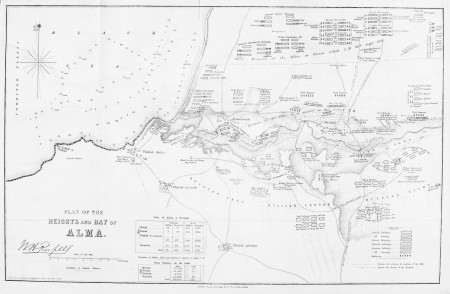
PLAN OF THE HEIGHTS and BAY of ALMA.
[12] They were thrown out of the commissariat araba, in which they had been placed by order of the Commissariat-General, and were abandoned to the Cossacks, so I never saw them again. It was found necessary to make room for some of the reserve ammunition which had been stowed in arabas that broke down on the march.
[13] He must mean a few sotnias of Cossacks. The cavalry were on the right flank.
GATHERING UP FOR AN ATTACK
These 12 guns enfiladed the slopes parallel to them, or swept them to the base. The principal battery consisted of a semicircular earthwork, in which were embrasures for 13 guns. On the right, and farther in the rear, was another breastwork, with embrasures for 9 guns, which played on the right of the bridge. To the left, on a low ridge in front of the village, they had placed two and a half field batteries, which threw 1000 and 1200 yards beyond the village. The first battery was about 300 yards distant from the river, but the hill rose behind it for 50 feet. The second was turned more towards the right. About 12.15, when we were about three miles from the village, the steamers ran in close to the bluff at the south side of the Alma, commenced shelling the heights, the enemy were obliged to retire their infantry and guns, and the ships covered the advance of the French right, and never permitted the Russians to molest them till they were in force on the plateau. At one o'clock we saw the French columns struggling up the hills, covered by a cloud of skirmishers. They swarmed like bees to the face of the cliffs, tiny puffs of smoke rising from every tree, and shrub, and stone. On the right they formed their masses without opposition. At sight of a threatening mass of Russian infantry, who advanced slowly, pouring in all the time a tremendous rolling fire, the French, who were forming in the centre, seemed to pause, but it was only to collect their skirmishers, for as soon as they had formed they ran up the hill at the pas de charge, and broke up the Russians at once, who fled in disorder, with loss, up the hill. We could see men dropping on both sides, and the wounded rolling down the steep. However, our attention was soon drawn to our own immediate share in the battle. As I had slept at the head-quarters camp, I joined the general staff, and for some time rode with them; but when they halted, just before going into action, Major Burke, who was serving on the staff as Aide-de-camp to Sir John Burgoyne, advised me to retire, "as," said he, "I declare I will make Sir John himself speak to you if you do not." There was at the time very little to be seen from the ground which the staff occupied, and there were so many officers along with Lord Raglan, that it was difficult to see in front at all; and so, observing Sir De Lacy Evans somewhat in advance on the right of Lord Raglan, on higher ground about a quarter of a mile away, I turned my horse to join him, and in an instant afterwards a round shot rushed over the heads of the staff, being fired at the Rifles in advance of them. As it turned out, Sir De Lacy's small staff suffered much more severely than Lord Raglan's large one, although the Staff-officer seems firmly persuaded that the enemy's artillery was partially directed against the body to which he belonged. One could scarcely have been in a safer place on the field, considering out of so large a body only two were wounded, whereas five of General Evans's small staff were badly hit or contused. By the time I had reached Sir De Lacy Evans, who was engaged in giving orders to Brigadier Adams, the round shot were rolling through the columns, and the men halted and lay down by order of Lord Raglan. Sir De Lacy said, "Well, if you want to see a great battle, you're in a fair way of having your wish gratified." At this moment the whole of the village in our front burst into flames—the hay-ricks and wooden sheds about it causing the fire to run rapidly, fanned by a gentle breeze, which carried the smoke and sparks towards our line. Sir De Lacy rode towards the left to get rid of this annoyance, and to get to his men, and as he did so, the round shot came bounding among the men lying down just before us. From the groans and stifled cries it was too plain they left dead and dying in their course. The Rifles in advance of our left were sharply engaged with the enemy in the vineyard, and, anxious to see what was going on, I rode over in that direction, and arrived at the place where were stationed the staff of the Light Division. Sir George Brown was just at the time giving some orders to one of his Aides relative to the "Russian cavalry on our left front." I looked across the stream, and saw, indeed, some cavalry and guns slowly moving down towards the stream from the elevated ground over its banks; but my eye at the same time caught a most formidable-looking mass of burnished helmets, tipped with brass, just above the top of the hill on our left, at the other side of the river. One could plainly see through the glass that they were Russian infantry, but I believe the gallant old General thought at the time that they were cavalry, and that a similar error led to the serious mistake, later in the day, which deprived the Light Division of part of its regimental strength, and wasted it on "preparing to receive" an imaginary "cavalry." Sir George looked full of fight, clean shaven, neat and compact; I could not help thinking, however, there was a little pleasant malice in his salutation to me. As he rode past, he said, in a very jaunty, Hyde Park manner, "It's a very fine day, Mr. Russell." At this moment the whole of our light was almost obscured by the clouds of black smoke from the burning village on our right, and the front of the Russian line above us had burst into a volcano of flame and white smoke—the roar of the artillery became terrible—we could hear the heavy rush of the shot, those terrible dumps into the ground, and the crash of the trees, through which it tore with resistless fury and force; splinter and masses of stone flew out of the walls. It was rather provoking to be told so coolly it was a very fine day amid such circumstances; but at that very moment the men near us were ordered to advance, and they did so in quick time in open line towards the walls which bounded the vineyards before us. As I had no desire to lead my old friends of the Light Division into action, I rode towards the right to rejoin Sir De Lacy Evans, if possible; and as I got on the road I saw Lord Raglan's staff riding towards the river, and the shot came flinging close to me, one, indeed, killing one of two bandsmen who were carrying a litter close to my side, after passing over the head of my horse. It knocked away the side of his face, and he fell dead—a horrible sight. The G and B batteries of the Second Division were unlimbered in front, and were firing with great steadiness on the Russians; and now and then a rocket, with a fiery tail and a huge waving mane of white smoke, rushed with a shrill shout against the enemy's massive batteries. Before me all was smoke—our men were lying down still; but the Rifles, led by Major Norcott, conspicuous on a black horse, were driving back the enemy's sharpshooters with signal gallantry, and clearing the orchards and vineyards in our front by a searching fire. When I reached the spot where I had last seen Sir De Lacy Evans, he was nowhere to be found, for he had, as I afterwards heard, ridden with his staff close to the river by the burning village. My position was becoming awkward. Far away in the rear was the baggage, from which one could see nothing; but where I was placed was very much exposed. A shell burst over my head, and one of the fragments tore past my face with an angry whir-r-r, and knocked up the earth at my poor pony's feet. Close at hand, and before me, was a tolerably good stone-house, one story high, with a large court-yard, in which were several stacks of hay that had not as yet caught fire. I rode into this yard, fastened up my pony to the rope binding one of the ricks, and entered the house, which was filled with fragments of furniture, torn paper, and books, and feathers, and cushion linings, and established myself at the window, from which I could see the Russian artillerymen serving their guns; their figures, now distinctly revealed against the hill side, and again lost in a spurting whirl of smoke. I was thinking what a terrible sort of field-day this was, and combating an uneasy longing to get to the front, when a tremendous crash, as though a thunderclap had burst over my head, took place right above me, and in the same instant I was struck and covered with pieces of broken tiles, mortar, and stones, the window out of which I was looking flew into pieces, parts of the roof fell down, and the room was filled with smoke.
A WARNING TO QUIT.
There was no mistaking this warning to quit. A shell had burst in the ceiling. As I ran out into the yard I found my pony had broken loose, but I easily caught him, and scarcely had I mounted when I heard a tremendous roll of musketry on my left front, and looking in the direction, I saw the lines of our red jackets in the stream, and swarming over the wooden bridge. A mass of Russians were at the other side of the stream, firing down on them from the high banks, but the advance of the men across the bridge forced these battalions to retire; and I saw, with feelings which I cannot express, the Light Division scrambling, rushing, foaming like a bloody surge up the ascent, and in a storm of fire, bright steel, and whirling smoke, charge towards the deadly epaulement, from which came roar and flash incessantly. I could distinctly see Sir George Brown and the several mounted officers above the heads of the men, and could detect the dark uniforms of the Rifles scattered here and there in front of the waving mass. On the right of this body, the 30th, 55th, and 95th were slowly winning their way towards the battery, exposed to a tremendous fire, which swallowed them up in the fiery grey mantle of battle. The rush of shot was appalling, and I recollect that I was particularly annoyed by the birds which were flying about distractedly in the smoke, as I thought they were fragments of shell. Already the wounded were passing by me. One man of the 30th was the first; he limped along with his foot dangling from the ankle, supporting himself on his firelock. "Thank you kindly, sir," said he, as I gave him a little brandy, the only drop I had left. "Glory be to God, I killed and wounded some of the Roosians before they crippled me, any way." He halted off towards the rear. In another moment two officers approached—one leaning on the other—and both wounded, as I feared, severely. They belonged to the 30th. They went into the enclosure I had left, and having assured them I would bring them help, I rode off towards the rear, and returned with the surgeon of the Cavalry Division, who examined their wounds. All this time the roar of the battle was increasing. I went back to my old spot; in doing so I had to ride gently, for wounded men came along in all directions. One was cut in two by a round shot as he approached. Many of them lay down under the shelter of a wall, which was, however, enfiladed by the enemy. Just at this moment I saw the Guards advancing in the most majestic and stately order up the hill; while through the intervals and at their flanks poured the broken masses of the Light Division, which their officers were busy in re-forming. The Highlanders, who were beyond them, I could not see; but I never will forget the awful fury, the powerful detonation of the tremendous volleys which Guards and Highlanders poured in upon the Russian battalions, which in vain tried to defend their batteries and to check the onward march of that tide of victory. All of a sudden the round shot ceased to fly along the line; then there was a sharp roll of musketry and a heavy fire of artillery which lasted for some moments. Then one, two, three round shot pitched in line, ricochetting away to the rear. As I looked round to see what mischief they did, a regiment came rapidly towards the river. I rode towards them; they were the 50th. "The cannon shot come right this way, and you'll suffer frightfully if you go on." As I spoke, a shell knocked up the dust to our right, and Colonel Waddy, pushing the left, led his men across the river. I rode towards the bridge. The road wall was lined by wounded. Fitzgerald (7th), with his back against the wall, was surveying his wounded legs with wonderful equanimity. "I wish they had left me one, at all events," said he, as we tried to stop the bleeding. As I passed the bridge there was a spattering of musketry. The cannon were still busy on our right, and field-guns were firing on the retreating Russians, whose masses were over the brow of the hill. Then there was a thundering cheer, loud as the roar of battle, and one cannon boomed amid its uproar. This was the victory. A few paces brought me to the bloody slopes where friend and foe lay in pain, or in peace for ever.
A NICE QUESTION.
When the columns were deploying, Northcott moved from the left and advanced to the front of the Light and First Divisions, till they came to a long low stone wall. Here they waited till the line came up. The instant they did so, the two front companies, in extended order, leaped over the wall into the vineyards, the two companies in support moving down a road to their left, on a ford, by which they crossed the stream. The Rifles were first across the river. They were under the cover of a bank which bounded the plateau, and hid them from the fire at our advancing columns. It was a second terrace; for just at this place the ground was a series of three giant steps—the first being that from the river to the top of the bank; the second, from the plateau at the top of the bank to the plateau on which the enemy were in position; and the third being from that position to the highest ground of all, on which they had their reserves. No sooner had the Rifles lined this lower ridge than the enemy pushed a column of infantry, headed by some few Cossacks, down the road which led to the ford, and threatened to take them in rear and flank and destroy them, for these gallant fellows were without support. Major Norcott, however, was not dismayed, but at once made the most skilful disposition to meet this overwhelming column of the enemy. Retiring from the ridge, he placed one of the four companies under him on the road by which they were advancing, two others he posted along the bank of a vineyard on the right of this road, and with the fourth he occupied the farm-house in the centre of the vineyard: thus availing himself of the resources of the ground with much skill and judgment. At this moment there were no supports in sight—nothing to rest or form upon in the rear—the Rifles were quite alone. The Russians advanced leisurely; but to the astonishment of our officers, just as the men were about to open fire on them, the Cossacks and the column halted, and then wheeling to the right-about, retired up the road and disappeared over the brow of the hill. On looking round, however, the phenomenon was soon explained—Codrington's brigade was rushing across the river under a tremendous fire, and at the same time the Russians advanced heavy columns of infantry towards the ridge over the stream. The Rifles moved towards their right to join the Light Division, and at the same time poured in a close and deadly fire upon the dense formation of the enemy, which must have caused them great loss. Having effected their junction, the Rifles moved up with the Light Division, and bringing up their left shoulders, threw themselves on the flank of the battery, bravely led by Major Norcott, till they were forced to retire with their supports. One company, under Captain Colville, was separated from the left wing, and did not participate as fully as the other companies in the fight; and the right wing, under Colonel Lawrence, was kept back by a variety of impediments, and had no opportunity of playing the same distinguished part as the left.
As soon as the line of the Light Division came up to the Rifles, the latter were ordered to retire, and re-form in rear of the brigades; but some few of the men could not obey the order, and were consequently in front along with the advance—some with the Guards, others with the men of Codrington's brigade. Captain the Hon. W. Colville and Lieutenant Nixon both claim, or claimed, the credit of having led up their men skirmishing in front of the advance of the red soldiers; and the question is one which I cannot decide. Both those gallant officers arrogated to themselves the honour of having performed the same action; and I believe each thought that he had, when one of the colonels of the Guards was dismounted, brought a horse to the officer, and enabled him to resume his place with his men.
A DAY TO BE REMEMBERED.
The approach of the Light Division—why should I not dwell fondly on every act of that gallant body, the first "put at" everything, the first in Buffering, in daring, in endurance throughout the campaign?—their approach, then, was in double columns of brigades; the Second Division being on their right, and the second battalion of the Rifle Brigade, divided into two wings, one under Major Norcott, the other under Colonel Lawrence, being in advance in skirmishing order. When the Light Division got within long range, they deployed; the men lay down. Again they advanced; once more they were halted to lie down; this time the shot pitched among them; the same thing was repeated again ere they reached the river, and many were wounded before they got to the vineyards. Here, indeed, they were sheltered, but when the order was given to advance, the men were thrown into disorder, not so much by the heavy fire as by the obstacles opposed by hedges, stone walls, vines, and trees. These well-drilled regiments were thus deprived of the fruits of many a day's hard marching at Gallipoli, Aladyn, and Devna; but the 1st Brigade being in rather better ground and more in hand than the 2nd Brigade, moved off, and with them the 19th Regiment, belonging to Brigadier Buller, who was lost in a hollow, and afterwards, as Lord Raglan euphemistically expressed it, manœuvred judiciously on the left. The 19th, 7th, 23rd, and 33rd were led at a run right to the river, gallantly conducted by Codrington. Their course was marked by killed and wounded, but the four regiments were quickly under the shelter of the high bank at the south side, in such a state of confusion from the temporary commingling of the men in the rush, that it was necessary to re-form. The enemy, too late to support their skirmishers, sought to overwhelm them in the stream, and three battalions of grey-coated infantry came down at the double almost to the top of the bank, and poured down a heavy fire. They were straggling, but not weak; the Brigade and the 19th made a simultaneous rush up the bank, and, as they crowned it, met their enemies with a furious fire. The dense battalions, undeployed, were smitten, and as the Light Division advanced they rapidly fell back to the left, for the renewed fire of their batteries, leaving, however, many dead and wounded men. After a momentary delay, these gallant regiments, led by Sir George Brown and Brigadier Codrington, advanced up the slope which was swept by the guns of the battery; grape, round, and shell tore through their ranks, and the infantry on the flanks, advancing at an angle, poured in a steady fire from point-blank distance. It must be confessed that the advance was disorderly—instead of the men being two deep and showing an extended front of fire, they were five, six, and seven deep, in ragged columns, with scarcely any front, and not half so extended as they should have been. Thus their fire was not as powerful or their advance as imposing as it ought to have been. The General and Brigadier made some attempts to restore order, but they were unsuccessful. The men had not only got into confusion in the river from stopping to drink, as I have related, but had disordered their ranks by attacks on the grapes in the vineyards on their way. Behind the work, on rising ground, a Russian regiment kept up a most destructive file fire on our advance; the field-pieces on the flank also played incessantly upon them. Every foot they advanced was marked by lines of slain or wounded men. The 7th Fusiliers, smitten by a storm of grape, reeling to and fro like some brave ship battling with a tempest, whose sails are gone, whose masts are toppling, and whose bulwarks are broken to pieces, but which still holds on its desperate way, impelled by unquenchable fire, within a few seconds lost a third of its men. Led by "Old Yea," it still went on—a colour lost for the time, their officers down, their files falling fast—they closed up, and still with eye which never left the foe, pressed on to meet him. The 23rd Regiment was, however, exposed more, if that were possible, to that lethal hail. In less than two minutes from the time they crowned the bank till they neared the battery the storm had smitten down twelve of their officers, of whom eight never rose again. Diminished by one-half, the gallant companies sought, with unabated heart, to reach their terrible enemies. The 19th marched right up towards the mouths of the roaring cannon which opened incessantly and swept down their ranks; the 33rd, which had moved up with the greatest audacity over broken ground towards the flank of the epaulement, where it was exposed to a tremendous fire and heavy losses from guns and musketry from the hill above, was for the moment checked by the pitiless pelting of this iron rain. Their general at this terrible crisis seemed to have but one idea—right or wrong, it was to lead them slap at the battery, into the very teeth of its hot and fiery jaws. As he rode in front, shouting and cheering on his men, his horse fell, and down he went in a cloud of dust. He was soon up, and called out, "I'm all right. Twenty-third, be sure I'll remember this day." It was indeed a day for any one to remember. General Codrington in the most gallant manner rode in advance of his brigade, and rode his horse right over and into the work, as if to show his men there was nothing to fear; for by this time the enemy, intimidated by the rapid, though tumultuous advance of the brigade, were falling away from the flanks of the battery, and were perceptibly wavering in their centre. The infantry behind the breastwork were retreating up the hill. The Russians were in great dismay and confusion. They limbered up their guns, which were endangered by the retirement of their infantry from the flanks of the epaulement, and retired towards their reserves, which were posted on high ground in the rear. In this retrograde movement their artillery got among the columns of the infantry, and increased the irregular nature of their retreat; but they still continued to fire, and were at least three times as numerous as the men of the Light Division who were assailing them. When Sir George Brown went down, a rifleman, named Hugh Hannan, assisted him on his horse, and as they stood under a murderous fire, saluted as he got into his seat, and said, "Are your stirrups the right length, sir?" Major Norcott, on his old charger, which, riddled with balls, carried his master throughout the day, and lay down and died when his work was over, got up to the redoubt, which was also entered by Brown and Codrington. (The reserve artillery horses had succeeded in drawing away all the guns except one, which was still in position, and on this gun, when the first rush was made, an officer of the 33rd, named Donovan, scratched his name.) In broken groups the 23rd, with whom were mingled men of the 19th and 33rd Regiments, rushed at the earthwork, leaped across it, bayoneted a few Russians who offered resistance, and for an instant were masters of the position. Captain Bell, of the 23rd, observed a driver in vain urging by whip and spar two black horses to carry off one of the brass sixteen-pounder guns which had done so much execution. Bell ran up, and, seizing the reins, held a revolver to his head. He dismounted, and ran off. Bell, with the assistance of a soldier of the 7th, named Pyle, led the horses round the shoulder of the parapet to the rear of our line, where the gun remained after the Light Division was obliged to retire, and reported the capture to Sir George Brown. The horses were put into our "black battery." This was but an episode. The colours of the 23rd were planted on the centre of the parapet. Both the colour-officers, Butler and Anstruther, were killed. The colours were hit in seventy-five places, and the pole of one was shot in two; it had to be spliced. Meantime, the Russians, seeing what a handful of men they had to deal with, gained heart. The brigade and the 19th had held the entrenchment for nearly ten minutes, keeping the massive columns above them in check by their desperate but scattered fire. Where were the supports? they were not to be seen. The advance of the Guards, though magnificent, was somewhat slow. Two of the dark-grey masses, bristling with steel on our front, began to move towards the battery. The men fired, but some staff-officer or officers called out that we were firing upon the French. A bugler sounded the "Cease firing." The Russians advanced, and our men were compelled to fall back. Some of the enemy, advancing from the epaulement, proceeded in pursuit, but were checked by the apparition of the Guards.
FORMING A SQUARE.
The Duke of Cambridge, who commanded the First Division, had never seen a shot fired in anger. Of his Brigadiers, only Sir Colin Campbell—a soldier trained in many a stubborn fight, and nursed in the field—was acquainted with actual warfare; but it is nevertheless the case that the deciding move of the day on our left was made by his Royal Highness, and that the Duke, who was only considered to be a cavalry officer, showed then, as on a subsequent tremendous day, that he had the qualities of a brave and energetic leader. When the last halt took place, the Guards and Highlanders lay down a good deal to the rear of the Light Division, which they were to support; and in the advance immediately afterwards, the Brigade of Guards, being on the left behind Codrington's Brigade, lost several men ere they reached the river by the fire directed on those regiments. Between them and the river the ground was much broken, and intersected by walls and the hedges of vineyards; but on their left, opposite the Highlanders, the ground was more favourable. The men wearing their bearskins—more ponderous and more heavily weighted than the men of the line—suffered much from thirst and the heat of the day, and they displayed an evident inclination to glean in the vineyards after the soldiers of the Light Division; but the Duke led them on with such rapidity that they could not leave their ranks, and the officers and sergeants kept them in most admirable order till they came to the wall, in leaping over which they were of course a little disorganized. On crossing it they were exposed to a heavier fire, and by the time they reached the river the Light Division were advancing up the slope against the enemy's guns. The bank of the stream in front was deep and rugged, but the Duke and his staff crossed it gallantly; and placing himself in front of the Guards on the left—Sir Colin Campbell being near him at the head of his Brigade, and General Bentinck being on his right—his Royal Highness led his division into action. On reaching the other side of the river the Guards got into another large vineyard, the same in which the Rifles had been stationed for a time, and it became very difficult to get them into line again, for they had of course been disordered in passing through the river. The guards threw out their sergeants in front, as if on parade, and dressed up in line, protected in some degree from fire as they did so by the ridge in front of them, and Sir Colin Campbell formed up his Highlanders on their left, as if they were "ruled" by machinery. It was time they were ready for action, for at this moment the Light Division was observed to be falling back towards them in disorder, and the Russians, encouraged by the partial success, but taught by their short experience that it would be rather dangerous to come too near them, were slowly advancing after them, and endeavouring to get positions for the guns; in fact, it was probable that in a few minutes more they would run them into the epaulement once more. In front of the 42nd Highlanders was the 88th Regiment halted, and doing nothing; and Colonel Cameron, who was astonished to find them in such a position, was obliged to move out of his course a little in order to pass them. As we thus come on this gallant regiment, it may be as well to say how they came here.
As the 88th were about to advance from the river, having their right on the 19th and their left on the 77th, an Aide-de-Camp—I believe the Hon. Mr. Clifford—came down in haste from Sir George Brown, with the words "Cavalry! form square! form square!" and the right, accordingly, in some haste corresponding with the order, which was almost at the moment reiterated by Brigadier Buller, prepared to execute the movement, but the whole of the companies did not join in it, the men who were excluded, and an officer and some few of the Rifles, struggled to obtain admission into the square, which was for some moments in a very ineffective state, and scarcely ready to receive any determined charge of cavalry. The apprehensions, however, which were entertained by a few short-sighted people were unfounded. The enemy had made no demonstration with the cavalry. They had advanced a demi-battery of artillery towards the left flank of the 2nd Brigade, and supported the advance with a body of infantry in spiked helmets. Sir George Brown, whose sight was not good though he would not wear spectacles, and General Buller, whose vision was not good although he did wear spectacles, were deceived by the appearance of this force, and sent orders to form square. It was fortunate the Russian guns did not fire upon the 88th; just as they unlimbered Codrington's Brigade began to advance on the right, and the Rifles, part of the 88th, and the 77th, who, as they crossed the river, and endeavoured to re-form under the bank, were menaced by a column of Russians firing on the gunners, forced them to retire higher up the hill. Had the artillery held their ground, they could have inflicted great loss upon us, and seriously interfered with our advance on the right; but on this, as on other occasions, the Russians were too nervous for their guns, and withdrew them. In this general movement the 77th and 88th Regiments did not participate. There was not in the army a more gallant or better disciplined regiment than the 77th. Colonel Egerton was not only one of the bravest but one of the most intelligent, skilled, and thorough soldiers and officers in the whole service. In the trenches—at Inkerman—throughout the siege, the regiment showed of what noble material it was composed. The 88th had a fighting reputation, which they well vindicated at Inkerman, at the Quarries, and in many encounters with the enemy. It is astonishing, therefore, that the Light Division should have been in a vital moment deprived of the co-operation of these splendid soldiers, and should have been, hurled in confused masses against the enemy's bayonets and artillery, reduced by the suicidal incapacity of some one or other to four regiments. That there was no notion of keeping these regiments in reserve is shown by the fact that they were never advanced in support or used as a reserve when their comrades were involved in a most perilous and unequal struggle.
The First Division advancing, and passing this portion of the Light Division, at once became exposed to fire, and received the shot which passed through the fragments of Codrington's Brigade; but as it was imperatively necessary that they should not be marched up in rear of regiments in a state of disorder, the Duke, by the advice of Sir Colin Campbell, ordered General Bentinck to move a little to his left, but ere the movement could be effected, portions of the Light Division came in contact with the centre of the line, and passing through its files to re-open in the rear, carried disorder into the centre battalion. It may be observed that this is a casualty to which extended line formations in support must always be liable, when the attacking lines in advance of them are obliged to fall back to re-form. Formations in column are of course less likely to be subjected to this inconvenience, and the broken troops can pour through the intervals between column and column with greater facility than they can pass round the flanks of lengthy and extended lines. The Coldstreams and the Grenadiers never for an instant lost their beautiful regularity and order, although they now fell fast under the enemy's fire, and several of the mounted officers lost their horses. Among these Major Macdonald was included, his horse was killed by a round shot, and he received a severe fall, but never for a moment lost his coolness and equanimity.
A MARCH OVER THE DEAD.
As the Light Division retreated behind the Guards to re-form, the Russian battalions on the flanks and behind the work fired on them, continuously, and at the same moment the guns which had been drawn out of the work to the high ground over it opened heavily. The Guards were struck in the centre by this iron shower. The fragments of Codrington's Brigade poured through them. In their front was a steel-bound wall of Russian infantry. Our own men were fast falling back, firing as they retired. After them came a glistening line of Russian bayonets, as if to clear the field. For a few seconds the Scots Fusiliers wavered and lost order; they were marching over dead and dying men. The Russians were within a few yards of them, but the officers rallied the men, and, conspicuous in their efforts, suffered heavily. The colour-bearers, Lieutenant Lindsay and Lieutenant Thistlewayte, with signal gallantry, extricated themselves from a perilous position, in which for the instant their men had left them—order was restored in the centre, and on the flanks the Grenadiers, under Colonel Hood, and Coldstreams were as steady and in as perfect order as though they were on parade. For a moment, it is said, the Duke thought of halting to dress his line, but Sir Colin Campbell, who was near at hand with his Highlanders, begged his Highness not to hesitate, but to push on at once at the enemy. The Russian artillery on the slopes above sent repeated volleys of grape, canister, round, and shell through their ranks, but at this moment, threatened on the flank by the French batteries, enfiladed by a 9-pounder and 24-pound howitzer of Turner's battery, which Lord Raglan had ordered up to a knoll on the opposite side of the river, on the slope between our attack and that of the French, the Russian guns were limbered up, and ceased their fire.
Meantime General Sir De Lacy Evans had, in the most skilful and gallant manner, executed his instructions, and, with Pennefather's Brigade, had forced the Russian centre and the right centre. The Second Division advanced on the same alignement with Prince Napoleon's Division to the burning village of Bourliouk. Sir De Lacy Evans detached the 41st and the 49th Regiments, of Adams's Brigade and Turner's battery, by the right of the village, which the flames rendered impenetrable, and ordered them to force the passage. The ford in front was very deep, and the banks were bad and high, defended by a heavy fire; the regiments lost upwards of 40 men in the stream and on its banks. The General placed himself at the head of the remaining regiments, and led them by the left of the village towards the river; but, experienced in war, Sir De Lacy Evans availed himself of all means to carry the enemy's position with the smallest loss to his own men; he covered the advance of his troops by the fire of 18 pieces. Pennefather's Brigade, the 30th, 55th, and 95th Regiments, was accompanied by Fitzmayer's battery; but the General, finding Dacre's battery and Wodehouse's battery, which belonged to the First and Light Divisions, stationed near, availed himself of the services volunteered by the officers in command of them to cover the advance of his men. The 95th Regiment, being on the extreme left of the Brigade, came upon the bridge of Bourliouk; the 55th Regiment, in the centre, had in front of them a deep ford and high banks; and the 30th Regiment were inconvenienced in their advance by the walls of the village, and by the cooking places cut in the high banks on the opposite side of the stream. On the right of the 30th Regiment came the 47th Regiment, and in the interval between these two regiments rode Sir De Lacy Evans. As soon as the Division emerged from the smoke and the houses of the village, the enemy directed on them an extremely severe fire—"such," says Sir De Lacy Evans, "as few, perhaps, of the most experienced soldiers have ever witnessed," till they came to the stream, which they passed under a storm of missiles which lashed the waters into bloody foam. The 95th, led very gallantly by Colonel Webber Smith, debouched from the bridge and narrow ford just as the 7th, under Colonel Yea, formed on the other side. They were exposed to the same tremendous fire; they advanced, with colours flying, towards the left of the Russian epaulement, which Codrington was assailing, and claim the credit of having been the temporary captors of a gun on the left of the works. The 55th and 30th, led by Colonel Warren and Colonel Hoey, exposed to the full fire of two batteries and of six battalions disposed on the sides of the ravines and of the slopes above them, behaved with conspicuous gallantry, but could make no impression on the solid masses of the enemy. In a short time the 95th lost 6 officers killed, the Colonel and Major and 9 officers wounded, and upwards of 170 men. The 55th had 128 casualties, 8 of which occurred to officers, and 3 of which were fatal; the 80th Regiment lost 150 officers and men.
DIFFICULTIES OF GAINING INTELLIGENCE DURING BATTLE.
But the steadiness of our infantry and the destructive effect of their musketry were shaking the confidence of the enemy, now broken and turned on their left by the French. The Light Division was obliged to relinquish its hold of the work it had taken; but the Guards were advancing to their support—the Highlanders were moving up on the left—and the fortune of the day was every moment inclining to the allies. The French had sent to Lord Raglan for assistance, some say twice—certainly once, before we advanced. Our attack was not to begin till they had turned the left, and it is likely that M. St. Arnaud arranged to send information of that fact to Lord Raglan. But our Commander-in-chief did not receive any such intelligence. He was annoyed, uneasy, and disappointed at the delay which occurred on his right. He sent Colonel Vico to ascertain the state of affairs, to communicate, if possible, with the French Generals. Meantime, the French Generals were, if we credit authorities, annoyed, uneasy, and disappointed by the slowness of the English. Prince Napoleon sent to Lord Raglan, French staff-officers came with the piteous appeal—Milord, je vous prie! pour l'amour de Dieu! Venez aux Français! Nous sommes massacrés! At last Lord Raglan gave orders to advance, although he had not heard of the success of the French attack on which the advance was to depend. When the 1st and 3rd Divisions had deployed, and were moving towards the Alma, Lord Raglan, and his staff advanced, and skirting the village of Bourliouk to the right, passed down a narrow lane which led to the ford, by which part of Adams's Brigade had crossed to the other side. They proceeded round the right of Adams's Brigade, immediately between the French and Evans's extreme right, and en route, his lordship observed Turner's battery, and passed close to the 41st and 49th on the other side of the river, for whose disposition he gave orders to Brigadier Adams. In crossing the ford the staff were exposed to fire from the Russian guns on the high grounds opposite Bourliouk, and the infantry in support. Two of the staff-officers were hit—Lieutenant Leslie, Royal Horse Guards, who was acting as orderly officer to the Commander-in-chief, and Captain Weare, Deputy-Assistant Adjutant-General. Lord Raglan gave orders for Turner's battery to come up to enfilade the enemy's guns. The lane, which formed at the other side of the ford the continuation of that road by which the Commander-in-chief had passed round Bourliouk to the river, ran at the bottom of a sheltered ravine, which almost divided the Russian position, and formed a boundary between the English and the French attacks. The enemy had been driven out of this ravine by the French, and the lane was unoccupied, but here and there in its windings it was swept by guns. The ravine, as it ascended, opened out, and became shallower, and on the right it wound below a small table-land, or rather a flattened knoll, of which there were several at the edge of the general level of the plateau. On ascending this knoll, Lord Raglan saw, as he anticipated, that the Russian guns commanding the ford were on his left, in such a position that they could be enfiladed, and indeed, taken in reverse. He despatched repeated orders to Turner; but owing to the steepness of the lane, and to the loss of a gun horse in the river, there was difficulty and delay in getting the guns up, and when they did arrive the Guards and Highlanders were already advancing up the hill, and closing on the Russian columns. The guns[14] which came up were, I believe, a 24-pounder howitzer, and a 9-pounder, and as the tumbril attached to the former had not arrived, it was served with 9-pounder ammunition and round shot. The artillery officers and General Strangways dismounted and worked the guns, as the men had not yet come up; Lieutenant Walsham arrived with the rest of the battery, and the six guns opened—on what? One officer says, on the "artillery" of the Russians—that two shots forced a whole line of Russian guns to retire, and that the Russian General, "seeing he was taken in flank," limbered up. But surely he could have turned round some of his numerous guns, and could have fought Turner's two with heavier metal. In fact, it was something else besides this fire of two shots (one of which hit a tumbril) which determined the retreat of the Russian artillery. It was the advance of the First and Second Divisions. The Guards were half-way up the hill when these two guns opened, and the Russians limbered up when they saw they were turned on their left, and threatened on their right. The Russian artillery officer, after he retired, directed his guns against Turner's battery, and some riflemen were sent to cripple it, one of whom shot Lieutenant Walsham as he was in the act of loading. Lord Raglan saw the day was won by the Light Division, the Second Division, the Guards, and Highlanders; for, seeing the advance of the latter, he exclaimed, "Let us join the Guards!" and rode into the ravine to his left in their direction.
But the enemy had not yet abandoned their position. A division of infantry in columns came from the rear of the hill, and marched straight upon the Brigade of Guards. The Guards dressed up, and advanced to meet them. Some shot struck the rear of the Russian columns, they began to melt away, and wavered; still they came on slowly, and began file-firing. One column moved towards the left flank of the Guards, facing round as if to meet the Highlanders, who were moving with rapidity up from the hollow in which they had been sheltered from the enemy's fire. The two other columns faced the Guards. The distance between them was rapidly diminishing, when suddenly the Brigade poured in a fire so destructive that it annihilated their front ranks, and left a ridge of killed and wounded men on the ground. The Highlanders almost at the same moment delivered a volley, sharp, deadly, and decisive. Pennefather's Brigade, on the right of the Guards, supported by Adams, appeared on the side of the slope. The enemy, after a vain attempt to shake off the panic occasioned by that rain of death, renewed their fire very feebly, and then, without waiting, turned as our men advanced with bayonets at the charge, over the brow of the hill to join the mass of the Russian army, who, divided into two bodies, were retreating with all possible speed. Our cavalry rode up to the crest of the hill, and looked after the enemy. They took a few prisoners, but they were ordered to let them go again. Lord Raglan expressed his intention of keeping his cavalry "in a bandbox," and was apprehensive of getting into serious difficulty with the enemy. The Battle of the Alma was won. The men halted on the battle-field, and as the Commander-in-chief, the Duke of Cambridge, Sir De Lacy Evans, and the other popular generals rode in front of the line, the soldiers shouted, and when Lord Raglan was in front of the Guards, the whole army burst into a tremendous cheer, which made one's heart leap—the effect of that cheer can never be forgotten by those who heard it. It was near five o'clock; the men had been eleven hours under arms, and had fought a battle, and the enemy were to be—"let alone." The Russians fired one gun as they retreated, and made some show of covering their rear with their cavalry.
TACTICS OF THE BATTLE OF THE ALMA.
Upon the conduct of the Battle of the Alma there has been much foreign criticism, and the results and deductions have been unfavourable to the Russian General, who permitted his left to be turned without any serious resistance, although he ought to have calculated on the effect of the operations by sea on that flank. In apparent opposition to this judgment there has been at the same time great praise awarded to the French for the gallantry with which they attacked that portion of the position. They deserve every laudation for the extraordinary activity, rapidity, and bravery with which they established themselves on the centre and left-centre, but on the extreme left they had no hard fighting. The English seem to have been awarded the meed of solidity and unshaken courage, but at the same time hints are thrown out that they did not move quite quickly enough, that therefore their losses were great, and their work after all not so hazardous and difficult as that of the French, inasmuch as the English attack took place only when the Russian left was turned. In effect, however, the right of the enemy presented less physical difficulties to the establishment of a hostile force on the flank, and it was there that the greatest number of artificial obstacles in the shape of guns, cavalry, and men, was accumulated. But was the plan of battle good? In the first place, we attacked the enemy in the position of his own selection, without the least attempt to manœuvre or to turn him. It might have been difficult, situated as we were, without cavalry, and with masses of baggage, to have attempted any complex manœuvres; but it has been asserted that by a flank march we could, by a temporary abandonment of our seaboard, have placed the enemy between two fires, and have destroyed his army in case of defeat. It has been suggested that early on the morning of the 20th the Allies should have moved obliquely from the bivouac on the Bouljanak, and, crossing the Alma to the east of the enemy's position, have obliged his left to make a harassing march, to get up and occupy new ground in a fresh alignement, have deprived him of his advantages, and have endangered his retreat to Bakshi Serai or Simpheropol, if he refused battle, and that in event of his defeat, which would have been pretty certain, considering how much weaker his new line would have been, he would have been driven towards the shore, exposed to the fire of our ships, so that his force would have been obliged to lay down their arms. Menschikoff's army utterly ruined, Sebastopol would have at once surrendered, disposed as it was to have done so with very little compression. Criticism is easy after the circumstances or conduct of which you judge have had their effect; but to this it may be remarked that criticism cannot, by its very nature, be prospective. Even civilians are as good judges as military men of the grand operations of war, although they may be ignorant of details, and of the modes by which those operations have been effected. Alexander, Cæsar, Pompey, Hannibal, may have had many club colonels in their day, who thought they made "fatal moves;" we know that in our own time there were many military men who "had no great opinion" of either General Wellesley or General Bonaparte; but the results carry with them the weight of an irreversible verdict, which is accepted by posterity long after the cliques and jealousies and animosities of the hour have passed away for ever. Now, without being a member of a clique, having no possible jealousies, and being free from the smallest animosities, I may inquire was there any generalship shown by any of the allied generals at the Alma? We have Lord Raglan, as brave, as calm, as noble, as any gentleman who ever owned England as his mother-land—trotting in front of his army, amid a shower of balls, "just as if he were riding down Rotten Row," with a kind nod for every one, leaving his generals and men to fight it out as best they could, riding across the stream through the French riflemen, not knowing where he was going to, or where the enemy were, till fate led him to a little knoll, from which he saw some of the Russian guns on his flank, whereupon he sent an order for guns, seemed surprised that they could not be dragged across a stream, and up a hill which presented difficulties to an unencumbered horseman—then, cantering over to join the Guards ere they made their charge, and finding it over while he was in a hollow of the ground. As to the mode in which the attack was carried on by us, there was immense gallantry, devotion, and courage, and, according to military men present, no small amount of disorder. The Light Division was strangely handled. Sir George Brown, whose sight was so indifferent that he had to get one of his officers to lead his horse across the river, seemed not to know where his division was, and permitted Brigadier Buller to march off with two regiments of his brigade, leaving the third to join Codrington's Brigade. The men got huddled together on the other side of the river under the ridge, and lay there seven or eight instead of two deep, so that when they rose and delivered fire, their front was small, and the effect diminished. Then they were led straight up at the guns in a confused mass; when they had got into the battery they were left without supports, so that the enemy forced them to relinquish their hold, and were enabled to recover the work. The Light Division had, it is true, drawn the teeth of the battery, but still the enemy were able to fire over the heads of the columns from the hill above. However, the Alma was won. Menschikoff was in retreat, and the world was all before us on the evening of the 20th of September. Whether our generals had any foresight of what that world was to be—what were to be the fruits of victory, or the chances of disaster—let the history of the war on some future day communicate to the world.
The Russians were very much dissatisfied with the result of this battle. They put forth the rawness of the troops, their inferiority in numbers, and many other matters; they criticised severely the conduct of their generals during the action, and the disposition of the troops on the ground; but, after all, their position ought to have been impregnable, if defended by determined infantry.
The force under the orders of Prince Menschikoff was composed as follows:—
[14] As an instance of the difficulty of obtaining accurate information respecting the incidents of a general action, I may state that Captain Henry, an officer promoted from the ranks for his distinguished bravery, and who has received the Order of Victoria, told me that the guns were taken over a bridge, and not over a ford—that he was with the first gun, that no wheeler was killed, and that he fired only on Russian infantry, and never directed a round against the Russian guns. In most of these statements it is probable the gallant officer was mistaken, although actually present.
THE RUSSIAN FORCES.
Battalions.
Guns.
The 1st Brigade of the 14th Division of the 5th Army Corps, consisting of regiment No. 27 Volhynia, and regiment No. 28 Minsk, with No. 3 battery of position, and No. 3 light battery
8
16
The 16th Division 6th Army Corps, consisting of the regiments 31st Vladimir, 32nd Sudalski, 31st (Light) Uglilski, 32nd (Light) Kazan, with the 16th Brigade of Artillery, No. 1 and No. 2 light batteries, and No. 2 battery of position
16
36
The 2nd Brigade of the 17th Division, with the regiment of Moscow, the 17th Brigade of Artillery, No. 4 and No. 5 light batteries, and No. 3 battery of position
12
24
4 Reserve battalions of the 13th
4
0
The rifle and sapper battalions of the 6th Corps
2
0
2 battalions of sailors, with 4 guns
2
4
44
80
CAVALRY.Squadrons.
Guns.
2nd Brigade of 6th Cavalry Division, 2 regiments, each of 8 squadrons
16
0
16 sotnias of Cossacks, or regiment of 4 squadrons
8
0
No. 12 light battery of horse artillery
0
8
No. 4 Cossack battery
0
8
Total—Infantry, between 33,000 and 34,000
Cavalry, about 3,500.
24
16
The Russians have given the following account of their own position and of some incidents of the action:—
The centre of their position lay on the high slopes of the left bank of the river, opposite the village of Bourliouk; the left on the still higher and less accessible hills, with perpendicularly scarped sides, which rise from the river near the sea; the right wing on the gentle ascents into which this rising ground subsides about half a mile eastward of the village.
The reserves, which were posted behind the centre, consisted of the regiments of Volhynia, Minsk, and Moscow, the two former of which subsequently took an active part in the siege, and were the principal workmen and combatants in constructing and occupying the famous "white works" on the right of our position before Sebastopol. On their right flank were two regiments of hussars and two field batteries; in the rear of the right wing was stationed a regiment of Riflemen. Oddly enough, the Russian General sent off a battalion of the Moscow regiment to occupy the village of Ulukul Akles, several miles in the rear of his left wing, as if to prevent a descent behind him from the sea.
A DIFFERENCE OF OPINION.
The disposition of this force will be seen on reference to the plan which accompanies the description of the battle of the Alma. The right was commanded by Lieutenant-General Knetsinsky, of the 16th Division; the centre by Prince Gortschakoff I.; the left by Lieutenant-General Kiriakoff, Commander of the 17th Division; and Prince Menschikoff took the control of the whole, being generally on the left of the centre, near the telegraph station. When the Allies came in sight, the Rifle battalion, about 650 strong, crossed to the right bank of the river, and occupied the village of Bourliouk and the vineyards near it, and the regiments in front advanced their skirmishers to the left bank, and Menschikoff rode along the front from the right to the left of the line to animate the men, most of whom had been present at a mass to the Virgin early in the morning, when prayers were offered for her aid against the enemy. Our advance seemed to the Russians rather slow; but at last, at about 12.30, the Allies came within range, and a sharp fusilade commenced between the skirmishers and riflemen. About 12.20 the steamers outside began to fire on the Russian left, and forced the regiments of Minsk and Moscow to retire with loss, and killed some horses and men of the light battery stationed on their flank. Their shells struck down four officers of Menschikoff's staff later in the day, and did most effective service in shaking the confidence of the enemy, and in searching out their battalions so as to prevent their advance towards the seaboard. As the Allies advanced, the Cossacks, according to orders, set fire to the haystacks in the Tartar village, which soon caught, and poured out a mass of black smoke, mingled with showers of sparks. The guns of the Allies, from the right of the village, now began to play on the enemy, and caused so much loss in the four reserve battalions under General Oslonovich, that they, being young soldiers, began to retire of their own accord. At the same time the French gained the heights, driving back and destroying the 2nd battalion of the Moscow regiment, and holding their ground against the Minsk regiment, the 1st, 3rd, and 4th battalions of the Moscow regiment, and a numerous artillery, which arrived too late to wrest the heights from their grasp till the demonstration in the centre rendered their position certain and secure. General Kiriakoff, who commanded the left wing, seems to have been utterly bewildered, and to have acted with great imbecility, and want of decision and judgment. The Russians with whom I have conversed have assured me that he gave no orders, left every officer to do as he liked, and retired from the field, or at least disappeared from their view, very early in the fight. As the reserve battalions retired, the battalion of the Taioutine regiment, which was placed in a ravine in front of the river, withdrew as soon as it got under fire, and left a very important part of the position undefended. The Kazan and Ouglitsky regiments, defending the epaulement in which the guns were placed, suffered severely from the fire of the English riflemen, and the two battalions of the Borodino regiment, which advanced towards the river to fire on our men as they crossed the ford, were driven back with great slaughter by the continuous flight of Minié bullets. As Pennefather's brigade advanced, two battalions of the Vladimir regiment, deploying into columns of battalions, charged them with the bayonet, but were checked by our murderous fire, and only a few men were killed and wounded in the encounter between the foremost ranks, which were much broken and confused for a few moments. The advance of the French obliquely from the right, and the success of the English on the left, threatening to envelope the whole of the enemy, they began to retreat in tolerable order; but the English and French guns soon began to open a cross fire on them, and their march became less regular. A Russian officer, who has written an account of the action, relates that Prince Menschikoff, as he rode past his regiment, then marching off the ground as fast as it could under our fire, said, "It's a disgrace for a Russian soldier to retreat;" whereupon one of the officers exclaimed, "If you had ordered us, we would have stood our ground." It would appear that, on arriving at the heights of the Katcha, part of the Russian army halted for a short time, and took up their position in order of battle, in case the Allies followed. As to the propriety of such a movement on our part by a portion of our army, under the circumstances, there may be some difference of opinion. As to the pursuit of the enemy on the spot by all the allied forces there can be no diversity of sentiment; but as to the proposition which Lord Raglan's friends declare he made, to continue the pursuit with our 1,100 cavalry, some artillery, and no infantry, it seems scarcely possible that it was made in seriousness. The enemy, defeated though they were, mustered nearly 30,000 men, of whom 3,500 were cavalry, and they had with them 94 guns. In their rear there was a most formidable position, protected by a river of greater depth and with deeper banks than the Alma. It was getting dark—no one knew the country—the troops were exhausted by a day's marching and manœuvring under a hot sun—and yet it is said that, under these circumstances, Lord Raglan proposed a pursuit by the portion of the French who had not been engaged, by the Turkish division, and by part of our cavalry, and a hypothetical two or three batteries. Most military men will, if that assertion be substantiated, probably think less of his lordship's military capacity than ever they did before. The grounds on which M. St. Arnaud is stated to have declined acceding to the wishes of Lord Raglan are these—that he could send no infantry, and that his artillery had exhausted their ammunition. Now, unquestionably St. Arnaud was quite as anxious as any one could be to complete his victory, and continue the pursuit of the enemy; and in his three despatches respecting the battle he laments repeatedly his inability, from want of cavalry, to turn the retreat of the Russians into a rout. It is also true that the artillery of the French had exhausted their ammunition; but let us calmly examine the means at the disposal of the two generals to effect an operation of a most difficult and serious kind, which is said to have been suggested by the one and rejected by the other. The English army present at the Alma, in round numbers as stated in the official returns, consisted of 27,000 men; the French, of 25,000; the Turks, of 6,000 men. Of the English were engaged with such loss as would incapacitate the regiments from action—the Guards, the 7th, 19th, 23rd, 30th, 33rd, 47th, 55th, 95th, one wing of 2nd Battalion Rifle Brigade. There remained in just as good order for marching as any of the French regiments—1st Battalion of the Royals, 4th, 79th, 44th, 21st, 1st Battalion Rifle Brigade, 50th, 49th, 77th, 88th, 20th, 28th, 38th, 42nd—14 Battalions—and the cavalry; and according to the French accounts all their divisions were more or less engaged, with the exception of part of Forey's. The Staff-officer admits we had 7,000 men who had not taken a part in the action; but then he adds that these 7,000 men were "not in fact more than sufficient for the immediate necessities of the camp." Now, as the French force was nearly equal to ours, the necessities of their camp would be nearly equal to ours also. He avers they had "12,000 men who had never been engaged." Be it so. But deduct 7,000 men required for "the immediate necessities of the camp," and you will have a disposable force of 5,000 men, who, with a force of Turks (supposed to have no camp at all, and therefore to have none of the English or French necessities for eating or drinking or camping), were, according to Lord Raglan's Staff-officer, to start off at four o'clock on a September evening to chase an army of 30,000 cavalry and infantry, and 94 guns! That is really the most preposterous attempt to vindicate Lord Raglan's generalship that has ever been given to the world. His lordship never says a word in his published despatches to corroborate those confidential communications, and it is to be hoped that they illustrate some of "the many opinions and motives ascribed to Lord Raglan which the Field-Marshal never entertained," to which the writer refers. Next day St. Arnaud wished to advance and follow the enemy, but Lord Raglan would not listen to it, as he had 3,000 wounded English and Russians to move. That is, if the 10,000 Turks and French, and a few field batteries, had come up with and beaten the Russians, Lord Raglan would have permitted them to pursue their career of victory without support, and to do as they pleased; and if they were beaten and allowed to fall back, he would leave their wounded in the hands of the enemy, or spend still more time in burying them. But the worst of all is that, after losing two days, the English wounded were nearly all on board ship by the afternoon of the 21st—in spite of the Marshal's protest we were obliged to leave upwards of 700 wounded Russians on the ground, with one surgeon and one servant to wait upon them. The enemy halted at the Katcha till after midnight, crossing it at Aranchi, and fell back towards Sebastopol, on the north side of which a portion of the troops arrived by 4 o'clock on the following afternoon. Their loss was, as stated in the official accounts, 1,762 killed, 2,315 wounded, 405 contused. Two generals prisoners. Generals Kvitzinsky, Schelkanoff, Goginoff, Kourtianoff, wounded.
Every one of the enemy had a loaf of black bread, and a linen roll containing coarse broken biscuit or hard bread like oil cake. Though some of the troops had been at the Alma for a couple of days, no bones were found about the ground. The ground was in a most filthy state. After battle came removal of wounded and the burial of the dead.
The Russian dead were all buried together in pits, and were carried down to their graves as they lay. Our parties on the 21st and 22nd buried 1,200 men. The British soldiers were buried in pits. Their firelocks, and the useful portions of their military equipment, were alone preserved.
HUMANE BARBARITY.
The quantity of firelocks, great coats, bearskin caps, shakos, helmets and flat forage caps, knapsacks (English and Russian), belts, bayonets, cartouch-boxes, cartridges, swords, exceeded belief; and round shot, fragments of shell smeared with blood and hair, grape and bullets, were under the foot and eye at every step. Our men broke the enemies' firelocks and rifles which lay on the ground. As many of them were loaded, the concussion set them off, so that dropping shot never ceased for about forty hours. The Russian musket was a good weapon to look at, but rather a bad one to use. The barrel, which was longer than ours, and was polished, was secured to the stock by brass straps, like the French. The lock was, however, tolerably good. The stock was of the old narrow Oriental pattern, and the wood of which it was made—white-grained and something like sycamore, broke easily. From the form of the heel of the stock, the "kick" of the musket must have been sharp with a good charge. Many had been originally flint-locked, but were changed to detonators by screwing in nipples and plugging up the touch-holes with steel screws. The cartridges were beautifully made and finished, the balls being strongly gummed in at the end, but the powder was coarse and unglazed, and looked like millet-seed; it was, however, clean in the hand, and burnt very smartly. The rifles were two-grooved, and projected a long conical ball. The ball was flat at the base, and had neither hollow cup nor pin; its weight must exceed that of our Minié ball. These rifles were made by J. P. Malherbe, of Liège. The bayonets were soft and bent easily. Some good swords belonging to officers were picked up, and weapons, probably belonging to drummers or bandsmen, exactly like the old Roman sword, very sharp and heavy. Some six or seven drums were left behind, but nearly all of them were broken—several by the shot which killed their owners. No ensign, eagle, standard, or colour of any kind was displayed by the enemy or found on the field. Our regiments marched with their colours, as a matter of course, and the enemy made the latter a special mark for the rifles. Thus it was so many ensigns, lieutenants, and sergeants fell.
The sad duty of burying the dead was completed on the 22nd. The wounded were collected and sent on board ship in arabas and litters, and the surgeons with humane barbarity were employed night and day in saving life. In the Light Division there were nearly 1,000 cases for surgical attendance and operations, at which Drs. Alexander and Tice were busily employed. Dr. Gordon was active in the Second Division in the same work.
There was more than an acre of Russian wounded when they were brought and disposed on the ground. Some of the prisoners told us they belonged to the army of Moldavia, and had only arrived in the Crimea twelve or fourteen days before the battle. If that were so, the expedition might have achieved enormous results at little cost, had it arrived three weeks earlier. All the Russian firelocks, knapsacks, bayonets, cartridge-boxes, &c., were collected together, near Lord Raglan's tent, and formed heaps about twenty yards long by ten yards broad. Our men were sent to the sea, three miles distant, on jolting arabas or tedious litters. The French had well-appointed covered hospital vans, to hold ten or twelve men, drawn by mules, and their wounded were sent in much greater comfort than our poor fellows. The beach was lined with boats carrying off the wounded. Commander Powell, of the Vesuvius, as beachmaster was indefatigable in his exertions. Some poor fellows died on their way to the sea. Not only the wounded but the sick were sent on board the fleet. As a sanatorium alone, the value of the floating batteries of our friends the sailors was beyond all price. The Russian officers who were wounded, and all prisoners of rank, were likewise sent on board. We had 1,000 sick on board, in addition to our wounded. The French return of 1,400 killed and wounded was understood to include those who died of cholera during the passage from Varna and the march to the Alma.
Had a couple of thousand seamen and marines been landed, they could have done all that was required, have released us from two days' fearful duty, enabled us to follow the footsteps of our flying enemy, and to have completed his signal discomfiture, and have in all probability contributed materially to the issue of the campaign. Admiral Dundas, however, seemed to be in apprehension of the Russian fleet sallying out to attack us.
Brigadier-General Tylden died in his tent early on the morning of the 23rd, of cholera. He was buried in the valley under the heights of Alma. He was succeeded by Lieut.-Colonel Alexander, R.E., who was not, however, promoted to the rank of Brigadier. Many men died of cholera in the night. My sleep was disturbed by the groans of the dying, and on getting up in the morning I found that the corpse of a Russian lay outside the tent in which I had been permitted to rest. He was not there when we retired to rest, so that the wretched creature, who had probably been wandering about without food upon the hills ever since the battle, must have crawled down towards our fires, and there expired. Late at night on the 22nd orders were sent round the divisions to be prepared for marching after daybreak. Early on the 23rd we left the blood-stained heights of the Alma—a name that will be ever memorable in history. Soon after dawn the French assembled drums and trumpets on the top of the highest of the hills they carried, and a wild flourish and roll, repeated again and again, and broken by peals of rejoicing from the bugles of the infantry, celebrated their victory ere they departed in search of the enemy. It was spirit-stirring and thrilling music, and its effect, as it swelled through the early morning over the valley, can never be forgotten.
LEFT ALONE WITH THE WOUNDED.
Our watch-fires were still burning languidly, as the sleepers roused themselves, and prepared to leave the scene of their triumphs. The fogs of the night crept slowly up the hill sides, and hung in uncertain folds around their summits, revealing here and there the gathering columns of our regiments in dark patches on the declivities, or showing the deep black-looking squares of the French battalions, already in motion towards the south. Dimly seen in the distance, the fleet was moving along slowly by the line of the coast, the long lines of smoke trailing back on their wake. But what was that grey mass on the plain, which seemed settled down upon it almost without life or motion? Now and then, indeed, an arm might be seen waved aloft, or a man raised himself for a moment, looked around, and then fell down again. Alas! that plain was covered with the wounded Russians. Nearly sixty long hours they passed in agony upon the ground, and with but little hope of help or succour more, we were compelled to leave them. Their wounds had been bound and dressed.
Ere our troops marched, General Estcourt sent into the Tartar village up the valley, into which the inhabitants were just returning, and having procured the attendance of the head men, proceeded to explain that the wounded Russians would be confided to their charge, and that they were to feed and maintain them, and when they were well they were to be let go their ways. An English surgeon was left behind with these 750 men—Dr. Thomson, of the 44th Regiment. He was told his mission would be his protection in case the Cossacks came, and that he was to hoist a flag of truce should the enemy appear in sight; and then, provided with rum, biscuit, and salt meat, he was left with his charge, attended by a single servant. One of the Russian officers addressed the wounded, and explained the position in which they were placed; they promised to obey Dr. Thomson's orders, to protect him as far as they could, and to acquaint any Russian force which might arrive with the peculiar circumstances under which he was among them.
It was nearly eight o'clock ere the tents of head-quarters were struck, and the march began. We heard from the fleet that the enemy had not only left the Katcha, but that they had even retired across the Belbek. Our course was directed upon the former stream, almost in continuation of our march of the 20th, before the battle. As we moved along, the unfinished stone building, intended by the Russians for a telegraph station, came into view. The French had cut upon the entablature the simple inscription—La Bataille d'Alma, 20 Septembre, 1854. A similar building was visible further on towards Sebastopol; on reaching the top of one of the hills on our way, we could see the white lighthouse of Chersonesus at the end of the promontory which juts out into the sea. The country through which we marched was undulating and barren. Amidst steep hillocks covered with thistles, and separated from each other at times by small patches of steppe, or by more undulating and less hillocky ground, wound the road to Sebastopol—a mere beaten track, marked with cart-wheels, hoofs, and the nails of gun-carriage wheels. We advanced uninterruptedly at an average rate of two and a quarter miles an hour, halting occasionally to rest the troops, and allow the baggage-wagons to come up.
At three o'clock the beautiful valley of the Katcha came in sight, formed by a ridge of hills clad with verdure and with small forests of shrubs, through which here and there shone the white walls of villas and snug cottages. The country over which we marched slid down gradually to the level of the river, whose course was marked all along the base of the hills to the stream by lines of trees, and by the most luxurious vegetation, forming a strong contrast to the barren and bleak-looking tract on which our troops advanced. Lord Raglan and his staff rode on considerably in advance of the troops, to the great astonishment and indignation of a Prussian officer (Lieut. Wagman), who loudly declared such conduct was quite opposed to the rules of war. Fluellen himself could not have been more angry at such disregard of martial etiquette than the gallant gentleman in question, and certainly we did show marked contempt for the enemy, and the most superb disdain of his famed Cossacks. Lord Raglan, his aides, his generals of artillery and engineers and their staff, his quartermaster-general and his staff, his adjutant-general and his staff, Sir John Burgoyne and his staff, and all the staff-doctors, actually came within a few hundred yards of the shrubberies and plantations at the river, a mile in advance of even the cavalry, and were riding on towards it in the same poco curante fashion, when Captain Chetwode and his troop of the 8th Hussars pushed on in the front to reconnoitre.
The Katcha is a small and rapid rivulet, with banks like those of the Alma; its course marked by neat white cottages, the most delicious vineyards and gardens, but no inhabitants were visible. Wheeling over the bridge, we turned eastward towards the little village of Eskel, on the left bank. The first building on the road was the Imperial Post-house, with its sign-post of the double-headed eagle, and an illegible inscription. The usual wooden direction-post, with a black and red riband painted round it diagonally on a white ground, informed us we were on our way to Sebastopol, distant ten miles. The road now assumed the character of an English by-way in Devonshire or Hampshire. Low walls at either side were surmounted by fruit trees laden with apples, pears, peaches and apricots, all ripe and fit for use, and at their foot clustered grapes of the most delicate flavour. The first villa we came to was the residence of a physician. It had been destroyed by the Cossacks. A verandah, laden with clematis, roses, and honeysuckle in front, was filled with broken music-stools, work-tables, and lounging chairs. All the glasses of the windows were smashed. Everything around betokened the hasty flight of the inmates. Two or three side-saddles were lying on the grass outside the hall-door; a parasol lay near them, close to a Tartar saddle and a huge whip. The wine casks were broken and the contents spilt; the barley and corn of the granary were thrown about all over the ground; broken china and glass of fine manufacture were scattered over the pavement outside the kitchen;—and amid all the desolation and ruin of the place, a cat sat blandly at the threshold, winking her eyes in the sunshine at the new comers.
Mirrors in fragments were lying on the floor; beds ripped open, the feathers littered the rooms a foot deep; chairs, sofas, fauteuils, bedsteads, bookcases, picture-frames, images of saints, women's needlework, chests of drawers, shoes, boots, books, bottles, physic jars, smashed or torn in pieces, lay in heaps in every room. The walls and doors were hacked with swords. The genius of destruction had been at work, and had revelled in mischief. The physician's account-book lay open on a broken table: he had been stopped in the very act of debiting a dose to some neighbour, and his entry remained unfinished. Beside his account-book lay a volume of "Madame de Sévigné's Letters" in French, and a Pharmacopœia in Russian. A little bottle of prussic acid lay so invitingly near a box of bon-bons, that I knew it would be irresistible to the first hungry private who had a taste for almonds, and I accordingly poured out the contents to prevent the possible catastrophe. Our men and horses were soon revelling in grapes and corn; and we pushed on to Eskel, and established ourselves in a house which had belonged to a Russian officer of rank.
NEW QUARTERS.
Every house and villa in the place was in a similar state. The better the residence, the more complete the destruction. Grand pianos, and handsome pieces of furniture, covered with silk and damasked velvet, rent to pieces, were found in more than one house. One of the instruments retained enough of its vital organs to breathe out "God save the Queen" from its lacerated brass ribs, and it was made to do so accordingly, under the very eye of a rigid portrait of his Imperial Majesty the Czar, which hung on the wall above! These portraits of the autocrat were not uncommon in the houses—nearly as common as pictures of saints with gilt and silver glories around their heads. The houses, large and small, consisted of one story only. Each house stood apart, with a large patch of vineyard around it, and a garden of fruit trees, and was fenced in from the road by a stone wall and a line of poplars or elms. A porch covered with vines protected the entrance. The rooms were clean and scrupulously whitewashed. Large outhouses, with wine-presses, stables, &c., complete the farmer's establishment.
A deserter came in, and was taken before Lord Raglan. He was, however, only a Tartar, but he gave such information respecting the feelings of the inhabitants towards us, that steps were at once taken to inform those who were hiding that if they returned to their homes, their lives and property would be protected. Some hour or so after we had arrived at Eskel, a number of bullet-headed personages, with sheepskin caps, and loose long coats and trousers, made their appearance, stealthily creeping into the houses, and eyeing the new occupants with shy curiosity. From the people who thus returned we heard that the Russians had arrived at the Katcha in dispirited condition the night of the battle of the Alma, and had taken up their position in the villages and in the neighbouring houses. At twelve o'clock the same night they continued their march. A part of the army went towards Bakschiserai. They were said to consist of about 20,000, and to be under the command of Menschikoff in person. The rest proceeded direct to Sebastopol, and entered the city in disorder. The evidences of their march were found along the road, in cartridges, shakos, caps, and articles of worn-out clothing. In the house which we occupied were abundant traces of the recent visit of a military man of rank: books on strategy, in Russian, lay on the floor, and a pair of handsome epaulets were found in the passage.
Lord Raglan occupied a very pretty villa for the night, but most of the furniture had been destroyed by the Cossacks. Orders were given to prevent the soldiers destroying the vineyards or eating the fruit, but of course it was quite impossible to guard so extensive and tempting a region as the valley of the Katcha from thirsty and hungry men. There our soldiers fared on the richest of grapes and the choicest pears and apples; but they did not waste and spoil as the French did at Mamaschai, lower down the river.
CHAPTER V.
Move from the Katcha—The Belbek—The Flank March—What might have been done—A surprise—Skirmish with the Russians—Plunder—Balaklava—Mr. Upton made Prisoner—Sebastopol—Its Fortifications—Preparations for the Siege—The Cherson Light-house—Death of Marshal St. Arnaud—French and English Positions.
ON the 23rd, it was discovered that the enemy had sunk a line of vessels across the harbour in deep water, so as to form a submarine barrier against us. The ships thus sunk were the Tre Sviatitel (Three Bishops), three-decker; Sufail, Urail, two-deckers; the frigates Varna and Med, and the old two-decker Bachmont. This resolute and sagacious measure was advised by Korniloff, and adopted by Menschikoff.
The head-quarters did not move from the Katcha till nearly noon on the 24th. The day was very hot, and the troops, standing under arms, or lying down under the sun while this long delay took place, were very much dissatisfied. The French received between 7,000 and 8,000 men, who landed on the night of the 23rd and the morning of the 24th, at the mouth of the Katcha. The Scots Greys, landed from the Himalaya, and the 57th Regiment, which had been all but disembarked at the mouth of the Alma, came round to the Katcha and joined the army.
The country towards the Belbek is hilly and barren for a couple of miles after leaving the Katcha river. Then it becomes somewhat fresher and more level, and at length the river is approached by a gentle descent of meadow and greensward from the hills. The distance between the Katcha and the Belbek is about six miles. The valley of the Belbek is commanded by high hills on the left bank, but instead of being bare, like the summits of the hills over the Katcha and the Alma, they are covered with trees and brushwood.
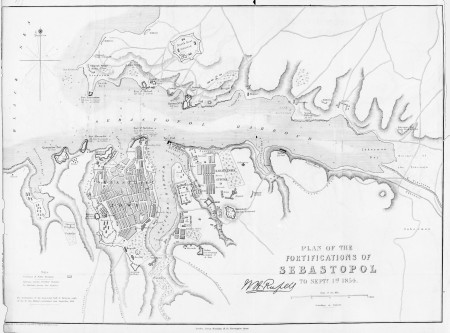
PLAN OF THE FORTIFICATIONS OF SEBASTOPOL TO SEPT 1st 1854.
A DISORDERLY MARCH.
As it had been ascertained by reconnaissance that the enemy had batteries along the north-west of the harbour of Sebastopol, in conjunction with the Star Fort and Fort Constantine, which would cause loss in an attempt to invest the town on that face, it occurred to Sir John Burgoyne that a flank movement on Balaklava would turn and neutralize the batteries, secure a new base of operations (of which, we were in want, having abandoned that of the Katcha), and distract the enemy, who would find the weakest part of Sebastopol exposed to the fire of our batteries, and our attacks directed against a point where they had least reason to expect it, and which they might have imagined free from all assault. The whole army marched towards the south-east, on the Black River, and as they were obliged to pass through a thickly-wooded country, intersected by narrow lanes winding up and down the hills, the troops were in some disorder, and had the enemy possessed the smallest enterprise they might have inflicted severe loss and annoyance by a spirited attack on our flank. This operation they at one time contemplated, but they dreaded the result of a second defeat.
At times, from the top of the hills, the town, with its white houses shining in the sun, could plainly be seen. All the afternoon the steamers effected a diversion by shelling the Star Fort and Fort Constantine, but at such a long range they could do but little execution; however, the fire had the effect of engaging the attention of the Russians. They did not make the smallest attempt to interrupt our progress. In the course of our march the baggage was sent too far to the left, and became involved in the line of the French and Turkish troops, who were marching on our flanks. Lord Raglan and his staff rode on (as was their wont) in advance, and reconnoitred Sebastopol. They were close to the north-east fort; but no shot was fired at them, notwithstanding that they were within range.
The works which commanded the mouth of the Belbek were inconsiderable, and could easily have been silenced by the fleet. An eyewitness, who served in the Russian army, states that all the troops, as they arrived in at the south side on the 20th and 21st, crossed to the south-west, except the Taioutine regiment. Such a movement would make it appear that the Russians expected a descent upon the south side, or were prepared to hold that side against the north, in case the Allies seized upon the Sievernaya and the northern forts. The only preparation made for the defence of the Sievernaya on the 22nd was as follows:—The Taioutine regiment, four battalions; the four depôt battalions of the 13th Division, and one battalion of sailors, in all about 6,000 men, were placed to garrison the work, which was in a very bad state and badly armed. They received orders to retire by a subterranean passage 4,000 feet long to the sea-side, in case the enemy should attack with vigour. On the 23rd, finding they were not pressed or pursued, the Russians pushed twelve battalions, two field batteries, and a regiment of cavalry, to the Belbek, and at one time seemed to have contemplated a demonstration against our flank. This, however, they abandoned; and on the 24th they turned their attention to the defence of the bridge across the Tchernaya, at Inkerman, on which they brought to bear four field and four siege guns, and the troops which had been on the Belbek, and the 16th Division, the cavalry part of the 14th Division, &c., moved across the Tchernaya by the Traktir bridge, and ascended to Mackenzie's farm, whence on the morning of the 25th they descended to Otoukoi, on the Belbek, and marched to Bakschiserai to await the course of events, being joined there by Prince Gortschakoff, with the rest of the Russian army of the Alma. The troops left in Sebastopol, exclusive of the equipages of the fleet, were four battalions of the reserve of the 13th Division, which had suffered severely at the Alma, four depôt battalions of the 13th Division, and third battalion of the Taioutine regiment, in all nine weak battalions.
All the Russian officers with whom I have conversed—all the testimony I have heard or read, coincide on these two points—first, that if on the 25th we had moved to Bakschiserai in pursuit of the Russians, we should have found their army in a state of the most complete demoralisation, and might have forced the great majority of them to surrender as prisoners of war in a sort of cul de sac, from which but few could have escaped. Secondly, that had we advanced directly against Sebastopol, the town would have surrendered after some slight show of resistance to save the honour of the officers. The deduction from these propositions is that the flank march was the certain precursor of a long siege, of bloody battles and great losses; was an evidence of diffidence, and at the same time of boldness which, though favoured by fortune in its execution, was scarcely justifiable in a military sense, and was an abandonment of the original character of the expedition.
And here I may be permitted to remark, that the statement in the letters (of a Staff-officer) "from Head-quarters," page 224, to the effect that Lord Lyons could not have disapproved of the flank march because he was not present when Sir John Burgoyne proposed it, and that his manner, when he received Lord Raglan at Balaklava, "proved he highly admired" that movement, is calculated to lead to very erroneous impressions in the minds of those who attach any weight to the assertions of that officer. Lord Lyons, when he heard of the flank march, expressed his disapproval of it, and when he met Lord Raglan, he (as I heard from his own lips) told his lordship that he conceived the flank march to be a departure from the spirit in which the expedition was undertaken, and said, "This is strategy, but we are in no condition for strategical operation. We came here for a coup-de-main, but this is strategy!" The effects of that march are now matters beyond argument, and we can only weigh probable results against events—a very difficult equation. Whatever may be the opinions of civilians or military men respecting the flank march, it is certain that to Sir John Burgoyne belongs the credit of originating the idea at the conference which took place between the generals on the Belbek.
A DANGEROUS EXAMPLE.
On the day of our march from the Katcha I was struck down by fever, fell from my pony into the stream where he was drinking, and was placed by one of the staff surgeons in a jolting araba carrying a part of the baggage of the Light Division, with poor Hughes of the 23rd Regiment, one of the finest men in the British army, who died in the course of the winter. The sun was exceedingly powerful, and when from the top of a wooded hill we saw the delicious valley of the Belbek studded with little snow-white cottages, with stately villas, with cosy snug-looking hamlets buried in trees, and fringed with a continuous line of the most gloriously green vineyards, and the noblest orchards of fruit-trees, there was a murmur of delight throughout the army, the men, precipitating themselves down the steep slopes of the hill-sides, soon swarmed in every garden, and clustered in destructive swarms around every bush. Their halt was, however, a short one.
The word was given to push over the stream, and its bright waters were soon denied by the tramp of many feet. Just as the araba in which I lay was passing by a beautiful little chateau, said to belong to a Russian general, I saw a stream of soldiers issue from it, laden with incongruous, but at the same time the richest, spoils; others were engaged inside, breaking the glasses, throwing mirrors, pictures, and furniture out of the open frames. I learned from an officer who was standing by that the soldiers had not done the smallest mischief till they saw a staff-officer take a bronze statuette out of the house and ride away with it, whereupon the cry arose, "Let us plunder too if our officer sets the example." I could not help thinking what would have been the fate of that officer if he had served under our great Duke.
At the other side of the valley of the Belbek the hill-sides are exceedingly steep, and were covered with dwarf wood and undergrowth of bushes. It was with difficulty the waggons were urged up the rugged and narrow paths. Lord Raglan occupied one of the plundered villas, near the only bridge the Russians had left across the stream. There was very great confusion in getting the men into their places on this wooded and steep ridge of hills intersected with ravines, and it was long after sunset ere the men finally settled down at their bivouac fires. They had not eaten their scrambling and very heterogeneous suppers, and laid down to rest more than a few hours, when (about 1.30 in the morning) the report of a gun on the hills towards our right woke up the allied armies. The bugles at once sounded, the men stood to their arms, but all was silent. It appeared that the French vedettes saw some Cossacks in their front, and fell back on a picket who were bivouacing by a large fire, when the enemy opened upon them at a long range, either from some of the earthworks of the north side or from field-pieces. The shot whizzed high over head, and one of them passed over the English head-quarters, but as the vedettes reported all quiet in front soon afterwards, the troops piled arms and lay down to sleep again. Cholera was much on the increase, and many fell sick or died during the night.
On Monday morning, the 25th, our troops were under arms at 5.30 A.M.; at seven Lord Raglan, Sir John Burgoyne, and other staff officers proceeded to the French head-quarters, to decide on the course to be pursued in the forthcoming attack on Sebastopol. Marshal St. Arnaud was very unwell, but if M. de Bazancourt is to be credited, he was able to write very unjust entries in his journal, and to speak in a tone of egotistical confidence which his situation rendered painful, and which but for that would have been ridiculous. He says, under the head of the 25th, "The English ought to start first, and do not move till nine o'clock." He must have known that till after nine o'clock it was not decided what course the troops were to take. Again, he speaks of himself as the sole leader, at a time when he had all but resigned the command. "Je les battrai," &c., on the very day when he was obliged to be carried from his tent in Prince Menschikoff's carriage. At the conferences, the French proposed to force the Inkerman bridge across the Tchernaya, and to make a push at the town. Sir John Burgoyne proposed that we should cross the stream by the bridge, at a place called Traktir, or "Restaurant," near Tchorguna, and by his representations carried the majority of those present with him, as he adduced strong reasons for seizing Balaklava, Kamiesch, and Kazatch, which were as much appreciated by our allies as by the English. It was therefore decided that the armies should continue their march on the ridge between the Belbek and the Tchernaya.
Our march was by different routes, the artillery proceeding by a difficult road, which allowed only one horseman to ride by the side of each gun. The Duke of Cambridge's baggage was actually within gunshot of Sebastopol for a quarter of an hour. As Lord Raglan was riding on in front of his staff he found himself, on emerging from a wooded road on the open space in front, in the immediate presence of a body of Russian infantry, which turned out to be the baggage guard of a large detachment of the Russian army marching from Sebastopol to Bakschiserai. They were not more than a few hundred yards distant. Lord Raglan turned his horse, and quietly cantered back to the rear of the first division of Artillery. The cavalry, consisting of a portion of the 11th and 8th Hussars, were quickly got in front—the guns were unlimbered and opened on the retreating mass of Russians; the 2nd battalion of Rifles in skirmishing order threw in a volley, the cavalry executed a charge, and the Russians broke and fled, leaving behind them an enormous quantity of baggage of every description. The enemy were pursued two or three miles on the road to Bakschiserai, but they fled so precipitately the cavalry could not come up with them.
The troops were halted and allowed to take what they liked. They broke open the carts and tumbled out the contents on the road; but the pillage was conducted with regularity, and the officers presided over it to see that there was no squabbling, and that no man took more than his share. Immense quantities of wearing apparel, of boots, shirts, coats, dressing cases, valuable ornaments, and some jewellery were found in the baggage carts, as well as a military chest containing some money (there are people who say it held 3000l.). A Russian artillery officer was found in one of the carriages, in a very jovial mood. Plenty of champagne was discovered among the baggage, and served to cheer the captors during their cold bivouac that night. A number of handsome hussar jackets, richly laced with silver, and made of fine light-blue cloth, which had never been worn, were also taken, and sold by the soldiers for sums varying from 20s. to 30s. a-piece. Fine large winter cloaks of cloth, lined with rich furs, were found in abundance.
A LAND-LOCKED BAY.
This plunder put the soldiers in good humour, and they marched the whole day, leaving Sebastopol on their right, till they arrived at the little hamlet of Traktir, on the Tchernaya or Black River, just before sunset, and halted for the night. As the baggage was separated from the bulk of the army by the distance of some miles, Lord Raglan was fain to put up in a miserable lodge for the night, while the bulk of his staff slept on the ground in a ditch outside it. Not the smallest attempt was made by the enemy to interrupt or annoy us during this very remarkable march, which could at any time have been greatly harassed by the least activity on the part of the Russians. Continuing our advance early next morning, we crossed the Tchernaya, and proceeded across the plains to Balaklava.
He was a bold mariner who first ventured in here, and keen-eyed too. I never was more astonished in my life than when on the morning of Tuesday, Sept. 26th, I halted on the top of one of the numerous hills of which this portion of the Crimea is composed, and looking down saw under my feet a little pond, closely compressed by the sides of high rocky mountains; on it floated some six or seven English ships, for which exit seemed quite hopeless. The bay is like a highland tarn, and it is long ere the eye admits that it is some half mile in length from the sea, and varies from 250 to 120 yards in breadth. The shores are so steep and precipitous that they shut out the expanse of the harbour, and make it appear much smaller than it really is. Towards the sea the cliffs close up and completely overlap the narrow channel which leads to the haven, so that it is quite invisible. On the south-east of the poor village, which struggles for existence between the base of the rocky hills and the margin of the sea, are the extensive ruins of a Genoese fort, built some 200 feet above the level of the sea. It must have once been a large and important position, and its curtains, bastions, towers, and walls, all destroyed and crumbling in decay though they are, evince the spirit and enterprise of the hardy seamen who penetrated these classic recesses so long ago. There may be doubts whether the Genoese built it, but there can be none that it is very old, and superior in workmanship to the edifices of the Turks or Tartars.
The staff advanced first on the town, and were proceeding to enter it, when, to their surprise, from the old forts above came four spirts of smoke in rapid succession, and down came four shells into the ground close to them; but by this time the Agamemnon, outside the rocks, was heard. The Rifles and some of the Light Division opened fire, and the fort hung out a flag of truce. The Commandant had only sixty men, and they were all made prisoners. On being asked why he fired from a position which he must have known to be untenable, he replied that he did so in order that he might be summoned, and that he felt bound to fire till required to surrender.
Lord Raglan entered about twelve o'clock in the day. As he approached the inhabitants came out to meet him, bearing trays laden with fruit and flowers. Some of them bore loaves of bread cut up in pieces, and placed on dishes covered with salt, in token of goodwill and submission. Towards evening, the Agamemnon glided in between the rocks in the narrow harbour, and anchored opposite the house of the General, whom Sir E. Lyons speedily visited. The fleet and army were thus once more united, and Lord Raglan had secured his base of operations.
Our cavalry in the afternoon took Mr. Upton, son of the English engineer who constructed so many useful works at Sebastopol. He was captured on his farm, and was taken before Lord Raglan, but refused to give any information respecting the Russians, as he said he could not reconcile it to his notions of honour to injure a Government in whose military service he had been.
All the hills around were barren rock; towards the land they became more fertile, and for a mile towards Sebastopol and Simpheropol were studded with pleasant-looking white villas and farmhouses, principally inhabited by Russian officials from Sebastopol.
The lighthouse of Cape Cherson fell into our hands, and was lighted up by English sailors. The Russians had left it in darkness, but a party of blue-jackets dashed at it on the 26th of September, and compelled the Russian lighthouse-keeper to illuminate it. Jack was in great delight at this. The Firebrand and Sanspareil landed 1000 sailors from the fleet on the 1st of October. They were placed under canvas at the head of the Bay of Balaklava. One thousand marines garrisoned the heights above the town, and the First Division, liberated by their presence, moved on in advance, and supported the Fourth Division. The Turks encamped at the rear and to the right of our Third Division.
The Australian, Sidney, and Gertrude, with the heavy artillery and siege train, came in on the 27th, and proceeded to disembark their heavy guns at a pier which was repaired by the 3rd company of Sappers. The 4th and 2nd Divisions were pushed on towards the south-west side of Sebastopol, and encamped on ridges about two miles from the city, separated from each other by a ravine, which commences near Balaklava and runs nearly to the head of the creek of Sebastopol. The city was quite visible below. Across the north of the harbour, near the most easterly of the creeks, was placed a two-decker, painted so as to look like a three-decker, with springs on her cable, and her broadside turned towards our position. On the northern side a large circular work, with three tiers of guns—Fort Constantine—was visible, and more inland there was another large fortification, called the "Star Fort." On the near side was a very large fortification, with curtains, running inland, a semi-circular bastion, and some rudimentary earthworks—all outside the town. Lord Raglan and staff rode out and made a reconnaissance. A frigate, anchored inside the two-decker, near the end of the creek, amused herself by firing round shot and shell, but did no damage. The French landed their guns at Kamiesch and Khazatchel.
The cholera, which never left us, made many victims. Colonel Beckwith (1st battalion Rifles), Captain Cox (Grenadier Guards), Colonel Hoey (30th Regiment), Dr. Mackay, Lieutenant Grant (79th), the Rev. Mr. Mockler, and others, were among the number.