автордың кітабын онлайн тегін оқу The Capitals of Spanish America
Contents.
Index:A, B, C, D, E, F, G, H, I, J, K, L, M, N, O, P, Q, R, S, T, U, V, W, Y.
Some typographical errors have been corrected; a list follows the text.
List of Illustrations
(In certain versions of this etext [in certain browsers] clicking on this symbol

(etext transcriber's note)
THE CAPITALS
OF
SPANISH AMERICA
BY
WILLIAM ELEROY CURTIS
LATE COMMISSIONER FROM THE UNITED STATES TO THE GOVERNMENTS OF
CENTRAL AND SOUTH AMERICA
ILLUSTRATED
NEW YORK
HARPER & BROTHERS, FRANKLIN SQUARE
Copyright, 1888, by Harper & Brothers.
All rights reserved.
TO
THE MEMORY OF
CHESTER ALAN ARTHUR
TWENTY-FIRST PRESIDENT OF THE UNITED STATES
THIS BOOK IS
Dedicated
HIS KINDNESS MADE ITS PUBLICATION POSSIBLE; AND HIS
AFFECTIONATE INTEREST ADDED PLEASURE TO ITS PREPARATION
Mr. Arthur’s Acceptance of the Dedication.
New York, April 7, 1887.
William E. Curtis, Esquire, Washington:
Dear Sir,—In compliance with your request, I enclose an unsigned draft of a letter dictated by Mr. Arthur last November. It was submitted to him a few days before he died, and as he desired to make no further changes in the text, I was to have a clean copy made for his signature; but he was fatally stricken before that was done.
Very respectfully yours,
James C. Reed.
November 13, 1886.
My dear Curtis,—The graceful terms in which you propose to dedicate your book to me add still another obligation that I may not be able to repay.
I appointed you Secretary of the South American Commission without your solicitation, because I knew your ability, energy, and industry would be felt as they have been in the effort to bring our Spanish-American neighbors into closer commercial and political relations with us.
I had given much consideration to the subject, and realized what is made so clear in the Reports of the South American Commission, that the future commercial prosperity of the United States required something to be done to extend our trade with the continent southward. The Commission, of which you were Secretary and subsequently became a member, was intended as an initiatory step in that direction.
In my judgment, it is not only the duty of the United States to encourage and assist our merchants and manufacturers in the expansion of their foreign trade, by seeking new markets and furnishing facilities for reaching them, but there is a higher achievement in promoting the welfare of our sister republics through the consistent exercise of every friendly office tending to secure their peaceable development and national prosperity.
I am sure your “The Capitals of Spanish America” will furnish our own people with trustworthy and late news about our neighbors to the southward, and that your graphic pen will make the book as interesting as it is instructive. I shall await its publication with very deep interest.
If my strength permits, it will give me great pleasure to act upon your suggestion,[A] but just now I am hardly equal to the demands of my private correspondence. With cordial regard,
I am faithfully yours,
—————
To William E. Curtis,
Washington, D. C.
[A] To write an Introduction to this volume.
CONTENTS.
PAGE MEXICO. The Capital of Mexico 1 GUATEMALA CITY. The Capital of Guatemala 60 COMAYAGUA. The Capital of Honduras 114 MANAGUA. The Capital of Nicaragua 138 SAN SALVADOR. The Capital of San Salvador 171 SAN JOSÉ. The Capital of Costa Rica 196 BOGOTA. The Capital of Colombia 225 CARACAS. The Capital of Venezuela 257 QUITO. The Capital of Ecuador 298 LIMA. The Capital of Peru 355 LA PAZ DE AYACUCHO. The Capital of Bolivia 416 SANTIAGO. The Capital of Chili 454 PATAGONIA 516 BUENOS AYRES. The Capital of the Argentine Republic 542 MONTEVIDEO. The Capital of Uruguay 591 ASUNCION. The Capital of Paraguay 623 RIO DE JANEIRO. The Capital of Brazil 660 INDEX:
A, B, C, D, E, F, G, H, I, J, K, L, M, N, O, P, Q, R, S, T, U, V, W, Y. 707ILLUSTRATIONS.
[A] To write an Introduction to this volume.
If my strength permits, it will give me great pleasure to act upon your suggestion,[A] but just now I am hardly equal to the demands of my private correspondence. With cordial regard,
Señor Sinibaldi, the Vice-president of the republic, called the Congress together, and a new election was ordered, at which Señor Barrillas, a man of excellent ability and wise discretion, was chosen President of the republic.
in conversation. Before Morazan was of age he was prominent in Honduras, and became the governor of the city in 1824, when he was but twenty-five. For fourteen years thereafter his career was one of singular activity and success, and the people of the entire continent followed him with feelings akin to idolatry. He was so far ahead of them in ideas and enterprise that his counsels were not followed, and he was overthrown by a combination of priests, who took up a cruel Indian of Guatemala named Rafael Carera, and succeeded in overthrowing the power of Morazan, not only in Honduras, but throughout the entire confederacy. The patriot and liberator was afterwards assassinated at Cartago, Costa Rica, by men whom he trusted as his friends.
Since the charter of the Interoceanic Canal Company by the Congress of the United States, and the actual commencement of work upon the long-projected enterprise, under the direction of Chief-engineer Menocal, the republic of Nicaragua assumes a position of more prominence among nations, and of greater interest to the public at large, than it has ever had before. The failure of the Panama Canal Company, and the apparent impossibility of piercing the Isthmus at its narrowest part, has also given the Nicaragua Company increased importance, but Mr. Menocal and the company of capitalists who stand behind him feel no doubt of ultimate success.
There is one railroad in San Salvador, extending from Acajutla to the city of Sonsonate, the centre of the sugar district, and it is being extended to Santa Ana, the chief town of the Northern Province. It is owned by a native capitalist, and operated under the management of an American engineer. The plan is to extend the track parallel with the sea through the entire republic, in the valley back of the mountain range, with branches through the passes to the principal cities. It now passes two-thirds of the distance around the base of the volcano Yzalco, and from the cars is furnished a most remarkable view of that sublime spectacle. The entire system when completed will not consist of more than two hundred and fifty miles of track, and the work of construction is neither difficult nor expensive.
The extreme ultramontanism of Dr. Nuñez awakened a series of revolutions, and resulted in his abdication of the Presidency; his successor being Dr. Holguin, one of the most prominent and learned leaders of the Clerical party, who has spent his life in Congress, in the executive departments of the Government, and in the diplomatic service.
South of Curaçoa is Maracaibo, with its curious lake, in which are towns built upon stilts, that give the name of Venezuela, or Little Venice, to this land. The explorers, like tourists of modern times, were given to tracing resemblances in America to what they were familiar with in Europe, and they imagined these huts rising on piles above the water looked like the city of canals and gondolas. But there is no more resemblance to Venice than to Chicago, and the name of Venezuela, like that of the continent, is a falsehood which the world has allowed to stand uncontradicted.
arrived upon the dock there was a group to illustrate the cosmopolitan character of the citizens. A Chinaman, an Arab, a negro, and a Frenchman were sitting upon a box, while around them were clustered Spaniards, Englishmen, Irishmen, Germans, and Italians. The city is irregular and shabby-looking, but has been a place of great wealth. Millions after millions of dollars’ worth of silver have been shipped from here by the Spaniards—silver stolen from the temples of the Incas, or dug from the mines which they operated before the Spaniards came. It was here that the old buccaneers used to rendezvous and waylay the galleons on their way to Spain. Of recent years the importance of Callao has very much decreased. A constant succession of wars and revolutions in Peru has destroyed its commerce; and although there is usually a great deal of shipping in the harbor, the present amount of trade is below that of the past. There are two lines of railroad to Lima, the capital of the republic, which lies six miles up in the foot-hills of the Andes.
The most curious things in Peru are the mummies’ eyes—petrified eyeballs—which are usually to be found in the graves, if one is careful in digging. The Incas had a way of preserving the eyes of the dead from decay, some process which modern science cannot comprehend, and the eyeballs make very pretty settings for pins. They are yellow, and hold light like an opal. It is an accepted theory among scientists, however, that before the burial of their mummies the Incas replaced the natural eye with that of the squid, or cuttle-fish, and that these beautiful things are shams.
No one ever goes to Juan Fernandez without bringing away rocks and sticks as relics of the place. There is a very fine sort of wood peculiar to the island which makes beautiful canes, as it has a rare grain and polishes well.
The journey on mule-back usually takes five days of travel, at the rate of twenty or thirty miles a day, but good riders, with relays of mules, often make it in three days. The whole route is historical, as it has been in use for centuries. There is scarcely a mile without some romantic association, not a rock without its incident; and tradition, incident, and romance line the path from end to end. The Incas used the path before the Spaniards conquered the country, and Don Diego de Almagro crossed it in 1535 as he passed southward to Chili after the conquest of Peru.
birds have the advantage of being “artful dodgers,” and as they carry so much less weight, can turn and reverse quite suddenly. The usual mode of hunting them is for a dozen or so Indians to surround a herd and charge upon it suddenly. In this way several are usually brought down before they can scatter, and those that get away are pursued. As they dodge from one hunter they usually run afoul of another, and before they are aware they are tripped by the entangling bolas. People who are passing through the strait often stop over and await another steamer at Punta Arenas to enjoy an ostrich chase. They can secure trained horses and guides at moderate rates. One who has never thrown the bolas will be amazed, the first time he tries it, to find how difficult it is to do a trick that looks so easy.
There is a curious story about an island in the River Plata which was a horse ranch in early Spanish times. The animals became so numerous that there was not grass enough to feed them, and no demand for their export. The owners decided to reduce their stock in a barbarous way, and when the grass was dry they set fire to it. Every horse on the island was burned to death except those that ran into the river and were drowned. The stench was so great that navigation was almost entirely suspended on the river. The result of this method of reducing stock was a little more complete than the owners anticipated, so when the grass grew up again they had to buy stallions and mares and start anew. Singularly enough, every animal placed on the island since that fire has died of a mysterious disease, and no colt has been foaled there for one hundred and fifty years. Various breeds of stock have been tried, but never a hoof has left the island alive. Three months there finishes them. The island was unoccupied for fifty or sixty years, but is now used as a cattle ranch, and horned stock do not appear to be subject to the mysterious malady.
It is not generally known that “Liebig’s Extract of Beef,” which, like quinine, is a standard tonic throughout the world, and is used by every physician, in every hospital, on every ship, and in every army, is a product of Uruguay. The cans in which it comes are labelled as if their contents were manufactured at Antwerp, where the original extract was invented by Professor Liebig, the famous German chemist, and the preparation was formerly made there; but in 1866, the patent having passed into the control of an English company, the works were removed to Uruguay, where cattle are cheaper than elsewhere, and the entire supply is now produced at a place called Fray Bentos, about one hundred and seventy miles above Montevideo, on the Uruguay River, whence it is shipped in bulk to London and Antwerp, where it is packed in small tins for the market. An attempt was made to do the packing in Uruguay, but the Government of that republic imposed so high a tariff upon the tins that the scheme was abandoned. The chemical process by which the juice of the beef is extracted and mixed with the blood of the animal is supposed to be a secret, but as the patent has long since expired, it could be easily discovered, and thus the manufacture of an almost necessary article would become general.
The number of horned cattle in Paraguay is now estimated at six hundred thousand, and there is said to be pasturage for several million within the limits of the republic, and an unlimited area in El Gran Chaco beyond the timber regions on a plain similar to New Mexico, rising in great terraces or steppes to the foot-hills of the Andes. The elevation of this area above the sea is from four to eight thousand feet, and although it borders upon the tropics, it is said to be an excellent range, and the ranchmen of the Argentine Republic are contemplating it with covetous eyes. No industry pays so well in Paraguay as cattle-raising. The severe frosts and droughts which at times annoy the ranchmen of the Argentine Republic are unknown there; the streams are numerous and perennial, the cattle fatten quicker, attain greater weight, and afford a better quality of beef, owing to the nutritious grass and abundance of water. Young cattle, as before stated, may be bought in the Argentine Republic and transported by river steamer to Paraguay for twelve or thirteen dollars per head, and land can be purchased at about twenty cents an acre from the Government.
There are a great many Germans going into the country, forming colonies in the interior, opening up sugar plantations, planting coffee, gathering rubber, and engaging in all sorts of agricultural employment; but the climate is so enervating that after an experience of two years the German colonist will be found by his Portuguese predecessor sitting in the shade of the fig-tree and hiring a negro to do his work. Everywhere in hot climates the people become enervated, and Brazil will scarcely form an exception to other countries in the same latitude. In the more southern provinces and on the higher levels white colonists may succeed if there is nothing but climatic differences to oppose them. There has been a small number of immigrants from the United States to the southern provinces of Brazil; and after the war a great many Confederates flooded in there for the purpose of establishing plantations and raising sugar and coffee, but their success has not been great. Most of the colonies have broken up, and the members have been scattered over different parts of the country. Some engage in one undertaking, some in another, but many have succumbed to the influences of the climate and died of fever.
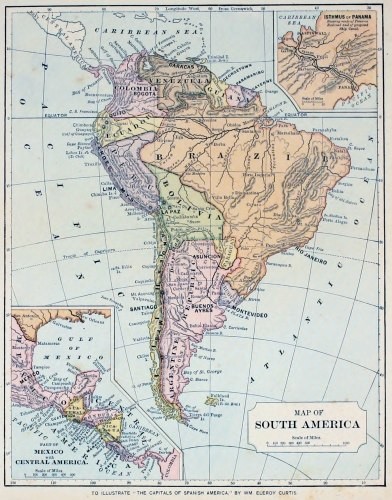
Map of South America Frontispiece. PAGE
It was used in the Days of Moses
2A Water-carrier
3Ruins of the Covered Way to the Inquisition
4Mexican Muleteer
5Shops
6Castle of Chapultepec
7Tile Front
9The Tree of Montezuma
10Prince Yturbide
11General Grant on a Banana Plantation
15Church of Guadalupe
19Iztaccihuatl
20Ex-President Gonzales
22President Porfirio Diaz
23The Dome
25San Cosme Aqueduct, City of Mexico
27The Palace of Mexico
29The Cathedral, City of Mexico
33Styles of Architecture
35A Mexican Caballero
38Noche Triste Tree
41The Picadors
45Teasing the Bull
45The Encore
46Mexican Beggar
48On Market-day
51Sunday at Santa Anita
53A Mexican Belle
54Cactus, and Woman kneading Tortillas
55First Protestant Church in Mexico
57The first Christian Pulpit in America—Tlaxcala
58Font in old Church of San Francisco
59View of Guatemala City
61Ruins of the old Palace at Antigua Guatemala
65Alvarado’s Tree
69Ancient Arches
70The Old and the New
71How the Old Town looks now
73Fragment of a Ruined Monastery
74José Rufino Barrios
75Francisco Morazan
77Church of San Francesca, Guatemala la Antigua
79One of fifty-seven Ruined Monasteries
81Façade of an old Church
83A Remnant
85Fort of San José, Guatemala
87Yniensi Gate, Guatemala
89A Volcanic Lake
91On the Road to the Capital
93Tiled House-tops
99Market-place, Guatemala
101In the Rainy Season
102Maguey Plant
103A Native Sandal
107Ornamental, but noisy
109A Conspicuous Landmark
115The Trail to the Capital
116A Glimpse of the Interior
117View of the Capital
118A Popular Thoroughfare
119Church of Merced and Independence Monument, Comayagua
120Rubber Hunters
121The Pita Plant
122Harvesting one of the Staples
123The Floating Population
124Branch of the Rubber-tree
125A Modern Town
126Up the River
127A Mining Settlement
128View in Nicaragua
129An Interior Plain
130One of the Back Streets
132Plaza of Tegucigalpa
133Making Tortillas
134Indigo Works
135The Tlachiguero
136View of Lake from Beach at Managua
139Corinto
140Hide-covered Cart
141An Interior Town
143The Indigo Plant
144The King of the Mosquitoes
145A Mahogany Swamp
148Internal Commerce
149How the Peons live
150A Familiar Scene
152A Country Chapel
153The United States Consulate
154Cathedral of St. Peter, Leon
155The Pacific Coast of Nicaragua
158Antics on the Bridge
159In the Upper Zone
161Volcanoes of Axusco and Momotombo, from the Cathedral
162Volcano of Cosequina, from the Sea
163La Union and Volcano of Conchagna
164The Fate of Filibusters
165A Farming Settlement
167The Quesal
168Landing at La Libertad
173En Route to the Interior
175The Peak of San Salvador
177The Plaza
179Spanish-American Courtship
180A Hacienda
182Interior of a San Salvador House
183A Typical Town
185What alarms the Citizens
186Yzalco from a Distance
189Yzalco
191In the Interior
193Hauling Sugar-cane
194Crater of a Volcano
197Rubber-trees
199The Road from Port Limon to San José
201A Peon
203A Banana Plantation
206Picking Coffee
209The Marimba
215Coffee-drying
217Don Bernardo de Soto, President of Costa Rica
222Barranquilla
226Carthagena
227Entrance to the Old Fortress, Carthagena
230Colombian Military Men
233On the Magdalena
235Colombian ’Gators
237Vegetable Ivory Plant
239En Route to Bogota
241Sabana of Bogota
243Santa Fé de Bogota
245Monument in the Plaza of Los Martirs
246Plaza, and Statue of Bolivar
247Going to the Market
249A Caballero
250An Orchid
251Over the Mountains in a “Silla”
253Natural Bridge of Pandi, Colombia
255Don Rafael Nuñez, President
256Waiting for the New York Steamer
259In the Suburbs of La Guayra
261Still more Suburban
263On a Coffee Plantation
267On a Back Street
269Interior Court of a Caracas House
273Spanish Missionary Work
276Woman’s chief Occupation
277A Bodega
279A Glass of Aguardiente
281A Venezuela Belle
283The Lower Floor of the House
285An Old Patio
289Chocolate in the Rough
293Separating the Cocoa-beans
294Puerto Cabello
296Along the Coast
299The River at Guayaquil
301The River above Guayaquil
303An average Dwelling
304Guayaquil
305A Person of Influence
306A Family Circle
307Cathedral at Guayaquil, built of Bamboo
308A Commercial Thoroughfare
309The President’s Palace
310The Outskirts of Guayaquil
311A Business of Importance
312A Pineapple Farm
313A Water Merchant
314A Freight Train on the Way
315A Passenger Train
316The Common Carrier
317Hotel on the Route to Quito
318Waiting for the Mules to Feed
319En Route to the Sea
320Somewhere near the Summit
321The Altar
323A Street in Quito
324Where Pizarro first Landed
325Equipped for the Andes
327The Old Inca Trail
329A Typical Country Mansion
331A Wayside Shrine
332Charcoal Peddler
333Government Building at Quito
335Court of a Quito Dwelling
336What the Earthquakes left
338A Professional Beggar
339An Ecuador Belle
340A Hotel on the Coast
343Customs Officers
346A Home on the Coast
347Peruvian Soldier and Rabona
349Looking Seaward
352A Boatman on the Coast
354Lima and its Environs
356A Peruvian Interior
358Grand Plaza, Lima
363A Peruvian Chamber
366Interior of a Lima Dwelling
368A Peruvian Palace
369A Peruvian Belle
370Watching the Procession
371The Daughter of the Incas
373Ruins of the War
375Interior of the ordinary Sort of House
378A very Common Spectacle
379A Peruvian Milk-peddler
381Mindless of Care
383View of Cuzco and the Nevado
of Asungata from the Brow of the Sacsahuaman
389Between Battles, Balls
393A Warrior at Rest
397Gate-way to the Andes
399Henry Meiggs
402The Heart of the Andes
404An Inca Reminiscence
405Cowhide Bridge over the Rimac
407Inca Ruins of Unknown Age
408A Settlement of this Century
409A City of Four Centuries Ago
410A Bit of Inca Architecture
411Relic of a Past Civilization
412Ruins of the Temple of the Sun
413An Old Settler
414Fresh from the Tomb
414Where Peru’s Wealth came from
417A Peruvian Port
419The Old Trail
420Arequipa
421The Vicuña
424Lake Titicaca
425A Street in Cuzco
428Ruins of an Inca Temple
429Convent of Santa Domingo, Cuzco
430What the Spaniards left
431Where the Guano Lies
432A Nitrate Mining Town
433Guano Islands
435Across the Continent
437A Station on the Road
438Chasquis at Rest
440Chasquis Asleep in the Mountains
441A Bit of La Paz
442The Cathedral at La Paz
443An Ancient Bridge in La Paz
445A Bolivian Elevator
446A Bolivian Cavalryman
447A Home in the Andes
448Juan Fernandez
450Cumberland Bay
451Tablet to Alexander Selkirk
453The Harbor of Valparaiso
455Victoria Street, Valparaiso
459Santa Lucia
467The Zama-cuaca
469Exposition Building, Santiago
471Statue of Bernard O’Higgins, Santiago
474Patrick Lynch
475Peons of Chili
477The “Esmeralda”
481Inca Queen and Princess
485Señora Cousino
491A Belle of Chili dressed for Morning Mass
497A Solid Silver Spur
505Over the Andes
506Mount Aconcagua
507Uspallata Pass
509Caught in the Snow
511Road Cut in the Rocks
512A Station in the Mountains
513The Condor
515Cape Froward (Patagonia), Strait of Magellan
517Fuegians Visiting a Man-of-war
519A Fuegian Feast
521The Signs of Civilization
523Port Famine
526Starvation Beach
529Use of Lasso and Bolas
531In their Ostrich Robes
532A Patagonian Belle
533The Guanaco
539Patagonian Indians
541The Harbor, Buenos Ayres
542The City of Buenos Ayres
545Loading Cargo at Buenos Ayres
548Going Ashore at Buenos Ayres
549A Private Residence in Buenos Ayres
552The Colon Theatre, Buenos Ayres
554An Argentine Ranchman
564The Cathedral of Buenos Ayres
567The Gaucho
570General Rosas
573Palace of Don Manuel Rosas
575Map of the Argentine Republic
580Country Scene in the Argentine Republic
584Juarez Celman, President of the Argentine Republic
587The City of Montevideo, looking towards the Harbor
591Harbor of Montevideo
593Maximo Santos, of Uruguay
595One of the Old Streets
597Montevideo—the Ocean Side
603Scene in Montevideo
608Gaspar Francia, First President of Paraguay
624Street in Asuncion
625Lopez, the Tyrant
626After the War
627Asuncion, from the West
628Asuncion—the Palace and Cathedral
629Wreck of the Old Cathedral
631Station on the Asuncion Railway
633A Visit to the Spring
634The Paraguayans at Home
635Paraguay Flower-girl
636Remains of the Palace of Lopez
637Interior of the Lopez Palace
639The Cathedral, Asuncion
640Market-place at Asuncion
641A Paraguay Horseman
642Paraguay Belles
643Costumes of the Interior
644An Interior Town
645Home, Sweet Home
646The Mandioca
647Ox-cart on the Pampas
649Curing Yerba Mate
650A Siesta
651A Paraguay Hotel
653Native Pappoose and Cradle
654A Hacienda
655People of “El Gran Chaco”
656An Armadillo
657A Ranch on El Gran Chaco
658Bay of Rio de Janeiro
661A Street in Rio
662The City of Rio from the Bay
663Aqueduct at Rio
665The Avenue of Royal Palms—Rio
666The Prettiest Things in Brazil
667A Brazilian Hacienda
669The Old City Palace
671In the Suburbs
672Cottages in the Interior
673The Iguana
675A Brazilian Laundry
676A Country School
677Brazilian Country-house
679Up the River
681Dom Pedro II.
682On the Way to Petropolis
683The Empress of Brazil
685Dom Pedro’s Palace at Petropolis
687The Colored Saint
691Statue of Dom Pedro I.
693Carrying Coffee to the Steamer
696Market-place in Country Town
697“Sereno-o-o-o-o-o! Sereno-o-o-o-o-o!”
699Slave Quarters in the Country
702The Political Issue in Brazil
703Military Men
705The people are highly civilized in spots. Besides the most novel and recent product of modern science, one finds in use the crudest, rudest implement of antiquity. Types of four centuries can be seen in a single group in any of the plazas. Under the finest palaces, whose ceilings are frescoed by Italian artists, whose walls are covered with the rarest paintings, and shelter libraries selected with the choicest taste, one finds a common bodega, where the native drink is dealt out in gourds, and the peon stops to eat his tortilla. Women and men are seen carrying upon their heads enormous burdens through streets lighted by electricity, and stop to ask through a telephone where their load shall be delivered.
The correspondence of the Government is dictated to stenographers and transcribed upon type-writers; and every form of modern improvement for the purpose of economizing time and saving labor is given the opportunity of a test, even if it is not permanently adopted. There is no Government that gives greater encouragement to inventive genius than the administration of President Diaz, and it has been one of the highest aims of his official career to modernize Mexico. The twelve years from 1876, when he came into power, until 1889, when his third term commenced, may be reckoned the progressive age of our neighborly republic; but the common people are still prejudiced against innovations, and resist them. In all the public places, and at the entrance of the post-office, are men squatting upon the pavement, with an inkhorn and a pad of paper, whose business is to conduct the correspondence of those whose literary attainments are unequal to the task. Such odd things are still to be seen at the capital of a nation that subsidizes steamship lines and railways, and supports schools where all the modern languages and sciences are taught, and has a compulsory education law upon its statute-books. In the old Inquisition Building, where the bodies of Jews and heretics have been racked and roasted, is a medical college, sustained by the Government for the free education of all students whose attainments reach the standard of matriculation; and bones are now sawn asunder in the name of science instead of religion.
The political struggle in Mexico, since the independence of the Republic, has been, and will continue to be, between antiquated, bigoted, and despotic Romanism, allied with the ancient aristocracy, under whose encouragement Maximilian came, on the one hand, and the spirit of intellectual, industrial, commercial, and social progress on the other. The pendulum has swung backward and forward with irregularity for sixty years; every vibration has been registered in blood. All of the weight of Romish influence, intellectual, financial, and spiritual, has been employed to destroy the Republic and restore the Monarchy, while the Liberal party has strangled the Church and stripped it of every possession. Both factions have fought under a black flag, and the war has been as cruel and vindictive on one side as upon the other; but the result is apparent and permanent.
No priest dare wear a cassock in the streets of Mexico; the confessional is public, parish schools are prohibited, and although the clergy still exercise a powerful influence among the common people, whose superstitious ignorance has not yet been reached by the free schools and compulsory education law, in politics they are powerless. The old clerical party, the Spanish aristocracy, whose forefathers came over after the Conquest, and reluctantly surrendered to Indian domination when the Viceroys were driven out and the Republic established, have given up the struggle, and will probably never attempt to renew it. They were responsible for the tragic episode of Maximilian, and still regret the failure to restore the Monarchy. The Aztecs sit again upon the throne of Mexico, after an interval of three hundred and fifty years, and the men whose minds direct the affairs of the Republic have tawny skins and straight black hair.
The beautiful castle of Chapultepec, which was dismantled during the last revolution, but has been restored and fitted up as a beautiful suburban retreat for the Presidents of Mexico, was occupied by Maximilian and Carlotta in imitation of the Montezumas, whose palace stood upon the rocky eminence. Around the place is a grove of monstrous cypress-trees, whose age is numbered by the centuries, and whose girth measures from thirty to fifty feet. It is the finest assemblage of arborial monarchs on the continent, and sheltered imperial power hundreds of years before Columbus set his westward sails. Before the Hemisphere was known or thought of, here stood a gorgeous palace, and its foundations still endure. Here the rigid ceremonial etiquette of Aztec imperialism was enforced, and human sacrifice was made to invoke the favor of the Sun.
The acknowledged heir to the throne of Mexico is young
Augustin Yturbide, according to the feelings of the few and feeble remnants of the Monarchical party; but it may be said to the young man’s credit that he entirely repudiates their homage, although he is the heir to two brief and ill-starred dynasties. He is the grandson of the Emperor Augustin Yturbide, and the adopted heir of Maximilian and Carlotta. The Yturbide they call “Emperor” was an officer in the Spanish army when Mexico was a colony, and during the revolution headed by the priest Hidalgo, in 1810, he fought on the side of the King. But, being dismissed from the army in 1816, he retired to seclusion, to remain until the movement of 1820, when he placed himself at the head of an irregular force, and captured a large sum of money that was being conveyed to the sea-coast. With these resources he promulgated what is known in history as “the plan of Iguala,” which proposed the organization of Mexico into an independent empire, and the election of a ruler by the people. The revolution was bloodless, and in May, 1822, Yturbide proclaimed himself Emperor, declared the crown hereditary, and established a court. He was formally crowned in the July following, but in December Santa Anna proclaimed the Republic, and after a brief and ignominious reign Yturbide left Mexico on May 11, 1822, just a year, lacking a week, from the date he assumed power. The Congress gave him a pension of $25,000 yearly, and required that he should live in Italy; but impelled by an insane desire to regain his crown, in May, 1824, he returned to Mexico, and was shot in the following July.
He left a son, Angel de Yturbide, who came to the United States with his mother, and was educated at the Jesuit College at Georgetown, District of Columbia, the Government having given them a liberal pension. There he fell in love
It created a sensation in Mexico when the pretty peon girl, Dolores Testa, was suddenly raised from abject poverty to affluence. The Dictator ordered all to address his bride as “Your Highness,” ladies-in-waiting were appointed in order to teach the bewildered little Dolores how to play her rôle in the great world, and then the President organized for her a body-guard of twenty-five military men, who were uniformed in white and gold, and were styled “los Guardias de la Alteza” (her Highness’s Body-guard). When the President’s wife attended the theatre these guards rode in advance of and at the sides of the coach, each bearing a lighted torch. During the performance they remained in the patio or foyer of the theatre, and then escorted her Highness back to the palace in the same order. Such was the power of General Santa Anna in those days that even the clergy bent before him; and when
This Guadalupe shrine is the most sacred spot in Mexico, and to it come, on the 12th of each December, the anniversary of the appearance of the Virgin, thousands upon thousands of pilgrims, bringing their sick and lame and blind to drink of the miraculous waters of a spring which the Virgin opened on the mountain-side to convince the sceptical shepherd of her divine power. The waters have a very strong taste of sulphur, and are said to be a potent remedy for diseases of the blood. In testimony of this the walls of the chapel, which is built over the spring, are covered with quaint, rudely written certificates of people who claim to have been miraculously cured by its use. In the cathedral are multitudes of other testimonials from people who have been preserved from death in danger by having appealed for protection to the Virgin of Guadalupe; but nowadays, instead of sending jewels and other articles of value as they did when the Church was able to protect its property, they hang up gaudily painted inscriptions reciting specifically the blessings they have received. On the crest of the hill is a massive shaft of stone, representing the main-mast of a ship with the yards out and sails spread. This was erected many years ago by a sea-captain who was caught in a storm at sea, and who made a vow to the Virgin that if she would bring him safe to land he would carry his main-mast and sails to Guadalupe, and raise them there as an evidence of his gratitude for her mercy. He fulfilled his vow, and within the double tiers of stone are the masts and canvas.
In the cathedral is the original blanket, or serape, which
I witnessed the inauguration of President Diaz on the 1st of December, 1884. The ceremonies, which were simple enough to satisfy the most critical of Democrats, took place in the handsome theatre erected in 1854, and named in honor of the Emperor Yturbide. It is now called the Chamber of Deputies, and is occupied by the lower branch of the National Legislature, a body of some two hundred and twenty-seven men. The Senate, composed of fifty-six members, meets in a long, narrow room in the old National Palace which was formerly used as a chapel by the Viceroys. The viceregal throne, a massive chair of carved and gilded rosewood, still stands upon a platform opposite the entrance, under a canopy of crimson velvet, but upon its crest is carved the American eagle, with a snake in its mouth, the emblem of Republican Mexico. Maximilian hung a golden crown over the eagle; Juarez tore it down and placed the broken sword of the Emperor in the talons of the bird. The Aztecs say that the founders of their empire, whose origin is lost in the mists of fable, were told to march on until they found an eagle sitting upon a cactus with a snake in its mouth, and there they should rest and build a great city. The bird and the bush were discovered in the valley that is shadowed by the twin volcanoes, and there the imperishable walls were laid which are now bidding farewell to their seventh century.
The old Theatre Yturbide has not been remodelled since it became the shelter of legislative power, and all the natural light it gets is filtered through the opaque panels of the dome, so that during the day sessions the Deputies are always in a state of partial eclipse. It is about as badly off for light as our own Congress. The members occupy comfortable arm-chairs in the parquet, arranged in semicircular rows. The presiding officer and the secretaries sit upon the stage, and at either side is a sort of pulpit from which formal addresses are made, although conversational debates are conducted from the floor. The orchestra circle and galleries are divided into boxes, and are reserved for spectators, but are seldom occupied, as the proceedings of the Congress are not regarded with much public interest.
In appearance the members will compare favorably with those of our Congress, and they are far in advance of the average State Legislature in ability and learning. The first features that strike a visitor familiar with legislative bodies in the United States is the decorum with which proceedings are conducted, and the scrupulous care with which every one is clothed. On certain formal occasions it is usual for all of the members to appear in evening dress, which gives the body the appearance of a social gathering rather than a legislative assembly. Nine-tenths of the members are white, and the other tenth show little trace of Aztec blood. There is never anything like confusion, and the laws of propriety are never transgressed. One hears no bad syntax or incorrect pronunciation in the speeches; no coarse language is used, and no wrangles ever occur like those which so often disgrace our own Congress. The statesmen never tilt their chairs back, nor lounge about the chamber; their feet are never raised upon the railings or desks; there is no letter-writing going on; the floor is never littered with scraps of paper; no spittoons are to be seen, and no conversation is permitted. Extreme dignity and decorum mark the proceedings, which are always short and silent, and the solemnity which prevails gives a funereal aspect to the scene.
The last days of the term of Gonzales were stormy. His attempt to secure certain unpopular financial legislation created great excitement, and the students of the universities, who numbered six or seven thousand, made a protest which would have ended in violence and assassination but for the overpowering military guard that surrounded the palace. The students would have resisted any attempt of Gonzales to prevent the inauguration of his successor, and kept up a demonstration against the existing Government until that event occurred.
But the excitement was not abated. The oath had been taken, but the outgoing administration by its absence from the ceremonies had intensified the anxiety lest the admission of Diaz to the Palace might be denied. Accompanied by a committee of Senators and an escort of cavalry. President Diaz drove half a mile to the Government building, and to his gratification the column of soldiers which was drawn up before the entrance opened to let him pass. The plaza which the building fronts was crowded with thousands of people, who announced the arrival of the new President by a deafening cheer, and the chimes of the old cathedral rang a melodious welcome.
Among the upper classes of Mexico will be found as high a degree of social and intellectual refinement as exists in Paris, as quick a reception and as cordial a response to all the sentiments that elevate society, and a knowledge of the arts and literature that few people of the busy cities of the United States have acquired.
The oddities of Mexican life and customs strike the tourist in a most forcible manner. The first thing he observes among the common people is that the men wear extremely large hats, and the women no hats at all. The ordinary sombrero costs fifteen dollars, while those bearing the handsome ornaments so universally popular run in price all the way from twenty-five to two hundred and fifty dollars. The Mexican invests all his surplus in his hat. Men whose wages are not more than twelve dollars a month often wear sombreros which represent a whole quarter’s income. A servant at the house of a friend was paid off one day for the three months his employer had been absent. He got forty-two dollars, of which he paid thirty-five dollars for a hat and gave seven dollars to his family.
Horseback riding is the national amusement, and the streets are full of horsemen, particularly in the cooler hours of the morning and evening. The proper thing to wear is a wide sombrero, very tight trousers of leather or cassimere, with rows of silver buttons up and down the outer seam, a handsomely embroidered velvet jacket, a scarlet sash, a sword, and two revolvers, not to mention spurs of marvellous size and design, and a saddle of surpassing magnificence. A Mexican caballero often spends one thousand dollars for an equestrian outfit. His saddle costs from fifty dollars to five hundred dollars, his sword fifty dollars, his silver-mounted bridle twenty-five dollars, his silver spurs as much more, the solid silver buttons on his trousers one hundred dollars, his hat fifty dollars, and the rest of his rig in proportion. The Mexican small boy, if he has wealthy parents, is mounted after a similar fashion, even to the revolver and sword. An equestrian costume for a boy of ten years can be purchased for about fifty dollars, not including saddle and bridle.
Pulque (pronounced poolkee) is the national drink, and is
A band of music played lively airs, and played them well, to entertain the people until the Governor came, whose presence being recognized, the people gave a cordial cheer by way of welcome. Then the herald in the Governor’s box blew a signal which sounded like the “water call” of the United
States Cavalry, the doors of the pit were opened, and in marched a dozen or so of matadors, in the same sort of jackets and breeches which they wear in the pictures of Spanish life so familiar to all. Each wore a plumed hat, a scarlet sash, a poniard, and the gold lace upon the black velvet showed their lithe and supple forms to advantage. They looked as Don Juan looks in the opera, while the leader, Bernardo Cavino, “del decano de los toreros,” I was a veritable Figaro, in appearance at least. Each carried a scarlet cloak upon his arm, and in the other hand a pikestaff. Behind them came a troop of eight horsemen upon gayly caparisoned steeds, with the usual amount of silver and leather trappings in which the Mexicans delight. The procession tailed up with a team of four mules hitched abreast, dragging a whiffletree and a long rope. These, we are told, were for the purpose of dragging out the dead. The cavalcade made a circuit of the amphitheatre, like the grand entrée at a circus, and upon reaching the Governor’s box stopped, saluted him, and received a short address in Spanish, which probably was simply one of approval and congratulation at their fine appearance. There was a rack in front of the Governor’s box upon which hung several rows of darts, gayly decorated with paper rosettes and paper fringes of gold and other brilliant tints. Upon these racks the matadors hung their plumed hats, and stood a while to give the ladies and gentlemen of the audience an opportunity to see and admire.
The bull having given up all idea of escape, plunges at everything he sees, and the second horse is ridden up before him. No attempt is made to get the animal out of the way. He was brought there to be slaughtered, and took his turn. Both horses having been disposed of, and the bull being completely exhausted, the bugle gives the signal, the matadors enter the arena, and tease him with their scarlet cloaks. At frequent intervals around the ring are placed heavy planks, behind which the matadors run for protection when they were pursued. The bull had no chance at all; he was there simply to be teased and killed by slow degrees. One matador more agile than the rest baits the animal with his lance, and when the bull turns upon him, vaults over the down-turned horns by resting his lance upon the ground. Then they bring out the ornamented darts, and thrust them into the bull’s hide. The animal jumps and plunges with pain, and tries to shake them off, but the barbs cling to the hide, and the more he struggles the farther they penetrate the flesh. His shoulders are covered with them, and the crimson blood trickles down his sides. He stands panting with distress, his tongue hanging out, and is thoroughly exhausted.
On Easter-Sunday the strangest of all Mexican ceremonies takes place in the burning of the traitor. During all Holy-week men are continually perambulating the streets, holding high above the heads of the multitude long poles encircled by hoops, upon which are suspended the most grotesque figures, in every conceivable color, shape, and degree of deformity, and all with horns and crooked backs and twisted limbs. These are filled with fire-crackers, the mustache forming the fuse, and millions of them are annually exploded. Many are life-size, some having faces to represent politicians who are unpopular at the time. Some are hung by the neck to wires stretched across the streets, or to the balconies of houses. Every horse-car and railroad engine and donkey-cart is decked with one, and even every mule-driver has one or more tied on his breast. At ten o’clock on Easter-Sunday, when the cathedral bells peal forth in commemoration of Christ’s resurrection, they are all touched off at once, and the air is filled with flying traitors everywhere over the length and breadth of Mexico.
An American who is married in Mexico finds that he must be three times married: twice in Spanish and once more in Spanish or English, as he prefers, besides having a public notice of his intention of marriage placed on a bulletin-board for twenty days before the ceremony. This is the law. The public notice can be avoided by the payment of a sum of money, but a residence of one month is necessary. The three ceremonies are the contract of marriage, the civil marriage—the only marriage recognized by law since 1858—and the usual, but not obligatory, Church service. The first two must take place before a judge, and in the presence of at least four witnesses and the American consul. The contract of marriage is a statement of names, ages, lineage, business, and residence of contracting parties. The civil marriage is the legal form of marriage. These ceremonies are necessarily in Spanish. Most weddings are confirmed by a church-service.
One of the most singular, and, to the foreigner, most interesting of the institutions of Mexico is the Monte de Piedad. The phrase means “The Mountain of Mercy.” It is the name given to what is in reality a great national pawnshop, which has branches in all the cities of the country, is exclusively under Government control, and is not managed, as in the United States, by guileless Hebrew children. The central office of the Monte de Piedad occupies the building known as the Palace of Cortez, which stands on the site of the ancient Palace of Montezuma, on the Plaza Mayor. It was founded in 1775 by Conde de Regla, the owner of very rich
The Church of England has been established in Mexico for twelve or fifteen years, having been induced to hold services there by the large number of English residents in the city; but no missionary work has been done by that denomination. The Presbyterian Board of Foreign Missions several years ago commenced to labor in the Republic under the patronage of Diaz, who was then President, and who gave them substantial
encouragement. Among other things, he presented the American Board with an old Catholic church, where the school is now held daily, and a printing-office, for the purpose of the publication of a weekly newspaper and religious literature, is carried on. There are now at work in Mexico six Protestant clergymen and two lady missionaries from the United States, twenty-four regularly ordained Mexican ministers, six native licentiates, and three native helpers. Seventy-five congregations have been organized, and meet for worship every Sunday, and the number of native members is about three thousand. There is also a Theological Seminary, with two professors from the United States and one native instructor, having a total attendance of twenty-seven young men preparing for the ministry. Fourteen of these are studying theology, and thirteen are in the preparatory department. There is also a school for girls, with two American and one native lady teacher, which has a large attendance. A missionary paper called El Faro (The Light-house) is conducted at the Theological Seminary. The work is rapidly increasing, seven churches having been organized in 1885 and as many more in 1886.
In July, 1885, the Romanists of a small town in the interior entered a Protestant church, carried off all of the valuables, smashed the organ into fragments, emptied kerosene oil upon the benches, and set the place on fire. The furniture of the interior was destroyed, but the walls of the building, being of adobe, and the roof of tiles, the house was not destroyed. For some weeks afterwards several shots were fired at people who were on their way to evening service, and a missionary was attacked in the dark by armed assassins who would have been murdered but for the courageous use of his revolver. Subsequently all the other churches in the neighborhood were similarly treated, and when appeals were made to the local authorities for protection, and for the punishment of those who had committed the outrages, it was decided that it was the work of highwaymen, and a reward was offered for the arrest of the perpetrators. This opinion was thought to be a subterfuge, and it is believed that the authorities were in sympathy with the acts.
Guatemala City is not favorably situated for commerce, as it is a considerable distance from both seas, and is shut out from the most productive portions of the country by walls of mountains. The city is laid out in quadrilateral form, and formerly was surrounded by a great wall through which it was entered by gates opening in various directions. It covers a vast area of territory for a place of its population, as the houses, like those of other Central American cities, are very
The first capital was founded by Alvarado, the Conqueror. The exploits of Cortez in Mexico had become known among
The tree under which tradition says Alvarado and his soldiers first camped, and where Padre Godinez sanctified the city by religious services, is still standing. When I visited it, the most noticeable things about the place were a wagon made by the Studebaker Brothers, of South Bend, Indiana, and several empty beer bottles, bearing the brand of a Chicago brewer.
The fountain of Almolonga, which first induced Alvarado to select this spot as the site of his capital, is a large natural basin of clear and beautiful water shaded by trees. It has been walled up and divided off into apartments for bathing purposes and laundry work; and here all the women of the town come to wash their clothing. The old church was dug out of the sand, and is still standing. In one corner is a chamber filled with the skulls and bones that were excavated from the ruins. The old priest who was responsible for the spiritual welfare of the people showed us over the ruins, and told us stories of Alvarado and his piety. He said that the pictures, hangings, and altar ornaments in the church were the same that were placed there in Alvarado’s time, and unlocking a great iron chest he showed us communion vessels, incense urns, crosses, and banners of solid gold and silver. Among other things was a magnificent crown of gold, which was presented to the church by one of the Philips of Spain. It was originally studded with diamonds, emeralds, and other jewels, but they have been removed, and the settings are now empty. Yankee-like, we tried to buy some of these treasures, for they were the richest I had seen at any place, but the old priest refused all pecuniary temptations, and crossed himself reverently as he put the sacred vessels away. The only people who patronize this church are the Indians, who, to the number of two or three thousand, live in the neighborhood, and the ancient vessels are never used in these days, but are kept as curiosities.
The second city of Guatemala was built about three miles
In the centre of the town is a great plaza, which, as usual in all of the Central American capitals, is surrounded by public buildings and the cathedral. In the centre stands a noble fountain, which is surrounded every morning by market-women selling the fruit and vegetables of the country. The old palace has been partially restored, and displays upon its front the armorial bearing granted by the Emperor Charles the Fifth to the loyal and noble capital in which the Viceroy of Central America lived. Upon the crest of the building is a statue of the Apostle St. James on horseback, clad in armor, and brandishing a sword. The majestic cathedral, 300 feet long, 120 feet broad, 110 feet high, and lighted by fifty windows, has been restored, and within it services are held every morning, the faithful being called to mass by a peon pounding upon a large and resonant gong.
Without warning, on a Sunday night in 1773, the disaster came, and the proudest city in the New World was forever humbled. The roof of the cathedral fell; all the other churches were shaken to pieces; the great monasteries, which had been standing for centuries, and were thought to be useful for many centuries more, crumbled in an instant. The dead were never counted, and the wounded died from lack of relief. Those who escaped fled to the mountains, and the earthquake continued so violent that few returned to the ruins for many days. The volcano, whose single shudder shook down the accumulated grandeur of two hundred and fifty years, has since been almost idle, but is smoking constantly, and emitting sulphurous vapors which tell of the furnace beneath. As if satisfied with its moment’s work, it stands at rest, tempting man to try again to build another magnificent city, as firm as he can make it, for another test of strength. The people, like the dwellers over the buried Herculaneum, seem to have no fear of ruin or disaster, because, as very respectable citizens will tell you, the volcano which did the damage has since been blessed by a priest.
In one of the old monasteries, established by the Franciscan Friars, is a tree from which four different kinds of fruit may be plucked at one time—the orange, lemon, lime, and a sweet fruit called by the Spanish the limone. It was a horticultural experiment of the Friars many hundred years ago, and still stands as a monument of their experimental industry. It was they who first introduced the cultivation of coffee from Arabia into these countries, and who discovered the use of that curious insect the cochineal. The latter used to be an extensive article of commerce, but the cheapness of the aniline dyes has driven it out of the market. Now it is cultivated only for local consumption, and is extensively used by the natives, whose cotton and woollen fabrics are gayly dyed in colors that will endure any amount of water or sunshine. Thirty years ago two million tons were exported annually, but now very little goes out of the country.
The prevailing opinion of President Barrios is that he was a brutal ruffian. He drove out of the country many political opponents who occupied themselves by telling stories of his cruelty, some of which were doubtless true. The methods which he habitually used to keep the people in order would not be tolerated in the more civilized lands. But in estimating his true character, the good he accomplished should be considered as well as the evil. Until the history of Central America shall be written years hence, when the mind can reflect calmly and impartially upon the scenes of this decade, when public benefits can be accurately measured with individual errors, and the strides of progress in material development can be justly estimated, the true character of General Barrios will not be understood or appreciated even by his own countrymen. Like all vigorous and progressive men, like all men of strong character and forcible measures, he had bitter, vindictive enemies, who would have assassinated him had they been able to do so, and repeatedly tried it. There was nothing too harsh for them to say of him, living or dead, no cruelties too barbarous for them to accuse him of, no revenge too severe for them to visit upon him or his memory. But, on the other hand, people who did not cherish a spirit of revenge, who had no political ambition, and no schemes to be disconcerted, who are interested in the development of Central America, and are enjoying the benefits of the progress Guatemala has made, regard Barrios as the best friend and ablest leader, the wisest ruler his country ever had, and would have been glad if his life could have been prolonged and his power extended over the entire continent. They are willing to concede to him not only honorable motives, but the worthy ambition of trying to lift his country to the level with the most advanced nations of the earth. Ten more years of the same progress that Guatemala made under Barrios would place her upon a par with any of the States of Europe, or those of the United States. While he did not furnish a government of the people, by the people, it was a government for the people, provided and administered by a man of remarkable ability, independence, ambition, and extraordinary pride. While his iron hand crushed all opposition, and held a power that yielded to nothing, he was, nevertheless, generous to the poor, lenient to those who would submit to him, and ready to do anything to improve the condition of the people or promote their welfare.
His ambition to reunite the five Central American republics in a confederacy was not successful; but it was inspired by a desire to do for the neighboring States what he had done for Guatemala. His ambition was for the advancement and development of Central America; and while the means he used cannot be entirely approved, his purpose should be applauded. His crusade was quite as important in the civilization of this continent as the bloody work England attempted to accomplish in Egypt and the Soudan. He was better than his race, was far in advance of his generation, and while he did not succeed in lifting his people entirely out of the ignorance and degradation in which they were kept by the priests, what he did do cannot but result in the permanent good, not only of Guatemala, but of the nations which surround that republic.
When Carera died there was no man to take his place, and the Church party began to decay. The Liberals gathered force and began a revolution. In their ranks was an obscure young man from the borders of Mexico, from a valley which produced Juarez, the liberator of Mexico, Diaz, the president of that republic, and other famous men. He began to show military skill and force of character, and when the Church party was overthrown and the Liberal leader was proclaimed President, Rufino Barrios became the general of the army. He soon resigned, however, and returned to his coffee plantation on the borders of Mexico. But the revival of the Church party shortly after caused him to return to military life, and when the Liberal president died, he was, in 1873, chosen his successor.
Under a compulsory education law free public-schools have
Having overthrown the religion in which the people had been reared, Barrios recognized the necessity of providing some better substitute. He therefore, through the British minister, invited the Established Church of England to send missionaries to Guatemala; but owing to the disturbed condition of the country it was not considered advisable to commence work at that time, and the opportunity was neglected. In 1883 President Barrios visited New York, where he had conferences with the officers of the Presbyterian Board of Foreign Missions, which resulted in diverting the Rev. John C. Hill, of Chicago, who was en route to China, into this field of labor. Mr. Hill returned with the President to Guatemala, receiving a cordial welcome, and the President not only paid the travelling expenses of himself and family from his own pocket, but the freight charges upon his furniture, and purchased the equipment necessary for the establishment of a mission and school.
Mrs. Barrios was the loveliest woman in Guatemala; beautiful in character as well as person, socially brilliant and graceful, charitable beyond all precedent in a country where the poor are usually permitted to take care of themselves, generous and hospitable, a good mother to a fine family of children, and a devoted wife, loyal to all the President’s ambitions, and an enthusiastic supporter of all his schemes. Like a wise man who knows the perils which constantly surround him, and the uncertainty of the head which wears a crown in these countries, he had made ample provision for his family by purchasing for Mrs. Barrios a handsome residence in Fifth Avenue near Sixty-fifth Street, New York, and investing about a million dollars in her name in other New York real estate. His life was also insured for two hundred and fifty thousand dollars in New York companies, which, it must be said, carried a hazardous risk, as there were hundreds of men who lived only to see Barrios buried. Very few of them were in Guatemala, however, during his lifetime. They did not find the atmosphere agreeable there. They were exiles in Nicaragua, Costa Rica, Mexico, California, or elsewhere, waiting for a chance to give him a dose of dynamite or prick him with a dagger.
The prettiest and most picturesque of the native costumes to be found in Spanish America is worn by the women of Guatemala, who are of a dark complexion, nearly that of the mulatto type, but are famous for their beauty of form. A Guatemala girl in her native costume makes as pretty a picture as one can find anywhere. Her face is bright and pretty, her figure as perfect as nature unaided by art can be, and her movements show a supple grace and elasticity that cannot be imitated by those of her sex who are encumbered by modern articles of feminine apparel. Her head is usually bare, in-doors and out, and her thick black tresses hang in braids often reaching to her heels.
The natives are fond of bright colors, and have a remarkable deftness in their fingers, which hold the embroidery-needle as well as the hoe and machete. The guipils are embroidered in gay tints and artistic patterns, and a group of peons
When Barrios issued his decree that the peasants should wear clothing the country narrowly escaped a revolution; but policemen were stationed on all the roads leading into the city, and confiscated all the cargoes borne by those who did
In Guatemala, on the other hand, as in Peru, the pictures of the belles of the city, whether married or maidens, can be purchased by any one who wants them at the photographers’, and often at the shops, and the rank and popularity of the subject is usually estimated by the number of her portraits so disposed of. Codfish is a luxury. It is served at fashionable dinners in the form of a stew or patties, or a salad, and is considered a rare and dainty dish. They call it bacalao (pronounced “backalowoh”), and the shop-windows contain handsomely illuminated signs announcing that it is for sale within. It costs about forty cents a pound, and is therefore used exclusively by the aristocracy.
General Barrios was always dramatic. He was dramatic in the simplicity and frugality of his private life, as he was in the displays he was constantly making for the diversion of the people. In striking contrast with the customs of the country where the garments and the manners of men are the objects of the most fastidious attention, he was careless in his clothing, brusque in his manner, and frank in his declarations.
It is said that the Spanish language was framed to conceal thoughts, but Barrios used none of its honeyed phrases, and had the candor of an American frontiersman. He was incapable of duplicity, but naturally secretive. He had no confidants, made his own plans without consulting any one, and when he was ready to announce them he used language that could not be misunderstood. In disposition he was sympathetic and affectionate, and when he liked a man he showered favors upon him; when he distrusted, he was cold and repelling; and when he hated, his vengeance was swift and sure. To be detected in an intrigue against his life, or the stability of the Government, which was the same thing, was death or exile, and his natural powers of perception seemed almost miraculous. The last time his assassination was attempted he pardoned the men whose hands threw the bomb at him,
but those who hired them saved their lives by flight from the country. If caught, they would have been shot without trial. He was the most industrious man in Central America; slept little, ate little, and never indulged in the siesta that is as much a part of the daily life of the people as breakfast and dinner. He did everything with a nervous impetuosity, thought rapidly, and acted instantly. The ambition of his life was to reunite the republics of Central America in a confederacy such as existed a few years after independence. The benefits of such a union are apparent to all who understand the political, geographical, and commercial conditions of the continent, and are acknowledged by the thinking men of the five States, but the consummation of the plan is prevented by the selfish ambition of local leaders. Each is willing to join the union if he can be Dictator, but none will permit a union with any other man as chief.
The policy of Nicaragua was governed by the influence of a firm of British merchants in Leon with which President Cardenas has a pecuniary interest, and by whom his official acts are controlled. The policy of Costa Rica was governed by a conservative sentiment that has always prevailed in that country, while the influence of Mexico was felt throughout the entire group of nations. As soon as the proclamation of Barrios was announced at the capital of the latter republic, President Diaz ordered an army into the field, and telegraphed offers of assistance to Nicaragua, San Salvador, and Costa Rica, with threats of violence to Honduras if she yielded submission to Barrios. Mexico was always jealous of Guatemala. The boundary-line between the two nations is unsettled, and a rich tract of country is in dispute. Feeling a natural distrust of the power below her, strengthened by consolidation with the other States, Mexico was prepared to resist the plans of Barrios to the last degree, and sent him a declaration of war.
The effect in Guatemala was similar, although not so pronounced. There was a reversion of feeling against the Government. The moneyed men, who in their original enthusiasm tendered their funds to the President, withdrew their promises; the common people were nervous, and lost their confidence in their hero; while the Diplomatic Corps, representing every nation of importance on the globe, were in a state of panic because they received no instructions from home. The German and French ministers, like the minister from the United States, were favorable to the plans of Barrios; the Spanish minister was outspoken in opposition; the English and Italian ministers non-committal; but none of them knew what to say or how to act in the absence of instructions. They telegraphed to their home governments repeatedly, but could obtain no replies, and suspected that the troubles might be in San Salvador. Mr. Hall, the American minister, transmitted a full description of the situation every evening, and begged for instructions, but did not receive a word.
IN 1540 Cortez, the Conqueror of Mexico, directed Alonzo Caceres, one of his lieutenants, to proceed with an army of one thousand men to the Province of Honduras, which had been subdued by Alvarado a few years before, and select a suitable site for a city midway between the two oceans. Caceres was a pioneer of most excellent discretion, and so good a judge of distance was he that if a straight line were drawn from the Atlantic to the Pacific, the centre would be just three miles north of the plaza of Comayagua. A modern engineer, with all the scientific appliances at his disposal, could not have obeyed instructions more accurately; and as for location, there are few finer sites in the world than the elevated plain upon which the little capital of Honduras stands. A semicircle of mountains enclose it, with a wall of peaks six and seven thousand feet high upon one side, while upon the other a great plain stretches away nearly forty miles, gradually sloping to the eastward. The altitude of the city is about twenty-three hundred feet above the sea, and the climate is a perpetual June, the thermometer seldom varying more than twenty degrees during the entire year, and averaging about 75° Fahrenheit. The soil is deep, rich, and fertile, and the productions of the plain are tropical; but beyond the city, in the foothills of the mountains and upon their slopes, corn, wheat, and other staples of the temperate zones can be raised in enormous quantities with a minimum of labor. The pineapple and the palm tree are growing within two hours’ ride of waving wheat-fields, while orange and apple orchards stand within sight of each other.
Comayagua is said to have at one time contained nearly thirty thousand inhabitants, but at present it has no more than one-fifth of that number; for, like all of the Central American cities, its population has been reduced since the independence of the country, and, like the most of them, it is in a state of decay. Everything is dilapidated, and nothing is ever repaired. No sign of prosperity appears anywhere. Commercial stagnation has been its normal condition for sixty years, and the indolence and indifference of the people has not been disturbed for that period, except by political insurrections. No one seems to have anything to do. The aristocrats swing lazily in their hammocks, or discuss politics over the counters of the tiendas, or at the club, while the poor beg in the streets, and manage to sustain life upon the fruits which Nature has so profligately showered upon them. Nowhere upon the earth’s surface exist greater inducements to labor, nowhere can so much be produced with so little effort; and the vast resources of the country present the most tempting opportunity for capital and enterprise, for nearly every acre of the land is susceptible to some sort of profitable development.
The President is General Bogran, a man who came into power by a peaceful revolution in 1885, to succeed Marco A. Soto, who fled that year to San Francisco, and from there sent his resignation to Congress. Bogran is a man of brains and progressive ideas, possessing more of the modern spirit
and broader views than most of his contemporaries, and if he is permitted to carry out his plans Honduras will make rapid speed in the development of her great natural resources. He is offering tempting inducements to foreign capital and immigration, has given liberal concessions to Americans who desire to enter the country, and is wisely endeavoring to induce some one to construct the Interoceanic Railway, which was surveyed fifty years ago, and twenty-seven miles of which has already been built and at intervals operated. But the discontented element in the country, in league with his predecessor, who now lives in New York, are surrounding him with obstacles and harassing him with all sorts of embarrassments, so that his success is made doubtful. Bogran spends very little of his time at Comayagua, and the seat of government has been removed to Tegucigalpa, the largest town in the country, as well as its commercial metropolis. Here the Congress sits also, and the place is to all intents and purposes the capital.
The cathedral of Comayagua is by far the finest building in the country, being an excellent specimen of the semimoresque style, which was so popular among the Spanish provinces. Its walls and roof are of the most solid masonry, but are considerably marred by the revolutions through which the country has passed, for in nearly all of them the cathedral has been used as a fortress and subjected to a shower of lead. Near the cathedral stands a monument originally intended to honor one of the Spanish kings, but after the independence of the country was established the royal symbols were erased by the order of one of the Presidents, the inscription was chiselled off, and the obelisk now stands to commemorate independence. This monument is the place of public execution, and criminals sentenced to death are made to sit blindfolded at its base, where they are shot by the soldiers.
In November, 1886, General Delgrado, the leader of a revolution, with four of his comrades, was executed here. It was the desire of President Bogran to spare Delgrado’s life, and any pretext would have been adopted to save him if the honor of the country could have been vindicated, but he was convicted of treason, and sentenced by the courts to die. The President offered to pardon him if he would take the oath of allegiance and swear never to engage in revolutionary proceedings again; but the old soldier would not even accept life on these terms, and much to the regret of the President,
against whom he had conspired, and the better portion of the people, the sentence had to be executed. On the morning of the day fixed by the courts, the five men were led from the prison to the Church of La Merced, where the last rites were administered to them, and were then conducted to the Peace Monument, where a file of soldiers was drawn up with loaded rifles. The last word of Delgrado was a request that he might give the command to fire, and he did so as coolly as if he had been on dress parade.
Both cotton and silk grow upon trees, the vegetable silk being of very fine and soft fibre, and frequently used by the natives in the manufacture of robosas, serapas, and other articles of wear, while the product of the cotton-tree is utilized in a similar manner.
The interior of the country is beyond the reach of markets, because of the absence of transportation facilities. In this respect the people are no further advanced than they were two hundred years ago. The only wagon-roads in the country are one built by a party of Americans near San Pedro, in the west, and a few miles of a national highway that a century ago was begun for the purpose of connecting Amapala, the Pacific port, with Tegucigalpa.
Honduras has the finest fluvial system in Central America. There are few countries with such available water facilities, both for transportation and manufacturing powers, and it has the finest harbors on both coasts—all wasted because of the indolence of the people. The Government has given several liberal concessions in timber and agricultural lands to secure the opening of its rivers to navigation, and for the construction of railways from the coast to the interior. Some of these grants are in the hands of responsible and capable companies, and if the peace of the country is assured, and immigrants can be induced to settle there, a rapid development of its resources is promised.
Within the last eight years every town of importance has been connected with the capital by lines of telegraph. Before its construction information of the utmost importance could not reach the capital from the remote points in less than ten or twelve days. The Government saw the necessity of some better and quicker method for transmitting information, and constructed these lines. They are owned and operated entirely by the Government, and from them a considerable revenue is realized. For the purpose of sending a message, you must first purchase of the proper Government officer a stamped telegraphic blank, which varies in price from one real (twelve and a half cents) to one or two dollars, in proportion to the number of words which it is to contain. The distance the message is to travel makes no difference in the price, provided its destination is within any of the republics of Central America. When the message is written on the blank it is taken to the telegraph-office, and if the charge for the number of words contained in the message corresponds with the stamped blank it is forwarded.
Every department of Honduras possesses more or less mineral wealth, and within the limits of the country almost every metal known to man is found. The discoveries of gold and silver were made by the aborigines, who possessed much treasure when the Spaniards conquered them, and ever since the Conquest the mines have been worked with great profit; but their development was greater under the viceroys than since the independence of the republic, as this branch of industry has suffered more from civil wars than any other. As a consequence, mine after mine has been abandoned, and the districts where the best mineral deposits exist are marked with depopulated towns and villages.
The lack of roads renders it impossible to transport machinery to the mining districts. The mines are seldom worked to any depth, and the waste is enormous. But even under this system, rude and primitive as it is, much wealth has been acquired, and millions of dollars in silver and gold have been taken out annually for hundreds of years. Of late a good deal of attention has been given to the Honduras mines by American experts, and much capital has been invested in purchasing and prospecting them, but the hope of realizing upon the investment lies in the improvement of transportation facilities, for nothing that cannot be carried on the back of a mule can either reach the mines or come from them. And imported labor is quite as necessary, as the native of Honduras cannot be induced to do anything in other than the way to which he has been accustomed, and looks upon labor-saving machinery as the invention of the evil one.
The city of Tegucigalpa, the commercial metropolis and the actual capital of the country, stands upon both banks of the Rio Cholutica in an amphitheatre of mountains, and has twelve thousand inhabitants. The river is spanned and the two divisions of the town connected by an ancient bridge with some fine arches of stone. The suburb is called Comayaguaita (Little Comayagua). The streets are well paved, in the same manner as other Spanish American cities, with a gutter in the centre, to which they slope from both sides. This gutter is always full of weeds and dust and filth, but seldom of water; and although the hills which half surround the city are full of running streams, with a fall sufficient to force water to the tower of the cathedral, it has never occurred to the inhabitants to utilize them. Every drop of water used for any purpose in the city is carried, in an earthen jar on the top of some woman’s head, from the river at the bottom of a gorge a hundred feet deep.
The houses in Tegucigalpa show much more evidence of prosperity than those of Comayagua, and are kept more tidy and in better repair. They are usually painted either a dead white or pink, blue, yellow, green, or some other very pronounced color, while often a native amateur artist tries his hand at exterior decoration, and endeavors to make the walls of adobe look as if they were made of marble.
What will impress the traveller at once in Tegucigalpa is the entire absence of carriages. I do not believe there is one in the country, any more than there is a chimney or an overcoat, and for the same reason—the people do not need them. All roads, it was said, lead to Rome, but no roads lead to the capital of Honduras except a few short ones, narrow and stony, like the way of salvation, and hedged about with divers trials and pitfalls, from the neighboring plantations, and are used only by rude ox-carts. Everybody goes on horseback, and all the transportation is done on the backs of mules and men. Long caravans of pack animals are coming and going to and from the sea-coast daily over the mountain trails, and there is a class of Indians called Cargadors who carry a cargo of a hundred pounds or so upon their backs, and run at a jog-trot for hours at a time, making the same journey twice as rapidly as a mule. Their loads are strapped to their backs on a wicker frame, and by a broad band passing around the forehead.
At breakfast chocolate often takes the place of coffee, and it is prepared from the cocoa-bean in a manner different from that in use in other countries. A handful or two of cocoa-beans, with a few vanilla-beans or sticks of cinnamon, and a much larger amount of raw sugar, are ground up together by the matete—that is, by being rubbed between two stones—and moistened until it is reduced to paste; then it is rolled out in little balls as large as a chocolate cream, and allowed to harden. A plate of these is placed upon the table, each member of the family takes as many as he or she chooses, drops them in a cup, and pours boiling milk upon them. They soon dissolve, and are very palatable.
The ladies usually do their shopping in the morning before breakfast, which is served at eleven o’clock, for the afternoons are given up to siestas. Most of the business of the city is done before breakfast, and from eleven o’clock until four in the afternoon the streets are empty and most of the stores are closed. Activity is resumed at the latter hour, and continues until eight or nine o’clock in the evening.
The schools of the republic are nominally free, but there are few of them; education is compulsory, but the law is not enforced. The school funds have usually been stolen, or diverted to other purposes, and only in the cities, where public sentiment demands it, are schools sustained. There is a university at Tegucigalpa which is said to have been once an institution of some importance, but is such no longer. It has a few students and a small faculty, but those who can afford it, and who are anxious to secure an education, go to Guatemala or to Europe.
Tegucigalpa is famous for having been the birthplace of Morazan, the Washington of Central America, and his descendants still reside there. He was undoubtedly the greatest man any of these republics ever produced, and had the broadest vision as well as the broadest views as to the nature of a republic. The fires of liberty were enkindled by him, and he led the fight against Spain which resulted in the overthrow of the Viceroys and the establishment of the confederacy. He was born in 1799; his father was a native of Porto Rico and his mother a lady of Tegucigalpa. He prided himself on the fact that his ancestors came from the birthplace of Napoleon, and his descendants, to whom strangers are usually introduced, seldom fail to forget that circumstance
A STRANGER landing at the port of Corinto, Nicaragua, asked the men who were taking him ashore in a bongoe the name of the capital of the republic. There were three of them. The quickest of wit answered promptly, “Grenada;” both the others disputed it, one of them contending for the city of Managua, and the other for Leon. So animated did the controversy become that all three dropped their oars, and nearly upset the boat by their gesticulations. This question is, and always has been, a dangerous one, and thousands of lives and hundreds of thousands of money have been wasted in repeated attempts to determine it. If it were the only excuse for the blood that has been shed in the little republic during the last sixty-five years, its history would be a nobler and a prouder one; for bitter wars have been waged for less, and brother has fought brother to settle questions not only involving a preference for cities but for men. There is no spot of equal area upon the globe in which so much human blood has been wasted in civil war, or so much wanton destruction committed. Nature has blessed it with wonderful resources, and a few years of peace and industry would make the country prosperous beyond comparison; but so much attention has been paid to politics that little is left for anything else. Scarcely a year has passed without a revolution, and during its sixty-five years of independence the republic has known more than five times as many rulers as it had during the three centuries it was under the dominion of Spain. It was seldom a question of principle or policy that brought the inhabitants to war, but usually the intrigue of some ambitious man. It is a land of volcanic disturbance, physical, moral, and political, and the mountains and men have between them contrived to almost compass its destruction.
Most of the people live in towns, and waste much time in going and coming between their homes and the plantations upon which they labor. This is owing to the frequency of revolutions and the milder forms of destruction and murder that are practised by highwaymen and other robbers. None but the very poor live along the roadside, and they have nothing to tempt assault.
There is only one road in the country suitable for carriages, and that is seldom used except by carts. It runs from Grenada, the easternmost city of importance on the shore of Lake Nicaragua, to Realjo, or Corinto, the principal seaport; and over this road, which was built three hundred years ago by the Spaniards, all the commerce of the country passes. There is now a railroad along this highway; the Government has several times made loans to construct it, but the money was wasted in revolutions, and the track was not completed till recently. The road belongs to the Government, and is managed by a citizen of the United States. The cart road passes through Managua, and thus unites the three principal cities of the land. Over it have passed hundreds of armies and no end of insurgent forces, and the whole distance has been washed with blood, shed in public and private quarrels. Wherever a man has been slain a rude cross is usually erected, and it is common to see wreaths of flowers hanging upon it, placed there by some interested or, mayhap, loving hand. At these places pious passengers breathe a prayer for the soul that has been released, and they are so numerous that it keeps them praying from one end of a journey to the other.
consider it a privilege, which they have inherited from their ancestors, to plunder along the road. Nothing is too hot or too heavy for them to carry away, and accordingly precautions are taken for the protection of whatever is likely to tempt them. They have an unorganized union to protect themselves, and permit no impositions to be practised upon any of their number, or underbidding or other irregularities among themselves. They charge so much a journey, no matter what their load is, and persons having small parcels to be carried have to club together to make up a cargo, or pay a high rate for transportation. Many of the carts and oxen are owned by those who drive them, but others are leased to the carreteros by capitalists who possess a large number. The cattle come from the savannas in the south-western portion of the republic, where there are immense and nutritious pastures extending over the line into Costa Rica.
The average North American supposes that the rubber is obtained like pitch, and comes from the exuded gums of the tree, but the process is altogether different, resembling our method of making maple sugar. When the sap begins to rise from the roots to the branches of the tree, expeditions of thirty or forty men are organized, who are furnished by the exporting merchants with an outfit of buckets, axes, machetes, pans, and provisions, and start into the woods. The uleros, as the rubbermen are called, from the term ule, which is the native name for the tree, are always paid a small sum in advance, ostensibly for the support of their families during their absence, but which is always exhausted in debauchery before they start. When they reach the forest of the ule-trees they build a shanty of palms and brush, if there is not one already standing, on the bank of some stream, as a great deal of water is required for the manufacture of the gum. There they distribute their large cans and buckets through the forest at convenient intervals and proceed to business. When the ulero selects his tree, he clears the trunk of vines and creepers and climbs it to the branches. Then he descends, cutting diagonal channels through the bark with a single blow of his machete, or knife, left and right, left and right, all meeting at the angle. At the bottom of the lowest cut an iron trough about six inches long and four inches wide is driven into the tree, which catches the milk as it flows from the wound, and conducts it into a bucket on the ground below. This is done with great speed and skill by an expert; and necessarily so, to prevent waste, as the sap springs out instantly, and by the time the spout is driven into the tree is flowing at the rate of four gallons an hour. A large tree will produce twenty gallons of sap, and will run dry in a single day. The ulero having tapped a dozen or eighteen trees has all the work he can attend to emptying the buckets into the ten-gallon cans that are provided for the purpose. In the evening the cans are carried to the camp, and the sap strained through sieves into barrels. In Brazil it is boiled, but in Nicaragua the natives have a peculiar system of reducing it. There is a plant or vine called the Achuna, whose sap when mixed with that of the rubber-tree has the singular property of coagulating it in a few minutes. By whom, or how, or where this process was discovered no one can tell. Undoubtedly it was an accident, for the vine hangs from all the trees in the ule forest, and probably a cutting dropped into a bucket of sap some time or another produced the result for which it is now used. Having their barrels full, the uleros cut short
pieces of this vine, soak it in water, and small bunches are thrown into pans upon which the sap is poured. In the morning the rubber has turned to gum—about two pounds to every gallon of sap. At the top of the pan is a quantity of dark brown liquid, like a weak solution of licorice. This is poured off, and then the gum is rolled under heavy weights of wood into long flat strips called tortillas, which are hung over poles under the shed to drip and dry. At first they are white, like the vulcanized rubber, but with exposure they turn black and become hard after a few days. Then the tortillas are stacked up under cover until the end of the season, and shipped to market.
There always has been a prejudice in Nicaragua against foreign immigration, inspired and stimulated by the priests, who inveterately oppose all progress and every innovation. A number of German families are settled throughout the country, engaged in mercantile pursuits. Most of the large commission houses and exporters are English, while the hotel or posada keepers are Frenchmen. England furnishes most of the money to move the crops, as the natives are impoverished by wars or their own extravagance. The country will never be prosperous until its peace is assured and its population increased by the introduction of foreign labor and capital.
The chief cities are pictures of desolation, and along the roads in the country are the ruins of estancias that were the abode of wealthy planters years ago. Much of the destruction was caused by earthquakes, but more by civil war. The population in 1846 was 257,000; in 1870 it had been reduced to less than 200,000, and since then there have been disturbances in which thousands of men were slaughtered or driven into exile by fear or force. The whites, or those of pure Spanish blood, number about 30,000; the negroes about half as many; the mixed races, Mestizos and Ladinos—the former of Spanish and Indian and the latter Negro and Indian blood—are probably 8,000; and there are supposed to be about as many pure-blooded Indians upon the Atlantic coast and scattered throughout the republic. The education of the common people is neglected and left to the priests, who teach them nothing but superstition and their obligations to the Church. In 1868 a decree was passed making education compulsory and free, and providing for the diversion of a liberal amount of the public revenue each year for the support of the schools; but the law is a dead letter, and in no year has the amount assigned to the Department of Education been appropriated. At present there are but sixty schools, with a normal attendance of twenty-five hundred, or an average of forty pupils to thirty thousand inhabitants. There is a university at Leon, with an average of fifty students, and another at Grenada, with a few more, at which law, medicine, and theology are taught, under the direction of the bishop; but most of the sons of wealthy families are sent to Europe to be educated.
The city of Leon is the commercial metropolis, and was the ancient capital. In 1854 the seat of government was removed to Grenada, during the great revolution, which lasted for five years, and in which our famous filibuster, Walker, figured; and the people of the latter city would not permit its return to the capital of the viceroys. After fighting over the question for several years, shedding much blood and destroying much property, a compromise was effected by locating the headquarters temporarily at Managua, a smaller place half way between the two, where, since 1863, the President has resided, and the Congress has assembled every year. The public buildings in Leon remain as they were at the time of the removal of the capital, and most of the archives are there, the expectations of the citizens being that they will be needed for the Government again in the near future; but Grenada keeps a threatening look in that direction, and any attempt to disturb the present situation would result in another war, so bitter is the rivalry.
Leon is one of the oldest cities in America, having been founded in 1523 by Fernandez Cordova. Two years before, Pedrarias Divilla, who was Governor at Panama, sent to Leon, on a tour of exploration, a lusty old buccaneer, named Gil Gonzalez, with a few hundred men. He landed at about the centre of the Pacific coast, and marched across to the present city of Rivas. Here he found on the borders of the lake a vast population of Indians under a cacique named Nicaro, and called the country in his reports Nicaro’s Agua, or waters; hence the name. The Indians regarded the Spaniards with awe and amazement. They had heard of their appearance at Panama and on the Atlantic coast, but believed that the stories of their presence, which came from their ancient enemies, the Carribs, were false and intended to frighten them. Seeing the chief surrounded by such a multitude of savages, Gonzalez approached with great caution, and having captured a native, sent him to Nicaro with this bombastic message:
“Tell your chief,” said Gonzalez, “that a valiant captain cometh, commissioned to these parts by the greatest king on earth, to inform all the lords of these lands that there is in the heavens, higher than the sun, one Lord, Maker of all
In 1823, during the first revolution after independence between the aristocrats and the Indians, there was a fire at Leon which destroyed more than a thousand of the finest buildings; and the flames were aided in the work of devastation by thousands of Indian soldiers, who plundered and murdered the inhabitants. This part of the city has never been restored, and long streets, whose pavements are overgrown with weeds and underbrush, are still lined with ruined walls that disclose rich marble columns and artistic carvings. In mockery of the former magnificence which their ancestors destroyed, the Indian peons are living in bamboo huts, enclosed by cactus hedges, on the sites where once lived the proudest hidalgos in Central America. There is a tradition that the town was once cursed by the Pope, because of the murder of an archbishop there, and this accounts for the succession of calamities from which it has suffered.
The ladies of the aristocracy are in youth usually pretty, and at whatever age are always proud. For some reason or other they consider their country far above and beyond criticism, and themselves superior to the rest of Adam’s race. Ancestral pride is so conspicuous as to be ofttimes offensive, and the fact that a person born out of Nicaragua seems to them to have been a misfortune for which no other circumstances can compensate. This is true among both sexes of the upper caste, but more especially among the ladies, whose exalted opinion of their own importance in the universe has never been tarnished by travel. This feeling has gone far to excite the existing prejudice against foreigners, and while the tourists are always most hospitably received, the fact that their stay is only temporary adds to the pleasure of entertaining them. The most rigid restrictions prevent the social intercourse of the sexes, and nowhere in the world is a woman’s honor protected with such great precaution; and for excellent reasons. No lady of caste would think of receiving a call from a gentleman alone, except a priest; and the clergy make the most of their privileges, according to common report.
The great annual holiday of the people is known as El Paseo al Mar, (the Excursion to the Sea), but is often alluded to as the festival of St. Venus, because of the excesses that are committed there by the people, who are most discreet when at home. But as nobody cares what occurs at the carnivals at Rome, so can a party of fashionable Nicaraguans be allowed liberties at their watering-places. In the latter part of March, when the dry season is far advanced and everything is buried in dust, after the harvests are gathered and the crops are sold and carried to Corinto, the seaport, everybody feels like taking a little relaxation. Preparations are made long in advance, but as soon as the March moon comes carts are packed with a little furniture and a good many trunks, and the exodus begins. It is only about fifteen miles to the beach, but the journey occasions as much planning and preparation, and is anticipated with as much pleasure, as a tour through Europe. Everybody goes, the peon as well as the hidalgo, and for two weeks during the full moon the city is deserted. There are no hotels, but each family takes a tent or builds a hut of bamboo, and lives à négligé under the shade of the forest trees, which extend almost to the ocean. The Government sends down a battalion of troops, ostensibly to keep order and do police duty, but really as an excuse for giving the officers and soldiers a holiday. Social laws are very much relaxed during the Paseo, and it is really the only time when lovers can do their billing and cooing without the interfering presence of a duenna. Flirtations are the order of the day, and Cupid is king.
Another peculiar Nicaraguan religious custom is the baptism of the volcanoes, a ceremony which is believed by the superstitious to be very effective in keeping them in subjection and making them observe the proprieties of life. This observance is said to be as old as the Conquest, having originated after the first eruption succeeding the invasion of Nicaragua by the Spaniards, and is repeated on the anniversary of the last disturbance caused by each particular volcano. The priests of the nearest city take the affair in charge, and, followed by a large company of the faithful, ascend to the crater, and with great ceremony sprinkle holy water into it. Each of the volcanic peaks in Nicaragua has been repeatedly sanctified in this way except Momotombo, the grandest but most unregenerate of them all, who has never permitted a human foot to reach his summit or a human eye to look into his crater. Two hundred years ago, after old Tombo, as the master is familiarly called, had been acting very badly, three brave monks determined to try the effect of holy water upon him, and started for the summit with a large cross which they proposed to erect there; but they were never heard of again, and the people look upon the mountain with greater reverence.
From the tower of St. Peter’s Cathedral in the city of Leon thirteen volcanoes can be seen, several of which are active. There are eighteen standing in a solemn procession around the lakes of Nicaragua and Managua. They are not so high as certain peaks in Guatemala or Costa Rica, but look higher from the fact that they rise immediately from the level of tide-water, and can be seen from the sea in their full grandeur, old Tombo looking to be about the height of Pike’s Peak as seen from Colorado Springs. This gigantic mountain rises boldly out of the waters of Lake Nicaragua, its bare and blackened summit, which has forbidden all attempts to scale its sides, being always crowned with a light wreath of smoke, attesting the perpetual existence of the internal fires which now and then break forth and cover its sides with burning floods. At its base are several hot sulphur springs, and at frequent intervals heavy rumbling sounds can be heard from within its walls. In the middle of the lake, only a few miles away, is an exact duplicate of the mountain; in miniature, however, being but one-fourth its size. This is called Momotombita, the three last letters expressing the diminutive. It forms an island, from which its peak rises a perfect cone. Its crater has been extinct for hundreds of years; but the island was a sacred place to the aborigines. In the forests which now cover it are the ruins of vast temples and gigantic idols hewn out of the solid rock. The last serious earthquake, in 1867, occurred without much damage to the city, whose walls have been several times shaken down in the three centuries and a half since it was founded.
The most fearful eruption on record in Nicaragua, and one of the most serious the world ever saw, was that of the volcano Cosequina, near Grenada, in 1835. It continued for four days, and covered the country for hundreds of miles around with ashes and lava, causing a panic from which the people did not recover for many years, and resulting in great destruction of life and property. The explosions were of such force that ashes fell in the city of Bogota, Colombia, fifteen hundred miles away in a direct line, and at an altitude eleven thousand feet above the sea. Ashes fell in the West India islands, also far in the interior of Mexico, and showers of them that obscured the sun caused great consternation in Guatemala and the neighboring republics, while the people in Nicaragua thought the end of the world had come. Vessels sailing in the Pacific had their decks covered with lava and ashes, and several sailors were injured by falling stones; while the ocean for a hundred and fifty miles was so strewn with floating ashes and pumice-stone that the surface of the water was concealed. The anniversary of this horrible catastrophe is always observed by the people as a great fast-day, business being suspended throughout the whole republic, and the people gathering in the churches to pray for deliverance from further eruptions. Since that date the volcano has continued active, but has caused no damage.
The actual capital of Nicaragua, the city of Managua, sits on the southern shore of the lake of the same name, about sixty miles from the Pacific Ocean, and is reached by an overland journey of three days from Leon, which is connected with Corinto, the chief seaport, by a railroad. The population of Managua is about eight or ten thousand, at a guess, for no census has been taken since 1870. It has increased since that date, when the inhabitants numbered six thousand seven hundred. The rich residents are mostly planters who have estancias in the neighborhood, and live in houses of one or two stories without any pretension to architectural beauty or elegance. They are more modern in construction than those of Leon and Grenada, for it is only since the seat of government was located at Managua that it has been of any commercial or political importance. A large portion of the standing army of the republic, consisting of two thousand men, is stationed at Managua, occupying an old monastery as a barracks, and the streets are always crowded with military men in resplendent uniforms. There are about three officers to every ten privates in the army, and positions in the military service are actively sought by the sons of the aristocratic families, who prefer them to professional or commercial careers. The privates are exclusively Indians or half-breed peons, who wear a uniform of dirty white cotton drilling with a blue cap. They are supposed to be voluntarily enlisted, but when troops are needed they are secured by sending squads of impressarios into the country, who seize as many peons as they want, bring them, bound with ropes, to the capital, and then compel them to sign the enlistment rolls.
The National Palace is a low, square edifice, with balconies of the ordinary Spanish styles, and was formerly the home of one of the religious orders. The only handsome rooms are the headquarters of the President and the chambers in which the two Houses of Congress meet annually. They are fitted up with fine imported furniture, and the walls are covered with portraits of men distinguished in the history of the republic.
An iron cage, capable of holding six persons, is lowered to the lighter, and you are invited to step in. As soon as it is full a boatman shuts the door and gives a signal to the engineer above. There is a sudden, startling jerk, you shut your eyes, cling to the bars of the cage, and feel your heart in your throat. The cage stops as suddenly as it started, whirls around swiftly for an instant or two, then swings over the pier, and drops with a thump. The door is opened, you step out,
San Salvador has always taken the lead in the political affairs of Central America. It was the first to throw off the yoke of Spain, and uttered the first cry of liberty, as Venezuela did among the nations of the southern continent. The patriots of San Salvador received the cordial co-operation of the liberal element in the cities of Grenada, Nicaragua, and San José of Costa Rica, but were suppressed by the Imperial power. Its provisional congress was driven from place to place, but remained intact; it had the sympathy and support of the people, and defied the invaders of the country. Finally, as a last resort, the congress, by a solemn act passed on the 2d of December, 1822, resolved to annex their little province to the United States, and provided for the appointment of commissioners to proceed to Washington and ask its incorporation in the body politic of “La Grande Republica.” Before the commissioners could leave the country the revolution in the other Central American States had become too formidable to suppress, as the example of San Salvador had spread like an epidemic among the people, and its demand for liberty had found an echo from every valley and from every hill, from the Rio Grande to the Chagres. The five States joined in a confederacy one year after the act of annexation to the United States was passed, and the resolution was never officially submitted to our government. This was before the days of the Monroe Doctrine, and if the rise of Liberalism in Central America had not been so rapid, the political divisions of the North American continent might have been different now, and the destiny of several nations changed.
The capital, San Salvador (“The City of our Saviour”), is
eighteen miles from the sea-coast, and has an elevation of 2800 feet. It is surrounded by a group of volcanoes, two of which are active, one, Yzalco, discharging immense volumes of smoke, ashes, and lava at regular intervals of seven minutes from one year’s end to the other. San Salvador is reached by coaches over a picturesque mountain-road, but the journey is not pleasant in the dry season on account of the dust, nor in the rainy season on account of the mud. The city was founded in 1528 by George Alvarado, a brother of the renowned lieutenant of Cortez, who was the discoverer, conqueror, and the first viceroy of Central America. The situation it occupies is one of the most beautiful that can be imagined, being in the midst of an elevated mesa, or tableland, which overlooks the sea to the southward, and is surrounded by mountains upon its three other sides. As the prevailing winds are from the ocean, the climate is always cool and healthful, and the mountain streams are so abundant that the foliage is fresh during the entire year. Through each street runs an asequia, or irrigating ditch, which is always filled with water. Pipes lead from it into the gardens of the people, and supply hydrants for their use.
There is a public theatre, subsidized by the Government, at which frequent entertainments are given, and nearly every season an opera company comes from Italy or France. The performances are liberally patronized, at high prices of
admission. But the most popular funcions, as they are called, are by local amateurs, the programmes being made up of vocal and instrumental music, recitations, and original poems and orations. The latter are always the popular features of the occasion, and the funcions are usually arranged to give some young orator an opportunity to show his talents before the foot-lights. There is a great deal of rivalry, too, among the local poets, each aspirant for honors having his clique of admirers, or faccions, who feel it their duty to applaud no one else, however meritorious, and to hiss all others down. When two of these popular idols appear upon the platform on the same evening, as they often do, there are scenes of sensational excitement and sometimes mob violence. The subjects of all the orations and poems are usually patriotic—the praise of San Salvador—for the love of country is a theme of which the people never tire. The programmes of all public entertainments are mostly composed of local compositions, national airs, and patriotic songs. The musicians prefer the scores of their own composers, and everything foreign is to a degree offensive, to be tolerated only as a matter of variety.
The Christmas festivities commence about midnight, and the explosions of cannon and fireworks always begin as soon as the clock in the cathedral tower strikes twelve. Everybody is up and dressed before daylight to attend early mass, and when the sun rises the streets are full of people saluting each other by exchanging the compliments of the day, and throwing egg-shells filled with perfumed water. From morning till night the air is full of the noise of fireworks, cannonades, the shouts of people, and the music of military bands, while processions are continually passing through the principal streets. In nearly every house preparations have been going on for weeks, not for the exhibition of Christmas-trees or the exchange of gifts, but for the representation of the naciamiento, or birth of Christ. The best room in the house is often fitted up to resemble a manger, asses being brought in from the stable to make the scene more realistic. Several incidents in the life of the Saviour are portrayed in a like manner. In other residences are different representations. Sometimes the parlor is arranged like a bower, filled with tropical plants and flowers, moss-covered stones and sea-shells, and draped with vines. Within the bower are figures of the Virgin and Child, surrounded by the kneeling Magi and the members of the Holy Family.
It is the ambition of the mistress of the house to surpass all her friends and neighbors in the realism of her representation and in the elegance with which the puppets are dressed. During the day there is a general interchange of calls to see the displays, to criticise them, and make comparisons. The grandest display is always made in the cathedral, the cost often amounting to many thousands of dollars, while the subordinate churches enter into an active and expensive rivalry, raising funds for the purpose by soliciting subscriptions in the parish. The ceremonies usually begin before daylight, and last for a couple of hours, high-mass being sung by the leading vocalists of the country, assisted by orchestras and military bands.
Yzalco is in many respects the most remarkable volcano on earth; first, because its discharges have continued so long and
First there were a series of terrific explosions, which lifted the crust of the earth several hundred feet, and out of the cracks issued flames and lava, and immense volumes of smoke. An hour or two afterwards there was another and a grander convulsion, which shook and startled the country for a hundred miles around. Rocks weighing thousands of tons were hurled into the air, and fell several leagues distant. The surface of the earth was elevated about three thousand feet, and the internal recesses were purged of masses of lava and blistered stone, which fell in a heap around the hole from which they issued. These discharges continued for several days
The forest is traversed only by foot-paths, so intricate as to baffle the stranger who attempts to enter it; and it is not safe to make such an attempt, as the Indians, peaceful enough when they come out to mingle with the other inhabitants of the country, violently resent any intrusion into their
strong-hold. They live as a community, all their earnings being intrusted to the care of ahuales—old men who exercise both civil and religious offices, and keep the common funds in a treasure-box, to be distributed among the families as their necessities require. There is a prevailing impression that the tribe has an enormous sum of money in its possession, as their earnings are large and their wants are few. The surplus existing at the end of each year is supposed to be buried in a sacred spot with religious ceremonies. Both men and women go entirely naked, except for a breech-clout, but when they come to town they assume the ordinary cotton garments worn by the peons. They are darker in color, larger in stature, more taciturn and morose, than the other Indians of the country, but are temperate, industrious, and adhere to their ancient rites with great tenacity. They are known to history as the Nahuatls, but are commonly spoken of as “Balsimos.”
Among other points visited for barter with the Indians was a little harbor in which were islands covered with limes, and Columbus marked the place upon his chart “Puerto de
But in the mornings and the evenings, when the air is cool, Limon is a busy place. Dwarfish engines with long trains of cars wind down from the interior, laden with coffee and bananas. Half-naked roustabouts file back and forth across the gangplanks, loading steamers for Liverpool, New York, and New Orleans. The coffee is allowed to accumulate in the warehouses until the vessels come, but the bananas must not be picked till the last moment, at telegraphic notice, the morning the steamer sails. Trains of cars are sent to the side-tracks of every plantation, and are loaded with the half-ripe fruit still glistening with the dew. There are often as many as fifty thousand bunches on a single steamer, representing six million bananas, but they are so perishable that more than half the cargo goes overboard before its destination is reached. The shipments of bananas from Costa Rica are something new in trade. Only a few years since all our supply came from Honduras and the West Indies, but the development of the plantations around Limon has given that port almost a monopoly. This is due to the construction of a railway seventy miles into the interior, intended to connect the capital of the country and its populous valley with the Atlantic Ocean. The road was begun by the Government, but before its completion passed into the hands of Minor C. Keith, of Brooklyn, who has a perpetual lease, and is attempting to extend it to San José, from and to which freight is transported in ox-carts, a distance of thirty miles.
It is the theory of the local scientists that there is a subterranean connection between the group of volcanoes, and that prodigious fires are constantly burning beneath. Therefore it is necessary for at least one of them to be always doing business, to permit the smoke and gases to escape through its crater, for if all should suspend operations the gases would gather in the vaults below, and when they reached the fires
The banker who had failed to get his spoon into the pudding called into the conspiracy a number of disappointed politicians and discontented adherents of the existing Government, and it was decided to send for Guardia to come to the capital and lead the revolution. By offering him pecuniary inducements and a promise of being made commander-in-chief of the Federal army if the revolution was a success, the services of the cow-boy were secured. He called together about one hundred men of his own class, made a rendezvous at a plantation just outside of the city limits, and one moonlight
All the necessary material and supplies to build and equip the road were purchased in England, sent by sailing-vessels around the Horn, and landed at Punta Arenas. But instead of commencing work there, the President, who had never seen a locomotive in his life, repudiated all advice, rejected all suggestions, and ordered the whole outfit to be carried seventy-five miles over the mountains on carts and mule-back, so as to begin at the other end. This undertaking was more difficult and expensive than the construction of the road. But
The women of the lower classes do not wear either shoes or sandals, but go barefooted from infancy to old age; yet their feet are always small and shapely, and look very pretty under the short skirts that reach just below the knees. The native girls are comely and coquettish in the national dress,
While passing over a dusty road upon a hot, sultry day I dismounted at a foaming brook, rolled up my sleeves, and commenced to bathe my head and face and arms. The guide who was with me cried “Caramba!” in astonishment, and tried to pull me away. When I demanded an explanation of his extraordinary behavior he begged me for the love of the Virgin not to wash my face, for I would certainly come down with the fever the next day. I smiled at this remonstrance, and gave myself a refreshing bath, while he looked on as solemnlv as if I intended to commit suicide. For an hour after, as we travelled on, he muttered prayers to the Virgin and his patron saint to protect me from the fever, and to-day no doubt believes that I was saved by the interposition of Divine power in answer to his petitions. He afterwards reproached me for not having made a vow because of my remarkable deliverance.
The successor of the famous cow-boy President, Guardia, was his brother-in-law, General Prospero Fernandez, one of his lieutenants in the revolution by which he came into power,
Excepting Aspinwall, which is a cosmopolitan place, the city of Barranquilla is the principal port of Colombia, and to it all merchandise and passengers bound for Bogota and the interior of the country must go. In the old Spanish colony times Carthagena was the greatest commercial metropolis of Colombia, or New Granada, as it was then called; and it is one of the quaintest, as it is one of the oldest, cities in South America. In the time of Philip the Second it was the most strongly fortified place on the continent, and the headquarters of the Spanish naval forces in the New World. It was the rendezvous of the Spanish galleons which came to South America for treasure. There are many rich mines in the mountains back of the city, which have produced millions in silver and gold. Here came the pirates to plunder. They committed so much damage that the King of Spain thought it worth his while to build a wall around the entire city, on the top of which forty horses can walk abreast, and which is said to have cost ninety million dollars.
Carthagena was the seat of the Inquisition, and in Charles Kingsley’s novel, “Westward Ho!” its readers will find a charming description of the place. It was here that Frank and the Rose of Devon were imprisoned by the priests, and the old Inquisition building in which they were tortured and burned is still standing. But it is no longer used for the confinement and crucifixion of heretics. For nearly sixty years after the overthrow of the Catholic Church it stood empty, but it is now occupied as a tobacco factory. There is an underground passage between the old Inquisition building and an ancient fortress upon a hill overlooking Carthagena, through which prisoners used to be conducted, and communication maintained in time of siege; but, like everything else about the place, it has long been in a state of decay. Some years ago a party of American naval officers attempted to explore the passage, but found it filled with obstructions, and were compelled to abandon the enterprise. The old castle is obsolete now, and in a state of ruin, being used only as a signal station. When a vessel enters the harbor a flag is run up by a man on guard to notify the Captain of the Port and the merchants of its arrival.
Near the miraculous pulpit, in the same church, is the preserved body of a famous saint. I forget what his name was, but he is in an excellent state of preservation—a skeleton with dried flesh and skin hanging to the bones. He did something hundreds of years ago which made him very sacred to the people of Carthagena, and by the special permission of the Pope his body was disinterred, placed in a glass case, and shipped from Rome to ornament the cathedral of the former city, along with the miraculous pulpit. The body is usually covered with a black pall, and is exposed only upon occasions of great ceremony, but any one can see the preserved saint by paying a fee to the priests. I purchased that privilege, and was shown the glass coffin standing upon a marble pedestal. The bones are bare, except where the brown skin, looking like jerked beef, covers them, and are a ghastly spectacle. During a revolution at Carthagena some impious soldiers upset the coffin and destroyed it. In the melée one of the saint’s legs was lost, or at least the lower half of it from the knee down; but the priests replaced it with a wax leg, plump and pink, which, lying beside the original, gives the saint a very comical appearance.
Sabanilla is a most desolate place, nothing but sand, filth, and poverty; and were it not for the sea-breeze that constantly sweeps across the barren peninsula upon which it stands, the inhabitants could not survive. No one lives there except a colony of cargadors, boatmen, and roustabouts, who swarm, like so many animals, in filthy huts built of palm-leaves, and a few saloon-keepers, who give them wine in exchange for the money they earn. The men and women are almost naked, and the children entirely so. Perhaps the reason for the nastiness of the place is because there is no fresh water; but the inhabitants ought not to be excused on this account, as the beach furnishes as fine bathing as can be found in the world, and is at their very doors. All the fresh water used has to be brought in canoes from a point eight miles up the river, and is sold by the dipperful: but only a moderate quantity is necessary for consumption. Most of the inhabitants are Canary Islanders, who monopolize the boating business along this coast; but sprinkled among them are many Italians, and nearly every nation on earth is represented, even China. The only laundry is run by a Chinaman, and another is cook at a place that is used as a substitute for a hotel. The boatmen are drunken, quarrelsome, desperate wretches; murder is frequent among them, and fighting the chief amusement.
The boats are similar to those used upon the Ohio and other rivers, with a paddle-wheel behind, and draw only a foot or two of water even when heavily laden, so that they can go over the bars. There are two steamboat companies, both with United States capital; one is managed by a Mr. Joy, and the other by a Mr. Cisneros, a naturalized Italian. During the revolution all the boats were seized by the insurgents. Their sides were covered with corrugated iron, so as to make them bullet-proof, a small cannon or two mounted upon the decks, and the cabins filled with sharp-shooters. So prepared, they were used as gun-boats, and were quite effective. Many of them were destroyed, so that transportation facilities upon the Magdalena are not so good as they were.
The river itself is a great natural curiosity. It flows almost directly northward, and drains an enormous area of mountains which are constantly covered with snow. The current is as swift as that of the Mississippi, which it resembles, and the water, always muddy, is so full of sediment that one can hear it striking the sides of the boat. The water will not mix with that of the sea, and for fifty miles into the ocean it can be distinguished. In some places it is seven or eight miles wide, at others it is scarcely more than a hundred yards, where it has cut its way through the rolling earth. The channel, which has never been cleared, is full of treacherous bars and snags, which are continually shifting, and make it necessary to tie up the steamer every night, except in times of high water during the rainy season. The mosquitoes are monumental in size, and at some seasons of the year, when the winds are strong and blow them from the jungles, it is almost impossible to endure them. The officers and deck hands of the boat all wear thick veils over their faces, and heavy buckskin gloves, awake or asleep; and the passengers, unless similarly protected, are subject to the most intense torment. Often the swarms are so thick that they obscure the sky, and the sound of humming is so loud that it resembles the murmur of an approaching storm.
From Honda to Bogota the journey must be made on mule-back, and it requires four days to cover the seventy miles. Recently there has been a line of stagecoaches established between Bogota and the town of Agrialarge, which shortens the time a day, and the distance by saddle thirty miles. In describing the journey Mr. Scruggs, recently United States Minister to Colombia, says:
“Up to this point our journey has been alternating between deep valleys and dizzy mountain-peaks. We cross one only to encounter another. Such is the Camino Real, or ‘Royal Highway,’ the only available route between the Colombian capital and the outside world. Within the past few years it has been much improved, it is true, and at great expense to the Government; but it is still little else than a mere mule trail, not wide enough in many places for two mules to walk abreast, and so tortuous and precipitous as to be impassable except on the backs of animals trained to the road. When we reflect that this is the overland highway of an immense commerce, and that it has been in constant use since the Spanish conquest, we naturally marvel that it is no better. It seems to have been constructed without any previous survey whatever, and without the least regard for
“This plain is the traditional elysium of the ancient Chibchas, and their imperial capital was near the site of the present capital of Colombia; and perhaps around no one spot on the American continent cluster so many legends of the aborigines, or quite so many improbable stories illustrative of the ancient civilization. Here one can almost imagine himself in the north temperate zone, and in a country inhabited by a race wholly different from the people heretofore seen in the republic. Agriculture and the useful arts seem at least a century ahead of those on the coast and in the torrid valleys of the great rivers. The ox-cart and plantation-wagon have supplanted the traditional pack-mule and ground-sled; the neat iron spade and patent plough have taken the place of wooden shovels and clumsy forked sticks; the enclosures are of substantial stone or adobe, and the spacious farmhouse, or quinta, has an air of palatial elegance compared with the mud and bamboo hut of the Magdalena. The people have a clear, ruddy complexion, at least compared with those heretofore seen in the country, and their dialect is a near approach to the rich and sonorous Castilian, once so liquid and harmonious in poetry and song, so majestic and persuasive on the forum. None of these agricultural implements, and none of these commodious coaches and omnibuses, were manufactured here nor elsewhere in Colombia. They have all been imported from the United States or England. They were brought to Honda by the river steamers, packed in small sections, and thence lugged over the mountains piece by piece.
“The altitude of the plain above the sea-level is 8750 feet, and its mean temperature is about 59° Fahrenheit. The atmosphere is thin, pure, and exhilarating, but it is perhaps not conducive either to longevity or great mental activity. A man, for instance, accustomed to eight hours’ daily mental labor in New York or Washington will here find it impossible to apply himself closely for more than five hours each day. If he exceeds that limit ominous symptoms of nervous prostration will be almost sure to follow.”
Bogota has a population of one hundred thousand, and is in some respects quite modern, but in others two centuries behind the times. It is built chiefly with adobe houses that have a very unprepossessing appearance on the exterior. But the interiors of many of the houses are elegantly furnished. It costs one thousand dollars to pay the freight on a piano to the city, yet nearly all the well-to-do people have them. From Honda to Bogota they have to be carried on the backs of mules. There are few carriages, because the roads will not allow of them; but there is an extensive system of street-car lines, every bit of material used in their construction being brought in the same manner over the mountains. The cars were shipped in sections not too heavy for a man to carry, and the rails were borne upon the shoulders of a dozen persons. Yet, notwithstanding this enormous expense, the roads, which are owned by New York capitalists, are very profitable investments, the fare charged being twelve and a half cents in Colombian coin, which is equivalent to ten cents in our currency. The street-car drivers carry horns, which they blow constantly, so as to notify the people in the houses of their approach. The streets are narrow, paved with stone, and in the centre of each is a gutter, through which a stream of water is constantly flowing.
The streets, as in other Spanish-American cities, are named after the saints, battle-fields, and famous generals; but the houses are not numbered, and it is difficult for a stranger to find one that he happens to want to visit.
Until the ratification of the “concordat” with the Pope, in 1888, education was free and compulsory, sectarian schools were prohibited, and all orders of religious seclusion suppressed; but under that document the ancient relations between the Church and State were restored, the school laws
were repealed, the education of the children was intrusted again to the priests, and the monks and nuns were permitted to return to the country and reoccupy the cloisters from which they were expelled by the Liberal party several years before. The monasteries, convents, and valuable productive estates which had been confiscated by the Government from time to time since 1825 were restored to the religious orders; and all the educational institutions, including the university, themedical, law, and other scientific schools, the learned societies, the observatory, the libraries, and museums, were removed from the charge of the civil minister of education, placed under the care of the archbishop, with a liberal subsidy from the public treasury for their maintenance, and by the terms of the “concordat” devoted forever “to the glorification and advancement of the Holy Catholic Church.” In one or two of the seaports Protestant missionaries are getting a foothold, but very slowly, as everything is against them. The unconquered Indian tribes retain their peculiar religious rites.
The non-producers are the gamblers and beggars. The people are given to games of chance. Lotteries and raffles find many devotees. Beggars are very plentiful, owing to the peculiar diseases that scourge the country. Saturday is their day; then every merchant places on his table a quantity of small change, and delivers it as the mendicants call. There are a number of hospitals, cared for by the Sisters of Charity.
The streams are full of fish, and the mountains are full of game; but nevertheless the people prefer bacon and codfish to the natural luxuries of their country, and even these cannot be found cooked in any palatable way. Indians will walk for three days—men and women together, and each woman usually carrying a child besides—having heavy loads of produce or long strings of fish upon their backs. The woman will sit all day in the marketplace peddling off her stuff to customers, while the man is patronizing the gambling booths; and at night, if there is any money left, they will both get drunk together, and then spend two or three more days on the road, walking home with empty pockets.
A half-century or more ago the erection of a very beautiful capitol of white marble, and of the pure Grecian order of architecture, was commenced, but the building still stands unfinished and unoccupied, a monument to procrastination. There have been several spasmodic attempts to complete it, but they have been interrupted by revolutions, and the money diverted or stolen. The President resides in a dilapidated structure, and the several executive departments of the Government occupy confiscated monasteries and convents, which, under the recent “concordat” with Rome, must be restored to the monks and nuns. There is a fine university, a museum containing many valuable and venerated historical relics, a national library which is composed mostly of ancient tomes, eighty or ninety thousand in number, an observatory, said to be nearer the stars than any other in the world, and a military academy, organized by Lieutenant Lemly, of the United States army, and considered the best on the Southern Continent.
Bogota was once a city famous for its learned societies and literary culture, but during the last decade the entire population have been devoting themselves to politics and war. The revolution of 1884-5 was prolonged and disastrous, and there has been little, if any, improvement in political or commercial conditions since. The Liberal party, representing the young and progressive element, elected as President in 1884 Dr. Rafael Nuñez, and then attempted to overthrow him because of his reactionary tendencies. Nuñez was sustained by the clerical, or Bourbon element; and having a well-organized army behind him, succeeded not only in maintaining his power, but in re-electing himself for a second term with a Congress unanimously in sympathy with his policy. The Constitution was so amended as to transform the Federation into an inseparable union of States like our own, the name was changed from “The United States of Colombia” to “The Republic of Colombia,” and the President was endowed with most extraordinary powers, little short of those exercised by the Shah of Persia or the Czar of Russia. Then a treaty, or “concordat,” was entered into with the Vatican, under which the civil as well as the ecclesiastical authority of the Pope is recognized, and all that the Liberal party had accomplished during its struggles for thirty years was wiped out by a single stroke of the pen.
The guide-books and geographies say that La Guayra is the hottest and most unhealthy place in the world; that it is hotter than Cairo, or Madras, or Abushar, or Aden, or Yuma; but the United States consul says that this is an absurd and inexcusable falsehood, and represents the city as being a most attractive summer resort. Humboldt says yellow-fever is born there, and that it is the chief distributing point for the plague; the consul says that there is only occasionally a case of fever of a mild type, which is often mistaken for genuine yellow-jack, and people ordinarily recover from it. Humboldt says, too, that in his time this was a famous place for tidal waves; that a lookout was always stationed at the fort, which sits in a crevice in the mountains above the town, to watch for them, and when one was seen coming a gun was fired to warn the vessels, which pulled in their anchors and put out to sea to escape being dashed against the mountains. He also says that it was the worst place for barnacles (teredo navalis) in the world, and that vessels were totally ruined by lying at anchor there; but Mr. Bird says these stories are all humbug, and while it might have been so in Humboldt’s time, the conditions are totally different now.
I have thus far neglected to give due credit to the tropical flea, to whose industry, enterprise, and assiduous solicitude all travellers in Spanish-America are indebted for a great deal of diversion. At first his attentions are somewhat annoying, and there is a general disposition to conceal acquaintance with him; but when every man, woman, and child in a company is constantly scratching, it becomes difficult to ignore conditions that are common and conspicuous, and everybody admits, first with blushes and then with brazen shamelessness, that he’s got ’em. There is no use of trying to conceal the fact. They are as common and as plenty as flies in the basement kitchen of a city boarding-house, and the Venezuela coat-of-arms would more truly represent the condition of the country if it showed a man vainly trying to scratch in seven places at once instead of a wild horse dashing over the pampas. They are little black insects, which will get into your clothing in the most unaccountable manner. You find them in your shoes and under your shirt-collar; you wake up in the night and think you have somehow wandered into a plantation of nettles; or, when you become a little more accustomed to it, dream regularly that you are lying on the prickly side of a cactus. To rub the flesh with brandy does some good, but the better way is to grin and bear it. The pests are bad enough in Mexico; they are worse in the West Indies; but in Venezuela—the less said the better.
Two hundred and fifty years ago that king of buccaneers, Sir Francis Drake, paid a visit to Caracas under circumstances worthy of notice. It was before the forts had been built around La Guayra; in fact, it was owing to the adventure of Sir Francis that the Spaniards put them there. This Mr. Drake, as all know who are familiar with the doings of Queen Elizabeth’s time, was a Britain bold, and had a little affair with the Spanish Armada. Having disposed of the enemies of the virgin Queen in the waters around home, he started
There was no printing-press in Venezuela until after the triumph of Bolivar, and the colonies were not encouraged in the arts or the sciences or any form of industry. The most profitable crops of sugar and coffee were kept a monopoly for the crown of Spain, and the people found it to their advantage to produce no more than they needed for their own sustenance, as every ounce of surplus was seized by the Government. Then, after independence was established, the rulers of the country imitated their former oppressors and kept the people down, robbing them in every possible way, until revolution after revolution was the result, and local wars followed each other so rapidly that the country was deluged with blood. Discontent was universal, and discontent always results in conspiracies and revolutions. Bolivar the Liberator (pronounced Bo-leè-var), the Washington of the country, was driven into exile, and died in poverty in a neighboring country. But Bolivar is honored there now, and the public
There is another, an equestrian statue to Bolivar, in the centre of the city, surrounded by a park called by his name, upon which fronts “The Yellow House,” as the residence of the President is called, and several of the Federal palaces. The standard coin of the country is called by his name, and is of a value equal to the franc of France. The coins and paper-money bear his portrait as well as his name, and a pathetic attempt is made by the people to show after his death the gratitude they should have paid to the starving exile.
The Palacio Federal is the Capitol of Venezuela. It covers an entire square of about two acres, built around a circular park in which are fountains, statuary, and beautiful flowers, and which is reached by grand archways on either side. Owing to an earthquake tendency in these parts the buildings in Caracas are never more than two stories high, and
The official residence of the President faces the central plaza, or Plaza Bolivar, and is known as the Yellow House, but is not at present occupied, being too small to contain the family of General Crespo, who has seven children. Guzman Blanco never occupied it, for the same reason, as he has nine children. The Yellow House is a gaudy affair of two stories, with only twelve rooms, including four official parlors, a magnificent state dining-room, servants’ quarters, and all that sort of thing. Official dinners are given there nowadays, and occasionally the President receives foreign ambassadors in the parlors.
This narrow little room which the Governor occupies is the same in which the Declaration of Venezuelan Independence was signed, and upon its walls hangs a picture commemorating the event. Strangely enough, beside this painting of the decree of Liberty hangs a heavy gilt frame containing the banner Pizarro carried in the conquest of Peru—the rarest and most interesting relic in all South America. It is about four feet square, of heavy pink silk, faded almost to white, embroidered with gold by the fair hands of Queen Isabella herself, the design being the combined escutcheons of Aragon and Castile, and it is still in an excellent state of preservation. It is with the keenest irony of contrast that this age-begrimed banner should hang in the room where the first voice was raised against the tyranny it represented; here, beside the voice, scarcely legible now to the eye, but to the mind speaking with mighty force the long story of Spanish oppression, and illustrating the first feeble and unsuccessful protest. This banner was the emblem of cruelty, avarice, and lust, and under its dainty folds more crimes were committed in the name of Christ and civilization than an eternity of perdition could adequately punish.
The burial of prominent men is attended with great pomp and ceremony, and it is customary to have those who are present at the funeral sign a testimonial to the worth of the dead, or pass a series of resolutions setting forth their merits and distinguished traits. These tributes are placed in the coffin, in order that in case the remains should ever be disinterred, posterity would know the character of him whose bones they handled. When a member of the family dies, it is customary to drape the furniture and pictures of the parlor in mourning, and to let it remain so for a full year.
Mrs. Guzman Blanco is the handsomest woman in the
But the people always put the locks upon the wrong door, and wrong side up. When they build a house, it seems as if they studied the most difficult mode of construction. They erect solid walls first, and then chisel out cavities for the timbers to rest in. There are no stoves or chimneys, and charcoal is the only fuel. Gas is produced at four dollars and a half per thousand feet, from American coal which costs twenty dollars a ton. There is no glass in the windows, but a grating of iron bars keeps out intruders, and heavy wooden shutters shut out the air and light. Such blinds as are common in North America would be the most admirable protection, but no one has ever introduced them, and the people will continue to swelter behind solid shutters until the end of time.
Guzman, when he was President, had a nephew of whom he was very fond, and who was made by him the commander-in-chief of the Venezuelan army. He was engaged to an American girl, whose parents lived in Caracas then, but now in Boston. For some reason the girl’s father and the President had a violent quarrel, and the former was notified that it would be to his welfare to leave the country. In these Spanish-American countries a man who values his life never awaits a second invitation of this sort, and the Boston gentleman, with his family, took the next steamer. They were accompanied to La Guayra by the young general, who made no secret of his sympathy with the father of his fiancée, and expressed his views of the President’s tyranny in a very emphatic manner. Guzman sent for the young man, and advised him to hold his tongue and let the girl go. The passionate lover gave his uncle some very plain words, which ended in his being offered a choice between his commission in the army and his North American sweetheart. He broke his sword over his knees, threw the severed blade at Guzman’s feet, and tore off his epaulettes. That night all the statues of Guzman fell down. It was discovered that the bronze had been sawed where the feet met the pedestals, and a rope used to tumble them over. Of course the young general was suspected, and he followed his girl to Boston to escape his uncle’s wrath. The romance ended in a marriage, as all good love stories do, and after residing in Boston the couple returned to Caracas, where they now live—she one of the most attractive and accomplished ladies in the city, and he an exporter of coffee and chocolate. Guzman has never forgiven him, and some of his friends think his life is not safe there, but he laughs at their timidity.
During the day everybody stays in-doors after the bathing-hour, which is about nine o’clock in the morning. The fashionable get up about eight o’clock, drink a cup of coffee, eat a roll, go to mass, saunter down to the bath, and return in time to dress for breakfast, the most elaborate meal of the day, which is served about eleven o’clock. The menu offers soup, fish, game, steaks, sweetmeats, and wine. Then the people loll around till dinner, which comes after five o’clock in the afternoon, and is a repetition of the breakfast, except that roasts are served instead of steaks. After dinner everybody goes to the grand promenade along the beach. The band plays, the ladies are gayly dressed, the gentlemen twirl their canes, admire their small feet in the moonlight, and chatter like a lot of magpies. The promenading and gossiping are kept up until midnight, except twice a week, on Thursdays and Sundays, when there is dancing at the hotel or at some one of the private residences. The season lasts from October, when the rainy period ends, until April, when it begins; but families from Caracas and other cities seldom remain at Macuto more than three or four weeks. The charge at the hotel is four dollars per day—about three dollars and a quarter in American money. If some one would build a first-class American hotel here, and provide the comforts that are found in the States, it would be a paying investment; and I would not wonder if a subsidy would be paid by the Government.
The coffee plantations, or quintas, as they are called, extend from the coast far up into the mountains, and are very prolific. The people here claim to raise the best coffee in the world; and it is a singular fact asserted by the exporters that only the poorer grades go to the United States, while all of the better quality is sent to France and Germany. Just why this is so no one explains, further than repeating the remark so often made that the Americans do not like good coffee.
Off the coast of Puerto Cabello lies the island of Curaçoa, the quaintest, most novel, and altogether most interesting place on the Spanish Main. It is a fragment of Amsterdam, set upon a coral rock in the middle of the sea. It has always been a colony of Holland, with all the picturesque quaintness, stupidity, and wooden-shoe-oddity of the fatherland. Leaving the tropic scenes of Spanish America at bedtime and waking up in Holland in the morning makes you feel like one of Plato’s troglodytes, who were raised in a cavern and then suddenly dropped into the world. You cannot quite allay the feeling that something has been done to you; the appearance of things has changed so suddenly and completely that you do not feel quite right about it.
Those which ply along the west coast from Panama southward are built for fair weather and tropical seas, with open decks and airy state-rooms, through which the breezes bring refreshing coolness. Such vessels would not live long in the Atlantic nor in the Caribbean Sea, but find no heavy weather
When we arrived there we were immediately surrounded by a crowd of boatmen, who clambered up the sides of the vessel, screaming with all the strength of their lungs the merits of their boats. Their vociferousness and persistency would make the Niagara Falls hackmen green with jealousy; and the fact that most of them were bare up to their thighs, and entirely shirtless, made the scene picturesque, although somewhat alarming to a timid person. The costume of the Ecuador boatmen is equivalent to a pair of cotton bathing-trunks, and they are as much at home in the water as in their canoes.
The street railway only extends to the limits of the city, but a short walk beyond it gives one a glimpse of the rural tropics. At one end of the main street, which runs along the river front, is a fortress-crowned hill, from the summit of which a charming view of the surrounding country can be obtained, but the better plan is to take a carriage and drive out a few miles. The road is rough and dusty, but passes among cocoa-nut groves and sugar plantations, through forests fairly blazing with the wondrous passion-flower, so scarlet as to make the trees look like living fire; with pineapple-plants and banana-trees bending under the enormous loads of fruit they carry. The rickety old carriage passed along until our senses were almost bewildered by visions none of us had ever seen. Nowhere can one find a more beautiful scene of tropical vegetation in its full glory, and no artist ever mingled colors that could convey an adequate idea of nature’s gorgeousness here.
There is considerable business done in Guayaquil, and some of the merchants carry stocks of imported goods valued at half a million dollars, with an annual trade of double that amount. It is the only town in Ecuador worth speaking of in a commercial point of view, and its tradesmen do the entire wholesale business of that republic. The shipments of cocoa, rubber, hides, coffee, ivory, nuts, and cinchona (quinine) bark amount to about $6,000,000 a year, and the imports, the President of Ecuador told us, amount annually to $10,000,000. There is no way to ascertain the truth of his Excellency’s statements, as the Government keeps no statistics of its commerce, and he admitted that it was only an estimate based upon the amount of duties collected; but one may be allowed to doubt that a country like Ecuador, the most backward, ignorant, and impoverished in all America, can purchase for many years in succession twice as much as it sells.
Founded in 1535 by one of the lieutenants of Pizarro, Guayaquil has been the market for five hundred miles of coast ever since, but now it is almost destitute of native capital, nearly all the merchants being foreigners, mostly English and German, with one or two from the United States. It is the only place in Ecuador in which modern civilization exists; the rest of the country is a century behind the times. Since its foundation Guayaquil has been burned several times, and often plundered by pirates; now its commercial condition seems secure from all dangers except revolutions, which are epidemic in Ecuador. In fact, the country would feel queer without one. Earthquakes are frequent, but the elastic bamboo houses only shiver—they never fall. To the torch of the revolutionist, however, they are like tinder, and the blocks that have been burned over testify to its effectiveness as a weapon of destruction.
Bolivar freed Ecuador from the Spanish yoke, as he did Colombia, Venezuela, Bolivia, and Peru, and it was one of the five States which formed the United States of Colombia under his presidency; but the priests had such a hold upon the people that liberty could not live in an atmosphere they polluted, and the country lapsed into a state of anarchy which has continued ever since. The struggle has been between the progressive element and the priests, and the latter have usually triumphed. It is the only country in America in which the Romish Church survives as the Spaniards left it. In other countries popish influence has been destroyed, and the rule which prevails everywhere—that the less a people are under the control of that Church the greater their prosperity, enlightenment, and progress—is illustrated in Ecuador with striking force.
The priests control the Government in all its branches, dictate its laws and govern their enforcement, and rule the country as absolutely as if the Pope were its king. As a result seventy-five per cent. of the children born are illegitimate. There is not a penitentiary, house of correction, reformatory, or benevolent institution outside of Quito and Guayaquil; there is not a railroad or stage-coach in the entire country, and until recently there was not a telegraph wire. Laborers get from two to ten dollars a month, and men are paid two dollars and a quarter for carrying one hundred pounds of merchandise on their backs two hundred and eighty-five miles. There is not a wagon in the republic outside of Guayaquil, and not a road over which a wagon could pass. The people know nothing but what the priests tell them; they have no amusements but cock-fights and bullfights; no literature; no mail-routes, except from Guayaquil to the capital (Quito), and nothing is common among the masses that was not in use by them two hundred years ago. If one-tenth of the money that has been expended in building monasteries had been devoted to the construction of cartroads, Ecuador, which is naturally rich, would be one of the most wealthy nations, in proportion to its area, on the globe.
There once was a steam railroad in Ecuador. During the time when Henry Meiggs was creating such an excitement by the improvements he was making in the transportation facilities of Peru, the contagion spread to Ecuador, and some ambitious English capitalists attempted to lay a road from Guayaquil to the interior. A track seventeen miles long was built, which represents the railway system of Ecuador in all the geographies, gazetteers, and books of statistics; but no wheels ever passed over this track, and the tropical vegetation has grown so luxuriantly about the place where it lies that it would now be difficult to find it. Last year a telegraph line was built connecting Guayaquil with Quito, the highest city in the world; but there is only one wire, and this is practically useless, as not more than seven days out of the month can a message be sent over it. The people chop down the poles for firewood, and cut out pieces of the wire to repair broken harness whenever they feel so disposed. Then it often takes a week for the line-man to find the break, and another week to repair it. In the Government telegraph office I saw an operator with a ball and chain attached to his leg—a convict who had been sent back to his post because no one else could be found to work the instrument. A young lady took the message and the money. There is a cable belonging to a New York company connecting Guayaquil with the outside world, but rates are extremely high, the tariff to the United States being three dollars a word, and to other places in proportion.
During the rainy seasons the recent President, Don Jesus
Maria Caamaño, resided in Guayaquil, in a barracks guarded by soldiers, where he could watch the collection of customs and see to the suppression of revolutions. He was the representative of the Church party, and the people of the interior were loyal to him; but the liberal element, which mostly exists on the coast, where a knowledge of the world has come, was in a perpetual state of revolt, and required constant attention. A fortress overlooking the town of Guayaquil, and a gun-boat in the harbor, keep the people in subjection. We called upon the President at his headquarters, and found him swinging in a hammock and smoking a cigarette. He is a man of slight frame, with noticeably small hands and feet, which he appeared quite anxious should not escape our observation. He has a pleasant and intelligent face, but seemed to be bewildered when we drew him into conversation about the commerce of his country. He was educated in Europe, and has the reputation of being a man of culture, although the abject tool of the priests.
Notwithstanding the rest of the country is still in the middle ages, Guayaquil shows symptoms of becoming a modern town. It has gas, street-cars, ice-factories, and other improvements, all introduced by citizens of the United States. The custom-house is built of pine from Maine and corrugated iron from Pennsylvania, and a citizen of New York erected it. An American company has a line of paddle-wheel steamers, constructed in Baltimore, on the river, and the only gun-boat the Government owns is a discarded merchant-ship which plied between New York and Norfolk. Some of the houses, although built of split bamboo and plaster, are very elegantly furnished, and the stores show fine stocks of goods. But the rear portion of the city is so filthy that one has to hold his nose as he passes through it. The people live in miserable dirt hovels, and the buzzard is the only industrious biped to be seen.
There is no fresh water in town, but all that the people use is brought on rafts from twenty miles up the river, and is peddled about the place in casks carried upon the backs of donkeys or men. It looks very funny to see the donkeys all wearing pantalettes—not, however, from motives of modesty, as the native children go entirely naked, and the men and women nearly so, but to protect their legs and bellies from the gadfly, which bites fiercely here. Bread as well as water is peddled about the town in the same way, and vegetables are brought down the river on rafts and in dug-outs, which are hauled upon the beach in long rows, and present a busy and interesting scene. Guayaquil is famous for the finest pineapples in the world—great juicy fruits, as white as snow and as sweet as honey. It is also famous for its hats and hammocks made of the pita fibre from a sort of cactus. The well-known Panama hats are all made in Guayaquil and the towns along that coast, but get their name because Panama merchants formerly controlled the trade.
One afternoon, at Guayaquil, I witnessed a singular ceremony, which is, however, very common there. One of the churches had been destroyed by an earthquake, and funds were needed to repair it. So the priest took the image of the Virgin from the altar, and the holy sacrament, and carried them about the city under a canopy, clad in his sacerdotal vestments. He was preceded by a brass band, a number of boys carrying lighted candles and swinging incense urns, and followed by a long procession of men, women, and children. The assemblage passed up and down the principal street, stopping in front of each house. While the band played, priests with contribution plates entered the houses, soliciting subscriptions, and the people in the procession kneeled in the dust and prayed that the same might be given with liberality. Where money was obtained a blessing was bestowed; where none was offered a curse was pronounced, with a notice that a contribution was expected at once, or the curse would be daily repeated.
All imported goods are first brought to Guayaquil, and from that point distributed. Those destined for Quito are conveyed by steamboat up the rivers for a distance of sixty miles. From the termination of the steamboat route the distance to Quito is two hundred and sixty miles, making the
total distance from Guayaquil three hundred and twenty miles. Between the upper end of the steamboat route and Quito all packages of merchandise that do not weigh more than two hundred pounds are conveyed on the backs of horses, mules, or donkeys. The average cost in United States currency—in which all values are stated—is four dollars per one hundred pounds between Guayaquil and Quito. Pianos, organs, safes, carriage-bodies, large mirrors, and some other articles too heavy or too bulky to be carried on a single horse are placed on a frame of bamboo poles and carried on the shoulders of men the entire land portion of the journey. A piano weighing about six hundred pounds can be carried by twenty-four men in two divisions, one half serving as a relay to the other half. Although labor is very low-priced, the man-carriage is quite expensive. A cart-road, or railroad, both of which are feasible and practicable, would greatly reduce the expense of transportation, and would materially influence domestic manufactures, as well as the introduction of foreign manufactured products. It seems almost impossible that any American goods could, after undergoing such a tremendous carriage, compete with native manufactures, however crude, in Quito, and yet they do. Nearly all the furniture in use in that city is brought from the United States in separate parts and put together on arrival; and in that, the highest and oldest city in America, many people sleep on Grand Rapids beds. The twelve breweries running in Quito import their hops from the United States and Europe, and with railroad facilities American beer, as well as hops, could be liberally sold in Quito. American refined sugars are largely consumed, although the native products are very good.
Ecuador, with about one million inhabitants, has only forty-seven post-offices, but they are so widely distributed that it requires a mail carriage of 5389 miles to reach them all; seventy-two miles by canoes and 5317 by horses and mules. About five hundred miles of the seaboard service is also covered by foreign steamship mail service. Between Quito and Guayaquil there are two mails each way per week by couriers—the usual time one way, travelling day and night, being six days. Other sections of the country are less favored by mail service, the receipt and departure of mails ranging from once a week to once a month, as people happen to be going.
The social and political condition of Ecuador presents a picture of the dark ages. There is not a newspaper printed outside of the city of Guayaquil, and the only information the people have of what is going on in the world is gained from the strangers who now and then visit the country, and from a class of peddlers who make periodical trips, traversing the whole hemisphere from Guatemala to Patagonia. These peddlers are curious fellows, and there seems to be a regular organization of them. They are like the old minstrels that we read of in the novels of Sir Walter Scott. They practise medicine, sing songs, cure diseased cattle, mend clocks, carry letters and messages from place to place, and peddle such little articles as are used in the households of the natives. It often takes them three or four years to make a round trip, going invariably on foot, and carrying packs upon their backs. When their stock is exhausted they replenish it at the nearest source of supply, and are ever welcome visitors at the homes of the natives. This internal trade does not amount to much in dollars and cents, but supplies the lack of retail establishments and newspapers.
Although the journey from Guayaquil to Quito takes nine days, Garcia Moreno, a former President of Ecuador, once made it in thirty-six hours. He heard of a revolution, and springing upon his horse went to the capital, had twenty-two conspirators shot, and was back at Guayaquil in less than a week. Moreno was President for twelve years, and was one of the fiercest and most cruel rulers South America has ever seen. He shot men who would not take off their hats to him in the streets, and had a drunken priest impaled in the principal plaza of Quito, as a warning to the clergy to observe habits of sobriety or conceal their intemperance. There was nothing too brutal for this man to do, and nothing too sacred to escape his grasp. Yet he compelled Congress to pass an act declaring that the republic of Ecuador “existed wholly and alone devoted to the services of the Holy Church,” and forbidding the importation of books and periodicals which did not receive the sanction of the Jesuits. He divided his army into four divisions, called respectively “The Division of the Blessed Virgin,” “The Division of the Son of God,” “The Division of the Holy Ghost,” and “The Division of the Body and Blood of Christ.” He made the “Sacred Heart of Jesus” the national emblem, and called his bodyguard the “Holy Lancers of Santa Maria.” He died in 1875 by assassination, and the country has been in a state of political eruption ever since.
Cotopaxi is the loftiest of active volcanoes, but it is slumbering now. The only evidence of action is the frequent rumblings, which can be heard for a hundred miles, and the cloud of smoke by day and the pillar of fire by night, which constantly arises from a crater that is more than three thousand feet beyond the reach of man. Many have attempted to scale it, but the walls are so steep and the snow is so deep that ascent is impossible even with scaling-ladders. On the south side of Cotopaxi is a great rock, more than two
The city of Quito lies upon the breast of a very uncertain and treacherous mother, the volcano Pichincha, which rises to an altitude of sixteen thousand feet, or about four thousand five hundred feet above the plaza. Since the Conquest the volcano has had three notable eruptions—in 1575, 1587, and 1660, when the city was almost entirely destroyed. In 1859 there was a severe earthquake followed by an eruption, which, while it did not do much damage in the city itself, caused great destruction and loss of life in the surrounding towns and villages. In 1868 the great convulsion which extended along the entire South Pacific coast was severely felt in Ecuador, where, it is stated, seventy-two towns were destroyed and thirty thousand people killed.
There was a great scare in Ecuador in the summer of 1868 because of the violent eruption of the volcano Tunguragua, one of the largest in the group, rising nearly two thousand feet above the line of perpetual snow; but after a few days of agitation, in which immense masses of lava and ashes were thrown out of the crater, the eruption subsided without doing much damage.
No amount of persuasion, temptation, or torture could wring from the Indians the secret of the buried gold. Two men of modern times are supposed to have known its hidingplace. One of them, an Indian, became mysteriously rich, and built the Church of San Francisco, in Quito. On his deathbed he is said to have revealed to the priest who confessed him that his wealth came from the hidden Inca treasure, but he died without imparting the knowledge of its location.
While the Indians are under the despotic rule of the priests, and have accepted the Catholic religion, three hundred and fifty years of submission have not entirely divorced them from the ancient rites they practised under their original civilization. Several times a year they have feasts or celebrations to commemorate some event in the Inca history. They never laugh, and scarcely ever smile; they have no songs and no amusements; their only semblance to music is a mournful chant which they give in unison at the feasts which are intended to keep alive the memories of the Incas. They cling to the traditions and the customs of their ancestors. They remember the ancient glory of their race, and look to its restoration as the Aztecs of Mexico look for the coming of Montezuma. They have relics which they guard with the most sacred care, and two great secrets which no tortures at the hands of the Spaniards have been able to wring from them. These are the art of tempering copper so as to give it as keen and enduring an edge as steel, and the burial-place of the Incarial treasures.
In Ecuador there are no smaller coins than the quartillo, and change is therefore made by the use of bread. On his way to market the purchaser stops at the bakery and gets a dozen or twenty breakfast-rolls, which cost about one cent each, and the market-women receive them and give them as change for small purchases. If you buy a cent’s worth of anything and offer a quartillo in payment, you get a breakfast-roll for the balance due you. The landlord at the hotel requires you to pay your board in advance, because he has no money to buy food and no credit with the market-men; the muleteers ask for their fees before starting, because their experience teaches them wisdom. There is scarcely a building in the whole republic in process of construction or even undergoing repairs. Death seems to have settled upon everything artificial, but Nature is in her grandest glory.
At the entrance to many dwellings may be seen the figure of a saint with candles burning around it, and the people appear to be continually coming from or going to church. The bells are constantly clanging, and it seems to a stranger as if the entire city were given up to perpetual devotions. The next most noticeable thing is the filthiness. The streets are used as water-closets, in daylight as well as in the dark, and are never cleaned from one year’s end to another. There are no wagons or carriages, and only seldom can a cart be seen, the backs of mules, men, and women being the only vehicles of transportation. There is an unaccountable prejudice against water in every form, the natives believing that its frequent use will cause fevers and other diseases. When they have returned from a journey they never think of washing their faces for several days, for fear of taking a fever, but wipe off the flesh with a dry towel. I do not believe a Quito woman ever washes her face. She keeps it constantly covered with chalk, and looks as if some one had been trying to whitewash her. I do not know how she would look al fresco, but she has beautiful eyes, lips, and teeth, and a perfect figure till she reaches the age of thirty-five or thereabouts, after which she becomes either very fat or very lean.
As in Mexico, servants go in droves. Families seldom have less than four or five, and each adult brings along all his or her kin, who are expected to lodge and feed with the father’s or mother’s employer. But it does not cost much to keep them, and the wages of my lady’s maid in New York or Chicago would support a whole village. They want nothing but black beans, called frijoles, and tortillas. Meat and bread are unknown luxuries.
The Spaniards are famous for their politeness, and in Ecuador, as in all other parts of South America, courtesy is a part of their religion. The lowest, meanest man in Quito is politeness personified, but it is all on the surface. He will stab you or rob you as soon as your back is turned. The Ecuadorian gentleman will promise you the earth, but will not give you even a pebble. This hypocrisy results in mutual distrust. No one ever believes what is said to him; partnerships in business are seldom formed, and corporations are unknown. If a man gets a little cash he never invests it in public enterprises, but keeps it in a stocking for fear he may be swindled—and the fear is well founded. Only the Indians keep faith, and that exclusively among themselves. To steal from a Spaniard they consider not only proper but justifiable. The Spaniards stole all they have from them. They never rob, swindle, or betray one another. They are as faithful as death to their own race.
On the south-west side of Quito, within half a mile of the city’s centre, flows the Machangari River, a small, rapid, and never-failing stream. The rapid fall of the water provides mill-sites every few rods, which are utilized by six small flour-mills and a small manufactory of woollen blankets. The six flour-mills, having a total of eighteen run of stone, give employment to twenty-four men, whose daily wages range from twelve to twenty-five cents. In the whole woollen blanket manufactory forty persons are employed, at average daily wages of twelve cents. Aside from the water-motors mentioned, the only motor in use is a small steam-engine in a suburban village, used in a sugar refinery where twelve persons work for wages ranging from twelve to twenty cents per day. The manufacture of adobe, hard brick, and roofing-tile is carried on more or less in conjunction, and gives employment to about three hundred men and women, the women exercising the right of doing any kind of work
performed by the men. No machinery is used, the brick and tile being moulded by hand in a box. These workers receive each twelve cents a day. The making of pottery is carried on in a small way at about fifty places, furnishing work for about one hundred persons, who when hired earn twelve cents a day. There is one manufactory of silk and high hats at which twelve men are employed, at twenty-five cents a day. There are also about fifty places at which Indian felt hats are made, a total of one hundred persons being employed, with wages at twelve cents a day. Matting manufacturing is carried on at three places, at which hand-looms only are used. The material employed is the fibre of the cactus, which is very serviceable. Thirty persons at this pursuit earn from eighteen to twenty cents per day wages. There is no foundery in Quito, and all of the iron-working is restricted to what is done in a few blacksmith shops. There is one combined cart and blacksmith shop, at which carts are made and general repairing is done, employing ten men at twenty-five cents a day. The industries mentioned have long been established. There are also numerous tailor shops, shoe-shops, tin-shops, and carpenter shops. At the latter are made sofas, bureaus, tables, and all other articles of furniture difficult of transportation by pack-animals. Nearly all the chairs in use were brought from the United States, packed in parts, and were put together when sold. Coffins also are made at the carpenter shops. All of the work done at these shops is done by hand.
The only industry that has sprung up in recent years is that of beer-making, which has been inspired and promoted by the German element. There have been established twelve breweries, which employ a total of one hundred and twenty men, at average daily wages of twenty cents. The barley used is of native growth, and is bought at a low price. The hops are imported from the United States and Europe, and by reason of expensive transportation are very costly.
In no part of the world does nature assume more imposing forms. Deserts as repulsive as Sahara alternate with valleys as rich and luxuriant as those of Italy. Eternal summer smiles under the frown of eternal snow. The rainless region—this desert strip which lies between the Andes and the sea—is
At each of the little ports on the Peruvian coast the steamer stops and takes on produce for shipment to Liverpool or Germany. These towns are simply collections of mud huts, inhabited by fishermen or the employés of the steamship company, dreary, dusty, and dirty. Back in the country, along the streams which bring fertility and water down from the mountains, are places of commercial importance, the residences of rich hacienda owners, and the scenes of historic events as well as prehistoric civilization. The products of the country are sugar, coffee, cocoa, and cotton, while those of the town are “Panama” hats and fleas. In each one of the ports the natives are busy braiding hats from vegetable fibres, and the results of their labor find a market at Panama and in the cities of the coast, where, as in Mexico, a man’s character is judged by what he wears on his head. The hats are usually made of toquilla, or pita, an arborescent plant of the cactus family, the leaves of which are often several yards long. When cut, the leaf is dried, and then whipped into shreds almost as fine and tough as silk. Some of these hats are made of single fibres, with not a splice or an end from the centre of the crown to the rim. It often requires two or three months to make them, and the best ones are braided under water, so as to make the fibre more pliable. They sometimes cost as much as two hundred and fifty dollars, but last a lifetime, and can be packed away in a vest-pocket, turned inside out, and worn that way, the inside being as smooth and well finished as the other. The natives make beautiful cigar-cases too; but it is difficult for a stranger to purchase either them or their hats, because they have an idea that all strangers are rich, and will pay any price that is asked. One old lady offered me a cigar-case of straw, such as is sold in Japanese stores for one or two dollars, and politely agreed to sell it for twenty dollars. When I told her I could get a silver one for that price, she came down to eighteen dollars, then to twelve dollars, and finally to one dollar. They have no idea of the value of money, and are habitually imposed upon by local traders, who exchange food for their straw-work at merely nominal rates, and then sell the hats at enormous figures.
There are a great many more railroads in Peru than is generally supposed. Nearly all of the coast towns have a line connecting them with the plantations of the interior; and as there are no harbors, but only open roadsteads, expensive iron piers have been constructed through the surf from which merchandise is lifted into barges or lighters and taken to the ships, which anchor a mile or so from the shore. Where there are no piers the lighters are run through the surf when the tide is high, are loaded at low tide, and then floated off to buoys to await the arrival of vessels.
Some of these wives of the regiment have children with them, and there is scarcely a company without a dozen or so little youngsters, without any clew to their paternity, following their mothers’ heels. They are poor, miserable, degraded creatures, just one degree above the dogs with which
The soldiers are all “volunteers.” Conscription is forbidden by the constitution of most of the republics, and a “volunteer” is an Indian who is captured on the highway, or in a saloon, or at his home, and locked up until there are enough to send to headquarters, where he is taken before a recruiting-officer, and made to sign a statement setting forth that he “volunteered” to serve his country as long as his services are needed. Then his hands are tied behind him, and he is lashed to a dozen or more other “volunteers,” who are driven down to the garrison, where uniforms are put on them, muskets furnished, and they are turned over to a drill-sergeant, who puts them through the simple tactics until they know how to carry a gun and fire it. I saw a drove of about one hundred and fifty of these “volunteers” come into Lima one day, tied up like chickens or turkeys in bunches of ten each, with an escort of twenty men, who had probably gone through the same process of “volunteering” a year or so before, and rather enjoyed the remonstrances of the conscripts. Behind the column came seventy-five or so women, weeping and chattering, and some of them had children tugging at their hands and skirts. The women could stay with their husbands if they liked, and become rabonas, and probably most of them did. With such material composing its army did Peru attempt to defend its coast and cities, with their enormous wealth, against assault by Chili.
The island of San Lorenzo, which was once the seat of a powerful fortress, protects the harbor of Callao, the second port on the Pacific coast of South America in population and commercial importance. It is the headquarters of the steamship lines and of the great mercantile houses, and the population is about one-half of foreign birth. One can hear all the languages of the earth spoken at Callao, and when we
The population of Lima is about one hundred and twenty-five thousand. It has been much larger, for during the last twelve years war and decay have been the rule, and peace and growth the exception. Before that time there had been quite a “boom,” owing to the energy of Henry Meiggs, the California fugitive, and to the introduction of railroads; but the devastation of foreign invaders and the havoc of domestic revolutionists have made Lima only a pitiful shadow of its former greatness.
Lima did produce a saint, however—Santa Rosa, a woman who was famous for her wealth, her beauty, her self-abnegation, and her devotion to the Church, and was canonized by Pope Clement X. in 1671. Her remains lie in the Church of Santo Domingo, and an extensive convent has been erected in her honor. She was the only American ever canonized, and the fact that a Peruvian received this exclusive honor has made her not only the patron saint, but one of the great figures in the history of the Catholic Church on this continent. The anniversary of her birth is always celebrated throughout South America, and the third centennial, which occurred in April, 1886, was the occasion of one of the grandest demonstrations ever seen on the coast of the South Pacific.
Later, the marvellous products of the mines of Potosi and Cerro de Pasco added to the fabulous wealth of Peru. In 1661 La Palata, the viceroy, rode from the palace to the cathedral on a horse every hair of whose mane and tail was strung with pearls, whose hoofs were shod with shoes of solid gold, and whose path was paved with ingots of solid silver. It was during this time that the galleons from the East, “from far Cathay,” laden with gems and silks and spices, went to Callao to exchange them for the products of Potosi and Pasco; while, out of sight, on the verge of the horizon, Sir Francis Drake and the bold John Hawkins and other buccaneers lay-to in their swift-sailing cruisers to snatch the
House-owners who have leased their property for a term of years without specifying in what sort of money the rent shall be paid are compelled to accept this worthless paper at par. I met a lady whose income from rents ten years ago was more than a thousand dollars a week in gold, but now it is only the same amount in paper—scarcely enough to pay the servants—and she is selling her bric-à-brac to live. The haciendas and farms are no longer tilled, because for several years past all the laborers have been pressed into the army; and the sugar plantations are useless, for the machinery by which they were operated was destroyed by the Chilians during the recent war.
The evidence of a refined taste in art and music is everywhere apparent in Peru. There is scarcely a home without a piano, and the city of Lima once rivalled Madrid in its treasures of art. There remain but two notable statues—that of Columbus, in marble, representing him in the act of handing a crucifix to an Indian girl; and that of Bolivar the Liberator, upon a rearing horse, in bronze (like the statue of Jackson in Washington), which stands in front of the old Inquisition building, on the spot where heretics were burned two hundred years ago. The famous arch over the old bridge, which was erected in 1610, has been destroyed, and many other artistic ornaments of the city which have been written of again and again are gone.
Those who have travelled everywhere say that the women of Lima are the most beautiful in the world. There is something about the climate of the country, where rain never falls,
and where decay is almost unknown, that gives them a brilliancy of complexion that women of other lands do not possess. Perhaps their national costume does much to heighten their beauty, for any woman not positively ugly would look well in the embroidered manta that the ladies of Lima always wear. This manta is a shawl of black China crape, and the amount of silk embroidery upon it indicates the wealth of the wearer. Some of them are extremely beautiful and cost as much as five hundred dollars; but ordinary mantas, such as the majority wear, can be bought for fifteen or twenty dollars in Peruvian money, which is worth twenty-five per cent. less than American gold. A very common article of dyed cotton is imported from England at a cost of three or four dollars, for the use of the negro and Indian women. The manta is worn by every woman, regardless of her rank or wealth, whenever she appears on the street; but in their homes, at the opera, and when they go out to afternoon receptions or evening balls, the ladies adopt the Parisian styles, and dress with a great deal of taste.
described a Lima lady. The manta is usually drawn so closely about the figure as to show its outlines with the most conspicuous distinctness, and the young women of Lima are as famous for their beauty of form as for their beauty of face.
It is said that the custom of wearing the manta originated among the Incas, but that they wore colors until the assassination of Atahualpa, their king, by the Spaniards under Pizarro. Then every woman in the great empire, which stretched from the Isthmus of Panama to the Strait of Magellan, abandoned colors and put on a black manta, and it has since been worn as perpetual mourning for “the last of the Incas.” There is probably some truth in this story, for in the graves of the Incas that have been destroyed by scientific resurrectionists, have been found female mummies with mantas of brilliant colors wrapped around them, and fastened
It is the transplanted Spanish rose, the pure Castilian type, that blooms with the greatest beauty in the gardens of Peru. The climate has refined it, and has clarified the dark olive tint that is found in Castile. The greatest beauties in Lima are the descendants of the oldest families—those of the longest residence in the country—and their loveliness appears not only to have been transmitted from generation to generation, but to have been enhanced thereby. This is true not alone of the aristocrats, for some of the loveliest girls belong to the humbler families, and are found in the tenement-houses, clothed in the shabbiest garments, which serve only to heighten their loveliness, and to make them fair prey for the wolves that prowl around in Lima as they do everywhere else. The fate of these girls, if described, would make a chapter more horrible to contemplate than the disclosures recently made in London. Their beauty is a fatal gift, and their poverty and ignorance make them an easy prey to the tempter. Seldom are they allowed to remain at home after the age of fourteen or fifteen, when they become the mistresses of the haughty dons. But the social laws of Spanish America are so liberal that these women are treated much better than in lands of higher civilization, for it is not only expected that every
It is very difficult to secure admission to the aristocratic circles of Peru. They are as exclusive as any such circle in the world, and social laws are rigid. But an American who goes to Lima with good letters of introduction will be received with cordial hospitality, and be admitted to circles which the resident, however rich and respectable, can never enter. American naval officers are especially welcome, and the Peruvian belles are as strongly attracted by the glitter of brass buttons as are their sisters in the United States. Since the war there have been few public balls and few receptions, as the people are living from hand to mouth, with little hope to brighten the commercial horizon; but when you bring a letter to a Peruvian gentleman, his house and all his belongings “are at your disposition, señor,” and he is offended unless you accept his hospitality, although you may be aware that he has to pawn some heirloom to pay for the dinner he gives you.
The ancient social restrictions which make it a breach of decorum for a gentleman to meet a lady alone until after marriage, still exist in Peru. If you call at the residence of Señor Bustamente you must ask for him, and if he is not at home you may leave your compliments for the ladies of the family, but under no circumstances ask to see them. If he is
The señorita got her education at a convent, has learned to embroider, to play the piano, to dance, and has committed to memory the lives of the saints; and there her accomplishments end. She is so beautiful that you are sorry you explored her mind; you feel guilty of having exposed her ignorance; you wish that you could simply sit and look at her, a picture of loveliness, forever; but when you ask her to dance, and she moves away with you in a waltz or mazourka, you discover that however empty her head may be, the education of her feet has not been neglected. No one who has ever waltzed with a Peruvian girl will wish for another partner. She is simply animated gracefulness, and her endurance is remarkable. She clings a little closer than our girls would consider consistent with propriety, and dances with an abandon that would call out a remonstrance from a watchful mamma in the States. She gives her whole mind and soul to it, regardless of consequences, and sighs when the music ceases, as if there were nothing more in life to enjoy.
Another form of entertainment is what is called Buena Noche, or “Good Night.” Then the band plays in the principal plaza, fireworks are exploded at the expense of the shopkeepers and saloon-men, whose profits are increased,
The people of Peru entertain the most cordial sentiments towards the United States, which is the more remarkable because of the feeling prevalent in all classes that the administration of President Garfield was the cause of many of the losses and much of the misery which they suffered during the war with Chili. They cannot be convinced that they were not trifled with and betrayed at the most critical period of their history, and that Mr. Blaine was not responsible. Without entering into the controversy as to whether Mr. Blaine authorized General Hurlbut to interfere, or whether General Hurlbut’s action was voluntary, it is nevertheless true that the moment he stepped in Chili held back, and the moment he withdrew she renewed the devastation of her sister republic with a hundred-fold more energy than before. If our Government had taken the same stand in the war between Chili and Peru that she occupied regarding the troubles in the Central American States, thousands of lives, property worth millions of dollars, and the richest resources of Peru might have been saved. Mr. Blaine’s original attitude was that the
In the centre of Lima, as in all Spanish-American towns, is a plaza, or public square, with a fountain and statuary in the centre, and the palace, the cathedral, the archbishop’s residence, the municipal offices, and other public institutions facing it on the four sides. Into this plaza, the very heart of the city, in August, 1885, the Government troops permitted Caceres and his mountaineers to come; but they had
Another of the leading men of Peru is Don Nicolas Pierola, who has been a conspicuous figure in the political dramas and military tragedies that have been enacted during the last ten years, and will continue to be heard from in the future. He has had a most remarkable career, having been four times banished from the republic. Pierola is a son-in-law of the ill-starred Emperor Iturbide of Mexico, whose daughter he met while a student in Paris. His life has been a romantic one, and illustrates the ups and downs of South American politics. Pierola père was a famous scientist and littérateur, and was the intimate friend and co-worker of Humboldt, Sir Humphry Davy, Doctor Von Tschudi, the Austrian philosopher, and other men of that age. He was for a long time a professor of natural sciences at the University of Madrid, and returned to Peru, his native country, to pursue his inquiries into the traditions of the Incas, and to preside over the university at Arequipa, the second city in Peru. He had something to do with politics too, and was the Peruvian Minister of Finance for several years.
There was a mere gleam of hope left for Peru, and the people called on Pierola to become their leader. A junta or convention of leading men was quickly called, and the power of military and political chief, which is the polite way of describing a dictator, was conferred upon Pierola. He had no money, no ammunition, and only the frightened remnants of a demoralized army; but he made the best fight he could, and compelled the Chilian army to stop the carnival of devastation they had begun. When Peru was conquered the Chilian Government would not recognize Pierola as dictator, and in the absence of Prado, the constitutional President, set up a dummy administration of their own choice, with which terms of peace were made, forfeiting the strip of territory containing the deposits of guano and nitrate of soda. This was what
A quarter of a century ago an unknown man, a fugitive from justice, arrived at the port of Callao, and appeared among the Spaniards, as Manco Capac, at once the Adam and the Christ of the Incas, appeared to the Indians two thousand years before. As the mysterious and deified Manco Capac taught the Indians a knowledge of the agricultural and mechanical arts, this unknown man taught their successors to build railroads, and stands to-day as the ideal of Yankee enterprise and engineering genius. He plunged the Government of Peru into a debt that will never be paid, but laid the foundations for a system of internal development that would bring the republic great wealth if peace could be only secured.
The Oroya road, which Meiggs left incomplete, has been counted as the eighth wonder of the world, for there is nothing in the Rocky Mountains or the Alps which compares with it as an example of engineering science, or presents more sublime scenery. But neither scenic grandeur nor engineering genius can alone make a railroad pay, particularly if it goes nowhere. In this instance the money gave out, and Meiggs died when the road was only partially completed, there remaining fifty miles between the present terminus (Chicla) and the point which was aimed at—the mines of Cerro del Pasco, one of the richest and most extensive silver deposits in the world. Most of the grading and tunnelling between Chicla and the mines has been completed, and it only remains to lay the ties and rails and put in the bridges to send a locomotive over the Andes into the great valley which stretches north and south between the two Cordilleras. This Mr. Grace has agreed to do. The completion of the line to the mining regions will cost ten million dollars, but that portion already constructed and in operation, with all its rolling stock, station-houses, and equipments of every sort, he gets for practically nothing, as under the conditions of a ninety-nine years’ lease he has the use of the railroad and all that belongs with
it free for the first seven years, and pays but twenty-five thousand dollars per year rental for the property during the remainder of the term. In other words, Mr. Grace gets a property which cost twenty-seven million six hundred thousand dollars, eighty-six miles of railroad already equipped and in operation, fifty miles of the most expensive tunnelling and grading in the world for nothing, provided he will complete the line. And more than this, he gets the Cerro del Pasco silver mines, which were worked for centuries by the Jesuits, and have yielded hundreds of millions of dollars even under the primitive system of working which was applied to them by the monks and the native Indians. They were discovered by a native, who while watching sheep on the hills was overtaken by night. He piled together a few stones, under the lee of which he built a fire. In the morning he noticed that the heat had split some of the stones, and he was attracted by something shining from what had been the interior of one of them. He picked up the stone, and took it home to show to his friends. The bright substance was found to be silver, and the great mines of the Cerro del Pasco were discovered.
I will not repeat the fables and tradition about these mines, of which the air is full. The El Dorado for which the world was hunting two centuries ago was but a shadow of the substance said to have been found here. Away in the heart of the Andes, almost beyond the reach of men, involving an enormous cost for transportation, and an expense of operation which miners of modern times would consider unprofitable, the priests and monks in past centuries found untold tons of treasure. The one-fifth which was always set apart for the King of Spain, and of which a record was scrupulously kept by the viceroys, reached into the millions, and the tithes which were paid to the Church amounted to millions more. During the last few decades the mines have scarcely been worked, for as large a product of silver as Peru could consume was found in more convenient localities.
The railroad was begun by Mr. Meiggs in 1870. Starting from the sea, it ascends the narrow valley of the once sacred Rimac, rising five thousand feet in the first forty-six miles to a beautiful valley, where the people of Lima have found an attractive summer resort; then it follows a winding, giddy pathway along the edge of precipices and over bridges that seem suspended in the air, tunnels the Andes at an altitude of fifteen thousand six hundred and forty-five feet—the most elevated spot in the world where a piston-rod is moved by steam—and ends at Oroya, twelve thousand one hundred and seventy-eight feet above the sea. Between the coast and the summit there is not an inch of down grade, and the track has been forced through the mountains by a series of sixty-three tunnels, whose aggregate length is twenty-one thousand feet. The great tunnel of Galera, by which the pinnacle of the Andes is pierced, will be, when completed, three thousand eight hundred feet long, and will be the highest elevation on the earth’s surface where any such work has been undertaken. Besides boring the mountains of granite and blasting clefts along their sides to rest the track upon, deep cuttings and superb bridges, the system of reverse tangents had to be adopted in cañons that were too narrow for a curve. So the track zigzags up the mountain side on the switch and back-up principle, the trains taking one leap forward, and after being switched on to another track, another leap backward, until the summit is won; so that often there are four or five lines of track parallel to each other, one above another, on the mountain side. Almost the entire length of the road was made by blasting. There is no earth in sight except what was carted for use in ballasting, and the work of grading was done, not by the pick and shovel, but with the drill and hundreds of thousands of pounds of powder.
It is estimated that the construction of this road cost Peru seven thousand lives. Pestilence and accident, landslides, falling boulders, premature explosions, sirroche—a disease which attacks those who are not accustomed to the rare air of the high latitudes—fevers due to the deposits of rotten granite, and other causes resulted in a frightful mortality during the seven years the road was under construction; but the project was pushed on until the funds gave out. The cost in human life was no obstacle. At several points it was necessary to lower men by ropes over the edges of precipices to drill holes in rocks and put in charges of blasting-powder, and this reckless mode of construction was attended by frequent fatalities. A curious accident occurred at one point on the line, where a plumber was soldering a leak in a water-pipe. A train of mules, loaded with cans of powder, was being driven up the trail. One of them rubbed against the plumber, who struck at the animal with his red-hot soldering-iron, which in some way came in contact with the powder, and caused an explosion that blew the whole train of mules, the gang of workmen, the plumber, and everybody who was by, over the precipices, the sides and bottom of which were strewn with fragments of men and mules for a mile.
The scenic grandeur of the Andes is presented nowhere more impressively than along the cañon of the Rimac River, which this railroad follows. The mountains are entirely bare of vegetation, and are monster masses of rock, torn and twisted, rent and shattered by tremendous volcanic upheavals. At
the bottom of the cañon, and where it occasionally spreads out into a valley of minute dimensions, are the remains of towns and cities, whose origin is hidden in the mists of fable, and whose history is unknown. This region bears no resemblance to any other picture of nature—lifted above the rest of the world, as coldly and calmly silent, as impenetrable, as the arctic stars. Here was developed a civilization which left memorials of its advancement, genius, and industry carved in massive stone, and written upon the everlasting hills in symbols which even the earthquakes have been unable to erase. Here are the ruins of cities which were more populous than any that have existed in Peru since—evidences of industry which their destroyers were too indolent to imitate, and of a skill which could cope with everything but the destructive weapons of the invaders. A survey of their remains justifies the estimates given of their enormous population, which are that the people once herded in these narrow valleys were as numerous as those now spread over the United States. The struggle which they had to sustain themselves is shown in the traces of their industry and patience. They built their dwellings upon rocks, and buried their dead in caves, in order to utilize what soil there was for agriculture. They excavated great areas in the desert until they reached moisture enough for vegetation, and then brought guano from the islands of the sea to fill these sunken gardens. They terraced every hill and mountain side, and placed soil in the crevices of the rocks, until not an inch of surface that could grow a stalk of maize was left unproductive.
The irrigation system of the Incas was perfect, their ditches extending for hundreds of miles, and curving around the hills, here sustained by high walls of masonry, and there cut through the living rock. They were carried over narrow valleys upon enormous embankments, and show evidence of engineering skill as great as that which lifted the Meiggs railroad above
the clouds into the mountains. Massive dams and reservoirs were erected to collect the floods that came from the melting snows, and the water was taken to localities which were rainless. Under these conditions, in this great struggle for existence, the Incas established and sustained a Government—the first in which the equal rights of every human being were recognized—and worshipped a being whose attributes were similar to those of the Christian God. The great sea, breaking with ceaseless thunder upon the rocky coast, impressed the dweller in the desert with reverence and awe, and he recognized by an equally natural logic that the sun was the source of light and happiness. Hence these two objects, the sun and the sea, were personified, and were seated upon the thrones in the magnificent pantheons of the Incas. The race which conquered them came with dripping swords and lust for plunder. Skilled in the arts of peace, but powerless in war, there was no adequate resistance, and the blood-and-gold-thirsty Pizarro rode up this valley on a mission of murder, rapine, and destruction. The towns stand as he left them, with not even an echo to break the silence. Occasionally the Spaniards built new places of residence to utilize the improvements of the Incas, but in 1882 the Chilian army came down the valley, and treated the Peruvians as Pizarro had treated the race which he found here.
A visit to the Incas’ cemeteries, where millions of bodies are buried in the drifting sand, gives a clew to the extent of the original population, as well as to their arts, religion, and customs. The dead were preserved after the custom of ancient Egypt, and a few moments’ toil with a shovel will disclose mummies whose features are perfectly preserved, whose eyes are petrified, whose fingers are clasped with rings, and who are surrounded with such implements and utensils as those who buried them thought they would need in the other world. As the soldier takes his blanket and the cooking-kit, his food and his portable treasures, so did the doctrine of future life cause the dead Incas to be equipped for their departure from one world to another. In this rainless region, protected by the magnetic sand, nothing can decay, and the contents of the Inca graves are as well preserved as if their age were counted by days instead of centuries. Wood, vegetable, and flesh petrify, fabrics and articles of stone and clay are preserved. There is no moisture to produce decay of the bodies, and there are no insects to consume them. The contents of the sand-hills are protected from every form of destruction, and their extent has never been measured.
“The Callao painter” is something that skippers dread. Its brush is the breeze, and its pigments are in the air. It comes and goes without premonition, and its work is usually done in the night. A vessel will enter the harbor of Callao with its timbers as white as the virgin snow, and its planking as clean as holy-stone and elbow-grease can make them. The disgusted sailors may awaken in the morning and find everything covered with a brown, nasty film, which penetrates the cabin, and even the battened hatchways of the vessel, filling the air with a repulsive odor, and clinging to the wood-work until it is scraped off. It looks like a chocolate-colored frost, but does not melt in the sun. When it is damp one can remove it easily, but if it once dries it sticks like paint, and its tenacity is not easily overcome. The origin and source of this mysterious and aggravating artist is unknown, but it is peculiar to that harbor. Nowhere else is the phenomenon noticed, or at least ship-masters who have sailed the world over say that Callao is the only place where a ship can be painted inside and outside in a single night. Of course there are theories about it which may or may not hold good, and over them scientific minds have argued, and will argue interminably. Some say that the guano is forced up by vapors into the atmosphere, while others assert that it is a species of volcanic dust driven through the water by subterranean forces. However, the only point on which all agree is that it is a repulsive phenomenon, and has been the cause of more profanity than anything else which seamen encounter on the west coast. It is never noticed on land, but only in the harbor, and for a few miles up and down the shore.
In the interior of Peru, upon a similar rock, is the imprint of a human foot as long as a pikestaff, which is supposed to mark where the Apostle alighted when he dropped down from heaven to aid in the subjugation of the heathen and the triumph of the Cross. At any rate, like the foot of St. James, this image of the Holy Candlestick, if made by human labor, must have cost months and months of toil at a time when such things were needed to impress the Indians with a reverence for the Church of Rome and the doctrines it taught. Sometimes, if the wind blows seaward, the carving is covered by the drifting sand, when the padre of the nearest village goes down with a lot of Indians to dig it out.
The first port of importance on the coast south of Callao is the town of Mollendo (pronounced Molyendo), the western terminus of the railway that furnishes means of communication for Bolivia and the interior of Peru to the sea. It was built in 1876 by Henry Meiggs for the Peruvian Government, at a cost of forty-four million dollars—an enormous average of one hundred and thirty-five thousand dollars per mile; for it is only three hundred and twenty-five miles long. Its western terminus is the highest point now reached by steam, being something over fourteen thousand five hundred feet above the sea, although the Oroya road will be higher when it reaches the Cerro del Pasco mines. No other railway in the world can show an equal amount of excavation or such massive embankments, but the Oroya road has more tunnels. The line is now under the management of a Boston man, Mr. Thorndike, and everything is conducted upon the United States plan. Along the side of the track, for a distance of eighty-five miles, is an eight-inch iron pipe, for the purpose of supplying the stations with water, as there is none on the coast; and it is the longest aqueduct in the world, coming from springs in the mountains, seven thousand feet above the sea, to the port of Mollendo.
Across a hot, lifeless, desolate desert the railway runs one hundred and seven miles to the city of Arequipa—the name appropriately signifying “a place of rest;” and it is one of the oldest, most celebrated, and beautiful towns in Peru, situated in a small oasis in the desert, rich in its agricultural resources, and surrounded by valuable mines. Just behind the city is as magnificent and imposing a mountain as can be found anywhere in the world—the volcano Misti, 18,538 feet high, and covered with eternal snow. The city was founded by Pizarro in 1540, and has always been second to Lima in size and importance, being the political as well as the commercial capital of the Southern provinces, and the seat of a university which for nearly three hundred years has been the most famous upon the west coast in South America, and has
The vicuña, a sort of gazelle, a gentle, timid animal, is found in large numbers in the interior of the Andes, particularly in Bolivia. It is fawn-colored, has long, soft, silken hair, with a peculiar gloss that resembles what are known as “changeable
silks,” and changes color in different lights. In the old Inca days, before the Spanish invasion, centuries ago, the vicuña was the royal ermine of the Inca kings, and no one but the Imperial family and nobles of a certain rank was allowed to wear it. The animal was also protected by some sacred tradition, and was allowed to go unharmed in the forests, where it accumulated in great numbers; but the Spanish invaders, regardless of all rights, human and divine, hunted it down, and slaughtered it for food. The Indians expected that some severe penalty would be visited upon the invaders for destroying and eating the sacred animal, and lost faith when they escaped divine retribution. Now vicuña skins are very scarce and are expensive, and the natives attempt to
The alpaca is a sort of cross between the llama and the sheep. The llamas, alpacas, and guanacos have a peculiar way of defending themselves. If abused or made angry by teasing, they will turn upon their assailants, and squirt a pint or so of saliva, like a shower-bath, from between their teeth, being able to throw it with great force five or six feet. If this saliva gets into the mouth or eyes, or upon any place on the flesh where the skin is broken, it is poisonous, and inflammation sets in at once. It is said that men frequently die of blood-poisoning from this cause, and a native will keep clear of the nose of a vicious guanaco as a colored person will avoid the heels of an Irish mule.
Traversing the pass of Alto del Crucero, 14,660 feet above the level of the sea, and the highest altitude reached by any railway in the world, the road descends into the great basin of Titicaca, the heart of the Andes, stretching northward and southward between the two great chains of the Cordilleras for fifteen hundred miles, almost level, and twelve thousand feet above the ocean. Here in majestic splendor lies Lake Titicaca, one of whose islands was the Eden of the Incas, the birthplace of that prehistoric empire whose civilization has been the wonder and mystery of centuries. Here Manco
Capac (the Adam) and Mama Ocllo (the Eve) of Inca tradition, the Children of the Sun, arose like Aphrodite, and bearing a golden rod, marched down the valley until they reached the place where Cuzco now stands, and there commanded the Indians to erect a city, the seat of an Imperial dynasty which lasted a thousand years, and possessed a wealth and an industry that had no measure. Around the lake stand the mighty temples and palaces, erected of blocks of stone as large as those of the Pyramids, quarried and conveyed by means that still remain a mystery, and will never be known. These monuments of an extinct civilization, these evidences of art and industry that surpass any prehistoric architecture on the earth, are standing now in mute impressiveness, mocking decay, as they taunted the conquistadors who tried to overthrow them. But the Spaniards stripped them of their treasures, murdered their inmates, and destroyed everything that could not withstand their power.
The riches of Peru and Bolivia have been their curse from the time when Pizarro invaded the continent to the plunder of their nitrate deposits by Chili. It is true that few countries have suffered from such an evil, but it is nevertheless a fact that the wealth of these republics has been the cause of their disasters. For three hundred years the people sat with folded hands, and enjoyed the profits of the development of their natural resources by foreigners, and now, stripped of them, sit impoverished, mourning the departure of their prosperity.
The amount of money made by Peru from her guano deposits cannot be estimated any more accurately than by the plunder stolen from the Incas. The exports have continued from 1846 to the present day, and the annual shipments have amounted to millions of tons, valued between twenty and thirty million dollars, and this to the benefit of a State whose population has never reached two millions, and three-fourths of which were Indians who had no share in its profits. The exhausted lands of the Old World required this manure to revive them, and their owners paid high prices for what cost Peru nothing. The result of this revenue was the continuation of the extravagance among the people which was practised by their forefathers when the mountains poured out streams of silver. It was an epidemic of riches, and the Government of Peru, instead of wisely hoarding its source of wealth and protecting it, plunged into a system of reckless expenditure, until the end of the war found its revenues cut off and the country burdened with a debt of two hundred and fifty million dollars which it never can pay.
But even if Peru and Bolivia have been robbed of all their guano, the deposits of nitrate of soda in the deserts along their coasts would have made them rich again; but Chili has stolen these also. The whole coast, from the twenty-third to the twenty-fifth parallel of latitude, appears to be one solid mass of this valuable mineral, fit for a hundred different uses, and worth in the market from forty to sixty dollars a ton. It was discovered in 1833 by an accident, the hero of the discovery being a forlorn old Englishman by the name of George Smith. There is no telling how much lies in the mines, but it is the opinion of those who have explored the country that at the present rate of excavation it will take eight or ten centuries to dig it away.
After the independence of South America, when the several republics were being divided, Bolivia was given a little strip of land between Peru and Chili in order that she might have a pathway to the sea. It lay between the twenty-third and the twenty-fifth parallels, and was so recognized on all the maps of Chili, as well as those of other nations. It was a barren, waterless desert, worthless in every respect, as was originally supposed, but some years ago the rich deposits of silver and nitrate of soda were discovered. When their value became known, Chili suddenly ascertained that under some ancient right this strip of territory belonged to her, and kindly offered to divide it with Bolivia in such a way as to leave the silver and soda on the Chilian side. Bolivia of course resisted, and having a treaty of offence and defence with Peru, called upon the latter nation to assist in the defence of her rights. This was the real cause of the war. The ostensible excuse for it was that Bolivia charged an export duty of ten cents a hundred-weight on nitrate exported. This the Chilians deemed excessive, and sent a fleet to defend her citizens in refusing to pay it. Now that she has secured the territory and the mines, she charges one dollar and twenty-five cents a hundred-weight export duty on the same article at the same place, and thinks people impertinent when they complain. The results of the war are that Bolivia has not only lost her seaports and her nitrate, but Peru has lost all her guano and a large portion of her richest territory, while Chili is so much the richer.
If you ask a learned man why it never rains there, he will say that the clouds are deprived of all their moisture when they cross the mountains from the eastward, and when they come up from the westward ocean are at once sucked dry by the heat that radiates from the sun-baked sands. Occasionally along the coast are found immense cemeteries in which the Incas buried their dead; and the contents of the graves are as well preserved as if their age were counted by weeks instead of centuries. The most interesting and extensive of the burial grounds is at Pachacamac, south of Lima, in Peru, where millions of bodies lie, often in three stratas, and very generally in two. Near this place was the famous temple dedicated to Pachacamac, the chief divinity of the Incas, and whom they acknowledged as the creator of the world. It was the Mecca of that day, and each believer was expected to visit it at least once in his life. The pilgrims came from all parts of the empire, bringing votive-offerings, which made the temple very rich; and Pizarro is said to have obtained a vast quantity of plunder from it. Around the temple arose a large city of monasteries to accommodate the priests and devotees, and inns to shelter the pilgrims; but the place is in ruins now.
At one of these towns the whole army of Chili was concentrated—forty thousand men—preparing for the invasion of Peru. The Peruvian gun-boat Huascar (pronounced Wascar) came into the harbor, and with a few shots might have destroyed the reservoirs and the condensing establishments, and left these forty thousand men to die of thirst, for there was no fresh water within two hundred and fifty miles of them. But the commander of the Huascar had a heart. He was a noble, generous German—Admiral Grau—and he sent word to the Chillano commander that he presented his army with their lives. He said he would not attack defenceless men, and sailed off in pursuit of some Chillano gun-boats which had run away when they saw the Huascar coming.
Perhaps the most glorious monuments of the civilization of the Incas were the public or royal roads, extending from the capital to the remotest parts of the empire. Their remains are still most impressive, both from their extent and the amount of labor necessarily involved in their construction, and in contemplating them we know not which to admire most—the scope of their projectors, the power and constancy of the Incas who carried them to a completion, or the patience of the people who constructed them under all the obstacles resulting from the topography of the country and from imperfect means of execution. They built these roads in deserts, among moving sands reflecting the fierce rays of a tropical sun; they broke down rocks, graded precipices, levelled hills, and filled up valleys without the assistance of powder or of instruments of iron; they crossed lakes, marshes, and rivers, and without the aid of the compass followed direct courses in forests of eternal shade. They did, in short, what even now, with all of modern knowledge and means of action, would be worthy of the most powerful nations of the globe. One of the principal of these roads extended from Cuzco to the sea, and the other, which is followed to La Paz, ran along the crest of the Cordilleras from one end of the empire to the other, their aggregate lengths, with their branches, being about four thousand miles. Modern travellers compare them, in respect of structure, to the best works of the kind in any part of the world. In ascending mountains too steep to admit of grading, broad steps were cut in the solid rocks, while the ravines and hollows were filled with heavy embankments, flanked with parapets, and planted with shade-trees and fragrant shrubs. They were from eighteen to twenty-five Castilian feet broad, and were paved with immense blocks of
stone. At regular distances on these roads tambos—buildings for the accommodation of travellers—were erected. To these conveniences were added the establishment of a system of posts, by which messages could be transmitted from one extremity of the Incas’ dominions to the other in an incredibly short time. The service of the posts was performed by runners—for the Peruvians possessed no domestic animals swifter of foot than man—stationed in small buildings, likewise erected at easy distances from each other all along the principal roads. These messengers, or chasquis, as they were termed, wore a peculiar uniform, and were trained to their particular vocation. Each had his allotted station, between which and the next it was his duty to speed along at a certain pace with the message, dispatch, or parcel intrusted to his care. On drawing near to the station at which he had to transmit the message to the next courier, who was then to carry it farther, he was to give a signal of his approach, in order that the other might be in readiness to receive the missive and no time be lost; and thus it is said that messages were forwarded at the rate of one hundred and fifty miles a day.
The bridges constructed by the Peruvians were exceedingly simple, but were well adapted for crossing those rapid streams which rush down from the Andes and defy the skill of the modern engineer. They consisted of strong cables of the cabuya, or of twisted rawhide stretched from one bank to the other, something after the style of the suspension-bridges of our times. Poles were lashed across transversely, covered with branches, and these were again covered with earth and stones, so as to form a solid floor. Other cables extended along the sides, which were interwoven with limbs of trees, forming a kind of wicker balustrade. In some cases the mode of transit was in a species of basket or car, suspended on a single cable, and drawn from side to side with ropes. It would appear at first glance that bridges of this description could not be very lasting, yet a few still exist which are said to have been constructed by the Incas more than four hundred years ago. The modern inhabitants of some parts of Peru, Bolivia, and Chili still use the same means of crossing their torrent rivers.
The city of La Paz has about seventy thousand inhabitants, mostly Aymara Indians, poor, degraded, and ignorant. The full name of the place is La Paz de Ayacucho, and it means “the peace of Ayacucho,” being so christened in 1825, to commemorate the victory which established the independence of Bolivia from the hated crown of Spain. At that time the republic was a part of the old Province of Peru, and a separate State was founded by Bolivar, the Venezuelan Liberator of the Continent, who gave freedom to these people as he did
In the centre of the city runs the Alameda, a public promenade which is frequented by all classes of citizens, and during the twilight hours is quite gay. The cemetery is very extensive, and one of the finest in South America. There are few stores or shops, most of the trading being done in the market-places, where all things are sold, and by peddlers who go through the city with baskets of provisions and notions upon their heads, crying their wares. The way customers call street-venders is worth noticing and imitating. They step to the door or open a window, and give utterance to a short sound resembling shir-r-r-r-r—something between a hiss and the exclamation used to chase away fowls—and it is singular what a distance it can be heard. If the peddler is in sight, his attention is at once arrested; he turns, and comes direct to the caller, now guided by a signal addressed to his eyes—closing the fingers of the right hand two or three times, with the palm downward, as if grasping something—a sign in universal use, and signifying “Come.” There is here no bawling after people in the streets, for in this quiet and ingenious way all classes communicate with passing friends or others with whom they wish to speak. The practice dates, I believe, from classical times. A curious custom is the peddling of fuel through the streets. Llamas are loaded with their own excrement, which when dried in the sun is called taquia, and sold by the basketful. It is used by all classes for cooking.
The mineral wealth of Bolivia has been proverbial almost from time immemorial. The silver-mines of Potosi have long been celebrated as perhaps the richest deposit of silver ore in the world. From the year 1545, when they were discovered, to the year 1864, these mines, according to official data, produced the enormous sum of $2,904,902,690 of our money. Besides Potosi there are other rich silver-mines, and many large deposits of gold. The great want of these mines is skilled labor and improved modern machinery. In early days the Indians were forced to work them against their will, and were treated with great harshness and cruelty. The historical student will call to mind the efforts of philanthropists to mitigate their sufferings. When their labor could no longer be controlled, the mines fell into comparative decay. The Indians will not work them with energy and industry to-day. They doubtless hold in memory through their traditions the wrongs inflicted on their ancestors by merciless taskmasters. If worked by experienced miners, with all the improved modern machinery, the gold and silver deposits would yield as abundant returns, perhaps, as in the days of their early history. Recently a party of Californians have gone into the country and taken charge of a gold-mine. If a good many others would follow them, mining in Bolivia would experience a renaissance that would remind the Bolivians of the El Dorado of the olden time.
The most useful to mankind of all the natural products of South America was quinine, the drug made from the bark of the cinchona-tree, which was discovered in Bolivia by a Franciscan friar in the early days of the Conquest, and was called cinchona in honor of the Countess of Conchona, whose husband was the Viceroy of Peru. She introduced it into Spain as a remedy for fevers, and there is no drug in the catalogue that has been used in such quantities or with such success by suffering mankind. The entire supply formerly came from Peru and Bolivia, and it was known as Peruvian bark, but afterwards the forests along the entire chain of the Andes were found to contain it, and it furnished one of the chief articles of export from South America for three centuries. The supply has been greatly diminished by the destruction of the trees, as it was the habit formerly to cut down the trunk, and strip it as well as the branches of the bark. Nowadays the forests are protected by law, and the trees are allowed to stand, a portion of the bark being stripped off each year, which nature replaces again.
England, with that provident foresight which characterizes much of her political economy, several years ago sent agents into Ecuador, Peru, and Bolivia, under the direction of the celebrated botanist Mr. Spruce, and made a collection of cinchona plants, which were taken to Java, Ceylon, and India, and there have been transplanted and cultivated with great success and profit. It is found that under proper treatment the tree produces a very much greater amount of quinine, of a much superior quality, and at less cost than the bark can be gathered in the mountains of South America, so that shipments have almost entirely ceased, and the market receives its supply from the British possessions.
Another plant is coming into prominence, and its export has very largely increased within the last few years. This is the coca, from which cocoaine and other medicinal and nerve stimulants are made. In the valleys of the Andes there are, and have been from time immemorial, extensive plantations of the coca shrub. It is indigenous in these regions, but the natives of Peru and Bolivia cultivate the plant in terraces which are likened to the vineyards of Tuscany and the Holy Land. Erythroxylon coca is allied to the common flax, and forms, says Dr. Johnston, a shrub of six or eight feet, resembling our blackthorn, with small white flowers and bright green leaves. The leaves, of which there may be three or four crops in the year, are collected by the women and children, and dried in the sun, after which they are ready for use, and form the usual money exchange in some districts, the workmen being paid in coca-leaves. Among the Peruvians and Bolivians the coca-leaves are rolled with a little unslaked lime into a ball (acullico) and chewed in the mouth. Coca-chewing resembles in some respects the smoking of opium. Both must be taken apart, and with deliberation. The coca chewer, three or four times in the day, retires to a secluded spot, lays down his burden, and stretches himself perhaps beneath a tree. Slowly from the chuspa, or little pouch, which is ever at his girdle, the leaves and the lime are brought forth. The ball is formed and chewed for perhaps fifteen or thirty minutes, and then the toiler rises refreshed as quietly as he lay down, and returns to that monotonous round of labor in which the coca is his only and much-prized distraction. Some take it to excess, and to these the name of coquero is given. This is particularly common among white Peruvians of good family, and hence the name “Blanco Coquero” in that country is a term of reproach equivalent to our “habitual drunkard.” The Indians regard the coca with extreme reverence. Von Tschudi, the Austrian scientist, who made the most thorough study of the ancient customs of the Incas, says, “During divine worship the priests chewed coca-leaves, and unless they were supplied with them it was believed that the favor of the gods could not be propitiated. It was also deemed necessary that the supplicator for Divine grace should approach the priests with an acullico in his mouth. It is believed that any business undertaken without the benediction of coca-leaves could not prosper, and to the shrub itself worship was rendered. During an interval of more than three hundred years Christianity has not been able to subdue this deep-rooted idolatry, for everywhere we find traces of belief in the mysterious powers of this plant. The excavators in the mines of Cerro del Pasco throw chewed coca upon hard veins of metal, in the belief that it softens the ore and renders it more easy to work. The Indians even at the present time put coca-leaves into the mouths of dead persons, in order to secure them a favorable reception on their entrance into another world, and when a Peruvian on a journey falls in with a mummy, he, with timid reverence, presents to it some coca-leaves as his pious offering.”
The coca-plant resembles tea and hops in the nature of its active principles, although differing entirely from them in its effects. In the coqueros the latter are not inviting. “They are,” says Dr. Von Tschudi, “a bad breath, pale lips and gums, greenish and stumpy teeth, and an ugly black mark at the angles of the mouth. The inveterate coquero is known at the first glance; his unsteady gait, his yellow skin, his dim and sunken eyes encircled by a purple ring, his quivering lips, and his general apathy all bear evidence of the baneful effect of the coca-juice when taken in excess.” The general influence of moderate doses is gently soothing and stimulating; but coca has in addition a special and remarkable power in enabling those who consume it to endure sustained labor in the absence of other food.
The island is accurately described in the story, and the visitor who is familiar with “Robinson Crusoe” can find the cave, the mountain-paths, and other haunts of the hero without difficulty; but Defoe has located it in the wrong geographical position, having placed it on the other side of the continent, and mixed up Montevideo with Valparaiso. It is about twenty-three miles long and ten miles wide in the broadest part, and is covered with beautiful hills and lovely valleys, the highest peak reaching an elevation of nearly three thousand feet. A hundred years ago the Spaniards introduced blood-hounds to kill off the goats and rabbits, and to keep the pirates away, but the scheme did not work. Upon her independence, in 1821, Chili made Juan Fernandez a penal colony, but thirty years after the prisoners mutinied, slaughtered the guards, and escaped. Then it was leased to a cattle company, which has now thirty thousand head of horned cattle and as many sheep grazing upon the hills. There are fifty or sixty inhabitants, mostly ranchmen and their families, who tend the herds and raise vegetables for the Valparaiso market.
In Valparaiso, as everywhere else in Chili, there is an intense prejudice against the United States, growing out of the attitude assumed by our Government during the late war with Peru. The prejudice has been aggravated and stimulated by the English residents. This, with the natural arrogance of the Chillanos, who think they have the finest country on earth, and that the United States is their only rival, makes it rather disagreeable sometimes for Americans who go there to reside. For this and other reasons our commerce with Chili has fallen off from millions to hundreds of thousands, and it will be difficult to increase it as long as the prejudice of the people exists, and lines of English, French, German, and Italian vessels connect Valparaiso with the markets of Europe.
The oddest thing to be seen in Valparaiso is the female street-car conductors. The street-car managers of Chili have added another occupation to the list of those in which women may engage. The experiment was first tried during the war with Peru, when all the able-bodied men were sent to the army, and proved so successful that their employment has become permanent, to the advantage, it is said, of the companies, the women, and the public. The first impression one forms of a woman with a bell-punch taking up fares is not favorable, but the stranger soon becomes accustomed to this as to all other novelties, and concludes that it is not such a bad idea after all. The street-cars are double-deckers, with seats upon the roof as well as within, and the driver occupies a perch on the rear platform, taking the fare as the passenger enters. The Chillano is a rough individual; he is haughty, arrogant, impertinent, and abusive. There is more intemperance in Chili than in any other of the South American States, and consequently more quarrels and murders, but the female conductors are seldom disturbed in the discharge of their duties, and when they are, the rule is to call upon the policemen,
Fronting the Alameda are the finest palaces in the city, magnificent dwellings of carved sandstone often one or two hundred feet square, with the invariable patio and its fountains and flowers in the centre. Houses which cost half a million dollars to build and a quarter of a million to furnish
“Santa Lucia” is the most beautiful place I have seen in South America. It is a pile of rocks six hundred feet high, cast by some volcanic agency into the centre of the great plain on which the city stands. It was here that the United States Astronomical Expedition of 1852, under Lieutenant Gillis, made observations. Before that time, and as far back as the Spanish Invasion, it was a magnificent fortress, commanding the entire valley with its guns. Tradition has it that the King of the Araucanians had a stronghold here before the Spaniards came. After the departure of the United States expedition Vicunæ McCenna, a public-spirited man of wealth in Santiago, undertook the work of beautifying the place. By the aid of private subscriptions, and much of his own means, he sought all the resources that taste could suggest and money reach to improve on nature’s grandeur. His success was complete. Winding walks and stairways, parapets and balconies, grottoes and flower-beds, groves of trees and vine-hung arbors, follow one another from the base to the summit; while upon the west, at the edge of a precipice eight hundred feet high, are a miniature castle and a lovely little chapel, in whose crypt Vicunæ McCenna has asked that his bones be laid. Below the chapel, three or four hundred feet on the opposite side of the hill, is a level place on which a restaurant and an out-door theatre have been erected. Here, on summer nights, come the population of the city to eat ices, drink beer, and laugh at the farces played upon the stage, while bands of music and dancing make the people merry. This is the resort of the aristocracy. The poor people go to Cousino Park, at the other end of the Alameda, drink chicha, and dance the cuaca (pronounced quaker), the Chillano national dance.
The opera-house at Santiago is owned by the city, and is claimed to be the finest structure of the sort in all America. It certainly surpasses in size, arrangement, and gorgeousness any we have in the United States. It is built upon the European plan, with four balconies, three of which are divided off into boxes upholstered in the most luxurious manner. The balconies are supported by brackets, so that there are no pillars to obstruct the view. Under the direction of the mayor, each year, the boxes are sold at auction for the season, and the receipts given, in whole or in part, as a subsidy to the opera management.
On the beautiful Alameda of Santiago stands a marble monument erected several years ago, after the partition of Patagonia, to commemorate the generosity of the Argentine Republic. That statue will some day be pulled down by a mob. The people are already regretting the impulsive cordiality which suggested it, and are looking with jealous eyes at the progress and prosperity of their eastern neighbor. But Chili will find in the Argentines a more formidable foe than the nation has yet met, and her generals will have some of the conceit taken out of them if the armies of the two ever come into collision. Although the Argentine Republic is making more rapid strides towards national greatness, there is no
doubt that at present, in all the conditions of modern civilization, Chili leads the Southern Continent, and is the most powerful of all the republics in America except our own. Her statesmen are wise and able, her people are industrious and progressive, and have that strength of mind and muscle which is given only to the men of temperate zones. There is a strong similarity between the Chillanos and the Irish. Both have the same wit and reckless courage, the same love of country and patriotic pride; and wherever a Chillano goes he carries his opinion that there never was and never can be a better land than that in which he was born; and although he may be a refugee or an exile, he will fight in defence of Chili at the drop of the hat. There is something refreshing in his patriotism, even if it be the most arrogant vanity. Our people are becoming ashamed of their Fourth of July, and the Declaration of Independence is the butt of professional jokers. The Chillano will cut the throat of a man who will not celebrate with him the 18th of September, his Independence Day; and there is a law in the country requiring every house to have a flag-staff, and every flag-staff to bear the national colors—a banner by day and a lantern by night—on the anniversaries of the republic. All the schools must use text-books by native authors, all the bands play the compositions of native composers, and visiting opera and concert singers are compelled to vary their performances by introducing the songs of the country. It is said that a Frenchman can never be denationalized. The same is true of the Chillano. There has not been a successful revolution in Chili since 1839; and although there is nowhere a more unruly and discordant people, nowhere so much murder and other serious crimes, in their love of country the haughty don and the patient peon, the hunted bandit and the cruel soldier, are one.
The Chillano is not only vain but cruel—as cruel as death. He carries a long curved knife, called a curvo, as the Italian carries a stiletto and the negro a razor, and uses it to cut throats. He never fights with his fists, and knows not the use of the shillalah; he never carries a revolver, and is nothing of a thug; but as a robber or bandit, in a private quarrel or a public mob, he always uses this deadly knife, and springs at the throat of his enemy like a blood-hound. There is scarcely an issue of a daily paper without one or two throat-cutting incidents, and in the publications succeeding feast-days or carnivals their bloody annals fill columns.
The Chillanos are also careless of machinery. While they are quick to learn, and have much native mechanical ingenuity, they cannot be trusted as machinists. The magnificent cruiser Esmeralda, one of the finest ships-of-war afloat, was built in England for the Chillian Government at a cost of one and a half million dollars, but she had not been in the hands of native engineers six weeks before her engines needed repairs and her boilers were ruined. In 1885, during the troubles between England and Russia, she was chartered by the British Government, but afterwards returned to Chili. The Chillanos have a line of steamers running from Valparaiso up and down the coast. They are the finest ships on the Pacific, built on the Clyde, with all modern improvements, but the engineers and captains are Englishmen or Scotchmen. The Government owns and manages the railroads in the republic, but the locomotive drivers are foreigners. Every three or four years—usually before a Presidential election—these men are discharged and natives employed in their stead; but until election is over, and the old engineers are restored to their places, there is a carnival of accidents, and passenger travel is practically suspended. On all railroads are heavy grades and dangerous curves, requiring the greatest care on the part of locomotive drivers. The reckless Chillano thinks it great fun to run a train down a grade at full speed, and a collision is his delight. He enjoys seeing things smashed up, and knows nothing of the necessity of operating trains on schedule time.
The native Peruvian, the descendant of the ancient Incas, has learned nothing since the Conquest, and has forgotten most of the arts his fathers knew, among them being the process by which the ancient race rendered copper as hard as steel. Thousands of dollars have been offered for that secret by modern bidders, but it is lost forever, and the ingenuity and knowledge of modern chemists cannot discover the process. The modern Inca wears the same blanket, or poncho, made of vicuña hair, that his fathers did, and the same shoes made of raw hide. He has rougher roads to travel than has the native of Central America, hence his shoe is made to curl over on the sides and behind, so as to protect the toes and the heel from contact with the rocks. It is cut in a single piece from hide when green, and is made to curl by stretching it over a primitive sort of last and keeping it in position until dry. The shoe is attached to the foot by a thong, which passes along the entire top of the shoe, laced through holes cut in the hide, and ending at the heel in two strips, which are secured around the ankle. The evolution of the native shoe is found in Chili; and although it lacks the maturity and sanctity of age, which the Peruvian article enjoys, is a rather more nobby
Her ability as a manager is remarkable, and she directs every detail, receiving weekly reports from ten or twelve superintendents who have immediate charge of affairs. While she is generous to profligacy, she requires a strict account of every dollar earned or spent upon her vast estates, and is very sharp at driving a bargain. One of her Scotch superintendents told me that there was no use in trying to get ahead of the señora. “You cannot move a stone or a stick but she knows it,” he said. In addition to her landed property and her mines she owns much city real estate, from which her rentals amount to several hundred thousand dollars a year. She is also the principal stockholder in the largest bank in Santiago. Not long ago she presented the people of that city with a park of one hundred acres, and a race-course adjoining it.
A beautiful marble monument has been erected on the site of the church which was burned about twenty years ago on the Feast of the Virgins. As usual on that day, high mass was celebrated by the bishop, and at this particular church, which was that of the patron saint of maidens, there was a
The Chili saddle is even more queer and complicated than the bridle. First, six or seven sheepskins are placed upon the horse’s back, one on top of the other; a leather strap is passed around them and firmly secured; a skeleton saddle, or rather a piece of wood cut in the shape of a saddle-tree, with a cantle at each end, comes next, and on top of this any number of sheepskins; or, if the owner is rich, rare furs furnish a seat, which is called the montura. The four corners are fastened down by broad leather straps, ornamented with silver or brass buckles, to enable the rider to wedge himself in, and the whole is bound around the horse’s belly with a broad band of leather or canvas. Sometimes aristocratic and wealthy riders have a high pommel like that of the Mexican saddle, which is covered with silver, and stamped on the top with his family coat of arms. The amount of silver on a man’s riding equipment is understood to indicate his wealth and station in life, and there is a great deal of competition in this direction among the swell caballeros. The stirrups of the ordinary citizen are made of two huge pieces of wood, with a hole cut through for the foot, while those of the aristocrat are brass or silver slippers. The wooden affair, the poor man’s stirrup, is rudely cut out of oak, or other hard wood, by hand, and usually weighs as much as four or five pounds. The brass one is quite as heavy, but much more ornamental.
When the rider is seated in the saddle his legs are entirely concealed by the furs and sheepskins, which add to his warmth, and on his back he wears the poncho of the country, which is the most comfortable and convenient garment that human ingenuity has ever produced. It is about the size of the rubber poncho used in the United States, but is woven of vicuña hair or lamb’s-wool, and keeps the wearer cool by day, as the rays of the sun cannot penetrate it, and warm by night. It answers as well for an umbrella as for an overcoat, and sheds the rain better than rubber, for the oil is not extracted from the wool of which it is made. The vicuña is the mountain-goat of the Andes, but is becoming scarce, and nowadays a vicuña poncho is as rare and expensive as a camel’s-hair shawl, which it very much resembles, being worth from one hundred and fifty to five hundred dollars. A fully equipped saddle-horse of a caballero, or gentleman, with vicuña poncho and spurs of silver, with saddle and bridle mounted with the same metal, often represents an investment of four or five thousand dollars. Very often the stirrup is made of solid silver, beautifully chased, and those used by ladies are generally so. The English manufacturers are able to produce the ornaments and stirrups so much cheaper than the native workmen, who have no labor-saving machinery, that nearly all are now imported, and they have succeeded in imitating the poncho very well too. But among the aristocrats it is considered the height of vulgarity to use modern English saddlery or the imitation poncho, for these articles have been handed down from generation to generation, and the older they are the more valuable, no sort of usage wearing them out.
He who wishes to make the journey from the Chilian to the Argentine Republic and the east coast of South America has a choice of routes. He may go by sea, around through the Strait of Magellan, which will cost him fifteen days’ time and two hundred dollars in money, or he may climb over the Andes on the back of a mule, a journey of five days, three of which only are spent in the saddle amid some
This railroad was opened in May, 1885, with a grand celebration, in which the Presidents of Chili and the Argentine Republic, with retinues of officials, participated. The event was as important to the commercial development of Argentine as was the first Pacific Railway to the United States, as it opened to settlement millions of square miles of the best territory in the republic, and furnished a highway between the two seas.
The people of the United States have very little conception of what is going on down in that part of the world. They do not realize that there is in Argentine a republic which some day is to rival our own—a country with immense resources, similar to those of the United States, situated in a corresponding latitude, prepared to furnish the world with beef and mutton and bread, and stretching a net-work of railways over its area that will bring the products of the pampas to market. Geographers do not keep pace with the development of this part of South America, and to present accurate accounts of its condition should be rewritten every year. Who knows, for instance, except those who have been there, that a man can ride from Buenos Ayres across the pampas to the foot-hills of the Andes in a Pullman car?
The late war between Peru and Chili robbed Bolivia of all her sea-coast, and the ports from which her produce was shipped, and at which her imports were received, now belong to the Chillanos, who charge heavy export and import duties. The opening of this railroad has caused the trade of Bolivia to be diverted to the Atlantic, and the extension of the line to the northward, which is already in progress, will make Buenos Ayres and other cities on the river La Plata the entrepots for Bolivian commerce. It is not much farther now from the centre of Bolivia to the Argentine Railway than to the Pacific coast, and the feeling of resentment towards Chili
The road over the mountains is always dangerous, clinging as it does to the edge of mighty precipices and upon the sides of mountain cliffs, and only trained mules can be used on the journey. During the winter season the winds are often so strong as to blow the mules with their burdens over the precipices, and leave them as food for the condors that are always soaring around. These birds know the dangerous passes, and keep guard with the expectation of seeing some traveller or mule go tumbling over the cliffs. Cowhide bridges, the construction of which is not satisfactory to nervous men, stretch across the ravines after the manner of modern suspension-bridges, and a floor or path, made of the branches of trees lashed together with hides, and just wide enough for a mule to pass, is laid. Travellers usually dismount and lead their mules when they cross these fragile structures, for the hide ropes which are intended to keep people from stepping off do not look very secure. The oscillation of these bridges is very great, and a man who is accustomed to giddiness will want to lie down before he gets half-way over. It is remarkable that so few accidents happen, and when they do occur it is usually because a traveller is reckless or a mule is green. The foxes sometimes gnaw the hides, but no accidents have occurred from this cause for many years.
The water in the channel is deep and smooth, but the passage is avoided by navigators because of the powerful currents and the frequency of snow-storms, which prevail at all seasons of the year. Vessels that take this course are compelled to anchor at night, unless there is a very bright moon, and always lie up when the snow falls, because of the circuitous turns, and the danger of collisions with ships and icebergs. Smythe’s Channel is so narrow in places that two steamers cannot pass between the mighty rocks which rise on either side. Most of the steamships prefer to risk the storms which rage outside, where they can have plenty of sea-room, and shorten their voyages by sailing at night as well as by day. There is no more dangerous sailing in the world than off the west coast of Patagonia and around the Horn, and vessels bound southward from Valparaiso are very lucky if they enter the Strait of Magellan without catching a gale of wind.
The Terra del Fuego Indians, the ugliest mortals that ever breathed, are always on the lookout for passing vessels, and come out in canoes to beg and to trade skins for whiskey and tobacco. The Fuegians, or “Canoe Indians,” as they are commonly called, to distinguish them from the Patagonians, who dislike the water, and prefer to navigate on horseback, have no settled habitation. They have a dirty and bloated appearance, and faces that would scare a mule—broad features, low foreheads, over which the hair hangs in tangled lumps, high cheek-bones, flat noses, enormous chins and jaws, and mouths like crocodiles’, with teeth that add to their repulsiveness. Their skin is said to be of a copper color, but is seldom seen, as they consider it unhealthy to bathe. They are short in stature, round-shouldered, squatty, and swelled, a physical deformity said to be due to the fact that most of their lives is spent in canoes. The women are even more repulsive in their appearance than the men, and the children, who are uncommonly numerous, look like young baboons. Their intelligence seems to be confined to a knowledge of boating and fishing, and they exercise great skill in both pursuits. Scientists who have investigated them say that they are of the very lowest order of the human kind, many degrees below the Digger Indians.
No one has ever been able to ascertain whether these people possess any sort of religious belief or have religious ceremonies. Across the strait the Patagonians, or Horse Indians, are of a higher order of creation, and perform sacred rites to propitiate the evil and good spirits, in which, like the North
Every time a vessel passes through the strait the Fuegian Indians come out in their canoes to show their sociability,
He said that when he and his partner were left in charge of the vessel, it was with the understanding that they were to be relieved on the 21st of December, and they were given food enough to last until that time. After the captain and crew had gone, and the two men were alone on the ship, the Indians made their appearance nearly every day, and bits of food were thrown over the side of the vessel into their canoes. Taylor and his companion each carried two revolvers, and were not at all alarmed, as the vessel lay very high on the sand, and it did not seem possible that the Indians could climb up its iron sides. Although several canoes hovered around the place daily, the savages made no unfriendly demonstrations, and no notice was taken of them further than to exchange salutations, and give them meat and bread now and then. One day the Indians traded them a string of fresh fish for a plug of tobacco, and at other times gave them furs for the same consideration. About noon on the 15th of December, while the sailor was cooking dinner in the galley, Taylor, who was at work below, heard several shots fired from a revolver on deck, with shrieks and other sounds, which proved that a fight was going on there. He drew both of his pistols, and rushing up-stairs, saw the bleeding body of his companion lying upon the deck, and one of the savages hacking at it with the cook’s knife. About twenty or twenty-five others were performing a war-dance around one of their number who lay dead, and a single glance at the scene convinced Mr. Taylor that he could find no pleasure in attending the
It was a diplomatic stroke on the part of Chili to get control of the Strait of Magellan, that great international highway through which all steamers must go; and the archipelago along the western coast, comprising thousands of islands which have never been explored, and which are believed to be rich in what the world holds valuable, also fell to her share; but the Argentines got the best of the bargain in broad plains, rich in agricultural resources, rising in regular terraces from the Atlantic seaboard to the summits of the Cordilleras, whose snowy crests stand like an army of silent sentinels, marking the line upon which the two republics divide—plains as broad and useful as those which stretch between the Mississippi River and the ranges of Colorado, and as good for cattle as they are for corn.
This man Pigafetta, for example, says that the Patagonia Indians “were of that biggeness that our menne of meane stature could reach up to their waysts, and they had bigg voyces, so that their talk seemed lyke unto the roar of a beaste.” In order to secure credit for courage, the early navigators told astonishing yarns about the fierceness of these Indians, who still have a reputation for fighting which, no doubt, is well founded. Rum and disease have, however, made sad work among the race, which is in its decadence; and the ambition of the Patagonian now is only equal to that of the North American Indian—that is, to get enough to eat with the least possible labor. They hang around the ranches to pick up what is thrown to them in the way of food, stealing and begging, and occasionally they bring in skins to the settlements to exchange for fire-water.
Later explorers discovered that there were two distinct races among the aborigines: first, the canoe Indians of the coast; and, second, the hunters of the interior, who are expert horsemen, raise cattle, and resemble the Sioux of the United States or the Apaches of the Mexican border. The two nations spoke languages entirely different, and had no resemblance in their manner or habits of life. Those of the south, who extended over into the curious islands of Terra del Fuego, are uglier in appearance, fiercer in disposition, and are believed to be cannibals. In fact, there is a recent instance of man-eating in the Strait of Magellan which appears to be authentically reported. The canoe Indians are called Tehueiche, and the horsemen of the north—the plains or pampa Indians—are called Chenna. The latter appear to be closely allied to the Araucanians of Chili, a race which the Spaniards were never able to subdue, but with which they have intermarried extensively, and produced the present peon of Chili, who has all the vivacity and impulsiveness of the Spaniard united with the muscular development, the courage, and the endurance of the Indian. The frontier of the Argentine Republic, until a few years since, was constantly harassed by the Chennas—murder, arson, and pillage were the rule—and the development of the nation was seriously checked, until General Roca was sent out with an army to exterminate them.
The dividing line between the Argentine Republic and what was known as Patagonia was the river Negro, which flows along the forty-first parallel, about nine hundred miles north of the Strait of Magellan. The greater portion of this country is well-watered pampas, or prairies, that extend in plainly marked terraces, rising one after the other from the Atlantic to the Andes; but towards the south the land becomes more bleak and barren, the soil being a bed of shale, with thorny shrubs and tufts of coarse grass, upon which nothing but the ostrich can exist. The winters are very severe, fierce winds sweeping from the mountains to the sea, with nothing to obstruct their course. These winds are called pamperos, and are the dread of those who navigate the South Atlantic. During the winter months the Indians were in the habit of driving their cattle northward into the foot-hills of the Andes for protection; and, leaving them there, they made raids upon the settlements on the Argentine frontier, killing, burning, and stealing cattle and horses. Terror-stricken, the ranchmen fled to the cities for protection; so that year by year the frontier line receded towards Buenos Ayres, instead of extending farther upon the plains.
The plumes of the ostrich are plucked from the wings and tail while the bird is alive, but to make a rug the little ones are killed and skinned, and the soft fluffy breasts are sewed together until they reach the size of a blanket. Those of a brown color and those of the purest white are alternated, and the combination produces a very fine artistic effect. They are too dainty and beautiful to be spread upon the floor, but can be used as carriage robes, or to throw over the back of a couch or chair. Sometimes ladies use them as panels for the front of dress skirts, and thus they are more striking than any fabric a loom can produce. Opera cloaks have been made of them also, to the gratification of the æsthetic. They are too rare to be common, and too beautiful to ever tire the eye.
The bolas are handled very dexterously, and well trained Indians are said to be able to bring down an ostrich at a range of two or three hundred yards. But it is not often necessary to draw at that distance. Horses accustomed to the chase can overtake a bird on an unobstructed plain; but the
birds have the advantage of being “artful dodgers,” and as they carry so much less weight, can turn and reverse quite suddenly. The usual mode of hunting them is for a dozen or so Indians to surround a herd and charge upon it suddenly. In this way several are usually brought down before they can scatter, and those that get away are pursued. As they dodge from one hunter they usually run afoul of another, and before they are aware they are tripped by the entangling bolas. People who are passing through the strait often stop over and await another steamer at Punta Arenas to enjoy an ostrich chase. They can secure trained horses and guides at moderate rates. One who has never thrown the bolas will be amazed, the first time he tries it, to find how difficult it is to do a trick that looks so easy.
Through the Strait of Magellan and up the east coast of
There is no port of importance between Punta Arenas, in the Strait, and the river Plate except Bahia Blanca (White Bay), near where the United States astronomical expedition made its observations at the last transit of Venus. The entire coast for fifteen hundred miles is barren of civilization, except the cabin of some hardy frontiersman, who has set up a ranch and is waiting for the country to grow down to him.
Montevideo, the capital of Uruguay, lies a few miles below Buenos Ayres, on the other side of the river, and vessels usually touch there, for it is a place of great commercial importance, more accessible to shipping and more favorably located in every respect than the latter city, which lies stretched along a low sandy bank seven or eight miles beyond the anchorage of ships. There is no harbor at Buenos Ayres—not even an excuse for one—and it is beyond the power of human genius to give vessels direct access to the city. The water is so shallow that they anchor seven, eight, and ten miles out, and are loaded and unloaded by means of flat-bottomed lighters, which are towed back and forth. Two or three times a week during the winter, when a pampero is blowing, the water is carried out to sea by force of the wind, and these lighters are left high and dry upon a beach over which they were floating a few hours before. Then they have to be unloaded by means of carts on wheels eight to ten feet in diameter, which are driven into the water until nothing can be seen of the mules that draw them but their indignant noses and nodding ears. It is amusing to see the heads of these mules sticking out of the water at an elevation which must be very uncomfortable, but one they are used to. Passengers who arrive on these occasions are transferred from the ship to a lighter, then to a mule-cart, and sometimes are carried ashore on the back of a stormy Italian, who never fails to swear by all the saints and the Virgin that the man on his back is the heaviest he has ever carried, and demands more than the regular fee for extra baggage, so to speak. Lacking confidence in the sincerity of the cargador, the passenger will promise him heaven and earth and the sea if he will not drop him into the water, and then fights it out when he gets safely ashore.
Twenty-three lines of steamships connect the Argentine Republic with the markets of Europe, and from forty to sixty vessels are sailing back and forth each month. In the harbor of Buenos Ayres, or in what they call the harbor, are dozens of steamships and scores of sailing-vessels, showing every flag but that of the United States; for an American steamer never goes there, and only occasionally a bark or brigantine, chartered at New York or Philadelphia, with a cargo of lumber or railway supplies. Nearly all the goods these people buy of us are sent by way of Europe, as mails and passengers usually go, and very little is bought in the United States that can be purchased elsewhere. The reason for this is very plain—we have no transportation facilities, while those afforded for trade in Europe are as regular and convenient as exist between Liverpool and New York.
There is not a country in all the world so deserving of attention as this, and particularly of our attention, for the time is drawing near when we must confront the results of its enterprise in the markets of the world. In its resources as well as in the character of its people it resembles the United States. Here are found pampas like our prairies, rich and fertile in the lowlands, and covered with fine ranges as they rise in mighty terraces from the Atlantic to the Andes; while in the foot-hills of the mountains are deposits of gold and silver similar to those of Colorado, whose wealth is yet untold. In the north is a soil that will produce cotton, rice, and sugar, like Louisiana and Texas; then come tobacco lands, like those of Virginia and Tennessee; then, as the temperature grows colder towards the south, are wheat and corn fields, as yet a tithe of them untilled, but suggesting Iowa, Nebraska, and Kansas. This vast area, as vast as that which lies between Indiana and the Rocky Mountains, is furnished with natural highways even more tempting to navigation than the Mississippi, the Ohio, and the Missouri rivers, and which find their sources in forests as extensive as those that shelter our great lakes.
In the old days Mr. Hale bought wool and hides and furs in the Argentine Republic and in Uruguay, and shipped them to Boston. The vessels returned loaded with cotton goods and Yankee notions of all sorts, which were exchanged for the produce; and this system of barter went on until the War of the Rebellion, when most of the vessels were withdrawn, and the tariff on wool made it unprofitable to ship the chief product of the republic to the United States. Then Mr. Hale turned his attention to the European trade, and did a very large business in exporting and importing until about 1880, when he sold out to Mr. C. S. Bowers, also a Boston man, and retired from the market. He still purchases large quantities
The cathedral is a very large and costly building, but it looks more like a bank or Government palace than a church. Within the walls is the mausoleum of General Saint-Martin,
There is a place called Washington and another called Lincoln in the Argentine Republic, but the newest thing in the way of towns is La Plata, the capital of the province of Buenos Ayres. Until within a few years that province, having more than half the population of the entire country, has considered itself entitled to rule the rest, as far as the Government was concerned, and the outlying provinces have had nothing to say about it, being regarded as insignificant dependencies of the city and State of Buenos Ayres. They tried to secede, but were whipped into the Union; but as immigration has come into the country the population of other provinces outnumbers Buenos Ayres, and often in Presidential campaigns the contest depends upon a geographical issue. Roca, the recent President, is an outside man, and the Buenos Ayrians determined to prevent his inauguration or overthrow his government; but to mollify them he announced a great scheme of building a new capital at Government expense. There was no time to lay out a town site and let it grow up in the ordinary way, so the President sent to the United States and had five hundred houses manufactured to order and shipped down here, like a box of toys, all ready to put up. A location was selected on the pampas, all the revolutionary leaders were let into the speculation, war was averted, and a brand-new city sprang up on the prairie, like a bed of mushrooms, almost in a single night. Two or three millions of dollars were spent by the Government, but the President considered that the cost of the town was much less than would have been the cost of the war that was averted; plenty of money was put into circulation, all the laboring men in the country got lucrative employment, and, as in the old-fashioned storybooks, everything came out happily in the end. These houses were made in Brooklyn and Chicago: a New York firm got the contract. There was so much haste and carelessness in their construction that they do not wear very well, and are no credit to their builders.
Rosas was a compound of the arrogance and stubborn superstition of the Spanish race and the cruelty and craft of the Guarani Indians, whose blood he inherited through his mother. He maintained his power by the loyalty of the gauchos, of whom the people of the towns lived in terror. With an inflexible will, with the cunning of a fox and the courage of a lion, with egregious vanity and arrogance, and a perpetual distrust of every living being except his daughter Mannileta—the only person to whose influence he ever
But the day of the gaucho is passing. Immigration and civilization have driven him to the extreme frontier, where nowadays he can only be found in his full glory. Like the North American Indian, he decays when domesticated, and a tame gaucho is always a drunkard, a loafer, and a thief. Civilization saps his vitality, quenches his spirit, and lowers his standard of morals. In his native element he will not steal nor do a mean act, but when he becomes a resident of a town he will rob a dog, and there is no end to his maliciousness. Few of the race have ever acquired land, and even at the present day he despises the estanciaro, who will not depend upon the public domain for pasturage. So the gaucho has to keep moving, faster and faster, to get out of the way of barbed wire fences and the restraints of civilization. A few years hence he will disappear or assume more of the character of the North American cow-boy. Even now, in the more settled portions of the country, the word gaucho has become a word of reproach, and is applied to worthless characters who live by cattle-stealing, and correspond to the rustlers of the United States.
The Argentine Republic will some day become a formidable rival of the United States. It has vast natural resources similar to ours, and is developing them rapidly. It has a magnificent fluvial system like that of the Mississippi, fertile plains like those of Illinois and Iowa, boundless pampas stretching for twelve hundred miles to the mountains, and affording pasturage for millions of cattle, horses, and sheep, like the prairies of Kansas, Colorado, Nebraska, and New Mexico. Towards the north, into Paraguay, which, although an
Wheat and flour are not the only agricultural products exported by the Argentine Republic. In 1884 the exports of corn were 1,160,000 bushels; of barley, 70,000 bushels; of baled hay, 11,460,000 kilograms; of linseed, 23,061,000 kilograms; of peanuts, 2,617,292 kilograms; of potatoes, 100,000 bushels. The production of sugar is becoming a very important industry, and is now almost sufficient to supply the domestic demand, the yield last year amounting to nearly 50,000,000 pounds. The increased area under cultivation and the improved methods of reducing the cane will soon make sugar an article of export. There are a number of Cuban exiles in the northern provinces and in Paraguay cultivating sugar and tobacco on the Cuban system with marked success.
The Argentinians are beginning to ship large quantities of fresh beef to Europe in refrigerator ships, one or more leaving
There is a curious story about an island in the River Plata which was a horse ranch in early Spanish times. The animals became so numerous that there was not grass enough to feed them, and no demand for their export. The owners decided to reduce their stock in a barbarous way, and when the grass was dry they set fire to it. Every horse on the island was burned to death except those that ran into the river and were drowned. The stench was so great that navigation was almost entirely suspended on the river. The result of this method of reducing stock was a little more complete than the owners anticipated, so when the grass grew up again they had to buy stallions and mares and start anew. Singularly enough, every animal placed on the island since that fire has died of a mysterious disease, and no colt has been foaled there for one hundred and fifty years. Various breeds of stock have been tried, but never a hoof has left the island alive. Three months there finishes them. The island was unoccupied for fifty or sixty years, but is now used as a cattle ranch, and horned stock do not appear to be subject to the mysterious malady.
No country ever suffered more from war than Uruguay, as for almost a hundred years a struggle of arms, under one excuse or another, has been going on within her borders, and until the present despotism—which makes only a mask of the nominal democracy it pretends—came into power, there was a change of government, or an attempt to secure one, under almost every new moon. Although Uruguay is as much of an absolute monarchy to-day as exists on the face of the earth, her people have peace and prosperity, her development is being hastened by large works of internal improvement, her population is increasing rapidly, her commerce is assuming immense proportions, and she is making more rapid strides towards greatness than any other country in South America, except her neighbor across the River Plate. With a republican form of government guaranteed by the constitution, with civil and religious freedom as the foundation-stone of the nation, the will of the President has been usually as absolute as was that of the ex-King Thebaw.
Santos was what they call “a barrack dog.” That is, his father was a soldier, his mother a rabona—one of that class of homeless women who are encouraged by the Government to follow the army—and he was born in a barracks. From birth until he was able to bear arms he was kicked about without care or education, generally housed and fed in a military garrison or camp. He entered the army as a private when not more than fourteen or fifteen years of age, and within twenty years, by reason of his brains and force of character, became its commander-in-chief. It was a short step to a dictatorship, during one of the revolutions that were epidemic in Uruguay, and then after a form of an election
It is said that there is not an acre of unproductive land in all Uruguay, and that its area of seven thousand square leagues—a little more than that of England—is capable of sustaining as large a population as England, Scotland, and Wales together. The soil and climate are of such a character that any grain or fruit known in the list of the world’s product can be produced in abundance. Coffee will grow beside corn, and bananas and pineapples beside wheat; sugar and potatoes, apples and oranges, in fact all things that man requires for food or clothing, are capable of being raised within the boundaries of the republic at the minimum of
Montevideo, the capital of Uruguay, lies upon a tongue of land which stretches out into the River Plate, nearly the shape of Manhattan Island, on which New York City stands, except that it has the Atlantic Ocean on one side and a river sixty-five miles wide on the other. This strip is of limestone formation, with very little soil on the surface, and rises in the centre to an apex like a whale’s back or the roof of a house, so that the streets running northward and southward are like a series of terraces rising one above the other, not only affording perfect natural drainage, but giving almost every house in town a vista of the river or the sea from the upper windows. As you approach Montevideo the city seems much larger than it really is, and Yankee Doodle could not complain of it as he did of Boston when he said he could not see the town because there were so many houses.
The ladies of Uruguay are considered to rank next to their sisters of Peru in beauty, and there is something about the atmosphere which gives their complexion a purity and clearness that is not found among ladies of any other country. But, like all Spanish ladies, when they reach maturity they lose their grace and symmetry of form, and usually become very stout. This is undoubtedly owing in a great degree to their lack of exercise; for they never walk, but spend their entire lives in a carriage or a rocking-chair. Native ladies who have married foreigners, and gone abroad to France or England, and there adopted the custom of those countries, preserve their beauty much longer than their sisters who live indolent lives at home.
His successor was Lopez I., a man who had all the bad qualities of Francia, but none of his good ones. Selfish, lustful, brutal, his only motive was to perpetuate his power, and enjoy the opportunities it gave for the gratification of his passions. He continued the policy of exclusion which Francia inaugurated, but for entirely different reasons, considering it necessary for his own safety that the people should be kept ignorant and isolated, lest they might learn that there were justice and liberty elsewhere in the world. He ruled twenty-two years, until death took the sceptre from him and gave it to his son.
If the father was bad, the son was worse, and Lopez II. seemed to be inspired with an ambition to excel his sire in every crime the latter had been guilty of. Filled with passion and lust, there was no form of cruelty he did not practise, and no act of brutality that he did not commit. He murdered his mother and brother, like King Thebaw, lest they might conspire against his authority. He had men pulled to pieces by horses, and invented a form of capital punishment before unknown to the catalogue of horrors. People who offended him were sewed up in green hides, which were hung up before a fire to dry. As the hides dried they shrunk, and the victim was slowly crushed to death by a pressure that human bones and flesh could not resist. The wives and daughters of his subjects were his playthings, and his agents were busy in all parts of the country collecting beautiful maidens to sacrifice to his lust. He resisted immigration, and, like his two predecessors, kept the foreign commerce of the country in his own hands. When steamers began to ascend the Parana River, he chained logs together and obstructed navigation, and when foreigners entered the country he drove them out.
The only outlet for the interior provinces of Southern Brazil is through Paraguay, and the people of Brazil resented the obstruction to their commerce. The Argentine Republic and Uruguay also had grievances, and in 1868 the three great nations, representing about half the population of South America, called the tyrant Lopez to account. Then began a war which has no parallel in history. For six long years the little State of Paraguay held at bay the three combined nations whose territory surrounded it. The war did not end until the population of Paraguay was wellnigh exterminated, the country laid waste, and the tyrant Lopez driven to the mountains, where he was finally killed in a cave in which he sought refuge. The war cost Brazil, the Argentine Republic, and Uruguay two hundred and fifty million dollars and twenty thousand lives, while it cost Paraguay everything. There were scarcely enough survivors to bury the dead. The entire country was practically destroyed and depopulated.
During the reign of the two Lopezes, father and son, the most intelligent and the best men in the country were banished. Exile was the penalty of all whose views differed from those of the tyrant, and who would not submit to his exactions. More were murdered than banished, and their families fled from the country. On the downfall of the despot the exiles returned with enlarged intelligence, broader views, and an education received in foreign lands which fitted them to restore their almost ruined country, and to establish something like a liberal and wise government. After the death of Lopez and the occupation of the country by the allied armies, a junta was formed, consisting of three citizens of Paraguay, two of whom had returned from banishment, and had taken part in the war against the tyrant. Their powers were provisional, and similar to those of the consuls of old Rome. These men called a constitutional convention, which organized a permanent government, based upon the plan of that of the United States. The constitution guarantees religious and civil liberty, security of person and property, prohibits the re-election of Presidents, endows the Congress with authority much more extended than that of ours, and in every possible manner provides against the repetition of the old dictatorships.
One of the first steps taken by Congress was to encourage immigration, and agents were sent to Europe to organize colonies and offer inducements to settlers. There was a strong effort made to secure German colonies, but it was difficult to divert them from the United States. In Italy and the Basque provinces of Spain the emigrant agents were more successful, and about twenty thousand people from these countries have settled in Paraguay during the last four years. Their prosperity and the treatment they have received have been so encouraging that a steady stream of immigration is now flowing from all the European States towards
Above the mouth of the Uruguay River, which forms the
Whoever obtains control of these natural lines of communication, and supplements them by railways, will hold the key to the treasures of the heart of South America, whose value has furnished food for three centuries of fable. A section of country as large as that which lies between the Mississippi River and the Rocky Mountains lies there practically unexplored. On its borders are rich agricultural lands, fine ranges, unmeasured resources of timber, the diamond-fields of Brazil, and the gold and silver mines of Bolivia and Peru. What exists in the unknown region is a matter of speculation, but the farther man has gone the greater has been his wonder. The tales of explorers who have attempted to penetrate it sound like a recital of the old romances of Golconda and El Dorado; but the swamps and the mountains, the rivers that cannot be forded, and the jungles which forbid its search, the absence of food, and the difficulty of carrying supplies, with the other obstacles which now prevent exploration, will be overcome eventually, and the secret which has tantalized the world for three centuries will be disclosed by scientists. Almost every year expeditions are sent into the wilderness by the Government of the Argentine Republic, and each one goes farther than the last, so that the prospect of a thorough exploration is encouraging.
The commerce of Paraguay is small, although rapidly increasing, and at present is absorbed in that of Uruguay and the Argentine Republic. There is one railroad in the country, which was built by Lopez II. for the transportation of troops, and runs a distance of forty-five miles, from Asuncion to Paraguay, an interior town of some importance. In 1877 the railroad was sold to an English corporation for a million dollars, but has not been well maintained. A street-car line connects the railway-station with the steamboat landing at Asuncion. There are two lines of steamers to Asuncion, one from Buenos Ayres and one from Montevideo. It is a journey of 1700 miles, and usually requires about fifteen days, as the stops along the route are numerous, and a great deal of time is taken up in loading and unloading. The steamers on this route are as good as any that ever floated upon the Mississippi River, and are fitted up in the most elegant style. They compete actively for passengers and furnish excellent meals and accommodations. One line sails under the French flag, and the other belongs to an Argentine company.
The President of the republic is Dr. Caballaro, a man of education and broad intellect. He has travelled in Europe, and during the reign of Lopez II. was an exile, spending most of his time in the Argentine Republic. He has a Cabinet of three ministers, and his Secretary of State was educated in the Methodist Mission at Buenos Ayres. The latter gentleman is a Protestant, understands English well, and is a man of the most progressive ideas. It is largely owing to his efforts that Paraguay is making such rapid progress; and as he is the ruling spirit of the Government, he will probably be the next President.
The people are quiet, submissive, and industrious, having a mixture of Spanish blood and that of the Guarani Indians, who were the aboriginal settlers of the country. Their kinsmen across the Paraguay River, in the Argentine Republic, were a nomadic, savage tribe; but the tyranny of Lopez, father and son, took the spirit out of the Paraguay Indians, and they are now domesticated, and live in bamboo huts, cultivate the soil, and raise cattle. There is said to be less crime in Paraguay than in any other of the South American countries, and in 1883 there were but one hundred and twenty-five criminal trials in the entire republic, twenty-one of the defendants being foreigners. But for the tyranny of its rulers in past years Paraguay might have been an Arcadia, for the simple habits, the few wants, and the peaceable disposition of the people made them contented and well disposed towards each other. As nature has provided for all their wants, they have no great incentive to labor, and the enterprise and thrift of the country is generally found among the foreigners, from whom the people are, however, rapidly learning the ways of the world and the value of money. The men and women are of small stature, and the latter are usually very pretty when young, but lose their beauty of feature and figure after maternity. They are innocent, and childish in their amusements, are fond of dancing and singing, and have native dances that are as graceful, and native songs that are as melodious, as are the dances and music of the negroes of the United States.
Asuncion, the capital of the republic, is the oldest settlement in what is known as the valley of the River Plate. There were a considerable number of people there, and it was the seat of civil and religious authority, before the city of Buenos Ayres or the city of Rio de Janeiro was founded. There was a time when Asuncion was the greatest city in that part of the world, being the seat of the viceroys of Spain and the centre of a great commercial business. But after the independence of the republic, and during the reign of the despots Francia and Lopez, father and son, who for sixty years exercised despotic sway over the country, all immigration was shut out, and the people of the country were not permitted to leave it lest they should learn ideas of civilization and liberty that would excite them to revolution. At that time Asuncion was a city of seventy-five thousand inhabitants, but during the war it was almost depopulated, and three-fourths of the buildings are now in ruins.
The most conspicuous object in Asuncion is the immense palace of Lopez, which covered four acres, and was completed at an enormous cost of money and labor, wrung from an unwilling people shortly before the fall of the tyrant. It is now an empty, roofless shell, towering, like one of the ruined castles in Europe, over the river. With its long rows of dismantled windows and black, ragged holes, it is as ghastly as the eye-sockets in a decaying skull. Its shattered towers, shivering cornices, and broken parapets disclose the results of a three weeks’ bombardment, and the destruction that followed its capture. The Brazilian plunderers carried off all that was portable; what they could not take away was burned, and what fire would not consume was defaced. The palace is said to have cost two million dollars, and was built exclusively by native workmen. The men are very skilful in the use of tools, and in the manufacture of gold and silver ornaments, and the women make a very fine lace which is called nanduty. The lace-making art was taught the women by the Spanish nuns. They do not use cotton thread, but the very fine fibres of a native tree, which are as soft and lustrous as silk. Some of their designs are very beautiful, and the fabric is indestructible. Lopez had his chamber walls hung with this lace, on a background of crimson satin, and the pattern was an imitation of the finest cobweb. It is said to have required the work of two hundred women for several years to cover the walls, and that every one of those women was a discarded mistress of the despot. The lace is fastened to the wall by clamps of solid gold of the most unique workmanship. There are four hundred of these clamps, each worth from twelve to fifteen dollars.
Near by the palace are the roofless walls of a spacious unfinished theatre, an example of Lopez’s extravagance. The cathedral, and the Church of the Incarnacion, where Francia sought, but did not find, a final resting-place, are heavy, ungraceful constructions of Spanish times. Nor have the Government buildings—many of which sheltered the terrible Dictator, for he continually shifted from one to another, for fear, it is said, of assassination—any pretension to beauty. Neither are the remains of the old Jesuit college, now converted into a barrack, anyway remarkable. The streets, wide and regular, are ill paved and deep in sand, while the public squares are undecorated and bare. On the other hand, the dwelling-houses—at least such of them as are constructed on the old Spanish plan, so admirably adapted to the requirements of the climate—are solidly built and not devoid of beauty. They have cool courts, thick walls, deeply recessed doors and windows, projecting eaves, and heavy, protected roofs.
The furniture of the dwelling-houses is of native wood-work, solid, and tastefully carved. The pavement is generally of marble local or imported. The hard woods of the native forests are susceptible of high polish and delicate work, and the marbles, of various kinds and colors, are not inferior in beauty to any that Italy herself can boast of; and these will, when Paraguay is herself once more, take a high place on the list of her productions and merchandise.
The most cheerful, and almost the only active part of
Asuncion is the market-place, which is situated near the centre of the town. It is a large square block of open arcades and pillared roofs, to which the natives from the suburbs daily bring their produce, intermixed with other wares of cheap price and of every-day consumption, the vendors being almost exclusively women. Maize, watermelons, gourds, pumpkins, oranges, mandioca flour, sweet potatoes, half-baked bread, cakes, biscuits, and sweets—the chief articles of food—are here offered for sale, together with tobacco of dark color and strong flavor, and yerba, the dried and pulverized leaf of the Paraguayan tea. Alongside of these are displayed a medley of cheap articles, for use or ornament, mostly of European manufacture; and here may be found matches, combs, cigarette paper, pots and pans, water-jars, rope, knives, hatchets, small looking-glasses, handkerchiefs, ponchos, and native saddles much resembling Turkish ones, which are very comfortable for riding, and are loaded with coarse silver ornaments. But the chief interest of the scene is the study of the buyers and sellers themselves. The men, who mostly belong to the former class, are from the villages round about, and come mounted on small, rough-coated horses, which are unclipped of mane or tail. The rider’s dress consists of a pair of loose cotton drawers, coarsely embroidered or fringed with lace, and over them and around the waist are many-folded loin-cloths, generally of white; or it may consist of a pair of loose, baggy trousers, much like those worn by the Turkish peasants, and girt by a leather belt of generous width. These, with a white shirt often loaded with lace, and over all a striped or flowered poncho, complete the dress. Boots are rarely worn, and the bare feet are sometimes equipped with immense silver-plated spurs. The features and build of the riders present every variety of type, from the light-complexioned, brown-haired, red-bearded, honest manliness of the ancestral Basque, to the copper-hued, straight black-haired, narrow dark eyed, beardless chinned, flattened nosed, and small wiry framed aboriginal Guarani.
The women are scantily, and in more civilized countries would be considered immodestly, clad, wearing nothing but a white tunic of native cotton, tied around the waist with a girdle of some gay color, often handsomely embroidered. These tunics are usually fringed at the top and bottom with native lace, and are always scrupulously clean. Cleanliness is the rule in Paraguay, and it extends to everything—dwellings, furniture, clothes, and person. Each house in the country has behind it a garden, small or large, as the case may be, in which flowers are sedulously cultivated. Flowers are a decoration that a Paraguayan girl or woman is rarely without. The women are pretty and often handsome. Dark eyes, long, wavy, dark hair, and a brunette complexion most prevail; but the blond
type, with blue eyes and golden curls, indicative of Basque descent, is by no means rare. Their hands and feet are almost universally delicate and small, and their forms, at least till frequent maternity has sacrificed beauty to usefulness, are simply perfect. The people seem to be always good-natured, the women particularly, who laugh, chat, and joke among themselves and with their customers, and are courteous and generous. Unlike many of their South American neighbors, they are as honest as they are gentle. A brighter, kinder, truer, more affectionate, and more devotedly faithful person than the Paraguayan girl exists nowhere. The women are more regardful of their beauty than in other countries, and the Paraguayan girl is never without a bit of decoration, ear-rings, a necklace, a bunch of flowers, or something of that sort; but they all smoke, young and old.
Some of the native ceremonies are peculiar and beautiful. When a couple are married, the bridal bed is always covered with flowers, and each neighbor contributes something towards giving them an outfit, even if it is nothing but a wooden spoon or a gourd cup. Their funerals are conducted after the ordinary formula of the Roman Catholic Church, but it is customary to hold a sort of wake over the dead, as in Ireland. Their market-days occur twice a week, and on Sunday there is the largest gathering and the greatest display, the people coming together after mass in the morning, and remaining about the plaza all day, enjoying a sort of festival which invariably closes in the evening with a dance. The dances are usually of the European kind—quadrilles, waltzes, polkas, mazourkas, and lanciers, interspersed with Paraguayan figures—the cielo, the media caña (a great favorite, and very lively), the Montenero, and some variations which were inherited from the aboriginal races. Cigars, cigarettes, sweets, refreshments, drinks—among which last caña, the rum of the country, comes foremost—are freely distributed in the intervals of the dances, and the ball is kept up till morning light. The women, seated around the room, each waiting her turn to dance, while the men gossip in groups outside the door, are dressed in Paraguayan fashion, with the long white tupoi, or tunic, which is deeply embroidered around the borders, and is often fringed with the beautiful home-made lace of the country; sometimes with silk skirts or brightly colored petticoats, and a broad colored sash; some of them wearing slippers, others barefooted.
The mandioca is a root resembling the yam, from which is produced the tapioca of commerce. Life and death are blended in the plant, but every part of it is useful if properly treated, and is as essential to the domestic economy of Brazil and Paraguay as rice is to China, or as potatoes are to Ireland. It is served at every meal, from that taken from the dinner-pail of the laborer to the banquet of the grandees, just as bread is with us, and is made into as many forms of food as our flour. There are four species of mandioca, but they differ
only as one kind of apple differs from another, all serving the same general purpose. The plant grows about four feet in height, and resembles the tomato in its foliage. The stalk and leaves are excellent fodder for cattle, and are often dried and used for their medicinal properties by the old women of Paraguay. When eaten raw the root is a deadly poison. Thirty-five drops of the juice were once administered as an experiment to a negro who was under sentence of death, causing speedy dissolution after five minutes of horrible convulsions. This poison is mysteriously removed or neutralized by the application of heat, and the root can be boiled or baked like a yam or sweet-potato. When cooked it is almost pure starch, and contains ninety-five per cent. of nutritious properties, being in fact as well as in fancy the staff of life of the people. The roots are boiled, and are then ground in rude mills, producing a powder about the color of buckwheat flour. Tapioca is a refined mandioca, and is produced by a modern process, the flour being reduced to a paste by boiling, and then allowed to crystallize. Very little tapioca is manufactured in the country, but the raw product is shipped to other parts of the world where the tapioca of commerce is manufactured.
A drink called chicha is also made of mandioca by soaking the flour in water and letting it ferment. It has a taste very much like malt or yeast, and one glassful of it will last a lifetime for an American, although the native will drink it by the quart without injury. It is a rapid intoxicant, but leaves no deleterious effect, and the man who goes upon a chicha spree will not wake up with a headache the next morning. The chicha of Peru is made of the juice of the sugar-cane, and the chicha of Chili of the juice of the grape. All these drinks have a similar taste and a similar effect.
The yerbales, or mate fields, of Paraguay are said to cover three million acres in their present state, and to produce an annual crop of thirty thousand tons. During the reign of the tyrants Francia and Lopez the exportation of mate was monopolized by the Government, and every citizen was
compelled to pay as tribute-money a certain amount each year for the benefit of the despots, being driven to it by taskmasters, as were the children of Israel to the making of bricks in Egypt. But under the new regime the tea-forests have been leased to an Argentine firm, which pays a royalty of one dollar a ton to the Government. This concession was given when the Treasury was empty and the Government was greatly in need of money, so that what might have been a very productive source of income was sacrificed for a little cash in hand.
Paraguay tobacco is used all over South America. It is rank, black, and full of nicotine, but it makes a very good cigarette, being about as strong as the blackest Turkish tobacco, or “perique.” Everybody in Paraguay smokes—men, women, and children—and their cigarettes are made of the native tobacco and corn-husks. During the last few years several political refugees from Cuba have found a resting-place in Paraguay, and have experimented with native tobacco on the Cuban plan. These experiments have shown that, where properly cultivated and properly cured, this tobacco is as good as any raised in the West Indies; but the natives let it grow wild, and take no pains either in its cultivation or in the treatment of the leaves.
The timber of Paraguay is very fine, and includes almost every variety known to arboriculture, from the finest light woods that may replace those of China and Japan to the heavy and tough varieties that sink in water like iron, and are indestructible. For lack of energy and saw-mills, the forests, so far, are almost untouched. The dwellings and other buildings of the country are made of adobe, and the small quantity of dressed lumber used there comes from Canada or from the United States. Two American saw-mills have recently been introduced, and the water-power is sufficient to operate them at a small expense. The timber regions are full of streams, which can be utilized for floating logs and rafts, and nature seems to have provided every facility for the development of their extensive resources.
Along the western border of Paraguay lies an immense territory, in some parts reported to be arid and waste for want of water, but in others filled with a succession of rivers, and destined in time to be one of the most valuable portions of the Argentine Republic. It is called “El Gran
Chaco.” It extends from the Parana River to Bolivia, and is separated on the east from Paraguay by the river of the same name. It is divided by the river Vermijo into two almost equal parts, one called the “Chaco Austral” and the other “Chaco Boreal,” the latter extending to latitude 20° south, and bounded on the north by the Bolivian province of Chiquitos. The “Chaco Boreal” is an uninterrupted plain, elevated about four thousand feet above the level of the sea, and divided into the most beautiful forests, with intervening meadows, as if made purposely for the raising of cattle. The Austral or Southern Chaco lies between the Vermijo on the north, the Parana on the east, and the province of Santa Fé on the south. It is completely level, and is richly endowed by nature, not only with a deep soil, but with most magnificent forests. As yet these vast regions are almost exclusively occupied by wild Indians. A large portion has never been explored, and hence but little is yet known of the interior, or of its treasures of vegetable wealth. Only where it skirts along the Parana and Paraguay rivers, with here and there a small clearing and settlement, the nucleus of a number of agricultural colonies, has anything been scientifically determined in reference to its timber resources. The region possesses an immense advantage in great water-courses flowing along its eastern borders, and the smaller streams which penetrate its interior, and are navigable for many hundreds of miles. Thus all its vast wealth of precious woods and valuable timber is rendered accessible not only to Buenos Ayres, but as ocean ships can load along its banks, it is also accessible to the markets of the world, without the necessity of transshipment. The wood-choppers are at work, and the quantities of all kinds of precious woods shipped down the rivers are becoming greater and greater every year.
The bay around which the city lies is famous for its beauty, and rivals that of Naples or the Golden Horn. The panorama is ever changing with the shifting clouds, and in this country everything is intense. Nowhere is the contrast between sunshine and shadow so strong, and the outlines of the clouds lie distinctly upon the landscape where their shadows fall, changing the tint of the foliage and flowers. The mountains, which furnish a noble background for the picture, are so steep, so rugged, and so high as to exaggerate the peace of the water, and furnish another striking contrast in their dark and frowning lines to the white buildings of the city and its countless towers. These mountains seem to enclose the town and the bay like a wall, and leave no passage in or out except at the entrance to the harbor, which is scarcely wide enough for two vessels to pass. Along their base lies the city, like a lazy white monster, sleeping under the shade of imperial palms in a garden of never-failing colors and eternal loveliness.
Viewed from the deck of a ship in the harbor, the city of Rio looks like a fragment of fairy-land—a cluster of alabaster castles decorated with vines; but the illusion is instantly dispelled upon landing, for the streets are narrow, damp, dirty, reeking with repulsive odors, and filled with vermin-covered beggars and wolfish-looking dogs. The whole town seems to be in a continual perspiration, and the atmosphere is so enervating that the stranger feels an almost irresistible tendency to lie down. There is now and then a lovely little spot where Nature has displayed her beauties unhindered, and the environs of the city are filled with the luxury of tropical vegetation; but there are only a few fine residences, a few pleasant promenades, and a few clusters of regal palms, which look down upon the filth and squalor of the town with dainty indifference. The palm is the peacock of trees. Nothing can degrade it, and the filth in which it often grows only serves to heighten its beauty. Behind some of the residences of the better classes are gardens in which grow flowers that baffle the painter’s skill, and foliage that is the ideal of luxuriance and gracefulness. They are little glimpses of green and gold in a desert of misery and dirt. A few years ago there was not even a sewer in Rio, and all the garbage and offal of the city was carried through the streets on the heads of men, and dumped into the sea. Now there are drains under the principal streets, but they seem to be of little use, as the main thoroughfares are abominable, and one wonders what the less pretentious ones may be. The pavements are of the roughest cobble-stone, the streets are so narrow that scarcely a breath of air can enter them, and the sunshine cannot reach the pools of filth that steam and fester in the gutters, breeding plagues.
The city is in the shape of a narrow crescent, lying between the mountains and the bay, nowhere more than half a mile wide, and stretching for a distance of nine or ten miles. It can never be any wider, but grows at either end. The chief residence street lies along the edge of the water, but the business houses are crowded into the lower portion of the town, damp, gloomy, and dismal, the streets being so narrow that carriages are forbidden to enter them during the busy hours of the day. A fire that would burn out the older portion of the city would be a blessing, and might redeem Rio from some of its filth and ugliness.
The principal street in Rio is the celebrated Rua do Ouvidor. It is a narrow little alley-way, in which two carriages could not pass each other. In fact I never saw a carriage in
the street, and doubt if a driver would be bold enough to venture there. Here are the shops of the principal merchants, and the gorgeous stores of the artificers of feather flowers, and the dealers in gold and silver and precious stones. The street, from one end to the other, is filled at night with people, not on the narrow sidewalks only, but completely filling the thoroughfare from wall to wall. Officers of the army and navy, and soldiers and sailors, all in uniform, mingle with the crowd, and flash their gold lace in the bright light that floods the street. Everywhere, too, are the elaborate mulatto gendarmes, the police of the city. From the cafés chantants come the sounds of music and the clinking of glasses. At little tables in the cafés the Brazilians sit, drinking strong coffee or other beverages, talking, gesticulating, and never for a moment completely at rest. Catching a weasel asleep is easy compared with that of catching a Brazilian when some portion of his body is not in motion. This is owing to the amount of strong black coffee they drink. A Brazilian proverb says that coffee, to be good, must be “black as night, as bitter as death, and hot as sheol.”
Rio is a succession of disappointments. The only really pretty place is the Botanical Garden, which serves to illustrate what the whole city might be with the exercise of a little taste and the expenditure of a trifling sum of money. Here are colonnades of palms which surpass anything on the globe, and which are worth a journey to Brazil to see. Here are all the plants and trees that the country produces, and no land is so rich in vegetation as Brazil. Flowers of the most gorgeous hues, orchids that are wonders of color, and a representation of the virgin forests of the Amazon, a tangled mass of wild, luxuriant vegetation, full of birds of the most brilliant plumage, bugs that look like animated gems, and flowers of scarlet, purple, and yellow, that make the forest appear as if it were ablaze. Every color is intense.
Humming-birds are plenty as flies about Rio, and the natives call them be aflores (kiss flowers). At night the air is full of myriads of fire-flies that look like a shower of stars. To one who makes a tour of South America before going to Brazil, it seems as if all of the homely women on the continent had emigrated there, for pretty ones are extremely scarce. Their complexions are sallow, and they all have a bilious look. Another oddity is that the women are invariably fat and the men are invariably lean. Their complexions are ruined by the climate, and the lives of indolence they lead give them a tendency to obesity, which is augmented by the excessive use of sweetmeats. The women are munching confectionery from morning till night, and scarcely eat anything else, and their time is divided between dozing in a
More attention is now paid to female education in Brazil than formerly. At one time it was only necessary for a señorita to know how to read her prayer-book and to embroider, but of late seminaries for females have been established, and the nuns compelled to enlarge the curriculum of convent study. The Brazilian woman is now beginning to receive the respect that modern civilization demands for her, and is no longer kept as a plaything for man. She is intelligent, learns readily, and has considerable wit, but never reads anything except the fashion papers and translations of French novels. A bookseller told me that the demand for the last named was increasing largely, and that where he sold only one ten years ago he sells a hundred nowadays. Education in music and the lighter arts is also becoming popular, as the increased sales in music and painting and drawing materials show. The Brazilian woman has always been famous for her embroidery, and her house is full of the most beautiful work, the doing of which she has learned from the nuns.
In Rio social restrictions are being removed, the two sexes are allowed to mingle with greater freedom than formerly, and society is beginning to assume a new phase. Occasionally grand balls are given, and within the last few years the natives have acquired the habit of occasionally visiting one another’s houses socially with their wives—something that was unknown a few years ago. The etiquette of modern society was reversed in Brazil not many years ago. If a man bowed to a female acquaintance, or addressed her, except in the presence of her husband, father, or brother, it was considered an insult, to be punished with a blow, but now it is considered entirely proper for ladies and gentlemen to converse together. There remains, however, the old system of formal calling or exchanging visits. Ladies never go out alone to call on their friends, and no gentleman will be received at a house when the husband or father is absent.
The theatres of Rio are numerous and well attended, but are neither handsome nor well arranged. There are French, Spanish, and Portuguese performances, and during the winter season an Italian opera two or three times a week, which is liberally patronized by the upper classes. The performances at the opera as well as at the theatres are considered only an adjunct to social conversation, however, and because of the talking going on around him during the play, one can scarcely hear what is said by the performers. Connected with every theatre is a garden and café, and between the acts the people repair to these places. Ice-cream and all sorts of beverages are served, and confectionery of course. They have recently built the great Theatre Dom Pedro Segundo, larger than La Scala or San Carlo, and said to have a seating capacity of eleven thousand. In building this theatre the matter of size has rather been overdone, for a large portion of the audience is unable to hear the opera. The Emperor has two boxes in the opera-house—one a small private box, and one a great and gorgeous box of state. When the venerable gentleman is out spending the evening somewhere, and wishes to visit the opera quietly for a moment, he goes into his private box, and sits there without causing unusual attention; but when he goes in state he occupies the large box. Then he dashes up to the theatre with his guards, equerries, and gentlemen-in-waiting. As he enters the box the orchestra strikes up the stirring imperial hymn, the people rise, and shout, “Viva Dom Pedro Segundo!” the Emperor bows, smiles, takes his seat, and the opera proceeds.
The native dishes are peculiar, and are not palatable to those who do not care for an unlimited amount of garlic. In fact, a stranger going into the interior cannot find anything to eat but boiled eggs, for these are the only articles the native Brazilian cook cannot spoil. Grease and garlic do not penetrate the shells; but even eggs are unreliable, for the natives seem to have no idea of any difference in them, and use them in all conditions of age, and often in the transition stage of being.
At all the public gatherings in Rio these people appear in uniforms or court dresses, decorated with stars and crosses so numerously and inappropriately bestowed as to border on the ridiculous. Many boys, apparently not more than fourteen or fifteen years of age, can be seen at these gatherings, wearing tawdry silk and velvet dresses, and stars which have been obtained by inheritance or by purchase. There used to be a custom under which patents of nobility, with stars and crosses, and “the insignia of the order of Christ,” which was the highest decoration, could be obtained by purchase, and the rage for these decorations attained a greater height in Brazil probably than in any other country. At one time almost every petty shopkeeper in the empire might be seen on the streets on holidays with a “habito de Christo” on his breast. These purchased honors were worn by the dignitaries of the Church as well as by civilians of all degrees, and being handed down from the generation that lived when such
There are several institutions for higher education, several schools of medicine, of law, civil engineering, and mining; a normal school for the education of teachers, a conservatory of music, a school of fine arts, an institute for the blind, and another for the deaf and dumb, several reformatory schools, and an Imperial Industrial School founded by Dom Pedro upon the plan of the Cooper Institute of New York, the suggestion for it having been derived from his visit to that place while in the United States. There is also a bureau of colonization and immigration in the Department of Agriculture, and as an inducement to settlers, the Government offers them free subsistence and shelter at the boarding-house in Rio de Janeiro during the time that it is necessary for them to wait, as well as free transportation for themselves and baggage from Rio to any part of the country. They can purchase land on credit, the first payment to be made at the end of the second year, and four payments during the succeeding four years, and for cash they receive a discount of twenty per cent. For the first season the Agricultural Department gives them a donation of necessary implements and seeds, and an allowance of twenty-five cents a day for each adult, and ten cents for each child, during the first six months after settlement, until the land they occupy can be made to produce. The cost of the land is now from eight to sixteen dollars an acre. There are under the care of the Department of Agriculture twelve colonies, comprising a population of sixty-two thousand people, mostly German. The number of immigrants arriving in the country amounts to from forty to fifty thousand a year.
Considerable progress has been made, and great interest taken, in railroad development. There are now about 2500 miles in operation, 800 of which are owned and operated by the Government, and 1700 by private corporations. In addition to this, about 1400 miles are under construction, and there are many prospective enterprises. The Government guarantees an annual income of seven per cent. upon the construction bonds of all railroads, and has so far paid this guarantee promptly. Recently a loan of thirty-four million dollars has been made in London for the construction of additional railways, and this is also secured by the Government. The rails are all imported from England, but a part of the rolling stock is brought from the United States. The roads are surveyed
and built by Brazilian engineers, but the principal machinists and locomotive drivers are Scotchmen. The principal railroad in Brazil is the one named in honor of the present Emperor, Dom Pedro II., and it is familiarly known as the “Pedro Segundo” road. This line runs from Rio Janeiro to the most important towns, and through a country which produces coffee, corn, and cattle. There are now about 500 miles of track in operation. It is a favorite route for tourists, and affords a view of the finest mountain scenery in the empire.
The prevailing opinion among the practical men of Brazil is that Dom Pedro II. is a lovable old humbug. Everybody regards the Emperor with a feeling of reverence, and his character and motives are universally respected; but he leaves the cares of State entirely to the direction of his ministers and his half-brother, the Baron de Capanema, who has more influence with the Cabinet than the Emperor himself. The old man is wrapped up in philanthropic movements, and is
The Empress is a woman of rare traits, being noted for her womanliness, her charity, and her lovely character; and those who became acquainted with her while she was in the United States will remember her with the greatest affection. There is nowhere in the world a couple more devoted to each other, or with a kindlier disposition towards their fellow-creatures, or having a more earnest desire to accomplish something for the good of mankind, than Dom Pedro and the Empress. She is much more practical in her charity than he, and it is said that she frequently chides the Emperor for being so easily humbugged. The Empress is a fine-looking old lady, with white hair and a kindly face. She has not the force
The Emperor spends most of his time at Petropolis, and the only thing that can induce him to visit the city of Rio is a debate in Congress on the slavery question. It is nearly four centuries since Brazil was discovered, and it has always been governed by the same family. This part of the continent was given to the Portuguese by the Pope. When they began to quarrel with the Spaniards over the possession of the discoveries in America, the Pope drew a line along the sixty-fifth parallel of longitude and decided that the Portuguese should have all that part of the world lying east, and the Spaniards all that part lying west of it. Therefore Brazil became a viceroyalty of Portugal, and remained so until 1807, when the two countries changed relations, Brazil becoming the seat of government and Portugal becoming a colony. Portugal temporized with Napoleon, and when he made a raid upon that nation the royal family of Briganza took a step which astonished all Europe. In order to save the nation from the bloodshed and devastation that followed Napoleon’s avarice, Dom Joao fled from Lisbon to Rio, and left Napoleon in peaceable possession of Portugal.
It may be said, however, that the general public takes very little interest in the dispute. There is no affection or respect felt for the monastic orders, which are in a condition of
The anniversary of Corpus Christi is always celebrated with great pomp in Rio, and with a procession which marches through the principal streets. At its head is usually carried an effigy of the Saviour, preceded by bands of singing priests and bearers of incense, and covered with a canopy carried by the Emperor and the Count D’Eu, his son-in-law, and the principal ministers of state. The participation of the
There is no wharfage at any of the Brazilian ports; vessels are compelled to anchor out in the harbors, which are usually good, and be loaded and unloaded by means of lighters. Passengers are carried to and fro in bongoes, managed by a noisy and naked boatman, who inspires alarm in the breast of the nervous passenger, who imagines this gang of savage-looking maniacs are cannibals howling for his blood. The wardrobe of a bongo usually consists of a dilapidated straw hat and a pair of cotton drawers amputated at the thighs. These drawers are a degree farther from decency than the bathing-trunks small boys wear at the sea-side. The bongoes are shrewd fellows, and make bargains easily, but are hard to settle with when the work is done. They agree to take you and your trunk ashore for a dollar, but when you reach the custom-house they demand twice as much, with an additional dollar for Pippo, who helped carry the trunk down the gangway. People who remain on the vessel amuse themselves by throwing small coins into the water for the boatmen to dive after. If you toss a silver quarter overboard, a dozen or more will plunge after it, and one of them will have it in his mouth before it reaches the bottom.
On every block is a policeman or watchman, whose business
The Brazilian rises early in the morning, to do the greater part of his work in the cool of the day. He drinks a cup of strong coffee, eats a roll, and perhaps an egg, and then goes to his store or office, from which he returns at twelve to his breakfast—the most elaborate meal of the day. It begins with soup and ends with cheese, dulces, and coffee, like the dinner of the temperate zone. He has a fish, a chop or steak, an omelette, and a salad, but no vegetables. Then he lies down for a nap, after which, about four o’clock, he returns to business, and remains often as late as eight or nine o’clock. His dinner is a repetition of his breakfast, except that he has vegetables and a roast or fowl. He takes a walk in the plaza with his family after dinner and retires early, if he does not go to the club or gaming-table. The people are inveterate gamblers. There is no more disgrace attached to attendance upon the faro-table or the roulette-board than attends stock gambling in New York. He calls upon the Holy Mother when he tosses his chips upon the cards, and says an “Ave Maria” when he wins a stake. At every religious festival the cathedrals and churches are surrounded by gambling-booths, and the priests always go to the cock-fights after high mass on Sunday. Some of them breed game chickens, and carry them to the pit under their priestly robes.
The great problem for Brazil to solve in the future is that of labor. With the gradual emancipation of the slave the labor system of the country is becoming disorganized and demoralized. It has been demonstrated beyond a doubt, even in the minds of the most radical abolitionists, that the emancipated negroes are neither disposed nor competent to take care of themselves. They are different in this respect from the freedmen of the United States because their ignorance is much greater. Their dependence is much more absolute, and they never received the kind treatment and instruction that was enjoyed by so many of the slaves in the United States. From one end of Brazil to the other there is scarcely a negro slave, or one who has ever been enslaved, that can read and write. Their ignorance is so dense that they scarcely know anything of the work outside of the cabin in which they live; and the policy of the slave-holders, aided by the priests, has been to keep them in this condition as far as possible. As long as they have attended mass, and said so many prayers a day, the priests have been satisfied with their condition, and their owners and masters have never thought of anything but to get as much work out of them as was consistent with their strength.
This law, however well intended, proved impracticable, and could not be generally enforced. Forgeries were committed upon the records of birth, both by the slaves and their masters. The latter refused, or fixed so high a valuation that very few were able to earn their freedom; they neglected to educate the children as required by law, so that even if a young man gained his freedom he was not fitted to enjoy it or exercise the right of citizenship. The old men and women were turned off the plantations to beg or find refuge in the public almshouses; and the planters, feeling no longer any interest in the health and welfare of their slaves, neglected their sanitary condition and ill-treated them. The result of the law was to demoralize the laboring element. It proved a disaster to the slaves as well as to their masters, and disturbed the political condition of the country.
THE CAPITALS OF SPANISH AMERICA.
MEXICO.
THE CAPITAL OF MEXICO.
WITH the exception of Buenos Ayres and Santiago, Chili, the city of Mexico is the largest and the finest capital in Spanish America; but unfortunately the shadow of the sixteenth century still rests upon it. It wounds the pride of the Yankee tourist to discover that so little of our boasted influence has lapped over the border, and that the historic halls of the Montezumas are only spattered with the modern ideas we exemplify. The native traveller still prefers his donkey to the railroad train, and carries a burden upon his back instead of using a wagon. Water is still peddled about the capital of Mexico in jars, and the native farmer uses a plough whose pattern was old in the days of Moses. Nowhere do ancient and modern customs come into such intimate contrast as in the city of Mexico.
The people are highly civilized in spots. Besides the most novel and recent product of modern science, one finds in use the crudest, rudest implement of antiquity. Types of four centuries can be seen in a single group in any of the plazas. Under the finest palaces, whose ceilings are frescoed by Italian artists, whose walls are covered with the rarest paintings, and shelter libraries selected with the choicest taste, one finds a common bodega, where the native drink is dealt out in gourds, and the peon stops to eat his tortilla. Women and men are seen carrying upon their heads enormous burdens through streets lighted by electricity, and stop to ask through a telephone where their load shall be delivered.
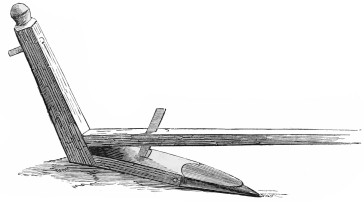
IT WAS USED IN THE DAYS OF MOSES.
The correspondence of the Government is dictated to stenographers and transcribed upon type-writers; and every form of modern improvement for the purpose of economizing time and saving labor is given the opportunity of a test, even if it is not permanently adopted. There is no Government that gives greater encouragement to inventive genius than the administration of President Diaz, and it has been one of the highest aims of his official career to modernize Mexico. The twelve years from 1876, when he came into power, until 1889, when his third term commenced, may be reckoned the progressive age of our neighborly republic; but the common people are still prejudiced against innovations, and resist them. In all the public places, and at the entrance of the post-office, are men squatting upon the pavement, with an inkhorn and a pad of paper, whose business is to conduct the correspondence of those whose literary attainments are unequal to the task. Such odd things are still to be seen at the capital of a nation that subsidizes steamship lines and railways, and supports schools where all the modern languages and sciences are taught, and has a compulsory education law upon its statute-books. In the old Inquisition Building, where the bodies of Jews and heretics have been racked and roasted, is a medical college, sustained by the Government for the free education of all students whose attainments reach the standard of matriculation; and bones are now sawn asunder in the name of science instead of religion.
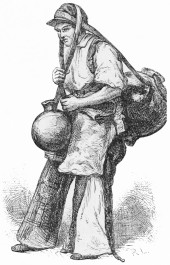
A WATER-CARRIER.
The country within whose limits can be produced every plant that grows between the equator and the arctics, and whose mines have yielded one-half of the existing silver in the world, is habitually bankrupt, and wooden effigies of saints stolen from the churches are sold as fuel for locomotives purchased with the proceeds of public taxation. What Mexico needs most is peace, industry, and education. The Government now pays a bounty to steamships upon every immigrant they bring, and is importing coolie labor to develop the coffee and sugar lands. Since 1876 there has not been a political revolution of any importance, and the prospect of permanent peace is hopeful.
The political struggle in Mexico, since the independence of the Republic, has been, and will continue to be, between antiquated, bigoted, and despotic Romanism, allied with the ancient aristocracy, under whose encouragement Maximilian came, on the one hand, and the spirit of intellectual, industrial, commercial, and social progress on the other. The pendulum has swung backward and forward with irregularity for sixty years; every vibration has been registered in blood. All of the weight of Romish influence, intellectual, financial, and spiritual, has been employed to destroy the Republic and restore the Monarchy, while the Liberal party has strangled the Church and stripped it of every possession. Both factions have fought under a black flag, and the war has been as cruel and vindictive on one side as upon the other; but the result is apparent and permanent.
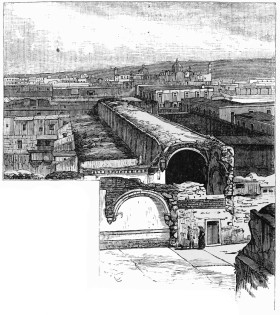
RUINS OF THE COVERED WAY TO THE INQUISITION.
No priest dare wear a cassock in the streets of Mexico; the confessional is public, parish schools are prohibited, and although the clergy still exercise a powerful influence among the common people, whose superstitious ignorance has not yet been reached by the free schools and compulsory education law, in politics they are powerless. The old clerical party, the Spanish aristocracy, whose forefathers came over after the Conquest, and reluctantly surrendered to Indian domination when the Viceroys were driven out and the Republic established, have given up the struggle, and will probably never attempt to renew it. They were responsible for the tragic episode of Maximilian, and still regret the failure to restore the Monarchy. The Aztecs sit again upon the throne of Mexico, after an interval of three hundred and fifty years, and the men whose minds direct the affairs of the Republic have tawny skins and straight black hair.
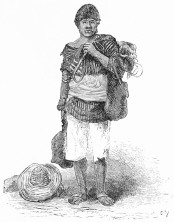
MEXICAN MULETEER.
Several of the aristocrats have left the country and reside in Paris, receiving enormous revenues from their Mexican estates, which they visit biennially, but will not live upon. Others are friends of Diaz, sympathize with the progressive element, and will turn out full-fledged Republicans when the issue is raised again. The finest houses in Mexico are unoccupied, and the palatial villas of Tacubaya, the aristocratic suburb, are in a state of decay. They are too large and too costly for rental, and the owners are too obstinate and indifferent to sell them. Perhaps these haughty dons still have a hope of coming back some time to rule again as they did years ago, but they will die as they have lived since Maximilian’s failure, impotent but unreconciled.
The beautiful castle of Chapultepec, which was dismantled during the last revolution, but has been restored and fitted up as a beautiful suburban retreat for the Presidents of Mexico, was occupied by Maximilian and Carlotta in imitation of the Montezumas, whose palace stood upon the rocky eminence. Around the place is a grove of monstrous cypress-trees, whose age is numbered by the centuries, and whose girth measures from thirty to fifty feet. It is the finest assemblage of arborial monarchs on the continent, and sheltered imperial power hundreds of years before Columbus set his westward sails. Before the Hemisphere was known or thought of, here stood a gorgeous palace, and its foundations still endure. Here the rigid ceremonial etiquette of Aztec imperialism was enforced, and human sacrifice was made to invoke the favor of the Sun.
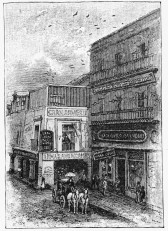
SHOPS.
In Mexican society one meets many notable people; some are remarkable for talent, or their birth, etc., and others for the strange vicissitudes of their lives. For example, in an obscure little house lives a well-educated gentleman who is, by lineal descent from Montezuma II., the legal heir to the Aztec throne, and should be Emperor of Anahuac. This Señor Montezuma, however, indulges in no idle dream of the restoration of the ancient Empire, and quietly accepts the meagre pension paid him by the Government. In contradistinction to this scion of the house of Montezuma, the heirs of Cortez receive immense revenues from the estates of the “Marquis del Valle” (Cortez), live in grand style, and are haughty and influential. There is also a lineal descendant of the Indian emperor Chimalpopoca. This young man is a civil engineer, industrious, and quite independent.
The acknowledged heir to the throne of Mexico is young
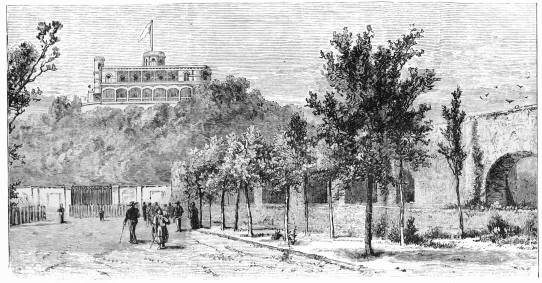
CASTLE OF CHAPULTEPEC.
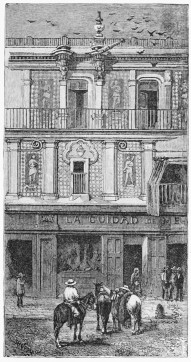
TILE FRONT.
Augustin Yturbide, according to the feelings of the few and feeble remnants of the Monarchical party; but it may be said to the young man’s credit that he entirely repudiates their homage, although he is the heir to two brief and ill-starred dynasties. He is the grandson of the Emperor Augustin Yturbide, and the adopted heir of Maximilian and Carlotta. The Yturbide they call “Emperor” was an officer in the Spanish army when Mexico was a colony, and during the revolution headed by the priest Hidalgo, in 1810, he fought on the side of the King. But, being dismissed from the army in 1816, he retired to seclusion, to remain until the movement of 1820, when he placed himself at the head of an irregular force, and captured a large sum of money that was being conveyed to the sea-coast. With these resources he promulgated what is known in history as “the plan of Iguala,” which proposed the organization of Mexico into an independent empire, and the election of a ruler by the people. The revolution was bloodless, and in May, 1822, Yturbide proclaimed himself Emperor, declared the crown hereditary, and established a court. He was formally crowned in the July following, but in December Santa Anna proclaimed the Republic, and after a brief and ignominious reign Yturbide left Mexico on May 11, 1822, just a year, lacking a week, from the date he assumed power. The Congress gave him a pension of $25,000 yearly, and required that he should live in Italy; but impelled by an insane desire to regain his crown, in May, 1824, he returned to Mexico, and was shot in the following July.
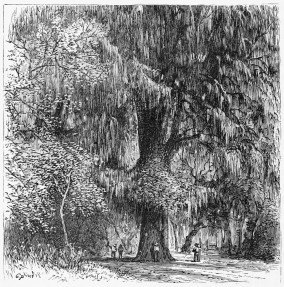
THE TREE OF MONTEZUMA.
He left a son, Angel de Yturbide, who came to the United States with his mother, and was educated at the Jesuit College at Georgetown, District of Columbia, the Government having given them a liberal pension. There he fell in love
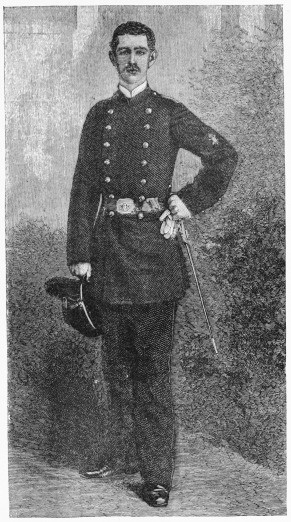
PRINCE YTURBIDE.
with Miss Alice Green, the daughter of a modest but prosperous merchant of the town, and married her. They had one child, the so-called Prince Augustin, who, when three years old, with the consent of his ambitious mother, was adopted by the childless Maximilian and Carlotta, in the vain hope that the act might in a measure increase their popularity among the Mexicans.
Meanwhile Maximilian’s fate was fast overtaking him. When he saw the catastrophe was at hand, he determined to save the young Yturbide, and with the assistance of the Archbishop of Mexico notified Madame Yturbide that her child would be placed on a certain steamer reaching Havana at such a date; and it was there the mother was united to him after a separation of two years. Maximilian and Carlotta had surrounded the young prince with all the elegancies of royalty, and he retained many of their royal gifts. His father was then dead, and his mother had sole charge of his education. He was educated at Washington, where Madame Yturbide lived in a fine house on the corner of Nineteenth and N streets. When her son came of age she sold her house and returned with him to Mexico. His intention was to enter the army at once, but by the advice of his Mexican friends he entered the national military college for a course of study before taking his commission. He is a handsome young man, very quiet and prepossessing. His abilities can scarcely be judged so far, but he has always conducted himself with great good-sense. Madame Yturbide is now with him in Mexico. One of the most promising signs of the permanency of the Republic is the presence in the party of progress of this young man, whose name represents all the ancient aristocracy desires to restore. He has inherited two worthless crests; but, whether from policy or principle, has added his youthful strength and the traditions that surround his name to the support of the Diaz administration.
The widow of General Santa Anna is a woman who played a prominent part in the political tragedies that have succeeded one another with such great rapidity upon the Mexican stage. Until her death in the autumn of 1886, she was an object of interest to all visitors to the capital, and always welcomed cordially strangers who called upon her, provided they would permit her to smoke her cigarettes, and talk about her beauty and the attentions she had received in the past.
Santa Anna is not so highly estimated in Mexico as in some other parts of the world where people are not so familiar with his eccentric and adventurous career. He was a man of remarkable natural abilities, force of character, energy, and personal courage, but devoid of principle, education, culture, and mindful only of his own interests. He served all political parties in turn. She was his second wife, and was only thirteen years old when he married her, in the fifth term of his presidency, and when he was trying to set himself up as an absolute monarch. For twenty years her life was spent in a camp, surrounded by the whirl of warfare. Her husband was five times President of Mexico, and four times Military Dictator in absolute power. He was banished, recalled, banished again, and finally died, denounced by all as a traitor. She had seen much “glory,” and had received unlimited adulation, but she hardly ever enjoyed one thoroughly peaceful month in her life.
It created a sensation in Mexico when the pretty peon girl, Dolores Testa, was suddenly raised from abject poverty to affluence. The Dictator ordered all to address his bride as “Your Highness,” ladies-in-waiting were appointed in order to teach the bewildered little Dolores how to play her rôle in the great world, and then the President organized for her a body-guard of twenty-five military men, who were uniformed in white and gold, and were styled “los Guardias de la Alteza” (her Highness’s Body-guard). When the President’s wife attended the theatre these guards rode in advance of and at the sides of the coach, each bearing a lighted torch. During the performance they remained in the patio or foyer of the theatre, and then escorted her Highness back to the palace in the same order. Such was the power of General Santa Anna in those days that even the clergy bent before him; and when
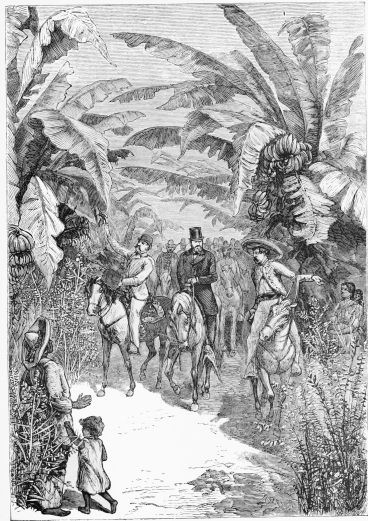
GENERAL GRANT ON A BANANA PLANTATION.
his young wife went to mass, the priests, attended by their acolytes, actually used to leave the cathedral to meet her on the pavement, and with cross and lighted tapers escort her from her carriage to her seat within the church, and at the conclusion of the mass accompanied her to her coach.
Her last days were quite in contrast with the glory of her youth. She owned a residence in the city and a lovely country-seat in Tacubaya, the aristocratic suburb; her wardrobes and chests were filled with rich robes of velvet, satin, and silk, costly laces, and magnificent jewels; but she was too listless to interest herself in anything. No stranger who by chance might see her ex-highness at home, with her pretty feet thrust into down-trodden old leather shoes, and her unkempt hair covered by a common cotton rebosa, could ever, by the greatest effort of imagination, possibly fancy her to be the same person who once dazzled Mexico by a display of pomp that exceeded even that of the Empress Carlotta. Mrs. Santa Anna was an estimable woman, but was almost forgotten by the generation that once bent before her. Her family plate, and the diamond snuffbox which was presented her husband when he was Dictator, and cost twenty-five thousand dollars, were, during the latter years of her life, and still are, in the National pawn-shops of Mexico, and his wooden leg, captured in battle during our war with Mexico, is in the Smithsonian Institute.
The family of the great Juarez, the Washington of Mexico, an Aztec peon, who overthrew the empire of Maximilian as Cortez had overthrown the ancient dynasty of his ancestors, live in good style in the city of Mexico, the daughters being well married, and the son the secretary of the Mexican legation at Berlin. They all talk English well, and are very highly educated. Every American who visits their city is handsomely entertained by them.
But time spent in conjecturing the future of the aristocratic or clerical party is wholly wasted. No priest, no bishop, is allowed by law to hold real estate; titles vested in religious orders are worthless; the Church is forbidden to acquire wealth, and has been stripped of the accumulated treasures of three centuries. The candlesticks and altar ornaments are gilt instead of gold, and the heavy embroideries in gold and silver have been replaced by tinsel. A solid silver balustrade which has stood in one of the churches since the time of Cortez was torn down not long ago and taken to the mint, and a chandelier in the cathedral of Puebla, when it was melted, made sixty thousand silver dollars.
There still stands in the cathedral at Guadalupe, on the spot where the Mother of Christ appeared to a poor shepherd and stamped her image in beautiful colors upon his cotton serape, a double railing from the altar to the choir, perhaps sixty feet long and three feet high, which is said to be of solid silver, with considerable gold. This is the only one of the remnants of pontifical magnificence which remains undespoiled, for the superstition which pervades all classes of society has protected it; but the altars have been stripped of the jewels which were bestowed by grateful people who had received the protection of the Virgin, who watches over those in distress, and the veneering of gold which once covered the altar carvings has all been ripped off. It is said that an enterprising American offered to replace the solid silver railing with a plated one, and give a bonus of three hundred thousand dollars to the Church, but the proposition was rejected.
This Guadalupe shrine is the most sacred spot in Mexico, and to it come, on the 12th of each December, the anniversary of the appearance of the Virgin, thousands upon thousands of pilgrims, bringing their sick and lame and blind to drink of the miraculous waters of a spring which the Virgin opened on the mountain-side to convince the sceptical shepherd of her divine power. The waters have a very strong taste of sulphur, and are said to be a potent remedy for diseases of the blood. In testimony of this the walls of the chapel, which is built over the spring, are covered with quaint, rudely written certificates of people who claim to have been miraculously cured by its use. In the cathedral are multitudes of other testimonials from people who have been preserved from death in danger by having appealed for protection to the Virgin of Guadalupe; but nowadays, instead of sending jewels and other articles of value as they did when the Church was able to protect its property, they hang up gaudily painted inscriptions reciting specifically the blessings they have received. On the crest of the hill is a massive shaft of stone, representing the main-mast of a ship with the yards out and sails spread. This was erected many years ago by a sea-captain who was caught in a storm at sea, and who made a vow to the Virgin that if she would bring him safe to land he would carry his main-mast and sails to Guadalupe, and raise them there as an evidence of his gratitude for her mercy. He fulfilled his vow, and within the double tiers of stone are the masts and canvas.
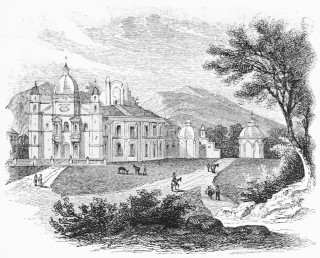
CHURCH OF GUADALUPE.
In the cathedral is the original blanket, or serape, which
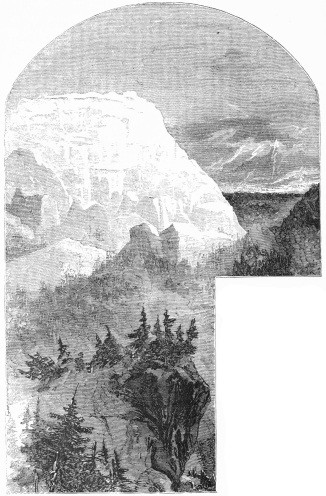
ISTACCIHUATL.
the shepherd wore when the Virgin appeared to him, and upon which she stamped her portrait. It is preserved in a glass case over the altar, and may be seen by paying a small fee to the priest. Copies of the Guadalupe Virgin are common and familiar; one can scarcely look in any direction in Mexico without seeing the representation upon the walls of a house, or pendent from the watch-chain of a passer-by; but the average reproduction is a great improvement upon the original, which is a dull and heavy daub, without any evidences of skill in its execution, or even the average degree of accuracy in drawing. According to the story, the portrait was stamped upon the serape or blanket of the shepherd, and this all Catholics in Mexico devoutly believe; but a close examination reveals the fact that it is done in ordinary oil colors, upon a piece of ordinary canvas, and that the pigments peel off like those of any poorly executed piece of work.
In the ancient town of Guadalupe, in a house near the cathedral, was signed the famous treaty determining the boundary line between Mexico and the United States, while in a cemetery on the hill General Santa Anna lies buried.
The Mexican people, like all the Spanish race, are fond of ceremony, but the inauguration of their President is not attended with so much display or interest as is shown on similar occasions on this side of the Rio Grande. Perhaps it is because the event occurs so often. During the two hundred and eighty-six years between the fall of the Empire and the establishment of the Republic, there were but sixty-four Viceroys; but during the sixty-three years that followed there have been thirty-two Presidents, seven Dictators, and two Emperors. Although the constitutional term of the presidency is four years, but two in the long list were permitted to serve out their time, and they were the last, which at least shows improvement in the political condition of the country.
I witnessed the inauguration of President Diaz on the 1st of December, 1884. The ceremonies, which were simple enough to satisfy the most critical of Democrats, took place in the handsome theatre erected in 1854, and named in honor of the Emperor Yturbide. It is now called the Chamber of Deputies, and is occupied by the lower branch of the National Legislature, a body of some two hundred and twenty-seven men. The Senate, composed of fifty-six members, meets in a long, narrow room in the old National Palace which was formerly used as a chapel by the Viceroys. The viceregal throne, a massive chair of carved and gilded rosewood, still stands upon a platform opposite the entrance, under a canopy of crimson velvet, but upon its crest is carved the American eagle, with a snake in its mouth, the emblem of Republican Mexico. Maximilian hung a golden crown over the eagle; Juarez tore it down and placed the broken sword of the Emperor in the talons of the bird. The Aztecs say that the founders of their empire, whose origin is lost in the mists of fable, were told to march on until they found an eagle sitting upon a cactus with a snake in its mouth, and there they should rest and build a great city. The bird and the bush were discovered in the valley that is shadowed by the twin volcanoes, and there the imperishable walls were laid which are now bidding farewell to their seventh century.
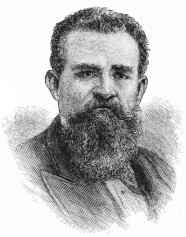
EX-PRESIDENT GONZALES.
The old Theatre Yturbide has not been remodelled since it became the shelter of legislative power, and all the natural light it gets is filtered through the opaque panels of the dome, so that during the day sessions the Deputies are always in a state of partial eclipse. It is about as badly off for light as our own Congress. The members occupy comfortable arm-chairs in the parquet, arranged in semicircular rows. The presiding officer and the secretaries sit upon the stage, and at either side is a sort of pulpit from which formal addresses are made, although conversational debates are conducted from the floor. The orchestra circle and galleries are divided into boxes, and are reserved for spectators, but are seldom occupied, as the proceedings of the Congress are not regarded with much public interest.
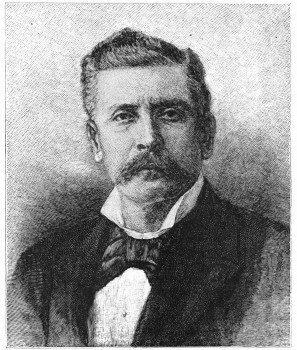
PRESIDENT PORFIRIO DIAZ.
The members of both Houses have no regular seats, but sit where they please. As they have few constituents to write to, they use no desks. There are some that might be used, but never are. The members vote themselves no stationery, postage-stamps, or incidentals, as our Congressmen do, but are paid two hundred and fifty dollars a month during the two years for which they are elected. Habit and the exercise of military power have reversed the constitutional relations of the executive and legislative branches of the Government, and the business of the Congress sometimes is not to pass bills for the approval or disapproval of the President, but to enact such legislation as he recommends. The members of the Cabinet have seats in both houses of the Congress, participate in the debates, and submit measures for consideration, but have no vote; and the President himself often exercises his constitutional right to meet and act with the Legislature. Very seldom is a law passed that does not come prepared and approved by the Executive Department, and to oppose the policy of the administration is usually fatal to the ambition of Mexican statesmen.
In appearance the members will compare favorably with those of our Congress, and they are far in advance of the average State Legislature in ability and learning. The first features that strike a visitor familiar with legislative bodies in the United States is the decorum with which proceedings are conducted, and the scrupulous care with which every one is clothed. On certain formal occasions it is usual for all of the members to appear in evening dress, which gives the body the appearance of a social gathering rather than a legislative assembly. Nine-tenths of the members are white, and the other tenth show little trace of Aztec blood. There is never anything like confusion, and the laws of propriety are never transgressed. One hears no bad syntax or incorrect pronunciation in the speeches; no coarse language is used, and no wrangles ever occur like those which so often disgrace our own Congress. The statesmen never tilt their chairs back, nor lounge about the chamber; their feet are never raised upon the railings or desks; there is no letter-writing going on; the floor is never littered with scraps of paper; no spittoons are to be seen, and no conversation is permitted. Extreme dignity and decorum mark the proceedings, which are always short and silent, and the solemnity which prevails gives a funereal aspect to the scene.
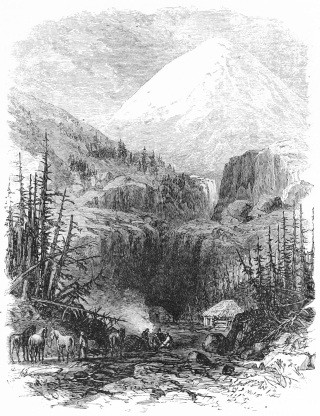
THE DOME.
But everybody smokes. The secretary lights a cigarette at the end of a roll-call, and the chairman blows a puff of smoke from his lips before he announces a decision. The members are constantly rolling cigarettes with deft fingers, and the people in the galleries do the same, so that a cloud of gray vapor always hangs over the body, and in the dark corners of the chamber one can see the glow of burning tobacco like the flash of fire-flies. But cigars are never used, nor pipes, and no one chews tobacco.
Whole sessions pass away with nothing but formal business, such as receiving communications from the Executives of the States or petitions from the people, which are rarely acted on. Occasionally a bill is passed, but it passes almost as a matter of course, some of the members giving a delicate little wave of the hand to the secretary as he calls their names by sight, others merely smiling at him, some paying no attention whatever to him, but none of them taking the trouble to open their mouths or rise, as the rules require. Weeks and months pass away without a speech of any kind, or even a point of order.
In the presence of this body, and with a similar indifference, Profirio Diaz was inaugurated President of the United States of Mexico. He had been President once before, having seized the government by force of arms from Lerdo, but was so just and wise a ruler, and possessed the confidence of the people so thoroughly, that he was allowed to serve out a full term, being one of the few Mexican Presidents to enjoy that privilege. He would have been re-elected at the expiration of his administration but for a constitutional provision prohibiting it. Four years passed and he was restored to power by the votes of the people against a man whose administration was a saturnalia of corruption and extravagance, that ended with a bankrupt treasury and an impoverished people.
The last days of the term of Gonzales were stormy. His attempt to secure certain unpopular financial legislation created great excitement, and the students of the universities, who numbered six or seven thousand, made a protest which would have ended in violence and assassination but for the overpowering military guard that surrounded the palace. The students would have resisted any attempt of Gonzales to prevent the inauguration of his successor, and kept up a demonstration against the existing Government until that event occurred.
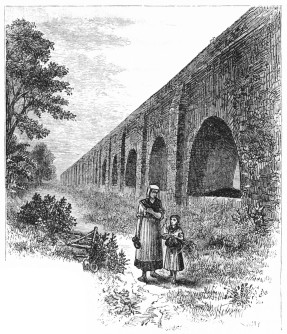
SAN COSME AQUEDUCT, CITY OF MEXICO.
It was nine o’clock on the morning that the ceremonies were to occur. Long lines of bayonets and sabres glittered in the streets around the theatre, regiments of cavalry and infantry were drawn up in the Alameda and Plaza, squads of police, on foot and mounted, were marching here and there. Bands of students yell “Viva!” and “Mira!” Some were fired into, and several students wounded. The shops were nearly all closed early in the day; huge iron padlocks and bolts that would resist a sledge-hammer for half a day hung on doors that but a few days ago were thronged with customers, and the few that remained open were merely ajar, ready to be slammed shut in a minute, and the ponderous bars swung into place.
The attendance at the theatre was not large, and consisted almost entirely of officials, foreign ambassadors, and the personal friends of the President, who, like the members of the Congress, were nearly all in full dress, but carried revolvers in their pockets for use if the occasion demanded. In a gilded box over the stage was the wife of General Diaz, of girlish years and striking beauty, attended by a party of lady friends and two military officers resplendent in gold lace. There was no crush, no confusion, but a suppressed excitement and anxiety, made intense by the recollection that such incidents in the history of Mexico had been usually attended by war. The outgoing President was regarded as the enemy of his successor, and the Congress was about equally divided in its allegiance. The former was not present, and his movements and intentions were unknown.
The members of the Senate sat in a double row of chairs which had been placed around the sides of the parquet for their accommodation, and all of them wore white kid gloves. The members of the Lower House, the Deputies, sat in their accustomed seats, and their chief officer presided. Promptly at nine o’clock General Diaz, in full evening dress, with white gloves, was escorted to the platform by a committee of Senators, took the oath of office with his back to the audience, and passed rapidly out of the building. The whole proceeding did not last more than five minutes, and when the clerk announced that the oath of office had been taken in accordance with the law, and declared Diaz “Constitutional President,” the audience quietly left the chamber as if nothing more than the ordinary routine had taken place.
But the excitement was not abated. The oath had been taken, but the outgoing administration by its absence from the ceremonies had intensified the anxiety lest the admission of Diaz to the Palace might be denied. Accompanied by a committee of Senators and an escort of cavalry. President Diaz drove half a mile to the Government building, and to his gratification the column of soldiers which was drawn up before the entrance opened to let him pass. The plaza which the building fronts was crowded with thousands of people, who announced the arrival of the new President by a deafening cheer, and the chimes of the old cathedral rang a melodious welcome.
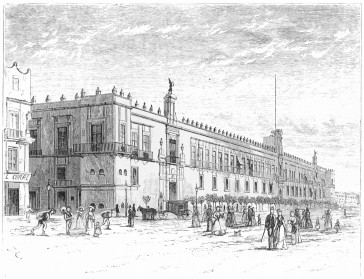
THE PALACE OF MEXICO.
In the centre of the old palace, which stands upon the foundations of the heathen temple Cortez destroyed, is an enormous court, in which the President’s party alighted and ascended the marble stairs. The sentinels which lined the staircase saluted them respectfully, and this omen relieved their minds. At the entrance of the Executive chamber, where relics of the luxurious taste of Maximilian still remain, Diaz was received by an aide-de-camp of Gonzales, who ushered him into the presence of the retiring administration. Surrounded by his Cabinet, Gonzales stood, and as Diaz entered stepped forward to welcome him, and according to the ancient practice, handed him an enormous silver key, which is supposed to turn the bolts that protect authority. Short formal addresses were made upon either side, and after wishing the new administration a peaceful and prosperous term, Gonzales and his ministers retired.
General Porfirio Diaz, the foremost man in Mexico to-day, and one whose public career will fill pages in the history of that Republic, is the representative of mixed Aztec and Spanish ancestry, like all of the famous native leaders of the last half century. He is tall and dark, his muscular figure impressing one as the very incarnation of health and endurance. He has a military, yet nonchalant air, his brown eyes meet you squarely with the glance of one born to command, and his voice is peculiarly pleasant as in deep tones he rolls off the musical dialect of his mother-tongue.
His career, like that of all Mexican leaders, is full of romantic adventure. He was born in the rich State of Oaxaca, which was also the birthplace of Juarez, Mejia, Romero, Mariscal, and others famed in politics and literature. Don Porfirio’s parents designed him for the law and sent him to the Literary Institute, in Puebla, the City of the Angels, which celebrated institution has graduated many of Mexico’s most eminent men. But Diaz, at the age of twenty-four, enlisted as a private in the National Guard against the government of Santa Anna. Again, in the so-called war of reform—in 1858 and 1861—he won more substantial honors than the straps of an officer, and when his country was convulsed by the French invasion of 1862, Diaz, then a general, took a prominent part in the struggle. Once during those wars, when a prisoner at Puebla, he escaped by letting himself down from the tower in which he was confined by means of a rope spliced out with his clothing. Another of his numerous hair-breadth escapes was during the bloody struggle by which he made himself President for the first time. Having captured Matamoras by daring strategy, he was seized on shipboard by the Lerdists, and saved himself only by leaping into the sea, assisted by the connivance of a French captain, whom he afterwards made consul at Saint Nazaire.
In 1871 General Diaz was one of the three candidates for the Presidency, and being defeated by Juarez, issued his celebrated manifesto known as the “Plan of Noria,” repudiating all existing powers, and proposing to retain military command. Being thoroughly whipped by the Indian President, after more than a year’s hard fighting and the loss of thousands of lives, the general left Mexico for a time, along with a number of his fellow-partisans.
After Juarez died in office, his successor, Don Sebastian Lerdo de Tejada, recalled all political exiles by issuing a general amnesty, which act Diaz hastened to repay by rushing again to arms and speedily deposing his rival. Although the Electoral College had declared Lerdo the legally elected ruler by a vote of 123 to 49, Diaz proceeded to issue a pronunciamento from Palo Blanco, State of Tamaulipas, denouncing the President, Congress, and all recognized authorities, and at the head of the Constitutional army took possession of the capital and usurped the Executive chair, driving the incumbent into exile, and holding his position by force of arms.
When the term was over for which Diaz had thus elected himself, he retired temporarily to fulfil the law he had so strenuously advocated, Article 28 of the amended constitution. Next he set about paving the way to permanent success by placating all opposing factions. First, he forever laid any restless ghost of Lerdist sentiment that might arise and shake its gory locks in the future, by marrying in the very midst of the enemy’s camp. His young and beautiful wife is the daughter of Romero Rubio, who was President Lerdo’s most influential adviser, and his bosom friend and companion in exile. Señor Rubio has since been President of the Senate, and Minister of the Interior.
No man since the Indian Juarez, who was the Abraham Lincoln of Mexican history, has achieved the popularity that Diaz enjoys, or has won the confidence of the people to so great a degree. The ballad-singers at Santa Anita, an Indian village in the suburbs of the capital, on the romantic canal that leads to the far-famed Floating Gardens, where the populace swarm on Sundays to drink pulque and dance fandangoes, carol many a long-drawn refrain to twanging guitars in praise of Porfirio D-i-i-iaz, while the dedications of their myriad pulquerias are about equally divided between Diaz, Montezuma, and the Mother of God.
The old Capitol, or Palace, as it is called, which Cortez raised upon the ruins of the Aztec temple is still occupied as the seat of government, and shelters the Executive departments. Here, too, is the National Museum, with its collection of antiquities, and in its centre, near the Sacrificial Stone of the Aztecs, is the imperial coach in which the ill-fated Emperor rode. Public business is conducted very much as in the United States; the officials are usually accomplished linguists, and well read in political economy. The science of government is studied there more than with us, and public life is a profession, like law or engineering. There still exists, however, and many generations will come and go before it can be eradicated, a caste that divides the people into three classes—the peon, the aristocrat, and the middle class. The prejudice that separates them is usually overcome by military force. The peon, who like Diaz becomes a political and a social leader, must win the place by military skill, or wear a sarepa forever.
Among the upper classes of Mexico will be found as high a degree of social and intellectual refinement as exists in Paris, as quick a reception and as cordial a response to all the sentiments that elevate society, and a knowledge of the arts and literature that few people of the busy cities of the United States have acquired.
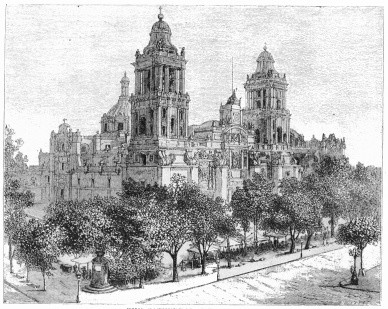
THE CATHEDRAL, CITY OF MEXICO.
Their wealth is lavishly displayed, their taste is exercised to a degree equal to that of any people in the world, and the interior of many of their dwellings furnishes a glimpse of happiness and cultured elegance that, with their less active temperament, they enjoy more than their northern neighbors. Yet the people who receive the latest Paris fashions and literature by every steamer, and who would rather wear a shroud than a garment out of style, still cling to some ancient customs as eagerly as they seize some modern ideas. Social laws restrict intercourse between the sexes, as in the Latin nations of Europe, and Pedro makes love to Mercedes through his father and hers. Marriage is often a commercial contract for pecuniary or social advantages, and a parent chooses his son-in-law as he selects his partners or the directors of a bank. It is an impropriety for men and women to be alone together, even if they are closely related, and no woman of the higher caste goes upon the streets without a duenna.
The funeral customs of Mexico are a source of constant interest to strangers in that land, as the burial of the dead is a ceremony of great display. The poor rent handsome coffins which they have not the means to buy, and transfer the body from its temporary casket to a cheap box before it is laid in the grave. Invitations are issued by messenger, and advertisements of funerals are published in the newspapers or posted at the street corners like those of a bull-fight or a play. Announcements are sent to friends in big, black-bordered envelopes, and are usually decorated with a picture of a tomb. The information is conveyed in faultless Spanish, that Señor Don Jesus San a Maria Hidalgo died yesterday at noon, and that his bereaved wife, who mourns under the name of “Donna Maria José Concepcion de los Angelos Narro Henriandos y Hidalgo,” together with his family, desire you to honor them by participating in the ceremonies of burial, and in supplicating the Mother of God and the Redeemer of the world to grant the soul of the dead husband a speedy release from the pains of Purgatory, and eternal bliss in Paradise.
The oddities of Mexican life and customs strike the tourist in a most forcible manner. The first thing he observes among the common people is that the men wear extremely large hats, and the women no hats at all. The ordinary sombrero costs fifteen dollars, while those bearing the handsome ornaments so universally popular run in price all the way from twenty-five to two hundred and fifty dollars. The Mexican invests all his surplus in his hat. Men whose wages are not more than twelve dollars a month often wear sombreros which represent a whole quarter’s income. A servant at the house of a friend was paid off one day for the three months his employer had been absent. He got forty-two dollars, of which he paid thirty-five dollars for a hat and gave seven dollars to his family.
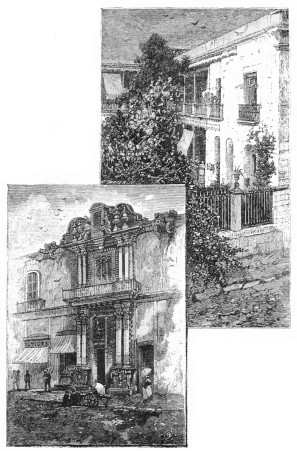
STYLES OF ARCHITECTURE.
The next thing that you notice is that every block on the same street has a different name, and when you start out on foot to make a visit you become bewildered at once, and have to call a carriage. Take the chief street, for example, which begins at the Grand Plaza, where the Palace stands, and runs to the statue of Charles IV. of Spain. Each of the seventeen blocks has a name of its own, and the names that are used are quite as striking as this perplexing custom. Here is a list of some of the principal blocks or streets translated into English: “Crown of Thorns Street,” “Fifth of May Street,” “Holy Ghost Street,” “Blood of Christ Street,” “Body of Christ Street,” “Mother of Sorrows Street,” “Street of the Sacred Heart,” “The Heart of Jesus Street,” “Street of the Love of God,” “Jesus Street,” and “John the Baptist Street.” Nearly every saint in the calendar has a street named after him or her, and nine-tenths of the city has the religion of the people thus illustrated.
Another thing that surprises you greatly is that nearly every man you meet makes you a present of a residence. He grasps your hand with ardent cordiality when he leaves you, and says, “My house is yours; it stands numero tres—Calle,” and so on, “and is at your service.” The next man tells you that your house is such and such a number, and he shall be angry if you do not occupy it. As neither of them has enjoyed the honor of your acquaintance for more than five minutes, and both are only casually introduced, this excessive generosity is quite embarrassing. An English lord told me he met fourteen men at the Jockey Club one evening, and was presented with thirteen houses. The other man lived in Cuba. But it is only the Mexican way of saying, “I’m pleased to meet you.” It often leads to comical adventures, however, for the gentleman who tenders such profuse hospitality seldom remembers you the next morning. People have accepted these ardent invitations and been met with a cold welcome. Another amusing and puzzling peculiarity is that everybody lives over a shop. Even the millionaires rent out the first floor of their residences for purposes of business, and live in the third story. The handsomest house in all Mexico has a railway ticket-office on one side of the entrance and a cigar shop on the other. Everybody smokes: women as well as men. They smoke in the street-cars, in the shops, at the opera, everywhere. I have often seen a man upon his knees in a chapel muttering his prayers with a lighted cigar in his hand.
The street-cars run in groups. Instead of starting a car every ten minutes from the terminus, three are started together every half hour. One car is never seen alone, nor two together, but always three in a row, less than half a block apart. It requires two conductors to run a car. One approaches a passenger and sells him a ticket; the second one then comes in and takes it up. In some respects it is an improvement on the bell-punch system. There are first-class cars and second-class cars. The former are of New York manufacture, and similar to those used in that city; the latter are of domestic construction, have but few windows, and look like the cabooses used on railroad freight trains. First-class fares are sometimes as high as twenty-five cents, but are more often a medio (six and a quarter cents), being governed by the distance. Second-class fares are always one-half the amount of first-class fares. Street-car drivers carry horns, and blow them when they approach street crossings. The conductors usually carry revolvers. Nearly everybody, in truth, carries a revolver.
Horseback riding is the national amusement, and the streets are full of horsemen, particularly in the cooler hours of the morning and evening. The proper thing to wear is a wide sombrero, very tight trousers of leather or cassimere, with rows of silver buttons up and down the outer seam, a handsomely embroidered velvet jacket, a scarlet sash, a sword, and two revolvers, not to mention spurs of marvellous size and design, and a saddle of surpassing magnificence. A Mexican caballero often spends one thousand dollars for an equestrian outfit. His saddle costs from fifty dollars to five hundred dollars, his sword fifty dollars, his silver-mounted bridle twenty-five dollars, his silver spurs as much more, the solid silver buttons on his trousers one hundred dollars, his hat fifty dollars, and the rest of his rig in proportion. The Mexican small boy, if he has wealthy parents, is mounted after a similar fashion, even to the revolver and sword. An equestrian costume for a boy of ten years can be purchased for about fifty dollars, not including saddle and bridle.
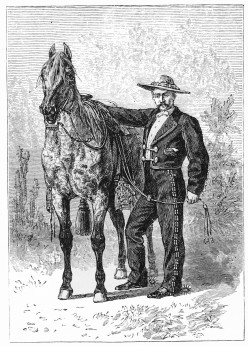
A MEXICAN CABALLERO.
The Mexican ladies do not ride any more than their sisters in the United States. Social etiquette prohibits this recreation, unless they have brothers to go with them. The señoras and señoritas take their exercise in closed carriages. You never see a phaeton or wagon in Mexico. When they go shopping they sit in their carriages and have the goods brought out to them. It is a common thing to see a row of carriages before a fashionable store with a clerk at the door of each one exhibiting silks or gloves or ribbons. In some of the stores are parlors in which a señora can sit if she likes and have the goods brought to her. None but foreigners and the common people stand at the counters and buy. Mexican merchants never classify their goods. They have no system in arranging them. Silks and cottons are indiscriminately mixed on the shelves. There is no place for anything, and nothing is ever in place. Hence shopping requires the exercise of a vast deal of patience. I went to buy a pair of gloves one day. The clerk pulled open a drawer in which were shoes, corsets, and ribbons. He found some gloves, but there being none in the box to fit, he hunted around on the shelves and in the drawers until he discovered another lot. Nor are goods ever delivered at the residences of purchasers. If your package is too bulky to carry in your hands or in your carriage it is sent to your house by a licensed carrier, similar to the district messenger boy of New York, to whom you pay a fee. Each carrier has a brass badge like a policeman’s, bearing a number, and if he does not deliver the goods promptly and in good order you report him at police headquarters, where he is heavily fined. On the other hand, if he cannot find your residence, or there is a mistake in the directions, he takes the goods to police headquarters, and you can find them there, and discover the reasons why they were not delivered.
On pleasant afternoons—and except in the rainy season all afternoons are pleasant here—everybody who owns a carriage, or is able to hire one, drives on the boulevard which Maximilian made from the city to the Castle of Chapultepec, a distance of two and a half miles. As most of the carriages are closed, the scene is not so interesting as it might be, but you can occasionally catch a glimpse of a beautiful face through the carriage windows. The horses are indifferent. Some of the handsomest equipages are drawn by mules.
There are more public hacks and carriages in Mexico than in any other city in the world in proportion to its population, and few cities have worse pavements. Most of the vehicles are coupés, but there are a few victorias. There are no hansoms. The public carriages are all under police regulation, and the rates are fixed by law, according to the condition of the vehicle and the horses. Each carriage has a small tin flag attached to the top. A green flag means that you have to pay a dollar and a half an hour, for the carriage is new, the horses are good, and the harness is handsomely trimmed. A blue flag means a dollar an hour, with a little less style; a white flag, seventy-five cents. The latter class are about the toughest-looking outfits that can be found anywhere.
Each of the other sort of carriages has a footman as well as a coachman, without additional price, although generous people give him a tip to the extent of a real (twelve and a half cents). The footman is called a mozo, and acts as a sort of apprentice or private secretary to the cochero, or driver. When you hire a hack the mozo rushes off to the nearest store, looks at the clock, and brings you back a card upon which the hour is written. When you finish your ride he hands you the card again, and you pay from the time you started. On feast-days charges are doubled, and as feast-days are frequent, when all the stores are closed, the hackmen make a good thing of it. They drive in a most reckless manner, and as the pavements are rough the passengers are bounced about.
The Spaniards drink cognac and sour wines. Whiskey is not a safe beverage for the climate. American mixed drinks are not popular, and the scarcity of ice makes juleps and that sort of thing expensive. The stranger in Mexico is always very thirsty; the rapid evaporation makes the mouth and throat dry, and water furnishes only temporary relief. The most refreshing drink is lime-juice in Apollinaris water.
Pulque (pronounced poolkee) is the national drink, and is
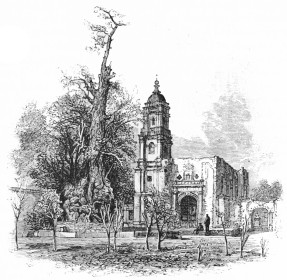
NOCHE TRISTE TREE.
the fermented milk of the cactus. Eighty thousand gallons are said to be sold in Mexico every day, and double that amount on Sundays and saints’ days. It is a sort of combination of starch and alcohol, looks like well-watered skim-milk, and tastes like yeast. It costs but a penny a glass, or three cents a quart, so that it is within the reach of the humblest citizen, and he drinks vast quantities of it. Five cents’ worth will make a peon (as all the natives are called) as happy as a lord, and ten cents’ worth will send him reeling into the arms of a policeman, who secures him an engagement to work for the Government for ten days without compensation. But it leaves no headache in the morning, and is said to be very healthful. In the moist climates one might drink large quantities without injury, but all the usual intoxicants are harmful in this altitude.
The police system of Mexico is admirable. At every street corner there is a patrolman night and day—not a patrolman either, for he never moves. He stands like a statue during the day, occasionally leaning against a lamp-post, and answers inquiries with the greatest urbanity. Whenever there is a row two or three policemen are instantly present, and if their clubs cannot suppress it they use revolvers. At night the policeman brings a lantern and a blanket. He sets the lantern in the middle of the street, and all carriages are compelled to keep to the right of the row of lanterns, which can be seen glimmering from one end of the street to the other. As long as people are passing he stands at the corner, but when things quiet down he leaves his lantern in the road, retires to a neighboring door-way, wraps his blanket around him, and lies down to pleasant dreams. As all the windows in the city of Mexico have heavy prison-like gratings before them, and all the doors are great oaken affairs that could not be knocked in without a catapult; as there are never any fires, and everybody goes to bed early, the policeman’s lot is usually a happy one. He is numerous because of revolutions, and because the Government always wants to know what is going on. There is a popular belief in Mexico that no stranger ever comes to town without having his past history and future plans recorded at police headquarters. One never reads of robberies or pocket-picking, or assault and battery cases, in the city of Mexico. Common thieves have no chance there. The only disturbances are political revolutions, and the Government alone is robbed.
All the ice that is used in Mexico comes from the top of Popocatepetl. It is brought down the mountain on the backs of the natives, and then sixty miles on the cars to the city, where it is sold at wholesale for ten cents a pound. At the bar-rooms iced drinks are very expensive, and ice is seldom seen anywhere else. The people all use a jug of porous earthenware made by the Indians in which water is kept cool by rapid evaporation. The stranger should always squeeze a little lime-juice into his glass before he drinks water, to get a pleasant flavor, and escape evil effects from alkaline properties.
From the top of the cathedral spire you can see the entire city, and the most striking feature of the view is the absence of chimneys. There is not a chimney in all Mexico; not a stove, nor a grate, nor a furnace. All the cooking is done with charcoal in Dutch ovens, and, while the gas is sometimes offensive, one soon becomes used to it. Coal costs sixteen dollars a ton, and wood sixteen dollars a cord. All the coal was formerly imported from England, but now comes from Cohahuila, and the wood is all brought from the mountains.
As formerly, bull-fighting is at present the most popular amusement in Mexico, and a matador is more distinguished in the eyes of the common people than a prima donna or a president. The Mexican Government has of late years become humanized to the extent of prohibiting these brutal spectacles within the city limits, and they now take place at what is called the “Plaza de Toros,” or Bull Park, on the plains five or six miles from the city. Here the people gather on every Sunday and saint-day to witness the butchery of three or four bulls and twice as many horses, under the official patronage of the Governor of the State, who always is present with his family and official staff, and from a decorated platform directs the entertainment, giving his orders through a trumpeter.
Back of the Castle of Chapultepec is the battle-field of Molino del Rey (The Mill of the King), where General Scott met stubborn resistance when he attempted to enter Mexico, but drove the Mexicans up the hill. The old earthworks erected by the latter still stand as they were at the time of the battle, and are usually visited by tourists. On the plain beyond the battle-field stands an amphitheatre enclosed within a massive wall of adobe—the mud bricks which are used for building material in all the rainless region of this continent. The amphitheatre is arranged in the usual form, except that the shady side is divided up into boxes to be occupied by the grandees, while the sunny side has plain board benches for the barefooted Castilians whose mild eyes and pathetic deference give no key to the cruelty of which their race has been guilty. The centre of the amphitheatre is enclosed by a board wall, perhaps eight feet in height, surmounted at a point two feet higher by a heavy cable strung through stalwart iron rods. The top of this fence appeared to be the favorite eyrie from which to survey the field, and upon it for the entire length sat a row of urchins, with here and there a bearded man, all poised upon the edge, with their legs hanging over into the bull-ring, and their arms clinging to the rope.
The Governor, a tall, swarthy man, with a wide sombrero, mustache and goatee, the very picture of the “haughty Don,” sat in a decorated box, with the flag of his country profusely draped around him. He had two aides-de-camp, his three children, and an orderly, who with a trumpet sounded a blast now and then to convey his excellency’s desires. We happened luckily to have the adjoining box, from which we could watch him closely and hear his comments upon the performances.
The audience was very large, and composed of all classes, from the proud Castilian who came behind his four-in-hand, with a retinue of outriders, to the poor peon who had been saving his scanty earnings for a week, and walked five miles to witness the ghastly spectacle. There were perhaps ten thousand people, and one-fifth of them were women in silks and satins, in jewels and rare laces, who hid their eyes behind their fans when the spectacle was too repulsive, but encouraged the matadors with applause at the end of each act.
A band of music played lively airs, and played them well, to entertain the people until the Governor came, whose presence being recognized, the people gave a cordial cheer by way of welcome. Then the herald in the Governor’s box blew a signal which sounded like the “water call” of the United
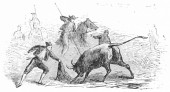
THE PICADORS.
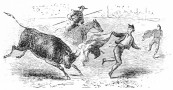
TEASING THE BULL.
States Cavalry, the doors of the pit were opened, and in marched a dozen or so of matadors, in the same sort of jackets and breeches which they wear in the pictures of Spanish life so familiar to all. Each wore a plumed hat, a scarlet sash, a poniard, and the gold lace upon the black velvet showed their lithe and supple forms to advantage. They looked as Don Juan looks in the opera, while the leader, Bernardo Cavino, “del decano de los toreros,” I was a veritable Figaro, in appearance at least. Each carried a scarlet cloak upon his arm, and in the other hand a pikestaff. Behind them came a troop of eight horsemen upon gayly caparisoned steeds, with the usual amount of silver and leather trappings in which the Mexicans delight. The procession tailed up with a team of four mules hitched abreast, dragging a whiffletree and a long rope. These, we are told, were for the purpose of dragging out the dead. The cavalcade made a circuit of the amphitheatre, like the grand entrée at a circus, and upon reaching the Governor’s box stopped, saluted him, and received a short address in Spanish, which probably was simply one of approval and congratulation at their fine appearance. There was a rack in front of the Governor’s box upon which hung several rows of darts, gayly decorated with paper rosettes and paper fringes of gold and other brilliant tints. Upon these racks the matadors hung their plumed hats, and stood a while to give the ladies and gentlemen of the audience an opportunity to see and admire.
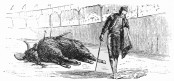
THE ENCORE.
The gay horsemen then rode out, and were followed by the mules, but the horsemen soon returned upon an entirely different style of animals—poor, broken-down, lean, lame, and mangy hacks, which looked as if they had been turned out of some street-car stable as bait for vultures. They were covered with a sort of leathern armor, and this concealed their fleshless ribs; but nothing could disguise the shambling and uncertain gait with which they painfully ambled across the arena under the savage spurring of their riders. They managed to get across, and that was all. The first set of horses were intended for show, and the second for slaughter. Public opinion appears to demand that something besides a bull be sacrificed, and the matadors not being amiable enough to afford this gratification, a pair of animated clothes-racks are turned in to be gored. The poor beasts are blindfolded, which is about the only humane feature of the show.
The Governor’s herald gave another blast, at which the entire audience, who were on the qui vive, arose and shouted. A door across the pit opened, and a large, clumsy, long-horned bull poked his head out into the arena. The crowd yelled, and matadors posed at different parts of the ring—ten of them—and the two horsemen pretended to get ready for the fray. The bull looked up, the only frightened being in the entire multitude. The posters described him as “a valiant and arrogant animal.” He was a fine piece of beef, but he didn’t want to fight. Somebody behind spurred him, and he ran into the ring. The doors were closed behind him, and there was no way of escape. He plunged one way, but was met by three matadors, who flapped their cloaks in his eyes; he turned in the other direction, but was met by three more; then he made a bolt between them, and darting towards the other side of the ring, gave a great leap, as if he would go over the eight-foot wall. Of course he failed, but he struck the planks with tremendous force, tumbling forty or fifty fellows who were perched on the top into a heap on the other side. It was the only amusing feature of the whole show. There was a grand crash, a loud howl, forty or fifty pairs of legs were in the air, and the audience shouted with laughter. The bull turned around frightened at the noise, ran to the other side of the ring, and sought in vain for a place to get out. Then one of the horsemen rode up in front of the animal and jammed a spear into his face. The bull plunged at his assailant, bellowing with pain, lifted the poor horse upon his horns, raised him from the ground, and threw him with great force against the side of the arena.
The rider, expecting the attack, was prepared for it, and leaped with great agility from the saddle just as the two animals came in contact. There was very little left of the horse. There was not much of him when he was dragged into the ring, but the long horns of the bull penetrated his bowels and tore them out. The bull jams the horse against the planks, two, three, four times, and then withdraws. The horse lies a bleeding, disembowelled mass, and the crowd cheers the dreadful spectacle.
The bull having given up all idea of escape, plunges at everything he sees, and the second horse is ridden up before him. No attempt is made to get the animal out of the way. He was brought there to be slaughtered, and took his turn. Both horses having been disposed of, and the bull being completely exhausted, the bugle gives the signal, the matadors enter the arena, and tease him with their scarlet cloaks. At frequent intervals around the ring are placed heavy planks, behind which the matadors run for protection when they were pursued. The bull had no chance at all; he was there simply to be teased and killed by slow degrees. One matador more agile than the rest baits the animal with his lance, and when the bull turns upon him, vaults over the down-turned horns by resting his lance upon the ground. Then they bring out the ornamented darts, and thrust them into the bull’s hide. The animal jumps and plunges with pain, and tries to shake them off, but the barbs cling to the hide, and the more he struggles the farther they penetrate the flesh. His shoulders are covered with them, and the crimson blood trickles down his sides. He stands panting with distress, his tongue hanging out, and is thoroughly exhausted.
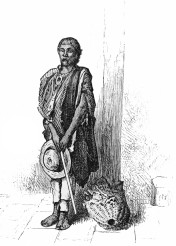
MEXICAN BEGGAR.
The Governor’s trumpet sounds the bull’s death-warrant. It means that the cruel sport has lasted long enough, and the chief matador comes forward with a red blanket and a sword. He approaches the bull, and flaps the blanket in his eyes; the animal plunges at him, and with great dexterity the matador whirls and thrusts the sword into the animal’s heart. The bull plunges with pain, and throws the sword out of his body into the air. He staggers and falls upon the ground, the chief matador runs up, pierces his brain with a poniard, and the mules are brought in to drag the dead animals out. The band plays, the crowd cheers, and the first act is over. The matadors bow to the Governor, bow to the crowd, and rest, while a clown dances in the ring to amuse the people in the interim. Pretty soon the trumpet blows again, two more old crow-baits are ridden in, and another bull is brought from the corral. The same scenes recur; the horses are always killed, but the men are seldom injured. Four bulls are usually disposed of each Sunday afternoon before the appetite for blood is satiated.
This cruel sport in Mexico is in its decadence. It grew out of the lack of other entertainment. Until two years ago there was no horse-racing in Mexico, and this class of sport is unknown outside of the capital. The young men are not allowed to visit the girls, are not permitted to walk with them in the parks, and have, in short, no amusements but billiards, cock-fighting, and bull-baiting. The exodus of foreigners into the Republic will break many of the barriers down. While the “Gringos,” as foreigners are called, generally conform to the customs of the country, they refuse to accept all of them, and the Mexican people are gradually tending towards a more modern civilization.
The ancient volcano, Popocatepetl, has got into the courts. Not that it has been bodily transported into the halls of litigation, but it is the subject of a novel suit at law. For many years General Ochoa has been the owner of the volcano, the highest point of land in North America, together with all its appurtenances. The crater contains a fine quality of sulphur, which the general has been extracting, giving employment to Indians who cared to stay down in the vaporous old crater. The property was at one time fairly profitable; the volcano was, some time ago, mortgaged to Mr. Carlos Recamier, who brings suit of foreclosure. The papers have been joking about the matter, some asking what Mr. Recamier intends to do with his volcano when he gets legal possession. He has been solemnly warned that the law forbids the carrying out of the country ancient monuments and objects of historical interest.
Good-Friday is observed as a sort of May festival. The Paseo de las Flores (Flower Promenade) is held along the Viga, the picturesque canal which stretches away between willows and poplars to the far-famed Floating Gardens of the ancient Aztecs. The scene along the historic causeway is astonishing to foreigners, and as charmingly peculiar as it is typical of a poetic and pleasure-loving people. For miles along the tree-lined avenue a constant procession of vehicles, horsemen, and pedestrians pack the space between green booths on either side, while the canal is crowded with canoes and Venetian-like gondolas. Everything imaginable on wheels is seen—the stately closed carriage of the Mexican millionaire, open barouches, coupés, victorias, dog-carts, wagonettes, even velocipedes and tricycles, while thousands of horsemen gallop gayly between.
The festivities are kept up, though in diminishing scale, until late Sunday night. During all these days the shrill, discordant rattle of ten thousand matracas rises above the babel of human voices. These little instruments of torture are made of tin, iron, ivory, wood, even of gold and silver, and in all imaginable shapes. Some are in the form of humming-birds, birds-of-paradise, chickens, parrots; others are like gridirons, frying-pans, musical instruments, fruits, flowers, or reptiles. Everybody must have one, from the dignified grandparent to the baby in arms, and by twirling them rapidly a most unearthly, rasping, grinding sound is produced by wooden springs inside. The noise is intended to typify and ridicule the cries of the Jews, “Crucify him! crucify him!” as they followed Christ to His death.
On Easter-Sunday the strangest of all Mexican ceremonies takes place in the burning of the traitor. During all Holy-week men are continually perambulating the streets, holding high above the heads of the multitude long poles encircled by hoops, upon which are suspended the most grotesque figures, in every conceivable color, shape, and degree of deformity, and all with horns and crooked backs and twisted limbs. These are filled with fire-crackers, the mustache forming the fuse, and millions of them are annually exploded. Many are life-size, some having faces to represent politicians who are unpopular at the time. Some are hung by the neck to wires stretched across the streets, or to the balconies of houses. Every horse-car and railroad engine and donkey-cart is decked with one, and even every mule-driver has one or more tied on his breast. At ten o’clock on Easter-Sunday, when the cathedral bells peal forth in commemoration of Christ’s resurrection, they are all touched off at once, and the air is filled with flying traitors everywhere over the length and breadth of Mexico.
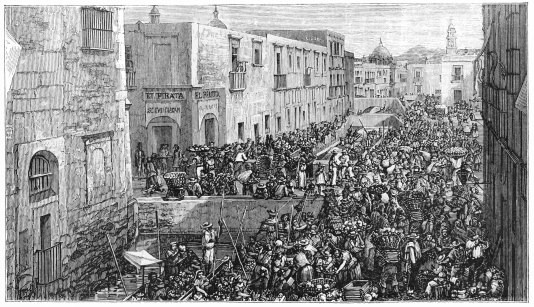
ON MARKET-DAY.
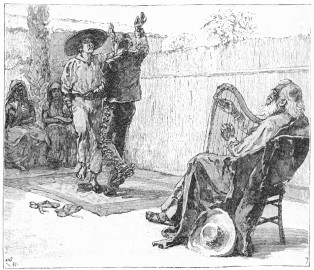
SUNDAY AT SANTA ANITA.
An American who is married in Mexico finds that he must be three times married: twice in Spanish and once more in Spanish or English, as he prefers, besides having a public notice of his intention of marriage placed on a bulletin-board for twenty days before the ceremony. This is the law. The public notice can be avoided by the payment of a sum of money, but a residence of one month is necessary. The three ceremonies are the contract of marriage, the civil marriage—the only marriage recognized by law since 1858—and the usual, but not obligatory, Church service. The first two must take place before a judge, and in the presence of at least four witnesses and the American consul. The contract of marriage is a statement of names, ages, lineage, business, and residence of contracting parties. The civil marriage is the legal form of marriage. These ceremonies are necessarily in Spanish. Most weddings are confirmed by a church-service.
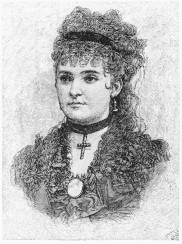
A MEXICAN BELLE.
At a Mexican church wedding it is the custom for the groom to pass coins through the hand of the bride, as typical of the fact that she is to keep the money of the household. A very pretty feature, as the couple kneel at the altar with lighted candles in their hands—an emblem of the light of the Christian faith—is the placing of a silken scarf around the shoulders of the bridal couple, and then the binding them together with a yoke of silver cord placed around the necks of both. That “thy people shall be my people” is an accepted fact, for it is a common thing for members of the bride’s family to take up their permanent residence with the husband, and make it their home.
One of the most singular, and, to the foreigner, most interesting of the institutions of Mexico is the Monte de Piedad. The phrase means “The Mountain of Mercy.” It is the name given to what is in reality a great national pawnshop, which has branches in all the cities of the country, is exclusively under Government control, and is not managed, as in the United States, by guileless Hebrew children. The central office of the Monte de Piedad occupies the building known as the Palace of Cortez, which stands on the site of the ancient Palace of Montezuma, on the Plaza Mayor. It was founded in 1775 by Conde de Regla, the owner of very rich
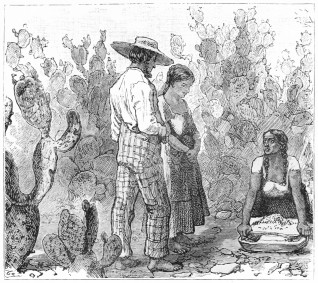
CACTUS, AND WOMAN KNEADING TORTILLAS.
mines, who endowed it in the sum of three hundred thousand dollars. His charitable purpose was to enable the poor of the city of Mexico to obtain loans on pledges of all kinds of articles, and for very low rates of interest. He thus relieved the poorer classes from usurious rates of interest which had been previously charged them by rapacious private pawnbrokers. At first no interest was charged, the borrower only being asked, when he redeemed his pledge, to give something for the carrying on of the charitable work which the institution had in hand. But as this benevolence was greatly abused, it was found necessary to charge a rate of interest which was very low, and yet sufficient to yield a revenue equal to necessary expenses. The affairs of this institution have been wisely managed, and it has been kept true to the purpose of its benevolent founder. When pledges come to be sold, if they bring a price greater than the original valuation, the difference is given back to the original owners. The Monte de Piedad has survived all revolutions, and its ministry of relief to the sufferers by these revolutions and other misfortunes has been incalculably great and blessed. Its average general loans on pledges amount to nearly a million dollars, and the borrowers whom it yearly accommodates number from forty to fifty thousand. From the time when it was founded, in 1775, down to 1886—a little more than the first century of its existence—it made loans to 2,232,611 persons, amounting in the aggregate to nearly $32,000,000, and during the same period it gave away nearly $150,000 in charity.
There is nothing in which the Mexican character appears to better advantage than in the provisions made for the sick and unfortunate. There are in the city of Mexico alone ten or a dozen hospitals, some of which are large, well endowed and equipped, and managed in a way to compare favorably with the best appointed hospitals in any country. This for a city of three hundred thousand inhabitants is a more liberal provision than many larger cities in our own country have. A lying-in hospital was founded by the Empress Carlotta, who, after her return to Europe, sent the sum of six thousand dollars for its support. Besides the hospitals there is a foundling asylum capable of accommodating two hundred inmates: an asylum for the poor, which is a very large and important charity; a correctional school; an industrial school for orphans, having thirteen hundred scholars; an industrial school for women; another for men; schools for deaf-mutes and for the blind; and an asylum for beggars.
The Church of England has been established in Mexico for twelve or fifteen years, having been induced to hold services there by the large number of English residents in the city; but no missionary work has been done by that denomination. The Presbyterian Board of Foreign Missions several years ago commenced to labor in the Republic under the patronage of Diaz, who was then President, and who gave them substantial
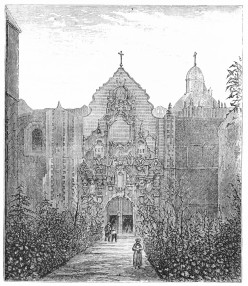
FIRST PROTESTANT CHURCH IN MEXICO.
encouragement. Among other things, he presented the American Board with an old Catholic church, where the school is now held daily, and a printing-office, for the purpose of the publication of a weekly newspaper and religious literature, is carried on. There are now at work in Mexico six Protestant clergymen and two lady missionaries from the United States, twenty-four regularly ordained Mexican ministers, six native licentiates, and three native helpers. Seventy-five congregations have been organized, and meet for worship every Sunday, and the number of native members is about three thousand. There is also a Theological Seminary, with two professors from the United States and one native instructor, having a total attendance of twenty-seven young men preparing for the ministry. Fourteen of these are studying theology, and thirteen are in the preparatory department. There is also a school for girls, with two American and one native lady teacher, which has a large attendance. A missionary paper called El Faro (The Light-house) is conducted at the Theological Seminary. The work is rapidly increasing, seven churches having been organized in 1885 and as many more in 1886.
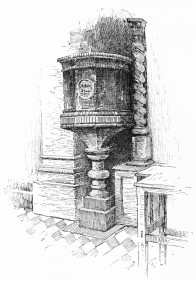
THE FIRST CHRISTIAN PULPIT IN AMERICA—TLAXCALA.
The missionaries are very often interfered with by the country people, instigated by the priests, and several of the native preachers have been shot or injured. These attacks have usually been attributed to highwaymen, but after investigation have proven to be the work of assassins employed by the priests. One white missionary was murdered some two years ago while passing along the road at night, but his assassins were brought to speedy justice, and wholesome examples made of them.
In July, 1885, the Romanists of a small town in the interior entered a Protestant church, carried off all of the valuables, smashed the organ into fragments, emptied kerosene oil upon the benches, and set the place on fire. The furniture of the interior was destroyed, but the walls of the building, being of adobe, and the roof of tiles, the house was not destroyed. For some weeks afterwards several shots were fired at people who were on their way to evening service, and a missionary was attacked in the dark by armed assassins who would have been murdered but for the courageous use of his revolver. Subsequently all the other churches in the neighborhood were similarly treated, and when appeals were made to the local authorities for protection, and for the punishment of those who had committed the outrages, it was decided that it was the work of highwaymen, and a reward was offered for the arrest of the perpetrators. This opinion was thought to be a subterfuge, and it is believed that the authorities were in sympathy with the acts.
The matter was carried to President Diaz, who ordered an investigation, and promised an effectual protection to the missionaries wherever there was need of it. Several days after he issued a proclamation which was addressed to the commandants of the several departments of the Republic, and ordered that it should be read before the troops on parade, and kept posted in conspicuous places for the information of the public. In this proclamation, among other things, President Diaz said: “These acts of intolerance, apart from their injustice, are the data by which people of other lands judge of the nature and degree of our civilization, and for this reason especially I command that you give especial attention to prevent such outrages, and to secure to all believers in any religion the liberty which the constitution and laws concede to them. Catholics shall be protected in the same way as Protestants, and those who attempt to interfere with the exercise of any religious ceremony shall be punished severely. If troops are needed to carry this order into effect, they will be supplied upon request.”
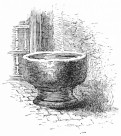
FONT IN OLD CHURCH OF SAN FRANCISCO.
GUATEMALA CITY.
THE CAPITAL OF GUATEMALA.
GUATEMALA has had three capitals, all called Guatemala City, since the Conquest. The first was founded by Alvarado in 1524, and buried under a flood of sand and water in 1541. The second capital was founded the same year, a few miles eastward of the old site, and was destroyed by an earthquake in 1773. The present capital is the largest and by far the finest city in Central America, and is more modern in its appearance than any other. It is situated in what is called the tierra templada, or temperate zone, about forty-five hundred feet above the level of the sea, at the northern extremity of an extensive and beautiful plain, and has a climate that is very attractive. The plain upon which it stands is by no means as fertile as many other portions of the country, and is deficient in water. The supply which is used by the people is brought for a distance of fifteen miles in an aqueduct, which has the honor of having been described by Charles Dickens in his sketch of “The Flying Dutchman.” These water-works were commenced as far back as 1832, and involved an expenditure of over two million dollars, but without them the city could not have prospered.
Guatemala City is not favorably situated for commerce, as it is a considerable distance from both seas, and is shut out from the most productive portions of the country by walls of mountains. The city is laid out in quadrilateral form, and formerly was surrounded by a great wall through which it was entered by gates opening in various directions. It covers a vast area of territory for a place of its population, as the houses, like those of other Central American cities, are very
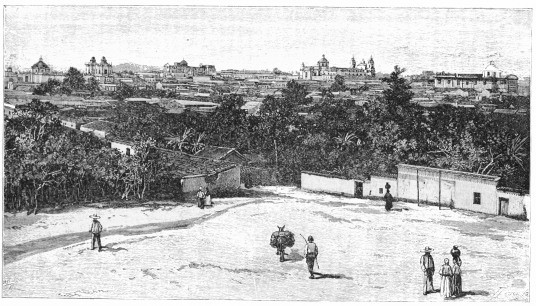
VIEW OF GUATEMALA CITY.
large, and enclose attractive gardens. During the last twelve years, under the presidency of General Barrios, Guatemala has made rapid progress, and but for the low and commonplace appearance of the houses would resemble the more modern cities of Europe. All the streets are paved, with gutters in the centre, and have broad paths of flag-stones on each side for foot-passengers.
Antigua Guatemala, the old capital, thirty miles to the westward of the new, is still a place of considerable importance, and in its time was far superior to the present capital in size and appearance. Previous to its destruction in 1773 there were but two cities on the American hemisphere which compared with it in population, wealth, and magnificence. These were the City of Mexico, and Lima, Peru. New York was then a commercial infant, Boston a mere village, and Chicago yet unknown. But here was a city in which were centred the ecclesiastical and political interests of the Central American colonies, where millions of dollars were spent in erecting churches, convents, and monasteries, which covered acres of ground, and beautiful residences whose shattered portals still bear the escutcheons of the noble families who ruled the city and cultivated the plantations of coffee, sugar, and cochineal.
Antigua, as it is now called (properly old Guatemala), was not only the scene of wealth and influence, and the commercial metropolis of the country, but the home of the most learned men of all Spanish America, the seat of great schools of theology, science, and art, for two hundred years the Athens and Rome of the New World, the residence of the university, as well as the Inquisition, and the headquarters of those untiring apostles of evil, the Jesuits. The population is said to have been about one hundred and fifty thousand. It is not known that a census was ever taken, and this estimate is based upon the size of the city and number of inhabitants its ruined walls could have contained. It is situated in the centre of a great valley, between the twin volcanoes Agua and Fuego; and as the old Spanish chroniclers used to say, had Paradise on one side and the Inferno on the other. The beauty of its position and the richness of the adjacent country, the grandeur of the scenery that surrounds it, have called forth the most extravagant admiration from travellers, and have made it the theme of the native poets. Mr. Stephens, who wrote the most elaborate sketch of Central America we have, some forty years ago, says that Antigua Guatemala is surrounded by more natural beauty than any location he had ever seen during the whole course of his travels. The city is watered by a stream bearing the poetical name of El Rio Pensativo, which encircles the mountains and winds about through the plain in most graceful curves. It has for its tributaries many rivulets that water the plain, and finally falls over a cataract and flows through the valley below to the sea.
This valley was formerly famous for the culture of cochineal, and much wealth was derived from this source before aniline dyes drove it out of the market. The cochineal is a little insect which clings to the leaves of a species of the cactus, known as the nopal, and in the natural state the white hair upon its body causes the leaves to look as if they were covered with hoar-frost. Before the rainy season sets in the leaves of the nopal are cut close to the ground and hung up under a shed for protection. Then they are scraped with a dull knife, and the insects are killed by being baked in a hot oven or dipped into boiling water. If the first process is used, the insects become a brownish color, and furnish a scarlet or crimson dye. Those killed by baking are black, and are used for blue and purple dyes. They are then packed up in little casks, covered with hides to keep out the moisture, and sent to market, being valued at several dollars a pound. The great part of the expense is due to the time and trouble required to detach the insects from the nopal, two ounces being considered a fair result of a day’s labor; and it is said that it requires seventy thousand to make a pound. When they are dried they look like coarse powder.
The first capital was founded by Alvarado, the Conqueror. The exploits of Cortez in Mexico had become known among
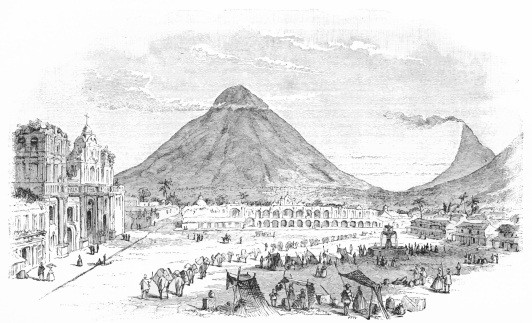
RUINS OF THE OLD PALACE AT ANTIGUA GUATEMALA.
the Indian tribes in the south, and the native kings sent an embassy to him offering their allegiance to the crown of Spain. Cortez received the embassy with distinction, and sent Alvarado back with them to take possession of the country. In 1523 Alvarado left the City of Mexico with three hundred Spanish soldiers and a large body of natives, and nearly a year later arrived at a place at the foot of the volcano Antigua, called by the Indians Almolonga, meaning in their language “a spring of water.” On the 25th of July, 1524, the festival of St. James, the patron saint of Spain, Alvarado, under a tree which is still standing, assembled his horsemen, the Mexican Indians who had accompanied him, and as many of the natives of the country as could crowd around, when the chaplain, Juan Godinez, said mass, invoking the protection of the apostle, and christening the city he intended to build there with the name of San Diego de los Cabeleleros—the City of St. James, the Gentleman. After these religious services, Alvarado assumed authority as governor, and appointed his subordinates.
For fifteen years thousands of Indians were kept at work building the city. A church was the first structure raised; but in September, 1541, there came a calamity which entirely destroyed the place, and buried more than half the inhabitants under the ruins, among whom was the Donna Beatrice de la Queba, the wife of Alvarado. It had rained incessantly for three days, and on the fourth the fury of the wind, the incessant lightning and dreadful thunder, were indescribable. At two o’clock in the morning the earthquake shocks became so violent that the people were unable to stand. Shortly after an enormous body of water rushed down from the mountain, forcing with it large pieces of rock, trees, and entirely overwhelming the town with an avalanche of earth and ashes.
It has generally been assumed, and is believed by the people, that this flow of water was a real eruption, and for that reason the volcano was named Agua. The theory of some scientists is, that the water flowed from an accumulation of rain and snow in the extinct crater, the walls of which were broken through by the pressure during the earthquake. Such a thing is not only doubtful, but almost impossible; and unless the situation of the crater has changed, there is no evidence of it. Any torrent of water cast from the crater would have gone down on the other side of the mountain, and there are ashes upon the slope near the summit which must have lain there for hundreds of years. About three thousand feet from the summit there is evidence of a terrible struggle between a storm and the earth. Great trees were uprooted, rocks were hurled from their places, and a vast fissure is seen, fifteen or sixteen hundred feet deep, extending directly to the buried city, growing in depth and width until it reaches the valley. From this gorge came the mass of ashes and sand which buried the first Guatemala, like Sodom and Pompeii, and it must have been carried down by a water-spout or some agent of that sort.
The cathedral was buried to the roof; but years afterwards, when the sand was dug away, it was found uninjured, with all its contents preserved, because of the interposition of St. James. The palace, being in the immediate path of the torrent, was undermined and overthrown by its force. The ruins, half covered by sand, are the only remaining evidences of the massive grandeur of the building, one of whose angles points in the direction from which the water came. Many excavations have been made in search of treasure, as Alvarado had the reputation of keeping there stores of silver and gold. They have resulted in no remunerative discovery, but have disclosed some fine carvings, wonderful frescos, and other evidences of the beauty which the place is said to have possessed. Over its ruins to-day stands a low-browed house, with an inscription over its door reading, “Complimetaria Escula Para Ninos”—A Free School for Girls.
The tree under which tradition says Alvarado and his soldiers first camped, and where Padre Godinez sanctified the city by religious services, is still standing. When I visited it, the most noticeable things about the place were a wagon made by the Studebaker Brothers, of South Bend, Indiana, and several empty beer bottles, bearing the brand of a Chicago brewer.
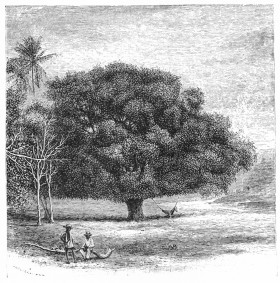
ALVARADO’S TREE.
The fountain of Almolonga, which first induced Alvarado to select this spot as the site of his capital, is a large natural basin of clear and beautiful water shaded by trees. It has been walled up and divided off into apartments for bathing purposes and laundry work; and here all the women of the town come to wash their clothing. The old church was dug out of the sand, and is still standing. In one corner is a chamber filled with the skulls and bones that were excavated from the ruins. The old priest who was responsible for the spiritual welfare of the people showed us over the ruins, and told us stories of Alvarado and his piety. He said that the pictures, hangings, and altar ornaments in the church were the same that were placed there in Alvarado’s time, and unlocking a great iron chest he showed us communion vessels, incense urns, crosses, and banners of solid gold and silver. Among other things was a magnificent crown of gold, which was presented to the church by one of the Philips of Spain. It was originally studded with diamonds, emeralds, and other jewels, but they have been removed, and the settings are now empty. Yankee-like, we tried to buy some of these treasures, for they were the richest I had seen at any place, but the old priest refused all pecuniary temptations, and crossed himself reverently as he put the sacred vessels away. The only people who patronize this church are the Indians, who, to the number of two or three thousand, live in the neighborhood, and the ancient vessels are never used in these days, but are kept as curiosities.
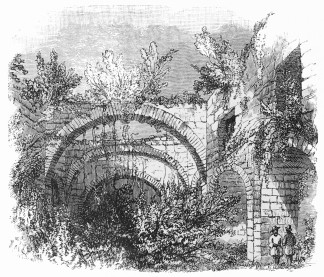
ANCIENT ARCHES.
The second city of Guatemala was built about three miles
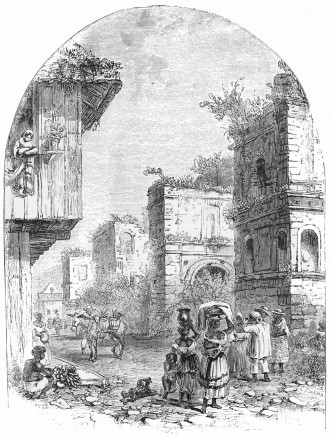
THE OLD AND THE NEW.
from the original one, a little farther down, and nearly at the foot of the volcano Fuego. Both of these ruined cities offer the greatest attractions to the antiquarian, but few have ever visited them, and very little has been written of either place. In Antigua, as the second Guatemala is called, is the most extensive collection of ruins that can be found in this hemisphere. From a tower of the cathedral one can see on either side the ruins of many churches, monasteries, convents, and miles of public and private residences, large and costly; some with walls still standing, liberally ornamented with stucco or carved stone, but roofless, without doors or windows, and trees growing within them.
The ruins of forty-five churches can be counted, and nearly every one of them had a convent or monastery attached. Some cover several acres, and have cells for five or six hundred monks or nuns. Several of the churches are as large as the cathedral in New York. They are not so much ruined but that their outlines can be traced, showing the noble architecture and costly work by which they were built. The force of the earthquake can be seen by broken pillars of solid stone five or six feet in diameter; walls of ten or fifteen feet thickness were shaken into fragments, and buildings with foundations of stone as deep and solid as those of the Capitol at Washington were crumbled into dust. About ten per cent. of the houses have been rebuilt, but the remainder are still in ruins. The inhabitants occupy the old residences that have been restored, but appear to know little of the place as it was before the earthquake. They have forgotten what their fathers told them, and no attempt has ever been made to secure a permanent and accurate record of the antique conditions.
In the centre of the town is a great plaza, which, as usual in all of the Central American capitals, is surrounded by public buildings and the cathedral. In the centre stands a noble fountain, which is surrounded every morning by market-women selling the fruit and vegetables of the country. The old palace has been partially restored, and displays upon its front the armorial bearing granted by the Emperor Charles the Fifth to the loyal and noble capital in which the Viceroy of Central America lived. Upon the crest of the building is a statue of the Apostle St. James on horseback, clad in armor, and brandishing a sword. The majestic cathedral, 300 feet long, 120 feet broad, 110 feet high, and lighted by fifty windows, has been restored, and within it services are held every morning, the faithful being called to mass by a peon pounding upon a large and resonant gong.
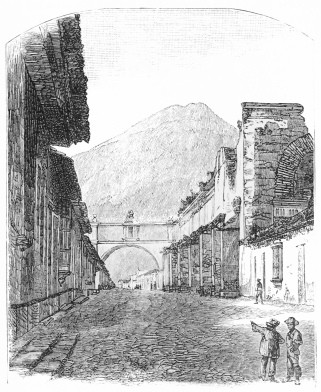
HOW THE OLD TOWN LOOKS NOW.
Without warning, on a Sunday night in 1773, the disaster came, and the proudest city in the New World was forever humbled. The roof of the cathedral fell; all the other churches were shaken to pieces; the great monasteries, which had been standing for centuries, and were thought to be useful for many centuries more, crumbled in an instant. The dead were never counted, and the wounded died from lack of relief. Those who escaped fled to the mountains, and the earthquake continued so violent that few returned to the ruins for many days. The volcano, whose single shudder shook down the accumulated grandeur of two hundred and fifty years, has since been almost idle, but is smoking constantly, and emitting sulphurous vapors which tell of the furnace beneath. As if satisfied with its moment’s work, it stands at rest, tempting man to try again to build another magnificent city, as firm as he can make it, for another test of strength. The people, like the dwellers over the buried Herculaneum, seem to have no fear of ruin or disaster, because, as very respectable citizens will tell you, the volcano which did the damage has since been blessed by a priest.
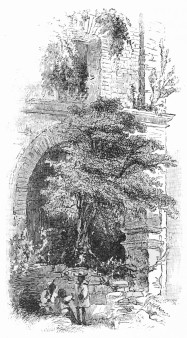
FRAGMENT OF A RUINED MONASTERY.
In one of the old monasteries, established by the Franciscan Friars, is a tree from which four different kinds of fruit may be plucked at one time—the orange, lemon, lime, and a sweet fruit called by the Spanish the limone. It was a horticultural experiment of the Friars many hundred years ago, and still stands as a monument of their experimental industry. It was they who first introduced the cultivation of coffee from Arabia into these countries, and who discovered the use of that curious insect the cochineal. The latter used to be an extensive article of commerce, but the cheapness of the aniline dyes has driven it out of the market. Now it is cultivated only for local consumption, and is extensively used by the natives, whose cotton and woollen fabrics are gayly dyed in colors that will endure any amount of water or sunshine. Thirty years ago two million tons were exported annually, but now very little goes out of the country.
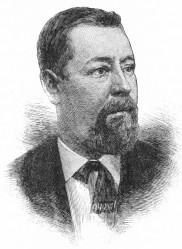
JOSÉ RUFINO BARRIOS.
The progress of Guatemala during the last twelve years, and the advancement of the country towards a modern standard of civilization, has been very rapid, and it is due to the energy and determination of one man, José Rufino Barrios, who stands next, if not equal, to Morazan as a patriot and benefactor of his country. President Barrios studied the conditions of social and political economy in the United States and European nations, and used a remarkable amount of energy to introduce them among his own people. There has been no man in Central or South America with more progressive ideas or more ardent ambition for the advancement of his countrymen.
The prevailing opinion of President Barrios is that he was a brutal ruffian. He drove out of the country many political opponents who occupied themselves by telling stories of his cruelty, some of which were doubtless true. The methods which he habitually used to keep the people in order would not be tolerated in the more civilized lands. But in estimating his true character, the good he accomplished should be considered as well as the evil. Until the history of Central America shall be written years hence, when the mind can reflect calmly and impartially upon the scenes of this decade, when public benefits can be accurately measured with individual errors, and the strides of progress in material development can be justly estimated, the true character of General Barrios will not be understood or appreciated even by his own countrymen. Like all vigorous and progressive men, like all men of strong character and forcible measures, he had bitter, vindictive enemies, who would have assassinated him had they been able to do so, and repeatedly tried it. There was nothing too harsh for them to say of him, living or dead, no cruelties too barbarous for them to accuse him of, no revenge too severe for them to visit upon him or his memory. But, on the other hand, people who did not cherish a spirit of revenge, who had no political ambition, and no schemes to be disconcerted, who are interested in the development of Central America, and are enjoying the benefits of the progress Guatemala has made, regard Barrios as the best friend and ablest leader, the wisest ruler his country ever had, and would have been glad if his life could have been prolonged and his power extended over the entire continent. They are willing to concede to him not only honorable motives, but the worthy ambition of trying to lift his country to the level with the most advanced nations of the earth. Ten more years of the same progress that Guatemala made under Barrios would place her upon a par with any of the States of Europe, or those of the United States. While he did not furnish a government of the people, by the people, it was a government for the people, provided and administered by a man of remarkable ability, independence, ambition, and extraordinary pride. While his iron hand crushed all opposition, and held a power that yielded to nothing, he was, nevertheless, generous to the poor, lenient to those who would submit to him, and ready to do anything to improve the condition of the people or promote their welfare.
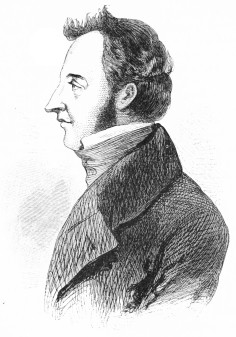
FRANCISCO MORAZAN.
That a man of his ancestry and early associations should have brought this republic to the condition in which he left it when he died is remarkable. Without education himself, he enacted a law requiring the attendance at school of all children between the ages of eight and fourteen years, and rigorously enforced it. People who refused to obey this law, or sent their children to private schools, or educated them at home, were compelled to pay a heavy fine for the privilege. He established a university at Guatemala City and free schools in every city of the republic, to the support of which a larger proportion of the public revenues were appropriated than in any one of the United States or the nations of Europe. He founded hospitals, asylums, and other institutions of charity with his own means, or supported them by appropriations from the public treasury. He compelled physicians to be educated properly before they were allowed to practise; he punished crime so severely that it was almost unknown; he regulated the sale of liquors, so that a drunken man was never seen upon the streets; he enforced the observance of the Sabbath by closing the stores and market-places, which in other Spanish-American republics are always open, and was active for the material as for the moral welfare of the people. During the twelve years he was in power the country made greater progress, and the citizens enjoyed greater prosperity, than during any period of all the three centuries and a half of previous history.
His ambition to reunite the five Central American republics in a confederacy was not successful; but it was inspired by a desire to do for the neighboring States what he had done for Guatemala. His ambition was for the advancement and development of Central America; and while the means he used cannot be entirely approved, his purpose should be applauded. His crusade was quite as important in the civilization of this continent as the bloody work England attempted to accomplish in Egypt and the Soudan. He was better than his race, was far in advance of his generation, and while he did not succeed in lifting his people entirely out of the ignorance and degradation in which they were kept by the priests, what he did do cannot but result in the permanent good, not only of Guatemala, but of the nations which surround that republic.
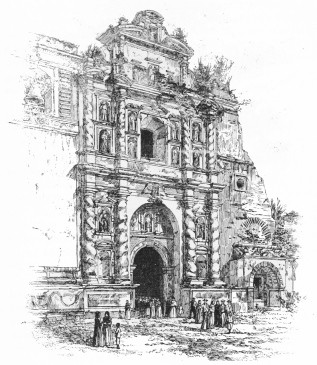
CHURCH OF SAN FRANCESCA, GUATEMALA LA ANTIGUA.
After the independence of the Central American colonies the priests ruled the country. Their excesses awakened a spirit of opposition, which finally culminated in a revolution. The famous Morazan became dictator, and might have been successful but for a decree he issued abolishing the convents and monasteries, and confiscating the entire property of the Church. This was in 1843. Led by the priests, the people rose in rebellion; but Morazan retained his power until an unknown man, tall, dark, and blood-thirsty, came out of the mountains—an Indian without a name, who could neither read nor write, whose occupation had been that of a swineherd, like Pizarro, who had graduated in the profession of a bandit, and led a gang of murderous outlaws in the mountains. Urged by a greed for plunder, this remarkable man, Rafael Carera, came out from his stronghold and joined the Church party in their war against the Government.
His successes as a guerilla were so great that what was a small, independent band became the main army of the opposition, and he led a horde of disorganized plunderers towards the capital. The priests called him the Chosen of God, and attributed to him the divinely inspired mission of restoring the Church to power. The pious churchmen rushed to his standard, and fought by the side and under the command of the savage, whose only motive was plunder. He drove Morazan into Costa Rica, and proclaimed himself Dictator. The Church party were amazed at the arrogance of the bandit, but had to submit, and he soon developed into a full-fledged tyrant, ruling over Guatemala until his death for a period of thirty years.
When Carera died there was no man to take his place, and the Church party began to decay. The Liberals gathered force and began a revolution. In their ranks was an obscure young man from the borders of Mexico, from a valley which produced Juarez, the liberator of Mexico, Diaz, the president of that republic, and other famous men. He began to show military skill and force of character, and when the Church party was overthrown and the Liberal leader was proclaimed President, Rufino Barrios became the general of the army. He soon resigned, however, and returned to his coffee plantation on the borders of Mexico. But the revival of the Church party shortly after caused him to return to military life, and when the Liberal president died, he was, in 1873, chosen his successor.
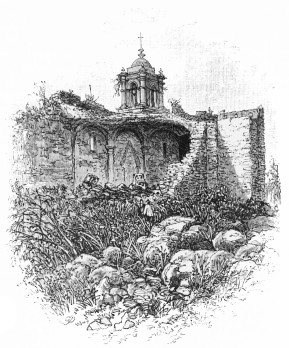
ONE OF FIFTY-SEVEN RUINED MONASTERIES.
From that date until 1885 there was but one man in Guatemala, and he was Barrios. He began his career by adopting the policy that Morazan had failed to enforce. He expelled the monks and nuns from the country, confiscated the Church property, robbed the priests of their power, and, like Juarez in Mexico, liberated the people from a servitude under which they had suffered since the original settlement of the colonies. Then he visited the United States and Europe to study the science of government; sent men abroad to be educated, at Government expense, in the arts and sciences and political economy, and upon their return placed them in subordinate positions under him. He offered the most generous inducements to immigrants, and the country filled up with agricultural settlers, merchants, and mechanics. The population increased, and the country began to grow in prosperity with the development of its natural resources, and there was a “boom” in Guatemala the like of which was never before witnessed on that continent.
Although he found Guatemala in a condition of moral degradation and commercial stagnation, he educated the people in a remarkable degree to an appreciation of his own ideas, and by introducing many modern improvements succeeded in inspiring them with his own ambition, so that they co-operated with him in any measure for the welfare of the country. He secured the enactment of laws which have been of great benefit, and compelled the natives to submit to what they first regarded as hardships but now accept as blessings. Roadways were constructed from the sea-coast to the interior, so that produce could get to market; diligence lines were established at Government expense; liberal railroad contracts were made, telegraph lines were erected, and all the modern facilities were introduced. The credit of the country was restored by a careful readjustment of its finances, and encouragement from the Government brought in a large amount of European capital. So that to-day, while the other Central American States are still in the condition that they were one hundred years ago, or have retrograded, Guatemala has stepped to the front, rich, powerful, progressive, and but for the peculiar appearance of the houses, the language of the people, and the customs they have inherited from their ancestors, Guatemala is not different from the new States of our great West.
Under a compulsory education law free public-schools have
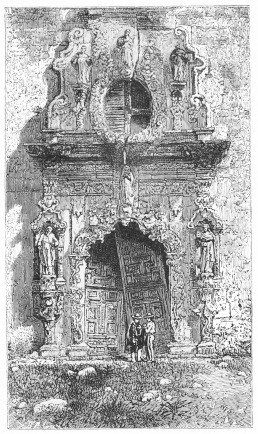
FAÇADE OF AN OLD CHURCH.
been established in every department of the republic, at an expense aggregating one-tenth of the entire revenues of the Government, an amount larger in proportion than is paid by any of the United States. Not only is tuition free, but textbooks are furnished by the Government. In 1884 the total number of schools in the republic was 934, with an attendance of 42,549 pupils, supported at a cost of $451,809, being an average cost to the public treasury of about ten dollars per pupil. Of this aggregate 850 were public graded schools with 39,642 pupils, 55 were private schools with 1780 pupils, 20 were academies for the education of teachers and others desiring education in the higher branches. In addition to these the Government supports a university, with a faculty of high reputation, some of them imported from Germany and Spain, who are paid salaries of four thousand dollars a year each, a compensation greater than is received by instructors in the colleges of the United States, except in rare instances. Under this university are two law-schools with fifty-two pupils, one school of engineering with eleven pupils, a music-school with sixty-six pupils, a school of arts and drawing with one hundred and seventeen pupils, and a commercial college with fifty pupils, besides a deaf and dumb asylum with nine inmates. It is required that students in this university shall study the English language, and in a female college adjacent to it nothing but American textbooks are used. No language but English is spoken by the pupils residing in the institution, and the teachers as well as the principal are from the United States. This system of education was established about ten years ago, but has gradually improved until it has reached its present importance, and cannot but have a wholesome influence in the elevation of the people and the development of the State.
Having overthrown the religion in which the people had been reared, Barrios recognized the necessity of providing some better substitute. He therefore, through the British minister, invited the Established Church of England to send missionaries to Guatemala; but owing to the disturbed condition of the country it was not considered advisable to commence work at that time, and the opportunity was neglected. In 1883 President Barrios visited New York, where he had conferences with the officers of the Presbyterian Board of Foreign Missions, which resulted in diverting the Rev. John C. Hill, of Chicago, who was en route to China, into this field of labor. Mr. Hill returned with the President to Guatemala, receiving a cordial welcome, and the President not only paid the travelling expenses of himself and family from his own pocket, but the freight charges upon his furniture, and purchased the equipment necessary for the establishment of a mission and school.
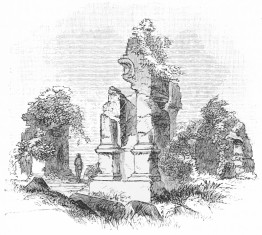
A REMNANT.
The reception of the President on his return to the country after an absence of nearly two years was a royal one, and the journey from San José, the Pacific seaport, to the capital of Guatemala was a triumphal march. Of all the honors, of all the attentions General Barrios received, he insisted that Mr. Hill should have a share, and the blushing young parson found himself again and again on public platforms, with the President of Guatemala leaning upon his shoulder and introducing him to the people as his friend. This demonstration had its purpose, and resulted precisely as General Barrios intended it should. He meant that the people should know that he had taken the missionary and the cause he represented under the patronage of the Government, and expected them to show the same respect and honor he bestowed himself. He went still further. He placed Mr. Hill in one of his own houses, and there the school and chapel were opened. He sent his own children to the new Sunday-school, and notified members of his Cabinet to follow his example. He issued a decree to the Collectors of Customs to admit free of duty all articles which Mr. Hill desired to import, and in every possible manner showed his interest in the success of the work. The Protestant Mission became fashionable, and was known as the President’s “pet.”
The encouragement President Barrios gave to the Presbyterian Mission was an example the people were glad to follow, and the mission met with nothing but the most cordial and respectful treatment. The Catholics looked very sour at the rapidity with which the breach was widened in the walls they were nearly four hundred years in erecting, but they dared not utter even a remonstrance against those favored by the potent force behind the military guard. They saw the monks and nuns expelled, the churches sold at public auction for the benefit of the public treasury, and with a muttered curse against the power by which all these things were done, submitted servilely to his will for fear of losing what they had been able to retain.
Mrs. Barrios was the loveliest woman in Guatemala; beautiful in character as well as person, socially brilliant and graceful, charitable beyond all precedent in a country where the poor are usually permitted to take care of themselves, generous and hospitable, a good mother to a fine family of children, and a devoted wife, loyal to all the President’s ambitions, and an enthusiastic supporter of all his schemes. Like a wise man who knows the perils which constantly surround him, and the uncertainty of the head which wears a crown in these countries, he had made ample provision for his family by purchasing for Mrs. Barrios a handsome residence in Fifth Avenue near Sixty-fifth Street, New York, and investing about a million dollars in her name in other New York real estate. His life was also insured for two hundred and fifty thousand dollars in New York companies, which, it must be said, carried a hazardous risk, as there were hundreds of men who lived only to see Barrios buried. Very few of them were in Guatemala, however, during his lifetime. They did not find the atmosphere agreeable there. They were exiles in Nicaragua, Costa Rica, Mexico, California, or elsewhere, waiting for a chance to give him a dose of dynamite or prick him with a dagger.
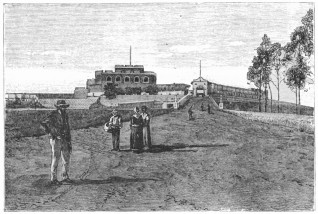
FORT OF SAN JOSÉ, GUATEMALA.
Mrs. Barrios and her children talk English as well as if they had always lived in New York. While the President himself could not speak the language fluently, he could understand what was said to him, and apologized for what he called a misfortune, on the ground that he did not have the opportunity to learn it until he was too old to master its intricacies. But he required English to be taught in all the common-schools, and the children use nothing but American text-books. I talked with him one day, with his little girl as an interpreter. She was a beautiful child, about ten years of age, and when she said she was an American (which means a citizen of the United States) the President patted her fondly upon the head and cried “bueno” (good).
Several years ago there was a conspiracy to assassinate the President. A woman, who was the Mrs. Surratt of the plot, and at whose house the conspirators were in the habit of meeting, did not like the arrangement, and on the afternoon of the night on which the plan was to be carried into execution revealed the whole thing to the President. He had the conspirators arrested, and ordered the men shot who proposed to ravish his wife, but he pardoned his treacherous private secretary. The latter rewarded the President’s generosity by forging an order to the commandant of the prison to release the condemned men. He was arrested again, confessed his crime, even boasted of it, and was shot also. Several other attempts were made to assassinate Barrios. The last came very near being successful. He was on his way to the theatre, when three men, who had been employed by an ambitious politician for the purpose, threw a bomb at him. He coolly stepped on the fuse, extinguished it, picked up the dose of death that had been prepared for him, and remarked to his companion,
“The rascals don’t know how to kill me!”
The leader of the plot was sent into exile, but his tools were pardoned, and are walking the streets of the city of Guatemala to-day.
The prettiest and most picturesque of the native costumes to be found in Spanish America is worn by the women of Guatemala, who are of a dark complexion, nearly that of the mulatto type, but are famous for their beauty of form. A Guatemala girl in her native costume makes as pretty a picture as one can find anywhere. Her face is bright and pretty, her figure as perfect as nature unaided by art can be, and her movements show a supple grace and elasticity that cannot be imitated by those of her sex who are encumbered by modern articles of feminine apparel. Her head is usually bare, in-doors and out, and her thick black tresses hang in braids often reaching to her heels.
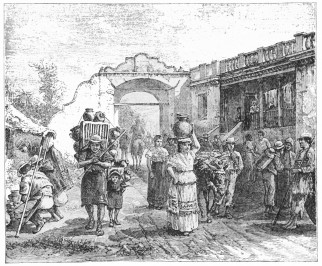
YNIENSI GATE, GUATEMALA.
Her garments are only two—a guipil and a sabana. The first is a square piece of cotton of coarse texture, covered with embroidery of brilliant colors and simple but artistic designs. In the centre of the guipil is an aperture like that in the ordinary poncho, through which her head goes, and it is usually wide enough to constitute, when worn, a low-neck waist. The ends are tucked in her skirts at the belt. Her bare arms come through the open folds of her guipil, and when she raises them her side is exposed. Her skirt is a straight piece of plaid cotton of brilliant colors, like the Scotch plaids, and is wound tightly around her limbs. It is secured at the waist by a sash, usually of scarlet, woven by her own hands of the fibres of the pita grass, and executed in the most skilful manner. These belts in their texture resemble the Persian camel’s-hair shawl, and often cost months of labor. Very often the name of the owner, and sometimes mottoes, are woven into the texture, and they are brought away from the country as curiosities by travellers.
Every article the Guatemala girl wears she makes with her own hands, and the natives of that country are as ingenious, industrious, and intelligent as are found in Spanish America. Even her sandals are home-made, and her little stockingless feet look very pretty in them. The small size of the hands and feet of the men and women is always noticed by those who visit Guatemala, and they are usually very shapely and delicately formed.
The costume which has been described is worn only by the peasants. The upper classes dress just as they would in New York, and the fashions are followed quite as closely. The women are very pretty, but have the habit of plastering their faces over with a paste or rouge that makes them look as if they had been poking their heads into a flour-barrel. This cosmetic is made of magnesia and the whites of eggs, stirred into a thick paste, and plastered on without regard to quantity. The natural beauty of complexion is thus concealed, and in time totally ruined. There is a Swiss lady at the head of a large seminary in Guatemala City to which the daughters of the aristocracy are sent. She has forbidden the use of this plaster by the young ladies under her charge to prevent the boarding pupils from destroying their fair skins, but over the day-scholars she has no control out of school-hours. Every morning she stands at the entrance with a basin of water, a sponge, and a towel, and puts the girls through a system of scrubbing that arouses their indignation.
The natives are fond of bright colors, and have a remarkable deftness in their fingers, which hold the embroidery-needle as well as the hoe and machete. The guipils are embroidered in gay tints and artistic patterns, and a group of peons
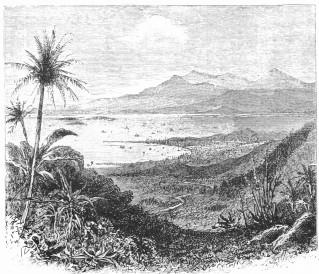
A VOLCANIC LAKE.
returning from or going to market looks as quaint and picturesque as the peasants of Normandy or Switzerland. The women are short, squarely built, and very muscular, and carry as much load as a mule. Their cargo is always borne upon their heads in a large basket, and they seldom walk, but move in a jog-trot, with a swaying, graceful motion, swinging their arms and carrying their shoulders as erect as a West Point cadet. They travel up hill and down without changing this gait, and make about six miles an hour, being able to outstrip any ordinary horse or mule not only in speed but in endurance. It is a common thing to see a woman not more than twenty-five or twenty-eight years of age coming to town with a hundred pounds of meat or vegetables upon her head, a baby slung in a reboso or blanket fastened around her hips, and several children from six to twelve years of age, each heavily laden, trotting along by her side. Almost as soon as they are able to walk, the children receive loads to carry, and the little ones come seven, eight, and ten miles to market every day or so, thinking nothing of bearing on their heads a weight that would be a burden to the ordinary man of North America.
The men do not carry their loads upon their heads, but upon their backs in a pannier, which is held by bands around the shoulders and across the forehead. They are wonderfully strong and fleet of foot. “If you are going to buy wood or hay,” said a friend who has lived long in the country, “always take the man’s load. You will get more than if you bought the load of a mule.” These men come into town driving ahead of them three or four pack-mules loaded with coffee, sugar, corn, hay, or wood, which they sell to the commission merchants or at the market. When they return at night to their homes in the country they never ride, but drive the unladen mules ahead of them, and many of them are so accustomed to a weight upon their backs that they place a great stone in the pannier to give them a proper balance.
Some are very fleet of foot. Barrios had a runner attached to his retinue of whom some tall stories are told. He was sent as a courier into the country with messages, and his average speed was ten miles an hour. This runner was kept pretty busy in war times, and was constantly in motion. Once he carried a despatch thirty-five leagues into the interior and returned with the answer in thirty-six hours, making the two hundred and ten miles over the mountains at six miles an hour, including detentions and delays for food and sleep.
These men wear short trousers, like bathing-trunks, and a white cotton shirt, with sandals made of cowhide. The shirt is kept for occasions of ceremony, and is worn only in town. While on the road they are naked except for the trunks.
When Barrios issued his decree that the peasants should wear clothing the country narrowly escaped a revolution; but policemen were stationed on all the roads leading into the city, and confiscated all the cargoes borne by those who did
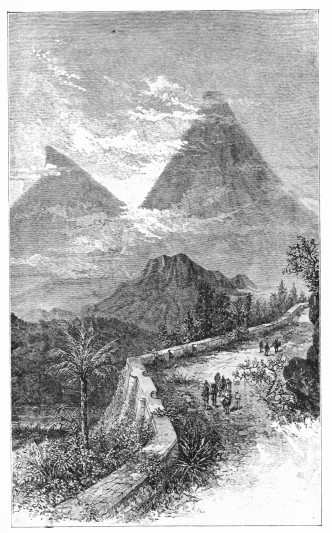
ON THE ROAD TO THE CAPITAL.
not comply with the regulations and put on a shirt or a guipil. The peons pleaded poverty, when Barrios, who was as generous as he was tyrannical, furnished the cloth to make the garments.
It is a novel sight to see a native policeman wearing a uniform like that worn by the policemen of New York—helmet, club, badge, and all. Here extremes meet. Quite as significant and striking a contrast is often furnished in the picture of one of these peons, laden down with his pannier, leaning for a moment’s rest upon a letter-box like those used in the United States, attached to a telephone-pole; or one of the gayly dressed women, with a load of vegetables upon her head, dodging a still more gayly painted mail-wagon, the exact counterpart of those used in our postal service, except that the coat of arms of Guatemala appears in the place of the American eagle.
Barrios imported a sergeant of the New York police force two years ago, bought a lot of uniforms, and organized a patrol system that is remarkably successful. He put letter-boxes on nearly every street-corner, and had the mail carried to and from the railroad-station in wagons made by the same man and after the same pattern as those in use in the United States. He introduced the letter-carrier system also. It is not successful, because the natives object to have their correspondence carried through the streets, preferring to send for it themselves.
The military law of Guatemala requires the enrolment in the militia of every able-bodied man between the ages of eighteen and forty, and when Barrios issued his pronunciamento they were all called out for service. Even the hotels were stripped of servants, the business houses of porters, and all industries of laborers. Jesus Maria was the name of a male chamber-maid at the Grand Hotel, where all the work is done by men. Jesus was very patriotic, and made many vows, he said, for the success of Barrios, but he did not want to go to war, and appealed to all the boarders who had influence with the Government to secure him an exemption-paper. He could say a few words of English, and expressed his sentiments concerning the pending struggle in the words, “La union much grande; la guerra no good.” That exactly describes the attitude the United States took in the contest.
When the conscripts come in from the country, rag-tag and bob-tail, in all kinds of costumes, and usually barefooted, they are sent to the garrison, where each receives a uniform made of white drilling from the United States. About every twelfth one bears across the seat of his trousers or between his shoulders the legend, “Best Massachusetts Drillings XXXX Mills.” This rather adds to the beauty of the uniform, and there is quite a strife among the volunteers to secure trousers or blouses so marked. Each is given a straw hat, a cartridge-box, a gun, and a blanket, with which they were marched to the front at the rate of five or six hundred a day, while the streets were lined with tearful women giving parting words to sons, husbands, and sweethearts. The Guatemalatacos, as the inhabitants are called, are said to be the best fighters in Central America, and were inspired with an intense admiration for Barrios, who had never shown anything but a fatherly solicitude for the welfare of the common people. He may have been cruel to his political enemies, and arbitrary in his treatment of aspiring rivals, but to the masses, the poor, he was always generous and kind. Much of his strength came from the fact that he always shared the shelter and food of the common soldier. He never took any camp equipage with him, but slept on the ground, and ate beans and tortillas (corn-cakes), which constitute the ordinary soldier’s rations.
Although the hotels are clean, and have better beds and food than are found elsewhere in Spanish America, there is one peculiarity which is decidedly objectionable—the bill of fare is never changed. One gets the same dinner and the same breakfast every day. There is enough and a variety at both tables, but there is always the same amount and the same variety. First, at breakfast, there is always soup; there is an omelette, or eggs cooked as you want them; next comes cold beef or mutton left from the previous day; then beefsteak, usually with onions; then beans and fritters. For dinner, soup is first served; second, rice with curry; next, boiled beef with cabbage; then turkey or chicken; then roast beef, salad, fruit, and cheese in order. All the native food (beef, fowls, fruit, and vegetables) is cheap, but flour and other imported products are very expensive. The hotel-keepers are usually Frenchmen or Germans. You seldom find a native keeping a hotel, but if you do, avoid it.
The people of Guatemala have a peculiar way of preparing their coffee for the table. Every week or so a quantity of the berry is ground and roasted, and hot water is poured upon it. The black liquid is allowed to drip through a porous jar, and when cool is bottled up and set upon the table like vinegar or Worcestershire sauce. Pots of hot water or milk, with which the coffee-drinker can dilute the cold, black syrup to such a weakness as he likes, are set before him. This plan has its advantages, but it takes a long time to become accustomed to it.
The laundry work of the city is never done at home, but always at the public fountains, which are scattered over the city, and have basins of stone for the purpose. The wet clothes are placed in a basket and carried home on the head of the laundress to be dried. Every morning and evening, Sundays included, there is a long procession of washer-women going to and from these fountains, with baskets of soiled or wet garments upon their heads.
Sunday is observed in Guatemala more than in any other Spanish-American city. Usually, in all these nations, Sunday is the great market-day of the week, when all the denizens of the country dress in their best suits to come to town to trade and have a little recreation; but in Guatemala there is a law, which is respected and generally enforced, requiring the market and all other places of business to remain closed on the Sabbath. Sometimes a cigar shop or a saloon will be found open, and the hotel bar-rooms, or “canteens,” as they are called, do more business than on any other day but there is no more general business done on Sunday than in the cities of the United States.
All the city stores sell what is known in the slang of trade as “general merchandise;” that is, they keep all sorts of goods. You buy your canned fruit or sardines where you get your shoes or hat, and can fill an order for every variety of edible or apparel in the same establishment. An exception should be made of drugs, for the apothecary shops are usually kept by the physicians, who compound their own prescriptions, and the drug-stores in Guatemala, as in every other city of Central and South America, are usually fine establishments. But when you send for a “doctor” a lawyer comes. If you are sick, always ask for an apothecary or a physician. When you see a man alluded to as Dr. Don So-and-so, you may know that he is an attorney of distinction. The notaries draw all legal documents, as in Europe. Nobody ever asks a lawyer to draw a contract or a will.
The photographers of Central and South America are almost invariably from the United States, and there is usually one in every town of importance. The people are vain of their personal appearance, hence photography is a lucrative business. But customs differ. In Venezuela, or Havana, or the Argentine Republic, if a gentleman possesses the photograph of a lady, he is either a near relative or is engaged to marry her. Otherwise her brother or father has good cause to thrash him, or challenge him to fight a duel. If the photographer sold the picture, or gave it away, he is liable to be punished by fine and imprisonment.
In Guatemala, on the other hand, as in Peru, the pictures of the belles of the city, whether married or maidens, can be purchased by any one who wants them at the photographers’, and often at the shops, and the rank and popularity of the subject is usually estimated by the number of her portraits so disposed of. Codfish is a luxury. It is served at fashionable dinners in the form of a stew or patties, or a salad, and is considered a rare and dainty dish. They call it bacalao (pronounced “backalowoh”), and the shop-windows contain handsomely illuminated signs announcing that it is for sale within. It costs about forty cents a pound, and is therefore used exclusively by the aristocracy.
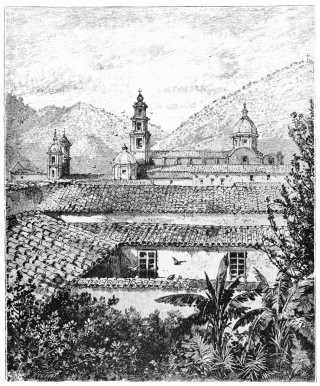
TILED HOUSE-TOPS.
The railroads in Guatemala are run on the credit system. Freight charges are seldom paid upon the delivery of the goods, but merchants and others expect three or four months’ time, and sometimes more. If a package arrives with your address upon it, the railroad company is expected to deliver it at your residence, unless it happens to be very bulky, and a few weeks after a collector comes around for the freight money.
The cars came into Guatemala for the first time in August, 1884, and have not yet ceased to be a novelty. There is always a large crowd of spectators at the station upon the arrival and departure of every train, and among these are the best people of the place. Twice a week, at train time, the National Band plays in the plaza fronting the station, to entertain the people who are waiting.
The Government owns the telegraph line, and charges low tariffs, the cost being twenty-five cents for a message to any part of the republic. But the cable rates are very high—$1.15 per word to the United States, and $1.50 per word to Europe.
The literary people here always spell general with a “J.” Barrios was the “Jeneral Presidente,” but after his pronunciamento “Supremissimo Jefe Militar”—Most Supreme Military Chief.
When a letter is addressed to a person of distinction the envelope reads, “Exmo y’ Illustra Señor Don John Smith”—The Most Excellent, or His Excellency, the Illustrious Señor Don, etc. One is apt to feel very highly complimented when he gets a letter bearing this inscription.
Everybody is named after some saint, usually the one whose anniversary is nearest the hour of their birth, and the saint is expected to look after them. When a man comes here who doesn’t happen to be christened after a saint, the ignorant people express their surprise, and ask, “Who takes care of him? Who preserves him from evil?”
General Barrios was always dramatic. He was dramatic in the simplicity and frugality of his private life, as he was in the displays he was constantly making for the diversion of the people. In striking contrast with the customs of the country where the garments and the manners of men are the objects of the most fastidious attention, he was careless in his clothing, brusque in his manner, and frank in his declarations.
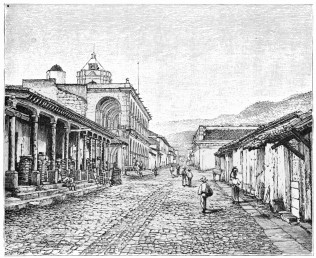
MARKET-PLACE, GUATEMALA.
It is said that the Spanish language was framed to conceal thoughts, but Barrios used none of its honeyed phrases, and had the candor of an American frontiersman. He was incapable of duplicity, but naturally secretive. He had no confidants, made his own plans without consulting any one, and when he was ready to announce them he used language that could not be misunderstood. In disposition he was sympathetic and affectionate, and when he liked a man he showered favors upon him; when he distrusted, he was cold and repelling; and when he hated, his vengeance was swift and sure. To be detected in an intrigue against his life, or the stability of the Government, which was the same thing, was death or exile, and his natural powers of perception seemed almost miraculous. The last time his assassination was attempted he pardoned the men whose hands threw the bomb at him,
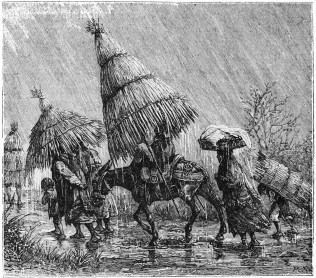
IN THE RAINY SEASON.
but those who hired them saved their lives by flight from the country. If caught, they would have been shot without trial. He was the most industrious man in Central America; slept little, ate little, and never indulged in the siesta that is as much a part of the daily life of the people as breakfast and dinner. He did everything with a nervous impetuosity, thought rapidly, and acted instantly. The ambition of his life was to reunite the republics of Central America in a confederacy such as existed a few years after independence. The benefits of such a union are apparent to all who understand the political, geographical, and commercial conditions of the continent, and are acknowledged by the thinking men of the five States, but the consummation of the plan is prevented by the selfish ambition of local leaders. Each is willing to join the union if he can be Dictator, but none will permit a union with any other man as chief.
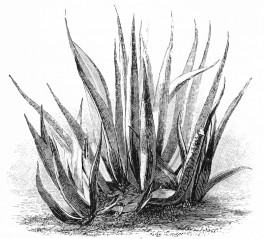
MAGUEY PLANT.
Diplomatic negotiations looking to a consolidation of the five Central American republics extended over a period of several years, but were fruitless because of local jealousies. The leading politicians in the several States feared they would lose their prominence and power, and distrusted Barrios, although he assured them that he was not ambitious to be Dictator. He thought he was the right man to carry out the plan, but as soon as it was consummated he proposed to retire and permit the people to frame their Constitution and elect their Executive, promising that he would not be a candidate. As he told me shortly after his coup-d’état, he desired to retire from public life and reside in the United States, which he considered the paradise of nations. He had already purchased a residence in New York, and invested money there, and was educating his children with that intention.
Sending emissaries into the several States to study public sentiment, he became assured that the time was ripe for the consummation of his plans. He believed that the masses of the people were ready to join in a reunion of the republics, and had the assurance of Zaldivar, the President of San Salvador, and Bogran, the President of Honduras, that they would consent to his temporary dictatorship. He determined upon a coup-d’état. Moral suasion had failed, so he decided to try force, with the co-operation of San Salvador and Honduras, which with Guatemala represented five-sixths of the population of Central America. He believed he could persuade Nicaragua and Costa Rica to accept a manifest destiny and voluntarily join the union.
Realizing how impressionable the people he governed were, and knowing their love for excitement, he always introduced his reforms in some novel way, with a blast of trumpets and a gorgeous background.
The union of Central America was announced in the same way, and came upon the people like a shock of earthquake. On the evening of Sunday, the 28th of February, 1885, the aristocracy of Guatemala were gathered as usual at the National Theatre to witness the performance of “Boccaccio” by a French opera company. In the midst of the play one of the most exciting situations was interrupted by the appearance of a uniformed officer upon the stage, who motioned the performers back from the foot-lights, and read the proclamation issued by Rufino Barrios, the President of Guatemala, who declared himself Dictator and Supreme Commander of all Central America, and called upon the citizens of the five republics to acknowledge his authority and take the oath of allegiance. The people were accustomed to earthquakes, but no terrestrial commotion ever created so much excitement as the eruption of this political volcano. The actresses and ballet-dancers fled in surprise to their dressing-rooms, while the audience at once organized into an impromptu mass-meeting to ratify the audacity of their President.
Few eyes were closed that night in Guatemala. Those who attempted to sleep were kept awake by the explosion of fireworks, the firing of cannon, the music of bands, and shouts of the populace, who, crazy with excitement, thronged the streets, and forming processions marched up and down the principal thoroughfares, rending the air with shouts of “Long live Dictator Barrios!” “Vive la Union!” A people naturally enthusiastic, and as inflammable as powder, to whom excitement was recreation and repose distress, suddenly and unexpectedly confronted with the greatest sensation of their lives, became almost insane, and turned the town into a bedlam. Although every one knew that Barrios aspired to restore the old Union of the Republic, no one seemed to be prepared for the coup-d’état, and the announcement fell with a force that made the whole country tremble. Next morning, as if by magic, the town seemed filled with soldiers. Where they came from or how they got there so suddenly the people did not seem to comprehend. And when the doors of great warehouses opened to disclose large supplies of ammunition and arms, the public eye was distended with amazement. All these preparations were made so silently and secretly that the surprise was complete. But for three or four years Barrios had been preparing for this day, and his plans were laid with a success that challenged even his own admiration. He ordered all the soldiers in the republic to be at Guatemala City on the 1st of March; the commands were given secretly, and the captain of one company was not aware that another was expected. It was not done by the wand of a magician, as the superstitious people are given to believing, but was the result of a long and carefully studied plan by one who was born a dictator, and knew how to perform the part.
But the commotion was even greater in the other republics over which Barrios had assumed uninvited control. The same night that the official announcement was made, telegrams were sent to the Presidents of Honduras, San Salvador, Nicaragua, and Costa Rica, calling upon them to acknowledge the temporary supremacy of Dictator Barrios, and to sign articles of confederation which should form the constitution of the Central American Union. Messengers had been sent in advance bearing printed official copies of the proclamation, in which the reasons for the step were set forth, and they were told to withhold these documents from the Presidents of the neighboring republics until notified by telegram to present them.
The President of Honduras accepted the dictatorship with great readiness, having been in close conference with Barrios on the subject previous to the announcement. The President of San Salvador, Dr. Zaldivar, who was also aware of the intentions of Barrios, and was expected to fall into the plan as readily as President Bogran, created some surprise by asking time to consider. As far as he was personally concerned, he said, there was nothing that would please him more than to comply with the wishes of the Dictator, but he must consult the people. He promised to call the Congress together at once, and after due consideration they would take such action as they thought proper. Nicaragua boldly and emphatically refused to recognize the authority of Barrios, and rejected the plan of the union. Costa Rica replied in the same manner. Her President telegraphed Barrios that she wanted no union with the other Central American States, was satisfied with her own independence, and recognized no dictator. Her people would protect their soil and defend their liberty, and would appeal to the civilized world for protection against any unwarranted attack upon her freedom.
The policy of Nicaragua was governed by the influence of a firm of British merchants in Leon with which President Cardenas has a pecuniary interest, and by whom his official acts are controlled. The policy of Costa Rica was governed by a conservative sentiment that has always prevailed in that country, while the influence of Mexico was felt throughout the entire group of nations. As soon as the proclamation of Barrios was announced at the capital of the latter republic, President Diaz ordered an army into the field, and telegraphed offers of assistance to Nicaragua, San Salvador, and Costa Rica, with threats of violence to Honduras if she yielded submission to Barrios. Mexico was always jealous of Guatemala. The boundary-line between the two nations is unsettled, and a rich tract of country is in dispute. Feeling a natural distrust of the power below her, strengthened by consolidation with the other States, Mexico was prepared to resist the plans of Barrios to the last degree, and sent him a declaration of war.
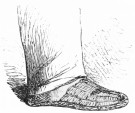
A NATIVE SANDAL.
In the mean time Barrios appealed for the approval of the United States and the nations of Europe. During the brief administration of President Garfield he visited Washington, and there received assurances of encouragement from Mr. Blaine in his plan to reorganize the Central American Confederacy. Their personal interviews were followed by an extended correspondence, and no one was so fully informed of the plans of Barrios as Mr. Henry C. Hall, the United States minister at Guatemala.
Unfortunately the cable to Europe and the United States was under the control of San Salvador, landing at La Libertad, the principal port of that republic. Here was the greatest obstacle in the way of Barrios’s success. All his messages to foreign governments were sent by telegraph overland to La Libertad for transmission by cable from that place, but none of them reached their destination. The commandant of the port, under orders from Zaldivar, seized the office and suppressed the messages. Barrios took pains to inform the foreign powers fully of his plans, and the motives which prompted them, and to each he repeated the assurance that he was not inspired by personal ambition, and would accept only a temporary dictatorship. As soon as a constitutional convention of delegates from the several republics could assemble he would retire, and permit the choice of a President of the consolidated republics by a popular election, he himself under no circumstances to be a candidate. But these messages were never sent. In place of them Zaldivar transmitted a series of despatches misrepresenting the situation, and appealing for protection against the tyranny of Barrios. Thus the Old World was not informed of the motives and intentions of the man and the situation of the republics.
The replies of foreign nations and the comments of the press, based upon the falsehoods of Zaldivar, had a very depressing effect upon the people. They were more or less doctored before publication, and bogus bulletins were posted for the purpose of deceiving the people. The inhabitants of San Salvador were led to believe that naval fleets were on their way from the United States and Europe to forcibly prevent the consolidation of the republics, that an army was on its way from Mexico overland to attack Guatemala on the north, and that several transports loaded with troops had left New Orleans for the east coast of Nicaragua and Honduras.
The United States Coast Survey ship Ranger, carrying four small guns, happening to enter at La Union, Nicaragua, engaged in its regular duties, was magnified into a fleet of hundreds of thousands of tons; and when the people of San Salvador and Nicaragua were convinced that submission to Barrios would require them to engage the combined forces of Europe and the United States, they rose in resistance and supported Zaldivar in his treachery.
The effect in Guatemala was similar, although not so pronounced. There was a reversion of feeling against the Government. The moneyed men, who in their original enthusiasm tendered their funds to the President, withdrew their promises; the common people were nervous, and lost their confidence in their hero; while the Diplomatic Corps, representing every nation of importance on the globe, were in a state of panic because they received no instructions from home. The German and French ministers, like the minister from the United States, were favorable to the plans of Barrios; the Spanish minister was outspoken in opposition; the English and Italian ministers non-committal; but none of them knew what to say or how to act in the absence of instructions. They telegraphed to their home governments repeatedly, but could obtain no replies, and suspected that the troubles might be in San Salvador. Mr. Hall, the American minister, transmitted a full description of the situation every evening, and begged for instructions, but did not receive a word.
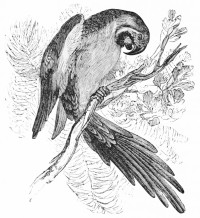
ORNAMENTAL, BUT NOISY.
The Government at Washington had informed Mr. Hall by mail that its policy in relation to the plan to reunite the republics was one of non-interference, but advised that the spirit of the century was contrary to the use of force to accomplish such an end; and acting upon this information, Mr. Hall had frequent and cordial conferences with the President, and received from him a promise that he would not invade either of the neighboring republics with an army unless required to do so. If Guatemala was invaded he would retaliate, but otherwise would not cross the border. In the mean time the forces of Guatemala, forty thousand strong, were massed at the capital, the streets were full of marching soldiers, and the air was filled with martial music, while Zaldivar was raising an army by conscription in San Salvador, and money by forced loans. His Government daily announced the arrival of so many “volunteers” at the capital, but the volunteering was a very transparent myth. A current anecdote was of a conscript officer who wrote to the Secretary of War from the Interior: “I send you forty more volunteers. Please return me the ropes with which their hands and legs are tied, as I shall need to bind the quota from the next town.”
In the city of San Salvador many of the merchants closed their stores, and concealed themselves to avoid the payment of forced loans. The Government called a “Junta,” or meeting of the wealthy residents, each one being personally notified by an officer that his attendance was required, and there the Secretary of War announced that a million dollars for the equipment of troops must be raised instantly. The Government, he said, was assured of the aid of foreign powers to defeat the plans of Barrios, but until the armies and navies of Europe and the United States could reach the coast the republic must protect itself. Each merchant and estancianado was assessed a certain amount, to make the total required, and was required to pay it into the Treasury within twenty-four hours. Some responded promptly, others procrastinated, and a few flatly refused. The latter were thrust into jail, and the confiscation of their property threatened unless they paid. In one or two cases the threat was executed; but, with cold sarcasm, the day after the meeting the Official Gazette announced that the patriotic citizens of San Salvador had voluntarily come to the assistance of the Government with their arms and means, and had tendered financial aid to the amount of one million dollars, the acceptance of which the President was now considering.
Barrios, knowing that the army of Salvador would invade Guatemala and commence an offensive campaign, so as to occupy the attention of the people, ordered a detachment of troops to the frontier, and decided to accompany them. The evening before he started there was what is called “a grand funcion” at the National Theatre. All of the military bands assembled at the capital—a dozen or more—were consolidated for the occasion, and between the acts performed a march composed by a local musician in honor of the Union of Central America, and dedicated to General Barrios. A large screen of sheeting was elaborately painted with the inscription,
“All hail the Union of the Republic!” “Long live the Dictator and the Generalissimo,” “J. Rufino Barrios!”
This was attached to heavy rollers, to be dropped in front of the stage instead of the regular curtain at the end of the second act of the play, for the purpose of creating a sensation; and a sensation it did create—an unexpected and frightful one.
As the orchestra commenced to play the new march the curtain was lowered slowly, and the audience greeted it with tremendous applause, rising to their feet, shouting, and waving their hats and handkerchiefs. But through the blunder of the stage carpenter the weights were too heavy for the cotton sheeting; the banner split, and the heavy rollers at the bottom fell over into the orchestra, severely wounding several of the musicians. As fate would have it, the rent was directly through the name of Barrios. The people, naturally superstitious, were horrified, and stood aghast at this omen of disaster. The cheering ceased instantly, and a dead silence prevailed, broken only by the noise of the musicians under the wreck struggling to recover their feet. A few of the more courageous friends of the President attempted to revive the applause, but met with a miserable failure. Strong men shuddered, women fainted, and Mrs. Barrios left the theatre, unable to control her emotion. The play was suspended; the audience departed to discuss the omen, and everybody agreed that Barrios’s coup-d’état would fail.
The President left the city at the head of his army for the frontier of San Salvador, his wife accompanying him a few miles on the way. A few days later a small detachment of the Guatemala army, commanded by a son of Barrios, started out on a scouting expedition, and were attacked by an overwhelming force of Salvadorians. The young captain was killed by the first volley, and his company were stampeded. Leaving his body on the field, they retreated in confusion to headquarters. When Barrios heard of the disaster he leaped upon his horse, called upon his men to follow him, and started in pursuit of the men who had killed his son. The Salvadorians, expecting to be pursued, lay in ambush, and the Dictator, while galloping down the road at the head of a squadron of cavalry, was picked off by a sharpshooter and died instantly. His men took his body and that of his son, which was found by the roadside, and carried them back to camp. A courier was despatched to the nearest telegraph station with a message to the capital conveying the sad news. It was not unexpected; since the omen at the theatre, no one supposed the Dictator would return alive. All but himself had lost confidence, and it transpired that even he went to the front with a presentiment of disaster, for among his papers was found this peculiar will, written by himself a few moments before his departure.
THE WILL OF BARRIOS.
“I am in full campaign, and make my declaration as a soldier.
“My legitimate wife is Donna Francisca Apaucio vel Vecusidario de Quezaltenanzo.
“During our marriage we have had seven children, as follows: Elaine, Luz, José, Maria, Carlos, Rufino, and Francisca.
“Donna Francisca is the sole owner of all my properties and interest whatsoever. She will know how much to give our children when they arrive at maturity, and I have full confidence in her.
“She may give to my nephew, Luciano Barrios, in two or three instalments, $25,000, for the kindness which this nephew has rendered to me, and which I doubt not he will continue to render to my wife Donna Francisca.
“She will continue to provide for the education of Antonio Barrios, who is now in the United States of America.
“She is empowered to demand and collect all debts due to me in this country and abroad. The overseers and administrators of my properties, wherever they may be, shall account only to Donna Francisca or the person whom she may name.
“It is five o’clock in the morning. At this moment I start forth to Jutiapa, where the army is.
“J. RUFINO BARRIOS.
“Monday, March 23, 1885.”
The attempt to reunite the republic ended with the death of the Dictator, and the whole country was thrown into confusion. In Guatemala City anarchy prevailed. The enemies of Barrios did not fear a dead lion, and kicked his body. They came out in force, stoned his house, and his beautiful wife was forced to seek the protection of the United States minister, whose secretary escorted her to San José, where she took a steamer for San Francisco, and has since resided in New York.
Señor Sinibaldi, the Vice-president of the republic, called the Congress together, and a new election was ordered, at which Señor Barrillas, a man of excellent ability and wise discretion, was chosen President of the republic.
COMAYAGUA.
THE CAPITAL OF HONDURAS.
IN 1540 Cortez, the Conqueror of Mexico, directed Alonzo Caceres, one of his lieutenants, to proceed with an army of one thousand men to the Province of Honduras, which had been subdued by Alvarado a few years before, and select a suitable site for a city midway between the two oceans. Caceres was a pioneer of most excellent discretion, and so good a judge of distance was he that if a straight line were drawn from the Atlantic to the Pacific, the centre would be just three miles north of the plaza of Comayagua. A modern engineer, with all the scientific appliances at his disposal, could not have obeyed instructions more accurately; and as for location, there are few finer sites in the world than the elevated plain upon which the little capital of Honduras stands. A semicircle of mountains enclose it, with a wall of peaks six and seven thousand feet high upon one side, while upon the other a great plain stretches away nearly forty miles, gradually sloping to the eastward. The altitude of the city is about twenty-three hundred feet above the sea, and the climate is a perpetual June, the thermometer seldom varying more than twenty degrees during the entire year, and averaging about 75° Fahrenheit. The soil is deep, rich, and fertile, and the productions of the plain are tropical; but beyond the city, in the foothills of the mountains and upon their slopes, corn, wheat, and other staples of the temperate zones can be raised in enormous quantities with a minimum of labor. The pineapple and the palm tree are growing within two hours’ ride of waving wheat-fields, while orange and apple orchards stand within sight of each other.
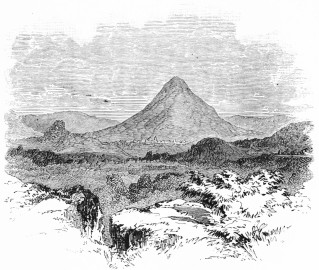
A CONSPICUOUS LANDMARK.
Comayagua is said to have at one time contained nearly thirty thousand inhabitants, but at present it has no more than one-fifth of that number; for, like all of the Central American cities, its population has been reduced since the independence of the country, and, like the most of them, it is in a state of decay. Everything is dilapidated, and nothing is ever repaired. No sign of prosperity appears anywhere. Commercial stagnation has been its normal condition for sixty years, and the indolence and indifference of the people has not been disturbed for that period, except by political insurrections. No one seems to have anything to do. The aristocrats swing lazily in their hammocks, or discuss politics over the counters of the tiendas, or at the club, while the poor beg in the streets, and manage to sustain life upon the fruits which Nature has so profligately showered upon them. Nowhere upon the earth’s surface exist greater inducements to labor, nowhere can so much be produced with so little effort; and the vast resources of the country present the most tempting opportunity for capital and enterprise, for nearly every acre of the land is susceptible to some sort of profitable development.
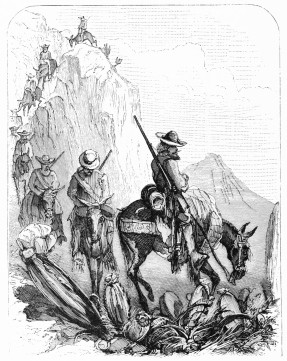
THE TRAIL TO THE CAPITAL.
The area of Honduras is about the same as that of Ohio, and the inhabitants number from three to four hundred thousand, according to the guess of the well informed, but no census has been taken for a quarter of a century, and the last enumeration was so inaccurate as to discredit itself. In ancient times the population must have been very dense.
It is as difficult and as long a journey to reach the capital of Honduras from New York as the capital of Siam or Siberia. One must go by steamer to Truxillo, the chief Atlantic port, or to Amapala, on the Bay of Fonseca, on the Pacific side—a voyage of from fifteen to twenty days by either route—and then ride for twelve days on mule-back over the mountains, without any of the accommodations or comforts known to modern travel, and not even one clean or comfortable inn. When the capital is reached there is no hotel to stop at, and one must trespass upon the hospitality of the citizens, or seek some boarding-place through the aid of a local merchant or priest.
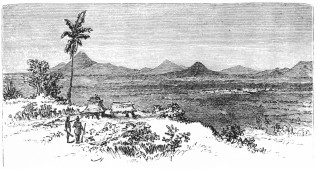
A GLIMPSE OF THE INTERIOR.
The President is General Bogran, a man who came into power by a peaceful revolution in 1885, to succeed Marco A. Soto, who fled that year to San Francisco, and from there sent his resignation to Congress. Bogran is a man of brains and progressive ideas, possessing more of the modern spirit
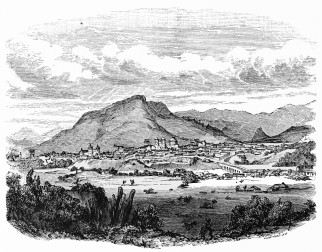
VIEW OF THE CAPITAL.
and broader views than most of his contemporaries, and if he is permitted to carry out his plans Honduras will make rapid speed in the development of her great natural resources. He is offering tempting inducements to foreign capital and immigration, has given liberal concessions to Americans who desire to enter the country, and is wisely endeavoring to induce some one to construct the Interoceanic Railway, which was surveyed fifty years ago, and twenty-seven miles of which has already been built and at intervals operated. But the discontented element in the country, in league with his predecessor, who now lives in New York, are surrounding him with obstacles and harassing him with all sorts of embarrassments, so that his success is made doubtful. Bogran spends very little of his time at Comayagua, and the seat of government has been removed to Tegucigalpa, the largest town in the country, as well as its commercial metropolis. Here the Congress sits also, and the place is to all intents and purposes the capital.
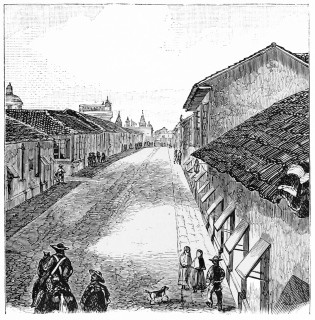
A POPULAR THOROUGHFARE.
The cathedral of Comayagua is by far the finest building in the country, being an excellent specimen of the semimoresque style, which was so popular among the Spanish provinces. Its walls and roof are of the most solid masonry, but are considerably marred by the revolutions through which the country has passed, for in nearly all of them the cathedral has been used as a fortress and subjected to a shower of lead. Near the cathedral stands a monument originally intended to honor one of the Spanish kings, but after the independence of the country was established the royal symbols were erased by the order of one of the Presidents, the inscription was chiselled off, and the obelisk now stands to commemorate independence. This monument is the place of public execution, and criminals sentenced to death are made to sit blindfolded at its base, where they are shot by the soldiers.
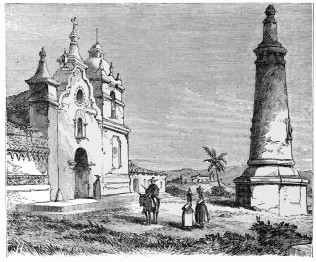
CHURCH OF MERCED AND INDEPENDENCE MONUMENT, COMAYAGUA.
In November, 1886, General Delgrado, the leader of a revolution, with four of his comrades, was executed here. It was the desire of President Bogran to spare Delgrado’s life, and any pretext would have been adopted to save him if the honor of the country could have been vindicated, but he was convicted of treason, and sentenced by the courts to die. The President offered to pardon him if he would take the oath of allegiance and swear never to engage in revolutionary proceedings again; but the old soldier would not even accept life on these terms, and much to the regret of the President,
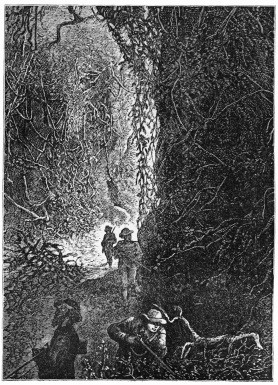
RUBBER HUNTERS.
against whom he had conspired, and the better portion of the people, the sentence had to be executed. On the morning of the day fixed by the courts, the five men were led from the prison to the Church of La Merced, where the last rites were administered to them, and were then conducted to the Peace Monument, where a file of soldiers was drawn up with loaded rifles. The last word of Delgrado was a request that he might give the command to fire, and he did so as coolly as if he had been on dress parade.
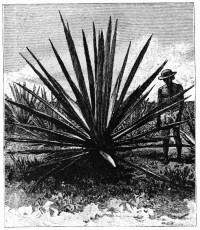
THE PITA PLANT.
The residents of Comayagua are chiefly the owners of haciendas situated in the neighborhood, or small tradesmen, with four or five thousand lazy and worthless half-breeds, who live upon tortillas, or corn-cakes, and the fruits in which the country abounds. The most conspicuous feature of their life is the filth that surrounds them, and the freedom with which their pigs and chickens enjoy the shelter of the dwelling. A few stone jars of native make, a few rude calabashes, a couple of hammocks, and a few broken articles of furniture, constitute the equipment of a peon’s house. The man of the house swings in a hammock while his spouse brings water from the stream in a large stone jar upon her head, and the pigs and chickens and children lie upon the floor indiscriminately mixed. The pigs take the tortillas out of the mouths of the children, and the compliment is returned, while the chickens forage upon every article of food within their reach.
Both cotton and silk grow upon trees, the vegetable silk being of very fine and soft fibre, and frequently used by the natives in the manufacture of robosas, serapas, and other articles of wear, while the product of the cotton-tree is utilized in a similar manner.
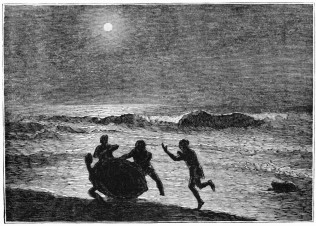
HARVESTING ONE OF THE STAPLES.
There is said to be a greater variety of medicinal plants in Honduras than in any country on the globe, and the botany of the country contains nearly every tree and shrub and flower that is known to man. They are all of spontaneous growth, and might be made a prolific source of wealth, but are entirely neglected. There is one famous weed, called by the natives el agrio, which is a certain cure for sunstroke, or for prostration from exposure to the sun or over-exertion, and is used for both men and animals. As it is excessively bitter, the leaf of the plant is wound about the bit of the bridle of a sunstruck horse, and the animal gradually sucks the juice from it. The leaves are dried in the shade, and a tea made of them by the natives to cure sunstroke and other diseases of the brain or blood.
The interior of the country is beyond the reach of markets, because of the absence of transportation facilities. In this respect the people are no further advanced than they were two hundred years ago. The only wagon-roads in the country are one built by a party of Americans near San Pedro, in the west, and a few miles of a national highway that a century ago was begun for the purpose of connecting Amapala, the Pacific port, with Tegucigalpa.
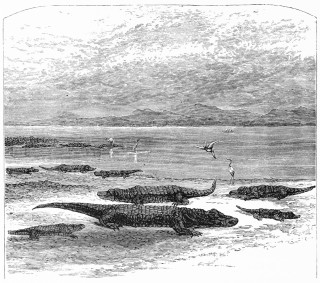
THE FLOATING POPULATION.
Honduras has the finest fluvial system in Central America. There are few countries with such available water facilities, both for transportation and manufacturing powers, and it has the finest harbors on both coasts—all wasted because of the indolence of the people. The Government has given several liberal concessions in timber and agricultural lands to secure the opening of its rivers to navigation, and for the construction of railways from the coast to the interior. Some of these grants are in the hands of responsible and capable companies, and if the peace of the country is assured, and immigrants can be induced to settle there, a rapid development of its resources is promised.
Ten years ago the telegraph was unknown, and there was no postal system in the interior. All communications were transmitted from place to place by messengers, who were famous for their endurance and swiftness of foot. The letter or package to be conveyed was first wrapped in cloth and then fastened around the loins of the carrier. This system is still in vogue for the transmission of letters, packages, and money. The couriers, or cozeos, are noted for being trusty and courageous; they travel long distances over the mountains and through the forest, generally by routes known only to themselves.
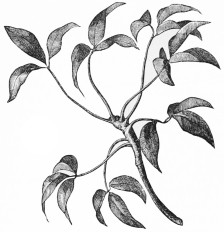
BRANCH OF THE RUBBER-TREE.
Within the last eight years every town of importance has been connected with the capital by lines of telegraph. Before its construction information of the utmost importance could not reach the capital from the remote points in less than ten or twelve days. The Government saw the necessity of some better and quicker method for transmitting information, and constructed these lines. They are owned and operated entirely by the Government, and from them a considerable revenue is realized. For the purpose of sending a message, you must first purchase of the proper Government officer a stamped telegraphic blank, which varies in price from one real (twelve and a half cents) to one or two dollars, in proportion to the number of words which it is to contain. The distance the message is to travel makes no difference in the price, provided its destination is within any of the republics of Central America. When the message is written on the blank it is taken to the telegraph-office, and if the charge for the number of words contained in the message corresponds with the stamped blank it is forwarded.
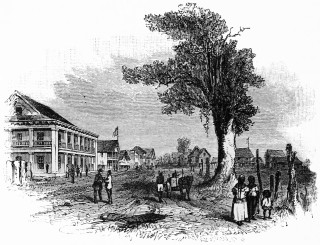
A MODERN TOWN.
Every department of Honduras possesses more or less mineral wealth, and within the limits of the country almost every metal known to man is found. The discoveries of gold and silver were made by the aborigines, who possessed much treasure when the Spaniards conquered them, and ever since the Conquest the mines have been worked with great profit; but their development was greater under the viceroys than since the independence of the republic, as this branch of industry has suffered more from civil wars than any other. As a consequence, mine after mine has been abandoned, and the districts where the best mineral deposits exist are marked with depopulated towns and villages.
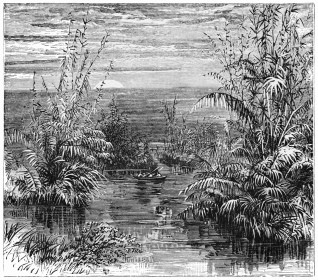
UP THE RIVER.
The lack of roads renders it impossible to transport machinery to the mining districts. The mines are seldom worked to any depth, and the waste is enormous. But even under this system, rude and primitive as it is, much wealth has been acquired, and millions of dollars in silver and gold have been taken out annually for hundreds of years. Of late a good deal of attention has been given to the Honduras mines by American experts, and much capital has been invested in purchasing and prospecting them, but the hope of realizing upon the investment lies in the improvement of transportation facilities, for nothing that cannot be carried on the back of a mule can either reach the mines or come from them. And imported labor is quite as necessary, as the native of Honduras cannot be induced to do anything in other than the way to which he has been accustomed, and looks upon labor-saving machinery as the invention of the evil one.
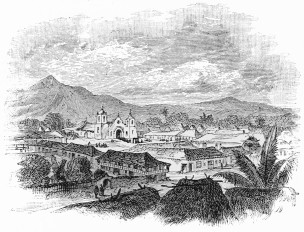
A MINING SETTLEMENT.
The city of Tegucigalpa, the commercial metropolis and the actual capital of the country, stands upon both banks of the Rio Cholutica in an amphitheatre of mountains, and has twelve thousand inhabitants. The river is spanned and the two divisions of the town connected by an ancient bridge with some fine arches of stone. The suburb is called Comayaguaita (Little Comayagua). The streets are well paved, in the same manner as other Spanish American cities, with a gutter in the centre, to which they slope from both sides. This gutter is always full of weeds and dust and filth, but seldom of water; and although the hills which half surround the city are full of running streams, with a fall sufficient to force water to the tower of the cathedral, it has never occurred to the inhabitants to utilize them. Every drop of water used for any purpose in the city is carried, in an earthen jar on the top of some woman’s head, from the river at the bottom of a gorge a hundred feet deep.
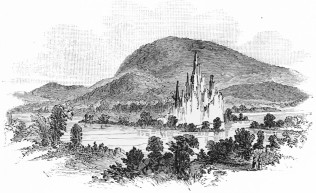
VIEW IN NICARAGUA.
The houses in Tegucigalpa show much more evidence of prosperity than those of Comayagua, and are kept more tidy and in better repair. They are usually painted either a dead white or pink, blue, yellow, green, or some other very pronounced color, while often a native amateur artist tries his hand at exterior decoration, and endeavors to make the walls of adobe look as if they were made of marble.
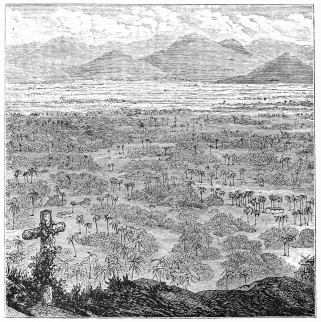
AN INTERIOR PLAIN.
Somehow or another Tegucigalpa always looks new. The grass is growing in the streets, and there are many other indications of commercial stagnation, but the people do not let their houses show how poor and indolent they are. These two national characteristics, moreover, do not appear in any form in the city. It is not only the present headquarters of the Government and of commercial affairs, but it is the centre of fashionable life and the residence of the aristocracy of Honduras. Two-thirds of the white people in the republic live here, and the other third come here to get their clothes, so that the city is by comparison gay.
The numerous farms surrounding the city are capable of enormous production, and some of them are still profitably operated, while many have gone to waste. The staples are sugar, coffee, cocoa, and other tropical products, which require and receive little attention. The buildings upon these plantations are all very old, but are still in good condition. The chief dwelling is commonly large and comfortable, built of adobe and roofed with imported tiles, and located where it can secure a good natural water supply. There is usually but one floor, no ceiling, nor glass in the windows, for the climate does not require it, and glass is expensive. The windows are protected with iron bars and heavy mahogany shutters. As little timber as possible is used, because all dry wood is subject to destruction from a little insect called the comojeu, which honey-combs every rafter, joist, and beam in a building as soon as the sap is exhausted, and the interiors of the houses have to be restored at intervals of a few years.
Most of the churches are in a dilapidated condition, and have been divested of their former ornaments and riches by the hands of vandals during revolutions. The cathedral was erected at the expense of a devout and wealthy padre, and was once a fine building, but is now in a sad state of decay.
What will impress the traveller at once in Tegucigalpa is the entire absence of carriages. I do not believe there is one in the country, any more than there is a chimney or an overcoat, and for the same reason—the people do not need them. All roads, it was said, lead to Rome, but no roads lead to the capital of Honduras except a few short ones, narrow and stony, like the way of salvation, and hedged about with divers trials and pitfalls, from the neighboring plantations, and are used only by rude ox-carts. Everybody goes on horseback, and all the transportation is done on the backs of mules and men. Long caravans of pack animals are coming and going to and from the sea-coast daily over the mountain trails, and there is a class of Indians called Cargadors who carry a cargo of a hundred pounds or so upon their backs, and run at a jog-trot for hours at a time, making the same journey twice as rapidly as a mule. Their loads are strapped to their backs on a wicker frame, and by a broad band passing around the forehead.
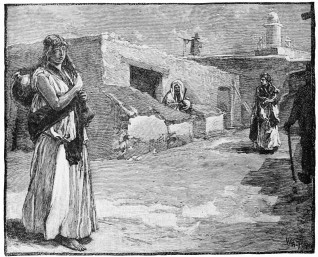
ONE OF THE BACK STREETS.
At breakfast chocolate often takes the place of coffee, and it is prepared from the cocoa-bean in a manner different from that in use in other countries. A handful or two of cocoa-beans, with a few vanilla-beans or sticks of cinnamon, and a much larger amount of raw sugar, are ground up together by the matete—that is, by being rubbed between two stones—and moistened until it is reduced to paste; then it is rolled out in little balls as large as a chocolate cream, and allowed to harden. A plate of these is placed upon the table, each member of the family takes as many as he or she chooses, drops them in a cup, and pours boiling milk upon them. They soon dissolve, and are very palatable.
The shops, or tiendas, of Tegucigalpa display very few goods that are pretty or costly, and are usually “general merchandise” stores, such as are found in the country villages of the United States—a few drugs and dry goods, a little hardware, patent-leather boots and elaborately stitched kid shoes for ladies—often white or pink or blue, for the ladies affect bright-colored foot-gear—some cutlery and crockery, and other household articles. Nearly all sales are on credit, even if the purchaser have the money in his pocket, for the custom of the country is not to do anything to-day that can be postponed.
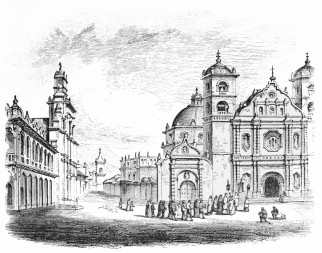
PLAZA OF TEGUCIGALPA.
The ladies usually do their shopping in the morning before breakfast, which is served at eleven o’clock, for the afternoons are given up to siestas. Most of the business of the city is done before breakfast, and from eleven o’clock until four in the afternoon the streets are empty and most of the stores are closed. Activity is resumed at the latter hour, and continues until eight or nine o’clock in the evening.
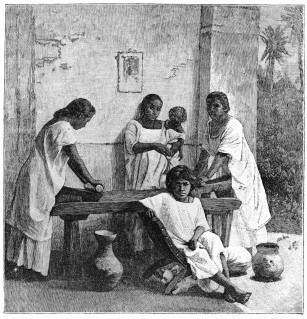
MAKING TORTILLAS.
Every woman goes to mass at seven in the morning, but a man is seldom seen to enter a church except on feast-day or to attend a funeral. All their religion is crammed into Holy-week, when they are very pious.
The schools of the republic are nominally free, but there are few of them; education is compulsory, but the law is not enforced. The school funds have usually been stolen, or diverted to other purposes, and only in the cities, where public sentiment demands it, are schools sustained. There is a university at Tegucigalpa which is said to have been once an institution of some importance, but is such no longer. It has a few students and a small faculty, but those who can afford it, and who are anxious to secure an education, go to Guatemala or to Europe.
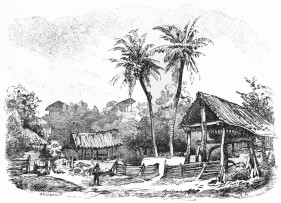
INDIGO WORKS.
Tegucigalpa is famous for having been the birthplace of Morazan, the Washington of Central America, and his descendants still reside there. He was undoubtedly the greatest man any of these republics ever produced, and had the broadest vision as well as the broadest views as to the nature of a republic. The fires of liberty were enkindled by him, and he led the fight against Spain which resulted in the overthrow of the Viceroys and the establishment of the confederacy. He was born in 1799; his father was a native of Porto Rico and his mother a lady of Tegucigalpa. He prided himself on the fact that his ancestors came from the birthplace of Napoleon, and his descendants, to whom strangers are usually introduced, seldom fail to forget that circumstance
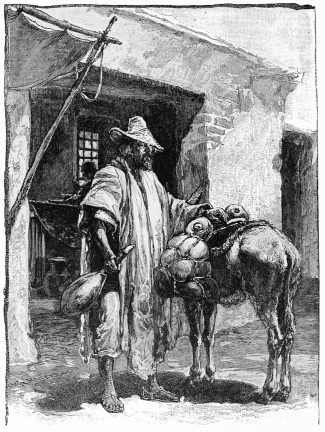
THE TLACHIGUERO.
in conversation. Before Morazan was of age he was prominent in Honduras, and became the governor of the city in 1824, when he was but twenty-five. For fourteen years thereafter his career was one of singular activity and success, and the people of the entire continent followed him with feelings akin to idolatry. He was so far ahead of them in ideas and enterprise that his counsels were not followed, and he was overthrown by a combination of priests, who took up a cruel Indian of Guatemala named Rafael Carera, and succeeded in overthrowing the power of Morazan, not only in Honduras, but throughout the entire confederacy. The patriot and liberator was afterwards assassinated at Cartago, Costa Rica, by men whom he trusted as his friends.
MANAGUA.
THE CAPITAL OF NICARAGUA.
A STRANGER landing at the port of Corinto, Nicaragua, asked the men who were taking him ashore in a bongoe the name of the capital of the republic. There were three of them. The quickest of wit answered promptly, “Grenada;” both the others disputed it, one of them contending for the city of Managua, and the other for Leon. So animated did the controversy become that all three dropped their oars, and nearly upset the boat by their gesticulations. This question is, and always has been, a dangerous one, and thousands of lives and hundreds of thousands of money have been wasted in repeated attempts to determine it. If it were the only excuse for the blood that has been shed in the little republic during the last sixty-five years, its history would be a nobler and a prouder one; for bitter wars have been waged for less, and brother has fought brother to settle questions not only involving a preference for cities but for men. There is no spot of equal area upon the globe in which so much human blood has been wasted in civil war, or so much wanton destruction committed. Nature has blessed it with wonderful resources, and a few years of peace and industry would make the country prosperous beyond comparison; but so much attention has been paid to politics that little is left for anything else. Scarcely a year has passed without a revolution, and during its sixty-five years of independence the republic has known more than five times as many rulers as it had during the three centuries it was under the dominion of Spain. It was seldom a question of principle or policy that brought the inhabitants to war, but usually the intrigue of some ambitious man. It is a land of volcanic disturbance, physical, moral, and political, and the mountains and men have between them contrived to almost compass its destruction.
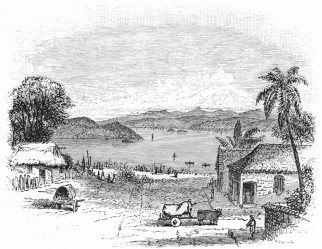
VIEW OF LAKE FROM BEACH AT MANAGUA.
For sixty years the country has been going backward. Its population is less than when independence was declared, and its wealth has decreased even more rapidly. Its cities are heaps of ruins, and its commerce is not so great as it was at the beginning of the century. There is, however, a commercial elasticity, owing to the extreme productiveness of the fields and the ease with which wealth is acquired, that has kept the little republic from bankruptcy, and promises great prosperity if political order can be preserved.
Most of the people live in towns, and waste much time in going and coming between their homes and the plantations upon which they labor. This is owing to the frequency of revolutions and the milder forms of destruction and murder that are practised by highwaymen and other robbers. None but the very poor live along the roadside, and they have nothing to tempt assault.
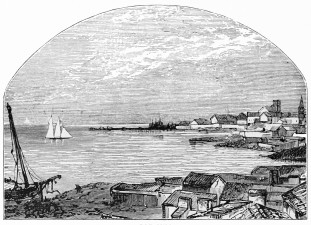
CORINTO.
Everybody rides on horseback, and the animals are plenty and fine. The horses of Nicaragua resemble those of Arabia, being small but fleet, spirited, and capable of much endurance. Great care is taken in training them, and they are taught an easy gait, half trotting and half pacing, called the paso-trote. A well-broken animal will take this as soon as the reins are loosened, and continue it all day without fatigue to himself or his rider, making five or six miles an hour. The motion is so gentle that an experienced rider can carry a cup of water for miles in his hand without spilling a drop.
There is only one road in the country suitable for carriages, and that is seldom used except by carts. It runs from Grenada, the easternmost city of importance on the shore of Lake Nicaragua, to Realjo, or Corinto, the principal seaport; and over this road, which was built three hundred years ago by the Spaniards, all the commerce of the country passes. There is now a railroad along this highway; the Government has several times made loans to construct it, but the money was wasted in revolutions, and the track was not completed till recently. The road belongs to the Government, and is managed by a citizen of the United States. The cart road passes through Managua, and thus unites the three principal cities of the land. Over it have passed hundreds of armies and no end of insurgent forces, and the whole distance has been washed with blood, shed in public and private quarrels. Wherever a man has been slain a rude cross is usually erected, and it is common to see wreaths of flowers hanging upon it, placed there by some interested or, mayhap, loving hand. At these places pious passengers breathe a prayer for the soul that has been released, and they are so numerous that it keeps them praying from one end of a journey to the other.
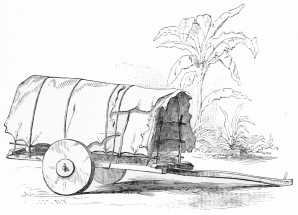
HIDE-COVERED CART.
The carts which furnish transportation are rude contrivances of native manufacture, and the design has not been improved upon since the conquest. The body consists of a very heavy framework of wood, and the wheels are solid sections cut from some large tree, usually of mahogany. They are not sawed, but chopped into shape, and are generally about eight or ten inches thick and five feet in diameter, and weigh several hundred pounds. The oxen do not wear yokes, but the pole of the cart is fastened to a bar of tough wood, usually lignum vitæ, which is lashed by cowhide thongs to the horns. There are always two pair of oxen—one to haul the cart and the other to haul the load, for the vehicle is twice the weight of its cargo. Two men are required to navigate the craft; one goes ahead armed with a gun or a machete, which is a long knife, and answers for many purposes—a weapon as well as an agricultural implement—and the oxen are supposed to follow him, while the other sits on the load and yells as he prods the animals with an iron-pointed goad long enough to reach the leaders. The man ahead assists his colleague by uttering constant admonitions to the oxen without turning his face, and between the two, and the squeaking of the cart-wheels, which are never greased, there is noise enough to deafen the whole neighborhood. The approach of one of these vehicles can be anticipated half an hour.
Each cart contains five or six days’ forage for the animals, as well as rations for the carreteros. They camp whenever night overtakes them, even if it is only a mile from the end of their journey. The oxen are fastened to the cart and given their fodder, while the men light a fire, make their coffee, and either lie under the cart or upon it to sleep. Most of the carts have covers or awnings of cured hides, which are lashed over boughs to protect the loads in the rainy season. The average rate of speed is about a mile an hour over a good road, but ten miles a day is fast travelling, owing to the amount of time wasted by the roadside.
The cartmen are invariably honest in dealing with their employers, and always render a strict account of their cargoes, whether they are composed of silver or coffee, but
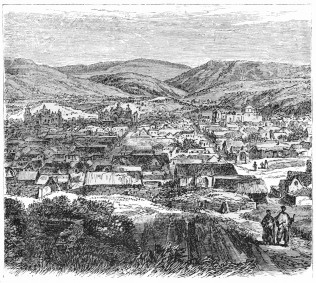
AN INTERIOR TOWN.
consider it a privilege, which they have inherited from their ancestors, to plunder along the road. Nothing is too hot or too heavy for them to carry away, and accordingly precautions are taken for the protection of whatever is likely to tempt them. They have an unorganized union to protect themselves, and permit no impositions to be practised upon any of their number, or underbidding or other irregularities among themselves. They charge so much a journey, no matter what their load is, and persons having small parcels to be carried have to club together to make up a cargo, or pay a high rate for transportation. Many of the carts and oxen are owned by those who drive them, but others are leased to the carreteros by capitalists who possess a large number. The cattle come from the savannas in the south-western portion of the republic, where there are immense and nutritious pastures extending over the line into Costa Rica.
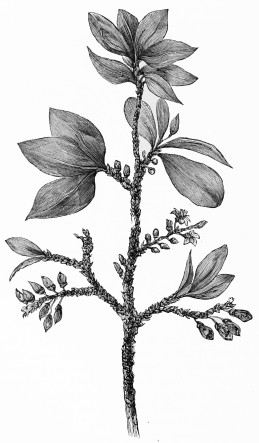
THE INDIGO PLANT.
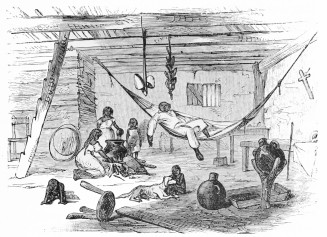
THE KING OF THE MOSQUITOES.
Although the mineral resources of the country are undoubtedly rich, its future wealth will come, if peace can ever be made permanent, from the development of the agricultural and timber lands. Beyond the mining district down to the Mosquito coast there extends a forest of immense area, filled with the finest woods, and it has scarcely been touched. The most useful timber is the mahogany, although there are kindred varieties quite as good, but not so popular or well known. It is more easily obtained too, as it grows upon the ridges and keeps out of the swamps, which are full of miasma and mosquitoes. The tree is one of the most beautiful, as well as one of the largest, that are found in tropical lands, commonly reaching a height of sixty or seventy feet, and being from twenty-five to forty feet in circumference. Timbers forty feet long and eight feet square are frequent, although so heavy that they are difficult to handle; and the only way fine timber can be obtained is by taking saw-mills into the forest and cutting up the timber into sizes suitable for transportation. This is difficult, however, owing to the lack of roads. Logs five and six feet in diameter are common, and it is said that the largest trees have the finest color and grain.
The mahogany is one of the few trees in the tropical forests whose leaves change color with the season, and the Carrib Indians, who are employed to cut them, discover their presence by this peculiarity. They climb the highest tree they can find, sight the mahoganies, locate their position with great skill, and lead the choppers to them with unerring accuracy. When the tree is found, the underbrush around it and the lower limbs are first cleared away before the trunk is attacked. When it falls, the branches are chopped off; then the log is hewn into shape, after which it is dragged by oxen—sometimes a hundred yoke being employed—to the nearest water-course, the choppers going ahead and clearing away with their machetes the underbrush and small trees to make a road. When the timber is rolled into the river, it is branded and allowed to lie there until the rainy season, when the waters rise and carry it down to the sea.
There are other trees of great value in the forests, and not for timber alone. The caoutchouc, or rubber-tree—a name which when properly pronounced sounds like the plunge of a frog into the water—kachunk—is very plentiful in the Nicaragua forests, although this resource, like most of the others, is comparatively idle. The Mosquito Indians gather some, however, which is shipped from Blewfields and Greytown in small quantities. The quality is not so good as that which comes from Brazil, as the sap is not reduced with any skill or care.
The average North American supposes that the rubber is obtained like pitch, and comes from the exuded gums of the tree, but the process is altogether different, resembling our method of making maple sugar. When the sap begins to rise from the roots to the branches of the tree, expeditions of thirty or forty men are organized, who are furnished by the exporting merchants with an outfit of buckets, axes, machetes, pans, and provisions, and start into the woods. The uleros, as the rubbermen are called, from the term ule, which is the native name for the tree, are always paid a small sum in advance, ostensibly for the support of their families during their absence, but which is always exhausted in debauchery before they start. When they reach the forest of the ule-trees they build a shanty of palms and brush, if there is not one already standing, on the bank of some stream, as a great deal of water is required for the manufacture of the gum. There they distribute their large cans and buckets through the forest at convenient intervals and proceed to business. When the ulero selects his tree, he clears the trunk of vines and creepers and climbs it to the branches. Then he descends, cutting diagonal channels through the bark with a single blow of his machete, or knife, left and right, left and right, all meeting at the angle. At the bottom of the lowest cut an iron trough about six inches long and four inches wide is driven into the tree, which catches the milk as it flows from the wound, and conducts it into a bucket on the ground below. This is done with great speed and skill by an expert; and necessarily so, to prevent waste, as the sap springs out instantly, and by the time the spout is driven into the tree is flowing at the rate of four gallons an hour. A large tree will produce twenty gallons of sap, and will run dry in a single day. The ulero having tapped a dozen or eighteen trees has all the work he can attend to emptying the buckets into the ten-gallon cans that are provided for the purpose. In the evening the cans are carried to the camp, and the sap strained through sieves into barrels. In Brazil it is boiled, but in Nicaragua the natives have a peculiar system of reducing it. There is a plant or vine called the Achuna, whose sap when mixed with that of the rubber-tree has the singular property of coagulating it in a few minutes. By whom, or how, or where this process was discovered no one can tell. Undoubtedly it was an accident, for the vine hangs from all the trees in the ule forest, and probably a cutting dropped into a bucket of sap some time or another produced the result for which it is now used. Having their barrels full, the uleros cut short
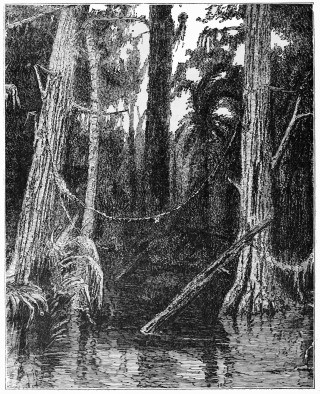
A MAHOGANY SWAMP.
A MAHOGANY SWAMP.
pieces of this vine, soak it in water, and small bunches are thrown into pans upon which the sap is poured. In the morning the rubber has turned to gum—about two pounds to every gallon of sap. At the top of the pan is a quantity of dark brown liquid, like a weak solution of licorice. This is poured off, and then the gum is rolled under heavy weights of wood into long flat strips called tortillas, which are hung over poles under the shed to drip and dry. At first they are white, like the vulcanized rubber, but with exposure they turn black and become hard after a few days. Then the tortillas are stacked up under cover until the end of the season, and shipped to market.
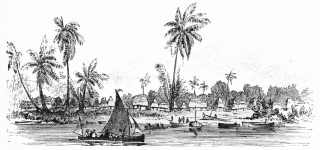
INTERNAL COMMERCE.
The cocoa or chocolate tree grows wild in the forests of Nicaragua, and when cultivated yields the most profitable crop that can be produced; but the republic furnishes but little, comparatively, for export, although its possibilities in this direction are almost unlimited. The most of the world’s supply of cocoa comes from Ecuador and Venezuela.
There always has been a prejudice in Nicaragua against foreign immigration, inspired and stimulated by the priests, who inveterately oppose all progress and every innovation. A number of German families are settled throughout the country, engaged in mercantile pursuits. Most of the large commission houses and exporters are English, while the hotel or posada keepers are Frenchmen. England furnishes most of the money to move the crops, as the natives are impoverished by wars or their own extravagance. The country will never be prosperous until its peace is assured and its population increased by the introduction of foreign labor and capital.
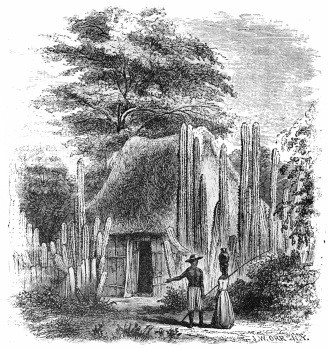
HOW THE PEONS LIVE.
Like other Spanish-American countries, the national vices are indolence and extravagance. The common people never get ahead, and have no need of purses, much less of savings-banks. They might make good wages, as they are naturally good producers, but they always spend their earnings before they receive them, and are encouraged to keep in debt to those who employ them, as, under the law, no laborer can leave a job upon which he is employed as long as he owes his employer a penny. This system of credit, although it amounts to only a few dollars in each case, is equivalent to slavery, a peonage which is permanent; for if the laborer really aspires to be a free man, he is persuaded or threatened or swindled into renewing the obligation under which his life is spent.
The aristocracy are equally extravagant. It is a part of their religion, apparently, to spend their incomes, even if they do not anticipate them; and the latter is generally the case. Nearly every crop is mortgaged to the commission man before it is harvested, and the planter is compelled to take the price that is offered. The peon is in debt to the planter, the planter to the merchant, the merchant to the commission-house, and the latter conducts his business on borrowed money; and so it goes on, year after year, without cessation, each person involved spending as much or more than he makes, and conducting his business on paper, like speculators in the stock market, the country growing poorer each year, with no possible hope of redemption except by an influx of fresh blood and capital. The climate is delightful, the land is wonderfully productive, and the products always in active demand in the markets of the world.
The chief cities are pictures of desolation, and along the roads in the country are the ruins of estancias that were the abode of wealthy planters years ago. Much of the destruction was caused by earthquakes, but more by civil war. The population in 1846 was 257,000; in 1870 it had been reduced to less than 200,000, and since then there have been disturbances in which thousands of men were slaughtered or driven into exile by fear or force. The whites, or those of pure Spanish blood, number about 30,000; the negroes about half as many; the mixed races, Mestizos and Ladinos—the former of Spanish and Indian and the latter Negro and Indian blood—are probably 8,000; and there are supposed to be about as many pure-blooded Indians upon the Atlantic coast and scattered throughout the republic. The education of the common people is neglected and left to the priests, who teach them nothing but superstition and their obligations to the Church. In 1868 a decree was passed making education compulsory and free, and providing for the diversion of a liberal amount of the public revenue each year for the support of the schools; but the law is a dead letter, and in no year has the amount assigned to the Department of Education been appropriated. At present there are but sixty schools, with a normal attendance of twenty-five hundred, or an average of forty pupils to thirty thousand inhabitants. There is a university at Leon, with an average of fifty students, and another at Grenada, with a few more, at which law, medicine, and theology are taught, under the direction of the bishop; but most of the sons of wealthy families are sent to Europe to be educated.
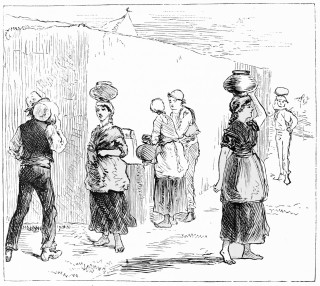
A FAMILIAR SCENE.
The city of Leon is the commercial metropolis, and was the ancient capital. In 1854 the seat of government was removed to Grenada, during the great revolution, which lasted for five years, and in which our famous filibuster, Walker, figured; and the people of the latter city would not permit its return to the capital of the viceroys. After fighting over the question for several years, shedding much blood and destroying much property, a compromise was effected by locating the headquarters temporarily at Managua, a smaller place half way between the two, where, since 1863, the President has resided, and the Congress has assembled every year. The public buildings in Leon remain as they were at the time of the removal of the capital, and most of the archives are there, the expectations of the citizens being that they will be needed for the Government again in the near future; but Grenada keeps a threatening look in that direction, and any attempt to disturb the present situation would result in another war, so bitter is the rivalry.
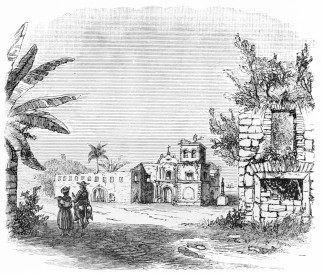
A COUNTRY CHAPEL.
Leon is one of the oldest cities in America, having been founded in 1523 by Fernandez Cordova. Two years before, Pedrarias Divilla, who was Governor at Panama, sent to Leon, on a tour of exploration, a lusty old buccaneer, named Gil Gonzalez, with a few hundred men. He landed at about the centre of the Pacific coast, and marched across to the present city of Rivas. Here he found on the borders of the lake a vast population of Indians under a cacique named Nicaro, and called the country in his reports Nicaro’s Agua, or waters; hence the name. The Indians regarded the Spaniards with awe and amazement. They had heard of their appearance at Panama and on the Atlantic coast, but believed that the stories of their presence, which came from their ancient enemies, the Carribs, were false and intended to frighten them. Seeing the chief surrounded by such a multitude of savages, Gonzalez approached with great caution, and having captured a native, sent him to Nicaro with this bombastic message:
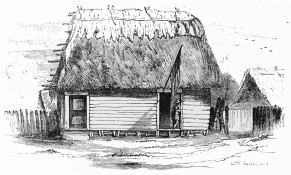
THE UNITED STATES CONSULATE.
“Tell your chief,” said Gonzalez, “that a valiant captain cometh, commissioned to these parts by the greatest king on earth, to inform all the lords of these lands that there is in the heavens, higher than the sun, one Lord, Maker of all
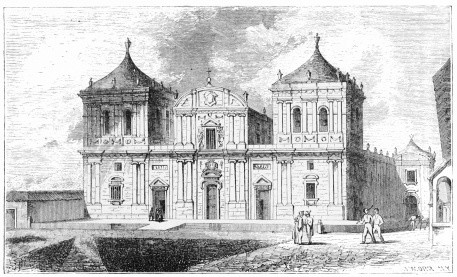
CATHEDRAL OF ST. PETER, LEON.
things, and that those believing on Him shall at death ascend to that loftiness, while disbelievers shall descend into the everlasting fire that burns in the bottomless pit. Tell your chief that I am coming, and that he must be ready upon my arrival at his camp to accept these truths and be baptized, or prepare for battle.”
The cacique surrendered, and, with all his warriors and their women, to the number of nine thousand, was baptized. In his report to the King of Spain, the pious old Bombastes Furioso claimed the credit of having converted more heathens than any other man that had ever lived.
In the days of the Spaniards Leon was a splendid city, and there are still existing numerous monuments of its opulence and grandeur. The public buildings are constructed upon a magnificent scale and without regard to cost, and the private dwellings are built in imitation of them, being of imposing exteriors and luxurious in their equipment and adornment. There were seventeen fine churches to a population of fifty thousand, chief of which was the Cathedral of St. Peter, which cost five millions of dollars, and was over thirty-seven years in course of erection. It was finished in 1743, and is still in a good state of preservation, being built of most substantial masonry, with walls of stone eighteen or twenty feet thick. It is of the Moorish style of architecture, resembling the great cathedral at Seville, Spain, and is by far the largest and finest church in Central America. During the frequent revolutions it has always been used as a fortress, and its walls, although still firm and enduring, are much battered by the assaults that have been made upon it.
In 1823, during the first revolution after independence between the aristocrats and the Indians, there was a fire at Leon which destroyed more than a thousand of the finest buildings; and the flames were aided in the work of devastation by thousands of Indian soldiers, who plundered and murdered the inhabitants. This part of the city has never been restored, and long streets, whose pavements are overgrown with weeds and underbrush, are still lined with ruined walls that disclose rich marble columns and artistic carvings. In mockery of the former magnificence which their ancestors destroyed, the Indian peons are living in bamboo huts, enclosed by cactus hedges, on the sites where once lived the proudest hidalgos in Central America. There is a tradition that the town was once cursed by the Pope, because of the murder of an archbishop there, and this accounts for the succession of calamities from which it has suffered.
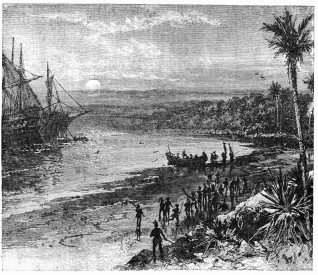
THE PACIFIC COAST OF NICARAGUA.
The ladies of the aristocracy are in youth usually pretty, and at whatever age are always proud. For some reason or other they consider their country far above and beyond criticism, and themselves superior to the rest of Adam’s race. Ancestral pride is so conspicuous as to be ofttimes offensive, and the fact that a person born out of Nicaragua seems to them to have been a misfortune for which no other circumstances can compensate. This is true among both sexes of the upper caste, but more especially among the ladies, whose exalted opinion of their own importance in the universe has never been tarnished by travel. This feeling has gone far to excite the existing prejudice against foreigners, and while the tourists are always most hospitably received, the fact that their stay is only temporary adds to the pleasure of entertaining them. The most rigid restrictions prevent the social intercourse of the sexes, and nowhere in the world is a woman’s honor protected with such great precaution; and for excellent reasons. No lady of caste would think of receiving a call from a gentleman alone, except a priest; and the clergy make the most of their privileges, according to common report.
ANTICS ON THE BRIDGE.
The ladies are always idle. To do any sort of work other than embroidery is beneath them, and the number of servants they employ is regulated not by their necessities but by their means. They are all uneducated, the privilege of a few years in a convent only being allowed them; and those are spent in learning the lives of the saints, a little embroidery, to drum on the piano, and to dance. There is no distinctive national costume. The aristocracy imitate the Parisian fashions, while the common masses wear whatever they can get. The Nicaraguans are much more social in disposition than the citizens of the other Central American countries. They have tertulias, which is a near relation of a “high tea,” and balls more frequently, and are much more given to dinner-parties, at which one of the greatest of imported luxuries is codfish.
The great annual holiday of the people is known as El Paseo al Mar, (the Excursion to the Sea), but is often alluded to as the festival of St. Venus, because of the excesses that are committed there by the people, who are most discreet when at home. But as nobody cares what occurs at the carnivals at Rome, so can a party of fashionable Nicaraguans be allowed liberties at their watering-places. In the latter part of March, when the dry season is far advanced and everything is buried in dust, after the harvests are gathered and the crops are sold and carried to Corinto, the seaport, everybody feels like taking a little relaxation. Preparations are made long in advance, but as soon as the March moon comes carts are packed with a little furniture and a good many trunks, and the exodus begins. It is only about fifteen miles to the beach, but the journey occasions as much planning and preparation, and is anticipated with as much pleasure, as a tour through Europe. Everybody goes, the peon as well as the hidalgo, and for two weeks during the full moon the city is deserted. There are no hotels, but each family takes a tent or builds a hut of bamboo, and lives à négligé under the shade of the forest trees, which extend almost to the ocean. The Government sends down a battalion of troops, ostensibly to keep order and do police duty, but really as an excuse for giving the officers and soldiers a holiday. Social laws are very much relaxed during the Paseo, and it is really the only time when lovers can do their billing and cooing without the interfering presence of a duenna. Flirtations are the order of the day, and Cupid is king.
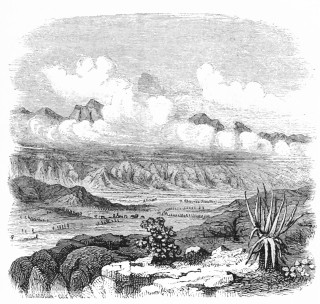
IN THE UPPER ZONE.
There are no bathing-houses, and no bathing-dresses are worn. The people go into the surf as Nature equipped them—the women and the girls on one side of a long spit of land that reaches into the sea, and the men and boys on the other. This annual Paseo is the perpetuation of a semi-religious Indian custom.
Another peculiar Nicaraguan religious custom is the baptism of the volcanoes, a ceremony which is believed by the superstitious to be very effective in keeping them in subjection and making them observe the proprieties of life. This observance is said to be as old as the Conquest, having originated after the first eruption succeeding the invasion of Nicaragua by the Spaniards, and is repeated on the anniversary of the last disturbance caused by each particular volcano. The priests of the nearest city take the affair in charge, and, followed by a large company of the faithful, ascend to the crater, and with great ceremony sprinkle holy water into it. Each of the volcanic peaks in Nicaragua has been repeatedly sanctified in this way except Momotombo, the grandest but most unregenerate of them all, who has never permitted a human foot to reach his summit or a human eye to look into his crater. Two hundred years ago, after old Tombo, as the master is familiarly called, had been acting very badly, three brave monks determined to try the effect of holy water upon him, and started for the summit with a large cross which they proposed to erect there; but they were never heard of again, and the people look upon the mountain with greater reverence.
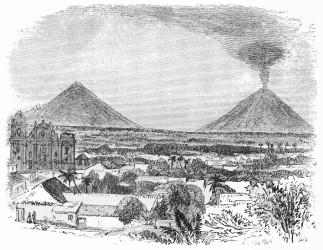
VOLCANOES OF AXUSCO AND MOMOTOMBO, FROM THE CATHEDRAL.
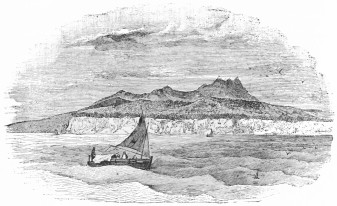
VOLCANO OF COSEQUINA, FROM THE SEA.
From the tower of St. Peter’s Cathedral in the city of Leon thirteen volcanoes can be seen, several of which are active. There are eighteen standing in a solemn procession around the lakes of Nicaragua and Managua. They are not so high as certain peaks in Guatemala or Costa Rica, but look higher from the fact that they rise immediately from the level of tide-water, and can be seen from the sea in their full grandeur, old Tombo looking to be about the height of Pike’s Peak as seen from Colorado Springs. This gigantic mountain rises boldly out of the waters of Lake Nicaragua, its bare and blackened summit, which has forbidden all attempts to scale its sides, being always crowned with a light wreath of smoke, attesting the perpetual existence of the internal fires which now and then break forth and cover its sides with burning floods. At its base are several hot sulphur springs, and at frequent intervals heavy rumbling sounds can be heard from within its walls. In the middle of the lake, only a few miles away, is an exact duplicate of the mountain; in miniature, however, being but one-fourth its size. This is called Momotombita, the three last letters expressing the diminutive. It forms an island, from which its peak rises a perfect cone. Its crater has been extinct for hundreds of years; but the island was a sacred place to the aborigines. In the forests which now cover it are the ruins of vast temples and gigantic idols hewn out of the solid rock. The last serious earthquake, in 1867, occurred without much damage to the city, whose walls have been several times shaken down in the three centuries and a half since it was founded.
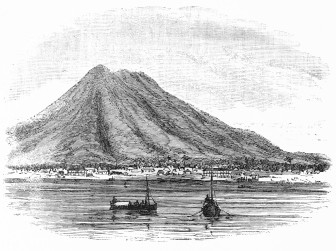
LA UNION AND VOLCANO OF CONCHAGUA.
The most fearful eruption on record in Nicaragua, and one of the most serious the world ever saw, was that of the volcano Cosequina, near Grenada, in 1835. It continued for four days, and covered the country for hundreds of miles around with ashes and lava, causing a panic from which the people did not recover for many years, and resulting in great destruction of life and property. The explosions were of such force that ashes fell in the city of Bogota, Colombia, fifteen hundred miles away in a direct line, and at an altitude eleven thousand feet above the sea. Ashes fell in the West India islands, also far in the interior of Mexico, and showers of them that obscured the sun caused great consternation in Guatemala and the neighboring republics, while the people in Nicaragua thought the end of the world had come. Vessels sailing in the Pacific had their decks covered with lava and ashes, and several sailors were injured by falling stones; while the ocean for a hundred and fifty miles was so strewn with floating ashes and pumice-stone that the surface of the water was concealed. The anniversary of this horrible catastrophe is always observed by the people as a great fast-day, business being suspended throughout the whole republic, and the people gathering in the churches to pray for deliverance from further eruptions. Since that date the volcano has continued active, but has caused no damage.
A great part of the surface of the country is covered with beds of lava and scoria, lakes of bitter water that have no bottom, yawning craters surrounded with blistered rocks, and pits from which sulphurous vapors are constantly rising that the people appropriately call infernillos.
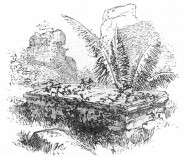
THE FATE OF FILIBUSTERS.
The city of Grenada stands at the eastern end of the inhabited valley of Nicaragua, as Leon does at the western end, the two rival cities being about seventy miles apart. Until its almost total destruction by Walker and his filibusters in 1857, it was a beautiful town, filled with fine mansions, and proud of its appearance. The population was reduced during the civil war, in which the American adventurers played so conspicuous a part, from thirty-five thousand to fifteen thousand; and although that was nearly thirty years ago it has scarcely begun to recover. Grenada was the seat of the “aristocratic” government which Walker and his allied Nicaraguans overthrew, and was besieged for two years, during which time the inhabitants endured not only great hardships, many dying of starvation and epidemics which broke out among them, but suffered the destruction of almost their entire property. During the days of Spanish dominion it was one of the most wealthy and prosperous cities in Central America, and its commerce was enormous. The old chronicles relate that nearly every day caravans of eighteen hundred mules laden with bullion and merchandise arrived from the surrounding country, and carried away European goods in exchange.
One of the largest monasteries on the continent was situated here, erected and occupied by the Franciscan Friars, who owned extensive estates in the surrounding country, and continued to acquire great wealth until they were expelled and their property confiscated in 1829. It is still standing in a good state of preservation.
The actual capital of Nicaragua, the city of Managua, sits on the southern shore of the lake of the same name, about sixty miles from the Pacific Ocean, and is reached by an overland journey of three days from Leon, which is connected with Corinto, the chief seaport, by a railroad. The population of Managua is about eight or ten thousand, at a guess, for no census has been taken since 1870. It has increased since that date, when the inhabitants numbered six thousand seven hundred. The rich residents are mostly planters who have estancias in the neighborhood, and live in houses of one or two stories without any pretension to architectural beauty or elegance. They are more modern in construction than those of Leon and Grenada, for it is only since the seat of government was located at Managua that it has been of any commercial or political importance. A large portion of the standing army of the republic, consisting of two thousand men, is stationed at Managua, occupying an old monastery as a barracks, and the streets are always crowded with military men in resplendent uniforms. There are about three officers to every ten privates in the army, and positions in the military service are actively sought by the sons of the aristocratic families, who prefer them to professional or commercial careers. The privates are exclusively Indians or half-breed peons, who wear a uniform of dirty white cotton drilling with a blue cap. They are supposed to be voluntarily enlisted, but when troops are needed they are secured by sending squads of impressarios into the country, who seize as many peons as they want, bring them, bound with ropes, to the capital, and then compel them to sign the enlistment rolls.
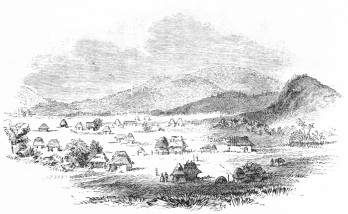
A FARMING SETTLEMENT.
The National Palace is a low, square edifice, with balconies of the ordinary Spanish styles, and was formerly the home of one of the religious orders. The only handsome rooms are the headquarters of the President and the chambers in which the two Houses of Congress meet annually. They are fitted up with fine imported furniture, and the walls are covered with portraits of men distinguished in the history of the republic.
The peons live in the outskirts of the city, in huts of bamboo thatched with palm-leaves and straw, surrounded with curious-looking fences or hedges of cactus. They are apparently very poor, and are surrounded with filth and squalor; but the real, which is worth twelve and a half cents, will sustain a whole family for a week, for they need little more than nature has supplied them with—the plantains and yams that grow profusely in their little gardens. They seldom eat meat, and never wash themselves. They appear to be perfectly happy, and sit at the doors of their huts, women and men, both nearly naked, smoking cigarettes, and chatting as contentedly as if all their wants in life were fully supplied. Densely ignorant and superstitious, they know nothing of the world beyond their own surroundings, and care less.
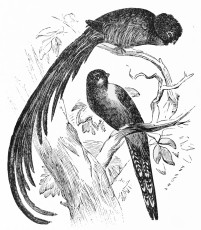
THE QUESAL.
The environs of Managua are very picturesque. On one side is the beautiful lake, sixty miles long and thirty miles wide, surrounded by volcanoes, and on the other are fertile slopes, on which are coffee plantations and cocoa groves, both yielding prodigious crops. The peons of the city work upon the estancias when there is anything to be done, travelling five or six miles each day in going to and returning from the scene of their labor. The country about Managua must have been densely populated by the aborigines, and is full of most curious and puzzling relics of a prehistoric race, which the natives regard with great veneration. The geologist, as well as the ethnologist and antiquarian, finds here one of the most abundant fields for investigation, which was explored and described by Stephens, Squier, and many earlier writers.
The Government consists of a President, who receives a salary of two thousand five hundred dollars, and is elected for four years, during which time, if he is not overpowered by some political rival, he usually manages to amass an immense fortune. A common argument in favor of re-electing presidents is that they are able to steal all they want during their first term. There are two Vice-Presidents, generally the President of the Senate and the Speaker of the Lower House, and either of them may be designated to perform the duties of the Executive when he so elects. There is a cabinet, or council, of four ministers. One has the finances in charge; another foreign affairs, agriculture, and commerce; a third military affairs and public works; and a fourth justice, public instruction, and ecclesiastical affairs.
The Senate is composed of fourteen members, two from each of the Departments, or Provinces, elected for four years; and the House of Deputies of twenty-four members, or one for each ten thousand of population, elected for two years. They are paid one dollar and fifty cents per diem during the sessions of Congress. No Senator or Deputy can be elected more than two consecutive terms, and no official of the Government or member of Congress can be a candidate for election or appointment to any other office during his constitutional term of service. Ecclesiastics are ineligible for civil positions, and all candidates for every post of honor under the Government must have proper qualifications; while all persons accepting pensions from the Government, and performing the duty of house or body servants, are denied the right of suffrage or of holding office. There are three courts, State or Department judges being elected by the people. District Federal judges and members of the Supreme Court being appointed by the House of Representatives and confirmed by the Senate, to serve during life unless impeached and convicted by the Deputies before the Senate for malfeasance in office. It requires a two-thirds vote in the House to enact legislation, but only a majority vote in the Senate. The President has the power of issuing decrees during the recess of Congress, which decrees have the force of law, but must be affirmed or reversed by Congress at its next session.
Since the charter of the Interoceanic Canal Company by the Congress of the United States, and the actual commencement of work upon the long-projected enterprise, under the direction of Chief-engineer Menocal, the republic of Nicaragua assumes a position of more prominence among nations, and of greater interest to the public at large, than it has ever had before. The failure of the Panama Canal Company, and the apparent impossibility of piercing the Isthmus at its narrowest part, has also given the Nicaragua Company increased importance, but Mr. Menocal and the company of capitalists who stand behind him feel no doubt of ultimate success.
SAN SALVADOR.
THE CAPITAL OF SAN SALVADOR.
WHOEVER visits the little republic of San Salvador, and lands at La Libertad, its principal seaport, must expect to undergo a novel and alarming experience. There is no harbor in the country, although it has one hundred and fifty-seven miles of sea-coast. The shore of the Pacific is a line of bluffs, with a fringe of beach at the bottom, and upon the sand a mighty surf is always beating. Ships anchor several miles off the coast, to avoid being driven ashore by the winds that sometimes rise very suddenly, and no boat can survive the breakers. An iron pier, or mole, twice as long and twice as high as the famous pier at Coney Island, extends from the bluff for three-quarters of a mile into the sea. A tramway runs from the town of La Libertad, connecting its monster warehouses with the pier, and cars loaded with coffee, sugar, and other products of the country are shoved out by peons or drawn by mules. The freight is piled upon the pier until the steamer arrives, when it is carried out to the anchorage in large lighters rowed by a dozen naked boatmen. The cargo is hoisted and lowered by means of a huge iron crane and derrick, operated by a small steam-engine. Bags and boxes are tumbled into great nets of cordage holding two tons or more, which are jerked up into the air by the derrick, swung around to be clear of the pier, and then dropped into the lighter.
Live cattle are hoisted and lowered by the horns, a lasso being thrown, one end of which is attached to the derrick, and the animal finds himself suddenly jerked into the air, and hangs kicking and struggling until his feet touch the bottom of the lighter, when he shakes himself to see if he is still alive. It is a wicked way to treat beasts, but under the circumstances there seems to be no other method. Sometimes, when the rope is carelessly adjusted, and the animal is young and heavy, his horns are torn out by the roots, and he falls sixty or seventy feet into the lighter, breaking his neck or legs, when one of the boatmen, drawing a knife from his belt, severs the jugular, and hangs his head over the side of the boat to let his life-blood run into the sea.
Horses are lifted and lowered with greater care by means of a strong harness of wide leather, with an iron ring in the saddle to which a rope’s end is hooked.
Humankind are treated with less consideration. When passengers arrive by a vessel they come to the pier on a lighter with freight, which rises and sinks with the heavy swell in a manner that is not only very alarming, but is almost certain to cause sea-sickness. One may have come all the way from New York or Europe to Aspinwall, and then from Panama up the coast, without a symptom of the distressing malady, but he is pretty sure to succumb to the rocking of the lighter at La Libertad, as it rubs and pounds against the iron trestle of the pier, while he is awaiting his turn to land. The officers of the vessels, accustomed to the motion, spring from the gunwales of the boat to the rounds of ladders that hang down the sides of the mole, and climb them as the boatmen do; but ladies and gentlemen unacquainted with this method, and untrained to clamber among the rigging of a ship, are treated to a sensation that is apt to make a timid person apprehensive.
An iron cage, capable of holding six persons, is lowered to the lighter, and you are invited to step in. As soon as it is full a boatman shuts the door and gives a signal to the engineer above. There is a sudden, startling jerk, you shut your eyes, cling to the bars of the cage, and feel your heart in your throat. The cage stops as suddenly as it started, whirls around swiftly for an instant or two, then swings over the pier, and drops with a thump. The door is opened, you step out,
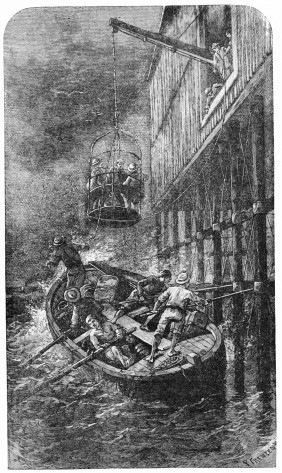
LANDING AT LA LIBERTAD.
uninjured, but trembling like a frightened bird, and register an unuttered vow that you will never land at La Libertad again. But this feeling leaves you when you enjoy a laugh at the demonstrations of alarm made by your fellow-passengers who have to follow you, and when you are assured, as people always are, that thousands have landed and embarked in the same manner without receiving a bruise or having a bone broken. It is not so pleasant, but quite as safe, as scrambling up a gangway from a dock to the deck of a vessel.
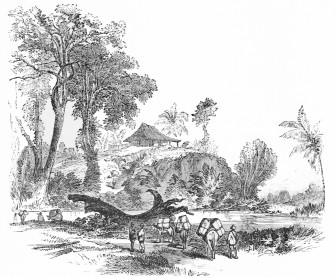
EN ROUTE TO THE INTERIOR.
Although San Salvador is the smallest in area of the group of republics, and only a little larger than Connecticut, it is the most prosperous, the most enterprising, and the most densely populated, having even a greater number of inhabitants than the land of wooden nutmegs. The population averages about eighty to the square mile—almost twenty times that of its neighbors. The natives are inclined to civilized pursuits, being engaged not only in agriculture, but quite extensively in manufacture. They are more energetic and industrious than the people in other parts of Central America, work harder, and accomplish more, gain wealth rapidly, and are frugal, but the constantly recurring earthquakes and political disturbances keep the country poor. When the towns are destroyed by volcanic eruptions, they are not allowed to lie in ruins, as those of other countries are, but the inhabitants at once clear away the rubbish and begin to rebuild. The city of San Salvador has been twice rebuilt since Leon of Nicaragua was laid in ruins, but the débris in the latter city has never been disturbed.
San Salvador has always taken the lead in the political affairs of Central America. It was the first to throw off the yoke of Spain, and uttered the first cry of liberty, as Venezuela did among the nations of the southern continent. The patriots of San Salvador received the cordial co-operation of the liberal element in the cities of Grenada, Nicaragua, and San José of Costa Rica, but were suppressed by the Imperial power. Its provisional congress was driven from place to place, but remained intact; it had the sympathy and support of the people, and defied the invaders of the country. Finally, as a last resort, the congress, by a solemn act passed on the 2d of December, 1822, resolved to annex their little province to the United States, and provided for the appointment of commissioners to proceed to Washington and ask its incorporation in the body politic of “La Grande Republica.” Before the commissioners could leave the country the revolution in the other Central American States had become too formidable to suppress, as the example of San Salvador had spread like an epidemic among the people, and its demand for liberty had found an echo from every valley and from every hill, from the Rio Grande to the Chagres. The five States joined in a confederacy one year after the act of annexation to the United States was passed, and the resolution was never officially submitted to our government. This was before the days of the Monroe Doctrine, and if the rise of Liberalism in Central America had not been so rapid, the political divisions of the North American continent might have been different now, and the destiny of several nations changed.
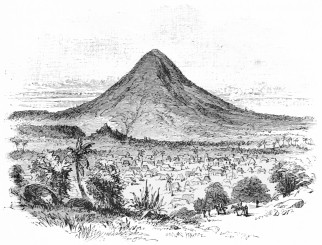
THE PEAK OF SAN SALVADOR.
Some time before the organization of the confederacy the people of San Salvador had adopted a constitution and formed a State government, being always foremost, and their example was followed seven months later by Costa Rica, then by Guatemala, Honduras, and Nicaragua in succession. Salvador was the first of the republics also to throw off the shackles of the Church. Indignant at the interference of the archbishop of Guatemala, who had charge of the Church in Central America, they defied his authority and elected a liberal bishop of their own. The archbishop denounced the act and appealed to the Pope, who threatened to excommunicate the entire population. But the threat was received with indifference, and the example of the Salvadorians was shortly after imitated by the people of Costa Pica, in like disregard of the will of the successor of St. Peter.
The President is elected for four years, the members of the Senate for three, and of the House of Deputies for one, all of them directly by the people. There is a senator for every thirty thousand of the population, and a deputy for every fifteen thousand. The exercise of suffrage is guarded by some wholesome restrictions. All married men can vote, except those who are engaged in domestic service, those who are without stated occupation, those who refuse to pay their legal debts, those who owe money past due to the Government, those who have accepted pay for any service from foreign powers, and those who have been convicted of felony. Unmarried men, to exercise the right of citizens, must be property owners, and be able to read and write. All voters have to show receipts for the payment of taxes the year previous if they are property owners, and bankrupts are entirely disfranchised, the idea being that none but a producer—one who adds to the wealth of the State or pays taxes—shall have a voice in its government. None but property owners are eligible to office.
The President has a cabinet of four ministers. They have in charge the Departments of Finance, War, and Public Works, Internal Affairs and Public Instruction, and Foreign Affairs. The Judiciary are appointed by the Deputies and confirmed by the Senate. Education is free and compulsory. There is a school for every two thousand inhabitants, supported by the general government, and a University at the capital with three hundred and fifty students, studying law, medicine, and the applied sciences, and one hundred and forty pursuing a classical course.
The standing army consists of twelve hundred men, but all able-bodied citizens between the ages of eighteen and forty are organized as a militia, and are subject to be called upon for service at the will of the President.
The capital, San Salvador (“The City of our Saviour”), is
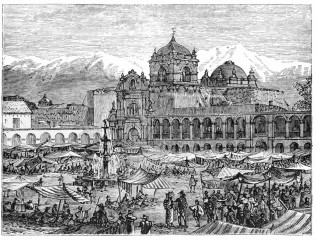
THE PLAZA.
eighteen miles from the sea-coast, and has an elevation of 2800 feet. It is surrounded by a group of volcanoes, two of which are active, one, Yzalco, discharging immense volumes of smoke, ashes, and lava at regular intervals of seven minutes from one year’s end to the other. San Salvador is reached by coaches over a picturesque mountain-road, but the journey is not pleasant in the dry season on account of the dust, nor in the rainy season on account of the mud. The city was founded in 1528 by George Alvarado, a brother of the renowned lieutenant of Cortez, who was the discoverer, conqueror, and the first viceroy of Central America. The situation it occupies is one of the most beautiful that can be imagined, being in the midst of an elevated mesa, or tableland, which overlooks the sea to the southward, and is surrounded by mountains upon its three other sides. As the prevailing winds are from the ocean, the climate is always cool and healthful, and the mountain streams are so abundant that the foliage is fresh during the entire year. Through each street runs an asequia, or irrigating ditch, which is always filled with water. Pipes lead from it into the gardens of the people, and supply hydrants for their use.
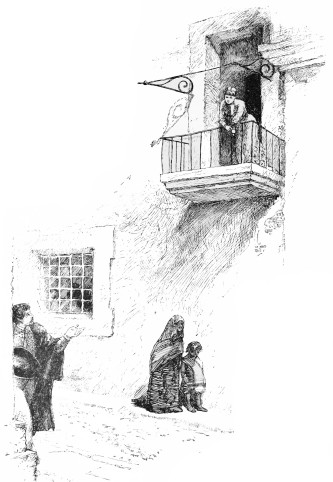
SPANISH-AMERICAN COURTSHIP.
There is very little architectural taste shown in the construction of the dwellings or of the public buildings. This is because of the frequency of earthquakes. The walls are of thick adobe, with scarcely any ornamentation, and the streets are dull and unattractive; but within the houses are gardens of wonderful beauty, in which the people spend the greater portion of the time, more often sleeping in a hammock among the trees in the dry season than under the roofs of their houses.
The public buildings are of insignificant appearance, and even the cathedral and the other churches are painfully plain and commonplace compared with those of other cities of its size. All this is owing to the fact, as has been stated, that the danger of their destruction at any moment forbids a lavish expenditure in construction or unnecessary display.
The women of San Salvador are neater in appearance, more careful in their dress, and are therefore more attractive than their sisters in Nicaragua, where, if there is any difference between the sexes, they are less tidy than the men. The girls in the rural districts always bathe in the asequias every morning at daylight, and the traveller who starts out early generally surprises groups of Naiads disporting in the streams. They plunge into the bushes or keep their bodies under the water until the intruder passes by, but do not hesitate to exchange a few words of banter with him, and good-naturedly bid him godspeed.
There is more freedom between the sexes in San Salvador than in the sister republics; and it is not at the cost of morals, for, as a rule, in countries where social restrictions are the most severe there is the greatest amount of licentiousness. The education of the masses has proved to be the greatest safeguard, and the number of illegitimate births is reduced as the standard of intelligence is elevated. The constitutional provision in San Salvador which confers superior advantages upon married men, together with a law limiting the marriage fees of the priests, have proven to be wise and effective policy. The girls marry at fifteen and over, and very few peons reach their majority without taking a lawful wife.
There is a public theatre, subsidized by the Government, at which frequent entertainments are given, and nearly every season an opera company comes from Italy or France. The performances are liberally patronized, at high prices of
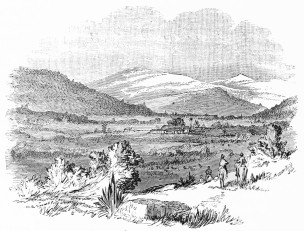
A HACIENDA.
admission. But the most popular funcions, as they are called, are by local amateurs, the programmes being made up of vocal and instrumental music, recitations, and original poems and orations. The latter are always the popular features of the occasion, and the funcions are usually arranged to give some young orator an opportunity to show his talents before the foot-lights. There is a great deal of rivalry, too, among the local poets, each aspirant for honors having his clique of admirers, or faccions, who feel it their duty to applaud no one else, however meritorious, and to hiss all others down. When two of these popular idols appear upon the platform on the same evening, as they often do, there are scenes of sensational excitement and sometimes mob violence. The subjects of all the orations and poems are usually patriotic—the praise of San Salvador—for the love of country is a theme of which the people never tire. The programmes of all public entertainments are mostly composed of local compositions, national airs, and patriotic songs. The musicians prefer the scores of their own composers, and everything foreign is to a degree offensive, to be tolerated only as a matter of variety.
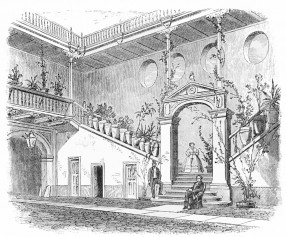
INTERIOR OF A SAN SALVADOR HOUSE.
The Salvadorians have a dozen or more “Fourths of July”—memorial days—sometimes two patriotic celebrations occurring in a month, on the anniversary of historical events. All classes of people join in the demonstrations, closing their places of business, decorating the streets, attending high-mass in the morning, engaging in processions and hearing patriotic orations during the day, and in the evening closing the festivities with fireworks, banquets, and balls. But the two great days of the year are Christmas and the Feast of San Miguel (St. Michael), the patron saint of the republic. The latter is celebrated very much like our Independence Day was in ancient times, except that the hours from sunrise to noon are devoted to solemn religious services in all the churches, the bishop himself officiating at the cathedral, and the rest of the time to the next morning to holiday festivities. There is much powder wasted in fire-crackers, or bombas, as they are called, fireworks, and salutes by the artillery.
The annual fair of St. Miguel, which is held in February, is always a notable event, being not only a national anniversary, but the greatest market season of the year, and the occasion of general and prolonged festivities. It lasts about two weeks, and is attended by buyers and sellers from all parts of Central America. The importing houses always have their representatives present on such occasions. The days are occupied with trading, and the nights with balls, concerts, theatrical performances, and gambling. Everybody plays cards, and no one, man or woman, ever sits down to a game without stakes. Women play at their residences with or without their gentlemen friends, and large sums of money often pass across the table. At the fairs, and in fact on all occasions which bring people together, the peons are entertained with cock-fights and bull-fights, although the latter cruel sport is nominally forbidden by law. The bull-rings and cock-pits are invariably crowded every Sunday afternoon, and always on saints’ days, and often the best people are found among the spectators, particularly the young men, who ruin themselves with reckless betting. It is the fashion for the swells to keep gamebirds, and employ professional cock-fighters to train and handle them.
The Christmas festivities commence about midnight, and the explosions of cannon and fireworks always begin as soon as the clock in the cathedral tower strikes twelve. Everybody is up and dressed before daylight to attend early mass, and when the sun rises the streets are full of people saluting each other by exchanging the compliments of the day, and throwing egg-shells filled with perfumed water. From morning till night the air is full of the noise of fireworks, cannonades, the shouts of people, and the music of military bands, while processions are continually passing through the principal streets. In nearly every house preparations have been going on for weeks, not for the exhibition of Christmas-trees or the exchange of gifts, but for the representation of the naciamiento, or birth of Christ. The best room in the house is often fitted up to resemble a manger, asses being brought in from the stable to make the scene more realistic. Several incidents in the life of the Saviour are portrayed in a like manner. In other residences are different representations. Sometimes the parlor is arranged like a bower, filled with tropical plants and flowers, moss-covered stones and sea-shells, and draped with vines. Within the bower are figures of the Virgin and Child, surrounded by the kneeling Magi and the members of the Holy Family.
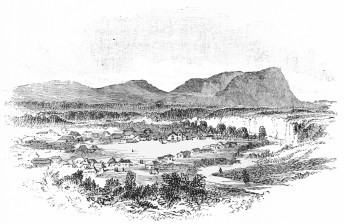
A TYPICAL TOWN.
It is the ambition of the mistress of the house to surpass all her friends and neighbors in the realism of her representation and in the elegance with which the puppets are dressed. During the day there is a general interchange of calls to see the displays, to criticise them, and make comparisons. The grandest display is always made in the cathedral, the cost often amounting to many thousands of dollars, while the subordinate churches enter into an active and expensive rivalry, raising funds for the purpose by soliciting subscriptions in the parish. The ceremonies usually begin before daylight, and last for a couple of hours, high-mass being sung by the leading vocalists of the country, assisted by orchestras and military bands.
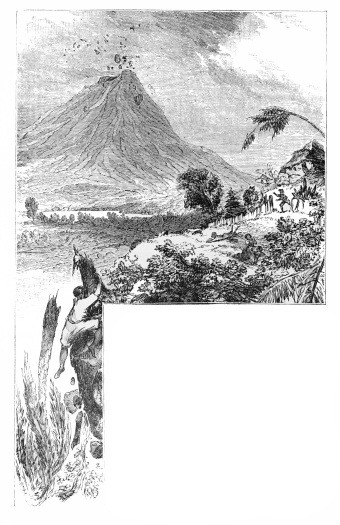
WHAT ALARMS THE CITIZENS.
The favorite incident for portrayal is the Adoration of the Magi, and human figures are usually trained by the priests to play the various characters. The most beautiful woman in the city is selected to act the part of the Virgin, and some young infant is volunteered to represent the baby Christ. The church is always crowded, and illuminated by thousands of candles. At the proper moment the curtain is drawn, and the choir breaks out in a glorious anthem; the bells of the churches ring, and the vast audience, rising to their feet, join in the exultant song, “Jubilate! jubilate! Christ is born!” Processions of priests enter, and at the close of the anthem the bishop sings high-mass to a living representation of the Virgin and Child.
The people are not so priestridden as those of some of the Spanish-American countries, being naturally more self-reliant and independent. They know what liberty is, and insist upon being allowed to enjoy it, both civil and religious. They choose their own priests, and the latter elect their own bishop, without regard to the Pope or the College of Cardinals. The clerical party in politics, or the Serviles, as they were called, because of their slavery to the Church, has long been extinct in San Salvador, and the political struggles are more personal than over abstract issues. There is a considerable degree of superstition among the people, and they believe in all sorts of signs and omens, but the priests do not attempt to humbug them with bogus miracles or wonder-working images.
Much of this superstition relates to the earthquakes and volcanic disturbances to which the country is so subject. Within view of the capital are eleven great volcanoes, two of which are unceasingly active, while the others are subject to occasional eruptions. The nearest is the mountain of San Salvador, about eight thousand feet high, and showing to great advantage because it rises so abruptly from the plain. It is only three miles from the city, to the westward, very steep, and its sides are broken by monstrous gorges, immense rocky declivities, and projecting cliffs. The summit is crowned by a cone of ashes and scoriæ that have been thrown out in centuries past, but since 1856, subsequent to the greatest earthquake the country has known, the crater has been extinct, and is now filled with a bottomless lake. Very few people have ever ascended to the summit, because of the extreme difficulty and peril of making the climb, while even a smaller number have entered the chasm in which the crater lies. Some years ago a couple of venturesome French scientists went down, but became exhausted in their attempts to return. Their companions who remained at the top lowered them food and blankets by lines, and they were finally rescued, after several days of confinement in their rocky prison, by a detachment of soldiers, who hauled them up the precipice by ropes.
The two active volcanoes, or vivos, as the people call them, are San Miguel and Yzalco, and there are none more violent on the face of the globe. They present a magnificent display to the passengers of steamers sailing by the coast, or anchored in the harbor of La Libertad and Acajutla, constantly discharging masses of lava which flow down their sides in blazing torrents, and illuminating the sky with the flames that issue from the craters at regular intervals. Yzalco is as regular as a clock, the eruption occurring like the beating of a mighty pulse every seven minutes.
It is impossible to conceive of a grander spectacle than this monster. It rises seven thousand feet, almost directly from the sea, and an immense volume of smoke, like a plume, is continually pouring out of its summit, broken with such regularity by masses of flame that rise a thousand feet that it has been named El Faro del Salvador—“The Light-house of Salvador.” Around the base of the mountain are fertile plantations, while above them, covering about two-thirds of its surface, is an almost impenetrable forest, whose foliage is perpetual and of the darkest green. Then beyond the forest is a ring of reddish scoriæ, while above it the live ashes and lava that are cast from the crater so regularly are constantly changing from livid yellow, when they are heated, to a silver gray as they cool.
Yzalco is in many respects the most remarkable volcano on earth; first, because its discharges have continued so long and
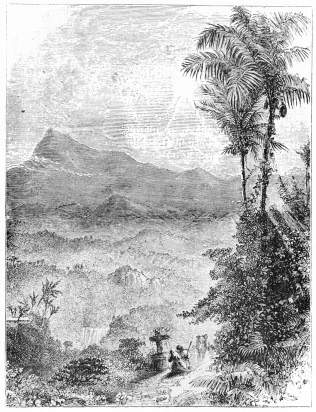
YZALCO FROM A DISTANCE.
with such great regularity; again, because the tumult in the earth’s bowels is always to be heard, as the rumblings and explosions are constant, being audible for a hundred miles, and sounding like the noises which Rip van Winkle heard when he awakened from his sleep in the Catskills; and, finally, it is the only volcano that has originated on this continent since the discovery by Columbus.
It arose suddenly from the plain in the spring of 1770, in the midst of what had been for nearly a hundred years the profitable estate of Señor Don Balthazar Erazo, who was absent from the country at the time, and was greatly amazed upon his return to discover that his magnificent coffee and indigo plantation had, without his knowledge or consent, been exchanged for a first-class volcano. In December, 1769, the peons on the hacienda were alarmed by terrific rumblings under the ground, constant tremblings of the earth, and frequent earthquakes, which did not extend over the country as usual, but seemed to be confined to that particular locality. They left the place in terror when the tremblings and noises continued, and returning a week or two after, found that all the buildings had been shaken down, trees uprooted, and large craters opened in the fields which had been level earth before. From these craters smoke and steam issued, and occasionally flames were seen to come out of the ground. Some brave vaqueros, or herdsmen, remained near by to watch developments, and on the 23d of February, 1770, they were entertained by a spectacle that no other men have been permitted to witness, for about ten o’clock on the morning of that day the grand upheaval took place, and it seemed to them, as they fled in terror, that the whole universe was being turned upside down.
First there were a series of terrific explosions, which lifted the crust of the earth several hundred feet, and out of the cracks issued flames and lava, and immense volumes of smoke. An hour or two afterwards there was another and a grander convulsion, which shook and startled the country for a hundred miles around. Rocks weighing thousands of tons were hurled into the air, and fell several leagues distant. The surface of the earth was elevated about three thousand feet, and the internal recesses were purged of masses of lava and blistered stone, which fell in a heap around the hole from which they issued. These discharges continued for several days
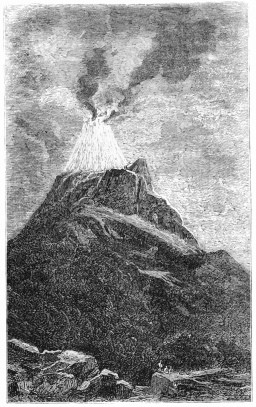
YZALCO.
at irregular intervals, accompanied by loud explosions and earthquakes, which did much damage throughout the entire republic; the disturbance was perceptible in Nicaragua and Honduras. In this manner was a volcano born, and it has proved to be a healthy and vigorous child. In less than two months from a level field arose a mountain more than four thousand feet high, and the constant discharges from the crater which opened then have accumulated around its edges until its elevation has increased two thousand feet more. Unfortunately, the growth of the monster has not been scientifically observed or accurately measured, but the cone of lava and ashes, which is now twenty-five hundred feet from the foundation of earth upon which it rests, is constantly growing in bulk and height by the incessant discharges of lava, ashes, and other volcanic matter upon it.
The capital of San Salvador has been thrice almost entirely, and eleven times in its history partially, destroyed by earthquakes and volcanic eruptions coming together. These catastrophies occurred in 1575, 1593, 1625, 1656, 1770, 1773, 1798, 1839, 1854, 1873, and 1882. The most serious convulsions took place in 1773 and 1854, when not only the City of Our Saviour, but several other towns were entirely ruined, and nearly every place suffered to a greater or less degree; but the restoration was rapid and complete.
The chief products of the country are coffee, cocoa, sugar, indigo, and other agricultural staples, which are raised by the same process that prevails in other States, with the addition of a balsam that is very valuable, and is grown exclusively on a little strip of land lying along the coast between the two principal seaports, La Libertad and Acajutla. Lying to the seaward of the volcanic range is a forest about six hundred square miles in extent that is composed almost exclusively of balsam-trees, and is known as the “Costa del Balsimo.” It is populated by a remnant of the aboriginal Indian race, who are supported by the product of their forest, and are permitted to remain there undisturbed, and very little altered from their original condition.
The forest is traversed only by foot-paths, so intricate as to baffle the stranger who attempts to enter it; and it is not safe to make such an attempt, as the Indians, peaceful enough when they come out to mingle with the other inhabitants of the country, violently resent any intrusion into their
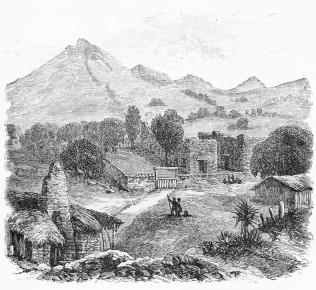
IN THE INTERIOR.
strong-hold. They live as a community, all their earnings being intrusted to the care of ahuales—old men who exercise both civil and religious offices, and keep the common funds in a treasure-box, to be distributed among the families as their necessities require. There is a prevailing impression that the tribe has an enormous sum of money in its possession, as their earnings are large and their wants are few. The surplus existing at the end of each year is supposed to be buried in a sacred spot with religious ceremonies. Both men and women go entirely naked, except for a breech-clout, but when they come to town they assume the ordinary cotton garments worn by the peons. They are darker in color, larger in stature, more taciturn and morose, than the other Indians of the country, but are temperate, industrious, and adhere to their ancient rites with great tenacity. They are known to history as the Nahuatls, but are commonly spoken of as “Balsimos.”
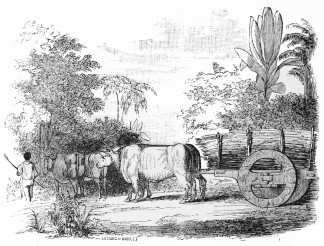
HAULING SUGAR-CANE.
Agriculture is carried on by them only to an extent sufficient to supply their own wants, and usually by the women, while the men are engaged in gathering the balsam, of which they sell about twenty thousand dollars’ worth each year. They number about two thousand people, and including what they spend at their festivals, which are more like bacchanalian riots than religious ceremonies, and are accompanied by scenes of revolting bestiality, their annual expenses cannot be more than one half of their incomes.
The balsam is obtained by making an incision in the tree, from which the sap exudes, and is absorbed by bunches of raw cotton. These, when thoroughly saturated, are thrown into vats of boiling water and replaced by others. The balsam leaves the cotton, rises to the surface of the water, and at intervals is skimmed off and placed in wooden bowls or gourds, where it hardens, and then is wrapped in the leaves of the tree and sent to market. In commerce it is known as Peruvian balsam, because in early times Callao was the great market for its sale, but the product comes exclusively from San Salvador.
There is one railroad in San Salvador, extending from Acajutla to the city of Sonsonate, the centre of the sugar district, and it is being extended to Santa Ana, the chief town of the Northern Province. It is owned by a native capitalist, and operated under the management of an American engineer. The plan is to extend the track parallel with the sea through the entire republic, in the valley back of the mountain range, with branches through the passes to the principal cities. It now passes two-thirds of the distance around the base of the volcano Yzalco, and from the cars is furnished a most remarkable view of that sublime spectacle. The entire system when completed will not consist of more than two hundred and fifty miles of track, and the work of construction is neither difficult nor expensive.
SAN JOSÉ.
THE CAPITAL OF COSTA RICA.
NEARLY four hundred years ago an old sailor coasted along the eastern shore of Costa Rica in a bark not much bigger than a canal-boat, searching for a passage to the western sea. He had a bunk built in the bows of his little vessel where he could rest his weary bones and look out upon the world he had discovered. There was little left of him but his will. He had explored the whole coast from Yucatan to Trinidad, and found it an unbroken line of continent, a contradiction of all his reasoning, a defiance of all his theories, and an impassable obstacle to the hopes he had cherished for thirty years. The geography of the New World was clear enough in his mind. The earth was a globe, there was no doubt of it, and there must be a navigable belt of water around. So he groped along, seeking the passage he felt should be there, cruising into each river, and following the shorelines of each gulf and bay. Instinctively he hovered around the narrowest portion of the continent, where was but a slender strip of land, upheaved by some mighty convulsion, to shatter his theories and defy his dreams. It was the most pathetic picture in all history. Finally, overcome by age and infirmity, he had to abandon the attempt, and fearing to return to Spain without something to satisfy the avarice of his sovereign, surrendered the command of his little fleet to his brother Bartholomew, and wept while the carnival of murder and plunder, that was to last three centuries, was begun.
Among other points visited for barter with the Indians was a little harbor in which were islands covered with limes, and Columbus marked the place upon his chart “Puerto de
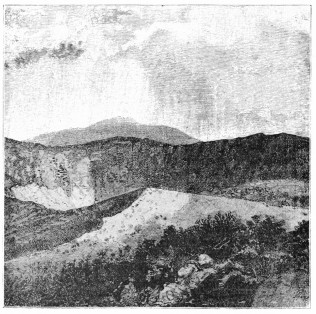
CRATER OF A VOLCANO.
Limon.” To-day it is a collection of cheap wooden houses and bamboo huts, with wharves, warehouses, and railway shops, surrounded by the most luxurious tropical vegetation, alive with birds of gorgeous plumage, venomous reptiles, and beautiful tiger-cats. Here and there about the place are patches of sugar-cane and groups of cocoa-nut trees, with the wide-spreading bread-fruit that God gave to the tropical savage as He gave rice and maize to his Northern brother, and the slender, graceful rubber-tree, whose frosty-colored mottled trunk looks like the neck of a giraffe. It scarcely casts a shadow; but the banana, with its long pale green plumes, furnishes plenty of shelter for the palm-thatched cabins, the naked babies that play around them, and the half-dressed women who seem always to be dozing in the sun.
Surrounding the city for a radius of threescore miles is a jungle full of patriarchal trees, stately and venerable, draped with long moss and slender vines that look like the rigging of a ship. Their limbs are covered with wonderful orchids as bright and radiant as the plumage of the birds, the Espiritu Santo and other rare plants being as plentiful as the daisies in a New England meadow. There is another flower, elsewhere unknown, called the “turn-sol,” which in the morning is white and wax-like, resembling the camellia, but at noon has turned to the most vivid scarlet, and at sunset drops off its stem. This picture is seen from shipboard through a veil of mist—miasmatic vapor—in which the lungs of men find poison, but the air plants food. It reaches from the breasts of the mountains to the foam-fringed shore, broken only by the fleecy clouds that hang low and motionless in the atmosphere, as if they, with all the rest of nature, had sniffed the fragrance of the poppy and sunk to sleep.
But in the mornings and the evenings, when the air is cool, Limon is a busy place. Dwarfish engines with long trains of cars wind down from the interior, laden with coffee and bananas. Half-naked roustabouts file back and forth across the gangplanks, loading steamers for Liverpool, New York, and New Orleans. The coffee is allowed to accumulate in the warehouses until the vessels come, but the bananas must not be picked till the last moment, at telegraphic notice, the morning the steamer sails. Trains of cars are sent to the side-tracks of every plantation, and are loaded with the half-ripe fruit still glistening with the dew. There are often as many as fifty thousand bunches on a single steamer, representing six million bananas, but they are so perishable that more than half the cargo goes overboard before its destination is reached. The shipments of bananas from Costa Rica are something new in trade. Only a few years since all our supply came from Honduras and the West Indies, but the development of the plantations around Limon has given that port almost a monopoly. This is due to the construction of a railway seventy miles into the interior, intended to connect the capital of the country and its populous valley with the Atlantic Ocean. The road was begun by the Government, but before its completion passed into the hands of Minor C. Keith, of Brooklyn, who has a perpetual lease, and is attempting to extend it to San José, from and to which freight is transported in ox-carts, a distance of thirty miles.
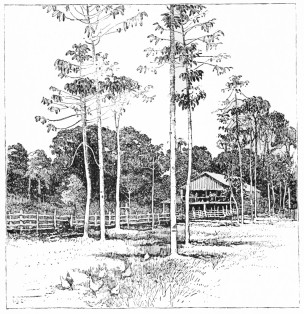
RUBBER-TREES.
Along the track many plantations have been opened in the jungle, and produce prolifically. Numbers of the settlers are from the United States, from the South particularly, and it being the fashion to christen the plantations, the traveller finds over the entrances sign-boards that bear familiar names. Over the gate-way to one of the finest haciendas, as they are called, is the inscription “Johnny Reb’s Last Ditch,” a forlorn and almost hopeless ex-Confederate having drifted there, after much buffeting by fortune, and taken up Government land, on which he now is in a fair way to make a fortune.
From the terminus of the railway the ride to the capital is over picturesque mountain passes and through deep gorges and cañons whose mighty walls never admit the sun. There are no coaches, but the ride must be made on mule-back, starting before sunrise so as to reach the city by dark. San José is found in a pretty valley between the two ranges of the Cordilleras, and surrounded by an entertaining group of volcanoes, not less than eight being in sight from any of the housetops. Ordinarily they behave very well, and sleep as quietly as the prophets, but now and then their slumbers are disturbed by indigestion, when they get restless, yawn a little, breathe forth fire and smoke, and vomit sulphur, lava, and ashes. One would think that people living continually in the midst of danger from earthquakes and eruptions would soon become accustomed to them; but it is not so. The interval since the last calamity, when the city of Cartago was destroyed, has been forty years—so long that the next entertainment is expected to be one of unusual interest; and as no announcements are made in the newspapers, the people are always in a solemn state of uncertainty whether they will awake in a pile of brimstone and ashes or under their ponchos as usual. This gives life a zest the superstitious do not enjoy.
It is the theory of the local scientists that there is a subterranean connection between the group of volcanoes, and that prodigious fires are constantly burning beneath. Therefore it is necessary for at least one of them to be always doing business, to permit the smoke and gases to escape through its crater, for if all should suspend operations the gases would gather in the vaults below, and when they reached the fires
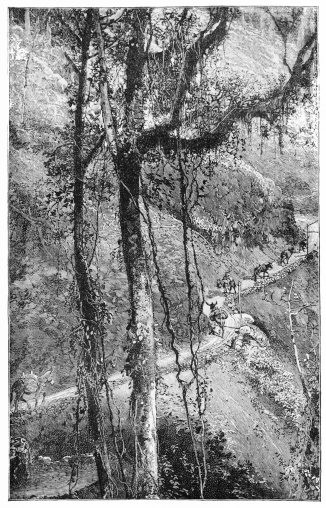
THE ROAD FROM PORT LIMON TO SAN JOSÉ.
would shake the earth by their explosion. It is said to be a fact that the total cessation of all the volcanoes is followed by an earthquake, and if Tierra Alba, which is active now, should cease to show its cloud of smoke by day and its pillar of fire by night, the people would leave their houses and take to the fields in anticipation of the impending calamity. All the buildings in the country are built for earthquake service, being seldom more than one story in elevation, and never more than two, of thick adobe walls, which are light and elastic.
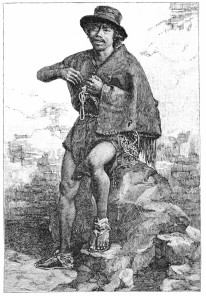
A PEON.
The city has about thirty thousand inhabitants—nearly one-seventh of the entire population of the republic—and seems quaint and queer to the North American traveller because of its unlikeness to anything he has seen at home. The climate is a perpetual spring. The flowers are perennial; the foliage fades and falls in autumn, dying from exhaustion, but never from frost. The days are always warm and delightful, and the nights cool and favorable to sweet rest. Winter is not so agreeable as summer, for when it is not raining the winds blow dust in your eyes, and you miss the foliage and fruits. There is not such a thing as an overcoat in the place—the storekeepers do not sell them—and the natives never heard of stoves. One can look over the roofs of the town from the tower of the cathedral and not see a chimney anywhere. The mercury seldom goes above eighty, and never below sixty, Fahrenheit. The thick walls of the houses make an even temperature within, scarcely varying five degrees from one year to another, and it never rains long enough for the dampness to penetrate them. There is no architectural taste displayed, and a never-ending sameness marks the streets. It is only in the country that picturesque dwellings are found, and usually Nature, not man, has made them so. The shops differ from the residences only in having wider doors and larger rooms, while the warehouses are usually abandoned monasteries or discarded dwellings.
The merchants are mostly foreigners—Frenchmen or Germans; the professional men and laborers are natives. The people are more peaceful and industrious than in the other Central American States, and have the reputation for greater honesty, but less ingenuity, than their neighbors. They take no interest in politics, seldom vote, and do not seem to care who governs them. There has not been a revolution in Costa Rica since 1872, and that grew out of the rivalry of two English banking houses in securing a government loan. The prisons are empty; the doors of the houses are seldom locked; the people are temperate and amiable, and live at peace with one another. The national vice is indolence—mañana (pronounced manyannah), a word that is spoken oftener than any other in the language, and means “some other time.” It is a proverb that the Costa-Rican is “always lying under the mañana-tree,” and that is why the people are poor and the nation bankrupt. The resources of the country, agricultural, mineral, pastoral, and timber, are immense, but have not even been explored. Ninety per cent. of the natives have never been outside the little valley in which they were born; while the Government has done little to invite immigration and encourage development. There are two railroads, both unfinished, and the money that was borrowed to build them was wasted in the most ludicrous way.
In 1872 it was decided that the future prosperity of the country demanded the construction of railways connecting the one inhabited valley with the two oceans, and the Congress ordered a survey. It was made by English engineers, who submitted profiles of the most practicable routes and estimates of the cost of construction. There being no wealth in the country, a loan was necessary, and the two banking houses, both operated by Englishmen upon English capital, sought the privilege of negotiating it. The President made his selection. The disappointed banker decided to overthrow the Government and set up a new one that would cancel the contract and recognize his claims. Down on the plains of Guanacasta was a cow-boy, Tomas Guardia by name, who had won reputation as the commander of a squad of cavalry in a war with Nicaragua, and was known over all Central America for his native ability, soldierly qualities, and desperate valor.
The banker who had failed to get his spoon into the pudding called into the conspiracy a number of disappointed politicians and discontented adherents of the existing Government, and it was decided to send for Guardia to come to the capital and lead the revolution. By offering him pecuniary inducements and a promise of being made commander-in-chief of the Federal army if the revolution was a success, the services of the cow-boy were secured. He called together about one hundred men of his own class, made a rendezvous at a plantation just outside of the city limits, and one moonlight
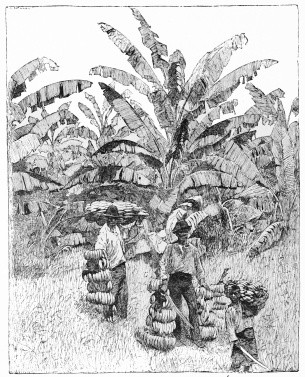
A BANANA PLANTATION.
night rode into town, surprised the guard at the military garrison, captured the commander of the army and all his troops, took possession of the Government offices, and proclaimed martial law. As the Costa-Rican army consisted of but two hundred and fifty men, accustomed only to police duty and parades, this was not a difficult or a daring undertaking. Those of the officials who were captured were locked up, and those who escaped fled to the woods and then left the country. Among the latter class was the “Constitutional President,” as the regularly elected rulers in Spanish America are always called, to distinguish them from the frequent “Pronunciamento Presidents” and “Jefes de Militar,” or military dictators.
Having thus dethroned the legitimate ruler, Guardia proclaimed himself Military Dictator, and called a Junta, composed of the men who had employed him to overthrow the Government. They met, with great formality, and solemnly issued a proclamation, reciting that the Constitutional President having absented himself from the country without designating any one to act in his place, it became necessary to choose a new Chief Magistrate. In the mean time the Junta declared Guardia Provisional President until an election could be held. The latter took possession of the Executive Mansion, called all the people into the plaza, swore them to support him, reorganized the bureaus of the Government and the army, placing the cow-boys who had come up from Guanacasta with him in charge. The father-in-law of the English banker who suggested the revolution was announced as the candidate for the Presidency, and it was expected that he would be chosen without opposition. But General Guardia, having had a taste of power, thought more of the same would be agreeable, and passed the word quietly around among his officers that he was a candidate himself. As they constituted the judges of election and the returning board, this hint was sufficient, and when the returns began to come in after ejection day, the banker and his co-conspirators found, to their surprise and chagrin, that their tool had become their master, and General Guardia was declared Constitutional President by a unanimous vote, only two thousand ballots having been cast by a population of two hundred thousand.
This cow-boy, when he took his seat, could neither read nor write. He was, however, a man of extraordinary natural ability, gifted with brains and a laudable ambition. He sprang from a mixture of the Spanish and native races, had energy, shrewdness, a cool head, and a fair idea of government: in all respects the most remarkable, and in many respects the greatest man the little republic ever produced. He learned rapidly, and selected the wisest and ablest men in the country for his advisers. Under his administration the nation showed greater development than it has enjoyed before or since, and, so far as lay in his power, he introduced and encouraged a spirit of moral, intellectual, and commercial advancement, established free schools and a university, overthrew the domination of the priests, sent young men abroad to study the science of government, and preserved the peace as he aided the progress of the people. If he had been as wise as he was progressive, Costa Rica would have made rapid strides towards the standard of modern civilization, but in his mistaken zeal for the development of the country he left it bankrupt.
The two railroads were commenced by him. Under the estimates of the engineers the cost of construction and equipment for two narrow-gauge lines, from San José to Port Limon, on the Atlantic coast, and Punta Arenas, on the Pacific, a total distance of one hundred and sixty miles, was placed at $6,000,000—$37,500 per mile. The line from Port Limon was constructed under the direction of a brother of Henry Meiggs, the famous fugitive from California (who fled to Peru, and lived there like a second Monte Cristo), but the shorter line, from San José to Punta Arenas, was attempted under the personal supervision of the President himself, who went at it in a very queer way.
All the necessary material and supplies to build and equip the road were purchased in England, sent by sailing-vessels around the Horn, and landed at Punta Arenas. But instead of commencing work there, the President, who had never seen a locomotive in his life, repudiated all advice, rejected all suggestions, and ordered the whole outfit to be carried seventy-five miles over the mountains on carts and mule-back, so as to begin at the other end. This undertaking was more difficult and expensive than the construction of the road. But
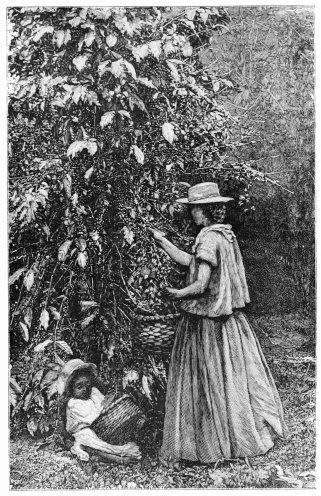
PICKING COFFEE.
Guardia’s extraordinary departure from the conventional was not without reason. It was based upon a mixture of motives, not only ignorance and inexperience, but pride and precaution. The conservative element of the population, the Bourbon hidalgos, and the ignorant and the superstitious peons, were opposed to all departures from the past, and saw in every improvement and innovation a dangerous disturbance of existing conditions. The methods their fathers used were good enough for them. There was also a large amount of capital and labor engaged in transporting freight by ox-carts, which had always been the “common carriers” of the republic, and those interested recognized that the construction of the railway would make their cattle useless, and leave the peon carters unemployed. To resist the construction of the railroad they organized a revolution, threatening to tear up the tracks and destroy the machinery. To mollify this sentiment, and furnish employment for the cartmen to keep them out of mischief, was the controlling idea in Guardia’s mind, so with great labor and difficulty, and at an enormous expense, the locomotives and cars were taken to pieces and hauled over the mountains to San José. The first rails were laid at the capital by the President himself, with a great demonstration, and the work continued until the money was exhausted; and the Government, having destroyed its credit by this remarkable proceeding, was unable to borrow more. The loan, which under ordinary circumstances would have been sufficient to complete the enterprise, was all expended before forty miles of track were laid, ten miles of which extend between Punta Arenas, the Pacific seaport, and Esparza, the next town, and thirty miles between San José and Alajuela, at the western end of the valley. This road is now operated by the Government, under the direction of a native engineer, who was never outside the boundaries of the republic, and never saw any railway but this. He is, however, a man of genius and practical ability, and if he were allowed to have his way the road might be a paying enterprise. But the Government uses it as a political machine, employs a great many superfluous and incompetent men—mostly the relatives and dependents of influential politicians—carries freight and passengers on credit, and does many other foolish things that make profits impossible, and cause a large deficiency to be made up by taxation each year. On every train of three cars—one for baggage and two for passengers—are thirteen men. First a manager or conductor who has general supervision, a locomotive engineer and stoker, two ticket takers, two brakemen for each car, and two men to handle baggage and express packages—all of them being arrayed in the most resplendent uniforms, the conductor having the appearance of a major-general on dress parade. Freight trains are run upon the same system and at a similar expense. Shippers are allowed thirty and sixty days after the goods are delivered to pay their freight charges, and passengers who are known to the station agents can get tickets on credit and have the bill sent them upon their return—a concession to a public sentiment that justifies the postponement of everything until to-morrow—the mañana policy that keeps the nation poor.
Thousands of ox-carts are still employed between the towns of Esparza and Alajuela, the termini of the railway, carrying freight over the mountains; and it usually takes a week for them to make the journey of thirty-five miles, often longer, for on religious festivals, which occur with surprising frequency, all the transportation business is suspended. A traveller who intends to take a steamer at Punta Arenas must send his baggage on a week in advance. He leaves the train at Alajuela, mounts a mule, rides over the mountain to the town of Atenas, where he spends the night. The next morning at daybreak he resumes his journey, and rides fifteen miles to San Mateo, breakfasts at eleven, takes his siesta in a hammock until four or five in the afternoon, then mounting his mule again, covers the ten miles to Esparza by sunset, where he dines and spends the night, usually remaining there, to avoid the heat of Punta Arenas, until a few hours before the steamer leaves; and then, if the ox-carts have come with his baggage, makes the rest of his trip by rail.
The journey is not an unpleasant one. The scenery is wild and picturesque. The roads are usually good, except in the dry season, when they become very dusty, and after heavy rains, when the mud is deep. But under the tropic sun and in the dry air moisture evaporates rapidly, and in six hours after a rainfall the roads are hard and good. The uncertainty as to whether his trunks will arrive in time makes the inexperienced traveller nervous.
The Costa-Rican cartmen are the most irresponsible and indifferent beings on earth. They travel in long caravans or processions, often with two or three hundred teams in a line. When one chooses to stop, or meets with an accident, all the rest wait for him if it wastes a week. None will start until each of his companions is ready, and sometimes the road is blocked for miles, awaiting the repair of some damage. The oxen are large white patient beasts, and are yoked by the horns, and not by the neck, as in modern style, lashings of raw cowhide being used to make them fast. They wear the yokes continually. The union is as permanent as matrimony in a land where divorce laws are unknown. The cartmen are as courteous as they are indifferent. They always lift their hats to a caballero as he passes them, and say, “May the Virgin guard you on your journey!” Thousands of dollars in gold are often intrusted to them, and never was a penny lost. A banker of San José told me that he usually received thirty thousand dollars in coin each week during coffee season by these ox-carts, and considered it safer than if he carried it himself, although the caravan stands in the open air by the roadside every night. Highway robbery is unknown, and the cartmen, with their wages of thirty cents a day, would not know what use to make of the money if they should steal it. Nevertheless they always feel at liberty to rob the traveller of the straps on his trunks, and no piece of baggage ever arrives at its destination so protected unless the strap is securely nailed, and then it is usually cut to pieces by the cartmen as revenge for being deprived of what they consider their perquisite.
At sunset the oxen are released from their burdens at the nearest tambo, or resting-place, upon the way, and are kept overnight in sheds provided for them. At these places are drinking and gambling booths, with usually a number of dissolute women to tempt and entertain the cartmen. The evenings are spent in carousal, in dancing, and singing the peculiar native songs to the accompaniment of the “marimba,” the national instrument, which is, I believe, found in no other land.
The marimba is constructed of twenty-one pieces of split bamboo of graded lengths, strung upon two bars of the same wood according to harmonic sequence, thus furnishing three octaves. Underneath each strip of bamboo is a gourd, strung upon a wire, which takes the place of a sounding-board, and adds strength and sweetness to the tones. The performer takes the instrument upon his knees and strikes the bamboo strips with little hammers of padded leather, usually taking two between the fingers of each hand, so as to strike a chord of four notes, which he does with great dexterity. I have seen men play with three hammers in each hand, and use them as rapidly and skilfully as a pianist touches his keys. The tones of the marimba resemble those of the xylophone, which has recently become so popular, except that they are louder and more resonant. The instrument is peculiarly adapted to the native airs, which are plaintive but melodious. At all of the tambos where the cartmen stop marimbas are kept, and in every caravan are those who can handle them skilfully. Tourists generally travel in the cool hours of the morning and evening to avoid the blistering sun, and it is a welcome diversion to stop at the bodegas to listen to the songs of the cartmen, and watch them dancing with darkeyed, barefooted señoritas.
The women of the lower classes do not wear either shoes or sandals, but go barefooted from infancy to old age; yet their feet are always small and shapely, and look very pretty under the short skirts that reach just below the knees. The native girls are comely and coquettish in the national dress,