автордың кітабын онлайн тегін оқу One Irish Summer
Transcriber’s Note
Please consult the detailed notes at the end of this text for the resolution of any transcription issues that were encountered.
ONE IRISH SUMMER
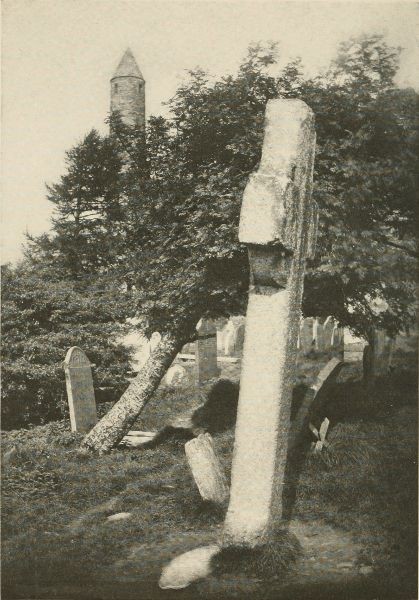
An Ancient Celtic Cross at Glendalough
ONE IRISH SUMMER
BY
WILLIAM ELEROY CURTIS
AUTHOR OF
“The Yankees of the East,” “Between the Andes and the Ocean” “Modern India,” “The Turk and his Lost Provinces” “To-day in Syria and Palestine,” etc.
ILLUSTRATED

NEW YORK
DUFFIELD & COMPANY
1909
Copyright, 1908, By William E. Curtis
Copyright, 1909, By Duffield & Company
THE UNIVERSITY PRESS, CAMBRIDGE, U.S.A.
CONTENTS
PageI.
A Summer in Ireland
1II.
The Cathedrals and Dean Swift
15III.
How Ireland is Governed
34IV.
Dublin Castle
53V.
The Redemption of Ireland
60VI.
Sacred Spots in Dublin
77VII.
The Old and New Universities
97VIII.
Round about Dublin
115IX.
The Landlords and the Landless
130X.
Maynooth College and Carton House
143XI.
Drogheda, and the Valley of the Boyne
159XII.
Tara, the Ancient Capital of Ireland
174XIII.
Saint Patrick and his Successor
188XIV.
The Sinn Fein Movement
202XV.
The North of Ireland
209XVI.
The Thriving City of Belfast
222XVII.
The Quaint Old Town of Derry
237XVIII.
Irish Emigration and Commerce
247XIX.
Irish Characteristics and Customs
260XX.
Wicklow and Wexford
268XXI.
The Land of Ruined Castles
283XXII.
The Irish Horse and his Owner
300XXIII.
Cork and Blarney Castle
312XXIV.
Reminiscences of Sir Walter Raleigh
330XXV.
Glengariff, the Loveliest Spot in Ireland
343XXVI.
The Lakes of Killarney
366XXVII.
Intemperance, Insanity, and Crime
391XXVIII.
The Education of Irish Farmers
404XXIX.
Limerick, Askeaton, and Adare
417XXX.
County Galway and Recent Land Troubles
432XXXI.
Connemara and the Northwest Coast
443XXXII.
Work of the Congested Districts Board
459INDEX
475LIST OF ILLUSTRATIONS
An Ancient Celtic Cross at Glendalough
Frontispiece Facing PageQueenstown
4The Rock of Cashel, County Tipperary
8Holycross Abbey, County Tipperary
10St. Patrick’s Cathedral, Dublin
16The Tomb of Strongbow, Christ Church Cathedral, Dublin
32The Earl of Aberdeen, Lord Lieutenant of Ireland in 1906–9
34The Countess of Aberdeen
36The Four Courts, Dublin
48The Castle, Dublin; Official Residence of the Lord Lieutenant and Headquarters of the Government
54The Customs House, Dublin
78The Bank of Ireland, Old Parliament House, Dublin
80St. Stephen’s Green, Dublin
90Quadrangle, Trinity College, Dublin
98Main Entrance, Trinity College, Dublin
102Sackville Street, Dublin, showing Nelson’s Pillar
116Lighthouse at Howth, Mouth of Dublin Bay
122Portumna Castle, County Galway; the Seat of the Earl of Clanricarde
138Maynooth College, County Kildare
144Carton House, Maynooth, County Kildare; the Residence of the Duke of Leinster
152A Celtic Cross at Monasterboice, County Louth
166Ruins of Mellifont Abbey, near Drogheda, County Louth
168Carrickfergus Castle
180St. Patrick’s Cathedral at Armagh, the Seat of Cardinal Logue, the Roman Catholic Primate of Ireland
194Cathedral, Downpatrick, where St. Patrick lived, and in the Churchyard of which he was buried
196The Village of Downpatrick
200Rosstrevor House, near Belfast, the Residence of Sir John Ross, of Bladensburg
210Shane’s Castle, near Belfast, the Ancient Stronghold of the O’Neills, Kings of Ulster
216Queen’s College, Belfast
226Albert Memorial, Belfast
228The Giant’s Causeway, Portrush, near Belfast
244Bishop’s Gate, Derry
297Irish Market Women
260An Ancient Bridge in County Wicklow
268The Vale of Avoca, County Wicklow
272The River Front at Waterford
290Lismore Castle, Waterford County; Irish Seat of the Duke of Devonshire
292An Irish Jaunting Car
308Going to Market
310Queen’s College, Cork
314Blarney Castle, County Cork
322Kilkenny Castle; Residence of the Duke of Ormonde
326The Ancient City of Youghal, County Cork; the Home of Sir Walter Raleigh
330Myrtle Lodge; the Home of Sir Walter Raleigh
338Lake Gougane-Barra, County Cork
348Chapel erected by Mr. John R. Walsh of Chicago on the Island of Gougane-Barra
350The Pass of Keimaneigh through the Mountains between Cork and Glengariff
352Glengariff Bridge
356Kenmare House, Killarney
372Upper Lake, Killarney
376Ross Castle, Killarney
380Muckross Abbey, Killarney
384A Window of Muckross Abbey, Killarney
388Treaty Stone, Limerick
422Adare Abbey, in the Private Grounds of the Earl of Dunraven, near Limerick
428Fish Market, Galway
438Salmon Weir, Galway
442A Scene in Connemara
444Clifden Castle, County Galway
448A Scene in the West of Ireland; Lenane Harbor
450Barnes Gap, County Donegal
460An Irish Cabin in County Donegal
464The Old: A Laborer’s Sod Cabin; The New: Example of the Cottages built in Connemara by the Congested Districts Board
470Interior and Exterior of One-Story Cottages erected by the Congested Districts Board
472ONE IRISH SUMMER
I
A SUMMER IN IRELAND
For those who have never spent a summer in Ireland there remains a delightful experience, for no country is more attractive, unless it be Japan, and no people are more genial or charming or courteous in their reception of a stranger, or more cordial in their hospitality. The American tourist usually lands at Queenstown, runs up to Cork, rides out to Blarney Castle in a jaunting car, and across to Killarney with a crowd of other tourists on the top of a big coach, then rushes up to Dublin, spends a lot of money at the poplin and lace stores, takes a train for Belfast, glances at the Giant’s Causeway, and then hurries across St. George’s Channel for London and the Continent. Hundreds of Americans do this each year, and write home rhapsodies about the beauty of Ireland. But they have not seen Ireland. No one can see Ireland in less than three months, for some of the counties are as different as Massachusetts and Alabama. Six weeks is scarcely long enough to visit the most interesting places.
The railway accommodations, the coaches, the steamers, and other facilities for travel are as perfect as those of Switzerland. The hotels are not so good, and there will be a few discomforts here and there to those who are accustomed to the luxuries of London and Paris, but they can be endured without ruffling the temper, simply by thinking of the manifold enjoyments that no other country can produce.
And Ireland is particularly interesting just now because of the mighty forces that are engaged in the redemption of the people from the poverty and the wretchedness in which a large proportion of them have been submerged for generations. No government ever did so much for the material welfare of its subjects as Great Britain is now doing for Ireland, and the improvement in the condition of affairs during the last few years has been extraordinary.
In order to observe and describe this economic evolution, the author spent the summer of 1908 visiting various parts of the island and has endeavored to narrate truthfully what he saw and heard. This volume contains the greater part of a series of letters written for The Chicago Record-Herald and also published in The Evening Star of Washington, The Times of St. Louis, and other American papers. By permission of Mr. Frank B. Noyes, editor and publisher of The Chicago Record-Herald, and to gratify many readers who have asked for them, they are herewith presented in permanent form.
About three hundred passengers landed with us at Queenstown. Most of them were young men and young women of Irish birth, returning after a few years’ experience in the United States. Several had come home to be married, but most of them were on a visit to their parents and other relatives. Among those who disembarked were several older men and women who were born in Ireland, but had been taken to America in infancy or in childhood and were now looking upon the fair face of Erin for the first time.
There is an astonishing difference in the appearance and behavior of the steerage passengers who are sailing east from those who are sailing west. A few years, or even a few months, in America causes an extraordinary change in the dress and the manners of a European peasant. You can see it in the passengers that land at Genoa and Naples, and those that land at Hamburg and Trieste. But it is even more noticeable in the Americanized Irish who land at Queenstown by the thousand every summer from New York. The Italian, the Hungarian, or the Pole who goes aboard a steamer to America with his humble belongings and his quaint looking garments is a very different person from the man who sails from New York back to the fatherland a few years later. And the Irish boys and girls who went ashore with us just as the sun was waking up Ireland were as hearty, well dressed, and prosperous looking as you would wish to see. And every young woman had a big “Saratoga” in place of the “cotton trunk with the pin lock” that she carried away with her when she left the old country for America the first time. I don’t know what was in those big trunks, although one can get a glimpse of their contents if he stands by while the customs officers are inspecting them, but you can see the names “Delia O’Connell, New York,” “Katherine Burke, Chicago,” and “Mary Murphy, Baltimore,” marked in big black letters at either end. And what is most noticeable, the trunks are all new. They have never crossed the ocean before, but will be going back again to America in a few months. Their owners will not be contented with the discomforts they will find at their old homes. Ireland is more prosperous today than for generations, but conditions among the poorer classes are very different from those that exist in the new world.
The purser told me that he changed nearly $4,000 of American into English money the day before we landed, for third-class passengers alone. One man had $400; that was the maximum, but the rest of those who disembarked at Queenstown had from $50 up to $250 and thereabouts in cash, with their return tickets.
Queenstown makes a brave appearance from the deck of a ship in the bay, even before sunrise. It lies along a steep slope, with green fields and forests on either side, and the most conspicuous building is a beautiful gothic cathedral, with an unfinished tower, that was commenced in 1868 and has cost nearly a million dollars already. The hill is so steep that a heavy retaining wall has been built as a buttress to make the cathedral foundations secure, and the worshipers must climb a winding road or a sharp stairway to reach it. A little farther along the hillside is an imposing marine hospital and group of barracks, from which we could hear the bugles sounding “reveille” as we landed. There are compensations to those who are marooned at Queenstown before daylight, and one of them is the picturesque surroundings of the ancient homes of the O’Mahony’s, who ruled this part of Ireland for many generations long ago.
The harbor is like an amphitheatre, entirely inclosed by hills, three hundred or four hundred feet high, that are covered with frowning battlements. Every hilltop is strongly fortified. The bay, which is four miles long and about two miles wide, contains several islands, upon which the government has built warehouses, repair shops, shipyards, and the other appurtenances of a naval station, guarded by Fort Carlisle, Fort Camden, and other modern fortresses. Upon Haulbowline Island is a depot for ammunition and other ordnance stores, and the pilot told me that on Rocky Island near by were two magazines—great chambers chiseled out of the living rock by Irish convicts who were formerly confined there—and that each of them contained twenty-five thousand barrels of powder belonging to the British navy.
Queenstown has many handsome estates overlooking the sea and the bay from the hills that inclose the harbor. There is an old ruined castle at Monkstown that was built in 1636 by Anastasia Gould, wife of John Archdecken, while her husband was at sea. She determined that she would surprise him when he returned home. So she hired a lot of men to build a castle with only the material they found on the estate, and made an agreement with them that they should buy the food and clothing necessary for their families from herself alone. It is the first record of a “company store” that I know of. When the castle was finished and the accounts were balanced it was found that the cost of the labor had been entirely paid for by the profits of this thrifty woman’s mercantile transactions, with the sum of four pence as a balance to her credit. Her husband returned in due time and was so delighted with his new home that he never went to sea again. His estimable wife died in 1689, and was buried in the churchyard of Team-*pulloen-Bryn, where this story is inscribed with her epitaph.
On Wood’s Hill, overlooking the bay, is a handsome estate that once belonged to Curran, the famous lawyer and orator, whose daughter was the sweetheart of Robert Emmet, the Irish martyr. Her melancholy romance is related in Washington Irving’s story called “The Broken Heart” and in one of Tom Moore’s ballads.
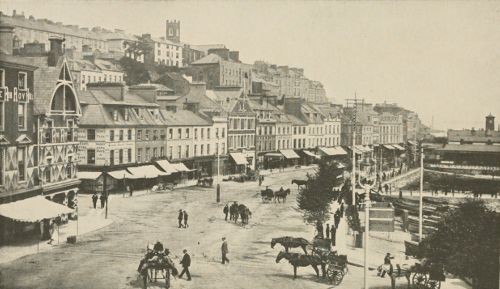
Queenstown
It is 165 miles from Queenstown to Dublin, and the railroad passes through several of the counties whose names are most familiar to Americans, for they have furnished the greater portion of our Irish immigrants—Cork, Limerick, Tipperary, Queens, and Kildare. Most of the passengers who landed with us took the same train, and they were so many that they crowded the little railway station to overflowing and created a scene of lively confusion. Some of them had been met by brothers, fathers, sweethearts, and friends, who were waiting two hours before daylight, and the hearty greetings and enthusiasm they showed were contagious. The sweethearts were easy to identify. The demonstrations of affection left no doubt, but all the world loves a lover, and we rejoiced with them. In the long line that stood before the ticket seller’s window at the railway station they chattered unconsciously like so many sparrows, their arms around each other, with an occasional embrace, a sly kiss and a slap to pay for it, tender caresses upon the shoulder or the head, and other expressions of a happiness that could not have been concealed. The home-bred young men gazed with wonder and admiration at the finery worn by their sweethearts from America, who, by the way, although they came third class, and were undoubtedly chambermaids or shop girls in our cities, were the best-looking and the best-dressed women we saw in Ireland. The pride of the parents at the appearance and the manners of their sons or daughters showed that they appreciated the accomplishments that American experience acquires.
One of the younger passengers, a boy of twenty years, perhaps, told me that he had come from Ohio to persuade his father to send his two younger brothers back with him. They live in Tipperary, where “there is no show for a young man now.” Another young man had a tiny American flag pinned to the lapel of his coat, and when I said, “You show your colors,” the lassie who clung to his arm turned at me with a determined expression on her face and remarked:
“I’ll be takin’ that off and pinnin’ a piece of green in its place vera soon.”
“No, you don’t, darlin’; none o’ that,” he replied. “I’m an American citizen, and I don’t care who knows it. If you don’t want to be one yourself, I know another girl who does.”
The country through which the railway to Dublin runs affords a beautiful example of Irish scenery. As far as Cork the track follows the bank of the River Lee, which is inclosed on either side by a high ridge crowned with stately mansions, glorious trees, and handsome gardens. Several of the places are historic, and the scenery has been frequently described in verse by the Irish poets.
Father Prout, a celebrated rhymemaker of Cork, has described one of the villages as follows:
“The town of Passage is both large and spacious,
And situated upon the say;
’Tis nate and dacent and quite adjacent
To Cork on a summer’s day.
There you may slip in and take a dippin’
Foreninst the shippin’ that at anchor ride,
Or in a wherry you can cross the ferry
To Carrigaloe on the other side.”
We could not see much from the car window, but we saw enough on the journey to understand why it is called “The Emerald Isle” and why the Irish people are so enthusiastic over its landscapes. The river is walled in nearly all the distance to Cork, and there are many factories, storehouses, and docks on both sides. Quite a fleet of steamers ply between Queenstown and Cork, and trains on the railroad are running every hour. Small seagoing vessels can go up as far as Cork, but the larger ones discharge and receive their cargoes at Queenstown. We couldn’t see much of the towns because the railway tracks are either elevated so that only the roofs and chimney pots are visible, or else they are buried between impenetrable walls or pass through tunnels on either side of the station. But when the train passed out into the open a succession of most attractive landscapes was spread before us as far as the horizon on either side, and the fields were alive with bushes of brilliant orange-colored gorse, or furze, as it is sometimes called. They lit up the atmosphere as the burning bush of Moses might have done. Very little of the ground is cultivated. Only here and there is a field of potatoes and cabbages, but the pastures are filled with fine looking cattle and sheep, for this is the grazing district of Ireland, from whence her famous dairy products and the best beef and mutton come.
Beyond Portarlington we got our first glimpses of the bogs, with which we are told one-sixth of the surface of Ireland is covered, an area of not less than 2,800,000 acres. Bogs were formerly supposed to be due to the depravity of the natives, who are too lazy to drain them and have allowed good land to run to waste and become covered with water and rotten vegetation, but this theory has been effectively disposed of by science. Everybody should know that the bogs of Ireland are not only due to the natural growth of a spongy moss called sphagnum, but furnish an inexhaustible fuel supply to the people and have a value much greater than that of the drier and higher land. The report of a “bogs commission” describes them as “the true gold mines of Ireland,” and estimates them as “infinitely more valuable than an inexhaustible supply of the precious metal.” The average Irish bog will produce 18,231 tons of peat per acre, which is equivalent to 1,823 tons of coal, thus making the total supply of peat equivalent to 5,104,000 tons of coal, capable of producing 300,000 horse power of energy daily for manufacturing purposes for a period of about four hundred and fifty years. With coal selling at $2 a ton in Ireland to-day, this makes the bogs of Ireland worth $10,000,000,000. The “bog trotter” is an individual to be cultivated, for when our coal deposits in the United States are exhausted we may have to send over and buy some of his peat for fuel. It is proposed to utilize these deposits and save transportation charges by erecting power-houses at the peat beds and furnish electricity over wires to the neighboring towns and cities for lighting, power, and other purposes, “for anybody having work to do from curling a lady’s hair to running tramways and driving machinery.” The writer refers to recent installations of electric works in Mysore, India, for working gold fields ninety miles distant, and quotes the late Lord Kelvin’s opinion that the city of New York will soon be getting its power from Niagara, four hundred miles away. We saw them digging peat in the fields and piling it up like damp bricks to dry in the sun. Freshly dug peat contains about seventy per cent of moisture, but when cured the ratio is reduced to fifteen or twenty per cent.
A peat bog is not always in a hollow, but often on a hillside, and sometimes at considerable height, which contradicts the theory that bogs are due to defective drainage. Science long ago determined that Irish peat was the accumulation of a peculiar kind of moss which grows like a coral bank in the damp soil, and continues to pile up in layers year after year, century after century, until it forms a solid mass, several feet thick, seventy per cent moisture and thirty per cent fibre, which burns slowly and furnishes a high degree of heat. We see bogs on all sides of us where the peat is three and four feet thick, and with a long straight spade that is as sharp as a knife, it is cut into blocks about eight or ten inches long and about four inches square. A sharp spade will slice it just as a knife would cut cheese or butter, and after the blocks have lain on the ground a while they are stacked up on end in little piles to dry. Then, when they have been exposed to the weather for three or four weeks, they are stacked in larger piles, from which they are carted away and sold or used as they are needed.
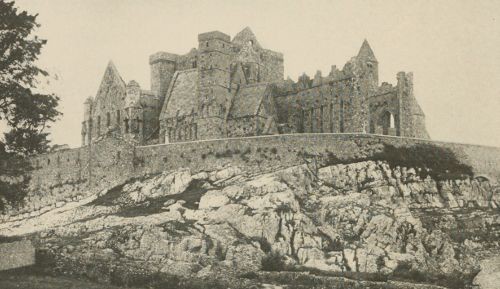
The Rock of Cashel, County Tipperary
Four tons of peat are equal in caloric energy to one ton of coal. I noticed in the papers that a bill is pending before the House of Commons to grant a charter to a company to erect a station in a bog near Robertson, Kings County, twenty-five miles from Dublin, for generating electricity from peat, the power to be transmitted to Dublin and the suburban towns for lighting, transportation, and manufacturing purposes. Several other projects of a similar sort have been suggested for utilizing the peat at the bog instead of carting it into town.
Beyond the peat beds rises a chain of low mountains with a curious profile that runs west of the town of Templemore. Like every other freak of nature in Ireland, they are the scenes of many interesting legends. The highest peak is called “The Devil’s Bit,” and the queer shape is accounted for by the fact that the Prince of Darkness in a fit of hunger and fatigue once took a bite out of the mountain, and, not finding it to his taste, spat it out again some miles to the eastward, where it is now famous as the Rock of Cashel.
Cashel, at present a miserable, deserted village, was once the rich and proud capital of Munster. Adjoining the ruins of the cathedral is the ancient and weather-worn “Cross of Cashel,” which was raised upon a rude pedestal, where the kings of Munster were formerly crowned. The ruins are more extensive than anywhere else in Ireland, for Cashel at one time was the ecclesiastical capital of Ireland and its greatest educational centre. Here the Pope’s legates resided and here Henry II., in 1172, received the homage of the Irish kings. But what gives the place its greatest sanctity is the fact that St. Patrick spent much time there and held there the first synod that ever assembled in Ireland, about the middle of the fifth century. That is supposed to have been the reason for the erection of so many sacred edifices and monasteries in early days. St. Declan lived there, too, and commemorated his conversion to Christianity by the erection of one of the churches. Donald O’Brien, King of Limerick, erected another, and his son Donough founded an abbey in 1182. Holy Cross, beautifully situated in a thick grove on the banks of the River Suir, was built in 1182 for the Cistercian order of monks. It derived its name because a piece of the true cross, set with precious stones and presented to a grandson of Brian Boru by Pope Pascal II., was kept there for centuries, and made the abbey the object of pilgrimages of the faithful from all parts of Ireland. This precious relic is now in the Ursuline convent at Cork.
Cashel was destroyed during the civil wars. The famous Gerald Fitzgerald, the great Earl of Kildare, had a grudge against Archbishop Cragh and burned the cathedral and the bishop’s palace. He excused the act before the king on the ground that he “believed the archbishop was in it.”
A little beyond Templemore, at Ballybrophy Junction, a branch of the main line of the railway leads to the town of Birr, which is famous as the seat of the late Earl of Rosse, whose father erected an observatory there many years ago, with one of the largest and finest telescopes in the world. It is twenty-seven feet long, with a lens three feet in diameter. Some of the most important discoveries of modern astronomy have been made there, and Birr has been the object of pilgrimages for scientific men for more than half a century. The old Birr castle has been much enlarged and modernized by the late earl, who died in September, 1908, and is surrounded by an estate of thirty-six thousand acres, upon which is one of the best built and well kept towns in Ireland. He was a scholar and scientist of reputation, president of the Royal Irish Academy and the Royal Dublin Society, and interested in important manufactories and enterprises. He was especially active in developing the steam turbine.
All of that section of Ireland covered by the journey between Dublin and Cork is associated with heroic struggles. It has been fought over time and again by the clans and the factions that have struggled to rule the state. Every town and every castle has its tragic and romantic history. Almost every valley is associated with a legend or an important event. The woods and the hills are still peopled with fairies, and local traditions among the humble folks are the themes of fascinating tales and songs. But the natives one sees at the railway stations do not look at all romantic. A sentimental person is compelled to endure many severe shocks when he comes in contact with the present generation of Irish peasants.
ONE IRISH SUMMER
II
THE CATHEDRALS AND DEAN SWIFT
III
HOW IRELAND IS GOVERNED
IV
DUBLIN CASTLE
V.
THE REDEMPTION OF IRELAND
VI
SACRED SPOTS IN DUBLIN
VII
THE OLD AND NEW UNIVERSITIES
VIII
ROUND ABOUT DUBLIN
IX
THE LANDLORDS AND THE LANDLESS
X
MAYNOOTH COLLEGE AND CARTON HOUSE
XI
DROGHEDA, AND THE VALLEY OF THE BOYNE
XII
TARA—THE ANCIENT CAPITAL OF IRELAND
XIII
SAINT PATRICK AND HIS SUCCESSOR
XIV
THE SINN FEIN MOVEMENT
XV
THE NORTH OF IRELAND
XVI
THE THRIVING CITY OF BELFAST
XVII
THE QUAINT OLD TOWN OF DERRY
XVIII
IRISH EMIGRATION AND COMMERCE
XIX
IRISH CHARACTERISTICS AND CUSTOMS
XX
WICKLOW AND WEXFORD
XXI
THE LAND OF RUINED CASTLES
XXII
THE IRISH HORSE AND HIS OWNER
XXIII
CORK AND BLARNEY CASTLE
XXIV
REMINISCENCES OF SIR WALTER RALEIGH
XXV
GLENGARIFF, THE LOVELIEST SPOT IN IRELAND
XXVI
THE LAKES OF KILLARNEY
XXVII
INTEMPERANCE, INSANITY, AND CRIME
XXVIII
THE EDUCATION OF IRISH FARMERS
XXIX
LIMERICK, ASKEATON, AND ADARE
XXX
COUNTY GALWAY AND RECENT LAND TROUBLES
XXXI
CONNEMARA AND THE NORTHWEST COAST
XXXII
WORK OF THE CONGESTED DISTRICTS BOARD
Interior and Exterior of One Story Cottages Erected by the Congested Districts Board
THE END
INDEX
Queenstown
The Rock of Cashel, County Tipperary
Holycross Abbey, County Tipperary
St. Patrick’s Cathedral, Dublin
The Tomb of Strongbow, Christ Church, Dublin
The Earl of Aberdeen, Lord Lieutenant of Ireland in 1906–8
The Countess of Aberdeen
The Four Courts, Dublin
The Castle, Dublin; Official Residence of the Lord Lieutenant and Headquarters of the Government
The Customs House, Dublin
The Bank of Ireland, Dublin
St. Stephen’s Green. Dublin
Quadrangle, Trinity College, Dublin
Main Entrance, Trinity College, Dublin
Sackville Street, Dublin, Showing Nelson’s Pillar.
Bailey Light at Howth, Mouth of Dublin Bay
Portumna Castle, County Galway; the Seat of the Earl of Clanricarde
Maynooth College County Kildare
Carton House, Maynooth, County Kildare; the Residence of the Duke of Leinster
A Celtic Cross at Monasterboice, County Louth
Ruins of Mellifont Abbey, near Drogheda, County Louth
Carrickfergus Castle
St. Patrick’s Cathedral at Armagh, the Seat of Cardinal Logue, the Roman Catholic Primate of Ireland
Down Cathedral, Downpatrick, where St. Patrick Lived, and in the Churchyard of which He Was Buried
The Village of Downpatrick
Rosstrevor House, near Belfast, the Residence of Sir John Ross of Bladensburg
Shane’s Castle, near Belfast, the Ancient Stronghold of the O’Neills, Kings of Ulster
Queen’s College, Belfast
Albert Memorial, Belfast
The Giant’s Causeway, Portrush, near Belfast
Bishop’s Gate, Derry
Irish Market Women
An Ancient Bridge in County Wicklow
The Vale of Avoca, County Wicklow
The River Front at Waterford
Lismore Castle, Waterford County; Irish Seat of the Duke of Devonshire
An Irish Jaunting Car
Going to Market
Queen’s College, Cork
Blarney Castle, County Cork
Kilkenny Castle; Residence of the Duke of Ormonde
The Ancient City of Youghal, County Cork; the Home of Sir Walter Raleigh
Myrtle Lodge; the Home of Sir Walter Raleigh
Lake Gougane-Barra, County Cork
Chapel Erected by Mr. John R. Walsh of Chicago on the Island of Gougane-Barra
The Pass of Keimaneigh Through the Mountains Between Cork and Glengariff
Glengariff Bridge
Kenmare House, Killarney
Upper Lake, Killarney.
Ross Castle, Killarney
Muckross Abbey, Killarney
A Window of Muckross Abbey, Killarney
Treaty Stone, Limerick
Adare Abbey, in the Private Grounds of the Earl of Dunraven, near Limerick
Fish Market, Galway
Salmon Weir, Galway
A Scene in Connemara
Clifden Castle, County Galway
A Scene in the West of Ireland; Lenane Harbor
Barne’s Gap, County Donegal.
An Irish Cabin in County Donegal.
The Old: a Laborer’s Sod Cabin
Interior and Exterior of One Story Cottages Erected by the Congested Districts Board
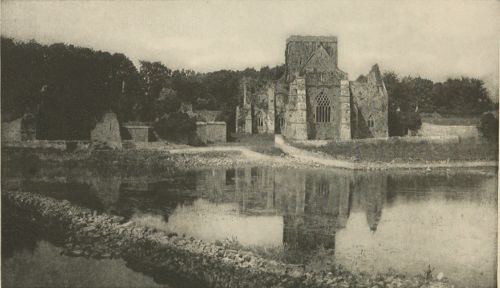
Holycross Abbey, County Tipperary
The people of Ireland are more prosperous to-day (July, 1908) than they have been for generations. Their financial condition is better than it ever has been, and is improving every year. The bank deposits, the deposits in postal savings banks, the government returns of the taxable property, have advanced steadily every year for the last ten years, and in Ireland, during the last ten years, there has been a gradual and healthful improvement in every branch of trade and industry. The people are more prosperous than in England or Scotland, except in certain sections where poverty is chronic because of climatic reasons and the barrenness of the soil. Nevertheless, they are not so prosperous as they ought to be under the circumstances, and it would require a book, and a large book, to repeat the many theories that are offered to explain the situation. It is a question upon which very few people agree, and they probably never will agree. There are almost as many theories as there are people. Therefore a discussion is not only disagreeable but it would lead immediately into politics. It is safe to say, however, that every Irishman who is willing to take a farm and cultivate it with intelligence and industry will prosper if he will let politics and whisky alone. Idleness, neglect, intemperance, and other vices produce the same results in Ireland as elsewhere, and under present conditions industry and thrift will make any honest farmer prosperous.
The moral and intellectual regeneration of the country is keeping step with the material regeneration. All religious qualifications and disqualifications have been removed; the church has been divorced from the state, and each religious denomination stands upon an equality in every respect.
The penal laws have been repealed and the tithe system has been abolished.
Local representative government prevails everywhere.
Nearly every official in Ireland is a native except the lord-lieutenant, the treasury remembrancer, and several agricultural experts who are employed as instructors for the farmers and fishermen by the Agricultural Department, and the Congested Districts Board.
The primary schools of Ireland are now free; free technical schools have been established at convenient locations for the training of mechanics, machinists, electricians, engineers, and members of the other trades.
Two new universities have been authorized,—one in the north and the other in the south of Ireland,—for the higher education of young men and women.
Temperance reforms are being gradually accomplished by the church and secular temperance societies, which are working in harmony; the license law has been amended so as to reduce the number of saloons, and three-fourths of the saloons are closed on Sunday throughout the island. The Father Mathew societies are gaining in numbers; the use of liquor at wakes and on St. Patrick’s Day has been prohibited by the Roman Catholic bishops, and the number of persons arrested for drunkenness and disorderly conduct is decreasing annually.
Every tenant that has been evicted in Ireland during the last thirty years has been restored to his old home, and the arrears of rent charged against him have been canceled.
The land courts have adjusted the rentals of 360,135 farms, and have reduced them more than $7,500,000 a year.
More than one hundred and twenty-six thousand families have been enabled to purchase farms with money advanced by the government to be repaid in sixty-eight years at nominal interest.
Several thousand families have been removed at government expense from unproductive farms to more fertile lands purchased for them with government money to be repaid in sixty-eight years.
Thousands of cottages, stables, barns, and other farm buildings have been built and repaired by the government for the farmers, and many millions of dollars have been advanced them for the purchase of cattle, implements, and other equipment through agents of the Agricultural Department.
More than twenty-three thousand comfortable cottages have been erected for the laborers of Ireland with money advanced by the government to be repaid in small instalments at nominal interest.
The landlord system of Ireland is being rapidly abolished; the great estates are being divided into small farms and sold to the men who till them. The agricultural lands of Ireland will soon be occupied by a population of independent farm owners instead of rent-paying tenants.
The Agricultural Department is furnishing practical instructors to teach the farmers how to make the most profitable use of their land and labor, how to improve their stock, and how to produce better butter, pork, and poultry.
The Agricultural Department furnishes seeds and fertilizers to farmers and instructs them how they should be used to the best advantage.
The Irish Agricultural Organization Society has instructed thousands of farmers in the science of agriculture and has established thousands of co-operative dairies and supply stores to assist the farmers in getting higher prices for their products and lower prices for their supplies.
The Congested Districts Board has expended seventy million dollars to improve the condition of the peasants in the west of Ireland; to provide them better homes and to place them where they can get better returns for their labor.
Thousands of fishermen have been furnished with boats, nets, and other tackle; they have been supplied with salt for curing their fish; casks and barrels for packing them; have been provided with wharves for landing places and warehouses for the storage of their implements and supplies; and government agents have secured a market for their fish and have supervised the shipments and sales.
Thousands of weavers have been furnished with looms in their cottages at government expense, so that they can increase their incomes by manufacturing home-made stuffs.
Schools have been established at many convenient points in the west of Ireland, where peasant women and girls may learn lace-making. The government furnishes the instruction free, supplies the materials used, and provides for the sale of the articles made.
Work has been furnished with good wages for thousands of unemployed men in the construction of roads and other public improvements.
District nurses have been stationed at convenient points along the west coast, where there are no physicians, to attend the sick and aged and relieve the distress among the peasant families, and hospitals have been established for the treatment of the ill and injured at government expense.
II
THE CATHEDRALS AND DEAN SWIFT
St. Patrick’s Cathedral is, perhaps, the most notable building in Ireland, and one of the oldest. During the religious wars and the clashes of the clans in the early history of Ireland it was the scene and the cause of much contention and violence. Its sacred walls were originally arranged as fortifications to defend it against the savage tribes and to protect the dignitaries of the church, who resided behind embattled gates for centuries. At one time St. Patrick’s was used as a barrack for soldiers, and the verger will show you an enormous baptismal font, from which he says the dragoons used to water their horses, and the interior was fitted up for courts of law. Henry VIII. confiscated the property and revenues because the members of its chapter refused to accept the new doctrines, and nearly all of them were banished from Ireland. He abolished a small university that was attached to the cathedral by the pope in 1320 for the education of priests. For five hundred years there was a continuous quarrel between St. Patrick’s and Christ Church Cathedral, which stands only two blocks away, because of rivalries over ecclesiastical privileges, powers, and revenues. Finally a compromise was reached, under which there has since been peace between the two great churches and relations similar to those of Westminster Abbey and St. Paul’s in London. Christ Church is the headquarters of the episcopal see of Dublin, and St. Patrick’s is regarded as a national church. The chief reason why St. Patrick’s has such a hold upon the affections and reverence of the people is because it stands upon the site of a small wooden church erected by St. Patrick himself in the year 450 and within a few feet of a sacred spring or well at which he baptized thousands of pagans during his ministry. The exact site of the well was identified in 1901 by the discovery of an ancient Celtic cross buried in the earth a few feet from the tower of the cathedral. The cross is now exhibited in the north aisle. The floor of the church is only seven feet above the waters of a subterranean brook called the Poddle, and during the spring floods is often inundated, but in the minds of the founders the sanctity of the spot compensated for the insecure foundations.
St. Patrick’s little wooden building, which is supposed to be the first Christian sanctuary erected in Ireland, was replaced in 1191 by the present lofty cruciform edifice, three hundred feet long and one hundred and fifty-seven feet across the transepts. It was designed and erected by Comyn, the Anglo-Norman archbishop of Dublin, is supposed to have been completed in 1198, and was raised to the rank of a cathedral in 1219. There were frequent alterations and repairs during the first seven centuries of its existence, until 1864-68, when it was perfectly restored by Sir Benjamin Guinness, the great brewer, who also purchased several blocks of dilapidated slums that surrounded it, tore down the buildings, and turned the land into a park which not only affords an opportunity to see the beauties of the cathedral, but gives the poor people who dwell in that locality a playground and fresh air. Sir Benjamin purchased several of the adjoining blocks and erected upon them a series of model tenement-houses, the best in Dublin, and rents them at nominal rates to his employees and others. On the other side of the cathedral are several blocks of the most miserable tenements in the city, and sometime they also will be cleared away. A bronze statue has been erected in the churchyard as a reminder of his generosity.
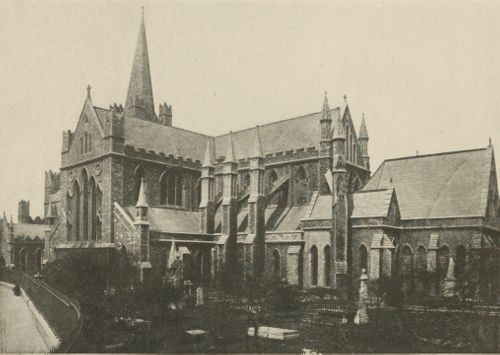
St. Patrick’s Cathedral, Dublin
Benjamin Guinness was the great brewer of Dublin. In 1756 one of his ancestors started a little brewing establishment down on the bank of the Liffey River in the center of the city, which has been extended from time to time until the buildings now cover an area of more than forty acres. The property and good will were transferred by the Guinness family to a stock company for $30,000,000 in 1886, and since then the plant has been enlarged until it now exceeds in extent all other breweries in the world, represents an investment of $50,000,000, and turns out an average of two thousand one hundred barrels of beer a day.
Sir Benjamin’s son, Edward Cecil Guinness, was elevated to the peerage as Lord Iveagh and is the richest man in Ireland to-day. He is highly respected, has married into the nobility, is a great favorite with the king, is generous and philanthropic, encourages and patronizes both science and athletic sports, and is said to be “altogether a very good fellow.” Another son is Lord Ardilaun, who is equally rich and popular, and owns several of the finest estates in the kingdom.
Sir Benjamin expended $1,200,000 in restoring St. Patrick’s Cathedral, and Lord Iveagh, his son, added $350,000 more. The driver of the jaunting car that carried us there told me how many billion of glasses of beer those gifts represented, and made some funny remarks about all the profit being in the froth. But if all men were to make such good use of their money there would be no reason to complain.
St. Patrick’s Cathedral is the official seat of the Knights of St. Patrick, and their banners, helmets, and swords hang over the choir stalls, while in one of the chapels is an ancient table and a set of ancient chairs formerly used at their gatherings. Since 1869 they have met at Dublin castle. Many tattered and bullet-riddled battle flags carried by Irish regiments hang in other parts of the cathedral, and if they could tell the stories of the many brave Irishmen who have fought and perished under their silken folds, it would be more thrilling than fiction. Ireland has furnished the best fighting men in the British Army, both generals and privates, since the invasion of the Normans. The king’s bodyguard of Highlanders is now almost exclusively composed of Irish lads. In the north transept is a flag that was carried by an Irish regiment at the skirmish at Lexington at the beginning of our Revolution and at the attack on Bunker Hill. They brought it away with them to hang it here with the trophies of Irish valor of a thousand years.
St. Patrick’s is the Westminster Abbey of Ireland, and many of her most famous men are either buried within its walls or have tablets erected to their memory. John Philpott Curran, the great advocate and orator, and Samuel Lover, the song writer and novelist, whose “Handy Andy” and “Widow Machree,” are perhaps the best examples of Irish humor in literature, are honored with tablets; and Carolan, the last of the bards for whom Ireland was once so celebrated. He died in 1788. M.W. Balfe, author of that pretty little opera, “The Bohemian Girl,” and many beautiful ballads, including “I Dreamt I Dwelt in Marble Halls,” has a tablet inscribed with these words:
“The most celebrated, genial and beloved of Irish musicians, commendatore of Carlos III. of Spain, Chevalier of the Legion of Honor. Born in Dublin, 15 May, 1808, died 20th of Oct., 1870.”
Balfe was born in a small house on Pitt Street, Dublin, which bears a tablet announcing the fact.
The man who wrote that stirring poem, “The Burial of Sir John Moore,” which begins,
“Not a drum was heard, not a funeral note,
As his corse to the rampart we hurried,”—
lies in St. Patrick’s. His name was Charles Wolfe, and he was once the dean of the cathedral.
In the right-hand corner of the east transept is a monument to the memory of a certain dame of the time of Elizabeth, named Mrs. St. Leger. She was thirty-seven years old at the time of her death, and, her epitaph tells us, had “a strange, eventful history,” with four husbands and eight children, all of whom she made comfortable and happy.
On the other side is a tablet to commemorate the fact that Sir Edward Fitten, who died in 1579, was married at the age of twelve years and became the father of fifteen children,—nine sons and six daughters.
The famous Archbishop Whately, the gentleman who wrote the rhetoric we studied in college, and who once presided over this diocese, is buried in a stately tomb, and his effigy, beautifully carved in marble, lies upon it.
The most imposing monument of all, and one which is associated with much history and tragedy, was erected in honor of his own family by Richard Boyle, the first Earl of Cork, who was a great man in his day. So pretentious was the monument that Archbishop Laud ordered it removed from the cathedral. This was done by Thomas Wentworth, afterward Earl of Strafford, who was sent over by King Charles with an armed force to govern Ireland. Boyle, who had himself designed and expended a great deal of money upon “the famous, sumptuous, and glorious tomb,” which was to immortalize him and sixteen members of his family, was so indignant that he never forgave Strafford, and afterward caused the latter to be betrayed to a shameful death at the hands of his enemies.
The most interesting historic relic in the cathedral is an ancient oaken door with a large hole cut in the center of it. It bears an explanatory inscription as follows:
“In the year 1492 an angry conference was held at St. Patrick, his church, between the rival nobles, James Butler, Earl of Ormonde, and Gerald Fitzgerald, Earl of Kildare, the said deputies, and their armed retainers. Ormonde, in fear of his life, fled for refuge to the Chapiter House, and Kildare, pressing Ormonde to the Chapiter House door, undertooke on his honor that he should receive no villanie. Whereupon the recluse, craving his lordship’s hand to assure him his life, there was a clift in the Chapiter House door pearced at trice to the end that both Earls should shake hands and be reconciled. But Ormonde surmising that the clift was intended for further treacherie refused to stretch out his hand—” and the inscription goes on to relate that Kildare, having no such nervousness, thrust his hand through the hole and without the slightest hesitation. Ormonde shook it heartily and peace was made.
For centuries it was said that whoever might be Viceroy of Ireland it was the Earl of Kildare who governed the country. A long line of Kildares succeeded each other, and their living successor, better known as the Duke of Leinster, is now the premier of the Irish nobility, although he is still a boy, just twenty-one. Both the Kildares and the Earls of Desmond were descended from Gerald Fitzgerald, who in the thirteenth century founded that powerful clan known as the Geraldines. In the fifteenth, and at the beginning of the sixteenth, century they exercised absolute control in Ireland, and Garrett, or Gerald Fitzgerald, the eighth Earl of Kildare, known as “The Great Earl,” had greater authority than any other Irishman has ever displayed in his native island since the days of Brian Boru. At one time his daughter, wife of the Earl of Clanricarde, appealed to her father from a quarrel with her husband. The old gentleman took her part, ordered out his army, and met his son-in-law in the battle of Knockdoe, where it is said eight thousand men were slain.
Near the entrance to St. Patrick’s Cathedral is a long, narrow, brass tablet upon which are inscribed the names of the fifty-seven deans who have had ecclesiastical jurisdiction there from 1219 to 1902. The most famous in the list is that of the Rev. Jonathan Swift, D.D., author of “Gulliver’s Travels,” “The Tale of a Tub,” and other equally well-known works. He presided here for more than thirty years, and was undoubtedly the most brilliant as well as the most remarkable clergyman in the history of the diocese of Dublin. He was the greatest of all satirists, one of the most brilliant of all wits, and an all-around genius, but was entirely without moral consciousness, altogether selfish, inordinately vain, and one of the most eccentric characters in the history of literature. He was born in Dublin Nov. 30, 1667; educated at Trinity College, where he distinguished himself only by his eccentricities; was curate of two churches, and dean of St. Patrick’s Cathedral for more than thirty years, although neither his manners nor his morals conformed to the standards that are fixed for clergymen in these days. He was more famous for his wit than his wisdom; for his piquancy than for piety. He spent most of his life in Dublin, died there, was buried in St. Patrick’s Cathedral by the side of a woman whose life he wrecked, and left his money to found an insane asylum which is still in existence.
The house in which Jonathan Swift was born can still be seen in Hoey’s Court, which once was a popular place of residence for well-to-do people, and has several mansions of architectural pretensions, but has degenerated into a slum, one of the many that may be found in the very center of the business section of the city. He came of a good Yorkshire family; his mother had aristocratic connections and was one of those women who seem to have been born to suffer from the failings of men. His father was a shiftless adventurer, following several professions and occupations in turn without even ordinary success in any. Jonathan went to the parish schools in Kilkenny for a time when his father happened to be living in that locality, and when he was seventeen years old passed the entrance examinations to Trinity College, Dublin. He was a willful, independent, eccentric person, of a lonely and sour disposition, and refused to be bound by the rules of the university. He would not study mathematics or physics, but delighted in classical literature, and furnished many witty contributions to college literature which gave promise of genius. He wrote a play that was performed by the college students with great success. His degree was reluctantly conferred by the faculty through the influence of Sir William Temple, a famous statesman of those days, whose wife was a distant relative of Swift’s mother.
Shortly after graduation he became private secretary to Sir William Temple and attended him in London during several sessions of parliament. While there, under some influence that has never been explained in a satisfactory manner, Swift decided to enter the ministry, and took a course of theology at Oxford. After his ordination in 1695 Sir William Temple got him a living in a quiet, secluded village called Laracor, in central Ireland, near Tara, the ancient capital, in a church that long ago crumbled to ruins and has been replaced by a modern building. It was a small parish consisting of not more than ten or twelve aristocratic families, among them the ancestors of the great Duke of Wellington. The young curate’s congregation was not very regular in its attendance, and you will remember, perhaps, an amusing story, how the Rev. Mr. Swift, when he came from the vestry one Sabbath morning, found no one but the sexton, Roger Morris, in the pews. He read the service, as usual, however, and with that quaint sense of humor which cropped out in everything he did, began solemnly:
“Dearly beloved Roger, the Scripture moveth us in sundry places,” etc.
Coming to the conclusion that he was not fitted for parish work, Swift obtained the position of private secretary to Earl Berkeley, one of the lord justices of Ireland, but, after a while, got another church, and tried preaching again. But he spent more of his time in writing political satires than in prayer or sermonizing. He edited Sir William Temple’s speeches and wrote his biography, and went to London, where he became a member of an interesting group of politicians and pamphleteers, who supported Lord Bolingbroke. He contributed to The Tattler, The Spectator, and other publications of the time, and soon became recognized as one of the most brilliant and savage satirists and influential political writers of the day. Through political influence, and not because of his piety, he was appointed dean of St. Patrick’s, the most prominent and famous church in Dublin. He had not been in his new position long before he created a tremendous sensation and set all Ireland aflame by writing a political pamphlet signed “M.B. Drapier.”
In 1723 Walpole’s government gave to the Duchess of Kendall, the mistress of George I., a concession to supply an unlimited amount of copper coinage to Ireland, and she took William Wood, an iron manufacturer of Birmingham, into partnership. There was no mint in Dublin and no limitation in the contract, so the firm of Kendall & Wood flooded the island with new copper pence and half-pence upon which they made a profit of 40 per cent. The coins became so abundant that they lost their value. Naturally the contract created not only scandal, but an intense indignation. Many pamphlets were published and speeches were made denouncing the transaction. The most telling attack came from what purported to be an unpretentious Dublin dry goods merchant, who told in simple language the story of the coinage contract and related anecdotes of Dublin women going from shop to shop followed by carloads of copper coins from the factory of the Duchess of Kendall. He mentioned a workingman who gave a pound of depreciated pennies for a mug of ale, and declared that they were so worthless that even the beggars would not accept them.
The money was not really so much depreciated as Swift represented, but the merchants of Dublin followed the advice of the simple draper and refused to accept it any longer in trade. The government authorities made a great fuss and arrested many of the repudiators, but the grand juries refused to indict them, and on the contrary threatened to indict merchants who accepted the shameful money. The printer of the pamphlet was arrested, but never punished. The authorship became an open secret, but the authorities dared not arrest the dean, whose popularity was so great and who exercised such an extraordinary influence over the common people that they accepted whatever he said as inspired and paid him the greatest respect possible. His influence is illustrated by a story that is related about a crowd which blocked the street around St. Patrick’s Cathedral one night to watch for an eclipse of the moon, and obstructed traffic, but promptly dispersed when he sent one of his servants to tell them that the eclipse had been postponed by his orders. He wrote “Gulliver’s Travels” about this period of his life in the deanery of St. Patrick’s, which was a part of what is now the barracks of the Dublin police force. The present deanery, a modern building near by, contains portraits of Swift and other of the fifty-seven clergymen who have served as deans of St. Patrick’s.
About the same time he wrote another masterpiece of satire upon the useless and impractical measures of charity for the poor adopted by the government. It was entitled:
A MODEST PROPOSAL
FOR PREVENTING THE CHILDREN OF
POOR PEOPLE IN IRELAND
FROM BEING A BURDEN TO
THEIR PARENTS BY
FATTENING AND EATING THEM.
He wrote several bitter satires on ecclesiastical matters, which would have caused his separation from the deanery under ordinary circumstances, but the archbishop as well as the civil authorities was afraid of his caustic pen. In discussing the bishops of the Church of Ireland at one time he declared that they were all impostors. He asserted that the government always sent English clergymen of character and piety to Ireland, but they were always murdered on their way by the highwaymen of Hounslow Heath and other brigands, who put on their robes, traveled to Dublin, presented their credentials, and were installed in their places over the several dioceses of Ireland.
In 1729 the parliament of Ireland was installed in the imposing structure that stands in the center of the city of Dublin opposite the main buildings of Trinity College. Although the people had been demanding home rule and a legislature of their own for years, the new parliament soon lost its popularity. Its action provoked the hostility of the fickle people and it was attacked on all sides for everything it did. Swift took his customary part in the criticisms and christened the parliament “The Goose Pie” because, as he said, the chamber had a crust in the form of a dome-shaped roof and it was not remarkable for the intellect or knowledge of its members.
One of his lampoons, directed at parliament under the name of “The Legion Club,” begins as follows:
“As I stroll the city, oft I
See a building large and lofty,
Not a bow-shot from the college,
Half the globe from sense and knowledge.
Tell us what the pile contains?
Many a head that holds no brains.
Such assemblies you might swear
Meet when butchers bait a bear.
Such a noise and such haranguing
When a brother thief is hanging.”
This does not sound very dignified for the dean of a cathedral, but it was characteristic of Swift.
He became a physical and mental wreck in 1742 and died an imbecile from softening of the brain Oct. 9, 1745. His will, written before his mind gave way, was itself a satire, and appropriately left his slender fortune to found an insane asylum. The original copy may be seen in the public records office in a beautiful great building known as the Four Courts, the seat of the judiciary of Ireland, where the archives of the government are kept. The insane asylum is still used for that purpose and is known as St. Patrick’s Hospital for Lunatics. It stands near the enormous brewery of the Guinness company. It was the first of the kind in Ireland, and was built when the insane were restrained by shackles, handcuffs, and iron bars, but more humane modern methods of treatment were introduced long ago and it is considered a model institution. The corridors are three hundred and forty-five feet long by fourteen feet wide, with little cells or bedrooms opening upon them. Swift’s writing desk is preserved in the institution.
His whimsicalities are illustrated in the cathedral more than anywhere else and among them is the “Schomberg epitaph,” found in the north aisle to the left of the choir, chiseled in large letters upon a slab of marble. Duke Schomberg, who commanded the Protestant army of King William of Orange at the Battle of the Boyne, and was killed toward the end of that engagement, July, 1690, was buried in St. Patrick’s at the time of his death, but his grave remained unmarked. His bones were discovered, however, in 1736, during some repairs, while Swift was dean of the cathedral. In order that their ancestor’s character and achievements might be properly recognized and called to the attention of posterity, Swift applied to the head of the Schomberg family for fifty pounds to pay the expense of a memorial, which they declined to contribute. Then Swift, whose indignation was excited, paid for the slab himself and punished them by recording upon it in Latin that the cathedral authorities, having entreated to no purpose the heirs of the great marshal to set up an appropriate memorial, this tablet had been erected that posterity might know where the great Schomberg lies.
“The fame of his valor,” he adds, “is much more appreciated by strangers than by his kinsmen.”
Upon the other farther side of the church, between the tombs of the Right Honorable Lady Elizabeth, Viscountess Donneraile, and Archbishop Whately, the gentleman who wrote the rhetoric we studied at college, is buried the body of an humble Irishman, who was Dean Swift’s body servant for a generation. He was eccentric but loyal, and as witty as his master. One morning the dean, getting ready for a horseback ride, discovered that his boots had not been cleaned, and called to Sandy:
“Why didn’t you clean these boots?”
“It hardly pays to do so, sir,” responded Sandy, “they get muddy so soon again.”
“Put on your hat and coat and come with me to ride,” said the dean.
“I haven’t had my breakfast,” said Sandy.
“There’s no use in eating; you’ll be hungry so soon again,” retorted the dean, and Sandy had to follow him in a mad gallop into the suburbs of Dublin without a mouthful.
When they were three or four miles away they met an old friend who asked them where they were going so early. Before the dean could answer, Sandy replied:
“We’re going to heaven, sir; the dean’s praying and meself is fasting; both of us for our sins.”
The epitaph of Sandy in St. Patrick’s Cathedral reads as follows:
HERE LIES THE BODY OF
ALEXANDER MAGEE,
SERVANT TO DR. SWIFT, DEAN
OF ST. PATRICK’S CATHEDRAL,
DUBLIN.
His Grateful Master Caused This Monument to Be Erected in Memory of His Discretion, Fidelity and Diligence in That Humble Station.
That long-suffering woman known as Stella, whose relations with Dean Swift have been discussed for a century and a half, and are still more or less of a mystery, was Mrs. Hester (sometimes spelled Esther) Johnson, a relative of Sir William Temple, whose private secretary Jonathan Swift, her inconstant and selfish lover, was for several years. Swift called her “Stella” because her name, “Hester,” is the Persian for “star,” and first met her while he was curate of a little village church at Laracor, where she lived with a Mrs. Dingley, a companion or chaperon, who seemed to be always by her side, whether she was in Dublin or London. From the beginning of their acquaintance she shared the inner life of Swift and exercised an extraordinary influence over him. When he left Laracor for London to become the private secretary of Sir William Temple their remarkable correspondence commenced, and he wrote her a daily record of his life, his thoughts, his whims, and his fancies. Those letters have been published under the title of “Swift’s Journal to Stella,” and the book has been described as “a giant’s playfulness, written for one person’s private pleasure, which has had indestructible attractiveness for every one since.”
She followed him to London and, when he became dean of St. Patrick’s, returned with him to Dublin and lived near the deanery with Mrs. Dingley as her chaperon until her death. But Swift was not true to her. This eminent author and satirist, this merciless critic of the shortcomings of others, this doctor of divinity, this dean of the most prominent cathedral in Ireland, had numerous flirtations with other women, and Stella must have known of them, although there is no evidence that her loyal heart ever wavered in its devotion.
In 1694 he fell desperately in love with a Miss Varing, but seems to have escaped without any damage to himself or his reputation, although we do not know what happened to her. A few years later he became involved in an entanglement with a Miss Van Homrigh, which ruined her life and effectually destroyed his peace of mind. The character of their acquaintance is shown by a series of poems which passed between them as her passion developed, and he allowed it to drift on uninterrupted from day to day, evidently giving her encouragement by tongue as well as pen. His poetical communications to her were signed “Cadenus,” the Latin word for dean, and hers were signed “Vanessa,” a combination of her Christian and surname.
It was not a very dignified situation for the dean of St. Patrick’s, and the flirtation caused a decided scandal in Dublin. It appears that Vanessa expected Swift to marry her and he undoubtedly gave her good reasons, while Mrs. Johnson was regarded as his mistress to the day of her death and bore the odium with uncomplaining resignation. Long after both of them were buried under the tiles of St. Patrick’s Cathedral it was discovered that they had been secretly married in 1716, but why she consented to keep that fact a secret has never been explained except upon the theory that she was afraid of what Vanessa Van Homrigh might do. The latter, however, having lost her patience and becoming hysterical with jealousy, wrote to Stella, inquiring as to the real nature of her relations with Swift and demanding that she should relinquish her claims upon him. Stella replied promptly by sending Vanessa indisputable evidence that they had been married seven years before. Vanessa, who lived at Marley Abbey, Celbridge (now Hazelhatch Station), ten miles from Dublin, on the railway to Cork, sent Stella’s letter to Swift and retired to the house of a friend in the country, where she died a few months later of a broken heart. Swift never replied; he never saw her or communicated with her after that day, and seems to have dismissed the affair with the same indifference that he always showed concerning the interests of other people.
Five years later Stella died and was buried in the cathedral at midnight by Swift’s orders, but he did not attend the funeral. She lived in the neighborhood of the deanery, and from one of its windows he witnessed the passage of the casket to the tomb. “This is the night of the funeral,” he writes in his diary, “and I moved into another apartment that I may not see the light in the church, which is just over against the window of my bed chamber.” He then sat down at his desk and described her devotion and her love for himself and her virtues in language of incomparable beauty. His tribute, written at that moment, is one of the most beautiful passages in English literature. He preserved a lock of her hair upon which he inscribed the words:
“Only a woman’s hair!”
“Only a woman’s hair!” comments Thackeray. “Only love, fidelity, purity, innocence, beauty; only the tenderest heart in the world, stricken and wounded, and pushed away out of the reach of joy with the pangs of hope deferred. Love insulted and pitiless desertion. Only that lock of hair left, and memory, and remorse for the guilty, lonely, selfish wretch, shuddering over the grave of his victim.”
Swift’s extraordinary vanity is illustrated in the inscription he placed over Hester Johnson’s grave and his selfishness by his neglect to vindicate her reputation by announcing their marriage. The mistress of a dean is not usually buried in a cathedral over which he presides, but no one has ever questioned the right of Stella’s dust to be there. Her epitaph, which was written by his own pen, runs:
“Underneath is interred the mortal remains of Mrs. Hester Johnson, better known to the world by the name of Stella, under which she was celebrated in the writings of Dr. Jonathan Swift, dean of this cathedral.
“She was a person of extraordinary endowments and accomplishments in body, mind, and behavior; justly admired and respected by all who knew her on account of her many eminent virtues, as well as for her great natural and acquired perfections.
“She died Jan. 27, 1727, in the forty-sixth year of her age, and by her will bequeathed £1,000 toward the support of the hospital founded in this city by Dr. Steevens.”
Although Swift did his best work after Stella’s death, he was never himself again. He became sour, morose, and misanthropic. His soul burned itself out with remorse. The last four years of his life were inexpressibly sad, and the retribution he deserved came from inward rather than outward causes. He was harassed by periodical attacks of acute dementia, to which his wonderful brain gradually yielded, and before his death he became an utter imbecile. He seemed to anticipate and prepare himself for such a fate, because among his papers was found his will, in which he bequeathed his entire estate to found an asylum for just such creatures as he himself became. He prepared his own epitaph, which reads as follows:
“Hic Depositum est Corpus.
Jonathan Swift, S.T.P.
Hujus, ecclesiae cathedrae decani ubi saeva
Indignatio ulterius cor lacerare nequit.
Abi viator, et imitare, si poteris,
Strenuum pro virili libertatis vindiceim.”
A liberal translation reads: “Here is deposited the body of Jonathan Swift, dean of this cathedral, where cruel indignation can no longer lacerate the heart. Go, stranger, and imitate, if you can, his strenuous endeavors in defense of liberty.”
The vault in which the two bodies rest has been twice disturbed during repairs of the cathedral, in 1835, when casts of their skulls were taken, and in 1882, when a new floor was laid. It is now marked by a modest tablet of tiles near the south entrance to the cathedral. Upon a bracket near by is a bust of Swift contributed by Mr. Faulkner, the nephew and successor of his original publisher.
Many anecdotes are told of Swift’s peculiarities. He must have filled a large place in the life of Dublin during the thirty years that he was the dean of the cathedral. He was prominent in political, social, and ecclesiastical affairs during all that period and always welcome as a guest at the houses of the aristocracy in this neighborhood. In the suburb of Glasnevin was an estate called Hildeville, belonging to a generous but pretentious patron of the arts and sciences, named Dr. Delany, where the brilliant minds of that day used to gather for a good time. Swift is closely associated with the place and was one of Dr. Delany’s most frequent and regular visitors. He called it “Hell-Devil,” and chose for its motto “Fastigia Despicet Urbis,” in which the verb is used in a double sense.
Many of his most stinging satires were written there, including his ferocious libel on the Irish parliament. A reward was offered for the discovery of the author, and although a hundred members of the commons knew that it was from Swift’s pen, no attempt was ever made to punish him and he was never even denounced publicly. And he wasn’t above ridiculing his host, for here is an extract from an ode addressed to Dr. Delany of “Hell-Devil,” when he was the latter’s guest:
“A razor, though to say ’t I’m loath,
Might shave you and your meadow both,
A little rivulet seems to steal
Along a thing you call a vale,
Like tears adown a wrinkled cheek,
Like rain along a blade of leek—
And this you call your sweet meander,
Which might be sucked up by a gander,
Could he but force his rustling bill
To scoop the channel of the rill.
In short, in all your boasted seat,
There’s nothing but yourself is—great.”
“Is it singin’ yees want?” said the verger of Christ Church Cathedral, Dublin, when we entered that ancient sanctuary shortly before the hour for worship on a gloomy, drizzly Sabbath morning. “Then yees have come to the roight place. The choir of Christ Church is the finest in all Ireland, and mebbe in the whole wurrld, I dunno. Thay’s twinty-four b’ys and min, and every mother’s son iv thim is from the first families of Dooblin. The lads has been singin’ frum their cradles, and they make the swatest music that ears ever heard; blessed be the Lord! Not as if they had no mischief in thim, for b’ys will be b’ys, singin’ or no singin’; and thim that has the medals hangin’ on their chists is the best behaved and the least mischaveous.”
We remained after the service to look about, and when the verger asked what I thought of the sermon I told him.
“It’s not of much consequence!” observed the cynic. And when I told him that the singing wasn’t much better than the preaching, and that the boys sang out of tune, he replied apologetically:
“I hope your honor won’t think the liss of thim for that; they’re all honest, well-meaning lads, an’ what harm is it at all, at all, if they do sing out of chune betimes?”
Christ Church is one of the oldest structures in Ireland, was originally erected in 1038 by the Danish king Sigtryg, “Of the Silken Beard,” and in 1152 was made the seat of the archbishop of Dublin. In 1172 Strongbow, the Welch Earl of Pembroke, leader of the Norman invasion, swept away the original building to make room for the present edifice, which was fifty years in building. The present nave, transepts, and crypt are those that Strongbow erected, having been thoroughly repaired and restored by Henry Roe, a wealthy distiller, at a cost of £220,000, between 1870 and 1878. In 1178 Strongbow died of a malignant ulcer of the foot, which his enemies attributed to the vengeance of the early Irish saints whose shrines he had violated, and he is buried within the church he built. His black marble tomb is on the south side, with a recumbent effigy in chain armor lying upon the sarcophagus. A smaller effigy in black marble, representing the upper half of a human form, lies beside him and is said to mark the tomb of Strongbow’s son, whom his father literally cut in half with his mighty sword for showing cowardice in battle. Sir Henry Sidney, who discussed the question at length in 1571, declares that there is no doubt that the remains of Strongbow were deposited here, but there is another tomb, with a similar effigy of one-half of his son lying beside it, in an ancient church at Waterford, where Strongbow dwelt in a castle and made his headquarters. The claims of the Waterford tomb are considered much stronger than those of Christ Church in Dublin, because that was where he died and where his wife and family lived after him.
The interior of the church has many points of beauty, especially the splendid stone work of the nave and aisles and the graceful arches which, although very massive, are chiseled with such delicacy that their heaviness does not appear. The floor is covered with modern tiles which are exact copies of the originals, and in the restoration of the building the architect has shown similar conscientiousness in all his work. The great age of the stone gives it a rich and mellow tone, and although here and there one may come across evidences of decay or damage, it is in better condition than most of the modern churches of Ireland.
Across the street and connected by a bridge with the cathedral is the Synod Hall, the headquarters of the general synod, which has control of the affairs of the Episcopal Church of Ireland since it was separated from the Church of England and made independent of the state by an act of parliament July 26, 1869. This was called “The Disestablishment”—a long and awkward word—but such words are common in English and Irish official literature. It is often difficult for an American to understand the meaning of the terms used in acts of parliament and reports of the officials of the government.
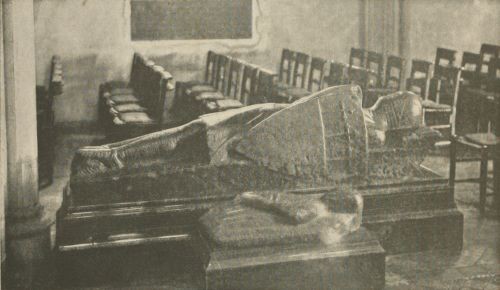
The Tomb of Strongbow, Christ Church, Dublin
III
HOW IRELAND IS GOVERNED
Ireland is nominally governed by a lord lieutenant or viceroy of the king, who, since December, 1905, and at present, is John Campbell Gordon, Earl of Aberdeen. He occupied the same position in the ’90’s, and has since been governor-general of Canada. Both Lord and Lady Aberdeen are well known in the United States, where Lady Aberdeen has taken an active interest in the work of the Women’s Christian Temperance Union and many benevolent enterprises and social reforms. She will be particularly remembered as the promoter of the Irish village at the Chicago Exposition in 1893, and for her successful endeavors to introduce Irish homespun, lace, linen, and other products, and to make them fashionable among the American people. She is a woman of great energy, executive ability, and determination, and has been applying those qualities very effectively in Ireland in local reforms. She has organized societies of women throughout the island to encourage the virtues and restrain the vices of the people, to relieve their distress and advance their welfare, physically, mentally, and morally, by a dozen different movements of which she is the leader and director. She started a crusade against the great white plague, brought Dr. Arthur Green from New York as an organizer, while Nathan Straus of New York has been co-operating with her in setting up establishments for the sterilization of the milk sold in Irish cities. She is president of almost everything, has a dozen secretaries and agents carrying out her orders, and is altogether the busiest woman in the United Kingdom.
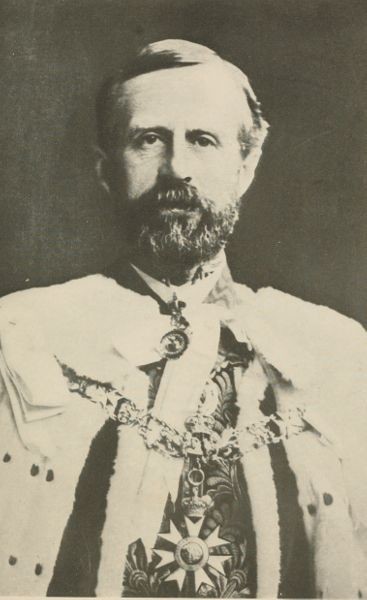
The Earl of Aberdeen, Lord Lieutenant of Ireland in 1906–8
The Lord Lieutenant of Ireland has very little to do except to open fairs, lay corner stones, preside at public meetings, give dinners, and look pleasant. He is nominally the head of everything as the representative of his sovereign, the king, and is supposed to rule Ireland in his majesty’s name, but, like the Governor-General of Canada, the office is a sinecure. Its incumbent is allowed a salary of $100,000, a castle in the city, and a country lodge in Phœnix Park, a liberal allowance to maintain them and to expend in hospitality, a staff of secretaries and aids-de-camp, a full outfit of servants, and various other perquisites which would be appreciated by our President and all others in authority. And all this without any responsibilities, except to be tactful, amiable, and diplomatic, and to make friends with the people.
The actual ruler of Ireland is the Chief Secretary to the lord lieutenant, who is a member of the cabinet of the king, and spends most of his time in London, where he devises and directs the political policy of the government toward that distracted but improving portion of his majesty’s empire, looks after legislation in parliament, and attends to whatever is necessary for the good of the island. He is the Right Hon. Augustine Birrell, who is carrying out the lines of policy inaugurated by Mr. Bryce at the incoming of the present liberal government. The chief secretary is expected to spend a portion of each year in Ireland, so that he can keep in touch with affairs and get his cues from public opinion. He has a salary of $35,000 and a residence, fully equipped and appointed, near that of the lord lieutenant in Phœnix Park.
The man on the ground, the general manager of the government, and the de facto head of the executive administration, is known as the Under Secretary, who also has a handsome residence in Phœnix Park and all worldly comforts provided for him. He presides at the ancient castle in the center of the city of Dublin, surrounded by a staff of subordinates and clerks, and supervises the work of the several executive departments, most of them being scattered in rented quarters in different parts of the city. The government has long ago outgrown the castle and has appointed many officials and boards of commissioners and organized new executive departments without erecting buildings to accommodate them. Sir Antony Patrick MacDonnell, who resigned the office of under secretary, and was elevated to the peerage as Lord MacDonnell upon his retirement, is an Irishman who has spent his entire life in the service of his king, the greater part of it in India, where he was governor of four different provinces in succession and showed remarkable administrative ability. Retiring voluntarily, he came home to Ireland and was soon appointed to fill a vacancy in the office of under secretary, where he was very active, very positive in his convictions, and very determined in his methods. He made numerous recommendations that have not been adopted, and attempted to carry out a policy that was not acceptable to the politicians of Ireland, who rejected his plans for self-government and refused his overtures.
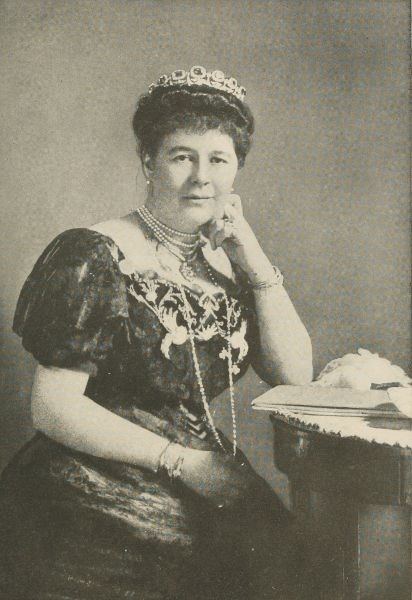
The Countess of Aberdeen
Sir Antony MacDonnell was the author of what is called the “devolution policy.” That’s a big word and has little meaning in America, but in Ireland it is in common use and full of significance; first being applied to a certain political project in Ireland by Lord Dunraven in 1904. If you will look in the dictionary you will see that “devolution” means “the act of devolving, transferring, or handing over; transmission from one person to another; a passing or falling to a successor, as of office, authority, or real estate.” In its application to the Irish situation devolution means the devolving upon the Irish people of purely local affairs, to transfer their management from the British government with a string tied to them, and that is what the Irish political leaders will not consent to. Their motto is aut home rule, aut nullus. With the co-operation of the Earl of Dunraven and others, Sir Antony MacDonnell prepared a plan of limited home rule in 1907. It gave the government of Ireland entirely into the hands of the people with the exception of the police, the courts, and the lawmaking power, which were retained under British control. The proposition was discussed by the largest convention ever held in the country and was unanimously rejected on the theory that it did not go far enough. The Irish people will never be satisfied until they are permitted to make their own laws. There were many grounds of objection from the Roman Catholic ecclesiastical authorities and others, who declare that Sir Antony’s plan of government, which was based upon his experience in India, could not be applied successfully to conditions in Ireland. Sir Antony is a very positive man, and when his solution of the Irish problem, to which he had given years of thought and study, was rejected, he concluded that he was not the man to rule that country and sent in his resignation, which was accepted with great reluctance by the government and with sincere regret by a majority of the people, who admire his ability and have confidence in his integrity and intentions.
His successor is Sir John Dougherty, his chief assistant, who has been in the office of the under secretary in Dublin Castle all his life, and has been promoted grade after grade from an ordinary clerkship to his present position because of his ability and his sterling qualities. Although he is not a man of marked individuality and initiative, like Sir Antony MacDonnell, he is considered a safe, conservative, and judicious administrator.
The next in importance, who, perhaps, should be ranked first of all, is a mysterious and autocratic official, known as the Treasury Remembrancer. He was described to me as “a lord over all, and the best hated man in Ireland. Nobody knows him or cares to know him. His fellow officials seldom hear or speak his name. He is a spy and a spotter and has arbitrary authority to disallow accounts, withhold allowances, and lock up the money chest whenever he likes. There is no statute authorizing his appointment, and there is no law or regulation defining his duties or limiting his authority, which he receives from the chancellor of the exchequer in London and to whom alone he reports.” The office pays $7,500 a year without any known perquisites, although the remembrancer is supposed to have mysterious sources of revenue that have never been found out. He cannot, however, spend the money of the crown. His authority is limited to preventing expenditures. He is “the watchdog of the treasury” in Ireland, and combines in one the duties and powers which are intrusted to the comptroller and auditors of the treasury in the United States. He interprets appropriation bills, customs laws, and decides how much money can be expended for this purpose and that. He audits all accounts, rejects many, disallows overcharges, and makes everybody who has to do with government finances a great deal of trouble. Hence his unpopularity and his habitual reserve.
In addition to these chief officials there are numerous secretaries and assistant secretaries, commissioners and boards of various jurisdictions, and executive departments, with corps of clerks similar to those in Washington. Each has its functions over some branch of the administration and all are subject to the supervision of the under secretary and the chief secretary in London. Their commissions are signed by the lord lieutenant, who knows nothing about them, has no authority over them, and acts only in a formal capacity, as the representative of the king. There is a great deal of complaint as to the excessive number of “civil servants,” as they call them over there, although such a term would be resented by the employees of the civil service in the United States. All railway officials are called “servants” in Great Britain. Every salaried person comes within that designation. Any one who will look over the printed register of government employees in Ireland will conclude that home rule has already been adopted, because the treasury remembrancer is said to be the only Englishman on the pay roll, except the lord lieutenant, several of his secretaries, and the military officers at the garrison, and several Scotch experts in the employ of the Agricultural Department and Congested Districts Board. But what spoils it all to the people of Ireland is that these officials receive their appointments from what they consider an alien authority. The touch of the English giver poisons the gift. They will never be satisfied until their commissions are signed by an Irish name. Nobody in the employ of the government is loyal. Every man hates and loathes England, and doesn’t hesitate to say so in public and in private, on all occasions, although he draws his rations from the British government. And when you remind him of that he answers promptly that the money comes from the pockets of the Irish rate-payers and England grabs £3,000,000 of it for herself.
Ireland contributes an annual average of £10,500,000 in taxes to the imperial treasury and £7,500,000 of it is expended in maintaining her government and constructing her public works. The remaining three millions is her contribution toward the support of the British empire, the wages of the king, the expenses of parliament, the support of the army and navy, and the interest upon the public debt, which is not kept separately for Ireland, and for various other purposes.
Ireland has twenty-three peers in the House of Lords and one hundred and two representatives in the House of Commons, of whom eighty-two are nationalists or home rulers. The remaining twenty are conservatives, unionists, and anti-home rulers, who believe in maintaining the present system of government and the existing relations between Great Britain and Ireland. The Irish members of parliament have been a thorn in the flesh of John Bull for many years, ever since Daniel O’Connell was admitted to the imperial legislature in 1829. They have fought fiercely for concessions term after term, have built fires in the rear of the government and have attacked it upon all sides until they have accomplished a great many reforms and are near to the point of achieving final success. If the liberal party wins at the next election every patriotic Irishman expects political emancipation, because its leaders are pledged to complete home rule on the same basis that Mr. Gladstone proposed several years ago, when he was prime minister.
The Irish peerage, like that of Scotland, are not entitled to all the rights and prerogatives enjoyed by the British peerage, and have only twenty-eight seats in the House of Lords. The total peerage of Ireland consists of two dukes, ten marquises, sixty-three earls, thirty-six viscounts, and sixty-four barons, a total of one hundred and seventy-five nobles, of whom seventeen also have titles in the English peerage, nearly all by inheritance.
The Irish peerage are represented in the House of Lords by twenty-eight of their members who are elected for life. As soon as one of these representative peers dies two or more of his colleagues notify the lord high chancellor of England of the vacancy. The latter thereupon issues a writ in the name of the king under the great seal proclaiming an election. Copies of this writ are served upon every Irish peer through the clerk of the crown at Dublin naming a date for an election. Each of the one hundred and seventy-five Irish peers has a vote, but they never assemble. They merely write to the clerk of the crown at Dublin, naming their choice, and forward a duplicate of the letter to the clerk of the House of Lords at London.
Scotland has only sixteen representative peers, who are elected by an assemblage at Holyrood Palace at Edinburgh when notified of a vacancy. There is considerable formality in the proceedings, and every peer is required to present himself to answer the roll call before he is allowed to vote. There is a good deal of preliminary canvassing in both Scotland and Ireland, and that was particularly the case of Lord Curzon of Kedleston, who was elected to the House of Lords as an Irish peer after his return from India. The candidates for the vacancy usually visit their fellow peers personally and solicit their support. Social influences go a great way. Lord Curzon was handicapped in many respects, but was elected by a large majority because of the high esteem in which he is held.
When the ballots are all in the clerk of the crown at Dublin makes up a tabulated statement which he sends with his report to the clerk of the House of Lords. The latter checks it off from his own records and announces the result to the lord high chancellor and to each of the Irish peers in person.
The representative peers at present are the Earls of Annesley, Bandon, Belmore, Darnley, Drogheda, Kilmory, Lucan, Mayo, Rosse, and Westmeath, Viscounts Bangor and Templeton, and Barons Bellew, Castlemaine, Clonbrock, Crofton, Curzon, Dunalley, Dunboine, Headley, Inchiquin, Kilmaine, Langford, Massey, Musckerry, Oranmore, Rathdonnell, and Ventry.
The premier of the Irish peerage is Maurice Fitzgerald, who is the Duke of Leinster and also is Marquis of Kildare, and represents the most distinguished and celebrated family in Ireland. His dukedom dates back to 1766. The second in rank is the Duke of Abercorn, James Hamilton, who is also Marquis of Hamilton. The third is James Edward William Theobold, twenty-seventh Marquis of Ormonde, and the fourth is Rudolph Robert Basil Aloysius Augustine Fielding, Earl of Desmond, who is also Earl of Denbigh.
The oldest titles in the Irish peerage are the following:
- Baron Kinsale, created 1223.
- Lord Dunsany, created 1439.
- Lord Timlestown, created 1461.
- Viscount Gormanston, created 1478.
- Baron Louth, created 1541.
- Lord Dumboine, created 1541.
- Baron Inchiquin, created 1543.
- Viscount Montgarrett, created 1550.
- The Earl of Fingal, created 1620.
- Viscount Grandison, created 1620.
- Earl of Cork, created 1620.
- Baron Digby, created 1620.
- Earl of Westmeath, created 1621.
- Earl of Desmond, created 1622.
- Lord Dillon, created 1622.
- Viscount Valentia, created 1622.
- Earl of Meath, created 1627.
- Baron Sherard, created 1627.
- Viscount Lumley, created 1628.
- Viscount Taffe, created 1628.
All the remaining peerages of Ireland were created later than the year 1700.
The people as a rule are respectful towards the nobility, and treat them with a consideration which is not always deserved. The bitterness of politics is more intense in Ireland than in any other country, and, as Sydney Brooks in his recent book on “Ireland in the Twentieth Century” says, “Class distinctions are not mitigated by political agreement. Differences of creed are not assuaged by harmony of economic interests. The cleavages of racial temperament are not, as in other countries, bridged over by a sense of national unity. On the contrary, all the bitterness of caste and creed, of political and material antipathies and contrast, instead of losing half their viciousness in a multiplicity of cross-currents, are gathered and rigidly compressed in Ireland into two incongruous channels. Throughout the country you can infer a man’s religion from his social position; his social position from his religion, and his views on all Irish questions from both; and nine times out of ten you infer rightly.”
That is strictly true. Nowhere in the world is a man’s politics so influenced by his religion and his social position as in Ireland. Although you will find home rulers in all classes of the English population, you will never find them outside one class in Ireland. If you are told what business he is engaged in or what church he belongs to in Ireland, it is not necessary for you to ask his politics.
While the ancient nobility of Ireland is gradually becoming extinct and their estates are being divided up among the farmers who till them, a new aristocracy is developing. The sons of what is called the middle class are invading the sacred haunts of the ancient aristocracy and are taking the places of the dukes and earls as the latter retire. Every peer that has been created in Ireland of late years has been a son of a manufacturer, a tradesman, or a country gentleman of the middle class, and at the present rate the descendants of earls and marquises will be compelled to stand back and give the sons of brewers, distillers, and other manufacturers their places at the front of the stage.
A century or even half a century ago no Irish trader or contractor, lawyer or doctor, unless he could produce the proper sort of pedigree, could enter the social world or the best clubs of Dublin and other Irish cities or participate in the sports of the gentry and aristocracy. But to-day their grandsons have the entrée to that gilded gate which hangs upon broken hinges and will soon be entirely removed. This is the result of the decadence of one class and the advance of another. A brewer or a distiller who can obtain a seat in the House of Lords must necessarily be eligible to the clubs where his colleagues meet. Nearly all of the twenty-three peers created by the present government in England have sprung from families of humble origin and are sons of men who made their money in manufacturing and trade. And there is room for more of them in the peerage. You hear irreverent people talking about “breeding up the peerage of Great Britain,” just as they talk about improving their cattle, horses, and swine, and in the clubs of London this subject is revived every time the son of a decaying family of the nobility marries the daughter of a wealthy tradesman, or the daughter of an earl weds the son of a wealthy commoner.
In Ireland the shopkeeper now educates his son for a profession. The sons of contractors become architects and civil engineers. The sons of lawyers and doctors enter the army and navy and diplomatic service. Among the large families of the middle class you will find one son a lawyer, another a doctor, and the other two in the army and navy. In order to keep pace with them and be able to appear properly in the society which their brothers enter, and in order that they may be considered suitable wives for the sons of similar families who are on the upward grade, the daughters of the middle classes of Ireland are sent to the best schools and colleges and spend their winters in Paris.
For these reasons very little is said about pedigree in Ireland these days. The army that is advancing does not look back. The decaying nobility dare not question nor criticise lest they may be trampled upon. The only people who talk about their ancestors are the peasants, who trace their descent from the Irish kings.
Mrs. O’Leary met Mrs. O’Donahue one day and in the course of conversation asked if she had ever looked up her pedigree.
“Phwat’s that?” inquired Mrs. O’Donahue.
“The people you sprang from,” was the reply.
“I’d have you know that the O’Donahues never sprang from anybody,” was the indignant retort. “They sprang at ’em.”
Every influential leader of the liberal party is a home ruler. The Earl of Aberdeen, the present lieutenant governor, Earl Dudley, his predecessor, who is now governor-general of Australia, James Bryce, recently chief secretary for Ireland and now British ambassador at Washington, and many other influential men in high places, are earnest in supporting the Irish claims for self-government, and the national party, which, after the death of Charles S. Parnell, became demoralized and split into factions under the leadership of John Redmond, John Dillon, and others, has been a unit since 1900 and is working harmoniously. The liberal leaders have promised to make home rule the leading issue at the next parliamentary election, which will probably occur in two years or so. In the meantime the Irish party in parliament will continue to pursue the policy that has already been so successful in securing concessions for the relief of the people and the promotion of the welfare and prosperity of Ireland.
The city government of Dublin is very much like that of London. The lord mayor is second in official rank to the lord lieutenant, and within the precincts of the city takes precedence of everybody except that official (who is the personal representative of the king), the royal family, and foreign ambassadors. He precedes the Archbishop of Canterbury, who is the primate of England, the two archbishops of Armagh, the primates of all Ireland, the Archbishop of Dublin, the chief secretary for Ireland, and even the prime minister of England, while the lady mayoress has the right to walk before every duchess, marchioness, and woman of title in the kingdom except the royal family. The salary of the lord mayor is $15,000 a year, and he has a beautiful old house to live in—one of the most attractive in Dublin. It is situated on Dawson Street near Stephen’s Green and is surrounded by a picturesque garden. Here in olden times the lord mayor used to entertain like a prince. It was a matter of pride that the Mansion House should never be outdone by the castle in the magnificence of its hospitality. But of late years the civic entertainments, as they were called, have been abandoned and the lady mayoress has not attempted to shine in society.
The Right Honorable Gerald O’Reilly was Lord Mayor of Dublin when I was there in 1908, and he managed to look after his private business as grocer and liquor dealer at Towns End in connection with his official duties. He was elected to office by the nationalists and the labor element, who control the politics not only of Dublin but of all Ireland, and have elected his predecessors for many years. And they have been men of the people without exception. No aristocrat, no landlord, no member of the nobility could ever hope to become Lord Mayor of Dublin.
Mr. O’Reilly was born, reared, and educated in County Carlow, where his father was a groceryman and liquor dealer like himself. When he became of age he came up to Dublin, went into business on his own account and prospered. He is not a rich man, but well to do, with a good patronage, a good reputation, and a large influence in politics. For twenty years he has served as a member of the common council and the board of aldermen, where he has proved his usefulness and his right to promotion. Mr. O’Reilly’s predecessor was an actual workingman, G.P. Nanetti, a son of an Italian artist who came to Ireland fifty years ago to engage in his profession as a decorator. Mr. Nanetti was born in Dublin, educated in the national schools, learned his trade as printer in the office of that ancient and well-known paper, the Freeman’s Journal, and was advanced from grade to grade until he became the foreman of the composing-room. In the meantime he went into politics, became a leader among the workingmen, was elected to the common council and then to the board of aldermen, and, after serving two terms as lord mayor, was elected to parliament as the representative of the business district of Dublin, which surrounds the Bank of Ireland and Trinity College. Before him Timothy Harrington was lord mayor for three terms, a longer period than any of his predecessors since the creation of the title by King Charles I. on the twenty-ninth day of July, 1641. He, too, was a great success in the office and was sent to parliament for the district which includes the docks.
The Mansion House is well adapted for entertainment. The main room is a large circular chamber, adorned with statuary, which was built especially for the reception of George IV. when he visited Ireland. The Oak Room is entirely sheathed, floor, ceiling, and walls, with a rich reddish brown oak, delicately carved. Over the fireplace is a rack for the reception of the mace and sword which are the symbols of office, and formerly, when the lord mayor went about on official occasions, they were carried before him, but Mr. O’Reilly and his recent predecessors have abolished many of those interesting old ceremonies.
There are some fine pictures in the Mansion House, portraits of Charles II. by Sir Peter Lely, George IV. by Sir Thomas Lawrence, the Earl of Northumberland by Sir Joshua Reynolds, and the Earl of Westmorland by Romney. In the entrance hall are preserved the mace and sword carried by the lord mayor who fought for James II. at the battle of the Boyne. When he fled with the rest of James’s forces he dropped the heavy insignia, which fell into the hands of the Williamites and were retained by them until a duplicate set had been furnished, many years after.
Many famous men have been entertained at the Mansion House, including General Grant, who visited Dublin during the holidays of 1878; Capt. Edward E. Potter, commander of the United States man-of-war Constellation, which brought a cargo of food to the starving people of Ireland in 1880; the Hon. Patrick A. Collins, while he was Mayor of Boston, who, by the way, is recorded as a senator from Massachusetts, a distinction he never attained. The Hon. Richard Croker, formerly of New York, received the freedom of the city of Dublin several years ago, and has been a frequent guest at the Mansion House, although he moves about very modestly and puts on no airs.
The Lord Mayor of Dublin is elected annually on the 23d of December by the aldermen and councilmen and must be one of their number. He has a deputy who exercises authority during his illness or absence. There are fifteen aldermen and forty-five members of the council, whose authority and powers are very much the same as in our cities at home.
The headquarters of the mayor are in the City Hall, which was formerly the Royal Exchange, where merchants met daily to make bargains and sign contracts. It was used as a prison during the rebellion of ’98, and has had other experiences. As you enter the building through the vestibule you pass into a large circular room, with a dome sustained by many columns, which was formerly the trading place, but is now the anteroom to the mayor’s office and is usually filled with politicians and place hunters, which are quite as numerous in Ireland as they are anywhere else.
The name of the capital of Ireland is a compound of two Gaelic words, Dubh-Linn, which signify “the black pool,” and was bestowed upon it more than two thousand years ago. There is a complete history of the city since the year 150 A.D., when a warlike king called “Conn of a Hundred Battles,” who had long been the overlord of all Ireland, was defeated by his rival, “Mogh of Munster,” and compelled to consent to a division of territory, the line being drawn from High Street, Dublin, across to the Atlantic Ocean near Galway. Three centuries later St. Patrick stopped on his way from Wicklow to his home at Armagh. The people complained to him of the bad quality of the water they were obliged to drink and he relieved them by causing a miraculous fountain to spring up near the site of the present cathedral that bears his name. In 1152 Dublin became the seat of an archbishopric by a decree of the pope and, shortly after the landing of Henry II., became the seat of the English government. In 1210 King John visited Ireland again and conferred many privileges upon the city. In 1394 King Richard came over with an army of thirty-four thousand and lived in great splendor in Dublin. All of the Irish chieftains submitted to his conciliatory policy. The great O’Neill, King of Ulster; MacMurrough, King of Leinster; O’Brien of Munster, and O’Connor of Connaught, the four kings of Ireland, were knighted and promised allegiance, but no sooner had Richard returned to England than the country was again in confusion.
In 1409 the “pale” (or inclosure) of Ireland was established, with the city of Dublin as its capital, a narrow strip of land thirty miles long by twenty wide, which alone was under English control and whose inhabitants alone in all Ireland could be relied upon to respect the royal commands. Dublin has been besieged, invaded by pirates, has been swept with plague and pestilence, and has been fought over by rival princes, but has kept growing, and in Queen Elizabeth’s time reached such commercial importance that it was necessary to erect a custom-house and a lighthouse to show the channel to those who went down to the sea in ships. The people were famous for their wealth and fashion. An official band of musicians played three times a week through the chief streets, there was a city physician, a fire department, an attempt at sanitation and waterworks were introduced, each citizen being allowed as much water daily as would flow through a quill.
In 1661 the people of Dublin spent $150,000, which was an enormous sum in those days, to celebrate the restoration, with banquets, fireworks, a pageant, and various other evidences of rejoicing. And the king, as an acknowledgment, sent the mayor a gold chain and conferred upon him the title of “The Right Honorable, the Lord Mayor of Dublin.” Under the administration of Ormonde, Dublin expanded on all sides, and has since been growing, although from time to time there have been periods of distress and disorder.
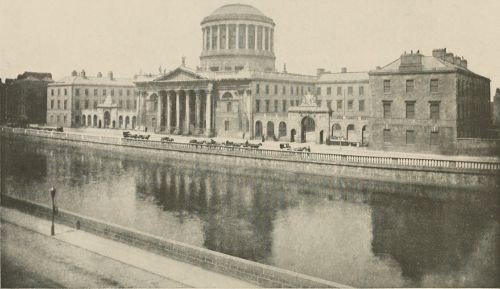
The Four Courts, Dublin
Gradually, however, matters settled down into civilization and order. Courts were established, and an imposing building called “The Four Courts” was erected to accommodate the four divisions of the judiciary,—chancery, king’s bench, exchequer, and common pleas. In early times each term of court was opened by a religious service, when the choir of Christ Church would sing an anthem and the dean would offer prayer. One of the boundaries of the Four Courts was a dark, narrow passage, which a wit, struck with its gloom, nicknamed “Hell,” and carried out his idea by erecting at the entrance a fantastic figure supposed to represent the evil one. A Dublin newspaper of that date contains an advertisement reading as follows:
“Lodgings to let in Hell, suitable for a lawyer.”
You will remember Burns’s line: “As sure ’s the deil ’s in hell, or Dublin city.”
Dublin now has 300,000 population, and, although it is not so enterprising as Belfast, is one of the few cities in Ireland that shows growth. The population is divided as follows: Roman Catholic, 237,645; Church of Ireland, Episcopal, 41,663; Presbyterian, 4,074; Methodist, 2,342.
The means of grace are greater than the hope of glory. Promises of salvation are offered from fully eighty churches, as follows:
Church of Ireland
20
Church of Ireland (chapels)
20
Roman Catholic
9
Roman Catholic (chapels)
6
Presbyterian
8
Wesleyan
8
Primitive Methodists
2
Independent
3
Friends’ meeting-houses
2
Unitarian
1
Baptist
1
The “disestablishment” of the Church of Ireland, by which is meant the separation of the Protestant Episcopal denomination from the government, occurred in 1869 under the leadership of Mr. Gladstone as the price of peace and the termination of the rebellion in Ireland. It was demanded by the Roman Catholic bishops, who saw the injustice of compelling people of all denominations, without discrimination, to pay taxes to support an official church and the propaganda of a faith which they did not profess. So that branch of the Established Church of England which was found across St. George’s Channel was forcibly divorced and given alimony amounting to £8,080,000, or about $39,000,000 in American money. This represented a commutation in advance of the stipends to which the clergy of that church were entitled under the ecclesiastical laws for a term of fourteen years, as well as a vast amount of real estate and other property which belonged to the Established Church and was transferred to the new organization represented by a commission appointed for that purpose. At the same time the Presbyterian church of Ireland received £750,000, the Roman Catholic College of St. Patrick at Maynooth, £3,372,331, the board of intermediate education for school purposes, £1,000,000, the pension fund for teachers in Ireland, £1,127,150 and the Congested Districts Board, £1,500,000. Since that time these funds have increased in value considerably, and the incomes from them are devoted to the purposes named. They were paid in lieu of the annual contributions from the Established Church which had been enjoyed for many years and were capitalized on the basis of fourteen years’ income; that is, the government in order to satisfy everybody advanced in lump sums what it would have given in annual installments for the next fourteen years if the “disestablishment act” had not been passed.
The general synod which controls the affairs of the Episcopal Church of Ireland is composed of the two archbishops, the bishops, the deans, and canons of cathedrals, and archdeacons of diocese. The property of the church has advanced in value until it is now estimated at more than £12,000,000, or $60,000,000, and the income is now more than $2,000,000 a year, which is very large in proportion to its numbers.
Total population of Ireland (1901)
4,386,035
Roman Catholic
3,308,661
Church of Ireland
581,080
Presbyterian
443,494
Methodist
61,255
These are the figures furnished by the different church organizations, but you will notice they exceed the total population by the latest census and therefore are only approximately correct.
At the time of the disestablishment in 1889 the adherents of the Church of Ireland numbered 693,347, which is a decrease of 112,258 since that time. This corresponds very accurately with the general decrease of the population of the island.
There are now 1,628 churches and chapels belonging to the Church of Ireland, which is an average of one for every 350 people, and from my short experience I should say that the members of the church were very negligent in attending worship.
The Roman Catholic church is the largest, the most prosperous, the most energetic, and has greater vitality than any other denomination, and is involved in all the politics and secular affairs as well as the ecclesiastical administration of the country, which is perfectly natural, because 74 per cent of the entire population belong to that denomination, and the number as reported—3,308,661—are divided among 1,084 parishes with 2,350 houses of worship, churches, and chapels.
The constant stream of emigration which flows from Ireland to the United States, Canada, Australia, and other more progressive and prosperous countries comes chiefly from the Roman Catholic church, which lost 238,646 members, or 6.7 per cent of its numbers, between the last two official censuses of the country. The Church of Ireland lost 3.2 per cent from a total of 13 per cent, the Presbyterians 0.4, while the Methodists increased 11.7 per cent, the Jews increased 119 per cent, and other religious persuasions 9.1 per cent.
But it is strange to say that the numbers of priests and monks and nuns are increasing every year, while the number of parishioners is falling off. In 1851, when the island had twice its present population, there were 2,291 priests in Ireland; in 1901 there were 3,157, of whom 4 were archbishops, 27 bishops, 392 monks, and the remainder parish priests, including chaplains and professors in educational institutions. The total of priests increased 307 during the last ten years. There are many monasteries, nunneries, and other monastic and educational houses in Ireland—93 for men and 242 for women.
The Presbyterians are third in numerical strength, wealth, and influence, and are found mostly in the northern part of the country. The membership represents the manufacturing, mercantile, and commercial classes, while the Church of Ireland represents the landowners, the government officials, the aristocracy, nobility, and the gentry. The Presbyterians have a higher average of wealth than any other denomination. Their contributions to benevolent purposes in 1907 were $1,040,000, which is very large for a population of 443,494 and 106,000 communicants. There were 96,000 children on the roll of the Presbyterian Sunday schools in 567 churches, which are distributed among 36 presbyteries and 5 synods. The minutes of the recent general assembly show 650 clergymen of that faith.
The Methodists are active and energetic, and ever since John Wesley appeared in Ireland in August, 1747, they have been strong in the faith. They are mostly in the cities among the middle classes, and the latest returns show 250 churches, 248 ministers and evangelists, 358 Sunday schools, and 26,000 scholars, for a total population of 61,255.
There are several other denominational organizations. Friends’ meeting-houses are found in several of the cities of Ireland, and the members of that faith have been here for centuries. Macroom Castle, in which William Penn was born, is still standing, and the Castle of Blackrock, the place where he embarked for America, is now a popular Sunday resort for the working people of that city.
IV
DUBLIN CASTLE
Dublin Castle does not correspond with the conventional idea of what a castle should be. It looks more like the dormitory of an ancient university or a hospital or military barracks, although there are two ancient towers in which many men have been imprisoned and in which several patriots have died, and the south side of the pile, which overlooks a beautiful lawn in the very center of Dublin, has quite the appearance of a fortress. It has been the scene of much bloody history, much treachery and cruelty, and many deeds of valor have been done in the two courtyards. One of the viceroys of the sixteenth century, in a letter to the King of England describing its partial destruction by fire, wrote that he had “lost nothing but a few barrels of powder and the worst castle in the worst situation in Christendom”.
A certain portion of the building is reserved for the official residence of the lord lieutenant, and there are long suites of quaint old rooms with antique furniture, usually disguised with its summer wrapping of pink-flowered chintz, in which kings and queens and dukes and earls have been entertained for centuries. In olden times it was the habit of the lord lieutenant to permit his guests to go to the wine cellar with glasses in their hands and drink from whatever hogshead they pleased, and it is recorded that some gentlemen who were imbibing longer than usual sent the cellarer to the Duke of Ormonde, who then occupied the office, to provide them with chairs. With that true wit that distinguishes the Irish race, high and low, the duke replied that he did not encourage his guests to drink any longer than they could stand. This custom was abandoned by the Earl of Halifax, owing to the carelessness of certain bewildered gentlemen who left the wine running out of the spigot and lost him many gallons of precious Madeira.
The present lord lieutenant, Lord Aberdeen, spends as little time in the castle as possible, because the viceregal lodge, his country residence, which is only half an hour’s drive distant in Phœnix Park, is so much more comfortable and homelike, but all state ceremonies must take place at the castle, and their excellencies and the household usually bring in their court costumes early in February, for the season commences on the second Tuesday with a levee, a drawing-room on Wednesday, a reception on Thursday, and on Friday a banquet. During the ensuing week a state ball is given, and twice a week thereafter entertainments until the 17th of March, when the season is finished with St. Patrick’s ball. The presentation of guests may be arranged for at the levees or the drawing-room, and everybody who has been presented can go to the ball. The inauguration of a new viceroy takes place in the throne-room, where also a farewell reception is held when he retires.
The castle dates back to the days when it was necessary to have some stronghold, as the king said, “to curb the city as well as to defend it,” and to provide a safe place for the custody of the royal treasure. It was located in the center of the present city of Dublin, but at the time was outside the original walls of the town, upon what is called Cork Hill, because Richard Boyle, the Earl of Cork, had his castle upon the slight elevation it now occupies. Meiller Fitzhenry, an illegitimate son of Henry II., designed and began the building. It was finished in 1213, and from that period has been the center of Irish history. Very little of the original structure remains—only a portion of the walls. The towers have been cut down and modernized. One of them is now used for a supper-room for social occasions, and a kitchen is on the lower floor. The other, which was originally a prison, and is the most complete surviving fragment of the ancient fortress, is a repository for historical documents and the records of the government for the last four or five centuries. There are three circular rooms, one above the other; the walls are nineteen feet thick in places, and four or five long, narrow cells are built into them like recesses and lighted only by a narrow strip at the far end. One of these cells has a secret chamber hidden in the wall, and accessible only by a revolving door, which is difficult to distinguish from the rest of the stone.
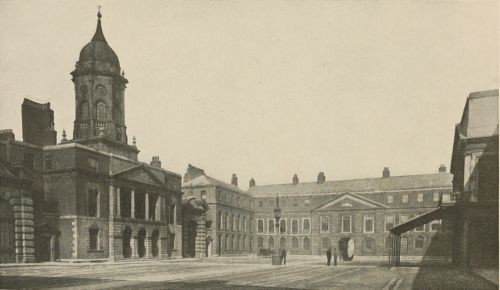
The Castle, Dublin; Official Residence of the Lord Lieutenant and Headquarters of the Government
The tower has not been used as a prison since 1798 and 1803, the rebellions of Emmet and Lord Edward Fitzgerald, and the documents relating to their conspiracy are preserved there in the very cells where the men who were convicted by them lay awaiting trial and execution. The late Mr. Lecky, the historian, searched them thoroughly, and gave a surprising account of the character of the private papers that were seized with the effects of the patriots in those days. Love letters, poems, reflections on various subjects, rules of conduct, maxims of the sages, drafts of speeches, and proclamations in soaring language, and many attempts at literary work are mixed up with the reports of spies, informers, detectives, and officials,—some of them from comrades whose treachery was never suspected and which Mr. Lecky was not permitted to publish even at this late day. Some people think these malicious and incriminating documents should be destroyed lest they may sometime come to light and ruin the reputation of men who are highly esteemed by their fellow countrymen. But no one seems willing to give the instructions.
In 1583 a “trial by combat” took place in the courtyard of the castle between Connor MacCormack O’Connor and Teague Kilpatrick O’Connor to settle the responsibility for the murder of a clansman. The weapons were sword and shield. The lord justices and the councillors, the governor-general, the sheriffs, and other officials were present to witness the trial. As was the custom and usage in trials by combat, each man was made to take an oath that he believed his quarrel just, and was ready to maintain it to the death. After a fierce struggle Teague cut off the head of his cousin and presented it on the point of his sword to the lord justices. For many generations the Irish parliament used to assemble at the castle. The first was called in 1328, another in 1585, another in 1639, and the accounts of the expenses of the lord lieutenant show that during the two weeks that parliament was in session the viceregal household consumed ten bullocks, forty sheep, sixteen hogsheads of beer, and various other refreshments to a similar extent.
Oliver Cromwell, when in Dublin, resided at the castle, and in 1654 his youngest son was born there. While Henry Cromwell was viceroy he was driven from the castle and went to live at the viceregal lodge. In 1689, after the battle of the Boyne, in which William of Orange defeated James Stuart, the latter took possession of the castle, but slept there only one night.
The court of Dublin has been insignificant but lively, and has reflected the characteristics of the Irish nobility, who were as fond of a frolic as they were of a fight, and never allowed their sense of decorum or the laws of etiquette to interfere with their pleasure. A hundred years ago ladies, upon being presented for the first time, were solemnly kissed by the viceroy, which was more or less agreeable to him, according to the age and attractions of his guests. One of them who was noted for his wit remarked that he got his kisses as a spendthrift borrows from a usurer, “part in old wine, part in dubious paintings, and part in bright gold and silver.” With all its wit and brilliancy the court has at times been noted for a low state of morality, and at one period that portion of the castle which contains the state apartments was nicknamed “hell’s half-acre” by a satirist.
A figure of Justice which adorns the pediment of the main gate has been the object of much wit and satire for two centuries. Dean Swift once declared that she sat with her face to the viceroy and her back to the people. There are a few good portraits and other pictures in the residence portion of the building, including some pretty medallions in the wall of the throne-room, which are credited to Angelica Kauffman, but nobody knows when or how she happened to paint them.
The mantel of one of the rooms is of black Spanish oak taken from the cabin of the flagship of the Spanish Armada which was wrecked on the Irish coast after the great sea battle of 1588.
The finest of all the rooms is St. Patrick’s Hall, which was designed by the great Lord Chesterfield when he was lord lieutenant of Ireland, and has always been much admired by architects because of its proportions and its lofty painted ceilings representing events in Irish history. The banners of the twenty-four knights of St. Patrick are suspended from either side, and the crimson draperies and upholstering of Irish poplin give the apartment an attractive color. Duplicates of these banners hang in the choir of St. Patrick’s Cathedral, where the knights used to meet before 1869, but they have always had their headquarters in the castle, and the Ulster king of arms, the executive officer of the order, is the master of ceremonies at the castle, senior officer in the household of the lord lieutenant, the highest authority on rank and precedent in Ireland, and his seal is necessary to give legal value to patents of Irish peerages. He decides all questions of etiquette, nominates the persons who are presented at the viceregal drawing-room, arranges for all ceremonies, and in processions of state he rides or walks immediately in front of the lord lieutenant, carrying the sword of state as the emblem of the authority of the king.
The office has been in existence since the Middle Ages. Its incumbent was formerly the custodian of the arms, the chief of the heralds, and the keeper of the royal jewels. He has an office in what is known as Bedford Tower, immediately facing the principal entrance to the viceroy’s residence, with a large suite of rooms for his own use, and two or three clerks to look after his business. Otherwise the office carries no compensation except £20 a year and such few fees as are paid for searching the records of the Irish peerage and furnishing certificates of pedigree and title similar to those that are sought at the College of Heralds in London.
The office was held for many years by Sir Bernard Burke, the most eminent of modern genealogists, the originator and author of “Burke’s Peerage,” which is authority on all questions affecting the nobility. His successor was Sir Arthur Vicar, son of the late Colonel Vicar, who commanded the Sixty-first Irish Fusiliers, and is a cousin of half the nobility of Ireland. Sir Arthur is a bachelor, a member of the principal clubs of London and Dublin, president of the Kildare Archæological Society and of the “Ex-Libris Society,” whose members follow the fad of collecting book plates. He is the highest authority on questions affecting the Irish nobility since the death of Sir Bernard Burke, and is the editor of “Lodge’s Peerage,” a volume which relates exclusively to them. Sir Arthur has been a great favorite with everybody. He is an amiable, gentle, witty man, with winning manner, a charming conversationalist, has a keen sense of humor, and has been the confidant of half the peers of Ireland in their sorrows and their difficulties.
In October, 1907, when preparations were being made to invest Lord Castledown as a knight of St. Patrick, it was discovered that the regalia of that order was missing, and no trace has ever been found of it, nor have the detectives obtained a single clew to the mystery. The jewels have an intrinsic value of quarter of a million dollars, but the historical and sentimental value of the articles stolen cannot be estimated. They were kept in a safe in the office of Sir Arthur Vicar as master at arms at the right of the entrance to his private quarters, and the room was usually occupied in the daytime by two clerks and carefully locked at night. This valuable property had been kept in that place for more than two hundred years, and nobody ever dreamed that it might be stolen. The discovery, which was kept secret for several months at the request of the police, caused a postponement of the ceremony, and the chief secretary for Ireland called for the resignation of Sir Arthur as master at arms on the ground that he failed to take proper precautions for the safety of the valuables in question. He was not accused or even suspected of having participated in the robbery, or having any knowledge of it, but there cannot be the slightest doubt that the theft was committed by some person familiar with affairs in the castle, and hence all the employees, everybody, from Lord Aberdeen down, has shared in the humiliation. Sir Arthur Vicar refused to resign, demanded a court of inquiry, and selected Timothy Healy, a member of parliament of the nationalist party from Dublin, as his counsel, and has ever since been appealing for vindication.
V.
THE REDEMPTION OF IRELAND
While the circumstances of the agricultural class in Ireland are by no means ideal, a great deal has been done to improve them. At the present rate of progress, however, it will take from twenty to twenty-five years, if not much longer, to accomplish the results intended by the Wyndham Land Act of 1903, which was expected to bring about the Irish millennium. That act provides that an owner of a large estate may sell to his tenants the holdings they occupy, and his untenanted land to any one who desires to buy it, in such tracts and at such prices as may be agreed upon, corresponding to the income now derived from that particular property. No landlord can sell a few acres here and there of good land under this act, although, of course, he is at liberty to dispose of any part of his estate at any time at any price that he may consider proper. But the terms and privileges of the Wyndham Act can only be enjoyed by a community of tenants in the purchase of the whole or a considerable portion of an estate. A board of commissioners which sits in the old-fashioned mansion in which the Duke of Wellington was born, on Merrion Street, Dublin, is authorized to use its discretion in the application of the law and in granting its privileges to those for whose benefit it is intended. Nothing can be done without their approval. The landlord and the tenants may arrange their own bargains to their own satisfaction, but they must be submitted to the board before they are carried out.
When such agreements are reached and approved by the commission,—including the area sold, the price, and other terms,—the government is expected to furnish the purchase money from the public treasury. The landlord is entitled to receive the cash in full, and the tenant, who pays nothing, gives a mortgage, as we would call it, upon the property to the government for sixty-eight years or less, and agrees to pay an annual installment of 3¼ per cent of the purchase price, of which 2¾ per cent is interest and ½ per cent goes into a sinking fund to cover the purchase money at the end of sixty-eight years. A purchaser may pay off the mortgage at any time he pleases, and receive a clear title to the land; or he may sell it whenever he chooses, subject to the mortgage, which follows the land and not the person. If he is unable to pay his annuities, the government can turn him out and dispose of the land, subject to the same terms and conditions, to another person. It can make no allowance for crop failures or cattle diseases. It cannot extend or modify its credits.
Nearly all of the landlords are willing to sell their estates; many are glad to get rid of them, because the average tenantry in Ireland are a very determined class, and are always making trouble. There have been almost continuous disturbances over land questions of one form or another in Ireland since the beginning of time. The rents are low compared with the American standard, but have been difficult to collect, and when there is a failure of crops they cannot be collected at all. The landlords complain that all the laws that have been enacted of late years are entirely in the interest of the tenants; that the landlord has no show at all. And perhaps that is true, because public sympathy is invariably with the tenants, and they cast many votes, while the landlord has only one, even if he tries to vote at all.
Since 1881 the land courts have adjusted the rents of 360,135 farmer tenants, involving 10,731,804 acres of land. The total rents paid for these lands annually before adjustment was £7,206,079. They were reduced by judicial order to a total of £5,715,158, a difference of about $7,500,000 a year in American money, in favor of the tenants.
Therefore it is perfectly natural that landowners—and especially those who have had a good deal of trouble with their tenants—are anxious to dispose of their estates for cash, which they can invest to much better advantage. The Duke of Leinster, for example, who is a minor, has realized more than £800,000 in cash, which his trustees have invested in brewery stocks, railway bonds, and other securities which pay regular dividends and give him no anxiety.
Mr. Bailey, one of the commissioners, told me that the good estates have been disposed of without difficulty. The disposition of the poor land has been more difficult, because the tenants are not as eager to get it, the owner is not always satisfied with the price, and the commission is not willing to make advances upon small bits of land among the bogs and rocks and other tracts of unfertile soil that would not be considered good security by anybody. The commissioners have treated these transactions very much as they would have done if they were mortgage bankers. They have refused to make advances on land that a banker would not have considered good security. They have not been willing to make advances on farms that cannot be made to pay. There have been complications in certain cases that have perplexed them, but, as a rule, the law has been working out in a most satisfactory and gratifying manner. The chief object of the commission and the purpose of the law has been to break up the great estates of Ireland so far as possible in farms of not more than one hundred acres, and sell them to the occupants, so as to create a nation of peasant proprietors, and that, he says, is being accomplished more rapidly than any one had reason to expect. Of course Mr. Bailey does not pretend that everybody is satisfied. That would be impossible. The millennium has not yet come, and the Wyndham Act has not brought it, although it has undoubtedly done more than any previous legislation to promote peace in this distracted country, and offers promises of future prosperity and contentment.
Naturally some of the landowners have not been willing to sell their property, and their tenants have been trying to force them to do so. That accounts for the “cattle driving” and similar disturbances that you read about in the newspaper cablegrams from Ireland. It is to be regretted that the tendency of the newspapers is to publish sensational occurrences and unfortunate events. If a man commits a great crime it is advertised from one end of the world to the other. If he does a good deed very little is said about it, and a false impression concerning conditions in Ireland has been created by the widespread publication of every little outrage or disturbance that occurs over there, while the enormous usefulness and the satisfactory application of the Wyndham Land Act has been almost entirely neglected by newspaper writers.
There have, however, been a good many little disturbances occasioned by the efforts of the tenants of certain estates, particularly those that are now devoted to cattle-breeding, to force their landlords to divide up the pastures and sell them. At present there is more money in the cattle and sheep business than in any other kind of farming in Ireland, and, as you drive out into the interior, you can see the loveliest pastures in the world filled with fat, sleek animals feeding upon the luscious grass. I do not believe there are richer or more beautiful pastures in any land, and Irish beef and mutton command a premium because of their flavor and tenderness. Hence prosperous cattle-breeders cannot be blamed for refusing to sell their pastures and go out of business, and there is no law to compel them to do so. But the rough and reckless elements in the villages, and in many cases among their own tenantry, often try to persecute them by cattle and sheep “driving,” as it is called, until they are willing to cry quits. The popular method is to break down the gates or the hedges,—they do not have fences in Ireland,—turn the cattle and sheep into the road, and run them as far as possible away from their proper pastures, scattering them over the country. This is done in the night, and the next morning the owner is compelled to take such measures to recover as many of the strays as he can. Various means are adopted to prevent such outrages. Armed guards are employed who defend their cattle, sometimes at the cost of life and bloodshed, which, of course, provokes bad feeling and greater trouble. Hundreds of men have been arrested and punished by long terms of imprisonment, but “cattle-driving” still goes on in various parts of the country with some serious results. But it is comparatively insignificant when compared with the great good that is being accomplished by the breaking up of the big estates whose owners are willing to dispose of them.
Thus far the Wyndham Act has been carried out without much friction; the chief difficulty having arisen from the eagerness of the landlords to dispose of their estates, which is so much greater than anticipated, that the funds provided have not been sufficient, and the landlords who have sold their property have been compelled to wait for their pay. In November, 1908, Mr. Augustine Birrell, chief secretary for Ireland in the British cabinet, introduced into the House of Commons a bill for the appropriation of more than $760,000,000, to be raised by an issue of bonds to pay for the estates that have already been sold and for those that may be sold in the future. That amount of money he asserted would be necessary to carry out the plans of the government under the Land Act of 1903.
This proposition of Mr. Birrell is without doubt the most stupendous munificence ever offered by any government to its subjects. The money thus appropriated does not pay for any service performed. It is a direct appropriation from the public treasury to the people of Ireland for the simple purpose of relieving their poverty and placing them in circumstances which will permit them to enjoy life without the hardships and sufferings and fruitless labor which they and their forefathers have for generations endured.
The advances of the British government to the Irish peasants, if this bill becomes a law, will reach nearly $1,000,000,000, but it is to be repaid by them in small installments. Mr. Birrell, in his explanation of the purpose of the bill to the House of Commons, stated that up to the 31st of October £25,000,000 in round numbers (which amounts to about $125,000,000 in our money) had already been expended by the estates commissioners in purchasing farms from the large landholders in Ireland for the benefit of the tenants who occupy them, and that £52,000,000 (which is the equivalent of about $260,000,000) is due to other landowners who have sold their estates under the Act of 1903. These transactions have been completed with the exception of payment of the price.
The transactions concluded under the Land Act of 1903 up to Oct. 31, 1908, provide farms for about 126,000 Irish families, at a cost of $385,000,000 to the British treasury, which is to be refunded by the owners of the farms in sixty-eight years, with interest at 3¼ per cent. Three-fourths of 1 per cent of this annual interest, to be paid by the man who owns the farm, goes into a sinking fund to meet the principal of bonds which have been issued to provide the purchase money. The remaining 2½ per cent is paid by the farmer in lieu of rent, and is used to meet the annual interest upon the bonds. Thus the farmer gets his land in perpetuity by the payment of sixty-eight annual installments of an amount equal to 3¼ per cent of its present value. The average cost of the 126,000 farms thus far purchased is $1,790.
The British government advances the money and becomes responsible for the payment of the interest and principal. The annual interest is only a trifle. In some cases it is only a shilling a week, and it runs up to as high as a pound or two a week in special cases, the average being estimated at $59 a year for the 126,000 farms, or $5 a month for the purchase of a farm, and whatever improvements may happen to be upon the land. If these improvements are not adequate, if the house is not comfortable, and if barns, stables, fences, and other permanent improvements are needed, the government advances the money to provide for them upon the same terms,—sixty-eight annual payments of 3¼ per cent of the cost.
Mr. Birrell in his explanation estimated on Oct. 31, 1908, that the additional sum of $760,000,000 will be necessary to complete the work, to provide every family in the rural districts of Ireland with a farm of their own, and with the intention of doing that he asks an appropriation of that amount, which will bring the cost of the Irish land policy of the British government up to nearly $900,000,000.
This does not include the expenditures of the Congested Districts Board, which have been $440,000 annually for several years, and in the future are to be $1,250,000 a year.
Nor does it include several millions of dollars which have been expended under previous land acts, to purchase farms for the tenant occupiers.
Nor does it include the $25,000,000 appropriated several years ago upon the motion of James Bryce, now British ambassador at Washington, to build cottages for the agricultural laborers,—the farm hands of Ireland.
Mr. Wyndham, the author of the Land Act of 1903, stated in the House of Commons that 159,000 farmers had applied for the assistance of the government to purchase their holdings, and that 176,000 more would probably apply, out of a total of 490,000 farmers in Ireland. His estimates are not so high as those of Mr. Birrell; he believed that $600,000,000, or $800,000,000 at the outside, would be sufficient, instead of $900,000,000, as estimated by Mr. Birrell. He is convinced that 20 per cent of the 490,000 farmers in Ireland would not apply for farms, and that the average price of the farms purchased would not exceed $1,500.
Of the farms already purchased, the average price in Leinster province was £528 ($2,640); in Munster, £452 ($2,260); in Ulster, £242 ($1,210); and in Connaught, £211 ($1,055).
Connaught is the poorest of the poor provinces, and in 1908, out of a total of 29,000 farmers who applied, only 2,000 came from Connaught. Taking the most liberal estimate that he could imagine, Mr. Wyndham stated that $800,000,000 would be the maximum required.
The Wyndham Land Act is not the first experiment of the kind. It is not the first attempt of the government to break up the big estates of Ireland into small farms and homes for the people who are now working them under the present system. W.F. Bailey, one of the commissioners who are carrying out the provisions of that act, gave me an interesting sketch of the history of the movement from the date of the passage of what is known as “the Irish Church Act” in 1869, which was the original endeavor to create a peasant-proprietor system by the aid of state loans.
“Under the Irish Church Act,” said Mr. Bailey, “commissioners were appointed to sell to the tenants of lands belonging to the church their holdings at prices fixed by the commissioners themselves. If the tenant refused to buy on the terms offered, the commissioners were authorized to sell to the public for at least one-fourth and as much more as they could get in cash, and the balance secured by a mortgage to be paid off in thirty-two years in half-yearly installments. They sold farms to 6,057 tenants, and the government loaned the purchasers a total of £1,674,841 which was issued by the commissioners of public works.
“In 1870, the following year, what is known as the Landlord and Tenant Act was passed by Parliament, under which the commissioners were authorized to advance two-thirds of the purchase money agreed upon instead of one-fourth, to be repaid in thirty-five years with 5 per cent interest, and all agricultural and pastural lands in Ireland were included in its provisions. Under this act 877 tenants purchased their holdings for a total of £859,000, of which the government advanced £514,526.
“This act was amended in 1881 to provide that three-quarters instead of two-thirds of the purchase money might be advanced by the government on the same terms, and 731 tenants took advantage of it. The advances amounted to £240,801.
“What was known as the Ashbourne Act was passed in 1885, appropriating the sum of £5,000,000 to enable the commissioners to purchase estates for the purpose of reselling them to the tenants and others, and they were authorized to furnish the entire purchase money, to be repaid in annual installments extending over a period of forty-nine years, with interest at 5 per cent. In 1888 an additional sum of £5,000,000 was advanced for the same purpose, and 25,368 tenants on 1,355 estates purchased their holdings with £9,992,640 advanced by the government.
“These funds having been exhausted, Mr. Balfour in 1891 introduced a new system under which the landlord, instead of cash, was paid in guaranteed stock exchangeable for consols equal in amount to the purchase money, and running for thirty years with interest at 2¾ per cent. This stock was guaranteed by the Irish probate duty, the customs, and excise taxes, and certain local grants. The amount of stock that could be issued for any county was limited, however, and when that limit was reached the sales had to stop. The advances under this act were £39,145,348.
“The Act of 1891 was amended in 1896 in various respects. The annual installments were fixed at 4 per cent, 2¾ per cent being for interest and 1¼ per cent to create a sinking fund for the repayment of the capital. The number of purchases arranged under this act was 36,994, and the total amount advanced was £10,809,190.
“The following table will give the number of tenants who have purchased their holdings from their landlords with the assistance of the government under these various acts and under the Wyndham Act of 1903 from 1869 to the 31st of May, 1908:
No.
purchasers.
Amt.
advanced.
Irish Church Act of 1869
6,057
£1,674,841
Act of 1870
877
514,536
Act of 1881
731
240,801
Act of 1885
26,367
9,992,536
Act of 1891
46,806
13,633,190
Act of 1903
46,576
17,657,279
Total to date named
127,414
£43,713,183”
The following table shows the number of tenant purchasers under the three land purchase acts of 1885–88, 1891–96, and 1903; the amount due from them annually, the number who were in arrears, and the amount of money unpaid on July 1, 1908:
Number
purchasers.
Installments
Number and
amount unpaid.
Act of
1885–88
25,382
£369,130
354
£2,900
1891–96
46,837
517,943
374
3,920
1903
44,773
561,858
305
3,312
Total
116,992
£1,448,931
1,033
£10,132
This is an extraordinary statement. It shows that 116,992 Irish farmers have had farms purchased for them by the government, which they are under obligations to pay for by installments amounting annually to $7,240,000. Only 1,033, or less than 1 per cent, of them are in arrears in their payments, and the amount unpaid is only about $50,000. The statement shows that only 120 are in arrears for more than one installment. This is conclusive evidence that the peasant farmers of Ireland are carrying out in good faith the generous arrangement that has been made for them by the British Parliament.
In addition to the actual tenants, the estates commissioners have provided farms for 2,647 persons who are not tenants, but are the sons of farmers or laborers upon the farms. These are called “landless” persons, and they are the ones who are making the trouble for the government in several of the counties by driving off the cattle and otherwise annoying the landlords and lessees of ranches that are being used for pasturage while they are without farms. To such persons 70,326 acres, an average of 35 acres each, have been allotted and paid for by the government.
“The fortunes of the Irish peasantry will soon be in their own hands,” said Mr. Bailey. “Ireland is soon to be like Denmark, a peasant state; and the wealth-producing capacity of the country will be in the hands of small farmers who own their homes and will have the entire benefit of the results of their labor.
“It is often complained,” continued Mr. Bailey, “that the farmers of Ireland are not good cultivators, and perhaps that is true in a measure, except down in Wexford and other parts of the east coast south of Dublin and in the north of Ireland. But there are very good reasons for it. The Irish farmers never had any instruction until lately. Before the famine they merely raised enough to supply their own wants and, having no interest in the land, did nothing to improve it. Since the famine, however, and within the last few years there has been a very great advance in agricultural conditions, and as the older generation dies off and the younger generation comes on there will be better farming, because they will know how to apply their labor. One reason for the lack of good farming and the carelessness and neglect was that there was no fixed tenure for the tenants, and as they naturally hated their landlords, they were not willing to do anything to improve the value of the property. Another reason is that they have been raising cattle so long that they have forgotten how to cultivate the land. The area of pasturage in Ireland has been gradually increasing and the acreage plowed has been gradually decreasing, until now, of the 20,000,000 acres of land of Irish territory only 2,357,530 are devoted to crops, and no less than 14,712,849 are devoted to meadows and pastures. The area under cultivation has been growing smaller every year. In 1875 it was 5,332,813 acres, in 1895 it was 4,931,000, in 1905 it was 2,999,082, while in 1907 it was 2,357,530 acres.
“Another reason for poor farming is that the best element, the most active and enterprising of our people, have gone to America, which has increased the ratio of those who are physically and intellectually inferior. Then, again, it has become a matter of fashion to neglect the soil. Our people prefer to live in the towns rather than on the farms. The Irish are a social race, and, as has been demonstrated by the emigrants to America, they prefer a crowded tenement house to plenty of room on a farm.”
“That the farms of the tenant purchasers have largely improved in all parts of Ireland, as regards cultivation and general conditions, is unquestionable,” said Mr. Bailey. “The exceptions to this rule are so few and of such a nature as to emphasize rather than detract from the good effect of the land reforms, as shown by the general condition of the farms we have been able to visit. In the great majority of cases we found that the purchasers have devoted their energies and their savings to the improvement of the land and of the buildings. In many districts, especially those in the provinces of Leinster and Munster, the tenants have hitherto been more anxious to increase the productive power of the soil than to add to their comforts or the appearances of their homes, or to make permanent improvements. But we found improvements in fencing, draining, in the cleaning of fields, in the re-making of farm roads, and in other respects, as well as by increasing the fertility of the soil by manuring and top-dressing. We found also that the actual productiveness of the land in many cases had been increased since its purchase, by improved management.
“On some estates conditions have not improved, because of various reasons. Some lazy people, unfortunately, have no desire to change. They live a dull, commonplace life, without enterprise, energy, or ambition. Some of them are affected by their environment, as in the case of small farmers who are in the midst of a community of large cattle-growers. Again, the cost of labor is so great that many cannot afford to hire help to do what they cannot do themselves, and have postponed improvements until a more favorable opportunity.
“However, that the dwellings, outhouses, stables, and barns of tenant purchasers have materially improved throughout Ireland is certain. The testimony on this point from every part of the four provinces is uniform and conclusive. A considerable number of new buildings have been erected either by home labor or capital already in hand, and many farmers are taking advantage of the loans offered by the board of works. This is particularly true in the counties of Cork, Kerry, Limerick, Tipperary, Waterford, and Wexford. On some estates there is a great deal of rivalry among the new purchasers as to which shall have the best showing in the way of buildings. In other cases, I regret to say, the houses and barns continue in a very neglected state.
“It is also gratifying to be able to say that in the large majority of cases throughout Ireland the credit of the tenant purchasers has improved very considerably since they bought their holdings. Such is the universal testimony of local bank managers, shopkeepers, ministers of religion, and other representative persons whom we have consulted. And this improvement in credit is perhaps most marked in localities where farmers were worse off in former times. The explanation is that the farmers have now been started on new careers free from obligations, and are able to devote all of their attention and energies to improving their condition without being worried by financial and other troubles.
“The ‘Gombeen man,’ the money-lender, the Shylock, who has been the curse of Ireland, has actually disappeared from many districts, and in others he is rapidly losing his business. The men who have bought their farms under the Wyndham Act do not ask for credit. They pay in cash very generally, and wherever they do borrow, they are able to get better terms, because they have something substantial behind them and are not likely to be thrown out into the street at any time as formerly. Those who are borrowing money now want it for improvements, and not to pay off old mortgages or meet previous obligations.
“The first, and in many respects the most important, consequence of owning farms is the contentment that it has given to the people. Their minds are at ease. Their anxiety as to their future treatment from their landlord or his agent has vanished, and the misfortunes which often distressed them have disappeared. In their investigations the commissioners and the inspectors employed by them have met very few tenant purchasers who have any fault to find with the conditions under which they are now living. We have met several men who had lost their cattle by disease, and others whose crops had failed; but they seemed to be cheerful, and were confident that with care and industry they would soon be on their legs again.
“In the poorer districts on the west coast of Ireland little improvement has been made, and little more can be expected for a generation; yet there has been progress, and the Congested Districts Board is doing a great deal by its liberal policy. The people are very poor, but they do not complain of their poverty. They freely admit that their standard of living has improved of recent years, and more especially since they became owners. ‘Purchase has brought peace,’ said a parish priest. ‘People are more industrious, more temperate, more saving, and more cheerful.’ In many places which had formerly been troublesome, the constabulary report that quietness and order and a supreme feeling of contentment and satisfaction with present conditions prevailed. At Fermanagh the parish priest said that the consumption of liquor had fallen one-half since the farmers had purchased their own farms, and that the money which had been spent for drink was now being saved for improvements on the farms, and for better clothes, for implements, and for other purposes, which show an increased pride in appearances and a sense of responsibility.
“There is no question but that the standard of living in every respect has been raised since the people of Ireland have been allowed to own the farms they till,” continued Mr. Bailey. “This appears in their personal appearance as well as in the food provided for their tables. It is due to the greater self-respect that has been inspired by a sense of proprietorship. The most important and fundamental benefit that the Irish people are enjoying from the ownership of their farms is the elevation of their own opinion of themselves—the self-respect and ambition that a proprietor always feels. They wear better clothes, they take better care of their persons, and they require better food. On many farms in the west of Ireland, where the people lived almost exclusively on porridge and potatoes, they now use bread, eggs, American bacon, and tea. American bacon is used in preference to Irish bacon because it contains more fat and makes a better dish for a large family when boiled with cabbage. The improvement in clothing occurs simultaneously with the improvement in food and farming tools, and both follow immediately after the title to the land is secured. People often explain that formerly they ‘had to scrape together every penny to pay the rent, but now we can live decently.’
“But the sanitary arrangements throughout western Ireland still need a great deal of attention. The manure heap is still in unpleasant proximity to the dwelling place, and the practice of keeping cattle, pigs, and chickens under the same roof and often in the same room with the family has not disappeared as rapidly as one might hope. We inspected a farm in Mayo where the family and the cow lived in the same room, but it was kept remarkably clean and tidy. Every part of the earthen floor outside the corner that was alloted to the cow was carefully swept, and the ‘dresser,’ the chief article of furniture in an Irish cabin, showed taste and neatness, and was well stocked with very good china in which the owner seemed to take great pride. When we remarked on the presence of the cow in the cabin he replied, ‘Sure, I could not leave the poor animal out in the cold.’ The tenant purchaser of a farm in Galway said she had to keep the cow in the house because she could not afford to erect a barn, and if the animal died she would be ruined. But the practice is being slowly abandoned, and since the land act was enforced many people who formerly sheltered their cattle, pigs, and poultry in the same dwelling-place as themselves in their long and severe winters have been building separate houses for them. We were told that this was the exception before purchase, and that it is now the rule. The tendency is undeniably toward neatness, good repairs, and sanitary improvements, and although it is slow it is certain.
“The scarcity of farm labor and the high rates of wages that are now demanded are keeping back improvements that farmers cannot make without assistance, but the people are beginning to realize the advantages of co-operation, and are helping each other in such a way that it seldom becomes necessary to call outside labor. A holding that can only be worked by the aid of paid labor under present circumstances is not profitable, and a large farm cannot be worked to an advantage unless the owner has a son to assist him. Not only have the wages of farm labor increased, but its efficiency has decreased. Hired workmen now insist upon better food and better accommodations.
“There was undoubtedly ample room for improvement in the wages, the food, and the treatment of farm laborers throughout Ireland. The laborers cannot be blamed for demanding it; but a higher standard in each of these respects meant an increase in the cost of cultivating the soil and a decrease in the profits of the farmer. The labor situation is due first to the emigration of the young men to America, and second to the migration from the farms to the cities.
“The estates commission has received very little complaint of the regulations which require the punctual payment of installments and interest money to the government. Here and there a purchaser objects because he has to sell cattle or make some other sacrifice at an inconvenient time to raise the money, and asserts that under the landlord system he would have been allowed time; but such instances are extremely rare, and very few persons admitted that they prefer a private individual to the government as a landlord. The purchasers of farms almost unanimously agree that their annual installments due the government are very considerably less than the rents they were paying, and they now have to sell a much smaller portion of their produce than formerly to meet the rent.
“It is right and proper that I should speak of the almost invariable courtesy that has been shown to the commissioners and our inspectors when we have visited the farmers,” said Mr. Bailey in conclusion. “Very rarely has any suspicion been exhibited, and the fullest information has been given to us. This courtesy and good feeling was especially manifested by the smaller and poorer farmers in the west and south of Ireland. There was no spirit of cringing or cowardice. Both men and women spoke with dignity and independence, and almost invariably expressed themselves as gratified that a great department of the government should wish to learn how they were getting along. They were pleased that a government official should show sufficient interest in their welfare to come and talk with them sympathetically. Many of them inquired as to the workings of the new act in other parts of Ireland, and asked advice on various small matters, which to them were of importance.”
VI
SACRED SPOTS IN DUBLIN
There are many imposing public monuments in Dublin, the most conspicuous of which is a massive pillar, one hundred and thirty-four feet high, erected in 1808 in honor of Lord Nelson, hero of the battle of Trafalgar. In Phœnix Park another native of Dublin, equally famous as a fighter, is honored by a stubby sort of square shaft after the pattern of the Washington monument in Washington, and a little more than one-third of the height. On the four sides of the pedestal the Duke of Wellington’s greatest victories are illustrated by battle scenes in bronze panels. Near this monument is the magazine in which the British soldiers keep their ammunition. It was the subject of Dean Swift’s last epigram:
“Behold! a proof of Irish sense;
Here Irish wit is seen.
When nothing’s left that’s worth defense,
We build a magazine.”
There is a fine equestrian statue of Lord Gough in Phœnix Park, cast from the cannon taken by his command, and a bronze phœnix erected by Lord Chesterfield when he was lieutenant-governor.
Daniel O’Connell’s great services to Ireland are commemorated by the finest bridge over the Liffey River, and an imposing and elaborate monument facing it upon the principal street of the town. It is a little confusing because of the many figures that surround it. The statue of O’Connell is twelve feet high, and is surrounded by fifty small statues, all allegorical, the chief being that of “Erin” casting off her fetters and pointing to the liberator as if to say, “He told me to do it.” Father Mathew is represented by a marble figure with a noble pose and an unusually expressive face. It was made by a woman, a Miss Redmond. There are also statues of Grattan, Curran, Edmund Burke, Thomas Moore, Oliver Goldsmith, Sir Robert Stewart the musician, Smith O’Brien, Sir John Grey, William of Orange, George I., George II., George III.; and Queen Victoria sits in bronze upon a massive pedestal, surrounded by famous figures representing the various colonies of the British Empire upon which it has been frequently stated that the sun never sets. Of modern men, Sir Benjamin Guinness, the brewer, his son, Lord Ardilaun, and the late Archbishop Plunkett are honored, and some of the figures, particularly the latter, are very good.
At the “top” of O’Connell Street, as they say here, corresponding to the O’Connell monument, will soon stand a tall shaft surmounted by a statue of the late Charles Stewart Parnell. The money was raised in America by John E. Redmond and Daniel Tallon, recently Lord Mayor of Dublin, and the monument was designed and the figure cast by the late Augustus Saint Gaudens. It was his latest and one of his most effective works. It was quite appropriate that Saint Gaudens, who was an Irish boy, should have been commissioned for this statue, which many consider the most beautiful of all the many monuments in Dublin.
Parnell’s grave in Prospect Cemetery is not neglected, although I have seen it stated repeatedly that such was the case. It occupies the most prominent place in the cemetery, on the western side of the memorial chapel, on a spot corresponding with that occupied by the towering monument of Daniel O’Connell on the eastern side. The grave is in the center of a large circle, surrounded by an iron fence, shaded by beautiful trees, and large foliage plants which were in full bloom. The turf is well kept, and here and there are memorial wreaths preserved under glass globes. In the center of the circle is a high mound, protected by a hedge of arbor vitæ, and ornamented by several rose bushes. The grave is in the center of the mound. At the head is an iron cross six feet high, and at the foot the name “Parnell” is worked out in large letters of box.
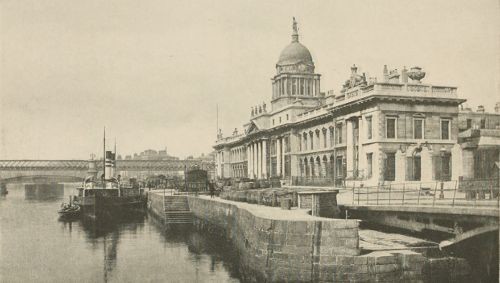
The Customs House, Dublin
One of the employees of the cemetery, who showed us around, said that it was the intention of Parnell’s friends to erect a monument to correspond with that of Daniel O’Connell on the other side of the chapel, but after a discussion of several years they had decided to place the memorial downtown at the site I have already mentioned, where it would always be before the eyes of the public. O’Connell’s body is buried in a crypt underneath the monument. His heart is in a casket in the chapel of the Irish College at Rome.
Several other famous Irish patriots are buried in Prospect Cemetery, and I asked the guide where the body of Robert Emmet was laid.
“That’s a great sacret,” he answered mysteriously, “an’ I wouldn’t tell it to yer honor avin if I knew; with all respict to yer honor. It woul’ be the same as me life is worth. The soul of Robert Emmet has gone to God. His bones is in the hands of the friends of Ireland, but will remain in their prisint sacred hiding place until Ireland is free.”
Michael Davitt is buried in the town of Straid, County Mayo, where he was born and where his parents were evicted from their home during his childhood. The grave is marked with an ordinary stone. There has been no movement thus far for a monument in his honor. His widow lives at Dalkey, the lovely suburb of Dublin by the sea, which I describe elsewhere. She is in excellent circumstances financially, has a comfortable home,—much more comfortable than any she had during her husband’s lifetime,—and is educating her four children, two boys and two girls, at the best schools. The oldest son, now a young man of twenty-two, is studying law, and promises to show much of the ability of his father.
One bright day I made a pilgrimage to the birthplaces and homes of famous Irishmen in Dublin. It is to be regretted that the people of that city feel so little respect for the memory of their heroes as to permit the scenes that were associated so closely with their careers to become filthy whisky dives. Several of these sacred places are among the most disreputable saloons in Dublin.
Henry Grattan was born in 1746 in a house on Fishamble Street, near the old church where Handel first produced his famous oratorio “The Messiah,” and was baptized in the Church of St. John near by. He was educated in Trinity College, Dublin, and the trustees of that institution have erected a statue in his honor outside the old house of parliament, now the Bank of Ireland, which was the scene of his most eminent services. He is represented in the attitude of pleading with uplifted hands for the liberty of Ireland. The figure is the personification of eloquence.
Grattan spent his early life in Dublin, was admitted to the bar in 1773, and entered parliament at the age of twenty-nine in 1775. He immediately assumed the leadership of the opposition to the government, and it was through his ability and able management that the king and the British Parliament were compelled to give Ireland free trade and the constitution in 1782. What was called “Grattan’s parliament” lasted nineteen years, and its activity was tremendous and comprehensive, and the results may now be seen in every direction. It conferred innumerable benefits upon the city of Dublin and upon the country at large. During the nineteen years it was in session it made greater public improvement than occurred in any single century before. It built the two greatest edifices in Ireland,—the Four Courts and the customs house,—which are beautiful examples of the classic school of architecture, and each cost several millions of dollars. The Bank of Ireland was founded as the financial agent of the government, but Grattan, when he moved its establishment, little dreamed that it would store its gold and transact its business in the very chamber where the act was passed. The Royal Irish Academy was founded to promote “the study of science and polite learning and antiquities.” Three great hospitals were built; the College of Physicians and Surgeons was incorporated and erected, a dignified and stately building upon Stephen’s Green. The commerce of the country was developed and large warehouses and mercantile establishments were erected to accommodate it. Many new manufactories were established. Highroads were built in every direction, coach lines were inaugurated to accommodate travel, and sailing packets to carry passengers and mails across the sea. The canal was built, one hundred miles long, to bring freight to the city. Penny post was introduced. The Guinness brewery was developed, with a great profit to the proprietors, and began to send to England the beer it had been selling for local customers for half a century.
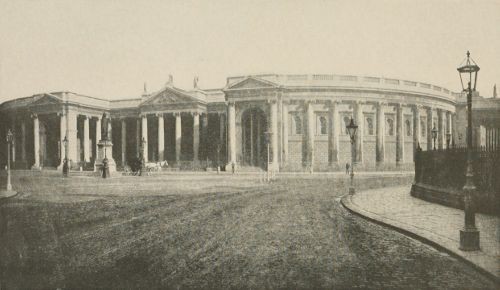
The Bank of Ireland, Dublin
Grattan was the leader of all this prosperity, and introduced many and advocated all of the laws to encourage it. As an acknowledgment of his services, Parliament voted him a gift of $250,000, which enabled him to settle down as a country gentleman at a seat called “Tinnehinch,” near the town of Enniskerry, a few miles south of Dublin, near the watering-place called Bray. The British government offered him the viceregal lodge, now occupied by the lord lieutenant, in Phœnix Park; but Grattan declined it, for fear the gift might be misinterpreted.
This period of self-government, which might be called “the golden age” of Ireland, lasted nineteen years, when “Grattan’s parliament” fell, as so many other good things have fallen, because it became “vain of its own conceit.” It is not expedient, it is not wholesome, for the same party to remain in control of affairs too long. Its members become corrupt, extravagant, selfish, intolerant, and indifferent to the public welfare, and Grattan’s parliament acquired all of these faults. The great leader—and he was one of the ablest political leaders that ever came upon the theater of public affairs—was unable to control his followers. They became restless, they favored measures that he could not approve, and advocated a radical policy toward the British government that he opposed with all his energy and eloquence.
He was soon displaced from leadership by the extremists, who demanded absolute separation from England and encouraged the revolutions of 1798 and 1803. These movements were undoubtedly encouraged by the example of the French Revolution, when the hot heads came into control. Ireland burst into rebellion, which was put down with the utmost severity, and William Pitt, Prime Minister of Great Britain, introduced the act of union which was adopted by the Irish house through bribery, bulldozing, and other disreputable measures.
Grattan was very ill, but, leaning on the shoulders of two friends, and dressed in his old volunteer uniform, he entered the Irish house of parliament, now the cash-room of the Bank of Ireland, and made the greatest speech of his life. But he failed to change the destiny of his country. He did not change a vote, and the bond which now binds Ireland to Great Britain, and which the Irish people have been trying to dissolve ever since, was passed against his vehement protests. If his advice had been followed by the Irish parliament, if its members had listened to his pleadings, the disturbances, the distress, the bloodshed of a century would have been spared. William Pitt bought a majority of the votes and paid for them with pensions, official positions, titles of nobility, and other forms of reward.
The debate provoked a duel between Grattan and Correy, chancellor of the exchequer. Shots were exchanged and Correy was wounded in the hand.
Grattan pronounced the funeral oration of the Irish parliament in the words that are immortal:
“I do not give up my country,” he said. “I see her in a swoon, but she is not dead. Though in her tomb she lies helpless and motionless there is upon her lips a spirit of life, and on her cheek a glow of beauty—
“‘Thou art not conquered; beauty’s ensign yet
Is crimson in thy lips and in thy cheeks,
And death’s pale flag is not advanced there.’”
It is true, as the man of the cemetery told us, that the burial place of Robert Emmet is unknown. Many people believe that his body was given to the surgeons of Trinity College after his execution, because if it had been given to his friends they would have erected a monument to mark his grave. No one of all the many people who admired and loved him has ever been able to obtain a clew to its disappearance. It is a popular belief, which the leaders of patriotic movements encourage, that the burial place is known and will be disclosed, as the man at the cemetery said, when the flag of freedom floats over “The Ould Sod,” but there is no good reason for such a romantic hope. Several of those who would be informed if there were any foundation for such an expectation have told me that it is all romance; that Emmet’s grave has never been discovered and probably never will be, because it doesn’t exist.
I went to the home of Robert Emmet in Marchalsea Lane, near the debtor’s prison, where he used to meet his fellow conspirators while organizing the insurrection of the United Irishmen in 1803. Emmet was a brilliant, eager boy, only twenty-four, and had been expelled from the University of Dublin for sympathy with the revolution of 1798. He went to Paris, remained there for a while until things had quieted down, and then returned to Dublin, where he conceived a rash project to seize the castle and the fort. The authorities were taken entirely by surprise, but the country contingent which had been promised to support him failed to arrive, and Emmet, with less than a hundred men, armed with pikes—simply spearheads mounted on the ends of poles—marched against the castle and, of course, were immediately overcome. Many of his followers, who fled to their homes, were killed at their own doors, and Emmet became a fugitive.
Robert Emmet was born in Dublin in 1778 and was a playmate and schoolfellow of Thomas Moore, the poet. His brother, Thomas Addis Emmet, born in 1764, was involved in the revolution of 1798 and fled to America, where he became eminent at the bar of New York, serving at one time as attorney-general of that State. He left several sons and grandsons.
When Robert Emmet escaped, after the failure of his foolish attack upon the castle, he took refuge among friends in the Wicklow Hills, south of Dublin, to await an opportunity to cross over to France. Against their protests he went at night to say good-by to his sweetheart, Sarah Curran, daughter of the famous advocate, was arrested and tried for high treason. He conducted his own defense with extraordinary ability. His closing speech stands as one of the greatest examples of eloquence in the English language. He was condemned to death and hanged outside of St. Catherine’s Church, upon the spot where Lord Kilwarden, an eminent judge of the highest integrity, was killed by some of Emmet’s men while returning with his nephew and daughter from a visit to the country.
Emmet, in his farewell speech, asked that his epitaph should not be written until Ireland was free, and that undoubtedly suggested the popular belief that his burial place is known and will be disclosed in due time.
Sarah Curran died soon after in Sicily of a broken heart, and Tom Moore, one of Emmet’s most beloved friends and also devoted to Miss Curran, enshrined the pathetic story in a touching ballad:
“She is far from the land where her young hero sleeps,
And lovers are round her sighing;
But coldly she turns from their gaze and weeps,
For her heart on his grave is lying.
“She sings the wild songs of her native plains,
Every note which he loved awaking;
Ah! little they think, who delight in her strains,
How the heart of the minstrel is breaking.”
Near by the place where Emmet and his fellow conspirators planned the revolution of 1803, is No. 151 Thomas Street, the house in which Lord Edward Fitzgerald, leader of the insurrection of 1798, was captured after desperate struggle, and it is a curious coincidence that he and Emmet should both have been arrested by the same man, a certain Major Sirr, in command of a regiment at the castle. Lord Edward’s refuge was the house of a tailor who sympathized with the insurrection, as almost every other artisan in Ireland did, and sheltered him for several days before the arrest. The house is marked with a tablet and an appropriate inscription. Lord Edward was wounded in the shoulder by Major Sirr and carried away to prison, where he died before he could be brought into court.
The Corn Market of Dublin is just beyond the house, and the name of the thoroughfare is there changed to Thomas Street, which is customary in Dublin. Sometimes there is a different name for every block, and it is very puzzling to a stranger. You walk from Clare Street into Merrion Street and from Merrion Street into some other; from Dame Street into the Corn Market, and from the Corn Market into Thomas Street, all unconscious, but the names are plainly posted on the walls of the corner houses both in English and Gaelic, so that he who runs may read.
Thomas Street is very wide, and that is understood when you know it was formerly an open market-place outside the city walls for the sale of country produce. The octroi tax levied by the corporation on the farmers who brought in vegetables, butter, chickens, and eggs was paid in kind, a measure of corn from each sack, a pound of butter from each firkin, and one egg from every twelve, which was the origin of a proverb that eleven eggs make a dozen in Ireland. The taxes were farmed out to the highest bidder, who exacted every penny possible from the farmers and used every means of extortion that could be devised to increase his profit. The most odious of all the Dublin tax contractors in history was a woman named Kate Strong, and they hated her so that after her death the farmers erected a gross caricature of her person holding a large toll dish in her hand. It stood for several years.
James Street succeeds Thomas Street on the same thoroughfare and runs down upon the river quay, where the enormous brewery establishment of the Guinness Company begins.
Across the river from the big brewery is No. 12 Arran Quay, named for the son of the Duke of Ormonde, where Edmund Burke was born in 1729 of a Protestant barrister and a Catholic mother. He was educated at a Quaker school at Ballitore, County Kildare, and at Trinity College, where in 1747 he organized a debating club, which still exists.
After finishing his course in 1750 he went to London “to keep terms at the Temple,” that is, to finish his law studies and prepare for his examinations; but suddenly, owing to some disappointment, he conceived a strong distaste for his profession, and plunged into a wild career of dissipation. He was introduced by Goldsmith to that circle of Bohemians which gathered nightly at the Cheshire Cheese Inn and similar resorts. He was a close companion of Garrick, Johnson, and others, and became one of the many devoted attendants of his beautiful countrywoman, Peg Woffington, the famous actress.
His dissipation gave his family great distress and caused his father to cut off his allowance. This compelled him to do something for himself. He went into politics, and soon made a reputation as a speaker and writer and political manager. He wrote a great deal that was serious and even sublime, and, mending his ways, secured the patronage of the Marquis of Buckingham, the prime minister, who opened the doors of the House of Commons for him. In a very short time he became the most effective debater and the most influential leader of his party. Then his abilities were fully recognized and his fame encircled the world.
He was the ablest friend of the American colonies in England during the Revolution, and harassed Lord North more than any other man. He reached the summit of his influence at the impeachment of Warren Hastings for misgovernment and treason while viceroy in India; and then Burke’s sun began to set. He retired upon a pension, and passed from history with the eighteenth century. One of his eulogists has said that “notwithstanding some eccentricities and some aberrations, he made the tide of human destiny luminous.”
Near Burke’s birthplace is the oldest and the quaintest church in Dublin, built by the Danes before the English came to Ireland and consecrated to St. Michan, a Danish saint. Within its walls is the penitential stool, where “open and notorious naughty livers” were compelled to stand and confess their sins in public and make pledges of repentance and reform. The officiating minister, reciting the fifty-first Psalm, led the offending sinner from the altar to the foot of the pulpit,—barefooted, bareheaded, and draped in a long white sheet,—and placed him upon the stool of repentance to hear a sermon directed at his particular sins.
The tower of St. Michan’s dates from the twelfth century, and is one of the most beautiful things in Dublin. The view from the top of it includes all the city, which is divided into two almost equal parts by the River Liffey and spreads over an uneven surface from the dark green woods of Phœnix Park to the dark blue waters of the Irish Sea.
Handel used to play the organ in St. Michan’s Church, and it was there the public first heard the score of “The Messiah.”
The most remarkable feature of St. Michan’s, however, is a peculiar preservative effect from the soil in the crypt upon the bodies that are buried there. They mummify before decay sets in and turn into a leathery brown, similar to the mummies of Egypt. The vaults are filled with remains that have lain there for centuries. Among them is the body of one of the kings of Leinster, and beside him is the corpse of a baby, from whose tiny wrists white ribbon has been hanging since its funeral in 1679. Every corpse in the crypt is mummified in the same way, and it is the only place in Dublin where this phenomenon occurs. Nor is there any satisfactory explanation of the phenomenon. The vaults are absolutely dry. The popular theory is that a subtle gas arising from the peaty soil suspends nature’s law of decay.
There will always be a controversy among Irishmen as to whether Edmund Burke or Daniel O’Connell was the greater man. They were so different in their characteristics that it is difficult to draw a comparison. O’Connell was not a native of Dublin. He was born at the humble village of Cahirciveen, in County Kerry, one of the most forlorn, impoverished, and hopeless sections of the west coast. He was the son of an exile who fled to escape arrest and entered the service of France, and from him O’Connell inherited an intense prejudice and hatred of everything English and Protestant. He was educated in Cork for the priesthood, but changed his mind and was called to the bar when he was twenty-three years old. He immediately made a reputation, and by the time he was thirty was regarded as the ablest advocate in Ireland, without an equal in oratory. Probably no man ever surpassed him before a jury.
O’Connell is regarded by many as the ablest of all Irishmen, but, as I have said, this claim is disputed in favor of Edmund Burke. He was equally strong as a politician and undertook the cause of Catholic emancipation in his very youth. In those days all Catholics were disenfranchised; they could not hold office or even vote; the schools were closed to them, and a Catholic child could only be taught by a private tutor or governess. Daniel O’Connell organized the parish priests for the movement and was the first to bring the clergy into politics. Through them he organized the people, and regular contributions were collected in the churches to pay the expenses of the campaign.
O’Connell was the first Catholic to enter parliament, and the Duke of Wellington confessed that this was permitted only to avert a civil war. In 1828 he was elected to the British House of Commons, but was not admitted because he refused to take the anti-Catholic oath. He came back to his constituents and was elected again, and they continued to elect him, just as the merchants and bankers in the city of London continued to elect Baron Rothschild, who was refused admission for the same reason,—because he would not take the oath. He was the first Jew, as Daniel O’Connell was the first Roman Catholic, to obtain a seat upon the floor.
O’Connell was elected lord mayor of Dublin in 1841 and was the first Catholic to hold that office. At the height of his fame and power he might have been a lord protector or the king of Ireland, but he advocated peaceful revolutions, and, like Grattan, lost his influence because he would not consent to the policy and the methods of the radical and revolutionary element. In 1847 he went to address a meeting of his sympathizers at Clontarf, a suburb of Dublin, where Brian Boru won his great victory over the Danes in the last battle between Christianity and heathenism upon the soil of Ireland. The meeting had been forbidden by the authorities, and O’Connell was arrested, convicted, and sentenced to prison for two months. This broke him down. When he was released he left Dublin, started for Rome, and died at Genoa on his way. He is buried in Prospect Cemetery under a lofty tower. His will may be seen in the public records office in the Four Courts. He married his cousin, Mary O’Connell, and had four sons, all of whom were men of character and ability and have served in the British parliament.
The anniversary of the birth of Thomas Moore is celebrated in Dublin every summer, and a programme of his “Irish Melodies” is sung by local musicians—sweet old-fashioned ballads like “The Harp That Once through Tara’s Halls,” “Believe Me, if All Those Endearing Young Charms,” and others like them. The proceeds of the concert are devoted to a fund which is to be raised to erect a monument in memory of this most popular of Irish poets, whose songs are heard in every cottage in Ireland. His most pretentious poem, a Persian epic called “Lalla Rookh,” brought $15,000,—the highest price ever paid for a poem. Scott’s “Lady of the Lake” and some of Tennyson’s and perhaps Kipling’s poems and other poets’, have received larger sums in royalties, but no other man was paid so much for his verses in advance of their publication.
Moore was born in a little house on Aungier Street, Dublin, which is unfortunately now a filthy saloon. He was educated in a little grammar school in Johnston’s Court, off Grafton Street, near the Shelbourne Hotel, where Richard Brinsley Sheridan was also a pupil. Petty, the first great Irish scientist, who was also a physician and surveyor, was educated there. His book of surveys made for Oliver Cromwell is still used by the authorities.
Tom Moore was a chum of Robert Emmet at Trinity College. After graduation he entered journalism and was connected with the London Times and the London Chronicle. He went to Bermuda as British consul in 1803, and visited the United States before he returned. He was lionized everywhere because his plaintive Irish ballads, which he set to the music of the oldest peasant airs, were in the portfolio of every musician in the civilized world, and his social attractions made him a welcome guest. When he returned to England he was given a pension of $1,000 a year until his death.
Volumes might be written concerning the literary reminiscences of Dublin. Addison was private secretary to the notorious viceroy Wharton, and the evidence indicates that his behavior was not so blameless as the readers of Macaulay’s sketch of his life would infer. His official correspondence shows that he was not exempt from the usual weaknesses of humanity and not above making an honest penny out of his office. He seemed to be avaricious, and, although holding a position of the closest confidence to the lord lieutenant, took an interest in several commercial ventures that were not entirely beyond criticism.
Samuel Lover and Charles Lever, those two greatest of all delineators of Irish character, were both born and educated in Dublin and did most of their work there. Their graphic sketches of Irish life may have been accurate in their day, and now and then, I am told, appears one of the rollicking types of the Irishman they describe; but, while the character of the race may not be changed, its habits and customs are quite different from those of the period they describe. There’s a grammar school at which Tom Moore and Richard Brinsley Sheridan both received their education. Sheridan was born on the same block, and the house is marked by a tablet. Another tablet near the entrance of a house only a few steps distant shows where Sir William Hamilton, the great Irish mathematician, lived. Mrs. Hemans, that gentle hymn writer, whose lines were much more familiar to the reading public half a century ago than they are to-day, lived and died in the same neighborhood, and was buried in St. Anne’s Church, near by. Her epitaph, taken from one of her own serene poems, reads:
“Calm on the bosom of thy God,
Fair spirit, rest thee now!
Even while with us thy footsteps trod,
His seal was on thy brow.”
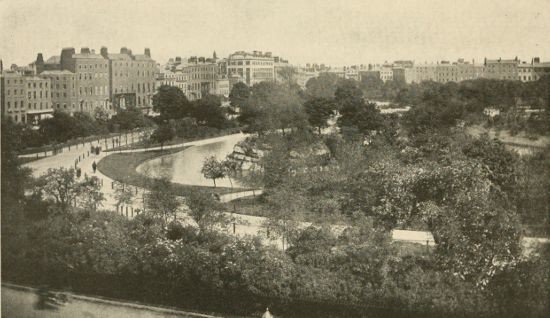
St. Stephen’s Green. Dublin
Near by the home of Mrs. Hemans is the Royal Irish Academy, occupying a fine old mansion, once the residence of Lord Northland. It is the oldest and most influential of the learned societies of Ireland, and possesses a large number of ancient manuscripts in the Gaelic tongue, most of them, despite their great age, beautifully clear and legible. The academy, according to its charter, was founded “for the encouragement of science, polite literature, and antiquities.” There is a good deal of interest in the attempt to revive the Gaelic tongue, but the bitter partisanship of politics renders polite literature quite useless.
There is a great deal that is green about Dublin, and the remark is not intended as a joke. There are several fine parks and breathing-places scattered about the city. Many of the residences have large back yards filled with trees and flowers that are hidden from the public by the high walls that guard them from the street, but one can see them from the tops of the tram cars as he rides about. The suburbs of the city are very attractive, with plenty of large trees and vine-clad walls and pretty gardens, and here and there a tennis court. As you look down upon the city from a tall tower there is almost as much foliage as in Washington. Phœnix Park is famous, and one of the largest public playgrounds in the world.
St. Stephen’s Green is a rectangular inclosure, twenty-two acres in extent and corresponding to four city blocks, in the fashionable quarter, and is surrounded by the mansions of the nobility and the homes of the rich. Lord Iveagh, the representative of the Guinness Brewery family, has a residence on one of the sides, and the archbishop’s palace is on the other side, near the Shelbourne Hotel, which is the best in the city, and several clubs. St. Stephen’s is handsomely laid out, and has what I have never seen before in a city square,—a bridle-path nearly a mile long around the interior of the fence, where several gentlemen take their exercise on horseback in the morning.
Sir Walter Scott was entertained in what he writes was “a very large and stately house in Stephen’s Green, which I am told is the most extensive square in Europe,” and, writing to his wife, he said, “The streets contain a number of public buildings of the finest architecture I have seen anywhere in Britain.”
A few blocks away from St. Stephen’s Green is another large park known as Merrion Square, which is a private inclosure like many of the small parks in the city of London, and is accessible only to the residents of the neighborhood, who, I understand, purchased the land and made it into a park two or three hundred years ago, so that the public has no rights there. Each of the leaseholders who are entitled to its privileges is required to pay $5 a year for maintaining it and “half a crown for a key to the gates,” as I was informed by a policeman on that beat. It is a pretty place, with deep, lustrous turf such as you seldom see outside of the British Isles, and find in Ireland smoother and richer and greener than anywhere else. There are a pond and several tennis courts, cricket and croquet grounds, which are occupied every afternoon by the rich families in the neighborhood; and it makes you feel a little resentful to see the children of the poor, who need that breathing space more than the owners, peeking through between the iron pickets. It is said that this square plot of ground, which is equal to four ordinary squares in area, was formerly a pond, and that the Duke of Leinster in early days used to sail a boat upon it. But it was drained two hundred years ago or more, and the splendid great trees that are growing there now were then planted. Leinster House is in the neighborhood.
The residences around St. Stephen’s Green and Merrion Square are built of ugly brown bricks, but are spacious in their proportions, and were intended for large families of ample means, and the aristocracy have always occupied them. The Duke of Rutland has one of the largest, and in Merrion Street, just around the corner, at No. 24, in a large house now occupied by the land commission, the great Duke of Wellington was born. It was the town residence of the Earl of Mornington, his father, and her ladyship came in from Dangan Castle, twenty-four miles outside the city, and the country residence of the family, a few days before the event, which occurred on April 29, 1769. There is nothing either in the castle or in the town house to interest people to-day, except that they were the birthplace and the home of one of the greatest of Irishmen, and his fellow countrymen have raised a shaft, similar to that at Washington, in Phœnix Park in his honor.
Across from Merrion Square is the National Gallery of Ireland, which was built in 1864, and contains a fine collection of paintings, numbering about five hundred, which have been presented and purchased from time to time. All of the old masters are well represented, and the Dutch school is especially strong. Attached to the gallery is the Metropolitan School of Art, which is liberally supported by the British government, and has a large number of students. Corresponding to the Art Gallery, on the opposite side of a quadrangle known as Leinster Lawn, formerly the garden of the Earl of Kildare, is the Science and Art Museum and the Museum of Natural History. Both are well arranged and full of interesting things, particularly Irish antiquities, historical relics, and examples of Irish industries. The most precious object is an iron bell shaped like an ordinary cow-bell and riveted on each side, which, it is said, St. Patrick used to carry about with him and ring to call the people together to hear mass. It is accompanied by a silver “shrine” or case for its protection, made in the year 1100 at the expense of Donald O’Laughlan, king of Ireland from 1091 to 1105. The “Annals of Ulster,” written in the year 552, refer to this precious object as “The Bell of the Will,” and its history is known from that date. It came into possession of the Archbishop of Armagh in 1044, and was among the relics in the cathedral there until it was brought to the museum in 1869. No one here seems to doubt that it is genuine.
In the adjoining case is another “shrine,” as the case or covering for sacred relics is called, that contains a tooth of St. Patrick, which, according to the tradition, was loosened and fell from his mouth on the door-sill of St. Brone’s Church at Killaspugbrone in County Sligo, and can be accounted for all these years.
A brooch formerly worn by the King of Tara is also shown as an example of the prehistoric work of the silversmiths of Ireland, with many other beautiful pieces of silver and gold which were dug up in the bogs.
Between the museum and the library is a fine old mansion known as Leinster House, or Kildare House, erected by the great earls of Kildare, the leaders of the Geraldines, who chose this spot four hundred years ago for the location of the largest and at that time the most magnificent city residence in Ireland. It once stood in the center of large grounds, but they have been sold off from time to time, and nearly a hundred years ago the residence passed into the possession of the Royal Dublin Society, which has made it the center of activity during its long and honored career in encouraging and developing the arts, science, and industries of Ireland. The membership of the Royal Dublin Society for two centuries has included all of the famous men of this nation, and they have rendered a very important service. The Royal Library, the National Gallery, the Museum of Natural History, and the Museum of Antiquities owe their existence to this venerable institution, and its influence has gathered the greater part of the pictures in the gallery and the articles of interest in the museums.
Kildare House is a severe pile of black stone, and the guide-book says that “the White House at Washington is largely a reproduction of its main features, though the American building has a semicircular colonnaded porch, which rather conceals the likeness.” But a resident of Washington would find little resemblance between the two buildings, except that they are about the same size and both have windows and a roof.
The corner stone bears a curious inscription in stilted Latin, which illustrates the lofty pride of the earls of Kildare. It is addressed to “The Casual Explorer, who may find it among the stately ruins of a fallen house, and bids him mark the greatness of the noble builders and the uncertainty of all things terrestrial, when the men who raise such splendid monuments can rise superior to misfortune.”
There are several other fine old edifices in the neighborhood, but unfortunately many of the historic houses are passing away from the families who built and lived in them, and are now being used for public offices or business purposes.
About half a mile from Trinity College, on the road to Phœnix Park, is the ancient prison of Dublin, called Newgate, after a similar institution in London, and it has had a similar history. It has been the scene of horrible incidents; it has detained many of the purest and ablest martyrs for Irish liberty within its walls, and a hundred years ago it was frequently described in sketches of Irish life, in terms similar to those that were written of the Fleet Prison and Newgate in London. It was customary to have executions outside the walls in public, and the night before they were hung favored criminals were allowed to entertain their friends in a reckless, disgraceful carousal. Such a scene is described in a ribald song entitled “The Night before Larry was Stretched.”
“Then in came the priest with his book,
And spoke to him smooth and so civil.
Larry tipped him a Kilmainham look,
Then pitched his big wig to the devil;
Then raising a little his head,
To get a swate drop of the bottle,
And painfully sighing he said,
O, the hemp will be soon round my throttle.”
Phœnix Park has about eighteen hundred acres of lawn, flower beds, forest, meadow, and pasture, and nineteen miles of perfect roadway. It is open to the public at all times and there are no restrictions. A horseback rider can gallop over the grass anywhere, cricket matches can be played wherever is most convenient to the players. Racing meetings are held on the turf several days in each month, the course being laid out by movable fences. Polo, hockey, football, and all other kinds of outdoor games are going on all the time, and almost the entire working population of Dublin may be seen scattered over the park during these long summer evenings, when one can read outdoors until after nine o’clock. There is no more beautiful park, and no greater enjoyment is found in any similar place in the world.
The viceregal lodge, in which the lord lieutenant of Ireland resides nine months in the year, is in the center of the park, surrounded by an inclosure of fifteen acres with a garden, stables, and cottages for the servants. The chief secretary of Ireland and the under secretary have official residences in the same neighborhood, provided by the state. Immediately before the windows of the viceregal lodge Lord Frederick Cavendish, chief secretary for Ireland, and Thomas H. Burke, the under secretary, were assassinated in 1882. The assassination was witnessed by the occupants of the lodge, but before they could reach the place the assassins had escaped. The spot is now marked in an unobtrusive manner.
Phœnix Park was formerly owned by the Knights of St. John. When their lands were confiscated by Henry VIII. at the time of the Reformation, the monastery was selected as the official residence of the viceroy. Additional grounds were purchased later by the Duke of Ormonde, when he was viceroy, and the great Chesterfield, when he held the office, did the landscape gardening, which illustrates his exquisite taste. The park is beautiful always, they say, but it could not be more beautiful than it is in May, when the hawthorn trees are white with blossom, the furze bushes are blazing with orange, and the rhododendrons, which grow to enormous size, are great banks of purple against the rich, deep foliage. Every flower that grows in that climate seems to be in bloom, and Phœnix Park looks as if it had just left the hands of the Creator.
VII
THE OLD AND NEW UNIVERSITIES
Imagine a university and a campus of forty-seven acres of lawn and grove where Trinity Church stands in New York or where the post office stands in Chicago or St. Louis. In Washington we have something like it in the mall where the National Museum, the Smithsonian Institution, and the Agricultural Department are. Trinity College, Dublin, has an equally expansive setting of green grass and grove and flowering shrubs, cricket grounds, and tennis courts, surrounded on all sides by business houses, clubs, and hotels. It is like an island of verdure in the midst of an ocean of trade and commerce. On one side of the campus the outside world is kept at bay by a continuous line of dormitories and lecture-rooms which overlook a busy street from the windows of one wall and a peaceful lawn from the windows of the other. On the south side the barrier is a high iron picket fence hidden in a wonderful hedge of hawthorn and laburnum bushes. On the other side of that hedge are shops, and a street-car line that leads to the more attractive part of the city. There are only two entrances to the college green, one at the east end and the other at the west, and it is nearly a half mile walk from one to the other across the green and among the buildings. The main entrance and the main buildings face the Bank of Ireland and look upon Dame Street, which is the Wall Street of Dublin. There is a little green crescent to divide the entrance from the street, with bronze figures of Edmund Burke and Oliver Goldsmith, two of the most distinguished of the alumni.
The main building is a fine example of architecture, and the house of the provost, which adjoins it, is a gem of the Elizabethan type. The other buildings are unpretentious. They are rather low and long and plain, in excellent proportions, but without particular individuality, although the engineering building, which stands out on the campus, is an exquisite example of modern architecture, and Ruskin pronounced it the most beautiful modern structure in the United Kingdom.
As you enter through a low archway under the main building you come into a quadrangle formed by a dormitory and an examination hall at the right. Beyond that is a library. Another dormitory stands on the left, and the chapel and the dining-hall (the last two have Grecian porticos), and directly before you a bell tower of beautiful and original design erected about one hundred years ago. Beyond the first quadrangle is another, which is gloomy and uninviting. The buildings are plain, and the dark stone of which they are made is not cheerful. The students call it “Botany Bay,” because of the prison-like style of the architecture and its uninviting appearance. The buildings surrounding it are dormitories, and in one of them, No. 11, Oliver Goldsmith roomed. He wrote his autograph with a diamond upon one of the panes of glass, which has since been removed and preserved in the library, where it lies in a case beside the original manuscript of Handel’s oratorio, “The Messiah,” which was given there for the first time in 1745. A portion of it was written in England, but it was completed in Dublin and sung by a Dublin choral society immediately after.
In “Botany Bay” is a pump of great age and much history. In early days it was the focus of academic disorder, and any policeman, sheriff, or bailiff who dared violate the sacred precincts of Trinity was purged of his guilt by a thorough ducking. The origin of this form of punishment is attributed to a famous Dr. Wilder, who for many years was provost of the college. He happened to be crossing the campus one day, when a bailiff, who had a writ to serve, was being baited by a group of students, and called out to them something like this: “Young gentlemen, be careful that you do not put him under the pump,” and they took the hint.
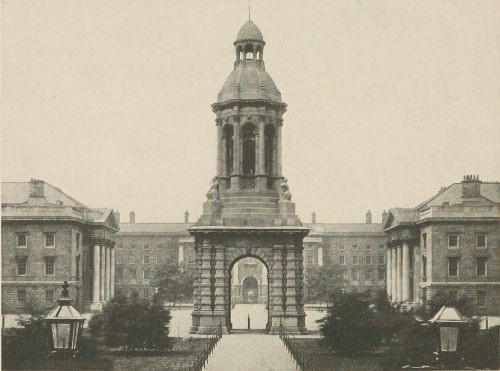
Quadrangle, Trinity College, Dublin
Another version of the story is that Dr. Wilder cried out, “Young gentlemen, for the love of God don’t be so cruel as to nail his ears to the pump;” and certain authors have claimed that they interpreted him to mean the reverse, and did what he had forbidden them. But I am assured by competent authority that the former and more humane version is the true one, and all agree that ever since those boisterous days every officer of the law who has been caught within the college grounds has been given an involuntary bath from “Old Mary.”
The war between the students and the police has continued ever since the foundation of the college, and as the buildings are situated in the very center of the city these conflicts have been unexpected and more frequent than they might have been otherwise. In former days “Trinity boys” never went out of the grounds without their peculiar weapons, which were the massive keys of their rooms, about six inches long and weighing a half a pound or more, which they would sling in handkerchiefs or in the skirts of their gowns and use very effectively for offense or defense, as the case might be. On one occasion several students were captured and hustled off from their fellows to a butcher-shop, where they were hung from the meat hooks. The rumor ran like a prairie fire that the captives had been impaled, but when the rescuing party arrived it was discovered that they were hanging only by the waistbands of their breeches.
The walls of Examination Hall are hung with portraits of eminent men, and in one corner is a full-length painting of Queen Elizabeth, the founder. There is a superstition among the students that the picture has an evil eye, and that whoever sits within her sphere of influence at examinations is bound to fail. Hence the benches in that neighborhood are empty. But a certain alcove in the library is quite crowded. Several full sets of examination papers are preserved from year to year in that particular alcove, and every day during examination weeks it is filled with students cramming from them.
Across the quadrangle is the chapel. It is not specially interesting, although there is some fine wood-carving in the stalls. The students are required to wear surplices, and look very awkward in them, although the white gowns light up the room and make it much more cheerful than if they wore black. When I attended service Sunday morning two-thirds of the stalls were vacant, although attendance is supposed to be compulsory. I counted exactly one hundred and four persons present, including the preacher, the professors, and ten boys in the choir. These boys belong to the choir of St. Patrick’s Cathedral, and are loaned to the college authorities in order to increase the interest of the Sunday services. It is considered the finest choir in Ireland, but that isn’t saying much.
The organ in the gallery has a curious history. It was made in the Netherlands for some church in Spain, and was on its way when the ship was captured in 1702. The Duke of Ormonde, serving in the fleet, claimed the organ as his part of the prize money, and presented it to the college. Many of the old pipes have been replaced, but the case remains the same. Another interesting relic is a great chandelier which formerly hung in the House of Commons when the Irish parliament occupied the building now used for the Bank of Ireland.
Beyond the chapel is a curious-looking recumbent statue made of onyx, which has been crumbling so rapidly for years that it now bears very little resemblance to a human form, and the features are entirely effaced. The students claim that it was intended for Queen Elizabeth, the founder, but it was really a figure of Luke Chaloner, one of the first promoters of the institution.
The grounds occupied by the college once belonged to All Hallows monastery, which was suppressed by Henry VIII. and the property confiscated. It stood well outside of the city walls and was unoccupied when, toward the end of the reign of Queen Elizabeth, a number of Dublin scholars raised a fund of £2,000 to establish an institution for higher education. Queen Elizabeth gave the confiscated estates of several rebel chiefs and James I. increased the endowment, but it was not until the reign of William and Anne that the college was really prosperous. They were very generous toward it, and the Irish parliament made liberal grants. But many a time the fellows have been compelled to melt up the college plate and resort to other desperate means to find money to pay for food and fuel.
During the entire history of the institution its faculty and students have been loyal to the British government and to the Protestant church. It has refused to receive Roman Catholics into the faculty, and for centuries Roman Catholics were prohibited from enjoying its advantages in education. Therefore it is not strange that it is under the ban of that church, and there has not been a Catholic student upon the rolls for many years. An Irish Roman Catholic gentleman remarked one day to a member of the faculty: “If I had wanted to send my son to Trinity I would have to fight first my priest, second my bishop, and third my wife. Therefore I sent him to Oxford.”
There are now five departments in the university,—the regular academic department, and schools of law, medicine, theology, and engineering. There are in attendance to-day twelve hundred and forty-one students.
Although the institution is familiarly known as Trinity College, that is the title of the academic department, and with its affiliated schools it constitutes the University of Dublin. The charter bears date of March 24, 1591, under the title of “The College of the Holy and Undivided Trinity, near Dublin.” Previous to 1873 the faculty, the fellows, and those who held scholarships must be members of the Church of Ireland. Since then all restrictions or disabilities have been removed, although the history and traditions of the institution will not permit any self-respecting Roman Catholic to send his son there.
Rank is strictly recognized among the students. Noblemen, sons of noblemen, and baronets are matriculated as such under the titles of nobilis, filius nobilis, and equas; ordinary students are called pensioners. Sizars are students of limited means, who must make oath that their fathers’ incomes are less than $500 a year, which exempts them from all fees and gives them their commons or meals free of expense. Pensioners pay $60 a year, fellow commoners $150, and noblemen $300. When a young man enters in either of these classes he selects his tutor and makes application for a room, which is assigned him as vacancies occur, and he is recorded. A deposit of from $40 to $150 is required as security against any injury to the property. The room rent varies from $20 to $100 a year. All students are compelled to attend chapel, both in the morning at half-past eight and in the evening at nine o’clock, and wear surplices, but upon certificates may be allowed to attend one of the Presbyterian churches.
At half-past ten every Saturday morning the junior dean appears at the hall and reads out the names of all students who have violated the rules or neglected their duties during the week, and those who are present may offer excuses, which may or may not be accepted by the dean. If they are not accepted the student is fined a sum of money in lieu of other punishment, and these fines are added to the commons fund, which goes to pay for the meals of the students and is controlled by the “clerk of the buttery books.”
Fellow commoners pay seven shillings and sixpence a week for board, pensioners five shillings, and members of the nobility ten shillings. A fine of five shillings a week is imposed upon all students actually resident in college who do not take their meals at the commons.
Ten students holding scholarships, called “waiters,” are annually appointed to say grace before and after meat in the commons hall, which must be repeated in Latin in a form prescribed by the statutes of the college. All students are required to be in the college grounds before nine o’clock for roll-call. After roll-call no one is permitted to pass the gates without a written order from the dean. Those who do so are severely fined.
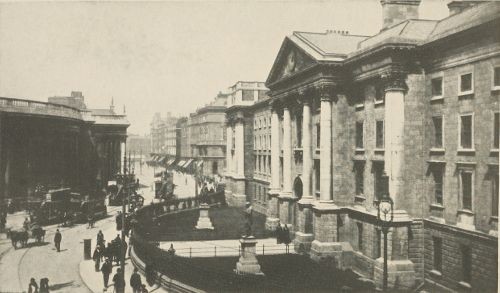
Main Entrance, Trinity College, Dublin
Trinity College is one of the few great institutions of Europe which give full degrees to women on the same terms as to men. There is no distinction in rules or conditions or in any other respect. Women are admitted to all of the several schools—arts, science, engineering, law, and medicine—on an equal footing. There are now about one hundred in attendance. At first the university gave degrees to all women who could pass the regular examinations, and they came here in droves from Oxford, Cambridge, and other institutions where they had been hearing lectures but are not given degrees. All they had to do was to enter the examinations and fulfill the requirements. But two years ago this practice was stopped, and now no degrees are conferred upon young women who do not take the full course at Trinity. The fees are the same as for men—$50. The women students are mostly Irish, although a few English girls, who are not satisfied with the certificates given them at Cambridge and Oxford, come over here from Girton and other institutions and work for the full degrees of B.A., B.S., Ph.D., and even for diplomas in law and medicine. To accommodate them the university has recently purchased a fine old mansion in Palmerston Park, where fifty or sixty girls are now lodged under the care of a matron, subject to rules similar to those which govern the men students in the dormitories on University Green. Twenty-two degrees were granted to women in 1908, and about the same number in 1907, chiefly in the department of arts, which is the same as our academic courses, and most of the recipients are intending to be teachers in women’s schools and colleges.
The story of the invasion of Trinity College by women is quite interesting. The charter, which was granted by Queen Elizabeth, recognizes no distinction of sex, race, or religion, and when Professor Sylvester, now in the chair of mathematics in one of our American colleges, was refused a degree at Cambridge because he was a Jew, he came here, passed his examinations, and was given one. This opened the gates, and several young women who had been denied degrees at Oxford and Cambridge came to test their rights. On June 9, 1903, the senate of the university passed a resolution “that it is desirable that the degrees of Trinity College, Dublin, shall be open to women, and that his majesty’s government be requested to obtain a king’s letter empowering the university to grant degrees to women on such terms and conditions as may seem to the board and council, within their respective provinces, on full consideration, to be most expedient.”
On January 16, 1904, “Edward VII., by the Grace of God of the United Kingdom of Great Britain and Ireland and of the British Dominions beyond the Seas, King, Defender of the Faith, sends greetings to all to whom these presents shall come, with information that by the advice of our Right Trusty and Right Well Beloved Cousin and Councillor, William Humble, Earl of Dudley, Knight Grand Cross of the Royal Victorian Order; Lord Lieutenant General and Governor-General of that part of our said United Kingdom called Ireland, do by these presents authorize and empower the said Provosts and Senior Fellows and their successors in office, and the said Senate of the University of Dublin, and the Caput of the said Senate and all members thereof and all other persons or bodies whose concurrence is necessary for the granting of degrees, to interpret the charter and the statutes of said college in such a manner that women may obtain degrees in the said University, all previous laws, ordinances, and interpretations notwithstanding.”
Under this authority on May 5, 1904, the board adopted rules admitting women to all lectures, examinations, degrees, and prizes except fellowships and scholarships, their fees being the same as those for men, and all the rules applying to them equally, except that in the medical department “women shall practice dissection separately from men and medical lectures shall be given them either separately or in conjunction with men, as the professors may think best.”
In June, 1904, the senate also passed “a grace” for giving degrees to women who had attained a certain prescribed status in the universities of Oxford and Cambridge, and had passed all the examinations and fulfilled all the other requirements for the granting of degrees for men at Trinity.
The regulations require that women shall pay the same fees except those for the commons (meals); that “except when entering or leaving college they shall wear caps and gowns upon the college grounds unless accompanied by a chaperon.” They are not expected “to remove their caps in the presence of the provost and fellows, and may wear them during lectures and examinations.” They are not permitted to visit the rooms of men students in college unless accompanied by a chaperon. They are examined separately; they are not required to attend chapel, and Miss Lucy Gwynn was appointed lady registrar to act generally as adviser to the women students and to report upon their conduct.
Later it was decreed by the provost and senior fellows that scholarships should be established for women upon the same terms as men to the value of $150 a year and exemption from ordinary college dues, and several women have already obtained them.
The library of Trinity College is one of the most interesting places in all Ireland and it has two relics which are incomparable in historic and artistic value. One is the harp of Brian Boru, the greatest king in Irish history. He ruled all Ireland for forty years, in the tenth and eleventh centuries, and it is said that he was the only native that ever was successful in keeping Ireland in peace. This is “The Harp that Once through Tara’s Halls,” inspiring that beautiful ballad of Tom Moore. Its authenticity has been questioned, and some people assert that it once belonged to Henry VIII. of England, but no loyal Irishman will admit the possibility of such a thing.
The other relic, which cannot be questioned, is a copy of the four gospels, known as “The Book of Kells,” because it was made by the monks of a monastery founded in 546 by St. Columkills, or St. Columba,—the name is spelled both ways,—and the antiquarians think that it dates back very nearly to that year. It is often described as “the most beautiful book in the world,” and one may easily believe such a claim to be true. About three hundred pages, eight by fifteen inches in size, are covered with the most exquisite pen-work that you can imagine, embossed with gold leaf and illuminated in brilliant water-colors with perfect harmony and marvelous skill. I have seen all of the great collections of missals in the world, but have never found so fine and perfect an example as this. There are many equally fine, but of smaller size, in the museums in London and the continental cities. Pierpont Morgan has several specimens of that sort of work, but the “Book of Kells” is unsurpassed both for its artistic perfection and the size of its pages, which are two, three, and four times larger than the best of the other works of the sort. Each page must have required months to execute; each is different in design and coloring, but is harmonious with the rest, and it is difficult to say which is the most wonderful and the most beautiful.
The book was in the monastery at Kells in 1601 when that institution was raided by the Spaniards, and having valuable covers of gold, was stolen by some ignorant soldier who stripped it and threw the text into a bog where it was found coverless by a peasant a few days later and taken to Archbishop Ussher. He recognized it and kept it in his library until his large and unique collection of books and manuscripts was purchased by Cromwell and presented to Trinity College. There are other remarkable books in the collection, including several chronicles of the early history of Ireland, which are priceless, and one marvels at the artistic skill and labor that they represent. They are also important as illustrating the culture and learning of the people of Ireland at a period when England and the continental countries of Europe were still submerged in the barbarism of the Middle Ages.
The library of Dublin University is one of several government depositories, under the Stationer’s Act, and receives a copy of every book printed in the United Kingdom. By this method its shelves have been rapidly filled and the catalogues contain more than a million entries.
There is another, known as the National Library, only a few squares away. It occupies a beautiful building erected at a cost of $750,000 to correspond with the National Museum, which occupies the other side of a quadrangle. It was opened in 1890 and has about three hundred thousand volumes. There is a reading-room seventy-two feet square, with a glass dome, where many people come daily to consult works of reference, and certain persons have the privilege of taking books away.
A bill that had been pending in the British parliament for several years was passed in the summer of 1908 authorizing the establishment of two new universities, one at Belfast, under the auspices of the Presbyterian church, and the other at Dublin, under the control of the Roman Catholics, although both theoretically will be non-sectarian, and no religious tests will be required or allowed at either.
The enactment of this law is a part of the contract agreed upon between the liberal government and the leaders of the Irish party in parliament, which is being carried out in good faith, and will be concluded at the next general election, when it is hoped that the question of home rule in Ireland will be submitted to the people of the United Kingdom.
The Irish Catholics have been demanding a university of their own supported by the state for many years. There has been no institution for higher education at which a self-respecting Catholic could seek an education, because the University of Dublin represents the Church of Ireland, just as Oxford and Cambridge represent the Church of England, and until a few years ago placed a ban upon Catholics and would not permit them to have anything to do or say about the management. It was perfectly natural, therefore, that when the trustees of Trinity took off the ban, the synod of Maynooth should put it back, and Catholic students were forbidden to attend lectures there by what is known as Decree XXXVII. of the synod of Maynooth, declared in 1875 and confirmed by Pope Pius IX.
Religious tests at Oxford and Cambridge were abolished in 1871, at the same time as at Trinity. In 1874 an attempt was made by the famous Monseigneur Capel, who is now living in California, to found a Roman Catholic university in England, but it failed, and since then the young men of that church have attended Cambridge and Oxford, by permission of the hierarchy, but the ban has never been removed from Trinity College, Dublin. And one cannot blame them for not removing it. They cannot forget the past. The Roman Catholics of Ireland were deprived of educational privileges for centuries, and under the penal statutes of Queen Anne were debarred from the learned professions. There are no religious tests in Trinity College to-day, it is true, and students who do not belong to the Church of Ireland are not required to attend chapel. But the atmosphere and the influences and every tendency at Trinity are naturally toward the Church of Ireland, which has a theological school as a department of the university.
Three independent non-sectarian institutions, known as Queen’s colleges, were founded by Queen Victoria about forty years ago, at Belfast, Galway, and Cork. These are known as “godless colleges” because they have no chapels, no religious exercises, and no religious instruction. Queen’s College at Belfast, however, is distinctively a Presbyterian institution. Nearly all the faculty are prominent and active members of that denomination, and students who are intending to enter the ministry go from Queen’s to Magee College, Londonderry, which is under the care of the Presbyterian general assembly. Therefore Queen’s College, Belfast, occupies a relation to the Presbyterian denomination quite as intimate as that of Trinity with the Episcopalians.
The same conditions apply to both the Roman Catholic theological seminary at Maynooth and the Presbyterian theological seminary at Magee. The students at both of these institutions will be excused from residing in the new universities, and may continue their studies exactly as at present, going up to Dublin and to Belfast only to receive their degrees. Several of the Roman Catholic colleges and the two “godless colleges” now supported by the state at Cork and Galway are to be made a part of the Roman Catholic university at Dublin, but Section 3 of the bill provides that “no test whatever of religious belief shall be imposed upon any person as a condition of his becoming or continuing to be a professor, lecturer, fellow, scholar, exhibitioner, graduate, or student of, or of his holding any office or emolument, or exercising any privilege in, either of the two new universities or any constituent college. Nor in connection with either of the new universities or any such constituent college shall any preference be given or advantage withheld from any person on account of his religious belief.” It will be permitted, however, for religious denominations to erect chapels or other houses of worship in connection with either of the new universities with their own funds for the accommodation of students professing their faith, but no students shall be required to attend religious exercises or religious instruction, and they shall be entirely voluntary. It is well understood, however, and the bill is intended precisely for that purpose, that one of the universities shall be Roman Catholic and that the other shall be Presbyterian, just as the present University of Dublin represents the Protestant Episcopal Church of Ireland.
Education and religion have always gone hand in hand both in ancient and modern Ireland. The history of one is the history of the other. Instruction has always been given either by or under the supervision of priests and monks, and there have been regular teaching orders, like the Christian Brothers, which combine religious with secular instruction, with the catechism as their chief text-book. As early as the middle of the sixth century the monastery schools of Ireland were famous all over the world, and even at that date there were three thousand students at Clonarde College, and an equal number at Bangor, at Monasterboice, and several other centers of learning. The sons of kings, chiefs, nobles, and other favored classes lived in the monasteries with their instructors, but usually each ordinary student had a little hut of sod built by himself, and often those from the same locality or the same clan built houses for their common use.
All of the more important schools had students from foreign lands. An English bishop, writing in the year 705, says that they came in “fleet loads” from Great Britain and the Continent. Many of them were princes of royal houses. Several of the early kings of France and other countries were educated in Ireland, which was for three or four centuries the most learned country in the world. Great numbers of Irishmen were employed as professors and teachers in the schools and colleges of England and the Continent. Charlemagne, Charles the Bold, and other monarchs of the Middle Ages called learned men from Ireland as guests and as tutors in their courts, and the influence of Irish scholars was greater than that of those from any other country. For four or five hundred years after the time of St. Patrick the monasteries of Ireland were the center and source of science, and art and learning of every kind and the literature of the Gaelic reached its highest glory. The Danish invasion destroyed these conditions and threw everything into disorder. The monasteries were sacked, the monks were scattered, the students fled to their homes, and the development of learning and art suddenly was arrested. There was another revival during the reign of Brian Boru, but that was interrupted by the Anglo-Norman invasion, and Irish learning never again reached its previous fame.
During the Reformation all the monasteries throughout Ireland except in a few remote districts were suppressed. More than four hundred were entirely destroyed and their inmates were turned out upon the world by the agents of Henry VIII. Cromwell’s governors were even more severe and cruel, and the parliaments of 1692 and 1695 passed penal laws forbidding the Catholic children of the country to be educated, either in schools or in private houses. Education practically came to a standstill, although many Irish Protestants all through the country did a great deal in a quiet way to provide instruction for the children of Catholic friends and neighbors.
The Relief Act of 1782 allowed Roman Catholics to open schools of their own, and the present national system, inaugurated in 1831, afforded means of education for children of all denominations under the supervision of their own priests, although members of different denominations are required to receive religious instruction separately and interference with the religious principles of any child is forbidden. From that time to the present the number of schools has been gradually extended, their efficiency has been improved, and the government appropriations for education have been slowly increased from year to year.
The schools of Ireland are now governed by an act of parliament passed in 1892, and Dr. W.M.J. Starkie, national commissioner of education, explained the system to me as follows:
“We have eight grades of primary schools,” he said, “from kindergartens, which receive pupils three years of age, up to the eighth grade, which corresponds very nearly to that of the public schools in America, with pupils fourteen or fifteen years of age. We have a compulsory education law, but it is enforced according to the local conditions of different districts,—a sort of local option which is applied where the people of the counties of the districts desire it. The schools are practically free. By the reorganization of 1892 certain schools were permitted to charge fees, but no more than 1 per cent of them do so, and they are all Protestant. No Catholic school collects tuition.
“The schools of Ireland are controlled by a national board of twenty members, appointed nominally by the lord lieutenant, one-half Protestant and one-half Catholic, and an executive council in charge of administration, also appointed by the lord lieutenant, one of whom, that is myself, is always on duty at the headquarters of the board in Dublin.
“Funds for the support of the schools are voted by parliament every year with the usual budget, which are absolutely controlled by the board, who make an annual report of their disposition. This year we have £1,600,000, which is equivalent to about eight million dollars in your money. The larger amount, which is about £1,250,000, goes to the payment of the salaries of teachers; the next for the construction of new buildings and repairs; the next item is for the maintenance of central model schools, which are object lessons. The rate of expenditure per pupil is about £3, or $15, a year, and has been gradually increasing from time to time with the allowances that have been given us by the government. Ten years ago the allowance for primary education was about £1,250,000 or $6,250,000 in American money, and the per capita was about $12.50.
“There are now about 8,600 primary schools in Ireland, with 16,000 teachers and an average daily attendance of 490,000 out of a school population enrolled of 730,000.
“The following table will show the number and the average daily attendance at the different schools:
No. Schools.
Av. Attend.
Ordinary schools
8,100
401,000
Model schools
73
6,955
Convents and monasteries
384
80,712
“The money is divided among these different schools as follows:
Amount.
Per Capita.
Ordinary schools
£1,038,854
£2 13s 10d
Model schools
27,755
3 19s 10d
Convents and monasteries
164,048
2 7s 6d
“The average daily attendance seems very small, and is due to several reasons: first, the lack of accommodations and the long distances between schoolhouses in the thinly settled sections along the west coast of Ireland, where some families are many miles from a schoolhouse, and where the children have no means of conveyance to reach them. In all the poorer sections of the country, where the men of the family go off to England or Scotland to do labor, the children have to stay at home and look after the place. They take care of the cows and the sheep and the pigs. Many parents make their children work where the compulsory education law and the child labor laws are not enforced. In the factory towns of northern Ireland the laws prohibit children under eleven years old working, and they are pretty well enforced.
“The following table will show the number of children of the different religious denominations enrolled in the national schools:
Roman Catholic
541,638, or 74.4 per cent
Church of Ireland
87,904, or 12.1 per cent
Presbyterian
82,434, or 11.3 per cent
Methodists
9,387, or 1.3 per cent
Others
6,794, or 0.9 per cent
“Of the Catholic children a large number, perhaps 112,000, are in the convents. The Catholic families prefer to send their girls to be taught by the nuns. And about 10,000 boys are in the monasteries.
“Every teacher is required to pass an examination prepared by the commissioner of education as a test of his or her qualifications, and the teacher is responsible to the educational department for the enforcement of the rules and the application of the methods of instruction that have received its indorsement. But, as a rule, teachers are nominated by the priests of the Roman Catholic church or the clergy of the Church of Ireland or those of the non-conformist churches, as the case may be. The consequence is that there have to be separate schools for each denomination, which naturally adds to the cost of maintenance. In two-thirds of the schools, however, you will find both Protestant and Catholic children. Any sect that can furnish twenty pupils can have a school of its own, to run it as it likes at the expense of the government and select its own teachers, provided the persons selected demonstrate their qualifications by submitting to the regular examinations.
“Religious instruction, prayer, and other exercises of worship may take place before and after the ordinary school hours, during which all the children of whatever denomination may attend, but the regular school business cannot be interrupted or suspended for any religious instruction or worship or any arrangement that will interfere with its usefulness or cause any pupils inconvenience in attendance.
“No pupil who is registered as a Protestant is permitted to remain in attendance during the time of religious instruction in case the teacher is a Roman Catholic, and no pupil who is registered as a Roman Catholic can remain in attendance during religious instruction by a teacher who is not a Roman Catholic, and further, no pupil can remain in attendance during any religious instruction whatever if his parents or guardians object. A public notification of the hours of religious instruction must be made in every school and kept posted in large letters for the information of the public as well as the pupils. No schoolroom can be connected with any place of worship; no religious emblems or emblems of a political nature can be exhibited in any schoolroom, and no inscription which contains the name of any religious denomination.
“Thus we have, as you will see, all points guarded against religious proselyting[** proselytizing]. Monks and nuns are eligible as teachers if they pass the examinations, and any convent or monastery can be made a national school by accepting the regulations and observing them.
“The salaries for men teachers range from £77 to £175, and for women from £65 to £141, according to length of service, experience, the grade of the school, and the number of pupils.
“We are introducing some modern ideas similar to those you have in America. We have already introduced cooking into a thousand schools and are introducing Gaelic as fast as the teachers can be found, but they are very scarce. We furnish special instruction in the teachers’ colleges, or normal schools as you call them, and to excite the interest of the children special prizes are offered for proficiency in Gaelic.
“We are improving our school buildings generally, and parliament has allowed £40,000 a year for three years for building new primary schoolhouses.
“Our secondary or intermediate schools are under the supervision of a different board, also appointed by the lord lieutenant, and they distribute £85,000 a year in grants to about four hundred different institutions, preparatory, collegiate, and university.”
“What is the ratio of illiteracy in Ireland?”
“It has gradually been reduced from 53 per cent of the population in 1841, the first census taken after the establishment of the national school system, to 18 per cent in 1891 and 14 per cent in 1901. The ratio of illiterates is being reduced nearly 1 per cent per year, and it is calculated from five years old and upward. If the minimum age were made seven years the ratio would be very much less. It is the old people and the little ones under seven years who cannot read and write, and many adults claim that they are unable to do so for their own reasons.”
VIII
ROUND ABOUT DUBLIN
The street-car system of Dublin is excellent. It reaches every part of the city and all the lovely suburbs, and every line starts at a lofty column, which was erected many years ago in the middle of the principal street in honor of Horatio Nelson, the greatest of Irish sailors, the hero of the battle of Trafalgar. The cars are large and neatly kept, the conductors and motormen are very polite and love to give information to strangers, although they are paid only thirty and thirty-six shillings a week, which would certainly make men of their occupation very reticent in America. The roofs of the cars are arranged with comfortable seats, from which one can see everything within the range of human vision and gratify his curiosity about what is behind the high stone walls, green with lichen and ivy and overhung with lustrous boughs. There isn’t much satisfaction going about in an automobile in the immediate vicinity of Dublin, because the roadways are mere tunnels between walls eight feet high and overhung with foliage, which makes a perpetual twilight, a damp, cool atmosphere, a dustless ride, and a picturesqueness that an artist would admire. The owners of suburban homes have shut themselves in so successfully that nobody can see what they are doing or enjoy the wondrous beauties of their private parks. But the seats on the top of a tram car permit the public to penetrate their secrets, give an abundance of fresh air, gratify the love of motion that we all inherited from our savage ancestors, and enable us to look beyond the barriers into beautiful gardens and groves.
The River Liffey, as I have told you in a previous chapter, divides all Dublin into two parts and empties into a bay about four miles below the business limits of the town. The bay is famous for its beauty, and is closely embroidered with history, legend, and romance. One street-car line follows the river and the north shore as far as the ocean, and then turns northward to accommodate the population of several pretty watering-places and fishing-towns. Another line, also starting from Nelson’s Pillar, follows the south bank of the Liffey and the bay and encircles a most picturesque and romantic landscape. It takes three hours to make a round trip by either of these routes, and one can spend an entire afternoon or indeed a whole day with profit on both of them.
We will take the south side first. The track runs through the best residence section of the city and several of the prettiest suburbs down to the port of Kingston, where all deep-draft steamers have to receive and discharge their passengers and cargoes because the water is too shallow for them above. The turbine ferries that cross St. George’s Channel from England land their passengers there and send them by rail into the city.
Between the frequent villages along the train line are comfortable and spacious mansions surrounded by beautiful grounds owned and occupied by the wealthy citizens of Dublin, and occasionally there is a long row of “semi-detached villas” occupied by “the prosperous middle classes,”—brick houses of two and three stories built in pairs, with strips of lawn on either side and quite a little space for a garden at the back. Every house has a name painted on the gatepost as well as a number, and that is a matter of great importance, because, when Miss Genevieve says she lives at Heatherhurst, Princes’ Crescent, it sounds a great deal more aristocratic than No. 1660 Rockville Road. Princes’ Crescent is a long block of two-story brick houses on a curve in the street; Heatherhurst is one of them, situated about the middle, twenty feet front and sixty feet deep, with thirty feet of lawn in the foreground and a garden at the rear. And these houses are much more comfortable than any the city can furnish, and I do not know of any town so well provided with suburbs as Dublin.
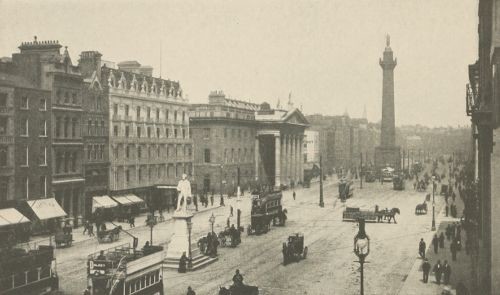
Sackville Street, Dublin, Showing Nelson’s Pillar.
There are several historical places on the road. Beyond Booterstown is Blackrock, where an ancient granite cross in the center of the main street marks the limit of jurisdiction of the lord mayor. Many years ago it was customary for that official after his installation to ride out there and fling a dart into the waters of the bay, as a symbol of his right of admiralty; but these old-fashioned demonstrations of power and prerogative have been abandoned for stupid parades and long speeches.
Just before entering Blackrock the tramway passes the entrance of a lovely estate christened “Frascati,” after a favorite resort of Rome. It formerly belonged to the Duke of Leinster, and was an early seat of the Kildare family, and one of the strategic rendezvous of the Geraldines, for two centuries the strongest clan in Ireland. Frascati has a pathetic interest to every one, and particularly to all Irish patriots, because for several years it was the home of Lord Edward Fitzgerald and Pamela, his mysterious French bride. It was there they spent their honeymoon and there he left that fascinating little person while he was off on political missions preparing for the Revolution of 1798. Her letters, full of domestic details and loving prattle, written during this period, have been preserved, and give us a charming impression of the character of a woman who suffered much for the cause of Irish liberty, even poverty and shame.
Edward Fitzgerald was a brother of the Duke of Leinster and the Earl of Kildare, an amiable, high-minded, warm-hearted, gallant fellow of learning and culture and fine manners. He served as a major in the British forces during the American Revolution, and for a time was an aid-de-camp on the staff of Lord Howe. He was dismissed from the British army, however, for active sympathy with the French Revolution, went to France, and took refuge among the friends he had made there. There he met and married Anne Syms, better known as “Pamela,” a woman of great personal and mental attractions, whose origin was involved in a mystery that was never revealed, and concerning whom many romantic stories have been written and told. It is generally believed that she was an illegitimate daughter of Philippe Égalité, Duke of Orleans, sometimes called “Philip the Handsome,” by an Irish woman named Syms, and was, therefore, a half-sister of King Louis Philippe of France. By Edward Fitzgerald she had three children: Edward Fitzgerald, who was an officer in the British army; Pamela, who became the wife of Sir Guy Campbell; and Lucy, who became the wife of Captain Lyon of the Royal Navy. Several years after Fitzgerald’s tragic end she married John Pitcairn, an American, with whom she came to the United States, and lived in Philadelphia until her death in 1831.
While he was in Paris Lord Edward met Wolfe Tone, the leader of the Revolution of 1798, Arthur O’Connor, Thomas Addis Emmet, an elder brother of Robert Emmet, and other fellow countrymen, who were conspiring with the French directoire for an attack upon Ireland. He joined the movement with great earnestness and enthusiasm, and finally arranged with the French government to send a fleet of forty-three vessels with fifteen thousand troops under General Hoche, Wolfe Tone being attached to the commander’s staff, to attack the Irish coast simultaneously with an uprising of the people. Ireland was taken by surprise and thrown into a panic, but Providence intervened. A violent gale arose, the landing was postponed, the French fleet became separated, and each vessel found its way back to the Continent.
Lord Edward remained in France until March, 1798, when he returned to Dublin, was betrayed by a man named Mangan, and a guard of soldiers was sent to arrest him in 151 Thomas Street, just below the Bank of Ireland. A tablet with an inscription now marks the house. There was a desperate struggle, in which the captain of the guards was killed by Lord Edward, and the latter received a bullet in the shoulder, from which he died in prison a few days later at the age of thirty-two. As everybody knows, the rebellion was a failure, and nearly all the other leaders were captured and executed. Wolfe Tone was betrayed by an old school friend and sentenced to be shot. He tried to kill himself in prison. The wound, though fatal, was not immediately so, and he lay ill for several months before death rescued him. Poor Pamela lived in poverty and distress for several years before she was able to return to her friends in France. “Frascati,” her home, now belongs to a prosperous Dublin tradesman.
A little farther down on the shore of the bay is a monument marking the spot where the transport Rochdale, carrying the entire Ninety-seventh Regiment of Foot, went ashore a hundred years ago, and the names of an entire regiment, officers and men, were instantly erased from the British army list. Since then an artificial harbor has been inclosed by long breakwaters of masonry, giving a place of refuge for ships in distress.
The tram line terminates in a pretty and picturesque village, called Dalkey, which was a medieval stronghold and the scene of many fierce fights, first between the earls of the Pale of Dublin and invading Danes, and after that with the pirates who haunted this coast for a century. It was a Danish settlement for several centuries, and afterward the most important outpost of Dublin, defended by seven great castles, three of which still remain in partial ruins. One of them is now remodeled for use as a town hall. They are imposing piles of masonry, and thick mats of ivy conceal the ancient wounds.
We took an “outside car” at the end of the tram line at Dalkey to drive around the shore of the bay, which the driver assured us was the most beautiful in the world and even surpassed the Bay of Naples, which it is said to resemble, and for that reason many of the names are the same. The resemblance might possibly be detected by a person with a vigorous imagination. Killiney Bay, however, is a lovely sheet of water, surrounded by high bluffs that are clad in June with glowing garments of gorse and hawthorn. The first is a low bush which has a brilliant yellow flower, and the hawthorn trees are as white as banks of snow. The land is divided into meadows and pastures on the slopes by hedges of hawthorn, and the turf is concealed by millions of buttercups as yellow as gold. It is a rocky coast. Rugged crags that break out give a stern expression to the picture, and sometimes rise a hundred feet or more in frowning precipices of black granite.
Here and there the towers of a castle or the chimneys of a villa arise from banks of foliage, and, perched along the bluff above the seashore, like the chalets of Switzerland, are comfortable cottages and mansions in which rich people from Dublin dwell. Clinging to the side of the bluff and protected by a stone wall is a splendid roadway encircling the entire bay, quite as beautiful, although on a smaller scale, as the Corniche road from Nice to Monte Carlo. The deep blue of the water, the vivid green of the foliage, which seems more pronounced in Ireland than anywhere I have ever been, the great white banks of hawthorn, the yellow of the buttercups and the gorse give a brilliancy to the landscape that does not appear anywhere on the Riviera or anywhere else I know.
The winding road with this wonderful panorama always before you leads finally through a glen into a park named after the late Queen Victoria,—a wild stretch of rocky woodland and pasture, which in ancient days was one of the principal meeting places of the Druids, and it was well chosen. The land was purchased by subscription to commemorate the queen’s jubilee in 1897, and has been thrown open to the public ever since. From the number of people who are present every Sunday afternoon one would think the money was well invested.
A winding path leads to the summit, which is cleared of trees, and in the center a shaft of stone rises about sixty feet, which, the inscription tells us in quaint and laconic manner, was erected by John Mapas, Esquire, June, 1742, in order to give employment to his less fortunate neighbors, “last year being hard with the poor.” A hundred yards distant is a round, conical tower marked, “Mont Mapas.” Nobody seems to know who erected it or what it is for. And there is a pyramid of seven tiers of stone thirty feet square at the base and eighteen feet high, with a flat stone at the top.
There is a monument to mark the spot where the Duke of Dorset was killed by being thrown from his horse in 1815, and what is more interesting, four Druid judgment seats, formed of rough granite blocks about twelve feet long, two feet high, and three and a half feet wide at the top. They are situated in pairs some distance from each other, and tradition says that the Druid chiefs in prehistoric times sat in judgment upon them to settle disputes between their people and to receive petitions from the members of their tribes. Of course, we know that Ireland was held by the Druids once, and it is very certain that they could not have found a more appropriate or a lovelier place than this for their assemblies.
We took our luncheon at the Washington Inn at Dalkey, where a large and familiar engraving of George Washington, a picture of Sulgrave Manor, the English home of the Washingtons, a pedigree of the family, and a representation of its coat of arms, showing its development into the Stars and Stripes, hung upon the wall. I asked the landlady the whys and wherefores of all this, and she told me that her name is Martha Washington and that she is very proud of it. Her ancestors came from Sulgrave, where they trace their relationship to the Father of our Country.
Another trolley line, with cars marked “Howth” (pronounced Ho-th), starting from the same place, Nelson’s Pillar, on Sackville Street, will take you entirely around the great island hill at the north entrance of the harbor of Dublin and for a mile or two on the shore of the Irish Sea. For the first fifteen or twenty minutes the car runs through the busy streets of the city, past the Amiens railway station, which, a friendly priest who occupied the adjoining seat told me, occupies the site of the house in which Charles Lever wrote “Harry Lorrequer,” “Charles O’Malley,” and other famous novels, and the good father sighed when he said that the reckless gayety and the jolly folks that Lever painted with his pen existed no longer. He was a most interesting companion was this friendly priest, and talked incessantly of the scenes and associations through which our little journey led.
We passed a monumental gate supported by two classic columns. One of them was marked in large letters “Deo Duce” and the other “Ferro Comitante” (With God for my guide and a sword by my side), which, he told me, was the motto upon the coat of arms of the great Lord Charlemont, who had taken so active a part in the history of Ireland. It was a famous family, he said, although the present earls are decadents and have no place in public affairs.
This ancient family seat, called “Marino,” was built at a tremendous cost by a dilettante earl who never allowed his expenditures to trouble him, but left the anxiety entirely to his creditors. The interior of the villa at the time it was built was the perfection of art and luxury. The floors, the ceilings, and the wainscoting were of mosaic. The walls were hung with the finest Irish poplin and decorated by the most noted artists of the time. The villa has been the scene of ghastly carousals and assemblies of the finest intellects in Ireland. The grave and the gay have gathered and dined beneath its roof, but the estate was sacrificed to the extravagance of the family, and its splendor, somewhat tarnished and rusty, to be sure, is now enjoyed by the students of the Christian Brothers, who occupy the beautiful villa for a school.
On one side of the car line high walls shut out to the ordinary passer-by the beauties they are intended to protect, but from the top of the tram cars any one can share them for “tuppence.” On the other side is the water, the Bay of Dublin, and, running parallel with the shore, is a long spit of land called the North Bull, which was formerly a terrible menace to the commerce of the coast. Nearly every winter’s gale sent a ship or two to destruction, and the bodies of hundreds of poor seamen have been washed up where the children are now playing in the sand. Here and there the skeletons of dead vessels may yet be seen, but the North Bull is no longer dangerous. Modern devices protect navigation, and in the midst of the heather and the glowing yellow gorse golf links have been laid out and a clubhouse has been erected, surrounded by lilacs, laburnums, and hawthorns, now in the full glory of their bloom. It is only twenty minutes’ ride by street car from the center of Dublin, and the business men can come out here to spend the long summer evenings at their sport.
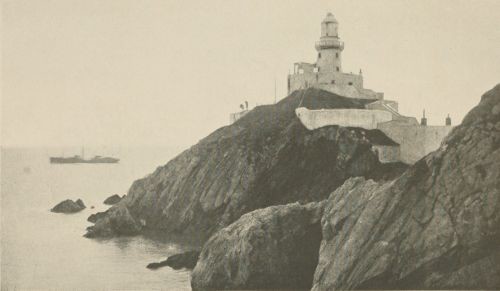
Bailey Light at Howth, Mouth of Dublin Bay
A little farther on is a beautiful mansion built in 1835 upon the site and with the materials of Clontarf Castle, one of the oldest and most famous within the English Pale—which was an area sixty miles long and thirty miles wide around the city of Dublin. The castle originally belonged to the Knights Templar, and from them passed to the Knights of St. John. In 1541 it was surrendered to the crown by Sir John Rawson, prior of Kilmainham, who was created Viscount of Clontarf as compensation.
The famous battle of Clontarf, the final struggle between Christianity and heathenism on the soil of Ireland, was fought here on Good Friday in the year 1014 between the Danes under Sigtryg, the Viking, and the Irish under Brian Boru. Eight thousand men were slain on one side and four thousand on the other, including every prominent chief. The Irish were victorious, and, although the Danes were not immediately driven from the island, it was the end of their domination. They came in a thousand boats all the way from Denmark, from Scotland, the Orkneys, and from the many islands of the north, and when their leaders were killed they fled to the water to regain their ships, which lay at anchor or were beached on the shore of Dublin Bay. The Irish warriors followed and continued to slay them until the sea was crimson with heathen blood.
Brian Boru was not a myth, although we commonly associate him with fairy tales. He was the real thing, and it is often said that he was the only Irishman that ever did rule successfully over all Ireland. He was the first of the O’Briens and was King of Munster. His early career was very much like that of Alfred the Great, who lived but a short time before him in the middle of the ninth century, and he was not only the greatest warrior, but the greatest lawgiver and executive, and the greatest benefactor of his native country in the semi-savage days. His rival was Malachi the Great, the first of the O’Neills, who became king of Meath in 980 and reigned at Tara. To keep the peace Brian Boru and Malachi agreed to divide Ireland between them; but they did not get along well together, and Brian drove Malachi from his capital far into the north. Malachi finally submitted, and then all Ireland, for the first time in its history, was at peace under a single monarch for nearly forty years.
Brian devoted himself to the development of the industries, the encouragement of agriculture, and the education of the people. He made wise laws and enforced them with justice. He founded schools and colleges. He encouraged art and science, he built roads in every direction, and he gave the distracted country the blessings of peace and prosperity. Instead of fighting among themselves, the people gave their attention to farming, cattle-breeding, trade and manufacturing, literature and the polite arts, and the historians say that another twenty years of Brian’s reign would have changed the entire history of the country. Rare Tom Moore has given us a picture of Ireland in those days, when, according to his verses, a beautiful young lady, “Rich and rare were the gems she wore,” traversed the entire country, from north to south and from east to west, without being molested.
When Brian became an old man, Mailmora, king of Leinster, conspired with the Danes, the Manxmen, the chiefs of the Orkneys, and the Scots to overthrow him. Sigtryg of the Silken Beard arranged with them to consolidate their forces to overcome the Irish. Sigurd, Earl of Orkney, brought an army ten thousand strong. Broder, the great Viking of the Isle of Man, brought a fleet of two hundred ships and ten thousand men, covered with mail from head to foot, to meet the Irish, who always fought in tunics. Broder had once been a Christian, but had fallen from grace. He was the tallest and the strongest man of his time. His hair was so long that he had to tuck it under his belt. He wore a coat of mail “on which no steele could bite,” and he had “no reverence for God or for man, for church or sanctuary.”
The venerable Brian Boru, then seventy-three years of age, was camped in what is now Phœnix Park, surrounded by twenty thousand warriors representing the different Irish clans. His sons prevailed upon him not to engage in the battle, and he gave the command to his son Morrough. But he led the column to the Hill of Clontarf on the morning of Good Friday, and when the invaders were in plain sight Brian Boru, holding aloft a crucifix, rode from rank to rank reminding his men that on that day their Lord had died for them, and exhorting them to smite the heathen hip and thigh for their religion and their homes. Then, giving the signal for the onset, he withdrew to his tent at the top of the hill, where he could observe the conflict.
Battles in those days were a series of hand-to-hand encounters. The commanders selected each other for single combat. The fighting extended for two miles along the shores of the Bay of Dublin, and human beings were cut down like stalks of corn. The aged king remained in his tent engaged in earnest prayer for victory while the air was filled with the clash of steel, and the Danes and his own soldiers were dying by thousands around him. Toward nightfall the heathen gave way and began to retreat. Their commanders were all slain or desperately wounded. Brian’s grandson, Thorlough, smote the Earl of Orkney with his battle-axe and cleft his head down as far as his neck. Broder, the great Viking, desperately wounded, was flying from the field when he recognized Brian of the Long Beard at the door of his tent. He rushed upon the old man with a double-edged battle-axe. Brian seized his trusty sword and they struck together. Brian’s head was amputated and Broder’s legs, one at the knee and the other from the ankle. At sunset when they returned from the battle, Brian’s servants found their king dead and Broder stretched by his side.
The body of Brian and that of his son Morrough were conveyed with great solemnity to Armagh and laid at rest in the cathedral, but their tombs have disappeared. The funeral ceremonies lasted for a fortnight, and all Ireland was filled with lamentation. Every petty chief and prince in the island tried to grasp the power. As the old song runs—
“Each man ruled his own tribe,
But no man ruled Erin.”
And that condition continued for a century and a half, all Ireland being distracted by the rivalries of the several chiefs, the O’Briens, the O’Neills, the O’Connors, and the O’Loughlins.
That part of the battleground lying on the shore of the bay has been built over, and behind it the land has been divided into small country places where the rich men of Dublin spend their idle hours. Their homes are encircled with high fences, and are divided by a maze of roads and lanes concealed by canopies of green foliage that overhangs the walls.
A little farther on are the ruins of a church surrounded by a silent battalion of gravestones. It was the Abbey of Kilbarrack, and one of the tombstones, badly defaced, marks the burial place of Francis Higgins, a detested government spy who betrayed Lord Edward Fitzgerald to the government in the insurrection of 1798. He is known as “The Sham Squire,” because for a time he succeeded in passing himself off as a country gentleman of wealth and was married to a lady of good family. When the fraud was detected he was sent to jail, and she died of shame and mortification. Being boycotted by all honorable men, he became a spy and informer, and popular hatred pursued him to the graveyard, which had to be watched because the people resented his burial in consecrated ground and would have thrown his body into the bay.
The car line follows the curves of the coast down to the shore of the Irish Sea, where a monstrous mass of rocks, covered with heather and rhododendrons and gorse, now as yellow as gold, rises five hundred or six hundred feet, with here and there a dense mass of foliage. It is known as the Hill of Howth, and is considered one of the most picturesque places in Ireland. At its foot is the village of Howth, and on either side are the ruins of ancient strongholds, located so as to command the entrance to the harbor.
The title of the Earl of Howth dates back to 1177, and was bestowed in battle. It has been held honorably by the Lawrence family, one of the oldest in Ireland. They won their name and their lands by the sword. The founder of the house was Amory Tristam, a Norman adventurer, who followed Strongbow to the conquest of Ireland, and has been immortalized in Wagner’s opera, “Tristam and Isolde.” While Tristam, loyal knight and true, was attending a red-haired Irish princess to her destined husband, the King of Cornwall, they drank by mistake a love potion which bound them forever in a frenzied romance. It ended with Tristam dying in his castle and Isolde coming over the sea to perish like Juliet upon her husband’s lifeless form.
Amory Tristam assumed the name of St. Lawrence, because of a great victory that he won over the Danes on the anniversary of that saint; and Howth Castle has been the seat of the family from the beginning. A long line of overlords lie under the shadow of a ruined old abbey, and the present earl, William Ulick Tristam St. Lawrence, must join them soon, because he is more than eighty years of age. He was a member of parliament in his younger days, succeeded to the earldom in 1874, and until he became too feeble was a famous sport. His son and heir, Thomas Tristam St. Lawrence, is a man of fifty, who married the daughter of Benjamin Lee Guinness, the great brewer of Dublin, and inherited many millions from her father.
Many interesting legends are told of the hill and the Castle of Howth and of events that have occurred during the eight hundred years since it became a center of activity. In the reign of Queen Elizabeth, the Princess of Connaught, Grace O’Malley, landed at Howth on her return from England and found the gates of the castle closed. The warder refused her entrance because the family were at dinner. Indignant at this breach of hospitality she returned to her ships, and meeting on the way the heir of the house, she picked him up and carried him off to Mayo, where she held him until she had obtained a pledge from the earls of Howth that they would never again close the doors of their castle against hungry travelers. And they have faithfully kept the vow.
The Howth family holds the almost unique distinction in Ireland of perpetual loyalty to the English crown.
Another trolley line runs out to Donnybrook, the scene of the famous fair, which was abolished, however, nearly one hundred years ago, even before the time of Sir Walter Scott’s visit to Ireland in 1825, for he says: “We dined at Walter’s, and in the evening drove to Donnybrook—the scene of the noisy fair which is now dissolved and abolished. It was a charming ride, thick with villas and all the insignia of ease and opulence; in fact, not to be distinguished from the innumerable hosts of jaunting cars plowing the fine road in every direction at a speed apparently most cruel.” Sir Walter’s description holds good to-day. Donnybrook is the most respectable and aristocratic of all the suburbs of Dublin. The tract of land where the cattle fair was formerly held in the fall of each year is still vacant and is used for a pasture. A “merry-go-round,” or a “whirl-about,” as they call it here, was the only diversion that we could find in the silent and orderly surroundings, but every year in August on the adjoining land and reached by parallel roads the Dublin horse show is held, and it is the great event of the season socially, and otherwise. It brings over from London and other parts of England large crowds of fashionable people, it draws the sporting element from every part of the kingdom, and all Ireland is represented.
Donnybrook, originally Dombenach Broc, in Gaelic, is a small but rapid stream, which comes down from the hills of Wicklow and empties into the Bay of Dublin. The cattle-dealers of Ireland for two hundred years used to meet upon its banks for the sale, exchange, and exhibition of animals for eight days in the month of August annually, and drew around them saloon and restaurant keepers, peddlers of every sort, and shopkeepers, who went out from Dublin with stocks of goods and exposed them as a temptation to the men who had sold their cattle and had the money in their pockets. In addition to the tradesmen, itinerant shows gathered to entertain the ranchmen, strolling players, jugglers, Irish bards with harps and songs, bagpipes, and other public entertainers made it their rendezvous. Naturally these attractions called together the lads and the lasses, who flirted, danced to the music, and had a good time generally.
“Donnybrook capers, that bothered the vapors,
And drove dull care away.”
But the entertainments were not entirely innocent, and the fair finally became such a scene of disorder, thievery, and murder that the authorities were compelled to abolish the annual festivities. It attracted all the toughs and roughs and the desperate characters in Ireland, and the old rhyme says:
“Such crowding and jumbling,
And leaping and tumbling,
And kissing and grumbling,
And drinking and swearing,
And stabbing and tearing,
And coaxing and snaring,
And scrambling and winning,
And fighting and flinging,
And fiddling and singing.”
More misery and madness, more crime and unhappiness, more devilment and debauchery, vice, and treachery was crowded into that little space for a fortnight annually than might have occurred during an entire year in any country of Europe. In those days fighting was a common pastime. But the “broth of a boy” with his “shillelah” of black bog thorn wood, is no longer seen dragging his coat over the ground at Donnybrook and inviting any gentleman present to step on the tail of that garment. Those days, as I say, are over, and Dublin is one of the most orderly cities on earth, except for the drunkenness.
IX
THE LANDLORDS AND THE LANDLESS
The population of Ireland by the census of 1901 was 4,450,456, a falling off of 248,204 in ten years since the previous census. In 1848, before the great famine, the population was 8,295,000, which shows that it has decreased nearly one-half since that time, during the last sixty years.
The area of Ireland is 20,157,557 acres, including bog and mountain. Of this area only 2,357,530 acres are under the plow, 14,712,849 acres are devoted to hay and pasture, of which it is estimated that 12,000,000 acres could be cultivated to crops. But it is a question whether such a thing would be desirable, considering the great demand and the high price for hay and cattle, beef and mutton. It would give employment to a large number of people if 12,000,000 acres more were plowed and planted, no doubt, but the experts assert that the profits on hay and cattle are larger than on grain and potatoes.
Next to hay, the largest area, something more than 1,000,000 acres, is planted to oats and only 590,000 acres to potatoes, which is surprising when you consider that potatoes are the principal food of the Irish peasant, and, as some one has remarked, “are his food and drink and clothing.”
William F. Bailey, one of the gentlemen intrusted with the work of settling the land question and distributing the population of the island more evenly than at present, estimates that thirty acres of average land in Ireland is necessary to support a family, but the tax returns show that the 20,000,000 acres are divided among 68,716 owners; that is, one person in sixty-four is a landowner, with an average of 300 acres each, counting men, women, and children, although that is not a fair basis of calculation in Ireland, because so many of the young and middle-aged people emigrate and leave more than a natural proportion of old men and young children on the island.
The tax returns show that the land in 1907 was actually divided among the 68,716 owners as follows:
Owning 100,000 acres or more
3
Between 50,000 and 100,000
16
Between 20,000 and 50,000
90
Between 10,000 and 20,000
185
Between 5,000 and 10,000
452
Between 2,000 and 5,000
1,198
Between 1,000 and 2,000
1,803
Between 500 and 1,000
2,716
Between 100 and 500
7,989
Between 50 and 100
3,479
Between 10 and 50
7,746
Between 1 and 10 acres
6,892
The changes in the size of Irish farms has been remarkable. In 1841, 81 per cent of the holdings were less than ten acres. To-day, as you will see by the table, out of 68,000 farms, only 6,892 are of ten acres and less.
The following is a list of Irish landlords who owned more than 30,000 acres each, and the average annual rentals collected from their tenants prior to the passage of the Wyndham Land Act of 1903, which authorizes the purchase with government funds of their estates, and the division into small farms for the tenants who occupied them:
Acres
Annual
Revenue
Law Life Assurance Company
165,804
£6,384
Marquess of Lansdowne
123,634
32,412
Marquess of Sligo
122,902
16,018
Marquess of Downshire
107,828
86,269
Earl of Kenmore
105,359
26,951
Lord Ventry
91,505
15,282
Earl Fitzwilliam
89,468
45,568
Viscount Dillon
78,898
16,933
Sir Roger W.H. Palmer
74,857
12,829
Earl of Bantry
73,360
11,628
Duke of Leinster
71,581
48,841
Marquess of Waterford
71,056
33,412
Lord O’Neil
65,857
45,308
Marquess of Hertford
63,265
75,699
Earl of Lucan
59,478
12,194
Earl of Kingston
54,165
32,565
Duke of Abercorn
51,919
26,689
Marquess of Clanricarde
51,006
18,472
Sir Charles H. Bart Coote
48,739
18,691
Viscount Powerscourt
47,551
13,563
Marquess of Ely
47,076
22,126
Earl of Bandon
46,129
20,438
Trustees of Kilmorrey Estate
46,054
20,663
Earl of Annesley
45,263
22,297
Capt. Henry A. Herbert
42,939
9,695
Thomas S. Carter
41,406
2,138
Earl of Leitrim
39,382
9,890
Lord Laconfield
39,048
16,558
W.H. and John T. Massey
37,241
9,001
Viscount Lismore
37,137
14,113
Lord Stuart DeDecies
36,788
15,473
Earl of Bessborough
36,372
22,649
Viscount Clifden
36,166
19,705
George Clive
35,513
836
Marquess of Londonderry
34,949
30,617
Lord of Antrim
34,493
12,600
H.L. Barry
34,376
26,464
Marquess of Conyngham
33,693
18,373
Lord DeFreyne
33,120
12,719
Earl of Devon
33,100
12,764
Duke of Devonshire
32,776
19,441
T.C. Bland
32,540
2,638
Hon. H.L. King-Harman
32,531
17,090
Sir George V. Colthurst
31,993
11,042
Lord Annaly
31,826
13,740
Marquess of Ormonde
31,794
17,457
Earl of Erne
31,069
16,758
Earl of Granard
30,725
15,816
Lord Digby
30,627
13,409
Earl of Caledon
30,502
15,725
Earl of Arran
30,346
7,111
Lord Farnham
30,191
19,347
Earl of Enniskellen
30,146
13,883
The owners of other large tracts and the persons who own between 10,000 and 30,000 acres are also nearly all noblemen. It would seem that titles of nobility and large estates go together over here. That is the rule in other countries, and is perfectly natural, because a poor man has no use for a title of nobility and a rich man is usually anxious to get one.
A peer has just as much right to own land as anybody, and the complaints heard in Ireland are not on account of the rank or the station of the landlords, but because of their neglect of their interests and their tenants, especially because most of them do not spend the incomes from their estates in making improvements or for the benefit of their own people; they do not spend it in Ireland, but reside in London most of the time and spend the money there, where the people who earn it receive no benefit from it directly or indirectly. It is unnecessary to discuss the evils of large estates. They are too numerous to mention, especially when they are owned by people who live outside of the country. That is the great obstacle to the development of Mexico, where millions of acres in large tracts, granted to Spanish grandees before independence, still remain in the ownership of their descendants, who live in Spain or Paris, and spend the revenues there. It is true, also, of Russia, Poland, Austria, and of many other countries, and to a certain extent of Cuba, where a number of the valuable and productive plantations belong to families who are living in Spain, Paris, or New York, and never even visit them.
A few years ago, by order of Parliament, an investigation was made to ascertain the habits of the large Irish landowners in connection with their estates, and the following table shows the result:
Landlords
Acres
owned
Rents
collected
Resident on or near the property
5,589
8,880,549
£4,718,497
Residing elsewhere in Ireland, occasionally on property
377
852,818
371,123
Residing elsewhere in Ireland
4,465
4,362,446
2,128,220
Residing out of Ireland but occasionally on property
180
1,368,347
601,072
Never resident in Ireland
1,443
3,145,514
1,538,071
Owned by charitable institutions or corporations,
161
584,327
234,678
Not ascertained
1,350
615,308
331,633
No country ever suffered so much from absentee landlordism as Ireland, and many great estates here have been entirely neglected, or practically abandoned and allowed to go to ruin by the owners who intrusted them to dishonest or incompetent managers and took no interest in their own property. No one can blame the tenants upon such estates for their enmity and resentment toward the proprietors, or condemn them for their refusal to pay rent when they received very little or nothing in return. But the system in Ireland has been very much improved of late years by various acts of parliament, and many people think that the tenants now have the advantage in every respect. Fifty years ago the landlord was the owner and autocrat of the soil and everything that stood upon it. The tenant had no legal rights beyond what was written down in his lease, and when that expired the landlord could raise or lower his rent or drive him off the land at pleasure.
Nearly every one of the peers who has sold his estates in Ireland under the land act has taken the cash and has gone to London to live, and if home rule is ever granted to the Irish people there will be little room left for those who remain. Most of the Irish peers spend the greater part of their time in London. Some of them never come to Ireland at all except for the shooting season or horse show. Several prominent English peers have estates in Ireland inherited from ancestors who have intermarried with the Irish nobility. The Duke of Devonshire, for example, owns one of the largest and finest estates in the kingdom at Lismore, a few miles north of Cork. The late duke, who died in 1907, took a great interest in the property and spent a great deal of time there.
Forcible evictions are things of the past. Several years ago the demands for “The Three Fs”—free sale, fair rent, and fixed tenure—were complied with, and to-day the farms in Ireland are subject to what is called “a dual ownership,” peculiar to this country. No landlord can rob a tenant any longer. Disputes concerning rent are now settled by a tribunal which takes all the circumstances into consideration and decides upon the equities rather than the technicalities of the case. This has revolutionized the land system of Ireland, and by a succession of acts of parliament during the past few years the government has gone a great way toward equalizing ownership and creating a nation of peasant proprietors, which, according to their ideas over here, is the ideal condition.
During the last quarter of a century from six thousand to eight thousand farmers have been evicted from farms in Ireland because they refused or were unable or neglected to pay their rent. Some of them have remained in the neighborhood and have squatted where they could, and waited their chance to recover their holdings; others have emigrated to America; others have gone into different parts of Ireland; others have engaged in business of various sorts. Between five thousand and six thousand have already applied for restoration under the Act of 1907, most of them through the agency of the United Irish League. Of these, 1,595 families had been restored up to July, 1908, most of them to the actual farms from which they were expelled, not as tenants, however, for they will never be asked to pay any more rent, but as the owners of the property and improvements, purchased for them by the government, with money to be repaid, not by them unless they choose to do so, but by their posterity in the year 1975, or thereabouts. The only financial obligation imposed upon them is to pay an interest of 3½ per cent upon the purchase money, which has been borrowed by the government upon bonds running for sixty-eight years, at 3 per cent interest. The additional one-half per cent goes into a sinking fund to pay the bonds at maturity.
About 75 per cent of the claims that have been filed under the Evicted Tenants Act have been genuine; the remainder are apparently fraudulent or in doubt, and some of those that have been already allowed are questionable. I heard of a case in which a tenant who was evicted in 1889 for refusal to pay his rent was restored to his old home under rather peculiar circumstances. His misfortunes were voluntary, and due to political reasons rather than from the lack of means, and when he was thrown off his farm he went into business as a cattle broker and became rich. But, in common with his former neighbors, he filed his claims under the act, was restored to his old home, and the generous agents of the estates commission bought a couple of cows, a few sheep, and hogs from his own pastures, paid him for them, and then gave them to him. He is now occupying the place and cultivating it by hired labor, and will be asked to refund the money the government has advanced for him in the year 1975.
In the application of the provisions of the act no distinction is made between those who were evicted because of their poverty and those for political reasons. About one thousand evictions were the result of what is known as the “Plan of Campaign” adopted in 1887, when the National League determined to force the issue and organized a general strike among the farmers against the payment of rent upon certain estates selected because their landlords were habitual absentees, who spent the revenues they derived from their estates outside of Ireland and were oppressive to their tenants and generally offensive. As a rule, the tenants paid half a year’s rent to the agents of the league for a war fund, so far as they were able. Most of them were able to pay, although there was a great deal of suffering and privation among about a thousand families who were thrown out of their homes during one land war which lasted for two or three years. Practically all of them have already been restored to their former farms.
In 1901 another land war was inaugurated, under the direction of Dennis Johnston and John Fitzgibbons of the United Irish League, in Roscommon and neighboring counties, and a large number of tenants who had voluntarily agreed not to pay their rents were thrown off their farms as voluntary martyrs in a campaign which finally resulted in the enactment of the act of 1907, which was prepared and introduced into parliament by George Wyndham, chief secretary for Ireland under the late conservative government. This act authorizes the estates commission having in charge the administration of the Land Act of 1903 to acquire by force if necessary eighty thousand acres of land wherever they consider it expedient, to be sold under mortgages of sixty-eight years at 3½ per cent interest to families who have been evicted from their former homes. The commissioners are required to investigate the claims of those who have been evicted, through their staff of inspectors, and if found genuine to serve notice upon the owner to vacate the farms from which they were evicted within a certain time. The landlord has the right of appeal, but every one of the owners of lands from which tenants were evicted has voluntarily consented to their restoration except the Marquess of Clanricarde, and a Mrs. Lewis who has a large estate in County Galway and has been one of the most vindictive and oppressive of all the landlords. She is a woman of very determined character, and will not even answer letters addressed to her by the officials of the government.
The Marquess of Clanricarde is nearly eighty years old, very eccentric, a miser, dresses very shabbily, lives like a recluse and pays no bills. He has visited his Irish estates but once since he inherited them in 1874, He was in the diplomatic service as a young man during the ’fifties, and at one time was a member of parliament. His name is Hubert George de Burg Canning, Marquess of Clanricarde, Viscount Burke and Baron Dunkellin, and he has several other titles, but has no family—a childless widower.
The Clanricarde estates lie directly west from Dublin in Galway County and were obtained by his ancestor, William FitzAnselm de Burg, the founder of the Burke family, under a grant from Henry I., and he founded the town of Galway. To this day the whole province of Connaught is dotted with the ruined castles of the De Burg family, monuments of four or five centuries of uninterrupted fighting with the O’Neills, the O’Donnells, the O’Flahertys, the O’Connors, and other powerful clans in the early history of Ireland. The battle of Knockdoe, fought in the fourteenth century between an undisciplined horde of native clansmen under the Earl of Clanricarde, was provoked by an insult he offered to his wife. She was the daughter of Gerald Fitzgerald the Great, Earl of Kildare, and her affectionate father in vengeance attacked his son-in-law with a disciplined force loaned him by his neighbors, the lords of the Pale of Dublin. It is said that eight thousand dead bodies were left upon the field. Those were strenuous days, and the earls of Clanricarde have been reckoned among the fiercest fighters from the time they came over from England in the fourteenth century. Sometimes they have been on one side and sometimes on the other, but like most genuine Irishmen, they have usually been “agin the government,” whatever, policy it represented. There have been several earnest patriots in the line. An old Irish ballad begins with the line, “Glory guards Clanricarde’s grave!” but the present earl is not the one referred to.
The late earl was very popular with his tenants, and so liberal and lenient was he, according to the gossip, that they got into bad habits, and when the present earl came into the property in 1874 he pulled them up very sharply and demanded a prompt and full payment of all their obligations. Being unaccustomed to such stern measures, they were resentful, and a quarrel began which has lasted until now, and Clanricarde, convinced that he has right and justice on his side, has used the mailed hand. There have been more trouble and disturbance upon his estates than upon any other in Ireland. Every one of his tenants has been evicted, and sometimes a succession of them, and their farms have been let to what are called “planters,”—a term used in Ireland to describe families imported from a distance and planted upon land which no person in the neighborhood will rent because the previous tenant has been evicted from it. Every man on the Clanricarde estates is a “planter.” After the passage of the act of 1907 the estates commissioners requested him to sell his entire holding under the act of 1903, but he not only rejected the proposition, but has declined even to discuss the subject, and has maintained that uncompromising attitude from the beginning, an embittered, relentless, vindictive old man.
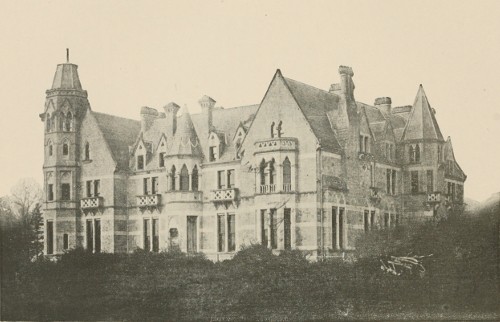
Portumna Castle, County Galway; the Seat of the Earl of Clanricarde
When the commission undertook to apply the compulsory clause of the Evicted Tenants Act and published the notice in the Dublin Gazette, the earl filed a protest. Mr. Justice Wiley of the Lower Court sustained the commission, but the Court of Appeals, composed of twelve judges, unanimously reversed the decision and decided that the estates commission has no power to forcibly dispossess any bona fide “planter” from land already under lease.
This decision technically justified the position that the earl has taken, and it applies to the estates of Mrs. Lewis also, so that the commissioners cannot go any farther in their work of restoring the evicted tenants upon those two properties. As soon as the decision was rendered a bill was introduced in parliament confiscating the entire Clanricarde estates. It is not expected to pass, but was intended to advertise the situation and create public opinion. The government, however, took the matter promptly in hand, and the Earl of Crewe introduced a bill authorizing the estates commissioners to take by force, after the usual legal proceedings, any occupied land they may think necessary and proper for the restoration of evicted tenants, provided they can obtain the consent of the occupant. This act was passed, and notice was immediately given in the Dublin Gazette that the estates commissioners intend, under the Evicted Tenants Act, to acquire compulsorily upwards of eighteen hundred acres of land on the estate of Lord Clanricarde in County Galway. This means that the owner of the property is to have nothing to say about the matter, but a bona fide tenant, who in good faith is occupying a farm from which his predecessor has been evicted, cannot be ejected without his consent. We are familiar with the methods of “persuasion” that have been used for years by the United Irish League and other patriotic organizations, and it is entirely probable that they will prove sufficient in all cases that will arise under this new provision. Therefore, as soon as the proposed act is passed, the tenants upon the Clanricarde estates will be looking for trouble.
The Earl of Clanricarde cannot expect to live a great while longer. He is already an infirm old man and his heir, Lord Sligo of Westport, a nephew, is almost as old as he. Lord Sligo is one of the largest land holders in Ireland. He owns 114,000 acres in the north, which is mostly grazing land, and his tenants are miserably poor, living in squalid hovels scattered over the estate. He does nothing for them, and exacts the last halfpenny of his rent. His heir, who will soon come into both the Clanricarde and Sligo estates, is his son, Lord Henry Ulick Browne, of whom very little is known. He is fifty-eight years of age and lives at Westport Castle, Westport, Ireland. As he has had the management of much of his father’s property for many years, it is generally believed that he is responsible for the harsh policy that has been followed toward the tenants, and that they can expect no better treatment when he becomes their lawful lord.
The British Parliament has published a return (No. Cd. 4093) covering all the proceedings under the Act of April, 1907, to restore evicted tenants in Ireland; giving particulars in each case in which an evicted tenant, or a person nominated by the estates commissioners to be a personal representative of the deceased evicted tenant, has with the assistance of the commission been reinstated, either by the landlord or by the estates commissioners, or provided with a new parcel of land under the Land Purchase Act.
It is a quarto pamphlet of forty-seven pages, and gives in fine type the names of all the farmers in Ireland who have been evicted since 1876, with the dates of the evictions, the area they formerly occupied, the rent they formerly paid, the arrears of rent due at the time of the eviction, the value of the property, the name of the landlord, the name of the estate, the name of the town and the county, the date of restoration, the price paid by the estates commissioners for each tract, the valuation of the buildings and other improvements on the property, and the compensation given to outgoing tenants who surrender their holdings under the law, to those who were formerly evicted from them.
This report shows that forty tenants have been restored to the Blacker-Douglass estates in Armagh, thirty-two have been restored on the Charlemont estates in the same county; forty-four of those evicted from 1887 to 1889 by Lord Massareene in County Meath have been restored, and thirty-nine on the estate of the Marquess of Lansdowne in Queen’s County. On the estates of Sir G. Brooke, in Waterford, seventy-eight families, evicted in 1887 and 1888, have been restored; twenty-six on the estate of A.L. Tottenham, Leitrim; thirty-four on the Vandaleur estates in Leitrim; thirty on the estates of C.W. Warden in County Kerry; thirty-three on the estates of the Earl of Listowel, and similar numbers elsewhere.
So far as is known, every family in Ireland that has been evicted from a farm during the last fifty years for non-payment of rent, or for political reasons, has been restored wherever they are living, and, if the head of the family at the time of the eviction is dead, his heirs have been placed in possession of the place. And all this has been done by the government at the expense of the taxpayers as a vindication of the policy of the Irish Land League, the United Irish League, and other organizations which have conducted the land wars.
The restoration of the evicted tenants was not voluntary on the part of the British government. It was forced upon the parliament by the Irish agitators. In a debate on this act in the House of Lords, the Marquess of Lansdowne, who had evicted a large number of tenants from his estates, admitted that he and other landlords accepted the proposition with great reluctance, and “only because the government had represented to them very earnestly, indeed, that the measure formed an integral part of a policy of pacification which they desired to bring about in Ireland, and if the landlords took the responsibility of rejecting this particular item, the entire programme was destined to failure. It is on the strength of these representations,” said the Marquess of Lansdowne, “that we ask the House of Lords to agree to the restoration of all Irish tenants who have been evicted at any time for political reasons as well as for failure to pay their rents.”
The members of the National Party in Ireland concede this point cheerfully. They willingly admit that they insisted upon the restoration of all evicted tenants as the first and the most important proposition in the programme of pacification in Ireland, and they agreed with the Marquess of Lansdowne that it would have been a failure otherwise. It should also be stated that all arrears of rent for which families have been evicted from Irish farms have been cancelled, and the restored tenants have become the actual owners of the land, the houses, and all improvements. Instead of paying rent to a landlord, they become the landlords themselves. The purchase money in every case has been advanced by the government, and is to be repaid by the purchaser in sixty-eight years with interest at three and one quarter per cent per annum. This sum represents two and one-half per cent interest upon bonds issued to raise the funds and three-fourths of one per cent for a sinking fund to meet the bonds at maturity.
X
MAYNOOTH COLLEGE AND CARTON HOUSE
Two-thirds and perhaps as many as three-fourths of the Roman Catholic priests in Ireland were educated at the College of Maynooth, which turns out one hundred and fifty or more earnest, zealous, able young clergymen every year, and is the most conspicuous and influential educational institution in Ireland. Comparatively few of the graduates go to the United States. Dr. Hogan, professor of modern languages and literature, explained that nearly all of the Irish priests who emigrated to America were educated at the missionary college of All Hallows, near Dublin, for the United States was until recently counted as a mission field by the holy see and was under the jurisdiction of the prefect of the propaganda of the holy faith at Rome. There are quite a number of Maynooth graduates in America, and during the recent visit of Cardinal Logue they gave a dinner in his honor in New York.
Dr. Hogan took us through the buildings, which are spacious and surround two large quadrangles. They are built of stone, four stories in height, are entirely modern and fitted up with all the conveniences and accessories that belong to an up-to-date institution of learning. The chapel is also modern, built within the present generation and entirely conventional. It is not large enough to accommodate all of the students, and the underclass men attend mass elsewhere.
Beyond the second quadrangle is a campus of seventy acres of lawn and garden and grove, where five hundred young men were engaged in taking their daily supply of fresh air and exercise when we passed through the archway. Almost every kind of game was going on, from croquet to football. There were several cricket contests in progress; others were playing at hockey and basketball; others were on the track running, and the lazy ones were lying stretched out on the velvet grass. There are now five hundred and sixty-two students, nearly all of them theologs, and one hundred and twenty graduated in 1908. They come chiefly from Ireland, a few from Irish families in England, a few more from Australia, but at present there is no representative of the United States. When I asked a group of young men how they got along without any Americans, one of them illustrated the quick wit of his race by replying promptly: “We hope never to have them here, sir; they are altogether too smart for us. If they keep on, the Americans will run the world.”
It costs very little to get an education at Maynooth. The fees are small,—$20 for matriculation, $25 for tuition, $150 a year for board, and other small fees for electric light, rent of furniture, etc., which brings the total up to about $225 a year. There are two hundred and seventy scholarships which have been founded by friends of the institution and societies in the different parishes, and they pay an average of $150 a year. There is a fine library with forty thousand volumes, and a gymnasium and everything else that is needed.
The ancient castle of Maynooth, built by the Earl of Kildare in 1427, stands at the gateway of the college, and occupies the site of the original stronghold of the family, built in 1176 by the first Maurice Fitzgerald, who came over with the Strongbow at the time of the Conquest. It has been a ruin since 1647, and a beautiful ruin it is—one of the largest and most picturesque in the kingdom.
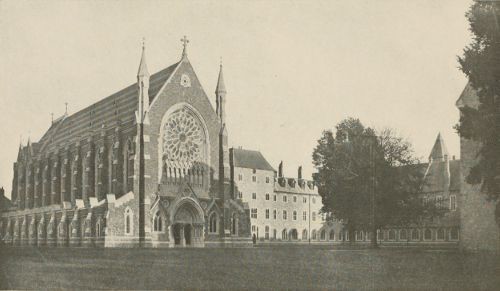
Maynooth College County Kildare
Until 1895, when the centenary of Maynooth College was celebrated, six thousand priests and prelates of Irish birth had been educated within the walls of that “mother of love, and of fear and of knowledge, and of holy hope,” as her alumni call her. And now the number exceeds seventy-five hundred. Most of them have been, and those now living are still, doing pastoral work in Ireland, and nearly two thousand of the alumni have gone abroad into the United States, England, Scotland, Australia, South Africa, and other English-speaking countries. During the first three-quarters of the eighteenth century and for several hundred years before Catholic education was prohibited in Ireland, but it was not possible for the British authorities to prevent young men from crossing the sea, and during the sixteenth and seventeenth centuries a number of Irish colleges were founded in the Peninsula, in France, and in Flanders, and there most of the Irish priests of that long period received their education. It has been often asserted that the Catholic faith might have disappeared in Ireland but for the ardent piety and ambition of these young students, who found the preparation they needed for parish work from the Irish faculties of divinity schools on the Continent. In 1795, at the time Maynooth College was founded, about four hundred young Irishmen were attending such institutions, and in 1808 a printed report names twelve colleges with four hundred and seventy-eight Irish students.
Most of these institutions were in France, and they were closed and desecrated by the French Revolution, which expelled their inmates, profaned their altars, and confiscated their possessions. The Irish bishops, in consequence, found themselves confronted with an alarming situation. The foreign supply of priests was entirely cut off and the laws of Parliament prohibited their education at home. In this extremity they applied to the government, asking permission to found seminaries for educating young men to discharge the duties of Roman Catholic clergymen in the kingdom. William Pitt, then prime minister, was persuaded that it was safer for England to grant this request than to permit the young priests to imbibe the hatred of England and the democratic and revolutionary principles that pervaded society on the Continent. Edmund Burke and Earl Fitzwilliam acted in behalf of the bishops, and the latter was instructed by the prime minister to supervise the establishment of a new institution. Dr. Hussey, confidential agent of the English government in Dublin, was appointed the first president. He is described as a scholar, statesman, diplomatist, and orator; he had a checkered and eventful career; he undertook many things and excelled in them all. He was a fellow of the Royal Society, a preacher of remarkable power, and the intimate friend of such statesmen as Edmund Burke. He had the confidence of William Pitt and was the trusted agent of princes and statesmen. He was a native of County Meath, was educated at the ancient University of Salamanca of Spain, and originally entered a Trappist monastery, but left it shortly after and became chaplain of the Spanish embassy in London. The British government, recognizing his ability and integrity, sent Dr. Hussey on two confidential missions to the court of Spain, and rewarded his success by granting him a liberal pension for life and appointing him as confidential agent of the government in its negotiations with the bishops, and afterward to be president of the first Catholic theological seminary in Ireland. After two years at the head of the institution he was appointed bishop of Waterford, where he remained until his death in 1803.
Instruction was commenced in a private house belonging to an agent of the Duke of Leinster. The foundations of a new building were laid on the 20th of April, 1796, and seven months later it was opened with fifty students on the roll. The Duke of Leinster, although a Protestant, anxious to have the college on his estate, made very liberal terms, and successive generations of the house of Kildare, of which he is the representative, have been not only friendly but generous to the institution.
Everything about the college reminds the student of the famous class of Geraldines. The ancient castle of the Kildares, built by Maurice Fitzgerald the Invader, and enlarged by John, the sixth earl, in the year 1426, stands at the gate, and on either side of the main walk are fine old yew-trees planted more than seven hundred years ago. According to local legends that vain and reckless youth, “Silken Thomas,” sat beneath its spreading branches and played his harp three hundred and seventy-five years ago, on the evening before he started for Dublin to relinquish his trust as temporary viceroy and assault the castle. His five uncles were hanged at Tyburn mainly because they were Catholics. At the fall of the house the sole surviving heir was saved by his tutor, a Catholic priest, who afterward became Bishop of Kildare. Several generations later the earls of Kildare and the dukes of Leinster became Protestants, but they always advocated the emancipation of their Catholic fellow-countrymen, and have always been fair and honorable in their dealings with the institution.
It was a difficult task to get a faculty in those days, as there had not been a Catholic college in Ireland for centuries. But the French Revolution had cast upon the shores of Ireland many competent exiles, who were placed in charge of the various departments, and among the clergy of Ireland were found a sufficient number of scholars to complete the staff of instructors. The Revolution of 1798 broke out two years after the college was opened, and many of the students were stirred by aspirations which caused their expulsion. It was a test that many felt to be very severe; but the faculty were determined to keep faith with the government, and sixteen students were expelled. In 1803, the year of Emmet’s insurrection, there was a good deal of insubordination, which has been described as a “ground swell from the outside agitation.” Six students were expelled, one of whom, Michael Collins, afterward became Bishop of Cloyne.
The original grant of Parliament was $40,000 a year. In 1807 this was increased to $65,000, which was expended in buildings. It was afterwards reduced, and until 1840 was about $50,000. At that time there were four hundred students, who could not be properly accommodated. In 1844 the trustees drew up and forwarded to the government a strong memorial, which was read in the House of Commons by Sir Robert Peel, who declared that such a state of things was discreditable to the nation and that Parliament should either cut Maynooth College adrift altogether, or maintain it in a manner worthy of the state. In the face of resolute opposition of a majority of his own party, he carried through a proposal to give the sum of $30,000 for new buildings and an annual grant of $26,360 for the maintenance of the college. Mr. Gladstone supported the prime minister, Mr. Disraeli, then leader of the opposition, attacking the bill fiercely. Thomas Babington Macaulay and Dr. Whately, the rhetorician, both made eloquent and convincing speeches in its support. In 1869, when the bill to dissolve the relations between the Protestant church in Ireland and the government was passed, Mr. Gladstone, then prime minister, was compelled to treat Maynooth College on the same terms that he gave the Irish Episcopal branch of the Established Church, and the Presbyterian, giving each a sum of money equal to fourteen installments of its annual grants.
The interest upon that sum at three and one-half per cent is not sufficient for the proper support of so large an institution, but the college has had many generous friends, and with economy has been able not only to maintain itself but to strengthen its position, enlarge its facilities, and give its students better accommodations and greater advantages year by year. The several bishops of Ireland have raised funds to endow many scholarships, so that the expenses incidental to student life have been very much reduced for those who are unable to pay the full fee. Nevertheless, there is great anxiety among the trustees and the professors to extend the buildings, add several chairs to the faculty, and obtain more endowments.
Maynooth is the rendezvous of the Catholic hierarchy of Ireland, being conveniently located and accessible to all the bishops. They meet here frequently to discuss ecclesiastical matters and determine upon church policies. His Eminence Cardinal Logue is president of the board of trustees. His Grace the Most Rev. William J. Walsh, D.D., Archbishop of Dublin, is vice-president. The Archbishop of Cashel, the Archbishop of Tuam, and twelve bishops make up the board. The president of the college is the Right Rev. Mgr. Mannix, D.D.; the vice-president is the Very Rev. Thomas P. Gilmartin, D.D., and the deans of the different schools are the Rev. Thomas T. Gilmartin, D.D., Rev. James Macginley, D.D., and the Rev. Patrick Morrisroe.
Religion is a live thing in Ireland, and the Roman Catholic churches are always filled to overflowing at every service with as many men as women, which is unusual in other countries. In Ireland the situation seems to be different, and the congregations are invariably composed about equally of the two sexes. The Church of Ireland is comparatively weak in numbers, and has more houses of worship than it needs, having inherited many of them from the confiscation edicts of the English kings. Naturally they are not so well filled, but the Roman Catholics are compelled to have three or four services every Sunday in order to accommodate the worshipers, and the priest is invariably the most influential man in the parish. He enters directly into the life of his parishioners, the parish boundaries are sharply divided, and his jurisdiction is so well defined that he knows all the sheep and all the goats that belong to his flock, over whom he exercises a parental as well as a spiritual care. They come to him in all their troubles and in their joys. He advises them about social, political, commercial, domestic, and personal as well as spiritual affairs, and is the court of highest resort in all disputes and family matters. No other authority reaches so far or is rooted so deep in the community, and this peculiar relation grows closer with years.
I formed a high opinion of the Irish priesthood from the examples I was able to meet and to know. They impressed me as an unusually high class of men intellectually as well as spiritually, and every one must admire their devotion, their sincerity, and their self-sacrifice. Some of them naturally become dictatorial, for it is often necessary for them to assume an air of authority to preserve discipline in their parishes, but I think that is more or less the rule in other countries and in all denominations. You cannot talk back to a judge or a school-teacher or a parson. And that is undoubtedly the ground for the charge so frequently made that Ireland is “priest ridden.” But the average of intelligence, culture, and efficiency among the Irish priesthood is probably higher than it is in any other country, and their influence is correspondingly greater. There is a great deal of criticism in certain quarters about the activity of the Irish priests in politics and that I found to be largely a misrepresentation. Many of the priests do take an active part in political affairs, but it is entirely a matter of individual taste and inclination, and the proportion is probably no larger than it is among ministers of all denominations in the United States. Those who are well posted on this subject assured me that about one-third of the total number of Catholic priests habitually interest themselves in political affairs, local as well as national; a still larger number take an active part in educational matters, and about one-half of them let politics entirely alone. This is probably a fair estimate and will apply to the clergy of the Church of Ireland and the nonconformist denominations with equal accuracy, although they are much less numerous than the Roman Catholic clergy.
It is always interesting to attend mass at a Roman Catholic church on Sunday in Ireland, particularly in the smaller towns and country parishes, where everybody except those who are too infirm to come out is present in his best clothes, and, no matter how poor he may be, no one passes the man who stands with a box at the entrance without dropping in something, most of them only a penny or a halfpenny, but none without an offering. The appearance of the people, and particularly the women, is in striking contrast to that on week-days, and I am told that this depends very largely upon the priests, many of whom insist that every man, woman, and child shall have a suit of Sunday clothes and “wash up” before coming to the house of God.
The Christian Brothers Educational Order of the Roman Catholic Church of Ireland was organized in Waterford in 1802 by Edmund Rice, a wealthy merchant who lamented the number of neglected boys he saw in the streets and consulted Bishop Hussey, the first president of Maynooth College, as to what he could do to rescue them. Mr. Rice sold his business and opened a free school in his residence while a large building was being erected for his use. The cornerstone was laid June 1, 1802. It was finished the next year, was called Mount Zion, and is still in operation, although very much enlarged. It has been the father house and headquarters of the Irish Christian Brothers from the beginning. Within a few years similar schools were opened in Dungarvan, Limerick, Cork, Dublin, and later in every city and town in Ireland. In 1820 the order was chartered by the Pope, and it has grown until there are now more than one thousand brothers, all engaged in teaching day schools of various standards, from primary instruction up to colleges. They have technical and trade schools, commercial schools, orphanages, and schools for the deaf and dumb and the blind all over the world, in Australia, New Zealand, Africa, India, Gibraltar, and one house in New York. It is independent of the American order of Christian Brothers, which was founded in France in the seventeenth century by St. John Baptiste de la Salle, a French abbé who was canonized by the Pope about four years ago.
In Ireland the Christian Brothers receive no grant from the government, and all their primary schools are free. Tuition is charged at the secondary and technical schools and the remainder of the support comes from legacies, private and public contributions, collections in churches, and other sources.
Edmund Rice died in 1844 at the age of eighty-two, and is buried in Waterford cemetery, with this simple epitaph:
BROTHER EDWARD IGNATIUS RICE,
Founder of Christian Schools
In Ireland and England.
Carton House, the seat of the earls of Kildare, is on the opposite side of Maynooth from the college. It is the present home of Maurice Fitzgerald, Duke of Leinster, a young man who came of age in March, 1908. He carries more rank and titles than any other person in Ireland, and has more money than any Irishman except Dublin’s titled brewer. He spends much of his time at Carton House, which looks like a Florentine palace, but is completely modernized and fitted up with electric light, telephones, and elevators, and stands upon an eminence in the center of a park inclosed within eight miles of stone wall ten feet high. It is a drive of three miles from his front gate to the threshold of his front door, and there are more than thirty miles of macadamized roadway within the demesne. There are hills and dales, twelve lakes, and four waterfalls, one of them thirty-nine feet high. There is a garden of sixty acres laid out in the French style, with fourteen or fifteen fountains and many arbors, kiosks, and pergolas. There are meadows, pastures, vegetable gardens, and fields of oats and other grain, but three-fourths of the park is primeval forest, that has never heard the sound of an axe, and most of the trees are as old as history. I am told that no private park in the world surpasses the grounds of Carton House. Among other curiosities is a cottage built entirely of shells, to commemorate a visit of Queen Victoria, who describes her experiences in “Leaves from Our Life,” and tells of jaunting cars, Irish jigs, and bagpipes. The shell cottage is now used as a museum to contain the family relics.
The young duke has several other residences. One of them is Kilkea Castle, County Kildare, which came into the family in the thirteenth century, with ninety thousand acres of farm land, which has just been sold to his tenants under the Wyndham Land Act for more than $6,000,000. The Duke of Leinster has also disposed of his farming lands in the neighborhood of Maynooth for more than $800,000. The estates commission, which has the responsibility of carrying out the provisions of the land act, has purchased more land from him than from any other landlord, and he has received from them in payment nearly one-fourth of the entire amount of money that has been paid under the act by the government. He has a plain but spacious town house on Dominick Street, Dublin, and Mrs. John W. Mackay now occupies his London residence, 6 Carlton House Terrace, under a long lease. His wealth is estimated at $50,000,000. He is unmarried, and has no attachments so far as known. His accumulation of titles is even greater than his wealth. He is the sixth duke of Leinster, which title dates from 1761, and was bestowed by Queen Anne; he is the twenty-fifth earl of Kildare, which title dates from 1316; and the thirty-first baron of Offlay, a title that has been in the family since 1168. He is the premier duke, the premier marquis, the premier earl, and the premier baron; the head of the Irish nobility. And all this rank and responsibility is borne by a frail boy of twenty-one.
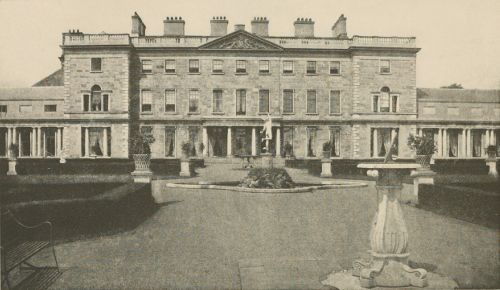
Carton House, Maynooth, County Kildare; the Residence of the Duke of Leinster
He spent the winter of 1907-8 in America, incognito, under the name of Maurice Fitzgerald. He and his tutor visited Quebec, Montreal, and Ottawa, and all the principal cities in the United States. They inspected Harvard, Yale, the University of Chicago, and Stanford University, for the young duke has recently taken a degree at Oxford, and was naturally curious to see some American institutions. He spent some time in New York, and was in Washington for a couple of days without disclosing his rank. He enjoyed himself immensely during the entire journey and escaped all the matchmakers, the lion hunters, and the society cormorants. He was not in search of a wife, but was seeking health and completing his education. I am told that he is an exceedingly sensible young fellow, modest, intelligent, thoughtful, and studious. He does not need to marry for wealth nor for position. He can pick his own wife, and has plenty of time to consider the choice.
The duke has been very carefully brought up and educated. His mother died when he was nine years old. She was Lady Hermione Duncombe, daughter of the Earl of Faversham. His father died at the age of forty-two, when he was fourteen. The present duke inherits his delicate, frail constitution, and has symptoms of tuberculosis, which has been the death of many Geraldines. To preserve himself from its dreaded grasp he has lived an outdoor life under the care of a physician, and every preventive that medical science can devise has been used for his protection. Since the death of his mother he has been under the care of three aunts,—Lady Cynthia Graham, Lady Ulrica Duncombe, and Lady Helen Vincent,—his tutor, Rev. the Marquis of Normanby, and his trustee, the Earl of Faversham. He has had governesses and tutors, spent two years at Eton and three years at Oxford, although his studies have been frequently interrupted by sea voyages and camping tours in the mountains for his health. He has a brother, Desmond, two years his junior, and another, Edward, who is fourteen years old.
The Duke of Leinster is prepared to take his proper place in public life, and has recently been appointed master of the horse to the Earl of Aberdeen, lord lieutenant of Ireland. His acceptance of this post indicates that he is a liberal in politics and a home ruler; and, indeed, the tendency of his education has been in that direction. His tutors and trustees are all home rulers and liberals. He is in training for the viceregal throne of Ireland, which so many of his ancestors have occupied, and that is his ambition. If Ireland should be granted autonomy under the plan proposed by Mr. Gladstone twenty-five years ago and demanded as their ultimatum by the Irish national party, the Duke of Leinster will be the most available candidate for lord lieutenant, and for many reasons his selection would be agreeable to those most interested on both sides of St. George’s Channel. His advent in politics is an event of great importance, and therefore will be watched with anxiety.
The mansion at Maynooth is an immense building of more than two hundred rooms, sumptuously furnished. There are fourteen drawing-rooms, and the banqueting hall will seat three hundred people. The library contains one of the largest and most valuable collections of books in Ireland, and the pictures are of great value as well as artistic interest.
The Leinster coat of arms is a monkey stantant with plain collar and chained; motto, “Crom-a-boo” (“To Victory”). This is the only coat of arms, I am told, that has ever borne a monkey in the design, and it was adopted by John Fitzthomas Fitzgerald in 1316 for romantic reasons. While an infant he was in the castle of Woodstock, now owned by the Duke of Marlborough, which caught fire. In the confusion the child was forgotten, and when the family and servants remembered him and started a search they found the nursery in ruins. But on one of the towers was a gigantic ape, a pet of the family, carefully holding the young earl in its arms. The animal, with extraordinary intelligence, had crawled through the smoke, rescued the baby and carried it to the top of the tower. When he grew to manhood the earl discarded the family coat of arms and adopted a monkey for his crest, which has been retained to this day, and wherever you find a tomb of a Fitzgerald you will see the figure of a monkey at the feet of the effigy or under the inscription.
Fitzthomas Fitzgerald, the child thus miraculously saved, was the hero of many romances and adventures, and for his eminent services to the crown King Edward II. created him the first Earl of Kildare, May 14, 1316. He was the ancestor of the famous earls, dukes, and marquesses of Ormonde and the earls, dukes, and marquesses of Desmond, although those branches of the family afterward became the rivals and the foes of the Kildares. The Duke of Leinster, by reason of the marriages of his ancestors and collateral members of the family, is related to almost every noble in the kingdom.
The Fitzgeralds are descended from the Gherardini family of Florence, one of whom passed over into Normandy in the tenth century and thence to England, where he became a favorite of Edward the Confessor, and was appointed castellan of Windsor and warden of the forests of the king. In 1078 he is mentioned in Doomsday Book as the owner of enormous areas of land in England and Wales. In 1168 Maurice Fitzgerald, whose name was anglicized and who was the father of the Irish branch of the family, accompanied Richard de Clare, Earl of Pembroke, better known as Strongbow, in the invasion of Ireland and was granted large estates. He died at Wexford in 1177 and was buried in the Abbey of the Grey Friars outside the walls of that town. One of his sons became Baron of Offlay, another became Baron of Nass, and Thomas, the third, was the ancestor of the earls of Desmond. The next earl was a man of great piety. In 1216 he introduced into Ireland the Order of the Franciscans and built them an abbey at Youghal. In 1229 he induced the Dominicans to send a band of missionaries and built them an abbey at Adair. And his son was equally devoted to the church.
The castle at Maynooth, which for several centuries was one of the largest and strongest in Ireland, was built by Gerald, the fifth earl, in 1427, whose second son was the founder of the house of Ormonde and was created earl of that name.
For sixteen generations the earls of Kildare were the most active men in Ireland, and the history of their adventures would fill a book as big as a dictionary. There was always “something doing” wherever they went; they were on all sides of all questions and were sometimes fighting each other as fiercely as the family foes. They led rebellions against their sovereign, have suffered imprisonment, and have been executed at Tyburn and the Tower. They have been the boldest and most powerful defenders of British authority in Ireland and several times have saved the island to the British throne. More lords lieutenants have come from the Kildares than from any other family, and among the long list of earls have been some splendid characters.
The eighth earl subdued all the native chieftains and made them submit to English authority. An early historian describes him as “A mightie man of stature, full of honoure and courage, who has bin Lord Deputie and Lord Justice of Ireland three and thirtie yeares. He was in government milde, to his enemies stearne, he was open and playne; hardley able to rule himself, but could well rule others; in anger he was sharp and short, being easily displeased and easily appeased.”
Thomas Gerald, the twelfth earl, having incurred the enmity of Cardinal Wolsey, was called to England and committed to the Tower for treason. When he left Ireland he intrusted his official authority and responsibilities to his son and heir, familiarly known as “Silken Thomas,” because of the gorgeous trappings of his retinue. The boy was then but twenty-one, bold, brave, patriotic, and generous, and became the victim of a plot devised by agents of Cardinal Wolsey, who spread a report that his father had been beheaded in the Tower. The impetuous young lord left the Castle of Maynooth, rode into Dublin, and, entering the chamber where the council sat, openly renounced his allegiance to the King of England, gave his reasons and laid mace and sword, the symbols of office, upon the table. Archbishop Cromer, the lord chancellor, besought him to reconsider, explaining that the rumor from London might be false, and the young earl was about to yield when the voice of the family bard, who had followed him to Dublin, was heard through the window singing the death song of the Kildares. “Silken Thomas” seized his sword, summoned the Geraldines, the family clan, which was the mightiest and most numerous in Ireland, assaulted the castle, and soon involved the entire country in a desperate revolution. When the old earl heard the news in his cell in the Tower he sent a message to Henry VIII. asking pardon for the rashness of his son and then died of a broken heart.
All Ireland was in flames; three-fourths of Kildare County and the greater part of Meath was burned; thousands of innocent people died of starvation and thousands in battle before the rebellion was suppressed. Finally Kildare, who was then but twenty-four, surrendered upon a promise that he should receive full pardon when he arrived in London and renewed his allegiance personally to the king. This pledge was shamefully violated. Henry VIII. refused to receive him, and sent him to the Tower, where for eighteen months he lay neglected and in great misery. He wrote an old servant asking money for clothes, saying: “I have gone shirtless and barefoot and bare-legged divers times, and so I should have done still but that poor prisoners of their gentleness hath sometimes given me old hosen and shirts and shoes.”
Five of his uncles, although it was well known that three of them had remained stanch adherents of the crown, were hanged, drawn, and quartered at Tyburn, Feb. 8, 1537, and orders went forth from Henry VIII. that the house of Kildare should be exterminated.
Gerald, the baby heir, the only survivor of his race, was wrapped in warm flannels by Thomas Leverus, afterward Bishop of Kildare, carried across bog and mountain, and committed to the protection of the O’Brians, who by sending the infant from place to place were able to save its life. The O’Brians passed the child over to the MacCarthys, and Lady Eleanor MacCarthy, a widow, disguised as a peasant, conveyed him to St. Mels, France, upon a fishing boat. Even there he was pursued from one place of refuge to another, by detectives and adventurers in hopes of the great reward, until finally he obtained a safe retreat in Rome, where Cardinal Pole, a distant relative, protected and educated him. When he grew to manhood he entered the service of Cosmo de Medicis, the great Duke of Florence, with whom he remained until Henry VIII., the vindictive enemy of his family, was dead. He could then return in safety to his native country, and Queen Mary soon after pardoned him and restored his hereditary titles and estates. Fourteen generations of Kildares have passed across the stage since then, and the present Duke of Leinster represents a family that has had more exciting experiences than any other in the United Kingdom.
XI
DROGHEDA, AND THE VALLEY OF THE BOYNE
One of the loveliest railway or automobile rides in Ireland is from Dublin northward to the ancient town of Drogheda (pronounced Drawdah). The railroad runs parallel with the highway along the shore of St. George’s Channel. Both touch several popular seaside resorts, fishing settlements, and busy manufacturing towns, which alternate with beautiful pastures filled with sleek cattle and unshorn sheep, and here and there ivy-clad towers and little groups of chimney pots rise above the foliage. The pastures and meadows, when we saw them, blazing with yellow buttercups, looked like the Field of the Cloth of Gold. They are divided into small plots by hedges of hawthorn twelve and fifteen feet high, which in the early summer are as white as banks of snow, and so fragrant that the perfume floated into the car windows.
Between the meadows and the pastures along the coast are plots of cultivated ground, gardens of potatoes, cabbages, and other vegetables and glorious groves. It isn’t a bit like the Ireland one expects to see after reading newspaper accounts of the terrible conditions that the politicians complain of. It is not a country of downtrodden peasants and a wretched tenantry crushed under the heels of oppressive landlords. Right is not upon the scaffold in that section of Ireland, nor is wrong upon the throne. On the contrary, every evidence of prosperity and contentment and happiness abounds. The neatly whitewashed, straw-thatched cottages are surrounded with gay gardens filled with old-fashioned flowers, such as you see in Massachusetts and New Hampshire. Large stables and storehouses are attached to almost every cottage, which indicates that the farmer has something to put in them. The traveler cannot see the mansions of the rich, because they are hidden in glorious parks and protected by high walls. Occasionally in the distance, however, he can catch glimpses of the towers of ancient castles, each having a romance or a tragedy, and sometimes several of both, contained in their history.
At Malehide forty or fifty golf players alighted from the train, with kits of clubs over their shoulders, for there are two links near that village—one for an exclusive club of rich Dubliners, and the other for any one who is able to pay half a crown for the privilege of chasing a little gutta-percha ball over the grass. Malehide is a lovely place, situated on the seashore at the mouth of a little stream called Meadow Water, with hotels of all grades and prices, fashionable and unfashionable, and some of them are open for health seekers the year around.
The chief attraction to tourists is the ancient castle of the Talbot family, who have owned and occupied it continuously for seven hundred years, an unusual record for Ireland or for anywhere else. The original castle, built about 1180, in the reign of Henry II., is still standing, although modern restorations and additions have changed it much. The exterior has suffered more than the interior. The dining-hall, a very large apartment, is considered one of the finest rooms in Ireland. The wainscoting and the ceiling are of oak, richly carved, and mellowed by exposure for more than six centuries. The chimney-piece, an exquisite example of fourteenth century carving, represents the Conception. From 1653 to 1660 the castle was inhabited by Miles Corbet, the regicide, and the very day he took possession of the place, according to tradition, the figure of the Blessed Virgin was mysteriously detached from the rest of the carving and disappeared until the night after the unholy tenant fled from the place, when it was miraculously restored.
There is a fine collection of paintings in the castle, including portraits by Van Dyck and other famous artists, three panels of scripture subjects by Albert Dürer, which formerly belonged to Mary, Queen of Scots, and were purchased by Charles II. for $2,000. The library is a treasure-house of old tomes and manuscripts, and upon the wall, in a heavy oaken frame, hangs the original patent by which the estate was granted to the Talbot family by King Edward IV.
Within the roofless walls of an ancient abbey near by is the altar-tomb of Maud Plunkett, whose husband, Sir Richard Talbot, according to the epitaph, “fell in a fray immediately after the wedding breakfast, thus making her maid, wife, and widow in a single day.”
The village of Swords, three miles distant, has another ancient castle, where the bodies of Brian Boru and his son Morrough rested the first night after the battle of Clontarf while they were being carried to their final tomb at Armagh.
All the little towns along the coast of the Irish Channel are associated with St. Patrick and St. Columba, who spent more or less time there, founding monasteries and building churches. One of the monasteries, called “the Golden Prebend” because it was so rich, was held by William of Wykeham in 1366 and was the seat of a cardinal for a century or two.
A mile and a half from the main line, beyond Swords, is the village of Portraine, where Dean Swift’s “Stella” lived for several years, and where a branch of the insane asylum he founded in Dublin has since been erected. It stands upon lands given by Sigtryg of the Silken Beard, the Danish king of Dublin, for the endowment of a Christian church. The house was occupied for many years by the nuns of St. Augustine, where “the womankind of the most part of the whole Englisher of this land are brought up in virtue, learning and in the English tongue and behaviour.”
The little town of Rush, famous for its early potatoes and its tulip bulbs, is called “Holland in Ireland.” It has an old church, with beautiful pointed arches, which dates back to the sixteenth century, and contains a richly decorated monument to Sir Christopher Barnwell and his beloved wife, who died in 1607.
Skerries is a fishing-town, where St. Patrick lived for several years, and a quaint little chapel, like many others in Ireland, is attributed to him, although it could not possibly have been built for several centuries after his time. But in the history of these ancient sanctuaries a few hundred years do not count.
While ruins are picturesque and ivy-clad castles that date back beyond the Middle Ages have a fascination for tourists from a new world like ours, it was a relief when the chauffeur brought us up to the entrance of an old-fashioned factory in the compact little town of Balbriggan, which has given its name to a certain kind of knitted goods that are worn the world over. It is a quaint mass of high houses, built of stone and brick on both sides of narrow but neatly kept streets, which seems unnecessary when miles of green fields and glowing gardens encircle them and give them every chance to spread out. But you will find the same tendency to snuggle up as closely as possible in all the manufacturing communities of Europe.
The men folks at Balbriggan fish and farm the soil, and the women work in the mills, but the law, which is strictly enforced there, prohibits child labor and compels the children to attend school for at least one hundred and twenty-eight days in the year until they pass their fourteenth birthday. The superintendents of the mills tell the same story that I heard in the cotton factories of South Carolina and Georgia, that they prefer adult operatives; that the children are careless and inefficient and seldom earn their wages, but they are compelled to employ them or lose the services of the parents. There are two factories in Balbriggan for the manufacture of knitted hosiery and underclothing by machinery invented here more than one hundred and fifty years ago and since imitated everywhere. Both factories still remain under the control of the families which founded them, but the shares are distributed among a larger number of people by inheritance from generation to generation.
Scattered along the coast at intervals of two or three miles, and generally at the summits of hills overlooking the sea, are “martello towers,” fifty, sixty, and sometimes ninety feet high, and from forty to a hundred feet in diameter. They were erected early in the nineteenth century as defensive watch-towers, when the country was in dread of an invasion by Napoleon. The name was taken from similar towers in Corsica and Sardinia, where they were erected for protection against pirates in the time of Charles V. These towers are said to have originally had bells which were struck by hammers to alarm the people in case of danger; hence they were called “martello” towers, that being the Italian word for “hammer.”
It makes a Protestant ashamed when he reads the history of Drogheda and sees the ruins that Cromwell left there. Thousands of men and women and children were butchered in the name of the Lord by Cromwell’s soldiers when he took that quaint old town by storm in September, 1649. It was a ferocious massacre, and Cromwell admitted the facts while proclaiming himself the agent of the Almighty to punish a rebellious people. This is what he wrote with his own hand:
“The governor, Sir Arthur Aston, and divers considerable officers being there, our men, getting up to them, were ordered by me to put them all to the sword, and, indeed, being in the heat of action, I forbade them to spare any that were in arms in the town; and I think that night they put to death about two thousand persons. Divers officers and soldiers being fled over the bridge into the other part of the town, where about a hundred of them possessed St. Peter’s Church steeple, some the West Gate, and others a strong round tower next to the gate called St. Sundays. These being summoned to yield for mercy refused. Whereupon I ordered the steeple of St. Peter’s Church to be fired. The next day the other two towers were summoned. When they submitted their officers were knocked on the head and every tenth man of the soldiers was killed. The rest shipped for the Barbadoes. The soldiers in the other tower were all spared as to their lives only and shipped likewise for the Barbadoes.
“I am persuaded that this is a righteous judgment of God upon these barbarous wretches who have imbued their hands in so much innocent blood; and that it will tend to prevent the effusion of blood for the future.”
Two of the towers have remained these two hundred and fifty years just as grim old Oliver left them, and there is much else of interest to the antiquarian in the town, although today it is given up to linen factories, flour mills, tanneries, and soap works, and has a large provision trade with England. It is the center of a prosperous agricultural community, and everybody seems to be doing well.
The greatest attraction is the ruins of Monasterboice, an extensive monastery, founded by St. Patrick, like every other ecclesiastical institution in this country, and three magnificent crosses which arise among them, about six miles from town. We tried to get a carriage instead of a jaunting car for the drive, because the latter allows you to see only one side of the roadway, but Mrs. Murphy, who has a livery stable and a tongue that is hung in the middle, could furnish us nothing else. It is a delightful drive. On the outward journey we saw what there is to see on one hand, and coming back we saw everything on the other.
The ruins of Monasterboice cover a large area, for five hundred monks and several thousand students were there eight or nine hundred years ago. It was one of the largest educational institutions in the world, as well as a religious retreat. It dates back to the fifth century, and was probably founded by St. Patrick,—certainly by one of his disciples,—although there is no tangible evidence to prove that fact. A “round tower” still in good condition, dates from the ninth century. It is one hundred and ten feet high and fifty-one feet in diameter at the base. It was intended for observation, for signaling to the country around, for the storage of valuables and military supplies, and for defensive purposes. Strangely enough, it sits in a hollow, in the lowest part of an amphitheater, surrounded by hills, but the Irish monks as well as the Irish warriors of ancient times always built beside streams of running water and not upon the heights, like the Goths, the Huns, the Teutons, and the Romans.
There are similar “round towers” at Cashel, Glendalough, Kildare, Antrim, and other places in the interior of Ireland which have long been subject of an irreconcilable dispute among archæologists. While no one knows definitely who built them, or what they were for, the most credited theory is that I have given above.
Dr. Petrie, who is a high authority, believes that they were built between the years 890 and 1238, when the Danes were in the habit of invading Ireland and plundering the ecclesiastical establishments. One of the most perfect of these towers, at Antrim, is ninety-two feet in height and forty-nine feet in circumference at the bottom; the summit terminates in a cone twelve feet high, which, with the tower itself, is of undressed stone, the walls being two feet nine inches in thickness. The door is on the north side at a height of seven feet nine inches from the ground. The tower was apparently divided into four stories by timber floors, which, of course, vanished long ago. Each of the three lower stories is lighted by a square window, and the upper story by four square perforations opening to the cardinal points. It stands in the grounds of a mansion. The turf between the two shows the dim outline of buildings, supposed to be those of a monastery founded by Aodh, a disciple of St. Patrick, the earliest notice of which occurs in the year 495. It was destroyed during the Danish incursions.
The walls of the chapel at Monasterboice are standing firm and strong, but without a roof, and the grounds surrounding them and the ruins of the monastery are still used for the burial of the families of the parish. It is a free cemetery and belongs to the government and not to the Catholic Church. Anybody—Protestant, Quaker, or Jew—can lay his tired bones down under the hospitable trees by application to the secretary of the board of public works. The oldest grave is that of Bishop O’Rourke, who was buried there in 982; the latest, marked by a clumsy wooden cross, was made in 1907.
What people go there to see are three splendid Celtic crosses, the finest specimens of the kind in Ireland, and that means the universe. They are believed to have been erected in the fifth century in honor of St. Patrick, St. Columba, and St. Bridget. This, however, is questionable. One of them bears the inscription, “A prayer for Murriduch, by whom was made this cross.” From the Irish Annals it may be learned that two men of that name have lived in this neighborhood, both of wealth and distinction, and they died, one in the year 844 and the other in 924. It is entirely probable that either of them may have erected the splendid monoliths. The largest is twenty-seven feet high, and all of them are covered with carvings of religious subjects. The crosses of Monasterboice have been photographed and reproduced many times, and models have been shipped to all parts of the world. Perfect replicas may be found in the museum at Dublin.
Four miles further on are the ruins of Mellifont Abbey, which was founded in the twelfth century, and has had an important part in the political as well as the ecclesiastical history of Ireland.
There are several drawbacks to motoring in Ireland, the chief of which is that the country is so short on good hotels and so long on showers. The next is the inability to see through or over walls of stone and hedges that rise twice as high as one’s head. Nevertheless, wherever there is much to see and little time to see it in, one has to put up with some annoyances, and an automobile is no longer a luxury or a mere convenience, but an actual necessity.
The Irish climate is like the Irish character. A witty native once said of his fellow countrymen, “They smile aisy and they cry aisy,” and that describes the habits of the heavens also. Clouds assemble and do business in quicker time than in any other place I have ever been, but, although it will “rain cats and dogs” for fifteen or twenty minutes, the sun will be shining almost instantly afterward, as if nothing had happened.
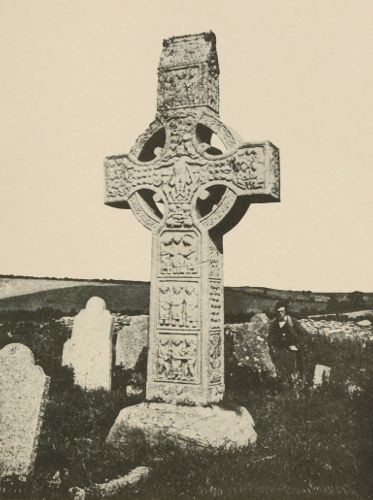
A Celtic Cross at Monasterboice, County Louth
Unfortunately the hotel proposition is not so easily disposed of. Most of the inns of the country districts and in the small cities are absolutely intolerable. It isn’t so much because of a lack of luxuries and modern conveniences that the traveler finds in England, Scotland, and on the Continent at similar places, as it is the excess of dirt and bad smells. In the average country hotel in Ireland everything is in disorder and out of repair. The bells don’t work; the furniture is crippled and decrepit; the mattresses are lumpy and half the springs are broken or out of joint; the bedrooms are seldom swept, the table cloths are seldom washed; sheets and pillow-cases, are seldom changed, and if a guest should call for a clean towel the landlord would be likely to ask what is the matter with the one he gave him a few days ago. The only alternative to stopping at a dirty hotel is to ride on until you come to a clean one, and that may be as far as the ends of the earth. The more practical, and indeed the only, way is to accept the situation good naturedly and get the best you can out of it. Any person who takes an interest in this subject can find further and accurate information in that charming book, “Penelope’s Irish Experiences,” by Kate Douglas Wiggin. It is asserted by those who know that there are only five good hotels in Ireland. We found nine, but did not keep count of the other kind. They are too numerous to mention.
The road from Drogheda to Tara, the ancient capital of Ireland, follows the valley of the famous Boyne River, and passes through the famous battlefield where William of Orange, with thirty thousand men, in 1690, overcame James II. with twenty-three thousand, and deprived the latter of his dominion and his crown and gave the Protestants control of Ireland for the next two hundred and fifty years. A stately monument has been erected upon the field, and various small markers have been placed about to show where important incidents took place.
The Valley of the Boyne is extremely beautiful. The banks are densely wooded for miles, and the river flows through many fine estates owned and occupied by rich people from London, Dublin, and other cities. The climate is agreeable and healthful for nine or ten months in the year. Only February, March, and April are unpleasant, because of the winds. The scenery is peaceful and attractive, the foliage of the groves and forests is rich beyond comparison, and it is difficult to conceive of more desirable surroundings for a summer home for men of wealth and leisure. To the antiquarian and the archæologist there is an unlimited field for exploration that has only been touched thus far.
Only a few miles from Drogheda, and on the direct road to Tara, is a collection of tumuli which are unsurpassed in Europe or any other part of the world. They mark the location of Brugh-Na-Boinne, the royal cemetery of ancient Ireland, the burying-ground of the kings of Tara for centuries before the history of the country began. Although they do not show the same architectural skill or artistic taste or mechanical mysteries, and do not compare in magnitude with the pyramids and other tombs of the kings of Egypt, they nevertheless have an entrancing interest to those who love archæology and prehistoric lore. The tumuli are scattered over a large area, and, according to the theories of scientists who have explored them, contained the bodies of successive royal families of Ireland until the invasion of the Danes, when they were desecrated, looted, and nearly destroyed, just as the tombs of the kings of Egypt were stripped of their treasures by the Assyrians and other invaders.
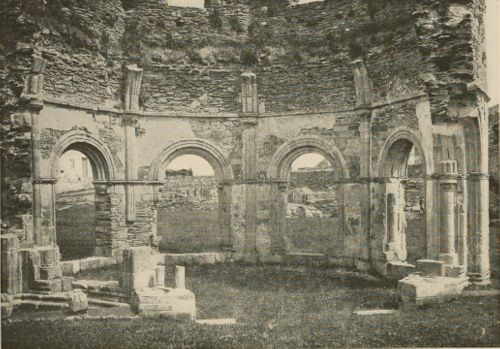
Ruins of Mellifont Abbey, near Drogheda, County Louth
The most remarkable tumulus, at New Grange, has been described at length by several eminent antiquarians. It stands on elevated ground, and covers about three acres, the main part being two hundred and eighty feet in diameter and about one hundred and twenty feet high. It is now covered with dense vegetation. It is a vast cairn of loose stones, estimated at one hundred thousand tons, those at the base being very large—from six to eight feet long and four or five feet thick. They are arranged in a circle without masonry; simply laid in order and smaller stones placed inside and on top of them until an artificial cavern was created, which was reached by a passage sixty-two feet long, formed of enormous upright stones from five to eight feet high and roofed with flagstones of great size. This passage leads to a low dome-roofed chamber, nearly circular, whose ceiling is supported by eleven upright pillars. The ceiling is nineteen and a half feet from the ground. There are three other chambers, measuring eighteen by twenty-one feet in size, which at one time were doubtless filled with the bodies of the royal families. The archæologists compare them to the beehive tombs of Mycenæ, known as “The Treasury of Atreus,” and find many resemblances. The surfaces of some of the stones are rudely carved with cryptographs and ornamental designs.
There are several other tumuli in the neighborhood of different dates and dimensions and of absorbing interest to science; and all of them we know, from that accurate and comprehensive chronicle, “The Annals of the Four Masters,” were plundered by the Danes in the year 801. Those vandals left nothing but bones and cinerary urns; they took away or destroyed everything else. The tumuli are now in the custody of the board of works, which is taking care of them, and is having careful scientific excavations and other examinations made by competent authorities.
There are several other cemeteries in the neighborhood that are not so old, and they also are supposed to contain the dust of kings; but few of the graves have been identified. One of them, marked with two tombstones set with their tops together like the gable of a house, has been declared to be of greater antiquity than any other Christian tomb in Ireland, and is supposed to contain the remains of St. Eric, the first bishop consecrated by St. Patrick. He died toward the end of the fifth century. It is said that his custom was to stand immersed in the Boyne River up to his two armpits from morn till evening, having his psalter lying before him on the strand where he could read its pages, and continually engaging in prayer.
In another grave lie the bones of Cormac, the greatest of the kings of Tara, who was a Christian, having been converted by St. Patrick. His death was brought about by the Druid priests, who cast a spell over him and caused a bone of salmon to stick in his throat. He commanded his people not to bury him at Brugh-Na-Boinne among his royal ancestors, because it was a cemetery of idolators, but to place his body humbly in consecrated ground, with his face to the east. These injunctions were clear and positive, but the king’s servants required a miracle to induce them to obey. Three separate times they started from the palace at Tara for the royal burying-ground at Brugh-Na-Boinne, when the river miraculously rose to such a height that they could not cross. After so many warnings their stupid brains finally saw the light and they laid his majesty’s ashes in consecrated ground, as he had commanded.
The little antiquated village of Kells, with pleasant surroundings and glorious foliage, sleeps unconscious of its fame. It is of the greatest interest to Christian archæologists, because it was the home of St. Columba (or Columbkill), second only to St. Patrick in influence and in the work of evangelizing Ireland. He was born in Donegal in 521, of royal blood, being the great-great-grandson of King Niall of the Nine Hostages, founder of the O’Neill family. Having heard the truth of the gospel, he gave up his princely heritage for the service of his Master and became a monk. He traveled for sixteen years, preaching from place to place, founding churches and monasteries all over the country, which are still venerated by the people, and are among the most interesting ruins in Ireland. At Kells he built a famous monastery in the year 550, and the cost was paid by Dermot, son of Fearghus, king of Tara, at that time.
St. Columba made his headquarters there for many years and then crossed the channel to the little Island of Iona, on the west coast of Scotland, which had been granted him by his relative, the king of that country. He founded a monastery there, from which he and his disciples traversed all Scotland and the Hebrides, preaching the gospel, baptizing the people, building churches and monasteries, until half the Scotch were converted to Christianity. The rest of Great Britain was converted from paganism by the missionaries he educated and sent out. After a life of extraordinary activity and usefulness he died at Iona in the year 597 at the age of seventy-six years and was mourned by every one on the shores of the four seas. His funeral lasted three days and three nights, and he was buried within the walls of the monastery of Iona, whence his remains were afterward removed to Downpatrick and buried in the same grave as those of St. Patrick and St. Bridget.
A portion of the house of St. Columba still remains at Kells, half concealed by a cloak of wonderful ivy. There is a tower one hundred feet tall, and in the neighboring churchyard are several crosses of the Celtic fashion, similar to, but not so large or so fine as those at Monasterboice. They are, however, sacred in the eyes of all Irishmen and date back to the tenth century.
The “Annals of the Four Masters” record many exciting incidents and important events that have occurred in the history of the town of Kells. It has been invaded and looted by Irish clansmen, Norwegian hordes, and Danish Vikings. It has been devastated many times by fire, sword, and pestilence. Sigtryg of the Silken Beard burned it to the ground in 1019, and Edward Bruce in 1315, but it has arisen serene and smiling as often as it has been destroyed, and prosperity has been restored again. It was in the great monastery founded by St. Columba that the famous illuminated “Book of the Gospels,” preserved in the library of Trinity College, Dublin, was made by the monks in the eighth century. Mr. Westwood, a very high authority, pronounces it “the most elaborately executed monument of early Christian art in existence.” Kells was also noted for its metal work in the Middle Ages. At present it is merely an agricultural market and the seat of the Marquess of Headfort, who has a large estate and a beautiful chateau surrounded by a wooded demesne and a hunting preserve. There are several other delightful residences in the neighborhood, and if there were a decent hotel within walking or driving distance, Kells might have many visitors, but those who go there are compelled to hurry away to find some place to stay overnight.
Navan, a neat little manufacturing town with a woolen mill and other industries, has a reasonably good hotel, but you have to come back about ten miles from Kells. There is another neat little town called Trim, where it is possible to stay overnight and even to pass a day or two. The country around Trim is lovely. The landscapes in every direction would fascinate an artist, and the ruins of “King John’s Castle,” built on the banks of the Boyne by Hugh de Lacy, are among the most extensive and beautiful in the world. The walls, four hundred and eighty-six yards long, with ten circular towers at nearly equal distances, are still well preserved and there is a lofty keep, seventy feet high, with beautiful turrets and flanked on either side with rectangular towers. There is nothing to surpass it in Ireland for picturesqueness, and its associations give it additional interest, for King John, Edward II., Richard, Earl of Ulster, and Humphrey, Duke of Gloucester, and other famous characters, have lived there. Henry of Lancaster, afterward Henry IV. of England, was imprisoned there; the parliament of Ireland met within its walls, year after year, and it was once the mint of the kingdom. In later days it was occupied by the Duke of Wellington, who received his early education in the diocesan school within the grounds.
His name, you know, was Arthur Wellesley. He was a son of Lord Mornington, of an old Irish family. His mother was a daughter of the Earl of Dungannon of Tyrone, and she lived to see four of her sons elevated to the peerage of Great Britain, not because of wealth or political influence, but because of their ability and usefulness. Richard, the eldest, was that celebrated statesman, the Marquis of Wellesley; the second, William, was also eminent in politics and civil affairs as Lord Mayborough; the third, Henry, Lord Crowley, spent his life in the diplomatic service and made an enviable name, while Arthur, hero of Waterloo and of the Spanish campaign, the man who broke the back of Napoleon the Great, was the fourth and most famous of them all.
Arthur Wellesley was born May 1, 1769, in Merrion Street, Dublin, in a house now occupied by the commissioners that are carrying out the land act, and he died Sept. 18, 1852. It may be said that no other Irish subject of a British king ever received greater honors or better deserved them.
Dungan Castle, the home of the Wellesleys, is near Trim, about twenty miles from Dublin, and the nearest railway station is Summer Hill. Laracor, a secluded little village where Dean Swift was once curate and where Stella lived with Mrs. Dingley, is only a mile or two distant.
XII
TARA—THE ANCIENT CAPITAL OF IRELAND
In prehistoric times, before the conversion of Ireland to Christianity by St. Patrick, the clan system prevailed there, as it did in other countries of Europe. A “clan,” or “sept,” consisted of a number of families and was ruled by a patriarch, the greatest warrior, or the oldest man. A “tribe” was a larger group, consisting of several clans or septs more or less related to each other and occupying a distinct and separate territory under the command of a chieftain. Several tribes composed a nation, as the word is used among the North American Indians, ruled by a “ri,” or king, while the “ard-ri,” or over-king, a supreme monarch with jurisdiction extending to the remotest shores of Ireland, reigned and resided at Tara until the sixth century, with the province of Meath as his own exclusive demesne for the use and support of his family and his court. He received tribute from the local kings or “ri” and was elected by their votes. Occasionally at his call, or at stated intervals, the kings and chiefs would assemble at Tara to consider matters of importance to all, to adopt laws and regulations for preserving peace and promoting the welfare of their subjects and protecting their common interests. Several feasts, held there annually, were attended by the minor kings, chieftains, and nobles who were followed by large retinues. Their warriors engaged in games, sports, and tournaments to encourage the physical development of the race and teach the arts of war. From the throne of the ard-ri decrees were announced, laws proclaimed, justice dispensed, and prizes awarded. According to the annals of those early days, one hundred and forty-two kings reigned at Tara during a period of two thousand five hundred and thirty years, when the place was abandoned in consequence of a curse pronounced by St. Ruadhan of Lorrha for the failure to punish Hugh Garry for the murder of a monk. Until the time of Cormac Mac Art, greatest and most luxurious of all the ancient kings of Ireland, the rulers who sat at Tara were pagans, but he was converted to Christianity, and the annalists in glowing lines describe his piety and his devotions.
According to the ancient laws, the king of Ireland could not have a blemish upon his person, and Cormac was obliged to abdicate power and authority and retire to the top of the Hill of Skreen, across the valley from the Hill of Tara, because his left eye was put out by an arrow shot by Ængus, a rebellious chieftain, who is believed to have been under the influence of Druid priests, to punish Cormac for accepting Christianity.
Cormac’s administration was the golden age at Tara, and although there was no pretense of architectural display in the wicker palaces that were thatched with straw, nevertheless he and other kings of that period possessed great wealth and made gorgeous displays at the ceremonies of their courts. An early writer describes a banquet given by Cormac Mac Art to one hundred kings, chieftains, astrologers, bards, and other distinguished men, who were seated at twelve tables, sixteen attendants at each table, and two oxen, two sheep, and two hogs were consumed, besides other and many varieties of food.
“Beautiful was the appearance of Cormac,” says the ancient manuscript, “flowing slightly, curling golden hair upon him;
“A red buckler with stars and animals of gold and fastenings of silver upon him;
“A crimson cloak in wide descending folds upon him;
“Fastened at his breast by a golden brooch set with precious stones;
“A torque of gold of curious design and richly graven around his neck;
“A white shirt with a full collar intertwined with red gold thread upon him;
“A girdle of gold inlaid with precious stones around him;
“Two wonderful shoes of gold with runnings of gold upon him;
“Two spears with golden sockets in his hand.”
In such attire did the king appear at the banquet given in honor of his chieftains:
“The feis of Temur each third year,
To preserve the laws and rules
Was then convened firmly
By the illustrious King of Erin.”
The last ard-ri, or king of all Ireland, was Roderick O’Conor, who died in 1198.
The archæologists, judging by the ruins and the traces of the walls, find that the great banqueting hall was 759 feet long by 90 feet wide; the other buildings were circular or oval; and it is apparent that they were surrounded by walls of stone intended both for privacy and protection.
No doubt the royal residences and other buildings at Tara were of wicker construction. Furthest to the south, on the ridge or hill of Tara, is the Rath Laoghaire (Leary), built by an old king whom St. Patrick tried to convert, but without success; and somewhere in the rampart on the southern side of this are the bones of Laoghaire. He was buried as he ordered—in the bank of his rath, standing erect, with his shield and weapons, with his face turned southward toward his foes, the Lagenians (Leinstermen). Next northward is Rath na Riogh (Rath of the Kings), probably the oldest structure at Tara, and the royal residence. It is oval, and 853 feet long from north to south. Within its inclosure are: Teach Cormaic (Cormac’s House), a rath with an outer ring, probably built by Cormac Mac Art. Its diameter is about one hundred and forty feet. Next to the northwest, and joined to Teach Cormaic by a common parapet, is the Forradh (“place of meeting”). Its greatest diameter being 296 feet and the diameter of the inner circle 88 feet. To the north of these, but still within the Rath na Riogh, is a mound called Dumha na n-Giall (Mound of the Hostages), on the flat summit of which was probably a house wherein dwelt the hostages often required by the ard-ri of minor kings, of whose fealty he might have doubts. No doubt the hostages of Niall of the Nine Hostages were kept here. To the west of this mound are the remains of another, the Dumha na Bo, or Mound of the Cow. Outside the inclosure of the Rath na Riogh, on the north, is Rath na Seanaidh, or Rath of the Synods, so called because of the synods held there by St. Patrick and his successors, though it is of much older date.
Upon the summit of the hill is a rude statue of St. Patrick carved in granite by Mr. Curry, a stone cutter in one of the neighboring towns, and erected at the expense of local contributors many years ago. It bears no likeness to any human being, but the motive which erected it was pure and patriotic, and in a measure it is appropriate because on Easter morning in the year 433 St. Patrick proclaimed the gospel of Jesus Christ to the pagan priests and the King of Tara and his court, standing upon the very spot now occupied by his statue. Father Mathew once delivered a temperance speech from that holy spot, and in 1843 Daniel O’Connell addressed a monster meeting, attended by a quarter of a million people, many of whom came fifty miles or more to hear him advocate the political emancipation of the Roman Catholic population of Ireland. The meeting lasted two days and O’Connell spoke twice. It was one of his last meetings before his arrest and imprisonment at Dublin. On or near the Mound of the Hostages, according to the best authorities, stood the “Lia Fail,” or “Stone of Destiny,” upon which for ages the monarchs of Ireland were crowned. This stone, according to tradition, was the pillow of Jacob when he dreamed his dream and when the angels descended and ascended a golden ladder at his head. It was preserved by fugitive Israelites at the destruction of Jerusalem and the dispersion of the tribes, was brought to Ireland with the Ark of the Covenant, and passed into the possession of the early kings. This stone was carried to Scotland and preserved at Scone until Edward I. took it to London for his coronation, and ever since his day it has been the seat of the coronation chair. All of the kings of England have sat upon it while the crown of sovereignty was placed upon their heads, from Edward I. to Edward VII., and any one may see it in the coronation chair at Westminster Abbey.
Petrie, one of the highest authorities on Irish history, denies that the coronation stone of Scone, now in the coronation chair at Westminster Abbey, is the Lia Fail. He asserts that it never left Tara. And he believes it is now there—a stone pillar, standing erect on the Forradh, marking the place of the interment of a number of Irish who were killed in the rebellion of 1798. It is about eleven feet long, and about half of its length is in the ground, so that it appears but a rough, unhewn pillar, five feet three inches high.
A similar stone was used by the Ulstermen to inaugurate The O’Neill. It was in a rath at Tullyhogue, near Cookstown, County Tyrone, and was broken up by an English expedition in the time of Queen Elizabeth. The Clannaboy O’Neills used an inauguration chair, a fragment of gray sandstone in the shape of a chair with a high back, without the mark of chisel upon it—evidently found somewhere just as it was. It was kept at Castlereagh, on the hills overlooking Belfast on the southeast. It was found among the ruins of the castle about seventy-five years ago, and is now in the Museum at Belfast.
Joyce’s “History of Ireland” gives an interesting story of the taking of the Lia Fail to Scotland: The Irish, or Gaels, or Scots, of Ulster, from the earliest ages were in the habit of crossing over in their currachs to the coast of Alban, as Scotland was then called; and some carried on a regular trade therewith, and many settled there and made it their home. The Picts often attempted to expel the intruders, but the latter held their ground, and as time went on occupied more and more of the western coast and islands. About A.D. 200, a leader named Riada (meaning the long armed), a grandson of Conn of the Hundred Battles, and first cousin of Cormac Mac Art, settled among the Picts of Alban with a large following of Munster fighting men and their families. From him all this western portion of Scotland was called Dalriada (Riada’s portion). There was also an Irish Dalriada named for him, comprising what is now the northern portion of County Antrim. The Venerable Bede, in his “Ecclesiastical History,” also gives an account of Riada and his colony.
About A.D. 503, three brothers, Fergus, Angus, and Loarn, sons of a chief named Erc, and all Christians (Erc was a direct descendant of Riada), led a large body of colonists over to Alban. They united with the previous settlers from Ireland, and took possession of a large territory, which they formed into a kingdom, of which Fergus, the son of Erc (hence called Fergus Mac Erc), was made the first king. The Lia Fail was taken over from Tara in order that Fergus might be inaugurated king upon it, and was never brought back. So, if this is true, the Stone of Destiny had been taken from Tara a generation before the curse of St. Ruadhan caused Tara to be abandoned as a royal residence.
This Fergus is the reputed ancestor of the Scottish royal family, and from him, through the Stuarts, descended, in one of his lines of pedigree, King Edward VII. of England. Gradually the name of Scots, which was originally that of the people of Ireland, was transferred to the people of Alban, and the country of the latter finally assumed the name of Scotland.
Carrickfergus (the Rock of Fergus) takes its name from this Fergus, the first Scottish king. He was troubled with some ailment, and went over to Ireland to use the waters of a well (presumably considered holy). He was wrecked off the coast, and his body drifted ashore on the strand by the rock on which the castle is now built; so the rock was named for him.
Across the valley on the Hill of Skreen, where Cormac took refuge after his abdication, Father Mathew lived for several years, and the ruins of an abbey may be found there still.
So firmly convinced were some antiquarians who have investigated this place of the truth of the traditions of the coronation stone that they have dug up the ground in various places and searched for the Jewish Ark of the Covenant, which they believe was buried here by the Irish priests to escape capture at the time the palaces of Tara were looted and destroyed. But they have never been able to find any traces of it.
In 1798, during the rebellion, a battle was fought on Tara Hill between a body of about four thousand insurgents, composed chiefly of young farmers and peasant lads from the neighborhood, against nearly three thousand well-armed troops, who easily overcame them and put them to flight.
The Tara of to-day is a cluster of cottages, a post office, a police station, a blacksmith shop, a general store, and the inevitable “public house”—the curse of Ireland. The usual group of loafers were sitting inside chatting with a slattern behind the bar. It was a filthy place, and smelled of spilt liquor and bad tobacco, but, as usual, everybody was very polite to us, and, when we climbed out of the automobile a lame, round-shouldered, toothless old man came hobbling up to us crying in a wheezy voice:
“I’m the guide! I’m the guide! I’m the lawful guide, yer honors, and I’ll show yez around.”
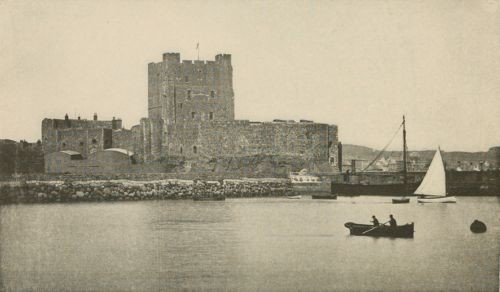
Carrickfergus Castle
He was so deaf that he couldn’t understand us, and he mumbled his words so that we couldn’t understand him, except now and then a word, but he was so anxious to be of service, so eager to earn a tip, that he would repeat everything he said again and again, until we were able to comprehend it. With his crooked stick he pointed the way across the fields and we followed him. We wouldn’t have got much information, however, had not Mr. Wilkinson, the first citizen of Tara, come to our rescue. He saw us as we passed his house, which stands a little way down the road, and, as he explained, “Having nothing better to do, and always enjoying an opportunity to meet Americans,” he fortunately came over and joined our party and gave us intelligent and interesting explanations. He is a rugged old gentleman, is Mr. Wilkinson. Although more than eighty years of age, he “can do as big a day’s work, six days in the week, and enjoy the Lord’s day for rest as much as he did when he was only forty.” His great-grandfathers as far back as he knows, like himself, were born in the cottage in which he lives, and “I’ve seen things come and go for many a day,” he said. When Mr. Wilkinson had passed beyond hearing with the ladies, the old guide seized me by the arm, drew me anxiously to shelter and then in a whisper repeated several times until I was able to comprehend:
“’E’s the richest man in Tara and in all the country round about. ’E’s worth three thousand pun if he’s worth a penny, and he got it from his father before him. He’s a good man, too, and I dunno what we’d do here without Mr. Wilkinson.”
They led us to the top of the hill, where we could stand beside the spot once occupied by the coronation stone and admire all Ireland, spread out like a cyclorama around us. It is one of the most beautiful landscapes in the universe. There are no mountains, except in the far distance; there are no rocks or other ungainly objects in view, but as serene and peaceful and fertile a tract of territory as can be found upon God’s footstool. Ireland is the greenest country that ever was. The turf and the foliage have a brighter color and a richer luster than those of any other country. That, however, is not news. The fact was discovered centuries ago and has been disclosed by every son of old Erin who ever wrote poetry or prose. But nowhere is there such convincing proof that the Emerald Isle was appropriately named as is offered from the top of the Hill of Tara. You cannot transfer the testimony of the fields and the forests to paper, either with a pen or a brush, and certainly not with a typewriter. There are no words in the English language sufficient to convey to another mind what the eyes can see of this glorious landscape, and it is useless to multiply adjectives.
“Some sez it’s the place of the coronation chair,” mumbled the guide, as we stood on the crest of the hill. “Some sez it’s the king’s chair; but I calls it a very commandin’ spot. Two years ago,” he continued, “some friends of Lord Dunsany came here. May be they have a son married to his daughter, I dunno, but she was a very dacent lady. She wouldn’t walk any further than the hall, and she sez, sez she, ‘Me man, bide here with me,’ and I sez, sez I, ‘Have no fear, me lady, sit here on the soft sod and I’ll go with his lordship, for people are always comin’ from Scotland and Ameriky, and I always shows them about.’ There’s none else that can do it so well as meself, and when they came back his lordship gave me two shillin’, and he’s a vera dacent man.”
Mr. Wilkinson gave us some interesting history, and repeated many traditions and legends of the place. He told us how many parties of archæologists had been here digging for the Ark of the Covenant and had found nothing but dirt and stone. He took us through the modern churchyard and opened to us the little sanctuary where Rev. Mr. Handy preaches every Sunday morning and baptizes into the Church of Ireland the babies of Tara, that are very numerous in the short, narrow street. He told us that Mr. Briscoe was the largest landowner in the neighborhood, and had inherited from several generations the sacred hill upon which we stood. He had fenced in the remains to keep the cattle out and kept down the grass so that the outlines of the ruins could be followed. Mr. Briscoe has recently disposed of nearly all his holdings, under the new land act, to his tenants, who occupy them, and now nearly every acre within the range of human vision from the Hill of Tara belongs to the man who tills it.
After we had thanked Mr. Wilkinson for his attentions and parted with him on the roadside, a woman put her head out of one of the cottage windows and in a stage whisper said:
“He’s the best and richest man in Tara. He’s worth every penny of ten thousand pounds.”
Cambrensis, one of the oldest and earliest writers of Ireland, says: “There is in Mieth a hill called the Hill of Taragh, whereon is a plaine twelve score long which was named the King his hall; where the countrie had their meetings and folkmotes, as a place that was accounted the high place of the monarch. The historians hammer manie fables in this forge of Fin Mac Coile and his champions.”
While Tara was the seat of authority for all Ireland, and the center of military education and display, it was also the place where the bards used to assemble in early times for competitions in poetry and melody. Each year the troubadours of Ireland gathered there to recite heroic epics in praise of their patrons and sing the ballads they had composed for prizes. These musical and literary tournaments reached their greatest fame and influence during the days when Cormac Mac Art was king. He was not only the greatest warrior, but the greatest scholar and legislator and judge that the Irish knew during the period of which Tara was their capital. The poems and chronicles of his time describe him as a model of majesty, magnificence, and manly beauty. He founded three colleges in the neighborhood of Tara, one for the teaching of law, one for poetry, literature, history, and music, and the third for military science. He organized what was known as the “Fena of Erin,” a body of militia remarkable in many respects, which was under the command of Fin Mac Cool, his son-in-law, who of all the ancient heroes of Ireland is best remembered in tradition and combined the qualities of Hercules, Julius Cæsar, and Solomon.
But no reference in literature to this sacred place is more familiar than one of the ballads of Tom Moore. Indeed, the great majority of people never heard of Tara from any other source:
“The harp that once through Tara’s halls
The soul of music shed
Now hangs as mute on Tara’s walls
As if that soul were fled.
So sleeps the pride of former days,
So glory’s thrill is o’er,
And hearts that once beat high for praise
Now feel that pulse no more!
“No more to chiefs and ladies bright
The harp of Tara swells;
The chord alone that breaks at night
Its tale of ruin tells.
Thus Freedom now so seldom wakes,
The only throb she gives
Is when some heart indignant breaks
To show that she still lives.”
The history of Tara, the proceedings of the nobles, kings, and learned men who met there at intervals, with the ard-ri at their head, to devise laws and promote the welfare of the kingdom, and to transact other important business, were all written down in a book called the Psalter of Tara. This book also contained a record of the “fes,” or tournaments, both military and athletic, that were held there, and contained a list of the prize winners, but, although the Psalter of Tara is frequently quoted by early writers the original of the book was lost or destroyed ages ago.
There are, however, many venerable tomes, epic poems, as well as history, that illuminate what are usually termed the prehistoric times in Ireland. The history of this country does not fairly begin until the time of St. Patrick and the introduction of Christianity and modern learning. Since then the records are practically complete. The many monasteries were filled with scriveners who kept a record of events with considerable detail and probable accuracy. But the more interesting period lies farther back, when the kings of Tara were in their glory and the sun shone upon the exploits of half-savage clans that lived by the chase and not by agriculture, as their descendants do. It is a familiar joke to say that one’s ancestors were kings of Ireland, but there is more truth than witticism in such remarks.
There is no reliable authority for the existence of any national military organization of professional or fighting men in Ireland other than chiefs, down to the reign of “Conn of the Hundred Battles,” who was monarch at Tara from 123 A.D. to 157 A.D., in which year he was slain. Still, it is stated that Conn himself came to the throne from the command of the celebrated national militia, popularly known as the “Fianna Eireann,” of whom the great Finn, Mac Cumhaill, and his father, Cumhaill, were the most famous commanders, just as many of the Roman emperors rose to the purple through the backing and from the command of the Prætorian Guards. This militia of ancient Ireland were accomplished athletes to a man, and their preparation and competition for enlistment were most arduous and remarkable. The name Fianna (hence the modern “Fenians”) is explained in an antique glossary preserved in a volume of the famous “Brehon Laws.” There were several severe conditions which every man who was received into the Fianna was obliged to fulfill.
The first was that he should not accept any fortune with his wife, but select her for her beauty, her virtue, and her accomplishments.
The second was that he should not insult any woman.
The third was that he should never deny any person asking for food.
The fourth was that he should not turn his back on less than nine foemen.
No man was received into the Fianna until a wide pit had been dug for him, in which he was to stand up to his knees, with a shield in one hand and a hazel stake the length of his arm in the other. Nine warriors, armed with spears, came within a distance of nine ridges of ground of him and threw their spears at him all at once. Should he be wounded, despite the shield and hazel staff, he was not received into the order of the Fianna.
No man was received into the Fianna until his hair was first braided. He was then chased by selected runners through a forest, the distance between them at the start being one tree. If they came up with him he could not be taken into the Fianna.
No man was received into the Fianna if his weapons trembled in his hands.
No man could be received if a single braid of his hair had been loosened by a branch as he ran through the forest.
No man was received into the Fianna whose foot had broken a withered branch in his course. (This to insure light and careful as well as swift runners, who left no trail.)
No man was received unless he could jump over the branch of a tree as high as his head and stoop under one as low as his knee.
No man was received unless he could pluck a thorn out of his heel without coming to a stand.
And finally, no man could be received until he had first sworn fidelity and obedience to the king and commander of the Fianna.
It’s a sin that there is no place for visitors to stay at Tara. The nearest hotel is seven miles away, and the lord of the manor cannot entertain every American tourist that comes along. I know of no lovelier landscape or more attractive site for a summer hotel, but I suppose the patronage would be limited, because Tara is a long way from the railroad and an automobile costs five guineas a day with an allowance of seven shillings for the board and lodging of the chauffeur and whatever gasoline may be used.
We were sorry to leave the historic place. One is sorry to leave almost every place in Ireland. It is such a fascinating country. But the next stop will develop something else quite as novel and interesting as it did to us at Castle Dunsany, the ancient home of the Plunkett family.
The “Annals of the Four Masters” relate that there were fierce lords upon the road from Dublin to Tara, and that if the traveler was not robbed by the Lord of Dunsany Castle he would be robbed by the Lord of Killeen, and if he managed to escape Killeen he was sure to be robbed at Dunsany. These two famous places stand on both sides of the highway not more than a mile apart, and, although both have been restored and remodeled for modern occupants they are still very old and associated with much interesting history. Dunsany Castle was built by Hugh de Lacy about the middle of the twelfth century. Killeen Castle was the seat of the Earl of Fingal. Both are surrounded by magnificent demesnes or wooded parks inclosed with high walls and filled with game, according to the Irish custom. Near by Castle Dunsany, in the midst of a glorious grove of trees that have been growing there for centuries, are the roofless walls of the ancient Church of St. Nicholas, rebuilt upon the site of an older sanctuary by Nicholas Plunkett in the fifteenth century and named in honor of his patron saint. His sarcophagus is in the center surrounded by other tombs of the Plunkett family for several generations. At Killeen is another church of similar age and in similar condition, and that also contains the monuments of the founder and his family for many generations.
Hugh de Lacy was the original owner and occupier of the Abbey of Bective, one of the finest of the many ruins in this section, and in its time a very important establishment. He was a Norman knight of ancient French family, who came over with Strongbow at the first English invasion of Ireland and was given the Province of Meath for his possessions. Although not the greatest fighter, he was the wisest and best governor of all the barons who served Henry II. in Ireland. He built strong castles in all parts of Meath, including Castle Dunsany and Castle Killeen, and greatly increased his power and influence by marrying a daughter of the old king of this province, Roderick O’Conor. He was accused of conspiring to make himself King of Ireland, and did not live to clear himself of the charge. One day while he was superintending the building of a new castle at Durrow a young Irishman drew a battle ax that was concealed under his cloak, and with one blow cut off the great baron’s head. The murderer afterward explained that it was done to revenge the desecration of a venerated oratory that had once been occupied by St. Columba and had been torn away by De Lacy.
Hugh de Lacy’s son and namesake, after his father’s death, attempted to seize the throne of Connaught and was betrayed and killed in the Cathedral of Downpatrick on Good Friday in the year 1204, where, barefooted and unarmed, he was saying his prayers and doing penance for his sins. When he was attacked he seized the nearest weapon, a large brass crucifix, and dashed out the brains of thirteen of his assailants with it before he was overpowered. When the elder Hugh de Lacy was murdered his head was taken to the Abbey of St. Thomas, in Dublin, according to the terms of his will, made several years previous. The monks demanded the remainder of the body, but the abbot of Bective would not surrender it until he had been commanded to do so by the pope.
XIII
SAINT PATRICK AND HIS SUCCESSOR
The little cathedral city of Armagh (pronounced with a strong accent upon the last syllable) is the most sacred town of Ireland. It is the ecclesiastical headquarters of both the Roman Catholic and the Protestant churches, the seat of the most ancient and celebrated of Irish schools of learning; the burial place of Brian Boru, the greatest of all the Irish kings; the home of St. Patrick for the most important years of his life, and the cradle of the Christian church in the United Kingdom. It was from Armagh that the message of the gospel was sent to the people of Scotland and England, and there was the genesis of the faith that is now professed by all the nation.
Armagh is a quiet, well kept town of about eight thousand inhabitants, built on a hill around the cathedral founded by St. Patrick in the year 432, and the streets are steep and rather crooked. It resembles an English university town, and looks more like Cambridge or Winchester than the rest of Ireland. More than twelve hundred years ago it was the greatest educational center in the civilized world, and it still has several important schools, including a Roman Catholic theological seminary, a large convent for young women, a technological school, an astronomical observatory, a public library of twenty thousand volumes and a little old-fashioned Grecian temple of a building with a sign to advertise it as the rooms of the Philosophical Society. The houses are packed together very closely, as is the custom in all Ireland, although there is plenty of room for the town to spread out, if it were the fashion to do so. There are ranges of green hills all around, and their sunny slopes are closely planted to grain, and other crops. We saw them at harvest time when the song of the reaper and the mower was heard in the land. There are several linen factories in the neighborhood which furnish employment for the wives and daughters of the town, and a small automobile factory. The population is about equally divided between Protestant and Roman Catholic faiths. There are three Presbyterian churches and one Methodist, which assert themselves boldly even in the presence of an ecclesiastical see that is nearly fourteen hundred years old.
’Way back about the year 444 St. Patrick came to Armagh and built a church and a monastery upon the summit of a beautiful hill overlooking a most delightful country, where he established his ecclesiastical headquarters as Primate of Ireland. The land was given him by the King, whose royal palace stood there for centuries, and that estate has remained in the possession of the church ever since and is now occupied partly by the demesne that surrounds the palace of the Protestant archbishop and partly by the residences and business houses of the town, and the ground rents furnish a handsome endowment. The ancient episcopal palace is now occupied by the Rev. Dr. Alexander, Protestant Archbishop of Armagh and Primate of the Episcopal Church of Ireland.
Across the valley, upon a similar hill, is another cathedral, also dedicated to the glory of God and St. Patrick, and behind it, in a much more modest mansion, is the residence of Cardinal Logue, Roman Catholic Archbishop of Armagh, Primate of Ireland and a member of the sacred college of Rome. Thus in the same little town we have two cathedrals of St. Patrick, two archbishops of Armagh, and two primates of the Holy Catholic church, both claiming ecclesiastical authority inherited from St. Patrick, founder of the Christian church in Ireland, and first archbishop of Armagh, through one hundred and fourteen generations of archbishops who have lived and prayed and reigned in this picturesque little place.
In several cities there are two archbishops or bishops, one Roman Catholic and one of the Church of Ireland, and the duplication is often the cause of embarrassment and confusion. If you are seeking or even mentioning one of them it is necessary to make yourself clear by giving the name of the church or the name of the man as well as the title. I once addressed a letter to “His Grace, the Archbishop of Dublin,” and it was returned to me from the post office for more definite address. The post-office authorities would not take the risk of delivering it to the wrong man.
Archbishop Alexander and Cardinal Logue are the best of friends and see each other frequently, co-operating in works of charity and movements of public interest with cordiality and mutual esteem. When I was in Armagh Cardinal Logue had recently returned from a visit to America, where he went to assist in the celebration of the anniversary of the founding of the diocese of New York. He was enthusiastic about his reception and what he saw and did in the United States. He is a man of great dignity, ability, and usefulness, but with all has a keen sense of humor and a jolly disposition.
The town of Armagh is surrounded by scenes of transcendent historic and ecclesiastical interest. On a lovely hillside is a holy spring where St. Patrick baptized his first converts. A little farther away is a large artificial mound, about eleven acres in extent, covered with aged hawthorn trees, where stood the royal palace of Ulster, and it was occupied for a century after the arrival of St. Patrick. Within the grounds of the Protestant archbishop are the remains of a Franciscan monastery and a well beside which St. Bridget lived for several years. Eastward of the town, upon the hills, was located the ancient Catholic University of Armagh founded by St. Patrick in the year 455, where as many as seven thousand students gathered for instruction in literature, the arts, and theology, and until the Reformation it was one of the greatest schools of Europe.
Emania, now called the “Navan Fort,” the residence of the kings of Ulster, was founded by Queen Macha of the Golden Hair, whose legend is most interesting. It was founded about 300 B.C. It was a royal residence for six hundred years or more. It was then destroyed by the three Collas, and has remained a waste ever since. St. Patrick came nearly a century after its destruction. The petty king, Daire, who gave a site to St. Patrick, was probably king of Oriel, or possibly of one of the tribes which composed the kingdom of Oriel, or Oirgialla. Professor Bury, in his “Life of St. Patrick” says:
“King Daire ... dwelt in the neighborhood of the ancient fortress of Emania, which his own ancestors had destroyed a hundred years agone, when they had come from the south to wrest the place from the Ulidians [Ulidia is Ulster] and sack the palace of its lords. The conquerors did not set up their abode in the stronghold of the old kings of Ulster; they burned the timber buildings and left the place desolate.”
Patrick’s first foundation was not on the hill where the old cathedral now stands. He asked that site of Daire, but the latter refused, and gave him a site at the foot of the hill instead. The original church of St. Patrick is believed to have stood somewhere about the spot whereon the branch Bank of Ireland now stands in Armagh. Bury says of the original structures of Patrick:
“The simple houses which were needed for a small society of monks were built, and there is a record, which appears to be ancient and credible, concerning these primitive buildings. A circular space was marked out one hundred and forty feet in diameter, and inclosed by a rampart of earth. Within this were erected, doubtless of wood, a ‘great house’ to be the dwelling of the monks, a kitchen, and a small oratory.”
Ultimately, King Daire gave Patrick the hill he coveted, then called Drum-saileach, the “ridge of the willows.” The story is quaintly interesting. Daire brought to Patrick a bronze cooking-pot, as a mark of respect. Patrick merely said in Latin, “Gratias agamus” (“I thank thee”). This sounded, in the unlearned ears of the king, like “gratzacham.” Daire was annoyed that the pot should be received with no greater sign of satisfaction. So, when he reached home, he sent servants to bring back the cooking-pot, as something which the monk was not able to appreciate. When they came back with the pot, Daire asked what Patrick said, and was told “Gratzacham.” “What,” said Daire, “‘gratzacham’ when it was given, and ‘gratzacham’ when it was taken away! It is a good word, and for his ‘gratzacham’ he shall have his cooking-pot.” Then he went himself with the pot to Patrick, and said, “Keep thy cooking-pot, for thou art a steadfast and unchangeful man.” And he gave Patrick, besides, the hill on which the old cathedral stands.
The name Armagh is derived from that of Macha of the Golden Hair. It is “Ard-Macha,” that is, “Macha’s Height.” The legend is that she was buried on the hill where the cathedral stands, and that it was named for her in consequence. But some seven hundred years passed before Patrick obtained the hill; its name had been changed to “Drum-saileach”; but Patrick seems to have revived the old name. A spurious derivation is given by some--“Ardmagh,” the high plain; but there is no “high plain” there, and the “Four Masters” give it Ard-Macha.
Naturally, the object of supreme interest at Armagh is the ancient Cathedral of St. Patrick, the cradle of the Christian church in Ireland. The present building, however, dates back only to the seventeenth century, although portions of the walls were built as long ago as 830, when “the great stone church of Armagh” is described in detail in the “Annals of Armagh,” one of the oldest of human records. The church was partly destroyed by fire in 1268 and rebuilt. In 1367 it was restored again. During the rebellion in the reign of Queen Elizabeth it was used as a fortress by Shane O’Neill and burned by him. In 1613 it was thoroughly rebuilt, and in 1834 was restored to its present condition by Lord George Beresford, the wealthy archbishop of that date.
Although it has often been asserted that St. Patrick is buried in Armagh, no such claim is made here, and the authorities of both the Irish and the Roman Catholic churches accept the tomb at Downpatrick as genuine. But the old cathedral is the burial place of several other of the early saints, and somewhere under the tiling on the north side of the high altar lies the moldering dust of Brian Boru, the greatest of all the Irish kings, whose bleeding body was brought there after the battle of Clontarf in 1014, in obedience to his dying request. There is no trace of his tomb, which was destroyed centuries ago. All of the tombs within the church are comparatively modern. The oldest epitaph in the churchyard dates back to 1620, and most of the graves contain the dust of archbishops who have presided over this diocese. In the east and west aisles, in the center of the cathedral, are two beautiful sarcophagi of white Italian marble, carved by an eminent artist with effigies of two Beresfords, John George and Marcus Servais Beresford, father and son, who were successive archbishops of Armagh. The principal windows contain artistic memorials to their wives, Lady Catherine and Lady Anne Beresford.
After the Reformation the few Roman Catholic residents of Armagh who remained true to the church of Rome worshiped in “the old chapel,” as it is called, a humble structure erected in the seventeenth century to mark the site of the house where St. Malachi was born in 1094. And when the primatial see was revived at Armagh by the pope that old church was made the cathedral of Ireland. In 1835 Archbishop Crolly undertook to raise funds for a more appropriate building, and obtained two acres of land on the other side of town, adjoining Sandy Hill Cemetery, which is the oldest Christian burial place in the United Kingdom. His successors have since obtained seven acres more, and hope ultimately to secure a larger area. In 1840 Mr. Duff, a native architect, prepared plans for a cathedral of massive proportions, and the corner stone was laid on St. Patrick’s day of that year. A building committee of laymen was formed and priests were sent through the length and breadth of the land, and, indeed, throughout the world, to collect funds. Generous gifts came from the United States, from Canada, from Australia, and from every other country where Irish emigrants have gone, and a great bazaar was held in 1865 at which $35,000 was raised. The exterior was not completed until 1873, when the finishing touches were added to the spires, and on the 24th of August the temple was dedicated, as the inscription over the entrance reads, “To the One God, Omnipotent Three in Person, under the invocation of St. Patrick, Apostle of Ireland.” Dr. M’Gettigan was archbishop then, and he lived until 1887, when he was succeeded by Michael Logue, who had been chosen as his coadjutor by the parish priests of Armagh.
Cardinal Logue was born in County Donegal in 1840, graduated from Maynooth College and was ordained in 1866. For several years he was professor of theology and belles lettres in the Irish College at Paris. In 1876 he was made dean of Maynooth and professor of dogmatic and moral theology. The following year, at the age of thirty-nine, he was consecrated Bishop of Raphoe and for eight years labored among the people of his native county with great energy and usefulness until he came to Armagh. In January, 1893, he was elevated to the college of cardinals, a dignity never before attained even by the greatest of the long line of one hundred and fourteen primates since St. Patrick that have presided over this see.
Immediately after going to Armagh in 1887 to assist his venerable predecessor, Cardinal Logue began to raise funds to complete the interior of the cathedral, which was then undecorated and fitted with temporary altars and seats. His appeals to Irish patriotism were responded to with great generosity, and in 1899 he organized the National Cathedral Bazaar, as it was called, which continued for two years and resulted in raising $150,000 to complete the cathedral, so that on July 24, 1904, the building was again solemnly dedicated with a great pageant and impressive ceremonies at which his Holiness, the Pope, was represented by his Eminence, Cardinal Bishop Vincente Vanuetelli.
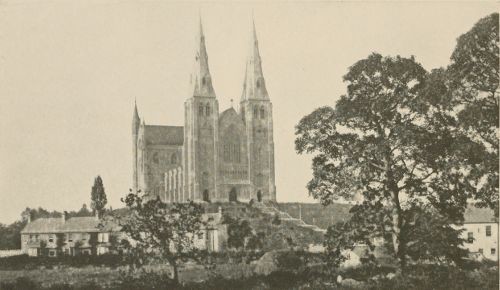
St. Patrick’s Cathedral at Armagh, the Seat of Cardinal Logue, the Roman Catholic Primate of Ireland
Cardinal Logue resides in a modest mansion in the rear of the cathedral, between the synod house and the theological seminary. Many a parish priest in Ireland and America lives in greater style. His manner of life illustrates the simplicity of his character and tastes. His lack of ostentation is one of his most charming traits.
It seems very remarkable that St. Patrick, St. Bridget, and St. Columba, the three saints most venerated by Ireland, should be buried in the same grave in an obscure little churchyard at the village of Downpatrick, about twenty miles south of Belfast. There is nothing in the way of documentary evidence to prove that the bodies of St. Bridget and St. Columba were placed in St. Patrick’s tomb, but the fact is stated in the earliest histories of the church in Ireland, and is frequently referred to by writers in the tenth century and later. And the claims of Downpatrick to this great honor are not seriously disputed.
The “Annals of the Four Masters” refer to the death of St. Bridget in 525 as follows: “On February first, St. Bridget died and was interred at Dun [Down] in the same tomb with St. Patrick, with great honor and veneration.”
St. Patrick died in the year 465 at the Monastery of Saul, which he had founded at Downpatrick. It was his wish to be buried at Armagh, then, as now, the ecclesiastical headquarters of Ireland, and during the twelve days given up to mourning and funeral ceremonies a controversy arose between the monks of Armagh and those of Downpatrick, who claimed the body and insisted upon its burial in their cloisters. A wise old friar suggested that the decision be left to heaven, and after saying mass the coffin was placed upon a wagon and two young oxen were taken from the field and yoked for the first time. It was agreed that they should be started along the road to Armagh, and that wherever they stopped the grave of St. Patrick should be made. The oxen commenced their journey and the rival bodies of monks retired to their cloisters to pray.
The “Book of Armagh,” written in the year 802, and now in the library of Trinity College, Dublin, duly relates that, after proceeding for two miles down the road slowly, the oxen turned from the main thoroughfare and rested at Dundalethglass, the site of the present Cathedral of Down. The monks from Armagh submitted to the will of heaven, and there the sacred dust was laid. Shortly after this, about 495, a church was built upon the site now occupied by the present edifice. It was rebuilt in the twelfth century, a considerable portion of the original walls being retained and several interior arches. And those walls and arches remain to-day. It is therefore the oldest structure in Ireland and is entitled to the veneration it receives. It stands in a grove upon the summit of a hill, a plain, dignified pile of perfect proportions, with a square tower and four spires—in no way imposing, but beautiful in its simplicity.
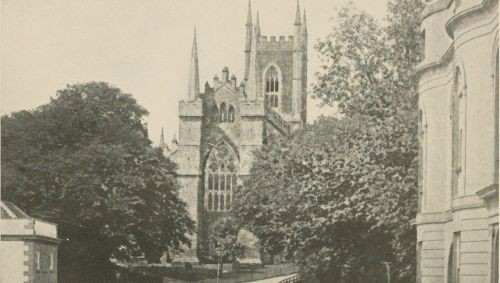
Down Cathedral, Downpatrick, where St. Patrick Lived, and in the Churchyard of which He Was Buried
The interior of the church is said to be precisely as it was originally built, there having been no change in the arrangement. And most of the columns which sustain the arches and several of the arches were a part of the original building. The “Annals of Ulster” give the names of the abbots who had charge of the monastery that was built in connection with the church, as far back as the year 583, although there are several wide gaps in the records of the eighth, ninth, and thirteenth centuries. The abbey was plundered and partially destroyed on no less than eight occasions, between the years 824 and 1111, and the “Annals of Ulster” give the particulars of each invasion. In 1177 Sir John de Courcy, the most powerful and able lieutenant of Strongbow, who assumed authority over the kingdom of Ulster, made Downpatrick his principal residence and erected there a strong castle, the greater portion of which remained until about half a century ago. At his time the church and the monastery were occupied by Augustinian monks, who were driven out by De Courcy and replaced by Benedictines from the Abbey of Chester, England, and the church was rededicated in honor of St. Patrick, having previously borne the name of the Holy Trinity. And De Courcy gave the abbey a liberal endowment. He also erected a Celtic cross, which is believed to be the same that was recently recovered in fragments, carefully mended and placed in the churchyard. Among the endowments of the Downpatrick abbey were four of the principal ferries across the rivers of Ulster, forty-seven “town lands,” which probably correspond to our townships, and every tenth animal upon the farms of Ulster. Of the extensive monastic building erected by De Courcy’s generosity not a trace remains except the foundations, and these are covered with the accumulated débris of four centuries. The inhabitants of Downpatrick and all the country around have used the ruin as a quarry for building material. Nearly all of the old houses in the village are made of materials from that source.
The monastery was plundered and burned by Edward Bruce, brother of Robert Bruce, the Scottish chieftain, who caused himself to be proclaimed King of Ireland in 1315. It was rebuilt and burned again in 1512. Lord Grey, who was sent over by King Henry VIII. to quiet Ireland, profaned and destroyed it, as he did everything else in this section, in his attempts to exterminate the O’Neills. Lord Grey was executed in the Tower of London in 1541. The fourth charge in the indictment against him was that “He rased St. Patrick’s, his church, in the old ancient citie of Ulster and burnt the monument of Patricke, Brided and Colme, who are said to have been there intoombed. That without onie warrant from the King or Councill he profaned the Church of St. Patrick in Downe, turning it into a stable after plucked it down and ship the notable ring of Bels that did hang in the steeple, meaning to have sent them to England, had not God of His Justice prevented his iniquitie by sinking the vessels and passengers wherein the said bells should have been conveied.”
The “Annals of Ulster,” under date of 1538, record that “the monastery of Downe was burned and the relics of Patrick, Columcille Briget and the image of Catherine were carried off.”
The oldest inscription in the church is on a tombstone erected to the memory of Edward, Lord Cromwell and Baron Oakham, no relative of Oliver Cromwell, but a great-grandson of Thomas Cromwell, the famous minister of Henry VIII., who, after the pacification of the country obtained possession of the Downpatrick estates, which continued in his family until 1832, when they were purchased by David Kerr, and in 1874 sold to the late Lord Dunleath, who now owns the largest part of the surrounding country.
At the time of the Reformation, the monks of Downpatrick refused to subscribe to the new ordinances and were driven out of the monastery. The history of Downpatrick is quite vague from that time until affairs quieted down, but from 1662 the records are complete.
Rev. John Wesley visited Downpatrick in 1778, and in his diary he describes the ruins of the Abbey of Saul as “far the largest building I have ever seen in the kingdom. Adjoining it is one of the most beautiful groves which I have ever beheld with my eyes. It covers the sloping side of the hill and has vistas cut through it every way. There is a most lovely plain very near to the venerable ruins of the cathedral.” Wesley visited Downpatrick on four different occasions between 1778 and 1785, and during each visit preached in the grove he describes, using as a pulpit the pedestal upon which a statue of St. Patrick formerly stood.
Perhaps the most celebrated resident of Downpatrick was Rev. Jeremy Taylor, who, while bishop of this diocese, wrote his famous book, “Holy Living and Holy Dying.”
Nothing but the irregular surface of the ground upon a hill about two miles from Downpatrick marks the site of the ancient Monastery of Saul, which from the time it was founded by St. Patrick in 432 was for several centuries one of the most celebrated and influential educational institutions in the world. Like the monastery at Armagh, only twenty miles away, which was also founded by St. Patrick about the same time, it was attended annually by thousands of students from England, Scotland, France, Spain, and other countries of the continent to hear and absorb the learning of the Augustinian and afterward the Benedictine monks. Unfortunately, however, no records remain of the institutions farther than an occasional reference in the “Annals of Ulster.”
The sanctity of the place, however, is recognized by Christians of every race and sect, although the grave of St. Patrick—and of two other saints—which is a hundred feet from the entrance to the old cathedral church, is marked only by an enormous granite bowlder, almost as nature made it, bearing no inscription except the word “Patric” in celtic letters beneath a celtic cross chiseled on the surface of the stone. It is a most appropriate monument in its simple dignity, and one that you might imagine that St. Patrick would have preferred rather than a lofty and ornate tower. It is rather curious, however, that no movement has ever been started to erect an imposing memorial here; there is no evidence that any monument of size ever marked the grave, although the three most venerated saints in the Irish calendar lie here together. A distich, said to have been written by Sir John de Courcy in 1185, says:
“Hi tres Duno tumulo tumulantur in uno;
Brigidam, Patricius atque Colomba Pius”;
which is liberally translated as follows:
“Three Saints in Down, one grave do fill;
Saints Patrick, Bridget and Columbkill.”
Downpatrick is visited annually by thousands of pilgrims. The town is practically supported by them, and the tomb has to be guarded against vandalism, particularly on Sundays, Good Friday, Easter, and other religious holidays. Relic hunters have carried away tons of earth from about the grave, which they dig up with their fingers or trowels or sticks and consign to bottles, boxes, or baskets. As soon as the cavities become too large, the custodian hauls a cart of soil from the nearest field and fills them up.
It is asserted in the guide book that St. Patrick was never canonized by the pope, and that he is recognized as a saint only by the Irish people. This is a singular assertion. The Roman Catholic prayer book used in Ireland mentions March 17, the feast of St. Patrick, as one of the holy days upon which there is strict obligation to attend mass and to refrain from all unnecessary labor.
According to the best authorities, St. Patrick was born at Nemthur (the Holy Tower), now known as Dumbarton, Scotland, in the year 387, and his father, Palpurn, was a magistrate in the service of the Romans. When he was sixteen, in the year 403, Patrick was taken captive and sold as a slave. A rich man named Milcho brought him to Ireland and employed him to herd sheep and swine in County Antrim. At the end of six years of slavery he escaped, returned to his home and family and then went to a monastic school at Tours, France. After receiving his education and being ordained he went to Rome, where he was blessed by Pope Celestine and commissioned to go to Ireland as a missionary. He landed at the mouth of a little stream called the Slaney, only about two miles from Saul, and settled at Downpatrick, where the chief gave him the use of a sabhall or barn for divine service, and upon that site was erected the famous monastery which took its name, Saul, from the barn. He remained there for several years, teaching and training disciples, and then visited every part of the island, preaching the gospel to the kings and chiefs as well as to the poor half-civilized habitants of the mountains. He founded many churches and monasteries in different places and finally settled down at Armagh as Bishop of Ireland in 457, where he remained for eight years. In March, 465, when he was seventy-eight years old, while paying a visit to the monastery of Saul, the scene of his first ministrations in Ireland, he was seized with a fatal illness and breathed his last. The news of his death was the signal for universal mourning in Ireland, and thousands of the clergy and laity came from the remotest districts to pay their last tributes of love and respect to the greatest of missionaries.
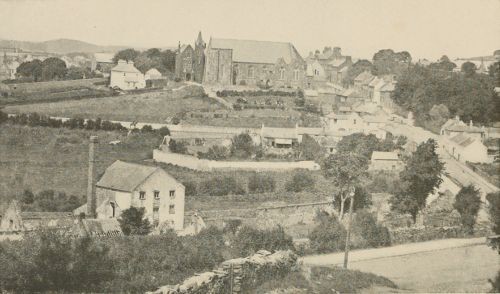
The Village of Downpatrick
St. Bridget, who ranks next to St. Patrick in the veneration of the Irish, was the daughter of a nobleman, and was born at Fochard, a village near Armagh, in the year 453. Her great beauty and her father’s wealth and position caused her to be sought in marriage by several of the princes of Ireland, but early in life she became a convert to the new religion, consecrated herself to its service, and retired to a forest near Kildare, about twenty miles from Dublin. She built herself a cell in the trunk of a great oak, around which grew a great religious community. She died Feb. 1, 525, at the age of seventy-two years. For many years the nuns of Kildare kept a light burning constantly in her memory. “The bright light that shone in Kildare’s holy flame” was suppressed, however, by the Archbishop of Dublin for fear it would be interpreted as a pagan practice.
The body of St. Bridget was originally buried at Kildare, but in the year 1185 was translated with great solemnity to Downpatrick, attended by the pope’s legate, fifteen bishops, and a great number of clergy. Her head was carried to the convent of Neustadt, Austria, and in 1587 was removed to the Church of the Jesuits in Lisbon.
St. Columba, or St. Columbkill, died while kneeling before the altar of his church on the Island of Iona, a little after midnight, Jan. 9, 597. He was originally buried in his monastery, and his body was removed to Downpatrick the same year as that of St. Bridget.
XIV
THE SINN FEIN MOVEMENT
The Sinn Fein movement (pronounced “shinn fane”) which promised so much is not making great progress. Some of its principles are admirable, and from a sentimental standpoint appeal to the patriotism of every Irishman, but the management is in the hands of impractical amateurs who have antagonized the Roman Catholic church, and that would be fatal to any movement in Ireland or any other country where three-fourths of the population profess that faith and the priesthood are as powerful as in Ireland. Furthermore, the young men who are directing affairs have gone into politics and have attempted to buck against the nationalist party, which controls three-fourths of the Irish vote. For these reasons the movement has suffered a setback, and it is doubtful whether it will ever recover the impetus it acquired two or three years ago. If it had been kept out of politics and out of religion like the Gaelic League, for example, which is aiming at a portion of the same objects, it might have done an immense amount of good. The leaders are earnest but inexperienced; they are long on ideas but short on common sense, and have more principles than votes, as has been illustrated at recent elections in Ireland. The leaders of the national party, bearing the scars of many political contests and familiar with all the tricks of their trade, regard the Sinn Fein advocates as enthusiastic schoolboys and play with them as a mastiff plays with a puppy.
The Sinn Feiners have formally demanded that the nationalist party shall abandon its present policy and adopt their platform—a proposition which its leaders consider very amusing, but when you can persuade them to discuss it seriously they say that they have accomplished too much and are too near the goal of home rule to abandon the present programme and adopt one that is new and untried.
Sinn Fein means “for ourselves,” and those two Celtic words describe the policy and the purpose of the organization. It demands that Ireland stand alone and work out her salvation by her own efforts, absolutely boycotting the British government, which they declare is the only enemy of Ireland and the cause of all the evils and the ills that afflict the Irish people. It is an imitation of the policy adopted by Ferencz Deák in the contest with Austria for Hungarian independence from 1849 to 1867. He organized a vast movement of passive resistance. Under his leadership the Hungarians refused to pay taxes unless levied and collected by their own officials; they refused to send Hungarian representatives to the imperial parliament; they built up an educational and administrative system of their own, and in less than twenty years achieved practical independence for Hungary, the right to make their own laws and administer their own government. The chief weapon was a national boycott, and it was successful.
In 1903 a young newspaper man named Arthur Griffith conceived the idea of applying the Hungarian policy to Ireland and boycotting the British government. He wrote a good deal for the newspapers, went around the island holding public meetings, organizing local societies, appealing to the patriotic sentiments of the young men of the country, and started a weekly newspaper as an organ of the cause. At first it was understood that the Sinn Feiners would abstain from politics like the Gaelic League, but the refusal of the politicians to join or assist them provoked animosities, and in retaliation the Sinn Feiners nominated candidates for several offices, who were in sympathy with them. This developed a positive contest, the Sinn Fein movement was placed under the ban by the Irish parliamentary leaders and soon became an independent political party.
A similar collision occurred with the Roman Catholic church chiefly because the ardent young leaders did not consult the priests and obtain the indorsement of the hierarchy, which might have approved the programme with some revision. The misunderstanding was allowed to grow until now the Sinn Feiners are under the ban of the church as well as that of the United Irish League and the parliamentary party, and the opposition of those three powers cannot be overcome or even resisted. Therefore the movement is doomed to failure. Nevertheless, the Sinn Feiners have succeeded in electing several of their number to office on their own platform. They now have twelve out of eighty members of the Dublin common council and board of aldermen, and in other cities of Ireland they have representatives in official positions. Not long ago they nominated a candidate for the House of Commons in the North Leitrim district, notwithstanding the fact that the first plank in their programme demands the complete boycott of the British parliament. It was an Irish bull and naturally excited much ridicule, but the Sinn Feiners succeeded in polling 1,100 out of a total of 6,000 votes, which was a great deal more than any one expected.
Some time ago the national council of the party devised a scheme for raising money to establish a daily newspaper. They printed and offered for sale very pretty postage stamps and asked everybody to buy them and place them on their letters in addition to the portrait of King Edward, which is required by act of parliament. It was a fatal error, because it was an absolute failure and disclosed the weakness of the movement and the insincerity of its members. I am told that less than five per cent of the stamps printed were ever disposed of.
Some of the propositions in the programme of the Sinn Fein party, as I have already said, appeal very strongly to the patriotism of the Irish people; others are so fantastic as to destroy confidence in the judgment of its leaders. For example, they issued an urgent appeal to the newspapers and to the public to use no paper or stationery except of Irish manufacture, which might have been to the advantage of the country if there were any paper mills in Ireland. Again, they advocate Irish ownership of all public utilities. They want Irish capitalists to buy up the stock of all the railways and street car lines and other public enterprises and employ none but Irishmen in their administration, which might be done if there were a good deal more capital in the country; but as long as the Irish people are too poor to pay for the stock, it would seem a little premature for them to undertake to carry out the Sinn Fein recommendations.
The first plank in the programme of the Sinn Fein platform is a national Irish legislature endowed with moral authority to enact laws and recommend policies for the adoption of the Irish people. This legislature is to be composed of the members of the county councils, the poor-law boards and harbor boards of all Ireland, to sit twice a year in Dublin, and to form a de facto Irish parliament. Associated with and sitting with this body would be the present Irish members of the House of Commons and their successors representing the constituencies as at present defined. Before taking this step, however, it is proposed that the Irish members of the House of Commons should make a dramatic demonstration in parliament, to emphasize the significance of their retirement. They are to rise in their seats and formally decline any longer to confer on the affairs of Ireland with foreigners in a foreign city.
Among other functions of the proposed Irish legislature shall be the assessment of a tax of one penny to the pound—that is, two cents for every five dollars’ worth of property—without regard to present taxation, and thus acquire a fund “to serve and strengthen the country in bringing about the triumph of the Sinn Fein policy.” This fund would be used in the payment of bounties to develop Irish industries, to establish libraries of Irish literature and museums of arts and antiquities; to establish gymnasiums for the physical training of the young people and schools for their moral training and discipline and instruction in Irish history.
The first laws to be passed by the legislature would exclude all goods of English manufacture from Ireland, prohibit the use of foreign articles by the government, forbid the appointment of any but natives of Ireland to public positions, withhold support from newspapers which publish emigration advertisements, require the study of the Celtic language in all the schools for certain hours and prepare text-books so that no other language would be necessary in instruction, raise the standard of wages among workingmen, increase their proficiency by technical instruction, develop the resources and industries of the country, and extend the area of tilled soil and the planting of forests.
After having accomplished these objects the Irish legislature, according to the programme of the Sinn Fein, should establish a national university, open and free to the poor as well as the rich, with none but Irish instructors and the Celtic language substituted for the English.
Next a union of manufacturers and farmers for co-operation, both pledging themselves to use none but Irish goods and products so far as possible. In cases where an Irish manufacturer cannot produce an article as cheaply as it is produced in England or other countries he is to be paid a bounty or protected by a tariff similar to that which has advanced the prosperity of the mechanical industries of the United States.
The next step is to establish an Irish mercantile marine similar to that of Scotland and Norway. Ireland has no steamers; Scotland has many and, according to the Sinn Feiners, there is no reason why there should not be as large a fleet sailing from that country.
It is proposed to establish an independent consular service of Irishmen in the principal capitals and commercial centers of the world where a market may be found for Irish produce. These consuls are to act independently of the regular representatives of Great Britain and devote themselves entirely to Irish interests.
The proposed parliament shall take immediate steps to plant trees all over the island, which, it is asserted, will result in raising the mean temperature at least four degrees and thus render the soil doubly fruitful. The tree planting is to be done under the direction of the poor-law boards, which are to employ the inmates of the poor-houses so far as their physical condition will permit, in planting, watering, and looking after the young trees.
The parliament is to establish national courts of law entirely independent of the present courts which are to be entirely boycotted by the people. It is declared to be the duty of every Irishman to submit all disputes to the arbitration of his neighbors who are to serve without pay. The national courts are to be composed of the justices of the peace already elected by the people, who shall sit outside the regular legal hours and terms of court, so as to avoid complications.
A national stock exchange is to be established which shall deal only in Irish securities, and a system of banks which shall limit their dealings to natives of Ireland and encourage the transfer of the $250,000,000 of Irish money alleged to be now deposited in the English banks and invested in English securities, to Irish banks and Irish securities, and to encourage its investments in active industries and public works, to develop the resources of Ireland and to give employment to Irish labor.
One of the principal planks in the Sinn Fein platform is to boycott the British army and navy. It is asserted that Ireland supplies more fighting men for the British empire than England; that 354 Irishmen out of every 10,000 of its population are British soldiers, while only 276 out of every 10,000 in England go into the army. If the Irish would refuse to enlist it would paralyze the military service of the empire, and deal a serious blow to British prosperity by drawing a large number of the employees of the shops and factories into the army and navy.
Another form of boycott recommended is for all Irishmen to refuse appointments in the British civil service and the constabulary on the theory that every Irishman who accepts employment from the British government takes up arms against Ireland and becomes the active enemy of his country, “being employed to keep a hostile country up, and to keep his own country down.”
A plank in the platform in which we are directly interested advocates an invitation of the natives of Ireland in America to invest their money in the development of Irish industries and resources. It says: “There are in the United States to-day thirty Irishmen or men of Irish blood whose names on a cheque would be good for £50,000,000. Few of these men take any public part in affairs, but all of them profess in private a desire to help Ireland. We invite them as men of business to undertake a work which will be mutually profitable to themselves and to Ireland.”
These propositions are embodied in a manifesto which has been printed and widely circulated throughout Ireland to explain the purpose of the Sinn Fein movement, and they have attracted a large number of active adherents to the cause and many silent sympathizers. But, as you may imagine, some of them do not appeal very strongly to practical men. If the Sinn Feiners had undertaken to do less, had kept out of politics and had avoided the enmity of the church they might have become a powerful and useful agency in promoting Irish industries and stimulating Irish patriotism, but the leaders have gone too far to retrace their steps. They cannot retract the unkind words they have said about the Irish parliamentary party or their bitter criticism of the interference of the bishops and the priests. It would be fatal for them to amend their programme by omitting the impractical portions. Hence it is not probable that the movement will gain much strength in the future, and, indeed, it is already on the decline.
XV
THE NORTH OF IRELAND
The traveler from the south or west enters a zone of prosperity when he comes within forty miles of Belfast. The northern counties look like an entirely different world. The beautiful rolling landscape, with an occasional grove and flowering hedges, is similar to the rest of the east coast of the island, but the farms are larger and more thoroughly cultivated; very little of the land is given up to grazing, few cattle are seen, but fields of grain, flax, potatoes, turnips, and other vegetables take the place of pastures, and the large farmhouses are surrounded by well-kept gardens and big barns. There are no more filthy one-room cabins, with manure piles in front of the doors, and few signs of poverty or neglect. The people live in two-story houses and sleep in beds instead of on the mud floors; they have cook stoves and ranges instead of boiling their food in pots over a peat fire out of doors. There are no barefooted women; none with blankets over their heads. Every one seems to be well dressed and to have a pride of appearance as well as habits of neatness and bears evidences of comfortable circumstances. Tall chimneys rise from the centers of the towns. We see large factories in every village and square miles of linen cloth spread out upon the turf to bleach.
The north of Ireland is as different from the rest of the country as New England is from Alabama, and there is a corresponding difference in the character of the people. They are not so genial and gentle and obliging in the North; they are not so poetic, but are more practical, and they are looking out for themselves. The manners of the people of Belfast are said to be the worst in the world. They are often offensive in their brusqueness and abruptness, and a stranger is sometimes repelled by their gruff replies. The Belfasters make no pretensions to politeness, and speak their minds with a plainness and directness that are sometimes disagreeable. But they have a reputation for honesty, enterprise, industry, and morality, which they consider virtues of greater importance and of a higher value than the art of politeness.
There is a series of beautiful villages and towns along the coast south of Belfast, and one of them is called Rosstrevor because a gentleman by the name of Ross married an heiress by the name of Trevor, a younger daughter of the Viscount of Dungan. It is situated upon a height, with a background of wooded hills, plentifully sprinkled with villas. The village shows evidence of the fostering care of its late owner, Sir David Ross, and its present owner, Sir John Ross-of-Bladensburg, who is commissioner of police for Ireland, and is a person of great importance in his own estimation as well as that of others. He takes an active part in political and ecclesiastical affairs and is always occupying a front seat when anything is going on. He signs himself John Ross of Bladensburg, because his grandfather, Major General Ross, commanded the British troops at the battle of Bladensburg, and after one of the most bloody and important conflicts in the history of human warfare he led them triumphantly into the capital of the United States and destroyed the palace of the President, the parliament house, and the navy yard! All this and more appears in the much published biographies of the Ross family, and because of the glory thus acquired they added the word “Bladensburg” to their name when they were elevated to a baronetcy.
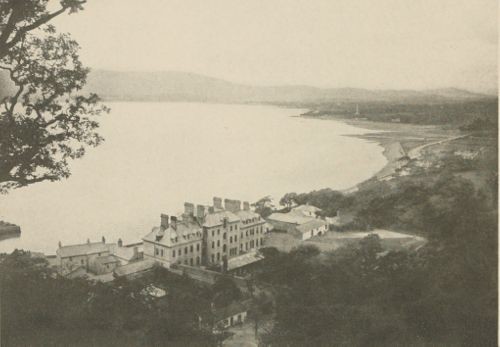
Rosstrevor House, near Belfast, the Residence of Sir John Ross of Bladensburg
The Ross family have erected an obelisk to the memory of their famous ancestor upon a promontory above the sea at Rosstrevor, and have inscribed upon it the following epitaph:
The Officers of a Grateful Army,
Which, Under the Command of the Lamented
MAJOR GENERAL ROBERT ROSS,
Attacked and Defeated the American Forces
at Bladensburg on the 24th of August, 1814,
And on the Same Day
Victoriously Entered Washington,
The Capital of the United States,
Inscribe Upon This Tablet
Their Admiration of His Professional Skill
And Their Esteem for His Amiable
Private Character.
There are three other inscriptions of similar purport, one on each face of the pedestal. General Ross, it appears, is buried in Halifax.
Belfast is the center of a great manufacturing district. Each factory is surrounded by groups of neat two-story brick cottages, with gardens, churches, schoolhouses, and shops, which are very different from the rest of Ireland, and are similar to those in the suburbs of Philadelphia. Belfast ranks high among the manufacturing cities of the world. It is proud of the title of “The Chicago of Ireland.” The people are as boastful of their progress, their wealth, and their prosperity as those of its namesake. But for the strong Scotch accent one might imagine himself in Kansas City, Seattle, or Los Angeles because of their civic pride. Every man you meet tells you that a hundred years ago Belfast had only fifteen thousand population, while to-day it has nearly four hundred thousand; that its wealth has doubled six times in the last twenty-five years; that it has the largest shipyards, the largest tobacco factory, the largest spinning mills, and the largest rope walk in the world. When they take you up on the side of a high mountain and show you a view of the city spread out on both sides of the River Lagan, they defy you to count the chimneys and the church spires, which are as numerous as the domes of Moscow. Belfast is the most prosperous place in Ireland and an example of matchless concentration of power, industry, and ability.
The people have good ground for their vanity, and while their claims are somewhat exaggerated, few cities have so much to boast of. One of the shipyards has produced more than four hundred ocean steamers, another built the first turbine that ever floated on the ocean, and together they employ fifteen thousand hands. The machine shops of Belfast are also famous. They provide spinning and weaving machines for all the linen mills in the world, and ship them even to the United States. The engines, boilers, and other machinery that is turned out from the shops of Belfast are shipped to every corner of the world, and the product of the linen factories’ trade now amounts to more than sixty million dollars a year. The largest mill covers five acres, with 60,000 spindles, 1,000 looms, and more than 4,000 hands. A single tobacco firm pays $4,000,000 in taxes every year and a distillery has an annual output of $7,500,000.
Belfast has sixteen factories for the production of ginger ale, lemonade, soda, and other aërated waters, which are famous the world over. It manufactures agricultural implements and machinery for every kind of industry, and much of the machinery is the invention of its own citizens.
Belfast is no relation to the rest of Ireland. It is a Scottish town, and most of the people are of Scotch ancestry—all except the lowest class of labor, which has drifted in from the neighboring counties. The city lies at the head of a bay, or lough, as they call it there, nine miles long. The headlands at the mouth of the bay are only eighteen miles from the shores of Scotland, which may be seen very plainly on a clear morning.
The shortest distance between Ireland and Scotland is only twelve and three-quarter miles—between Torrhead and the Mull of Kintyre. The shortest practicable crossing, between Larne, a few miles north of Belfast, and Stranraer, Scotland, is thirty-nine miles, and is made in two hours by steamer. The crossing from Belfast is sixty-four miles, and it is five hours to Glasgow. There are steamers several times a day—in the morning, afternoon, and at night—and the largest part of the business as well as the sympathies of the people are with the Scots. Since the tunnel under the Hudson River has been completed between New York and Hoboken, the plan for an “under sea railway” between Larne and Port Patrick has been revived. The engineers have reported that they can make a tunnel from Ireland to Scotland, less than forty-five miles, one hundred and fifty feet below the sea level, at a cost of $60,000,000, and some day, perhaps, it will be possible to cross by train under the Irish Channel, rather than by boat over it.
The racial, religious, and political antagonisms between the north and south of Ireland are well known, and can never be removed. Three-fourths of the population in this section of the island are Protestants, mostly Calvinists of the sternest kind, and the portraits of John Knox and Oliver Cromwell hang on the walls of the houses rather than those of the popes. The religious feeling, however, is not so intense as formerly. A generation ago, the 12th of July (the anniversary of the battle of the Boyne, in which the Protestant army of William of Orange overcame and dispersed the Roman Catholic forces under James II.) never used to pass without a riot and many broken heads, but of recent years there have been very few collisions. Formerly, the Roman Catholics used to lie in wait at a certain bridge to attack the procession of Orange societies as it passed over, with shillalahs and stones. The Orangemen, who are mostly mechanics from the shipyards and machine-shops, always armed themselves with iron bolts and nuts for the fray, and missiles flew freely, leaving many unconscious and sometimes dead men on the ground. And on other holidays, whenever the representatives of either religious faith came out in force, the other usually attempted to interfere with them. But those days have passed. The rival religionists glare at and taunt each other now, but do not strike.
One cannot blame the Roman Catholics for their bitterness. In the middle of the sixteenth century, in consequence of the rebellion of the earls of Tyrone and Tyrconnell, the heads of the great clans of O’Neill and O’Donnell, against the authority of Queen Elizabeth, the territory belonging to them and their followers was confiscated by the crown and sold to Protestants, chiefly from Scotland, just as the southern counties were distributed among the “undertakers” from England, but with a difference. The “undertakers” who were granted the estates of the rebellious earls in southern Ireland were mostly adventurers and speculators. Many of them never came to Ireland at all. Few of them settled permanently upon their grants, while nearly all of those who undertook to carry out the contract of colonization were indifferent to the class of settlers they brought in. In Ulster Province, however, which is the northern third of Ireland, after the “flight of the earls,” their confiscated lands were taken up in small parcels by actual settlers from Scotland, whose descendants have occupied them until this day—a sturdy, thrifty, industrious, and prosperous race, and the children of these “Scotch-Irish” Protestants have borne as important a part in the settlement and development of the United States as the children of the Pilgrims have done.
The “planters,” who came over from Scotland, brought with them their morals and their religion, and most of them were Presbyterians. In 1637 the surveyor-general of the Ulster plantations reported to the king that there were forty Scots to one English, and fifteen Presbyterians to one of all the other sects combined. And the Presbyterians have ever since been the leading religious body in the north of Ireland. They are a stern, stolid, conservative race, stubborn of opinion, persistent of purpose, and fully conscious of their own rectitude. When William, Prince of Orange, invaded Ireland in 1689, after James II. abdicated his throne and fled from England, he landed at the little town of Carrickfergus, about six miles below Belfast, where he was received with great rejoicing. Here he unfurled his flag and displayed his motto, “The Protestant Religion and the Liberties of England I will maintain,” and the people of Belfast have endeavored to maintain them with vigor ever since. The term “Orangemen” has ever since been applied to organizations of Protestants of a political character, and they have received more or less support from the church. Most of them are semi-benevolent, like the Hibernian societies among the Catholic population of southern Ireland, and they are found in every town and village in the province of Ulster. There are Orange halls in every parish of Belfast and the surrounding country. They embrace in their membership representatives of all the Protestant denominations, the Church of Ireland and the Methodists as well as the Presbyterians—but the latter are most numerous and in some districts you will find none but Presbyterians.
The O’Neills were kings of Ulster in ancient times and their coat of arms was a red hand, whereby hangs a startling tale. According to tradition, the original O’Neill came over from Scotland with a party of invaders, among whom it was agreed that he should be king whose hand first touched the soil of Ireland. The boats were all stranded on the beach, and the captains and the crews were striving desperately to make the shore, when “The O’Neill,” with the nerve that has always distinguished his clan, drew his sword, chopped off his own left hand at the wrist, threw it upon the beach and claimed the throne, which was accorded him. Hence a red hand or “Lamh dearg” is on the coat of arms of Ulster, being placed upon a small shield in the center of a large shield, upon which appears the red cross of St. George, thus signifying England’s domination over Ulster.
Neill of the Nine Hostages, who reigned from A.D. 379 to 405, was the most warlike and adventurous of all the pagan kings, and, with two exceptions, all the overkings of Ireland, from the time that Red O’Neill tossed his amputated hand upon the shore, to the accession of Brian Boru, belonged to this illustrious family. And they gave England a great deal of trouble. In 1551, Conn O’Neill was created Earl of Tyrone, and Mathew, who claimed to be his son, was given the right of succession. “Shane, the Proud,” the legitimate son and heir, was a mere boy at that time, but when he grew to manhood he disputed his half-brother’s parentage and apologized for his father’s conduct with the remark that, “Being a gentleman, he never refused a child that any woman named to be his.”
After the death of Henry VIII. Shane O’Neill inaugurated a rebellion which cost England more men and more money than any struggle that has ever occurred in Ireland; an expenditure equal to $10,000,000 of our present money, besides tens of thousands of lives and millions of private property destroyed. After peace was restored in 1558, Shane was elected “The O’Neill,” in accordance with the ancient Irish custom, and in 1561 he accepted the olive branch from Queen Elizabeth and went to London at her invitation, followed by his gallowglasses in their strange native attire—loose, wide-sleeved, saffron-colored tunics, reaching to their knees, with shaggy mantles of sheepskin over their shoulders, their heads bare, their long hair curling down on their shoulders and clipped short in front, just above the eyes.
The last of the earls of Tyrone was Hugh O’Neill, a son of Shane, who organized another rebellion in 1584, and, being defeated, fled to his castle in the dense woods of Glenconkeine, and there awaited anxiously for Philip of Spain or Clement VIII., the reigning pope, to succor him. One by one O’Neill was deserted by all the Irish chieftains except Rory O’Donnell, Earl of Tyrconnell, and as they saw no hope of relief they made peace with England. Several years later, in 1607, being accused of a plot, they fled from the shores of Ireland with a party of ninety-four kinsfolk and retainers. They finally found their way to Rome, where Paul V., the reigning pontiff, gave them shelter and expressed his deep sympathy with the Irish exiles. The following year Rory O’Donnell, Earl of Tyrconnell, died of Roman fever, and in 1616 the last of the Irish kings bearing the name of O’Neill was laid to rest in the Church of San Pietro on the Janiculum, the same which claims the dust of St. Peter.