


автордың кітабын онлайн тегін оқу A Humorous History of England
[front cover]

[ad1]Concerning
 (Poorness of Blood.)
IN MEN AND WOMEN,
BY THE LATE
DR. ANDREW WILSON.
The public are very familiar with the term “Anæmia,” and this fact alone testifies to the extremely common nature of the ailment thus indicated.
As a rule Anæmia shows a gradual progress. There is experienced a feeling of lassitude, of being “easily tired out,” and a distaste for active exertion. The digestion is enfeebled, and, without feeling actually ill, the sufferer inclines towards an inactive life, while the appetite usually disappears, and a general bodily upset is represented. The lips are pale, the red of the eyelids, seen by turning down the lower eyelid, will exhibit a similar appearance. Breathlessness is another notable sign; the least exertion, going upstairs for instance, causes the sufferer to pant, because the heart, not being supplied with blood of good quality, cannot perform its work properly. The pulse is weak and irregular.
For ANÆMIA (shown by breathlessness on slight exertion, pallor, depression and weakness) Doctors prescribe the well-known Iron Jelloids No. 2.—there is nothing better.
For DEBILITY, WEAKNESS and NERVINESS, Men find the Ideal Tonic and Restorative in Iron Jelloids No. 2A.
A Ten Days Treatment (price 1/3) will convince you.
(Pronounced Jell-Lloyds.)
Reliable Tonic for Men
Iron Jelloids No. 2A.
For Anæmia in Men and
WomenIron Jelloids No. 2.
For Growing Children
Iron Jelloids No. 1.
Of all Chemists. A Ten Days Treatment 1/3. Large size 3/-
Manufactured by The Iron Jelloid Co., Ltd., 189, Central Street, London, E.C.1. England.

[p1]
A HUMOROUS
HISTORY OF ENGLAND
TOLD AND PICTURED
BY
C. HARRISON
Published by
WARRICK & BIRD,
4, Nile Street, London, N.1.
1920.
[p2]
[p3]
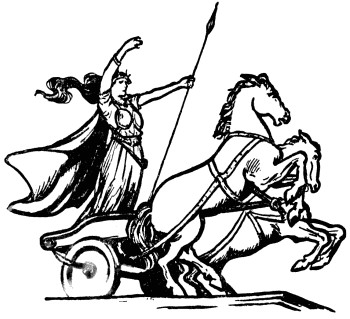
BOADICEA.
Preface
“Arms and the man” was Virgil’s strain; But we propose in lighter vein
To browse a crop from pastures (Green’s) Of England’s Evolution scenes.
Who would from facts prognosticate The future progress of this State,
Must own the chiefest fact to be Her escalator is the Sea.
Prehistoric
HISTORIANS erudite and sage, When writing of the past stone age,
Tell us man once was clothed in skins And tattooed patterns on his shins.
Rough bearded and with shaggy locks He lived in dug-outs in the rocks.
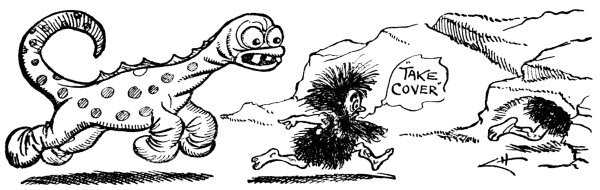
Was often scared and run to earth By creatures of abnormal girth:
Mammoths and monsters; truth to tell We find their names too long to spell.
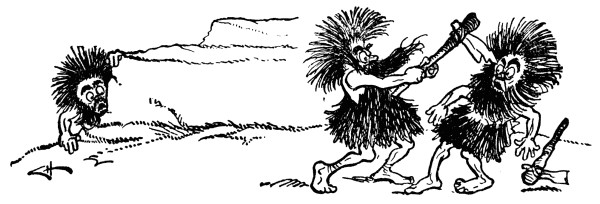
He joined in little feuds no doubt; And with his weapons fashioned out
Of flint, went boldly to the fray; And cracked a skull or two per day.
Druids
WE read of priests of Celtic day, Ancient Druids, holding sway
By smattering of Occult law And man’s eternal sense of awe.
Stonehenge
They used Stonehenge on Salisbury Plain Reputed Prehistoric Fane;
Note each megalithic boulder; No Monument in Europe’s older.
[p4]
Phœnicians
MERCHANT explorers of that day, Hustling Phœnicians, came this way
To ship tin ore from Cornish mines Three thousand years before these lines.
But still in spite of petty strife Man lived what’s termed the ‘simple life’
Julius Cæsar B.C. 55
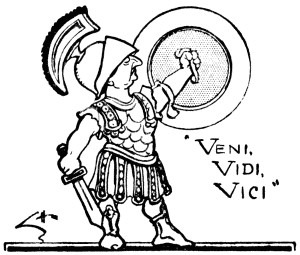
Till Julius Cæsar in five-five With his galleys did arrive.
He wrote despatches of the best, ‘Veni, Vidi’ and the rest,
Sending the news of victory home; And flags then fluttered high in Rome.
His ‘photo’ one plain fact discloses He brought in fashion Roman noses.
Of this great General ’tis allowed The best ‘Life’ is by J. A. Froude.
Boadicea A.D. 62
Boadicea earns our praise. First woman leader in those days;
For Freedom strove all she could do, ’Twas lost in A.D. sixty-two.
Agricola
Then came Agricola one day And gained a battle near the Tay.
He started trimming up this isle, And laid out roads in Roman style.
East, North, South, West, it’s safe to say His handiwork is traced to-day.
The Natives too were taught to know By busy merchants’ constant flow
The wisdom that great Empire held; Their ignorance was thus dispelled.
Romans left A.D. 410
About four hundred-ten A.D. The Romans left sans cérémonie.
Can it be wondered at when Rome Was needing help ’gainst Huns at home.
Our antiquarians often find The relics which they left behind;
A Villa here and pavement there, Coins galore and Roman ware.
Anglo-Saxons A.D. 430
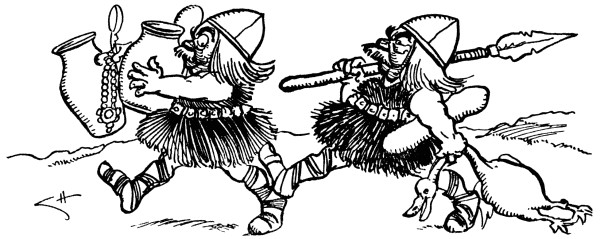
AND so we run our flippant rhymes Right on to Anglo-Saxon times.
Hengist and Horsa with their men Came from their Jutish pirate den,
Jutes
And paid us visits in their ships Bent on their ruthless looting trips.
And Angles landing in the Humber Gave that district little slumber.
They plundered morning, noon, and night, Were rough, uncouth, and impolite,
No ‘By your leave’ or ‘S’il vous plait’ They came to rob, remained to prey.
Horsa 455
Horsa was slain in four-five-five, Leaving Hengist still alive
To live out his allotted term, Surviving partner of the Firm.
King Arthur
Time has many a fable wound About King Arthur’s table round,
Where Knights quaffed cordials, wines and ales, And told their little fairy tales.
Augustine 597
About six hundred years A.D. To teach us Christianity
Came Augustine. Wondrous Story; Canterbury’s Pile his glory.
Heptarchy 827
Called ‘Heptarchy’ the seven Saxon States each other made attacks on;
After four hundred years they’d striven They coalesced in eight-two-seven.
[p5]
Alfred 872–901
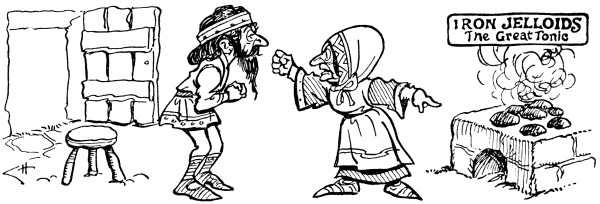
OF good King Alfred we’ve all heard How when hiding he incurred
A lady’s anger for not taking Care of Cakes which she was baking.
(Most probably she left the King While she went out a-gossiping.)
Before he died in nine-nought-one, Old England’s Navy had begun.
He laid a tax on every town To aid his fleet to gain renown.
He was the best of Saxon Kings And did a lot of useful things;
Built Oxford with its noble spires And mapped out England into Shires.
Danes 783
IN seven-eight-three first came the Danes Who caused the Saxons aches and pains.
They sailed right up our rivers broad, Putting the natives to the sword.
“Danegeld” 991
For centuries our sadly fated Towns by them were devastated.
Etheldred
the ‘Unready Toff’ By ‘Danegeld’ tries to buy them off.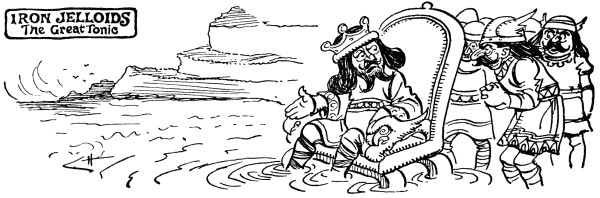
Canute 1014–1036
TWO hundred years the raiding Danes Came over. Then their Canute reigns.
We’ll merely mention that he tried An object lesson with the tide.
Hardicanute 1039–1041
Hardicanute, sad to confess, Died from drinking to excess.
He couldn’t conquer love of wine And with him went the Danish line.
Edward the Confessor 1041–1066
EDWARD the Confessor staid The Saxon line renewed. Remade
At Westminster the Abbey grand, And signed the first ‘Will’ in this land.
And since his time (’tis not refuted) Scores of Wills have been disputed.
Ah! legal quibbles such as these Mean Lawyers waxing rich on fees.
Harold 1066
HAROLD last of the Saxon line At Hastings made an effort fine
And lost his life—it was to be, Crushed by the men of Normandy.
From Scandinavia they’d come, And made fair Normandy their home;
William the
Conquerer
1066–1087Whence William spying out our shore, Oliver-Twist-like, wanted more.
In ten-six-six he won the day In that tough fight out Hastings way.
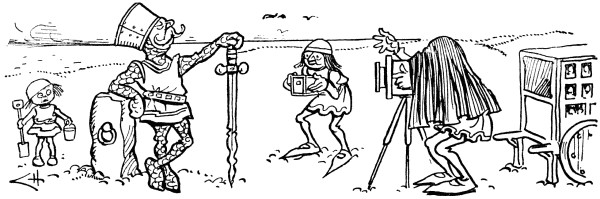
Of course, no record in our reach, Depicts ‘ole Bill’ thus on the beach.
[p6]
William the
Conquerer
1066–1087BUT one thing’s certain. Camera men, If only they’d existed then,
Would have journeyed many a mile To ‘snap’ King William’s happy smile.
They made him King and schoolbooks say He ruled with arbitrary sway;
Demanding with sharp battle axes Instant payment of big taxes.
Curfew
And p’raps it’s just as well to tell He introduced the Curfew Bell;
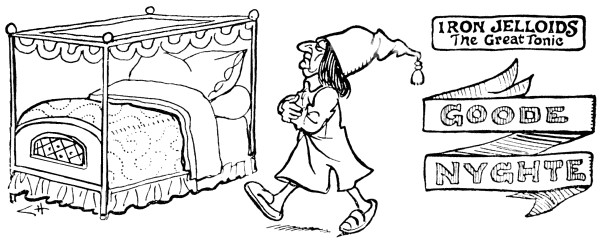
So at the early hour of eight Each doused his glim, raked out his grate.
In bed at eight P.M. each day Life was but sombre, dull and grey;
No cutting fancy ball room capers, No Cinemas or evening papers.
He was a bully it is true, But to allow him his just due
He made reforms; he also took In hand the bulky Doomsday book.
IN William’s time we’re glad to write People began to be polite;
Ladies curtseyed to their beaux, Who smartly raised their gay chapeaux.
The Jews
The Jews he introduced from Spain Bringing much knowledge in their train
Of Arts and Science; but ‘Longshanks’ Expelled them with no word of thanks.
Feudalism
These were the well known Feudal days, Tenants were slaves in many ways
To mighty Lords who owned the land And ruled them with an iron hand.
Not free from duties were the Lords, The King could call upon their swords
And men to fight in time of need. So feudal laws of old decreed.
William Rufus 1087–1100
WILLIAM Rufus or the ‘Red’ In ten-eight-seven ruled instead;
This may be; but we know, alack, Though he was red his deeds were black.
Crusades 1095
The first Crusade in ten-nine-five, A million men, a very hive,
Swarm to the East, the Holy plain From the Mohammedans to gain.
Henry I. 1100–1135
HENRY the First, of wisdom rife, Saxon Matilda makes his wife,
Saxon and Norman line uniting, A learned chap who loved not fighting.
Stephen 1135–1154
STEPHEN of Blois ascends the throne And ’gainst Matilda holds his own;
Grandson of the Conqueror; Died in eleven-fifty-four.
Henry II. 1154–1189
HENRY the Second claims our rhyme ‘The hardest worker of his time’;
A wiser King we never had Nor father with his sons so bad.
Becket
This the first ‘Plantagenet’ King With Becket strove like anything;
Church v. Crown
Which should be Master, Church or Crown Pull-King Pull-Bishop; both went down.
Thomas was murdered by four Knights On steps of Altar—Sorry wights:
With bleeding feet the King atones By pilgrimage to Becket’s bones.
Despite his struggles with the Church He knocked the barons off their perch,
Fifteen hundred Castles razing In a manner quite amazing.
Law
Trial by jury further grows; The King’s Court in this reign arose;
Our Parliaments from this proceed And all our other Courts indeed.
Linen
Linen’s first used in twelve-five Woollens alone in vogue before.
Glass Windows
In eleven-eight-nought first came to pass The novelty of window glass.
And doubtless playful little boys Full of children’s simple joys,
Cracked as our youngsters often do With stones or ball a pane or two.
Richard Cœur de Lion 1189–1199
Cœur de Lion from one Crusade Returning was a prisoner made.
But Blondel played an Air he knew, The King joined in; Voilà the clue.
This catchy tune in a pleasant key Opened the door to liberty.
[p7]
John 1199–1216
AND so we’ll quickly journey on Until we reach the reign of John;
A King whose list of crimes was heavy; He treated badly his young ‘Nevvy’.
Magna Charta 1215
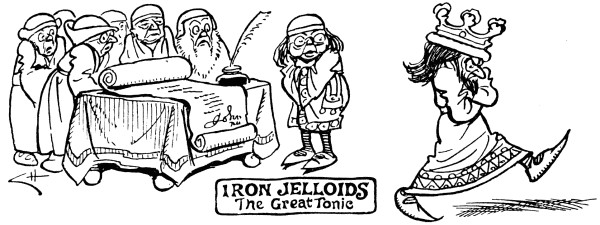
He signed the Magna Charta. Yes; In twelve-fifteen, but we may guess
With much ill grace and many a twist; For King John wrote an awful fist.
John loses Normandy to France And by this beneficial chance
In England comes amalgamation; Normans and Saxons form one Nation
Robin Hood
And now we come to Robin Hood, The Forest bandit of Sherwood,
A popular hero much belauded But not by folks whom he’d defrauded.
There’s no need to descant upon His boon companion ‘Little John’;
Or ‘Friar Tuck’ so overblown He tipped the scale at fifteen stone.
Henry III. 1216–1272
AND what of Henry number Three, The King who suffered poverty?
It’s very awkward we must own To be ‘hard up’ when on a Throne;
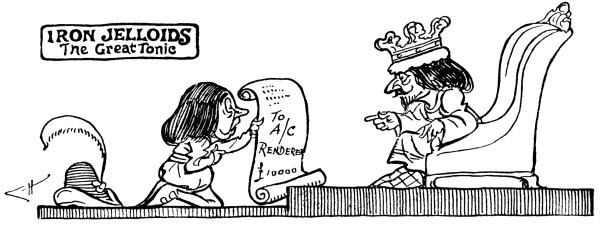
To have to scrape up an amount To pay the butcher on account,
Or ask a dun in Kingly way To kindly call some other day.
Coinage 1257
In twelve-five-seven it is stated Gold was coined and circulated,
Ha’pence and farthings just before; In those times worth a great deal more.
Langton Died 1228
The Bible which from over seas Had no chapters and no verses
Was by Archbishop Langton’s skill Divided as we use it still.
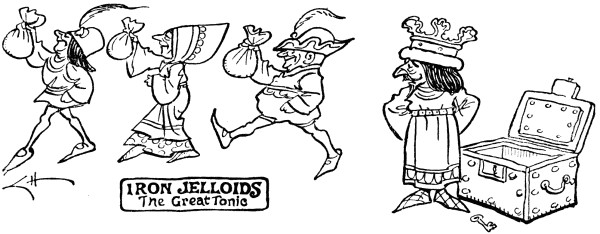
Why was it Henry III. allowed At court a huge rapacious crowd
To drain his coffers nearly dry Flattering with cajolery?
[p8]
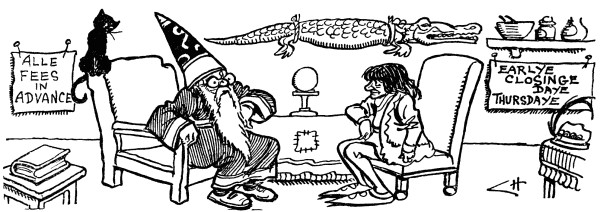
Astrology
MANY simple folk, (it’s queer) Used to patronise the seer
And pay cash down for magic spell Perchance a Horoscope as well.
Or open wide at special rate That musty tome the Book of Fate;
Or seek the Philtre’s subtle aid To win the hand of some fair maid.
We
mus’nt
miss the Troubadours Who went forth on their singing tours,Twanging harps and trilling lays To maids of medieval days.
And Oh! the right good merry times With Maskers, Mummers and the Mimes,
Hobby horses gaily prancing, Bats and Bowls and Maypole dancing.
When folks would take a lengthy journey To see the Knights at Joust or Tourney:
Or watch the early English ‘Knuts’ Show their skill at Archery butts.
Then come gloomy History pages On torture of the Middle ages;
The clanking fetters grim and black, The thumbscrew and the awful rack,
The horrors of the dungeon deep Beneath the moat or castle keep,
Rusty locks and heavy keys And—let us change the subject, please.
First House of Commons twelve-six-five, At Westminster they all arrive.
Simon de Montfort 1265
Simon de Montfort was the man Who ‘engineered’ this useful plan.
And we can picture these M.P.s Newly fledged and ill at ease
Doing their level best to try To catch the embryo speaker’s eye.
Edward I. 1272–1307
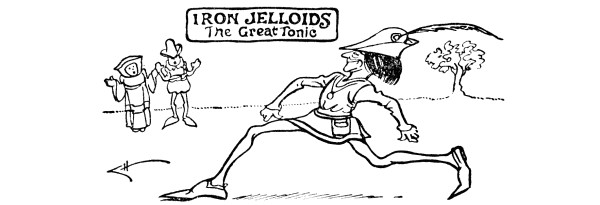
EDWARD First ‘Longshanks’ nicknamed For his lengthy stride far-famed.
Here he is in twelve-seven-two Bounding along with much ado.
A Soldier, Statesman and a King His lofty ideals picturing
That England, Scotland, Wales all three, United should one country be.
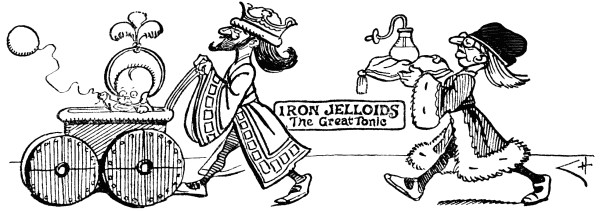
First Prince of Wales 1282
In twelve-eight-two annexes Wales; Where afterwards no strife prevails.
He promised a Prince with English So gave his new-born speechless son.
[p9]
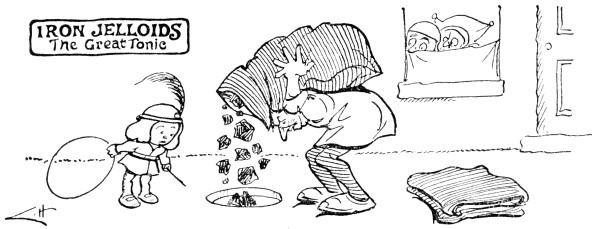
Edward I. 1272–1307 (continued)
NEXT Scotland Edward tries to tackle No easy task the Scotch to shackle;
Wallace and Bruce resistance make, The King dies ere he gains the stake.
In Edward’s reign some author writes They first used candle dips for lights;
And coal came in about this date Mixed (as to-day) with lots of slate.
So Monarchs, Barons, Dukes and Knights Warmed their toes with Derby Brights;
But those in hovels had the smuts Arising from cheap Kitchen Nuts.
Roger Bacon 1293
Roger Bacon (ob. twelve-nine-three) Versed was in arts of alchemy;
Gunpowder’s composition knew; And many another chemic brew.
Many Mortmain Acts are passed; Six centuries these efforts last
To stop the hungry Hierarchy Devouring all the Squirearchy.
Lollards 1307
Lollards in thirteen-seven arose Popish rituals to oppose;
John Wycliffe gives to old and young The Bible in the vulgar tongue.
With John of Gaunt’s protection strong He dared to preach ’gainst cleric wrong;
Precursor of the Reformation To liberal thought attuned the nation.
Edward II. 1307–1327
EDWARD the Second with his minions Governs badly these dominions
Edward III. 1327–1377
His son a man of different mould Was Edward Three, both wise and bold.
Through clinging to their French domains Our Kings are French through many reigns
And Edward fighting in this cause Commenced a hundred years of Wars.
A century’s struggle. For our pains Only Calais town remains.
French Wars
A century after this ’twas lost, In Mary’s reign. Oh! what a frost.
Weaving 1331
In thirteen-three-one England’s taught Weaving by men from Flanders brought.
Ryghte goode cloth with lots of ‘body’ The world was then not up to ‘shoddy.’
Blanket of Bristol in this year Invented blankets for our cheer;
And since that time its been our boast Our beds have been as warm as toast.
Edward ‘Black Prince’ One-three-four-six, A brave and noble warrior, ‘licks’
Crecy 1346
The valiant French in Crecy’s fray; Cannon first used upon this day,
Causing panic with their rattle; But the Yeomen win the battle,
For, flicking arrows from their bows They ‘filled the air as when it snows.’
Thereon the English Calais seize And of the channel hold the keys;
The Spanish pirates bend the knee Then Edward III’s ‘King of the sea.’
Parliament 1376
Lords and Commons from this date Have their meetings separate,
The Commons first a Speaker make The Chancellors the Woolsack take.
Ten lady members have the Lords But doubtless fearful of their words,
Or thinking it not orthodoxy, They only let them vote by proxy.
While Church and Barons have their squabbles The House of Commons more power nobbles;
On laws and taxes dares speak out And give the Pope the right-about.
[p10]
Leasing
LEASING or Farming, we are taught, Was introduced ’bout twelve-nought-nought;
The Feudal system’s weakened and The Tenants ‘usufruct’ the land.
On various counts the serfs go free And work for wages (Edward Three).
The Black Death and the foreign wars In labour ranks commotion cause;
Strikes and craftsmen’s combination Then arise among the nation;
These movements preached by one John Ball, Who, born too soon, was hanged withal.
Richard II. 1377–1399
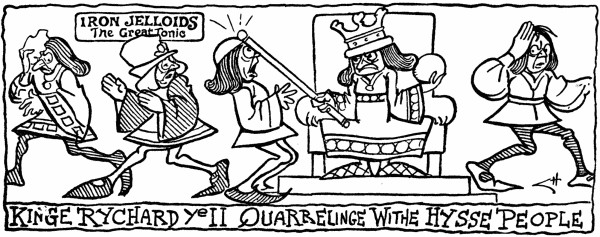
NOW comes the Second Richard’s reign. It is recorded very plain
That he was full of discontent Quarrelling with his Parliament.
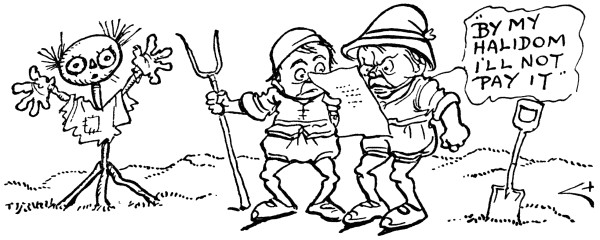
Poll Tax 1380
With his taxes super-sated The peasants grew exasperated;
They threw their spades and pitchforks down And marched as rebels into town.
Thirteen-eighty’s Poll taxation Puts equal tax on all the nation;
Lays seven thousand peasants dead; Wat Tyler and Jack Straw at head.
Præmunire
Præmunire Act is passed To check the Papal Bulls at last.
Chaucer
Chaucer the Poet this same year Makes Pilgrimage to Becket’s bier.
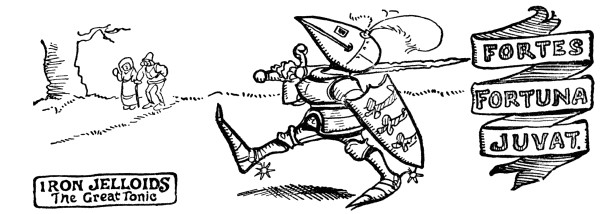
Age of Chivalry
This was the age, aye verily, Of ryghte goode noble chivalry,
When Knights went forth through storm and stress To rescue beauty in distress.
[p11]
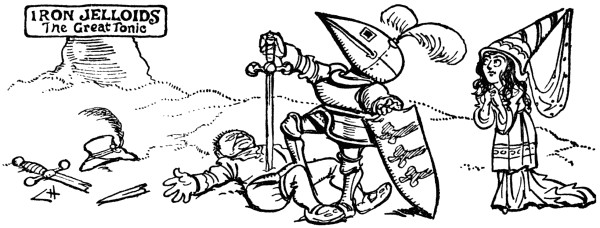
Or sallied out in valiant way A monster dragon for to slay,
Or with lance or trusty blade Defend from harm the hapless maid.
Henry IV. 1399–1413
HENRY Four, called ‘Bolingbroke’ In Richard’s wheel puts many a spoke;
Compels him to resign the throne Which thereupon he makes his own.
Through John of Gaunt, Lancastrian famed, His title to the crown he claimed;
The Parliament confirms his right And thus he’s king without a fight.
Lollards 1401
In this reign persecution’s turned Against the Lollards—Cobham’s burned.
Incredible! The records show A statute ‘de Comburondo.’
Henry V. 1413–1422
FROM fourteen-thirteen, Henry Five, For many years with France did strive;
His Widow founds the Tudor House By taking Owen for her spouse.
Henry VI. 1422–1461
HENRY Six, next in our rhymes, For fifty years had troublous times;
Wars of Roses, Wars with France, The poor man never had a chance.
Joan of Arc 1430
Joan of Arc the peasant Maid Inspired the French with Mystic aid;
Disunited, we make peace, All France but Calais we release.
Constantinople 1453
Constantinople’s seized by Turks Causing Greek Scholars (with their works)
To fly to Italy; and thence Learning’s reborn—‘The Renaissance.’
Edward IV. 1461–1483
IN Edward Fourth, fourteen-six-one The House of York obtains the Throne.
He wins at Towton’s bloody fray, No quarter given on that day.
Guy, Earl of Warwick in these frays Was always turning different ways;
Barnet 1471
On Barnet Field he met his doom The Rose of York’s now well abloom.
The Barons, Church and Commons fall, The King emerges Boss of all.
Benevolences he exacts, An early form of Super Tax.
Earl of Warwick
‘Kingmaker’ was Earl Warwick styled With his manner scarcely mild
He set Kings up and bowled them down Playing at ninepins with the Crown.
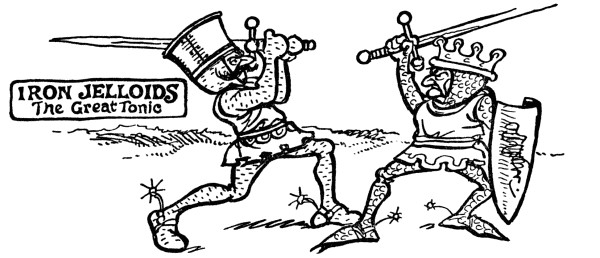
Wars of Roses 1485
White and Red Rose warring madly Bled the country very sadly,
Three-and-thirty years contending; At Bosworth Field we see the ending.
Printing 1473
First in fourteen-seventy-three We print from type in this Countree.
Now it is that time’s first measured By monster watches greatly treasured.
Thomas Parr this centurie His hundred-fifty years did see;
But Henry Jenkins, so ’tis said, In age was seventeen years ahead.
Hoary patriarchs were these Retaining p’raps their faculties;
What a comfort ’tis to mention Neither drew the old age pension.
[p12]
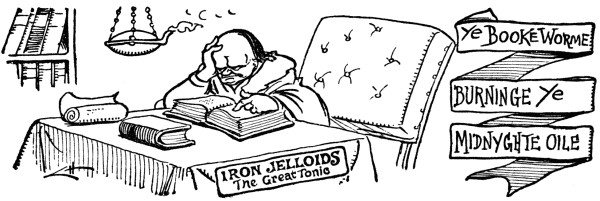
PRINTING started through the Nation A taste for higher education;
Here is a citizen at home; Note his very brainy Dome.
Richard III. 1483–1485
RICHARD (Crookback) in fateful hour Smothered his nephews in the Tower,
He murdered them the Crown to gain; A heavy price for three years’ reign.
The Scutcheon’s blotted terribly Of this King Richard number Three,
For it seems his recreation Was ordering decapitation.
1485
On Bosworth Field when sorely pressed He made a bid th’uncommonest
‘My kingdom for a horse’ he cried; No offers coming, there he died.
Henry VII. 1485–1509
LANCASTRIAN Richmond wins the fight And to make his title right
Elizabeth of York espouses, Thus uniting the two Houses.
This Henry Seven of Tudor line To misers’ habits did incline;
Twelve millions stated to possess, A tidy little fortune! Yes!
Star Chamber
Much he managed to extort By means of a Star Chamber Court
From the rich nobles; A new wile For adding to the kingly pile.
With cash in hand he could attain His wish as Autocrat to reign;
As sole possessor of the guns The King no risk from rebels runs.
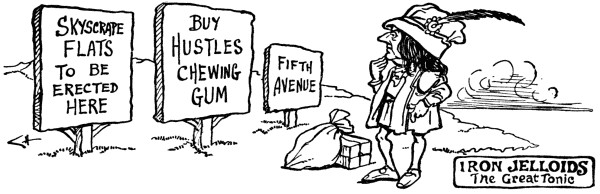
Columbus 1498
COLUMBUS, full of travellers’ lore, By going West sought India’s shore;
But found America’s wondrous land; His ‘exes’ paid by Ferdinand.
Of voyagers we’ve now a lot Vasco
da
Gama and Cabot,Who sailed from Bristol, whence it grew Bristolians claim this fine cuckoo.
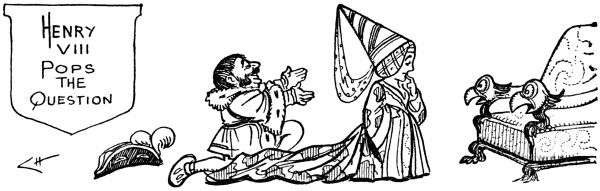
Henry VIII. 1509–1547
NOW Henry Eight comes on the screen, A stalwart youth, ætat. eighteen;
With youthful hope the nation’s buoyed; Only, alas! to be destroyed.
[p13]
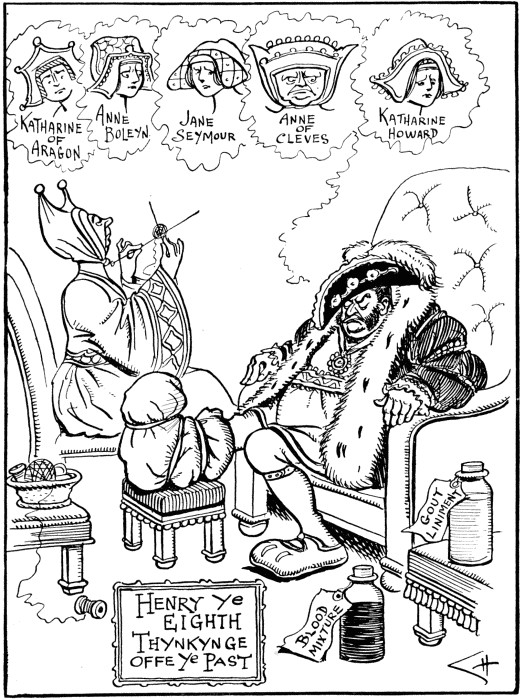
Henry VIII. 1509–1547 (continued)
THIS King Henry number Eight Six times tried the married state;
And certainly of all the Kings Spent the most on wedding rings.
But to search through old Archives For tales of Henry and his wives
And all their little tiffs to trace We cannot spare the time or space.
Yet there are some who fain would sing The praises of this rotund King;
But as a husband we’re afraid His category’s lowest grade.
He wielded harsh the despot’s power, And packed his wives off to the Tower;
Consigned them to a fate most dreaded; Two, alas! he had beheaded.
[p14]
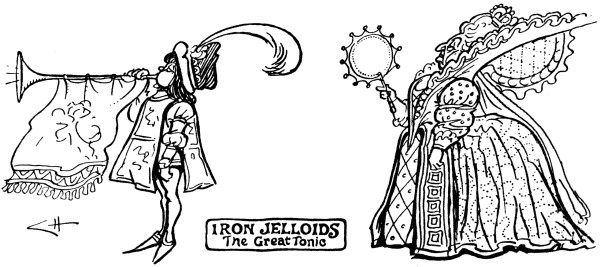
HAIL NOW TO THEE OUR GOOD QUEEN BESS! Henry VIII. (continued)
Reformation 1517
MARTIN Luther, fifteen-one-seven, Sows his Reformation leaven;
It finds a culture medium here In the ‘New Learning’s’ atmosphere.
Of this New Learning More’s the chief, Utopia’s Author, He’s ’mid grief
Beheaded, saying cool and calm, ‘Cut not my beard, that’s done no harm.’
His friend Erasmus, Logic’s Master, Trimmed his sails and ’scaped disaster.
A third, Dean Colet who St. Paul’s School London into being calls.
Wolsey 1530
In fifteen-thirty Wolsey great, A Cardinal and Man of State,
From Butcher’s son had risen high. Reader! consult your Shakespeare nigh.
Blamed by some; by others praised; He fell; but still the pile he raised
Most nobly graces Hampton Court. Give Wolsey then a tender thought.
His main ambition that the King Should be supreme in everything;
Thomas Cromwell
And Thomas Cromwell followed suit To make his master absolute
Head of the Church within his realm. These two most able at the helm;
But not with skill enough endued To ’scape their King’s ingratitude.
Despotical the King’s power grew. He’s England’s Pope by Act of Su-
Premacy; as, to gain divorce, The foreign Pope is banned perforce.
1537
Now Bluff King Harry gives the Monks A series of most awful funks;
Three thousand odd of their domains He ‘collars’ for his Courtiers’ gains.
Edward VI. 1547–1553
EDWARD Six to the throne succeeds A pious youth of goodly deeds;
One, well known in the Capital, The Blue Coat School (Christ’s Hospital).
Mary 1553–1558
QUEEN Mary One, in Smithfield Square, At Oxford, Gloucester and elsewhere,
Burned poor Martyrs by the score; The Romish faith she would restore.
Elizabeth 1558–1603
HAIL now to thee our good Queen Bess, Garbed in the puffed and padded dress,
Farthingale and starched up frills, Meaning heavy laundry bills.
Od’s Bodikins; what monstrous ruffs, What gowns of rich embroidered stuffs
Piped and scolloped, trimmed with furs, And shaped like huge gasometers.
Now we’ve warfare of the Creeds, For their thoughts all Europe bleeds;
Each party seeks by force to make The other side its faith forsake.
Spain the Great Power of those days In these contentions first part plays.
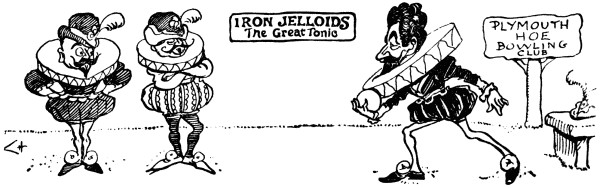
Drake
Drake at bowls on Plymouth Hoe Left his game to meet this foe
And came home laden we are told With seachests full of Spanish gold.
Armada 1588
In fifteen-eight-eight Armada strong From Spain to squash us comes along;
Which Howard, Frobisher and Drake And stormy weather overtake.
[p15]
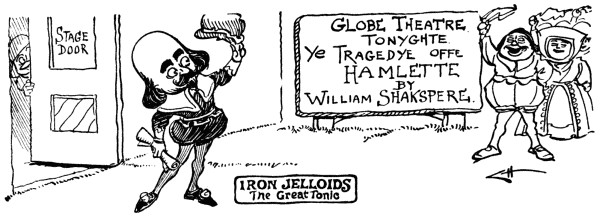
Shakespeare 1564–1616
AND in these epoch making days Shakespeare wrote and staged his plays;
Weaving a thread whose magic strands Entwine all English-speaking lands.
Fifteen-eight-seven Scots’ Queen Mary Lost her head through fate contrary.
When Henry Eight had robbed the Church ’Twas found the poor were in the lurch;
Poor Law
A law was passed about this date To place the poor upon the rate.
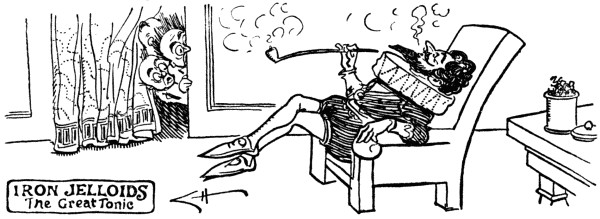
Sir Walter Raleigh 1552–1618
SIR Walter Raleigh, best of Knights, The first to taste the keen delights
Of the enchantress so serene, The Ryghte Goode Ladye Nicotine.
No information’s yet to hand Concerning Raleigh’s favourite brand;
Tobacco
Was it coarse-cut shag which burns The tongue, or birdseye or returns?
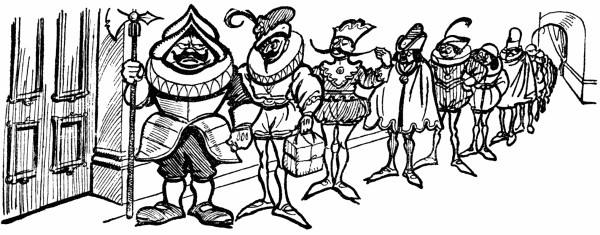
Queen Elizabeth
Good Queen Bess we understand Had crowds of suitors for her hand;
And here we beg to give a view Of suitors waiting in a queue.
[p16]
Queen Elizabeth (continued)
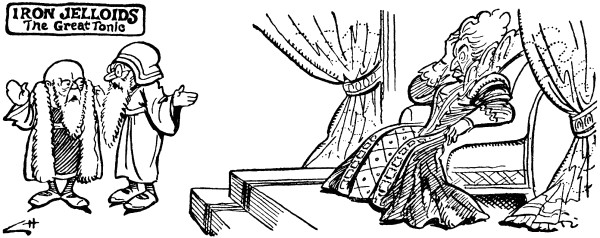
AS time rolled on this Good Queen Bess Lost somewhat of her sprightliness;
She got into a nervous state Was mopish and disconsolate.
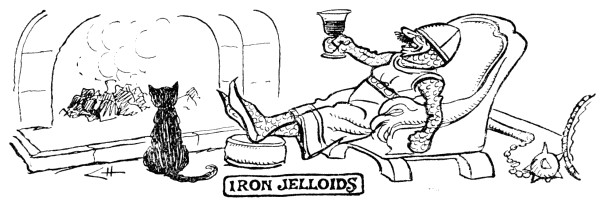
Now, as everyone will own, Had ‘Iron Jelloids’ been but known
In Bess’s time; why, it’s conceded ’Twas just the Tonic that she needed.
East India Company 1600
The great ‘John Comp’ny’ now began
Its
fine career without a plan.Great! The Elizabethan Age. In History’s book a glorious page.
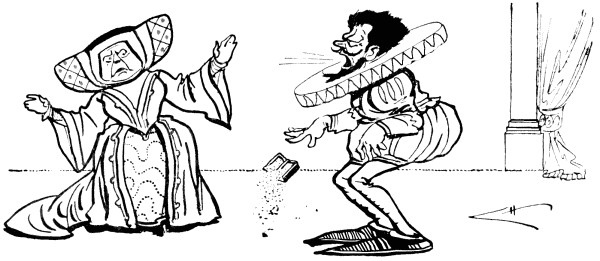
Somewhere or other we’ve heard snuff Came in the days of frill and ruff;
And here’s a noble ill at ease Giving the first recorded sneeze.
James I. 1603–1625
JAMES Six of Scotland, miscalled a ‘fule’ As James One of England comes to rule.
Gramercy! ’tis a canny thing To be a ‘double-barrelled’ King.
The son of Mary Queen of Scots Of learning he had lots and lots,
Writing sundry ponderous books ’Gainst ’bacca, witches and their spooks.
James thought his kingly power divine And, loathing Puritanic ‘whine,’
He vowed to make them all comply Or else he’d ‘know the reason why.’
Pilgrim Fathers 1620
His persecution to escape Some Zealots in the ‘Mayflower’ shape
Their course for an uncharted world Where Freedom’s Flag could be unfurled.
These ‘Pilgrim Fathers’ found a state ‘New England,’ blessed with happy fate.
Folks have called the first King James Most uncomplimentary names;
To wit ‘a sloven’ and ‘a glutton’; Perhaps his weakness was Scotch Mutton.
And as to gluttony, ‘Gadzooks’! If what we read in History books
Is true, they all were trenchermen; There were no diet faddists then.
It startles us, one must declare, To read their breakfast bill of fare;
All ‘Kynes’ of ale, some highly spiced And divers meats, roast, boiled and sliced.
In James’ reign a man could get For money down a coronet
And titles with the greatest ease Like folks to-day buy soap and cheese.
Harvey
Yet a learned time; for Harvey shows That blood’s not stagnant, but it flows;
Lord Bacon
‘Experiment!’ Lord Bacon cries ‘There is no progress otherwise.’
[p17]
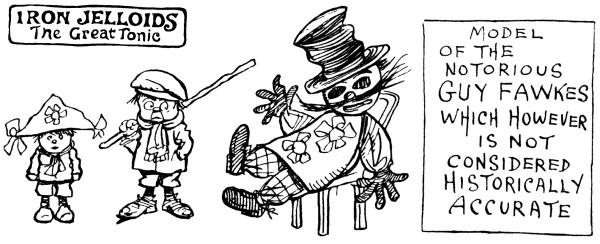
5th November 1605
OF troubles James had quite a lot, For instance the Gunpowder Plot.
It fizzled out but left to-day A liking for Firework display.
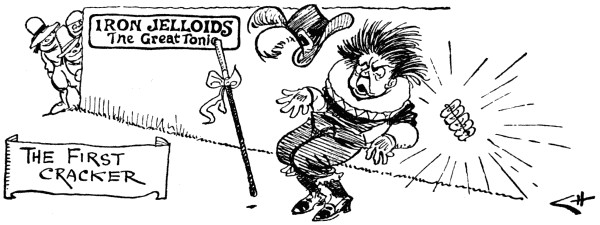
So rockets with their sweeping curves, Crackers which upset the nerves
And squibs with their infernal din To this date owe their origin.
Charles I. 1625–1649
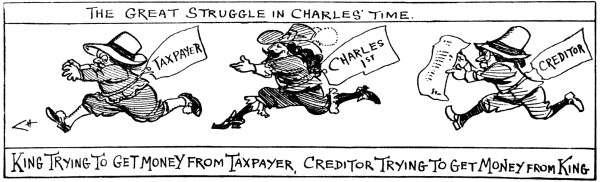
HIS son Charles One we understand Ruled England with a grasping hand;
For he was never loth to levy Taxes burdensome and heavy.
He moved in an expensive set, Was always heavily in debt;
In fact this monarch with his frills Was snowed up to the neck with bills.
He was courtly, graceful, distingué, And when the scaffold came his way
‘He nothing common did or mean Upon that memorable scene.’
He had a very taking way And made his taxed up subjects pay;
And over taxing it is said This Monarch fairly lost his head.
Petition of Right—1628
The ‘Petition of Right’ a famous Act, The Commons from the King exact;
Giving the subject on his own A remedy against the throne.
First Newspaper 1621
In sixteen-hundred-twenty-one Our first news-sheet began its run;
For twenty years ’twas going strong Then the first Censor came along.
This journal cribbing from the Dutch Lacked the smart journalistic touch;
And also photographic views, ‘Sporting pars’ and ‘Stop-press News.’
[p18]
THAT QUIET MAN, KNOWN AS THE EARLY PURITAN.
Cotton 1630
COTTON first came from India’s shore In sixteen-thirty, less or more;
Where for three thousand years it grew, Also in Egypt and Peru.
Grim reading is the note confessing Gangs went out for Navy pressing,
Forcing many a timid knave To spend his life on ocean wave.
Ship Money 1636
Charles raises the ship money tax; He thought he only had to ‘ax’;
When Hampden strenuously objected, The King was very much affected.
Strafford 1641
Earl Strafford (‘Thorough’) in his pride ‘The King shall rule the Commons’ cried;
The Commons would not brook such stuff And cut his head off. ‘Quantum Suff.’
The ‘Grand Remonstrance’ is put forth By the Commons who are wrath
With the King’s despotic ways Quite unsuited to these days.
The King tries hard to put in jail Five Members but without avail;
Hollis, Strode, Haslerig and Pym And Hampden (we must mention him);
They’re guarded from the Royal hands By Watermen and City Bands.
The ‘die is cast’ and Civil War For seven long years the Nation tore.
Civil Wars 1642–1648
CROMWELL greatest of the foemen With his faithful English Yeomen;
These ‘Roundheads’ sober, grim, religious To ‘Cavaliers’ gave blows prodigious.
Their character’s seen in the cry ‘Trust God and keep your powder dry.’
Naseby 1645
The Cavaliers and Roundheads fought In many a field, ’till Naseby brought
To Generals Cromwell and Fairfax A crowning victory, though not ‘pax.’
The King’s beheaded, but the State Experiences no headless fate;
A commonwealth’s forthwith proclaimed And Cromwell’s soon Protector named.
Dunbar 1650
In sixteen-fifty Dunbar sees The Royal Scots brought to their knees;
And in the second Worcester fight Cromwell for good asserts his might.
Worcester 1651
And there are those who love to tell About that day at Boscobel
When Charles the Second’s Majestye Found itself doubly ‘up a tree.’
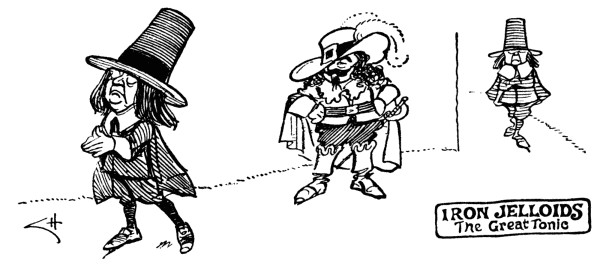
And now we meet that quiet man Known as the early Puritan;
Mild and placid in his talk, Calm and measured in his walk.
Commonwealth 1649–1660
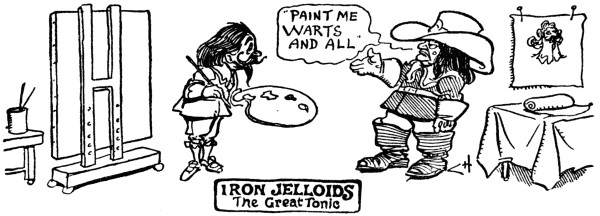
Oliver Cromwell bluff and bold, Was cast in Nature’s sternest mould,
Lacking maybe the courtly grace And proud of warts upon his face.
He fought the Irish and the Scotch And with his navy beat the Dutch
Let all his faults
condonéd
be, He kept us up on land and sea.[p19]
Commonwealth (continued)
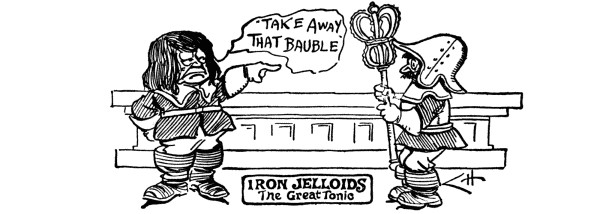
HE seemed to like bold argument And wordy wars with Parliament;
He made things lively we infer Frequently at Westminster.
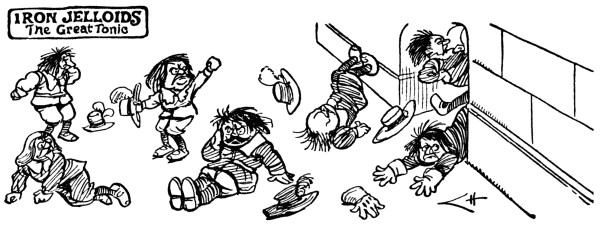
With M.P.s he had many a bout And one day cleared the whole lot out;
Locked the door and took the key; Those not the days of ‘Wait and See.’
Charles II. 1660–1685
CROMWELL’S death brings Restoration And Charles Two lands ’mid acclamation.
After his leaps from twig to twig He now has ‘Otium cum Dig.’
In merry Charles the Second’s age Woman first acted on the stage;
The King encouraged much this vogue He was a pleasure seeking rogue.
‘He never said a foolish thing, Nor did a wise one’; this the King
Countered with ‘My words my own My acts my ministers’ alone’;
1662
In sixteen-six-two year of grace, Charles taxed every fire-place;
And citizens who couldn’t pay Shivered and grumbled as to-day.
These were the times of Musketeers And proud and dashing Cavaliers;
When words were few and tempers hot And duels fought out on the spot.
John Bunyan
THE tinker preacher Bunyan wrote The ‘Pilgrim’s Progress’ we still quote,
The prison bars no barrier wrought To lowly Bunyan’s lofty thought.
Milton 1678
In stately language Milton’s muse The Bible story doth diffuse;
From ‘Paradise Lost’ we get our view Of Adam and Eve and Satan too.
The Reverend Titus Oates, a scamp, Egregious Popish plots did vamp,
Lied roundly for dishonest gains, Got Cat-o’-nine-tails for his pains.
Habeas Corpus 1679
The ‘Habeas Corpus’ best of laws Shields us from prison without cause;
’Twas passed in sixteen-seventy-nine, And means ‘Produce him here,’ in fine.
Van Tromp
Admiral Van Tromp, Dutchman bold, With broom at masthead, so ’tis told,
The Channel sailed, suggesting he’s Swept all the English from the seas.
Blake
But Blake laughed loud and spread his sails Nought the Dutchman now avails;
For he got an awful shocker Right to Davy Jones’ locker.
But though the Dutch failed to invade, They were not disinclined to trade;
So we get ‘Hollands,’ cheese and hams Fresh from the land of Dykes and Dams.
Peace of Breda 1667
For fifteen years these Navies fought, ’Till sixteen-six-seven respite brought;
The Peace of Breda then succeeded; New York to England was conceded.
Plague
In sixty-five the Plague appears And then the Fire; two awful years
Fire of London 1665–1666
For London—And if more you’d know Consult the Pages of Defoe.
[p20]
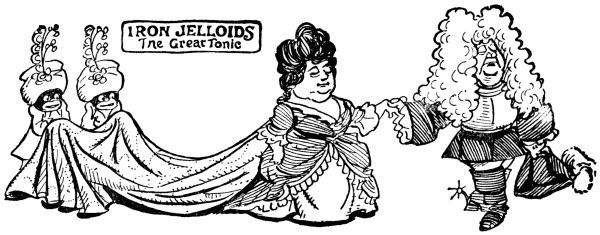
QUEEN ANNE AND THE DUKE OF MARLBOROUGH.
James II. 1685–1688
WHEN Charles Two died his brother James Soon put the country into flames;
Papistry he would advance, And for that purpose leagued with France.
In sixteen-eight-eight his bigot zeal Religious Test Act would repeal;
Seven bold Bishops who defied To the Tower were sent and tried.
The country raised a hue and cry So off to France the King doth fly.
William III. 1689–1702
HIS place is filled by William Three His son-in-law from Dutch countree.
This Orange sprig most brave of men With Mary reigns and all things then
Went well with us. Macaulay’s page Hails him as Hero of the age.
In this reign of William Three, Laws were harsh ’gainst burglary;
For they’d a very drastic way And hanged the ‘Bill Sykes’ of that day.
National Debt 1694
In sixteen-nine-four we have heard The National Debt was first incurred;
To careful folk who would invest ’Twas not devoid of interest.
Another National Debt we owe To Iron Jelloids which the foe
Depression’s worries keep at bay And drive our nervous fears away.
Bill of Rights 1689
The ‘Bill of Rights,’ a Charter grand, In sixteen-eight-nine frees this land
From all encroachments of the Crown Hoi Polloi are no longer down.
Queen Anne 1702–1714
GOOD Queen Anne we know is dead; She reigned twelve years but it is said
‘Mrs. Morley,’ Marlborough’s wife Ruled her more than half her life.
Marlborough
This was the Duke of Marlborough’s day, Who beat the French in every fray;
Known for his famous victories At Blenheim and at Ramillies.
In seventeen-seven by statute passed English and Scotch unite at last;
‘One coinage and one Parliament’ Both Nations ever since content.
About this time, so runs the story, Much is heard of ‘Whig and Tory’;
And shortly after there was rife Many a sign of party strife.
Dr. Watts 1674–1748
Good Dr. Watts’ moral lays Were much reputed in these days;
And still we lisp at Mother’s knee ‘How doth the little Busy Bee.’
Pope 1688–1744
Pope, letter-writer and great poet, Most quotable of all (ye know it),
At Twickenham penned his caustic verse Epigrammatic, smooth and terse.
George I. 1714–1727
THE House of Stuart being ended, George of Hanover (descended
From daughter of King Jamie One) Comes over to ascend our throne.
Of English George knew not a word, Most awkward, not to say absurd,
At Cabinet Councils to preside; So from this time the practice died.
George II. 1727–1760
HIS son George Two succeeding then In person fought at Dettingen.
Both these Kings had various fights In Scotland with the Jacobites.
William Tull brings in Post Chaises; Now the people ride like ‘blazes.’;
Many can’t for they’re in trouble, Ruined by the South Sea Bubble.
Wesleys 1703–1791
John and Charles Wesley, men of mind, Revive Religion in Mankind.
Founding a Church both broad and low, One-seven-three-nought A. Domini.
Clive 1746
Beginning as an office clerk As soldier Clive soon made his mark,
And conquered India for this Nation; Self ’stounded at his moderation.
Bridgwater, Gilbert, Brindley, three Great Engineers this Centurie,
Canals
Useful canals in England made, The flowing arteries of trade.
Quebec 1759
General Wolfe seventeen-five-nine Captures Quebec—a victory fine,
And Canada’s the splendid prize For old ‘John Bull’ to colonise.
George III. 1760–1820
AND now of Georgey number Three: Ut mulus obstinatus he
Had full sixty years of reign And a big family to train.
[p21]
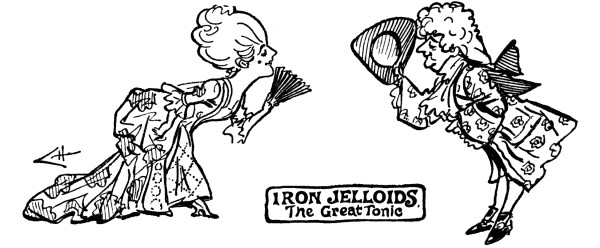
GEORGIAN TIMES.
Georgian Times
WE will but very lightly scan The customs known as ‘Georgian’;
The times of powdered Belles and Beaux; Patches, paint and furbelows;
Of beauteous maids and gallants gay And merry routs at Ranelagh;
Gaming parties, cards or pool And ‘Fops’ of the Beau Brummel School.
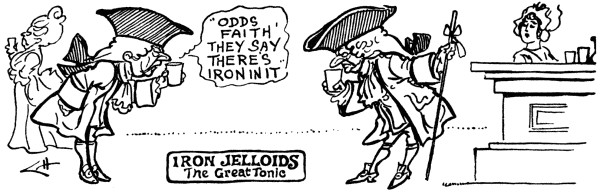
When rank and fashion History tells All took their cures among the Wells;
And sipped in manner hesitating Daily doses nauseating.
But we know better how to act Our cures we purchase more compact
For in the Chemists’ you can see ‘Iron Jelloids’ priced at ‘One and Three.’
Lord ‘Periwig’ and gay ‘Fallal’ In Sedan Chairs frequent the Mall.
‘Taxis’ and ‘Tubes’ we beg to state Came in at a much later date.
When Brummel, the historic Beau, Made laws for dress and outward show;
Whose vests were poems, whose coats were dreams Of gorgeous beauty, so it seems;
Who figured in the public gaze A ‘Star turn’ with his courtly ways;
Who fixed the style of a cravat, Lord of Appeal anent a hat.
And My Lord Chesterfield was quite The model of the most polite
Wrote famous letters. It’s a shame, A settee has usurped his name.
Dr. Johnson 1709–1784
And Dr. Johnson at his ease Sipped his tea at the ‘Cheshire Cheese,’
Or at the ‘Mitre’ of renown, Spreading his wit throughout the Town.
Garrick
When Garrick as the ‘Moody Dane’ Drew the Town to Drury Lane,
Mrs. Siddons
Sarah Siddons was all the rage Tragedy Queen of every age.
Highwaymen arméd to the teeth Waited for prey on Hounslow Heath;
Per contra the Highwayman’s pate Was oft strung up at Tyburn Gate.
Capt. Cook 1728–1779
It’s only right a History book Should mark the feats of Captain Cook;
So jot it down in these our Rhymes That round the World he sailed three times.
Inventions 1767
These are the days of much invention The ‘Spinning Jenny’ we will mention;
The ‘Cotton Mule’ and ‘Power Loom’; For Authors’ names there’s lack of room.
Adam Smith 1766
In his book ‘The Wealth of Nations’ Adam Smith shows the relations
Governing the Art of Trading; With influences far pervading.
‘Man buys as cheaply as he can And sells as dearly, that’s his plan.’
‘Supply Demand each other feed Dearer markets cheap ones bleed.’
Jenner 1796
Jenner brings in vaccination, Boon to every generation;
By similar methods now devised Many an ill is exorcised.
[p22]
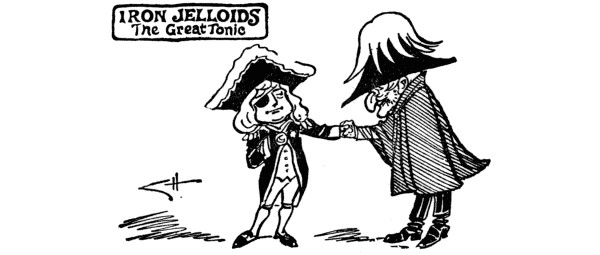
NELSON AND WELLINGTON.
American War 1775
IN seventeen-sixty and fifteen Our Taxes raise the Yankees’ spleen.
‘Unrepresented, you’ve no right To tax us, therefore we will fight.’
Washington, Franklin and the rest Formed a Republic quite the best;
We’ve long been friends. Let us rejoice; But at the time we had no choice.
French Revolution
IN France in times of Louis Seize (says) Oppression dire through countless days
Roused Revolution with its tears Mainly through books with wrong ideas.
Napoleon I. 1793–1815
From Revolution’s putrid mess A Conqueror’s born, quite conscienceless,
Millions of men and women died Victims to Napoleon’s pride.
He plunged all Europe into Wars His own ambition the sole cause.
England as usual did her ‘bit’ And ‘Boney’ Europe had to quit.
During these years of storm and stress Two noble pilots we possess
‘Chatham and Son’ (Pitt is their name), Illustrious on the scroll of fame.
Nelson 1805
Here we must our homage pay To Nelson of Trafalgar Day;
Wellington
To Wellington the same is due, Who crowned his fame at Waterloo.
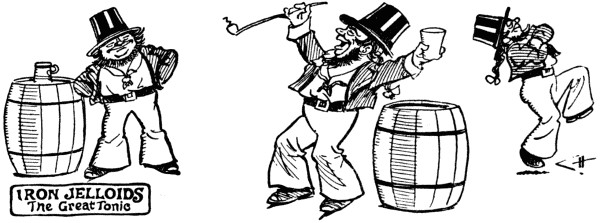
AND ‘Shiver my timbers,’ ‘Heave ahoy,’ The Tar, those times a breezy boy
With shiny hat and pigtail long And love for lass and glass and song.
Discovery of Electric Force
About this date Electric Force Dawns on mankind. Before, of course,
In Lightning it was all about, With noise enough to be found out.
Coelo eripuit fulmen, ’Twas said of Franklin, as ye ken.
Philosopher of bygone age Accept our homage on this page.
But who’d have thought it that Galvani When making soup, (this is no blarney)
By his power of observation On a frog’s legs’ oscillation
Should find how by chemic ways Electric currents we can raise?
To call him ‘great’ is no flattery; He set us on the wondrous battery.
This simple little frog, Heigh Ho! The frog who would a-wooing go;
Thy part in electricity Is unmatched eccentricity.
This new discovered fact, of course, Leads to the Telegraph of Morse,
The Motor and Electric Light The Telephone and more in sight.
[p23]
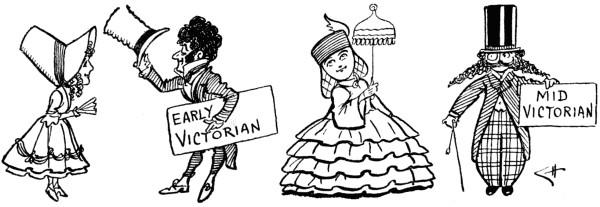
IN QUEEN VICTORIA’S PALMY DAYS.
Ireland
OF Ireland but a word or two. Celts were her people and they knew
Not benefit of Roman Ruling; Young Europa’s Infant Schooling.
In century five St. Patrick great Converts them to the Christian state;
And from this Western Isle afar, English and Scotch converted are.
Danes and Ireland
Two hundred years from nine-nought-nought Danes raiding Erin trouble brought;
And left them in chaotic state No longer masters of their fate.
In those days ’twas ‘Woe to the weak,’ Saxons and Danes had made us squeak,
Then came the Normans in great force And civilised us in due course.
They tried the same with Ireland green; But only sowed a feud between
The land they’d conquered and Erin, Leading to endless quarrelling.
Cromwell
England accepts the Reformation, Catholic still the Irish nation
Boyne
Sees Cromwell with them battle join And William beat them at the Boyne.
William Pitt in eighteen-nought-nought Ireland and England’s welfare sought
Act of Union 1800
By ‘Act of Union’ which he passed; But still the wretched squabbles last.
George IV.
NOW come George Four and Will his brother; With these two kings we need not bother;
William IV.
The first a gourmand, bon viveur, The next a sailor, bluff, sans peur.
Trevithick, Newcomen, and Watt Are names will never be forgot;
For their crude engines were the source Of man’s control of Steam’s wild force.
Steam 1830
By eighteen-thirty man has tamed Steam to his use; and widely famed
Was puffing ‘Rocket’ with the power Of doing thirty miles an hour.
Steam prompts man to make machines And Factories rise with all that means;
Divided more and more is labour Each man leans more on his neighbour.
For twenty million pounds the nation Buys our slaves’ emancipation.
Reform Act
In eighteen-three-two, happy year, The great Reform Act doth appear.
Steam vessels the Atlantic cross. The penny post comes into force.
And double knocks bring joys and thrills Sometimes cheques, more often bills.
Corn Law Repeal 1846
The Corn Law duty’s brushed away, Hence we enjoy cheap bread to-day.
WE fain would linger, but alas, These are the periods we must pass.
So gentle reader do not grin At sight of cumbrous crinoline.
Victoria 1837–1901
Since Queen Victoria’s palmy days Woman has altered all her ways.
In those days she was meek and mild And treated almost like a child;
Woman’s Status
Was brought up in a narrow zone; And couldn’t call her soul her own.
She vegetated, ’tis well known Under the ‘cloche’ of Chaperone.
But now the ‘Franchise’ she obtains, And her own property retains.
What a difference from then, She ‘carries on’ just like the men.
And now at Westminster we see A lady sitting as M.P.
Darwin 1809–1882
CHARLES Darwin offers us a Key To help unlock the mystery
Of Evolution’s wondrous span From Protoplasm up to Man.
Livingstone 1813–1873
The traveller, great Scotch Livingstone, Wandered o’er Afric’s trackless Zone;
Where no white man had ever trod Teaching the blacks the Word of God.
Crimean War
English, French and Turks unite ’Gainst Russia in Crimean fight.
Indian Mutiny
The Indian Mutiny now arose, ‘Fat’ was the cause that led to blows.
Atlantic Cable
With efforts many men most able Lay the great Atlantic Cable.
Suez Canal
Lesseps unites for you and me The Medit’ranean and Red Sea.
Education Act
The Education Act proposes To make us all as wise as Moses;
In eighteen-seven-nought it passed, But each is learning to the last.
Ballot Act 1872
A couple of years from this we note The Ballot Act gives secret vote;
Before this Act, e’en since we fear, Folks sold their votes for draughts of beer.
[p24]
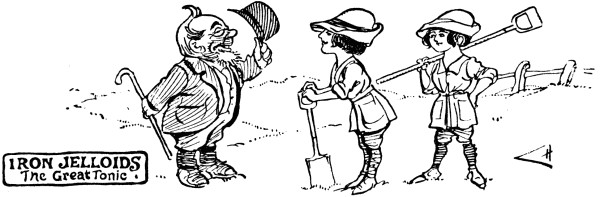
WOMEN TOOK TO SPADE AND HOE.
Edward VII. 1901–1910
EDWARD Seven, ‘Peacemaker’ named, His efforts to this end far famed.
We know it was no idle chance His ‘Entente cordiale’ with France.
True friendship and the peace we want The outcome of this grand Entente.
Though not accented in our rhyme We’ve been fighting all the time;
And it’s a fact which must be stated Our chief opponent (so ’twas fated)
Wars with France
Our nearest neighbour o’er the Sea Whose ‘No’ is ‘Non’; whose ‘Yes’ is ‘Oui’;
Like two schoolboys always sparring Eight hundred years together warring;
From Hastings unto Waterloo We’d battles with the brave ‘Mossoo.’
Now Honi soit qui still y pense; Hurrah for England! Vive la France!
AND here we come to end our rhymes We’ve reached the present stirring times,
When one and all lent helping hand To keep secure the Motherland.
When men went forth to fight the foe And women took to spade and hoe,
And donning smocks of nattiest styles, Worked on the land for Farmer Giles.
Now three cheers for the dainty maids, Government clerks of different grades;
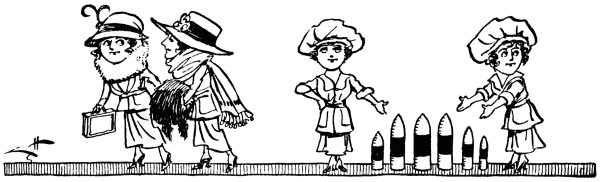
Nor are we likely to forget Our debt to the Munitionette.
The Present Time
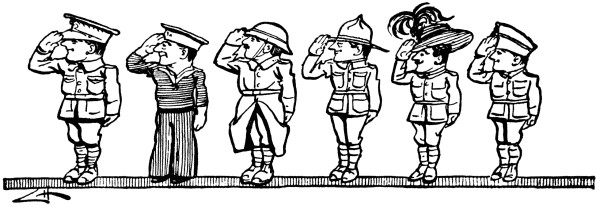
We seem to have subdued the Hun And so farewell (our task is done)
To Anzacs-Indians-Poilus-Yanks—
Italians-Belgians-Japs-and-Tanks.
[ad2]
Concerning
MEN and TONICS
BY THE LATE
DR. ANDREW WILSON.
“Many a man feels so thoroughly out of sorts, and thinks himself so dreadfully ill, that he is rather surprised when the doctor tells him there is not really anything seriously the matter with him at all; that he just needs a tonic, and should put the brake on as regards work, worry, or late hours.
“It is this ‘run-down-ness,’ ‘out-of-sorts-ness,’ ‘below-par-ness,’ which lead to all kinds of fanciful fears, such as having Brain Fag, Neurasthenia, and other conditions startling by name at least.
“Now I have found the form of Iron Jelloids put up with Quinine (called Iron Jelloids No. 2A), to be an excellent Tonic in all such cases. When a man or youth feels out-of-sorts, and is not so ill as to require medical advice, he cannot do better than try a Fortnight’s Treatment of Iron Jelloids No. 2A, as a suitable and effective remedy.
For DEBILITY, WEAKNESS and NERVINESS, Men find the Ideal Tonic and Restorative in Iron Jelloids No. 2A.
For ANÆMIA in Men and Women (shown by breathlessness on slight exertion, pallor, depression and weakness) Doctors have for many years prescribed the well-known Iron Jelloids No. 2.—there is nothing better.
A Ten Days Treatment (price 1/3) will convince you.
Mr. J. R. PENNINGTON, Chemist, late of Worksop, writes:—“I always handle Iron Jelloids with pleasure as my customers are invariably satisfied with them.”
(Pronounced Jell-Lloyds.)
Reliable Tonic for Men
IRON JELLOIDS No. 2A.
For Anæmia in Men &
WomenIRON JELLOIDS No. 2.
For Growing Children
IRON JELLOIDS No. 1.
Of all Chemists. A Ten Days Treatment 1/3. Large size 3/-
Manufactured by The Iron Jelloid Co., Ltd., 189, Central Street, London, E.C.1. England.
[back cover]
Transcriber's Note
Details of minor typographical corrections and retained mis-spellings are provided in the source code (search for class="TN").