



автордың кітабын онлайн тегін оқу The History and Romance of Crime; Millbank Penitentiary
Millbank Penitentiary


Temple Bar
A famous gateway which stood before the Temple in London built by the noted architect, Christopher Wren, in 1670. According to ancient custom when the sovereign wishes to visit the City of London, he asks permission of the lord mayor to pass through this gateway into the city.

EDITION NATIONALE
Limited to one thousand registered and numbered sets.
NUMBER 307
INTRODUCTION
Millbank Prison stood for nearly a century upon the banks of the Thames between Westminster and Vauxhall, a well-known gloomy pile by the river side, with its dull exterior, black portals, and curious towers. This once famous prison no longer attracts the wide attention of former days but the very name contains in itself almost an epitome of British penal legislation. With it one intimately associates such men as John Howard and Jeremy Bentham; an architect of eminence superintended its erection; while statesmen and high dignitaries, dukes, bishops, and members of Parliament were to be found upon its committee of management, exercising a control that was far from nominal or perfunctory, not disdaining a close consideration of the minutest details, and coming into intimate personal communion with the criminal inmates, whom, by praise or admonition, they sought to reward or reprove. Its origin and the causes that brought it into being; its object, and the success or failure of those who ruled it; its annals, and the curious incidents with which they are filled,—these are topics of much interest to the general reader.
At this distant time it is indeed interesting to observe how thoroughly John Howard understood the subject to which he had devoted his life. In his prepared plan for the erection of the prison he anticipates exactly the method we are pursuing to-day, after more than a century of experience. “The Penitentiary Houses,” he says, “I would have built in a great measure by the convicts. I will suppose that a power is obtained from Parliament to employ such of them as are now at work on the Thames, or some of those who are in the county gaols, under sentence of transportation, as may be thought most expedient. In the first place, let the surrounding wall, intended for full security against escapes, be completed, and proper lodges for the gatekeepers. Let temporary buildings of the nature of barracks be erected in some part of this enclosure which will be wanted the least, till the whole is finished. Let one or two hundred men, with their proper keepers, and under the direction of the builder, be employed in levelling the ground, digging out the foundation, serving the masons, sawing the timber and stone; and as I have found several convicts who were carpenters, masons, and smiths, these may be employed in their own branches of trade, since such work is as necessary and proper as any other in which they can be engaged. Let the people thus employed chiefly consist of those whose term is nearly expired, or who are committed for a short term; and as the ground is suitably prepared for the builders, the garden made, the wells dug, and the building finished, let those who are to be dismissed go off gradually, as it would be very improper to send them back to the hulks or gaols again.”
Suggestions such as these may have seemed impossible to those to whom they were propounded; but that the plan of action was simple and feasible, is now most satisfactorily proved. Elam Lynds, the celebrated governor of Sing-Sing prison, in the State of New York, acted precisely in this manner, encamping out in the open with his hundreds of prisoners, and compelling them in this way to build their own prison-house, cell by cell, as bees would build a hive. De Tocqueville, commenting on this seemingly strange episode of prison history, observes that “the manner in which Mr. Elam Lynds built Sing-Sing would no doubt raise incredulity, were not the fact quite recent, and publicly known in the United States. To understand it we have only to realize what resources the new prison discipline of America placed at the disposal of an energetic man.”
Plans for the new penitentiary buildings were actually prepared, and operations about to commence, when the Government suddenly decided to suspend further proceedings. The principle of transportation had never been entirely abandoned. Western Africa had indeed been selected for a penal settlement, and a few convicts sent there in spite of the deadly character of the climate. But the statesmen of the day had fully recognized that they had no right to increase the punishment of imprisonment by making it also capital; and the Government, despairing of finding a suitable place of exile, was about to commit itself entirely to the plan of home penitentiaries, when the discoveries of Captain Cook in the South Seas drew attention to the vast territories of Australasia. Embarking hotly on the new project, the Government could not well afford to continue steadfast to the principle of penitentiaries, and the latter might have fallen to the ground altogether, but for the interposition of Jeremy Bentham. This remarkable man published, in 1791, his “Panopticon, or the Inspection House,” a valuable work on prison discipline, and followed it, in 1792, by a formal proposal to erect a prison on the plan he advocated.
The outlines on which this model prison was to be constructed were also indicated in a memorandum by Mr. Bentham: “A circular building, an iron cage, glazed, a glass lantern as large as Ranelagh, with the cells on the outer circumference,”—such was his main idea. Within, in the very centre, an inspection station was so fixed that every cell and every part of a cell could be at all times closely observed; but, by means of blinds and other contrivances, the inspectors were concealed, unless they saw fit to show themselves, from the view of the prisoners; by which the feeling of a sort of invisible omnipresence was to pervade the whole place. There was to be solitude or limited seclusion ad libitum; but, unless for punishment, limited seclusion in assorted companies was to be preferred. As we have seen, Bentham proposed to throw the place open as a kind of public lounge, and to protect the prisoners from ill-treatment they were to be enabled to hold conversations with the visitors by means of tubes reaching from each cell to the general centre.
Bentham’s project had much to recommend it and it was warmly embraced by Mr. Pitt and Lord Dundas, the Home Secretary. But secret influences were hostile to it. It is believed that King George III opposed it from personal dislike of Bentham who was an advanced radical. Year after year, although taken up by Parliament, the measure hung fire. At last in 1810 active steps were taken to re-open the question, thanks to the vigour with which Sir Samuel Romilly called public attention to the want of penitentiaries. Nothing now would please the House of Commons but immediate action; and this eagerness to begin is in strange contrast with the previous long years of delay.
Negotiations were not re-opened with Bentham, except in so far as he was entitled to remuneration for his trouble and original outlay. Eventually his claims were referred, by Act of Parliament, to arbitration, and so settled. The same Act empowered certain supervisors to be appointed, hereafter to become possessed of the lands in Tothill Fields, which Bentham had originally bought on behalf of the Government. These lands were duly transferred to Lord Farnborough, George Holford, Esq., M. P., and the Rev. Mr. Becher, and under their supervision the Millbank Penitentiary as it now stands was commenced and finished.
CONTENTS
CHAPTER PAGE Introduction 5I.
The Building of the Penitentiary 15II.
Early Management 33III.
The Great Epidemic 48IV.
The Penitentiary Reoccupied 73V.
Serious Disturbances 107VI.
A New Regime 132VII.
Ingenious Escapes 166VIII.
The Women’s Wards 198IX.
The Millbank Calendar 236X.
The Penitentiary Impugned 275XI.
Last Days of Millbank 293INTRODUCTION
CHAPTER I
CHAPTER II
CHAPTER III
CHAPTER IV
CHAPTER V
CHAPTER VI
CHAPTER VII
CHAPTER VIII
CHAPTER IX
CHAPTER X
CHAPTER XI
List of Illustrations
Temple Bar, London Frontispiece Bow Street Office, LondonPage
40 Millbank Penitentiary, Westminster”
108 Prisoners at Dartmoor Marching to Their Work”
194Bow Street Office, London
The principal police court of the City of London, established on Bow Street in 1749.
Millbank Penitentiary
The name of Jeremy Bentham is forever associated with Millbank Penitentiary. In his plans for its erection nearly a century ago he anticipated exactly the modern methods of to-day. During the time that Millbank was used as a prison, nearly a century, among the inmates were many notorious rogues and criminals. As a reformatory it was not a success, but the expensive experiment served as a lesson to the government and it paved the way for the model prison of to-day.
Prisoners Going to Work at Dartmoor
When transportation beyond the seas was discontinued, the old war prison at Dartmoor, long disused, was repaired by convict labor and became one of the best examples of the modern penitentiary idea. The convicts have reclaimed the vast tract of barren moorland, and in its place to-day are broad acres of fertile farm and pasture land.
MILLBANK
PENITENTIARY
CHAPTER I
THE BUILDING OF THE PENITENTIARY
Choice of Site—Ancient Millbank—Plan of new Building—Penitentiary described—Committee appointed to Superintend—Opening of Prison in 1816—First Governor and other officers—Supreme Authority—First Arrangements.
The lands which Jeremy Bentham bought from Lord Salisbury were a portion of the wide area known then as Tothill Fields; speaking more exactly, they lay on either side of the present Vauxhall-bridge Road. This road, constructed after the purchase, intersected the property, dividing it into two lots of thirty-eight and fifteen acres respectively. It was on a slice of the larger piece that the prison was ultimately built, on ground lying close by the river. This neighbourhood, now known as a part of Pimlico, was then a low marshy locality, with a soil that was treacherous and insecure, especially at the end towards Millbank Row. People were alive twenty years ago who had shot snipe in the bogs and quagmires round about this spot. A large distillery, owned by a Mr. Hodge, stood near the proposed site of the prison; but otherwise these parts were but sparsely covered with houses. Bentham, speaking of the site he purchased, declared that it might be considered “in no neighbourhood at all.” No house of any account, superior to a tradesman’s or a public-house, stood within a quarter of a mile of the intended prison, and there were in this locality one other prison and any number of almshouses, established at various dates. Of these the most important were Hill’s, Butler’s, Wicher’s, and Palmer’s—all left by charitable souls of these names; and Stow says, that Lady Dacre also, wife of Gregory Lord Dacre of the South, left £100 a year to support almshouses which were built in these fields “more towards Cabbage Lane.” Here, also, stands the Green Coats Hospital, erected by Charles I, but endowed by Charles II for twenty-five boys and six girls, with a schoolmaster to teach them. Adjoining this hospital is a bridewell described by Stow as “a place for the correction of such loose and idle livers as are taken up within the liberty of Westminster, and thither sent by the Justices of the Peace, for correction—which is whipping, and beating of Hemp (a punishment very well suited for idlers), and are thence discharged by order of the Justices as they in their wisdom find occasion.” Again, Stow remarks: “In Tothill Fields, which is a large spacious place, there are certain pest-houses; now made use of by twelve poor men and their wives, so long as it shall please God to keep us from the Plague. These Pest-houses are built near the Meads, and remote from people.” Hospitals, bridewells, alms and pest-houses—the chief occupants of these lonely fields, formed no unfitting society for the new neighbour that was soon to be established amongst them.
As the prison, when completed, took its name from the mill bank, that margined the Thames close at hand, I must pause to refer to this embankment. I can find no record giving the date of the construction of this bank, which was no doubt intended to check the overflow of the river, and possibly, also, to act as one side of the mill-race, which served the Abbot of Westminster’s mill. This mill, which is in fact the real sponsor of the locality, is marked on the plan of Westminster from Norden’s survey, taken in Queen Elizabeth’s reign, in 1573. It stands on the bank of the Thames, almost opposite the present corner of Abingdon and Great College Streets; but it is not quite clear whether it was turned by water from the river, brought along Millbank, or by the stream that came from Tothill Street, which, taking the corner of the present Rochester Row, flowed along the line of the present Great College Street, and under Millbridge to the Queen’s slaughter-house. “The Millbank,” says Stow, “is a very long place, which beginneth by Lindsey House, or rather by the Palace Yard, and runneth up to Peterborough House, which is the farthest house. The part from against College Street unto the Horse Ferry hath a good row of buildings on the east side, next to the Thames, which is mostly taken up with large wood-mongers’ yards, and Brew-houses; and here is a water house which serveth this side of the town; the North Side is but ordinary, except one or two houses by the end of College Street; and that part beyond the Horse Ferry hath a very good row of houses, much inhabited by the gentry, by reason of the pleasant situation and prospect of the Thames. The Earl of Peterborough’s house hath a large courtyard before it and a fine garden behind it, but its situation is but bleak in the winter, and not over healthful, as being so near the low meadows on the South and West Parts.” But it was on one edge of these low, well-wooded meadows that Millbank Penitentiary was to be built.
The first act was to decide upon the plan for the new prison buildings. It was thrown open to competition by public advertisement and a reward was offered for the three best tenders. Mr. Hardwicke was eventually appointed architect and he estimated that £259,725 would be required for the work with a further sum of £42,690 for the foundations. Accommodation was to be provided at this price for six hundred prisoners, male and female, in equal proportions; and the whole building was intended solely for the confinement of offenders in the counties of London and Middlesex. By subsequent decisions, arrived at after the work was first undertaken, the size of Millbank grew to greater proportions, till it was ultimately made capable of containing, as one great national penitentiary, all the transportable convicts who were not sent abroad or confined in the hulks. Of course its cost increased pari passu with its size. By the time the prison was finally completed, the total expenditure had risen as high as £458,000. And over and above this enormous sum, the outlay of many additional thousands was needed within a few years, for the repairs or restoration of unsatisfactory work.
The Penitentiary, as it was commonly called, looked on London maps like a six-pointed star-fort, as if built against catapults and old-fashioned engines of war. The central point was the chapel, a circular building which, with the space around it, covered rather more than half an acre of ground. A narrow building, three stories high, and forming a hexagon, surrounded the chapel, with which it was connected at three points by covered passages. This chapel and its annular belt, the hexagon, form the keystone of the whole system. It was the centre of the circle, from which the several bastions of the star-fort radiated. Each of these salients was in shape a pentagon, and there were six of them, one opposite each side of the hexagon. They were built three stories high, on four sides of the pentagon, having a small tower at each external angle; while on the fifth side a wall about nine feet high ran parallel to the adjacent hexagon. In these pentagons were the prisoners’ cells, while the inner space in each, in area about two-thirds of an acre, contained the airing yards, grouped round a tall, central watch-tower. The ends of the pentagons joined the hexagon at certain points called junctions. The whole space covered by these buildings has been estimated at about seven acres; and something more than that amount was included between them and the boundary wall, which took the shape of an octagon, and beyond it was a moat.
Such is a general outline of the plan of the prison. Any more elaborate description might prove as confusing as was the labyrinth within to those who entered without such clues to guide them as were afforded by familiarity and long practice. There was one old warder who served for years at Millbank, and rose through all the grades to a position of trust, who was yet unable, to the last, to find his way about the premises. He carried with him always a piece of chalk, with which he blazed his path, as does the backwoodsman the forest trees. Angles at every twenty yards, winding staircases, dark passages, innumerable doors and gates,—all these bewildered the stranger, and contrasted strongly with the extreme simplicity of modern prison architecture. Indeed Millbank, with its intricacy and massiveness of structure, was suggestive of an order that has passed. It was one of the last specimens of an age to which Newgate belonged; a period when the safe custody of criminals could be compassed, people thought, only by granite blocks and ponderous bolts and bars. Such notions were really a legacy of mediævalism, bequeathed by the ruthless chieftains, who imprisoned offenders within their own castle walls. Many such keeps and castles long existed as prisons; having in the lapse of time ceased to be great residences, and they served until recently cleared as gaols or houses of correction for their immediate neighbourhood.
On the 9th February, 1816, the supervisors reported that the Penitentiary was now partly ready for the reception of offenders, and begged that a committee might be appointed to take charge of the prison, under the provisions of an act by which the king in Council was thus empowered to appoint “any fit and discreet persons, not being less than ten or more than twenty, as and for a Committee to Superintend the Penitentiary House for the term of one year, then next ensuing, and until a fresh nomination or appointment shall take place.” Accordingly, at the court at Brighton, on the 21st of February of the same year, his Royal Highness the prince regent in Council nominated the Right Hon. Charles Abbot, Speaker of the House of Commons, and nineteen others to serve on this committee, and it met for the first time at the prison on the 12th of March following. The Right Hon. Charles Long, George Holford, Esq., and the Rev. J. J. Becher, were among the members of the new committee, but they continued their functions as supervisors distinct from the other body, until the final completion of the whole building in 1821.
The first instalment of prisoners did not arrive till the 27th of July following. In the interval, however, there was plenty of work to be done. The preparation of rules and regulations, the appointment of a governor, chaplain, matron, and other officials, were among the first of them; and the committee took up each subject with characteristic vigour. It was necessary also to decide upon some scale of salaries and emoluments; to arrange with the Treasury as to the receipts, custody, and payments of the public moneys; and to ascertain the sorts of manufactures best suited to the establishment, and the best method of obtaining work for the convicts, without having to purchase the materials.
On the 10th of March Mr. John Shearman was appointed governor. This gentleman was strongly recommended by Lord Sidmouth, who stated in a letter to the Speaker that, having been induced to make particular inquiries respecting his qualifications and his character, he had found them well adapted to the office in question. Mr. Shearman’s own account of himself was, that he was a native of Yorkshire, but chiefly resident in London; that he was aged forty-four, was married, had eight children, and that he had been brought up to the profession of a solicitor, but for the last four years had been second clerk in the Hatton Garden police office. Before actually entering upon his duties, the committee sent Mr. Shearman on a tour of inspection through the provinces, to visit various gaols, and report on their condition and management.
He eventually resigned his appointment, however, because he thought the pay insufficient, and because the committee found fault with his frequent absences from the prison. He seems to have endeavoured to carry on a portion of his old business as solicitor concurrently with his governorship. His journals show him to have been an anxious and a painstaking man, but neither by constitution nor training was he exactly fitted for the position he was called upon to fill as head of the Penitentiary.
At the same time, on the recommendation of the Bishop of London, the Rev. Samuel Bennett was appointed chaplain. Touching this appointment the bishop wrote, “I have found a clergyman of very high character for great activity and beneficence, and said to be untainted with fanaticism.... His answer is not yet arrived; but I think he will not refuse, as he finds the income of his curacy inadequate to the maintenance of a family, and is precluded from residence on a small property by want of a house and the unhealthiness of the situation.”
Mr. Pratt was made house-surgeon, and a Mr. Webbe, son of a medical man, and bred himself to that profession, was appointed master manufacturer; being of a mechanical turn of mind, he had made several articles of workmanship, and he produced to the committee specimens of his shoe-making, and paper screens.
There was more difficulty in finding a matron. “The committee,” writes Mr. Morton Pitt, “was fully impressed with the importance of the charge, and with the difficulty of finding a fit person to fill this most essential office.” Many persons were of opinion that it would be impracticable to procure any person of credit or character to undertake the duties of a situation so arduous and so unpleasant, and the fact that no one had applied for it was strong proof of the prevalence of such opinions. Mr. Pitt goes on: “The situation is a new one. I never knew but two instances of a matron in a prison, and those were the wives of turnkeys or porters. In the present case it is necessary that a person should be selected of respectability as to situation in life. How difficult must it be to find a female educated as and having the feelings of a gentlewoman, who would undertake a duty so revolting to every feeling she has hitherto possessed, and even so alarming to a person of that sex.”
Mr. Pitt, however, had his eye on a person who appeared to him in every way suitable. He writes: “Mrs. Chambers appears to me to possess the requisites we want; and I can speak of her from a continued knowledge of her for almost thirty years, since she was about fifteen. Her father was in the law, and clerk of the peace for the county of Dorset from 1750 to 1790. He died insolvent, and she was compelled to support herself by her own industry, for her husband behaved very ill to her, abandoned her, and then died. She has learned how to obey, and since that, having kept a numerous school, how to command. She is a woman forty-three years of age, of a strong sense of religion and the most strict integrity. She has much firmness of character with a compassionate heart, and I am firmly persuaded will most conscientiously perform every duty she undertakes to the utmost of her power and ability.” Accordingly Mrs. Chambers was duly appointed.
The same care was exhibited in all the selections for the minor posts of steward, turnkeys male and female, messengers, nurses, porters, and patrols; and most precise rules and regulations were drawn up for the government of everybody and everything connected with the establishment. All these had, in the first instance, to be submitted for the approval of the Judges of the Court of King’s Bench, and subsequently reported to the king in Council and both Houses of Parliament.
The supreme authority in the Penitentiary was vested in the superintending committee, who were required to make all contracts, examine accounts, pay bills, and make regular inspection of prison and prisoners. A special meeting of the committee was to be convened in the second week of each session of Parliament, in order to prepare the annual report. Under them the governor attended to the details of administration. He was to have the same powers as are incident to a sheriff or gaoler,—to see every prisoner on his or her admittance; to handcuff or otherwise punish the turbulent; to attend chapel; and finally, to have no employment other than such as belonged to the duties of his office. The chaplain was to be in priest’s orders, and approved by the bishop of the diocese, and to have no other profession, avocation, or duty whatsoever. Besides his regular Sunday and week-day services, he was to endeavour by all means in his power to obtain an intimate knowledge of the particular disposition and character of every prisoner, male and female; direct them to be assembled for the purposes of religious instruction in such manner as might be most conducive to their reformation. He was expected also to allot a considerable portion of his time, after the hours of labour, to visiting, admonishing and instructing the prisoners, and to keep a “Character-Book,” containing a “full and distinct account from time to time of all particulars relating to the character, disposition, and progressive improvement of every prisoner.” Intolerance was not encouraged, for even then the visitation of ministers other than those of the Established Church was permitted on special application by the prisoners. Such ministers were only required to give in their names and descriptions, and were admitted at such hours and in such manner as the governor deemed reasonable, confining their ministrations to the persons requiring their attendance. No remuneration was, however, to be granted to these additional clergymen. The duties prescribed for the house-surgeon were of the ordinary character, but in cases of difficulty he was to confer with the consulting physician and other non-resident medical men. The master manufacturer was to act as the governor’s deputy if called upon, and was charged more especially with the control and manufacture of all materials and stores. It was his duty to make the necessary appraisement of the value of work done, and to enter the weekly percentage. The total profit was thus divided: three-fourths to the establishment, or 15s. in the pound; one twenty-fourth to the master manufacturer, the taskmaster of the pentagon, and the turnkey of the ward; leaving the balance of one-eighth, or 2s. 6d. in the pound to be credited to the prisoner.
For the rest of the officers the rules were what might be expected. The steward took charge of the victualling, clothing, etc., and superintended the cooking, baking, and all branches of the domestic economy of the establishment; the taskmasters overlooked the turnkeys, and were responsible for all matters connected with the labour and earnings of the prisoners; and the turnkeys, male and female, each having charge of a certain number of prisoners, were to observe their conduct, extraordinary diligence, or good behaviour. The turnkey was expected to enforce his orders with firmness, but was expected to act with the utmost humanity to all prisoners under his care. On the other hand, he was not to be familiar with any of the prisoners, or converse with them unnecessarily, but was to treat them as persons under his authority and control, and not as his companions or associates. The prisoners themselves were to be treated in accordance with the aims and principles of the establishment. On first arrival they were carefully examined by the doctor, cleansed, deprived of all money, and their old clothes burned or sold. Next, entering the first or probation class, they remained therein during half of the period of their imprisonment. Their time in prison was thus parcelled out: at the hour of daybreak, according to the time of the year, they rose; cell doors opened, they were taken to wash, for which purpose soap and round towels were provided; after that to the working cells until 9 a.m., then their breakfast—one pint of hot gruel; at half-past nine to work again till half-past twelve; then dinner—for four days of the week six ounces of coarse beef, the other three a quantity of thick soup, and always daily a pound of bread made of the whole meal. For dinner and exercise an hour was allowed, after which they again set to work, stopping in summer at six, and in winter at sunset. They were then again locked up in their cells, having first, when the evenings were light, an hour’s exercise, and last of all supper—another pint of gruel, hot.
The turnkeys were to be assisted by wardsmen and wardswomen, selected from the more decent and orderly prisoners. These attended chiefly to the cleanliness of the prison, and were granted a special pecuniary allowance. “Second class” prisoners were appointed also, to act as trade instructors. Any prisoner might work extra hours on obtaining special permission. The general demeanour of the whole body of inmates was regulated by the following rule: “No prisoner shall disobey the orders of the governor or any other officer, or shall treat any of the officers or servants of the prison with disrespect; or shall be idle or negligent in his work, or shall wilfully mismanage the same; or absent himself without leave from divine service, or behave irreverently thereat; or shall be guilty of cursing or swearing, or of any indecent expression or conduct, or of any assault, quarrel, or abusive words; or shall game with, defraud, or claim garnish, or any other gratuity from a fellow-prisoner; or shall cause any disturbance or annoyance by making a loud noise, or otherwise; or shall endeavour to converse or hold intercourse with prisoners of another division; or shall disfigure the walls by writing on them, or otherwise; or shall deface, secrete, or destroy, or pull down the printed abstracts of rules; or shall wilfully injure any bedding or other article provided for the use of prisoners.” Offences such as the foregoing were to be met by punishment, at the discretion of the governor, either by being confined in a dark cell, or by being fed on bread and water only, or by both such punishments; more serious crimes being referred to the committee, who had power to inflict one month’s bread and water diet and in a dark cell. Any extraordinary diligence or merit, on the other hand, was to be brought to the notice of the Secretary of State, in order that the prisoner might be recommended as an object for the royal mercy. When finally discharged, the prisoners were to receive decent clothing, and a sum of money at the discretion of the committee, in addition to their accumulated percentage, or tools, provided such money or such tools did not exceed a value of three pounds. Moreover, if any discharged prisoner, at the end of twelve months, could prove on the testimony of a substantial housekeeper, or other respectable person, that he was earning an honest livelihood he was to be entitled to a further gratuity not exceeding three pounds.
The early discipline of the prisoners in Millbank, as designed by the committee, was based on the principle of constant inspection and regular employment. Solitary imprisonment was not insisted upon, close confinement in a punishment cell being reserved for misconduct. All prisoners on arrival were located at the lodge, and kept apart, without work, for the first five days; the object in view being, to awaken them to reflection, and a true sense of their situation. During this time the governor visited each prisoner in the cell for the purpose of becoming acquainted with his character, and explaining to him the spirit in which the establishment had been erected. No pains were spared in this respect. The governor’s character-books, which I have examined, are full of the most minute, I might add trivial, details. After the usual preliminaries of bathing, hair-cutting, and so forth, the prisoners passed on to one of the pentagons and entered the first class.
The only difference between first and second class was, that the former worked alone, each in his own cell; the latter in company, in the work rooms. The question of finding suitable employment soon engaged the attention of the committee. At first the males tried tailoring, the females needlework. Great efforts were made to introduce various trades. Many species of industry were attempted, skilled prisoners teaching the unskilled. Thus, at first, one man who could make glass beads worked at his own trade, and had a class under him; another, a tinman, turned out tin-ware, in which he was assisted by his brother, a “free man” and a more experienced workman; and several cells were filled with prisoners who manufactured rugs under the guidance of a skilful prison artisan. But Mr. Holford, one of the committee, in a paper laid before his colleagues, in 1822, was forced to confess that all these undertakings had failed. The glass-bead blower misconducted himself; the free tinman abused the confidence of the committee, probably by trafficking, and the rug-maker was soon pardoned and set at large. By 1822 almost all manufactures, including flax breaking, had been abandoned, and the prisoners’ operations were confined to shoe-making, tailoring, and weaving. Mr. Holford, in the same pamphlet, objects to the first of these trades, complaining that shoemakers’ knives were weapons too dangerous to be trusted in the hands of prisoners. Tailoring was hard to accomplish, from the scarcity of good cutters, and weaving alone remained as a suitable prison employment. In fact, thus early in the century, the committee were brought face to face with a difficulty that even now, after years of experience, is pressing still for solution.
CHAPTER II
EARLY MANAGEMENT
System proposed and Discipline to be enforced—Conduct of Prisoners; riotous in Chapel—Outbreak of Females—Revolt against Dietary—Millbank overgoverned—Constant interference of Committee—Life inside irregular and irksome.
The system to be pursued at the Penitentiary has now been described at some length. Beyond doubt—and of this there is abundant proof in the prison records—the committee sought strenuously to give effect to the principles on which the establishment was founded. Nevertheless their proceedings were more or less tentative, for as yet little was known of so-called “systems” of prison discipline, and those who had taken Millbank under their charge were compelled to feel their way slowly and with caution, as men still in the dark. The Penitentiary was essentially an experiment—a sort of crucible into which the criminal elements were thrown, in the hope that they might be changed or resolved by treatment into other superior forms. The members of the committee were always in earnest, and they spared themselves no pains. If they had a fault, it was in over-tenderness towards the felons committed to their charge. Millbank was a huge plaything; a toy for a parcel of philanthropic gentlemen, to keep them busy during their spare hours. It was easy to see that they loved to run in and out of the place, and to show it off to their friends; thus we find the visitor, Sir Archibald Macdonald, bringing a party of ladies to visit the pentagon, when “the prisoners read and went through their religious exercises,” which edifying spectacle gave great satisfaction to the persons present. Again, at Christmas time the prisoners were regaled with roast beef and plum pudding, after which they returned thanks to the Rev. Archdeacon Potts, the visitor (who was present, with a select circle of ladies and gentlemen), “appearing very grateful, and singing ‘God save the King.’” With such sentiments uppermost in the minds of the superintending committee, it is not strange that the gaoler and other officials should be equally kind and considerate. No punishment of a serious nature was ever inflicted without a report to the visitor, or his presence on the spot. All of the female prisoners, when they were first received, were found to be liable to fits, and the tendency gave Mr. Shearman great concern, till it was found that by threatening to shave and blister the heads of all persons so afflicted immediate cure followed. Two Jewesses, having religious scruples, refused to eat the meat supplied, whereupon the husband of one of them was permitted to bring in for their use “coarse meat and fish, according to the custom of the Jews;” and later we find the same man came regularly to read the Jewish prayers, as he stated, “out of the Hebrew book.” Many of the women refused positively to have their hair cut short; and for a time were humoured. In February, 1817, all the female prisoners were assembled, and went through a public examination, before the Bishops of London and Salisbury, to show their progress in religious instruction, and acquitted themselves greatly to the satisfaction of all present.
Judith Lacy, having been accused of stealing tea from a matron’s canister, which had been put down, imprudently, too near the prisoner, was so hurt at the charge, that it threw her into fits. She soon recovered, and it was quite evident she had stolen the tea. Any complaint of the food was listened to with immediate attention. Thus the gruel did not give satisfaction and was repeatedly examined.
“A large number of the female prisoners still refuse to eat their barley soup,” says the governor in his journal on the 23rd April, 1817, “several female prisoners demanding an increase of half a pound of bread,” being refractory. Next day some of them refused to begin work, saying they were half-starved.
Mary Turner was the first prisoner released. She was supposed to be cured of the criminal taint. Having equipped her in her liberty clothing, “she was taken into the several airing grounds in which were her late fellow-prisoners. The visitor (Sir Archibald Macdonald) represented to them in a most impressive manner the benefits that would result to themselves by good behaviour. The whole were most sensibly affected, and the event,” he says, “will have a very powerful effect on the conduct of many and prove an incentive to observe good and orderly demeanour.”
Next day all of the female prisoners appeared at their cell windows, and shouted vociferously as Mary Turner went off. This is but one specimen of the free and easy system of management. Of the same character was a petition presented by a number of the female prisoners, to restore to favour two other convicts who had been punished by the committee. Indeed, the whole place appears to have been like a big school, and a degree of license was allowed to the prisoners consorting little with their character of convicted criminals.
This mistaken leniency could end but in one way. Early in the spring the whole of the inmates broke out in open mutiny. Their alleged grievance was the issue of an inferior kind of bread. Change of dietary scales in prisons is always attended with some risk of disturbance, even when discipline is most rigorously maintained. In those early days of mild government riot was, of course, inevitable. The committee having thought fit to alter the character of the flour supplied, soon afterwards, at breakfast-time, all the prisoners, male and female, refused to receive their bread. The women complained of its coarseness; and all alike, in spite of the exhortations of the visitor, Mr. Holford, left it outside their cell doors. Next day, Sunday, the bread was at first taken, then thrown out into the passages. The governor determined to have Divine Service as usual, but to provide against what might happen, deposited within his pew “three brace of pistols loaded with ball.” To make matters worse, the Chancellor of the Exchequer arrived with a party of friends to attend the service. The governor (Mr. Shearman’s successor) immediately pointed out that he was apprehensive that in consequence of the newly adopted bread the prisoners’ conduct would not be as orderly as it had ordinarily been. At first the male prisoners were satisfied by raising and letting fall the flaps of the kneeling benches with a loud report, and throwing loaves about in the body of the chapel, while the women in an audible tone cried out, “Give us our daily bread.” Soon after the commencement of the communion service, the women seated in the gallery became more loudly clamorous, calling out most vociferously, “Better bread, better bread!” The men below, in the body of the church, now rose and stood upon the benches; but again seated themselves on a gesture from the governor, who then addressed them, begging them to keep quiet. Among the women, the confusion and tumult was continued, and was increased by the screams of alarm from the more peaceable. Many fainted, and others in great terror entreated to be taken away. These were suffered to go out in small bodies, in charge of the officers, and so continuously removed, until all of the women had been withdrawn. About six of them, as they came to the place where they could see the men, made a halt and most boisterously assailed them, calling them cowards, and such other opprobrious names. After the women had gone the service proceeded without further interruption, after which the Chancellor of the Exchequer (who was present throughout) addressed the men, giving them a most appropriate admonition, but praising their orderly demeanour, which he promised to report to the Secretary of State. Afternoon service was performed without the female congregation, and was uninterrupted except by a few hisses from the boys.
Next morning the governor informed the whole of the prisoners, one by one, that the new brown bread would have to be continued until the meeting of the committee; whereupon many resisted when their cell doors were being shut, and others hammered loudly on the woodwork with their three-legged stools; and this was accompanied by the most hideous shouts and yells. In one of the divisions, four prisoners, who were in the same cell, were especially refractory, “entirely demolishing the inner door, every article of furniture, the two windows and their iron frames; and, having knocked off large fragments from the stone of the doorway, threw the pieces at, and smashed to atoms the passage windows opposite.” One of them, by name Greenslade, assaulted the governor, on entering the cell, with part of the door frame; but he parried the blow, drove the prisoner’s head against the wall, and was also compelled, in self-defence, to knock down one Michael Sheen. Such havoc and destruction was accomplished by the prisoners, that the governor repaired to the Home Secretary’s office for assistance. Directed by him to Bow Street, he brought back a number of runners, and posted them in various parts of the building, during which a huge stone was hurled at his head by a prisoner named Jarman, but without evil consequences. A fresh din broke out on the ringing of the bell on the following morning, and neither governor nor chaplain could permanently allay the tumult; the governor determined thereupon to handcuff all the turbulent males immediately. The effect was instantaneous. Although there were still mumblings and grumblings, it was evident that the storm would soon be over. In the course of the day all the refractory were placed in irons, and all was quiet in the male pentagon. Yet many still muttered, and all was still far from quiet. There was little doubt at the time that a general rising of the men was contemplated, and the governor felt it necessary to use redoubled efforts to make all secure, calling in further assistance from Bow Street. The night passed, however, without any outbreak, and next morning all the prisoners were pretty quiet and orderly. Later in the day the committee met and sentenced the ringleaders to various punishments, chiefly reduction in class, and by this time the whole were humble and submissive. Finally five, who had been conspicuous for good conduct, were pardoned.
It is satisfactory to find that the committee firmly resisted all efforts to make them withdraw the objectionable bread, and acted on the whole with spirit and determination. How far the governor was to blame cannot clearly be made out, but the confidence of the committee was evidently shaken, and a month or two later he was called upon to resign. He refused; whereupon the committee informed him that they gave him “full credit for his capacity and talents in his former line of life, but did not deem he had the talent, temper, or turn of mind, necessary for the beneficial execution of the office of governor of the institution.” There was not the slightest imputation against his moral character, the committee assured him; but they could not retain him. He would not resign, and they were consequently compelled to remove him from office.
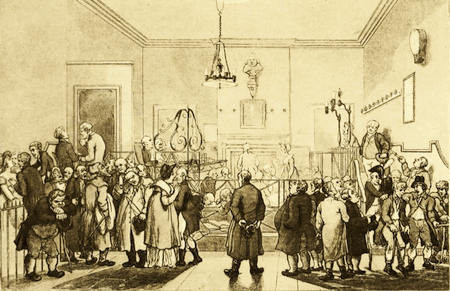
Bow Street Office, London
The principal police court of the City of London, established on Bow Street in 1749.
There can be no doubt but that Millbank in these early days was over much governed. The committee took everything into their own hands, and allowed but little latitude to their responsible officers. Governor Shearman complained the visitors (members of the committee) who, he says, “went to the Penitentiary, and gave orders and directions for things to be done by inferior officers, which I thought ought to come through me.... Prisoners were occasionally removed from one ward to another, and I knew nothing of it—no communication was made to me; and if the inferior officers had a request to make, they got too much into the habit of reserving it to speak to the visitors; so that I conceived I was almost a nonentity in the situation.” The prisoners, even, were in the habit of saying they would wait till the visitor came, and would ask him for what they wanted, ignoring the governor altogether. Indeed it appears from the official journals that the visitors were constantly at the prison. A Mr. Holford admits that “for a considerable time he did everything but sleep there.” But their excuse was that they were not fortunate in their choice of some of their first officers; and knew therefore they must watch vigilantly over their conduct, to keep those who fulfilled expectations, and to part with those who appeared unfit for their situations. Besides which it was necessary to see from time to time how the rules first framed worked in practice, and what customs that grew up should be prohibited, and what sanctioned, by the committee, and adopted into the rules.
It must be confessed that the committee do not appear to have been well served by all their subordinates. The governors were changed frequently; the first “expected to find his place better in point of emolument, and did not calculate upon the degree of activity to be expected in the person at the head of such an establishment; the second was not thought by the committee to have those habits of mind—particularly those habits of conciliation—which are required in a person at the head of such an establishment;” the third was seized with an affection of the brain, and was never afterwards capable of exercising sufficient activity. The first master manufacturer, who as will be remembered was appointed because he was of a mechanical turn of mind, was removed because he was a very young man, and his conduct was not thought steady enough for the post he occupied. The first steward was charged with embezzlement, but was actually dismissed for borrowing money from some of the tradesmen of the establishment. The first matron was also sent away within the first twelve months, but she appears to have been rather hardly used, although her removal also proves the existence of grave irregularities in the establishment. The case against Mrs. Chambers was that she employed certain of the female prisoners for her own private advantage. Her daughter was about to be married; and to assist in making up bed furniture a portion of thread belonging to the establishment was used by the prisoners, who gave also their time. The thread was worth a couple of shillings, and was replaced by Mrs. Chambers. A second charge against the matron was for stealing a Penitentiary Bible. Her excuse was that a number had been distributed among the officers,—presents, as she thought, from the committee,—and she had passed hers on to her daughter. But for these offences, when substantiated, she was dismissed from her employment.
Entries made in the Visitors’ Journal, however, are fair evidence that matters were allowed by the officials to manage themselves in rather a happy-go-lucky fashion. One day new prisoners were expected from Newgate; but nothing was ready for them. “Not a table or a stool in any working cell; and one of those cells where the prisoners were to be placed, in which the workmen had some time since kept coals, was in the dirty state in which it had been left by them. Not a single bed had been aired.” The steward did not know these prisoners were expected, and had ordered no rations for them. But he stated he had enough, all but about two pounds. Upon which the visitor remarks, “If sixteen male prisoners can be supplied without notice, within two pounds, the quantity of meat sent in cannot be very accurate.” Again, the visitor finds the doors from the prison into the hexagon where the superior officers lived “not double-locked as they ought to be, and two prisoners together in the kitchen without a turnkey.” The daily allowance of food issued to the prisoners was not the right weight. He says: “There are in the bathing-room at the lodge several bundles of clothes belonging to male prisoners who have come in between the 1st and 21st of this month; they are exactly in the state in which they were when the subject was mentioned to the committee last week; some of them are thrown into a dirty part of the room—whether intended to be burned I do not know; the porter thinks they are not. I do not believe any of the female prisoners’ things have been yet sold. I understand from the governor he has not yet made any entry in the character-book concerning the behaviour of any male prisoner since he came into the prison, or relative to any occurrence connected with such prisoner.”
All this will fairly account for any extra fussiness on the part of the committee. Doubtful of the zeal and energy of those to whom they confided the details of management, they were continually stepping in to make up for any shortcomings by their own activity. But the direct consequence of this interference was to shake the authority of the ostensible heads. Moreover, to make the more sure that nothing should be neglected, and no irregularity overlooked, the committee encouraged, or at least their most prominent member did, all sorts of talebearing, and a system of espionage that must have been destructive of all good feeling among the inmates of the prison. Mr. Pitt, when examined by the Select Committee, said, “Mr. Holford has mentioned to me: ‘I hear so and so; such and such an abuse appears to be going forward; but I shall get some further information.’ I always turned a deaf ear to these observations, thinking it an erroneous system, and that it was not likely to contribute to the good of the establishment.” He thought that if the committee members were so ready to lend a willing ear to such communications, it operated as an encouragement to talebearing; the consequences of which certainly appeared to have been disputes, cabals, or intrigues. Mr. Shearman remarks at some length on the same subject: “I certainly did think there was a very painful system going on in the prison against officers, ... by what I might term ‘spyism.’ I have no doubt it all arose from the purest motives, thinking it was the best way to conduct the establishment, setting up one person to look after another.” The master manufacturer and the steward in this way took the opportunity of vilifying the governor; and there is no doubt the matron, Mrs. Chambers, fell a victim to this practice. She was the victim of insinuation, and the evil reports of busybodies who personally disliked her.
It is easy to imagine the condition of Millbank then. A small colony apart from the great world; living more than as neighbours, as one family almost—but not happily—under the same roof. The officials, nearly all of them of mature age, having grown-up children, young ladies and young gentlemen, always about the place, and that place from its peculiar conditions, like a ship at sea, shut off from the public, and concentrated on what was going on within its walls. Gossip, of course, prevalent—even malicious; constant observation of one another, jealousies, quarrels, inevitable when authority was divided between three people, the governor, chaplain, and matron, and it was not clearly made out which was the most worthy; subordinates ever on the look-out to make capital of the differences of their betters, and alive to the fact that they were certain of a hearing when they chose to carry any slanderous tale, or make any underhand complaint. For there, outside the prison, was the active and all-powerful committee, ever ready to listen, and anxious to get information. One of the witnesses before the committee of 1823 stated, “From the earliest period certainly the active members of the Superintending Committee gave great encouragement to receive any information from the subordinate officers, I believe with the view of putting the prison in its best possible state; that encouragement was caught with avidity by a great many, simply for the purpose of cultivating the good opinion of those gentlemen conducting it; and I am induced to think that in many instances their zeal overstepped perhaps the strict line of truth; for I must say that during the whole period I was there, there was a continual complaint, one officer against another, and a system that was quite unpleasant in an establishment of that nature.”
Of a truth the life inside the Penitentiary must have been rather irksome to more people than those confined there against their will.
CHAPTER III
THE GREAT EPIDEMIC
Failure threatens the great experiment—General sickness of the Prisoners—Virulent disorder attacks them—The result of too high feeding and ill-chosen dietary—Disease succumbs to treatment—Majority transferred to hospital ships at Woolwich—Very imperfect discipline maintained—Conduct of prisoners often outrageous—Sent by Act of Parliament to the Hulks as ordinary Convicts.
The internal organization of Millbank, which has been detailed in the last chapter, is described at some length in a Blue Book, bearing date July, 1823. But though Millbank was then, so to speak, on its trial, and its value, in return for the enormous cost of its erection, closely questioned, it is probable that its management would not have demanded a Parliamentary inquiry but for one serious mishap which brought matters to a crisis. Of a sudden the whole of the inmates of the prison began to pine and fall away. A virulent disorder broke out, and threatened the lives of all in the place. Alarm and misgiving in such a case soon spread; and all at once the public began to fear that Millbank was altogether a huge mistake. Here was a building upon which half a million had been spent, and now, when barely completed, it proved uninhabitable! Money cast wholesale into a deadly swamp, and all the fine talk of reformation and punishment to give way to coroners’ inquests and deaths by a strange disease. No wonder there was a cry for investigation. Then, as on many subsequent occasions, it became evident Millbank was fulfilling one of the conditions laid down as of primary importance in the choice of site. Howard had said that the Penitentiary House must be built near the metropolis, so as to insure constant supervision and inspection. Millbank is ten minutes’ walk from Westminster, and from the first has been the subject of continual inquiry and legislation. The tons of Blue Books and dozens of Acts of Parliament which it has called into existence will be sufficient proof of this. It was, however, a public undertaking, carried out in the full blaze of daylight, and hence it attracted more than ordinary attention. What might have passed unnoticed in a far-off shire, was in London magnified to proportions almost absurd. This must explain state interference, which now-a-days may seem quite unnecessary, and will account for giving a national importance to matters oftentimes in themselves really trivial.
But this first sickness in the Penitentiary was sufficiently serious to arrest attention, and call for description in detail.
In the autumn of 1822, the physicians appointed to report on the subject state that the general health of the prisoners in Millbank began visibly to decline. They became pale and languid, thin and feeble; those employed in tasks calling for bodily exertion could not execute the same amount of work as before, those at the mill ground less corn, those at the pump brought up less water, the laundry-women often fainted at their work, and the regular routine of the place was only accomplished by constantly changing the hands engaged. Throughout the winter this was the general condition of the prisoners. The breaking down of health was shown by such symptoms as lassitude, dejection of spirits, paleness of countenance, rejection of food, and occasional faintings. Yet, with all this depression of general health, there were no manifest signs of specific disease; the numbers in hospital were not in excess of previous winters, and their maladies were such as were commonly incident to cold weather. But in January, 1823, scurvy—unmistakable sea scurvy—made its appearance, and was then recognized as such, and in its true form, for the first time by the medical superintendent, though the prisoners themselves declared it was visible among them as early as the previous November. Being anxious to prevent alarm, either in the Penitentiary itself or in the neighbourhood, the medical officer rather suppressed the fact of the existence of the disease; and this, with a certain tendency to make light of it, led to the omission of many precautions. But there it was, plainly evident; first, by the usual sponginess of the gums, then by “ecchymosed” blotches on the legs, which were observed in March to be pretty general among the prisoners.
Upon this point, the physicians called in remarked that the scurvy spots were at their first appearance peculiarly apt to escape discovery, unless the attention be particularly directed towards them, and that they often existed for a long time entirely unnoticed by the patient himself. And now with the scurvy came dysentery, and diarrhœa, of the peculiar kind that is usually associated with the scorbutic disease. In all cases, the same constitutional derangement was observable, the outward marks of which were a sallow countenance and impaired digestion, diminished muscular strength, a feeble circulation, various degrees of nervous affections, such as tremors, cramps, or spasms, and various degrees of mental despondency.
With regard to the extent of the disease, it was found that quite half of the total number were affected, the women more extensively than the men; and both the males and females of the second class, or those who had been longest in confinement, were more frequently attacked than the newest arrivals. Some few were, however, entirely exempt; more especially the prisoners employed in the kitchen, while among the officers and their families, amounting in all to one hundred and six individuals, there was not a single instance of attack recorded.
Such then was the condition of the prisoners in the Penitentiary in the spring of 1823. To what was this sudden outbreak of a virulent disorder to be traced? There were those who laid the whole blame on the locality, and who would admit of no other explanation. But this argument was in the first instance opposed by the doctors investigating. Had the situation of the prison been at fault, they said, it was only reasonable to suppose that the disease would have shown itself in earlier years of the prison’s existence; whereas, as far as they could ascertain, till 1822-3 it was altogether unknown. Moreover, had this been the real cause, all inmates would alike have suffered; how then explain the universal immunity of the officers in charge? Again, if it were the miasmata arising upon a marshy neighbourhood that militated against the healthiness of the prison, there should be prevalent other diseases which marsh miasmata confessedly engender. Besides which, the scurvy and diarrhœa thus produced are associated with intermittent fevers, in this case not noticeable; and they would have occurred during the hot instead of the winter season. Lastly, if it were imagined that the dampness of the situation had contributed to the disease, a ready answer was, that on examination every part of the prison was found to be singularly dry, not the smallest stain of moisture being apparent in any cell or passage, floor, ceiling, or wall.
But indeed it was not necessary to search far afield for the causes of the outbreak; they lay close at hand. Undoubtedly a sudden and somewhat ill-judged reduction in diet was entirely to blame. For a long time the luxury of the Penitentiary had been a standing joke. The prison was commonly called Mr. Holford’s fattening house. He was told that much money might be saved the public by parting with half his officers, for there need be no fear of escapes; all that was needed was a proper guard to prevent too great a rush of people in. An honourable member published a pamphlet in which he styled the dietary at Millbank “an insult to honest industry, and a violation of common sense.” And evidence was not wanting from the prison itself of the partial truth of these allegations. The medical superintendent frequently reported that the prisoners, especially the females, suffered from plethora, and from diseases consequent upon a fulness of habit. Great quantities of food were carried out of the prison in the wash-tubs; potatoes, for instance, were taken to the pigs, which Mr. Holford admitted he would have been ashamed to have seen thus carried out of his own house. It came to such a pass at last that the committee was plainly told by members of the House of Commons, that if the dietary were not changed, the next annual vote for the establishment would probably be opposed. In the face of all this clamour the committee could not hold out; but in their anxiety to provide a remedy, they went from one extreme to the other. Abandoning the scale that was too plentiful, they substituted one that was altogether too meagre. In the new dietary solid animal food was quite excluded, and only soup was given. This soup was made of ox heads, in the proportion of one to every hundred prisoners; it was to be thickened with vegetables or peas, and the daily allowance was to be a quart, half at midday, and half in the evening. The bread ration was a pound and a half, and for breakfast there was also a pint of gruel. It was open to the committee to substitute potatoes for bread if they saw fit, but they do not seem to have done this. The meat upon an ox head averages about eight pounds, so that the allowance per prisoner was about an ounce and a quarter. No wonder then that they soon fell away in health.
The mere reduction in the amount of food, however, would not have been sufficient in itself to cause the epidemic of scurvy. Scurvy will occur even with a copious dietary. Sailors who eat plenty of biscuit and beef are attacked, and others who are certainly not starved. The real predisposing cause is the absence of certain necessary elements in the diet, not the lowness of the diet itself. It is the want of vegetable acids in food that brings about the mischief. The authorities called in were not exactly right, therefore, in attributing the scurvy solely to the reduced diet. The siege of Gibraltar was quoted as an instance where semi-starvation superinduced the disease. Again, the scurvy prevalent in the low districts round Westminster was traced to a similar deficiency and the severe winter, also to the want of vegetable diet. This last was the real explanation; of this, according to our medical knowledge, there is not now the faintest doubt. Long enforced abstinence from fresh meat and fresh vegetables is certain sooner or later to produce scurvy. At the same time it must be admitted that the epidemic of which I am writing was aggravated by the cold weather. It had its origin in the cold season, and its progress kept pace with it, continued through the spring, actually increasing with summer.
During the months of May and June the disorder was progressive, but the early part of July saw a diminution in the numbers afflicted. At this time the prison population amounted to about eight hundred.
There was a total of thirty deaths. In spite of this slight improvement for the better, it is easy to understand that the medical men in charge were still much troubled with fears for the future. Granting even that the disease had succumbed to treatment, there was the danger, with all the prisoners in a low state of health, of relapse, or even of an epidemic in a new shape. Hence it was felt that an immediate change of air and place would be the best security against further disease. But several hundred convicts could not be sent to the seaside like ordinary convalescents; besides which they were committed to Millbank by Act of Parliament, and only by Act of Parliament could they be removed. This difficulty was easily met. An Act of Parliament more or less made no matter to Millbank—many pages in the statute book were covered already with legislation for the Penitentiary. A new act was immediately passed, authorizing the committee to transfer the prisoners from Millbank to situations more favourable for the recovery of their health. In accordance with its provisions one part of the female prisoners were at once sent into the Royal Ophthalmic Hospital in Regent’s Park, at that time standing empty; their number during July and August was increased to one hundred and twenty, by which time a hulk, the Ethalion, had been prepared at Woolwich for male convicts, and thither went two hundred, towards the end of August. Those selected for removal were the prisoners who had suffered most from the disease. This was an experiment; and according to its results the fate of those who remained at Millbank was to be determined. “The benefit of the change of air and situation,” says Dr. Latham, “was immediately apparent.” Within a fortnight there was less complaint of illness, and most of the patients already showed symptoms of returning health. Meanwhile, among the prisoners left at Millbank there was little change, though at times all were threatened with a return of the old disorder, less virulent in its character, however, and missing half its former frightful forms. By September, a comparison between those at Regent’s Park or the hulk and those still in Millbank was so much in favour of the former that the point at issue seemed finally settled. Beyond doubt the change of air had been extremely beneficial; nevertheless, of the two changes, it was evident that the move to the hulks at Woolwich had the better of the change to Regent’s Park. On board the Ethalion the prisoners had suffered fewer relapses and had gained a greater degree of health than those at Regent’s Park. On the whole, therefore, it was considered advisable to complete the process of emptying Millbank. The men and women alike were all drafted into different hulks off Woolwich. These changes were carried out early in December, 1823, and by that time the Millbank Penitentiary was entirely emptied, and it remained vacant till the summer of the next year.
The inner life of the Penitentiary went on much as usual in the early days of the epidemic. There are at first only the ordinary entries in the governor’s Journal. Prisoners came and went; this one was pardoned, that received from Newgate or some county gaol. Repeated reports of misconduct are recorded. The prisoners seemed fretful and mischievous. Now and then they actually complained of the want of food. One prisoner was taken to task for telling his father, in the visiting cell, that six prisoners out of every seven would die for want of rations. But at length the blow fell. On the 14th February, 1823, Ann Smith died in the infirmary at half-past nine. On the 17th, Mary Ann Davidson; on the 19th, Mary Esp; on the 23rd, William Cardwell; on the 24th, Humphrey Adams; on the 28th, Margaret Patterson. And now, by order of the visitor, the prisoners were allowed more walking exercise. Then follow the first steps taken by Drs. Roget and Latham. The governor records, on the 3rd March, that the doctors recommend each prisoner should have daily four ounces of meat and three oranges; that their bread should be divided into three parts, an orange taken at each meal. Accordingly the steward was sent to Thames Street to lay in a week’s consumption of oranges.
An entry soon afterwards gives the first distinct reference to the epidemic. “The medical gentlemen having begged for the bodies of such prisoners as might die of the disorder now prevalent in the prison, in order to make post-mortem examinations, the same was sanctioned if the friends of the prisoner did not wish to interfere.” Deaths were now very frequent, and hardly a week passed without a visit from the coroner or his deputy.
On the 25th of March the governor, Mr. Couch, who had been ailing for some time past, resigned his charge into the hands of Captain Benjamin Chapman. Soon afterwards there were further additions to the dietary—on the 26th of April two more ounces of meat and twelve ounces of boiled potatoes; and the day after, it was ordered that each prisoner should drink toast-and-water,—three half-pints daily. Lime, in large tubs, was to be provided in all the pentagons for the purpose of disinfection.
About this period there was a great increase of insubordination among the prisoners. It is easy to understand that discipline must be relaxed when all were more or less ailing and unable to bear punishment. The sick wards were especially noisy and turbulent. One man, for instance, was charged with shouting loudly and using atrocious language; all of which, of course, he denied, declaring he had only said, “God bless the king, my tongue is very much swelled.” Upon this the turnkey in charge observed that it was a pity it was not swelled more, and Smith (the prisoner) pursued the argument by hitting his officer on the head with a pint pot. Later on they broke out almost into mutiny. The governor writes as follows: “At a quarter to eight o’clock Taskmaster Swift informed me that the whole of the prisoners in the infirmary ward of his pentagon were in the most disorderly and riotous state, in consequence of the wooden doors of the cells having been ordered by the surgeon to be shut during the night; that the prisoners peremptorily refused to permit the turnkeys to shut their doors, and made use of the most opprobrious terms, threatening destruction to whoever might attempt to shut their doors. Their shouts and yells were so loud as to be heard at a considerable distance. I immediately summoned the patrols, and several of the turnkeys, and making them take their cutlasses, I repaired to the sick ward. I found the wooden doors all open, and the prisoners, for the most part, at their iron gates, which were shut. The first prisoner I came to was John Hall. I asked him the reason he refused to shut his door when ordered. He answered in a very insolent tone and manner, ‘Why should I do so?’ I then said, ‘Shut your door instantly,’ but he would not comply. I took him away and confined him in a dark cell. In conveying him to the cell he made use of most abusive and threatening language, but did not make any personal resistance.” Five others who were pointed out as prominent in the mutiny were also punished on bread and water in a dark cell, by the surgeon’s permission.
Nor were matters much more satisfactory in the female infirmary wards. “Mrs. Briant, having reported yesterday, during my absence at Woolwich, that Mary Willson had ‘wilfully cut her shoes,’ and, having stated the same verbally this morning, I went with her into the infirmary, where the prisoner was, and having produced the shoes to her (the upper-leather of one of them being palpably cut from the sole), and asked her why she cut them, she said she had not cut them, that they had come undone whilst walking in the garden. This being an evident falsehood, I told her I feared she was doing something worse than cutting her shoes by telling an untruth. She answered in a very saucy manner, they were not her shoes, and that she had not cut them. She became at length very insolent, when I told her she deserved to be punished. She replied she did not care whether she was or not. I then directed the surgeon to be sent for; when not only the prisoner, but several others in the infirmary, became very clamorous, and evinced a great degree of insubordination. I went out with the intention of getting a couple of patrols, when I heard the crash of broken glass and loud screams. I returned as soon as possible with the patrols into the infirmary. The women generally attempted to oppose my entrance, and a group had got Willson amongst them, and said she should not be confined. I desired the patrols to lay hold of her, and take her to the dark cell (I had met with Dr. Hugh when going for the patrols, who under the circumstances sanctioned the removal of the prisoner). In doing so, Betts and Stone were assaulted with the utmost violence; I myself was violently laid hold of, and my wrist and finger painfully twisted. I had Willson, however, taken to the dark cell, when, having summoned several of the turnkeys and officers of the prison, I with considerable difficulty succeeded in taking six more of them who appeared to be most forward in this disgraceful riot. Several of the large panes in the passage windows were broken; and the women seized everything they could lay their hands on, and flung them at the officers, who, in self-defence, were at length compelled to strike in return. I immediately reported the circumstance to Sir George Farrant, the visitor, who came to the prison soon after. I accompanied him, with Dr. Bennett (the chaplain) and Mr. Pratt (the surgeon), through the female pentagon and infirmary, when a strong spirit of insubordination was obvious. Sir George addressed them, and so did Dr. Bennett, and pointed out the serious injury they were doing themselves, and that such conduct would not pass unpunished. We afterwards visited the dark refractory cells, where the worst were confined; two of whom, on account of previous good-conduct and favourable circumstances, were liberated. For myself, I never beheld such a scene of outrage, nor did I observe a single individual who was not culpably active.”
As a general rule, the prisoners in the Penitentiary were in these days so little looked after, and had so much leisure time, that they soon found the proverbial mischief for idle hands. Having some suspicions, the governor searched several, and found up the sleeves of five of them, knives, playing cards (made from an old copy-book), two articles to hold ink, a baby’s straw hat, some papers (written upon), and an original song of questionable tendency. The hearts and diamonds in the cards had been covered with red chalk, the clubs and spades with blacking. “Having received information that there were more cards about, he caused strict search to be made, and found in John Brown’s Bible, one card and the materials for making more, also a small knife made of bone. In another prisoner’s cell was found another knife and some paste, ingeniously contrived from old bread-crumbs.” But even these amusements did not keep the prisoners from continually quarrelling and fighting with one another. Any one who had made himself obnoxious was severely handled. A body of prisoners fell upon one Tompkins, and half killed him because he had reported the irreverent conduct of several of them while at divine service. The place was like a bear-garden; insubordination, riots, foul language, and continual wranglings among themselves—it could hardly be said that the prisoners were making that rapid progress towards improvement which was among the principal objects of the Penitentiary.
And now the scene shifts to the Woolwich hulks, whither by this time the whole of the inmates were being by degrees transferred. The first batch of males were sent off on the 16th August, embarking at Millbank, and proceeding by launch to Woolwich. Great precautions were taken. All the disposable taskmasters, turnkeys, and patrols being armed and stationed from the outer lodge to the quay (River Stairs), the prisoners were assembled by six at a time, and placed without irons in the launch. The same plan was pursued from time to time, till at length the entire number were removed. The hulks were the Ethalion, Narcissus, Dromedary. A master was on board in charge of each, under the general supervision of Captain Chapman, the governor of the Penitentiary. There was immediately a further great deterioration in the conduct of the prisoners. Not only were they mischievous, as appeared from their favourite pastime, which was to drag off one another’s bedclothes in the middle of the night, by means of a crooked nail attached to a long string, but the decks which they occupied were for ever in a state of anarchy and confusion. “All the prisoners below,” says the overseer of the Ethalion, “conducted themselves last night in a most improper manner, by singing obscene songs and making a noise. When summoned to appear on the upper deck, they treated the master with defiance and contempt, so that the ringleaders had to be put in irons.” But it was a mere waste of time to confine prisoners below. There was no place of security to hold them. “A number of prisoners broke their confinement by forcibly removing the boards of the different cabins in which they were placed in the cockpit, and got together in the fore hold, where they were found by Mr. Lodge at half-past nine at night.” Another prisoner, a day or two later, confined in the hold, broke out, and proceeded through the holds and wings of the ship till he arrived at the fore hold, where another prisoner, Connor, was confined for irreverent behaviour during chapel. Connor tore up the boards fastened on to the mast-hatch, and admitted Williams to him. “When Williams’ escape was discovered,” says the overseer, “I searched for him in the bottom of the ship. On my arriving at the bulkhead of the fore hold I inquired of Connor if Williams was with him. He declared he was not, calling on God to witness his assertion; but on opening the hatch, to my astonishment I found him there. I ordered him back to the place in which he was first confined; on which he used the most abusive language, saying, by God, when he was released he would murder me and every officer in the ship. I talked mildly to him, and desired him to return to the place in which he had been confined. He at last complied, using the most abusive and threatening language. When he had returned to the after hold, I put the leg-irons on him to prevent his forcing out a second time, giving him at the same time to understand, that if he would behave himself they would soon be taken off. But he was still turbulent, breaking everything before him. I then put handcuffs on him, notwithstanding which he broke out at 9 p.m., disengaged himself from the handcuffs, and got a second time to the fore hold, where I again found him, and insisted on his returning. He kicked me very much in the legs, using, as before, threatening language. I then found it necessary to use force, and taking guards Wadeson and Clarke with the steward, we again removed him to his first place of confinement. He appeared so resolute and determined to commit further depredations, that I fastened his leg-irons to a five-inch staple in the timber of the hold, which staple he tore up during the night, and again passed to Connor in the fore hold.”
On the 27th November it was found that some prisoners had made their escape from the Ethalion hulk. On mustering the prisoners in the morning three were missing. Search was immediately made, but they were not to be found. All the hatches on the lower deck were secure; but it was ascertained, on examination of the after hold, that the prisoners must have made their way into the steward’s store-room, where they had taken out the window. One of them then swam off to the Shear hulk, secured the boat, brought it to the after windows, and by that means, assisting each other, the three effected their escape. The boat belonging to the Shear hulk was found at the Prince Regent’s Ferry House, on the Essex coast. After a close investigation it was not possible to bring the blame home to any one. All the guards proved, of course, that they were on the alert all night. The steward said he had had a blister on, and could not sleep a wink, but he never missed hearing the bell struck (by the watch) every quarter of an hour. Stevenson, one of those who had escaped, had always been employed in the steward’s store-room, hence he knew his way about the ship. Being a sailor and a good swimmer, it was probably he who had gone to the Shear hulk and got a boat, taking with him one end of a rope made of hammock nettings, the other being fast to a beam in the store-room. By this rope the Shear hulk boat was hauled gently to the Ethalion; then the other two prisoners got into it, and it was allowed to drift down for some distance with the tide. No sound whatever of oars had been heard during the night by the sentries on board or on shore. The escape must have been made between one and two o’clock in the morning, as at three the men were seen landing from a boat on the Essex coast.
Information of the escape soon spread among the other prisoners, and it was pretty certain that many would attempt to follow. They were reported to be ripe for any mischief. The fire-arms were carefully inspected by the governor, who insisted on their being kept constantly in good order and “well flinted.” At the same time a strict search was made through the ship, particularly of the lower deck, for any implements that might be secreted to facilitate escape. False keys were reported to be in existence, but none could be found; only a large sledge-hammer, a ripping chisel, and some iron bolts which were concealed in the caboose. A few days afterwards the master of the Ethalion reported the discovery of a number of other dangerous articles in various parts of the ship, several more sledge-hammers, chisels, iron bars, spike nails, etc., all calculated to do much mischief, and endanger the safety of the ship. At the same time, four prisoners were overheard planning another escape. They were to steal the key of a closet on the deck, and alter it so as to fit the locks of the bulk heads into the infirmary wards, and pass by this means to the cabin, and out through one of the ports. The key was immediately impounded, and a strict watch kept all night. Between eleven and twelve the guard reported that he heard a noise like filing through iron bars; so the master got into a boat with two others and rowed round the ship. They were armed with a cutlass and blunderbus, “which,” says the master, “I particularly requested might be put out of sight.” But everything was perfectly quiet on the lower deck, and on going through the upper deck the only discovery made was a prisoner sitting by a lamp, manufacturing a draught board, which he refused to part with. They left the deck quite quiet; yet at half-past three the whole place was in an uproar. A regular stand-up fight took place between two prisoners, Elgar and Blore, in which the former got his eyes blackened and face damaged in the most shameful manner. This Elgar was the man who gave information of the projected escape, thereby incurring the resentment of the rest. It is improbable, however, that any attempt was actually intended this time, though escape was in every mouth, and had been since the event of the previous Thursday.
Speaking of the hulks at this time, the governor says, “It is but too true that little if any discipline exists among the prisoners, and that the state of insubordination is extremely alarming. This may, in a great degree, be attributed to the lamentable state of idleness, the facility of communicating with each other, concerning and perpetrating mischief, and the inadequate means of punishment when contrasted with the hulks establishment.”
But by this time news had come of the missing three. At nine o’clock one night a person called at the Penitentiary and asked to see the governor in private. He was shown into the office. “You had three prisoners escape from Woolwich lately? One of them is my brother, Charles Knight. I am very anxious he should be brought back. What is the penalty for escaping?” He was informed; also that there was a charge of stealing from the steward’s store. Knight’s brother said he would willingly pay the damage of that, and wished to make conditions for the fugitive if he was given up. The governor would not promise beyond an assurance of speaking in Knight’s favour to the committee; and said all would depend upon his making a full and candid disclosure of all the circumstances connected with the escape, and giving all the information in his power which would lead to the arrest of the other two. The visitor then observed that his brother was very young, and by no means a hardened offender; that he was led into this act and was sorry for it; that none of his relations would harbour him, and that he was quite ready to return. Next morning he was brought back by his mother and brother, and gave immediately a full account of the affair. The escape had been concerted a full week before it was carried into effect, and had been arranged entirely by Stevenson, who having been employed in the store-room, had purloined a key, filed out the wards and made a skeleton key, with which he opened the hatches. The rope was made out of spun yarn, found in the hold by Stevenson, who also got there the sledge-hammer, chisel, and iron spikes. There was not a soul moving or awake on the lower deck, and no one knew of their intention to escape. They then got away in a boat, just as had been surmised. On landing at the new ferry on the Essex coast, they went across the chain pier, Payne changing a shilling to pay the toll. This was all the money they had amongst them, and had been conveyed to Payne by some person in the ship. They then proceeded to London, and were supplied with hats by a Jew named Wolff, living in Somerset Street, Whitechapel, to whose house they were taken by Stevenson. Afterwards they went to the West End. Payne separated from them in Waterloo Place, saying he meant to go to a brother living at Stratford-on-Avon. Stevenson then took Knight to his brother’s, who was a working jeweller, and who gave them money to buy clothes. They hid together for the night in a house in George Street, St. Giles; and then Knight went home to his aunt’s in Hanover Street, Long Acre, but was refused admittance. The same happened with all his other relatives, and at last he was compelled to give himself up in the manner described. Through information which he gave the others also were apprehended.
The numbers on board the several ships at this time were over six hundred; they were not classified; the distinctions of the Penitentiary, as well as the dress, were done away with. All alike were clothed in a coarse brown suit. They were kept in divisions of seventy-five, with a wardsman in charge of each division; besides which, a number of well-conducted prisoners were appointed to keep watch during the night, who were to report any irregularity that might occur during the watch. There was no employment for the prisoners: the making of great-coats was tried, but it did not succeed. There was no work to be got on shore, and it was doubtful whether these prisoners could be legally employed for that. In fact the whole establishment was considered a sort of house of recovery, and all the prisoners were more or less under hospital treatment throughout. The general conduct of the prisoners was “unruly to a degree, and in some instances to the extent of mutiny.” This continued month after month through the winter till well into the spring of 1824, when for a time, indeed, the conduct of all improved. They were in hopes that they were about to get some remission of their sentences, and feared lest misconduct should militate against their release. They were all in full expectation that something would be done for them by Parliament, in consequence of their very great sufferings. The tenor of all their letters to their friends was to the same effect. They were, however, doomed to disappointment; for on the 14th April, Mr. Kellock states, “This morning I received information that the bill for the labour and removal of the male convicts under the Penitentiary rules, and at present on board the prison ships, had received the royal assent. When informed that they were to be removed to labour at the hulks, they received the news with some degree of surprise and astonishment.” But the same day the exodus took place, and they are reported to have gone away “very quietly and resigned.”
CHAPTER IV
THE PENITENTIARY REOCCUPIED
Improved Ventilation and Drainage—Revised dietary—Provision of Hard Labour—Mild rule of Governor Chapman—Constant warfare between Prisoners and Authorities—Feigned suicides—Repeated Offences—Turbulence developed into open mutiny—Cells barricaded—Furniture demolished—Officers assaulted—Resistance to Authority culminates in murderous affray—Act permitting corporal punishment passed.
No pains were spared to make the Penitentiary wholesome for re-occupation. A Parliamentary Committee—that great panacea for all public ills—had however already reported favourably upon the place. They had declared that no case of local unhealthiness could be made out against it; nor had they been able to find “anything in the spot on which the Penitentiary is situated, nor in the construction of the building itself, nor in the moral and physical treatment of the prisoners confined therein, to injure health or render them peculiarly liable to disease.”
Yet to guard against all danger of relapse, they advised that none of the old hands should return to the prison, and recommended also certain external and internal improvements. Better ventilation was needed; to obtain this they called in Sir Humphrey Davy, and gave him carte blanche to carry out any alterations. Complete fumigation was also necessary; and this was effected with chlorine, under the supervision of a Mr. Faraday from the Royal Institution. To render innocuous the dirty ditch of stagnant water—dignified with the name of moat—which surrounded the buildings just within the boundary wall, it was connected with the Thames and its tides. Additional stoves were placed in the several pentagons, and the dietary reorganized on a full and nutritive scale, in quality and quantity equal to that in force before the epidemic. Provision was also made to secure plenty of hard labour exercise for the prisoners daily, by increasing the number of crank mills and water machines in the yards. More schooling was also recommended, as a profitable method of employing hours otherwise lost, and breaking in on the monotony and dreariness of the long dark nights. The cells, the committee thought too, should be lighted with candles, and books supplied “of a kind to combine rational amusement, with moral and religious instruction.” Indeed there was no limit to the benevolence of these commissioners. Adverting to the testimony of the medical men they had examined, who were agreed that cheerfulness and innocent recreation were conducive to health, they submitted for consideration, whether some kind of games or sports might not be permitted in the prison during a portion of the day. Fives-courts and skittle-alleys were probably in their minds, with cricket in the garden, or football during the winter weather. As one reads all this, one is tempted to ask whether the objects of so much tender solicitude were really convicted felons sentenced to imprisonment for serious crimes.
The rule of Governor Chapman was essentially considerate and mild. There was no limit to his long-suffering and patience. Though by all the habits of his early life he must have learned to look at breaches of discipline with no lenient eye, we shall find that he never punished even the most insubordinate and contumacious of the ruffians committed to his charge till he had first exhausted every method of exhortation or reproof; and when he had punished he was ever ready to forgive, on a promise of future amendment, or even a mere hypocritical expression of contrition alone. It is now generally admitted that felons cooped up within four walls can be kept in bounds only under an iron hand. Captain Chapman acted otherwise, the committee which controlled him fully endorsing his views. For a long time to come the prison was like a bear garden; misconduct was rife in every shape and form, increasing daily in virulence, till at length the place might have been likened to Pandemonium let loose. Then more stringent measures were enforced, with satisfactory results, as we shall see; but for many years there was that continuous warfare between ruffianism and constituted authority which is inevitable when the latter savours of weakness or irresolution.
Feigned suicides were among the earliest methods of annoyance. It is not easy to explain exactly what end the prisoners had in view, but doubtless they hoped to enlist the sympathies of their kindhearted guardians, by exhibiting a recklessness of life. Those who preferred death to continued imprisonment must indeed be miserably unhappy, calling for increased tenderness and anxious attention. They must be talked to, petted, patted on the back, and taken into the infirmary, to be regaled with dainties, and suffered to lie there in idleness for weeks. So whenever any prisoner was thwarted or out of temper, often indeed without rhyme or reason, and whenever the fancy seized him, he tied himself up at once to his loom, or laid hands upon his throat with his dinner-knife, or a bit of broken glass. Of course their last idea was to succeed. They took the greatest pains to insure their own safety, and these were often ludicrously apparent; but now and then, though rarely, they failed of their object, and the wretched victim suffered by mistake. Happily the actually fatal cases were few and far between.
This fashion of attempting suicide was led by a certain William Major, who arrived from Newgate on the 8th October, 1824. A few days afterwards he confided to the surgeon this determination to make away with himself; “that, or murder some one here; for I’d sooner be hanged like a dog than stay in the Penitentiary.” Such terrible desperation called of course for immediate expostulation, and Captain Chapman proceeded at once to Major’s cell. The prisoner’s knife and scissors were first removed; then the governor spoke to him. Major replied sullenly; adding, “I’ve made up my mind: I’d do anything to get out of this place; kill myself or you. I’d sooner go to the gallows than stay here.” “I reasoned with him,” says Captain Chapman in his Journal, “for a length of time on the wickedness of such shocking expressions; telling him there was only one way of shortening his time, and that was by good conduct. I told him his threats were those of a silly lad, which I should however punish him for.” So Major was carried off to a dark cell, but not before the governor had said all he could think of, to reason him out of his evil frame of mind. He remained in the dark two days, and then, having expressed himself penitent and promising faithfully better behaviour, he was released. For three weeks nothing further occurred, and then, “Suddenly,” says the governor, “as I was passing through a neighbouring ward, a turnkey called to me, ‘Here, here, governor! bring a knife. Major has hanged himself.” He had made himself fast to the cross beam of his loom. The action of his heart had not, however, ceased, though the circulation was languid and his extremities cold. He was removed at once to the infirmary, and as soon as animation was restored, the governor returned to the prisoner’s cell, and then found that “the hammock lashing was made fast in two places to the cross beam from the loom to the wall; in one was a long loop, in which Major had placed his feet; in the other a noose, as far distant from the loop as the length of the beam would permit, in which he had put his head; a portion of the rope between noose and loop he had held in his hand.” It was quite clear, therefore, that he had no determined intention of committing suicide; besides which he had chosen his time just as the turnkey was about to visit him, and he had eaten his supper, “which,” says the governor, “was no indication of despair.” Major soon recovered, and pretended to be sincerely ashamed of his wicked behaviour.
Not long afterwards a man, Combe, in the refractory cell, tried to hang himself with a pocket handkerchief. Placing his bedstead against the wall, he had used it as a ladder to climb up to the grating of the ventilator in the ceiling of his cell. To this he had made fast the handkerchief, then dropped; but he was found standing calmly by the bed, with the noose not even tight. Next a woman, Catherine Roper, tried the same trick, and was found lying full length on the floor, and evidently she was quite uninjured. Then came a real affair; and from the hour at which the act was perpetrated all doubt of intention was unhappily impossible. Lewis Abrahams, a gloomy, ill-tempered man, was punished for breaking a fly-shuttle; again for calling his warder a liar. That night he hung himself. He was found quite dead and cold, partly extended on the stone floor, and partly reclining as it were against the cell wall. He had suspended himself by the slight “nettles” (small cords) of his hammock, which had broken by his weight. The prisoner in the next cell reported that between one and two in the morning he had heard a noise of some one kicking against the wall; and then no doubt the deed was done.
After this unhappy example attempts rapidly multiplied, though happily none were otherwise than feigned. One tried the iron grating and a piece of cord; another used his cell block as a drop, but was careful to retain the halter in his hands; a third, Moses Josephs, tried to cut his throat, but on examination nothing but a slight reddish scratch was found, which the doctor was convinced was done by the back of the knife. In all these cases immediate and anxious attention was afforded by all the officials of the Penitentiary. The governor himself, who never gave himself an hour’s relaxation, and was always close at hand, was generally the first on the scene of suicide. If there was but a hint of anything wrong he was ready to spend hours with the intending felo-de-se. Thus in Metzer’s—a fresh case: a man who would not eat, was idle too, morose and sullen, “though spoken to always in the kindest manner.” No sooner was it known that he was brooding over the length of his confinement—his was a life sentence—and had hinted at suicide, than the governor spent hours with him in exhortation. Metzer, being a weaver by trade, had been placed in a cell furnished with a loom; from this he was to be changed immediately to another, lest the beam should be a temptation to him; but the governor, being uneasy, first visited him again, and found him, though late at night, in his clothes perambulating his cell. On this his neighbour was set to watch him for the rest of the night, and the doctor gave him a composing draught. Next morning, when they told him he was to leave his cell for good, he became outrageously violent, and assaulted every one around. He was now taken forcibly to the infirmary, and put in a strait-waistcoat; whereupon he grew calmer and promised to go to his new cell, provided he was allowed to take his own hammock with him. It struck the governor at once that something might be concealed in it, and it was searched minutely. Inside the bedclothes they found a couple of yards of hammock lashing, one end of which was made into a noose, “leaving,” the governor remarks, “little doubt of his intention.”
But to meet and frustrate these repeated attempts at suicide were by no means the governor’s only trials. The misconduct of many other prisoners must have made his life a burthen to him. Thefts were frequent: these fellows’ fingers itched to lay their hands on all that came in their way. The tower wardsman—a prisoner in a place of trust—steals his warder’s rations; others filch knives, metal buttons, bath brick, and food from one another. Then there was much wasteful destruction of materials, with idleness and carelessness at the looms, aggravated often by the misappropriation of time in manufacture of trumpery articles for their own wear: one makes himself a pair of green gaiters, another a pair of cloth shoes, a third an imitation watch of curled hair, rolled into a ball, which hangs in his fob by a strip of calico for guard.
These were doubtless offences of a trivial character. The anxiety evinced by many to escape from durance was a much more serious affair. Surprising ingenuity and unwearied patience are exhibited by prisoners in compassing this, the great aim and object of all who are not free. As yet, however, the efforts made were tentative only and incomplete. To break a hole in the wall or manufacture false keys was the highest flight of their inventive genius, and the plot seldom went very far. One of the first cases was discovered quite by chance. On searching a prisoner’s cell, some screws, a few nails, and two pieces of thick iron wire were found concealed in his loom; and in one of his shoes as it hung upon the wall, a piece of lead shaped so as to correspond with the wards of a cell key. This the prisoner confessed he had made with his knife from memory, and altogether without a pattern. “I have a very nice eye,” he said, “and I have always carefully observed the keys as I saw them in the officers’ hands.” “And what did you mean to do with the key?” he was further asked. “To get away, of course.” “How?” “I can open the wooden door when I please, and then I should have unlocked my gate.”[1] On examination a hole was found in his door, just below the bolt and opposite the handle; through this, by means of a narrow piece of stuff, a knitting needle in fact, he could move back the bolt whenever he pleased. Once out in the ward, he meant, with a file he had also secreted, to get through the bars of the passage window. The wards of this key were fastened into a wooden handle, which was also found in his cell. Another prisoner, having been allowed to possess himself of a large spike nail, which had been negligently left about in the yard, worked all night at the wall of his cell, and soon succeeded in removing several bricks. The hole he made was large enough to allow him passage. Besides this, from the military great-coats, on which he was stitching during the day, he had made himself a coat and trousers. He might have actually got away had not a warder visited his cell to inspect his work, and taking up the great-coats as they lay in a heap in the corner, discovered the disguise beneath, also the spike nail, and the rubbish of bricks and mortar from the hole. More adventurous still, a third prisoner proposed to escape by stealing his warder’s keys. Failing an opportunity, he too turned his attention to making false ones; and for the purpose cut up with scissors his pewter drinking can into bits. By holding the pieces near the hot irons he used for his tailoring, he melted the metal, and ran it into a mould of bread. Information of this project was given by another prisoner in time to nip it in the bud. Another, again, had been clever enough to remove a number of bricks, and would have passed undetected, had not the governor by chance, when in his cell, touched the wall and found it damp. A closer inspection showed that the mortar around the bricks had been picked out, and the joints filled in by a mixture of pounded mortar and chewed bread. On the outside was laid a coating of whiting, such as was issued to the prisoners to help them in cleaning their cans.
In some mischief of this kind, one or other of the prisoners was perpetually engaged. Cutting up their sheets to fabricate disguises; melting the metal buttons, as the man just mentioned had melted his pewter can; laying hold of files, rasps, old nails, scissors, tin, copper wire, or whatever else came handy; and working always with so much secrecy and despatch, that their plans were discovered more by fortune generally, than good management. In those days the best methods of prison discipline were far from matured. We know now that the surest preventives against escape, are repeated and unexpected searchings, with continuous vigilant supervision. A prisoner to carry out his schemes must have leisure, and must be left to himself to work unperceived. By the practice of the Penitentiary, prisoners had every facility to escape; and we shall find ere long, that they knew how to make the most of their advantages. For the present, all the good luck was on the side of the gaolers.
But at this juncture a new trouble threatened all the peace and comfort of the place. The prisoners seem to have grown all at once alive to the power they possessed of combination. It had been suspected for some time that a conspiracy was in progress among the denizens of D Ward, Pentagon two, and a minute search of the several cells brought to light a number of clandestine communications. These, written mostly on the blank pages of prayer-books, and spare copy-book leaves, were all to the same effect: exhortations to riot and mutiny. A certain George Vigers was the prime mover; all the letters, which were very widely disseminated, having issued from his pen. It had long been openly discussed among the prisoners that the hulks were pleasanter places than the Penitentiary. Here, then, was an opportunity of removal. All who joined heartily in the projected commotion would draw upon themselves the ire of the committee, and would certainly be drafted to the hulks. To explain what might otherwise appear unintelligible, it must be mentioned here, that the punishment implied by a sentence to the hulks was by no means of a terrifying character, as is evidenced by the choice of the prisoners.
A year or two later (1832), the report of the Parliamentary Committee on Secondary Punishments laid bare the system, and expressed their unqualified disapprobation of the whole treatment of convicts on board the hulks. It being accepted that the separation of criminals, and their severe punishment, are necessary to make crime a terror to the evil doer, the committee pointed out that in both these respects the system of management of the hulks was not only necessarily deficient, but actually inimical. All that has been said of the miserable effects of the association of criminals in the prisons on shore, the profaneness, the vice, the demoralization that are its inevitable consequences, applied in the fullest sense to the hulks. The numbers in each ship varied from eighty to eight hundred. The ships were divided into wards of from twelve to thirty persons; in these they were confined when not at labour in the dockyard, and the evil consequences of such associations may easily be conceived, even were the strictest discipline enforced. But the facts are stated as follows: “The convicts after being shut up for the night are allowed to have lights between decks, in some ships as late as ten o’clock; although against the rules of the establishment, they are permitted the use of musical instruments; flash songs, dancing, fighting, and gaming take place; the old offenders are in the habit of robbing the newcomers; newspapers and improper books are clandestinely introduced; a communication is frequently kept up with their old associates on shore; and occasionally spirits are introduced on board. It is true that the greater part of these practices are against the rules of the establishment; but their existence in defiance of such rules shows an inherent defect in the system. But the indulgence of purchasing tea, bread, tobacco, etc., is allowed, the latter with a view to the health of the prisoners; the convicts are also allowed to receive visits from their friends, and during the time they remain, are excused working, sometimes for several days. Such communications can only have the worst effect. It is an improper indulgence to anyone in the position of a convict, and keeps up a dangerous and improper intercourse with old companions. The most assiduous attention on the part of the ministers of religion would be insufficient to stem the torrent of corruption flowing from these various and abundant sources; and but little attention is paid to the promotion of religious feelings, or to the improvement of the morals of the convicts.” It was plainly seen that the convicts were also allowed to earn too much money—threepence a day to convicts in the first class, three halfpence to those in the second; out of which the former got sixpence a week, and the latter threepence, to lay out in the purchase of tea, tobacco, etc., and the remainder was laid by to be given to them on their release. They were supposed to work during the day at the arsenals and dockyards, but “there was nothing in the nature or severity of their employment which deserves the name of punishment or hard labour.” The work lasted from eight to ten hours, according to season; but so much time was lost in musters, and going to and from labour, that the summer period was never eight hours, and winter only six and a half. As common labourers work ten hours, and when at task work or during harvest much longer, the convicts could hardly be said to do more than was just sufficient to keep them in health and exercise; indeed, their situation could not be considered penal; it was a state of restriction, but hardly of punishment.
Thus, as the committee described, the criminal sentenced to transportation for crimes to which the law affixed the penalty of death, passed his time, well fed, well clothed, indulging in riotous enjoyment by night, vexed with but moderate labour by day. No wonder that confinement on the hulks failed to excite a proper feeling of terror in the minds of those likely to come under its operation. The hulks were indeed not dreaded; prisoners described their life in them as a “pretty jolly life.” If any convict could but overcome the sense of shame which the degradation of his position might evoke, he would feel himself to be better off than large numbers of the working-classes, who have nothing but their daily labour to depend on for subsistence. At the dockyards, among the free men the situation of a convict was looked upon with envy; and many labourers would have been glad to change places with him, in order that they might better their situation. It was not strange, then, that the discontented denizens of the Penitentiary found even the moderate rigour of that establishment too irksome, and that they were eager to be transferred to the hulks.
Towards the end of September, 1826, came the first indications of disturbance. A prisoner having smashed his bedstead, demolished also the iron grating to his window, and thrust through it his handkerchief, tied to a stick, shouting and hallooing the while loud enough to be heard in Surrey. The same day, Hussey, another notorious offender, returning from confinement in the dark, was given a pail of water to wash his cell out, but instead, discharged the whole contents over his warder’s head. Before he could be secured he had destroyed everything in his cell, and had thrown the pieces out of the window. Next, a number of prisoners during the night took to rolling their cell-blocks and rattling their tables about. By this time the dark cells had many occupants, who spent the night in singing, dancing, and shouting to each other.
Early next morning, about 5 a.m., in this same ward from which all the rioters came, Stephen Harman broke everything he could lay hands on—the window frame and all its panes of glass, his cell table, stool, shelf, trencher, salt-box, spoon, drinking-cup, and all his cell furniture. He had first barricaded his door, and could not be secured till all the mischief was done. Later in the day from another cell came a long low whistle, followed by the crash of broken glass. The culprit here, when seized, confessed he had been persuaded by others; all were to join after dinner, the whistle being the signal to commence. The governor was now really apprehensive, anticipating something of a serious nature. He had a strong force of spare warders and patrols posted in the tower of the pentagon; but though the whistle[2] was frequently heard during the night, nothing occurred till next day, at half-past eight, when George Vigers and another followed Harman’s lead and destroyed everything in their cells. They joined their companions in the dark cells, all of whom, being outrageously violent, were now in handcuffs. In the dark they continued their misconduct; using the most shocking and revolting language to all officials who approached them; assaulting them, deluging them with dirty water, resolutely refusing to give up their beds, and breaking locks, door panels, and windows, and this although they were restrained in irons. These handcuffs having failed to produce any salutary effect, they were now removed; although several of the prisoners did not wait for that, and had riddled themselves of their bracelets. For the next few days “the Dark,” as these underground cells were styled in official language, continued to be the scene of the most unseemly uproar. When Archdeacon Potts, one of the committee, visited it he was received with hoots and yells; and this noise was kept up incessantly day and night. But at length, after nearly a fortnight of close confinement, the strength of the rioters broke down, several of them being removed to the hospital, while the others went back to their cells. But there was no lack of reinforcements: fresh offenders took up the game, and the dark cells were continually full. As soon as those first punished were sufficiently recovered, they broke out again. The cases of misconduct, generally of the same description, were varied now and then by a plot to break the water-mill by whirling round the cranks too fast, continuous noise, insolence, dancing defiantly the double shuffle, attempts to incite a whole ward, when in the corridor at school, to rise against their warders, overpower them, and take possession of their keys.
Throughout the long nights of the dreary winter months these disturbances continued; a time of the utmost anxiety and annoyance to worthy Captain Chapman, who was invariably the foremost in the fray. Nothing can exceed the pluck and energy with which he tackled the most truculent. When a prisoner, mad with rage, dares any man to enter his cell, it is Governor Chapman who always enters without a moment’s hesitation; when another, armed with a sleeveboard, threatens to dash out everybody’s brains, it is Captain Chapman who secures the weapon of offence; when a body of prisoners on the mill break out into open mutiny, and the warder in charge is in terror for his personal safety, it is Governor Chapman who repairs at once to the spot and collars the ringleaders. Perhaps it would have been better if so much resolute courage had not been tempered with too much kindness of heart. No one can read of Captain Chapman’s proceedings without admitting that he was brave; but for his particular duties he was undoubtedly also amiable to a fault. Had he been more unrelenting it is probable that the worst offenders would never have gone such lengths in their insubordination. A word or two of contrition, often the merest sham, was sufficient generally to secure his pardon. Thus when a man has worked himself into a fury and appears ready for any act of desperation, the mere appearance of the governor calms him, and the prisoner, softened, says, “You, sir, use me much better than I deserve. Put me in the dark.” “I left him,” says Captain Chapman, on one occasion, “saying I trusted my lenity would have a much better effect than a dark cell. I therefore admonished and pardoned him.” Had such kindness been productive of good results no one could have questioned his wisdom; almost invariably it was worse than futile, and the malcontents soon worse than ever, and devising fresh schemes.
It was in this winter that the superintending committee became convinced that the methods of coercion they possessed were hardly so stringent as the case required. They reported to the House of Commons that “there were among the prisoners some profligate and turbulent characters for whose outrageous conduct the punishments in use under the rules and regulations of the Penitentiary were by no means sufficient.” They found by experience that “confinement in a dark cell, though in most cases a severe and efficacious punishment, operates very differently on different persons. It appears to lose much of its effect from repetition; it cannot always be carried far without the danger of injuring health; and on some men as well as boys it has no effect.” Many of the ringleaders in the disturbances just described were subjected to twenty-five, twenty-eight, and even to thirty days of uninterrupted imprisonment in the dark, and certainly with little effect. In view of this want of some more salutary punishment the committee expressed a wish for power to flog. They were convinced that “the framers of the statute under which the Penitentiary is now governed acted erroneously in omitting the power to inflict corporal punishment when they re-enacted most of the other provisions of the 19th Geo. III. And they are satisfied that a revival of this power (a power possessed in every other criminal prison in this country) would be highly advantageous to the management of this prison, provided such power were accompanied by regulations adequate to control the exercise of it, and to guard against its being abused.”
Soon after these lines were in print, and presented to the House, it became more than ever apparent that to tame these turbulent characters some serious steps must be taken soon. During the early months of 1827 there had been no cessation of misconduct of the kind already described, but the cases were mostly isolated, and generally succumbed to treatment. But as March began a storm gathered which soon burst like a whirlwind on the place. It was heralded by a riot in chapel on Sunday, the 3rd of March. Previous to the sermon, during evening service, a rumbling noise was heard, as if the prisoners assembled were stamping in unison with their feet. The sound ceased with the singing of the psalm, and recommenced during the sermon, and increased in violence. It was discovered that the noise was made by the prisoners knocking with their fists against the sheet iron that separated the several divisions. As the uproar continued to increase to a shameful and alarming extent, the governor left the chapel to fetch the patrols, and other spare officers, all of whom, with drawn cutlasses, were posted near the chapel door. The prisoners were then removed to their cells, and, in the presence of this exhibition of force, they went quietly enough. The ringleaders were afterwards singled out and punished: the chief among them being a monitor, long remarkable for his piety, who on this occasion had distinguished himself by mimicking the chaplain, by commenting in scandalous terms upon the sermons, and using slang expressions instead of responses.
After this, in all parts of the prison there are strong symptoms of mutiny. Loud shouts, laughter, and the thieves’ whistle on every side. For the next few days there is much uneasiness; and at length, about midnight on the 8th, the governor is roused from his bed. Pentagon six is in an uproar. As Captain Chapman hurries to the scene he is saluted with the crash of glass, interspersed with loud cries of triumph and of encouragement. The airing-yard below is strewed with fragments; broken window-frames, fragments of glass, utensils, and tables smashed to bits. Two notorious offenders in B Ward, Hawkins and John Caswell, are busy at the work of destruction, and already everything is in ruins. The tumult is so tremendous, so many others contribute their shouts, and the thieves’ whistle runs so quickly from cell to cell, that sleep is impossible to any one within the boundary wall; and presently all officials, chaplain, doctor, manufacturers, and steward, have joined the governor, and are helping to quell the disturbance. It is quelled, but hardly has the governor got back to bed, at two in the morning, when the uproar recommences: the same noise and loud shouts from one side of the pentagons of prisoners, inciting each other to continue the riot. Next day, from various other wards come reports that a spirit of insubordination is on the increase; and the offenders in the dark, ten in number, are violent in the extreme. Again, at midnight, the governor is aroused by a tremendous yelling from Pentagon six, followed by the smashing of glass. The offenders are seized at once, and, the governor remarks, “from what I could learn, were pretty roughly handled by their captors.” During this night, too, in noise and violence the several prisoners in the dark exceeded, if possible, their accustomed mutinous conduct. One, by some extraordinary effort, broke the part of his door to which the lock was attached, and got it into his cell, swearing he would brain the first person who approached him. There was much answering to and from the dark cells and the upper stories of the pentagons opposite. There was evidently discontent also in other parts of the prison. Those prisoners who had no hope of gaining any remission of their sentences, having no inducement to behave well, were on the point of insurrection. In addition to these alarms, on the night of the 14th it was reported to the governor that the prisoners were making their escape from the dark cells. The noise was so tremendous that it could be heard all over the prison.
And now mysterious documents emanating from the prisoners were picked up, containing complaints mostly of the treatment they received, and full of terrible threats. As time passed, the worst of these threats found vent in the hanging of the infirmary warder’s cat. The halter was a strip of round towel from behind the door, and a piece of paper was affixed to it, with these portentous words:—
“you see yor Cat is hung And
you Have Been the corse of it
for yoor Bad Bavior to Those
arond you. Dom yor eis, yoo’l
get pade in yor torn yet.”
Next were several closely written sheets, full of inflammatory matter, which gave the authorities so much uneasiness that several hundred prisoners were closely examined as to their contents. As these letters afford curious evidence of the importance prisoners arrogate to themselves, it may be interesting to publish one in extenso. It was found on the road back from chapel. There was no signature attached. It was addressed to the visitor.
“Sir,—Four instances of brutality have occurred in this Establishment within the last week; the which we, as men (if we do our duty towards God and man), cannot let escape our notice, and hope and trust you will not let them pass without taking them into your serious consideration. We will take the liberty of putting a few questions to you, which we hope you will not be offended at. Who gave Mr. Bulmer authority to strike a lad named Quick almost sufficient to have broken his arm, indeed so bad that the lad could not lift his hand to his head? and who gave Mr. Pilling the same authority to smite a lad to the ground, named Caswell, with a ruler, the same as a butcher would a Bullock, without him (Caswell) making the least resistance? On Saturday night last there was brutal and outrageous doings, Mr. Pilling as desperate as ever, assisted by that villain Turner (we cannot give him a better term—we wish we could). Who would have thought a man could have been so cruel as to lift a poker against a fellow-creature? A ruler, we have heard, was broken into two pieces, a thing that is made of the hardest of wood. Was there ever, in the annals of treachery and oppression, facts more scandalous than these! No. To hear their cries was sufficient to make the blood run cold of any man, if he was possessed of the least animal feeling (‘For God’s sake have compassion, and do not quite kill me,’ etc., etc.). And we do not hesitate to say, had not the wise Creator, that sees and hears all, put it into the heart of a man to be there and stop them in their bloody actions, homicide would have been committed: then God knows what would have been the result. We will admit that these men committed themselves in the most provoking manner; but still, who are, what are these men, that they should take the law in their own hands? You are the person they should have applied to, and we are satisfied you would not have given them such authority. Many men have committed as bad, or worse crimes than either of these, and in less than one minute afterwards have been sorry for it. How did these men know but this was the case here? but without speaking to them, as Christians would do, knocks them down, as we have stated before, as a Butcher would do an Ox—we cannot make a better comparison—Messrs. Pilling and Turner in particular. The governor, too, who professes to fear God, we think if he would study the great and principal commandment, that is, to do to others as he would be done unto, it would be much more to his credit; especially, sir, as you and other gentlemen of this establishment expect when there is a discharge of prisoners (and it is to be hoped that soon will be the case) that they will give the establishment a good name. They cannot do it, unless there is a stop put to such brutal actions; they will most likely speak the sentiments of their hearts; they will say they have seen some of their fellow-creatures driven like wrecks before the rough tide of power till there was no hold left to save them from destruction. That will be a pretty thing for the public to hear. And, sir, we do not wish to be too severe, but unless Pilling and Turner are dismissed from the Establishment, and that shortly, we will fight as long as there is a drop of blood in us; for it is evident, many men have expired from a much lighter blow than either of those delivered; therefore necessity obliges us—we must do it for our own safety; but depend upon it, sir, it is far from our wish to do anything of the kind, for your sake, and for the sake of what few good ones we have (and God knows it is but few). There is 3 good men in the Pentagon—Messrs. Newstead, Rutter, and Hall, and we wish we could speak well of the others—but we cannot.
“N.B. We do not wish to give the last new warder a bad name, for we have not seen sufficient of him to speak either way, but what little we have seen leads us to believe he is a good man. We hope, sir, you will excuse us, but we will ask you another question. If you were in Mr. Pilling’s situation, and a man committed himself, would you not reason with him on the base impropriety of what he had done? We know you would. Instead of that, Mr. Pilling takes a delight in aggravating the cause with a grin, or a jeer of contempt, not only before you see him (the prisoner), afterwards the same; which, without the least doubt, makes a man commit acts of violence which at other times he would tremble at the idea. We hope, sir, you will take this into your worthy and serious consideration, and by so doing you will greatly oblige,
“Your Obedient Humble Servants,
“Friends to the Oppressed.”
This letter indicates the prisoners’ attitude. On another occasion a few of them go to the governor’s office to remonstrate with him on one of his punishments. We might as well imagine—to compare great things with small—a deputation from the criminal classes waiting on a judge to complain of his sentence on a thief. As soon as the protesters are ushered in, one says that Davis, the culprit, is very sorry for what he has done; another says that he was unwell at the time, and all unite in hoping the governor will let him off. Fortunately the governor is not so weak as they fancied. He says: “On my remarking to them—which I did with much indignation—their highly improper conduct in presuming to remonstrate with me in the execution of my duty, Boak (one of the three) remarked, that by their rules they were to apply to the governor or visitor if they had any complaint. To which I answered, ‘Most certainly,’ but that my confining Timothy Davis could not possibly be any grievance to them; and repeated that their presuming to dictate to me was of such a reprehensible and insubordinate nature that I should confine them in the dark cells.” But as they were penitent, and promised for the future to mind their own business, they were released the same day.
Meanwhile, the rioting and destruction proceeded without intermission. A frequent device now was for prisoners to barricade their cell doors, so as to work the more uninterruptedly. For this purpose the cell-blocks or some of the fragments from the demolished furniture served; and, as a brilliant idea, one or two prisoners invented the practice of filling their keyholes with sand and brick rubbish, or hampering the locks with their knives. But in March the riot exceeded anything in previous experience. It was prefaced by the usual exhibitions of defiance and insubordinate conduct, and the uproar as before broke out in the middle of the night. A dozen or more of the prisoners dressed themselves, barricaded their doors, and then set to work. By and by the whole ward was in a tumult. The dark cells were already full, and there was no other place of punishment. The shouting and yelling could not therefore be checked, and continuing far into the day excited other prisoners at exercise, so that they were on the point of laying violent hands upon their warders. One scoundrel took off his cap and tried to cheer on his fellows to acts of violence; and some followed the warder into a corner, swearing they would have his life. The condition of the whole prison was now so alarming that the governor, with permission of the visitor, sought extraneous help. Application was made to the Queen’s Square police office for a force of constables to assist in maintaining order and insuring the safe custody of the prisoners. As soon as these reinforcements arrived they were marched to the airing-yard of Pentagon five—the scene of the recent riots.
Here a large body of prisoners were at exercise. The governor and the visitor in turn addressed them, pointing out “the shame and disrepute they were bringing on themselves and the institution by their mutinous conduct.” Several in reply were most insolent in speech and manner, declaring they did not deserve to be treated with suspicion. One addressed a warder close at hand with loud abuse, another the taskmaster, swearing he was starved to death, and both had to be removed. These constables remained on duty during the night, and for several weeks to come continued to give their assistance. On the return of the prisoners to their wards, the governor spent four hours, from seven to eleven o’clock, going patiently from cell to cell, impressing on each man the necessity for orderly and subordinate conduct. “My time and efforts,” he says next day, “were, I regret to say, quite thrown away, for the noise and shouting continued during the night, though not quite to the same extent.” Nothing very serious, however, happened till three o’clock the following day, when Hickman, a prisoner in the infirmary, began to break his windows, and with loud huzzahs endeavoured to incite the others in the yards to “acts of violence and insubordination.” He was answered by many voices, and the tumult soon became general. Meanwhile, the governor and the visitor had repaired to Hickman’s cell as soon as the smashing of glass was heard, but the man had cunningly made fast his door, and could not be interfered with. It appeared that he had complained of want of exercise, and had accompanied this complaint with so much contrition for previous violent conduct, that the surgeon had allowed his cell door to be unlocked, so that he might walk when he liked in the passage. Directly the officers had gone to dinner he got out, and, using his knife, which had imprudently been left in his possession, hampered the locks at both ends of the passage. His next act was to slice into ribbons the whole of his bedding and that of several cells adjoining his own, which were unoccupied and proved not to be locked. This business satisfactorily arranged, he began to shout and to smash all the windows within his reach. Before he could be secured he had demolished eighty-two panes of glass and several sashes complete. He was found brandishing his broom, and offering to fight the lot of his captors, one of whom promptly knocked him down, when he was quickly handcuffed and carried back to his cell. But the noise he made that night, with others, was so great that the governor declared he never closed his eyes during the night. Night after night the misconduct of the prisoners continued, and grew worse and worse. Wards hitherto well behaved became infected. In C Ward, Pentagon six, “they commenced at 4 a.m. shouting and bellowing like the rest.” The visitor on going to “the dark” was again most grossly insulted and abused. Another evening the noise and shouting that broke out was so loud that many officers going off duty heard the disturbance at the other end of Vauxhall Bridge, and returned to the prison.
All through the months of April and May the violence of the malcontents continued unabated. They had found out their strength, no doubt, and laughed at all attempts to coerce them. Neither dark cells nor irons exercised the least effect, and the only remaining punishment—the lash, the committee were not as yet empowered to enforce. It must be confessed that one reads with regret that a parcel of unruly scoundrels should thus be allowed to make a mockery of the punishment to which they were sentenced by the law, and that they should be suffered unchecked to set all order and discipline at defiance. And all this deliberate insolence and open insubordination could have but one end, and culminated at length in a murderous affray, in which a couple of prisoners fell upon the machine-keeper and nearly killed him. The plot had been well laid, and brewing for some time. About seven o’clock one morning, while working quietly at the crank, prisoner Salmon rushed at Mr. Mullard, the machine-keeper, and knocked him off the platform by a tremendous blow, which caught him just behind the ear, and cut his head open. Crouch, another prisoner, struck Mr. Mullard at the same moment. When on the ground he was kicked by Salmon in the mouth. No one but the wardsman, another prisoner, came to poor Mullard’s assistance; but this man acted with great spirit, and it was mainly owing to his prompt interference that the machine-keeper escaped with his life.
At the moment the attack was made all the other officers were at a distance. One warder said he saw Mr. Mullard fall, but thought it was accidental, and that the prisoner Salmon had stooped over to pick him up. However, when the other prisoners crowded round, shouting, “Give it him! Give it him! Lay on,” this warder, perceiving their evil intentions, took to his heels—to get assistance, for he afterwards indignantly disclaimed all idea of quitting the yard through personal apprehension. At the tower he found the taskmaster coming out cutlass in hand; Rogan, the warder, got one also, and both hurried back to the yard. Smith, the wardsman, was fighting with Crouch, and Mr. Mullard, who had got again to his feet, with Salmon; the other prisoners looking on, being, as they afterwards asserted, afraid to stir, “particularly after seeing the warder, Rogan, run away.” Crouch now came at the taskmaster “with fury in his looks;” upon which the latter drew his cutlass and warned him to stand off, and then both Crouch and Salmon were secured. There was no doubt the greater part of the prisoners were concerned in this mutiny, for although Mullard called aloud for assistance, not a soul but Smith, the wardsman, stirred a finger to help him. These miscreants were subsequently tried at the Old Bailey, and sentenced to increased imprisonment.
Not long after this the new Act, authorizing the committee to flog for aggravated misconduct, was passed, and then a clearance was made of the worst subjects by sending them from the Penitentiary to the hulks. This was really yielding to the prisoners. But it gained a certain lull of peace within the walls—no slight boon after the disturbances, and it was hoped that the new powers of punishment would check any further outbreak amongst those who remained.
[1] Every cell at Millbank has two doors: one of wood, next the prisoner, the other a heavy iron trellis gate. The former was closed by a running bolt; the gate had a double lock.
[2] Known as the “thieves’ whistle.”
CHAPTER V
SERIOUS DISTURBANCES
Irregularities continued—Intrigues between male and female prisoners—Women conspire to be removed—Their unceasing misconduct—Plot to murder the Matron—Renewed trials of Governor—A number of suicides—A serious assault—First flogging under new Act—One hundred and fifty lashes inflicted—An effectual warning—Assaults checked.
Irregularities of an entirely new character appeared at Millbank after the exodus of the worst-behaved had taken place. An intrigue was discovered to have been in progress for many months, between the women in the laundry and certain of the male prisoners. This had not gone further than the interchange of correspondence, but its existence is in some respects a proof of the laxity of the discipline maintained in the Penitentiary. It was customary to make up the clothes of the male prisoners sent to the wash in kits, or small parcels, which were opened in the laundry by a female prisoner, called the “kitter.” One day the kitter, by name Margaret Woods, found among the clothes a slip of paper—a prayer-book leaf—on which some man had written that he came from Glasgow, and that he hoped the women were all well. Woods not being able to read, showed it to another woman, who showed it to a third, a Scotch girl, Ann Kinnear, who came also from Glasgow. “Yes,” she said, “I know him well. It’s John Davidson—a very nice young man; and if you won’t answer it, I’ll write myself.” The acquaintance, on paper, soon deepened between Kinnear and Davidson. One of her tributes of affection was a heart, which she worked with gray worsted on a flannel bandage belonging to Davidson. At another time she sent him a lock of her hair.
It is easy to understand the flutter throughout the laundry caused by this flirtation, which was known and talked of by all the women. They were all eager to have correspondents, having husbands “outside” being no obstacle seemingly; nor was age, for an old woman, with grown-up children, entered herself as eagerly as the girls barely in their teens. John Davidson was in all cases the channel of communication. He promised to do his best for each of his correspondents: to find out a nice sweetheart for Mary Ann Thacker, and to tell Elizabeth Trenery how fared her friend Combs, with whom she had travelled up from Cornwall. He expressed his regret to his own friend Kinnear, that he was likely soon to be set at large; but that before going he would “turn her over” to another nice young man, in every way similar to himself. How long this clandestine intercommunication might have continued, it would be difficult to say; but at length the wardswoman came to know of it, and she instantly reported it to the matron. One fine morning the whole of the kits were detained, and a general search made in the tower. Several letters were discovered. They were written mostly with blue ink made of the blue-stone used for washing, and contained any quantity of rubbish: questions, answers, gossips, vows of unalterable affection, promises to meet “outside” and continue their acquaintance.
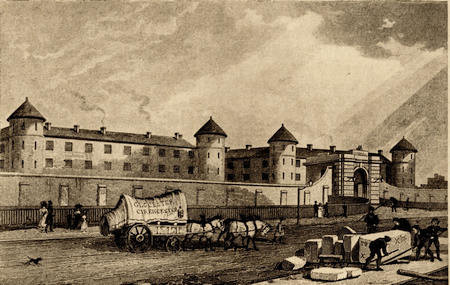
Millbank Penitentiary
The name of Jeremy Bentham is forever associated with Millbank Penitentiary. In his plans for its erection nearly a century ago he anticipated exactly the modern methods of to-day. During the time that Millbank was used as a prison, nearly a century, among the inmates were many notorious rogues and criminals. As a reformatory it was not a success, but the expensive experiment served as a lesson to the government and it paved the way for the model prison of to-day.
All this of itself was harmless enough, the reader may say: and such it would have been undoubtedly in a boys’ school next door to some seminary for young ladies, in the suburbs; but it was hardly in accordance with the condition of prisoners, or the seclusion that was a part of their punishment. And no sooner was this intrigue detected, and put an end to, than another of similar character was discovered between the male convicts in the kitchen and certain maid-servants kept by the superior officers. The steward on searching the kitchen drawer of his housemaid—it does not appear what led him to ransack the hiding-places of his servants’ hall—found a letter addressed to the girl by the prisoner named Brown. Brown, when taxed with it, admitted the letter, but declared that the first overtures had come from the maid. He had been cleaning the steward’s door-bell, when this forward young person nodded to him from the passage, and he nodded back. At the same time another prisoner was caught at the same game with the female servant of the resident surgeon. On searching the prisoner-cooks a letter from the girl was found in this man’s pocket, and a lock of long hair, neatly plaited. The first-mentioned girl had not confined her smiles to Brown, for in her possession was another letter from John Ratcliffe, a prisoner who had been working in the starching yard close by the steward’s quarters. Betsy S., the surgeon’s second maid, had become also the object of the affections of a prisoner named Roberts, who had thrown a letter to her through the open window. But Betsy would not encourage his advances, and took the letter at once to her master. Moreover the chaplain’s maid was always at her kitchen window, making signs.
The chief lesson to be learned from these nefarious practices is, that it is a grave error to permit officers and their families to reside within the walls of a prison. In the old constructions the “gaoler’s” house was always placed in the very centre of the buildings, from whence he was supposed to keep a watchful eye on all around. But the gain was only imaginary; and even if there had been any advantage it would have been more than nullified by the introduction of the family, or unprofessional element, within the walls. A prison should be like a fortress in a state of siege: officers on duty, guards posted, sentries always on the alert, every one everywhere ready to meet any difficulty or danger that may arise. No “free” person should pass the gates but officials actually on duty inside. In this way the modern practice of placing all residences and private quarters in close proximity to, but outside, the prison is a distinct improvement on the old. By it the moral presence of the supreme authority with his staff is still maintained, and no such irregularities as those I have just described could possibly occur.
So far I have made but little reference to the female convicts. Indeed, during the first years after the reopening of the Penitentiary, except in isolated cases, they appear to have conducted themselves quietly enough. But the contagion from the male pentagons could not but spread, sooner or later. The news of the removal of the worst men to the hulks no doubt acted as a direct incitement to misconduct. Had not this power of removal been accompanied, in the case of the males, with authority to inflict corporal punishment, we should have seen a great and continuous increase of the riotous disturbances described already. A certain number, it is true, had gained their ends; but if those who remained were ambitious to tread the same path, it was possible that sound flogging would be tried before removal to the hulks. With the women it was different—they could not be flogged, so they had it much their own way. It was the same then as now: the means of coercion to be employed against females are limited in the extreme, and a really bad woman can never be tamed, though she may in time wear herself out by her violence. We shall see more than one instance of the seemingly indomitable obstinacy and perversity of the female character, when all barriers are down and only vileness and depravity remains.
Long before the women broke out into open defiance of authority there were more than rumours that all was not right in the women’s pentagon. “Irregularities are on the increase there,” observes the governor in his journal. The object of the agitation was no secret. The women wanted to get away from the Penitentiary as the men had done. One having abused a matron in the most insolent terms, swore, if not sent at once to the hulks, or abroad, she would have some one’s life. Another sent for the governor, saying she had something particular to confide to him. “Well?” asked Captain Chapman. “You must send me to the hulks or to New South Wales,” she answered. Other women made the same request, pleading that they had not a friend on earth, and when released they must return to their old vicious courses. “I told them,” says the governor, “they could only be sent to the hulks when they were incorrigible, and to qualify for that they must pass months in the dark. Then I exhorted them to return to their work and better thoughts.” But they both at once flatly refused either to work or to think better of it, demanding to be sent immediately to the dark, a wish which was gratified without further delay.
It now appeared evident that the discipline of the female side was most unsatisfactory, and there had been great remissness on the part of the officers. It was discovered, too, among other things, that the religious exercises had been greatly neglected: the reading of the lesson in the morning service in the wards had been “either shamefully slurred over, or neglected altogether.” For this, and other omissions, the visitor assembled the matrons in a body, and lectured them in plain terms.
That very afternoon occurred the first real outbreak. All at once the whole of one of the wards was found to be in an uproar. The shouts and yells of the women could be heard all over the prison, and for a great distance beyond. The disturbance arose in this wise: there had been great misconduct that morning in chapel, but the offenders had eluded detection, as they thought; therefore when the matron reprimanded them, they concluded that one of their number had “rounded” or “put them away,”—in other words, had turned informer. Elizabeth Wheatley was suspected, and upon her the whole of her companions fell, tooth and nail, when let out for exercise. It was with the utmost difficulty she was rescued from their clutches. Then the ringleaders, having been again confined to their cells, commenced a hideous din and continued it for hours.
Soon after this a violent attack is made upon the chief matron: a woman assaults her, and deals her a blow that makes her nose bleed. This is the signal for a general disturbance. All the ward join in the uproar: those not under lock and key crowd round the matron with frightful yells and imprecations, and from those in their cells, come shouts through the bars, such as “Give it her! give it her. I’d make a matron of her, if I was out. I’d have her life.” The unfortunate officer is only saved from serious injury by the prompt interposition of the wardswoman, a well-conducted prisoner; the excitement now becomes tremendous.
Let us look at a scene enacted in another part of the prison on that very same evening. It is towards dusk in the “Long Room,” where there are beds for nearly forty. Half a dozen women, unattended by a turnkey, are discussing the topics of the day. One, Nihill, is lamenting in bitter terms the want of pluck exhibited by the others. None of the women were “game,” she said. She was ready to do anything, but none of the others would give her a helping hand. There were men in the prison, too, who were willing and able to join in a mutiny if they only got a lead. It might be done in chapel, where the whole of the population of the Penitentiary collected together twice a day for prayers. At this moment comes a new arrival, bearing the news of the murderous assault upon the matron, to which reference has been already made.
“How many were in it?” Nihill asks, she being the leading malcontent of those mentioned above.
“Five.”
“That’s three too many. I wish I’d been there. Wait till I get my green jacket,[3] I’ll carry a knife, and I’ll stick it into her.”
“She’s a brute,” adds another. “I’d serve her so too.”
Here a woman interposed on the other side and a fierce quarrel ensued and there was a hand to hand fight. The other prisoners gave the alarm; assistance arrived; and the combatants were secured and carried off to the dark cells.
The next affair occurred at school time. A prisoner, Smith, was checked by the matron for quarrelling with the monitress, whereupon Smith, seizing her stool, swore she would make away with the matron. Two other prisoners came to the rescue, and, pushing the matron into a cell close by, got in with her, and pulled the door to. Smith in a fury raced after them, but the cell gate was locked before she arrived, and she had to be satisfied with the grossest abuse from the further side. But Sara Smith was now mistress of the ward, and ranged up and down with uplifted stool, and fury in her looks, till the governor, bold Captain Chapman, came to the spot with his patrols, and she was, with some difficulty, overpowered.
So determined were the women to misconduct themselves, that they took in bad part the advice of the few who were well-disposed. When one Mary Anne Titchborne begged her companions to behave better, they turned at her en masse, pursuing her to her cell with horrid threats, brandishing their pattens over their heads, and swearing they would have her life. The following feminine feat at first sight appeared most extraordinary. One of the female prisoners, it was declared, had in the night jumped out of her window, on the second floor, into the airing-yard below, a height of seventeen feet; and the governor, who visited her about 7 a.m., four hours after the accident, found her sitting in her cell again, quietly at work, and “with the exception of a sprain, or a contusion of the fingers of the right hand, quite unhurt.” According to this woman’s story, she determined to take her life about ten o’clock and threw herself out of her window. “It seems incredible,” remarks Captain Chapman, “that she could have effected this, as the sash of the window opens from the bottom with the hinge, forming thus an acute angle—in fact a V—having an aperture about ten inches wide. Not a single pane of glass was broken, and Miller, for all her fall, was unhurt, beyond a scratch or two upon her fingers.” Miller when questioned further stated that on reaching terra firma she was at first quite stunned. By and by she got up and walked about the yard for several hours; then, finding it cold, she returned to her ward, which she accomplished easily, as all the external doors and passage gates had been left unlocked. This carelessness with reference to “security” locks, as they are called, or the gates that interpose between the prisoners and fresh air, might easily make the hair of a modern gaoler stand on end; and even the considerate Governor Chapman was forced to reprimand the matrons for this gross neglect of duty. A little later Miller confessed her fraud. After school at night, she had managed to secrete herself in an unoccupied cell. No one missed her; and about eleven, coming out, she commenced to wander up and down the ward, going from cell to cell knocking.
“Who’s there?”
“Miller.”
“Where have you come from?”
“I have jumped out of the window, and got back through the gates, which were left open.”
“Go back to your cell, for goodness’ sake.”
“I can’t get in, the door is locked.”
“Call up the matron then.”
“I daren’t.”
Such was the conversation overheard by others. About three o’clock, Miller could stand it no longer, and woke the matron of the ward.
One other case of misconduct among the females which occurred some months afterward may be mentioned here. This was the discovery of a conspiracy which at first sight seemed of rather serious dimensions. Its apparent object was to murder the chaplain, the matron, and a female officer named Bateman, all of whom had incurred the rancour of certain of the worst prisoners. One day in chapel an officer noticed much nudging and winking between two or three of the women, one of whom afterwards came up to her, as she stood by the altar rails, and said, “There’s a conspiracy going on.”
“Where?” asked the matron.
“In a bag.”
“A bag? Who’s got it?”
“Jones.”
And in effect, upon Jones was found a bag of white linen, six inches by four, and inside it a strip of bright yellow serge, such as the “first class” women wore. On this yellow ground was worked in black letters, as a sampler might be, the following:—
“Stab balling (bawling) Bateman, dam matron too, and parson; no justis now, may they brile in hell and their favrits too. God bless the governor; but this makes us devils. Shan’t care what we do—20 of us sworn to drink and theve in spite—get a place—rob and bolt. Make others pay for this. Shan’t fear any prison or hel after this. Can’t suffer more. Some of us meen to gulp the sakrimint, good blind: they swear they’ll burk the matron when they get out, and throw her in the river. No justis. Destroy this. No fear. All swer to die; but don’t split, be firm, stic to yor othe, and all of ye, stab them all. Watch yor time—stab am to the hart in chaple; get round them and they can’t tell who we mean to stab.”
This bag was akin somewhat to the mysterious chuppaties, which were the forerunner of the Indian Mutiny. It was passed from hand to hand, each prisoner opening, reading, and then sending it on. Jones, on whom it was found, declared she had picked it up in the passage. She was lame, and returning from exercise had put her crutch on something soft. “Why, here is some one’s swag,” she cried, and thereupon became possessed of it. But she had intended to give it up to the matron; “Oh yes, directly she had read it.” However, another prisoner forestalled her, and Jones got into trouble. Then, with the instinct of self-preservation, which is stronger, perhaps, among prisoners than in other human beings, Jones “rounded” at once, in other words, gave full information of the plot. Hatred of the matron was at the bottom of it.
This great conspiracy was of a piece with many such plots in modern experience—mere empty threats and rank bombastic talk. Prisoners are very fond of bragging what they mean to do, both inside and outside when again free. In the present case there was supposed to be much more in store for the matron than the actual assault with which they threatened her. One of the conspirators swore that if she (the matron) escaped now, later on vengeance should overtake her. “As soon as I’m free I’ll do for that cat of destruction. I’ll send her first a dead dog with a rope round its neck, made up into a parcel. That’ll frighten her. Curse her, I’ll give her a bitter pill yet. If it’s ten years hence, I’ll never forget her. I’ll watch her, and track her outside; and I have friends of the right sort that’ll help me.” But threatened men and women live long, and nothing much happened to the matron then or afterwards.
Let us now return to the male side. Here the worries and annoyances of the governor were still varied and continuous. Hardly had misconduct in one shape succumbed to treatment, than it broke out in another. Many attempts to escape—one of which, to be detailed hereafter, went very near complete success; a couple of very serious assaults, and a fresh suicidal epidemic, still kept his energies on the stretch. It was his practice, as we know, to give his immediate attention to anything and everything, as soon as it occurred; and although he must now have been alive to the preponderance of imposture in the attempts prisoners made upon their own lives, still so kindhearted a man could not but be greatly exercised in spirit, whenever the suicides seemed of a bonâ fide nature.
The following case called at once for his most anxious interference. One Thomas Edwards was reported to have it in contemplation to do himself a mischief. Another prisoner detected him in the act of concealing a piece of hammock lashing in his bosom, gave information, and the halter was seized at once by the officer in charge. It was found to be nearly two yards in length. In Edwards’ pocket was also a letter, an old letter from his brother, across which in red chalk was written:
“To Captain Chapman. The last request of an innocent, and injured man is, that this note may be delivered to a much loved brother.
“I can no longer bear my unfortunate situation. Death will be a relief to me, though I fain would have seen you once more; but I was fearful it might heighten your grief. The privations of cold and hunger, I can no more suffer. I now bid you an eternal farewell. God forgive me for the rash act I am about to commit—the hour is fast approaching when I must leave this troublesome world. Write to my dear sister, but never let her know the truth of my end, and comfort her as well as you can. God forgive me.
Farewell for ever,
Farewell.”
“I immediately sent for Edwards,” says Captain Chapman in his journal. “He appeared much distressed. The tears rolled down his cheeks, but he would not speak. I said everything I could think of to soothe and console him, and had him taken by the surgeon to the infirmary.” The case seemed to require full investigation, which it received; and the result is recorded a little further on by the governor. “It appeared that up to two or three days before he had been remarkably cheerful. But one day some extra soup had disagreed with him, after which he hardly spoke, not even to his partner with whom he walked in the yard.” Then, when he thought he was unobserved, he had secreted the hammock lashing which was to put an end to his wretched existence.
Bile or indigestion have doubtless driven many to desperation; but though the saying is common enough, that life under such afflictions is barely worth having, actual cases of suicide from stomachic derangements are comparatively rare. Perhaps the soup story opened the governor’s eyes a little to the prisoner’s real character, and then, later on, a second detection of fraud proved beyond doubt that Edwards was an impostor.
He was caught in a clandestine correspondence with his relatives outside, and for this he was transferred to “the dark.” Fifteen minutes afterwards they find him suspended from the top of his cell gate by his pocket handkerchief. They cut him down at once. He pretends to be unable to speak, yet it is clear that he has not done himself the slightest injury. Nevertheless, to keep him out of mischief, he is removed to the infirmary and put into a strait jacket. To escape from this restraint he embarks upon a new line of imposture. He sends an urgent message to the chaplain, having, as he asserts, a weighty sin upon his conscience, which he wishes at once to disclose.
“Some four years ago, sir, I murdered a young woman. She was the one I kept company with. I was jealous. I threw her into the New River. Sir, I have never had a happy moment since I committed the deed. My life is a burthen to me; and I would gladly terminate it upon the scaffold.”
“Are you quite sure you are telling me the truth?” the chaplain asks.
“The truth, sir—God’s truth. If I am not, may I,” etc.
He detailed the circumstances of the murder with so much circumstantiality that it was thought advisable to take all down in writing, so as to make full inquiry; but both governor and chaplain were “fully convinced that the prisoner had fabricated the whole story in the hopes of getting himself removed to Newgate.” No sort of corroboration was obtained outside, of course, and by and by the matter dropped. I have merely quoted this as a sequel and commentary upon the conduct of Edwards, proving that he was clearly an impostor from first to last.
But not long after this a fatal case occurred. The suicide was a man long suspected of being wrong in his head. Early one morning he was found hanging to the cross beam of his loom, from the framework of which he had jumped, and thereby dislocated his neck. It appeared on inquiry, that the mental derangement of which this man showed symptoms had been kept quite a secret from the governor and medical officer; so also had his frequent requests to see the chaplain; and the officer in charge of the ward was very properly suspended from duty “for culpable neglect, as probably, with timely interference, the prisoner’s life might have been saved.” But whether it might or might not, the news of his death spread rapidly through the prison, and from having occurred but rarely, real or feigned suicides became again quite the fashion. The gossip of an incautious matron took the intelligence first into the female pentagon. That very evening, after the women had been locked up, one yelled to another in the next cell that she meant to hang herself directly, and had a rope concealed, which she dared any one to discover. This woman was made safe at once; but next morning another was found tied up by her apron to the pegs of the clothes rack behind her cell door. She had failed to come out with the rest to wash, and as the officers approached to examine her cell they heard a noise of groaning within. A sort of feeble barricade had been made by the prisoner, with her mattress and pillows, to prevent entrance; but the door was easily opened, and behind it hung Hannah Groats by the neck, to one peg, while she carefully kept herself from harm by holding on by her hands to the two pegs adjoining. She was instantly taken down, when it was seen that she had not sustained the slightest damage. She had, of course, chosen her time just when she knew the cell doors were about to be opened, and she was sure to be quickly discovered.
Next the men took up the contagion. One announced that unless he be removed without delay from the cell he occupied he should forthwith make away with himself, as he was tired of life. “He appeared so much dejected, and spoke with such apparent earnestness, that I ordered him to the infirmary,” says the governor. Another man writes on his slate that the authorities treat him with such severity, he shall certainly commit suicide. He is seen at once by both chaplain and governor, but continues “dogged and intractable.” Then a certain impudent young vagabond, notorious for his continual misconduct, is found one morning seated at his table, reading the burial service aloud from his prayer-book, and sharpening his knife on a bit of hearth-stone; a woman is discovered with a piece of linen tied tightly round her neck, and nearly producing strangulation; men, one after another, are found suspended, but always cut down promptly, and proved unhurt in spite of pretended insensibility: cases of this kind really occurred so frequently, that I should fill many pages were I to recount a tithe of them.
I will describe the first instance in which it was found necessary to inflict corporal punishment in Millbank, which was as a punishment for a brutal assault. One of the prisoners, David Sheppard, checked mildly by his officer for walking in his wrong place, replied, “I’ll walk as I have always done, and not otherwise.”
“You must walk with your partner.”
“What is that you say? I’ll partner you,” exclaimed Sheppard most insolently; an answer that is conclusive evidence as to the sort of discipline maintained in the prison.
The officer made no further remark, but walked away to unlock a gate. Sheppard followed him quickly, and without the least notice, struck him a tremendous blow behind the ear, striking him again and again till other officers came to the victim’s assistance. Many of the prisoners cried “Leave off!” but none offered to interfere. As soon as the prisoner had been secured, he was carried before the governor. The assault was brutal and unprovoked, and seemed to call for immediate example. Under the recent Act, it had become lawful to inflict corporal punishment in serious cases, and now for the first time this power was made available. The prisoner Sheppard was sent to the Queen’s Square police office, and arraigned before the sitting magistrate, who sentenced him forthwith to “one hundred and fifty lashes on the bare back.” The whole of the prisoners of the D ward, to which Sheppard belonged, were therefore assembled in the yard, and the culprit tied up to iron railings in the circle. “Having addressed the prisoner,” says the governor, “on this disgraceful circumstance, I had one hundred lashes applied by Warder Aulph, an old farrier of the cavalry, and therefore well accustomed to inflict corporal punishment, who volunteered his services. The surgeon attended, and he being of opinion that Sheppard had received enough, I remitted the remainder of his sentence, on an understanding to that effect with Mr. Gregory (the sitting magistrate). The lashes were not very severely inflicted, but were sufficient for example. Sheppard, when taken down, owned the justice of his sentence, and, addressing his fellow-prisoners, said he hoped it would be a warning to them. He was then taken to the infirmary.” A strong force of extra warders was present to overawe the spectators; but all the prisoners behaved well, except one who yelled “Murder” several times, which was answered from the windows above, whence came also cries of “Shame.” Another, who had been guilty some months before of a similar offence, witnessed the operation. It affected him to tears. “He was much frightened, and promised to behave better for the future.”
It is impossible to read this account of the infliction of what seemed a highly necessary chastisement without noticing the peculiar sensitiveness of the prison authorities on the subject. In these days there are crowds of thin-skinned philanthropists, ever ready to loudly rail against the use of the lash, even upon garroters and the cowards who beat their wives. But in the time of which I am writing—in 1830 that is to say, when soldiers, for purely military offences, were flogged within an inch of their lives, and the “cat” alone kept the slave population of penal colonies in subjection—it is almost amusing to observe what a coil was raised about a single instance of corporal punishment. Were proof required of the exceeding mildness of the rule under which Millbank was governed, we should have it here.
Between this and the next assault there was a long interval. But after a little more than twelve months had elapsed, the ferocity of these candidates for reformation again made itself apparent. This time it was a concerted affair between two prisoners who fancied themselves aggrieved by the stern severity of their officer, Mr. Young. These men, Morris and King, had been reported for talking to each other from cell to cell. Next day both were let out to throw away the water in which they had washed. They met at the trough, and recommenced conversation which had been interrupted the day before.
“At your old tricks, eh?” cried Mr. Young. “I shall have to report you again.”
“You lie, you rascal,” shouted Morris, suddenly drawing a sleeveboard which he had concealed behind his back. Holding this by the small end with both hands, he aimed several tremendous blows at Mr. Young’s head, which the latter managed to ward off partly, with his arms. But now King, armed with a pewter basin in one hand and a tailor’s iron in the other, attacked him from behind. Soon Mr. Young’s keys were knocked away from him, and he himself brought to the ground. However, he managed to regain his legs, and then made off, closely pursued by his assailants, who, flourishing their weapons and smashing everything fragile in their progress, drove him at length into a corner, got him down, beat him unmercifully, and left him for dead, King throwing the basin behind him as a parting shot.
Mr. Young’s cries of “Murder!” had been continuous. They were re-echoed by the shouts of the many prisoners who, standing at their open cell doors, were spectators of the scene. One man, Nolan, climbing up to his window, gave the alarm to the tower below. Assistance soon arrived—the taskmaster followed by two others, who met first Morris and King as they were returning to their cells. “What has happened?” they asked. “I haven’t an idea,” Morris replied coolly. King, too, is equally in the dark. The officers pass on and come to other cells, in which the prisoners are seen grinning as if in high glee, and when questioned they only laugh the more. But at length Nolan is reached. “Oh, sir,” says Nolan at once, through the bars of his gate, “they’ve murdered the officer, Mr. Young, sir. There lie his keys, and his body is a little further on.” At this moment, however, Mr. Young is seen dragging himself slowly towards them, evidently seriously injured and hardly able to walk. He just manages to explain what has happened, and as the governor has by this time also arrived, the offenders are secured and carried off to the refractory cells.
Here was another case in which a prompt exhibition of the “cat” would probably have been attended with the best results. But for some reason or other this course was not adopted; the prisoners Morris and King were remanded for trial at the next Clerkenwell Assizes, where, many months afterwards, they were sentenced to an additional year’s imprisonment. So far as I can discover, in these times the power to inflict corporal punishment in the Penitentiary was very sparingly employed. No other case beyond that which I have just described appears recorded in the journals till some four years afterwards, in 1834, when a prisoner having attacked his officer with a shoe frame, the sitting magistrate ordered him to be flogged with as little delay as possible. For this purpose the services of the public executioner were obtained from Newgate, and one hundred out of the three hundred lashes ordered were laid on “not very severely.” A large gathering of the worst behaved prisoners witnessed the punishment; but all were very quiet. “Not a word was spoken, though many were in tears.” “I fervently hope,” says Captain Chapman, “that this painful discharge of my duty may be productive of that to which all punishment tends—the prevention of crime.”
[3] The dress of women in the second or superior class consisted of dark green jacket and stuff petticoat; the first or lower class wore a yellow jacket.


