



автордың кітабын онлайн тегін оқу Mysteries of Police and Crime, Vol. 1 (of 3)
Every attempt has been made to replicate the original as printed.
Some typographical errors have been corrected; a list follows the text.
In certain versions of this etext, in certain browsers, clicking on an image will bring up a larger version.
Contents.
(etext transcriber's note)
MYSTERIES OF POLICE
AND CRIME
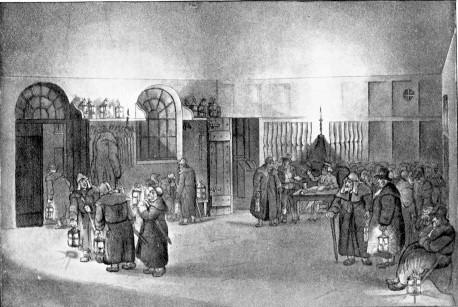
WATCH HOUSE AND WATCHMEN A CENTURY AGO. (From a Contemporary Print by Rowlandson and Pugin.)
Mysteries
OF
Police and Crime
BY
Major ARTHUR GRIFFITHS
FORMERLY ONE OF H.M. INSPECTORS OF PRISONS; JOHN HOWARD GOLD
MEDALLIST; AUTHOR OF “MEMORIALS OF MILLBANK,” “CHRONICLES OF
NEWGATE,” ETC.
PROFUSELY ILLUSTRATED
IN THREE VOLUMES
VOL. I.
SPECIAL EDITION
CASSELL AND COMPANY, Limited
LONDON, PARIS, NEW YORK & MELBOURNE
ALL RIGHTS RESERVED

CONTENTS.
Part I.
A GENERAL SURVEY OF CRIME AND ITS DETECTION.
PAGE
Crime Distinguished from Law-breaking—The General Liability to Crime—Preventive Agencies—Plan of the Work—Different Types of Murders and Robberies—Crime Developed by Civilisation—The Police the Shield and Buckler of Society—Difficulty of Disappearing under Modern Conditions—The Press an Aid to the Police: the Cases of Courvoisier, Müller, and Lefroy—The Importance of Small Clues—“Man Measurement” and Finger-Prints—Strong Scents as Clues—Victims of Blind Chance: the Cases of Troppmann and Peace—Superstitions of Criminals—Dogs and other Animals as Adjuncts to the Police—Australian Blacks as Trackers: Instances of their Almost Superhuman Skill—How Criminals give themselves Away: the Murder of M. Delahache, the Stepney Murder, and other Instances—Cases in which there is Strong but not Sufficient Evidence: the Great Coram Street and Burdell Murders: the Probable Identity of “Jack the Ripper”—Undiscovered Murders: the Rupprecht, Mary Rogers, Nathan, and other Cases: Similar Cases in India: the Button Crescent Murder: the Murder of Lieutenant Roper—The Balance in Favour of the Police
Part II.
JUDICIAL ERRORS.
CHAPTER I.
Wrongful Convictions.
Judge Cambo, of Malta—The D’Anglades—The Murder of Lady Mazel—Execution of William Shaw for the Murder of his Daughter—The Sailmaker of Deal and the alleged Murder of a Boatswain—Brunell, the Innkeeper—Du Moulin, the Victim of a Gang of Coiners—The Famous Calas Case at Toulouse—Gross Perversion of Justice at Nuremberg—The Blue Dragoon
CHAPTER II.
Cases of Disputed or Mistaken Identity.
Lesurques and the Robbery of the Lyons Mail—The Champignelles Mystery—Judge Garrow’s Story—An Imposition practised at York Assizes—A Husband claimed by Two Wives—A Milwaukee Mystery—A Scottish Case—The Kingswood Rectory Murder—The Cannon Street Murder—A Narrow Escape
CHAPTER III.
Problematical Errors.
Captain Donellan and the Poisoning of Sir Theodosius Boughton: Donellan’s Suspicious Conduct: Evidence of John Hunter, the great Surgeon: Sir James Stephen’s View: Corroborative Story from his Father—The Lafarge Case: Madame Lafarge and the Cakes: Doctors differ as to Presence of Arsenic in the Remains: Possible Guilt of Denis Barbier: Madame Lafarge’s Condemnation: Pardoned by Napoleon III.—Charge against Madame Lafarge of stealing a School Friend’s Jewels: Her Defence: Conviction—Madeleine Smith charged with Poisoning her Fiancé: “Not Proven”: the Latest Facts—The Wharton-Ketchum Case in Baltimore, U.S.A.—The Story of the Perrys
CHAPTER IV.
Police Mistakes.
The Saffron Hill Murder: Narrow Escape of Pellizioni: Two Men in Newgate for the same Offence—The Murder of Constable Cock—The Edlingham Burglary: Arrest, Trial, and Conviction of Brannagan and Murphy: Severity of Judge Manisty: A new Trial: Brannagan and Murphy Pardoned and Compensated: Survivors of the Police Prosecutors put on their Trial, but Acquitted—Lord Cochrane’s Case: His Tardy Rehabilitation
Part III.
POLICE—PAST AND PRESENT.
CHAPTER V.
Early Police: France.
Origin of Police—Definitions—First Police in France—Charles V.—Louis XIV.—The Lieutenant-General of Police: His Functions and Powers—La Reynie: His Energetic Measures against Crime: As a Censor of the Press: His Steps to Check Gambling and Cheating at Games of Chance—La Reynie’s Successors: the D’Argensons, Hérault, D’Ombréval, Berryer—The Famous de Sartines—Two Instances of his Omniscience—Lenoir and Espionage—De Crosne, the last and most feeble Lieutenant-General of Police—The Story of the Bookseller Blaziot—Police under the Directory and the Empire—Fouché: His Beginnings and First Chances: A Born Police Officer: His Rise and Fall—General Savary: His Character: How he organised his Service of Spies: His humiliating Failure in the Conspiracy of General Malet—Fouché’s return to Power: Some Views of his Character
CHAPTER VI.
Early Police (continued): England.
Early Police in England—Edward I.’s Act—Elizabeth’s Act for Westminster—Acts of George II. and George III.—State of London towards the End of the Eighteenth Century—Gambling and Lottery Offices—Robberies on the River Thames—Receivers—Coiners—The Fieldings as Magistrates—The Horse Patrol—Bow Street and its Runners: Townsend, Vickery, and others—Blood Money—Tyburn Tickets—Negotiations with Thieves to recover stolen Property—Sayer—George Ruthven—Serjeant Ballantine on the Bow Street Runners compared with modern Detectives
CHAPTER VII.
Modern Police: London.
The “New Police” introduced by Peel—The System supported by the Duke of Wellington—Opposition from the Vestries—Brief Account of the Metropolitan Police: Its Uses and Services—The River Police—The City Police—Extra Police Services—The Provincial Police
CHAPTER VIII.
Modern Police (continued): Paris.
The Spy System under the Second Empire—The Manufacture of Dossiers—M. Andrieux receives his own on being appointed Prefect—The Clerical Police of Paris—The Sergents de Ville—The Six Central Brigades—The Cabmen of Paris, and how they are kept in Order—Stories of Honest and of Dishonest Cabmen—Detectives and Spies—Newspaper Attacks upon the Police—Their General Character
CHAPTER IX.
Modern Police (continued): New York.
Greater New York—Despotic Position of the Mayor—Constitution of the Police Force—Dr. Parkhurst’s Indictment—The Lexow Commission and its Report—Police Abuses: Blackmail, Brutality, Collusion with Criminals, Electoral Corruption, the Sale of Appointments and Promotions—Excellence of the Detective Bureau—The Black Museum of New York—The Identification Department—Effective Control of Crime
CHAPTER X.
Modern Police (continued): Russia.
Mr. Sala’s Indictment of the Russian Police—Their Wide-reaching Functions—Instances of Police Stupidity—Why Sala Avoided the Police—Von H—— and his Spoons—Herr Jerrmann’s Experiences—Perovsky, the Reforming Minister of the Interior—The Regular Police—A Rural Policeman’s Visit to a Peasant’s House—The State Police—The Third Section—Attacks upon Generals Mezentzoff and Drenteln—The “Paris Box of Pills”—Sympathisers with Nihilism: An Invaluable Ally—Leroy Beaulieu on the Police of Russia—Its Ignorance and Inadequate Pay—The Case of Vera Zassoulich—The Passport System: How it is Evaded and Abused: Its Oppressiveness
CHAPTER XI.
Modern Police (continued): India.
The New System Compared with the Old—Early Difficulties Gradually Overcome—The Village Police in India—Discreditable Methods under the Old System—Torture, Judicial and Extra-Judicial—Native Dislike of Police Proceedings—Cases of Men Confessing to Crimes of which they were Innocent—A Mysterious Case of Theft—Trumped-up Charges of Murder—Simulating Suicide—An Infallible Test of Death—The Paternal Duties of the Police—The Native Policeman Badly Paid
CHAPTER XII.
The Detective, and What He has Done.
The Detective in Fiction and in Fact—Early Detection—Case of Lady Ivy—Thomas Chandler—Mackoull, and how he was run down by a Scots Solicitor—Vidocq: his Early Life, Police Services, and End—French Detectives generally—Amicable Relations between French and English Detectives
CHAPTER XIII.
English and American Detectives.
English Detectives—Early Prejudices against them Lived Down—The late Mr. Williamson—Inspector Melville—Sir C. Howard Vincent—Dr. Anderson—Mr. Macnaghten—Mr. McWilliam and the Detectives of the City Police—A Country Detective’s Experiences—Allan Pinkerton’s first Essay in Detection—The Private Inquiry Agent and the Lengths to which he will go
Part IV.
CAPTAINS OF CRIME.
CHAPTER XIV.
Some Famous Swindlers.
Recurrence of Criminal Types—Heredity and Congenital Instinct—The Jukes and other Families of Criminals—John Hatfield—Anthelme Collet’s Amazing Career of Fraud—The Story of Pierre Cognard: Count Pontis de St. Hélène: Recognised by an old Convict Comrade: Sent to the Galleys for Life—Major Semple: His many Vicissitudes in Foreign Armies: Thief and Begging-Letter Writer: Transported to Botany Bay
CHAPTER XV.
Swindlers of more Modern Type.
Richard Coster—Sheridan, the American Bank Thief—Jack Canter—The Frenchman Allmayer, a typical Nineteenth Century Swindler—Paraf—The Tammany Frauds—Burton, alias Count von Havard—Dr. Vivian, a bogus Millionaire Bridegroom—Mock Clergymen: Dr. Berrington: Dr. Keatinge—Harry Benson, a Prince of Swindlers: The Scotland Yard Detectives suborned: Benson’s Adventures after his Release: Commits Suicide in the Tombs Prison—Max Shinburn and his Feats
CHAPTER XVI.
Some Female Criminals.
Criminal Women Worse than Criminal Men—Bell Star—Comtesse Sandor—Mother M——, the Famous Female Receiver of Stolen Goods—The “German Princess”—Jenny Diver—The Baroness de Menckwitz—Emily Lawrence—Louisa Miles—Mrs. Gordon-Baillie: Her Dashing Career: Becomes Mrs. Percival Frost: the Crofters’ Friend: Triumphal Visit to the Antipodes: Extensive Frauds on Tradesmen: Sentenced to Penal Servitude—A Viennese Impostor—Big Bertha, the “Confidence Queen”

Part I.
A GENERAL SURVEY OF CRIME AND ITS DETECTION.
Crime Distinguished from Law-breaking—The General Liability to Crime—Preventive Agencies—Plan of the Work—Different Types of Murders and Robberies—Crime Developed by Civilisation—The Police the Shield and Buckler of Society—Difficulty of Disappearing under Modern Conditions—The Press an Aid to the Police: the Cases of Courvoisier, Müller, and Lefroy—The Importance of Small Clues—“Man Measurement” and Finger-Prints—Strong Scents as Clues—Victims of Blind Chance: the Cases of Troppmann and Peace—Superstitions of Criminals—Dogs and other Animals as Adjuncts to the Police—Australian Blacks as Trackers: Instances of their Almost Superhuman Skill—How Criminals give themselves Away: the Murder of M. Delahache, the Stepney Murder, and other Instances—Cases in which there is Strong but not Sufficient Evidence: the Burdell and Various Other Murders: the Probable Identity of “Jack the Ripper”—Undiscovered Murders: the Rupprecht, Mary Rogers, Nathan, and other Cases: Similar Cases in India: the Burton Crescent Murder: the Murder of Lieutenant Roper—The Balance in Favour of the Police.
I.—THE CAUSES OF CRIME.
CRIME is the transgression by individuals of rules made by the community. Wrong-doing may be either intentional or accidental—a wilful revolt against law, or a lapse through ignorance of it. Both are punishable by all codes alike, but the latter is not necessarily a crime. To constitute a really criminal act the offence must be wilful, perverse, malicious; the offender then becomes the general enemy, to be combated by all good citizens, through their chosen defenders, the police. This warfare has existed from the earliest times; it is in constant progress around us to-day, and it will continue to be waged until the advent of that Millennium in which there is to be no more evil passion to agitate mankind.
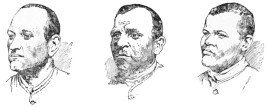
TYPES OF MALE CRIMINALS. (From Photographs preserved at the Black Museum, New Scotland Yard.)
It may be said that society itself creates the crimes that most beset it. If the good things of life were more evenly distributed, if everyone had his rights, if there were no injustice, no oppression, there would be no attempts to readjust an unequal balance by violent or flagitious means. There is some force in this, but it is very far from covering the whole ground, and it cannot excuse many forms of crime. Crime, indeed, is the birthmark of humanity, a fatal inheritance known to the theologians as original sin. Crime, then, must be constantly present in the community, and every son of Adam may, under certain conditions, be drawn into it. To paraphrase a great saying, some achieve crime, some have it thrust upon them; but most of us (we may make the statement without subscribing to all the doctrines of the criminal anthropologists) are born to crime. The assertion is as old as the hills; it was echoed in the fervent cry of pious John Bradford when he pointed to the man led out to execution, “There goes John Bradford but for the grace of God!”
Criminals are manufactured both by social cross-purposes and by the domestic neglect which fosters the first fatal predisposition. “Assuredly external factors and circumstances count for much in the causation of crime,” says Maudsley. The preventive agencies are all the more necessary where heredity emphasises the universal natural tendency. The taint of crime is all the more potent in those whose parentage is evil. The germ is far more likely to flourish into baleful vitality if planted by congenital depravity. This is constantly seen with the offspring of criminals. But it is equally certain that the poison may be eradicated, the evil stamped out, if better influences supervene betimes. Even the most ardent supporters of the theory of the “born criminal” admit that this, as some think, imaginary monster, although possessing all the fatal characteristics, does not necessarily commit crime. The bias may be checked; it may lie latent through life unless called into activity by certain unexpected conditions of time and chance. An ingenious refinement of the old adage, “Opportunity makes the thief,” has been invented by an Italian scientist, Baron Garofalo, who declares that “opportunity only reveals the thief”; it does not create the predisposition, the latent thievish spirit.

TYPES OF FEMALE CRIMINALS (From Photographs at the Black Museum.)
However it may originate, there is still little doubt of the universality, the perennial activity of crime. We may accept the unpleasant fact without theorising further as to the genesis of crime. I propose in these pages to take criminals as I find them; to accept crime as an actual fact, and in its multiform manifestations; to deal with its commission, the motives that have caused it, the methods by which it has been perpetrated, the steps taken—sometimes extraordinarily ingenious and astute, sometimes foolishly forgetful and ineffective—to conceal the deed and throw the pursuers off the scent; on the other hand, I shall set forth in some detail the agencies employed for detection and exposure. The subject is comprehensive, the amount of material available is colossal, almost overwhelming.
Every country, civilised and uncivilised, the whole world at large in all ages, has been cursed with crime. To deal with but a fractional part of the evil deeds that have disgraced humanity would fill endless volumes; where “envy, hatred, and malice, and all uncharitableness” have so often impelled those of weak moral sense to yield to their criminal instincts, a full catalogue would be impossible. It must be remembered that crime is ever active in seeking new outlets, always keen to adopt new methods of execution; the ingenuity of criminals is infinite, their patient inventiveness is only equalled by their reckless audacity. They will take life without a moment’s hesitation, and often for a miserably small gain; will prepare great coups a year or more in advance and wait still longer for the propitious moment to strike home; will employ address and great brain power, show fine resource in organisation, the faculty of leadership, and readiness to obey; will utilise much technical skill; will assume strange disguises and play many different parts, all in the prosecution of their nefarious schemes or in escaping penalties after the deed is done.
With material so abundant, so varied and complicated, it will be necessary to use some discretion, to follow certain clearly defined lines of choice. I propose in these pages to adopt the principle embodied in the title and to deal more particularly with the “mysteries” of crime and its incomplete, partial, or complete detection; with offences not immediately brought home to their perpetrators; offences prepared in secret, committed by offenders who have long remained perhaps entirely unknown, but who have sometimes met with their true deserts; offences that have in consequence exercised the ingenuity of pursuers, showing the highest development of the game of hide-and-seek, where the hunt is man, where one side fights for life and liberty, immunity from well-merited reprisals, the other is armed with authority to capture the human beast of prey. The flights and vicissitudes of criminals with the police at their heels make up a chronicle of moving, hair-breadth adventure unsurpassed by books of travel and sport.
Typical cases only can be taken, in number according to their
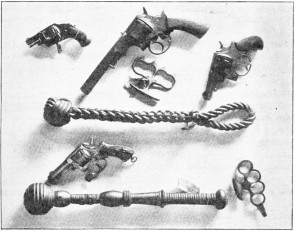
CRIMINALS’ WEAPONS: REVOLVERS, KNUCKLE DUSTERS, AND LIFE PRESERVERS IN THE BLACK MUSEUM. Photo: Cassell & Company, Limited.
relative interest and importance, but all more or less illustrating and embracing the hydra-headed varieties of crime. We shall see murders most foul, committed under the strangest conditions; brutal and ferocious attacks, followed by the most cold-blooded callousness in disposing of the evidences of the crime. In some cases a man will kill, as Garofalo puts it, “for money and possessions, to succeed to property, to be rid of one wife through hatred of her or to marry another, to remove an inconvenient witness, to avenge a wrong, to show his skill or his hatred and revolt against authority.” This class of criminal was well exemplified by the French murderer Lacenaire, who boasted that he would kill a man as coolly as he would drink a glass of wine. They are the deliberate murderers, who kill of malice aforethought and in cold blood. There will be slow, secret poisonings, often producing confusion and difference of opinion among the most distinguished scientists; successful associations of thieves and rogues, with ledgers and bank balances, and regularly audited accounts; secret societies, some formed for purely flagitious ends, with commerce and capitalists for their quarry; others for alleged political purposes, but working with fire and sword, using the forces of anarchy and disorder against all established government.
The desire to acquire wealth and possessions easily, or at least without regular, honest exertion, has ever been a fruitful source of crime. The depredators, whose name is legion, the birds of prey ever on the alert to batten upon the property of others, have flourished always, in all ages and climes, often unchecked or with long impunity. Their methods have varied almost indefinitely with their surroundings and opportunities. Now they have merely used violence and brute force, singly or in associated numbers, by open attack on highway and byway, on road, river, railway, or deep sea; now they have got at their quarry by consummate patience and ingenuity, plotting, planning, undermining or overcoming the strongest safeguards, the most vigilant precautions. Robbery has been practised in every conceivable form: by piracy, the bold adventure of the sea-rover flying his black flag in the face of the world; by brigandage in new or distracted communities, imperfectly protected by the law; by daring outrage upon the travelling public, as in the case of highwaymen, bushrangers, “holders-up” of trains; by the forcible entry of premises or the breaking down of defences designed against attack—by burglary in banks and houses, “winning” through the iron walls of safes and strong-rooms, so as to reach the treasure within, whether gold or securities or precious stones; by robberies from the person, daring garrotte robberies, dexterous neat-handed pilfering, pocket-picking, counter-snatching; by insinuating approaches to simple-minded folk, and the astute, endlessly multiplied application of the time-honoured Confidence Trick.
Crime has been greatly developed by civilisation, by the numerous processes invented to add to the comforts and conveniences in the business of daily life. The adoption of a circulating medium was soon followed by the production of spurious money, the hundred and one devices for forging notes, manufacturing coin, and clipping, sweating, and misusing that made of precious metals. The extension of banks, of credit, of financial transactions on paper, has encouraged the trade of the forger and fabricator, whose misdeeds, aimed against monetary values of all kinds, cover an extraordinarily wide range. The gigantic accumulation no less than the general diffusion of wealth, with the variety of operations that accompany its profitable manipulation, has offered temptations irresistibly strong to evil-or weak-minded people, who seem to see chances of aggrandisement, or of escape from pressing embarrassments, with the strong hope always of replacing abstractions, rectifying defalcations, or altogether evading detection. Less criminal, perhaps, but not less reprehensible, than the deliberately planned colossal frauds of a Robson, a Redpath, or a Sadleir are the victims of adverse circumstances, the Strahans, Dean-Pauls, Fauntleroys, who succeeded to bankrupt businesses and sought to cover up insolvency with a fight, a losing fight, against misfortune, resorting to nefarious practices, wholesale forgery, absolute misappropriation, and unpardonable breaches of trust.
Between the “high flyers,” the artists in crime, and the lesser fry, the rogues, swindlers, and fraudulent impostors, it is only a question of degree. These last-named, too, have in many instances swept up great gains. The class of adventurer is nearly limitless; it embraces many types, often original in character and in their criminal methods, clever knaves possessed of useful qualities—indeed, of natural gifts that might have led them to assured fortune had they but chosen the straight path and followed it patiently. We shall see with what infinite labour a scheme of imposture has been built up and maintained, how nearly impossible it was to combat the fraud, how readily the swindler will avail himself of the latest inventions, the telegraph and the telephone, of chemical appliances, of photography in counterfeiting signatures or preparing banknote plates, ere long, perchance, of the Röntgen rays. We shall find the most elaborate and cleverly designed attacks on great banking corporations, whether by open force or insidious methods of forgery and falsification, attacks upon the vast stores of valuables that luxury keeps at hand in jewellers’ safes and shop fronts, and on the dressing-tables of great dames. Crime can always command talent, industry also, albeit laziness is ingrained in the criminal class. The desire to win wealth easily, to grow suddenly rich by appropriating the possessions or the earnings of others, is no doubt a strong incitement to crime; yet the depredator who will not work steadily at any honest occupation will give infinite time and pains to compass his criminal ends.
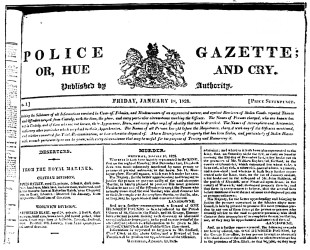
REDUCED FAC-SIMILE OF PART OF FRONT PAGE OF THE FIRST NUMBER OF THE “POLICE GAZETTE” (p. 13.)
II.—THE HUNTERS AND THE HUNTED.
Society, weak, gullible, and defenceless, handicapped by a thousand conventions, would soon be devoured alive by its greedy parasites: but happily it has devised the shield and buckler of the police; not an entirely effective protector, perhaps, but earnest, devoted, unhesitating in the performance of its duties. The finer achievements of eminent police officers are as striking as the exploits of the enemies they continually pursue. In the endless warfare success inclines now to this side, now to that; but the forces of law and order have generally the preponderance in the end. Infinite pains, unwearied patience, abounding wit, sharp-edged intuition, promptitude in seizing the vaguest shadow of a clue, unerring sagacity in clinging to it and following it up to the end—these qualities make constantly in favour of the police. The fugitive is often equally alert, no less gifted, no less astute; his crime has often been cleverly planned so as to leave few, if any, traces easily or immediately apparent, but he is constantly overmatched, and the game will in consequence go against him. Now and again, no doubt he is inexplicably stupid and shortsighted, and will run his head straight into the noose. Yet the hunters are not always free from the same fault; they will show blindness, will overrun their quarry, sometimes indeed open a door for escape.
In measuring the means and the comparative advantages of the opponents, of hunted and hunters, it is generally believed that the police have much the best of it. The machinery, the organisation of modern life, favours the pursuers. The world’s “shrinkage,” the facilities for travel, the narrowing of neutral ground, of secure sanctuary for the fugitive, the universal, almost immediate, publicity that waits on startling crimes—all these are against the criminal. Electricity is his worst and bitterest foe, and next to it rank the post and the Press. Flight is checked by the wire, the first mail carries full particulars everywhere, both to the general public and to a ubiquitous international police, brimful of camaraderie and willing to help each other. It is not easy to disappear nowadays, although I have heard the contrary stoutly maintained. A well-known police officer once assured me that he could easily and effectually efface himself, given certain conditions, such as the possession of sufficient funds (not of a tainted origin that might draw down suspicion), or the knowledge of some honest wage-earning handicraft, or fluency in some foreign language, and, above all, a face and features not easily recognisable. Given any of these conditions, he declared he could hide himself completely in the East-End, or the Western Hebrides, or South America, or provincial France, or some Spanish mountain town. In proof of this he declared that he had lived for many months in an obscure French village, and, being well acquainted with French, passed quite unknown, while watching for someone; and he strengthened his argument by quoting the case of the perpetrator of a recent robbery of pearls, who baffled pursuit for months, and gave herself up voluntarily in the end.
On the other hand, it may be questioned whether this lady was altogether hidden, or whether she was so terribly “wanted” by the police. In any case, pursuit was not so keen as it would have been with more notorious criminals. Nor can the many well-established cases of men and women leading double lives be quoted in support of this view. Such people are not necessarily in request; there may be a secret reason for concealment, for dreading discovery, but it has generally been of a social, a domestic, not necessarily a criminal character. We have all heard of the crossing-sweeper who did so good a trade that he kept his brougham to bring him to business from a snug home at the other end of the town. A case was quoted in the American papers some years back where a merchant of large fortune traded under one name, and was widely known under it “down town,” yet lived under another “up town,” where he had a wife and large family. This remarkable dissembler kept up the fraud for more than half a century, and when he died his eldest son was fifty-one, the rest of his children were middle-aged, and none of them had the smallest idea of their father’s wealth, or of his other existence. The case is not singular, moreover. Another on all fours, and even more romantic, was that of two youths with different names, walking side by side in the streets of New York, who saluted the same man as father; a gentleman with two distinct personalities.
Such deception may be long undetected when it is no one’s business to expose it. Where crime complicates it, where the police are on the alert and have an object in hunting the wrong-doer down, disappearance is seldom entirely successful. Dr. Jekyll could not cover Mr. Hyde altogether when his homicidal mania became ungovernable. The clergyman who lived a life of sanctity and preached admirable sermons to an appreciative congregation for five full years was run down at last and exposed as a noted burglar in private life. “Sir Granville Temple,” as he called himself, when he had committed bigamy several times, was eventually uncloaked and shown up as an army deserter whose father was master of a workhouse. Criminals who seek effacement do not take into sufficient account the curiosity and inquisitiveness of mankind. At times, just after the perpetration of a great crime, when the criminal is missing and the pursuit at fault, every gossip, landlady, “slavey,” local tradesman, ’bus conductor, lounger on the cab rank, newsboy, railway guard, becomes an active amateur agent of the police, prying, watching, wondering, looking askance at every stranger and newcomer; ready to call in the constable on the slightest suspicion, or immediately report any unusual circumstance. The rapid dissemination of news to the four quarters of the land by our far-reaching, indefatigable, and wide-awake Press has undoubtedly secured many arrests. The judicious publication of certain details, of personal descriptions, of names, aliases, and the supposed movements of persons in request, has constantly borne fruit. In France police officials often deprecate the incautious utterances of the Press, but it is a common practice of theirs in Paris to give out fully prepared items to the newspapers with the express intention of deceiving their quarry; the missing man has been lulled into fancied security by hearing that the pursuers are on a wrong scent, and, issuing from concealment, “gives himself away.”
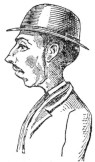
THE PORTRAIT WHICH LED TO LEFROY’s ARREST (p. 12). (By permission of the “Daily Telegraph.”)
III.—THE PRESS AN AID TO THE POLICE.
Long ago, as far back as the murder of Lord William Russell by Courvoisier, proof of the crime was greatly assisted by the publication of the story in the Press. Madame Piolaine, an hotel-keeper, read in the newspaper of the arrest of a suspected person, recognising him as a man who had been in her service as a waiter. Only a day or two after the murder he had come to her, begging her to take charge of a brown paper parcel, for which he would call. He had never returned, and now Madame Piolaine hunted up the parcel, which lay at the bottom of a cupboard, where she had placed it. The fact that Courvoisier had brought it justified her in examining it, and she now found that it contained a quantity of silver plate, and other articles of value. When the police were called in, they identified the whole as part of the property abstracted from Lord William Russell’s. Here was a link directly connecting Courvoisier with the murder. Hitherto the evidence had been mainly presumptive. The discovery of Lord William’s Waterloo medal, with his gold rings and a ten-pound note, under the skirting-board in Courvoisier’s pantry was strong suspicion, but no more. The man had a gold locket, too, in his possession, the property of Lord William Russell, but it had been lost some time antecedent to the murder. All the evidence was presumptive, and the case was not made perfectly clear until Madame Piolaine was brought into it through the publicity given by the Press.
In the murder of Mr. Briggs by the German, Franz Müller, detection was greatly facilitated by the publicity given to the facts of the crime. The hat found in the railway carriage where the deed had been done was a chief clue. It bore the maker’s name inside the cover, and very soon a cabman who had read this in the newspaper came forward to say he had bought that very hat at that very maker’s for a man named Müller. Müller had been a lodger of his, and had given his little daughter a jeweller’s cardboard box, bearing the name of “Death, Cheapside.” Already this Mr. Death had produced the murdered man’s gold chain, saying he had given another in exchange for it to a man supposed to be a German. There could be no doubt now that Müller was the murderer. His movements were easily traced. He had gone across the Atlantic in a sailing ship, and was easily forestalled by the detectives in a fast Atlantic liner, which also carried the jeweller and the cabman.
Where identity is clear the publication of the signalement, if possible of the likeness, has reduced capture to a certainty; it is a mere question then of time and money. Lefroy, the murderer of Mr. Gold, was caught through the publicity given to his portrait, which had appeared in the columns of the Daily Telegraph. Some eminent but highly cautious police officers nevertheless deprecate the interference of the Press, and have said that the premature or injudicious disclosure of facts obtained in the progress of investigation has led to the escape of criminals. It is to be feared that there is an increasing distrust of the official methods of detection, and the Press is more and more inclined to institute a pursuit of its own when mysterious cases continue unsolved. We may yet see this system, which has sometimes been employed by energetic reporters in Paris, more largely adopted here. Without entering into the pro’s and con’s of such competition, it is but right to admit that the Press, with its powerful influence, its ramifications endless and widespread, has already done great service to justice in following up crime. So convinced are the London police authorities of the value of a public organ for police purposes, that they publish a newspaper of their own, the admirably managed Police Gazette, which is an improved form of a journal started in 1828. This gazette, which is circulated gratis to all police forces in the United Kingdom, gives full particulars of crimes and of persons “wanted,” with rough but often life-like woodcut portraits and sketches that help capture. Ireland has a similar organ, the Dublin Hue and Cry; and some of the chief constables of counties send out police reports that are highly useful at times. Through these various channels news travels quickly to all parts, puts all interested on the alert, and makes them active in running down their prey.
IV.—THE IMPORTANCE OF SMALL CLUES.
Detection depends largely, of course, upon the knowledge, astuteness, ingenuity, and logical powers of police officers, although they find many independent and often unexpected aids, as we shall see. The best method of procedure is clearly laid down in police manuals: an immediate systematic investigation on the theatre of a crime, the minute examination of premises, the careful search for tracks and traces, for any article left behind, however insignificant, such as the merest fragment of clothing, a scrap of paper, a harmless tool, a hat, half a button; the slow, persistent inquiry into the antecedents of suspected persons, of their friends and associates, their movements and ways, unexplained change of domicile, proved possession of substantial funds after previous indigence—all these are detailed for the guidance of the detective. It will be seen in the following pages how small a thing has often sufficed to form a clue. A name chalked upon a door in tell-tale handwriting; half a word scratched upon a chisel, has led to the identification of its guilty owner, as in the case of Orrock. A button dropped after a burglary has been found to correspond with those on the coat of a man in custody for another offence, and with the very place from which it was torn. The cloth used to enclose human remains has been recognised as that used by tailors, and the same with the system of sewing, thus narrowing inquiry to a particular class of workmen; and the fact is well illustrated in the detection of Voirbo, to be hereafter told. The position of a body has shown that death could not have been accidental. A false tooth, fortunately incombustible, has sufficed for proof of identity when every other vestige has been annihilated by fire, as in the case of Dr. Webster of Boston.
The conclusion generally arrived at was that the facts actually did happen very much as they were related, yet the whole story is involved in mystery. The only solution, so far as Perry is concerned, is that he was mad, as the second judge indeed declared. But we cannot account for Harrison’s conduct on any similar supposition. If his own story is rejected as too wild and improbable for credence, some other explanation must be found of his disappearance. Unless he was out of the country, or at least beyond all knowledge of events at Campden, it is difficult to understand what motive would have weighed with him when he heard that three persons were to be hanged as his murderers. The only possible conclusion, therefore, is that he was carried away, and kept away by force.
“The interesting letter itself I recommended should be put in the archives of the Dundonald family, and this I believe has been done.”
Fouché has been very differently judged by his contemporaries. Some thought him an acute and penetrating observer, with a profound insight into character; knowing his epoch, the men and matters appertaining to it, intimately and by heart. Others, like Bourrienne, despised and condemned him. “I know no man,” says the latter, “who has passed through such an eventful period, who has taken part in so many convulsions, who so barely escaped disgrace and was yet loaded with honours.” The keynote of his character, thought Bourrienne, was great levity and inconstancy of mind. Yet he carried out his schemes, planned with mathematical exactitude, with the utmost precision. He had an insinuating manner; could seem to speak freely when he was only drawing others on. A retentive memory and a great grasp of facts enabled him to hold his own with many masters, and turn most things to his own advantage. He did not long survive the Restoration, and died at Trieste in 1820, leaving behind him a very considerable fortune.
Serjeant Ballantine, as I have said, paid the Bow Street runners the high compliment of preferring their methods to those of our modern detectives. They kept their own counsel strictly, he thought, withholding all information, and being especially careful to give the criminal who was “wanted” no notion of the line of pursuit, of how and where a trap was to be laid for him, or with what it would be baited. They never let the public know all they knew, and worked out their detection silently and secretly. The old Serjeant was never friendly to the “New Police,” and his criticisms were probably coloured by this dislike. That it may be often unwise to blazon forth each and every step taken in the course of an inquiry is obvious enough, and there are times when the utmost reticence is indispensable. The modern detective is surely alive to this; the complaint is more often that he is too chary of news than that he is too garrulous and outspoken.
It is impossible to leave this subject without adverting to the excellent provincial police now invariably established in the great cities and wide country districts, who, especially as regards the former, have an organisation and duties almost identical with those already detailed. The police forces of Liverpool, Manchester, Birmingham, Edinburgh, Glasgow, and the rest yield nothing in demeanour, devotion, and daring to their colleagues of the Metropolis. In the counties, where large areas often have to be covered, great responsibility must be devolved upon officers of inferior rank, and it is not abused. These sergeants or inspectors, with their half-dozen men, are so many links in a long-drawn chain. Much depends upon them, their energy and endurance. They, too, have to prevent crime by their constant vigilance on the high roads, and by keeping close watch on all suspicious persons. For the same reason special qualities are needed in the county chief constable and his deputy; the task of superintending their posts at wide distances apart, and controlling the movements of tramps and bad characters through their district, calls for the exercise of peculiar qualities, the power of command, of rapid transfer from place to place, of keen insight into character, of promptitude and decision—qualities that are most often found in military officers, who are, in fact, generally preferred for these appointments.
With such men as this on the side of law and justice, long-continued fraud, however astutely prepared, becomes almost impossible. The private inquiry agent is generally equal to any emergency.
The famous detective, Pinkerton, was called in, and soon guessed that Shinburn had been at work. Some of the confederates were arrested, and presently Shinburn was taken, but only after a desperate encounter. Now, to ensure safe custody, the prisoner was handcuffed to one of Pinkerton’s assistants, and both were locked up in a room at the hotel. Yet Shinburn, during the night, contrived to pick the lock of the handcuff by means of the shank of his scarf-pin, and, shaking himself free, slipped quietly away. He fled to Europe, and paid a first visit to Belgium, but went back to the States to make one last grand coup. This was the robbery of the Ocean Bank in New York, from which he took £50,000 in securities, notes, and gold. With this fine booty he returned to Belgium, bought himself a title, and—at least outwardly—lived the life of an honest and respectable citizen. We have seen that Sheridan, another American “crook,” spent some years in Brussels, and it is strongly suspected that he and Shinburn were concerned in the famous mail train robbery and other great crimes in Belgium.
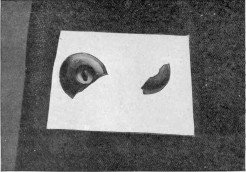
Photo: Cassell & Company, Limited. BROKEN BUTTON AT THE BLACK MUSEUM: A CLUE. (The white paper has been placed upon the cloth to show up the button.)
In one clear case of murder, detection was aided by the simple discovery of a few half-burnt matches that the criminal had used in lighting candles in his victim’s room to keep up the illusion that he was still alive. A dog, belonging to a murdered man, had been seen to leave the house with him on the morning of the crime, and was yet found fourteen days later alive and well, with fresh food by him, in the locked-up apartment to which the occupier had never returned. The strongest evidence against Patch, the murderer of Mr. Blight at Rotherhithe, was that the fatal shot could not possibly have been fired from the road outside, and the first notion of this was suggested by the doctor called in, afterwards eminent as Sir Astley Cooper. In the Gervais case proof depended greatly upon the date when the roof of a cellar had been disturbed, and this was shown to have been necessarily some time before, for in the interval the cochineal insects had laid their eggs, and this only takes place at a particular season. We shall see in the Voirbo case, quoted above, how an ingenious police officer, when he found bloodstains on a floor, discovered where a body had been buried by emptying a can of water on the uneven stones and following the channels in which it ran.
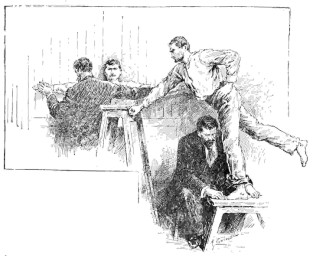
TAKING MEASUREMENTS OF CRIMINALS (BERTILLON SYSTEM).
Finger-prints and foot-marks have again and again been cleverly worked into undeniable evidence. The impression of the first is personal and peculiar to the individual; by the latter the police have been able to fix beyond question the direction in which criminals have moved, their character and class, and the neighbourhood that owns them. The labours of the scientist have within the last few years produced new methods of identification, which are invaluable in the pursuit and detection of criminals. The patient investigations of a medical expert, M. Bertillon, of Paris (one of the witnesses in the Dreyfus case), developing the scientific discovery of his father, have proved beyond all question that certain measurements of the human frame are not only constant and unchangeable, but peculiar to each subject; the width of the head, the length of the face, of the middle finger, of the lower limbs from knee to foot, and so forth, provide such a number of combinations that no two persons, speaking broadly, possess them all exactly alike. This has established the system of anthropometry, of “man measurement,” which has now been adopted on the same lines by every civilised nation in the world. The system, however, is on the face of it a complicated one, and at New Scotland Yard it has now been abandoned in favour of the finger-prints method. Mr. Francis Galton, to whose researches this mode of identification is due, has proved that finger prints, exhibited in certain unalterable combinations, suffice to fix individual identity, and his system of notation, as now practised in England, will soon provide a general register of all known criminals in the country.
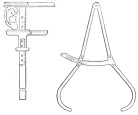
EAR AND HEAD MEASURERS (THE BERTILLON SYSTEM).

MR. GALTON’S TYPES OF FINGER-PRINTS.
The ineffaceable odour of musk and other strong scents has more than once brought home robbery and murder to their perpetrators. A most interesting case is recorded by General Harvey,[1] where, in the plunder of a native banker and pawnbroker in India, an entire pod of musk, just as it had been excised from the deer, was carried off with a number of valuables. Musk is a costly commodity, for it is rare, and obtained generally from far-off Thibet. The police, in following up the dacoits, invaded their tanda, or encampment, and were at once conscious of an unmistakable and overpowering smell of musk,
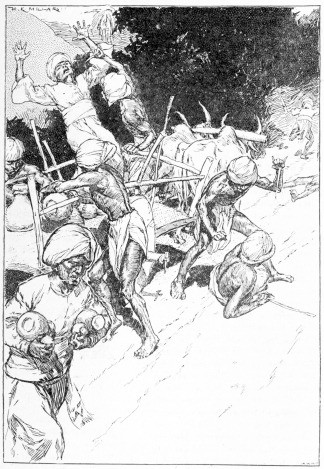
“AFTER A SHORT STRUGGLE ... THE THIEVES SEIZED THE OPIUM” (p. 18.)
which was presently dug up with a number of rupees, coins of an uncommon currency.
In another instance a scent merchant’s agent, returning from Calcutta, brought back with him a flask of spikenard. He travelled up country by boat part of the way, then landed to complete the journey, and carried with him the spikenard. He fell among thieves, a small gang of professional poisoners, who disposed of him, killing him and his companions and throwing them into the river. Long afterwards the criminals, who had appropriated all their goods, were detected by the tell-tale smell of the spikenard in their house, and the flask, nearly emptied, was discovered beneath a stack of fuel in a small room.
Yet again, the smell of opium led to the detection of a robbery in the Punjaub, where a train of bullock carts laden with the drug was plundered by dacoits. After a short struggle the bullock drivers bolted, the thieves seized the opium and buried it. But, returning through a village, they were intercepted as suspicious characters, and it was found that their clothes smelt strongly of opium. Then their footsteps were traced back to where they had committed the robbery, and thence to a spot in the dry bed of a river, in which the opium was found buried.
In India, again, many cases of obscure homicide have been brought to light by such a trifling fact as the practice, common among native women, of wearing glass, or rather shell lac, bangles or bracelets. These choorees, as they are called, are heated, then wound round wrist or ankle in continuous circles and joined. They are very brittle, and will naturally be easily smashed in a violent struggle. Fruitless search was made for a woman who had disappeared from a village, until in a field adjoining the fragments of broken choorees were picked up. On digging below, the corpse of the missing woman, bearing marks of foul play, was discovered.
In another case a father identified certain broken choorees as belonging to his daughter; they had been found, with traces of blood and wisps of female hair, near a well, and were the means of bringing home the murder. Cheevers[2] tells us that a young woman was seen to throw a boy ten years of age into a dry well twenty feet deep. Information was given, and the child was extracted, a corpse. Pieces of choorees were picked up near the well similar to those worn by the woman, who was arrested and eventually convicted of murder. Here the ingenious defence was set up that the child’s mother, a woman of the same caste as the accused, and likely to wear the same kind of bangle, had gone to wail at the well-side and might have broken her glass ornaments in the excess of her grief. But sentence of death was passed.
V.—“LUCK” FOR AND AGAINST CRIMINALS.
Among the many outside aids to detection, “luck,” blind chance, takes a very prominent place. We shall come upon innumerable instances of this. Troppmann, the wholesale murderer, was apprehended quite by accident, because his papers were not in proper form. He might still have escaped prolonged arrest had he not run for it and tried to drown himself in the harbour at Havre. The chief of a band of French burglars was arrested in a street quarrel, and was found to be carrying a great part of the stolen bonds in his pocket. When Charles Peace was taken at Blackheath in the act of burglary, and charged with wounding a policeman, no one suspected that this supposed half-caste mulatto, with his dyed skin, was a murderer much wanted in another part of the country. Every good police officer freely admits the assistance he has had from fortune. One of these—famous, not to say notorious, for he fell into bad ways—described to me how he was much thwarted and baffled in a certain case by his inability to come upon the person he was after, or any trace of him, and how, meeting a strange face in the street, a sudden impulse prompted him to turn and follow it, with the satisfactory result that he was led straight to his desired goal. The same officer confessed that chancing to see a letter delivered by the postman at a certain door he was tempted to become possessed of it, and did not hesitate to steal it. When he had opened and read it, he found the clue of which he was in search!
Criminals themselves believe strongly in luck, and in some cases are most superstitious. An Italian, whose speciality was sacrilege, never broke into a church without kneeling down before the altar to pray for good fortune and large booty. The whole system of Thuggee was based on superstition. The bands never operated without taking the omens; noting the flight of birds, the braying of a jackass to right or left, and so on, interpreting these things as warnings
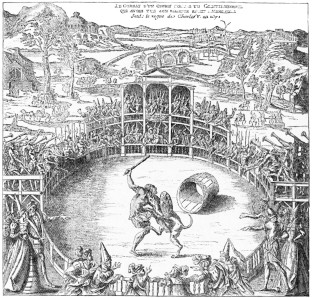
THE FIGHT BETWEEN MACAIRE AND THE DOG OF MONTARGIS. (From an Old Print.)
or as encouragements to proceed. This superstitious belief in luck is still prevalent. A notorious banknote forger in France carefully abstained from counterfeiting notes of two values, those for 500 francs and 2,000 francs, being convinced that they would bring him into trouble. Thieves, it has been noticed, generally follow one line of business, because a first essay in it was successful. The man who steals coats steals them continually; once a horse thief always a horse thief; the forger sticks to his own line, as do the pickpocket, the burglar, and the performer of the confidence trick. The burglar dislikes extremely the use of any tools or instruments but his own; he generally believes that another man’s false keys, jemmies, and so forth, would bring him bad luck. Only in matter-of-fact America does the cracksman rise superior to superstition. There a good business is done by certain people who lend housebreaking tools on hire.
Instinct, aboriginal and animal, has helped at times to bring criminals to justice. The mediæval story of the dog of Montargis may be mere fable, but it rests on historic tradition that after Macaire had murdered Aubry de Montdidier in the forest of Bondy, the extraordinary aversion shown by the dog to Macaire first aroused suspicion, and led to the ordeal of mortal combat, in which the dog triumphed.
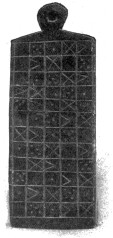
SUMATRAN THIEVES’ CALENDAR (BRITISH MUSEUM) FOR CALCULATING LUCKY DAYS.
It has been sometimes suggested that the instinct of animals might be further utilised in the pursuit of criminals. Something more than the well-known unerring chase of the bloodhound might be got from the marvellous intelligence of dogs. We shall see how the strange restlessness of the dog owned by Wainwright’s manager in the Whitechapel Road nearly led to the discovery of the murdered Harriet Lane’s remains. The clever beast was perpetually scratching at the floor beneath which the poor woman was buried, and his inconvenient restlessness no doubt led to his own destruction, for Wainwright is said to have made away with the dog. In India the idea of using the pariah dog for the purpose of smelling out buried bodies has been often put forward. Dogs would avail little, however, if the corpse lay at a great depth below ground, and hence the suggestion to draw upon the keener sense, exercised over a wider range above and below ground, of the vulture. This foul bird is commonly believed to be untameable, but it might assist unconsciously. Vultures are much given to perching upon the same tree near every Indian station, and close observation might reveal the direction of their flight. Their presence at any particular spot would constitute fair grounds for suspicion that they were after carrion. Indian police experience records many cases of the discovery of bodies through the agency of kites, vultures, crows, and scavenging wild beasts. The howling of a jackal has given the clue; in one remarkable case the body of a murdered child was traced through the snarling and quarrelling of jackals over the remains. A murderer who had buried his victim under a heap of stones, on returning (the old story) to the spot found that it had been unearthed by wild animals.
VI.—THE TRACKING INSTINCT IN AUSTRALIAN ABORIGINES.
The strange, almost superhuman, powers of the Australian blacks in following blind, invisible tracks have been turned to good account in the detection of crime. Their senses of sight, smell, and touch are abnormally acute. They can distinguish the trail of lost animals one from the other, and follow it for hundreds of miles. Like the Red Indians of North America, they judge by a leaf, a blade of grass, a mere splash in the mud; they can tell with unfailing precision whether the ground has been recently disturbed, and even what has passed over it.
A remarkable instance occurred in the colony of Victoria in 1851, when a stockholder, travelling up to Melbourne with a considerable sum of money, disappeared. His horse had returned riderless to the station, and without saddle or bridle. A search was at once instituted, but proved fruitless. The horse’s hoof-marks were followed to the very boundary of the run, near which stood a hut occupied by two shepherds. These men, when questioned, declared that neither man nor horse had passed that way. Then a native who worked on the station was pressed into the service, and starting from the house, walking with downcast eyes and occasionally putting his nose to the ground, he easily followed the horse’s track to the shepherds’ hut, where he at once offered some information. “Two white mans walk here,” he said, pointing to indications he alone could discover on the ground. A few yards farther he cried, “Here fight! here large fight!” and it was seen that the grass had been trampled down. Again, close at hand, he shouted in great excitement, “Here kill—kill!” A minute examination of the spot showed that the earth had been moved recently, and on turning it over a quantity of clotted blood was found below.
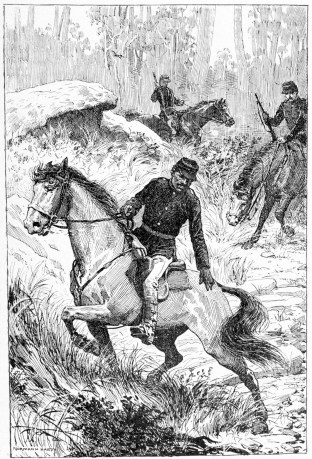
AN AUSTRALIAN NATIVE TRACKING. (A Sketch from Life.)
There was nothing, however, definitely to prove foul play, and further search was necessary. The black now discovered the tracks of men by the banks of a small stream hard by, which formed the boundary of the run. The stream was shrunk to a tiny thread after the long drought, and here and there was swallowed up by sand. But it gathered occasionally into deep, stagnant pools, which marked its course. Each of these the native examined, still finding foot-marks on the margin. At last the party reached a pond larger than any, wide, and seemingly very deep. The tracker, after circling round and round the bank, said the trail had ceased, and bent all his attention upon the surface of the water, where a quantity of dark scum was floating. Some of this he skimmed off, tasted and smelt it, and decided positively—“White man here.”
The pond was soon dragged with grappling-irons and long spears, and presently a large sack was brought up, which was found to contain the mangled remains of the missing stockholder. The sack had been weighted with many stones to prevent it from rising to the surface.
Suspicion fell upon the two shepherds who lived in the hut on the boundary of the run. One was a convict on ticket-of-leave, the other a deserter from a regiment in England. Both had taken part in the search, and both had appeared much agitated and upset as the black’s marvellous discoveries were laid bare. Both, too, incautiously urged that the search had gone far enough, and protested against examining the ponds. While this was being done, and unobserved by them, a magistrate and two constables went to their hut and searched it thoroughly. They first sent away an old woman who acted as the shepherds’ servant, and then turned over the place. Nothing was found in the hut, but in an outhouse they came upon a coat and waistcoat and two pairs of trousers, all much stained with fresh blood-marks. On this the shepherds were arrested and sent down to Melbourne.
What had become of the saddle-bags in which the murdered man had carried his cash? It was surmised that they had been put by in some safe place, and again the services of the native tracker were sought. He now made a start from the shepherds’ hut, and discovered as before, by sight and smell, the tracks of two men’s feet, travelling northward. These took him to a gully or dry watercourse, in the centre of which was a high pile of stones. The tracks ended at a stone on the side, where the native said he smelt leather. When several stones had been taken down, the saddle-bags, saddle, and bridle were found hidden in an inner receptacle. The money, the motive of the murder, was still in the bags—no less than £2,000—and had been left there, no doubt, for removal at a more convenient time.
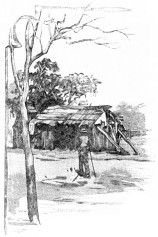
AUSTRALIAN SHEPHERD’S HUT.
The shepherds were put on their trial, and the evidence thus accumulated was deemed convincing by a jury. It was also proved that the blood-stained clothes had been worn by the prisoners both on the day before and on the very day of the murder. The stains were ascertained by chemical analysis to be of human blood, not of sheep’s, as set up by the defence. It was also shown that the men had been absent from the hut the greater part of the morning of the murder. They were executed at Melbourne.
This extraordinary faculty of following a trail is characteristic of all the Australian blacks. It was remarkably illustrated in a Queensland case, where a man was missing who was supposed to have been murdered, and whose remains were discovered by the black trackers. An aged shepherd, who had long served on a certain station, was at last sent off with a considerable sum, arrears of pay. He started down country, but was never heard of again. Various suspicious reports started a belief that he had been the victim of foul play. The police were called in, and proceeded to make a thorough search, assisted by several blacks, who usually hang about the station loafing. But they lost their native indolence when there was tracking to be done. Now they were roused to keenest excitement, and entered eagerly into the work, jabbering and gesticulating, with flashing eyes. No one, to look at these eyes, generally dull and bleary, could imagine that they possessed such visual powers, or that their owners were so shrewdly observant.
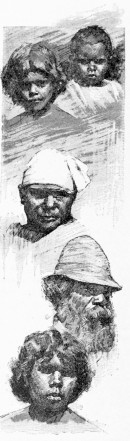
AUSTRALIAN NATIVE TYPES.
The search commenced at the hut lately occupied by the shepherd. The first thing discovered, lying among the ashes of the hearth, was a spade, which might have been used as a weapon of offence; spots on it, as the blacks declared, were of blood. Some similar spots were pointed out upon the hard, well-trodden ground outside, and the track led to a creek or water-hole, on the banks of which the blacks picked up among the tufts of short dried grass several locks of reddish-white hair, invisible to everyone else. The depths of the water were now probed with long poles, and the blacks presently fished up a blucher boot with an iron heel. The hair and the boot were both believed to belong to the missing shepherd. The trackers still found locks of hair, following them to a second water-hole, where all traces ceased, and it was supposed by some that the body lay there at the bottom. Not so the blacks, who asserted that it had now been lifted upon horseback for removal to a more distant spot, and in proof pointed out hoof-marks, which had escaped observation until they detected them. The hoof-marks were large and small, obviously of a mare and her foal. Yet the water-hole was searched thoroughly; the blacks stripped and dived, they smelt and tasted the water, but always shook their heads, and, as a matter of fact, nothing was found in this second creek. The pursuit returned to the hoof-marks, and these were followed to the edge of a scrub, where for the time they were lost.
Next day, however, they were again picked up, on the hard, bare ground, where there was hardly a blade of grass. They led to the far-off edge of a plain, towards a small spiral column which ascended into the sky. It was the remains of an old and dilapidated sheep-yard, which had been burnt by the station overseer. This man, it should have been premised, had all along been suspected of making away with the shepherd from interested motives, having been the depositary of his savings. And it was remembered that he had paid several visits in the last few days to the burning sheep-yard. Now, when the search party reached the spot, where little but charred and smouldering embers remained, the blacks eagerly turned over the ashes. Suddenly a woman, a black “gin,” screamed shrilly, and cried, “Bones sit down here,” and closer examination disclosed a heap of calcined human remains. Small portions of the skull were still unconsumed, and a few teeth were found, quite perfect, having altogether escaped the action of the fire. Soon the buckle of a belt was discovered, and identified as having been worn by the missing shepherd, and also the iron heel of a boot corresponding to that found in the first water-hole. Thus the marvellous sagacity of the black trackers had solved the mystery of the shepherd’s disappearance; but, although the shepherd’s fate was thereby established beyond doubt, the evidence was not sufficient to bring home the crime of murder to the overseer.
VII.—THE SHORTSIGHTEDNESS OF SOME CRIMINALS.
Not the least useful of the many allies found by the police are the criminals themselves. Their shortsightedness is often extraordinary; even when seemingly most careful to cover up their tracks they will neglect some small point, will drop unconsciously some slight clue, which, sooner or later, must betray them. In an American murder, at Michigan, a man killed his wife in the night by braining her with a heavy club. His story was that his bedroom had been entered through the window by some unknown murderer. This theory was at once disproved by the fact that the window was still nailed down on one side. The real murderer in planning the crime had extracted one nail and left the other.
The detection of the murderers of M. Delahache, a misanthrope who lived with a paralysed mother and one old servant in a ruined abbey at La Gloire Dieu, near Troyes, was much facilitated by the carelessness with which the criminals neglected to carry off a note-book from the safe. After they had slain their three victims, they forced the safe and carried off a large quantity of securities payable to bearer, for M. Delahache was a saving, well-to-do person. They took all the gold and banknotes, but they left the title-deeds of the property and his memorandum book, in which the late owner had recorded in shorthand, illegible by the thieves, the numbers and description of the stock he held, mostly in Russian and English securities. By means of these indications it was possible to trace the stolen papers and secure the thieves, who still possessed them, together with the pocket-book itself and a number of other valuables that had belonged to M. Delahache.
Criminals continually “give themselves away” by their own carelessness, their stupid, incautious behaviour. It is almost an axiom in detection to watch the scene of a murder for the visit of the criminal, who seems almost irresistibly drawn thither. The same impulse attracts the French murderer to the Morgue, where his victim lies in full public view. This is so thoroughly understood in Paris that the police keep officers in plain clothes among the crowd which is always filing past the plate-glass windows separating the public from the marble slopes on which the bodies are exposed. An Indian criminal’s steps generally lead him homeward to his own village, on which the Indian police set a close watch when a man is much wanted. Numerous cases might be quoted in which offenders disclose their crime by ill-advised ostentation: the reckless display of much cash by those who were, seemingly, poverty-stricken just before; self-indulgent extravagance, throwing money about wastefully, not seldom parading in the very clothes of their victims. A curious instance of the neglect of common precaution was that of Wainwright, the murderer of Harriet Lane, who left the corpus delicti, the damning proof of his guilt, to the prying curiosity of an outsider, while he went off in search of a cab.
One of the most remarkable instances of the want of reticence in a great criminal and his detection through his own foolishness occurred in the case of the Stepney murderer, who betrayed himself to the police when they were really at fault and their want of acuteness was being made the subject of much caustic criticism. The victim was an aged woman of eccentric character and extremely parsimonious habits, who lived entirely alone, only admitting a woman to help her in the housework for an hour or two every day. She owned a good deal of house property, let out in tenements to the working classes. As a rule she collected the rents herself, and was believed to have considerable sums from time to time in her house. This made her timid; being naturally of a suspicious nature, she fortified herself inside with closed shutters and locked doors, never opening to a soul until she had closely scrutinised any visitor. It called for no particular remark that for several days she had not issued forth. She was last seen on the evening of the 13th of August, 1860. When people came to see her on business on the 14th, 15th, and 16th, she made no response to their loud knockings, but her strange habits were well known; moreover, the neighbourhood was so densely inhabited that it was thought impossible she could have been the victim of foul play.
At last, on the 17th of August, a shoemaker named Emm, whom she sometimes employed to collect rents at a distance, went to Mrs. Elmsley’s lawyers and expressed his alarm at her non-appearance. The police were consulted, and decided to break into the house. Its owner was found lying dead on the floor in a lumber-room at the top of the house. Life had been extinct for some days, and death had been caused by blows on the head with a heavy plasterer’s hammer. The body lay in a pool of blood, which had also splashed the walls, and a bloody footprint was impressed on the floor, pointing outwards from the room. There were no appearances of forcible entry to the house, and the conclusion was fair that whoever had done the deed had been admitted by Mrs. Elmsley herself. A possible clue to the criminal was afforded by the several rolls of wall-paper lying about near the corpse. Mrs. Elmsley was in the habit of employing workmen on her own account to carry out repairs and decorations in her houses, and the indications pointed to her having been visited by one of these, who had perpetrated the crime. Yet the police made no useful deductions from these data.
While they were still at fault a man named Mullins, a plasterer by trade and an ex-member of the Irish constabulary, who knew Mrs. Elmsley well and had often worked for her, came forward voluntarily to throw some light on the mystery. Nearly a month had elapsed since the murder, and he declared that during this period his attention had been drawn to the man Emm and his suspicious conduct. He had watched him, had frequently seen him leave his cottage and proceed stealthily to a neighbouring brickfield, laden on each occasion with a parcel he did not bring back. Mullins, after giving this information quite unsought, led the police officers to the spot, and into a ruined outbuilding, where a strict search was made. Behind a stone slab they discovered a paper parcel containing articles which were at once identified as part of the murdered woman’s property. Mullins next accompanied the police to Emm’s house, and saw the supposed criminal arrested. But to his utter amazement the police turned on Mullins and took him also into custody. Something in his manner had aroused suspicion, and rightly, for eventually he was convicted and hanged for the crime.
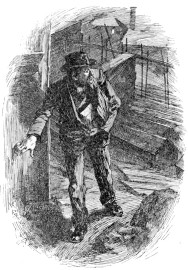
“HAD ... FREQUENTLY SEEN HIM ... PROCEED STEALTHILY TO A NEIGHBOURING BRICKFIELD.”
Here Mullins had only himself to thank. Whatever the impulse—that strange restlessness that often affects the secret murderer, or the consuming fear that the scent was hot, and his guilt must be discovered unless he could shift suspicion—it is certain that but for his own act he would never have been arrested. It may be interesting to complete this case, and show how further suspicion settled around Mullins. The parcel found in the brickfield was tied up with a tag end of tape and a bit of a dirty apron string. A precisely similar piece of tape was discovered in Mullins’s lodgings lying upon the mantelshelf. There was an inner parcel fastened with waxed cord. The idea with Mullins was, no doubt, to suggest that the shoemaker Emm had used cobbler’s wax. But a piece of wax was also found in Mullins’s possession, besides several articles belonging to the deceased.
The most conclusive evidence was the production of a plasterer’s hammer, which was also found in Mullins’s house. It was examined under the microscope, and proved to be stained with blood. Mullins had thrown away an old boot, which chanced to be picked up under the window of a room he occupied. This boot fitted exactly into the blood-stained footprint on the floor in Mrs. Elmsley’s lumber-room; moreover, two nails protruding from the sole corresponded with two holes in the board, and, again, a hole in the middle of the sole was filled up with dried blood. So far as Emm was concerned, he was able clearly to establish an alibi, while witnesses were produced who swore to having seen Mullins coming across Stepney Green at dawn on the day of the crime with bulging pockets stuffed full of something, and going home; he appeared much perturbed, and trembled all over.
Mullins was found guilty without hesitation, and the judge expressed himself perfectly satisfied with the verdict. The case was much discussed in legal circles and in the Press, and all opinions were unanimously hostile to Mullins. The convict steadfastly denied his guilt to the last, but left a paper exonerating Emm. It is difficult to reconcile this with his denunciation of that innocent man, except on the ground of his own guilty knowledge of the real murderer. In any case, it was he himself who first lifted the veil and stupidly brought justice down upon himself.
The case of Mullins was in some points forestalled by the discovery of an Indian murder, in which the native police ingeniously entrapped the criminal to assist in his own detection. A man in Kumacu, named Mungloo, disappeared, and a neighbour, Moosa, was suspected of having made away with him. The police, unable to bring home the murder to him, caught him by bringing to him a corpse which they declared was Mungloo’s. Moosa knew better, and said so. Imprudently anxious to shift all suspicion from himself, he told the police that a certain Kitroo knew where the real corpse lay, and advised them to arrest him. Kitroo was seized, and confessed in effect that Mungloo was buried close to his house. The ground was opened, and at a considerable depth down the body was found. Now Moosa came forward and claimed the credit, as well as the proffered reward for discovery. He was, he said, the first to indicate where the body was hidden. But Kitroo turned Queen’s evidence, and swore that he had seen the murder committed by Moosa and three others, and that, as he was an eye-witness, he was compelled by them to become an accomplice. Moosa was sentenced to transportation for life. There was in his case no necessity to accuse Kitroo, and but for his officiousness the corpse would never, probably, have been brought to light.
VIII.—SOME UNAVENGED CRIMES.
There have, however, been occasions when detection has failed more or less completely. The police do not admit always that the perpetrators remain unknown; they have clues, suspicion, strong presumption, even more, but there is a gap in the evidence forthcoming, and to attempt prosecution would be to face inevitable defeat. To this day it is held at Scotland Yard that the real murderer in a mysterious murder in London in the seventies was discovered, but that the case failed before an artfully planned alibi. Sometimes an arrest is made on grounds that afford strong primâ-facie evidence, yet the case breaks down in court. The Burdell murder in 1857, in New York, was one of these. Dr. Burdell was a wealthy and eccentric dentist, owning a house in Bond Street, the greater part of which he let out in tenements. One of his tenants was a Mrs. Cunningham, to whom he became engaged, and whom, according to one account, he married. In any case, they quarrelled furiously, and Dr. Burdell warned her that she must leave the house, as he had let her rooms. Whereupon she told him significantly that he might not live to sign the agreement. Shortly afterwards he was found murdered, stabbed with fifteen wounds, and there were all the signs of a violent struggle. The wounds must
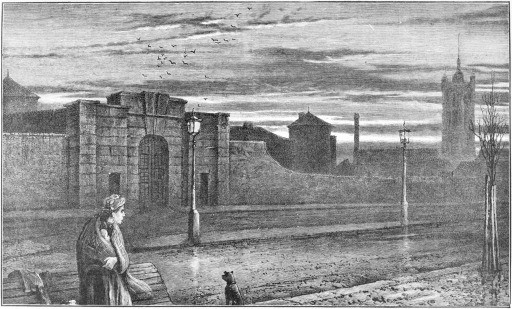
OLD MILLBANK PRISON.
have been inflicted by a left-handed person, and Mrs. Cunningham was proved to be left-handed. The facts were strong against her, and she was arrested, but was acquitted on trial.
It came out long after the mysterious Road (Somerset) murder that the detectives were absolutely right about it, and that Inspector Whicher, of Scotland Yard, in fixing the crime on Constance Kent, had worked out the case with singular acumen. He elicited the motive—her jealousy of the little brother, one of a second family; he built up the clever theory of the abstracted nightdress, and obtained what he considered sufficient proof. It will be remembered that this accusation was denounced as frivolous and unjust. Mr. Whicher was so overwhelmed with ridicule that he soon afterwards retired from the force, and died, it was said, of a broken heart. His failure, as it was called, threw suspicion upon Mr. Kent, the father of the murdered child, and Gough, the boy’s nurse, and both were apprehended and charged, but the cases were dismissed. In the end, as all the world knows, Constance Kent, who had entered an Anglican sisterhood, made full confession to the Rev. Mr. Wagner, of Brighton, and she was duly convicted of murder. Although sentence of death was passed, it was commuted, and I had her in my charge at Millbank for years.
The outside public may think that the identity of that later miscreant, “Jack the Ripper,” was never revealed. So far as absolute knowledge goes, this is undoubtedly true. But the police, after the last murder, had brought their investigations to the point of strongly suspecting several persons, all of them known to be homicidal lunatics, and against three of these they held very plausible and reasonable grounds of suspicion. Concerning two of them the case was weak, although it was based on certain suggestive facts. One was a Polish Jew, a known lunatic, who was at large in the district of Whitechapel at the time of the murder, and who, having developed homicidal tendencies, was afterwards confined in an asylum. This man was said to resemble the murderer by the one person who got a glimpse of him—the police-constable in Mitre Court. The second possible criminal was a Russian doctor, also insane, who had been a convict in both England and Siberia. This man was in the habit of carrying about surgical knives and instruments in his pockets; his antecedents were of the very worst, and at the time of the Whitechapel murders he was in hiding, or, at least, his whereabouts was never exactly known. The third person was of the same type, but the suspicion in his case was stronger, and there was every reason to believe that his own friends entertained grave doubts about him. He also was a doctor in the prime of life, was believed to be insane or on the borderland of insanity, and he disappeared immediately after the last murder, that in Miller’s Court, on the 9th of November, 1888. On the last day of that year, seven weeks later, his body was found floating in the Thames, and was said to have been in the water a month. The theory in this case was that after his last exploit, which was the most fiendish of all, his brain entirely gave way, and he became furiously insane and committed suicide. It is at least a strong presumption that “Jack the Ripper” died or was put under restraint after the Miller’s Court affair, which ended this series of crimes. It would be interesting to know whether in this third case the man was left-handed or ambidextrous, both suggestions having been advanced by medical experts after viewing the victims. It is true that other doctors disagreed on this point, which may be said to add another to the many instances in which medical evidence has been conflicting, not to say confusing.
Yet the incontestable fact remains, unsatisfactory and disquieting, that many murder mysteries have baffled all inquiry, and that the long list of undiscovered crimes is continually receiving mysterious additions. An erroneous impression, however, prevails that such failures are more common in Great Britain than elsewhere. No doubt the British police are greatly handicapped by the law’s limitations, which in England always act in protecting the accused. But with all their advantages, the power to make arrests on suspicion, to interrogate the accused parties and force on self-incrimination, the Continental police meet with many rebuffs. Numbers of cases are “classed,” as it is officially called in Paris—that is, pigeon-holed for ever and a day, lacking sufficient proofs for trial, and in some instances, indeed, there is no clue whatever. In every country, and in all times, past and present, there have been crimes that defied detection.
Feuerbach, in his record of criminal trials in Bavaria, tells, for example, of the unsolved murder mystery of one Rupprecht, a notorious usurer of Munich, who was killed in 1817 in the doorway of a public tavern not fifty yards from his own residence. Yet his murderer was never discovered. The tavern was called the “hell”; it was a place of evil resort, for Rupprecht, a mean, parsimonious old curmudgeon, was fond of low company and spent most of his nights here, swallowing beer and cracking jokes with his friends. One night the landlord, returning from his cellar, heard a voice in the street asking for Rupprecht, and, going up to the drinking saloon, conveyed the message. Rupprecht went down to see his visitor and never returned. Within a minute deep groans were heard as of a person in a fit or in extreme pain. All rushed downstairs and found the old man lying in a pool of blood just inside the front door. There was a gaping wound in his head, but he was not unconscious, and kept repeating, “Wicked rogue! wicked villain! the axe! the axe!”
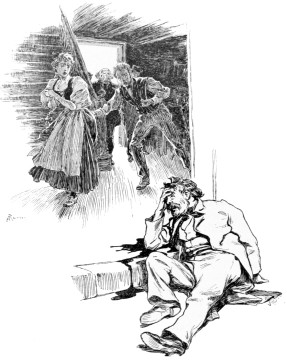
“FOUND THE OLD MAN LYING IN A POOL OF BLOOD.”
The wound had been inflicted by some sharp instrument, possibly a sword or sabre, wielded by a powerful hand. The victim must have been taken unawares, when his back was turned. The theory constructed by the police was that the murderer had waited within the porch out of sight, standing on a stone bench in a dark corner near the street door; that Rupprecht, finding no one to explain the summons, had looked out into the street and then had made to go back into the house. After he had turned the blow was struck. Thus not a scrap of a clue was left on the theatre of the crime. But Rupprecht was still alive and able to answer simple questions. A judge was summoned to interrogate him, and asked, “Who struck you?” “Schmidt,” replied Rupprecht. “Which Schmidt?” “Schmidt the woodcutter.” Further inquiries elicited statements that Schmidt had used a hatchet, that he lived in the Most, that they had quarrelled some time before. Rupprecht said he had recognised his assailant, and he went on muttering, “Schmidt, Schmidt, woodcutter, axe.” To find Schmidt was naturally the first business of the police. The name was as common as Smith is with us, and many Schmidts were woodcutters. Three Schmidts were suspected. One was a known confederate of thieves; another had been intimate, but afterwards was on bad terms, with Rupprecht: this was “Big Schmidt”; the third, his brother, “Little Schmidt,” also knew Rupprecht. All three, although none lived in the Most, were arrested and confronted with Rupprecht, but he recognised none of them; and he died next day, having become speechless and unconscious at the last. Only the first Schmidt seemed guilty; he was much agitated when interrogated, he contradicted himself, and could give no good account of the employment of his time when the offence was committed. Moreover, he had a hatchet; it was examined and spots were found upon it, undoubtedly of blood. He was brought into the presence of the dead Rupprecht, and was greatly overcome with terror and agitation.
Yet after the first accusation he offered good rebutting evidence. He explained the stain by saying he had a chapped hand which bled, and when it was pointed out that this was the right hand, which would be at the other end of the axe shaft, he was able in reply to prove that he was left-handed. Again, the wound in the head was considerably longer than the blade of the axe, and an axe cannot be drawn along after the blow. The murderer’s cries had been heard by the landlord, inquiring for Rupprecht, but it was not Schmidt’s voice. There was an alibi, moreover, or as good as one. Schmidt was at his mother-in-law’s, and was known to have gone home a little before the murder; soon after it, his wife found him in bed and asleep. If he had committed the crime he must have jumped out of bed again almost at once, run more than a mile, wounded Rupprecht, returned, gone back to bed and to sleep, all in less than an hour. Further, it was shown by trustworthy evidence that this Schmidt knew nothing of the murder after it had occurred.
The police drew blank also with “Big Schmidt” and “Little Schmidt,” neither of whom had left home on the night of the murder. They were no more successful with other Schmidts, although every one of the name was examined, and it was now realised that the last delirious words of the dying man had led them astray. But while hunting up the Schmidts it was not forgotten by the police that Rupprecht had also cried out, “My daughter! my daughter!” after he had been struck down. This might have been from the desire to see her in his last moments. On the other hand, he was estranged from this daughter, and he positively hated his son-in-law. They were no doubt a cold-blooded pair, these Bieringers, as they were called. The daughter showed little emotion when she heard her father had been mortally wounded; she looked at him as he lay without emotion, and had so little lost her appetite that she devoured a whole basin of soup in the house. It was suspicious, too, that she tried to fix the guilt on “Big Schmidt.” Bieringer was a man of superior station, well bred and well educated; and he lived on very bad terms with his wife, who was coarse, vulgar, and of violent temper like her father; and once at his instance she was imprisoned for forty-eight hours. Rupprecht sided with his daughter, and openly declared that in leaving her his money he would tie it up so tightly that Bieringer could not touch a penny. This he had said openly, and it was twisted into a motive why Bieringer should remove him before he could make such a will. But a sufficient alibi was proved by Bieringer; his time was accounted for satisfactorily on the night of the murder. The daughter was absolved from guilt, for even if she, a woman, could have struck so shrewd a blow, it was not to her interest to kill a father who sided with her against her husband and was on the point of making a will in her favour.
Other arrests were made, Rupprecht’s maid reported that three troopers belonging to the regiment in garrison had called on her master the very day of the murder; one of them owed him money which he could not pay, and the others, it was thought, had joined him in trying to intimidate the usurer. But the case of these troopers, men who could handle the very weapon that did the deed, broke down on clear proof that they were elsewhere at the time of the murder. The one flaw in the otherwise acute investigation was that the sabres of all the troopers had not been examined before so much noise had been made about the murder. But from the first attention had been concentrated on axes, wielded by woodcutters, and the probable use of a sabre had been overlooked. After the troopers, two other callers had come, and Rupprecht had given them a secret interview. One proved to be the regimental master-tailor, who was seeking a loan and had brought with him a witness to the transaction. Their innocence also was clearly proved; and although many other persons were arrested they were in all cases discharged.
[1] “Records of Indian Crime,” ii. 158.
[2] “Medical Jurisprudence of India,” p. 21.

“HER BODY ... WAS FOUND IN THE WATER” (p. 40.)
The murder of this Rupprecht has remained a mystery. The only plausible suggestion was that he had been murdered by some aggrieved person, some would-be borrower whom he had rejected, or some debtor who could not pay and thought this the simplest way of clearing his obligation. The authorities could not fix this on anyone, for Rupprecht made no record of his transactions; he could neither read nor write, and kept all his accounts “in his head.” Only on rare occasions did he call in a confidential friend to look through his papers when there was question of arranging them or finding a note of hand. No one but Rupprecht himself could have afforded the proper clue; and, as it was, he had led the police in the wrong direction.
Numerous murder mysteries have been contributed by American criminal records. Special interest attaches to the case of Mary Rogers, “the pretty cigar seller” of New York, who was done to death by persons unknown in 1840, because it formed the basis of Edgar Allan Poe’s famous story, “The Mystery of Marie Roget.” The scene of that story is Paris, but the murder was actually committed near New York. Mary Rogers had many admirers, but her character was good, her conduct seemingly irreproachable. She was supposed to have spent her last Sunday with friends, but was seen with a single companion late that afternoon at a little restaurant near Hoboken. As she never returned home her disappearance caused much excitement, but at length her body, much maltreated, was found in the water near Sybil’s Cave, Hoboken. Many arrests were made, but the crime was never brought home to anyone.
Poe’s suggested solution, the jealous rage of an old lover returned from sea, was no more than ingenious fiction. Among others upon whom suspicion fell was John Anderson, the cigar merchant in whose employ Mary Rogers was, and it was encouraged by his flight after the discovery of the murder. But when arrested and brought back, he adduced what was deemed satisfactory proof of an alibi. Anderson lived to amass enormous wealth, and about the time of his death in Paris in 1881 the evil reports of his complicity in the murder were revived, but nothing new transpired. It was said that in his later years Anderson became an ardent spiritualist, and that the murdered Mary Rogers was one among the many spirits he communed with.
The murder of Mary Rogers was not the only unsolved mystery of its class beyond the Atlantic. It was long antedated by that known as the Manhattan Well Mystery. This murder occurred as far back as 1799, when New York was little more than a village compared to its present size. The Manhattan Company, now a bank, had then the privilege of supplying the city with water. The well stood in an open field, and all passers-by had free access to it. One day the pretty niece of a respectable Quaker disappeared; she had left her home, it was said, to be privately married, and nothing more was seen of her till she was fished out of the Manhattan well. Some thought she had committed suicide, but articles of her dress were found at a distance from the well, including her shoes, none of which she was likely to have removed and left there before drowning herself. Her muff, moreover, was found in the water; why should she have retained that to the last? Suspicion rested upon the man whom she was to have married, and who had called for her in his sleigh after she had already left the house. This man was tried for his life, but the case broke down, and the murder has always baffled detection.
Later, in 1830, there was the mystery of Sarah M. Cornell, in which suspicion fell upon a reverend gentleman of the Methodist persuasion, who was acquitted. Again, in 1836, there was the murder of Helen Jewitt, which was never cleared up; and more recently that of the Ryans, brother and sister; while the murder of Annie Downey, commonly called “Curly Tom,” a New York flower-girl, recalls many of the circumstances of the murders in Whitechapel.
A great crime that altogether baffled the New York police occurred in 1870, and is still remembered as an extraordinary mystery. It was the murder of a wealthy Jew named Nathan, in his own house in Twenty-third Street. He had come up from the country in July for a religious ceremony, and slept at home. His two sons, who were in business, also lived in the Twenty-third Street house. The only other occupant was a housekeeper. The sons, returning late, one after the other, looked in on their father and found him sleeping peacefully. No noise disturbed the house during the night, but early next morning Mr. Nathan was found a shapeless mass upon the floor; he had been killed with brutal violence, and the weapon used, a ship carpenter’s “dog,” was lying close by the body besmeared with blood and grey hairs. The dead man’s pockets had been rifled, and all his money and jewellery were gone; a safe that stood in the corner of the bedroom had been forced and its contents abstracted.
Various theories were started, but none led to the track of the criminal. One of Mr. Nathan’s sons was suspected, but his innocence was clearly proved. Another person thought to be guilty was the son of the resident housekeeper, but that supposition also fell to the ground. Some of the police were of opinion that it was the work of an ordinary burglar; others opposed this view, on the ground that the ship carpenter’s “dog” was not a housebreaking tool. One ingenious solution was offered, and it may be commended to the romantic novelist; it was to the effect that Mr. Nathan held certain documents gravely compromising the character of a person with whom he had had business dealings, and that this person had planned and executed the murder in order to become repossessed of them. This theory had no definite support from known fact; but Mr. Nathan was a close, secretive man, who kept all the threads of his financial affairs in his own hands; and it was said that no one in his family, not even his wife, was aware what his safe held or what he carried in his pockets. It is worth noticing that this last theory resembles very closely the explanation suggested as a solution of the undiscovered murder of Rupprecht in Bavaria, which has been already described.
There are one or two striking cases in the records of Indian crime of murders that have remained undiscovered. Mr. Arthur Crawfurd[3] describes that of an old Marwari money-lender, which repeats in some particulars the cases of Rupprecht and Nathan. This usurer was reputed to be very wealthy. His business was extensive, all his neighbours were more or less in his debt, and, as he was a hard, unrelenting creditor, he was generally detested throughout the district.
He lived in a mud-built house all on the ground floor. In front was the shop where he received his clients, and in this room, visible from the roadway, was a vast deed-box in which he kept papers, bills, notes of hand, but never money. When he had agreed to make a loan and all formalities were completed, he brought the cash from a secret receptacle in an inner chamber. In this, his strong room, so to speak, which occupied one corner at the back of the house, he slept. In the opposite angle lived his granddaughter, a young widow, who kept house for him. He was protected by a guard of two men in his pay, who slept in an outhouse close by.
One night the granddaughter, disturbed by a strange noise in the old man’s sleeping place, rose, lit a lamp, and was on the point of entering the bedroom when the usurer appeared at the door, bleeding profusely from his mouth and nostrils; his eyes protruded hideously; he was clearly in the last extremity, and fell almost at once to the ground. The granddaughter summoned the watchmen, who only arrived in time to hear a few last inarticulate sounds as their master expired. It was seen afterwards at the post-mortem that he had been partially smothered, and subjected to great violence. His assailant must have knelt on him heavily, for the ribs were nearly all fractured and had been forced into the lungs.
The police arrived in all haste and made a thorough search of the premises. It was soon seen that a hole had been made from outside through the mud wall close by the old man’s bed. The orifice was just large enough to admit a man. There were no traces of any struggle save the blood, which had flowed freely and inundated the mattress. Strange to say, there had been no robbery. The money-lender’s treasure chamber was still secure, the lock intact, and all the money and valuables were found untouched: many bags of rupees, a tin case crammed with currency notes, and a package containing a considerable quantity of valuable jewellery. Nor had the deed-box in the shop been interfered with.
The perpetrators of this murder were never discovered. The police, hoping to entrap them in the not uncommon event of a return to the theatre of the crime, established themselves secretly inside the house, but not in the bedroom where the murder was accomplished. They were right in their surmise, but the design failed utterly through their culpable neglect. The bedroom, within a fortnight, was again entered, and in precisely the same way, while the careless watchers slept unconscious in the adjoining shop. The fair inference was that the murderers had returned hoping to lay hands on some of the booty which they had previously missed. But the old man’s treasure had been removed, and they went away disappointed and empty-handed, though unfortunately they escaped capture.
The same authority, Mr. Arthur Crawfurd, gives another case that belongs to the class of the New York murder of Mary Rogers
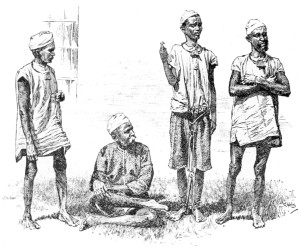
PRISONERS AT THE PRESIDENCY GAOL CALCUTTA. Photo: Kapp & Co., Calcutta.
and our own Whitechapel murders. The body of a female was washed ashore upon the rocks below the foot of Severndroog, in the South Konkan district. The fact was reported to Mr. Crawfurd, who found the body of a fine healthy young Mahomedan woman, who had not been dead for more than a couple of hours. The only injury to be seen was a severe extended wound upon one temple, which must have bled profusely, but was not, according to the medical evidence, sufficient to cause death. It seemed probable that she had been stunned by it and had fallen in the water, to be drowned, or that she had been thrown from the cliffs above on to the rocks, and, becoming unconscious, had slipped into the sea. She had, in fact, been seen crossing the cliffs on the morning of her death, and was easily recognised as the wife of a fisherman who lived in a village hard by, the port of which was filled with small craft that worked coastwise with goods and passengers, the only traffic of those days.
The only arrests made were those of two Europeans, soldiers, one an army schoolmaster on his way up coast to Bombay, the other a sergeant about to be pensioned; and both had been travelling by a coast boat which was windbound a little below the fort. They had been landed in order to take a little exercise, and had been forthwith stopped by a crowd of suspicious natives, who charged them with the crime. Yet on examination no blood stains were found upon their clothes, and nothing indicative of a struggle; moreover, it was soon clearly proved that they had not been put ashore till 10 a.m., whereas the dead body had been picked up before 8 a.m. Further inquiry showed that they were men of estimable character. But nothing else was elucidated beyond a vague report that the woman’s husband had reason, or believed himself to have reason, to accuse her of profligacy and had taken this revenge.
Another more recent Indian murder went near to being classed with the undiscovered. That it was brought home to its perpetrators was due to the keen intelligence of a native detective officer, the Sirdar Mir Abdul Ali, of the Bombay police. This clever detective, of whom a biography has appeared, belonged to the Bombay police, and his many successes show how much the Indian police has improved of late years. The murder was known as the Parel case. On the morning of the 24th of November, 1887, a deal box was picked up on a piece of open marsh close to the Elphinstone Station at Parel. Near it was an ordinary counterpane. It was at first supposed that the box had been stolen from the railway station, and the matter was reported to the police. An officer soon reached the spot, and ascertained that the box, from which an offensive smell issued, was locked and fastened. On breaking it open the remains of a woman were found within, coiled up and jammed in tightly, and in an advanced stage of decomposition. The face was so much battered that its features were unrecognisable, but the dress, that of a Mahomedan, might, it was hoped, lead to identification. According to custom, the police gathered in thousands of people by beat of battaki, or drum, but no one who viewed the corpse could recognise the clothes. Moreover, there was no woman reported missing at the time from any house in Bombay.
Abdul Ali shrewdly surmised either that the woman was a perfect stranger or that she had been murdered at a distance, and the box containing her remains had been brought into Bombay to be disposed of without attracting attention. This box furnished the clue. Abdul Ali, following out his idea of the stranger visitor, had caused search to be made through the “rest houses,” or musafarkhanas of Bombay, and in one of these the box was identified as the property of a Pathan, named Syed Gool, who had but recently married an unknown young woman and had apparently deserted her. At least, it came out that he had suddenly taken ship for Aden, and had been accompanied by his daughter and a friend, but not by his wife. Moreover, witnesses were now prepared to swear that the clothes found on the corpse at Parel much resembled those commonly worn by Syed Gool’s young wife. The evidence was little more than presumptive, but the head of the Bombay police persuaded the Governor to telegraph to the Resident of Aden to look out for the three passengers and arrest them on landing. They were accordingly taken into custody and sent back to Bombay.
Even now the case would have been incomplete but for the confession of one of the parties—Syed Gool’s friend, who was known as Noor Mahomed. This man, a confederate, on arrival at Bombay, made a clean breast of the crime and was admitted as an approver; but for that the offence might never have been brought home. Syed Gool, it appeared, had come from Karachi only a little before, had put up at the musafarkhana of one Ismail Habib in Pakmodia Street, where he had presently married one Sherif Khatum, whom he met in this same “rest house,” and the whole party had taken up their residence in another house in the same street. Noor Mahomed went on to say that husband and wife soon quarrelled as to the possession of the latter’s jewels, and their differences so increased in bitterness that Syed Gool resolved to murder the woman. He effected his purpose, assisted by his friend, using a pair of long iron pincers, with which he compressed her windpipe till she died of suffocation. The rest of the crime followed a not unusual course: the packing of the corpse in a wooden box which had been made to Syed Gool’s order by a carpenter, and its removal in a bullock cart to the neighbourhood of the Elphinstone Station, where the murderers hired a man to watch it for a few pence during their temporary absence. But they had no intention of returning; indeed, they embarked at once on board the Aden steamer, and the man left in charge of the box took it home with him, where it remained till he was alarmed by the offensive smell already mentioned. Then he prudently resolved to get rid of it by removing it to the spot on which it was found.[4]
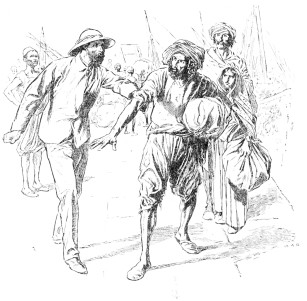
“THEY WERE ACCORDINGLY TAKEN INTO CUSTODY” (p. 46.)
The tale of undiscovered murders can never be ended, and additions are made to it continually. In this country fresh cases crop up year after year, and it would take volumes to catalogue them all. I will mention but one or two more, merely to point the moral that the police are often at fault still, even in these latter days of enlightened research, where so much makes in favour of the law. Thus the Burton Crescent murder, in December, 1878, must always be remembered against the police. An aged widow, named Samuel, lived at a house in Burton Crescent, but she kept no servant on the premises, and took in a lodger, although she was of independent means. The lodger was a musician in a theatrical orchestra, away most of the day, returning late to supper. One evening there was no supper and no Mrs. Samuel, but on making search he found her dead body in the kitchen, lying in a pool of blood. The police summoned a doctor to view the corpse, and it was found that Mrs. Samuel had been battered to death with the fragment of a hat-rail in which many pegs still remained. The pocket of her dress had been cut off, and a pair of boots was missing, but no other property. Nothing could have happened till late in the afternoon, as three workmen, against whom there was apparently no suspicion, were in the house till then, and the maid who assisted in the household duties had left Mrs. Samuel alive and well at 4 p.m. Only one arrest was made, that of a woman, one Mary Donovan, who was frequently remanded on the application of the police, but against whom no sufficient evidence was forthcoming to warrant her committal for trial. The Burton Crescent murder has remained a mystery to this day.
So has that of Lieutenant Roper, R.E., who was murdered at Chatham on the 11th of February, 1881. This young officer, who was going through the course of military engineering, was found lying dead at the bottom of the staircase leading to his quarters in Brompton Barracks. He had been shot with a revolver, and the weapon, six-chambered, was picked up at a short distance from the body, one shot discharged, the remaining five barrels still loaded with ball cartridges. The only presumption was that the murderer’s object was plunder, personal robbery. Mr. Roper had left the mess at an earlier hour than usual, between 8 and 9 p.m., on the plea that he had letters to write home announcing his approaching arrival on short leave of absence. A brother officer accompanied him part of the way to Brompton Barracks, but left him to attend some entertainment, Roper declining to go at once, for the reason given, but promising to join him later.
The unfortunate officer was quite unconscious when found, and although he survived some forty minutes, he never recovered the power of speech, so that he could give no indication as to his assailant. A poker belonging to Mr. Roper was found by his side, and it was inferred that he had entered his room before the attack, and had seized the poker as the only instrument of self-defence within reach. Not the slightest clue was ever obtained which would help to solve this mystery; rewards were offered, but in vain, and the police had at last to confess themselves entirely baffled. Mr. Roper was an exceedingly promising young officer; he had but just completed his course of instruction with considerable credit, and he was said to have been in perfect health and spirits on the fatal evening, so that there was nothing whatever to support, and indeed everything to discredit, any theory of suicide.
IX.—A GOOD WORD FOR THE POLICE.
Taking a general view of the case as between hunted and hunters, it may be fairly considered that the ultimate advantage is with the latter. Let it be remembered that we hear more of one instance of failure on the part of the police than of ninety-nine successes. The failure is proclaimed trumpet-tongued, the successes pass almost unnoticed into the great garner of criminal reports and judicial or police statistics.
At the very least it must be said that we are bound, in common justice, to give due credit to the ceaseless activity, the continual, painstaking effort of the guardians of the public weal. Their methods are the outcome of long and patient experience, developed and improved as time passes, and they have deserved, if not always commanded, success. It may be that the ordinary detective works a little too openly—at least, in this country; that his face and, till lately, his boots were well known in the circles generally frequented by his prey. Again, there may be at times slackness in pursuit, neglect or oversight of early clues. Well-meaning but obstinate men will not keep a perfectly open mind: they may cling too long and too closely to a first theory, wresting their opinions and forcing acquired facts to fit this theory, and so travel farther and farther along the wrong road. “Shadowing” suspected persons does not always answer, and may be carried too far; more, it may be so clumsily done as to put the quarry on his guard and altogether defeat the object in view. But to lay overmuch stress on such shortcomings as these would surely savour of hypercriticism. It is more just to accept with gratitude the overwhelming balance in favour of the police, and give them the credit due to them for the results achieved.
Part II.
JUDICIAL ERRORS.
CHAPTER I.
WRONGFUL CONVICTIONS.
Judge Cambo, of Malta—The D’Anglades—The Murder of Lady Mazel—Execution of William Shaw for the Murder of his Daughter—The Sailmaker of Deal and the alleged Murder of a Boatswain—Brunell the Innkeeper—Du Moulin, the Victim of a Gang of Coiners—The Famous Calas Case at Toulouse—Gross Perversion of Justice at Nuremberg—The Blue Dragoon.
THE criminal annals of all countries record cases of innocent persons condemned by judicial process on grounds that seemed sufficient at the time, but that ultimately proved mistaken. Where circumstantial evidence is alone forthcoming, terrible errors have been committed, and when, later, new facts are brought to light, the mischief has been done. There is a family likeness in these causes of judicial mistake: strong personal resemblance between the real criminal and another; strangely suspicious facts confirming a first strong conjecture, such as the suspected person having been near the scene of the crime, having let drop incautious words, being found with articles the possession of which has been misinterpreted or has given a wrong impression. Often a sudden accusation has produced confusion, and consequently a strong presumption of guilt. Or the accused, although perfectly innocent, has been weak enough to invent a false defence, as in the case quoted by Sir Edward Coke of a man charged with killing his niece. The accused put forward another niece in place of the victim to show that the alleged murder had never taken place. The trick was discovered, his guilt was assumed, and he paid the penalty with his life. On the other hand, the deliberate cunning of the real criminal has succeeded but too often in shifting the blame with every appearance of probability upon other shoulders.
JUDGE CAMBO OF MALTA.
A curious old story of judicial murder, caused by the infatuation of a judge, is to be found in the annals of Malta, when under the Knights, early in the eighteenth century. This judge, Cambo by name, rising early one morning, heard an affray in the street, just under his window. Looking out, he saw one man stab another. The wounded man, who had been flying for his life, reeled and fell. At this moment the assassin’s cap came off, and his face was for a moment fully exposed to the judge above. Then, quickly picking up the cap, he ran on, throwing away the sheath of his knife, and, turning into another street, disappeared.
While still doubtful how he should act, the judge now saw a baker, carrying his loaves for distribution, approach the scene of the murder. Before he reached the place where the corpse lay, he saw the sheath of the stiletto, picked it up, and put it into his pocket. Walking on, he came next upon the corpse. Terrified at the sight, and losing all self-control, he ran and hid himself lest he should be charged with the crime. But at that moment a police patrol entered the street, and saw him disappearing just as they came upon the body of the murdered man. They naturally concluded that the fugitive was the criminal, and made close search for him. When they presently caught him, they found him confused and incoherent, a prey to misgiving at the suspicious position in which he found himself. He was searched, and the sheath of the stiletto was discovered in his pocket. When tried, it was found that the sheath exactly fitted the knife lying by the side of the corpse. The baker was accordingly taken into custody and carried off to prison.
All this went on under the eyes of the judge, yet he did not interpose to protect an innocent man. The police came and reported both murder and arrest; still he said nothing. He was at the time the presiding judge in the criminal court, and it was before him that the wretched baker was eventually tried. Cambo was a dull, stupid person, and he now conceived that he was forbidden to act from his own private knowledge in the matter brought before him—that he must deal with the case according to
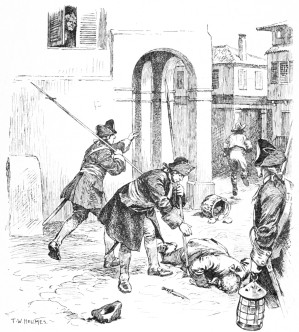
“SAW HIM DISAPPEARING JUST AS THEY CAME UPON THE BODY” (p. 52.)
the evidence of the witnesses. So he sat on the Bench to hear the circumstantial proofs against a man who he had no sort of doubt was actually innocent. When he saw that the evidence was insufficient, amounting to no more than semi prova, half-proof, according to Maltese law, he used every endeavour to make the accused confess his crime. Failing in this, he ordered the baker to be “put to the question,” with the result that the man, under torture, confessed to what he had not done. Cambo was now perfectly satisfied; the accused, innocent in fact, was guilty according to law, and having thus satisfied himself that his procedure was right, he carried his strange logic to the end, and sentenced the baker to death. “Horrible to relate,” says the old chronicle, “the hapless wretch soon after underwent the sentence of the law.”
TORTURE PINCERS, FROM THE CHÂTELET PRISON.[5]
The sad truth came out at last, when the real murderer, having been convicted and condemned for another crime, confessed that he was guilty of the murder for which the baker had wrongly suffered. He appealed to Judge Cambo himself to verify this statement, for he knew that the judge had seen him. The Grand Master of the Knights of Malta now called upon Judge Cambo to defend himself from this grave imputation. Cambo freely admitted his action, but still held that he had only done his duty, that he was really right in sending an innocent man to an ignominious death sooner than do violence to his own legal scruples. The Grand Master was of a more liberal mind, and condemned the judge to degradation and the forfeiture of his office, ordering him at the same time to provide handsomely for the family of his victim.
THE D’ANGLADES.
A very flagrant judicial error was committed in Paris towards the latter end of the same century, mainly through the obstinate persistence of the Lieutenant-General of Police in believing that he had discovered the real perpetrators of a theft. Circumstantial evidence was accepted as conclusive proof in spite of the unblemished character and the high social position of the accused.
BRANDING IRONS, FROM THE CHÂTELET PRISON. [5]
The Marquis d’Anglade and his wife lived in the same house with the Comte and Comtesse de Montgomerie; it was in the Rue Royale, the best quarter in Paris, and both kept good establishments. The Montgomeries were the more affluent, had many servants, and a stable full of horses and carriages. D’Anglade also kept a carriage, but his income was said to be greatly dependent upon his winnings at the gaming table. The two families were on terms of very friendly intercourse, frequently visited, and accepted each other’s hospitality. When the Comte and Comtesse went to their country house, the D’Anglades often accompanied them.
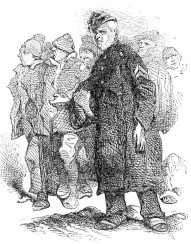
FRENCH CONVICTS “EN CHAÎNE.” (From a Drawing by Moanet.)
It was to have been so on one occasion, but at the eleventh hour the Marquis d’Anglade begged to be excused on the score of his wife’s indisposition. The Montgomeries went alone, but took most of their servants with them. When they returned to Paris, a day earlier than they were expected, they found the door of their apartments open, although it had been locked when they left. A little later D’Anglade came in. Having been supping with other friends, and hearing that the Montgomeries were in the house, he went in to pay his respects. Madame d’Anglade joined him, and the party did not break up till a late hour. There was no suspicion of anything wrong then.
Next morning, however, the Comte de Montgomerie discovered that he had been the victim of a great robbery. His strong box had been opened by a false key, and thirteen bags of silver, amounting to 13,000 francs, and 11,000 francs in gold, had been abstracted, also a hundred louis d’or coined in a new pattern, and a valuable pearl necklace. The police were summoned, and their chief, the Lieutenant-General, declared that someone resident in the house must be the thief. Suspicion seems to have attached at once to the D’Anglades, although they readily offered to allow their premises to be searched. The search was forthwith made, and the whole of their boxes, the beds and cupboards, and all receptacles in the rooms they occupied, were thoroughly ransacked. Only the garrets remained, and D’Anglade willingly accompanied the officers thither. His wife, being ill and weak, remained downstairs.
Here, in the garret, the searchers came upon seventy-five louis d’or of the kind above mentioned, wrapped in a scrap of printed paper part of a genealogical table, which Montgomerie at once identified as his. The police now wished to fix the robbery on the D’Anglades, and their suspicions were strengthened by the poor man’s confusion when desired, as a test, to count out the money before them all. He was trembling, a further symptom of guilt. However, when the basement was next examined, the part occupied by the Montgomerie servants, evidence much more incriminatory was obtained against the latter. In the room where they slept, five of the missing bags of silver were found, all full, and a sixth nearly so. None of these servants was questioned, yet they were as likely to be guilty as the accused, more so indeed. But the police thought only of arresting the D’Anglades, one of whom was imprisoned in the Châtelet, the other in the Fors l’Evêque prison.
The prosecution was of the most rancorous and pitiless kind. Those who sat in the seat of justice prejudiced the case in D’Anglade’s disfavour, and, as he still protested his innocence, ordered him to suffer torture so as to extort confession. He remained obdurate to the last, was presently found guilty, although on this incomplete evidence, and was sentenced to the galleys for life, and his wife to be banished from Paris, with other penalties and disabilities. D’Anglade was condemned to join the chaîne, the gang of convicts drafted to Toulon, and, having suffered inconceivably on the road, he died of exhaustion at Marseilles. His wife was consigned to an underground dungeon, where she was confined of a girl, and both would have succumbed to the rigours of their imprisonment, when suddenly the truth came out, and they were released in time to escape death.
An anonymous letter reached a friend of the D’Anglades, coming from a man who was about to turn monk, being torn by remorse, which gave him no rest. This man had been one of several confederates, and he declared that he knew the chief agent in the theft to have been the Comte de Montgomerie’s almoner, a priest called Gaynard, who had stolen the money, aided by accomplices, mainly by one Belestre, who, from being in great indigence, had come to be suddenly and mysteriously rich. Gaynard and Belestre were both already in custody for a street brawl, and when interrogated they confessed. Gaynard had given impressions of the Comte’s keys to Belestre, who had had false keys manufactured which opened the strong box. Belestre was also proved to be in possession of a fine pearl necklace.
The true criminals were now examined and subjected to torture, when they completely exonerated D’Anglade. The innocent marquis could not be recalled to life, but a large sum was subscribed, some £4,000, for his wife, as a slight compensation for the gross injustice done her. The Comte de Montgomerie was also ordered to make restitution of the property confiscated, or to pay its equivalent in money.
LADY MAZEL.
One of the earliest of grave judicial blunders to be found in French records is commonly called the case of Lady Mazel, who was a lady of rank, living in a large mansion, of which she occupied two floors herself: the ground floor as reception-rooms, the first floor as her bedroom and private apartments. The principal door of her bedroom shut from the inside with a spring, and when the lady retired for the night there was no access from without, except by a special key which was always left on a chair within the chamber. Two other doors of her room opened upon a back staircase, but these were kept constantly locked. On the second floor was lodged the family chaplain only; above, on the third floor, were the servants.’
One Sunday evening the mistress supped with the abbé as was her general practice; then went to her bedroom, where she was attended by her waiting-maids. Her butler, by name Le Brun, came to take her orders for the following day, and then, when the maids withdrew, leaving the key on the chair inside as usual, he also went away, shutting the spring door behind him.
Next morning there was no sign of movement from the lady, not at seven a.m. (her time for waking), nor yet at eight—she was still silent, and had not summoned her servants. Le Brun, the butler, and the maids began to be uneasy, and at last the son of the house, who was married and lived elsewhere, was called in. He expressed his fears that his mother was ill, or that worse had happened, and a locksmith was called in, and the door presently broken open.
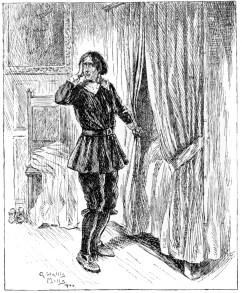
“MY MISTRESS HAS BEEN MURDERED!”
Le Brun was the first to enter, and he ran at once to the bedside. Drawing aside the curtains, he saw a sight which made him cry aloud, “My mistress has been murdered!” and this exclamation was followed by an act that afterwards went against him. He opened the wardrobe and took out the strong box. “It is heavy,” he said; “at any rate there has been no robbery.” The murder had been committed with horrible violence. The poor woman had fought hard for life; her hands were all cut and lacerated, and there were quite fifty wounds on her body. A clasp knife, much discoloured, was found in the ashes of the fire. Among the bedclothes they picked up a piece of a coarse lace cravat, and a napkin bearing the family crest, twisted into a nightcap. The key of the bedroom door, which had been laid on the chair, had disappeared. Nothing much had been stolen. The jewels were untouched, but the strong box had been opened and some of the gold abstracted.
Suspicion fell at once upon the butler, Le Brun. The story he told was against himself. He said that after leaving his mistress he went down into the kitchen and fell asleep there. When he awoke he found, to his surprise, the street-door wide open. He shut it, locked it, and went to his own bed. In the morning he did his work as usual until the alarm was given; went to market, called to see his wife, who lived near by, and asked her to lock up some money, gold crowns and louis d’or, for him. This was all he had to tell, but on searching him a key was found in his pocket: a false or skeleton key, the wards of which had been newly filed, and it fitted nearly all the locks in the house, including the street-door, the antechamber, and the back door of the lady’s bedroom. The napkin nightcap was tried on his head and fitted him exactly. He was arrested and shortly afterwards put upon his trial.
It was not alleged that he had committed the murder himself. No blood had been found on any of his clothes, although there were scratches on his person. A shirt much stained with blood had been discovered in the loft, but it did not fit Le Brun, nor was it like any he owned. Nor did the scrap of coarse lace correspond with any of his cravats; on the contrary, a maid-servant stated that she thought she recognised it as belonging to one she had washed for Berry, once a footman in the house. The supposition was that Le Brun had let some accomplice into the house, who had escaped after effecting his purpose. This was borne out by the state of the doors, which showed no signs of having been forced, and by the discovery of Le Brun’s false key.
Le Brun was a man of exemplary character, who had served the family faithfully for twenty-nine years, and was “esteemed a good husband, a good father, and a good servant,” yet the prosecution seemed satisfied he was guilty and put him to the torture. In the absence of real proofs it was hoped, after the cruel custom of the time, to force self-condemnatory admissions from the accused. The “question extraordinary” was applied, and the wretched man died on the rack, protesting his innocence to the last.
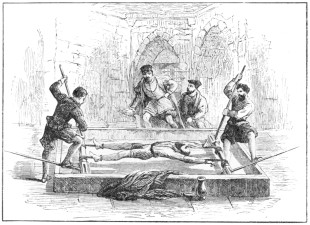
THE TORTURE OF THE RACK.
A month later the real culprit was discovered. The police of Sens had arrested a horse-dealer named Berry, the man who had been in Lady Mazel’s service as a lackey, but had been discharged. In his possession was a gold watch proved presently to have belonged to the murdered woman. He was carried to Paris, where he was recognised by someone who had seen him leaving Lady Mazel’s house on the night she was murdered, and a barber who shaved him next morning deposed to having seen that his hands were much scratched. Berry said that he had been killing a cat. Put to the torture prior to being broken on the wheel, he made full confession. At first he implicated the son and daughter-in-law of Lady Mazel, but when at the point of death he retracted the charge, and said that he had returned to the house with the full intention of committing the murder. He had crept in unperceived on the Friday evening, had gained the loft on the fourth floor, and had lain there concealed until Sunday morning, subsisting the while on apples and bread. When he knew the mistress had gone to mass he stole down into her bedroom, where he tried to conceal himself under the bed. It was too low, and he returned to the garret and slipped off his coat and waistcoat, and found now that he could creep under the bed. His hat was in his way, so he made a cap of the napkin. He lay hidden till night, then came out, and having secured the bell ropes, he roused the lady and demanded her money. She resisted bravely, and he stabbed her repeatedly until she was dead. Then he took the key of the strong box, opened it, and stole all the gold he could find; after which, using the bedroom key which lay on the chair by the door, he let himself out, resumed his clothes in the loft, and walked downstairs. As the street-door was only bolted he easily opened it, leaving it open behind him. He had meant to escape by a rope ladder which he had brought for the purpose of letting himself down from the first floor, but it was unnecessary.
It may be remarked that this confession was not inconsistent with Le Brun’s complicity. But it is to be presumed that Berry would have brought in Le Brun had he been a confederate, even although it could not have lessened his own guilt or punishment.
WILLIAM SHAW.
In Britain the list of judicial blunders includes the case of William Shaw, convicted of the murder of his daughter in Edinburgh simply on the ground of her own outcry against his ill-usage. They were on bad terms, the daughter having encouraged the addresses of a man whom he strongly disliked as a profligate and a debauchee. One evening there was a fresh quarrel between father and daughter, and bitter words passed which were overheard by a neighbour. The Shaws occupied one of the tenement houses still to be seen in Edinburgh, and their flat, the prototype of a modern popular form of residence in Paris and London, adjoined that of a man named Morrison.
The words used by Catherine Shaw startled and shocked Morrison. He heard her repeat several times, “Cruel father, thou art the cause of my death!” These were followed by awful groans. Shaw had been heard to go out, and the neighbours ran to his door demanding admittance. As no one opened and all was now silent within, a constable was called to force an entrance, and the girl was found weltering in her blood, with a knife by her side. She was questioned as to the words overheard, was asked if her father had killed her, and she was just able to nod her head in the affirmative, as it seemed.
Now William Shaw returned. All eyes were upon him; he turned pale at meeting the police and others in his apartment, then trembled violently as he saw his daughter’s dead body. Such manifest signs of guilt fully corroborated the deceased’s incriminating words. Last of all, it was noticed with horror that there was blood on his hands and on his shirt. He was taken before a magistrate at once, and committed for trial. The circumstances were all against him. He admitted in his defence the quarrel, and gave the reason, but declared that he had gone out that evening leaving his daughter unharmed, and that her death could only be attributed to suicide. He explained the bloodstains by showing that he had been bled some days before and that the bandage had become untied. The prosecution rested on the plain facts, mainly on the girl’s words, “Cruel father, thou art the cause of my death!” and her implied accusation in her last moments.
Shaw was duly convicted, sentenced, and executed at Leith Walk in November, 1721, with the full approval of public opinion. Yet the innocence which he still maintained on the scaffold came out clearly the following year. The tenant who came into occupation of Shaw’s flat found there a paper which had slipped down an opening near the chimney. It was a letter written by Catherine Shaw, as was positively affirmed by experts in handwriting, and it was addressed to her father, upbraiding him for his barbarity. She was so hopeless of marrying him whom she loved, so determined not to accept the man her father would have forced upon her, that she had decided to put an end to the existence which had become a burden to her. “My death,” she went on, “I lay to your charge. When you read this, consider yourself as the inhuman wretch that plunged the knife into the bosom of the unhappy Catherine Shaw!”
This letter, on which there was much comment, came at last into the hands of the authorities, who, having satisfied themselves that it was authentic, ordered the body of Shaw to be taken down from the gibbet where it still hung in chains and to be decently interred. As a further but somewhat empty reparation of his honour, a pair of colours was waved over his grave.
[3] “Reminiscences of an Indian Police Official,” p. 66.
[4] Some other very creditable exploits of this Indian detective, Abdul Ali, in elucidating murder mysteries will be given in a later chapter when dealing with Indian police.
[5] In the possession of Mdme. Tussaud & Son, Ltd.
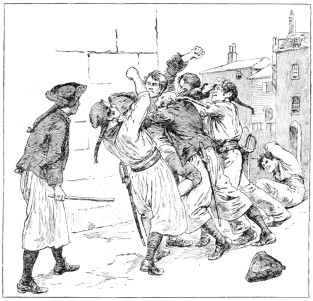
THE PRESS-GANG AT WORK (p. 64.)
THE SAILMAKER AND THE BOATSWAIN.
A still more curious story is that of a sailmaker who many years ago went to spend Christmas with his mother near Deal. On his way he spent a night at an inn at Deal, and shared a bed with the landlady’s uncle, the boatswain of an Indiaman, who had just come ashore. In the morning the uncle was missing, the bed was saturated with blood, and the young sailmaker had disappeared. The bloodstains were soon traced through the house, and beyond, as far as the pier-head. It was naturally concluded that the boatswain had been murdered and his body thrown into the sea. A hue-and-cry was at once set up for the young man, who was arrested the same evening in his mother’s house.
He was taken red-handed, with ample proofs of his guilt upon him. His clothes were stained with blood; in his pockets were a knife and a strange silver coin, both of which were sworn to most positively as the property of the missing boatswain. The evidence was so conclusive that no credence could be given to the prisoner’s defence, which was ingenious but most improbable. His story was that he woke in the night and asked the boatswain the way to the garden, that he could not open the back door, and borrowed his companion’s clasp-knife to lift the latch. When he returned to bed the boatswain was gone; why or where he had no idea.
The youth was convicted and sent to the gallows, but by strange fortune he escaped death. The hanging was done so imperfectly that his feet touched the ground, and when taken down he was soon resuscitated by his friends. They made him leave as soon as he could move, and he went down to Portsmouth, where he engaged on board a man-of-war about to start for a foreign station. On his return from the West Indies three years later to be paid off, he had gained the rating of a master’s mate, and gladly took service on another ship. The first person he met on board was the boatswain he was supposed to have murdered!
The explanation given was sufficiently strange. On the day of his supposed murder the boatswain had been bled by a barber for a pain in the side. During the absence of his bedfellow the bandage had come off his arm, which bled copiously, and he got up hurriedly to go in search of the barber. The moment he got into the street he was seized by a press-gang and carried off to the pier. There a man-of-war’s boat was in waiting, and he was taken off to a ship in the Downs, which sailed direct for the East Indies. He never thought of communicating with his friends; letter-writing was not much indulged in at that period.
Doubts have been thrown upon this story, which rests mainly upon local tradition. As no body was found, it does not seem probable that there would be a conviction for murder. Of the various circumstances on which it was based, that of the possession of the knife was explained, but not the possession of the silver coin. It has been suggested that when the sailmaker took it out of the boatswain’s pocket the coin had stuck between the blades of the knife.
BRUNELL THE INNKEEPER.
The astute villainy of a criminal in covering up his tracks was never more successful than in the case of Brunell, the innkeeper at a village near Hull. A traveller was stopped upon the road and robbed of a purse containing twenty guineas. But he pursued his journey uninjured, while the highwayman rode off in another direction.
Presently the traveller reached the Bell Inn, kept by Brunell, to whom he recounted his misadventure, adding that no doubt the thief would be caught, for the stolen gold was marked, according to his rule when travelling. Having ordered supper in a private room, the gentleman was soon joined by the landlord, who had heard the story, and now wished to learn at what hour the robbery took place.
“It was just as night fell,” replied the traveller.
“Then I can perhaps find the thief,” said the landlord. “I strongly suspect one of my servants, John Jennings by name, and for the following reason. The man has been very full of money of late. This afternoon I sent him out to change a guinea. He brought it back saying he could not get the change, and as he was in liquor I was resolved to discharge him to-morrow. But then I was struck with the curious fact that the guinea was not the same as that which I had given, and that it was marked. Now I hear that those you lost were all marked, and I am wondering whether this particular guinea was yours.”
“May I see it?” asked the traveller.
“Unfortunately I paid it away not long since to a man who lives at a distance, and who has gone home. But my servant Jennings, if he is the culprit, will probably have others in his possession. Let us go and search him.”
They went to Jennings’s room and examined his pockets. He was in a deep drunken sleep, and they came without difficulty upon a purse containing nineteen guineas. The traveller recognised his purse, and identified by the mark his guineas. The man was roused and arrested on this seemingly conclusive evidence. He stoutly denied his guilt, but was sent for trial and convicted. The case was thought to be clearly proved. Although the prosecutor could not swear to the man himself, as the robber had been masked, he did to his guineas. Again, the prisoner’s master told the story of his substitution of the marked for the other coin; while the man to whom the landlord had paid the marked guinea produced it in court. A comparison with the rest of the money left no doubt that these guineas were one and the same.
The unfortunate Jennings was duly sentenced to death, and executed at Hull. Yet, within a twelvemonth, it came out that the highwayman was Brunell himself. The landlord had been arrested on a charge of robbing one of his lodgers, and convicted; but he fell dangerously ill before execution. As he could not live, he made full confession of his crimes, including that for which Jennings had suffered.
It seemed that he had ridden sharply home after the theft, and, finding a debtor had called, gave him one of the guineas, not knowing they were marked. When his victim arrived and told his story, Brunell became greatly alarmed. Casting about for some way of escape, he decided to throw the blame on his servant, whom he had actually sent out to change a guinea, but who had failed, as we know, and had brought back the same coin. As Jennings was drunk, Brunell sent him to bed, and then easily planted the incriminating purse in the poor man’s clothes. No sort of indemnity seems to have been paid to Jennings’s relations or friends.
DU MOULIN’S CASE.
Of the same class was the conviction of a French refugee, Du Moulin, who had fled to England from the religious persecutions in his own country. He brought a small capital with him, which he employed in buying goods condemned at the Custom-house, disposing of them by retail. The business was “shady” in its way, as the goods in question were mostly smuggled, but Du Moulin’s honesty was not impeached until he was found to be passing false gold. He made it a frequent practice to return money paid him by his customers, declaring it was bad. The fact could not be denied, but the suspicion was that he had himself changed it after the first payment; and this happened so often that he presently got into disrepute, losing both his business and his credit. The climax came when he received a sum of £78 in guineas and Portugal gold, and “scrupled,” or questioned, several of the pieces. But he took them, giving his receipt. In a few days he brought back six coins, which he insisted were of base metal. His client Harris as positively declared that they were not the same as those he had paid. Then there was a fierce dispute. Du Moulin was quite certain; he had put the whole £78 into a drawer and left the money there till he had to use it, when part of it was at once refused. Harris continued to protest, threatening Du Moulin with a charge of fraud, but presently he paid. He lost no opportunity, however, of exposing Du Moulin’s conduct, doing so so often, and so libellously, that the other soon brought an action for defamation of character.
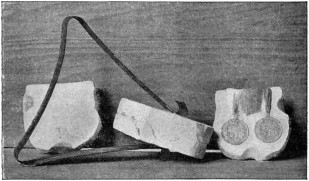
COINERS’ MOULD IN THE BLACK MUSEUM, ONE IN SEPARATE PARTS, THE OTHER CLOSED AND HELD IN POSITION BY A SPRING. Photo: Cassell & Co., Ltd.
This drove Harris to set the law in motion also, on his own information, backed by the reports of others on whom Du Moulin had forced false money. A warrant was issued against the Frenchman, his house was searched, and in a secret drawer all the apparatus of a counterfeiter of coin was discovered—files, moulds, chemicals, and many implements. This evidence was damnatory; his guilt seemed all the more clear from the impudence with which he had assailed Harris and his insistence in passing the bad money. Conviction followed, and he was sentenced to death. But for a mere accident, which brought about confession, he would certainly have suffered on the scaffold.
A day or two before he was to have been executed, one Williams, a seal engraver, was thrown from his horse and killed, whereupon his wife fell ill, and in poignant remorse confessed that her husband was one of a gang of counterfeiters, and that she helped him by “putting off” the coins. One of the gang hired himself as servant to Du Moulin, and, using a whole set of false keys, soon became free of all drawers and receptacles, in which he planted large quantities of false money, substituting them for an equal number of good pieces.
The members of this gang were arrested and examined separately. They altogether repudiated the charge, but Du Moulin’s servant was dumbfounded when some bad money was found in his quarters. On this he turned king’s evidence, and his accomplices were convicted.
CALAS.
A case in which “justice” was manifestly unjust is that of the shameful prosecution and punishment of Calas, a judicial murder begun in wicked intolerance and carried out with almost inconceivable cruelty.
Bitter, implacable hatred of the Protestant or Reformed faith and all who professed it survived in the South of France till late in the eighteenth century. There was no more bigoted city than Toulouse, which had had its own massacre ten years before St. Bartholomew, and perpetuated the memory of this “deliverance,” as it was called, by public fêtes on its anniversary. It was on the eve of the fête of 1761 that a terrible catastrophe occurred in the house of one Jean Calas, a respectable draper, who had the misfortune to be a heretic—in other words, a criminal, according to the ideas of Toulouse.
Marc Antoine Galas, the eldest son of the family, was found in a cupboard just off the shop, hanging by the neck, and quite dead. The shocking discovery was made by the third brother, Pierre. It was then between nine and ten p.m.; he had gone downstairs with a friend who had supped with them, and had come suddenly upon the corpse.
The alarm was soon raised in the town, and the officers of the law hastened to the spot. In Toulouse the police was in the hands of the capitouls, functionaries akin to the sheriffs and common councillors of a corporation, and one of the leading men among them just then was a certain David de Beaudrigue, who became the evil genius of this unfortunate Calas family. He was bigoted, ambitious, self-sufficient, full of his own importance, fiercely energetic in temperament, and undeviating in his pursuit of any fixed idea.

MEDALS STRUCK IN COMMEMORATION OF THE ST. BARTHOLOMEW MASSACRE. 1. Obverse, Pope Gregory XIII. Reverse, Angel smiting Protestants. 2. Obverse, Charles IX. Reverse, The King as Hercules slaying the hydra of heresy. 3. Obverse, Charles IX. Reverse, The King on his throne.
Now, when called up by the watch and told of the mysterious death of Marc Antoine Calas, he jumped to the conclusion that it was a murder, and that the perpetrator was Jean Calas; in other words, that Calas was a parricide. The motives of the crime were not far to seek, he thought. One Calas son had already abjured the Protestant for the true faith, this now dead son was said to have been anxious to go over, and the father was resolved to prevent it at all cost. It was a commonly accepted superstition in those dark times that the Huguenots would decree the death of any traitors to their own faith.
Full of this baseless prepossession, De Beaudrigue thought only of what would confirm it. He utterly neglected the first duty of a police officer: to seek with an unbiassed mind for any signs or
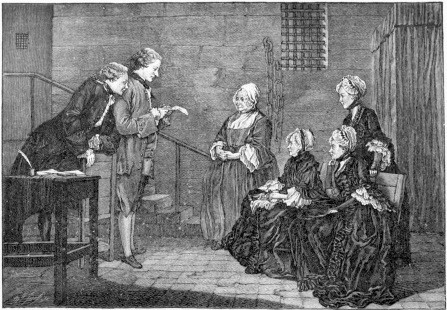
THE CALAS FAMILY. (From the Picture by L. C. Carmontelli.)
indications that might lead to the detection of the real criminals. He should have at once examined the wardrobe in which the body was found pendent; the shop close at hand, the passage that led from it through a small courtyard into the back street. It was perfectly possible for ill-disposed people to enter the shop from the front street and escape by this passage, and possibly they might leave traces behind them.
De Beaudrigue thought only of securing those whom he already in his own mind condemned as guilty, and hurrying upstairs found the Calas, husband and wife, whom he at once arrested; Pierre Calas, whom he also suspected, was given in charge of two soldiers; the maid-servant, too, was taken, as well as two friends of the family who happened to be in the house at the time. When another capitoul mildly suggested a little less precipitation, De Beaudrigue replied that he would be answerable, and that he was acting in a holy cause.
The whole party was carried off to gaol. When the elder Calas asked to be allowed to put a candlestick where he might find it easily on his return, he was told sardonically, “You will not return in a hurry.” The request and its answer went far to produce a revulsion in his favour when the facts became known. The wretched man never re-entered his house, but he passed it on his way to the scaffold and knelt down to bless the place where he had lived happily for many years, and from which he had been so ruthlessly torn.
On the way to gaol the prisoners were greeted with yells and execrations. It was already taken for granted that they had murdered Marc Antoine. Arrived at the Hôtel de Ville, there was a short halt while the accusation was prepared charging the whole party as principals or accessories. An interrogatory followed which was no more than a peremptory summons to confess. “Come,” said the capitoul to Pierre, “confess you killed him.” Denial only exasperated De Beaudrigue, who began at once to threaten Calas and the rest with the torture.
There was absolutely no evidence whatever against the accused, and in the absence of it recourse was had to an ancient ecclesiastical practice, the monitoire, a solemn appeal made to the religious conscience of all who knew anything to come forward and declare it. This notice was affixed to the pulpits of churches and in street corners. It assumed the guilt of the Calas family quite illegally, because without the smallest proof, and it warned everyone to come forward and speak, whether from hearsay or of their own knowledge. Nothing followed the monitoire, so these pious sons of the Church went a step farther and obtained a fulmination; a threat to excommunicate all who could speak yet would not. This was duly launched, and caused great alarm. Religious sentiment had reached fever pitch. The burial of Marc Antoine with all the rites of the Church was a most imposing ceremony. He lay in state. The catafalque bore a notice to the effect that he had abjured heresy. He was honoured as a martyr; a little more and he would have been canonised as a saint.
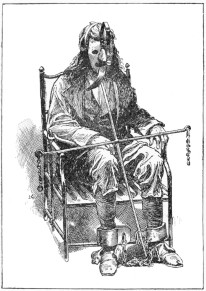
IRON CHAIR IN WHICH CALAS IS SAID TO HAVE BEEN TORTURED, NOW IN THE POSSESSION OF MADAME TUSSAUD & SONS, LIMITED.
Still, nothing conclusive was forthcoming against the Calas. One or two witnesses declared that they had heard disputes, swore to piteous appeals made to the father by the dead son, to cries such as “I am being strangled!” “They are murdering me!” and this was all. It was all for the prosecution; not a word was heard in defence. The Protestant friends of the family were not competent to bear witness; the accused, moreover, were permitted to call no one. It would be hard to credit the disabilities still imposed upon the French Huguenots were it not that the laws in England against Roman Catholics at that time were little less severe. In France all offices, all professions were interdicted to Protestants. They could not be ushers or police agents, they were forbidden to trade as printers, booksellers, watchmakers, or grocers, they must not practise as doctors, surgeons, or apothecaries.
Although there was no case, the prosecution was obstinately persisted in, not merely because the law officers were full of prejudice, but because, if they failed to secure conviction, they would be liable to a counter action for their high-handed abuse of legal powers. As has been said, no pains were taken at the first discovery of the death to examine the spot or investigate the circumstances. It was all the better for the prosecution that nothing of the kind was done. Had the police approached the matter with an open mind, judging calmly from the facts apparent, they would have been met at once by an ample, nay, overwhelming—explanation. There can be no doubt that Marc Antoine Calas committed suicide. The proofs were plain. This eldest son was a trouble to his parents, ever dissatisfied with his lot, disliking his father’s business, eager to take up some other line, notably that of an advocate. Here, however, he encountered the prejudice of the times, which forbade this profession to a Protestant; and it was his known dissatisfaction with this law that led to the conjecture—and there was little else—that he wished to abjure his faith. At last Marc Antoine offered to join his father, but was told that until he learnt the business and showed more aptitude he could not hope for a partnership. From this moment he fell away, took to evil courses, frequented the worst company, was seen at the billiard tables and tennis courts of Toulouse, and became much addicted to gambling. When not given to debauchery he was known as a silent, gloomy, discontented youth, who quarrelled with his lot and complained always of his bad luck. On the very morning of his death he had lost heavily—a sum of money entrusted him by his father to exchange from silver into gold.
All this pointed to the probability of suicide. The Calas themselves, however, would not hear of any such solution. Suicide was deemed disgraceful and dishonourable. Sooner than suggest suicide, the elder Calas was prepared to accept the worst. One of the judges was strongly of opinion that it was clearly a case of
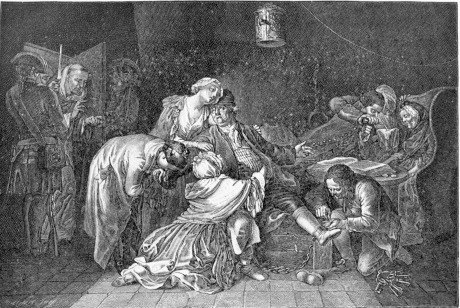
JEAN CALAS TAKING LEAVE OF HIS FAMILY. (From the Painting by D. Chodswiecke, 1768.)
felo de se, but he was overruled by the rest, who were equally convinced of the guilt of the Calas. Not a single witness of the 150 examined could speak positively; not one had seen the crime committed; they contradicted each other, and their statements were improbable and opposed to common sense. Moreover, the murder was morally and physically impossible. Was it likely that a family party collected round the supper-table would take one of their number downstairs and hang him? Could such wrong be done to a young and vigorous man without some sort of struggle that would leave its traces on himself and in the scene around?
But the bigoted and prejudiced judges of Toulouse gave judgment against the accused; yet, although so satisfied of their guilt, they ordered the torture to be applied to extort full confession. The prisoners appealing, the case was heard in the local parliament, and the first decision upheld. Thirteen judges sat; of these, seven were for a sentence of death, three for preliminary torture, two voted for a new inquiry based on the supposition of suicide, one alone was for acquittal. As this was not a legal majority, one dissident was won over, and sentence of death was duly passed on Calas, who was to suffer torture first, in the hope that by his admissions on the rack the guilt of the rest might be assured.
The sentence was executed under circumstances so horrible and heartrending that humanity shudders at hearing them. Calas was taken first to the question chamber and put “upon the first button.” There, being warned that he had but a short time to live and must suffer torments, he was sworn and exhorted to make truthful answer to the interrogatories, to all of which, after the rack had been applied, he replied denying his guilt. He was then put “upon the second button”; the torture increased, and still he protested his innocence. Last of all, he was subjected to the question extraordinary, and being still firm, he was handed over to the reverend father to be prepared for death. He suffered on the wheel, being “broken alive”; the process lasted two whole hours, but at the end of that time the executioner put him out of his misery by strangling him. When asked for the last time, on the very brink of the grave, to make a clean breast of his crime and give up the names of his confederates, he only answered, “Where there has been no crime there can be no accomplices.” His constancy won him the respect of all who witnessed his execution. “He died,” said a monk “like one of our Catholic martyrs.”
VOLTAIRE. (From the Picture by Largillière.)
This noble end caused deep chagrin to his judges; they were consumed with secret anxiety, having hoped to the last that a full confession would exonerate them from their cruelty. At Toulouse there had been a fresh outburst of fanaticism, in which more lives were lost; and now, the news of Calas’ execution reaching the city, open war was declared against all Huguenots. But a reaction was at hand, caused by the very excess of this religious intolerance. The terrible story began to circulate through France and beyond. The rest of the accused had been released, not without reluctance, by the authorities of Toulouse, but Pierre Calas had been condemned to banishment. Another brother had escaped to Geneva, where he met with much sympathy.
The feeling in other Protestant countries was intense, and loud protests were published. But the chief champion and vindicator of the Calas family was Voltaire, who seized eagerly at an opportunity of attacking the religious bigotry of his countrymen. He soon raised a storm through Europe, writing to all his disciples, denouncing the judges of Toulouse, who had killed an innocent man. “Everyone is up in arms. Foreign nations, who hate us and beat us, are full of indignation. Nothing since St. Bartholomew has so greatly disgraced human nature.”
Voltaire bent all the powers of his great mind to collecting evidence and making out a strong case. The Encyclopædists, with d’Alembert at their head, followed suit. All Paris, all France grew excited. The widow Calas was brought forward to make a fresh appeal to the king in council. The whole case was revived in a lengthy and tedious procedure, and in the end it was decided to reverse the conviction. “There is still justice in the world!” cried Voltaire—“still some humanity left. Mankind are not all villains and scoundrels.”
Three years after the judicial murder of Jean Calas all the accused were formally pronounced innocent, and it was solemnly declared that Jean Calas was illegally done to death. But the family were utterly ruined, and, although entitled to proceed against the judges for damages, they had no means to go to law. The Queen said the French wits had drunk their healths, but had given them nothing to drink in return.
It is satisfactory to know, however, that some retribution overtook the principal mover in this monstrous case. The fierce fanatic, David de Beaudrigue, was dismissed from all his offices, and being threatened with so many lawsuits, he went out of his mind. He was perpetually haunted with horrors, always saw the scaffold and the executioner at his grisly task, and at last, in a fit of furious madness, he threw himself out of the window. The first time he escaped death, but he made another attempt, and died murmuring the word “Calas” with his last breath.
A GROSS PERVERSION OF JUSTICE AT NUREMBERG.
On the 30th of January, 1790, at five o’clock in the morning, the Nuremberg merchant Johann Marcus Sterbenk was awakened by his maid with the unpleasant news that his house had been broken into and the counting-house robbed of its strong-box, containing the sum of 2,000 gulden. It was a heavy iron strong-box, standing on four legs, and was painted in dark green stripes and ornamented on the top surface and lock with leaves and flowers. The sum stolen meant a small fortune in those days. The counting-house had a window which looked out on to the staircase, and some ten days before, when the key of the door had been mislaid, it had been necessary to remove a pane of glass from the window in order to reach the door from within. On getting to his counting-house, the merchant found that the pane of glass had again been removed, and that the door of the room was standing open. The main front door also was open, although the maid had declared that she had bolted it securely the evening before.
The robbery had clearly been the work of someone who knew the locality well; yet, although several people swore to having seen suspicious-looking men in the neighbourhood about two o’clock in the morning, they were unable to identify or describe them, and for a time justice was at fault.
Suddenly suspicion fell on one Schönleben, Sterbenk’s messenger; and ere long all agreed that he must be the culprit. There was absolutely no evidence—nothing more than his own careless words, which were seized upon and twisted against him. It was now remembered that his previous life had not been blameless, and every little incident was seized upon to his discredit. Thus it was said that the day after the robbery his brother was seen in close converse with him at his house; after that the brother drove out of town with his cart, in which, according to general belief, the strong-box was concealed. Again, it was noted that Schönleben had been often late at business, and again, that the day after the robbery he appeared extremely lightheaded.
On the strength of these suspicions Schönleben was arrested, and with him a poor beadmaker, Beutner by name, who was suspected of being his accomplice. The only connection between the two was that Beutner had once helped Schönleben to carry a load of wood into the Sterbenks’ house; and as he was passing the window of the counting-house, it was said that he gazed spell-bound at the sight of all the money inside. For not more than this the two were lodged in gaol and subjected to criminal examination. It was hardly thought possible that they could be innocent men. A new clue was, however, soon discovered. A barber named Kirchmeier called on Sterbenk and declared that on the day of the robbery he had seen a cash-box identical in every respect with the one stolen. It was in the room of a working gilder, Mannert, who lived in the same house as Schönleben the messenger. On making a second call at the same room a few days later there was no box to be seen. Kirchmeier deposed that the box was standing under the table near the oven and behind the door; and as this witness was a respectable, well-to-do citizen, bearing the character of an upright, religious man, his testimony was deemed unimpeachable. The poor gilder, Mannert, had also always borne the best of characters, but he, too, was arrested, with his wife and sons. When examined, he denied absolutely that he had ever owned such a box, and although he admitted a slight acquaintance with Schönleben, and that he was employed by Sterbenk, he declared that he knew nothing of the messenger’s private affairs.
Then the examination of the Mannerts was renewed; but as they still persisted in repudiating all knowledge of the strong-box the Court had recourse to more drastic measures. In those days it was not absolutely required that witnesses should take the oath, which was reserved for extreme cases; it was a last step when evidence was imperfect, and the punishment for perjury was very severe. Kirchmeier signified his perfect willingness to be sworn, and eventually reiterated his charges upon oath. “That which I saw, I saw,” he averred. “The green-painted cash-box, with green wooden legs, I saw in the rooms of the man who is now kneeling imploringly before me. I cannot help it. I am quite convinced that in this case I am not mistaken. If I am, his blood be on my head.”
The Court, after such solemn testimony, could not exonerate the Mannerts and Schönleben; and the public shared this conviction. Excitement over the case was not confined to Nuremberg, but spread through all Germany. So high ran feeling against the accused for their obstinate pleas of innocence, that the mob smashed Schönleben’s windows and killed his youngest child as it lay in its mother’s arms.
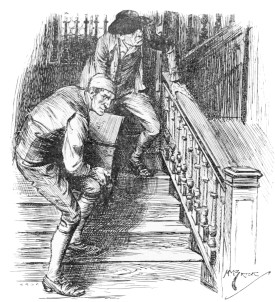
“TOGETHER THEY ... LIFTED THE CASH-BOX AND ... CARRIED IT HOME” (p. 84.)
Mannert’s wife and sons corroborated his statements. Nevertheless, the barber, Kirchmeier, when confronted with them, stuck to his story. The entire absence of all malicious motive strengthened his testimony and gained him full credence from the Nuremberg authorities. So the Mannert family were also consigned to durance, while their residence was searched from top to bottom. Nothing incriminating was found; only in a lumber room one of the planks appeared to have been recently disturbed, and this, although it led to no further discovery, was deemed highly suspicious.
Meanwhile, Schönleben had been again questioned, and still stoutly denied his guilt. When asked as to his accomplices and confederates, he replied that he could have had none, having committed no crime. Beutner, the beadmaker, had no doubt asked him once where Sterbenk’s counting-house was situated, and whether the family all slept upstairs, but, after all, that might be mere curiosity. Beutner excused himself by saying he must have been drunk when he asked such questions—at least, he had no recollection of putting them. Several independent witnesses deposed to having been with Beutner on the night of the robbery till 2 a.m., after which they walked home with him.
The perverse cruelty of the Nuremberg Court, which had accepted Kirchmeier’s story so readily, was not yet exhausted, and, very much as in the case of Calas, given on a previous page, it persisted in seeking a confession as its own best justification. Mannert was still obdurate, however, and force was now applied. Floggings were tried, but quite without result, and at last, a fresh search of the dwellings of both Mannert and Schönleben having proved fruitless, it was resolved to appeal to the antiquated instruments of Nuremberg justice, surviving still, within ten years of the nineteenth century—the priest and the rack.
The power of the priest to extort confession, even from the most hardened criminals, had often proved successful heretofore, and public expectation was raised high that justice would once more be vindicated in this fashion. But the priests failed now. Neither Mannert, nor his wife, nor his sons would make the slightest acknowledgment of their guilt, and it became clear that they had won over the priests to their side. Still the Court was resolute to follow out its own line of action. Confession having failed, it determined to try the effect of flogging the woman, or, if her health did not allow such an extreme proceeding, she was to be strictly isolated, and kept upon bread and water in the darkest dungeon of the prison; lastly, if these merciless measures proved of no avail, she was to be subjected to the rack.
Schönleben, from the recesses of the prison, now made a desperate effort to free himself by reviving suspicion against Beutner. So absolutely helpless and hopeless had justice now become that the Nuremberg Court actually accepted a dream as evidence. Schönleben pretended that he had seen the missing cash-box under a heap of wood at Beutner’s house—seen it only in his dreams, however. This “baseless fabric” of his imagination sufficed to send the officers to search Beutner’s house, and although nothing was discovered, public opinion agreed with the judges in again accusing Beutner, and he was held to be implicated, despite the renewed proof of a satisfactory alibi. Nobody believed Beutner’s witnesses.
The next incident in these shameful proceedings was the death of Frau Mannert, who succumbed to the cruel treatment she had received. She died protesting her innocence to the last, and the priests who shrived her in the dark underground cell where she breathed her last expressed much indignation at the shocking ill-usage to which she owed her death.
Four more months passed, bringing no relaxation in the law’s severity towards those whom it still gripped in its cruel clutches. Who shall say what their fate might have been? But now, at last, an unexpected turn was given to the inquiry, and by pure accident justice got upon the right track. Certain rumours reached the ears of one of the judges, who proceeded to investigate them. These rumours started from a beer-shop, where someone in his cups had been heard grossly to abuse a locksmith, Gösser by name, and his assistant, Blösel. The vituperation ended in a direct charge of complicity in the Sterbenk robbery. Blösel sat speechless under the attack, but his master, Gösser, tried lamely to repudiate the charges. It was remembered now against these two that, although miserably poor till a certain date, they had become suddenly rich; had bought good clothes and silver watches, had launched out into many extravagances, and were always ready to stand treat to their friends. Gösser just now had applied for a passport to leave Nuremberg and go to Dresden; and passports were in those days rather expensive luxuries, and generally beyond the means of persons in straitened circumstances. Schönleben once more contributed his quota to the newly formulated charge; he had always suspected him, he said; and this time he had good reason to do so. When the police arrested Gösser and his assistant (they were always glad to arrest anybody), the two prisoners incontinently confessed their crime.
Gösser, a man of thirty-three, had settled in Nuremberg with his wife and family about a year previously. He was a shiftless, aimless fellow, and it was only by serious money sacrifices that he obtained admission into the guild of locksmiths in Nuremberg. Having thus started in debt, he was never able to get clear
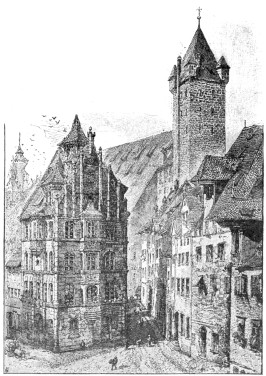
STREET IN NUREMBERG.
again. He was often in want of the necessaries of life; his relations would not help him; and he began to despair of ever gaining an honest livelihood. Having once visited Sterbenk’s house, he had quickly realised how easily the counting-house door might be forced. The criminal idea of thus obtaining funds once formed, it grew and gained more mastery, till at length, on the night of the 29th of January, he proceeded to perpetrate the theft. He went to Sterbenk’s, opened the outer door, which he said was unbolted, and silently, and without difficulty, entered the counting-house. Finding the strong-box too heavy to move by himself, he had gone home and awakened his assistant, whom he persuaded to join him. Together they had crept back, lifted the cash-box, and, without interference, carried it home. While Gösser’s wife was out of the way, they opened it and divided the spoil. The box they kept close hidden for a long time, but at last broke it up and threw the pieces bit by bit into the river. After the robbery Gösser confessed to his wife, who, overcome with fear, implored her husband to return the money. But he paid some pressing debts and bought what he needed for his business, and now hoped that he was on the high road to success and competence. Gösser declared that no one had instigated him to the deed, that he alone was responsible, and had had no accomplice beyond Blösel; and the confessions of his wife and Blösel corroborated these statements.

OLD PRISON AND “HANGMAN’S PASSAGE”, NUREMBERG.
An examination of Gösser’s dwelling also confirmed them, while portions of the strong-box were by-and-bye found in the river. But it was not till after there remained no shadow of doubt of the truth of Gösser’s story that the other prisoners were lightened of their chains, and only by degrees were they informed of the new turn of affairs.
Kirchmeier was arrested on the 4th of November, and feeling ran tremendously strong against him as the original cause of so much cruel injustice. His three confessions were read out to him, and he was asked if he still stood by them. Strange to state, he firmly reiterated them, continuing to do so even when the fragments of the box and the plainly rebutting evidence were laid before him. The only plausible solution of his extraordinary conduct was that he suffered from hallucinations. He had only lately recovered from a bad attack of bilious fever; and it was quite probable that in his convalescent condition the excitement of the robbery working on a disordered mind produced an impression which had all the weight and force of actual tangible fact. Some such view of his conduct was evidently taken by the Court; for, although arraigned for perjury, he was acquitted, and absolved from having falsely sworn from any evil motive. Yet his fellow-townspeople could not readily forgive him, or forget the sufferings he had brought upon the innocent victims of his delusions. He was scouted by his old friends and deserted by his customers; and, to escape universal execration and the starvation that threatened him, he settled in another part of Germany. Gösser and Blösel were, of course, duly punished.
“THE BLUE DRAGOON.”
This case,[6] in which Justice got upon a false scent and narrowly escaped the commission of a tragical blunder, is remarkable for the tortuous course it ran before the truth was at last reached. In a certain Dutch town there lived, towards the close of the last century, an elderly widow lady, Madame Andrecht. She was fairly well-to-do, and possessed some valuable silver, although she lived in a quiet, retired street and in a not very reputable locality. Her neighbours were all of the poorer classes; and the town ditch, which was navigable, flowed at the bottom of her back garden. Hers was a tranquil, uneventful existence; she was served by one elderly female servant, and her only recreation was a yearly visit paid to a married son in the country, when she locked up the house and took the servant away with her.
On the 30th of June, 17—, she returned home, after one of these visits, to find her house broken into and most of her possessions gone. It was clear that the thieves were acquainted with the interior of the house, and had set to work in a systematic fashion, although some of the plunder had escaped them. A window leading from the garden had been forced; the back door was open, and footsteps could be traced down the garden to the hedge at the bottom over the ditch. This pointed to the removal of the booty by boat.
The discovery of this robbery caused a great sensation, and the house was soon surrounded by a gaping crowd, whom the police had some trouble in controlling. One, an irrepressible baker, managed to make his way inside, and his acquaintances awaited with impatience the result of his investigations. But on his return he assumed a great air of mystery, and refused to satisfy their curiosity. Everyone was left to evolve his own theory, and the most voluble of the chatterers was a wool-spinner, Leendert van N——, who talked so pointedly that before evening he was summoned to the town house and called upon for an explanation by the burgomaster. In a hesitating, stammering way, as if dreading to incriminate anyone, he unfolded his suspicions, which were to the following effect:—
At the end of the street stood a small alehouse, kept by an ex-soldier, Nicholas D——, commonly known as the “Blue Dragoon.” Some years previously he had courted and married a servant of Madame Andrecht. The mistress had never liked the match, and had done all she could to prevent the young people from meeting. Nicholas had managed, however, to pay the girl secret visits, stealing at night across Leendert’s back garden and over the hedge. Leendert objected, and begged Nicholas to discontinue these clandestine proceedings. Later on he discovered that the ardent lover used to row along the fosse and enter the garden that way. All this was ancient history, but it was brought back to his mind by the robbery. His suspicion had been emphasised by the fact of his finding a handkerchief on the fosse bank, opposite the garden, only ten days before. This handkerchief proved to be marked with the initials N. D.
Suspicion, once raised against the dragoon, was strengthened by other circumstances. During the first search of the house a half-burnt paper had been picked up, presumably a pipelight. On examination, it was found to be an excise receipt, and further investigation proved it to have belonged to Nicholas D——. This evidence, such as it was, seemed to point to the same person, and, after a short consultation among the magistrates, orders were given for his arrest, and that of his wife, father, and brother. His house was ransacked, but the closest search failed to reveal the missing plate; only in one drawer a memorandum-book was discovered which was proved beyond doubt to have belonged to Madame Andrecht.
Nothing resulted from a first examination to which the prisoner was subjected. He answered every question in an open, straightforward manner; but while admitting the facts of his courtship, as told by the wool-spinner, he could adduce no rebutting evidence in his own defence. The other members of the household corroborated what he had said; and the wife declared strenuously that the note-book had not been in the drawer the previous week, when she had removed all the contents in order to clean the press. Their attitude and their earnest protestations of innocence made a favourable impression on the judge; the neighbours testified to their honest character and general good name. Still, Nicholas could not be actually exonerated; the note-book, the charred receipt, and the handkerchief were so many unanswered points against him.
At this stage of the inquiry a new witness came forward and strengthened the suspicion against Nicholas D——. A respectable citizen, a wood merchant, voluntarily appeared before the authorities and made a statement, which, he said, had been weighing on his conscience ever since the robbery. It would seem that a carpenter, Isaac van C——, owed this man money; and he had been obliged to put pressure upon him. The carpenter had begged him to delay proceedings, telling him of the difficulty he also had in collecting his dues, and showing him some silver plate he had taken in pledge from one of his debtors. After some discussion, the wood merchant agreed to accept the plate as part payment of the carpenter’s bill. When the robbery became known, the wood merchant began to think the articles pledged to him might have formed part of the stolen property. He had no reason to suspect his debtor, the carpenter, of being concerned in the theft, but still he thought the clue ought to be followed up.
The carpenter was immediately sent for and examined. He said that the debtor of whom he spoke to the wood merchant was Nicholas D——, who owed him sixty gulden for work done on the premises, and as he would not or was unable to pay, he (the carpenter) had peremptorily asked for his money. Nicholas then offered him some old silver, which he said had belonged to his father, and asked him to dispose of it through an agent in Amsterdam or some distant town. Nicholas was brought in, and, confronted with the carpenter, did not deny that he owed the debt and could not see how to pay it; but when the plate was shown him he hesitated, turned pale, and declared he knew nothing about it. His nervousness and prevarication excited a general doubt as to his previous statements. This was further increased by the examination of the carpenter’s private account-book, which contained an entry of the old silver received from the innkeeper. The carpenter’s housekeeper and apprentice also bore witness to the agreement.
[6] Abridged from the full account given in the “Tales from Blackwood,” Second Series.
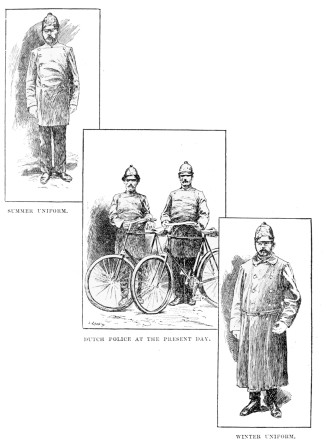
SUMMER UNIFORM. DUTCH POLICE AT THE PRESENT DAY. WINTER UNIFORM.
The general feeling in the town was now very strong against Nicholas D——. He was committed to the town prison, and his relatives placed under closest surveillance. All, nevertheless, persisted in their story. In order to ascertain the truth, justice was prepared to go to the extreme length of applying torture to force a confession from the obstinate accused. But happily, just as the “question” was about to be employed, the following letter was received:—
“Before I leave the country and betake myself where I shall be beyond the reach either of the Court of M—— or the military tribunal of the garrison, I would save the unfortunate persons who are now prisoners at M——. Beware of punishing the innkeeper, his wife, his father, or his brother, for a crime of which they are not guilty. How the story of the carpenter is connected with theirs I cannot conjecture. I have heard of it with the greatest surprise. The latter may not himself be entirely innocent. Let the judge pay attention to this remark. You may spare yourself the trouble of inquiring after me. If the wind is favourable, by the time you read this letter I shall be on my passage to England.
“Joseph Christian Ruhler,
Formerly Corporal in the Company of Le Lery.”
The receipt of this letter started a new set of conjectures, followed up by inquiries. Captain le Lery’s company was quartered in the town, and Corporal Ruhler had, as a matter of fact, belonged to it, but he had mysteriously and suddenly disappeared about the time of the robbery. No trace of him had been found. His letter seemed to throw light upon his disappearance, yet when it was shown to his captain and some of his comrades it was unanimously declared to be a forgery. What could have been the writer’s object in fabricating it? Various theories were advanced, the most popular being that some guilty party, knowing the corporal had gone, thought to implicate him and save the accused from the torture, which might have driven them to full confession, in which the names of all accomplices would have been divulged. It was a clumsy explanation, but the only feasible one forthcoming. Every effort was made to discover the author of the letter, but without avail.
Now a fresh witness volunteered information—a merchant who lived in Madame Andrecht’s neighbourhood, and who had left home about the time that the robbery had been perpetrated. He had just returned, to find that the mysterious affair was the talk of the town—indeed, he had had a full account of it from his fellow-passengers in the coach which brought him home. He now came to the authorities and told them what he knew. A day or two before the robbery a carpenter, Isaac van C——, had come to him seeking to borrow his boat, which the merchant kept in the fosse just behind his warehouse. Isaac made some pretence for wanting the boat which was not altogether satisfactory to the merchant, who refused to lend it, but yielded when the carpenter declared he wished to use it for the purposes of fishing. The next morning the boat was returned, but was not in exactly its right place; the inside of the boat, moreover, was too clean and dry for it to have been recently used for fishing. The merchant, although he had not yet heard of the robbery, strongly suspected that the carpenter had used the boat for some improper purpose, and he was strengthened in this view by finding two silver spoons under one of the thwarts. This discovery angered him, for he felt he had been deceived, and putting the spoons in his pocket, he went at once to the carpenter for an explanation. The carpenter, with whom were his housekeeper and apprentice, seemed greatly embarrassed when the spoons were produced, and after having been pressed by the merchant, they confessed that they had been up to no good, but would not say where or how they had obtained these spoons. The merchant was now called away from home, and the affair was driven from his mind by more serious transactions. Now that he heard of the robbery, he remembered the suspicious conduct of the carpenter and his servants.
Evidence of this sort, coming from a witness of the highest character, carried so much weight that the judge ordered the carpenter and his companions to be arrested. At the same time, search was made in the house, which resulted in the discovery of the whole of the stolen effects. The culprits, finding it useless to deny their guilt, now made full confession. The three of them were implicated, but it was not settled who had originated the idea. The apprentice, having worked in Madame Andrecht’s house for another master, knew his way about it, and had guided the thieves after they had effected their entrance. The boat had been borrowed, in the way described, to simplify the removal of the plunder. All three of the culprits were with the crowd assembled outside the house when the robbery had been discovered. They heard of the suspicions against the Blue Dragoon, and the apprentice at once visited the alehouse, and succeeded in secreting the memorandum-book in the drawer of the press, where it was discovered.
The foregoing evidence was sufficient to convict the carpenter and his two accomplices, but justice was not yet satisfied of Nicholas D——’s innocence. Two damaging facts still told against him: the half-charred excise bill and the handkerchief bearing his initials. It was possible that he had been an accomplice, although the carpenter and the others would not accuse him. That other people were also concerned seemed evident from the fact of the forged letter, whose authorship was still undiscovered.
Further facts of a strange and interesting kind were presently forthcoming about this letter. The schoolmaster of a neighbouring village came with a scrap of paper on which was inscribed the name Joseph Christian Ruhler, the name with which the forged letter had been signed. At the schoolmaster’s request the writing of this paper was compared with that of the letter, and they were found to be identical. Then the schoolmaster went on to say that both had been written by a pupil of his, a deaf and dumb boy whom he had taught to write, and who made a scanty living as an amanuensis. Some time before this, an unknown man had called on the boy, had taken him to an inn in the village, and there given him a letter to copy. The boy, on reading the letter—which, as we have seen, was of a very compromising nature—demurred. But he was pacified by the present of a gulden, and made the copy. Still, the secrecy and peculiarity of the whole affair weighed on his mind, and he at length confided the story to his teacher. The alleged letter from the corporal had already got into circulation in the neighbourhood, and was clearly the one the boy had copied. The schoolmaster went to the inn, made inquiries about the strange man, and eventually found him to be a baker, H——, the very man who had been so determined to enter Madame Andrecht’s house when the robbery was first announced. So far he had been utterly unconnected in any way with the crime, though his excessive zeal had attracted attention at the time. However, he was arrested; and from the disclosures he made a warrant was also issued for the apprehension of the wool-spinner, Leendert van N——, and his wife, who had been the first to air their suspicions of the innkeeper’s complicity.
As the investigation proceeded, a curious tale was unfolded. The last persons arrested had no share in the housebreaking, but were concerned in another crime, which probably would never have been discovered but for the robbery. The substance of their confessions was as follows:—
Leendert van N——, H—— the baker, and Corporal Ruhler were old acquaintances, and had dealings together of not too reputable a kind in connection with the victualling and clothing of the garrison. They cordially hated and despised each other, and only kept together from community of interests and pursuits.
The associates were playing cards one evening (June 29th) in Leendert’s house, situated in the vicinity of Madame Andrecht’s, when they quarrelled with the corporal, and the corporal retorted in offensive terms. From words they came to blows, in which Madame van N—— assisted. In a few minutes the corporal lay pinioned on the ground, uttering loud curses and threatening them with public exposure. The baker whispered that they had better do the job thoroughly, and after a few blows the corpse, drenched in blood, lay at their feet.
The terrors of conscience and the apprehensions of their crime paralysed their thoughts during the night. The next morning they heard the commotion caused by the news of the discovery of the robbery at Madame Andrecht’s. At once they realised their danger, and the probability of a house-to-house search being instituted, when their horrible crime would be discovered. Their great object, then, was to give the authorities something to occupy their time till the body could be disposed of. It was Madame van N—— who perfected the idea. Why should not suspicion be laid at the door of the Blue Dragoon? His nocturnal courtship was remembered, and corroborative evidence could be supplied by a handkerchief that he had dropped in the house some little time before. The baker then remembered the old excise receipt that Nicholas D—— had once handed him to make a note on. Part of it was charred away, and the remaining portion was carelessly dropped in the house when the baker accompanied the police in their search. It may be remembered that the van N——’s were most busy in the hints they gave of the innkeeper’s supposed guilt, and their machinations were unconsciously assisted by those of the carpenter and his confederates. So the false evidence brought by these two independent plots formed very circumstantial proof against the innocent victim. However, the baker and the wool-spinner only wanted to excite suspicion against Nicholas till they could accomplish their object of hiding the body. That effected, they began to feel remorse that an innocent person should be ruined. The thought of the torture which awaited him struck them with horror, and they evolved the idea of a letter from
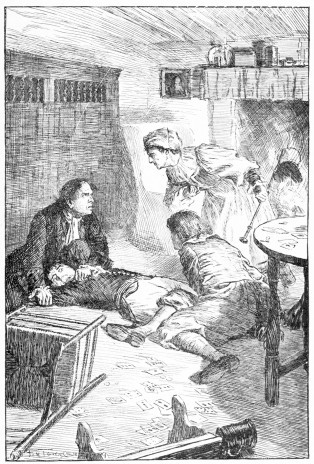
“THE CORPORAL LAY PINIONED ON THE GROUND” (p. 92.)
Ruhler, incriminating himself. Thus they hoped to obtain delay for Nicholas and safety for themselves. However, their plans were too well thought out; their fear of detection led them to employ the strange deaf and dumb boy to write their letter, which afterwards betrayed them.
Sentence of death was pronounced against the persons who had been concerned in the housebreaking as well as against those who had committed the murder, and it was carried into effect on all of them with the exception of Madame van N——, who died in prison. The wool-spinner alone exhibited any sign of penitence.

DISCOVERY OF A CRIME
CHAPTER II.
CASES OF DISPUTED OR MISTAKEN IDENTITY.
Lesurques and the Robbery of the Lyons Mail—The Champignelles Mystery—Judge Garrow’s Story—An Imposition Practised at York Assizes—A Husband Claimed by Two Wives—A Milwaukee Mystery—A Scottish Case—The Kingswood Rectory Murder—The Cannon Street Case—A Narrow Escape.
LESURQUES.
THE most famous, and perhaps the most hackneyed, of all cases of mistaken identity is that of Lesurques, charged with the robbery and murder of the courier of the Lyons mail, which has been so vividly brought home to us through the dramatic play based upon it and the marvellous impersonation of the dual rôle, Lesurques-Duboscq, by Sir Henry Irving.
Lesurques was positively identified as a man who had travelled by the mail coach, and he was in due course convicted. Yet at the eleventh hour a woman came into court and declared his innocence, swearing that the witnesses had mistaken him for another, Duboscq, whom he greatly resembled. She was the confidante of one of the gang who had planned and carried out the robbery. But her testimony, although corroborated by other confederates, was rejected, and Lesurques received sentence of death. Yet there were grave doubts, and the matter was brought before the Revolutionary Legislature by the Directory, who called for a reprieve. But the Five Hundred refused, on the extraordinary ground that to annul a sentence which had been legally pronounced “would subvert all ideas of justice and equality before the law.”
Lesurques died protesting his innocence to the last. “Truth has not been heard,” he wrote a friend; “I shall die the victim of a mistake.” He also published a letter in the papers addressed to Duboscq: “Man in whose place I am to die,” he wrote, “be satisfied with the sacrifice of my life. If you are ever brought to justice, think of my three children, covered with shame, and of their mother’s despair, and do not prolong the misfortunes of so fatal a resemblance.” On the scaffold he said, “I pardon my judges and the witnesses whose mistake has murdered me. I die protesting my innocence.”
Four years elapsed before Duboscq was captured. In the interval others of the gang had passed through the hands of the police, but the prime mover was only now taken. Even then he twice escaped from prison. When finally he was put on his trial, and the judge ordered a fair wig, such as Lesurques had worn, to be placed on his head, the strange likeness was immediately apparent. He denied his guilt, but was convicted and guillotined. Thus two men suffered for one offence.
French justice was very tardy in atoning for this grave error. The rehabilitation of Lesurques’ family was not decreed till after repeated applications under several régimes—the Directory, the Consulate, the Empire, and the Restoration. In the reign of Louis XVIII. the sequestrated property was restored, but there was no revision of the sentence, although the case was again and again revived.
THE CHAMPIGNELLES MYSTERY.
One day in October, 1791, a lady dressed in mourning appeared at the gates of the Château of Champignelles, and was refused admission. “I am the Marquise de Douhault, née de Champignelles, the daughter of your old master. Surely you know me?” she said, lifting her veil. “The Marquise de Douhault has been dead these three years,” replied the concierge; “you cannot enter here. I have strict orders from the Sieur de Champignelles.”
This same lady was seen next day at the village church, praying at the tomb of the late M. de Champignelles, and many remarked her extraordinary resemblance to the deceased Marquise. But the marquise was dead; her funeral service had been performed in this very church. Some of the bystanders asked the lady’s maid-servant who she was, and were told that they ought to know. Others went up to the lady herself, who said, “I am truly the Marquise de Douhault, but my brother will not acknowledge me or admit me to the château.”
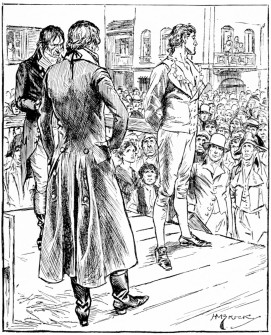
LESURQUE ON THE SCAFFOLD (p. 96.)
Then followed formal recognition. People were summoned by sound of drum to speak to her identity, and did so “to the number of ninety-six, many of them officials, soldiers, and members of the municipality.” The lady gave many satisfactory proofs, too, speaking of things that “only a daughter of the house could know.” Thus encouraged, she proceeded to serve the legal notice on her brother and claim her rights—her share of the property of Champignelles as co-heir, and a sum in cash for back rents during her absence when supposed to be dead.
Where had she been all this time? Who had died, if not she? Her story, although clear, precise, and supported by evidence, was most extraordinary. To understand it we must go back and trace her history and that of the Champignelles family as given in the memoir prepared by the claimant for the courts.
GRAND FRONT OF LA SALPÊTRIÈRE ASYLUM, PARIS.
Adelaide Marie had been married at twenty-three to the Marquis de Douhault, who coveted her dowry, and did not prove a good husband. He was subject to epileptic fits, eventually went out of his mind, and, after wounding his wife with a sword, was shut up in Charenton. The wife led an exemplary life till his death, which was soon followed by that of her father. Her brother now became the head of the family, and is said to have been a frank blackguard, the real cause of his father’s death. He proceeded to swindle his mother, who was entitled by settlement to a life interest in the Champignelles estates, subject to pensions to her children, and he persuaded her to reverse that arrangement—she to surrender her property, he to pay her an annual allowance. He had gained his sister’s concurrence by obtaining her signature to a blank document, which he filled up as he wished.
The son, of course, did not pay the allowances, and very often the mother was in sad straits, reduced at times to pawn her jewels for food. She appealed now to her daughter, who naturally sided with her, and wrote in indignant terms to her brother. There was an angry quarrel, with the threat of a lawsuit if he did not mend his ways. For the purpose of conferring with her mother, whom she meant to join in the suit, the Marquise de Douhault proposed to start for Paris.
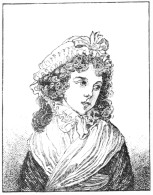
THE DUCHESS OF POLIGNAC. (From the Contemporary Portrait by Mme. Le Brun.)
Having a strange presentiment that this journey would be unlucky, she postponed it as long as possible, but went at length on the day after Christmas Day, 1787. Arrived at Orleans, she accepted the hospitality of a M. de la Roncière and rested there some days. On the 15th of January, 1788, she was to continue her journey, but in the morning she took a carriage drive with her friends. All she remembered afterwards was that Madame de la Roncière offered her a pinch of snuff, which she took, and that she was seized with violent pains in the head, followed by great drowsiness and stupor; the rest was a blank.
When she came to herself, she was a prisoner in the Salpêtrière. Her brain was now clear, her mind active. She protested strongly, and, saying who she was, demanded to be set at large. They laughed at her, telling her her name was Buirette, and that she was talking nonsense.
Her detention lasted for seventeen months, and she was denied all communication with outside. At last she managed to inform a friend, the Duchess of Polignac, of her imprisonment, and on the 13th of July, 1789, she was released, to find herself alone in Paris in the midst of the horrors of the Revolution.
She was friendless. Her brother, to whom she at once applied, repudiated her as an impostor; an uncle was equally cruel; she asked for her mother, and was told she had none. Then she ran to Versailles, where many friends resided, found refuge with the Duchess of Polignac, and was speedily recognised by numbers of people, princes, dukes, and the rest, all members of that French aristocracy which was so soon to be dispersed in exile or to suffer by the guillotine. They urged her not to create a scandal by suing her brother, but to trust to the king for redress. Soon the king himself was a prisoner, and presently died on the scaffold.
Her case was taken up, however, by certain lawyers, who advanced her funds at usurious rates, and planned an attack on her brother, under which, however, they contemplated certain frauds of their own. When she hesitated to entrust them with full powers one of these lawyers denounced her to the Committee of Public Safety, and she narrowly escaped execution. Bailly, the mayor of Paris, was a friend of hers, but could not save her from imprisonment in La Force, where she remained a month, then escaping into the country. Here she learnt that her mother was not dead, and returned to Paris to see her at her last gasp. After that she wandered to and fro in hiding and in poverty till, in 1791, she reappeared at Champignelles.
Such was the case the claimant presented to the courts.
A story is good till the other side is heard, and her brother, M. de Champignelles, clever, unscrupulous, and a friend of the Republican Government, had a very strong defence. His first answer was to accuse his sister, or the person claiming to be his sister, of having tried to seize his château by force of arms, declaring that she had come backed by three hundred men to claim her so-called rights, and that he had appealed to the municipality for protection.
This plea failed, and his second was to accuse the claimant of being someone else. He asserted that she was a certain Anne Buirette, who had been an inmate of the Salpêtrière from the 3rd of January, 1786. This date was a crucial point in the case. The claimant had adopted it as the date of her entry into the Salpêtrière, yet it was clearly shown that at that time the Marquise de Douhault was alive, and that she resided on her property of Chazelet through 1786 and 1787. On other points the claimant showed remarkable knowledge, remembered names, faces of people, circumstances in the past; and all this tended to prove that she was the Marquise. But
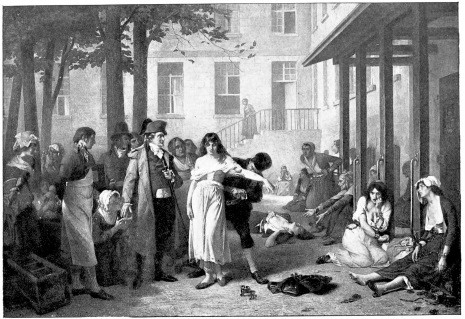
RELEASING PRISONERS AT LA SALPÊTRIÈRE, PARIS. DURING THE FRENCH REVOLUTION. (From the Painting by Tony Robert-Fleury.) Photo by permission of Messrs. Goupil et Cie.
this error in dates was serious, and it was strengthened by a mistake in the Christian names of the deceased Marquis de Douhault.
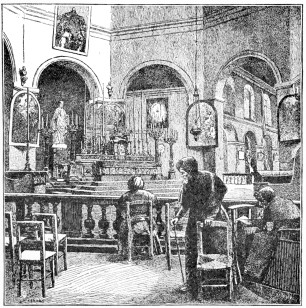
CHAPEL OF LA SALPÊTRIÈRE.
The case came on for trial before the Civil Tribunal of St. Fargeau, where the commissary of the Republic stated it fully, and with a strong bias against the claimant. As he put it: “One side asked for the restitution of a name, a fortune, of which she had been despoiled with a cruelty that greatly added to the alleged crime; the other charged the claimant with being an impostor seeking a position to which she had no right whatever.” Between these two alternatives the court must decide, and either way a crime must be laid bare.
Was it all a fraud? The defence set up was certainly strong.
It rested first on the death of the Marquise. This was supported by the certificates of the doctors who attended her in her last illness, documents attested by the municipality of Orleans, which bore witness to both illness and death. Another document testified that extreme unction had been administered, and that the burial had been carried out in the presence of many relatives. The family went into mourning, and the memory of the Marquise was revered among the honoured dead.
There was next the suspicious commencement of the claim: a letter addressed by the claimant to the curé of Champignelles, two years and a half after the death above recorded, asking for a baptismal certificate and another of marriage. This letter was full of faults of spelling and grammar, and was signed Anne Louis Adelaide, formerly Marquise de Grainville, names that were not exact. It was asserted that the real Marquise was a lady of great intelligence, cultured, highly educated as became her situation, knowing several languages, and a good musician, and especially that she was well able to write prettily and correctly.
Then for the identity of the claimant with Anne Buirette there was seemingly conclusive evidence, the strongest part of it being her own statement of the date on which she was received at the Salpêtrière. All the story of her release through the appeal to the Duchess of Polignac was declared to be untrue. The past life of this Anne Buirette was raked up, and it was demonstrated that she was a swindler who had been sent to gaol for an ingenious fraud which may be narrated here. When in 1785, on the occasion of the birth of a royal prince, the queen wished charitably to redeem a number of the pledges in the Mont de Piété, the woman Buirette, being unauthorised, drove round in a carriage, calling herself a royal attendant, to collect pawn tickets from poor people. She recovered the sums necessary to redeem the pledges and applied the money to her own use. For this she was sent to the Salpêtrière, from which she was released in October, 1789, and not, as she stated, on the day of the barricades.
From this moment, according to the defence, the fraud began, whether at her own instance or not could not be shown. Her movements were traced from place to place as she went about seeking recognition and assistance, now accepted, more often rejected, by those to whom she appealed. Finally the commissary closed the case by pointing to the physical dissimilarity between the two women, the Marquise and the claimant. The first was known as a lady of quality, distinguished in her manners, clever, well-bred; the second was obviously stupid and low-born, stained with vices, given to drink. The Marquise was of frail, delicate constitution, the claimant seemed strong and robust; the first had blue eyes, the second black; the first walked lame, the second showed no signs of lameness.
Yet the claimant persisted, and her counsel upset much that had been urged. It was shown that the death certificate was not produced; that the ill-written letters so condemnatory were copies, not originals; that the official documents purporting to set forth the past life of Anne Buirette were irregular in form and probably not authentic. The claimant showed that she was lame, that her eyes were blue; more, that she carried the scar of the sword wound made by her mad husband years before. It was all to no purpose. The tribunal refused to enter into the question of the alleged falsity of the documentary evidence, and taking its stand upon the date of entry into the Salpêtrière, declared that the claimant could not be the Marquise de Douhault.
Then followed a long course of tedious litigation. The claim was revived, carried from court to court, heard and re-heard; one decree condemned the claimant, and recommended that the case should be dropped; after five years the Supreme Court of Appeal sent it for a new trial to the Criminal Court of Bourges. The points referred were: first, to verify the death of the Marquise de Douhault; second, to establish whether or not the claimant was Anne Buirette, and if not, third, to say whether she was the Marquise.
There were now great discrepancies as to the date and the circumstances of death. Some said it occurred on the 17th of January, 1788, some on the 18th, some again on the 19th. Other facts also were disputed. As to the second query, 18 witnesses swore that the claimant was Anne Buirette; 14 saw no resemblance between Anne Buirette and her, and among these was Anne Buirette’s own husband. As to the third point, 153 out of 224 witnesses declared positively that this was the Marquise herself; but 53 said either that she was not or that they had never seen the claimant, whilst among the number were several who had been satisfied as to her identity in the first instance.
These inquiries were followed by others as to handwriting, and many new and surprising facts came out. It was asserted by experts that the letters written before her alleged death by the Marquise and after it by the claimant were in one and the same hand; that the documents the claimant was said to have written or signed were forgeries, and must have been concocted with fraudulent intention.
Now, too, the claimant explained away the famous date of entry into prison, and laid it to her poor memory, enfeebled by so many misfortunes.
There seemed enough in all this to reverse the decision of St. Fargeau, but the Court of Bourges upheld it. The Procureur-Général pronounced his opinion, formed at the imperious demands of his conscience, that the claimant was not the Marquise de Douhault; more, that “between her and that respectable lady there was as much difference as between crime and virtue.”
The law was pitilessly hostile to the very end. On the revival of the case the claimant was successful in proving that she was certainly not Anne Buirette, but although she published many memoirs prepared by some of the most eminent lawyers of the day, and was continually before the courts during the Consulate and First Empire, she was always unable to establish her identity. The law denied that she was the Marquise de Douhault, but yet would not say who she was. To the last she was nameless, and had no official existence. When she died the authorities would not permit any name to be inscribed on her tomb.
JUDGE GARROWS STORY.
Our own criminal records abound with cases of disputed or mistaken identity. Among the most remarkable of them is the one which Judge Garrow was fond of recounting on the Oxford circuit. He described how a man was being tried before him for highway robbery, and the prosecutor identified him positively. The guilt of the accused seemed clear, and the jury was about to retire to consider their verdict, when a man rode full-speed into the courthouse yard, and forced his way into the court, with loud cries to stop the case; he had ridden fifty miles to save the life of a fellow-creature, the prisoner now at the bar.
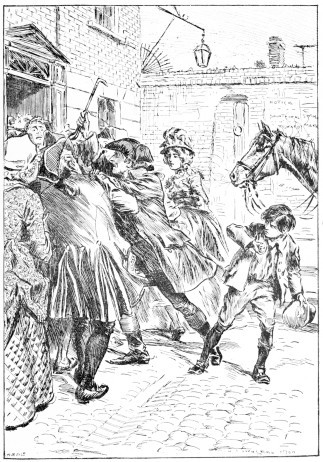
“A MAN ... FORCED HIS WAY INTO THE COURT” (p. 104.)
This strange interruption would have been resented by the judge, but the new arrival called upon all present, especially the prosecutor, to look at him. It was at once apparent that he was the living image of the prisoner; he was dressed in precisely similar attire, a green coat with brass buttons, drab breeches, and top boots. The likeness in height, demeanour, and especially in countenance, was so remarkable that the prosecutor was dumbfoundered; he could no longer speak positively as to the identity of the man who had robbed him. All along, the prisoner had been protesting his innocence, and now, of course, the gravest doubts arose as to his guilt. The prosecutor could not call upon the second man to criminate himself, and yet the jury had no alternative but to acquit the first prisoner. In this they were encouraged by the judge, who declared that, although a robbery had certainly been committed by one of two persons present, the prosecutor could not distinguish between them, and there was no alternative but acquittal.
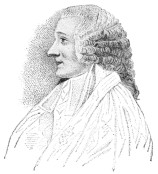
SIR WILLIAM GARROW. (From the Engraving by J. Parden.)
So the first man got off; but now a fresh jury was empanelled, and the second was put upon his trial; his defence was simple enough. Only the day previous the prosecutor had sworn to one man as his robber. Could he now be permitted, even if he wished, to swear away the life of another man for the same offence? All he could say was that it was his belief that it was the last comer that robbed him; but surely if the jury had acquitted one person to whom he had sworn positively, could they now convict a second whom he only believed to be guilty? The jury could not but accept the force of this reasoning, and as the second man would make no distinct confession of guilt, he was suffered to go free. But the truth came out afterwards. The two men were brothers; the first had really committed the crime, and the whole scene had been got up between them for the purpose of imposing on the Court.
A CASE AT YORK.
A very similar case occurred at York. A gentleman arrived there during the assize, and having alighted at a good hotel, where he dined and slept, asked the landlord next morning if he could find anything of interest in the town. Hearing that the assizes were in progress, he entered the court, just as a man was being tried for highway robbery. The case seemed strong against the prisoner, who was much cast down, for he had been vehemently protesting his innocence. Suddenly, on the appearance of the stranger, he rose in the dock and cried, “Here, thank God, is someone who can prove my innocence.” The stranger looked bewildered, but the prisoner went on to declare that he had met this very gentleman, at a distant place, Dover, on the day of the alleged robbery, and he now reminded him that he had conveyed his luggage on a wheelbarrow from the Ship Inn to the packet for Calais. The stranger was now interrogated, but could not admit that he had been in Dover on that day, nor had he any distinct recollection of the prisoner. The judge then inquired whether he was in the habit of keeping a diary, or of recording the dates of his movements. The gentleman replied that he was a merchant and made notes regularly in his pocket-book of his proceedings. This pocket-book was at that moment locked up in his trunk at the inn, but he would gladly surrender his keys and allow the book to be fetched, to be produced in Court.
So a messenger was despatched for the book, and in the meantime the prisoner at the bar questioned the stranger, recalling facts and circumstances to his mind, with the result that their meeting in Dover was pretty clearly proved. The stranger had given his name as a member of a very respectable firm of London bankers, and altogether his credibility appeared beyond question. Then came the book, which fixed the date of his visit to Dover. All this remarkable testimony, arrived at so strangely, was accepted by the jury, and the prisoner was forthwith discharged. Within a fortnight, the gentleman and the ex-prisoner were committed together to York Castle, charged with a most daring act of house-breaking in the neighbourhood!
HOAG OR PARKER?
A very remarkable case of the difficulty of identification is to be found in American records, under date 1804. A man was indicted
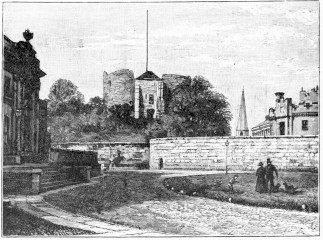
YORK CASTLE (USED AS PRISON), WITH ASSIZE COURT ON LEFT Photo: Frith & Co., Reigate.
for bigamy, the allegation being that he was a certain James Hoag. The man himself said that he was Thomas Parker. At the trial, Mrs. Hoag, the wife, and many relations, with other respectable witnesses, swore positively that he was James Hoag; on the other hand, Thomas Parker’s wife, and an equal number of credible witnesses, swore to the other contention. Whereupon the Court recalled the first set of witnesses, who maintained their opinion, being satisfied that he was James Hoag, his stature, shape, gestures, complexion, looks, voice, and speech leaving no doubt on the subject; they even described a particular scar on his forehead, underneath his hair, and when this was turned back there, sure enough, was the scar. Yet the Parker witnesses declared that Thomas Parker had lived among them, worked with them, and was with them on the very day he was supposed to have contracted his alleged marriage with Mrs. Hoag. Now Mrs. Hoag played Her last card, and said that her husband had a peculiar mark on the sole of his foot; Mrs. Parker admitted that her husband had no such mark. So the court ordered the prisoner to take off his shoes and stockings and show the soles of his feet; there was no mark on either of them. Mrs. Parker now claimed him with great insistency, but Mrs. Hoag would not give up her husband, and there was a very violent discussion in court. At last a justice of the peace from Parker’s village entered the court and gave evidence to the effect that he had known him from a child as Thomas Parker, and had often given him employment. So Mrs. Parker carried off her husband in triumph.
A MILWAUKEE MYSTERY.
An extraordinary case of mistaken identity occurred some fifty years ago in Milwaukee, in the States, for the details of which I am indebted to a gentleman of that city, Mr. John W. Hinton. No fewer than ten reputable, straightforward witnesses swore positively to a dead body as that of a man with whom they were intimately acquainted and in more or less daily intercourse. They based their identification upon certain physical facts of the most unmistakable kind. They were not only satisfied as to the general features—the height, shape, size, the colour of the hair and eyes—but there were other peculiar and distinctive marks, such as scars, loss of teeth, a missing eye, that carried absolute conviction to the witnesses. Yet they were all absolutely and entirely wrong; completely deceived by the remarkable resemblance, the strange, almost incredible similarity of personal traits in two different people.
The case arose out of a mysterious crime. About 9 a.m. on the morning of the 14th of April, 1855, a party of rag-gatherers were seeking their harvest from the river just below one of the Milwaukee bridges. A mass of floating débris—chips, scraps of timber, and general rubbish—was collected in an eddy at the water’s edge, and amidst it a boy espied what he at first thought to be a bag, and afterwards a bundle of rags. He dragged it on shore with his boat-hook and began to examine it. All at once he dropped the parcel with a loud yell and took to his heels. Some of his more courageous fellows then tore it open and exposed its ghastly contents. Inside was the trunk of a human body, with the head all but severed, and held only by a few ligaments. The brains had been dashed out by a blow on the back of the skull, which made a deep indentation several inches long. A great gash had been made in the throat; the left eye protruded; both legs had been chopped off and were gone. The bottom of the bag, as the cover proved to be, had been frayed out or forced open by the action of the water, and the missing portions of the trunk had fallen through or been washed out of the aperture.
The Milwaukee police, headed by the Deputy-Sheriff, who had been at one time Chief of Police, were soon upon the scene. The cause of death was plain. The weapon used was indicated by the wounds; it was evidently an axe which had cut into the skull, and the protruding eye had been sliced out by the same instrument. Close scrutiny of the bag revealed one or two clues of importance. The bag was a wheat sack, with the name of “Vogt” stamped upon it; it had been securely tied by peculiar knots, which an expert eye recognised as French, knots tied by no one but Frenchmen, and French sailors to boot. Weights had evidently been inserted in the “slack” of the bag, which had been thus knotted, and portions of the rope remained attached to the bag. The weights were gone, and had no doubt been detached at the bottom of the river, with the result that the corpse had risen to the surface.
The first step towards the detection of the murderer was to identify the body, and trace back the victim’s habits, acquaintances, and surroundings. Here followed the marvellous mistake made by persons who on the face of it could not be believed to be in error. A mass of testimony was immediately forthcoming, all stating in the most explicit, positive terms that the deceased was a certain John Dwire, well known in Milwaukee. All who spoke did so definitely, declaring their reasons, which appeared conclusive. They knew Dwire well, they recognised his face and its features, his body, the colour of his hair and eyes. This last was a weak point, however. Dwire was said to have only one eye; the corpse had two. Although one had been nearly cut away by the axe stroke, it was still hanging to the head. The witnesses were not to be silenced by this discrepancy; they pointed triumphantly to other physical proofs: a scar or burn mark on the left cheek, the size of a sixpence, “a five-pointed starry scar” which all deposed that Dwire bore; again, he had lost two front teeth—one in the upper, the other in the lower jaw, just as was seen in the corpse; the whiskers, of the leg of mutton pattern, were Dwire’s; the bald head also, for hair was growing round the base of the skull only, curly, and of a sandy hue, as in the case of Dwire. There was a cut, made in shaving the chin, Dwire’s; scars on one finger of the left hand and on the thumb of the right hand, again Dwire’s; and a nose slightly inclined to one side, also Dwire’s. Such was the evidence of the witnesses, corroborating each other in every particular, the testimony of people who had known him for years, the woman of the house where he lodged, the keeper of the boarding-house where he fed, whom he had not paid in full, the associates who worked with him and frequented the same haunts.
Yet while the inquest before which these statements were made was proceeding, unequivocal evidence was adduced which entirely falsified the story as told. The John Dwire supposed to have been murdered was alive and well at no great distance from Milwaukee. A whisper to this effect had been put about, and some of the officials, another deputy-sheriff, and the city marshal travelled to a point higher up the river, some sixteen miles distant, where Dwire had been seen at work since the discovery of his supposed corpse in the stream. He was living near Kemper’s Pier, and had been there uninterruptedly for months—since the previous Christmas, indeed. Had the Court hesitated to accept this startling news, all possible doubt must have disappeared by the next incident. John Dwire himself walked into the court, saying with some humour, “Lest anyone here should still think I’m dead I have come in person to assure him that I am not the corpse found in the river last Saturday morning.”
His reappearance, of course, dumbfoundered all present, more particularly those who had sworn so positively to his mortal remains. It had another and more beneficial result: it saved an innocent man from arrest and probable conviction. The first act of the police on the mistaken identification of the body had been to commence a search in certain low haunts where Dwire had at times been seen, and they had come upon an axe recently used lying on a wood-pile in the possession of a French sailor, commonly called “Matelot Jack,” who was the bar tender of a drinking-shop. The Frenchman had disappeared, but suspicion fell upon another foreigner, a German, who was an associate of Dwire’s, and had accompanied him when the latter left Milwaukee. This German had come into the lodging-house asking for Dwire’s clothes; he came twice, the second time armed with a letter from Dwire authorising him to receive the clothes, but they were impounded for moneys owing. Steps were being taken to arrest this German, and had not Dwire shown up it might have gone hard with the suspected person. It had been in Dwire’s mind at one time to leave the neighbourhood, and had he done so the case against the German would have been pretty complete.
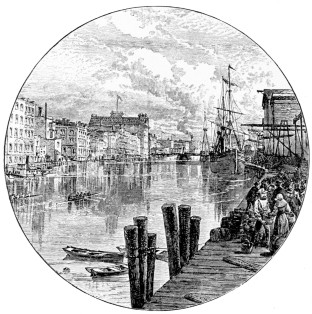
THE RIVER AT MILWAUKEE.
That there had been a murder still remained self-evident, but it was never positively known by whom it was committed, nor who was the actual victim. Some years later a man was arrested on suspicion as a thief; he was carrying a bag heavily laden, and it was found to contain a number of copper articles, all of them stolen. The bag was inscribed with the same name, “Vogt,” as that picked up in the river. A farmer named Vogt now came forward and stated that about the time of the picking up of the unknown corpse he had sent his carter in with a load of wheat packed in bags such as the two mentioned. The man was supposed to have delivered his load, driven his team outside the city, the waggon filled with the empty sacks, and then made off with the price of the wheat. A more probable theory was that he had been murdered and rifled, his body being then thrust into one of his own bags, which was thrown into the river. The case was never carried through to the end, and neither the thief who was caught with the second bag nor the French sailor, Matelot Jack, was tried, presumably from want of sufficiently clear evidence to warrant prosecution.
A SCOTTISH CASE.
Our next case of mistaken identity occurred in Scotland many years ago, when a farmer’s son, a respectable youth, was charged with night-poaching on the evidence of a keeper, who swore to him positively. It was a moonlit night, but cloudy. Other witnesses were less certain than the keeper, but they could speak to the poacher’s dress and appearance, and they saw him disappearing towards the farmer’s house.
An attempt to set up an alibi failed, and the prisoner, having been found guilty by the jury, was sentenced to three months’ imprisonment. On his release, feeling that he was disgraced, he left the country to take up a situation at the Cape of Good Hope.
Soon afterwards the keepers whose evidence had convicted the wrong man met the real culprit in the streets of the county town. He was in custody for theft, and was being escorted to the courts. His name was Hammond. The keepers followed, and after a longer look were more than ever satisfied of the mistake they had made, and they very rightly gave information in the proper quarter. Then a witness came forward who, on the night of the trespass, had seen and spoken with this man Hammond, when he had said he was going into the woods for a shot. Hammond himself, knowing he could not be tried for an offence for which another had suffered, now voluntarily confessed the poaching. Great sympathy was shown towards the innocent victim, and the gentleman whose game had been killed offered to befriend him. But the young man had already made for himself a position at the Cape of Good Hope, and would not leave the colony, where indeed he eventually amassed a fortune. On his return to Scotland, many years later, he was presented with a licence to shoot for the rest of his days over the estates he was supposed to have poached.
KARL FRANZ.
We now come to the famous Kingswood Rectory case. On the 11th of June, 1861, Kingswood Rectory, in Surrey, was broken into, in the absence of the family, and the caretaker murdered. The unfortunate woman was found in her nightdress. She was tied with cords, and had been choked by a sock used as a gag and stuffed halfway down her throat. There had been no robbery; the house had been entered by a window in the basement, but nothing was missing from it, although the whole place had been ransacked. Trace enough was discovered to establish the identity of one at least of the murderers. A packet of papers was found lying on the floor of the room, and it had evidently dropped from the pocket of one of the men.
This packet contained six documents: a passport made out in the name of Karl Franz, of Schandau, in Saxony; a certificate of birth, and another of baptism, both in the name of Franz; a begging letter with no address, but signed Krohn; and a letter from Madame Titiens, the great singer, in reply to an appeal for help. Besides these, there was a sheet of paper on which were inscribed the addresses of many prominent personages; part of the stock-in-trade of a begging-letter writer. All these papers plainly implied that one of the criminal intruders into Kingswood Rectory was a German. Moreover, within the last few days several German tramps had been seen in the neighbourhood of Kingswood, one of whom exactly answered to the description on the passport.
A few weeks later, a young German, in custody in London for a trifling offence, was recognised as Karl Franz. He himself positively denied that he was the man, but at last acknowledged that the documents found in Kingswood Rectory were his property. He was, in due course, committed for trial at the Croydon assizes. The prosecution seemed to hold very convincing evidence against him. A Saxon police officer was brought over, who identified him as Karl Franz, and swore that the various certificates produced had been delivered to him on the 6th of April of the same year. Another witness swore to Franz as one of the men seen in the neighbourhood of the rectory on the 11th of June; while a third deposed to having met two strangers in a wayside public-house, talking a foreign language, and identified Franz as one of them. This recognition was made in Newgate, where he picked out Franz from a crowd of prisoners. Yet more: the servant of a brushmaker in Reigate deposed that two men, speaking some unknown tongue, had come into the shop on the day of the crime, and had bought a hank of cord. One of these men she firmly believed to be the accused. This was the same cord as that with which the murdered woman was bound.
What could the accused say to rebut such seemingly overwhelming evidence? He had, nevertheless, a case, and a strong case. He explained first that he had changed his name because he had been told of the Kingswood murder, and of the discovery of his papers. They were undoubtedly his papers, but they had been stolen from him. His story was that he had landed at Hull, and was on the tramp to London, when he met two other Germans by the way, seamen, Adolf Krohn and Muller by name, and they all joined company. Muller had no papers, and was very anxious that Karl Franz should give him his. On the borders of Northamptonshire the three tramps spent the night behind a haystack. Next morning Franz awoke to find himself alone; his companions had decamped, and his papers were gone. He had been robbed also of a small bag containing a full suit of clothes.
This story was discredited. It is a very old dodge for accused persons to say that suspicious articles found on the scene of a crime had been stolen from them. Yet Franz’s statement was suddenly and unexpectedly corroborated from an independent source. The day after he had told his story, two vagrants, who were wandering on the confines of Northamptonshire, came across some papers hidden in a heap of straw. They took them to the nearest police-station, when it was found that they bore upon the Kingswood case. One was a rough diary kept by the prisoner Franz from the moment of his landing at Hull to the day on which he lost his other papers. The inference was that it had been stolen from him too, but that the thieves, on examination, found the diary useless, and got rid of it. Another of the papers was a certificate of confirmation in the name of Franz. Now, too, it was proved beyond doubt that the letter written by Madame Titiens was not intended for the accused. The recipient of that letter might no doubt have been an accomplice of the accused, but then it must have been believed that these men kept their papers together in one lot, which was hardly likely.
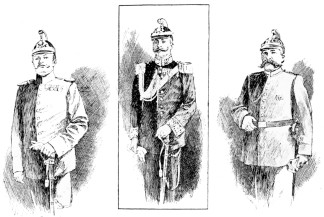
Inspector. Captain. Foot Gendarme. SAXON POLICE.
Another curious point on which the prosecution relied also broke down. A piece of cord had been found in Franz’s lodgings, exactly corresponding with that bought at Reigate, and used in tying the victim. But now it was shown that this cord could only have been supplied to the Reigate shop by one rope-maker, there being but one manufacturer of that kind of cord; and this fact rested on the most positive evidence of experts. Franz had declared that he had picked up this bit of cord in a street in Whitechapel, near his lodgings, and opposite to a tobacconist’s shop. On further inquiry it was not only found that the rope factory which alone supplied this cord was situated within a few yards of Franz’s lodgings, but his solicitor, in verifying this, picked up a scrap of the very same cord in front of a shop in that same street!
THE CANNON STREET CASE.
A very narrow escape from wrongful conviction occurred in the case generally known as the Cannon Street murder, which happened in April, 1866. Here the suspected murderer was tried for his life, and the circumstantial evidence against him was so exceedingly strong that but for a very able defence conducted before Mr. Baron Bramwell, one of the strongest judges England has had, the prisoner would surely have been convicted.
A certain Sarah Milson was housekeeper at Messrs. Bevington’s, the well-known furriers and leather dressers of Cannon Street. She was a widow, and had been employed by the firm for several years. It was her duty to occupy the premises at night when the working hands had left the house. She was not alone, for a female cook also lived on the premises. It was the rule of the house that the porter, a man named Kit, should lock the doors when the day’s work was over, and hand over the keys, including those of the safe, to Mrs. Milson.
On the night of the 11th of April, 1866, Kit performed this duty, and then called upstairs through the speaking-tube to Mrs. Milson, who came down to receive the keys. His last act was to extinguish the light in the lobby, after which he was shown out of the front door by Mrs. Milson.
A little later the same evening the cook, who was upstairs in her bedroom, heard a ring at the door-bell, and was on the point of answering it when Mrs. Milson, who was sitting in the dining-room, called out that the bell was for her, and she accordingly went down. This was about ten minutes past nine. The unfortunate housekeeper was never again seen alive. Later that night the cook, on going downstairs with a lighted candle in her hand, found Mrs. Milson dead at the foot of the stairs. The police were at once called in, and found that death was caused by the battering in of the woman’s head, and a large quantity of blood was spattered over the stairs. A crowbar was found close to the body, and was probably the instrument by which the murder had been effected, although it was unstained with blood.
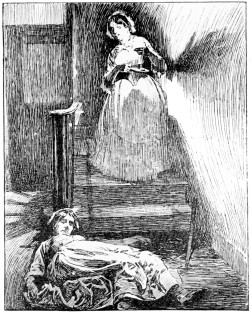
“FOUND MRS. MILSON DEAD AT THE FOOT OF THE STAIRS” (p. 117).
An inquiry was at once set on foot by the police, who ascertained certain facts. First, the cook declared that a man came constantly to call upon the housekeeper, that she herself had never seen the man, but that on one occasion, just before his expected arrival, Mrs. Milson had borrowed two sovereigns from her, which had afterwards been repaid. The identity of this man was discovered next day when a letter was found in one of the boxes of the deceased, signed “George Terry.” This letter, a claim made upon Mrs. Milson for the repayment of certain moneys she owed, expressed great indignation, and threatened that unless Mrs. Milson could offer satisfactory terms the writer would complain to Mr. Bevington of his housekeeper’s indebtedness. Attached to this letter was a receipt signed “William Denton, on behalf of George Terry, 20, Old Change.”
It was not difficult to follow up George Terry from the address given, and he was presently found as an inmate of St. Olave’s Workhouse. He readily told the story of his relations with Mrs. Milson. She had been acquainted with his wife, and as she was in difficulties, he had helped her to get a loan from a certain Mrs. Webber, the total amount being £35. Mrs. Webber appears to have been very urgent about repayment, and so Terry sent Mrs. Milson the letter which was found, but which he did not write himself, having secured the services of a fellow-lodger whom he knew by the name of Bill. “Bill” wrote the letter, went with it to Cannon Street, signed the receipt for such money as he received, and brought back the money. This had occurred some three months before. The man calling himself Denton was then traced, and proved to be a certain William Smith, who lived at Eton, at 6, Eton Square. The City detectives who had charge of the case went at once to Eton with the letter and the receipt, which were shown to William Smith and acknowledged to be in his handwriting.
There was enough in this to warrant the man Smith’s arrest on suspicion, but the police soon had stronger evidence. A woman, Mrs. Robins, who acted as housekeeper at No. 1, Cannon Street, volunteered some very damaging information. She stated that on the night of the murder she returned to No. 1 at ten minutes to ten. As she was on the point of entering her house she heard the door of No. 2 violently slammed. Looking round, she saw a man go down the steps and pass her on the right. He was dressed in dark clothes and wore a tall hat. The light of the hall lamp shone on the man’s face, so that she was able to know it; she noticed that he walked in a very hurried manner, leaning forward as he went along. In order to see whether Mrs. Robins could identify this man, William Smith was taken from Bow Street to the Mansion House through Cannon Street. He was between two police officers, but there was nothing to show that he was in custody. Mrs. Robins had been warned by the police to stand at her door at the time the party passed, and she was asked to say whether she could recognise her man. She made out Smith without hesitation; but to strengthen her evidence, she was sent for to the Mansion House, where the prisoner was placed amongst a number of people in a room through which Mrs. Robins was invited to pass. As she crossed the room for the second time she pointed to Smith and said, “This is the man I saw in Cannon Street.”
Another very damaging witness was a boat-builder, Henry Giles, of Eton, who deposed that he met the prisoner Smith in an alehouse on the night of the 11th of April. Giles asked Smith to play a game of dominoes, but Smith replied that he had to travel forty miles that night. “How can you do that?” asked Giles. “Easy enough,” was the reply; “if I go to London and back, that would make forty miles.” Giles then said, “But you are not going to London, are you?” and Smith replied, “Yes, I am,” at which Giles laughed and called him a liar. Another witness declared that he had seen Smith hurrying towards Slough Station about 7 p.m. The prisoner was said to be wearing dark clothes, a black coat, and a tall black hat.
The evidence of railway officials proved that a train had left Slough at 7.43 and reached Paddington at 8.40. There was also a train down at 10.45, which arrived at 11.43. It was said in evidence that the interval of two hours was quite sufficient to allow Smith to go into the City by the Metropolitan Railway, commit the crime in Cannon Street, and return viâ Bishop’s Road to Paddington. Further evidence against the man Smith consisted of spots upon his coat which were believed to be blood-stains, but which he accounted for by alleging that he had cut himself in shaving.
Here was a man of indifferent character, an idle ne’er-do-well, known to have had dealings with the murdered woman, against whom very clear circumstantial evidence had been adduced. He was shown to have said he was going to London; he was seen close to the station where a train was on the point of starting for London; he was recognised by a respectable woman at just the time he could have reached the house in Cannon Street had he travelled up to Paddington as alleged, and added to all this there were the blood-stains on his coat.
Yet the whole case broke down on the production of the most complete and unquestionable alibi. It was proved beyond all question that Smith did not go to London from Slough by the 7.43 train. The prisoner admitted that he had walked in the direction of Slough Station with the idea of meeting a friend. But he was certainly in company with a man named Harris in Eton Square a little before 6.30, and the two remained together until ten minutes past ten.
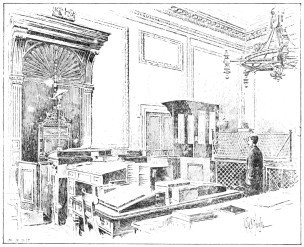
THE MANSION HOUSE JUSTICE ROOM, WHERE THE CASE WAS FIRST HEARD.
A number of other witnesses corroborated this statement—a brazier, a photographer, a gardener, a bootmaker, and so on. Ten or twelve men in all had had Smith under their eyes through the whole of the time that he was supposed to be killing the woman in Cannon Street. One had been drinking with him, three others had played cards with him, an alehouse-keeper’s wife had served him with beer after 11 p.m.
It was altogether absurd to suppose that these witnesses had combined to perjure themselves on behalf of Smith. But even if such a combination had been possible, although no motive for it had been produced, there was other evidence that spoke unconsciously for the prisoner. If Smith had really committed the crime he would never have denied that he went to London, as he did deny it; he would have made some excuse for his going, feeling sure that the fact would be discovered. Another curious fact was that, as he was undoubtedly at Eton at 7.30, he must have gone at great speed to catch the 7.43 train at Slough, a full mile distant. There was not the least necessity for it either, as the Windsor Station was only a few yards from where he had been seen. A defence of this kind was perfectly unanswerable; the judge summed up entirely in favour of the prisoner, and directed the jury to find him not merely “Not guilty,” but actually innocent of the crime.
I cannot leave this interesting case, in which there was nearly a miscarriage of justice from mistaken circumstantial evidence, without relating a curious fact within my own knowledge that grew out of this murder. In December, 1869, when I was acting as Controller of the Convict Prison at Gibraltar, a convict came before the Visitors who appeared under strong emotion, and who told me in a broken voice, with tears in his eyes, that he wished to give himself up as one of the Cannon Street murderers. I cannot remember the man’s name, but I will call him X. After hearing what he had to say, the Visitors asked him what had induced him to make this confession. “Because,” said he, “I didn’t do the job alone. My accomplice, Y” (as I will call him), “has just come out in the last draft from England. I have not yet spoken to him, but I am greatly afraid that he might forestall me in my confession.” The man spoke with such evident contrition and good faith that the Visitors felt bound to accept his story; but they sent for the other, meaning to confront them.
Y started violently when he came into our presence and saw X standing there, but he positively denied his complicity in the murder. For some time, too, he refused to acknowledge that he knew X, and then followed a strange altercation between the two, X earnestly imploring Y to make a clean breast of it, as he himself had done; Y as stoutly repudiating all connection with the matter. Just when we had made up our minds to dismiss both the men and report the case home for instructions, Y’s better nature seemed to triumph, and he admitted thus tardily that he had been concerned in the murder of Mrs. Milson. Our next step was to order both men into separate and solitary confinement until instructions could be received from home. We fully expected to hear in due course that both men were to be sent home to stand their trial for the Cannon Street murder.
I am not ashamed to confess that we had been completely humbugged. A full and searching inquiry had been instituted by the Home Office authorities, more particularly into the antecedents and movements of the two convicts, and it was established beyond all doubt that neither of them could have possibly committed the crime, seeing that both were in custody for another offence on the day of the murder. I am free to admit that in the many years I have since spent in the charge and control of criminals, I have been very loath, after this experience, to accept confessions, although I have had many made to me. Mine is not a singular experience, as most police and prison officials will say. Indeed, the general public themselves must have noticed that there are few mysterious crimes committed which are not confessed to by persons who could not possibly have been guilty. In the case of X and Y, the whole trick had been devised for the simple purpose of escaping daily labour and gaining a few weeks’ complete idleness in the cells.
False confessions, it may be added, are a frequent source of trouble to the police. Whenever some great criminal mystery has shocked the public mind, silly people, whether from constant brooding over the fact or from sheer imbecility, are driven to surrender themselves as the criminals. It will be remembered that at the time of the Whitechapel murders numbers of people stood self-confessed as the perpetrators of these crimes, eager to take upon themselves the criminal identity of the mysterious “Jack the Ripper.” I have recorded elsewhere[7] a curious case in which a lady of good position, married, having many children and a perfectly happy home, became possessed with the idea that she had committed murder—that of a soldier in garrison in the town where she lived. At length she wrote to Scotland Yard, and made full confession of her crime, adding that she meant to arrive in London next day, where she was prepared to submit herself to arrest, trial, and whatever penalty might be imposed. All she asked was that she might not be separated from her children, and that if they could not accompany her to gaol they might at least be permitted to visit her frequently. Next day she arrived as she had threatened, and drove up to Scotland Yard in a cab, herself and children inside, her portmanteaux and a huge bath on the box. There she sat, and positively refused to move anywhere except to gaol. The police authorities, after vainly arguing with her, were on the point of taking charge of her as a wandering lunatic, and sending her home, but the Assistant Commissioner hit upon a happy device for getting rid of her. This was to tell her that if she went to gaol she must be separated absolutely from her children. If, however, she would sign a paper promising to appear whenever called upon, she might remain with her children in her own home. The ruse was successful; she signed the promise, and returned as she had come.
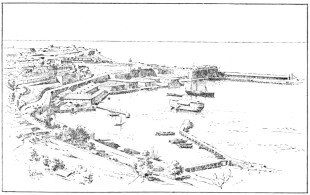
THE CONVICT PRISON AT GIBRALTAR (MARKED BY A *).
A NARROW ESCAPE.
An innocent man narrowly escaped death through an artful plot which led to a mistake of identity, but which fortunately, at the eleventh hour, was brought home to its criminal contrivers. A certain Mr. Henderson, a respectable merchant of Edinburgh, was in 1726 charged with the forgery of an acceptance, signed by the Duchess of Gordon, although, as a matter of fact, he was ignorant of the whole affair. In the year mentioned it was discovered that a man named Petrie, who filled the post of town officer or constable in Leith, held a bill for £58 which purported on the face of it to have been drawn by George Henderson on the Duchess of Gordon, accepted by her, and paid over by Henderson to a Mrs. Macleod. This Mrs. Macleod owed a sum of money to Petrie, and she begged him for a further advance, which he made, to the amount of £6, Mrs. Macleod lodging with him as security the acceptance which she had received from Henderson. Petrie took no action on the bill in the way of demanding payment from the Duchess of Gordon; this was at the instance of Mrs. Macleod, who assured him that her Grace was at that time engaged in special devotional exercises, and that the Duchess’s agent was absent from Edinburgh. Petrie was put off with other excuses. Mrs. Macleod continued to beg him to hold over the bill, and brought him a letter to the same effect purporting to come from Henderson. Petrie, although suspicious as to the genuineness of the bill, took no steps, and the matter came out otherwise; whereupon the Edinburgh magistrates issued a warrant for the arrest of the three parties—Petrie, Henderson, and Mrs. Macleod. Petrie was almost immediately exonerated, but Mrs. Macleod gave such evidence against Henderson that he was held to be fully incriminated, and was put back for trial. Mrs. Macleod asserted positively that the bill had been given her by Henderson.
In due course Henderson was arraigned. Several witnesses swore positively that they had seen Henderson sign documents, especially an acknowledgment of a debt to Mrs. Macleod. One, a man named Gibson, declared that the signature had been given in his own house by Henderson, and in his presence and that of other witnesses. He appears to have identified Henderson in the dock, asserting that he had often previously seen him and been in his company. Gibson further declared that Henderson wore a suit of dark-coloured clothes, and a black wig such as he now appeared in.
Henderson’s defence was that he knew absolutely nothing of the whole proceeding. His counsel adduced in his favour that he was a man of excellent character, and his demeanour at the trial, his straightforward answers to all interrogatories, and the outward appearance of truth in all his details, no doubt made an impression upon the Court. The Lord Advocate, his prosecutor, pressed hard for a conviction, on the ground that the forgery of the bill had been fully proved. The judges, however, stayed proceedings, and postponed decision until the following session.
Now, when the case looked blackest against Henderson, a mere chance interposed to save him. The Lord Advocate, who seems to have had no doubt of his guilt, was on his way northward to spend the recess, when he paid a visit on the way to a Mr. Rose, of Kilravock. One day Mr. Rose took his lordship to see a house he was building, and while inspecting it Mr. Rose missed one of the carpenters. On inquiring what had become of him, the foreman took Mr. Rose aside and privately told him that the man, hearing the Lord Advocate was at Kilravock, had absconded, saying it was time for him to leave the country. The man in question, by name David Household, had gone to the coast, proposing to take ship for London. Mr. Rose felt it his duty to inform the Lord Advocate, and the foreman was questioned as to whether the carpenter had been guilty of any crime. The answer was that Household was suspected of being accessory to a forgery. The Lord Advocate forthwith despatched a messenger to the coast, who apprehended Household, and carried him prisoner to Edinburgh. Household was brought before the Court at the beginning of the winter session and questioned, when he confessed that he had been party to a very scandalous and deliberate fraud. Early in the year Mrs. Macleod had come to him and asked him to write out for her the very bill or acceptance for the forgery of which George Henderson was charged. Household admitted that he had penned the whole document, and had imitated the signatures of Henderson, both as drawer and endorser of the bill, but that he had not written the name of Gordon. Household further deposed that he had assumed, at Mrs. Macleod’s request, the identity of George Henderson; that she had given him for the personation a coat belonging to her husband, and a black-knotted periwig; that she had carried him to a gardener’s house at the Water-Gate, where she had dictated to him a part of the obligation which had been produced in court; and had then taken him on to a house in the Canon-Gate (Gibson’s), where he (Household) had written the rest of the document, and signed it
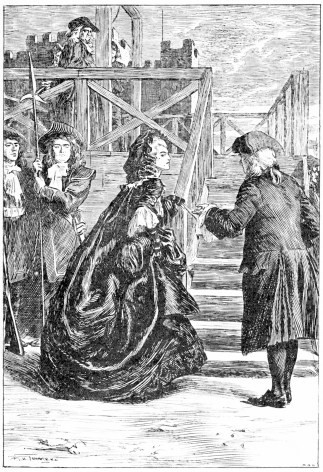
“MRS. MACLEOD WENT TO HER EXECUTION DRESSED IN A BLACK ROBE” (p. 128.)
“George Henderson” in the presence of the various witnesses whom Mrs. Macleod had produced. He also confessed that he had written the letter which Mrs. Macleod had given Petrie as coming from George Henderson. Finally, after Mrs. Macleod’s arrest, a Highlander had come to him with a message from Mr. Macleod urging him to leave the country for his own safety. Household, however, did not take flight until the appearance of the Lord Advocate at Kilravock; then he went to Leith, and hid himself on board ship, where he was discovered by a Customs officer, and eventually arrested.
This evidence changed the whole character of the trial, and the Lord Advocate was the first to admit that Henderson was innocent of the forgery, which was now fixed upon Mrs. Macleod. The records of the case do not give any definite information as to who actually signed the Duchess’s name to the bill, but when Mrs. Macleod was finally arraigned this forgery was laid to her charge, and her offence must have been satisfactorily proved to the jury, for she was found guilty and sentenced to death. Two law officers, the Lord Advocate and the Solicitor-General, characterised the whole “as an artful and horrid contrivance, only discovered by the good providence of God.” It is stated in the account published that Mrs. Macleod went to her execution dressed in a black robe with a large hoop, and a white fan in her hand. When on the gallows she herself took off the ornamental parts of her dress, and put the fatal cord about her neck with her own hands. She persisted to the last in denying her guilt.
The Duchess of Gordon in this case was Lady Henrietta Mordaunt, daughter of the celebrated Charles Earl of Peterborough, and wife of Alexander, second Duke, whom she married in 1706, twenty years before the occurrences recorded.
CHAPTER III.
PROBLEMATICAL ERRORS.
Captain Donellan and the Poisoning of Sir Theodosius Boughton: Donellan’s Suspicious Conduct: Evidence of John Hunter, the great Surgeon: Sir James Stephen’s View: Corroborative Story from his Father—The Lafarge Case: Madame Lafarge and the Cakes: Doctors differ as to the Presence of Arsenic in the Remains: Possible Guilt of Denis Barbier: Madame Lafarge’s Condemnation: Pardoned by Napoleon III.—Charge against Madame Lafarge of stealing a School Friend’s Jewels: Her Defence: Conviction—Madeleine Smith charged with Poisoning her Fiancé: “Not proven”: the Latest Facts—the Wharton-Ketchum Case in Baltimore, U.S.A.—The Story of the Perrys.
CAPTAIN DONELLAN.
“FEW cases,” says Sir James Stephen,[8] “have given rise to more discussion than that of the alleged poisoning of Sir Theodosius Boughton by his brother-in-law, Captain Donellan, in 1781.” It was long deemed a mystery, and even now the facts are not considered conclusive against the man who actually suffered for the crime. Donellan was found guilty, and in due course executed, but to this day the justice of the sentence is questioned, and the case, in the opinion of some, should be classed with judicial errors. This is not the view of Sir James Stephen, who has declared that the evidence would have satisfied him of Donellan’s guilt. “Why should he not have been found guilty?” asks the eminent judge. “He had the motive, he had the means, he had the opportunity; his conduct, from first to last, was that of a guilty man.”
Sir Theodosius Boughton was a young baronet who, on his majority, came into an estate of £2,000 a year. In 1780 he was living at Lawford Hall, Warwickshire, with his mother and sister, the latter having married Captain Donellan in 1777. Mrs. Donellan was her brother’s heir; if he died childless everything would go to her. Donellan claimed afterwards to have been quite disinterested. He had all his wife’s fortune settled on her and her children, and would not even keep a life interest in her property in case she predeceased him. This settlement extended not only to what she had but to what she expected, and his conduct in this matter was one of the points made by the defence in his favour.
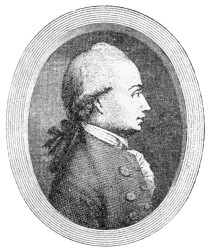
CAPTAIN JOHN DONELLAN. (From a Contemporary Print.)
Boughton was suffering from a slight specific disorder, but was otherwise well; Donellan wished to make it appear otherwise. Talking of him to a friend, he described his condition as such that the friend remarked the young man’s life would not be worth a couple of years’ purchase. “Not one,” promptly corrected Donellan. On the 29th of August, 1780, a country practitioner who was called in pronounced Sir Theodosius in good health and spirits, but prescribed a draught for him: jalap, lavender water, nutmeg, and so forth. The remainder of the day was spent in fishing, and the baronet went to bed, having arranged that his mother should come to him and give him his medicine at seven o’clock next morning. He had been neglectful about taking it; it had been kept locked up in a cupboard, but, at his brother-in-law’s suggestion, it was now left on the shelf in another room—where, as the prosecution declared, anyone, Captain Donellan in particular, might have access to it.
At six a.m. on the morning of the 30th a servant went in and saw Sir Theodosius about some business of mending a net. The young baronet then appeared quite well. At seven Lady Boughton came up with the medicine, which she found on the shelf. Sir Theodosius tasted and smelt it, complaining that it was very nauseous. His mother then smelt it, and noticed that it was like bitter almonds, but she persuaded her son to drink off a whole dose. “In about two minutes or less,” she afterwards deposed, “he struggled violently and appeared convulsed, with a prodigious rattling in his throat and stomach.” When he was a little better the mother left him, but returned in five minutes to find him with his eyes fixed, his teeth clenched, and froth running out of his mouth.
The doctor was forthwith summoned. Now Donellan came in, and Lady Boughton told him that she was afraid she had given her son something wrong instead of the medicine. Donellan asked for the bottle, took it, poured in some water, then emptied the contents into a basin. Lady Boughton protested, declaring that he ought not to have meddled with the bottle. Donellan’s reply was that he wished to taste the stuff. Again, when a maid-servant came in he desired her to remove the basin and the bottles, while Lady Boughton directed her to let them alone. But now Sir Theodosius was in his death-throes, and while she was engaged with him the bottles disappeared.
Donellan, after the event, wrote to the baronet’s guardian, Sir William Wheler, notifying the death, but giving none of the peculiar circumstances of the case. Three or four days later the guardian replied that as the death had been so sudden, and gossip was afloat concerning a possible mistake with the medicine, it was desirable to have a post-mortem. “The country will never be satisfied else, and we shall all be very much blamed,” wrote Sir William Wheler. “Although it is late now it will appear from the stomach whether there is anything corrosive in it.... I assure you it is reported all over the country that he was killed either by medicine or by poison.” The step was all the more necessary in the interest of the doctor who prescribed the draught. Donellan replied that Lady Boughton and he agreed “cheerfully” to the suggestion. Sir William wrote again, saying he was glad they approved, and gave the names of the doctors who should perform the autopsy.
When they came, Donellan showed them the second letter, not the first; the mere desire for a post-mortem, not the grounds for it, as set forth in the first, that poison was suspected. Decomposition was far advanced, the doctors were not pleased with the business, and, knowing no special reason for inquiry, made none. After this Donellan wrote to Sir William Wheler, conveying the impression that the post-mortem had actually taken place. Later, another surgeon offered to open the body, but Donellan refused, on the plea that it would be disrespectful to the two first doctors. Sir William, too, having learnt that nothing had been done, reiterated his desire for a post-mortem, and two more doctors arrived at Lawford Hall on the very day of the funeral. Donellan took advantage of a misconstruction of a message, and the body was buried without being opened.
Three days afterwards it was exhumed in deference to growing suspicions of poison, but it was too late to verify foul play. But the doctors formed a strong opinion of the cause of death, and later, when it came to the trial, they agreed that the draught, after swallowing which Boughton died, was poison, and the immediate cause of death. One said that the nature of the poison was sufficiently clear from Lady Boughton’s description of the smell. But the great surgeon, John Hunter, would not admit that the appearance of the body gave the least suspicion of poison. As to the smell, a mixture of the very same ingredients, but with laurel water added, was made up for Lady Boughton at the trial, and she declared it smelt of bitter almonds exactly like the draught.
The introduction of the laurel water followed the important discovery that Donellan had a private still in a room which he called his own, and that he distilled roses in it. A curious bit of evidence not mentioned in the report of the trial is preserved,[9] which shows how a single number of the “Philosophical Transactions” was found in Donellan’s library, and the only leaves in the book that had been cut were those that gave an account of the making of laurel water by distillation. Donellan’s still figured further in the case, for it was proved that he had taken it into the kitchen, and asked the cook to dry it in the oven. This was two or three days after the baronet’s death, and the presumption was that he had desired to take the smell of laurel water off the still. It also appeared that Donellan was in the habit of keeping large quantities of arsenic in his room, which he used, seemingly with but little caution, for poisoning fish.
Donellan’s defence did not help him greatly. It was written, after the custom of those days, and did not attempt to explain why
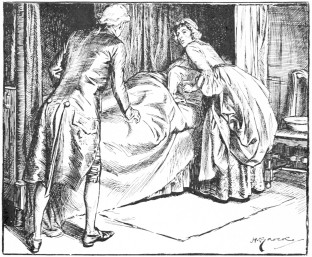
“NOW DONELLAN CAME IN” (p. 131.)
he had washed or made away with the bottles. He submitted that he had urged the doctors to the post-mortem by producing Sir William Wheler’s letter; but it was the second, not the first letter. On other points he maintained a significant silence. What went against him also were unguarded confidences made to a fellow-prisoner while he was awaiting trial. He said openly that he believed his brother-in-law had been poisoned, and that it lay among themselves: Lady Boughton, himself, the footman, and the doctor. Another curious story is preserved by Sir James Stephen, whose grandfather had long retained a strong belief in Donellan’s innocence, and had written a pamphlet against the verdict which attracted much notice at the time. Mr. Stephen changed his opinion when he had been introduced to Donellan’s attorney, who told him that he also had firmly believed in Donellan’s innocence until one day he proposed to his client to retain Dunning, the eminent counsel, for his defence. Donellan agreed, and referred the attorney to Mrs. Donellan for authority to incur the expense of the heavy fee required. Mrs. Donellan demurred, thinking the outlay unnecessary, and when this was reported to the prisoner, Donellan burst into a rage, crying, “And who got it for her?” Then, seeing that he had committed himself, he stopped abruptly, and said no more.
Donellan was convicted and executed, and to those who aver that the verdict was wrong Sir James Stephen replies that every item of evidence pointed to Donellan’s guilt, and did, in fact, satisfy the jury. The want of complete proof is the chief basis of the argument in Donellan’s favour, backed by the opinion of so eminent a scientist as Hunter. He deposed that he did not see the slightest indication of poisoning, and while he admitted that death following so soon after the draught had been swallowed was a curious fact, yet he could see no necessary connection between the two circumstances. The symptoms, as described to him, and the state of the internal organs, were perfectly compatible with death from epilepsy or apoplexy. Public opinion at the time was, no doubt, adverse to Donellan, and the jury may have been prejudiced against him. He was deemed an adventurer, a fortune-hunter, who had gained a footing in a good family by somewhat discreditable means, and it was assumed that he was prepared to go any length to feather his nest further.
This was a rather exaggerated view. Donellan was a gentleman. He had borne the king’s commission, and was a son of a colonel in the army. To haunt fashionable society in London and the chief pleasure resorts in search of a rich partie was a common enough proceeding, and implied self-seeking, but not necessarily criminal tendencies. He got his chance at Bath by doing a civil thing, and made the most of it. Lady Boughton was unable to find accommodation in the best hotel, and Donellan, who was there, promptly gave up his rooms. The acquaintance thus pleasantly begun grew into intimacy, and ended in his marrying Miss Boughton. So far the circumstances were not very strong against him. It was his conduct after the event that told, and, though there is an element of doubt in the case, most people, probably, who review the facts will come to the same conclusion as did Sir James Stephen.
MADAME LAFARGE.
One of the greatest poisoning trials on record in any country is that of Madame Lafarge, and its interest is undying, for to this day the case is surrounded by mystery. Although the guilt of the accused was proved to the satisfaction of the jury at the time of trial, strong doubts were then entertained, and still possess acute legal minds, as to the justice of her conviction. Long after the event, two eminent Prussian jurists, councillors of the criminal court of Berlin, closely studied the proceedings, and gave it as their unqualified opinion that, according to Prussian law, there was absence of proof. They published a report on the case, in which they gave their reasons for this opinion, but it will be best to give some account of the alleged poisoning before quoting the arguments of these independent authorities.
In the month of January, 1840, an iron-master, residing at Glandier, in the Limousin, died suddenly of an unknown malady. His family, friends, and immediate neighbours at once accused his wife of having poisoned him. This wife differed greatly in disposition and breeding from the deceased. Marie Fortunée Capelle was the daughter of a French artillery colonel, who had served in Napoleon’s Guard. She was well connected, her grandmother having been a fellow-pupil of the Duchess of Orleans under Madame de Genlis; her aunts were well married, one to a Prussian diplomat, the other to M. Garat, the general secretary of the Bank of France. She had been delicately nurtured. Her father had held good military commands, and was intimate with the best people, many of them nobles of the First Empire, and the child was petted by the Duchess of Dalmatia (Madame Soult), the Princess of Echmuhl (Madame Ney), Madame de Cambacères, and so forth.
Colonel Capelle died early, and Marie’s mother, having married again, also died. Marie was left to the care of distant relations; she had a small fortune of her own, which was applied to her education, and she was sent to one of the best schools in Paris. Here she made bosom friends, as schoolgirls do, and with one of them became involved in a foolish intrigue, which, in the days of her trouble, brought upon her another serious charge, that of theft. Marie grew up distinguished-looking if not absolutely pretty; tall, slim, with dead-white complexion, jet-black hair worn in straight shining pleats, fine dark eyes, and a sweet but somewhat sad smile. These are the chief features of contemporary portraits.
To marry her was now the wish of her people, and she was willing enough to become independent. Some say that a suitor was sought through the matrimonial agents, others positively deny it. In any case, a proposal came from a certain Charles Pouch Lafarge, a man of decent family but inferior to the Capelles, not much to look at, about thirty, and supposed to be prosperous in his business. The marriage was hastily arranged, and as quickly solemnised—in no more than five days. Lafarge drew a rosy picture of his house: a large mansion in a wide park, with beautiful views, where all were eager to welcome the bride and make her happy. As they travelled thither the scales quickly fell from Marie’s eyes. Her new husband changed in tone; from beseeching he became rudely dictatorial, and he seems to have soon wounded the delicate susceptibilities of his wife.
The climax was reached on arrival at Glandier, a dirty, squalid place. Threading its dark, narrow streets, they reached the mansion—only a poor place, after all, surrounded with smoking chimneys: a cold, damp, dark house, dull without, bare within. The shock was terrible, and Madame Lafarge declared she had been cruelly deceived. Life in such surroundings, tied to such a man, seemed utterly impossible. She fled to her own room, and there indited a strange letter to her husband, a letter that was the starting-point of suspicion against her, and which she afterwards explained away as merely a first mad outburst of disappointment and despair. Her object was to get free at all costs from this hateful and unbearable marriage.
This letter, dated the 25th of August, 1839, began thus: “Charles,—I am about to implore pardon on my knees. I have betrayed you culpably. I love not you, but another....” And it continued in the same tone for several sheets. Then she implored her husband to release her and let her go that very evening. “Get two horses ready: I will ride to Bordeaux and then take ship to Smyrna. I will leave you all my possessions. May God turn them to your advantage—you deserve it. As for me, I will live by my own exertions. Let no one know that I ever existed.... If this does not satisfy you I will take arsenic—I have some.... Spare me, be the guardian angel of a poor orphan girl, or, if you choose, slay me, and say I have killed myself.—Marie.”
Another curious point on which the prosecution relied also broke down. A piece of cord had been found in Franz’s lodgings, exactly corresponding with that bought at Reigate, and used in tying the victim. But now it was shown that this cord could only have been supplied to the Reigate shop by one rope-maker, there being but one manufacturer of that kind of cord; and this fact rested on the most positive evidence of experts. Franz had declared that he had picked up this bit of cord in a street in Whitechapel, near his lodgings, and opposite to a tobacconist’s shop. On further inquiry it was not only found that the rope factory which alone supplied this cord was situated within a few yards of Franz’s lodgings, but his solicitor, in verifying this, picked up a scrap of the very same cord in front of a shop in that same street!
[7] See “Secrets of the Prison House,” vol. i.
[8] “Criminal Law of England.”
[9] Townsend’s “Life of Justice Buller.”
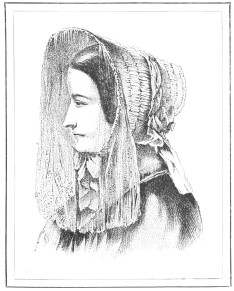
MADAME LAFARGE. (From a Contemporary Print.)
This strange effusion was read with consternation not only by Lafarge, but by his mother, his sister, and her husband. A stormy scene followed between Lafarge and his wife, but at length he won her over. She withdrew her letter, declaring that she did not mean what she wrote, and that she would do her best to make him happy. “I have accepted my position,” she wrote to M. Garat, “although it is difficult. But with a little strength of mind, with patience, and my husband’s love, I may grow contented. Charles adores me, and I cannot but be touched by the caresses lavished on me.” To another she wrote that she struggled hard to be satisfied with her life. Her husband under a rough shell possessed a noble heart; her mother-in-law and sister-in-law overwhelmed her with attentions. Now she gradually settled down into domesticity, and busied herself with household affairs.
M. Lafarge made no secret of his wish to employ part of his wife’s fortune in developing his works. He had come upon an important discovery in iron smelting, and only needed capital to make it highly profitable. His wife was so persuaded of the value of this invention that she lent him money, and used her influence with her relatives to secure a loan for him in addition. Husband and wife now made wills whereby they bequeathed their separate estates to each other. Lafarge, however, made a second will, almost immediately, in favour of his mother and sister, carefully concealing the fact from his wife. Then he started for Paris, to secure a patent for his new invention, taking with him a general power of attorney to raise money on his wife’s property. During their separation many affectionate letters passed between them.
The first attempt to poison, according to the prosecution, was made at the time of this visit to Paris. Madame Lafarge now conceived the tender idea of having her portrait painted, and sending it to console her absent spouse. At the same time she asked her mother-in-law to make some small cakes to accompany the picture. They were made and sent, with a letter, written by the mother, at Marie Lafarge’s request, begging Lafarge to eat one of the cakes at a particular hour on a particular day. She would eat one also at Glandier at the same moment, and thus a mysterious affinity might be set up between them.
A great deal turned on this incident. The case containing the picture and the rest was despatched on the 16th of December, by diligence, and reached Paris on the 18th. But on opening the box, one large cake was found, not several small ones. How and when had the change been effected? The prosecution declared it was Marie’s doing. The box had undoubtedly been tampered with; it left, or was supposed to leave, Glandier fastened down with small screws. On reaching Paris it was secured with long nails, and the articles inside were not placed as they had been on departure. Lafarge tore off a corner of the large cake, ate it, and the same night was seized with violent convulsions. It was presumably a poisoned cake, although the fact was never verified, but Marie Lafarge was held responsible for it, and eventually charged with an attempt to murder her husband.
In support of this grave charge it was found that on the 12th of December, two days before the box left, she had purchased a quantity of arsenic from a chemist in the neighbouring town. Her letter asking for it was produced at the trial, and it is worth reproducing. “Sir,” she wrote, “I am overrun with rats. I have tried nux vomica quite without effect. Will you, and can you, trust me with a little arsenic? You may count upon my being most careful, and I shall only use it in a linen closet.” At the same time she asked for other drugs, of a harmless character.
Further suspicious circumstances were adduced against her. It was urged that after the case had been despatched to Paris she was strangely agitated, her excitement increasing on the arrival of news that her husband was taken ill, that she expressed the gravest fears of a bad ending, and took it almost for granted that he must die. Yet, as the defence presently showed, there were points also in her favour. Would Marie have made her mother-in-law write referring to the small cakes, one of which the son was to eat, if she knew that no small cakes, but one large one, would be found within? How could she have substituted the large for the small? There was as much evidence to show that she could not have effected the exchange as that she had done so. Might not someone else have made the change? Here was the first importation of another possible agency into the murder, which never seems to have been investigated at the time, but to which I shall return presently to explain how Marie Lafarge may have borne the brunt of another person’s crime. Again, if she wanted thus to poison her husband, it would have been at the risk of injuring her favourite sister also. For this sister lived in Paris, and Lafarge had written that she often called to see him. She might, then, have been present when the case was opened, and might have been poisoned too.
Lafarge so far recovered that he was able to return to Glandier, which he reached on the 5th of January, 1840. That same day Madame Lafarge wrote to the same chemist for more arsenic. It was a curious letter, and certainly calculated to prejudice people against her. She told the chemist that her servants had made the first lot into a clever paste which her doctor had seen, and for which he had given her a prescription; she said this “so as to quiet the chemist’s conscience, and lest he should think she meant to poison the whole province of Limoges.” She also informed the chemist that her husband was indisposed, but that this same doctor attributed it to the shaking of the journey, and that with rest he would soon be better.
But he got worse, rapidly worse. His symptoms were alarming, and pointed undoubtedly to arsenical poisoning, judged by our modern knowledge. Madame Lafarge, senior, now became strongly suspicious of her daughter-in-law, and insisted on remaining always by her son’s bedside. Marie opposed this, and wished to be her husband’s sole nurse, and, according to the prosecution, would have kept everyone else from him. She does not seem to have succeeded, for the relatives and servants were constantly in the sick-room. Some of the latter were very much on the mother’s side, and one, a lady companion, Anna Brun, afterwards deposed that she had seen Marie go to a cupboard and take a white powder from it, which she mixed with the medicine and food given to Lafarge. Madame Lafarge, senior, again, and her daughter, showed the medical attendant a cup of chicken broth on the surface of which white powder was floating. The doctor said it was probably lime from the whitewashed wall. The ladies tried the experiment of mixing lime with broth, and did not obtain the same appearance. Yet more, Anna Brun, having seen Marie Lafarge mix powder as before in her husband’s drink, heard him cry out, “What have you given me? It burns like fire.” “I am not surprised,” replied Marie quietly. “They let you have wine, although you are suffering from inflammation of the stomach.”
Yet Marie Lafarge made no mystery of her having arsenic. Not only did she speak of it in the early days, but during the illness she received a quantity openly before them all. It was brought to her at Lafarge’s bedside by one of his clerks, Denis Barbier (of whom more directly), and she put it into her pocket. She told her husband she had it. He had been complaining of the rats that disturbed him overhead, and the arsenic was to kill them. Lafarge took the poison from his wife, handed it over to a maid-servant, and desired her to use it in a paste as a vermin-killer. Here the facts were scarcely against Marie Lafarge.
As the husband did not improve, on the 13th his mother sent a special messenger to fetch a new doctor from a more distant town. On their way back to Glandier, this messenger, the above-mentioned Denis Barbier, confided to the doctor that he had often bought
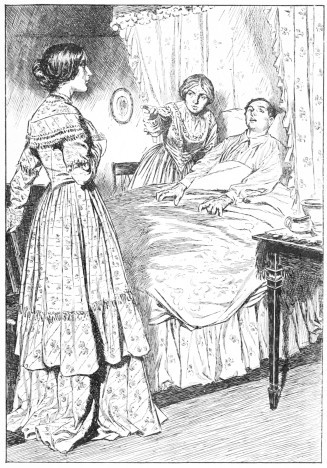
“ON THIS THE MOTHER DENOUNCED MARIE TO THE NOW DYING LAFARGE” (p. 142.)
arsenic for Marie Lafarge, but that she had begged him to say nothing about it. The doctor, Lespinasse by name, saw the patient, and immediately ordered antidotes, while some of the white powder was sent for examination to the chemist who had originally supplied the arsenic. The chemist does not seem to have detected poison, but he suggested that nothing more should be given Lafarge unless it had been prepared by a sure hand.
On this the mother denounced Marie to the now dying Lafarge as his murderess. The wife, who stood there with white face and streaming eyes, heard the terrible accusation, but made no protest. From this time till his last moments he could not bear the sight of his wife. Once, when she offered him a drink, he motioned, horror stricken, for her to leave him, and she was not present at his death, on the 14th of January. A painful scene followed between the mother and Marie by the side of the still warm corpse—high words, upbraidings, threats on the one side, indignant denials on the other. Then Marie’s private letters were seized, the lock of her strong-box having been forced, and next day, the whole matter having been reported to the officers of the law, a post-mortem was ordered, on suspicion of poisoning. “Impossible,” cried the doctor who had regularly attended the deceased. “You must all be wrong. It would be abominable to suspect a crime without more to go upon.” The post-mortem was, however, made, yet with such strange carelessness that the result was valueless.
It may be stated at once that the presence of arsenic was never satisfactorily proved. There were several early examinations of the remains, but the experts never fully agreed. Orfila, the most eminent French toxicologist of his day, was called in to correct the first autopsy, and his opinion was accepted as final. He was convinced that there were traces of arsenic in the body. They were, however, infinitesimal; Orfila put it at half a milligramme. Raspail, another distinguished French doctor, called it the hundredth part of a milligramme, and for that reason declared against Orfila. His conclusion, arrived at long after her conviction, was in favour of the accused. The jury, he maintained, ought not to have found her guilty, because no definite proof was shown of the presence of arsenic in the corpse.
This point was not the only one in the poor woman’s favour. Even supposing that Lafarge had been poisoned—which, in truth, is highly probable—the evidence against her was never conclusive, and there were many suspicious circumstances to incriminate another person. This was Denis Barbier, Lafarge’s clerk, who lived in the house under a false name, and whose character was decidedly bad. Lafarge was not a man above suspicion himself, and he long used this Barbier to assist him in shady financial transactions—the manufacture of forged bills of exchange, which were negotiated for advances. Barbier had conceived a strong dislike to Marie Lafarge from the first; it was he who originated the adverse reports. At the trial he frequently contradicted himself, as when he said at one time that he had volunteered the information that he had been buying arsenic for Marie, and at another, a few minutes later, that he only confessed this when pressed.
Barbier, then, was Lafarge’s confederate in forgery; had these frauds been discovered he would have shared Lafarge’s fate. It came out that he had been in Paris when Lafarge was there, but secretly. Why? When the illness of the iron-master proved mortal, Barbier was heard to say, “Now I shall be master here!” All through that illness he had access to the sick-room, and he could easily have added poison to the various drinks given to Lafarge. Again, when the possibilities of murder were first discussed, he was suspiciously ready to declare that it was not he who gave the poison. Finally, the German jurists, already quoted, wound up their argument against him by saying, “We do not actually accuse Barbier, but had we been the public prosecutors we should rather have formulated charges against him than against Madame Lafarge.”
Summing up the whole question, they were of opinion that the case was full of mystery. There were suspicions that Lafarge had been poisoned, but so vague and uncertain that no conviction was justified. The proofs against the person accused were altogether insufficient. On the other hand, there were many conjectures favourable to her. Moreover, there was the very gravest circumstantial evidence against another person. The verdict should decidedly have been “Not proven.” But public opinion, hastily formed, condemned Madame Lafarge in advance, and the machinery of the French criminal law helped to create a new judicial error, through obstinate reliance on a preconceived opinion.
Marie Lafarge was sentenced to hard labour for life, after exposure in the public pillory. The latter was remitted, but she went into the Montpelier prison and remained there many years. During her seclusion she received some six thousand letters from outside, the bulk of them sympathetic and kindly. Many in prose or verse, and in several languages, were signed by persons of the highest respectability. A large number offered marriage, some the opportunities for escape and the promise of happiness in another country. She replied to almost all with her own hand. Her pen was her chief solace during her long imprisonment, and several volumes of her work were eventually published, including her memoirs and prison thoughts. At last, having suffered seriously in health, she appealed to Napoleon III., the head of the Second Empire, and obtained a full pardon in 1852.
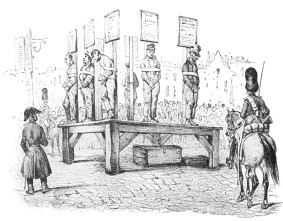
IN THE PUBLIC PILLORY. (From the Engraving by Victor Adam.)
THE STOLEN JEWELS.
The sad story of Madame Lafarge would be incomplete without some account of another mysterious charge brought against her shortly after her arrest for murder. When her mother-in-law accused her of poisoning her husband, one of her old schoolmates declared that she had stolen her jewels. This second allegation raised the public interest to fever pitch. All France, from court to cottage, all classes, high and low, were concerned in this great cause célèbre, in which the supposed criminal, both thief and murderess, belonged to the best society, and was a young, engaging woman. The question of her guilt or innocence was keenly discussed. Each new fact or statement was taken as clear proof of one or the other, and each side found warm advocates in the public Press.
MAÎTRE LACHAUD.
The charge of theft, although the lesser, took precedence of that of murder, and Madame Lafarge was tried by the Correctional Tribunal of Tulle before she appeared at the assizes to answer for her life. She was prosecuted by the Vicomte de Leautaud on behalf of his wife. The accusation was clear and precise. Madame de Leautaud’s diamonds had disappeared for more than a year; the Vicomte believed that Madame Lafarge, when Marie Capelle, had stolen them when on a visit to his house, the Château de Busagny, and he prayed the court to authorise a search to be made at Glandier, Madame Lafarge’s residence until her recent arrest.
When arraigned and interrogated, Marie at once admitted that the diamonds were in her possession. She readily indicated the place where they would be found at Glandier, and made no difficulty as to their restitution. But she long refused positively to explain how she had come by them, declaring it to be a secret she was bound in honour to keep inviolate. At last, under the urgent entreaties of her friends, she confided the secret to her two counsel, Maître Bac and Maître Lachaud (at that time on the threshold of his great and enduring renown), and sent them to Madame Leautaud beseeching her to allow a full revelation of the facts. The letters she then wrote her school friend have been preserved. The first was brief, and merely introduced Maître Bac as a noble and conscientious person, who had her full confidence, and on whom Madame de Leautaud might rely in discussing an affair that concerned them both so closely. The second was a pathetic appeal to tell the whole truth about the diamonds, and it is not easy to say on reading it whether it was inspired by extraordinary astuteness or by genuine emotion. It ran:
Marie,—May God never visit upon you the evil you have done me. Alas, I know you to be really good, but weak. You have told yourself that as I am likely to be convicted of an atrocious crime I may as well take the blame of one which is only infamous. I kept our secret. I left my honour in your hands, and you have not chosen to absolve me.
The time has arrived for doing me justice. Marie, for your conscience’ sake, for the sake of your past, save me!... Remember the facts; you cannot deny them. From the moment I knew you I was deep in your confidence, and I heard the story of that intrigue, begun at school and continued at Busagny by letters that passed through my hands.
You soon discovered that this handsome Spaniard had neither fortune nor family. You forbade him to love, although you had first sought his love, and then you entered into another love affair with M. de Leautaud.
...The man you flouted cried for vengeance.... The situation became intolerable, but money alone could end it. I came to Busagny, and it was arranged between us that you should entrust your diamonds to me, so that I might raise money on them, with which you could pay the price he demanded.
The letter proceeds in similar terms, and need not be reproduced at length. Marie Lafarge continues to implore her old friend to save her, reminding her that only thus can she save herself. Otherwise all the facts must come out.
Remember [and here we seem to get one glimpse of the cloven foot] I have all the proofs in my hands. Your letters to him and his to you, your letters to me.... Your letter, in which you tell me that he is singing in the chorus at the opera, and is of the stamp of man to extort blackmail.... There is one thing for you to do now. Acknowledge in writing under your own hand, dated June, that you consigned the diamonds to my care with authority to sell them if I thought it advisable. This will end the affair.
As Madame de Leautaud still positively denied the truth of these statements, Marie, in self-defence, made them to the judge. She told the whole story of how the diamonds had been given her to sell, that she might remit the amount to a young man in poor circumstances and of humble condition, whose revelations might prove inconvenient. Madame de Leautaud had assisted Marie to take the jewels out of their settings, so as to facilitate their sale. If they had not as yet been sold, it was because she had found it very difficult to dispose of them, both before and after her marriage. She still had them; and they were, in fact, found at Glandier, in the place she indicated. There was never any question as to the identity of the stones, which were recognised in court by the jeweller who had supplied them, and who spoke to their value, some £300, independently of certain pearls which were missing.
The prosecution certainly made out a strong case against Marie Lafarge. The jewels, it was stated, were first missed after a discussion between the two ladies on the difference between paste and real stones. At first Madame de Leautaud made little of her loss. She was careless of her things, and thought her husband or her mother had hidden her jewels somewhere to give her a fright. But they both denied having played her any such trick, and as the jewels were undoubtedly gone, the police were informed, and many of the servants suspected. Suspicion against Madame Lafarge had always rankled in Madame de Leautaud’s mind, and it was soon strengthened by her strange antics with regard to the jewels. On one occasion she defended a servant who had been suspected, promising to find him a place if he were dismissed, as she knew he was innocent. One of her servants told the de Leautauds that her mistress said laughingly she had stolen the jewels and swallowed them. Again, Madame Lafarge had submitted to be mesmerised by Madame de Montbreton, Madame de Leautaud’s sister, and had fallen into an evidently simulated magnetic trance; when, being questioned about the missing jewels, she said they had been removed by a Jew, who had sold them. Other circumstances were adduced as strongly indicating Marie’s guilt. It was observed in Paris, before her marriage, that she had a quantity of fine stones, loose, and she explained that they had been given her at Busagny. Once after her marriage M. Lafarge had asked her for a diamond to cut a pane of glass, and, to his surprise, she produced a number, saying she had owned them from childhood, but that they had only been handed over to her lately by an old servant.
These contradictory explanations told greatly against Madame Lafarge. She made other statements also that were at variance. When first taxed with the theft she pretended that the diamonds had been sent her by an uncle in Toulouse, whose name and address she was, however, unable to give. Next she brought up the story contained in her appealing letter to Madame de Leautaud. It was the story of the young man, Félix Clavé, son of a schoolmaster, with whom the girls had made acquaintance. Having frequently met him when attending mass, they rashly wrote him an anonymous letter, giving him a rendezvous in the garden of the Tuileries. Marie Lafarge declared that the encouragement came from Madame de Leautaud, which the latter denied, and retorted that it was Marie Lafarge who had been the object of the young man’s devotion.
Then Clavé disappeared to Algeria, so Marie declared, as he had written to her from Algiers. Madame de Leautaud said this was impossible, as she had seen him on the stage of the opera. A few months later, Marie alleged, when her friend was with her at Busagny, Madame de Leautaud brought out the diamonds and implored Marie to sell them for her, as she must “absolutely” have money to buy Clavé’s silence. What followed, according to Marie Lafarge, has already been told, except that Madame de Leautaud went through a number of devices to make it appear that the diamonds had been stolen from her, and that then M. de Leautaud was informed of the supposed theft. The gendarmes actually came to search the château and to investigate the robbery next day, although at that time the diamonds were safe in her possession, entrusted to her by Madame de Leautaud.
According to the prosecution, these statements were quite untrue. There had been a theft, and it was soon discovered. The chief of the Paris detective police, M. Allard, had been summoned to Busagny to investigate, and he was satisfied that the robbery had been committed by someone in the château; and, as the servants all bore unimpeachable characters, M. Allard had asked about the other inmates, and the guests. Then M. de Leautaud mentioned Marie Capelle (Lafarge), and hinted that there were several sinister rumours current concerning her, but would not make any distinct charge then. M. Allard now remembered that there had been another mysterious robbery at the house of Madame Garat, Marie Lafarge’s aunt, in Paris, a couple of years before, when a 500 franc note had been stolen, and he had been called in to investigate, but without any result. What if Marie Capelle (Lafarge) had had something to do with this theft?
“HER OWN MAID ELECTED TO GO WITH HER TO PRISON” (p. 150).
It must be admitted that these charges, if substantiated, made the case look black against Marie Lafarge. But one, at least, fell entirely to the ground when she was on her defence. It was clearly shown that she could not have stolen the banknote at her aunt’s, Madame Garat’s, for she was in Paris at the time. As regards the diamonds, her story, if she had stuck to one account only—that of the blackmail—would have been plausible, nay probable, enough. It was positively contradicted on oath by the lady most nearly concerned, Madame de Leautaud, and it was not believed by the court; and Marie Lafarge was finally convicted of having stolen the diamonds, and sentenced to two years’ imprisonment. She appealed against this finding, and appeared no less than four times to seek redress, always without success. Meanwhile the graver charge of murder had been gone into and decided against her; so that the shorter sentence for theft was merged into the life sentence.
There were many who believed in Marie’s entire innocence to the very last. Her own maid elected to go with her to prison, and remained by her side for a year. A young girl, cousin of the deceased M. Lafarge, was equally devoted, and also accompanied her to Montpelier gaol. Her advocate, the eminent Maître Lachaud, steadfastly denied her guilt, and years later, when the unfortunate woman died, he regularly sent flowers for her grave.
MADELEINE SMITH. (From a Portrait taken in Court during her Trial.)
MADELEINE SMITH.
The eldest daughter of a Glasgow architect, Madeleine Smith was a girl of great beauty, bright, attractive, and much courted. But from all her suitors she singled out a certain Jersey man, Pierre Émile l’Angelier, an employé in the firm of Huggins, in Glasgow—a small, insignificant creature, altogether unworthy of her in looks or position. The acquaintance ripened, and Madeleine seems to have become devotedly attached to her lover, whom she often addressed as her “own darling husband.” They kept up a clandestine correspondence, and had many stolen interviews at a friend’s house. In the spring of 1856 Madeleine’s parents discovered the intimacy, and peremptorily insisted that it should end forthwith. But the lovers continued to meet secretly, and Madeleine threw off all restraint, and was ready to elope with her lover. The time was indeed fixed, but she suddenly changed her mind.
Then a rich Glasgow merchant, Mr. Minnock, saw Madeleine, and was greatly enamoured of her. Early in January, 1857, he offered her marriage, and she became engaged to him. It was necessary, now, to break with l’Angelier, and, mindful of the old adage to be off with the old love before she took on with the new, she wrote to him, begging him to return her letters and her portrait. L’Angelier positively refused to give them or her up. He had told many friends of his connection with Madeleine Smith, and some of them had now advised him to let her go. “No; I will never surrender the letters, nor, so long as I live, shall she marry another man.” On the 9th of February he wrote her a letter, which must have been full of upbraiding, and probably of threats, but it has not been preserved. Madeleine must have been greatly terrified by it, too, for her reply was a frantic appeal for mercy, for a chivalrous silence as to their past relations which he was evidently incapable of preserving. She was in despair, entirely in the hands of this mean ruffian, who was determined not to spare her; she saw all hope of a good marriage fading away, and nothing but ignominious exposure before her.
As the result of the trial, when by-and-by she was arraigned for the murder of l’Angelier, was a verdict of “Not Proven,” it is hardly right to say that she now resolved to rid herself of the man who possessed her guilty secret. But that was the case for the prosecution, the basis of the charge brought against her. She had made up her mind, as it seemed, to extreme measures. She appeared to be reconciled with l’Angelier, and had several interviews with him. What passed at these meetings of the 11th and 12th of February was never positively known, but on the 19th he was seized with a mysterious and terrible illness, being found lying on the floor of his bedroom writhing in pain, and likely to die. He did, in fact, recover, but those who knew him said he was never the same man again. He seems to have had some suspicion of Madeleine, for he told a friend that a cup of chocolate had made him sick, but said he was so much fascinated by her that he would forgive her even if she poisoned him, and that he would never willingly give her up.
Rumours of the engagement and approaching marriage now reached his ears, and called forth fresh protests and remonstrances. Madeleine replied, denying the rumours, and declaring that she loved him alone. About this time the Smith family went on a visit to Bridge of Allan, where Mr. Minnock followed them, and, at his urgent request, the day of marriage was fixed. Then they all returned to Glasgow, and missed l’Angelier, who also had followed Madeleine to Bridge of Allan. He remained at Stirling, but, on receiving a letter from her, he went on to Glasgow, being in good health at the time. This was the 22nd of February, a Sunday, on which night, about eight p.m., he reached his lodgings, had tea, and went out. As he left, he asked for a latchkey, saying he “might be late.” He expressed his intention of going back to Stirling the following day.
That same night, or rather in the small hours of the morning, the landlady was roused by a violent ringing of the bell; and, going down to the front door, found l’Angelier there, half doubled up with pain. He described himself as exceedingly ill. A doctor was sent for, who put him to bed and prescribed remedies, but did not anticipate immediate danger. The patient, however, persisted in repeating that he was “worse than the doctor thought”; but he hoped if the curtains were drawn round his bed, and he were left in peace for five minutes, he would be better. These were his last words. When the doctor presently reappeared; l’Angelier was dead. He had passed away without giving a sign; without uttering one word to explain how he had spent his time during the evening.
A search was made in his pockets, but nothing of importance was found; but a letter addressed to him signed “M’eine,” couched in passionate language, imploring him “to return.” “Are you ill, my beloved? Adieu! with tender embraces.” The handwriting of this letter was not identified, but a friend of l’Angelier’s, M. de Mean, hearing of his sudden death, went at once to warn Madeleine Smith’s father that l’Angelier had letters in his possession which should not be allowed to fall into strange hands. It was too late: the friends of the deceased had sealed up his effects and they refused to surrender the letters.
Later M. de Mean plainly told Madeleine Smith, whom he saw in her mother’s presence, that grave suspicion began to overshadow her. It was known that l’Angelier had come up from Bridge of Allan at her request, and he implored her to say whether or not he had been in her company that night. Her answer was a decided negative, and she stated positively that she had seen nothing of him for three weeks. She went farther and asserted that she had neither seen nor wanted to see him on the Sunday evening; she had given him an appointment for Saturday, but he had not
“THE LANDLADY WAS ROUSED BY A VIOLENT RINGING OF THE BELL.” (p. 152.)
appeared, although she had waited for him some time. This appointment had been made that she might recover her letters. All through this painful interview with de Mean, Madeleine appeared in the greatest distress. Next morning she took to flight.
Madeleine was pursued, but by her family, not by the police, and was overtaken on board a steamer bound for Rowallan. Soon after her return to Glasgow the contents of her letters to l’Angelier were made public, and a post-mortem had been made. The body had been exhumed, and the suspicious appearance of the mucous membrane of the stomach, together with the history of the case, pointed to death by poison. The various organs, carefully sealed, were handed over to experts for analysis, and it may be well to state here the result of the medical examination.
Dr. Penny stated in evidence that the quantity of arsenic found in the deceased amounted to eighty-eight grains, or about half a, teaspoonful, some of it in hard, gritty, colourless, crystalline particles. It was probable that this was no more than half the whole amount the deceased had swallowed, for under the peculiar action of arsenic a quantity, quite half a teaspoonful, must have been ejected.
The chief difficulties in the case were whether anyone could have taken so much as a whole teaspoonful of arsenic unknowingly, and how this amount could have been administered. The question was keenly debated, and it was generally admitted that the poison could have been given in chocolate, cocoa, gruel, or some thick liquid, or mixed with solid food in the shape of a cake. This was not inconsistent with the conjectures formed that l’Angelier had met Madeleine Smith on the Sunday night.
The case against her became more formidable when it was ascertained that she had been in the habit of buying arsenic, but with the alleged intention of taking it herself, for her complexion. She was now arrested and sent for trial at Edinburgh, on a charge of poisoning l’Angelier. Her purchases of arsenic were proved by the chemist’s books under date of the 21st of February, and again on the 6th and 18th of March, this last date being four days before the murder.
It was also proved that she wanted to buy prussic acid a few weeks before her arrest. There was nothing to show that she had obtained or possessed any arsenic at the time of l’Angelier’s first illness, on the 19th of February. But it was proved in evidence that, on the night of his death, Sunday, the 22nd of March, l’Angelier had been seen in the neighbourhood of Blythswood Square, where the Smiths lived; again, that he had himself bought no arsenic in Glasgow.
Madeleine’s plucky demeanour in court gained her much sympathy; she never once gave way; only when her impassioned letters were being read aloud did she really lose her composure. She stepped into the dock as though she were entering a ballroom and although she was under grave suspicion of having committed a dastardly crime, the conduct of l’Angelier had set the public strongly against him, so that a vague feeling of “served him right” was present in the large crowd assembled to witness the trial. The case for the prosecution was strong, but it failed to prove the actual administration of poison, or, indeed, that the accused had met the deceased on the Sunday night.
The judge, in summing up, pointed out the grave doubts that surrounded the case, and the verdict of the jury was “Not proven,” by a majority of votes.
This result was received with much applause in court, and generally throughout Glasgow, although a dispassionate review of all the facts in this somewhat mysterious case must surely point clearly to a failure of justice. However, Madeleine triumphed, and won great favour with the crowd. The money for her defence was subscribed in Glasgow twice over, and even before she left the court she received several offers of marriage.
Since writing the foregoing I have had an interesting communication from a lady, who has told me the impressions of one who was present in court during the whole of Madeleine Smith’s trial. This gentleman was an advocate, trained and practised in the law, and according to his opinion, unhesitatingly expressed, there could be no shadow of doubt but that Madeleine was l’Angelier’s wife, by the law of Scotland. As he has put it, in Scotland two people who ought to be married can generally be joined together, and there was little doubt that the sanction of matrimony was needed for this connection. Both Madeleine and l’Angelier were in the habit of addressing each other as husband and wife. This explains l’Angelier’s insistence on the point that “so long as he lived Madeleine should never marry another man.”
The verdict of “Not proven” was brought in by the jury on the grounds that it was not established that the two had actually met on the Sunday night preceding l’Angelier’s last illness. Nevertheless, it is certain that a pocket-book of l’Angelier’s was offered as evidence to the judge, Lord Fullerton, who examined it, but ruled it out because it was not a consecutive diary and the entries had been made in pencil. This book was placed, after the proceedings, in the hands of the legal gentleman above mentioned, and he saw in it an unmistakable entry made by l’Angelier to the effect that he had been in Madeleine’s company on the Saturday night.
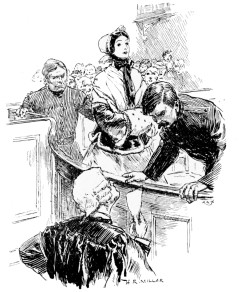
“SHE STEPPED INTO THE DOCK AS THOUGH SHE WERE ENTERING A BALL-ROOM” (p. 155.)
Full corroboration is given by my informant of the engaging and attractive appearance of Madeleine Smith. She was so excessively pretty and bewitching that, to use his own words, no one but a hard-hearted old married man could have resisted her fascinations. He had no doubt whatever in his own mind of her guilt.
The Wharton-Ketchum Case.
General W. E. Ketchum, of the United States army, was a man somewhat past the prime of life, but still sound and strong. Mrs. Wharton was the widow of an army man, and was upwards of fifty years of age. The two were intimate friends, and the General, who had amassed a modest competence, had lent various sums to Mrs. Wharton, amounting to some $2,600 (£520). She was not well off, as it was thought, and, just before the events about to be recorded, she was unable to pay an intended visit to Europe from insufficient funds and inability to obtain her letter of credit.
On the 23rd of June, 1871, General Ketchum came from Washington to her house in Baltimore, to see the last of her, believing her about to start on her long journey, and to collect his debt of $2,600. He was in excellent health when he left home, but very soon after arriving at Baltimore he was taken very ill. He rallied for a time, but again relapsed, and on the 28th of June he died. Suspicions were aroused by his sudden decease, and certainly the symptoms of his illness, as reported, were singular and obscure. Whilst he lay there sick unto death, another gentleman residing in the same house was also suddenly prostrated with a strange and unaccountable sickness, and narrowly escaped with his life.
After General Ketchum’s death his waistcoat was not to be found, nor the note for $2,600. Mrs. Wharton declared that she had repaid him what she owed him and that he had then given her back the note of hand, which was destroyed there and then. She furthermore claimed from his estate a sum of $4,000 in United States Bonds, which, as she asserted, she had entrusted to the General’s safe keeping; yet there was not the slightest mention of any such transaction in his papers—a strange omission, seeing that he was a man of unquestionable integrity, and most scrupulously exact in all matters of account.
Chemical analysis of the stomach of the deceased disclosed the presence of antimonial poison—one of the constituents of tartar emetic. The same poison had been found in a tumbler of milk punch prepared by Mrs. Wharton for General Ketchum, and in a tumbler of beer offered by Mrs. Wharton to the other invalid in her house, Mr. van Ness. Mrs. Wharton had been known to buy tartar emetic during the very week when these singular illnesses occurred among the guests under her roof.
In these suspicious facts people easily found materials for believing in a crime, and a story was soon spread to the effect that Mrs. Wharton had succeeded in poisoning General Ketchum, and had tried to poison Mr. van Ness. Meanwhile she resumed her preparations for her voyage to Europe; but on the very day of departure, the 10th of July, 1871, a warrant for her arrest was issued, and she was taken into custody. In the trial which followed, a great many of the known facts were ruled out as inadmissible. It was argued, and accepted in law, that an accusation of murdering one man could not be supported by evidence of an attempt to kill another, although almost at the same time and by the same means. The charge of poisoning General Ketchum was tried as if there had been no van Ness, as if no other person had been taken ill in Mrs. Wharton’s house. But by reason of the predisposition of the public mind, the case was transferred from Baltimore to Annapolis, and there tried.
The first witness was a Mrs. Chubb, who had accompanied General Ketchum to Baltimore, and who testified that he had fallen ill directly he arrived. He was seized with vomiting, giddiness, and general nausea, which lasted for three days. A doctor was then called in, who prescribed medicine, but Mrs. Wharton broke the bottle, whether by accident or intentionally it was impossible to say. Distinct evidence was first afforded of the possession of tartar emetic by Mrs. Wharton. Mrs. Chubb, who went out to get a fresh bottle of medicine for the General, was asked to buy the antimony also, which Mrs. Wharton said she wanted for herself.
The invalid’s condition improved a little the next day, and arrangements were made to remove him to his own home. However, he relapsed and became worse than ever. The doctor prescribed medicine, which was to be given him at intervals, but before the time for taking the second dose, Mrs. Wharton appeared with it, or something like it, yet different, and more of it than was prescribed. This she strenuously urged the General to swallow, and succeeded in inducing him to do so. Within fifteen minutes he was racked with terrible pain. He tore with his fingers at his throat, chest, and stomach until he broke the skin, then followed fierce convulsions, at the end of which he died.
Fresh evidence was forthcoming, but not accepted, against Mrs. Wharton. At her suggestion Mrs. van Ness, who had been nursing her brother, had concocted some milk punch. This was made in two portions. One was given to Mr. van Ness, and produced symptoms very similar to those exhibited by the unfortunate General Ketchum; the other had been left in a refrigerator by the General’s bedside, and when what was left had been examined by Mrs. van Ness, she declared it had been tampered with; there was a strange muddy deposit at the bottom of the tumbler, and when tasted it was metallic, leaving a curious grating sensation in the mouth. The original constituents had been no more than whisky, milk, and sugar. This testimony was ruled out of order, as belonging to an entirely different case.
The doctor who had attended the General gave evidence as to the symptoms he observed and the remedies applied. At first sight he thought him to be suffering from Asiatic cholera; but later developments were more those of apoplexy, and then again he feared paralysis. He at length had his suspicions aroused, and hinted at poison. The remains of the suspected tumbler were shown him, and his doubts became convictions. With regard to the poisonous action of tartar emetic, the doctor testified that he had noticed all its symptoms in the deceased, although there was a strong similarity between them and those of cholera. Other medical opinion was to the effect that death might have been due to cerebro-spinal meningitis, and some stress was laid upon the absence of antimonial poison in many of the internal organs, although it was contended it had been found in small quantities in the stomach. The same lethal drug had been also detected by analysis in the sediment at the bottom of the tumbler of milk punch.
The verdict of the jury was “Not guilty,” but it did not satisfy public opinion, and it was generally felt that Wharton’s counsel had by no means established her innocence; none of the incriminating facts had been entirely disproved, nor had the exact truth in regard to the money transactions been elicited. No doubt the accused escaped chiefly owing to the fact that chemical experts, called by her counsel, were not satisfied, beyond the possibility of all reasonable doubt, that antimony had been found in the vital organs of General Ketchum. At the time of this trial another indictment was also pending against Mrs. Wharton, charging her with an attempt to kill Mr. van Ness by administering poison. But some months later the counsel for the State entered a nolle prosequi, for what reasons was never generally or distinctly known.
THE STORY OF THE PERRYS.
Truth is stranger than fiction, as we have heard often enough, but in this extraordinary case we shall never know how much is fiction, how much truth. If justice failed, it was misled by a series of the strangest circumstances, some of which have remained a mystery to the present hour. The following details are taken from an account written by a magistrate resident near the scene of the occurrence, and by name Sir Thomas Overbury, the direct descendant of the unfortunate Overbury poisoned in the Tower.
It must be admitted that these charges, if substantiated, made the case look black against Marie Lafarge. But one, at least, fell entirely to the ground when she was on her defence. It was clearly shown that she could not have stolen the banknote at her aunt’s, Madame Garat’s, for she was in Paris at the time. As regards the diamonds, her story, if she had stuck to one account only—that of the blackmail—would have been plausible, nay probable, enough. It was positively contradicted on oath by the lady most nearly concerned, Madame de Leautaud, and it was not believed by the court; and Marie Lafarge was finally convicted of having stolen the diamonds, and sentenced to two years’ imprisonment. She appealed against this finding, and appeared no less than four times to seek redress, always without success. Meanwhile the graver charge of murder had been gone into and decided against her; so that the shorter sentence for theft was merged into the life sentence.
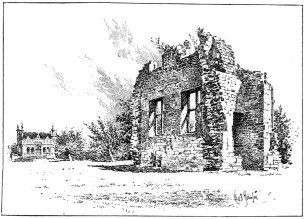
RUINS OF OLD CAMPDEN HOUSE, WITH THE BANQUETING HALL ON THE LEFT.
The village of Campden, in Gloucestershire, some five-and-twenty minutes from the cathedral town and county seat, gave its name to the Viscountess Campden, the lady of the manor. Her steward and agent, a certain William Harrison, a man of seventy years, started from Campden on the 16th of August, 1660, to walk over to the neighbouring village of Charringworth, where he wished to collect rents due to his mistress. As he had not returned according to his wont between 8 and 9 p.m., Mrs. Harrison, his wife, despatched a servant named John Perry along the road to meet him and bring him safely home. Neither Perry nor his master returned that night. Next morning Edward Harrison, the son, proceeded to Charringworth to inquire for his father, and on his way met Perry, the servant, coming from that village. Perry told Edward Harrison that Mr. Harrison had not been heard of, and the two together visited another village, Ebrington, and there got some news. A villager stated that the elder Harrison had paid him a passing call the night before, but had made no stay.
They next went to Paxford, a mile thence, where further news met them. They heard that a poor woman had picked up, in the high road between Ebrington and Campden, a hat, a hat-band, and a comb, and seeking her out, they found her “leasing” or gleaning in a field, whereupon she delivered up the articles, and they were at once identified as Mr. Harrison’s. The woman was forthwith desired to point out the spot where she had picked them up, and she showed it them on the road “near unto a great furze brake.” As the hat-band was bloody and the comb all hacked and cut, it was reasonably concluded that their owner had been murdered.
Mr. Harrison’s disappearance so greatly alarmed his wife that she conceived he had met with foul play at the hand of John Perry, the servant whom she had sent to convoy him home. At her instance, therefore, Perry was seized and carried before a justice, who straightway bade him explain why he had stayed absent the whole of the night he had been sent to look for his master. Perry’s story was that he had not gone “a land’s length” towards Charringworth when it came on so dark he was afraid to go forward, and he returned to the Harrisons’ house, meaning to take out his young master’s horse. But he did no more than make another false start, and then, without informing his mistress that he was still on the premises, he lay down to rest in the hen-roost, where he continued for an hour or more, “but slept not.” About midnight he turned out again, and the moon having now risen he really started for Charringworth. Once more he was stopped; this time by a great mist, in which he lost his way, and finally he took refuge under a hedge, where he slept till daybreak. At last he reached Charringworth, and learning that his master had been there the previous day, followed his movements as he went from house to house receiving monies for rent. There were, however, no signs of the missing man in the village now.
Most of Perry’s statements were verified by other witnesses; but the case was black against him, and he was detained by the law until something definite came out concerning Mr. Harrison. A week passed, during which Perry was lodged “sometimes in an inn in Campden, sometimes in the common prison,” and all the time he was devising different stories to account for his master’s disappearance. One was that a tinker had killed him; another that the servant of a neighbouring squire had robbed and murdered him; and thirdly, that he had been killed in Campden, where his body was hidden in a bean-rick, which was searched, but no body found. On further examination, being pressed to confess, he again insisted that Mr. Harrison had been murdered, “but not by him.” Then the justice said if he knew of the murder he must know also the perpetrators, and this John Perry presently allowed by putting the whole blame on his own mother and brother.
He charged these near relatives with having constantly “lain at him” ever since he was in Mr. Harrison’s service, urging him to help them with money, reminding him how poor they were, and how easy it was for him to relieve them; he need do no more than give them notice when his master went to receive his rents, and they could then waylay him and rob him. Perry went on to say that he met his brother Richard on the very morning that Mr. Harrison went to Charringworth, and that the brother, hearing of the rent collection, was resolved to have the money; that when he (John Perry) started by his mistress’s order to bring Mr. Harrison safely home, he again met his brother Richard, who was lying in wait at a gateway leading from Campden Churchyard into the “Conygree,” certain private grounds and gardens of Lady Campden’s place. By-and-bye, having entered this “Conygree,” which was possible only to those who had the key, he found that his master was being attacked; he was “on the ground, his brother upon him, and his mother standing by.” He begged hard that they would not hurt his master, who was crying, “Ah, rogues, you will kill me!” but his brother Richard replied: “Peace, peace! you are a fool,” and so strangled him, “which having done, he took a bag of money out of his (Mr. Harrison’s) pocket, and threw it into his mother’s lap,” and then he and his mother consulted what to do with the body.
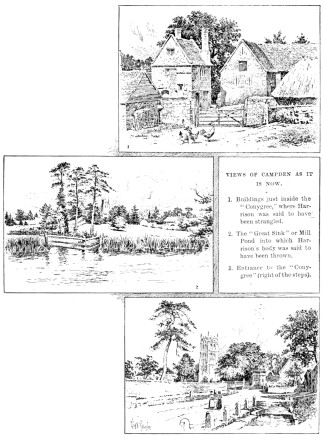
VIEWS OF CAMPDEN AS IT IS NOW. 1. Buildings just inside the “Conygree,” where Harrison was said to have been strangled. 2. The “Great Sink” or Mill Pond into which Harrison’s body was said to have been thrown. 3. Entrance to the “Conygree” (right of the steps).
It was decided that they should drop it into the Great Sink, behind certain mills near the garden, and this they did. John Perry told all this most circumstantially, making it agree with his own movements and the various facts that had come to light, describing how he had gone into the hen-roost but could not sleep; how he had taken with him the hat, band, and comb (and cut the latter with his knife), how he had cast them down upon the highway where they were found, giving as his reason that he hoped it might be believed that his master had been robbed and murdered.
The justices, on this confession, sent to search the Sink at the mill, but without success; “the fish pools likewise in Campden were drawn and searched, but nothing could be there found,” so that “some were of opinion the body might be hid in the ruins of Campden House, burnt in the late wars, and not unfit for such concealment, where was likewise search made, but all in vain.” No time was lost, however, in securing the other Perrys—Joan, the mother, and Richard, both of whom were informed of the accusation brought against them, which “they denied with many imprecations.” John, nevertheless, persisted that he had spoken nothing but truth. Suspicion was strengthened against Richard Perry by his being seen to drop a ball of “inkle,” which he declared was his wife’s “hair lace,” but which John, when it was shown to him, said he knew to his sorrow, for it was the string his brother had strangled Mr. Harrison with. Other significant evidence was quoted, as that Richard’s nose “fell a-bleeding” when he met his children, being on his way to be admonished by the minister in church. Again, it was remembered that a year before there had been a robbery at Mr. Harrison’s, when £140 was stolen from the house at noonday; and John Perry was now asked if he knew aught of the matter. His answer was that his brother Richard was the thief, that he, John Perry, had given him notice that the money was in a room that could be reached by a ladder to the window, and that Richard had stolen it while the master was in church with his whole family “at lecture.”
The three Perrys, Joan, John, and Richard, were arraigned at the next assizes on two separate counts: house-breaking and robbery (of £140), and again robbery and the murder of William Harrison. The judge would not allow the second charge to be proceeded with, as no body had been found, but they acknowledged, indeed, pleaded guilty to it, begging for the king’s pardon under the recent Act of Oblivion. The charge of murder was again advanced at the next assize before another judge, and allowed; it ended in a verdict of guilty, mainly on the strength of John’s confession, although by this time John had gone out of his mind. This was enough to satisfy those who administered the law; and the three, Joan, John, and Richard Perry, were all sentenced to be hanged. The execution was carried out without delay on Broadway Hill, in sight of Campden, where John was also hung in chains.
The strangest part of this affair has yet to be told. William Harrison was not dead; he had been much misused, but had not been murdered, and three years later he reappeared in the flesh. His was a marvellous tale, and its veracity was questioned at the time, but we cannot discredit it entirely.
The account he gave of himself is found in a letter he addressed to Sir Thomas Overbury, whose narrative has been followed throughout.
On the day in question, Thursday, the 16th of August, 1660, he went to Charringworth to collect Lady Campden’s rents, but as harvest was in progress the tenants did not come home from the fields till late, and he was kept at Charringworth till nightfall. He received no more than £23, although he had expected a very considerable sum. With this in his pocket he took his road home, and reached at length the Ebrington Furzes, where the tract passed through a narrow passage. Here he was suddenly faced by a man mounted on horseback, and fearing to be ridden down he struck the horse over the nose, whereupon the horseman drew his sword and attacked him, Harrison making what defence he could with his cane. Then came another behind him, who caught him by the collar and dragged him towards the hedge, and after him a third. They did not rob him of his money, but two of them lifted him into the saddle behind the third, and forcing his arms around the rider’s middle, fastened the wrists together “with something that had a spring lock to it as I conceived by hearing it give a snap as they put it on.” After this they threw a cloak over him, and carried him away, riding some distance till they halted at a stone pit, into which they tumbled him, having now taken all his money. An hour later they bade him come out of the pit, and when he asked what they would do with him they struck him, then mounted him again in the same manner; but before riding away they filled his pockets with a great quantity of money, which incommoded him much in riding, so that by next afternoon, when they again drew rein, he was sorely bruised.
They had come now to a lone house upon a heath, where he was carried upstairs, and they stayed the night. The woman of the house was told that he was much hurt, and was being carried to a surgeon; they laid him on cushions on the floor, and gave him some broth and strong waters. Next day, Saturday, they rode on as before and they lay that night at a place where there were two or three houses, where again he slept on cushions. The next day, Sunday, they reached Deal, and halted by the seaside. One of them kept guard over the prisoner while the two others entered into conference with a man who was awaiting them. This man, whose name he afterwards heard was Renshaw, was afraid that Harrison would die before he could be got on board, but he was put into a boat and carried to a ship, where his wounds were dressed, and in a week’s time “he was indifferently recovered.” Now the master of the ship came one day to say that they were chased by Turkish pirates, and when all offered to fight in defence of the ship he would not suffer it, but handed them over prisoners to the Turks. They were lodged in a dark hole, and remained there in wretched plight, not knowing how long it was before they landed, nor where they were put on shore, except that it was a great house or prison. Presently they were called up and viewed by persons who came to buy them, and Harrison, having said that he had some skill in physic, was taken by an aged physician who lived near Smyrna, and who had at one time resided in England, at Crowland, in Lincolnshire. Harrison was set to keep the still-room, and was fairly well treated, except on one occasion, when his master, being displeased, felled him to the ground, and would have stabbed him with his stiletto.
After nearly two years’ captivity Harrison’s master fell sick and died, but before the end he liberated his captive, and bade him shift for himself. Harrison made his way to a seaport about a day’s journey distant, where he met two men belonging to a Hamburg ship, and now about to sail for Portugal. He implored them to give him passage, but they replied that they did not dare, nor would they yield for all his importunity. At last a third man from the same ship consented to take him on board provided he would lie down above the keel, and remain hidden till they got to sea. They carried him safely to Lisbon, where they put him on shore, penniless and friendless, as he thought, but he happened fortunately on three Englishmen, one of whom took compassion on him, provided him with lodging and diet, and at last procured him a passage home.
Harrison’s story was published in 1676, together with the original narrative of Sir Thomas Overbury, and certain critical remarks were appended. It was said that many people doubted whether Harrison had ever been out of England. Nevertheless, it was certain that he had absented himself from his home and friends for a couple of years, and unless he was carried forcibly away there is no plausible
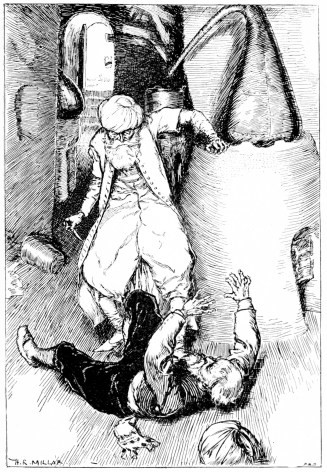
“FELLED HIM TO THE GROUND AND WOULD HAVE STABBED HIM” (p. 166).
explanation of his disappearance. It seemed on the face of it highly improbable that a man who bore a good character, who was in comfortable circumstances, the esteemed servant of an honourable family for nearly fifty years, would have run away without the least warning, and apparently for no sort of reason. He was already seventy years of age, and he left behind him a very considerable sum of Lady Campden’s money. That he was seized and sequestrated can hardly be doubted, but how or by whom, except so far as he himself describes, was never satisfactorily known. It was thought that his eldest son, hoping to succeed him in the stewardship to Lady Campden, might have compassed his father’s removal. This view was supported by the fact that when he did become steward he betrayed his trust. Yet again, to suppose that the elder Harrison would allow the Perrys to suffer death for a crime of which he knew they must be innocent was to accuse him of the deepest turpitude.
The conclusion generally arrived at was that the facts actually did happen very much as they were related, yet the whole story is involved in mystery. The only solution, so far as Perry is concerned, is that he was mad, as the second judge indeed declared. But we cannot account for Harrison’s conduct on any similar supposition. If his own story is rejected as too wild and improbable for credence, some other explanation must be found of his disappearance. Unless he was out of the country, or at least beyond all knowledge of events at Campden, it is difficult to understand what motive would have weighed with him when he heard that three persons were to be hanged as his murderers. The only possible conclusion, therefore, is that he was carried away, and kept away by force.
CHAPTER IV.
POLICE MISTAKES.
The Saffron Hill Murder: Narrow Escape of Pellizioni: Two Men in Newgate for the Same Offence—The Murder of Constable Cock—The Edlingham Burglary: Arrest, Trial, and Conviction of Brannagan and Murphy: Severity of Judge Manisty: A new Trial: Brannagan and Murphy Pardoned and Compensated: Survivors of the Police Prosecutors put on their Trial, but Acquitted—Lord Cochrane’s Case: His Tardy Rehabilitation.
NO human institution is perfect, and the police are fallible like the rest. They have in truth made mistakes, all of them regrettable, many glaring, many tending to bring discredit upon a generally useful and deserving body. If they would freely confess their error they might, in most cases, be forgiven when they go wrong; but there have been occasions when only the pressure of facts which there was no disputing has elicited from them a reluctant admission that they have been on the wrong track. One or two instances of their persistence in error will now be adduced.
PELLIZIONI.
In the Pellizioni case, 1863-4, there might have been a terrible failure of justice, as terrible as any hitherto recorded in criminal annals. This was a murder in a public-house at Saffron Hill, Clerkenwell. The district then, as now, was much frequented by immigrant Italians, mostly of a low class, and they were often at variance with their English neighbours. A fierce quarrel arose in this tavern, and was followed by a deadly fight, in which a man named Harrington was killed, and another, Rebbeck, was mortally wounded. The police were speedily summoned, and, on arrival, they found an Italian, Pellizioni by name, lying across Harrington’s body, in which life was not yet extinct. Pellizioni was at once seized as the almost obvious perpetrator of the foul deed. He stoutly proclaimed his innocence, declaring that he had only come in to quell the disturbance, that the murdered man and Rebbeck were already on the ground, and that in the scuffle he had been thrown on the top of them. But the facts were seemingly against him, and he was duly committed for trial.
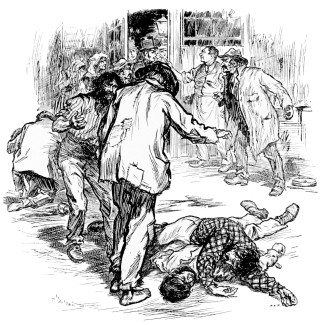
“FOUND AN ITALIAN ... LYING ACROSS HARRINGTON’S BODY” (p. 169).
The case was tried before Mr. Baron Martin, and although the evidence was extremely conflicting, the learned judge said that he thought it quite conclusive against the prisoner. He summed up strongly for a conviction, and the jury brought in a verdict of guilty, whereon Pellizioni was sentenced to be hanged. This result was not accepted as satisfactory by many thoughtful people, and the matter was taken up by the Press, notably by the Daily Telegraph. Some of the condemned convict’s compatriots became deeply interested in him. It was known that in the locality of Saffron Hill he bore the repute of a singularly quiet and inoffensive man. Ultimately, a priest, who laboured among these poor Italians, saved Justice from official murder by bringing one of his flock to confess that he and not Pellizioni had struck the fatal blows. This was one Gregorio Mogni, but he protested that he had acted only in self-defence.
Mogni was forthwith arrested, tried, and convicted of the crime, with the strange result that now two men lay in Newgate, both condemned, independently not jointly, of one and the same crime. If Mogni had struck the blows, clearly Pellizioni could not have done so. Moreover, a new fact was elicited at Mogni’s trial, and this was the production—for the first time—of the weapon used. It was a knife, and this knife had been found some distance from the scene of the crime, where it could not have been thrown by Pellizioni. And again, it was known and sworn to as Mogni’s knife, which, after stabbing the men, he had handed to a friend to take away.
The gravamen of the charge against the police was that they had found the knife before Pellizioni was tried. It was at once recognised all through Saffron Hill that it was Mogni’s knife, and with so much current gossip it was hardly credible that the police were not also informed of this fact. Yet, fearing to damage their case (a surely permissible inference), they kept back the knife at the first trial. It was afterwards said to have been in court, but it certainly was not produced, while it is equally certain that its identification would have quite altered the issue, and that Pellizioni would not have been condemned. The defence, in his case, went the length of declaring that to this questionable proceeding the police added false swearing. No doubt they stuck manfully to their chief and to each other, but they hardly displayed the open and impartial mind that should characterise all officers of justice. In any case, it was not their fault that an innocent man was not hanged.
WILLIAM HABRON.
The strange circumstances which led to the righting of this judicial wrong must give the Habron case a pre-eminence among others of the kind. The mistake arose from the ungovernable temper of the accused, who threatened to shoot a certain police officer, under the impression that he had been injured by him.
In July, 1875, two brothers, William and John Habron, were taken before the magistrates of Chorlton-cum-Hardy, near Manchester, charged with drunkenness. Grave doubts, were, however, expressed in court as to the identity of William Habron. The chief witness, constable Cock, was very positive; he knew the man, he said, because he had so often threatened reprisals if interfered with. But the magistrates gave William the benefit of the doubt, and discharged him. As he left the court he passed Cock and said, “I’ll do for you yet. I shall shoot you before the night is out.”
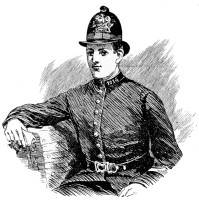
COCK, THE MURDERED CONSTABLE. (From a Photograph.)
Others heard the threat, but thought little of it, among them Superintendent Bent, of the Manchester police. That same night Bent was roused out with the news that Cock had been shot. He ran round to West Point, where the unfortunate officer lay dying, and although unable to obtain from him any distinct indication of the murderer, he concluded at once that John Habron must be the man. He knew where the brothers lodged, and taking with him a force of police, he surrounded the house. “If it is anyone,” said the master of the house and employer of the accused, “it is William—he has such an abominable temper.” All three brothers—William, John, and Frank Habron—were arrested in their beds and taken to the police-station. In the morning a strict examination of the ground where Cock had been shot revealed a number of footmarks. The Habrons’ boots were brought to the spot and found to fit these marks exactly.
The evidence told chiefly against William Habron, who was identified as the man who had bought some cartridges in a shop in Manchester. Both William and John brought witnesses to prove an alibi, but this failed under cross-examination. Again, they sought to prove that they had gone home to bed at nine o’clock on the night of the murder, while other witnesses swore to seeing them drinking at eleven p.m. in a public-house which Cock must have passed soon after that hour on his way to West Point, the spot where he was found murdered. The fact of William Habron’s animus against the constable was elicited from several witnesses, but what told most against the prisoners was the contradictory character of the defence. William Habron alone was convicted, and sentenced to penal servitude.
Years afterwards the notorious Charles Peace, when lying under sentence of death in Leeds prison, made full confession to the writer of these pages that it was he who had killed constable Cock on the night in question. The case was taken up at once, and after thorough investigation of the facts, as stated by Peace, Habron received a full pardon and an indemnity of £800.
THE EDLINGHAM BURGLARY.
Almost at the very time that William Habron was receiving tardy justice a new and still more grievous error was being perpetrated in the North of England. The Edlingham burglary case will always be remembered as a grave failure of justice, and not alone because the circumstantial evidence did not appear sufficient, but because the police, in their anxiety to secure conviction, went too far. As the survivors of the Northumberland police force concerned in this case were afterwards put upon their trial for conspiracy and acquitted, they cannot be actually charged with manufacturing false evidence, but it is pretty clear that facts were distorted, and even suppressed, to support the police view.
The vicarage at Edlingham, a small village near Alnwick, was broken into on the 7th of February, 1879. The only occupants of the house were Mr. Buckle, the vicar, his wife, an invalid, his daughter and four female servants. The daughter gave the alarm about one a.m., and roused her father, a still sturdy old gentleman although seventy-seven years of age, who slipped on a dressing-gown, and seizing a sword he had by him, rushed downstairs, candle in hand, to do battle for his possessions. He found two men rifling the drawing-room, and thrust at them; one rushed past him and made his escape, the other fired at the vicar and wounded him. The same shot (it was a scatter gun) also wounded Miss Buckle. This second burglar then jumped out of the drawing-room window on to the soft mould of a garden bed.
The alarm was given, the police and a doctor were summoned. The latter attended to the wounds, which were serious, and the police, under the orders of Superintendent Harkes, an energetic officer, immediately took the necessary steps to discover the culprits. Officers were despatched to visit the domiciles of all the poachers and other bad characters in Alnwick, while a watch was set upon the roads into the town so that any suspicious persons arriving might be stopped and searched. Then Mr. Harkes drove over to Edlingham to view the premises. He found the window in the drawing-room through which the burglars had entered still open, and the room, all in confusion, ransacked and rifled. One of the servants gave him a chisel which she had found in an adjoining room, another handed over a piece of newspaper picked up just outside the dining-room door. The police-officer soon saw from the marks made that the chisel had been used to prise open the doors, and so soon as daylight came he found outside in the garden the print of feet and the impress of hands and knees upon the mould.
Meanwhile, the officers in Alnwick had ascertained that two men, both of them known poachers, had been absent from home during the night. Their names were Michael Brannagan and Peter Murphy; both were stopped on the outskirts of the town about seven o’clock on the morning of the 8th. There was nothing more against them at the moment than their absence during the night, and after having searched them the police let them go home. Brannagan was quickly followed, and arrested as he was taking off his dirty clogs. Murphy, who lodged with his sister, had time to change his wet clothes and boots before the officers appeared to take him. A girl to whom he was engaged, fearing
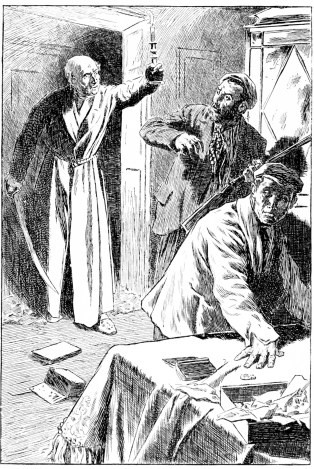
MR. BUCKLE SURPRISING THE BURGLARS.
something was wrong, quickly examined the pockets of his coat, and, finding some blood and fur, tore these pockets out, and hid the coat. When the police returned and asked for the clothes he had been wearing, she gave them a jacket belonging to Peter’s brother-in-law, an old man named Redpath.
At the police-station, the prisoners were stripped and examined. There was no sign of a sword wound on either of them, nor any hole or rent that might have been made by a sword-thrust through their clothes. That same day the prisoners were taken to Edlingham, and everything was arranged as during the burglary. But Mr. Buckle could not identify either of them, nor could Miss Buckle. The case against the prisoners was certainly not strong at this stage. Moreover, there was this strong presumption in their favour—that people engaged in such an outrage as burglary and wounding with intent would not have returned openly to their homes within a few hours of the commission of the crime. When brought before the magistrates for preliminary inquiry, the prisoners found fresh evidence adduced against them. The police, in the person of Mr. Harkes, had traced foot-marks going through the grounds of the vicarage, and out on to the Alnwick road. Plaster casts were produced of these footmarks, also the boots and clogs of the prisoners, and all were found to correspond. The chisel found in the vicarage had been traced to Murphy. His brother-in-law, old Redpath, had been induced to identify it as his property. This admission had been obtained from Redpath by a clever ruse, as the police called it, although they had really set a trap for him, and he had owned to the chisel although it was not his at all. Another damning fact had been elicited in the discovery of a scrap of newspaper in the lining of Murphy’s coat (which, as we know, was not Murphy’s, but Redpath’s), which fragment fitted exactly into the newspaper picked up in the vicarage. This scrap of paper was unearthed from the coat on the 16th of February, by an altogether independent and unimpeachable witness, Dr. Wilson, the medical gentleman who attended the Buckles. It may be observed that the coat itself had been in the possession of the police for just nine days; so had the original newspaper.
The evidence was deemed sufficient, and both prisoners were fully committed for trial at the Newcastle spring assizes of 1879. It is now known that certain facts, damaging to the prosecution, had been brought to the notice of the police. They had positive information that other persons had been abroad from Alnwick that night; they had received a statement, made with much force by one who had good reason to know, that the wrong men had been arrested; while there were witnesses who had met the prisoners soon after the burglary on the other side of Alnwick. On the other hand, fresh evidence against them was forthcoming at the trial. This was the discovery of a piece of fustian cloth with a button attached, which had been picked up by a zealous police-officer under the drawing-room window, a month after the burglary. Here again was damaging evidence, for this scrap of cloth was found to fit exactly into a gap in Brannagan’s trousers. It was said afterwards, at the trial of the police, that they had purposely cut out the piece; and it was proved in evidence that a tailor of Alnwick, to whom the trousers and piece were submitted, expressed his doubts that the accident could have happened in jumping out of the window. The tear would have been more irregular, the fitting-in less exact. Moreover, the piece of cloth was perfectly fresh and clean when found, whereas, if it had lain out for nearly a month in the mud and snow, it must have become dark and dirty, and hard at the edges, as corduroy goes when exposed to the weather. As, however, the judge would not allow the cloth and button to be put in evidence, they played no important part in the case until the subsequent prosecution of the police, except possibly in prejudicing the minds of the jury against Brannagan and Murphy.
The prisoners were ably defended by Mr. Milvain, afterwards a Q.C. His case was that Mr. Buckle (who had corrected his first denial, and, later, had identified the men) was mistaken in the confusion and excitement of the burglarious attack; and that the police had actually conspired to prove the case with manufactured evidence, so as to avoid the reproach of another undetected crime. In support of this grave charge he argued that even if the footprints had not been made deliberately with the boots and clogs in their possession, there had been a great crowd of curious folk all around the house after the crime, any of whom might have made the marks. But a still stronger disproof was that there were no distinct footmarks under the drawing-room window, only vague and blurred impressions; a statement borne out long afterwards, when it was found that the real burglars had taken the precaution to cover their feet with sacking. Again, the evidence of the newspaper was altogether repudiated on the grounds that it had not been sooner detected, and had been put with malicious intention where it was found. Lastly, several witnesses swore that they had never seen in the possession of old Redpath any chisel such as that produced; while as to the gun, it was denied that either prisoner had ever possessed any firearms. Their poaching was for rabbits, and they always used a clever terrier.

EDLINGHAM RECTORY. Photo: Cassell & Co., Limited.
The judge (Manisty) summed up strongly against the prisoners, but the jury did not so easily agree upon their verdict. They deliberated for three hours, and at last delivered a verdict of guilty, whereupon the judge commended them, and proceeded to pass the heaviest sentence in his power, short of death. He sought in vain, he said, “for any redeeming circumstance” that would justify him in reducing the sentence. Had Mr. or Miss Buckle succumbed to their wounds, he must have condemned the prisoners to death. It is clear, then, that Judge Manisty was only saved by mere accident from making as grievous a mistake as any into which a judge ever fell.
Brannagan and Murphy were removed from court protesting their innocence. They went into penal servitude with the same disclaimer.
Seven years dragged themselves along, and there seemed no near prospect of release, “life” convicts being detained as a rule for at least twenty years. But now, by some unseen working of Providence, a light was about to be let in on the case. It came to the knowledge of a young solicitor in Alnwick that a certain George Edgell had been “out” on the night of the Edlingham burglary, and that when he came in, a little before the general alarm, his wife had begged their fellow-lodgers to say nothing about his absence. Mr. Percy, Vicar of St. Paul’s, Alnwick, through whose unstinting exertions justice at last was done, knew Edgell and questioned him, openly taxing him with complicity in the now nearly forgotten crime. Edgell at first stoutly denied the imputation, but seemed greatly agitated and upset. Added to this, it was stated authoritatively that Harkes, the police superintendent, who was now dead, admitted that he had been wrong, but that it was too late to rectify the mistake.
There was some strong counter influence at work, and Mr. Percy found presently that another man, named Charles Richardson, was constantly hanging about Edgell. The reason came out when at last Edgell made full confession of the burglary, and it was seen that this Richardson was his accomplice. They had been out on a poaching expedition, but had had little success. Then Richardson proposed to try the vicarage, and they forced their way in. Richardson used a chisel which he had picked up in an outhouse to prise open the windows and doors. All through he had been the leader and moving spirit. He it was who had first thought of the burglary, who had carried off the only bit of spoil worth having, Miss Buckle’s gold watch, and this, by a curious Nemesis, afforded one of the strongest proofs of his guilt. A seal or trinket had been attached to the chain, and years afterwards, the jeweller to whom he had sold it came forward as a witness against him. The watch itself he had been unable to dispose of, he said, and he threw it into the Tyne. Richardson was a burly ruffian of great stature, and possessed of enormous strength; a quarrelsome desperado, who had already been tried for the murder of a policeman but acquitted for want of sufficient legal proof.
The matter was now taken up by Mr. Milvain, Q.C., who, it will be remembered, defended Brannagan and Murphy, and who had become Recorder of Durham. At his earnest request, backed by strong local representations, the Home Secretary at length ordered a Commission of Inquiry, admitting that the circumstances of the case were “most singular and unprecedented.” A solicitor of Newcastle was appointed to investigate the whole matter, and the fresh facts, with Edgell’s confession, were set before him. On his report the conviction was quashed. It was now seen that the evidence which had condemned those innocent men to a life sentence was flimsy, and much of it open to doubt. All the weak points have been already set forth, and it is enough to state that Brannagan and Murphy were forthwith released, and returned in triumph to Northumberland. The Treasury adjudged them the sum of £800 each, as some slight compensation for their seven years spent in durance vile, and the money was safely invested for them by trustees. Brannagan at once obtained employment as a wheelwright, the handicraft he had acquired in prison, and Murphy, who was a prison-taught baker, adopted that trade, and married the girl Agnes Simm, who had befriended him in regard to the coat on the morning after the burglary.
The real offenders were in due course put upon their trial at Newcastle, before Mr. Baron Pollock, were found guilty, and sentenced each to five years’ penal servitude. A petition, with upwards of three thousand signatures, was presented to the Home Secretary, praying for a mitigation of sentence on the ground that Edgell’s voluntary confession had righted a grievous wrong. The reply was in the negative, and this decision can no doubt be justified. But it is impossible to leave this question of sentence without commenting upon the extraordinary difference in the views of two of her Majesty’s judges in dealing with precisely the same offence. There is no more glaring instance on record of the inequality in the sentences that may be passed than that of Mr. Justice Manisty inflicting “life” where Mr. Baron Pollock thought five years sufficient.
Another trial was inevitable before this unfortunate affair came to an end. The conduct of the police had been so strongly
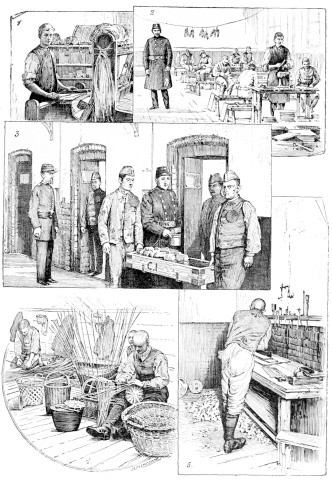
CONVICTS AT WORK. 1. Mat-making. 2. Boot-making. 3. Serving Dinner. 4. Basket-weaving. 5. Carpentry in Cell. Photos: W. H. Grove, Brompton Road, S.W.
impugned that nothing less than a judicial investigation would satisfy the public mind. A Scotland Yard detective, the well-known and highly intelligent Inspector Butcher, had been sent down to Northumberland to verify, if possible, strong suspicions, and hunt up all the facts. He worked upon the problem for a couple of months, and a criminal prosecution was ordered on his report. Harkes was now dead, but four of his constables, Harrison, Sprott, Gair, and Chambers, were charged with deliberately plotting the conviction of two innocent men. They were accused of making false plaster casts of footprints; of entrapping Redpath into a mistaken recognition of the chisel; of tearing a piece of the newspaper found in the vicarage and feloniously placing it in the lining of what they believed to be Murphy’s coat; and lastly, of tearing or cutting out from Brannagan’s trousers a piece of cloth, which they placed in the vicarage garden, to show that Brannagan had been there and had jumped through the window. The real burglars, Edgell and Richardson, were brought in their convict garb to give evidence against the policemen by detailing their proceedings on the night of the crime. Edgell’s story was received with respect, coming as it did from a man who was suffering imprisonment on his own confession. It was credibly believed that Richardson had picked up the chisel, and all the probabilities corroborated their statement that they had covered up their feet with sacking. The defence was that the confession was all a lie, and that the men who made it were worthless characters. In summing up, Mr. Justice Denman showed that the evidence of deliberate conspiracy was wanting, and that the police might be believed to have been honestly endeavouring to do their duty in securing a conviction.
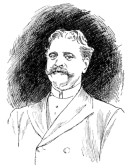
EX-SUPERINTENDENT BUTCHER, THE OFFICER WHO INVESTIGATED THE EDLINGHAM CASE.
The verdict was “Not guilty,” and was generally approved, more perhaps on negative grounds of want of proof than from any positive evidence of innocence. But the result was no doubt influenced by the fact that the principal person in the plot, if plot there was, had passed beyond the reach of human justice. The chief mover in the prosecution was Superintendent Harkes, and the rest only acted at his instigation.
LORD COCHRANE.
The prosecution and conviction of Lord Cochrane in 1814 may well be classed under this head, for it was distinctly an error of la haute police, of the Government, which as the head of all police, authorises the detection of all wrong-doing, and sets the criminal law in motion against all supposed offenders. It has now, been generally accepted that the trial and prosecution of Lord Cochrane (afterwards Earl of Dundonald) was a gross case of judicial error. He was charged with having conspired to cause a rise in the public funds by disseminating false news. There were, no doubt, suspicious circumstances connecting him with the frauds of which he was wrongfully convicted, but he had a good answer to all. His conviction and severe sentence, after a trial that showed the bitter animosity of the judge (Ellenborough) against a political foe, caused a strong revulsion of feeling in the public mind, and it was generally believed that he had not had fair play. The law, indeed, fell upon him heavily. He was found guilty, and sentenced to pay a fine of £500, to stand in the pillory, and to be imprisoned for twelve months. These penalties involved the forfeiture of his naval rank, and he had risen by many deeds of conspicuous gallantry to be one of the foremost officers in the British Navy. His name was erased from the list of Knights of the Bath, and he was socially disgraced. How he lived to be rehabilitated and restored to his rank and dignities is the best proof of his wrongful conviction.
The story told by Lord Cochrane himself in his affidavits will best describe what happened. Having just put a new ship in commission, H.M.S. Tonnant, he was preparing her for sea with a convoy. He was an inventive genius, and had recently patented certain lamps for the use of the ships sailing with him. He had gone into the city one morning, the 21st of February, 1814, to supervise their manufacture, when a servant followed him with a note. It had been brought to his house by a military officer in uniform, whose name was not known, nor could it be deciphered, so illegible was the scrawl. Lord Cochrane was expecting news from the Peninsula, where a brother of his lay desperately wounded, and he sent back word to his house that he would come to see the officer at the earliest possible moment. When he returned he found a person he barely knew, who gave the name of Raudon de Berenger, and told a strange tale.
He was a prisoner for debt, he said, within the rules of the King’s Bench, and he had come to Lord Cochrane to implore him to release him from his difficulties and carry him to America in his ship. His request was refused—it could not be granted, indeed, according to naval rules; and de Berenger was dismissed. But before he left he urged piteously that to return to the King’s Bench prison in full uniform would attract suspicion. It was not stated how he had left it, but he no doubt implied that he had escaped and changed into uniform somewhere. Why he did not go back to the same place to resume his plain clothes did not appear. Lord Cochrane only knew that in answer to his urgent entreaty he lent him some clothes. The room was at that moment littered with clothes, which were to be sent on board the Tonnant, and he unsuspiciously gave de Berenger a “civilian’s hat and coat.” This was a capital part of the charge against Lord Cochrane.
De Berenger had altogether lied about himself. He had not come from within the rules of the King’s Bench but from Dover, where he had been seen the previous night at the Ship hotel. He was then in uniform, and pretended to be an aide-de-camp to Lord Cathcart, the bearer of important despatches. He made no secret of the transcendent news he brought. Bonaparte had been killed by the Cossacks, Louis XVIII proclaimed, and the allied armies were on the point of occupying Paris. To give greater publicity to the intelligence, he sent it by letter to the port-admiral at Deal, to be forwarded to the Government in London by means of the semaphore telegraph. The effect of this startling news was to send up stocks ten per cent., and many speculators who sold on the rise realised enormous sums.
De Berenger, still in uniform, followed in a post-chaise, but on reaching London he dismissed it, took a hackney coach, and drove straight to Lord Cochrane’s. He had some slight acquaintance with his lordship, and had already petitioned him for a passage
They had come now to a lone house upon a heath, where he was carried upstairs, and they stayed the night. The woman of the house was told that he was much hurt, and was being carried to a surgeon; they laid him on cushions on the floor, and gave him some broth and strong waters. Next day, Saturday, they rode on as before and they lay that night at a place where there were two or three houses, where again he slept on cushions. The next day, Sunday, they reached Deal, and halted by the seaside. One of them kept guard over the prisoner while the two others entered into conference with a man who was awaiting them. This man, whose name he afterwards heard was Renshaw, was afraid that Harrison would die before he could be got on board, but he was put into a boat and carried to a ship, where his wounds were dressed, and in a week’s time “he was indifferently recovered.” Now the master of the ship came one day to say that they were chased by Turkish pirates, and when all offered to fight in defence of the ship he would not suffer it, but handed them over prisoners to the Turks. They were lodged in a dark hole, and remained there in wretched plight, not knowing how long it was before they landed, nor where they were put on shore, except that it was a great house or prison. Presently they were called up and viewed by persons who came to buy them, and Harrison, having said that he had some skill in physic, was taken by an aged physician who lived near Smyrna, and who had at one time resided in England, at Crowland, in Lincolnshire. Harrison was set to keep the still-room, and was fairly well treated, except on one occasion, when his master, being displeased, felled him to the ground, and would have stabbed him with his stiletto.
The conclusion generally arrived at was that the facts actually did happen very much as they were related, yet the whole story is involved in mystery. The only solution, so far as Perry is concerned, is that he was mad, as the second judge indeed declared. But we cannot account for Harrison’s conduct on any similar supposition. If his own story is rejected as too wild and improbable for credence, some other explanation must be found of his disappearance. Unless he was out of the country, or at least beyond all knowledge of events at Campden, it is difficult to understand what motive would have weighed with him when he heard that three persons were to be hanged as his murderers. The only possible conclusion, therefore, is that he was carried away, and kept away by force.
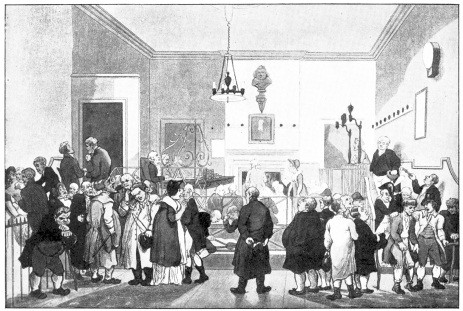
BOW STREET POLICE COURT IN 1808. (From a Contemporary Print by Rowlandson and Pugin.)
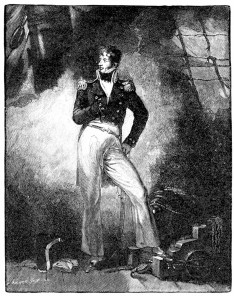
LORD COCHRANE. (From the Painting by Stroehling.)
to America, an application which had been refused. There was nothing extraordinary, then, in de Berenger’s visit. His lordship, again, claimed that de Berenger’s call on him, instead of going straight to the Stock Exchange to commence operations, indicated that he had weakened in his plot, and did not see how to carry it through. “Had I been his confederate,” says Lord Cochrane in his affidavit, “it is not within the bounds of credibility that he would have come in the first instance to my house, and waited two hours for my return home, in place of carrying out the plot he had undertaken, or that I should have been occupied in perfecting my lamp invention for the use of the convoy, of which I was in a few days to take charge, instead of being on the only spot where any advantage to be derived from the Stock Exchange hoax could be realised, had I been a participator in it. Such advantage must have been immediate, before the truth came out; and to have reaped it, had I been guilty, it was necessary that I should not lose a moment. It is still more improbable that being aware of the hoax, I should not have speculated largely for the special risk of that day.”
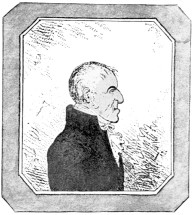
De Berenger.— (From Cruikshank’s Etching.)
We may take Lord Cochrane’s word, as an officer and a gentleman, that he had no guilty knowledge of de Berenger’s scheme; but here again the luck was against him, for it came out in evidence that his brokers had sold stock for him on the day of the fraud. Yet the operation was not an isolated one made on that occasion only. Lord Cochrane declared that he had for some time past anticipated a favourable conclusion to the war. “I had held shares for the rise,” he said, “and had made money by sales. The stock I held on the day of the fraud was less than
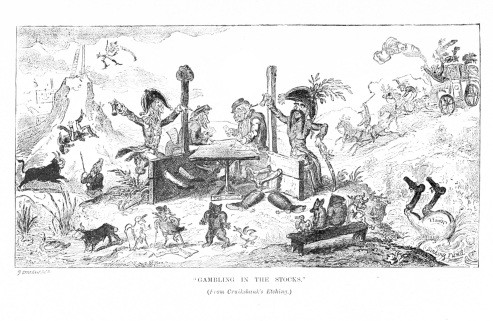
“GAMBLING IN THE STOCKS.” (From Cruikshank’s Etching.)
I usually had, and it was sold under an old order given to my brokers to sell at a certain price. It had necessarily to be sold.” It was clear to Lord Cochrane’s friends—who, indeed, and rightly, held him to be incapable of stooping to fraud—that had he contemplated it he would have been a larger holder of stock on the day in question, when he actually held less than usual. On these grounds alone they were of opinion that he should have been absolved from the charge.
LORD COCHRANE AS HE APPEARED IN COURT. (From Cruikshank’s Etching.)
Great lawyers like Lords Campbell, Brougham, and Erskine have commented on this case, all of them expressing their belief in Lord Cochrane’s innocence. Lord Campbell was of opinion that the verdict was “palpably contrary to the first principles of justice, and ought to have been reversed.” The late Chief Baron, Sir Fitzroy Kelly, in criticising the trial, ends by expressing his regret that “we cannot blot out this dark page from our legal and judicial history.” These are the opinions of legal luminaries who were in the fullest mental vigour and acumen at the time of the trial. They were intimately acquainted with all the facts, and we may accept their judgment that a great and grievous wrong had been done to a nobleman of high character, who had not spared himself in the service of the State. Their view was tardily supported by the Government in restoring Lord Cochrane to his rightful position in the Navy.
The part taken by the late Lord Playfair in the rehabilitation of Lord Dundonald has been told by Sir Wemyss Reid in his admirable “Memoirs” of Playfair. Lord Dundonald died in October, 1860, and by his last will bequeathed to his grandson, the present gallant earl, whose brilliant achievements as a cavalry leader in the great Boer War have shown him to be a worthy scion of a warrior stock, “all the sums due to me by the British Government for my important services, as well as the sums of pay stopped under perjured evidence for the commission of a fraud upon the Stock Exchange. Given under my trembling hand this 21st day of February, the anniversary of my ruin.”
Lord Playfair was an intimate friend of the much-worried admiral, and while he was a member of the House of Commons he made a strenuous effort to carry out the terms of the above will by recovering the sums mentioned in it. He moved for a Select Committee of the House, which could not be refused, “as,” to quote Playfair, “the whole world had come to the conviction that Dundonald was entirely innocent.” The Committee was appointed, and was composed of many excellent men, including Spencer Walpole, Russell Gurney, and Whitbread.
What followed shall be told in Playfair’s own words. “I declined to go upon the Committee,” he writes in his Autobiography, as edited by Sir Wemyss Reid, “as my feelings of friendship were too keen to make me a fair judge. The Committee felt perfectly satisfied of Lord Dundonald’s innocence, but they hesitated as to their report from lack of evidence; at the critical point an interesting event occurred.
“In 1814 Lord Dundonald and Lady X were in love, and though they did not marry, always held each other in great esteem for the rest of their lives. Old Lady X was still alive in 1877, and she sent me a letter through young Cochrane, the grandson, authorising me to use it as I thought best. The letter was yellow with age, but had been carefully preserved. It was written by Lord Dundonald, and was dated from the prison on the night of the committal. It tried to console the lady by the fact that the guilt of a near relative of hers was not suspected, while the innocence of the writer was his support and consolation.
“The old lady must have had a terrible trial. It was hard to sacrifice the reputation of her relative; it was harder still to see injustice still resting upon her former lover. Lord Dundonald had loved her and had received much kindness from her relative, so he suffered calumny and the injustice of nearly two generations rather than tell the true story of his wrong.
“I had long suspected the truth, but I never heard it from Lord Dundonald. The brave old lady tendered this letter as evidence to the Committee, but I declined to give it in, knowing that had my friend been alive he would not have allowed me to do so. At the same time I showed the letter to the members of the Committee individually, and it had a great effect upon their minds, and no doubt helped to secure the report recommending that the Treasury should pay the grandson the back salary of the admiral.
LORD COCHRANE IN CUSTODY. (From Cruikshank’s Etching.)
“The interesting letter itself I recommended should be put in the archives of the Dundonald family, and this I believe has been done.”
Part III.
POLICE—PAST AND PRESENT.
CHAPTER V.
EARLY POLICE: FRANCE.
Origin of Police—Definitions—First Police in France—Charles V.—Louis XIV.—The Lieutenant-General of Police—His Functions and Powers—La Reynie—His Energetic Measures against Crime—As a Censor of the Press—His Steps to check Gambling and Cheating at Games of Chance—La Reynie’s Successors: the d’Argensons, Hérault, d’Ombréval, Berryer—The Famous de Sartines—Two Instances of his Omniscience—Lenoir and Espionage—De Crosne, the last and most feeble Lieutenant-General of Police—The Story of the Bookseller Blaizot—Police under the Directory and the Empire—Fouché—His Beginnings and First Chances—A Born Police Officer—His Rise and Fall—General Savary—His Character—How he organised his Service of Spies—His humiliating Failure in the Conspiracy of General Malet—Fouché’s return to Power—Some Views of his Character.
WHEN men began to congregate in communities, laws for the good government and protection of the whole number became a necessity, and this led to the creation of police. The word itself is derived from πὁλις (“city”), a collection of people within a certain area: a community working regularly together for mutual advantage and defence. The work of defence was internal as well as external, for since the world began there have been dissidents and outlaws, those who declined to accept the standard of conduct deemed generally binding, and so set law at defiance. Hence the organisation of some force taking its mandate from the many to compel good conduct in the few; some special institution whose functions are to watch over the common weal, and act for the public both in preventing evil and preparing or securing good. From this the police deduces its claim to such interference with every citizen as is necessary to maintain order and ensure obedience to the law. It is easy to see that by excessive development the police system may become too paternal, and that under the great despotisms it may be and often is a potent engine for the enslavement of a people.
CLOCK AT THE PALAIS DE JUSTICE, PARIS, PRESENTED BY CHARLES V. IN 1370.
These ideas, perfect enough in the abstract, are contained in the definitions of police as found in dictionaries and the best authorities. The Imperial Dictionary calls it “a judicial and executive system in a national jurisprudence which is specially concerned with the quiet and good order of society; the means instituted by a government or community to maintain public order, liberty, property, and individual security.” Littré defines police as “the ordered system established in any city or state, which controls all that affects the comfort and safety of the inhabitants.” “Police,” says a modern writer, “is that section of public authority charged to protect persons and things against every attack, every evil which can be prevented or lessened by human prudence.” Again: “To maintain public order, protect property and personal liberty, to watch over public manners and the public health: such are the principal functions of the police.” Although we English people were slow to adopt any police system on a large or uniform scale, the principle has ever been accepted by our legists. Jeremy Bentham considered police necessary as a measure of precaution, to prevent crimes and calamities as well as to correct and cure them. Blackstone in his Commentaries says: “By public police and economy I mean the due regulation and domestic order of the kingdom, whereby the individuals of the State, like members of a well-governed family, are bound to conform their general behaviour to the rules of propriety, good neighbourhood, and good manners; to be decent, industrious, and inoffensive in their respective stations.”

THE BASTILLE. (From an old Print.)
The French kings were probably the first, in modern times, to establish a police system. As early as the fourteenth century Charles V., who was ready to administer justice anywhere, in the open field or under the first tree, invented a police “to increase the happiness and security of his people.” It was a fatal gift, soon to be developed into an engine of horrible oppression. It came to be the symbol of despotism, the plain outward evidence of the king’s supreme will, the bars and fetters that checked and restrained all liberty, depriving the people of the commonest rights and privileges, forbidding them to work, eat, dress, live, or move from place to place without leave. Louis XIV., on his accession, systematised and enormously increased the functions and powers of the police, and with an excellent object, that of giving security to a city in which crime, disorder, and dirt flourished unchecked. But in obtaining good government all freedom and independence was crushed out of the people.
The lieutenant of police first appointed in 1667, and presently advanced to the higher rank of lieutenant-general, was an all-powerful functionary, who ruled Paris despotically henceforward to the great break-up at the Revolution. He had summary jurisdiction over beggars, vagabonds, and evil-doers of all kinds and classes; he was in return responsible for the security and general good order of the city. Crimes, great and small, were very prevalent, such as repeated acts of fraud and embezzlement; for Fouquet had but just been convicted of the malversation of public moneys on a gigantic scale. There were traitors in even the highest ranks, and the Chevalier de Rohan about this period was detected in a plot to sell several strong places on the Normandy coast to the enemy. Very soon the civilised world was to be shocked beyond measure by the wholesale poisonings of the Marchioness of Brinvilliers, Voisin, and other miscreants. In the very heart of Paris there was a deep gangrene, a sort of criminal Alsatia—the Cour des Miracles—where depredators and desperadoes gathered unchecked, and defied authority. The streets were made hideous by incessant bloodthirsty brawls; quarrels were fought out then and there, for everyone, with or without leave, carried a sword—even servants and retainers of the great noblemen—and was prompt to use it. The lieutenant-general was nearly absolute in regard to offences, both political and general. In his office were kept long lists of suspected persons and known evil-doers, with full details of their marks and appearance, nationality and character. He could deal at once with all persons taken in the act; if penalties beyond his power were required, he passed them on to the superior courts. The prisoners of State in the royal castles—the Bastille, Vincennes, and
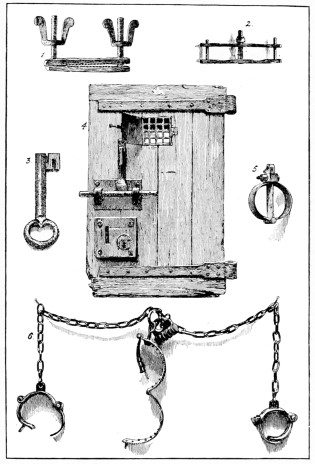
RELICS OF THE BASTILLE AND OTHER FRENCH PRISONS. (In the possession of Madame Tussaud & Sons, Limited.) 1. Hand Crusher. 2. Thumb-screw. 3. Key of the Bastille. 4. Dungeon Door from the Abbey Prison, Paris. 5. Handcuffs. 6. Wrist and Neck-irons.
the rest—were in his charge; he interrogated them at will, and might add to their number by arresting dangerous or suspected persons, in pursuit of whom he could enter and search private houses or take any steps, however arbitrary. For all these purposes he had a large armed force at his disposal, cavalry and infantry, nearly a thousand men in all, and besides there was the city watch, the chevaliers de guet, or “archers,” who were seventy-one in number.
La Reynie.
The first lieutenant-general of police in Paris was Gabriel Nicolas (who assumed the name of la Reynie, from his estate), a young lawyer who had been the protégé of the Governor of Burgundy, and afterwards was taken up by Colbert, Louis XIV.’s Minister. La Reynie is described by his contemporaries as a man of great force of character, grave and silent and self-reliant, who wielded his new authority with great judgment and determination, and soon won the entire confidence of the autocratic king. He lost no time in putting matters right. To clear out the Cour des Miracles and expel all rogues was one of his first measures; his second was to enforce the regulation forbidding servants to go armed. Exemplary punishment overtook two footmen of a great house who had beaten and wounded a student upon the Pont Neuf. They were apprehended, convicted, and hanged, in spite of the strong protests of their masters. La Reynie went farther, and revived the ancient regulation by which servants could not come and go as they pleased, and none could be engaged who did not possess papers en règle. The servants did not submit kindly, and for some time evaded the new rule by carrying huge sticks or canes, of which also they were eventually deprived.
The lieutenant-general of police was the censor of the Press, which was more free-spoken than was pleasing to a despotic government, and often published matter that was deemed libellous. The French were not yet entirely cowed, and sometimes they dared to cry out against unjust judges and thieving financiers; there were fierce factions in the Church; Jesuit and Jansenist carried on a bitter polemical war; the Protestants, unceasingly persecuted, made open complaint which brought down on some of their exemplary clergy the penalty of the galleys. The police had complete authority over printers and publishers, and could deal sharply with all books, pamphlets, or papers containing libellous statements or improper opinions. The most stringent steps were taken to prevent the distribution of prohibited books. Philosophical works were most disliked. Books when seized were dealt with as criminals and were at once consigned to the Bastille. Twenty copies were set aside by the governor, other twelve or fifteen were at the disposal of the higher officials, the rest were handed over to the paper-makers to be torn up and sold as waste paper or destroyed by fire in the presence of the keeper of archives. Many of the books preserved in the Bastille and found at the Revolution were proved to be insignificant and inoffensive, and to have been condemned on the general charge of being libels either on the queen and royal family or on the Ministers of State. Prohibited books were not imprisoned until they had been tried and condemned; their sentence was written on a ticket affixed to the sack containing them. Condemned engravings were scratched and defaced in the presence of the keeper of archives and the staff of the Bastille; and so wholesale was the destruction of books that one paper-maker alone carried off 3,015 pounds weight of fragments. Seizures were often accompanied by the arrest of printers and publishers, and an order to destroy the press and distribute the bookseller’s whole stock.
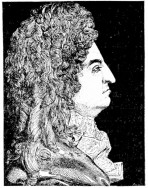
LOUIS XIV. (From an old Print.)
Although la Reynie used every effort to check improper publications, he was known as the patron and supporter of legitimate printing. Under his auspices several notable editions issued from the press, and their printers received handsome pensions from the State. He was a collector, a bibliophile who gathered together many original texts; and he will always deserve credit for having caused the chief manuscripts of the great dramatist Molière to be carefully preserved.
Society was very corrupt in those days, honeycombed with vices, especially gambling, which claimed the constant attention of a paternal police. La Reynie was most active in his pursuit of gamblers. The rapid fortunes made by dishonest means led to much reckless living, and especially to an extraordinary development of play. Everyone gambled, everywhere, in and out of doors, even in their carriages while travelling to and fro. Louis XIV., as he got on in life, and more youthful pleasures palled, played tremendously. His courtiers naturally followed the example. It was not all fair play either; the temptation of winning largely attracted numbers of “Greeks” to the gaming tables, and cheating of all kinds was very common. The king gave frequent and positive orders to check it. A special functionary who had jurisdiction in the Court, the grand provost, was instructed to find some means of preventing this constant cheating at play. At the same time la Reynie sent Colbert a statement of the various kinds of fraud practised with cards, dice, or hoca, a game played with thirty points and thirty balls. The police lieutenant made various suggestions for checking these malpractices; the card-makers were to be subjected to stringent surveillance; it was useless to control the makers of dice, but they were instructed to denounce all who ordered loaded dice. As to hoca, it was, he said, far the most difficult and the most dangerous. The Italians, who had originated the game, so despaired of checking cheating in it that they had forbidden it in their own country. La Reynie’s anxiety was such that he begged the Minister to prohibit its introduction at the Court, as the fashion would soon be followed in the city. However, this application failed; the Court would not sacrifice its amusements, and was soon devoted to hoca, with lansquenet, postique, trou-madame, and other games of hazard.
The extent to which gambling was carried will be seen in the amounts lost and won; it was easy, in lansquenet or hoca, to win fifty or sixty times in a quarter of an hour. Madame de Montespan, the king’s favourite, frequently lost a hundred thousand crowns at a sitting. One Christmas Day she lost seven hundred thousand crowns. On another occasion she laid a hundred and fifty thousand pistoles (£300,000) upon three cards, and won. Another night, it is said, she won back five millions which she had lost. Monsieur, the king’s brother, also gambled wildly. When campaigning he lost a hundred thousand francs to other officers; once he was obliged to pledge the whole of his jewels to liquidate his debts of honour.
Nevertheless the games of chance, if permitted at Court, were prohibited elsewhere. The police continually harried the keepers of gambling hells; those who offended were forced to shut up their establishments and expelled from Paris. The king was disgusted at times, and reproved his courtiers. He took one M. de Ventadour sharply to task for starting hoca in his house, and warned him that “this kind of thing must be entirely ended.” The exact opposite was the result: that and other games gained steadily in popularity, and the number of players increased and multiplied. The king promised la Reynie to put gambling down with a strong hand, and called for a list of all hells and of those who kept them. But the simple measure of beginning with the Court was not tried. Had play been suppressed among the highest it would soon have gone out of fashion; as it was, it flourished unchecked till the collapse of the ancien régime.
Hérault.
It would be tedious to trace the succession of lieutenants-general between la Reynie and de Crosne, the last, who was in office at the outbreak of the French Revolution. One or two were remarkable in their way: the elder D’Argenson, who was universally detested and feared; who cleared out the low haunts with such ruthless severity that he was known to the thieves and criminals as Rhadamanthus, or the judge of the infernal regions; his son, D’Argenson the younger, who is held responsible for the law of passports which made it death to go abroad without one; Hérault, who persecuted the Freemasons, and was so noted for his bigotry and intolerance. Of him the following story is told. In one of his walks abroad he took offence at the sign at a shop door which represented a priest bargaining about goods at a counter, with this title, “L’Abbé Coquet.” Returning home, he despatched an emissary to fetch the Abbé Coquet, but gave no explanation. The agent went out and picked up a priest of the name and brought him to Hérault’s house. They told him the Abbé Coquet was below. “Mettez-le dans le grenier” was Hérault’s brief order. Next day the abbé, half-starved, grew furious at his detention, and Hérault’s servants reported that they could do nothing with him. “Eh! Brulez-le et laissez-moi tranquille!” replied the chief of police, whereupon an explanation followed, and the Abbé Coquet was released.
D’Ombréval.
D’Ombréval, again, was a man of intolerant views. He especially distinguished himself by his persistent persecution of the mad fanatics called the convulsionnaires,[10] whom he ran down everywhere, pursuing them into the most private places, respecting neither age nor sex, and casting them wholesale into prison. Two of these victims were found in the Conciergerie in 1775 who had been imprisoned for thirty-eight years. The convulsionnaires successfully defied the police in the matter of a periodical print which they published secretly and distributed in the very teeth of authority. This rare instance of baffled detection is worth recording. The police were powerless to suppress the Nouvelles Ecclésiastiques, as the paper was called. A whole army of active and unscrupulous spies could not discover who wrote it or where it was printed. Sometimes it appeared in the town, sometimes in the country. It was printed, now in the suburbs, now among the piles of wood in the Gros Caillou, now upon barges in the River Seine, now in private houses. A thousand ingenious devices were practised to put it into circulation and get it through the barriers. One of the cleverest was by utilising a poodle dog which carried a false skin over its shaved body; between the two the sheets were carefully concealed, and travelled safely into the city. So bold were the authors of this print that on one occasion when the police lieutenant was searching a house for a printing press several copies of the paper still wet from the press were thrown into his carriage.
Berryer.
Berryer, a later lieutenant-general, owed his appointment to Madame de Pompadour, whose creature he was, and his whole
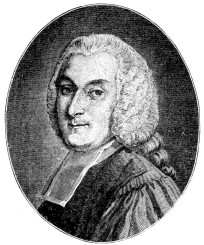
DE SARTINE. (From the Engraving by Littret.)
aim was to learn all that was said of her and against her, and then avenge attack by summary arrests. At her instance he sent in a daily statement of all the scandalous gossip current in the city, and he lent his willing aid to the creation of the infamous Cabinet Noir, in which the sanctity of all correspondence was violated and every letter read as it passed through the post. A staff of clerks was always busy; they took impressions of the seals with quicksilver, melted the wax over steam, extracted the sheets, read them, and copied all parts that were thought likely to interest the king and Madame de Pompadour. The treacherous practice was well known in Paris, and so warmly condemned that it is recorded in contemporary memoirs: “Dr. Quesnay furiously declared he would sooner dine with the hangman than with the Intendant of Posts” who countenanced such a base proceeding.
M. de Sartines.
Perhaps the most famous and most successful police Minister of his time was M. de Sartines, whose detective triumphs were mainly due to his extensive system and to the activity of his nearly ubiquitous agents. Two good stories are preserved of de Sartines’ omniscience.
One of them runs that a great officer of State wrote him from Vienna begging that a noted Austrian robber who had taken refuge in Paris might be arrested and handed over. De Sartines immediately replied that it was quite a mistake, the man wanted was not in Paris, but actually in Vienna; he gave his exact address, the hours at which he went in and out of his house, and the disguises he usually assumed. The information was absolutely correct, and led to the robber’s arrest.
Again, one of de Sartines’ friends, the president of the High Court at Lyons, ventured to deride his processes, declaring that they were of no avail, and that anyone, if so disposed, could elude the police. He offered a wager, which de Sartines accepted, that he could come into Paris and conceal himself there for several days without the knowledge of the police. A month later this judge left Lyons secretly, travelled to Paris day and night, and on arrival took up his quarters in a remote part of the city. By noon that day he received a letter, delivered at his address, from de Sartines, who invited him to dinner and claimed payment of the wager.
A great coup was made by this adroit officer, but the interest of the affair attaches rather to the thieves than to the police. It was on the occasion of the marriage of Louis XVI. and Marie Antoinette in 1770. During the great fêtes in honour of the event an extraordinary tumult arose in the Rue Royale, where it joins the modern Champs Élysées. A gang of desperadoes had cunningly stretched cords across the street under cover of the darkness, and the crowds moving out to the fêtes fell over them in hundreds. The confusion soon grew general, and a frightful catastrophe ensued. Men, women, and children, horses and carriages, were mixed up in an inextricable tangle, and hundreds were trampled to death. Some desperate men tried to hack out a passage with their swords, children were passed from hand to hand over the heads of the
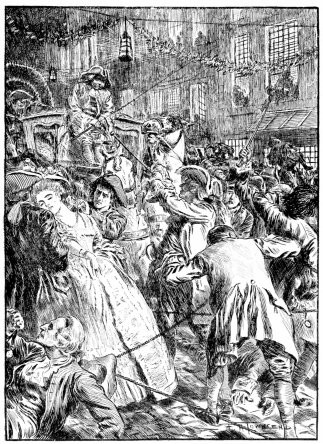
TUMULT CAUSED BY THIEVES AT THE MARRIAGE FESTIVITIES OF MARIE ANTOINETTE.
crowd, too often to fall and be swallowed up in the struggling gulf below. No fewer than 2,470 people are said to have perished in this horrible mêlée. It was, of course, a time of harvest for the thieves. Apparently only one of the confraternity suffered from the crush, and on him fifty watches were found and as many chains, gold and silver. Next day de Sartines and his agents made wholesale arrests. Some three or four hundred noted thieves were taken up and sent to the Conciergerie, where they were strictly searched. Large quantities of valuables were secured—watches, bracelets, rings, collars, purses, all kinds of jewels. One robber alone had two thousand francs tied up in his handkerchief.
De Sartines kept a few criminals on hand for the strange purpose of amusing fashionable society. It became the custom to have thieves to perform in drawing-rooms. De Sartines, when asked, would obligingly send to any great mansion a party of adroit pickpockets, who went through all their tricks before a distinguished audience, cutting watch-chains, stealing purses, snuffboxes, and jewellery.
This famous chief of police was the first to use espionage on a large scale, and to employ detectives who were old criminals. When reproached with this questionable practice, de Sartines defended it by asking, “Where should I find honest folk who would agree to do such work?” It was necessary for him to protect these unworthy agents by official safe-conducts, which were worded as follows:—
“In the King’s Name.
His Majesty, having private reasons for allowing —— to conduct his affairs without interruption, accords him safe conduct for six months, and takes him under especial protection for that period. His Majesty orders that he shall be exempt from arrests and executions during that time; all officers and sergeants are forbidden to take action against him, gaolers shall not receive him for debt, under pain of dismissal. If notwithstanding this he should be arrested he must be at once set free, provided always that the safe-conduct does not save him from condemnations pronounced on the King’s behalf.”
Lenoir.
Lenoir, who succeeded de Sartines, carried espionage still farther, and employed a vast army of spies, paid and unpaid. Servants only got their places on the condition that they kept the police informed of all that went on in the houses where they served. The hawkers who paraded the streets were in his pay. He had suborned members of the many existing associations of thieves, and they enjoyed tolerance so long as they denounced their accomplices. The gambling-houses were taken under police protection; with the proviso that they paid over a percentage of profits and reported all that occurred. People of good society who had got into trouble were forgiven on condition that they watched their friends and gave information of anything worth knowing. One fashionable agent was a lady who entertained large parties and came secretly by a private staircase to the police office with her budget of news. This woman was only paid at the rate of £80 a year.
LENOIR. (From a Contemporary Print.)
De Crosne.
Thiroux de Crosne was the last lieutenant-general of police, and the revolutionary upheaval was no doubt assisted by his ineptitude, his marked want of tact and intelligence. While the city was mined under his feet with the coming volcanic disturbances he gave all his energies to theatrical censorship, and kept his agents busy reporting how often this or that phrase was applauded. He was ready to imprison anyone who dared offend a great nobleman, and was very severe upon critics and pamphleteers. The absurd misuse of the censorship was no doubt one of the contributing causes of the Revolution. The police were so anxious to save the king, Louis XVI., from the pollution of reading the many libels published that they allowed no printed matter to come near him. In this way he was prevented from gauging the tendency of the times, or the trend of public opinion. At last, wishing to learn the exact truth of the vague rumours that reached him, he ordered a bookseller, Blaizot, to send him everything that appeared. He soon surprised his Ministers by the knowledge he displayed, and they set to work to find how it reached him. Blaizot was discovered and sent to the Bastille. When the king, wondering why he got no more pamphlets, inquired, he learnt that Blaizot had been imprisoned by his order!
The monarchical police was quickly swept away by the French Revolution. It was condemned as an instrument of tyranny; having only existed, according to the high-sounding phrases of the period, to “sow distrust, encourage perfidy, and substitute intrigue for public spirit.” The open official police thus disappeared, but it was replaced by another far more noxious; a vast political engine, recklessly handled by every bloodthirsty wretch who wielded power in those disastrous times. The French Republicans, from the Committee of Public Safety to the last revolutionary club, were all policemen—spying, denouncing, feeding the guillotine. Robespierre had his own private police, and after his fall numerous reports were found among his papers showing how close and active was the surveillance he maintained through his spies, not only in Paris alone, but all over France.
BARRAS. (From the Engraving by Allais.)
Under the Directory the office of a Minister of Police was revived, not without stormy protest, and the newly organised police soon became a power in the Republic as tyrannical and inquisitorial as that of Venice. It had its work cut out for it. Paris, the whole country, was in a state of anarchy, morals were at their lowest point, corruption and crime everywhere rampant. The streets of the city, all the high roads, were infested with bands of robbers with such wide ramifications that a general guerilla warfare terrorised the provinces. We shall see more of this on a later page, when describing the terrible bandits named Chauffeurs, from their practice of torturing people by toasting their feet before the fire until they gave up their hidden treasure.
Fouché.
Nine police Ministers quickly followed each other between 1796 and 1799, men of no particular note; but at last Barras fixed
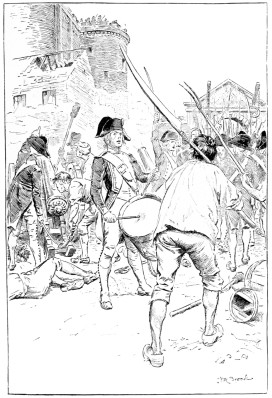
ATTACK UPON THE BASTILLE, DURING THE FRENCH REVOLUTION.
upon Fouché as a person he imagined to be well qualified for the important post. He thus gave a first opening to one whose name is almost synonymous with policeman—the strong, adroit, unscrupulous manipulator of the tremendous underground forces he created and controlled, the man who for many years practically divided with Napoleon the empire of France. The emperor had the ostensible supremacy, but his many absences on foreign wars left much of the real power in his Minister’s hands. Fouché’s aptitudes for police work must have been instinctive, for he had no special training or experience when summoned to the post of Police Minister. He had begun life as a professor, and was known as le Père Fouché, a member of the Oratory, although he did not actually take religious orders. Born in the seaport town of Nantes, he was at first designed for his father’s calling—the sea; but at school his favourite study was theology and polemics, so that his masters strongly advised that he should be made a priest. Something of the suppleness, the quiet, passionless self-restraint, the patient, observant craftiness of the ecclesiastic remained with him through life.
The Revolution found him in his native town, prefect of his college of Nantes, married, leading an obscure and blameless life. He soon threw himself into the seething current, and was sent to the National Convention as representative for La Nièvre. It is needless to follow his political career, in which, with that readiness to change his coat which was second nature to him, he espoused many parties in turn, and long failed to please any, least of all Robespierre, who called him “a vile, despicable impostor.” But the Directory was friendly to him, and appointed him its minister, first at Milan, then in Holland, whence he was recalled by Barras, whom he had obliged in various matters, to take the Ministry of Police. He had always been in touch with popular movements, knew men and things intimately, and, it was hoped, would check the more turbulent spirits.
Fouché saw his chance when Bonaparte rose above the horizon. He was no real Republican; all his instincts were towards despotism and arbitrary personal government. It may well be believed that he contributed much to the success of the 18th Brumaire; this born conspirator could best handle all the secret threads that were needed to establish the new power. He has said in his Memoirs that the revolution of Saint-Cloud must have failed but for him, and he was willing enough to support it. “I should have been an idiot not to prefer a future to nothing. My ideas were fixed. I deemed Bonaparte alone fitted to carry out the changes rendered imperatively necessary by our manners, our vices, our errors and excesses, our misfortunes and unhappy differences.” When the Consulate was established, Fouché was one of the most important personages in France. He had ample means at his disposal, and he did not hesitate to use them freely to strengthen his position; he bought assistance right and left, had his paid creatures everywhere, even at Bonaparte’s elbow, it was said, and had bribed Josephine and Bourrienne to betray the inmost secrets of the palace. The strength and extent of his system—created by necessity, perfected by sheer love of intrigue—was soon realised by his master, who saw that Fouché united the police and all its functions in his own person, and might easily prove a menace to his newly acquired power.
FOUCHÉ. (From the Engraving by Couché.)
So Fouché was suppressed, but only for a couple of years, during which nearer dangers, conspiracies threatening the very life of Napoleon, led the emperor to recall the astute, all-powerful Minister, who meanwhile had maintained a private police of his own. Fouché had his faithful agents abroad, and showed himself better served, better informed, than the emperor himself. He proved this by giving Napoleon an early copy of a circular by the exiled Bourbon king about to be issued in Paris, the existence of which was unknown to the official police. When Fouché returned to the Prefecture, it was to stay. For some eight years he was indispensable. The emperor seemed to rely upon him entirely, passing everything on to him. “Send it to Fouché; it is his business,” was the endorsement on innumerable papers of that time. The provincial préfets looked only to Fouché; the Police Minister was the sole repository of power, the one person to please; his orders were sought and accepted with blind submission by all. He might have remained in office to the end of the imperial régime but that he became too active and meddled with matters quite beyond his province; and his downfall was hastened by a daring intrigue to bring about a secret compact with England and secure peace.
Savary.
Fouché’s successor was General Savary, one of Napoleon’s most devoted and uncompromising adherents, an indifferent soldier and a conceited, self-sufficient man. He will always be stigmatised as the executioner of the Duc d’Enghien, one ready to go any lengths in blind obedience to his master’s behests. His appointment as chief of the police caused universal consternation; it was dreaded as the inauguration of an epoch of brutal military discipline, the advent of the soldier-policeman, whose iron hand would be heavy upon all. Wholesale arrests, imprisonments, and exiles were anticipated. Savary himself, although submissively accepting his new and strange duties, shrank from executing them. He would gladly have declined the honour of becoming Police Minister, but the emperor would not excuse him, and, taking him by the hand, tried to stiffen his courage by much counsel. The advice he freely gave is worth recording in part, as expressing the views of a monarch who was himself the best police officer of his time.
“Ill-use no one,” he told Savary as they strolled together through the park of Saint-Cloud. “You are supposed to be a severe man, and it would give a handle to my enemies if you were found harsh and reactionary. Dismiss none of your present employees; if any displease you, keep them at least six months, and then find them other situations. If you have to adopt stern measures, be sure they are justified, and it will at least be admitted that you are doing your duty.... Do not imitate your predecessor, who allowed me to be blamed for sharp measures and took to himself the credit of any acts of leniency. A good police officer is quite without passion. Allow yourself to hate no one; listen to all, and never commit yourself to an opinion until you have thought it well over.... I removed Monsieur Fouché because I could no longer rely upon him. When I no longer gave him orders, he acted on his own account and left me to bear the responsibility. He was always trying to find out what I meant to do, so as to forestall me, and, as I became more and more reserved, he accepted as true what others told him, and so got farther and farther astray.”
[10] These convulsionnaires were a sect of the Jansenists who met at the tomb of “Francis of Paris,” where they preached, prophesying the downfall of the Church and the French monarchy. Their ceremonies were wild and extravagant; they contorted their bodies violently, rolled on the ground, imitating birds, beasts, and fishes, until these convulsions (hence their name) ended in a swoon and collapse. The law was very severe against these fanatics, who, however, survived the most vigorous measures.


