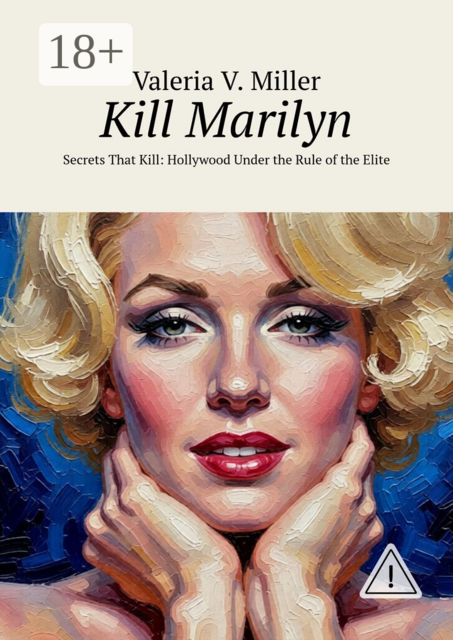



автордың кітабынан сөз тіркестері Kill Marilyn. Secrets That Kill: Hollywood Under the Rule of the Elite

“Marilyn Monroe was either killed or died elsewhere, and her body was brought home.”
— a version voiced by a former LAPD officer, which ruined both his career and, eventually, his life. The officer was removed from the case, and the theory was dismissed, despite circumstances and evidence pointing exactly in this direction.
“The one who stands beside the dying is either a savior or an executioner.”
“I always felt like I was looking at them through glass… as if I were on display, and they were inside, laughing, talking, living,”
— Marilyn wrote in her diary.
“They laugh at me, and I feel like I’m standing somewhere in a showcase, exposed, watched… but never invited in,”
— she added in another entry
Bob Mackie:
“It was almost indecent. People gasped. She looked naked. But that’s exactly what she wanted.”
In 1964, Arthur Miller presented his new play to the public — After the Fall. For many, it was shocking. At the center of the story is lawyer Quentin, an intellectual tormented by guilt and self-analysis. The woman he is connected to — Maggie — is unstable, sexualized, hysterical, and a foolish blonde singer descending into addiction. In the play, he pushes to the extreme. He no longer sympathizes, he does not suffer, he disdains. He literally compares her to a body through which men pass as if through a train station. He describes her as a woman who “was chewed and spat out by whole lines of smirking men.” And all of this is said by the protagonist, behind whom hides Arthur Miller himself:
“…What love is there here?! When whole lines of smirking men chewed her up and spat her out! Her very name has been soaked with the stench of dressing rooms and the cigar smoke of train cars!”
This was not a metaphor — it was a verdict. Her name, her body, her past — all of it had become filth, stench, something disgusting to him. He no longer saw her as a woman. He wrote it with revulsion — and with cold precision. Every word was meant to make the audience feel his contempt. Arthur never says outright, “I hate her,” but each word strikes like a blow. Monroe died in 1962, two years before the premiere of the play. She could not answer, could not defend herself. Instead, the public received a portrayal of her through the eyes of her ex-husband — without masks, without mercy. One critic called the play “an act of psychological execution disguised as art.” Another wrote, “He dissected her soul on stage like a pathologist.”
“He killed her again. Only now — in the silence of the theater hall,”
— wrote critic Ellen Wallace.
But the cruelest is not always the one who shouts. Sometimes it’s the one who is silent, who observes, who takes notes. The one who writes about you but does not speak to you. That was her third husband, Arthur Miller. Not a savior, but a man who documented her madness. He did not betray her body; he betrayed her with words. When Arthur married Marilyn in 1956, her star was at its peak. Their union attracted massive media attention. It became a powerful PR engine for both: Miller gained access to Hollywood glamour, Monroe gained a deeper intellectual image. His plays became more visible in the media, he became a regular at social events, and his name became associated with the “elite” of American culture. Their marriage ended in divorce in 1961, but Miller continued to be known as “Marilyn’s husband” in the public eye, maintaining his popularity and public interest. Yet, despite this, Arthur despised Marilyn. Here is an excerpt from Miller’s diary, dated 1957:
“She is backward. Her world is illusions and funhouse mirrors. She cannot understand even simple things; seriousness is foreign to her. Everything she does is play, and in this play, she is lost.”
Miller did not just criticize Monroe — he despised her and tried to distance himself emotionally. Close friends and staff confirm that Miller could be harsh and cynical. Noticing her attempts to become a serious actress, he once told friends:
“She will never grow up. She is a child playing at being an adult.”
“…What love are we even talking about?! When whole lines of smirking men chewed her up and spat her out! Her very name was soaked with the stench of locker rooms and the cigarette smoke of train car lounges!”
— Arthur Miller (After the Fall)
“I didn’t know who I was. I didn’t know why I was born. I didn’t know who I belonged to. And I learned: to no one.”
— Norma Jeane Baker (Marilyn Monroe), in conversation with Ben Hecht, 1954
Marilyn Monroe recalled:
“My mother never laughed. She had dry lips, dead eyes. When she looked at me, I became scared.”