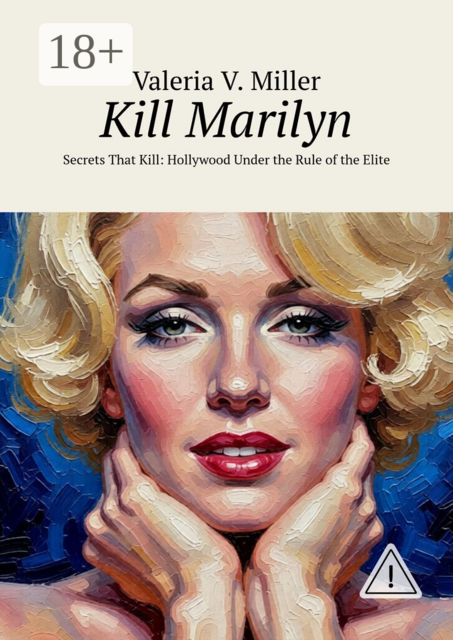
“We didn’t recognize her. This wasn’t the star from the posters. She looked like someone who had been through hell.”
— Allan Abbott, funeral director
Los Angeles, August 4, 1962. The house on Fifth Helena Drive was bathed in the soft glow of lamps; the shadows fell crookedly, as if shaped by fear. Marilyn Monroe walked through the rooms in a long cream-colored robe, without makeup. She wasn’t smiling — and that alone was unusual. The only one nearby was her housekeeper, Eunice Murray. Murray claimed that at 8:00 p.m. the actress had wished “to be alone.” But later she would admit that all evening she heard men’s voices by the door. Something was happening, but no one came in through the front entrance.
At 9:00 p.m., Marilyn’s phone line was busy. For a long time. At that hour she was speaking either with Joe DiMaggio Jr. or with Peter Lawford — actor and brother-in-law of John F. Kennedy. Lawford would later confess that she sounded strange: “as if she were saying goodbye, quiet and incoherent, asking me to say farewell to the President as well.” With sadness, he added: “That was her suicide note.” According to the official version, she took forty Nembutal tablets. But the next morning there was no vomiting, no traces in the stomach, no glass of water. The liver was completely “empty” — almost no poison was found there. Which means she hadn’t swallowed it. It was administered to her.
Night. Around 11:30 p.m. At that time, black cars without license plates appeared in her neighborhood. Witnesses from the house next door claimed they saw two unknown men arrive. One “looked like Robert Kennedy,” the other was a silent bodyguard. They heard a woman screaming. Then silence. Later, private detective Fred Otash, hired to keep watch, would say that on that evening Robert Kennedy had indeed flown into Los Angeles — despite his official alibi. He was accompanied by security officers and was in the Brentwood area.
Question: what is the Attorney General of the United States doing at night in the house of his brother’s lover, just hours before her death?
Around midnight, psychiatrist Ralph Greenson, according to the official version, was called to the house. He found Marilyn in bed. Dead. Lying face down. But the body looked deliberately arranged. No panic. This was not a suicide. It was a scene. A theater. Someone had placed her that way. Someone wanted us to see her exactly like that.
August 5, 3:30 a.m. The police were finally called. Hours after her death. Why? The housekeeper would later say she had “hesitated.” Greenson — that he “feared a scandal.” The ambulance arrived too late. But paramedic James Hall, one of the first on the scene, would later testify under oath: “She was still warm. Possibly alive.” This witness was fired. The second paramedic disappeared. As did the audio recordings made in the house that night. The official ruling: “Probable suicide by barbiturate overdose.” But just a day before her death, Marilyn told a friend: “If anything happens to me, it won’t be me. It will be them.”
“When I saw her body, I didn’t recognize her at first. There was nothing left of Marilyn.”
— Allan Abbott, funeral director who prepared the body for burial.
When she was found, Marilyn lay face down, her naked body covered with a blanket, in a “soldier’s pose”: arms straight at her sides, the body arranged as if it had been placed, not collapsed in agony. And this is where the strangeness begins. When Marilyn Monroe’s body was delivered to the Los Angeles County morgue on August 5, 1962, the first to see it were employees of the Westwood Village Mortuary. One of them, Allan Abbott, years later described a scene that sent chills through him:
“Her face was blotched. The skin gray. Her hair dirty, tangled. She had no teeth. We literally had to reconstruct her face so that the family could say goodbye.”
“We didn’t recognize her. This wasn’t the star from the posters. She looked like someone who had been through hell.”
— Allan Abbott, funeral director
What were those blotches? Why was she missing teeth? What happened to Marilyn Monroe’s body in the final hours of her life? In the pathologist’s report by Dr. Thomas Noguchi, the blotches are not described in detail. This is alarming: the report focuses on the condition of internal organs, the stomach, and the blood, but barely mentions her face. Yet the funeral team described purple and dark marks on her face, neck, and shoulders. These could be postmortem lividity (livor mortis), which appears a few hours after death when blood settles in the lower parts of the body. But they could also be bruises and contusions, if one assumes Monroe was physically assaulted. Injection marks — if the drug was administered forcibly — could also account for blotches from subcutaneous injections in the neck or face.
“The livor mortis marks were in unusual places for a person found lying face down. This led some experts to question the actual position in which she died,” wrote journalist Donald Spoto in his book Marilyn Monroe: The Biography.
According to Abbott’s testimony, Marilyn wore removable dental prosthetics. At the time of her death, she had no natural teeth. Why? Most likely due to her dependence on barbiturates and amphetamines — substances that cause dry mouth and accelerate enamel decay. It’s possible Monroe removed her dentures before going to bed, as many people do, and death caught her in that state. But there’s another possibility: a blow to the face (for example, a fist or blunt object) could have dislodged the dentures. In any case, at the autopsy she was toothless, with tangled, dirty hair, and her face was deformed, sunken, with collapsed cheeks. The funeral staff later admitted that they had to use cotton, makeup, and plastic inserts to reconstruct a recognizable likeness of Monroe. There were also obvious signs of trauma. Although the official version claims a barbiturate overdose, many details suggest otherwise: the unusual distribution of postmortem lividity, visible blotches and bruises on the face, neck, shoulder, and back; the lack of stomach contents despite the alleged ingestion of 40 pills (which is impossible if taken orally). Theories arose that Monroe was strangled and her body then positioned to stage an overdose. Some researchers suggest she may have been administered a lethal dose via rectal or intramuscular injection — something pathologist Noguchi mentioned in his later interviews.
Dr. Thomas Noguchi, the young pathologist who conducted the autopsy, admitted in his memoirs in the 1980s:
“I could not find any traces of capsules in the stomach. It was strange. There weren’t even remnants… Yet the level of the substance in the liver was lethal. This is impossible without an injection or rectal administration.”
Monroe was always obsessively careful about her appearance. Even in a drugged trance, she would never allow herself to look unkempt. That’s why the tangled, greasy, seemingly “unwashed” hair noted by the morgue staff is alarming. It looked as if she had been held somewhere without access to a bathroom, without care. As if she had spent at least a full day in confinement before her death. This contradicts the official story of “she stepped out of the shower, took the pills, and went to bed.” No bath, no fresh styling — just a dirty head, sweat, and grime. For Monroe, this would have been a symbol of catastrophe. The autopsy recorded postmortem lividity, but witnesses described dark areas on the face, neck, and chest resembling bruises. These could be from blows, from strangulation causing blood to pool in the skin, or from pressure and struggle. Could she have been beaten or restrained, forced to say something? Certainly.
“The one who stands beside the dying is either a savior or an executioner.”
Marilyn’s psychoanalyst, Dr. Ralph Greenson, was closely involved in her personal life. He often violated professional boundaries, showing up unannounced, supposedly “treating” her with words, while simultaneously collaborating with her physician, Hyman Engelberg, who prescribed the strongest medications. Greenson was the last person to see her alive — and the first to declare her dead. According to one version, he arrived at the house earlier than he claimed and was present that night when everything happened. He and housekeeper Eunice Murray gave coordinated but contradictory statements — first saying the door was locked, then that they saw light under the door, then that they knocked but could not get in. Their accounts changed over the course of the investigation.
“I don’t remember exactly when the doctor arrived… Everything was like a fog.”
— Eunice Murray, during questioning
And now — the key point: the injection mark. In 1962, pathologist Thomas Noguchi noted the absence of capsules in the stomach. This confirms that the barbiturate was not swallowed. There was also no puncture in the arm or vein. But there was a faint mark near the heart, which, according to one theory, could indicate a cardiac injection — an intracardiac shot (rare, but possible in emergency medicine).
“An injection into the heart? But why — if the person was already dead? This isn’t an attempt to save, it’s an intervention,”
the pathologist commented in the 1980s.
If Greenson saw that she was in critical condition — why didn’t he call an ambulance? Why, instead, did he allegedly administer an injection himself? Or… did he give a shot that didn’t save, but finished her?
Greenson was not just a doctor. He was close to the Kennedy circle. According to unverified reports, he may have been instructed as Monroe’s overseer. He was supposed to ensure she didn’t lose control. But if she went out of control — he could have been the executor of a sentence passed by the elite. Did he have the means and resources? Yes. He was a physician. He had access to the drugs. He could administer a lethal dose via enema or injection under the guise of aid. He knew that afterward it would be recorded as an overdose. And he was the first to tell the police: “She committed suicide.”
“He came into the house and everything was already prepared. He knew what to do,”
the actress’s housekeeper recalled later, when asked how the doctor behaved that night.
The hand that administered the poison had to be medically competent, have access to the body, and raise no suspicion. Capable of passing off a killing as “assistance” or a “delayed reaction.” All of this points to Dr. Ralph Greenson. He may not have been the one who ordered it, but he could have been the executor — the one who delivered the final dose. The one who did not save her. The one who knew how to kill — and how to disguise it as treatment. When someone dies under suspicious circumstances, investigators always look at who first “found” the body and who first gave testimony. Dr. Ralph Greenson is exactly that person. And his behavior immediately after Marilyn’s death raises many troubling questions. According to his version, he arrived at the house that night when called by housekeeper Eunice Murray. But in other accounts, he was already in the house beforehand, or even at the moment of the actress’s death.
At first he stated: “I arrived after a call from Murray and found her already dead.” Then he changed his account: “I was there all evening. She was in a depressed state. Then I left.” But later he said: “Murray and I tried to open the door to her bedroom, and then I saw