автордың кітабын онлайн тегін оқу 100+ Horror Collection. Scary Stories to Read in Bed Tonight. Illustrated
100+ Horror Collection. Scary Stories to Read in Bed Tonight:
The Tell-Tale Heart, Frankenstein, The King in Yellow, The Rose Garden, Number 13, The Call of Cthulhu, The Horror at Red Hook, The Willows and Others
Illustrated
The oldest and strongest emotion of mankind is fear, and the oldest and strongest kind of fear is fear of the unknown. These facts few psychologists will dispute, and their admitted truth must establish for all time the genuineness and dignity of the weirdly horrible tale as a literary form…
As may naturally be expected of a form so closely connected with primal emotion, the horror-tale is as old as human thought and speech themselves.
H. P. Lovecraft
Horror intends to create an eerie and frightening atmosphere for the reader. Prevalent elements include ghosts, demons, vampires, werewolves, ghouls, the Devil, witches, monsters, dystopian and apocalyptic worlds, serial killers, cannibalism, psychopaths, cults, dark magic, Satanism, the macabre, gore, and torture.
Edgar Allan Poe
THE MURDERS IN THE RUE MORGUE
THE GOLD BUG
THE BLACK CAT
THE PIT AND THE PENDULUM
THE TELL—TALE HEART
THE FALL OF THE HOUSE OF USHER
THE MASQUE OF THE RED DEATH
THE CASK OF AMONTILLADO
THE FACTS IN THE CASE OF M. VALDEMAR
HOP-FROG
THE RAVEN
Bram Stoker
DRACULA
Mary Shelley
FRANKENSTEIN
Joseph Sheridan Le Fanu
CARMILLA
Robert Louis Stevenson
THE STRANGE CASE OF DR. JEKYLL AND MR. HYDE
H.P. Lovecraft
THE ALCHEMIST
AT THE MOUNTAINS OF MADNESS
AZATHOTH
THE BEAST IN THE CAVE
BEYOND THE WALL OF SLEEP
THE BOOK
THE CALL OF CTHULHU
THE CASE OF CHARLES DEXTER WARD
THE CATS OF ULTHAR
THE COLOUR OUT OF SPACE
DAGON
THE DESCENDANT
THE DOOM THAT CAME TO SARNATH
THE DREAM-QUEST OF UNKNOWN KADATH
THE DUNWICH HORROR
THE EVIL CLERGYMAN
EX OBLIVIONE
FACTS CONCERNING THE LATE ARTHUR JERMYN AND HIS FAMILY
THE FESTIVAL
FROM BEYOND
THE HAUNTER OF THE DARK
HE
HERBERT WEST-REANIMATOR
THE HISTORY OF THE NECRONOMICON
THE HORROR AT RED HOOK
THE HOUND
HYPNOS
IBID
IN THE VAULT
THE LITTLE GLASS BOTTLE
MEMORY
THE MOON-BOG
THE MUSIC OF ERICH ZANN
THE NAMELESS CITY
NYARLATHOTEP
OLD BUGS
THE OTHER GODS
THE OUTSIDER
PICKMAN’S MODEL
THE PICTURE IN THE HOUSE
POLARIS
THE QUEST OF IRANON
THE RATS IN THE WALLS
A REMINISCENCE OF DR. SAMUEL JOHNSON
THE SECRET CAVE OR JOHN LEES ADVENTURE
THE SHADOW OUT OF TIME
THE SHADOW OVER INNSMOUTH
THE SHUNNED HOUSE
THE SILVER KEY
THE STATEMENT OF RANDOLPH CARTER
THE STRANGE HIGH HOUSE IN THE MIST
THE STREET
THE TEMPLE
THE TERRIBLE OLD MAN
THE TOMB
THE TRANSITION OF JUAN ROMERO
THE TREE
UNDER THE PYRAMIDS
THE VERY OLD FOLK
WHAT THE MOON BRINGS
THE WHISPERER IN DARKNESS
THE WHITE SHIP
SUPERNATURAL HORROR IN LITERATURE
Algernon Blackwood
THE WILLOWS
Francis Marion Crawford
THE DOLL'S GHOST
Robert W. Chambers
THE KING IN YELLOW
M. R. James
CANON ALBERIC’S SCRAP-BOOK
LOST HEARTS
THE MEZZOTINT
THE ASH-TREE
NUMBER 13
COUNT MAGNUS
THE TREASURE OF ABBOT THOMAS
A SCHOOL STORY
THE ROSE GARDEN
THE STALLS OF BARCHESTER CATHEDRAL
THE DIARY OF MR. POYNTER
AN EPISODE OF CATHEDRAL HISTORY
THE STORY OF A DISAPPEARANCE AND AN APPEARANCE
AN EVENING’S ENTERTAINMENT
A WARNING TO THE CURIOUS
A NEIGHBOUR’S LANDMARK
THE UNCOMMON PRAYER-BOOK
THE HAUNTED DOLLS’ HOUSE
WAILING WELL
THERE WAS A MAN DWELT BY A CHURCHYARD
RATS
AFTER DARK IN THE PLAYING FIELDS
THE EXPERIMENT
THE MALICE OF INANIMATE OBJECTS
A VIGNETTE
Edgar Allan Poe
THE MURDERS IN THE RUE MORGUE
What song the Syrens sang, or what name Achilles assumed when he hid himself among women, although puzzling questions, are not beyond all conjecture.
The mental features discoursed of as the analytical, are, in themselves, but little susceptible of analysis. We appreciate them only in their effects. We know of them, among other things, that they are always to their possessor, when inordinately possessed, a source of the liveliest enjoyment. As the strong man exults in his physical ability, delighting in such exercises as call his muscles into action, so glories the analyst in that moral activity which disentangles. He derives pleasure from even the most trivial occupations bringing his talent into play. He is fond of enigmas, of conundrums, of hieroglyphics; exhibiting in his solutions of each a degree of acumen which appears to the ordinary apprehension præternatural. His results, brought about by the very soul and essence of method, have, in truth, the whole air of intuition.
The faculty of re-solution is possibly much invigorated by mathematical study, and especially by that highest branch of it which, unjustly, and merely on account of its retrograde operations, has been called, as if par excellence, analysis. Yet to calculate is not in itself to analyse. A chess-player, for example, does the one without effort at the other. It follows that the game of chess, in its effects upon mental character, is greatly misunderstood. I am not now writing a treatise, but simply prefacing a somewhat peculiar narrative by observations very much at random; I will, therefore, take occasion to assert that the higher powers of the reflective intellect are more decidedly and more usefully tasked by the unostentatious game of draughts than by all the elaborate frivolity of chess. In this latter, where the pieces have different and bizarre motions, with various and variable values, what is only complex is mistaken (a not unusual error) for what is profound. The attention is here called powerfully into play. If it flag for an instant, an oversight is committed resulting in injury or defeat. The possible moves being not only manifold but involute, the chances of such oversights are multiplied; and in nine cases out of ten it is the more concentrative rather than the more acute player who conquers. In draughts, on the contrary, where the moves are unique and have but little variation, the probabilities of inadvertence are diminished, and the mere attention being left comparatively unemployed, what advantages are obtained by either party are obtained by superior acumen. To be less abstract-Let us suppose a game of draughts where the pieces are reduced to four kings, and where, of course, no oversight is to be expected. It is obvious that here the victory can be decided (the players being at all equal) only by some recherché movement, the result of some strong exertion of the intellect. Deprived of ordinary resources, the analyst throws himself into the spirit of his opponent, identifies himself therewith, and not unfrequently sees thus, at a glance, the sole methods (sometime indeed absurdly simple ones) by which he may seduce into error or hurry into miscalculation.
Whist has long been noted for its influence upon what is termed the calculating power; and men of the highest order of intellect have been known to take an apparently unaccountable delight in it, while eschewing chess as frivolous. Beyond doubt there is nothing of a similar nature so greatly tasking the faculty of analysis. The best chess-player in Christendom may be little more than the best player of chess; but proficiency in whist implies capacity for success in all those more important undertakings where mind struggles with mind. When I say proficiency, I mean that perfection in the game which includes a comprehension of all the sources whence legitimate advantage may be derived. These are not only manifold but multiform, and lie frequently among recesses of thought altogether inaccessible to the ordinary understanding. To observe attentively is to remember distinctly; and, so far, the concentrative chess-player will do very well at whist; while the rules of Hoyle (themselves based upon the mere mechanism of the game) are sufficiently and generally comprehensible. Thus to have a retentive memory, and to proceed by “the book,” are points commonly regarded as the sum total of good playing. But it is in matters beyond the limits of mere rule that the skill of the analyst is evinced. He makes, in silence, a host of observations and inferences. So, perhaps, do his companions; and the difference in the extent of the information obtained, lies not so much in the validity of the inference as in the quality of the observation. The necessary knowledge is that of what to observe. Our player confines himself not at all; nor, because the game is the object, does he reject deductions from things external to the game. He examines the countenance of his partner, comparing it carefully with that of each of his opponents. He considers the mode of assorting the cards in each hand; often counting trump by trump, and honor by honor, through the glances bestowed by their holders upon each. He notes every variation of face as the play progresses, gathering a fund of thought from the differences in the expression of certainty, of surprise, of triumph, or of chagrin. From the manner of gathering up a trick he judges whether the person taking it can make another in the suit. He recognises what is played through feint, by the air with which it is thrown upon the table. A casual or inadvertent word; the accidental dropping or turning of a card, with the accompanying anxiety or carelessness in regard to its concealment; the counting of the tricks, with the order of their arrangement; embarrassment, hesitation, eagerness or trepidation-all afford, to his apparently intuitive perception, indications of the true state of affairs. The first two or three rounds having been played, he is in full possession of the contents of each hand, and thenceforward puts down his cards with as absolute a precision of purpose as if the rest of the party had turned outward the faces of their own.
The analytical power should not be confounded with ample ingenuity; for while the analyst is necessarily ingenious, the ingenious man is often remarkably incapable of analysis. The constructive or combining power, by which ingenuity is usually manifested, and to which the phrenologists (I believe erroneously) have assigned a separate organ, supposing it a primitive faculty, has been so frequently seen in those whose intellect bordered otherwise upon idiocy, as to have attracted general observation among writers on morals. Between ingenuity and the analytic ability there exists a difference far greater, indeed, than that between the fancy and the imagination, but of a character very strictly analogous. It will be found, in fact, that the ingenious are always fanciful, and the truly imaginative never otherwise than analytic.
The narrative which follows will appear to the reader somewhat in the light of a commentary upon the propositions just advanced.
Residing in Paris during the spring and part of the summer of 18-, I there became acquainted with a Monsieur C. Auguste Dupin. This young gentleman was of an excellent-indeed of an illustrious family, but, by a variety of untoward events, had been reduced to such poverty that the energy of his character succumbed beneath it, and he ceased to bestir himself in the world, or to care for the retrieval of his fortunes. By courtesy of his creditors, there still remained in his possession a small remnant of his patrimony; and, upon the income arising from this, he managed, by means of a rigorous economy, to procure the necessaries of life, without troubling himself about its superfluities. Books, indeed, were his sole luxuries, and in Paris these are easily obtained.
Our first meeting was at an obscure library in the Rue Montmartre, where the accident of our both being in search of the same very rare and very remarkable volume, brought us into closer communion. We saw each other again and again. I was deeply interested in the little family history which he detailed to me with all that candor which a Frenchman indulges whenever mere self is his theme. I was astonished, too, at the vast extent of his reading; and, above all, I felt my soul enkindled within me by the wild fervor, and the vivid freshness of his imagination. Seeking in Paris the objects I then sought, I felt that the society of such a man would be to me a treasure beyond price; and this feeling I frankly confided to him. It was at length arranged that we should live together during my stay in the city; and as my worldly circumstances were somewhat less embarrassed than his own, I was permitted to be at the expense of renting, and furnishing in a style which suited the rather fantastic gloom of our common temper, a time- eaten and grotesque mansion, long deserted through superstitions into which we did not inquire, and tottering to its fall in a retired and desolate portion of the Faubourg St. Germain.
Had the routine of our life at this place been known to the world, we should have been regarded as madmen-although, perhaps, as madmen of a harmless nature. Our seclusion was perfect. We admitted no visitors. Indeed the locality of our retirement had been carefully kept a secret from my own former associates; and it had been many years since Dupin had ceased to know or be known in Paris. We existed within ourselves alone.
It was a freak of fancy in my friend (for what else shall I call it?) to be enamored of the Night for her own sake; and into this bizarrerie, as into all his others, I quietly fell; giving myself up to his wild whims with a perfect abandon. The sable divinity would not herself dwell with us always; but we could counterfeit her presence. At the first dawn of the morning we closed all the messy shutters of our old building; lighting a couple of tapers which, strongly perfumed, threw out only the ghastliest and feeblest of rays. By the aid of these we then busied our souls in dreams-reading, writing, or conversing, until warned by the clock of the advent of the true Darkness. Then we sallied forth into the streets arm in arm, continuing the topics of the day, or roaming far and wide until a late hour, seeking, amid the wild lights and shadows of the populous city, that infinity of mental excitement which quiet observation can afford. At such times I could not help remarking and admiring (although from his rich ideality I had been prepared to expect it) a peculiar analytic ability in Dupin. He seemed, too, to take an eager delight in its exercise-if not exactly in its display-and did not hesitate to confess the pleasure thus derived. He boasted to me, with a low chuckling laugh, that most men, in respect to himself, wore windows in their bosoms, and was wont to follow up such assertions by direct and very startling proofs of his intimate knowledge of my own. His manner at these moments was frigid and abstract; his eyes were vacant in expression; while his voice, usually a rich tenor, rose into a treble which would have sounded petulantly but for the deliberateness and entire distinctness of the enunciation. Observing him in these moods, I often dwelt meditatively upon the old philosophy of the Bi-Part Soul, and amused myself with the fancy of a double Dupin-the creative and the resolvent.
Let it not be supposed, from what I have just said, that I am detailing any mystery, or penning any romance. What I have described in the Frenchman, was merely the result of an excited, or perhaps of a diseased intelligence. But of the character of his remarks at the periods in question an example will best convey the idea.
We were strolling one night down a long dirty street in the vicinity of the Palais Royal. Being both, apparently, occupied with thought, neither of us had spoken a syllable for fifteen minutes at least. All at once Dupin broke forth with these words:
“He is a very little fellow, that’s true, and would do better for the Théâtre des Variétés.”
“There can be no doubt of that,” I replied unwittingly, and not at first observing (so much had I been absorbed in reflection) the extraordinary manner in which the speaker had chimed in with my meditations. In an instant afterward I recollected myself, and my astonishment was profound.
“Dupin,” said I, gravely, “this is beyond my comprehension. I do not hesitate to say that I am amazed, and can scarcely credit my senses. How was it possible you should know I was thinking of—?” Here I paused, to ascertain beyond a doubt whether he really knew of whom I thought.
– “of Chantilly,” said he, “why do you pause? You were remarking to yourself that his diminutive figure unfitted him for tragedy.”
This was precisely what had formed the subject of my reflections. Chantilly was a quondam cobbler of the Rue St. Denis, who, becoming stage-mad, had attempted the rôle of Xerxes, in Crébillon’s tragedy so called, and been notoriously Pasquinaded for his pains.
“Tell me, for Heaven’s sake,” I exclaimed, “the method-if method there is-by which you have been enabled to fathom my soul in this matter.” In fact I was even more startled than I would have been willing to express.
“It was the fruiterer,” replied my friend, “who brought you to the conclusion that the mender of soles was not of sufficient height for Xerxes et id genus omne.”
“The fruiterer!—you astonish me-I know no fruiterer whomsoever.”
“The man who ran up against you as we entered the street-it may have been fifteen minutes ago.” I now remembered that, in fact, a fruiterer, carrying upon his head a large basket of apples, had nearly thrown me down, by accident, as we passed from the Rue C—into the thoroughfare where we stood; but what this had to do with Chantilly I could not possibly understand.
There was not a particle of charlatanerie about Dupin. “I will explain,” he said, “and that you may comprehend all clearly, we will first retrace the course of your meditations, from the moment in which I spoke to you until that of the rencontre with the fruiterer in question. The larger links of the chain run thus-Chantilly, Orion, Dr. Nichols, Epicurus, Stereotomy, the street stones, the fruiterer.”
There are few persons who have not, at some period of their lives, amused themselves in retracing the steps by which particular conclusions of their own minds have been attained. The occupation is often full of interest and he who attempts it for the first time is astonished by the apparently illimitable distance and incoherence between the starting-point and the goal. What, then, must have been my amazement when I heard the Frenchman speak what he had just spoken, and when I could not help acknowledging that he had spoken the truth. He continued:
“We had been talking of horses, if I remember aright, just before leaving the Rue C—. This was the last subject we discussed. As we crossed into this street, a fruiterer, with a large basket upon his head, brushing quickly past us, thrust you upon a pile of paving stones collected at a spot where the causeway is undergoing repair. You stepped upon one of the loose fragments, slipped, slightly strained your ankle, appeared vexed or sulky, muttered a few words, turned to look at the pile, and then proceeded in silence. I was not particularly attentive to what you did; but observation has become with me, of late, a species of necessity.
“You kept your eyes upon the ground-glancing, with a petulant expression, at the holes and ruts in the pavement, (so that I saw you were still thinking of the stones,) until we reached the little alley called Lamartine, which has been paved, by way of experiment, with the overlapping and riveted blocks. Here your countenance brightened up, and, perceiving your lips move, I could not doubt that you murmured the word ‘stereotomy,’ a term very affectedly applied to this species of pavement. I knew that you could not say to yourself ‘stereotomy’ without being brought to think of atomies, and thus of the theories of Epicurus; and since, when we discussed this subject not very long ago, I mentioned to you how singularly, yet with how little notice, the vague guesses of that noble Greek had met with confirmation in the late nebular cosmogony, I felt that you could not avoid casting your eyes upward to the great nebula in Orion, and I certainly expected that you would do so. You did look up; and I was now assured that I had correctly followed your steps. But in that bitter tirade upon Chantilly, which appeared in yesterday’s ‘Musée,’ the satirist, making some disgraceful allusions to the cobbler’s change of name upon assuming the buskin, quoted a Latin line about which we have often conversed. I mean the line Perdidit antiquum litera sonum.
“I had told you that this was in reference to Orion, formerly written Urion; and, from certain pungencies connected with this explanation, I was aware that you could not have forgotten it. It was clear, therefore, that you would not fail to combine the two ideas of Orion and Chantilly. That you did combine them I saw by the character of the smile which passed over your lips. You thought of the poor cobbler’s immolation. So far, you had been stooping in your gait; but now I saw you draw yourself up to your full height. I was then sure that you reflected upon the diminutive figure of Chantilly. At this point I interrupted your meditations to remark that as, in fact, he was a very little fellow-that Chantilly- he would do better at the Théâtre des Variétés.”
Not long after this, we were looking over an evening edition of the “Gazette des Tribunaux,” when the following paragraphs arrested our attention.
“EXTRAORDINARY MURDERS.-This morning, about three o’clock, the inhabitants of the Quartier St. Roch were aroused from sleep by a succession of terrific shrieks, issuing, apparently, from the fourth story of a house in the Rue Morgue, known to be in the sole occupancy of one Madame L’Espanaye, and her daughter Mademoiselle Camille L’Espanaye. After some delay, occasioned by a fruitless attempt to procure admission in the usual manner, the gateway was broken in with a crowbar, and eight or ten of the neighbors entered accompanied by two gendarmes. By this time the cries had ceased; but, as the party rushed up the first flight of stairs, two or more rough voices in angry contention were distinguished and seemed to proceed from the upper part of the house. As the second landing was reached, these sounds, also, had ceased and everything remained perfectly quiet. The party spread themselves and hurried from room to room. Upon arriving at a large back chamber in the fourth story, (the door of which, being found locked, with the key inside, was forced open,) a spectacle presented itself which struck every one present not less with horror than with astonishment.
“The apartment was in the wildest disorder-the furniture broken and thrown about in all directions. There was only one bedstead; and from this the bed had been removed, and thrown into the middle of the floor. On a chair lay a razor, besmeared with blood. On the hearth were two or three long and thick tresses of grey human hair, also dabbled in blood, and seeming to have been pulled out by the roots. Upon the floor were found four Napoleons, an ear-ring of topaz, three large silver spoons, three smaller of métal d’Alger, and two bags, containing nearly four thousand francs in gold. The drawers of a bureau, which stood in one corner were open, and had been, apparently, rifled, although many articles still remained in them. A small iron safe was discovered under the bed (not under the bedstead). It was open, with the key still in the door. It had no contents beyond a few old letters, and other papers of little consequence.
“Of Madame L’Espanaye no traces were here seen; but an unusual quantity of soot being observed in the fire-place, a search was made in the chimney, and (horrible to relate!) the corpse of the daughter, head downward, was dragged therefrom; it having been thus forced up the narrow aperture for a considerable distance. The body was quite warm. Upon examining it, many excoriations were perceived, no doubt occasioned by the violence with which it had been thrust up and disengaged. Upon the face were many severe scratches, and, upon the throat, dark bruises, and deep indentations of finger nails, as if the deceased had been throttled to death.
“After a thorough investigation of every portion of the house, without farther discovery, the party made its way into a small paved yard in the rear of the building, where lay the corpse of the old lady, with her throat so entirely cut that, upon an attempt to raise her, the head fell off. The body, as well as the head, was fearfully mutilated-the former so much so as scarcely to retain any semblance of humanity.
“To this horrible mystery there is not as yet, we believe, the slightest clew.” The next day’s paper had these additional particulars.
“The Tragedy in the Rue Morgue. Many individuals have been examined in relation to this most extraordinary and frightful affair.[1] “but nothing whatever has transpired to throw light upon it. We give below all the material testimony elicited.
“Pauline Dubourg, laundress, deposes that she has known both the deceased for three years, having washed for them during that period. The old lady and her daughter seemed on good terms-very affectionate towards each other. They were excellent pay. Could not speak in regard to their mode or means of living. Believed that Madame L. told fortunes for a living. Was reputed to have money put by. Never met any persons in the house when she called for the clothes or took them home. Was sure that they had no servant in employ. There appeared to be no furniture in any part of the building except in the fourth story.
“Pierre Moreau, tobacconist, deposes that he has been in the habit of selling small quantities of tobacco and snuff to Madame L’Espanaye for nearly four years. Was born in the neighborhood, and has always resided there. The deceased and her daughter had occupied the house in which the corpses were found, for more than six years. It was formerly occupied by a jeweller, who under-let the upper rooms to various persons. The house was the property of Madame L. She became dissatisfied with the abuse of the premises by her tenant, and moved into them herself, refusing to let any portion. The old lady was childish. Witness had seen the daughter some five or six times during the six years. The two lived an exceedingly retired life-were reputed to have money. Had heard it said among the neighbors that Madame L. told fortunes-did not believe it. Had never seen any person enter the door except the old lady and her daughter, a porter once or twice, and a physician some eight or ten times.
“Many other persons, neighbors, gave evidence to the same effect. No one was spoken of as frequenting the house. It was not known whether there were any living connexions of Madame L. and her daughter. The shutters of the front windows were seldom opened. Those in the rear were always closed, with the exception of the large back room, fourth story. The house was a good house- not very old.
“Isidore Muset, gendarme, deposes that he was called to the house about three o’clock in the morning, and found some twenty or thirty persons at the gateway, endeavoring to gain admittance. Forced it open, at length, with a bayonet-not with a crowbar. Had but little difficulty in getting it open, on account of its being a double or folding gate, and bolted neither at bottom not top. The shrieks were continued until the gate was forced-and then suddenly ceased. They seemed to be screams of some person (or persons) in great agony-were loud and drawn out, not short and quick. Witness led the way up stairs. Upon reaching the first landing, heard two voices in loud and angry contention-the one a gruff voice, the other much shriller-a very strange voice. Could distinguish some words of the former, which was that of a Frenchman. Was positive that it was not a woman’s voice. Could distinguish the words ‘sacré’ and ‘diable.’ The shrill voice was that of a foreigner. Could not be sure whether it was the voice of a man or of a woman. Could not make out what was said, but believed the language to be Spanish. The state of the room and of the bodies was described by this witness as we described them yesterday.
“Henri Duval, a neighbor, and by trade a silver-smith, deposes that he was one of the party who first entered the house. Corroborates the testimony of Muset in general. As soon as they forced an entrance, they reclosed the door, to keep out the crowd, which collected very fast, notwithstanding the lateness of the hour. The shrill voice, this witness thinks, was that of an Italian. Was certain it was not French. Could not be sure that it was a man’s voice. It might have been a woman’s. Was not acquainted with the Italian language. Could not distinguish the words, but was convinced by the intonation that the speaker was an Italian. Knew Madame L. and her daughter. Had conversed with both frequently. Was sure that the shrill voice was not that of either of the deceased.
”—Odenheimer, restaurateur. This witness volunteered his testimony. Not speaking French, was examined through an interpreter. Is a native of Amsterdam. Was passing the house at the time of the shrieks. They lasted for several minutes-probably ten. They were long and loud-very awful and distressing. Was one of those who entered the building. Corroborated the previous evidence in every respect but one. Was sure that the shrill voice was that of a man-of a Frenchman. Could not distinguish the words uttered. They were loud and quick-unequal-spoken apparently in fear as well as in anger. The voice was harsh-not so much shrill as harsh. Could not call it a shrill voice. The gruff voice said repeatedly ‘sacré,’ ‘diable,’ and once ‘mon Dieu.’
“Jules Mignaud, banker, of the firm of Mignaud et Fils, Rue Deloraine. Is the elder Mignaud. Madame L’Espanaye had some property. Had opened an account with his banking house in the spring of the year-(eight years previously). Made frequent deposits in small sums. Had checked for nothing until the third day before her death, when she took out in person the sum of 4000 francs. This sum was paid in gold, and a clerk went home with the money.
“Adolphe Le Bon, clerk to Mignaud et Fils, deposes that on the day in question, about noon, he accompanied Madame L’Espanaye to her residence with the 4000 francs, put up in two bags. Upon the door being opened, Mademoiselle L. appeared and took from his hands one of the bags, while the old lady relieved him of the other. He then bowed and departed. Did not see any person in the street at the time. It is a bye-street-very lonely.
“William Bird, tailor deposes that he was one of the party who entered the house. Is an Englishman. Has lived in Paris two years. Was one of the first to ascend the stairs. Heard the voices in contention. The gruff voice was that of a Frenchman. Could make out several words, but cannot now remember all. Heard distinctly ‘sacré’ and ‘mon Dieu.’ There was a sound at the moment as if of several persons struggling-a scraping and scuffling sound. The shrill voice was very loud-louder than the gruff one. Is sure that it was not the voice of an Englishman. Appeared to be that of a German. Might have been a woman’s voice. Does not understand German.
“Four of the above-named witnesses, being recalled, deposed that the door of the chamber in which was found the body of Mademoiselle L. was locked on the inside when the party reached it. Every thing was perfectly silent-no groans or noises of any kind. Upon forcing the door no person was seen. The windows, both of the back and front room, were down and firmly fastened from within. A door between the two rooms was closed, but not locked. The door leading from the front room into the passage was locked, with the key on the inside. A small room in the front of the house, on the fourth story, at the head of the passage was open, the door being ajar. This room was crowded with old beds, boxes, and so forth. These were carefully removed and searched. There was not an inch of any portion of the house which was not carefully searched. Sweeps were sent up and down the chimneys. The house was a four story one, with garrets (mansardes.) A trap-door on the roof was nailed down very securely-did not appear to have been opened for years. The time elapsing between the hearing of the voices in contention and the breaking open of the room door, was variously stated by the witnesses. Some made it as short as three minutes-some as long as five. The door was opened with difficulty.
“Alfonzo Garcio, undertaker, deposes that he resides in the Rue Morgue. Is a native of Spain. Was one of the party who entered the house. Did not proceed up stairs. Is nervous, and was apprehensive of the consequences of agitation. Heard the voices in contention. The gruff voice was that of a Frenchman. Could not distinguish what was said. The shrill voice was that of an Englishman-is sure of this. Does not understand the English language, but judges by the intonation.
“Alberto Montani, confectioner, deposes that he was among the first to ascend the stairs. Heard the voices in question. The gruff voice was that of a Frenchman. Distinguished several words. The speaker appeared to be expostulating. Could not make out the words of the shrill voice. Spoke quick and unevenly. Thinks it the voice of a Russian. Corroborates the general testimony. Is an Italian. Never conversed with a native of Russia.
“Several witnesses, recalled, here testified that the chimneys of all the rooms on the fourth story were too narrow to admit the passage of a human being. By ‘sweeps’ were meant cylindrical sweeping brushes, such as are employed by those who clean chimneys. These brushes were passed up and down every flue in the house. There is no back passage by which any one could have descended while the party proceeded up stairs. The body of Mademoiselle L’Espanaye was so firmly wedged in the chimney that it could not be got down until four or five of the party united their strength.
“Paul Dumas, physician, deposes that he was called to view the bodies about day-break. They were both then lying on the sacking of the bedstead in the chamber where Mademoiselle L. was found. The corpse of the young lady was much bruised and excoriated. The fact that it had been thrust up the chimney would sufficiently account for these appearances. The throat was greatly chafed. There were several deep scratches just below the chin, together with a series of livid spots which were evidently the impression of fingers. The face was fearfully discolored, and the eye-balls protruded. The tongue had been partially bitten through. A large bruise was discovered upon the pit of the stomach, produced, apparently, by the pressure of a knee. In the opinion of M. Dumas, Mademoiselle L’Espanaye had been throttled to death by some person or persons unknown. The corpse of the mother was horribly mutilated. All the bones of the right leg and arm were more or less shattered. The left tibia much splintered, as well as all the ribs of the left side. Whole body dreadfully bruised and discolored. It was not possible to say how the injuries had been inflicted. A heavy club of wood, or a broad bar of iron-a chair-any large, heavy, and obtuse weapon would have produced such results, if wielded by the hands of a very powerful man. No woman could have inflicted the blows with any weapon. The head of the deceased, when seen by witness, was entirely separated from the body, and was also greatly shattered. The throat had evidently been cut with some very sharp instrument-probably with a razor.
“Alexandre Etienne, surgeon, was called with M. Dumas to view the bodies. Corroborated the testimony, and the opinions of M. Dumas.
“Nothing farther of importance was elicited, although several other persons were examined. A murder so mysterious, and so perplexing in all its particulars, was never before committed in Paris-if indeed a murder has been committed at all. The police are entirely at fault-an unusual occurrence in affairs of this nature. There is not, however, the shadow of a clew apparent.”
The evening edition of the paper stated that the greatest excitement still continued in the Quartier St. Roch-that the premises in question had been carefully re-searched, and fresh examinations of witnesses instituted, but all to no purpose. A postscript, however, mentioned that Adolphe Le Bon had been arrested and imprisoned-although nothing appeared to criminate him, beyond the facts already detailed.
Dupin seemed singularly interested in the progress of this affair-at least so I judged from his manner, for he made no comments. It was only after the announcement that Le Bon had been imprisoned, that he asked me my opinion respecting the murders.
I could merely agree with all Paris in considering them an insoluble mystery. I saw no means by which it would be possible to trace the murderer.
“We must not judge of the means,” said Dupin, “by this shell of an examination. The Parisian police, so much extolled for acumen, are cunning, but no more. There is no method in their proceedings, beyond the method of the moment. They make a vast parade of measures; but, not unfrequently, these are so ill adapted to the objects proposed, as to put us in mind of Monsieur Jourdain’s calling for his robe-de-chambre-pour mieux entendre la musique. The results attained by them are not unfrequently surprising, but, for the most part, are brought about by simple diligence and activity. When these qualities are unavailing, their schemes fail. Vidocq, for example, was a good guesser and a persevering man. But, without educated thought, he erred continually by the very intensity of his investigations. He impaired his vision by holding the object too close. He might see, perhaps, one or two points with unusual clearness, but in so doing he, necessarily, lost sight of the matter as a whole. Thus there is such a thing as being too profound. Truth is not always in a well. In fact, as regards the more important knowledge, I do believe that she is invariably superficial. The depth lies in the valleys where we seek her, and not upon the mountain-tops where she is found. The modes and sources of this kind of error are well typified in the contemplation of the heavenly bodies. To look at a star by glances-to view it in a side-long way, by turning toward it the exterior portions of the retina (more susceptible of feeble impressions of light than the interior), is to behold the star distinctly-is to have the best appreciation of its lustre-a lustre which grows dim just in proportion as we turn our vision fully upon it. A greater number of rays actually fall upon the eye in the latter case, but, in the former, there is the more refined capacity for comprehension. By undue profundity we perplex and enfeeble thought; and it is possible to make even Venus herself vanish from the firmament by a scrutiny too sustained, too concentrated, or too direct.
“As for these murders, let us enter into some examinations for ourselves, before we make up an opinion respecting them. An inquiry will afford us amusement,”[2]“and, besides, Le Bon once rendered me a service for which I am not ungrateful. We will go and see the premises with our own eyes. I know G-, the Prefect of Police, and shall have no difficulty in obtaining the necessary permission.”
The permission was obtained, and we proceeded at once to the Rue Morgue. This is one of those miserable thoroughfares which intervene between the Rue Richelieu and the Rue St. Roch. It was late in the afternoon when we reached it; as this quarter is at a great distance from that in which we resided. The house was readily found; for there were still many persons gazing up at the closed shutters, with an objectless curiosity, from the opposite side of the way. It was an ordinary Parisian house, with a gateway, on one side of which was a glazed watch-box, with a sliding panel in the window, indicating a loge de concierge. Before going in we walked up the street, turned down an alley, and then, again turning, passed in the rear of the building-Dupin, meanwhile examining the whole neighborhood, as well as the house, with a minuteness of attention for which I could see no possible object.
Retracing our steps, we came again to the front of the dwelling, rang, and, having shown our credentials, were admitted by the agents in charge. We went up stairs-into the chamber where the body of Mademoiselle L’Espanaye had been found, and where both the deceased still lay. The disorders of the room had, as usual, been suffered to exist. I saw nothing beyond what had been stated in the “Gazette des Tribunaux.” Dupin scrutinized every thing—not excepting the bodies of the victims. We then went into the other rooms, and into the yard; a gendarme accompanying us throughout. The examination occupied us until dark, when we took our departure. On our way home my companion stepped in for a moment at the office of one of the daily papers.
I have said that the whims of my friend were manifold, and that Je les ménageais—for this phrase there is no English equivalent. It was his humor, now, to decline all conversation on the subject of the murder, until about noon the next day. He then asked me, suddenly, if I had observed any thing peculiar at the scene of the atrocity.
There was something in his manner of emphasizing the word “peculiar,” which caused me to shudder, without knowing why.
“No, nothing peculiar,” I said; “nothing more, at least, than we both saw stated in the paper.”
“The ‘Gazette,’” he replied, “has not entered, I fear, into the unusual horror of the thing. But dismiss the idle opinions of this print. It appears to me that this mystery is considered insoluble, for the very reason which should cause it to be regarded as easy of solution—I mean for the outré character of its features. The police are confounded by the seeming absence of motive—not for the murder itself- but for the atrocity of the murder. They are puzzled, too, by the seeming impossibility of reconciling the voices heard in contention, with the facts that no one was discovered up stairs but the assassinated Mademoiselle L’Espanaye, and that there were no means of egress without the notice of the party ascending. The wild disorder of the room; the corpse thrust, with the head downward, up the chimney; the frightful mutilation of the body of the old lady; these considerations, with those just mentioned, and others which I need not mention, have sufficed to paralyze the powers, by putting completely at fault the boasted acumen, of the government agents. They have fallen into the gross but common error of confounding the unusual with the abstruse. But it is by these deviations from the plane of the ordinary, that reason feels its way, if at all, in its search for the true. In investigations such as we are now pursuing, it should not be so much asked ‘what has occurred,’ as ‘what has occurred that has never occurred before.’ In fact, the facility with which I shall arrive, or have arrived, at the solution of this mystery, is in the direct ratio of its apparent insolubility in the eyes of the police.”
I stared at the speaker in mute astonishment.
“I am now awaiting,” continued he, looking toward the door of our apartment-“I am now awaiting a person who, although perhaps not the perpetrator of these butcheries, must have been in some measure implicated in their perpetration. Of the worst portion of the crimes committed, it is probable that he is innocent. I hope that I am right in this supposition; for upon it I build my expectation of reading the entire riddle. I look for the man here-in this room-every moment. It is true that he may not arrive; but the probability is that he will. Should he come, it will be necessary to detain him. Here are pistols; and we both know how to use them when occasion demands their use.”
I took the pistols, scarcely knowing what I did, or believing what I heard, while Dupin went on, very much as if in a soliloquy. I have already spoken of his abstract manner at such times. His discourse was addressed to myself; but his voice, although by no means loud, had that intonation which is commonly employed in speaking to some one at a great distance. His eyes, vacant in expression, regarded only the wall.
“That the voices heard in contention,” he said, “by the party upon the stairs, were not the voices of the women themselves, was fully proved by the evidence. This relieves us of all doubt upon the question whether the old lady could have first destroyed the daughter and afterward have committed suicide. I speak of this point chiefly for the sake of method; for the strength of Madame L’Espanaye would have been utterly unequal to the task of thrusting her daughter’s corpse up the chimney as it was found; and the nature of the wounds upon her own person entirely preclude the idea of self- destruction. Murder, then, has been committed by some third party; and the voices of this third party were those heard in contention. Let me now advert-not to the whole testimony respecting these voices- but to what was peculiar in that testimony. Did you observe any thing peculiar about it?”
I remarked that, while all the witnesses agreed in supposing the gruff voice to be that of a Frenchman, there was much disagreement in regard to the shrill, or, as one individual termed it, the harsh voice.
“That was the evidence itself,” said Dupin, “but it was not the peculiarity of the evidence. You have observed nothing distinctive. Yet there was something to be observed. The witnesses, as you remark, agreed about the gruff voice; they were here unanimous. But in regard to the shrill voice, the peculiarity is-not that they disagreed-but that, while an Italian, an Englishman, a Spaniard, a Hollander, and a Frenchman attempted to describe it, each one spoke of it as that of a foreigner. Each is sure that it was not the voice of one of his own countrymen. Each likens it-not to the voice of an individual of any nation with whose language he is conversant-but the converse. The Frenchman supposes it the voice of a Spaniard, and ‘might have distinguished some words had he been acquainted with the Spanish.’ The Dutchman maintains it to have been that of a Frenchman; but we find it stated that ‘not understanding French this witness was examined through an interpreter.’ The Englishman thinks it the voice of a German, and ‘does not understand German.’ The Spaniard ‘is sure’ that it was that of an Englishman, but ‘judges by the intonation’ altogether, ‘as he has no knowledge of the English.’ The Italian believes it the voice of a Russian, but ‘has never conversed with a native of Russia.’ A second Frenchman differs, moreover, with the first, and is positive that the voice was that of an Italian; but, not being cognizant of that tongue, is, like the Spaniard, ‘convinced by the intonation.’ Now, how strangely unusual must that voice have really been, about which such testimony as this could have been elicited!—in whose tones, even, denizens of the five great divisions of Europe could recognise nothing familiar! You will say that it might have been the voice of an Asiatic-of an African. Neither Asiatics nor Africans abound in Paris; but, without denying the inference, I will now merely call your attention to three points. The voice is termed by one witness ‘harsh rather than shrill.’ It is represented by two others to have been ‘quick and unequal.’ No words-no sounds resembling words-were by any witness mentioned as distinguishable.
“I know not,” continued Dupin, “what impression I may have made, so far, upon your own understanding; but I do not hesitate to say that legitimate deductions even from this portion of the testimony-the portion respecting the gruff and shrill voices-are in themselves sufficient to engender a suspicion which should give direction to all farther progress in the investigation of the mystery. I said ‘legitimate deductions;’ but my meaning is not thus fully expressed. I designed to imply that the deductions are the sole proper ones, and that the suspicion arises inevitably from them as the single result. What the suspicion is, however, I will not say just yet. I merely wish you to bear in mind that, with myself, it was sufficiently forcible to give a definite form-a certain tendency-to my inquiries in the chamber.
“Let us now transport ourselves, in fancy, to this chamber. What shall we first seek here? The means of egress employed by the murderers. It is not too much to say that neither of us believe in præternatural events. Madame and Mademoiselle L’Espanaye were not destroyed by spirits. The doers of the deed were material, and escaped materially. Then how? Fortunately, there is but one mode of reasoning upon the point, and that mode must lead us to a definite decision.-Let us examine, each by each, the possible means of egress. It is clear that the assassins were in the room where Mademoiselle L’Espanaye was found, or at least in the room adjoining, when the party ascended the stairs. It is then only from these two apartments that we have to seek issues. The police have laid bare the floors, the ceilings, and the masonry of the walls, in every direction. No secret issues could have escaped their vigilance. But, not trusting to their eyes, I examined with my own. There were, then, no secret issues. Both doors leading from the rooms into the passage were securely locked, with the keys inside. Let us turn to the chimneys. These, although of ordinary width for some eight or ten feet above the hearths, will not admit, throughout their extent, the body of a large cat. The impossibility of egress, by means already stated, being thus absolute, we are reduced to the windows. Through those of the front room no one could have escaped without notice from the crowd in the street. The murderers must have passed, then, through those of the back room. Now, brought to this conclusion in so unequivocal a manner as we are, it is not our part, as reasoners, to reject it on account of apparent impossibilities. It is only left for us to prove that these apparent ‘impossibilities’ are, in reality, not such.
“There are two windows in the chamber. One of them is unobstructed by furniture, and is wholly visible. The lower portion of the other is hidden from view by the head of the unwieldy bedstead which is thrust close up against it. The former was found securely fastened from within. It resisted the utmost force of those who endeavored to raise it. A large gimlet-hole had been pierced in its frame to the left, and a very stout nail was found fitted therein, nearly to the head. Upon examining the other window, a similar nail was seen similarly fitted in it; and a vigorous attempt to raise this sash, failed also. The police were now entirely satisfied that egress had not been in these directions. And, therefore, it was thought a matter of supererogation to withdraw the nails and open the windows.
“My own examination was somewhat more particular, and was so for the reason I have just given-because here it was, I knew, that all apparent impossibilities must be proved to be not such in reality.
“I proceeded to think thus-a posteriori. The murderers did escape from one of these windows. This being so, they could not have refastened the sashes from the inside, as they were found fastened;-the consideration which put a stop, through its obviousness, to the scrutiny of the police in this quarter. Yet the sashes were fastened. They must, then, have the power of fastening themselves. There was no escape from this conclusion. I stepped to the unobstructed casement, withdrew the nail with some difficulty and attempted to raise the sash. It resisted all my efforts, as I had anticipated. A concealed spring must, I now know, exist; and this corroboration of my idea convinced me that my premises at least, were correct, however mysterious still appeared the circumstances attending the nails. A careful search soon brought to light the hidden spring. I pressed it, and, satisfied with the discovery, forbore to upraise the sash.
“I now replaced the nail and regarded it attentively. A person passing out through this window might have reclosed it, and the spring would have caught-but the nail could not have been replaced. The conclusion was plain, and again narrowed in the field of my investigations. The assassins must have escaped through the other window. Supposing, then, the springs upon each sash to be the same, as was probable, there must be found a difference between the nails, or at least between the modes of their fixture. Getting upon the sacking of the bedstead, I looked over the head-board minutely at the second casement. Passing my hand down behind the board, I readily discovered and pressed the spring, which was, as I had supposed, identical in character with its neighbor. I now looked at the nail. It was as stout as the other, and apparently fitted in the same manner-driven in nearly up to the head.
“You will say that I was puzzled; but, if you think so, you must have misunderstood the nature of the inductions. To use a sporting phrase, I had not been once ‘at fault.’ The scent had never for an instant been lost. There was no flaw in any link of the chain. I had traced the secret to its ultimate result,—and that result was the nail. It had, I say, in every respect, the appearance of its fellow in the other window; but this fact was an absolute nullity (conclusive us it might seem to be) when compared with the consideration that here, at this point, terminated the clew. ‘There must be something wrong,’ I said, ‘about the nail.’ I touched it; and the head, with about a quarter of an inch of the shank, came off in my fingers. The rest of the shank was in the gimlet-hole where it had been broken off. The fracture was an old one (for its edges were incrusted with rust), and had apparently been accomplished by the blow of a hammer, which had partially imbedded, in the top of the bottom sash, the head portion of the nail. I now carefully replaced this head portion in the indentation whence I had taken it, and the resemblance to a perfect nail was complete-the fissure was invisible. Pressing the spring, I gently raised the sash for a few inches; the head went up with it, remaining firm in its bed. I closed the window, and the semblance of the whole nail was again perfect.
“The riddle, so far, was now unriddled. The assassin had escaped through the window which looked upon the bed. Dropping of its own accord upon his exit (or perhaps purposely closed), it had become fastened by the spring; and it was the retention of this spring which had been mistaken by the police for that of the nail,—farther inquiry being thus considered unnecessary.
“The next question is that of the mode of descent. Upon this point I had been satisfied in my walk with you around the building. About five feet and a half from the casement in question there runs a lightning-rod. From this rod it would have been impossible for any one to reach the window itself, to say nothing of entering it. I observed, however, that the shutters of the fourth story were of the peculiar kind called by Parisian carpenters ferrades—a kind rarely employed at the present day, but frequently seen upon very old mansions at Lyons and Bordeaux. They are in the form of an ordinary door, (a single, not a folding door) except that the lower half is latticed or worked in open trellis-thus affording an excellent hold for the hands. In the present instance these shutters are fully three feet and a half broad. When we saw them from the rear of the house, they were both about half open-that is to say, they stood off at right angles from the wall. It is probable that the police, as well as myself, examined the back of the tenement; but, if so, in looking at these ferrades in the line of their breadth (as they must have done), they did not perceive this great breadth itself, or, at all events, failed to take it into due consideration. In fact, having once satisfied themselves that no egress could have been made in this quarter, they would naturally bestow here a very cursory examination. It was clear to me, however, that the shutter belonging to the window at the head of the bed, would, if swung fully back to the wall, reach to within two feet of the lightning-rod. It was also evident that, by exertion of a very unusual degree of activity and courage, an entrance into the window, from the rod, might have been thus effected.-By reaching to the distance of two feet and a half (we now suppose the shutter open to its whole extent) a robber might have taken a firm grasp upon the trellis-work. Letting go, then, his hold upon the rod, placing his feet securely against the wall, and springing boldly from it, he might have swung the shutter so as to close it, and, if we imagine the window open at the time, might even have swung himself into the room.
“I wish you to bear especially in mind that I have spoken of a very unusual degree of activity as requisite to success in so hazardous and so difficult a feat. It is my design to show you, first, that the thing might possibly have been accomplished:-but, secondly and chiefly, I wish to impress upon your understanding the very extraordinary—the almost præternatural character of that agility which could have accomplished it.
“You will say, no doubt, using the language of the law, that ‘to make out my case,’ I should rather undervalue, than insist upon a full estimation of the activity required in this matter. This may be the practice in law, but it is not the usage of reason. My ultimate object is only the truth. My immediate purpose is to lead you to place in juxtaposition, that very unusual activity of which I have just spoken with that very peculiar shrill (or harsh) and unequal voice, about whose nationality no two persons could be found to agree, and in whose utterance no syllabification could be detected.”
At these words a vague and half-formed conception of the meaning of Dupin flitted over my mind. I seemed to be upon the verge of comprehension without power to comprehend-men, at times, find themselves upon the brink of remembrance without being able, in the end, to remember. My friend went on with his discourse.
“You will see,” he said, “that I have shifted the question from the mode of egress to that of ingress. It was my design to convey the idea that both were effected in the same manner, at the same point. Let us now revert to the interior of the room. Let us survey the appearances here. The drawers of the bureau, it is said, had been rifled, although many articles of apparel still remained within them. The conclusion here is absurd. It is a mere guess-a very silly one-and no more. How are we to know that the articles found in the drawers were not all these drawers had originally contained? Madame L’Espanaye and her daughter lived an exceedingly retired life-saw no company-seldom went out-had little use for numerous changes of habiliment. Those found were at least of as good quality as any likely to be possessed by these ladies. If a thief had taken any, why did he not take the best-why did he not take all? In a word, why did he abandon four thousand francs in gold to encumber himself with a bundle of linen? The gold was abandoned. Nearly the whole sum mentioned by Monsieur Mignaud, the banker, was discovered, in bags, upon the floor. I wish you, therefore, to discard from your thoughts the blundering idea of motive, engendered in the brains of the police by that portion of the evidence which speaks of money delivered at the door of the house. Coincidences ten times as remarkable as this (the delivery of the money, and murder committed within three days upon the party receiving it), happen to all of us every hour of our lives, without attracting even momentary notice. Coincidences, in general, are great stumbling-blocks in the way of that class of thinkers who have been educated to know nothing of the theory of probabilities-that theory to which the most glorious objects of human research are indebted for the most glorious of illustration. In the present instance, had the gold been gone, the fact of its delivery three days before would have formed something more than a coincidence. It would have been corroborative of this idea of motive. But, under the real circumstances of the case, if we are to suppose gold the motive of this outrage, we must also imagine the perpetrator so vacillating an idiot as to have abandoned his gold and his motive together.
“Keeping now steadily in mind the points to which I have drawn your attention-that peculiar voice, that unusual agility, and that startling absence of motive in a murder so singularly atrocious as this-let us glance at the butchery itself. Here is a woman strangled to death by manual strength, and thrust up a chimney, head downward. Ordinary assassins employ no such modes of murder as this. Least of all, do they thus dispose of the murdered. In the manner of thrusting the corpse up the chimney, you will admit that there was something excessively outré—something altogether irreconcilable with our common notions of human action, even when we suppose the actors the most depraved of men. Think, too, how great must have been that strength which could have thrust the body up such an aperture so forcibly that the united vigor of several persons was found barely sufficient to drag it down!
“Turn, now, to other indications of the employment of a vigor most marvellous. On the hearth were thick tresses-very thick tresses-of grey human hair. These had been torn out by the roots. You are aware of the great force necessary in tearing thus from the head even twenty or thirty hairs together. You saw the locks in question as well as myself. Their roots (a hideous sight!) were clotted with fragments of the flesh of the scalp-sure token of the prodigious power which had been exerted in uprooting perhaps half a million of hairs at a time. The throat of the old lady was not merely cut, but the head absolutely severed from the body: the instrument was a mere razor. I wish you also to look at the brutal ferocity of these deeds. Of the bruises upon the body of Madame L’Espanaye I do not speak. Monsieur Dumas, and his worthy coadjutor Monsieur Etienne, have pronounced that they were inflicted by some obtuse instrument; and so far these gentlemen are very correct. The obtuse instrument was clearly the stone pavement in the yard, upon which the victim had fallen from the window which looked in upon the bed. This idea, however simple it may now seem, escaped the police for the same reason that the breadth of the shutters escaped them-because, by the affair of the nails, their perceptions had been hermetically sealed against the possibility of the windows having ever been opened at all.
“If now, in addition to all these things, you have properly reflected upon the odd disorder of the chamber, we have gone so far as to combine the ideas of an agility astounding, a strength superhuman, a ferocity brutal, a butchery without motive, a grotesquerie in horror absolutely alien from humanity, and a voice foreign in tone to the ears of men of many nations, and devoid of all distinct or intelligible syllabification. What result, then, has ensued? What impression have I made upon your fancy?”
I felt a creeping of the flesh as Dupin asked me the question. “A madman,” I said, “has done this deed-some raving maniac, escaped from a neighboring Maison de Santé.”
“In some respects,” he replied, “your idea is not irrelevant. But the voices of madmen, even in their wildest paroxysms, are never found to tally with that peculiar voice heard upon the stairs. Madmen are of some nation, and their language, however incoherent in its words, has always the coherence of syllabification. Besides, the hair of a madman is not such as I now hold in my hand. I disentangled this little tuft from the rigidly clutched fingers of Madame L’Espanaye. Tell me what you can make of it.”
“Dupin!” I said, completely unnerved; “this hair is most unusual-this is no human hair.”
“I have not asserted that it is,” said he; “but, before we decide this point, I wish you to glance at the little sketch I have here traced upon this paper. It is a fac-simile drawing of what has been described in one portion of the testimony as ‘dark bruises, and deep indentations of finger nails,’ upon the throat of Mademoiselle L’Espanaye, and in another, (by Messrs. Dumas and Etienne,) as a ‘series of livid spots, evidently the impression of fingers.’
“You will perceive,” continued my friend, spreading out the paper upon the table before us, “that this drawing gives the idea of a firm and fixed hold. There is no slipping apparent. Each finger has retained-possibly until the death of the victim-the fearful grasp by which it originally imbedded itself. Attempt, now, to place all your fingers, at the same time, in the respective impressions as you see them.”
I made the attempt in vain.
“We are possibly not giving this matter a fair trial,” he said. “The paper is spread out upon a plane surface; but the human throat is cylindrical. Here is a billet of wood, the circumference of which is about that of the throat. Wrap the drawing around it, and try the experiment again.”
I did so; but the difficulty was even more obvious than before. “This,” I said, “is the mark of no human hand.”
“Read now,” replied Dupin, “this passage from Cuvier.”
It was a minute anatomical and generally descriptive account of the large fulvous Ourang-Outang of the East Indian Islands. The gigantic stature, the prodigious strength and activity, the wild ferocity, and the imitative propensities of these mammalia are sufficiently well known to all. I understood the full horrors of the murder at once.
“The description of the digits,” said I, as I made an end of reading, “is in exact accordance with this drawing. I see that no animal but an Ourang-Outang, of the species here mentioned, could have impressed the indentations as you have traced them. This tuft of tawny hair, too, is identical in character with that of the beast of Cuvier. But I cannot possibly comprehend the particulars of this frightful mystery. Besides, there were two voices heard in contention, and one of them was unquestionably the voice of a Frenchman.”
“True; and you will remember an expression attributed almost unanimously, by the evidence, to this voice,—the expression, ‘mon Dieu!’ This, under the circumstances, has been justly characterized by one of the witnesses (Montani, the confectioner,) as an expression of remonstrance or expostulation. Upon these two words, therefore, I have mainly built my hopes of a full solution of the riddle. A Frenchman was cognizant of the murder. It is possible-indeed it is far more than probable-that he was innocent of all participation in the bloody transactions which took place. The Ourang-Outang may have escaped from him. He may have traced it to the chamber; but, under the agitating circumstances which ensued, he could never have re-captured it. It is still at large. I will not pursue these guesses-for I have no right to call them more-since the shades of reflection upon which they are based are scarcely of sufficient depth to be appreciable by my own intellect, and since I could not pretend to make them intelligible to the understanding of another. We will call them guesses then, and speak of them as such. If the Frenchman in question is indeed, as I suppose, innocent of this atrocity, this advertisement which I left last night, upon our return home, at the office of ‘Le Monde,’ (a paper devoted to the shipping interest, and much sought by sailors,) will bring him to our residence.”
He handed me a paper, and I read thus:
CAUGHT-In the Bois de Boulogne, early in the morning of the-inst., (the morning of the murder,) a very large, tawny Ourang-Outang of the Bornese species. The owner, (who is ascertained to be a sailor, belonging to a Maltese vessel,) may have the animal again, upon identifying it satisfactorily, and paying a few charges arising from its capture and keeping. Call at No. -, Rue—, Faubourg St. Germain-au troisième.
“How was it possible,” I asked, “that you should know the man to be a sailor, and belonging to a Maltese vessel?”
“I do not know it,” said Dupin. “I am not sure of it. Here, however, is a small piece of ribbon, which from its form, and from its greasy appearance, has evidently been used in tying the hair in one of those long queues of which sailors are so fond. Moreover, this knot is one which few besides sailors can tie, and is peculiar to the Maltese. I picked the ribbon up at the foot of the lightning-rod. It could not have belonged to either of the deceased. Now if, after all, I am wrong in my induction from this ribbon, that the Frenchman was a sailor belonging to a Maltese vessel, still I can have done no harm in saying what I did in the advertisement. If I am in error, he will merely suppose that I have been misled by some circumstance into which he will not take the trouble to inquire. But if I am right, a great point is gained. Cognizant although innocent of the murder, the Frenchman will naturally hesitate about replying to the advertisement-about demanding the Ourang-Outang. He will reason thus:-‘I am innocent; I am poor; my Ourang-Outang is of great value-to one in my circumstances a fortune of itself-why should I lose it through idle apprehensions of danger? Here it is, within my grasp. It was found in the Bois de Boulogne-at a vast distance from the scene of that butchery. How can it ever be suspected that a brute beast should have done the deed? The police are at fault-they have failed to procure the slightest clew. Should they even trace the animal, it would be impossible to prove me cognizant of the murder, or to implicate me in guilt on account of that cognizance. Above all, I am known. The advertiser designates me as the possessor of the beast. I am not sure to what limit his knowledge may extend. Should I avoid claiming a property of so great value, which it is known that I possess, I will render the animal at least, liable to suspicion. It is not my policy to attract attention either to myself or to the beast. I will answer the advertisement, get the Ourang-Outang, and keep it close until this matter has blown over.’”
At this moment we heard a step upon the stairs.
“Be ready,” said Dupin, “with your pistols, but neither use them nor show them until at a signal from myself.”
The front door of the house had been left open, and the visitor had entered, without ringing, and advanced several steps upon the staircase. Now, however, he seemed to hesitate. Presently we heard him descending. Dupin was moving quickly to the door, when we again heard him coming up. He did not turn back a second time, but stepped up with decision, and rapped at the door of our chamber.
“Come in,” said Dupin, in a cheerful and hearty tone.
A man entered. He was a sailor, evidently,—a tall, stout, and muscular-looking person, with a certain dare-devil expression of countenance, not altogether unprepossessing. His face, greatly sunburnt, was more than half hidden by whisker and mustachio. He had with him a huge oaken cudgel, but appeared to be otherwise unarmed. He bowed awkwardly, and bade us “good evening,” in French accents, which, although somewhat Neufchatelish, were still sufficiently indicative of a Parisian origin.
“Sit down, my friend,” said Dupin. “I suppose you have called about the Ourang-Outang. Upon my word, I almost envy you the possession of him; a remarkably fine, and no doubt a very valuable animal. How old do you suppose him to be?”
The sailor drew a long breath, with the air of a man relieved of some intolerable burden, and then replied, in an assured tone:
“I have no way of telling-but he can’t be more than four or five years old. Have you got him here?”
“Oh no, we had no conveniences for keeping him here. He is at a livery stable in the Rue Dubourg, just by. You can get him in the morning. Of course you are prepared to identify the property?”
“To be sure I am, sir.”
“I shall be sorry to part with him,” said Dupin.
“I don’t mean that you should be at all this trouble for nothing, sir,” said the man. “Couldn’t expect it. Am very willing to pay a reward for the finding of the animal-that is to say, any thing in reason.”
“Well,” replied my friend, “that is all very fair, to be sure. Let me think!—what should I have? Oh! I will tell you. My reward shall be this. You shall give me all the information in your power about these murders in the Rue Morgue.”
Dupin said the last words in a very low tone, and very quietly. Just as quietly, too, he walked toward the door, locked it and put the key in his pocket. He then drew a pistol from his bosom and placed it, without the least flurry, upon the table.
The sailor’s face flushed up as if he were struggling with suffocation. He started to his feet and grasped his cudgel, but the next moment he fell back into his seat, trembling violently, and with the countenance of death itself. He spoke not a word. I pitied him from the bottom of my heart.
“My friend,” said Dupin, in a kind tone, “you are alarming yourself unnecessarily-you are indeed. We mean you no harm whatever. I pledge you the honor of a gentleman, and of a Frenchman, that we intend you no injury. I perfectly well know that you are innocent of the atrocities in the Rue Morgue. It will not do, however, to deny that you are in some measure implicated in them. From what I have already said, you must know that I have had means of information about this matter-means of which you could never have dreamed. Now the thing stands thus. You have done nothing which you could have avoided-nothing, certainly, which renders you culpable. You were not even guilty of robbery, when you might have robbed with impunity. You have nothing to conceal. You have no reason for concealment. On the other hand, you are bound by every principle of honor to confess all you know. An innocent man is now imprisoned, charged with that crime of which you can point out the perpetrator.”
The sailor had recovered his presence of mind, in a great measure, while Dupin uttered these words; but his original boldness of bearing was all gone.
“So help me God,” said he, after a brief pause, “I will tell you all I know about this affair;-but I do not expect you to believe one half I say-I would be a fool indeed if I did. Still, I am innocent, and I will make a clean breast if I die for it.”
What he stated was, in substance, this. He had lately made a voyage to the Indian Archipelago. A party, of which he formed one, landed at Borneo, and passed into the interior on an excursion of pleasure. Himself and a companion had captured the Ourang-Outang. This companion dying, the animal fell into his own exclusive possession. After great trouble, occasioned by the intractable ferocity of his captive during the home voyage, he at length succeeded in lodging it safely at his own residence in Paris, where, not to attract toward himself the unpleasant curiosity of his neighbors, he kept it carefully secluded, until such time as it should recover from a wound in the foot, received from a splinter on board ship. His ultimate design was to sell it.
Returning home from some sailors’ frolic the night, or rather in the morning of the murder, he found the beast occupying his own bed-room, into which it had broken from a closet adjoining, where it had been, as was thought, securely confined. Razor in hand, and fully lathered, it was sitting before a looking- glass, attempting the operation of shaving, in which it had no doubt previously watched its master through the key-hole of the closet. Terrified at the sight of so dangerous a weapon in the possession of an animal so ferocious, and so well able to use it, the man, for some moments, was at a loss what to do. He had been accustomed, however, to quiet the creature, even in its fiercest moods, by the use of a whip, and to this he now resorted. Upon sight of it, the Ourang-Outang sprang at once through the door of the chamber, down the stairs, and thence, through a window, unfortunately open, into the street.
The Frenchman followed in despair; the ape, razor still in hand, occasionally stopping to look back and gesticulate at its pursuer, until the latter had nearly come up with it. It then again made off. In this manner the chase continued for a long time. The streets were profoundly quiet, as it was nearly three o’clock in the morning. In passing down an alley in the rear of the Rue Morgue, the fugitive’s attention was arrested by a light gleaming from the open window of Madame L’Espanaye’s chamber, in the fourth story of her house. Rushing to the building, it perceived the lightning rod, clambered up with inconceivable agility, grasped the shutter, which was thrown fully back against the wall, and, by its means, swung itself directly upon the headboard of the bed. The whole feat did not occupy a minute. The shutter was kicked open again by the Ourang-Outang as it entered the room.
As the sailor looked in, the gigantic animal had seized Madame L’Espanaye by the hair, (which was loose, as she had been combing it,) and was flourishing the razor about her face, in imitation of the motions of a barber. The daughter lay prostrate and motionless; she had swooned. The screams and struggles of the old lady (during which the hair was torn from her head) had the effect of changing the probably pacific purposes of the Ourang-Outang into those of wrath. With one determined sweep of its muscular arm it nearly severed her head from her body. The sight of blood inflamed its anger into phrenzy. Gnashing its teeth, and flashing fire from its eyes, it flew upon the body of the girl, and imbedded its fearful talons in her throat, retaining its grasp until she expired. Its wandering and wild glances fell at this moment upon the head of the bed, over which the face of its master, rigid with horror, was just discernible. The fury of the beast, who no doubt bore still in mind the dreaded whip, was instantly converted into fear. Conscious of having deserved punishment, it seemed desirous of concealing its bloody deeds, and skipped about the chamber in an agony of nervous agitation; throwing down and breaking the furniture as it moved, and dragging the bed from the bedstead. In conclusion, it seized first the corpse of the daughter, and thrust it up the chimney, as it was found; then that of the old lady, which it immediately hurled through the window headlong.
As the ape approached the casement with its mutilated burden, the sailor shrank aghast to the rod, and, rather gliding than clambering down it, hurried at once home-dreading the consequences of the butchery, and gladly abandoning, in his terror, all solicitude about the fate of the Ourang-Outang. The words heard by the party upon the staircase were the Frenchman’s exclamations of horror and affright, commingled with the fiendish jabberings of the brute.
I have scarcely anything to add. The Ourang-Outang must have escaped from the chamber, by the rod, just before the break of the door. It must have closed the window as it passed through it. It was subsequently caught by the owner himself, who obtained for it a very large sum at the Jardin des Plantes. Le Don was instantly released, upon our narration of the circumstances (with some comments from Dupin) at the bureau of the Prefect of Police. This functionary, however well disposed to my friend, could not altogether conceal his chagrin at the turn which affairs had taken, and was fain to indulge in a sarcasm or two, about the propriety of every person minding his own business.
“Let him talk,” said Dupin, who had not thought it necessary to reply. “Let him discourse; it will ease his conscience, I am satisfied with having defeated him in his own castle. Nevertheless, that he failed in the solution of this mystery, is by no means that matter for wonder which he supposes it; for, in truth, our friend the Prefect is somewhat too cunning to be profound. In his wisdom is no stamen. It is all head and no body, like the pictures of the Goddess Laverna,—or, at best, all head and shoulders, like a codfish. But he is a good creature after all. I like him especially for one master stroke of cant, by which he has attained his reputation for ingenuity. I mean the way he has ‘de nier ce qui est, et d’expliquer ce qui n’est pas.’”[3]
2
I thought this an odd term, so applied, but said nothing
1
The word ‘affaire’ has not yet, in France, that levity of import which it conveys with us,
3
Rousseau-Nouvelle Heloise.
THE GOLD BUG
What ho! what ho! this fellow is dancing mad!
He hath been bitten by the Tarantula.
MANY years ago, I contracted an intimacy with a Mr. William Legrand. He was of an ancient Huguenot[5] family, and had once been wealthy; but a series of misfortunes had reduced him to want. To avoid the mortification consequent upon his disasters, he left New Orleans, the city of his forefathers, and took up his residence at Sullivan’s Island, near Charleston, South Carolina.
This Island is a very singular one. It consists of little else than the sea sand, and is about three miles long. Its breadth at no point exceeds a quarter of a mile. It is separated from the main land by a scarcely perceptible creek, oozing its way through[6] a wilderness of reeds and slime, a favorite resort of the marsh hen. The vegetation, as might be supposed, is scant, or at least dwarfish. No trees of any magnitude are to be seen. Near the western extremity, where Fort Moultrie stands, and where are some miserable frame buildings, tenanted, during summer, by the fugitives from Charleston dust and fever, may be found, indeed, the bristly palmetto; but the whole island, with the exception of this western point, and a line of hard, white beach on the seacoast, is covered with a dense undergrowth of the sweet myrtle, so much prized by the horticulturists of England. The shrub here often attains the height of fifteen or twenty feet, and forms an almost impenetrable coppice, burthening the air with its fragrance.
In the inmost recesses of this coppice, not far from the eastern or more remote end of the island, Legrand had built himself a small hut, which he occupied when I first, by mere accident, made his acquaintance. This soon ripened into friendship—for there was much in the recluse to excite interest and esteem. I found him well educated, with unusual powers of mind, but infected with misanthropy, and subject to perverse moods of alternate enthusiasm and melancholy. He had with him many books, but rarely employed them. His chief amusements were gunning and fishing, or sauntering along the beach and through the myrtles, in quest of shells or entomological specimens;—his collection of the latter might have been envied by a Swammerdamm.[7] In these excursions he was usually accompanied by an old negro, called Jupiter, who had been manumitted[8] before the reverses of the family, but who could be induced, neither by threats nor by promises, to abandon what he considered his right of attendance upon the footsteps of his young “Massa Will.” It is not improbable that the relatives of Legrand, conceiving him to be somewhat unsettled in intellect, had contrived to instil this obstinacy into Jupiter, with a view to the supervision and guardianship of the wanderer.
The winters in the latitude of Sullivan’s Island are seldom very severe, and in the fall of the year it is a rare event indeed when a fire is considered necessary. About the middle of October, 18-, there occurred, however, a day of remarkable chilliness. Just before sunset I scrambled my way through the evergreens to the hut of my friend, whom I had not visited for several weeks—my residence being, at that time, in Charleston, a distance of nine miles from the Island, while the facilities of passage and re-passage were very far behind those of the present day. Upon reaching the hut I rapped, as was my custom, and getting no reply, sought for the key where I knew it was secreted, unlocked the door and went in. A fine fire was blazing upon the hearth. It was a novelty, and by no means an ungrateful one. I threw off an overcoat, took an arm-chair by the crackling logs, and awaited patiently the arrival of my hosts.
Soon after dark they arrived, and gave me a most cordial welcome. Jupiter, grinning from ear to ear, bustled about to prepare some marsh-hens for supper. Legrand was in one of his fits—how else shall I term them?—of enthusiasm. He had found an unknown bivalve, forming a new genus, and, more than this, he had hunted down and secured, with Jupiter’s assistance, a scarabaeus[9] which he believed to be totally new, but in respect to which he wished to have my opinion on the morrow.
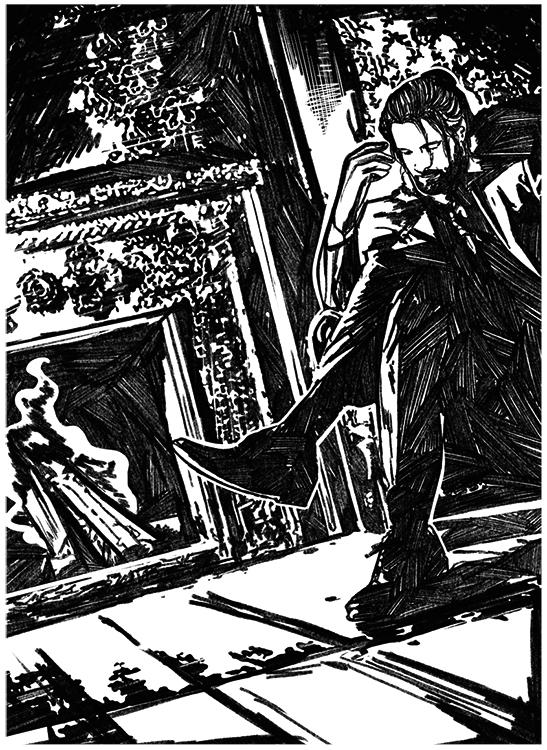
“And why not to-night?” I asked, rubbing my hands over the blaze, and wishing the whole tribe of scarab?i at the devil.
“Ah, if I had only known you were here!” said Legrand, “but it’s so long since I saw you; and how could I foresee that you would pay me a visit this very night of all others? As I was coming home I met Lieutenant G—, from the fort, and, very foolishly, I lent him the bug; so it will be impossible for you to see it until the morning. Stay here to-night, and I will send Jup down for it at sunrise. It is the loveliest thing in creation!”
“What?—sunrise?”
“Nonsense! no!—the bug. It is of a brilliant gold color—about the size of a large hickory-nut—with two jet black spots near one extremity of the back, and another, somewhat longer, at the other. The antennae[10] are—”
“Dey aint no tin in him, Massa Will, I keep a tellin on you,” here interrupted Jupiter; “de bug is a goole bug, solid, ebery bit of him, inside and all, sep him wing—neber feel half so hebby a bug in my life.”
“Well, suppose it is, Jup,” replied Legrand, somewhat more earnestly, it seemed to me, than the case demanded, “is that any reason for your letting the birds burn? The color”—here he turned to me—“is really almost enough to warrant Jupiter’s idea. You never saw a more brilliant metallic lustre than the scales emit—but of this you cannot judge till tomorrow. In the mean time I can give you some idea of the shape.” Saying this, he seated himself at a small table, on which were a pen and ink, but no paper. He looked for some in a drawer, but found none.
“Never mind,” said he at length, “this will answer;” and he drew from his waistcoat pocket a scrap of what I took to be very dirty foolscap, and made upon it a rough drawing with the pen. While he did this, I retained my seat by the fire, for I was still chilly. When the design was complete, he handed it to me without rising. As I received it, a loud growl was heard, succeeded by a scratching at the door. Jupiter opened it, and a large Newfoundland, belonging to Legrand, rushed in, leaped upon my shoulders, and loaded me with caresses; for I had shown him much attention during previous visits. When his gambols were over, I looked at the paper, and, to speak the truth, found myself not a little puzzled at what my friend had depicted.
“Well!” I said, after contemplating it for some minutes, “this is a strange scarabaeus, I must confess: new to me: never saw anything like it before—unless it was a skull, or a death’s-head—which it more nearly resembles than anything else that has come under my observation.”
“A death’s-head!” echoed Legrand—“Oh—yes—well, it has something of that appearance upon paper, no doubt. The two upper black spots look like eyes, eh? and the longer one at the bottom like a mouth—and then the shape of the whole is oval.”
“Perhaps so,” said I; “but, Legrand, I fear you are no artist. I must wait until I see the beetle itself, if I am to form any idea of its personal appearance.”
“Well, I don’t know,” said he, a little nettled, “I draw tolerably—should do it at least—have had good masters, and flatter myself that I am not quite a blockhead.”
“But, my dear fellow, you are joking then,” said I, “this is a very passable skull—indeed, I may say that it is a very excellent skull, according to the vulgar notions about such specimens of physiology—and your scarabaeus must be the queerest scarabaeus in the world if it resembles it. Why, we may get up a very thrilling bit of superstition upon this hint. I presume you will call the bug scarabaeus caput hominis,[11] or something of that kind—there are many similar titles in the Natural Histories. But where are the antennae you spoke of?”
“The antennae!” said Legrand, who seemed to be getting unaccountably warm upon the subject; “I am sure you must see the antennae. I made them as distinct as they are in the original insect, and I presume that is sufficient.”
“Well, well,” I said, “perhaps you have—still I don’t see them;” and I handed him the paper without additional remark, not wishing to ruffle his temper; but I was much surprised at the turn affairs had taken; his ill humor puzzled me—and, as for the drawing of the beetle, there were positively no antennae visible, and the whole did bear a very close resemblance to the ordinary cuts of a death’s-head.
He received the paper very peevishly, and was about to crumple it, apparently to throw it in the fire, when a casual glance at the design seemed suddenly to rivet his attention. In an instant his face grew violently red—in another as excessively pale. For some minutes he continued to scrutinize the drawing minutely where he sat. At length he arose, took a candle from the table, and proceeded to seat himself upon a sea-chest in the farthest corner of the room. Here again he made an anxious examination of the paper; turning it in all directions. He said nothing, however, and his conduct greatly astonished me; yet I thought it prudent not to exacerbate the growing moodiness of his temper by any comment. Presently he took from his coat pocket a wallet, placed the paper carefully in it, and deposited both in a writing-desk, which he locked. He now grew more composed in his demeanor; but his original air of enthusiasm had quite disappeared. Yet he seemed not so much sulky as abstracted. As the evening wore away he became more and more absorbed in reverie, from which no sallies of mine could arouse him. It had been my intention to pass the night at the hut, as I had frequently done before, but, seeing my host in this mood, I deemed it proper to take leave. He did not press me to remain, but, as I departed, he shook my hand with even more than his usual cordiality.
It was about a month after this (and during the interval I had seen nothing of Legrand) when I received a visit, at Charleston, from his man, Jupiter. I had never seen the good old negro look so dispirited, and I feared that some serious disaster had befallen my friend.
“Well, Jup,” said I, “what is the matter now?—how is your master?”
“Why, to speak de troof, massa, him not so berry well as mought be.”
“Not well! I am truly sorry to hear it. What does he complain of?”
“Dar! dat’s it!—him neber plain of notin—but him berry sick for all dat.”
“Very sick, Jupiter!—why didn’t you say so at once? Is he confined to bed?”
“No, dat he aint!—he aint find nowhar—dat’s just whar de shoe pinch—my mind is got to be berry hebby bout poor Massa Will.”
“Jupiter, I should like to understand what it is you are talking about. You say your master is sick. Hasn’t he told you what ails him?”
“Why, massa, taint worf while for to git mad about de matter—Massa Will say noffin at all aint de matter wid him—but den what make him go about looking dis here way, wid he head down and he soldiers up, and as white as a gose? And den he keep a syphon all de time—”
“Keeps a what, Jupiter?”
“Keeps a syphon wid de figgurs on de slate—de queerest figgurs I ebber did see. Ise gittin to be skeered, I tell you. Hab for to keep mighty tight eye pon him noovers.[12] Todder day he gib me slip fore de sun up and was gone de whole ob de blessed day. I had a big stick ready cut for to gib him deuced good beating when he did come—but Ise sich a fool dat I hadn’t de heart arter all—he look so berry poorly.”
“Eh?—what?—ah yes!—upon the whole I think you had better not be too severe with the poor fellow—don’t flog him, Jupiter—he can’t very well stand it—but can you form no idea of what has occasioned this illness, or rather this change of conduct? Has anything unpleasant happened since I saw you?”
“No, massa, dey aint bin noffin unpleasant since den—‘twas fore den I’m feared—‘twas de berry day you was dare.”
“How? what do you mean?”
“Why, massa, I mean de bug—dare now.”
“The what?”
“De bug,—I’m berry sartain dat Massa Will bin bit somewhere bout de head by dat goole-bug.”
“And what cause have you, Jupiter, for such a supposition?”
“Claws enuff, massa, and mouth too. I nebber did see sick a deuced bug—he kick and he bite ebery ting what cum near him. Massa Will cotch him fuss, but had for to let him go gin mighty quick, I tell you—den was de time he must ha got de bite. I did n’t like de look oh de bug mouff, myself, no how, so I would n’t take hold ob him wid my finger, but I cotch him wid a piece ob paper dat I found. I rap him up in de paper and stuff piece ob it in he mouff—dat was de way.”
“And you think, then, that your master was really bitten by the beetle, and that the bite made him sick?”
“I do n’t tink noffin about it—I nose it. What make him dream bout de goole so much, if taint cause he bit by de goole-bug? Ise heerd bout dem goole-bugs fore dis.”
“But how do you know he dreams about gold?”
“How I know? why cause he talk about it in he sleep—dat’s how I nose.”
“Well, Jup, perhaps you are right; but to what fortunate circumstance am I to attribute the honor of a visit from you to-day?”
“What de matter, massa?”
“Did you bring any message from Mr. Legrand?”
“No, massa, I bring dis here pissel;” and here Jupiter handed me a note which ran thus:
MY DEAR—
Why have I not seen you for so long a time? I hope you have not been so foolish as to take offence at any little brusquerie[13] of mine; but no, that is improbable. Since I saw you I have had great cause for anxiety. I have something to tell you, yet scarcely know how to tell it, or whether I should tell it at all.
I have not been quite well for some days past, and poor old Jup annoys me, almost beyond endurance, by his well-meant attentions Would you believe it?—he had prepared a huge stick, the other day, with which to chastise me for giving him the slip, and spending the day, solus, among the hills on the main land. I verily believe that my ill looks alone saved me a flogging.
I have made no addition to my cabinet since we met.
If you can, in any way, make it convenient, come over with Jupiter. Do come. I wish to see you to-night, upon business of importance. I assure you that it is of the highest importance.
There was something in the tone of this note which gave me great uneasiness. Its whole style differed materially from that of Legrand. What could he be dreaming of? What new crotchet possessed his excitable brain? What “business of the highest importance” could he possibly have to transact? Jupiter’s account of him boded no good. I dreaded lest the continued pressure of misfortune had, at length, fairly unsettled the reason of my friend. Without a moment’s hesitation, therefore, I prepared to accompany the negro.
Upon reaching the wharf, I noticed a scythe and three spades, all apparently new, lying in the bottom of the boat in which we were to embark.
“What is the meaning of all this, Jup?” I inquired.
“Him syfe, massa, and spade.”
“Very true; but what are they doing here?”
“Him de syfe and de spade what Massa Will sis pon my buying for him in de town, and de debbils own lot of money I had to gib for em.”
“But what, in the name of all that is mysterious, is your ‘Massa Will’ going to do with scythes and spades?”
“Dat’s more dan I know, and debbil take me if I don’t blieve ‘tis more dan he know, too. But it’s all cum ob do bug.”
Finding that no satisfaction was to be obtained of Jupiter, whose whole intellect seemed to be absorbed by “de bug,” I now stepped into the boat and made sail. With a fair and strong breeze we soon ran into the little cove to the northward of Fort Moultrie, and a walk of some two miles brought us to the hut. It was about three in the afternoon when we arrived. Legrand had been awaiting us in eager expectation. He grasped my hand with a nervous empressement[14] which alarmed me and strengthened the suspicions already entertained. His countenance was pale even to ghastliness, and his deep-set eyes glared with unnatural lustre. After some inquiries respecting his health, I asked him, not knowing what better to say, if he had yet obtained the scarabaeus from Lieutenant G—.
“Oh, yes,” he replied, coloring violently, “I got it from him the next morning. Nothing should tempt me to part with that scarabaeus. Do you know that Jupiter is quite right about it?”
“In what way?” I asked, with a sad foreboding at heart.
“In supposing it to be a bug of real gold.” He said this with an air of profound seriousness, and I felt inexpressibly shocked.
“This bug is to make my fortune,” he continued, with a triumphant smile, “to reinstate me in my family possessions. Is it any wonder, then, that I prize it? Since Fortune has thought fit to bestow it upon me, I have only to use it properly and I shall arrive at the gold of which it is the index. Jupiter; bring me that scarabaeus!”
“What! de bug, massa? I’d rudder not go fer trubble dat bug—you mus git him for your own self.” Hereupon Legrand arose, with a grave and stately air, and brought me the beetle from a glass case in which it was enclosed. It was a beautiful scarabaeus, and, at that time, unknown to naturalists—of course a great prize in a scientific point of view. There were two round, black spots near one extremity of the back, and a long one near the other. The scales were exceedingly hard and glossy, with all the appearance of burnished gold. The weight of the insect was very remarkable, and, taking all things into consideration, I could hardly blame Jupiter for his opinion respecting it; but what to make of Legrand’s concordance with that opinion, I could not, for the life of me, tell.
“I sent for you,” said he, in a grandiloquent tone, when I had completed my examination of the beetle, “I sent for you, that I might have your counsel and assistance in furthering the views of Fate and of the bug”—
“My dear Legrand,” I cried, interrupting him, “you are certainly unwell, and had better use some little precautions. You shall go to bed, and I will remain with you a few days, until you get over this. You are feverish and”—
“Feel my pulse,” said he.
I felt it, and, to say the truth, found not the slightest indication of fever.
“But you may be ill and yet have no fever. Allow me this once to prescribe for you. In the first place, go to bed. In the next”—
“You are mistaken,” he interposed, “I am as well as I can expect to be under the excitement which I suffer. If you really wish me well, you will relieve this excitement.”
“And how is this to be done?”
“Very easily. Jupiter and myself are going upon an expedition into the hills, upon the main land, and, in this expedition we shall need the aid of some person in whom we can confide. You are the only one we can trust. Whether we succeed or fail, the excitement which you now perceive in me will be equally allayed.”
“I am anxious to oblige you in any way,” I replied; “but do you mean to say that this infernal beetle has any connection with your expedition into the hills?”
“It has.”
“Then, Legrand, I can become a party to no such absurd proceeding.”
“I am sorry—very sorry—for we shall have to try it by ourselves.”
“Try it by yourselves! The man is surely mad!—but stay!—how long do you propose to be absent?”
“Probably all night. We shall start immediately, and be back, at all events, by sunrise.”
“And will you promise me, upon your honor, that when this freak of yours is over, and the bug business (good God!) settled to your satisfaction, you will then return home and follow my advice implicitly, as that of your physician?”
“Yes; I promise; and now let us be off, for we have no time to lose.”
With a heavy heart I accompanied my friend. We started about four o’clock—Legrand, Jupiter, the dog, and myself. Jupiter had with him the scythe and spades—the whole of which he insisted upon carrying—more through fear, it seemed to me, of trusting either of the implements within reach of his master, than from any excess of industry or complaisance. His demeanor was dogged in the extreme, and “dat deuced bug” were the sole words which escaped his lips during the journey. For my own part, I had charge of a couple of dark lanterns, while Legrand contented himself with the scarabaeus, which he carried attached to the end of a bit of whip-cord; twirling it to and fro, with the air of a conjuror, as he went. When I observed this last, plain evidence of my friend’s aberration of mind, I could scarcely refrain from tears. I thought it best, however, to humor his fancy, at least for the present, or until I could adopt some more energetic measures with a chance of success. In the mean time I endeavored, but all in vain, to sound him in regard to the object of the expedition. Having succeeded in inducing me to accompany him, he seemed unwilling to hold conversation upon any topic of minor importance, and to all my questions vouchsafed no other reply than “we shall see!”
We crossed the creek at the head of the island by means of a skiff; and, ascending the high grounds on the shore of the main land, proceeded in a northwesterly direction, through a tract of country excessively wild and desolate, where no trace of a human footstep was to be seen. Legrand led the way with decision; pausing only for an instant, here and there, to consult what appeared to be certain landmarks of his own contrivance upon a former occasion.
In this manner we journeyed for about two hours, and the sun was just setting when we entered a region infinitely more dreary than any yet seen. It was a species of table land, near the summit of an almost inaccessible hill, densely wooded from base to pinnacle, and interspersed with huge crags that appeared to lie loosely upon the soil, and in many cases were prevented from precipitating themselves into the valleys below, merely by the support of the trees against which they reclined. Deep ravines, in various directions, gave an air of still sterner solemnity to the scene.
The natural platform to which we had clambered was thickly overgrown with brambles, through which we soon discovered that it would have been impossible to force our way but for the scythe; and Jupiter, by direction of his master, proceeded to clear for us a path to the foot of an enormously tall tulip-tree, which stood, with some eight or ten oaks, upon the level, and far surpassed them all, and all other trees which I had then ever seen, in the beauty of its foliage and form, in the wide spread of its branches, and in the general majesty of its appearance. When we reached this tree, Legrand turned to Jupiter, and asked him if he thought he could climb it. The old man seemed a little staggered by the question, and for some moments made no reply. At length he approached the huge trunk, walked slowly around it, and examined it with minute attention. When he had completed his scrutiny, he merely said,
“Yes, massa, Jup climb any tree he ebber see in he life.”
“Then up with you as soon as possible, for it will soon be too dark to see what we are about.”
“How far mus go up, massa?” inquired Jupiter.
“Get up the main trunk first, and then I will tell you which way to go—and here—stop! take this beetle with you.”
“De bug, Massa Will!—de goole bug!” cried the negro, drawing back in dismay—“what for mus tote de bug way up de tree?—d-n if I do!”
“If you are afraid, Jup, a great big negro like you, to take hold of a harmless little dead beetle, why you can carry it up by this string—but, if you do not take it up with you in some way, I shall be under the necessity of breaking your head with this shovel.”
“What de matter now, massa?” said Jup, evidently shamed into compliance; “always want for to raise fuss wid old nigger. Was only funnin any how. Me feered de bug! what I keer for de bug?” Here he took cautiously hold of the extreme end of the string, and, maintaining the insect as far from his person as circumstances would permit, prepared to ascend the tree.
In youth, the tulip-tree, or Liriodendron Tulipferum, the most magnificent of American foresters, has a trunk peculiarly smooth, and often rises to a great height without lateral branches; but, in its riper age, the bark becomes gnarled and uneven, while many short limbs make their appearance on the stem. Thus the difficulty of ascension, in the present case, lay more in semblance than in reality. Embracing the huge cylinder, as closely as possible, with his arms and knees, seizing with his hands some projections, and resting his naked toes upon others, Jupiter, after one or two narrow escapes from falling, at length wriggled himself into the first great fork, and seemed to consider the whole business as virtually accomplished. The risk of the achievement was, in fact, now over, although the climber was some sixty or seventy feet from the ground.
“Which way mus go now, Massa Will?” he asked.
“Keep up the largest branch—the one on this side,” said Legrand. The negro obeyed him promptly, and apparently with but little trouble; ascending higher and higher, until no glimpse of his squat figure could be obtained through the dense foliage which enveloped it. Presently his voice was heard in a sort of halloo.
“How much fudder is got for go?”
“How high up are you?” asked Legrand.
“Ebber so fur,” replied the negro; “can see de sky fru de top ob de tree.”
“Never mind the sky, but attend to what I say. Look down the trunk and count the limbs below you on this side. How many limbs have you passed?”
“One, two, tree, four, fibe—I done pass fibe big limb, massa, pon dis side.”
“Then go one limb higher.”
In a few minutes the voice was heard again, announcing that the seventh limb was attained.
“Now, Jup,” cried Legrand, evidently much excited, “I want you to work your way out upon that limb as far as you can. If you see anything strange, let me know.” By this time what little doubt I might have entertained of my poor friend’s insanity, was put finally at rest. I had no alternative but to conclude him stricken with lunacy, and I became seriously anxious about getting him home. While I was pondering upon what was best to be done, Jupiter’s voice was again heard.
“Mos feerd for to ventur pon dis limb berry far—tis dead limb putty much all de way.”
“Did you say it was a dead limb, Jupiter?” cried Legrand in a quavering voice.
“Yes, massa, him dead as de door-nail—done up for sartain—done departed dis here life.”
“What in the name heaven shall I do?” asked Legrand, seemingly in the greatest distress. “Do!” said I, glad of an opportunity to interpose a word, “why come home and go to bed. Come now!—that’s a fine fellow. It’s getting late, and, besides, you remember your promise.”
“Jupiter,” cried he, without heeding me in the least, “do you hear me?”
“Yes, Massa Will, hear you ebber so plain.”
“Try the wood well, then, with your knife, and see if you think it very rotten.”
“Him rotten, massa, sure nuff,” replied the negro in a few moments, “but not so berry rotten as mought be. Mought ventur out leetle way pon de limb by myself, dat’s true.”
“By yourself!—what do you mean?”
“Why I mean de bug. ‘Tis berry hebby bug. Spose I drop him down fuss, and den de limb won’t break wid just de weight ob one nigger.”
“You infernal scoundrel!” cried Legrand, apparently much relieved, “what do you mean by telling me such nonsense as that? As sure as you drop that beetle I’ll break your neck. Look here, Jupiter, do you hear me?”
“Yes, massa, needn’t hollo at poor nigger dat style.”
“Well! now listen!—if you will venture out on the limb as far as you think safe, and not let go the beetle, I’ll make you a present of a silver dollar as soon as you get down.”
“I’m gwine, Massa Will—deed I is,” replied the negro very promptly—“mos out to the eend now.”
“Out to the end!” here fairly screamed Legrand, “do you say you are out to the end of that limb?”
“Soon be to de eend, massa,—o-o-o-o-oh! Lor-gol-a-marcy! what is dis here pon de tree?”
“Well!” cried Legrand, highly delighted, “what is it?”
“Why taint noffin but a skull—somebody bin lef him head up de tree, and de crows done gobble ebery bit ob de meat off.”
“A skull, you say!—very well!—how is it fastened to the limb?—what holds it on?”
“Sure nuff, massa; mus look. Why dis berry curous sarcumstance, pon my word—dare’s a great big nail in de skull, what fastens ob it on to de tree.”
“Well now, Jupiter, do exactly as I tell you—do you hear?”
“Yes, massa.”
“Pay attention, then!—find the left eye of the skull.”
“Hum! hoo! dat’s good! why dare aint no eye lef at all.”
“Curse your stupidity! do you know your right hand from your left?”
“Yes, I nose dat—nose all bout dat—tis my lef hand what I chops de wood wid.”
“To be sure! you are left-handed; and your left eye is on the same side as your left hand. Now, I suppose, you can find the left eye of the skull, or the place where the left eye has been. Have you found it?”
Here was a long pause. At length the negro asked,
“Is de lef eye of de skull pon de same side as de lef hand of de skull, too?—cause de skull aint got not a bit ob a hand at all—nebber mind! I got de lef eye now—here de lef eye! what mus do wid it?”
“Let the beetle drop through it, as far as the string will reach—but be careful and not let go your hold of the string.”
“All dat done, Massa Will; mighty easy ting for to put de bug fru de hole—look out for him dare below!”
During this colloquy no portion of Jupiter’s person could be seen; but the beetle, which he had suffered to descend, was now visible at the end of the string, and glistened, like a globe of burnished gold, in the last rays of the setting sun, some of which still faintly illumined the eminence upon which we stood. The scarabaeus hung quite clear of any branches, and, if allowed to fall, would have fallen at our feet. Legrand immediately took the scythe, and cleared with it a circular space, three or four yards in diameter, just beneath the insect, and, having accomplished this, ordered Jupiter to let go the string and come down from the tree.
Driving a peg, with great nicety, into the ground, at the precise spot where the beetle fell, my friend now produced from his pocket a tape measure. Fastening one end of this at that point of the trunk, of the tree which was nearest the peg, he unrolled it till it reached the peg, and thence farther unrolled it, in the direction already established by the two points of the tree and the peg, for the distance of fifty feet—Jupiter clearing away the brambles with the scythe. At the spot thus attained a second peg was driven, and about this, as a centre, a rude circle, about four feet in diameter, described. Taking now a spade himself, and giving one to Jupiter and one to me, Legrand begged us to set about digging as quickly as possible.
To speak the truth, I had no especial relish for such amusement at any time, and, at that particular moment, would most willingly have declined it; for the night was coming on, and I felt much fatigued with the exercise already taken; but I saw no mode of escape, and was fearful of disturbing my poor friend’s equanimity by a refusal. Could I have depended, indeed, upon Jupiter’s aid, I would have had no hesitation in attempting to get the lunatic home by force; but I was too well assured of the old negro’s disposition, to hope that he would assist me, under any circumstances, in a personal contest with his master. I made no doubt that the latter had been infected with some of the innumerable Southern superstitions about money buried, and that his phantasy had received confirmation by the finding of the scarabaeus, or, perhaps, by Jupiter’s obstinacy in maintaining it to be “a bug of real gold.” A mind disposed to lunacy would readily be led away by such suggestions—especially if chiming in with favorite preconceived ideas—and then I called to mind the poor fellow’s speech about the beetle’s being “the index of his fortune.” Upon the whole, I was sadly vexed and puzzled, but, at length, I concluded to make a virtue of necessity—to dig with a good will, and thus the sooner to convince the visionary, by ocular demonstration, of the fallacy of the opinions he entertained.
The lanterns having been lit, we all fell to work with a zeal worthy a more rational cause; and, as the glare fell upon our persons and implements, I could not help thinking how picturesque a group we composed, and how strange and suspicious our labors must have appeared to any interloper who, by chance, might have stumbled upon our whereabouts.
We dug very steadily for two hours. Little was said; and our chief embarrassment lay in the yelpings of the dog, who took exceeding interest in our proceedings. He, at length, became so obstreperous that we grew fearful of his giving the alarm to some stragglers in the vicinity;—or, rather, this was the apprehension of Legrand;—for myself, I should have rejoiced at any interruption which might have enabled me to get the wanderer home. The noise was, at length, very effectually silenced by Jupiter, who, getting out of the hole with a dogged air of deliberation, tied the brute’s mouth up with one of his suspenders, and then returned, with a grave chuckle, to his task.
When the time mentioned had expired, we had reached a depth of five feet, and yet no signs of any treasure became manifest. A general pause ensued, and I began to hope that the farce was at an end. Legrand, however, although evidently much disconcerted, wiped his brow thoughtfully and recommenced. We had excavated the entire circle of four feet diameter, and now we slightly enlarged the limit, and went to the farther depth of two feet. Still nothing appeared. The gold-seeker, whom I sincerely pitied, at length clambered from the pit, with the bitterest disappointment imprinted upon every feature, and proceeded, slowly and reluctantly, to put on his coat, which he had thrown off at the beginning of his labor. In the mean time I made no remark. Jupiter, at a signal from his master, began to gather up his tools. This done, and the dog having been unmuzzled, we turned in profound silence towards home.
We had taken, perhaps, a dozen steps in this direction, when, with a loud oath, Legrand strode up to Jupiter, and seized him by the collar. The astonished negro opened his eyes and mouth to the fullest extent, let fall the spades, and fell upon his knees.
“You scoundrel,” said Legrand, hissing out the syllables from between his clenched teeth—“you infernal black villain!—speak, I tell you!—answer me this instant, without prevarication!—which—which is your left eye?”
“Oh, my golly, Massa Will! aint dis here my lef eye for sartain?” roared the terrified Jupiter, placing his hand upon his right organ of vision, and holding it there with a desperate pertinacity, as if in immediate dread of his master’s attempt at a gouge.
“I thought so!—I knew it! hurrah!” vociferated Legrand, letting the negro go, and executing a series of curvets and caracoles,[15] much to the astonishment of his valet, who, arising from his knees, looked, mutely, from his master to myself, and then from myself to his master.
“Come! we must go back,” said the latter, “the game’s not up yet;” and he again led the way to the tulip-tree.
“Jupiter,” said he, when we reached its foot, “come here! was the skull nailed to the limb with the face outwards, or with the face to the limb?”
“De face was out, massa, so dat de crows could get at de eyes good, widout any trouble.”
“Well, then, was it this eye or that through which you dropped the beetle?”—here Legrand touched each of Jupiter’s eyes.
“Twas dis eye, massa—de lef eye—jis as you tell me,” and here it was his right eye that the negro indicated.
“That will do—must try it again.”
Here my friend, about whose madness I now saw, or fancied that I saw, certain indications of method, removed the peg which marked the spot where the beetle fell, to a spot about three inches to the westward of its former position. Taking, now, the tape measure from the nearest point of the trunk to the peg, as before, and continuing the extension in a straight line to the distance of fifty feet, a spot was indicated, removed, by several yards, from the point at which we had been digging.
Around the new position a circle, somewhat larger than in the former instance, was now described, and we again set to work with the spades. I was dreadfully weary, but, scarcely understanding what had occasioned the change in my thoughts, I felt no longer any great aversion from the labor imposed. I had become most unaccountably interested—nay, even excited. Perhaps there was something, amid all the extravagant demeanor of Legrand—some air of forethought, or of deliberation, which impressed me. I dug eagerly, and now and then caught myself actually looking, with something that very much resembled expectation, for the fancied treasure, the vision of which had demented my unfortunate companion. At a period when such vagaries of thought most fully possessed me, and when we had been at work perhaps an hour and a half, we were again interrupted by the violent howlings of the dog. His uneasiness, in the first instance, had been, evidently, but the result of playfulness or caprice, but he now assumed a bitter and serious tone. Upon Jupiter’s again attempting to muzzle him, he made furious resistance, and, leaping into the hole, tore up the mould frantically with his claws. In a few seconds he had uncovered a mass of human bones, forming two complete skeletons, intermingled with several buttons of metal, and what appeared to be the dust of decayed woollen. One or two strokes of a spade upturned the blade of a large Spanish knife, and, as we dug farther, three or four loose pieces of gold and silver coin came to light.
At sight of these the joy of Jupiter could scarcely be restrained, but the countenance of his master wore an air of extreme disappointment He urged us, however, to continue our exertions, and the words were hardly uttered when I stumbled and fell forward, having caught the toe of my boot in a large ring of iron that lay half buried in the loose earth.
We now worked in earnest, and never did I pass ten minutes of more intense excitement. During this interval we had fairly unearthed an oblong chest of wood, which, from its perfect preservation and wonderful hardness, had plainly been subjected to some mineralizing process—perhaps that of the Bi-chloride of Mercury. This box was three feet and a half long, three feet broad, and two and a half feet deep. It was firmly secured by bands of wrought iron, riveted, and forming a kind of open trelliswork over the whole. On each side of the chest, near the top, were three rings of iron—six in all—by means of which a firm hold could be obtained by six persons. Our utmost united endeavors served only to disturb the coffer very slightly in its bed. We at once saw the impossibility of removing so great a weight. Luckily, the sole fastenings of the lid consisted of two sliding bolts. These we drew back—trembling and panting with anxiety. In an instant, a treasure of incalculable value lay gleaming before us. As the rays of the lanterns fell within the pit, there flashed upwards a glow and a glare, from a confused heap of gold and of jewels, that absolutely dazzled our eyes.
I shall not pretend to describe the feelings with which I gazed. Amazement was, of course, predominant. Legrand appeared exhausted with excitement, and spoke very few words. Jupiter’s countenance wore, for some minutes, as deadly a pallor as it is possible, in nature of things, for any negro’s visage to assume. He seemed stupified—thunderstricken. Presently he fell upon his knees in the pit, and, burying his naked arms up to the elbows in gold, let them there remain, as if enjoying the luxury of a bath. At length, with a deep sigh, he exclaimed, as if in a soliloquy,
“And dis all cum ob de goole-bug! de putty goole bug! de poor little goole-bug, what I boosed in dat sabage kind ob style! Aint you shamed ob yourself, nigger?—answer me dat!”
It became necessary, at last, that I should arouse both master and valet to the expediency of removing the treasure. It was growing late, and it behooved us to make exertion, that we might get every thing housed before daylight. It was difficult to say what should be done, and much time was spent in deliberation—so confused were the ideas of all. We, finally, lightened the box by removing two thirds of its contents, when we were enabled, with some trouble, to raise it from the hole. The articles taken out were deposited among the brambles, and the dog left to guard them, with strict orders from Jupiter neither, upon any pretence, to stir from the spot, nor to open his mouth until our return. We then hurriedly made for home with the chest; reaching the hut in safety, but after excessive toil, at one o’clock in the morning. Worn out as we were, it was not in human nature to do more immediately. We rested until two, and had supper; starting for the hills immediately afterwards, armed with three stout sacks, which, by good luck, were upon the premises. A little before four we arrived at the pit, divided the remainder of the booty, as equally as might be, among us, and, leaving the holes unfilled, again set out for the hut, at which, for the second time, we deposited our golden burthens, just as the first faint streaks of the dawn gleamed from over the tree-tops in the East.
We were now thoroughly broken down; but the intense excitement of the time denied us repose. After an unquiet slumber of some three or four hours’ duration, we arose, as if by preconcert, to make examination of our treasure.
The chest had been full to the brim, and we spent the whole day, and the greater part of the next night, in a scrutiny of its contents. There had been nothing like order or arrangement. Every thing had been heaped in promiscuously. Having assorted all with care, we found ourselves possessed of even vaster wealth than we had at first supposed. In coin there was rather more than four hundred and fifty thousand dollars—estimating the value of the pieces, as accurately as we could, by the tables of the period. There was not a particle of silver. All was gold of antique date and of great variety—French, Spanish, and German money, with a few English guineas, and some counters,[16] of which we had never seen specimens before. There were several very large and heavy coins, so worn that we could make nothing of their inscriptions. There was no American money. The value of the jewels we found more difficulty in estimating. There were diamonds—some of them exceedingly large and fine—a hundred and ten in all, and not one of them small; eighteen rubies of remarkable brilliancy;—three hundred and ten emeralds, all very beautiful; and twenty-one sapphires, with an opal. These stones had all been broken from their settings and thrown loose in the chest. The settings themselves, which we picked out from among the other gold, appeared to have been beaten up with hammers, as if to prevent identification. Besides all this, there was a vast quantity of solid gold ornaments;—nearly two hundred massive finger and earrings;—rich chains—thirty of these, if I remember;—eighty-three very large and heavy crucifixes;—five gold censers of great value;—a prodigious golden punch bowl, ornamented with richly chased vine-leaves and Bacchanalian[17] figures; with two sword-handles exquisitely embossed, and many other smaller articles which I cannot recollect. The weight of these valuables exceeded three hundred and fifty pounds avoirdupois; and in this estimate I have not included one hundred and ninety-seven superb gold watches; three of the number being worth each five hundred dollars, if one. Many of them were very old, and as time keepers valueless; the works having suffered, more or less, from corrosion—but all were richly jewelled and in cases of great worth. We estimated the entire contents of the chest, that night, at a million and a half of dollars; and upon the subsequent disposal of the trinkets and jewels (a few being retained for our own use), it was found that we had greatly undervalued the treasure. When, at length, we had concluded our examination, and the intense excitement of the time had, in some measure, subsided, Legrand, who saw that I was dying with impatience for a solution of this most extraordinary riddle, entered into a full detail of all the circumstances connected with it.
“You remember;” said he, “the night when I handed you the rough sketch I had made of the scarabaeus. You recollect also, that I became quite vexed at you for insisting that my drawing resembled a death’s-head. When you first made this assertion I thought you were jesting; but afterwards I called to mind the peculiar spots on the back of the insect, and admitted to myself that your remark had some little foundation in fact. Still, the sneer at my graphic powers irritated me—for I am considered a good artist—and, therefore, when you handed me the scrap of parchment, I was about to crumple it up and throw it angrily into the fire.”
“The scrap of paper, you mean,” said I.
“No; it had much of the appearance of paper, and at first I supposed it to be such, but when I came to draw upon it, I discovered it, at once, to be a piece of very thin parchment. It was quite dirty, you remember. Well, as I was in the very act of crumpling it up, my glance fell upon the sketch at which you had been looking, and you may imagine my astonishment when I perceived, in fact, the figure of a death’s-head just where, it seemed to me, I had made the drawing of the beetle. For a moment I was too much amazed to think with accuracy. I knew that my design was very different in detail from this—although there was a certain similarity in general outline. Presently I took a candle, and seating myself at the other end of the room, proceeded to scrutinize the parchment more closely. Upon turning it over, I saw my own sketch upon the reverse, just as I had made it. My first idea, now, was mere surprise at the really remarkable similarity of outline—at the singular coincidence involved in the fact, that unknown to me, there should have been a skull upon the other side of the parchment, immediately beneath my figure of the scarabaeus, and that this skull, not only in outline, but in size, should so closely resemble my drawing. I say the singularity of this coincidence absolutely stupified me for a time. This is the usual effect of such coincidences. The mind struggles to establish a connexion—a sequence of cause and effect—and, being unable to do so, suffers a species of temporary paralysis. But, when I recovered from this stupor, there dawned upon me gradually a conviction which startled me even far more than the coincidence. I began distinctly, positively, to remember that there had been no drawing upon the parchment when I made my sketch of the scarabaeus. I became perfectly certain of this; for I recollected turning up first one side and then the other, in search of the cleanest spot. Had the skull been then there, of course I could not have failed to notice it. Here was indeed a mystery which I felt it impossible to explain; but, even at that early moment, there seemed to glimmer, faintly, within the most remote and secret chambers of my intellect, a glow-worm-like conception of that truth which last night’s adventure brought to so magnificent a demonstration. I arose at once, and putting the parchment securely away, dismissed all farther reflection until I should be alone.
“When you had gone, and when Jupiter was fast asleep, I betook myself to a more methodical investigation of the affair. In the first place I considered the manner in which the parchment had come into my possession. The spot where we discovered the scarabaeus was on the coast of the main land, about a mile eastward of the island, and but a short distance above high water mark. Upon my taking hold of it, it gave me a sharp bite, which caused me to let it drop. Jupiter, with his accustomed caution, before seizing the insect, which had flown towards him, looked about him for a leaf, or something of that nature, by which to take hold of it. It was at this moment that his eyes, and mine also, fell upon the scrap of parchment, which I then supposed to be paper. It was lying half buried in the sand, a corner sticking up. Near the spot where we found it, I observed the remnants of the hull of what appeared to have been a ship’s long boat. The wreck seemed to have been there for a very great while; for the resemblance to boat timbers could scarcely be traced.
“Well, Jupiter picked up the parchment, wrapped the beetle in it, and gave it to me. Soon afterwards we turned to go home, and on the way met Lieutenant G-. I showed him the insect, and he begged me to let him take it to the fort. Upon my consenting, he thrust it forthwith into his waistcoat pocket, without the parchment in which it had been wrapped, and which I had continued to hold in my hand during his inspection. Perhaps he dreaded my changing my mind, and thought it best to make sure of the prize at once—you know how enthusiastic he is on all subjects connected with Natural History. At the same time, without being conscious of it, I must have deposited the parchment in my own pocket.
“You remember that when I went to the table, for the purpose of making a sketch of the beetle, I found no paper where it was usually kept. I looked in the drawer, and found none there. I searched my pockets, hoping to find an old letter, when my hand fell upon the parchment. I thus detail the precise mode in which it came into my possession; for the circumstances impressed me with peculiar force.
“No doubt you will think me fanciful—but I had already established a kind of connexion. I had put together two 2147links of a great chain. There was a boat lying upon a sea-coast, and not far from the boat was a parchment—not a paper—with a skull depicted upon it. You will, of course, ask ‘where is the connexion?’ I reply that the skull, or death’s-head, is the well-known emblem of the pirate. The flag of the death’s head is hoisted in all engagements.
“I have said that the scrap was parchment, and not paper. Parchment is durable—almost imperishable. Matters of little moment are rarely consigned to parchment; since, for the mere ordinary purposes of drawing or writing, it is not nearly so well adapted as paper. This reflection suggested some meaning—some relevancy—in the death’s-head. I did not fail to observe, also, the form of the parchment. Although one of its corners had been, by some accident, destroyed, it could be seen that the original form was oblong. It was just such a slip, indeed, as might have been chosen for a memorandum—for a record of something to be long remembered and carefully preserved.”
“But,” I interposed, “you say that the skull was not upon the parchment when you made the drawing of the beetle. How then do you trace any connexion between the boat and the skull—since this latter, according to your own admission, must have been designed (God only knows how or by whom) at some period subsequent to your sketching the scarabaeus?”
“Ah, hereupon turns the whole mystery; although the secret, at this point, I had comparatively little difficulty in solving. My steps were sure, and could afford but a single result. I reasoned, for example, thus: When I drew the scarabaeus, there was no skull apparent upon the parchment. When I had completed the drawing I gave it to you, and observed you narrowly until you returned it. You, therefore, did not design the skull, and no one else was present to do it. Then it was not done by human agency. And nevertheless it was done.
“At this stage of my reflections I endeavored to remember, and did remember, with entire distinctness, every incident which occurred about the period in question. The weather was chilly (oh rare and happy accident!), and a fire was blazing upon the hearth. I was heated with exercise and sat near the table. You, however, had drawn a chair close to the chimney. Just as I placed the parchment in your hand, and as you were in the act of inspecting it, Wolf, the Newfoundland, entered, and leaped upon your shoulders. With your left hand you caressed him and kept him off, while your right, holding the parchment, was permitted to fall listlessly between your knees, and in close proximity to the fire. At one moment I thought the blaze had caught it, and was about to caution you, but, before I could speak, you had withdrawn it, and were engaged in its examination. When I considered all these particulars, I doubted not for a moment that heat had been the agent in bringing to light, upon the parchment, the skull which I saw designed upon it. You are well aware that chemical preparations exist, and have existed time out of mind, by means of which it is possible to write upon either paper or vellum, so that the characters shall become visible only when subjected to the action of fire. Zaffre,[18] digested in aqua regia,[19] and diluted with four times its weight of water, is sometimes employed; a green tint results. The regulus[20] of cobalt, dissolved in spirit of nitre, gives a red. These colors disappear at longer or shorter intervals after the material written upon cools, but again become apparent upon the re-application of heat.
“I now scrutinized the death’s-head with care. Its outer edges—the edges of the drawing nearest the edge of the vellum—were far more distinct than the others. It was clear that the action of the caloric had been imperfect or unequal. I immediately kindled a fire, and subjected every portion of the parchment to a glowing heat. At first, the only effect was the strengthening of the faint lines in the skull; but, upon persevering in the experiment, there became visible, at the corner of the slip, diagonally opposite to the spot in which the death’s-head was delineated, the figure of what I at first supposed to be a goat. A closer scrutiny, however, satisfied me that it was intended for a kid.”
“Ha! ha!” said I, “to be sure I have no right to laugh at you—a million and a half of money is too serious a matter for mirth—but you are not about to establish a third 2147link in your chain—you will not find any especial connexion between your pirates and a goat—pirates, you know, have nothing to do with goats; they appertain to the farming interest.”
“But I have just said that the figure was not that of a goat.”
“Well, a kid then—pretty much the same thing.”
“Pretty much, but not altogether,” said Legrand. “You may have heard of one Captain Kidd.[21] I at once looked upon the figure of the animal as a kind of punning or hieroglyphical signature. I say signature; because its position upon the vellum suggested this idea. The death’s-head at the corner diagonally opposite, had, in the same manner, the air of a stamp, or seal. But I was sorely put out by the absence of all else—of the body to my imagined instrument—of the text for my context.”
“I presume you expected to find a letter between the stamp and the signature.”
“Something of that kind. The fact is, I felt irresistibly impressed with a presentiment of some vast good fortune impending. I can scarcely say why. Perhaps, after all, it was rather a desire than an actual belief;—but do you know that Jupiter’s silly words, about the bug being of solid gold, had a remarkable effect upon my fancy? And then the series of accidents and coincidences—these were so very extraordinary. Do you observe how mere an accident it was that these events should have occurred upon the sole day of all the year in which it has been, or may be, sufficiently cool for fire, and that without the fire, or without the intervention of the dog at the precise moment in which he appeared, I should never have become aware of the death’s-head, and so never the possessor of the treasure?”
“But proceed—I am all impatience.”
“Well; you have heard, of course, the many stories current—the thousand vague rumors afloat about money buried, somewhere upon the Atlantic coast, by Kidd and his associates. These rumors must have had some foundation in fact. And that the rumors have existed so long and so continuous, could have resulted, it appeared to me, only from the circumstance of the buried treasure still remaining entombed. Had Kidd concealed his plunder for a time, and afterwards reclaimed it, the rumors would scarcely have reached us in their present unvarying form. You will observe that the stories told are all about money-seekers, not about money-finders. Had the pirate recovered his money, there the affair would have dropped. It seemed to me that some accident—say the loss of a memorandum indicating its locality—had deprived him of the means of recovering it, and that this accident had become known to his followers, who otherwise might never have heard that treasure had been concealed at all, and who, busying themselves in vain, because unguided attempts, to regain it, had given first birth, and then universal currency, to the reports which are now so common. Have you ever heard of any important treasure being unearthed along the coast?”
“Never.”
“But that Kidd’s accumulations were immense, is well known. I took it for granted, therefore, that the earth still held them; and you will scarcely be surprised when I tell you that I felt a hope, nearly amounting to certainty, that the parchment so strangely found, involved a lost record of the place of deposit.”
“But how did you proceed?”
“I held the vellum again to the fire, after increasing the heat; but nothing appeared. I now thought it possible that the coating of dirt might have something to do with the failure; so I carefully rinsed the parchment by pouring warm water over it, and, having done this, I placed it in a tin pan, with the skull downwards, and put the pan upon a furnace of lighted charcoal. In a few minutes, the pan having become thoroughly heated, I removed the slip, and, to my inexpressible joy, found it spotted, in several places, with what appeared to be figures arranged in lines. Again I placed it in the pan, and suffered it to remain another minute. Upon taking it off, the whole was just as you see it now.” Here Legrand, having re-heated the parchment, submitted it to my inspection. The following characters were rudely traced, in a red tint, between the death’s-head and the goat:
“53???305))6*;4826)4?)4?);806*;48?8?60))85;1?);:?
*8?83(88)5*?;46(;88*96*?;8)*?(;485);5*?2:*?(;4956*
2(5*?4)8?8*;4069285);)6?8)4??;1(?9;48081;8:8?1;4
8?85;4)485?528806*81(?9;48;(88;4(??34;48)4?;161;:
188;??;”
“But,” said I, returning him the slip, “I am as much in the dark as ever. Were all the jewels of Golconda[22] awaiting me upon my solution of this enigma, I am quite sure that I should be unable to earn them.”
“And yet,” said Legrand, “the solution is by no means so difficult as you might be lead to imagine from the first hasty inspection of the characters. These characters, as any one might readily guess, form a cipher—that is to say, they convey a meaning; but then, from what is known of Kidd, I could not suppose him capable of constructing any of the more abstruse cryptographs.[23] I made up my mind, at once, that this was of a simple species—such, however, as would appear, to the crude intellect of the sailor, absolutely insoluble without the key.”
“And you really solved it?”
“Readily; I have solved others of an abstruseness ten thousand times greater. Circumstances, and a certain bias of mind, have led me to take interest in such riddles, and it may well be doubted whether human ingenuity can construct an enigma of the kind which human ingenuity may not, by proper application, resolve. In fact, having once established connected and legible characters, I scarcely gave a thought to the mere difficulty of developing their import.
“In the present case—indeed in all cases of secret writing—the first question regards the language of the cipher; for the principles of solution, so far, especially, as the more simple ciphers are concerned, depend upon, and are varied by, the genius of the particular idiom. In general, there is no alternative but experiment (directed by probabilities) of every tongue known to him who attempts the solution, until the true one be attained. But, with the cipher now before us, all difficulty was removed by the signature. The pun upon the word ‘Kidd’ is appreciable in no other language than the English. But for this consideration I should have begun my attempts with the Spanish and French, as the tongues in which a secret of this kind would most naturally have been written by a pirate of the Spanish main.[24] As it was, I assumed the cryptograph to be English.
“You observe there are no divisions between the words. Had there been divisions, the task would have been comparatively easy. In such case I should have commenced with a collation and analysis of the shorter words, and, had a word of a single letter occurred, as is most likely, (a or I, for example,) I should have considered the solution as assured. But, there being no division, my first step was to ascertain the predominant letters, as well as the least frequent. Counting all, I constructed a table, thus:
Of the character 8 there are 33.
; “ 26.
4 “ 19.
) “ 16.
* “ 13.
5 “ 12.
6 “ 11.?
1 “ 8.
0 “ 6.
92 “ 5.
: 3 “ 4.
? “ 3.
ś
“ 2.
-. “ 1.
“Now, in English, the letter which most frequently occurs is e. Afterwards, succession runs thus: a o i d h n r s t u y c f g l m w b k p q x z. E predominates so remarkably that an individual sentence of any length is rarely seen, in which it is not the prevailing character.
“Here, then, we leave, in the very beginning, the groundwork for something more than a mere guess. The general use which may be made of the table is obvious—but, in this particular cipher, we shall only very partially require its aid. As our predominant character is 8, we will commence by assuming it as the e of the natural alphabet. To verify the supposition, let us observe if the 8 be seen often in couples—for e is doubled with great frequency in English—in such words, for example, as ‘meet,’ ‘.fleet,’ ‘speed,’ ‘seen,’ been,’ ‘agree,’ &c. In the present instance we see it doubled no less than five times, although the cryptograph is brief.
“Let us assume 8, then, as e. Now, of all words in the language, ‘the’ is most usual; let us see, therefore, whether there are not repetitions of any three characters, in the same order of collocation, the last of them being 8. If we discover repetitions of such letters, so arranged, they will most probably represent the word ‘the.’ Upon inspection, we find no less than seven such arrangements, the characters being;48. We may, therefore, assume that; represents t, 4 represents h, and 8 represents e—the last being now well confirmed. Thus a great step has been taken.
“But, having established a single word, we are enabled to establish a vastly important point; that is to say, several commencements and terminations of other words. Let us refer, for example, to the last instance but one, in which the combination;48 occurs—not far from the end of the cipher. We know that the; immediately ensuing is the commencement of a word, and, of the six characters succeeding this ‘the,’ we are cognizant of no less than five. Let us set these characters down, thus, by the letters we know them to represent, leaving a space for the unknown—
t eeth.
“Here we are enabled, at once, to discard the ‘th,’ as forming no portion of the word commencing with the first t; since, by experiment of the entire alphabet for a letter adapted to the vacancy, we perceive that no word can be formed of which this th can be a part. We are thus narrowed into
t ee,
and, going through the alphabet, if necessary, as before, we arrive at the word ‘tree,’ as the sole possible reading. We thus gain another letter, r, represented by (, with the words ‘the tree’ in juxtaposition.
“Looking beyond these words, for a short distance, we again see the combination;48, and employ it by way of termination to what immediately precedes. We have thus this arrangement:
the tree;4(??34 the,
or, substituting the natural letters, where known, it reads thus:
the tree thr??3h the.
“Now, if, in place of the unknown characters, we leave blank spaces, or substitute dots, we read thus:
the tree thr…h the,
when the word ‘through’ makes itself evident at once. But this discovery gives us three new letters, o, u and g, represented by?? and 3.
“Looking now, narrowly, through the cipher for combinations of known characters, we find, not very far from the beginning, this arrangement,
83(88, or egree,
which, plainly, is the conclusion of the word ‘degree,’ and gives us another letter, d, represented by?.
“Four letters beyond the word ‘degree,’ we perceive the combination
;46(;88.
“Translating the known characters, and representing the unknown by dots, as before, we read thus: th rtee. an arrangement immediately suggestive of the word ‘thirteen,’ and again furnishing us with two new characters, i and n, represented by 6 and *.
“Referring, now, to the beginning of the cryptograph, we find the combination,
53???.
“Translating, as before, we obtain
good,
which assures us that the first letter is A, and that the first two words are ‘A good.’
“It is now time that we arrange our key, as far as discovered, in a tabular form, to avoid confusion. It will stand thus:
5 represents a? “ d 8 “ e 3 “ g 4 “ h 6 “ i * “ n? “ o (“ r; “ t
“We have, therefore, no less than ten of the most important letters represented, and it will be unnecessary to proceed with the details of the solution. I have said enough to convince you that ciphers of this nature are readily soluble, and to give you some insight into the rationale[25] of their development. But be assured that the specimen before us appertains to the very simplest species of cryptograph. It now only remains to give you the full translation of the characters upon the parchment, as unriddled. Here it is:
“‘A good glass in the bishop’s hostel in the devil’s seat forty-one degrees and thirteen minutes northeast and by north main branch seventh limb east side shoot from the left eye of the death’s-head a bee line from the tree through the shot fifty feet out.’”
“But,” said I, “the enigma seems still in as bad a condition as ever. How is it possible to extort a meaning from all this jargon about ‘devil’s seats,’ ‘death’s heads,’ and ‘bishop’s hotels?’”
“I confess,” replied Legrand, “that the matter still wears a serious aspect, when regarded with a casual glance. My first endeavor was to divide the sentence into the natural division intended by the cryptographist.”
“You mean, to punctuate it?”
“Something of that kind.”
“But how was it possible to effect this?”
“I reflected that it had been a point with the writer to run his words together without division, so as to increase the difficulty of solution. Now, a not over-acute man, in pursuing such an object would be nearly certain to overdo the matter. When, in the course of his composition, he arrived at a break in his subject which would naturally require a pause, or a point, he would be exceedingly apt to run his characters, at this place, more than usually close together. If you will observe the MS., in the present instance, you will easily detect five such cases of unusual crowding. Acting upon this hint, I made the division thus: ‘A good glass in the Bishop’s hostel in the Devil’s seat—forty-one degrees and thirteen minutes—northeast and by north—main branch seventh limb east side—shoot from the left eye of the death’s-head—a bee-line from the tree through the shot fifty feet out.’”
“Even this division,” said I, “leaves me still in the dark.”
“It left me also in the dark,” replied Legrand, “for a few days; during which I made diligent inquiry, in the neighborhood of Sullivan’s Island, for any building which went by the name of the ‘Bishop’s Hotel;’ for, of course, I dropped the obsolete word ‘hostel.’ Gaining no information on the subject, I was on the point of extending my sphere of search, and proceeding in a more systematic manner, when, one morning, it entered into my head, quite suddenly, that this ‘Bishop’s Hostel’ might have some reference to an old family, of the name of Bessop, which, time out of mind, had held possession of an ancient manor-house, about four miles to the northward of the Island. I accordingly went over to the plantation, and re-instituted my inquiries among the older negroes of the place. At length one of the most aged of the women said that she had heard of such a place as Bessop’s Castle, and thought that she could guide me to it, but that it was not a castle nor a tavern, but a high rock.
“I offered to pay her well for her trouble, and, after some demur, she consented to accompany me to the spot. We found it without much difficulty, when, dismissing her, I proceeded to examine the place. The ‘castle’ consisted of an irregular assemblage of cliffs and rocks—one of the latter being quite remarkable for its height as well as for its insulated and artificial appearance I clambered to its apex, and then felt much at a loss as to what should be next done.
“While I was busied in reflection, my eyes fell upon a narrow ledge in the eastern face of the rock, perhaps a yard below the summit upon which I stood. This ledge projected about eighteen inches, and was not more than a foot wide, while a niche in the cliff just above it, gave it a rude resemblance to one of the hollow-backed chairs used by our ancestors. I made no doubt that here was the ‘devil’s seat’ alluded to in the MS., and now I seemed to grasp the full secret of the riddle.
“The ‘good glass,’ I knew, could have reference to nothing but a telescope; for the word ‘glass’ is rarely employed in any other sense by seamen. Now here, I at once saw, was a telescope to be used, and a definite point of view, admitting no variation, from which to use it. Nor did I hesitate to believe that the phrases, “forty-one degrees and thirteen minutes,’ and ‘northeast and by north,’ were intended as directions for the levelling of the glass. Greatly excited by these discoveries, I hurried home, procured a telescope, and returned to the rock.
“I let myself down to the ledge, and found that it was impossible to retain a seat upon it except in one particular position. This fact confirmed my preconceived idea. I proceeded to use the glass. Of course, the ‘forty-one degrees and thirteen minutes’ could allude to nothing but elevation above the visible horizon, since the horizontal direction was clearly indicated by the words, ‘northeast and by north.’ This latter direction I at once established by means of a pocket-compass; then, pointing the glass as nearly at an angle of forty-one degrees of elevation as I could do it by guess, I moved it cautiously up or down, until my attention was arrested by a circular rift or opening in the foliage of a large tree that overtopped its fellows in the distance. In the centre of this rift I perceived a white spot, but could not, at first, distinguish what it was. Adjusting the focus of the telescope, I again looked, and now made it out to be a human skull.
“Upon this discovery I was so sanguine as to consider the enigma solved; for the phrase ‘main branch, seventh limb, east side,’ could refer only to the position of the skull upon the tree, while ‘shoot from the left eye of the death’s head’ admitted, also, of but one interpretation, in regard to a search for buried treasure. I perceived that the design was to drop a bullet from the left eye of the skull, and that a bee-line, or, in other words, a straight line, drawn from the nearest point of the trunk through ‘the shot,’ (or the spot where the bullet fell,) and thence extended to a distance of fifty feet, would indicate a definite point—and beneath this point I thought it at least possible that a deposit of value lay concealed.”
“All this,” I said, “is exceedingly clear, and, although ingenious, still simple and explicit. When you left the Bishop’s Hotel, what then?”
“Why, having carefully taken the bearings of the tree, I turned homewards. The instant that I left ‘the devil’s seat,’ however, the circular rift vanished; nor could I get a glimpse of it afterwards, turn as I would. What seems to me the chief ingenuity in this whole business, is the fact (for repeated experiment has convinced me it is a fact) that the circular opening in question is visible from no other attainable point of view than that afforded by the narrow ledge upon the face of the rock.
“In this expedition to the ‘Bishop’s Hotel’ I had been attended by Jupiter, who had, no doubt, observed, for some weeks past, the abstraction of my demeanor, and took especial care not to leave me alone. But, on the next day, getting up very early, I contrived to give him the slip, and went into the hills in search of the tree. After much toil I found it. When I came home at night my valet proposed to give me a flogging. With the rest of the adventure I believe you are as well acquainted as myself.”
“I suppose,” said I, “you missed the spot, in the first attempt at digging, through Jupiter’s stupidity in letting the bug fall through the right instead of through the left eye of the skull.”[26]
“Precisely. This mistake made a difference of about two inches and a half in the ‘shot’—that is to say, in the position of the peg nearest the tree; and had the treasure been beneath the ‘shot,’ the error would have been of little moment; but ‘the shot,’ together with the nearest point of the tree, were merely two points for the establishment of a line of direction; of course the error, however trivial in the beginning, increased as we proceeded with the line, and by the time we had gone fifty feet, threw us quite off the scent. But for my deep-seated impressions that treasure was here somewhere actually buried, we might have had all our labor in vain.”
“But your grandiloquence, and your conduct in swinging the beetle—how excessively odd! I was sure you were mad. And why did you insist upon letting fall the bug, instead of a bullet, from the skull?”
“Why, to be frank, I felt somewhat annoyed by your evident suspicions touching my sanity, and so resolved to punish you quietly, in my own way, by a little bit of sober mystification. For this reason I swung the beetle, and for this reason I let it fall it from the tree. An observation of yours about its great weight suggested the latter idea.”
“Yes, I perceive; and now there is only one point which puzzles me. What are we to make of the skeletons found in the hole?”
“That is a question I am no more able to answer than yourself. There seems, however, only one plausible way of accounting for them—and yet it is dreadful to believe in such atrocity as my suggestion would imply. It is clear that Kidd—if Kidd indeed secreted this treasure, which I doubt not—it is clear that he must have had assistance in the labor. But this labor concluded, he may have thought it expedient to remove all participants in his secret. Perhaps a couple of blows with a mattock were sufficient, while his coadjutors were busy in the pit; perhaps it required a dozen—who shall tell?”
16
Various coins.
24
The northeastern portion of South America, the Caribbean Sea, and the coast of North America to the Carolinas were harassed by the Spaniards.
19
Royal water—a mixture of nitric and hydrochloric acids.
13
Manoeuvres.
21
A Scottish sea captain who lived in New York in the seventeenth century.
5
Huguenot. French Protestants, many of whom settled in South Carolina.
12
Lack of cordiality
20
An old chemical term.
7
A famous Dutch naturalist (1637–1680).
18
An oxide of cobalt. See dictionary.
26
Sign.
8
Freed from slavery.
6
Fort Moultrie. Erected in. 1776. Defended against the British by Colonel William Moultrie.
11
scarabaeus caput hominis. Man’s-head beetle.
4
All in the Wrong. The title of an amusing comedy by Arthur Murphy (1730–1805).
15
Leaping and prancing of a horse.
23
Secret forms of writing.
25
Reasonable basis.
17
Revelling like the worshippers of Bacchus, the god of wine.
10
The feelers.
9
The Latin for beetle.
14
Demonstrativeness.
22
A town in India noted for its diamond market.
THE BLACK CAT
FOR the most wild, yet most homely narrative which I am about to pen, I neither expect nor solicit belief. Mad indeed would I be to expect it, in a case where my very senses reject their own evidence. Yet, mad am I not—and very surely do I not dream. But to-morrow I die, and to-day I would unburthen my soul. My immediate purpose is to place before the world, plainly, succinctly, and without comment, a series of mere household events. In their consequences, these events have terrified—have tortured—have destroyed me. Yet I will not attempt to expound them. To me, they have presented little but Horror—to many they will seem less terrible than barroques. Hereafter, perhaps, some intellect may be found which will reduce my phantasm to the common-place—some intellect more calm, more logical, and far less excitable than my own, which will perceive, in the circumstances I detail with awe, nothing more than an ordinary succession of very natural causes and effects.
From my infancy I was noted for the docility and humanity of my disposition. My tenderness of heart was even so conspicuous as to make me the jest of my companions. I was especially fond of animals, and was indulged by my parents with a great variety of pets. With these I spent most of my time, and never was so happy as when feeding and caressing them. This peculiarity of character grew with my growth, and in my manhood, I derived from it one of my principal sources of pleasure. To those who have cherished an affection for a faithful and sagacious dog, I need hardly be at the trouble of explaining the nature or the intensity of the gratification thus derivable. There is something in the unselfish and self-sacrificing love of a brute, which goes directly to the heart of him who has had frequent occasion to test the paltry friendship and gossamer fidelity of mere Man.
I married early, and was happy to find in my wife a disposition not uncongenial with my own. Observing my partiality for domestic pets, she lost no opportunity of procuring those of the most agreeable kind. We had birds, gold-fish, a fine dog, rabbits, a small monkey, and a cat.
This latter was a remarkably large and beautiful animal, entirely black, and sagacious to an astonishing degree. In speaking of his intelligence, my wife, who at heart was not a little tinctured with superstition, made frequent allusion to the ancient popular notion, which regarded all black cats as witches in disguise. Not that she was ever serious upon this point—and I mention the matter at all for no better reason than that it happens, just now, to be remembered.
Pluto—this was the cat’s name—was my favorite pet and playmate. I alone fed him, and he attended me wherever I went about the house. It was even with difficulty that I could prevent him from following me through the streets.
Our friendship lasted, in this manner, for several years, during which my general temperament and character—through the instrumentality of the Fiend Intemperance—had (I blush to confess it) experienced a radical alteration for the worse. I grew, day by day, more moody, more irritable, more regardless of the feelings of others. I suffered myself to use intemperate language to my wife. At length, I even offered her personal violence. My pets, of course, were made to feel the change in my disposition. I not only neglected, but ill-used them. For Pluto, however, I still retained sufficient regard to restrain me from maltreating him, as I made no scruple of maltreating the rabbits, the monkey, or even the dog, when by accident, or through affection, they came in my way. But my disease grew upon me—for what disease is like Alcohol!—and at length even Pluto, who was now becoming old, and consequently somewhat peevish—even Pluto began to experience the effects of my ill temper.
One night, returning home, much intoxicated, from one of my haunts about town, I fancied that the cat avoided my presence. I seized him; when, in his fright at my violence, he inflicted a slight wound upon my hand with his teeth. The fury of a demon instantly possessed me. I knew myself no longer. My original soul seemed, at once, to take its flight from my body and a more than fiendish malevolence, gin-nurtured, thrilled every fibre of my frame. I took from my waistcoat-pocket a pen-knife, opened it, grasped the poor beast by the throat, and deliberately cut one of its eyes from the socket! I blush, I burn, I shudder, while I pen the damnable atrocity.
When reason returned with the morning—when I had slept off the fumes of the night’s debauch—I experienced a sentiment half of horror, half of remorse, for the crime of which I had been guilty; but it was, at best, a feeble and equivocal feeling, and the soul remained untouched. I again plunged into excess, and soon drowned in wine all memory of the deed.
In the meantime the cat slowly recovered. The socket of the lost eye presented, it is true, a frightful appearance, but he no longer appeared to suffer any pain. He went about the house as usual, but, as might be expected, fled in extreme terror at my approach. I had so much of my old heart left, as to be at first grieved by this evident dislike on the part of a creature which had once so loved me. But this feeling soon gave place to irritation. And then came, as if to my final and irrevocable overthrow, the spirit of PERVERSENESS. Of this spirit philosophy takes no account. Yet I am not more sure that my soul lives, than I am that perverseness is one of the primitive impulses of the human heart—one of the indivisible primary faculties, or sentiments, which give direction to the character of Man. Who has not, a hundred times, found himself committing a vile or a silly action, for no other reason than because he knows he should not? Have we not a perpetual inclination, in the teeth of our best judgment, to violate that which is Law, merely because we understand it to be such? This spirit of perverseness, I say, came to my final overthrow. It was this unfathomable longing of the soul to vex itself—to offer violence to its own nature—to do wrong for the wrong’s sake only—that urged me to continue and finally to consummate the injury I had inflicted upon the unoffending brute. One morning, in cool blood, I slipped a noose about its neck and hung it to the limb of a tree;—hung it with the tears streaming from my eyes, and with the bitterest remorse at my heart;—hung it because I knew that it had loved me, and because I felt it had given me no reason of offence;—hung it because I knew that in so doing I was committing a sin—a deadly sin that would so jeopardize my immortal soul as to place it—if such a thing wore possible—even beyond the reach of the infinite mercy of the Most Merciful and Most Terrible God.
On the night of the day on which this cruel deed was done, I was aroused from sleep by the cry of fire. The curtains of my bed were in flames. The whole house was blazing. It was with great difficulty that my wife, a servant, and myself, made our escape from the conflagration. The destruction was complete. My entire worldly wealth was swallowed up, and I resigned myself thenceforward to despair.
I am above the weakness of seeking to establish a sequence of cause and effect, between the disaster and the atrocity. But I am detailing a chain of facts—and wish not to leave even a possible 2148link imperfect. On the day succeeding the fire, I visited the ruins. The walls, with one exception, had fallen in. This exception was found in a compartment wall, not very thick, which stood about the middle of the house, and against which had rested the head of my bed. The plastering had here, in great measure, resisted the action of the fire—a fact which I attributed to its having been recently spread. About this wall a dense crowd were collected, and many persons seemed to be examining a particular portion of it with very minute and eager attention. The words “strange!” “singular!” and other similar expressions, excited my curiosity. I approached and saw, as if graven in bas relief upon the white surface, the figure of a gigantic cat. The impression was given with an accuracy truly marvellous. There was a rope about the animal’s neck.
When I first beheld this apparition—for I could scarcely regard it as less—my wonder and my terror were extreme. But at length reflection came to my aid. The cat, I remembered, had been hung in a garden adjacent to the house. Upon the alarm of fire, this garden had been immediately filled by the crowd—by some one of whom the animal must have been cut from the tree and thrown, through an open window, into my chamber. This had probably been done with the view of arousing me from sleep. The falling of other walls had compressed the victim of my cruelty into the substance of the freshly-spread plaster; the lime of which, with the flames, and the ammonia from the carcass, had then accomplished the portraiture as I saw it.
Although I thus readily accounted to my reason, if not altogether to my conscience, for the startling fact just detailed, it did not the less fail to make a deep impression upon my fancy. For months I could not rid myself of the phantasm of the cat; and, during this period, there came back into my spirit a half-sentiment that seemed, but was not, remorse. I went so far as to regret the loss of the animal, and to look about me, among the vile haunts which I now habitually frequented, for another pet of the same species, and of somewhat similar appearance, with which to supply its place.
One night as I sat, half stupified, in a den of more than infamy, my attention was suddenly drawn to some black object, reposing upon the head of one of the immense hogsheads of Gin, or of Rum, which constituted the chief furniture of the apartment. I had been looking steadily at the top of this hogshead for some minutes, and what now caused me surprise was the fact that I had not sooner perceived the object thereupon. I approached it, and touched it with my hand. It was a black cat—a very large one—fully as large as Pluto, and closely resembling him in every respect but one. Pluto had not a white hair upon any portion of his body; but this cat had a large, although indefinite splotch of white, covering nearly the whole region of the breast. Upon my touching him, he immediately arose, purred loudly, rubbed against my hand, and appeared delighted with my notice. This, then, was the very creature of which I was in search. I at once offered to purchase it of the landlord; but this person made no claim to it—knew nothing of it—had never seen it before.
I continued my caresses, and, when I prepared to go home, the animal evinced a disposition to accompany me. I permitted it to do so; occasionally stooping and patting it as I proceeded. When it reached the house it domesticated itself at once, and became immediately a great favorite with my wife.
For my own part, I soon found a dislike to it arising within me. This was just the reverse of what I had anticipated; but—I know not how or why it was—its evident fondness for myself rather disgusted and annoyed. By slow degrees, these feelings of disgust and annoyance rose into the bitterness of hatred. I avoided the creature; a certain sense of shame, and the remembrance of my former deed of cruelty, preventing me from physically abusing it. I did not, for some weeks, strike, or otherwise violently ill use it; but gradually—very gradually—I came to look upon it with unutterable loathing, and to flee silently from its odious presence, as from the breath of a pestilence.
What added, no doubt, to my hatred of the beast, was the discovery, on the morning after I brought it home, that, like Pluto, it also had been deprived of one of its eyes. This circumstance, however, only endeared it to my wife, who, as I have already said, possessed, in a high degree, that humanity of feeling which had once been my distinguishing trait, and the source of many of my simplest and purest pleasures.
With my aversion to this cat, however, its partiality for myself seemed to increase. It followed my footsteps with a pertinacity which it would be difficult to make the reader comprehend. Whenever I sat, it would crouch beneath my chair, or spring upon my knees, covering me with its loathsome caresses. If I arose to walk it would get between my feet and thus nearly throw me down, or, fastening its long and sharp claws in my dress, clamber, in this manner, to my breast. At such times, although I longed to destroy it with a blow, I was yet withheld from so doing, partly by a memory of my former crime, but chiefly—let me confess it at once—by absolute dread of the beast.
This dread was not exactly a dread of physical evil—and yet I should be at a loss how otherwise to define it. I am almost ashamed to own—yes, even in this felon’s cell, I am almost ashamed to own—that the terror and horror with which the animal inspired me, had been heightened by one of the merest chimaeras it would be possible to conceive. My wife had called my attention, more than once, to the character of the mark of white hair, of which I have spoken, and which constituted the sole visible difference between the strange beast and the one I had destroyed. The reader will remember that this mark, although large, had been originally very indefinite; but, by slow degrees—degrees nearly imperceptible, and which for a long time my Reason struggled to reject as fanciful—it had, at length, assumed a rigorous distinctness of outline. It was now the representation of an object that I shudder to name—and for this, above all, I loathed, and dreaded, and would have rid myself of the monster had I dared—it was now, I say, the image of a hideous—of a ghastly thing—of the GALLOWS!—oh, mournful and terrible engine of Horror and of Crime—of Agony and of Death!
And now was I indeed wretched beyond the wretchedness of mere Humanity. And a brute beast—whose fellow I had contemptuously destroyed—a brute beast to work out for me—for me a man, fashioned in the image of the High God—so much of insufferable wo! Alas! neither by day nor by night knew I the blessing of Rest any more! During the former the creature left me no moment alone; and, in the latter, I started, hourly, from dreams of unutterable fear, to find the hot breath of the thing upon my face, and its vast weight—an incarnate Night-Mare that I had no power to shake off—incumbent eternally upon my heart!
Beneath the pressure of torments such as these, the feeble remnant of the good within me succumbed. Evil thoughts became my sole intimates—the darkest and most evil of thoughts. The moodiness of my usual temper increased to hatred of all things and of all mankind; while, from the sudden, frequent, and ungovernable outbursts of a fury to which I now blindly abandoned myself, my uncomplaining wife, alas! was the most usual and the most patient of sufferers.
One day she accompanied me, upon some household errand, into the cellar of the old building which our poverty compelled us to inhabit. The cat followed me down the steep stairs, and, nearly throwing me headlong, exasperated me to madness. Uplifting an axe, and forgetting, in my wrath, the childish dread which had hitherto stayed my hand, I aimed a blow at the animal which, of course, would have proved instantly fatal had it descended as I wished. But this blow was arrested by the hand of my wife. Goaded, by the interference, into a rage more than demoniacal, I withdrew my arm from her grasp and buried the axe in her brain. She fell dead upon the spot, without a groan.
This hideous murder accomplished, I set myself forthwith, and with entire deliberation, to the task of concealing the body. I knew that I could not remove it from the house, either by day or by night, without the risk of being observed by the neighbors. Many projects entered my mind. At one period I thought of cutting the corpse into minute fragments, and destroying them by fire. At another, I resolved to dig a grave for it in the floor of the cellar. Again, I deliberated about casting it in the well in the yard—about packing it in a box, as if merchandize, with the usual arrangements, and so getting a porter to take it from the house. Finally I hit upon what I considered a far better expedient than either of these. I determined to wall it up in the cellar—as the monks of the middle ages are recorded to have walled up their victims.
For a purpose such as this the cellar was well adapted. Its walls were loosely constructed, and had lately been plastered throughout with a rough plaster, which the dampness of the atmosphere had prevented from hardening. Moreover, in one of the walls was a projection, caused by a false chimney, or fireplace, that had been filled up, and made to resemble the red of the cellar. I made no doubt that I could readily displace the bricks at this point, insert the corpse, and wall the whole up as before, so that no eye could detect any thing suspicious. And in this calculation I was not deceived. By means of a crow-bar I easily dislodged the bricks, and, having carefully deposited the body against the inner wall, I propped it in that position, while, with little trouble, I re-laid the whole structure as it originally stood. Having procured mortar, sand, and hair, with every possible precaution, I prepared a plaster which could not be distinguished from the old, and with this I very carefully went over the new brickwork. When I had finished, I felt satisfied that all was right. The wall did not present the slightest appearance of having been disturbed. The rubbish on the floor was picked up with the minutest care. I looked around triumphantly, and said to myself—“Here at least, then, my labor has not been in vain.”
My next step was to look for the beast which had been the cause of so much wretchedness; for I had, at length, firmly resolved to put it to death. Had I been able to meet with it, at the moment, there could have been no doubt of its fate; but it appeared that the crafty animal had been alarmed at the violence of my previous anger, and forebore to present itself in my present mood. It is impossible to describe, or to imagine, the deep, the blissful sense of relief which the absence of the detested creature occasioned in my bosom. It did not make its appearance during the night—and thus for one night at least, since its introduction into the house, I soundly and tranquilly slept; aye, slept even with the burden of murder upon my soul!
The second and the third day passed, and still my tormentor came not. Once again I breathed as a freeman. The monster, in terror, had fled the premises forever! I should behold it no more! My happiness was supreme! The guilt of my dark deed disturbed me but little. Some few inquiries had been made, but these had been readily answered. Even a search had been instituted—but of course nothing was to be discovered. I looked upon my future felicity as secured.
Upon the fourth day of the assassination, a party of the police came, very unexpectedly, into the house, and proceeded again to make rigorous investigation of the premises. Secure, however, in the inscrutability of my place of concealment, I felt no embarrassment whatever. The officers bade me accompany them in their search. They left no nook or corner unexplored. At length, for the third or fourth time, they descended into the cellar. I quivered not in a muscle. My heart beat calmly as that of one who slumbers in innocence. I walked the cellar from end to end. I folded my arms upon my bosom, and roamed easily to and fro. The police were thoroughly satisfied and prepared to depart. The glee at my heart was too strong to be restrained. I burned to say if but one word, by way of triumph, and to render doubly sure their assurance of my guiltlessness.
“Gentlemen,” I said at last, as the party ascended the steps, “I delight to have allayed your suspicions. I wish you all health, and a little more courtesy. By the bye, gentlemen, this—this is a very well constructed house.”[27] —“I may say an excellently well constructed house. These walls—are you going, gentlemen?—these walls are solidly put together;” and here, through the mere phrenzy of bravado, I rapped heavily, with a cane which I held in my hand, upon that very portion of the brick-work behind which stood the corpse of the wife of my bosom.
But may God shield and deliver me from the fangs of the Arch-Fiend! No sooner had the reverberation of my blows sunk into silence, than I was answered by a voice from within the tomb!—by a cry, at first muffled and broken, like the sobbing of a child, and then quickly swelling into one long, loud, and continuous scream, utterly anomalous and inhuman—a howl—a wailing shriek, half of horror and half of triumph, such as might have arisen only out of hell, conjointly from the throats of the dammed in their agony and of the demons that exult in the damnation.
Of my own thoughts it is folly to speak. Swooning, I staggered to the opposite wall. For one instant the party upon the stairs remained motionless, through extremity of terror and of awe. In the next, a dozen stout arms were toiling at the wall. It fell bodily. The corpse, already greatly decayed and clotted with gore, stood erect before the eyes of the spectators. Upon its head, with red extended mouth and solitary eye of fire, sat the hideous beast whose craft had seduced me into murder, and whose informing voice had consigned me to the hangman. I had walled the monster up within the tomb!
27
In the rabid desire to say something easily, I scarcely knew what I uttered at all.
THE PIT AND THE PENDULUM
Impia tortorum longos hic turba furores
Sanguinis innocui, non satiata, aluit.
Sospite nunc patria, fracto nunc funeris antro,
Mors ubi dira fuit vita salusque patent.[28]
I was sick-sick unto death with that long agony; and when they at length unbound me, and I was permitted to sit, I felt that my senses were leaving me. The sentence-the dread sentence of death-was the last of distinct accentuation which reached my ears. After that, the sound of the inquisitorial voices seemed merged in one dreamy indeterminate hum. It conveyed to my soul the idea of revolution- perhaps from its association in fancy with the burr of a mill wheel. This only for a brief period; for presently I heard no more. Yet, for a while, I saw; but with how terrible an exaggeration! I saw the lips of the black-robed judges. They appeared to me white-whiter than the sheet upon which I trace these words-and thin even to grotesqueness; thin with the intensity of their expression of firmness-of immoveable resolution-of stern contempt of human torture. I saw that the decrees of what to me was Fate, were still issuing from those lips. I saw them writhe with a deadly locution. I saw them fashion the syllables of my name; and I shuddered because no sound succeeded. I saw, too, for a few moments of delirious horror, the soft and nearly imperceptible waving of the sable draperies which enwrapped the walls of the apartment. And then my vision fell upon the seven tall candles upon the table. At first they wore the aspect of charity, and seemed white and slender angels who would save me; but then, all at once, there came a most deadly nausea over my spirit, and I felt every fibre in my frame thrill as if I had touched the wire of a galvanic battery, while the angel forms became meaningless spectres, with heads of flame, and I saw that from them there would be no help. And then there stole into my fancy, like a rich musical note, the thought of what sweet rest there must be in the grave. The thought came gently and stealthily, and it seemed long before it attained full appreciation; but just as my spirit came at length properly to feel and entertain it, the figures of the judges vanished, as if magically, from before me; the tall candles sank into nothingness; their flames went out utterly; the blackness of darkness supervened; all sensations appeared swallowed up in a mad rushing descent as of the soul into Hades. Then silence, and stillness, night were the universe.
I had swooned; but still will not say that all of consciousness was lost. What of it there remained I will not attempt to define, or even to describe; yet all was not lost. In the deepest slumber-no! In delirium-no! In a swoon-no! In death-no! even in the grave all is not lost. Else there is no immortality for man. Arousing from the most profound of slumbers, we break the gossamer web of some dream. Yet in a second afterward, (so frail may that web have been) we remember not that we have dreamed. In the return to life from the swoon there are two stages; first, that of the sense of mental or spiritual; secondly, that of the sense of physical, existence. It seems probable that if, upon reaching the second stage, we could recall the impressions of the first, we should find these impressions eloquent in memories of the gulf beyond. And that gulf is-what? How at least shall we distinguish its shadows from those of the tomb? But if the impressions of what I have termed the first stage, are not, at will, recalled, yet, after long interval, do they not come unbidden, while we marvel whence they come? He who has never swooned, is not he who finds strange palaces and wildly familiar faces in coals that glow; is not he who beholds floating in mid-air the sad visions that the many may not view; is not he who ponders over the perfume of some novel flower-is not he whose brain grows bewildered with the meaning of some musical cadence which has never before arrested his attention.
Amid frequent and thoughtful endeavors to remember; amid earnest struggles to regather some token of the state of seeming nothingness into which my soul had lapsed, there have been moments when I have dreamed of success; there have been brief, very brief periods when I have conjured up remembrances which the lucid reason of a later epoch assures me could have had reference only to that condition of seeming unconsciousness. These shadows of memory tell, indistinctly, of tall figures that lifted and bore me in silence down-down-still down-till a hideous dizziness oppressed me at the mere idea of the interminableness of the descent. They tell also of a vague horror at my heart, on account of that heart’s unnatural stillness. Then comes a sense of sudden motionlessness throughout all things; as if those who bore me (a ghastly train!) had outrun, in their descent, the limits of the limitless, and paused from the wearisomeness of their toil. After this I call to mind flatness and dampness; and then all is madness-the madness of a memory which busies itself among forbidden things.
Very suddenly there came back to my soul motion and sound-the tumultuous motion of the heart, and, in my ears, the sound of its beating. Then a pause in which all is blank. Then again sound, and motion, and touch-a tingling sensation pervading my frame. Then the mere consciousness of existence, without thought-a condition which lasted long. Then, very suddenly, thought, and shuddering terror, and earnest endeavor to comprehend my true state. Then a strong desire to lapse into insensibility. Then a rushing revival of soul and a successful effort to move. And now a full memory of the trial, of the judges, of the sable draperies, of the sentence, of the sickness, of the swoon. Then entire forgetfulness of all that followed; of all that a later day and much earnestness of endeavor have enabled me vaguely to recall.
So far, I had not opened my eyes. I felt that I lay upon my back, unbound. I reached out my hand, and it fell heavily upon something damp and hard. There I suffered it to remain for many minutes, while I strove to imagine where and what I could be. I longed, yet dared not to employ my vision. I dreaded the first glance at objects around me. It was not that I feared to look upon things horrible, but that I grew aghast lest there should be nothing to see. At length, with a wild desperation at heart, I quickly unclosed my eyes. My worst thoughts, then, were confirmed. The blackness of eternal night encompassed me. I struggled for breath. The intensity of the darkness seemed to oppress and stifle me. The atmosphere was intolerably close. I still lay quietly, and made effort to exercise my reason. I brought to mind the inquisitorial proceedings, and attempted from that point to deduce my real condition. The sentence had passed; and it appeared to me that a very long interval of time had since elapsed. Yet not for a moment did I suppose myself actually dead. Such a supposition, notwithstanding what we read in fiction, is altogether inconsistent with real existence;-but where and in what state was I? The condemned to death, I knew, perished usually at the autos-da-fe, and one of these had been held on the very night of the day of my trial. Had I been remanded to my dungeon, to await the next sacrifice, which would not take place for many months? This I at once saw could not be. Victims had been in immediate demand. Moreover, my dungeon, as well as all the condemned cells at Toledo, had stone floors, and light was not altogether excluded.
A fearful idea now suddenly drove the blood in torrents upon my heart, and for a brief period, I once more relapsed into insensibility. Upon recovering, I at once started to my feet, trembling convulsively in every fibre. I thrust my arms wildly above and around me in all directions. I felt nothing; yet dreaded to move a step, lest I should be impeded by the walls of a tomb. Perspiration burst from every pore, and stood in cold big beads upon my forehead. The agony of suspense grew at length intolerable, and I cautiously moved forward, with my arms extended, and my eyes straining from their sockets, in the hope of catching some faint ray of light. I proceeded for many paces; but still all was blackness and vacancy. I breathed more freely. It seemed evident that mine was not, at least, the most hideous of fates.
And now, as I still continued to step cautiously onward, there came thronging upon my recollection a thousand vague rumors of the horrors of Toledo. Of the dungeons there had been strange things narrated-fables I had always deemed them-but yet strange, and too ghastly to repeat, save in a whisper. Was I left to perish of starvation in this subterranean world of darkness; or what fate, perhaps even more fearful, awaited me? That the result would be death, and a death of more than customary bitterness, I knew too well the character of my judges to doubt. The mode and the hour were all that occupied or distracted me.
My outstretched hands at length encountered some solid obstruction. It was a wall, seemingly of stone masonry-very smooth, slimy, and cold. I followed it up; stepping with all the careful distrust with which certain antique narratives had inspired me. This process, however, afforded me no means of ascertaining the dimensions of my dungeon; as I might make its circuit, and return to the point whence I set out, without being aware of the fact; so perfectly uniform seemed the wall. I therefore sought the knife which had been in my pocket, when led into the inquisitorial chamber; but it was gone; my clothes had been exchanged for a wrapper of coarse serge. I had thought of forcing the blade in some minute crevice of the masonry, so as to identify my point of departure. The difficulty, nevertheless, was but trivial; although, in the disorder of my fancy, it seemed at first insuperable. I tore a part of the hem from the robe and placed the fragment at full length, and at right angles to the wall. In groping my way around the prison, I could not fail to encounter this rag upon completing the circuit. So, at least I thought: but I had not counted upon the extent of the dungeon, or upon my own weakness. The ground was moist and slippery. I staggered onward for some time, when I stumbled and fell. My excessive fatigue induced me to remain prostrate; and sleep soon overtook me as I lay.
Upon awaking, and stretching forth an arm, I found beside me a loaf and a pitcher with water. I was too much exhausted to reflect upon this circumstance, but ate and drank with avidity. Shortly afterward, I resumed my tour around the prison, and with much toil came at last upon the fragment of the serge. Up to the period when I fell I had counted fifty-two paces, and upon resuming my walk, I had counted forty-eight more;-when I arrived at the rag. There were in all, then, a hundred paces; and, admitting two paces to the yard, I presumed the dungeon to be fifty yards in circuit. I had met, however, with many angles in the wall, and thus I could form no guess at the shape of the vault; for vault I could not help supposing it to be.
I had little object-certainly no hope-in these researches; but a vague curiosity prompted me to continue them. Quitting the wall, I resolved to cross the area of the enclosure. At first I proceeded with extreme caution, for the floor, although seemingly of solid material, was treacherous with slime. At length, however, I took courage, and did not hesitate to step firmly; endeavoring to cross in as direct a line as possible. I had advanced some ten or twelve paces in this manner, when the remnant of the torn hem of my robe became entangled between my legs. I stepped on it, and fell violently on my face. In the confusion attending my fall, I did not immediately apprehend a somewhat startling circumstance, which yet, in a few seconds afterward, and while I still lay prostrate, arrested my attention. It was this-my chin rested upon the floor of the prison, but my lips and the upper portion of my head, although seemingly at a less elevation than the chin, touched nothing. At the same time my forehead seemed bathed in a clammy vapor, and the peculiar smell of decayed fungus arose to my nostrils. I put forward my arm, and shuddered to find that I had fallen at the very brink of a circular pit, whose extent, of course, I had no means of ascertaining at the moment. Groping about the masonry just below the margin, I succeeded in dislodging a small fragment, and let it fall into the abyss. For many seconds I hearkened to its reverberations as it dashed against the sides of the chasm in its descent; at length there was a sullen plunge into water, succeeded by loud echoes. At the same moment there came a sound resembling the quick opening, and as rapid closing of a door overhead, while a faint gleam of light flashed suddenly through the gloom, and as suddenly faded away.
I saw clearly the doom which had been prepared for me, and congratulated myself upon the timely accident by which I had escaped. Another step before my fall, and the world had seen me no more. And the death just avoided, was of that very character which I had regarded as fabulous and frivolous in the tales respecting the Inquisition. To the victims of its tyranny, there was the choice of death with its direst physical agonies, or death with its most hideous moral horrors. I had been reserved for the latter. By long suffering my nerves had been unstrung, until I trembled at the sound of my own voice, and had become in every respect a fitting subject for the species of torture which awaited me.
Shaking in every limb, I groped my way back to the wall; resolving there to perish rather than risk the terrors of the wells, of which my imagination now pictured many in various positions about the dungeon. In other conditions of mind I might have had courage to end my misery at once by a plunge into one of these abysses; but now I was the veriest of cowards. Neither could I forget what I had read of these pits-that the sudden extinction of life formed no part of their most horrible plan.
Agitation of spirit kept me awake for many long hours; but at length I again slumbered. Upon arousing, I found by my side, as before, a loaf and a pitcher of water. A burning thirst consumed me, and I emptied the vessel at a draught. It must have been drugged; for scarcely had I drunk, before I became irresistibly drowsy. A deep sleep fell upon me-a sleep like that of death. How long it lasted of course, I know not; but when, once again, I unclosed my eyes, the objects around me were visible. By a wild sulphurous lustre, the origin of which I could not at first determine, I was enabled to see the extent and aspect of the prison.
In its size I had been greatly mistaken. The whole circuit of its walls did not exceed twenty-five yards. For some minutes this fact occasioned me a world of vain trouble; vain indeed! for what could be of less importance, under the terrible circumstances which environed me, then the mere dimensions of my dungeon? But my soul took a wild interest in trifles, and I busied myself in endeavors to account for the error I had committed in my measurement. The truth at length flashed upon me. In my first attempt at exploration I had counted fifty-two paces, up to the period when I fell; I must then have been within a pace or two of the fragment of serge; in fact, I had nearly performed the circuit of the vault. I then slept, and upon awaking, I must have returned upon my steps-thus supposing the circuit nearly double what it actually was. My confusion of mind prevented me from observing that I began my tour with the wall to the left, and ended it with the wall to the right.
I had been deceived, too, in respect to the shape of the enclosure. In feeling my way I had found many angles, and thus deduced an idea of great irregularity; so potent is the effect of total darkness upon one arousing from lethargy or sleep! The angles were simply those of a few slight depressions, or niches, at odd intervals. The general shape of the prison was square. What I had taken for masonry seemed now to be iron, or some other metal, in huge plates, whose sutures or joints occasioned the depression. The entire surface of this metallic enclosure was rudely daubed in all the hideous and repulsive devices to which the charnel superstition of the monks has given rise. The figures of fiends in aspects of menace, with skeleton forms, and other more really fearful images, overspread and disfigured the walls. I observed that the outlines of these monstrosities were sufficiently distinct, but that the colors seemed faded and blurred, as if from the effects of a damp atmosphere. I now noticed the floor, too, which was of stone. In the centre yawned the circular pit from whose jaws I had escaped; but it was the only one in the dungeon.
All this I saw indistinctly and by much effort: for my personal condition had been greatly changed during slumber. I now lay upon my back, and at full length, on a species of low framework of wood. To this I was securely bound by a long strap resembling a surcingle. It passed in many convolutions about my limbs and body, leaving at liberty only my head, and my left arm to such extent that I could, by dint of much exertion, supply myself with food from an earthen dish which lay by my side on the floor. I saw, to my horror, that the pitcher had been removed. I say to my horror; for I was consumed with intolerable thirst. This thirst it appeared to be the design of my persecutors to stimulate: for the food in the dish was meat pungently seasoned.
Looking upward, I surveyed the ceiling of my prison. It was some thirty or forty feet overhead, and constructed much as the side walls. In one of its panels a very singular figure riveted my whole attention. It was the painted figure of Time as he is commonly represented, save that, in lieu of a scythe, he held what, at a casual glance, I supposed to be the pictured image of a huge pendulum such as we see on antique clocks. There was something, however, in the appearance of this machine which caused me to regard it more attentively. While I gazed directly upward at it (for its position was immediately over my own) I fancied that I saw it in motion. In an instant afterward the fancy was confirmed. Its sweep was brief, and of course slow. I watched it for some minutes, somewhat in fear, but more in wonder. Wearied at length with observing its dull movement, I turned my eyes upon the other objects in the cell.
A slight noise attracted my notice, and, looking to the floor, I saw several enormous rats traversing it. They had issued from the well, which lay just within view to my right. Even then, while I gazed, they came up in troops, hurriedly, with ravenous eyes, allured by the scent of the meat. From this it required much effort and attention to scare them away.
It might have been half an hour, perhaps even an hour, (for I could take but imperfect note of time) before I again cast my eyes upward. What I then saw confounded and amazed me. The sweep of the pendulum had increased in extent by nearly a yard. As a natural consequence, its velocity was also much greater. But what mainly disturbed me was the idea that had perceptibly descended. I now observed-with what horror it is needless to say-that its nether extremity was formed of a crescent of glittering steel, about a foot in length from horn to horn; the horns upward, and the under edge evidently as keen as that of a razor. Like a razor also, it seemed massy and heavy, tapering from the edge into a solid and broad structure above. It was appended to a weighty rod of brass, and the whole hissed as it swung through the air.
I could no longer doubt the doom prepared for me by monkish ingenuity in torture. My cognizance of the pit had become known to the inquisitorial agents-the pit whose horrors had been destined for so bold a recusant as myself-the pit, typical of hell, and regarded by rumor as the Ultima Thule of all their punishments. The plunge into this pit I had avoided by the merest of accidents, I knew that surprise, or entrapment into torment, formed an important portion of all the grotesquerie of these dungeon deaths. Having failed to fall, it was no part of the demon plan to hurl me into the abyss; and thus (there being no alternative) a different and a milder destruction awaited me. Milder! I half smiled in my agony as I thought of such application of such a term.
What boots it to tell of the long, long hours of horror more than mortal, during which I counted the rushing vibrations of the steel! Inch by inch-line by line-with a descent only appreciable at intervals that seemed ages-down and still down it came! Days passed-it might have been that many days passed- ere it swept so closely over me as to fan me with its acrid breath. The odor of the sharp steel forced itself into my nostrils. I prayed-I wearied heaven with my prayer for its more speedy descent. I grew frantically mad, and struggled to force myself upward against the sweep of the fearful scimitar. And then I fell suddenly calm, and lay smiling at the glittering death, as a child at some rare bauble.
There was another interval of utter insensibility; it was brief; for, upon again lapsing into life there had been no perceptible descent in the pendulum. But it might have been long; for I knew there were demons who took note of my swoon, and who could have arrested the vibration at pleasure. Upon my recovery, too, I felt very-oh, inexpressibly sick and weak, as if through long inanition. Even amid the agonies of that period, the human nature craved food. With painful effort I outstretched my left arm as far as my bonds permitted, and took possession of the small remnant which had been spared me by the rats. As I put a portion of it within my lips, there rushed to my mind a half formed thought of joy-of hope. Yet what business had I with hope? It was, as I say, a half formed thought-man has many such which are never completed. I felt that it was of joy-of hope; but felt also that it had perished in its formation. In vain I struggled to perfect-to regain it. Long suffering had nearly annihilated all my ordinary powers of mind. I was an imbecile-an idiot.
The vibration of the pendulum was at right angles to my length. I saw that the crescent was designed to cross the region of the heart. It would fray the serge of my robe-it would return and repeat its operations-again-and again. Notwithstanding terrifically wide sweep (some thirty feet or more) and the hissing vigor of its descent, sufficient to sunder these very walls of iron, still the fraying of my robe would be all that, for several minutes, it would accomplish. And at this thought I paused. I dared not go farther than this reflection. I dwelt upon it with a pertinacity of attention-as if, in so dwelling, I could arrest here the descent of the steel. I forced myself to ponder upon the sound of the crescent as it should pass across the garment-upon the peculiar thrilling sensation which the friction of cloth produces on the nerves. I pondered upon all this frivolity until my teeth were on edge.
Down-steadily down it crept. I took a frenzied pleasure in contrasting its downward with its lateral velocity. To the right-to the left-far and wide-with the shriek of a damned spirit; to my heart with the stealthy pace of the tiger! I alternately laughed and howled as the one or the other idea grew predominant.
Down-certainly, relentlessly down! It vibrated within three inches of my bosom! I struggled violently, furiously, to free my left arm. This was free only from the elbow to the hand. I could reach the latter, from the platter beside me, to my mouth, with great effort, but no farther. Could I have broken the fastenings above the elbow, I would have seized and attempted to arrest the pendulum. I might as well have attempted to arrest an avalanche!
Down-still unceasingly-still inevitably down! I gasped and struggled at each vibration. I shrunk convulsively at its every sweep. My eyes followed its outward or upward whirls with the eagerness of the most unmeaning despair; they closed themselves spasmodically at the descent, although death would have been a relief, oh! how unspeakable! Still I quivered in every nerve to think how slight a sinking of the machinery would precipitate that keen, glistening axe upon my bosom. It was hope that prompted the nerve to quiver-the frame to shrink. It was hope-the hope that triumphs on the rack-that whispers to the death-condemned even in the dungeons of the Inquisition.
I saw that some ten or twelve vibrations would bring the steel in actual contact with my robe, and with this observation there suddenly came over my spirit all the keen, collected calmness of despair. For the first time during many hours-or perhaps days-I thought. It now occurred to me that the bandage, or surcingle, which enveloped me, was unique. I was tied by no separate cord. The first stroke of the razorlike crescent athwart any portion of the band, would so detach it that it might be unwound from my person by means of my left hand. But how fearful, in that case, the proximity of the steel! The result of the slightest struggle how deadly! Was it likely, moreover, that the minions of the torturer had not foreseen and provided for this possibility! Was it probable that the bandage crossed my bosom in the track of the pendulum? Dreading to find my faint, and, as it seemed, my last hope frustrated, I so far elevated my head as to obtain a distinct view of my breast. The surcingle enveloped my limbs and body close in all directions-save in the path of the destroying crescent.
Scarcely had I dropped my head back into its original position, when there flashed upon my mind what I cannot better describe than as the unformed half of that idea of deliverance to which I have previously alluded, and of which a moiety only floated indeterminately through my brain when I raised food to my burning lips. The whole thought was now present-feeble, scarcely sane, scarcely definite,—but still entire. I proceeded at once, with the nervous energy of despair, to attempt its execution.
For many hours the immediate vicinity of the low framework upon which I lay, had been literally swarming with rats. They were wild, bold, ravenous; their red eyes glaring upon me as if they waited but for motionlessness on my part to make me their prey. “To what food,” I thought, “have they been accustomed in the well?”
They had devoured, in spite of all my efforts to prevent them, all but a small remnant of the contents of the dish. I had fallen into an habitual see-saw, or wave of the hand about the platter: and, at length, the unconscious uniformity of the movement deprived it of effect. In their voracity the vermin frequently fastened their sharp fangs in my fingers. With the particles of the oily and spicy viand which now remained, I thoroughly rubbed the bandage wherever I could reach it; then, raising my hand from the floor, I lay breathlessly still.
At first the ravenous animals were startled and terrified at the change-at the cessation of movement. They shrank alarmedly back; many sought the well. But this was only for a moment. I had not counted in vain upon their voracity. Observing that I remained without motion, one or two of the boldest leaped upon the frame-work, and smelt at the surcingle. This seemed the signal for a general rush. Forth from the well they hurried in fresh troops. They clung to the wood-they overran it, and leaped in hundreds upon my person. The measured movement of the pendulum disturbed them not at all. Avoiding its strokes they busied themselves with the anointed bandage. They pressed-they swarmed upon me in ever accumulating heaps. They writhed upon my throat; their cold lips sought my own; I was half stifled by their thronging pressure; disgust, for which the world has no name, swelled my bosom, and chilled, with a heavy clamminess, my heart. Yet one minute, and I felt that the struggle would be over. Plainly I perceived the loosening of the bandage. I knew that in more than one place it must be already severed. With a more than human resolution I lay still.
Nor had I erred in my calculations-nor had I endured in vain. I at length felt that I was free. The surcingle hung in ribands from my body. But the stroke of the pendulum already pressed upon my bosom. It had divided the serge of the robe. It had cut through the linen beneath. Twice again it swung, and a sharp sense of pain shot through every nerve. But the moment of escape had arrived. At a wave of my hand my deliverers hurried tumultuously away. With a steady movement-cautious, sidelong, shrinking, and slow-I slid from the embrace of the bandage and beyond the reach of the scimitar. For the moment, at least, I was free.
Free!—and in the grasp of the Inquisition! I had scarcely stepped from my wooden bed of horror upon the stone floor of the prison, when the motion of the hellish machine ceased and I beheld it drawn up, by some invisible force, through the ceiling. This was a lesson which I took desperately to heart. My every motion was undoubtedly watched. Free!—I had but escaped death in one form of agony, to be delivered unto worse than death in some other. With that thought I rolled my eves nervously around on the barriers of iron that hemmed me in. Something unusual-some change which, at first, I could not appreciate distinctly-it was obvious, had taken place in the apartment. For many minutes of a dreamy and trembling abstraction, I busied myself in vain, unconnected conjecture. During this period, I became aware, for the first time, of the origin of the sulphurous light which illumined the cell. It proceeded from a fissure, about half an inch in width, extending entirely around the prison at the base of the walls, which thus appeared, and were, completely separated from the floor. I endeavored, but of course in vain, to look through the aperture.
As I arose from the attempt, the mystery of the alteration in the chamber broke at once upon my understanding. I have observed that, although the outlines of the figures upon the walls were sufficiently distinct, yet the colors seemed blurred and indefinite. These colors had now assumed, and were momentarily assuming, a startling and most intense brilliancy, that gave to the spectral and fiendish portraitures an aspect that might have thrilled even firmer nerves than my own. Demon eyes, of a wild and ghastly vivacity, glared upon me in a thousand directions, where none had been visible before, and gleamed with the lurid lustre of a fire that I could not force my imagination to regard as unreal.
Unreal!—Even while I breathed there came to my nostrils the breath of the vapour of heated iron! A suffocating odour pervaded the prison! A deeper glow settled each moment in the eyes that glared at my agonies! A richer tint of crimson diffused itself over the pictured horrors of blood. I panted! I gasped for breath! There could be no doubt of the design of my tormentors-oh! most unrelenting! oh! most demoniac of men! I shrank from the glowing metal to the centre of the cell. Amid the thought of the fiery destruction that impended, the idea of the coolness of the well came over my soul like balm. I rushed to its deadly brink. I threw my straining vision below. The glare from the enkindled roof illumined its inmost recesses. Yet, for a wild moment, did my spirit refuse to comprehend the meaning of what I saw. At length it forced-it wrestled its way into my soul-it burned itself in upon my shuddering reason.-Oh! for a voice to speak!—oh! horror!—oh! any horror but this! With a shriek, I rushed from the margin, and buried my face in my hands-weeping bitterly.
The heat rapidly increased, and once again I looked up, shuddering as with a fit of the ague. There had been a second change in the cell-and now the change was obviously in the form. As before, it was in vain that I, at first, endeavoured to appreciate or understand what was taking place. But not long was I left in doubt. The Inquisitorial vengeance had been hurried by my two-fold escape, and there was to be no more dallying with the King of Terrors. The room had been square. I saw that two of its iron angles were now acute-two, consequently, obtuse. The fearful difference quickly increased with a low rumbling or moaning sound. In an instant the apartment had shifted its form into that of a lozenge. But the alteration stopped not here-I neither hoped nor desired it to stop. I could have clasped the red walls to my bosom as a garment of eternal peace. “Death,” I said, “any death but that of the pit!” Fool! might I have not known that into the pit it was the object of the burning iron to urge me? Could I resist its glow? or, if even that, could I withstand its pressure? And now, flatter and flatter grew the lozenge, with a rapidity that left me no time for contemplation. Its centre, and of course, its greatest width, came just over the yawning gulf. I shrank back-but the closing walls pressed me resistlessly onward. At length for my seared and writhing body there was no longer an inch of foothold on the firm floor of the prison. I struggled no more, but the agony of my soul found vent in one loud, long, and final scream of despair. I felt that I tottered upon the brink-I averted my eyes-
There was a discordant hum of human voices! There was a loud blast as of many trumpets! There was a harsh grating as of a thousand thunders! The fiery walls rushed back! An outstretched arm caught my own as I fell, fainting, into the abyss. It was that of General Lasalle. The French army had entered Toledo. The Inquisition was in the hands of its enemies.
28
Quatrain composed for the gates of a market to be erected upon the site of the Jacobin Club House at Paris.
THE TELL—TALE HEART
TRUE!—nervous—very, very dreadfully nervous I had been and am; but why will you say that I am mad? The disease had sharpened my senses—not destroyed—not dulled them. Above all was the sense of hearing acute. I heard all things in the heaven and in the earth. I heard many things in hell. How, then, am I mad? Hearken! and observe how healthily—how calmly I can tell you the whole story.
It is impossible to say how first the idea entered my brain; but once conceived, it haunted me day and night. Object there was none. Passion there was none. I loved the old man. He had never wronged me. He had never given me insult. For his gold I had no desire. I think it was his eye! yes, it was this! He had the eye of a vulture—a pale blue eye, with a film over it. Whenever it fell upon me, my blood ran cold; and so by degrees—very gradually—I made up my mind to take the life of the old man, and thus rid myself of the eye forever.
Now this is the point. You fancy me mad. Madmen know nothing. But you should have seen me. You should have seen how wisely I proceeded—with what caution—with what foresight—with what dissimulation I went to work! I was never kinder to the old man than during the whole week before I killed him. And every night, about midnight, I turned the latch of his door and opened it—oh so gently! And then, when I had made an opening sufficient for my head, I put in a dark lantern, all closed, closed, that no light shone out, and then I thrust in my head. Oh, you would have laughed to see how cunningly I thrust it in! I moved it slowly—very, very slowly, so that I might not disturb the old man’s sleep. It took me an hour to place my whole head within the opening so far that I could see him as he lay upon his bed. Ha! would a madman have been so wise as this? And then, when my head was well in the room, I undid the lantern cautiously—oh, so cautiously—cautiously (for the hinges creaked)—I undid it just so much that a single thin ray fell upon the vulture eye. And this I did for seven long nights—every night just at midnight—but I found the eye always closed; and so it was impossible to do the work; for it was not the old man who vexed me, but his Evil Eye. And every morning, when the day broke, I went boldly into the chamber, and spoke courageously to him, calling him by name in a hearty tone, and inquiring how he has passed the night. So you see he would have been a very profound old man, indeed, to suspect that every night, just at twelve, I looked in upon him while he slept.
Upon the eighth night I was more than usually cautious in opening the door. A watch’s minute hand moves more quickly than did mine. Never before that night had I felt the extent of my own powers—of my sagacity. I could scarcely contain my feelings of triumph. To think that there I was, opening the door, little by little, and he not even to dream of my secret deeds or thoughts. I fairly chuckled at the idea; and perhaps he heard me; for he moved on the bed suddenly, as if startled. Now you may think that I drew back—but no. His room was as black as pitch with the thick darkness, (for the shutters were close fastened, through fear of robbers,) and so I knew that he could not see the opening of the door, and I kept pushing it on steadily, steadily.
I had my head in, and was about to open the lantern, when my thumb slipped upon the tin fastening, and the old man sprang up in bed, crying out—“Who’s there?”
I kept quite still and said nothing. For a whole hour I did not move a muscle, and in the meantime I did not hear him lie down. He was still sitting up in the bed listening;—just as I have done, night after night, hearkening to the death watches in the wall.
Presently I heard a slight groan, and I knew it was the groan of mortal terror. It was not a groan of pain or of grief—oh, no!—it was the low stifled sound that arises from the bottom of the soul when overcharged with awe. I knew the sound well. Many a night, just at midnight, when all the world slept, it has welled up from my own bosom, deepening, with its dreadful echo, the terrors that distracted me. I say I knew it well. I knew what the old man felt, and pitied him, although I chuckled at heart. I knew that he had been lying awake ever since the first slight noise, when he had turned in the bed. His fears had been ever since growing upon him. He had been trying to fancy them causeless, but could not. He had been saying to himself—“It is nothing but the wind in the chimney—it is only a mouse crossing the floor,” or “It is merely a cricket which has made a single chirp.” Yes, he had been trying to comfort himself with these suppositions: but he had found all in vain. All in vain; because Death, in approaching him had stalked with his black shadow before him, and enveloped the victim. And it was the mournful influence of the unperceived shadow that caused him to feel—although he neither saw nor heard—to feel the presence of my head within the room.
When I had waited a long time, very patiently, without hearing him lie down, I resolved to open a little—a very, very little crevice in the lantern. So I opened it—you cannot imagine how stealthily, stealthily—until, at length a simple dim ray, like the thread of the spider, shot from out the crevice and fell full upon the vulture eye.
It was open—wide, wide open—and I grew furious as I gazed upon it. I saw it with perfect distinctness—all a dull blue, with a hideous veil over it that chilled the very marrow in my bones; but I could see nothing else of the old man’s face or person: for I had directed the ray as if by instinct, precisely upon the damned spot.
And have I not told you that what you mistake for madness is but over-acuteness of the sense?—now, I say, there came to my ears a low, dull, quick sound, such as a watch makes when enveloped in cotton. I knew that sound well, too. It was the beating of the old man’s heart. It increased my fury, as the beating of a drum stimulates the soldier into courage.
But even yet I refrained and kept still. I scarcely breathed. I held the lantern motionless. I tried how steadily I could maintain the ray upon the eve. Meantime the hellish tattoo of the heart increased. It grew quicker and quicker, and louder and louder every instant. The old man’s terror must have been extreme! It grew louder, I say, louder every moment!—do you mark me well I have told you that I am nervous: so I am. And now at the dead hour of the night, amid the dreadful silence of that old house, so strange a noise as this excited me to uncontrollable terror. Yet, for some minutes longer I refrained and stood still. But the beating grew louder, louder! I thought the heart must burst. And now a new anxiety seized me—the sound would be heard by a neighbour! The old man’s hour had come! With a loud yell, I threw open the lantern and leaped into the room. He shrieked once—once only. In an instant I dragged him to the floor, and pulled the heavy bed over him. I then smiled gaily, to find the deed so far done. But, for many minutes, the heart beat on with a muffled sound. This, however, did not vex me; it would not be heard through the wall. At length it ceased. The old man was dead. I removed the bed and examined the corpse. Yes, he was stone, stone dead. I placed my hand upon the heart and held it there many minutes. There was no pulsation. He was stone dead. His eye would trouble me no more.
If still you think me mad, you will think so no longer when I describe the wise precautions I took for the concealment of the body. The night waned, and I worked hastily, but in silence. First of all I dismembered the corpse. I cut off the head and the arms and the legs.
I then took up three planks from the flooring of the chamber, and deposited all between the scantlings. I then replaced the boards so cleverly, so cunningly, that no human eye—not even his—could have detected any thing wrong. There was nothing to wash out—no stain of any kind—no blood-spot whatever. I had been too wary for that. A tub had caught all—ha! ha!
When I had made an end of these labors, it was four o’clock—still dark as midnight. As the bell sounded the hour, there came a knocking at the street door. I went down to open it with a light heart,—for what had I now to fear? There entered three men, who introduced themselves, with perfect suavity, as officers of the police. A shriek had been heard by a neighbour during the night; suspicion of foul play had been aroused; information had been lodged at the police office, and they (the officers) had been deputed to search the premises.
I smiled,—for what had I to fear? I bade the gentlemen welcome. The shriek, I said, was my own in a dream. The old man, I mentioned, was absent in the country. I took my visitors all over the house. I bade them search—search well. I led them, at length, to his chamber. I showed them his treasures, secure, undisturbed. In the enthusiasm of my confidence, I brought chairs into the room, and desired them here to rest from their fatigues, while I myself, in the wild audacity of my perfect triumph, placed my own seat upon the very spot beneath which reposed the corpse of the victim.
The officers were satisfied. My manner had convinced them. I was singularly at ease. They sat, and while I answered cheerily, they chatted of familiar things. But, ere long, I felt myself getting pale and wished them gone. My head ached, and I fancied a ringing in my ears: but still they sat and still chatted. The ringing became more distinct—It continued and became more distinct: I talked more freely to get rid of the feeling: but it continued and gained definiteness—until, at length, I found that the noise was not within my ears.
No doubt I now grew very pale;—but I talked more fluently, and with a heightened voice. Yet the sound increased—and what could I do? It was a low, dull, quick sound—much such a sound as a watch makes when enveloped in cotton. I gasped for breath—and yet the officers heard it not. I talked more quickly—more vehemently; but the noise steadily increased. I arose and argued about trifles, in a high key and with violent gesticulations; but the noise steadily increased. Why would they not be gone? I paced the floor to and fro with heavy strides, as if excited to fury by the observations of the men—but the noise steadily increased. Oh God! what could I do? I foamed—I raved—I swore! I swung the chair upon which I had been sitting, and grated it upon the boards, but the noise arose over all and continually increased. It grew louder—louder—louder! And still the men chatted pleasantly, and smiled. Was it possible they heard not? Almighty God!—no, no! They heard!—they suspected!—they knew!—they were making a mockery of my horror!—this I thought, and this I think. But anything was better than this agony! Anything was more tolerable than this derision! I could bear those hypocritical smiles no longer! I felt that I must scream or die! and now—again!—hark! louder! louder! louder! louder!
“Villains!” I shrieked, “dissemble no more! I admit the deed!—tear up the planks! here, here!—It is the beating of his hideous heart!”