автордың кітабын онлайн тегін оқу 15+ Political Science. Classics Collection. Illustrated
15+ Political Science. Classics Collection
The Art of War, Tao Te Ching, The Republic, Meditations, The Prince, Utopia, Utilitarianism, Anarchism and others
Illustrated
What is Political Science?
Within human society, it is customary to distinguish between the following spheres: economic, political, social, and spiritual.
The political sphere is important in that it involves and determines the interactions of different political powers. This understanding lies at the foundation of any political analysis of public life.
Politics as a specific sector within human society is as old as it is modern. Many famous statesmen and scientists are credited as the authors of laws and political systems.
In today’s global community, facing growing pressures of political extremism and radicalism, knowledge of basic political science principles should help students develop a democratic ethos and foster qualities, such as political tolerance, compromise, and cooperation, while learning to express and defend their interests in a civilized manner.
The foundation of political science lies in the accumulated knowledge of mankind.
Each included piece o this collection is required reading at some of the best universities on the planet including: Harvard, Princeton, Yale, and Columbia Universities, the Massachusetts Institute of Technology (MIT), and the Universities of Oxford and Cambridge, among others.
Sun Tzu: The Art of War
Lao Tzu: Tao Te Ching
Plato: The Republic
Marcus Aurelius: Meditations
Niccolo Machiavelli: The Prince
Thomas More: Utopia
Tommaso Campanella: The City of the Sun
Francis Bacon: The New Atlantis
Thomas Paine: Common Sense
John Stuart Mill: Utilitarianism
Karl Marx and Friedrich Engels: The Communist Manifesto
Vladimir Lenin: The State and Revolution
Rosa Luxemburg: Reform or Revolution
Peter Kropotkin: The Conquest of Bread
Emma Goldman: Anarchism: What It Really Stands For
Leon Trotsky: Fascism: What It Is and How to Fight It
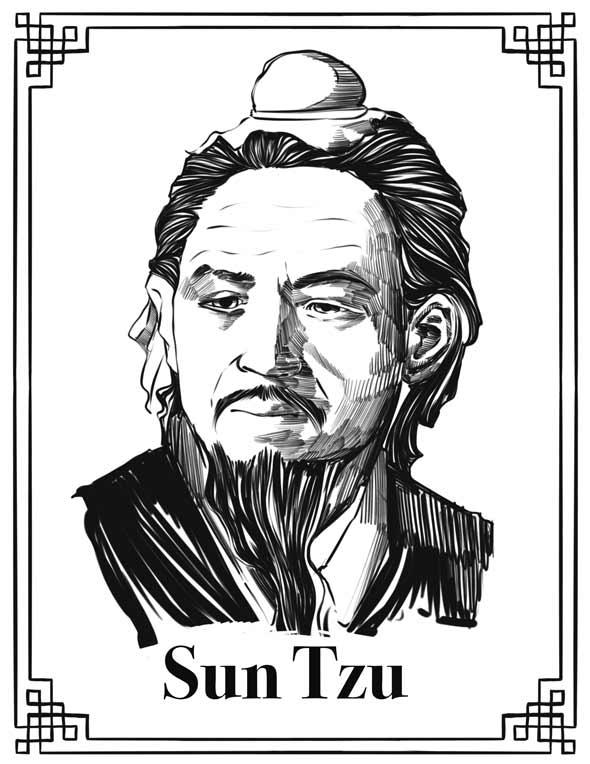
Sun Tzu
The Art of War
Translated From The Chinese By Captain E. F. Calthrop, R.F.A.
I
PRELIMINARY RECKONING
The words of Sun the Master:-
To all nations War is a great matter. Upon the army death or life depend: it is the means of the existence or destruction of the State.
Therefore it must be diligently studied.
Now, in war, besides stratagem and the situation, there are five indispensable matters. The first is called The Way;[1] the second, Heaven; the third, Earth; the fourth, the Leader; the fifth, Law.
The Way or the proper conduct of man. If the ruling authority be upright, the people are united: fearless of danger, their lives are at the service of their Lord.
Heaven. Yin and Yang;[2] heat and cold; time and season.
Earth. Distance; nature; extent; strategic position.
The Leader. Intelligence; truth; benevolence; courage and strictness.
Law. Partition and ordering of troops.
These things must be known by the leader: to know them is to conquer; to know them not is to be defeated.
Further, with regard to these and the following seven matters, the condition of the enemy must be compared with our own.
The seven matters are:-
The virtue of the prince; the ability of the general; natural advantages; the discipline of the armies; the strength of the soldiers; training of the soldiers; justice both in reward and punishment.
Knowing these things, I can foretell the victor.

If a general under me fight according to my plans, he always conquers, and I continue to employ him; if he differ from my plans, he will be defeated and dismissed from my service.
Wherefore, with regard to the foregoing, considering that with us lies the advantage, and the generals agreeing, we create a situation which promises victory; but as the moment and method cannot be fixed beforehand, the plan must be modified according to circumstances.
War is a thing of pretence: therefore, when capable of action, we pretend disability; when near to the enemy, we pretend to be far; when far away, we pretend to be near.
Allure the enemy by giving him a small advantage. Confuse and capture him. If there be defects, give an appearance of perfection, and awe the enemy. Pretend to be strong, and so cause the enemy to avoid you. Make him angry, and confuse his plans. Pretend to be inferior, and cause him to despise you. If he have superabundance of strength, tire him out; if united, make divisions in his camp. Attack weak points, and appear in unexpected places.
These are the secrets of the successful strategist, therefore they must not be made known beforehand.
At the reckoning in the Sanctuary before fighting, victory is to the side that excels in the foregoing matters. They that have many of these will conquer; they that have few will not conquer; hopeless, indeed, are they that have none.
If the condition of both sides with regard to these matters be known, I can foretell the victor.
2
The Yin and Yang are the two principles into which natural phenomena are divided in Chinese philosophy. Yin is the masculine, active, or light principle, and Yang is the feminine, passive, or dark principle. In this connection, day and night, rain, mist and wind are designated.
1
The five virtues of humanity, righteousness, propriety, wisdom and faith are known as The Way.
II
OPERATIONS OF WAR
Sun the Master said:-
Now the requirements of war are such that we need a thousand light chariots with four horses each; a thousand leather-covered chariots, and one hundred thousand armoured men; and we must send supplies to distant fields. Wherefore the cost at home and in the field, the entertainment of guests, glue and lacquer for repairs, and necessities for the upkeep of waggons and armour are such that in one day a thousand pieces of gold are spent. With that amount a force of one hundred thousand men can be raised:-you have the instruments of victory.
But, even if victorious, let the operations long continue, and the soldiers’ ardour decreases, the weapons become worn, and, if a siege be undertaken, strength disappears.
Again, if the war last long, the country’s means do not suffice. Then, when the soldiers are worn out, weapons blunted, strength gone and funds spent, neighbouring princes arise and attack that weakened country. At such a time the wisest man cannot mend the matter.
For, while quick accomplishment has been known to give the victory to the unskilful, the skilful general has never gained advantage from lengthy operations.

In fact, there never has been a country which has benefited from a prolonged war.
He who does not know the evils of war will not reap advantage thereby. He who is skilful in war does not make a second levy, does not load his supply waggons thrice.
War material and arms we obtain from home, but food sufficient for the army’s needs can be taken from the enemy.
The cost of supplying the army in distant fields is the chief drain on the resources of a state: if the war be distant, the citizens are impoverished.
In the neighbourhood of an army prices are high, and so the money of the soldiers and followers is used up. Likewise the state funds are exhausted, and frequent levies must be made; the strength of the army is dissipated, money is spent, the citizen’s home swept bare: in all, seven-tenths of his income is forfeited. Again, as regards State property, chariots are broken, horses worn out, armour and helmet, arrow and bow, spear, shield, pike and fighting tower, waggon and oxen used and gone, so that six-tenths of the Government’s income is spent.
Therefore the intelligent general strives to feed on the enemy; one bale of the enemy’s rice counts as twenty from our own waggons; one bundle of the enemy’s forage is better than twenty of our own.
Incitement must be given to vanquish the enemy.
They who take advantage of the enemy should be rewarded.
They who are the first to lay their hands on more than ten of the enemy’s chariots should be rewarded; the enemy’s standard on the chariots exchanged for our own; the captured chariots mixed with our own chariots and taken into use.
The accompanying warriors must be treated well, so that, while the enemy is beaten, our side increases in strength.
Now the object of war is victory; not lengthy operations, even skilfully conducted.
The good general is the lord of the people’s lives, the guardian of the country’s welfare.
III
THE ATTACK BY STRATAGEM
Sun the Master said:-
Now by the laws of war, better than defeating a country by fire and the sword, is to take it without strife.
Better to capture the enemy’s army intact than to overcome it after fierce resistance.
Better to capture the “Lu,”[3] the “Tsu” or the “Wu” whole, than to destroy them in battle.
To fight and conquer one hundred times is not the perfection of attainment, for the supreme art is to subdue the enemy without fighting.
Wherefore the most skilful warrior outwits the enemy by superior stratagem; the next in merit prevents the enemy from uniting his forces; next to him is he who engages the enemy’s army; while to besiege his citadel is the worst expedient.
A siege should not be undertaken if it can possibly be avoided. For, before a siege can be commenced, three months are required for the construction of stages, battering-rams and siege engines; then a further three months are required in front of the citadel, in order to make the “Chuyin.”[4] Wherefore the general is angered, his patience exhausted, his men surge like ants against the ramparts before the time is ripe, and one-third of them are killed to no purpose. Such are the misfortunes that sieges entail.
Therefore the master of war causes the enemy’s forces to yield, but without fighting; he captures his fortress, but without besieging it; and without lengthy fighting takes the enemy’s kingdom. Without tarnishing his weapons he gains the complete advantage.
This is the assault by stratagem.
By the rules of war, if ten times as strong as the enemy, surround him; with five times his strength, attack; with double his numbers, divide. If equal in strength, exert to the utmost, and fight; if inferior in numbers, manœuvre and await the opportunity; if altogether inferior, offer no chance of battle. A determined stand by inferior numbers does but lead to their capture.
The warrior is the country’s support. If his aid be entire, the country is of necessity strong; if it be at all deficient, then is the country weak.
Now a prince may embarrass his army in three ways, namely:-
Ignorant that the army in the field should not advance, to order it to go forward; or, ignorant that the army should not retreat, order it to retire.
This is to tie the army as with a string.
Ignorant of military affairs, to rule the armies in the same way as the state.
This is to perplex the soldiers.
Ignorant of the situation of the army, to settle its dispositions.
This is to fill the soldiers with distrust.
If the army be perplexed and distrustful, then dangers from neighbouring princes arise. The army is confounded, and offered up to the enemy.
There are five occasions when victory can be foretold:-
When the general knows the time to fight and when not to fight; or understands when to employ large or small numbers; when government and people are of one mind; when the state is prepared, and chooses the enemy’s unguarded moment for attack; when the general possesses ability, and is not interfered with by his prince.
These five things are the heralds of victory.
It has been said aforetime that he who knows both sides has nothing to fear in a hundred fights; he who is ignorant of the enemy, and fixes his eyes only on his own side, conquers, and the next time is defeated; he who not only is ignorant of the enemy, but also of his own resources, is invariably defeated.
3
The Chinese army consisted of 12,500, the “lu” of 500, “tsu” of 50, and the “wu” of 5 men.
4
The “Chuyin” was a large tower or work constructed to give command over the interior of the enemy’s fortress. // High poles were also erected, from the top of which archers, each encased in an arrow-proof box and raised by a rope and pulley, shot at the besieged.
IV
THE ORDER OF BATTLE
Sun the Master said:-
The ancient masters of war first made their armies invincible, then waited until the adversary could with certainty be defeated.
The causes of defeat come from within; victory is born in the enemy’s camp.
Skilful soldiers make defeat impossible, and further render the enemy incapable of victory.
But, as it is written, the conditions necessary for victory may be present, but they cannot always be obtained.
If victory be unattainable, we stand on the defensive; if victory be sure, we attack.
Deficiency compels defence; super-abundance permits attack.
The skilful in defence crouch, hidden in the deepest shades; the skilful in attack push to the topmost heaven.[5]
If these precepts be observed, victory is certain.
A victory, even if popularly proclaimed as such by the common folk, may not be a true success. To win in fight, and for the kingdom to say, “Well done,” does not mark the summit of attainment. To lift an autumn fleece[6] is no proof of strength; the eyes that only see the sun and moon are not the eagle’s; to hear the thunder is no great thing.
As has been said aforetime, the able warrior gains the victory without desperate and bloody engagements, and wins thereby no reputation for wisdom or brave deeds. To fight is to win, for he attacks only when the enemy has sown the seeds of defeat.
Moreover, the skilful soldier in a secure position does not let pass the moment when the enemy should be attacked.
The army that conquers makes certain of victory, and then seeks battle.
The army destined to defeat, fights, trusting that chance may bring success to its arms.
The skilful leader is steadfast in the “Way”; upholds the Law, and thereby controls the issue.
Touching the laws of war, it is said: first, the rule; second, the measure; third, the tables; fourth, the scales; fifth, the foretelling of victory.
For the rule is the survey of land; the measure tells the amount of that land’s produce; the tables its population; from the scales their weight or quality is made known; and then can we calculate victory or defeat.
The army that conquers as against the army destined to defeat, is as a beam against a feather in the scales. The attack of conquering forces is as the outburst of long-pent-up waters into sunken valleys.
Such are the orders of battle.
6
An animal’s coat is thinnest in autumn.
5
Literally 9th heaven, and 9th earth. The Chinese divided the earth and sky each into 9 strata.
V
THE SPIRIT OF THE TROOPS
Sun the Master said:-
The control of large numbers is possible, and like unto that of small numbers, if we subdivide them.
By means of drum, bell and flag,[7] the direction of large forces in battle is possible, and like unto the direction of small forces.
By the skilful interchange of normal and abnormal manœuvres are the armies certainly preserved from defeat.
The enemy is crushed, like the fall of a grindstone upon an egg, by knowledge of his strength and weakness, and by the employment of truth and artifice.
Moreover, in battle the enemy is engaged with the normal and defeated by the abnormal force.[8]
The abnormal force, skilfully handled, is like the heaven and earth, eternal; as the tides and the flow of rivers, unceasing; like the sun and moon, for ever interchanging; coming and passing, as the seasons.
There are five notes; but by combinations, innumerable harmonies are produced. There are but five colours; but if we mix them, the shades are infinite. There are five tastes, but if we mix them there are more flavours than the palate can distinguish.[9]
In war there are but two forces, the normal and the abnormal; but they are capable of infinite variation. Their mutual interchange is like a wheel, having neither beginning or end. They are a mystery that none can penetrate.
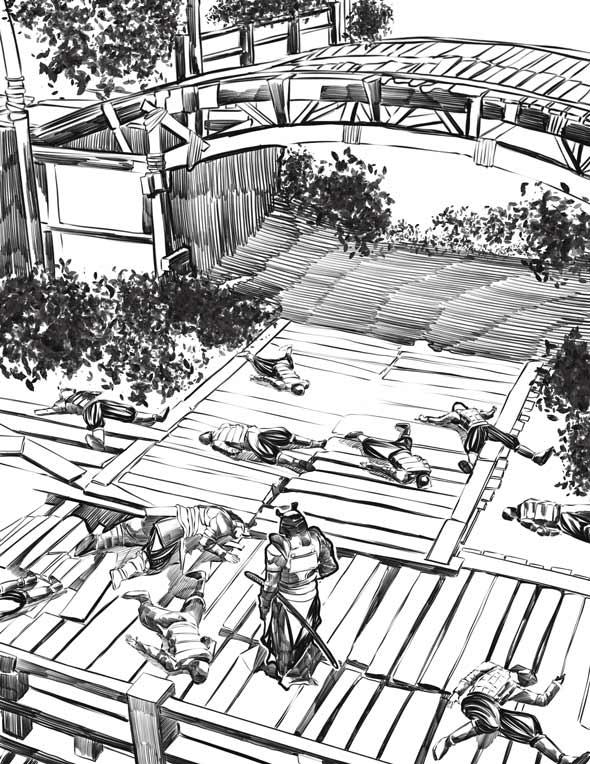
As the rush of rock-shouldering torrents, so is the spirit of the troops.
Like the well-judged flight of the falcon, in a flash crushing its quarry, so should the stroke be timed.
Wherefore the spirit of the good fighter is terrifying, his occasions sudden; like the stretched cross-bow, whose string is released at the touch of the trigger.
In the maze and tumult of the battle, there is no confusion; in the thick of action the battle array is impenetrable.
If discipline be perfect, disorder can be simulated; if truly bold, we can feign fear; if really strong, we can feign weakness.
We simulate disorder by subdivision; fear, by spirit; weakness, by battle formation.
We set the enemy in motion by adopting different formations to which he must conform.
If we offer the enemy a point of advantage, he will certainly take it: we give him an advantage, set him in motion and then fall upon him.
Wherefore the good fighter seeks victory from spirit, and does not depend entirely upon the skill of his men. He is careful in his choice, and leaves the rest to battle force; yet, when an opening or advantage shows, he pushes it to its limits.
As a log or rock which, motionless on flat ground, yet moves with ever-increasing force when set on an incline, so await the opportunity, and so act when the opportunity arrives.
If the general be skilful, the spirit of his troops is as the impetus of a round stone rolled from the top of a high mountain.
7
The drum was used to beat the assembly and in the advance, the bell as a signal to halt. Flags were of two kinds, signalling flags and distinguishing banners.
9
The five cardinal tastes are, acridity, bitterness, sourness, sweetness and saline taste.
8
The normal and the abnormal refer to what in modern phrase are termed the frontal or holding force and the flanking or surprise force.