автордың кітабын онлайн тегін оқу The Complete Works of Dio Chrysostom. Illustrated
The Complete Works of Dio Chrysostom. Illustrated
Dio Chrysostom
Dio Chrysostom (surname literally means "golden-mouthed") was part of the Second Sophistic school of Greek philosophers which reached its peak in the early 2nd century. He was considered one of the most eminent of the Greek rhetoricians and sophists by the ancients who wrote about him, such as Philostratus, Synesius, and Photius.
Eighty of his Discourses are extant, as well as a few Letters and a funny mock essay "In Praise of Hair", as well as a few other fragments. These orations appear to be written versions of his oral teaching, and are like essays on political, moral, and philosophical subjects.
Discourses
Encomium on hair
Fragments
The Complete Works of Dio Chrysostom
Illustrated
Discourses. Encomium on hair and others
The Translations
DISCOURSES
Translated by J. W. Cohoon
Dio Chrysostom was born at Prusa, now Bursa, in the Roman province of Bithynia in AD 40. His father, Pasicrates, is believed to have taken great care of his son’s education and the early training of his mind. At first Dio occupied himself in his native town, where he held important offices, while composing speeches and other rhetorical and sophistical essays, but he later devoted himself with zeal to the study of philosophy, travelling to Rome to extend his learning, where he was eventually converted to Stoicism.
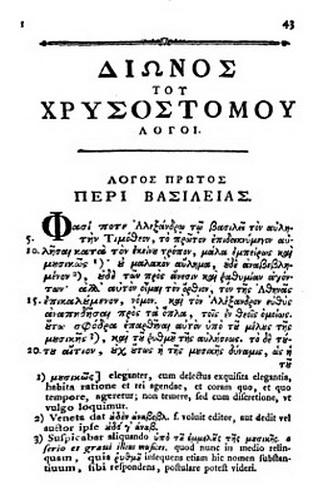
Dio formed part of the Second Sophistic school of Greek philosophers that reached its peak in the early second century. He was considered as one of the most eminent of the Greek rhetoricians by the ancients that wrote about him, including Philostratus, Synesius and Photius. His eighty extant Orations appear to be written versions of his oral teaching, similar in style to essays on political, moral and philosophical subjects. They include four orations on kingship addressed to Trajan on the virtues of a sovereign; four on the character of Diogenes of Sinope. Other topics include the troubles that men expose themselves to by deserting the path of Nature and the difficulties that a sovereign has to encounter.
There are also discourses on slavery and freedom, on the means of attaining eminence as an orator, as well as political essays addressed to various towns that Dio both praises and censures, though always with moderation and wisdom. The discourses also cover subjects of ethics and practical philosophy, which he treats in a popular and attractive manner; and lastly, there are orations on mythical subjects and show-speeches.
Dio wrote many other philosophical and historical works, none of which survive, except for fragments. The works that survive confirm his prominent influence in reviving Greek literature in the Roman Empire, marking the beginning of the Second Sophistic movement. Dio was committed to defending the ethical values of the Greek cultural tradition, as reflected by his sober and elegant style.
THE FIRST DISCOURSE ON KINGSHIP
The first Discourse as well as the following three has for its subject Kingship, and from internal evidence is thought to have been first delivered before Trajan in Rome immediately after he became emperor. At any rate Dio does not address the Emperor in those terms of intimacy that he uses in the third Discourse.
Dio’s conception of the true king is influenced greatly by Homer and Plato. The true king fears the gods and watches over his subjects even as Zeus, the supreme god, watches over all mankind. At the end is a description of the choice made by Heracles, who is the great model of the Cynics.
The First Discourse on Kingship
The story goes that when the flute-player Timotheus gave his first exhibition before King Alexander, he showed great musical skill in adapting his playing to the king’s character by selecting a piece that was not languishing or slow nor of the kind that would cause relaxation or listlessness, but rather, I fancy, the ringing strain which bears Athena’s name and none other. [2] They say, too, that Alexander at once bounded to his feet and ran for his arms like one possessed, such was the exaltation produced in him by the tones of the music and the rhythmic beat of the rendering. The reason why he was so affected was not so much the power of the music as the temperament of the king, which was high-strung and passionate. [3] Sardanapallus, for example, would never have been aroused to leave his chamber and the company of his women even by Marsyas himself or by Olympus, much less by Timotheus or any other of the later artists; nay, I believe that had even Athena herself – were such a thing possible – performed for him her own measure, that king would never have laid hand to arms, but would have been much more likely to leap up and dance a fling or else take to his heels; to so depraved a condition had unlimited power and indulgence brought him.
[4] In like manner it may fairly be demanded of me that I should show myself as skilful in my province as a master flautist may be in his, and that I should find words which shall be no whit less potent than his notes to inspire courage and high-mindedness – [5] words, moreover, not set to a single mood but at once vigorous and gentle, challenging to war yet also speaking of peace, obedience to law, and true kingliness, inasmuch as they are addressed to one who is disposed, methinks, to be not only a brave but also a law-abiding ruler, one who needs not only high courage but high sense of right also. [6] If, for instance, the skill which Timotheus possessed in performing a warlike strain had been matched by the knowledge of such a composition as could make the soul just and prudent and temperate and humane, and could arouse a man not merely to take up arms but also to follow peace and concord, to honour the gods and to have consideration for men, it would have been a priceless boon to Alexander to have that man live with him as a companion, and to play for him, not only when he sacrificed but at other times also: [7] when, for example, he would give way to unreasoning grief regardless of propriety and decorum, or would punish more severely than custom or fairness allowed, or would rage fiercely at his own friends and comrades or disdain his mortal and real parents. [8] But unfortunately, skill and proficiency in music cannot provide perfect healing and complete relief for defect of character. No indeed! To quote the poet:
“E’en to Asclepius’ sons granted not god this boon.”
Nay, it is only the spoken word of the wise and prudent, such as were most men of earlier times, that can prove a competent and perfect guide and helper of a man endowed with a tractable and virtuous nature, and can lead it toward all excellence by fitting encouragement and direction.
[9] What subject, then, will clearly be appropriate and worthy of a man of your earnestness, and where shall I find words so nearly perfect, mere wanderer that I am and self-taught philosopher, who find what happiness I can in toil and labour for the most part and employ eloquence only for the encouragement of myself and such others as I meet from time to time? My case is like that of men who in moving or shifting a heavy load beguile their labour by softly chanting or singing a tune – mere toilers that they are and not bards or poets of song. [10] Many, however, are the themes of philosophy, and all are worth hearing and marvellously profitable for any who listen with more than casual attention; but since we have found as our hearer one who is near at hand and ready eagerly to grasp our words, we must summon to our aid Persuasion, the Muses, and Apollo, and pursue our task with the greatest possible devotion.
[11] Let me state, then, what are the characteristics and disposition of the ideal king, summarizing them as briefly as possible – the king
“to whom the son
Of Saturn gives the sceptre, making him
The lawgiver, that he may rule the rest.”
[12] Now it seems to me that Homer was quite right in this as in many other sayings, for it implies that not every king derives his sceptre or this royal office from Zeus, but only the good king, and that he receives it on no other title than that he shall plan and study the welfare of his subjects; he is not to become licentious or profligate, [13] stuffing and gorging with folly, insolence, arrogance, and all manner of lawlessness, by any and every means within his power, a soul perturbed by anger, pain, fear, pleasure, and lusts of every kind, but to the best of his ability he is to devote his attention to himself and his subjects, becoming indeed a guide and shepherd of his people, not, as someone has said, a caterer and banqueter at their expense. Nay, he ought to be just such a man as to think that he should sleep at all the whole night though as having no leisure for idleness. [14] Homer, too, in agreement with all other wise and truthful men, says that no wicked or licentious or avaricious person can ever become a competent ruler or master either of himself or of anybody else, nor will such a man ever be a king even though all the world, both Greeks and barbarians, men and women, affirm the contrary, yea, though not only men admire and obey him, but the birds of the air and the wild beasts on the mountains no less than men submit to him and do his bidding.
[15] Let me speak, then, of the king as Homer conceives him, of him who is in very truth a king; for this discourse of mine, delivered in all simplicity without any flattery or abuse, of itself discerns the king that is like the good one, and commends him in so far as he is like him, while the one who is unlike him it exposes and rebukes. Such a king is, in the first place, regardful of the gods and holds the divine in honour. [16] For it is impossible that the just and good man should repose greater confidence in any other being than in the supremely just and good – the gods. He, however, who, being wicked, imagines that he at any time pleases the gods, in that very assumption lacks piety, for he has assumed that the deity is either foolish or evil. [17] Next after the gods the good king has regard for his fellow-men; he honours and loves the good, yet extends his care to all. Now who takes better care of a herd of cattle than does the herdsman? Who is more helpful and better to flocks of sheep than a shepherd? Who is a truer lover of horses than he who controls the greatest number of horses and derives the greatest benefit from horses? [18] And so who is presumably as great a lover of his fellow-man as he who exercises authority over the greatest number of men and enjoys the highest admiration of men? For it would be strange if men governing beasts, wild and of another blood than theirs, prove more kindly to these their dependants than a monarch to civilized men who are of the same flesh and blood as himself. [19] And further, cattle love their keepers best and are most submissive to them; the same is true of horses and their drivers; hunters are protected and loved by their dogs, and in the same way other subject creatures love their masters. [20] How then would it be conceivable that, while beings devoid of intelligence and reason recognize and love those who care for them, that creature which is by far the most intelligent and best understands how to repay kindness with gratitude should fail to recognize, nay, should even plot against, its friends? No indeed! For of necessity the kindly and humane king is not only beloved but even adored by his fellow-men. And because he knows this and is by nature so inclined, he displays a soul benignant and gentle towards all, inasmuch as he regards all as loyal and as his friends.
[21] The good king also believes it to be due to his position to have the larger portion, not of wealth or of pleasures, but of painstaking care and anxieties; hence he is actually more fond of toil than many others are of pleasure or of wealth. For he knows that pleasure, in addition to the general harm it does to those who constantly indulge therein, also quickly renders them incapable of pleasure, whereas toil, besides conferring other benefits, continually increases a man’s capacity for toil. [22] He alone, therefore, may call his soldiers “fellow-soldiers” and his associates “friends” without making mockery of the word friendship; and not only may he be called by the title “Father” of his people and his subjects, but he may justify the title by his deeds. In the title “master,” however, he can take no delight, nay, not even in relation to his slaves, much less to his free subjects; [23] for he looks upon himself as being king, not for the sake of his individual self, but for the sake of all men.
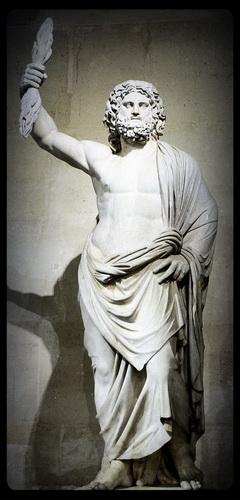
Therefore he finds greater pleasure in conferring benefits than those benefited do in receiving them, and in this one pleasure he is insatiable. For the other functions of royalty he regards as obligatory; that of benefaction alone he considers both voluntary and blessed. [24] Blessings he dispenses with the most lavish hand, as though the supply were inexhaustible; but of anything hurtful, on the contrary, he can no more be the cause than the sun can be the cause of darkness. Men who have seen and associated with him are loath to leave him, while those who know him only by hearsay are more eager to see him than children are to find their unknown fathers. [25] His enemies fear him, and no one acknowledges himself his foe; but his friends are full of courage, and those exceeding near unto him deem themselves of all men most secure. They who come into his presence and behold him feel neither terror nor fear; but into their hearts creeps a feeling of profound respect, something much stronger and more powerful than fear. For those who fear must inevitably hate and want to escape; those who feel respect must linger and admire.
[26] He holds that sincerity and truthfulness are qualities befitting a king and a prudent man, while unscrupulousness and deceit are for the fool and the slave, for he observes that among the wild beasts also it is the most cowardly and ignoble which surpass all the rest in lying and deceiving.
[27] Though naturally covetous of honour, and knowing that it is the good that men are prone to honour, he has less hope of winning honour from the unwilling than he has of gaining the friendship of those who hate him.
He is warlike to the extent that the making of war rests with him, and peaceful to the extent that there is nothing left worth his fighting for. For assuredly he is well aware that they who are best prepared for war have it most in their power to live in peace.
[28] He is also by nature fond of his companions, fellow-citizens, and soldiers in like measure; for a ruler who is suspicious of the military and has never or rarely seen those who face peril and hardship in support of his kingdom, but continually flatters the unprofitable and unarmed masses, is like a shepherd who does not know those who help him to keep guard, never proffers them food, and never shares the watch with them; for such a man tempts not only the wild beasts, but even his own dogs, to prey upon the fold. [29] He, on the contrary, who pampers his soldiers by not drilling them or encouraging them to work hard and, at the same time, evinces no concern for the people at large, is like a ship-captain who demoralizes his crew with surfeit of food and noonday sleep and takes no thought for his passengers or for his ship as it goes to ruin. [30] And yet if one is above reproach in these two matters, but fails to honour those who are close to him and are called his friends, and does not see to it that they are looked upon by all men as blessed and objects of envy, he becomes a traitor to himself and his kingdom ere he is aware by disheartening those who are his friends and suffering nobody else to covet his friendship and by robbing himself of that noblest and most profitable possession: friendship. [31] For who is more indefatigable in toil, when there is occasion for toil, than a friend? Who is readier to rejoice in one’s good fortune? Whose praise is sweeter than that of friends? From whose lips does one learn the truth with less pain? What fortress, what bulwarks, what arms are more steadfast or better than the protection of loyal hearts? [32] For whatever is the number of comrades one has acquired, so many are the eyes with which he can see what he wishes, so many the ears with which he can hear what he needs to hear, so many the minds with which he can take thought concerning his welfare. Indeed, it is exactly as if a god had given him, along with his one body, a multitude of souls all full of concern in his behalf.
[33] But I will pass over most of the details and give the clearest mark of a true king: he is one whom all good men can praise without compunction not only during his life but even afterwards. And yet, even so, he does not himself covet the praise of the vulgar and the loungers about the market-place, but only that of the free-born and noble, men who would prefer to die rather than be guilty of falsehood. [34] Who, therefore, would not account such a man and such a life blessed? From what remote lands would men not come to see him and to profit from his honourable and upright character? What spectacle is more impressive than that of a noble and diligent king? What can give greater pleasure than a gentle and kindly ruler who desires to serve all and has it in his power so to do? [35] What is more profitable than an equitable and just king? Whose life is safer than his whom all alike protect, whose is happier than his who esteems no man an enemy, and whose is freer from vexation than his who has no cause to blame himself? Who is more fortunate, too, than that man whose goodness is known of all?
[36] In plain and simple language I have described the good king. If any of his attributes seem to belong to you, happy are you in your gracious and excellent nature, and happy are we who share its blessings with you.
[37] It was my purpose, after finishing the description of the good king, to discuss next that supreme king and ruler whom mortals and those who administer the affairs of mortals must always imitate in discharging their responsibilities, directing and conforming their ways as far as possible to his pattern. [38] Indeed, this is Homer’s reason for calling true kings “Zeus-nurtured” and “like Zeus in counsel”; and Minos, who had the greatest name for righteousness, he declared was a companion of Zeus. In fact, it stands to reason that practically all the kings among Greeks or barbarians who have proved themselves not unworthy of this title have been disciples and emulators of this god. [39] For Zeus alone of the gods has the epithets of “Father” and “King,” “Protector of Cities,” “Lord of Friends and Comrades,” “Guardian of the Race,” and also “Protector of Suppliants,” “God of Refuge,” and “God of Hospitality,” these and his countless other titles signifying goodness and the fount of goodness. [40] He is addressed as “King” because of his dominion and power; as “Father,” I ween, on account of his solicitude and gentleness; as “Protector of Cities” in that he upholds the law and the commonweal; as “Guardian of the Race” on account of the tie of kinship which unites gods and men; as “Lord of Friends and Comrades” because he brings all men together and wills that they be friendly to one another and never enemy or foe; [41] as “Protector of Suppliants” since he inclines his ear and is gracious to men when they pray; as “God of Refuge” because he gives refuge from evil; as “God of Hospitality” because it is the very beginning of friendship not to be unmindful of strangers or to regard any human being as an alien; and as “God of Wealth and Increase” since he causes all fruitage and is the giver of wealth and substance, not of poverty and want. For all these functions must at the outset be inherent in the royal function and title.
[42] I might well speak next of the administration of the universe and tell how the world – the very embodiment of bliss and wisdom – ever sweeps along through infinite time in infinite cycles without cessation, guided by good fortune and a like power divine, and by foreknowledge and a governing purpose most righteous and perfect, and renders us like itself since, in consequence of the mutual kinship of ourselves and it, we are marshalled in order under one ordinance and law and partake of the same polity. [43] He who honours and upholds this polity and does not oppose it in any way is law-abiding, devout and orderly; he, however, who disturbs it, as far as that is possible to him, and violates it or does not know it, is lawless and disorderly, whether he be called a private citizen or a ruler, although the offence on the part of the ruler is far greater and more evident to all. [44] Therefore, just as among generals and commanders of legions, cities or provinces, he who most closely imitates your ways and shows the greatest possible conformity with your habits would be by far your dearest comrade and friend, while he who showed antagonism or lacked conformity would justly incur censure and disgrace and, being speedily removed from his office as well, would give way to better men better qualified to govern; [45] so too among kings, since they, I ween, derive their powers and their stewardship from Zeus; the one who, keeping his eyes upon Zeus, orders and governs his people with justice and equity in accordance with the laws and ordinances of Zeus, enjoys a happy lot and a fortunate end, [46] while he who goes astray and dishonours him who entrusted him with his stewardship or gave him this gift, receives no other reward from his great authority and power than merely this: that he has shown himself to all men of his own time and to posterity to be a wicked and undisciplined man, illustrating the storied end of Phaethon, who mounted a mighty chariot of heaven in defiance of his lot but proved himself a feeble charioteer. [47] In somewhat this wise Homer too speaks when he says:
“Whoso bears
A cruel heart, devising cruel things,
On him men call down evil from gods
While living, and pursue him, when he dies,
With scoffs. But whoso is of generous heart
And harbours generous aims, his guests proclaim
His praises far and wide to all mankind,
And numberless are they who call him good.”
[48] For my part, I should be most happy and eager, as I have said, to speak on this subject – on Zeus and the nature of the universe. But since it is altogether too vast a theme for the time now at my command and requires a somewhat careful demonstration, perhaps in the future there may be leisure for its presentation. [49] But if you would like to hear a myth, or rather a sacred and withal edifying parable told under the guise of a myth, perhaps a story which I once heard an old woman of Elis or Arcadia relate about Heracles will not appear to you out of place, either now or hereafter when you come to ponder it alone.
[50] Once when I chanced to be wandering in exile – and great is my gratitude to the gods that they thus prevented my becoming an eye-witness of many an act of injustice – I visited as many lands as possible, at one time going among the Greeks, at another among barbarians, assuming the guise and dress of a vagabond beggar,
“Demanding crusts, not caldrons fine or swords.”
[51] At last I arrived in the Peloponnesus, and keeping quite aloof from the cities, spent my time in the country, as being quite well worth study, mingling with herdsmen and hunters, an honest folk of simple habits. [52] As I walked along the Alpheus on my way from Heraea to Pisa, I succeeded in finding the road for some distance, but all at once I got into some wood land and rough country, where a number of trails led to sundry herds and flocks, without meeting anybody or being able to inquire my way. So I lost my direction, and at high noon was quite astray. But noticing on a high knoll a clump of oaks that looked like a sacred grove, I made my way thither in the hope of discovering from it some roadway or house. [53] There I found blocks of stone set roughly together, hanging pelts of animals that had been sacrificed, and a number of clubs and staves – all evidently being dedications of herdsmen. At a little distance I saw a woman sitting, strong and tall though rather advanced in years, dressed like a rustic and with some braids of grey hair falling about her shoulders. [54] Of her I made full inquiry about the place, and she most graciously and kindly, speaking in the Dorian dialect, informed me that it was sacred to Heracles and, regarding herself, that she had a son, a shepherd, whose sheep she often tendered herself. She also said that the Mother of the Gods had given her the gift of divination and that all the herdsmen and farmers round about consulted her on the raising and preservation of their crops and cattle. [55] “And you too,” she continued, “have come into this place by no mere human chance, for I shall not let you depart unblest.” Thereupon she at once began to prophesy, saying that the period of my wandering and tribulation would not be long, nay, nor that of mankind at large. [56] The manner of her prophesying was not that of most men and women who are said to be inspired; she did not gasp for breath, whirl her head about, or try to terrify with her glances, but spoke with entire self-control and moderation.
“Some day,” she said, “you will meet a mighty man, the ruler of very many lands and peoples. Do not hesitate to tell him this tale of mine even if there be those who will ridicule you for a prating vagabond. [57] For the words of men and all their subtleties are as naught in comparison with the inspiration and speech due to the promptings of the gods. Indeed, of all the words of wisdom and truth current among men about the gods and the universe, none have ever found lodgment in the souls of men except by the will and ordering of heaven and through the lips of the prophets and holy men of old. [58] For instance, they say there once lived in Thrace a certain Orpheus, a Muse’s son; and on a certain mountain of Boeotia another, a shepherd who heard the voices of the Muses themselves. Those teachers, on the other hand, who without divine possession and inspiration have circulated as true stories born of their own imaginings are presumptuous and wicked.
“Hear, therefore, the following tale and listen with vigilance and attention that you may remember it clearly and pass it on to that man whom I say you will meet. It has to do with this god in whose presence we now are. [59] Heracles was, as all men agree, the son of Zeus and Alcmene, and he was king not only of Argos but of all Greece. (Most people, however, do not know that Heracles was continually absent from Argos because he was engaged in making expeditions and defending his kingdom, but they assert that Eurystheus was king at this time. These, however, are but their idle tales.) [60] And he was not only king of Greece, but also held empire over every land from the rising of the sun to the setting thereof, aye, over all peoples where are found shrines of Heracles. [61] He had a simple education too, with none of the elaboration and superfluity devised by the unscrupulous cleverness of contemptible men.
“This, also, is told of Heracles: that he went unclothed and unarmed except for a lion’s skin and a club, [62] and they add that he did not set great store by gold or silver or fine raiment, but considered all such things worth nothing save to be given away and bestowed upon others. At any rate he made presents to many men, not only of money without limit and lands and herds of horses and cattle, but also of whole kingdoms and cities. For he fully believed that everything belonged to him exclusively and that gifts bestowed would call out the good-will of the recipients. [63] Another story which men tell is untrue: that he actually went about alone without an army. For it is not possible to overturn cities, cast down tyrants, and to dictate to the whole world without armed forces. It is only because, being self-reliant, zealous of soul, and competent in body, he surpassed all men in labour, that the story arose that he travelled alone and accomplished single-handed whatsoever he desired.
[64] “Moreover, his father took great pains with him, implanting in him noble impulses and bringing him into the fellowship of good men. He would also give him guidance for each and every enterprise through birds and burnt offerings and every other kind of divination. [65] And when he saw that the lad wished to be a ruler, not through desire for pleasure and personal gain, which leads most men to love power, but that he might be able to do the greatest good to the greatest number, he recognized that his son was naturally of noble parts, and yet suspected how much in him was mortal and thought of the many baneful examples of luxurious and licentious living among mankind, and of the many men there were to entice a youth of fine natural qualities away from his true nature and his principles even against his will. [66] So with these considerations in mind he despatched Hermes after instructing him as to what he should do. Hermes therefore came to Thebes, where the lad Heracles was being reared, and told him who he was and who had sent him. Then, taking him in charge, he led him over a secret path untrodden of man till he came to a conspicuous and very lofty mountain-peak whose sides were dreadfully steep with sheer precipices and with the deep gorge of a river that encompassed it, whence issued a mighty rumbling and roaring. Now to anyone looking up from below the crest above seemed single; but it was in fact double, rising from a single base; and the two peaks were far indeed from each other. [67] The one of them bore the name Peak Royal and was sacred to Zeus the King; the other, Peak Tyrannous, was named after the giant Typhon. There were two approaches to them from without, each having one. The path that led to Peak Royal was safe and broad, so that a person mounted on a car might enter thereby without peril or mishap, if he had the permission of the greatest of the gods. The other was narrow, crooked, and difficult, so that most of those who attempted it were lost over the cliffs and in the flood below, the reason being, methinks, that they transgressed justice in taking that path. [68] Now, as I have said, to most persons the two peaks appear to be practically one and undivided, inasmuch as they see them from a distance; but in fact Peak Royal towers so high above the other that it stands above the clouds in the pure and serene ether itself, whereas the other is much lower, lying in the very thick of the clouds, wrapped in darkness and fog.
[69] “Hermes then explained the nature of the place to Heracles as he led him thither. But when Heracles, ambitious youth that he was, longed to see what was within, he said, ‘Follow, then, that you may see with your own eyes the difference in all other respects also, things hidden from the foolish.’ [70] He therefore took him first to the loftier peak and showed him a woman seated upon a resplendent throne. She was beautiful and stately, clothed in white raiment, and held in her hand a sceptre, not of gold or silver, but of a different substance, pure and much brighter – a figure for all the world like the pictures of Hera. [71] Her countenance was at once radiant and full of dignity, so that all the good could behold it without fear, but no evil person could gaze upon it any more than a man with weak eyes can look up at the orb of the sun; composed and steadfast was her mien, and her glance did not waver. [72] A profound stillness and unbroken quiet pervaded the place; everywhere were fruits in abundance and thriving animals of every species. And immense heaps of gold and silver were there, and of bronze and iron; yet she heeded not at all the gold, nor did she take delight in it, but rather in the fruits and living creatures.
[73] “Now when Heracles beheld the woman, he was abashed and blushes mantled his cheeks, for he felt that respect and reverence for her which a good son feels for a noble mother. Then he asked Hermes which of the deities she was, and he replied, ‘Lo, that is the blessed Lady Royalty, child of King Zeus.’ And Heracles rejoiced and took courage in her presence. And again he asked about the women who were with her. ‘Who are they?’ said he; ‘how decorous and stately, like men in countenance!’ [74] ‘Behold,’ he replied, ‘she who sits there at her right hand, whose glance is both fierce and gentle, is Justice, aglow with a surpassing and resplendent beauty. Beside her sits Civic Order, who is very much like her and differs but slightly in appearance. [75] On the other side is a woman exceeding beautiful, daintily attired, and smiling benignly; they call her Peace. But he who stands near Royalty, just beside the sceptre and somewhat in front of it, a strong man, grey-haired and proud, has the name of Law; but he has also been called Right Reason, Counsellor, Coadjutor, without whom these women are not permitted to take any action or even to purpose one.’
[76] “With all that he heard and saw Heracles was delighted, and he paid close attention, determined never to forget it. But when they had come down from the higher peak and were at the entrance to Tyranny, Hermes said, ‘Look this way and behold the other woman. It is with her that the majority of men are infatuated and to win her they give themselves much trouble of every kind, committing murder, wretches that they are, son often conspiring against father, father against son, and brother against brother, since they covet and count as felicity that which is the greatest evil – power conjoined with folly.’ [77] He then began by showing Heracles the nature of the entrance, explaining that whereas only one pathway appeared to view, that being about as described above – perilous and skirting the very edge of the precipice – yet there were many unseen and hidden corridors, and that the entire region was undermined on every side and tunnelled, no doubt up to the very throne, and that all the passages and bypaths were smeared with blood and strewn with corpses. Through none, however, of these passages did Hermes lead him, but along the outside one that was less befouled, because, I think, Heracles was to be a mere observer.
[78] “When they entered, they discovered Tyranny seated aloft, of set purpose counterfeiting and making herself like to Royalty, but, as she imagined, on a far loftier and more splendid throne, since it was not only adorned with innumerable carvings, but embellished besides with inlaid patterns of gold, ivory, amber, ebony, and substances of every colour. Her throne, however, was not secure upon its foundation nor firmly settled, but shook and slouched upon its legs. [79] And in general things were in disorder, everything suggesting vainglory, ostentation, and luxury – many sceptres, many tiaras and diadems for the head. Furthermore, in her zeal to imitate the character of the other woman, instead of the friendly smile Tyranny wore a leer of false humility, and instead of a glance of dignity she had an ugly and forbidding scowl. [80] But in order to assume the appearance of pride, she would not glance at those whom came into her presence but looked over their heads disdainfully. And so everybody hated her, and she herself ignored everybody. She was unable to sit with composure, but would cast her eyes incessantly in every direction, frequently springing up from her throne. She hugged her gold to her bosom in a disgusting manner and then in terror would fling it from her in a heap, then she would forthwith snatch at whatever any passer-by might have, were it never so little. [81] Her raiment was of many colours, purple, scarlet and saffron, with patches of white, too, showing here and there from her skirts, since her cloak was torn in many places. From her countenance glowed all manners of colours according to whether she felt terror or anguish or suspicion or anger; while at one moment she seemed prostrate with grief, at another she appeared to be in an exaltation of joy. At one time a quite wanton smile would come over her face, but at the next moment she would be in tears. [82] There was also a throng of women about her, but they resembled in no respect those whom I have described as in attendance upon Royalty. These were Cruelty, Insolence, Lawlessness, and Faction, all of whom were bent upon corrupting her and bringing her to ignoble ruin. And instead of Friendship, Flattery was there, servile and avaricious and no less ready for treachery than any of the others, nay rather, zealous above all things to destroy.
[83] “Now when Heracles had viewed all this also to his heart’s content, Hermes asked him which of the two scenes pleased him and which of the two women. ‘Why, it is the other one,’ said he, ‘whom I admire and love, and she seems to me a veritable goddess, enviable and worthy to be accounted blest; this second woman, on the other hand, I consider so utterly odious and abominable that I would gladly thrust her down from this peak and thus put an end to her.’ Whereupon Hermes commended Heracles for this utterance and repeated it to Zeus, who entrusted him with the kingship over all mankind as he considered him equal to the trust. [84] And so wherever Heracles discovered a tyranny and a tyrant, he chastised and destroyed them, among Greeks and barbarians alike; but wherever he found a kingdom and a king, he would give honour and protection.”
This, she maintained, was what made him Deliverer of the earth and of the human race, not the fact that he defended them from the savage beasts – for how little damage could a lion or a wild bear inflict? – nay, it was the fact that he chastised savage and wicked men, and crushed and destroyed the power of overweening tyrants. And even to this day Heracles continues this work and you have in him a helper and protector of your government as long as it is vouchsafed you to reign.
THE SECOND DISCOURSE ON KINGSHIP
The second Discourse on Kingship is put dramatically in the form of a dialogue between Philip of Macedon and his son Alexander, and in it the son is Dio’s mouthpiece, in marked contrast to the situation in the fourth Discourse, where Diogenes – and therefore Dio – is opposed to Alexander. We are shown here the way in which the true king acts in the practical affairs of life, and the Stoic ideal, drawn largely from Homer, is set forth. Toward the end the true king is contrasted with the tyrant.
Although this Discourse is addressed to no one, von Arnim is led to conjecture from its martial tone that it was delivered before Trajan in A.D. 104 on the eve of the Second Dacian War.
The Second Discourse on Kingship
It is said that Alexander, while still a lad, was once conversing with Philip his father about Homer in a very manly and lofty strain, their conversation being in effect a discussion of kingship as well. For Alexander was already to be found with his father on his campaigns, although Philip tried to discourage him in this. Alexander, however, could not hold himself in, for it was with the lad as with young dogs of fine breed that cannot brook being left behind when their masters go hunting, but follow along, often breaking their tethers to do so. [2] It is true that sometimes, because of their youth and enthusiasm, they spoil the sport by barking and starting the game too soon, but sometimes too they bring down the game themselves by bounding ahead. This, in fact, happened to Alexander at the very beginning, so that they say he brought about the battle and victory of Chaeronea when his father shrank from taking the risk.
Now it was on this occasion, when they were at Dium in Pieria on their way home from the campaign and were sacrificing to the Muses and celebrating the Olympic festival, which is said to be an ancient institution in that country, [3] that Philip in the course of their conversation put this question to Alexander: “Why, my son, have you become so infatuated with Homer that you devote yourself to him alone of all the poets? You really ought not to neglect the others, for the men are wise.” And Alexander replied: “My reason, father, is that not all poetry, any more than every style of dress, is appropriate to a king, as it seems to me. [4] Now consider the poems of other men; some I consider to be suitable indeed for the banquet, or for love, or for the eulogy of victorious athletes or horses, or as dirges for the dead, and some as designed to excite laughter or ridicule, like the works of the comic writers and those of the Parian poet. [5] And perhaps some of them might be called popular also, in that they give advice and admonition to the masses and to private citizens, as, for instance, the works of Phocylides and Theognis do. What is there in them by which a man could profit, who, like you or me,
‘aspires to be
The master, over all to domineer.’
[6] The poetry of Homer, however, I look upon as alone truly noble and lofty and suited to a king, worthy of the attention of a real man, particularly if he expects to rule over all the peoples of the earth – or at any rate over most of them, and those the most prominent – if he is to be, in the strict sense of the term, what Homer calls a ‘shepherd of the people.’ Or would it not be absurd for a king to refuse to use any horse but the best and yet, when it is a question of poets, to read the poorer ones as though he had nothing else to do? [7] On my word, father, I not only cannot endure to hear any other poet recited but Homer, but even object to any other metre than Homer’s heroic hexameter.”
Then Philip admired his son greatly for his noble spirit, since it was plain that he harboured no unworthy or ignoble ideas but made the heroes and demigods his examples. [8] Nevertheless, in his desire to arouse him, he said, “But take Hesiod, Alexander; do you judge him of little account as a poet?” “Nay, not I,” he replied, “but of every account, though not for kings and generals, I suppose.” “Well, then, for whom?” And Alexander answered with a smile: “For shepherds, carpenters, and farmers; since he says that shepherds are beloved by the Muses, and to carpenters he gives very shrewd advice as to how large they should cut an axle, and to farmers, when to broach a cask.” [9] “Well,” said Philip, “and is not such advice useful to men?” “Not to you and me, father,” he replied, “nor to the Macedonians of the present day, though to those of former times it was useful, when they lived a slave’s life, herding and farming for Illyrians and Triballians.” “But do you not like these magnificent lines of Hesiod about seed-time and harvest?” said Philip:
“Mark well the time when the Pleiads, daughters of Atlas, are rising;
Then begin with the harvest, but do not plough till their setting.”
[10] “I much prefer what Homer says on farm-life,” said Alexander. “And where,” Philip asked, “has Homer anything to say about farming? Or do you refer to the representations on the shield of men ploughing and gathering the grain and the grapes?” “Not at all,” said Alexander, “but rather to these well-known lines:
‘As when two lines of reapers, face to face,
In some rich landlord’s field of barley or wheat
Move on, and fast the severed handfuls fall,
So, springing on each other, they of Troy
And they of Argos smote each other down,
And neither thought of ignominious flight.’
[11] “And yet, in spite of such lines as these,” said Philip, “Homer was defeated by Hesiod in the contest. Or have you not heard of the inscription which is inscribed upon the tripod that stands on Mount Helicon?
‘Hesiod offered this gift to the Muses on Helicon’s mountain
When at Chalcis in song he had vanquished Homer, the godlike.’”
[12] “And he richly deserved to be defeated,” rejoined Alexander, “for he was not exhibiting his skill before kings, but before farmers and plain folk, or, rather, before men who were lovers of pleasure and effeminate. And that is why Homer used his poetry to avenge himself upon the Euboeans.” “How so?” asked Philip in wonder. “He singled them out among all the Greeks for a most unseemly haircut, for he makes them wear their hair in long locks flowing down their backs, as the poets of to-day do in describing effeminate boys.”
[13] Philip laughed and said, “You observe, Alexander, that one must not offend good poets or clever writers, since they have the power to say anything they wish about us.” “Not absolute power,” said he; “it was a sorry day for Stesichorus, at any rate, when he told the lies about Helen. As for Hesiod, it seems to me that he himself, father, was not unaware of how much inferior his powers were to Homer’s.” [14] “How is that?” “Because, while Homer wrote of heroes, he composed a Catalogue of Fair Women, and in reality made the women’s quarters the subject of his song, yielding to Homer the eulogy of men.”
Philip next asked him: “But as for you, Alexander, would you like to have been Agamemnon or Achilles or any one of the heroes of those days, or Homer?” [15] “No, indeed, said Alexander, “but I should like to go far beyond Achilles and the others. For you are not inferior to Peleus, in my opinion; nor is Macedonia less powerful than Phthia; nor would I admit that Olympus is a less famous mountain than Pelion; and, besides, the education I have gained under Aristotle is not inferior to that which Achilles derived from Amyntor’s son, Phoenix, an exiled man and estranged from his father. Then, too, Achilles had to take orders from others and was sent with a small force of which he was not in sole command, since he was to share the expedition with another. I, however, could never submit to any mortal whatsoever being king over me.” [16] Whereupon Philip almost became angry with him and said: “But I am king and you are subject to me, Alexander.” “Not I,” said he, “for I hearken to you, not as king, but as father.” “I suppose you will not go on and say, will you, that your mother was a goddess, as Achilles did,” said Philip, “or do you presume to compare Olympias with Thetis?” At this Alexander smiled slightly and said, “To me, father, she seems more courageous than any Nereid.” [17] Whereupon Philip laughed and said, “Not merely more courageous, my son, but also more warlike; at least she never ceases making war on me.” So far did they both go in mingling jest with earnest.
Philip then went on with his questioning: “If, then, you are so enthusiastic an admirer of Homer, how is it that you do not aspire to his poetic skill?” “Because,” he replied, “while it would give me the greatest delight to hear the herald at Olympia proclaim the victors with strong and clear voice, yet I should not myself care to herald the victories of others; I should much rather hear my own proclaimed.” [18] With these words he tried to make it clear that while he considered Homer to be a marvellous and truly divine herald of valour, yet he regarded himself and the Homeric heroes as the athletes who strove in the contest of noble achievement. “Still, it would not be at all strange, father,” he continued, “if I were to be a good poet as well, did nature but favour me; for you know that a king might find that even rhetoric was valuable to him. You, for example, are often compelled to write and speak in opposition to Demosthenes, a very clever orator who can sway his audience – to say nothing of the other political leaders of Athens.” [19] “Yes,” said Philip playfully, “and I should have been glad to cede Amphipolis to the Athenians in exchange for that clever Demosthenes. But what do you think was Homer’s attitude regarding rhetoric?” “I believe that he admired the study, father,” said he, “else he would never have introduced Phoenix as a teacher of Achilles in the art of discourse. Phoenix, at any rate, says that he was sent by Achilles’ father,
‘To teach thee both, that so thou mightst become
In words an orator, in warlike deeds
A doer.’
[20] And as for the other chieftains, he depicted the best and the best qualified for kingly office as having cultivated this art with no less zeal: I mean Diomede, Odysseus, and particularly Nestor, who surpassed all the others in both discernment and persuasiveness. Witness what he says in the early part of his poem:
‘whose tongue
Dropped words more sweet than honey.’
[21] It was for this reason that Agamemnon prayed that he might have ten such elders as counsellors rather than youths like Ajax and Achilles, implying that the capture of Troy would thus be hastened. And, indeed, in another instance he showed the importance of rhetorical skill. [22] For when the Greeks had at last become faint-hearted in pursuing the campaign because the war had lasted so long and the siege was so difficult, and also, no doubt, because of the plague that laid hold of them and of the dissensions between the kings, Agamemnon and Achilles; and when, in addition, a certain agitator rose to oppose them and threw the assembly into confusion – at this crisis the host rushed to the ships, embarked in hot haste, and were minded to flee. Nobody was able to restrain them, and even Agamemnon knew not how to handle the situation. [23] Now in this emergency the only one who was able to call them back and change their purpose was Odysseus, who finally, by the speech he made, and with the help of Nestor, persuaded them to remain. Consequently, this achievement was clearly due to the orators; and one could point to many other instances as well. [24] It is evident, then, that not only Homer but Hesiod, too, held this view, implying that rhetoric in the true meaning of the term, as well as philosophy, is a proper study for the king; for the latter says of Calliope,
‘She attendeth on kings august that the daughters of great Zeus
Honour and watch at their birth, those kings that of Zeus are nurtured.’
[25] But to write epic poetry, or to compose pieces in prose like those letters of yours, father, which are said to have won you high repute, is not altogether essential for a king, except indeed when he is young and has leisure, as was the case with you when, as they say, you diligently cultivated rhetorical studies in Thebes. [26] Nor, again, is it necessary that he study philosophy to the point of perfecting himself in it; he need only live simply and without affectation, to give proof by his very conduct of a character that is humane, gentle, just, lofty, and brave as well, and, above all, one that takes delight in bestowing benefits – a trait which approaches most nearly to the nature divine. He should, indeed, lend a willing ear to the teachings of philosophy whenever opportunity offers, inasmuch as these are manifestly not opposed to his own character but in accord with it; [27] yet I should especially counsel the noble ruler of princely soul to make poetry his delight and to read it attentively – not all poetry, however, but only the most beautiful and majestic, such as we know Homer’s alone to be, and of Hesiod’s the portions akin to Homer’s, and perhaps sundry edifying passages in other poets.”
[28] “And so, too, with music,” continued Alexander; “for I should not be willing to learn all there is in music, but only enough for playing the cithara or the lyre when I sing hymns in honour of the gods and worship them, and also, I suppose, in chanting the praises of brave men. It would surely not be becoming for kings to sing the odes of Sappho or Anacreon, whose theme is love; but if they do sing odes, let it be some of those of Stesichorus or Pindar, if sing they must. [29] But perhaps Homer is all one needs even to that end.” “What!” exclaimed Philip, “do you think that any of Homer’s lines would sound well with the cithara or the lyre?” And Alexander, glaring at him fiercely like a lion, said: “For my part, father, I believe that many of Homer’s lines would properly be sung to the trumpet – not, by heavens, when it sounds the retreat, but when it peals forth the signal for the charge, and sung by no chorus of women or maids, but by a phalanx under arms. They are much to be preferred to the songs of Tyrtaeus, which the Spartans use.” [30] At this Philip commended his son for having spoken worthily of the poet and well. “And indeed,” Alexander continued, “Homer illustrates the very point we have just mentioned. He has represented Achilles, for instance, when he was loitering in the camp of the Achaeans, as singing no ribald or even amorous ditties – though he says, to be sure, that he was in love with Briseis; nay, he speaks of him as playing the cithara, and not one that he had bought, I assure you, or brought from his father’s house, but one that he had plucked from the spoils when he took Thebe and slew Eëtion, the father of Hector’s wife. Homer’s words are:
[31] ‘To sooth his mood he sang
The deeds of heroes.’
Which means that a noble and princely man should never forget valour and glorious deeds whether he be drinking or singing, but should without ceasing be engaged in some great and some admirable action himself, or in recalling deeds of that kind.”
[32] In this fashion Alexander would talk with his father, thereby revealing his innermost thoughts. The fact is that while he loved Homer, for Achilles he felt not only admiration but even jealousy because of Homer’s poesy, just as handsome boys are sometimes jealous of others who are handsome, because these have more powerful lovers. To the other poets he gave hardly a thought; but he did mention [33] Stesichorus and Pindar, the former because he was looked upon as an imitator of Homer and composed a “Capture of Troy,” a creditable work, and Pindar because of the brilliancy of his genius and the fact that he had extolled the ancestor whose name he bore: Alexander, nicknamed the Philhellene, to whom the poet alluded in the verse
“Namesake of the blest sons of Dardanus.”
This is the reason why, when later he sacked Thebes, he left only that poet’s house standing, directing that this notice be posted upon it:
“Set not on fire the roof of Pindar, maker of song.”
Undoubtedly he was most grateful to those who eulogized him worthily, when he was so particular as this in seeking renown.
[34] “Well, then, my son,” said Philip, “since I am glad indeed to hear you speak in this fashion, tell me, is it your opinion that the king should not even make himself a dwelling beautified with precious ornaments of gold and amber and ivory to suit his pleasure?” “By no means should he, father,” he replied; “such ornaments should consist rather of spoils and armour taken from the enemy. He should also embellish the temples with such ornaments and thus propitiate the gods. This was Hector’s opinion when he challenged the best of the Achaeans, declaring that if victorious he would deliver the body to the allied host, ‘but the arms,’ said he, ‘I shall strip off and
‘hang them high
Within the temple of the archer-god Apollo.’
[35] For such adornment of sacred places is altogether superior to jasper, carnelian, and onyx, with which Sardanapallus bedecked Nineveh. Indeed, such ostentation is by no means seemly for a king though it may furnish amusement to some silly girl or extravagant woman. [36] And so I do not envy the Athenians, either, so much for the extravagant way they embellished their city and their temples as for the deeds their forefathers wrought; for in the sword of Mardonius and the shields of the Spartans who were captured at Pylos they have a far grander and more excellent dedication to the gods than they have in the Propylaea of the Acropolis and in Olympieum, which cost more than ten thousand talents.” [37] “In this particular, then,” said Philip, “you could not endorse Homer; for he has embellished the palace of Alcinoüs, a Greek and an islander, not only with gardens and orchards and fountains, but with statues of gold also. Nay, more, does he not describe the dwelling of Menelaus, for all that he had just got back from a campaign, as though it were some Persian or Median establishment, almost equalling the palaces of Semiramis, or of Darius and Xerxes? [38] He says, for instance:
‘A radiance bright, as of the sun or moon.
Throughout the high-roofed halls of Atreus’ son
Did shine.’
‘The sheen of bronze,
Of gold, of silver, and of ivory.’
[39] And yet, according to your conception, it should have shone, not with such materials, but rather with Trojan spoils!” Here Alexander checked him and said, “I have no notion at all of letting Homer go undefended. For it is possible that he described the palace of Menelaus to accord with his character, since he is the only one of the Achaeans whom he makes out to be a faint-hearted warrior. [40] Indeed it is fairly clear that this poet never elsewhere speaks without a purpose, but repeatedly depicts the dress, dwelling, and manner of life of people so as to accord with their character. This is why he beautified the palace of the Phaeacians with groves, perennial fruits, and ever-flowing springs; [41] and again, with even greater skill, the grotto of Calypso, since she was a beautiful and kindly goddess living off by herself on an island. For he says that the island was wonderfully fragrant with the odours of sweetest incense burning there; and again, that it was overshadowed with luxuriant trees; that round about the grotto rambled a beautiful vine laden with clusters, while before it lay soft meadows with a confusion of parsley and other plants; and, finally, that in its centre were four springs of crystal-clear water which flowed out in all directions, seeing that the ground was not on a slope or uneven. Now all these touches are marvellously suggestive of love and pleasure, and to my thinking reveal the character of the goddess. [42] The court of Menelaus, however, he depicts as rich in possessions and rich in gold, as though he were some Asiatic king, it seems to me. And, in fact, Menelaus was not far removed in line of descent from Tantalus and Pelops; which I think is the reason why Euripides has his chorus make a veiled allusion to his effeminacy when the king comes in:
‘And Menelaus,
By his daintiness so clear to behold,
Sprung from the Tantalid stock.’
[43] The dwelling of Odysseus, however, is of a different kind altogether; he being a cautious man, Homer has given him a home furnished to suit his character. For he says:
‘Rooms upon rooms are there: around its court
Are walls and battlements, and folding doors
Shut fast the entrance; no man may contemn
Its strength.’
[44] “But there are passages where we must understand the poet to be giving advice and admonition, others where he merely narrates, and many where his purpose is censure and ridicule. Certainly, when he describes going to bed or the routine of daily life, Homer seems a competent instructor for an education that may truthfully be described as heroic and kingly. Lycurgus, for instance, may have got from him his idea of the common mess of the Spartans when he founded their institutions. [45] In fact, the story is that he came to be an admirer of Homer and was the first who brought his poems from Crete, or from Ionia, to Greece. To illustrate my point: the poet represents Diomede as reclining on a hard bed, the ‘hide of an ox that dwelleth afield’; round about him he had planted his spears upright, butts downward, not for the sake of order but to have them ready for use. Furthermore, he regales his heroes on meat, and beef at that, evidently to give them strength, not pleasure. [46] For instance, he is always talking about an ox being slain by Agamemnon, who was king over all and the richest, and of his inviting the chieftains to enjoy it. And to Ajax, after his victory, Agamemnon gives the chine of an ox as a mark of favour. [47] But Homer never represents his heroes as partaking of fish although they are encamped by the sea; and yet he regularly calls the Hellespont fish-abounding, as in truth it is; Plato has very properly called attention to this striking fact. Nay, he does not even serve fish to the suitors at their banquet though they are exceedingly licentious and luxury-loving men, are in Ithaca and, what is more, engaged in feasting. [48] Now because Homer does not give such details without a purpose, he is evidently declaring his own opinion as to what kind of nourishment is best, and what it is good for. If he wishes to commend a feature, he uses the expression ‘might-giving,’ that is to say, ‘able to supply might’ or strength. In the passages in question he is giving instruction and advice as to how good men should take thought even for their table, since, as it happened, he was not unacquainted with food of all kinds and with high living. So true is this that the peoples of to-day who have fairly gone mad in this direction – the Persians, Syrians and, among the Greeks, the Italiots, and Ionians – come nowhere near attaining the prodigality and luxury we find in Homer.”
[49] “But how is it that he does not give the finest possible apparel to his heroes?” Philip enquired. “Why, by Zeus, he does,” replied all, “though it is no womanish or embroidered apparel; Agamemnon is the only one that wears a purple robe, and even Odysseus has but one purple cloak that he brought from home. For Homer believes that a commander should not be mean of appearance or look like the crowd of private soldiers, but should stand out from the rest in both garb and armour so as to show his greater importance and dignity, yet without being a fop or fastidious about such things. [50] He roundly rebuked the Carian, for instance, who decked himself out for war in trappings of gold. These are his words:
‘who, madly vain,
Went to the battle pranked like a young girl
In golden ornaments. They spared him not
The bitter doom of death; he fell beneath
The hand of swift Aeacides within
The river’s channel. There the great in war,
Achilles, spoiled Nomion of his gold.’
[51] Thus he ridicules him for his folly as well as his vanity in that he practically carried to the foemen a prize for slaying him. Homer, therefore, clearly does not approve the wearing of gold, particularly on going into a battle, whether bracelets and necklaces or even such golden head-gear and bridles for one’s horses as the Persians are said to affect; for they have no Homer to be their censor in affairs of war.
[52] “By inculcating such conduct as the following, he has made his officers good and his soldiers well disciplined. For instance, he has them advance
‘silently, fearing their leaders’
whereas the barbarians advance with great noise and confusion, like cranes, thus showing that it is important for safety and victory in battle that the soldiers stand in awe of their commanders. For those who are without fear of their own officers would be the first to be afraid of the enemy. [53] Furthermore, he says that even when they had won a victory the Achaeans kept quiet in their camp, but that among the Trojans, as soon as they thought they had gained any advantage, at once there were throughout the night
‘the sound
Of flutes and fifes, and tumult of the crowd.’
implying that here also we have an excellent indication of virtue according as men bear their successes with self-restraint, or, on the contrary, with reckless abandon. [54] And so to me, father, Homer seems a most excellent disciplinarian, and he who tries to give heed to him will be a highly successful and exemplary king. For he clearly takes for granted himself that pre-eminently kingly virtues are two – courage and justice. Mark what he says,
‘An excellent king and warrior mighty withal.’
as though all the other virtues followed in their train.
[55] “However, I do not believe that the king should simply be distinguished in his own person for courage and dignity, but that he should pay no heed to other people either when they play the flute or the harp, or sing wanton and voluptuous songs; nor should he tolerate the mischievous craze for filthy language that has come into vogue for the delight of fools; [56] nay, he should cast out all such things and banish them to the uttermost distance from his own soul, first and foremost, and then from the capital of his kingdom – I mean such things as ribald jests and those who compose them, whether in verse or prose, along with scurrilous gibes – then, in addition, he should do away with indecent dancing and the lascivious posturing of women in licentious dances as well as the shrill and riotous measures played on the flute, syncopated music full of discordant turns, and motley combinations of noisy clanging instruments. [57] One song only will he sing or permit to be sung – the song that comports with the God of War, full of vigour, ringing clear, and stirring in the hearer no feeling of delight or languidness, but rather an overpowering fear and tumult; in short, such a song as Ares himself awoke, as he
‘shrilly yelled, encouraging
The men of Troy, as on the city heights
He stood.’
or as Achilles when, at the mere sound of his voice and before he could be seen, he turned the Trojans to flight and thus caused the destruction of twelve heroes midst their own chariots and arms. [58] Or it might be like the triumphal song composed by the Muses for the celebration of victory, like the paean which Achilles bade the Achaeans chant as he brought Hector’s body to the ships, he himself leading:
‘Now then, ye Achaean youth, move on and chant
A paean, while, returning to the fleet,
We bring great glory with us; we have slain
The noble Hector, whom, throughout their town,
The Trojans ever worshipped like a god.’
[59] Or, finally, it might be the exhortations to battle such as we find in the Spartan marching songs, its sentiments comporting well with the polity of Lycurgus and the Spartan institutions:
‘Up, ye sons of Sparta,
Rich in citizen fathers;
Thrust with the left your shields forth,
Brandish bravely your spears;
Spare not your lives.
That’s not custom in Sparta.’
[60] “In conformity with these songs, our king should institute dance movements and measures that are not marked by reeling or violent motions, but are as virile and sober as may be, composed in a sedate rhythm; the dance should be the ‘enoplic,’ the execution of which is not only a tribute to the gods but a drill in warfare as well – the dance in which the poet says Meriones was skilful, for he has put these words into the mouth of a certain Trojan:
‘Had I but struck thee, dancer though thou art,
Meriones, my spear had once for all
Ended thy dancing.’
[61] Or do you think that he can have meant that some other dance was known to the son of Molus, who was accounted one of the best of the Achaeans, and not the military dance of the Kouretes, a native Cretan dance, the quick and light movement designed to train the soldiers to swerve to one side and easily avoid the missile? [62] From these considerations, moreover, it follows that the king should not offer such prayers as other men do nor, on the other hand, call upon the gods with such a petition as Anacreon, the Ionian poet, makes:
‘O King with whom resistless love
Disports, and nymphs with eyes so dark,
And Aphrodite, fair of hue,
O thou who rangest mountain crests,
Thee do I beseech, do thou
To me propitious come and hear
With kindly heart the prayer I make:
Cleobulus’ confessor be
And this love of mine approve,
O Dionysus.’
[63] Nor, by heavens, should he ever utter such prayers as those we find in the ballads and drinking-songs of the Attic symposia, for these are suitable, not for kings, but for country folk and for the merry and boisterous clan-meetings. For instance,
‘Would that I became a lovely ivory harp,
And some lovely children carried me to Dionysus’ choir!
Would that I became a lovely massive golden trinket,
And that me a lovely lady wore!’
[64] He would much better pray as Homer has represented the king of all the Greeks as praying:
‘O Zeus, most great and glorious, who dost rule
The tempest – dweller of the ethereal space!
Let not the sun go down and night come on
Ere I shall lay the halls of Priam waste
With fire, and give their portals to the flames,
And hew away the coat of mail that shields
The breast of Hector, splitting it with steel.
And may his fellow-warriors, many a one,
Fall round him to the earth and bite the dust.’
[65] “There are many other lessons and teachings in Homer, which might be cited, that make for courage and the other qualities of a king, but perhaps their recital would require more time than we now have. I will say, however, that he not only expresses his own judgment clearly in every instance – that in his belief the king should be the superior of all men – but particularly in the case of Agamemnon, in the passage where for the first time he sets the army in array, calls the roll of the leaders, and gives the tale of the ships. [66] In that scene the poet has left no room for any other hero even to vie with Agamemnon; but as far as the bull surpasses the herd in strength and size, so far does the king excel the rest, as Homer says in these words:
‘And as a bull amid the horned herd
Stands eminent and nobler than the rest,
So Zeus to Agamemnon on that day
Gave to surpass in manly port and mien
The heroes all.’
[67] This comparison was not carelessly chosen, so it seems to me, merely in order to praise the hero’s strength and in the desire to demonstrate it. In that case it seems that he would surely have chosen the lion for his simile and thus have made an excellent characterization. No, his idea was to indicate the gentleness of his nature and his concern for his subjects. For the bull is not merely one of the nobler animals; nor does it use its strength for its own sake, like the lion, the boar, and the eagle, which pursue other creatures and master them for their own bellies’ sake. (For this reason one might in truth say that these animals have come to be symbols of tyranny rather than of kingship.) [68] But clearly, in my opinion, the bull has been used by the poet to betoken the kingly office and to portray a king. For the bull’s food is ready to hand, and his sustenance he gets by grazing, so that he never needs to employ violence or rapacity on that score; but he, like affluent kings, has all the necessaries of life, unstinted and abundant. [69] He exercises the authority of a king over his fellows of the herd with good-will, one might say, and solicitude, now leading the way to pasture, now, when a wild beast appears, not fleeing but fighting in front of the whole herd and bringing aid to the weak in his desire to save the dependent multitude from dangerous wild beasts; just as is the duty of the ruler who is a real king and not unworthy of the highest honour known among men. [70] Sometimes, it is true, when another herd appears upon the scene, he engages its leader and strives for victory so that all may acknowledge his superiority and the superiority of his herd. Consider, again, the fact that the bull never makes war against man, but, notwithstanding that nature has made him of all unreasoning animals the best and best fitted to have dominion, he nevertheless accepts the dominion of his superior; and although he acknowledges his inferiority to none as regards strength, spirit, and might, yet he willingly subordinates himself to reason and intelligence. Why should we not count this a training and lesson in kingship for prudent kings, [71] to teach them that while a king must rule over men, his own kind, because he is manifestly their superior, who justly and by nature’s design exercises dominion over them; and while he must save the multitude of his subjects, planning for them and, if need be, fighting for them and protecting them from savage and lawless tyrants, and as regards other kings, if any such there should be, must strive with them in rivalry of goodness, seeking if possible to prevail over them for the benefit of mankind at large; [72] yet the gods, who are his superiors, he must follow, as being, I verily believe, good herdsmen, and must give full honour to their superior and more blessed natures, recognizing in them his own masters and rulers and showing that the most precious possession which God, the greatest and highest king, can have is, first himself and then those who have beenº appointed to be his subjects?
[73] “Now we know how wise herdsmen deal with a bull. When he becomes savage and hard to handle, and rules outrageously in violation of the law of nature, when he treats his own herd with contempt and harms it, but gives ground before outsiders who plot against it and shields himself behind the helpless multitude, yet, when there is no peril at hand, waxes overbearing and insolent, now bellowing loudly in a menacing way, now goring with levelled horns any who cannot resist, thus making show of his strength upon the weaker who will not fight, while at the same time he will not permit the multitude of the cattle to graze in peace because of the consternation and panic he inspires – when the owners and the herdsmen, I say, have such a bull, they depose and kill him as not being fit to lead the herd nor salutary to it. [74] That bull, on the other hand, which is gentle towards the kine of his following, but valiant and fearless towards wild beasts, that is stately, proud, and competent to protect his herd and be its leader, while yet submissive and obedient to the herdsmen – him they leave in charge til extreme old age, even after he becomes too heavy of body. [75] In like manner do the gods act, and especially the great King of Kings, Zeus, who is the common protector and father of men and gods. If any man proves himself a violent, unjust and lawless ruler, visiting his strength, not upon the enemy, but upon his subjects and friends; if he is insatiate of pleasures, insatiate of wealth, quick to suspect, implacable in anger, keen for slander, deaf to reason, knavish, treacherous, degraded, wilful, exalting the wicked, envious of his superiors, too stupid for education, regarding no man as friend nor having one, as though such a possession were beneath him, – [76] such a one Zeus thrusts aside and deposes as unworthy to be king or to participate in his own honour and titles, putting upon him shame and derision, as methinks he did with Phalaris and Apollodorus and many others like them. [77] But the brave and humane king, who is kindly towards his subjects and, while honouring virtue and striving that he shall not be esteemed as inferior to any good man therein, yet forces the unrighteous to mend their ways and lends a helping hand to the weak – such a king Zeus admires for his virtue and, as a rule, brings to old age, as, for instance, according to tradition, Cyrus and Deïoces the Mede, Idanthyrsus the Scythian, Leucon, many of the Spartan kings, and some of the earlier kings of Egypt. [78] But if the inevitable decree of fate snatches him away before reaching old age, yet Zeus vouchsafes unto him a goodly renown and praise among all men for ever and ever, as indeed,” concluded Alexander, “he honoured our own ancestor, who, because of his virtue, was considered the son of Zeus – I mean Heracles.”
[79] Now when Philip heard all this, he was delighted and said, “Alexander, it wasn’t for naught that we esteemed Aristotle so highly, and permitted him to rebuild his home-town Stagira, which is in the domain of Olynthus. He is a man who merits many large gifts, if such are the lessons which he gives you in government and the duties of a king, be it as interpreter of Homer or in any other way.”
THE THIRD DISCOURSE ON KINGSHIP
Dio’s protest in this Discourse that he is not flattering would seem to indicate clearly that he is addressing Trajan – otherwise his words would be meaningless – and many of the things said point to the existence of very cordial relations between the orator and that emperor. Hence it is inferred that the third Discourse is later than the first. Von Arnim suggests that it was delivered before Trajan on his birthday, September 18th, in A.D. 104.
Stoic and Cynic doctrine as to the nature of the true king is set forth. The reference to the sun is of Stoic origin. Then Trajan, the type of the true king, is contrasted with the Persian king to the latter’s disadvantage.
The Third Discourse on Kingship
When Socrates, who, as you also know by tradition, lived many years ago, was passing his old age in poverty at Athens, he was asked by someone whether he considered the Persian king a happy man, and replied, “Perhaps so”; but he added that he did not really know, since he had never met him and had no knowledge of his character, implying, no doubt, that a man’s happiness is not determined by any external possessions, such as gold plate, cities or lands, for example, or other human beings, but in each case by his own self and his own character.
[2] Now Socrates thought that because he did not know the Persian king’s inner life, he did not know his state of happiness either. I, however, most noble Prince, have been in your company and am perhaps as well acquainted with your character as anyone, and know that you delight in truth and frankness rather than in flattery and guile. [3] To begin with, you suspect irrational pleasures just as you do flattering men, and you endure hardship because you believe that it puts virtue to the test. And when I see you, O Prince, perusing the works of the ancients and comprehending their wise and close reasoning, I maintain that you are clearly a blessed man in that you wield a power second only to that of the gods and nevertheless use that power most nobly. [4] For the man who may taste of everything that is sweet and avoid everything that is bitter, who may pass his life in the utmost ease, who, in a word, may follow his own sweet will, not only without let or hindrance but with the approval of all – [5] when that man, I say, is at once a judge more observant of the law than an empanelled jury, a king of greater equity than the responsible magistrates in our cities, a general more courageous than the soldiers in the ranks, a man more assiduous in all his tasks than those who are forced to work, less covetous of luxury than those who have no means to indulge in luxury, kindlier to his subjects than a loving father to his children, more dreaded by his enemies than are the invincible and irresistible gods – how can one deny that such a man’s fortune is a blessing, not to himself alone, but to all others as well?
[6] For in the case of the generality of men, those either in private station or holding some petty office, the individual’s personal fortune is of slight account and concerns himself alone; but let untold cities yield obedience to a man, let countless nations be governed by his judgment, let tribes of men unnumbered and hostile to one another look to his prudence alone, and that man becomes the saviour and protector of men everywhere – that is, if such be his type. [7] For when a man governs and holds sway over all mankind, his prudence avails to help even the imprudent, since he takes thought for all alike; his temperance serves to restrain even the intemperate, since his eye is over all alike; his justice gives of itself even to the unjust; and his courage is able, not only to save the less valiant, but even to fire them with greater courage. [8] For no one is such a coward as not to feel reassured when he follows a general with whom victory is certain, nor so exceeding indifferent as to sit at ease when he sees submitting to take orders that man to whom God has apportioned the right to give orders only, nor, again, so completely lost to a sense of shame that he can watch a man toiling in behalf of another although under no necessity to toil – and yet refuse him aid. [9] This, it seems to me, is exactly Homer’s view as well; for, after speaking of the ideal king, he concludes by saying,
“And virtuous the people beneath him.”
Such a king considers virtue a fair possession for others but an absolute necessity for himself. [10] Who, in fact, must exercise greater wisdom than he who is concerned with the weightiest matters; who, a keener sense of justice than he who is above the law; who, a more rigorous self-control than he to whom all things are permissible; who, a stouter courage than he upon the safety of everything depends? [11] And who takes greater delight in the works of virtue than he who has all men as spectators and witnesses of his own soul? – so that nothing he may do can ever be hidden any more than the sun can run its course in darkness; for, in bringing all other things to light, it reveals itself first.
[12] These things I say in the full knowledge that my present statements will have to be repeated at greater length; and yet there is no danger of my appearing to speak aught in flattery, since I have given no slight nor fleeting evidence of my sincerity. [13] If, in bygone days when fear made everyone think falsehood a necessity, I was the only one bold enough to tell the truth even at the peril of my life, and yet am lying now when all may speak the truth without incurring danger – then I could not possibly know the time for either frankness or flattery.
[14] Again, all who act deliberately do so either for money, for reputation, or for some pleasurable end, or else, I suppose, for virtue’s sake and because they honour goodness itself. [15] But I could never bring myself to accept money from anyone, although many are willing to give it. Nay, little as I had, you will find that I not only shared it with others, but actually squandered it many a time. [16] And what sort of pleasure was I seeking, when even those flatterers who openly follow the business acknowledge that to play the flatterer is of all things most distasteful? For what pleasure is there in praising someone else undeservedly merely to be deservedly blamed one’s self?
[17] Furthermore, flattery seems neither reputable nor honourable even when practised to gain distinction, or from some other worthy motive. Nay, of all vices, I may say, flattery will be found to be the meanest. [18] In the first place, it debases a thing most beautiful and just, even praise, so that it no longer appears honest or sincere, and – what is most outrageous – it gives to vice the prizes of virtue. Flatterers, therefore, do much more harm than those who debase the coinage: for whereas the latter cause us to suspect the coinage, the former destroy our belief in virtue.
[19] Then again, as I see the matter, we always call the bad man a fool, and so he really is; but for downright folly the flatterer outdoes all, since he is the only perverter of the truth who had the hardihood to tell his lies to the very persons who know best that he is lying. For who does not know his own business? or who is so stupid as not to know whether work or idleness brings him joy, whether he finds pleasure in over-reaching another or in acting justly, and whether he is the slave of pleasure or a lover of noble deeds?
[20] And, further, it seems to me that the flatterer fails worst just where he is most confident that he is succeeding – namely, in pleasing those whom he praises. Nay, he is odious rather than pleasing to them unless they be utter fools. [21] For example, he who congratulates a poor man on his wealth not only lies himself, but holds up to scorn the poverty of the man he congratulates. Again, does not he who praises a most ugly person for his beauty simply cast his ugliness in his teeth? Or how could he who calls a cripple able-bodied please him by reminding him of his misfortune? – The man, however, who lauds the fool for his wisdom is perhaps the most convincing of all on account of the stupidity of his hearer and thus does all the greater harm, since he induces the fellow to take his own counsel and not trust to intelligent men. [22] But the man who extols the coward as a hero makes the most justifiable use of the folly of him who is flattered; since, if the craven believes him and attempts to perform heroic deeds, he will come to grief all the more speedily. – [23] Yet, generally speaking, when the flatterer is found out, he is not only condemned, but hated as well, since his words are thought to be mockery; while, if he convinces one of the truth of his words, he gets no very great thanks. For what great favour is he thought to confer by simply telling the truth? [24] Besides, he is a much greater rascal than a lying witness: for the latter does not corrupt the judge, he merely deceives him; but the flatterer corrupts at the same time that he praises.
[25] Accordingly, that I may not be open to the charge of flattery by my would-be detractors, and that you on your part may not be accused of a wanting to be praised to your very face, I shall speak of the ideal king, of what sort he should be, and how he differs from the man who pretends to be a ruler but is in reality far from true dominion and kingship. [26] And if anyone shall say that I always say the same things, this will be the same charge that was laid against Socrates. For the story runs that once Hippias of Elis, who had been listening for some time to the words of Socrates about justice and virtue and to his wonted comparisons with pilots, physicians, cobblers and potters, finally made the exclamation natural to a sophist, [27] “The same things once more, Socrates!” to which the other replied with a laugh, “Yes, and on the same subjects. Now you by reason of your wisdom probably never say the same about the same things, but to me this appears a thing most excellent. We know that liars say many things and all different, while those who stick to the truth cannot find anything else to say than just the truth.” [28] So too with me: if I knew of any subject more serious or more suited to you, that is the subject that I should attempt to handle. But as it is, just as I should say that the proper subject for the physician to listen to or discuss is physical health and disease (indeed, the terms applied to physicians, hygieinoi and iatrikoi, mean “men who are concerned with health and with healing”), and for the navigator, seasons and winds and stars (for navigators are rightly termed kybernetikoi, “men concerned with the steering of ships”), so I maintain that the proper subject for the ruler and king is the government and control of men.
[29] So in discussing this subject I shall endeavour to set forth the views of Socrates. After the answer about happiness Socrates’ interrogator put the following question to him: [30] “Socrates,” said he, “you know perfectly well that of all men under the sun that man is most powerful and in might no whit inferior to the gods themselves who is able to accomplish the seemingly impossible – if it should be his will, to have men walk dryshod over the sea, to sail over the mountains, to drain rivers dry by drinking – [31] or have you not heard that Xerxes, the king of the Persians, made of the dry land a sea by cutting through the loftiest of the mountains and separating Athos from the mainland, and that he led his infantry through the sea, riding upon a chariot just like Poseidon in Homer’s description? And perhaps in the same way the dolphins and the monsters of the deep swam under his raft as the king drove along.”
[32] “I cannot tell you that either,” replied Socrates; “I mean whether the man who does such things has the greatest power, as you affirm, or the least power, or none at all. If, for example, he was temperate, brave, and just, if all his acts were marked by judgment, I think he was a powerful man and really had the greatest might. [33] But if, on the other hand, he was cowardly, foolish, licentious, and lawless, and understood what he did in wanton insolence, then, on the contrary, I think he was a weaker man than the veriest beggar who has not even a clod of earth to break up with the pick to gain his livelihood – to say nothing of breaking through the highest mountains, the feat of which you speak. [34] For he who cannot check a fit of anger, which is often caused by mere trifles; who cannot conquer a lust for the basest things; who cannot thrust pain aside, imaginary as it often is; who cannot endure toil, even to gain pleasure; who cannot drive fear from his soul, though it avails naught in the midst of alarms but works the greatest mischief – must not such a man be greatly lacking in strength, be weaker than a woman, weaker than a eunuch? [35] Or do you call that man strong who is weaker than the softest of things? – I mean sleep, enchained by which, often without fetters, he cannot help himself, let alone others, nor call to his aid anyone willing to fight in his defence.”
[36] On hearing this, the other exclaimed: “However, I presume you know, Socrates, that of the entire inhabited world the Persian king rules over the largest and best part; for, excluding Greece, Italy, and a few other peoples scattered throughout Europe, he has made all the rest subject to him; [37] and of what we call Asia he governs everything as far as the Indies, many of whose people are said to own his sway too, as well as the greater part of Africa; while in Europe he governs Thrace and Macedonia. All these he holds in subjection, and this is the reason that he alone has received the title of ‘The Great King.’”
[38] “But I am not absolutely sure even on this point,” replied Socrates, “whether he is king of any city or hamlet at all.” “Have you alone,” interjected the other, “never heard what all the world knows?” “Yes,” he replied, “I do hear many people say just what you are saying – many, both Greeks and barbarians; but what keeps me from forming a definite opinion on the point I raise is this: [39] I do not know, my good sir, whether he is placed in right and lawful authority over all these people and is a man of the stamp I have mentioned time and again. If he is a man of good mind and heart, respects the law, cares for his subjects with an eye to their safety and welfare, and is, to begin with, happy and wise himself, as I have described him, and shares this happiness of his with others, not divorcing his own interest from that of his subjects, but rejoicing most and regarding himself as most prosperous when he sees his subjects prosperous too – then he is most powerful and a king in very truth. [40] If, on the other hand, he loves pleasure and wealth, is overbearing and lawless, and is minded to exalt himself alone to the end that he may get the most wealth and enjoy the most and greatest pleasures, leading an idle and effortless life and looking upon his subjects one and all as but slaves and ministers to his own luxury; [41] if he lacks even the quality of a good shepherd, who takes thought for the shelter and pasturing of his own flock, and, besides, keeps off wild beasts and guards it against thieves; nay, if he is the very first to plunder and destroy them and to grant the same privilege to others as though they were veritable spoil of the enemy – never should I style such a ruler either emperor or king. Much rather should I call him a tyrant and oppressor, as Apollo once called the tyrant of Sicyon – yea, even though he had many tiaras, many sceptres, and many obeyed his behests.”
Such was the sage’s habitual message while he constantly incited to virtue and tried to make both rulers and subjects better.
[42] In a similar vein his successors have spoken about government and kingship, following his most wise doctrine as closely as they might. [43] And the very terms they use make the distinctions clear at the outset. “Government” is defined as the lawful ordering of men and as oversight over men in accordance with law; “monarchy,” as an irresponsible government where the king’s will is law; [44] “tyrant,” or rather “tyranny,” on the contrary, as the arbitrary and lawless exploitation of men by one regarded as having superior force on his side.
[45] The three most conspicuous forms of government – governments based on law and justice and enjoying the favour of heaven and fortune – are expressly named. One is the first to come into existence and the most practicable – that which forms the subject of the present address – where we have a city, or a number of peoples, or the whole world, well ordered by one good man’s judgment and virtue; second, the so-called “aristocracy,” [46] where not one man, nor a considerable number of men, but a few, and they the best, are in control – a form of government, at length, far from being either practicable or expedient. It seems to me that Homer too had this in mind when he said:
“The rule
Of the many is not well. One must be chief
In war, and one the king, to whom the son
Of Cronus, crafty in counsel, the sceptre doth give.”
[47] Third, possibly the most impracticable one of all, the one that expects by the self-control and virtue of the common people some day to find an equitable constitution based on law. Men call it “democracy” – a specious and inoffensive name, if the thing were but practicable.
[48] To these forms of government – three in number, as I have said – are opposed three degenerate forms not based on law: The first is “tyranny,” where one man’s high-handed use of force is the ruin of others. Next comes oligarchy, harsh and unjust, arising from the aggrandizement of a certain few wealthy rascals at the expense of the needy masses. [49] The next in order is a motley impulsive mob of all sorts and conditions of men who know absolutely nothing but are always kept in a state of confusion and anger by unscrupulous demagogues, just as a wild rough sea is whipped this way and that by the fierce blasts.
These degenerate forms I have merely touched on in passing, though I could point to many mischances and disasters that each of them has suffered in the past, [50] but it is my duty to discuss more carefully the happy and god-given polity at present in force. Now there are many close parallels and striking analogies to this form of government to be found in nature, where herds of cattle and swarms of bees indicate clearly that it is natural for the stronger to govern and care for the weaker. However, there could be no more striking or beautiful illustration than that government of the universe which is under the control of the first and best god.
[51] A ruler of this character is, to begin with, highly favoured of the gods, seeing that he enjoys their greatest respect and confidence, and he will give the first and chief place to religion, not merely confessing but also believing in his heart that there are gods, to the end that he too may have worthy governors under him. [52] And he believes that his own oversight is advantageous to others just as the rule of the gods is to himself. Furthermore, being firmly resolved in his own heart never to receive a gift from wicked men, he believes that the gods also do not delight in the offerings or sacrifices of the unjust, but accept the gifts made by the good alone. Accordingly, he will be zealous to worship them with these also without stint. Of a truth he will never cease honouring them with noble deeds and just acts. Each one, indeed, of the gods he will propitiate as far as within him lies. [53] Virtue he regards as holiness and vice as utter impiety, being firmly persuaded that not only those who rob temples or blaspheme the gods are sinners and accursed but, much more so, the cowardly, the unjust, the licentious, the fools, and, in general, those who act contrary to the power and will of the gods. [54] Furthermore, he believes not only in gods but also in good spirits and demi-gods, which are the souls of good men that have cast off this mortal nature; and in confirming this belief he does no small service to himself as well.
[55] Then, the care bestowed on his subjects he does not consider an incidental thing or mere drudgery, when weighed down, let us say, by cares, but as his own work and profession. And when he is otherwise engaged, he does not feel that he is doing anything worth while or that he is attending to his own business; it is only when he helps men that he thinks he is doing his duty, having been appointed to this work by the greatest god, whom it is not right for him to disobey in aught nor yet to feel aggrieved, believing, as he does, that these tasks are his duty. [56] For no one is so effeminate or enslaved to pleasure as not to like his own occupation even if it chance to be laborious. A sea-captain, for example, never finds his toil at sea irksome, nor a farmer his work in tilling the soil; never is the huntsman wearied by the hardships of the chase; and yet both farming and hunting are most laborious. [57] No indeed, the king does not object to toil and discomfort in behalf of others, nor does he deem his lot any the worse simply because he has to face the most tasks and have the most troubles. For he sees that the sun, too, although inferior to none of the gods, frets not because, to preserve man and life, he must accomplish all his many tasks throughout the ages.
[58] And again, he considers courage, self-control, and prudence necessary even for those who disregard justice and wish to play the tyrant, if they are not speedily to perish; nay, he sees that they stand in need of these qualities even more than those others, [59] and that the more such a man is beset by those who hate him and by those who plot against him, while he has no one on whom he can rely or look to for sympathy; so much the more, if he is to remain safe for any time, must he be on the alert and use his wits, guarding against defeat by his enemies and plotting to have full knowledge of the plotters, and so much the more must he abstain from pleasure and refuse to yield under any pressure to the allurement of high living, sloth, and carnal pleasure – yea, much more than the man beloved by all who has no one plotting against him.
[60] Therefore, if the unjust ruler must have the same anxieties as the other – or even more – and much more exacting toil, if he must equally steel himself against pleasure, must equally face danger, how much better it is for him to show justice and virtue rather than wickedness and injustice in doing all this, to win credit rather than censure for his acts, to have the love of men and gods instead of their hate? [61] Besides, man’s present is short and uncertain; the most of his life is filled with remembrance of the past and expectation of the future. Which, therefore, of the two men do we think finds joy in remembrance, and which remorse? Which do we think is encouraged by his expectations and which dismayed? Therefore of necessity the life of the good king is more pleasant also.
[62] Once more, you see that God has everywhere appointed the superior to care for and rule over the inferior: skill, for instance, over unskilfulness, strength over weakness; and for the foolish he has made the wise to have care and thought, to watch and plan; and with all these responsibilities governing is by no means easy; nay, it is laborious and does not get the greater share of relaxation and ease, but rather of care and toil. [63] Thus, on board ship the passengers may disregard the sea and not even look at it; yes, not even know “where on earth they are,” as the saying is – and many do sail the sea after this fashion in fair weather, some gambling, some singing, some feasting the livelong day. Then when a storm comes on, they wrap themselves up and await the event, while some few retire and do not rise from their beds until they reach port. [64] But the pilot – he must look out to sea, must scan the sky, must see the land in time; nay, nor should what is in the depths escape him either, else he will unexpectedly strike submerged rocks or hidden reefs. [65] He is the only one who during the night has less chance to sleep than the night-watch; while by day, if he does by any chance snatch a wink of sleep, even this is anxious and fitful, since he shouts out frequently, “Furl the sail,” or “Hard on the tiller,” or gives some other nautical command. And so, even when dozing, he has more thought for the ship than any of the others who are widest awake.
[66] To take another illustration: On a campaign, the individual soldier sees to weapons and food for himself alone, and besides, does not furnish them himself but expects to find them ready at hand. It is only his own health, only his own safety that he has to think of. [67] But it is the general’s duty to see that all are well equipped, that all are provided with shelter, and to furnish sufficient food not only for the men but for the horses as well; and if all do not have their supplies, he is much more vexed than he would be if ill himself; while the safety of his men he considers just as important as his own. Indeed, victory is impossible if the soldiers be not saved, and to win victory many good men choose even to die.
[68] Again, the body of each one of us, being devoid of intelligence, is not in a position to help itself, nor by its very nature can it take thought for itself; indeed, when the soul departs, it cannot endure even a short time, but suffers immediate decay and dissolution; whereas the soul feels every care in its behalf, is troubled by every fancy when it is hurt, and is greatly distressed. [69] Only when the soul is present is the body sensitive to pain; but the soul is distressed before the pain comes; often, too, through foreboding when it is not going to come. As for death, the body never feels it, but the soul understands it and suffers greatly, now rescuing the body from disease, now from war, rescuing it from storms and rescuing it from the sea. So, while from every point of view the soul is more subject to hardship and suffering than the body, yet it is the more divine and regal part.
[70] Then compare the lots of man and woman. Now everyone would admit that man is stronger than woman and more fitted to lead. Consequently, to her falls the larger share of the household tasks, and, for the most part, she remains unacquainted with storms and wars, unacquainted with dangers in general; [71] while it is the man’s part, on the other hand, to serve in the army, to sail the sea, and to do the hard outdoor work. Yet no one would on that account deem women happier than men. [72] Nay, every man whose weakness and lack of virility have led him to emulate their life, as Sardanapallus did, is to this day branded with the shame of it.
[73] But this is the best illustration: You see how greatly the sun, being a god, surpasses man in felicity and yet throughout the ages does not grow weary in ministering to us and doing everything to promote our welfare. [74] For what else would one say that the sun accomplishes throughout the ages except what man stands in need of? Does he not cause and mark out the seasons, give growth and nourishment to all living creatures and to all plant life? Does he not lavish upon us the fairest and most delightful of visions, even his light, without which we should have no profit of the other beautiful things, be they in heaven or on earth; nay, not even of life itself? And he never grows weary in showering these blessings upon us. [75] Verily one might say that he endures a servitude most exacting; for, if he were to be careless but for a moment and leave his appointed track, absolutely nothing would prevent the whole heavens, the whole earth, and the whole sea from going to wrack and ruin, and all this fair and blissful order from ending in the foulest and most dread disorder. [76] But now, as though touching the strings of the lyre with an artist’s touch, he never swerves from his pure and exquisite harmony, ever moving along his one recurrent track. [77] And since the earth needs warmth to bring forth her produce, to give it increase, and to bring it to perfection, since animals need it likewise both for the preservation of their bodies and for their natural pleasure, and since we, being so utterly dependent in our helplessness, need it above all others, he brings on summer step by step as he approaches nearer and nearer to our habitation, that he may give growth to everything, nourish everything, perfect everything, and spread a divine and wondrous feast of good cheer before man.
[78] But when, on the other hand, we and all other things come to need the opposite temperature – for our bodies need to be braced up by cold, plants need hardening, and the earth needs rain – he goes away from us again, withdrawing a moderate distance; [79] and with such perfect nicety of adjustment does he observe his bounds with respect to our advantage that, if in his approach he got a little nearer, he would set everything on fire, and if he went a little too far in his departure, everything would be stiffened with frost. [80] And since a sudden change would be too much for our weakness, he brings all this to pass gradually, and in a way he accustoms us insensibly in the spring to endure the heat of summer and in the late autumn gives preliminary training to support the chill of winter – in the one case taking off the chill of winter little by little, in the other, reducing the heat of summer, so that we reach either extreme without discomfort.
[81] And furthermore, since it is so great a pleasure to see the light and impossible to do anything without it, and since, when we are asleep, we do absolutely nothing and make no use of the light, he has made day the time requisite for our waking hours, and turned into night the time necessary for sleep, making a complete revolution around the earth and sending now these men to rest or awakening them, now those: departing from them who no longer need his light and appearing to those who need it again in their turn. And he never grows weary of bringing these things to pass throughout the ages.
[82] But where a god, the fairest and most conspicuous of all, does not neglect his eternal watch over man, can it possibly be right for man, intelligent object of the god’s care, to feel oppressed by similar duties? Should he not, so far as in him lies, imitate the god’s power and goodness? [83] Reasoning thus, the good king endures without repining. He realizes too that toil brings health and salvation and goodly report as well; while, on the other hand, luxurious ease brings quite the opposite. Then again, toil endured ever grows less and easier to support, the while it makes pleasure greater and less harmful if it follows the toil. Ease, on the other hand, makes toil appear more and more difficult in that it lessens pleasure and blunts its edge. [84] The man who lives in the lap of luxury and never puts his hand to a single task, ends by being unable to endure any task or to feel any pleasure at all, however intense. [85] Consequently, he who loves to toil and exercises self-control is not only better qualified to be king but is able to live a much more pleasant life than those in the opposite case.
[86] Friendship, moreover, the good king holds to be the fairest and most sacred of his possessions, believing that the lack of means is not so shameful or perilous for a king as the lack of friends, and that he maintains his happy state, not so much by means of revenues and armies and his other sources of strength, as by the loyalty of his friends. [87] For no one, of and by himself, is sufficient for a single one of even his own needs; and the more and greater the responsibilities of a king are, the greater is the number of co-workers that he needs, and the greater the loyalty required of them, since he is forced to entrust his greatest and most important interests to others or else to abandon them. [88] Furthermore, the law protects the private individual from being easily wronged by men with whom he enters into business relations, either by entrusting them with money, or by making them agents of an estate, or by entering into partnership with them in some enterprise; and it does so by punishing the offender. A king, however, cannot look to the law for protection against betrayal of a trust, but must depend upon loyalty. [89] Naturally, those who stand near the king and help him rule the country are the strongest, and from them he has no other protection than their love. Consequently, it is not a safe policy for him to share his power carelessly with the first men he meets; but the stronger he makes his friends, [90] the stronger he becomes himself.
[91] Once more, necessary and useful possessions do not in all cases afford their owner some pleasure, nor does it follow that because a thing is pleasing it is also profitable. On the contrary, many pleasant things prove to be unprofitable. [92] Fortifications, for example, arms, engines, and troops are possessions necessary for a ruler, since without them his authority cannot be maintained, but I do not see what gratification they afford – at least, apart from their utility; [93] and on the other hand, beautiful parks, costly residences, statues, paintings in the exquisite early style, golden bowls, inlaid tables, purple robes, ivory, amber, perfumes, everything to delight the eye, delightful music, both vocal and instrumental, and besides these, beautiful maidens and handsome boys – all these evidently subserve no useful purpose whatever, but are obviously the inventions of pleasure. [94] To friendship alone has it have been given to be both the most profitable of all and the most pleasurable of all. To illustrate: I presume that our greatest necessities, arms, walls, troops, and cities, without friends to control them, are neither useful nor profitable; nay, they are exceedingly precarious; while friends, even without these, are helpful. Besides, these things are useful in war only, [95] while for men who are going to live in unbroken peace – if such a thing be possible – they are a useless burden. Without friendship, however, life is insecure even in peace.
[96] Once more, the pleasures I have mentioned afford more delight when shared with friends; to enjoy them in solitude is the dreariest thing imaginable, and no one could endure it. But it would be still more disagreeable if you had to share them with people who disliked you. [97] Nay, what festivity could please unless the most important thing of all were at hand, what symposium could delight you if you lacked the good-will of the guests? What sacrifice is acceptable to the gods without the participants in the feast? [98] Indeed, are not even those love relations the pleasantest and least wanton which are based on the affection of the lovers, and which men whose object is good-will experience in the society of boys or women? [99] Many are the names applied to friendship just as its services undoubtedly are many; but where youth and beauty enter in, there friendship is rightly called love and is held to be the fairest of the gods.
[100] Again, salutary drugs are salutary to the sick, but of no use to the well. Of friendship, however, men stand ever in the greatest need, whether in health or in sickness: it helps to defend wealth and relieves poverty; it adds lustre to fame and dims the glare of infamy. [101] It is this alone that makes everything unpleasant seem less so and magnifies everything good. For what misfortune is not intolerable without friendship, and what gift of fortune does not lose its charm if friends be lacking? And although solitude is cheerless and of all things the most terrible, it is not the absence of men that we should consider as solitude, but the absence of friends; for often complete solitude is preferable to the presence of persons not well-disposed. [102] For my part, I have never regarded even good fortune to be such if attended by no friend to rejoice with me, since the severest strokes of misfortune can more easily be borne with friends than the greatest good fortune without them. For with good right I judge that man most wretched who in misfortune has the largest number to gloat over him but in good fortune no one to rejoice with him. [103] When a man has hosts of excellent friends and his foes areº very few in number – if he has any foe at all – when he has many who love him, still more who admire him, and no one who can censure him, is he not perfectly happy? For such a man has multitudes to share his joy but not one to gloat over him in misfortune, and for this reason he is fortunate in all things, in that he has hosts of friends but not a single enemy.
[104] If eyes, ears, tongue, and hands are worth everything to a man that he may be able merely to live, to say nothing of enjoying life, then friends are not less but more useful than these members. [105] With his eyes he may barely see what lies before his feet; but through his friends he may behold even that which is at the ends of the earth. With his ears he can hear nothing save that which is very near; but through those who wish him well [106] he is without tidings of nothing of importance anywhere. With his tongue he communicates only with those who are in his presence, and with his hands, were he never so strong, he can not do the work of more than two men; but through his friends he can hold converse with all the world and accomplish every undertaking, since those who wish him well are saying and doing everything that is in his interest. [107] The most surprising thing of all, however, is that he who is rich in friends is able, although but one man, to do a multiplicity of things at the same time, to deliberate about many matters simultaneously, to see many things, to hear many things, and to be in many places at once – a thing difficult even for the gods – with the result that there is nothing remaining anywhere that is bereft of his solicitude.
[108] Once more, the happy experiences of his friends are bound to delight a good man no less than some joy of his own. For is that man not most blessed who has many bodies with which to be happy when he experiences a pleasure, many souls with which to rejoice when he is fortunate? [109] And if glory be the high goal of the ambitious, he may achieve it many times over through the eulogies of his friends. If wealth naturally gladdens its possessor, he can be rich many times over who shares what he has with his friends.
[110] Then, too, while it is a pleasure to show favours to good men and true when one’s means are ample, it is also a pleasure to receive gifts when they are deserved and for merit. Hence, he who shows his friends a favour rejoices both as giver and as receiver at the same time. Old, in sooth, is the proverb which says that “Common are the possessions of friends.” Therefore, when the good have good things, these will certainly be held in common.
[111] Now, while in any other matter, such as leisure, ease, and relaxation, our good king does not wish to have unvarying advantage over private citizens and, indeed, would often be satisfied with less, in the one matter of friendship he does want to have the larger portion; [112] and he doubtless thinks it in no wise peculiar or strange – nay, he actually exults because young people love him more than they do their parents, and older men more than they do their children, because his associates love him more than they do their peers, and those who know him only by hearsay love him more than they do their nearest neighbours. [113] Extremely fond of kith and kin though he may be, yet, in a way, he considers friendship a greater good than kinship. For a man’s friends are useful even without the family tie, but without friendship not even the most nearly related are of service. So high a value does he set on friendship as to hold that at no time has anyone been wronged by a friend, and that such a thing belongs to the category of the impossible; [114] for the moment one is detected doing wrong, he has shown that he was no friend at all. Indeed, all who have suffered any outrage have suffered it at the hands of enemies – friends in name, whom they did not know to be enemies. Such sufferers must blame their own ignorance and not reproach the name of friendship. [115] Furthermore, it is not impossible for a father to be unjust to a son and for a child to sin against its parents; brother, too, may wrong brother in some way; but friendship our king esteems as such an altogether sacred thing that he tries to make even the gods his friends.
[116] Now, while it may be gathered from all that has been said that tyrants suffer all the ills that are the opposites of the blessings we have enumerated, this is especially true as regards the matter we are now discussing. For the tyrant is the most friendless man in the world, since he cannot even make friends. [117] Those like himself he suspects, since they are evil, and by those unlike himself, and good, he is hated; and the hated man is an enemy to both the just and the unjust. For some men do justly hate him; while others, because they covet the same things, plot against him. [118] And so the Persian king had one special man, called the “king’s eye” – not a man of high rank, but just an ordinary one. He did not know that all the friends of a good king are his eyes.
[119] And should not the ties of blood and kinship be especially dear to a good king? For he regards his kith and kin as a part of his own soul, [120] and sees to it that they shall not only have a share of what is called the king’s felicity, but much more that they shall be thought worthy to be partners in his authority; and he is especially anxious to be seen preferring them in honour, not because of their kinship, but because of their qualifications. And those kinsmen who live honourable lives he loves beyond all others, but those who do not so live he considers, not friends, but relatives. [121] For other friends he may cast off when he has discovered something objectionable in them, but in the case of his kinsmen, he cannot dissolve the tie; but whatever their character, he must allow the title to be used. [122] His wife, moreover, he regards not merely as the partner of his bed and affections, but also as his helpmate in his counsel and action, and indeed in his whole life.
[123] He alone holds that happiness consists, not in flowery ease, but much rather in excellence of character; virtue, not in necessity but in free-will; while patient endurance, he holds, does not mean hardship but safety. His pleasures he increases by toil, and thereby gets more enjoyment out of them, while habit lightens his toil. [124] To him “useful” and “pleasurable” are interchangeable terms; for he sees that plain citizens, if they are to keep well and reach old age, never give nourishment to an identical and inactive body, but that a part of them work first at trades, some of which – such as smithing, shipbuilding, the construction of houses – are very laborious; [125] while those who own land first toil hard at farming, and those who live in the city have some city employment; [126] he sees the leisured class crowd the gymnasia and wrestling-floors – some running on the track, others again wrestling, and others, who are not athletes, taking some form of exercise other than the competitive – in a word, everyone with at least a grain of sense doing something or other and so finding his meat and drink wholesome. [127] But the ruler differs from all these in that his toil is not in vain, and that he is not simply developing his body, but has the accomplishment of things as his end and aim. He attends to some matter needing his supervision, he acts promptly where speed is needed, accomplishes something not easy of accomplishment, reviews an army, subdues a province, founds a city, bridges rivers, or builds roads through a country.
[128] He does not count himself fortunate just because he can have the best horses, the best arms, the best clothing, and so forth, but because he can have the best friends; and he holds that it is far more disgraceful to have fewer friends among the private citizens than any one of them has. [129] For when a man can select his most trustworthy friends from among all men – and there is scarcely a man who would not gladly accept his advances – surely it is ridiculous that he does not have the best. Most potentates have an eye only for those who get near them no matter how, and for those who are willing to flatter, while they hold all others at a distance and the best men more especially. [130] The true king, however, makes his choice from among all men, esteeming it perverse to import horses from the Nisaean plains because they surpass the Thessalian breed, or hounds from India, and only in the case of men to take those near at hand; [131] since all the means for making friends are his. For instance, the ambitious are won over to friendliness by praise, those who have the gift of leadership by participation in the government, the warlike by performing some sort of military service, those having executive ability by the management of affairs, and, assuredly, those with a capacity for love, by intimacy. [132] Now, who is more able to appoint governors? Who needs more executives? Who has it in his power to give a part in greater enterprises? Who is in a better position to put a man in charge of military operations? Who can confer more illustrious honours? Whose table lends greater distinction? And if friendship could be bought, who has greater means to forestall every possible rival?
[133] Since nature made him a man, and man of exalted station in life, he too needs some distraction as it were to relieve his more serious duties; and it is this, alas! which for many has proved to be the source of many ignoble and soul-destroying vices – vices which also destroy the high esteem in which royalty is held. [134] One king, having become enamoured of singing, spent his time warbling and wailing in the theatres and so far forgot his royal dignity that he was content to impersonate the early kings upon the stage; another fell in love with flute-playing; [135] but the good king never makes a practice even of listening to such things. He considers hunting the best recreation and finds his greatest delight therein. It makes his body stronger, his heart braver, and affords a field for the practice of every military activity. [136] For he must ride, run, in many cases meet the charge of the big game, endure heat and withstand cold, often be tortured by hunger and thirst, and he becomes habituated to enduring any hardship with pleasure through his passion for the chase. But he does not hold this opinion of the Persian chase. [137] Those people would enclose the game in parks and then, whenever they listed, slaughter it as if it were in a pen, showing that they neither sought hard work nor ran any risk since their quarry was weak and broken in spirit. But they robbed themselves alike of the joy of uncovering the game, of the excitement in running it down, and of the struggle on coming to close quarters. [138] It is just as if they had claimed to be fond of war and then, letting slip the chance to engage their enemy, had seized the prisoners at home and put them to death.