автордың кітабын онлайн тегін оқу The Tailor of Gloucester
The Project Gutenberg EBook of The Tailor of Gloucester, by Beatrix Potter
This eBook is for the use of anyone anywhere at no cost and with
almost no restrictions whatsoever. You may copy it, give it away or
re-use it under the terms of the Project Gutenberg License included
with this eBook or online at www.gutenberg.net
Title: The Tailor of Gloucester
Author: Beatrix Potter
Release Date: February 2, 2005 [EBook #14868]
Language: English
*** START OF THIS PROJECT GUTENBERG EBOOK THE TAILOR OF GLOUCESTER ***
Produced by Robert Cicconetti, Emmy, and the Project Gutenberg Online
Distributed Proofreading Team (http://www.pgdp.net)
THE TAILOR OF
GLOUCESTER
BY
BEATRIX POTTER
Author of "The Tale of Peter Rabbit," etc
"I'LL BE AT CHARGES FOR A LOOKING-GLASS,
AND ENTERTAIN A SCORE OR TWO OF TAILORS"
Richard III
NEW YORK
FREDERICK WARNE & CO, INC
COPYRIGHT, 1903
BY
FREDERICK WARNE & Co.
COPYRIGHT RENEWED, 1931
[All rights reserved]
PRINTED IN THE U.S.A. BY PRINCETON POLYCHROME PRESS
ISBN O 7232 0594 9 (cloth) ISBN O-7232-6227-6 (paper)
12 13 14 15 16 17 18 19 20(C)
MY DEAR FREDA,
Because you are fond of fairy-tales, and have been ill, I have made you a story all for yourself—a new one that nobody has read before.
And the queerest thing about it is—that I heard it in Gloucestershire, and that it is true—at least about the tailor, the waistcoat, and the
"No more twist!"
Christmas, 1901
THE TAILOR OF GLOUCESTER
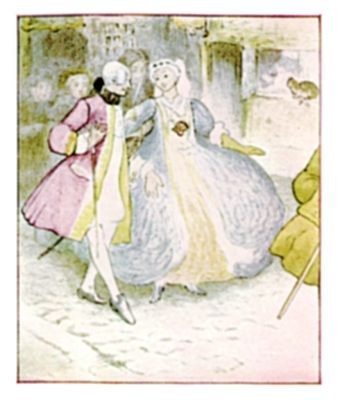
In the time of swords and periwigs and full-skirted coats with flowered lappets—when gentlemen wore ruffles, and gold-laced waistcoats of paduasoy and taffeta—there lived a tailor in Gloucester.
He sat in the window of a little shop in Westgate Street, cross-legged on a table, from morning till dark.
All day long while the light lasted he sewed and snippeted, piecing out his satin and pompadour, and lutestring; stuffs had strange names, and were very expensive in the days of the Tailor of Gloucester.
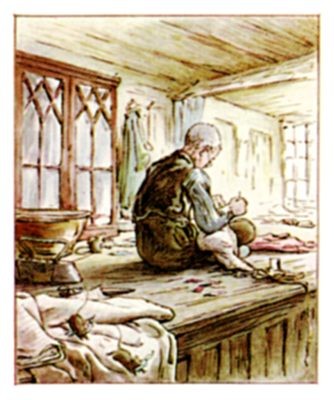
But although he sewed fine silk for his neighbours, he himself was very, very poor—a little old man in spectacles, with a pinched face, old crooked fingers, and a suit of thread-bare clothes.
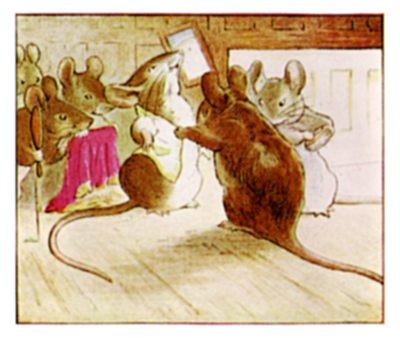
He cut his coats without waste, according to his embroidered cloth; they were very small ends and snippets that lay about upon the table—"Too narrow breadths for nought—except waistcoats for mice," said the tailor.
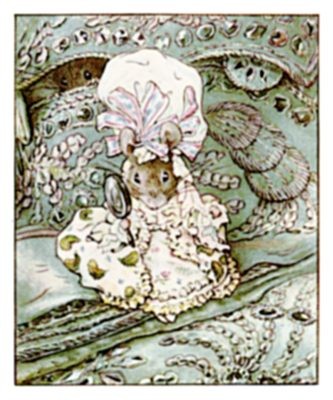
One bitter cold day near Christmastime the tailor began to make a coat—a coat of cherry-coloured corded silk embroidered with pansies and roses, and a cream coloured satin waistcoat—trimmed with gauze and green worsted chenille—for the Mayor of Gloucester.
The tailor worked and worked, and he talked to himself. He measured the silk, and turned it round and round, and trimmed it into shape with his shears; the table was all littered with cherry-coloured snippets.
"No breadth at all, and cut on the cross; it is no breadth at all; tippets for mice and ribbons for mobs! for mice!" said the Tailor of Gloucester.
When the snow-flakes came down against the small leaded window-panes and shut out the light, the tailor had done his day's work; all the silk and satin lay cut out upon the table.
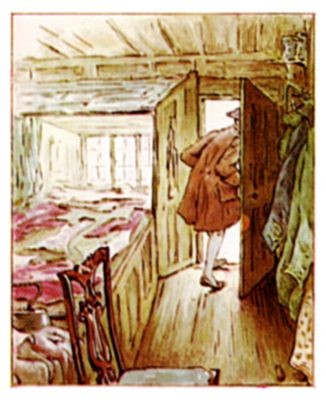
There were twelve pieces for the coat and four pieces for the waistcoat; and there were pocket flaps and cuffs, and buttons all in order. For the lining of the coat there was fine yellow taffeta; and for the button-holes of the waistcoat, there was cherry-coloured twist. And everything was ready to sew together in the morning, all measured and sufficient—except that there was wanting just one single skein of cherry-coloured twisted silk.
The tailor came out of his shop at dark, for he did not sleep there at nights; he fastened the window and locked the door, and took away the key. No one lived there at night but little brown mice, and they run in and out without any keys!
For behind the wooden wainscots of all the old houses in Gloucester, there are little mouse staircases and secret trap-doors; and the mice run from house to house through those long narrow passages; they can run all over the town without going into the streets.
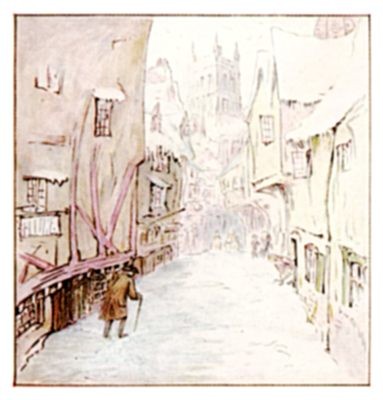
But the tailor came out of his shop, and shuffled home through the snow. He lived quite near by in College Court, next the doorway to College Green; and although it was not a big house, the tailor was so poor he only rented the kitchen.
He lived alone with his cat; it was called Simpkin.
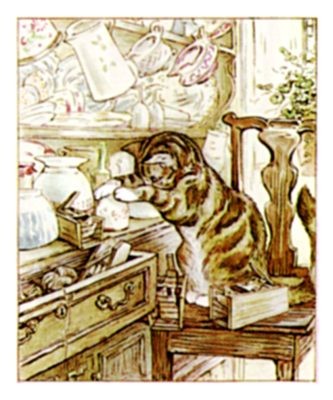
Now all day long while the tailor was out at work, Simpkin kept house by himself; and he also was fond of the mice, though he gave them no satin for coats!
"Miaw?" said the cat when the tailor opened the door. "Miaw?"
The tailor replied—"Simpkin, we shall make our fortune, but I am worn to a ravelling. Take this groat (which is our last fourpence) and Simpkin, take a china pipkin; buy a penn'orth of bread, a penn'orth of milk and a penn'orth of sausages. And oh, Simpkin, with the last penny of our fourpence buy me one penn'orth of cherry-coloured silk. But do not lose the last penny of the fourpence, Simpkin, or I am undone and worn to a thread-paper, for I have NO MORE TWIST."
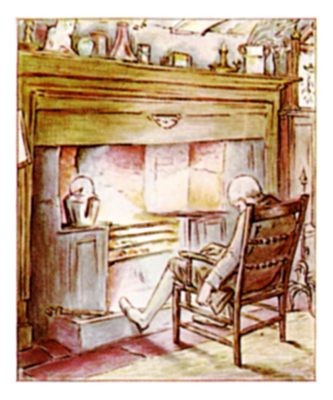
Then Simpkin again said, "Miaw?" and took the groat and the pipkin, and went out into the dark.
The tailor was very tired and beginning to be ill. He sat down by the hearth and talked to himself about that wonderful coat.
"I shall make my fortune—to be cut bias—the Mayor of Gloucester is to be married on Christmas Day in the morning, and he hath ordered a coat and an embroidered waistcoat—to be lined with yellow taffeta—and the taffeta sufficeth; there is no more left over in snippets than will serve to make tippets for mice——"
Then the tailor started; for suddenly, interrupting him, from the dresser at the other side of the kitchen came a number of little noises—
Tip tap, tip tap, tip tap tip!
"Now what can that be?" said the Tailor of Gloucester, jumping up from his chair. The dresser was covered with crockery and pipkins, willow pattern plates, and tea-cups and mugs.
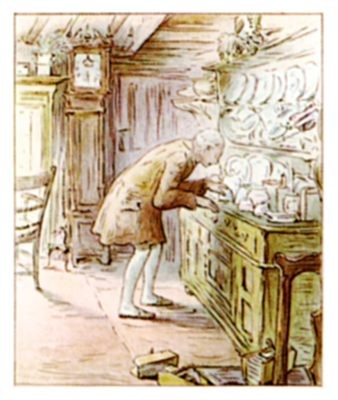
The tailor crossed the kitchen, and stood quite still beside the dresser, listening, and peering through his spectacles. Again from under a tea-cup, came those funny little noises—
Tip tap, tip tap, Tip tap tip!
"This is very peculiar," said the Tailor of Gloucester; and he lifted up the tea-cup which was upside down.
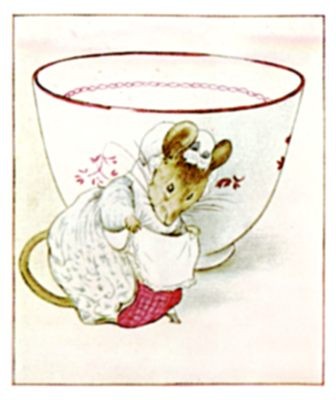
Out stepped a little live lady mouse, and made a curtsey to the tailor! Then she hopped away down off the dresser, and under the wainscot.
The tailor sat down again by the fire, warming his poor cold hands, and mumbling to himself——
"The waistcoat is cut out from peach-coloured satin—tambour stitch and rose-buds in beautiful floss silk. Was I wise to entrust my last fourpence to Simpkin? One-and-twenty button-holes of cherry-coloured twist!"
But all at once, from the dresser, there came other little noises:
Tip tap, tip tap, tip tap tip!
"This is passing extraordinary!" said the Tailor of Gloucester, and turned over another tea-cup, which was upside down.
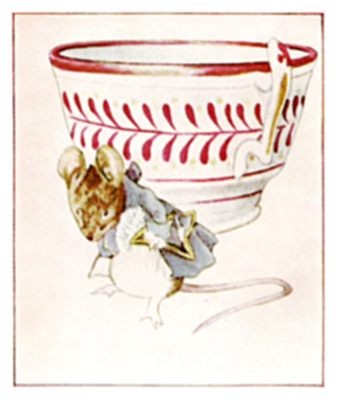
Out stepped a little gentleman mouse, and made a bow to the tailor!
And then from all over the dresser came a chorus of little tappings, all sounding together, and answering one another, like watch-beetles in an old worm-eaten window-shutter—
Tip tap, tip tap, tip tap tip!
And out from under tea-cups and from under bowls and basins, stepped other and more little mice who hopped away down off the dresser and under the wainscot.
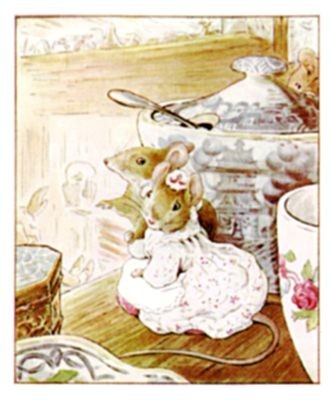
The tailor sat down, close over the fire, lamenting—"One-and-twenty button-holes of cherry-coloured silk! To be finished by noon of Saturday: and this is Tuesday evening. Was it right to let loose those mice, undoubtedly the property of Simpkin? Alack, I am undone, for I have no more twist!"
The little mice came out again, and listened to the tailor; they took notice of the pattern of that wonderful coat. They whispered to one another about the taffeta lining, and about little mouse tippets.
And then all at once they all ran away together down the passage behind the wainscot, squeaking and calling to one another, as they ran from house to house; and not one mouse was left in the tailor's kitchen when Simpkin came back with the pipkin of milk!
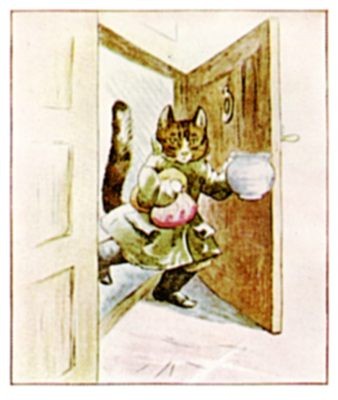
Simpkin opened the door and bounced in, with an angry "G-r-r-miaw!" like a cat that is vexed: for he hated the snow, and there was snow in his ears, and snow in his collar at the back of his neck. He put down the loaf and the sausages upon the dresser, and sniffed.
"Simpkin," said the tailor, "where is my twist?"
But Simpkin set down the pipkin of milk upon the dresser, and looked suspiciously at the tea-cups. He wanted his supper of little fat mouse!
"Simpkin," said the tailor, "where is my TWIST?"
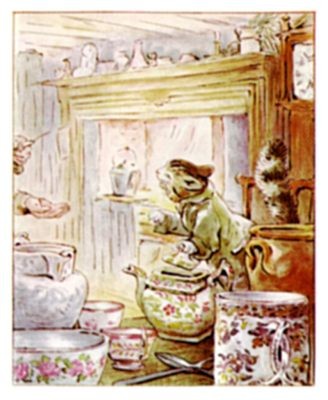
But Simpkin hid a little parcel privately in the tea-pot, and spit and growled at the tailor; and if Simpkin had been able to talk, he would have asked: "Where is my MOUSE?"
"Alack, I am undone!" said the Tailor of Gloucester, and went sadly to bed.
All that night long Simpkin hunted and searched through the kitchen, peeping into cupboards and under the wainscot, and into the tea-pot where he had hidden that twist; but still he found never a mouse!
Whenever the tailor muttered and talked in his sleep, Simpkin said "Miaw-ger-r-w-s-s-ch!" and made strange horrid noises, as cats do at night.
For the poor old tailor was very ill with a fever, tossing and turning in his four-post bed; and still in his dreams he mumbled—"No more twist! no more twist!"
All that day he was ill, and the next day, and the next; and what should become of the cherry-coloured coat? In the tailor's shop in Westgate Street the embroidered silk and satin lay cut out upon the table—one-and-twenty button-holes—and who should come to sew them, when the window was barred, and the door was fast locked?
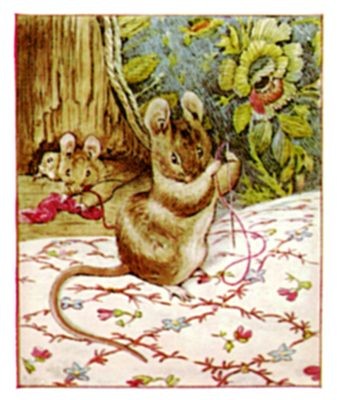
But that does not hinder the little brown mice; they run in and out without any keys through all the old houses in Gloucester!
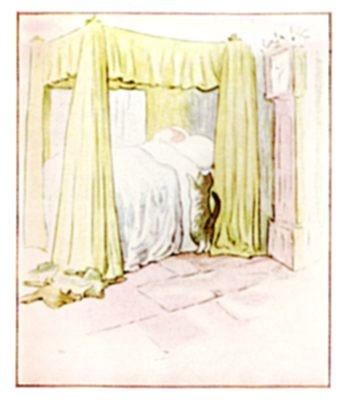
Out of doors the market folks went trudging through the snow to buy their geese and turkeys, and to bake their Christmas pies; but there would be no Christmas dinner for Simpkin and the poor old Tailor of Gloucester.
The tailor lay ill for three days and nights; and then it was Christmas Eve, and very late at night. The moon climbed up over the roofs and chimneys, and looked down over the gateway into College Court. There were no lights in the windows, nor any sound in the houses; all the city of Gloucester was fast asleep under the snow.
And still Simpkin wanted his mice, and he mewed as he stood beside the four-post bed.

But it is in the old story that all the beasts can talk, in the night between Christmas Eve and Christmas Day in the morning (though there are very few folk that can hear them, or know what it is that they say).
When the Cathedral clock struck twelve there was an answer—like an echo of the chimes—and Simpkin heard it, and came out of the tailor's door, and wandered about in the snow.
From all the roofs and gables and old wooden houses in Gloucester came a thousand merry voices singing the old Christmas rhymes—all the old songs that ever I heard of, and some that I don't know, like Whittington's bells.
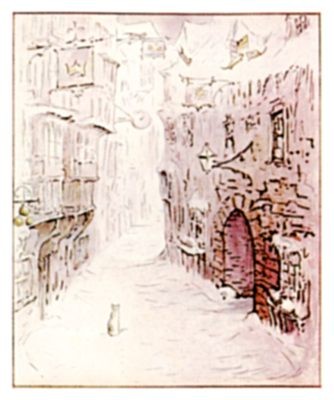
First and loudest the cocks cried out: "Dame, get up, and bake your pies!"
"Oh, dilly, dilly, dilly!" sighed Simpkin.
And now in a garret there were lights and sounds of dancing, and cats came from over the way.
"Hey, diddle, diddle, the cat and the fiddle! All the cats in Gloucester—except me," said Simpkin.
Under the wooden eaves the starlings and sparrows sang of Christmas pies; the jack-daws woke up in the Cathedral tower; and although it was the middle of the night the throstles and robins sang; the air was quite full of little twittering tunes.
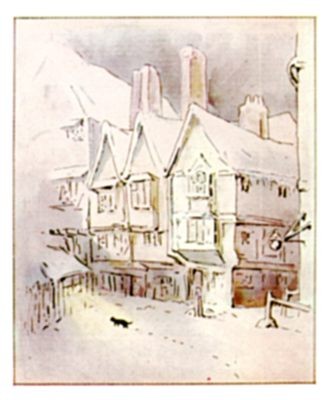
But it was all rather provoking to poor hungry Simpkin!
Particularly he was vexed with some little shrill voices from behind a wooden lattice. I think that they were bats, because they always have very small voices—especially in a black frost, when they talk in their sleep, like the Tailor of Gloucester.
They said something mysterious that sounded like—
"Buz, quoth the blue fly, hum, quoth the bee,
Buz and hum they cry, and so do we!"
and Simpkin went away shaking his ears as if he had a bee in his bonnet.
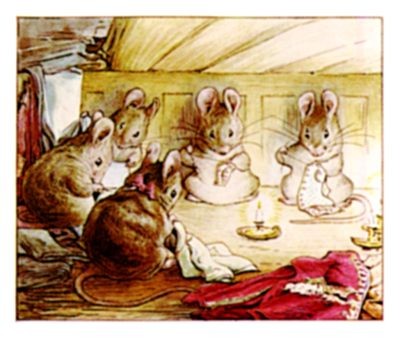
From the tailor's shop in Westgate came a glow of light; and when Simpkin crept up to peep in at the window it was full of candles. There was a snippeting of scissors, and snappeting of thread; and little mouse voices sang loudly and gaily—
"Four-and-twenty tailors
Went to catch a snail,
The best man amongst them
Durst not touch her tail,
She put out her horns
Like a little kyloe cow,
Run, tailors, run! or she'll have you all e'en now!"
Then without a pause the little mouse voices went on again—
"Sieve my lady's oatmeal,
Grind my lady's flour,
Put it in a chestnut,
Let it stand an hour——"
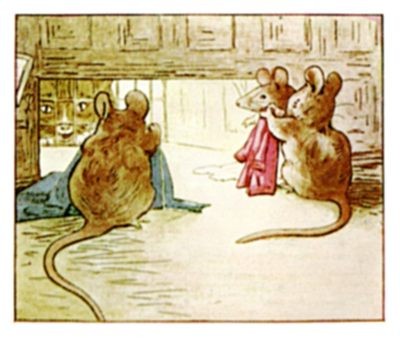
"Mew! Mew!" interrupted Simpkin, and he scratched at the door. But the key was under the tailor's pillow, he could not get in.
The little mice only laughed, and tried another tune—
"Three little mice sat down to spin,
Pussy passed by and she peeped in.
What are you at, my fine little men?
Making coats for gentlemen.
Shall I come in and cut off your threads?
Oh, no, Miss Pussy, you'd bite off our heads!"
"Mew! Mew!" cried Simpkin. "Hey diddle dinketty?" answered the little mice—
"Hey diddle dinketty, poppetty pet!
The merchants of London they wear scarlet;
Silk in the collar, and gold in the hem,
So merrily march the merchantmen!"
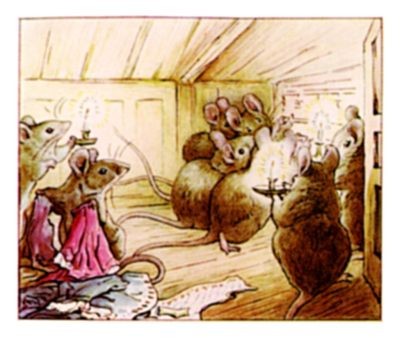
They clicked their thimbles to mark the time, but none of the songs pleased Simpkin; he sniffed and mewed at the door of the shop.
"And then I bought
A pipkin and a popkin,
A slipkin and a slopkin,
All for one farthing——
and upon the kitchen dresser!" added the rude little mice.
"Mew! scratch! scratch!" scuffled Simpkin on the window-sill; while the little mice inside sprang to their feet, and all began to shout at once in little twittering voices: "No more twist! No more twist!" And they barred up the window shutters and shut out Simpkin.
But still through the nicks in the shutters he could hear the click of thimbles, and little mouse voices singing—
"No more twist! No more twist!"
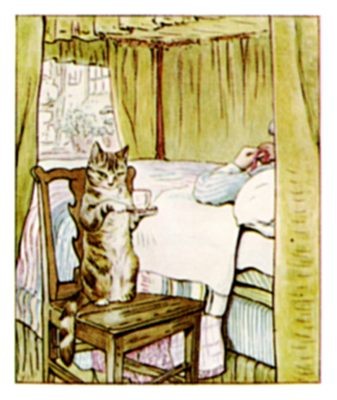
Simpkin came away from the shop and went home, considering in his mind. He found the poor old tailor without fever, sleeping peacefully.
Then Simpkin went on tip-toe and took a little parcel of silk out of the tea-pot, and looked at it in the moonlight; and he felt quite ashamed of his badness compared with those good little mice!
When the tailor awoke in the morning, the first thing which he saw upon the patchwork quilt, was a skein of cherry-coloured twisted silk, and beside his bed stood the repentant Simpkin!
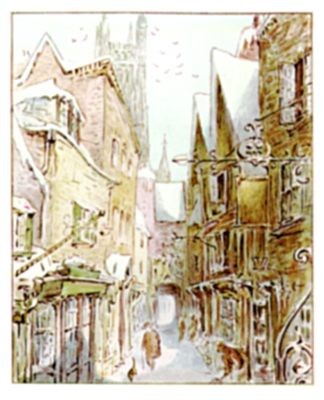
"Alack, I am worn to a ravelling," said the Tailor of Gloucester, "but I have my twist!"
The sun was shining on the snow when the tailor got up and dressed, and came out into the street with Simpkin running before him.
The starlings whistled on the chimney stacks, and the throstles and robins sang—but they sang their own little noises, not the words they had sung in the night.
"Alack," said the tailor, "I have my twist; but no more strength—nor time—than will serve to make me one single button-hole; for this is Christmas Day in the Morning! The Mayor of Gloucester shall be married by noon—and where is his cherry-coloured coat?"
He unlocked the door of the little shop in Westgate Street, and Simpkin ran in, like a cat that expects something.
But there was no one there! Not even one little brown mouse!
The boards were swept clean; the little ends of thread and the little silk snippets were all tidied away, and gone from off the floor.
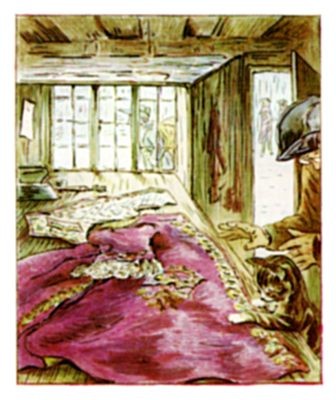
But upon the table—oh joy! the tailor gave a shout—there, where he had left plain cuttings of silk—there lay the most beautifullest coat and embroidered satin waistcoat that ever were worn by a Mayor of Gloucester.
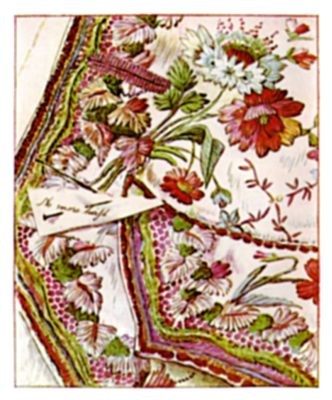
There were roses and pansies upon the facings of the coat; and the waistcoat was worked with poppies and corn-flowers.
Everything was finished except just one single cherry-coloured button-hole, and where that button-hole was wanting there was pinned a scrap of paper with these words—in little teeny weeny writing—
NO MORE TWIST
And from then began the luck of the Tailor of Gloucester; he grew quite stout, and he grew quite rich.
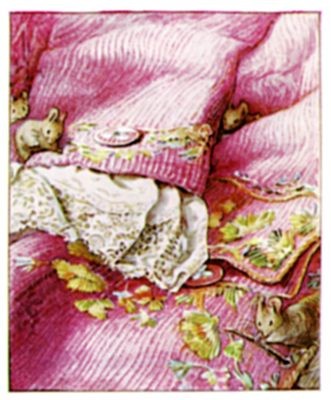
He made the most wonderful waistcoats for all the rich merchants of Gloucester, and for all the fine gentlemen of the country round.
Never were seen such ruffles, or such embroidered cuffs and lappets! But his button-holes were the greatest triumph of it all.
The stitches of those button-holes were so neat—so neat—I wonder how they could be stitched by an old man in spectacles, with crooked old fingers, and a tailor's thimble.
The stitches of those button-holes were so small—so small—they looked as if they had been made by little mice!
THE END
End of Project Gutenberg's The Tailor of Gloucester, by Beatrix Potter
*** END OF THIS PROJECT GUTENBERG EBOOK THE TAILOR OF GLOUCESTER ***
***** This file should be named 14868-h.htm or 14868-h.zip *****
This and all associated files of various formats will be found in:
http://www.gutenberg.net/1/4/8/6/14868/
Produced by Robert Cicconetti, Emmy, and the Project Gutenberg Online
Distributed Proofreading Team (http://www.pgdp.net)
Updated editions will replace the previous one--the old editions
will be renamed.
Creating the works from public domain print editions means that no
one owns a United States copyright in these works, so the Foundation
(and you!) can copy and distribute it in the United States without
permission and without paying copyright royalties. Special rules,
set forth in the General Terms of Use part of this license, apply to
copying and distributing Project Gutenberg-tm electronic works to
protect the PROJECT GUTENBERG-tm concept and trademark. Project
Gutenberg is a registered trademark, and may not be used if you
charge for the eBooks, unless you receive specific permission. If you
do not charge anything for copies of this eBook, complying with the
rules is very easy. You may use this eBook for nearly any purpose
such as creation of derivative works, reports, performances and
research. They may be modified and printed and given away--you may do
practically ANYTHING with public domain eBooks. Redistribution is
subject to the trademark license, especially commercial
redistribution.
*** START: FULL LICENSE ***
THE FULL PROJECT GUTENBERG LICENSE
PLEASE READ THIS BEFORE YOU DISTRIBUTE OR USE THIS WORK
To protect the Project Gutenberg-tm mission of promoting the free
distribution of electronic works, by using or distributing this work
(or any other work associated in any way with the phrase "Project
Gutenberg"), you agree to comply with all the terms of the Full Project
Gutenberg-tm License (available with this file or online at
http://gutenberg.net/license).
Section 1. General Terms of Use and Redistributing Project Gutenberg-tm
electronic works
1.A. By reading or using any part of this Project Gutenberg-tm
electronic work, you indicate that you have read, understand, agree to
and accept all the terms of this license and intellectual property
(trademark/copyright) agreement. If you do not agree to abide by all
the terms of this agreement, you must cease using and return or destroy
all copies of Project Gutenberg-tm electronic works in your possession.
If you paid a fee for obtaining a copy of or access to a Project
Gutenberg-tm electronic work and you do not agree to be bound by the
terms of this agreement, you may obtain a refund from the person or
entity to whom you paid the fee as set forth in paragraph 1.E.8.
1.B. "Project Gutenberg" is a registered trademark. It may only be
used on or associated in any way with an electronic work by people who
agree to be bound by the terms of this agreement. There are a few
things that you can do with most Project Gutenberg-tm electronic works
even without complying with the full terms of this agreement. See
paragraph 1.C below. There are a lot of things you can do with Project
Gutenberg-tm electronic works if you follow the terms of this agreement
and help preserve free future access to Project Gutenberg-tm electronic
works. See paragraph 1.E below.
1.C. The Project Gutenberg Literary Archive Foundation ("the Foundation"
or PGLAF), owns a compilation copyright in the collection of Project
Gutenberg-tm electronic works. Nearly all the individual works in the
collection are in the public domain in the United States. If an
individual work is in the public domain in the United States and you are
located in the United States, we do not claim a right to prevent you from
copying, distributing, performing, displaying or creating derivative
works based on the work as long as all references to Project Gutenberg
are removed. Of course, we hope that you will support the Project
Gutenberg-tm mission of promoting free access to electronic works by
freely sharing Project Gutenberg-tm works in compliance with the terms of
this agreement for keeping the Project Gutenberg-tm name associated with
the work. You can easily comply with the terms of this agreement by
keeping this work in the same format with its attached full Project
Gutenberg-tm License when you share it without charge with others.
1.D. The copyright laws of the place where you are located also govern
what you can do with this work. Copyright laws in most countries are in
a constant state of change. If you are outside the United States, check
the laws of your country in addition to the terms of this agreement
before downloading, copying, displaying, performing, distributing or
creating derivative works based on this work or any other Project
Gutenberg-tm work. The Foundation makes no representations concerning
the copyright status of any work in any country outside the United
States.
1.E. Unless you have removed all references to Project Gutenberg:
1.E.1. The following sentence, with active links to, or other immediate
access to, the full Project Gutenberg-tm License must appear prominently
whenever any copy of a Project Gutenberg-tm work (any work on which the
phrase "Project Gutenberg" appears, or with which the phrase "Project
Gutenberg" is associated) is accessed, displayed, performed, viewed,
copied or distributed:
This eBook is for the use of anyone anywhere at no cost and with
almost no restrictions whatsoever. You may copy it, give it away or
re-use it under the terms of the Project Gutenberg License included
with this eBook or online at www.gutenberg.net
1.E.2. If an individual Project Gutenberg-tm electronic work is derived
from the public domain (does not contain a notice indicating that it is
posted with permission of the copyright holder), the work can be copied
and distributed to anyone in the United States without paying any fees
or charges. If you are redistributing or providing access to a work
with the phrase "Project Gutenberg" associated with or appearing on the
work, you must comply either with the requirements of paragraphs 1.E.1
through 1.E.7 or obtain permission for the use of the work and the
Project Gutenberg-tm trademark as set forth in paragraphs 1.E.8 or
1.E.9.
1.E.3. If an individual Project Gutenberg-tm electronic work is posted
with the permission of the copyright holder, your use and distribution
must comply with both paragraphs 1.E.1 through 1.E.7 and any additional
terms imposed by the copyright holder. Additional terms will be linked
to the Project Gutenberg-tm License for all works posted with the
permission of the copyright holder found at the beginning of this work.
1.E.4. Do not unlink or detach or remove the full Project Gutenberg-tm
License terms from this work, or any files containing a part of this
work or any other work associated with Project Gutenberg-tm.
1.E.5. Do not copy, display, perform, distribute or redistribute this
electronic work, or any part of this electronic work, without
prominently displaying the sentence set forth in paragraph 1.E.1 with
active links or immediate access to the full terms of the Project
Gutenberg-tm License.
1.E.6. You may convert to and distribute this work in any binary,
compressed, marked up, nonproprietary or proprietary form, including any
word processing or hypertext form. However, if you provide access to or
distribute copies of a Project Gutenberg-tm work in a format other than
"Plain Vanilla ASCII" or other format used in the official version
posted on the official Project Gutenberg-tm web site (www.gutenberg.net),
you must, at no additional cost, fee or expense to the user, provide a
copy, a means of exporting a copy, or a means of obtaining a copy upon
request, of the work in its original "Plain Vanilla ASCII" or other
form. Any alternate format must include the full Project Gutenberg-tm
License as specified in paragraph 1.E.1.
1.E.7. Do not charge a fee for access to, viewing, displaying,
performing, copying or distributing any Project Gutenberg-tm works
unless you comply with paragraph 1.E.8 or 1.E.9.
1.E.8. You may charge a reasonable fee for copies of or providing
access to or distributing Project Gutenberg-tm electronic works provided
that
- You pay a royalty fee of 20% of the gross profits you derive from
the use of Project Gutenberg-tm works calculated using the method
you already use to calculate your applicable taxes. The fee is
owed to the owner of the Project Gutenberg-tm trademark, but he
has agreed to donate royalties under this paragraph to the
Project Gutenberg Literary Archive Foundation. Royalty payments
must be paid within 60 days following each date on which you
prepare (or are legally required to prepare) your periodic tax
returns. Royalty payments should be clearly marked as such and
sent to the Project Gutenberg Literary Archive Foundation at the
address specified in Section 4, "Information about donations to
the Project Gutenberg Literary Archive Foundation."
- You provide a full refund of any money paid by a user who notifies
you in writing (or by e-mail) within 30 days of receipt that s/he
does not agree to the terms of the full Project Gutenberg-tm
License. You must require such a user to return or
destroy all copies of the works possessed in a physical medium
and discontinue all use of and all access to other copies of
Project Gutenberg-tm works.
- You provide, in accordance with paragraph 1.F.3, a full refund of any
money paid for a work or a replacement copy, if a defect in the
electronic work is discovered and reported to you within 90 days
of receipt of the work.
- You comply with all other terms of this agreement for free
distribution of Project Gutenberg-tm works.
1.E.9. If you wish to charge a fee or distribute a Project Gutenberg-tm
electronic work or group of works on different terms than are set
forth in this agreement, you must obtain permission in writing from
both the Project Gutenberg Literary Archive Foundation and Michael
Hart, the owner of the Project Gutenberg-tm trademark. Contact the
Foundation as set forth in Section 3 below.
1.F.
1.F.1. Project Gutenberg volunteers and employees expend considerable
effort to identify, do copyright research on, transcribe and proofread
public domain works in creating the Project Gutenberg-tm
collection. Despite these efforts, Project Gutenberg-tm electronic
works, and the medium on which they may be stored, may contain
"Defects," such as, but not limited to, incomplete, inaccurate or
corrupt data, transcription errors, a copyright or other intellectual
property infringement, a defective or damaged disk or other medium, a
computer virus, or computer codes that damage or cannot be read by
your equipment.
1.F.2. LIMITED WARRANTY, DISCLAIMER OF DAMAGES - Except for the "Right
of Replacement or Refund" described in paragraph 1.F.3, the Project
Gutenberg Literary Archive Foundation, the owner of the Project
Gutenberg-tm trademark, and any other party distributing a Project
Gutenberg-tm electronic work under this agreement, disclaim all
liability to you for damages, costs and expenses, including legal
fees. YOU AGREE THAT YOU HAVE NO REMEDIES FOR NEGLIGENCE, STRICT
LIABILITY, BREACH OF WARRANTY OR BREACH OF CONTRACT EXCEPT THOSE
PROVIDED IN PARAGRAPH F3. YOU AGREE THAT THE FOUNDATION, THE
TRADEMARK OWNER, AND ANY DISTRIBUTOR UNDER THIS AGREEMENT WILL NOT BE
LIABLE TO YOU FOR ACTUAL, DIRECT, INDIRECT, CONSEQUENTIAL, PUNITIVE OR
INCIDENTAL DAMAGES EVEN IF YOU GIVE NOTICE OF THE POSSIBILITY OF SUCH
DAMAGE.
1.F.3. LIMITED RIGHT OF REPLACEMENT OR REFUND - If you discover a
defect in this electronic work within 90 days of receiving it, you can
receive a refund of the money (if any) you paid for it by sending a
written explanation to the person you received the work from. If you
received the work on a physical medium, you must return the medium with
your written explanation. The person or entity that provided you with
the defective work may elect to provide a replacement copy in lieu of a
refund. If you received the work electronically, the person or entity
providing it to you may choose to give you a second opportunity to
receive the work electronically in lieu of a refund. If the second copy
is also defective, you may demand a refund in writing without further
opportunities to fix the problem.
1.F.4. Except for the limited right of replacement or refund set forth
in paragraph 1.F.3, this work is provided to you 'AS-IS' WITH NO OTHER
WARRANTIES OF ANY KIND, EXPRESS OR IMPLIED, INCLUDING BUT NOT LIMITED TO
WARRANTIES OF MERCHANTIBILITY OR FITNESS FOR ANY PURPOSE.
1.F.5. Some states do not allow disclaimers of certain implied
warranties or the exclusion or limitation of certain types of damages.
If any disclaimer or limitation set forth in this agreement violates the
law of the state applicable to this agreement, the agreement shall be
interpreted to make the maximum disclaimer or limitation permitted by
the applicable state law. The invalidity or unenforceability of any
provision of this agreement shall not void the remaining provisions.
1.F.6. INDEMNITY - You agree to indemnify and hold the Foundation, the
trademark owner, any agent or employee of the Foundation, anyone
providing copies of Project Gutenberg-tm electronic works in accordance
with this agreement, and any volunteers associated with the production,
promotion and distribution of Project Gutenberg-tm electronic works,
harmless from all liability, costs and expenses, including legal fees,
that arise directly or indirectly from any of the following which you do
or cause to occur: (a) distribution of this or any Project Gutenberg-tm
work, (b) alteration, modification, or additions or deletions to any
Project Gutenberg-tm work, and (c) any Defect you cause.
Section 2. Information about the Mission of Project Gutenberg-tm
Project Gutenberg-tm is synonymous with the free distribution of
electronic works in formats readable by the widest variety of computers
including obsolete, old, middle-aged and new computers. It exists
because of the efforts of hundreds of volunteers and donations from
people in all walks of life.
Volunteers and financial support to provide volunteers with the
assistance they need, is critical to reaching Project Gutenberg-tm's
goals and ensuring that the Project Gutenberg-tm collection will
remain freely available for generations to come. In 2001, the Project
Gutenberg Literary Archive Foundation was created to provide a secure
and permanent future for Project Gutenberg-tm and future generations.
To learn more about the Project Gutenberg Literary Archive Foundation
and how your efforts and donations can help, see Sections 3 and 4
and the Foundation web page at http://www.pglaf.org.
Section 3. Information about the Project Gutenberg Literary Archive
Foundation
The Project Gutenberg Literary Archive Foundation is a non profit
501(c)(3) educational corporation organized under the laws of the
state of Mississippi and granted tax exempt status by the Internal
Revenue Service. The Foundation's EIN or federal tax identification
number is 64-6221541. Its 501(c)(3) letter is posted at
http://pglaf.org/fundraising. Contributions to the Project Gutenberg
Literary Archive Foundation are tax deductible to the full extent
permitted by U.S. federal laws and your state's laws.
The Foundation's principal office is located at 4557 Melan Dr. S.
Fairbanks, AK, 99712., but its volunteers and employees are scattered
throughout numerous locations. Its business office is located at
809 North 1500 West, Salt Lake City, UT 84116, (801) 596-1887, email
business@pglaf.org. Email contact links and up to date contact
information can be found at the Foundation's web site and official
page at http://pglaf.org
For additional contact information:
Dr. Gregory B. Newby
Chief Executive and Director
gbnewby@pglaf.org
Section 4. Information about Donations to the Project Gutenberg
Literary Archive Foundation
Project Gutenberg-tm depends upon and cannot survive without wide
spread public support and donations to carry out its mission of
increasing the number of public domain and licensed works that can be
freely distributed in machine readable form accessible by the widest
array of equipment including outdated equipment. Many small donations
($1 to $5,000) are particularly important to maintaining tax exempt
status with the IRS.
The Foundation is committed to complying with the laws regulating
charities and charitable donations in all 50 states of the United
States. Compliance requirements are not uniform and it takes a
considerable effort, much paperwork and many fees to meet and keep up
with these requirements. We do not solicit donations in locations
where we have not received written confirmation of compliance. To
SEND DONATIONS or determine the status of compliance for any
particular state visit http://pglaf.org
While we cannot and do not solicit contributions from states where we
have not met the solicitation requirements, we know of no prohibition
against accepting unsolicited donations from donors in such states who
approach us with offers to donate.
International donations are gratefully accepted, but we cannot make
any statements concerning tax treatment of donations received from
outside the United States. U.S. laws alone swamp our small staff.
Please check the Project Gutenberg Web pages for current donation
methods and addresses. Donations are accepted in a number of other
ways including including checks, online payments and credit card
donations. To donate, please visit: http://pglaf.org/donate
Section 5. General Information About Project Gutenberg-tm electronic
works.
Professor Michael S. Hart is the originator of the Project Gutenberg-tm
concept of a library of electronic works that could be freely shared
with anyone. For thirty years, he produced and distributed Project
Gutenberg-tm eBooks with only a loose network of volunteer support.
Project Gutenberg-tm eBooks are often created from several printed
editions, all of which are confirmed as Public Domain in the U.S.
unless a copyright notice is included. Thus, we do not necessarily
keep eBooks in compliance with any particular paper edition.
Most people start at our Web site which has the main PG search facility:
http://www.gutenberg.net
This Web site includes information about Project Gutenberg-tm,
including how to make donations to the Project Gutenberg Literary
Archive Foundation, how to help produce our new eBooks, and how to
subscribe to our email newsletter to hear about new eBooks.