автордың кітабын онлайн тегін оқу The Secret Doctrine, Vol. 2 of 4
The Project Gutenberg EBook of The Secret Doctrine, Vol. 2 of 4 by Helena Petrovna Blavatsky
This ebook is for the use of anyone anywhere in the United States and most other parts of the world at no cost and with almost no restrictions whatsoever. You may copy it, give it away or re-use it under the terms of the Project Gutenberg License included with this eBook or online at http://www.gutenberg.org/license. If you are not located in the United States, you'll have to check the laws of the country where you are located before using this ebook.
The Secret Doctrine
The Synthesis of Science, Religion, and Philosophy
By
Helena Petrovna Blavatsky
Author of “Isis Unveiled.”
Third and Revised Edition.
SATYÂT NÂSTI PARO DHARMAH.
“There is no Religion higher than Truth.”
Volume II.
Anthropogenesis
The Theosophical Publishing House
London
1893
Contents
- Preliminary Notes on The Archaic Stanzas, and the Four Pre-Historic Continents.
- Part I. Anthropogenesis.
- Text.
- Stanza I.
- Stanza II.
- Stanza III.
- Stanza IV.
- Stanza V.
- Stanza VI.
- Stanza VII.
- Stanza VIII.
- Stanza IX.
- Stanza X.
- Stanza XI.
- Stanza XII.
- Commentaries On the Twelve Stanzas and Their Terms, According To Their Numeration, In Stanzas And Shlokas.
- Stanza I. Beginnings of Sentient Life.
- Two Antediluvian Astronomers.
- Stanza II. Nature Unaided Fails.
- Creation of Divine Beings in the Exoteric Accounts.
- Stanza II.—Continued.
- The Chronology of the Brâhmans.
- Stanza III. Attempts To Create Man.
- Stanza IV. Creation Of The First Races.
- On The Identity And Differences Of The Incarnating Powers.
- Stanza IV.—Continued.
- Stanza V. The Evolution of the Second Race.
- The Divine Hermaphrodite.
- Stanza VI. The Evolution Of The “Sweat-Born.”
- A Few Words About “Deluges” And “Noahs.”
- Stanza VII. From The Semi-Divine Down To The First Human Races.
- I. Fission.
- II. Budding.
- III. Spores.
- IV. Intermediate Hermaphroditism.
- V. True Sexual Union.
- Stanza VIII. Evolution Of The Animal Mammalians: The First Fall.
- What May Be The Objections To The Foregoing.
- Stanza IX. The Final Evolution Of Man.
- Edens, Serpents, And Dragons.
- The “Sons Of God” And The “Sacred Island.”
- Stanza X. The History Of The Fourth Race.
- Archaic Teachings In The “Purânas” And “Genesis.” Physical Evolution.
- A Panoramic View Of The Early Races.
- Are Giants A Fiction?
- The Races With The “Third Eye.”
- The Primeval Manus Of Humanity.
- Stanza XI. The Civilization And Destruction Of The Fourth And Fifth Races.
- Cyclopean Ruins And Colossal Stones As Witnesses To Giants.
- Stanza XII. The Fifth Race And Its Divine Instructors.
- Serpents And Dragons Under Different Symbolisms.
- The Sidereal And Cosmic Glyphs.
- Our Divine Instructors.
- The Origin Of The Satanic Myth.
- Noah Was A Kabir, Hence He Must Have Been A Demon.
- The Oldest Persian Traditions About The Polar, And The Submerged Continents.
- Western Speculations, Founded On The Greek And Paurânic Traditions.
- The “Curse” From A Philosophical Point Of View.
- Additional Fragments From A Commentary On The Verses Of Stanza XII.
- Conclusion.
- Part II. The Archaic Symbolism Of The World-Religions.
- Section I. Esoteric Tenets Corroborated in Every Scripture.
- Section II. Adam=Adami.
- Section III. The “Holy of Holies.” Its Degradation.
- Section IV. On the Myth of the “Fallen Angels” in its Various Aspects.
- A. The Evil Spirit: Who, And What?
- B. The Gods Of Light Proceed From The Gods Of Darkness.
- C. The Many Meanings Of The “War In Heaven.”
- Section V. Is Plerôma Satan's Lair?
- Section VI. Prometheus, the Titan.
- His Origin In Ancient India.
- Section VII. Enoïchion-Henoch.
- Section VIII. The Symbolism of the Mystery-Names Iao and Jehovah, with their Relation to the Cross and Circle.
- A. Cross And Circle.
- B. The Fall Of The Cross Into Matter.
- Section IX. The Upanishads in Gnostic Literature.
- Section X. The Cross and the Pythagorean Decad.
- Section XI. The Mysteries of the Hebdomad.
- A. Saptaparna.
- B. The Tetraktys In Relation To The Heptagon.
- C. The Septenary Element In The Vedas.
- D. The Septenary In The Exoteric Works.
- E. Seven In Astronomy, Science, And Magic.
- F. The Seven Souls Of The Egyptologists.
- Part III. Addenda. Science And The Secret Doctrine Contrasted.
- Section I. Archaic, or Modern Anthropology?
- Section II. The Ancestors Mankind is Offered by Science.
- Plastidular Souls, And Conscious Nerve-Cells.
- Section III. The Fossil Relics of Man and the Anthropoid Ape.
- A. Geological Facts Bearing On The Question Of Their Relationship.
- B. Western Evolutionism: The Comparative Anatomy Of Man And The Anthropoid In No Way A Confirmation Of Darwinism.
- C. Darwinism And The Antiquity Of Man: The Anthropoids And Their Ancestry.
- Section IV. Duration of the Geological Periods, Race Cycles, and the Antiquity of Man.
- A. Modern Scientific Speculations About The Ages Of The Globe, Animal Evolution, And Man.
- B. On Chains Of Planets And Their Plurality.
- C. Supplementary Remarks On Esoteric Geological Chronology.
- Section V. Organic Evolution and Creative Centres.
- A. The Origin And Evolution Of The Mammalia: Science And Esoteric Phylogeny.
- B. The European Palæolithic Races: Whence, And How Distributed.
- Section VI. Giants, Civilizations, and Submerged Continents Traced in History.
- A. Some Statements About The Sacred Islands And Continents In The Classics, Explained Esoterically.
- Section VII. Scientific and Geological Proofs of the Existence of Several Submerged Continents.
- Footnotes
[Transcriber's Note: The above cover image was produced by the submitter at Distributed Proofreaders, and is being placed into the public domain.]
[pg i]
Ἡ ἐμὴ διδαχὴ οὐκ ἔστιν ἐμή, ἀλλὰ τοῦ πέμψαντός με.
My doctrine is not mine, but his that sent me.
John vii. 16.
[pg ii]
Modern Science insists upon the doctrine of evolution; so do human reason and the Secret Doctrine, and the idea is corroborated by the ancient legends and myths, and even by the Bibleitself, when it is read between the lines. We see a flower slowly developing from a bud, and the bud from its seed. But whence the latter, with all its predetermined programme of physical transformation, and its invisible, therefore spiritual, forces which gradually develop its form, colour, and odour? The word evolution speaks for itself. The germ of the present human race must have preëxisted in the parent of this race, as the seed, in which lies hidden the flower of next summer, was developed in the capsule of its parent flower; the parent may be but slightly different, but it still differs from its future progeny. The antediluvian ancestors of the present elephant and lizard were, perhaps, the mammoth and the plesiosaurus; why should not the progenitors of our human race have been the “giants” of the Vedas, the Voluspa, and the Book of Genesis? While it is positively absurd to believe the “transformation of species” to have taken place according to some of the more materialistic views of the Evolutionists, it is but natural to think that each genus, beginning with the molluscs and ending with monkey-man, has modified from its own primordial and distinctive form.—Isis Unveiled, I. 152-3.
[pg 001]
Preliminary Notes on The Archaic Stanzas, and the Four Pre-Historic Continents.
Facies totius universi, quamvis infinitis modis variet,
Manet tamen semper eadem.—Spinoza.
The Stanzas, with the Commentaries thereon, in this Volume, are drawn from the same Archaic Records as the Stanzas on Cosmogony in Volume I. As far as possible a verbatim translation is given: but some of the Stanzas are too obscure to be understood without explanation, and therefore, as in Volume I, they are first given in full as they stand, and then, when taken verse by verse with their Commentaries, an attempt is made to make them clearer, by words added in foot-notes, in anticipation of the fuller explanation of the Commentary.
As regards the Evolution of mankind, the Secret Doctrine postulates three new propositions, which stand in direct antagonism to Modern Science as well as to current religious dogmas. It teaches: (a) the simultaneous evolution of seven human Groups on seven different portions of our globe; (b) the birth of the astral, before the physical body, the former being a model for the latter; and (c) that man, in this Round, preceded every mammalian—the anthropoids included—in the animal kingdom.1
The Secret Doctrine is not alone in speaking of primeval Men born simultaneously on the seven divisions of our Globe. In the Divine Pymander of Hermes Trismegistus, we find the same seven primeval [pg 002] Men2 evolving from Nature and the Heavenly Man, in the collective sense of the word, namely, from the Creative Spirits; and in the fragments of Chaldæan tablets, collected by George Smith, on which is inscribed the Babylonian Legend of Creation, in the first column of the Cutha tablet, seven human Beings “with the faces of ravens,” that is to say, of black swarthy complexions, whom “the [seven] Great Gods created,” are mentioned. Or, as explained in lines 16, 17 and 18:
In the midst of the earth they grew up and became great,
And increased in number,
Seven kings, brothers of the same family.3
These are the seven Kings of Edom to whom reference is made in the Kabalah; the First Race, which was imperfect, that is to say, was born before the “balance” (sexes) existed, and which was therefore destroyed.4
Seven Kings, brethren, appeared and begat children, 6,000 in number were their peoples. The God Nergas [death] destroyed them. “How did he destroy them?” By bringing into equilibrium [or balance] those who did not yet exist.5
They were “destroyed,” as a Race, by being merged in their own progeny (by exudation): that is to say, the sexless Race reïncarnated in the (potentially) bisexual; the latter, in the androgynes; these again, in the sexual, the later Third Race. Were the tablets less mutilated, they would be found to contain word for word the same account as is given in the Archaic Records and in Hermes, at least as regards the fundamental facts, if not as regards minute details; for Hermes is a good deal disfigured by mistranslations.
It is quite certain that the seeming supernaturalism of these teachings, although allegorical, is so diametrically opposed to the dead-letter statements of the Bible,6 as well as to the latest hypotheses of Science, [pg 003] that it will evoke passionate denial. The Occultists, however, know that the traditions of Esoteric Philosophy must be the right ones, simply because they are the most logical, and reconcile every difficulty. Besides, we have the Egyptian Books of Thoth, and Book of the Dead, and the Hindû Purânas with their seven Manus, as well as the Chaldæo-Assyrian accounts, whose tiles mention seven primitive Men, or Adams, the real meaning of which name may be ascertained by means of the Kabalah. Those who know anything of the Samothracian Mysteries will also remember that the generic name of the Kabiri was the “Holy Fires,” which created on seven localities of the island of Electria, or Samothrace, the “Kabir born of the Holy Lemnos”—the island sacred to Vulcan.
According to Pindar, this Kabir, whose name was Adamas,7 was, in the traditions of Lemnos, the type of the primitive man born from the bosom of the Earth. He was the archetype of the first males in the order of generation, and was one of the seven autochthonous ancestors or progenitors of mankind.8 If, coupling with this the fact that Samothrace was colonized by the Phœnicians, and before them by the mysterious Pelasgians who came from the East, we also remember the identity of the “Mystery” Gods of the Phœnicians, Chaldæans, and Israelites, it will be easy to discover whence came also the confused account of the Noachian Deluge. It has become undeniable of late that the Jews, who obtained their primitive ideas about creation from Moses, who had them from the Egyptians, compiled their Genesis and first cosmogonic traditions, when rewritten by Ezra and others, from the Chaldæo-Akkadian account. It is, therefore, sufficient to examine the Babylonian and Assyrian cuneiform and other inscriptions to find also therein, scattered here and there, not only the original meaning of the name Adam, Admi, or Adami, but also the creation of seven Adams or roots of Men, born of Mother Earth, physically, and of the Divine Fire of the Progenitors, spiritually or astrally. The Assyriologists, ignorant of the Esoteric teachings, could hardly be expected to pay any greater attention to the mysterious and ever-recurring number seven on the Babylonian cylinders, than they pay to it on finding it in Genesis and the rest of the Bible. Yet the numbers of the ancestral spirits and their seven groups of human progeny are on the cylinders, notwithstanding the dilapidated condition of the fragments, and are to [pg 004] be found as plainly, as they are in Pymander and in the Book of the Concealed Mystery of the Kabalah. In the latter Adam Kadmon is the Sephirothal Tree, as also the “Tree of the Knowledge of Good and Evil.” And that Tree, says verse 32, “hath around it seven columns,” or palaces, of the seven creative Angels operating in the Spheres of the seven Planets on our Globe. As Adam Kadmon is a collective name, so also is the name of the man Adam. Says George Smith, in his Chaldean Account of Genesis:
The word Adam used in these legends for the first human being is evidently not a proper name, but is only used as a term for mankind. Adam appears as a proper name in Genesis, but certainly in some passages is only used in the same sense as the Assyrian word.9
Moreover, neither the Chaldæan nor the Biblical Deluge, with their stories of Xisuthrus and Noah, is based on the universal or even on the Atlantean Deluges, recorded in the Indian allegory of Vaivasvata Manu. They are the exoteric allegories based on the Esoteric Mysteries of Samothrace. If the older Chaldæans knew the Esoteric truth concealed in the Purânic legends, the other nations were aware only of the Samothracian Mystery, and allegorized it. They adapted it to their astronomical and anthropological, or rather phallic, notions. Samothrace is known historically to have been famous in antiquity for a deluge, which submerged the country and reached the top of the highest mountains; an event which happened before the age of the Argonauts. It was overflowed very suddenly by waters from the Euxine, which had been regarded up to that time as a lake.10 But the Israelites had, moreover, another legend upon which to base their allegory, the legend of the Deluge, that transformed the present Gobi Desert into a sea for the last time, some 10,000 or 12,000 years ago, and which drove many Noahs and their families to the surrounding mountains. As the Babylonian accounts are only now restored from hundreds of thousands of broken fragments—the mound of Kouyunjik alone having yielded from Layard's excavations upwards of twenty thousand fragments of inscriptions—the proofs here cited are comparatively scanty; yet such as they are, they corroborate almost every one of our teachings; three most certainty, at the very least. These are:
(1) That the race which was the first to fall into generation was a [pg 005] dark race (zalmat-qaqadi), which they call the Adamu or Dark Race, and that Sarku, or the Light Race, remained pure for a long while subsequently.
(2) That the Babylonians recognized two principal Races at the time of the Fall, the Race of the Gods, the Ethereal Doubles of the Pitris, having preceded these two. This is Sir H. Rawlinson's opinion. These Races are our Second and Third Root-Races.
(3) That these seven Gods, each of whom created a Man, or Group of men, were “the Gods imprisoned or incarnated.” These Gods were: the God Zi; the God Zi-ku, Noble Life, Director of Purity; the God Mir-ku, Noble Crown, “Saviour from death of the Gods [later on] imprisoned,” and the creator of “the dark races which his hand has made”; the God Libzu, “wise among the Gods”; the God Nissi; the God Suhhab; and Hea or Sa, their synthesis, the God of Wisdom and of the Deep, identified with Oannes-Dagon, at the time of the Fall, and called, collectively, the Demiurge, or Creator.11
There are two “Creations” so-called, in the Babylonian fragments, and as Genesis has adhered to this, we find its first two chapters distinguished as the Elohite and the Jehovite Creations. Their proper order, however, is not preserved in these or in any other exoteric accounts. Now these “Creations,” according to the Occult Teachings, refer respectively to the formation of the primordial seven Men by the Progenitors, the Pitris, or Elohim, and to that of the human Groups after the Fall.
All this will be examined in the light of Science and comparisons drawn from the scriptures of all the ancient nations, the Bible included, as we proceed. Meanwhile, before we turn to the Anthropogenesis of the prehistoric Races, it may be useful to agree upon the names to be given to the Continents on which the four great Races, which preceded our Adamic Race, were born, lived, and died. Their archaic and Esoteric names were many, and varied with the language of the nation which mentioned them in its annals and scriptures. That which in the Vendîdâd, for instance, is referred to as Airyana Vaêjô12 wherein was born the original Zoroaster,13 is called in the Purânic literature Shveta Dvîpa, Mount Meru, the Abode of Vishnu, etc.; and in the Secret [pg 006] Doctrine is simply named the “Land of the Gods,” under their chiefs, the “Spirits of this Planet.”
Therefore, in view of the possible, and even very probable confusion, that may arise, it is considered more convenient to adopt, for each of the four Continents constantly referred to, a name more familiar to the cultured reader. It is proposed, then, to call the first Continent, or rather the first terra firma on which the First Race was evolved by the divine Progenitors:
I. The Imperishable Sacred Land.
The reason for the name is that it is stated that: this “Imperishable Sacred Land” never shared the fate of the other Continents, because it is the only one whose destiny it is to last from the beginning to the end of the Manvantara throughout each Round. It is the cradle of the first man and the dwelling of the last divine mortal, chosen as a Shishta for the future seed of humanity. Of this mysterious and sacred land very little can be said, except, perhaps, according to a poetical expression in one of the Commentaries, that the “Pole-star has its watchful eye upon it, from the dawn to the close of the twilight of a Day of the Great Breath.”14
II. The Hyperborean.
This will be the name chosen for the second Continent, the land which stretched out its promontories southward and westward from the North Pole to receive the Second Race, and comprised the whole of what is now known as Northern Asia. Such was the name given by the oldest Greeks to the far-off and mysterious region, whither their tradition made Apollo, the Hyperborean, travel every year. Astronomically, Apollo is, of course, the Sun, who, abandoning his Hellenic sanctuaries, loved to annually visit his far-away country, where the Sun was said to never set for one half of the year. “Ἐγγὺς γὰρ νυκτός τε καὶ ἤματος εἰσι κέλευθοι,” says a verse in the Odyssey.15
But historically, or better, perhaps, ethnologically and geologically, the meaning is different. The land of the Hyperboreans, the country that extended beyond Boreas, the frozen-hearted God of snows and hurricanes, who loved to slumber heavily on the chain of Mount Rhipæus, was neither an ideal country, as surmized by the Mythologists, nor yet a land in the neighbourhood of Scythia and the Danube.16 [pg 007] It was a real Continent, a bonâ fide land, which knew no winter in those early days, nor have its sorry remains more than one night and day during the year, even now. The nocturnal shadows never fall upon it, said the Greeks; for it is the “Land of the Gods,” the favourite abode of Apollo, the God of light, and its inhabitants are his beloved priests and servants. This may be regarded as poetized fiction now; but it was poetized truth then.
III. Lemuria.
The third Continent, we propose to call Lemuria. The name is an invention, or an idea, of Mr. P. L. Sclater, who, between 1850 and 1860, asserted on zoological grounds the actual existence, in prehistoric times, of a Continent which he showed to have extended from Madagascar to Ceylon and Sumatra. It included some portions of what is now Africa; but otherwise this gigantic Continent, which stretched from the Indian Ocean to Australia, has now wholly disappeared beneath the waters of the Pacific, leaving here and there only some of its highland tops which are now islands. Mr. A. R. Wallace, the Naturalist, writes Mr. Charles Gould:
Extends the Australia of Tertiary periods to New Guinea and the Solomon Islands, and perhaps to Fiji, and from its marsupial types infers a connection with the northern continent during the Secondary period.17
The subject is treated at length elsewhere.18
IV. Atlantis.
Thus we name the fourth Continent. It would be the first historical land, were the traditions of the Ancients to receive more attention than they have hitherto. The famous island of Plato of that name was but a fragment of this great Continent.19
V. Europe.
The fifth Continent was America; but, as it is situated at the Antipodes, it is Europe and Asia Minor, almost coëval with it, which are [pg 008] generally referred to by the Indo-Aryan Occultists as the fifth. If their teaching followed the appearance of the Continents in their geological and geographical order, then this classification would have to be altered. But as the sequence of the Continents is made to follow the order of evolution of the Races, from the First to the Fifth, our Âryan Root-Race, Europe must be called the fifth great Continent. The Secret Doctrine takes no account of islands and peninsulas, nor does it follow the modern geographical distribution of land and sea. Since the day of its earliest teachings and the destruction of the great Atlantis, the face of the Earth has changed more than once. There was a time when the delta of Egypt and Northern Africa belonged to Europe, before the formation of the Straits of Gibraltar and a further upheaval of the Continent entirely changed the face of the map of Europe. The last serious change occurred some 12,000 years ago,20 and was followed by the submersion of Plato's little Atlantic island, which he calls Atlantis after its parent continent. Geography was part of the Mysteries, in days of old. Says the Zohar:
These secrets [of land and sea] were divulged to the men of the secret science, but not to the geographers.21
The claim that physical man was originally a colossal pre-tertiary giant, and that he existed 18,000,000 years ago, must of course appear preposterous to admirers of, and believers in, modern learning. The whole posse comitatus of Biologists will turn away from the conception of this Third Race Titan of the Secondary Age, a being fit to fight successfully with the then gigantic monsters of the air, sea, and land; so his forefathers, the ethereal prototypes of the Atlantean, had little need to fear that which could not hurt them. The modern Anthropologist is quite welcome to laugh at our Titans, as he laughs at the Biblical Adam, and as the Theologian laughs at the former's pithecoid ancestor. The Occultists and their severe critics may feel that they have pretty well mutually squared their accounts by this time. Occult Sciences claim less and give more, at all events, than either Darwinian Anthropology or Biblical Theology.
[pg 009]
Nor ought the Esoteric Chronology to frighten anyone; for, with regard to figures, the greatest authorities of the day are as fickle and as uncertain as the Mediterranean waves. As regards the duration of the geological periods alone, the learned men of the Royal Society are all hopelessly at sea, and jump from one million to five hundred millions of years with the utmost ease, as will be seen more than once during this comparison.
Take one instance for our present purpose—the calculations of Mr. Croll. Whether, according to this authority, 2,500,000 years represent the time since the beginning of the Tertiary Age, or the Eocene period, as an American geologist makes him say;22 or whether again Mr. Croll “allows fifteen millions since the beginning of the Eocene period,” as quoted by an English geologist,23 both sets of figures cover the claims made by the Secret Doctrine.24 For assigning as the latter does from four to five million years between the incipient and the final evolution of the Fourth Root-Race, on the Lemuro-Atlantean Continents; one million years for the Fifth, or Âryan Race, to the present date; and about 850,000 since the submersion of the last large peninsula of the great Atlantis—all this may have easily taken place within the 15,000,000 years conceded by Mr. Croll to the Tertiary Age. But, chronologically speaking, the duration of the period is of secondary importance, as we have, after all, certain American Scientists to fall back upon. These gentlemen, unmoved by the fact that their assertions are called not [pg 010] only dubious but absurd, yet maintain that man existed so far back as in the Secondary Age. They have found human footprints on rocks of that formation; and furthermore, M. de Quatrefages finds no valid scientific reason why man should not have existed during the Secondary Age.
The Ages and periods in Geology are, in sober truth, purely conventional terms, as they are still barely delineated, and, moreover, no two Geologists or Naturalists agree as to the figures. Thus, there is a wide margin for choice offered to the Occultist by the learned fraternity. Shall we take for one of our supports Mr. T. Mellard Read? This gentleman, in a paper on “Limestone as an Index of Geological Time,” read by him in 1878 before the Royal Society, claims that the minimum time required for the formation of the sedimentary strata and the elimination of the calcareous matter is in round numbers 600 million years;25 or shall we ask support for our chronology from Mr. Darwin's works, wherein, according to his theory, he demands for the organic transformations from 300 to 500 million years? Sir Charles Lyell and Prof. Houghton were satisfied with placing the beginning of the Cambrian Age at 200 and 240 millions of years ago, respectively. Geologists and Zoologists claim the maximum time, though Mr. Huxley, at one time, placed the beginning of the incrustation of the earth at 1,000 million years ago, and would not surrender a millennium of it.
But the main point for us lies not in the agreement or disagreement of the Naturalists as to the duration of geological periods, but rather in their perfect accord on one point, for a wonder, and this a very important one. They all agree that during the Miocene Age—whether one or ten million years ago—Greenland and even Spitzbergen, the remnants of our second or Hyperborean Continent, “had an almost tropical climate.” Now the pre-Homeric Greeks had preserved a vivid tradition of this “Land of the Eternal Sun,” whither their Apollo journeyed yearly. Science tells us:
During the Miocene age, Greenland (in N. Lat. 70°) developed an abundance of trees, such as the yew, the redwood, the sequoia, allied to the Californian species, beeches, planes, willows, oaks, poplars and walnuts, as well as a magnolia and a zamia.26
In short Greenland had southern plants unknown to northern regions.
[pg 011]
And now arises this natural question. If the Greeks, in the days of Homer, knew of a Hyperborean land, i.e., a blessed land beyond the reach of Boreas, the God of winter and of the hurricane, an ideal region which the later Greeks and their writers have vainly tried to locate beyond Scythia, a country where nights were short and days long, and beyond that a land where the Sun never set and the palm grew freely—if they knew of all this, who then told them of it? In their day, and for ages previously, Greenland must certainly have been already covered with perpetual snows, with never-thawing ice, just as it is now. Everything tends to show that the land of the short nights and the long days was Norway or Scandinavia, beyond which was the blessed land of eternal light and summer. For the Greeks to know of this, the tradition must have descended to them from some people more ancient than themselves, who were acquainted with those climatic details of which the Greeks themselves could know nothing. Even in our day, Science suspects that beyond the Polar seas, at the very circle of the Arctic Pole, there exists a sea which never freezes and a continent which is ever green. The Archaic Teachings, and also the Purânas—for one who understands their allegories—contain the same statements. Suffice, then, for us the strong probability that, during the Miocene period of Modern Science, at a time when Greenland was an almost tropical land, there lived a people, now unknown to history.
Note.
The reader is requested to bear in mind that the following Sections are not strictly consecutive in order of time. In Part I the Stanzas which form the skeleton of the exposition are given, and certain important points commented upon and explained. In the subsequent Sections of Parts II and III various additional details are gathered, and a fuller explanation of the subject is attempted.
[pg 013]
1.
2.
3.
4.
5.
6.
7.
8.
9.
10.
11.
12.
13.
14.
15.
16.
17.
18.
19.
20.
21.
22.
23.
24.
25.
26.
Part I. Anthropogenesis.
Twelve Stanzas From the “Book Of Dzyan,”27
With Commentaries.
[pg 014]
In primeval times, a maiden,
Beauteous Daughter of the Ether,
Passed for ages her existence
In the great expanse of Heaven.
Seven hundred years she wandered,
Seven hundred years she laboured,
Ere her first-born was delivered.
Ere a beauteous duck descending,
Hastens toward the water-mother,
Lightly on the knee she settles,
Finds a nesting-place befitting,
Where to lay her eggs in safety.
Lays her eggs within, at pleasure,
Six, the golden eggs she lays there,
Then a Seventh, an egg of iron.
Kalevala (Crawford).
[pg 015]
Text.
Stanza I.
1. The Lha which turns the Fourth is Servant to the Lha(s) of the Seven, they who revolve, driving their Chariots around their Lord, the One Eye of our World. His Breath gave Life to the Seven. It gave Life to the First.
2. Said the Earth: “Lord of the Shining Face, my House is empty.... Send thy Sons to people this Wheel. Thou hast sent thy Seven Sons to the Lord of Wisdom. Seven times doth he see thee nearer to himself, seven times more doth he feel thee. Thou hast forbidden thy Servants, the small Rings, to catch thy Light and Heat, thy great Bounty to intercept on its passage. Send now to thy Servant the same.”
3. Said the Lord of the Shining Face: “I shall send thee a Fire when thy work is commenced. Raise thy voice [pg 016] to other Lokas; apply to thy Father, the Lord of the Lotus, for his Sons.... Thy People shall be under the rule of the Fathers. Thy Men shall be mortals. The Men of the Lord of Wisdom, not the Sons of Soma, are immortal. Cease thy complaints. Thy Seven Skins are yet on thee.... Thou art not ready. Thy Men are not ready.”
4. After great throes she cast off her old Three and put on her new Seven Skins, and stood in her first one.
Stanza II.
5. The Wheel whirled for thirty crores more. It constructed Rûpas; soft Stones that hardened, hard Plants that softened. Visible from invisible, Insects and small Lives. She shook them off her back whenever they overran the Mother.... After thirty crores, she turned round. She lay on her back: on her side.... She would call no Sons of Heaven, she would ask no Sons of Wisdom. She created from her own Bosom. She evolved Water-Men, terrible and bad.
6. The Water-Men, terrible and bad, she herself created from the remains of others. From the dross and slime of her First, Second, and Third, she formed them. The Dhyâni came and looked ... the Dhyâni from the bright Father-Mother, from the White Regions they came, from the Abodes of the immortal Mortals.
[pg 017]
7. Displeased they were. “Our Flesh is not there. No fit Rûpas for our Brothers of the Fifth. No Dwellings for the Lives. Pure Waters, not turbid, they must drink. Let us dry them.”
8. The Flames came. The Fires with the Sparks; the Night-Fires and the Day-Fires. They dried out the turbid dark Waters. With their heat they quenched them. The Lhas of the High, the Lhamayin of Below, came. They slew the Forms which were two- and four-faced. They fought the Goat-Men, and the Dog-Headed Men, and the Men with fishes' bodies.
9. Mother-Water, the Great Sea, wept. She arose, she disappeared in the Moon, which had lifted her, which had given her birth.
10. When they were destroyed, Mother Earth remained bare. She asked to be dried.
Stanza III.
11. The Lord of the Lords came. From her Body he separated the Waters, and that was Heaven above, the First Heaven.
12. The great Chohans called the Lords of the Moon, of the Airy Bodies: “Bring forth Men, Men of your nature. [pg 018] Give them their Forms within. She will build Coverings without. Males-Females will they be. Lords of the Flame also....”
13. They went each on his allotted Land; Seven of them, each on his Lot. The Lords of the Flame remain behind. They would not go, they would not create.
Stanza IV.
14. The Seven Hosts, the Will-Born Lords, propelled by the Spirit of Life-Giving, separate Men from themselves, each on his own Zone.
15. Seven times seven Shadows of Future Men were born, each of his own Colour and Kind. Each inferior to his Father. The Fathers, the Boneless, could give no Life to Beings with Bones. Their progeny were Bhûta, with neither Form nor Mind. Therefore they are called the Chhâyâ Race.
16. How are the Manushya born? The Manus with minds, how are they made? The Fathers called to their help their own Fire, which is the Fire that burns in Earth. The Spirit of the Earth called to his help the Solar Fire. These Three produced in their joint efforts a good Rûpa. It could stand, walk, run, recline, or fly. Yet it was still but a Chhâyâ, a Shadow with no Sense....
[pg 019]
17. The Breath needed a Form; the Fathers gave it. The Breath needed a Gross Body; the Earth moulded it. The Breath needed the Spirit of Life; the Solar Lhas breathed it into its Form. The Breath needed a Mirror of its Body; “We gave it our own!”—said the Dhyânis. The Breath needed a Vehicle of Desires; “It has it!”—said the Drainer of Waters. But Breath needs a Mind to embrace the Universe; “We cannot give that!”—said the Fathers. “I never had it!”—said the Spirit of the Earth. “The Form would be consumed were I to give it mine!”—said the Great Fire.... Man remained an empty senseless Bhûta.... Thus have the Boneless given Life to those who became Men with Bones in the Third.
Stanza V.
18. The First were the Sons of Yoga. Their sons, the children of the Yellow Father and the White Mother.
19. The Second Race was the product by budding and expansion, the A-sexual from the Sexless.28 Thus was, O Lanoo, the Second Race produced.
20. Their Fathers were the Self-born. The Self-born, the Chhâyâ from the brilliant Bodies of the Lords, the Fathers, the Sons of Twilight.
[pg 020]
21. When the Race became old, the old Waters mixed with the fresher Waters. When its Drops became turbid, they vanished and disappeared in the new Stream, in the hot Stream of Life. The Outer of the First became the Inner of the Second. The old Wing became the new Shadow, and the Shadow of the Wing.
Stanza VI.
22. Then the Second evolved the Egg-born, the Third. The Sweat grew, its Drops grew, and the Drops became hard and round. The Sun warmed it; the Moon cooled and shaped it; the Wind fed it until its ripeness. The White Swan from the Starry Vault overshadowed the big Drop. The Egg of the Future Race, the Man-swan of the later Third. First male-female, then man and woman.
23. The Self-born were the Chhâyâs, the Shadows from the Bodies of the Sons of Twilight. Neither water nor fire could destroy them. Their sons were.
Stanza VII.
24. The Sons of Wisdom, the Sons of Night, ready for rebirth, came down. They saw the vile forms of the First Third. “We can choose,” said the Lords, “we have wisdom.” Some entered the Chhâyâs. Some projected a Spark. Some deferred till the Fourth. From their own Rûpa they filled [pg 021] the Kâma. Those who entered became Arhats. Those who received but a Spark, remained destitute of knowledge; the Spark burned low. The Third remained mind-less. Their Jîvas were not ready. These were set apart among the Seven. They became narrow-headed. The Third were ready. “In these shall we dwell,” said the Lords of the Flame and of the Dark Wisdom.
25. How did the Mânasa, the Sons of Wisdom, act? They rejected the Self-born. They are not ready. They spurned the Sweat-born. They are not quite ready. They would not enter the first Egg-born.
26. When the Sweat-born produced the Egg-born, the twofold, the mighty, the powerful with bones, the Lords of Wisdom said: “Now shall we create.”
27. The Third Race became the Vâhan of the Lords of Wisdom. It created Sons of Will and Yoga, by Kriyâshakti it created them, the Holy Fathers, Ancestors of the Arhats....
Stanza VIII.
28. From the drops of sweat, from the residue of the substance, matter from dead bodies of men and animals of the Wheel before, and from cast-off dust, the first animals were produced.
29. Animals with bones, dragons of the deep, and flying Sarpas were added to the creeping things. They that creep on [pg 022] the ground got wings. They of the long necks in the water became the progenitors of the fowls of the air.
30. During the Third, the boneless animals grew and changed; they became animals with bones, their Chhâyâs became solid.
31. The animals separated the first. They began to breed. The two-fold man separated also. He said: “Let us as they; let us unite and make creatures.” They did....
32. And those which had no Spark took huge she-animals unto them. They begat upon them dumb races. Dumb they were themselves. But their tongues untied. The tongues of their progeny remained still. Monsters they bred. A race of crooked red-hair-covered monsters going on all fours. A dumb race to keep the shame untold.
Stanza IX.
33. Seeing which, the Lhas who had not built men, wept, saying:
34. “The Amânasa have defiled our future abodes. This is Karma. Let us dwell in the others. Let us teach them better, lest worse should happen.” They did....
35. Then all men became endowed with Manas. They saw the sin of the mindless.
36. The Fourth Race developed speech.
[pg 023]
37. The one became two; also all the living and creeping things that were still one, giant fish, birds and serpents with shell-heads.
Stanza X.
38. Thus, two by two, on the seven Zones, the Third Race gave birth to the Fourth; the Sura became A-sura.
39. The First, on every Zone, was moon-coloured; the Second yellow like gold; the Third red; the Fourth brown, which became black with sin. The first seven human shoots were all of one complexion. The next seven began mixing.
40. Then the Third and Fourth became tall with pride. “We are the kings; we are the gods.”
41. They took wives fair to look upon. Wives from the mindless, the narrow-headed. They bred monsters, wicked demons, male and female, also Khado, with little minds.
42. They built temples for the human body. Male and female they worshipped. Then the Third Eye acted no longer.
Stanza XI.
43. They built huge cities. Of rare earths and metals they built. Out of the fires vomited, out of the white stone of the mountains and of the black stone, they cut their own images, in their size and likeness, and worshipped them.
[pg 024]
44. They built great images nine yatis high, the size of their bodies. Inner fires had destroyed the land of their fathers. The water threatened the Fourth.
45. The first great waters came. They swallowed the seven great islands.
46. All holy saved, the unholy destroyed. With them most of the huge animals, produced from the sweat of the earth.
Stanza XII.
47. Few remained. Some yellow, some brown and black, and some red remained. The moon-coloured were gone for ever.
48. The Fifth produced from the holy stock remained; it was ruled over by the first Divine Kings.
49. ... The Serpents who re-descended, who made peace with the Fifth, who taught and instructed it....
[pg 025]
27.
28.
Commentaries On the Twelve Stanzas and Their Terms, According To Their Numeration, In Stanzas And Shlokas.
Stanza I. Beginnings of Sentient Life.
1. The Lha, or Spirit of the Earth. 2. Invocation of the Earth to the Sun. 3. What the Sun answers. 4. Transformation of the Earth.
1. The Lha (a) which turns the Fourth29 is Servant to the Lha(s) of the Seven30 (b), they who revolve, driving their Chariots around their Lord, the One Eye31 of our World. His Breath gave Life to the Seven.32 It gave life to the First (c).
“They are all Dragons of Wisdom,” adds the Commentary (d).
(a) “Lha” is the ancient term in Trans-Himâlayan regions for “Spirit,” any celestial or super-human Being, and it covers the whole series of heavenly hierarchies, from an Archangel, or Dhyâni, down to an Angel of darkness, or terrestrial Spirit.
(b) This expression shows in plain language that the Spirit-Guardian of our Globe, which is the fourth in the Chain, is subordinate to the chief Spirit (or God) of the Seven Planetary Genii or Spirits. As already explained, the Ancients had, in their Kyriel of Gods, seven [pg 026] chief Mystery-Gods, whose leader was, exoterically, the visible Sun, or the eighth, and, Esoterically, the Second Logos, the Demiurge. The Seven—who have now, in the Christian religion, become the “Seven Eyes of the Lord”—were the Regents of the seven chief planets; but these were not reckoned according to the enumeration devised later by people who had forgotten, or who had an inadequate notion of, the real Mysteries, and included neither the Sun, the Moon, nor the Earth. The Sun was the chief, exoterically, of the twelve Great Gods, or zodiacal constellations; and, Esoterically, the Messiah, the Christos—the subject “anointed” by the Great Breath, or the One—surrounded by his twelve subordinate powers, also subordinate, in turn, to each of the seven Mystery-Gods of the planets.
“The Seven Higher make the Seven Lhas create the world,” states a Commentary; which means that our Earth—to leave aside the rest—was “created” or fashioned by Terrestrial Spirits, the Regents being simply the supervisors. This is the first germ of that which grew later into the Tree of Astrology and Astrolatry. The Higher Ones were the Cosmocratores, the fabricators of our Solar System. This is borne out by all the ancient Cosmogonies, such as those of Hermes, of the Chaldæans, of the Aryans, of the Egyptians, and even of the Jews. The Signs of the Zodiac—the “Sacred Animals” or “Heaven's Belt”—are as much the Bne' Alhim—Sons of the Gods or the Elohim—as the Spirits of the Earth; but they are prior to them. Soma and Sin, Isis and Diana, are all lunar Gods or Goddesses, called the Fathers and Mothers of our Earth, which is subordinate to them. But these, in their turn, are subordinate to their “Fathers” and “Mothers”—the latter being interchangeable and varying with each nation—the Gods and their Planets, such as Jupiter, Saturn, Bel, Brihaspati, etc.
(c) “His Breath gave Life to the Seven,” refers as much to the Sun, who gives life to the Planets, as to the “High One,” the Spiritual Sun, who gives life to the whole Kosmos. The astronomical and astrological keys opening the gate leading to the mysteries of Theogony can be found only in the later glossaries, which accompany the Stanzas.
In the apocalyptic Shlokas of the Archaic Records, the language is as symbolical, if less mythical, than in the Purânas. Without the help of the later Commentaries, compiled by generations of Adepts, it would be impossible to understand the meaning correctly. In the ancient Cosmogonies, the visible and the invisible worlds are the double links of one and the same chain. As the Invisible Logos, with its Seven [pg 027] Hierarchies—each represented or personified by its chief Angel or Rector—form one Power, the inner and the invisible; so, in the world of Forms, the Sun and the seven chief Planets constitute the visible and active potency; the latter Hierarchy being, so to speak, the visible and objective Logos of the Invisible and—except in the lowest grades—ever-subjective Angels.
Thus—to anticipate a little by way of illustration—every Race in its evolution is said to be born under the direct influence of one of the Planets; Race the First receiving its breath of life from the Sun, as will be seen later on; while the Third Humanity—those who fell into generation, or from androgynes became separate entities, one male and the other female—is said to be under the direct influence of Venus, “the ‘little sun’ in which the solar orb stores his light.”
The summary of the Stanzas in Volume I showed the genesis33 of Gods and men taking rise in, and from, one and the same Point, which is the One Universal, Immutable, Eternal, and Absolute Unity. In its primary manifested aspect we have seen it become: (1) in the sphere of objectivity and Physics, Primordial Substance and Force—centripetal and centrifugal, positive and negative, male and female, etc.; (2) in the world of Metaphysics, the Spirit of the Universe, or Cosmic Ideation, called by some the Logos.
This Logos is the apex of the Pythagorean Triangle. When the Triangle is complete it becomes the Tetraktys, or the Triangle in the Square, and is the dual symbol of the four-lettered Tetragrammaton in the manifested Kosmos, and of its radical triple Ray in the unmanifested—its Noumenon.
Put more metaphysically, the classification given here of Cosmic Ultimates, is more one of convenience than of absolute philosophical accuracy. At the commencement of a great Manvantara, Parabrahman manifests as Mûlaprakriti and then as the Logos. This Logos is equivalent to the “Unconscious Universal Mind,” etc., of Western Pantheists. It constitutes the Basis of the subject-side of manifested Being, and is the source of all manifestations of individual consciousness. Mûlaprakriti or Primordial Cosmic Substance, is the foundation of the object-side of things—the basis of all objective evolution and cosmo-genesis. Force, then, does not emerge with Primordial Substance from Parabrahmanic [pg 028] latency. It is the transformation into energy of the supra-conscious thought of the Logos, infused, so to speak, into the objectivation of the latter out of potential latency in the One Reality. Hence spring the wondrous laws of Matter; hence the “primal impress” so vainly discussed by Bishop Temple. Force thus is not synchronous with the first objectivation of Mûlaprakriti. Nevertheless as, apart from it, the latter is absolutely and necessarily inert—a mere abstraction—it is unnecessary to weave too fine a cobweb of subtleties as to the order of succession of the Cosmic Ultimates. Force succeeds Mûlaprakriti; but, minus Force, Mûlaprakriti is for all practical intents and purposes non-existent.34
The Heavenly Man or Tetragrammaton, who is the Protogonos, Tikkoun, the Firstborn from the passive Deity and the first manifestation of that Deity's Shadow, is the Universal Form and Idea, which engenders the Manifested Logos, Adam Kadmon, or the four-lettered symbol, in the Kabalah, of the Universe itself, also called the Second Logos. The Second springs from the First and develops the Third Triangle;35 from the last of which (the lower host of Angels) Men are generated. It is with this third aspect that we shall deal at present.
The reader must bear in mind that there is a great difference between the Logos and the Demiurgos, for one is Spirit and the other is Soul; or as Dr. Wilder has it:
Dianoia and Logos are synonymous, Nous being superior and closely in affinity with Τὸ Ἀγαθὸν, one being the superior apprehending, the other the comprehending—one noëtic and the other phrenic.
Moreover, Man was regarded in several systems as the Third Logos. The Esoteric meaning of the word Logos—Speech or Word, Verbum—is the rendering in objective expression, as in a photograph, of the concealed thought. The Logos is the mirror reflecting Divine Mind, and the Universe is the mirror of the Logos, though the latter is the esse of that Universe. As the Logos reflects all in the Universe of Plerôma, so Man reflects in himself all that he sees and finds in his Universe, the Earth. It is the Three Heads of the Kabalah—“unum intra alterum, et alterum super alterum.”36 “Every Universe (World or [pg 029] Planet) has its own Logos,” says the Doctrine. The Sun was always called by the Egyptians the “Eye of Osiris,” and was himself the Logos, the First-begotten, or Light made manifest to the world, “which is the Mind and divine Intellect of the Concealed.” It is only by the seven-fold Ray of this Light that we can become cognizant of the Logos through the Demiurge, regarding the latter as the “Creator” of our Planet and everything pertaining to it, and the former as the guiding Force of that “Creator”—good and bad at the same time, the origin of good and the origin of evil. This “Creator” is neither good nor bad per se, but its differentiated aspects in Nature make it assume one or the other character. With the invisible and the unknown Universes disseminated through Space, none of the Sun-Gods had anything to do. The idea is expressed very clearly in the Books of Hermes, and in every ancient folk-lore. It is symbolized generally by the Dragon and the Serpent—the Dragon of Good and the Serpent of Evil, represented on Earth by the right and the left-hand Magic. In the epic poem of Finland, the Kalevala,37 the origin of the Serpent of Evil is given: it is born from the spittle of Suoyatar, and endowed with a Living Soul by the Principle of Evil, Hisi. A strife is described between the two, the “thing of evil,” the Serpent or Sorcerer, and Ahti, the Dragon of the white magician, Lemminkainen. The latter is one of the seven sons of Ilmatar, the virgin “daughter of the air,” she “who fell from heaven into the sea,” before Creation, i.e., Spirit transformed into the matter of sensuous life. There is a world of meaning and Occult thought in the following few lines, admirably rendered by Dr. J. M. Crawford, of Cincinnati. The hero Lemminkainen,
Hews the wall with might of magic,
Breaks the palisade in pieces,
Hews to atoms seven pickets,
Chops the serpent-wall to fragments.
When the monster little heeding,
Pounces with his mouth of venom
At the head of Lemminkainen.
But the hero, quick recalling,
Speaks the master-words of knowledge,
Words that came from distant ages,
Words his ancestors had taught him.
[pg 030]
(d) In China the men of Fohi, or the “Heavenly Man,” are called the twelve Tien-Hoang, the twelve Hierarchies of Dhyânis or Angels, with human faces, and dragon bodies; the Dragon standing for Divine Wisdom or Spirit;38 and they create men by incarnating themselves in seven figures of clay—earth and water—made in the shape of these Tien-Hoang, a third allegory.39 The twelve Æsers of the Scandinavian Eddas do the same. In the Secret Catechism of the Druses of Syria—a legend which is repeated word for word by the oldest tribes about and around the Euphrates—men were created by the “Sons of God,” who descended on Earth, and after gathering seven Mandragoras, they animated the roots, which forthwith became men.40
All these allegories point to one and the same origin—to the dual and triple nature of man; dual, as male and female; triple, as being of spiritual and psychic essence within, and of a material fabric without.
[pg 031]
2. Said the Earth, “Lord of the Shining Face,41 my House is empty.... Send thy Sons to people this Wheel.42 Thou hast sent thy Seven Sons to the Lord of Wisdom (a). Seven times doth he see thee nearer to himself; seven times more doth he feel thee (b). Thou hast forbidden thy Servants, the small Rings, to catch thy Light and Heat, thy great Bounty to intercept on its passage. Send now to thy Servant the same!”
(a) The “Lord of Wisdom” is Mercury, or Budha.
(b) The modern Commentary explains the words as a reference to a well-known astronomical fact, that Mercury receives seven times more light and heat from the Sun than the Earth, or even the beautiful Venus, which receives but twice the amount falling on our insignificant Globe. Whether the fact was known in antiquity may be inferred from the prayer of the “Earth Spirit” to the Sun as given in the text.43 The Sun, however, refuses to people the Globe, as it is not ready to receive life as yet.
Mercury, as an astrological Planet, is still more Occult and mysterious than Venus. It is identical with the Mazdean Mithra, the Genius, or God, “established between the Sun and the Moon, the perpetual companion of the ‘Sun’ of Wisdom.” Pausanias (Bk. v.) shows him as having an altar in common with Jupiter. He had wings to express his attendance upon the Sun in its course; and he was called the Nuntius and Sun-wolf, “solaris luminis particeps.” He was the leader and evocator of Souls, the great Magician and the Hierophant. Virgil depicts him as taking his wand to evoke from Orcus the souls plunged therein—tum virgam capit, hac animas ille evocat Orco.44 He is the Golden-coloured Mercury, the Χρυσοφαὴς Ἑρμῆς whom the Hierophants forbade to name. He is symbolized in Grecian mythology by one of the “dogs” (vigilance), which watch over the celestial flock (Occult Wisdom), or Hermes Anubis, or again Agathodæmon. [pg 032] He is the Argus watching over the Earth, mistaken by the latter for the Sun itself. It is through the intercession of Mercury that the Emperor Julian prayed to the Occult Sun every night; for, as says Vossius:
All the theologians assert that Mercury and the Sun are one.... He was the most eloquent and the most wise of all the Gods, which is not to be wondered at, since Mercury is in such close proximity to the Wisdom and the Word of God [the Sun] that he was confused with both.45
Vossius here utters a greater Occult truth than he suspected. The Hermes of the Greeks is closely related to the Hindû Saramâ and Sârameya, the divine watchman, “who watches over the golden flock of stars and solar rays.”
In the clearer words of the Commentary:
The Globe, propelled onward by the Spirit of the Earth and his six Assistants, gets all its vital forces, life, and powers through the medium of the seven planetary Dhyânis from the Spirit of the Sun. They are his messengers of Light and Life.
Like each of the Seven Regions of the Earth, each of the seven46 First-born [the primordial Human Groups] receives its light and life from its own especial Dhyâni—spiritually, and from the Palace [House, the Planet] of that Dhyâni—physically; so with the seven great Races to be born on it. The First is born under the Sun; the Second under Brihaspati [Jupiter]; the Third under Lohitânga [Mars, the “Fiery-bodied,” and also under Venus or Shukra]; the Fourth, under Soma [the Moon, our Globe also, the Fourth Sphere being born under and from the Moon] and Shani, Saturn,47 the Krûra-lochana [Evil-eyed], and the Asita [the Dark]; the Fifth, under Budha [Mercury].
So also with man and every “man” [every principle] in man. Each gets its specific quality from its Primary [the Planetary Spirit], therefore every man is a septenate [or a combination of principles, each having its origin in a quality of that special Dhyâni]. Every active power or force [pg 033]of the Earth comes to her from one of the seven Lords. Light comes through Shukra [Venus], who receives a triple supply, and gives one-third of it to the Earth. Therefore the two are called “Twin-sisters,” but the Spirit of the Earth is subservient to the “Lord” of Shukra. Our wise men represent the two Globes, one over, the other under the double Sign [the primeval Svastika bereft of its four arms, or the cross, ☩].48
The “double sign” is, as every student of Occultism knows, the symbol of the male and the female principles in Nature, of the positive and the negative, for the Svastika or 卐 is all that and much more. All antiquity, ever since the birth of Astronomy—imparted to the Fourth Race by one of the Kings of the Divine Dynasty—and also of Astrology, represented Venus in its astronomical tables as a Globe poised over a Cross, and the Earth, as a Globe under a Cross. The Esoteric meaning of this is the Earth fallen into generation, or into the production of its species through sexual union. But the later Western nations have not failed to give it quite a different interpretation. They explained the sign through their Mystics—guided by the light of the Latin Church—as meaning that our Earth and all on it were redeemed by the Cross, while Venus—otherwise Lucifer or Satan—was trampling upon it. Venus is the most Occult, powerful, and mysterious of all the Planets; the one whose influence upon, and relation to, the Earth is most prominent. In exoteric Brâhmanism, Venus or Shukra—a male deity49—is the son of Bhrigu, one of the Prajâpati and a Vedic sage, and is Daitya-Guru, or the priest-instructor of the primeval giants. The whole history of Shukra in the Purânas, refers to the Third and Fourth Races. As says the Commentary:
It is through Shukra that the “double ones” [the hermaphrodites] of the Third [Root-Race] descended from the first “Sweat-born.” Therefore it is represented under the symbol [Symbol: circle with horizontal line through it] [the circle and diameter], during the Third [Race], and [Symbol: circle with horizontal line through it, and another from center to bottom], during the Fourth.
This needs explanation. The diameter, when found isolated in a circle, stands for female Nature; for the first ideal World, self-generated and self-impregnated by the universally diffused Spirit of Life—thus also referring to the primitive Root-Race. It becomes androgynous as the Races and all else on Earth develop into their physical forms, and the symbol is transformed into a circle with a diameter from which runs a [pg 034] vertical line, expressive of male and female, not separated as yet—the first and earliest Egyptian Tau; [Symbol: circle with horizontal line through it, and another from center to bottom] after which it becomes ☩, or male female separated50 and fallen into generation. Venus (the Planet), is symbolized by the sign of a globe over a cross, which shows the former as presiding over the natural generation of man. The Egyptians symbolized Ankh, “life,” by the ansated cross, or ☥, which is only another form of Venus (Isis), ♀, and meant, Esoterically, that mankind and all animal life had stepped out of the divine spiritual circle and had fallen into physical male and female generation. This sign, from the end of the Third Race, has the same phallic significance as the “Tree of Life” in Eden. Anouki, a form of Isis, is the Goddess of Life; and Ankh was taken by the Hebrews from the Egyptians. It was introduced into the language by Moses, one learned in the Wisdom of the priests of Egypt, with many other mystical words. The word Ankh in Hebrew, with the personal suffix, means “my life”—my being—which “is the personal pronoun Anochi,” from the name of the Egyptian Goddess Anouki.51
In one of the most ancient Catechisms of Southern India, Madras Presidency, the hermaphrodite Goddess Ardhanârî,52 has the ansated cross, the Svastika, the “male and female sign,” right in the central part, to denote the pre-sexual state of the Third Race. Vishnu, who is now represented with a lotus growing out of his navel—or the Universe of Brahmâ evolving out of the central point, Nara—is shown in one of the oldest carvings as double-sexed (Vishnu and Lakshmî) standing on a lotus-leaf floating on the water, the water rising in a semicircle and pouring through the Svastika, “the source of generation,” or of the descent of man.
Pythagoras calls Shukra-Venus the Sol alter, the “other Sun.” Of the “seven Palaces of the Sun,” that of Lucifer-Venus is the third in Christian and Jewish Kabalah, the Zohar making of it the abode of Samael. According to the Occult Doctrine, this Planet is our Earth's primary, and its spiritual prototype. Hence, Shukra's car (Venus-Lucifer's) is said to be drawn by an Ogdoad of “earth-born horses,” while the steeds of the chariots of the other Planets are different.
[pg 035]
Every sin committed on Earth is felt by Ushanas-Shukra. The Guru of the Daityas is the Guardian Spirit of the Earth and Men. Every change on Shukra is felt on, and reflected by, the Earth.
Shukra, or Venus, is thus represented as the Preceptor of the Daityas, the giants of the Fourth Race, who, in the Hindû allegory, at one time obtained the sovereignty of all the Earth, and defeated the minor Gods. The Titans of the Western allegory also are as closely connected with Venus-Lucifer, which was identified by later Christians with Satan. And, as Venus, equally with Isis, was represented with cow's horns on her head, the symbol of mystic Nature—one convertible with, and significant of, the Moon, since all these were lunar Goddesses—the configuration of this Planet is now placed by theologians between the horns of the mystic Lucifer.53 It is owing to the fanciful interpretation of the archaic tradition, which states that Venus changes simultaneously (geologically) with the Earth, that whatever takes place on the one takes place on the other, and that many and great were their common changes—it is for these reasons that St. Augustine repeats it, applying the several changes of configuration, colour, and even of the orbital paths, to that theologically-woven character of Venus-Lucifer. He even goes so far in his pious fancy as to connect the last changes of the Planet with the Noachian and mythical Deluge alleged to have taken place 1796 b.c.54
As Venus has no satellites, it is stated allegorically, that Âsphujit [pg 036] (this “Planet”) adopted the Earth, the progeny of the Moon, “who overgrew its parent and gave much trouble”—a reference to the Occult connection between the two. The Regent (of the Planet) Shukra55 loved his adopted child so well that he incarnated as Ushanas and gave it perfect laws, which were disregarded and rejected in later ages. Another allegory, in the Harivansha, is that Shukra went to Shiva and asked him to protect his pupils, the Daityas and Asuras, from the fighting Gods; and that to further his object he performed a Yoga rite “imbibing the smoke of chaff with his head downwards for 1,000 years.” This refers to the great inclination of the axis of Venus—amounting to fifty degrees—and to its being enveloped in eternal clouds. But it relates only to the physical constitution of the Planet. It is with its Regent, the informing Dhyân Chohan, that Occult Mysticism has to deal. The allegory which states that Vishnu was cursed by Shukra to be reborn seven times on the Earth as a punishment for killing his (Shukra's) mother, is full of Occult philosophical meaning. It does not refer to Vishnu's Avatâras, since these number nine—the tenth being still to come—but to the Races on Earth. Venus, or Lucifer—also Shukra and Ushanas—the Planet, is the light-bearer of our Earth, in both the physical and mystic sense. The Christians knew it well in early times, since one of the earliest popes of Rome is known by his pontiff-name as Lucifer.
Every world has its parent Star and sister Planet. Thus Earth is the adopted, child and younger brother of Venus, but its inhabitants are of their own kind.... All sentient complete beings [full septenary men or higher beings] are furnished, in their beginnings, with forms and organisms in full harmony with the nature and state of the Sphere they inhabit.56
The Spheres of Being, or Centres of Life, which are isolated nuclei breeding their men and their animals, are numberless; not one has any resemblance to its sister-companion or to any other in its own special progeny.57
[pg 037]
All have a double physical and spiritual nature.
The nucleoles are eternal and everlasting; the nuclei periodical and finite. The nucleoles form part of the Absolute. They are the embrasures of that black impenetrable fortress, which is for ever concealed from human or even Dhyânic sight. The nuclei are the light of eternity escaping therefrom.
It is that Light which condenses into the Forms of the “Lords of Being”—the first and the highest of which are, collectively, Jîvâtmâ, or Pratyagâtmâ [which is said figuratively to issue from Paramâtmâ. It is the Logos of the Greek philosophers—appearing at the beginning of every new Manvantara]. From these downwards—formed from the ever-consolidating waves of that Light, which becomes on the objective plane gross Matter—proceed the numerous Hierarchies of the Creative Forces; some formless, others having their own distinctive form, others, again, the lowest [Elementals], having no form of their own, but assuming every form according to the surrounding conditions.
Thus there is but one Absolute Upâdhi [Basis] in the spiritual sense, from, on, and in which, are built for manvantaric purposes the countless basic centres on which proceed the universal, cyclic, and individual Evolutions during the active period.
The informing Intelligences, which animate these various Centres of Being, are referred to indiscriminately by men beyond the Great Range58as the Manus, the Rishis, the Pitris,59 the Prajâpati, and so on; and as Dhyâni-Buddhas, the Chohans, Melhas [Fire-Gods], Bodhisattvas,60 and others, on this side. The truly ignorant call them Gods; the learned profane, the One God; and the wise, the Initiates, honour in them only the manvantaric manifestations of That which neither our Creators [the Dhyân Chohans] nor their creatures can ever discuss or know anything about. The Absolute is not to be defined, and no mortal or immortal has ever seen or comprehended it during the periods of Existence. The mutable cannot know the Immutable, nor can that which lives perceive Absolute Life.
“Therefore, man cannot know higher Beings than his own Progenitors.” [pg 038] “Nor shall he worship them,” but he ought to learn how he came into the world.
Number Seven, the fundamental figure among all other figures in every national religious system, from Cosmogony down to man, must have its raison d'être. It is found among the ancient Americans, as prominently as among the archaic Âryans and Egyptians. The question will be fully dealt with in the second Part of this Volume; meanwhile a few facts may be given here. Says the author of the Sacred Mysteries among the Mayas and the Quiches, 11,500 years ago:61
Seven seems to have been the sacred number par excellence among all civilized nations of antiquity. Why? This query has never been satisfactorily answered. Each separate people has given a different explanation, according to the peculiar tenets of their [exoteric] religion. That it was the number of numbers for those initiated to the sacred mysteries there can be no doubt. Pythagoras ... calls it the “Vehicle of life,” containing body and soul, since it is formed of a quaternary, that is: Wisdom and Intellect; and a Trinity, or action and matter. The Emperor Julian, in Matrem and in Oratio,62 expresses himself thus: “Were I to touch upon the initiation into our secret mysteries, which the Chaldees bacchized respecting the seven-rayed god, lighting up the soul through him, I should say things unknown to the rabble, very unknown, but well known to the blessed Theurgists.”63
And who that is acquainted with the Purânas, the Book of the Dead, the Zendavesta, the Assyrian Tiles, and finally the Bible, and has observed the constant occurrence of the number seven in these records of people from the remotest times upwards unconnected and so far apart, can regard as a coincidence the following fact, given by the same explorer of ancient Mysteries? Speaking of the prevalence of seven as a mystic number, among the inhabitants of the “Western Continent” of America, he adds that it is not less remarkable. For:
29.
30.
31.
32.
33.
34.
35.
36.
37.
38.
39.
40.
41.
42.
43.
44.
45.
46.
47.
48.
49.
50.
51.
52.
53.
54.
55.
56.
57.
58.
59.
60.
61.
62.
63.
It frequently occurs in the Popul-Vuh. We find it besides in the seven familiessaid by Sahagun and Clavigero to have accompanied the mystical personage named Votan, the reputed founder of the great city of Nachan, identified by some with Palenque. In the seven caves64 from which the ancestors of the Nahualts are reported [pg 039]to have emerged. In the seven cities of Cibola, described by Coronado and Niza.... In the seven Antilles; in the seven heroes who, we are told, escaped the Deluge.
Heroes, moreover, whose number is found the same in every Deluge story—from the seven Rishis who were saved with Vaivasvata Manu, down to Noah's ark, into which beasts, fowls, and living creatures were taken by “sevens.” Thus we see the figures 1, 3, 5, 7, as perfect, because thoroughly mystic, numbers playing a prominent part in every Cosmogony and evolution of living Beings. In China, 1, 3, 5, 7, are called “celestial numbers” in the canonical “Book of Changes”—Yi King, or transformation, as in “evolution.”
The explanation of it becomes evident when one examines the ancient Symbols: all these are based upon and start from the figures given from the Archaic Manuscript in the Proem of Volume I. [Symbol: circle with horizontal line through it, and another from center to bottom], the symbol of evolution and fall into generation or Matter, is reflected in the old Mexican sculptures or paintings, as it is in the Kabalistic Sephiroth, and the Egyptian Tau. Examine the Mexican MS. (Add. MSS. Brit. Mus. 9789)65; you will find it in a tree whose trunk is covered with ten fruits ready to be plucked by a male and female, one on each side of it, while from the top of the trunk two branches shoot horizontally to the right and left, thus forming a perfect Τ (Tau), the ends of the two branches, moreover, each bearing a triple bunch, with a bird—the bird of immortality, Âtmâ or the Divine Spirit—sitting between the two, and thus making the seventh. This represents the same idea as the Sephirothal Tree, ten in all, yet, when separated from its upper triad, leaving seven. These are the celestial fruits, the ten, or [Symbol: circle with “i” inside], 10, born out of the two invisible male and female seeds, making up the 12, or the Dodecahedron of the Universe. The mystic system contains the ·, the central point; the 3, or [symbol: triangle]; the 5, [symbol: 5-point star]; and the 7, or [symbol: triangle in square]; or again [symbol: 6-point star]; the triangle in the square and the synthesizing point in the interlaced double triangles. This for the world of the archetypes. The phenomenal world receives its culmination and the reflex of all in Man. Therefore he is the mystic square—in his metaphysical aspect—the Tetraktys; and becomes the Cube on the creative plane. His symbol is the cube unfolded66 and 6 becoming 7, or the [Symbol: cross], 3 crossways (the female) and 4 vertically; and this is man, the culmination of the deity on earth, whose body is the cross of flesh, on, through, and in which he is ever crucifying and [pg 040] putting to death the divine Logos, or his Higher Self. Says every Philosophy and Cosmogony:
The universe hath a Ruler [Rulers collectively] set over it, which is called the Word (Logos); the fabricating Spirit is its Queen: which two are the First Power after the One.
These are the Spirit and Nature, which two form our Illusory Universe. The two inseparables remain in the Universe of Ideas so long as it lasts, and then merge back into Parabrahman, the One ever changeless. “The Spirit, whose essence is eternal, one and self-existent,” emanates a pure ethereal Light—a dual light not perceptible to the elementary senses—according to the Purânas, the Bible, the Sepher Yetzirah, the Greek and Latin Hymns, the Book of Hermes, the Chaldæan Book of Numbers, the Esotericism of Lao-tse, and everywhere else. In the Kabalah, which explains the secret meaning of Genesis, this Light is the Dual-Man, or the Androgyne (rather Sexless) Angels, whose generic name is Adam Kadmon. It is they who complete man, whose ethereal form is emanated by other divine, but far lower Beings, who solidify the body with clay, or the “dust of the ground”—an allegory indeed, but as scientific as any Darwinian evolution and more true.
The author of the Source of Measures says that the foundation of the Kabalah and of all its mystic books is made to rest upon the ten Sephiroth; which is a fundamental truth. He shows these Ten Sephiroth or the 10 Numbers as follows:
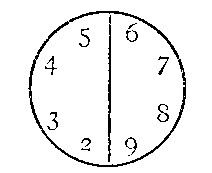
The circle is the naught; its vertical diameter line is the first or primal One [the Word or Logos], from which spring the 2, the 3, and so on to 9, the limit of the digits. The 10 is the first Divine Manifestation,67 which contains every possible power of exact expression of proportion—the sacred Jod. By this Cabbalah we are taught that these Sephiroth were the numbers or emanations of the heavenly Light (20612 to 6561), they were the 10 Words, DBRIM, 41224, the light of which they were the flux was the Heavenly man, the Adam-KDM (the 144-144); and the Light, by the New Testament or Covenant (41224) created God; just as by the Old Testament God (Alhim, 31415) creates Light (20612 to 6561).68
[pg 041]
Now there are three kinds of Light in Occultism, as in the Kabalah. (1) The Abstract and Absolute Light, which is Darkness; (2) The Light of the Manifested-Unmanifested, called by some the Logos: and (3) The latter Light reflected in the Dhyân Chohans, the minor Logoi—the Elohim, collectively—who, in their turn, shed it on the objective Universe. But in the Kabalah—reëdited and carefully adjusted to fit the Christian tenets by the Kabalists of the thirteenth century—the three Lights are described as: (1) The clear and penetrating, that of Jehovah; (2) reflected light; and (3) light in the abstract.
This Light, abstractly taken, (in a metaphysical or symbolical sense) is Alhim (Elohim, God), while the clear penetrating Light is Jehovah. The light of Alhim belongs to the world in general, in its allness and general fulness, but the light of Jehovah is that pertaining to the chiefest production, man, whom this light penetrated to and made.69
The author of the Source of Measures pertinently refers the reader to Inman's Ancient Faiths Embodied in Ancient Names, ii. 648. There, an engraving of
The vesica piscis, Mary, and the female emblem, copied from a Rosary of the blessed Virgin Mary, which was printed at Venice, 1542,
and therefore, as Inman remarks, “with a licence from the Inquisition, and consequently orthodox,” will show the reader what the Latin Church understood by this “penetrating power of light and its effects.” How sadly disfigured—applied as they were to the grossest anthropomorphic conceptions—have, under Christian interpretation, become the noblest and grandest, as the most exalted, ideas of Deity of the Eastern Philosophy!
The Occultists in the East call this Light Daiviprakriti, and in the West the Light of Christos. It is the Light of the Logos, the direct reflection of the ever Unknowable on the plane of Universal Manifestation. But here is the interpretation thereof given by the modern Christians from the Kabalah. As declared by the author just cited;
To the fulness of the world in general with its chiefest content, man, the term Elohim-Jehovah applies. In extracts from Sohar, the Rev. Dr. Cassell [a Kabalist], to prove that the Cabbalah sets forth the doctrine of the Trinity, among other things says: “Jehovah is Elohim (Alhim)” ... By three steps God, (Alhim) and Jehovah become the same, and though separated, each and together they are of the same One.70
Similarly, Vishnu becomes the Sun, the visible symbol of the Impersonal [pg 042] Deity. Vishnu is described as “striding through the seven regions of the Universe in three steps.” But with the Hindûs this is an exoteric account, a surface tenet and an allegory, while the Kabalists give it out as the Esoteric and final meaning. But to proceed:
Now Light, as shown, is 20612 to 6561, as the proper enunciation of the integral and numerical relation of diameter to circumference of a circle. God (Alhim, that is, 31415 to One, a modified form of the above) is the reduction of this, so as to obtain a standard unit One, as the basis, in general, of all calculation and all mensuration. But for the production of animal life, and for especial time measure, or the lunar year, that influence which causes conception and embryotic development, the numbers of the Jehovah measure (the “man even Jehovah” measure), viz., 113 to 355, have to be specialized.71 But this last ratio is but a modified form of Light, or 20612 to 6561, as a pi value, being only a variation of the same (that is 20612 to 6561 is 31415 to one, and 355 to 113 is 31415 or Alhim or God), and in such a manner that one can be made to flow into and be derived from the other:—and these are the three steps by which the Unity and sameness can be shown of the Divine names. That is, the two are but variations of the same ratio, viz., that of pi. The object of this comment is to show the same symbolic measuring use for the Cabbalah, as taught, with that of the Three Covenants of the Bible, and with that of Masonry as just noticed.
First, then, the Sephiroth are described as Light, that is, they themselves are a function of, indeed, the same as, the manifestation of the Ain Soph; and they are so from the fact that “Light” represents the ratio 20612 to 6561, as part of the “Words,” DBRIM, 41224, or, as to the Word, Dabar, 206 (= 10 cubits). “Light” is so much the burden of the Cabbalah as to explaining the Sephiroth, that the most famous book on the Cabbalah is called Sohar, or “Light.” In this we find expressions of this kind: “The infinite was entirely unknown and diffused no light before the luminous point violently broke through into vision.” “When He first assumed the form (of the crown, or the first Sephira), He caused 9 splendid lights to emanate from it, which, shining through it, diffused a bright light in all directions:”—that is, these 9 with his one (which was the origin, as above, of the 9), together, made the 10, that is [Symbol: circle with vertical line through it], or [Symbol: circle with “x” inside], or the sacred Ten (numbers or Sephiroth), or Jod—and these numbers were “the Light.” Just as in the Gospel of St. John, God (Alhim, 31415 to one) was that Light (20612 to 6561) by which (Light) all things were made.72
In the Sepher Yetzirah, or “Number of Creation,” the whole process of evolution is given out in numbers. In its “thirty-two Paths of Wisdom” the number 3 is repeated four times, and the number 4 five times. Therefore, the Wisdom of God is contained in numbers (Sephrim or Sephiroth), for Sepher (or S-ph-r when unvowelled) means “to cipher.” And therefore, also, we find Plato stating that the Deity “geometrizes” in fabricating the Universe.
[pg 043]
The Kabalistic book, the Sepher Yetzirah, opens with a statement of the hidden wisdom of Alhim in Sephrim, i.e., the Elohim in the Sephiroth.
In thirty and two paths, hidden wisdom, established Jah, IHVH, Tzabaoth, Elohi of Israel, Alhim of Life, El of Grace and Mercy—exalted uplifted Dweller on high, and King of Everlasting, and His name—Holy! in Three Sephrim, viz.:
B—S'ph-r, V—S'ph-r, V—Siph-o-r.
Mr. Ralston Skinner goes on to say:
This comment sets forth the “hidden wisdom” of the original text by hidden wisdom, that is, by the use of words carrying a special set of numbers and a special phraseology, which will set forth the very explanatory system which we find to fit so accurately in the Hebrew Bible.... In setting forth his scheme, to enforce it, and to finish out his detailed exposition in a general postulate,—viz., the one word “Sephrim” (Sephiroth), of the Number Jezirah, the author explains the separation of this word in the three subordinate ones, a play upon a common word, s-ph-r, or number.
The prince Al-Chazari73 says to the Rabbi: “I wish now that thou wouldest impart to me some of the chiefest or leading principles of Natural Philosophy, which, as thou sayest, were in former times worked out by them (the ancient wise ones);”—to which the Rabbi makes answer: “To such principles appertains the Number of Creation of our race-father Abraham” that is Abram and Abraham, or numbers 41224 and 41252. He then says that this book of number treats of teaching the “Alhim-ness and One-ness through (DBRIM)” viz., the numbers of the word “Words.” That is, it teaches the use of the ratio 31415 to One, through 41224, which last, in the description of the Ark of the Covenant, was divided into two parts by the two tables of stone, on which these DBRIM, or 41224, were written or engraved—or 20612 × 2. He then comments on these three subordinately used words, and takes care as to one of them to make the comment, “and Alhim (31415 to One) said let there be Light (20612 to 6561).”
The words as given in the text are:
ספר ספר סיפור
and the Rabbi, in commenting upon them, says: “It teaches the Alhim-ness (31415) and One-ness (the diameter to Alhim), through Words (DBRIM = 41224), by which on the one side there is infinite expression in heterogeneous creations, and on the other a final harmonic tendency to One-ness” (which, as everyone knows, is the mathematical function of pi of the schools, which measures, weighs, and numbers the stars of heaven, and yet resolves them back into the final oneness of the Uni-verse) “through Words. Their final accord perfects itself in that One-ness that ordains them, and which consists in
ספר ספר ספור ”
that is, the Rabbi, in his first comment, leaves the jod, or i, out of one of the words, whereas afterwards he restores it again. If we take the values of those subordinate [pg 044]words, we find them to be 340, 340 and 346;—together these are 1026, and the division of the general word into these has been to produce these numbers—which by T'mura may be changed in various ways, for various purposes.74
The reader is asked to turn to Stanza IV of Volume I, Shloka 3 and Commentary,75 to find that the 3, 4, (7), and the thrice seven, or 1065, the number of Jehovah, is the number of the 21 Prajâpati mentioned in the Mahâbhârata, or the three Sephrim (words in ciphers or figures). And this comparison between the Creative Powers of Archaic Philosophy and the anthropomorphic Creator of exoteric Judaism (since the Esotericism of the Jews shows its identity with the Secret Doctrine) will lead the student to perceive and discover that, in truth, Jehovah is but a “lunar” and “generation” God. It is a fact well known to every conscientious student of the Kabalah, that the deeper he dives into it, the more he feels convinced that unless the Kabalah—or what is left of it—is read by the light of the Eastern Esoteric Philosophy, its study leads only to the discovery that, on the lines traced by exoteric Judaism and Christianity, the monotheism of both is nothing more exalted than ancient Astrolatry, now vindicated by modern Astronomy. The Kabalists never cease to repeat that Primal Intelligence can never be understood. It cannot be comprehended, nor can it be located, therefore it has to remain nameless and negative. Hence the Ain Suph—the “Unknowable” and “Unnameable”—as It could not be made manifest, was imagined as emanating Manifesting Powers. It is then with its Emanations alone that human intellect has to, and can, deal. Christian theology, having rejected the doctrine of Emanations and replaced them with direct, conscious Creations of Angels and the rest out of nothing, now finds itself hopelessly stranded between Supernaturalism, or Miracle, and Materialism. An extra-cosmic God is fatal to Philosophy: an intra-cosmic Deity—i.e., Spirit and Matter inseparable from each other—is a philosophical necessity. Separate them and that which is left is a gross superstition under a mask of emotionalism. But why “geometrize,” as Plato has it, why represent these Emanations under the form of an immense arithmetical table? The question is well answered by the author just cited, who says:
Mental perception, to become physical perception, must have the cosmic principle of Light:—and, by this, our mental circle must become visible through light; or, for its complete manifestation, the circle must be that of physical visibility, or Light itself.
[pg 045]
Such conceptions, thus formulated, became the ground-work of the philosophy of the Divine manifesting in the universe.76
This is Philosophy. It is otherwise when we find the Rabbi in Al-Chazari saying that:
Under s'ph-r is to be understood—calculation and weighing of the created bodies. For the calculation, by means of which a body must be constructed in harmony or symmetry, by which it must be in construction rightly arranged and made to correspond to the object in design, consists at last in number, extension, mass, weight;—co-ordinate relation of movements, then harmony of music, must consist altogether by number, that is s'ph-r.... By Sippor (s'phor) is to be understood the words of Alhim (206—1 of 31415 to one), whereunto joins or adapts itself the design to the frame or form of construction; for example—it was said “Let Light be.” The work became as the words were spoken, that is, as the numbers of the work came forth.77
This is materializing the spiritual without scruple. But the Kabalah was not always so well adapted to anthropo-monotheistic conceptions. Compare this with any of the six schools of India. For instance in Kapila's Sânkhya Philosophy, unless, allegorically speaking, Purusha mounts on the shoulders of Prakriti, the latter remains irrational, while the former remains inactive without her. Therefore Nature (in man) must become a compound of Spirit and Matter before he becomes what he is; and the Spirit latent in Matter must be awakened to life and consciousness gradually. The Monad has to pass through its mineral, vegetable and animal forms, before the Light of the Logos is awakened in the animal man. Therefore, till then, the latter cannot be referred to as “man,” but has to be regarded as a Monad imprisoned in ever-changing forms. Evolution, not Creation, by means of Words is recognized in the Philosophies of the East, even in their exoteric records. Ex oriente lux. Even the name of the first man in the Mosaic Bible had its origin in India, Professor Max Müller's negation notwithstanding. The Jews got their Adam from Chaldæa; and Adam-Adami is a compound word and therefore a manifold symbol, and proves the Occult dogmas.
This is no place for philological disquisitions. But the reader may be reminded that the words Ad and Adi mean in Sanskrit the “first”; in Aramæan, “one” (Ad-ad, the “only one”); in Assyrian, “Father,” whence Ak-ad or “father-creator.”78 And once the statement is found [pg 046] correct, it becomes rather difficult to confine Adam to the Mosaic Bible alone, and to see therein simply a Jewish name.
There is frequent confusion in the attributes and genealogies of the Gods in their Theogonies, the Alpha and the Omega of the records of that symbolical science, as given to the world by the half-initiated writers, Brâhmanical and Biblical. Yet there could be no such confusion made by the earliest nations, the descendants and pupils of the Divine Instructors; for both the attributes and the genealogies were inseparably linked with cosmogonical symbols, the “Gods” being the life and animating “soul-principle” of the various regions of the Universe. Nowhere and by no people was speculation allowed to range beyond those manifested Gods. The boundless and infinite Unity remained with every nation a virgin forbidden soil, untrodden by man's thought, untouched by fruitless speculation. The only reference made to it was the brief conception of its diastolic and systolic property, of its periodical expansion, or dilatation, and contraction. In the Universe, with all its incalculable myriads of Systems and Worlds disappearing and reäppearing in eternity, the anthropomorphized Powers, or Gods, their Souls, had to disappear from view with their Bodies. As our Catechism says:
“The Breath returning to the Eternal Bosom which exhales and inhales them.”
Ideal Nature, the Abstract Space in which everything in the Universe is mysteriously and invisibly generated, is the same female side of the procreative power in Nature in the Vedic as in every other Cosmogony. Aditi is Sephira, and the Sophia of the Gnostics, and Isis, the Virgin Mother of Horus. In every Cosmogony, behind and higher than the “Creative” Deity, there is a Superior Deity, a Planner, an Architect, of whom the Creator is but the executive agent. And still higher, over and around, within and without, there is the Unknowable and the Unknown, the Source and Cause of all these Emanations.
It thus becomes easy to account for the reason why Adam-Adami is found in the Chaldæan scripture, certainly earlier than the Mosaic Books. In Assyrian Ad is the “father,” and in Aramæan Ad is “one,” and Ad-ad the “only one,” while Ak is in Assyrian “creator.” Thus [pg 047] Ad-am-ak-ad-mon became Adam-Kadmon in the Kabalah (Zohar), meaning as it did, the “One (Son) of the divine Father, or the Creator,” for the words am and om meant at one time in nearly every language the divine, or the deity. Thus Adam-Kadmon and Adam-Adami came to mean “The first Emanation of the Father-Mother or Divine Nature,” and literally the “first Divine One.” And it is easy to see that Ad-Argat (or Aster't, the Syrian Goddess, the consort of Ad-on, the Lord God of Syria or the Jewish Adonai), and Venus, Isis, Ister, Mylitta, Eve, etc., are identical with the Aditi and Vâch of the Hindûs. They are all the “Mothers of all living” and “of the Gods.” On the other hand—cosmically and astronomically—all the male Gods became at first “Sun-Gods,” then, theologically, the “Suns of Righteousness,” and the Logoi, all symbolized by the Sun.79 They are all Protogonoi—First-born—and Mikroprosopoi. With the Jews Adam-Kadmon was the same as Athamaz, Tamaz, or the Adonis of the Greeks—“the One with, and of his Father”—the “Father” becoming during the later Races Helios, the Sun, as Apollo Karneios,80 for instance, who was the “Sun-born”; Osiris, Ormazd, and so on, were all followed by, and found themselves transformed later on into, still more earthly types: such as Prometheus, the crucified of Mount Kajbee, Hercules, and so many others, Sun-Gods and Heroes, until all of them came to have no better significance than phallic symbols.
In the Zohar it is said:
Man was created by the Sephiroth (Elohim-Javeh, also) and they engendered by common power the earthly Adam.
Therefore in Genesis the Elohim say: “Behold Man is become as one of us.” But in Hindû Cosmogony or “Creation,” Brahmâ-Prajâpati creates Virâj and the Rishis, spiritually; therefore the latter are distinctly [pg 048] called the “Mind-born Sons of Brahmâ”; and this specified mode of engendering precluded every idea of Phallicism, at any rate in the earlier human nations. This instance well illustrates the respective spirituality of the two nations.
3. Said the Lord of the Shining Face: “I shall send thee a Fire when thy work is commenced. Raise thy voice to other Lokas; apply to thy Father, the Lord of the Lotus81 (a), for his Sons.... Thy People shall be under the rule of the Fathers.82 Thy Men shall be mortals. The Men of the Lord of Wisdom,83 not the Sons of Soma,84 are immortal. Cease thy complaints (b). Thy Seven Skins are yet on thee.... Thou art not ready. Thy Men are not ready” (c).
(a) Kumuda-Pati is the Moon, the Earth's parent, in his region of Soma-loka. Though the Pitris, or Fathers, are Sons of the Gods, elsewhere Sons of Brahmâ and even Rishis, they are generally known as the Lunar Ancestors.
(b) Pitri-Pati is the Lord or King of the Pitris, Yama, the God of Death and the Judge of mortals. The men of Budha, Mercury, are metaphorically “immortal” through their Wisdom. Such is the common belief of those who credit every Star or Planet with being inhabited—and there are men of Science, M. Flammarion among others, who believe in this fervently, on logical as well as on astronomical data. The Moon being an inferior body—even to the Earth, to say nothing of other Planets, the terrestrial men produced by her Sons—the Lunar Men or Ancestors—from her shell or body, cannot be immortal. They cannot hope to become real, self-conscious and intelligent men, unless they are “finished,” so to say, by other creators. Thus in the Purânic legend, the son of the Moon (Soma) is Budha (Mercury), the intelligent and the wise, because he is the offspring of Soma, the Regent of the visible Moon, not of Indu, the physical Moon. Thus Mercury is the elder brother of the Earth, metaphorically—his step-brother, so to say, the offspring of Spirit—while she (the Earth) is the progeny of the Body. These allegories have a deeper and more scientific meaning—astronomically and geologically—than our modern [pg 049] Physicists are willing to admit. The whole cycle of the first “War in Heaven,” the Târakâ-maya, is as full of philosophical as of cosmogonical and astronomical truths. One can trace therein the biographies of all the Planets by the history of their Gods and Rulers. Ushanas (Shukra, or Venus), the bosom-friend of Soma and the foe of Brihaspati (Jupiter), the “Instructor of the Gods,” whose wife Târâ, or Tarakâ, had been carried away by the Moon, Soma—“of whom he begat Budha”—took also an active part in this war against the “Gods” and forthwith was degraded into a Demon (Asura) Deity, and so he remains to this day.85
Here the word “men” refers to the Celestial men, or what are called in India the Pitaras or Pitris, the Fathers, the Progenitors of men. This does not remove the seeming difficulty, in view of modern hypotheses, of the teaching, which shows these Progenitors or Ancestors creating the first human Adams out of their sides, as astral shadows. And though it is an improvement on Adam's rib, still geological and climatic difficulties will be brought forward. Such, however, is the teaching of Occultism.
(c) Man's organism was adapted in every Race to its surroundings. The first Root-Race was as ethereal as ours is material. The progeny of the Seven Creators, who evolved the Seven Primordial Adams,86 surely required no purified gases to breathe and live upon. Therefore, however strongly the impossibility of this teaching may be urged by the devotees of Modern Science, the Occultist maintains that the case was as stated æons of years before even the evolution of the Lemurian, the first physical man, which took place 18,000,000 years ago. [pg 050] Archaic Scripture teaches that at the commencement of every local Kalpa, or Round, the Earth is reborn, and preliminary evolution is described in one of the Books of Dzyan and the Commentaries thereon in this wise:
“As the human Jîva [Monad], when passing into a new womb, gets recovered with a new body, so does the Jîva of the Earth; it gets a more perfect and solid covering with each Round after reëmerging once more from the matrix of space into objectivity.”
This process is attended, of course, by the throes of the new birth, or geological convulsions.
The only reference to it is contained in one verse of the volume of the Book of Dzyan before us, where it says:
4. After great throes she87 cast off her old Three and put on her new Seven Skins, and stood in her first one.
This refers to the growth of the Earth, whereas in the Stanza treating of the First Round it is said in the Commentary:
“After the changeless [Avikâra] immutable Nature [Essence, Sadaikarûpa] had awakened and changed [differentiated] into [a state of] causality [Avyakta], and from cause [Kârana] had become its own discrete effect [Vyakta], from invisible it became visible. The smallest of the small [the most atomic of atoms, or anîyânsam anîyasâm] became one and the many [Ekânekarûpa]; and producing the Universe produced also the fourth Loka [our Earth] in the garland of the seven lotuses. The Achyuta then became the Chyuta.”88
The Earth is said to cast off “her old three” Skins, because this refers to the three preceding Rounds she has already passed through; the present being the Fourth Round out of the seven. At the beginning of every new Round, after a period of Obscuration, the Earth—as do also the other six “Earths”—casts off, or is supposed to cast off, her old Skins as the Serpent does; therefore she is called in the Aitareya-Brâhmana the Sarpa-Râjnî, the “Queen of the Serpents,” and “the mother of all that moves.” The “Seven Skins,” in the first of which she now stands, refer to the seven geological changes which [pg 051] accompany and correspond to the evolution of the Seven Root-Races of Humanity.
Stanza II, which speaks of this Round, begins with a few words of information concerning the age of our Earth. The chronology will be given in its place. In the Commentary appended to the Stanza, two personages are mentioned, Nârada and Asuramaya, especially the latter. All the calculations are attributed to this archaic celebrity; and what follows will make the reader superficially acquainted with some of these figures.
64.
65.
66.
67.
68.
69.
70.
71.
72.
73.
74.
75.
76.
77.
78.
79.
80.
81.
82.
83.
84.
85.
86.
87.
88.
Two Antediluvian Astronomers.
To the mind of the Eastern student of Occultism, two figures are indissolubly connected with mystic Astronomy, Chronology, and their cycles. Two grand and mysterious figures, towering like two giants in the Archaic Past, emerge before him, whenever he has to refer to Yugas and Kalpas. When, at what period of pre-history they lived, none save a few men in the world know, or ever can know, with that certainty which is required by exact chronology. It may have been 100,000 years ago, it may have been 1,000,000, for all that the outside world will ever know. The mystic West and Freemasonry talk loudly of Enoch and Hermes. The mystic East speaks of Nârada, the old Vedic Rishi, and of Asuramaya, the Atlantean.
It has already been hinted that of all the incomprehensible characters in the Mahâbhârata and the Purânas, Nârada, the son of Brahmâ in the Matsya Purâna, the progeny of Kashyapa and the daughter of Daksha, in the Vishnu Purâna, is the most mysterious. He is referred to by the honourable title of Deva-Rishi (Divine Rishi, rather than Demi-God) by Parâshara, and yet he is cursed by Daksha and even by Brahmâ. He informs Kansha that Bhagavân, or Vishnu in exotericism, would incarnate in the eighth child of Devakî, and thus brings the wrath of the Indian Herod upon Krishna's mother; and then, from the cloud on which he is seated—invisible as a true Mânasaputra—he lauds Krishna, in delight at the Avatâr's feat of killing the monster Keshin. Nârada is here, there, and everywhere; and yet, none of the Purânas gives the true characteristics of this great enemy of physical procreation. Whatever those characteristics may be in Hindû Esotericism, Nârada—who is called in Cis-Himâlayan Occultism Pesh-Hun, the “Messenger,” or the Greek Angelos—is the sole confidant [pg 052] and the executor of the universal decrees of Karma and Adi-Budha: a kind of active and ever-incarnating Logos, who leads and guides human affairs from the beginning to the end of the Kalpa.
Pesh-Hun is a general not a special Hindû possession. He is the mysterious guiding intelligent power, which gives the impulse to, and regulates the impetus of Cycles, Kalpas and universal events.89 He is Karma's visible adjuster on a general scale; the inspirer and the leader of the greatest heroes of this Manvantara. In the exoteric works he is referred to by some very uncomplimentary names; such as Kali-kâraka, Strife-maker, Kapi-vaktra, Monkey-faced, and even Pishuna, the Spy, though elsewhere he is called Deva-Brahmâ. Even Sir William Jones was strongly impressed with this mysterious character from what he gathered in his Sanskrit studies. He compares him to Hermes and Mercury, and calls him “the eloquent messenger of the gods.”90 All this, besides the fact that the Hindûs believe him to be a great Rishi, “who is for ever wandering about the earth, giving good counsel,” led the late Dr. Kenealy91 to see in him one of his twelve Messiahs. He was, perhaps, not so far off the real track as some imagine.
What Nârada really is, cannot be explained in print; nor would the modern generations of the profane gather much from the information. But it may be remarked, that if there be in the Hindû Pantheon a Deity which resembles Jehovah, in tempting by “suggestion” of thoughts, and “hardening” of the hearts of those whom he would make his tools and victims, it is Nârada. Only with the latter it is no desire to obtain a pretext for “plaguing,” and thus showing that “I am the Lord God.” Nor is it through any ambitious or selfish motive; but, verily, to serve and guide universal progress and evolution.
Nârada is one of the few prominent characters, if we except some Gods, in the Purânas, who visit the so-called nether or infernal regions, Pâtâla. Whether or not it was from his intercourse with the thousand-headed Shesha, the Serpent who bears the Seven Pâtâlas and the entire world like a diadem upon his heads, and who is the great teacher of Astronomy,92 that Nârada learned all that he knew, certain [pg 053] it is that he surpasses Garga's Guru in his knowledge of cyclic intricacies. It is he who has charge of our progress and national weal or woe. It is he who brings on wars and puts an end to them. In the old Stanzas, Pesh-Hun is credited with having calculated and recorded all the astronomical and cosmic Cycles to come, and with having taught the Science to the first gazers at the starry vault. And it is Asuramaya, who is said to have based all his astronomical works upon those records, to have determined the duration of all the past geological and cosmical periods, and the length of all the Cycles to come, till the end of this Life-Cycle, or the end of the Seventh Race.
There is a work among the Secret Books, called the Mirror of Futurity, wherein all the Kalpas within Kalpas, and Cycles within the bosom of Shesha, or infinite Time, are recorded. This work is ascribed to Pesh-Hun-Nârada. There is another old work which is attributed to various Atlanteans. It is these two records which furnish us with the figures of our Cycles, and the possibility of calculating the date of Cycles to come. The chronological calculations which will presently be given are, however, those of the Brâhmans, as explained further on: but most of them are also those of the Secret Doctrine.
The chronology and computations of the Brâhman Initiates are based upon the zodiacal records of India, and the works of the above-mentioned Astronomer and Magician—Asuramaya. The Atlantean zodiacal records cannot err, as they were compiled under the guidance of those who first taught Astronomy, among other things, to mankind.
But here again we are deliberately and recklessly facing a new difficulty. We shall be told that our statement is contradicted by Science, in the person of a man regarded as a great authority (in the West) upon all subjects of Sanskrit literature—Professor Albrecht Weber, of Berlin. This, to our great regret, cannot be helped; and we are ready to maintain what is now stated. Asuramaya, to whom the epic tradition points as the earliest Astronomer in Âryâvarta, one to whom “the Sun-God imparted the knowledge of the stars,” in propriâ personâ, as Dr. Weber himself states, is identified by him, in some very mysterious way, with the “Ptolemaios” of the Greeks. No more valid reason is given for this identification than that:
This latter name (Ptolemaios), as we see from the inscription of Piyadasi, became the Indian “Turamaya,” out of which the name “Asura Maya” might very easily grow.
No doubt it “might,” but the vital question is: Are there any good [pg 054] proofs that it has thus grown? The only evidence that is given for this is, that it must be so:
Since ... this Maya is distinctly assigned to Romaka-pura in the West.93
The Mâyâ is evident, since no Sanskritist among Europeans can tell where that locality of Romaka-pura was, except, indeed, that it was somewhere “in the West.” In any case, as no member of the Asiatic Society, or Western Orientalist, will ever listen to a Brâhmanical teaching, it is useless to take the objections of European Orientalists into consideration. Romaka-pura was “in the West,” certainly, since it was part and parcel of the lost continent of Atlantis. And it is equally certain that it is Atlantis, to which is assigned in the Hindû Purânas the birth-place of Asuramaya, “as great a Magician as he was an Astrologer and an Astronomer.” Moreover, Prof. Weber refuses to assign any great antiquity to the Indian Zodiac, and feels inclined to think that the Hindûs never knew of a Zodiac at all till
They had borrowed one from the Greeks.94
This statement clashes with the most ancient traditions of India, and must therefore be ignored. We are the more justified in ignoring it, as the learned German Professor himself tells us in the introduction to his work, that:
In addition to the natural obstacles which impede investigation [in India], there still prevails a dense mist of prejudice and preconceived opinions hovering over the land, and enfolding it as with a veil.95
Caught in that veil, it is no wonder that Dr. Weber should himself have been led into involuntary errors. Let us hope that he knows better now.
Now whether Asuramaya is to be considered a modern myth, a personage who flourished in the day of the Macedonian Greeks, or that which he is claimed to be by the Occultists, in any case his calculations agree entirely with those of the Secret Records.
From fragments of immensely old works attributed to the Atlantean Astronomer, and found in Southern India, the calendar elsewhere mentioned was compiled by two very learned Brâhmans96 in 1884 and 1885. The work is proclaimed by the best Pandits as faultless—from the [pg 055] Brâhmanical standpoint—and thus far relates to the chronology of the orthodox teachings. If we compare its statements with those made several years earlier in Isis Unveiled, with the fragmentary teachings published by some Theosophists, and with the present data derived from the Secret Books of Occultism, the whole will be found to agree perfectly, save in some details which may not be explained; for secrets of higher Initiation—as unknown to the writer as they are to the reader—would have to be revealed, and that cannot be done.
89.
90.
91.
92.
93.
94.
95.
96.
Stanza II. Nature Unaided Fails.
5. After enormous periods the Earth creates monsters. 6. The “Creators” are displeased. 7. They dry the Earth. 8. The forms are destroyed by them. 9. The first great tides. 10. The beginning of incrustation.
5. The Wheel whirled for thirty crores more.97 It constructed Rûpas;98 soft Stones that hardened,99 hard plants that softened.100 Visible from invisible, Insects and small Lives.101 She102 shook them off her back whenever they overran the Mother (a).... After thirty crores, she turned round. She lay on her back; on her side.... She would call no Sons of Heaven, she would ask no Sons of Wisdom. She created from her own bosom. She evolved Water-Men, terrible and bad (b).
(a) This relates to an inclination of the axis—of which there were several—to a consequent deluge and chaos on Earth (having, however, no reference to Primeval Chaos), in which monsters, half-human, half-animal, were generated. We find it mentioned in the Book of the Dead, and also in the Chaldæan account of creation, on the Cutha Tablets, however mutilated.
It is not even allegory. Here we have facts, that are found repeated [pg 056] in the account of the Pymander, as well as in the Chaldæan tablets of creation. The verses may almost be checked by the Cosmogony, as given by Berosus, which has been disfigured out of recognition by Eusebius, but some of the features of which may yet be found in fragments left by ancient Greek authors—Apollodorus, Alexander Polyhistor, etc. “The water-men terrible and bad”—who were the production of Physical Nature alone, a result of the “evolutionary impulse” and the first attempt to create “man,” the crown, and the aim and goal of all animal life on Earth—are shown to be failures in our Stanzas. Do we not find the same in the Berosian Cosmogony, denounced with such vehemence as the culmination of heathen absurdity? And yet who of the Evolutionists can say that things in the beginning have not come to pass as they are described? That, as maintained in the Purânas, the Egyptian and Chaldæan fragments, and even in Genesis, there have not been two, and even more, “creations,” before the last formation of the Globe; which, changing its geological and atmospheric conditions, changed also its flora, its fauna, and its men? This claim agrees not only with every ancient Cosmogony, but also with Modern Science, and even, to a certain degree, with the theory of evolution, as may be demonstrated in a few words.
There is no “Dark Creation,” no “Evil Dragon” conquered by a Sun-God, in the earliest World-Cosmogonies. Even with the Akkads, the Great Deep—the Watery Abyss, or Space—was the birthplace and abode of Ea, Wisdom, the incognizable infinite Deity. But with the Semites and the later Chaldæans, the fathomless Deep of Wisdom becomes gross Matter, sinful substance, and Ea is changed into Tiamat, the Dragon slain by Merodach, or Satan, in the astral waves.
In the Hindû Purânas, Brahmâ, the Creator, is seen recommencing de novo several “Creations” after as many failures; and two great Creations are mentioned,103 the Pâdma and the Vârâha, the present, when the Earth was lifted out of the water by Brahmâ, in the shape of a Boar, the Varâha Avatâra. Creation is shown as a sport, an amusement (Lîlâ) of the Creative God. The Zohar speaks of primordial worlds, which perished as soon as they came into existence. And the same is said in the Midraish, Rabbi Abahu explaining distinctly104 that “the Holy One” had successively created and destroyed sundry Worlds, before he succeeded in the present one. This does not relate only to [pg 057] other Worlds in Space, but to a mystery of our own Globe contained in the allegory about the “Kings of Edom.” For the words, “This one pleases me,” are repeated in Genesis,105 though in disfigured terms, as usual. The Chaldæan fragments of Cosmogony in the cuneiform inscriptions, and elsewhere, show two distinct creations of animals and men, the first being destroyed, as it was a failure. The Cosmogonical tablets prove that this our actual creation was preceded by others;106 and as shown by the author of The Qabbalah, in the Zohar, Siphra Dtzenioutha, in Jovah Rabba, 128a, etc., the Kabalah states the same.
(b) Oannes, or Dagon, the Chaldæan “Man-fish,” divides his Cosmogony and Genesis into two portions. First the abyss of waters and darkness, wherein resided most hideous beings—men with wings, four and two-winged men, human beings with two heads, with the legs and horns of a goat—our “goat-men”107—hippocentaurs, bulls with the heads of men, and dogs with tails of fishes. In short, combinations of various animals and men, of fishes, reptiles and other monstrous animals, assuming each other's shapes and countenances. The feminine element they resided in is personified by Thalatth—the Sea, or “Water”—which was finally conquered by Belus, the male principle. And Polyhistor says:
Belus came, and cut the woman asunder; and of one half of her he formed the earth, and of the other half the heavens; and at the same time destroyed the animals within her.108
As pertinently remarked by Isaac Myer:
With the Akkadians each object and power of Nature had its Zi or Spirit. The Akkadians formed their deities into triads, usually of males [sexless, rather?], the Semites also had triadic deities, but introduced sex109
—or phallicism. With the Âryan and the earliest Akkadians all things [pg 058] are emanations through, not by, a Creator or Logos. With the Semites everything is begotten.
6. The Water-Men, terrible and bad, she herself created from the remains of others.110 From the dross and slime of her First, Second, and Third,111 she formed them. The Dhyâni came and looked.... the Dhyâni from the bright Father-Mother, from the White112 Regions they113 came, from the Abodes of the Immortal Mortals (a).
(a) The explanations given in our Stanzas are far more clear than that which the legend of creation from the Cutha tablet would give, even were it complete. What is preserved on it, however, corroborates them. For, in the tablet, the “Lord of Angels” destroys the men in the abyss, when “there were not left the carcases and waste” after they were slaughtered. After which they, the Great Gods, create men with the bodies of birds of the desert, human beings, “seven kings, brothers of the same family,” etc., which is a reference to the locomotive qualities of the primary ethereal bodies of men, which could fly as well as they could walk,114 but who “were destroyed” because they were not “perfect,” i.e., they “were sexless, like the Kings of Edom.”
Weeded of metaphors and allegories, what will Science say to this idea of a primordial creation of species? It will object to the “Angels” and “Spirits” having anything to do therewith; but if it be Nature and the physical law of evolution that are the creators of all there is now on Earth, why could there be “no such abyss,” when the Globe was covered with waters, in which numbers of monstrous beings were generated? Is it the “human beings” and animals with human heads and double faces, which are a point of the objection? But if man is only a higher animal and has evolved from the brute species by an infinite series of transformations, why could not the “missing links” have had human heads attached to the bodies of animals, or, being two-headed, have heads of beasts and vice versâ, in Nature's early efforts? Are we not shown, during the geological periods, in the ages [pg 059] of the reptiles and the mammalia, lizards with birds' wings, and serpents' heads on animal bodies?115 And, arguing from the standpoint of Science, does not even our modern human race occasionally furnish us with monster-specimens: two-headed children, animal bodies with human heads, dog-headed babies, etc.? And this proves that, if Nature will still play such freaks now that she has been settled for ages in the order of her evolutionary work, monsters, like those described by Berosus, were a possibility in her opening programme; a possibility which may even have existed once upon a time as a law, before she sorted out her species and began regular work upon them. And this indeed now admits of definite proof by the bare fact of “Reversion,” as Science puts it.
This is what the Doctrine teaches, and demonstrates by numerous proofs. But we shall not wait for the approval of either dogmatic Theology or Materialistic Science, but proceed with the Stanzas. Let these speak for themselves, with the help of the light thrown on them by the Commentaries and their explanations; the scientific aspect of these questions will be considered later on.
Thus Physical Nature, when left to herself in the creation of animal and man, is shown to have failed. She can produce the first two kingdoms, as well as that of the lower animals, but when it comes to the turn of man, spiritual, independent and intelligent powers are required for his creation, besides the “coats of skin” and the “breath of animal life.” The human Monads of preceding Rounds need something higher than purely physical materials with which to build their personalities, under the penalty of remaining even below any “Frankenstein” animal.116
[pg 060]
7. Displeased they were. “Our Flesh is not there.117 No fit Rûpas for our Brothers of the Fifth. No Dwellings for the Lives.118 Pure Waters, not turbid, they must drink (a). Let us dry them.”119
(a) Says the Catechism on the Commentaries:
It is from the material Worlds that descend they, who fashion physical man at the new Manvantaras. They are inferior Lha [Spirits], possessed of a dual body [an Astral within an Ethereal Form]. They are the fashioners and creators of our body of illusion....
Into the forms projected by the Lha [Pitris] the Two Letters120 [the Monad, called also the “Double Dragon”] descend from the Spheres of Expectation.121But they are like a roof with no walls, nor pillars to rest upon....
Man needs four Flames and three Fires to become one on Earth, and he requires the essence of the forty-nine Fires122 to be perfect. It is those who have deserted the Superior Spheres, the Gods of Will,123 who complete the Manu of illusion. For the “Double Dragon” has no hold upon the mere form. It is like the breeze where there is no tree or branch to receive and harbour it. It cannot affect the form where there is no agent of transmission [Manas, “Mind”] and the form knows it not.
In the highest worlds, the three are one,124 on Earth [at first] the one becomes two. They are like the two [side] lines of a triangle that has lost its bottom line—which is the third Fire.125
Now this requires some explanation before proceeding any further. To do so especially for the benefit of our Âryan Hindû brethren—whose Esoteric interpretations may differ from our own—we shall have to explain to them the foregoing by certain passages in their own exoteric [pg 061] books, namely, the Purânas. In the allegories of the latter, Brahmâ, who is collectively the Creative Force of the Universe, is thus described:
At the beginning of the Yugas [Cycles] ... possessed of the desire and of the power to create, and impelled by the potencies of what is to be created, again and again does he, at the outset of a Kalpa, put forth a similar creation.126
It is now proposed to examine the exoteric account in the Vishnu Purâna, and see how much it may agree or disagree with our Occult version.
Creation of Divine Beings in the Exoteric Accounts.
In the Vishnu Purâna, which is certainly the earliest of all the scriptures of that name, we find, as in all the others, Brahmâ, as the male God, assuming, for purposes of creation, “four Bodies invested by three qualities.”127 It is said:
In this manner, Maitreya, Jyotsnâ (dawn), Râtri (night), Ahan (day), and Sandhyâ (evening [twilight]) are the four bodies of Brahmâ.128
As Parâshara explains it, when Brahmâ wishes to create the world anew and construct progeny through his will, in the fourfold condition, or the four Orders of Beings, termed Gods (Dhyân Chohans), Demons129 (i.e., more material Devas), Progenitors (Pitris) and Men, “he collects [Yoga-like] his mind into itself” (Yûyuge).
Strange to say, he begins by creating Demons, who thus take precedence over the Angels or Gods. This is no incongruity, nor is it due to inconsistency, but has, like all the rest, a profound Esoteric meaning, quite clear to one free from Christian theological prejudice. He who bears in mind that the principle Mahat, or Intellect, the “Universal Mind” (literally the “Great”), which Esoteric Philosophy explains as the “Manifested Omniscience”—the “first product” of Pradhâna, Primordial Matter, as the Vishnu Purâna says, but the first Cosmic Aspect of Parabrahman or the Esoteric Sat, the Universal Soul,130 as Occultism teaches—is at the root of Self-Consciousness, [pg 062] will understand the reason why. The so-called Demons—who are Esoterically the Self-asserting and intellectually active Principle—are the positive pole of creation, so to say; hence, the first produced. This is in brief the process as narrated allegorically in the Purânas.
Having concentrated his mind into itself and the Quality of Darkness pervading Brahmâ's assumed body, the Asuras, issuing from his Thigh, were first produced; after which, abandoning this body, it was transformed into Night.
Two important points are involved herein: (a) Primarily in the Rig Veda, the Asuras are shown as spiritual divine Beings; their etymology is derived from Asu, breath, the “Breath of God,” and they mean the same as the Supreme Spirit or the Zoroastrian Ahura. It is later on, for purposes of theology and dogma, that they are shown issuing from Brahmâ's Thigh, and that their name began to be derived from a, privative, and Sura, a God, or “not-a-God,” and that they became the enemies of the Gods. (b) Every ancient Theogony without exception—from the Aryan and the Egyptian down to that of Hesiod—in the order of Cosmogonical evolution, places Night before Day; even Genesis, where “darkness is upon the face of the deep” before the “first day.” The reason for this is that every Cosmogony—except in the Secret Doctrine—begins by the “Secondary Creation” so-called; to wit, the Manifested Universe, the Genesis of which has to begin by a marked differentiation between the eternal Light of “Primary Creation,” whose mystery must remain for ever “Darkness” to the prying finite conception and intellect of the profane, and the Secondary Evolution of manifested visible Nature. The Veda contains the whole philosophy of that division, without having ever been correctly explained by our Orientalists, since it has never been understood by them.
Continuing to create, Brahmâ assumes another form, that of the Day, and creates from his Breath the Gods, who are endowed with the Quality of Goodness (Passivity).131 In his next body the Quality of great Passivity prevailed, which is also (negative) goodness, and from the side of that personage issued the Pitris, the Progenitors of men, because, as the text explains, Brahmâ “thought of himself [during the process] as the father of the world.”132 This is Kriyâ-shakti—the [pg 063] mysterious Yoga-power explained elsewhere. This body of Brahmâ when cast off became the Sandhyâ, Evening Twilight, the interval between Day and Night.
Finally Brahmâ assumed his last form pervaded by the Quality of Foulness.
And from this, Men, in whom foulness (or passion) predominates, were produced.
This body when cast off became the Dawn, or Morning Twilight—the Twilight of Humanity. Here Brahmâ stands Esoterically for the Pitris. He is collectively the Pitâ, “Father.”
The true Esoteric meaning of this allegory must now be explained. Brahmâ here symbolizes personally the Collective Creators of the World and Men—the Universe with all its numberless productions of things movable and (seemingly) immovable.133 He is collectively the Prajâpatis, the Lords of Being; and the four bodies typify the four Classes of Creative Powers or Dhyân Chohans, described in the Commentary on Shloka I, Stanza VII, in Volume I. The whole philosophy of the so-called “Creation” of the good and evil in this World, and of the whole Cycle of Manvantaric results therefrom, hangs on the correct comprehension of these Four Bodies of Brahmâ.
The reader will now be prepared to understand the real, the Esoteric significance of what follows. Moreover there is an important point to be cleared up. Christian Theology having arbitrarily settled and agreed that Satan with his Fallen Angels belonged to the earliest creation, Satan being the first-created, the wisest and most beautiful of God's Archangels, the word was given, the key-note struck. Henceforth all the Pagan Scriptures were made to yield the same meaning, and all were shown to be demoniacal, and it was and is claimed that truth and fact belong to, and commence only with, Christianity. Even the Orientalists and Mythologists, some of them no Christians at all but “infidels,” or men of Science, entered, unconsciously to themselves and by the mere force of association of ideas and habit, into the theological groove.
Purely Brâhmanical considerations, based on greed of power and ambition, allowed the masses to remain in ignorance of great truths; and the same causes led the Initiates among the early Christians to remain silent, while those who had never known the truth disfigured the order of things, judging of the Hierarchy of “Angels” by their [pg 064] exoteric form. Thus, as the Asuras had become the rebellious inferior Gods fighting the higher ones in popular creeds, so the highest Archangel, in truth the Agathodæmon, the eldest benevolent Logos, became in theology the “Adversary” or Satan. But is this warranted by the correct interpretation of any old Scripture? The answer is: most certainly not. As the Mazdean Scriptures of the Zend Avesta, the Vendidâd and others correct and expose the later cunning shuffling of the Gods in the Hindû Pantheon, and restore through Ahura the Asuras to their legitimate place in Theogony, so the recent discoveries of the Chaldæan tablets vindicate the good name of the first divine Emanations. This is easily proved. Christian Angelology is directly and solely derived from that of the Pharisees, who brought their tenets from Babylonia. The Sadducees, the real guardians of the Laws of Moses, knew not of any Angels, opposing even the immortality of the human Soul (not the impersonal Spirit). In the Bible the only Angels spoken of are the “Sons of God” mentioned in Genesis vi—who are now regarded as the Nephilim, the Fallen Angels—and several Angels in human form, the “Messengers” of the Jewish God, whose own rank needs a closer analysis than heretofore given. As shown above, the early Akkadians called Ea Wisdom, which was disfigured by the later Chaldees and Semites into Tiamat, Tisalat and the Thalatth of Berosus, the female Sea Dragon, now Satan. Truly—“How art thou fallen [by the hand of man], O bright Star and Son of the Morning”!
Now what do the Babylonian accounts of “Creation,” as found on the Assyrian fragments of tiles, tell us; those very accounts upon which the Pharisees built their Angelology? Compare Mr. George Smith's Assyrian Discoveries,134 and his Chaldean Account of Genesis.135 The Tablet with the story of the Seven Wicked Gods or Spirits, has the following account; we print the important passages in italics:
1. In the first days the evil Gods,
2. the angels who were in rebellion, who in the lower part of heaven
3. had been created,
4. they caused their evil work
5. devising with wicked heads ... etc.
Thus we are shown, as plainly as can be, on a fragment which remained unbroken, so that there can be no dubious reading, that the “Rebellious Angels” had been created in the “lower part of heaven,” i.e., that they belonged and do belong to a material plane of evolution, [pg 065] although as it is not the plane of which we are made cognizant through our senses, it remains generally invisible to us, and is thus regarded as subjective. Were the Gnostics so wrong, after this, in affirming that this our Visible World, and especially the Earth, had been created by Lower Angels, the inferior Elohim, of which, as they taught, the God of Israel was one? These Gnostics were nearer in time to the records of the Archaic Secret Doctrine, and therefore ought to be allowed to have known what it contained better than non-initiated Christians, who took upon themselves, hundreds of years later, to remodel and correct what was said. But let us see what the same Tablet says further on:
7. There were seven of them [the wicked gods].
Then follows the description of these, the fourth being a “serpent,” the phallic symbol of the Fourth Race in human Evolution.
15. The seven of them, messengers of the God Anu their king.
Now Anu belongs to the Chaldæan Trinity, and is identical with Sin, the “Moon,” in one aspect. And the Moon in the Hebrew Kabalah is the Argha of the seed of all material life, and is still more closely connected, kabalistically, with Jehovah, who is double-sexed, as Anu is. They are both represented in Esotericism, and viewed, from a dual aspect: male or spiritual, female or material, or Spirit and Matter, the two antagonistic principles. Hence the “Messengers of Anu,” who is Sin, the “Moon,” are shown, in lines 28 to 41, as being finally overpowered by the same Sin with the help of Bel, the Sun, and Ishtar, Venus. This is regarded as a contradiction by the Assyriologists, but it is simply metaphysics in the Esoteric teaching.
There is more than one interpretation, for there are seven keys to the mystery of the “Fall.” Moreover there are two “Falls” in Theology: the rebellion of the Archangels and their “Fall,” and the “Fall” of Adam and Eve. Thus the lower as well as the higher Hierarchies are charged with a supposed crime. The word “supposed” is the true and correct term, for in both cases it is founded on misconception. Both are considered in Occultism as Karmic effects, and both belong to the law of Evolution—intellectual and spiritual on the one hand, physical and psychic on the other. The “Fall” is a universal allegory. It sets forth at one end of the ladder of Evolution the “rebellion,” i.e., the action of differentiating intellection, or consciousness, on its various planes, seeking union with Matter; and at the other, the lower end, the rebellion of Matter against Spirit, or of action against [pg 066] spiritual inertia. And here lies the germ of an error which has had such disastrous effects on the intelligence of civilized societies for over 1,800 years. In the original allegory it is Matter—hence the more material Angels—which was regarded as the conqueror of Spirit, or the Archangels who “fell” on this plane.
They of the flaming sword [or animal passions] had put to flight the Spirits of Darkness.
Yet it is the latter who fought for the supremacy of the conscious and divine spirituality on Earth and failed, succumbing to the power of Matter. But in theological dogma we see the reverse. It is Michael, “who is like unto God,” the representative of Jehovah, who is the Leader of the Celestial Hosts—as Lucifer, in Milton's fancy, is of the Infernal Hosts—who has the best of Satan. It is true that the nature of Michael depends upon that of his Creator and Master. Who the latter is, one may find out by carefully studying the allegory of the “War in Heaven” with the astronomical key. As shown by Bentley, the “War of the Titans against the Gods” in Hesiod, and also the War of the Asuras, or the Târakâmaya, against the Devas in Purânic legend, are identical in all save the names. The aspects of the stars show—Bentley taking the year 945 b.c. as the nearest date for such conjunction—that:
All the planets, except Saturn, were on the same side of the heavens as the Sun and Moon.
And hence were his opponents. And yet it is Saturn, or the Jewish “Moon-God,” who is shown as prevailing, both by Hesiod and Moses, neither of whom was understood. Thus it was that the real meaning became distorted.
Stanza II.—Continued.
8. The Flames came. The Fires with the Sparks; the Night-Fires and the Day-Fires (a). They dried out the turbid dark Waters. With their heat they quenched them. The Lhas136of the High; the Lhamayin137 of Below, came (b). They slew the Forms, which were two- and four-faced. They fought the Goat-men, and the Dog-Headed Men, and the Men with fishes' bodies.
(a) The “Flames” are a Hierarchy of Spirits parallel to, if not identical with, the “burning” fiery Saraph (Seraphim), mentioned by [pg 067] Isaiah138 those who, according to Hebrew Theogony, attend the “Throne of the Almighty.” Melha is the Lord of the “Flames.” When he appears on Earth, he assumes the personality of a Buddha, says a popular legend. He is one of the most ancient and revered Lhas, a Buddhist St. Michael.
(b) The word “Below” must not be taken to mean Infernal Regions, but simply a spiritual, or rather ethereal, Being of a lower grade, because nearer to the Earth, or one step higher than our Terrestrial Sphere; while the Lhas are Spirits of the highest Spheres—whence the name of the capital of Tibet, Lha-ssa.
Besides a statement of a purely physical nature and belonging to the evolution of life on Earth, there may be another allegorical meaning attached to this shloka, or indeed, as is taught, several. The “Flames,” or “Fires,” represent Spirit, or the male element, and “Water,” Matter, or the opposite element. And here again we find, in the action of the Spirit slaying the purely material form, a reference to the eternal struggle, on the physical and psychic planes, between Spirit and Matter, besides a scientific cosmic fact. For, as said in the next verse:
9. Mother-Water, the Great Sea, wept. She arose, she disappeared in the Moon, which had lifted her, which had given her birth.
Now what can this mean? Is it not an evident reference to tidal action in the early stage of the history of our Planet in its Fourth Round? Modern research has been busy of late in its speculations on the Palæozoic high-tides. Mr. G. H. Darwin's theory was that not less than 52,000,000 years ago—and probably much more—the Moon originated from the Earth's plastic mass. Starting from the point where research was left by Helmholtz, Ferrel, Sir William Thomson and others, he retraced the course of tidal retardation of the Earth's rotary motions far back into the very night of time, and placed the Moon during the infancy of our Planet at only “a fraction of its present distance.” In short, his theory was that it was the Moon which separated from the Earth. The tidal elevation concurring with the swing of the globular mass—centrifugal tendency being then nearly [pg 068] equal to gravity—the latter was overcome, and the tidally elevated mass could thus separate completely from the Earth.139
The Occult teaching is the reverse of this. The Moon is far older than the Earth; and, as explained in Volume I, it is the latter which owes its being to the former, however Astronomy and Geology may explain the fact. Hence, the tides and the attraction to the Moon, as shown by the liquid portion of the Globe ever striving to raise itself towards its parent. This is the meaning of the sentence that the Mother-Water “arose, she disappeared in the Moon, which had lifted her, which had given her birth.”
10. When140 they were destroyed, Mother Earth remained bare.141 She asked to be dried.142
The time for the Earth's incrustation had arrived. The waters had separated and the process was started. It was the beginning of a new life. This is what one key divulges to us. Another key teaches the origin of Water, its admixture with Fire—“Liquid Fire” it calls it—and enters upon an Alchemical description of the progeny of the two—solid matters such as minerals and earths. From the “Waters of Space,” the progeny of the male Spirit-Fire and the female (gaseous) Water has become the Oceanic expanse on Earth. Varuna is dragged down from the infinite Space, to reign as Neptune over the finite Seas. As always, the popular fancy is found to be based on a strictly scientific foundation.
Water is the symbol of the Female Element everywhere; Mater, from which comes the letter M, is derived pictorially from [Symbol like three mountains, rather like the letter “M”], a water hieroglyph. It is the Universal Matrix or the “Great Deep.” Venus, the great Mother-Virgin, issues forth from the sea-wave, and Cupid or Erôs is her son. But Venus is the later mythological variant of Gæa, Gaia, the Earth, which, in its higher aspect is Prakriti, Nature, and [pg 069] metaphysically Aditi, and even Mûlaprakriti, the Root of Prakriti, or its noumenon.
Hence Cupid or Love in his primitive sense is Erôs, the Divine Will, or Desire of manifesting itself through visible creation. Thence Fohat, the prototype of Erôs, becomes on Earth the Great Power “Life-Electricity,” or the Spirit of “Life-giving.” Let us remember the Greek Theogony and enter into the spirit of its Philosophy. We are taught by the Greeks that all things, Gods included, owe their being to the Ocean and his wife Tethys, the latter being Gæa, the Earth or Nature. But who is Ocean? Ocean is the immeasurable Space—Spirit in Chaos—which, is the Deity; and Tethys is not the Earth, but Primordial Matter in the process of formation. In our case it is no longer Aditi-Gæa who begets Ouranos or Varuna, the chief Âditya among the seven Planetary Gods, but Prakriti, materialized and localized. The Moon, masculine in its theogonic character, is, in its cosmic aspect only, the female generative principle, as the Sun is the male emblem thereof. Water is the progeny of the Moon, an androgyne deity with every nation.
Evolution proceeds on the laws of analogy in Kosmos as in the formation of the smallest Globe. Thus the above, applying to the modus operandi at the time when the Universe was appearing, applies also in the case of our Earth's formation.
The Stanza now being commented upon opens by speaking of thirty crores, 300,000,000 of years. We may be asked: What could the ancients know of the duration of geological periods, when no modern Scientist or Mathematician is able to calculate their duration with anything like approximate accuracy? Whether they had or had not better means—and it is maintained that they had them as is evidenced by their Zodiacs—still the chronology of the ancient Brâhmans shall now be given as faithfully as possible.
The Chronology of the Brâhmans.
No greater riddle exists in Science, no problem is more hopelessly insoluble, than the question: How old—even approximately—are the Sun and Moon, the Earth and Man? What does Modern Science know [pg 070] of the duration of the Ages of the World, or even of the length of Geological Periods?
Nothing; absolutely nothing.
If one turns to Science for chronological information, one is told by those who are straightforward and truthful, as for instance Mr. Pengelly, the eminent Geologist, “We do not know.”143 One will learn that, so far, no trustworthy numerical estimate of the ages of the World and Man could be made, and that both Geology and Anthropology are at sea. Yet when a student of Esoteric Philosophy presumes to bring forward the teachings of Occult Science, he is at once sat upon. Why should this be so, since, when reduced to their own physical methods, the greatest Scientists have failed to arrive even at an approximate agreement?
It is true that Science can hardly be blamed for it. Indeed, in the Cimmerian darkness of the prehistoric ages, the explorers are lost in a labyrinth, whose great corridors are doorless, allowing no visible exit into the archaic past. Lost in the maze of their own conflicting speculations, rejecting, as they have always done, the evidence of Eastern tradition, without any clue, or one single certain milestone to guide them, what can Geologists or Anthropologists do but pick up the slender thread of Ariadne where they first perceive it, and then proceed at perfect random? Therefore we are first told that the farthest date to which documentary record extends is now generally regarded by Anthropology as but “the earliest distinctly visible point of the pre-historic period”—in the words of the writer of the article in the Encyclopædia Britannica.
At the same time it is confessed that “beyond that period stretches back a vast indefinite series of pre-historic ages.”
It is with those specified “ages” that we shall begin. They are “pre-historic” to the naked eye of Matter only. To the spiritual eagle eye of the Seer and the Prophet of every race, Ariadne's thread stretches beyond that “historic period” without break or flaw, surely and steadily, into the very night of time; and the hand which holds it is too mighty to drop it, or even let it break. Records exist, although they may be rejected as fanciful by the profane; though, indeed, many of them are tacitly accepted by Philosophers and men of great learning, and meet with an unvarying refusal only from the official and collective body of orthodox Science. And since the latter refuses to give us even [pg 071] an approximate idea of the duration of the geological Ages—save in a few conflicting and contradictory hypotheses—let us see what Âryan Philosophy can teach us.
Such computations as are given in Manu and the Purânas—save trifling and most evidently intentional exaggerations—are, as already stated, almost identical with those taught in Esoteric Philosophy. This may be seen by comparing the two in any Hindû calendar of recognized orthodoxy.
The best and most complete of all such calendars, at present, as vouched for by the learned Brâhmans of Southern India, is the already mentioned Tamil calendar called the Tirukkanda Panchanga, compiled, as we are told, from, and in full accordance with, secret fragments of Asuramaya's data. As Asuramaya is said to have been the greatest Astronomer, so he is whispered to have also been the most powerful “Sorcerer” of the “White Island, which had become Black with sin,” i.e., of the islands of Atlantis.
The “White Island” is a symbolical name. Asuramaya is said to have lived, as in the tradition of the Jñâna-bhâskara, in Romaka-pura, in the West; because the name is an allusion to the land and cradle of the “Sweat-born” of the Third Race. That land or continent had disappeared ages before Asuramaya lived, since he was an Atlantean; but he was a direct descendant of the Wise Race, the Race that never dies. Many are the legends concerning this hero, the pupil of Sûrya, the Sun-God, himself, as the Indian accounts allege. It matters little whether he lived on one or another island, but the question is to prove that he was no myth, as Dr. Weber and others would make him. The fact of Romaka-pura, in the West, being named as the birthplace of this hero of the Archaic Ages, is the more interesting because it is so very suggestive of the Esoteric Teaching about the Sweat-born Races, the men born from the “pores of their parents.” “Roma-kûpas” mean “hair-pores” in Sanskrit. In the Mahâbhârata,144 a people named Raumas are said to have been created from the pores of Vîrabhadra, the terrible giant, who destroyed Daksha's sacrifice. Other tribes and people are also represented as born in this way. All these are references to the later Second and the earlier Third Root-Races.
The following figures are from the calendar just referred to; a foot-note marks the points of disagreement with the figures of the Ârya Samâj school:
[pg 072]
I. From the beginning of Cosmic Evolution,145 up to the Hindû year Tarana (or 1887), 1,955,884,687 years.
II. The (astral), mineral, vegetable and animal kingdoms up to Man, have taken to evolve, 300,000,000 years.146
III. Time, from the first appearance of “Humanity” (on our Planetary Chain), 1,664,500,987 years.147
IV. The number that elapsed since the Vaivasvata, Manvantara148—or the Human Period—up to the year 1887, is just 18,618,728 years.
V. The full period of one Manvantara is 308,448,000 years.
VI. Fourteen Manvantaras, plus the period of one Satya Yuga make one Day of Brahmâ, or a complete Manvantara, or 4,320,000,000 years.
Therefore a Mahâ Yuga consists of 4,320,000 years.149
The year 1887 is from the commencement of Kali Yuga, 4,989 years.
[pg 073]
To make this still clearer in its details, the following computations by Rao Bahadur P. Sreenivas Row, are given from the Theosophist of November, 1885.
360 days of mortals make a year
Krita Yuga contains 1,728,000
Tretâ Yuga contains 1,296,000
Dvâpara Yuga contains 864,000
Kali Yuga contains 432,000
The total of the said four Yugas constitute a Mahâ Yuga, 4,320,000
Seventy-one of such Mahâ Yugas form the period of the reign of one Manu, 306,720,000
The reign of fourteen Manus embraces the duration of 994 Mahâ Yugas, which is equal to 4,294,080,000
Add Sandhis, i.e., intervals between the reign of each Manu, which amount to six Mahâ Yugas, equal to 25,920,000
The total of these reigns and interregnums of fourteen Manus, is 1,000 Mahâ Yugas, which constitute a Kalpa, i.e., one Day of Brahmâ, 4,320,000,000
As Brahmâ's Night is of equal duration, one Day and Night of Brahmâ would contain 8,640,000,000
360 of such days and nights make one Year of Brahmâ equal to 3,110,400,000,000
100 such Years constitute the whole period of Brahmâ's Age, i.e., Mahâ Kalpa, 311,040,000,000,000
These are the exoteric figures accepted throughout India, and they dovetail pretty nearly with those of the Secret Works. The latter, moreover, amplify them by a division into a number of Esoteric Cycles, never mentioned in Brâhmanical popular writings—one of which, the division of the Yugas into Racial Cycles, is given elsewhere as an instance. The rest, in their details, have of course never been made public. They are, nevertheless, known to every “Twice-born” (Dvija, or Initiated) Brâhman, and the Purânas contain references to some of them in veiled terms, which no matter-of-fact Orientalist has yet endeavoured to make out, nor could he if he would.
These sacred Astronomical Cycles are of immense antiquity, and most of them pertain, as stated, to the calculations of Nârada and Asuramaya. The latter has the reputation of a Giant and a Sorcerer. But the Antediluvian Giants—the Gibborim of the Bible—were not all bad or Sorcerers, as Christian Theology, which sees in every Occultist [pg 074] a servant of the Evil One, would have it; nor were they worse than many of “the faithful sons of the Church.” A Torquemada and a Catherine de Médicis certainly did more harm in their day, and in the name of their Master, than any Atlantean Giant or Demigod of antiquity ever did, whether named Cyclops, or Medusa, or yet the Orphic Titan, the anguipedal monster known as Ephialtes. There were good “giants” in days of old just as there are bad “pigmies” now; and the Râkshasas and Yakshas of Lankâ are no worse than our modern dynamiters, and certain Christian and civilized generals during modern wars. Nor are they myths.
He who would laugh at Briareus and Orion ought to abstain from going to, or even talking of, Carnac or Stonehenge.
remarks somewhere a modern writer.
As the Brâhmanical figures given above are approximately the basic calculations of our Esoteric System, the reader is requested to carefully keep them in mind.
In the Encyclopædia Britannica we find, as the last word of Science, that the antiquity of man is allowed to stretch only over “tens of thousands of years.” It becomes evident that as these figures may be made to fluctuate between 10,000 and 100,000, therefore they mean very little if anything, and only render still denser the darkness surrounding the question. Moreover, what matters it that Science places the birth of man in the “pre- or post- glacial drift,” if we are told at the same time that the so-called “Ice Age” is simply a long succession of ages which
Shaded without abrupt change of any kind into what is termed the human or recent period ... the overlapping of geological periods having been the rule from the beginning of time.150
The latter “rule” only results in the still more puzzling, even if strictly scientific and correct, information, that:
Even to-day man is contemporary with the ice-age in the Alpine valleys and in the Finmark.151
Thus, had it not been for the lessons taught by the Secret Doctrine, and even by exoteric Hindûism and its traditions, we should to this day be left to float in perplexed uncertainty between the indefinite “Ages” of one school of Science, the “tens of thousands” of years of the other, and the 6,000 years of the Bible interpreters. This is one [pg 075] of the several reasons why, with all the respect due to the conclusions of the men of learning of our modern day, we are forced to ignore them in all such questions of pre-historic antiquity.
Modern Geology and Anthropology must, of course, disagree with our views. But Occultism will find as many weapons against these two Sciences as it has against astronomical and physical theories, in spite of Mr. Laing's assurances that:
In [chronological] calculations of this sort, concerning older and later formations, there is no theory, they are based on positive facts, limited only by a certain possible [?] amount of error either way.152
Occultism will prove, scientific confessions in hand, that Geology is very much in error, and very often even more so than Astronomy. In this very passage by Mr. Laing, which gives to Geology preëminence for correctness over Astronomy, we find a passage in flagrant contradiction to the admissions of the best Geologists themselves. Says the author:
In short, the conclusions of Geology, at any rate up to the Silurian period153 when the present order of things was fairly inaugurated, are approximate [truly so] factsand not theories, while the astronomical conclusions are theories based on data so uncertain, that while in some cases they give results incredibly short, ... in others they give results almost incredibly long.154
After which, the reader is advised that the “safest course”
Seems to be to assume that Geology really proves the duration of the present order of things to have been somewhere over 100 millions of years, and that Astronomy gives an enormous though unknown time beyond in the past, and to come in the future, for the birth, growth, maturity, decline, and death of the solar system, of which our earth is a small planet now passing through the habitable phase.155
Judging from past experience, we do not entertain the slightest doubt that, once called upon to answer “the absurd unscientific and preposterous claims of exoteric (and Esoteric) Âryan chronology,” the Scientist of the “results incredibly short,” i.e., only 15,000,000 years, and the Scientist, who “would require 600,000,000 years,” together with those who accept Mr. Huxley's figures of 1,000,000,000156 “since sedimentation began in Europe,” would all be as dogmatic the one as the [pg 076] other. Nor would they fail to remind the Occultist and the Brâhman, that it is the modern men of Science alone who represent exact Science, whose duty it is to fight “inaccuracy” and “superstition.”
The Earth is passing through the “habitable phase” only for the present order of things, and as far as our present mankind is concerned with its actual “coats of skin” and phosphorus for bones and brain.
We are ready to concede the 100 millions of years offered by Geology, since we are taught that our present physical mankind—or the Vaivasvata Humanity—began only eighteen millions of years ago. But Geology has no facts to give us for the duration of geological periods, as we have shown, no more indeed than has Astronomy. The authentic letter from Mr. W. Pengelly, F.R.S., quoted elsewhere, says:
It is at present, and perhaps always will be, impossible to reduce, even approximately, geological time into years or even into millenniums.
And having never, hitherto, excavated a fossil man of any other than the present form—what does Geology know of him? It has traced zones or strata and, with these, primordial zoological life, down to the Silurian. When it has, in the same way, traced man down to his primordial protoplasmic form, then we will admit that it may know something of primordial man. If it is not very material to “the bearings of modern scientific discovery on modern thought,” whether
Man has existed in a state of constant though slow progression for the last 50,000 years of a period of 15 millions, or for the last 500,000 years of a period of 150 millions,157
as Mr. S. Laing tells his readers, it is very much so for the claims of the Occultists. Unless the latter show that it is a possibility, if not a perfect certainty, that man lived eighteen millions of years ago, the Secret Doctrine might as well have remained unwritten. An attempt must, therefore, be made in this direction, and it is our modern Geologists and men of Science generally who will be brought to testify to this fact in the Third Part of this Volume. Meanwhile, and notwithstanding the fact that Hindû Chronology is constantly represented by the Orientalists as a fiction based on no “actual” computation,158 but simply a “childish boasting,” it is nevertheless often twisted out of recognition to make it yield to, and fit in with, Western theories. No figures have ever been more meddled with and tortured than the famous 4, 3, 2, followed by cyphers, of the Yugas and Mahâ Yugas.
[pg 077]
As the whole Cycle of pre-historic events, such as the evolution and transformation of Races and the extreme antiquity of man, hangs upon the said Chronology, it becomes extremely important to check it by other existing calculations. If the Eastern Chronology is rejected, we shall at least have the consolation of proving that no other—whether in the figures of Science or of the Churches—is one whit more reliable. As Professor Max Müller expresses it, it is often as useful to prove what a thing is not as to show what it may be. And once we succeed in pointing out the fallacies of both Christian and Scientific computations—by allowing them a fair chance of comparison with our Chronology—neither of these will have a reasonable ground to stand upon, in pronouncing the Esoteric figures less reliable than its own.
We may here refer the reader to our earlier work, Isis Unveiled,159 for some remarks concerning the figures which were cited a few pages back.
To-day a few more facts may be added to the information there given, which is already known to every Orientalist. The sacredness of the cycle of 4,320, with additional cyphers, lies in the fact that the figures which compose it, taken separately or joined in various combinations, are each and all symbolical of the greatest mysteries in Nature. Indeed, whether one takes the 4 separately, or the 3 by itself, or the two together making 7, or again the three, 4, 3, 2, added together and yielding 9, all these numbers have their application in the most sacred and Occult matters, and record the workings of Nature in her eternally periodical phenomena. They are never erring, perpetually recurring numbers, unveiling, to him who studies the secrets of Nature, a truly divine System, an intelligent plan in Cosmogony, which results in natural cosmic divisions of times, seasons, invisible influences, astronomical phenomena, with their action and reäction on terrestrial and even moral nature; on birth, death, and growth, on health and disease. All these natural events are based and depend upon cyclical processes in the Kosmos itself, producing periodic agencies which, acting from without, affect the Earth and all that lives and breathes on it, from the one end to the other of any Manvantara. Causes and effects are esoteric, exoteric and “endexoteric,” so to say.
In Isis Unveiled we wrote that which we now repeat: We are at the bottom of a cycle and evidently in a transitory state. Plato divides the intellectual progress of the Universe during every Cycle into fertile [pg 078] and barren periods. In the sublunary regions, the spheres of the various elements remain eternally in perfect harmony with the Divine Nature, he says; “but their parts,” owing to a too close proximity to earth, and their commingling with the earthly (which is Matter, and therefore the realm of evil), “are sometimes according, and sometimes contrary to (Divine) Nature.” When those circulations—which Éliphas Lévi calls “currents of the Astral Light”—in the universal Ether which contains in itself every element, take place in harmony with the Divine Spirit, our Earth and everything pertaining to it enjoys a fertile period. The Occult powers of plants, animals, and minerals magically sympathize with the “superior natures,” and the Divine Soul of man is in perfect intelligence with these “inferior” ones. But during the barren periods, the latter lose their magic sympathy, and the spiritual sight of the majority of mankind is so blinded as to lose every notion of the superior powers of its own Divine Spirit. We are in a barren period; the eighteenth century, during which the malignant fever of scepticism broke out so irrepressibly, has entailed unbelief as a hereditary disease upon the nineteenth. The divine intellect is veiled in man; his animal brain alone “philosophizes.” And philosophizing alone, how can it understand the “Soul Doctrine”?
In order not to break the thread of the narrative we shall give some striking proofs of these cyclic laws in Part II, proceeding meanwhile with our explanations of Geological and Racial Cycles.
97.
98.
99.
100.
101.
102.
103.
104.
105.
106.
107.
108.
109.
110.
111.
112.
113.
114.
115.
116.
117.
118.
119.
120.
121.
122.
123.
124.
125.
126.
127.
128.
129.
130.
131.
132.
133.
134.
135.
136.
137.
138.
139.
140.
141.
142.
143.
144.
145.
146.
147.
148.
149.
150.
151.
152.
153.
154.
155.
156.
157.
158.
159.
Stanza III. Attempts To Create Man.
11. The Descent of the Demiurge. 12. The Lunar Gods ordered to create. 13. The Higher Gods refuse.
11. The Lord of the Lords came. From her Body he separated the Waters, and that was Heaven above, the First Heaven.160
Here tradition falls again into the Universal. As in the earliest version, repeated in the Purânas, so in the latest, the Mosaic account. In the first it is said:
[pg 079]
He the Lord [the God who has the form of Brahmâ], when the world had become one ocean, concluding that within the waters lay the earth, and desirous to raise it up [to separate it], created himself in another form. As in the preceding Kalpa [Manvantara] he had assumed the shape of a tortoise, so in this one he took the shape of a boar, etc.161
In the Elohistic “creation,”162 “God” creates “a firmament in the midst of the waters,” and says “let dry land appear.” And now comes the traditional peg whereunto is hung the Esoteric portion of the Kabalistic interpretation.
12. The great Chohans163 called the Lords of the Moon, of the Airy Bodies: “Bring forth Men,164 Men of your nature. Give them165 their Forms within. She166 will build Coverings without.167 Males-Females will they be. Lords of the Flame also....”
Who are the “Lords of the Moon”? In India they are called Pitris or “Lunar Ancestors,” but in the Hebrew scrolls it is Jehovah himself who is the “Lord of the Moon,” collectively as the Host, and also as one of the Elohim. The Astronomy of the Hebrews and their “observance of times” was regulated by the Moon. A Kabalist, having shown that “Daniel ... told off God's providence by set times” and that the Revelation of John “speaks of a carefully measured cubical city descending out of the heavens,” etc., adds:
But the vitalizing power of heaven lay chiefly with the moon.... It was the Hebrew יהוה [Jehovah],—and St. Paul enjoins:—“Let no man judge you for your observance of the 7th day, and the day of new moon,—which are a shadow of things to come; but the body (or substance) is of Christ,” i.e., Jehovah,—that function of this power that “made the barren woman the joyful mother of children,”—“for they are the gift of Jehovah,” ... which is a key to the objection which her husband made to the Shunamite, as to her going to the man of God:—“for it is neither the 7th day nor the day of new moon.” The living spiritual powers of the constellations had mighty wars marked by the movements and positions of the stars and planets, and especially as the result of the conjunction of the moon, earth and sun. Bentley comments on the Hindû “war between the gods and the giants,” as marked by the eclipse of the sun at the ascending node of the moon, [pg 080]945 b.c. [!], at which time was born,168 or produced from the sea, SRI (Sarai), S-r-i, the wife of the Hebrew Abram169, who was the Venus-Aphroditus [sic] of the Westerns, emblem “of the luni-solar year, or the moon, [as Sri is the wife of the Moon; see foot-note], the goddess of increase.”170 ... [Therefore] the grand monument and land-mark of the exact period of the lunar year and month, by which this cycle [of 19 tropical years of the sun and 235 revolutions of the moon] could be calculated, was Mount Sinai,—the Lord Jehovah coming down thereon.... Paul speaks [then] as a mystagogue, when he says concerning the freed woman and bond woman of Abraham:—“For this Hagar (the bond woman of Abraham) is Mount Sinai in Arabia.” How could a woman be a mountain? and such a mountain! Yet, in one sense, ... she was, and in a very marvellously true one. Her name was Hagar, הגר whose numbers read 235, or in exact measure, the very number of lunar months to equal 19 tropical years to complete this cycle and make the likeness and similitude good; Mount Sinai being, in the esoteric language of this wisdom, the monument of the exact time of the lunar year and month, by which this spiritual vitalizing cycle could be computed, and which mountain, indeed, was called (Fuerst) “the Mountain of the Moon (Sin).” So also Sarai (SRI), the wife of Abram, could have no child until her name was changed to Sarah, שרה, giving to her the property of this lunar influence.171
This may be regarded as a digression from the main subject; but it is a very necessary one with a view to Christian readers. For who, after studying dispassionately the respective legends of Abram or Abraham, Sarai or Sarah, who was “fair to look upon,” and those of Brahmâ and Sarasvatî, or Shrî, Lakshmî-Venus, with the relations of all these to the Moon and Water;—and especially one who understands the real Kabalistic meaning of the name Jehovah and its relation to, and connection with, the Moon—who can doubt that the story of Abram is based upon that of Brahmâ, or that Genesis was written upon the old lines used by every ancient nation? All in the ancient Scriptures is allegorical—all based upon and inseparably connected with Astronomy and Cosmolatry.
[pg 081]
13. They172 went each on his allotted Land: Seven of them, each on his Lot. The Lords of the Flame remain behind. They would not go, they would not create.
The Secret Teachings show the divine Progenitors creating men on seven portions of the Globe “each on his lot”—i.e., each a different Race of men externally and internally, and on different Zones. This polygenistic claim is considered elsewhere, in Stanza VII. But who are “They” who create, and the “Lords of the Flame,” “who would not”? Occultism divides the “Creators” into Twelve Classes; of which four have reached “Liberation” to the end of the “Great Age,” the fifth is ready to reach it, but still remains active on the intellectual planes, while seven are still under direct Karmic Law. These last act on the man-bearing Globes of our Chain.
Exoteric Hindû books mention Seven Classes of Pitris, and among them two distinct kinds of Progenitors or Ancestors: the Barhishad and the Agnishvâtta; or those possessed of the “sacred fire” and those devoid of it. Hindû ritualism seems to connect them with sacrificial fires, and with Grihastha Brâhmans in earlier incarnations; those who have, and those who have not attended as they should to their household sacred fires in their previous births. The distinction, as said, is derived from the Vedas. The first and highest class (Esoterically), the Agnishvâtta, are represented in the exoteric allegory as Grihastha or Brâhman-householders, who, having failed to maintain their domestic fires and to offer burnt sacrifices, in their past births in other Manvantaras, have lost every right to have oblations with fire presented to them. Whereas the Barhishad, being Brâhmans who have kept up their household sacred fires, are thus honoured to this day. Thence the Agnishvâtta are represented as devoid of, and the Barhishad as possessed of, fires.
But Esoteric Philosophy explains the original qualifications as being due to the difference between the natures of the two Classes: the Agnishvâtta Pitris are devoid of “fire” i.e., of creative passion, because they are too divine and pure; whereas the Barhishad, being the Lunar Spirits more closely connected with Earth, became the creative Elohim of form, or the Adam of dust.
The allegory says that Sanandana and other Vedhas, the Sons of Brahmâ, his first progeny:
[pg 082]
Were without desire or passion, inspired with holy wisdom, estranged from the universe and undesirous of progeny.173
This also is what is meant in the shloka by the words, “They would not create,” and is explained as follows:
“The Primordial Emanations from the Creative Power are too near the Absolute Cause. They are transitional and latent forces, which will develop only in the next and subsequent removes.”
This makes it plain. Hence Brahmâ is said to have felt wrathful when he saw that those
Embodied spirits, produced from his limbs [gâtra], would not multiply themselves.
After which, in the allegory, he creates other seven Mind-born Sons174 namely, Marichi, Atri, Angiras, Pulastya, Pulaha, Kratu and Vasishtha, the latter being often replaced by Daksha, the most prolific of the Creators. In most of the texts these Seven Sons of Vasishtha-Daksha are called the Seven Rishis of the Third Manvantara; the latter referring both to the Third Round and also to the Third Root-Race and its Branch-Races in the Fourth Round. These are all the Creators of the various Beings on this Earth, the Prajâpati, and at the same time they appear as divers reïncarnations in the early Manvantaras or Races.
It thus becomes clear why the Agnishvâtta, devoid of the grosser “creative fire,” hence unable to create physical man, having no Double, or Astral Body, to project, since they were without any “form,” are shown in exoteric allegories as Yogîs, Kumâras (chaste youths), who became “rebels,” Asuras, fighting and opposing Gods,175 etc. Yet it is they alone who could complete man, i.e., make of him a self-conscious, almost a divine Being—a God on Earth. The Barhishad, though possessed of “creative fire,” were devoid of the higher Mahat-ic element. Being on a level with the lower “Principles”—those which precede gross objective matter—they could only give birth to the outer man, or rather to the model of the physical, the astral man. Thus, though we see them intrusted with the task by Brahmâ—the collective Mahat or [pg 083] Universal Divine Mind—the “Mystery of Creation” is repeated on Earth, only in an inverted sense, as in a mirror.
It is those who are unable to create the spiritual immortal man, who project the senseless model (the Astral) of the physical Being; and, as will be seen, it was those who would not multiply, who sacrificed themselves to the good and salvation of Spiritual Humanity. For, to complete the septenary man, to add to his three lower Principles and cement them with the Spiritual Monad—which could never dwell in such a form otherwise than in an absolutely latent state—two connecting “Principles” are needed: Manas and Kâma. This requires a living Spiritual Fire of the middle Principle from the Fifth and Third States of Plerôma. But this Fire is the possession of the Triangles, not of the (perfect) Cubes, which symbolize the Angelic Beings;176 the former having from the First Creation possessed themselves of it and being said to have appropriated it for themselves, as in the allegory of Prometheus. These are the active, and therefore—in Heaven—no longer “pure” Beings. They have become the independent and free Intelligences, shown in every Theogony as fighting for that independence and freedom, and hence—in the ordinary sense—“rebellious to the divine passive law.” These are then those “Flames”—the Agnishvâtta—who, as shown in the shloka, “remain behind,” instead of going along with the others to create men on Earth. But the true Esoteric meaning is that most of them were destined to incarnate as the Egos of the forthcoming crop of Mankind.
The human Ego is neither Âtman nor Buddhi, but the Higher Manas; the intellectual fruitage and the efflorescence of the intellectual self-conscious Egotism—in the higher spiritual sense. The ancient works refer to it as Kârana Sharîra on the plane of Sûtrâtmâ, which is the “golden thread” on which, like beads, the various Personalities of this Higher Ego are strung. If the reader were told, as in the semi-Esoteric allegories, that these Beings were returning Nirvânîs from preceding Mahâ-Manvantaras—Ages of incalculable duration which have rolled away in the Eternity, a still more incalculable time ago—he would hardly understand the text correctly; while some Vedântins might say: “This is not so; the Nirvânî can never return”; which is true during the Manvantara he belongs to, and erroneous where Eternity is concerned. For it is said in the Sacred Shlokas:
“The Thread of Radiance which is imperishable and dissolves only in [pg 084]Nirvâna, reëmerges from it in its integrity on the day when the Great Law calls all things back into action.”
Hence, as the higher Pitris or Dhyânîs had no hand in his physical creation, we find Primeval Man—issued from the bodies of his spiritually “fireless” Progenitors—described as aëriform, devoid of compactness, and “mindless.” He had no middle Principle to serve him as a medium between the Highest and the Lowest—the Spiritual Man and the physical brain—for he lacked Manas. The Monads which incarnated in those empty Shells, remained as unconscious as when separated from their previous incomplete forms and vehicles. There is no potentiality for Creation, or Self-Consciousness, in a pure Spirit on this our plane, unless its too homogeneous, perfect—because divine—nature is, so to say, mixed with, and strengthened by, an essence already differentiated. It is only the lower line of the Triangle—representing the first Triad that emanates from the Universal Monad—that can furnish this needed consciousness on the plane of differentiated Nature. But how could these pure Emanations, which, on this principle, must have originally been themselves “unconscious” (in our sense), be of any use in supplying the required Principle, as they could hardly have possessed it themselves?
The answer is difficult to comprehend, unless one is well acquainted with the philosophical metaphysics of a beginningless and endless series of Cosmic Re-births, and becomes well impressed and familiarized with that immutable law of Nature which is Eternal Motion, cyclic and spiral—therefore progressive even in its seeming retrogression. The one Divine Principle, the nameless That of the Vedas, is the Universal Total, which, neither in its spiritual aspects and emanations, nor in its physical Atoms, can ever be at “Absolute Rest” except during the Nights of Brahmâ. Hence, also, the “First-born” are those who are first set in motion at the beginning of a Manvantara, and thus the first to fall into the lower spheres of materiality. They who are called in Theology the “Thrones,” and are the “Seat of God,” must be the first incarnated men on Earth; and it becomes comprehensible, if we think of the endless series of past Manvantaras, to find that the last had to come first, and the first last. We find, in short, that the higher Angels had broken, countless æons before, through the “Seven Circles,” and thus “robbed” them of the Sacred Fire; this means in plain words, that they had assimilated during their past incarnations, in lower as well as in higher Worlds, all the wisdom therefrom—the [pg 085] reflection of Mahat in its various degrees of intensity. No Entity, whether angelic or human, can reach the state of Nirvâna, or of absolute purity, except through æons of suffering and the knowledge of evil as well as of good, as otherwise the latter would remain incomprehensible.
Between man and the animal—whose Monads, or Jîvas, are fundamentally identical—there is the impassable abyss of Mentality and Self-consciousness. What is human mind in its higher aspect, whence comes it, if it be not a portion of the essence—and, in some rare cases of incarnation, the very essence—of a higher Being; one from a higher and divine plane? Can man—a God in the animal form—be the product of Material Nature by evolution alone, even as is the animal which differs from man in external shape, but by no means in the materials of its physical fabric, and is informed by the same, though undeveloped, Monad—seeing that the intellectual potentialities of the two differ as the sun does from the glow-worm? And what is it that creates such difference, unless man is an animal plus a living God within his physical shell? Let us pause and ask ourselves seriously the question, regardless of the vagaries and sophisms of both the materialistic and the psychological modern Sciences.
To some extent, it is admitted that even the Esoteric Teaching is allegorical. To make the latter comprehensible to the average intelligence, the use of symbols cast in an intelligible form is needed. Hence the allegorical and semi-mythical narratives in the exoteric, and the only semi-metaphysical and objective representations in the Esoteric Teachings. For the purely and transcendentally spiritual conceptions are adapted only to the perceptions of those who “see without eyes, hear without ears, and sense without organs,” according to the graphic expression of the Commentary. The too puritan Idealist is at liberty to spiritualize the tenet, whereas the modern Psychologist would simply try to spirit away our “fallen,” yet still divine, human Soul—divine in its connection with Buddhi.
The mystery attached to the highly spiritual Ancestors of the Divine Man within the earthly man is very great. His dual creation is hinted at in the Purânas, though its Esoteric meaning can be approached only by collating together the many varying accounts, and reading them in their symbolical and allegorical character. So it is in the Bible, both in Genesis and even in the Epistles of Paul. For that “Creator,” who is called in the second chapter of Genesis the “Lord God,” is in [pg 086] the original the Elohim, or Gods (the Lords), in the plural; and while one of them makes the earthly Adam of Dust, the other breathes into him the Breath of Life, and the third makes of him a Living Soul, all of which readings are implied in the plural number of the word Elohim.177 Or again, as Paul says:
The first man is of the earth, the second [the last, or rather highest] is the Lord from heaven.178
In the Âryan allegory the rebellious Sons of Brahmâ are all represented as holy Ascetics and Yogîs. Re-born in every Kalpa, they generally try to impede the work of human procreation. When Daksha, the chief of the Prajâpatis or Creators, brings forth 10,000 sons for the purpose of peopling the world, Nârada—a son of Brahmâ, the great Rishi, and virtually a Kumâra, if not so in name—interferes with, and twice frustrates Daksha's aim, by persuading those Sons to remain holy Ascetics and eschew marriage. For this, Daksha curses Nârada to be “re-born as a man,” as Brahmâ had cursed him before for refusing to marry, and obtain progeny, saying: “Perish in thy (present [Deva or Angelic] form); and take up thy abode in the womb”—i.e., become a man.179
Notwithstanding several conflicting versions of the same story, it is easy to see that Nârada belongs to that Class of Brahmâ's “First-born,” who have all proven rebellious to the law of animal procreation, for which they had to incarnate as men. Of all the Vedic Rishis, Nârada, as already shown, is the most incomprehensible, because the most closely connected with the Occult Doctrines—especially with the Secret Cycles and Kalpas.
Certain contradictory statements about this Sage have much distracted the Orientalists. Thus he is shown as refusing positively to “create” or have progeny, and even as calling his father Brahmâ a “false teacher” for advising him to get married, as related in the Nârada-Pancha-Râtra; nevertheless, he is referred to as one of the Prajâpatis or Progenitors! In the Nâradîya Purâna, he describes the [pg 087] laws and the duties of the celibate Adepts; and as these Occult duties do not happen to be found in the fragment of about 3,000 Stanzas in the possession of European museums, the Brâhmans are proclaimed liars; the Orientalists forgetting that the Nâradîya is credited with containing 25,000 Stanzas, and that it is not very likely that such MSS. should be found in the hands of the Hindû profane, those who are ready to sell any precious Olla for a red pottage. Suffice it to say, that Nârada is the Deva-Rishi of Occultism par excellence, and that the Occultist who does not ponder, analyze, and study Nârada from his seven Esoteric facets, will never be able to fathom certain anthropological, chronological, and even cosmic Mysteries. He is one of the Fires above-mentioned, and plays a part in the evolution of this Kalpa from its incipient down to its final stage. He is an actor who appears in each of the successive acts, or Root-Races, of the present Manvantaric drama, in the world-allegories which strike the key-note of Esotericism, and are now becoming more familiar to the reader. But shall we turn to other ancient Scriptures and documents for the corroboration of the “Fires,” “Sparks,” and “Flames”? They are plentiful, if one only seeks for them in the right places.
In the Kabalistic Book of the Concealed Mystery they are clearly enunciated, as also in the Ha Idra Zuta Qadisha, or “The Lesser Holy Assembly.” The language is very mystical and veiled, yet still comprehensible. In the latter, among the sparks of Prior Worlds, “vibrating Flames and Sparks,” from the divine flint, the “Workman” proceeds to create man, “male and female” (427). These “Flames and Sparks”—Angels and their Worlds, Stars and Planets—are said, figuratively, to become extinct and die, that is to say, remain “unmanifested” until a certain process of Nature is accomplished. To show how thickly veiled from public view are the most important facts of Anthropogenesis, two passages are now quoted from two Kabalistic books. The first is from the Ha Idra Zuta Qadisha:
429. From a Light-Bearer [one of the Seven Sacred Planets] of insupportable brightness proceeded a Radiating Flame, dashing off like a vast and mighty hammer those sparks which were the Prior Worlds.
430. And with most subtle ether were these intermingled and bound mutually together, but only when they were conjoined together, even the Great Father and Great Mother.
431. From Hoa, Himself, is AB, the Father; and from Hoa, Himself, is Ruach, the Spirit; Who are hidden in the Ancient of Days, and therein is that ether concealed.
[pg 088]
432. And It was connected with a light-bearer [a Planet and its Angel or Regent], which went forth from that Light-Bearer of insupportable brightness, which is hidden in the bosom of Aima, the Great Mother.180
Now the following extract from the Zohar,181 under the heading, “The Pre-Adamite Kings,” also deals with the same mystery:
We have learned in the Siphrah D'Tznioothah: That the At-tee' kah D'At-tee' keen, Ancient of Ancients, before He prepared His Form, built kings and engraved kings, and sketched out kings [men, the “kings” of the animals], and they could not exist: till He overthrew them and hid them until after a time, therefore it is written; “And these are the kings which reigned in the land of Edom.”... And they could not exist till Resha'Hiv'rah, the White Head, the At'-tee'-kah D'At-tee'-keen, Ancient of the Ancients, arranged Himself. When he arranged Himself He formed all forms Above and Below.... Before He arranged Himself in His Form, had not been formed all those whom He desired to form, and all worlds have been destroyed.... They did not remain in their places, because the form of the kings had not been formed as it ought to be, and the Holy City had not been prepared.182
Now the plain meaning of these two allegorical and metaphysical disquisitions is simply this: Worlds and men were in turn formed and destroyed, under the law of evolution and from preëxisting material, until both the Planets and their men, in our case our Earth and its animal and human races, became what they are now in the present cycle—opposite polar forces, an equilibrized compound of Spirit and Matter, of the positive and the negative, of the male and the female. Before man could become male and female physically, his prototype, the creating Elohim, had to arrange his Form on this sexual plane astrally. That is to say, the Atoms and the organic forces, descending into the plane of the given differentiation, had to be marshalled in the order intended by Nature, so as to be ever carrying out, in an immaculate way, that law which the Kabalah calls the “Balance,” through which everything that exists does so as male and female in its final perfection, in this present stage of materiality. Chokmah, Wisdom, the Male Sephira, had to diffuse itself in, and through, Binah, intelligent Nature, or Understanding. Therefore the First Root-Race of men, sexless and mindless, had to be overthrown and “hidden until after a time”; i.e., the First Race, instead of dying, disappeared in the Second Race, as certain lower lives and plants do in their progeny. It was a [pg 089] wholesale transformation. The First became the Second Root-Race, without either begetting it, procreating it, or dying.
“They passed by together,” as it is written: “And he died” and another “reigned in his stead.”183
Why? Because the “Holy City had not been prepared.” And what is the “Holy City”? The Ma-qom—the Secret Place or the Shrine—on Earth; in other words, the human womb, the microcosmic copy and reflection of the Heavenly Matrix, the female Space or primeval Chaos, in which the male Spirit fecundates the germ of the Son, or the visible Universe. So much so, that in the paragraph on “The Emanation of the Male and Female Principles” in the Zohar, it is said that, on this Earth, the Wisdom from the “Holy Ancient” “does not shine except in male and female.”
(Hokhmah Wisdom, is the Father, and Binah Understanding, is the Mother.)... And when they connect one with the other, they bring forth and diffuse and emanate Truth. In the sayings of Rabbi Ye-yeva, Sabbah, i.e., the Old, we learned this; What is Binah Understanding? But when they connect in one another, the י (Yod) in the ה (Heh), they become impregnated and produce a Son. And, therefore, it is called Binah, Understanding. It means BeN YaH, i.e., Son of YaH. This is the completeness of the Whole.184
This is also the “completeness” of phallicism by the Rabbis, its perfect apotheosis, the divine being dragged into the animal, the sublime into the grossness of the terrestrial. Nothing so graphically gross exists in Eastern Occultism, nor in the primitive Kabalah—the Chaldæan Book of Numbers. We have said so already in Isis Unveiled:
We find it rather unwise on the part of Catholic writers to pour out their vials of wrath in such sentences as these: “In a multitude of pagodas, the phallic stone, ever and always assuming, like the Grecian batylos, the brutally indecent form of the lingham ... the Mahâ Deva.” Before casting slurs on a symbol whose profound metaphysical meaning is too much for the modern champions of that religion of sensualism par excellence, Roman Catholicism, to grasp, they are in duty bound to destroy their oldest churches, and change the form of the cupolas of their own temples. The Mahadeo of Elephanta, the Round Tower of Bhagulpore, the minarets of Islam—either rounded or pointed—are the originals of the Campanile column of San Marco, at Venice, of Rochester Cathedral, and of the modern Duomo of Milan. All of these steeples, turrets, domes, and Christian temples, are the reproductions of the primitive idea of the lithos, the upright phallus.185
[pg 090]
Nevertheless, and however it may be, the fact that all these Hebrew Elohim, Sparks, and Cherubs are identical with the Devas, Rishis and the Fires and Flames, the Rudras and the forty-nine Agnis of the ancient Âryas, is sufficiently proven by and in the Kabalah.
Stanza IV. Creation Of The First Races.
14. Creation of men. 15. They are empty shadows. 16. The Creators are perplexed how to create a thinking man. 17. What is needed for the formation of a perfect Man.
14. The Seven Hosts, the Will-born186 Lords, propelled by the Spirit of Life-Giving,187 separate Men from themselves, each on his own Zone.
They threw off their “Shadows” or Astral Bodies—if such an ethereal being as a “Lunar Spirit” may be supposed to rejoice in an Astral, besides a hardly tangible Body. In another Commentary it is said that the Ancestors breathed out the first man, as Brahmâ is explained to have breathed out the Suras, or Gods, when they became Asuras (from Asu, breath). In a third it is said that they, the newly-created Men, were the “shadows of the Shadows.”
With regard to this sentence—“They were the shadows of the Shadows”—a few more words may be said and a fuller explanation attempted. This first process of the evolution of mankind is far easier to accept than the one which follows it, though one and all such processes will be rejected and doubted even by some Kabalists, especially the Western, who study the present effects, but have neglected to study their primary causes. Nor does the writer feel competent to explain a mode of procreation so difficult of appreciation save for an Eastern Occultist. Therefore it is useless to enter here into details concerning the process, though it is minutely described in the Secret Books, as it would only lead to speaking of facts hitherto unknown to the profane world, and hence to their being misunderstood. An Adam made of [pg 091] the dust of the ground will always be found preferable, by a certain class of students, to one projected out of the ethereal body of his creator; though the former process has never been heard of, while the latter is familiar, as all know, to many Spiritualists in Europe and America, who, of all men, ought to understand it. For who of those who have witnessed the phenomenon of a materializing form oozing out of the pores of a medium or, at other times, out of his left side, can fail to credit the possibility, at least, of such a birth? If there are in the Universe such beings as Angels or Spirits, whose incorporeal essence may constitute an intelligent Entity, notwithstanding the absence of any (to us) solid organism; and if there are those who believe that a God made the first man out of dust, and breathed into him a living Soul—and there are millions upon millions who believe both—what does this doctrine of ours contain that is so impossible? Very soon the day will dawn, when the world will have to choose whether it will accept the miraculous creation of man (and Kosmos too) out of nothing, according to the dead letter of Genesis, or a first man born from a fantastic link—absolutely “missing” so far—the common ancestor of man, and of the “true ape.”188 Between these two fallacies, Occult Philosophy steps in. It teaches that the first human stock was projected by higher and semi-divine Beings out of their own essences. If the latter process is to be considered as abnormal or even inconceivable—because obsolete in Nature at this point of evolution—it is yet proven possible on the authority of certain “spiritualistic” facts. Which, then, we ask of the three hypotheses or theories is the most reasonable and the least absurd? Certainly no one—provided he be not a soul-blind Materialist—can ever object to the Occult Teaching.
Now, as shown, we gather from the latter that man was not “created” the complete being he is now, however imperfect he still remains. [pg 092] There was a spiritual, a psychic, an intellectual, and an animal evolution, from the highest to the lowest, as well as a physical development—from the simple and homogeneous, up to the more complex and heterogeneous; though not quite on the lines traced for us by the modern Evolutionists. This double evolution in two contrary directions, required various ages, of divers natures and degrees of spirituality and intellectuality, to fabricate the being now known as man. Furthermore, the one absolute, ever acting and never erring law, which proceeds on the same lines from one Eternity (or Manvantara) to the other—ever furnishing an ascending scale for the manifested, or that which we call the great Illusion (Mahâ-Mâyâ), but plunging Spirit deeper and deeper into materiality on the one hand, and then redeeming it through flesh and liberating it—this law, we say, uses for these purposes the Beings from other and higher planes, men, or Minds (Manus), in accordance with their Karmic exigencies.
At this juncture, the reader is again asked to turn to the Indian Philosophy and Religion. The Esotericism of both is at one with our Secret Doctrine, however much the form may differ and vary.
On The Identity And Differences Of The Incarnating Powers.
The Progenitors of Man, called in India Fathers, Pitaras, or Pitris, are the “Creators” of our bodies and lower principles. They are ourselves, as the first personalities, and we are they. Primeval man would be “the bone of their bone and the flesh of their flesh,” if they had bones and flesh. As stated, they were “Lunar Beings.”
The endowers of man with his conscious, immortal Ego, are the “Solar Angels”—whether so regarded metaphorically or literally. The mysteries of the Conscious Ego or Human Soul are great. The Esoteric name of these Solar Angels is, literally, the “Lords” (Nâth) of “persevering ceaseless devotion” (Pranidhâna). Therefore they of the Fifth Principle (Manas) seem to be connected with, or to have originated the system of the Yogîs who make of Pranidhâna their fifth observance.189 It has already been explained why the Trans-Himâlayan Occultists regard them as evidently identical with those who in India are termed Kumâras, Agnishvâttas, and the Barhishads.
How precise and true is Plato's expression, how profound and philosophical [pg 093] his remark on the (Human) Soul or Ego, when he defined it as “a compound of the same and the other.” And yet how little this hint has been understood, since the world took it to mean that the Soul was the Breath of God, of Jehovah. It is “the same and the other,” as the great Initiate-Philosopher said; for the Ego—the “Higher Self” when merged with and in the Divine Monad—is Man, and yet the same as the “other”; the Angel in him incarnated is the same with the Universal Mahat. The great classical writers and philosophers felt this truth, when saying that:
There must be something within us which produces our thoughts. Something very subtle; it is a breath; it is fire; it is ether; it is quintessence; it is a slender likeness; it is an intellection; it is a number; it is harmony.190
All these are the Mânasas and Râjasas; the Kumâras, Asuras, and other Rulers and Pitris, who incarnated in the Third Race, and in this and various other ways endowed mankind with Mind.
There are Seven Classes of Pitris, as shown below, three Incorporeal and four Corporeal; and two kinds, the Agnishvâtta and the Barhishad. And we may add that, as there are two kinds of Pitris, so there is a double and a triple set of Barhishad and Agnishvâtta. The former, having given birth to their Astral Doubles, are reborn as Sons of Atri, and are the “Pitris of the Demons,” or Corporeal Beings, on the authority of Manu;191 while the Agnishvâtta are reborn as Sons of Marîchi, a Son of Brahmâ, and are the “Pitris of the Gods.”192
The Vâyu Purâna declares the Seven Orders of Pitris to have been originally the first Gods, the Vairâjas, whom Brahmâ, with the eye of Yoga, beheld in the eternal spheres, and who are the gods of the gods.... The Matsya ... adds, that the Gods worshipped them.193
The Harivamsha distinguishes the Vairâjas as one class of the Pitris only,194 a statement corroborated in the Secret Teachings, which, however, identify the Vairâjas with the elder Agnishvâttas195 and the Râjasas, or Âbhûtarajasas, who are Incorporeal without even an Astral Phantom. [pg 094] Vishnu is said, in most of the MSS., to have incarnated in and through them.
In the Raivata Manvantara, again, Hari, best of gods, was born of Sambhûti, as the divine Mânasa—originating with the deities called Râjasas.196
Sambhûti was a daughter of Daksha, and wife of Marîchi, the father of the Agnishvâtta, who, along with the Râjasas, are ever associated with Mânasas. As remarked by a far more able Sanskritist than Wilson, Mr. Fitzedward Hall:
Mânasa is no inappropriate name for a deity associated with the Râjasas. We appear to have in it mânasam—the same as manas—with the change of termination required to express male personification.197
All the Sons of Virâja are Mânasa, says Nîlakantha. And Virâja is Brahmâ, and, therefore, the Incorporeal Pitris are called Vairâjas from being the Sons of Virâja, says Vayu Purâna.
We could multiply our proofs ad infinitum, but it is useless. The wise will understand our meaning, the unwise are not required to. There are thirty-three crores, or three hundred and thirty millions, of Gods in India. But, as remarked by the learned lecturer on the Bhagavad Gîtâ:
They may be all devas, but are by no means all “gods,” in the high spiritual sense one attributes to the term.
This is an unfortunate blunder generally committed by Europeans. Deva is a kind of spiritual being, and because the same word is used in ordinary parlance to mean god, it by no means follows that we have and worship thirty-three crores of gods. These beings, as may be naturally inferred, have a certain affinity with one of the three component Upâdhis [basic principles] into which we have divided man.198
The names of the deities of a certain mystic class change with every Manvantara. Thus the twelve Great Gods, Jayas, created by Brahmâ to assist him in the work of creation in the very beginning of the Kalpa, and who, lost in Samâdhi, neglected to create—whereupon they were cursed to be repeatedly born in each Manvantara till the seventh—are respectively called Ajitas, Tushitas, Satyas, Haris, Vaikunthas, Sâdhyas, and Adityas:199 they are Tushitas, in the second Kalpa, and Âdityas in this Vaivasvata Period,200 besides other names for each age. But they are identical with the Mânasas or Râjasas, and these with our incarnating Dhyân Chohans.
Yes; besides those Beings, who, like the Yakshas, Gandharvas, [pg 095] Kinnaras, etc., taken in their individualities, inhabit the Astral Plane, there are real Devas, and to these classes belong the Adityas, the Vairâjas, the Kumâras, the Asuras, and all those high celestial Beings whom Occult teaching calls Manasvin, the Wise, foremost of all, and who would have made all men the self-conscious spiritually intellectual Beings they will be, had they not been “cursed” to fall into generation, and to be reborn themselves as mortals for their neglect of duty.
160.
161.
162.
163.
164.
165.
166.
167.
168.
169.
170.
171.
172.
173.
174.
175.
176.
177.
178.
179.
180.
181.
182.
183.
184.
185.
186.
187.
188.
189.
190.
191.
192.
193.
194.
195.
196.
197.
198.
199.
200.