автордың кітабын онлайн тегін оқу Necronomicon
Necronomicon
HOWARD PHILLIPS LOVECRAFT
Table of Contents
NIGHT-GAUNTS
DAGON
THE STATEMENT OF RANDOLPH CARTER
THE DOOM THAT CAME TO SARNATH
THE CATS OF ULTHAR
THE NAMELESS CITY
HERBERT WEST - REANIMATOR
THE MUSIC OF ERICH ZANN
THE LURKING FEAR
THE HOUND
THE RATS IN THE WALLS
UNDER THE PYRAMIDS
THE UNNAMABLE
IN THE VAULT
THE OUTSIDER
THE HORROR AT RED HOOK
THE COLOUR OUT OF SPACE
PICKMAN’S MODEL
THE CALL OF CTHULHU
COOL AIR
THE SHUNNED HOUSE
THE SILVER KEY
THE DUNWICH HORROR
THE WHISPERER IN DARKNESS
THE STRANGE HIGH HOUSE IN THE MIST
THE DREAMS IN THE WITCH-HOUSE
FROM BEYOND
THROUGH THE GATES OF THE SILVER KEY
AT THE MOUNTAINS OF MADNESS
THE SHADOW OVER INNSMOUTH
THE SHADOW OUT OF TIME
THE HAUNTER OF THE DARK
THE THING ON THE DOORSTEP
THE CASE OF CHARLES DEXTER WARD
THE DREAM-QUEST OF UNKNOWN KADATH
TO A DREAMER
In memory of
AUGUST DERLETH
and
DONALD WANDREI
for keeping the
nightmares alive.
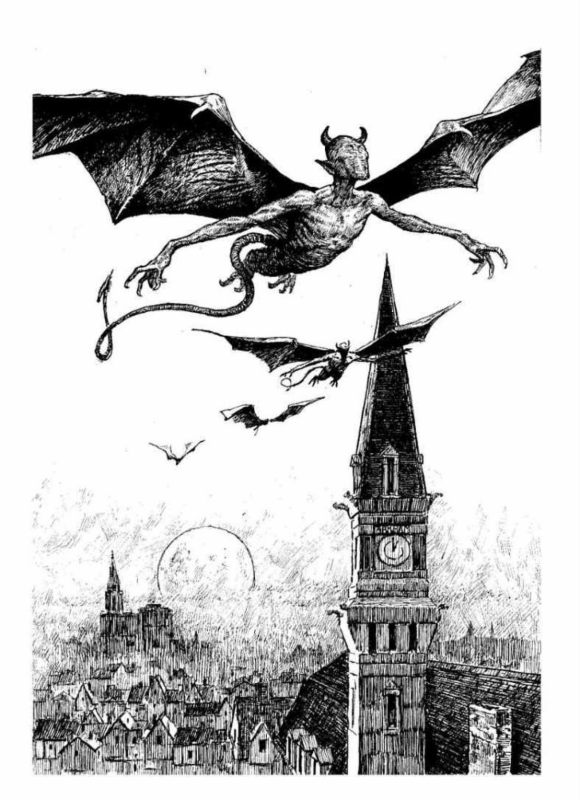
NIGHT-GAUNTS
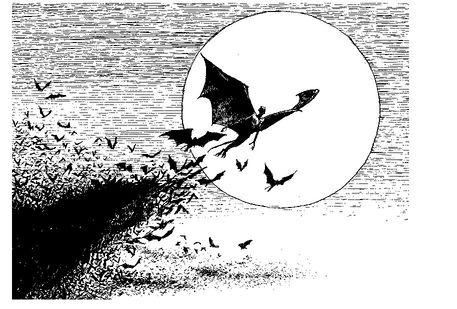
Out of what crypt they crawl, I cannot tell,
But every night I see the rubbery things,
Black, horned, and slender, with membranous wings,
They come in legions on the north wind’s swell
With obscene clutch that titillates and stings,
Snatching me off on monstrous voyagings
To grey worlds hidden deep in nightmare’s well.
Over the jagged peaks of Thok they sweep,
Heedless of all the cries I try to make,
And down the nether pits to that foul lake
Where the puffed shoggoths splash in doubtful sleep.
But ho! If only they would make some sound,
Or wear a face where faces should be found!

DAGON
I AM WRITING THIS under an appreciable mental strain, since by tonight shall be no more. Penniless, and at the end of my supply of the drug which alone makes life endurable, I can bear the torture no longer; and shall cast myself from this garret window into the squalid street below. Do not think from my slavery to morphine that I am a weakling or a degenerate. When you have read these hastily scrawled pages you may guess, though never fully realise, why it is that I must have forgetfulness or death.
It was in one of the most open and least frequented parts of the broad Pacific that the packet of which I was supercargo fell a victim to the German sea-raider. The great war was then at its very beginning, and the ocean forces of the Hun had not completely sunk to their later degradation; so that our vessel was made a legitimate prize, whilst we of her crew were treated with all the fairness and consideration due us as naval prisoners. So liberal, indeed, was the discipline of our captors, that five days after we were taken I managed to escape alone in a small boat with water and provisions for a good length of time.
When I finally found myself adrift and free, I had but little idea of my surroundings. Never a competent navigator, I could only guess vaguely by the sun and stars that I was somewhat south of the equator. Of the longitude I knew nothing, and no island or coastline was in sight. The weather kept fair, and for uncounted days I drifted aimlessly beneath the sorching sun; waiting either for some passing ship, or to be cast on the shores of some habitable land. But neither ship nor land appeared, and I began to despair in my solitude upon the heaving vastnesses of unbroken blue.
The change happened whilst I slept. Its details I shall never know; for my slumber, though troubled and dream-infested, was continuous. When at last I awaked, it was to discover myself half sucked into a slimy expanse of hellish black mire which extended about me in monotonous undulations as far as I could see, and in which my boat lay grounded some distance away.
Though one might well imagine that my first sensation would be of wonder at so prodigious and unexpected a transformation of scenery, I was in reality more horrified than astonished; for there was in the air and in the rotting soil a sinister quality which chilled me to the very core. The region was putrid with the carcasses of decaying fish, and of other less describable things which I saw protruding from the nasty mud of the unending plain. Perhaps I should not hope to convey in mere words the unutterable hideousness that can dwell in absolute silence and barren immensity. There was nothing within hearing, and nothing in sight save a vast reach of black slime; yet the very completeness of the stillness and the homogeneity of the landscape oppressed me with a nauseating fear.
The sun was blazing down from a sky which seemed to me almost black in its cloudless cruelty; as though reflecting the inky marsh beneath my feet. As I crawled into the stranded boat I realised that only one theory could explain my position. Through some unprecedented volcanic upheaval, a portion of the ocean floor must have been thrown to the surface, exposing regions which for innumerable millions of years had lain hidden under unfathomable watery depths. So great was the extent of the new land which had risen beneath me, that I could not detect the faintest noise of the surging ocean, strain my ears as I might. Nor were there any sea-fowl to prey upon the dead things.
For several hours I sat thinking or brooding in the boat, which lay upon its side and afforded a slight shade as the sun moved across the heavens. As the day progressed, the ground lost some of its stickiness, and seemed likely to dry sufficiently for travelling purposes in a short time. That night I slept but little, and the next day I made for myself a pack containing food and water, preparatory to an overland journey in search of the vanished sea and possible rescue.
On the third morning I found the soil dry enough to walk upon with ease. The odour of the fish was maddening; but I was too much concerned with graver things to mind so slight an evil, and set out boldly for an unknown goal. All day I forged steadily westward, guided by a far-away hummock which rose higher than any other elevation on the rolling desert. That night I encamped, and on the following day still travelled toward the hummock, though that object seemed scarcely nearer than when I had first espied it. By the fourth evening I attained the base of the mound, which turned out to be much higher than it had appeared from a distance; an intervening valley setting it out in sharper relief from the general surface. Too weary to ascend, I slept in the shadow of the hill.
I know not why my dreams were so wild that night; but ere the waning and fantastically gibbous moon had risen far above the eastern plain, I was awake in a cold perspiration, determined to sleep no more. Such visions as I had experienced were too much for me to endure again. And in the glow of the moon I saw how unwise I had been to travel by day. Without the glare of the parching sun, my journey would have cost me less energy; indeed, I now felt quite able to perform the ascent which had deterred me at sunset. Picking up my pack, I started for the crest of the eminence.
I have said that the unbroken monotony of the rolling plain was a source of vague horror to me; but I think my horror was greater when I gained the summit of the mound and looked down the other side into an immeasurable pit or canyon, whose black recesses the moon had not yet soared high enough to illumine. I felt myself on the edge of the world; peering over the rim into a fathomless chaos of eternal night. Through my terror ran curious reminiscences of Paradise Lost, and Satan’s hideous climb through the unfashioned realms of darkness.
As the moon climbed higher in the sky, I began to see that the slopes of the valley were not quite so perpendicular as I had imagined. Ledges and outcroppings of rock afforded fairly easy footholds for a descent, whilst after a drop of a few hundred feet, the declivity became very gradual. Urged on by an impulse which I cannot definitely analyse, I scrambled with difficulty down the rocks and stood on the gentler slope beneath, gazing into the Stygian deeps where no light had yet penetrated.
All at once my attention was captured by a vast and singular object on the opposite slope, which rose steeply about a hundred yards ahead of me; an object that gleamed whitely in the newly bestowed rays of the ascending moon. That it was merely a gigantic piece of stone, I soon assured myself; but I was conscious of a distinct impression that its contour and position were not altogether the work of Nature. A closer scrutiny filled me with sensations I cannot express; for despite its enormous magnitude, and its position in an abyss which had yawned at the bottom of the sea since the world was young, I perceived beyond a doubt that the strange object was a well-shaped monolith whose massive bulk had known the workmanship and perhaps the worship of living and thinking creatures.
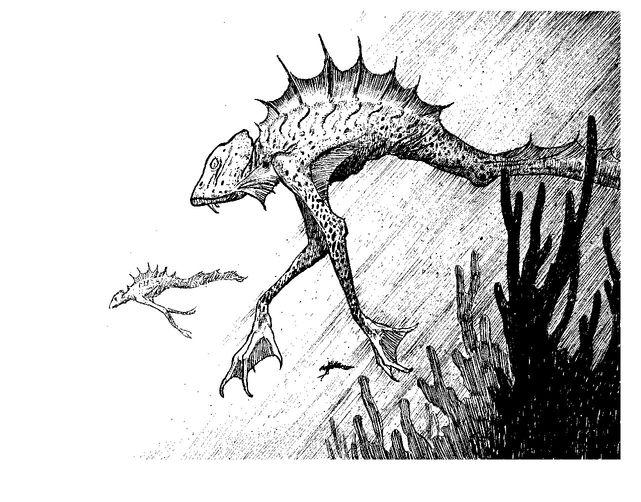
Dazed and frightened, yet not without a certain thrill of the scientist’s or archaeologist’s delight, I examined my surroundings more closely. The moon, now near the zenith, shone weirdly and vividly above the towering steeps that hemmed in the chasm, and revealed the fact that a far-flung body of water flowed at the bottom, winding out of sight in both directions, and almost lapping my feet as I stood on the slope. Across the chasm, the wavelets washed the base of the Cyclopean monolith, on whose surface I could now trace both inscriptions and crude sculptures. The writing was in a system of hieroglyphics unknown to me, and unlike anything I had ever seen in books, consisting for the most part of conventionalised aquatic symbols such as fishes, eels, octopi, crustaceans, molluscs, whales and the like. Several characters obviously represented marine things which are unknown to the modern world, but whose decomposing forms I had observed on the ocean-risen plain.
It was the pictorial carving, however, that did most to hold me spellbound. Plainly visible across the intervening water on account of their enormous size was an array of bas-reliefs whose subjects would have excited the envy of a Doré. I think that these things were supposed to depict men - at least, a certain sort of men; though the creatures were shown disporting like fishes in the waters of some marine grotto, or paying homage at some monolithic shrine which appeared to be under the waves as well. Of their faces and forms I dare not speak in detail; for the mere remembrance makes me grow faint. Grotesque beyond the imagination of a Poe or a Bulwer, they were damnably human in general outline despite webbed hands and feet, shockingly wide and flabby lips, glassy, bulging eyes, and other features less pleasant to recall. Curiously enough, they seemed to have been chiselled badly out of proportion with their scenic background; for one of the creatures was shown in the act of killing a whale represented as but little larger than himself. I remarked, as I say, their grotesquesness and strange size; but in a moment decided that they were merely the imaginary gods of some primitive fishing or seafaring tribe; some tribe whose last descendant had perished eras before the first ancestor of the Piltdown or Neanderthal Man was born. Awestruck at this unexpected glimpse into a past beyond the conception of the most daring anthropologist, I stood musing whilst the moon cast queer reflections on the silent channel before me.
Then suddenly I saw it. With only a slight churning to mark its rise to the surface, the thing slid into view above the dark waters. Vast, Polyphemus-like, and loathsome, it darted like a stupendous monster of nightmares to the monolith, about which it flung its gigantic scaly arms, the while it bowed its hideous head and gave vent to certain measured sounds. I think I went mad then.
Of my frantic ascent of the slope and cliff, and of my delirious journey back to the stranded boat, I remember little. I believe I sang a great deal, and laughed oddly when I was unable to sing. I have indistinct recollections of a great storm some time after I reached the boat; at any rate, I know that I heard peals of thunder and other tones which Nature utters only in her wildest moods.
When I came out of the shadows I was in a San Francisco hospital; brought thither by the captain of the American ship which had picked up my boat in mid-ocean. In my delirium I had said much, but found that my words had been given scant attention. Of any land upheaval in the Pacific, my rescuers knew nothing; nor did I deem it necessary to insist upon a thing which I knew they could not believe. Once I sought out a celebrated ethnologist, and amused him with peculiar questions regarding the ancient Philistine legend of Dagon, the Fish-God; but soon perceiving that he was hopelessly conventional, I did not press my inquiries.
It is at night, especially when the moon is gibbous and waning, that I see the thing. I tried morphine; but the drug has given only transient surcease, and has drawn me into its clutches as a hopeless slave. So now I am to end it all, having written a full account for the information or the contemptuous amusement of my fellow-men. Often I ask myself if it could not all have been a pure phantasm - a mere freak of fever as I lay sun-stricken and raving in the open boat after my escape from the German man-of-war. This I ask myself, but ever does there come before me a hideously vivid vision in reply. I cannot think of the deep sea without shuddering at the nameless things that may at this very moment be crawling and floundering on its slimy bed, worshipping their ancient stone idols and carving their own detestable likenesses on submarine obelisks of water-soaked granite. I dream of a day when they may rise above the billows to drag down in their reeking talons the remnants of puny, war-exhausted mankind - of a day when the land shall sink, and the dark ocean floor shall ascend amidst universal pandemonium.
The end is near. I hear a noise at the door, as of some immense slippery body lumbering against it. It shall not find me. God, that hand! The window! The window!
THE STATEMENT OF RANDOLPH CARTER
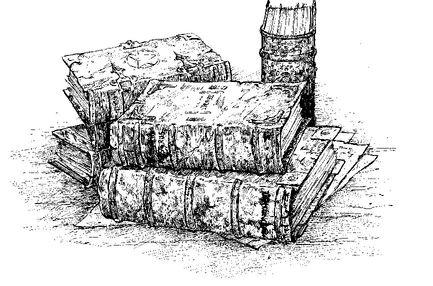
I REPEAT TO YOU, gentlemen, that your inquisition is fruitless. Detain me here forever if you will; confine or execute me if you must have a victim to propitiate the illusion you call justice; but I can say no more than I have said already. Everything that I can remember, I have told you with perfect candour. Nothing has been distorted or conceded, and if anything remains vague, it is only because of the dark cloud which has come over my mind - that cloud and the nebulous nature of the horrors which brought it upon me.
Again I say, I do not know what has become of Harley Warren, though I think - almost hope he is in peaceful oblivion, if there be anywhere so blessed a thing. It is true that I have for five years been his closest friend, and a partial sharer of his terrible researches into the unknown. I will not deny, though my memory is uncertain and indistinct, that this witness of yours may have seen us together as he says, on the Gainsville pike, walking toward Big Cypress Swamp, at half past 11 on that awful night. That we bore electric lanterns, spades, and a curious coil of wire with attached instruments, I will even affirm; for these things all played a part in the single hideous scene which remains burned into my shaken recollection. But of what followed, and of the reason I was found alone and dazed on the edge of the swamp next morning, I must insist that I know nothing save what I have told you over and over again. You say to me that there is nothing in the swamp or near it which could form the setting of that frightful episode. I reply that I knew nothing beyond what I saw. Vision or nightmare it may have been - vision or nightmare I fervently hope it was - yet it is all that my mind retains of what took place in those shocking hours after we left the sight of men. And why Harley Warren did not return, he or his shade - or some nameless thing I cannot describe - alone can tell.
As I have said before, the weird studies of Harley Warren were well known to me, and to some extent shared by me. Of his vast collection of strange, rare books on forbidden subjects I have read all that are written in the languages of which I am master; but these are few as compared with those in languages I cannot understand. Most, I believe, are in Arabic; and the fiend-inspired book which brought on the end - the book which he carried in his pocket out of the world - was written in characters whose like I never saw elsewhere. Warren would never tell me just what was in that book. As to the nature of our studies - must I say again that I no longer retain full comprehension? It seems to me rather merciful that I do not, for they were terrible studies, which I pursued more through reluctant fascination than through actual inclination. Warren always dominated me, and sometimes I feared him. I remember how I shuddered at his facial expression on the night before the awful happening, when he talked so incessantly of his theory, why certain corpses never decay, but rest firm and fat in their tombs for a thousand years. But I do not fear him now, for I suspect that he has known horrors beyond my ken. Now I fear for him.
Once more I say that I have no clear idea of our object on that night. Certainly, it had much to do with something in the book which Warren carried with him - that ancient book in undecipherable characters which had come to him from India a month before - but I swear I do not know what it was that we expected to find. Your witness says he saw us at half past 11 on the Gainsville pike, headed for Big Cypress Swamp. This is probably true, but I have no distinct memory of it. The picture seared into my soul is of one scene only, and the hour must have been long after midnight; for a waning crescent moon was high in the vaporous heavens.
The place was an ancient cemetery; so ancient that I trembled at the manifold signs of immemorial years. It was in a deep, damp hollow, overgrown with rank grass, moss, and curious creeping weeds, and filled with a vague stench which my idle fancy associated absurdly with rotting stone. On every hand were the signs of neglect and decrepitude, and I seemed haunted by the notion that Warren and I were the first living creatures to invade a lethal silence of centuries. Over the valley’s rim a wan, waning crescent moon peered through the noisome vapours that seemed to emanate from unheard of catacombs, and by its feeble, wavering beams I could distinguish a repellent array of antique slabs, urns, cenotaphs, and mausoleum facades; all crumbling, moss-grown, and moisture-stained, and partly concealed by the gross luxuriance of the unhealthy vegetation.
My first vivid impression of my own presence in this terrible necropolis concerns the act of pausing with Warren before a certain half-obliterated sepulchre and of throwing down some burdens which we seemed to have been carrying. I now observed that I had with me an electric lantern and two spades, whilst my companion was supplied with a similar lantern and a portable telephone outfit. No word was uttered, for the spot and the task seemed known to us; and without delay we seized our spades and commenced to clear away the grass, weeds, and drifted earth from the flat, archaic mortuary. After uncovering the entire surface, which consisted of three immense granite slabs, we stepped back some distance to survey the charnel scene; and Warren appeared to make some mental calculations. Then he returned to the sepulchre, and using his spade as a lever, sought to pry up the slab lying nearest to a stony ruin which may have been a monument in its day. He did not succeed, and motioned to me to come to his assistance. Finally our combined strength loosened the stone, which we raised and tipped to one side.
The removal of the slab revealed a black aperture, from which rushed an effluence of miasmal gases so nauseous that we started back in horror. After an interval, however, we approached the pit again, and found the exhalations less unbearable. Our lanterns disclosed the top of a flight of stone steps, dripping with some detestable ichor of the inner earth, and bordered by moist walls encrusted with nitre. And now, for the first time my memory records verbal discourse, Warren addressing me at length in his mellow tenor voice; a voice singularly unperturbed by our awesome surroundings.
‘I’m sorry to have to ask you to stay on the surface,’ he said, ‘but it would be a crime to let anyone with your frail nerves go down there. You can’t imagine, even from what you have read and from what I’ve told you, the things I shall have to see and do. It’s fiendish work, Carter, and I doubt if any man without ironclad sensibilities could ever see it through and come up alive and sane. I don’t wish to offend you, and Heaven knows I’d be glad enough to have you with me; but the responsibility is in a certain sense mine, and I couldn’t drag a bundle of nerves like you down to probable death or madness. I tell you, you can’t imagine what the thing is really like! But I promise to keep you informed over the telephone of every move - you see I’ve enough wire here to reach to the centre of the earth and back!’
I can still hear, in memory, those coolly spoken words; and I can still remember my remonstrances. I seemed desperately anxious to accompany my friend into those sepulchral depths, yet he proved inflexibly obdurate. At one time he threatened to abandon the expedition if I remained insistent; a threat which proved effective, since he alone held the key to the thing. All this I can still remember, though I no longer know what manner of thing we sought. After he had obtained my reluctant acquiescence in his design, Warren picked up the reel of wire and adjusted the instruments. At his nod I took one of the latter and seated myself upon an aged, discoloured gravestone close by the newly uncovered aperture. Then he shook my hand, shouldered the coil of wire, and disappeared within that indescribable ossuary.
For a minute I kept sight of the glow of his lantern, and heard the rustle of the wire as he laid it down after him; but the glow soon disappeared abruptly, as if a turn in the stone staircase had been encountered, and the sound died away almost as quickly. I was alone, yet bound to the unknown depths by those magic strands whose insulated surface lay green beneath the struggling beams of that waning crescent moon.
I constantly consulted my watch by the light of my electric lantern, and listened with feverish anxiety at the receiver of the telephone; but for more than a quarter of an hour heard nothing. Then a faint clicking came from the instrument, and I called down to my friend in a tense voice. Apprehensive as I was, I was nevertheless unprepared for the words which came up from that uncanny vault in accents more alarmed and quivering than any I had heard before from Harley Warren. He who had so calmly left me a little while previously, now called from below in a shaky whisper more portentous than the loudest shriek:
‘God! If you could see what I am seeing!’
I could not answer. Speechless, I could only wait. Then came the frenzied tones again:
‘Carter, it’s terrible - monstrous - unbelievable!’
This time my voice did not fail me, and I poured into the transmitter a flood of excited questions. Terrified, I continued to repeat, ‘Warren, what is it? What is it?’
Once more came the voice of my friend, still hoarse with fear, and now apparently tinged with despair:
‘I can’t tell you, Carter! It’s too utterly beyond thought - I dare not tell you - no man could know it and live - Great God! I never dreamed of this!’
Stillness again, save for my now incoherent torrent of shuddering inquiry. Then the voice of Warren in a pitch of wilder consternation:
‘Carter! For the love of God, put back the slab and get out of this if you can! Quick! - leave everything else and make for the outside - it’s your only chance! Do as I say, and don’t ask me to explain!’
I heard, yet was able only to repeat my frantic questions. Around me were the tombs and the darkness and the shadows; below me, some peril beyond the radius of the human imagination. But my friend was in greater danger than I, and through my fear I felt a vague resentment that he should deem me capable of deserting him under such circumstances. More clicking, and after a pause a piteous cry from Warren:
‘Beat it! For God’s sake, put back the slab and beat it, Carter!’
Something in the boyish slang of my evidently stricken companion unleashed my faculties. I formed and shouted a resolution, ‘Warren, brace up! I’m coming down!’ But at this offer the tone of my auditor changed to a scream of utter despair:
‘Don’t! You can’t understand! It’s too late - and my own fault. Put back the slab and run - there’s nothing else you or anyone can do now!’
The tone changed again, this time acquiring a softer quality, as of hopeless resignation. Yet it remained tense through anxiety for me. ‘Quick - before it’s too late!’
I tried not to heed him; tried to break through the paralysis which held me, and to fulfil my vow to rush down to his aid. But his next whisper found me still held inert in the chains of stark horror.
‘Carter - hurry! It’s no use - you must go - better one than two - the slab—’
A pause, more clicking, then the faint voice of Warren:
‘Nearly over now - don’t make it harder - cover up those damned steps and run for your life - you’re losing time - so long, Carter - won’t see you again.’
Here Warren’s whisper swelled into a cry; a cry that gradually rose to a shriek fraught with all the horror of the ages—
‘Curse these hellish things - legions - My God! Beat it! Beat it! BEAT IT!’
After that was silence. I know not how many interminable eons I sat stupefied; whispering, muttering, calling, screaming into that telephone. Over and over again through those eons I whispered and muttered, called, shouted, and screamed, ‘Warren! Warren! Answer me - are you there?’
And then there came to me the crowning horror of all - the unbelievable, unthinkable, almost unmentionable thing. I have said that eons seemed to elapse after Warren shrieked forth his last despairing warning, and that only my own cries now broke the hideous silence. But after a while there was a further clicking in the receiver, and I strained my ears to listen. Again I called down, ‘Warren, are you there?’ and in answer heard the thing which has brought this cloud over my mind. I do not try, gentlemen, to account for that thing - that voice - nor can I venture to describe it in detail, since the first words took away my consciousness and created a mental blank which reaches to the time of my awakening in the hospital. Shall I say that the voice was deep; hollow; gelatinous; remote; unearthly; inhuman; disembodied? What shall I say? It was the end of my experience, and is the end of my story. I heard it, and knew no more - heard it as I sat petrified in that unknown cemetery in the hollow, amidst the crumbling stones and the falling tombs, the rank vegetation and the miasmal vapours - heard it well up from the innermost depths of that damnable open sepulchre as I watched amorphous necrophagous shadows dance beneath an accursed waning moon.
And this is what it said:
‘You fool, Warren is DEAD!’
THE DOOM THAT CAME TO SARNATH

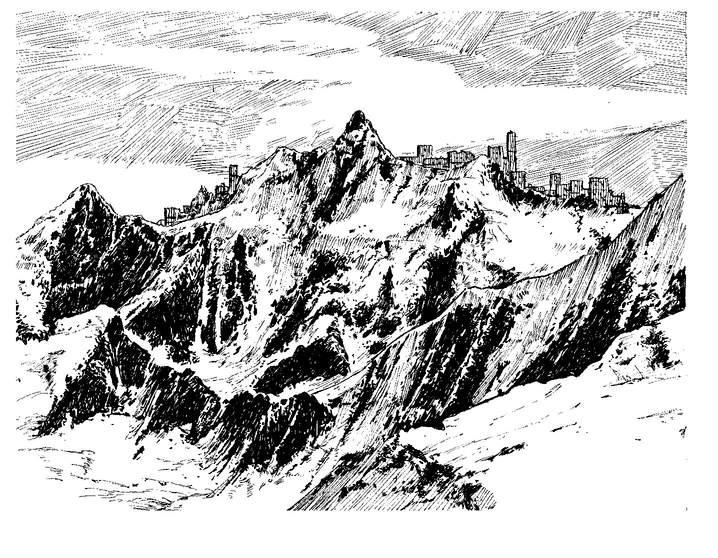
THERE IS IN THE land of Mnar a vast still lake that is fed by no stream, and out of which no stream flows. Ten thousand years ago there stood by its shore the mighty city of Sarnath, but Sarnath stands there no more.
It is told that in the immemorial years when the world was young, before ever the men of Sarnath came to the land of Mnar, another city stood beside the lake; the grey stone city of Ib, which was old as the lake itself, and peopled with beings not pleasing to behold. Very odd and ugly were these beings, as indeed are most beings of a world yet inchoate and rudely fashioned. It is written on the brick cylinders of Kadatheron that the beings of Ib were in hue as green as the lake and the mists that rise above it; that they had bulging eyes, pouting, flabby lips, and curious ears, and were without voice. It is also written that they descended one night from the moon in a mist; they and the vast still lake and grey stone city of Ib. However this may be, it is certain that they worshipped a sea-green stone idol chiselled in the likeness of Bokrug, the great water-lizard; before which they danced horribly when the moon was gibbous. And it is written in the papyrus of Ilarnek, that they one day discovered fire, and thereafter kindled flames on many ceremonial occasions. But not much is written of these beings, because they lived in very ancient times, and man is young, and knows but little of the very ancient living things.
After many eons men came to the land of Mnar, dark shepherd folk with their fleecy flocks, who built Thraa, Ilarnek, and Kadatheron on the winding river Ai. And certain tribes, more hardy than the rest, pushed on to the border of the lake and built Sarnath at a spot where precious metals were found in the earth.
Not far from the grey city of Ib did the wandering tribes lay the first stones of Sarnath, and at the beings of Ib they marvelled greatly. But with their marvelling was mixed hate, for they thought it not meet that beings of such aspect should walk about the world of men at dusk. Nor did they like the strange sculptures upon the grey monoliths of Ib, for those sculptures lingered so late in the world, even until the coming men none can tell; unless it was because the land of Mnar is very still, and remote from most other lands, both of waking and of dream.
As the, men of Sarnath beheld more of the beings of Ib their hate grew, and it was not less because they found the beings weak, and soft as jelly to the touch of stones and arrows. So one day the young warriors, the slingers and the spearmen and the bowmen, marched against Ib and slew all the inhabitants thereof, pushing the queer bodies into the lake with long spears, because they did not wish to touch them. And because they did not like the grey sculptured monoliths of Ib they cast these also into the lake; wondering from the greatness of the labour how ever the stones were brought from afar, as they must have been, since there is naught like them in the land of Mnar or in the lands adjacent.
Thus of the very ancient city of Ib was nothing spared, save the sea-green stone idol chiselled in the likeness of Bokrug, the water-lizard. This the young warriors took back with them as a symbol of conquest over the old gods and beings of Ib, and as a sign of leadership in Mnar. But on the night after it was set up in the temple, a terrible thing must have happened, for weird lights were seen over the lake, and in the morning the people found the idol gone and the high-priest Taran-Ish lying dead, as from some fear unspeakable. And before he died, Taran-Ish had scrawled upon the altar of chrysolite with coarse shaky strokes the sign of DOOM.
After Taran-Ish there were many high-priests in Sarnath, but never was the sea-green stone idol found. And many centuries came and went, wherein Sarnath prospered exceedingly, so that only priests and old women remembered what Taran-Ish had scrawled upon the altar of chrysolite. Betwixt Sarnath and the city of Ilarnek arose a caravan route, and the precious metals from the earth were exchanged for other metals and rare cloths and jewels and books and tools for artificers and all things of luxury that are known to the people who dwell along the winding river Ai and beyond. So Sarnath waxed mighty and learned and beautiful, and sent forth conquering armies to subdue the neighbouring cities; and in time there sate upon a throne in Sarnath the kings of all the land of Mnar and of many lands adjacent.
The wonder of the world and the pride of all mankind was Sarnath the magnificent. Of polished desert-quarried marble were its walls, in height three hundred cubits and in breadth seventy-five, so that chariots might pass each other as men drove them along the top. For full five hundred stadia did they run, being open only on the side toward the lake where a green stone sea-wall kept back the waves that rose oddly once a year at the festival of the destroying of Ib. In Sarnath were fifty streets from the lake to the gates of the caravans, and fifty more intersecting them. With onyx were they paved, save those whereon the horses and camels and elephants trod, which were paved with granite. And the gates of Sarnath were as many as the landward ends of the streets, each of bronze, and flanked by the figures of lions and elephants carven from some stone no longer known among men. The houses of Sarnath were of glazed brick and chalcedony, each having its walled garden and crystal lakelet. With strange art were they builded, for no other city had houses like them; and travellers from Thraa and Ilarnek and Kadatheron marvelled at the shining domes where with they were surmounted.
But more marvellous still were the palaces and the temples, and the gardens made by Zokkar the olden king. There were many palaces, the last of which were mightier than any in Thraa or Ilarnek or Kadatheron. So high were they that one within might sometimes fancy himself beneath only the sky; yet when lighted with torches dipt in the oil of Dother their walls showed vast paintings of kings and armies, of a splendour at once inspiring and stupefying to the beholder. Many were the pillars of the palaces, all of tinted marble, and carven into designs of surpassing beauty. And in most of the palaces the floors were mosaics of beryl and lapis lazuli and sardonyx and carbuncle and other choice materials, so disposed that the beholder might fancy himself walking over beds of the rarest flowers. And there were likewise fountains, which cast scented waters about in pleasing jets arranged with cunning art. Outshining all others was the palace of the kings of Mnar and of the lands adjacent. On a pair of golden crouching lions rested the throne, many steps above the gleaming floor. And it was wrought of one piece of ivory, though no man lives who knows whence so vast a piece could have come. In that palace, there were also many galleries, and many amphitheatres where lions and men and elephants battled at the pleasure of the kings. Sometimes the amphitheatres were flooded with water conveyed from the lake in mighty aqueducts, and then were enacted stirring sea-fights, or combats betwixt swimmers and deadly marine things.
Lofty and amazing were the seventeen tower-like temples of Sarnath, fashioned of a bright multi-coloured stone not known elsewhere. A full thousand cubits high stood the greatest among them, wherein the high-priests dwelt with a magnificence scarce less than that of the kings. On the ground were halls as vast and splendid as those of the palaces; where gathered throngs in worship of Zo-Kalar and Tamash and Lobon, the chief gods of Sarnath, whose incense-enveloped shrines were as the thrones of monarchs. Not like the eikons of other gods were those of Zo-Kalar and Tamash and Lobon. For so close to life were they that one might swear the graceful bearded gods themselves sate on the ivory thrones. And up unending steps of zircon was the tower-chamber, wherefrom the high-priests looked out over the city and the plains and the lake by day; and at the cryptic moon and significant stars and planets, and their reflections in the lake, at night. Here was done the very secret and ancient rite in detestation of Bokrug, the water-lizard, and here rested the altar of chrysolite which bore the Doom-scrawl of Taran-Ish.
Wonderful likewise were the gardens made by Zokkar the olden king. In the centre of Sarnath they lay, covering a great space and encircled by a high wall. And they were surmounted by a mighty dome of glass, through which shone the sun and moon and planets when it was clear, and from which were hung fulgent images of the sun and moon and stars and planets when it was not clear. In summer the gardens were cooled with fresh odorous breezes skilfully wafted by fans, and in winter they were heated with concealed fires, so that in those gardens it was always spring. There ran little streams over bright pebbles, dividing meads of green and gardens of many hues, and spanned by a multitude of bridges. Many were the waterfalls in their courses, and many were the lilied lakelets into which they expanded. Over the streams and lakelets rode white swans, whilst the music of rare birds chimed in with the melody of the waters. In ordered terraces rose the green banks, adorned here and there with bowers of vines and sweet blossoms, and seats and benches of marble and porphyry. And there were many small shrines and temples where one might rest or pray to small gods.
Each year there was celebrated in Sarnath the feast of the destroying of Ib, at which time wine, song, dancing and merriment of every kind abounded. Great honours were then paid to the shades of those who had annihilated the odd ancient beings, and the memory of those beings and of their elder gods was derided by dancers and lutanists crowned with roses from the gardens of Zokkar. And the kings would look out over the lake and curse the bones of the dead that lay beneath it.
At first the high-priests liked not these festivals, for there had descended amongst them queer tales of how the sea-green eikon had vanished, and how Taran-Ish had died from fear and left a warning. And they said that from their high tower they sometimes saw lights beneath the waters of the lake. But as many years passed without calamity even the priests laughed and cursed and joined in the orgies of the feasters. Indeed, had they not themselves, in their high tower, often performed the very ancient and secret rite in detestation of Bokrug the water-lizard? And a thousand years of riches and delight passed over Sarnath, wonder of the world.
Gorgeous beyond thought was the feast of the thousandth year of the destroying of Ib. For a decade had it been talked of in the land of Mnar, and as it drew nigh there came to Sarnath on horses and camels and elephants men from Thraa, Ilarnek, and Kadatheron, cities of Mnar and the lands beyond. Before the marble walls on the appointed night were pitched the pavilions of princes and the tents of travellers. Within his banquet-hall reclined Nargis-Hei, the king, drunken with ancient wine from the vaults of conquered Pnoth, and surrounded by feasting nobles and hurrying slaves. There were eaten many strange delicacies at that feast; peacocks from the distant hills of Implan, heels of camels from the Bnazic desert, nuts and spices from Sydathrian groves, and pearls from wave-washed Mtal dissolved in the vinegar of Thraa. Of sauces there were an untold number, prepared by the subtlest cooks in all Mnar, and suited to the palate of every feaster. But most prized of all the viands were the great fishes from the lake, each of vast size, and served upon golden platters set with rubies and diamonds.
Whilst the king and his nobles feasted within the palace, and viewed the crowning dish as it awaited them on golden platters, others feasted elsewhere. In the tower of the great temple the priests held revels, and in pavilions without the walls the princes of neighbouring lands made merry. And it was the high-priest Gnai-Kah who first saw the shadows that descended from the gibbous moon into the lake, and the damnable green mists that arose from the lake to meet the moon and to shroud in a sinister haze the towers and the domes of fated Sarnath. Thereafter those in the towers and without the walls beheld strange lights on the water, and saw that the gray rock Akurion, which was wont to rear high above it near the shore, was almost submerged. And fear grew vaguely yet swiftly, so that the princes of Ilarnek and of far Rokol took down and folded their tents and pavilions and departed, though they scarce knew the reason for their departing.
Then, close to the hour of midnight, all the bronze gates of Sarnath burst open and emptied forth a frenzied throng that blackened the plain, so that all the visiting princes and travellers fled away in fright. For on the faces of this throng was writ a madness born of horror unendurable, and on their tongues were words so terrible that no hearer paused for proof. Men whose eyes were wild with fear shrieked aloud of the sight within the king’s banquet-hall, where through the windows were seen no longer the forms of Nargis-Hei and his nobles and slaves, but a horde of indescribable green voiceless things with bulging eyes, pouting, flabby lips, and curious ears; thing which danced horribly, bearing in their paws golden platters set with rubies and diamonds and containing uncouth flames. And the princes and travellers, as they fled from the doomed city of Sarnath on horses and camels and elephants, looked again upon the mist-begetting lake and saw the grey rock Akution was quite submerged. Through all the land of Mnar and the land adjacent spread the tales of those who had fled from Sarnath, and caravans sought that accursed city and its precious metals no more. It was long ere any travellers went thither, and even then only the brave and adventurous young men of yellow hair and blue eyes, who are no kin to the men of Mnar. These men indeed went to the lake to view Sarnath; but though they found the vast still lake itself, and the grey rock Akurion which rears high above it near the shore, they beheld not the wonder of the world and pride of all mankind. Where once had risen walls of three hundred cubits and towers yet higher, now stretched only the marshy shore, and where once had dwelt fifty million of men now crawled the detestable water-lizard. Not even the mines of precious metal remained. DOOM had come to Sathath.
But half buried in the rushes was spied a curious green idol; an exceedingly ancient idol chiselled in the likeness of Bokrug, the great water-lizard. That idol, enshrined in the high temple at Ilarnek, was subsequently worshipped beneath the gibbous moon throughout the land of Mnar.
THE CATS OF ULTHAR
IT IS SAID THAT in Ulthar, which lies beyond the river Skai, no man may kill a cat; and this I can verily believe as I gaze upon him who sitteth purring before the fire. For the cat is cryptic, and close to strange things which men cannot see. He is the soul of antique Aegyptus, and bearer of tales from forgotten cities in Meroe and Ophir. He is the kin of the jungle’s lords, and heir to the secrets of hoary and sinister Africa. The Sphinx is his cousin, and he speaks her language; but he is more ancient than the Sphinx, and remembers that which she hath forgotten.
In Ulthar, before ever the burgesses forbade the killing of cats, there dwelt an old cotter and his wife who delighted to trap and slay the cats of their neighbours. Why they did this I know not; save that many hate the voice of the cat in the night, and take it ill that cats should run stealthily about yards and gardens at twilight. But whatever the reason, this old man and woman took pleasure in trapping and slaying every cat which came near to their hovel; and from some of the sounds heard after dark, many villagers fancied that the manner of slaying was exceedingly peculiar. But the villagers did not discuss such things with the old man and his wife; because of the habitual expression on the withered faces of the two, and because their cottage was so small and so darkly hidden under spreading oaks at the back of a neglected yard. In truth, much as the owners of cats hated these odd folk, they feared them more; and instead of berating them as brutal assassins, merely took care that no cherished pet or mouser should stray toward the remote hovel under the dark trees. When through some unavoidable oversight a cat was missed, and sounds heard after dark, the loser would lament impotently; or console himself by thanking Fate that it was not one of his children who had thus vanished. For the people of Ulthar were simple, and knew not whence it is all cats first came.
One day a caravan of strange wanderers from the South entered the narrow cobbled streets of Ulthar. Dark wanderers they were, and unlike the other roving folk who passed through the village twice every year. In the market-place they told fortunes for silver, and bought gay beads from the merchants. What was the land of these wanderers none could tell; but it was seen that they were given to strange prayers, and that they had painted on the sides of their wagons strange figures with human bodies and the heads of cats, hawks, rams and lions. And the leader of the caravan wore a headdress with two horns and a curious disk betwixt the horns.
There was in this singular caravan a little boy with no father or mother, but only a tiny black kitten to cherish. The plague had not been kind to him, yet had left him this small furry thing to mitigate his sorrow; and when one is very young, one can find great relief in the lively antics of a black kitten. So the boy whom the dark people called Menes smiled more often than he wept as he sat playing with his graceful kitten on the steps of an oddly painted wagon.
On the third morning of the wanderers’ stay in Ulthar, Menes could not find his kitten; and as he sobbed aloud in the market-place certain villagers told him of the old man and his wife, and of sounds heard in the night. And when he heard these things his sobbing gave place to meditation, and finally to prayer. He stretched out his arms toward the sun and prayed in a tongue no villager could understand; though indeed the villagers did not try very hard to understand, since their attention was mostly taken up by the sky and the odd shapes the clouds were assuming. It was very peculiar, but as the little boy uttered his petition there seemed to form overhead the shadowy, nebulous figures of exotic things; of hybrid creatures crowned with horn-flanked disks. Nature is full of such illusions to impress the imaginative.
That night the wanderers left Ulthar, and were never seen again. And the householders were troubled when they noticed that in all the village there was not a cat to be found. From each hearth the familiar cat had vanished; cats large and small, black, grey, striped, yellow and white. Old Kranon, the burgomaster, swore that the dark folk had taken the cats away in revenge for the killing of Menes’ kitten; and cursed the caravan and the little boy. But Nith, the lean notary, declared that the old cotter and his wife were more likely persons to suspect; for their hatred of cats was notorious and increasingly bold. Still, no one durst complain to the sinister couple; even when little Atal, the innkeeper’s son, vowed that he had at twilight seen all the cats of Ulthar in that accursed yard under the trees, pacing very slowly and solemnly in a circle around the cottage, two abreast, as if in performance of some unheard-of rite of beasts. The villagers did not know how much to believe from so small a boy; and though they feared that the evil pair had charmed the cats to their death, they preferred not to chide the old cotter till they met him outside his dark and repellent yard.
So Ulthar went to sleep in vain anger; and when the people awakened at dawn - behold ! every cat was back at his accustomed hearth! Large and small, black, grey, striped, yellow and white, none was missing. Very sleek and fat did the cats appear, and sonorous with purring content. The citizens talked with one another of the affair, and marvelled not a little. Old Kranon again insisted that it was the dark folk who had taken them, since cats did not return alive from the cottage of the ancient man and his wife. But all agreed on one thing: that the refusal of all the cats to eat their portions of meat or drink their saucers of milk was exceedingly curious. And for two whole days the sleek, lazy cats of Ulthar would touch no food, but only doze by the fire or in the sun.
It was fully a week before the villagers noticed that no lights were appearing at dusk in the windows of the cottage under the trees. Then the lean Nith remarked that no one had seen the old man or his wife since the night the cats were away. In another week the burgomaster decided to overcome his fears and call at the strangely silent dwelling as a matter of duty, though in so doing he was careful to take with him Shang the blacksmith and Thul the cutter of stone as witnesses. And when they had broken down the frail door they found only this: two cleanly picked human skeletons on the earthen floor, and a number of singular beetles crawling in the shadowy corners.
There was subsequently much talk among the burgesses of Ulthar. Zath, the coroner, disputed at length with Nith, the lean notary; and Kranon and Shang and Thul were overwhelmed with questions. Even little Atal, the innkeeper’s son, was closely questioned and given a sweetmeat as reward. They talked of the old cotter and his wife, of the caravan of dark wanderers, of small Menes and his black kitten, of the prayer of Menes and of the sky during that prayer, of the doings of the cats on the night the caravan left, and of what was later found in the cottage under the dark trees in the repellent yard.
And in the end the burgesses passed that remarkable law which is told of by traders in Hatheg and discussed by travellers in Nir; namely, that in Ulthar no man may kill a cat.
THE NAMELESS CITY
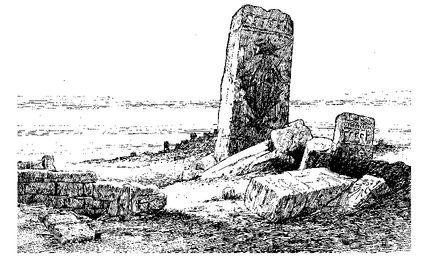
WHEN I DREW NIGH the nameless city I knew it was accursed. I was travelling in a parched and terrible valley under the moon, and afar I saw it protruding uncannily above the sands as parts of a corpse may protrude from an ill-made grave. Fear spoke from the age-worn stones of this hoary survivor of the deluge, this great-grandmother of the eldest pyramid; and a viewless aura repelled me and bade me retreat from antique and sinister secrets that no man should see, and no man else had ever dared to see.
Remote in the desert of Araby lies the nameless city, crumbling and inarticulate, its low walls nearly hidden by the sands of uncounted ages. It must have been thus before the first stones of Memphis were laid, and while the bricks of Babylon were yet unbaked. There is no legend so old as to give it a name, or to recall that it was ever alive; but it is told of in whispers around campfires and muttered about by grandams in the tents of sheiks so that all the tribes shun it without wholly knowing why. It was of this place that Abdul Alhazred the mad poet dreamed on the night before he sang his unexplainable couplet:
‘That is not dead which can eternal lie,
And with strange aeons even death may die.’
I should have known that the Arabs had good reason for shunning the nameless city, the city told of in strange tales but seen by no living man, yet I defied them and went into the untrodden waste with my camel. I alone have seen it, and that is why no other face bears such hideous lines of fear as mine; why no other man shivers so horribly when the night wind rattles the windows. When I came upon it in the ghastly stillness of unending sleep it looked at me, chilly from the rays of a cold moon amidst the desert’s heat. And as I returned its look I forgot my triumph at finding it, and stopped still with my camel to wait for the dawn.
For hours I waited, till the east grew grey, and the stars faded, and the grey turned to roseate light edged with gold. I heard a moaning and saw a storm of sand stirring among the antique stones though the sky was clear and the vast reaches of desert still. Then suddenly above the desert’s far rim came the blazing edge of the sun, seen through the tiny sandstorm which was passing away, and in my fevered state I fancied that from some remote depth there came a crash of musical metal to hail the fiery disc as Memnon hails it from the banks of the Nile. My ears rang and my imagination seethed as I led my camel slowly across the sand to that unvocal place; that place which I alone of living men had seen.
In and out amongst the shapeless foundations of houses and places I wandered, finding never a carving or inscription to tell of these men, if men they were, who built this city and dwelt therein so long ago. The antiquity of the spot was unwholesome, and I longed to encounter some sign or device to prove that the city was indeed fashioned by mankind. There were certain proportions and dimensions in the ruins which I did not like. I had with me many tools and dug much within the walls of the obliterated edifices; but progress was slow, and nothing significant was revealed. When night and the moon returned I felt a chill wind which brought new fear, so that I did not dare to remain in the city. And as I went outside the antique walls to sleep, a small sighing sandstorm gathered behind me, blowing over the grey stones though the moon was bright and most of the desert still.
I awaked just at dawn from a pageant of horrible dreams, my ears ringing as from some metallic peal. I saw the sun peering redly through the last gusts of a little sandstorm that hovered over the nameless city and marked the quietness of the rest of the landscape. Once more I ventured within those brooding ruins that swelled beneath the sand like an ogre under a coverlet, and again dug vainly for relics of the forgotten race. At noon I rested, and in the afternoon I spent much time tracing the walls and bygone streets, and the outlines of the nearly vanished buildings. I saw that the city had been mighty indeed, and wondered at the sources of its greatness. To myself I pictured all the splendours of an age so distant that Chaldaea could not recall it, and thought of Sarnath the Doomed, that stood in the land of Mnar when mankind was young, and of Ib, that was carven of grey stone before mankind existed. All at once I came upon a place where the bed rock rose stark through the sand and formed a low cliff; and here I saw with joy what seemed to promise further traces of the antediluvian people. Hewn rudely on the face of the cliff were the unmistakable façades of several small, squat rock houses or temples; whose interiors might preserve many secrets of ages too remote for calculation, though sandstorms had long since effaced any carvings which may have been outside.
Very low and sand-chocked were all the dark apertures near me, but I cleared one with my spade and crawled through it, carrying a torch to reveal whatever mysteries it might hold. When I was inside I saw that the cavern was indeed a temple, and beheld plain signs of the race that had lived and worshipped before the desert was a desert. Primitive altars, pillars, and niches, all curiously low, were not absent; and though I saw no sculptures or frescoes, there were many singular stones clearly shaped into symbols by artificial means. The lowness of the chiselled chamber was very strange, for I could hardly kneel upright; but the area was so great that my torch showed only part of it at a time. I shuddered oddly in some of the far corners; for certain altars and stones suggested forgotten rites of terrible, revolting, and inexplicable nature and made me wonder what manner of men could have made and frequented such a temple. When I had seen all that the place contained, I crawled out again, avid to find what the temples might yield.
Night had now approached, yet the tangible things I had seen made curiosity stronger than fear, so that I did not flee from the long mooncast shadows that had daunted me when first I saw the nameless city. In the twilight I cleared another aperture and with a new torch crawled into it, finding more vague stones and symbols, though nothing more definite than the other temple had contained. The room was just as low, but much less broad, ending in a very narrow passage crowded with obscure and cryptical shrines. About these shrines I was prying when the noise of a wind and my camel outside broke through the stillness and drew me forth to see what could have frightened the beast.
The moon was gleaming vividly over the primitive ruins, lighting a dense cloud of sand that seemed blown by a strong but decreasing wind from some point along the cliff ahead of me. I knew it was this chilly, sandy wind which had disturbed the camel and was about to lead him to a place of better shelter when I chanced to glance up and saw that there was no wind atop the cliff. This astonished me and made me fearful again, but I immediately recalled the sudden local winds that I had seen and heard before at sunrise and sunset, and judged it was a normal thing. I decided it came from some rock fissure leading to a cave, and watched the troubled sand to trace it to its source; soon perceiving that it came from the black orifice of a temple a long distance south of me, almost out of sight. Against the choking sand-cloud I plodded toward this temple, which as I neared it loomed larger than the rest, and showed a doorway far less clogged with caked sand. I would have entered had not the terrific force of the icy wind almost quenched my torch. It poured madly out of the dark door, sighing uncannily as it ruffled the sand and spread among the weird ruins. Soon it grew fainter and the sand grew more and more still, till finally all was at rest again but a presence seemed stalking among the spectral stones of the city, and when I glanced at the moon it seemed to quiver as though mirrored in unquiet waters. I was more afraid than I could explain, but not enough to dull my thirst for wonder; so as soon as the wind was quite gone I cross into the dark chamber from which it had come.
This temple, as I had fancied from the outside, was larger than either of those I had visited before; and was presumably a natural cavern since it bore winds from some region beyond. Here I could stand quite upright, but saw that the stones and altars were as low as those other temples. On the walls and roof I beheld for the first time some traces of the pictorial art of the ancient race, curious curling streaks of paint that had almost faded or crumbled away; and on two of the altars I saw with rising excitement a maze of well-fashioned curvilinear carvings. As I held my torch aloft it seemed to me that the shape of the roof was too regular to be natural, and I wondered what the prehistoric cutters of stone had first worked upon. Their engineering skill must have been vast.
Then a brighter flare of the fantastic flame showed that for which I had been seeking, the opening to those remoter abysses whence the sudden wind had blown; and I grew faint when I saw that it was a small and plainly artificial door chiselled in the solid rock. I thrust my torch within, beholding a black tunnel with the roof arching low over a rough flight of very small, numerous, and steeply descending steps. I shall always see those steps in my dreams, for I came to learn what they meant. At the time I hardly knew whether to call them steps or mere footholds in a precipitous descent. My mind was whirling with mad thoughts, and the words and warnings of Arab prophets seemed to float across the desert from the lands that men know to the nameless city that men dare not know. Yet I hesitated only for a moment before advancing through the portal and commencing to climb cautiously down the steep passage, feet first, as though on a ladder.
It is only in the terrible phantasms of drugs or delirium that any other man can have such a descent as mine. The narrow passage led infinitely down like some hideous haunted well, and the torch I held above my head could not light the unknown depths toward which I was crawling. I lost track of the hours and forgot to consult my watch, though I was frightened when I thought of the distance I must be traversing. There were changes of direction and of steepness; and once I came to a long, low, level passage where I had to wriggle my feet first along the rocky floor, holding torch at arm’s length beyond my head. The place was not high enough for kneeling. After that were more of the steep steps, and I was still scrambling down interminably when my failing torch died out. I do not think I noticed it at the time, for when I did notice it I was still holding it above me as if it were ablaze. I was quite unbalanced with that instinct for the strange and the unknown which had made me a wanderer upon earth and a haunter of far, ancient, and forbidden places.
In the darkness there flashed before my mind fragments of my cherished treasury of daemoniac lore; sentences from Alhazred the mad Arab, paragraphs from the apocryphal nightmares of Damascius, and infamous lines from the delirious Image du Monde of Gauthier de Metz. I repeated queer extracts, and muttered of Afrasiab and the daemons that floated with him down the Oxus; later chanting over and over again a phrase from one of Lord Dunsany’s tales - ‘The unreverberate blackness of the abyss.’ Once when the descent grew amazingly steep I recited something in sing-song from Thomas Moore until I feared to recite more:
‘A reservoir of darkness, black
As witches’ cauldrons are, when fill’d
With moon-drugs in th’ eclipse distill’d.
Leaning to look if foot might pass
Down thro’ that chasm, l saw, beneath,
As far as vision could explore,
The jetty sides as smooth as glass,
Looking as if just varnish’d o’er
With that dark pitch the Seat of Death
Throws out upon its slimy shore.’
Time had quite ceased to exist when my feet again felt a level floor, and I found myself in a place slightly higher than the rooms in the two smaller temples now so incalculably far above my head. I could not quite stand, but could kneel upright, and in the dark I shuffled and crept hither and thither at random. I soon knew that I was in a narrow passage whose walls were lined with cases of wood having glass fronts. As in that Palaeozoic and abysmal place l felt of such things as polished wood and glass I shuddered at the possible implications. The cases were apparently ranged along each side of the passage at regular intervals, and were oblong and horizontal, hideously like coffins in shape and size. When I tried to move two or three for further examination, I found that they were firmly fastened.
I saw that the passage was a long one, so floundered ahead rapidly in a creeping run that would have seemed horrible had any eye watched me in the blackness; crossing from side to side occasionally to feel of my surroundings and be sure the walls and rows of cases still stretched on. Man is so used to thinking visually that I almost forgot the darkness and pictured the endless corridor of wood and glass in its low-studded monotony as though I saw it. And then in a moment of indescribable emotion I did see it.
Just when my fancy merged into real sight l cannot tell; but there came a gradual glow ahead, and all at once I knew that I saw the dim outlines of the corridor and the cases, revealed by some unknown subterranean phosphorescence. For a little while all was exactly as I had imagined it, since the glow was very faint; but as I mechanically kept stumbling ahead into the stronger light I realised that my fancy had been but feeble. This hall was no relic of crudity like the temples in the city above, but a monument of the most magnificent and exotic art. Rich, vivid, and daringly fantastic designs and pictures formed a continuous scheme of mural painting whose lines and colours were beyond description. The cases were of a strange golden wood, with fronts of exquisite glass, and containing the mummified forms of creatures outreaching in grotesqueness the most chaotic dreams of man.
To convey any idea of these monstrosities is impossible. They were of the reptile kind, with body lines suggesting sometimes the crocodile, sometimes the seal, but more often nothing of which either the naturalist or the palaeontologist ever heard. In size they approximated a small man and their forelegs bore delicate and evident feet curiously like human hands and fingers. But strangest of all were their heads, which presented a contour violating all known biological principles. To nothing can such things be well compared - in one flash I thought of comparisons as varied as the cat, the bulldog, the mythic Satyr, and the human being. Not Jove himself had had so colossal and protuberant a forehead, yet the horns and the noselessness and the alligator-like jaw placed the things outside all established categories. I debated for a time the reality of the mummies, half suspecting they were artificial idols; but soon decided they were indeed some palaeogean species which had lived when the nameless city was alive. To crown their grotesqueness, most of them were gorgeously enrobed in the costliest of fabrics, and lavishly laden with ornaments of gold, jewels, and unknown shining metals.
The importance of these crawling creatures must have been vast, for they held first place among the wild designs on the frescoed walls and ceiling. With matchless skill had the artist drawn them in a world of their own, wherein they had cities and gardens fashioned to suit their dimensions; and I could not help but think that their pictured history was allegorical, perhaps shewing the progress of the race that worshipped them. These creatures, I said to myself, were to the men of the timeless city what the she-wolf was to Rome, or some totem-beast is to a tribe of Indians.
Holding this view, I could trace roughly a wonderful epic of the nameless city; the tale of a mighty seacoast metropolis that ruled the world before Africa rose out of the waves, and of its struggles as the sea shrank away, and the desert crept into the fertile valley that held it. I saw its wars and triumphs, its troubles and defeats, and afterward its terrible fight against the desert when thousands of its people - here represented in allegory by the grotesque reptiles - were driven to chisel their way down through the rocks in some marvellous manner to another world whereof their prophet had told them. It was all vividly weird and realistic, and its connection with the awesome descent I had made was unmistakable. I even recognised the passages.
As I crept along the corridor toward the brighter light I saw later stages of the painted epic - the leave-taking of the race that had dwelt in the nameless city and the valley around for ten million years; the race whose souls shrank from quitting scenes their bodies had known so long where they had settled as nomads in the earth’s youth, hewing in the virgin rock those primal shrines at which they had never ceased to worship. Now that the light was better I studied the pictures more closely and, remembering that the strange reptiles must represent the unknown men, pondered upon the customs of the nameless city. Many things were peculiar and inexplicable. The civilisation, which included a written alphabet, had seemingly risen to a higher order than those immeasurably later civilisations of Egypt and Chaldea, yet there were curious omissions. I could, for example, find no pictures to represent deaths or funeral customs, save such as were related to wars, violence, and plagues; and I wondered at the reticence shown concerning natural death. It was as though an ideal of immortality had been fostered as a cheering illusion.
Still nearer the end of the passage were painted scenes of the utmost picturesqueness and extravagance: contrasted views of the nameless city in its desertion and growing ruin, and of the strange new realm of paradise to which the race had hewed its way through the stone. In these views the city and the desert valley were shewn always by moonlight, golden nimbus hovering over the fallen walls and half-revealing the splendid perfection of former times, shown spectrally and elusively by the artist. The paradisal scenes were almost too extravagant to be believed, portraying a hidden world of eternal day filled with glorious cities and ethereal hills and valleys. At the very last I thought I saw signs of an artistic anticlimax. The paintings were less skilful, and much more bizarre than even the wildest of the earlier scenes. They seemed to record a slow decadence of the ancient stock, coupled with growing ferocity toward the outside world from which it was driven by the desert. The forms of the people - always represented by the sacred reptiles - appeared to be gradually wasting away, though their spirit as shewn hovering above the ruins by moonlight gained in proportion. Emaciated priests, displayed as reptiles in ornate robes, cursed the upper air and all who breathed it; and one terrible final scene shewed a primitive-looking man, perhaps a pioneer of ancient Irem, the City of Pillars, torn to pieces by members of the elder race. I remember how the Arabs fear the nameless city, and was glad that beyond this place the grey walls and ceiling were bare.
As I viewed the pageant of mural history I had approached very closely the end of the low-ceilinged hall, and was aware of a gate through which came all of the illuminating phosphorescence. Creeping up to it, I cried aloud in transcendent amazement at what lay beyond; for instead of other and brighter chambers there was only an illimitable void of uniform radiance, such as one might fancy when gazing down from the peak of Mount Everest upon a sea of sunlit mist. Behind me was a passage so cramped that I could not stand upright in it; before me was an infinity of subterranean effulgence.
Reaching down from the passage into the abyss was the head of a steep flight of steps - small numerous steps like those of black passages I had traversed - but after a few feet the glowing vapours concealed everything. Swung back open against the left-hand wall of the passage was a massive door of brass, incredibly thick and decorated with fantastic bas-reliefs, which could if closed shut the whole inner world of light away from the vaults and passages of rock. I looked at the steps, and for the nonce dared not try them. I touched the open brass door, and could not move it. Then I sank prone to the stone floor, my mind aflame with prodigious reflections which not even a death-like exhaustion could banish.
As I lay still with closed eyes, free to ponder, many things I had lightly noted in the frescoes came back to me with new and terrible significance - scenes representing the nameless city in its heyday - the vegetation of the valley around it, and the distant lands with which its merchants traded. The allegory of the crawling creatures puzzled me by its universal prominence, and I wondered that it would be so closely followed in a pictured history of such importance. In the frescoes the nameless city had been shewn in proportions fitted to the reptiles. I wondered what its real proportions and magnificence had been, and reflected a moment on certain oddities I had noticed in the ruins. I thought curiously of the lowness of the primal temples and of the underground corridor, which were doubtless hewn thus out of deference to the reptile deities there honoured; though it perforce reduced the worshippers to crawling. Perhaps the very rites here involved a crawling in imitation of the creatures. No religious theory, however, could easily explain why the level passages in that awesome descent should be as low as the temples - or lower, since one could not even kneel in it. As I thought of the crawling creatures, whose hideous mummified forms were so close to me, I felt a new throb of fear. Mental associations are curious, and I shrank from the idea that except for the poor primitive man torn to pieces in the last painting, mine was the only human form amidst the many relics and symbols of primordial life.
But as always in my strange and roving existence, wonder soon drove out fear; for the luminous abyss and what it might contain presented a problem worthy of the greatest explorer. That a weird world of mystery lay far down that flight of peculiarly small steps I could not doubt, and I hoped to find there those human memorials which the painted corridor had failed to give. The frescoes had pictured unbelieveable cities, and valleys in this lower realm, and my fancy dwelt on the rich and colossal ruins that awaited me.
My fears, indeed, concerned the past rather than the future. Not even the physical horror of my position in that cramped corridor of dead reptiles and antediluvian frescoes, miles below the world I knew and faced by another world of eery light and mist, could match the lethal dread I felt at the abysmal antiquity of the scene and its soul. An ancientness so vast that measurement is feeble seemed to leer down from the primal stones and rock-hewn temples of the nameless city, while the very latest of the astounding maps in the frescoes shewed oceans and continents that man has forgotten, with only here and there some vaguely familiar outline. Of what could have happened in the geological ages since the paintings ceased and the death-hating race resentfully succumbed to decay, no man might say. Life had once teemed in these caverns and in the luminous realm beyond; now I was alone with vivid relics, and I trembled to think of the countless ages through which these relics had kept a silent deserted vigil.
Suddenly there came another burst of that acute fear which had intermittently seized me ever since I first saw the terrible valley and the nameless city under a cold moon, and despite my exhaustion I found myself starting frantically to a sitting posture and gazing back along the black corridor toward the tunnels that rose to the outer world. My sensations were like those which had made me shun the nameless city at night, and were as inexplicable as they were poignant. In another moment, however, I received a still greater shock in the form of a definite sound - the first which had broken the utter silence of these tomb-like depths. It was a deep, low moaning, as of a distant throng of condemned spirits, and came from the direction in which I was staring. Its volume rapidly grew, till it soon reverberated frightfully through the low passage, and at the same time I became conscious of an increasing draught of cold air, likewise flowing from the tunnels and the city above. The touch of this air seemed to restore my balance, for I instantly recalled the sudden gusts which had risen around the mouth of the abyss each sunset and sunrise, one of which had indeed revealed the hidden tunnels to me. I looked at my watch and saw that sunrise was near, so braced myself to resist the gale that was sweeping down to its cavern home as it had swept forth at evening. My fear again waned low, since a natural phenomenon tends to dispel broodings over the unknown.
More and more madly poured the shrieking, moaning night wind into the gulf of the inner earth. I dropped prone again and clutched vainly at the floor for fear of being swept bodily through the open gate to the phosphorescent abyss. Such fury I had not expected, and as I grew aware of an actual slipping of my form toward the abyss I was beset by a thousand new terrors of apprehension and imagination. The malignancy of the blast awakened incredible fancies; once more I compared myself shudderingly to the only human image in that frightful corridor, the man who was torn to pieces by the nameless race, for in the fiendish clawing of the swirling currents there seemed to abide a vindictive rage all the stronger because it was largely impotent. I think I screamed frantically near the last - I was almost mad - but if I did so my cries were lost in the hell-born babel of the howling wind-wraiths. I tried to crawl against the murderous invisible torrent, but I could not even hold my own as I was pushed slowly and inexorably toward the unknown world. Finally reason must have wholly snapped; for I fell to babbling over and over that unexplainable couplet of the mad Arab Alhazred, who dreamed of the nameless city:
‘That is not dead which can eternal lie,
And with strange aeons even death may die.’
Only the grim brooding desert gods know what really took place - what indescribable struggles and scrambles in the dark I endured or what Abaddon guided me back to life, where I must always remember and shiver in the night wind till oblivion - or worse - claims me. Monstrous, unnatural, colossal, was the thing - too far beyond all the ideas of man to be believed except in the silent damnable small hours of the morning when one cannot sleep.
I have said that the fury of the rushing blast was infernal - cacodaemoniacal - and that its voices were hideous with the pent-up viciousness of desolate eternities. Presently these voices, while still chaotic before me, seemed to my beating brain to take articulate form behind me; and down there in the grave of unnumbered aeon-dead antiquities, leagues below the dawn-lit world of men, I heard the ghastly cursing and snarling of strange-tongued fiends. Turning, I saw outlined against the luminous aether of the abyss that could not be seen against the dusk of the corridor - a nightmare horde of rushing devils; hate-distorted, grotesquely panoplied, half transparent devils of a race no man might mistake - the crawling reptiles of the nameless city.
And as the wind died away I was plunged into the ghoul-pooled darkness of earth’s bowels; for behind the last of the creatures the great brazen door clanged shut with a deafening peal of metallic music whose reverberations swelled out to the distant world to hail the rising sun as Memnon hails it from the banks of the Nile.