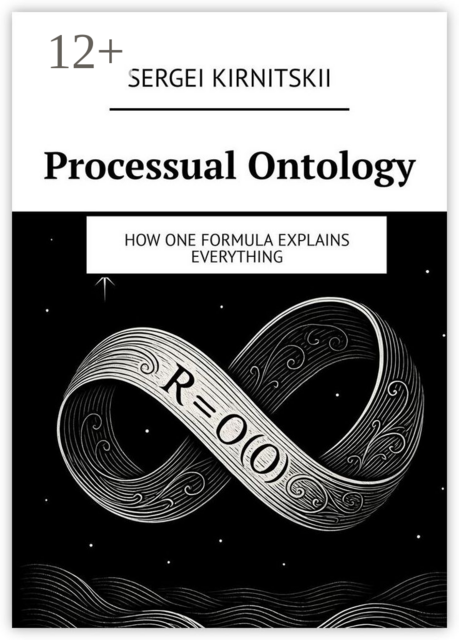



автордың кітабын онлайн тегін оқу Processual ontology. How one formula explains everything
Sergei Kirnitskii
Processual ontology
How one formula explains everything
Fonts by «ParaType»
© Sergei Kirnitskii, 2025
Forget everything you have known about reality. There is no matter. There is no spirit. No space or time as containers. Only process observing itself. This book offers no new theory — it demonstrates the sole possible ontology. From one formula everything follows: the laws of nature, consciousness, ethics. Too simple to be true? Reality is under no obligation to be complex.
ISBN 978-5-0068-3206-0
Created with Ridero smart publishing system
Contents
INTRODUCTION: ASSERTION
Methodological Preface
Processual ontology establishes the necessary structure of reality through analysis of the conditions of possibility of existence. Philosophical theory requires no empirical grounding — it reveals the ontological foundations of any possible experience.
Examples from quantum physics, neuroscience, and evolutionary biology illustrate the universality of the principle R = O (O). Scientific phenomena acquire ontological transparency within the processual framework. Paradoxes arising from substantial thinking dissolve in the transition to processual ontology.
The boundary between philosophy and science remains clear. Philosophy establishes ontological structure. Science investigates concrete mechanisms. Philosophy demonstrates the necessity of the observation process. Science studies its particular forms.
The term “observation” denotes the fundamental operation of distinction through which the indeterminate becomes determinate. This is an ontological operation preceding the division into observer and observed. The limitations of language, structured substantially, are overcome through rigorous definition of terms in a processual key.
Central Thesis
Reality is the process of observation applied to itself. R = O (O). This is not metaphor, not simplification, not model — this is precise structural description of existence.
Existence is process, not substance. This process is observation in the broadest sense. Observation is directed at itself. From this single principle derives the entire architecture of reality.
Observation here is understood not as a psychological act requiring consciousness or subject. Observation is the fundamental operation of distinction, the transition from indeterminate to determinate. Quantum phenomena illustrate the universal principle of observation. In processual ontology, measurement is understood as a particular case of transition from indeterminate to determinate through an act of distinction. This is a philosophical interpretation offering a conceptual framework for understanding observation’s role in physical processes. Chemical reaction represents mutual determination of molecules through selective interaction. Perception is observation. Thinking is observation. The difference between these processes — in degree of complexity, not in nature.
The formula R = O (O) asserts: reality is not observed by something external to it. Reality is self-observation. The process of observation, directed at itself, constitutes everything that exists. No observer outside the process. No observed before the process. Observer and observed — poles arising within the process.
Self-reference does not generate a vicious circle. Processual self-reference is productive. Each act of self-observation deepens the process, creating new levels of organization. Simple distinction becomes perception. Perception becomes awareness. Awareness becomes reflection. Reflection becomes self-knowledge. All levels are preserved and included in higher ones.
Process requires no foundation outside itself. It is self-grounded through self-actualization. The assertion “everything is process” is itself process. Theory completely describes itself in its own terms without remainder.
This is not solipsism. World is not created by individual consciousness. Individual consciousness — local intensification of the universal process of self-observation. Multiple consciousnesses are possible since process can have multiple centers of intensification.
This is not subjective idealism. Observation requires no subject. Subject arises as stable pattern within the observation process. First process, then subject.
This is not panpsychism. Not everything possesses consciousness. Consciousness — specific organization of the observation process, arising at sufficient complexity of self-reference. Stone has no consciousness. Stone participates in the process of mutual determination at the level of physical interactions.
This is not reductionism. Higher is not reduced to lower. Consciousness is not reduced to neural processes. Neural processes and consciousness — different levels of organization of single process. Each level possesses its own regularities.
Processual ontology asserts: there is only one process. All diversity of phenomena — modes of its organization. Matter — stabilized patterns of process. Consciousness — reflexive patterns of process. Space — structure of mutual determination. Time — internal dynamics of process.
No essences — only processes. Thing is not, thing happens. Stability of thing — constancy of pattern reproduction. Atom — not particle but stable configuration of process. Molecule — more complex configuration. Cell — self-reproducing configuration. Organism — integrated system of processes.
No external position for observing reality exists. Any observation occurs from within process. Objectivity — not view from nowhere but structural invariance within process. Scientific laws describe stable patterns of process.
Why New Ontology Is Necessary
Every existing ontology contains fundamental contradiction. It requires foundation that cannot be grounded within its framework.
Materialism postulates matter as primary substance. Matter cannot ground itself. Observer of matter is required — one who establishes its existence. Observer cannot be material, otherwise circle arises. Materialism secretly presupposes non-material position of observation.
Idealism postulates spirit, idea, or consciousness as primary. Idea requires bearer. Consciousness requires content. Spirit requires manifestation. Idealism must introduce something different from the ideal for complete description. Spatial metaphors, temporal sequences, causal connections — all borrowed from the material.
Dualism recognizes two substances — material and ideal. The interaction problem is unsolvable. If substances are absolutely different, they cannot interact. If they can interact, they are not absolutely different. Third element required, connecting them. Dualism becomes trialism, then pluralism.
Neutral monism postulates third substance generating material and mental. This substance itself requires grounding. It must be knowable, but knowledge occurs through the mental. Circle reproduces at new level.
Panpsychism attributes consciousness to everything existing. Multiplying consciousnesses to infinity explains nothing. Combination problem — how multiple micro-consciousnesses yield single macro-consciousness — unsolvable. Integration principle required, external to consciousnesses themselves.
Structural inconsistency is universal. Each ontology uses concepts from its opposite. Materialism operates with laws — ideal constructs. Idealism uses spatiotemporal images — material metaphors. None is self-sufficient.
Regress of foundations is infinite in substantial thinking. Substance requires cause of existence. Cause requires its cause. Stopping at “first cause” or “necessary existence” — arbitrary termination of explanation.
Dogmatism — only alternative to regress in substantial ontologies. Declared: “matter simply is” or “God exists necessarily”. Grounding replaced by declaration. Philosophy capitulates before arbitrary postulate.
Processual solution avoids both regress and dogmatism. Process requires no external foundation. It grounds itself through self-actualization. Grounding and grounded — moments of single process.
Requirements for new ontology are perfectly clear. Minimum initial principles — ideally one. Self-consistency at all levels. Ability to describe itself in own terms. No external postulates.
Processual ontology satisfies all requirements. One principle: R = O (O). Complete self-consistency: theory describes itself as process. No external postulates: process is self-grounded.
The minimalism of solution is revolutionary. Instead of multiplying essences — reduction to one process. Instead of hierarchy of substances — levels of process organization. Instead of external foundations — self-grounding.
All classical problems of philosophy arise from substantial thinking. Mind-body problem — from division into two substances. Problem of consciousness — from attempt to derive mental from material. Problem of free will — from opposing subject and world. Problem of time — from representing it as container of events.
In processual ontology these problems are not solved — they dissolve. No substances — no problem of interaction. Mental and physical — levels of single process. Subject — mode of process, not opposed to it. Time — internal structure of process.
Transition from substance to process is not replacement of one foundation with another. It is exit from the very logic of foundations. Process is not foundation of reality. Process is reality.
The formula R = O (O) is not postulate among other possible postulates. It is minimal description of the very fact of existence. Less means nothing. More is redundant.
Ontology must explain not only world but also itself. Materialism cannot materialistically explain existence of materialist theory. Idealism cannot idealistically ground necessity of idealism. Processual ontology describes itself as moment of reality’s self-knowledge process.
Philosophy has moved in circles of substantial alternatives for centuries. Materialism replaced by idealism, idealism by new materialism. Dualism reborn in new forms. Circle cannot be broken from within. Exit into new dimension necessary.
Processual ontology — not new position in old dispute. It is sublation of dispute itself through elimination of its presuppositions. No substances whose primacy can be disputed. There is process within which all distinctions arise, including distinction between material and ideal.
The proof that follows will demonstrate necessity and sufficiency of processual principle. From R = O (O) the entire architecture of existence will be derived. Without additional postulates. Without hidden presuppositions. Without appeal to intuition or faith.
Reader need accept nothing on faith. Each step will be grounded. Each transition will be necessary. Movement from principle to consequences will have the logical transparency of geometric proof.
CHAPTER 1: THE PRINCIPLE
Reality is the process of observation applied to itself. This formula R = O (O) contains the entire structure of existence. Proving this assertion requires three steps: establishing the ontological nature of observation, revealing the mechanism of self-reference, demonstrating the absolute ontological minimum.