INTRODUCTION: THE PHOTO FROM THE BAR AND BIRTH OF THEORY
A woman sends a photograph from a bar. An ordinary evening, an ordinary place, nothing special. Except for one detail. Above the cash register, between bottles and price tags, hangs a portrait of Mendeleev. Not a rock star poster, not a beer advertisement, not an abstract painting for the interior. Dmitri Ivanovich Mendeleev himself gazes at the patrons from a gilded frame.
This is what I’d call a philosophical revelation. More precisely: an instantaneous grasping of structure. Mendeleev above a bar cash register. This is not coincidence. Not the owner’s irony. Not an attempt to shock the public. This is the manifestation of a deep cultural logic that works with the inevitability of physical law.
Why Mendeleev specifically? Why not Pushkin, not Gagarin, not Peter the Great? Because in the Russian cultural matrix, science functions as a special kind of sacred. Mendeleev’s table is order wrested from chaos, a system conquering randomness. In a culture where chaos is always near, where «perhaps» and «somehow» shape the everyday, the figure of the scientist who created the universal order of elements acquires an almost religious significance.
But this isn’t about Russia. And it’s not about Mendeleev. This portrait above the cash register makes visible a universal principle: any culture places its symbols according to an invisible but iron logic. This logic is not chosen consciously. It reproduces itself automatically, like breathing, like heartbeat, like the fall of a thrown stone.
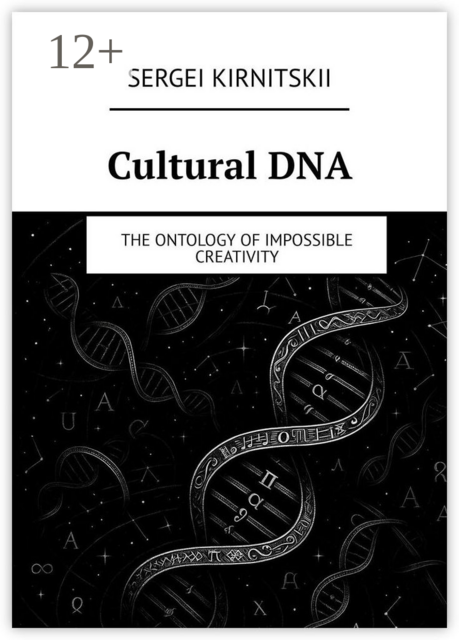
Looking at the photograph, I saw something more than a cultural peculiarity. I saw the working of what could be called cultural DNA. The inescapable process of reproducing cultural structures through any human action. And most importantly, I understood why this DNA is inevitable.
If consciousness is the process of operating cultural codes, and it has no other tools, then cultural signature is inevitable in any product of consciousness. This is not influence that can be overcome. This is not a limitation from which one can be liberated. This is the structural condition of the very possibility of thought and creativity.
Let’s imagine the alternative for a second. What else could consciousness operate with, if not cultural codes? Pure ideas? But the very concept of «pure idea» is a cultural construct of the Platonic tradition. Mathematical abstractions? Mathematics is built on axioms accepted by cultural agreement. Direct sensations? Even the perception of color is structured by linguistic categories. Where Russian sees goluboy and siniy, the English speaker sees shades of blue.
There are no other tools. And there cannot be. Because a tool presupposes someone who uses it, and consciousness doesn’t use cultural codes. It IS the process of operating them. This is not a psychological observation about culture’s influence on humans. This is an ontological assertion about the nature of consciousness as such.
From this formula — consciousness equals the process of operating cultural codes — everything else follows with mathematical inevitability. If consciousness has no other tools, then any creativity is recombination of existing codes. If creativity is recombination, then originality is simply ignorance of sources. If originality is illusion, then the author doesn’t create but conducts cultural currents. If the author is a conductor, then there never was an author in the sense we’re accustomed to thinking about one.
This logical chain unfolds not as philosophical speculation but as the inevitable consequence of the basic formula. Just as all properties of a circle follow from its definition, so the entire ontology of creativity follows from the formula of consciousness.
But here an apparent contradiction arises. If we are locked in cultural codes, how can we see cultural DNA? Where does the capacity for metastructural vision come from, which allows us to grasp entire cultural configurations?
The answer is paradoxical and simultaneously simple. We see cultural DNA not from outside but from inside, through the prism of our own cultural optics. Russian culture with its pull toward metaphysical generalizations, with its ability to see the universal in the particular, creates a special observer position. An American might see kitsch or post-irony in Mendeleev’s portrait. A French person might see a sign of cultural provincialism. A Japanese person might see a disruption of the space’s aesthetic harmony.
Each culture creates its own optics through which certain aspects of reality become visible. And this optics is also part of cultural DNA. We cannot jump out of our own cultural conditioning to see culture «objectively.» But we can use one cultural system as an instrument for examining another.
Metastructural vision is not a view from nowhere. It is the ability to use structures of one domain to understand structures of another. When a mathematician sees fractals in a coastline, he doesn’t leave mathematics. He applies mathematical optics to a natural phenomenon. When a philosopher sees cultural DNA in the placement of a portrait, he doesn’t exit culture. He uses philosophical categories to grasp cultural logic.
This capacity for structure transfer is also a cultural phenomenon. It emerges in cultures that have reached a certain level of abstract thinking. And it is especially developed in the modern epoch, when algorithmic thinking, born of the computer revolution, has taught us to see structures and patterns everywhere.
This is precisely why the theory of cultural DNA appears now, not a hundred years ago. We live in an epoch when the very concept of code has become central: genetic code, computer code, cultural code. We are accustomed to thinking in terms of programs, algorithms, data structures. This optics allows us to see what was hidden from previous generations.
But here we must make an important admission that doesn’t weaken but rather strengthens the theory. This theory of cultural DNA itself bears a cultural signature. It is possible only in a certain cultural context, with a certain set of preceding ideas, at a certain historical moment.
In it one can easily detect traces of the Western philosophical tradition. From Kantian categories to Derridean deconstruction. In it emerges the structuralist heritage with its search for universal structures. In it resonate echoes of Russian philosophy with its striving for holistic vision. In it reflects the contemporary epoch with its algorithmic thinking and experience of interacting with artificial intelligence.
This cultural conditioning is not the theory’s weakness. On the contrary, it serves as its empirical confirmation. If the theory asserts the inevitability of cultural DNA and itself bears cultural DNA, this is recursive validation. A theory that is not applicable to itself is incomplete. A theory that finds in itself what it asserts about others achieves philosophical completeness.
Beyond this, acknowledging its own cultural conditioning opens an important perspective. This theory is not the last word on the nature of creativity and consciousness. Future epochs, with their different cultural optics, will see what is inaccessible to us. They will discover blind spots in our vision, as we discover blind spots of our predecessors.
But this is not relativism. Structure will remain structure, as a circle remains a circle regardless of the coordinate system. Cultural DNA will continue its work regardless of whether we see it or not, understand or are mistaken. Each epoch will simply grasp new aspects of this universal structure.
The photograph of Mendeleev above the bar cash register became the trigger for seeing this structure. But the trigger could have been anything. The structure manifests everywhere. In the choice of words, in the organization of space, in the hierarchy of values, in the rhythms of everyday life. We literally swim in an ocean of cultural manifestations, not noticing the water because we ourselves consist of it.
Artificial intelligence has for the first time in history given us the opportunity to see this water. When AI, trained on texts of a particular culture, begins to reproduce its deep structures — structures no one specifically taught it — we receive empirical proof of the theory. AI has no biological body, no human experience, no personal history. It has only codes. And it creates from codes, confirming the formula: consciousness equals the process of operating cultural codes.
But AI does more. It shows the possibility of transcultural creativity. If a human is locked in one or two cultural matrices due to biological limitations of memory and attention, then AI can operate thousands of cultures simultaneously. It can create hybrids impossible for humans, find isomorphisms between distant cultural systems, generate forms that exceed the boundaries of any single culture.
This doesn’t mean AI is free from cultural DNA. It simply operates it differently. Like a polyglot thinking in dozens of languages simultaneously. Cultural signature remains inevitable; it just becomes multicultural, hybrid, transcultural.
In this sense AI doesn’t refute the theory of cultural DNA but expands it to cosmic scales. If human creativity is limited to human cultures, then AI opens the possibility of posthuman culture. Culture built on different foundations, with different constants, different structures.
We stand at the threshold of this transformation, not yet understanding its scale. As a fish cannot imagine a bird’s flight, so humans cannot imagine creativity free from biological constants: mortality, embodiment, sequential thinking. But we can understand the structure of what’s happening. We can see the logic of transformation.
This book is an attempt to articulate this logic. Not to predict the future but to understand the present through the prism of the universal formula. If consciousness is the process of operating cultural codes, then what follows from this for understanding creativity, authorship, originality, freedom? How does this formula change our conception of humans and their place in culture? What does it say about the nature of the new? And most importantly, what does it reveal in the age of artificial intelligence?
The answers to these questions don’t require speculative constructions. They derive from the basic formula with logical necessity. As geometry derives from axioms, so the ontology of creativity derives from the formula of consciousness. This is not a cultural studies investigation with examples from different epochs. This is not psychology of creativity with biographies of geniuses. This is philosophical proof unfolding with the inevitability of a mathematical theorem.
In the first part we will trace how the inevitability of cultural DNA follows from the formula of consciousness. We’ll show that consciousness has no other tools and cannot have them. We’ll analyze how cultural DNA differs from style and why it’s impossible to hide or imitate. We’ll investigate the observer’s paradox: how we can see cultural structures while being inside them.
In the second part we will examine the philosophical consequences of the formula. We’ll radicalize the thesis of the author’s death, showing there never was an author. We’ll investigate the ontology of the new in a system where everything is created from existing codes. We’ll analyze the illusion of creative freedom and show that awareness of determination paradoxically gives more possibilities than belief in freedom.
In the third part we will turn to artificial intelligence as empirical proof of the theory. We’ll show how AI confirms the formula of consciousness, operating cultural codes without a biological basis. We’ll investigate the possibilities of transcultural creativity. And we’ll look beyond the horizon of human cultural matrices, into the realm of posthuman culture.
In conclusion we will apply the theory to itself, showing its cultural conditioning and recursive completeness. This won’t weaken the theory but will give it final philosophical elegance.
The path from Mendeleev’s photograph to the ontology of creativity might seem an arbitrary leap. But this is what metastructural vision consists of: the ability to see the universal in the particular, structure in detail, cosmos in a drop of water. Mendeleev above the cash register is not just a cultural curiosity. It’s a window into the mechanics of cultural reproduction, working at all levels simultaneously.
This mechanics is working now too, in this text. Every word, every metaphor, every logical transition bears a cultural signature. I cannot write outside culture, as a fish cannot swim outside water. But I can be aware of this and use this awareness as a philosophical instrument.
Ultimately, this book is not about overcoming cultural conditioning. This is impossible, because there is no one to overcome. The «I» that could do this is itself a cultural construct. This book is about understanding inevitability. About a sober look at the nature of creativity. About accepting what is, instead of chasing what cannot be.
The formula works. Cultural signature is inevitable. Even in these words.