



Онлайн кітапты тегін оқу The War with Mexico, Volume 1 (of 2)
Transcriber’s Note
Please consult the notes at the end of this text for a detailed discussion of the various footnotes, endnotes, and navigation through this text, as well as any other textual issues.
Topic descriptions
Right-side page headers contained descriptions of the current topic covered by the two open pages. These were retained and are placed as marginal notes. The choice of that position is not always obvious and should be regarded as approximate.
Illustrations are placed at approximately the point where they were printed. The captions are usually printed on the maps themselves. Where there is no obvious title to the map, the caption has been provided from the table of illustrations, in mixed case.
Larger images of full-page maps are available by using the hyperlink added to the caption. These may be opened in separate windows.
This is the first of two volumes of The War with Mexico. The index, which is contained in Volume II, refers to both volumes. References to Volume II have been included as hyperlinks.
Volume II of can be found at Project Gutenberg with the following address:
http://www.gutenberg.org/ebooks/44438
The cover image was created by the transcriber, and is placed in the public domain.
THE WAR WITH MEXICO
BY THE SAME AUTHOR
The
Annexation of Texas
Octavo ix + 496 pages
By mail, postpaid, $3.00
This is the only work attempting to deal thoroughly with an affair that was intrinsically far more important than had previously been supposed, and was also of no little significance on account of its relation to the war with Mexico.
THE MACMILLAN COMPANY
PUBLISHERS
THE
WAR WITH MEXICO
BY
JUSTIN H. SMITH
FORMERLY PROFESSOR OF MODERN HISTORY
AT DARTMOUTH COLLEGE
AUTHOR OF “THE ANNEXATION OF TEXAS,” “OUR
STRUGGLE FOR THE FOURTEENTH COLONY,”
“ARNOLD’S MARCH FROM
CAMBRIDGE TO QUEBEC,”
ETC.
VOLUME I
New York
THE MACMILLAN COMPANY
1919
All rights reserved
Copyright, 1919,
By THE MACMILLAN COMPANY.
Set up and printed. Published December, 1919.
Norwood Press
J. S. Cushing Co.–Berwick & Smith Co.
Norwood, Mass., U.S.A.
TO
HENRY CABOT LODGE, LL.D.
SENATOR OF THE UNITED STATES
HISTORIAN
PRESIDENT OF THE MASSACHUSETTS HISTORICAL SOCIETY
WHO GAVE THE AUTHOR INVALUABLE ASSISTANCE
IN THE COLLECTION OF MATERIAL RELATING
TO THE WAR WITH MEXICO
THIS WORK
IS VERY RESPECTFULLY INSCRIBED
PREFACE
As every one understands, our conflict with Mexico has been almost entirely eclipsed by the greater wars following it. But in the field of thought mere size does not count for much; and while the number of troops and the lists of casualties give the present subject little comparative importance, it has ample grounds for claiming attention. As a territorial stake New Mexico, Arizona and California were of immense value. National honor was involved, and not a few of the Mexicans thought their national existence imperilled. Some of the diplomatic questions were of the utmost difficulty and interest. The clash of North and South, American and Mexican, produced extraordinary lights and shades, and in both countries the politics that lay behind the military operations made a dramatic and continual by-play. The military conduct of the governments—especially our own—and the behavior of our troops on foreign soil afforded instruction worthy to be pondered. While vast concentrations of forces and complicated tactical operations on a great scale were out of the question, the handling of even small armies at a long distance from home and in a region that was not only foreign but strange, created problems of a peculiar interest and afforded lessons of a peculiar value, such as no earlier or later war of ours has provided; and the examples of courage, honor and heroism exhibited in a conflict not only against man but against nature merited correct appreciation and lasting remembrance.[1][A]
The warrant for offering another work on the subject rests primarily on the extent and results of the author’s investigations. His intention was to obtain substantially all the valuable information regarding it that is in existence, and no effort was spared to reach his end. The appendix of volume II gives a detailed account of the sources. By special authorization from the Presidents of the United States and Mexico it was possible to examine every pertinent document belonging to the two governments. The search extended to the archives of Great Britain, France, Spain, Cuba, Colombia and Peru, those of the American and Mexican states, and those of Mexican cities. The principal libraries here, in Mexico and in Europe, the collections of our historical societies, and papers belonging to many individuals in this country and elsewhere were sifted. It may safely be estimated that the author examined personally more than 100,000 manuscripts bearing upon the subject, more than 1200 books and pamphlets, and also more than 200 periodicals, the most important of which were studied, issue by issue, for the entire period.[B] Almost exclusively the book is based upon first-hand sources, printed matter having been found of little use except for the original material it contains or for data regarding biography, geography, customs, industries and other ancillary subjects.[2]
The author also talked or corresponded with as many of the veterans as he could reach, and he spent more than a year, all told, in Mexico, where he not only studied the chief battlefields but endeavored, through conversations with Mexicans of all grades and by the aid of foreigners long resident in the country, to become well acquainted with the character and psychology of the people. As the war was fought almost exclusively among them, and its inception, course and results depended in large part upon these factors, the author attaches not a little importance to his opportunities for such personal investigations and to his Mexican data in general.[2]
Probably more than nine tenths of the material used in the preparation of this work is in fact new. No previous writer on the subject had been through the diplomatic and military archives of either belligerent nation, for example. Virtually a still larger percentage is new, for the published documents needed to be compared with the originals. In the printed American reports relating to the battles of September 8 and 13, 1847, for instance, over fifty departures from the manuscripts, that seemed worth noting, were found. Nor did the additional documents prove by any means to supply mere details. A great number of unprinted statements from subordinate officers, who were nearer to the facts than their superiors could be, were discovered. The major official reports needed both to be supplemented and to be corrected. Such reports were in most instances colored more or less, and in some radically distorted, for personal reasons or from a justifiable desire to produce an effect on the subordinates concerned, the army in general, the writer’s government, the enemy, and the public at home and abroad; while, as General Scott stated in orders, unintentional omissions and mistakes were “common.” Taylor’s account of the battle of May 9, 1846, for example, failed completely to explain his victory. It has been only by obtaining and comparing a large number of statements that approximate verity has been reached. The same has been true of the diplomatic and political aspects of the subject. The reports of the British, French and Spanish ministers residing at Mexico, to cite one illustration, proved indispensable. In reality, therefore, aside from its broader outlines the field presented ample opportunities for study; and while no doubt so extended an investigation included many facts of slight value, La Rochefoucauld was right when he said, “To know things perfectly, one should know them in detail.”[3]
As a particular consequence of this full inquiry, an episode that has been regarded both in the United States and abroad as discreditable to us, appears now to wear quite a different complexion. Such a result, it may be presumed, will gratify patriotic Americans, but the author must candidly admit that he began with no purpose or even thought of reaching it. His view of the war at the outset of his special inquiries coincided substantially with that prevailing in New England, and the subject was taken up simply because he felt convinced that it had not been studied thoroughly. This conviction, indeed, has seemed to be gaining ground rapidly for some time, and hence it is believed that new opinions, resting upon facts, will be acceptable now in place of opinions resting largely upon traditional prejudices and misinformation.
Some might suggest that only a military man could properly write this work. But, in the first place, the author did not wish to prepare a technical military account of the war. His aim was to offer a correct and complete view of it suitable for all interested in American history, and it will be found that politics, diplomacy and other phases of the subject required as full investigation as did its military aspects.
Secondly, the author took pains to qualify himself for his task. The real difficulty of the commanding general consists in applying the principles of war under complicated, obscure and changeful conditions, and in overcoming “friction” of many sorts. The intellectual side of the art is readily enough understood. “In war everything is very simple,” wrote Clausewitz, the fountainhead of the modern system. “The theory of the great speculative combinations of war is simple enough in itself,” said Jomini; “it only requires intelligence and attentive reflection.” “Strategy is the application of common sense to the conduct of war,” declared Von Moltke. Arnold in his Lectures on Modern History said: “An unprofessional person may, without blame, speak or write on military subjects, and may judge of them sufficiently;” and the eminent military authority, G. F. R. Henderson, endorsed this view. “The theory of war is simple,” wrote another expert, “and there is no reason why any man who chooses to take the trouble to read and reflect carefully on one or two of the acknowledged best books thereon, should not attain to a fair knowledge thereof.” As may be seen from the list of printed sources, the present author—beginning with the volumes recommended by a board of officers to the graduates of the United States Military Academy—did much more than is here proposed.
Finally, during the entire time occupied in writing this work he fortunately enjoyed the advantage of corresponding and occasionally conferring with Brigadier General Oliver L. Spaulding, Jr., of the United States Field Artillery, formerly instructor at the Army Service Schools, Fort Leavenworth, and more recently Assistant Commandant of the School of Fire, Fort Sill, who had distinguished himself not only in the service but as a writer on professional subjects. General Spaulding has kindly discussed with the author such military questions as have arisen, and has read critically all the battle chapters. No responsibility should, however, be attached to him, if a mistake is detected.[4]
A word must be added with reference to the notes. These have been placed at the ends of the volumes because the author believes the best plan will be to read the text of each chapter before looking at the notes that bear upon it, and also in part because he did not wish any one to feel that he was parading his discussions and citations. The notes contain supplementary material designed to make the work a critical as well as a narrative history, and contain also specific references to the sources on which the text is based. These references involved a most annoying problem. When one’s citations are limited in number and proceed in single file, as it were, they can be handled easily. But in the present instance as many as 1800 documents were used for a chapter, not a few of which were cited more than once; and each sentence of the text—to speak broadly—resulted from comparing a number of sources. Under these conditions the usual method would have produced a repellent mass of references, perhaps greater in extent than the text itself, which would have been very expensive to print and from their multiplicity would have been extremely inconvenient. Where that method appeared feasible it was adopted, but as a rule the references have been grouped by paragraphs or topics. In many cases, however, pains have been taken to indicate in the text itself the basis of important statements, and further hints will be found in the notes. The reader can thus always ascertain in general the basis of the text, and will find specific references wherever the author has thought it likely they would be desired. The special student will wish to look up all the citations bearing on any topic that interests him. No doubt the plan is somewhat unsatisfactory, but after studying the subject for a dozen years the author feels sure that any other would have been more so.[5]
To thank all who kindly assisted the author to obtain material is practically impossible; but a number of names appear in the list of MS. sources, and others must be mentioned here. Without the cordial support of Presidents Theodore Roosevelt and Porfirio Diaz, Secretary of State Elihu Root, Minister of Relations Ignacio Mariscal, and Senator Henry Cabot Lodge this history could not have been written; and the author acknowledges with no less pleasure his special obligations to Whitelaw Reid, American Ambassador to Great Britain, Joseph E. Willard, Ambassador to Spain; Henri Vignaux, First Secretary of our embassy at Paris; J. J. Limantour, Minister of Hacienda, Mexico; Major General J. Franklin Bell, Chief of Staff; Major General F. C. Ainsworth, Adj. Gen.; Admiral Alfred T. Mahan; Admiral French E. Chadwick; Brigadier General J. E. Kuhn, Head of the War College, Washington; Dr. J. Franklin Jameson, Director of the Department of Historical Research, Carnegie Institution; Dr. Gaillard Hunt, Chief of the Division of MSS., Library of Congress; Dr. St. George L. Sioussat, Brown University; Dr. Eugene C. Barker, University of Texas; Dr. Herbert E. Bolton, Professor Frederick J. Teggart and Dr. H. I. Priestley of the University of California; Dr. R. W. Kelsey of Haverford College; Dr. J. W. Jordan, Pennsylvania Historical Society; Dr. Worthington C. Ford, Editor for the Massachusetts Historical Society; Dr. Solon J. Buck of the Minnesota Historical Society; R. D. W. Connor, Secretary of the Historical Commission of North Carolina; Dr. R. P. Brooks of the University of Georgia; Dr. Dunbar Rowland, Director of the Archives and Historical Department of Mississippi; T. M. Owen, Director of the Historical Department of Alabama; Dr. George M. Philips, State Normal School, West Chester, Pa.; Waldo G. Leland, Secretary of the American Historical Association; W. B. Douglas and Miss Stella M. Drumm, Librarian, of the Missouri Historical Society; Dr. Clarence E. Alvord of the University of Illinois and Mrs. Alvord (formerly Miss Idress Head, Librarian of the Missouri Historical Society); Ignacio Molina, Head of the Cartography Section, Department of Fomento, Mexico; Charles W. Stewart, Librarian of the Navy Department; James W. Cheney, long the Librarian of the War Department; Major Gustave R. Lukesh, Director, and Henry E. Haferkorn, Librarian of the United States Engineer School, Washington Barracks; D. C. Brown, Librarian of the Indiana State Library; Victor H. Paltsits, Department of MSS., New York Public Library; W. L. Ostrander of the library at West Point; Lieutenant James R. Jacobs, 28th United States Infantry; Dr. Katherine J. Gallagher; Dr. Martha L. Edwards. To the widow of Admiral Charles S. Sperry and their son, Professor Charles S. Sperry, the author is particularly indebted for an opportunity to examine important papers left by William L. Marcy. Valuable suggestions were most kindly given by Dr. William A. Dunning of Columbia University and Dr. Davis R. Dewey of the Massachusetts Institute of Technology, who read portions of the text, by Francis W. Halsey, Esq., of New York, who read nearly all of it, and by Dr. Edward Channing of Harvard University, who was so good as to look over more or less closely all of the proofs. To the helpers not mentioned by name the author begs leave to offer thanks no less sincere.
Finally, the author desires to mention the enterprise and public spirit shown by the publishers in bringing out so expensive a work at this time of uncertainty.
The Century Club, New York
September, 1919.
CONTENTS OF VOLUME I
PAGE Maps and Plans in Volume I xvii Conspectus of Events xix Pronunciation of Spanish xxi CHAPTERI.
Mexico and the Mexicans 1II.
The Political Education of Mexico 29III.
The Relations between the United States and Mexico, 1825–1843 58IV.
The Relations between the United States and Mexico, 1843–1846 82V.
The Mexican Attitude on the Eve of War 102VI.
The American Attitude on the Eve of War 117VII.
The Preliminaries of the Conflict 138VIII.
Palo Alto and Resaca de Guerrero 156IX.
The United States Meets the Crisis 181X.
The Chosen Leaders Advance 204XI.
Taylor Sets out for Saltillo 225XII.
Monterey 239XIII.
Saltillo, Parras, and Tampico 262XIV.
Santa Fe 284XV.
Chihuahua 298XVI.
The California Question 315XVII.
The Conquest of California 331XVIII.
The Genesis of Two Campaigns 347XIX.
Santa Anna Prepares to Strike 370XX.
Buena Vista 384 Notes on Volume I 402 Appendix (Manuscript Sources) 565MAPS AND PLANS IN VOLUME ONE
As equally good sources disagree sometimes, a few inconsistencies are unavoidable. Numerous errors have been corrected. An asterisk indicates an unpublished original. Statements, cited in the notes, have also been used.
1.
Mexico in 1919. Based upon standard maps
xxii2.
Profile of the Route between Vera Cruz and Mexico
2Drawn by Lieut. Hardcastle (Sen. Ex. Doc. 1; 30 Cong., 1 sess.).
3.
Matamoros and Fort Brown
159Sketch map based on a *map drawn by Luis Berlandier, Arista’s chief engineer (War Dept., Mexico); Meade, Letters, i, 73; McCall, Letters, 444; New Orleans
Picayune, June 28, 1846; *sketch by Mansfield, Taylor’s chief engineer (War Dept., Washington); and an anonymous plan (Mass. Hist. Society).
4.
Fort Brown to Brazos Island
162Sketch map based principally upon the map in Apuntes para la Historia de la Guerra entre México y los Estados-Unidos and a map by Eaton of Third Infantry (Ho. Ex. Doc. 209; 29 Cong., 1 sess.).
5.
Battle of Palo Alto
164Sketch map drawn by a U. S. army officer. Based on Eaton’s plan (Ho. Ex. Doc., 209; 29 Cong., 1 sess.); a *sketch by Berlandier (War Dept., Mexico); Apuntes; México á través de los Siglos, iv, 562;
El Republicano(Berlandier); a map in Campaña contra los Norte-Americanos; a map by Lieut. Dobbins in Life of General Taylor; and
Journal of Milit. Service Institution, xli, 96.
6.
Battle of Resaca de la Palma (
i.e.Resaca de Guerrero)
170Sketch map based on Apuntes; New Orleans
Picayune, June 25, 1846, from official drawings; a plan by Dobbins in Life of General Taylor; a map in Campaña contra,
etc.; a plan by Berlandier in
El Republicano; a plan by Eaton (Ho. Ex. Doc. 209; 29 Cong., 1 sess.); French, Two Wars, 52; and
Journal of Milit. Service Instit., xli, 100.
7.
From Matamoros to Monterey
210Based on an official Mexican map prepared by the Fomento Dept. and on Gen. Arista’s map.
8.
Battles of Monterey: General Map
232Based on *three plans drawn by Lieut. Gardner from surveys of Lieut. Scarritt (War Dept., Washington);
PicayuneExtra, Nov. 19, 1846 (Lieut. Benjamin); a *drawing by Adjutant Heiman (Tennessee Hist. Society); a map in Apuntes; and a plan by Balbontín (Invasión Americana).
9.
Battles of Monterey. Central Operations
240Based on the same sources as No. 8
supra.
10.
General Wool’s March
271Based on reconnaissances of Capt. Hughes, Lieut. Sitgreaves, and Lieut. Franklin (Sen. Ex. Doc. 32; 31 Cong., 1 sess.).
11.
Tampico and Its Environs
276Based on a sketch by Lee and Gilmer (War Dept., Washington); and a Fomento Dept. Map (
seeNo. 7
supra).
12.
General Kearny’s March to Santa Fe
287From a sketch drawn by A. Wislizenus (Sen. Misc. Doc. 26; 30 Cong., 1 sess.).
13.
El Paso to Rosales, Mexico
305From a U. S. War College map, Washington.
14.
Battle of Sacramento
307Based on a map in Sen. Ex. Doc. 1; 30 Cong., 1 sess.; and a plan in México á través de los Siglos, iv, 644.
15.
California in 1846
316Based on a map in Sen. Ex. Doc. 1; 30 Cong., 1 sess.
16.
Northern California
317From a sketch by Lieut. Derby (Sen. Ex. Doc. 18; 31 Cong., 1 sess.) and recent maps.
17.
Fight at San Pascual
341From a plan in Sen. Ex. Doc. 1; 30 Cong., 1 sess.
18.
Fight near Los Angeles
344From a plan in Sen. Ex. Doc. 1; 30 Cong., 1 sess.
19.
General Patterson’s March
360From a map in Ho. Ex. Doc. 13; 31 Cong., 2 sess.
20.
From Mexico City to Agua Nueva
381From a Fomento Dept. map.
21.
From Monterey to La Encarnación
382Based on a map in Rápida Ojeada sobre la Campaña,
etc.; and a *sketch by Lee and Gilmer (War Dept., Washington).
22.
Battle of Buena Vista
387Based on a map drawn by Capt. Linnard from the surveys of Capt. Linnard and Lieuts. Pope and Franklin (Sen. Ex. Doc. 1; 30 Cong., 1 sess.); *two plans by the same officers (War Dept., Washington); a *map based on a sketch by Dr. Vanderlinden, chief Mexican surgeon (War Dept., Mexico); a map by Balbontín (Invasión Americana); a *map drawn by Stanislaus Lasselle (Indiana State Library); a plan by Lieut. Green (Scribner, Campaign in Mexico); *Croquis para la intelligencia de la Batalla de la Angostura (War Dept., Washington).
CONSPECTUS OF EVENTS
1845
March.
The United States determines to annex Texas; W. S. Parrott sent to conciliate Mexico.
July.
Texas consents; Taylor proceeds to Corpus Christi.
Oct.
17.
Larkin appointed a confidential agent in California.
Nov.
10.
Slidell ordered to Mexico.
Dec.
20.
Slidell rejected by Herrera.
1846
Jan.
13.
Taylor ordered to the Rio Grande.
Mar.
8.
Taylor marches from Corpus Christi.
21.
Slidell finally rejected by Paredes.
28.
Taylor reaches the Rio Grande.
Apr.
25.
Thornton attacked.
May
8.
Battle of Palo Alto.
9.
Battle of Resaca de la Palma.
13.
The war bill becomes a law.
June
5.
Kearny’s march to Santa Fe begins.
July
7.
Monterey, California, occupied.
14.
Camargo occupied.
Aug.
4.
Paredes overthrown.
7.
First attack on Alvarado.
13.
Los Angeles, California, occupied.
16.
Santa Anna lands at Vera Cruz.
18.
Kearny takes Santa Fe.
19.
Taylor advances from Camargo.
Sept.
14.
Santa Anna enters Mexico City.
20–24.
Operations at Monterey, Mex.
22–23.
Insurrection in California precipitated.
23.
Wool’s advance from San Antonio begins.
25.
Kearny leaves Santa Fe for California.
Oct.
8.
Santa Anna arrives at San Luis Potosí.
Oct.
15.
Second attack on Alvarado.
24.
San Juan Bautista captured by Perry.
28.
Tampico evacuated by Parrodi.
29.
Wool occupies Monclova.
Nov.
15.
Tampico captured by Conner.
16.
Saltillo occupied by Taylor.
18.
Scott appointed to command the Vera Cruz expedition.
Dec.
5.
Wool occupies Parras.
6.
Kearny’s fight at San Pascual.
25.
Doniphan’s skirmish at El Brazito.
27.
Scott reaches Brazos Id.
29.
Victoria occupied.
1847
Jan.
3.
Scott orders troops from Taylor.
8.
Fight at the San Gabriel, Calif.
9.
Fight near Los Angeles, Calif.
11.
Mexican law regarding Church property.
28.
Santa Anna’s march against Taylor begins.
Feb.
5.
Taylor places himself at Agua Nueva.
19.
Scott reaches Tampico.
22–23.
Battle of Buena Vista.
27.
Insurrection at Mexico begins.
28.
Battle of Sacramento.
Mar.
9.
Scott lands near Vera Cruz.
29.
Vera Cruz occupied.
30.
Operations in Lower California opened.
Apr.
8.
Scott’s advance from Vera Cruz begins.
18.
Battle of Cerro Gordo; Tuxpán captured by Perry.
19.
Jalapa occupied.
May
15.
Worth enters Puebla.
June
6.
Trist opens negotiations through the British legation.
16.
San Juan Bautista again taken.
Aug.
7.
The advance from Puebla begins.
20.
Battles of Contreras and Churubusco.
Aug. 24–Sept. 7. Armistice.
Sept.
8.
Battle of Molino del Rey.
13.
Battle of Chapultepec; the “siege” of Puebla begins.
14.
Mexico City occupied.
22.
Peña y Peña assumes the Presidency.
Oct.
9.
Fight at Huamantla.
20.
Trist reopens negotiations.
Nov.
11.
Mazatlán occupied by Shubrick.
1848
Feb.
2.
Treaty of peace signed.
Mar.
4–5.
Armistice ratified.
10.
Treaty accepted by U. S. Senate.
May
19, 24.
Treaty accepted by Mexican Congress.
30.
Ratifications of the treaty exchanged.
June
12.
Mexico City evacuated.
July
4.
Treaty proclaimed by President Polk.
THE PRONUNCIATION OF SPANISH
The niceties of the matter would be out of place here, but a few general rules may prove helpful.
A as in English “ah”; e, at the end of a syllable, like a in “fame,” otherwise like e in “let”; i like i in “machine”; o, at the end of a syllable, like o in “go,” otherwise somewhat like o in “lot”; u like u in “rude” (but, unless marked with two dots, silent between g or q and e or i); y like ee in “feet.”
C like k (but, before e and i, like [C]th in “thin”); ch as in “child”; g as in “go” (but, before e and i, like a harsh h); h silent; j like a harsh h; ll like [D]lli in “million”; ñ like ni in “onion”; qu like k; r is sounded with a vibration (trill) of the tip of the tongue (rr a longer and more forcible sound of the same kind); s as in “sun”; x like x in “box” (but, in “México” and a few other names, like Spanish j); z like [C]th in “thin.”
Words bearing no mark of accentuation are stressed on the last syllable if they end in any consonant except n or s, but on the syllable next to the last if they end in n, s or a vowel.
Transcriber’s Note
1. Another reason for the neglect of the Mexican War has been its unpopularity. But for that, it would no doubt have been thoroughly studied sooner.
[A] The notes to which this and the other “superior figures” invite attention will be found immediately after the text of the volume. In the notes only brief titles of books are given, but these may be supplemented by reference to the list of printed sources given in the appendix of the second volume. Citations (in the notes) preceded by a number in black type refer to the list of MS. sources standing at the end of the notes.
[B] These figures cover also the author’s “Annexation of Texas,” which is virtually an introduction to the present work.
2. A second reason for preparing this history was that a number of important topics—such as the conditions existing in the two countries just before the war, the war in American politics, our conduct and methods in occupied territory, the finances of the war, its foreign relations, etc.—had been treated most superficially or not at all. In the third place it was hoped to handle more carefully the material previously used. The bound volumes entitled “Archivo de Guerra” in the Archivo General y Público at Mexico occupy some 200 feet of shelf room, and the papers examined in the Archivo de Guerra y Marina, which had to be examined one by one, would probably, if placed one on another, make a pile sixty feet high.
3. The printed versions of diplomatic and military documents, when substantially correct, are usually cited in the notes, because they are easily accessible; but so far as possible they have been collated with the originals. On the value of official military reports the author presented some remarks in the American Historical Review, vol. xxi, p. 96. Gen. Worth said privately that Scott’s report on the battle of Cerro Gordo was “a lie from beginning to end,” and in a sense different from what this language would at first sight appear to mean, it was fairly correct (chap. xxiii, note 33). Subordinate officers not infrequently brought all possible influence, both personal and political, to bear upon the general whose report they knew would be printed. A general naturally favored in his report the regiment and the officers with whom he had been formerly associated. An undue regard for rank was often felt. Taylor asked a promotion for Brig Gen. Twiggs after the capture of Monterey though Twiggs had been ostensibly ill at the time and had taken no material part in the fight. Captain (later General) Bragg wrote: “The feelings succeeding a great victory caused many things to be forgotten and forgiven which would sound badly in history, and which will never be known except in private correspondence” (210to Gov. Hammond, May 4, 1848). An important document issued by our government was privately described by the adj. gen. as “full of inaccuracies” (117R.Jones to B. Mayer, Oct. 10, 1848).
4. Particular reasons why a civilian could venture to prepare the history of this war were that (1) owing largely to the smallness of the numbers engaged, the operations were simple; (2) the reports were written for non-military readers; and (3) a large amount of good criticism was written at the time or soon afterwards—mostly in a private way—by competent officers who were personally familiar with the circumstances. As a matter of fact military men’s technical knowledge does not necessarily enable them to reach correct historical conclusions. This is proved by their radical differences of opinion (e.g. compare the articles on Wilcox’s History of the Mexican War, Journal of U.S. Artillery, July and Oct., 1892) and their manifest errors of judgment. Gen. U. S. Grant pronounced Scott’s strategy on Aug. 20, 1847, faultless as a result of the perfect work of his engineer officers (Pers. Mems., i, 145); but the engineer from whose report Scott’s essential orders regarding the battle of Churubusco resulted admitted privately that he blundered (xxvi, notes, remarks on Churubusco). The dicta of military authorities are not often quoted by the author, because war cannot be made by rule and it would be necessary to consider in each case whether the dictum was applicable.
5. As the author was compelled to depart in many cases from the familiar method of referring to the sources, he feels bound to explain how these were handled. All the material, condensed as much as it safely could be, was marked in the margin with Roman figures, indicating to what chapter each sentence or larger section would belong. Then the sections were copied into packets, each of which contained all the material of a chapter. Next the material of each packet was analyzed into topical items, and the items were numbered with Arabic figures. In writing a chapter the author placed after each sentence (or, if the case demanded, after each clause, phrase or word) the Arabic figures numbering the items upon which it rested. These figures were retained through the successive revisions until the MS. was ready to print, and were used in the re-examination of the work. By this routine every document was considered at least five times. Of course care was taken at all stages to ensure correct copying; yet in the final revision the author went back, unless there was a good reason for not doing so, to originals or to trustworthy copies from the originals—doing this not merely to verify the references but also to see, in the light of the completed investigation of the subject, whether he had omitted or misunderstood anything of importance in making notes and condensations. The text and remarks as written looked thus:
XIV
SANTA FE
June-September, 1846
PROFILE OF THE ROUTE BETWEEN MEXICO AND VERA CRUZ
MATAMOROS AND FORT BROWN SKETCH MAP
Fort Brown to Brazos Island
BATTLE OF PALO ALTO
May 8, 1846
BATTLE OF RESACA DE LA PALMA
From Matamoros to Monterey
BATTLE OF MONTEREY
GENERAL PLAN
BATTLE OF MONTEREY DETAILED PLAN
WOOL’S MARCH
Tampico and Its Environs
GENERAL KEARNY’S MARCH
EL PASO TO ROSALES
BATTLE OF SACRAMENTO
Feb. 28, 1847
CALIFORNIA COAST
1846
NORTHERN CALIFORNIA
Fight at San Pascual
Fight near Los Angeles
General Patterson’s March
MEXICO TO AGUA NUEVA
MONTEREY TO LA ENCARNACIÓN
BATTLE OF BUENA VISTA
Larger image
[C] In Mexico, however, usually like s in “sun.”
[D] In Mexico usually like y.
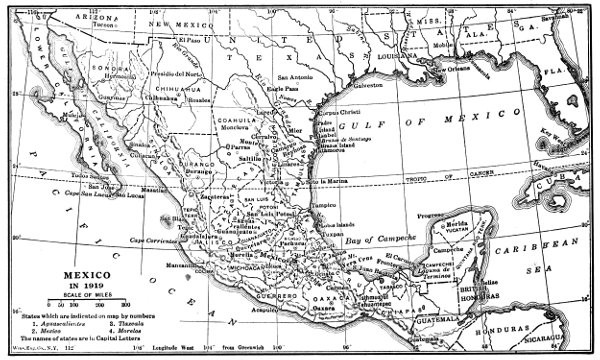
MEXICO IN 1919
Larger image
THE WAR WITH MEXICO
I
MEXICO AND THE MEXICANS
1800–1845
Mexico, an immense cornucopia, hangs upon the Tropic of Cancer and opens toward the north pole. The distance across its mouth is about the same as that between Boston and Omaha, and the line of its western coast would probably reach from New York to Salt Lake City. Nearly twenty states like Ohio could be laid down within its limits, and in 1845 it included also New Mexico, Arizona, Utah, Nevada, California and portions of Colorado and Wyoming.[1]
On its eastern side the ground rises almost imperceptibly from the Gulf of Mexico for a distance varying from ten to one hundred miles, and ascends then into hills that soon become lofty ranges, while on the western coast series of cordilleras tower close to the ocean. Between the two mountain systems lies a plateau varying in height from 4000 to 8000 feet, so level—we are told—that one could drive, except where deep gullies make trouble, from the capital of Montezuma to Santa Fe, New Mexico. The country is thus divided into three climatic zones, in one or another of which, it has been said, every plant may be found that grows between the pole and the equator.[1][E]
Except near the United States the coast lands are tropical or semi-tropical; and the products of the soil, which in many quarters is extraordinarily deep and rich, are those which naturally result from extreme humidity and heat. Next comes an intermediate zone varying in general height from about 2000 to about 4000 feet, where the rainfall, though less abundant than on the coast, is ample, and the climate far more salubrious than below. Here, in view of superb mountains and even of perpetual snows, one finds a sort of eternal spring and a certain blending of the tropical and the temperate zones. Wheat and sugar sometimes grow on the same plantation, and both of them luxuriantly; while strawberries and coffee are not far apart.[1]
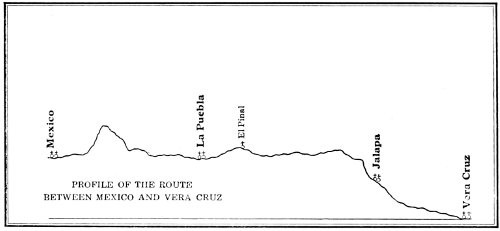
PROFILE OF THE ROUTE BETWEEN MEXICO AND VERA CRUZ
The central plateau lacks moisture and at present lacks trees. The greater part of it is indeed a semi-desert, though a garden wherever water can be supplied. During the wet season—June to October—it is covered with wild growths, but the rains merely dig huge gullies or barrancas, and almost as soon as they are over, most of the vegetation begins to wither away. The climate of the plateau is quite equable, never hot and never cold. Wheat, Indian corn and maguey—the plant from which pulque, the drink of the common people, is made—are the most important products; and at the north great herds of cattle roam. In the mountains, finally, numberless mines yield large quantities of silver, some gold, and a considerable amount of copper and lead.[1]
The principal cities on the eastern coast are Vera Cruz, the chief seaport, and Tampico, not far south of the Rio Grande River. In the temperate zone between Vera Cruz and Mexico lie Jalapa and Orizaba, and behind Tampico lies Monterey. On the central plateau one finds the capital reposing at an elevation of about eight thousand feet and, about seventy miles toward the southeast, Puebla; while on the other side of the capital are the smaller towns of Querétaro and San Luis Potosí toward the north, and Zacatecas and Chihuahua toward the northwest. In the middle zone of the Pacific slope rises the large city of Guadalajara, capital of Jalisco state; and along the coast below may be found a number of seaports, the most important of which are Guaymas, far to the north, Mazatlán opposite the point of Lower California, San Blas a little farther down, and Acapulco in the south.[1]
THE PEOPLE
Exactly how large the population of Mexico was in 1845 one cannot be sure, and it included quite a number of racial mixtures; but for the present inquiry we may suppose it consisted of 1,000,000 whites, 4,000,000 Indians, and 2,000,000 of mixed white and Indian blood.[2] The Spaniards from Europe, called Gachupines in Mexico, were of two principal classes during her colonial days. Many had been favorites of the Spanish court, or the protégés of such favorites, and had exiled themselves to occupy for a longer or shorter time high and lucrative posts; but by far the greater number were men who had left home in their youth—poor, but robust, energetic and shrewd—to work their way up. With little difficulty such immigrants found places in mercantile establishments or on the large estates. Merciless in pursuit of gain yet kind to their families, faithful to every agreement, and honest when they could afford to be, they were intrinsically the strongest element of the population, and almost always they became wealthy.[3]
Their sons, poorly educated, lacking the spur of poverty, and finding themselves in a situation where idleness and self-indulgence were their logical habits, commonly took “Siempre alegre” (Ever light-hearted) for their motto, and spent their energy in debauchery and gambling. To this result their own fathers, while disgusted with it, usually contributed. Spanish pride revolted at the ladder of subordination by which these very men had climbed. They felt ambitious to make gentlemen of their sons, and some easy position in the army, church or civil service—or, in default of it, idleness—was the career towards which they pointed; and naturally the heirs to their wealth, whose ignoble propensities had prevented them from acquiring efficiency or sense of responsibility, made haste, on getting hold of the paternal wealth, to squander it. If the pure whites, with some exceptions of course, fell into this condition, nothing better could fairly be expected of those who were partly Indian; and before the revolution it was almost universally felt in Spain and among the influential class of colonials themselves, that nothing of much value could be expected of Creoles, as the whites born in Mexico and the half-breeds were generally called. The achievement of independence naturally tended to increase their self-respect, broaden their views and stimulate their ambition; but the less than twenty-five years that elapsed between 1821 and 1846, when the war between Mexico and the United States began, were not enough to transform principles, reverse traditions and uproot habits.[3]
The pure-blooded Indians—of whom there were many tribes, little affiliated if at all—had changed for the worse considerably since the arrival of the whites. In their struggles against conquest and oppression the most intelligent, spirited and energetic had succumbed, and the rest, deprived of strength, happiness, consolation and even hope, and aware that they existed merely to fill the purses or sate the passions of their masters, had rapidly degenerated. Their natural apathy, reticence and intensity were at the same time deepened. While apparently stupid and indifferent, they were capable of volcanic outbursts. Though fanatically Christian in appearance, they seem to have practiced often a vague nature worship under the names and forms of Catholicism. Indeed they were themselves almost a part of the soil, bound in soul to the spot where they were born; and, although their women could put on silk slippers to honor a church festival and every hut could boast a crucifix or a holy image, they lived and often slept beside their domestic animals with a brutish disregard for dirt.[3]
Legally they had the rights of freemen and were even the wards of the government, and a very few acquired education and property; but as a rule they had to live by themselves in little villages under the headship of lazy, ignorant caciques and the more effective domination of the priests. As the state levied a small tax upon them and the Church several heavy ones, their scanty earnings melted fast, and if any surplus accumulated they made a fiesta in honor of their patron saint, and spent it in masses, fireworks, drink, gluttony and gambling. When sickness or accident came they had to borrow of the landowner to whose estate they were attached; and then, as they could not leave his employ until the debt had been discharged, they not only became serfs, but in many cases bequeathed their miserable condition to their children. Silent and sad, apparently frail but capable of great exertion, trotting barefooted to and from their huts with their coarse black hair flowing loosely or gathered in two straight braids, watching everything with eyes that seemed fixed on the ground, loving flowers much but a dagger more, fond of melody but preferring songs that were melancholy and wild, always tricky, obstinate, indolent, peevish and careless yet affectionate and hospitable, often extracting a dry humor from life as their donkeys got nourishment from the thistles, they went their wretched ways as patient and inscrutable as the sepoy or the cat—infants with devils inside.[3]
THE CLASSES
At the head of the social world stood a titled aristocracy maintained by the custom of primogeniture. But as the nobles were few in number, and for a long time had possessed no feudal authority, their influence at the period we are studying depended mainly upon their wealth. Next these came aristocrats of other kinds. Some claimed the honor of tracing their pedigree to the conquerors, and with it enjoyed great possessions; and others had the riches without the descent. The two most approved sources of wealth were the ownership of immense estates and the ownership of productive mines. On a lower level stood certain of the rich merchants, and lower still, if they were lucky enough to gain social recognition, a few of those who acquired property by dealing in the malodorous government contracts. To these must be added in general the high dignitaries of the church, the foreign ministers, the principal generals and statesmen and the most notable doctors and lawyers. Such was the upper class.[4]
A sort of middle class included the lesser professional men, prelates, military officers and civil officials, journalists, a few teachers, business men of importance and some fairly well-to-do citizens without occupations. Of small farms and small mines there were practically none, and the inferior clergy signified little. The smaller importing and wholesale merchants came to be almost entirely British, French and German soon after independence was achieved, and the retailers were mostly too low in the scale to rank anywhere. The case of those engaged in the industries was even more peculiar. Working at a trade seemed menial to the Spaniard, especially since the idea of labor was associated with the despised Indians, and most of the half-breeds and Indians lacked the necessary intelligence. Skilled workers at the trades were therefore few, and these few mostly high-priced foreigners. Articles of luxury could be had but not comforts; pastries and ices but not good bread; saddles covered with gold and embroidery, but not serviceable wagons; and the highly important factor of intelligent, self-respecting handicraftsmen was thus well-nigh missing.[4]
The laboring class consisted almost entirely of half-breeds and Indians. In public affairs they were not considered, and their own degraded state made them despise their tasks. Finally, the dregs of the population, especially in the large cities, formed a vicious, brutal and semi-savage populace. At the capital there were said to be nearly 20,000 of the léperos, as they were called, working a little now and then, but mainly occupied in watching the religious processions, begging, thieving, drinking and gambling. In all, Humboldt estimated at 200,000 or 300,000 the number of these creatures, whose law was lawlessness and whose heaven would have been a hell.[4]
THE CHURCH
The only church legally tolerated was that of Rome; and this, as the unchallenged authority in the school and the pulpit, the keeper of confessional secrets and family skeletons, and the sole dispenser of organized charity, long wielded a tremendous power. The clerical fuero, which exempted all ecclesiastics from the jurisdiction of the civil courts, reinforced it, and the wealth and financial connections of the Church did the same. In certain respects, however, the strength of the organization began to diminish early in the nineteenth century; and in particular the Inquisition was abolished in Mexico, as it was in Spain. Soon after the colony became independent, a disposition to bar ecclesiastics from legislative bodies, to philosophize on religious matters and to view Protestants with some toleration manifested itself. Ten years more, and the urgent need of public schools led to certain steps, as we shall see, toward secular education. Political commotions, the exactions of powerful civil authorities under the name of loans, and various other circumstances cut into the wealth of the Church; and the practical impossibility of selling the numberless estates upon which it had mortgages or finding good reinvestments in the case of sales, compelled it, as the country became less and less prosperous, to put up with delays and losses of interest.[5]
Moreover the Church was to no slight extent a house divided against itself. Under Spanish rule and substantially down to 1848, all the high dignities fell to Gachupines, who naturally faced toward Spain, whereas the parish priests were mainly Creoles with Mexican sympathies; and while the bishops and other managers had the incomes of princes, nearly all of the monks and ordinary priests lived in poverty. There was, therefore, but little in common between the two ranks except the bare fact of being churchmen, which was largely cancelled on the one side by contempt and on the other side by envy; and the common priests, having generally sided against Spain during the revolution and always been closely in touch with the people, exercised, in spite of their pecuniary exactions, an influence that largely balanced the authority of their heads. Finally, the ignorance of most ecclesiastics and the immorality of nearly all greatly diminished their moral force. A large number, even among the higher clergy, were unable to read the mass; and the monks, who in the early days of the colony had rendered good service as missionaries, were now recruited—wrote an American minister—from “the very dregs of the people,” and constituted a public scandal.[5]
Still, the Church wielded immense power as late as 1845, and this was reinforced by the type of religion that it offered. High and low alike, the Mexicans, with some exceptions, lived in the senses, differing mainly in the refinement of the gratifications they sought; and the priests offered them a sensuous worship. Sometimes, almost crazed by superstitious fears, men would put out the lights in some church, strip themselves naked, and ply the scourge till every blow fell with a splash. It was pleasanter, however, and usually edifying enough, to kneel at the mass, gaze upon the extraordinary display of gold and silver, gorgeous vestments, costly images and elaborately carved and gilded woodwork, follow the smoke of the incense rolling upward from golden censers, listen to sonorous incantations called prayers, and confess to some fat priest well qualified to sympathize with every earthy desire. A man who played this game according to the rule was good and safe. A brigand counting the chances of a fray could touch his scapularies with pious confidence, and the intending murderer solicit a benediction on his knife. Enlightened Catholics as well as enlightened non-Catholics deplored the state of religion in Mexico.[5]
Next after the Church came the “army,” which meant a social order, a body of professional military men—that is to say, officers–exempted by their fuero from the jurisdiction of the civil law and almost exclusively devoted to the traditions, principles and interests of their particular group. As the Church held the invisible power, the army held the visible; and whenever the bells ceased to ring, the roll of the drum could be heard. Every President and almost every other high official down to the close of our Mexican war was a soldier, and sympathized with his class; and as almost every family of any importance included members of the organization, its peculiar interests had a strong social backing. By force of numbers, too, this body was influential, for at one time, when the army contained scarcely 20,000 soldiers, it had 24,000 officers; and so powerful became the group that in 1845, when the real net revenue of the government did not exceed $12,000,000, its appropriation was more than $21,000,000.[5]
Under Spanish rule, although the army enjoyed great privileges, it had been kept in strict subordination, and usefully employed on the frontiers; but independence changed the situation. Apparently the revolution was effected by the military men, and they not merely claimed but commonly received the full credit. Not only did a large number of unfit persons, who pretended to have commanded men during the struggle, win commissions, but wholesale promotions were made in order to gain the favor of the officers; and in these ways the organization was both demoralized and strengthened. Over and over again military men learned to forswear their allegiance, and at one time the government actually set before the army, as a standard of merit, success in inducing soldiers of the opposite party to change sides.[5]
THE ARMY
In the course of political commotions, to be reviewed in the next chapter, the armed forces were more and more stationed at the cities, where they lost discipline and became the agents of political schemers; and naturally, when the government admitted their right to take part as organized bodies in political affairs, the barracks came to supersede the legislative halls, bullets took the place of arguments, and the military men, becoming the arbiters on disputed points, regarded themselves as supreme. Moreover, every administration felt it must have the support of this organization, and, not being able to dominate it, had to be dominated by it. Political trickery could therefore bring the officer far greater rewards than professional merit, and success in a revolt not only wiped away all stains of insubordination, cowardice and embezzlement, but ensured promotion. A second lieutenant who figured in six affairs of that sort became almost necessarily a general, and frequently civilians who rendered base but valuable services on such occasions were given high army rank. No doubt some risk was involved, but it was really the nation as a whole that paid the penalties; and anyhow one could be bold for a day far more easily than be courageous, patient, studious, honest and loyal for a lifetime. All true military standards were thus turned bottom-side up, and some of the worst crimes a soldier can perpetrate became in Mexico the brightest of distinctions.[5]
Of course the discovery that rank and pay did not depend upon deserving them set every corrupt officer at work to get advanced, while it drove from the service, or at least discouraged, the few men of talents and honor; and as all subordination ceased, a general not only preferred officers willing to further his dishonorable interests, but actually dreaded to have strong and able men serve in his command. In 1823 the Mexican minister of war reported to Congress, “Almost the whole army must be replaced, for it has contracted vices that will not be removed radically in any other way,” and four years later a militia system was theoretically established with a view to that end; but the old organization continued to flourish, and in April, 1846, the British minister said, “The Officers ... are, as a Corps, the worst perhaps to be found in any part of the world. They are totally ignorant of their duty, ... and their personal courage, I fear, is of a very negative character.”[5]
In 1838, a German visitor stated there were a hundred and sixty generals for an army of thirty thousand, and this was perhaps a fair estimate of the usual proportion; but out of all these, every one of whom could issue a glowing proclamation, probably not a single “Excellency” could properly handle a small division, while few out of thousands of colonels could lead a regiment on the field, and some were not qualified to command a patrol. A battle was almost always a mob fight ending in a cavalry charge; and Waddy Thompson, an American minister to Mexico, said he did not believe a manoeuvre in the face of the enemy was ever attempted. Naturally the general administration of military affairs became a chaos; and, worst of all, a self-respecting general thought it almost a disgrace to obey an order—even an order from the President.[5]
The privates and non-commissioned officers, on the other hand, mainly Indians with a sprinkling of half-breeds, were not bad material. The Indians in particular could be described as naturally among the best soldiers in the world, for they were almost incredibly frugal, docile and enduring, able to make astonishing marches, and quite ready—from animal courage, racial apathy or indifference about their miserable lives—to die on the field. But usually they were seized by force, herded up in barracks as prisoners, liberally cudgelled but scantily fed, and after a time driven off to the capital, chained, in a double file, with distracted women beside them wailing to every saint. When drilled enough to march fairly well through the street in column, clothed in a serge uniform or a coarse linen suit, and equipped with an old English musket and some bad powder, they were called soldiers, and were exhorted to earn immortal glory; but naturally they got away if they could, and frequently on a long expedition half a corps deserted.[5]
Such men were by no means “thinking bayonets,” and as a rule they shot very badly, often firing with their guns at the hip in order to avoid the heavy recoil. Not only did they lack the inspiration of good officers, but in pressing times it was customary to empty the prisons, and place their inmates in the ranks to inculcate vice. The government furnished their wages, upon which as a rule they had to live from day to day, even more irregularly than it paid the officers, and the latter frequently embezzled the money; so that it became a common practice to sell one’s arms and accoutrements, if possible, for what they would bring. Finally, the duty always enjoined upon the troops was “blind obedience,” not the use of what little intelligence they possessed; and their bravery, like that of such officers as had any, was mainly of the impulsive, passionate and therefore transient sort, whereas Anglo-Saxon courage is cool, calculating, resolute and comparatively inexhaustible.[5]
The special pride of all military men was the cavalry; but the horses were small, and the riders badly trained and led. “The regular Mexican cavalry is worth nothing,” wrote the British minister early in 1846; and as the mounts were quite commonly hired merely for the parades, just as the rolls of the whole army were stuffed with fictitious names on which the officers drew pay, it was never certain how much of the nominal force could be set in motion. As for the artillery, Waddy Thompson remarked that in a battle of 1841 between the foremost generals of the country, not one ball in a thousand reached the enemy. On the other hand there were excellent military bands, and one of them dispensed lively selections every afternoon in front of the palace at Mexico.[5]
THE CIVIL OFFICIALS
Third in the official order of precedence and in the actual control of affairs came the government officials, and these, like the army and the clergy, formed a special group with a similar fuero, a similar self-interest and a similar disregard for the general good. Once appointed to an office one had a vested right therein, and could not legally be removed without a prosecution. To eliminate a person in that manner was extremely difficult; and when the government, in a few notorious instances, tried ejectment, the newspapers of the opposition hastened to raise an outcry against it for attacking property rights, and the culprits were soon reinstated.[5]
Offering such permanence of tenure, a “genteel” status, idleness even beyond the verge of ennui, a perfect exemption from the burden of initiative, and occasional opportunities for illegitimate profits, government offices appealed strongly to the Mexicans, and a greed for them—dignified with the name of aspirantism when it aimed at the higher positions—was a recognized malady of the nation. To get places, all the tricks and schemes employed in the army and, if possible, still more degrading intrigues were put in play; and offices had to be created by the wholesale to satisfy an appetite that grew by what it fed upon. The clerks became so numerous that work room—or rather desk room—could not be provided for all of them. Only a favored portion had actual employment and received full pay—if they received any—while the rest were laid off on barely enough to support life. Some were competent and willing to be faithful; but when they saw ignorance, laziness, disloyalty and fraud given the precedence, they naturally asked, Why do right? Idleness is the mother of vice; and so there was a very large body of depraved and discontented fellows, wriggling incessantly for preferment, fawning, backbiting, grabbing at any scheme that would advance their interests, intensely jealous of one another, but ready to make common cause against any purification of the civil service.[5]
How justice was administered in Mexico one is now able to surmise. The laws, not codified for centuries, were a chaos. Owing to numberless intricacies and inconsistencies, the simplest case could be made almost eternal, especially as all proceedings were slow and tedious. A litigant prepared to spend money seldom needed to lose a suit. Some cases lasted three generations. The methods of administering justice, reported the British representative in 1835, “afford every facility” for “artifices and manoeuvres.”[6]
Another difficulty was that the courts lacked prestige. During the revolution the magistrates, practically all of them Gachupines, committed so many acts of injustice in behalf of the government, that people forgot the proper connection between crime and retribution. Punishment seemed like a disease that any one might get. In 1833 the minister of this department complained that for five years Congress had almost ignored the administration of justice; and in 1845, the head of the same department said that for a long time the government had systematically reduced the dignity and influence of the judges and magistrates. Their pay was not only diminished but often withheld; and the official journal once remarked, that the authorities had more important business in hand than paying legal functionaries.[6]
This was obviously wrong, but in a sense the judges merited such treatment, for they seem to have lacked even the most necessary qualifications. To make the situation still worse, the executive authorities had a way of stepping in and perverting justice arbitrarily. Even the Mexicans were accustomed to say, “A bad compromise is better than a good case at law”; but it was naturally aliens who suffered most. “The great and positive evil which His Majesty’s subjects, in common with other Foreigners, have to complain of in this country is the corrupt and perverse administration of justice,” reported the minister of England in 1834.[6]
Criminal law was executed no better than civil. The police of the city are a complete nullity, stated the American representative in 1845. A fault, a vice and a crime were treated alike; and the prisons, always crowded with wrongdoers of every class, became schools in depravity, from which nearly all, however bad, escaped in the end to prey upon society. Well-known robbers not only went about in safety, but were treated with kindly attentions even by their late victims, for all understood that if denounced and punished, they would sooner or later go free, and have their revenge.[6]
EDUCATION
Adverting formally before Congress in 1841 to the “notoriously defective” administration of justice, the Mexican President said, “the root of the evil lies in the deplorable corruption which pervades all classes of society and in the absence of any corrective arising from public opinion.” In large measure this condition of things was chargeable to the low state of religion, but in part it could be attributed to the want of education. Spain had required people to think as little as possible, keep still and obey orders; and for such a rôle enlightenment seemed unnecessary and even dangerous. To read and write a little and keep accounts fairly well was about enough secular knowledge for anybody, and the catechism of Father Ripalda, which enjoined the duty of blind obedience to the King and the Pope, completed the circle of useful erudition. In the small towns, as there were few elementary schools, even these attainments could not easily be gained; and as for the Indians they were merely taught—with a whip at the church door, if necessary—to fear God, the priest and the magistrate. Religion gave no help; and the ceremonies of worship benumbed the intellect as much as they fascinated the senses.[6]
When independence arrived, however, there sprang up not a little enthusiasm for the education of the people, and the states moved quite generally in that direction. But there were scarcely any good teachers, few schoolhouses and only the most inadequate books and appliances; money could not be found; and the prelates, now chiefly absorbed in their political avocations, not only failed to promote the cause, but stood in the way of every step toward secular schools. A few of the leaders—notably Santa Anna—professed great zeal, but this was all for effect, and they took for very different uses whatever funds could be extorted from the nation. In 1843 a general scheme of public instruction was decreed, but no means were provided to carry it into effect. The budget for 1846 assigned $29,613 to this field, of which $8000 was intended for elementary schools, while for the army and navy it required nearly twenty-two millions. In short, though of course a limited number of boys and a few girls acquired the rudiments—and occasionally more—in one way or another, no system of popular education existed.[6]
Higher instruction was in some respects more flourishing. Before the revolution the School of Mines, occupying a noble and costly edifice, gave distinction to the country; the university was respectable; an Academy of Fine Arts did good work; and botany received much attention. But at the university mediaeval Latin, scholastic and polemic theology, Aristotle and arid comments on his writings were the staples, and even these innocent subjects had to be investigated under the awful eye of the Inquisition. Speculation on matters of no practical significance formed the substance of the work, and the young men learned that worst of lessons—to discourse volubly and plausibly on matters of which they knew nothing. This course of discipline, emphasizing the natural bent of the Creoles, turned out a set of conceited rhetoricians, ignorant of history and the real world, but eager to distinguish themselves by some brilliant experiment. When the yoke of Spain had been cast off, all these institutions declined greatly, and the university became so unimportant that in 1843 it was virtually destroyed; but the view that speculation was better than inquiry, theory better than knowledge, and talk better than anything—a view that suited Mexican lightness, indolence and vanity so well, and had so long been taught by precept and example—still throve despite a few objectors. Of foreign countries, in particular, very little was commonly known. While elementary education, then, was nothing, higher education was perhaps worse than nothing.[6]
Nor could the printed page do much to supply the lack. Only a few had the taste for reading books or opportunities to gratify the taste, if they possessed it. Great numbers of catchy pamphlets on the topics of the day flew about the streets; newspapers had a great vogue; and there were poor echoes of European speeches, articles and books; but most of the printed material was shockingly partisan, irresponsible and misleading. “Unfortunately for us,” observed the minister of the interior in 1838, “the abuse of the liberty of the press among us is so great, general and constant, that it has only served our citizens as the light of the meteor to one travelling in a dark night, misguiding him and precipitating him into an abyss of evils.”[6]
THE INDUSTRIES
Only some 300,000 out of 3,000,000 white and mixed people were actual producers—three times as many being clericals, military men, civil officials, lawyers, doctors and idlers, and the rest old men, women and children. The most brilliant of their industries was mining, the annual output of which was about $18,000,000 in 1790, fell during the revolution to $5,000,000, and by 1845 rose again—despite the unwise policy of the government—to about the earlier level. During the period of depression most of the old proprietors and many of their properties were ruined; but English companies took up the work, and although for some time their liberal expenditures went largely to waste, they gradually learned the business, and their example encouraged some Germans to enter the field. How greatly the nation profited from the mines was not entirely clear. About as much silver went abroad each year as they produced, paying interest on loans that should not have been made, and buying goods for which substitutes could usually have been manufactured at home. But the government laid valuable taxes on the extraction and export of the precious metals, and there was also a profit in the compulsory minting of them—though, as all the inventiveness of the nation expended itself in politics, the processes at the mints were about as tedious and costly in 1845 as while Cortez ruled the country.[7]
Little more can be said for the cultivation of the soil. When Mexico separated from Spain, the vine and the olive, flax and certain other plants formerly prohibited were acquired, and coffee soon became important; but on the other hand agriculture had met with disaster after disaster in the course of the revolution. “Up to the present,” said a ministerial report in December, 1843, “agriculture among us has not departed from the routine established at the time of the conquest.” A cart-wheel consisted still of boards nailed together crosswise, cut into a circular shape and bored at the centre; a pointed stick, shod sometimes with iron, was still the plough; a short pole with a spike driven through one end served as the hoe; the corn, instead of going to a mill, was ground on a smooth stone with a hand roller; and no adequate means existed of transporting such products as were raised to such markets as could be found. Most of the “roads” made so much trouble even for donkeys and pack-mules that it was seriously proposed to introduce camels; and the most important road of all, the National Highway from the capital to Jalapa and Vera Cruz, was allowed to become almost impassable in spots. Besides poor methods, bad roads, brigands, revolutions and a great number of holidays, there were customhouses everywhere and a system of almost numberless formalities, the accidental neglect of which might involve, if nothing worse, the confiscation of one’s goods. In short, how could agriculture prosper, said a memorial on the subject, when he that sowed was not permitted to gather, and he that gathered could reach no market?[7]
COMMERCE
However, more could be produced than used. The prime requisite was population. So much appeared to be clear; and for that reason, as well as to obtain the profits of the industries and prevent money from going abroad, great efforts were made by independent Mexico to develop manufacturing, which had been prohibited—though not with entire success—by Spain. The year 1830 was a time of golden hopes in this regard. At the instance of Lucas Alamán a grand industrial scheme went into effect, and a bank was founded to promote it by lending public money to intending manufacturers. Cotton fields were to whiten the plains; merino sheep and Kashmir goats to cover the hillsides; mulberry trees to support colonies of silk-worms; imported bees to produce the tons of wax needed for candles; and ubiquitous factories to work up the raw materials. A few men honestly tried to establish plants, but the industry chiefly promoted by the law and the bank was that of prying funds from the national treasury; and when this income failed, as it did in a few years, many half-built mills came to a stop, and much half-installed machinery began to rust. Alamán himself, partner in a cotton factory, became bankrupt in 1841, and the bubble soon burst.[7]
The manufacturers formed, however, a strong political clique, and in their interest a system not only of protection, but of absolutely prohibiting the importation of numerous articles, was adopted by law. This had the effect of making the people pay dearly for many of their purchases. The farmers, who wished raw materials kept out, had influence too, and were always blocking the scheme of the manufacturers to let raw materials in; and, as the cost of producing and transporting made native goods dear, smuggled merchandise undersold Mexican articles even after paying for the necessary bribery and other expenses. In a word, although certain coarse and bulky things continued to be made in the country, the endeavor to build up an industrial population, support agriculture, and thus doubly strengthen the nation was very superficially planned and very unsuccessfully carried out. Nearly all the better manufactures, a large part of the food, most of the clothing, and substantially all the luxuries came from abroad.[7]
The business of importing continued to be mainly in Spanish hands for some years after Mexico became independent, but for reasons that will appear in the next chapter the Spaniard had to retire about 1830. The British then obtained the lion’s share; and as they were Protestants they could not, even when they so desired, identify themselves with the nation, and take a responsible share in public affairs. Commerce was not, in fact, a source of strength. A few raw products were exported, but essentially commerce consisted, as was natural, in merely receiving goods from foreigners and letting the foreigners have money in return. Moreover the volume of commerce dwindled notably, like that of all other business. As for retail trade, when the Spaniards had to retire, it fell mainly into Mexican hands; but it was conducted in a small way, the profits were narrow, and the failures were many.[7]
LIFE IN THE COUNTRY
Even more significant for us, however, than such details were the life and character of the people, and it may be helpful to call back the year 1845 and visit Mexico for a couple of days. First we will stroll along a country road in a fairly typical region. The general aspect is one of semi-wildness, but soon the tops of well-bleached ruins amid the soft green indicate decrepitude instead, suggesting as the national character decay preceding maturity. A long mule team approaches in a waving line, and on a finely equipped horse at the head of it we observe a swarthy man in green broadcloth trousers open on the outside from the knee down, with bright silver buttons in a double row from hip to ankle, and loose linen drawers visible where the trousers open. A closely fitting jacket, adorned with many such buttons and much braid, is turned back at the chin enough to reveal an embroidered shirt; and the costume reaches a climax in a huge sombrero with a wide, rounding brim and high sugar-loaf crown, adorned with tassels and a wide band of silver braid. This gentleman, the arriero, is the railroad king of Mexico, for he and others of his class transport the freight and express. Trust him with anything you please, and it will surely be delivered; but should he be unlucky at cards and out of work, he might rob you the next day.[8]
A group of Indians meet us, little more human in appearance than the donkeys they drive; and we observe how easily they carry loads on their backs, and how quickly and lightly they march. Yonder we see their huts—pigpens, Americans would suppose; and a little apart from these we notice a stone or adobe house. Certainly there is nothing grand about this dwelling, for it contains only a single room, and that half full of implements, horse furniture, charcoal, provisions and what not; but it affords a home for six or eight persons of the two sexes. Presently the master, though not the owner, of the establishment rides up, prodding his active but light and stubby horse with blunt steel spurs almost as large as the palm of one’s hand, to make a dash for our benefit. Swinging his wife from the saddle-bow the ranchero alights, and we find him to be a short, wiry, muscular person, with a bronzed and rather saturnine countenance but friendly and respectful manners. He wears tough leggings, leather trousers, a small rectangular shawl (serape) that falls over his back and breast, allowing his head to protrude through a hole in the middle, and a wide sombrero, while at the saddle-bow hang the inevitable lasso and a bag of corn and jerked beef, one meal a day from which is all he requires. Apparently he does not feel quite at home on the ground, and that is natural, for he spends about half of his waking hours in the saddle. Herdsman, farmer or brigand, according to circumstances, he is also cavalryman at need; and a corps of such fellows, if properly trained and led, would make the best light horse in the world, perhaps. His chief interests in life, however, are gambling and cock-fighting, and he is quite capable of losing all his worldly goods, his wife and even his pony at the national game of monte, and then of lighting a cigarette and sauntering off without a sign of regret.[8]
Now we approach what may be called a village, but one extremely different from a village in the United States. The great things are a handsome grove and in the midst of it one old church of gray stone, full of saints and relics and ancient plate, with a ragged, stupid Indian crouching on the floor. Near by are two or three ranchero cottages with a group of Indian huts in the distance, and yonder stands a large, rambling edifice of stone with a mighty door and heavily barred windows. From the ends of the building run high walls inclosing several acres, and within the protected space may be seen a number of substantial dwellings and what appear to be storehouses and stables, while far away over hill and plain spreads the hacienda, an estate as large as a county. Finally, on a gentle slope not far distant we observe a monastery with a rich garden behind it, and a fat, contented prior riding sleepily up to its arched gateway through a dozen or two of kneeling aborigines.[8]
Toward evening we reach the state capital, and as we cross a bridge on the outskirts, we see a crowd of people bathing. Both sexes are splashing and swimming, all as happy as ducks and all entirely nude. Even the presence of strangers does not embarrass the young women, some of whom are decidedly good-looking; and they even try to draw our attention by extra displays of skill. Looking for an inn we discover two lines of low, rickety buildings alternating with heaps of rubbish, fodder and harness. After some efforts a waiter is found and we obtain a room, with a mule already slumbering in one corner of it and all sorts of household litter thrown about. A wretched cot with a rope bottom, a dirty table and an abundance of saints portrayed in Mexican dress help to make the place homelike. The waiter is amiable, and ejects the mule with a great show of indignation; but when we ask for water and a towel his good nature fails. “Oh, what a man,” he cries, flinging up his hands; “What a lunatic, Ave María Purísima; Ha! Ha! Ha! He wants water, he wants a towel; what the devil—! Good-by.” The dining-room is a hot, steamy cell, fitted up with charcoal furnaces; and for viands we are offered plenty of hard beef, chile (pepper) and tortillas (flapjacks of a sort), besides a number of dishes that only a native could either describe or eat. Chile and tortillas appear, however, to be the essentials; and the latter, partly rolled up, serve also as spoons.[8]
After dinner we look about the town. All is monotonous and sombre. The houses, mostly of one story, form a continuous wall along the street—or along the sidewalk, if there be one—and their projecting, heavily barred windows, in front of which the young fellows have to do their courting, suggest prisons more than homes. Now we come to the massive, crumbling, gloomy church, and wonder where the priest keeps the family which everybody knows he has. Here is the government house, and we stop to picture the wily politicians, who—with noble exceptions—obtain the offices of local grandeur, and the little horde of clerks, many of them rendered prematurely decrepit by their vices, that fawn but cannot be made to work at the nod of authority. In vain we look for a book-store, though somewhere that name doubtless appears on a sign; but we do find the office of the comandante general, an officer who represents the central power, has charge of the military, and often is mining and counter-mining in a sharp struggle with the governor. How intolerably dull it must be to live here! Business of a large sort there is none. The little newspapers are scarcely more than echoes from partisan sheets at Mexico. Religion is a subject that one must let alone, and education a subject that it is useless to discuss. Of science, history, art, nothing is known. The small men in power brook no criticism except from enemies. Affairs in other states, even a famine or a flood, excite little interest. Not much is left except petty intriguing and the gratification of coarse appetites. A revolution is about the only possible escape from this more deadly ennui.[8]
LIFE AT MEXICO
Our second day shall be given to the metropolis. The suburbs of Mexico are mostly ragged and unclean, but some broad avenues lined with fine trees run through them, and entering the city by one of these we make our way to the great central plaza. On the eastern side of this extends the palace, a very long two-storied building of little distinction, and on the northern side towers the huge cathedral, quite in the grand, heavy, Spanish style, seamed with earthquake scars and pockmarked by revolutionary bullets. It is a Sunday morning and still rather early, but the plaza is alive. The usual nightly crop of dead and wounded is being carried to the morgue or the hospital. Sick men, cripples and stalwart beggars are beginning to pose for alms. Prisoners in chains are pretending to put the streets in order; but their guards, with that mixture of good nature and indolence that characterizes the Mexican unless his passions are excited, let them do about as they please, and they take their cue for street-cleaning from the Book of Revelation: They that be filthy, let them be filthy still.[8]
Indians in various tribal costumes, mostly picturesque and all dirty, patter through the square with loads of provisions or babies. As no stoves or fireplaces exist, the charcoal man’s loud “Carbosiú!” (Carbón, señor!) resounds through the streets. So does the plaintive cry of the water-carrier, bending under his great earthen jar, for the houses are all supplied from a few public fountains, the termini of aqueducts. “Orchata, lemon, pineapple, tamarind!” calls out a shrill voice; “What will you take, my darling? This way for refreshment:” and we see a good-looking girl in a short skirt expanded wide with hoops, her arms bare and her bodice cut low enough for a ball, selling “temperance” drinks. Here is a dingy cell stuffed with chin-basins, razors, dental implements, boxes of pomade, a guitar, a fighting-cock tethered in a corner, and sundry pictures of saints, parrots and battles; and there a cigar shop with a slender, black-eyed girl behind the counter, bold enough and handsome enough, even without the red rose in her hair, to tempt St. Anthony. Observe the evangelista, or public letter-writer, with two quills and an inkstand ready on his little desk under a canopy of straw matting; and observe, too, that lépero with his back against a donkey’s pannier, robbing the pannier while he pretends to be buying a knife.[8]
Priests in long shovel hats; lousy soldiers in ragged, ill-fitting uniforms; gaudy officers chatting and smoking; jugglers with snakes and balls; cynical dandies retailing love affairs; half-naked léperos in the corners sleeping off their pulque; lottery venders with long strings of tickets; sellers of flowers, toys, candy, glass, wax-work, mock jewellery, cheap cutlery, and a thousand other things; closed carriages taking ladies to church; more beggars and still more—these and many other sights keep us too busy for reflection; but we cannot help noticing that seven out of ten persons are social drones or parasites, and that vice of one sort or another dims the face and weakens the step of almost every one. Suddenly a light bell tinkles, and the crowd is instantly grave and still. “God is coming,” they whisper, or in other words the viatic is going to a sick man. A coach drawn by two mules and followed by a dozen slovenly friars holding lighted candles and chanting, comes slowly down a street. All uncover and kneel, and we must do likewise or very likely get a pummelling.[8]
This reminds us of duty; and, electing the cathedral in preference to sixty other churches, we enter. Before us is a great throng, chiefly women and léperos, of most devout worshippers. The finest ladies in the city are here, dressed all in black, with no ornaments except a silk mantilla, edged with lace, and a high tortoise-shell comb; and they kneel humbly beside the drudge or the beggar. The church itself—designed in the Spanish style, which places the choir in the middle of the nave and a balustraded walk between that and the great altar—with a cloud of incense filling the air and many hundreds of candles gleaming murkily from the shrines, is most mysterious and impressive. The gorgeousness of the sacred ornaments amazes us. Literally tons of silver are in sight; gold, precious stones and gems abound; and magnificent vestments try to hide the vulgar priests. But the splendor is oppressive, and the stench of the léperos intolerable; let us return to the light of day.[8]
All the streets are laid out at right angles, and most of the houses that line them are in two stories, of which the lower one is reserved for horses, carriages, servants, cows and storage; and the walls, built of rough stone, are very thick. The outside is usually frescoed in white, orange, blue, red or pale green, and often adorned with pious verses or biblical texts. Entering the big double gateway, we find ourselves in a courtyard, upon which doors and grated windows open; and we observe that a covered balcony of wrought iron or possibly bronze, reached by a central stairway and giving access to the rooms of the second story, is built round it. In many courtyards there are flowers and a fountain, and sometimes there are trees. Occasionally we find what looks like a grandee’s residence, for Mexico was called in the Spanish time a city of palaces, and some of these residences, built of superior stone, equipped with gilded balconies and stairs, adorned with artistic sculptures, and perhaps decorated with Dutch tiles in blue and white, have survived in a fair condition the ruin of fortunes and the disappearance of titles; but at their best they were always imperfect, reminding one of the golden image with clay feet, and now most of them are dilapidated.[8]
Here is a gambling place, well filled; but it is only the usual monte, and if we care to watch a game, there will be something like a thousand more opportunities. Already, people are making for the bull-fight; but the upper classes mostly ignore that sport, and we may well follow their example. On the other hand let us drop in at the cock-pit. “Hail, immaculate Mary, the cocks are coming!” the herald is proclaiming. On the benches one may see the most delicate and fashionable young ladies of the city as well as the sharpest gamblers, and everything is quiet and orderly. But a glance is enough; and now as the “quality” will soon have dined, we will stroll on past the stately trees of the Alameda to the New Promenade, and be ready for them.[8]
Here, every afternoon at about five o’clock, and especially on Sunday, may be seen the Mexican élite. About a thousand carriages are in line to-day, many of them heavy, grand affairs from Europe, but some very antiquated and shabby, for the lady, however poor, must have a carriage of some sort. Here one sees the fair sex at their best. Clad in the most sumptuous and brilliant costumes they can possibly obtain and well covered with diamonds—for everybody above the rank of a lépero has diamonds—they sit up straight and handsome, and many of them look almost regal. More horses than mules are to be seen, and many of them have been imported. Guided by postilions instead of drivers, the carriages roll sedately along with an exchange of mutual salutes but not a word of conversation, and after a turn or two draw up and stop side by side, so that the ladies may review some four or five thousand cavaliers, who now ride past.[8]
Each gallant, without appearing to notice the carriage of his choice, pays court to an adored occupant of it by a special show of grace and horsemanship as he goes by. Small fortunes in silver and gold are lavished on the equipment of the steed, and the cavalier is resplendent in his tightly fitting trousers, short jacket, huge sombrero, gilded spurs, silver buttons, silk braid and gold lace. For us the impression is impaired considerably by his manner of riding, for he leans forward, puts barely his toes into the stirrup, and carries his heels far back; but he can ride very showily after all, curvetting and prancing, and the Mexicans are fully satisfied that no other horsemen in the world are their equals.[8]
The promenade over, all go to the play—not that anybody of fashion cares for it, but because that is the style, and few have any other way to pass the time. Let us have a look ourselves at the principal theatre, which travellers have pronounced—after one at Naples—the finest edifice of the kind. It accommodates more than eight thousand persons, and the rent of the best boxes is about $3000 a year. But almost every man and many of the women appear to be smoking; one can hardly see the actors; the noise of conversation is distracting; and as we are not adepts in the play of glances and fans which keep so many ladies in the boxes and so many gallants in the pit fully occupied, we shall find it pleasanter at the British legation ball. Allons! Why, what a clangor the church bells are making! To be sure that opens the gates of purgatory for a while and gives the inmates a respite, but it certainly bears rather hard on the living.[8]
While by nature the most sociable of people, the Mexicans are the least so in practice, wrote an American minister at that capital. This is partly because many of social rank now lack the means to entertain, and partly because society is cut up by intrigues, jealousies and bitter memories; but at a foreign legation one has no expenses, and all meet on neutral ground. As we enter, everything seems fine and even brilliant. Diamonds are in profusion again, and the lustre of the great pearls matches them. But in Mexico it is never wise to look closely, for gross imperfections are sure to be discovered; and here, as we soon observe, the gowns are not really in style, and the musicians are only unshaven, half-blind, tatterdemalion scrapers.[8]
However, the people are what we care for, and they are certainly most interesting. Again we see the dignified ladies; they move now, and with a decided though rather ponderous grace. Conversation is not their forte, for they seldom read and never think; but all have beautiful eyes, teeth and hair; all have small hands and feet; and all are amiable, sincerely kind and by no means wanting in tact. The older ones appear stout and rather phlegmatic, it is true, but those of an earlier age are often fascinating. Look for instance at the girl under the chandelier, plainly all sentiment and senses, not really tall but slender enough to appear so, with a profile of carved ivory, pale cheeks just warmed with crimson, large, dark, languorous eyes, and a voluptuous figure disguised with no stays; and all this poised seemingly on the toe of a dainty satin slipper. What matters it if she and the rest of the ladies passed their day in gazing idly out of windows, smoking, nibbling sweetmeats and chattering trifles, and did not put on their stockings or do up their hair until dinner-time?[8]
But for us the men are more important. That short individual in spectacles, who looks erudite and speaks in a low tone with a gravity and reserve that emphasize his remarks, is Alamán, the most distinguished of the conservatives. The thin-featured, sharp-nosed person, so elegant and cynical, is Tornel, posing now in his favorite attitude as the patron of learning. Smooth-faced Bocanegra, an honorable if not very able statesman, is talking yonder to the British minister with the easy courtliness of a genuine hidalgo. Handsome and brave Almonte—“a good boy,” as Santa Anna calls him—is laying siege to the belle under the chandelier; and Peña y Peña, seemingly rather dry and uninspired, is debating somewhat laboriously with a brother judge.[8]
Let us join a group. How strong, genial, easy, ready and gay, yet dignified and reposeful, they all are! Few indeed of our own countrymen could be so charming. Some one approaches, and they grasp him warmly by the hand, throwing the left arm at the same time round his shoulder and softly patting his back. “Friend,” “Comrade,” are frequent salutations. We are presented to the group, and find ourselves at once among devoted intimates. “My house is yours,” exclaims one with a look that carries conviction. “Remember, I exist only to serve you,” says another. “Only command me and all that are mine,” exclaims a third.[8]
Mexico, however, reported a British minister, “judged merely by outward Appearances, is a perfectly different thing from Mexico seen in the Interior.” One might be presented with a dozen houses and all their contents, yet go to bed on the sidewalk hungry. These friends and comrades are daily intriguing and conspiring against one another. Talk with an eloquent declaimer, and you will find his beautiful ideas vague and impracticable. Discuss them with him, and you will either excite wrath by demolishing his opinions or earn contempt—since he suspects in his heart that he is an ignoramus—by letting him vanquish you. Notice how lightly they speak of religion. That is considered good form. The Church is to be regarded as an institution for the women. But at bottom almost every one is mortally afraid of the hereafter, as a child is afraid of the dark, and when seriously ill is ready to grovel before a priest. The apparent robustness of these men, largely due to their indolence, is too often undermined by Cyprian accidents, which are confessed without hesitation. Hardly one of the husbands is loyal to his vows, while the other sex care only to elude numberless watchful eyes, and observe a strict regard for appearances; and in the lower walks a mother will quite readily sell her daughter’s good name. However, courtesy is delightful whatever lies behind it, and if a person will try to eat a picture of grapes, he should blame himself for his disappointment. Temperament, environment and education make sangfroid and intellectual mastery impossible here; and in a world where passionate men and women grow up in traditions of idleness and self-indulgence they can hardly be expected, especially with the bad example of their priests before them, to be distinguished for self-restraint.[8]
Meanwhile, are the common people at home knitting? Let us walk back to the cathedral. The full moon is out. Almost above us rise the powerful towers against the clear firmament, and on our left is the palace, filling one whole side of the square with its numberless balconies and windows, while in front spreads the great plaza, glittering with innumerable lights against the shadowy arcades that fill the opposite side. The sky is a soft, pale blue; and the stars, fading near the brilliant moon, appear like dust raised by her chariot wheels. Under the trees on our right a huge serpent, the scales of which are human beings, turns, winds, bends, parts and rejoins in a circular promenade.[8]
Some occupy themselves with prosaic thoughts,—business, politics or social events—and a few talk of science and poetry. Yonder goes a millionaire, a real king of gold, at sight of whom all hats come off, while all eyes court his glance; but another, who passes with a triumphant step and bold gestures, appears to the crowd a greater man, for he is the king of the sword, the king of the bull-ring, the matador. But most, perhaps, are talking and thinking of love and of pleasure. Furtive but meaning glances are often exchanged; occasionally hand presses hand under the folds of the cloak; at times a few mysterious words pass quickly; now and then one sees a pretty woman on the arm of her bold lover, showing herself proudly to the world, while the husband follows on behind as best he can; and here and there a scowling, discarded friend looks out from behind a post with a knife clutched behind him.
Would you like to see a little more? Then visit the Barrio Santa Anna, and watch men with bloodshot eyes and women in red petticoats and loose, open chemisettes dancing a wild fandango, or plunge into a lépero’s dive and watch the pariahs gambling sedately with a bloody knife on the table before them, while down in one corner a crouching woman moans and mutters over a prostrate figure. But how lightly all is done, even the tragedies, compared with northern depth and seriousness. In a sense we feel we are observing children.[8]
Of course in so brief a space the subject of this chapter could not be thoroughly treated, but our inquiry seems to make certain facts plain. Little in the material, mental and moral spheres was really sound in the Mexico of 1845. Her population was insufficient, and was badly welded together, so far as it had been welded at all; and while the lower orders of the people lay deep in ignorance, laziness and vice, the upper class, if we ignore exceptions, were soft, superficial, indolent and lax, urbane, plausible and eloquent, apathetic but passionate, amiable and kind though cruel when excited, generous but untrustworthy, wasteful but athirst for gain, suspicious and subtle but not sagacious, personally inclined to be pompous and nationally afflicted with a provincial vanity, greatly enamoured of the formalities of life, greatly wanting in the cool, steady resolution for which occasional obstinacy is a poor substitute, and still more wanting in that simple, straightforward, sober and solid common sense which is the true foundation of personal and national strength. In particular, the Mexican was intensely personal. This made him and his politics very interesting yet was really unfortunate, for in such men principles and institutions could have but feeble roots. Finally, as one result of this awareness of self, every man of any strength had the instincts of a dictator. Authority he instinctively resented; but on the other hand, when some one appeared to be dominant, a consciousness of this inner recalcitrancy and a fear of its being detected, combining with a hope of favors, produced adulation and apparent slavishness.
Evidently, then, Mexico was not intrinsically a strong country. Evidently her people had few qualifications for self-government. Evidently, too, they were unlikely to handle in the best manner a grave and complicated question requiring all possible sanity of judgment and perfect self-control; and, in particular, misunderstandings between them and a nation like the United States were not only sure to arise but sure to prove troublesome.
1. Physical Mexico. U. S. War Dept., Monograph. Bureau of Amer. Republics, Mexico. Encyclopædia Britannica, “Mexico.” Numerous books of travel mentioned in note 8.
[E] It will be seen that occasionally the same “superior figure” is attached to several paragraphs, and that sometimes these reference numbers are not in consecutive order. The reasons will be discovered when the reader consults the notes, which follow the text of each volume.
2. Population. The census which served as a basis for the elections of 1841 and some later years gave the population as 7,016,000 (Dublán, Legislación, v, 152, gives the figures by states). The American governor of Jalapa, Col. Hughes, 257wrote, Jan. 28, 1848, that according to “authentic Mexican official documents” the population was about 7,500,000, of whom 2,500,000 were under seventeen years of age, 500,000 were over sixty, and 300,000 were idlers, beggars, etc., incapable of work. The population of the United States in 1840 was 17,069,453. Observador Judicial, 1842. Consideraciones, 5. Journal des Débats, Sept. 9, 1847. 261Mémoire. Macgregor, Progress, i, 317. Ward, Mexico, i, 28. Mora, Obras, i, 54. México á través, iii, 19; iv, p. vii. Relaciones, circular, Aug. 9, 1847. 82Decree, Dec. 16, 1847. Diario, May 4, 1847, claimed 8,000,000.
3. Racial divisions and characteristics. México á través, iii, 18–21. Humboldt, Essai Polit., i, 367, 381, 411–6; ii, 1–4, 9, 45, 48–52. 52Poinsett, no. 166, March 10, 1829. Mayer, War, 13, 16. Commerc. Review, ii, 165–76. Consideraciones, 5–7. García, Conquista, 4, 370–2, 397. Thompson, Recolls., 7. Poinsett, Notes, 161. 13Hervey, Description of Mexico. 261Mémoire. Löwenstern, Le Mexique, 166, 174–89. Mora, Obras, i, 54–6. Cuevas, Porvenir, 12–14. 178Davis, diary. 162Conner to wife, Mar. 4, 1846. Diccionario Universal (Mexicanos). 13Morier, no. 10, Feb. 10, 1825. Eco del Comercio, Mar. 22, 1848.
4. The class divisions. Otero, Cuestión, 37, 47–51. 13Morier, no. 12, Feb. 10, 1825. Lerdo de Tejada, Apuntes, i, 232. 26lMémoire. Humboldt, Essai Polit., i, 391–5, 400–1, 429–31; ii, 40. Poinsett, Notes, 162. Constituent Cong. of Mex., Address. Consideraciones, 18, 19. Mora, Obras, i, 54–6. Paredes, Papers, 136. 52Poinsett, no. 166. México á través, iii, 18. Löwenstern, Le Mexique, 188–9.
5. Church, army, civil service. Mayer, War, 20–1, 132. Otero, Cuestión, 38–46, 59, 60, 71–3. Mora, Obras, i, pp. vii, xcvii-cxviii, ccxlvii; ii, 122–8. 261Mémoire. Löwenstern, Le Mexique, 38, 94, 117–28. Humboldt, Polit. Essay (London, 1811), i, 231–2. México á través, ii, 896; iii, 23; iv, 149, 447, 639. Zavala, Revoluciones, i, 37. Macgregor, Progress, i, 637, 642. Thompson, Recolls., 41, 53, 101–3, 169–74. 52Poinsett, nos. 2, 12, 36, 55, 166 (May 28; Aug. 5, 1825; Feb. 18; Aug. 26, 1826; March 10, 1829). Consideraciones, 6, 7, 12, 26–30, 37, 39–42. 13Ashburnham, Oct. 3, 1837; July 26, 1838. Semmes, Service, 14–5, 21. 11Martin, Feb. 1; July 20, 1827; Dec. 25, 1828. 11Cochelet, June 6; Nov. 20, 1829. Correspondant, April 15; July 15, 1846. Calderón, Life, i, 337, 408. 13Hervey, Description. Picayune, April 22, 1843. Bocanegra, Memorias, i, 32. Tornel, Reseña, 19–21, 84. 11Despatch to the French govt., about June, 1823 (anon.). 13Morier, no. 13, Feb. 10, 1825. 13Morier and Ward, no. 1, April 10, 1825. 13Ward, no. 37, Apr. 29, 1826. 13Pakenham, nos. 17, Jan. 30, 1830; 25, Feb. 26, 1841; 77, Aug. 29, 1842. 13Bankhead, nos. 73, Aug. 29, 1844; 56, Apr. 29, 1846. Memoria de ... Relaciones, Dec., 1846. Richmond Enquirer, Dec. 30, 1845. Mobile Commerc. Register, Aug. 9, 1845. Veracruzano Libre, Dec. 27, 1845. Revue de Paris, Dec., 1844. Memoria de ... Guerra, Nov. 7, 1823, 17, 18. Balbontín, Invasión, 75, 77. Id., Estado Militar, 58. 375Perry to J. Y. Mason, Nov. 16, 1846. Búlnes, Grandes Mentiras, 182. Rivero, Méx. en 1842, 25, 137–9. Ward, Mexico, i, 307–17, 330–40. London Times, Nov. 11, 1845.
6. Justice, education, the press. Zavala, Revoluciones, i, 35, 396; ii, 393. Thompson, Recolls., 20–4, 147–52. London Times, Jan. 8, 1846. 13Ward, no. 58, confid., April 18, 1827. 13Pakenham, nos. 39, May 27, 1836; 5, Jan. 25, 1841. 13Bankhead, no. 54, May 30, 1845. 13O’Gorman to Pakenham, Jan. 19, 1835. Pakenham, Nov. 23, 1834, separate; no. 8, March 8, 1835. 56W. S. Parrott, Oct. 11, 1845. 52Jones, June 1, 1837; nos. 168, Oct. 30, 1838; 252, May 5, 1839. Leclerc in Revue des Deux Mondes, March 1, 1840, p. 638. 11French vice-consul, Mex., Aug. 19, 1829; Feb. 3, 1830. Tornel, Reseña, 288. Consideraciones, 6, 7, 12–4, 43, 48. Memorias de ... Relaciones, Jan., 1825; Feb., 1828; Jan., 1831; May, 1833; Dec, 1846. Memorias, min. of justice, 1833, 1835, 1845. Ward, Mexico, i, 337. 52Poinsett, no. 166. Constit. Cong, of Mex., Address. Liberal Moderado, Aug. 4, 1846. Mora, Obras, i, pp. clxxxviii-cxcvii. Löwenstern, Le Mexique, 109–16. Lavalles, Etudes, 31–3. Villar, Proyecto. Calderón, Life, i, 195, 340–2. Esparza, Informe. Memorias, min. of treas., May, 1833; July, 1845. Memorias, min. of pub. instr., Jan., 1844; July, 1844; March, 1845. Macgregor, Progress, i, 637.
7. Industries, trade, means of communication. Revista Económica, Dec. 14, 31, 1843. Macgregor, Progress, i, 308, 670, 674. Ward, Mexico, ii, 3–170. México á través, iii, 18. London Times, Aug. 6; Nov. 11; Dec. 6, 1845. 52Thompson, no. 4, July 30, 1842. 13Ward, nos. 45, 99 (May 20; Aug. 20, 1826). 261Mémoire. Gazette d’Etat de Prusse, Nov. 11, 1823. Consideraciones, 8–12, 14–8. Otero, Cuestión, 31–4, 46, 49, 50, 97–8. Pakenham, nos. 25, Mar. 25, 1830; 28, June 11, 1833; 61, July 8, 1841; 4, 49, 123, Jan. 6, June 2, Dec. 25, 1842; 5, Jan. 24, 1843. 13Ashburnham, no. 3, Jan. 31, 1838. 13Bankhead, nos. 44, June 29, 1844; 6 Jan. 29, 1845; 8, Jan. 30, 1846. 261aMémoire. 52Poinsett, reply to Mexico state (with his no. 176, Aug. 7, 1829). Memorias, Relaciones, Feb., 1830; March, 1835; Dec, 1846. Memoria, min. of justice, March, 1845. Mayer. War. 13. Poinsett, no. 166, March 10, 1829. Constituent Cong., Address, 1824. Thompson, Recolls., 35. Journal des Débats, March 16, 1844; Feb. 18, 1845; April 4; Sept. 9, 1847. Bocanegra, Memorias, ii, 162–3. 52Dimond, no. 273, Nov. 4, 1845. 11Martin, Feb. 1, 1827. Banco de Avío, Informe. Memoria, min. of interior, Jan., 1838. Alamán, Memoria. Robertson, Remins., 88. 76Mora y Villamil, report from superior board of engineer corps, Nov. 15, 1845. McSherry, El Puchero, 147. Lawton, Artill. Officer, 254. Diario, July 20–5, 1846 (report on the state of agriculture).
8. Country and town: manners and mora’s. Thompson, Recolls., 39, 40, 82, 90, 93, 101–2, 115, 125–8, 132, 135, 160, 163, 217. Calderón, Life, i, 80, 124, 127, 138, 140, 150–1, 162, 165, 175, 273, 314, 336, 340–5, 395; ii, 126 (Alamán), 137 (village), 237, 247. Ward, no. 52, secret and confid., Nov. 10, 1825. 52Thompson, no. 1, 1842. 52Poinsett, nos. 2, May 28, 1825; 94, July 8, 1827; 166, Mar. 10, 1829. 52Butler, July 9, 1834. Arróniz, Manual, 109, 123, 131, 161. Löwenstern, Le Mexique, 36, 47–8, 59, 130, 133, 137, 140, 142, 147–9, 151–4, 159, 163–6, etc. Decaen, México, 22. Rivera, Los Mexicanos Pintados. Memorial Histórico, Jan. 16, 20, 1846. México á través, iv, 291. Rivera, Gobernantes, ii, 142. Revue Independante, Apr. 25, 1845. Revue de Paris, Dec, 1844. Diario, Jan. 24, 1841. Davis, Autobiog., 102. Mayer, War, 14. Bravo in Boletín Oficial, Apr. 30, 1846. Ruxton, Adventures (1847), 20, 25, 34–6, 39, 40, 44, 46, 59. Robertson, Remins., 104–6, 116, 122. Mason, Pictures, i, 17, 19, 110, 201; ii, 23, etc. Vigneaux, Voyage, 286. Orbigny, Voyage, 413, 422, 425, 428. Robertson, Visit, ii, 50, 58, 61–2, 147. Commerc. Review, ii, 165–76. 11Cochelet, Sept. 29, Nov. 15, 1829. 13Forbes (Tepic), July 2, 1846. Kendall, Narrative (1844), ii, 145, 317, 335–6. Tudor, Tour, ii, 266, 328. Stapp, Prisoners, 133–4. Valois, Le Mexique, 86–7. Delta, June 12; Nov. 6, 1847. Sierra, Evolution, passim. 218Henshaw narrative. (Apathy) Pakenham, no. 15, Mar. 21, 1834. Morier and Ward, no. 6, Apr. 30, 1825 (“That extraordinary Compound of Ignorance, Suspicion, and Fanaticism, which now forms the most striking Feature of the National Character.” “Alamán and Esteva represented that we were dealing with Children, and must suit our Arguments to their Capacity.”) Ward, nos. 20, 60, July 12; Nov. 23, 1825. Zavala, Revoluciones, ii, 152–3, 365. McSherry, El Puchero, 158.
II
THE POLITICAL EDUCATION OF MEXICO
1800–1845
It was of course the political side of Mexican civilization that had the most direct bearing on our relations with that country, and this can best be explained by approaching it historically. At the same time we shall be aided in studying, not only some of the principal figures in the war and their mutual attitudes, but some of its most important and mysterious events.
The colonial régime of Spain was intended and carefully planned to ensure the safety, prosperity and contentment of her distant subjects, but for certain reasons it worked badly. Like all nations of that period, she believed that her colonies existed for the good of the mother-country, and aimed first of all to control and exploit them. She had to depend upon very human agents that were practically beyond her reach. While theoretically all Mexicans, except the aborigines, enjoyed an equality before the law, the government felt that emigrants from the Peninsula were especially worthy of confidence; and at the same time not a few of these men had friends industriously scheming for them at court. The consequences were, first, the establishment of a powerful Gachupine oligarchy, largely dependent on the royal will, the lowest member of which, even if penniless, felt superior to every Creole, and, secondly, the enthronement of privilege, often gained by ignoble means, in government, army, church and business. The Creoles—overawed by the almost divine prestige of the king, trembling before his power, and convinced that only his troops could protect them against the Indians—submitted; but they hated their insolent oppressors, and the Indians hated both groups. On the principle of “Divide and conquer” the government fomented these dissensions; and, supported by the intolerance of the Church, it did its utmost to bar out foreigners and foreign ideas in order to ensure an unreasoning subordination.[1]
What Mexico owed to Spain, therefore, aside from the remembrance and fruits of an efficiency that she could not hope to equal, was a settled tradition of arbitrary rule based on force, of authority selfishly and often corruptly used, of the government as possessing the sole initiative, of social disunion resulting from privilege and monopoly, of personal successes frequently due to intrigue or purchased favor, of political indifference except among the controlling or aspiring cliques, of apathy concerning all high interests, of ignorance, inertness, fanaticism, hard oppression, blind obedience, passionate feuds and gross pleasures.[1]
THE REVOLUTION AGAINST SPAIN
Little by little new ideas reached a few of the more intelligent, however. The American Declaration of Independence became known, and also the fact that Spain, by supporting England’s rebellious colonies, had coöperated with heretics long pictured as infidels and fiends. Echoes from Diderot’s encyclopædia and reports of the French revolution crept in; and the natural desire both to share on equal terms in the offices and in business, and to escape from the extra cost of living due to the monopolies, quickened thought. When war with England led to the raising of Mexican troops, a new sense of power began to be felt; when the Spanish monarchy crumbled before Napoleon in 1808, the illusion of the king’s divinity and invincibility faded; when the royal family exhorted the Mexicans to accept the heir of the French revolution as their master, loyalty quivered to its base; and when the people of Spain took up arms to defend their betrayed nationality, the principle of popular sovereignty loomed up as greater than royal prerogatives. Finally the mass of the people, though too apathetic to realize the full meaning of these facts, were roused by a thunder-clap at home.[2]
Struggling with the crisis precipitated by events in the Peninsula, the viceroy—partly to gain support for himself, it is probable, and partly to gain support for the monarchy—showed a disposition to give the Creoles a voice in the government, upon which the leaders of the oligarchy were so amazingly foolish as to depose him by force, and usurp his authority. This conduct proved that much of their boasted loyalty and supposed ability had been shams, that what they really meant was to enjoy the wealth and power, that the cause of the Creoles was not one of subjects against their king, but one of subjects against subjects, and that only force could settle the issue. Dreams of independence immediately crystallized into schemes of insurrection.[2]
Foremost among the conspirators was Hidalgo, commonly described by the Mexicans as a Washington, but in reality a kindly, public-spirited, mockingly irreligious and frankly immoral priest. His plans were discovered; and so on the sixteenth of September, 1810, in the desperate hope of saving himself and his associates, he called upon the Indians, rabid with fanaticism and hatred of their oppressors, to rise against the Spanish, who, he declared, had now allied themselves with infidel Frenchmen against their holy religion. What followed was like the bursting of reservoirs filled with blood and fire. Scarcely a trace of statesmanship was exhibited by the leaders; most of their disciples acted like fiends let loose; and their enemies did little better. Soon many common priests, many Creole military men, and not a few other persons who felt sore under the heel of wealth and power and were ambitious to rise, embraced the cause, and so many of the rest sympathized with Hidalgo’s demand for independence, that probably by good management he could have succeeded; but against a campaign like his the substantial elements of society found it necessary to combine, and when the heads of the insurrection were betrayed, captured and shot in 1811, little of it remained except horrible memories and lessons in conspiracy, treachery, hate, folly, wholesale destruction and wholesale murder.[2]
In a new form, however, the cause of independence lived on. Instead of wild hordes crying, “Death to the Gachupines!” there were now for the most part stealthy but merciless bands of guerillas, and the government soldiers followed close behind them in daring and ruthlessness. On the coast near Vera Cruz an officer named Antonio López de Santa Anna won a captaincy about this time by hunting down insurgents, and on the plateau a handsome, dashing man with brown hair and reddish side-whiskers named Agustín de Itúrbide, who had negotiated with Hidalgo about accepting the lieutenant generalship of the revolutionary army, distinguished himself on the royal side for greed and bloodthirstiness. In 1814 he wrote to the viceroy one Good Friday, “In honor of the day, I have just ordered three hundred excommunicated wretches to be shot,” and the women among his prisoners fared no better than the men. On the other side Nicolás Bravo, whose father had been taken and executed, won a noble distinction by releasing about three hundred captives despite orders to kill them; Guadalupe Victoria, as he named himself, earned renown by living in caves like a wild beast rather than give up; and Vicente Guerrero, operating at the south in unexplored mountains, exhibited great resourcefulness, remarkable knowledge of men and extraordinary courage. The principal hero of this period, however, was Morelos, an Indian priest, who showed himself a consummate partisan leader.[2]
So successful were these and the many other chiefs in terrorism, robbery, slaughter and sack, and so deep a sentiment in favor of independence now existed, that with a little sagacity in counsel and a little concert in action the cause might have triumphed; but ambitions, jealousies, insubordination, disloyalty and political incompetence ruined everything, and by the end of 1819, although Guerrero still made head a little, the second phase also of the revolution was substantially at an end, leaving behind it hot embers of turmoil, fighting, treachery and massacre, and countless examples of making pillage a livelihood, selfishly disregarding the common cause, and grossly blundering in political management. Thought and feeling in Mexico had, however, been so educated by reflection, experience, discussion and foreign comments during the past nine or ten years, that a longer acceptance of the old régime could not be expected. Absolutism, though triumphant, was doomed.[2]
ITÚRBIDE
The fatal blow came from its champions. In 1820 a revolution in Spain revived the liberal constitution that had been adopted eight years before and then had been abolished by Ferdinand VII; and Apodaca, now viceroy of Mexico, felt compelled to proclaim the new law. The troops and the people began to dread another civil war; and the oligarchy, especially the Church dignitaries, concluding at once that only separation from the mother-country could save their privileges, looked about for an instrument. One was easily found. Itúrbide’s greed had finally driven him from his post, his fortune had been wasted in self-indulgence, and he was now desperate. Long since, his active mind had seen that if the Creole troops could be seduced, they—supported by the revolutionary sentiment of the people—could overmatch about half their number of Spanish regiments; and he agreed readily to become the champion of autocracy in order to betray it. Cleverly deceiving the government, he obtained a command through the aid of his backers, and, in order to clear the field, attacked Guerrero. To dispose of that wary foe proved, however, no easy task; so he negotiated privately with a public enemy, described himself as “destitute of ambition and self-interest,” and finally inveigled the insurgent leader into joining the conspiracy. Victoria followed that example. Santa Anna, though recently made a lieutenant colonel by the viceroy, came over with his men. Other leaders did the same; and on February 24, 1821, Itúrbide felt strong enough to announce a programme, the famous Plan of Iguala.[2]
This declared for independence, a limited monarchy under a Bourbon king, the Roman Catholic church as the sole form of religion, the old fueros, the right of office-holders to retain their posts, the fraternal union and political equality of Gachupines, Creoles and Indians, and the appointment of a committee (junta) to govern Mexico provisionally. No scheme could have seemed more inviting, and none could have been more delusive, for it ignored insurmountable difficulties and promised incompatible advantages. In all probability Itúrbide knew this; but prelates, troops, officials and people took the shining bait; O’Donojú, the new Spanish general, deciding it would be useless to fight, made a treaty with the revolutionary chief; and on September 27, 1821, Itúrbide carried the tricolor through the gate of the capital, stopped his gallant black charger at the convent of San Francisco, and received the golden keys of the city. Obedience, the sole basis of Mexican society, had been swept away; treachery and perjury had triumphed; and yet the unthinking multitude hurrahed.[2]
The generalísimo, violating the principle of popular sovereignty, now appointed the junta himself, excluding all the old revolutionists; that body in turn elected him and four associates to exercise the executive power as regents; and a Constituent Congress was prematurely summoned to draw up an organic law. The situation soon proved to be extremely difficult. Resentments needed to be healed, jealousies appeased, commerce and the industries put in motion, and the whole edifice of society and politics rebuilt on new foundations out of incongruous elements. Peculiarly urgent was the demand for money—the more so as some of the taxes were abolished in order to sweeten the revolution, while the expenses grew. On entering Mexico Itúrbide had proclaimed, “You see me in the most opulent of capitals;” and every one expected the new government—an independent, Mexican, popular government—to bear an open purse. In October, 1821, some fourteen thousand claims were presented to it.[3]
Itúrbide, whatever his aims and whatever his faults, was the sole Mexican of recognized preëminence, the sole possible rallying point; and patriotism called upon all to support his prestige and patiently correct his errors until society could take shape. Nothing of the sort occurred, however. The army idolized him; the civil officials counted on him; the prelates feared him less than they did his enemies; and the masses, ignorant of what went on below the surface, revered him as the Father of Independence; but the cheated absolutists, disappointed borbonistas, cajoled insurgents, distanced comrades, eclipsed leaders and unsuccessful claimants, the patriots, indignant that a cruel royalist should be the heir of the revolution, the republicans, few in number but increasingly influential, the friends of those he had massacred or plundered, and behind all the Scottish Rite Freemasons, who were liberals yet partisans of Spain—all these hated and dogged him. Honors and emoluments were heaped upon him to excite envy and odium; his weaknesses were baited; his strength was provoked; his administrative blundering was stimulated instead of corrected. When financial necessities compelled him to decree a forced loan, paper money and other arbitrary measures, many began to denounce him as a tyrant. Plausibly enough he was accused of disloyalty to his pledges and of aiming to be king. Finally his enemies, making the most of certain indiscretions that he committed, undertook to remove him from the command of the army. Whatever had been his purpose, he now found it necessary to strike; and a mutiny of the troops—endorsed later by the Congress under military and mob pressure—declared him emperor.[3]
Expenses then increased still more. Jealousies and enmities were embittered. Public sentiment veered sharply. Time, strength and funds were swallowed up in pomps that created no more illusion than a college student in a toga. Encompassed with flatterers, foes and traitors, financially and politically incompetent himself and guided by incompetent advisers, well enough aware that after deceiving everybody he could expect no one to be true, Itúrbide lost his head, sometimes wavered and sometimes tyrannized. Finally he thought it necessary to deprive Santa Anna of an authority that had no doubt been abused; and this interesting young man, who had recently proclaimed that he welcomed Itúrbide’s elevation with a positively uncontrollable exuberance of joy, “pronounced” for a republic, knowing scarcely anything about that system, but knowing a great deal about the Emperor’s unpopularity. This precipitated a revolution; and the movement, soon taken up by Victoria, Guerrero and Bravo, spread rapidly. Itúrbide’s most intimate and trusted general was despatched against the insurgents, but betrayed him. The army went over. The people, who revered the Liberator but not the Emperor, concurred. With bad faith and gratuitous outrages his enemies crowded savagely upon him. Early in 1823 he abdicated; and in May, forsaken by every one of the many he had benefited, the discredited hero sailed for Europe, leaving behind him examples and suggestions of the most demoralizing kind.[3]
The junta, meanwhile, had disgusted the nation with its frivolities, political and fiscal incompetence and usurpation of powers, and there was a feeling of relief when it dissolved in February, 1822, the next day after Congress met. Congress, however, did no better and fared even worse, for it earned much contempt by sanctioning under pressure the elevation of Itúrbide; and then Itúrbide made Congress, and made all popular government, quite ridiculous in the eyes of the people and the army by forcibly sending the members home. When at his wit’s end, he recalled it as if inviting the coup de grace, and soon it not only earned more contempt by pronouncing his elevation illegal and punishing every mark of condolence for the fallen chief, but undertook to outrank omnipotence by pretending that no empire had existed. Soon, too, all the selfish ambitions that had combined against Itúrbide in this body showed themselves so clearly as to add further discredit; and worse yet the Congress, though chosen merely to frame a constitution under the Plan of Iguala, held on after the refusal of Spain to coöperate had put an end to that scheme.[3]
The republicans, who were gaining ground because evidently no other Mexican could stand where Itúrbide had fallen, and the Iturbidistas, who desired to create anarchy in order to force the recall of their hero, clamored for new elections. Five provinces demanded them formally; and at length, despised by every one, Congress, the firstfruit of popular government, fell to the ground. Almost every institution that should have enjoyed respect was now discredited—even the Church, for it had crowned the emperor and shed its benedictions liberally on Congress. The army, however, stood, for it had shown its power both to elevate and to overthrow.[3]
The next Congress, which met November 7, 1823, had a more democratic basis; but the members were personally inferior, intrigue and self-seeking again prevailed, and the young orators—convinced that winning applause from the galleries was the true object of speaking—launched forth on all occasions with that fatal fluency which their intoxicating idiom encouraged. After centuries of enforced silence, men to whom liberty could only mean license were called upon to decide the gravest questions of statesmanship. Naturally they were eager to build before laying foundations; and naturally, too, where nine tenths of the people could not read, it seemed like genuine statesmanship to flourish the novel vocabulary of independence.[3]
Frivolous, fickle, now torpid and now running amuck, Congress found itself compelled eventually to frame a constitution. Under Spanish rule the provinces, each governed by an intendant, had known little and cared less about one another; and now, stimulated by the centrifugal tendency of the Iberian character and the dread of a tyrant, inflamed by transcendental doctrines of liberty, disgusted with the proceedings of the national authorities, and captivated by the thought of offices for all, they began to claim sovereignty; and something had to be done at once. A republic, though alien to all the habits and feelings of the nation, seemed evidently necessary, because no possible monarch existed, and because no other system could make it the interest of a sufficient number of persons to maintain the government; but this did not end the difficulties. The centralized type of republic was ardently desired by the oligarchy as likely to prove controllable, and by all the monarchists as a sloping path toward their goal; but the friends of Itúrbide and the enemies of privilege—strongest at a distance from the capital—fought against it, and at length, as the federal system, about which only the vaguest notions were entertained, promised more offices and seemed more likely to hold the country together, it was decided upon.[3]
To meet the crisis one individual, taking the constitution of the United States as a basis,[4] drafted the required instrument in three days; and so an untrained and uneducated nation found itself provided with a complicated mixture of democracy and privilege, liberty and intolerance, progress and reaction, which paralyzed itself by combining such antagonistic elements, omitted the safeguard of a supreme court like ours, and showed its own inadequacy by providing that in emergencies the President might be given “extraordinary powers,” or in other words become a dictator. In short, the government was organized as a permanent revolution. There was much enthusiasm, however, over this triumph of nationality, and on New Year’s day, 1825, the first constitutional Congress assembled. The treasury was now full of borrowed English gold; and—as every one hoped the new system might be developed in the direction he preferred—all agreed that an era of peace, joy and prosperity had at length arrived.[3]
VICTORIA’S ADMINISTRATION
Victoria was elected President. His frank, ruddy, bronzed face, peering out of gray whiskers and curly gray hair, looked happy and encouraging, but soon the mass of the nation felt once more cheated; for although Bravo had been the candidate of the oligarchy, Victoria—yielding to the pressure of that element—gave it a preponderance in the administration. A multitude of people were exasperated to find the old privileged classes again in control, and the execution of Itúrbide under an illegal law—for he had returned to Mexico—infuriated his partisans. Worse yet, the oligarchy denied the practicability of the federal system for so unwieldy a country, where the states felt so independent, where so many men aspired to hold office and where so few were qualified, and plotted to set up the centralized regime, with monarchy—preferably under a Spanish prince—as the ultimate aim of many; and Victoria, a polite, weak, indolent, easily-flattered man of small abilities, little education and immense vanity, who idolized his country but felt she would always need him as chief-priest, fell in with this plan, because without a change of the constitution he could not be President a second time.[5]
Disgusted and alarmed, the Federalists, who included the Iturbidistas, began therefore to scheme gropingly for a new revolution, a new war of independence; but at length, realizing that under the constitution a majority could rule, they established Masonic lodges of the York Rite, and with great skill, activity and perseverance organized their forces. Before long their power showed itself at the voting-urns, and the President, recognizing the logic of events and perceiving he could never supplant Bravo in the favor of the aristocracy, changed the complexion of the government. This in turn angered the faction displaced, and most unwisely—being physically much the weaker side—it massed its power in December, 1827, and revolted under a certain Montaño. Bravo, though Vice-President, placed himself at the head of the insurgents; but the government forces under Guerrero, attacking him during a truce, quickly ended the revolt.[5]
Peace, however, did not return. The newspapers unearthed or invented so many unsavory tales about the leading citizens that, besides proving those men unworthy of confidence, they excited lasting resentments. The Federalists—particularly the Iturbidistas—harshly avenged their past sufferings, for the Mexican idea of justice meant a chance to persecute the oppressor; and every thinking mind saw with dismay that whereas previous insurrections had occurred in a natural revolutionary period, the government legally established by the nation had now been defied by a great party led by the Vice-President himself. This was the letting out of waters, and to palliate it as chargeable to circumstances would be to excuse all political crimes.[5]
Meanwhile another storm had been gathering. The Spanish element, which not only was superior but felt so, had given much offence; and, quite aside from grudges, many thought it unsafe to have so large a number of Gachupines in the country—many of them active and able, not a few of them soldiers, and some occupying high civil and military positions—at a time when Spain was preparing to reassert her authority over Mexico. Others argued that should the Spaniards go, their places in business and the public service would be available for Mexicans. Still others considered this a good way to enfeeble the oligarchy, so as to curtail its privileges. Many demagogues perceived that here lay a splendid opportunity to acquire a following; and the Spaniards, for their part, long accustomed to despise and lord it over the Mexicans, often exasperated the public by offensive and imprudent conduct. The natural consequences followed. Many insurrections, benevolently treated by the government, demanded the expulsion of the Gachupines; some of the states passed laws in that sense; and finally, in 1827 and 1828, Congress did the same. A very large number of Gachupines actually departed and carried away their money. This drew out the strongest fibres of public life, the army, finance, trade and the industries; while the injustice and impolicy of these decrees and the bloody vengeance taken upon a few silly Spanish conspirators embittered feeling in Mexico, and greatly injured Mexican credit in Europe, where few except the Spanish merchants enjoyed any financial standing.[5]
By the time Victoria’s administration drew near its end, Mexico had marked out her downward route. The parties faced each other as implacable foes. Each perpetrated as much electoral fraud and violence as it could; each kept up a savage press; and each worked in the dark through secret societies. Owing to extravagance, peculation, bad management, the backwardness of the states in paying their quotas, and the failure of an English banking house, the treasury was empty in spite of lavish borrowing. “Liberty” had become a by-word, for Victoria had wielded the extraordinary powers for a year and a half, punishments had gone beyond the laws, and the government had been given authority, not only to expel foreigners at will, but even to banish citizens from their states. Corruption was general and profound, commerce feeble, credit extinct, justice perverted, reported the French agent; and, as his British colleague added, the “Name of Patriotism” was used as a “Cloak to cover the greatest Excesses.”[5]
And now came something worse. Well aware they could not elect one of their own number President against the popular candidate, Guerrero, the Centralists looked about for an acceptable Federalist. Gómez Pedraza, Victoria’s minister of war, though narrow, harsh and passionate, was a strict and honest man, a laborious official and a thoughtful, effective orator. He had fought on the Spanish side in the revolution, and naturally favored a conservative, aristocratic régime. He, therefore, was secretly adopted in place of Bravo, now in exile. All those who detested unseemly party strife preferred him, and as the moderate wing of the Federalists also took that side, quite unaware that Centralism lurked in the shadow, Guerrero’s noisy and overconfident supporters found themselves beaten. This result and the open exultation, threats and hostilities of their old enemies, who still controlled the senate and the supreme court, enraged them, for they perceived they had been duped once more, and they hotly charged—no doubt with some reason—that money and Pedraza’s power as head of the war department had frustrated the will of the people; while it disgusted Victoria to be superseded by a man he had looked down upon as merely a useful clerk.[6]
SANTA ANNA
Another individual also took offence. After setting the ball in motion against Itúrbide, Santa Anna had been eclipsed by larger figures, and to shine again he took up arms as Protector of the People; but this enterprise collapsed at once, and he issued a very humble proclamation, closing with the words, “Permit me, permit me to dig myself an obscure grave that my ashes and my memory may disappear.” A fairly comfortable grave was, however, dug for him by removing His Penitence to Yucatan as military commandant, and he proceeded at once to gild its interior by permitting illicit commerce with Cuba. Returning after a while to the proper field of ambition, he was more than suspected of complicity in two insurrections; but in each case he read the omens in season to extricate himself, and virtuously offered his sword to the government. Now, however, he took a bold stand. Not only were he and the successful candidate personal enemies, but he felt that little would be left of himself after four years of Pedraza’s rule; and he knew that Guerrero, in addition to being favored by the army, really had a majority of the people on his side. Accordingly he unfurled his flag in September, 1828, for Guerrero, popular rights and a total expulsion of the Gachupines. In this contest he showed amazing quickness, audacity and resourcefulness, keeping up his motley troops principally by brigandage; but very soon his cause appeared to be doomed.[6]
At this point Lorenzo de Zavala, one of those human meteors that rarely illuminate Anglo-Saxon skies, came forward. His political relations were extremely intense; and now, believing the Centralists intended to place him before a firing-squad, he organized at Mexico, in the hope of saving himself and Santa Anna, the woeful insurrection of the Acordada, which fixed the example of party revolution. Victoria had an understanding with him, though after betraying the government and letting the handful of rioters get a safe start, he lost his nerve and betrayed them also; and in the end, at the cost of some bloodshed and extensive robberies, the insurrection triumphed; “the vile and unnatural Pedraza”—as his foes called him—fled to the United States, and Congress, after having declared Pedraza elected, pronounced Guerrero President on the express ground that revolts had occurred in his favor. In reality this was a revolution of numbers and popular ideas against privilege and oligarchy, and before long the country accepted the situation.[6]
A NEW REVOLUTION
Santa Anna was now a popular hero, the saviour of the nation; and he proceeded to confirm his title. In 1829 came the long expected blow from Spain, and having calmly assumed the military authority at Vera Cruz, he advanced to meet it. Near Tampico the invading army, stricken with fever, desired to lay down its arms; but Santa Anna, eager for laurels, attacked it. Spanish valor accepted the challenge; the Mexicans were repulsed; and their ambitious leader left the field before the battle ended. The invaders were then permitted to surrender, and soon a new cry was echoing through the streets of Mexico, “Viva Santa Anna, the Victor of Tampico!” Clothing himself with modesty and grace he now posed as a sort of benevolent divinity. Rather tall, thin, apparently feeble but capable of great exertions on occasion, with a head that bulged at the top, a swarthy complexion, brilliant and restless eyes, a very clear-cut voice and a voluble tongue, he moved about his estate at Manga de Clavo and the near-by city of Vera Cruz in an easy, affable way, accumulating popularity. “Can read somewhat,” reported our consul in that city; but his thoughts were above literature. “Were I made God,” it was said that he once remarked, “I should wish to be something more.”[6]
Meantime, April 1, 1829, Guerrero assumed the Presidency. In his green jacket edged with fur, red waistcoat bound with a blue sash, brown mantle and heavy sabre, with his thick hair bristling toward all points of the compass, he was a picturesque figure, and as candidate had answered very well. For the role of chief magistrate, however, the British minister justly described him as “totally unfit.” Being mostly of Indian and partly—it was stated—of negro blood, he instinctively distrusted the whites, while the latter utterly despised the class to which he belonged. Though his intuitive judgment was quick and within the range of his experience remarkably correct, he knew nothing whatever of letters and politics, necessarily depended upon the self-seeking flatterers of his party, and veered about like the wind. In military emergencies he could burst his bonds like a Samson, but the things he really cared for were a wench, a bottle, a game of monte and a nap under some spreading tree. Without ideas, knowledge, experience or high character, he faced a terrible inheritance: the laws ignored, the authorities despised, the administration disorganized, the treasury worse than empty, the country in distress and turmoil.[6]
Professions of loyalty to the “sacred” constitution and the laws could not blot out the fact that his authority was based upon a riot; and others would not feel satisfied merely because he was content. The extraordinary powers of the Executive, granted in view of the Spanish invasion, were used oppressively. A multitude of persons clamored for money and he could give them none; a multitude clamored for reforms, and he scarcely knew what they were talking about. As far as possible the rest of the Gachupines were driven out, but this merely added to the confusion. President and nation simply drifted, and the rocks were near. Before long the general government was practically ignored except at the capital, and the heads of the secret societies wielded the real power. Guerrero even allowed the oligarchy, his deadliest foe, to alienate him from the common people, the source of his strength. He became almost as isolated as Mahomet’s coffin; and then—as soon as ambition could disguise itself with a programme—he fell.[6]
Mainly owing to the good-will of Guerrero, the Vice-President was General Anastasio Bustamante, a heavy, dull, rather kindly and fairly honest aristocrat, though nominally a moderate Federalist. When appointed by Guerrero to command the army of reserve at Jalapa, the principal military force in the country, he exclaimed on taking leave of the President, “Never will I unsheathe my sword against General Guerrero,” but within a year (December, 1829) he did it; and, though a beneficiary of the Acordada riot, he revolted against the government in the name of the constitution. As a matter of fact his rebellion was merely another effort of the privileged classes, a revised edition of Montaño’s, and the army received its pay from the money chests of the oligarchs. Little opposition was encountered, for Guerrero had let Delilah shear him, the Acordada episode and much other misconduct had completely discredited the radical Federalists, and the Federalists in general—who had raised Bustamante from a political prison to the second place in the nation—could not believe, after his fresh protestations of loyalty to the constitution, that he would betray them. The President, finding nobody to lean upon, fled to his old haunts in the south, was treacherously captured and was shot; and meanwhile, on the first of January, 1830, Bustamante took up the reins. Greed, corruption, imprudence, evil passions and lawlessness had ruined the cause of democracy, and Victoria’s experiment of letting aristocrats administer a professedly popular system had to be tried again.[6]
Bustamante opened Congress with a bit of the fashionable hypocrisy, asserting that a “sacred Constitution” had placed him in power; but he showed that what interested him was “the wishes of the army,” and the army reciprocated this affection. Alamán, who had been Victoria’s chief adviser at first, now became the real head of the government. More than any other man in Mexico he could claim to be called a statesman, for he knew some history, had observed politics in Europe, and in a superficial yet impressive way could reason; but he was a statesman of the Metternich school, wily and insincere, wholly unable to sympathize with democracy, and profoundly in love with force. Whatever did not suit the government he demolished without regard to law; whoever opposed it was crushed. In administration the government did well, but—attempting to represent democracy and privilege, progress and reaction, the past and the future, a self-governing state and an all-controlling church at one and the same time—it undertook to perform an impossible task by impossible means. Consequently it satisfied neither of the parties and offended both. King Stork proved worse than King Log.[7]
Santa Anna, incensed because Guerrero would not appoint him minister of war, had at first coquetted with Bustamante’s movement; but soon, overshadowed at Jalapa by the Vice-President and by Bravo, whom Guerrero had pardoned, he retired to his estate. On the outbreak of the revolution he took up arms for Guerrero; but when his chief gave up, he followed that example, and patiently awaited, crouching, the time to spring. Now he saw the tide of passion rising, and saw also the best citizens agreeing that Mier y Terán,[F] an able and honorable man, should be the next chief magistrate. Accordingly, to prevent an election if nothing more, he “pronounced” in the name of Federalism at the beginning of 1832, and called for a change of Cabinet, though four years earlier he had battled for the principle that nobody should interfere with a President’s choice of ministers; and then he required that Bustamante should give up his place to Pedraza as the rightful head of the state, though Santa Anna himself had been the cause of Pedraza’s exclusion on the ground of illegal election. Supported by the Vera Cruz customhouse and defended by the pestilence of the coast, he occupied a most advantageous position; and consistency did not signify.[7]
Near the close of the year the two chiefs, brought together by Pedraza, adjusted the affairs of the nation—that is to say, the offices—as private business, and the troops on both sides were liberally rewarded. Congress protested, but was utterly powerless. Bustamante soon found it wise to give up the Presidency; and as the elections were not general enough, at the proper time, to create a Congress, constitutional government vanished. However, though Pedraza had resigned and even left the country, which no President could legally do, Santa Anna and Bustamante now hoisted him into power to complete the term interrupted by Guerrero, while the “best citizens” fell out over offices and personal issues, and so dissipated the brightest prospect seen as yet in Mexican public life.[7]
SANTA ANNA PRESIDENT
Under these circumstances, of course, the dominant general, Santa Anna, was elected President. For Vice-President the choice fell upon Valentín Gómez Farías, leader of the radical Federalists. In many ways Farías deserved warm admiration. He was active, indefatigable, fearless, thoroughly honest, and willing—perhaps a little more than willing—to serve the public in the humblest or the highest office. He loved Mexico ardently, and he believed in the supremacy of law and the civil authority. Unfortunately, however, his education was inadequate for the work he undertook to do; and he lacked prudence, patience and common sense. In short, he may be characterized as a fanatical democrat and political idealist.[7]
Santa Anna now had the army at his back, but he desired to have also the privileged classes there, and they had been exasperated by his overthrowing Bustamante. He therefore decided to let them see they needed him; and, retiring early in 1833 to his estate—which in fact he enjoyed much more than bearing the burdens of administration—he left the Vice-President in power. Farías then undertook to transform Mexico, by merely saying “Open Sesame!” to the Federalist majority in Congress, into a modern, liberal, orderly and prosperous nation; and reform projects made their appearance at once. The privileges of the army were boldly attacked and still more those of the Church, which aimed to be in the social order enough to dominate it, yet enough outside to escape from all obligations. Farías proposed, therefore, without having a well-digested plan, to reassert the supreme authority formerly exercised by the king, abolish the clerical fuero and the compulsory tithes, provide for popular, lay education, and bring into productive circulation the immense wealth controlled by the Church; and Congress, fully aware that reforms were necessary, dazzled by the boldness and novelty of his programme, and misled by the Mexican faith in theories and formulæ, supported him.[7]
Naturally such projects and their foreseen consequences roused the clericals and all in that camp to fury, and the proprietors of great estates also grew alarmed. The President felt his time had come, and in May, therefore, he resumed his functions. The progress of reform promptly halted, and soon it was announced that Santa Anna, ingeniously made a prisoner by his own troops, had been proclaimed dictator. Undoubtedly he expected the mutiny that now broke out at the capital to overthrow the government; but Farías, again in power during the President’s absence, quelled the revolt, and Santa Anna found it necessary to “escape” and resume his office.[7]
A CHANGE OF RÉGIME
Pretending still with consummate address to favor both parties—though really a Centralist now—he made both of them court and fear him, and proved his power by breaking down and then restoring the army. Of course, however, these manoeuvres excited suspicion. The privileged classes, though anxious for his support, hesitated to pledge him theirs, and so he returned on a six months’ leave of absence to his figurative plow, leaving Tornel, whom an American minister described as “a very bad man,” to scheme in his interest. The now embittered and excited forces of reform were thus unleashed, and before long the Church and the rich proprietors offered the Cincinnatus of Manga de Clavo absolute power on condition that he should protect them. In April, 1834, therefore, two months before his leave was to expire, he took possession of the supreme power again, and was hailed by the clergy as a new Messiah. Supported soon by the revolutionary “plan” of Cuernavaca, he made himself in effect a dictator. The cause of reform was harshly checked and turned back. Congress found the door of its hall barred; and Farías, covered with abuse, was driven from the country.[7]
Secretly encouraging reactionary insurrections and instigating demands for a centralized régime, though still professing publicly the other creed, Santa Anna ordered the people to surrender their weapons, and crushed with a ruthless hand the state of Zacatecas, which dared to oppose his will. “Worthy son of the father of lies,” “unrivalled chameleon,” “shameless hypocrite,” “atheist and blasphemer,” shrieked his opponents. “With the tranquility of a tiger, which, sated with the flesh of its prey, reposes on what it does not wish to devour, Santa Anna reports his victory,” cried El Crepúsculo. But resentment counted for nothing; Mexico was prostrate. Late in 1835, therefore, a packed Congress of self-seeking politicians decided upon centralization, and it was understood that Santa Anna would be chosen President for ten years, with a longer term and a higher title in prospect. But now the scene was tragically shifted. In March, 1836, the Texans declared their independence. The Napoleon of the West fell into their hands at San Jacinto, where they defeated his army; and, as an inkling got abroad of the unpatriotic agreements made with his captors while in fear of revenge for his cruelties, he thought it wise to announce, on returning to Mexico in 1837, a definitive retirement from public life.[7]
According to the organic law, any proposed constitutional change had to remain under consideration for two years; but the Congress of 1835, not minding a trifle like this, drew up as fast as possible what it named the Seven Laws—called by others the Seven Plagues. By December, 1836, despite the resistance and threats of the Federalists, the new régime was fully organized, and Bustamante soon held the reins again. The Church and the wealthy were now satisfied. The army also felt pleased, for the Federalists denounced its privileges, the cost of the many state offices created by them reduced the amount of money it could get, and an aristocratic government seemed likely to need it constantly and pay it with some regularity; and so the prospect was, especially with Santa Anna eliminated, that the new regime would be stable.[7]
But among the aristocrats it had become unfashionable by this time to meddle with politics. The groups that made up the dominant party, though united against the democrats, had little else in common. Each group desired to enjoy privileges and shun burdens; each aimed to exploit the nation; and there was not enough to satisfy all. The expulsion of the Spaniards had weakened the numbers, ability, energy and wealth of the party; and now, as after every revolution, it proved so impossible to fulfill the promises made to win support, that soon disappointed friends were allying themselves with open enemies.[8]
A new difficulty, too, arose, for under a centralized system the government had to assume financial responsibilities previously borne by the states. A strong treasury was therefore essential; yet the rich, and in particular the clergy, would not pay enough to carry on the government they had established. Consequently funds had to be borrowed, Church property being the only available security; and the clergy, instead of meeting the terms of the money-lenders, busily hid or exported their wealth. Every dollar that could be raised had to be given the army as the price of its allegiance, and for six months not one civil employé, from the President down, received a salary. In October, 1837, the ministry resigned in a body, and would not return to their desks, for nobody cared to support so heavy a load when there was no chance to steal or even to get paid.[8]
Early in November the British representative, although the legation had all along sympathized with the aristocratic party, reported that Centralism had completely failed; and it was notorious that Bustamante himself desired a restoration of Federalism as the only possible expedient. Seeing their enemies divided, the liberals took heart, and petitions for a change of system were soon pouring in from the departments, which had now taken the places of the states. Dissatisfaction spread. Pronunciamientos began, and only the popularity of Bustamante, who had mellowed with age and foreign travel during his period of eclipse, maintained the government. Yet Federalism could not act, for at this juncture the French minister was pressing claims, and the two wings of the party—the moderates led by Pedraza and the radicals led by Farías—disagreed passionately on this foreign issue. A complete state of anarchy prevails, reported our consul at Mexico in December, 1838.[8]
FALL OF BUSTAMANTE
Santa Anna all this time was quietly at work, though he had called heaven to witness that he would be loyal to the existing regime; and, as often happened, chance came to his aid. A French fleet captured the fortress of Ulúa, off Vera Cruz, at this time, and a party of marines landed at the town, destroyed some war material, and then marched back to reëmbark. Santa Anna commanded there, and, being wounded in attacking these troops, had to undergo amputation at the knee. This was his opportunity, and he at once issued a most eloquent address. Already he had outdone opera bouffe, and now he outdid himself. “Probably this will be the last victory I shall give my country,” he said; “I die happy that Divine Providence has permitted me to devote to her every drop of my blood.... May all my fellow-citizens, forgetting my political errors, concede to me the one title that I would leave my children, that of a Good Mexican.” There had been no victory, for the French drove him out of Vera Cruz before he could dictate the address, and he did not dream of dying; but the Mexicans are tender-hearted, and the episode—particularly in contrast with the inaction of the government, which could not afford an efficient regular army and dared not arm the people—gave him a fresh hold on the nation, even though all capable of thinking felt by this time profoundly skeptical about him.[8]
Accordingly he became the power behind the tottering throne in December, 1838, and when Bustamante took the field early the next year to put down an insurgent named Mejía, the Centralist leaders had Santa Anna made temporary President as a bulwark against Federalism. The quality of his penitence quickly showed itself. His power was audaciously used to cripple Bustamante, suppress liberty, gain partisans and benefit himself and his friends. In a word, he achieved the most lawless and shameless administration yet witnessed, and though universally feared, was now execrated by almost all except his personal followers. In July, 1839, the President resumed his functions, but matters only went on from worse to worst—corruption rampant in the administration, public spirit dead. In July, 1840, rioters actually made him their prisoner for a time. False advisers, particularly Tornel, drew him farther and farther into Santa Anna’s net. Corpulent and aging rapidly, he fell into a sort of mental stupor; and in August, 1841, the British minister reported that the government, if left to itself, would soon expire of inanition. As for the nation, it was not merely in anarchy but in chaos. Even the conservatives admitted that the Seven Laws would not do.[8]
This very month rang the bell for the next scene. General Mariano Paredes, another important figure in the history of our war with Mexico, was a brave but rather besotted officer, more honest but less clever than his leading contemporaries. On a mere pretext, though he owed much to Bustamante, he revolted; more or less in collusion with him Santa Anna pronounced as mediator; and General Valencia, correctly described by an American consul as “destitute of every principle of honor or honesty,” treacherously getting hold of what was called the citadel at Mexico, rebelled on his own account: check from two knights and a castle, as Señora Calderón wittily described the situation. Weary, disgusted, indifferent, cynical, men heard unmoved the “Quién vive?” and “Centinela alerte!” of the insurgents at the capital, and between two puffs of their cigarettes gossiped about the revolution as if it had occurred in Europe. It was only a game of chess, and the public were spectators. They understood now that nearly all the pompous phrases of the politicians had meant, as Lara’s Revista Política of 1840 put it, “Move, and let me have your place.”[8]
In this confusion Santa Anna, whom the conservatives had now decided to support instead of the inefficient Bustamante, came rapidly to the front. His triumph was soon foreseen, and the nation acquiesced. Most people knew he was a villain, but felt that at any rate he possessed energy. Probably he could keep order, they said, and perhaps, if entirely trusted, would act well. If not, one big rascal could not be so bad as many little ones; and at the very least any change must be an improvement. In reality this bold, cunning, hungry, sharp adventurer, who knew what he wanted and got it, dazzled the average Mexicans. They saw in him a fulfilment of themselves, and in letting him rule they had the feeling of success without the trouble.[8]
For a while Bustamante, whose government practically faded out in September, 1841, resisted with dignity though with no chance of survival; but at length, in a fit of desperation, he cut the ground of legality from under his own feet by pronouncing for Federalism, and on October 7, Santa Anna, driving rapidly through Mexico behind four white horses belonging to a stockbroker, with a retinue of splendid coaches and an immense escort of cavalry, took up his quarters at the palace in Tacubaya, a few miles beyond. Yet not a single viva greeted his magnificent entry or his address to Congress. Memory paralyzed admiration. In despair, not love, Mexico consented to be his.[8]
SANTA ANNA VIRTUALLY DICTATOR
By the new arrangement, called the Bases of Tacubaya, a new Congress was to draw a new constitution. Meantime some one, the choice of a junta appointed by the successful chief, was to have the powers “necessary for the organization of all branches of the public service,” and naturally Santa Anna himself received the votes of his junta. This arrangement was regarded by the nation as a mere parenthesis, but the General held a different idea. On October 10, the gloomy old cathedral was as bright as gold, silver, gems and hundreds of candles could make it. Troops entered the sacred precincts, and formed to the music of drums and cornets. The archbishop proceeded to the main entrance in cope and mitre, holding in his hands a crucifix equally beautiful and precious, and there he waited for about three quarters of an hour, when a military officer, who had not even deigned to put on full dress, marched in and seated himself on a splendid throne. A large suite of generals followed, but none of them ventured to sit, though the Te Deum lasted an hour; and finally the man on the throne rose and took this oath: I swear to God—to do as I please; for such was the meaning of the Bases. Hardened by seeing his superior astuteness, audacity and energy balked so many times by circumstances and a lack of confidence in his honor, Santa Anna proposed, now that he once more had the power, to grip it with a hand of steel.[9]
As dictator he indulged himself by running through the entire diapason from childishness to omnipotence, announcing impossibilities and attempting absurdities. The freedom of the press and the freedom of speech were violated. The tariff was juggled with for selfish pecuniary reasons. He ordered the university to give one of his friends a degree and a chair—that is to say, learning and a profession. He closed a bank without allowing it the time to liquidate. He put up a cheap building of rubble work that was merely an eyesore—though Tornel compared it to the Simplon road of Napoleon—and the city government had to fall down and worship it. His amputated foot was dug up and reinterred with extraordinary pomp. On the top of a monument was erected a gilded statue of him pointing toward Texas, though some said it was pointing at the mint. The Church, now governed by the soft Archbishop Posada, drowsy with satisfaction and carelessly fattening on sweetmeats presented to him by adoring nuns, was forced to make “loans”; and payments on public debts, for which revenues had been solemnly pledged, were suspended.[9]
Nothing, one might almost say, was too great or too small for Santa Anna, if it looked auriferous. No coach wheel could turn without first paying a tax. Anybody with a promising scheme to get national funds could find a partner at the palace. Brokers and contractors took the places of politicians; wealthy merchants, able to loan great sums at great percentages, took the places of statesmen. Corruption was rampant everywhere, of course. “An arbitrary system, indeed, must always be a corrupt one,” as Burke said; “there never was a man who thought he had no law but his own will, who did not soon find that he had no end but his own profit.” These words describe Santa Anna’s course. And when his chest was full enough and his army big enough, putting a substitute in his place and shaking off the cares of state, he went down to enjoy his gambling and cockfighting and plan his next political move at Manga de Clavo, secure from observation and protected by troops. Hints of a formal dictatorship began to be heard.[9]
To keep up appearances, however, he summoned the proposed Congress. A majority of the members were Federalists, but he promptly informed it that Federalism would not do, and when they insisted on their notion, Tornel, the minister of war, who was glad to be his lackey and wear the livery of the house, barred Congress out of its hall. Presently, without a sign of protest from any one, it was dissolved by decree; and then eighty persons, chosen by the administration, drew up a new constitution called the Organic Bases. Valencia was president of this junta; and both he and Paredes began to plot against the dictator. Santa Anna forced them to swallow their ambitions for the time being, however, and by dint of military interference—though his enemies were bestirring themselves and he was now increasingly unpopular—he became President in January, 1844, under the new constitution. This appeared like a concession to legality, but no doubt it was intended as a recoil for another spring. His dream of empire still went on, it was fully believed.[9]
Although the minister of justice described this period as “an epoch of glory” and an “era of absolute felicity,” the new Congress manifested a disposition to antagonize the President; but an almost supernatural dread of him paralyzed even his enemies, and he readily bowled them over. Then he was given a special sum of four millions for war with Texas; and after that sum was promptly absorbed, he demanded not only ten millions more but “extraordinary powers” to lay taxes. This meant that he wanted to have every man’s property at his disposal, and it was generally believed that with a foreign war as excuse he would soon try to make himself autocrat. Congress resisted, and before long was suspended.[9]
DOWNFALL OF SANTA ANNA
But now the people took fire. They had trusted Santa Anna completely, and their confidence had been as completely abused. It was felt that he had shown a deliberate intention to ignore the public interest and feed upon the nation—disregarding all personal rights, threatening all fortunes and contradicting all principles. Paredes, who had never forgiven Santa Anna for running him off the track in 1841, pronounced. In November, 1844, war began. The President attempted both to cajole and to terrorize his enemies, and moved against the insurgents with a powerful army; but on December 6 the troops at the capital revolted, and the nation concurred. In the departments he was particularly hated, for he had impoverished them with taxes and spent the money elsewhere; but Mexico itself blazed. “Death to the lame man!” shouted the populace, dragging his foot round the streets. Dazed and overwhelmed, Santa Anna, after moving about irresolutely with his dwindling army, left it with a small escort early in January, 1845, and then took to his heels with only four servants. Before long some peasants captured him, and later in the year he was banished.[9]
At first sight this collapse amazes us. It seems impossible that Santa Anna, whose particular talent lay in discovering the direction of political currents, should have lost so suddenly his tremendous power. But the explanation is readily found. Without a doubt he was the foremost Mexican of his time. Seen at the head of a ragged, undisciplined mob called a regiment, inspiring them with eye, gesture and words, and leading them on with almost electrical energy; seen at a banquet, where he could show himself—despite the six colonels erect and stiff behind his chair—merely a prince of good fellows, dignified but cordial, courtly but unrestrained, brilliant yet apparently simple; seen at the council board, seizing upon a shrewd idea expressed by one of his associates and developing, illustrating and applying it in a way that made its real author marvel at his chief’s wisdom; seen in one of his outbursts of Jacksonian rage, as when he threatened at a diplomatic reception to run the boundary line between Mexico and the United States at the cannon’s mouth; seen at the opera house, in a crimson and gold box with a retinue of crimson and gold officers, dressed in the plainest of costumes himself, and wearing on his countenance an interesting expression of gentle melancholy and resignation, as if he were sacrificing himself for the nation and shrank from the gaze of an adoring public—seen in these and other phases he appeared remarkable, and even, as combining them, extraordinary.[9]
But in reality he was a charlatan. Though head of an army, he knew nothing of military science; though head of a nation, he knew nothing of statesmanship. By right of superiority and by right of conquest Mexico seemed to be his; and, with what Burke described as “the generous rapacity of the princely eagle,” he proposed to take the chief share of wealth, power, honor and pleasure, leaving to others the remnants of these as a compensation for doing the work. It was a cardinal principle with him that the masses could be ignored; and in 1844, having reduced the Church to subservience and formed a combination with the military and the financial men, based on a community of interest in exploiting the national revenues, he deemed himself invulnerable, the more so because the coterie of base flatterers that he loved to have about him reflected this conviction. Of a true national uprising he had no conception; and when this came, finding himself in the presence of a power that amazed and overawed him, seeing his axioms disproved and his pillars going down, he lost heart, and plunged from the zenith to the nadir of his essentially emotional nature.[9]
HERRERA BECOMES PRESIDENT
Santa Anna’s legal successor was General J. J. Herrera, president of the council of state, a fair, pacific, reasonable and honest man; and the new ministry commanded respect. For a time the halcyon days of 1825 returned. This was the first great popular movement since Mexico had become independent. All had united in it, and therefore all were in harmony; every one had assisted, and therefore every one felt an agreeable expectation of reward. Factions laid down their arms. For a few weeks all remembered they were Mexicans. But the situation was extremely difficult. Santa Anna’s constitution, which commanded no respect because neither authorized by the people nor endorsed by good results, was still in force. All who believed in his system, including twenty thousand half-pay—or rather no-pay—officers, dissipated, hungry and reckless, began at once to plot for his return or for some one of the same kind to succeed him. Herrera’s aim to introduce reforms, both civil and military, gave great offence. Paredes, representing the Church and the aristocracy, stood at the head of the main army, and soon showed a disposition to hold aloof. Indeed every prominent man had a busily scheming clique.[10]
The correct course for the new President would have been to declare for the constitution of 1824, and throw himself upon the Federalists; but, fearing that such a step would excite a revolution, he adopted the timid and hopeless policy of trying to balance one party against another. Owing to fear of the army, though he knew he could not rely upon it, he dared not organize militia; and before long a body of troops were allowed to revolt with impunity. Soon, therefore, the government had no prestige and no substantial backing. Every sort of a complaint was made against it. The financial troubles became acute. Confusion and uncertainty reigned, and the President was physically incapable of a hard day’s work.[10]
In March a conspiracy that indicated an ominous combination of Federalists and Santannistas came to light. In May, under strenuous pressure from England and France, the government shrinkingly agreed to recognize Texas if she would bind herself not to join the United States; and this wise though tardy move brought an avalanche of abuse upon it. In June the Federalists rose, but the affair was badly managed and failed. Tornel, the arch-plotter, a general who never had a command, was sent to the northern army; and other turbulent men were imprisoned. But still the government merely drifted—blind, irresolute, vacillating, moribund; and the general public looked on with complete indifference. Going to sleep red and waking up green—for revolutions usually began at night—was no longer a novelty.[10]
In August the ministers resigned; “the chief offices of state were begging in the streets,” wrote the correspondent of the London Times; and the men who finally took them, while personally well enough, had little strength and less prestige. By September the government stood in hourly fear of a revolution; but so little booty could be seen, that although the plots thickened, they were lazily developed, and amounted to nothing. Paredes, the Santannistas and the Federalists became constantly more threatening, however, and the administration more and more afraid to take any step whatever, good or bad. Nobody could guess what it would do to-day from what it did yesterday. The anarchy of weakness constituted the government. A triumvirate of Paredes, Tornel and Valencia was much talked of. Many prayed for some respectable despot, many for a foreign prince; and some of the more thoughtful suggested cautiously an American protectorate. “Sterile, deplorably sterile” has been the movement against Santa Anna, exclaimed the friendly Siglo XIX in October, describing it as “a moment of happy illusion.” By this time the administration was powerless even at the capital; and on November 30 El Amigo del Pueblo, an opposition sheet, announced, “There is no government in Mexico.” This, however, was premature. Before the dénouement of this tragi-farce the United States was to enter upon the scene; and as this new phase of the drama requires to be prepared for, we must here leave Herrera, for a brief space, in the midst of his difficulties.[10]
1. To sketch the political development of Mexico is by no means easy. No scientific history of it exists, and all those who have written on the subject with first-hand knowledge have been party men. The best basis is the reports of the British ministers, for they were men of ability near the heart of affairs, comparatively without prejudice, and anxious to give a true account of what was taking place. With these reports as a prima facie standard, the author has felt able to use intelligently the statements of other foreign agents—diplomatic and consular—Mexican authors, the historical and political writers of several nationalities and a great number of periodicals.
2. The Revolution. Cuevas, Porvenir, 15, 17. Ward, Mexico, i, 84, 96, 100, 116–8, 120, 135, 195–6. México á través, ii, pp. x-xiii, 507–8, 525; iii, pp. iv-ix, 30–5, 76, 85–127, 162, 188, 210, 226, 271, 283, 311, 323, 331, 339, 343, 405, 428, 450, 460, 487, 491–2, 656, 661–85, 735–56; iv, pp. iv, vii, 30, 199, 200, 316. Arrangóiz, México, i, 33–5. Humboldt, Polit. Essay, i. 261Mémoire. Tornel, Reseña, 4–6, 162. Otero, Cuestión Social, 51–2. García, Plan. Itúrbide, Mémoires. Poinsett, Notes, 91; app., 39. Zavala, Revoluciones, i, 65, 68, 78–9, 86, 104, 111, 272, 406. 13Ward, nos. 37, 114 of 1826. 52Poinsett, no. 166 of 1829. Constituent Congress, Address, 1824. Alamán, México, i-iv. 11Martin, Feb. 1, 1827. Sierra, Evolution, i, 126, 149. 13Morier, no. 10 of 1825. Lerdo de Tejada, Apuntes, ii, 229–30, 234, 245. Consideraciones, 43, 51–2. Memoria de ... Guerra, 1823, p. 9. Arróñiz, Orizaba. Liceaga, Adiciones, 378. Mora, Obras, i, p. vii. Mateos, Hist. Parl., ii, 222. Löwenstern, Le Mexique, 293. S. Anna, Manifiesto, 1823. Suárez y Navarro, Alegato. Id., Hist. de Méx. y del ... S. Anna. Carreño, Jefes, 13. Sol, June 15, 24, 1823. Rivera, Jalapa, ii, 107–26. Gaceta del Gob. de Méx., 1810, p. 867 (decree of the Inquisition summoning Hidalgo). Rivera, Gobernantes, ii, 1–72. Puga y Acal, Documentos, 20. Portrait of Itúrbide: City Hall, Mexico.
3. Itúrbide, the Triumvirate ,and the Constitution. 13Ward, secret and confid., July 14, 1825; no. 114 of 1826. 52Poinsett, nos. 94 of 1827; 166 of 1829. 11Villevêque, Feb. 3, 1830. 11Martin, Feb. 1, 1827. 13Morier, no. 10 of 1825. 11Cipher despatch to French govt. about July, 1823. 261Mémoire. Cuevas, Porvenir, 14, 36, 140–2, 195–206, 211–5, 220–5, 231–3, 239, 245–51, 261, 277, 318–9, 358–9. Bocanegra, Memorias, i, 13–4, 18, 31–3, 38–40, 49–57, 61–3, 76–82, 97–9, 111–25, 207, 215, 220–4, 226, 231, 241, 284–9, 328–9, 370, 374. Itúrbide, Mémoires. Tornel, Reseña, 6–15, 18–22, 28, 37. Mora, Obras, i, pp. vii-viii, xii, xiv. Zavala, Revoluciones, i, 113–23, 152, 173, 176, 211, 214–5, 254–62, 274, 294, 347; ii, 294. Ward, Mexico, i, 202–6, 260–82. Poinsett, Notes, 71. Lerdo de Tejada, Apuntes, ii, 262. Negrete, México, xiii, 296; xiv, 239. Memoria de ... Relaciones, Dec., 1846. Casasus, Deuda. Romero in No. Amer. Review, Jan. 1, 1896. Gutiérrez de Estrada, México. Mata, Reflecciones. Arco Iris, Dec. 7, 1847. Eco del Comercio, Mar. 10, 1848. Cosmopolita, Aug. 22, 1838. Maza, Código, 263. Rivera, Jalapa, ii, 225, 228. Id., Gobernantes, ii, 73–94. Esperanza, Mar. 5, 1846. 208MS. of the man who proclaimed the empire. Tornel, Discurso, 17. Alamán, México, v. Constituent Congress, Address, 1824. Otero, Cuestión Social, 53–5, 75, 108–9. México á través, iv, pp. iv, vii, 9–21, 26–37, 40–8, 50–9, 65–111, 115, 198, 200–9, 360. Sierra, Evolution, i, 160–6, 169, 173, 316. F. J. P., Ligeras Reflecciones. Reforma, Jan. 23, 1846. Consideraciones, 46. Sol, July 27, 1823. Mayer, War, 27–8, 135. Richtofen, Zustände, 21. Dictamen of revol. committee, June 12, 1835. Calderón, Life, i, 336. Löwenstern, Le Mexique, 294. Thompson, Recolls., 58. Lacombe, Le Mexique, 31.
4. It has recently been denied that our Constitution was imitated, but this was stated by Poinsett (no. 166, March 10, 1829), Bocanegra (Mems., i, 329), Tornel (Reseña, 14), Otero (Cuestión Social, 121), and 261Mémoire; and the Congress itself, in an address to the nation, said, “In all our proceedings, we have taken for a model the happy Republic of the United States of the North.” The Spanish constitution of 1812 and that of the French Republic were also in view. There was a supreme court, but it had no power to hold the balance between the states and the central government.
5. Victoria’s administration. Portrait in city hall, Mexico. 52Poinsett, nos. 12, 20, 24, 32, 55, 60, 92, 94, 96–7, 99, 105, 107, 110, 114, 153, 166, 192 (1825–29). 296Id. to King, May 16, 1826. 13Hervey, Dec. 15, 1824. 13Morier, nos. 10, 19, 1825. 13Ward, nos. 15, 21, 34, 36, 44, 60, 64 and most private and confid. (Sept. 30) of 1825; 32, 77, 85, 99, 107, 114, 128, 136, secret and most confid. (Oct. 22/25), and private (Oct. 26/27) of 1826; 3, 11, 15, 19, 24, 52, 58 of 1827. 13Pakenham, nos. 62, 84, 90 of 1827, 1, 107 of 1828; 22, 32, 38 of 1829; 17, 30 of 1830; and to Vaughan, Jan. 13, 1829. 11Martin, Feb. 1; Mar. 30; Apr. 25, 1827; Aug. 25; Dec. 25, 1828. 11Cochelet, Jan. 16, 1830. 11Villevêque, Feb. 3, 1830. 11Paper submitted to the French Cabinet, 1828. 11Instructions of Bresson, 1828. Tornel, Reseña, 16, 19, 24–5, 28–30, 34, 39, 43, 45–8, 80, 83, 85, 87, 129–30, 133–4, 163–4, 177–82, 200, 238. Bocanegra, Mems., i, 113, 231, 286, 374, 390, 444, 463, 467, 522. Zavala, Revoluciones, i, 149, 271, 343, 346–8, 351; ii, 35, 41, 44. México á través, iv, 103–4, 116, 121, 127–9, 131–3, 141, 144–5, 154–67, 170, 172, 193–4, 208–10. Mora, Obras, i, pp. viii-xii, xiv-xvi. Calderón, Life, i, 42, 96. Richtofen, Zustände, 22. Löwenstern, Le Mexique, 290. F. J. P., Ligeras Reflecciones. Cuevas, Porvenir, 268–9, 353, 376, 406, 411–2. Sierra, Evolution, i, 183. 52Manifiesto of Vera Cruz legislature, June, 1827. Son Peores los Gachupines. Ah, Traidores Gachupines. Crimenes de Zavala. Acta del Pronunciamiento. Revista Económica, Dec. 31, 1843. Cosmopolita, Feb. 14, 1838. Anteojo, Aug. 1, 1835; and other references in chap. iii (Poinsett section). Dictamen of revol. committee, June 12, 1835. 261Mémoire. Otero, Cuestión Social, 60, 66. Poinsett, Notes, 20. Rivera, Jalapa, ii, 364.
6. Guerrero’s rise and fall. 52Poinsett, nos. 60 of 1826; 105, 151–3, 155, 157–60 of 1828; 166, 173 of 1829, and Apr. 3, 15; Sept. 2; Nov. 20; Dec. 23, 1829. 13Ward, Nov. 10, 1825. 13Pakenham, nos. 89, 99, 110, 122, 132, 143–4, 146, 151, 153 of 1828 (“totally unfit,” Aug. 23); 2, 4, 8, 52, 79, 99, 108, 109 of 1829; 8, 17, 25 of 1830; 62 of 1833; to Vaughan, Jan. 13, 1829. 11Martin, June 30, 1827; Aug. 25; Sept. 26; Oct. 31; Dec. 1, 10, 19, 25, 31, 1828; Jan. 4, 13, 1829. 11Cochelet, June 6; Oct. 20; Nov. 29; Dec. 26, 1829. 231Butler to Jackson, June 6, 1834. 52Butler, Dec. 31, 1829; Jan. 5; Mar. 9, 1830. 52Cameron, Feb. 14, 1831. 261Mémoire. 52Zavala, Exposición to chamber of deputies, Apr. 23, 1829. Id., Revoluciones, i, 146; ii, 47, 57–8, 77, 147, 150–2, 175, 221. Gaxiola, Invasión, 156. Lerdo de Tejada, Apuntes, ii, 302–6, 336, 396. Cuevas, Porvenir, 285, 383, 413, 458, 475. Tornel, Reseña, 34–6, 45–6, 237, 309–13, 315–8, 323–4, 333–4, 338, 347–9, 383–6, 392, 407, 423–4. Bocanegra, Mems., i, 375, 473–4, 492, 494; ii, 7, 10–1, 25, 34, 57–9, 120, 135, 144, 150–9, 190, 657. México á través, ii, 612; iv, 98, 102, 166, 177–94, 197, 209–12, 215, 217–37, 267. Sierra, Evolution, i, 177–8. Juicio Imparcial. El Pueblo Pide Justicia. F. J. P., Ligeras Reflecciones. Mora, Obras, i, pp. xvi-xx. Bustamante, Manifiesto, 1830. Derrota del Sr. Guerrero. Mateos, Hist. Parl., iii, 256, 263. Memoria de ... Relaciones, 1830, 11, 13. Poinsett in Commerc. Review, July, 1846, 34–9. 231T. H. Ellis, July 8, 1839. Anteojo, Aug. 1, 1835. 52Guerrero to Poinsett, Nov. 1, 1827. 11Id., Address on becoming President. Rivera, Gobernantes, ii, 164. Sosa, Biografías, 429, 1101. American Sentinel, June 15, 1836. The Acordada was a conspicuous building at Mexico made use of in Zavala’s insurrection.
7. Bustamante and the change of system. Pakenham, nos. 88, 108 of 1829; 5, 17, 24–5, 31, 59, 62, 66–7 of 1830; 8 of 1831; 47, 54, 70, 81–3, 87, 96 of 1832; 10, 19, 35, 39, 44, 62, 67, 69, 82–3 of 1833; 15, 22–3, 29, 36, 42, 48, 51, 57, 64 of 1834; 25, 35, 40, 47 of 1835; 24 of 1837. Poinsett, no. 12 of 1825. 52Butler, Jan. 5; Mar. 9; June 29; Aug. 26, 1830; Feb. 19; Aug. 20; Oct. 5; Dec. 6, 1831; Jan. 10; Feb. 27; Mar. 22; July 25; Oct. 7; Dec. 12, 1832; Mar. 16; June 5, 1833; Mar. 2, 8, 28; June 2; July 1, 9; Sept. 1; Oct. 20, 1834; Feb. 8, 1836. 52Butler to Jackson, July 22, 1831; June 21; July 18; Aug. 30, 1832; Jan. 2, 1833; Feb. 6; July 9; Dec. 24, 1834; Feb. 26, 1835. 52Ellis, nos. 2, 3, 1836. 52Ellis to Jackson, Aug. 26, 1836. 11Cochelet, Nov. 21, 1829. 261Mémoire. 13Morier, no. 10, 1825. 13Ward, secret and confid., July 14; no. 40, Sept. 25, 1825. 13Ashburnham, no. 70, 1838. 52Jones, no. 71, 1837. 52W. S. Parrott, no. 15, 1835. A. Bustamante to Congress, May 23, 1832. C. M. Bustamante, Gobierno, 275. Mora, Obras, i, pp. xx, xxi, xliii-xlvi, xlix, l, lvii, lxi, lxv, lxxvi-xc, cxii-cxxviii, cxxxix, cxcvii, ccxiv-cclxxxi, cclxv. Lerdo de Tejada, Apuntes, ii, 393, 396–7, 399, 403, 414, 548. Crepúsculo, May 8, 16, 1835. Rivera, Jalapa, iii, 157–75, 195–202, 225–8. Id., Gobernantes, ii, 151–3, 168–9, 173, 177–8. Tornel, Reseña, 25. Cuevas, Porvenir, 342. Zavala, Revoluciones, i, 263; ii, 254, 269–70, 289, 365, 367, 369. Zamacois, México, xii, 24–5. Bocanegra, Mems., ii, 150–3, 157, 159, 190, 208, 329–31, 378–85, 417–8, 433–9, 445–60, 546–54, 598. México á través, iv, 142, 201, 230–1, 235–7, 240, 246–7, 255, 258, 265, 267, 285–6, 289–93, 295, 298–311, 315–9, 321–7, 332–53, 355, 357, 359, 362–82, 386–8, 390–1. Calderón, Life, i, 96; ii, 126. Poinsett in Commerc. Review, July, 1846, 34–9. Thompson, Recolls., 87–8. Sierra, Evolution, i, 181–2, 184, 187; ii, 494. El Vil y Traidor S. Anna. Juicio Imparcial. Imparcial, June 18, 1906. Búlnes, Grandes Mentiras, 208. Löwenstern, Le Mexique, 284, 287. Aviso á los Estados. S. Anna, proclam., June 1, 1834.
[F] A Mexican sometimes chose to bear the family name of his mother as well as that of his father. The former was connected to the latter with the word “and” (y). Paredes y Arrillaga, Peña y Peña, Mora y Villamil are instances. In referring to such persons, however, it was customary to use only the first of the names. Thus one finds much more often “Paredes” than “Paredes y Arrillaga.”
8. Centralism. 13Ashburnham, nos. 51, 52, 58, 64 of 1837; 7, 21, 23, 24, 37, 70, 111 of 1838. 13Pakenham, nos. 11, 12, 67, 76 of 1839; 21, 40, 72, 92, 95 of 1840; 42, 53, 94, 101, 116 of 1841. 13Pakenham to Harvey, July 20, 1839. 52W. D. Jones, June 22; July 19; Aug. 29; Sept. 26; Oct. 7, 17; Nov. 4, 11; Dec. 6, 1837; Apr. 10; Sept. 5, 8, 22; Oct. 1, 30; Dec. 7 (anarchy), 1838; Feb. 16, 19; Mar. 23 (Valencia); Apr. 20, 23; May 11, 1839. 52W. S. Parrott, July 29, 1837. 52Black, no. 307, 1840. 52Ellis, no. 29, 1840. 52Ellis to Jackson, Oct. 15, 1839. Bocanegra, Mems., ii, 807. Giménez, Mems., 70–3. Rivero, México, 75. Otero, Cuestión, 62–5. Robertson, Visit, i, 317. México á través, iv, 382, 387, 390–2, 395, 397, 399, 404–16, 419, 423, 427, 430–2, 438, 440, 443–4, 446–8, 451–2, 455–74. Calderón, Life, i, 349; ii, 187, 223–6, 232, 246, 250, 254, 274. El Que me Importa. Noticia Extraordinaria. Republicano, Feb. 3, 1847. London Times, Nov. 25, 1841. Lara, Revista Política, 1840. Cosmopolita, Dec. 28, 1836. 56Greenhow, Aug. 12, 1837. Löwenstern, Le Mexique, 284. Sierra, Evolution, i, 185. Búlnes, Grandes Mentiras, 208.
9. Santa Anna as Dictator and President. 13Pakenham, nos. 82 of 1833; 119 of 1841; 20, 57, 77, 99, 121 of 1842; 13 of 1843. 13Doyle, nos. 47, 72, 76, 81 of 1843. 13Bankhead, nos. 4, 43, 54, 66, 72, 73, 96, 105, 108, 110 of 1844; 1, 20, 50 of 1845; 57 of 1846. 231Butler to Jackson, Dec. 14, 1835. 52Ellis, no. 44 of 1841. 52Thompson, nos. 1, 3 of 1842; 31 of 1843; 40 of 1844. 52B. E. Green, April 8; May 16; June 7, 21; July 14, 1844. Green to Calhoun, June 15, 1844 (Ho. 2; 28, 2, p. 59). D. Green to Calhoun, Oct. 28; Nov. 12, 29, 1844 (Jameson, Calh. Corr., 975, 991, 1000). 52Consul Burroughs to Ellis, Jan. 10, 1837. 52Consul Dimond, no. 200, 1843. 52Shannon, nos. 3, 4, 5, 1844. 52Id., Jan. 9, 1845. 52B. Mayer, statement, Dec. 9, 1842. C. M. Bustamante, Gobierno, 1, 11, 22, 65, 94, 106, 247, 287, 289, 298, 322–4, 384. Giménez, Mems., 263. Bocanegra, Mems., ii, 679. Calderón, Life, i, 337; ii, 195, 272–4, 392. Memoria de ... Relaciones, Mar. 12, 1845; Dec, 1846. Mem. de ... Hacienda, Feb., 1844. Mem. de ... Justicia, Jan., 1844. Paredes [Letters], Advertencia, 141. Jones, Memoranda, 433 (Arista). México á través, iv, 474–80, 484–90, 492–9, 506, 509, 517–30, 532–4, 540, 547. Zamacois, México, xii, 280–1, 283, 285, 330. Löwenstern, Le Mexique, 288. Rivero, México, 90, 94. Diario del Gobierno, Jan. 12, 1845. Journal des Débats, Sept. 13, 1842; Mar. 16, 1844; Apr. 29, 1845. Revue de Paris, Dec., 1844. Constitutionnel, Jan. 6, 1844. Otero, Cuestión, 69–70. Tornel, Reseña, 74. Zavala, Revoluciones, i, 151. 231Butler to Jackson, June 6, 1834. 11Martin, Aug. 25, 1828. 11Cochelet, Feb. 3, 1830. 52Butler, July 9, 1834. Alvarez, Manifiesto, 1845. Ellis, Soul of Spain, 37. Sierra, Evolution, i, 211. Defensa del Gen. S. Anna. Causa Criminal. S. Anna, Address, 1846. Rivera, Jalapa, iii, 507, 545, 612, 647–73. Lerdo de Tejada, Apuntes, ii, 502–5, 511. Texas Register, Mar. 15, 1845 (Eye-witness). London Times, Nov. 15, 1841; Feb. 13; Dec 6, 1845. Thompson, Recolls., 76, 80, 85–6. Tudor, Tour, ii, 164. Proceso de S. Anna, 1845. 56W. S. Parrott, Apr. 29, 1845. (S. Anna’s appearance) N. Orl. Commerc. Bulletin, July 18, 1836; 52Consul Cameron, Feb. 14, 1831; Stapp, Prisoners, 151–2; Mofras, Explor., i, 14; Thompson, Recolls., 66; Ferry, Revols., 253–5; 231Ellis to family, July 8, 1839.
10. Herrera’s administration. (In Sept., 1845, Herrera became President by regular election.) 13Bankhead, nos. 108 of 1844; [ ], 17, 30, 70, 82, 85 of 1845. 56W. S. Parrott, Apr. 29, 1845; May 22, 30; June 10, 24; July 12, 15, 26, 30; Aug. 16, 23, 29; Sept. 2, 18, 29; Oct. 11, 1845. 52Slidell, no. 4, Dec. 27, 1845. 52Consul Campbell, June 7, 1845. Memoria de ... Relaciones, Dec, 1846. Memoria de ... Guerra, Dec., 1846. Zavala, Revoluciones, ii, 47. 52Dimond, June 11; Dec. 14, 1845. Siglo XIX, Oct. 5, 9; Nov. 15, 22, 30; Dec. 6, 9, 1845. Diario, Apr. 19; June 7; Sept. 10, 1845. Republicano, Feb. 3, 1847. Amigo del Pueblo, Nov. 30, 1845. London Times, Aug. 6; Oct. 6; Nov. 11; Dec. 6, 1845; Jan. 8, 1846. México á través, iv, 529, 541–5. Smith, Annex. of Texas, 423–4. Importantes Recuerdos. National, Mar. 18, 1845. Journal des Débats, Apr. 29; Aug. 2, 1845. Wash. Union, Sept. 29, 1845. Constituent Congress, Address, 1824. Cuatro Palabras. Consideraciones, 43–5. Voz del Pueblo, Nov. 12, 1845. Rivera, Jalapa, iii, 693–720. Baz, Juárez, 43. Rivera, Gobernantes, ii, 281–4.
DEPLORABLE STATE OF MEXICO
Sterile indeed and most deplorable was the whole series of events that we have now followed. One is glad to pass on; but let it be noted first that while circumstances promoted, they did not produce it. The Mexicans knew better, far better, than they acted. In 1824 the Constituent Congress pointed out distinctly in a solemn address to the nation, that without virtue liberal institutions would fail, revolution would follow revolution, anarchy would ensue; and as time went on editors and orators frequently traced the causes of Mexico’s downfall in vivid and truthful sentences. The trouble was that a great majority of those who might have advanced her welfare preferred ease to effort, guile to wisdom, self-indulgence to self-control, private advantage to the public weal, partisan victory to national success; and naturally, in such a state of things, the few honorable, public-spirited citizens could seldom command a sufficient following to accomplish anything. Our leading public men, said a contemporary, having been for one reason or another contemptible, have learned to despise and distrust one another, and the public, sick to death of their manœuvres, have learned to despise and distrust them all; yet such persons—demagogues and soldiers—were still permitted to lead. Paper constitutions and paper laws, naturally of little validity in the eyes of such a wilful, passionate race, had been rendered by experience contemptible.
For the consequences, if there be such a principle as national responsibility, the people as a body were responsible; and so they were for the results of this deplorable schooling as it affected the relations between their country and ours. The inheritance from Spain had been unfortunate, but there had been time enough to recover from it; and instead of improving, the Mexicans had even degenerated.[11]
III
THE RELATIONS BETWEEN THE UNITED STATES AND MEXICO
1825–1843
In turning from the domestic to the foreign affairs of Mexico we must beware of carrying prejudice with us. Our minds must be open to all the facts, and see them exactly as they were. But it is right and even necessary, for our guidance in interpreting these facts, to presume that aliens, traditionally disliked by the Mexicans,[1] were treated no more kindly, fairly and honestly than fellow-citizens; and the evidence is conclusive that even the highest authorities were generally unbusinesslike, often unjust or tricky, and on too many occasions positively dishonorable in their dealings with foreigners.[2]
Our first minister to Mexico, received there on June 1, 1825, was Joel R. Poinsett. Apparently a better man for the office could not have been chosen or even created; and the warm interest of the United States in the cause of Spanish-American independence, our prompt recognition of Mexico, and the fact that her political institutions had been modeled upon ours, were additional auguries for the success of his mission. But duty required him to stand for a Protestant power in a country intensely Roman Catholic, to represent democracy where the dominant element consisted of aristocrats hoping more or less generally for a Bourbon king, to support Monroe’s doctrine of America for the Americans against the strength of Europe and the European affiliations of Mexico, to vindicate the equal position of the United States where Great Britain had established a virtual protectorate, to insist upon full commercial privileges when the Spanish-American states favored mutual concessions, and to antagonize other influences possessing no little strength.[3]
FRICTION BETWEEN THE TWO COUNTRIES
His only feasible course was to affiliate with men of the popular, democratic, Federalist party. Largely through his advice they abandoned their plan of rebelling, placed their confidence in organization and the ballot, and so gained the ascendency. They soon fell into excesses of their own, however, which they were glad to charge against a Protestant and foreigner; all the other elements antagonized by him joined in the accusations; envy of the recognized prosperity of the United States assisted; and in the end he came to be almost universally denounced by the Mexicans as the diabolical agent of a jealous, hypocritical, designing government.[3]
Of course, the Poinsett affair planted a root of bitterness in the United States. Our national authorities could but protest against the attacks upon our minister that were made by state legislatures in contempt of all diplomatic usage, against the neglect of the Mexican Executive to shield him, and against the general attitude of distrust and ill-will exhibited by that country. Indeed, our government fully believed that baseless popular clamor had been permitted to exert “a sinister influence” against the Americans in its councils, and pointedly informed Guerrero that unless “a marked change” in the temper of his administration should “speedily” occur, a collision might result; and of course the people of the United States could not fail to notice the abusive and even ferocious treatment accorded to our representative, against whom no charges were made by the Mexican government, and to resent still more keenly the insults that were lavished upon the character and purposes of the American nation. The fact that Poinsett continued to be an important factor in our public life, even becoming a member of the Cabinet at a later day, tended to emphasize these feelings, both official and popular.[4]
Besides all this, official work of his added to the irritation in both countries. As one of his principal duties, he was instructed to make a treaty reaffirming the boundary agreed upon with Spain in 1819, or, if he could, buy a portion at least of Texas. The proposal that our neighbor should sell us territory has been called by partisan writers in the United States, insulting, but as we have made purchases from Spain, France, Russia and Mexico herself, this accusation is evidently unwarranted. On the other hand the suggestion was reasonable. We for our part desired the land, aside from its intrinsic value, as a needed protection to New Orleans and the Mississippi; and Mexico not only appeared to misprize it, but could have strengthened herself somewhat by letting it go. Later it became a fashion with her public men to declaim about its preciousness and beauty; but as late as 1836, according to Santa Anna himself, many officials did not know where Texas was or what nation claimed it. Mexico had ten times the area she could people, and what she needed in that quarter was the means of shielding her northern settlements from the Indians. Moreover, under contracts already made, Texas was filling up with men who, as President Victoria saw in 1825, were not at all likely to assimilate with the Mexicans; and since it was recognized that a mistake had been made in admitting such colonists, it might well have seemed the part of wisdom to cut off the infected section before it should set an example of dissatisfaction, and perhaps cause trouble also with the United States.[5]
Poinsett, accordingly, taking the matter up in July, 1825, stated frankly that the treaty of 1819 was recognized by his country as binding, but expressed a desire to lay it aside, and fix upon a more satisfactory line. This pleased Victoria and Alamán, for they imagined they could push the boundary eastward almost to the Mississippi, but in spite of Poinsett’s urgency and his dropping the plan to extend our territory, a long delay followed. At last, however, on January 12, 1828, a treaty of limits reaffirming the agreement with Spain was duly signed. In the course of April it reached Washington and was ratified. On the last day of the month our secretary of state notified the Mexican representative that he was ready to exchange ratifications, and reminded him that under the terms of the instrument this would have to be done by May 12; but Obregón was not prepared to act, and for that reason the treaty failed.[6]
Yet the Mexicans not only held that the United States caused the miscarriage in order to prosecute designs upon Texas, but charged officially as well as on the street, with neither evidence nor plausibility in favor of the accusation, that our minister stole the paper—entrusted to him on May 10 for transmission—which would have authorized Obregón to exchange the ratifications. So we had in 1830 this extraordinary picture: on the one hand, the United States earnestly desiring the prosperity and friendship of Mexico, and pursuing a just and sympathetic policy towards her; and, on the other, Mexico accusing us of hostile intentions and the basest arts. From that day on, everything we did was viewed with a jaundiced eye.[6] The treaty of limits was, however, revived by fresh negotiations, and in April, 1832, went into effect. By its terms a joint commission to run the line had to be appointed within a year from this date, and presently Mexico received notice, both at her own capital and at ours, that an American commissioner had been named; but she paid no attention to the matter, and the year expired. Our minister was then directed to negotiate a new agreement, labored for more than twelve months, and finally, by addressing strong language personally to the acting President, carried the point. Yet the United States was officially denounced for endeavoring—and by wretched artifices—to delay the fixing of the boundary.[7]
Meanwhile a treaty of amity and commerce, proposed by Poinsett at about the same time as the treaty of limits, had been pursuing a checkered career, though a similar agreement between Mexico and England went rapidly through. At one stage of the proceedings the Mexican plenipotentiaries kept our minister entirely in the dark about an important concession made to Great Britain, falsely assuring him that equally favorable terms were offered to this country. Indeed, Victoria showed a strong disposition to block the business altogether. July 10, 1826, however, the negotiators reached an agreement, but it did not prove satisfactory to the American Senate. A second treaty signed in February, 1828, did not please the Congress of Mexico, and was properly rejected. At a later date negotiations were again resumed; but in 1831 that body held the matter in abeyance for more than nine months. At last, one day before the session was to close, our minister gave notice that unless the treaty were concluded, he would leave the country. The government at Washington also exerted some pressure by insisting that the two matters should fare alike, and postponing the re-ratification of the treaty of limits; and consequently both treaties became law at the same time, April 5, 1832. Yet for nearly a year the commercial treaty was not promulgated by Mexico; and hence, though her citizens residing in the United States could have the benefit of it, Americans in Mexico could not, for the local authorities with whom it was necessary to deal declared they had no knowledge of such an agreement.[8]
Toward the close of 1829 Guerrero, as a desperate throw for popularity, asked for the recall of Poinsett, merely saying that public opinion demanded it; and then for about six years the United States had as its representative a friend of Jackson’s named Anthony Butler, whose only qualifications for the post were an acquaintance with Texas and a strong desire to see the United States obtain it. In brief, he was a national disgrace. Besides having been through bankruptcy more than once, if we may believe the Mexican minister at Washington, and having a financial interest in the acquisition of this Mexican territory, he was personally a bully and swashbuckler, ignorant at first of the Spanish language and even the forms of diplomacy, shamefully careless about legation affairs, wholly unprincipled as to methods, and, by the testimony of two American consuls, openly scandalous in his conduct. One virtue, to be sure, according to his own account he possessed: he never drank spirits; but one learns of this with regret, for an overdose of alcohol would sometimes be a welcome excuse for him.[9]
His particular business was to obtain as much of Texas as possible, an enterprise that lay close to Jackson’s heart; and he began by visiting the province—about whose loyalty and relations with the United States much concern was already felt at Mexico—when on the way to his post. This promise of indiscretion in office was admirably fulfilled. Maintaining a hold on our President by positive assurances of success, he loafed, schemed, made overtures, threatened, was ignored, rebuffed, snubbed and cajoled, fancied he could outplay or buy the astute and hostile Alamán, tried to do “underworking” with Pedraza, plotted bribery with one Hernández, the confessor of Santa Anna’s sister, grossly violated his conciliatory instructions by engaging in a truculent personal affair with Tornel, and was finally, after ceasing to represent us, ordered out of the country. In short he succeeded only in proving that we had for minister a cantankerous, incompetent rascal, in making it appear that our government was eager to obtain Mexican territory, and in suggesting—though explicitly and repeatedly ordered to eschew all equivocal methods—that we felt no scruples as to means. On the ground of Butler’s connection with disaffected Texas, Mexico politely asked for his recall near the close of 1835, and in December Powhatan Ellis, born a Virginian but now a federal judge in Mississippi, was appointed chargé d’affaires.[10]
THE TEXAN REVOLUTION
A few months later Texas broke away from the mother-country, and her former lords felt sure that from beginning to end, in the colonization, rebellion and successful defence of that region, the hand of the American government could plainly enough be seen. Their state of feeling seemed to Butler “a perfect tempest of passion,” and Ellis believed that the Cabinet of Mexico discussed seriously the question of an open rupture with the United States. The Mexican view, however, although supported by a section of the American public, was radically incorrect. Essentially the migration of our citizens across the Sabine formed a part of the great movement that peopled the Mississippi valley. The causes of the Texan rebellion were provided by Mexico herself. That step actually crossed the wish and aims of our administration, which desired to buy the province—not see it become an independent country. From the very first, our national authorities proclaimed and endeavored to enforce neutrality; and they gave the Texans no assistance in their struggle for independence. The British minister at Mexico expressed the opinion to Santa Anna that our government had done all that could be expected, and all that lay in its power; and Santa Anna did not venture to deny this. Individual Americans and sometimes Americans in groups did, it is true, contribute materially to aid the cause of Texas; but in most cases their action was entirely lawful, while in the others it could not be prevented. Moreover, these few trespasses against the law of neutrality were in substance only just retribution for the tyranny, misgovernment and atrocities of Mexico. In reality, therefore, our skirts were as clear as reasonably could have been expected.[11]
One phase of the case, however, which excited special indignation at Mexico, requires notice. Two streams from the north send their waters into Sabine Lake, and it was held by some that either of these could be regarded as the Sabine River and, therefore, as marking the boundary. In October, 1833, Butler urged that we insist upon the western stream, commonly called the Neches, and occupy in force the valuable intermediate region, which included Nacogdoches; and for a time Jackson felt inclined to do so. Near the close of 1835 Mexico was officially warned against encroaching upon our territory while fighting the Texans, and suspected that Secretary of State Forsyth took this action with a view to the Nacogdoches district. She therefore became alarmed, and early in 1836 a special minister hastily set out for Washington to investigate the matter. This minister was Manuel E. de Gorostiza, a witty, agreeable man of the world, Mexican by birth, Spanish by education, the author of some clever dramas, but not professionally a topographer, a lawyer or even a diplomat.[12]
BOUNDARY DIFFICULTIES
Then a delicate matter became suddenly menacing. On both sides of the Sabine there were Indians, who loved war, whisky and plunder as much as they hated work and the whites. A paper boundary, particularly one in dispute, meant nothing to them. Once roused, they were practically sure, as Gorostiza admitted, to rob and murder wherever they could; and not only the fighting in Texas but at least one Mexican emissary enkindled their passions. United States Indians crossed the line and perpetrated outrages. Homes were abandoned. People fled panic-stricken from the vicinity of Nacogdoches; citizens of the town implored American protection against our own Indians; and evidence of an incipient conflagration was placed in the hands of General E. P. Gaines, who commanded our troops on the border.[12] Now the treaty of amity required each country to prevent its Indians from ravaging the other; but, as Mexico did not wish us at this time to keep our savages from harassing the Texans, and did not request us to act for her in fulfilling her pledge, which she could not fulfil herself, possibly the treaty, though often cited by the United States, had technically no direct bearing. But the American government argued rightly that substance was more important than form; that the intent of the treaty was to require both countries to prevent “by all the means in their power” an Indian war on the frontier; that it was the paramount duty of the Executive to protect our people, who, as Gorostiza virtually admitted, were liable to be endangered by the threatened conflagration; that as it was known to be physically impossible for Mexico to comply with the treaty, she could not complain of us for doing what she had agreed ought to be done, and had undertaken to do; that, should it be necessary to cross what had been commonly assumed to be the boundary in order to perform our duty—particularly in order to prevent our own Indians from perpetrating outrages on the other side—common sense and the spirit of the treaty warranted our doing it; and that, on account of the distance to the Sabine, it was necessary to give the general commanding there a certain credence and a certain discretion. Our government could have reasoned also, and very likely it did, that the strong desire of the Texans, de facto successors to the Mexicans in that region, that we should fulfil the obligation which the treaty created, was an additional ground for so doing.[12]
Accordingly Gaines, while ordered with strong emphasis to maintain a rigid neutrality, was authorized to advance as far as Nacogdoches—an excellent point from which to defend the American frontier and prevent our Indians from operating beyond it—should such a step seem positively necessary; and then, as measures of precaution, Forsyth not only explained our views and intentions personally to Gorostiza, but made in writing what that minister himself described as a “frank and noble” statement, saying that the occupation of the intermediate region, should it occur, would be temporary and for the sole purpose indicated, and would have no significance in regard to the boundary question.[12]
Apparently satisfied by the directness and candor of this policy, Gorostiza at first admitted the right of the United States to enter Texas in order to punish actual or prevent intended outrages, and thus conceded that the frontier could be crossed without offence. But apparently, when he had taken leave of the secretary of state, his distrust returned, and his Mexican subtlety imagined all sorts of ugly possibilities. It disturbed him that Forsyth did not formally commit himself, in advance of a survey, against the Neches claim. It alarmed him to find that the state department could not give him early and exact information as to Gaines’s movements in a remote, unsettled region. He felt angry that Lewis Cass, who was secretary of war but of course had no control over our foreign relations, looked upon Nacogdoches as American territory. Various other things also appeared to him suspicious, when really his lack of judgment was the chief or only reason. Most important of all, no doubt, he thought of public opinion in Mexico, which was entirely unacquainted with American directness as exemplified by Forsyth, intensely suspicious of us, and intensely hostile.[12]
DIPLOMATIC CLASHES
He retracted, therefore, as much as possible of his concurrence, opened a war of notes upon our state department, and near the end of the year 1836, on learning from the secretary that in spite of his objections American troops had gone to Nacogdoches, demanded his passports, and left our shores in wrath. His conduct in so doing was officially endorsed by his government, and anti-American feeling in that country became deeper and hotter than before. Nothing could be seen there except that “sacred” soil claimed and long occupied by Mexico, though now out of her control, had been profaned by Gaines’s troops, and thus, as all Mexicans argued, the way opened for limitless aggressions. To make the case even worse, it was erroneously believed that Houston’s victory at San Jacinto had really been gained by troops then in the service of the United States, and it was said that we were preparing to attack Mexico very soon by sea and by land.[12]
Our recognition of Texas, which occurred early in 1837, was entirely in line with our previous action in similar cases, was less prompt than our recognition of Mexico herself had been, and seemed not only warranted but required by the circumstances. That republic had a government in operation which appeared to be competent, and was thought likely to endure. Santa Anna, the President of Mexico, admitted that she could not hope to gain control of the revolted province, even should its troops be vanquished in the field, and expressed a desire that we should open the way to a settlement of the controversy by granting recognition. After 1836, as the Mexican minister of war stated eight years later, there was no serious talk of attempting to subdue Texas. At the date of recognition, since war between us and Mexico seemed almost inevitable, there appeared to be no great need of considering her susceptibilities; and it was feared that England entertained certain designs, unfavorable to us, regarding Texas, which could be defeated or at least hindered by taking this action. As Mexico was totally unable to protect American vessels in the port of Galveston, we had to establish relations with the power that could do so, or else conduct an important part of our trade under hazardous conditions; and no commercial nation willingly accepts the second alternative in such a case. Finally, the leading powers of Europe endorsed our course by doing the same thing before any material change in the situation occurred.[13]
Mexico, however, would see none of these facts. Our earliest moves toward recognition were looked upon by her, said the British minister, “as the consummation of a design long since entertained” to rob her of that valuable territory, and excited, as he remarked, a “bitter animosity” that no explanation could even mitigate; and our formal action became one more standing ground of complaint and wrath against the government and people of the United States.[13]
In 1842 Mexican feeling was intensified. At this time Santa Anna thought it advisable to rekindle the Texan war, now virtually dormant for six years. Very likely he did not wish to let the case go by default; naturally his recollections of Texan hospitality moved him to reciprocate; and in all probability he believed that any prospect of fighting Texas or the United States in the name of national honor would help to make his autocratic military rule more acceptable. Accordingly, several annoying though ineffective raids beyond the Rio Grande occurred, and a serious invasion was threatened. Upon this, many Texan sympathizers in the Unites States and many who thought they saw England supporting the Mexican operations, held meetings, contributed funds, and even migrated to Texas with guns on their shoulders, all of which they could legally do.[14]
In pursuance of Santa Anna’s policy—probably also to gratify the strong and universal sentiment of his fellow-citizens, aid the anti-Texas and anti-administration party in the United States, neutralize perhaps the good understanding between the United States and England resulting from the settlement of our northeastern boundary, and possibly gain the sympathy not only of Great Britain, but of her friend Louis Philippe—Bocanegra, the minister of relations, now declared war upon us in the field of diplomacy. May 12, 1842, he addressed Daniel Webster, then secretary of state, directly, protesting against the aid given Texas by our citizens, and asking whether the United States could injure Mexico any more, if openly at war against her. “Certainly not,” he said, in reply to his own question. Then he issued a circular to the diplomatic corps at Mexico, in which he charged our government with tolerating aggressions made upon Mexican territory by “subaltern and local authorities,” and announced that while his country did not wish to fight the United States, she would certainly do all that was “imperatively required for her honor and dignity.” Still not satisfied, he wrote again to Webster, though an answer to the first letter was not yet due, accusing the American Cabinet itself of “conduct openly at variance with the most sacred principles of the law of nations and the solemn compacts of amity existing between the two countries,” and threatening that a continuance of this policy would be regarded as “a positive act of hostility.”[14]
In reply to Bocanegra’s first despatch, Webster said that the American government utterly denied and repelled the charges made against it, and then with characteristic power he discussed and refuted them. We shall still maintain neutrality, he concluded, “but the continuance of amity with Mexico cannot be purchased at any higher rate.” To Bocanegra’s second letter his reply was no less positive but a great deal briefer. The President, he wrote, considers the language and tone of that communication “highly offensive,” and orders “that no other answer be given to it than the declaration that the conduct of the Government of the United States, in regard to the war between Mexico and Texas, having been always hitherto governed by a strict and impartial regard to its neutral obligations, will not be changed or altered in any respect or in any degree.”[14]
This compelled Mexico, as the British minister observed, to accept the rebuke invited by her imprudent language or begin hostilities. The former course was chosen; and Bocanegra humbly replied that, relying upon Webster’s “frank declaration” of neutrality, he would not dwell further upon the subject. Even before Webster was heard from, our minister described the state of feeling at Mexico as “most bitter”; and such a correspondence, disagreeable enough to Mexican pride, tended naturally to bring the two countries nearer to the tented field. Richtofen, the Prussian envoy at Mexico, said that Bocanegra’s note led to a distinctly hostile state of things. At one time the President of the United States did not see how war could be avoided; and the Mexican press did about all it could to create a fighting temper.[14]
An opera bouffe sequel followed. Commodore T. A. C. Jones, lying at Callao with our Pacific squadron, received some of Bocanegra’s effusions from the American consul at Mazatlán, who added that war seemed “highly probable.” Jones could not believe that a responsible minister would write so fiercely unless prepared for a conflict, and he felt sure the United States would not flinch. Anxious to provide a port of refuge for American vessels, alarmed lest England should now obtain California under some arrangement with Mexico, as she was thought ready to do, and satisfied that hostilities would actually break out before he could reach that coast, he sailed promptly and arrived at Monterey on October 19. Being a rather self-sufficient and hasty person, he investigated the matter there in but a superficial manner, and the next day politely occupied the town. He now found that war had not begun; and upon this, after hauling down his flag and saluting that of Mexico, he sailed away, while General Micheltorena, the governor, thundered grandiloquent language at him from a safe distance. Naturally the authorities at Mexico flared up at this episode; but they soon found that no charge could be made against our government, and, realizing presently with our minister’s aid that the longest finger pointed toward Bocanegra and the loudest laugh was at Micheltorena, they willingly allowed the matter to fade away. It therefore sharpened Mexican hostility far less than might have been expected, yet no doubt considerably.[15]
Meanwhile fresh trouble arose. The continuance of nominal war between Mexico and Texas and the constant danger of raids interfered seriously with our commercial interests. Near the end of June, 1842, therefore, the American secretary of state, hoping to influence the government of Mexico, observed to our minister that the war was “not only useless, but hopeless, without attainable object, injurious to both parties and likely to be, in its continuance, annoying and vexatious to other commercial nations”; and this line of policy was followed up in January, 1843. Indeed, Webster gave notice that a formal protest would very likely be made, unless the state of war should be ended or respectable forces take the field.[14]
Naturally these remonstrances, however proper, gave much offence; and the translation of John Quincy Adams’s brilliant speech at Braintree, Massachusetts, which made an eloquent but mistaken attack upon the American administration, gave the newspapers of Mexico a fresh opportunity and fresh reason to ventilate their suspicions of us. A merciless warfare upon Texas was now announced; and Santa Anna decreed in June, 1843, that all foreigners taken in arms on Texan soil should be executed. In reply to this, our secretary of state declared that American citizens could not be prevented from serving abroad, as Frenchmen and Germans had served in our own revolutionary armies; and that, if captured in Texas, they must be treated as prisoners of war. “On this point,” he insisted, “there can be no concession or compromise.”[14]
AMERICAN GRIEVANCES
Here our point of view must be shifted. So far we have mainly been concerned with complaints on the part of Mexico, and it will be admitted that in those affairs the United States did not materially injure her in any unlawful way, and exhibited no malicious intentions. We must now take up certain American grievances; and first in order may be mentioned the summary execution of twenty-two of our citizens in 1835. Under the revolutionist Mejía they had left the United States for Texas, but they were conducted to Tampico and there were captured. The minister of relations asserted that they were duly tried, and simply experienced the rigor of the law; but our minister ascertained that no trial took place. In spite of international law and treaty stipulations the government ordered them shot, and shot they were—officially murdered. At the edge of the grave eighteen of them signed a denial, their “dying words,” that any intention to invade Mexico had existed in their minds.[16]
Next may come the systematic endeavor of Mexico, even after signing the treaty of amity and commerce, to hinder our people from crossing the boundary, and in particular to keep them out of Texas. Article III of the treaty said: “The citizens of the two countries shall have liberty to enter into the same, and to remain and reside in any part of said territories, respectively.” All Mexicans were offered the full benefit of this agreement in the United States; but a Mexican law, revived by decree on April 4, 1837, with evident reference to our people, read thus: “Foreigners are prohibited from settling in those States and territories of the Confederacy which border on the territories of their own nations.” This was done on the ground that political mischief was liable to result from their presence. Now some allowance is to be made for this view. But in reality all international relations involve danger, and the country that fears it should use precautions. American sailors make trouble in French ports, but France does not refuse them admission—she appoints policemen. The danger from Americans in Texas was doubtless greater, but so were the advantages to be derived from their coming. Had Mexico governed that region well, their presence would have benefited her immensely; and to make a treaty sanctioning foreign intercourse, and then endeavor to keep the main avenue of that intercourse barred, in order to avoid the legitimate results of her own misgovernment, was an international system decidedly more novel than friendly, more ingenious than straightforward.[17]
In April, 1840, under a verbal order from the governor of upper California, a considerable number of peaceable Americans and other foreigners, residing at scattered points, were suddenly arrested in a brutal and even bloody manner on the pretext of a conspiracy, and their property was confiscated. Even the possession of legal passports did not protect them. After suffering inhuman treatment, they were sent in irons to Mexico. There only the charity of strangers preserved their lives; and at length, after marching under blows and with bleeding feet as far as Tepic, they were thrust into prisons. No doubt they were rough in character and behavior, and the presence of such bold, vigorous foreigners in a weakly governed region obviously involved some dangers; but they had rights. No evidence justifying the treatment they received was brought forward, and the government at Mexico, even while ordering them expelled from the country without compensation, admitted the illegality of their arrest. Finally, as the British minister demanded, they were permitted to go home; but Mexico failed to bear the expense of their journey, as she had promised to do, and paid but a slight, if any, indemnity. Such conduct when she had millions for the army, the civil wars and the pockets of officials, was inexcusable. Justly enough this affair excited the deep indignation of our government and people.[18]
In June, 1841, a Texan expedition set out for Santa Fe, hoping to bring about the incorporation of New Mexico in the new republic, but not planning under any circumstances to make war; and a considerable number of Americans—among them Kendall, editor of the New Orleans Picayune—joined the caravan with commercial or other peaceable aims. After a while the entire body were made prisoners by the Mexican governor. Kendall’s passport, when duly exhibited under a flag of truce, was taken from him; and, although the utmost penalty incurred under Mexican law by the non-combatant Americans was expulsion, they were driven with instances of extreme brutality to Mexico, and compelled to work in chains on public roads. For one reason or another a few of our citizens gained their freedom from time to time; but it was not until well on in 1842—and then as an act of condescension instead of justice—that Santa Anna released the main body of them. Of course this country felt highly incensed again; and the Executive, while disclaiming all desire to screen Americans from any deserved punishment, ordered our minister to protest against the treatment of the prisoners, declaring that Mexico would be required to observe the rules prescribed by modern public law. On the other side of the Rio Grande still more passion was aroused, but in the opposite sense.[19]
Beginning in a humble way, a caravan trade between St. Louis, Santa Fe and Chihuahua grew to large proportions, and eventually interested even the New York and Philadelphia merchants; but this commerce, though sanctioned by treaty, was looked upon by Mexico with disfavor from the very first. Excessive taxes were imposed at the frontier and at Chihuahua; and finally, in August, 1843, Santa Anna arbitrarily locked the door. Possibly there was a baseless notion that political designs upon New Mexico were entertained in the United States; competition with native traders may have been feared; and it was charged that smuggling occurred. But competition and smuggling are unavoidable features of international commerce; and if they afforded an adequate reason for disregarding a formal agreement, international trade arrangements would not be worth making. Our citizens and government objected therefore vigorously and with justice to Santa Anna’s course.[20]
One week after this decree went forth, another prohibited the importation of certain specified articles at any point, and ordered the forfeiture of such merchandise, already in the hands of dealers, if not sold within the ensuing twelve months. The list of articles, printed solidly in small type, filled nearly an octavo page, and apparently was intended to include almost everything embraced in our trade with Mexico. Peculiarly harsh seemed the forfeiture provision. Not only was it ex post facto, but our traders by paying the duty had become entitled to the privilege of selling their goods; and the American secretary of state could do no less than protest against the law, as “a manifest violation of the liberty of trade secured by the treaty.” Yet something still more serious followed it, for aliens were soon prohibited from doing retail business at all. An attempt was made to defend this order on the ground that Americans residing in the country were subject to its laws, usages and statutes; but our government replied that a treaty must be regarded as the supreme law, and that if one solemn agreement with Mexico could thus be made a nullity, all the other privileges accorded us could one by one be abrogated.[21]
These commercial grievances, however, were trifles compared with another of the same halcyon period. In July, 1843, Tornel, the minister of war, instructed the governors of California and three other northern departments to expel all citizens of the United States residing therein, and permit no more of them to enter. Extraordinary precautions were taken to keep this measure secret, and Waddy Thompson, our representative at Mexico, first learned of it on December 23. Four times he inquired in vain whether such an order had been issued; but when he demanded his passports, Bocanegra attempted to justify Tornel’s instructions, arguing that every government is authorized to protect itself against seditious aliens. This was an evasion, for the order had reference to all Americans, however law-abiding. The outcome was that now, after the order had been in force almost six months and after it had been executed in at least one department, directions were given to make it include all foreigners, and apply only to the seditious. Thompson, strongly disposed to please the Mexicans, accepted this as satisfactory; but his country did not, for the governors had authority still to decide what Americans were dangerous, and expel these without a trial. Besides, even the modified order required them to prevent our citizens from entering their jurisdictions, and thus plainly violated the treaty.[22]
All of the grievances thus far mentioned bore directly upon the general government of Mexico, but there were also many others, primarily chargeable to minor authorities, in which our national rights were seriously attacked;[23] and next we reach the question of “American claims”—that is to say, private injuries for which damages were asked. At once the idea occurs to us that perhaps our citizens brought their troubles upon themselves by peculiarly obnoxious conduct. This does not appear likely to have been the rule, however, for the British, although the Mexicans felt anxious to have their goodwill and assistance, complained loudly and long, and their government protested in the most emphatic and sweeping style. Indeed, said Ashburnham, the chargé of England: “There is scarcely one foreign power with whom they have had any relation, which has not had more or less cause to complain of the iniquity and persecution to which its subjects here have been exposed;” and France, though her claims were much smaller than ours, took up arms on this account. Bearing in mind, then, how peculiarly inimical were the people and authorities of Mexico toward us, one can readily imagine what sort of treatment citizens of ours had to endure.[24]
THE AMERICAN CLAIMS
In the next place one desires to be sure whether our actual claims were real or, as some American and Mexican writers have asserted, were simply “trumped-up.” That a few of the less important ones had no basis is apparently true, but it must be remembered that our government was bound to consider any case resting on prima facie support, and ask for an investigation. It could not, like the Mexican authorities, examine the records necessary for the detection of all mistakes and frauds. Moreover, the existence of unfounded claims, if such there were, does not matter to us, for the real question is merely whether substantial sums were justly demanded. On that point one immediately reflects, not only that our national authorities were scarcely capable of conspiring with skippers and traders to pick the pocket of Mexico, but that, had they been silly enough to present a list of imaginary claims, her quick-witted if not profound officials would have delighted to analyze and expose the frauds. Coming then to the question, one can answer it positively in the affirmative. Both national and international tribunals decided that we had well-founded and substantial claims.[25]
It has been urged, however, that our demands required very difficult and extensive investigations, which in the midst of her embarrassments Mexico could not reasonably be expected to enter upon; but many, if not most, of the claims were in fact simple.[26] It has been insisted that as aggrieved Mexicans in the United States appealed to our courts, the proper policy for aggrieved Americans was to appeal to the courts of Mexico;[27] but the assumed analogy did not exist. The Mexican tribunals, in addition to being notoriously bad from every point of view, were sometimes deliberately used to perpetrate iniquities, and could not always enforce their fair decisions.[28]
American writers have also argued that it was contemptible for a strong and rich nation like ours to demand money from a poor neighbor; but the extent of our national resources had no bearing on the rights of individual citizens, crippled or impoverished by Mexican injustice. This, however, is by no means all that should be said. The wisdom and the equity of the civilized world are embodied in its laws, and those laws agree that one’s debts are to be paid. Spendthrifts are not exempted from the effects of this rule, and the poverty of the Mexican treasury was due not only to carelessness but also to crime. Moreover, if an amiable, “siempre-alegre” young man borrows without repaying, wastes his substance in riotous living, and perpetrates outrages on the passers-by, it is the duty of some creditor to bring him before the courts, and convince him in a practical manner that, as a member of civilized society, he is accountable for his acts. The same principle holds of international relations. “All political communities are responsible to other political communities for their conduct,” wrote Canning to the Spanish government; Webster enunciated the same rule; and it was not only the right but the duty of the United States—as a fellow nation, a sister republic and a next neighbor—to bring Mexico to her senses by teaching her what membership in the family of nations involved. Had this been done at the beginning of her wild career, she might have put her house in order before bad practices became habitual.[29]
Again, we shall presently find good reasons to believe, that had Mexico fairly examined our claims and frankly stated her financial difficulties, a lenient arrangement regarding what were after all moderate sums for a nation to pay could readily have been made. Further still, if Mexico was too poor to discharge her debts promptly, it was incumbent upon her, besides recognizing them, to show a certain appreciation of the indulgence accorded her; but instead of so doing she continued to harass American citizens, and showed, as we shall find, a distinct lack of good-will and even of straightforwardness in her dealings with us.
Finally, it has been repeated over and over again by American and Mexican writers that our claims were urged aggressively. But the history of the matter does not read in that way. Our demands for redress began early in Poinsett’s day. In October, 1829, Butler was directed to lay them before the Mexican government, but at the same time to avoid “anything like menace or defiance.” Morning after morning his table was covered with fresh American remonstrances against official conduct, he reported, and for years his efforts met only with rebuffs; yet his instructions were still to maintain amicable relations, and our government set him the example.[30]
OUR CLAIMS CONSIDERATELY URGED
In June, 1836, Ellis reported that “daily” acts of “injustice and oppression” continued to be perpetrated, while every application for redress was treated with “cold neglect”; yet the next month he was merely instructed to “make a fresh appeal” to the “sense of honor and justice” of the Mexican government, asking that our grievances “should be promptly and properly examined” and “suitable” redress be afforded. In order, however, to check what the British minister called “their usual system of evasion,” a satisfactory reply of some kind within three weeks was to be required, and should it not be made without “unnecessary” delay, Ellis, after giving a fortnight’s notice, was to withdraw. In October Monasterio, after delaying for weeks to answer Ellis, admitted that his predecessors had neglected this business, and promised he would give his first attention to our claims, many of which, as we know, were very simple, very old and very familiar to the foreign office; but his reply, the following month, was mere evasion. Why, asked Ellis, have not the claims presented during the past ten years been either accepted or rejected? But the mystery was not explained, and at the end of December, 1836—after waiting, not three weeks, but three months—he withdrew. Meanwhile Gorostiza distributed among the diplomats at Washington a pamphlet in which he accused our government of grossly dishonorable conduct in regard to Texas; and the unqualified approval of his superiors turned this impropriety into a grave international issue.[31]
President Jackson had originally felt most sympathetic toward Mexico; and although Butler and Ellis agreed that indulgence was a mistaken policy, and her official journal described all Americans as villains and all our claims as the pretexts of smugglers, yet in a Message of December, 1836, Jackson recommended courtesy and great forbearance. The evasions practised upon Ellis, however, and still more the approval of Gorostiza’s insulting pamphlet, sharpened his feelings, and early in February, 1837, he laid the subject of our claims anew before Congress, as it was his right and his duty to do, proposed to make the next demand for settlement from the deck of a warship, and asked for authority to undertake reprisals in case that step also should prove ineffectual. In the official view of Mexico, Gaines’s advance and Gorostiza’s withdrawal from Washington amounted to a formal rupture, even though Castillo, her ordinary representative, lingered in the United States until March; and in our own official opinion the endorsement of Gorostiza’s conduct, the refusal to examine our claims, and the return of Ellis could signify hardly less. Under such circumstances Jackson’s February Message was perfectly normal and proper.[32]
Congress took substantially the same view as the Executive; but there was some fear of Mexican privateers, a good deal of pity for a sister republic supposed to be the victim of circumstances, a little unwillingness to increase Jackson’s power, a pronounced wish to comply exactly with the treaty of amity, which required formal notice in advance of hostilities, and considerable hope that Santa Anna, who had now been restored alive to his country through the magnanimity of the Texans and the Americans, would reciprocate by endeavoring to adjust our claims. Another consideration, however, was probably still more potent. The administration party felt that should war be declared, the opposition would say its real object was the acquisition of Texas; and so Jackson’s well-known desire to obtain that region prevented in large measure, instead of causing, an outbreak of hostilities. It was decided, therefore, to make the final demand for redress in a peaceful manner, and to show full respect for what the House of Representatives described as our “ancient, though now estranged, friend.”[33]
In March, 1837, Van Buren became President, and found it necessary to take some action. The documents bearing on our claims were critically examined; fifty-seven cases, apparently free from doubt, were made out and proved; and in July, Robert Greenhow, interpreter of the state department, presented them at Mexico with a final demand for redress, adding that we had no desire to cause embarrassment by pressing for payment. On one point, however, he insisted: Gorostiza’s conduct must be disavowed. The minister of relations admitted in reply that certain of the cases did not require long examination, which was indeed true; but he said the President, while “most anxious” not to cause delay, wished that “each” of them should be examined “in its turn” and that “nothing should be left undone” which could promote “the most speedy and equitable” settlement.[34]
In November Martínez, a new minister to the United States, whom we received kindly even though Gorostiza’s action had not been disavowed, presented the answer of his government. Instead of the document officially transmitted by Greenhow, an obsolete, incomplete and necessarily inaccurate list of our claims, obtained nobody knows how, had been used; only four of our fifty-seven living cases had even been considered; and not one of these had been disposed of. Accordingly, when our Congress assembled in December, 1837, the Executive laid the whole subject before it anew, analyzed Mexico’s evasive reply—so different from what had been solemnly promised—announced that fresh outrages of a serious and exasperating sort had been committed, and plainly intimated that no hope of a peaceful settlement could be entertained. Evidently the patience of the United States had nearly come to an end; but before Congress was ready to act, Martínez proposed a scheme of arbitration, which—though formally decided upon by Mexico in May, 1837—it had apparently been her deliberate purpose to hold in reserve until all other dilatory tactics should have been exhausted.[35]
ARBITRATION AGREED UPON
Naturally our government hesitated to adopt a plan which, as the British representative at Mexico wrote when he heard of it, was precisely the one to “gratify the favourite object” of our debtors—“the gaining of time and postponement of the day of reckoning”; but in April, 1838, quite unlike France and much to the surprise of Mexico, we accepted arbitration, and it then appeared that Martínez had no powers to act in the matter. For months, indeed, although our consul at Mexico was assuring that government of our fair and friendly disposition, he did not receive them.[36]
In September, 1838, however, a convention was signed. Martínez stated that it would not have to be ratified by the Congress of his country, but her President ruled otherwise, and then with an extremely poor excuse did not submit it. So the time limit arrived; and, to the intense disgust of our people and administration, the agreement lapsed. The poor excuse was accepted by our government, however, and in April, 1839, after two years had thus been frittered away, another convention was made, providing that each country should name two commissioners, and the king of Prussia select a fifth person to be an umpire; and as Mexico disavowed Gorostiza’s conduct in circulating the offensive pamphlet, our patience appeared to be rewarded.[37]
In the opinion of Pakenham, British minister at Mexico, the arbitration arrangement was “a very fortunate circumstance” for the debtor nation, and one that she ought to observe scrupulously; but the minister of relations, without even a poor excuse, failed to consider seriously the appointment of commissioners until a few days before the treaty required them to be in Washington, and consequently the agreement expired. Mexico, however, could not well take advantage of this fact; the United States waived it; and on August 25, 1840, nearly two and a half years after we had accepted arbitration, the joint commission was organized. The representatives of Mexico were Señores Castillo and León, one of whom, being unfamiliar with business, fell under the control of his colleague, while the other was described by Pakenham as conspicuously dishonest. In eighteen months from that date, according to the treaty, the labors of this body were to end. To kill time was, therefore, to kill claims—or at any rate bury them.[38]
When the subject of the commission was discussed in 1838, Forsyth took the ground that it would be a judicial body, guided solely by the evidence before it; and this principle was apparently accepted as fundamental. Webster, now the secretary of state, pointed out that it was essentially and necessarily such a tribunal. The Mexican commissioners, however, had been ordered to act, not freely according to the evidence, but according to the instructions of their government; and moreover they promptly refused to let the claimants present themselves either in person, by attorney or in writing. Some four months were spent in discussing objections raised by them, and finally, in order to get something done, the American representatives found it necessary to give way. Yet the sailing was not smooth even then. Castillo and León resorted not only to dilatory tactics and unfair methods, but even to express falsehood; and their government violated in a signal manner one of the most fundamental stipulations of the treaty. In short, if we may believe the apparently fair statement of the American commissioners, the Mexicans caused delays that prevented the adjustment of claims amounting to more than five millions, and pursued a course in general that excited great indignation throughout this country. Meanwhile, as our philo-Mexican minister, Thompson, reported, “The rights of American Citizens of every grade and character” were still subjected to “constant outrage.”[39]
MEXICAN EVASIONS
In spite of everything, however, some two millions—in 1841 a substantial amount—were awarded, and at once Mexico set at work to devise a scheme for evading the obligation. Urgent advice from the British minister discouraged this plan, however; and finally a new convention was made in January, 1843, expressly for the convenience of our debtor, by which the amount with interest was to be paid within five years, counted from the following April, in equal quarterly instalments of cash. “Such indulgent terms,” was Pakenham’s description of the arrangement. Both governments ratified it; and so after these many years of patience and effort on the one side, evasion and sometimes dishonesty on the other, compensation for a portion of our grievances began to be received. But—after all, Mexico paid only three instalments. At that point she broke her word, and stopped.[40]
For her course in this matter there seem to be only two conceivable excuses; her embarrassed condition and her irritation over the Texas affair. With reference to these it must be said that her condition was itself inexcusable, and at the utmost did not incapacitate her for doing all that we demanded; while her irritation was essentially unfounded, and, even had it been reasonable, would not have justified her making promises and agreements only to break them, or resorting in other ways to dishonorable methods.[41]
11. A thoughtful Mexican analyzed the situation in substance as follows: Our people as a whole have forgotten morality, sincerity, patriotism, disinterestedness, and all the other virtues that upbuild great nations; only selfishness, base and ruinous passions, hatreds and vile revenges exist among us, and on all sides discords and rancors force themselves upon the dullest eye; the country, weakened by the parties, divided by incompatible interests and claims, has been unable to obtain order and repose, because interested persons have always promoted anarchy and disorder in every possible way; the liberty that the army achieved has been used only as brutal license; and each of us, regarding himself as a judge in the land, has felt entirely emancipated from all obligations, and fully at liberty to upset everything at his will.
1. As was mentioned in chap. ii (p. 30), the Spaniards had endeavored to keep foreign ideas out of Mexico, and the people of Protestant countries had been studiously misrepresented—even as having tails. See Smith, Annex. of Texas, 419; 231Butler to Jackson, June 23, 1831; 13Pakenham, nos. 29, Apr. 26, 1832; 2, Feb. 14, 1835; 11Cochelet, Sept. 29, 1829. Evidence without limit could be cited.
2. One does not like to write such things. But (1) if the subject is to be understood, they must be said; (2) they are not as hard as things alleged against the United States by the Mexicans; and (3) they are written of a long past generation. On this point we will confine ourselves to Mexican testimony and testimony from that nation which was on the most intimate and friendly terms with Mexico, had the chief interest there, and enjoyed the lion’s share of mercantile profit. In 1823 the minister of the treasury said that only in the case of one state could its financial condition be learned even approximately from the public accounts (11despatch to French govt. about July, 1823). Eleven years later the head of that department announced that it was impossible to ascertain what the legitimate income of the government for the previous year had been (Memoria, 1834). In 1838 the man occupying that post admitted officially that no minister of the treasury since 1822 had possessed sufficient data to make a satisfactory report (Memoria, July, 1838), and the British representative stated that “the most vitally important matters” were “wholly left to chance” by the government (13Ashburnham, no. 37, May 24, 1838). That the national authorities were evasive and jesuitical, resorting to subterfuges, shifting their responsibility upon the legislative or the judicial department, and referring matters repeatedly to distant local officials, is proved by reports of British ministers from 1825 to 1845 (e.g. 13Ward, no. 143, 1826; 13Ashburnham, no. 59, 1837; 13Pakenham, no. 96, 1841; 13Bankhead, nos. 5, 12, 1844). Once at least money was borrowed by hypothecating a fund which the government did not possess (Trigueros in 52Mayer, Dec. 9, 1842). Mortgaged revenues were spent at will (52Zavala to Deputies, Apr. 23, 1829; Bankhead, no. 103, 1844; see also 52Mayer, Dec. 9, 1842). Definite arrangements made with foreign representatives were secretly circumvented (Pakenham, no. 23, 1837; Ashburnham, no. 15, 1838). The Cabinet showed itself capable of breaking a direct promise and even a definite contract (Pakenham, nos. 9, 1843; 44, 1839; Bankhead, no. 86, 1845). The highest authorities were untruthful in word, writing, and print (Pakenham, sep. and confid., Mar. 27, 1828; Id., nos. 32, 1833; 98, 1841; 9, 1843; Bankhead, nos. 12, 1844; 98, 1846. See also Poinsett, no 24, 1825); and they did not scruple to utter injurious calumnies against friendly nations (Pakenham, no. 98, 1841).
3. For an account of Poinsett’s mission and very numerous citations bearing upon the subject one may refer to a paper by J. H. Smith in the Proceedings of the Amer. Antiquarian Soc., Apr., 1914. 52Poinsett, Contestación. Gamboa, Representación. Causas para Declarar. (Concessions, etc.) Ho. 351; 25, 2, p. 285 (Poinsett). One would suppose that the prompt recognition of Mexico by the United States, our efforts to induce Spain to recognize her (e.g. Amer. State Papers, 2 series, vol. vi, 1006; Ho. 351; 25, 2, pp. 118 (McLane), 119 (Van Ness), 147, 150 (Forsyth); 77Livingston to Montoya, Oct. 1, 1831), and the “Monroe Doctrine” would have earned us gratitude. But these were attributed very generally to a desire on the part of this country to monopolize the western hemisphere (Diario, June 17, 18, 1846), and were offset by our opposition to the cherished Mexican scheme of driving the Spanish from Cuba and by our proposing to have the retention of Havana guaranteed to Spain (see particularly Ward, no. 53, secret and confid., May 29, 1826). Denunciations of Poinsett: e.g. Bravo, Manifiesto, 1828; Sol, Jan. 4, 1830; 261Mémoire; La Ruina de los Mexicanos; Bocanegra, Mems., i, 379, 382, 390; Pakenham, no. 152, 1828; 11Martin, July 26, 1827; 11Cochelet, Aug. 7, 1829; N. Orl. Delta, July 9, 1847. Pakenham (no. 74, Aug. 26, 1829) reported that owing to Poinsett’s course and the fact that his government kept him in Mexico, the feeling toward the United States was one of “jealousy, suspicion, and dislike.” The prevailing belief was that the United States, fearing Mexican competition, sent him there to paralyze Mexico by exciting dissension (Poinsett, no. 94, July 8, 1827; 52state dept. to Butler, Apr. 1, 1830; Diario, Apr. 17, 1847).
4. Poinsett was attacked by the states of Puebla (Pakenham, no. 98, 1829), Vera Cruz (Manifiesto, 1827), México (Preamble and resolution, 1829), and Querétaro (Pakenham, no. 73, 1827). 296Poinsett to Pres., June 8, 1827. (Protest) 52Clay to Poinsett, no. 25, Nov. 19, 1827. (Failure, attitude) Van Buren to Butler, Oct. 16, 1829 (P. S., Oct. 17). (Sinister, pointedly) Van Buren to Poinsett, Oct. 16, 1829. (No charges) Van B. to P. and to B. (P. S., Oct. 17), Oct. 16, 1829; Bocanegra, Mems., ii, 18–20; 77Montoya, no. 30, Dec. 10, 1829; 296Zavala to Poinsett, June 16, 1827. Poinsett was secretary of war under Van Buren. So. Qtrly. Rev., Nov., 1850, 429. Nueva Conspiración.
5. 52Clay to Poinsett, Mar. 26, 1825; Sept. 24, 1825; Mar. 15, 1827; Van Buren to Poinsett, Aug. 25, 1829. 231Butler to Jackson, June 23, 1831. Poinsett, no. 12, Aug. 5, 1825. (Officials) 52Morfit, no. 7, Sept. 6, 1836; Ho. 35; 24, 2, p. 17. (Ten times) Memoria de ... Relaciones, Dec, 1846, p. 76. (Indians) 13Ashburnham to Backhouse, July 26, 1838. (Victoria) 13Ward, no. 54, 1825. (Trouble) Clay, supra; 135Jackson, several letters to Butler.
6. Poinsett’s correspondence with Clay, Van Buren, and Alamán: Ho. 42; 25, 1, pp. 19–29. Amer. State Papers: Foreign Relations, vi (folio ed.). 296Notes in Poinsett papers. Commerc. Rev., July, 1846, 21–4, 27–42 (Poinsett). Poinsett, nos. 12, 1825; 113, 115, 1828; 166, 1829. (Urgency) 52Tornel to Poinsett, June 27, 1827. (Dropping) 77Martínez, Nov. 2, 1837; Poinsett, no. 113, 1828; Adams, Memoirs, ix, 377–8; 52Consul Taylor, Nov. 7, 1829. He dropped the project of buying territory because he saw it would give offence. Treaties and Conventions (Haswell, ed.), 661–3, 675. Ho. 42; 25, 1, pp. 27–8. (Reached, etc.) Ho. 351; 25, 2, pp. 40 (Van Buren to Butler); 190, 285, etc. (Poinsett). Ho. 42; 25, 1, pp. 8 (Clay); 10 (Van Buren); 38 (Butler, Dec. 21); 46–8. (Charged) Filisola, Memorias, ii, 602; Tornel, Reseña, 79, 80; Zavala, Revoluciones, i, 384; Richtofen, Zustände, 44.
7. Treaties and Conventions: note 6. Treaties in Force (1899), 389–90. 52McLane to Butler, Jan. 13, 1834. 52Butler to García, Sept. 6, 1833. 231Id., to Jackson, Mar. 7, 1834. Ho. 42; 25, 1, p. 59 (Livingston). Ho. 351; 25, 2, pp. 40–53, 556. 77Castillo, no. 71, Dec. 7, 1833. (Denounced) 77Castillo, no. 2, res., Jan. 22, 1835. The boundary was not run, for the battle of S. Jacinto occurred just after the exchange of the ratifications.
8. Ho. 42; 25, 1, pp. 17, 21; 33 (Butler); 49 (Van Buren). Ho. 351; 25, 2, pp. 190, 210, 287 (Poinsett); 369–70, 410. Foreign Rels., folio ed., vi, 583–600. (Treaty) Ho. 225; 22, 1. Treaties and Conventions (Haswell, ed.), 664–74. Sen. Exec. Journ., iii, 568–72, 605–6. (Dark) Ward, [no. 103], Sept. 9, 1826. (Victoria) Poinsett, no. 12, Aug. 5, 1825. 77Montoya, no. 25, Sept. 19, 1829.
9. Sierra, Evolution, i, 178. 77Montoya, no. 30, Dec. 10, 1829. 52Van Buren to Butler, Oct. 16 (P. S., Oct. 17), 1829. (Friend) 77Tornel, no. 3, res., Mar. 6, 1830; Ho. 351; 25, 2, p. 381; 52Butler, July 9, 1834. 135Butler, Notes on Texas. 135Id. to Jackson, Jan. 4, 1827. 77Almonte to Mex. Leg., Washington, July 22, 1834. (Ignorant) Ho. 351; 25, 2, p. 381. (Careless) 52Ellis, June 25, private; July 16; Oct. 15, 1836; 52Forsyth to Butler, Nov. 9, 1835; to Ellis, Jan. 18, 1837. (Consuls) 52Wilcocks, Feb. 15, 1833; 52W. S. Parrott, Oct. 24, 1835. (Spirits) 52Butler, Aug. 26, 1833.
10. Poinsett reached the conclusion that endeavoring to buy Texan territory would anger Mexico and lead her to seek European support (Ho. 351; 25, 2, p. 286), but Butler stimulated Jackson to take the matter up. 52Butler’s correspondence, including letters to and from Mexican officials. Many of these documents were printed with substantial correctness in Ho. 256; 24, 1; Ho. 42; 25, 1; Ho. 351; 25, 2. 296Notes from Butler, Wilcocks and Zavala, to Poinsett. Corresp. with Jackson in 231Jackson papers and 135Butler papers (for deciphering a number of the latter the author is indebted to Dr. E. C. Burnett of the Dept. of Hist. Research, Carnegie Instit.). 77Tornel, no. 3, res., 1830. 77Castillo, no. 8, res., 1835. Sen. Exec. Journ., iv, 488, 502. 52Ellis, May 19; June 25; July 16; Oct. 15, 1836; to Jackson, Aug. 26. Pakenham, nos. 6, 7, 1830; 11, 1836. Barker in Nation, xcii, 600–1; in Amer. Hist. Rev., July, 1907, 788–809. Filisola, Mems, ii, 590, 612. Adams, Mems., ix, 377–8. Benton, View, ii, 659. Bankhead, no. 125, 1845. Mosquito Mex., Aug. 4, 1835.
11. Smith, Annex. of Texas, 11–33. 52Butler, May 8, 1836. 231Id. to Jackson, Dec. 14, 1835. Ellis, no. 2, May 19, 1836. Pakenham, nos. 75, 1835; 25, 1836. Ho. 256; 24, 1, pp. 3, 29, 30 (Forsyth); 8 (Castillo); 10 (Monasterio). Sen. 1; 25, 2, pp. 141 (Monasterio); 149 (Forsyth). Ho. 351; 25, 2, pp. 82 (Livingston); 160 (Forsyth); 571–2 (Tornel, Monasterio). Memoria de ... Interior, Jan., 1838. Memoria de ... Guerra, Dec., 1846. México á través, iv, 377, 401–3, 512. Löwenstern, Le Mexique, 78. Richtofen, Zustände, 48. The state of Mexican feeling will come up again.
12. The Gaines episode. Van Buren to Poinsett, Aug. 25, 1829. Butler to Jackson, Sept. 26; Oct. 2, 1833; Feb. 6; Mar. 7, 1834. 231Jackson to Butler, Nov. 27, 1833. 58Dickins to Cass, Aug. 20, 1836. 77Castillo, Nov. 10, 1835. 39Gaines to gov. Tenn., June 28, 1836. 52Burrough, nos. 39, 40, 1836. 77Martínez, no. 10, res., 1838. 77Relaciones to Martínez, Oct. 10, 1838. 77Gorostiza, Apr. 25, 29; May 30; July 12, 24; Aug. 18, 19; Oct. 4, 5, 1836. Pakenham, nos. 18, 94, 1836. Sen. 1; 24, 2, pp. 46, 92, 105 (Dickins); 60, 85 (Jackson); 84 (memo.); 32, 44, 68, 89, 91, 100 (Gorostiza); 133–4 (Macomb). Sen. 160; 24, 2, p. 157 (Forsyth). Ho. 256; 24, 1, pp. 3, 28, 29, 31–3, 35, 45 (Forsyth); 6, 11 (Castillo); 15, 21, 23, 25, 27 (Gorostiza); 45 (memo.); 40, 43, 48, 54 (Cass to Gaines); 42, 46–8 (Gaines); 55 (Macomb); 58 (Many); 59 (Green; adj. gen.). Ho. 351; 25, 2, pp. 769–806 (Gaines et al.); 806 (McCall and documents). Jackson, Message, Dec. 5, 1836. Gorostiza, Correspondencia. Reply to Gorostiza: Lib. Cong., Mss. Div., “Mex. War, Miscellaneous.” Tex. Dipl. Corr., i, pp. 83 (Carson); 104 (Burnett); 164–5, 177, 202 (Henderson); 175 (Wharton); 156 (Austin); 205 (Catlett). Brown, Texas, ii, 90. Bocanegra, Mems., ii, 736–69. México á través, iv, 378. Calderón, Life, ii, 123. Kohl, Claims, 24. Barker in Miss. Valley Hist. Rev., i, 1; in Amer. Hist. Rev., July, 1907, p. 794 (Jackson thought the Neches was a branch of the Sabine). N. Y. Ev. Post, Aug. 1, 1836. Wash. Globe, Aug. 1, 1836 (Cass). Richmond Enquirer, Aug. 12, 1836. Mobile Commercial Register, June 27, 1836. Nat. Intelligencer, May 5 (Virginian); July 26, 1836. N. Orl. Courier, Sept. 27, 1836 (Fulton). Sen. 189; 24, 2. (Indorsed) Monasterio to Gorost., Dec. 21, 1836, in Gor., Correspondencia. (Erroneously) Smith, Annex. of Texas, 22.
13. See Smith, Annex. of Texas, pp. 52–63, for a discussion of this subject and references to the sources. Ethel Z. Rather in Tex. State Hist. Assoc. Qtrly., xiii, 155–256. Sen. 1; 25, 2, pp. 133 (Castillo); 135 (Forsyth); 145 (Monasterio). 52W. Thompson to Bocanegra, April 25, 1843. Pakenham, no. 64, 1836. Memoria de ... Relac., Jan., 1838. Mem. de ... Guerra, Jan., 1844.
14. Diplomatic strife, 1842–3. Smith, Annex. of Texas, 38. Bocanegra to Webster, May 12, 31, 1842: Ho. 266; 27, 2, pp. 5, 15. Webster to Thompson, nos. 9, 11, 1842; Jan. 31, 1843. Thompson to Webster, nos. 3, 4 and June 2, 1842; Jan. 5 and no. 15, 1843. 52Id. to dipl. corps, July 30, 1842. 351Tyler to Webster, July 10, 1842. 52W. S. Parrott, private, July 29, 1837. 52B. E. Green, no. 8, 1844. 13Bocanegra to Doyle, April 19, 1843; reply, April 20. 52S. Anna, decree, June 17, 1843. 52Upshur to Thompson, no. 43, 1843. 52Bocanegra to Thompson, Sept. 10, 1842. 76Id., circular, May 31, 1842. Pakenham, nos. 49, 75, 1842. Sen. 341; 28, 1, p. 71 (Thompson). Texas Diplom. Corresp., i; 567 (Reily); ii, 163 (Eve). Memoria de ... Relaciones, Jan., 1844. Diario, Oct. 4, 1842. Thompson, Recolls., 82. Zavala, Revols., ii, 152–3. Sen. 1; 27, 3, pp. 146, 156 (Thompson); 146, 157 (Bocanegra). Ho. 266; 27, 2, pp. 7, 17 (Webster); 5, 15, 19 (Bocanegra); 21 (Thompson). Reeves, Amer. Diplom., 97, 99 (Adams). Smith, Annex. of Texas, 131. (Mexican threats, 1843) Ibid., 42. Richtofen, Zustände, 48. 11To Deffaudis, no. 28, Apr. 27, 1836. (The translations of Mexican documents published by our government are cited, unless there is a particular reason for not doing so. In many cases they could be better, but they were for the American government and people the official versions.)
15. 52Thompson, Jan. 5, 1843. 52Id. to Bocanegra, Dec. 30, 1842. Ho. 166; 27, 3, pp. 1–93. Bancroft, Calif., iv, 302–29. 285Narváez to Vanderlhinden, Dec. 10, 1842. Richman, California, 273–4. Bandini, California, 136–8. 13Letter from S. Gabriel, Nov. 11, 1842. Diario, Jan. 7, 1843. 47Jones, Aug. 31; Sept. 1, 1842. Reeves, Amer. Diplomacy, 103–7. 351Letters from J. Tyler to Webster. México á través, iv, 493. Nat. Intelligencer, Mar. 14, 1843. Adams, Memoirs, xi, 346. N. Orl. Bee, Jan. 13, 1843. Memphis Eagle, Nov. 5, 1845.
16. Ho. 351; 25, 2, p. 576 (Butler).
17. Sen. 390; 28, 1, pp. 6 (Bocanegra; documents); 9 (Thompson, with extract from treaty). 52Shannon to Rejón, Sept. 30, 1844. Tyler, Message, Dec. 3, 1844, in Richardson, Messages, iv, 334. See also documents cited with reference to the Santa Fe expedition.
18. Ellis, no. 24, June 9, 1840. Forsyth to Ellis, Aug. 21, 1840. 52Memorial of the prisoners, May 25, 1840. 52J. O. Jones to Ellis, June 23, 1840. 52Statements of prisoners, particularly Graham’s of May 29, 1840. 52Larkin, Mar. 22; April 20, 1840. 52Legaré to Thompson, no. 36, May 12, 1843. 52Farnham to Ellis, June 23, 1840. Richman, California, 266. 13Palmerston to Mexican minister, Aug. 11, 1841. 11Captain of La Danaide to Cyprey, July 8, 1840. Royce, California, 36. Pakenham, nos. 66, 78, 88, 1840; 37, 118 (merely a scheme to weaken the opposing faction in Cal.), 1841. Memoria de ... Guerra, Jan., 1841. Moore, Internat. Arbit., 3242–3 (a judicial review of the case and award of damages to victims. One of them received $38,125). Pakenham obtained a revocation of the order of expulsion by demanding his passports (no. 88).
19. 45Ranson to Eve, April 28, 1842. 45Bee to Roberts, July 13, 1841. Kendall, Narrative, passim. Yoakum, Texas, ii, 321–3. Garrison, Texas, 245–6. Smith, Annex. of Texas, 37. Sen. 325; 27, 2, pp. 3, 6, 8 (Webster); 19, 29 (Ellis); 33, 100 (Bocanegra); 48, 50 (Falconer; Van Ness particularly); 94 (Thompson). Ho. 266; 27, 2, p. 34 (Thompson). Pakenham, no. 15, 1842. Memoria de ... Relaciones, Jan., 1844. 11To Deffaudis, no. 28, Apr. 27, 1836.
20. Ho. 42; 25, 2, p. 20, 23 (Alamán). Poinsett, June 18, 22, 1825. Martínez, no. 7, 1832. N. Y. Herald, Nov. 11, 1843. Boston Atlas, Jan. 26, 1844. 52Camacho to Poinsett, May 13, 1826. 231Butler to Jackson, Jan. 2, 1833. Sen. 1; 28, 1, p. 36. Tyler, Tyler, ii, 289. Ho. 351; 25, 2, p. 71 (Van Buren, Mar. 1). See also chap. xiv.
21. Upshur to Thompson, no. 51, Oct. 20, 1843. 13S. Anna, proclam., Oct. 5, 1843. Sen. 1; 28, 2, p. 21 (Calhoun). Sen. 1; 28, 1, pp. 30 (Thompson); 31 (decree); 34 (Upshur). Sen. 390; 28, 1, pp. 16, 18 (Thompson). 52B. E. Green, April 8, 1844. 52Bocanegra to Thompson, Oct. 20, 1843. 52Thompson to Bocanegra, Nov. 23, 1843. 52Shannon to Rejón, Oct. 25, 1844. 52Rejón to Shannon, Oct. 11, 1844; Nov. 22, 1845. Bankhead, nos. 1, 4, 1844. 13Foreign Office to Doyle, no. 30, 1843 (While every independent nation has, e.g., an abstract right to close its ports, “the practical assertion on the part of any Nation of an extreme abstract right may, and often does, involve, if not actual hostility, at least a degree of unfriendliness almost amounting to hostility.”) France also protested (Green, supra).
22. 13Tornel, order. Sen. 390; 28, 1, pp. 3–15. 52Bocanegra to Thompson, Dec. 22, 1843. 53Almonte, Feb. 6, 1844. 52Shannon to Rejón, Oct. 10, 1844. Sen. 1; 28, 2, p. 21 (Calhoun). 13Doyle, nos. 65, 90 (order executed in Sonora), 1843. 13E. Barron, no. 10, Oct. 19, 1843.
23. These are too numerous to be catalogued here, but a few can be cited as illustrations. General Terán seized the schooner Topaz and compelled her to transport some of his troops. During the voyage the Mexican officers and soldiers killed the master, and, returning to port, had the crew imprisoned on the charge of having done it. The vessel was held, and property on board seized (Moore, Intern. Arbit., 2992). The schooner Hannah Elizabeth, stranded on the Texan coast, was fired upon by a Mexican vessel of war, and her crew and passengers were put in jail (Sen. 1; 25, 2, p. 85. Ho. 351; 25, 2, p. 167). The Mexicans asserted that the schooner was carrying contraband of war; but if so, the Mexican officer did not know this when he opened fire, and anyhow no penalty except the confiscation of the cargo could rightfully have been exacted. Our acting consul at Tabasco was arrested and publicly ill-treated, because he would not legalize documents intended, in his opinion, to defraud an insurance company (Sen. 1; 25, 2, p. 89). The brig Fourth of July was sent to Vera Cruz for sale to the Mexican government, and before the sale was made officers and soldiers took possession of her, ran up their flag, arrested the captain, and disregarded the protest of our consul (ibid., p. 91). A boat-load of seamen from our sloop-of-war Natchez landed at Vera Cruz, became intoxicated while the midshipman in command of them was in conference with our consul, and, as the result of a quarrel with a fisherman, were severely handled by the Mexican guard. As they were now unable to manage the boat in the rough sea, the midshipman, on the advice of the consul, requested the captain of the port to take charge of them over night. The next morning the authorities would not give them up to him, nor was our consul permitted to communicate with them (ibid., p. 93). Two Americans were arrested, maltreated and imprisoned at Matamoros on the baseless suspicion that they intended to visit Texas, and the premises of our consul were forcibly entered, searched and robbed (ibid., 94; Ho. 351; 25, 2, p. 172). A lieutenant of the American revenue cutter Jefferson, going ashore at Tampico to see our consul, was arrested, and his boat’s crew were imprisoned. For this outrage the Mexican government removed the responsible officer, General Gómez, but soon afterwards he was given a better post at Vera Cruz, and showed his unchastened spirit in the Natchez affair (Sen. 1; 25, 2, p. 98. Sen. 160; 24, 2, p. 70: Ellis).
24. British complaints were almost numberless: e.g. Ward, no. 77, 1826; Pakenham, nos. 48 of 1827, 119 of 1828, 37 of 1830; 13Ashburnham, nos. 16 of 1837 and 74 of 1838 (a man persecuted with a “tissue of iniquities” for years); Bankhead to Bocanegra, July 4, 1844.
25. The international tribunal was established under the Claims Convention of 1839, and the national tribunal under the treaty of 1848 and a United States Act of 1849. It should be remembered that the amount of our claims was substantial. The total receipts of the U. S. government for the fiscal year ending with June, 1845, were less than $30,000,000. It is true that many of the claims were exaggerated, and some of them a great deal; but this does not matter, for what the United States asked was an investigation of the demands, not the payment of any one at its face. Still, as the inflation of the claims has been urged as an excuse for inattention to them, a word upon that point is desirable. The amounts demanded in such cases are always made as great as possible, and in the instance of Mexico there were special grounds for exaggeration. Our claimants, so far as just in their demands, were entitled to as high interest as other creditors of that government, and the rate it had to pay was very large. In 1832, for instance, this was four per cent a month (Butler, no. 32, 1832), and in 1844 two per cent a month besides six per cent for brokerage (Bankhead, no. 112, 1844). At such rates longstanding claims mounted high, and when the interest was scaled down to five per cent in the process of adjudication (Sen. 320; 27, 2, p. 237), they naturally seemed to have been exorbitant. Indeed, the claims were entitled to even a higher interest than loans, for a good deal of trouble—sometimes an extraordinary deal—was necessary to prove them. “The authorities here can prove anything,” reported even the philo-Mexican Waddy Thompson (no. 4, 1842); and this was only one of numerous obstacles. Probably, too, there was more uncertainty as to eventual payment. Again, if paid at all, the claims were likely to be settled in treasury notes of little value. In fact, all those accepted by the international tribunal already mentioned were actually so payable (Calhoun in Sen. 1; 28, 2, p. 21), and these notes were worth at the time only about thirty cents on the dollar (Thompson, Recolls., 223).
26. Itúrbide seized the cargo of the Louisa, and the Mexican government not only acknowledged the debt but paid a fraction of it (Ho. Report 1056; 25, 2). The Mexican supreme court ordered the money actually realized from the unlawful sale of the Cossack and her cargo to be paid to her master, but it was not paid (ibid.). The decree of the Mexican supreme court of 1821 in favor of this claim was presented in support of it by the U. S. secretary of state, yet that government alleged in Nov., 1837, that the claim had just been “for the first time brought forward” (ibid.). Cox and Elkins furnished supplies to General Herrera (Moore, 3430). Chew and Eckford built war vessels for Mexico (Moore, 3428–9). Parrott made advances on a bill of exchange drawn by Herrera (Moore, 3429). Green supplied money to a war vessel that put in at Key West in distress (Moore, 3425). A sum of money on its way to Peter Harmony, a New York merchant, from his Mexican consignee, was seized by the government (Moore, 3044). Contrary to law, a forced loan was extorted from Ducoing (Moore, 3409). Aaron Leggett carried on an extensive logwood business in Tabasco; but the action of Mexicans in seizing vessels of his for military use entirely ruined him (Moore, 1275), and even Santa Anna admitted that his claim was just (Butler, Feb. 8, 1836). Sixteen bales of wax were confiscated as of Spanish origin, when the fullest certificates, including that of the Mexican vice-consul at New York, proved that it came from Russia (Poinsett in Ho. 351; 25, 2, p. 248). Gahagan was inhumanly persecuted and for a time rendered insane, because in a perfectly lawful and respectful manner he tried to prevent the authorities from illegally appropriating his employer’s property (Moore, 3240). Santangelo, a naturalized American, was expelled without trial and thereby ruined, in direct violation of the treaty of amity (Moore, 3333). A case of which the essentials, at least, were simple is also worthy of mention. Evidently to drive him away and get his property, Dr. Baldwin, described by our minister as “a gentleman of great respectability and intelligence” (Ellis, Nov. 8, 1836), was prosecuted on the basis of depositions which a superior Mexican court admitted were forgeries, was falsely charged with murdering a woman and firing on a soldier, was put into the stocks and then imprisoned while suffering from a freshly broken leg, and in short was persecuted by the local authorities for a term of years (Moore, 3235–40). Other cases, though less easily stated, were not less clear; yet Mexico would give no redress. See Forsyth’s despatch of May 27, 1837 (Sen. 1; 25, 2, p. 105).
27. This point was taken advantage of by the clever Mexicans to the utmost, and it illustrates one of the great embarrassments encountered in dealing with them. Because they had the words “constitution,” “courts,” and “law” they pretended to have the realities. It was as if they had coined lead at the mint and required us to accept it as silver, while it passed among themselves for merely what it was. See also Ashburnham, no. 11, 1838. For the character of Mexican courts see vol. i, 12–13.
28. The Mexican government demanded that Baldwin (note 26), for example, should seek redress from the very tribunal that had wronged him (Ellis in Sen. 160; 24, 2, p. 64). In 1834 Simon McGillivray, a director of the United Mexican Mining Company, wrote thus to the British minister: Even when we obtain report after report and decree after decree against the confiscation, already effected, of our property, “we never can succeed in obtaining the enforcement of such Decrees, because the parties against whom they are given are Mexicans of influence or connexion in the place, and we, the claimants for justice, are only foreigners”; and three months later the minister (no. 61, 1834) reported that a letter from the governor of the state “in substance fully admits” this. Once when Baldwin obtained a verdict, the judge would not execute it, and the Doctor had to flee for his life (Ellis in Sen. 160; 24, 2, p. 65). Under such circumstances, to deny the right of injured foreigners, especially the unpopular Americans, to invoke the aid of their governments was plainly unfair, and so France and England held as firmly as did the United States.
29. 11Canning, March 25, 1825. Ho. 266; 27, 2, p. 321 (Webster). This obligation grows out of the benefits conferred by recognition.
30. (Early) Ellis in Sen. 160; 24, 2, p. 68. (Avoid) Ho. 351; 25, 2, p. 40 (Van Buren). (Covered) 231Butler to Jackson, June 23, 1831. (Amicable) Ho. 351; 25, 2, pp. 92 (Livingston); 160 (Forsyth). As the net result of four years of effort Butler was informed that full specifications must be given; yet no attention was paid to a group of cases thus made out and proved (Ho. 351; 25, 2, p. 499). Then he was told that the claimants must come to the treasury department in person, that nothing would be done until all the American claims should have been presented, and that a call from our minister would not advance matters (ibid., 501–3). Evidently all this was to gain time, and it was fairly characterized by our secretary of state as a denial of justice (ibid., 144). In November, 1832, a bearer of despatches from Butler to our government was detained on his way to Vera Cruz by the governor of Perote castle, and was there robbed of his papers, though a passport from the national government established his official character. The case was both simple and outrageous. Our minister insisted upon an investigation; but in February, 1834, he found that (confessedly “on account of some trifling difficulty”) it had been suspended, and in the following April was merely informed, in reply to an inquiry, that it was again proceeding (ibid., 462, 470, 517, 521).
31. Sen. 160; 24, 2, pp. 62, 112, 156 (Ellis). 52Forsyth to Ellis, July 20, 1836. 52Monasterio to Ellis, Oct. 21; Nov. 15, 1836. Pakenham, no. 96, 1841. (Withdrew) Ellis, no. 46, Jan. 12, 1837. He gave the fortnight’s notice on Nov. 4. Gorostiza, Correspondencia. (Approval) Sen. 160; 24, 2, p. 84 (Monasterio); Sen. 189; 24, 2. Kohl, Claims, 18. Even the philo-Mexican Thompson said that a discussion with that government in writing was as “endless as the web of Penelope” (Recolls., 228).
32. 58Jackson, Mar. 12, 1823 (he thought himself too sympathetic toward Mexico to be our minister there). (Agreed) Ho. 351; 25, 2, pp. 581, 601. Diario, Feb. 2, 1836. Messages, Dec. 5, 1836; Feb. 6, 1837 (Richardson, Messages). Ho. 139; 24, 2, p. 1. Jackson has been said by a certain school of historians to have used our claims (in the February Message) as a bludgeon to force Mexico to sell Texas. But was his temper such that he did not care to assert American rights unless to gain territory? What cession was he aiming at when he enforced our claims against France? And if Mexico felt (as she asserted: Diario, supra) that baseless grievances of ours were to be used as a pretext for trouble, why did she not make haste and refute them? From every sane point of view, indeed, the charge looks absurd. As early as March, 1833, Butler was urged to settle the boundary negotiation at once, lest a step toward independence on the part of Texas should make it impossible to obtain that territory by arrangement with Mexico (Smith, Annex. of Texas, 21); yet now, after four years have passed, and after that province has practically effected its independence, Jackson is accused of trying to compel a cession of it from Mexico. Moreover he was at this very time rejecting the petition of Texas to be annexed (ibid., 63). Besides, in April, 1836, the envoys of Texas at Washington had been instructed to enter a “solemn protest ... against the right of Mexico to sell or the U. S. to purchase [Texas]” (Tex. Dipl. Corres., i, 76). Even more surprising, the charge is made by representatives of the anti-slavery historical school, which denounced Jackson for wickedly conspiring at this precise juncture to help establish Texas as an independent nation by precipitately recognizing her. The truth is that while engaged in no conspiracy, he now favored the recognition of Texas, and hence one could not accept the opposite and inconsistent view even were it otherwise possible to do so. Probably the fact that Jackson had settled our long-standing claims against France by adopting a firm attitude influenced him in regard to Mexico. (Rupture) Memoria de ... Relaciones, Jan., 1838.
33. Ho. Report 281; 24, 2. Sen. 189; 24, 2. 52Buchanan to Slidell, no. 1. Tex. Dipl. Corres., i, 181–3, 187–92 (Wharton); 218–21 (Catlett); 273–4 (Greyson); 284–8 (Hunt). Ho. Report 752; 29, 1. Buchanan, Works, iii, 213, 233, 415.
34. Ellis had taken the legation papers to Washington. Sen. 1; 25, 2, pp. 105, 108, 109 (Forsyth). 52Greenhow, Aug. 12, 1837. Certain historians drawing their views largely from the heated anti-slavery writers of that period have been led to misrepresent our relations with Mexico as much as our conduct with reference to Texas. At this point it has been alleged that the United States required Mexico to examine and settle a large number of complicated cases within a week, which our acceptance of the dilatory reply proves that we did not require. Greenhow was merely directed to say that [for the convenience of the Mexican government] he would remain seven days and bring back any communication it should wish to make (56Forsyth to Greenhow, May 27, 1837). That country, on the other hand, had decreed in May that all pending grievances of the two nations might be settled by arbitration, but that should the United States refuse complete satisfaction of any demands Mexico should present, or delay it beyond the time fixed under the arbitration treaty, commercial intercourse with this country should be cut off and preparations be made for war (Ho. Report, 1056; 25, 2, p. 9; Dublán, Legislación, iii, 392). Sen. 1; 25, 2, p. 111 (Cuevas).
35. Sen. 1; 25, 2, pp. 113–27 (Martínez); 30 (Forsyth). Forsyth to Ellis, no. 3, May 3, 1839. Ho. Report, 1056; 25, 2. In respect to one clear case, already many years old, Martínez promised that “every exertion” should be made to have it taken up by the next regular Congress; but when that Congress met, the minister of relations did not even mention it (ibid.). Mayer, War, 343. Ho. 351; 25, 2, pp. 758 (Forsyth); 759 (Greenhow). Richardson, Messages, iii, 377–9. 53Martínez to Forsyth, Apr. 7, 1838; reply, Apr. 21. 77Martínez, no. 1, res., 1837. Martínez coupled his proposal of arbitration with a demand that the United States should reaffirm our neutrality. This was an affront, but Forsyth merely expressed surprise.
36. The plan of arbitration was first brought to the attention of our government during the latter part of Dec, 1837. Ho. Report, 1056; 25, 2. Ashburnham, no. 42, 1838. (Surprise) 52W. D. Jones, nos. 132–3, 1838. Mexico proposed arbitration to France also, but met with a refusal (México á través, iv, 411). Later, Martínez proposed to give the arbitration a scope that would have included Mexican complaints regarding Texas. To admit such diplomatic and political questions would have made the affair practically endless, and thus have nullified it so far as its essential object, the adjustment of private claims, was concerned; and our government properly refused to accept this proposition (Moore, Internat. Arbit., 1217).
37. Ho. 252; 25, 3, pp. 24 (Martínez), 27. Ho. 190; 26, 1. Moore, Internat. Arbit., 1216–8. Forsyth to Ellis, no. 3, May 3, 1839. To save time, the United States transported Martínez’s courier to Vera Cruz, but the man spent about three weeks in making the four-days’ trip from the port to the capital (ibid.). 53Forsyth to Martínez, Mar. 16, 1839. (Excuse) Ho. 252; 25, 3, p. 21 (Jones, Jan. 10); Ho. Report, 320; 25, 3. (Disavowed) Ho. 252; 25, 3, pp. 2, 14.
38. Pakenham, no. 60, 1840. (Waived) Memoria de ... Relaciones, Jan., 1841. Moore, Internat. Arbit., 1221–3. Castillo and León declined to take an oath in the regular way, saying that each had administered it to the other. The United States was represented by ex-Senator John Rowan and W. L. Marcy. Rowan was succeeded by H. M. Breckenridge. 52Buchanan to Slidell, no. 1, 1845.
39. Ho. 252; 25, 3, p. 11 (Forsyth). Ho. 57; 27, 1. Sen. 320; 27, 2, pp. 185 (Webster); 22–9, 90, 92, etc. Sen. 61; 27, 1 (Marcy and Rowan, May 26, 1841). Sen. 411; 27, 2 (com. for. rels.). Ho. 269; 27, 2 (Leggett case).
40. Moore, Internat. Arbit., 1232, 1245. Ho. Report 752; 29, 1. Pakenham, nos. 49, 97, 1842. Ho. 144; 28, 2, p. 20 (Green). Besides the twenty instalments a preliminary payment, covering the interest that would be due, April 30, 1843, on the awards, was to be made on that date (Moore, Internat. Arbit., 1246).
41. [This note is missing from the original.]
IV
THE RELATIONS BETWEEN THE UNITED STATES
AND MEXICO
1843–1846
In 1843 our decisive difficulty with Mexico began to take shape. The annexation of Texas to the United States was on legal, moral and political grounds entirely legitimate. That republic had defied the arms of the mother-country for nine years. It was recognized as an independent nation by the leading commercial powers of the world; and no well-informed person, even in Mexico, dreamed that it would return to its former connection. To be sure, her pretensions were asserted in 1845 as loudly as ever; but she made them ridiculous by declaring that never, under any circumstances, would the independence of her rebellious daughter be conceded. Besides, Mexico had practically acquiesced in the recognition of Texas by our own and other governments; and, in view of this fact, as good a lawyer and statesman as Daniel Webster, though opposed to incorporating that country in the Union, held that our doing it gave Mexico no ground of complaint.[1]
TEXAS ANNEXED JUSTLY
Annexation was therefore permissible, and grave national interests of the United States appeared to demand the step. All northern Mexico, including California, seemed liable to secede, for the people of that whole region felt profoundly dissatisfied with the administration of their national affairs, and realized the urgent need of a strong and orderly government; there was reason to believe that Sam Houston, the President of Texas, thought of organizing under European auspices a southwestern empire, absorbing Oregon, and thus offsetting the United States; as A. J. Donelson, our minister in Texas at that period, wrote in 1848, “He was not mistaken. This he could have done”; and in that event we should have had a bold, ambitious rival in the rear. The anti-slavery agitation in the United States led many of our southern citizens to long for separation and a union with slaveholding Texas. The possibilities of Texan cotton production, stimulated by the English, who were eager to be independent of the American fields, were keenly dreaded. The logic of the situation seemed likely to render Texas not only a commercial and industrial competitor and a rancorous political enemy, but a source of dangerous complications with Mexico, England and France. Finally, the British, who possessed a powerful influence in her councils and in those of Mexico, were deliberately endeavoring to shape matters in such a way as to do very serious harm, it was believed, to the interests of the United States. Under such conditions no one could reasonably complain because we undertook, employing as means only argument and persuasion, to acquire that important and valuable territory, and ward off these apparently imminent dangers. Albert Gallatin, who opposed our taking the step, wrote later that it was “both expedient and natural, indeed ultimately unavoidable.”[1]
No doubt it was quite natural that Mexico should take offence. To see a handful of poor farmers, nearly all of them foreigners by birth, rebel against their national government, appropriate a large portion of the nation’s territory, rout its army, capture its President, establish a working political system, and gain recognition abroad, had been fearfully trying. To believe, not only on the authority of every Mexican leader but on that of many Europeans and some eminent Americans, that all this loss and chagrin were largely, if not wholly, due to the machinations of a neighbor, allied to Mexico by a treaty of amity and constantly professing friendship, was harder yet. And now to find those Texans, recently so eager to escape from all outside control, preparing as if by a preconcerted understanding to join that seemingly perfidious and aggressive nation, carrying their invaluable territories with them, and bringing its frontier to the very bank of the Rio Grande—this was certainly enough to make any citizen, ignorant of the natural steps by which it had really come about and quite unable to understand American ways, boil with rage. But the United States had labored to explain the affair to Mexico, and was not responsible for her blindness.
For a number of reasons Mexico had anticipated the final outcome of the Texan difficulties, and on August 23, 1843, Bocanegra, her secretary of relations, addressed our minister on the subject. The conduct of the United States regarding that province, he wrote, has “appeared to afford grounds for doubting the sincerity and frankness” of the American authorities, and therefore, while hoping that the republic founded by Washington may be saved “from stain and dishonor,” we announce hereby, “that the Mexican Government will consider equivalent to a declaration of war against the Mexican Republic the passage of an act [by the American Congress] for the incorporation of Texas with the territory of the United States; the certainty of the fact being sufficient for the immediate proclamation of war.” Such a note was of course decidedly offensive to the honor of this nation. Even Thompson felt compelled to be indignant.[2]
The following November Almonte, who then represented Mexico at Washington, informed our secretary of state that should Congress and the Executive decide upon annexation, he should consider his mission at an end. “My country,” he stated, “is resolved to declare war as soon as it receives information of such an act.” In reply, Upshur asserted rather sharply the right of the United States to regard Texas as an independent nation; but early in 1844 he talked the matter over with Almonte in a very frank and amicable way, and the Mexican minister concurred substantially in the annexation policy of our government. The next spring, however, he formally repeated the protests of August and November, 1843.[3]
THE UNITED STATES CONCILIATORY
Probably to gain time and if possible lead us on to acknowledge in some way the claim of Mexico, Almonte encouraged Calhoun, who had succeeded Upshur as the secretary of state, to believe that his government, looking upon Texas as lost, would accept a pecuniary consideration in order to minimize the misfortune; and about the middle of April, 1844, a “bearer of despatches” named Thompson left Washington with certain instructions from the secretary of state to B. E. Green, our chargé at Mexico. These directed him to inform the Mexican government that, while intending no disrespect and feeling an “anxious desire” to maintain friendly relations, the United States had been compelled by a regard for our own security to negotiate a treaty for the annexation of Texas without reaching a previous understanding with it, but had borne its attitude in mind, and was now ready to adjust all difficulties—particularly that of the boundary, which had purposely been left an open question—“on the most liberal and satisfactory terms.”[4]
Thompson landed at Vera Cruz on May 14, and proceeded at once to call on President Santa Anna, then at one of his estates near the coast. He next went on to the capital, and in company with Green had a conference with the acting President, who was, of course, entirely under Santa Anna’s control. No good results followed, however, and Calhoun’s overture for an amicable adjustment of the Texan difficulty, which Green presented officially in a note, was rejected by the Cabinet. The United States, Bocanegra pretended in his reply, though it had injured and outraged Mexico by taking steps toward annexation, had now recognized her claim to the territory; and he not only refused to make any concession, but formally repeated the declaration of August 23. He then placed the Texas affair before the diplomatic corps at Mexico; an unsuccessful attempt was made to obtain from Bankhead, the British minister, some hint of aid against the United States; Almonte received orders to persist in his protests; the newspapers, taking their cue from a journal under the President’s direct control, broke out into what Bankhead characterized as “the most violent strain of invective against the proposed annexation”; and Santa Anna himself, assuming the reins of government, called for 30,000 men and a large sum of money.[5]
It is thus clear that while our government positively and rightfully denied the claims of Mexico to any legal ownership of Texas, it showed—even to the extent of imprudence—a kindly regard for her feelings and a willingness to make her, under cover of adjusting the boundary, a substantial present; and it is equally clear that our overture, instead of being received in a friendly or even a candid manner, was twisted and misrepresented, and was used by Santa Anna not only to advance his personal interests, but even to feed the prevalent hostility against the United States and increase the danger of war. Of course Mexico had a perfect right to repulse our advances, but her method of procedure in the case was unjustifiable.
Meanwhile, from a variety of causes, among which the merits of the question had but a small place, the treaty of annexation failed in our Senate, and the Texans, who had given offence to England, France and especially Mexico by accepting the overture of our Executive, found themselves not only slighted by the United States but ferociously menaced by Santa Anna, and seemed likely, in their resentment and peril, to swing quite beyond our reach—presumably under the shield of England. To counteract this tendency somewhat and in a measure safeguard Texas against the dangers we had brought upon her, Calhoun sent a bold and even audacious despatch to the American representative at Mexico. The United States, he said, is responsible for the annexation treaty, and upon us, not upon Texas, the wrath of Mexico should be visited; moreover the matter of acquiring that territory, which it has long been our policy to do, is pending still, and for that reason, as well as on the score of humanity, we could not allow the question to be decided by fierce Mexican threats of brutal hostilities; Texas is to be treated as an independent power; but should annexation be consummated, the United States will be ready to settle most liberally all resulting difficulties.[6]
In October, 1844, our minister gave the substance of this despatch to the Mexican government; and soon the talented, energetic and audacious Rejón, the successor of Bocanegra, sent him in reply a long but not wearisome review of the Texas affair, that was absolutely a masterpiece in its class. Truths, managed so as to give a wrong impression, clever half-truths and flat falsehoods were skilfully combined, and at last the United States appeared to stand in the dock as a confessed perjurer and thief awaiting sentence. As for Calhoun’s intervening now between Mexico and a handful of rebels, protested Rejón, that could not be tolerated, unless every nation that so chose might fill neighboring territory with its people, incite them to revolt, aid them to resist, and finally offer them annexation. Our minister, Shannon, who had been a useful Democratic stump-speaker in Ohio, blustered, blundered, threatened and undertook to argue, but only drew from Rejón a still more insulting letter, and still more embittered the feeling in both countries.[7]
At the beginning of March, 1845, our President signed the joint resolution of Congress which provided for the annexation of Texas. Almonte, the Mexican minister, at once protested, giving notice that his country would maintain the claim to her ancient province “at all times, by every means ... in her power”; and although James Buchanan, who now became secretary of state under Polk, replied in a conciliatory manner, Almonte broke off diplomatic relations and left our shores. At Mexico the news produced a tremendous commotion, heightened by the report from California that a revolution, decided by the American settlers, had occurred in that department. War at once and war to the knife! cried the press in concert; while the administration, in a note moderated by the British and French ministers yet sufficiently positive, severed official relations with Shannon, and insisted upon this policy even after receiving a conciliatory reply from him. By the action of Mexico there was, therefore, a complete rupture between the two countries.[8]
MEXICO PREPARES FOR WAR
When it was learned, about the middle of July, that our terms of annexation had been accepted by Texas, passion burst forth again. The leash of Mexican eloquence and fury broke. “August Houses! President of the Republic!” cried El Amigo del Pueblo, “The hour of danger for the country has sounded and she has a right to look to you for salvation. Union and war!” Not merely Texas but all Mexico, the people were told, had been marked as its prey by American greed. In order to save itself before the public the administration, though at heart averse to hostilities, proposed to Congress a declaration of war. Money was asked from the Chambers, and full quotas of troops were summoned from the departments; and by the end of the month, as the agent of our government duly reported, the course of things pointed strongly toward hostilities. The archives of Vera Cruz were carried to the interior; new guns were mounted in the fortress there; steps were taken to raise a loan of fifteen millions; munitions and provisions were said to be going as rapidly as possible to Matamoros; and much was heard about the movements of troops. At the end of July the ministers of Mexico at London and Paris were notified that an appeal to arms would be made. August 8 the Mexican consulate at New Orleans closed; and a few days later our consul at Havana reported that his Mexican colleague had received an official notification of the existence of war.[9]
To be sure, no public declaration to that effect appeared, but there were good reasons for considering this fact unimportant. With Spanish-American subtlety the Mexicans discovered that the threat of August 23, 1843, repeated later, had rendered such an announcement unnecessary, and that it would be shrewder to hold that by annexing Texas we had declared war upon them, since they would then be free to attack or defer attacking us, as might seem expedient. Besides, it was argued, Texas was merely a rebellious province, and hence Mexico could make war there at will, without giving us an excuse for opening hostilities against her seaboard, and without enabling us to seize territory by the right of belligerency. Consequently, as large forces had been ordered to the north, a move across the Rio Grande at any hour seemed more than possible; and the official journal urged, that it should be effected at the earliest practicable moment, in order to prevent the United States from occupying the territory, and making ready there for hostilities.[10]
OUR EFFORTS TO RESTORE INTERCOURSE
The American government, on the other hand, undertook to restore friendly relations. The official assurances of good-will given Almonte were supplemented by private representations conveyed to him through a mutual friend by a member of our Cabinet; and Polk took also a step of much greater importance. Before the end of March W. S. Parrott was appointed a confidential agent of our state department, and ordered to reach Mexico, which had long been his place of residence, by the quickest route. Try to convince the Mexican government, ran his instructions, that it is truly for the interest of that country, “to restore friendly relations between the two republics.” If it is found willing, you may reveal your official character, and say that the United States will send a “Minister” on learning that he will be kindly received. The annexation of Texas cannot be undone; but “you are at liberty to state your confident belief that in regard to all unsettled questions, we are prepared to meet Mexico in a most liberal and friendly spirit.”[11]
Thus commissioned, Parrott sought his post without delay, renewed his acquaintance with members of the Mexican Congress, invited them frequently to lunch or dinner, and talked, no doubt in the spirit of his instructions, with all such influential persons as he could reach. In particular, as he reported, he was “very precise in stating, that the Government of the United States could never recognize in Mexico the right to claim an indemnity for the annexation of Texas to the American Union; but that, in a treaty of limits, for the sake of peace and good neighborhood, the United States would, no doubt, be disposed, as had been officially stated, to meet Mexico, in a negotiation, upon the most friendly and liberal terms.” No explanation could have been clearer.[12]
There were good reasons for anticipating a favorable result from this overture. President Herrera, connected by marriage with a leading American merchant at the capital, was an honest, reasonable and patriotic citizen; and, knowing that hostilities with the United States would at best involve many costly sacrifices, and would very likely throw California into our hands, he desired to escape by some method from his public action in favor of war. It was altogether possible, too, that a reverse on the field might upset his administration and injure his friends; and, since the movement that had placed him in power had cost money, his backers, in order to be repaid, felt anxious to curtail instead of increasing the military expenses. Moreover there was trouble with both England and France at this time; the more intelligent part of the nation, cooling a little, were beginning to perceive the advantages of a peaceful settlement with us; a chance could be seen that in the end such a policy, reducing the cost of government, would become popular; and finally it was realized that unless money to pay the troops were obtained from the United States, their fickle allegiance probably could not be retained. Accordingly on August 29, 1845, Parrott reported that in his opinion an envoy from this country would be heartily welcomed; almost at the same time Black, our consul at Mexico, and Dimond, our consul at Vera Cruz, expressed the same view; and private advices tended to confirm these opinions.[13]
Our own reasons for wishing to have diplomatic intercourse restored were almost equal in strength to Herrera’s. Aside from the political and commercial interests that had always led us to seek the friendship of Mexico, we desired to collect the unpaid instalments of our awards, prosecute our claims, guard our citizens residing in that country, adjust the Texan difficulty, counteract prejudicial movements on the part of European states, and cultivate the good-will of the Central and South American peoples, who were sure to be influenced by the sentiments of their kindred next us. In particular, only two or three months later Guizot’s idea of establishing a balance of power in this hemisphere was exciting alarm in Congress; and there is reason to believe that our Executive, already aware of it, desired the support of Mexico in opposing a design so un-American. Besides, Polk felt sure that European governments had an eye upon California, and a minister was needed at the Mexican capital to prevent, if possible, any bargaining on the subject.[14]
Even more important, there were signs that a monarchy headed by a European prince might be set up in Mexico, involving dangerous interference in our commercial and political relations with that country, sure to increase the gravity of a military contest, should one arise, and seriously attacking the “Monroe Doctrine.” As early as 1838 our consul at Mexico reported that Alamán and the conservatives were laboring to establish a monarchy. In 1840 Estrada, one of the ablest and best of their statesmen, was denounced for openly advocating the change. Paredes, now at the head of the army, had favored it for years, and in 1841 had initiated a movement in that direction. In January, 1845, two agents of the Spanish government were said to be laboring in Mexico for the same cause, and the Memorial Histórico announced that Spain, France and England had formed an alliance to set up a new government there. At about the same time the Picayune stated that official documents relating to the monarchical scheme had been received at New Orleans; and early in March our diplomatic representative at London sounded a strong note of warning.[15]
To reinforce all these considerations, England and France felt deeply offended at our absorption of Texas; Polk, who believed “that no compromise [in the Oregon affair] to which Great Britain would accede, could pass the Senate,” now regarded a peaceful adjustment of that controversy as impossible; and Mexico, though as a rule profoundly influenced by the policy of England, might any day take offence at some British move, and wish to approach the United States. For these reasons it was of great importance to have a diplomatic agent near her government ready to take advantage of any promising turn; and, finally, one can easily imagine that in Polk’s opinion the reception of a United States minister would of itself, aside from what he might do, render it more difficult for Mexico to maintain her unfriendly attitude.[16]
SLIDELL DESPATCHED AS MINISTER
Accordingly the letters of Parrott, Black and Dimond were promptly taken up by the American Cabinet, and after a thorough discussion of the subject it was unanimously agreed, although the rupture had been caused by Mexico, to reopen diplomatic relations with her; to keep this intention profoundly secret, lest European ministers at Washington should thwart our aims; to despatch as minister John Slidell of Louisiana, an agreeable man, able lawyer and excellent Spanish scholar—just the sort of person most likely to gain the ear of Mexico—and to pay as much as forty millions, if necessary, for a satisfactory boundary. The next day, however, Polk learned that Mexico had been taking warlike steps as late as August 21. It was therefore concluded, in order to make sure that our envoy would not be rejected, to wait a little for news, and meantime instruct Black to ascertain “officially” whether a “Minister” would be received. No further action on the part of the Mexican government appeared necessary to restore friendly intercourse, for previously, after the withdrawal of a legation, the broken thread had been mended by sending a new representative. Nothing less than such action would have answered our purpose, for only a diplomatic agent of the usual kind, residing near that government, could have handled the existing problems. In consequence exactly this, without qualification or ambiguity, was proposed.[17]
Just at this point a new factor appeared. The British, holding a great amount of Mexican bonds, enjoying a very profitable trade in that quarter, and not at all anxious to see us extend our territory by conquest, did not wish Mexico to challenge the United States; and early in October Bankhead expressed a desire to confer with Peña y Peña, her secretary of relations, concerning the situation. This offer was cordially accepted; and, at an interview between these gentlemen and the President, Herrera said that the “subjects” which an American envoy might bring up would be discussed “with every disposition to terminate them amicably.” Moreover, after frequent conversations and a second formal interview, Peña thanked Bankhead most gratefully in writing for offering to use his influence with Pakenham, now the British minister at Washington, “for the purpose of amicably arranging the differences [las diferencias]” existing between the United States and Mexico, and intimated plainly that Herrera would listen to any “proposals” coming from the American government.[18]
SLIDELL’S MISSION UNDERSTOOD BY MEXICO
To suppose that such men, discussing a matter of so much gravity, would not in the course of numerous conversations take up its most obvious and most important aspects would be absurd. These must have been considered, and Bankhead reported that not only the annexation of Texas but “the other points of difference, such as Limits and Indemnity,” were to come up, and in particular he understood that whatever sum the United States might agree to pay would be “much reduced by claims arising out of the Convention [of 1839] ... and by others since created.” Such was Polk’s view. The questions of boundary compensation and claims compensation, he said, “naturally and inseparably blended”; and the former existed only as a consequence of annexation. To suppose after the United States and Mexico had so long and beautifully illustrated the scene on Keats’s Greek vase—we forever pursuing and she forever eluding us—that we should hand over to her a large sum without first ascertaining and subtracting the just value of our claims, would have been ridiculous. Moreover our claims counted prominently among the “differences” existing between the two governments, and without a definite adjustment of them a complete settlement and restoration of harmony, such as this plan aimed expressly to accomplish, was impossible.[19]
At this point, however, Bankhead’s agency ended, for another superseded it. On October 13, after having gone over the matter informally with Peña, Consul Black at the minister’s request wrote a confidential letter to him, in which he quoted the following language from his instructions: Ascertain from the Mexican government whether it will receive “an envoy from the United States, intrusted with full power to adjust all the questions in dispute between the two governments”; if so, he will be “immediately” despatched. The secretary of relations now, if he had not already done so, laid this matter before the President, and on the fifteenth he replied thus: My government is “disposed to receive the representative [comisionado] of the United States who may come to this capital with full powers from his government to settle the present dispute [contienda] in a peaceful, reasonable and honorable manner”; but, in order to eliminate every sign of coercion, the American fleet must retire from Vera Cruz. This proposal was sanctioned by the Mexican Congress in a secret session.[20]
Now the American proposition contemplated “all the questions in dispute,” while Peña said in reply, “the present dispute.” But this was apparently an immaterial variation in phraseology, such as is customary with men of independent minds. In the first place, it is an axiom that a whole includes all of its parts, and the American claims were, as we have just observed, an essential feature of the dispute between the two countries. In the second place we know that Bankhead so understood the matter. In the third place this mere difference in phraseology certainly did not indicate with any clearness a rejection of the American proposal and the substitution of an essentially different one, and, if so intended, it involved an ambiguity for which Mexico was bound to pay the penalty. Fourthly, Black’s note was the sequel to a confidential interview with Peña held expressly for a free comparison of ideas. Now the consul must have understood the unvarying refusal of the United States to recognize any Mexican claim to Texas, and therefore he could see that no envoy would be appointed by us to treat directly and exclusively regarding the annexation of that republic. His instructions, moreover, were perfectly distinct; and his understanding of these matters would have been corrected, had correction been required, by Parrott, with whom he was ordered to confer. If, then, it had appeared in his preliminary conversation with Peña that Mexico insisted upon rejecting the American overture and substituting an essentially different and essentially unacceptable proposition, he would have stopped at that point, and reported in substance that Polk’s offer was declined. There would have been no occasion to address the note of October 13 to Peña. In other words the American offer was understood, and it was fairly and squarely met. Herrera’s government desired earnestly, as Peña showed Bankhead, to bring about such a complete settlement as Polk had in mind, and to that end it accepted our overture.[21]
But there is another point worthy of notice. The word comisionado used by Peña—the past participle, employed here as a noun, of the verb “to commission”—has usually been translated “commissioner,” and hence it has often been urged by American writers, that he did not agree to receive a minister. But by good fortune we have a definition of that word from a Mexican secretary of relations. “A comisionado,” wrote Bocanegra, “is a person charged by any community, or private citizen to conduct any business,” and this definition obviously included ministers. On comparing the documents we find minister, envoy, plenipotentiary and comisionado used as equivalents; and Peña called Slidell a comisionado after learning that he came as a resident minister. Besides, the title signified nothing substantial, for the parties agreed that our agent should have full powers to discuss the whole business in hand, and so it follows again that, for the purpose of settling all the points of difference existing between the two nations, Mexico agreed to receive an American minister. November 6 Polk heard as much through Commodore Conner, then off Vera Cruz; and three days later Parrott arrived with Peña’s autograph note, which was similarly understood at the White House.[22]
For good reasons the President felt that no time could be wasted. It was a critical juncture. The controversy with England over the possession of Oregon had reached an acute stage, and our minister at London expressed the opinion that she was trying to make use of Mexico in connection with it. Our relations with Mexico had dragged long enough. If it is intended to do anything, a New York merchant had written some time since to the secretary of the navy, “no time should be lost in sending a person to Mexico, as you can scarcely conceive the feverish excitement in our mercantile community,” due to the dread of privateers. Herrera’s pacific administration was tottering; and our consul at Vera Cruz warned the state department to act promptly, since it might go down at any time. Paredes, the monarchist, was known to be plotting a revolution; and the London Times, then a journal of great importance, had pronounced emphatically for a Spanish throne in Mexico as a bulwark against the United States, and had said that it believed no European power would object. We had promised through Black that a minister would be despatched “immediately,” if he would be received; and Peña not only had made no objection to this, but had shown impatience for his arrival. In anticipation of satisfactory news from our consul, Slidell had been ordered to Pensacola, and instructions for him drafted. By ten o’clock in the evening of November 10 these were ready; Polk signed his commission; and Lieutenant Lanier of the navy set out at once for Pensacola with the documents.[23]
SLIDELL’S INSTRUCTIONS
“To counteract the influence of foreign Powers, exerted against the United States in Mexico, and to restore those ancient relations of peace and good will which formerly existed between the Governments and the citizens of the sister Republics, will be the principal objects of your mission,” read Slidell’s instructions; take up the subject of our claims “in a prudent and friendly spirit,” and arrange through an adjustment of the Texas boundary to cast upon the United States the burden of paying them; “exert all your energies” to prevent the cession of California to England or France if it be contemplated, and, if you can do so without endangering the restoration of amicable relations with Mexico and the adjustment of the Texas boundary, endeavor to purchase at least the northern part of California, including San Francisco Bay, but at all events conciliate the good-will of the Mexicans, even should their vanity and resentment prove trying. Fully in sympathy with Buchanan’s instructions, the minister proceeded to Vera Cruz as quickly as possible on a vessel of war, landed there by November 30, and, noting that his way had already been paved by the retirement of our fleet, set out at once for the capital.[24]
Unfortunately, though as prompt as possible, Polk had not been prompt enough. Herrera’s administration, as we have learned, had now sunk to the lowest point in courage, efficiency, prestige and sense of responsibility. Every morning it looked for a revolution, and every night for a mutiny. Its one idea was to hold on until the assembling of Congress on the first of January, in the hope that something favorable might then occur; and it found this last resource threatened by its reasonable and pacific policy in regard to the United States. Earlier in the year it had been denounced for agreeing to recognize Texas on the condition of her abandoning all thoughts of joining the American Union, and now it was menaced for listening to Black and Buchanan. A call for war in the name of honor, territory and independence appeared to be a serviceable oriflamme for its political enemies. Fierce, unsparing cries of treason, ignominy and national ruin therefore assailed Herrera; and under these onslaughts the weak, timid, irresolute administration lost heart.[25]
On December 3 Peña saw Black at the palace and exclaimed, We hear an envoy has arrived from the United States; who can he be, and what has he come for? The consul replied that he supposed he must be the envoy that Mexico had agreed to receive. This ought not to be, answered Peña hastily; no envoy was expected before January; we are not prepared to receive him; the government desires he should not come to the capital or even disembark; “you know the opposition are calling us traitors, for entering into this arrangement with you;” his coming now might produce a fatal revolution. This interview showed that before anything was known regarding Slidell’s quality, credentials or instructions, and purely on account of domestic politics, the government was anxious to break its agreement. So Peña admitted later, for he privately sent word to Slidell that under the circumstances it feared to compromise itself, and would have acted otherwise had it been free. So the matter was understood by Bankhead; and so it has been understood by fair-minded Mexican historians. It only remained to contrive a method of evasion.[26]
The method adopted was to ask the council of state—a quite unnecessary proceeding—whether it would be proper to receive Slidell. In so doing Peña expressed a decided opinion in the negative, advancing, besides arguments of no moment, the more serious objection that receiving a resident minister would imply the existence of friendly relations between the two countries, and would thus condone the annexation of Texas. Even this argument, however, possessed no real value, for, as Peña recognized, Slidell was explicitly commissioned to “restore” friendly relations, which indicated that such relations could not exist until after he should be received and after he should act; and, besides, Mexico could have received him with a declaration of reserve, safeguarding all her claims. Moreover this was evidently a point, if of any importance, which the secretary should have considered before making the agreement.[27]
To avoid this last difficulty, he alleged in his desperation that Black had proposed, and he accepted, the plan of sending merely an envoy ad hoc, a special envoy commissioned to settle with Mexico for the annexation of Texas. His assertion, however, is disproved by the circumstances and correspondence leading to Slidell’s appointment; and a simple argument reinforces the facts. For the United States to offer amends for annexation would have been to deny its repeated protestations that annexation was perfectly proper; would have been to brand upon its own forehead the heinous charges drawn in vitriol by Rejón. Peña could see that no country possessing the eyesight of a mole and the courage of a mouse would so degrade itself. He knew, October 11, that on such a demand the negotiations would end before beginning; would end at once in his study with Black’s bidding him a respectful good-night; and since Herrera desired the negotiations, he could not make such a proposition.[28]
SLIDELL REJECTED
Moreover the council of state, which was a permanent body of notables, brushed aside this contention of Peña’s, and fell back “on the very nature of the affair and on the state of our relations (en la natureleza misma del negocio y en el estado de nuestras relaciones).” Assuming plainly that the United States desired to avoid war and restore friendly diplomatic and commercial intercourse, it declared that we had set a trap [lazo] for Mexico, and undertaken to introduce a regular minister under false pretences, as it were, in order to compel her to be amicable against her will. In furtherance of this design the promise of the Mexican administration cannot be urged, it protested, for the intention must have been merely to let the Texas affair be settled, as a preliminary to the restoration of cordial relations, and it would be an “unexampled humiliation” were Mexico to receive a regular American minister before being satisfied for the outrage and injury inflicted upon her. In other words, Mexico had promised to receive Slidell, but it did not comport with her interest and her dignity to fulfil the agreement. This decision ensured his rejection. December 20 he was officially notified of it, and in reply he wrote what seemed to him a spiritless note, explaining to Buchanan that under his instructions he did not wish to make war inevitable by closing the door finally to negotiations. This done, he withdrew as soon as an escort could be obtained to the city of Jalapa, situated not far from the coast on the Vera Cruz road, to await instructions.[29]
Daniel Webster, a lawyer of no mean abilities, formerly our secretary of state, and at the time when he spoke a resolute opponent of Polk, said, after mature consideration of the matter, that Mexico was “highly unjustifiable” in thus refusing to hear our minister; and the demand upon this nation to repudiate its protestations of honesty, and become the football of Mexican party politics, did seem a bit unreasonable. As for Polk, it was hard indeed to be charged with ruining by his awkward statesmanship the pacific administration of Herrera, when in fact the inherent weakness of that administration ruined his own hopes, and to be denounced in the United States for trying to force war upon Mexico, when the Mexicans denounced him for trying to force peace upon them.[30]
But Herrera’s amiable inefficiency was near its doom. The aristocratic elements—Church, army and monarchists—drew together, and this action forced the Santannistas and the Federalists to overlook their own differences. Paredes, natural leader of the former combination, hated and feared the latter, for Santa Anna had worsted him in more than one clash, and the Federalists aimed not only to reform the Church and support republican institutions, but also to destroy the military order by establishing an effective militia system. Professing allegiance to the administration and extorting from its hopes and fears of him all the money that could be obtained, he disobeyed the orders to divide his army or march to the Texas frontier; and about the middle of December, seeing that the Federalists were likely to control the new Congress, he revolted. The relations of Mexico to the United States afforded a battle-cry helpful to the army and hurtful to Herrera’s administration; and hence the President was accused of “seeking to avoid a necessary and glorious war” and of stooping to negotiate “the ignominious loss of national integrity” with an American envoy.[31]
HERRERA OVERTHROWN BY PAREDES
Herrera fulminated against the traitorous general who was attacking his own country. Both houses of Congress fulminated. The city of Mexico and every department fulminated. But all this was merely eloquence. The officer despatched to require the immediate surrender of Paredes accepted a seat in his carriage. Most of the commanders appointed to defend the capital took their stations under pledges to the enemy. December 29, when Paredes arrived within about a dozen miles of Mexico, the garrison of the citadel, instigated by their chief officer, General Valencia, rose; nearly all the rest of the forces at the capital soon followed that example; and Herrera, giving up the Presidency without firing a gun, left the palace with the entire body of his loyal officers and officials, his mild face and his respectable side-whiskers—in one hired cab.[31]
The only danger of the revolutionary cause had been from treachery. Tornel and many of the officers were at work for Santa Anna, and Valencia, whom nobody would trust, was at work for himself. Paredes, resembling the one-eyed man among the blind, had a certain reputation for honesty; and these plotters, misled by his reiterated declarations that he would accept no office in the new government, thought him simple enough to be used and then thrown over. Valencia in particular, who was president of the council of state and therefore legally the successor of Herrera, felt already triumphant, put on regal style, and helped himself liberally to the public funds. But he and Tornel had enabled Paredes to make himself independent of them, and now found themselves dealing with a master instead of a dupe. The troops at Mexico sided with the majority of the army, and Paredes notified Valencia that he would shoot every one opposing him—“archbishop, general, magistrate, or anybody else.” Then with military pomp, accompanied by officials whose signatures adorned the placards denouncing him, he took possession of Mexico, while the public, long since weary of the incidental music of revolutionary professions, looked on in silence.[31]
The classical farce of an electoral junta appointed by the victorious general was now enacted, and Paredes became temporary President. Apparently, however, he intended to use this ill-gotten power with integrity and force. He drew no salary except that of a general, avoided all display, and surrounded himself with men of the better class; and when a broker, who had fattened on corrupt dealings with the government, offered him a loan, he replied with blazing eyes, “I do not wish money, but I wish to prosecute the robbers of the Treasury.” With equal firmness he took his promised attitude of hostility toward the United States. On the fourth of January he swore publicly to defend the integrity of the national territory; and this had reference to Texas—every foot of Texas to the Sabine—for such was the unqualified claim of Mexico.[31]
With a government based upon a pledge of war against us and swearing to carry out that pledge, it seemed as if the United States could have no amicable dealings; but our authorities were now accustomed to forbear, and all the reasons for desiring a restoration of diplomatic intercourse were still in force. Indeed, one of them had become pressingly urgent, for the European monarchical scheme appeared now to be unmistakable. Remain in Mexico, Buchanan therefore instructed Slidell, so as to take advantage of any opening for negotiations; if you deem it wise to do so, let Paredes know that his financial straits can be relieved by arranging matters with us; present another formal request for a hearing, and make “every honorable effort” in your power to avoid a rupture.[32]
SLIDELL MAKES ANOTHER EFFORT
Accordingly, on the first day of March, 1846, our minister addressed a letter to Castillo, the new minister of relations, summarizing the negotiations with Peña, placing clearly in view the alternatives of diplomacy or war as they had now been defined, and asking to be received. Again the council of state was consulted, and again this oracle pronounced for rejection. Castillo then tried to frame a reply to Slidell; but his note, drafted in opposition to his own ideas, proved so weak and halting that he laid it before the Spanish minister. In the view of this diplomat the best solution of the imbroglio seemed to be European arbitration, and therefore he probably thought it well to show the United States that we could reach no understanding with Mexico ourselves. It was also desirable to rally the nation round Paredes by assuming a bold, aggressive tone. And a fiery, offensive note, suited to these conditions, rejected the second American overture.[33]
Here stands an American minister, answered Slidell, “clothed with full power to settle all the questions in dispute between the two nations.” Begone, said Mexico once more.[34]
V
THE MEXICAN ATTITUDE ON THE EVE OF WAR
In tracing the mutual relations of the United States and Mexico, we have often had occasion to note how each nation felt about the other and about a possible conflict; but it is very desirable now to understand as completely as possible what those feelings were at about the beginning of 1846, and this will require the consideration of many additional facts.
Already there were influential and wealthy Mexicans, particularly in the north, who wished or half-wished that the United States would subjugate their country, so that order and prosperity might come; and others reflected that at least our assistance might be desired, should Paredes undertake to set up a European monarchy. But these were selfish calculations. They seldom implied good-will. Friends we have none at the capital, Slidell reported; and our consul at the northern city of Tampico, even though but a faint loyalty to the central government prevailed in that section, wrote in September, 1845: “The most stubborn and malignant feeling seems to exist in the mind of every Mexican against the United States.”[1]
WHY MEXICO DISLIKED THE UNITED STATES
The principal cause of this feeling—the supposed misconduct of our government in the settlement, revolution and successful resistance of Texas, and in the recognition and annexation of that republic—has already been explained; but other strong reasons coöperated. All understood that intense dissatisfaction existed in the northern departments. Now that our frontier had been advanced so far south, further peaceful aggression seemed easy; and it was believed that we intended to pursue the Texas method progressively, until all of Mexico should little by little become ours. “This first invasion is the threat of many more,” said the official journal. It was alleged that we, fearing the competition of that country in the markets of the world, did all we could to hinder its agricultural, industrial and commercial development, and excited the revolutions that paralyzed it; and it was even believed that we incited the Indians to ravage the northern frontiers, and so create discontent against the central government. The privileged classes dreaded the influence of our democratic ideas. The clergy were afraid that Protestantism, or at least free thought, might cross the border, and that so far as Mexican territory should fall under our sway, secular education, the confiscation of their property, and the other anti-clerical plans of the Federalists, who appeared to draw their inspiration and their arguments largely from this country, might be put into force. The numerous misunderstandings and clashes with the United States that we have noted had produced an enduring resentment, and in particular our claims and our efforts to have them settled were commonly deemed artificial and unjust.[1]
Behind all these facts lay the general anti-foreign prejudice; and this, we should now observe, was in our case more than a prejudice. Even in the eyes of the intelligent El Siglo XIX, an American was “a being detestable to the nation on account of the little accord between [him and] the religion, the language, and the gentle, affable, frank, and generous character of the Mexican.” Our directness of thought, speech and action, and the brusqueness of manner that naturally accompanied it appeared inconsiderate and haughty; and no doubt, in dealing with people who seemed to us deceitful, unreliable and unfriendly, our citizens often emphasized these characteristics. In habits and customs there was indeed a profound unlikeness, and below this lay a still more profound racial antagonism. Finally the politicians of all parties, fearing to be outdone in the display of patriotism, encouraged the anti-American feeling. The sharp and rancorous Tornel used every opportunity to speak against us; and Santa Anna, whose prestige was immense—it must not be forgotten—as late as 1844, both fearing the influence of our freedom and wishing his fellow-citizens to consider him essential, represented the United States as a Minotaur eager to devour them. Few were enlightened enough to correct the misconceptions regarding us; no one had the power, courage or wish to do so; and in the end, very naturally, these dominated the public mind—or, to be more precise, created and kept alive a general impression. Americans “scarcely have the look of men,” it was gravely asserted.[1]
In regard to an immediate conflict in arms with us, Mexico by no means felt like the dove threatened by a hawk, as people in this country have generally supposed. To be sure, the national existence was often said to be in danger, but such talk was largely for effect. Castillo asserted that Slidell had been sent in order to obtain a pretext for war; but this was in all probability a bid for Mexican and European support, since he knew that we already had grounds enough, and the council of state evidently believed we did not seek a conflict. Paredes whispered to the British minister at a banquet, “I hope your government does not mean to let us be eaten up;” but this was a plea for English assistance. As we have just said, not American arms but American settlers were the chief danger, in the opinion of Mexico. The very men who clamored that the national existence was threatened by the United States were the ones who called most loudly for war. A circular to the local authorities issued by the central government in December, 1845, invited attention to the prevailing opinion that armed resistance could prevent further usurpations like that of Texas; and another such paper, issued in November of the following year, dwelt strongly upon this point. From military force also there was danger, to be sure. Our superiority in numbers and resources was admitted. But there were many offsets to that superiority, and the Mexicans closely studied and shrewdly counted upon them.[2]
THE UNITED STATES DEEMED FEEBLE
Let us review those offsets. In the first place, while the government of the United States deemed its course honorable and considerate, in the eyes of many, if not all, Mexicans we had been abject as well as knavish, stealing her territory and then trying to buy off her anger, submitting to be gulled, flouted and lashed, and each time going back for more of the same treatment; and it seemed hardly possible that we should suddenly adopt a bold, positive, unflinching course. It was even believed that we dreaded to enter the lists. Almonte, for example, in reporting that his protest against annexation had caused a heavy fall on the stock exchange, observed, “The fears of a war with Mexico are great;” and it was notorious that his departure from the United States created almost a panic in our money market.[3]
Besides, it was assumed that party feeling would go to about the same lengths here as in Mexico, and that our differences over the slavery question and the tariff would probably make it impossible for us to conduct a war vigorously—perhaps, impossible to wage it at all. “The northern states, I again repeat to you, will not aid those of the south in case of war with Mexico,” wrote Almonte while minister at Washington in June, 1844. European journals like Le Constitutionnel of Paris confirmed this opinion;[4] and the London Times remarked, It would be a war, not of the United States, but of a party that has only a bare majority, and “odious” to a “large and enlightened minority in the best States.” Moreover, argued the official journal of Mexico, the injustice of the war would of itself excite American opposition.[5]
From a military as well as a political point of view this country seemed feeble. Our regular army was understood to be numerically insignificant and fully occupied with frontier and garrison duties; our artillery appeared weak in quality as well as in numbers; and our cavalry was deemed little more than a cipher. As for volunteers, our citizen-soldiers were represented in Mexico not merely as unwarlike, but as “totally unfit to operate beyond their frontiers.” Indeed, as competent a judge as Captain Elliot, British minister in Texas—who knew the United States well, and in the spring of 1845 was in close touch with Mexican leaders at their capital—said that the greater their number, the greater would be the difficulty of invading Mexico. “They could not resist artillery and cavalry in a Country suited to those arms,” he believed; “they are not amenable to discipline, they plunder the peasantry, they are without steadiness under reverses, they cannot march on foot.” Nor did there exist in this country, added Elliot, either aptitude or adequate means for a regular military invasion.[6]
“America as an aggressive power is one of the weakest in the world ... fit for nothing but to fight Indians,” declared Britannia, an important English weekly; and apparently the war of 1812, to which the Mexicans referred with peculiar satisfaction, had proved even more than this. The military operations in a war between Mexico and the United States would be “contemptible and indecisive,” said the London Times. As for our navy, it was undoubtedly small; the Mexican consul at New Orleans reported that it lacked the discipline commonly attributed to it; and, however efficient it might really be, Mexico had no commerce to attack.[7]
The Mexicans, on the other hand, were deemed by many observers decidedly formidable. “There are no better troops in the world, nor better drilled and armed, than the Mexicans,” asserted Calderón de la Barca, the Spanish minister at Washington; and some of the generals were thought, even by foreigners, equal to the most renowned in Europe. The Americans would be at a vast disadvantage, was Captain Elliot’s opinion, “in rapidity of movement” and ability to endure “continued fatigue on the hardest food.” The soldiers of the tri-color “are superior to those of the United States,” declared the Mexico correspondent of the London Times flatly in 1845.[8]
MEXICAN CALCULATIONS OF THE CHANCES
If the military power of Mexico was rated in this way by outside observers of such competence, one can imagine how it was rated at home. The Mexicans regarded themselves as martial by instinct, and viewed their troops, inured to war by an almost unceasing course of revolutions, as remarkably good. Santa Anna once boasted that, if necessary, he would plant his flag upon the capitol at Washington; and the results of the wars with Spain and France had tended powerfully to encourage the self-confidence of his fellow-citizens. “We have numerous and veteran forces burning with a desire to gain immortal renown,” said the Boletín Oficial of San Luis Potosí. “Not to speak of our approved infantry,” it was argued, “our artillery is excellent, and our cavalry so superior in men and horses that it would be an injustice not to recognize the fact;” besides which “our army can be rapidly augmented.” Indeed an officer of reputation told Waddy Thompson that the cavalry could break infantry squares with the lasso. In November, 1845, the Mexican minister of war solemnly predicted that his countrymen would gain the victory, even if one third less numerous than their American adversaries. To clinch this matter, the feeling of superior power, which it was known that we entertained, was regarded as an ignorant over-confidence that would ensure our defeat. In short, “We have more than enough strength to make war,” cried the editors of La Voz del Pueblo; “Let us make it, then, and victory will perch upon our banners.”[9]
The clash, it seemed probable, would come first in Texas, far from our centres of strength. On that field Tornel, the keenest public man in the country, insisted that Mexico could triumph over any force we could bring to bear, and Almonte offered some reasons for entertaining such an opinion. The Texan troops, he said, would exhaust their supplies before the campaign would really begin; and consequently, since there would be no way to subsist a large American force in that extensive, poor and sparsely settled region, the greater the number coming, the greater would be their sufferings. Even the cultivated districts, wrote Elliot, could support only a trifling addition, if any, to the resident population. Moreover, even should an American army be able to exist there, a few light troops placed along the frontier would keep it busy on the defensive, said Pakenham; while it was urged by Mexicans that, should our line break, their invading host would soon find itself among the opulent cities of the southern states, where perhaps it could not only exact money, but free two million slaves, obtain their grateful and enthusiastic assistance, enroll the Indians of the southwest, who detested the United States, and draw aid as well as encouragement from the abolitionists of the north. Almonte himself assured his government that the blacks, the savages and the anti-slavery extremists could be reckoned on.[10]
Possibly, of course, their line instead of ours might be the one to give way; but in that case the Americans, instead of meeting with conditions like these, would be confronted by immense distances, great deserts, furious rains, long droughts, and barren, easily defended mountains. “If the war should be protracted and carried beyond the Rio Grande,” said Captain Elliot, “I believe that it would require very little skill and scarcely any exposure of the defending force to draw the invading columns well forward beyond all means of support from their own bases and depots into situations of almost inextricable difficulty;” and a correspondent of Calhoun, referring to such natural obstacles, wrote, “nothing is more certain than your statement that [the] war will have to become defensive [on our part].”[11]
Moreover it was argued, said the Mexican minister of relations in 1849, that the invaders would be unable to obtain resources of any description from the country about them, would be masters of nothing but the ground actually occupied, and would find the difficulty of maintaining themselves, at such a distance from their base, “invincible.” On the other hand should invasion by sea be attempted, the Americans would have to struggle with tempestuous waters, a coast guarded by reefs and currents, lowlands protected by “a terrible and faithful ally”—as Cuevas described the yellow fever, more than one tremendous wall of mountains, and bad roads that could easily be closed; and they would find no vital point of attack within practicable reach. The United States cannot hope to conquer Mexico, was the conclusion of the London Morning Herald, commonly regarded as a ministerial organ; while the Paris Globe, reputed to be Guizot’s personal voice, went farther, and predicted that undertaking to do it would be “ruinous, fatal” to us.[12]
Should we, however, care to make the attempt, Mexico—it was pointed out—would not only fight on the defensive, and enjoy all the advantages of knowing the ground, moving on inside lines, and using fortifications, but would also be able to strike. Nothing would be paid on our claims, either principal or interest. There was considerable American property in the country; and while the means of her citizens were being spent in righteous self-defence, that property could hardly expect exemption. Above all, one “terrible weapon,” as the Mexican consul at New Orleans termed it, could be wielded night and day, near and far, without expense and without risk. This was the issuance of commissions to privateers, for the “nefarious” conduct of the United States in using this weapon, said the London Times, authorized Mexico to do the same. The pursuit of slavers had been so close of late that many fine Baltimore clippers, able to outsail anything but a steamer and to go where a steamer could not, were lying idle in Cuban ports, ready to scour the Gulf and the Atlantic.[13]
No less vulnerable seemed the United States in the Pacific Ocean, where—according to the New York Herald—American property worth fifteen or twenty millions was afloat. Should letters of marque be “actively and prudently distributed on the coasts of the Pacific,” wrote consul Arrangóiz to his government, “the Americans would receive a fatal blow in the captures [of whalers and merchantmen] that would immediately be made in the seas of Asia, where the naval forces of the United States are insignificant and could not promptly be increased”; and he reported in July, 1845, that owing to the prospect of hostilities the insurance companies at New Orleans were refusing to take war risks. Tornel and the other Mexican leaders counted heavily on the value of this weapon. Our own journals were full of the subject, and could find no remedy. American commerce was defenceless against such an attack, the London Times cheerfully admitted.[14]
Under these conditions it was most natural to believe that Mexico could make the war “obstinate and tedious,” as the London Standard said, and therefore extremely expensive for the United States. She could “with trifling inconvenience to Herself,” Pakenham told Calhoun, “impose upon this Country the necessity of employing as large a Naval and Military force as if the War was with a far more powerful enemy.” Obviously a great number of warships would be needed to blockade seven hundred leagues of coast and patrol two oceans, and the cost of soldiers could be figured thus, it was thought: During the war of independence in Mexico eighty thousand royal troops and sixty thousand insurgents were supported by that country; its population and resources had since increased; the United States would therefore have to send probably two hundred and fifty thousand men; and the American soldier was very expensive.[15]
The people of this nation were looked upon as worshippers of the dollar, and it was believed that war taxes would not be endured here long. Consequently, since the United States had no credit—said European journals—the conflict would soon have to end. “The invasion and conquest of a vast region by a state which is without an army and without credit is a novelty in the history of nations,” remarked the London Times in 1845. The war losses were expected to reinforce the effect of war taxes. “War with the United States would not last long,” wrote Arrangóiz, “because the [American] commerce finding itself attacked on all seas would beg for peace.” When the Mexican corsairs have captured a few American ships and the Americans have thrown a few bombs into Vera Cruz, matters will be arranged, predicted Le Constitutionnel of Paris.[16]
MEXICO RECKONS ON BENEFITS
Evidently, then, Mexico was not likely to suffer disastrously, and certain benefits of great value could be anticipated. The act of crossing swords with us would fulfil a patriotic duty and vindicate the national honor. Glory and the satisfaction of injuring a perfidious and grasping enemy would more than compensate for the cost. A conflict would prevent this greedy neighbor, as the London Times argued, from imagining that Mexico dared not resist spoliation. The American settlers, whom every effort had been made for many years to keep out of the country, would be driven away, and the danger of American ideas averted. Even if the frontier could not be forced back to the Sabine, a long period of hostilities would render it impossible to practice near the border our arts of political seduction, and merely a short contest would tend to re-Mexicanize thoroughly the northern departments. Indeed the whole country would be re-Mexicanized, for the first effect of the war would be to cure disunion and baptize the nation anew in the fires of patriotism. The necessity of meeting a foreign foe would vitalize the courage of the army, which had grown somewhat lax in battling with fellow-citizens, restore discipline, and perfect the officers in their difficult but noble profession. A blockade, many believed with Almonte and Santa Anna, preventing the exportation of silver and the squandering of good money on foreign luxuries, would be “the best possible thing” for the country. Stimulated by exemption from ruinous foreign competition, the industries would at length flourish, and the boundless natural resources of the country become fountains of wealth.[17]
1. See Smith, Annex. of Texas, text, notes, and index, particularly pp. 68, 74, 78, 85–7, 94, 99, 194–5, 199, 210, 273, 288–95, 409–31, 464. Webster: ibid., 194. See remarks in chap. iii, note 13. 137Donelson to Calhoun, Jan. 8, 1848. 77Doyle, British chargé, to Bocanegra, April 20, 1843: “The undersigned must remind His Excellency that Texas has been recognized as an independent nation by the Government of Her Majesty, and that treaties have been negotiated with that Republic as independent.” 77Cyprey, the French minister, to Bocanegra, April 20, 1843: “The Mexican Cabinet has doubtless overlooked the fact that with respect to France and most of the states of Europe Texas is absolutely in the same position as that in which Mexico was before her independence had been recognized by Spain.”
2. Sen. 1; 28, 1, pp. 25 (Bocanegra); 27 (Thompson); 34 (Upshur).
3. Sen. 1; 28, 1, pp. 38, 42 (Almonte); 41, 45 (Upshur). 53Memo. of conference between Upshur and Almonte. 53Almonte to Upshur, Apr. 22, 1844. Smith, Annex. of Texas, 194.
4. Smith, Annex. of Texas, 199, 288. Sen. 341; 28, 1, p. 53 (Calhoun).
5. Smith, Annex. of Texas, 289–295. 77Relaciones to Almonte, May 30, 1844. According to Santa Anna’s published account of the interview, which doubtless misrepresented the bearer of despatches, Thompson said the assent of Mexico was an essential preliminary to the annexation of Texas, and plainly recognized her ownership of the province, and the President replied that the right of subjugating it would be transmitted to posterity, and assent would never be given to its absorption in the United States. In reply to Bocanegra’s assertion that the United States had now recognized Mexico’s claim to Texas Calhoun sent word to the Mexican government that we recognized no such claim, but held that Texas was an independent nation both in fact and in right (Ho. 2; 28, 2, p. 23). In Tyler, Tyler, ii, 692, is a statement, apparently based on good authority, that Mexico consented to cede Texas for $15,000,000; but internal evidence and many facts are decidedly against it, and the author has not found the slightest evidence in its support. It was made forty years after the event, and probably was due to a misunderstanding or defective recollection.
6. Smith, Annex. of Texas, 273–9, 365–7.
7. Smith, Annex. of Texas, 416–7. Shannon and Rejón: Sen. 1; 28, 2, p. 47; Ho. 19; 28, 2. 52Rejón to Shannon, Nov. 21, 1844. Buchanan to Shannon, no. 10, 1845. 13Bankhead, no. 67, 1844. Von Holst, U. S., ii, 685. Jameson, Calhoun Correspondence, 662. Tyler, Message, Dec. 18, 1844 (Richardson). N. Y. Eve. Post, Dec. 18, 1844. (Rejón) Sosa, Biografías; 52B. E. Greene, no. 17, 1844. N. Y. Herald, Dec. 16, 1844. Nat. Intelligencer, Dec. 20, 1844. Democ. Review, Feb., 1847, 99, 100. Richtofen, Zustände, 54–6. Rejón, Justificación.
8. Sen. 1; 29, 1, pp. 38 (Almonte); 39 (Buchanan). Smith, Annex. of Texas, 420–3. Shannon, no. 10, Apr. 6, 1845. Bankhead, nos. 30, 38, 1845. Richardson, Messages, iv, 388. O Se Hace la Guerra. Diario, May 12. Memoria de ... Relaciones, Dec., 1846.
9. Amigo del Pueblo, July 17, 1845. Smith, Annex. of Texas, 427. Diario, July 17, 23, 25, 31; Aug. 11; Oct. 11. Siglo XIX, Aug. 1. 52Dimond, nos. 245, 249, etc., 1845. Journal des Débats, Sept. 20. 56W. S. Parrott, July 12, 15, 22, 30; Aug. 16. Patriota Mex., Nov. 14. 52Shannon, no. 3, 1844. St. Louis Republican, Aug. 18, 1845. Wash. Union, Aug. 1, 14; Sept. 29. 297Buchanan to McLane, priv. and pers., Sept. 13. 77Relaciones to mins., July 30. 52Campbell, Havana, Aug. 14. 76Guerra, circular, July 16. Bankhead, no. 38, 1845. Bustamante, Nuevo Bernal, i, 43–5.
10. Siglo XIX, July 27. Picayune, Sept. 23. St. Louis Reveille, Sept. 14. 52Black, no. 341, 1845. 56W. S. Parrott, July 22, 30. Dimond, nos. 249, 257, 1845. Diario, July 31. 297Polk to Buchanan, private, Aug. 7.
11. 108Wikoff to Bancroft, May 10, 1845. 52Buchanan to Parrott, Mar. 28, 1845.
12. 56W. S. Parrott, June 24; Sept. 6. His quoted words, added to other declarations of a similar character, dispose completely of the assertion, often found in Mexican and American writings, that we offered to pay for Texas and thus admitted that we had wickedly annexed it. Baldly and as of right, Mexico’s claim could not be recognized by this nation; but in a spirit of good-will, under cover of paying for a satisfactory line, we were disposed to soothe her feelings with a gift.
13. Tyler, Tyler, iii, 174 (Green). Slidell, Dec. 17. Shannon, no. 8, 1845. Dimond, nos. 256, 259, 266, 1845. 56W. S. Parrott, Aug. 16 (Herrera has said, “If a Minister from the United States should arrive, he would be well received”), 26, 29. (Black, Aug. 23) Polk, Diary, Sept. 16. 108Kemble to Bancroft, Sept. 3: letters from men in daily intercourse with Herrera, Almonte, and the minister of relations say the government desires peace; and one says: “We know from good authority that if a Minister were sent from the United States he would be well received” (note the word “Minister”).
14. Richmond Enquirer, Dec. 9. Buchanan to Larkin, Oct. 17, 1845; to Slidell, Nov. 10. Dix in Cong. Globe, 30, 1, app., 176. See also pp. 136–7.
15. García, Juárez, 9, 12. 52W. D. Jones, Sept. 22, 1838. (Estrada) Valencia, proclam., Oct. 22, 1840, in Papeles Varios. London Times, Mar. 13, 1845. Picayune, Dec. 30, 1844; Jan. 25, 1846. McLane, March 3, 1845 (Curtis, Buchanan, i, 583). Feb. 28, 1846, the British Foreign Office transmitted to Bankhead a letter (delivered to it by the Spanish minister by order of his court) which pointed toward the establishment of monarchy in Mexico under a Spanish prince.
16. (Believed) 297Buchanan to McLane, priv. and pers., Sept. 13, 1845.
17. Polk, Diary, Sept. 16, 17, 1845. (Caused) Ho. 60; 30, 1, p. 12 (Buchanan). Slidell had been born and educated at the north.
18. Bankhead, nos. 94, 101, 104, 1845. The British government censured Bankhead for going so far in efforts to restore harmony between the United States and Mexico (13to Bankhead, no. 36, 1845. 77Murphy, no. 2, 1846). 13Peña to Bankhead, Oct. 15. México á través, iv, 545. Peña only said that Mexico would be “inclined” to hear the United States, but of course he would not, on the ground of a passing mood, have expected two British ministers to act for his nation.
19. Bankhead, nos. 101, 104. Id. to Pakenham, Oct. 16. Richardson, Messages, iv, 437–43. That Mexico knew our claims counted among the “differences” is proved by the letter of Cuevas to Forsyth, July 29, 1837 (Sen. 1; 25, 2, p. 111): The President is anxious for “that final and equitable adjustment [of the claims] which is to terminate the existing difficulties between the two Governments.”
20. Ho. 60; 30, 1, pp. 12 (Buchanan); 13, 14, 17 (Black). Peña to Black, Oct. 14 in Memoria de ... Relaciones, 1846. Diario, Nov. 6. 341Black, memorial, Dec. 20, 1847. Sen. 12; 30, 1.
21. Ho. 60; 30, 1, p. 12 (Buchanan). Ho. Report 752; 29, 1. Monitor Repub., Aug. 1, 1846 (Herrera had been determined to settle with the United States).
22. Sen. 325; 27, 2, p. 64. Sen. 337; 29, 1, p. 10. As to Slidell’s Title, cf. together Buchanan to Parrott, Mar. 28; Id. to Black, Sept. 17; Peña to council of state; and report of council of state. Polk, Diary, Nov. 6, 9, 10.
23. 52McLane, no. 8, Sept. 26, 1845. 108Kemble to Bancroft, Sept. 3, 1845. Dimond, no. 269, 1845. Times, Oct. 14. (Impatience) Ho. 60; 30, 1, p. 17 (Black). Polk, Diary, Nov. 10.
24. Buchanan to Slidell, Nov. 10; Dec. 17. Veracruzano Libre, Nov. 30. 52Comte. princ. to Dimond, Nov. 30. Slidell, Nov. 30; Dec. 17. Ho. 60; 30, 1, p. 22 (Black). (Fleet) Conner to Dimond, Oct. 23, 1845 (Wash. Union, Dec. 1, 1847). Conner felt so sure of the conciliatory spirit of his government that he withdrew without waiting for orders. California was well known to be in a chronic state of rebellion (chap. xvi), which Mexico had not the power to subdue, and therefore it was natural for one who knew very little about the Mexicans to suppose they would be willing to take a price for the practically worthless claim to that territory.
25. See pp. 55–6. Smith, Annex. of Texas, 423–31. 52Slidell, Dec. 17, 27. Amigo del Pueblo, Nov. 1: “It is hardly possible to believe such perfidy, such baseness and such audacity ... treason more horrible has never been seen.” Patriota Mexicano, Nov. 18: “To listen to talk of peace from these men [the Americans] is to take the road to perdition, death, ignominy.” Voz del Pueblo, Dec. 3: “The treason has been discovered.... We no longer own the very ground on which we walk.”
26. Ho. 60; 30, 1, p. 22 (Black). Slidell, Dec. 29, 1845. Bankhead, no. 127, 1845. México á través, iv, 545. Roa Bárcena, Recuerdos, 19. Sierra, Evolution, i, 212. Black, Dec. 18.
27. Ho. 60; 30, 1, pp. 31, 58 (Peña); 28 (Black). 52Slidell, Dec. 17.
28. Ho. 60; 30, 1, p. 58 (Peña). 77Relaciones, circular to govs., Dec. 11. Comunicación circular. Memoria de ... Relaciones, Dec., 1848. Sen. 337; 29, 1, pp. 21, 24, 25, 28, 32 (Slidell); 22 (Black); 25, 30 (Peña). Slidell, Dec. 17.
29. Memoria de ... Relaciones, 1846. The council of state said: From the language in which the ministry “explains the condition of receiving the proposed envoy (enviado), we cannot draw a satisfactory reason for not receiving Mr. Slidell.” Ho. 60; 30, 1, pp. 28–49, 56. Bankhead, no. 127, 1845.
30. Webster, Writings, iv, 32. R. C. Winthrop, another leading Whig, took the same ground (Union, Mar. 20, 1847). (Awkward) Calhoun in Benton’s Abr. Debates, xvi, 99.
31. Revolution of Paredes. Memoria de ... Relaciones, Dec, 1846 (including documents). Contestaciones (between Paredes, Arista, and the government, 1845). Carreño, Jefes, clxiii-clxxvii. Patriota Mex., Dec. 23, 1845. Ramírez, México, 80–124. 77Relaciones, circular, Jan. 3, 1846. México á través, iv, 546–56. 56Mexican corr. of London Times to W. S. Parrott, Nov. 19; Dec. 18. 76Guerra, circular, Jan 5. Dimond, nos. 279, 302, 1845. Aguila del Norte, Feb. 11; Mar. 18, 1846. Rivera, Gobernantes, ii, 281–5, 287–8. Giménez, Mems., 91. 285Tornel to Paredes, Nov. 19, 1845. Bankhead, nos. 94, 97, 116, 119, 120, 124, 1845; 2, 1846. Tributo á la Verdad. 56W. S. Parrott, Aug. 16, 29; Sept. 29, 1845. Black, June 10; Sept. 2, 1845. Picayune, Jan. 24, 1846. Portrait of Herrera: city hall, Mexico. London Times, Feb. 10; Mar. 2, 20, 1846. Monitor Constit., Jan. 1, 16, 1846. Slidell, Dec. 27, 1845; Jan. 14; Feb. 6, 1846. Memorial Histórico, Jan. 14, 1846.
32. (Scheme) 52Black, Dec. 30, 1845; 52Slidell, Dec. 27; 297McLane to Polk, private, Jan. 17, 1846; Memorial Histórico, Jan. 26, and the Mexican press generally. Slidell saw grounds for hope: the delay in furnishing him an escort; a possibility that Paredes might hold that Herrera had committed Mexico; the improbability that money to pay the troops could be borrowed while war seemed likely (hence he sent a hint to the government that money could be obtained by accepting a boundary satisfactory to the United States); Castillo, with whom he had talked a number of times before he became minister of relations, was intelligent and averse to a war with the United States. Buchanan to Slidell, Jan. 20, 28; Mar. 12.
33. Ho. 60; 30, 1, p. 63 (Slidell). Memoria de ... Relaciones, 1846. The council said that Slidell could not be received on any footing, unless Taylor (now at Corpus Christi) should retire. “The limiting of the mission of the comisionado to the sole question of Texas,” it remarked, “was a tacit condition (una condición tácita).” This admitted once more that the condition was not stated. The council admitted also that comisionado was not the proper term for an envoy ad hoc, which refutes again the contention of a certain American school that Mexico explicitly required us to send a “commissioner” instead of a minister. Castillo’s reply to Slidell (Mar. 12) said: Mexico cannot have agreed to receive a regular minister, for it would have been imprudent to do that; by fraud and violence the fair province of Texas has been stolen; and now, after robbing and outraging Mexico, your country seeks to obtain a pretext for war by demanding of us the impossible humiliation of receiving you (Ho. 60; 30, 1, p. 67). At this time Castillo did not know that Taylor was advancing toward the Rio Grande (Diario, Mar. 15, 1846). 166Slidell to Conner, Feb. 7; Mar. 15.
34. Mar. 17 Slidell answered Castillo at some length (Ho. 60; 30, 1, p. 72), vindicating the course of the United States in regard to Texas. All the threats of war, he pointed out, have come from Mexico; to suppose that the present Mexican administration in particular does not intend to fight, would be to accuse it of declaring, in order to overthrow Herrera, what it did not mean; so far as words can produce war it already exists by the act of Mexico, and is the United States to remain entirely passive, taking no precautions, till your army “shall be prepared to strike, with due effect, the threatened blow?” Slidell at the same time requested his passports. Castillo to Slidell, March 21 (Memoria de ... Relaciones, 1846) declared the discussion closed and transmitted passports. April 23 Paredes said in a manifesto that he rejected Slidell because “the dignity of the nation resented this new insult” (México á través, iv, 559). In view of the grounds on which his revolution had been launched (73Bermúdez de Castro, no. 200, res., 1846) he could not have received Slidell without grave danger to himself (Black, May 26, 1846; Slidell, no. 11). See chap. viii, note 24. Slidell sailed from Vera Cruz on March 31, but at Polk’s request he retained his commission and held himself in readiness to go to Mexico again for about a year (Moore, Buchanan, vii, 211; 52Slidell, no. 14, 1847).
1. Mexican feeling. (Subjugate) 52Consul Black, no. 349, Oct. 9, 1845; 47Wood to Bancroft, June 4, 1846. 52Slidell, nos. 3, 10. 52Consul McCall, Tampico, no. 65, Sept. 26, 1845. (All of Mexico) 52Shannon, no. 3, Oct. 28, 1844. (Threat) Diario, Mar. 25, 1845; 77Relaciones, circular, Nov. 27, 1846; So. Qtrly. Rev., Apr., 1849, 97, 102; Thompson, Recolls., 238; London Spectator, Sept. 26, 1846. (Hinder) 52Manifiesto of Vera Cruz legislature, [June, 1827]; Poinsett’s reply; 52Poinsett’s reply to Méx. state legisl., Aug., 1829; Shannon, no. 3; La Ruina de los Mexicanos. (Indians) Mosquito Mexicano, Aug. 4, 1835; 75gov. Durango, Apr. 27, 1846. (Privileged classes) J. H. Smith in Proceeds. Amer. Antiq. Soc, Apr., 1914, and the citations there given. (Siglo XIX) 56W. S. Parrott, June 29, 1845. (Politicians) Green, nos. 8, 103, 1844; Calhoun Corresp., 975; Shannon, no. 3, 1844, and the Mexican press.
2. (Danger) 76 Gov. Ibarra of Puebla, Sept. 5, 1846; Diario, Apr. 17, 1846; 77Relaciones, circular, Nov. 27, 1846; law of June 4, 1845, in Dublán, Legislación, v, 19; Monitor Repub., May 15, 1847; London Spectator, Sept. 26, etc., 1846. C. M. Bustamante, Nuevo Bernal, i, 45. Castillo; council of state (chap. iv). (Paredes) Bankhead, no. 28, Feb. 27, 1846. (Chief) Shannon, no. 3, 1844; Negrete, Invasión, iv, app., 182; Diario, Mar. 25, 1845; Mar. 25; Sept. 26; Dec. 6, 1846; 80legislat. of Méx. state, address, Apr. 26, 1847; Patriota Mex., Nov. 14, 1845; 77Arrangóiz, no. 50, res., Mar. 13, 1845; Siglo XIX, Nov. 30, 1845. (Clamored) Amigo del Pueblo, Oct. 9, 1845; Voz del Pueblo, Mar. 29, 1845. (Superiority) Tornel, Tejas, 95; Monitor Repub., May 12, 1846.
3. (Abject) Jameson, Calhoun Corresp., 993. 77Almonte, June 19, priv.; Sept. 20, 1844; Mar. 17, priv., 1845. (Panic) Amer. Review, Sept., 1845, 222.
4. To precisely what extent European journals were read in Mexico cannot be determined; but it seems probable that few important expressions escaped notice there, and certainly the leading journals were quoted freely.
5. (Differences) 77Almonte, June 19, priv., 1844; 77Relaciones, circular, Nov. 27, 1846; Jameson, Calhoun Corresp., 994; Constitutionnel, May 12; Aug. 5, 1845. Times, Apr. 15, 1845. Diario, Apr. 3, 1845.
6. Times, Apr. 15, 1845. Negrete, México, xxi, 130. 13Elliot, July 3, 1845. Gorostiza, Dictamen. Reflexiones sobre la Memoria. Federación y Tejas. Tornel, Tejas, 95–7. (Elliot in Mex.) Smith, Annex. of Texas, 411–3. 77Deffa dis, July 29, 1835.
7. Britannia, Feb. 15, 1845. (1812) Negrete, México, xxi, 130. 13Pakenham to Harvey, July 20, 1839. Times, Apr. 5, 1845. 77Arrangóiz, no. 65, res., Apr. 23, 1845.
8. 345Poinsett to Van Buren, May 26, 1846 (Swarms of the best irregular cavalry that I have ever seen). Watson, Taylor, 113–4 (The British, Spanish, and Prussian ministers at Washington agreed that Scott would be beaten; Calderón spoke as quoted in the text). (Generals) Wash. Union, Dec. 18, 1846. Elliot, note 6. Times, July 5, 1845.
9. Requena in Monitor Repub., Mar. 9, 1846. Negrete, Mexico, xxi, 131. (Boasted) 52W. S. Parrott, Dec. 14, 1835. Memoria de ... Relaciones, Jan., 1849. Boletín Oficial, Apr. 15, 1845. Apuntes, 168. Thompson, Recolls., 170–1. (Self-confidence) Mofras, Explor., i, 70. 76Min. war, circular, Nov. 11. (Ensure) Diario, Sept. 25, 1845. (Voz del P.) Federación y Tejas.
10. (Texas) Tornel, Tejas, 95–7; 13Bankhead, no. 125, Dec. 30, 1845. 77Almonte, no. 72, priv., June 19; Sept. 20, 1844; instructions to G. de la Vega, Apr. 10, 1844. 13Pakenham, no. 22, Apr. 14, 1844. Elliot, note 6. (Urged) Negrete, México, xxi, 131–2. Memoria de ... Relaciones, Jan., 1849.
11. Requena in Monitor Repub., Mar. 9, 1846. London Times, June 11, 1846. 345Poinsett to Van Buren, May 26, 1846. Britannia, June 10, 1844. 169Rives to Crittenden, Feb. 8, 1847. 137Clemson to Calhoun, Mar. 28, 1847. Elliot, note 6.
12. Memoria de ... Relaciones, Jan., 1849. 77Cuevas, no. 67, 1836. (Herald)Diario, June 4, 1845. (Globe) Charleston Mercury, Sept. 8, 1845. Some of the documents quoted above are later than the beginning of the war, but the opinions must have existed before.
13. (Defensive) Requena, note 11. 77Arrangóiz, no. 129, res., Nov. 29, 1844. Times, Apr. 5, 1845. Britannia, June 10, 1844. Times in Diario of June 8, 1845.
14. Herald, May 3, 1845. 77Arrangóiz, note 13; no. 101, res., July 8, 1845. (Tornel) 47Wood to Bancroft, July 4, 1846. (Own) Nat. Intelligencer, Sept. 5; Savannah Republican, Aug. 25; N. Y. Herald, Aug. 30, 1845. Times of Apr. 5, 1845, in Diario of June 8.
15. Standard, Aug. 12, 1845. 13Pakenham, no. 22, Apr. 14, 1844. (Fig red) Búlnes, Grandes Mentiras, 150.
16. (Endured) 73Bermúdez de Castro, no. 532, res., Sept. 24, 1846; 77circular, Nov. 27, 1846. (Credit) London Times, Apr. 15, 1845; and chap. xxxiii. 77Arrangóiz, no. 36, res., May 23, 1844. Constitutionnel, Aug. 15, 1845.
17. Benefits. 77Cuevas, no. 67, July 13, 1836. Diario, Mar. 25, 1845. 52Green, Apr. 8, 1844. Reflexiones sobre la Memoria. Times, Apr. 15, 1845. 52Shannon, no. 3, Oct. 28, 1844. 56W. S. Parrott, July 5, 1845. Siglo XIX, Aug. 1, 1845. (Baptize) La Verdad Desnuda. (Blockade) 52Thompson, Oct. 3, 1843; Macedonian, Mar. 28, 1845; 13Doyle, no. 79, Oct. 30, 1843. (Voz del P.) Federación y Tejas. (Crisis) Reflexiones sobre la Memoria.
War is no doubt a great evil, argued the editors of La Voz del Pueblo, “but we recall what Polybius said, to wit: ‘If many empires have been destroyed by war, by war also have many risen from nothing.’” Prussia owes her greatness to the Seven Years War, pointed out El Siglo XIX. The conquest of the Moors cost Spain a struggle of centuries, but what Spaniard would undo it? asked others. “Nations determine their history only in the most dangerous crises,” urged an anonymous but able pamphlet; “and such a crisis, in which posterity will admire us, has arrived.”[17]
So the matter presented itself to many when studied as an exclusively Mexican affair. But could it be regarded as exclusively Mexican? In Central and South America there were countries that naturally entertained a racial prejudice against the “Anglo-Saxon.” They were fully capable of discovering the claim to monopoly suggested by the name United States of “America,” by our considering none except ourselves “Americans,” and by our “Monroe Doctrine”; and moreover our press clamored for the entire continent. Mexico had her eye upon them, and she counted on drawing support from that quarter.[18]
As early as 1836 Cuevas, then minister at Paris, after pointing out to his government how strongly the country was protected by nature against the United States, remarked: “Add to this the interest of the republics of the South to defend Mexico against an always threatening enemy, which with its ever monstrous greed seems a volcano ready to burst upon them.” The next year a Mexican agent at Lima reported that the alleged unlawful interference of this country in Texas was the subject of general conversation and of just alarm in the Spanish-American states. In 1842 Dorsey, bearer of despatches from our legation at Mexico, stated at Savannah that Santa Anna had sent envoys to all the South American republics with this message: “Unless you enable us to resist such aggression as will be perpetrated by the United States, she will proceed to embrace in her mighty grasp the whole of the southern continent;” and Dorsey added that Colombia had already promised financial aid and two thousand men. At the close of that year, as a letter from Caracas mentioned, steps were said to have been taken toward forming a league to support Mexico against American encroachments. In 1843 Almonte made up a pamphlet of extracts from John Quincy Adams’s brilliant though unfounded speech at Braintree, in which he accused our government of greed and unrighteousness in the Texas business; and this telling document was distributed in the principal cities of South America. During the following years the menace of our ambition to all of the Spanish race in this hemisphere continued to be discussed in the Mexican press. “Republics of South America,” cried La Aurora de la Libertad, for example, “your existence also is in danger; prepare for the combat;” and it was easy to believe that official appeals for assistance, in the event of actual invasion, would not fall upon deaf ears.[18]
EUROPEAN AID EXPECTED
And there were still better grounds, it was reckoned, for expecting aid from abroad. In the first place, holding more or less honestly that we had trampled on the law of nations, the Mexicans persuaded themselves that every civilized country would feel an interest in their cause. The justice of our case against the United States, declared the official Diario, will be recognized at once by all governments to which “public faith and honor are not an empty name.” This view was encouraged in Europe. The cause of Mexico, said the Liverpool Mail, is that of all just and honest governments. The Mexicans have good ground to complain, proclaimed the sympathetic Journal des Débats, for “they have been tricked and robbed.”[19]
Covered with so noble a sentiment as devotion to the cause of justice, more practical considerations could be expected to exert their full influence. In Mexico as well as in the United States, the monarchies of Europe were believed to view with jealousy the success of our republican institutions. Our policy of “America for the Americans,” which the British minister, Ward, had turned against Poinsett at Mexico, was contrary to the interest of every commercial nation beyond the Atlantic. The United States, exclaimed Le Correspondant of Paris, assumes to exclude Europe from the affairs of that continent—as if Europe had not had rights and possessions there before the United States began to be! as if the United States did not owe its existence to Europe! as if the ocean could change the law of nations; and leading journals in London expressed similar indignation.[20]
As the whole world understood, great Britain had not yet forgiven us for becoming independent, and viewed with great repugnance our extensions of territory, our commercial development and our control over raw cotton; and it was obvious that she would be glad to stop our growth. Sooner or later, warned the British press, the course of this monster will have to be checked. Guizot, the premier of France, regarded the United States as a “young Colossus,” and earnestly desired to apply in this hemisphere the principle of the balance of power. Polk was by no means popular at the Tuilleries, and the Journal des Débats, commonly regarded as the mouthpiece of the government, courteously described his Message of December, 1845, as bellicose, passionate, full of vain and ludicrous bravado, arrogant, detestably hypocritical, brutally selfish and brutally dishonest.[21]
The plan to annex Texas had greatly disturbed these two governments, and they had not only exerted to the utmost against it their diplomatic strength, both separately and in concert, but, as Mexico knew, had been disposed to take up arms in that cause. Aided by circumstances, the courage and skill of the United States had completely foiled them, but they could not be supposed to view the result with satisfaction; and there was good reason to believe that they contemplated a possible further extension of this country, not only with alarm, but with a strong desire to prevent it. Said the London Morning Herald in March, 1845: Mexico will turn to good account the support of her powerful protectors and their intense repugnance to the annexation of Texas; and the London Times predicted that our greed in the Texas affair would be punished.[22]
Gifted at vaticination, the Times predicted also that our next aim would be the mines of Mexico, and asked the nations of Europe how they would like to find their monetary circulation “dependent on the caprice of the President of the United States.” In September, 1845, it printed the assertion of its Mexican correspondent, that England must interfere or be prepared to see not only those mines but also California in American hands. There is a general feeling, announced the London Standard, that only the interposition of England and France can check the United States. The United States will absorb Mexico unless foreign powers avert this, preached the London Journal of Commerce. “The conquest of Mexico would create perils for the political balance of the world,” said the Journal des Débats; and hence “the immense aggrandizements” contemplated by the United States “could not take place without giving umbrage to several nations.” Europe would certainly forbid a conquest of Mexico, threatened Le Constitutionnel. The Mexicans were fully capable of seeing all this for themselves. The Monitor Constitutional, for example, gave currency to the idea that certain powers would prevent the invasion of their country. Indeed they could see even more. “Enlightened nations of Europe,” exclaimed La Aurora de la Libertad, “a people consumed with ambition and covetousness is already taking up arms to conquer the American continent, lay down the law to your interests and possessions, and some day disturb your peace at home.”[23]
Another source of possible trouble for the United States abroad was the idea that any territory obtained from Mexico would be given up to slavery. This point came out strongly in the Journal des Débats, for example. Considerably more serious was the danger that in coping with Mexican privateers we should offend other nations. In this way, so the British minister warned our secretary of state, the Americans were likely to become involved in “complications of the gravest character”; and it was believed by the Mexicans that a blockade of their coast, in addition to being extremely difficult, was almost or quite certain to have that effect.[24]
To these points they added characteristically that fear of their power, as well as antipathy to us, might lead foreign nations to espouse their side; and all the supporters of the monarchical plans now entertained by the government and the upper classes, felt that if carried out these would pave the way for European assistance. In fact the British minister himself believed that such a change of regime would guarantee Mexico against the United States, and it is reasonable to suppose that in talking with her public men he disclosed this conviction. Being a jealous nation, thoroughly given up to politics, and not industrial or commercial, Mexico could not fail to exaggerate the probable effect of all these influences upon England and France, and to underestimate the factors that were tending to keep them at peace with us.[25]
WAR DESIRED BY MEXICO
The strongest basis of hope for effective aid from abroad was, however, none of these considerations, but our dispute with England over Oregon. In January, 1846, Bankhead and Slidell agreed that Mexico’s policy toward the United States would depend mainly or wholly upon the outcome of that issue, and to the Mexican eye the outcome was already clear. Each country had rejected the proposition of the other, and Polk’s Message of December 2, 1845, committed him afresh to an extreme position. The course of England tended to confirm the natural inference. Her perfectly excusable intention was to hold the Mexicans ready to coöperate with her, should war become her programme, while restraining them from engaging us alone. Bankhead replied with an encouraging vagueness to Mexican hints that British assistance was desired, and Lord Aberdeen talked with the Mexican agent at London of a possible alliance against us. Indeed that agent reported that he believed Aberdeen would like to see Mexico fight the United States and win.[26]
For superficial, touch-and-go people here was enough to build upon, and the long entertained hopes of British aid struck root anew. January 14, 1846, our minister Slidell stated that the idea of an approaching conflict over the Oregon question was assiduously nursed, and seventeen days later the correspondent of the London Times reported, that it had become a general conviction. Aberdeen’s possible alliance seemed therefore like a certainty, and he himself admitted to our minister at London that Mexico had counted upon a war over Oregon. With France, as we know, Mexico did not stand on the best of terms at this juncture; but in addition to the other reasons for looking to her, Guizot and Louis Philippe were strongly pro-English, and in fact, so Bankhead reported, Paredes hoped for assistance from that country also.[27]
From high to low, as we have learned, the Mexicans were inveterate gamblers, passionately fond of calculating probabilities and accepting chances, and a situation like this appealed most fascinatingly to their instincts and their habits. But in the eyes of many—indeed most, it is likely—the outlook seemed more than promising. Vain and superficial, they did not realize their weaknesses. “We could not be in a better state for war,” the Diario announced in March, 1845. If any one thought of the empty treasury, he assured himself that patriotism and the boundless natural wealth of the country would afford resources. Enthusiasm would supply everything, it was believed. Equally unable were the Mexicans to perceive the frailty of their hopes for European aid. With few exceptions they saw through a veil, darkly. Even Almonte, a military man and better acquainted with the United States than any other prominent citizen, assured his government that in such a conflict the triumph of Mexico would be “certain.”[28]
Here and there one doubted. Some drew back. But the nation as a whole—if Mexico really was a nation—felt convinced that pride and passion could safely be indulged. We shall dictate our own terms, thought many. At any rate, argued others, our honor will be vindicated by a brilliant stroke beyond the Rio Grande; European intervention will then occur; the United States will have to pay a round sum for Texas; and we shall obtain a fixed boundary, guaranteed by the leading powers of Europe, that will serve as an everlasting dike against American aggression. The press clamored for war; the government was deeply committed to that policy; and the great majority of those who counted for anything, panting feverishly, though with occasional shivers, to fight the United States, were passionately determined that no amicable and fair adjustment of the pending difficulties should be made.[28]
“For us [Mexicans],” Roa Bárcena admitted, “the war was a fact after Shannon’s declarations of October, 1844, and the fact was confirmed by the admission of Texas to the North-American Union.” “Since the usurpation of Texas no arrangement, no friendly settlement has been possible,” said La Reforma. Besides, a faith in eventual triumph, strong enough to survive a series of disasters, burned in the heart of the nation. The Mexican correspondent of the Prussian minister at Washington—regarded by our secretary of war as entirely trustworthy—reported that the people were bent upon war. But for the procrastination and vanity of Mexico, no conflict would have occurred, said J. F. Ramírez, who stood high among the best public men of that country. “The idea of peace was not popular,” states one Mexican historian; the nation was responsible for the war, confess others. Mexico desired it, admitted Santa Anna in 1847 and the minister of relations in 1849, both speaking officially.[28]
VI
THE AMERICAN ATTITUDE ON THE EVE OF WAR
1845
In the United States a strong feeling against the dominant elements in Mexico had been created by events that did not directly concern us. The atrocious massacres perpetrated at Goliad and the Alamo during the Texan struggle for independence made an indelible impression on the public mind. Said Buchanan on the floor of the American Senate: “I shall never forget the deep, the heart-rending sensations of sorrow and of indignation” which pervaded this body when we first heard of Santa Anna’s “inhuman butcheries.” The decimating of Texan prisoners for trying to escape from their guards, as they had a perfect right to do, and the cruelties, or at least excessive hardships, which they were made to suffer in confinement, deepened the feeling. The official threats of ruthless war and even extermination against the Texans, and the belief that Indians were incited to fall upon their women and children, sharpened it still more. In 1844 one Sentmanat went from New Orleans to Tabasco on a revolutionary mission but was unsuccessful; and his party surrendered to the Mexican leader, General Ampudia, on the promise of good treatment. Most of the men, however, were shot; the rest of them disappeared in prison; Sentmanat was summarily executed; and his head, fried in oil to make it last longer, became the chief decoration of the public square at San Juan Bautista.[1]
Such acts—naturally though incorrectly supposed to represent the character of the Mexican, and linked with the apparent cowardice of Santa Anna and his army in the Texan war of independence—caused the nation in whose name they were perpetrated to be looked upon by not a few Americans as a nest of poisonous reptiles, fit only to be stamped upon. Referring to one of the Texan outrages, the Indiana State Sentinel exclaimed: “Should that blustering, cowardly nation ever have the temerity to declare war against the United States, think you not that the remembrance of such scenes will make every soldier feel himself ‘thrice armed’?” When people of our own became the victims, when they were robbed and deported without cause on the shores of the Pacific, when they were shot without trial at Tampico, when they were threatened with the death of pirates for joining the Texans, and especially when the newspapers told how Americans among the Santa Fe prisoners were insulted, abused and forced to work in chains on the road to Santa Anna’s palace, so that he might feast his cruel, cowardly eyes upon their sufferings, fury burned like a flame in many a heart. Time appeased the fire, but in 1846 the embers were still red.[1]
AMERICAN FEELING ABOUT MEXICAN OUTRAGES
With less poignant but no less real indignation the American public noted in a general way the entire long series of our grievances: our flag insulted, our minister traduced and threatened, our consuls maltreated, our government officially maligned, agreements broken, treaties ignored or violated, citizens persecuted and imprisoned, property confiscated, trade hampered and ruined, complaints more or less politely mocked, positive demands adroitly evaded, valid claims fraudulently defeated; and heard that such offences were not merely committed now and then, but repeated over and over again with apparent deliberation and malice. The highest Mexican authorities were found encouraging prejudice and ill-will against our citizens, exerting themselves to make foreign nations distrust and hate us, misrepresenting our efforts to conciliate them, and describing our honest wish to be on friendly terms as hypocrisy and craft. Our people saw the legitimate results of Mexican misgovernment charged against this country; proceedings of our authorities, fully warranted by the facts, protested against; threats of war freely made to influence our national conduct; and measures looking toward hostilities openly advocated and adopted in the most offensive manner. Just how fully the details were noted by the public, and how long the incidents were remembered, it would obviously be impossible to say; but in all probability they sank into the general consciousness, and produced a certain state of mind.
In February, 1847, the Virginia House of Delegates declared that the war had been “most unrighteously provoked ... by a long series of acts of injustice and outrage towards the United States,” and this is only one of almost countless equivalent expressions, which no doubt were fairly sincere.[2]
On the other hand certain factors tended to neutralize our indignation. There was a disposition, traceable to natural good-heartedness, political expediency and commercial interests, to maintain friendly relations with our neighbor. Much of what seemed like misconduct was attributed to circumstances. We had a rather conceited notion that Mexicans could not be expected to know very much or do very well. More or less faintly the idea glimmered, that perhaps it was easy for them to misunderstand the Texas affair, and natural for them to be angry about it. Many felt inclined on general principles to suspect that our aggrieved citizens were not entirely exempt from blame. Money was used by the agents of Mexico to influence our press. Domestic politics warped public opinion in her favor sometimes; and finally the anti-slavery people went great lengths in championing her government and accusing their own, for every suggestion of war upon Mexico was suspected of aiming at the acquisition of territory and the reinforcement of a hated institution.[3]
The northeastern states, on account of the strong anti-slavery sentiment existing there, were not a little disposed to heed these influences, but elsewhere they signified much less, and were quite unable to offset the prevalent feeling that Mexico had insulted, outraged and cheated us, and the growing conviction that, in dealing with her, forbearance had proved to be a mistake. As early as 1830 Count Lillers wrote from New Orleans: It would be “impossible” to speak of Mexico with “more bitterness and desire of vengeance than is done by certain persons whose words must not be neglected,” and by 1837 many agreed with Jackson that satisfaction ought to be required; yet nothing positive was done, and the impatience grew. The lenity of our authorities began to be denounced, and the New Orleans Picayune in particular attacked what it called “the known imbecility which has for years marked our government at home as regards its external relations with Mexico.”[4]
The proceedings of her claims commissioners had a signally bad effect. “The conduct of the Mexican government towards the American claimants under the treaty between the two countries,” declared the Picayune, “has been the most infamously perfidious ever practised by one country and submitted to by another.” “Many earnest remonstrances and complaints,” wrote Webster, our secretary of state, officially to the Mexican commissioners, have been made to me against your proceedings and those of your government in this affair; and though he refrained from expressing any opinion as to the justice of them, such a declaration was evidence of an indignation both deep and general. At the same time fresh grievances accumulated; and the Mexicans, instead of showing any appreciation of what our people regarded as kindness toward them, appeared even less willing to grant effectual redress than ten or fifteen years before. “Forbearance and lenity toward such creatures,” protested the Jeffersonian Republican of New Orleans in August, 1845, “are all lost and worse than lost,” for they are thought signs of weakness, and lead to greater atrocities.[5]
The decision of Herrera’s administration to reject Slidell, our minister of peace, was generally regarded—except by the partisan opponents of our government—as a crowning proof of the vanity of forbearance and a loud call for action. This nation, said the St. Louis Republican, “owes it to herself and her character, and the just appreciation of her ministers and her standing in all foreign countries not to suffer so open an insult to her representative to pass unnoticed.” “The indignity to our Minister requires atonement,” was the crisper utterance of the Picayune, which was widely recognized as the best informed authority on Mexican affairs among our newspapers. The revolution of Paredes appeared to be a further evidence of hostility. The government of Mexico, observed the Delta of New Orleans, has been overthrown with no pretext except the necessity of active war against the United States; so let war be waged. Finally, the definitive rejection of our peace overture, announced in Castillo’s defiant and offensive note, supplied a conclusive argument in the opinion of many against further hesitation. “We have borne and forborne long enough, and a resolute stand should be taken at once,” was the comment of the Missouri Reporter. “The United States,” declared the New Orleans Commercial Bulletin, “have borne more insult, abuse, insolence and injury, from Mexico, than one nation ever before endured from another ... they are now left no alternative but to extort by arms the respect and justice which Mexico refuses to any treatment less harsh.”[6]
BELIEF THAT EUROPE WAS BEHIND MEXICO
Another consideration that intensified public sentiment was the suspicion, which in many cases deepened into something more, that she was to be used against us by the monarchies of Europe, and in particular by Great Britain. In 1842, when she made forays into Texas and threatened a serious invasion, it became a very prevalent opinion in the United States, reported the Mexican consul at New Orleans, that England stood behind these movements; and later that country was justly believed to be working in Texas to defeat and injure us. Her influence at Mexico was understood to be powerful; and the Americans, not aware what elements of strength Mexico felt able to count upon, thought she certainly would not defy us unless assured of foreign support. “Our people are prone to the opinion, whether well or ill-founded,” said the Commonwealth of Lexington, Kentucky, in February, 1846, “that that ambitious and mischievous government [of Great Britain] is at the bottom of Mexican hostility towards us.” This was provocation enough. “To fight the Britishers, all the States are one,” complained the London Times, and on this point it was doubtless much closer to the fact than in most of its deliverances on American affairs.[7]
England was not supposed to be alone, however. Our people understood that France had coöperated with her against the annexation of Texas, and not a few suspected her of pursuing the same course to bring about the rejection of Slidell and the anti-American revolution of Paredes. In February, 1846, the Courrier des Etats Unis of New York, which could be regarded as of considerable importance, made this rather startling announcement: “The latest intelligence from Mexico leaves no doubt that the new Government of that country is resolved to reject all peaceful overtures from the United States and solicit the intervention of European powers to obtain from the Union indemnification for the loss of Texas and a boundary line under the protecting guaranty of France and Great Britain. We know personally that this was an idea entertained by General Almonte when he left New York, on his return to Mexico, where he now occupies an influential place in the government.” The statement that Almonte expressed such a view early in 1845 must have become known somewhat widely, for apparently it signified much; and the scheme could not fail to give offence to as many of our people as heard of it. Even more disagreeable were the plans for a European monarchy now looming up so boldly south of the Rio Grande, for they defied the “Monroe Doctrine,” and threatened to bring some great power—perhaps more than one—directly into the lists against us. During February, 1846, the New Orleans papers, especially the Picayune, invited the attention of the country vigorously to this phase of the situation.[8]
All things considered, it seemed imperative to stop drifting, and to settle our affairs with Mexico before the monarchs of Europe could mature plans to injure us; and evidently, from that point of view, no further delay could be afforded. At this time, therefore, the people of the southwest, the region most deeply interested in the situation and consequently best entitled to speak, demanded very seriously and very positively a definitive adjustment of our relations with Mexico. As matters were, the thought of armies and privateers appearing on the horizon as the first announcement of war hardly allowed nervous people to sleep. Actual fighting, it was often argued, would be less injurious than passive hostility with its threats and possibilities. The desirability of Mexican friendship on the score of commercial and political interests was not forgotten, but many believed that good relations could not be had without first giving her a lesson. Finally, urged the Picayune with reference to the monarchical designs of Paredes, it was now the most critical time since the Spanish colonies had revolted; the future of republicanism and the independence of America were at stake; and as matters stood, European powers had the battlefield, Mexico, wholly to themselves.[9]
These broad views were strongly supported by more limited and often by less justifiable ones. The trade interests of the entire Mississippi valley required not only to be freed from danger, but also to have the plan of non-intercourse, which Mexico had practically put into force, given up. A Mexican army would march into Texas, it was remarked, “as avowed abolitionists,” and slaveholders may naturally have preferred to meet this peril in the enemy’s territory. Political considerations of a personal sort, and one especially, doubtless had an influence. Calhoun, the dominant figure of the South, contemplating a possible withdrawal from the Union, desired the people of that section to husband their strength. “We need our young men for other troubles,” he said with reference to their fighting Mexico. Besides, he naturally could not welcome a great disturbance that would interfere necessarily with his plans, and lead to political results of an unpredictable sort. Now there were men, particularly in Mississippi, by no means unwilling to embarrass and possibly unhorse that overshadowing leader by forcing him to antagonize a popular movement; and a war with Mexico seemed obviously well-suited for such a purpose.[10]
AMERICAN DESIRE FOR TERRITORY
A wish to extend the Union was undoubtedly a factor.[11] As the American Review said, Burr had planted in the lower Mississippi valley the seeds of ambition for southern conquest, and the soil proved very fit for their germination and growth.[12] As early as 1830 the British consul at New Orleans believed the people would support an attack upon the territory of Mexico. In 1835 a French visitor of some prominence concluded that every American held two ideas firmly: that our prosperity resulted from our republican institutions, and that Providence intended the new world for the Anglo-Saxon. In 1843 Captain Elliot, mistaking an instinct for a determination, felt satisfied that the United States had resolved to push south. By 1845 the appetite for more territory was pronounced. “There appears to be no limit to the insatiable lust of territorial acquisition which pervades the minds of many of our citizens,” lamented the New Orleans Tropic. When the annexation of Texas appeared to be certain, the New York Morning News exclaimed, “Who’s the next customer, California or Canada?” To this question the Tribune replied, that its neighbor had tasted blood and growled for more. No, we don’t growl, retorted the News; more “will come soon enough—come of its own accord,” for our destiny is to possess the whole continent. Believers in this convenient theory felt bound to go forward, and should Mexico oppose the decree of Heaven, so much the worse for her.[13]
Behind our voracity and largely responsible for it were a restlessness and a dissatisfaction resulting from energies that found no adequate outlet. In all parts of the country this was the case. As a people “we are restless, fidgety, discontented, anxious for excitement,” confessed the New York Herald. In Illinois times were hard. Every attempt at commercial or industrial enterprise had failed; farmers could not sell their crops at paying rates; with boundless force in heart and brain the young man could find nothing worth while to do. The state of mind in other parts of that section appears to have been similar. Indiana gave up all attempts to pay interest on her debt as early as 1840. All over the western border, said the American Review, “are great numbers of bold and restless spirits, men gathered out of all the orderly and civilized portions of society as its most turbulent members, and ready for any enterprise that can minister to their reckless manner of life and love of danger and of change;” and the West was already powerful in our national affairs. “Our people,” wrote Calhoun, “are like a young man of 18, full of health and vigour, and disposed for adventure of any description.”[14]
THE POPULAR EYE FIXED ON MEXICO
Such an intoxication of animal vitality demanded a fight, of course. “The multitude cry aloud for war,” admitted the New York Herald in August, 1845. “Nine-tenths of our people, ceteris paribus, would rather have a little fighting than not,” was the opinion of its neighbor, the Morning News. “let us go to war,” began a leader in the New York Journal of Commerce; “The world has become stale and insipid, the ships ought to be all captured, and the cities battered down, and the world burned up, so that we can start again. There would be fun in that. Some interest,—something to talk about.” If such was the feeling in a high latitude, it must have burned hot at the south; and the young men of the Mississippi valley had special reasons for their ardor. The region of western Tennessee had been settled by revolutionary soldiers, and they had left a rich inheritance of military traditions. Jackson towered above all other figures at the southwest, and his chief distinction was that of the sword. Everybody talked still of the war of 1812 and his brilliant exploit at New Orleans. Indeed, when the mind wearied of the continual hunting, there was little else to fasten its eye upon. Military glory became the young man’s dream. All aspired to be soldiers, and to win renown by fighting for their country. This was their inborn and incessantly cultivated ambition; and it need not be added that all the young ladies felt that only a military hero, or at least the makings of such a hero, deserved their attention.[15]
Reasons enough why this feeling concentrated upon Mexico have already been given, but certain others are in order here. That “is indeed the garden spot of the Americas and presents allurements more tempting than did the sunny plains and vineyards of Italy, when the northern hordes swept down and drifted like a snowstorm over the south of Europe”—such was the picture of “that magnificent region” held up by the Commercial Bulletin of New Orleans before thousands of young sparks bored nearly to death by the commonplace. Besides, greatly exaggerated notions of Mexico’s wealth got abroad. Young fellows overstocked with energy were not willing to hoe corn at five shillings a day, or dig potatoes for every tenth bushel when the mountains of a near and hostile country were understood to be packed with silver, and her churches to be radiant with diamonds and gold. Stronger than all else, perhaps, the vague but romantic idea of “revelling in the halls of the Montezumas” exercised a perfect fascination. A letter from New York published in August, 1845, declared that fully twenty thousand volunteers could be raised in that city alone “without fee or reward, who would jump at the chance of marching to Mexico” simply to enjoy this diversion. In short, said the New York Morning News, all the “young and ardent spirits that throng the cities and are spread over the face of the Union want but a direction to their restless energies, and their attention is already fixed on Mexico.”[16]
What made this outlook peculiarly inviting was the belief that only one bold, swift dash would be needed—no dull, plodding, grimy campaigning year after year. Six sevenths of the people in Mexico were said to be Indians, half-breeds and negroes—“mere slaves,” and the rest of them degenerate Spaniards; and the keepers of that paradise, the guardians of those treasures, were represented as “a feeble and degraded soldiery, who would be scattered like chaff by the first volley from the Anglo-Saxon rifle, the first charge of the Anglo-Saxon bayonet.” “An adventure full of fun and frolic and holding forth the rewards of opulence and glory,” was therefore the Commercial Bulletin’s golden picture of a war with Mexico, and such became the common idea.[17]
In the summer of 1845 this magnificent dream of sport, glory and opulence appeared to be on the point of realization, and the war spirit flamed high. Even journals that had stood firmly against annexing Texas took fire. “What more inspiring strain can strike the ears of freemen,” demanded the Richmond Enquirer, “than the trumpet note which summons our people to the punishment of tyrants?... We utterly mistake the spirit of republicanism in America, if there be not one voice for a full and thorough chastisement of Mexican arrogance and folly.” The prospect of “coercing” out of Mexico her “spirit of depredation, perfidy and aggression” and thus inaugurating the sweet and commercially profitable reign of peace excited hot zeal. West of the Alleghanies the feeling was peculiarly strong. At Nashville the Union promised that “any number” of volunteers the government might call for would be forthcoming. At St. Louis, in the opinion of the Reveille, only a prospect of service in the field was needed to induce “the most active volunteering” among the “enthusiastic population.” “Go where you will,” recorded the Picayune, “’tis war and nothing but war;” and Buchanan wrote, “You can have no adequate conception of the military ardor which exists” in the west and southwest; “It will be easy to bring 100,000 volunteers into the field from those States.”[18]
When Mexico seemed to be slow about striking, the New York Morning News declared that “a feeling of disappointment” began to be shown by the public, though still, it added, “At every spring of the whelp, at every mail from the Gulf, the national pulse moves quicker.” When the prospect of immediate hostilities appeared to be over, the Mobile Herald and Tribune announced, “After all the visions of glory and honor which have been dancing through the popular brain for the last six months” nothing has been done. But in reality something had been done. Such a state of passion could not simply go out of existence, especially since the causes of it still remained. The people had become yet more thoroughly inoculated with the idea of fighting Mexico, and the country had not advanced far into the new year 1846 before all were again talking about it, said a Mississippi journal. “Sunday editors” in particular, it added, “shriek out ‘War! War! War!’” Will Polk be able to withstand the clamor? asked the Memphis Enquirer; “We fear not.” The final rejection of Slidell naturally intensified the martial feeling. “The almost unanimous voice of the American people,” wrote even Governor Hammond of South Carolina, insisted upon war. So much for the attitude of the public.[19]
THE CHARGE THAT POLK WISHED FOR WAR
Turning now to the attitude of the government, we are told at once that Polk deliberately intended to attack Mexico, and are offered various reasons for so believing. One accuser says that he was ambitious for personal glory; another, that he desired to perpetuate the power of his party; a third, that he felt anxious to cover up the humiliating result of the Oregon negotiation; still another, that he wished to be reëlected; and more than one allege that he was determined to obtain California. For this last view there is just evidence enough to create a suspicion. For example, Bancroft remarked more than forty years after the event that Polk said the acquisition of that province would be one of his aims, and this remark has been cited as if it proved the charge. But there was not the slightest impropriety in his desiring an immensely valuable territory that Webster had endeavored a few years before to acquire, and in 1845 Bancroft himself represented the President’s feeling toward Mexico as “most conciliatory.” Indeed, after the conflict had begun, Bancroft wrote privately to Samuel Hooper, “We were driven reluctantly to war.”[20]
Again, certain facts are cited and aligned: Polk wanted California, a war occurred, and he promptly took advantage of the war to occupy the desired territory. But the existence of several points in line does not prove the existence of a path connecting them, and there is weighty evidence against the suspicion which these facts naturally excite. While directing Slidell to obtain the cession of northern California, if he could, Buchanan intimated, as we have seen, that he should not press this matter, if so doing would prevent the restoration of amicable relations with Mexico. In other words, instead of desiring to precipitate a war for the sake of obtaining California, Polk was ready to let California go—or at least wait—for the sake of maintaining peace. Besides, as we shall find when we come to the operations on the western coast, Polk had a policy for the acquisition of that region, and this policy did not contemplate war. With nothing solid to stand upon, then, and much to stand against, this theory must be given up.[20]
The other explanations of Polk’s alleged intention to fight Mexico are evidently mere conjectures, and prove nothing. The idea that contracts and offices could strengthen the administration and build up the party is mainly, or perhaps entirely, fallacious. There were not enough to satisfy more than a small percentage of the hungry patriots, and the rest were likely to take offence. Moreover, if given to Democrats, these favors could make no converts; while if given to Whigs, the Democrats were sure to complain, and few of the recipients could change their party for such a reason. Many of Polk’s chief troubles, as his diary shows, came from dissatisfied applicants for commissions, and any person well versed in public affairs could have foreseen that it would be so.[21] And yet, after all, the charge that he purposely brought on the war has been so commonly believed, or at least so frequently repeated, that it can fairly demand a more extended examination.[22]
POLK’S PERSONALITY
First of all, then, we must form an estimate of Polk. For this purpose his diary is extremely useful. No doubt, like other documents of the sort, it colors some things and omits others; but so extremely busy a man could not have practised systematic misrepresentation in his daily record without hopelessly enmeshing and entangling himself and incurring the risk of detection at many points, while—occupying, as he did, a position where his every word and act were noted by others—he would have exposed himself often to documentary refutation. Besides, the marks of good faith are without number. The diary should therefore be accepted, and has been accepted, as essentially truthful; and the man it shows us—revealed also by a large amount of other evidence—is a cold, narrow, methodical, dogged, plodding, obstinate partisan, deeply convinced of his importance and responsibility, very wanting in humor, very wanting in ideality, very wanting in soulfulness, inclined to be sly, and quite incapable of seeing great things in a great way. All know the type. It is the leading citizen and schemer of the small town, who marches up the centre aisle on public occasions with creaking shoes and a wooden smile, and takes his seat with a backward, all-embracing glance.[23]
Such a person—lean, stiff, angular, with sharp gray eyes in a sad face, and long, grizzled hair brushed straight back behind his ears—makes no appeal to our sympathies, and for that reason is almost sure to be judged unfairly. For example, Polk has been called the “Mendacious”; but that is unjust. Many things are done in good society which, if thrown upon a screen before two thousand people, would be recognized instantly as mean; and the same is true in the world of affairs. As a lawyer and politician of Nashville, Polk no doubt resorted to devices of this kind, and he was not the man to realize the difference between a provincial town and a nation, and adapt himself to his new position. Compelled to act, he acted as he could; used the tactics with which he was familiar. In this manner he deceived men or permitted men to deceive themselves, and those accustomed to broader and larger and nobler methods thought he lied. In reality he was not Polk the Mendacious, but simply Polk the Mediocre.[23]
Yet he was mediocre only as compared with great standards. He could by no means be called insignificant. George Bancroft, secretary of the navy, has testified that he surpassed every member of his Cabinet in ability—not as high a distinction, perhaps, as might have been wished, but still high. His will-power was ample, and his output of mental energy large. In seriousness, industry and fidelity he left nothing to be desired. Though strongly inclined to be positive, he would listen patiently to others, discuss weighty matters at length, and if convinced would yield. He reflected long, and yet when the time for decision came, he did not shrink from taking a stand. He intended to do his duty as he, Polk, was able to see it, and spent himself liberally in that cause. He certainly was religious, and no doubt—though blind to the beauty of uprightness and unresponsive to the delicacy of honor—he fully believed that he was conscientious.[23]
To regard such a man, uninspired and uninspiring, as capable of playing the brilliant villain’s rôle in a grand international tragedy, of dreaming the conqueror’s dream and sacrificing his fellow-citizens on the altar of gory but gorgeous ambition, of smelling the battle from afar like the war-horse and crying, “Ha, ha!”—this is out of the question. It was not in him. Neither intellect, conscience nor imagination permitted it. The Cabinet, which he selected with care, hampered by no preëlection agreements, was much like him; and as Benton said, it is “impossible to conceive of an administration less warlike, or more intriguing.” “Mr. Polk never dreamed of any other war than a war upon the Whigs,” admitted Robert Toombs, then a Whig member of Congress, in February, 1846.[23]
A number of circumstances almost committed him to a peaceable course toward Mexico. During the discussions of the annexation project one of the strongest objections had been that it would involve the country in war, and its advocates had strenuously denied this allegation. The President belonged to that group, and Webster said: “That Mr. Polk and his Cabinet will desire to keep the peace, there is no doubt. The responsibility of having provoked war by their scheme of annexation is what they would greatly dread.” Though many plain citizens desired a fight, an influential body of merchants, financiers and conservatives did not; and in the view of a still greater number a vital discrepancy between the predictions of the annexationists and their later conduct would surely have been damaging. The Oregon question threatened to prove serious; and it is hardly credible that Polk, even if quite willing to meet an attack from Mexico, would have desired to attack her before settling this controversy with England. The secretaries of state, war and the navy did not hail from fire-eating communities. The head of the army, General Scott, was a Whig and a recognized candidate for the Presidency; and the chiefs of the Democratic party had fully sense enough to understand that a war might enable him to succeed Polk. In fact the President’s diary exhibits painful writhings due to such a possibility. Finally war, no matter how successful, would mean taxes, and even those who demanded a fight might not be willing to pay for it. Certainly Polk was not self-sacrificing enough to desire the odium of laying war taxes for the sake of bringing Scott into the White House. Besides, it looked as if war expenses could not fail to strengthen the tariff system, and that was obnoxious to a great number of the Democrats.[24]
POLK’S COURSE PACIFIC
Polk’s professions were every way most pacific. The assurances conveyed to Almonte after he made his protest have already been mentioned. In August, 1845, Polk wrote confidentially to a Senator, “We will not be the aggressors upon Mexico.” A month later Buchanan declared in a “Private and Personal” letter to our minister at London: “The President does not intend to proceed beyond a just and righteous self-defence, and he is ready to present the olive branch to Mexico the moment he knows it will be accepted.” It is hardly supposable that our secretary of state intended to deceive our most important representative abroad, or that he was deceived himself by Polk in so vital a matter.[25]
The confidential orders of the government were emphatically unwarlike in tone. To Conner, commanding in the Gulf, the secretary of the navy wrote in March, 1845, “The disposition of the President is to maintain the most friendly relations with the Mexican Republic,” and in substance this declaration was repeated in the following July and August. “Take special care,” the department said to Stockton, who had a few vessels on the Texas coast, “to avoid every act that can admit of being construed as inconsistent with our friendly relations” with Mexico. Commodore Sloat, in the Pacific, was told in “Secret and Confidential” instructions dated June 24, 1845, “The President hopes, most earnestly, that the peace of the two countries may not be disturbed ... do everything consistent with the national honor” to avoid a rupture; and these instructions to Sloat were most noteworthy, for the commander on the Pacific station was liable to be out of touch with the government for a year at a time, and he needed to be sure as to its general policy.[26]
For the guidance of our chargé in Texas, where many feared a Mexican invasion and called for American troops, a clear statement of our intentions was equally necessary, and Buchanan wrote to Donelson at about the same time, “The Government will studiously refrain from all acts of hostility towards that republic [Mexico], unless these should become absolutely necessary in self-defence.” Quite in line with all this was the order cancelling Frémont’s second exploring trip to the far west, because he had equipped his party in a military style—an order that was decidedly over-strict, since precautions against the Indians could not be neglected. In his Message to the Senate, March 24, 1846, the President declared it his “settled purpose” to maintain peace with Mexico, and it is believed that no expression of his indicating a desire to provoke a conflict can be found.[26]
The measures of the administration corresponded with its professions. In the first place this was true negatively. It would not be easy to deny that Mexico’s refusal to pay the instalments of our awards could have been handled by our government in a way to enrage this nation, already so eager for the fray, and probably her severance of diplomatic relations might have been used to precipitate an issue; but no advantage was taken of either opportunity. Another instance is even more signal. One can hardly doubt that Polk might have brought on a war in the summer of 1845, had he so desired. Not only had Mexico grossly insulted us, refused to pay those awards, and severed relations with us both at her capital and at our own, but she had solemnly announced that our annexing Texas would be regarded as equivalent to a declaration of war, notified her agents privately and the world at large publicly that she was going to fight, and begun preparations for immediate hostilities. Had Polk summoned Congress and laid all the facts before it, a declaration of war, or at least an ultimatum that Mexico would in all probability have rejected, must certainly, or almost certainly, have been the response; and if one may judge from the state of mind existing in the United States at the time, our people would in the main have supported such a course. “The current of public opinion,” said the St. Louis Republican, “seems now strongly inclined in favor of a war with Mexico.” “All the better portions of the press of the country,” was the summary of the New Orleans Picayune, “are urgent for the adoption of the most energetic measures” against that country. Almost every Democratic journal and a vast majority of the Whig journals, declared the Washington Globe, were for crushing Mexico at once. “The people will approve” of vigorous action, admitted even the Charleston Courier.[27]
POLK DID NOT DESIRE THE WAR
But Polk did not adopt a course of that sort. He took no such steps to settle matters with England as a President of ordinary common sense would have taken, if anxious to fight Mexico; and no serious measures were adopted to increase our nominal army or our insufficient fleet. In September, he requested the members of the Cabinet to make their estimates for the coming year on “the most economical scale,” and in fact only twenty-six hundred additional men were asked for the army—none for the navy. A note from the secretary of the navy to Captain Perry—“We are jogging on quietly this winter, not anticipating war”—well represents our military and naval programme; and a letter to Conner explains it: “We all hope Mexico will agree to a peace.” Knowing, as Polk must have known, the deep and widespread fear of Mexican privateers, he would have been prevented by a merely selfish regard for the good opinion of the public from planning war without making some dispositions to protect, or at least warn, our millions of floating property. And apparently even the ardor of our young men for combat did not seriously move him.[28]
In the second place, Polk’s action pointed the same way as his non-action. No one could think of any rational method to conciliate Mexico that he did not put into operation. The chief object of Parrott’s mission, which was private and therefore could not have been intended for effect upon the world, was understood by Parrott himself to be, “preventing a declaration of war, by Mexico, against the United States.” In appointing Slidell, as even the American Review admitted, the President was evidently sincere. At the end of March, 1846, Polk received advices from Slidell which made it seem quite possible that he would finally be given a hearing, and immediately he set on foot a plan to furnish Paredes with funds, enable him to keep the army faithful, and thus encourage him to settle matters amicably. Indeed, all that is known of this mission from beginning to end, including Slidell’s private letters to Buchanan and numerous details that it would be wearisome to hear specified, show that Polk strongly desired—as the Mexicans accused him of desiring—a restoration of friendly intercourse; and when the purpose had evidently failed, Slidell gave final evidence of that disposition by writing: “I am greatly mortified at the total failure of a mission commenced under auspices apparently the most flattering, but that mortification is much mitigated by the consciousness, that no fault of omission or commission, can justly be attributed either to the Government or to the Legation.”[29]
In short, then, we find that Polk had the gravest reasons for desiring friendly intercourse with Mexico, and probably felt none for plotting war; that a variety of personal and political circumstances naturally inclined him toward peace; that his declarations, both public and private, pointed consistently in that direction as long as any hope of an amicable settlement remained; and that what he did in repeated and most significant ways, as well as what he refrained from doing, had the same meaning. We must therefore give up the idea that he desired, and from the first intended, to have a war with Mexico.
A CRISIS
All prospects of negotiation came to an end, however, and the administration found itself confronted by a crisis. The dignity of the United States had certainly been outraged in a defiant and contemptuous manner. By the acts of Mexico, diplomatic relations had been completely severed, and she would not renew them on any terms which the United States could think of accepting. Commercial intercourse was practically at an end, and the interests of our citizens were so gravely prejudiced, that from this point of view even a London paper, the Examiner, admitted reluctantly that the situation was becoming “intolerable to the United States.” Our claims and our awards were still facts. “The honor of this government is pledged to our own people for the diligent and proper prosecution of these claims,” our secretary of state had said in 1843, and it was perfectly true. To let them go unpaid, in addition to being internationally immoral, would have wronged our aggrieved citizens; and to pay them from our own revenues, besides being immoral, pusillanimous and ridiculous, would have been unfair to all of our tax-payers. We had observed no more willingness, although the Mexican government had nearly always been sufficiently strong, to do us justice before annexation became an issue than afterwards; and in fact Ashburnham, a British representative at Mexico, did not exaggerate when he wrote, “They will not pay but on compulsion.” There was therefore no way to collect our due except by force.[30]
If our long forbearance appeared to American editors a mistake, much more reason had the administration to entertain that opinion, for our ministers and consuls in Mexico had repeatedly urged it, and Slidell had summed up his experience there in the following words, amply justified by the sequel: “We shall never be able to treat with her on fair terms until she has been taught to respect us ... here all amicable advances are considered as indicative either of weakness or treachery.” “Be assured,” he added privately to Buchanan, “that nothing is to be done with these people, until they shall have been chastised.” The solemn declarations of a succession of trusted agents that our forbearance was a tactical error were facts that our government was bound to consider; and by way of confirmation it had not only our complete failure to get on with Mexico, but the success of a power which seemed to have pursued a very different course, for in October, 1845, our consul at Vera Cruz had given the state department a specimen of England’s tone. Mexico, said she to the minister of relations, must fulfil to the letter every contract with a British subject.[31]
Furthermore our government felt seriously concerned about the European monarchical schemes. Early in January, 1846, the London Times printed a letter from its correspondent at Mexico in which the opinion was expressed that a foreign prince, if “seconded by any leading European power,” could gain a Mexican throne. A week later the same journal, recommending a Spanish king as the only possible cure for the ills of Mexico, had remarked that the United States could not oppose the “united policy of the European Powers”; and at about the same time the Picayune had announced, that it was proposed to give Cuba to England for her coöperation in the monarchical plan. Our government had, and could have, no intention of submitting to such European manoeuvres. Any attempt of England and France to place a king on the throne of Mexico, wrote Buchanan, “would be resisted by all the power of the United States;” and the best way to oppose it was to effect a definitive settlement of our difficulties with Mexico at once—first, because this of itself would very likely make the development of the rather complicated scheme appear, in view of the “Monroe Doctrine,” impracticable, and, secondly, because no European power could, with any show of decency, interfere in the domestic affairs of that country, while she was actually at war.[32]
Chivalry does not govern international relations even at the present day, and in 1845 sentiment was perhaps less tender on the subject than it now is. Vattel, the recognized authority on the law of nations, wrote thus: “Every nation ... has, therefore, a right ... to preserve herself from all injuries.... When the evil is done, the same right to security authorizes the offended party to endeavour to obtain a complete reparation, and to employ force for that purpose, if necessary.”[33]
Moreover, the United States could appeal, not only to strict law, but still more forcibly to broad equity. To sum up the case in one sentence, Mexico, our next neighbor, on no grounds that could be recognized by the United States, repudiated her treaties with us, ended official relations, aimed to prevent commercial intercourse, planned to deprive us of all influence on certain issues vitally connected with our declared foreign policy, seemed likely to sell California to some European rival of ours, made it impossible for us to urge long-standing claims or watch over citizens dwelling within her borders, refused to pay even her admitted debts to us, claimed the privilege of applying to our government publicly the most opprobrious epithets in the vocabulary of nations, designed to keep our people in a constant state of uncertainty and alarm, intended to cause us the expense of maintaining for defensive purposes a large army and a large navy, planned to destroy our commerce by commissioning privateers, claimed the right to harry Texas, a part of the Union, at will, threatened and prepared for war, and proposed to assume such an attitude that, whenever encouraged by foreign support or any other circumstances, she could open fire upon us without even giving notice. She had informed the world that it was her privilege to keep on harrying Texas from generation to generation; and on a broader scale, but in a manner precisely analogous, it was now proposed to hang upon the flank of the United States. Foreign mediation could not be invoked, for all the American states were naturally supposed to be prejudiced, and it was contrary to our interest and avowed policy to allow European intervention in the affairs of this continent; and no end of what had become truly an intolerable state of affairs could be seen, for Mexico declared she would never give up her pretensions until she had recovered Texas, which it was now beyond her power to do.[34]
THE CASE URGENT
It rested with our government, therefore, as the agent of national defence and the representative of national dignity and interests, to apply a remedy. Of course, too, all the pressure of warlike sentiment among our people, especially in the President’s party, and even the pressure of motives distinctly selfish, had to be recognized more or less, for such is the nature of popular government. Very likely Polk’s abandoning a part of our Oregon claim rendered it the more necessary to avoid flinching in the Mexican affair; and accordingly on April 21, 1846, after long consideration of the matter, he informed the Cabinet that our relations with Mexico “could not be permitted to remain” as they were, and that he thought he should recommend to Congress the adoption of energetic measures for the redress of our grievances, which meant also of course a full settlement of our differences with that power. In truth no other course would have been patriotic or even rational.[35]
17. Benefits. 77Cuevas, no. 67, July 13, 1836. Diario, Mar. 25, 1845. 52Green, Apr. 8, 1844. Reflexiones sobre la Memoria. Times, Apr. 15, 1845. 52Shannon, no. 3, Oct. 28, 1844. 56W. S. Parrott, July 5, 1845. Siglo XIX, Aug. 1, 1845. (Baptize) La Verdad Desnuda. (Blockade) 52Thompson, Oct. 3, 1843; Macedonian, Mar. 28, 1845; 13Doyle, no. 79, Oct. 30, 1843. (Voz del P.) Federación y Tejas. (Crisis) Reflexiones sobre la Memoria.
18. Central and South America. J. M. L. Mora, pamphlet, 1834. Diario, Sept. 25, 1846. (Press) chap, vi, note 13. 77Cuevas, no. 67, July 13, 1836. 77Mex. min., Lima, no. 23, Aug. 15, 1837. (Dorsey) Savannah Republican, Aug. 25, 1842. Adams, Mems., xi, 340, 367. Imparcial, June 13, 1844. Aurora de la Libertad, Apr. 6, 1845. Relaciones, circular, Nov. 27, 1846. 80Legisl. of Méx. state, address, Apr. 26, 1847. 76Gov. Ibarra, Sept. 5, 1846. 312Basadre to S. Anna, Apr. 9, 1847. Roa Bárcena, Recuerdos, 243, note.
19. Diario, Apr. 3, 1845. Mail, Aug. 30 in Diario, Nov. 1. London Times, Sept. 10, 1845 (War is “clearly the duty” of Mexico). Journal des Débats, Sept. 24, 1845. (The European outlook) Chap xxxv.
20. (Jealousy) Mayer, War, 82; Amer. Review, Jan., 1846. (Policy) J. H. Smith in Proceeds. Am. Antiq. Soc, Apr., 1914. Correspondant, Jan. 1, 1846. London Times, Jan. 1, 1846.
21. (Cotton) Smith, Annex. of Texas, 89, 90. (Checked) Ibid., 382, 389; Tornel, Tejas, 97; London Standard, May 2, 1845; Times, Sept. 9; Dec. 15, 1845; Jan. 1, 1846. (Guizot) Niles, Mar. 14, 1846, pp. 25–6. (Journal des Débats) National, Dec. 27, 1845.
22. (Texas) Smith, Annex. of Texas, chap, xviii. Id. in Mass. Hist. Soc. Proceeds., June, 1914. Morning Herald, Mar. 27, 1845, in Diario, June 4. Times, Dec. 15, 1845.
23. Times, Aug. 6; Sept. 9, 1845. (It was the Mexico correspondent of the Times who spoke, but evidently the editor allowed him to be heard.) Standard, May 2, 1845. Journal of Commerce, Sept. 6, 1845. Journal des Débats, Feb. 4; Sept. 24, 1845. Constitutionnel, May 12, 1845. Monitor Constit., supplmt., Dec. 21, 1844. Aurora de la Libertad, Apr. 6, 1845.
24. Journal des Débats, Sept. 24, 1845. 13Pakenham, no. 22, Apr. 14, 1844. (Blockade) 13Bankhead, no. 162, Oct. 30, 1846.
25. (Fear) Boletín Oficial, Apr. 15, 1845. (Guarantee) 13Bankhead, no. 117, Nov. 29, 1845.
26. 13Bankhead, nos. 113, Nov. 29, 1845; 125, Dec. 30, 1845; 14, Jan. 30, 1846; 28, Feb. 27, 1846; 52McLane, nos. 8, Sept. 26, 1845; 55, June 18, 1846; 52Shannon, no. 9, Mar. 27, 1845; 52Slidell, Jan. 14; Feb. 6, 1846; Correspondant, May 1, 1846; Times, Mar. 13, 1846; Ho. 2; 29, 1, pp. 139–92; 52J. Parrott, June 4, 1846. 52Dimond, no. 332, Apr. 22, 1846: The Mexican thermometer for peace or war is governed by the prospects of war between us and England. The contemptuous and abusive tone of the British journals with reference to the United States encouraged Mexico. Our minister at London reported that the British press as a whole represented that the United States could not wage war successfully against Mexico (297McLane to Polk, received, June 21, 1846). 77Murphy, no. 9, Aug. 1, 1845 (Aberdeen would like to see, etc.).
27. 52Slidell, Jan. 14, 1846. Times, Mar. 13, 1846. 52McLane, no. 55, June 18, 1846. (Hoped) 13Bankhead, no. 31, Mar. 10, 1846; Tornel, Tejas, 97.
28. Diario, Mar. 25, 1845. (Enthusiasm, veil) Memoria de ... Relaciones, Jan., 1849. 77Almonte, no. 72, priv., June 19, 1844. Monitor Constit., supplmt., Dec. 21, 1844. Almonte (who, as recently minister to the United States, had great influence on the question of peace or war) held that Mexico ought to fight and protract the war as long as possible in order to make us so tired of it that we should never repeat the experiment (13Pakenham, no. 119, Sept. 28, 1846). Espectador, Apr. 25, 1846 (“We are profoundly convinced of the triumph of the Mexican arms”). Reforma, Mar. 9, 1846. 13Bankhead, nos. 130, Sept. 7, 1846 (“They cannot be convinced” of their inability to fight the U. S.); 151, Oct. 10, 1846 (The cry of the government is, “a levy of 40,000 men and make terms only on the other side of the Nueces”). (Prussian) 256Memo. (Historians) Roa Bárcena, Recuerdos, 19–20; Balbontín, Estado Militar, 58. Ramírez, México, 235. S. Anna, proclam., Sept. 16, 1847, in Monitor Repub., Oct. 2, 1847. Memoria de ... Relaciones, Jan., 1849. Kenly, Md. Volunteer, 57: After a long stay in Mexico, I believe the sentiment of the people was “unanimous for war.” Franklin Pierce, speech, Jan. 27, 1848: After conversing with the most intelligent men in Mexico I was satisfied that the war was unavoidable (N. Y. Herald, Feb. 5, 1848). Other documents, too numerous to be cited, assisted the author in reaching his conclusions. This condition of the Mexican mind helps to explain the rejection of Slidell. See also chap. ix, pp. 221–2.
1. Buchanan in Cong. Globe, 28, 1, app., 723. For public sentiment regarding the Santa Fe prisoners see the New Orleans papers of March, 1842 (e.g. Com. Bulletin, Mar. 18), and Smith, Annex. of Texas, 31–2. 52Consul Dimond, Jan. 20, 1843. (Sentmanat) 52Consul Porter, July 20, 1844. Sentmanat’s party included several Americans. (Reptiles) 77Clipping from New Orleans Bee. State Sentinel, Sept. 27, 1845. (American prisoners) N. Orl. Comm. Bull., Mar. 18, 1844. Ark. Hist. Comm., Bulletin no. 6, p. 182.
2. The statements regarding American feeling appear to be self-evident. In the daily press the author has found abundant proof of them, but it would require a great deal of space to prove inductively the state of public sentiment. 42Delegates, Feb. 12, 1847.
3. These statements also are presented as conclusions based upon an extended examination of the daily press (see Smith, Annex. of Texas, 472), speeches in Congress, etc. For example, the remarks made in Congress with reference to Jackson’s request for authority to adopt forcible measures (p. 77 of this volume) contained many kind references to Mexico. This feeling persisted. In the Richmond Enquirer, Dec. 9, 1845, its Washington correspondent stated that he found the Democrats of both houses of Congress sincerely desired the friendship and confidence of that country. Id., Oct. 17, 1845. Note the first page of chap. xxxvi. For anti-slavery accusations: J. Q. Adams in Boston Atlas, Oct. 17, 1842 (Smith, Annex. of Texas, 131). For the use of money to influence the American press: ibid., 184.
4. (Forbearance) N. Orl. Bee, Feb. 19, 1846; Picayune, May 5, 1846; Guard, May 15, 1846; N. Orl. Comm. Bull., Mar. 16, 1846, and infra. 52Van Buren to Butler, Oct. 16, 1829. 13Count E. de Lillers to Gutiérrez [Mar., 1830]. (Jackson) Chap. iii, p. 77. (Imbecility) Picayune, June 23, 1842.
5. Picayune, Apr. 6, 1842. (Webster) Sen. 320; 27, 2, p. 205. Sen. 411; 27, 2. (Less willing) Chap. iii, p. 80. Jeff. Repub., Aug. 7, 1845.
6. Republican, Feb. 2, 1846.Picayune, Jan. 28, 1846. Delta, Jan. 21, 1846. Mo. Reporter, Apr. 18, 1846. Comm. Bulletin, Mar. 16, 1846.
7. Mex. consul, no. 79, Apr. 1, 1842. (Justly) Smith, Annex. of Texas, “England” in index. (Influence) Ibid., 72, 136, 153; 56W. S. Parrott, June 4, 1846 (“Mexico may be said to be completely in the hands of England”). Commonwealth, Feb. 23, 1846. Times, Nov. 21, 1845.
8. Natchez Courier and Journal, Apr. 14, 1846. Courrier des E. U. in Memphis Enquirer, Feb. 24, 1846. E.g. Picayune, Feb. 5, 1846. Cong. Globe, 29, 1, p. 256 (Hannegan).
9. Delta, Mar. 27: the pending difficulties must be settled effectually. La. Courier, Mar. 6: “The time has arrived when the U. S. must decide to act firmly and put an end to the uncertainty of our relations with Mexico.” Picayune, Jan. 24: “While our relations remain in this miserable condition, our territory is liable to sudden invasion and our citizens to arbitrary exactions ... the intrigues of trans-Atlantic states demand to be counteracted, and the hostile purposes of Mexico need to be met with peremptory measures.” St. Louis Reporter, Jan. 31: “Delay on our part to bring to a positive settlement all existing difficulties with Mexico would be mere madness and folly.” Picayune, May 5: “There is no proposition in mathematics more absolutely demonstrable than the impossibility of having a good understanding with Mexico before giving her a sound drubbing.” (Designs) Id., Dec. 30, 1845; Feb. 5, 1846. 52Consul Campbell, Jan. 7, 1846.
10. (Abolitionists) N. Orl. Comm. Bulletin, Mar. 18, 1842. (Calhoun) Smith, Annex. of Texas, 209, 211, 213–6. Calhoun’s remark was given to the author by Judge Martin of South Carolina, to whom it was made in the spring of 1847, and is fully in line with Calhoun’s action. (Mississippi) The author thinks he has heard Dr. Wm. E. Dodd of the University of Chicago express such an opinion.
11. E.g. Ills. State Register, Dec. 27, 1844: “If war shall ensue, let it not close until the empire of Mexico” is added to the Union; Baker of Illinois in House, Jan. 29, 1846: “We must have California, and perhaps all Mexico” (Cong. Globe, 29, 1, p. 279). Besides this feeling there was a general territorial ambition, which looked in an indefinite way to a rather distant future and a peaceful, natural extension.
12. American Review, Sept., 1845, 227. No Burr was needed, however, to plant these seeds.
13. (Consul) 13Salkeld to Crawford, Feb. 25, 1830. (1835) Journal des Débats, May 25, 1848. 13Elliot to Pakenham, Apr. 14, 1843. (News and Tribune) Nashville Union, Aug. 5, 1845. Plebeian, Mar. 1, 1845: “The whole world cannot resist our onward march, until our proud flag waves over every inch of territory on the continent of North America.” 253Sanders to McLean, Dec. 29, 1846: “The people if not wicked are rapacious and Anglo-Saxon-like prefer conquest to principle.” The Oregon discussion revealed clearly the thirst for territory (Cong. Globe, 29, 1, app., e.g. Smith, Hunter, Pollock, Rockwell, Toombs, pp. 104, 89, 120, 129, 133. W. H. Seward, Mar. 31, 1846: “The popular passion for territorial aggrandizement is irresistible” (Works, iii, 409). N. Y. Herald, June 15, 1844. Livermore, War, 12.
14. Herald, Aug. 30, 1845. (Illinois) Everett, Recolls., 194. W. E. Dodd in Ills. State Hist. Soc. Trans., 1912, p. 17. Indiana State Sentinel, 1845, passim. (Debt) Green, Repudiation, 13. American Review, Sept., 1845, p. 227. (Calhoun) Jameson, Calhoun Corresp., 692. Lyell, Second Visit, ii, 257. Livermore, War, 6, 8, 10. Smith, Annex. of Texas, 49. (Powerful) New Englander, v, 318–9; 206J. Graham to Gov. G., Jan. 4, 1846.
15. Herald, Aug. 30, 1845. News in Nat. Intelligencer, Sept. 4, 1845. Journ. of Comm., May 21, 1845. Gen. Worth wrote in the autumn of 1845: “Our people will not rest satisfied without a war with some power” (N. Y. Times, July 16, 1916). Claiborne (Quitman, i, 310): the people “demanded war and were determined to have it.” For information regarding the state of mind prevailing in western Tennessee and the adjacent regions the author is greatly indebted to Gov. James D. Porter of Nashville, who was a young man at the time of the Mexican war. The fact that hunting occupied the place of work had no little influence. (Hunting) Rose, McCulloch, 29.
16. Comm. Bulletin, Mar. 17, 1842. (Wealth) Smith, Annex. of Texas, 49. (Willing) Tribune, May 11, 1845. 210I. E. Holmes to Hammond, May 10, 1846 (The Westerners want to despoil the churches and plantations). (Letter) Globe, Aug. 25, 1845. News in Mobile Herald and Tribune, Sept. 7, 1845. The Whigs were of course inclined on partisan grounds to denounce the Democratic party and the administration for every sign of hostility to Mexico, and to maintain that if the Texas policy of their candidate for the Presidency, Henry Clay, had been followed there would have been no danger of war. Indeed, it would seem at first sight as if they could have found no logical escape from this position. But they were able to say, particularly in the south: We opposed immediate annexation; we predicted that it would cause trouble with Mexico; but the country voted that way, and now as patriotic Americans we accept the consequences. Sentiment in favor of fighting Mexico was by no means confined to the Democrats.
17. (“Slaves”) N. Orl. Comm. Bulletin in Savannah Republican, Aug. 15, 1845. The popular American idea of a Mexican was a fat face, a double chin, a muddy complexion, a bloated body, coarse appetites, a crude organization generally, and no brains to speak of above the ears—only enough to talk with. Spanish rule and the mixture of Indian blood had tended naturally to produce something of this sort, but finer types were very numerous and sometimes brilliant. (Soldiery) N. Y. Tribune, May 11, 1845; 354Welles papers. (Picture) Comm. Bulletin, Mar. 17, 1842. “Who’s for Mexico?” ran Colonel Dakin’s advertisement in the New Orleans Tropic; “All who may feel disposed to make a pleasant excursion to the Frontiers of Mexico (and perhaps to explore some parts of that country) will find all the means and facilities requisite by enrolling themselves in the Regiment of Louisiana Volunteers” (Phila. No. American, Aug. 27, 1845).
18. Nat. Intelligencer, Sept. 4. Picayune, Aug. 27. Enquirer, Aug. 10. Union, Aug. 21, 1845; Feb. 10, 1847. Reveille, Aug. 28. (“Go”) Picayune, Aug. 17. 297Buchanan to McLane, Sept. 13.
19. (News) Mobile Herald and Tribune, Sept. 7; Oct. 22, 1845. Less was said for a time, but probably no less was felt. Of course the New Englanders did not share the sentiment very fully. The South Atlantic states—influenced by Calhoun and, as Poinsett admitted (192to Lewis, Jan. 5, 1846), by the dread of privateers—did not feel sure that the stake was worth the risk. But the total sentiment in favor of war with Mexico was tremendous. Calhoun himself recognized that the country stood that way (Jameson, Cal. Corresp., 704 to T. G. C.). Correspondent, Apr. 15, 1846. Enquirer, Jan. 20, 1846. Mo. Reporter, Apr. 18, 1846. 210Hammond to Simms, Mar. 21, 1847.
20. (Glory) 345Poinsett to Van Buren, Mar. 9, 1848. (Power) Jameson, Calhoun Corresp., 728. (Oregon) Pendleton, Stephens, 76. (Re-elected) Johnston and Browne, Stephens, 200. (Bancroft) Schouler, U. S., iv, 498; Howe, Bancroft, i, 288, 290. The subject of California will be discussed fully in chap. xvi, but in order to allay prejudice it is touched upon here.
21. See “Office-seekers” in index of Polk’s Diary.
22. Anson Jones, the last President of the Texas republic, asserted in his book that Polk was “pre-determined to have a war” with Mexico (p. 46). As evidence he maintained that Donelson, the United States minister in Texas, under the pretext of defending Texas against an unreal danger of invasion, brought into that country American troops in order to ensure a collision with Mexico; but (1) Donelson fully believed that Texas was in danger of invasion, and (2) there were ample grounds for that opinion (Smith, Annex. of Texas, 449). Moreover Donelson, instead of hurrying our troops into Texas, was very anxious that none should cross her frontier until after her full acceptance of annexation, which could not occur before July 4, 1845 (ibid., 446, 448, 456); and we have seen how threatening were the language and movements of Mexico at that stage. As Texas became to all intents and purposes a part of the United States on accepting our proposition, the duty to protect her people was then clear.
23. The author’s estimate of Polk is based upon a study of his conduct and all the documents relating to him. One may consult to advantage the Welles papers; Schouler, Hist. Briefs, 124, 129, 132; Poore, Perley’s Remins., i, 328–9; Howe, Bancroft, i, 294; Claiborne, Quitman, i, 228; Jenkins, Polk, 330; McLaughlin, Introd. to Polk’s Diary; Meigs, Ingersoll, 273–4; Id., Benton, 382; Reeves on Polk’s Diary in Polit. Science Review, 1911, 288. 297H. M. Field to Mrs. Polk, Mar. 30, 1889 (Bancroft told me yesterday that Polk was abler than any member of his Cabinet). Benton, View, ii, 680. (Toombs) Phillips, Toombs, 37. Though Polk seems personally destitute of humor, he had known how to make an effective use of it on the stump. It must not be forgotten that he had served fourteen years in the national House and been Speaker twice. (Fidelity) Polk, Diary, Aug. 14, 1848 (I had not been three miles from the White House since July, 1847).
24. (Discussions) E.g. Smith, Annex. of Texas, p. 264, note (Benton). 351Webster to son, Mar. 11, 1845. (Writhings) The reference is to Polk’s anxious and unfriendly expressions about Scott and Taylor, which grew largely out of political considerations. See chap. ix, pp. 199–200.
25. 297Polk to Haywood, Aug. 9, 1845, confid. 297Buchanan to McLane, Sept. 13, 1845.
26. 48To Conner, Mar. 29; July 11; Aug. 16. 48To Sloat, Mar. 21; June 24. 48To Id., Aug. 30 (orders to “preserve peace if possible”). The despatch of June 24 to Sloat said further: You and every part of your squadron “should be assiduously careful to avoid any act which could be construed as an act of aggression.” Dec. 5, 1845, Sloat was notified that “our relations with Mexico are becoming more friendly.” The instructions to Sloat about occupying San Francisco were made contingent on Mexican action, indicating that an American declaration of war was not even contemplated. 52To Donelson, June 3. (Frémont) Benton, View, ii, 579. Mrs. Frémont, with the approval of her father, Senator Benton, held back the order (ibid.). Richardson, Messages, iv, 427–8. The Washington correspondent of the N. Y. Sun wrote: “It is the opinion of those best qualified to judge, though not my own, that the President did not seek or wish the war with Mexico” (Sun, June 4, 1846).
27. Republican, Aug. 19. Picayune, Aug. 27. Globe, Aug. 25. Courier in Picayune, Aug. 27.
28. (Scale) Polk, Diary, Sept. 30, 1845. Sen. 1; 29, 1, pp. 209 (Scott); 649 (Bancroft). Howe, Bancroft, i, 289. (Navy unprepared) Conner, Home Squadron, 9–10.
29. 56W. S. Parrott to Buchanan, June 29, 1845. The correspondence between Buchanan and Slidell contains, to be sure, expressions indicating a design to influence public opinion in the United States. January 20, 1846, the minister was directed to conduct himself “with such wisdom and firmness in the crisis” that the voice of the American people would be “unanimous in favor of redressing the wrongs of our much injured and long suffering claimants” (Buchanan, no. 5). But as Herrera had now refused to receive Slidell and a peaceful settlement had become extremely improbable, this was obviously a wise and proper injunction, and by no means implied that a rupture had been desired. No one who goes open-mindedly through the documents can accept the fine-spun theory that Polk knew Slidell would not be received, and sent him in order to make a show of pacific intentions and obtain a pretext for war. He already had better grounds for war; and had he been determined to fight, he would have been extremely foolish to offer his intended victim an opportunity to restore friendly relations, for undeniably it was quite possible—from the American point of view, considering the comparative weakness of Mexico, far more than possible—that she would seize upon it. Polk, Diary, Mar. 28–30; Apr. 3. American (Whig) Review, 1847, p. 325. Slidell, no. 13, Apr. 2. Id., Apr. 9 (Curtis, Buchanan, i, 599).
30. Examiner, June 13. Ho. 158; 28, 2, p. 3 (Upshur). 13Ashburnham to Backhouse, July 6, 1838. Santangelo, Address, 31: “Have a number of American citizens been unjustly injured by Mexico in their persons and property, or not? Have our government and nation been gratuitously outraged by Mexico, or not?”
31. Slidell, Mar. 18 (Ho. 60; 30, 1, p. 66). 52Dimond, no. 265, Oct. 1, 1845. British minister in Siglo XIX, Sept. 24, 1845.
32. Times, Jan. 8, 15. Picayune, Dec. 30, 1845. Buchanan to Slidell, no. 7, Mar. 12, 1847 (Information received from various quarters that several European powers may be aiming to establish monarchy in Mexico). Dec. 1, 1847, Olozaga showed in the Spanish Cortes a statement of large sums spent by Spain in 1846 to place a Spanish prince on the throne of Mexico (Dix, Speeches, i, 214, note). See also chap. x, note 21.
33. Vattel, Law of Nations (Chitty), book ii, chap. iv, secs. 49–51.
34. American trade with Mexico declined from $9,029,221 in 1835 to $1,152,331 in 1845 (Niles, Oct. 17, 1846, p. 104). (Contrary) 52Buchanan to Slidell, Nov. 10, 1845. The protest of the Mexican minister at Washington against the annexation of Texas asserted the right of his country to recover Texas at any time and by all the means in her power (Cong. Globe, 30, 1, 334).
35. (Oregon) London Times, Sept. 30, 1847. Polk, Diary, Apr. 22, 1846.
VII
THE PRELIMINARIES OF THE CONFLICT
April, 1845—April, 1846
Strangely enough, although our diplomatic troubles with Mexico would almost certainly have led to hostilities, the war actually came about in a totally different way.[1]
During the spring and early summer of 1845, in view of Mexican threats and of reports from trustworthy sources that an invasion of Texas might be expected,[2] it was decided by our government that when her people should have accepted our annexation proposal, as they were almost sure to do, it would become the duty of the United States to defend her;[3] and this decision made the question where her southern boundary lay a practical matter. It was a thorny subject. In 1834 Mexico herself did not feel sure about the line; and according to the chief technical officer in our state department, sole commissioner to negotiate the treaty of peace with Mexico, if an official demarcation had existed, the war between Texas and the mother-country had rubbed it out. The former now claimed the territory as far as the Rio Grande, but she did not establish her title by occupying completely and effectively the region south of the Nueces. Only by an agreement with Mexico, indeed, could limits have been fixed. So far as it concerned the republic of Texas, this was in effect the situation.[4]
For the United States, however, this was not the whole story. Down to 1819 our government had insisted that Louisiana extended to the Rio Grande. In other language, since the southern part of Louisiana was called Texas, the official view was that Texas bordered on that stream. Such, then, was in effect the contention of Jefferson, Madison, Monroe, John Quincy Adams, Pinckney, Livingston and Clay, who represented three administrations in upholding the claim. By the treaty of 1819 we did not withdraw from our position, but merely arranged to “cede” whatever possessions we had west of the Sabine for certain valuable considerations. From 1819 to 1845, Texas, considered under its geographical and historical aspects as a district of old Louisiana, appeared to border on the Rio Grande not less truly than before, for no other line became established. Hence it seemed evident from this point of view, that by annexing Texas we revived our old claim, our old official view, and the testimony of all those eminent statesmen. Our government so held. November 10, 1845, in explaining to Slidell the extent of Texas, Buchanan went back to Jefferson, Madison, Monroe, Pinckney and the discussion of the Louisiana boundary. Polk, as the head of our government, could not well repudiate, simply on his own authority, the solemn declarations of Presidents and other high officials, in which through a term of years the nation had acquiesced. The fact that for a considerable time the Texans, asserting the Rio Grande line, had maintained themselves against Mexico perhaps had some confirmatory value; and Polk was further bound, not only by his apparently sincere belief in our old claim, but by the pledge he had given to Texas and the pledge our official representative had given her, expressly to promote the cause of annexation, that he would maintain the claim as President. These were grips of steel.[5]
THE UNITED STATES ARMY
To meet the responsibility thus incurred, we had eight regiments of infantry, four of “artillery” and two of dragoons, including about 7200 men. The “artillery” regiments, which were theoretically expected to serve in fortifications with heavy guns, were armed, equipped and drilled as infantry; but one company of each had a field battery, and under the instruction of excellent officers had reached a high state of skill in using it. The infantry and cavalry, drilled on the French system, were in a good condition generally, though division among coast and frontier stations, besides impairing discipline and efficiency, had prevented manoeuvring in large bodies; and the infantry soldiers in particular, inured on the border to hard service, felt now a reasonable confidence in themselves and their immediate superiors. The forty-five capable engineer officers understood their duties fairly well, except that a lack of men to execute operations had left them, as the head of the corps admitted, too much like theoretical mariners. A few well-trained topographical engineers, a small medical staff, and a quartermaster’s department rounded out this miniature army. Nearly all the infantry carried flint-lock muskets, and numerous defects and deficiencies existed; but probably the forces were better equipped for service than has generally been supposed. In view of possible difficulties with Mexico, a disproportionate share of the troops were placed at or near Fort Jesup on the western border of Louisiana; and in June, 1845, these included the Third Infantry, eight companies of the Fourth Infantry, and seven companies of the Second Dragoons.[6]
GENERAL ZACHARY TAYLOR
Their commander was Brevet Brigadier General Zachary Taylor. This child of destiny, born in 1784, had grown up and gained some rudiments of an education amidst the Indian troubles of the Kentucky border. At the age of twenty-three he had been commissioned first lieutenant in the Seventh Infantry, and after showing remarkable coolness and intrepidity in two small affairs during our second war with England and the Black Hawk War, he had won a stubborn fight in 1837 against the Seminoles at the head of some 1100 soldiers. Three years later he was assigned to a supervising command in the southwest, and this included Fort Jesup.[7]
Personally Taylor possessed a strong character, a very strong character, neither exhausted by self-indulgence nor weakened by refinement and study. He was every inch a man, with a great heart, a mighty will, a profound belief in himself, and a profound belief in human nature. The makings of a hero lay in him, and to a large extent the making had been done. He was gifted, too, with solid common sense, not a little shrewdness and ambition, a thorough knowledge of men—the sort of men that he knew at all—a military eye, and a cool, resourceful intelligence that was always at work in its own rather ponderous fashion. The sharp gray eyes and the contraction of his brows that made the upper part of his face look severe were tempered by the benignity of the lower part; and the occasional glimmer of a twinkle betokened humor.[7]
On the other hand, everything about him suggested the backwoodsman. His thick-set and rather corpulent body, mounted on remarkably short legs, typified barbaric strength. In speech he was rough and ungrammatical, in dress unkempt and even dirty, and in every external of his profession unmilitary. He never had seen a real battle nor even a real army. Ignorance and lack of mental discipline made him proud of his natural powers and self-mastered attainments, and he saw very distinctly the weaknesses of school-taught and book-taught men. West Pointers, trim in person and in mind but inferior to him in strength, practical sense and familiarity with men and things, he felt strongly inclined to belittle; and this feeling went so far that he despised, or at any rate frequently seemed to despise, knowledge itself. He could not, however, fail to recognize on occasions the professional superiority of his trained officers, and no doubt found himself unable now and then to defend his opinions. In such cases, being by temperament extremely firm, he naturally took refuge in obstinacy; and sometimes he appears to have been positively mulish, holding to his own view after he must have seen its incorrectness.[7]
From various logical results of these limitations Taylor was happily saved by Major General Winfield Scott, the head of the army, who purposely gave him Captain W. W. S. Bliss as adjutant general. Bliss was described by a good authority as the peer of any man alive in learning, statesmanship and military capacity; and he felt willing to give the General—later his father-in-law—the unstinted benefit of all his talents and attainments. With him at his elbow Taylor could be sure of trustworthy information, honest and competent advice, a friendly hand to supplement or subtract, and a skilful pen to report, explain and, if necessary, discreetly color the facts. Captain Williams, an able officer, wrote in 1848 that he could not imagine one man’s being more indebted to another than Taylor was to his assistant. In other words, “Taylor” in the history of the Mexican War is the name of a double star, one partner in which was the dominating personality of the General, and the other a fine, trained intelligence known as Bliss.[8]
Taylor, then, having been warned by a despatch of May 28, 1845, to hold the troops in readiness, was confidentially ordered on the fifteenth of June to place them at some port where they could readily embark for the Texas frontier, and, after learning that our annexation overture had been accepted, to occupy “on or near the Rio Grande del Norte” such a position, favorable to the health of the men, as would be “best adapted to repel invasion.” Accordingly he concentrated his infantry at New Orleans, where official notice that annexation had been accepted by Texas reached him. Further orders from William L. Marcy, the secretary of war, enjoined upon him to “avoid any Acts of aggression,” and in particular to refrain from disturbing any Mexican posts on the left bank of the river “unless an actual state of war should exist”; and under these instructions the forces left New Orleans toward the end of July for Aransas Bay, Texas. His troops—counting the dragoons, who set out by land for San Antonio, about 120 miles from the coast, a little later—numbered some 1500.[9]
Taylor himself with a part of the command reached his destination on the twenty-fifth; landed his men, with such rapidity as meagre facilities and heavy surf would permit, on St. Joseph’s Island; and then, with row boats and small sailing-craft, conveyed them some twenty-five miles farther to Corpus Christi, a hamlet on the south side of the Nueces River at its mouth. News that Mexico was on the point of beginning hostilities caused great alarm presently; but no enemy came, and by the end of August the General felt secure. The rest of the troops from Fort Jesup were then on the ground. Seven companies of the Seventh Infantry, collected laboriously from a number of points, had arrived. Two volunteer artillery companies from New Orleans had come to the rescue; and a party of Texan rangers were near him. The Mexicans, on the other hand, showed no signs of concentrating.[10]
CONDITIONS AT CORPUS CHRISTI
Naturally the public inquired whether the occupation of Corpus Christi, and especially the words “on or near” the Rio Grande, could be justified. But, as the London Times—a witness by no means prejudiced in our favor—observed, “When the United States Government, with the full sanction of the American people, consummated the annexation of Texas, ... they should, according to all the usages of civilized Governments, have proceeded to take military means for the protection of their new frontier.” The performance of this duty involved giving the commander a somewhat liberal discretion, for southern Texas was a region of which the Washington authorities knew very little, and what steps it would be proper for the General to take, should the Mexicans launch a raid at San Antonio, was known there even less. It would have required about a month to send information and receive orders based upon it. Authority to occupy such a post as might seem necessary, in view of the ground, the vicinity and the news, had to be given. Taylor understood that Corpus Christi, which belonged to Texas by the same right of effective occupation as Nacogdoches or Galveston, satisfied the terms of the order; the government accepted that interpretation; and the country acquiesced.[11]
Gradually his forces assumed rather formidable proportions. Some of the troops had to come from Detroit, and some from Florida; but it was feared in all quarters that a heavy Mexican body might cross the Rio Grande any day, and the reinforcements made quick time. October 13 the army included General W. J. Worth’s command, called the first brigade, which comprised the Eighth Infantry and twelve companies of the so-called artillery consolidated as a battalion; the second brigade, consisting of the Fifth and the Seventh Infantry under Lieutenant Colonel J. S. McIntosh; the third brigade under Colonel William Whistler, which included the Third and the Fourth Infantry; the Second Dragoons, commanded by Colonel D. E. Twiggs; some United States and New Orleans field artillery, and the Texas rangers. In all, officers and men, there were about 3900.[12]
Taylor, accustomed to frontier conditions, described his troops as healthy, remarkably well-behaved and very comfortable. But in reality the tents could scarcely keep out a heavy dew; for weeks together every article in many of them was thoroughly soaked; and much of the time water stood three or four feet deep in some. The weather oscillated sharply between sultry heat and piercing northers, so that one lay down gasping for breath and woke up freezing. As hardly enough wood could be obtained for the cooks, camp-fires were usually out of the question; and only brackish drinking water could be had. At one time nearly twenty per cent of the men were on the sick list, and half of the others more or less ill. Taylor knew so little of military evolutions that he could not get his men properly into line, and few of his chief officers excelled him very much. Despite orders from the President, military exercises were given up after a time; a sullen torpor and silence reigned in the camp, and many deserted. Meanwhile a horde of gamblers and liquor-sellers opened booths near by; and the soldiers, driven to desperation, paid what little money they had to be drugged into insensibility or crazed into brawls and orgies. Some, if not many, of the officers gave up acting like gentlemen, and one at least even forgot how to be honest.[13]
Then a dispute regarding precedence brought the camp to the verge of battle. Twiggs had the honor of seniority as colonel; but Worth, as a brevet brigadier general, insisted that should Taylor cease to hold the command, it would fall to him. The question was referred to Washington; and Scott, directed by Marcy to settle it, gave a ruling in favor of brevet rank. This decision did not, however, end the controversy. More than a hundred officers joined in an appeal to Congress, while Worth declared he would maintain his rights “to any extreme.” Taylor, instead of using his personal and official strength to enforce a modus vivendi until the issue could be properly decided, or at least refraining from all accentuation of it, ordered a general review, and in spite of the ruling announced by his superior officer, assigned Twiggs to command on that occasion; and then, finding that serious trouble would ensue, proved himself, by countermanding the review, unable to maintain even his own authority. After all this, discipline could hardly be said to exist. Moreover, a general want of confidence in the commander prevailed. “Whether an idea, strategic or of any other description, has had the rudeness to invade the mind or imagination of our chief is a matter of doubt,” said Worth; “We are literally a huge body without a head.” If Taylor succeeds, it will be by accident, concluded Lieutenant Colonel Hitchcock, now commanding the Third Infantry, who had studied and taught at West Point.[14]
THE QUESTION OF RIGHT
Toward the end of August Marcy wrote: “Should Mexico assemble a large body of troops on the Rio Grande and cross it with a considerable force, such a movement must be regarded as an invasion of the United States and the commencement of hostilities.” This declaration called forth protests, but was quite fair. By stationing troops peaceably in the “intermediate region” between the Nueces and the Rio Grande we only placed ourselves on an equality with Mexico; and, as we ordered Taylor to leave her posts undisturbed, we showed a friendly recognition of the principle of pacific joint-occupation during negotiations. Our forces, to be sure, outnumbered hers, but her attitude made it unsafe to despatch a smaller representation. Unlike us, Mexico had no occasion to send an army into that region for defensive purposes. The United States had shown every sign of desiring peace and none of desiring war, and at this time was endeavoring to bring about a friendly settlement. Such an army could not have prevented us from entering the intermediate region, for at Corpus Christi Taylor was already there; and it could not have saved the Mexican posts and citizens, for they were not menaced. Mexico, on the other hand, had threatened us and made open preparations to strike; it was now understood at Washington that no declaration of war should be expected to precede a blow; her generals had proclaimed that hostilities were on the point of beginning; and it was only common sense to assume that, should a Mexican army cross the Rio Grande, it would come to execute the announced intention of those who sent it.[15]
During the evening of January 12, 1846, despatches from Slidell and Black arrived at Washington, and made the rejection of our pacific overture look almost certain. This unexpected turn of affairs gave new seriousness and fresh urgency to the Mexican issue; and the next day Taylor was ordered to encamp on the Rio Grande at whatever point he should consider most advantageous. He was cautioned, however, against regarding Mexico as an enemy, unless war should be declared or hostilities be undertaken by her, and against provoking a conflict by insistence upon the joint navigation of the river, which our claim implied.[16]
February 3 the General received these instructions, and replied that he should lose no time. Three days later the army was formally ordered to “be prepared for a field movement at short notice.” But, although Taylor had been on the ground for six months, he was “utterly ignorant”—said Hitchcock—of the way to Matamoros, and had now to investigate the matter. By February 24 he possessed the necessary data, and ordered the troops to be in readiness to set out “at forty-eight hours notice”; yet it was not until the eighth of March that his cavalry, led by the impetuous Twiggs and accompanied by Ringgold’s handsome battery, actually moved off. The infantry brigades followed at intervals of a day with Duncan’s and Bragg’s field artillery; and transports prepared to remove the convalescents, extra baggage and Major Munroe’s artillery company to Point Isabel, near the mouth of the Rio Grande.[17]
THE ADVANCE TO THE RIO GRANDE
Soon after receiving the instructions to advance, Taylor had given notice of his orders to influential citizens of Matamoros then at Corpus Christi, explaining that his march would be entirely pacific, and that he expected the pending questions to be settled by negotiation; and similar assurances were conveyed to the Mexican customhouse office at “Brazos Santiago,” near Point Isabel. March 8 a more formal announcement appeared in General Orders No. 30. Taylor here expressed the hope that his movement would be “beneficial to all concerned,” insisted upon a scrupulous regard for the civil and religious rights of the people, and commanded that everything required for the use of the army should be paid for “at the highest market price.” These orders, which merely anticipated instructions then on their way from Washington, were translated into Spanish, and placed in circulation along the border.[18]
To the troops the march proved a refreshing and beneficial change. The weather was now fine, the road almost free from mud, and the breeze balmy. Frequently the blue lupine, the gay verbena, the saucy marigold and countless other bright flowers carpeted the ground. The cactus and the cochineal excited and gratified curiosity. Ducks and geese often flew up from the line of advance. Many rabbits and many deer scampered across the plain; and occasionally wolves, catamounts and panthers were frightened from cover. Wild horses would gaze for an instant at their cousins in bondage, and then gallop off, tossing their manes disdainfully; and once a herd of them, spaced as if to allow room for cannon, were taken for Mexican cavalry. Innumerable centipedes, tarantulas and rattlesnakes furnished a good deal of interest, if not of charm. The boundless prairie had somewhat the fascination of the sea; and occasionally, when a mirage conjured up a range of blue mountains—clothed with forests and reflected in lakes—that melted presently into the air, one had a sense of moving on enchanted ground.[19]
To be sure, the march was not entirely agreeable. For about 196 miles it stretched on and on, and most of the way it lay through deep, sandy plains, here glistening with salt, and there varied with briny marshes or sticky black dirt. In some places Mexicans had burned the herbage; and the light ashes, raised by the tramp of many feet, settled on the soldiers’ faces till they could scarcely recognize one another. Tortured with thirst, they would occasionally break ranks pell-mell at the sight of water; but as a rule they found it brackish. All suffered alike; and we have a picture of Taylor himself breakfasting at the door of his tent with a mess-chest for table, his rugged countenance flaming with sunburn, his long lips cracked and raw, and his long nose white with peeling skin. But the experience, even at its worst, proved a wholesome tonic after the degeneration of Corpus Christi.[19]
March 20 the army came to the Arroyo Colorado, a salt lagoon about a hundred yards wide and three or four feet deep. Here General Mejía, the commander at Matamoros, who knew all about our troops and their movements, had intended to win a sheaf of laurels; but orders from his government, not quite ready for action, arrived in time to curb this ambition. He concluded then to try the effect of a ruse, and his officer convinced the Americans, with solemn warnings, bugle-calls here and there, and a clever showing of heads among the bushes and trees on the southern side of the lagoon, that a hard fight would result from attempting to cross it. But without the least hesitation Taylor prepared for battle. Ringgold’s pieces were made ready. Worth dashed into the stream at the head of an advance party; and on gaining, unopposed, the opposite bank, he saw—dust in the atmosphere, and far away a dozen small black specks rapidly growing smaller. But morally it was a victory; and the troops, though cheated, felt encouraged.[20]
March 23, after making fifteen miles across a clear, dry prairie, the army came to a road that led to Matamoros, about eighteen miles away on the right, and to Point Isabel, distant nine or ten on the other side; and Taylor, ordering Worth and the infantry to camp and watch for the enemy at a suitable place in the former direction, proceeded to the coast with his cavalry. There he found the transports in sight and the wind favorable. Defences were planned at once; and on the 27th, leaving an engineer, supported by a guard under Munroe, to superintend the construction of them, the General returned to the army, then some ten miles from Matamoros. The next morning all advanced, and soon came to rough defiles. On each side bristled what a soldier described as an irregular, impenetrable mass of “scraggly, scrubby, crooked, infernally illegitimate and sin-begotten bushy trees loaded with millions of thornpins”—that is to say, chaparral. Passing this and a few cabins in the midst of corn, cotton and pomegranates, the troops found themselves at the end of their march, Río Bravo, the “Bold river of the North,” brown with mud, rolled swift and boiling at their feet; and in plain view about half a mile distant—black with crowded house-tops, gay with flags, and noisy with bugles and barking dogs—lay Matamoros. A rude pole was soon raised; to the music of our national airs the colors went up; and a small masked battery of field guns was planted near them.[21]
A singular political game then took place between Taylor and Mejía. The former did everything possible to convince the Mexican general that his movement was entirely pacific, and offered to “enter into any arrangements to secure the peace and harmony of the frontier” during negotiations between the two governments; but the latter insisted over and over again that a state of war had been created by the American advance. In spite of this Taylor reminded his officers of the “essentially pacific” and “conciliatory” intentions of the army; yet at the same time he reported the Mexican attitude as distinctly hostile, asked for reinforcements, mounted four 18-pounders to command the city, and about April 7 began what came to be known as Fort Brown, a large, bastioned “field-work” opposite the lower end of the city.[22]
THE MEXICAN ATTITUDE
On April 11 General Ampudia, the assassin of Sentmanat, arrived at Matamoros to assume the chief command, accompanied by cavalry and followed, as the Americans understood, by two or three thousand more troops. The next day he signalized his advent by ordering Taylor to decamp at once for the other side of the Nueces—a proposal to which a courteous negative was returned—and by compelling all the Americans in the city, “under open threats of violence,” to leave town within twenty-four hours. Taylor retaliated by requesting our naval commander off the Rio Grande to stop the use of that stream. As the Mexican attitude made it impossible for us to have the joint navigation implied by our claim, this appeared reasonable; but essentially the measure was defensive, since without supplies coming by water a large force could not remain long at Matamoros. When Ampudia complained, the General pointed out that sealing up the river was only the “natural result of the state of war so much insisted on by the Mexican authorities as actually existing,” and offered to reopen it if Ampudia would join him in maintaining an armistice during the negotiations of the two governments; but this led to no result.[23]
Ampudia’s orders and intention had been to attack the Americans as soon as possible, but his glorious prospects darkened immediately. Though given the place of Major General Arista, long at the head of military affairs in this quarter, because he supported the revolution of Paredes while Arista not only frowned upon it, but seemed to aim at making northeastern Mexico independent, Ampudia was detested and thought incompetent—an opinion he did not share—by not a few in the northern army, whereas Arista stood high in his caste, and, as a person of wealth and position, had strong friends well able to make trouble for the central government. Consequently an order dated April 4 made Arista commander-in-chief with Ampudia as lieutenant. The latter was immediately forbidden to shine on the field of glory, and, finding his officers would not support him in disobedience, he submitted.[24]
Arista, however, bearing instructions dated April 4 to attack the Americans, reached the scene on the 24th, and ordered his cavalry general, Torrejón, to cross above Matamoros with about 1600 men. Hearing a rumor of this movement, Taylor sent Captain Thornton and about sixty dragoons late that afternoon to reconnoitre; and the next morning, some twenty-eight miles from camp, finding himself completely shut in by overwhelming forces, the Captain tried to break through, lost several men killed and wounded, and then with all the rest surrendered. This was war. “Hostilities have begun,” announced Arista on the day of his arrival. “Hostilities may now be considered as commenced,” reported Taylor on the 26th; and—besides advising Polk to organize twelve-months volunteers—he at once called upon Texas and Louisiana for about 5000 men.[25]
REASONS FOR POLK’S COURSE
It was a tragic and most regrettable dénouement; yet, on a close review of all the data now accessible, one does not find it easy to censure Polk. If he had wished and meditated war from the first, why did he work for an amicable settlement through Parrott, Black and Slidell? For the sake of appearances, many said. But in the first place we have found that Polk was honest in those negotiations; and, in the second, had war been his aim and appearances his care, he would not have permitted the order of January 13 to be issued that day. On January 12 it looked at Washington as if the question of receiving Slidell would soon be decided. The President could afford to wait a little, and he would have done this, for it was clear that an unnecessary military step, taken while he was extending the olive branch, would needlessly make him appear either treacherous or ridiculous. Moreover if he sought a war, he knew on January 12 that matters were shaping themselves to his taste; that Mexico was almost sure to close the door of negotiation soon; and consequently that he would soon be able to demand of Congress the forcible redress of our grievances.[26]
Here lay a casus belli amply endorsed by international law, the practice of civilized powers, and the general opinion of the world. It was a ground, too, that Polk himself, as we have seen, felt entirely satisfied to stand upon, and one that our people, feeling as they did, would almost certainly have accepted. Having, then, apparently within his reach a pretext for war that almost everybody thought good, he would not have exerted himself to obtain one that almost everybody thought bad; and in fact—evidently expecting no event of decisive importance to occur near the Rio Grande—he went on day after day with his plan to lay our grievances before Congress, until news of the attack on Thornton burst upon Washington like a rocket. On the hypothesis that he had wished and meditated war from the first and merely stuck at appearances, his conduct was therefore irrational; and, besides, we have seen adequate reasons for believing that he desired peace.[26]
Discarding that hypothesis, however, leaves us the important question, How did the idea of sending Taylor forward present itself to Polk? First, then, from his point of view it seemed entirely permissible. A proprietor is not debarred from going where a squatter has built a cabin; and in the light of our official claim and arguments Mexican occupation above the Rio Grande was merely by sufferance. The so-called “provocative act” of pointing guns at Matamoros could not be charged against the government, for Marcy had suggested other points also for Taylor’s camp, leaving the choice to him. It was a defensive measure adopted by the General for military reasons in conjunction with pacific assurances and proposals; and we learn from Arista and others that it had a sedative effect on the property owners of that flimsily built city and on the army authorities.[27]
No encroachment upon the powers of Congress appeared to be involved. Had Polk’s aim been, as Calhoun alleged, to establish a boundary, he could not have tolerated Mexican posts, for the troops of foreign states cannot be permitted to sojourn within our officially defined limits. Besides, Polk had sent Slidell to treat on this very question, and Slidell had not given up the task. Though it rested with Congress to declare war, a President could legally, in the exercise of his discretion, take steps liable to bring about hostilities. Moreover Congress appeared to have authorized Taylor’s movement. Corpus Christi, claimed by Tamaulipas, had been made an American port of delivery. A collection district had been established in the intermediate region. The declaration of Polk’s Message, December, 1845, that our jurisdiction had been extended to the Rio Grande, and Marcy’s appended report, which announced that Taylor’s instructions were to regard that stream as our boundary, had raised no storm. For six months, admitted the chief Whig organ, our doings in this field not only had appeared to be endorsed by the people, but had gone on openly without calling forth “a single question from any public authority.” Officially notified of the military occupation of Corpus Christi, Congress, instead of protesting, had voted supplies for the troops. Finally, Congress had instructed the Executive, in the resolutions for annexing Texas, to reach an agreement with Mexico regarding the boundary; it was his duty to persevere in the attempt until convinced he could not succeed; and Taylor’s advance, as will presently be seen, appeared to him a proper step in the discharge of this obligation.[28]
Familiar precedents and principles were believed to sanction the movement of our troops. In 1794 Washington had ordered Wayne to conduct hostilities in disputed territory, and had threatened to destroy a British fort there. In accordance with a resolution of Congress, Madison had seized the “Florida parishes” claimed by Spain. Just before Taylor was ordered to move, Hilliard informed the House of Representatives that England had magistrates in the southern part of Oregon; and John Quincy Adams proposed to take military possession of that disputed territory before concluding negotiations. If such a method could be employed in dealing with countries willing to treat, very naturally—in the case of one that had pronounced for war—pacific occupation, leaving the competing jurisdiction undisturbed, seemed fully justifiable.[29]
Taylor’s advance appeared also to be highly expedient. For one thing, our claim upon the intermediate region would have been weakened, had we refrained from sharing with Mexico in the occupation of it. For another, it seemed wise to place ourselves in a strategic position that would be of great value, should Mexico’s threat of war be carried into effect. And for a third it was believed that a bold military attitude, indicating that at last the United States had made up its mind, would count with Mexico as a strong argument for negotiation. Such was the opinion of Parrott, Slidell, Worth, Taylor, Scott, Archer, now chairman of the Senate committee on foreign relations, Brantz Mayer, formerly secretary of legation at Mexico, Polk himself, the administration circle in general, and well-informed persons outside it. January 17 Conner was ordered to assemble all his vessels and exhibit them off Vera Cruz—evidently in pursuance of this design. The government organ stated, and opposition writers conceded, that such a purpose was in view.[30]
But essentially, as already has been suggested, Taylor’s advance rested on the necessity of military defence; and indeed there is reason to consider Scott the prime factor in the business, for the order of January 13 was based upon, and in part verbally reproduced, a “projet” submitted by him, whereas Polk’s diary for January 12 and 13 does not even allude to the subject. Now not only were defensive measures called for on general principles, as we have just been informed by the London Times, but the Texans actually and urgently needed a sheltering arm. During the latter part of 1845 the chief Mexican engineers drew detailed plans for crossing, not only the Rio Grande, but the Sabine. Merely the refusal of Paredes, growing out of his revolutionary designs, to reinforce the troops on the frontier with 2400 men prevented an attack at this time. Almonte, who had particularly recommended incursions into Texas, held the post of war minister in January, 1846. The Mexican troops were extremely mobile. Ampudia’s main force, at the end of a long march, did 180 miles in four days. Screened by rancheros and living on a little corn and jerked beef carried in their pouches, a body of light cavalry could have reached San Antonio by way of Laredo, ruined the town, and been well on their way toward home before their movement would have been suspected at Corpus Christi. The government received warnings of this danger from Dimond and from Parrott in 1845; Marcy and Polk feared it; and the probable rejection of Slidell—which meant a triumph of the war party—seemed likely to accentuate the peril. In fact Mejía ordered irregulars into Texas on February 16 and March 17, though, as their commander aspired to execute a revolution with American aid, he did us no harm.[31]
Nor were only such formal incursions to be guarded against. The war of 1836 in Texas had shown what outrages Mexicans were capable of committing, and similar affairs had now begun to occur. In one instance a party of fifteen, including women, after having been induced to surrender, were all butchered except a single person, who survived though seriously wounded. In April, 1846, the Mexicans opposite Matamoros confessed that bloodthirsty guerillas were abroad. Ampudia, whose murderous record had been his chief distinction, commanded there. May 13 the British consul in that city reported that licensed bands of assassins, “caressed, rewarded, and encouraged” by the authorities, were committing atrocities near the Rio Grande; and, had the way been open, such gangs might have robbed and murdered in the settlements of Texas.[32]
The position selected by Taylor was admirably suited to this emergency. Scott, though a Whig, wrote out a long explanation, showing that on the Rio Grande the army had a more healthful camp than before, better drinking water, more abundant fuel, better grazing and a better port. Information could be obtained more quickly; the border watched more closely; an invading force pursued more promptly; and its line of retreat cut more certainly. Besides, the river amounted to a great breastwork, for this part of it could be crossed with safety at only certain points, and a body of men, even though comparatively small, could not cross anywhere on its lower course without peril. It was not, however, simply that the Rio Grande position seemed far the best. The nature of the region made it essential. Taylor had to be in that vicinity or else near Corpus Christi, and for purposes of defence the latter point could not be deemed satisfactory. Now the necessity of defence was entirely due to the threatening conduct of Mexico. Therefore she could not reasonably complain of our precautions; and if she could not complain, then no one could do so in her name.[33]
But the challenge was triumphantly thrown out: Can it be denied that our taking a position on the river did in fact cause the war? In view of the data it can and should be denied. First, joint occupation of the disputed region might have gone on peaceably, as occupation of that character has continued elsewhere, but for a distinctly aggressive step on the part of Mexico; and, secondly, for her the Rio Grande had no particular significance. She claimed all of Texas, and intended to drive us from it, if she could. Furthermore, the crass vanity and ambition of Mexican generals and the exigencies of domestic politics would probably have led to an attack upon us, had Taylor remained at Corpus Christi, or even pitched his camp at San Antonio. In spite of express orders, Mejía actually attempted an offensive in the intermediate region. When the Mexican government gave formal notice to England and France in the summer of 1845 that war had become inevitable, our army lay far from the Rio Grande. Taylor’s advance to the Bold River no more produced the war than Pitcairn’s march to Lexington produced the American revolution. It was an effect and an occasion, but not a cause.[34]
MEXICO THE AGGRESSOR
Finally, as a matter of fact, the hostilities were deliberately precipitated by the will and act of Mexico. The circumstances proved this and testimony illuminates them. In October, 1847, a pamphlet written by Mariano Otero, editor of El Siglo XIX and Senator from the state of Jalisco, appeared. His object was by no means to defend the United States, but he said: “The American forces did not advance to the Rio Grande until after the war became inevitable, and then only as an army of observation.... The military rebellion of San Luis [Potosí] gave rise to a government [that of Paredes] pledged to resist all accommodation [with the United States] ... which government ... began hostilities.” Arista declared in December, 1847, “I had the pleasure of being the first to begin the war.” In short, Polk told only the truth when he said the conflict was forced upon us. Mexico wanted it; Mexico threatened it; Mexico issued orders to wage it; and on April 18 her President, no doubt in view of his political difficulties, insisted upon those orders. “It is indispensable,” he wrote urgently to Arista, “that hostilities begin, yourself taking the initiative.”[35]
“If in a litigious affair,” declared Vattel, “our adversary refuses the means of bringing the right to proof, or artfully eludes it; if he does not, with good faith, apply to pacific measures for terminating the difference, and above all, if he is the first who begins acts of hostility, he renders just [even] the cause which was before doubtful.” Every condition of this judgment fitted the course of Mexico.[36]
VIII
PALO ALTO, RESACA DE LA PALMA
May, 1846
THE MEXICAN ARMY
The Mexico of 1845 had an elaborate military organization. In addition to the comandantes general—regularly one in each department or state—there were six generals at the head of the six military Divisions in which the political divisions of the country had been grouped. The college at Chapultepec provided a full course of instruction for officers; and though it seemed hardly worth while to spend three years there in order to become a second lieutenant, when one could leap at once into a captaincy or something better by acting as the tool of a revolting general, there were never less than one hundred students.[1]
At the head of the army stood a sort of general staff called the plana mayor; but the duties of this inefficient body fell mostly to the engineers, some of whom possessed excellent qualifications, while others—admitted to the corps for political or personal reasons—did not. The artillery, which included nominally four brigades with fourteen batteries, suffered from this all-pervading evil and also from defects of its own. Many of the guns had come down from olden times, though a large number of the field pieces equalled any the United States possessed; not a few were honeycombed; and the carriages were mostly of the old Gribeauval pattern. To convey ammunition, carts had to be obtained when needed. For the transportation of ordnance, mules or oxen were usually hired by contract; and, as the drivers had no acquaintance with artillery drill and tactics, battery evolutions were out of the question, and guns could be moved but slowly, if at all, during an engagement.[1]
The so-called Permanent infantry consisted substantially of three Light (Ligero) and twelve Line regiments, and there were also twenty-five Active (Activo) corps, large or small, which, though originally designed as a sort of reserve to be called out in emergencies, were now constantly under arms. Owing to the great extent of the country the regiments were broken into sections, which assumed to be independent; and for this reason drill, discipline and esprit de corps suffered greatly. Training and equipment left much to be desired. When four simple manoeuvres were understood, soldiers were pronounced perfect. For arms almost all the infantry had flint-lock muskets, many of which had been discarded by the British army. Firing from the hip to avoid the recoil marred their aim; and, partly in consequence of using too much powder, they generally fired high. Of horse there were ten Permanent and five Activo regiments besides numerous minor units. The cavalry included also nearly fifty Presidial companies, originally designed to guard the frontier against Indian raids; but these had almost vanished except in name, and the remnants were extremely inefficient. The mounted men carried in general a sword and a sort of blunderbuss called the escopeta, but many used lances instead of swords. About 3000 Coast Guards are also to be mentioned, but as a rule they were expected merely to defend the ports where they lived and the immediate vicinity. In all there may have been 32,000 men under arms in 1845.[1]
The medical corps suffered at all times from the low quality of its personnel and from its defective equipment; and the accommodations for surgeons in a campaign were so poor that many found pretexts for remaining behind when their corps took the field. The commissaries had peculiar difficulties to meet. A Mexican army drew supplies from places near it and not from government dépôts; and when money failed, as it often did, payments had to be made with drafts on the treasury, which possessed an uncertain value. Hence people often would not part with supplies, the troops went hungry, and the natural tendency toward inefficiency and desertion was accentuated. In order to release the army from service in the interior, when hostilities became imminent in 1845, it was decided to organize volunteer corps; but almost every one, however anxious to see the United States chastised, preferred to let somebody else do the work.[1]
Mexico, then, did not exactly rise en masse to sweep Taylor away,[2] yet the forces gathered at Matamoros could be termed respectable. Arista seems to have had about 175 artillerymen, 3500 infantry, 1100 cavalry, 425 irregular horse under General Antonio Canales and some 500 Matamoros volunteers—in all, say, 5700 men including officers and ineffectives. His first brigade consisted of infantry led by García, a fine man and officer; the second, also infantry, had Vega, a brave and patriotic soldier, for commander; and the third brigade, cavalry, was under Torrejón, who possessed one excellent quality—the instinct of self-preservation. Canales could be described succinctly as a border ruffian and conspirator; and Ampudia, second in general command, was about the same thing plus a cosmopolitan varnish.[3]
MEXICAN PREPARATIONS AT MATAMOROS
After news of Taylor’s intention to advance reached Matamoros, the Mexicans worked most zealously in constructing fortifications there, and by the end of April had a series of earthworks. Just above the city was erected Fort Paredes, laid out in regular style for 800 men, which guarded the ferry of Las Anacuitas. Two redoubts, crossing their fires, were planted opposite Fort Brown at a distance of seven or eight hundred yards; and two or three minor forts commanded approaches. Gabions or wicker-work strengthened the embrasures, and fascines and sand-bags were freely used. No guns heavier than 12-pounders defended the works, and no platforms were laid; but in general the ordnance was of brass, well cared for though somewhat honeycombed.[4]
For a number of reasons the garrison felt confident. Through deserters and spies they knew as much as they were capable of understanding about the American army. To Mejía our general seemed “more contemptible than the lowest of Mexican tailors,” and to Ampudia “an absolute nullity.” The martial Worth, who did impress them, left the front at the beginning of April because Polk decided against him on the question of brevet rank. Hitchcock had been compelled to go north on sick leave. For some good reason every infantry colonel and many others in high positions were absent. One regiment had not a field officer, and in another only a single company could boast a captain. Personally the officers in general were believed to lack harmony and zeal, and the men to be discontented, hopeless, unwilling to fight, and enfeebled by their hardships and misbehavior at Corpus Christi. According to Mexican reports our cavalry could neither shoot nor control their hard-bitted horses, and our infantry, chiefly composed—except the officers—of needy foreigners, came short in discipline, training and every other soldierly qualification save appetite. “Those adventurers cannot withstand the bayonet charge of our foot,” said Mejía, “nor a cavalry charge with the lance.”[5]
1. The claims did much to embitter feeling in both countries, were one reason for Mexico’s breaking off and refusing to resume diplomatic relations, and brought Polk to the point of resolving to recommend forcible action to Congress (p. 181). The series of diplomatic clashes led to the danger of a Mexican attack and hence to Taylor’s advance; and his movement, besides exciting further displeasure in Mexico, offered her a convenient and promising opportunity to strike.
2. Smith, Annex. of Texas, 445, 449. 56Wickliffe, private, May 21, 1845. 63Marcy to Taylor, confid., May 28, 1845. Ho. 60; 30, 1, pp. 79, 804. Donelson, June 4, 1845, in Sen. 1; 29, 1, p. 66. 297Polk to Dallas, confid., Aug. 23, 1845.
3. Richardson, Messages, iv, 388. 52J. Y. Mason to Donelson, Aug. 7, 1845.
4. M. B. de Arispe in Niles, Aug. 17, 1816. Ho. 60; 30, 1, pp. 130 (Cárdenas); 140 (Ampudia); 430 (Taylor, no. 93). Cong. Globe, 30, 1, p. 911 (Stephens). 245Bliss to Lamar, Oct. 15, 1846. 52Buchanan to Slidell, Nov. 10, 1845. Wilson, Slave Power, ii, 8. Z. T. Fulmore in Tex. State Hist. Assoc. Qtrly., v, 28. T. M. Marshall, ibid., xiv, 277. I. J. Cox, ibid., vi, 81. Aguila del Norte, Mar. 11, 1846. Nat. Intelligencer, Nov. 5, 1845; Dec. 12, 1846. Ho. Report 70; 29, 2. Kennedy, Texas, ii, 30. Hitchcock, Fifty Years, 200. Fisher, Memorials. Bolton, Texas, 1. Bancroft, No. Mex. States, i, 375, 604. Garrison, Extension, 100, 103–7. Tex. Dipl. Corres., i, 257 (Irion). 52Consul Belt, July 5, 1844. Jones, Memoranda, 299 (Hockley). Sen. 18; 30, 1, p. 8 (Marcy). Garrison, Texas, 262. México á través, iv, 375–6. Sen. 1; 29, 1, p. 90 (Donelson). 351Storrs to Webster, Oct. 23, 1847. 52Woll, proclam., June 20, 1844. Boston Advertiser, July 13, 1843. 64Ayunt. of Matamoros to Taylor, June 10, 1846. 82Gov. Tamaul. to govs., Nov. 27, 1846. South. Hist. Assoc. Pubs., v, 351.
5. Clay, Works, v, 213. Amer. State Papers: For. Rels., ii, 662; iv, 424, 430, 468–78. Cong. Globe, 25, 2, app., 555 (Preston); 29, 1, p. 817 (Adams). Richardson, Messages, iv, 483. Woodbury, Writings, i, 361. Wash. Globe, Feb. 3, 1844 (Walker). Treaties in Force, 593. Buchanan to Slidell, Nov. 10, 1845. Forum, July, 1901 (Boutwell). Ficklen in So. Hist. Assoc. Pubs., Sept., 1901. Sato, Land Question. Wash. Union, Apr. 27, 1846. 297Polk to Houston, June 6, 1845; to Donelson, June 15, 1845. Claiborne, Quitman, ii, 14. Richardson, Messages, iv, 479 (Texas as a part of old Louisiana). Ho. Report, 752; 29, 1. 52Donelson to Mayfield, July 11, 1845. Smith, Annex. of Texas, 140–4, 457–8. Chase, Polk Admin., 128. Polk assured Houston that he need feel no apprehensions regarding the Texas boundary in the event of annexation. It may be said that Polk was inconsistent in offering to negotiate about the boundary; but people negotiate about claims they believe in and even about property they clearly own. He had in mind of course to hold the Rio Grande boundary by satisfying Mexico.
6. Sen. 1; 29, 1, pp. 236 (Totten); 193 (Marcy); 208 (Scott). Sen. 378; 29, 1, p. 44 (Cooper). Ho. 60; 30, 1, p. 81 (Bancroft). Wash. Globe, Sept. 4, 1845. Journal Milit. Serv. Instit., xvii (Van Deusen). Ballentine, Eng. Soldier, i, 32, 36–7, 57. Stevens, Campaigns, 12–3. Commercial Review, Dec., 1846, 429 (Poinsett). Capt. Willing in Prof. Memoirs of Corps of Engineers. Cong. Globe, 29, 1, 534–5 (Yell et al.). Ho. 38; 30, 2 (strength of the regular army, Jan. 1, 1846: 7194). Ho. 24; 31, 1: on Texas frontier, May, 3554 (regulars “present and absent”). 61Maynardier, June 15, 1846. Grant, Mems., i, 47–8. Sen. 1; 29, 2, p. 53 (Marcy: May 13, 1846, the entire military force was not over 7640). In Nov., 1845, the army occupied thirty-seven posts.
7. Taylor. Fry and Conrad, Taylor, passim. French, Two Wars, 84. 224Hitchcock to brother, Aug. 10, 1845. Howard, Taylor, passim. Robinson, Organization, ii, 6. 147Chamberlain, diary. 332Tennery, diary. Scott, Mems., ii, 382–3. Hitchcock, Fifty Years, 198, 203. Meade, Letters, i, 26. Claiborne, Quitman, i, 253–4. Poore, Perley’s Remins., i, 354. 280Nunelee, diary. Frost, Taylor, 277. 139W. B. to D. Campbell, Apr. 25, 1847. Grant, Mems., i, 100, 139. Donnavan, Adventures, 21. 180Pillow to wife, Aug. 8, 1846. Wash. Union, Aug. 24, 1846. Am. Hist. Review, Apr., 1919, 446, 455–6, 462 (Marcy’s diary). And all of Taylor’s correspondence.
8. Scott, Mems., ii, 381–2, 386, 408. Journ. Milit. Serv. Instit., xiv, 444. 224Williams to Hitchcock, Nov. 8, 1848. Hitchcock, Fifty Years, 147. Meade, Letters, i, 131. Mrs. W. R. Stauffer of New Orleans, granddaughter of Gen. Taylor, to whom the author is indebted for documents and information, told him that the family name for Bliss was “Perfect Bliss.” His precise title was Assistant Adj. Gen., of course. It is instructive to compare Taylor’s autograph letters with the official reports credited to him.
9. 63Marcy to Taylor, confid., May 28. Sen. 1; 29, 1, pp. 57, 107 (Donelson). Ho. 60; 30, 1, pp. 81 (Bancroft); 800–2, 806 (Taylor); 804 (Donelson). Sen. 18; 30, 1, pp. 6 (Donelson); 3 (Taylor); 8, 9 (Marcy).Sen. 337; 29, 1, pp. 73–5. Sen. 378; 29, 1, p. 44 (Cooper). Journ. Milit. Serv. Instit., 1882, p. 399. Autograph, Dec., 1911 (Taylor). Wash. Union, June 25, 1847. Hitchcock, Fifty Years, 193. So. Qtrly. Rev., Apr., 1846, pp. 440–3. Hist. Mag., Jan., 1870, 19. Mexico had an outpost customhouse at Point Isabel, just north of the Rio Grande. Paredes charged that a Mexican reconnoitring party was disarmed at Laredo, on the north side of the Rio Grande. We have no other evidence of such an affair. Taylor instructed Maj. Hays, commanding Texas Rangers at S. Antonio, to send word of any Mexican movements in the vicinity of Laredo, “with strict injunctions, however, to molest no Mexican establishments” (Ho. 60; 30, 1, p. 107), and the orders to occupy Laredo were not given until Oct. 15, 1846 (245Bliss to Lamar). Possibly a threatening Mexican party may have been disarmed as a measure of precaution, but the bare statement of Paredes cannot be accepted as proof.
10. Taylor, gen. orders, 1. Henshaw narrative. So. Qtrly. Review, Apr., 1846, pp. 442–4. 66Sanders to Taylor, Feb. 15, 1846. 197Gaines to R. Jones, Sept. 10. N. Orl. Tropic, Oct. 16. 42Gov. Va. to gen. assembly, Dec. 7, 1846. Taylor, Letters (Bixby), 173. 224Hitchcock to brother, Feb. 10, 1846. 13Elliot, no. 21, 1845. 13Kennedy, no. 22, 1845. Ho. 60; 30, 1, pp. 98, 100, 102–3, 802 (Taylor). Richmond Enquirer, Sept. 13, 1845. 52J. Y. Mason to Donelson, Aug. 7. 331Taylor to Conner, July 16. Mayer, War, 91–2. N. Y. Tribune, Sept. 12. French, Two Wars, 34. J. Davis in Cong. Globe, 31, 1, app., 1034–41. Polk, Messages, May 11; Dec. 8, 1846 (Richardson, Messages). Hitchcock, Fifty Years, 194. Meade, Letters, i, 26. Grant, Mems., i, 64. Henry, Camp. Sketches, 17, 32. Sen. 378; 29, 1, p. 45.
11. London Times, May 14, 1846. (Knew) Hitchcock, Fifty Years, 195; So. Qtrly. Rev., Apr., 1846, p. 443; Mayer, War, 91. (Accepted) 52J. Y. Mason to Donelson, Aug. 7, 1845. 256Marcy to Wetmore, May 10, 1846 (private): A “liberal confidence” was reposed in Taylor; “His positions in Texas were left very much to his own judgment except they were to be taken between the Nueces and the Rio del Norte.”
12. Henry, Camp. Sketches, 38–9. Ho. 60; 30, 1, p. 110. Wilhelm, Eighth Inf., i, 257. J. Davis, in Cong. Globe, 31, 1, app., 1034–41. N. Y. Tribune, Sept, 12, 1845.
13. 65Taylor, gen. orders, 2. 61Id. to adj. gen., Feb. 3, 1846, and Scott’s comments. 61Adj. gen. to Taylor, Jan. 5, 1846. So. Qtrly. Rev., Apr., 1846, pp. 440–57 [probably from Bragg]. Nat. Intelligencer, Nov. 20, 1845. 13Elliot, nos. 3, 14, 1846. 218Henshaw narrative. 136Butterfield, recolls. Ho. 60; 30, 1, pp. 93, 96. 224Hitchcock to brother, Aug. 10, 1845; Feb. 10, 1846. Mobile Commercial Register, Aug. 23, 1845. Autograph, Jan.-Feb., 1912 (Taylor). 364Worth to S., Oct. 24; Nov.—, 20, 1845; to daughter, Nov. 3. Revue des Deux Mondes, Aug. 1, 1847, 388–90. Hitchcock, Fifty Years, 198, 203, 215. Meade, Letters, i, 31, 37. 13Letter from Corp. Chr., Nov. 29 (sent by Elliot). 185Duncan to Bliss, Jan. 5, 1846; to court of inquiry, Jan. 7. Henry, Camp. Sketches, 45. 213Hatch to sister, Oct. 28, etc. The conditions were probably tolerable until November.
14. Worth to S., Dec. 20, 1845; Jan. 1; Mar. 4, 1846. Meade, Letters, i, 87. Hitchcock, Fifty Years, 204, 206. 60Worth to Taylor, Mar. 8, 1846, and Scott’s comments. 60Churchill to Scott, Mar. 2. 69Twiggs to Bliss, Feb. 18. 69Worth to Taylor, Feb. 24. 66Mansfield to Totten, Apr. 2. Polk, Diary, Mar. 11, 1846. (Concluded) 224Hitchcock to brother, Feb. 10, 1846.
15. 63Marcy to Taylor, Aug. 23. (No declaration) 297Polk to Dallas, Aug. 23; 52J. Y. Mason to Donelson, Aug. 7, 1845.
16. Polk, Diary, Jan. 13, 1846. The despatches were Slidell’s Dec. 17 (with copy of El Siglo XIX containing the council’s report) and Black’s Dec. 18, which indicated that the administration and the council of state had decided against Slidell. Polk, Message, Dec. 8, 1846. Cong. Globe, 30, 1, app., 240–1. 63Marcy to Taylor, Jan. 13.
17. Ho. 60; 30, 1, pp. 103, 108, 111, 116–21 (Taylor); 649, 651–2 (Cross). W. P. Johnston, Johnston, 131. Hitchcock, Fifty Years, 207. 224Id. to brother, Feb. 10, 1846. Henry, Camp. Sketches, 52. 65Taylor, gen. orders, 13, 20, 26, 30. 69Sibley, Feb. 21. 69Hunt of the Porpoise, Mar. 11. 69Mansfield to Taylor, Mar. 6. 76Mejía, Mar. 14. The soldiers were accompanied by about an equal number of quadrupeds.
18. Ho. 60; 30, 1, pp. 90, 92 (Marcy); 117, 120–4, 127 (Taylor); 651 (Cross). Diario, Mar. 30; Apr. 10. C. Christi Gazette, Mar. 12.
19. The march. Wilhelm, Eighth Inf., i, 401–4. Henry, Camp. Sketches, 53–65. Smith, To Mexico, 22–9. French, Two Wars, 37, 41–5. Henshaw narrative. 69Twiggs to Bliss, Mar. 15, 1846. Grant, Mems., i, 69. Hitchcock, Fifty Years, 211.
20. Picayune, Apr. 7, 1846. Ho. 60; 30, 1, pp. 123 (Taylor); 127 (Mejía). 65Taylor, gen. orders 33. Wilhelm, Eighth Inf., i, 404–6. Diario, Apr. 24. 69Alba to Taylor, Mar. 12. Henshaw narrative. Smith, To Mexico, 29–31. Grant, Mems., i, 87–8. 69Statement of Italian. And from 76the following. To Mejía, Mar. 1 (Mejía was forbidden to take the aggressive because the govt. wished first to gather enough troops to strike a decisive blow: 76to Vega, Mar. 1). Mejía, Jan. 18; Feb. 16; Mar. 4, 6, 14, 17, 18. Canales, Feb. 28. Mejía to Vega, Feb. 16. C. Bravo to Mejía, Mar. 13; reply, Mar. 17. To Vega, Mar. 1. Mex. officer (spy), Feb. 18. Mejía to Parrodi, Mar. 6; to Canales, Feb. 16. Ampudia, Mar. 28.
21. 65Taylor, gen. orders 34–7. Henshaw narrative. Ho. 60; 30, 1, pp. 123, 125, 129, 132 (Taylor); 130 (Cárdenas). 224Hitchcock, diary, Mar. 25. 66Mansfield to Totten, Mar. 25; Apr. 23. Taylor, Letters (Bixby), 173. Sen. 1; 29, 2, p. 46 (Marcy). 69Statement of Italian. Picayune, Apr. 7; May 1. Apuntes, 32. Niles, Apr. 18, p. 112. Hitchcock, Fifty Years, 211–7. Meade, Letters, i, 59, 100. Nebel and Kendall, 1. Smith, To Mexico, 32–4. 163Taylor to Conner, Apr. 3. Robertson, Remins., July 7. Monitor Repub., Apr. 17. Diario, Mar. 15. 76Mejía, Mar. 21, 28. 76To Mejía, Mar. 21; Apr. 3.
22. Ho. 60; 30, 1, pp. 132–3, 145, 1202 (to Mejía, Mar. 28), 1203 (Taylor); 134 (minutes); 1203 (Mejía). 65Taylor, gen. orders 38–9, 45. 61Id. to adj. gen., Mar. 29. 66Mansfield to Totten, Apr. 2, 23. 285Mejía to Paredes, Apr. 3. 76Id. to Guerra, Mar. 28. Negrete, Invasión, ii, 120. Smith, To Mexico, 34. 118Berlandier, diary. 118Id., memo. Meade, Letters, i, 59.
23. See p. 117. Ho. 60; 30, 1, pp. 133, 138–9, 142, 145 (Taylor); 140, 144 (Ampudia). (Leave town) 52Consul Schatzel, July 18. Niles, May 2, p. 132. Monitor Repub., Jan. 28, 1847. Diario, Apr. 5, 8, 25. 283Gen. orders, army of the north, Feb. 18; Apr. 3, 14. Ampudia, To Fellow-Cits. (and docs.). Negrete, Invasión, ii, 154, 157, 160. 52Black to Castillo, May 1, 9. 52Castillo to Black, May 5. 69Report from spy. And from 76 the following. Mejía, Feb. 4; Mar. 17, 18; Apr. 2. Id. to Ampudia, Apr. 5. To Ampudia, Feb. 18; Mar. 28; Apr. 4. Ampudia, Mar. 28; Apr. 9, 11, 13, 14. Id. to gov. Tamaulipas, Apr. 12. Id. to Schatzell, Apr. 11 (order of expulsion; any American crossing the river to be shot). Id. to Mejía, Mar. 30. Id. to Arista, Apr. 14.
24. (Ampudia’s orders) 73Bermúdez de Castro, no. 218, res., Mar. 29. México á través, iv, 545. Slidell, Jan. 14. Ramírez, México, 79. 285Mejía to Paredes, Apr. 3. Carreño, Jefes, ccii, 141 (Ampudia was a Cuban by birth). 199Arista to Paredes, Dec. 15, 1845. 13Bankhead, no. 56, 1846. Meade, Letters, i, 61. (Aim) Bustamante, N. Bernal, i, 113. Apuntes, 34–5. And from 76 the following. (A.’s plans) Ampudia, Mar. 28. Id., to Arista, Apr. 14. To Ampudia, Feb. 18. To Arista, Feb. 10; Apr. 4, 20, 22. Arista, Apr. 12, 29. Parrodi, Apr. 29. Ampudia, Apr. 13, 14. Id., proclam., Apr. 18. Arista to Ampudia, Apr. 10.
25. (Orders) 76Tornel to Arista, Apr. 4; 76Arista to Guerra, Apr. 26; May 7; Washington Union, Aug. 27; Bankhead, no. 90, 1846. 76Arista to Torrejón, Apr. 24. Ho. 60; 30, 1, pp. 132, 140, 1205 (Taylor); 290 (Thornton); 291 (Hardie); 1204 (Arista). 76Testimony in the court-martial of Arista (Jáuregui, Torrejón, Carrasco, Canales, Mendoza). Smith, To Mexico, 39–42. Spirit of the Times, May 23. Campaña contra, 4. 69Court of Inquiry on Hardee, May 26. Wash. Union, May 9. Niles, May 16, pp. 165, 176. Negrete, Invasión, ii, 147. 65Taylor, gen. orders 74. 169Id. to Crittenden, Sept. 1.
26. Boston Atlas, a strong Whig journal, said, Dec. 11, 1846: “There is no doubt that the conduct of that government [Mexico] towards us has been such as might have justified the extreme resort to war.” Polk, Diary, Apr. 21, 25, 28; May 3, 5–9.
27. C. J. Ingersoll, chrmn. Ho. com. for affairs (Cong. Globe, 29, 2, app., 128): I urged Polk to anticipate invasion by crossing the Rio Grande, but he would not. (Reasons) So. Qtrly. Rev., Nov., 1850, 434–5. 331Taylor to Conner, Apr. 3. (Effect) 60Lieut. Irons, Apr. 20; 76Arista, Apr. 27; Negrete, Invasión, ii, 120. (Flimsily) 312Mejía to Arista, Oct. 6, 1845; 76Requena in trial of Arista.
28. Cong. Globe, 29, 2, p. 498; 30, 1, app., 64. Polk, Message, Dec. 8, 1846 (Richardson, Messages, iv, 484). (Marcy) Sen. 1; 29, 1, p. 194. 52Buchanan to Trist, Oct. 25, 1847. Jan. 27, 1847, a bill establishing post-routes south of the Nueces passed the Senate unanimously (Cong. Globe, 29, 1, p. 251). (Six months) Nat. Intelligencer, Sept. 4, 1846. (People) Mo. Reporter, Jan. 6, 1846. It is true that no right to go to the Rio Grande was explicitly asserted; but as everybody held that either that stream or the Nueces was the boundary, a claim extending beyond the latter extended practically to the former. See Lumpkin’s speech (Cong. Globe, 29, 1, 836). More than a month before Taylor left Corpus Christi the House voted down a motion to ask the President whether he had ordered our forces to move against Mexico, and thus became accomplices of Polk (Von Holst, iii, 214–5). The order of Jan. 13 soon became known to Congress and the public (Cong. Globe, 30, 1, p. 279). Feb. 3 Ashmun of Massachusetts offered a resolution calling upon the President for information regarding the matter (ibid., 280). Mar. 23 Brinkerhoff stated in the House that Taylor’s army must be supposed to be approaching or already upon the Rio Grande; yet no one in Congress protested (29, 1, 534). Mar. 26, 1846, while discussing an appropriation bill, McIlvaine of Penn. said that in sending troops to the Rio Grande Polk had been “invading Mexico” (ibid., 558); yet, though he made a most urgent appeal to the opponents of slavery—in behoof of which he intimated the step had been taken—and there were other objections to the bill, it passed the House by 111 to 38 (ibid., 573–4). Note also the vote on Delano’s motion (chap, ix, note 4). See chap. xxxiv, note 16, and the corresponding text.
29. (1794) Ho. Report 752; 29, 1, p. 44; C. J. Ingersoll in Cong. Globe, 29, 2, app., 129; Chase, Polk Admin., 131–2; Schouler, U. S., i, 296–7. (Fla.) Moore, Amer. Diplom., 163; H. Adams, U. S. v, 310–4, 318. Benton, Abr. Deb., xvi, 77 (Pearce). (Hilliard) Cong. Globe, 29, 1, p. 148. (Adams) Ibid., p. 127.
30. (Weakened) Wash. Union, Jan. 11, 1848 (Reverdy Johnson in Senate); 256Marcy to Wetmore. May 10, 1846; Cong. Globe, 29, 1, app., 934; 30, 1, app., 65. (Wise) 52Buchanan to Slidell, Jan. 20, 1846. (Argument) 56W. S. Parrott, Aug. 5, 1845; Slidell, Feb. 17, 1846; 364Worth to S., Oct. 2, 1845; Ho. 60; 30, 1, p. 107 (Taylor, Oct. 4); Niles, July 18, 1846, pp. 313–4; Polk, Diary, Sept. 1, 1845; 108Mayer to Bancroft, May 22, 1846; London Times, May 30, 1846 (Wash. corr.); Calhoun in Cong. Globe, 29, 2, p. 499 (Those in power were confident that the march to the Rio Grande would not bring on war); M. Brown in Cong. Globe, 29, 2, app., 356 (Polk determined to convince the Mexicans by hostile demonstrations that they must settle promptly); Hilliard denounced Polk in the House for using a display of force to intimidate Mexico (Cong. Globe, 30, 1, p. 566), and Calhoun felt somewhat the same (ibid., 497); Boston Atlas, May 15, 16, 1846 (Wash. corr.); Howe, Bancroft, i, 282; 345Poinsett to Van Buren, May 26, 1846; 108Bradford to Bancroft, Aug. 17, 1845; Coxe, Review, 38. Public men who talked with Polk probably knew more about his views than anti-slavery agitators who did not. Calhoun and Brown were criticising, not defending, Polk. 162Bancroft to Conner, Jan. 17, 1846. Wash. Union, Oct. 15, 1847. (Conceded) Boston Atlas, May 15, 16, 20, 1846. See also chap. vi, note 22, last paragraph.
31. Wash. Union, Oct. 15, 1847. 256Paper indorsed “Projet—Genl. Scott.” Richardson, Messages, iv, 486. (Sabine) 76Mora, Nov. 15, 1845. (Prevented) 81Arista to troops, July 31, 1845; 76Id. to Parrodi, Dec. 22. Addressing the nation in denunciation of the revolution of Paredes, Dec., 1845, the Mexican Chamber of Deputies stated that only his attitude had prevented war upon the United States that year. 77Almonte, Sept. 20, 1844. (Mobile) 66Sanders to Taylor, Feb. 15, 1846; Elliot, chap. v, note 6; Nat. Intelligencer, May 29, 1845; Sept. 10, 1846. (180) Stevens, Campaigns, 18. 52Dimond, no. 257, 1845. W. S. Parrott, July 22, 1845. 297Polk to Dallas, Aug. 23, 1845. (Accentuate) 256Marcy to Wetmore, Aug. 12, 1845; Jan. 21, 1846 (Our relations with Mexico “have worsened by the change which has undoubtedly taken place in that country”). 76Mejía to Canales, Feb. 16, 1846; to Guerra, Mar. 17. Art. 1, sec. 10 of our Constitution and the Act of Feb. 28, 1795, show that not only invasion but danger of invasion authorized military measures. Authorization implied a corresponding duty. To neglect this duty and throw the matter into Congress, where partisan complications and ignorance regarding the region and the circumstances prevailed, would have caused the delay which the Constitution aimed to prevent. Note also Cong. Globe, 29, 2, app., 209–10, col. 1 (action of com. for. rels.). Again, had Texas been independent in Jan., 1846, no one would have censured her for sending troops to the Rio Grande; and the United States succeeded to all her rights. This right was independent of our claim to the intermediate region (Cong. Globe, 30, 1, app., 425–6).
32. Picayune, Dec. 12, 1846. (Confessed) 218Henshaw narrative. 13Giffard to Bankhead, May 13, 1846. Henry, Camp. Sketches, 106.
33. 297Scott, memo., undated.
34. Von Holst, U. S., iii, 245, note. Autograph, Jan.-Feb., 1912 (Taylor, Apr. 7). The proof that Mexico claimed still to the Sabine is voluminous: e.g. Paredes, proclamation, Mar. 21, 1846 (Mexico “does not acknowledge the right of the American flag on the soil of Texas, and she will defend her invaded territory”); 76Gen. Mora, Nov. 15, 1845 (“the contest in which the Republic is engaged with the United States for the possession of the territory of Texas”); Diario, Mar. 25; Sept. 18, 26 (the Sabine “is the boundary”), 1846; Monitor Repub., June 28, 1847 (Mexico “neither recognizes nor has recognized any boundary except the Sabine”); Peña, Comunicación circular, Dec. 11, 1845 (indicates repeatedly that the object of the war would be the recovery of Texas); Otero, Comunicación. (After Herrera’s fall “reconquest [of Texas] again became our policy”); Memoria de ... Relaciones, Jan., 1849. Wash. Union, Nov. 10, 1847. (Probably) 69Alba to Taylor, Mar. 6, 1846; 76Mejía, Jan. 21; Mar. 28; 76Mora, May 4; Bankhead, no. 47, 1846: note Mejía’s action in Feb. and March, 1846, supra; and Ampudia’s orders to him before Taylor left Corpus Christi (note 24). (Notice) 76Relaciones to ministers at London and Paris, July 30, 1845. Benton in Cong. Globe, 29, 2, p. 497 (the causes of the war existed before Taylor advanced, and his advance resulted from them). See also the next note.
35. Otero, Comunicación. Negrete, Invasión, iii, app., 486, 490. Monitor Repub., Oct. 29, 1847. (Arista) Suárez y Navarro, Alegato, 48. Polk, Message, Dec. 8, 1846 (Richardson, Messages). Paredes to Arista, Apr. 18 (captured in A.’s baggage, May 9, 1846) in Wash. Union, Aug. 27, 1847, and in Tex. Democrat, Nov. 11, 1846. The reader will not fail to note the decisive bearing of the letter of Apr. 18 on the question discussed in the preceding paragraph.
36. Vattel, Law of Nations, 352. If any substantial arguments against Polk’s course existed, Calhoun, Webster or the American (Whig) Review should have been able to find them. Calhoun (Cong. Globe, 29, 2, p. 500) said Polk should have refrained from sending Taylor to the Rio Grande and have referred to Congress or the Senate the question of the boundary. But (1) he forgot that as to the boundary near the east (the only part of it now under consideration) our government stood committed; (2) he did not seem to know whether Congress or the Senate was the proper authority on the subject; (3) he refuted his criticism by saying that Polk should have referred the question on finding he could not settle it by negotiation; and Polk, instead of having found he could not do so, had Taylor advance with the hope of thus inducing Mexico to negotiate; (4) Calhoun had thought it right in 1844 to place our military forces virtually at the orders of Texas for defensive uses (Smith, Annex. of Texas, 367), and she would very likely have sent them to that river (see Wash. Union, Feb. 22, 1847); (5) reference of the question to Congress would almost certainly have caused long delay and paralyzed the Executive, for about fifteen unsuccessful attempts were made in the business of annexing Texas to determine the boundary, and after the war that subject vexed Congress for nearly two years. (See also the text.) Calhoun’s fundamental objection against the President’s policy, however, was that Polk should have let the Mexican difficulties alone until after settling the Oregon question (Cong. Globe, 29, 2, p. 498). But (1) it was not certain that the Oregon question could be settled amicably; at one time, as we have noted, Polk believed it could not be; and therefore it may well have seemed prudent to get rid of a smaller but annoying affair before the greater one should reach a crisis; (2) other important reasons for settling with Mexico have been given on pp. 118, 120–2, 134–7.
1. The account of the Mexican army is based upon Memorias de ... Guerra, 1844; Mar., 1845; Dec., 1846; 152Claiborne, Mems.; Diario, May 30, 1845; Balbontín, Estado Militar; Paz, Invasión; 5Anaya, Memoria; Peña, Comunicación circular; Siglo XIX, Aug. 19, 21, 1845; S. Miguel, Repúb. Mex., 133–4, 136; Wash. Globe, Oct. 15, 1845; Molina, recolls.; Hist. Mag., Feb., 1870 (Deas); Zirckel, Tagebuch, 13, 111; Semmes, Service, 441, note; 75Memorias drawn up by war dept. chiefs, Nov., 1847; 81Seminario Polít. del Gob. de N. León; Moore, Scott’s Camp., 19; 76Report of superior engineer board, Nov. 15, 1845; Balbontín, Invasión, 77–8; Monitor Repub., Nov. 30, 1847; 148Chamberlain, recolls.; 69report of spy, Apr. 5, 1846; N. Orl. Commerc. Bulletin, May 21, 1846; 76Carrera, report on artillery, Dec, 1847; 76reports of the powder mills at Zacatecas and Santa Fé.
2. On the first day when volunteers were to enlist only eleven came forward at Mexico.
3. The figures are based upon the 76official return of April 17 supplemented by a large number of Mexican and American statements. Most of the latter were exaggerated. The Americans were doubtless misled often by the statements of prisoners, who wished to please their captors. “The information obtained from prisoners ought to be estimated at its proper value” (Napoleon, Maxims, 53). Mejía, the regular commander of the first brigade, gave way temporarily to García on account of ill health.
4. 69Reports of spies. República de Rio Grande, June 27. 118Berlandier, memo., undated. 66Mansfield to Totten, May 4. 217Henshaw papers. 76Testimony at the trial of Arista. 76Mejía, Feb. 28; Mar. 18. 76Commander of zapadores, Apr. 8. Henry, Camp. Sketches, 68, 70. México á través, iv, 561. Campaña contra, 4.
5. Monitor Repub., Mar. 17. Negrete, Invasión, ii, 113, 117. Revue des Deux Mondes, Aug. 1, 1847, 388–93. 13Elliot, nos. 12, 14, etc., 1846. 66Mansfield to Totten, Apr. 2, 23. 61Worth to Taylor, Apr. 2. 61Scott to Marcy, May 7. 65Taylor, gen. orders 42. 65Marcy, gen. orders 5. Sen. 230; 29, 1. 224Hitchcock, diary. 62Twiggs to Davis, May 4. The principal causes of the absenteeism were assignment to higher duties elsewhere and the impossibility (owing to the lack of a retired list) of replacing invalided or superannuated officers. Locomotor, Mar. 27. Campaña contra, 4. Henry, Camp. Sketches, 129–30. Upton, Mil. Policy. 206. 285Mejía to Paredes, Apr. 3. 76Comte. of Zapadores, Apr. 8. 76Mejía, Mar. 14, 28; Apr. 2. 76Id. to Arista, Apr. 30. 76Ampudia to Arista, Apr. 30.
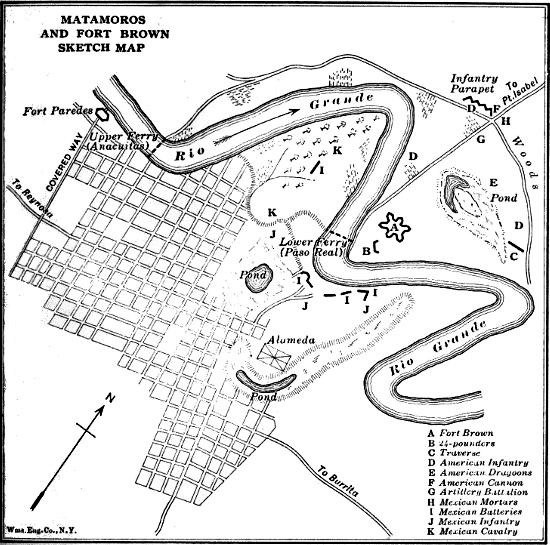
MATAMOROS AND FORT BROWN SKETCH MAP
No very alarming degree of intelligence had appeared to direct the American operations. Our troops were on a point exposed to a convergent fire; Fort Brown enfiladed none of the hostile batteries, though it might have been planned to do this; near the cavalry camp stood thick groves offering shelter to assailants; behind our main position was a lagoon forming—with a bend of the river—almost a circle; and the enemy, once in possession of the single road, which ran for seven or eight miles through rough country, would have had the army in a bottle. All the ammunition and provisions were brought by wagon from the coast, exposed to attack at every step. The imperfectly fortified base at Point Isabel, stored with indispensable supplies, had a garrison of only two companies aside from two or three hundred sutlers, clerks, teamsters and the like; and vessels could approach the landing only by a narrow passage between two islands, which could have been closed by a few 6-pounders. Yet we should have encouraged Mexico beyond calculation, and might have been injured greatly in Europe, had we now given up Fort Brown.[6]
A number of small disasters overtook the Americans. Colonel Cross, chief of the quartermaster’s department, went out and never came back. April 22 Lieutenant Porter and ten men, operating against the banditti, allowed their arms to get wet, and were scattered with loss by a party of Mexicans. Twenty of the Texas rangers commanded by Captain Walker permitted themselves to be surprised, and half of them were either killed or driven beyond recall. Taylor attributed these mishaps to a lack of experience, but the enemy regarded them as proofs of inferiority; and when Thornton’s party succumbed, the enthusiasm burst all bounds. “Honor and glory a thousand and one times” to the “brave men” of the army, cried a Tampico leaflet, and a triumph in the anticipated battle appeared certain.[7]
MEXICAN CONFIDENCE
From another source also the Mexicans drew encouragement. While Taylor’s officers were nearly all West Pointers and perhaps quite all native Americans, many of the privates were in fact of European birth and a large percentage Roman Catholics. To these Mejía, Ampudia and Arista issued moving appeals based upon religious prejudice and alleged foreign condemnation of our course toward Mexico, gilded with generous promises of rewards for deserting, supported by the luring voices of gayly dressed sirens who lined the opposite bank of the river all day, and reinforced by two captured American dragoons, who were given back, and reported that deserters received handsome treatment. A considerable number of men, largely veteran offenders from the British army, stole across; most of the Seventh Infantry were believed ready to change sides; and the Mexicans boasted exultingly that “Old Taylor” himself would soon be over.[8]
Arista, who had spent several years in the United States, did not feel very sanguine. Ampudia’s predictions of glory he regarded as “castles in the air,” or as perhaps intended to raise expectations that Ampudia’s successor would be unable to satisfy. But the officers and the troops felt impatient for combat. So loudly and so long had the charges of haughtiness, perfidy, aggressiveness and greed been reiterated against us, that all believed them true. The Americans were in their eyes accursed heretics, eager to trample under foot their holy religion: and they were also barbarians, capable of everything rough and cruel. In the event of their success the family hearth was to be polluted, the glorious, dearly-bought independence of the nation crushed, and the adored accents of the mother-tongue stifled. To the Indian rank and file the word “patriotism,” indeed, meant little; but they loved their villages, and could imagine even worse tyrants than Mexicans. The name “foreigner” had a terrible sound in their ears, and fanatical devotion to the Roman church set their passionate natures aflame. At the first sight of the “detestable” Stars and Stripes fluttering in the breeze, they had loudly demanded battle, and later the confident hope of triumph gave a still keener edge to their enthusiasm. Taylor evidently despised the enemy, believing there was no fight in them; but those tawny fellows, though miserably clothed and apparently spiritless, were trained to “blind obedience,” could fight like devils while their strength and fury lasted, and had now reached a good state of discipline. Even Captain Hardee of Thornton’s command, a prisoner at large in Matamoros, believed the Mexicans would gain the coming battle.[9]
One of Taylor’s most obvious needs in taking post on the Rio Grande was a light corps available for scouting, and in ordering him to advance, Marcy had expressly authorized him to call upon the Texans—by whom legs were valued chiefly as the means of sticking to a horse—for assistance; but nothing was done about the matter. On April 11 a friend in Matamoros warned him that an attempt might be made to cut his line to Point Isabel, but he did not seem to feel concerned. His troops were merely drawn beyond the effective range of Ampudia’s artillery; the work of fortifying was quickened; on the 23d he described the fort complacently as “in a condition of defence”; and a week later he contented himself with having the road inspected for seven miles. Point Isabel, he said as early as April 12, could withstand attack.[10]
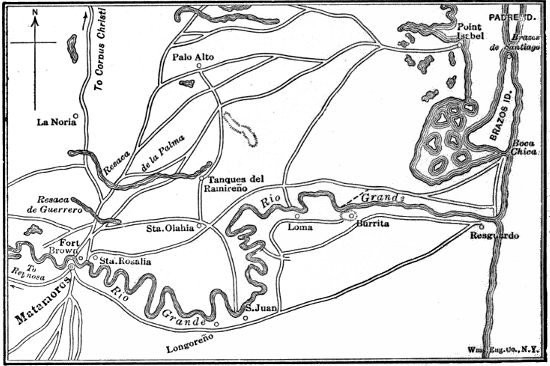
Fort Brown to Brazos Island
Arista, for his part, decided quite naturally, while on his way to Matamoros, that he would plant himself on the American line of communication, and prevent our army from receiving ammunition, provisions and reinforcements. Accordingly the 1600 men under Torrejón, after disposing of Thornton’s command, passed Fort Brown, held the road for some days without the knowledge of Taylor, and then by a grave blunder were drawn away, and concentrated on the Rio Grande opposite Longoreño, eight or ten miles below the city, to protect the crossing of the other troops, who proceeded to that point by several routes in order to deceive the Americans. The last day of the month Ampudia with his brigade and four guns went over; and on May 1 Arista—leaving Mejía with about 1400 men to hold Matamoros—followed with his other brigade and eight pieces. Unfortunately for him three scows of little capacity were the only boats available; and as these had been taken to Longoreño in carts by a circuitous route nearly fifteen miles in length, so as to avoid exciting our suspicions, they were not in good order. One or two, in fact, seem to have been almost useless, and hence many precious hours were lost; but at any rate the army succeeded in crossing a swift river without injury almost under the eyes of the Americans.[11]
TAYLOR ALARMED
By about one o’clock in the afternoon on the first of May Taylor heard that Mexicans were below him, and awoke. He saw now that Fort Brown required munitions and food, and that Point Isabel could not, even yet, resist a serious attack. Tents came down in haste; the wagon train was made ready; and at about half-past three—leaving behind the Seventh Infantry commanded by Major Brown, with Captain Lowd’s four 18-pounders, Lieutenant Bragg’s field battery and the sick, under orders to hold out as long as possible—Taylor marched for the coast. No time was lost in getting there. The troops bivouacked that night on the damp, chilly plain without fires, and early the next morning set out again. The shallow, greenish-brown lagoons rimmed with broad, flat, oozing banks of mud, the marshes full of tawny grass, and the low ridges mottled with patches of herbage and bald surfaces of gleaming dry dirt, seemed interminable; but as hours passed the now sultry air began to be streaked with salt odors, and by noon the panting troops caught the sparkle of blue waves. Fortunately they could not hear the shouts of joy in Matamoros over what was called their precipitate flight.[12]
As it was necessary to strengthen the defences, all the troops now exchanged their muskets for picks and shovels. May 6 the engineer in charge was authorized to continue the work by employing a hundred laborers; and at about three o’clock the next day, escorting more than 200 loaded wagons, the little army, preceded by a body of dragoons, moved out on the return march. As the small garrison of Fort Brown had provisions for at least three weeks, and the Mexicans could not be expected to attack it seriously with Taylor approaching their rear, whereas they were practically sure to be met on the road, Taylor’s best officers entreated him to gain freedom of action by leaving the train behind, which at most would have delayed it only a day or so; but he would not. No fears disturbed his mind. Reinforced with perhaps 200 men just landed at the Point, the army now with him numbered 2228, all told. Recent exercise and drill had left it in a splendid physical condition. Recollecting how long popular orators had been mocking at the “regulars,” it longed to do something. The attacks upon Cross, Walker, Porter and Thornton had exasperated its temper; nothing could have pleased the great majority of the soldiers better than a fight; and the General felt very much the same way.[13]
When it had made about seven miles the army bivouacked, and early the next day it resumed the march. Soon after noon, when some ten or twelve miles more had been covered, a low, dark line could be seen across the plain in front, some two or three miles away. It was the Mexican army. As the pond or water-hole of Palo Alto lay near, the tired and thirsty troops were permitted to halt, rest a little, drink and fill their canteens; and then Taylor had them posted in order of battle. At the extreme right the Fifth Infantry led by Lieutenant Colonel McIntosh was placed, and on its left in succession came Major Ringgold’s battery, the Third Infantry (Captain Morris), two 18-pounders on siege carriages under Lieutenant Churchill, and the Fourth Infantry (Major Allen). The Third and Fourth made up a brigade, commanded by Lieutenant Colonel Garland; and all the troops just mentioned, together with Twiggs’s dragoons, some 250 strong, in two squadrons led by Captains Kerr and May, formed the right wing. The other wing, known as the first brigade and commanded by Lieutenant Colonel Belknap, consisted of the Artillery Battalion under Lieutenant Colonel Childs, Captain Duncan’s battery, and the Eighth Infantry, posted in this order from right to left. The wagons were then assembled near the pond at the side of some woods, and Kerr was detached with his squadron to guard them.[14]
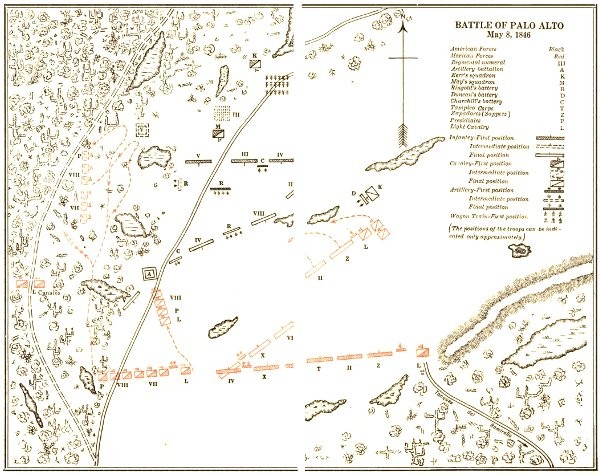
BATTLE OF PALO ALTO
May 8, 1846
BATTLE OF PALO ALTO
During these days Arista had waited for Taylor’s return; but, in order to hasten that and perhaps accomplish direct results, he had ordered the guns of Matamoros to begin cannonading Fort Brown on the morning of May 3, and two days later, believing the garrison were near starvation, sent Ampudia to invest it. For the sake of water and to cover all of the roads that might be taken by the American army, he placed himself at Los Tanques del Ramireño; and about noon on the eighth, learning of Taylor’s approach, he set out for Palo Alto, some five miles away. Shortly before gaining that point he saw through his glass blue American dragoons in the far distance, and, as quickly as he could, put his troops in position. At the extreme right were placed about 150 horse under Noriega, and then came a 4-pounder, a corps of Sappers, the Second Light Infantry, the Tampico Veteran Company and Coast Guards, five 4-pounders, the First, the Sixth and the Tenth Infantry, and finally, beyond an interval of about 400 yards and somewhat in advance, Torrejón and the rest of the cavalry—their front extended, their right strengthened with two small guns, and their left reaching beyond the Point Isabel road to a piece of chaparral on a slight elevation beside a swamp. In the rear of the line were some thickets; just behind the right wing an eminence eighteen or twenty feet high rose above chaparral; protected by this lay a watering-place; and in front there were some boggy pools and wide fields of stiff grass almost shoulder-high.[14]
As soon as formed, the Americans advanced in silence—the 18-pounders, drawn by oxen, following the road—while Lieutenant Blake reconnoitred the Mexican line within musket range to look for artillery. At about two o’clock Ampudia came in sight with the Fourth Infantry, commanded by Colonel Uraga, a company of Sappers, two 8-pounders, and about 400 irregular horse under Canales. Upon this Arista and his staff, a blaze of gold lace, passed rapidly down the line. It seemed strange to find in his position a tall, raw-boned man with red hair and sandy whiskers; but he showed the martial bearing of his nation, and harangued the troops with genuine Mexican eloquence. They were found ready for battle. Answering him with loud vivas they made ready their arms. The silken banners fluttered; the bands played; and at about half-past two or three o’clock, by the General’s order, his artillery opened. The hostile armies were then approximately half a mile apart; and the Mexicans—drawn out, except the cavalry, only two deep on a front about a mile in length without reserves—seemed to number 6000, though probably not more than two thirds as many.[14]
Apparently Taylor’s plan had been to force a passage by charging, for his aim was to reach Fort Brown, and his infantry had been instructed, the day before, to rely mainly on the bayonet; but he now halted. All his infantry except the Eighth regiment deployed into line. At strange words of command—“Haw, Brindle!” “Whoa, Brandy!”—ten yoke of oxen wheeled each ammunition wagon into its place; and the cannon advanced. At this juncture Ampudia’s column approached the field. Canales led his men a considerable distance forward into the scattered chaparral on the Mexican left, probably with a view to cutting off Taylor’s retreat, and thus put himself entirely out of the battlefield; but the rest of the command proceeded toward their appointed place between Torrejón and the infantry, and as this movement appeared to mean a charge, the American fire was turned in that direction. Without faltering, however, they moved up to the line and deployed, but their route was marked with the fallen.[14]
Now ensued about an hour of cannonading, supported by our troops with shouts that often drowned the roar of the guns, and endured by the Mexicans with unfailing constancy. Arista’s pieces, though bravely and skilfully served, were mostly too light. The balls generally fell short, and as they ricocheted, our men stepped aside. But the American practice met every hope. Sometimes a single shot appeared to mow down a whole platoon of mounted men; and here, there, everywhere gaps opened in the infantry. With vivas the gaps instantly closed, but they would not stay closed.[14]
Arista, a bold and experienced officer, expecting Taylor to act on such a plan as Taylor seems actually to have formed, intended to charge both flanks of the advancing Americans with cavalry supported by infantry; but the American artillery surprised him almost as much as if Taylor had used shooting stars. Probably the right course for him would have been to attack anyhow, for his men were still eager to fight, a cannon could be discharged only about once a minute, and our batteries would not have done much more harm at 70 than at 700 yards. But apparently it seemed impracticable to wallow slowly for such a distance through the grass, the sharp edges of which would have cut the legs of his poorly dressed soldiers badly, under so withering a fire. Something had to be done, however, for the troops grew impatient. He therefore directed his right wing to prepare for a charge, and ordered Torrejón and his two small guns to attack the American right, rear and wagons. Reluctantly Torrejón obeyed. Passing to the left, his “red lancers”—probably a thousand strong and “portentous” with trumpets, banners and lance points—advanced through the scattered chaparral and across a slough, becoming somewhat broken on the way, and found themselves at another small morass. Evidently the nature of the ground on which he was likely to operate had not interested Torrejón.[14]
Taylor, sitting unconcernedly with one leg over the pommel of his saddle, writing, was notified of this movement and simply replied, “Keep a bright lookout for them.” But some one—probably Twiggs, who commanded the right wing—had the Fifth Infantry march rapidly more than a quarter of a mile to the right and rear, and throw itself into a square. Torrejón awkwardly approached this body in column instead of line with some of the worthless Presidials in the lead, fired ineffectively, was answered with a disconcerting though not very injurious volley, and recoiled some 300 yards. He then sent word to Arista that a morass rendered his movement impracticable; but on receiving instructions to persevere, he made a circuit, advanced upon the second front of the square, and once more exchanged a volley. Now, however, he found our Third Infantry moving to defend the wagons, and saw two of Ringgold’s cannon hurrying to the scene at a gallop, while his own pieces had not come up. As rapidly as possible, therefore, and quite willingly, he retreated, but not without a salute from our two cannon, which he was unable to return. This unsuccessful manoeuvre exhausted Arista’s ingenuity, and he only waited now for darkness, hoping to get away and find a better position.[14]
During these operations a wad from Duncan’s battery had fired the grass. The wind from the Gulf, nearly parallel to the American front, drove a wall of roaring, crackling flame and a cloud of thick smoke across the plain; and, as the armies could see each other only now and then and in spots, firing had to be suspended for nearly an hour. Meanwhile, believing the Mexican left had given way, Taylor shifted his position behind the screen with a view to advancing. Churchill pushed on by the road nearly to where Torrejón had been; the Fourth Infantry moved up to support him; the Fifth went ahead on the extreme right; the rest of the army made corresponding changes; and as a whole the line diverged now thirty or forty degrees from its original direction, while the wagons came nearly up to it.[14]
But the Mexican left had not yielded, and so Taylor found when he sent a squadron of dragoons to open the way. To avoid being enfiladed, Arista swung his line forward in excellent order, using the Fourth Infantry as a pivot, and again it stood firm under an artillery fire more destructive than at first. Indeed our Fourth Infantry began to suffer a galling cannonade, and Torrejón again assumed the offensive. Canister from the 18-pounders checked him, however, and after sharp musketry exchanges between the Mexican line and our Artillery Battalion, which had advanced and formed a square, serious infantry operations in this quarter came to an end. As for the artillery, Arista had now used up his 650 cannon balls; but the Americans kept at work until nightfall.[14]
On our left, however, important events occurred. From the first Captain Duncan’s battery, which made two fire-units because handled in sections, played a brilliant and effective rôle, supported by the Eighth Infantry and either Kerr’s or May’s dragoons, and advancing or retiring as the course of the battle dictated. When Arista’s change of front threw his right forward nearly 700 yards and seemed to threaten a flank attack, these pieces became more active and more daring than ever, and under their blasting discharges, aided more or less at this time by the 18-pounders, the Mexicans fell rapidly. Again they grew impatient—not principally because they were suffering so terribly, but because they were inactive, and because hints that Arista had sold them began to arrive from Ampudia’s quarter; and finally the extreme right wing broke.[14]
After a time some of the officers and Arista, who exposed himself bravely throughout the battle, induced these troops to go back, and as they were still in much confusion, the remnants of Noriega’s corps, reinforced with 200 men from Torrejón, were ordered to support them. The cavalry, however, badly demoralized themselves, dashed blindly at a trot against the infantry; the resulting disorder extended even to the Tampico men; and these desperate corps, ordered to charge as the only possible way to prevent them from bolting, moved forward aimlessly in succession. Duncan, when he saw this large force advance, withdrew a little, still firing; but soon under cover of the smoke he came up again, and gained an enfilading position. Suddenly with a sharp crack his guns opened, and against the fading horizon his shells and shrapnel could be seen bursting, with almost the regularity of signal rockets, over those dark masses. Driven like sheep by this fire, the Mexican right wing turned toward the left and hurried across the entire field, presenting their flank and to some extent their rear to the Americans at a distance of 200 paces or even less, while, in a somewhat more orderly manner, the First Infantry, which stood next in line, followed them. Now was the time to decide the battle; but, though Taylor had come to this part of the field, nothing could be done, for it was feared that should a charge be made, the enemy’s cavalry might reach the wagons, and cripple our army by destroying the provisions. Indeed, the Americans appear to have drawn back a little toward the train; and the disordered Mexicans, having reached the extreme left and finally the rear of their line, were re-formed.[14]
It was now about seven o’clock. The Americans had lost five killed and forty-three wounded, and the Mexicans probably seven times as many. The afterglow of sunset lighted up the dun clouds of smoke. Darkness was close at hand. Necessarily, therefore, the struggle ended; and while the Mexicans retired through the chaparral to the low eminence behind the original position of their right wing, and there camped in order of battle, the Americans bivouacked where they stood, or in the fitful glare of the still burning grass gave attention to such of both armies as could be discovered lying on the field. At last the prairie fire burned out; the smoke of battle drifted away; the full moon appeared; and the tired troops, watched over by pacing guards, slept between the stacks of arms like images.[14]
Important moral results had been gained by the Americans, but they were not aware of the fact, and expected the battle to be resumed. At about seven o’clock the next morning, however, as the light mist slowly dissolved, their astonished eyes beheld the Mexican line gliding off into the road; and presently, like the tail of a huge serpent, its rear wound away into the chaparral, and vanished. Taylor gazed and reflected, moved a short distance, waited to ascertain through a party of dragoons that it was a genuine retreat, consulted with some of his principal officers, and then decided on pursuit; but the forenoon had to be spent in erecting breastworks and planting four heavy cannon to defend the train, which he now saw should be left behind; and he merely sent forward a composite force of 220 men, under Captain McCall of the Fourth Infantry, to harass the Mexican rear.[15]
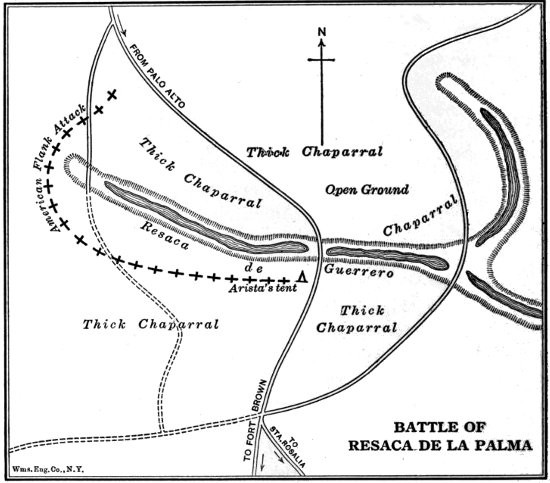
BATTLE OF RESACA DE LA PALMA
ARISTA IN A NEW POSITION
Arista turned this delay to good account. The chaparral and woods that his troops had been seen to enter extended with some interruptions to the Rio Grande, a distance of approximately seven miles; and two hours before noon, after marching about halfway through it, he stopped at the Resaca de Guerrero. The Resaca was an ancient channel of the river, but it now consisted merely of a shallow, muddy ravine somewhat in the shape of a bow, several hundred feet wide and three or four feet deep at the banks, lying substantially east and west across the route, with its concave side toward Palo Alto. At the bottom of it, both to the right and to the left of the road, lay narrow ponds, and the space between the water and the banks was rather closely filled with bushes and small trees. Facing round here, Arista planted three or four guns at the right, or east, of the road from Palo Alto where it approached the Resaca, two at least—hidden with branches of trees—on the southern bank of the Resaca, and other pieces at suitable points toward his left. The infantry were placed in two wings divided by the road, with much the greater weight on the right hand, some of the troops taking position just in the rear of the ravine, some behind its northern bank, and some in the chaparral still farther forward. The headquarters tent was pitched in a small clear space or placeta about 500 paces back on the left of the road, and Torrejón’s cavalry halted in the same road still farther away; while Canales with two guns, placing himself on the left a considerable distance back from the Resaca, guarded a cross-road leading to Arista’s rear.[16]
The Mexican position, besides covering every line to Fort Brown, offered a number of other advantages. It did not call for much use of artillery, and therefore neutralized Arista’s deficiency in cannon ammunition. The woods made it impossible for the Americans to employ that dreaded arm effectively. The bank of the Resaca formed a natural breastwork, and it seemed likely that the troops, protected in this manner, would be confident and firm. But evidently a bold and enterprising enemy could take advantage of the woods to conceal his movements; and evidently, too, Arista’s main batteries could fire only in the direction of the road, since there were Mexicans in advance of the Resaca both to right and to left. Another handicap lay in the impossibility of surveying the field and manoeuvring troops—particularly the cavalry; the soldiers, unable to see far, lacked that sense of union and support which Mexicans peculiarly needed; and the want of reserves, though to a certain extent a part of the Fourth Infantry stationed on the right behind the Resaca could act as such, was an additional source of weakness.[16]
A still more serious feature of Arista’s situation was the condition of his troops. Many, and probably most of them, had not eaten for more than twenty-four hours. The sufferings they had witnessed and the neglect of their fallen comrades had worked upon their feelings. The dreadful effectiveness of the American artillery had been profoundly discouraging; many of their officers had proved unworthy of confidence; and above all, accustomed to the duplicity of Mexican leaders and unable to understand their general’s inactivity the day before, many concluded that Arista, who was accused of seeking American support for his alleged revolutionary scheme, had betrayed them. This idea, if we may trust common sense and Mexican intimations, was suggested or at least encouraged by Ampudia himself; and the coöperation of all these depressing influences had spread a general conviction through the army by the forenoon of May 9 that a great disaster would befall it that day. A few, it was said, broke their weapons in despair; and utter dejection could be read in the faces of every corps. Some reinforcements were drawn from the city, but they did not materially improve the situation.[16]
BATTLE OF RESACA DE LA PALMA
Taylor, then, advancing at about two o’clock, after detaching most of the Artillery Battalion and perhaps Kerr’s dragoons to guard the train, moved forward to the edge of the woods, and halted at what was called the Resaca de la Palma to await information. The advance corps under McCall, which consisted principally of the light companies of the first brigade under Captain C. F. Smith, was now feeling its way toward the enemy. At a little after two o’clock, turning a bend in the road, it found cannon in front. Instantly they fired. About half a dozen Americans fell, and the rest quickly withdrew. At three o’clock McCall’s report arrived at headquarters. Taylor pushed on immediately, and in about an hour came up with the advance party. Ringgold’s battery, now commanded by Lieutenant Ridgely, was sent forward on the road, and McCall’s command, thrown into the chaparral on both sides, began a slow and painful advance through the bushes. Almost immediately it found itself in contact with the enemy.[16]
Under such circumstances McCall could give the battery no support, of course, and the only reasonable expectation was that Ridgely’s men and horses would be shot from the woods, and his guns be taken. That, however, made no difference to him. His orders were to advance, and advance he would. Once a body of lancers charged his guns, but by a combination of courage, skill and good luck he routed it. Some of the Mexican artillery seems to have moved up the road a little way after McCall retired; but Ridgely, pushing on even into the very smoke of the enemy’s cannon, drove them in spite of stubborn resistance beyond the edge of the Resaca, and then sent back for troops to help him capture them. When the battle became more general he continued to fire upon the Mexican batteries; and, as far as he could without endangering Americans, he also swept the woods with canister, frightening the enemy with a terrible noise in the tree-tops that reminded them of the slaughter at Palo Alto.[16]
To right and to left the battle soon raged. All the Americans on the ground, numbering about 1700, were put in. No general guidance could be exercised. “Chance was the lord of all save the good right arms” of the troops, wrote an officer. In such woods and thickets lines could not be formed. Even companies found it impossible to remain intact. A field officer was no more than a captain, and a captain no more than a subaltern. All got into the work promptly, and all did their best when there. As fast as they could, singly or in little squads, they pushed on, cheering and shouting. Often it required one’s utmost exertions to squeeze through or hack through the dense and thorny chaparral under pelting showers of bullets. Now there was shooting, and now the cold steel struck fire. “My orders was to make free use of the bayonet,” said the General afterwards, and the orders were borne in mind. Here Lieutenant Meade, the future victor of Gettysburg, had a chance to win his spurs; and he was but one of many heroes, though perhaps the most conspicuous in his quarter.[16]
Nor did the Americans have it all their own way. Those Mexicans who fought at all this day, fought like tigers. On the right near the road the Second Light Infantry, which had been placed there in ambush just before the real battle opened, stood firm; but most of its field officers were struck down, and it had to give way. A company of Uraga’s regiment did nobly close by, and every man of it, we are told, was either killed or wounded.[16]
Farther toward Arista’s left, however, our men pushed forward rather easily, though it seemed evident from the firing that Mexicans were in front. Gaining ground in this direction some Americans probably came upon a path which led round the western end of the pond, and gave access to the Mexican flank. Just before the battle began Ampudia learned of the path, and stationed a company of the Sappers and a company of the Fourth Infantry in this quarter; and later he sent another detachment from the Fourth with a gun. Besides these meagre forces probably no corps guarded the left except a few Tampico troops. These also fought well; but the splendid silk banner of the Veterans, the bravest corps in the army, was captured, and only at heavy cost could they fight their way back. Meantime the rest of Uraga’s regiment came over from beyond the road, but it could not stop the Americans; and brave Captain Barbour, followed by a small party, soon approached the placeta. The effect was electrical. Nobody knew how many troops were following him. Canales took flight. The sense of defeat, already imparted by hurrying soldiers of the Second Light, spread across the road from the broken left, and at about half-past five o’clock Arista’s right wing, the strength of the army, crumbled like a sand fort struck by a wave. Except perhaps one, all the corps dissolved; and in a moment, as it seemed, nothing was left but a mob of fugitives.[16]
During all this, Taylor, exposing himself as much as any one, had been fighting at the centre. The proper course to adopt there was to charge the Mexican guns on the road with infantry, but for some reason he sent May’s dragoons against them. In a way the effort succeeded. Slashing as they galloped, the horsemen quickly ran over the batteries—more than a quarter of a mile beyond them, in fact; and then, coming back in a scattered condition, had a chance to slash again, for the batteries had been reoccupied. But the thickets on both sides were full of Mexican infantry. Against their muskets the dragoons were mere targets—broad ones, too; and before long the squadron, much the worse for its charge, recrossed the Resaca. Taylor was disgusted. Turning to Belknap and the Eighth Infantry he exclaimed, “Take those guns, and by —– keep them!” A part of the Fifth joined Belknap; and these men, rushing in furiously all together, yelling like fiends, after a brief though sharp struggle with the artillerymen—for the supporting infantry had now abandoned their position—captured the pieces. But the battle had already been won.[16]
Before McCall had shown himself Arista, dazed perhaps by his reverse at Palo Alto, valuing too highly his new position, and probably overestimating the injury inflicted on Taylor the day before, had made up his mind that no immediate attack was to be expected, and after placing the army had withdrawn to his tent, and busied himself in writing. Even when firing began, he said it was only a skirmish; and after our troops reached his left flank, he merely ordered Ampudia and the rest of the Fourth Infantry to go and settle things in that quarter. When Americans appeared at the placeta, however, he awoke. Pouring curses on the cowards of his army, he hurried to the cavalry, and taking the place of Torrejón, who had refused to charge, dashed up the road. His men lanced a few lingering American dragoons and helped a few comrades to escape, but the battle could not be saved. On one side of the road at least, Americans already held the chaparral, and like May he could not stand against protected infantry.[16]
At the head of the cavalry he retreated, therefore, and turning to the left crossed the Rio Grande by one of the lower passages. Other fugitives got over at various points; and a great number, passing Fort Brown, which was about three miles from the battlefield, crowded to the Anacuitas ferry. Here they found a couple of scows; and some troops, that had been engaged all this time in annoying Fort Brown, stood on guard. But the fleeing soldiers were panic-stricken, the boats moved slowly, and the Americans were looked for at every moment. Men fought for places. Clothing and arms were thrown away. Many tried to swim or fell accidentally into the water, and an unknown number perished in the swift current.[16]
“Rio Bravo! Rio Bravo!
Saw men ever such a sight
Since the field of Roncesvalles
Sealed the fate of many a knight?”
But the Americans did not come. Taylor had scarcely any fresh troops except those guarding the wagons nearly or quite five miles in the rear. May’s dragoons had been used up. Apparently no effort had been made to communicate with Fort Brown, and have its defenders—now tired but not exhausted—sally forth to help reap the fruits of the expected victory. Taylor only claimed to have captured “a number” of this utterly broken army facing a difficult river. Even badly wounded men got safely across, it would seem; and very soon, in spite of everything, nearly four fifths—that is to say, about 4000 besides those under Canales—of the troops commanded by Arista on the first of the month appear to have been in safety on the south shore. He lost on May 9, according to his official report, 160 killed, 228 wounded and 159 missing, but the accuracy of the figures may be doubted. Fourteen officers, eight guns and a large amount of property were captured by the Americans, while their casualties were only 33 killed and 89 wounded.[16]
During the whole week so dramatically concluded, Fort Brown had been under attack.[17] On May 3 it replied vigorously, though with trifling results, to the guns of Matamoros; but as Taylor, with more than a month of good weather and about 300 wagons at his disposal, had neglected to bring up a stock of ammunition, it fired only occasionally after that in order to notify both friend and foe that its courage still held good. On the 4th Canales occupied the road, and on the next day Ampudia arrived with four guns and nearly a thousand men. Arista, however, believing his cannon were not heavy enough to breach the wall and confident that hunger would soon reduce the garrison, forbade assault. The besiegers made themselves extremely disagreeable; but by this time the Americans had bomb-proofs and “gopher holes,” and, aside from the death of Major Brown, met with no serious losses. Taylor’s profound silence, after as well as before the battle of Palo Alto, caused intense anxiety; but when the cannon began to “bark” again on the 9th, and especially when a throng of panic-stricken fugitives could be seen rushing past, haggard faces put on smiles. Finally a solitary messenger approached at a gallop with his reins on the horse’s neck, waving cap and sword, and shouting “Victory!” and the long strain ended in exultation.[18]
SITUATION OF THE MEXICANS
The Mexican army was now hanging like a plum, overripe, shaken by the wind and ready to fall. To the British consul it seemed utterly demoralized, and beyond the possibility of reorganization. Yet there it was permitted to rest and recuperate undisturbed. The official explanation said that although a pontoon train had been proposed a long time before, the dim prospect of hostilities had not seemed to warrant that expense; but like numerous other official statements put out in the course of the war, this explanation hid more than it told.[19]
A bridge might have been in readiness; but, though several officers had been laboring for more than a month to focus Taylor’s mind upon the subject, “the old gentleman,” wrote Meade, “would never listen or give it a moment’s attention,” Flat-boats and scows, towed by the light steamers belonging to the army, might have been sent from Point Isabel into the river, and the troops, reinforcements and light batteries, crossing at the much-used ferry of Burrita, less than twenty miles from Matamoras, and by land appearing at the town, say, in early morning, could probably have taken army, cannon and ammunition substantially complete. Instead of doing anything of this description, Taylor now sent down to Point Isabel for mortars and for plank to make into boats, and went there himself. A slight illness delayed him further; and in eight days nothing was accomplished in the direction suggested beyond placing at Burrita a battalion of the First Infantry and some 200 volunteers just landed at Point Isabel.[19]
Still, though let alone, Arista occupied no enviable position. He was commonly charged with incompetence, treason or both. Many of the officers had forsaken their troops in the hour of danger, and were now viewed with distrust and contempt. The men felt exhausted and profoundly disheartened. Even the dogs kept still. Provisions, ammunition and funds were scant. Fierce complaints and recriminations became rife. Panic brooded over all. Taylor’s inaction seemed an encouraging sign, however, and on the 17th a request for a suspension of hostilities, accompanied with hints of a peaceful settlement, was made by Arista. This petition Taylor rejected. But, not aware that a general’s first duty in war is to eliminate the fighting strength of the enemy, he said that Arista might retire with his army, the sick and the wounded, if he would give up all public property. In fact, as if anxious to fight these men again after letting them get nicely rested, he threatened to bring Matamoros down about their ears, unless they would move to a safer place.[20]
Arista had been ordered to hold the city as long as possible, but a council of officers pronounced it indefensible; and, besides feeling no violent wish to sacrifice himself, he doubtless realized that nobody was ready to stand by him. He therefore ordered now an immediate retreat, and a wild scramble ensued. The transportation facilities were entirely inadequate. Some of the guns and ammunition had to be thrown into the river. The troops of Canales were dismissed. A large number of men deserted; and the rest, leaving four or five hundred sick and wounded in the town, hurried away. Fatigues and miseries almost unspeakable were their lot, and also for some time a terrible fear of pursuit. Heat, cold, thirst, famine, tempest, sickness, desertion, a route lined with dead animals, sleep in the mud as profound as the sleep of the grave, troopers carrying their horse furniture, deaths from exhaustion or broken hearts, and even suicides—these made up the record. Finally, almost at the end of the month 2638 men, according to an officer, crawled painfully into Linares, and a week later Arista received orders to place Mejía in command.[21]
Taylor, all this while, had been proceeding in his deliberate way. Boats were made and put on the river two or three miles above the town, and early on the eighteenth troops began to cross; but when the first of them were over, a report that Arista had retreated was confirmed, and the greater part of the army, retracing their steps, used the regular Anacuitas ferry. As they approached Fort Paredes the city officials—dressed all in white, bearing white flags and riding white horses—came forth to surrender Matamoros. No terms of capitulation were granted, but the General said he would protect persons and property, and allow the civil laws to continue in force; and already he had promised to respect the religion of the people. To their surprise the Americans appeared to find themselves among friends, for the lately implacable but seldom tactless Mexicans came up smiling, cried “Amigo, amigo!” and with sunny enthusiasm offered their hands; and although a feeble pursuit of Arista produced only insignificant results, the victors felt well content. Their superiority as fighting men had been demonstrated. Their artillery had evidently surpassed the Mexican artillery in both mechanical and personal qualities. The officers had exhibited the finest courage, esprit de corps and skill. An army supposed to outnumber ours three to one had been scattered, and a prestige of the utmost value at home, in Mexico and in Europe, had been gained.[22]
EFFECTS OF THE BATTLES
Regarding Taylor, thoughtful officers did not feel enthusiastic, however. The General had shown himself slow, unskilful, wanting in penetration and foresight, and poorly grounded professionally. Nine tenths of the regular officers felt that no talents had been displayed by him, even in the battles. He had shown, said Meade, “perfect inability to make any use of the information” given him. In the opinion of another excellent officer he seemed “utterly, absurdly incompetent to wield a large army.” He had failed to realize the difficulties of his position; had undervalued the enemy; and, as Bliss admitted, had had “no conception” of the Mexican preparations. This last fact dimmed his credit, even for courage, in the minds of discerning critics. But, after all, his resolution had been superb and inspiring. He had succeeded; and among us Americans “Nothing succeeds like success.” The reports written for him read admirably. Terse remarks of his, often tinged with soldierly humor, delighted the general taste at home, and mere questions of tactics or strategy signified in comparison rather less than zero. Besides, he was so democratic—no military stiffness, no West Point “aristocracy” about him. A tidal wave of popularity rose in his favor, and soon Thurlow Weed of New York, the Warwick of the Whig party, came out for him as Presidential candidate. A commission as brevet major general and other official honors did not fail to arrive.[23]
At Mexico the news of these events produced utter amazement and consternation. The public, reported the British minister, had been assured “in the most inflated Tone that Victory would follow the steps of the Mexican Army and that annihilation and dishonour would be the portion of their enemies.” Even General Vega, a man of sense, had predicted a victory that would end the war. Now, alas, the cards had fallen badly. “Profound and bitter sorrow,” as it privately admitted, was the feeling of the government. Down like a plummet went expectations, confidence and courage; down went the plausible hope of Paredes that all the nation, glowing with pride and enthusiasm over a victory, would rally about him; and down also, reported Bankhead, went his monarchical scheme, which four out of five on the Congressional committee appointed to draft a new constitution had favored.[24]
IX
THE UNITED STATES MEETS THE CRISIS May—July, 1846
Polk believed in pursuing “a bold and firm course” toward Mexico. In this policy—as her character and methods, the comparative success of England in dealing with her, and the many humiliating failures of the United States indicated—he was right.[1] More and more positive, during his examination of the case before and after the end of April, 1846, became his intention to place the subject before Congress in a strong Message; and when he found that Slidell, who called at the White House on Friday, May 8, held the same opinion, he decided to send that Message “very soon.” The next day he and the Cabinet discussed the question at length once more. George Bancroft, secretary of the navy, was not ready to advise the employment of force, unless Mexico should commit a hostile act; but when, at about six o’clock, Taylor’s report of the Thornton affair presented itself, this difficulty vanished. In the evening, at the President’s request, the Cabinet reassembled, and after another full discussion all agreed that a war Message should be delivered to Congress on Monday. Sunday Polk worked on the paper both before and after going to church, and conferred with leading Congressmen. The military committee of the House, meeting in haste, agreed unanimously to recommend 50,000 men and ten million dollars for the prosecution of hostilities; and the Senators and Representatives gathering in excited and quickly changing groups, anxiously discussed and planned.[4]
About noon on Monday the expected Message arrived at the capitol, and was read to thronged and agitated Houses. Our forbearance has been misconstrued, said the President. “After reiterated menaces, Mexico has passed the boundary of the United States, has invaded our territory and shed American blood upon the American soil.[2] She has proclaimed that hostilities have commenced, and that the two nations are now at war ... war exists, and, notwithstanding all our efforts to avoid it, exists by the act of Mexico herself.” “The most energetic and prompt measures and the immediate appearance in arms of a large and overpowering force are recommended to Congress as the most certain and efficient means of bringing the existing collision with Mexico to a speedy and successful termination.” Volunteers to serve not less than six or twelve months, with liberal financial provision for the war, were therefore suggested; but at the same time a desire for an “amicable” as well as early settlement of the pending difficulties was expressed, and a pledge was given to negotiate whenever Mexico would either make or hear proposals.[4]
Objections greeted the Message at once. Calhoun in particular strongly opposed the President’s fundamental idea. Hostilities have occurred, he said; but as Congress has not acted, there is no war “according to the sense of our Constitution.” Archer, a leading Whig Senator, concurred in this view, adding that perhaps the Mexican proceedings had been justifiable, and that first of all a careful investigation of the facts was requisite. Clayton, another Whig, went farther, and said that by having Taylor advance to the Rio Grande Polk had made himself the aggressor. There is no evidence, it was urged, that Mexico has declared war or sanctioned hostilities. Recognition of a state of war would extinguish all treaties with that country, jeopardize the persons and property of our citizens on sea and land, wipe out our claims upon Mexico, expose the nation to untold evils, and perhaps give offence in Europe, objected others; hence let us merely authorize the President to repel invasion. On Benton’s motion the Senate divided the subject of the Message, referring the matter of invasion to the committee on military affairs and the broad question of waging war to that on foreign relations.[3] Excellent possibilities of delay seemed to lurk in this decision. Calhoun favored it.[4]
THE ACTION OF CONGRESS
But the House was prompt and positive. Conveniently reposing on the table there was a bill, presumably growing out of the Oregon issue, which proposed that Polk should be authorized to accept volunteers and repel invasion; and this was now modified to fit the President’s recommendations. It was also given a preamble, which stated that “by the act of the Republic of Mexico, a state of war exists between that Government and the United States.” This phraseology displeased most of the Whigs; but they were powerless to change it. In the committee of the whole about an hour and a half were allowed for a partial reading of the Message and the accompanying documents, and thirty minutes for debate. Amidst a great uproar the bill was then reported, ordered without discussion to its third reading, and under the spur of the “previous question” passed. One hundred and seventy-four supported it and fourteen—five from Massachusetts, five from Ohio, and one each from Maine, Rhode Island, New York and Pennsylvania—voted in the negative. The next morning this bill was reported in the Senate.[4]
Calhoun pleaded now for at least a pause of twenty-four hours, and this appeared not unreasonable, since the documents that supported the Message had not yet come from the printer; but the party caucus had resolved upon a course of action, and Benton and Allen, chairmen of the committees on military affairs and foreign relations, announcing that consideration had already been given to both aspects of the war measure, favored immediate action. Cass made an effective speech in the same sense; and, although a test showed that eighteen Senators objected to the preamble, the bill, somewhat amended, was passed finally by a strong majority—forty against only two. Calhoun, Berrien of Georgia and Evans of Maine did not vote. Crittenden and Upham answered to their names, “Aye, except the preamble.” Webster and a few others were absent. In the evening the House accepted the amendments, and the next day at about one o’clock Polk received and signed the bill. Later some of the Whig Congressmen pretended that all they had voted for was to save Taylor’s army; but the 50,000 soldiers and ten millions of money were not asked for a mere rescue party, and it was pointed out in the discussion that the General’s fate would be decided long before the bill would give him troops. By an overwhelming majority in both houses, then, voting in full accord with the President and his Cabinet, war on a large scale was provided for. “The gates of Janus are open,” wrote Alexander H. Stephens.[4]
THE MOTIVES OF CONGRESS
At every stage of these proceedings flowed a tide of real national feeling, but there were also devious currents that need to be mentioned. Probably few, if any, of the chief actors expected very serious trouble with Mexico. Polk for his part assured Benton that if Congress would recognize the war and provide large forces, he believed the affair could speedily be terminated; and he promised to use no more funds and men than should prove “absolutely necessary to bring the present state of hostilities to an end.” Many Congressmen, who talked with members of the Cabinet, were told that without firing another gun the United States would have a satisfactory treaty within four months.[5] The Washington correspondent of the New York Tribune, an anti-slavery Whig journal, reported that on learning of the action taken by the House Polk said, “I shall now give you peace—I have the power.” “The war was declared as the means of peace”—as a part of the President’s policy of intimidating Mexico into making a settlement, wrote the correspondent of the New York Journal of Commerce. So thought the New York Herald. Merely passing the war bill will be enough, it said; and, especially since Polk’s Message exhibited the same combination of sword and olive branch as his employing Slidell and Taylor jointly, so to speak, one cannot well reject this view, which is supported also by evidence previously offered.[10]
The Democrats, being the administration party, naturally stood by the President,[6] and a wish to make the attitude of the United States impressive and effective was an additional reason for their urgency and haste. But probably these were not the only inducements. The party was falling into dissensions. The Van Buren group felt indignant that New York should occupy a secondary place in the Cabinet, and be represented there by the Old Hunker, Marcy, while the rest of the Democrats complained that Van Buren’s faction, the Barnburners, were dictating everything. A short, inexpensive and successful war—especially one without gunpowder—seemed likely to please the country, provide offices, consolidate the party, and compel the Whigs to lose prestige by endorsing the policy of their opponents, or else to sacrifice popularity by antagonizing it. Moreover it looked as if a discussion of Polk’s course in sending Taylor to the Rio Grande, however correct that course had been, might prove at such a juncture dampening and vexatious; and for all of these reasons it seemed expedient that a war bill, with exactly the preamble already quoted, should be rushed through Congress at the quickest pace.[10]
The Whigs were no less perspicacious, and they especially hated to lose the partisan advantage of charging that Polk had been the aggressor. Mexico has not declared war, they insisted; and with more or less honesty they complained that a regard for sacred truth forbade them to endorse the preamble. But their position was exceedingly delicate. Not only had Mexico long threatened hostilities, prepared openly for them, and severed her diplomatic relations with us at both capitals, but she had in effect made a declaration of war. Her only official voice at this time was that of Paredes; and his agent, Arista, an officer of the highest rank, had given Taylor formal notice of hostilities. Arista had been sent but recently to command against the Americans, and nobody could reasonably suppose that he had proceeded at once to transgress or ignore deliberately the wishes of his master in so grave an affair.[10]
Taylor on the other hand had shown the most pacific disposition both in word and in deed. Nothing serious could be alleged against us except the peaceable joint-occupation of territory long claimed by the United States; and in short, unless Jefferson, Madison, Monroe, Pinckney and John Quincy Adams were to be disavowed, it seemed legitimate for Polk and for Congress to hold now that Arista’s attack upon Thornton had been the first hostile act.[7] The preamble, therefore, could not well be rejected; and nearly all of the Whigs, having before their eyes the doom of those who opposed the war of 1812, choked down some honest though mistaken compunctions and in most cases a probably more troublesome lump of partisan regret, and voted for the bill.[10]
As already has been suggested, however, there was in Congress a third party—John C. Calhoun, and for later as well as for present reasons it is desirable to understand his opinions. To him it seemed highly advisable to forestall European interference, and quite possible to avoid a conflict with Mexico, by adjusting the Oregon question before coming decisively to an issue in the Mexican difficulty, and therefore he thought the United States ought by all means to limit itself now to repelling invasion. Personal reasons also led him to deplore the prospect of a conflict in arms. The culmination of his fiery life, the fulfilment of his brilliant dream, had seemed in April to be drawing near. By his convenient method of bending facts and principles to his purpose, as the sparrow makes a nest for herself, he had found it possible to coöperate with the West in spending great sums on internal improvements, and expected in this way to make the Northeast a helpless minority; but he could easily see that war might empty the treasury and bring about new political alignments. For the same reason it looked as if his project of a low tariff also would vanish; and, as we have seen, contemplating the possibility of secession, he did not wish[8] the youth of the southern states to expend their blood in Mexico.[10]
Before the news of Thornton’s encounter arrived he argued with Polk against sending to Congress the proposed Message on our relations with Mexico. During the excitement on that eventful Sunday he not only planned with his partisans in Senate and House to oppose war, but worked for the same purpose with leading Whigs, urging—for example—that Mexico should be given more time to consider the risk of a conflict, as if she had not already been speculating upon it for several years. Then in the Senate he gravely proclaimed the truism that border hostilities do not necessarily constitute war, and turned it into a sophism by applying it in the present case. To compare Arista’s attack upon Thornton to an unmeaning border squabble was truly, in view of the long series of preliminaries, ridiculous; and equally ridiculous was the endeavor to support this fallacy with another: that since Congress had not declared war, a state of war with Mexico could not lawfully exist at this time.[9] “Is not Calhoun deranged?” exclaimed our minister at Paris on hearing of this.[10]
To be sure, Congress is the only branch of our central government that can legally declare war; but, for instance, other nations are not hampered by our Constitution, and might attack us in such a manner as to prevent Congress—for a time, at least—from acting. None the less we should fight, and it would be nonsense to describe our resistance as unconstitutional. As a matter of fact Congress did not declare war against Mexico, and on Calhoun’s theory we had no lawful war with that country. On that theory, not only our military men, Congress and the President, but our Supreme Court, which fully recognized the war, acted unconstitutionally. Indeed, he himself illustrated the untenability of his idea. In order to avoid the weakness of advocating purely defensive operations a Whig leader, Senator Crittenden, said that by repelling invasion he meant pursuing the enemy until we could be sure that no repetition of the outrage would occur. This programme would have involved substantially all that we did against Mexico. It would have meant a war without a declaration; yet Calhoun endorsed it. In short, even one so acute and so deeply interested as he could not find a real argument against the war bill, and his “friends” abandoned him on this issue. By an overwhelming majority Congress rejected his interpretation of the organic law. War existed. No American who recognized our claim to the intermediate region, formally made by national authorities and never withdrawn, and especially none who recognized the claim of Texas, could logically deny that it existed by the act of Mexico; and in the light of its antecedents, including Arista’s declaration of war and attack upon Thornton, the war bill committed the nation properly as well as completely.[10]
THE CAUSE OF THE WAR
We were, then, under arms; but, after all, why? What was the cause of the war? It was not—as will plainly appear in another chapter, it is believed—an unholy determination to obtain California at the cost, if necessary, of fifty thousand lives. It cannot have been a difficulty as to the boundary of Texas, for two nations do not fight over an issue that exists for only one of them—and that one not the aggressor; and for Mexico the question between the Nueces and the Rio Grande had no international significance except when it could be used, as an argumentum ad hominem, to embarrass Americans.[14]
Nor was it a scheme to extend the field of negro servitude. Even a cormorant requires time for digestion, and in 1845 the acquisition of Texas appeared so powerful a bulwark for the peculiar institution, that no strong and widespread craving for additional areas can be supposed to have existed at the beginning of 1846. Besides, as pro-slavery Taylor, Calhoun and Polk, anti-slavery Webster and time-serving Buchanan agreed, free labor was practically sure to dominate California; and hence, in view of the slight probability that much cultivable territory could be obtained in the south against the stubborn opposition of the free states, the war seemed more likely to diminish than to increase the relative strength of slavery. Moreover, the soil south and west of the Rio Grande was unsuitable for cotton, sugar, rice or tobacco. Rich proprietors already owned the land, and had no thought of parting with it. The system of peonage was extremely economical, and it held the ground so firmly that negro slavery, though tried, had been unable to make headway against it. The free laborers of northeastern Mexico would have been, admitted the North American, particularly hostile to our southerners and their methods; and the colored population, it was pointed out, could have escaped gradually from its bonds by amalgamating with the natives. Now the leaders of the “slavocracy” doubtless inquired into the conditions; and, as most of our ministers and probably most of our consuls in Mexico were from their section, they could easily obtain information. Waddy Thompson and A. J. Donelson, for example, believed and said, that slavery would not thrive in northern Mexico.[14]
Polk’s diary and papers reveal no evidence that he seriously considered the interest of the peculiar institution in connection with our Mexican problem. The debates of Congress are equally barren. Soon after the war opened, as we shall discover, northeastern Mexico seemed ready to join the United States or accept our protection, and there is no sign that the slavocracy attempted to improve the opportunity. The politicians most eager to acquire Mexican territory were Dickinson of New York, Hannegan of Indiana and Walker, an anti-slavery man. A northern correspondent of Calhoun wrote that many in New York insisted on extending that way “to augment the strength of the non-slaveholding states,” while a Mobile correspondent said, “I would let the war continue forever before I would take 697,000 [square miles] of territory, which must be free territory.” A meeting in Ohio declared for taking all of that country, and this does not seem to have been paralleled in the South. South Carolina was preëminently the champion of slavery, yet Governor Aiken publicly opposed making acquisitions in that quarter. Calhoun, the leader of the southern ultras there and elsewhere, did the same. So did Waddy Thompson, Botts, Toombs, Lumpkin, Campbell and many other southerners. W. R. King said that while the South would insist—as a point of pride and right—upon sharing the benefit of any territory gained from Mexico, it was a gross libel to represent her as desiring to increase in that way the strength of slavery.[14]
6. 66Sanders to Totten, Apr. 10 (Ft. B. badly placed). 185Id. to Duncan, Apr. 27. 69Requena to Arista, Apr. 30 (might have enfiladed). Hitchcock, Fifty Years, 217. República de Rio Grande, June 27. Picayune, May 10. 118Berlandier, memo. (Groves) Ampudia, Address (1846). 52Wickliffe to Buchanan, May 21, 1845. Giddings, Camp., 36. Niles, May 16, p. 165; 23, p. 179. Kenly, Md. Vol., 42. Polk, Diary, Apr. 1, 1847. 218Henshaw narrative. Apuntes, 35. 66Sanders to Taylor, May 2. Wash. Union, May 9; June 6. Meade, Letters, i, 59–60. Journal U. S. Artill., July, 1892, p. 293. 132King to Buchanan, June 1. 69Spy to Taylor, Apr. 11.
7. 217Henshaw papers. 61Crossman to ... Apr. 23. 66Mansfield to Totten, Apr. 23. Ho. 60; 30, 1, pp. 133, 138, 142, 288 (Taylor). Spirit of the Times, May 23. Meade, Letters, i, 66 (the murder of Cross caused intense resentment). México á través, iv, 561. Campaña contra, 4. 69Walker to Taylor, May 2. Walker was absent on service when the men were surprised. 52Consul Chase, Tampico, May 1. National, June 18.
8. Ho. 60; 30, 1, pp. 133, 302 (Taylor). (West Pointers) 224Bliss to Hitchcock, June 7. 76Mejía, Apr. 9. 76Id. to Arista, Apr. 30. 76Ampudia, Mar. 28. Tropic, May 7 (proclam. of Ampudia). Ballentine, Eng. Soldier, i, 57–9. Kenly, Md. Vol., 39, 40. (Promises, etc.) 69Arista, “Advice,” Apr. 20. 69Report of spy, Apr. 5. Wilhelm, Eighth Inf., i, 408. Meade, Letters, i, 53. London Times, June 8. Ho. 194; 29, 1 (Jones, May 5). Spirit of the Times, May 16. Esperanza, Apr. 18. Bustamante, N. Bernal, ii, 11. 69Mier y Terán to Mejía, May 4. Taylor gave orders to shoot soldiers attempting to cross the river. Later, British deserters were not accepted.
9. 76Arista, May 1, 7. So. Advocate, June 10, 1846. 76Ampudia to Arista, Apr. 30. 76Parrodi, Apr. 8. 69Arista, “Advice,” Apr. 20. 76Mejía proclam., Mar. 18. (Lasted) Donnavan, Adventures, 102. 76Comte. gen. S. L. Potosí, proclam., Mar. 27. 76Comte. gen. Zacatecas to troops, Apr. 1. The Mexican press teemed with the ideas here suggested. To an Indian anything as foreign as a neighboring estate seemed dreadful. 76Ampudia, Mar. 28. Apuntes, 33. (Despised) 162Conner to wife, May 9; Henshaw narrative; Niles, May 16, p. 165; Sept. 12, p. 22. (Hardee) 224Bliss to Hitchcock, June 7. Ampudia’s troops had mutinied on the way, but an appeal to their patriotism had brought them round. There had been, as was usual, a good deal of desertion; but to a certain extent those who stood by the colors were for this reason above the average (76Ampudia, Mar. 10, 11, 12). Taylor’s method—uniformly despising the enemy and teaching his troops to do so—was contrary to the practice of Cæsar, Napoleon and the Duke of Wellington (Napol., Maxims, 49, note).
10. (Obvious) Henshaw narrative. 63Marcy, Jan. 13. 69Friend, [Apr. 11]. Ho. 60; 30, 1, pp. 138, 140, 142 (Taylor). 65Taylor, gen. orders 45. (Seven) 69McCall, report, Apr. 30. May 3 Taylor reported that his lack of light troops had helped to keep him in ignorance of the enemy’s movements as if that lack had been due to some one else. He did not call on Texas for troops until Apr. 26. Ripley (War with Mexico, i, 133) says he did not call in February because such troops could serve only three months. But had a call been issued then, the troops would probably not have begun to serve for a month or two; and later he could have called for a second small body.
11. México á través, iv, 561. 76Arista, Apr. 27; May 1. 76Id. to Ampudia, May 5. Revue des Deux Mondes, Aug. 1, 1847, 394–6. Republicano, June 5. Campaña contra. 76Arista to Mejía, May 1, 2. 76Mejía to Arista, May 1, 3. 69Diary captured in Arista’s papers. 76Plana mayor diary. Apuntes, 35–7. Bustamante, N. Bernal, ii, 16. 76Testimony at trial of Arista. People in the United States could not believe Taylor would permit the enemy to get between him and his base (e.g. Mobile Herald and Tribune, May 3). At first Arista left only 1007 men at Matamoros, but, becoming anxious about the town, he sent back the Morelia battalion.
12. Henshaw narrative. Mansfield, Mex. War, 35. Ho. 60; 30, 1, p. 288 (Taylor). Taylor, Letters (Bixby), 175. Picayune, May 12. Nebel and Kendall, 1. Niles, May 23, p. 178. Ho. 1; 30, 2, p. 1161 (Conner). 62Twiggs to Davis, May 4. (Lowd, etc.) Meade, Letters, i, 74–5. Appleton’s Biog. Dict. (art. by J. Davis on Taylor). Autograph, May-June, 1912 (Taylor). Smith, To Mexico, 44. Fry and Conrad, Taylor, 109–10. Henry, Camp. Sketches, 86. 76Diary of plana mayor. 76To Arista, May 15.
13. Meade, Letters, i, 74–8, 93. 65Taylor, gen. orders 56, 58. Journ. Mil. Serv. Instit., xli, 94. Ho. 60; 30, 1, pp. 288, 292–4 (Taylor); 527 (spec. orders 60). Autograph, May-June, 1912 (Taylor). Nebel and Kendall, 2. Grant, Mems., i, 167–8. Henry, Camp. Sketches, 88–9. (Leaving train, etc.) 224Larnard to Hitchcock, June 13. Wash. Union, May 9, 29, 30. Niles, May 16, p. 162. 62Twiggs to Davis, May 4. French, Two Wars, 49. Some of the officers were anxious to wait for larger reinforcements (185L. C. to Duncan, Nov. 21), but Taylor feared Fort Brown was getting short of ammunition.
14. The battle of Palo Alto. Sen. 388; 29, 1 (Taylor and officers). 65Taylor, gen. orders 58. Id., Letters (Bixby), 1. Campaña contra. México á través, iv, 561–3, 566. 224Bliss to Hitchcock, July 23. 61Arthur to brother, May 10. Meade, Letters, i, 79, 80. 13Pakenham, no. 54, 1846. McCall, Letters, 449–54. 224Larnard to Hitchcock, June 13. Eyewitness, Complete History, 23. 210Alvord to Hammond, May 22. Wash. Union, May 30. Map in Map Div., Lib. of Cong. Nat. Intelligencer, May 11, 18; Sept. 3, 10. N. Y. Journ. of Commerce, Feb. 24, 1847. Diario, May 29. Tex. Democrat, June 24. Spirit of the Times, May 30. Portrait of Arista, city hall, Mex. 350Weber, recolls. 213Hatch, letters. Picayune, Aug. 1, 1845; Sept. 24, 1846. Delta, May 24. 118Berlandier, diary and map. 185Duncan to adj. gen., June 19. 185Marcy to Duncan, July 27. Nebel and Kendall, 2–3. Smith, To Mexico, 45, 47–9. Fallo Definitivo del Supremo Tribunal [re Arista’s conduct]. Sedgwick, Corresp., i, 16. Niles, June 6, pp. 215–16; Oct. 24, p. 122. Frost, Taylor, 81. Hist. Mag., Feb., 1870, 101–2. Haskin, First Artill., 80. Journ. Milit. Serv. Instit., xli, 96. Ampudia ante ... la Opinión Pública. (Stepped aside) Grant, Mems., 95. Sen. 378; 29, 1, p. 57. Sierra, Evolution, i, 214. Esperanza, May 23. Monitor Repub., June 2. Autograph, May-June, 1912 (Taylor). Ampudia to Fellow-cits. 285Arista to Paredes, May 14. 285Segura to Escudero, June 4. Ramsey, Other Side, 39, note, 48. (Losses) Ho. 24; 31, 1. Ho. 60; 30, 1, pp. 295, 393 (Taylor); 392 (Marcy); 1102 (McIntosh); 403. 185Duncan to Belknap, May 12. French, Two Wars, 49, 50. 364Worth to S., June 13. Donnavan, Adventures, 102. Henry, Camp. Sketches, 90–3, 95. Roa Bárcena, Recuerdos, 36, 39. Sumaria mandada formar ... J. L. Uraga. Negrete, Invasión, ii, 233. Wilhelm, Eighth Inf., i, 414–9. Apuntes, 38–41. So. Qtrly. Rev., Nov., 1850, p. 446. And from 76 the following. Testimony at the court-martial of Arista. To Arista, May 17. Arista, May 7, 8, 13, 1846; July 12, 1847. Ampudia, May 14. Requena to Arista, May 8. Vázquez to sister, May 25. Arista to Ampudia, May 5; to Parrodi, May 9. Ampudia to Arista, May 11. Plana mayor diary. Remarks. When first seen, the Mexicans were probably two or three miles from the Palo Alto pond, but they advanced until about a mile and a half from that point. Both lines of battle were too long. The batteries on both sides used solid shot mostly. On the placing of our gunners in advance of the troops, see Napoleon, Maxims, 45. The Mexican gunners fired mostly at the American artillery, but the American gunners mostly at the Mexican infantry. It was said that not more than a dozen Mexicans were killed with bullets. Many of the Americans were ordered to sit down or lie down (particularly the Eighth Infantry); and as most of the Mexican balls approached at a ricochet it was not very difficult to dodge them. Whatever the Americans accomplished was almost wholly due to their cannon. Not only the excellence of the ammunition and the accurate fire, but the boldness and rapidity of the manoeuvres astonished the Mexicans. It is not known why Taylor decided to rely on artillery, to which (it was stated) he had referred contemptuously on the morning of the battle as mere “gun wagons”; but presumably, as the field was peculiarly well suited for that arm, Ringgold and Duncan, supported by Bliss, urged him to let it have a chance. The American officers, though they had not over-much confidence in Taylor, felt a great deal in one another, and so had a vast advantage over the Mexicans (México á través, iv, 566). Ringgold was mortally wounded, but would not let his men leave their work to care for him. During the intermission the Americans removed their wounded, replenished caissons, and made repairs. Commodore Conner, hearing Taylor was likely to be attacked, sailed for that quarter, and on May 8 and 9 landed 500 seamen and marines at Point Isabel (166Conner Letter-book. See also 65Taylor, gen. orders 60.). The chief Mexican surgeon and a number of assistants made an early and rapid retreat. The Mexican loss was estimated by Taylor as 200 killed and 400 wounded; by Arista as 252 killed, wounded, and missing.
15. (May 8 indecisive) 224Larnard to Hitchcock, June 13; Giffard to Pakenham, May 28; McCall, Letters, 454; Meade, Letters, i, 80; Wilhelm, Eighth Inf., i, 416–7. Sen. 388; 29, 1. Taylor, Letters (Bixby), 1. (Consulted) Wilhelm, Eighth Inf., i, 418; Stevens, Campaigns, 20; Sedgwick, Corresp., i, 16; Journ. Milit. Serv. Instit., xli, 98; 185L. C. to Duncan, Nov. 24; Article by J. Davis on Taylor in Appleton’s Biog. Dict. Accounts of this conference differ so much that little can be said of it. Some of the officers were for entrenching and awaiting reinforcements. It was known that Conner’s fleet had arrived (note 14). (Defend) Taylor, supra; Henry, Camp. Sketches, 94; map of P. Alto in Map Div., Lib. of Cong. Churchill’s 18-pounders and two 12-pounders taken from the baggage were left here. The wounded were sent to Pt. Isabel. Rives (U. S. and Mexico, ii, 153) states that Taylor marched early May 9 to Resaca de la Palma and parked the train there, but this is incorrect (Taylor in Sen. 388; 29, 1, p. 6; Henry, Camp. Sketches, 94; 369map of Palo Alto; Ripley, War with Mexico, i, 124; etc.). The point is important because troops were left with the train to protect the wagons—not as a rear guard (Rives). Rives (p. 154) states incorrectly that the Eighth Infantry was left with the train.
16. The battle of May 9. Sen. 388; 29, 1 (Taylor and officers). Apuntes, 42–7. Suárez y Navarro, Alegato. Campaña contra. Negrete, Invasión, ii, 230, 233. Ho. 60; 30, 1, pp. 295, 393, 396, 403 (Taylor); 392, 395 (Marcy); 1104 (McIntosh). 69Canales to Arista, May 9. 13Giffard to Bankhead, May 13. Henshaw narrative. 147Chamberlain, diary. Taylor, Letters (Bixby), 1. 210Alvord to Hammond, May 22. 210Hammond to Simms, Apr. 1, 1847. 213Hatch, letters. Wash. Union, July 25, 1846. 369Map of P. Alto. Spirit of the Times, May 30; June 20. Picayune, May 19; June 3. Berlandier, diary and map. Nebel and Kendall, 3–4. México á través, iv, 564, 566. Fallo Definitivo del Supremo Tribunal, 19. Sen. 4; 29, 2. Ho. 1; 30, 2, p. 1162. Claiborne, Quitman, i, 253. Journ. Mil. Serv. Instit., xvii (Van Deusen); xli, 98. 370Taylor to —–, June 18. Taylor, Letters (Bixby), 175. Ampudia ante ... la Opin. Púb. (Uraga). McCall, Letters, 455. Sen. 378; 29, 1, p. 57 (Bliss). Grant, Mems., i, 93, 96–8. Meade, Letters, i, 81–2, 149. 72Reales Ordenes, Serie de Gobernación, leg. 43. Appleton’s Biog. Dict. (art. by J. Davis on Taylor). (Losses) Ho. 24; 31, 1. 285Arista to Paredes, May 9, 14. French, Two Wars, 51–4. Autograph, May-June, 1912 (Taylor). 210Bragg to Hammond, Dec. 20, 1847. Ampudia to Fellow-cits. 285Segura to Escudero, June 4. Smith, To Mexico, 49–52. 185Duncan to Belknap, May 10. Eyewitness, Complete Hist., 25–6. Wilhelm, Eighth Inf., i, 422–3. Niles, June 6, pp. 211–7; July 4, p. 277; Sept. 26, p. 57. 224Larnard to Hitchcock, June 13. Henry, Camp. Sketches, 96–9. 61Arthur to brother. Puritano Mex., May 26. 224Bliss to Hitchcock, June 7. 61Patton to Polk, July 18, and enclosure. México á través, iv, 564, 566. Roa Bárcena, Recuerdos, 48. The verse is by José de Saltillo, trans. by C. F. Hoffman. And from 76 the following. Arista, May 9, 10, 13, 1846; July 12, 1847. Id. to Mateos, May 31; to Parrodi, May 13; to Taylor, May 10. Carrera, May 25. Requena to Arista, May 10. Testimony at the court-martial of Arista. R. Vázquez to sister, May 25. Plana mayor diary. Ampudia to Arista, May 11, 14. Canales to Tornel, May 10. Remarks. It would be unsafe to give fuller information than that of the text with reference to the positions of the Mexican corps. All the accounts are unsatisfactory. Owing to the nature of the ground and the irregular shifting of the troops, this was natural. The Mexican leaders thought their position would ensure victory. Horses were unsaddled and mules relieved of their packs. The chief danger to Ridgely’s battery was from Mexicans ambushed—as Taylor had reason to suppose they would be—on both sides of the road. May, very tall and straight, with long black hair and a black beard that reached to his waist, became a newspaper hero, and for reasons that are rather hard to understand, was promoted several times during the war; but he seems clearly to have been essentially a cowardly sham. In this fight he seized a cannon, but only the infantry prevented the enemy from recapturing it. He claimed the credit of making Gen. Vega his prisoner, but the real captor was a bugler. By his own account, he could rally only six of his men after running through the batteries. The horses appear to have “run away” with the men. Taylor’s report laid stress upon what occurred at the road, and he does not seem to have known—at that time, to say the least—what mainly caused the sudden collapse of the enemy; but an abundance of Mexican evidence, partly given under oath, makes the matter clear. See also Henry, Camp. Sketches, 98. After Americans were seen at the placeta Arista’s secretary went to where the road crossed the resaca, and found May’s dragoons there. This fixes the order of events. Duncan’s battery did nothing during the battle, for Ridgely had the only opportunity to use artillery without injuring Americans. Duncan and Kerr followed the Mexicans at some distance; the Third Infantry coöperated; and so did the Artillery Battalion, after it reached the scene; but the Mexicans were not aware of any real pursuit. Fort Brown fired on the throngs of fugitives, but no sally was made. One might imagine the garrison feared the guns of Matamoros; but they watched the Mexican fugitives from the parapet. Mejía’s ammunition had been almost used up. Paredes informed Congress, June 6, that after May 9 Arista had 4000 regulars (Memoria de ... Relaciones, Dec., 1846). May 13 Arista gave the number as 3758 “men.” Arista’s chief of staff estimated the captured, drowned, and dispersed as 500. Arista informed Parrodi, May 13, that the total number of men, including the wounded, taken by Taylor was less than 200, and this seems to have been true. May 11 prisoners were exchanged. Arista reported the number in American hands as 144, including the wounded.
17. When Taylor set out for Point Isabel, though he described the fort as “in a good state of defense,” one side was still open, and the drawbridge and interior defences had not been begun (66Mansfield to Totten, June 23; diary in Nat. Intelligencer, Sept. 3); and not before the night of the third was the position considered by its defenders even comparatively secure. The fort had six bastion fronts, which made a perimeter of 800 yards, a strongly designed wall of earth 9½ feet high from the natural ground, a parapet 15 feet thick, a ditch about 8 feet deep and from 15 to 22 feet wide, a gate and a drawbridge (mostly from 66Mansfield to Totten, Apr. 23). For about 4 feet from the base the inside of the wall was fortified with a sort of basket work of willow twigs. The magazine was made of pork barrels filled with sand, seven tiers thick and four tiers high, with a timber roof covered with 10 or 12 feet of sand. The fort was a “child of circumstance,” admitted Engineer Mansfield (66supra), and in addition to the faults of position already mentioned, the ground was irregular and the defence was made difficult by the extent of the walls, for as considerable portions were allowed to remain covered with thick chaparral (66Mansfield, supra), its area was evidently too large for the 500 men which it had been intended to cover; but it was after all a strong work, and in comparison with it Mansfield regarded the Mexican forts as “trifling” (66to Totten, May 4). Near the end of April the four 18-pounders were removed from the battery to a bastion of the fort looking toward Matamoras, where they were protected with merlons faced with sand-bags, and so attack as well as defence was provided for; but there were only 150 rounds of ammunition for each of these guns. For this note: Henshaw narrative and papers; 66Mansfield to Totten, Apr. 23; May 4; June 23; 65Taylor, gen. orders 39, 45, 53; Mobile Herald and Tribune, May 6; Journal of U. S. Artil., July, 1892, p. 293; Taylor in Autograph, May-June, 1912; Nat. Intelligencer, Sept. 3; Robinson, Organization, ii, 49; Niles, June 13, p. 230; McCall, Letters, 441, 443; (300 wagons) Ho. 60; 30, 1, p. 651 (Cross).
18. Sen. 388; 29, 1, pp. 31, 35 (Hawkins); 35 (Arista); 36 (Mansfield). Fry and Conrad, Taylor, 109. Taylor, Letters (Bixby), 175. Apuntes, 37–8. Henshaw narrative and papers. Ho. 60; 30, 1, pp. 288, 296 (Taylor); 293 (Brown). Campaña contra. Picayune, May 19, 21; Aug. 28. 69Diary captured with Arista’s papers. 69Ampudia to Arista, May 5–6. 69Canales to Arista, May 5, 7. México á través, iv, 561. (Losses) Ho. 24; 31, 1. 66Mansfield to Totten, May 4; June 23. 13Giffard to Pakenham, May 28. 76Ampudia to Arista, May 11. 76Mejía, May 4, 14. 76Mier y Terán to Mejía, May 3, 4, 5, 7; to Requena, May 4. 76Testimony given at the court-martial of Arista. 76Arista, May 7. 76Id. to Ampudia, May 5. 76Mejía to Arista, May 3. Nat. Intelligencer, Sept. 3. 76Requena to Arista, May 5. N. Orl. Commerc. Bulletin, May 18. 364Worth to S., July 25. Johnson, Thomas, 23. 76Canales, May 5. 76Diary, Apr. 30-May 6. Remarks. May 6 the fort was summoned, with an intimation that no quarter would be given, should the garrison hold out longer (Henshaw). Brown was mortally wounded by a bomb-shell. He was succeeded by Captain Hawkins. In all one man was killed; nine officers and men wounded (Ho. 24; 31, 1). An attempt was made to burn Matamoros, but the balls could not be heated sufficiently (Ho. 60; 30, 1, p. 293). Perhaps a general more farseeing than Taylor would have provided a furnace. Ampudia had about 830 men at first and later drew others from the city. When Arista called him to Palo Alto on May 8, a small force remained behind to continue the siege. Ripley (War with Mexico, i, 140) says that Arista should have reduced the fort. But Arista judged rightly that, if he should defeat Taylor, the fort would have to fall, and therefore it would be unwise to risk heavy losses; and probably he did not wish Ampudia to have the glory of capturing it.
19. 13Giffard to Bankhead, May 13; to Pakenham, May 28. 118Berlandier to Arista, undated draft. Sen. I; 29, 2, p. 46 (Marcy, report). Ho. 60; 30, 1, p. 297 (Taylor). Taylor, Letters (Bixby), 3. (Bridge, plank, etc.) Meade, Letters, i, 101–2. Apuntes, 46. 69Sanders to Taylor, May 10 (“the scows and flats of the Quarter-Masters Dept. would give us the means of crossing the river at once”). Niles, May 30, p. 202. N. Orl. Commerc. Bulletin, May 18. Nat. Intell., May 18. 165Conner to Bancroft, May 28; to Aulick, May 18. Henry, Camp. Sketches, 132. 166Wilson to Conner, May 15. 166Bliss to Wilson, May 14. Ho. 1; 30, 2, pp. 1161–2 (Conner). Parkers Recolls., 56. (Steamers) Ho. 60; 30, 1, p. 522; Henry, Camp. Sketches, 115 (the Neva at Matamoros May 24); Niles, May 30, p. 203; 166Munroe to Conner, May 9; N. Y. Herald, June 11. 65Taylor, gen. orders 59. Ho. 60; 30, 1, pp. 297, 300 (Taylor). Wash. Union, May 18, 30; June 17. N. Y. Herald, June 10. 364Worth to S., June 1. 166Wilson to Conner, May 15. 166Bliss to Munroe, May 9. 166Sanders to Bliss, May 16. 166Bliss to Wilson, May 14. Giddings, Camp., 36.
20. Ho. 60; 30, 1, pp. 297 (Taylor); 1206 (Arista). Taylor, Letters (Bixby), 3. Campaña contra. 69Arista to Taylor, May 10. 76Parrodi, May 22. 76Plana mayor diary. 13Giffard to Pakenham, May 28. 61Spanish letter to Taylor, undated. 285Ampudia to Paredes, May 14. 76Arista, May 13, 16. (Duty) Jomini, Précis, i, 475; Wagner, Strategy, 45; Henderson, Science of War, 42. Apuntes, 47. Henry, Camp. Sketches, 107. 76Testimony at court-martial of Arista. Fallo Definitivo (Arista was entirely exonerated, and at a later day he became President).
21. Ho. 60; 30, 1, p. 298 (Taylor). Taylor, Letters (Bixby), 3. Apuntes, 47–51. Campaña contra. 76Arista, May 16, 18, 29; June 4. 76Prefect of No. Tamaulipas to gov., May 29. 76Plana mayor diary. 285Torrejón to Paredes, June 3. 76To Arista, May 27; June 9. 76Parrodi, May 22–3, 31. Negrete, Invasión, ii, 219. 76Testimony at the court-martial of Arista. 76Ampudia, Sept. 9. 224Bliss to Hitchcock, June 7. Fallo Definitivo. Meade, Letters, i, 85, 95. 76Gen. orders, June 15, 1848. Arista had a choice between two routes—one through a settled region, the other through a desert—and for strategic reasons chose the latter.
22. 65Taylor, gen. orders, 59–61, 78–9, 83. Ho. 60; 30, 1, p. 297, 300–1 (Taylor). Taylor, Letters (Bixby), 3, 175. Wilhelm, Eighth Inf., i, 425–6. Reid, Scouting Expeds., 43. 66Mansfield to Totten, June 23. 370Taylor to ... June 18. Henshaw papers. Smith, To Mexico, 52–4. 76Parrodi, May 31. Murray, Reality, 75. 69Garland to ... May 24. Henry, Camp. Sketches, 106–9, 113. Meade, Letters i, 88. As Roa Bárcena says (Recuerdos, 40), the Americans were physically stronger than the Mexicans, had better arms, cannon, artillery horses, and ammunition, plenty of food, ample and well-served ambulances, were quicker and more forceful in their movements, and were more obedient; and the officers had more confidence in one another. They were also cooler and more intelligent, and had greater reserves of will-power, and the men felt more confidence in their superiors.
23. Meade, Letters, i, 98, 101. Metrop. Mag., Dec, 1907 (Hamilton, July 29, 1846). 139Campbell to Martin, July 29; (nine tenths) to D. Campbell, Aug. 9. Polk, Diary, Apr. 1, 1847. 224Larnard to Hitchcock, June 13. Ho. 60; 30, 1, p. 283. 224Bliss to Hitchcock, June 7. Schouler, U. S., v, 248. Weed, Autobiography, 571–2. Albany Evening Journal, June 18. Scott, Mems., ii, 389.
24. 52J. Parrott, June 4. Bankhead, nos. 71, 90, 1846. 285Vega to Paredes, Apr. 3. 76Tornel to Arista, May 27. The London Times, Feb. 24, 1847, quoted the Journal des Débats as saying in effect that the Mexican War prevented the establishment of a monarchy in Mexico. Paredes had no doubt been encouraged by the reports of Mejía regarding the state of things at Corpus Christi, and very likely these reports helped decide him to reject Slidell.
1. Our policy did not permit us to accept a European arbitrator, and an arbitrator from Central or South America would not have been thought impartial.
4. Incidents preceding and attending the passage of the war bill (May 13). Richardson, Messages, iv, 388–92, 437–43. Benton, View, ii, 679. Polk, Diary, Apr. 18, 21, 25, 28; May 3, 5, 8, 9–13, 1846. 260Extracts from National Intelligencer. 315Winthrop to Schouler, Mar. 20, 1848. Webster, Writings, iv, 138. 260Winthrop, The Mex. War Bill. 210Holmes to Hammond, May 10, 1846. 354Welles papers. Proceedings of Senate and House in Cong. Globe, 29, 1, p. 257, and May 11–13; app., 912; Feb. 24, 1847 (Calhoun). Boston Courier, May 14. Boston Atlas, May 15. N. Y. Tribune, Dec. 9, 1847. Calhoun to A. P. C, May 14; to J. E. C, May 29, 1846: Jameson, C. Corresp., 690, 692. Benton, Abr. Debates, xvi, 99. 345Dix to Van Buren, May 16, 1846. Wash. Union, May 15, 1846; Jan. 2, 1848. Greeley, Am. Conflict, i, 187. Foster, Am. Diplom., 315. Johnston and Browne, Stephens, 203. Nat. Intelligencer, Dec. 27, 1847. Winthrop, Speeches, i, 573. Pub. Ledger, Dec. 4, 1846. 132Buchanan, memo. Certain incidents (Cong. Globe, 30, 1, app., 231) emphasize the fact that a regular war was contemplated by Congress. E.g. Holmes moved that the war bill should apply southwest of the Nueces only for the withdrawal or rescue of our army; voted down by 8–122. See also notes 9 and 10.
2. Polk’s Message was based upon the view that the left bank of the Rio Grande belonged to the United States (p. 139), and this was said by some to be inconsistent with the idea (involved in the resolutions annexing Texas and in Slidell’s mission) that the boundary was an open question. But Polk’s language amounted only to an assertion of the American claim; and a claim, however just, may be a subject of negotiation. His expression (taken from the Washington Union of May 9), “shed American blood upon the American soil,” though denounced as a falsehood, was merely another assertion of the same claim, and was entirely in accord with the language of Madison, Jefferson, Monroe, Pinckney, and J. Q. Adams. A claimant, convinced that his cause is just, declares roundly, “This is mine,” even though aware that his contention is disputed. A more conservative statement would have been: Mexico has invaded a region that I hold to be ours, and shed American blood on what I regard as American soil; but Polk seems to have felt no doubts, and in a trumpet-call to arms qualifications would have appeared out of place.
3. Benton, however, reported the House bill, which did not divide the subject.
5. Benton states that Polk relied for peace upon the project of replacing Paredes with Santa Anna, which will be mentioned later in this chapter (View, ii, 680). He also charges (ibid.) that the administration—particularly Walker—was influenced by a wish to bring about the payment of American claims and make good certain speculations in Texas lands; but it was proper that the claims should be paid, and there is no proof of the second point.
10. Discussion of the proceedings. (Feeling) 354Welles papers. (Assured) Polk, Diary, May 11, 1846. (Congressmen) Meigs, Benton, 360; Benton, View, ii, 680. Tribune, May 15. Journal of Commerce, July 1, 1847. Weekly Herald, May 16, 1846. (Dissensions) Boston Atlas, May 18, 1846; Jameson, Calh. Corresp., 1038 (Harris); Polk, Diary, Apr. 30; 345Polk to Van Buren, Jan. 4; Feb. 22, 25, 1845; 345Wright to V. B., Jan. 17, 1845; 345Butler to Polk, Feb. 27, 1845; 345V. B. to Polk, Feb. 27, 1845; 345S. T. Van Buren to M. V. B., Mar. 2, 3, 4, 1845; 297Cave Johnson to Polk, June 13, 1844; and see chap, xxxiv. (Offices) Polk, Diary, May 10; June 22, 1846, and passim. 210Holmes to Hammond, May 10, 1846. Lalor, Cyclop., iii, 1105. (Whig vote) 260Winthrop, Mex. War Bill, 108; Nat. Intelligencer, May 16, 1846; N. Y. Journal of Comm., Dec. 11, 1847; Wheeler, Hist, of Cong., i, 411; Von Holst, U. S., iii, 251. Calhoun to Clemson, Jan. 29, 1846; to A. P. C, May 14; to J. E. C, May 29; to Clemson, July 11; to J. E. C, July 29, in Calhoun Corres., 679, 691, 693–4, 700–1; also 707. 345Welles to Van Buren, July 28, 1846. Polk, Diary, Apr. 18, 21, 1846. Calhoun in Sen., Feb. 24, 1847: Cong. Globe, 29, 2, p. 501. Hunt, Calhoun, 279. Niles, May 16, 1846, p. 162. (Endorsed, etc.) Cong. Globe, 29, 1, p. 802 (Crittenden). Cong. Globe, 30, 1, app., 367 (Stanton). Johnston and Browne, Stephens, 210. 132King to Buchanan, June 1, 1846. Pierce, Sumner, iii, 108, 139. 132Buchanan, memo. Holmes of New York proposed in the House, May 11, that sect. one of the war bill should not apply southwest of the Nueces except for the rescue of our army. This was rejected by 8–122. May 12 Senator Crittenden, one of the foremost Whigs, proposed to substitute in the war bill the words “for the purpose of repelling the invasion” in place of the words “prosecute said war, etc.” This recognized the territory as American. His proposal was supported by twenty senators (Cong. Globe, 29, 1, p. 803).
6. Benton hesitated, and May 11 Polk counted on his opposition (Diary). In the debates on the annexation of Texas the Senator had denied that her territory extended to the Rio Grande (Smith, Annex. of Texas, 264, note), and he did not approve of Taylor’s going there. Besides, he desired to see the Oregon issue settled before coming to an issue with Mexico. Possibly Calhoun’s anxiety to prevent or defer war helped to drive Benton to the opposite side (354Welles papers; Polk, Diary, May 3, 11, 1846).
7. One may also view the matter at a slightly different angle. It was possible for Mexico, on learning that General Taylor had advanced peaceably to the Rio Grande, to say, Very well, he may occupy the disputed district jointly with us for the present. England and the United States maintained a peaceable joint occupation of Oregon for years. Taylor’s advancing, therefore, did not per se and necessarily create a state of war. Now the United States did nothing else that could fairly be termed aggressive; but Mexico, by attacking American troops engaged in peaceful reconnoitring, destroyed the state of potential harmony, and consequently the state of war that ensued existed by her act. C. J. Ingersoll stated later (Cong. Globe, 29, 2, app., 125) that the language of the preamble was adopted for the purpose of conciliating, not offending, the Whigs; and one can see that it might seem likely to be easier for them to accept the war as an accomplished fact than to vote for a declaration.
8. From what is known of Calhoun’s designs (Smith, Annex. of Texas, 209–216) this statement seems reasonable, and it is supported by positive evidence (chap, vi, note 10). 232Calhoun to —–, Nov. 7, 1846: The triumph of abolitionism at the north would cause disunion, for the southern people are determined to defend their rights.
9. To justify Calhoun’s theory the Constitution should have been made to read: “Congress shall have power to declare war, and without such a declaration the United States shall never be at war,” which would have been manifestly ridiculous; and the provision in article i, sect. 10, that a state, when in imminent danger, might begin war, should have been cancelled. Doubtless for partisan reasons, Webster (Curtis, Webster, ii, 301) took the same position as Calhoun, saying that Congress could not “create a fact”—i.e. could not state that war existed before it had declared war. Von Holst on the other hand, in order to face the tolerably evident certainty that we had a legal war with Mexico, says (United States, iii, 253) that Congress made Polk’s lie [that war existed] into a fact! Many members of Congress had too little confidence (Calhoun to Thompson: Am. Hist. Rev., i, 314) in their knowledge of the situation to feel positive as to the full justice of the American cause, but this did not affect the validity of their action. Particularly noticeable was the rejection (27 to 97) of Delano’s proposition that nothing in the war bill should be construed as approving of the President’s conduct in taking armed possession of the intermediate region. Thus a much discussed question was formally raised and formally decided. 132King to Buchanan, June 1.
14. The cause of the war. Polk, Diary, Dec. 19, 23, 1846; Jan. 5, 23, 1847. Webster, Private Corresp., ii, 283. 370Taylor to Davis, Apr. 18, 1848. 32Buchanan to Shields, April 23, 1847. (Bulwark) Smith, Annex. of Texas, 132, 134–5, 204–8. (Unsuitable) 132Donelson to Buchanan, May 15, 1847. No. Amer., Feb. 10, 1847; Thompson in Wash. Union, Oct. 25, 1847, and Greenville (S. C.) Mountaineer, Oct. 21. Bourne, Essays, 227, 235. Charleston Mercury, Dec. 30, 1847 (long argument against annexing Mexican territory). W. Thompson to Calhoun, Dec. 18, 1847 in Jameson, Calhoun Correspondence, 1149 (slavery will not exist in Mexico). 137Fisher to Calhoun, Aug. 22, 1847. 137J. A. Campbell to Calhoun, Mar. 1, 1848. (Aiken) Boston Courier, Dec. 2, 1847; Mar. 9, 1848. 132King to Buchanan, June 11, 1847. N. Y. Tribune, Nov. 26, 1847. 157Lamar to Cobb, June 24, 1846. (Toombs) Cong. Globe, 29, 1, app., 133. So. Qtrly. Rev., Nov., 1850, 427–34. (Benton) Abr. Deb., xvi, 87; Benton, View, ii, 678. (Clay) Schurz, Clay, ii, 290. (Winthrop) Wash. Union, Sept. 30, 1846; Oct. 25, 1847; Winthrop, Winthrop, 59. (Douglas) Cutts, Questions, 154. (Johnson) Brown, Cong. Globe, 29, 2, app., 354. (Van B.) Wilson, Rise and Fall, ii, 9; Smith, Annex. of Texas, 243. Amer. Historical Association Rep., 1911, ii, 95 (Glenn). (Organs) Mr. Winthrop’s Vote. (Sumner) Sumner, report, 30. (Report) Wash. Union, Feb. 25, 1847. (Agree) Winthrop in Wash. Union, Sept. 30, 1846. (Paredes) Diario, July 30, 1846. (Almonte) N. Y. Sun, Nov. 26, 1846 (Caractacus); Monitor Repub., May 9, 1847. Gordon, Aberdeen, 183. Mofras, Expédition, 8. Polk, Message, May 11, 1846 (Richardson). Cole, Whig Party, 121. See also the conclusion of chap. v.
King deplored the war. One of the South Carolina Senators wrote that it was detested nowhere more than in his state. In Georgia, too, the conflict was bitterly opposed. The people did not desire the war, said Toombs. Half of the slaveholders oppose it, admitted Ritchie, a Virginian, editor of the administration organ. Besides all other objections, it was pointed out that the southern policy of conservatism and her stand for a strict construction of the Constitution would be endangered by absorbing a large area mainly populated by extremely inferior aliens. To combat all this evidence, we find hardly anything[11] except the characteristic hints, imaginings and assertions of certain abolitionists.[14]
On the other hand, the evidence that the annexation of Texas was essentially the cause[12] of the war is impressive both in quantity and in quality.[13] Benton, Clay, Robert C. Winthrop, Stephen A. Douglas, Andrew Johnson and many other public men agreed on this point. As Van Buren and substantially all the Whig organs had predicted that immediate annexation would entail war with Mexico, they must be counted in the same class. Charles Sumner drew up a resolution declaring that such was the primary cause, and it passed the legislature of Massachusetts, where the subject was rather closely studied, by overwhelming majorities. The House committee on foreign affairs took that ground in its report of February 24, 1847. All agree upon this, was Winthrop’s declaration. Paredes expressed the same view in the most formal manner. The Mexican minister of war under the government that overthrew Paredes publicly endorsed it; and at least two well-qualified foreign observers, Duflot de Mofras and the biographer of Lord Aberdeen, took the same view. Indeed, the proposition seems demonstrated by the plain course of events.[14]
The mere annexation of Texas cannot, however, be regarded as the sole cause of the war. But for the loudly expressed wrath of the Americans, due mainly to Mexican barbarities in Texas and outrages upon the persons and property of American citizens, Mexico would have been far less irritable, and the annexation difficulty, which came so near to being patched up, might have been adjusted; while, as Polk maintained, if the policy of the United States regarding our claims had been firm, consistent and strong from the first, Mexico would not have dared to risk so much in dealing with us later.[14]
The general cause of hostilities was, therefore, the series of unpleasant incidents occurring in the mutual relations of the two countries from the scandalous treatment of Poinsett down to the scandalous treatment of Slidell, from the first mutterings of discontent in Texas down to the setting of her one fair star in the broad sea of the American Union; and in this long series the annexation of Texas was the chief event.[14]
But one can speak much more definitely. For a term of years, mainly in consequence of the use made of these affairs by self-seeking politicians, the people of Mexico had fed on the ideas of despising, fearing, hating and fighting the United States; Paredes had gained supreme authority on this basis; public sentiment demanded that he should pursue the route marked out by his professions; to beat the small and apparently demoralized American army, led by a backwoods general, seemed quite feasible; it appeared likely that a victory would confirm the dictator’s power, while a failure to strike would ensure his doom; and hence an attack upon our army was ordered. This was the precise cause of the war.[14]
THE WAR MEASURES
Let us now return to Congress. The war bill of May 13 gave the President authority to use the army, the navy, the militia and not more than 50,000 volunteers—to serve twelve months after reaching the rendezvous “or to the end of the war, unless sooner discharged”—to expend not more than $10,000,000, to complete the vessels of war already authorized, and to purchase additional vessels. By other Acts he was authorized (May 13) to increase by enlistment the number of privates in the regular army from sixty-four to not over one hundred per company, thus bringing the rank and file up to 15,540; a company of sappers, miners and pontoniers and a regiment of mounted riflemen, originally intended to protect emigrants and traders on the Oregon route, were created (May 15 and 19); and numerous details concerning organization were either prescribed or entrusted to the Executive (June 18 and 26).[15] Under the last head authority was given to appoint all the necessary general officers.[16] Meantime (May 13) the President issued a war proclamation, modelled upon that of 1812, in which he announced that an appeal had been made to “the last resort of injured nations”; and the state department (May 14) sent a confidential circular to our agents abroad, explaining that we had taken up arms reluctantly, and “solely for the purpose of conquering an honorable and permanent peace.”[17]
“The war sense of the United States,” it has been remarked, “seems to be in inverse ratio to its war spirit;” and in general the military measures of the government exhibited more zeal than discretion. In particular they put into action the very system that had proved disastrous a generation before. For this Taylor was primarily responsible, for after having seen the war of 1812 and that of Florida languish and crawl, he strongly urged that volunteers be called out for one year of service. Polk’s Message deepened the mischief by expressing confidence in raw troops, although in 1838 the secretary of war had assured him that the difference in expense between volunteers and regulars was “at least as four to one,” besides the waste resulting from their total ignorance of administration, the cost of marching to and from distant points for short periods of service, and the disproportionate growth of the pension list.[18] The President was indeed authorized to increase the number of privates in a regular company, but the roll of officers remained as before; and enlistment was not stimulated, as it might have been, by adding something to the pay.[19]
Having a choice between a definite and an indefinite period, the volunteers were sure, as Marcy foresaw, to elect the former, although—as the sequel appeared to show—a sufficient number would almost certainly have engaged for the war, had that been the only proposal. The Mexicans were commonly regarded as cowardly and inefficient. Very few Americans expected them to hold out as long as they did; and intending volunteers would naturally have counted, therefore, upon returning soon. There were also the enthusiastic feelings natural at the opening of a war, and a deep interest resulting from the supposed peril of Taylor’s army. Yet the government chose to accept gratuitously the risk, which in due time became a certainty, of embarrassing itself, disappointing the country and encouraging the enemy by offering a brief term of service.[19]
Instead of retaining control of the organization and officering of the regiments, it entrusted this work to the states, and as a rule the men chose their own officers;[20] but in these features of the system, as in our governmental methods generally, there was some advantage as well as much loss. Webster, for example, held that volunteers ought to have the right of electing for leaders men whom they knew and could trust; and if they preferred, to sicken and bleed under captains as ignorant as themselves, whom they knew and could trust, rather than fare otherwise under trained officers whom they would have had to obey without fully understanding them, they were perhaps entitled to the privilege, and no doubt they learned something from exercising it. Anyhow, said Webster, the other method would have been degrading; and American citizens must not be degraded. As for generals, the law of June 18 compelled the Executive to take them from the militia, although they would be under no obligation to serve more than three months, and might withdraw in the midst of a campaign. There was no provision for filling vacancies resulting from death or discharge; and finally the appropriations were so poorly arranged that the quartermaster’s office had to juggle with funds as even Polk himself could not lawfully have done.[19]
Such as it was, however, the system went promptly into effect. Beginning on May 15, the secretary of war sent requisitions for volunteers to the governors of the states, deeming this method of application advantageous as well as due to their official position, since they were supposed to know the troops of their jurisdictions and the best places from which to draw them. In general the plan was to summon about 25,000 from the northeastern states, to be enrolled and await orders, and to call out nearly as many from the other states for immediate service. The former were all to be infantry; the latter, horse and foot in the ratio of about one to three. It was expected that existing militia organizations—regiments or parts of regiments—would offer their services, and that new men would fill the ranks as they felt moved to come forward. Not only privates but officers were to approach the national service by that portal, and then be mustered into the army at the appointed state rendezvous by a United States officer detailed for the purpose.[21] In four days the calls were nearly all on their way.[24]
The purpose of distributing requisitions over the whole country was to interest every state, Polk explained; and to stimulate the executive officials he urged upon the secretary of war the most prompt and energetic action and personal attention to each detail, insisting for his own part upon being kept “constantly advised of every important step that was taken.”[22] This charge Marcy accepted with all seriousness.[23] Whether bowing his massive head ponderously over a big desk, sifting callers with keen glances through shaggy brows, or giving instructions to subordinates in a voice roughened with snuff, he devoted his faculties to his task with a rare power of concentration. But he preferred the quiet of his home; and there, comfortably wrapped in his dressing gown with a box of the brown powder and an old red handkerchief on the table, he did his best work.[24]
Polk believed, or tried to believe, that “multitudes” were eager to volunteer, but others feared it would not be easy to raise troops after so long a peace. Strong influences were at work, however. Though evidently the fireside was not in danger, patriotism urged men to take the field, for did not the nation call?
“Arm! arm! your country bids you arm!
Fling out your banners free—
Let drum and trumpet sound alarm,
O’er mountain, plain and sea;”
thus wrote Park Benjamin the day Polk signed the war bill. A longing to escape from the dulness of bare existence, ambition to see the world and test one’s powers, a passion for adventure and frolic in a far clime believed to be all glitter, beauty and romance, the prospect of revelling in the Halls of Montezuma, a feeling that one who was not “in it” would have to spend the rest of his days explaining why, the expectation of honors and popularity that would make success easy in any pursuit, quarrels with sweethearts or hopes of becoming irresistible to the “girls,” were among the motives. For the high officers it was a “political tour,” said one of them; and with everybody the barbarities perpetrated by the Mexicans in Texas counted for much. The hardships of campaigning were unknown. While every one understood that some would fall, it was practically impossible for an ardent young fellow, well and strong, to imagine his particular person stretched lifeless on the ground; or, if such an end was ever contemplated, it appeared as something quick, unfelt amidst the excitement, and sweetened by the greatness of one’s cause.[24]
Behind all of this lay certain facts too deep for the soldiers themselves to perceive, but not too deep for them to feel. One instinctively shunned that “misery of cowardice,” which—as Pericles told the Athenians—is more dreadful to men of spirit than death in battle. As the ages have demonstrated, man is naturally a fighting animal, and therefore he finds in war the keenest sense of his vital selfhood. It is our chief glory to will and to do; and in mortal combat this glory is more intense, if not more real, than in peaceful occupations. Besides, if a man comes to his end in being supremely himself, he triumphs over death, and indeed he wins another victory, too, for life—so rich in menaces—can threaten him no longer. The validity of nearly all these motives was more or less transitory. When, for example, a man had proved that he could face a cannon, it seemed unnecessary to keep on facing it. But while they lasted, they were strong.[24]
In almost every section, therefore, except New England, where the annexation of Texas could not yet be forgiven, the war spirit rose high, astonishing even the most sanguine. At New York the walls were covered with placards headed, “Mexico or Death,” or “Ho, for the halls of the Montezumas!” and the streets echoed to the song:
“Come all ye gallant volunteers
Who fear not life to lose,
The martial drum invites ye come
And join the Hickory Blues:
The gallant Hickory Blues,
The daring Hickory Blues—
To Mexico they proudly go,
The gallant Hickory Blues.”
TROOPS COME FORWARD
At Philadelphia 20,000 citizens of all parties gathered “to sustain the country.” In the central states banks advanced money without security, farmers’ wives issued free rations, ladies made clothing and flags by the wholesale, roads turned black with men. Ohio looked with disfavor on the annexation of Texas and the war with Mexico, regarding them as measures favorable to slavery; yet in less than two weeks after the requisition for volunteers arrived, three thousand of her sons were marching to the rendezvous. At Indianapolis Lew Wallace hung out a flag and a four-sided transparency inscribed, “For Mexico; fall in”; and in three days his company was full. “Illinois must rally now and win a character,” James Shields wrote to Koerner; and fourteen regiments volunteered instead of the four that could be taken.[24]
In Kentucky, said reports, the quota of the state was complete by May 26, and the governor had to stop the volunteering by proclamation. Tennessee was called upon for about 3000 men, and nearly 30,000 came forward. None would retire, and the selection was made by lot or ballot. At Memphis troops organized before the call arrived. “May glory and honor await them!” cried the Daily Eagle. St. Louis began to drill on May 12, and in a few days the excitement was so deep and universal that the courts adjourned. North Carolina offered more than three times her quota.[24]
In the Gulf states many feared that not enough citizens would remain at home to police the negroes. “Governor, do—if possible—get them into the service,” was the tune in Alabama. Mississippi complained bitterly that so few of her sons had a chance. At New Orleans the roar of business was almost drowned by a still more clamorous roar:
“The drums, the drums, the busy, busy drums,
The drums, the drums, the rattling, battling drums,
The drums, the drums, the merry, merry drums!”
As rapidly as possible Brigadier General Wool and other officers mustered the regiments into service; and, leaving the rendezvous and the crowds of praying, cheering people amidst the saddest good-bys and the warmest good wishes, the volunteers bravely set out for the war.[24]
Before very long new views of military life began to dawn upon the soldiers. At the old battlefield below New Orleans, where many of the troops camped, mud and water covered what was below their boot-tops while mosquitos covered what was above. Going down the river they brightened at the sight of sycamores and live-oaks, draped with Spanish moss, and of the ducks, jays, mocking-birds and Virginia nightingales, that seemed to find life so merry. But soon the lighthouse of the Southwest Pass was gleaming astern, the muddy water became blue, and these landsmen were on the deep. Sharks, diving porpoises, squadrons of nautili and shoals of little flying-fish gave them some pleasure; but the motion, especially to men packed like sardines in the dirty holds of schooners and small brigs or lying spoon-fashion—if there was even room to do that—on deck, seemed horrible. On the slow voyage the water, which was often impure, fermented sometimes, and ten cents was the price of a wholesome drink.[25]
And then the Gulf storms! The wind howled; the sea opened its jaws; the heavens were now like ink, and now one burst of flame; thunders rolled; ropes hissed and shrieked; spars cracked, snapped and were swept away; the vessel tossed from beam-end to beam-end; the maddened horses almost kicked the planking from the ribs, and the men cursed, prayed or stolidly awaited their fate. But sooner or later nearly all of them perceived on the horizon a line of sandy beach spotted with tents. It was Brazos Island off Point Isabel, and they anchored about four miles from it in the open sea. Meanwhile Brevet Major General Gaines, commanding the military department of the West, had begun on May 3 at his own instance to requisition troops for the relief of Taylor, and a considerable number of these men also set out for the Point.[25]
THE CHOICE OF A COMMANDER
The question of a commander now had to be decided. Polk felt little confidence in Taylor. The General’s separating his army so far from his base and exposing both to imminent peril seemed inexcusable; and furthermore General Scott, not only the head of the army but the famous hero of Lundy’s Lane, was the natural chief of the large forces now called out. Certain facts, however, injured Scott’s chances. He was now almost exactly sixty years old, and many thought him, as did Senator Fairfield, “too much of an old granny.” In 1839 he had been given 57 votes at the Whig Presidential convention, and of late the brilliancy of his political anticipations had made him look “ten feet high,” said Corwin. His want of reverence for the President’s decision respecting brevet rank had led Polk and Benton to think of banishing him to a post on the northern frontier. General Gaines and his many friends had long hated him; and Mrs. Gaines insisted that no one was “much,” whose lips could be covered with a button. Finally, he was called vain, and so he appeared to be.[30]
But the ostentation that won him the nickname “Old Fuss and Feathers,” in addition to being much exaggerated by report, was doubtless attributable in large measure to military policy and respect for his rank. No one ever saw it interfere with serious affairs, and one who could remark on the weak point of his own personal appearance, the point ridiculed by Mrs. Gaines, was not so extremely vain after all. The right word for Scott was egotism. Now egotism—in others—is doubtless a shocking trait; yet merely to seem aware of what everybody knows, does not, as many think it does, convert merits into demerits. General Scott had a magnificent presence—fully six feet and four inches of height and a corresponding weight—the brightest fame as an intrepid soldier, the honor of a long and eminent career, the first place in our army, a high social position, superior talents and attainments, unusual knowledge of the world, charming personal graces, and a character of rare quality—powerful, gentle and true. That he did not dissemble nor cloak his value was a fault; but those who felt entitled to censure him, merely because they had no such merits to be aware of, were somewhat in error.[30]
Besides, almost every great artist is egotistical, and Scott was a great artist. In more ways than one this was true. He could instruct the baker in the mysteries of making bread, and superintend ably the roasting of a ham; damn his delighted black body-servant for hiding everything and then hiding himself; rave at an admiring guest for cutting lettuce instead of rolling it round his fork, or lament in tragic tones at whist that he had to play against three; and the next moment he would be analyzing a campaign of Turenne, monologuing inimitably about the great men he had met in Europe, or criticizing and comparing the best authors of French prose. His foibles—particularly a sensitiveness of temper, an ambition for the Presidency and a fondness for relieving heavy thought with light words, as Marcy did with light snuff—were numerous; the openness of his large and generous nature, superior to the prudence of smaller minds, prevented his concealing them; certain peculiarities of language and manner, from a delicacy about commas to a fondness for literary effects, were easily ridiculed; and in non-military affairs his indiscretion was now and then glaring; but he must be described emphatically as a soldier, a gentleman, a “character,” a great general and a great man.[30]
Distrusting Taylor, and profoundly alarmed about the situation on the frontier,[26] Polk sent for Scott on May 13, and conferred upon him verbally the chief command in Mexico; yet, while admitting that he saw proofs of experience in the General’s remarks, he pronounced him too “scientific and visionary,” as the master of a difficult business must always appear to the tyro.[27] Probably he knew that a man could not become a soldier overnight, as he could become a militia colonel or a “statesman,” or—in Santa Anna’s opinion—a professor of jurisprudence; but he believed that, should fighting really need to be done, even an improvised army would make “a brisk and a short war of it,” as the administration paper neatly said, and, if necessary, dictate a peace “in the Halls of the Montezumas.” Under circumstances like these prevision and science appeared rather superfluous. The only things needful were to march now and triumph to-morrow.[30]
Scott, however, felt that waging war might involve military operations. He undertook to prove by elaborate calculations that the greater part of the volunteers could not at the best arrive on the Rio Grande before the first week in August; and, since that would be the rainy season, when the hoofs of mules and horses would be unfit for hard use, and various other difficulties would arise, he recommended that most of the new troops, after remaining under instruction at salubrious points in the United States during the summer, should be placed upon that river by September 25, so as to make, with the volunteers and regulars already there, 25,000 or possibly 30,000 healthy, properly equipped and more or less trained soldiers, ready to invade Mexico in a decisive manner. In the execution of this plan he did not intend to shirk or dally.[28] May 15 he gave the chiefs of the general staff directions about throwing supplies of all kinds upon the various rendezvous in advance of the volunteers, prompted the quartermaster general to obtain wagons, and even called attention to the necessity of seasonably obtaining light boats for the navigation of the Rio Grande.[30]
His feeling was, however, particularly after news of what he called Taylor’s “great and brilliant victories” arrived, that it would not seem proper—especially to military men—for him to supersede that officer except with heavy reinforcements; and no doubt he saw it would scarcely enhance a prestige that was dear to him personally and invaluable to him as the commander-in-chief, to lie idle in hot mud for several months. He therefore proposed to leave Washington about May 30, give his personal attention to the troops and supplies en route and at the rendezvous, and reach the scene of action a little before them.[30]
Such procrastination disgusted Polk, and such “schemes” annoyed Marcy, both of whom doubtless had an eye on political considerations. Democratic members of Congress protested that Scott was slow, and also that, if successful in Mexico, he would be the ruin of their party. In short, it seemed necessary to get rid of him.[29] May 19, therefore, without saying a word to Scott, the secretary of war had a provision attached to the bill which finally became the law of June 18, enabling the Executive to appoint an officer new to the army as commander-in-chief of the volunteers, and at the end of the war eliminate Scott entirely. This led to sharp language between Marcy and Scott.[30]
Marcy, the politician, intimated that the militia, who had gone to Taylor’s assistance and were to serve only three months, must have a chance to do something, and Scott, the soldier, declined to take the field if liable to be fired on from the rear. In one of his notes the General remarked that he had taken for lunch merely “a hasty plate of soup”—a fact that really proved his extreme devotion to the business in hand; and in another he specified a number of the reasons why a summer campaign was not feasible. At this juncture, too, a private note of his, to the effect that no eastern man, Whig or West Pointer was likely to be given a commission, turned up at the White House. Polk regarded the note as disrespectful, and also thought the expression “fire upon my rear” was a reflection on the Executive. Scott protested that his words referred to Marcy and the members of Congress, and apparently did all he could, without sacrificing his professional convictions, to satisfy the President; but his efforts were in vain.[30]
The army on the Rio Grande was now out of danger; Taylor seemed not so extremely incompetent after all; and Scott was still a scientific, visionary schemer and a promising candidate for the chair of state, whom it was more politic to disgrace than to honor. Polk decided therefore that he was meddlesome, insubordinate, hostile, foolish, vindictive and untrustworthy, a procrastinating obstructionist, and above all a “violent partisan”; and on May 25 he received orders to stay at Washington and hasten the preparations. His correspondence with Marcy was published. The big dogs and little—Blanche, Tray and all—began to bark. He was called a farrier general for speaking of hoofs, and “Marshal Tureen” for admitting that he took soup. His off-hand remarks were termed flippant, his close calculations fussy, and his deliberate plans dilatory. His allusion to the “rear,” fully justified by what had occurred and what was to follow, seemed even to some friendly critics disrespectful and uncalled for. Political intrigue, not war, was said to occupy his mind. The General has “committed suicide with a goose-quill,” announced the Boston Courier; Marcy himself confided to a friend that Scott had lost a position he would never be able to regain; and Taylor, assigned to duty with his new brevet rank,[31] was continued in the chief command.[30]
THE OREGON ISSUE SETTLED
All this while the administration felt extremely anxious, on both domestic and international grounds, regarding the Oregon issue. The West, which Representative Graham called “the ruling star” in Congress, clamored for “fifty-four forty or fight.” Cass admitted that he found it necessary to sacrifice to its demand his preference for a boundary at the forty-ninth degree, and Polk’s yielding to the same pressure is readily understood.[32] It was believed that England’s interest in peace would forbid her fighting the United States for a small area of unrecognized value, and the Democratic leaders probably had no expectation of getting into a war. The British Cabinet, however, had its public to deal with, and felt that it could not live a day should it appear submissive to American “bullying.” Hence on February 4, 1846, when the United States finally rejected arbitration, the two nations were almost at the grips.[9.33]
Yet each contained powerful elements favorable to accommodation. The strong tone of the American government impressed England, and Polk realized that while compromising on the lower line would anger the Northwest, an opposite course might throw upon him the responsibility of disrupting his party, ruining his administration, and plunging the country into an abyss. The American Congress, like the people, took a more and more serious view of the situation; and the roar of the “fifty-four forty” men subsided into a growl. On a hint from the United States Great Britain presented in May a compromise practically similar to that which her minister at Washington had rejected the previous year. The Senate, whose advice Polk asked in order to escape from his radical declarations, recommended the acceptance of it on June 12, and the crisis ended.[33]
During the same anxious period a less public negotiation also was on foot. There were signs of a revolution in Mexico, and it behooved Polk to consider who might come to the front. Farías and Almonte had many partisans, and both were hostile to the United States; but Santa Anna, now living in exile near Havana and spending his time on gamecocks, monte and a huge mail from Mexico, seemed quite likely to regain the power; and it was believed that his intelligence, ambition and knowledge of his country’s weakness, combining in favor of peace, were more than enough to offset any stirrings of patriotic enthusiasm in his breast. Reports from trustworthy sources—particularly from Slidell, Consul Dimond at Vera Cruz, and Consul Black at Mexico—tended to support this belief;[34] and it was understood also that past actions and present circumstances bound Santa Anna to oppose all European and monarchical designs upon Mexico. Not having begun the conflict with the United States, he could pronounce peace a necessity, it was thought, and throw upon Paredes all the odium of the abortive war. Moreover A. J. Atocha, a naturalized American citizen, who had been a confidant and tool of Santa Anna, had assured Polk in February that the General, should he regain power, would be ready to treat.[35] From the despatches of the Spanish minister at Mexico we know that it was impossible, as Polk asserted, to prevent a man possessing large resources from landing on the Mexican coast; and it seemed evident that Santa Anna’s presence in the country, should he fail to regain power and make a treaty, would in all probability lead to a distracting civil war. On the day Polk signed the war bill, an order[36] to let him pass through our blockading squadron off Vera Cruz was, therefore, issued to Commodore Conner.[38]
NEGOTIATIONS WITH SANTA ANNA
And this was not all. Though deeply distrustful of Atocha, Polk seems to have derived from a conversation with him the idea of despatching a secret emissary to Santa Anna, and on the evening of July 5 Commander Mackenzie of the United States navy arrived at Havana.[37] Two days later he passed three hours with the ex-dictator, informing him of the order to let him pass, and giving him the substance of a conversation with Polk, in which the President had expressed these interesting sentiments: first, a hope of seeing the General once more in authority; secondly a desire for peace—on the basis of a boundary via the Rio Grande and thence west, ample payment in cash for the territory thus transferred, and permanent friendly relations with Mexico; and, thirdly, a willingness to stop military operations and send a minister, should Santa Anna, on regaining his former position, be willing to negotiate.[38]
In reply the General drew up a note, which was copied by Mackenzie and then destroyed. In this he professed liberal intentions regarding commerce and politics, anti-monarchical and anti-European principles, and a disposition—in case the United States would promote his “patriotic desires”—to respond with a treaty of the desired sort. Taylor, he said, must promote the scheme by marching to Saltillo, forcing Paredes to fight, defeating him, and then advancing perhaps to San Luis Potosí, so as to constrain the Mexicans of all parties to recall the Hero of Tampico; and he offered valuable hints about attacking Tampico and Vera Cruz, which seemed to attest his sincerity. Mackenzie then took his leave, and, impressed by Santa Anna’s military suggestions, transcended his instructions by visiting Taylor on the way home—thus rendering himself and his mission unduly conspicuous.[38]
In these ways, combining diplomacy and force as he loved to do, Polk imagined that our Mexican crisis had been fully met.
X
THE LEADERS ADVANCE May—September, 1846
On taking possession of Matamoros Taylor pitched his tent in the shade of a small tree about half a mile from town, and there he remained. Dressed in attakapas pantaloons and a linen roundabout he sat enthroned on a box cushioned with an Arkansas blanket, and for dinner-table had a couple of rough blue chests. The slight pursuit of Arista and the search for concealed ordnance, arms and munitions did not require his personal attention. June 6 Lieutenant Colonel Wilson with his four companies of the First Infantry, Price’s company of rangers and two of Bragg’s guns under Lieutenant Thomas, the future “Rock of Chickamauga,” marched for Reynosa, about sixty miles distant by the road, which had asked for the protection of American troops,[1] and on the fifteenth Captain McCulloch and his company were sent off on a scouting expedition; but the General had ample time for reflection, and his thoughts were not entirely agreeable.[2]
Despite newspaper glorification, the low opinion of his abilities that was entertained by the officers must have impinged somewhat upon his consciousness. Captain Larnard, in fact, believed that he not only realized his inadequacy, but longed to retire; and certainly Taylor’s private letters exhibited the profoundest mental discomfort. Scott should come, he insisted over and over again; the campaign would be a failure, and the officer conducting it would be ruined. He distrusted the intentions of the administration, and he condemned its policy. As early as May 9 he feared too many volunteers—whom he disliked—were coming; by May 20 he knew what Gaines had done; and Scott’s letter of May 18 informed him that about 20,000 such troops were “to march upon Mexico.”[2]
THE TROOPS ON THE RIO GRANDE
Under this head all his fears were realized. First, three-months men (militia) sent for by himself in April, then six-months men called out by Gaines, and then twelve-months men raised under the war bill poured in. By June 3 his army had risen to nearly 8000. Three weeks later the First Tennessee Infantry—advance guard of the Congressional troops—appeared, and it found on the scene six regiments from Louisiana, one from St. Louis, one from Kentucky, seven companies from Alabama and twelve or fifteen from Texas. All of these had come in response to the calls of Taylor or Gaines; and some had been on the ground more than a month. In all about 8000 of these two classes arrived, and in accordance with Taylor’s desire nearly all of them—except a very few, who agreed to serve twelve months—were sent home about the first of August.[3] Before they took their leave, at least 20,000 American soldiers were on the Rio Grande, besides an inevitable number of American civilians more or less directly connected with the army or not connected at all; and by far the greater part of their subsistence had to come, of course, from the United States.[4]
The men were stationed in a series of camps. The best of all these was probably at Point Isabel, where the dry, undulating ground and fresh breezes made for health and comfort. Fort Polk, as the station was now called, included about fifty acres. The shallowness of the harbor impaired the convenience of the Point somewhat, however; and the primary camp lay three or four miles away at the north end of Brazos Island, which consisted of low hills on the side toward the mainland, a swamp in the centre, a wreck-strewn beach on the outer side, and in general three blades of grass to fifty square feet of sand, as Lieutenant George B. McClellan wrote home. Here, too, the air was excellent; but the brackish water caused many complaints, and the sand blew into everything—hair, nose, eyes and food. Marching the entire length of the island the soldiers found themselves, at its southern end, about eighty yards from the mainland, waded across the bayou or strait known as Boca Chica, and after going about seven miles farther came to another camp and group of storehouses, ten miles or so from their point of departure, called Mouth of the Rio Grande, where the river steamers tied up or anchored.[5] Here, as at Camp Brazos, the ground was “working A live with magotes and land crabs,” as a soldier put it; but the same breezes usually tempered the heat. Eight miles from the Gulf by land—twenty-five or thirty by water—one came to Burrita, a cluster of huts on a ridge close to the stream, and this high ground was made the site of a roomy camp. On the opposite side of the river and separated from it by a mile of swamp lay Camp Belknap, a spot fit only for the snakes, tarantulas, centipedes, fleas, scorpions and ants that infested it. Above this point lay several more camps,[6] and still others enveloped Matamoros.[7]
Except Belknap all of these places were fairly salubrious for men of reasonable prudence, and several of them distinctly healthful; yet considerable sickness prevailed. At Brazos Island a sort of dysentery made trouble, and by some the water of the Rio Grande itself was thought injurious. Until May 13 no funds available for tents had been within the reach of Quartermaster General Jesup; and after this difficulty was removed, feeling that he could not wait for duck, he used, common muslin, which let the rain through; and many of the troops, even regulars, had no protection against the weather except a screen of brush or a blanket thrown over a bush. Measles invaded the camps, and lying on the damp ground made the disease fatal in many instances. What was worse, the heedlessness and homesickness of the volunteers caused much sickness even at Point Isabel. The regulars, however, were comparatively healthy and contented.[7]
The heat, softened by constant breezes, was thought by many less oppressive than in Tennessee and Kentucky, though sometimes men fainted at the drills. Bathing proved a valuable resource; and on the seashore there were oysters, crabs and a large variety of beautiful fish to catch and eat. Stately processions of herons and scarlet-winged flamingos and the chatter of jackdaws and many other birds amused the soldiers; and some of those addicted to sport discussed the project of crossing the mosquitos with gamecocks, we are told. The roar of the sea and the mirages along the river, innumerable flowers, the solemn burros (donkeys) almost buried by their loads, the Mexicans vending eatables at exorbitant prices, the long lines of tents where such a luxury as tents existed, target shooting, and now and then the muffled drum helped occupy one’s attention. On July 5 occurred a Sunday and a sermon—the last of the campaign. At sunset a tremulous orange haze in the west was due, followed by the twinkling lights of the camp, that were so agreeable to view from a distance, and then by the howling of wolves, the tenor chorus of the swamps, and the agonized baritone fugues of the donkeys. It was now time for singing, story-telling and, above all, gambling—perhaps Old Sledge on a blanket, perhaps Chuckle-luck, perhaps monte, perhaps faro; and now and then came a fandango (dance) on the hard ground with such American and Mexican women as there were. The camp life was “a rough furnace and a hot fire,” wrote Sergeant Miller; but the novelty of it soon wore off, and the volunteers grew discontented.[7]
THE MORALE OF THE ARMY
They had come for glory and a good time, and were having neither. They wanted to do something, and to do it at once or go home. One at least of them believed that assignment to garrison duty would have led to general desertion. Wherever they were, they panted to be somewhere else. Having come to gamble, with their lives for a stake, they clamored to have the game begin. If there was no enemy to fight, they were ready to fight friends; and in one of the many brawls and riots Colonel Baker was shot in the neck. Four or five months of training under expert officers and strict discipline were necessary to prepare regulars for the field;[8] and naturally these volunteers, almost wholly alien to the habits, feelings and efficiency of the real soldier, often felt at liberty to thwart and even defy their commander, and were unable to coöperate with him intelligently when really disposed to do so. In spite of positive orders they wasted ammunition recklessly, and Lieutenant Meade thought a day passed in his tent no less perilous than a stiff battle.[11]
The officers were very similar. One brigadier general came with a light buggy, in which he proposed to make the campaign. Another had enlisted as a private, and, not being deemed worthy to command the company, had been elected a lieutenant; but the executive fiat provided him with qualifications. “In the name of God,” wrote a soldier to Senator Allen, don’t let Hamer be a brigadier general; he is talented, but doesn’t dare undertake to drill a squad; yet the commission was issued.[9] Pillow, another of the same rank, ambitious to figure but not acquainted with his proper work, did what was not proper. Some of the volunteer generals on horseback reminded Lieutenant Jamieson of the line,
“Woe to the mullein-stalk that came in our way.”
Persons of a mature age, who had bulked large at home, would not stoop to plod through the rudiments of a new profession. Even good officers were in fear of the letters written by their men and the revenge that might be taken later, should real discipline be enforced; while those less conscientious threatened to resign if kept in the background, stood in the way of superiors belonging to the opposite political party, in order to prevent them from making a reputation, or even took part with the men in the hope of getting into Congress by and by.[11]
In short, the volunteers were all one costly mass of ignorance, confusion and insubordination, said Meade; while the regular officers felt discouraged, not merely by discovering that civilians were preferred to educated soldiers for high appointments, but by finding themselves in the shadow and even under the command of men who had been discharged from West Point for incapacity or from the army for gross misconduct.[10] At the height of this, General Taylor, who was disqualified by lack of experience and mental discipline for organizing an efficient staff, and therefore needed to use his own eyes and his own voice, held aloof. “I very seldom leave my tent,” he wrote on July 25, adding helplessly, “How it will all end time alone must tell.” Besides, every mail brought letters about the Presidency to distract his attention.[11]
Probably he saw he had blundered. On April 26 he knew that war had begun, and called upon Louisiana and Texas for soldiers with a view to the invasion of Mexico, which he must have believed, under the circumstances, that his government wished. By the rules of the service it was then his duty, as he well knew, to make requisitions for everything the campaign would require,[12] and a zealous commander, gathering—as Taylor had been instructed to do—all the information he could find regarding the local conditions, might reasonably have sent on to Washington with it an able officer to assist the department. With a scorn, however, for science and vision that should have delighted Polk, Taylor did neither; but, assuming that the Mexicans would not fight—if at all—north of the mountains beyond Monterey, he determined to advance with about 6000 men. Unfortunately he neglected to have his engineers inspect the three steamboats on which his plan depended, and these proved to be worm-eaten and practically useless.[13]
TROOPS ADVANCE
About the middle of June, boats for the Rio Grande began to be despatched from New Orleans, but—in addition to mishaps at the coast resulting from gales and the freaks of the shifting bars—a serious embarrassment soon occurred above. A direct advance against Monterey by land was deemed impracticable, because the route lacked water. Taylor had therefore planned to have his troops march to Camargo, the head of navigation toward that city, and send their supplies to that point by the river; but during the first eleven days of July rain fell heavily and flooded the country. The freshet, however, ensured a sufficient depth in the Rio Grande, and on July 6 the Seventh Infantry set out for Camargo. The distance, called about 120 miles by land, was more than twice as long by water; and the river wandered about so much that according to humorous natives a bird could never get across—always alighting on some projection of the bank from which it had risen. It proved a hard task for the light and feeble steamboats, with only green wood for the boilers, to stem the fierce current; the pilots were unacquainted with the difficulties of such navigation;[14] and in making one of the sharp turns a boat was frequently caught by the current, and swept downstream or against the bank—breaking the rudder perhaps.[16]
But in one way or another the steamers puffed ahead past great cornfields, and occasionally there was a small village, where the people stared in wonder at the strange craft, and the girls laughed and shouted to see the soldiers throw kisses to them. After some 200 miles of this came Reynosa on a high limestone point, dominated by a heavy, stunted church tower like an ancient castle; and, farther along, the mouth of the Alcantro was passed. The country became still better now, with fertile valleys running back to the tablelands; and not only corn but potatoes, wheat, beans, and cotton could be seen. Forty miles of such a landscape, and the steamboats entered the San Juan; and after struggling on for three or four more they stopped early on July 14 at Camargo, where Captain Miles, who commanded the regiment, sent at once for the alcalde, an official who acted as mayor, judge and pater familias in a Mexican town, and formally took possession. The rest of the regular infantry pursued the same route as fast as possible, and on July 30 most of the volunteers were ordered to do so.[16]
11. Livermore, for example, argued in this way (War, 15): Texas was annexed for the protection of Southern institutions; the war with Mexico resulted from the annexation of Texas; therefore the war with Mexico was due to the slaveholders’ interest in slavery. But both of his premises need qualification; and the conclusion, so far as it suggests that the war was the necessary and designed consequence of the slaveholders’ action in the Texas matter, does not follow. The abolitionists were enthusiastic, earnest, and on the outside of things. Hence they were naturally and almost unavoidably over-suspicious. Von Holst (U. S., iii, 302) says that the radical wing of the southern Democratic party openly avowed that the war with Mexico was a southern war; but was not Calhoun the leader and prophet of that wing? A few public men, the Charleston Patriot and Courier, and the Federal Union of Alabama looked upon the war as for the interest of the South; but it does not appear that they had any appreciable influence in bringing it about.
14. The cause of the war. Polk, Diary, Dec. 19, 23, 1846; Jan. 5, 23, 1847. Webster, Private Corresp., ii, 283. 370Taylor to Davis, Apr. 18, 1848. 32Buchanan to Shields, April 23, 1847. (Bulwark) Smith, Annex. of Texas, 132, 134–5, 204–8. (Unsuitable) 132Donelson to Buchanan, May 15, 1847. No. Amer., Feb. 10, 1847; Thompson in Wash. Union, Oct. 25, 1847, and Greenville (S. C.) Mountaineer, Oct. 21. Bourne, Essays, 227, 235. Charleston Mercury, Dec. 30, 1847 (long argument against annexing Mexican territory). W. Thompson to Calhoun, Dec. 18, 1847 in Jameson, Calhoun Correspondence, 1149 (slavery will not exist in Mexico). 137Fisher to Calhoun, Aug. 22, 1847. 137J. A. Campbell to Calhoun, Mar. 1, 1848. (Aiken) Boston Courier, Dec. 2, 1847; Mar. 9, 1848. 132King to Buchanan, June 11, 1847. N. Y. Tribune, Nov. 26, 1847. 157Lamar to Cobb, June 24, 1846. (Toombs) Cong. Globe, 29, 1, app., 133. So. Qtrly. Rev., Nov., 1850, 427–34. (Benton) Abr. Deb., xvi, 87; Benton, View, ii, 678. (Clay) Schurz, Clay, ii, 290. (Winthrop) Wash. Union, Sept. 30, 1846; Oct. 25, 1847; Winthrop, Winthrop, 59. (Douglas) Cutts, Questions, 154. (Johnson) Brown, Cong. Globe, 29, 2, app., 354. (Van B.) Wilson, Rise and Fall, ii, 9; Smith, Annex. of Texas, 243. Amer. Historical Association Rep., 1911, ii, 95 (Glenn). (Organs) Mr. Winthrop’s Vote. (Sumner) Sumner, report, 30. (Report) Wash. Union, Feb. 25, 1847. (Agree) Winthrop in Wash. Union, Sept. 30, 1846. (Paredes) Diario, July 30, 1846. (Almonte) N. Y. Sun, Nov. 26, 1846 (Caractacus); Monitor Repub., May 9, 1847. Gordon, Aberdeen, 183. Mofras, Expédition, 8. Polk, Message, May 11, 1846 (Richardson). Cole, Whig Party, 121. See also the conclusion of chap. v.
12. The occasion of the war was Taylor’s going to the Rio Grande; but see chap, vii, p. 154.
13. Apparently one might say that—since Polk intended to recommend redress of our grievances—war was sure, without reference to the annexation of Texas, to come. But we are tracing the cause of an actual, not of a possible, war; and the President’s recommendation might not have proved effectual. Benton (View, ii, 679) said that without the clash of arms it would have been difficult, perhaps impossible, to bring about war. Calhoun (Sen., Feb. 24, 1847: note 10) said it could not have been done. This opinion, however, was biased.
15. The dates are those of approval.
16. The action of Congress was promulgated by the adj. gen. in 65gen. orders 14, 18, 21, 34. See an article on the engineer company by Captain Willing, published by the U. S. engineer school, Washington Barracks. See also U. S. Statutes at Large, ix, 9–13, 17, 20; Upton, Milit. Pol., 204; Richardson, Messages, iv, 603–4.
17. Polk, Diary, May 13, 1846. Wash. Union, May 21. 65Gen. orders 12. 59Circular. With the freedom that has commonly marked authors dealing with the unpopular Polk Von Holst says (U. S., iii, 339) that his profession of seeking only a peace was a “falsehood.” But Polk meant of course a peace satisfactory to the American government, for a peace satisfactory to Mexico would not have had to be “conquered,” and this implied in general about the terms that we actually imposed.
18. “Germanicus” stated in the N. Y. Commercial Advertiser that in the Florida war the ratio of expense between regulars and militia was 1 to 6; of efficiency, 1 to 0 (Nat. Intell., Nov. 7, 1846). Of course the volunteers, who wished and expected to fight, were in general better than the militia, who wished and expected to remain at home. Had the regular army been increased to 50,000 privates (giving, say, 30,000 in the field), there would no doubt have been a great saving of time, blood and treasure (Stevens, Campaigns, 14). Taylor’s position gave him a special responsibility. He should have pointed out the disadvantages of the volunteer system, recommended enlisting such troops (if at all) for the duration of the war, and continued to demand regulars.
19. The military measures. Ho. 60; 30, 1, p. 141. 65Gen. orders 57, Dec. 22, 1846. Upton, Mil. Pol, 195, 202, 204 (sequel showed). (1838) R. Johnson in Sen., Jan. 11, 1848 (Wash. Union, Jan. 12). Nat. Intelligencer, Nov. 7, 1846. (Cowardly, etc.) 354Welles papers. 63Marcy to Wright, June 3, 1846. 63Circ. letter, May 19, 1846. Webster, Letters, 346. Sen. 1; 29, 2, pp. 46–7. Wash. Union, June 25, 1846. (Stimulated) Sen. 4; 29, 2, p. 53. Johnson, Douglas, 114. Polk, Diary, June 20, 22, 1846. (Vacancies) Richardson, Messages, iv, 513–7. Ho. 60; 30, 1, p. 554 (Jesup). (Might have been) Taylor, Letters (Bixby), 75.
20. Many of the volunteer regiments were in fact, owing to the appreciation of a West Point education shown by some of the states, commanded by trained men (Henry, Camp. Sketches, 127).
21. For numerous details on the subject of this paragraph see an article by the author in The Military Historian and Economist, Jan., 1917, p. 30, note 12.
24. Raising and forwarding Volunteers. 60Marcy to Giles, May 19, 1846. For the corresp. with govs., May 15–19, see 60, 61, 63. 63Marcy to govs. of Ala., etc., June 5. 63Id. to Wright, June 3. 65Gen. orders 15, Wash., May 29. Marcy, report, Dec. 5, in Sen. 1; 29, 2. 61Memo., May 18. Polk (insists upon energy), Diary, May 19; June 23–4; Sept. 22, 24. (Marcy) Poore, Perley’s Remins., i, 333; Wise, Seven Decades, 235. (Multitudes) 63Marcy to govs., May 19. 354Welles papers. (Motives) Trans. Ills. State Hist. Soc., 1904, p. 283; 1905, pp. 194–6; 1906, 174–5; Robertson, Remins., 59, 62–7; 146Caswell, diary, Jan. 26, 1847; Lyell, Second Visit, ii, 257; 139Campbell to D. C, Nov. 9, 1846; Carleton at mtg. of Mex. veterans; Prickett in Madison Record, 1850; Jamieson, Campaign, 73, 78. (High) Public Ledger, May 18, 1846. Quitman in Cong. Globe, 35, 1, p. 970. Lyell, Second Visit, ii, 343–5. N. Y. Herald, June 20, 1846. (Song) N. Y. Globe, June 1, 1846. Cameron in Cong. Globe, 29, 1, p. 826. 149L’Hommedieu to Chase, May 20, 1846. Wash. Union, May 27; June 12, 1846. Ohio Arch. and Hist. Qtrly., 1912, p. 280. Ills. State Hist. Lib. Pubs., ix, 38. Ark. Hist. Commission, Bulletin no. 6, p. 181. Perry, Indiana, 4–13, 17. I. Smith, Remins., 5. 239Kemper to daughter, May 30. St. Louis weekly Reveille, May 10. Everett, Recolls., 194–9. McCormack, Koerner, i, 495–7. Wallace, Autob., 114. Davis, Autob., 94–5. Iowa adj. gen., Roster, vi, 788–9. Quisenberry, Taylor, 22. 216Heiman, Services. Ex-gov. Porter of Tenn. to the author. Memphis Eagle, May 15. Niles, June 13, p. 227; July 4, p. 288; July 18, p. 313. Scharf, St. Louis, i, 362–8. 206Graham, Message, Nov. 17. 14Fair to Martin, June 4. 14Martin to Marcy, May 31. 61Bullock to war dept., May 8. 14Placard, May 7. 29Brown to Duffield, May 11; to Marcy, June 3. Claiborne, Quitman, i, 223–4, 228. 63Marcy to Brown, June 16. 225Cooke to Holt, May 17. (The drums) Poem by W. R. Benjamin, by permission. Polk, Diary, May 26. 189Evans, letter. 110Barbour, diary. Bishop, Journal, passim. For additional details see The Military Historian and Economist, Jan., 1917, p. 32, note 14.
22. The executive staff of the war dept. consisted of Bvt. Brig. Gen. R. Jones, adj. gen.; Lieut. Col. George Talcott, head of the ordnance bureau; Maj. Gen. T. S. Jesup, quartermaster gen.; Brig. Gen. N. Towson, paymaster gen.; Dr. T. Lawson, surgeon gen.; Bvt. Brig. Gen. G. Gibson, commissary gen. of subsistence; Col. J. G. Totten, chief engineer; Col. J. J. Abert, chief topog. engineer (Ho. 143; 29, 1. Ho. 60; 30, 1 p. 547).
23. The following remark from J. D. McPherson (in “General Grant’s Political Myth”), who was close to Marcy in the war dept., seems worth quoting: “His massive intellect, his calm wisdom, his uncalculating integrity, the justness of all his purposes, the purity of his private life, and the goodness of his heart inspired me with admiration and reverence.” Marcy loved books, too. Still he was, as Welles said, a keen, wary and adroit politician, well taught by a wide experience and fully acquainted with human nature of the sort with which he had to deal. He had faltered at one juncture in his devotion to orthodox Democratic principles, and probably felt that he could never regain the position thus lost.
25. To Brazos Island. 300Prickett, letter, July 30. Robertson, Remins., June 11, 17, 23. 332Tennery, diary, Aug. 13. Houstoun, Texas (1845), 68, 91–2, 147, 255–6. Oswandel, Notes, 31, 38, 44–8. 190Ewing, diary, July 12, 19, 21. Perry, Indiana, 83. Everett, Recolls., 197–8. 274Neeld, letter. French, Two Wars, 33. 272Memoir of Gen. Morgan. 110Barbour, diary, July 23. Bishop, Journal. 193Foster to mother, June 16.
30. The question of general-in-chief. (It is believed that later events render a somewhat full treatment of this topic desirable.) 191Fairfield to wife, Apr. 14. Stanwood, Presidency, 195. (Politics) 13Pakenham, no. 74, June 13. 253Peters to McLean, June 26. Gaines, Sept. 10, 1845 in Sen. 378; 29, 1, p. 38. So. Advocate, Apr. 3 (Sanderson). Gaines, June 7 in Sen. 402; 29, 1. (Scott’s personality) Scott, Mems., passim; F. Lee, Lee, 49; 354Welles papers; 252Mackall, Dec. 29, 1847; Mag. of Amer. Hist., xiv, 562 (Scammon, one of Scott’s aides, here says that he never knew a man of the world less given to vanity than Scott); Mass. Hist. Soc. Proceeds., 1st ser., ix, 234–9; Sedgwick, Corresp., i, 182; Corwin to Follett, Mar. 13, 1845, in Ohio Hist. and Phil. Soc. Publics., July-Sept., 1914; Semmes, Service, 280–1; Grant, Mems., i, 41, 139; Grone, Briefe, 80; Keyes, Fifty Years, 1–82; 335Trist on Scott. Sen. 378; 29, 1, pp. 2–4. Richardson, Messages, iv, 448. Wash. Union, May 18. Scott-Marcy correspondence in Sen. 378; 29, 1, pp. 4–18; and in 256. 60Scott, memoranda for gen. staff. Coleman, Crittenden, i, 243–4. Polk, Diary, Mar. 28; May 13, 14, 19, 21–3, 25–6, 1846; Apr. 1, 1847. Niles, June 6, 1846, p. 214. Nat. Intelligencer, Aug. 29. Grant, Mems., i, 119. N. Orl. Commerc. Bulletin, June 18. Watson, Taylor, 121. Boston Atlas, June 12. N. Y. Herald, June 13. Welles papers. N. Orl. Picayune, June 17. 253Reed to McLean, Oct. 26. Boston Courier, June 15. 139W. B. Campbell to D. C., July 3, 1846. 256Marcy to Wetmore, April 22, 1847.
26. Scott, a Whig, testified that Polk was “in great alarm” (Coleman, Crittenden, i, 244). 256Marcy privately called the state of things “adverse” (to Wetmore). Holmes of South Carolina said the administration was prostrated (210to Hammond, May 10). Charleston Mercury, May 19: At the first symptom of actual fighting our government is taken all aback. Had Polk sent Taylor to the Rio Grande to bring on a war, he would have been rejoicing.
27. Polk, whose principal interview with Scott occurred on May 14, did not at that time believe that 20,000 volunteers would be needed (Diary).
28. Scott’s information about the region was derived from Anthony Butler, formerly our minister to Mexico, and Gen. J. T. Mason (Scott in Sen. 378; 29, 1, p. 11), both of whom had been on the ground, and it led him to think the inactive season somewhat longer than it really was. Although Taylor with competent engineers had been for about seven months, while at Corpus Christi, in touch with a stream of traders and other persons from Matamoros, and might have sent out spies and reconnoitring parties, and had been on the river nearly two months, he does not seem to have supplied, despite urgent requests from the war dept. (e.g. Ho. 60; 30, 1, pp. 87, 88, 90, 91, 92), any adequate ideas about conducting a campaign in that quarter or even to have formed any for himself. Marcy, May 28, 1846 (ibid., 282), said, “I wish to be favored with your views as to what should be the future operations of the army on the Rio Grande.” In submitting such views the General would have had to present information regarding topographical and other conditions, about which he seems to have left the government in the dark.
29. One should not be in haste to condemn the administration and the Democratic politicians, for ours is a party system and Scott was in politics. He should have realized that, standing at the head of the army, he was bound to serve the country as a whole, and should have refrained from seeking party honors that evidently might (as they now did) interfere with the fulfilment of that prime duty.
31. May 30, Taylor was brevetted major general and assigned to duty with that rank (Ho. 119; 29, 2, p. 12. Also Ho. 60; 30, 1, p. 283).
32. Anti-slavery theorizers represented (see Lalor, Cyclopædia, iii, 1091) that Polk brought the Oregon issue to the verge of war so that Mexico should dare—with the expectation of having England for an ally—to fight us, and when hostilities had begun, made peace with England at a sacrifice of our claim; but this view has little or nothing except its ingenuity for support, and has a great number of facts against it.
9.33. The Oregon affair. 206J. Graham to Gov. G., Jan. 4, 1846. Dr. Bacon: “The ascendancy of the West is a fact” (New Englander, v, 319). (Cass) 1—— to Allen, Sept. 1, 1846. 210Hammond, diary, Feb. 19. Jameson, Calhoun Corresp., 653, 697–8. Polk, Diary, Oct. 21–3, 1845; Feb. 24–5; Apr. 18; June 3, 1846. Lodge, Webster, 260. 256Marcy to Wetmore, Apr. 30, 1845. Johnson, Douglas, 105. (Cabinet) 354Welles papers. A. Smith, Remins., 41. Garrison, Extension, 170. Polit. Sci. Qtrly., xxvi, 443–61 (Schuyler). Amer. Hist. Rev., xvi, 298–9 (Schafer). Reeves, Amer. Diplom., 243–64. London Times, Jan. 26, 1846. Hume in Ho. Commons, Jan. 23.
34. For Santa Anna’s banishment see vol. i, p. 53. In May it was believed at Mexico that Santa Anna’s return would mean peace (56W. S. Parrott, June 4, 9); and as late as July 31 and August 12 166Pommarès, a secret agent of Conner at Vera Cruz, said that such was the prevalent opinion there.
35. Atocha, Statement. Nat. Intelligencer, June 10, 1845. 13Bankhead, no. 41, 1846. 73Bermúdez de Castro, no. 444, res., 1847. Monitor Repub., Feb. 16, 1847.
36. Apparently Conner was to obey this order or not as the circumstances of the moment should render expedient. Consul Campbell of Havana was directed in June to write often to Conner and express his opinion on the propriety of allowing Santa Anna to enter Mexico (166to Conner, July 9); at the time Santa Anna sailed for Vera Cruz Campbell wrote (166Aug. 7) to Conner arguing that he should be permitted to land; and Conner, in a 162letter to his wife (Aug. 19), explained why he had thought it best to let him pass. The Journal des Débats (Oct. 6, 1846) believed that the American government had reason to count upon Santa Anna’s intentions though not upon his word; this was no doubt Polk’s view. Those who, in the usual fashion, have charged that Polk’s Message of Dec. 8, 1846, lied about his relations with Santa Anna have failed to observe that it referred exclusively to the events preceding the order of May 13 to Conner (Richardson, iv, 491–2). Before Mackenzie was sent to Havana stronger and more definite information to the effect that Santa Anna was likely to regain power was received—particularly from Consul Black (Sen. 1; 29, 2, p. 34).
38. The negotiation with Santa Anna. Polk, Message, Dec. 8 (Richardson, iv. 492). London Times, Oct. 6, 1845; Jan. 31; July 6, 1846. Semmes, Service, 117–8. 52Dimond, nos. 324–6, 329, 1846. 52Campbell, June 9, 1846; April 9, 1847. 166Campbell to Conner, May 10. Von Holst, U. S., iii, 282–3. 52Slidell, Mar. 18; April 2. 166Dimond to Conner, Sept. 14, 1845. 166Pommarès to Conner, July 2; Aug. 12. Chase, Polk Admin., 163. Monitor Repub., Feb. 20, 1846. Wash. Union, June 21, 1847. Scribner’s Monthly, xvii, 299. Constitutionnel, Sept. 20, 1846. 73Bermúdez de Castro, no. 441, 1847. Polk, Diary, Feb. 13, 14, 16, 1846; Jan. 8, 1848. Id. to Ho. Repres., Jan. 12, 1848 (Richardson). 46Bancroft to Conner, May 13, 1846. 297Mackenzie to Buchanan, July 7, 11; Aug. 15, 1846. 335Id. to Trist, Jan. 2; June 8; Aug. 17, 1846. Courrier des Etats Unis, Aug. 11, 1846. (Conspicuous) Benton, View, ii, 680. Journ. Milit. Serv. Instit., xli, 105. Meade, Letters, i, 116.
37. The United States appears (Consul Campbell, May 25, 1846) to have sent an earlier agent, who passed at Havana by the name of Brown, and was commonly said there to have brought proposals to Santa Anna. Mackenzie’s ostensible mission—real enough, too, probably—was to ascertain whether privateers had been commissioned in Cuba (Polk, Diary, Jan. 8, 1848). He spoke Spanish fluently. Santa Anna took care to put out an explanation of Mackenzie’s visit.
1. Comanches were making raids near Reynosa (69Worth to Bliss, July 28), and the freebooter and cut-throat, Canales, was living on the country not far away with a band that he said consisted of more than 600 mounted men (June 16).
2. Taylor to daughter, June 9, in Autograph, July-Aug., 1912. Nat. Intelligencer, Sept. 16, 1848. 76Berlandier to Mejía, June 9, 1846. (Reynosa) Ho. 60; 30, 1, pp. 299, 305, 306, 397, 522–3, 550; Henry, Camp. Sketches, 117; 76Mejía, June 20; Smith, To Mexico, 57; Henshaw narrative; Meade, Letters, i, 98; 76Spanish consul, Matamoros, June 7, 1846; 76Canales, May 20; June 4, 7, 16, 1846. (McCulloch) Reid, Scouting Expeds., 43; Picayune, June 24; Aug. 15; Ho. 60; 30, 1, p. 551. 139Campbell to D. C, July 3; Aug. 9. 224Larnard to Hitchcock, June 13. Weed, Autobiog., 573. Taylor, Letters (Bixby), 4, 6–10, 13–15, 17–20, 31. 370Id. to —–, June 18 (draft): The war dept. has been “mean and contemptable to the last degree.” 375Id. to E. G. W. Butler, July 1: Madigan, catalogue no. 2, 1914. (Disliked) Meade, Letters, i, 103. Scott, May 18 in Sen. 378; 29, 1, p. 17. This letter was acknowledged by Taylor July 2 (Ho. 60; 30, 1, p. 329). He wrote the substance of it to Dr. Wood on June 12 (Bixby). By May 28 U. S. newspapers stating that 30,000 volunteers were coming reached the Rio Grande (Meade, Letters, i, 95). “Licking” so many volunteers into shape involved an immense amount of work, but Taylor did not have to do this personally.
3. The laws recognized only the regulars, the militia (who could be required to serve but three months: Ho. 60; 30, 1, p. 282) and the twelve-months volunteers. The six-months men, therefore, had to join one of the other classes or be discharged. Marcy enforced this plain legal requirement and was roundly abused for so doing. For the case of the Louisiana men see Ho. 60; 30, 1, pp. 307, 309, 311, 315–20; Taylor, Letters (Bixby), 176–7; La. Courier, Aug. 6; gen. orders 61 (Niles, Aug. 15); N. Orl. Bee, Aug. 3. For the St. Louis men see Scharf, St. Louis, i, 377.
4. Meade, Letters, i, 114–5. 224Bliss to Hitchcock, June 7. Robertson, Remins., 76. 139Campbell to D. C, July 3. 308Shields to R. J. Walker, Aug. 3. Ho. 60; 30, 1, pp. 301, 305, 307, 315, 320–1, 329, 550 (Taylor). Taylor, Letters (Bixby), 176–7. Marcy, report, Dec. 5, 1846 in Sen. 1; 29, 2, p. 46. Nearly 1000 Louisiana vols. arrived at Brazos Id. or Pt. Isabel on May 13 (Conner in Ho. 1; 30, 2, p. 1162).
5. Later (Sen. 1; 30, 1, p. 546) Boca Chica was bridged.
6. Camp Lomita, a hill of about eight acres in extent, was five miles by water above Burrita; and above that lay Camp Patterson. Camp Palo Alto was on elevated ground near what was called Arista’s Crossing. There was also a Camp Lane. Few troops were quartered at Matamoros. It is hard to understand why the well-behaved regulars were not permitted to occupy the many vacant houses there (Picayune, July 9, 14, 1846). This town, which looked attractive from the opposite side of the Rio Grande, dated from 1820. It had prospered for a time, but had been greatly injured by a hurricane in 1844, and was now falling to pieces (Meade, Letters, i, 86; “Matamoros” in Diccionario Univ.; 60Irons, April 20; República de Rio Grande, June 27; Robertson, Remins., 104–6; 217Henshaw papers; London Times, Oct. 16, 1844; Smith, Remins., 34–5).
7. The camps and soldier life. Picayune, Apr. 7; May 30; June 14, 24; July 9, 26. Perry, Indiana, 84–5, 87, 97, 100–2. Ho. 60; 30, 1, p. 697 (Thomas). Brackett, Lane’s Brigade, 18, 22, 33. Robertson, Remins., 76–97. Giddings, Sketches, 27, 36–40. 254McClellan to sister, Oct. 8. 274Neeld, letter. 139Campbell to D. C, July 11, 19, 29, 31; Aug. 9. 280Nunelee, diary, July 5; Dec. 10. Meade, Letters, i, 59 (nine feet of water on Brazos bar; six feet to Pt. Isabel). 218Henshaw narrative. Ho. 60; 30, 1, p. 571 (Jesup). 332Tennery, diary, Aug. 12; Sept. 18. 190Ewing, diary, July 21-Aug. 17. Wash. Union, June 10; Aug. 3, 18; Sept. 1 (letters). 322W. B. Smith, diary. Special orders 71 in Ho. 60; 30, 1, p. 528. Reid, Scouting Expeditions, 20. I. Smith, Remins., 9, 25, 34. Matamoros News, July 8. 69Shields, Aug. 28. Niles, July 4, p. 288; Sept. 12, pp. 21, 22. (Funds) Ho. 60; 30, 1, pp. 560–1. Taylor, Letters (Bixby), 176. 61Carlin to Polk, May 19. Henry, Sketches, 121. Nat. Intelligencer, Aug. 3. Sedgwick, Corresp., i, 4. 69Miller to sister. 291C. Cushing to Pierce, May 4, 1847. Bishop, Journal. Allen, Pencillings, 25.
8. In the N. Y. Sun of Dec. 12, 1915, Major William Wallace showed why time is needed to make a soldier.
11. Morale of the army. Taylor, Letters (Bixby), 7, 23, 42. Ewing, diary, Aug. 17; Sept. 7. “A Soldier’s Honor,” 22–3. Meade, Letters i, 91, 102–3, 108–10, 115–6, etc. (Brawls, etc.) Henry, Camp. Sketches, 124, 128, 137. W. B. Smith, diary, Aug. 13. Ewing, diary, Sept. 7. Niles, Sept. 19, p. 40. (Months) 69Bankhead, Apr. 7. St. Louis Republican, Aug. 5. Vedette, ix, no. 1 (officer, Aug. 22). 1Woll to Allen, July 2. Wilhelm, Eighth Inf., i, 425. 139Campbell to D. C, July 3; Aug. 28; Nov. 9; Dec. 7. Lawton, Artillery Off., 276. Jamieson, Campaign, 71. Scott, Mems., ii, 392. 148Chamberlain, recolls. 224Bliss to Hitchcock, July 23 (cf. 139Campbell to D. C, Aug. 9). 252Mackall, Aug. 4. 218Henshaw narrative. 13Giffard to Bankhead, June 9. The fundamental idea of military discipline is that each man is a factor in a great organization, and must do his part in coöperation with all the rest. Time is necessary to bring a man to this point of view. More will be said about the morale of the troops in chap. xxxi.
9. Hamer was, however, a man of strength and sound judgment, and for this reason proved very useful to the volunteers.
10. 252Lieut. Mackall wrote with reference to this matter, “I am determined, with God’s aid, to do my duty cheerfully and show no sign of impatience.” The letters and diaries of 6Robert Anderson and others give us reason to believe that such a spirit was not uncommon among the regular officers.
12. Taylor attempted to defend himself (Ho. 60; 30, 1, p. 558) by citing his letter of April 26 to the department, in which he said that he trusted it would “give the necessary orders to the staff department for the supply” of the new troops from Louisiana and Texas; but this was by no means what he was bound to do in the premises (see note 13); and, in particular, river steamboats of an unknown description and number not only did not come under the head of army supplies, but were almost certainly not even in his own mind when he wrote that letter.
13. The question of boats. (View) Ho. 60; 30, 1, pp. 329–32 (Taylor); Taylor to Butler, July 1, 1846 in 375Madigan, catalogue no. 2, 1914. (Rules) 61Adj. gen. to Kearny, May 14; Ho. 60; 30, 1, pp. 560, 751 (Jesup). Dec. 26, 1913, the chief clerk of the quartermaster general’s office, Washington, stated to the author (for publication) that under the regulations in force in 1846 Taylor was bound to specify the kind and amount of supplies that he wanted. (Knew) Ho. 60; 30, 1, p. 685 (Whiting, Nov. 30). (Assuming) Taylor to Butler, July 1, supra. (Depended) Ibid. (Useless) Ibid.; Taylor in Ho. 60; 30, 1, p. 547. (Denunciations) Taylor in Ho. 60; 30, 1, pp. 547–8, 558, etc.
14. There was also a notable want of order and energy, said Worth, in the control of the steamboats (69to Bliss, July 27).
16. Occupation of Camargo, etc. The distance from the Gulf to Camargo by water was also called 450 miles (Smith, To Mexico, 92). Ho. 60; 30, 1, p. 690–1 (Hunt). (Mishaps) 76Letter from Matamoros, July 13; Whiting, Aug. 3 in Ho. 60; 30, 1, p. 675; Gaceta de Ciudad Victoria, July 21; Matamoros Reveille, June 24 (“The channel [of the river] shifts and fills with incredible rapidity”); Niles, July 18, p. 310; Aug. 1, p. 341. Ho. 60; 30, 1, pp. 300, 336–8, 397–402, 408. Henry, Camp. Sketches, 120, 123, 125, 132–151. 69Smith to Bliss, July 8. Donnavan, Adventures. 180Pillow to wife, Aug. 8. Meade, Letters, i, 106–7, 118. Henshaw narrative. Claiborne, Quitman, i, 239. Robertson, Remins., 107–9. Brackett, Lane’s Brig., 23–4. Tilden, Notes, 10. 69Miles to Bliss, July 8, 14. (Alcalde) Encarnacion Prisoners, 25. 76Comte. gen., Saltillo, July 20. 76Mejía, July 19. Picayune, July 26; Aug. 1, 6, 9, 14, 15. Wilhelm, Eighth Infantry, ii, 279. Taylor, Letters (Bixby), 25, 30, 39, 40. 65Id., gen. orders 93, July 30. Ewing, diary, Aug. 20–31, 1846. 76García to Parrodi, Aug. 10. Grant, Mems., i, 104. 267Memo. [apparently from Maj. Smith]. Kenly, Md. Vol., 61–4. French, Two Wars, 59. Niles, Sept. 5, p. 1; 19, p. 56. Sanders, June 5 in Ho. 60; 30, 1, p. 551. (Mier) 69Vinton to Lee, Aug. 1; Smith, To Mexico, 66; Green, Journal, 82.
