



автордың кітабын онлайн тегін оқу The War with Mexico, Volume 2 (of 2)
Transcriber’s Note
Please consult the notes at the end of this text for a detailed discussion of the various footnotes, endnotes, and navigation through this text.
Topic descriptions
Right-side page headers contained descriptions of the current topic covered by the two open pages. These were retained and are placed as marginal notes. The choice of that position is not always obvious and should be regarded as approximate.
Illustrations are placed at approximately the point where they were printed. Since full page illustrations had page numbers, this means that occasionally the pagination here will be briefly disrupted. Captions are usually printed on the maps themselves, but are repeated here separately. Where there is no obvious title to the map, the caption has been provided from the table of illustrations, in mixed case.
Larger images of fulls-page maps are available by using the hyperlink added to the caption. These may be opened in separate windows.
This is the second of two volumes of The War with Mexico. The Index refers to both volumes, and hyperlinks have been added to facilitate navigation with this and its companion volume.
The cover image was created by the transcriber, and is placed in the public domain.
This is the second of two volumes of The War with Mexico. The Index refers to both volumes, however only those items in the present text can be reached via hyperlinks.
Volume I of can be found at Project Gutenberg with the following address:
http://www.gutenberg.org/ebooks/8210
The cover image was created by the transcriber, and is placed in the public domain.
THE WAR WITH MEXICO
BY THE SAME AUTHOR
The
Annexation of Texas
Octavo ix + 496 pages
By mail, postpaid, $3.00
This is the only work attempting to deal thoroughly with an affair that was intrinsically far more important than had previously been supposed, and was also of no little significance on account of its relation to the war with Mexico.
THE MACMILLAN COMPANY
PUBLISHERS
THE
WAR WITH MEXICO
BY
JUSTIN H. SMITH
FORMERLY PROFESSOR OF MODERN HISTORY
AT DARTMOUTH COLLEGE
AUTHOR OF “THE ANNEXATION OF TEXAS,” “OUR
STRUGGLE FOR THE FOURTEENTH COLONY,”
“ARNOLD’S MARCH FROM
CAMBRIDGE TO QUEBEC,”
ETC.
VOLUME II
New York
THE MACMILLAN COMPANY
1919
All rights reserved
Copyright, 1919,
By THE MACMILLAN COMPANY.
Set up and printed. Published December, 1919.
Norwood Press
J. S. Cushing Co.–Berwick & Smith Co.
Norwood, Mass., U.S.A.
CONTENTS OF VOLUME II
PAGE Maps and Plans in Volume II vii Conspectus of Events xi Pronunciation of Spanish xiii CHAPTERXXI.
Behind the Scenes at Mexico 1XXII.
Vera Cruz 17XXIII.
Cerro Gordo 37XXIV.
Puebla 60XXV.
On to the Capital 79XXVI.
Contreras and Churubusco 99XXVII.
Negotiations 120XXVIII.
Molino del Rey, Chapultepec and Mexico 140XXIX.
Final Military Operations 165XXX.
The Naval Operations 189XXXI.
The Americans as Conquerors 210XXXII.
Peace 233XXXIII.
The Finances of the War 253XXXIV.
The War in American Politics 268XXXV.
The Foreign Relations of the War 294XXXVI.
Conclusion 310 Notes on Volume II 327 Appendix (Lists of Sources) 517 Index 563MAPS AND PLANS IN VOLUME TWO
As equally good sources disagree sometimes, a few inconsistencies are unavoidable. Numerous errors have been corrected. An asterisk indicates an unpublished source. Statements, cited in the notes, have also been used.
1.
The Fortress of San Juan de Ulúa in 1854
21From a *plan in the War Dept., Washington.
2.
Siege of Vera Cruz: General Plan
24From a map drawn by McClellan from surveys done by six American officers (N. Y. City Public Library); *a map drawn by order of Lieut. Col. Henry Wilson (War Dept., Washington).
3.
Siege of Vera Cruz: The American Works
28From a map drawn by Lieut. Foster, based on surveys of four American officers (War Dept., Washington).
4.
From Vera Cruz to Perote
39Based on a map issued by Manouvrier and Snell, New Orleans, 1847 (Papers of N. P. Trist).
5.
Contour Lines near Cerro Gordo
40From a *drawing in the War College, Washington.
6.
Battle of Cerro Gordo: General Map
43Based on a map drawn by Lieut. Coppée from the surveys of Maj. Turnbull and Capt. McClellan (Sen. Ex. Doc. 1; 30 Cong., 1 sess.); a map drawn by McClellan (Mass. Hist. Society); a *sketch of a reconnaissance by Lieut. Tower (War Dept., Washington); *Croquis de la Posición del campo de Cerro Gordo, 1847 (War Dept., Washington); a plan by I. A. de Soiecki (Vera Cruz City archives); and a *sketch by Lieut. Thos. Williams (among his letters).
7.
Battle of Cerro Gordo: Central Portion
51Based on the same sources as No. 6
supra.
8.
From Jalapa to Puebla
61Based on a Fomento Dept. map.
9.
Profile of the Route from Vera Cruz to Mexico
62From a map published by Manouvrier and Snell, New Orleans, 1847 (Papers of N. P. Trist).
10.
A Part of the Valley of Mexico
80From a map surveyed and drawn by Lieut. M. L. Smith and Bvt. Capt. Hardcastle (Sen. Ex. Doc. 11; 31 Cong., 1 sess.); and a map by Balbontín (Invasión Americana).
11.
Battles of August 19 and 20, 1847: General Map
100Based on a map drawn by Hardcastle from the surveys of Maj. Turnbull, Capt. McClellan and Lieut. Hardcastle (Sen. Ex. Doc. 1;
30 Cong., 1 sess.); the Smith and Hardcastle map (No. 10
supra); a *map drawn by Capt. Barnard from the surveys of Capt. Mason and Lieuts. Beauregard, McClellan, and Foster (War Dept., Washington); a map drawn by Hardcastle from the surveys of Mason and Hardcastle (Sen. Ex. Doc. 1; 30 Cong., 1 sess.); a map in Apuntes; and a map drawn by McClellan (Mass. Hist. Society).
12.
Battle of Contreras
108Based on the Turnbull map (No. 11
supra); a *plan of Capt. Gardner (Pierce Papers); *notes by Capt. Henshaw on a map by Hardcastle (Mass. Hist. Society); a *sketch by Lieut. Collins, 4th Artillery (Collins Papers); New Orleans
Picayune, Sept. 12, 1847; a plan by Balbontín (Invasión Americana); and a map in Apuntes.
13.
Battle of Churubusco
111Based on the Turnbull map (No. 11
supra); a map drawn by Hardcastle from the surveys of Mason and Hardcastle (Sen. Ex. Doc. 1; 30 Cong., 1 sess.); and a sketch by Balbontín (“Invasión Americana”).
14.
The Tête de Pont, Churubusco
112*Drawn by Lieuts. Beauregard and Tower from Beauregard’s survey (War Dept., Washington).
15.
Profile of East Curtain, Tête de Pont, Churubusco
113*Drawn by Beauregard from the surveys of Lieuts. McClellan, Beauregard, and Foster (War Dept., Washington).
16.
The Fortifications of Churubusco Convent
114*Drawn by Beauregard and Tower from Beauregard’s survey (War Dept., Washington).
17.
Battles of Mexico: General Map
141Based on a map drawn by Hardcastle from the surveys of Turnbull, McClellan, and Hardcastle (Sen. Ex. Doc. 1; 30 Cong., 1 sess.); and a map drawn by McClellan and Hardcastle (published by the government).
18.
Battle of Molino del Rey
143Based on the maps specified under No. 17
supra;a sketch by Hardcastle (Sen. Ex. Doc. 1; 30 Cong., 1 sess.); and a sketch in New Orleans
Picayune, Oct. 17, 1847.
19.
Battle of Chapultepec
150Based upon the maps specified under No. 17 supra; a *sketch drawn by Tower from surveys of Beauregard and Tower (War Dept., Washington); a plan accompanying Gen. Quitman report (Sen. Ex. Doc. 1; 30 Cong., 1 sess.); *recollections of Señor D. Ignacio Molina, Chief Cartographer of the Fomento Dept., Mexico.
20.
Blindage at Chapultepec
15121.
The Citadel, Mexico, in 1840 (War Dept. *plan, Washington)
15922.
Alvarado, Mexico
198A *plan by J. L. Mason (War Dept., Washington).
23.
A Part of Tabasco River
205Based on a map in Ho. Ex. Doc. 1; 30 Cong., 2 sess.
24.
Guaymas, Mexico
206From a plan in Ho. Ex. Doc. 1; 30 Cong., 2 sess.
25.
Mazatlan, Mexico
207From a *drawing by Commander Wouldridge of Brigantine
Spy(Admiralty Papers, Public Record Office, London).
26.
The Tip of Lower California
207Based on a map in Sen. Ex. Doc. 18; 31 Cong., 1 sess.
27.
Territory acquired from Mexico
241CONSPECTUS OF EVENTS
1845
March.
The United States determines to annex Texas; W. S. Parrott sent to conciliate Mexico.
July.
Texas consents; Taylor proceeds to Corpus Christi.
Oct.
17.
Larkin appointed a confidential agent in California.
Nov.
10.
Slidell ordered to Mexico.
Dec.
20.
Slidell rejected by Herrera.
1846
Jan.
13.
Taylor ordered to the Rio Grande.
Mar.
8.
Taylor marches from Corpus Christi.
21.
Slidell finally rejected by Paredes.
28.
Taylor reaches the Rio Grande.
Apr.
25.
Thornton attacked.
May
8.
Battle of Palo Alto.
9.
Battle of Resaca de la Palma.
13.
The war bill becomes a law.
June
5.
Kearny’s march to Santa Fe begins.
July
7.
Monterey, California, occupied.
14.
Camargo occupied.
Aug.
4.
Paredes overthrown.
7.
First attack on Alvarado.
13.
Los Angeles, California, occupied.
16.
Santa Anna lands at Vera Cruz.
18.
Kearny takes Santa Fe.
19.
Taylor advances from Camargo.
Sept.
14.
Santa Anna enters Mexico City.
20–24.
Operations at Monterey, Mex.
22–23.
Insurrection in California precipitated.
23.
Wool’s advance from San Antonio begins.
25.
Kearny leaves Santa Fe for California.
Oct.
8.
Santa Anna arrives at San Luis Potosí.
Oct.
15.
Second attack on Alvarado.
24.
San Juan Bautista captured by Perry.
28.
Tampico evacuated by Parrodi.
29.
Wool occupies Monclova.
Nov.
15.
Tampico captured by Conner.
16.
Saltillo occupied by Taylor.
18.
Scott appointed to command the Vera Cruz expedition.
Dec.
5.
Wool occupies Parras.
6.
Kearny’s fight at San Pascual.
25.
Doniphan’s skirmish at El Brazito.
27.
Scott reaches Brazos Id.
29.
Victoria occupied.
1847
Jan.
3.
Scott orders troops from Taylor.
8.
Fight at the San Gabriel, Calif.
9.
Fight near Los Angeles, Calif.
11.
Mexican law regarding Church property.
28.
Santa Anna’s march against Taylor begins.
Feb.
5.
Taylor places himself at Agua Nueva.
19.
Scott reaches Tampico.
22–23.
Battle of Buena Vista.
27.
Insurrection at Mexico begins.
28.
Battle of Sacramento.
Mar.
9.
Scott lands near Vera Cruz.
29.
Vera Cruz occupied.
30.
Operations in Lower California opened.
Apr.
8.
Scott’s advance from Vera Cruz begins.
18.
Battle of Cerro Gordo; Tuxpán captured by Perry.
19.
Jalapa occupied.
May
15.
Worth enters Puebla.
June
6.
Trist opens negotiations through the British legation.
16.
San Juan Bautista again taken.
Aug.
7.
The advance from Puebla begins.
20.
Battles of Contreras and Churubusco.
Aug. 24–Sept. 7. Armistice.
Sept.
8.
Battle of Molino del Rey.
13.
Battle of Chapultepec; the “siege” of Puebla begins.
14.
Mexico City occupied.
22.
Peña y Peña assumes the Presidency.
Oct.
9.
Fight at Huamantla.
20.
Trist reopens negotiations.
Nov.
11.
Mazatlán occupied by Shubrick.
1848Feb.
2.
Treaty of peace signed.
Mar.
4–5.
Armistice ratified.
10.
Treaty accepted by U. S. Senate.
May
19, 24.
Treaty accepted by Mexican Congress.
30.
Ratifications of the treaty exchanged.
June
12.
Mexico City evacuated.
July
4.
Treaty proclaimed by President Polk.
THE PRONUNCIATION OF SPANISH
The niceties of the matter would be out of place here, but a few general rules may prove helpful.
A as in English “ah”; e, at the end of a syllable, like a in “fame,” otherwise like e in “let”; i like i in “machine”; o, at the end of a syllable, like o in “go,” otherwise somewhat like o in “lot”; u like u in “rude” (but, unless marked with two dots, silent between g or q and e or i); y like ee in “feet.”
C like k (but, before e and i, like [A]th in “thin”); ch as in “child”; g as in “go” (but, before e and i, like a harsh h); h silent; j like a harsh h; ll like [B]lli in “million”; ñ like ni in “onion”; qu like k; r is sounded with a vibration (trill) of the tip of the tongue (rr a longer and more forcible sound of the same kind); s as in “sun”; x like x in “box” (but, in “México” and a few other names, like Spanish j); z like [A] “thin.”
Words bearing no mark of accentuation are stressed on the last syllable if they end in any consonant except n or s, but on the syllable next to the last if they end in n, s or a vowel.
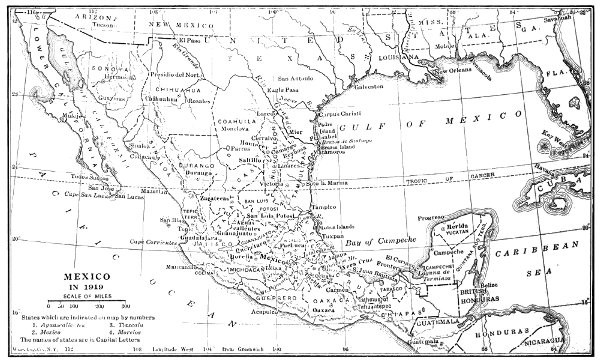
MEXICO IN 1919
Larger image
THE WAR WITH MEXICO
XXI
BEHIND THE SCENES AT MEXICO
September, 1846–March, 1847
The revolution of August 4, as already has been suggested, was a complex and inconsistent affair, combining most heterogeneous elements: the popular institutions of 1824 and the autocratic power of the soldier upheld with bayonets; the army and the people, whose relations had always been, and in Mexico always had to be, those of wolf and lamb; the regular troops and the National Guards, who loved each other as fire loves water; General Salas reluctantly taking orders from Citizen Farías, and both of them doing obeisance to Liberator Santa Anna, whom both distrusted; and all coöperating to revive a federal constitution, which had been found in practice unworkable, and needed, in the opinion of everybody, to be redrawn.[3]
Such a state of things argued insincerity; and in fact many had taken up the cry of Federalism at this time simply because the failure of reactionary designs had made the word a popular appeal, and because—nearly all the former leaders of that school having been crushed by the Centralists—there seemed to be room for new aspirants; while the state of things indicated also that more troubles were soon to arrive, since evidently no final solution of the political problem had been achieved, and such a welter of principles, traditions and methods was a loud invitation to the demagogue and the schemer. Don Simplicio predicted that new stars were to flash out soon in the political heavens, and then disappear before the astronomers would have time to name them; and it added significantly, “The comets will be found to be all tails.”[3]
In particular the field was open for radical democracy. Calm judgment is never listened to in a period of excitement, and the Mexicans, like the French of 1792, instead of resorting to the practical Anglo-Saxon rule of compromising differences, believed in carrying principles to their logical end. Centralism and monarchical ideas had failed to render the nation happy; democracy was therefore the panacea, and the more of it the better. The demoralized condition of the people promoted this dangerous policy. Referring to all those concerned with public affairs, a thoughtful writer of the day characterized them as ignorant, destitute of honor, patriotism, morality, good faith or principles of any kind, and influenced exclusively by self-interest and ambition; and naturally men of the opposite kind held aloof in disgust and despair. For these reasons the conservative wing of the Federalists, led by Pedraza and known as the Moderados (Moderates), found itself distanced in the race for support; and the Puros—that is to say, pure Federalists and democrats—gained the ascendency at once.[3]
Their acknowledged leader, as we have seen, was the patriotic though indiscreet Farías, but he was more honest than brilliant, and a man stepped forward now who reversed that description. This man was Rejón. A keen, subtle mind, a bold, unfaltering will, a ready, plausible tongue and a tireless ambition quite indifferent about means, characterized him chiefly, and for the present crisis these were redoubtable qualifications. The Spanish minister once remarked, after conversing with him, that it was impossible to trust a person who possessed no principles except the transient interests of his ambition. And Rejón had another qualification that was no less important. Though unworthy of confidence and everywhere distrusted, Santa Anna counted as an essential factor in all plans, a power that each party felt it must have; and Rejón was believed at this time to represent Santa Anna.[3]
POLITICS AT MEXICO
The aims and to some extent the methods of the radical faction were borrowed from the United States, but without regard to differences of race, experience and present circumstances. Government, they maintained, should be completely democratic and completely secular; and they dreamed of this consummation almost voluptuously, as a Mussulman dreams of paradise. They held public meetings, where everybody was free to speak; and in these disorderly gatherings they discussed religious freedom, the seizure of Church property, the reformation of the clergy, the secularization of marriage and education, the necessity of destroying military domination in politics, and the capital punishment of all suspected monarchists. In short, from the conservative point of view, they passed sentence of death on society. Santa Anna did not sympathize with their programme. He wished society to live—for him, and he was conducting now an equivocal correspondence with men hostile to the Puros. But it probably suited his purpose to have them succeed for a time, and to have the substantial citizens add to their litany, “From Rejón deliver us, good Lord!” He himself had played the part of the Lord before now, and was willing to do so again, though he preferred the more terrestrial name of dictator.[3]
Of course property felt the menace, and it had reason to do so. During the latter part of September, 1846, an editorial in the official journal, commonly attributed to Rejón, intimated that if the rich did not contribute for the war, the people would know where to find their wealth; and even foreign houses were threatened. The British minister forced a prompt retraction of this language so far, at least, as his fellow-countrymen were concerned; but within two weeks a number of capitalists were invited to loan $200,000 with an intimation that, unless they did so, the money would be taken. Every one understood that the leopard, though now comparatively silent, had not changed his spots and would not, and hence four élite militia corps, familiarly known as the Polkos, were formed at Mexico to protect life and property. One of these, called the Victoria battalion, was composed of merchants, professional men and scions from wealthy families. Another, which bore the name of Hidalgo, consisted of clerks; and the Bravos and Independencia battalions, made up largely of artisans, represented the industrial interests of the city. The ministry, who desired to exclude such persons from the National Guard, opposed the recognition of these corps; but, supported by Salas, the substantial citizens carried the day.[3]
An equally natural reaction caused by radical violence was political. In the hope of welding the Federalists into a harmonious party, the council of government had been revived, and members of both wings had been appointed to it. Santa Anna, in order to establish his particular friend Haro at the head of the treasury, next proposed to transfer Farías from that office to the presidency of the council. This was understood—correctly, no doubt--as a move to eliminate him virtually from the government, and was fiercely denounced; but Santa Anna then remarked that should Salas for any reason drop out, the president of the council would take his place at the head of the government, and Pedraza could have the post in case Farías preferred to remain as he was.[1] This put a new look on the matter, and the programme was carried out; but the Puro attacks upon their rivals continued to excite bitter resentment. When it was arranged that Farías and Pedraza should publicly shake hands, and crowds gathered to witness the amazing ceremony, it failed to occur. The Moderados belonging to the council resigned; the body ceased to enjoy prestige and influence; and Farías lost all official power. Naturally some of the blame for this result was laid to the charge of the Pedrazists. Partisan rancor grew still more savage. The fury of the French revolution was rivalled. “We must finish with our enemies or die ourselves,” cried one factional organ; “the scaffold must be raised; we must drink their hearts’ blood.” Bankhead described the situation as one of “universal terror and distrust.”[3]
About the middle of October there came an explosion. Apparently Rejón demanded that Salas initiate the Puro reforms, and the acting Executive, who was not only weak and incompetent but obstinate, resented the pressure, and turned his face toward the Moderados. To the Puros this looked reactionary, and he was charged with a design to prevent Congress from assembling. Next it was required of Salas that he should give way to Farías as the representative of the new régime, and probably there were threats at least of bringing this change about, if necessary, through an insurrection of the populace.[2] Then Salas, with the Hidalgo battalion of which he was the commander, took possession of the citadel. The people, alarmed by rumors that a sack was contemplated, flew to arms; and Rejón found it necessary to moderate his tone.[3]
AN EXPLOSION
When the Executive, as was inevitable, dismissed him from office, he submitted; and Santa Anna himself, though his orders to Rejón had been to hold the post whatever Salas might do, found public sentiment at the capital too strong for him, and concluded to accept the change. Rejón’s conduct had excited so much dissension and alarm, that his removal gratified all sensible persons at Mexico. The rumors and the disturbance were now attributed officially to agents of the United States, and comparative quiet returned.[3]
The aims of Santa Anna and those of the Puros may have been exactly contrary in these events; but both overshot the mark, and they suffered a common loss of prestige. As one method of restoring it, they induced the governors of San Luis Potosí and Querétaro to declare that within their jurisdictions the Liberator would be recognized as head of the nation until the assembling of Congress; but their principal scheme was to carry the Presidential election. Congress, chosen on the first day of November, was to elect, and it consisted chiefly of men termed by well-to-do citizens “the dregs of society”—that is to say, poorly educated radicals taken from the masses.[3]
This appeared to ensure a Puro triumph, yet there were serious difficulties. Rejón had been discredited, and the former administration of Farías had left painful memories. Besides, it was feared that his election would offend Santa Anna, who of course was not on very cordial terms now with the tribune of the people, and preferred to have a weak man like Salas, with whom satisfactory relations had grown out of the Rejón episode, continue in power. At one time Almonte seemed to be the Puro favorite; but finally it was decided to cast the Presidential vote for Santa Anna, who could not legally hold the chief political and the chief military offices at the same time and would no doubt remain with the army, and to elect Farías to the Vice Presidency as the actual executive.[3]
Even this combination, however, met with strong and unexpected opposition. The conservatives and moderates were naturally against it; certain states—for the voting was done by these quasi sovereignties as units—could not forgive Santa Anna for past misdeeds, and the powerful Church party looked upon Farías as Antichrist. Finally Escudero of Chihuahua, whose delegation held the balance of power, opened negotiations with Farías, and that gentleman declared in writing his willingness to “join loyally” with any one who desired “in good faith the welfare of the country.” Holding this instrument—a weapon, should there be need of it—in their hands, a number of the Moderados, who realized his honesty, vigor and good intentions, and believed now that he would give them a share in the administration, accepted the Puro candidates, and on December 22 by a narrow majority these were elected. The news produced a commotion; but without encountering serious opposition Farías took up the reins of government at once.[3]
His primary aim was to support the war. This he intended to do because he felt an ardent patriotism, but other reasons also lay in his mind. Abominating the military class, he desired to have as many as possible of the corrupt officers left on the field, and he designed to keep the army so busy, that it would not be able to prevent the states, which were generally Federalist and democratic in sentiment, from organizing their strength, and making sure that no tyrannical central power would ever raise its front again. But the first requirement for military operations was money. Farías had, therefore, to take up immediately the financial problem, and he found it most difficult.[3]
Of all the fields of Mexican misgovernment the worst had been the treasury, for it not only required a care and a good judgment that were peculiarly foreign to the national temperament, but provided opportunities for illegitimate gains that were most congenial. During Spanish rule the needs of the country had been fully met, and about nine millions a year, almost half of the revenues, left as a surplus. Under Itúrbide a financial system which three centuries of able administration had built up was despised, and with mines abandoned, agriculture discouraged, commerce paralyzed, honesty relaxed, taxes diminished for the sake of popularity, and expenses increased for the sake of glory, the foundations of ruin were promptly laid. The logical superstructure soon mounted high in the shape of two British loans, which bound Mexico to pay about twenty-six million dollars in return for about fifteen, a large part of which was practically thrown away by her agents.[5]
FINANCIAL DIFFICULTIES
The expulsion of the rich and thrifty Spaniards, the costs of civil wars, in which the nation paid for both sides, unwise and unstable fiscal systems, borrowing at such rates as four per cent a month, incredibly bad management,[4] and methods of accounting that made it impossible for the minister of the treasury to know the actual state of things, were enough to complete the edifice; but they were supplemented with peculation, embezzlement, multiplication of offices, collusion between importers and customhouses, and systematic smuggling winked at by half-starved officials. Revenue after revenue was mortgaged, and by 1845 the government found itself entitled to only about thirteen per cent of what entered the treasury.[5]
Since the beginning of hostilities our blockade, assisted by new methods of wholesale smuggling, had greatly reduced the income from duties, which had always been the principal reliance; the adoption of the federal system had given the best part of the internal revenue to the states; and the residue was almost wholly eaten up by the officials. The foreign debt amounted now to more than fifty millions and the domestic debt was nearly twice as great. Every known source of income had been anticipated. Freewill offerings had proved illusory. By ceasing to make payments on account of the debt in May, 1846, the government had largely increased its income, of course, but it had forfeited all title to financial sympathy; and the high officials, who robbed the treasury still in this time of supreme distress, had stripped it of all title to respect.[5]
The government, therefore, had no real credit. Men who made this kind of gambling their business would now and then furnish a little money for a brief term at an exorbitant rate. In February, 1846, for example, a loan was placed at a total sacrifice of about thirty-seven per cent. But when the treasury was authorized to borrow fifteen millions in a regular way, nobody cared to furnish any part of the sum. New taxes were equally vain. In October, 1846, the government imposed a special war “contribution” in order to save the Mexicans, it explained, from becoming foreigners in their own country, like the Spaniards of Florida; and the chief result was to enrage a handful of persons, who found they had been silly enough to pay while almost everybody else had laughed. In November a forced loan was demanded of the clergy, but the project aroused such opposition that substantially it had to be given up. The whole gamut of methods, even violence, has been tried in vain, said the ministry in December. Business was dead, confidence gone, capital in hiding or sojourning abroad; and if by good luck a bag of silver dropped into the treasury, it seemed to evaporate instantly. Financially, reported the Spanish minister, the situation of the country was “truly frightful.”[5]
To make it more, not less, frightful, there did exist one vast accumulation of riches. This was the property belonging to the Church. No one could seriously deny that the nation had authority to use, in a time of dire need, funds that had been given to the organization in days of plenty, for this was a principle of Spanish law, and the Crown had exercised the right without so good an excuse. There was also a particular reason in the present instance, for the wealth of the Church, aside from articles used in worship, consisted mainly of land, and, as virtually no land tax existed in Mexico, it was escaping the common burden—a burden, too, that was peculiarly for its advantage, since in the case of American conquest it was bound to lose its exclusive privileges. Besides, there was the saying of its Founder, “Freely ye have received, freely give.”[5]
THE POLICY OF FARÍAS
Very naturally, then, people had been casting their eyes for some time at the riches of the Church. In June, 1844, El Siglo XIX, the most thoughtful newspaper of Mexico, had suggested raising funds for the Texas war by mortgaging some of its property; and a few months later Duff Green, then on the ground, had expressed the opinion that Mexico would have to choose between that resource and forced loans. In July, 1845, the correspondent of the London Times dropped a similar hint in that journal, and in the course of the year it became a popular idea, that the Church could perform a great public service, and at the same time vastly strengthen its own position, by providing means for the anticipated war against the United States. In October, 1846, the Monitor Republicano suggested once more a mortgage of ecclesiastical property; and at one time the government actually decided upon the measure. Bankhead admitted that he could see no other resource. These hints were not, however, acted upon by the clergy; and after many long discussions they would only agree to advance $10,000 or $20,000 a month for a limited period. This was to insult the nation, exclaimed the Monitor Republicano.[5]
Charged now with full responsibility, Farías met the issue squarely. Not only was he determined to carry on the war, but the letters of Santa Anna had been, and were, most urgent. November 7 the General demanded that “no step” should be neglected, if it could “help to prevent the name of Mexican from soon becoming the object of ridicule and contempt for the whole world.” “Do not reply that the government cannot obtain funds,” he wrote later; “This would be saying that the nation has ceased to exist ... so rich a nation cannot lack money enough to support its independence, nor can the government say that it has no authority to look for the money.” These letters evidently referred to ecclesiastical property, and they were followed up at New Year’s with almost daily communications of the same tenor. Such fearful urgency had a good excuse, for the government was now sending him no funds.[6]
It had none. Although Farías kept faith with Escudero, the Moderados as a party showed the radical chief no mercy; the Centralists loathed the apostle of federalism; all conservatives detested the typical democrat, and the clericals abominated the extinguisher of titles. All the old ladies thought him worse than Luther, and many of every kind and condition rebelled at his brusque and tactless ways. No person of substance would lift a finger to support his measures. A cloud of distrust, passion, hostility and mortal hatred—mostly an emanation from the whole wretched past of the country—grew thicker about him each day. Raise money he could not. Moreover he probably felt little desire to do so by any of the ordinary methods. One of his cardinal principles was the necessity of destroying the fuero, the political strength and the intellectual domination of the Church by reducing its wealth; and now the demand of Santa Anna, the army and the nation that funds be provided for the war, appeared to make this policy opportune and even irresistible.[6]
A committee of Congress reported against the plan of borrowing on the security of Church property; but that signified little, for no practical substitute was offered. There were fears that the army would break up. There were fears that for self-protection it would proclaim a dictatorship or march upon the capital. Santa Anna’s warning and threatening communications were shown to Congress. The legislators tried to evade the issue, but they were told that all the responsibility rested upon their shoulders; that it was for them to choose between the salvation and the ruin of the fatherland; and on January 7 they grappled with the problem. Behind them—tireless, uncompromising, inexorable—the Executive insisted upon action; and behind him stood Santa Anna, demanding the same thing and promising to support it.[9]
The session lasted virtually until January 11. The debates were hot, and they were bitter. To make use of the Church lands, it was argued, would invade the rights of property, lay upon one class of society the general burden, and, should the lands be sold, involve a tremendous loss of values, since there was little ready money in the country, and few would have the means and inclination to purchase. The country must be saved, answered Rejón, Juárez and their allies; is there any other resource?—point it out. “If the Yankee triumphs,” cried one speaker, “what ecclesiastical property or what religion will be left us?” And upon these principal themes were played an infinite number of variations in all the possible tones of Mexican eloquence and fury.[9]
Just before midnight on the ninth, however, the turmoil ceased; the handsome chamber of the Deputies became still. High above the throne in front glimmered pallidly the sword of Itúrbide; in letters of gold, on the semi-circular wall at the rear, all the names of the Beneméritos of Mexico reflected the subdued light; shadows filled the galleries; exhausted members half-slumbered in their chairs, and others talked wearily here and there in groups; but the stillness was momentous, for the first article of a new law had been passed, authorizing the Executive to raise fifteen millions, for the purposes of the war, by pledging—if necessary, even selling—property vested in the Church.[7] Minor discussions followed. The religious, charitable and educational work of the clergy was guarded completely; many provisions designed to hamper the realization of the main purpose were accepted in order to conciliate opposition; and at length, on January 11, the plan became law.[9]
A CRISIS AT MEXICO
“The crisis is terrible,” wrote the minister of relations two days later, and well he might. All the fierceness and intrigues of partisan politics, all the cunning of high and low finance, all the subtleties of priestcraft and all the terrors of a haughty Church came into play.[8] Freely we have received, but we will not give, and anathema to him who takes, was in effect the dictum of the prelates. For a time it looked as if no official would venture, at the peril of excommunication, to promulgate the law; but Farías and Juárez found a man, and he was appointed governor of the Federal District, in which lay the capital, for that purpose. Then came protests from the “venerable” clergy, complaints from state governments, mutinies of troops, and civilian insurrections organized by priests. Cries of “Viva la religión! Death to the government!” resounded in the streets of the capital. Ministers of state were hard to find, and they soon went out of office. Minor officials resigned so rapidly they could hardly be counted. Santa Anna, after hailing the law as the salvation of the country, turned against it. Moderados in Congress, encouraged by the outcry, hurled epithets harder than stones at the Puros.[9]
On the other hand some of the Deputies, the regular troops at the capital, who expected to profit by the law, the comandante general of Mexico, the National Guards and the democratic masses rallied to the support of the government; and Farías, his long head erect, and his face, always thoughtful and sad, now anxious but set, appealed to the patriotism of the nation, made the most of his authority as chief of the state, and held to his course with inflexible energy and courage. Not only was he determined to have the law respected, but he demanded that it should be made effective. Chaos was the result. “When we look for a ray of hope,” said El Republicano, “we discover nothing but alarms, anxieties and every probability of social dissolution.” Furious anarchy,” was Haro’s description of the scene. There must soon be a crash, he added; “the Devil is running away with us.”[9]
Peaceful interests were not, however, entirely forgotten amid this turbulence. During the second week of January Moses Y. Beach, proprietor and editor of the New York Sun, arrived at Vera Cruz from Havana. He carried a British passport. Besides his wife Mrs. Storms, a remarkably clever newspaper woman, accompanied him. Presumably she was to play the part of secretary, for Beach had large financial enterprises in mind, and confidential clerical assistance would certainly be necessary. For some reason letters were written from Cuba to Santa Anna and the authorities at Vera Cruz denouncing him as an American agent; and the party had to go through with a tedious examination of three days, for the comandante general had been expressly ordered to watch all suspicious foreigners hailing from the United States. But the ordeal was passed satisfactorily, and on the twenty-third or twenty-fourth of January Beach arrived at the capital. Letters from Roman Catholic prelates of the United States and Cuba gave him a confidential standing at once in the highest Church circles; his project of a canal across the Isthmus of Tehuantepec excited the lively interest of Santa Anna’s particular friends; and his plan for a national bank brought him into friendly relations with Farías and the other Puro leaders.[10]
Still, the presence of this agent of civilization did not restore tranquillity. On February 4 the government contrived by shrewd management to put a law through Congress, which in effect gave it autocratic power to raise five millions, and thus cut through the complications and restrictions that had rendered the action of January 11 substantially inoperative. The wrath of the Church blazed afresh. At all hazards Antichrist must be put down. Already they had concluded to supply Santa Anna with money, in return of course for his aid against Farías, and now they opened negotiations with the Moderados. This party, however, thought it would be good tactics to divide the Puros by supporting Farías, provided he would let them control his policy, and they so proposed; but the impracticable fellow, who was battling for principles and not place, declined the offer. Finally the Puros themselves, realizing that all the other factions were against their chief, decided that under his leadership they could not succeed, and resolved to throw him overboard.[11]
INSURRECTION AT MEXICO
While they were casting about for a method, a certain Person advised the clericals to offer an organized resistance against the laws of January 11 and February 4, and circumstances made that course easy. General Peña y Barragán, suspected of conspiring against the government, was placed under temporary arrest, and this made him eager to head a revolution. Farías, understanding that the Independencia battalion could not be trusted, ordered it to Vera Cruz, imagining that it would not refuse to march against the enemy. But on various more or less valid pretexts it did so; the other three élite battalions joined with it; and on February 27 they declared that Farías and Congress, having lost the confidence of the nation, had forfeited their authority, demanding at the same time the annulment of the “anti-religious” laws.[12] Amidst the ringing of bells and burning of gunpowder, the city echoed with the cries, “Death to Gómez Farías! Death to the Puros!” Cannon were soon at the street corners, and the usual scenes of a Mexican insurrection, fatal chiefly to peaceful residents, were presently on exhibition. The clergy, there is ample reason to believe, paid the costs, and priests left the confessionals to herald this new crusade in the streets.[13]
After about nine days of indecisive skirmishing, however, the clericals felt discouraged. The nation had not rallied to their cause as they had expected. The sum of $40,000 was required for the next week of fighting, and they hesitated. But again a certain Person urged them on. The awkwardly drawn Plan was reduced to one article—Farías must be deposed. On that almost all could agree. Monarchists, Centralists, Santannistas, Clericals, Moderados, Puros were for once in happy unison. Salas reappeared with some troops to take revenge on his old enemy. And yet with epic heroism Farías, never faltering and never compromising either his official dignity or his personal character, held firmly on with his few soldiers and such of the populace as he could arm. Again the battle raged, and again the innocent fell. But who was it that directed this tempest? Who was the mysterious Person, overwhelming the government of Mexico with darkness and confusion at this critical hour? He was Moses Y. Beach, agent of the American state department and adviser to the Mexican hierarchy. Permission had been given him to bring about peace, if he could; and, unable to do this, he seized the opportunity to help Scott.[13]
The time had now arrived for the Saviour of Society to appear, since all rational persons were desperately tired of the vain struggle; and Peña y Barragán wrote to Santa Anna, begging him to take possession of the Presidential chair. Congress did nothing, for many Deputies—fearing that it might act in a manner contrary to their sentiments—remained away from the chamber, and a quorum could not be assembled; but when Pedraza was arrested by the government, a large group of Moderado members, feeling that Santa Anna’s “victory” at Buena Vista had confirmed his power, addressed him to the same effect as Peña; and the Liberator, giving his best corps barely four days of repose, and explaining his departure from the north as one more sacrifice on the altar of his country, set out with a substantial body of troops for Mexico.[14] Along his route women made wreaths and threw them before his feet. Men of every faction acclaimed him; and from Querétaro to the capital the road was filled with carriages, in which all sorts of persons desiring to reach his ear strove to outdo one another in despatch.[20]
On the first news of the insurrection Santa Anna’s impression had been that its ulterior aim was hostile to him,[15] for his partisans at the capital supported the government; and, as a Puro envoy confirmed this impression, he promised Farías military aid; but then appeared Moderado agents with strong assurances and probably with stronger financial arguments, and he went over, though not openly, to their side of the controversy. Both parties were ordered by him to discontinue hostilities, and both did so at once; for, as the clergy had now shut their strong boxes, the insurgent officers were anxious to reëstablish a connection with the national treasury, while the regulars of Farías would not disobey Santa Anna. After the President’s arrival at Guadalupe Hidalgo a Te Deum was celebrated there in honor of his triumph over the Americans; and the next day, March 23, amidst real demonstrations of joy, he formally superseded Farías, while a certain Person[16]—diligently but vainly sought after by the police—was hastily making his way through the mountains in the direction of Tampico.[20]
SANTA ANNA TRIUMPHANT
Apparently Santa Anna had experienced the luckiest of turns. Precisely when the Americans had shattered his plans, and he found himself buried in the northern deserts with a broken, starving army,[17] this insurrection gave him a splendid occasion for making a triumphal march to the capital amid plaudits of gratitude and admiration, and he now found himself at the summit of prestige and power.[18] In reality, however, his situation was by no means entirely satisfactory. Understanding that the Puros—who in reality had served him with substantial good faith and therefore stood highest in his present sympathy—had lost their dominant position, he allied himself with their opponents; but the Moderados disliked and distrusted him still, and he received at least one distinct notice that by taking their side he was placing himself gratuitously in the hands of his enemies. The Puros did not feel extremely grateful to him for merely avoiding an open break with them; and, although it seemed wise to join in the acclamations lest some worse thing befall them, they were already sharpening their arrows against him. Indeed, they were believed to be sharpening their daggers, and he took full precautions. The clergy had trembled and recoiled on hearing that his arms had triumphed against the Americans, and the Saviour of Society now appeared to lean toward them—or toward their strong boxes; but they knew him well enough to foresee, as they soon realized, that he intended to extort ample compensation for all the favor shown them.[20]
Such was the inner state of things, and the external course of events proved not less interesting. The effect of the insurrection upon the progress of the war, as we shall presently see, was notable, and in substance it produced a counter-revolution in domestic politics. As Farías was no more willing to resign than to compromise, some disposition of him seemed necessary, for Santa Anna would evidently have to take the field again shortly, and it would not have been expedient, whatever the rights of the case, to let the executive power fall back into his control. It was therefore decided to abolish the Vice Presidency; and in this way fell on April Fool’s Day the noblest but most unpopular man in the country.[19] At the positive dictation of Santa Anna General P. M. Anaya, a Moderado, was then elected substitute president, while the raging Puros raged in vain. The clergy succeeded, by offering two millions of real money, in persuading Santa Anna to annul the laws of January 11 and February 4; but the day before he did this, Church property worth twenty millions was placed by Congress—theoretically, at least—within the reach of the government.[20]
Transcriber’s Note
THE WAR WITH MEXICO
XXII
VERA CRUZ
February–March, 1847
XXIII
CERRO GORDO
April, 1847
XXIV
PUEBLA
April-August, 1847
XXV
ON TO THE CAPITAL
April-August, 1847
XXVI
CONTRERAS, CHURUBUSCO
August, 1847
XXVII
NEGOTIATIONS
May, 1846-September, 1847
XXVIII
MOLINO DEL REY, CHAPULTEPEC, MEXICO
September, 1847
XXIX
FINAL MILITARY OPERATIONS
January, 1847–April, 1848
XXX
THE NAVAL OPERATIONS OF THE WAR
1845–1848
XXXI
THE AMERICANS AS CONQUERORS
1846–1848
XXXII
PEACE
October, 1847-July, 1848
XXXIII
THE FINANCES OF THE WAR
1846–1848
XXXIV
THE WAR IN AMERICAN POLITICS
1846–1848
XXXV
THE FOREIGN RELATIONS OF THE WAR
1846–1848
XXXVI
CONCLUSION
1825–1848
XXI. BEHIND THE SCENES AT MEXICO
APPENDIX—THE SOURCES
Zurita, R. M. Esposición. Méx. 1845.
SAN JUAN DE ULÚA
SIEGE OF VERA CRUZ GENERAL PLAN
SIEGE OF VERA CRUZ
AMERICAN BATTERIES
VERA CRUZ TO PEROTE
Contour Lines near Cerro Gordo.
The difference of elevation between two lines is fifty metres.
BATTLE OF CERRO GORDO GENERAL PLAN
Larger image
BATTLE OF CERRO GORDO
CENTRAL PART OF THE FIELD
JALAPA TO PUEBLA
Profile of the Route from Vera Cruz to Mexico
VALLEY OF MEXICO
BATTLES OF AUG. 20, 1847 GENERAL PLAN
Larger image
BATTLE OF CONTRERAS
BATTLE OF CHURUBUSCO
The Tête de Pont, Churubusco
Tête de Pont.
Profile of east curtain.
BATTLES OF MEXICO
Larger image
BATTLE OF EL MOLINO
BATTLE OF CHAPULTEPEC
Blindage at Chapultepec.
Alvarado, Mexico
A PART OF TABASCO RIVER
From Devil’s Bend to S. Juan Bautista Showing the Landing and March of Com. Perry’s Forces June 16, 1847
Guaymas, Mexico
PLAN OF MAZATLÁN
LOWER CALIFORNIA
TERRITORY ACQUIRED FROM MEXICO
[A] In Mexico, however, usually like s in “sun.”
[B] In Mexico usually like y.
3. The course of Mexican politics. Federalista Puro, No. 3, supplmt.; No. 6, supplmt. London Times, Feb. 9, 1847. Apuntes, 71–3, 76, 124–6. 13Bankhead, Nos. 120, 136, 140, 146, 153, 157, 160, 169, 180, 1846. 52Consul Campbell, Nov. 10, 1846. 52Consul Black, Aug. 22, 27; Sept. 17, 22, 26, 1846. Comunícación Circular de ... Peña y Peña. García, Revol. de Ayutla, 18, 20, 27. Ultimas Comunicaciones habidas entre ... Salas y ... Rejón. Lerdo de Tejada, Apuntes, ii, 538. Prieto, Memorias, ii, 195, 199. 13Thornton to Addington, June 29, 1847. 13Gutiérrez de Estrada to Palmerston, Mar. 1, 1847. Méx. en 1847, 12–4. Ramírez, México, 12, 142–4, 149, 152–4, 156, 165, 172, 176. 83Rejón to Berdusco, Dec. 23. Eco, Nov. 4, 7, 11, 14, 1846. Escudero, Mems., 8, 13, 14. Dublán, Legisl., v, 171, 238–9. Memoria de ... Relaciones, Dec, 1846. 73Bermúdez de Castro, nos. 332, res.; 343, res.; 345, res.; 346; 368. Bustamante, Nuevo Bernal, ii, 100–1, 118, 120, 124, 126–8. 83Gov. Querétaro to Farías, Oct. 20. Roa Bárcena, Recuerdos, 144. Rivera, Los Gobernantes, ii, 310. Lara, Resumen, 65, note. Mora, Papeles Ineditos, 64–5. 162Conner, Dec. 31, 1846. 164Id.Jan. 5, 1847. Bustamante, Campaña, 7. Ho. 60; 30, 1, p. 1125 (S. Anna). Baz, Juárez, 43. México á través, iv, 576–7, 589, 591–2, 600–1, 698. Republicano, Sept. 28; Oct. 20, 28; Nov. 17; Dec. 24, 1846; Jan. 1, 22–3; Feb. 3, 1847. Monitor Repub., Sept. 25–6, 30; Oct. 19–23, 26; Dec. 25, 1846. Diario, Sept. 23, 25, 29; Oct. 9, 12, 14, 16, 31; Nov. 24; Dec. 18–9, 22, 28, 29, 1846. And from 76 the following Procl. gov. S. L. P., Oct. 22, 1846. J. Alvarez, Oct. 22. Comte. gen. Mex., Oct. 16. Canalizo to comte. gen. Mex., Oct. 18. Comte. gen. Oaxaca, Oct. 24. Salas, procl., Oct. 25. Guerra, circulars, Oct. 14, 19, 22; Dec. 23. Relaciones to gov. Fed. Dist., Dec. 23. Relaciones circular, Oct. 19. Comte. gen. Chiapas, Nov. 3. Also others of minor importance. Otero was associated with Pedraza in the leadership of the Moderados.
1. This is a good illustration of Santa Anna’s political ability.
2. Farías appears to have had no share in this quarrel with Salas (México á través, iv, 593).
5. Mexican financial history (see also the first part of chap. xxxiii). Comunicación Circular de ... Peña y Peña. Memoria de ... Relaciones, Mar., 1845; Dec., 1846. Rivera, Jalapa, iii, 368, 716. Ilustrador Católico, no. 239. Hacienda, series of Memorias. Hacienda, Manifiesto de la Admin. y Progresos. London Times, July 6, 1846. Breve Resumen. Casasus, Hist. de la Deuda contraida, etc., passim. Paredes, address to Cong., June 6, 1846 (Diario). Alamán, Liquidación. Esposición del Cong. Gen. 11Martin, Apr. 30, 1827; July 4; Aug. 25, 1828. 11Series of Mémoires on the Spanish Colonies. Sierra, Evolution, i, 178, 218. Zamacois, Méx., xii, 254. 52Consul Jones, Aug. 1, 1839. 56W. S. Parrott, Oct. 4, 11, 1845. 58Howland & Aspinwall, Mar. 1, 1847. Republicano, Feb. 2, 1847. 13Ashburnham, nos. 39, 51, 1837; 3, 97, 1838. 13Pakenham, nos. 28, 1833; 6, 1836; 44, 62, 1839. 13Bankhead, nos. 81, 1844; 6, 38, 70, 106, 1845; 21, 104, 127, 146, 169, 1846. 52Poinsett, Jan. 4; Aug. 5, 1825; July 16, 1828. 52Butler, July 16, 1832. Revista Econ., Dec. 14, 1843; Feb. 5, 1844. Tornel, Reseña, 9, 171. Macgregor, Progress, i, 674–83. Thompson, Recolls., 12, 27–8, 87. 52D. Green, Oct. 28; Nov. 12, 29, 1844. N. Y. Herald, Jan. 18, 1845. Siglo XIX, June 14, 1844; Dec. 2, 1845. Patriota Mexicano, Dec. 9, 1845. Reforma, Jan. 23, 1846. London Times, Mar. 29; May 15; Sept. 9; Nov. 11; Dec. 6, 1845; Mar. 2, 1846. Revue Indep., Apr. 25, 1845. 52Consul Black, Aug. 23, 1845. 52Consul Dimond, no. 338, May 7, 1846. 73Bermúdez de Castro, no. 346, 1846. 52Consul McCall, no. 65, Sept. 26, 1845. Balbontín, Estado, 66. Wash. Union, Feb. 2, 1848 (Poinsett). N. Y. Globe, June 3, 1846. Diario, Sept. 18, 1846. Monitor Repub., Nov. 27, 1846; Jan. 9, 1847. Ward, Mexico, i., 331–7. 76To S. Anna, Nov. 25. Vicario Capitular, Contestación. Priestley, José de Gálvez, Chap. x.
4. So far as possible, revenue was anticipated, even at a great loss. E.g., if a merchant expected a cargo to arrive at Vera Cruz, he sent a broker (agiotista) to the minister of the treasury, and by paying a sum in advance he obtained drafts on the Vera Cruz customhouse that were receivable at par for the duties. Of course the merchant, the broker and the minister made profits, and the treasury lost (N. Y. Herald, Jan. 18, 1845). Another way in which the minister could make money was to accept at face value as part of a loan or payment government paper that had cost the one who tendered it only a trifle, and take a share of the net proceeds. “Agiotista” became an odious term. It was given out that Santa Anna would accept no pay, but the treasury books showed that he drew his salary for even the time while he was at Havana (335Worrall to Trist, Nov. 28, 1847). They apparently showed also that in 1846 millions were distributed among generals, brokers and others. The British minister said that Iturbe was the ninth finance minister whom he had seen devoting “his peculiar attention to the augmentation, of his private means while in office” (13Bankhead, no. 104, 1846). Another great evil was that, in spite of express prohibitions, state officials drew upon the proceeds of the tobacco monopoly. The following table illustrates the state of the treasury (1846):
6. The present financial problem. Dublán, Legislación, v., 172, 211–6, 235–7, 240. 77Relaciones circular, Nov. 27, 1846. 13Bankhead, no. 6, 1845; nos. 21, 127, 153, 167, 169, 1846. 52Consul Black, Dec. 29, 1846. Apuntes, 76, 124–6. Ramírez, México, 171. 335Worrall to Trist, Nov. 28, 1847. Rivera, Jalapa, iii, 716. Ilustrador Católico, i., 281. Méx. en 1847, 14–19, 24. Don Simplicio, Feb. 13, 1847. 86Relaciones, Oct. 26, 1846. Zempoalteca, Nov. 27, 1846. Escudero, Mems., 8, 92Gov. Fed. Dist., procl., Jan. 16. 82Gov. Durango to legisl., Nov. 8, 1846. Columna de la Libertad, Jan. 8, 1847. Sierra, Evolution, i, 178, 217–8. 52McLane, no. 5, 1845. 56W. S. Parrott, Oct. 4, 11, 1845. 11Mémoire, 1828. D. Green to Calhoun, Oct. 28; Nov. 12 in Jameson, Calh. Corresp., 976–80, 991. Siglo XIX, Jan. 14, 1844. London Times, Sept. 9; Dec. 6, 1845; Oct. 8, 1846; Jan. 8, 1847. Memoria de ... Relaciones, Dec., 1846 (Lafragua). 73Bermúdez de Castro, nos. 316, res., 346, 371, res., 445. Bustamante, Nuevo Bernal, ii, 128. 75Relaciones, circulars to govs., Oct. 9; Dec. 17, 1846; circs. nos. 233, 238, 255, 1846. 75aHacienda, circulars, Oct. 10; Nov. 9; Dec. 5, 31, 1846. 86V. Cruz state treas. to gov., Jan. 11; Feb. 4, 1847. Constitutionnel, Dec. 18, 1846. Wash. Union, Jan. 18, 29; May 11, 1847. Monitor, Oct. 12. 166Pommarès to Conner, Oct. 7, 1846. Republicano, Oct. 22; Nov. 5, 13, 24; Dec. 8, 1846; Jan. 23, 1847. Monitor Repub., Sept. 25, 30; Oct. 18; Nov. 19, 30; Dec. 19, 1846. Diario, Sept. 23, 25, 29; Oct. 2, 3; Nov. 21, 23; Dec. 4, 13, 15, 21, 29, 30, 1846; Jan. 1, 7–9, 1847. México á través, iv, 589, 600, 628–9. 76S. Anna, Nov. 7, 9, 19; Dec. 3, 4, 7, 30, 1846; Jan. 1, 2, 4, 7, 1847. 76J. Alvarez, Sept. 30, 1846. 76Circ. to comtes. gen., Sept. 28, 1846.
9. The law of Jan. 11 and the struggle over it. Apuntes, 124–32. 13Bankhead, nos. 180, 1846; 6, 7, 10, 14, 17, 1847. Gaxiola, Invasión, 118. 52J. Parrott, Feb. 6. 56Beach, report, June 4. London Times, Sept. 9; Oct. 7, 1846; Mar. 11; May 12, 1847. Oil portrait of Farías, city hall, Mex. 52Consul Black, Feb. 24. Revue Indep., Apr. 25, 1845. Rivera, Jalapa, iii, 822, 825–6. Católico, iii, 553. Conducta Admin, de Berdusco. Ilustrador Católico, no. 239. 88Córdoba ayunt., Feb. 4. 92Mex. ayunt. to chapter, Jan. 14. 92Ayunt., procl., Jan. 14. 92Representación of metrop. chapter to Cong. 92Segunda Protesta; Tercera Protesta del Ven. C bildo Metrop. 92Exposición que el Sr. Vicario Capit. 92Expos. del Cabildo Metrop. 92Procl. of gov. Fed. Dist., Jan. 16. 95Querét. cong., Jan. 12. 95Puebla ayunt. to gov., Jan. 16. 95Sánchez to Puebla ayunt., Feb. 16. 82Bish. Puebla, manif., Jan. 27. 82Gov. Puebla, procl., Jan. 27; Mar. 5, 15. Lamentos de los Mex. 73Bermúdez de Castro, nos. 332, res., 346, 445. Dublan, Legislación, v., 246, 255, 261–2. Registro Oficial de Durango, Jan. 26. 80Guanajuato cong., Jan. 29. Locomotor, Jan. 18. Mora, Papeles, 74–6. Negrete, Invasión iv, app., 412–4. Ramírez, México, 172, 184, 188, 190, 193, 198. Diario, Dec. 21, 1846; Jan. 7–9, 11–16, 18, 19, 26, 30; Feb. 4, 1847. Republicano, Dec. 9, 12, 1846; Jan. 8, 11, 23–4, 27, 29; Feb. 6, 11, 12; May 14, 1847. México á través, iv, 601–8, 628, 630–1, 638. And the following from 76. Comte. gen. Querét., Jan. 19, 20, 22. Id.., procl., Jan. 20. Comte gen. Puebla, Jan. 12, 28; Feb. 17. Guerra, order, Jan. 24. Min. eccles. affairs to metropol. chapter, Jan. 14. Comte. gen. Mex., Jan. 15. Comte. gen. Jalisco, Feb. 2. J. Alvarez, Feb. 2. Comte. gen. Oaxaca, Feb. 11, 15. Comte. gen. Guanaj., Jan. 29; Feb. 15, res. To comte. gen. Puebla, Feb. 24. Decrees, Jan. 15, 27; Feb. 4, 7, 10. To S. Anna, Jan. 30. S. Anna, Jan. 7, 13, 22, 26, 29; Feb. 9.
7. The law was a compromise (Apuntes, 124). Rejón, as he frankly told the Spanish minister (note 6), was for nationalizing—i.e., confiscating—the property of the Church. Santa Anna preferred to let the clergy keep the title to their wealth, and require a loan from them now and then—a process termed “milking” (Jameson, Calhoun Corresp., 992). The essential basis on which the law passed was the practical necessity of raising money for the war; but many who recognized this necessity and even the desirability of reducing the wealth and power of the Church could not bring themselves to act.
8. The law, if fully enforced, would no doubt have done much injury, however great its benefits. E.g., a great amount of land had been hypothecated to the Church with no expectation on either side that the loan which it secured would ever be paid; but the government, in order to obtain cash, intended that the loan should be paid or the land sold. Many individuals would thus have been ruined and the agricultural interests partially crippled, while on account of the small amount of money in circulation, only very low prices would have been realized for the land (13Bankhead, no. 7, 1847). Moreover, land with a Church curse upon it was sure to sell slowly, and many believed that titles obtained in this way would not hold good very long. As the clergy would give no information about their property, some exempted property was seized, and these mistakes caused trouble (México á través, iv, 631). Many objected to the law because they presumed that the proceeds of sales would reach private pockets. The principal arguments against it were summed up by the 88ayuntamiento of Córdoba as follows: “It attacks property, invades the rights of the states, contravenes the sovereignty of the Church and is anti-religious, for there can be no religion without worship, no worship without priests and no priests without Church property.” On the other hand the Puro 92ayuntamiento of the capital described the law as “A law to save our independence and religion, in which nothing is done except that one class of society is to loan its property to society as a whole,” adding, “How unfortunate would be our faith, if the religion of the Savior could be supported only with money ... charity and poverty were the example of his mission.” The metropolitan chapter of Mexico took the ground that property once consecrated to God was sacred, and that to take it would be an act of sacrilege sure to bring upon the country the wrath and punishment of heaven (92Representación). The bishop of Puebla said to his flock: “Far from us is the idea of disturbing public order, but we must notify our very dear lambs that the pasturage offered thorn is poisonous; and if for so doing we incur the wrath of men, we will strengthen our weakness with the words of the chief of the Apostles at the council of the Jews: ‘We must obey God rather than men’” (82Manifiesto). This was a clear and official incitement to insurrection.
10. Beach’s mission and escape. 56Special Missions, p. 257. 56Beach report, June 4, 1847. Polk, Diary, Apr. 14, 1847. 108Mrs. Storms to Bancroft, July 23, 1846, and Marcy’s endorsement. Griffis, Perry, 224. 52Consul Black, Jan. 28, 1847. N. Y. Sun, Apr. 15; Aug. 16, 24, 1847. 166Dimond to Conner, Jan. —, 1847. Scribner’s Monthly, xvii, 300. Appleton, Amer. Biog. (article on M. Y. B.). Kenly, Md. Vol., 269. 76To comte. gen. V. Cruz, Jan. 14. 76Landero, Jan. 14. 76S. Anna, Jan. 22.
11. Apuntes, 126. 13Bankhead, no. 14, 1847. 56Beach, report, June 4, 1847. Ramírez, México, 193–4, 198–9. México á través, iv, 608, 631. 199Anon. MS. of go-between.
12. The monarchists, who were closely associated with the Church, shared in the insurrection (Apuntes, 119), and no doubt many of the Moderados took part in it (London Times, May 10, 1847), though Pedraza denied positively that he drew up the plan (Apuntes, 131).
13. The insurrection. 56Beach, report, June 4, 1847. Apuntes, 126, 128–37. 13Bankhead, no. 17, 1847. Consideraciones, 37. Méx. en 1847, 14, 19. León, Hist. Gen., 475. 52J. Parrott, Feb. 6. Bustamante, Campaña sin, etc., 5, 8, 10, 11, 13. 52Black, Mar. 6. London Times, May 10, 12. Salas, pamphlet, Mar. 3. 13Peña y Barragán, procl., Mar. 8. Séptimo Disengaño. Boletín de la Democracia, Mar. 2, 7, 13. Farías, Address. Ramírez, México, 190, 193, 198–9, 201, 204, 209. México á través, iv, 631–5. Rivera, Jalapa, iii, 841–9. Arco Iris, Nov. 24, 1847. Escudero, Mems., 14, 19, 20. 82Zacatecas cong., Mar. 5. 82Jalísco legisl., Mar. 12. 77Relaciones, circular, Mar. 13. 80Méx. state legisl., Mar. 18. Balbontín, Invasión, 104. 80Lt. gov. Méx. state procl., Mar. 23. 199Anon. MS. 76Farías, procl. 83Gov. Querét. to Peña y Barragán, Mar. 2, 20. Rivera, Los Gobernantes, ii., 318. N. Y. Sun, Apr. 15; Aug. 24. Díario, Feb. 20, 21. Monitor Repub., Dec. 27, 1846; Feb. 13; Mar. 23. Ho. 60; 30, 1, p. 1125 (S. Anna). Lerdo de Tejada, Apuntes, ii, 539. And from 76 the following, besides others of minor importance. Comte. gen. Querét., Jan. 20. Canalizo to Anaya, Feb. 26. J. Alvarez, Mar. 10. L. Carrión, Mar. 10. Gov. Puebla, Feb. 17; reply, Feb. 24. Plan of Puebla insurgents, Feb. 27. Govt. bulletins, Mar. 2, 5. Morales, Mar. 1. Aguascalientes legisl., Mar. 4. Gov. Zacat. to Relac., Mar. 5. Gov. Querét. to Relac., Mar. 9. Provis. gov. Jalisco to Relac., Mar. 3. Comte. gen. Jalisco to garrison, Mar. 7. Gov. Puebla to Relac., Mar. 5. Lt. Col. Indep. battal. to mistress, Mar. 15. Comte. gen. Oaxaca, Feb. 17. Gov. Méx. state to Relac., Mar. 19. Id.., procl., Mar. 18. Decrees, Mar. 1, 8, 12, 15.
14. Santa Anna left San Luis Potosí March 15 with more than 5000 men and ten guns.
20. Outcome of the insurrection. Apuntes, 111, 115–8, 133, 136–8. 13Bankhead, nos. 33, 34, 1847. Méx. en 1847, 14–18. 69S. Anna, order, Mar. 14. Anglo-Saxon, Mar. 13. 56Beach, report, June 4, 1847. Bustamante, Campaña, 30. London Times, May 10. Britannia, May 15. México á través, iv, 577, 635–40. Ramírez, México, 184, 198–9, 205, 207, 209–12, 215–8. 82Gov. Puebla, boletín No. 4 (S. Anna to Farías, Mar. 6; Gil to Ruano, Mar. 6). 77Relaciones, circulars, Mar. 22; Apr. 1. Tributo á la Verdad, 76. 75Rejón to S. Anna, Mar. 7. 84Palacios to Gov. S. L. P., Mar. 17. Republicano, Mar. 24. 75aHacienda, circular, Mar. 29. Puga y Acal, Docs., 62–3. Escudero, Mems., 19. Bustamante, Nuevo Bernal, ii, 146–7. Dublán, Legisl., v, 262–5. Locomotor, Jan. 18. Baz, Juárez, 47. Diario, Mar. 29, 1847 (Baz). The twenty-millions law had very little effect, if any. Le Constitutionnel, June 17, 1847 (The clergy have kept none of the promises by the aid of which they obtained the repeal of the confiscation of their property).
15. Rejón wrote to Santa Anna, March 7, 1847, urging him to stand firmly by his manifesto of August 16, 1846,—i.e. by the Puros, and detailing a series of Moderado intrigues intended (he said) to annoy and humiliate Santa Anna until he should inaugurate a revolution, with a view to then having him shot.
16. Beach was watched for several days before he left the city. He escaped by paying for his lodgings for some time to come, leaving a trunk there, taking a carriage late at night without baggage, and choosing an unusual route (N. Y. Sun, Aug. 16, 1847). A reward of $1000 was offered for him dead or alive (ibid., Aug. 24). Notices were put up denouncing as a traitor anyone possessing a copy of the New York Sun. He was accused of having tried to bring about a clerical revolution and also to induce the states of Guanajuato, Querétaro, San Luis Potosí and Jalisco to secede and declare for the United States. See also N. Y. Sun, May 27, 1847; Polk, Diary, May 11, 1847; Kenly, Md. Vol., 269. We shall hear again of Beach’s operations.
17. Santa Anna received news of the insurrection near Cedral.
18. Santa Anna may very possibly have hoped now to combine the military class, the conservatives and the clericals into a solid phalanx behind him, and he may have commended the movement against Church property for the very purpose of making the clergy feel the need of his assistance. See Tributo á la Verdad, 76.
19. His overthrow was not really due to the law of January 11, but resulted from his radical ideas and unpractical methods, the odium of his former administration, his consequent inability to secure the coöperation of influential men, and the general state of unrest and dissension.
Not many weeks before this, Don Simplicio had announced, “There will be presented an original tragi-comedy entitled ‘All is a farce in our beloved Mexico,’” and now J. F. Ramírez, who had been minister of relations when the hated law passed, exclaimed in bitterness of heart: All of us, without an exception, have been acting in a way to deserve the contempt and chastisement of cultivated nations; “we are nothing, absolutely nothing, with the aggravating circumstance that our insensate vanity makes us believe that we are everything.”[20]
XXII
VERA CRUZ
February–March, 1847
On the twenty-first of February, General Scott, who had sailed from Tampico in a storm the day before, observed in the distance what seemed to be greenish bubbles floating on the sea. These were the Lobos Islands, and presently he found there on transports the First and Second Pennsylvania, the South Carolina, and parts of the Louisiana, Mississippi and New York regiments of new volunteers. Within a week many more troops, including nearly all the regulars of the expedition, arrived from Tampico or the Brazos, and the natural break-water that protected the anchorage—a sandy coral island of about one hundred acres, fringed with surf, covered with bushes and small trees woven together with vines, and scented by the blossoms of wild oranges, lemons and limes—veiled itself behind the spars and cordage of nearly a hundred vessels.[3]
Judicious measures prevented the smallpox from spreading. Drilling began; and the drum, fife and bugle aroused a fighting spirit, while visiting, social jollity and military discussion tended to create an army solidarity. In the evening bands played martial airs, and the watch fires on the coast gave an additional sharpness to the ardor of the soldiers. Meanwhile the General, who still expected vigorous opposition to his landing, waited impatiently for more surf-boats and heavy ordnance, looked anxiously for the ten large transports[1] in ballast requisitioned by him in November, elaborated his plans for disembarking, and issued the corresponding orders.[3]
The next rendezvous was to be off Antón Lizardo, about a dozen miles beyond Vera Cruz and some two hundred more from the Lobos anchorage, where islands, reefs and the shore of the mainland combined to form a deep and capacious harbor; and about noon on the second of March the steamer Massachusetts plowed through the fleet, dashing the spray from her bows, and set off in that direction. A blue flag with a red centre waving at her main-truck indicated that Scott was aboard, and when the noble figure of the commander-in-chief, standing with uncovered head on the deck, was observed, peal after peal of cheers resounded from ship to ship. The clanking of anchor chains followed them; the sailors broke into their hearty songs; the sails filled gracefully; and the fleet stood away.[3]
For two days its progress was not fast, but then a norther set in. Like a panorama, peak after peak on the lofty sky line passed rapidly astern; and finally Orizaba, the “mountain of the star,” upreared its head superbly more than three miles above sea level not far inland. Then came Green Island, where the Albany and Potomac were on hand to give any needful assistance,[2] and the John Adams showed her black teeth to lurking blockade-runners; while in the distance the frowning bastions of Ulúa “castle” could be made out, and the sixteen domes of Vera Cruz appeared to be promenading along her white wall. Pitching and rolling on the huge billows of inky water, with foam leaping high over their bows, the transports threaded their way swiftly between the tumbling and roaring piles of surf that marked the reefs, and finally, on March 5, the swallow-tail pennant of Commodore Conner and the flags of the American squadron were seen off Antón Lizardo. Cheers followed cheers as the transports dropped anchor one after another; and when the sun went down in a blaze of glory behind Orizaba, the spirits of the men, stimulated by so many novel, beautiful and thrilling scenes, by the approach of combat and the expectation of triumph, reached the very culmination of military enthusiasm. It was a good beginning—except that Scott arrived a month late, and the yellow fever usually came on time.[3]
VERA CRUZ
“Heroic” Vera Cruz, the city of the “True Cross,” was in form an irregular hexagon, with a perimeter some two miles in length, closely packed with rather high buildings of soft, white-washed masonry. Although famous as the charnel house of Europeans, it was a rather pleasant place for those who could endure the climate. The little alameda, across which many a dandy strutted every day in tight linen trousers, a close blue jacket, gilt buttons and a red sash, and many a pretty woman tottered coquettishly in pink slippers, was charming. The curtained balconies gave one a hint now and then of ladies making their toilets and smoking their cigarettes just within; and the flat roofs, equipped with observatories commanding the sea, were delightful resorts in the cool of the day. Along the water front extended a massive wall, supplemented at the northern end with Fort Concepción, at the southern end with Fort Santiago—both of them solidly built—and, between the two, with a mole of granite some two hundred yards in length. Landward the defences were feeble, for it had long been assumed that any serious attack would be made by water; but there were nine well-constructed, though in most cases not large, bastions, and between them dilapidated curtains of stone, brick and cement about fifteen feet high and two and a half or three feet thick.[9]
Behind the town extended a plain rather more than half a mile wide; and beyond that rose hills of light sand—enlarged editions of the dunes that ran along the shore north and south of Vera Cruz—which gradually increased in height until some of them, two or three miles inland, reached an elevation of perhaps three hundred feet. Then came dense forests, cut here and there by a road and occasionally diversified with oases of cultivated land, richly scented by tropical fruits and flowers. To the southwest of the city lay a series of ponds and marshes, drained by a small stream that passed near the wall; and this creek, supplemented by cisterns and an underground aqueduct, provided the town with water. In the opposite direction, on a reef named the Gallega—distant nearly three quarters of a mile from Fort Concepción—rose the fortress of Ulúa, built of soft coral stone, faced with granite, in the most scientific manner, and large enough to accommodate 2500 men.[4] Water batteries lay wherever it seemed possible to effect a landing, and tremendous walls, enfeebled by no casemates, towered to a height of about sixty feet.[9]
At the beginning of March, 1846, Mora y Villamil, the highest engineer officer in the Mexican army and at this time comandante general of Vera Cruz, feared that on account of Slidell’s departure the Americans might suddenly attack him. Aided by Lieutenant Colonel Manuel Robles, a skilful and active subordinate, he drew up detailed plans for repairing the crumbling fortifications of the city and castle, and these were approved by the government; but the lack of money prevented the full execution of them. In October the captain of a British frigate warned the new comandante general that an American attack was imminent; and at about the same time Santa Anna, while bitterly reproaching the government for its neglect of the town and pointing out what needed to be done, charged him to make the “strong buildings” a second and a third line of defence in case of attack, and then perish, if necessary, under the ruins of the city; but again the want of funds vetoed adequate preparations. On the other hand, unpaid soldiers paid themselves by stealing powder and selling it.[9]
About the middle of November it was learned at Mexico from a New Orleans newspaper that an expedition against Vera Cruz had been projected, and within two months the news was confirmed. Santa Anna heard of it, and wrote that 6000 militia should be assembled there. He was told in reply that his demand would be met early in February; and assurances were given to Congress that everything requisite had been done.[5] By the fourth of March the comandante general, to whom the information had been transmitted, was inditing urgent appeals for help, and soon the appearance of Scott showed that a crisis had arrived. In reliance on the promises of the general government, hopeful and incessant work on the fortifications now began; but within four days letters from the war department, conferring unlimited powers upon the commander, admitted that on account of the Polko insurrection at the capital no assistance could be given, and many of the people not only left the city, but endeavored to draw their friends and relatives from the National Guards.[9]
In point of fact military men had long known that Vera Cruz, as a fortified town standing by itself, was indefensible. General Mora admitted that it needed stronger exterior works than could be constructed; and there was no squadron to keep Ulúa supplied with provisions. The proper course for the comandante general was either to strip the city of whatever Scott could use, and merely endeavor to prevent him from advancing farther, as was privately argued by leading members of Congress, or—for the moral effect of such an example—to send all non-combatants away, and struggle until crushed; but neither public sentiment nor the government would have permitted the first of these plans, and, while the comandante had the second in mind on the fifth of March, it was too heroic for execution.[9]
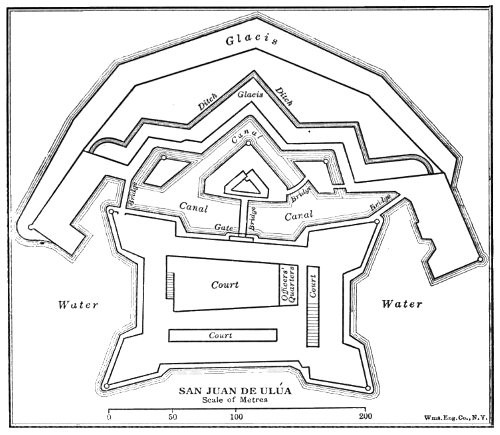
SAN JUAN DE ULÚA
A FIGHTING CHANCE
Besides, there seemed to be a fighting chance. Ulúa was much stronger than when the French, aided by fortune, had captured it, and the anchorage occupied by them could now be shelled. Some of the guns had been improperly mounted; some of the carriages were old; at some of the embrasures balls of different calibres were mixed; pieces without projectiles could be found, and projectiles without pieces; rust had impaired the fit of many balls; but the city and the fortress together had probably three hundred serviceable cannon and mortars,[6] more muskets than men, and plenty of ammunition. As an assault was expected, the streets were defended with cannon and barricades, sand-bags protected the doors and windows, loopholes without number were made in the wall, the rather shallow but wet ditch was cleared, and although barbed cactus made the approach of an enemy to the bastions almost impossible, thousands of pitfalls—each with a sword, bayonet or short pike set erect at the bottom—were dug beyond the wall, so arranged that no one marching straight forward could well avoid them.[9]
Juan Soto, the governor of the state, was indefatigable, and as the state militia numbered about 20,000, it seemed reasonable to count upon succor. Giffard, the British consul, expected that substantial help would come from that source. Other states were likely to furnish aid; and the people, taught by the long inaction of the Americans off the shore to despise them and encouraged by fictitious reports that assistance would be rendered by the national government, felt united and enthusiastic.[7] The city council offered all its resources, and the well-to-do raised funds for a hospital by giving a theatrical performance. The garrison, led by the brave, active and popular though not very able Morales, now comandante general, may be estimated as at least 1200 in Ulúa and 3800 in the city.[8] About half of them were merely National Guards; but these, decorated with tricolored cockades and red pompons, looked and felt extremely dangerous. “As God lives,” cried one of their leaders, “either we will triumph, or all of us, without a solitary exception, will be interred in the ruins.” The civilians remaining in town may have numbered 3000.[9]
Bearing in mind the necessity, not merely of taking Vera Cruz and Ulúa, but of getting his army away from the coast before the advent of yellow fever, and satisfied that Polk would show him no mercy in case of ill-success, General Scott examined his problem with all possible care, and consulted freely the officers he particularly trusted.[10] He could not very prudently have left, say, 5000 men to mask or possibly reduce Vera Cruz, as some critics insisted he should have done, and advanced with the rest, for the essential purpose of his expedition was to capture that place, and such a course might have been viewed by the government as insubordinate. Besides, that policy would probably have been regarded by the Mexicans as a sign of weakness; the possession of the harbor and shipping facilities would evidently aid all further operations; by holding them it would be possible to deprive the enemy of war supplies and other necessaries; the arms, ammunition and cannon of the Mexicans were highly valuable, especially to them; and the American army would not have been an adequate aggressive force after thus detaching nearly half its numbers. The obstacle before Scott had, therefore, to be faced and overcome.[13]
The best method, evidently, was to reduce the town before seriously attacking Ulúa, because that success would greatly diminish the enemy’s fire, make it possible to contract and so strengthen the American line, and somewhat facilitate the transportation of supplies. Such had been the General’s plan from the first. Officers eager for distinction recommended an assault, and Scott well knew that a quick, brilliant stroke would best win him fame and popularity.[11] But he understood equally well that an assault, necessarily made at night, would entail a heavy loss of his best men—enough, perhaps, to prevent his advancing farther and escaping the pestilence—besides involving a great slaughter of both combatants and non-combatants in the town. On the other hand, as the British consul and the British naval commander agreed, there was not enough time before the yellow fever season to warrant relying upon starvation alone.[12] Siege and bombardment were therefore indicated, and Scott promptly decided upon that plan as combining, better than any other, humanity with effectiveness.[13]
THE DEBARKATION
The initial step was to select a point for debarking; and Conner, whom Scott had requested in December to study this problem, had already fixed upon the beach of Mocambo Bay, two and a half or three miles southeast of Vera Cruz, which was somewhat sheltered from northers and could be swept by the guns of the fleet. Sacrificios Island, a strip of sand representing a large reef, was just off shore, too, forming an anchorage here. Accordingly Scott, with Conner, the principal generals, Robert E. Lee, P. G. T. Beauregard and other officers, went up in the little steamer Petrita, reconnoitred the spot, and then—probably to deceive the Mexicans regarding his intentions—ran within a mile and a half of Ulúa, where he was almost sunk by the gunners.[14] His judgment agreed with the Commodore’s, and orders were given to land on the eighth. But when that morning came, signs of a norther showed themselves. The glass fell. The heat became stifling. A southerly wind loaded with moisture blew, and the summit of Orizaba, clad in the azure hue of the poet, stood sharply forth; hence the orders were countermanded.[17]
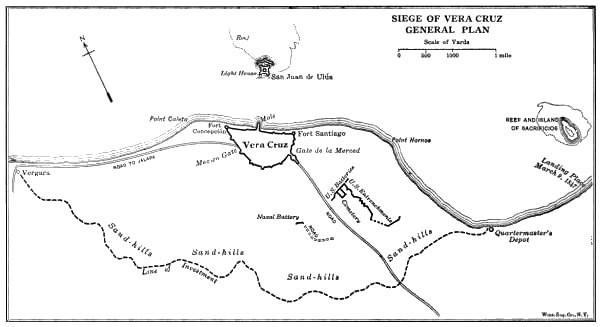
SIEGE OF VERA CRUZ GENERAL PLAN
The signs failed, however, and the extra day was available for the last preparations. A detailed plan of debarkation had been drawn up and announced while the army was at Lobos Islands, but certain difficulties had not been anticipated. The ten large transports in ballast had not come, and to land from a great number of small vessels at Sacrificios, where there was little room and foreign warships occupied all the safe anchorage, appeared imprudent. Conner, therefore, offered to transport the army on larger, better and more ably handled vessels belonging to the squadron, and Scott’s wise acceptance of the proposal involved extensive readjustments.[17]
These, however, were skilfully arranged, and when the dawn of March 9 announced a perfect day, a scene of the greatest activity began. Signals fluttered to mastheads. In clarion tones officers issued their orders. Despatch boats dashed here and there. Sailors and soldiers roared their favorite airs. Fully half of the 10,000 and more troops were placed on the frigates Raritan and Potomac, and most of the others on smaller vessels of the squadron. At about eleven o’clock the order to sail was given. Amid thunderous cheers the Massachusetts plunged through the fleet, and took its place in the lead with Conner’s flagship. A gentle breeze from the southeast filled the sails; and the war vessels and transports were off. After a smooth voyage they began to arrive near Sacrificios at about one o’clock, and in close quarters, but without mishaps or even the least confusion, each dropped anchor in its allotted space.[15] The yards and rigging of the foreign war vessels were black with men, and ladies, armed with glasses and parasols, gazed impatiently from the deck of the British packet.[17]
Without the loss of a moment three signal flags rose to the main-truck of the Massachusetts, and the work of landing Worth’s brigade of regulars began. The double-shotted cannon of the squadron were brought to bear on the shore. Seven gunboats drawing eight feet or less formed a line within good grape range of the beach, and cleared for action. About sixty-five surf-boats, which had been towed from Antón Lizardo by steamers, were rowed by naval crews to the vessels carrying troops—each having a definite assignment—and after receiving from fifty to eighty soldiers apiece, making up the whole of the brigade, attached themselves in two long lines to the quarters of the steamer Princeton, which had now anchored about 450 yards from the shore. This process consumed several hours, and it was hardly ended when a shell whizzed over them. “Now we shall catch it,” thought the soldiers, for rumors of opposition had been heard, two or three hundred cavalry could be seen, and artillery was supposed to be lurking behind the dunes.[17]
The flash of a signal gun shot now from the Massachusetts; the surf-boats cut loose, faced the shore abreast in the order of battle, and struck out for land; and a cheer burst from every American throat. Great Orizaba cast aside its veil of haze, and stood out against the setting sun. Not a cloud flecked the sky; not a ripple marred the burnished water. Ulúa and Vera Cruz thundered loudly, though in vain. National airs rolled from our squadron. Shells from the gunboats broke up the Mexican cavalry and searched the dunes. The oars of the straining sailors flashed. Muskets—not loaded but with fixed bayonets—glittered. Regimental colors floated at the stern of each boat. Suddenly one of the boats darted ahead and grounded on a bar about a hundred yards from the shore. Out leaped Worth; his officers followed him; and the whole brigade were instantly in the breaking ground-swell, holding aloft their muskets and cartridge-boxes.[17]
Here was the chance of the enemy, for our vessels could not fire without endangering Americans; but no enemy was to be seen.[16] Led by their color-bearers the regulars quickly splashed ashore, formed in a moment, charged to the crest of the first dune, planted their standards and burst into cheers; the men on the ships, tongue-tied for some time by an excitement and anxiety that made their brains reel, answered with huzza after huzza till they made the bay “seem peopled with victorious armies,” wrote one of the soldiers, and the strains of “Star-Spangled Banner” broke from the bands. Less formally, but rapidly and in order, the boats went back for the troops of Patterson and Twiggs; and by midnight, without having met with a single accident, more than 10,000 men, duly guarded by sentries, were eating their biscuit and pork on the sand or preparing to bivouac.[17]
VERA CRUZ INVESTED
During the night Mexicans in the rear did some shooting but without effect, and the process of investment began. Diverting attention from this by having a gunboat, sheltered about a mile from the city behind Point Hornos, throw shot and shell into Vera Cruz for a couple of hours the next forenoon, Scott had Pillow’s brigade capture the hill of Malibrán behind Worth’s camp, and push on toward the rear of the city. Quitman then passed it; Shields passed Quitman, and Twiggs passed him. Wallowing up and down the slopes of deep sand in a sultry heat without water to drink proved to be extremely hard work; and breaking through the valleys, where a matted growth of chaparral—armed with thorns as keen as needles and stiff as bayonets—resisted everything but sharp steel, was harder yet. Day and night Mexican irregulars, both infantry and horse, and cannon salutes from the city and the castle embarrassed operations, and there were many brisk skirmishes. Moreover the landing had scarcely been made when a norther set in, covering the men with sand, blowing away old hilltops and building up new ones. But not long after noon on March 13 Twiggs reached the Gulf north of the city. The next morning a well-supported detachment from each brigade advanced as far as it could find cover, driving the Mexican outposts before it; and by night these detachments were only about seven hundred yards from the town.[21]
The American position as a whole, known as Camp Washington, was now a semi-circular line about seven miles long. There were gaps, but these were rapidly closed with strong pickets. The railway and the roads were all occupied; the visible water supply of the city was cut off; and on March 16 Scott announced that nothing less than a small army could break through. Meantime, whenever the weather permitted, artillery, stores, horses and provisions were landed in the most systematic manner. Safeguards were issued to the representatives of foreign powers at Vera Cruz, and in a letter of March 13 to the Spanish consul[18] Scott indicated plainly that “bombardment or cannonade, or assault, or all” of these might be expected by the citizens.[21]
The time to plant artillery had now arrived, and the ideal spot was found on the sixteenth; but after a battery had been laid out there, access to it proved to be dangerously exposed. Two days later, however, a fairly good point was discovered, near the cemetery and Worth’s position, about half a mile south of the town, which screened it somewhat from the castle; and preparations to establish two mortar batteries there, about one hundred yards apart, began the following night. At the same time a deep road, wide enough to admit a six-mule team, was under construction.[21]
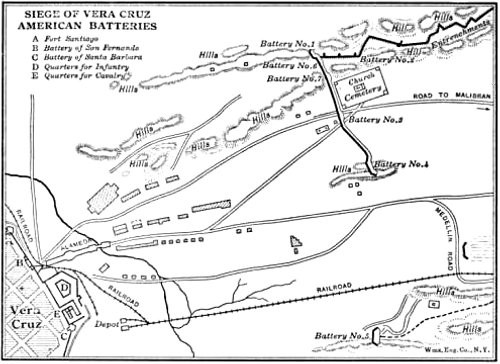
SIEGE OF VERA CRUZ
AMERICAN BATTERIES
Most of this labor had to be done at night, and the utmost possible silence observed. As the transports lay a mile off shore, while the only wharf was an open beach, and a norther blew violently from the twelfth to the sixteenth, the work of landing ordnance and ordnance stores proceeded slowly. Fortunately the work on the batteries was not discovered; but the fire of Paixhan guns and heavy mortars from the city and castle, though irregular and singularly unfruitful despite the undeniable skill of the gunners,[19] compelled the Americans to adopt extreme precautions. Nor were these embarrassments the only ones. Notwithstanding seasonable orders, only fifteen carts and about a hundred draught horses had arrived. Not more than one fifth of the ordnance requisitioned by Scott about the middle of November and due at the Brazos—he now reminded Marcy—by January 15, had yet appeared. A great many artillery and cavalry horses had been drowned, injured or delayed; and there was a shortage of almost every requisite for siege operations.[20] But the army and the navy coöperated zealously; soldiers took the places of draught animals; and in spite of every difficulty three batteries, mounting seven 10-inch mortars, were in readiness by two o’clock on the afternoon of the twenty-second, and the soldiers felt eager to hear what they called the “sweet music” of these “faithful bull-dogs.”[21]
THE BOMBARDMENT
At this hour, therefore, Scott formally summoned the town, intimating that both assault and bombardment were to be apprehended. The reply was a refusal to surrender; and at a quarter past four, accompanied by a deafening chorus of joyous, frantic shouts and yells, the American batteries opened, while the “mosquito fleet” of two small steamers and five gunboats,[22] each armed with a single heavy cannon, stationed themselves behind Point Hornos, and fired briskly.[24]
Like “hungry lions in search of prey,” a soldier thought, the shells from the mortars flew “howling” to their mark. With heavier metal and vastly more of it, Vera Cruz and the castle replied. The city wall blazed like a sheet of fire. Shot, shell and rockets came forth in a deluge, it seemed to the men; and the two columns of smoke, rolling and whirling, mounted high and collided as if striving to outflank and conquer each other. Still more terrible was the scene at night. A spurt of red fire; a fierce roar; a shell with an ignited fuse mounting high, pausing, turning, and then—more and more swiftly—dropping; the crash of a roof; a terrific explosion that shook the earth; screams, wailing and yells—all this could be distinctly seen or heard from the American lines. During the twenty-third and the following night the fire still raged, but on the American side more slowly, for although ten mortars were now at work, a norther interrupted the supply of ammunition.[24]
But while the bombardment made an interesting spectacle, as a military operation it was proving unsatisfactory. The ordnance thus far received by Scott was inadequate for the reduction of the city—to say nothing of Ulúa. With mortars, especially as the distances could not be ascertained precisely, it was impossible to be sure of hitting the bastions and forts. Shells could be thrown into the town, but while the houses suffered much, the fortifications and garrison escaped vital damage, and there was no sign of yielding. Not a few in the American army, who had supposed that a fortified city could be taken at sight like a mint julep, grew impatient; the officers eager for assault fumed; Worth, proud of his quick work at Monterey, sneered; Twiggs grunted. As an army man Scott naturally desired that branch of the service to reap all the glory of its campaign, but he now found himself compelled to ask for naval guns heavy enough to breach the wall, and make an assault practicable; and when Perry, who had taken Conner’s place on the twenty-first, insisted that men from the squadron should work them, he consented.[24]
The new battery, constructed by Robert E. Lee and mounting three long 32’s for solid shot and three 68’s for shells, was planted just behind the bushy crest of a slight eminence, only some 800 yards from the city wall, where the enemy did not suppose that such an enterprise would be ventured; and until the guns were about ready to be unmasked on the morning of the twenty-fourth, its existence was not suspected.[23] Here were instruments of power and precision, and they told. The Mexicans concentrated upon them a terrific fire, but with no serious effect; and when on the next morning a battery consisting of four 24-pounders and two 8-inch howitzers joined the infernal chorus, the fire, though hindered occasionally by the tardiness of ammunition, was “awful,” said Scott and Lee, while the city appeared like one dense thunder-cloud, red with flashes and quivering with incessant roars.[24]
That night the batteries played still more fiercely. Sometimes four or five shells were sizzling through the air at once. The fire, said an officer, was now “perfectly terrific”; and to heighten the wildness of the scene, many vessels could be observed by the light of the moon going ashore in the norther. About thirty were wrecked by this one gale, and others had to cut away their masts. In the meantime preparations for assaulting both by land and by water, should an assault prove to be necessary, were actively pressed.[24]
THE SITUATION IN VERA CRUZ
In town, during the early period of these operations, the enthusiasm continued to run high, for the cautious and faint-hearted had gone away, and the reports of the irregulars, constantly skirmishing against the Americans, were colored to suit the popular taste. Work on the fortifications proceeded, and fresh cartridges for the artillery were made with feverish haste. Bands played; the gunners amused themselves by firing at small and far distant groups among the sand-hills; and at night fireballs and rockets lighted up the plain in anticipation of the hoped-for assault. When the investment was completed, when the American outposts drew near the town, and especially when it became known that preparations for a bombardment were under way, the people grew more serious; but it was expected that forces from without would break the line, or at least prevent the construction of batteries.[26]
A painful disappointment followed, however. Soto made great efforts to collect the tax levied by the state; but the citizens, impoverished by the long blockade, had no money, and without cash troops could not be fed. In spite of many hopes the fluctuating bands under Colonel Senobio, the chief leader of the irregulars in the vicinity, do not seem to have risen at any time far above 1000, and perhaps never reached that number. In vain Soto appealed for an able general and a nucleus of regulars. They were not within reach, and the few pieces of artillery could not be moved. The states of Puebla and Oaxaca tried to help, but were tardy and inefficient.[26]
Men from the upper country dreaded the yellow fever; and those of the coast, volatile by nature, ignorant of real warfare, without organization, training or discipline, were astonished and confounded when they struck the solid American line. They pecked at it continually, but Morales himself could see that no skill, concert or strength marked their efforts. Discouragement and wholesale desertion followed. The city, therefore, could not obtain provisions by land; and as most of the seamen alongshore fled to the mountains, and boat communication became more and more difficult, it was realized that supplies from the interior were out of the question. After March 20 the troops could be given little or no meat; but soldiers were detailed to fish the prolific waters under the guns of Ulúa, and no doubt beans and tortillas, the staple food of the common people, continued to be fairly plentiful.[26]
The opening of the bombardment, however, precipitated a crisis, and as our fire grew more and more intense, the consternation and suffering increased. Crashing roofs; burning houses; flying pavements; doors, windows and furniture blocking the streets; a pandemonium of confused and frightful sounds; bells ringing without hands; awful explosions; domes and steeples threatening to fall; the earth quaking; crowds of screaming women, who rushed hither and thither; terrible wounds and sudden deaths—all these were new and overwhelming scenes.[25] Only one bakery escaped destruction, as it happened, and the children cried in vain for bread; the priests would not leave their shelter to comfort and absolve; and finally the very instinct of self-preservation was lost in a stupid despair more dreadful to witness than death itself.[26]
The troops in the southwestern section, under our heaviest fire, became terror-stricken. In other quarters men left the ranks to look after families and friends; and when a murky dawn ended the terrible night of the twenty-fifth, demoralization was rife. People wandered about the streets crying for surrender. Always passionate, they now hated their own government for deserting them. The consuls went out under a flag of truce, but Scott refused to see them, sending them word—it was reported—that any persons leaving the city would be fired upon, and that unless it should surrender in the meantime, new as well as the old batteries would open the next morning. This fact overwhelmed the people; and the prospect of being exterminated at leisure by an enemy who could not be injured, beat down their last thought of resistance.[26]
Consul Giffard had predicted that any plausible excuse for surrender would be turned to good account. Supplies were now said to be failing, and in the course of this dreadful night an informal meeting of officers agreed upon capitulation. Naturally the idea gave offence to many, and there was talk of opening a way through the American line with the sword. But a council of war soon decided to negotiate; commissioners were appointed; and Scott, who was invited to take similar action, did so. The six men came together on the afternoon of the twenty-sixth, but could not agree; and the Mexicans returned to the city, leaving behind them a proposition.[29]
THE SURRENDER OF VERA CRUZ
Worth, who was our chief representative, believed the negotiations were simply a waste of time, and favored an immediate assault; but Scott saw that the Mexicans, while trying to save appearances, really meant surrender, and the next morning granted with certain vital modifications their terms.[27] His demands were accepted, and it was thus agreed in substance that Landero, to whom the command had been turned over, should march his army out with all the honors of war, the troops be paroled, and the armament—so far as not destroyed in the course of the war—be disposed of by the treaty of peace. It was further agreed that all the Mexican sick should remain in town under Mexican care, private property be respected, and religious rights be held sacred.[29]
It was a “shameful surrender,” declared Santa Anna, and from a military point of view this could hardly be denied. Ulúa had practically not been touched; it had a considerable supply of provisions, and there was a chance of obtaining more from blockade-runners. Vera Cruz was in a harder yet not in a desperate plight. Men of importance there, knowing the city would be denounced for surrendering, naturally endeavored to prove that it had suffered terribly and exhausted its resources before yielding; and the principal neutrals—friendly toward them, engaged mostly in trade, and more willing to have life sacrificed than property—raised an outcry against the proceedings of Scott that became a fierce indictment in Europe and the United States. But the British naval commander, though not inclined to favor the General, reported that the casualties in the city were only eighty soldiers killed or wounded, about one hundred old men, women and children killed, and an unknown number injured, and that its food supply, while no doubt less delicate and varied than could have been desired, would have lasted beyond the middle of April; and there is considerable evidence that his figures were approximately correct.[28] Ammunition did not fail, nor did water.[29]
The surrender was really due therefore to the moral effect of Scott’s artillery. Even Giffard, who termed his operations cruel and unnecessary, admitted this; and, bearing in mind the General’s obligations to obey his government and save the lives of his men, the inevitable horrors of an assault by night, and the serious danger that a reliance upon starvation as the sole means of reducing the city would have given time for Santa Anna’s regulars and the yellow fever to arrive, one concludes again and finally that Scott’s method was humane and wise.[29]
Owing to inequalities of the ground, the character of the soil, great skill on the part of our engineers, incessant care and remarkable good fortune, the total losses caused by 6267 Mexican shot, 8486 shells and all the bullets of the irregulars were only about nineteen killed and sixty-three wounded. The siege was not exactly a fête champêtre, however. It was tiresome to be awakened at night so often by Mexican skirmishers, disagreeable to be routed out by the diabolical screech of a heavy shell, and quite annoying to have one of the “big dinner-pots,” as the soldiers called them, explode close by. Saturating dews, abominable drinking water, scanty and bad rations, howling wolves, lizards in one’s boot, “jiggers” that made the feet itch incessantly, fleas that even a sleeping-bag could not discourage, and sand-flies nearly as voracious, were minor but real afflictions. When a norther began, the whole aspect of nature seemed to change. The sky became a pall, the atmosphere a winding-sheet, the wind a scourge; and the roaring, chilling blast filled one’s ears, eyes, mouth and even pores with biting grit, cut the tents into ribbons, and sometimes buried their sleeping inmates.[30] To escape from the Mexican shot sentries often had to burrow in the sand, and under the tropical sun they learned to appreciate the power of the old brick oven. When carrying provisions or dragging cannon, amidst hills that blazed like the mirrors of Archimedes at Syracuse, men often dropped.[31]
On the other hand, besides the initial high spirits, which helped immensely, and the excitement and comradeship that knocked off the edge of hardships, there were special sources of cheer—particularly the “blue-shirts,” as the seamen were called. When turning out in the face of an icy sand-blast sharp enough to cut granite, it was something to hear a salty voice give the order, “Form line of battle on the starboard tack!” But sailors on shore leave, who burst from their long confinement like birds let loose, and “cruised” in the environs with perfect abandon, were better yet. Their sport with the wild monkeys was truly edifying, and their delight over the burro would have set Diogenes laughing. Sometimes they rode him, and sometimes they carried him. Planted in the Mexican style just forward of the creature’s tail, they felt that at last they were riding the quarter-deck, and commanding a snug vessel of their own. Above all they enjoyed “mooring ship.” This congenial manoeuvre was achieved by taking aboard for “anchor” a heavy block of wood, previously attached to the donkey’s neck with a long rope, then racing at full speed, heaving the “anchor,” paying out the cable, and bringing up in a heap on the sand—the donkey on top, very likely.[31]
Not less cheering and a little more military was the news, which arrived by the fifteenth of March, that “Old Wooden-leg’s” army had been “licked up like salt” at Buena Vista. And still another comfort was to gaze from a safely remote hill at Vera Cruz, which looked—the soldiers agreed—so oriental, with airy palm trees visible over the white wall, hundreds of buzzards floating in wide circles far above, the dark bulwarks of Ulúa set in waves of purple and gold on the left, a forest of American spars and masts on the right, piercing the misty splendor of the yellow beach, the bright sails of fishing boats in the middle distance, and the vast, blue, cool Gulf beyond it all. How the panting soldiers gloated on the prospect of taking possession![31]
VERA CRUZ OCCUPIED
And on March 29 they did so. The day was enchantingly summerlike; a delightful southeast breeze came over the water; and the domes of Vera Cruz were gilded with splendid sunshine. In a green meadow, shaded with cocoanut palms, a little way south of the town, Worth’s brigade was drawn up in a dingy line, and a dingy line of volunteers, about seventy yards distant, faced it. At one end of the intervening space, near the city wall, stood sailors and marines. The American dragoons and a battery were opposite them, and a white flag waved at the centre. A little before noon the Mexican troops, in their best uniforms of blue, white and red, marched out of the gate, formed by company front with a band at the head of each regiment, advanced to the flag, and stacked arms. A few slammed or even broke their muskets; many kissed their hands to the city; and a standard bearer, who had removed his flag from the staff and secreted it in his bosom, wept for joy when permitted to keep it. But most of the men seemed in fairly good spirits, and as a rule the much-decorated officers, who retained their swords, produced a fine impression.[32]
As the rear of the column left the gate, the Mexican banner on Fort Santiago, after receiving a last salute from the guns of the city and castle, was lowered; and then issued forth a crowd of men, women and children, loaded with fiddles, guitars, parrots, monkeys, dogs, game-cocks, toys and household utensils, that was enough to destroy any funereal sentiments which otherwise might have been felt. Even by the Mexican accounts, not a word or look of triumph, not even a note of authority, was chargeable to the victors; and Worth, who received the column, proffered a thousand courtesies. General Scott, the so-called “vain-glorious,” remained in the background; but he sent a note excusing from their parole about forty officers, whom he expected to aid him at the capital as in effect advocates of peace.[32]
Amid cheers and the waving of caps, American flags then rose on the forts, greeted by hundreds of salutes from sea and shore. It seemed, wrote a soldier, as if there were nothing in the world but cannon, and all the cannon thundering; and the glory of the Stars and Stripes, gleaming amidst the smoke, gave a new significance to the emblem of patriotism. With his bands playing favorite American airs, Worth’s brigade now marched into the town; and later Scott, with his staff and a brilliant escort, followed it. Perry took formal possession of Ulúa; and the disbanded Mexican troops that resided elsewhere scattered to their homes, preparing the people for submission wherever they went by tales of American invincibility, and teaching them by every sort of outrage to welcome American rule.[32]
XXIII
CERRO GORDO
April, 1847
I believe it would be many months after the capture of Vera Cruz and the fortress of Ulúa, said Minister Pakenham in substance at the end of January, 1847, before an army strong enough to advance any distance into the interior could be collected there, and meantime the climate would be “frightfully destructive.” Heat, fatigue, differences in food, and the yellow fever will cause heavy losses, wrote Bermúdez de Castro, the Spanish minister at Mexico in March, and the road to the capital passes so many centres of population and so many fine military positions, that without great labor and preparations an invading force can be destroyed. Two men better qualified to express opinions on the matter could scarcely have been found; but without hesitation the “scientific and visionary” Scott addressed himself to the task. Had the requisitions duly made by him in November been complied with, he might by this time, at a trifling cost in lives, have been standing on the great plateau, and quite possibly within the capital; but now, with only two thirds of the desired troops[1] and an insufficient supply of many other essentials, he fearlessly girded up his loins.[5]
Stores were expeditiously landed. The First Infantry and two independent volunteer companies received orders to garrison the town and the fortress. It was arranged to minimize the danger of yellow fever by keeping the Americans at the water-front as much as possible and cleaning the city. The military department of Vera Cruz, extending fifty miles inland, was created. Foreign merchants, under the threat of a six per cent duty on exported gold and silver, supplied funds by cashing official drafts on the United States at par. “One more appeal ... to the ninety-seven honorable men, against, perhaps, the three miscreants in every hundred,” urging them to coöperate actively in preventing even trivial outrages, was issued; and the people of the region were addressed[2] in a proclamation.[5]
“Mexicans,” said Scott, I am advancing at the head of a powerful army, which is soon to be doubled, and another army of ours is advancing in the north. “Americans are not your enemies,” however, but only the enemies of those who misgoverned you, and brought about this unnatural war. To the peaceable inhabitants and to your church, which is respected by the government, laws and people in all parts of our country, we are friends. Everything possible will be done to prevent or punish outrages against you; and on the other hand any citizen, not belonging to the regular forces, who undertakes to injure us will be severely chastised. “Let, then, all good Mexicans remain at home, or at their peaceful occupations.” Let them also furnish supplies, for all who do so will be paid in cash and protected. If such a course be followed, the war may soon end honorably for both sides; and the Americans, “having converted enemies into friends,” will return home.[5]
The problem of transportation, however, caused the General a great deal of trouble. As early as the beginning of February notice of his probable needs had been given by him to the quartermaster’s department, and presumably steps had been taken to meet them; but the loss of animals on board the ships during storms or by the wrecking of transports had upset all calculations.[3] For wagons especially he was dependent upon the United States. At least eight hundred were needed, and up to April 5 only one hundred and eighty had arrived, though three hundred more were known to be on the way. Four or five thousand mules were required for wagons, two or three thousand for pack-saddles, and about four hundred mules or horses for the siege train; and by the same date less than 1100 had been obtained. An expedition to the village of La Antigua[4] on the north shore met with little success in this regard, and a more important one, to the rich country on the upper Alvarado River,[4] which was supposed to abound in horses and mules, produced but very disappointing results.[5]
In the opinion of Scott, however, the district near Jalapa, a beautiful city about seventy-four miles inland, was likely to prove more satisfactory. From Beach’s friend, Mrs. Storms, who had presented herself to him on March 20, he seems to have learned that friendly sentiments were entertained there. No serious opposition below that point and even for some distance beyond it seemed to him probable; and hence on April 8, although his means for equipping a road train were but a quarter of what he desired, and only an inadequate siege train could be moved, the second division of regulars, commanded by Brigadier General Twiggs, marched for Jalapa, which was also the first point where large quantities of subsistence and forage could be obtained.[5]
20. Outcome of the insurrection. Apuntes, 111, 115–8, 133, 136–8. 13Bankhead, nos. 33, 34, 1847. Méx. en 1847, 14–18. 69S. Anna, order, Mar. 14. Anglo-Saxon, Mar. 13. 56Beach, report, June 4, 1847. Bustamante, Campaña, 30. London Times, May 10. Britannia, May 15. México á través, iv, 577, 635–40. Ramírez, México, 184, 198–9, 205, 207, 209–12, 215–8. 82Gov. Puebla, boletín No. 4 (S. Anna to Farías, Mar. 6; Gil to Ruano, Mar. 6). 77Relaciones, circulars, Mar. 22; Apr. 1. Tributo á la Verdad, 76. 75Rejón to S. Anna, Mar. 7. 84Palacios to Gov. S. L. P., Mar. 17. Republicano, Mar. 24. 75aHacienda, circular, Mar. 29. Puga y Acal, Docs., 62–3. Escudero, Mems., 19. Bustamante, Nuevo Bernal, ii, 146–7. Dublán, Legisl., v, 262–5. Locomotor, Jan. 18. Baz, Juárez, 47. Diario, Mar. 29, 1847 (Baz). The twenty-millions law had very little effect, if any. Le Constitutionnel, June 17, 1847 (The clergy have kept none of the promises by the aid of which they obtained the repeal of the confiscation of their property).
3. To Antón Lizardo. Macgregor, Progress, i, 677. 47Conner, Dec. 1 1846; Feb. 17; Mar. 7, 10, 1847. 159Collins narrative. 298Porter, diary. 66Remarks in margin of chart of V. Cruz harbor. Le Clercq, Voyage, 401, 418. Robertson, Remins., 214–6. Campos, Recuerdos, 31. Hitchcock, Fifty Years, 238. Grant, Mems., i, 125. Hartman, Journal, 6. Taylor, Broad Pennant, 123. Picayune, Mar. 26. Delta, Oct. 16. Meade, Letters, i, 187. 65Scott, gen. orders 28, 33, 34, 37. 313Saunders to Conner, Mar. 5. Oswandel, Notes, 63. Semmes, Service, 106, 109, 111. Kenly, Md. Volunteer, 266. Lawton, Artillery Officer, 65–6, 68. 146Caswell, diary. 322Smith, diary. Kitchen, Record, 21–2. 270Moore, diary. 327Sutherland, letter. Ballentine, English Soldier, i, 257, 261. 254McClellan to sister, Feb. 23. Moore, Scott’s Campaign, 1–4. Parker, Recolls., 49, 82. Washington Union, Apr. 6. Monitor Repub., Mar. 16. 164Scott to Conner, Feb. 22, 26. 162Conner to wife, Aug. 10, 1846; Feb. 26, 27, 1847. Ho. 60; 30, 1, pp. 879, 892 (Conner); 896 (Hetzel); 893, 896, 899 (Scott); 568 (Jesup). Nebel and Kendall, 17. Diccionario Univ. (Antón Lizardo). Niles, Mar. 13, 1847, p. 21. 332Tennery, diary. Sedgwick, Corresp., i, 65. 254McClellan, diary. 165Conner to Scott, Jan. 18; to Breese and to Aulick, Feb. 28. Hammersly, Naval Encyclop., 94. 139W. B. Campbell to wife, Mar. 6. Smith, To Mexico, 108–10. 76Garay, Mar. 5. 76Cos, Feb. 19, 21. 76Soto, Mar. 7. 76Watchman at Ulúa, Mar. 5.
1. “New volunteers,” those called out in November. For the ten transports see chap. viii, note 28. Jan. 18 Conner wrote to Scott that Santa Anna had moved, about January 1, against Taylor, but that from all accounts presumably Taylor had probably retired to Monterey (Ho. 60; 30, 1, p. 893). It was therefore natural for Scott to feel satisfied that Santa Anna, learning of the expedition against Vera Cruz, would retrace his steps and reach that place in season. At Scott’s instance a spy, selected by Consul Campbell with the aid of Consul Dimond (who visited Cuba for the purpose), was to have set out from Havana in January for Mexico City and San Luis Potosí (166Dimond to Conner, Jan. 15); but the author found no further trace of him.
2. Some transports reached Antón Lizardo Feb. 27 and notified Conner that Scott was coming (162Conner, Feb. 27). Certain troops, leaving Tampico March 1, arrived at that rendezvous in advance of Scott (139W. B. Campbell to wife, Mar. 6). By sunset on March 5 about seventy sail had appeared there.
9. The situation at Vera Cruz and Ulúa. 13Consul Giffard, Nov. 1; Dec. 1, 1846; Feb. 28; Mar. 11, 1847. 52Consul Dimond, no. 336, May 2, 1846. Engineer School, U. S. Army, Occasional Papers, no. 16. 218Henshaw narrative. 280Nunelee, diary. 159Collins, diary. 6Bravo to Tola, Apr. 18, 1846. 224Hitchcock, diary, Mar. 13. 13Pakenham, no. 25, 1842. National, July 12, 1846. Constitutionnel, May 8, 1847. W. S. Parrott, Feb. 6, 1847. 80México state legislature to people. Memoria de ... Guerra, Dec., 1846, p. 22. (Cisterns, etc.) Lyon, Journal, ii, 221. Orbigny, Voyage, 407–8. Robertson, Visit, i, 232, 239. Ruxton, Adventures (London, 1847), 12–15. Robertson, Remins., 225–6, 235, 237. Lerdo de Tejada, Apuntes, ii, 541–50, 552, 569. Naredo, Orizaba, i, 107–8. Scott. Mems., ii, 422. Hitchcock, Fifty Years, 248. Ballentine, English Soldier, i, 288–9. Sen. 1; 30, 1, p. 239. Balbontín, Estado, 49–55. Tributo á la Verdad, 17–26, 29, 88. Apuntes, 152–5. S. Anna, Apelación, 33. Delta, Oct. 16, 1847. 350Weber, recolls. 12Matson to Giffard, Mar. 5, 1847; to Fischer, Mar. 8; to commodore, Mar. 10, 25. Oswandel, Notes, 102. Semmes, Service, 102, 104–6. 139W. B. Campbell to D. C, Mar. 20. Rivera, Jalapa, iii, 56, 865. Otero, Comunicación, 11. Diario, Apr. 8. Republicano, Dec. 8, 1846. 86Relaciones to gov., Jan. 27, 1847; reply, Feb. 1. 86State treas. to gov., Jan. 15. 86Morales to gov., Feb. 8. 90Soto, proclam., Mar. 2. 90Id.to state congress, Dec. 1, 1846. 100V. Cruz ayunt. to prefect, June 4, 1846. 100Bravo to ayunt., June 9, 1846. 100Ayunt. to jefe of dept, Oct. 26, 1846. 100Soto, proclam., Feb. 6, 1847. 88Id., proclam., Feb. 15, 1847. Regenerador Repub. Puebla, Mar. 13; Apr. 7, 1847. 82Noticias de V. Cruz. Kenly, Md. Volunteer, 267. México á través, iv, 600. Lawton, Artillery Officer, 67, 105–7. El Estado de Veracruz a Todos. Memoria de ... Guerra, Dec, 1846. 146Caswell, diary. 270Moore, diary. 73Bermúdez de Castro, nos. 441, 445, Feb. 28; Mar. 2, 1847. Bustamante, Nuevo Bernal, ii, 67. Valois, Mexique, 40–43. 271Morales to commander of Ulúa, Oct. 20, 1846. Moore, Scott’s Campaign, 12. Conner, Castle of S. Juan de Ulloa, 13. Parker, Recolls., 79. (Learned) Monitor Repub., Nov. 13, 30, 1846; Mar. 28, 1847. Negrete, Invasión, iv, app., 413–4. 166Campbell to Conner, Jan. 9, 1847. 166Pommarès to Conner, Oct. 15, 1846. Ho. 60; 30, 1, pp. 911, 1169 (Scott). Meade, Letters, i, 188. Diccionario Univ. (Ulúa). 47Conner, Oct. 4, 1846. 165Id.to Scott, Jan. 18; Feb. 5, 1847. 100Soto to jefe, V. Cr. dept., Sept. 17, 1846. 100Jefe to V. Cr. ayunt., Dec. 21, 1846. Bishop, Journal, 29. Niles, May 9, 1846, p. 160. So. Quart. Rev., July, 1851. 86V. Cruz congress, manifiesto, Mar. 9. And from 76 the following. A large amount of correspondence between the dept. and successive commanders at Vera Cruz, particularly in March, April, Sept. and Oct., 1846, Jan. and Feb., 1847, relating to the fortifications, garrison, supplies and dangers of the city and Ulúa. S. Anna, Oct. 12, 14, 20, 1846; Jan. 14, 18; Apr. 29, 1847. Morales, Jan. 20, 1847. Tampico letter to Garay, Jan. 25. Soto, Feb. 7, 15; Mar. 7, etc. Morales, Feb. 9, 15; Mar. 4, 5, etc. Boletín de la Democracia, Mar. 2, 1847 (N. Y. letter, Jan. 8). To S. Anna, Oct. 17, 1846; Jan. 30, 1847. To Morales, Mar. 6, 7. Morales, proclam., Mar. 5. Landero, report, Apr. 3. Jalapa letter, Mar. 16. Canalizo to Hacienda, Jan. 11. Landero, Jan. 25, 1847. J. Alvarez, Oct. 21, 1846. Memo., Feb. 9, 1847. Tampico letter, Dec. 30, 1846. Morales to Marín, Mar. 11.
4. For additional information regarding San Juan de Ulúa the reader may consult chapters xviii and xxx.
5. New York letters received in Cuba and made known at Mexico gave notice that Scott planned to capture Vera Cruz before attacking Ulúa (76Relaciones, Jan. 26); some Mexicans believed he would enter the Antigua River (which emptied a short distance to the north) with boats, and strike at once into the interior; some thought he would land at Tuxpán, and march south along the coast; and some ridiculed the idea of an attack upon Vera Cruz on the ground that, since the Americans could not possibly reach the capital by that route, it would be useless to capture the city (Monitor Repub., Mar. 28). Many argued that in any case Ulúa would protect Vera Cruz.
6. Besides fine old Spanish guns, there were new and heavy English pieces (Nacional, July 12, 1846) and twenty recently cast in the United States (Davis, Autobiog., 131). A battery of sixteen bronze long 24-pdrs., made in England in 1840, was pronounced by American artillery officers “far superior” to anything of the sort they had seen elsewhere (213 Hatch to father, Apr. 2). It was in the city. As to the amount of ordnance in the city and castle accounts differed. Scott made it 400 pieces; Hitchcock, upwards of 350; Balbontín, 113 mounted, 46 unmounted at Ulúa, 83 and 57 respectively at Vera Cruz; G. T. M. Davis, 390 effective pieces. The statement of the Mexican government, December, 1846 (based of course on earlier reports), was as follows: Vera Cruz, mounted, bronze, eleven 24’s, twenty 16’s, six 12’s, four 8’s, four 4’s, four mountain 4’s, five 12-inch mortars, seven 8-inch howitzers, and of iron, mounted, three 42-lb. mortars, three 24-lb. cannon, five 12’s, nine 8’s, six 13-inch mortars, two 9-inch mortars; Ulúa, bronze, mounted, thirty-six 24’s, four 16’s, four 8’s, two 14-inch mortars, and of iron, mounted, ten 84-lb. mortars, ten 68-lb. mortars, sixteen 42-lb. mortars, fifty-one 24-lb. cannon, two 16’s,—a total of 224 besides a considerable number of unmounted pieces in both places, some of which were doubtless mounted later (Memoria de ... Guerra). Still other guns were sent from the interior. Possibly some unserviceable ordnance may have been included in the highest American figures. Balbontín gives the number of firearms as 7369—half of the total number belonging to the government. Ripley (War with Mex., ii, 19) and Wilcox (Mex. War, 251) state that there was no ditch, but the weight of evidence seems to be against them. Perhaps the drifting sand filled the ditch before the Americans took the city.
7. It was not easy to believe that the factions at Mexico would not agree to turn their arms against the Americans on learning they had landed. March 9 the state of Vera Cruz issued a strong appeal to them and to the nation. Neutrals and valuable neutral property were taken aboard foreign war-vessels (12Matson to Giffard, Mar. 5). The American blockade had greatly impaired the resources of the state and city. A forced loan was imposed by the former, but no large receipts could be expected.
8. The accepted (not official) Mexican figures were 1030 for Ulúa and 3360 for Vera Cruz, but the authorities did not consider it obligatory to publish the correct number. 13March 11 the British consul, Giffard, reported the garrisons as about 1500 and 4000 respectively, and later (according to Mexican accounts that were probably rather flattering) more than 1000 threw themselves into the city. Santa Anna stated in April that Morales had 5000 in the town (76S. Anna, Apr. 29), but he was unfriendly to that officer. Scott’s figures were 5000 besides those who perished or escaped during the siege; but before the surrender he heard the city alone had that number (Sen. 1; 30, 1, p. 221). British naval officers stated there were about 6000 in city and castle (Meade, Letters, i, 188), and Col. Campbell was told there were 5–6000 (139to wife, Mar. 6). The Mexicans complained of a lack of gunners, but their own figures were 680. No doubt the troops were poorly cared for, but such was the custom. Robles counted for not a little. In the autumn of 1846 Landero, personally liked but considered wanting in ability and regarded as a tool of Santa Anna, was made comte. gen. because Morales was strenuously denounced by Santa Anna as politically unsafe (76S. Anna, Oct. 14); but on the approach of the crisis the people forced a change, and the confidence inspired by Morales enabled him (Landero admitted in his 76report, Apr. 3, 1847) to accomplish more than the latter could have done. Particular resentment was felt against Santa Anna for taking away in August, 1846, the best regiment (the Eleventh Infantry). For the names of corps at Vera Cruz and Ulúa see Roa Bárcena, Recuerdos, 158.
10. What Scott called his “little cabinet” consisted of Col. Totten (chief engineer), Lieut. Col. Hitchcock (acting inspector general), Capt. Robert E. Lee (engineer) and H. L. Scott (acting as military secretary). Col. James Bankhead was chief artillery officer, Capt. Huger was acting chief of ordnance, and Maj. Turnbull was the chief topographical engineer (Sen. 1; 30, 1, pp. 239–40). Col. Harney commanded the regular cavalry, and Capt. Edson commanded three companies of marines loaned by Conner, and temporarily attached to the Third Artillery. At this time the engineers, artillery and cavalry were kept by Scott under his immediate orders. While at Lobos Islands he laid down the rule (65gen. orders 33) that every project of siege or bombardment should first be discussed between the senior engineer and artillery officers and then reported to him for approval or amendment. Hence the detailed plan for the operations at Vera Cruz came formally from Totten, and he has been credited with originating it.
13. 13Giffard, Mar. 11. Scott, Mems., ii, 422–5. Ballentine, English Soldier, ii, 3–6. Davis, Autobiog., 140–1. Sen. 1; 30, 1, pp. 223, 239. Balbontín, Estado, 53, 55. 65Scott, gen. orders 33. 12Matson to commodore, Mar. 11, 25. Steele, Amer. Campaigns, i, 120. N. Y. Sun, Aug. 16, 1847 (Scott should have left 5000 to reduce V. Cruz). So. Quart. Rev., July, 1851. Sen. 1; 30, 1, pp. 47–9. Oswandel, Notes, 101. Ho. 60; 30, 1, p. 892 (Conner). McCall, Letters, 483. Moore, Scott’s Camp., 12.
11. Simms wrote to Gov. Hammond of South Carolina that Scott’s operations at Vera Cruz lacked brilliancy.
12. Conner had reckoned upon the starvation method; but (1) the amount of supplies in the town and castle was not certainly known and, as we shall find, was too large for this method; (2) fishing was a resource of unmeasured value (even from the mole great quantities of fish were caught: Delta, Oct. 16, 1847); (3) it was possible that on some night the American line might be temporarily broken, and thousands of cattle be run into the city; (4) as British observers agreed, the Mexicans were capable of bearing privations for a long while; (5) Scott rested under an imperative obligation to remove his army from the coast in time to save it from the vómito; and (6) he had to count on reducing Ulúa after capturing the city.
14. This seems like a foolhardy performance; but other boats had gone as near without being fired upon, and the Petrita was supposed to be out of range (Mag. Am. Hist., xiv, 567). The engineers intended of course to get as near as they could with safety, and it is possible that Scott wished to set an example of fearlessness. McCall, who was on board, wrote that this occurred on Mar. 6; other accounts place it on the seventh.
17. The landing. Bullock, Six Months (1825), i, 10. Sen. 1; 30, 1, pp. 216–8, 220, 222 (Scott); 239–40 (gen. orders 80). Ho. 1; 30, 2. pp. 1177–9. Apuntes, 153. Engineer School, U. S. Army, Occasional Papers, no. 16. 218Henshaw narrative. 280Nunelee, diary. 216Heiman, First Regt. of Tenn. 159Collins, diary. 298Porter, diary. 69Backus to Brady, Sept. 22, 1848. Robertson, Remins., 216–9. Lerdo de Tejada, Apuntes, ii, 540, 551. Scott, Mems., ii, 413–4, 418–9, 421. Ballentine, English Soldier, i, 292–303. Davis, Autobiog., 125. Tributo á la Verdad, 28, etc. McCall, Letters, 475. Taylor, Broad Pennant, 125. Picayune, Mar. 25. Meade, Letters, 187–8. 65Scott, gen. orders 28, 33, 34, 42, 45. 12Matson to commodore, Mar. 11. Oswandel, Notes, 67–70, 83. Semmes, Service, 111, 125–7. Ramírez, México, 234. Lawton, Artillery Officer, 74, 79, 167. 270Moore, diary. Journ. Milit. Serv. Instit., v, 37; xxiv, 422–8. Moore, Scott’s Campaign, 5. Revue des Deux Mondes, Aug. 1, 1847, p. 418. Conner, Home Squadron, 18–20, 60–70. Smith, To Mexico, 113–4. Nebel and Kendall, 17. Parker, Recolls., 49, 83, 85–6. 162Conner to wife, Jan. 11; Mar. 10, United Service, July, 1895, p. 37; Dec., 1896, pp. 492–517. Stevens, I. I. Stevens, i, 108. Jones, Tattnall, 58. Ho. 60; 30, 1, pp. 847, 1169 (Scott); 892 (Conner). Sedgwick, Corresp., i, 71–2. 254McClellan, diary. 165Conner, Mar. 11; order, Mar. 7; to Forrest, Mar. 7. 316Judd to Sherman, Feb. 26, 1848. Mag. of Amer. Hist., xiv (Scammon). So. Quart. Rev., July, 1851. 139W. B. Campbell to wife, Mar. 13. 76Morales, Mar. 9, 10. 76Landero, report, Apr. 3.
15. Just as the fleet was leaving Antón Lizardo, 800 Louisiana volunteers arrived. These, with a shipload who came some hours later, gave Scott upwards of 11,000 men. His 62return of Mar. 25 included 13,470.
16. With some light guns, which would probably have been lost, a thousand Americans might have been accounted for. It has been suggested that until the boats moved toward the shore the Mexicans did not know where the blow would fall; but their own explanation was that they had no suitable troops to spare for the purpose (Tributo á la Verdad, 28). Morales had, however, what he called an Extra-muros section, i.e., militia. A lack of intelligence, enterprise or nerve was doubtless the real cause of his remissness. The one shot mentioned in the text probably came from a gun found later among the dunes (69Backus to Brady, Sept. 22, 1848). A company of sappers and miners and an iron boat loaded with entrenching tools and sand-bags accompanied Worth’s brigade. Less than half the surf-boats ordered by Scott had arrived.
21. Scott’s preliminary operations. 13Giffard, Feb. 28, 1847. Engineer School, U. S. A., Occas. Papers, no. 16. 218Henshaw narrative. Charleston Mercury, Apr. 6, 1847. 280Nunelee, diary. Trans. Ills. State Hist. Soc., 1906, p. 179. 159Collins, diary. Sen. 1; 30, 1, pp. 216–25, 244–9 (reports of Scott and his officers). Ho. 1; 30, 2, p. 1177 (Conner). 298Porter, diary. 61Bankhead to Scott, Mar. 26. 60Pickett to ——, Mar. 10. Robertson, Remins., 220–27. Lerdo de Tejada, Apuntes, ii, 552. Scott, Mems., ii, 426. Hitchcock, Fifty Years, 240–5. Grant, Mems., i, 127. Ballentine, English Soldier, i, 304–6; ii, 18–9. Davis, Autobiog., 126. Tributo á la Verdad, 29. McCall, Letters, 477. Hartman, Journal, 7–8. Picayune, Mar. 26, 30, 31; Apr. 2, 4. Meade, Letters, i, 191. 350Weber, recolls. 65Scott, gen. orders, nos. 33, 53. McCabe, Lee, 17. 12Matson to commodore, Mar. 11. Oswandel, Notes, 71–85. Semmes, Service, 129. 139W. B. Campbell to D. C., Mar. 20. 210Simms to Hammond, May 1. Lawton, Artillery Officer, 73, 78, 81, 84, 89. 124Blocklenger, letter. 270Moore, diary. Steele, Amer. Campaigns, i, 106. Nebel and Kendall, 18–9. 164Scott to Conner, Mar. 16. Griffis, Perry, 216. Conner, Home Squadron, 68. Monitor Repub., Mar. 16. 164Scott to Conner, Mar. 17, 18, 19, 20. Spirit of the Times, Apr. 17. 166Dimond to Conner, Jan. 15. 166Campbell to Conner, Jan. 9. United Service, July, 1895, p. 37. Jones, Tattnall, 57. Ho. 60; 30, 1, p. 1169 (Scott). 254McClellan, diary. 165Conner to Scott, Mar. 19. Bishop, Journal, 29. So. Quart. Rev., July, 1851. 76Morales, Mar. 10, 16. 76Cano, Mar. 26. Mag. of Amer. Hist., xiv, 567.
18. The consuls were in close touch with one another and with the Mexicans, and hence the charge that Scott gave no warning of a bombardment falls to the ground. He could not be expected to state positively and precisely what he intended to do. By Mar. 13 Morales reached the conclusion that he would not assault (82M. to gov. Puebla, Mar. 13), and by Mar. 20 that a bombardment was to be expected (76M. to Guerra y Marina, Mar. 20). Intercourse with neutral vessels was allowed to remain open until the morning of Mar. 23 (12Matson to commodore, Mar. 25), mainly as a way of escape for neutrals (Sen. 1; 30, 1, p. 230) (closed then—except under a flag of truce—because affording moral aid and comfort ibid., p. 228); and Matson, the British naval commander, warned the British residents with his utmost energy that they would not be safe during “an assault or a Bombardment” (12M. to commodore, Apr. 2). He was notified in advance that intercourse with neutral vessels would shortly be cut off, and so informed Giffard officially on March 18 for the benefit of British residents (12M. to commodore, March 25). Scott’s warning note to the Spanish consul (Sen. 1; 30, 1, p. 219) referred to the city, not to Ulúa, for the consuls resided in the city; yet Matson and Giffard had the face to assert that on the authority of Conner they understood that only Ulúa would be bombarded. Matson admitted that he did this for effect on Perry (12to commodore, Apr. 2); and he did not question Scott’s right to act as he did (12to Perry, Mar. 27). Again, Scott’s summons stated that batteries adequate to reduce the city were in readiness, and this was further notice of a bombardment. Everything compatible with the military necessities of the United States was thus done for neutrals and non-combatants. Moreover Morales replied that Scott might attack in the way he thought most advantageous (Sen. 1; 30, 1, p. 227). The truth is that the people were full of fighting spirit, did not know what real war meant, and felt not a little confidence. Giffard certainly (12Matson to commodore, Mar. 25) and (as Perry reported, 47Oct. 22) the other consuls probably took under their protection large quantities of property belonging to Mexicans. By means of kites the Mexicans distributed addresses to the “honest” Americans, defying their prowess but inviting them to accept lands, as friends and brethren, in the country of perpetual spring.
19. The Americans admitted the skill of the Mexican gunners. Twenty-eight balls were put through a wall five feet high and 150 feet long, more than a mile distant. Americans were supposed to be lying behind the wall (Kenly, Md. Volunteer, 267).
20. Scott still supposed Ulúa would have to be reduced after the capture of Vera Cruz, and felt greatly troubled by the non-arrival of the larger part of the heavy ordnance, etc., that had been duly called for (Sen. 1; 30, 1, p. 222). He was annoyed also by his lack of enough cavalry for thorough reconnoitring, and by the passing and repassing of small boats between the city and the north shore. Owing to the treacherous weather none of the American vessels could lie close enough to the coast to stop this intercourse entirely. A sortie against the batteries was to be anticipated, but access to them was made so easy and secure that such an attack could have been repulsed. The squadron endeavored to divert the attention of the enemy while the mortars were being placed.
22. The mosquito fleet consisted of the steamers Spitfire and Vixen under Commanders J. Tattnall and J. R. Sands, and the gunboats Bonita, Reefer, Petrel, Falcon and Tampico under Lieuts. Commanding F. G. Benham, J. S. Sterett, T. D. Shaw, J. J. Glasson and W. P. Griffin (Ho. 1; 30, 2, p. 1182). Each had a 32-pounder or 8-inch Paixhan. Additional information may be found in chap. xxx.
24. Summons and bombardment. Sen. 1; 30, 1, pp. 222–44 (reports of Scott and his officers; summons and reply; etc.); 230 (Scott to consuls, Mar. 25). Ho. 1; 30, 2, pp. 1175–83 (naval reports). 13Morales, circular, Apr. 4. 13Giffard, nos. 7, 8, Mar. 22, 29. 12Matson to commodore, Mar. 25, 28; Apr. 2; to Perry, Mar. 27. 47Perry, Mar. 26; Oct. 22. Henshaw narrative. Nunelee, diary. 216Heiman, First Regt. Trans. Ill. State Hist. Soc., 1906, pp. 179–80. Collins, diary. 224Hitchcock to Lizzie, Mar. 27. 60Perry to Mason, Mar. 25. 60Scott to Perry and reply, Mar. 25. 61Bankhead to Scott, Mar. 26. 60Pickett to ——, Mar. 10. Robertson, Remins., 227–32, 278. Lerdo de Tejada, Apuntes, ii, 555. Scott, Mems., ii, 426–7. Hitchcock, Fifty Years, 244–7. Ballentine, English Soldier, ii, 24. Davis, Autobiog., 127. A Soldier’s Honor, 24. Apuntes, 155–8. Tributo á la Verdad, 30–1, 109. McCall, Letters, 480. Nebel and Kendall, 19–21. Hartman, Journal, 9–10. Picayune, Apr. 4. Meade, Letters, i, 192. F. Lee, Lee, 36–7. McClay, Navy, ii, 180–1, 183. Oswandel, Notes, 90–5. Semmes, Service, 130–42. 139W. B. Campbell to D. C., Mar. 28. Diario, Mar. 29; Apr. 10. Regenerador Repub., Apr. 7. Kenly, Md. Volunteer, 267. Lawton, Artillery Off., 91–7, 101, 104. Caswell, diary. 322Smith, diary. Moore, diary. 358Williams to father, Mar. 25, 28. Judah, diary. Moore, Scott’s Campaign, 15. Arnold, Jackson, 84. Conner, Home Squadron, 47, note 3. Wash. Union, Sept. 11. N. Y. Sun, Apr. 16. 162Conner to wife, Mar. 31. Soley, Porter, 67–9. Jones, Tattnall, 57. Ho. 60; 30, 1, pp. 913, 1220 (Scott). 180Scott to Stribling, Mar. 25. Ramsey, Other Side, 190, note. Bishop, Journal. So. Quart. Rev., July, 1851. Weekly Courier and N. Y. Enquirer, Mar. 2, 1848 (letter probably by Hitchcock). Griffis, Perry, 221–3. Furber, Twelve Months Vol., 519–40 76G. Gómez, Mar. 25. 76Soto, Mar. 28. 76Morales, Mar. 24. 76Vega Mar. 25.
23. The parapet of the naval battery (known as No. 5) was of sandbags. Each of the guns weighed 6300 pounds, and was mounted on a ship-carriage, so that transportation on land was extremely laborious. They were taken ashore March 23, and some 1500 men were employed in dragging them nearly two and a half miles through the sand. Scott did not value the shell guns highly. They were 8-inch Paixhans. Captains Aulick and Mayo commanded the battery alternately. According to Robert Anderson the orders for the battery were issued by Conner (Lawton, Artill. Officer, 101) who had repeatedly offered it before Scott gave up the hope of receiving adequate army ordnance in time (Conner, Home Squad., 47, note 3). Early on the morning of March 23 Perry (who had withdrawn the mosquito fleet the previous evening) had Tattnall launch a sharp though brief attack, presumably to divert attention from the naval battery, then under construction. An officer who gained fame later as Commodore Porter was Tattnall’s pilot. The opening of Battery No. 4 (24-pounders, etc.) was delayed by a norther, and one of the howitzers was not ready as soon as the other pieces. Only about half of the siege-train and ordnance stores called for in November arrived before Vera Cruz surrendered (see chap. xviii, note 11).
26. On the Mexican side. 13Giffard, Mar. 11, 29. 12Matson to commodore, Mar. 25; Apr. 2. Papeles Varios, no. 10. Henshaw narrative. Nunelee, diary. Collins, diary. Robertson, Remins., 222. Lerdo de Tejada, Apuntes, ii, 552–3, etc. Ballentine, English Soldier, ii, 32–3. Davis, Autobiog., 138. Sen. 1; 30, 1, pp. 220–38 (reports, etc.). Tributo á la Verdad, 29, 30, 109 (Ult. Boletín). Apuntes, 157–60. Picayune, Apr. 9. (Fish) Delta, Oct. 16. 312Morales, Apr. 3. Revue de Paris, Dec., 1844. Semmes, Service, 149. 82Noticias de Veracruz. 86Relaciones to gov., Jan. 27. 86Treasurer to gov., Jan. 15. 86Many letters regarding inability to pay the tax. 100Morales to ayunt., Mar. 12, 17, 20; reply, Mar. 14. 95Ibarra, proclam., Mar. 23. Regenerador Repub., Apr. 7. 82Gov. to legislature of Puebla, Mar. 9. 82Ibarra, proclam., Mar. 17. 82Morales to gov. Puebla, Mar. 13. 86Id.to Soto, Mar. 8. Lawton, Artillery Off., 106–7. Caswell, diary. Moore, diary. 375Morales to Soto, Mar. 14. Monitor Repub., Apr. 4. Spirit of the Times, Apr. 17. 80Legislature of Méx. state, address. 165Conner to Scott, Mar. 19. Bishop, Journal. And from 76 the following. Comte. gen. Puebla, proclam., Mar. 16. Arrieta, Mar. 15. Cano, Mar. 26. S. Anna, Apr. 29. Memo., Feb. 9. F. Vázquez, Mar. 26. Soto, Jan. 23, 26; Mar. 7, 9, 19, 24, 25 (two). G. Gómez, Mar. 18, 19, 20 (two). Vega, Mar. 24, 25 (two). Canalizo, Apr. 1. Morales, Mar. 5, 10, 16, 20, 24. Landero, Jan. 30, Apr. 3. Hacienda, Mar. 15. To G. Gómez, Mar. 16. To Soto, Mar. 28. And many documents of minor importance.
25. March 24 the consuls requested Scott to grant a truce and allow the women and children to leave town (12Matson to commodore, Apr. 2). With perfect propriety he declined to do so (Scott, Mems., ii, 427), unless Morales should ask for a truce with a view to surrender (Sen. 1; 30, 1, p. 226), pointing out that due warnings had been given (note 18). He could not afford to suspend his operations or let the number of mouths be diminished; and doubtless he was counting on the moral effect of the presence of women and children. Time pressed; there were well-founded reports that a Mexican army was approaching; and cases of yellow fever had occurred (Scott, Mems., ii, 427, and see Davis, Autobiog., 141). Scott’s action looks hard, but it was humane to force an immediate surrender. Roa Bárcena (Recuerdos, 178) fully admits that the American policy was just. This move of the consuls tended to shake the confidence of the Mexicans, and led to dissensions among the officers.
29. The surrender; losses (note 28). Sen. 1; 30, 1, pp. 224–6 (Scott); 228 (consuls); 229–38 (Scott, etc.); 239 (gen. orders 80). Apuntes, 159–66. McCall, Letters, 483–4. Picayune, Apr. 9. 252Mackall to father, Mar. 30. 312Morales, Apr. 3. 12Matson to commodore, Mar. 25; Apr. 2; to Perry, Mar. 27; reply, Mar. 27. Semmes, Service, 141. Diario, Mar. 27; Apr. 4, 8. Regenerador Repub., Apr. 7. Lawton, Artillery Off., 98, 100, 106. Hiney, diary. 358Williams to father, Mar. 28. Bustamante, Nuevo Bernal, ii, 160. 375Morales to Soto, Mar. 14. Monitor Repub., Apr. 4, 5. N. Y. Sun, Aug. 16. 166Kirby to Conner, Mar. 27. Ho. 1; 30, 2, p. 1186. Mag. of Amer. Hist., xiv, 570. Bishop, Journal. 13Giffard, nos. 7, 8, Mar. 22, 29. Henshaw narrative. Collins, diary. 95Puebla ayunt., address, Apr. 7 (V. Cruz yielded because of “the lamentations of innocent families expecting every instant to die”). Roa Bárcena, Recuerdos, 177–9. Tributo á la Verdad, 109 (Ult. Bol.). Nebel and Kendall, 21. Robertson, Remins., 232. Lerdo de Tejada, Apuntes, ii, 558–69. Scott, Mems., ii, 427–9. Hitchcock, Fifty Years, 243–8. 76Landero, Apr. 3. 76Id.. to Canalizo, Mar. 31. 76Canalizo, Apr. 1. 76S. Anna, Apr. 4, 29. 76To S. Anna, May 4. 76Terms of capitulation. The date Of the capitulation was Mar. 27.
27. Morales, probably in view of Santa Anna’s enmity, would not surrender though he believed he ought to do so (76Landero, Apr. 3), but he turned the command over to Landero when capitulation was seen to be inevitable, and left the city in a boat during the night of March 25–6. He induced Gen. José Durán, who commanded at Ulúa, to regard himself as under Landero’s orders, it was stated by Santa Anna (76Apr. 29), and so brought about the surrender of the castle. This apparently singular move was doubtless made to save Vera Cruz from being bombarded by Ulúa. (Recognizing this danger to the city, Scott intimated, when summoning the town, that no batteries would be established in it against Ulúa, unless Ulúa should open fire upon it.) There was considerable dissatisfaction among the Americans because the prisoners were set free, for their parole was justly deemed of slight value; but it would have been costly, and perhaps not easy, to hold them at Vera Cruz or send them to the United States, and they did good service by spreading tales of American prowess. Mar. 26 the consuls went to Scott’s camp under a white flag, but he would not see them (12Matson to commodore, Apr. 2). On the morning of March 27 two boat-loads of neutrals under the French flag attempted to reach the neutral vessels at Sacrificios, but Perry would not allow them to proceed (12Matson to commodore, Apr. 2). (Roa Bárcena, Recuerdos, 178, admits that Perry’s course was proper.) At about the same time the consuls and the second alcalde threatened that unless the military chiefs would promptly bring hostilities to an end, they would lead the non-combatants toward the American lines at the risk of being fired upon. This was said to have had great effect in town, but the chiefs had already decided to give up. Owing to bad weather the navy was not represented at all the deliberations. Some of the American military men felt that the share of the navy did not entitle its representative to sign the capitulation. It was stated by Sedgwick that, aside from the investment, only about 600 Americans took part in the operations.
28. Next to Matson’s figures our best evidence regarding the casualties is the statement of Giffard, that hundreds of women and children, harbored at the consulates, escaped from harm though the buildings suffered (13Mar. 29). Many other buildings were no doubt equally solid and equally distant from the principal scene of destruction. Vera Cruz was a great importing city, where large stocks of goods needed to be securely housed. Mercantile establishments had strong vaults, in which families now took refuge. Many found safety on the long mole. Scott asserted that most of the people were sheltered in the basements. Consequently one can hardly believe that more than 500 persons out of a civilian population probably not exceeding 3000 were injured. Lieut. Mackall believed that perhaps thirty or forty soldiers were killed or wounded (252Apr. 30). Kendall, editor of the New Orleans Picayune, who was on the ground, represented 150 as a mean estimate of the total number that perished (Picayune, Apr. 9). Landero reported 750 killed and 200 wounded (76Apr. 3), evidently an absurd statement, for a greater number must have been hurt than killed. Other Mexican estimates rose as high as 600 civilians killed, which would imply on a reasonable calculation that almost every civilian was hit. One of the best Mexican authorities (Apuntes, 165) states that 600 or more soldiers were wounded, and 400 of these lost their lives. This is far too large a percentage of fatalities. How accurate this authority is may be judged also from the fact that the Americans are said to have thrown 6700 projectiles into the town, whereas (Sen. 1; 30, 1, p. 244) the number was actually about 2500 (possibly besides those from the naval battery, which may have thrown 800). It is worth while to add that Scott was persistently represented (partly to exalt the Mexicans and partly to injure the Americans) as having destroyed a great number of non-combatants, but Morales wrote on March 24 that most of the killed and wounded had been soldiers.
30. The northers, though in themselves a scourge, drove the mosquitoes away, and so prevented the yellow fever. They subsided about the middle of April, and then the fever was due.
31. Hardships and consolations. (Losses) Ho. 24; 31, 1; Sen. 1; 30, 1, pp. 253–5; Ho. 1; 30, 2, p. 1185 (naval). Henshaw narrative. Charleston Mercury, Apr. 6. Nunelee, diary. Collins, diary. American Eagle, V. Cruz, Apr. 8. 60Pickett to ——, Mar. 10. Vigne, Travels, i, 8. Robertson, Remins., 223, 226–7. Campos, Recuerdos, 31. Scott. Mems., ii, 430. Ballentine, English Soldier, ii, 8, 15. Sen. 1; 30, 1, p. 221 (gen. orders 54); 224–6 (Scott, Mar. 23). Picayune, Apr. 4. 350Weber, recolls. Maury, Recolls., 34. 12Matson to commodore, Mar. 11, 25. Oswandel, Notes, 71–4, 79–81. Semmes, Service, 107–8. Lawton, Artillery Off., 79, 88, 96. Gilliam, Travels, 40. 361Woods, recolls. Caswell, diary. 327Sutherland to father, July 15. Moore, diary. 136Butterfield, recolls. Spirit of the Times, Apr. 17. Stevens, I. I. Stevens, i, 115. Tennery, diary. Ho. 60; 30, 1, p. 879 (Conner). Bruell, Sea Memories, 57. Lancaster Co. Hist. Soc. Mag., Mar. 6, 1908 (Nauman). Our army loss was nine killed and fifty-one wounded (Ho. 24; 31, 1).
32. Occupation of city and “castle.” American Eagle, V. Cruz, Apr. 6. Nunelee, diary. Collins, diary. Polk, Diary, May 15. Robertson, Remins., 232. Lerdo de Tejada, Apuntes, ii, 567–8. Naredo, Orizaba, 108. Hitchcock, Fifty Years, 247. Davis, Autobiog., 129–30. Sen. 1; 30, 1, pp. 229, 235 (Scott); 237–8. Ho. 1; 30, 2, p. 1185 (Perry). Apuntes, 166–7. Picayune, Apr. 9, 10, 14. Lawton, Artillery Off., 110, 252Mackall to father, Mar. 30. 12Matson to commodore, Apr. 2. Oswandel, Notes, 98. Semmes, Service, 145–6. Regenerador Repub., Apr. 7. Lawton, Artillery Off., 102–3. 222Hiney, diary. 146Caswell, diary. 322Smith, diary. 270Moore, diary. Id.., Scott’s Campaign, 23. Ho. 60; 30, 1, p. 907 (Marcy); 911 (Scott). Tennery, diary. Sedgwick, Corresp., i, 79–80. Bishop, Journal. Littell, no. 157, p. 326 (Hine). 139W. B. Campbell to wife, Mar. 31. Britannia, May 15 (V. Cruz letter, Apr. 1). 76Landero, gen. orders, Mar. 29–30. 76S. Anna, Apr. 29. Nebel and Kendall, 21.
1. According to a memo. furnished by the adjutant general to the ordnance bureau, Mar. 24, Scott’s forces were as follows. I. REGULARS. 1 Dragoons, Co. F. 2 Dragoons, Cos. A, B, C, F, I, K. *Mounted Riflemen (on foot). 1 Art., Co. K. 2 Art., Co. A. 3 Art., Co. H. (These three companies had field batteries.) Artillery serving as infantry: *1 Art., Cos. B, F, G, H, I; 2 Art., Cos. B, C, D, F, G, H, I, K; 3 Art., Cos. A, B, D, G, K; *4 Art., Cos. A, D, E, F, G, H. 1 Inf., Cos. C, E, F, G, H, K. *2 Inf., Cos. A, B, D, E, F, G, H, I, K. *3 Inf., Cos. C, D, F, G, H, I, K. 4 Inf., Cos. A, B, C, D, E, I. 5 Inf., Cos. E, F, G, H, I, K. 6 Inf., Cos. A, C, D, E, F, H. *7 Inf., Cos. C, D, E, F, I, K. 8 Inf., Cos. A, B, D, E, H, I, K. (Italics indicate the division of Bvt. Maj. Gen. Worth; asterisks that of Brig. Gen. Twiggs.) II. VOLUNTEERS. (Maj. Gen. Patterson.) Tenn. Mounted regt. Infantry: Baltimore and Wash. battal.; Ga. regt.; Ala. regt.; two Tenn. regts.; two Ill. regts.; Ky. co.; La. co.; La. regt.; two Pa. regts.; N. Y. regt.; S. C. regt. This list includes troops not mentioned by Scott (Mems., ii, 460–5). As Worth was now serving with his brevet rank his command was called a division. The same change was made in Twiggs’s case. A letter of Mar. 13 from Marcy, due to a suggestion from Polk of the day before, urged Scott to make the protection of the troops against yellow fever his prime consideration (Ho. 60; 30, 1, p. 904; Polk, Diary, Mar. 12, 20). At the same time it gave a slanting assent to the movement against the capital by discussing the question of roads. This was Scott’s first authorization to proceed (So. Quart. Rev., Apr., 1852), and the Cabinet had not decided to have him do so, though he had assumed that Benton’s plan, endorsed by himself, was the basis of his expedition (Ho. 60; 30, 1, p. 913). The hesitation of the government is illustrated by the fact that Marcy first wrote merely, “If you should occupy an interior position,” which he changed to, “If you should move into the interior” (Marcy papers).
5. Scott’s preparations for advancing (including the Alvarado expedition). Ho. 60; 30, 1, pp. 903 (Marcy); 908, 912–3, 920, 928, 937, 1221, 1271 (Scott); 915 (Harney); 917 (Quitman); 918 (Mason); 939 (gen. orders). 60Scott to Marcy, Apr. 5. Courrier Français, Apr. 17. 61Harney, report, Apr. 4. Negrete, Invasion, iii, app., 435. Scott, Mems., ii, 431. Robertson, Remins., 238. Velasco, Geografía, iii, 203. Sen. 1; 30, 1, pp. 230 (Scott); 547 (Jesup). Davis, Autobiog., 140. Delta, May 19. Diccionario Universal (Alvarado). 164Scott to Conner, Mar. 20. 60 Mason to J. L. Smith, Apr. 9. Semmes, Service, 148, 211. 73Bermúdez de Castro, no. 445, Mar. 2, 1847. Nebel and Kendall, 23. Ho. 1; 30, 2, p. 1190. Lawton, Artill. Officer, 121. 270Moore, diary. Id.., Scott’s Camp., 44–9, 52. Griffis, Perry, 239. Parker, Recolls., 103–4. 12Captain of Alarm to commodore, Apr. 13. Bennett, Steam Navy, 94, 97. Maclay, Navy, ii, 185. 358Williams to father, Apr. 5. 62Adj. gen. to ordnance dept., Mar. 24. 65Scott, gen. orders 87, 91, 105. 65Id., proclam., Apr. 11. 13Giffard, no. 12, Apr. 13. Polk, Diary, Mar. 12–14. 13Pakenham, no. 7, Jan. 28. Metropol. Mag., Jan., 1908, p. 441. Soley, Porter, 71. Wash. Union, Sept. 11. N. Y. Sun, May 7, 21. Niles, May 1, pp. 131, 141; 22, p. 189. Southwest. Hist. Qtrly., xviii, 216. Steele, Am. Campaigns, i, 120. 76Marin, Jan. 2; Apr. 26. 76López, Jan. 15. 60Plan of Alvarado. Ho. 1; 30, 2, p. 1200 (Mackenzie).
2. This proclamation has been censured on the ground that it exasperated the Mexicans by mentioning their domestic dissensions and bad government. If so, the blame rested primarily on the American government, which had ordered Taylor to circulate a proclamation embodying such ideas (p. 1 of chap. xxxi). The word “unnatural” has been thought unfortunate as suggesting (since ordinary war seemed to Mexico perfectly normal, and Scott could not be supposed to be reflecting upon himself and his government) that the Mexicans were acting in an inhuman and indecent way; but the author does not recall seeing any such point made by them.
3. Many wagons were lost in wrecked vessels. It had been supposed that about two thirds of the animals would be obtained locally, but it was found by April 5 that not one tenth of them could be reckoned upon.
4. Harney proceeded to La Antigua on April 2 with two squadrons of dragoons, a section of artillery and two infantry companies, drove lancers from the village, captured about thirty-five horses and obtained Mexican promises of assistance from the people (Ho. 60; 30, 1, pp. 915–6). He returned the next day. The Alvarado expedition set out on March 30. It was a joint affair designed not only (like Harney’s) to obtain draft animals and beef cattle and open up permanent markets for these desiderata, but to impress and “neutralize” the people of that section, acquire a harbor for Perry’s small vessels, provide a regular supply of water for the squadron, and perhaps capture the Mexican vessels lying there. Perry himself commanded the naval contingent, and Quitman commanded the land force, which consisted of three volunteer regiments (Ga., Ala. and S. Car.), a squadron of dragoons and a section of artillery (Ho. 60; 30, 1, pp. 917–8). The march of about fifty miles (about 44 by the present railroad) was at times difficult and always hot. Late on April 1 Perry and Quitman reached Alvarado, a fishing town of 1200–1500 persons; and the land forces arrived the next day. They found it occupied by an American midshipman and five sailors. Lieut. Hunter, commanding a one-gun propeller, the Scourge, sent down to assist in blockading the town, had violated his orders (probably to show what the naval men were capable of doing, if given a chance to act) by opening fire, upon which the town (though it endeavored later to rescind its action) had offered to surrender. Learning that public property had been taken up the Alvarado River, here a wide, clear, deep stream, he pursued it and, to take advantage of the panic resulting from the fall of Vera Cruz, captured the industrious town of Tlacotálpam. Quitman accepted this turn of events genially, but Perry was furious, and to the disgust of many naval officers and the general public Hunter was tried and cashiered.
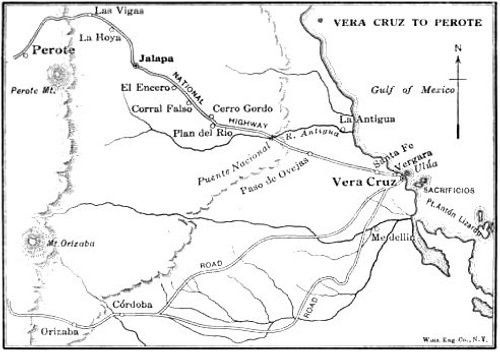
VERA CRUZ TO PEROTE
MEXICAN DEFENSIVE PLANS
Measures to defend the route had been set on foot by Mexico in good season.[6] From the lofty plateau of the interior the national highway—which it was evident that an American army would have to follow on account of its artillery—wound through mountains to sea level, presenting, according to the minister of war, “almost insuperable obstacles against any audacious invader.” Not far above Jalapa the village of Las Vigas marked a spot of military value, and the narrow, rugged pass at La Hoya, though it could be turned without much difficulty, afforded an excellent opportunity to stop a weak force or delay a strong one, while below that city Corral Falso, Cerro Gordo, Plan del Río and the national bridge (puente nacional) were fine points. As early as October 11, 1846, an order to fortify several of these positions was issued. Some gangs of laborers assembled, a little preparatory clearing of the ground was done, a few cannon were moved about; but energy, money, supplies, appliances and engineering skill fell indefinitely short of the requirements, and up to the twentieth of March, 1847, nothing substantial was accomplished.[9]
Contour Lines near Cerro Gordo.
The difference of elevation between two lines is fifty metres.
That day Santa Anna arrived near the capital on his return from the north, and, although he expected Vera Cruz to delay the Americans much longer than it did, he seems to have taken the southern danger into consideration at once. Disputes between the generals had sprung up. As a result La Vega was given the district from Vera Cruz to Corral Falso, General Gregorio Gómez that extending from Corral Falso to Las Vigas, and General Gaona a jurisdiction above this; and each was ordered to fortify his best points and raise as many troops as he could. Over all of these officers was then placed General Canalizo, a little man with a big tongue, as commander-in-chief of the eastern division. The forces under Senobio and other chiefs were to be gathered, “regularized” and trained. The troops—a cavalry brigade, two brigades of infantry and a force of artillery—that had followed the President from La Angostura were ordered to march toward Vera Cruz by the shortest route, a brigade under Rangel to proceed from the capital in the same direction, and 2000 National Guards, from Puebla to join those corps; and General Mora, who now commanded the Army of the North, was instructed to send his bronze 16-pounders to Jalapa with all possible speed.[7] Every effective engineer then at the capital received similar marching orders, and attention was given to the need of ammunition, wagons, mules and other necessaries. At the same time instructions were issued to block the route via Orizaba at Chiquihuite, a naturally strong position below that city.[9]
Late on March 30 news that Vera Cruz had fallen reached the capital. At once the government expelled Black, the American consul residing at Mexico, and issued a circular calling upon all citizens to forget rancor and dissension, offer their lives and fortunes, and stand unitedly behind the President. “Mexicans,” exclaimed Santa Anna, “do not hesitate between death and slavery.... Awake! A sepulchre opens at your feet; let it at least be covered with laurels!” and he adjured Canalizo in the name of the country to fortify Corral Falso and Cerro Gordo, and above all to defend the national bridge “in all possible ways and at all costs” in order to give time for troops to concentrate above it. With Senobio’s forces and the militia—amounting, said this letter, to more than 2000 men—and aided by the topography of the ground, itself “equal in value to an army,” the enemy could be detained, the President assured him; and he was authorized to shoot every deserter and every coward. At the same time Governor Soto was directed to proclaim martial law, call out all the fit men between the ages of fifteen and fifty years, and aid Canalizo in every possible way. Then, after transferring the executive power to General Anaya, the substitute President, Santa Anna left the capital on April 2. As he went down the steps of the palace to his waiting carriage, he and the onlookers felt sad presentiments they could not hide. Even his enemies had tears in their eyes, and it seemed to every one like a final good-by.[9]
SANTA ANNA AT THE FRONT
On the way gloomy reports met him. Soto wrote that while all in his power had been done, the fate of Vera Cruz had smitten the people with terror, and the resources of the state were far from adequate. Canalizo wrote no more hopefully. Efforts had been made to rouse the spirit of the public.[8] Under penalty of death all intercourse with the Americans had been prohibited, and under the same threat all citizens had been ordered to place beyond the invader’s reach whatever could be of service to him. But the outlook was dark. Although a good engineer had been at the national bridge for a week, work on the fortifications had scarcely begun; eight hundred out of a thousand men had fled panic-stricken on learning of Scott’s triumph at Vera Cruz, there was little ammunition or money, and the bridge could not be held. In view of Santa Anna’s adjuration Canalizo promised to make another effort, but he soon ordered La Vega to abandon the position. The light fortifications recently built were demolished, and as wagons to carry the guns away could not be obtained, they were spiked and pitched into a ravine.[9]
Observing at La Hoya that virtually nothing had been done, Santa Anna ordered Engineer Cano to fortify the pass, and then went on to his great hacienda of El Encero, eight miles below Jalapa, where he arrived on the fifth. Two days later, in company with Lieutenant Colonel Robles, he passed Corral Falso, five miles farther down the highway, and the hamlet of Cerro Gordo, nearly five miles beyond that, and finally, making a steep and circuitous descent, he came to Plan del Río, about five miles from the hamlet. Near the first of these three positions the highway passed through a narrow, craggy defile, that could not be turned; but Santa Anna decided to make a stand at the second, because according to the country people and the traditions of both the Spanish régime and the revolutionary war, it was equally unassailable on the flanks, and holding it would force the Americans to remain within reach of the yellow fever, which ceased to be terrible just above Plan del Río.[14]
CERRO GORDO
Very little work had been done at Cerro Gordo, but the position seemed admirable. About half a mile below the hamlet the descending highway entered a ravine, which rapidly deepened. On the left of this rose a hill named El Telégrafo, which, though low and easily ascended from the direction of the hamlet, was five or six hundred feet high on the opposite side and extremely steep. To the right of the ravine the grade of the hamlet continued for more than a mile, ending finally in three tongues, just south of which the plateau was cut, approximately east and west, by a precipitous canyon of rock more than five hundred feet deep, the channel of a small stream called the Río del Plan. The tongues, which may be designated from south to north as A, B and C, were parallel to the highway and more or less fully commanded it.[10] Near the head of the ravine, at a spot that may be called D, a road branched off from the highway toward the tongues, and there was a low eminence, E, in this vicinity.[14]
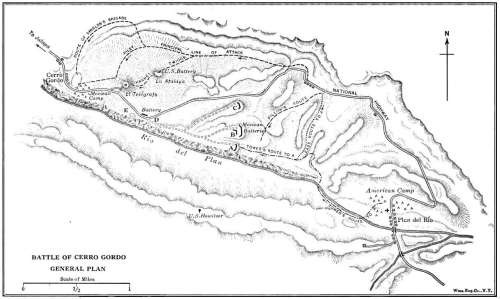
BATTLE OF CERRO GORDO GENERAL PLAN
Larger image
Believing that Scott could advance with artillery only by the highway, Santa Anna gave his chief attention to this part of the terrain, and recalling Cano and his men from La Hoya, he sent them to assist Robles here. At the ends of the tongues parapets were laid out, which, though not completed, served to indicate the correct positions; and in front of each the bushes and trees were cut down and left on the ground, so that an assailant should be impeded and should have no screen. On A General Pinzón, a mulatto of considerable ability, was placed with about six guns and some five hundred men. At B, where the highway had formerly run, there were not less than eight guns and about a thousand troops under General Jarero. C was held by Colonel Badillo with about five pieces and nearly three hundred men.[11] E was entrusted to General La Vega with a reserve of some five hundred grenadiers; and that officer had charge also of a six or seven gun battery at D and of a neighboring breastwork, parallel to the highway—which was cut at that point—and completely dominating it, where the Sixth Regiment, counting nine hundred bayonets, was placed. In all some 3500 men, including the artillery, occupied this wing.[14]
April 17 Santa Anna transferred Robles, Cano and their laborers to the other side of the highway. On the summit of El Telégrafo, which commanded the entire position, there was a level space of about an acre, and in it stood a square stone tower. Here a breastwork, some distance back from the crest and partly enclosing the tower, was imperfectly constructed; four 4-pounders were planted; all the bushes, cactus and small trees within musket range on the slope were cut down and left on the ground; and the Third Infantry, consisting of about one hundred men, took possession of the summit. To the left and rear of this point ran a spur, which rose to a minor crest—a broken ledge eighteen or twenty feet high—some thirty feet lower than the summit and about a hundred yards from it. In the rear of all these points, close to the hamlet, lay the main camp and strong reserves of troops and guns. To Santa Anna the position seemed impregnable. He reported to the government that it was completely fortified, well armed with artillery and garrisoned with 12,000 men.[12] News from the capital that revolutionary movements were on foot and that something must be accomplished to prevent the idea of peace from gaining currency, no longer troubled him. Confiding in his army and his position he gave free rein to his vanity, his lordliness and his exultation. Here should the proud invaders be rolled back or here under the saffron wing of the plague should they rot. And then let domestic foes tremble![14]
But a number of circumstances undermined him. The narrow camp, too much crowded with cottages, tents, huts and market booths, became confused even while there were no hostilities. Insects kept the troops restive. The supply of water, brought in barrels from the Río del Plan, was insufficient,[13] and many drank the crude sap of the maguey, which made them ill. A sort of cholera set in, and exposure produced lung troubles. Far worse, however, were the moral distempers. Some of the troops had turned their backs to the Americans at Palo Alto, the Resaca, Monterey and Buena Vista, while others had recently, to their utter amazement, seen heroic Vera Cruz and mighty Ulúa, the pride of Mexico, haul down their flags; and men of both classes represented the enemy as invincible. Every deserter was ordered shot, and this interference with a popular diversion gave offence.[14]
Looking at the shaggy hills and ravines on his left, Santa Anna declared that a rabbit could not get through there. Perhaps not, thought many a soldier, but the Americans are not rabbits. About seven hundred yards in front of El Telégrafo stood a similar though somewhat lower hill called La Atalaya, which commanded a wide expanse of the rough country, and the engineers felt it should be fortified and strongly held; but the President would merely station twenty-five men there. Robles himself believed that Scott could turn the main position, and wanted fortifications erected at the extreme left; but Santa Anna would listen to no advice, and his cocksureness itself excited alarm. In private, officers talked of a disaster, and even Canalizo foreboded it. The tinder of a panic was ready.[14]
TWIGGS’S ADVANCE
Meanwhile Twiggs with two field batteries,[15] six 24-pounders, two 8-inch howitzers, four 10-inch mortars, and a squadron of dragoons—in all some 2600 men—set out in the footsteps of Cortez.[16] Most fortunately the troops had a stock of enthusiasm, for the beginning of the march was terrible. After going three miles along the beach they struck off at a right angle for six or eight on a deep, sandy road, sometimes three or four feet below the level of the ground, with a blazing sun overhead, not a breath of moving air, and Twiggs’s horse for a pace-maker. Many threw away everything detachable, and the greater part of the division—at least four fifths, it was said—fell by the way. Some died, and many others did not rejoin the command for days. Unbroken mules and drivers ignorant of their business added to the difficulties. The meagre facilities for transportation did not permit even officers to have tents, and some of the scanty supplies were lost through the breaking down of wagons.[19]
The next day, happily, a change took place. The column set out before sunrise, marched more slowly, and halted occasionally; and the national highway, no longer buried in sand, proved to be a spacious, comfortably graded cement avenue, carried over the streams by handsome bridges of cut stone, and flanked on both sides by the estates of Santa Anna.[17] Now it penetrated a dark forest of palms, cactus, limes and countless other trees festooned with vines, and now it crossed rolling prairies. Here it was cut through solid rock; here it skirted a beautiful hill, with a charming vista of leafy glades; and presently it was clinging as if in terror to the face of a cliff. Bowers carpeted with many soft hues and perfumed with heliotrope recalled ideas of Eden, while marshes full of strange bloated growths, bluish-green pools rimmed with flowers of a suspicious brilliancy, and thick clumps of dagger plants tipped with crimson offered suggestions of a different sort.[19]
Matted tangles of leafage spattered with gold, big tulipans gleaming in the shadows like a red rose in the hair of a Spanish dancer, blossoms like scarlet hornets that almost flew at one’s eyes, and blooms like red-hot hair-brushes, the sight of which made the scalp tingle, were balanced with big, close masses of white throats and purple mouths, and with banks of the greenish-white cuatismilla, discharging invisible clouds of a fragrance that seemed to be locust blended with lily of the valley. Trees with tops like balloons, like corkscrews and like tables, trees drained almost dry by starry parasites that swung from their branches, trees covered with strawberry blossoms—or what appeared to be strawberry blossoms—that were to graduate into coffee beans, trees bare of everything except great yellow suns, the Flower of God, that fascinated one’s gaze—these and countless other surprises followed one another; and then would come a whole grove netted over with morning glories in full bloom. Amid scenes like these our exhausted troops quickly regained their spirits.[19]
Toward the end of the march on the eleventh, when about thirty-seven miles from Vera Cruz, the troops crossed a branch of the Antigua, and soon came to the river itself. In the triangular space thus bounded rose a hill crowned with an old fort.[18] Here stood the national bridge, a magnificent structure more than fifty feet high and nearly a quarter of a mile in length, commanding romantic views of the rapid stream winding through towering vistas of luxuriant vegetation. On leaving the bridge the road made a sharp turn to the left at the foot of a high and very steep bluff; and it seemed as if a battery planted at the top of the bluff, as La Vega’s had been, might stop an army until overpowered with siege guns. But Canalizo had been wiser than his chief, for there were fords above and below and cross-roads in the rear, that made it possible to turn the position. So amidst a wondrous illumination from glow-worms and fireflies, the troops made their third camp here in peace.[19]
Beyond this point the influence of Canalizo could be seen. The bamboo huts thatched with palm-leaves were all vacant and empty. Scarcely one living creature could be seen except flitting birds. These, however, still abounded: parrots, macaws, hawks, eagles, orioles, humming-birds, mocking-birds, cardinals brighter than cardinals, cranes larger than cranes, talkative chachalacas, toucans as vociferous as their bills were huge—every color from indigo to scarlet, and every note from the scream to the warble; and the same ocean of green still rolled its vast billows, warmed and brightened by the same golden sun.[19]
At the end of this march, about thirteen miles from the national bridge, the highway narrowed and pitched down a long, steep, winding descent, with overhanging trees and rocks on one side and a precipice on the other, as if making for the centre of the globe. Then it crossed Río del Plan, and came to a small, irregular opening, where a few scattered huts could be seen. This was Plan del Río. Views of superb heights delighted the eye, but the hot breath of the coast could be felt in the valley. Even the hollows between the sand-hills of Vera Cruz were thought less pestilential. But the men lay down, and, as a soldier wrote, covered themselves with the sky.[19]
In the midst of scenery like this, “Old Davy” Twiggs appeared like a perfectly natural feature. His robust and capacious body, powerful shoulders, bull-neck, heavy, cherry-red face, and nearly six feet of erect stature represented physical energy at its maximum. With bristling white hair and, when the regulations did not interfere, a thick white beard, he seemed like a kind of snow-clad volcano, a human Ætna, pouring forth a red-hot flood of orders and objurgations from his crater of a mouth; and he was vastly enjoyed by the rough soldiers even when, as they said, he “cursed them right out of their boots.” In a more strictly human aspect he made an excellent disciplinarian, and he could get more work out of the men than anybody else in the army; but as a warrior, while he always looked thirsty for a fight, he was thought over-anxious to fight another day—to be, in short, a hero of the future instead of the past; and as a general, Scott had already said that he was not qualified “to command an army—either in the presence, or in the absence of an enemy.” His brains were, in fact, merely what happened to be left over from the making of his spinal cord, and the soldiers’ names for him—the “Horse” and the “Bengal Tiger”—classed him fairly as regarded intellect.[20]
Twiggs had been warned by Scott that a substantial army, commanded by Santa Anna, lay in his front; lancers were encountered on April 11; and a reconnaissance of that afternoon, made because the enemy were said to be in force just ahead, proved that guns commanded the pass of Cerro Gordo; yet the next morning he advanced in the usual marching order. Nothing saved his division but the eagerness of the Mexicans. They opened fire before he was entirely within the jaws of death, and he managed to retreat—extricating his train with difficulty, however. The enemy have given up and withdrawn, boasted Santa Anna, while the Americans felt ashamed. Further reconnoitring on that day gave a still more impressive idea of the problem ahead; but the General, as if intoxicated by holding an independent command, ordered an assault made at daybreak the next morning. The Volunteer Division, consisting at present of two brigades, a field battery and a squadron of cavalry, then arrived. Patterson, who led it, seemed, however, by no means eager to accept the responsibility of command, and, as no confidence whatever was felt in Pillow, the second in rank, he placed the entire force under Twiggs on the ground of illness. Pillow and Shields, who were thought no less willing than Twiggs to make a bid for glory at the expense of their men, then demanded a day for rest and preparation; and accordingly, about sunset on the thirteenth, orders for the attack were issued.[20]
DISCOURAGEMENT
But the officers and soldiers, distrusting alike the information and the ability of their commander, now felt extremely depressed. The situation appeared hopeless, thought even Lieutenant U. S. Grant; and Captain Robert E. Lee described the Mexican position as an “unscalable” precipice on one side and “impassable” ravines on the other. It seemed, wrote a third man, like a Gibraltar; and the idea of assailing it with Twiggs for leader inspired the deepest alarm. Everybody not selfishly ambitious desired to wait for the commander-in-chief; and yet Polk, in order to justify his depreciation of Scott, said with reference to this very situation, that our forces would be victorious “if there was not an officer among them.” Suddenly, however, the faces of the men brooding round their bivouac fires lighted up, for news came that Patterson, in order to veto the project of Twiggs, had assumed the command, and ordered offensive operations to be suspended.[20]
Scott, whose ideas of an army differed radically from those prevalent in Mexico, hardly believed that Santa Anna could place himself below Jalapa at this time with as many as 4000 men, even though reports of a larger number reached him; but he arranged to drop his work at Vera Cruz on the first news of serious opposition, and letters from Twiggs and Pillow, received late on April 11 led him to set out the next day. Early on Wednesday afternoon, the 14th, he was at Plan del Río, doffing his old straw hat as the soldiers, who doubtless realized that in taking Vera Cruz by siege instead of assault he had spared their lives, cheered tumultuously. Instantly chaos became order, confidence reigned, and the jealous clashes of the commanders ended. Now something will be done, thought the officers; the soldiers began to laugh and whistle; and what an officer called a “hum of satisfaction” pervaded the camp. Already the battle was half gained.[23]
Engineers Beauregard and Tower had by this time done some reconnoitring, and, as indeed would have been fairly obvious to any intelligent person, had concluded that a turning movement against the Mexican left—toward which a trail had been found to lead—offered the best hope. But an idea was not a plan. The reconnaissances were far from complete, and reports upon the Mexican position and numbers differed materially. Hence the commander-in-chief, who accepted everything valuable done by his subordinates but never surrendered his own judgment, decided to begin anew, and, in the hope of gaining the highway in Santa Anna’s rear and cutting off his entire army, sent Captain Lee at once to the ravines.[21] Friday that indefatigable engineer found himself in contact with the Mexican lines far to the rear of El Telégrafo. Reconnoitring could go no farther, and the highway toward Jalapa was not actually seen; but there were good reasons for believing it near, and the construction of a “road” for troops and artillery on the route discovered by Lee was pressed with great energy. At about 9 o’clock on Friday evening all the facts and conclusions were brought together in a plan by Major John L. Smith, senior engineer on the ground, and in substance his plan was adopted. Its essential point was, in accordance with Scott’s announced aim, to gain the highway in the Mexican rear first of all, and then—not until then—attack in the rear and perhaps also on the front.[22] After the adjournment of this conference the army was further cheered by the arrival of Worth, 1600 picked men and a number of heavy guns. The Mexican forces were estimated as 12–18,000, and Scott had only 8500; but the bright stars of that night looked down on an army sleeping soundly in full courage and confidence.[23]
PRELIMINARY OPERATIONS
At seven or eight o’clock the next morning Twiggs advanced. His instructions were to avoid a collision, occupy La Atalaya, reach the Mexican left, and rest on his arms near the highway until the remainder of the army should be in position, and the time for acting decisively should arrive. Accordingly, after marching about three miles along the highway he turned off to the right by the road already cut, ordering the men to trail arms and preserve absolute silence. At one point the road lay for twenty-five or thirty feet in view of the enemy, and Lee proposed to screen it with brush. But this appeared to Twiggs quite unnecessary, and hence the Mexicans could observe not only the troops but four mountain howitzers, four 6-pounders, and two 12-pounders gleaming in the sun. Pinzón and also the outpost on La Atalaya notified Santa Anna of the American movement, and strong reinforcements were therefore despatched to that hill.[26]
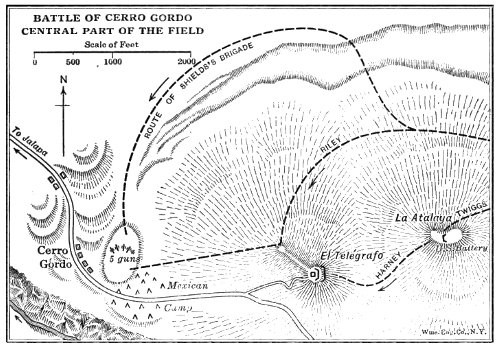
BATTLE OF CERRO GORDO
CENTRAL PART OF THE FIELD
Twiggs advanced but slowly, for the road—hewed in the roughest way through oaks, mesquite, chaparral, cactus and the like and over almost impassable ground—could barely answer its purpose, but about noonday the command found itself in the vicinity of La Atalaya. Lieutenant Gardner of the Seventh Infantry was then directed to ascend a neighboring hill with Company E, and take an observation of the enemy. He was attacked; upon which Colonel Harney, now commanding Twiggs’s first brigade in place of Persifor F. Smith, who was ill, sent forces to relieve him, pursued the Mexicans to La Atalaya with the Mounted Rifles, First Artillery and other troops, and after a stiff combat occupied that point.[26]
One of the captains—for on such ground independence of action was unavoidable—inquired of Twiggs how far to charge the enemy. “Charge ’em to hell!” roared the Bengal Tiger; and naturally enough a small American force rushed down the farther slope of La Atalaya and began to ascend El Telégrafo. It was then in a desperate situation, exposed to the cannon of the Mexicans and to overwhelming numbers. A party of Americans under Major Sumner, which bravely hastened to its relief, succeeded only in sharing its plight. But happily cover was found; a howitzer discouraged the enemy; and later this group was able to retire. La Atalaya remained in American hands despite attempts to recover it; but the Mexicans had been fully warned, and our troops were not lying on their arms near the Jalapa route. Meantime or soon Shields’s brigade came to the support of Twiggs, who now had control of nearly 5000 men. The casualties amounted to about ninety on our side and more than two hundred on the other; but the Mexicans, whose operations had been directed by Santa Anna himself, believed the Americans had seriously attacked El Telégrafo, and exulted loudly with shouts and music over what seemed to them a triumph.[26]
Santa Anna did not yet believe, or would not admit, that Scott’s main drive would be aimed against his left, but he recognized the wisdom of strengthening that wing. He therefore ordered a breastwork, which was made of short palisades reinforced behind with stones and brush, to be thrown up near the base of El Telégrafo, placed a couple of 12-pounders, the Second Ligero and the Fourth Line regiments on the summit, selected brave Ciriaco Vázquez to command there, planted five guns on a slight eminence near headquarters to guard the mouth of a wooded ravine on the left, had the ground in front of this battery partly cleared, and ordered the Eleventh regiment and Canalizo’s cavalry to support the guns. The Americans were not less active. By dint of extraordinary exertions General Shields’s brigade, assisted by other troops, dragged a 24-pounder and two 24-pound howitzers with ropes through the woods and rocky gorges, pulled them up the steep and bristling side of La Atalaya, mounted them, and constructed a parapet for them and the rocket battery; and with perhaps even greater difficulty four New York companies placed an 8-inch howitzer on the farther side of Río del Plan over against the tongues, A, B and C. Darkness and rain did not facilitate these operations.[26]
THE BATTLE OF CERRO GORDO
Sunday morning the sky was clear, a gentle breeze from the Gulf just fluttered the red, white and green flag on the stone tower, and the Mexican trumpets blared in all directions. Soon the guns of La Atalaya solemnly announced the battle, producing consternation at first on the summit of El Telégrafo; but the pieces were badly aimed, and accomplished little beyond encouraging the Americans and calling forth a vigorous reply.[24] The Second Infantry and Fourth Artillery under Brevet Colonel Riley of Twiggs’s division now moved on toward Santa Anna’s rear and the Jalapa route, supported by the brigade of Shields, which included the New York regiment and the Third and Fourth Illinois. Learning of this activity in the valley, General Vázquez ordered Colonel Uraga with the Fourth Infantry and a 4-pounder to the minor crest of El Telégrafo, and as Riley crossed the continuation of the spur he was much annoyed by their fire. Four companies of the Second Infantry were therefore detached as skirmishers, and before long, in spite of Scott’s orders and the protest of Lee, who was conducting Riley’s command, Twiggs, pawing the ground somewhere out of range, ordered Riley’s whole brigade up the hill. Shields, however, proceeded along the route discovered by Lee. The ground was rough and precipitous, and the growth of trees and thorny chaparral dense; but the General—a stout, soldier-like man with a heavy mustache, black hair and brilliant dark eyes—had a great deal of energy, and in three straggling files his men pushed on.[26]
During the artillery duel Harney’s command lay under cover on the summit of La Atalaya, listening to the harsh, bitter shriek of the Mexican grape, which tore the bushes into shreds; but at about 7 o’clock a charge upon El Telégrafo was ordered.[25] As the troops measured the height, crowned with guns and fortifications and topped off with a scornful banner, the attempt seemed almost impudent; but that was the day’s work, and it had to be done. First the “cursed Riflemen,” as the Mexicans named them, were diverted to the left, where the Mexican Sixth Infantry could be seen approaching; the bugles sounded; and then the Third and the Seventh Infantry, supported by the First Artillery, dashed down the slope of La Atalaya. Here and in the valley they were swept by a deadly shower of bullets, canister and grape, and the front melted like snowflakes; but, as fearless Captain Roberts of the Rifles put it, “When dangers thickened and death talked more familiarly face to face, the men seemed to rise above every terror.” The contest at the palisade breastwork was hard, and the Mexicans dared even to cross bayonets with Americans; but they finally gave way. Here a little time was taken for rest, and then forward pressed the troops, helping themselves up the slope, over craggy rocks and loose stones, and through the chaparral by catching at bushes and trees. The screen of woods and the steepness of the incline protected them now.[26]
Very different proved the cleared part of the hill, where small trees, bushes and thorny cactus lay spread with tops pointing down. Here progress was slow and concealment impossible. But with deliberate fearlessness the men plodded firmly on, firing at will, strong in that mutual confidence which gives a charge its force. They “seem to despise death,” cried the Mexicans in astonishment. Here and there one was struck down; here and there, breathless and exhausted, one dropped; but no flinching could be seen. Like the wave of fire in a burning prairie, the line moved steadily up. “Charge, charge!” shouted the officers; and the men yelled and cheered, yelled and cheered, yelled and cheered till sometimes it seemed as if even the trees were cheering, till sometimes the roar of the guns could not be heard; and Harney—red-headed, tempestuous Harney of the steel-blue eyes—at last in his element, led them as they deserved to be led. Superbly tall, his athletic figure needed no plume; the sword in his long arm waved them on; like the keen edge of a billow rushing upon the shore his calm, shrill voice rode the tumult.[26]
Just below the crest a pause for breath; and then the blue stripe was up and over. At the breastwork the fighting was sharp, for Santa Anna had sent up two more regiments; but soon Vázquez fell; with pistols, bayonets and clubbed muskets the Mexicans were driven from the summit; and in a moment big Sergeant Henry of the Seventh had the Stars and Stripes flying from the tower. Riley’s men, pushing up through dense thickets under a hot fire, had now taken possession of the spur; and while some of them hurried on to join Harney, others shot down the gunners of the battery on the summit. In a twinkling Captain Magruder turned the pieces, and poured a storm of iron on the flying Mexicans. General Baneneli, commanding the reserve just below, tried hard to charge, but his men would not face the yelling Americans. The Grenadiers and the Eleventh Infantry, hurried by Santa Anna in that direction, were overwhelmed by the fugitives; Riley’s advance plunged down the hill toward the Mexican camp; and an indescribable confusion ensued.[26]
Just at this time, after a fearful march of perhaps two miles, Shields with his foremost companies emerged from the chaparral on the Mexican left, and hastily prepared to charge. Three guns of the headquarters battery, one hundred and fifty or two hundred yards distant in their front, had been turned upon Riley, but the other two let fly at them. Shields fell and his men recoiled. It was no wonder. About three hundred raw volunteers, without regulars and without artillery, stood before cannon and an army! Some two thousand fresh horse under Canalizo, guarding that very ravine, faced them just at the left of the battery, and the cannon kept at work. But their mere emerging from the close chaparral at this point, in a strength which the enemy could not measure, was of itself a triumph.[26]
“The Yankees! They have come out to the road!” cried the Mexicans; “Every one for himself!” Some of Riley’s men shot down or frightened away the gunners of the battery, and in another moment seized three of the pieces. At the same instant a section of Shields’s brigade, which had now come up in more force, captured the other two, while a second section, followed by the Seventh Infantry, struck for the highway. Canalizo, afraid of being cut off, took flight, as many had already done; and all the rest of the Mexicans who could, either followed him or, like Santa Anna himself, rushed headlong down one or the other of two paths, narrow and steep, that descended into the canyon of the Río del Plan. Scott, who had watched the charge “under a canopy of balls,” as Major Patten said, was now on the scene. Harney, his old foe, he greeted in the warmest and friendliest of terms; and, as he moved among the victorious troops with tears rolling down his cheeks, he spoke to them noble and touching words, as not merely their commander but their elder brother in arms, fully sharing their pains, their pride and their joy.[26]
While these brave scenes were enacted, the other flank witnessed a burlesque of war. Naturally Scott planned to attack the Mexican right in order to deceive Santa Anna regarding his intentions, prevent the troops of that wing from going to the assistance of the other, and perhaps accomplish something positive in that quarter.[27] This piece of work was assigned to Pillow’s brigade, and although he objected to it as dangerous, a hint about discipline brought him into line. As early as April 13, in view of Twiggs’s plan, he and Lieutenant Tower of the engineers had reconnoitred the ground, and this examination had been continued on the fifteenth and sixteenth; but the General did not understand or did not remember what he saw. It was clear, however, that a force attacking between A and the canyon would have the enemy on but one side, and would be as far as possible from the guns occupying B and C. With Scott’s approval this plan was adopted, and the 8-inch howitzer was placed so as to command the flank and rear of the battery at A.[29]
Pillow’s orders were to set out on his march of about four miles at 6 o’clock on Sunday morning, yet he did not reach his position until almost 9. One reason for the delay probably was, that in consequence of a manoeuvre, executed by his order, the rear of the column missed the proper route. Another reason also may be surmised. Aside from wanting confidence in their general’s military capacity, his troops had long disliked him; and his display of unfeeling harshness on the march from Vera Cruz had given further offence. Under such circumstances things never can go well.[29]
During the march he announced that he had changed his mind, and would have the First Pennsylvania (Wynkoop) supported by the First Tennessee (Campbell) attack on the northern face of tongue A, and the Second Tennessee (Haskell) supported by the Second Pennsylvania (Roberts) attack on the southern face of B, which was obviously sure—since it guarded the old road—to be held more strongly than either of the other tongues.[28] This ingenious plan, moreover, divided the American while tending to concentrate the Mexican strength. By mismanagement he reversed both of his attacking regiments—a mistake that caused embarrassment and loss of time; and then on leaving the highway, about three miles from Plan del Río, and entering the narrow path leading to the point of attack, he adopted this order: Wynkoop, Haskell, Campbell, Roberts, which—since it was necessary to advance mostly in single file—placed Campbell and Roberts a long distance from the troops that each was to support, so that neither of them reached his position before the fighting on this wing ended.[29]
On arriving at the appointed spot, where the orders of Mexican officers at B could be heard very distinctly, Haskell began to form his badly scattered regiment. “Why the Hell don’t Colonel Wynkoop file to the right?” shouted Pillow at the top of his voice. A bugle in the front sounded instantly, and within three minutes the Mexicans opened a heavy fire of grape and canister. Some of Haskell’s men, brave but not in hand, bolted; others took shelter; and the rest, at Pillow’s order, charged pell-mell. Emerging into the cleared space they received a murderous fire from all of the tongues. In less than three minutes about eighty, including every field officer except the colonel, were either killed or wounded, and all able to move were in flight. Pillow meanwhile, squatting in the bushes with his back to the enemy at a distance of about 450 yards, was “shot all to pieces,” as he said, by a canister bullet that slightly wounded his upper arm; and he retired at a run, leaving Wynkoop without the promised instructions.[29]
A state of general confusion ensued. Campbell and his men were anxious to charge; Wynkoop felt no less eager when it was too late; the Second Pennsylvania was demoralized; all were more or less under fire. Campbell, however, to whom Pillow resigned the command, got the men almost ready to charge upon tongue A; but then Pillow, venturing back from the rear, withdrew his brigade so far into the woods that, until notified by Scott, he did not know the Mexicans in his front, who found their rear was occupied by the Americans, had surrendered. As for the 8-inch howitzer, it fired seven ineffective shells; and then, at the critical time, as Pillow had neglected to arrange a code of signals, Ripley, who controlled it, suspended work. Evidently, as Polk said, gallant Americans—and such Pillow’s men really were—did not require a commander![29]
A little before 10 o’clock the fighting was over and pursuit began. Having little cavalry and no adequate subsistence train Scott’s powers in this respect were limited; but every man had been expected to set out in the morning with rations for two days, and substantially all the troops except Pillow’s, accompanied by two incomplete batteries, moved actively forward. Patterson once more became well enough to act, and took charge of the advanced forces. Frequently bands of fugitives were seen at a distance, looking in their cotton or linen jackets like flocks of sheep. The artillery had some fair long shots, and occasionally other troops also came within reach of the enemy. But the Mexicans fled—even the cavalry—without stopping for ceremony, too much cowed to face even a small party of Americans; and the results were of little significance.[31]
Heat and exhaustion checked the most advanced pursuers about four miles from Jalapa, but nothing could stop the Mexicans. Like stampeded cattle, the fugitives thought only of flying until worn out. No stand was made at Jalapa. At La Hoya, the second line of defence, General Gómez, hearing of the disaster, sent word to the rear, “All is lost at Cerro Gordo, all, all!” and fled. In complete disorder, panting, starving, falling by the way—the horses of the cavalry in a like state—the men streamed on toward Puebla, plundering when they could. Thousands also of those who surrendered managed to escape at one place or another in the rough, wooded country, and, as Scott could with difficulty feed his own army and thought future opposition could be weakened by proving the friendly sentiments of his proclamation, the remaining 3000 were released on parole.[30] More than 4000 stand of arms, old and not worth using, were destroyed; and about forty cannon, which Scott had no means of transporting, were rendered unserviceable and left at Cerro Gordo. The Mexican casualties were estimated at 1000 or 1200, while the American loss during the two days amounted to only thirty officers and 387 men, of whom sixty-four were killed.[31]
JALAPA OCCUPIED
Next morning the Americans advanced again. For the two last miles below Jalapa the highway ran between continuous hedges loaded with blossoms and vocal with the songs of birds, while bougainvillea flamed here and there on a cabin or tree-top in a conflagration of purple, and the air was laden with delicious perfumes; and when the town was descried from an eminence, it seemed like a delicate mosaic set in a massive frame of rich emerald. Friends had been left behind forever, but grief was offset by the joy of surviving; and after dressing ranks the troops began to enter Jalapa at about 9 o’clock with bayonets fixed, colors flying and bands playing. Some of the girls could not help laughing at the unkempt appearance and nondescript costumes of the terrible and victorious Yankees; but the people, who lined the streets, appeared neither hostile nor afraid, and the bells rang out a welcome.[32] The soldiers for their part soon felt they had reached Eden, and they were none the less content on hearing of the dull saffron haze which now hung over Vera Cruz—a visible token that “King Death in his Yellow Robe” had once more set up his throne there; while Scott himself, wishing to tranquillize the army and favorably impress the public, proceeded to hide the errors of his subordinates with reports that misled the public.[33] As for the future he cheerfully announced, “Mexico has no longer an army.” Apparently the United States had a very substantial one; but surprises were soon to occur.[34]
XXIV
PUEBLA
April-August, 1847
THE ADVANCE FROM JALAPA
Wishing to take advantage of the Mexican panic, Scott hurried Worth’s division after the fugitives. Down the steep hill on which Jalapa lies poured the men in blue, passing the little plaza and the quaint cathedral; and then without halt, leaving the city of flowers and its groves of liquidambar, they set out on a long, gradual ascent. What a march they now had! “The most beautiful country there is,” commented an officer; and his remark was truer than he knew. Dominated by the splendid snowy peak of Orizaba, there spread a vast expanse of hills and gorges, mountains and valleys, here studded with white villages, there gemmed with a silver cascade, yonder brightened with fresh fields of corn and grain, always variegated with the shadows of lazy clouds, and everywhere softly receding into a deeper and still deeper blue; and as the column wound in and out through the clear, cool and fragrant atmosphere, every turn revealed new beauties or displayed once more the beauties already seen—only a little nearer each time, or a little more remote.[1]
Gradually the ascent grew sharper and the air cooler, and about a dozen miles from Jalapa Worth came to the Black Pass—the “terrible pass,” wrote Scott—of La Hoya, where for more than a mile the troops were squeezed between two steep mountains, cleared to afford artillery a fair sweep, and partly fortified; but the seven or eight guns lay on the ground spiked, and not an enemy could be seen. Then after making a sharp twist they kept on winding and ascending for about six miles till they reached the log houses of Las Vigas, much like those of Russia and Sweden. Vegetation was luxuriant still; but the trees on the steep hills at the left were evergreens, and the flowers that brightened the overtowering walls, buttresses and spurting arches of black lava were mostly dandelions and yellow jarilla, for the Americans now stood a mile and a half above the sea and almost three quarters of a mile above Jalapa. Here the winds bit; and now and then masses of thick vapor, whirling up from an immense gorge and burying the column for a time in wintry twilight, would sweep on ahead of it in rolling, shining volumes of heaven-high clouds.[1]
6. In January Gen. R. D. de La Vega was made chief of the Division of the East and provided with an army—mostly of paper. The same month Alonzo Wenghieri offered to furnish 50,000 muskets, 25,000 tercerolas (carbines of a certain kind) and 50,000 swords at reasonable prices, but it is not certain that his offer, though endorsed by the war department, was accepted (76to Hacienda, Jan. 14). By March 12, four 16-pounders from Vera Cruz arrived at the national bridge. March 18 orders proper for the situation were despatched to La Vega, but they sound as if issued mainly for form’s sake. In February the government attempted to take control of 25,000 National Guards for the purposes of the war (76circular Feb. 3); but it soon rescinded that unpalatable assumption of authority, and confined itself to asking state governors for them (76circular, Apr. 8).
9. Mexican preparations before Santa Anna arrived on the ground. Courrier Français, Apr. 3, 10, 17. 52Consul Black, Apr. 25. Davis, Autobiog., 142. 13Bankhead, no. 34, 1847. Apuntes, 120–2, 168. Revue Indep., Apr. 25, 1845. Memoria de ... Guerra, Dec., 1846. Lerdo de Tejada, Apuntes, ii, 574. Diario, Mar. 29; June 8. Monitor Repub., Mar. 31. Rivera, Jalapa, iii, 888. Balbontín, Invasión, 105. 94Canalizo, proclams., Apr. 2, 4. 94Soto, proclams., Jan. 22; Feb. 5. Regenerador Repub., Mar. 31. 84Guerra, decree, Feb. 13. 84Relaciones, circular, Feb. 16. Republicano, Mar. 31. Ramsey, Other Side, 221, note. And from 76 the following (out of a great number). To Rincón, Oct. 10, 11, 1846. To La Vega, Jan. 25; Mar. 18, 20, 27, 1847. Acuerdos, Mar. 24, 25, 28, 29, 30, 31; Apr. 1. To Gaona, Apr. 1. To Canalizo, Mar. 28, 31; Apr. 1. Gaona, Mar. 18; Apr. 1. Soto, Mar. 7, 22, 26; Apr. 3. G. Gómez, Mar. 18, 19, 25, 26. La Vega, Mar. 22, 24. Canalizo, Mar. 30; Apr. 1, 3. To Soto, Apr. 1. Soto to V. Cruz cong., Dec. 1, 1846. Morales, Oct. 15, 1846; Feb. 2, 6, 1847. Canalizo to his troops, Mar. 29. Guerra, circulars, Feb. 3, 13; Mar. 31; Apr. 8. To comte. gen. Mex., Mar. 25. Canalizo, proclam., Mar. 29. To gov. Puebla, Apr. 1. Gov. Puebla, Mar. 28. A little later Santa Anna had the spiked cannon drawn to Cerro Gordo by cattle.
7. March 24 the northern brigades were at Querétaro on their way south (76acuerdo,[D] Mar. 24). Rangel’s brigade and some artillery left the capital March 28. March 30, 1400 National Guards, who had been turned over to the national government by the governor of the state (82Guerra to gov., Apr. 1), left Puebla to join 700 of the same class already at Jalapa, and some 12-pounders were despatched from the former city. These forces were primarily designed to aid in the defence of Vera Cruz by attacking Scott’s rear. There was great need of money, especially as the attitude of the clergy was now so dubious that even drafts accepted by them were distrusted (Diario, June 8).
8. One method of rousing the public was to excite religious fanaticism. A pamphlet, Clamor de las Ovejas, declared that some of the Vera Cruz churches were to be sold to Protestants, others to Mohammedans, others to pigs, others to worshippers of Venus.
14. Mexican preparations, Apr. 4–16. Delta, May 1. Picayune, May 2. 312Anaya to S. Anna, Apr. 9. 312Guerra to gov. Puebla, Apr. 9. 312Pablo to S. Anna, Apr. 8. 312Guerra to S. Anna, Apr. 9. 312Baranda to S. Anna, Apr. 8. Courrier Français, Apr. 17. Repub., Apr. 22; June 1, 9. Sen. 1; 30, 1, p. 261. Negrete, Invasión, iii, app., 49. Grant, Mems., i, 134. Apuntes, 121, 169–75. Tributo á la Verdad, 41. S. Anna, Apelación, 33–7. Suárez y Navarro, Causas, 68. Steele, Amer. Campaigns, i, 121. Diario, Mar. 29; Apr. 3, 9, 30; June 10. Gamboa, Impug., 29–32. Ramírez, México, 214, 229. Bustamante, Nuevo Bernal, ii, 157, 189. Lerdo de Tejada, Apuntes, ii, 574. Dublán, Legislación, v, 264–5. Monitor Repub., Apr. 24, 27, 28; May 3; Oct. 24. 13Bankhead, no. 34, Apr. 1. Oswandel, Notes, 139. 82Pavón, Apr. 29. Sedgwick, Corres., i, 86. 76Gaona, Apr. 8. 76To Canalizo, Apr. 2. 76To S. Anna, Apr. 9. 76Canalizo, Mar. 29; Apr. 3, 24. 76S. Anna, Apr. 6, 7, 11, 13, 17, 29; May 7. 76Uraga, May 1. 76Memorias by heads of war dept., Nov., 1847. 76Decrees, Apr. 8, 10. 76A great number of less important papers.
10. The northern wall of the cañon is much more nearly vertical than the southern. The author went down one side and up the other by rough mule paths.
11. Accounts differ as to the number of men and guns on each tongue but agree that B was much more strongly guarded than A and C. It had supporting works. After the battle R. E. Lee wrote that the highway was commanded by thirty-five Mexican guns (F. Lee, Gen. Lee, 38). Allowing four for El Telégrafo, five for the battery at the camp, and seven for D, we should have nineteen left for the tongues. In all, according to the chief Mexican artillery officer, there were forty-one pieces, so that Santa Anna was able to send additional guns to his left. There seems to have been a 12-pounder at A, but most of the guns were light. The four 16-pounders were at D, and commanded the highway.
12. After the battle Santa Anna reduced his numbers to about 6000 infantry (only about half of them permanent) and 1500 or 2000 cavalry (76May 7; Negrete, Invasión, iii, app., 112); but on March 20 (76to La Vega) he had placed the troops from La Angostura at 6000 (Roa Bárcena, Recuerdos, 194, says 5650) to which must be added at least 2000 from the capital (ibid.), 2000 (besides a brigade that arrived just before the battle) from Puebla (note 7), and contingents from Jalapa, Coatepec and other places. Mexican accounts run from Santa Anna’s figures up to 15,000 (Republicano, June 1, correspondent). Canalizo, April 3, proclaimed that more than 12,000 were coming, and the troops to whom he referred did not include all who were present. 13Bankhead placed the number from Mexico at 2500. Roa Bárcena (Recuerdos, 195) specifies 3, 4, 5, 6 and 11 Line regiments, 1, 2, 3, 4 Ligero regiments, 5 and 9 cavalry, and 12 smaller corps of foot and horse. Canalizo’s demand that all citizens rally to the colors does not seem to have been very effective; but many who had given their parole at Vera Cruz were forced to take up arms (Roa Bárcena, Recuerdos, 189). It appears safe to estimate that Santa Anna had at least 10,000, probably 11,000, and quite possibly 12,000 men besides the Puebla brigade under Arteaga, which arrived after the fight had begun. The brigade from Mexico arrived April 11, and the three brigades from the north April 12. After the battle Santa Anna and others attempted to represent the troops as of wretched quality. But certainly he had picked the corps brought from the north, and there is no reason to suppose that the other troops were below the average. Santa Anna pretended that he lacked ammunition, but great quantities were found in the camp after the battle (Oswandel, Notes, 139). The distribution of it was very likely defective, however. It was asserted also that some of the cannon cartridges contained no powder. They should have been inspected. Twenty-nine Irishmen served in the hospital force (76acuerdo, Mar. 30). The army was fairly well supplied with money. April 10 38,000 pesos went from the capital, and the bishop of Puebla sent 10,000.
13. Santa Anna had water brought from El Encero by a ditch, but it only began to run just as the battle opened.
15. One of the field batteries was Taylor’s; the other was Talcott’s howitzer and rocket battery (R. Jones to ordnance dept., Dec. 3, 1846). Steptoe’s field battery and a squadron of dragoons accompanied Patterson later. The statement regarding the artillery outfit is from Lieut. Hatch (213to father, Apr. 7), who went with Twiggs.
16. Scott has been called rash for sending his army forward and exposing it to attack piecemeal. But (1) had it all formed one column it would have been no safer against a raid from some crossroad; (2) had it been attacked in front, numbers would not have signified, and the individual superiority of the Americans as well as their superior artillery would have given them the advantage; and (3) Santa Anna, having possession of such fine defensive positions, was not likely to make a venturesome attack, especially as the battle of Buena Vista had shown how tenaciously the Americans could defend themselves. The two last points bear also upon the criticism that Santa Anna ought to have attacked Twiggs before the arrival of Pillow and Shields (see remark at the end of note 14). The volunteer division left Vera Cruz April 9 under Patterson. It consisted of two brigades, for Quitman’s men had not sufficient transportation, and probably needed time to recover from the effects of the Alvarado expedition. Capt. Loch, a British naval officer off Vera Cruz, was as much surprised as Scott when it was found that Santa Anna had a large force at Cerro Gordo (12to commodore, Apr. 9).
19. The march from Vera Cruz to Plan del Rio. Ho. 60; 30, 1, pp. 920–2, 928 (Scott); 921 (gen. orders 94). Hartman, Journal, 10. Picayune, Dec. 9. Delta, May 15. 312Gutiérrez to gov. Puebla, Apr. 9. Sen. 1; 30, 1, p. 274 (Twiggs). 217Henshaw papers. Stapp, Prisoners of Perote, 159–60. Raleigh Star, May 5. 280Nunelee, diary. 159Narrative based on papers of F. Collins. 220Higgins to Clutter, Apr. 1, 1851. Ballentine, Eng. Soldier, ii, 36–48. Davis, Autobiog., 142–4. Apuntes, 169. Ward, Mexico, i, 12; ii, 177–88. Robertson, Visit, i, 269. Ruxton, Adventures (1849), 22–5. Tudor, Tour, ii, 171–5. Bullock, Six Months (1825), i, 32–42. Orbigny, Voyage, 409–10. Robertson, Remins., 238–40, 242. Latrobe, Rambler, 297. Velasco, Geografía, iii, 28, 37, 54, 64. Lawton, Artillery Officer, 123, 132. Engineer School, U. S. Army, Occas. Papers, no. 16. 291Pierce, diary. Journal Milit. Service Instit., v, 38 (Coppée). Bishop, Journal. 60G. W. Smith to Stevens, Apr. 23. Hawthorne, Pierce, 78–85. Steele, Amer. Campaigns, i, 121. 185Memo. on the route. 356Whitcomb, diary. Carleton, address. Löwenstern, Le Mexique, 32. 236Judah, diary. Wash. Union, May 1. Vedette, viii, no. 5. 322Smith, diary. Norton, Life. 270Moore, diary. 358Williams to father, Apr. 21. 152Claiborne, memoirs. 136Butterfield, recolls. Revue de Paris, Dec., 1844. 66Stevens to J. L. Smith, May 7. 66G. W. Smith to Stevens, May 1. 65Scott, gen. orders 91. Thompson, recolls., 11–12. Poinsett, Notes, 25–9. 335Calendario de Ontiveros. 12Loch to Lambert, Apr. 9. Oswandel, Notes, 108–10, 119. Semmes, Service, 162–75. 256J. Parrott to Marcy, Apr. 19. 254McClellan, diary. Mag. Amer. Hist., xiv, 575. Littell, no. 162, p. 546. 139W. B. Campbell to wife, Apr. 8. Moore, Scott’s Camp. 71Diccionario Universal (Puente Nacional).
17. From the national bridge to Cerro Gordo the pavement was not in very good condition. Above the latter point stone blocks took the place of cement. In places, where these had never been laid, or had been taken up by revolutionists, or had been overlaid with stones by floods, the highway was extremely bad.
18. The position looked impregnable but was not, for a besieging force could easily deprive the garrison of provisions and water.
20. Twiggs and his operations, Apr. 11–13. Maury, Recolls., 29. Sen. 1; 30, 1, p. 274 (Twiggs). 217Henshaw papers. Trans. Ills. State Hist. Soc., 1906, p. 181. 159Narrative based on the papers of Francis Collins. Polk, Diary, Apr. 30. 66Tower to Twiggs, Apr. 16. 60Scott (on Twiggs), remarks on a letter from Worth. Id.., Mems., ii, 432. Hitchcock, Fifty Years, 250. Grant, Mems., i, 131. Ballentine, Eng. Soldier, ii, 25–6, 51–4. Brackett, U. S. Cavalry, 141. Davis, Autobiog., 143–6. Apuntes, 173–5. Robertson, Remins., 240. 270Moore, diary. Lancaster Co. Hist. Soc. Mag., Mar. 6, 1908 (Nauman). Bishop, Journal. 210Bragg to Hammond, Dec. 20, 1847; May 4, 1848. 327Sutherland to father, Aug. —; Nov. 28, 1847. 358Williams to father, Apr. 21. 152Claiborne, mems. 112Beauregard to Patterson, Apr. 20. 204Gouverneur, diary. 66Tower to Maj. Smith, undated. 273Mullan, diary. Lee, Lee, 38. 139W. B. to D. Campbell, Apr. 13. Hist. Teacher’s Mag., Apr., 1912, p. 75. Ho. 60; 30, 1; pp. 921 (gen. orders 94); 928 (Scott). So. Qtrly. Rev., Jan., 1852. 170Crooker to father, Apr. 27. Henry, Camp. Sketches, 268. Furber, Twelve Months Vol., 331. Some may ask why Scott put a general like Twiggs forward. Twiggs had a rank and a position that had to be recognized, and his officers and men had their right to see honorable service and win distinction.
23. Scott’s operations, Apr. 12–16. Sen. 1; 30, 1, p. 261 (Scott). Picayune, May 1, 2. 217Henshaw papers. A Soldier’s Honor, 24. Trans. Ills. State Hist. Soc., 1906, p. 181. 159Narrative based on the papers of F. Collins. Scott, Mems., ii, 432. Hitchcock, Fifty Years, 250. Ballentine, Eng. Soldier, ii, 56–8. Davis, Autobiog., 144–8. Bishop, Journal. 322Smith, diary. 112Beauregard to Patterson, Apr. 20. 111Stevens to J. L. Smith, May 7. 111G. W. Smith to Stevens, Apr. 23. 111Tower to J. L. Smith, undated. 111Mason to J. L. Smith, Apr. 24. 65Scott, gen. orders 105, 111. 332Tennery, diary. McCabe, Lee, 19, note. 12Loch to Lambert, Apr. 9. Oswandel, Notes, 113–5. Stevens, I. I. Stevens, i, 122–4. Ho. 60; 30, 1, pp. 929 (Scott); 939 (Twiggs); 940 (Pillow).
21. Major J. L. Smith commanded the engineer company of fifty-one men. Lee had ten of the men, and under his direction Lieut. Foster with eight had charge of building the road “located” by Lee. Lieut. Mason also worked on the road. McClellan with ten was assigned to Pillow’s command, and G. W. Smith with ten to Harney’s (66G. W. Smith to I. I. Stevens, Apr. 23). Tower had charge of the reconnoitring on the Mexican right.
22. I. I. Stevens, one of the engineer officers, 66reporting on May 7, stated in the most distinct manner that according to this plan El Telégrafo was not to be attacked before the highway in its rear should have been occupied in strength, and that insistence upon this point constituted the essential difference between this plan and the operations previously suggested by Beauregard. Scott wrote to Marcy (Sen. 1; 30, 1, p. 261) that he had intended to turn the Mexican position and attack in the rear. He clearly indicated as much in his Memoirs (ii, 432), and his orders for the battle were that Twiggs’s division, supposed to be already near the highway, should move before daybreak to occupy it, while the orders only contemplated an attack in front as likely to be made before 10 o’clock. It was well understood in the army that his plan was to bag Santa Anna’s army, and this implied—since some of the Mexicans were likely to retire early—that the way of escape must be cut off before a frontal attack should be launched. Stevens tried to reach the highway via the Mexican right, but was taken ill and had to return (Stevens, Stevens, i, 124).
26. Events of Apr. 17–18 {except Pillow’s operations). Sen. 1; 30, 1, pp. 255–95, 298 (Scott’s orders; reports of himself and officers). Maury, Recolls., 37, 44. Hartman, Journal, 11. M’Sherry, El Puchero, 221–3. Picayune, May 1, 6, 9, 19. Delta, May 1, 15; June 18. 252Mackall to father, Apr. 18. 335Trist, May 7, 25. 217Henshaw papers. Trans. Ills. State Hist. Soc., 1905, p. 213; 1906, pp. 182–3. 159Narrative based on F. Collins papers. 6Riley court of inquiry. 60Plympton to Scott, July 27. 60E. K. Smith to Plympton, July 23. 60J. R. Smith to Polk, Nov. 30, 1848. 60Twiggs to J. R. Smith, Nov. 9, 1848. 60Morris to J. R. Smith, Nov. 15, 1848. 66Russell court of inquiry: orders 155. 223Hirschorn, recolls. Negrete, Invasión, iii, app., 46–52, 98–114. Hitchcock, Fifty Years, 251–2. Grant, Mems., i, 132. Ballentine, Eng. Soldier, ii, 59–84, 88, 90–1. Davis, Autobiog., 148–52, 155–8. Apuntes, 175–83. Tributo á la Verdad, 42, 49, 62, 136. S. Anna, Apelación, 34–41. Id.., Manifiesto, 1847, 7. Eye witness, Complete History, 79–80. Robertson, Remins., 248–52. Lawton, Artill. Officer, 137–40, 267. Engineer School, U. S. Army, Occas. Papers, no. 16. N. Y. Times, July 16, 1916 (Worth). Bishop, Journal. Nebel and Kendall, 24–5. S. Anna, Mi Historia, 67–8. 66G. W. Smith to Stevens, Apr. 23. Mansfield, Mex. War, 195. 210Bragg to Hammond, May 4, 1848. 254McClellan, diary; to sister, Apr. 22. Diario, Apr. 28, 30; May 20; June 10, 23, 30. Republicano, Apr. 21, 23, 27; June 9; July 10. 84Ampudia to gov. S. L. Potosí, Oct. 10. Gamboa, Impug., 30. Kenly, Md. Vol., 337. Ramírez, México, 227–9, 231, 261. 298Porter, diary. London Times, June 15. Wash. Union, May 10, 11; Oct. 23. Monitor Repub., Apr. 20, 23, 24, 27; May 3, 6; Nov. 1, 30. Spirit of the Times, May 29; June 5. 124Blocklenger, recolls. 327Sutherland to father, Aug. —. Vedette, ii, no. 2. 322Smith, diary. 307Roberts to wife, Apr. 21. 178Davis, diary. 270Moore, diary. 358Williams to father, Apr. 21. 152Claiborne, memoirs. 112Beauregard to Patterson, Apr. 20. 66Stevens to J. L. Smith, May 7. 66Tower to J. L. Smith, undated. 66Mason to J. L. Smith, Apr. 24. Arnold, Jackson, 87. 66G. W. Smith to Lee, Apr. 20. 66Lee to Twiggs, undated. 65Scott, gen. orders 249. 60Riley to Westcott, Nov. 30. 332Tennery, diary. Giménez, Apología. Ho. 85; 30, 1. Journal U. S. Artill.,1892, pp. 419–20. Lee, Gen. Lee, 38. Oswandel, Notes, 116, 122–8. Semmes, Service, 178–81, 183. Rivera, Jalapa, iii, 887–94. 82Soto to gov. Puebla, Apr. 18. 82Pavón to Puebla sec. state, Apr. 29. Ho. 60; 30, 1, p. 1089 (Hitchcock). Niles, May 22, pp. 183, 188. 148Chamberlain, recolls. Elderkin, Biog. Sketches, 66. Journ. Mil. Serv. Instit., xlii, 128. Henderson, Science of War, 215. Stevens, I. I. Stevens, i, 126. Smithwick, Evolution, 286. 76S. Anna, Apr. 17, 21; May 7. 76Canalizo, Apr. 18, 21. 76Carrera, May 1. 76Circular, Apr. 20. 76Ampudia, Apr. 25. 76To Brito, May 25. 76Alvarez, Oct. 28. 76Canalizo to Villaba & Co., Apr. 24; to son, Apr. 24. 76Memorias by heads of depts., Nov., 1847.
24. The range had to be estimated (322W. B. Smith, diary), and perhaps it was not easy to rectify the estimate by seeing where the shot struck. Many of them flew much too high.
25. Scott’s orders for the battle gave no directions for such a charge. His plan was to place Twiggs’s division and Shields’s brigade, supported by Worth’s command, on the highway in Santa Anna’s rear and attack from that quarter. From one of his reports it appears that he made some suggestion to Twiggs about the possibility of a frontal attack on El Telégrafo—presumably in the case of some unlooked-for turn of events; but he did not expect that officer to create the turn. The charge seems to have been ordered by Scott during the night (213Hatch to father, Apr. 21). To be sure, Scott’s orders spoke of a frontal attack, but evidently the reference was to Pillow’s movement.
27. It has been argued that Pillow’s attack should have been a “mere feint,” i.e. threat. But (1) Scott had reason to fear that the purpose of a “mere feint” would be detected as soon as the grand battle should begin, and that the feint would fail of its purpose (see Donaldson and Becke, 387); and (2) Pillow had troops of superior mettle, who probably would not have been satisfied to make a mere threat (Nebel and Kendall, 25, note). In ordering this attack Scott violated Napoleon’s principle, which was to turn the enemy’s flank without dividing his own army (Johnston, Foundations, 180), but the circumstances warranted doing so. In particular Santa Anna had shown that he did not wish to be aggressive, and Scott intended to keep him busy (see Hamley, Operations, 160).
29. The text is based primarily on the full and minute account given in the diary of George B. McClellan (who accompanied Pillow and whose integrity and technical ability will not be questioned) and the following documents: reports of Engineers Stevens (66May 7) and Tower (66undated); Haskell and sixteen officers (Picayune, May 29); Haskell (ib., June 28); Pillow, reply (ib., June 9); Id., 61substitute report, May 29 (to take the place of his published report, which he admitted was not correct); 139letters of Col. Campbell, an able and fair man (who said privately the affair was most badly managed; also that Pillow was no general, and on the field had no judgment or decision); 224Williams to Hitchcock, June 4, 1849; Wynkoop, July 16, in Picayune, Sept. 19; Stevens, I. I. Stevens, i, 125 (Stevens says, e.g., that Pillow’s attack failed because “made prematurely, with great precipitation, without order in the assaulting columns, and before the supporting columns were in position, and at the wrong point,” and that it, “both as to time and as to direction, was earnestly remonstrated against by the engineer officer directing the attack, by the personal staff of the general, and by Col. Campbell, second in command”). Of course Ripley, who wrote his history of the war in consultation with Pillow, gives a misleading account of this affair as of others.
28. Pillow had also a few Tennessee horse and (attached to Haskell’s regiment) a Kentucky company—in all about 2000 men (Robertson, Remins., 244).
31. Pursuit, losses, prisoners, spoils. Ho. 60; 30, 1, 948, 1012, 1221 (Scott); 1089 (Hitchcock); 1233 (Marcy). Sen. 1; 30, 1, pp. 258 (gen. orders 111); 262 (Scott); 276, 278, 283, etc. Scott, Mems., ii, 443. Hitchcock, Fifty Years, 253. Ballentine, Eng. Soldier, 86–7, 106–7. Tributo á la Verdad, 62. Bustamante, N. Bernal, ii, 189. S. Anna, Apelación, 40. Lawton, Artill. Officer, 140, 179. Ho. 24; 31, 1. Sen. 34; 34, 3, p. 37. Republicano, Apr. 27.; June 9. Sen. 52; 30, 1, pp. 122, 136. Courrier Français, May 5. México á través, iv, 655. Monitor Repub., Apr. 24; May 6. 322Smith, diary. Williams to father, Apr. 21. 152Claiborne, mems. 332Tennery, diary. 82Pavón to Puebla sec. state, Apr. 29. N. Y. Sun, Aug. 16. Niles, May 15, p. 164; May 29, p. 201. McClellan, diary. Nebel and Kendall, 25. Robertson, Remins., 249, 253. 76Carrera, Apr. 27; May 1. 76Ampudia, Apr. 25. 76Canalizo, Apr. 18. 76Id.., undated. 76S. Anna, May 7. 76Junta directiva, May 3. 76G. Gómez to Gaona, Apr. 18. The cavalry appear to have been late in beginning the pursuit. Ripley (War, etc., ii, 75) says Scott was so busy that he forgot to send for the cavalry, but Scott’s orders for the battle put the responsibility on the commander of that corps, which was placed in reserve on the highway with a field battery (Sen. 1; 30, 1, p. 259). In places, too, they found the highway cut or blocked.
30. The American soldiers were not pleased with this policy. The American government expressed itself against it and, placing an undeserved value on Mexican officers, ordered that no more of them should be paroled except for special reasons. It is probably enough to say that Scott was in the best position to judge; but one may remark that Santa Anna’s difficulty was not so much to obtain men as to obtain arms. Further grounds for releasing them are mentioned in Sen. 1; 30, 1, p. 257. According to Gen. Pavón, Gen. La Vega and twenty-four other officers were not paroled. Some six declined to give their paroles. Among the spoils were a large amount of ammunition, $11,791.19 in cash (Sen. 34; 34, 3, p. 24), and a wooden leg (supposed to have belonged to Santa Anna) now preserved in the capitol at Springfield, Ill.
32. A deputation of the ayuntamiento met Patterson (Sen. 1; 30, 1, p. 296), and were promised protection on condition that no liquor should be sold to the troops. The term “nondescript costumes” applies primarily to the volunteers, but probably some of the regulars had lost parts of their outfits.
33. Scott’s report was a model in concealing facts; and Worth, writing to a member of his family, called it “a lie from beginning to end.” Gen. U. S. Grant, doubtless recording without investigation his early impressions, wrote in his Personal Memoirs (i, 132): “Perhaps there was not a battle of the Mexican war, or of any other, where orders issued before an engagement were nearer being a correct report of what afterwards took place,” and such has been the accepted opinion, though a thoughtful comparison of the orders with Scott’s own report (Sen. 1; 30, 1, pp. 258, 261) is enough to disprove this view. For example, Scott in his orders, intending to attack from the enemy’s rear, assigned no troops to the frontal attack on El Telégrafo, which was the main feature of the actual battle. Unpublished documents of a wholly unbiassed character disprove it still further. As two more illustrations, the artillery, for which infinite trouble was taken to make a passable road, did not figure at all in the battle (though a section of Taylor’s battery went that way in season to join in the pursuit), and a court of inquiry declared that Riley’s brigade, which played a most important rôle, was diverted from its original destination—a finding approved by Scott (65gen. orders 249). Robert Anderson said that if Scott’s orders had been carried out, not a Mexican would have escaped (Lawton, Artillery Officer, 137); and Davis, Shields’s aide, stated that Twiggs failed to execute Scott’s orders and disappointed Scott’s expectations (Autobiography, 148). See also notes 22 and 25. It is possible that one reason why Scott in his report commended Twiggs’s course was that, even if satisfied as to the practicability of his own plan, he did not care to raise an issue on that question. Obviously it would have been impossible to prove now that the plan was practicable, and a bitter, harmful controversy would have resulted. That on general principles such an exposure of the American flank was very hazardous could not be denied.
34. Sen. 1; 30, 1, p. 296 (Patterson). 217Henshaw papers. 159Narrative based on F. Collins papers. Robertson, Remins., 253–7. Ruxton, Adventures (1847), 16. (King Death) Griffis, Perry, 217. 298Porter, diary. Monitor Repub., Apr. 24, 27. 322Smith, diary. 66G. W. Smith to Stevens, May 1. Oswandel, Notes, 140. 256J. Parrott to Marcy, Apr. 19. Ho. 60; 30, 1, p. 948 (Scott). 254McClellan, diary. Ramírez, México, 260.
1. Worth’s advance. Henshaw narrative. Hitchcock, Fifty Years, 255. Ballentine, Eng. Soldier, ii, 154. Davis, Autobiog., 173. Delta, July 8. Picayune, May 19. 159Collins papers, Apr. 21; June 19. México á través, iv, 655. Tornel, Breve Reseña, 345. Robertson, Visit, i, 303. Orbigny, Voyage, 411. Lyon, Journal, ii, 181. Balbontín, Estado, 22. Velasco, Geografía, iii, 97, 99. Lawton, Artill. Officer, 141–4. Robertson, Remins., 276. 68Scott to Worth, May 6. Colección de Itinerarios. Revue de Paris, Dec., 1844. Oswandel, Notes, 162. Semmes, Service, 217–22. 139W. B. to D. Campbell, Apr. 25. 185Memo. Sen. 1; 30, 1, pp. 261 (Scott); 300 (Worth). Ramírez, México, 228–9. Roa Bárcena, Recuerdos, 236–9. 254McClellan to sister, Apr. 22. 236Judah, diary. Moore, Scott’s Campaign, 10–2. Norton, Life. Diccionario Universal (Las Vigas and Perote). 327Sutherland to father, undated. Ward, Mexico, ii, 193–5. Green, Journal, 238. Ho. 60; 30, 1, pp. 944–6, 948 (Scott). 364Worth to daughter, Apr. 30. Negrete, Invasión, iii, app., 58, 60, 110. Tributo á la Verdad, 43–6. 76Gaona, Mar. 4, 8, 15; Apr. 8, 19. 76To Id.., Apr. 17. 76Canalizo, Apr. 21, 24, etc. 76Baneneli, Apr. 24. 76Bravo, Apr. 23. 76S. Anna, Apr. 27. The distance from Jalapa to Perote was called about thirty miles.
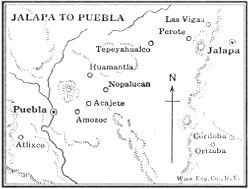
JALAPA TO PUEBLA
This was the final pass; and after marching some twelve miles farther, one saw at the left edge of a sandy, gravelly plain, set with occasional tufts of coarse grass, the dust-brown castle of Perote and, seemingly just above it though in reality several miles distant, the pine-clad mountain of that name. The castle was a superb specimen of military architecture, capable of accommodating more than 2000 men; but it had long served chiefly as a state prison, a refuge for troops, an arsenal, and a dépôt for the rich convoys that went this way. The American troops could have passed by on the other side of the plain, had that been necessary; but it was not. With only twenty-three gunners and scarcely any powder, General Gaona could not have defended the place. Canalizo therefore ordered him to evacuate it on the nineteenth; and at noon on the twenty-second Worth took possession of its elaborate bastions, more than fifty cannon, more than 25,000 balls and shells and even 500 muskets, which the terror-stricken Mexicans had not cared to remove. Throwing Garland’s brigade and Duncan’s battery about fifteen miles in advance to facilitate the gathering of subsistence, Worth now halted in accordance with his orders.[1]
SCOTT’S DIFFICULTIES
Scott meantime remained at Jalapa to study his problems and make his preparations. The capital of Mexico, he believed, lay at his mercy, and this opinion seems to have been correct; but unlike his critics, who merely had to deal with legions of ink on areas of paper, he found that much needed to be done before seizing it. The position of the Americans depended vitally on military prestige, and it was therefore of the utmost importance to suffer no reverse. His first care was to make sure of getting up in advance of the especially fatal rainy season, which was expected to begin at the latest by the first week of June, the needful clothing, equipments, ammunition, salt, medicines and many other imported articles; and since the lack of cavalry and a due regard for the health of the troops forbade trying to keep the road below Cerro Gordo clear of Mexicans, this tedious work involved the use of heavily escorted convoys,[2] and the exercise of unceasing vigilance, energy and skill.[6]
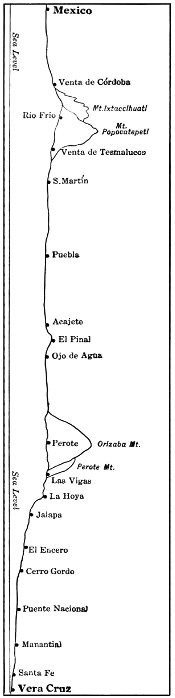
Profile of the Route from Vera Cruz to Mexico
His next care was to gather provisions, determine whether supplies of breadstuffs, meats, rice, beans, coffee, sugar and forage existed near the proposed line of march, and arrange for obtaining them despite the hatred of the people, which quite equalled their fear.[3] A third care was to divine what Santa Anna intended and was able to do, for news came that he was now on our flank and rear, preparing to conduct guerilla war against the American detachments and convoys. Contrary to his expectation Scott found subsistence and forage scarce at Jalapa, and as Quitman’s brigade came up without the extra rations it had been ordered to bring, the situation proved embarrassing. A scarcity of funds aggravated it alarmingly. An immediate advance upon the capital was therefore out of the question; but on April 30 Scott issued preliminary instructions, enjoining kind treatment of the people in the strongest possible terms, as absolutely necessary if the troops did not wish to starve; and the volunteers were ordered to set out on the fourth and fifth of May.[6]
But now a difficulty that had been feared by Scott rose directly in his path. Seven regiments and two companies of volunteers were to be free at various near dates, averaging about the middle of June. Polk, believing that many would reënlist, had recommended that a bounty should be offered as an inducement, and Congress had acted upon the suggestion. April 26 General Scott received the law and promptly circulated it; but he soon found that Polk’s expectations were to be disappointed.[6]
It would have been quite agreeable to linger at Jalapa, strolling about this paradise of birds, gazing at the many-hued blossoms of a perpetual springtime, feasting on the delicacies of semi-tropical gardens, winning occasional glimpses of exotic luxury through doors ajar, listening to ever-graceful señoritas—a few dazzling blondes as well as many sparkling brunettes—who played the guitar hour after hour in their grated windows, and catching glances now and then from eyes of fire; but the soldiers had learned what campaigning really meant. They had been allowed to go unpaid and unprovided for. They had met with hardships and privations not counted upon at the time of enlistment. Disease, battle, death, fearful toil and frightful marches had been found realities. Besides, they had now “seen the elephant,” as they said; they felt they had won glory enough; and, as even Colonel Campbell admitted, they “sighed heavily” for home, family and friends. In spite of their strong desire to see the Halls of the Montezumas, out of about 3700 men only enough to make one company would reëngage, and special inducements, offered by the General, to remain as teamsters proved wholly ineffective.[6]
One course now open to Scott was to march on, trusting that new forces would arrive seasonably to replace the soldiers discharged; but of this he had no assurance. Another was to assume that even when legally free the volunteers would not abandon him in the enemy’s capital; but the evidence was all to the contrary. More than once American troops had insisted upon their rights without considering the needs of the country; and now five colonels declared in writing that “only a very small proportion” of their men would “under any supposable circumstances” remain in the service “for any time whatever” beyond their term. Such was the sentiment of all these volunteers.[6]
Moreover, to advance, capture Mexico and so force the men to sail from Vera Cruz in the midst of the pestilential season would have been insubordinate as well as inhumane, for the government had ordered most emphatically, with particular reference to the yellow fever, that regard for their health must outweigh all military considerations.[4] The returning volunteers would also have been exposed, under inexperienced commanders and without a proper complement of artillery, to Santa Anna and the guerillas, and those remaining behind at the capital would have been regarded by the Mexicans as destined prey. On the other hand, should the entire army retreat after capturing Mexico, the exultant people would have risen almost en masse to starve, harass and slaughter them; while even Worth doubted whether Scott’s whole force, could it by any possibility be persuaded to remain intact, would be strong enough to hold the capital. Finally, as the sequel was to show and as any well-informed person could have foreseen, merely capturing and retaining Mexico City was not sure by any means to end the war. The seat of government could easily move, and Scott was correctly informed that it proposed to do so. Santa Anna was in the field with a growing army; his moral and physical resources had not been exhausted; and more fighting needed to be done.[6]
Scott was called slow by some of his critics, but when the case permitted he could make a quick decision; and on the sixth and seventh of May the volunteers referred to—“with a joyous and pleasant countenance upon every man,” as one of them wrote—set out for home under Patterson.[5] Their departure left the General with an army of 7113. As for early reinforcements, he had recommended on November 29 the addition of twelve regiments to the regular establishment, and had said that about the first of May they would be indispensable; but at present he only knew that 960 recruits were on the way. None the less he sent Quitman forward with three regiments of November volunteers, and on the sixth of May instructed Worth to advance with his division and two of those regiments, led by Quitman, against Puebla, leaving the third regiment with a sufficient number of artillerists at Perote.[6]
MEXICAN ASSISTANCE
For the confidence with which less than 4000 men were thus advanced beyond the reach of prompt assistance, to cope with a strong city and the Mexican troops, there was a special reason. The heads of the Roman Catholic Church in Mexico, who did not feel all the religious intolerance which they deemed it proper to exhibit in public, cherished no love toward Santa Anna. For many years his rapacity had given them offence; and one of his first acts on landing at Vera Cruz in August, 1846, had been to strike at their power. They had therefore felt disposed to favor the continuance of hostilities, hoping that he and his myrmidons would be destroyed. But when Moses Y. Beach made it plain to them on the one hand that resistance to the United States would be dangerous, and on the other guaranteed the freedom and the property of Church and citizens, they decided to support our efforts in behalf of peace, work against Santa Anna as the chief obstacle, and arrange secretly to have Jalapa, Perote, Puebla and Mexico City refrain from opposing Scott.[8]
At “unconquered Puebla,” which was more fully under the domination of the Church than any other Mexican town, circumstances favored the clerical design. Terrible stories had been circulated there about the Americans. They were barbarians, vandals, tigers; they had branded and sent across the Gulf into slavery shiploads of Tampico people, and stuck little children on their bayonets at Vera Cruz. But these tales had now lost all credibility. Santa Anna had been found out. Buena Vista no longer seemed a Mexican victory. The military caste was not only hated but despised. News had come that wherever the Americans took possession, odious taxes were abolished and trade became brisk. Scott’s treatment of the people shone in comparison with Santa Anna’s, and his soldiers looked angelic beside the guerillas. The defeat at Cerro Gordo caused not only deep discouragement but even deeper disgust, for the men and money of the state had been sacrificed to the incompetence of the commanders. Besides, marvels were told of the Americans. They could hew a man asunder at one stroke; their horses were gigantic and incredibly swift; their artillery was unspeakably terrible; and every one of their bullets might split into fifty pieces, each of the pieces fatal. Worth’s division included 5000 of these warriors, an American deserter stated.[8]
With such popular support the clericals had Isunza, who was closely connected with them, put in place of the vigorous Ibarra as governor, and he not only took a stand for non-resistance, but answered the appeals of the national government with sharp complaints. Instead of preaching against the Americans, the churchmen led pious processions about the streets, to show that prayer and not the arm of flesh was to be relied upon. The arms and ammunition were sent away—for safe-keeping. The governor would supply no funds for military purposes. “Reason prohibits vain sacrifices,” he remarked. The comandante general decided that the city could not be defended. The prefect ordered that after the arrival of the Americans, not more than three citizens were to meet in public, and that none should carry arms; while the ayuntamiento announced that no unsigned placards would be tolerated. “Men are not all called to play the rôle of heroes,” observed the Monitor del Pueblo. We can only “await with resignation the terrible blow with which Providence chooses to afflict us,” decided the city authorities. All the arrangements are complete, Worth was notified by headquarters on the tenth of May. The people are waiting for you, reported foreigners from Puebla.[8]
Scott, for his part, agreed to protect the citizens and especially the Church, and he put forth on the eleventh of May a proclamation called by him “the crowning act of conciliation,” which was drawn up under his direction by a representative of the bishop of Puebla, and embodied the ideas and sentiments deemed by the leaders of the clerical party most likely to be effective.[7] The oppression under which the people of Mexico lay crushed received in this proclamation brief but vivid treatment, distrust regarding Santa Anna’s abilities, honor and aims was excited, and the Americans were represented as true brethren of the Mexicans. Paredes, an unpatriotic usurper, had forced us to take up arms in behalf of republican institutions and the welfare of the whole continent, as well as for the maintenance of our proper dignity; but we were anxious now as ever, to live in peace and friendship with Mexico, even though determined, if the war must continue, to do the work of the sword thoroughly.[8]
SANTA ANNA’S MEASURES
On the other hand Santa Anna was not idle. His first thought on quitting the terrible field of Cerro Gordo was that Canalizo’s horse would stop at El Encero, and that he might rally the flying infantry upon it; but on moving in that direction by the southern bank of Río del Plan he found himself cut off by the American pursuit, and turned abruptly to the left. Always profoundly depressed after a reverse, he rode along grim and speechless, as if stunned; but the next day an enthusiastic reception at a small town, aided perhaps by the marvellous beauty of the district, lifted his head. In the early evening of April 21 he reached Orizaba, and here the applause of the readily excited townsfolk made him feel himself once more a general and a President.[12]
His low intellectual plane did not permit him to understand his mental inferiority or to perceive the real strength of the unpretentious and apparently careless Americans.[9] It was impossible for him, looking abroad upon a vast and potentially rich country with all the vanity of his people, to believe that a handful of poorly dressed Yankees, imperfectly trained and seemingly not very martial, could overpower its millions. He felt that sooner or later his groping finger would touch the right spring, as it had done so many times before, and the nation would rise up about him. Pride, self-will and blind passion, raging in his heart, inflamed his courage; and his sense of a proprietary claim to the country inspired him with a sort of patriotism. What has been lost after all, he said, except a position and some cannon? The nation is still mighty. Let it but join me, and I shall yet be victorious.[12]
Within his reach lay the brigade of Antonio de León—a little more than 1000 poorly armed men with two 6-pounders—just from Oaxaca, the presence of which in this quarter had brought him to Orizaba, and also the National Guards ordered before the battle to Chiquihuite. Larger and smaller bodies of fugitives and irregulars, learning where he was, came in. All the armed men of the vicinity, whatever their proper function, he caught in his unsparing net, and he summoned to the colors every citizen from sixteen to forty years of age. Beyond the sweep of his arm far less animation reigned. One disappointment more, one hope less now, was the mildest frame of mind among the public. Canalizo, a faithful dog that for the present had been kicked one time too many, sharply resented Santa Anna’s complaints. The scattering soldiers and officers, denouncing him bitterly as well as exaggerating the power of the Americans, discouraged the people. A popular newspaper demanded savagely that he should be court-martialled. The charge of collusion with the invaders came back to life. Many of the Indians, feeling that an American triumph would help them, became restive.[12]
But the government stood resolutely behind him, and he was invested with plenary powers. Soto tried again to rouse the people of the state. From a wider and wider circle fugitives and laboring men were gathered. Small cannon and some artillerists came within his reach. The stocks of horses and mules that Scott had tried in vain to get from the region of the upper Alvarado River were turned to account. Considerable money and supplies arrived from the government, and other funds and necessaries were taken without formalities wherever they could be discovered.[10] By the first of May he pretended there were 4000 men under his flag, and no doubt he did have 2500.[12]
By good fortune more than by design, too, he found himself in an excellent position, within striking distance of Scott’s communications, rear and base; and even though not richly imbued with the spirit of Napoleonic warfare, he laid his plans accordingly. But—fortunately for Scott, who might have been seriously embarrassed[11]—Santa Anna was more politician than general. On May 15 the election of a President was to occur, and the votes had to be counted at the seat of government. His enemies and rivals were incessantly busy there. A revolution had begun to brew, he understood. A suspicion had got abroad that he intended to give up the fight and move into Guatemala; and news reached him that Mexico City was to be surrendered. For these reasons and to obtain additional supplies, all his forces were directed upon Puebla; and at the head of a motley and miserable army numbering—he boasted—4500 men he arrived there on May 11.[12]
His reception was not flattering. Aside from the fact that everybody of much account felt ready to see Scott, the town had suffered previously through Santa Anna’s visiting it, accounts of his exactions had come from Orizaba, his presence was thought likely to result in hostilities, and the people feared that he would compel them to take up arms. Many fled at his approach, and many more wished they were elsewhere. Not without excuse under the circumstances, his conduct was arbitrary, insulting and extortionate. He cashiered all the officers of the Vera Cruz garrison, raved at the indifference of the authorities and people at Puebla, seized the horses, made liberal demands for cash, and—it was asserted—even took ornaments of gold from the churches. Some funds, a quantity of ammunition and some cannon were finally obtained here; but Isunza furnished him less than two hundred men, and perhaps the indignation of the people quite offset his gains.[13]
THE AMERICANS MARCH ON
Close behind him, too, came the Americans. Already a day’s march apart, Worth’s two brigades maintained that interval for some time, followed by Quitman with the New York and South Carolina regiments at an equal distance. For six or eight miles from Perote the country was highly cultivated and already brown with ripening wheat and barley; but then came a sandy, arid region where steep, conical hills of bare limestone, calcined like those of the Rhone valley, shot up from a wide, smooth plain in extravagant confusion, and appeared to bar the way. Hacienda buildings that were crenellated fortresses could be seen here and there; but the only cheering sights were glimpses of silvery Orizaba, a number of smaller mountains with Italian profiles, forked lightnings at play sometimes in the black clouds, and mirages of gardens, lakes and sylvan shores that deceived even the most experienced.[14]
At Ojo de Agua, about thirty-five miles from Perote, a spring of water almost as large as the fountain of Vaucluse gave rise to a creek, which watered palmettoes and extensive meadows. Eight or nine miles farther on, the troops came to dark Nopalucan, which lay reclining on a comfortable eminence and viewing complacently its fertile valley. Then some twenty-five miles of romantic scenery brought them to Amozoc, a manufacturing town of 2000 souls ten or eleven miles from Puebla, and here Worth, who had made easy marches for two days in order to lessen the interval between him and Quitman, halted his now united brigades at noon on the fourteenth to await that officer, and to give his own dusty division time to “brush up.”[14]
Santa Anna, after sending his infantry and artillery toward Mexico early that morning, had moved off with some 2000 cavalry to surprise Quitman, supposing that he would be at his usual distance behind Worth, and that Worth had continued his march. The consequence was that his troops, finding themselves at about eight o’clock within half a mile or so of Duncan’s battery and under fire, scattered promptly up the hills and into the woods. Divining correctly that he would reassemble them to strike at Quitman, Worth despatched forces at once to the rear; but Quitman, who had set out in the night, was now only two miles distant, and, warned by the artillery fire, had prepared to meet the enemy. Santa Anna therefore accomplished nothing more than to fatigue his men, and give them a superfluous lesson in running away; and after returning with them to Puebla for the night, he evacuated that city before daybreak the next morning with one more failure to his account.[14]
While at Nopalucan, May 12, Worth had addressed the governor and the municipality at Puebla, saying that in three days he should take possession of the city, and that he desired to confer with the civil authorities before doing so, in order to arrange for the maintenance of order and worship. Owing to what was regarded as a lack of formality in this proceeding and to Santa Anna’s insistence that Worth should have addressed him, no reply was made. But when a second letter arrived in the evening of the fourteenth, the ayuntamiento appointed a commission to meet the American general, and the next morning a conference took place at Chachapa, where our troops arrived at an early hour. Generous pledges of civil and religious protection were then offered and accepted; and the Pueblans, who adopted the usual jockeying tactics, drew from Worth an agreement that Mexican law, to be administered by Mexican authorities, should remain in force, although Scott’s General Orders 20 had thrown the protection of military law round the American troops.[15] In short, said Hitchcock, the inspector general of the army, Worth—not Puebla—surrendered; and Scott found it necessary to rectify the error.[17]
WORTH TAKES POSSESSION OF PUEBLA
At a little before ten o’clock that day the American troops—who had suffered badly from dust on the arid, stony hills, consoled only by views of the great snow-clad volcanoes glittering behind Puebla—approached the city. It was a proud moment for them when, as their brilliant commander said, “with all the flush and glow of victory in their hearts” they entered the second city of Mexico in importance and the first in military fame. Almost the entire population of the town looked on. Streets, sidewalks, windows and balconies were thronged with holiday-makers. As usual, the appearance of the victorious Americans fell sadly below expectation—perhaps only demigods in luminous mail could have reached it; but the people showed an intense curiosity to scrutinize them. Sometimes the troops had to work their way through the crowd; but no ill temper was displayed on either side, and finally, reaching the main plaza, our men stacked their arms and lay down to sleep as if at home.[17]
Puebla, a fine city laid out in the rectangular style and inhabited by some 80,000 persons, was chiefly noted for piety, cotton mills, dolls and sweetmeats. The principal feature was the cathedral with its two dark towers—each of them capped with a yellowish, incrusted dome bearing aloft a globe and cross, and each filled with numberless bells of all sizes, which singly performed special offices, and three times a day rang together in a celestial chorus. Eight or ten altars, refulgent with sacred vessels of gold, silver and precious stones in amazing profusion, lighted up the interior; and there was also a candelabra so big—or was it so grimy?—that $4000 had been paid a few months earlier for cleaning it. Near by, in the arcades of the plaza, could be found the dolls and sweetmeats; and of course Poblana market girls, too, were there: black eyes, black hair combed over the ears, huge silver ear-rings, snowy chemisette partly hidden with a gray rebosa (scarf), short red petticoat fastened round the waist with a silk band and fringed with yellow, small shoes and large silver buckles.[17]
For almost a fortnight Worth now had an opportunity to show the real breadth of his admired talents. With the ecclesiastical authorities, for obvious reasons, no difficulties occurred. He and the bishop exchanged calls promptly. Bells rang, churches opened, and in some of them public rejoicings were celebrated. But between him and the civil functionaries, mainly in consequence of his excessive complaisance, there sprang up not a little friction. His troops felt very much dissatisfied, for his nervous and restless temperament was in continual excitement about Mexican attacks, and once he kept them standing under arms needlessly all day. Such alarms came to be known as “Worth’s scarecrows”; and as the natural consequence, had a real danger presented itself, the men would have responded tardily and half-heartedly.[17]
Worse yet, on evidence for which he himself could not say much, he warned his division a little later (June 16) by means of a circular, that attempts to poison them were to be feared, adding gratuitously, “Doubtless there are among those with whom we are situated many who will not hesitate, as is the habit of cowards, to poison those from whom they habitually fly in battle—a resource familiar in Spanish history, legitimately inherited and willingly practised by Mexicans.” Of course the circular was not likely to elude publicity, and its indiscretion blazed. It gave the Pueblans a dangerous hint, insulted all Mexicans, and reflected grossly upon Spain, whose continued neutrality was highly desirable.[16] Evidently, though quite able to criticise, Worth did not possess all the qualifications of a commander-in-chief.[17]
THE AMERICAN SITUATION AT PUEBLA
Happily a wiser mind and steadier hand now took charge. Until May 20 General Scott had felt compelled to wait at Jalapa for a heavy train, from which he expected much more than he received. Two days later Twiggs set out, and on the twenty-eighth Scott—after leaving a garrison at Jalapa and a smaller one at Perote—reached Puebla with four troops of horse one day in advance of the division.[18] As at Plan del Río his arrival brought confidence and tranquillity. Needless alarms ended. Rumors of hostile forces were investigated promptly by his Mexican Spy Company[19] or other trustworthy persons, and the General fixed his mind on greater work than trying to hunt down every party of irregulars that raised a dust in the vicinity. The troops were drilled each morning and, if the weather permitted, later each day, and after about six weeks of this made a brilliant showing, when reviewed by divisions. The engineer soldiers received special training for the work supposed to lie before them; careful maps of the district between Puebla and the capital were prepared; and Scott frequently gathered the engineers and the heads of the army at his quarters of an evening, discussing military affairs or monologuing inimitably on the many interesting persons and events familiar to him.[22]
The Mexican government ordered that nothing marketable should be taken into the city, but the Pueblans replied unanswerably: There is no power to enforce that policy; and if there were, the result would be to starve us, not the Americans, for they could supply their needs by the sword and we could not. The markets offered, therefore, all sorts of articles and at moderate prices. Indeed they were too abundant, for the soldiers gormandized on fruits and sugar-cane brandy, and these indulgences, added to the want of salt meat, the change of climate and water, the rare atmosphere, the chilling winds and the lack of suitable clothing, caused a great amount of sickness—principally dysentery and ague. On the fourth of June more than 1000 Americans were on the invalid list, and that number largely increased.[22]
Sickness of mind prevailed no less. It depressed one to hear the dead march almost every evening. Rumors of wholesale plots to assassinate the officers and poison the men tried their nerves. Renewed efforts to cause desertion excited alarm. Whig speeches condemning the war and suggesting that bloody hands and hospitable graves ought rightfully to be the welcome of our soldiers in Mexico undermined confidence and courage. Poverty chilled their marrow. Men had served eight months and been paid for two. At the time when shoes and other indispensable clothing had to be obtained at an exorbitant cost, the army was already in debt and credit was flickering.[20] Through an intercepted letter the Mexicans knew of Scott’s financial difficulties, and the Americans knew that they knew. The expected revolution against Santa Anna did not break out, and a pacific President was not elected on June 15, as General Scott had almost expected.[22]
To crown all other discouragements, we had a ridiculously small army, while news came repeatedly that Santa Anna’s forces were growing rapidly. With less than 5800 privates—not over 4000 of them available for an advance—the General had to face, not only the Mexican army, but a nation of seven million inflammable persons, who might at any time be roused to fury by some untoward event. Even the 960 recruits that had been counted upon did not arrive. June 3, therefore, deciding to throw away the scabbard and meet all odds with the naked sword, he reluctantly ordered up to Puebla the garrison of Jalapa[21] and a part of the men left at Perote, cutting himself off in the heart of the enemy’s country.[22]
Pillow, the great captain, wrote censures on this course to Polk, and Polk, the consummate strategist, agreed with his agent; but Scott understood that necessity is a supreme law and courage the soldier’s first axiom. A farther advance was, however, impossible. To leave Puebla without a garrison, allowing that strong city, reoccupied by the enemy, to menace the rear and stand like a wall of stone across the path of reinforcements and supplies, was out of the question; and troops were also needed to protect helpers and overawe enemies among the civil population. If reduced by these deductions the army would not have constituted a striking force. Nothing could be done but stand at guard, and await new troops.[22]
THE PROBLEM OF REINFORCEMENTS
These, for a number of reasons, were delayed. Marcy’s report of December 5, 1846, presented to Congress at the opening of the session, admitted that the regular army stood nearly 7000 below full strength, and it also recommended the addition of ten regiments; but the administration, feeling at sea about its war policy, and not realizing how far the men on the firing-line came short of their estimated numbers or how much time would be required to place new troops there, took no decided stand in the matter. On the twenty-ninth, however, a bill authorizing the new regiments was presented in the House by the military committee, and the President followed this up some days later with a Message. A law offering a bounty of twelve dollars to encourage enlisting, upon which the war department acted promptly, was the next move; and on January 11, 1847, the House, excited by news that Worth stood in great peril at Saltillo, voted the new regiments. The Senate, on the other hand, procrastinated until Marcy was in despair, and Polk twice decided to address the country. Without much doubt partisan scheming and personal aims were chiefly responsible for the delay; but differences of opinion, more or less honest, regarding the comparative utility of regulars and volunteers, the expediency and proper terms of a land bounty, and the rights of the Senate in regard to the choice of officers caused much discussion, in which every issue touching the inception and conduct of the war had to run the gantlet of passionate vociferation.[25]
Progress was also hindered in another way. Although Polk had found it necessary to appoint Scott and had given that officer to understand that bygones were to be bygones, he liked him no better than before, did not wish the Whigs and their possible candidate for the Presidency to win more glory in the war, and realized the political wisdom—particularly in view of Calhoun’s unfriendliness—of pleasing the Van Buren Democrats. There were also objections to the existing arrangement that could be stated publicly. The number of troops to be employed in Mexico was said to require a chief of higher grade than a major general, and Polk took the ground that the commander—especially since he might be desired to handle the question of a treaty—should be in full agreement and sympathy with the Executive.[25]
For these combined reasons he offered to Benton the post of lieutenant general, provided it could be established, before Scott left Washington, and about the first of January requested Congress to authorize the appointment of such an officer.[23] This precipitated a commotion. The Senator’s harsh, domineering ways had made him unpopular, and grave doubts regarding his technical and temperamental fitness for the place existed not only in Congress but in the Cabinet. Calhoun and his friends detested the idea of letting Benton gain so much prestige and with it very likely the Presidency; the partisans of Taylor and Scott resented such treatment of their favorites; all the Whigs, besides suspecting Polk of scheming to evade responsibility and make Benton his grateful successor, rallied to the support of their two most prominent men; and, after serving for some time as an embarrassment, the plan was rejected.[25]
Finally, then, after a conference committee had adjusted the differences between the two Houses, the Ten Regiment Bill, though defeated once in the Senate, passed that body on February the tenth, and received Polk’s approval the next day; and as a loan bill had been worried through Congress at the end of January, something was apparently to be done.[24] Since, however, the officers were liable to be discharged on the conclusion of peace, it was not believed that many already in the service could be induced by a slight advance in rank to enter the new establishment, and for this and probably other reasons few of the more than five hundred places were offered to the army. The field was therefore clear for civilian warriors, and their campaign opened at once. Not limiting their operations to Capitol Hill, applicants for commissions besieged and assaulted the White House. “I have pushed them off and fought them with both hands like a man fighting fire,” wrote Polk in his diary, but “it has all been in vain.” “Loafers without merit” came, and equally meritorious Congressmen supported them. Not one in ten of the appointees was known to the President, and their degree of unfitness was precisely what might have been expected. A considerable number of them had actually been run out of the service—in some cases for bad conduct before the enemy—and many were found less teachable than privates.[25]
During February this beautiful exhibition continued, and such were the only immediate fruits of the much debated law, for it empowered no one to organize the new troops into brigades and divisions or to appoint general officers, and the military appropriations had not yet been made. Further Congressional exertions, therefore, had to be put forth; but at last on the second and third of March, after a loss of almost three months at this crisis of the war, the deficiencies were supplied, and enlistment shortly began. Vigorous efforts were made by the administration to set the new regulars in motion, company by company, and even squad by squad; and finally on the nineteenth of April, since little more could be expected from the November calls, requisitions for six and a half new regiments of volunteer infantry and twelve companies of horse—all to serve until the conclusion of peace—were issued.[25]
On the fourth of June, then, about six hundred new troops, commanded by Brevet Colonel McIntosh, left Vera Cruz for the interior, escorting a long train of loaded mules and wagons and two or three hundred thousand dollars in specie. Mexican irregulars, who knew the value of the convoy, soon attacked and stopped it. Cadwalader, then waiting for a part of his brigade, reinforced McIntosh on the eleventh with about five hundred men and took command. Fighting his way along he incorporated the garrison of Jalapa commanded by Colonel Childs, and on the twenty-first reached Perote.[27]
Meanwhile Pillow, now a major general by the grace of his former law partner, arriving at Vera Cruz and finding there some 2000 of his men, had advanced with most of them on June 18; and although Scott was in the most urgent need of money, Pillow ordered Cadwalader to await his arrival at Perote. Eventually, on July 3, the combined forces were in motion, and five days later all of them—including the recruits long since expected—passed the brown gate of Puebla. Of the rank and file Scott now had 8061 effectives and 2215 sick. Next Brigadier General Pierce with some 2500 men got away from the coast about the fifteenth of July,[26] and after similar fighting appeared at headquarters on the sixth of August with a heavy siege battery, a long train of wagons and $85,000 in unsalable drafts, but with none of the specie that had been expected and regarded as indispensable.[27]
THE AMERICAN ARMY
Scott now had about 14,000 men, some 2500 of whom lay, however, in the hospitals, while about six hundred were convalescents too feeble for an ordinary day’s march. The cavalry, led by Colonel Harney, included portions of the three dragoon regiments under Captain Kearny, Major Sumner and Major McReynolds. For artillery, besides the siege train, there were the field batteries of Duncan, Taylor, Steptoe and others,[28] and the howitzer and rocket battery of Talcott. Brevet Major General Worth’s division of infantry, known as the First, consisted of Brevet Colonel Garland’s brigade (Second and Third Artillery, Fourth Infantry and a light battalion) and the brigade of Colonel Clarke, which included the Fifth, Sixth and Eighth Infantry. The Second Division, commanded by Brigadier General Twiggs, was composed of the regiments under Brevet Brigadier General Persifor F. Smith (Mounted Riflemen, First Artillery and Third Infantry) and Brevet Colonel Riley (Fourth Artillery, Second and Seventh Infantry). Major General Pillow, higher in rank than the brave, able and experienced Worth, a professional soldier, had the Eleventh and Fourteenth Infantry and the Voltigeur regiment under Brigadier General Cadwalader, a polished veteran of Chestnut Street parades, Philadelphia, and the Ninth, Twelfth and Fifteenth Infantry under the gentlemanly Franklin Pierce, a social and political hero of Concord, New Hampshire; while General Shields’s brigade (New York and South Carolina volunteers) and Lieutenant Colonel Watson’s, consisting of three hundred marines and a detachment of the Second Pennsylvania, made up the division of Quitman, an excellent person and politician, who had now reached the highest military grade.[29]
The troops that had been waiting at Puebla were by this time in fine training; and the new men, besides receiving the soldier’s baptism on the way up, had learned at least the value of discipline and skill. The former had become to a large extent acclimated, and they felt an entire confidence in their commander, which, fully accredited by his victories, extended promptly to the reinforcements. The essential clothing had been purchased or manufactured. Thanks to indefatigable exertions a large stock of provisions had been accumulated, and at a cost of 15 per cent funds for the march to the capital had been raised. Although time had permitted the friendly sentiments and reasonable arguments of Scott’s proclamation to leaven the people, and association with the Americans had refuted the calumnies previously effective against them, our officers and men expected hard fighting. Thoughts of distant homes and of near perils were silvering many a fine head. There were no good laughers in the army now. But in an equal degree hearts were nerved. Mentally the cost of success, figured without discount, was already paid. All felt eager to advance. And when, anticipating Pierce’s arrival by one day, Scott gave the order, a soldier’s joy lighted up their bronzed features.[30]
XXV
ON TO THE CAPITAL
April-August, 1847
Almost immediately after Santa Anna left the seat of government for the Cerro Gordo campaign, more than twenty generals and several members of Congress were called together at the palace by Anaya to consider the defence of the capital.[1] Apparently the problem could be solved without much difficulty. Mexico lies in a rather shallow basin—said to be the crater of an ancient volcano—about thirty-two by forty-six miles in diameter. In the time of Cortez the site had consisted of islands barely rising above the water, but the spaces between these had gradually been filled, and the water had subsided. Six lakes could still be counted, however; almost everywhere else in the environs there were marshes traversed by elevated roads or causeways; and the rim of the basin, as well as the routes beyond it, seemed to offer advantageous points for defence.[2]
The sentiment of this council and of the city, though concealed under a cloak of bellicose ardor, opposed resisting the Americans in earnest, or at all events opposed inviting bombardment; and it was therefore decided merely to take precautions against a raid, fortify certain points on the roads, and bring out a host of irregulars to hang upon the rear and flanks of the enemy. All men capable of bearing arms were summoned to the colors. The states were called upon for aid. Hopes of borrowing twenty millions imparted a sunny look to the situation; and ecclesiastics, naturally passive in view of the agreement with Beach to let Scott have the city, were deliberately forced into the streets by the civil authorities to preach fanaticism and rouse the public from their apathy. Except perhaps by this last method, however, little was accomplished. “Let us unite, let us unite, and do you go and fight against the French,” some of the Spanish priests had said when their country was invaded by Napoleon. So things went now in Mexico, and every one assigned to himself the duty of exhorting. Fine ideas beamed forth, but everything of practical utility was conspicuously wanting. Still, as the American volunteers were considered “banditti, without the slightest knowledge of military tactics, without any sort of training, without confidence, and in general easily terrified,” no keen sense of alarm was felt.[2]
1. Worth’s advance. Henshaw narrative. Hitchcock, Fifty Years, 255. Ballentine, Eng. Soldier, ii, 154. Davis, Autobiog., 173. Delta, July 8. Picayune, May 19. 159Collins papers, Apr. 21; June 19. México á través, iv, 655. Tornel, Breve Reseña, 345. Robertson, Visit, i, 303. Orbigny, Voyage, 411. Lyon, Journal, ii, 181. Balbontín, Estado, 22. Velasco, Geografía, iii, 97, 99. Lawton, Artill. Officer, 141–4. Robertson, Remins., 276. 68Scott to Worth, May 6. Colección de Itinerarios. Revue de Paris, Dec., 1844. Oswandel, Notes, 162. Semmes, Service, 217–22. 139W. B. to D. Campbell, Apr. 25. 185Memo. Sen. 1; 30, 1, pp. 261 (Scott); 300 (Worth). Ramírez, México, 228–9. Roa Bárcena, Recuerdos, 236–9. 254McClellan to sister, Apr. 22. 236Judah, diary. Moore, Scott’s Campaign, 10–2. Norton, Life. Diccionario Universal (Las Vigas and Perote). 327Sutherland to father, undated. Ward, Mexico, ii, 193–5. Green, Journal, 238. Ho. 60; 30, 1, pp. 944–6, 948 (Scott). 364Worth to daughter, Apr. 30. Negrete, Invasión, iii, app., 58, 60, 110. Tributo á la Verdad, 43–6. 76Gaona, Mar. 4, 8, 15; Apr. 8, 19. 76To Id.., Apr. 17. 76Canalizo, Apr. 21, 24, etc. 76Baneneli, Apr. 24. 76Bravo, Apr. 23. 76S. Anna, Apr. 27. The distance from Jalapa to Perote was called about thirty miles.
2. “Convoy” will be used to signify a line of wagons or pack-mules or both transporting merchandise or supplies under escort. Among the difficulties in getting articles from the coast were the sandy road, the heat, the weakness and insufficient number of animals, the shortage of wagons, and above all the want of good drivers and conductors (Sen. 52; 30, 1, p. 127). Scott had supposed that successive bodies of new troops would escort the convoys up, but the diversion of these to the Rio Grande for some time (in consequence of S. Anna’s advance against Taylor) made it necessary to weaken his forces by sending escorts from Jalapa (61Scott to Wilson, Apr. 26). The policy of treating the Mexicans kindly required more self-support and therefore larger trains than would otherwise have been necessary. Moreover, in order to avoid a reverse, which would have had consequences of peculiar gravity in Mexico, Scott had to avoid risks.
6. Scott at Jalapa (except his proclamation, etc.: Note 8. Ho. 60; 30, 1, pp. 910, 944–8, 954–8, 1221 (Scott); 983–92; 950 (H. L. Scott); 904, 953, 1241 (Marcy); 967 (Worth). 61Scott to Wilson, Apr. 26. 68Worth court of inquiry, proceedings. Ballentine, Eng. Soldier, i, 278; ii, 118–23, 126–7, 129–30, 143–4. 66Beauregard to Smith, May 10. 52Trist to Buchanan, May 7. Davis, Autobiog., 164–6. Hartman, Journal, 13. 330Scott to Cadwalader, Apr. 25. 304Patterson, orders 10, May 1. (The district) Robertson, Visit, i, 278; Ruxton, Adventures (1915), 56; Kendall, Narrative (N. Y., 1844), ii, 398; Orbigny, Voyage, 410; Lyon, Journal, ii, 186; Velasco, Geografía, iii, 99. 362G. A. Worth to Van Buren, May 20. Robertson, Remins, 261, 275. Revue de Paris, Dec., 1844. 218Henshaw narrative. Löwenstern, Le Mexique, 26. 68Scott to Worth, May 6. 65Scott, gen. orders 128, 129, 135–6, Apr. 30, 30; May 4, 5. 332Tennery, diary. Thompson, Recolls., 13. Oswandel, Notes, 142, 149, 152. Sen. 14; 30, 1, p. 6 (Scott). Semmes Service, 189–90, 207–10. Sen. 65; 30, 1, p. 528 (Hitchcock). 139W. B. to D. Campbell, Nov. 2, 1846. Sen. 52; 30, 1, pp. 124, 129 (Scott). Picayune, May 4, 7, 11; Nov. 14. Steele, Amer. Campaigns, i, 110. 335Scott to Trist, July 21, 1848. 61Field report, May 7, 1847. 61Scott to Wilson, May 2. Moore, Scott’s Camp., 68. Roa Bárcena, Recuerdos, 236. 322Smith, diary. 270Moore, diary. 73Bermúdez de Castro, no. 517, June 29. Polk, Message, Feb. 13 (Richardson, iv, 515). Scott, Mems., ii, 452, 466, 553. London Times, Aug. 6. Diario, Aug. 5. N. Y. Sun, Aug. 16. Stevens, I. I. Stevens, i, 133, 135. (Bounty) U. S. Statutes at Large, ix, 184. Upton, Mil. Policy, 215. So. Qtrly. Review, Apr., 1852, 376–85. 6lScott, memo., Nov. 29, 1846 (12 new regts.). Sen. 1; 30, 1, pp. 45–6. 364Worth to daughter, Apr. 30. Bishop, Journal. 112Beauregard to Smith, May 2. Negrete, Invasion, iii, app., 60. 60Scott to Marcy, Apr. 5. Stevens, Campaigns, 16. 139Five colonels to Scott, May 1. 62Adj. gen. to Brooke, May 29. (Govt. will move) 76To S. Anna, Apr. 21.
3. It has been argued (e.g. by Semmes) that Scott was in fact able to obtain subsistence from the country all the spring and summer, and therefore the matter involved no difficulties (Service, 208); but Scott had to ascertain beforehand through agents (Delta, May 18) both that subsistence existed and that it could be obtained; and to make the success of his precautions a basis for asserting that he should not have waited to take them, is unreasonable. Scott said later that he might have rushed ahead by depending upon the provisions near at hand, but that within a week the army would have had to scatter and fight for supplies (Mems., ii, 553). The resources of the country were found to be mostly at a distance from the line of march (Ho. 60; 30, 1, p. 949). Time was required to select intelligent, reliable agents, and they needed time to go and come. A particular reason for deliberation lay in the fact that the new crops would not be ready before about the middle of June. It should be added that some statements of Semmes and others regarding material elements of the situation are contradicted by Scott’s reports written at the time. Semmes was probably influenced by Worth, whose aide he was.
4. Ho. 60; 30, 1, p. 904. Marcy forgot this when he severely censured Scott for dismissing the men before their time was out (ibid., 1245).
5. By the 61field return of May 7 Scott had: Engineer Co. (Smith), 43; Ordnance Co. (Huger), 60; First Div. (Worth), 2331; Second Div. (Twiggs), 2216; Dragoons (Harney), 433; volunteers (Quitman), 2030. The disparity between Scott’s numbers as figured at Washington and his numbers as counted at the front is suggested by the fact that on April 26 his volunteers (aside from those now discharged) were estimated by the adjutant general as 4994 (Ho. 60; 30, 1, p. 928). The regiments that went home were the Georgia, the Alabama, the Third and Fourth Illinois, and the First, Second and Third Tennessee.
8. The understanding with the clericals, etc. (Beach) 56Report, June 4; N. Y. Sun, May 19, 22. (Agent) Hitchcock, Fifty Years, 255–6; 68Id.to Worth, May 10; Baz, Juárez, 47, note; Apuntes, 192; Sen. 52; 30, 1, p. 125 (Scott). Tributo á la Verdad, 49, 54, 56 and doc. no. 18 (proclam. of May 11). S. Anna, Apelación, 41–3. Claiborne, Quitman, i, 311. Consideraciones, 3, 7, 22–3. (Priests tolerant) Kendall, Narrative (N. Y., 1844), ii, 341–3; Consideraciones, 32, 37; Lawton, Artill. Officer, 160–1, 175. (True) 13Bankhead, no. 57, May 29; Impug. del Manif. London Times, July 15. Apuntes, 193. Sen. 52; 30, 1, p. 127 (Marcy). Ramírez, México, 239, 256–7, 263, 272. México á través, iv, 661. 236Judah, diary, May 2, 6, 17, 26. 95Protest, Apr. 12. Monitor del Pueblo, Apr. 29. 95Sánchez, proclam., Apr. 29. 95Orders, May 8. 95Ayunt., proceedings. Picayune, June 30. 82Otero, proclam., Apr. 26. 82Baranda to gov., Apr. 24 and reply (draft). 82Isunza, proclam., May 13. (Crowning) Scott, Mems., ii, 549. (Proclam. of May 11) Wash. Union, June 12. Courrier des Etats Unis, May 22. Mata, Reflecciones. Ho. 60; 30, 1, pp. 967, 995 (Worth); 968 (proclam.) Bustamante, Nuevo Bernal, ii, 190. 76Winette, statement, May 2. 76To S. Anna, May 14. 76S. Anna, May 18. 76Hitchcock to Worth, May 12 (intercepted). 76Fúrlong, May 17.
7. This agent, whose name has been given as Campos and (probably correctly) as Campomanes, appears to have been the parish priest of Jalapa (Baz, Juárez, 47, note). The paper, which was printed first in Spanish and then in English (76Hitchcock to Worth, May 12), may be summarized as follows: It is my duty, Mexicans, to make known certain facts that are purposely concealed from you. For the sake not only of ourselves but of the whole American continent and of republican institutions, we of the United States made every effort consistent with honor to adjust our difficulties with Mexico, but the patriotic Herrera was thrown from power, and the new government, ignoring your interests in order to further its monarchical designs, compelled my nation to take up arms. Like you, we hoped that good would result from the overthrow of Paredes, and therefore we permitted Santa Anna to return; but, again like you perhaps, we were mistaken as to his intentions. What has followed, you know. Your troops, whose devotion and valor we admire, have been badly led, and even betrayed or deceived; and he has not only rewarded those who waged civil war at Mexico, but insulted the brave defenders of Vera Cruz. Recently the battle at Cerro Gordo showed what you may expect from him. Everywhere generals long supported in idleness by the nation have exhibited a lack of honor or skill, while the dead or wounded soldiers, abandoned on the field, have not been given by their leaders even the poor recompense of a grave. The clergy and all other peaceable and useful citizens have been, and still are, taxed, menaced and sacrificed, whereas criminals go unpunished. Can this be called liberty? The Mexicans, I am sure, have the courage to admit mistakes that involve no dishonor, and to adopt for the future a policy of peace, of liberty and of harmony with their brethren of the United States. My troops, as your bishops and priests will testify, have not committed the outrages alleged against us for the purpose of exciting your anger. We adore the same God as you, and many of our people and of our army are Roman Catholics. We punish crime and reward merit; we respect property—especially that of the Church—and we seek your friendship. Abandon prejudice, then; cease to be victims of the ambitious; act as a great American nation. If, however, the war must go on, my country will send—should they be needed—100,000 men, and settle the pending difficulties in a decisive manner. Guerilla warfare, should it be persisted in, would lead to reprisals, and you could not blame us for your sufferings. I have set out for Puebla and Mexico, and shall certainly reach those places; but my desire is peace, friendship, union. It is for you to choose between these and war (Tributo á la Verdad, doc. 18).
12. Santa Anna’s operations till he reached Puebla. Only the principal documents can be cited here. Tributo á la Verdad, 48–9, 54, 136. Picayune, May 6. Diario Sept. 10. 312Guerra to S. Anna, Apr. 8. Roa Bárcena, Recuerdos, 265–7, 570, 634. S. Anna, Apelación, app., 72–3, 76. 366Id.., Address to Amer. soldiers, Apr. —. Id.., Detall, 8. Defensa de ... Estrad. S. Anna, Manifiesto, Mar. 24, 1848. 12Loch to admiralty, Apr. 20, 1847. Apuntes, 183–91. Gamboa, Impug., 36. Negrete, Invasión, iv, app., 274. 13Bankhead, no. 42, 1847. Courrier Français, May 5. Ramírez, México, 261. México á través, iv, 660–1. 88Córdoba ayunt., proceedings, Apr. 26–9. 82Official docs., Apr. 20–30. 82Prefect of Matamoros, Apr. 26. (Indians) 82Prefect Tlapa, May 13. Republicano, May 4. 73Bermúdez de Castro, no. 517, June 29. Nat. Intelligencer, June 2. Monitor Repub., May 4, 23. (Tlacotálpam) Sen. 1; 30, 1, p. 547. Bustamante, Nuevo Bernal, ii, 190. S. Anna, Comunic. Oficial. Carreño, Jefes, cclxx. Lerdo de Tejada, Apuntes, ii, 260. 76Carrera, Apr. 27. (Chiquihuite.) 76Acuerdo, Mar. 29; 76Soto, Apr. 3; 76to Soto, Apr. 1. 76Canalizo, Apr. 21, 24, 28. 76To S. Anna, Apr. 21. 76To Canalizo, Apr. 21. 76To Bravo, Apr. 21. 76Fúrlong, May 9. 76Gov. to comte. gen. Oaxaca, May 4. 76S. Anna, Apr. 27. 76Id.to Rosa, Feb. 5, 1848.
9. His intellectual plane is suggested by the fact that after the battle he promptly sent instructions to his mistress but not to his second in command (76Canalizo, Apr. 24).
10. At this juncture appeals were again made to the Roman Catholics, particularly the Irish, of the American army, and apparently 2–300 deserted while at Jalapa (Ballentine, English Soldier, ii, 144). One appeal said, “Are Catholic Irishmen to be the destroyers of Catholic temples, the murderers of Catholic priests, and the founders of heretical rites i this pious country?” A large amount of money seems to have been collected by Santa Anna at this time. The Manifiesto of Vera Cruz State (Monitor Republicano, Dec. 19, 1847) asserted that in fifteen days he obtained 120,000 pesos, though he said (May 9) he had received less than 25,000 (Gamboa, Impug., 35).
11. Santa Anna’s flank position was even more favorable than Washington’s at Morristown. While he lingered near Vera Cruz, Scott could not feel safe, and his trains were in imminent danger. Had he remained there, Scott, whose small numbers would not have permitted him to send an adequate detachment to Orizaba, might have felt compelled to go there with his whole army, and much embarrassment might have resulted (Steele, American Campaigns, i, 125–6. W. B. Lane, The United Service, June, 1896, p. 485. Stevens, I. I. Stevens, 146).
13. Santa Anna’s operations after he reached Puebla (except the Amozoc fight). Negrete, Invasión, iv, app., 250–2, 255, Tributo á la Verdad, 49–53, 56–7. S. Anna, Apelación, 41–3. Id.., Detall, 8. 166Pommarès to Conner, Aug. 29, 1846, confid. Donnavan, Adventures, 99. Dos Palabras. London Times, July 9. Apuntes, 192–3. Gamboa, Impug., 33–5. Ramírez, México, 260, 282. México á través, iv, 661. 95Protest, Apr. 12. Monitor del Pueblo, Apr. 29. 82Comte. gen. to gov., May 10. 82Letter to secy., May 11. 95Puebla ayunt., proceedings, May 10–15. 82Isunza, proclam., May 12. 199S. Anna to Giménez, May 15. Diario, May 10. Monitor Repub., May 13, 23; Dec. 12. Baz, Juárez, 47, note. Bustamante, Nuevo Bernal, ii, 190. 312Bishop Puebla to S. Anna, Apr. 8. 76S. Anna, Apr. 27, 29; May 11, 15. 76To S. Anna, Apr. 20, 30. 76To Bravo, Apr. 21. 76To Gaona, Apr. 21. 76Carrera, Apr. 23. 76Fúrlong, May 9. 76S. Anna to Rea, May 12.
14. The American advance to Puebla (including the Amozoc fight). Ho. 60; 30, 1, pp. 944–8, 957 (Scott); 967, 994 (Worth). 61Scott to Wilson, Apr. 23. 218Henshaw narrative. Tributo á la Verdad, 50. Scott, Mems., ii, 460. Grant, Mems., i, 135. Ballentine, Eng. Soldier, ii, 159, 161, 175–6. S. Anna, Apelación, 41–2. 303Worth to Quitman, May 10. 159Collins papers, May 20; July 3–8. Robertson, Visit, i, 312. Orbigny, Voyage, 412. Lawton, Artillery Officer, 145, 156, 162, 170–4, 207–8. Journal Milit. Serv. Instit., xvii (Van Deusen). Löwenstern, Le Méxique, 31. Smith, To Mexico, 153, 163, 165 (nothing in U. S. equal to Puebla), 166. Sen. 65; 30, 1, p. 527. Brackett, Lane’s Brigade, 191, 276. 213Hatch to father, June 3. 68Scott to Worth, May 6. Colección de Itinerarios. Revue de Paris, Dec., 1844. Semmes, Service, 225–6, 230–7. Apuntes, 193–6. Sen. 52; 30, 1, p. 125 (Scott). Gamboa, Impug., 36. México á través, iv, 662. 236Judah, diary. Moore, Scott’s Camp., 84–96. Rosa, Impresiones, passim. 270Moore, diary. Steele, Amer. Camps., i, 107, 110. Diario, May 16. Ward, Mexico, ii, 201. Stevens, I. I. Stevens, i, 140, 142. 364Worth to daughter, Apr. 30. 76Prefect of S. J. de los Llanos, May 11. 76Comte. milit. Huamantla, Apr. 29. 76To Bravo, Apr. 26. 76Fúrlong, May 5. 76Bravo, Apr. 23. 76S. Anna, May 13, 15. 76To S. Anna, May 14. 76S. Anna to Rea, May 12. And others.
15. The Puebla ayuntamiento archives contain the agreement signed at Chachapa by Worth. Later he sought to modify this (68orders 31), calling it merely a memorandum (68to H. L. Scott, June 16), and on May 20 he signed a new 95version. Naturally the Pueblans held to the former (68Dorán to Scott, June 17). For general orders 20 see p. 455.
17. Worth’s operations at Puebla. 68Worth court of inquiry, proceedings, documents. Weekly Courier and Enquirer, Mar. 2, 1848. Tributo á la Verdad, 12, 48, 51–2. 224H. L. Scott to Worth, June 20. 61Scott to Wilson, Apr. 26. Hitchcock, Fifty Years, 257. (Alarms) Grant, Mems., i, 136; Delta, July 8; 218Henshaw narrative; 307Roberts, diary; Sen. 65; 30, 1, pp. 527–8. 303Gen. orders 128. Collins papers. Robertson, Visit, i, 314. Ruxton, Adventures (1847), 30. Bullock, Six Months (1825), i, 83. León, Hist. Gen., 477. Lawton, Artill. Officer, 169, 174–5, 226. Journal des Débats, July 6, 1847. Semmes, Service, 210, 254, 264, 275. Rivera, Jalapa, iii, 912. Apuntes, 193–5. Sen. 52; 30, 1, p. 125 (Scott). Gamboa, Impug., 33–4. Ramírez, México, 261, 267–8, 272. México á través, iv, 662. 236Judah, diary. Monitor del Pueblo, Apr. 29. 95Ayunt., orders, May 8. 95Ayunt., proceedings and corresp. with Worth. 95W. to first alcalde, May 18. 82Bravo, proclam., Apr. 28. 82Isunza, proclam., May 13. 270Moore, diary. Davis, Autobiog., 274. Negrete, Invasión, iii, app., 61, 86–7. Monitor Repub., May 2, 21; June 5. Ho. 60; 30, 1, p. 994 (Worth). Niles Jan. 15, 1848, p. 311. 364Worth to Sprague, July 29, 1847. 76S. Anna, May 13, 16. 76Fúrlong, May 13. 76Worth, May 12. 76Bravo, Apr. 30. 76Worth to Furlong, May 17. 76To Fúrlong, May 20.
16. Semmes represents Worth’s régime as entirely satisfactory to the civil authorities (Service, 275). This illustrates the fact that caution is necessary in reading what he says when Worth is concerned, for the records of the ayuntamiento give a different impression. For Worth’s characteristics see chap. xii, note 8. The Southern Quarterly Review, April, 1852, 406, note, said Worth “was quite superficial, had no solid or profound attainments, nor was he gifted with grasp of mind requisite to high combinations and extended operations.” Robert Anderson remarked once that he hoped Worth would not, “from a fit of passion, alter his opinions” (Anderson Artill. Officer, 32). Hitchcock in N. Y. Courier and Enquirer (semi-weekly), Mar. 1, 1848: Worth has striking manners and great felicity in conversation, but is utterly destitute of stability and judgment.
18. At Jalapa he left Brev. Col. Childs with the First Artillery (five companies), the Second Pennsylvania and three companies of the First Pennsylvania; at Perote seven companies of the First Pennsylvania with some artillerists; and at each place a troop of dragoons (Sen. 52; 30, 1, p. 125). The stock of ammunition was still inadequate, and the paymaster had only half of his estimate for January-April (ibid., 124–5).
19. Domínguez, leader of the Spy Company, had been an honest weaver, it was said, but on being robbed by a Mexican officer, took to the road and became a brigand chief. When the Americans reached Puebla he was living there quietly with his family; but, knowing the insecurity of his position, he accepted Hitchcock’s offer to become a scout. His band consisted at first of five men but rose to about 100, and probably might have been increased to 2000 (Lawton, Artill. Officer, 266). He and men of his even entered the capital in disguise. While he was at the head of the company, the actual captain was a Virginian named Spooner, who had been a member of his band; and the two lieutenants also were foreigners. The men seem to have served and obeyed orders faithfully, and their leader refused very advantageous terms offered by Santa Anna. (For the Spy Co. see Hitchcock, Fifty Years, 259, 263–4, 330, 335–41, 344–5. Brackett, Lane’s Brigade, 187. Lawton, Artill. Officer, 266. Henshaw narrative, Aug. 8. 69Domínguez to Polk [Sept., 1848].)
22. Scott at Puebla. Ho. 60; 30, 1, pp. 954, 957, 993, 997, 1012–3 (Scott); 967 (Worth); 998, 1002–4 (Marcy); 1021–7 (Scott and Quitman). Sen. 52; 30, 1, pp. 124, 129, 135 (Scott); 242 (Trist). Rivera, Jalapa, iii, 912, 925. Henshaw narrative. Haynes, Scott’s Guide. Tributo á la Verdad, 56. Scott, Mems., ii, 453–4, 460, 466. Hitchcock, Fifty Years, 256–9, 261, 266, 270, 341–4. Grant, Mems., i, 136. Ballentine, Eng. Soldier, ii, 135–6. Davis, Autobiog., 169. Picayune, May 19; June 30; Aug. 20; Nov. 14. Delta, June 12; July 9. Republicano, June 6, 7, 14. (Sickness) 223Hirschorn, recolls.; Delta, July 9; Lawton, Artill. Officer, 145, 154, 242; 291Pierce, diary; Scott, June 4 (Sen. 52; 30, 1, p. 129); Moore, Scott’s Camp., 119; 73Bermúdez de Castro, no. 517, June 29; 316Judd to Sherman, Feb. 26, 1848. Polk, Diary, Apr. 2, 10, 12; July 9, 13, 15. 159Collins papers, May 22. León, Hist. Gen., 477–8. Lawton, Artill. Officer, 153, 177–8, 189, 203, 206, 211–6, 228, 233–4, 242–6, 256, 265, 272, 274. 68Worth court of inquiry, docs. 68Scott to Worth, May 6. 65Gen. orders 206, 211, 238; July 9 12, 28. (4000 available) Hitchcock, Fifty Years, 257. Simples Observaciones (written by Hitchcock). 60Wilson to Marcy, Aug. 1. 335Trist to wife, Aug. 6. Oswandel, Notes, 223, 240. Semmes, Service, 210, 239, 247, 263, 275–6, 278–81. Sen. 65; 30, 1, p. 524. 224L. V. to M. O., Aug. 21 (intercepted Mex. letter). 185[Duncan] to Lewis, July 20. 307Roberts, diary. 236Judah, diary. 95Ayunt. to Bravo, Apr. 29. 95Amable to prefect, Aug. 18. 270Moore, diary. 327Sutherland to father, Aug. —. 73Bermúdez de Castro, no. 517, June 29. Kennebec Journal, May 21. Repub. Banner, May 19. Nat. Intelligencer, June 1. Monitor Repub., May 2; June 5, 8. Sedgwick, Corres., i, 101. 132Atocha to Buchanan, Aug. 1. Baz, Juárez, 47, note. Negrete, Invasión, iii, app., 87–9. 364Worth to S., July 29; to daughter, Apr. 30. Ohio Arch. and Hist. Qtrly., Apr.-July, 1912, p. 292. 61Scott to Wilson, May 2. Steele, Amer. Camps., i, 122. And from 76 the following and others. R. Rueda, statement [June 18]. Acuerdo, July 13. Soto, July 3. Soldier from Puebla, statement, July 17. Alvarez, June 16; July 28. Isunza to Canalizo, July 20. Bravo, proclam., Apr. 28. Fúrlong, May 17. To Fúrlong, May 20. “Ein Deuttcher,” circular to Germans. To Alvarez, June 19. Worth to first alcalde, May 17; to ayunt., May 18.
20. Hargous, an American merchant of Vera Cruz, was Scott’s financial agent (Picayune, June 30). Without him one hardly sees what the Americans could have done. An intercepted letter from the wife of Brev. Col. Childs, abusing Polk roundly, gave considerable comfort to the enemy. Another letter imparted much information about military matters. One is again surprised that our war department did not use a cipher.
21. Scott instructed the commander at Vera Cruz what to do in case of attack, and gave the commander at Jalapa full directions with reference to the sick and wounded (about 1000) lying there (Ho. 60; 30, 1, p. 997). There were also about 1000 sick at Vera Cruz and 200 at Perote (Sen. 52; 30, 1, p. 129). The people at home did not understand Scott’s situation. Regiments nominally 800–1000 strong had actually less than 300 (185— to Duncan, July 20).
25. Reinforcements provided. Upton, Milit. Policy, 206–7. 62Adj. gen. to Scott, May 10. 65Id.., gen. orders 57, Dec. 22; 2, Jan. 8; 8, Mar. 4; 17, Apr. 15. Semmes, Service, 314–5. 354Welles papers. Polk, Messages, Dec. 29 (Jan. 4, 1847), 1846; Feb. 13, 1847 (Richardson, Messages, iv, 508, 513. 108Polk to Bancroft, Jan. 30. Wash. Union, Jan. 4, 7, 11, 12, 14, 21, etc. Nat. Intelligencer, May 26. Cong. Globe, Sen. and Ho., Dec. 28 to Mar. 3 (One needs to examine the proceedings and speeches considerably in detail). (Voltigeurs) Niles, May 15, p. 161. Amer. Review, Sept., 1847, p. 223. Statutes at Large, ix, 117, 123, 184. Boston Atlas, Jan. 14. 316Bragg to Sherman, Mar. 1, 1848. 61Ransom, Apr. 12; May 9, 21; June 26. 61Scott to Wilson, Apr. 26. 330H. L. Scott to Cadwalader, Apr. 25. 61Adj. gen. to Scott, Dec. 17, 1846; Jan. 23; Mar. 20; May 6, 10, 22, 1847; to Cadwalader, Apr. 28; to qtr. mr. gen., Apr. 21. Ho. 42; 29, 2: adj. gen., Jan. 13. 256Marcy to Wetmore, Jan. 6, 10; July 16. Sen. 52; 30, 1, p. 121 (Marcy). Senex, Myth. Ho. 48; 29, 2 (adj. gen.). Sen. 1; 30, 1, pp. 45, 50. 62Marcy to Brooke, Mar. 22; to Pierce, Mar. 22; to govs. Ala., Miss., La., Mar. 22. 61Adj. gen. to Cadwalader, Mar. 26. Ho. 60; 30, 1, pp. 866, 944, 948, 1221 (Scott); 873, 905–6, 922, 953, 1241 (Marcy); 924, 926 (statements). 69Scott, mems. for adj. gen., Nov. 29, 1846. Polk, Diary.
23. Richardson, Messages, iv, 508. Benton wanted full powers to negotiate (Polk, Diary, Mar. 8, 1847), and was willing to take the position mainly with a view to its diplomatic functions (Cong. Globe, 29, 2, pp. 246–7).
24. The new regiments (which brought the regular army up to 1356 officers and 29,534 men) were to serve during the war and then be disbanded. One of them was the Third Dragoons. Another consisted of “voltigeurs,” theoretically an equal number of infantry and of mounted men (the former to be taken up on the horses of the latter, when celerity of movement should be desired) with a battery of small guns that could be taken apart and transported on mules (Niles, May 15, 1847, p. 161); but practically the Voltigeurs were foot-riflemen (Ho. 60; 30, 1, p. 924). The regiments destined for Scott were the following: (Brig. Gen. Pierce’s brig.) 9 Inf. from N. Eng. under Col. Ransom, 12 Inf. from N. and S. Car., Mo., Ark. and Texas under Lieut. Col. Bonham in the absence of Col. Wilson, and 15 Inf. from Ohio, Mich., Wis. and Iowa under Lt. Col. Howard in the absence of Col. Morgan; (Brig. Gen. Cadwalader’s brig.) 11 Inf. from Pa., Del. and Md., under Col. Ramsey, 14 Inf. from Ill., Tenn. and La. under Col. Trousdale, Voltigeurs from Pa., Md., Va., Ga., Ky. and Miss. under Col. Andrews (Ho. 60; 30, 1, p. 924). Each regiment was theoretically to consist of 851 men including 47 officers (ibid.), but the two brigades going to Scott were not expected to muster quite 3500. Scott was authorized to change the organization should the exigencies of the campaign require (Ho. 60; 30, 1, p. 922). Each private serving a year or more was to receive 100 acres of government land or $100 in treasury scrip as a bounty. The law of March 3 provided also that (in view of the deficiency in field officers caused by the lack of a retirement law) an additional major might be appointed in each regiment, that individuals might be accepted to fill vacancies in volunteer corps, that non-commissioned officers might be brevetted to the lowest commissioned rank, that distinguished privates might be given certificates of merit and $2.00 extra per month, that two companies might be added to each artillery regiment, that one more company in each artillery regiment might be equipped as field artillery, that unfilled regular or volunteer regiments should be consolidated and the supernumerary officers discharged, etc. (These laws were quite elaborate and cannot be given in full here; see U. S. Statutes at Large, ix, 123, 184.) After receiving Scott’s report on the battle of Cerro Gordo, Polk ordered five companies of the Third Dragoons to him.
27. Reinforcements arrive. (Other references will be given when the guerillas are studied: chap. xxix.) Ho. 60; 30, 1, pp. 1002, 1241 (Marcy); 1012, 1221 (Scott). Sen. 1; 30, 1, app., 4, 13, 16, 18, 20–25 (McIntosh et al.). Scott, Mems., ii, 453, etc. 65Id.., gen. orders 250, 1847. Hitchcock, Fifty Years, 265, 269. Davis, Autobiog., 174–5. 69Marcy to Pillow and Quitman, Apr. 14. Hartman, Journal, 15. Picayune, Aug. 20. Delta, Oct. 1. Upton, Milit. Policy, 213–4. Polk, Diary, May 10. 159Collins papers. 291Pierce, diary. 61Cadwalader to Wilson, June 13. 62Adj. gen. to Scott, May 10, 22. 287Parrish, diary. 60H. Wilson to Marcy, Aug. 1. 60L. D. Wilson to Marcy, July 31. Mansfield, Mex. War, 224. Sen. 52; 30, 1, p. 136. 236Judah, diary. Monitor del Pueblo, Apr. 29. 178Davis, diary. 335Dimond to Trist, July 14. Semmes, Service, 314. Wash. Union, July 20. 180Pillow to wife, June 14. 61H. Wilson to adj. gen., June 7, 14. 61Pillow to adj. gen. [June 19]. Henshaw narrative. Lawton, Artill. Officer, 215, 238–41, 272–4. 61Jones to Wilson, Apr. 29. 76Soto, July 17, 21, 23, 25, 31; Aug. 3, 11. 76Canalizo, July 8. 76Alvarez, July 5. 76Hitchcock to Worth, May 12. 76Many other documents.
26. One unfortunate result of giving up the line of communication was that new troops had to wait at Vera Cruz until assembled in sufficient force to defy the enemy, and some of them fell sick in consequence; but this was not fairly chargeable to the evacuation of Jalapa, for the irregulars did their worst below that city. It was the intention of the government that Quitman should go to Taylor, but Scott retained him because his services were valued and he could not be sent away without a heavy detachment (Sen. 52; 30, 1, p. 137). Having only two full regiments, though a major general, Quitman naturally felt aggrieved (Ho. 60; 30, 1, p. 1024). To illustrate once more the difference between paper figures and real ones, the Washington Union stated on July 20 that more than 15,000 reinforcements had marched from Vera Cruz. The text shows how many did go. July 19 Marcy wrote that 1900 men were en route to Vera Cruz (Ho. 60; 30, 1, p. 1003). The fact was that on August 2 or 3 about 850 men left that place for the interior under Col. L. D. Wilson of the Twelfth Infantry (60Wilson, July 31).
28. Under general orders 218, July 16, 1847, the following artillery companies were ordered to be equipped (i.e., were recognized) as light (field) artillery in accordance with the law of March 3, 1847: First Regiment, Co. I, Capt. J. B. Magruder; Second, Co. M, J. F. Roland; Third, Co. E, T. W. Sherman; Fourth, Co. G, S. H. Drum. Co. M was not organized in time to serve during the war; the others were already in the service.
29. Scott, Mems., ii, 460–5. Grone, Briefe, 84. 60Marcy to Quitman, Apr. 14. Upton, Milit. Policy, 214. 159Collins papers, June 18. 236Judah, diary, Apr. 26. Lawton, Artill. Officer, 274. Aldrich, Marine Corps, 104. Ho. 60; 30, 1, p. 1002 (Marcy); 1012 (Scott). 62Adj. gen. to Scott, May 22. Journ. Milit. Serv. Instit., iii, 415.
30. Picayune, Aug. 20; Nov. 14. Lawton, Artill. Officer, 244, 246, 274–5. Sen. 52; 30, 1, p. 135 (Scott). 65Scott, gen. orders 246, Aug. 5. Collins Papers. Smith, To Mexico, 178. Hitchcock, Fifty Years, 271.
1. This chapter is amply supported. About 1400 documents were used in writing it. As, however, any investigator consulting on this subject the 76archives would easily find the pertinent papers, only the most important ones belonging to that collection will be cited.
2. Affairs at Mexico to Apr. 20. Sen. 19; 30, 2 (M. L. Smith). 341Black, memorial, Dec. 20. 312Anaya to S. Anna, Apr. 9. 312Baranda to S. Anna, Apr. 9. Monitor Repub., Apr. 11. Picayune, May 12. Semmes, Service, 328. 92Gov. Federal Dist. to Mex ayunt., Apr. 10. 92Mex. ayunt., proclam., Apr. 27. Ho. 60; 30, 1, p. 1088. Niles, May 15, p. 168 (Gamboa). Kenly, Md. Vol., 338. N. Y. Sun, May 19. Apuntes, 198–9. Otero, Comunicación. Negrete, Invasión, iii, app., 483. From 76 the following. Memo., Apr. 10. Salas, Apr. 12. Ords. to generals, Apr. 2. Ords. to Liceaga, Apr. 10. Relaciones to gov. Fed. Dist., Apr. 11. Almonte, May 14. To comte. gen. Guanajuato, Apr. 16. To J. P. Gálvez, Apr. 9. Measures recommended, Apr. 6, 14. Relaciones, Apr. 12. Berrospe to Monterede, Jan. 20, 1846.
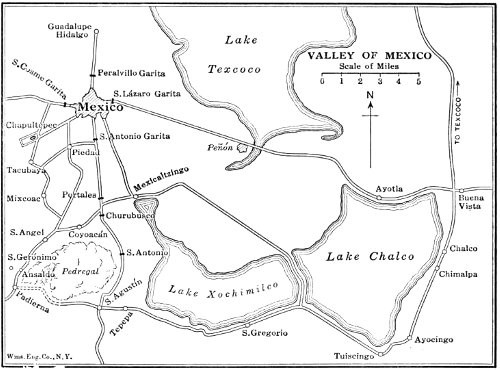
VALLEY OF MEXICO
POLITICAL CHAOS AT MEXICO
The disaster of Cerro Gordo cast new and fearful shadows upon the scene. That defeat, said Anaya, “simply means complete ruin for the whole republic,” and even his gratification that Santa Anna’s “interesting person” had not gone down in the wreck seemed rather of an iridescent kind. Military confidence, which had revived after earlier shocks, gave way entirely. The prestige derived by Santa Anna from his alleged success at Buena Vista was now torn to shreds by panting fugitives from the south. About a thousand pamphlets, for which no language was too savage or too true, poured light upon his character and achievements, and the military men as a class met with similar treatment.[3] To be sure, the government promised boldly to continue the war. April 20 Congress invested the Executive with autocratic powers, and prohibited all steps toward peace.[4] The Federal District, in which lay the capital, was placed under martial law. Urgent demands for troops were sent wherever soldiers could be supposed to lurk. Once more the authorities called upon every citizen of the proper age to take up arms. Quotas aggregating 32,000 men were formally assigned to the states. Light fortifications, intended to delay and perhaps block the Americans, were ordered to be thrown up along the route; and the heads of the Church issued an appeal for concord and morality.[5]
But all of these proceedings displayed more alarm than courage, more desperation than intelligence. Many of the defensive points were found valueless. Tools, funds, engineers and laborers fell short. The meagre donations for continuing hostilities evinced a total want of enthusiasm. The problem of obtaining enough troops, provisions and artillery to defend the town seemed more and more insoluble, and the danger not only of bombardment but of sack more and more terrible. Grandees got out their old travelling coaches, and even plain citizens began to emigrate. The government itself decided that against an army represented by American deserters as more than 16,000 strong, fully equipped, shortly to be reinforced, and soon to advance, the city could not possibly be held; and the favorite plan of the administration, the most promising that could be devised, was to buy up Scott’s Irish soldiers through the priest McNamara, recently conspicuous in California, and facilitate their desertion by having Santa Anna attack Puebla. Should this fail, submission and peace appear to have been deemed inevitable.[5]
With some exceptions rulers and people alike, wearied by decades of dissensions, oppression, scheming, robbery and illusory promises, discouraged by the passive opposition of the clergy and the wealthy classes, overwhelmed by a series of military disasters, convinced that incompetent and perhaps traitorous generals led the armies, and powerless to discern any happy omens for the country, felt neither hope nor spirit; and the kindness of the Americans, added to their invincibility, had now overcome even the instinct of race.[5]
To heighten the confusion, a state of governmental chaos reigned. Anaya had at most but little prestige or influence, and friends of Santa Anna, angry because excluded from office, created a friction between the two that weakened both. The ministers could not coöperate harmoniously. General Bravo was given command of all the troops in the Federal District and the state of México, and Santa Anna did not want him in that important position. Congress devoted itself, when not harassing the administration, to wrangling over a new constitution, substantially that of 1824, which finally was voted on the eighteenth of May. In conscious impotence the Puros writhed and snarled; and their enemies, the Moderados, after having triumphed and brought Santa Anna to their side, now boldly paraded their dislike of him, and, by showing no concern except about retaining their power, excited hostility and contempt. Common sense was no less wanting than patriotism; and when these two parties finally agreed to save the country, their plan was—to supplement the constitution with two more articles.[5]
Of all the discontent, resentments and ambitions the now despised Santa Anna became naturally the target. Almonte still plotted to be President. Arista and Ampudia, joined now in disgrace as formerly in misfortune, felt thoroughly dissatisfied. Gómez Farías could not forget his betrayal, and Olaguíbel, governor of the most important state, México, loyally supported him. Bravo reciprocated Santa Anna’s dislike. Valencia aspired to the chief military command. All in favor of ending the war—who now had an organ, El Razonador—considered Santa Anna a bar to peace and even to the faithful observance of a preliminary armistice; and some of them, arguing that his extraordinary powers were cancelled automatically by the adoption of a new organic law, advocated placing him in the interior somewhere, ostensibly to wait for new troops, and negotiating a treaty without his knowledge. The Puros were expected to explode a revolution against him about the twentieth of May, and for all sorts of personal or patriotic reasons a host of minor individuals made ready to coöperate with it.[5]
SANTA ANNA AT THE CAPITAL
But all these busy folks were only mice, reckoning without the cat. On leaving Puebla Santa Anna proceeded to San Martín, which lay on the direct road to Mexico where it began to ascend the rim of the Valley. Works had been erected near, but it was found they could easily be turned and not easily be provisioned; and a council of war decided to occupy the capital, since only there could large resources be counted upon. May 18, therefore, the wretched army of 3000 or 3500 men arrived at Ayotla, fifteen miles from their destination. Learning of this unexpected and undesired event, the hostile elements undertook to “pronounce” at once, but could not set the movement off. Three leading statesmen of the dominant party then hurried to meet the General, and after arguing all day persuaded him to write that Anaya might remain in office and even decide whether Mexico City should be defended, while he himself would retain his military command, or, if dissatisfied with Anaya’s decision, would resign.[6]
But presently cunning Tornel and one or two others convinced Santa Anna that a mere handful of enemies had spread this net in order to drag him from power, and eliminate his influence on the vital question of peace. Jealousy and fears inspired by the favor that Valencia and Bravo were apparently enjoying, added to the urgency of his officers, did the rest; and on the nineteenth, in spite of the understanding just agreed upon—indeed, only about an hour after his letter reached the palace—his troops entered the city. Anaya’s rather sour and curdled face flushed hot and bitter. He did not care to retain the Presidency, for he believed a revolution would soon break out; but forcible ejection, in disregard of a written promise, was another affair. He found himself powerless, however; and the next day, after inducing a council of generals to decide upon holding Mexico, Santa Anna announced that he would sacrifice his wishes, and resume the executive power.[6]
The state of things that ensued was indescribable. Nothing equal to it has been known perhaps, and nothing imagined save the witches’ caldron. One public man estimated the number of bubbling intrigues as twenty millions. Nothing is left us except vanity and dissension, but those we possess in the superlative degree, wrote Ramírez. Congress had no prestige, no power, no capacity; and its factions could see nothing except opportunities to stab one another. Santa Anna’s breach of faith intensified the distrust and hatred of the Moderados without gratifying the Puros. Hoping to win some popularity, he restored the freedom of the press, which had recently been curtailed; but his enemies merely took advantage of it. “The man of La Angostura, of Cerro Gordo, of Amozoc, weary of destroying Mexicans on the field of battle, comes home tranquilly to find repose in the Presidential chair,” exclaimed Almonte’s organ.[6]
A plausible and eloquent manifesto put out over Santa Anna’s name dropped cold on the pavement. No basis of popular or political strength for even a temporary footing could be discovered by his counsellors. Santa Anna himself felt staggered by the opposition. His only chance was to place the nation between the devil and the deep sea—between bayonets and chaos—hoping it would again call upon him to save it; and so on the twenty-eighth, declaring that schemers and revolutionists, who found him in their way, paralyzed his efforts to serve the country, he made another sacrifice, and resigned the Presidency.[6]
Unhappily for him it soon appeared likely that Congress would accept the sacrifice, while on the other hand certain aspects of his outlook brightened. Busy Tornel induced a fraction of the Puros, who realized their helplessness, to adopt his cause. Valencia, though much to Santa Anna’s repugnance, had been given for his present portion the chief command at San Luis Potosí, and so disappeared from the capital. Almonte found himself in prison under a charge of conspiracy. Arista and Ampudia were banished from the vicinity. Bravo retired from his command. At the same time promotions fell copiously on devotees; and the happy recipients knew these might well cease to be valid, should their patron fall. Almonte was said to have received a majority of the votes for President, while Santa Anna had been supported by only Chihuahua; but so much territory lay in American hands that a question about the legality of the election arose, and Congress deferred the matter. On the second of June, therefore, the arch-prestidigitator laid himself once more upon the altar, and in order to save the country from Scott and anarchy withdrew his resignation.[6]
“Mexicans, I shall be with you always—to the consummation of your ruin,” so the Monitor Republicano paraphrased his announcement; and then it added: “What a life of sacrifice is the General’s; a sacrifice to take the power, to resign, to resume; ultimate sacrifice; ultimate final; ultimate more final; ultimate most final; ultimate the very finalest. But let him cheer up. He is not alone in making sacrifices. For twenty-five years the Mexican people have been sacrificing themselves, all of them, in the hope that certain persons would do good to the country.” But in spite of sarcasm and ridicule Santa Anna had triumphed. Hated by many, disliked by most, distrusted by nearly all, yet forging ahead because he was on the ground with troops, because his combination of good luck, audacity and cunning could not be matched, because the Moderado government had proved incompetent, because a régime of dissension and anarchy could organize no solid opposition against him, and because a group of selfish interests found in him a sharp, tough bit of steel to fix at the head of their spear, he triumphed once more.[6]
SANTA ANNA STILL SUPREME
The victory threatened, however, to be fatal. In every direction lurked pitfalls charged with gunpowder. In all the history of Mexico dissensions had never been more bitter, nor political and social chaos nearer. Congress annoyed him until at length, by failing week after week to form a quorum lest one faction or another should score an advantage, it fell into abeyance and left him virtually a dictator.[7] In the hope of obtaining funds from the Church, he gave deeper offence than ever to the most prominent of the Moderados; but the prelates, in alliance with leading monarchists, continued to plot against him. Newspapers waged a bitter campaign until choked with an iron hand. His persecution of the generals excited fierce resentment. A Puro chief, entering the Cabinet and getting a glimpse of his ulterior aims, resigned in six days.[8]
In short the administration had no political creed, and could find no political support; and the assistance of that indispensable villain, Tornel, who could be seen stealing to the palace at the hour when the night-hawk begins to fly, covered it with discredit. Executive authorities waged almost civil war upon one another. Rumors, not without some basis, that a formal dictatorship was in view, could not be stilled; and the general want of confidence in the President’s character and aims rendered the most skilful appeals to patriotism vain. Only by the utmost exertions could the fragile edifice of government be kept balanced on the point of the bayonet.[8]
Nor was the opposition against Santa Anna confined to his immediate vicinity. The people of Mexico City had always despised the outlying states; and not only was this disdain repaid, but the capital, source of so many political and financial ills experienced by the rest of the country, was looked upon by a great number of thoughtful men as hopelessly corrupt—as a diseased part that required amputation. When restoring the old federal system in August, 1846, in order to satisfy his democratic allies and win popularity, Santa Anna apparently did not foresee, as Consul Black did, that after realizing their power and getting into touch with one another, the states would take a firm position upon their prerogatives. In addition to such difficulties, it was commonly felt that military men and the army stood mortally opposed to democracy and federal institutions, that success in the field might enable Santa Anna to overthrow this principle and these institutions, and that a loud cry for patriotism and war, combined with a systematic withholding of men and supplies, would compel him to fight and ensure his ruin.[8]
By evasions, therefore, or in some cases positive refusals to obey the commands of the general government, substantially all the states withheld support, frequently alleging that under the régime of the new constitution its extraordinary powers, conferred by the law of April 20, did not exist, and that all National Guards, as well as all revenues assigned to the states in September, 1846, were independent of the national authorities. In this opposition Zacatecas naturally played a leading part, but perhaps Olaguíbel, an impressive, honest and able man, who had travelled in the United States and Europe and had filled his library with busts of the leading American statesmen, was its foremost representative; and the firm support of his constituents, who felt intensely jealous of Santa Anna, as well as the coöperation of Gómez Farías, rendered him a formidable person. Balked thus by constitutional theories that not only flattered local interests and pride but were noticeably economical, Santa Anna could obtain—aside from the troops brought by General Juan Alvarez and a few others—very little assistance outside of the Federal District.[8]
That was hard enough, but still greater difficulties lay behind it. In the far northwest Sonora, Sinaloa and Durango entertained the idea of uniting as a new republic, and six of the central states were banded together in a Coalition. This extra-legal, if not illegal, organization had been called into existence in January, 1847, by the pronunciamiento of the Mazatlán garrison, which aimed at making Santa Anna dictator. By the end of May it was in good shape, and had a plan for troops of its own. Two weeks later the delegates, who made Lagos their place of meeting, called themselves an Assembly, and were buying arms; and by the fourth of July they felt bold enough to declare null a decree of Santa Anna. Of course the ostensible purpose was to protect independence, nationality and federal institutions; but, as the correspondence of the state governors reveals, the real aims included the establishment of a “new pact of alliance,” a new confederation, in which Santa Anna and that Babylon, the city of Mexico, should have no part. With this Coalition a large number of the Puros naturally sympathized.[8]
SANTA ANNA PREPARES FOR BATTLE
In the face of it all, however, the futile strategist of Cerro Gordo, with a truly superb wilfulness and a more truly pitiful self-confidence, snatched up once more the bloody dice. Cannon were brought from distant points, cast by the government from bells and old ordnance at Chapultepec and elsewhere, or manufactured by contractors. New muskets, of which foreigners offered to deliver great stocks at Mexican ports or by way of Guatemala, were purchased; old ones, appropriated by deserters or stolen during revolutions, were hunted up; and all citizens were ordered, though perhaps without great results, to let the government have what arms they owned. Immense quantities of powder were produced at Morelia, at Guanajuato, at Santa Fe near Mexico, and at the capital; a great deal was imported overland from British Honduras, and additional supplies came from New Orleans by the way of Campeche. At various points mortars, bayonets, projectiles and numberless other articles were turned out by government establishments or private contractors. Forges clanged on all sides; and wherever the President’s restless and unscrupulous mind could have its way, there reigned a feverish activity, cooled only by a want of funds.[11]
At Mexico City, before his arrival, some 2000 regulars and 8000 National Guards, besides the officers, were in garrison; and these with his army, five hundred from Querétaro, some two hundred Irish deserters, an unknown number of able-bodied loafers impressed at the capital, and larger or smaller accessions from other sources, made up the Army of the East. The Army of the South under Juan Alvarez, who commanded the line to Acapulco with headquarters near Mexico, had on its roll at the end of June 2748 officers and men; and Canalizo, comandante general of Puebla, who became reconciled to his chief in June, was supposed to have a few thousands of National Guards and irregulars. But as most of these forces were poorly paid and a large part of them served unwillingly, desertion—in spite of the severest rules—was common, and the numbers fluctuated incessantly.[11]
At San Luis Potosí, meantime, lay the Army of the North, which contained the largest percentage of veterans. In May Valencia, so long a rival of the President, had talked in a very lofty style, as if already the military head of the nation, about marching south and cutting Worth to pieces, and Santa Anna, though anxious to get his troops, now wished him to remain at a distance; but in July, on account of Scott’s approaching reinforcements, it seemed necessary to bring down that army, and it arrived at Guadalupe Hidalgo, a few miles north of Mexico, on the twenty-seventh, numbering more than 4000 men with twenty-two guns. Just how many soldiers the President then had cannot be stated, and in all probability no one could have stated at the time; but, such as they were, there seem to have been fully 25,000 men and probably, as reports and intercepted letters convinced many of the Americans, 30,000, if not more.[9] Some were well dressed, well equipped and well trained; but from that pinnacle the army descended to mere off-scourings, whose rags were as the President said, “a disgrace to the nation,” and whose military efficiency doubtless corresponded.[11]
Of equally varied quality were the officers. The generals best known to the country were nearly all out of the service now, being under charges or at odds with the head of the government. Valencia was a conspirator, a drunkard, a dolt and a volcano. Alvarez, an ignorant mulatto from the wilds, understood only half-savage, partisan fighting. Lombardini, a strutting lackey, who commanded the Army of the East except when Santa Anna took personal charge of it, strove to conceal behind a swarthy face, a heavy mustache and goatee, and a ceaseless volubility the poverty of his intellect; and the great mass of the officers were—well, they had already shown their value. They were now ordered to be intelligent and brave, to be zealous whether paid or not paid, to do their full duty and something more, to cast behind them every thought of accepting parole, and to say nothing against their superiors; but it lay beyond the power of orders to make them what they could not be, and the small number of excellent men were lost in the crowd.[11]
THE MEXICAN PLANS
Regarding the plan of operations a radical difference of opinion existed. To not a few the idea that Scott was lying comfortably at Puebla seemed almost unendurable. They longed to have him attacked unceasingly; and they insisted that, should the arrogant invader dare to march for the capital, every step of the route should be contested. Santa Anna on the other hand still believed in concentration, and though some regard was paid to the apprehensions of the ayuntamiento, his views naturally prevailed. The plan adopted, then, after considerable vacillation in regard to details, was to protect the entire perimeter of the city with fortifications, inundate more or less the surrounding meadows, and prevent Scott from seriously injuring the town with his artillery by erecting a series of works at the most advantageous points of the environs. These protected lines were to be held by the less reliable corps—National Guards, for example—and the troops belonging to the regular army were to be a mobile force ready to defend the city at any threatened point.[11]
The plan was thus essentially defensive, and it has been said with much force that a system of this kind promises merely negative results in the case of success, and positive ruin in the case of defeat. But the present situation was peculiar. Supplied with provisions for no long period, and without hopes of early and strong reinforcements, the Americans were bound to fail unless promptly and signally victorious, and their entering the Valley would then have meant destruction. “Scott is lost,” exclaimed the Duke of Wellington after the Americans crossed the rim; “He cannot capture the city and he cannot fall back upon his base.” Santa Anna’s plan, therefore, did not merit the criticism bestowed upon it.[11]
Besides, Alvarez with nearly all the Mexican horse was to swing in behind the advancing Americans, cut off their communication with Puebla, follow, annoy and injure them in every possible way, conceal his real strength so as to bring out and overwhelm their cavalry, attack vigorously whenever Scott should become seriously engaged before Mexican fortifications, and be ready to prevent his retreat. Canalizo with his thousands was to support Alvarez; and Valencia also, advancing from Guadalupe Hidalgo to the, village of Texcoco, east of Mexico, was to coöperate with him, and especially to throw himself with all his energy into the attack on the American rear or flank, whenever Scott should assail the outer works. At the same time the people of the neighboring towns and villages were to swarm about the invader like hornets, and sting him day and night incessantly. In short the plan was excellent—only Santa Anna overlooked, as usual, several possibilities.[11]
As soon as he took up the reins of government the construction of defences had begun, and now, under the technical direction of General Mora, Manuel Robles and Juan Cano, it was pushed with all the energy of an intense military despot who stuck at nothing. Villages were depopulated, haciendas robbed of their laborers, jails emptied, and the streets cleared of vagabonds. Enforce obedience, the governor of the District was curtly told when he reported that his orders had no effect. Sunset no longer promised repose, and the church bells no longer meant worship. Informed on July 18 that Scott would leave Puebla on the twenty-first, Santa Anna rose above his exemplar, Napoleon, and took for model the Creator. Within eight days let all the works be completed, he decreed. But engineers, laborers, tools, instruments, timber, provisions, time and cash—much of which was embezzled by high officers and officials even at this juncture—all fell short, and Santa Anna’s serviceable cannon were not enough to equip even the works constructed.[11]
Certain points, however, became quite formidable, and especially Old Peñón, a lofty, precipitous hill of rock standing by itself, close to the Puebla route, seven miles from the city.[10] Stockades, breastworks, parapets and guns bristled on summit and brow; works at the base and in advance commanded all dangerous approaches; a trench full of water crossed the road; the meadows in front—cut with ditches—were inundated; and the swampy edge of Lake Texcoco guarded the opposite side of the road. To the Mexicans, who always measured the strength of a chain by its heaviest link, this position seemed a wonderful protection; and in general the people, if not the city, were strongly fortified by the President’s labors.[11]
THE PEOPLE ENTHUSIASTIC
For other reasons also the morale of the inhabitants improved. Characteristic light-heartedness made them turn from past defeats to future triumphs. They were told that at Cerro Gordo Scott had made his troops fight by opening a battery upon them from the rear; that his men, while they presumed to think they could make “vile slaves” of the generous and valiant Mexicans, were few, sickly, poverty-stricken, dissatisfied; and that Polk, embarrassed by the expense of the war, could send him but scanty reinforcements. Greed, brutality and sanguinary ambition were charged against us at this crisis by the London Times in its usual contemptuous manner, and the Diario eagerly quoted it. The successes of the guerillas against American convoys roused a lively enthusiasm. “Only a little, a very little” effort is necessary to beat the hateful Anglo-Saxon, proclaimed the government; and a review of the brilliant Eleventh Infantry, headed by its band of twenty-five pieces, made that little seem easy and agreeable.[11]
People who bore the names of saints as a matter of course easily exploded Scott’s Address of May 11. How absurd, they cried, for the American general to pretend he is a Christian: there is no St. Winfield in the calendar! The only hope of the Americans lies in Mexican dissension, therefore let us disappoint them, it was urged; and to promote harmony all the newspapers except the official organ were suspended on plausible grounds. Santa Anna’s activity and warlike spirit had to be recognized by all. We must confide in him and gather round him like a band of brothers, preached the Diario; and when all political trials were ordered to end, and the President banqueted at Valencia’s house, the fraternal era so long hoped for seemed at hand.[11]
Finally, on the ninth of August, at two o’clock in the afternoon, a 16-pounder boomed portentously from the citadel. The long roll was beaten. Bands of music patrolled the city. Hands clapped. Vivas echoed through the streets. Rockets flashed rosettes in the sky. “Blinded by pride the enemy have set out for the capital,” proclaimed Santa Anna; “For this, Mexicans, I congratulate myself and you.” The government, while savagely and contemptuously scoring the Americans, announced a series of reforms to be effected by Santa Anna, not as a constitutional magistrate, but as a Divine Providence; and the Diario echoed back, “Half a dozen of these measures would change the face of the Republic.” The President assumed command of the army, and every citizen from sixteen to fifty years of age took his place in the ranks. Amidst the most fervid enthusiasm of crowds that filled the streets, balconies and housetops, troops followed troops gaily toward Old Peñón, and two days later the forces were reviewed there.[12]
Tents gleamed under a splendid sun. Bands played as if inspired. The soldiers marched with a quick, impatient step. Anaya—recently the chief magistrate, Gorostiza—the primate of Mexico’s literary men, white-haired Herrera—the most honored of her political chiefs, and countless other dignitaries did honor to the occasion. The rich vestments of the clergy gave exquisite lustre and color, and their pompous benedictions added a sense of more than human grandeur. All were happy, radiant, brotherly. Every thought of peace, every thought of opposing or even doubting Santa Anna appeared to be forgotten. In all his previous career so refulgent a day had never been his. “Ecce Homo!” cried the Diario; “Behold the illustrious champion of 1821, the hero of 1829, the genius of 1838!” For him the hill became a Mount of Transfiguration. Or rather, perhaps, it was Mt. Sinai, where Deity appeared in thunders and lightnings. You MUST, was the command to the governor of Zacatecas this day. Let the state of Mexico send me her troops, rang the message to Olaguíbel. And Olaguíbel replied meekly, They shall go to-morrow.[12]
SCOTT’S MARCH TO MEXICO
Scott was in fact advancing. On the morning of Saturday, the seventh, his camp was astir early. The base of Popocatepetl seemed black, and the slopes a pale, silvery blue; but its top, almost 18,000 feet above the sea, was a “Blazing Star,” as some of the Indians named the mountain, and appeared like an omen of victory. The Second Division was soon ready. Twiggs faced it, waved his hat round his white head, and cried in the voice of Ajax, “Now, my lads, give them a Cerro Gordo shout!” A simultaneous hurrah from twenty-five hundred iron throats was the response; and at six o’clock, preceded by the cavalry and the engineer company and followed by the siege train—while his band, mounted on splendid white horses, played our national airs—he began the eventful march. One day apart, Quitman, Worth and Pillow followed him. Though it was announced that no man unable to do three marches could be permitted to go, hundreds of convalescents unequal to the effort insisted upon trying, and, gradually falling out, rejoined the garrison of Puebla. Feeble in numbers[13] for such an enterprise, but confiding in their quality, their leader and their prestige, the 10,738 men and their officers pressed boldly forward.[15]
For a time the dust proved extremely annoying and the sun scorched; but soon mountain air began to be felt, and the troops entered a wide, blooming and scented valley, full of rich fields, grazing herds, noble hacienda houses that were almost palaces, and trim white churches that seemed like stragglers from the great host at Puebla. In the rear shone Orizaba and the nearer pyramid of Malinchi. On the left Popocatepetl and his consort, the Sleeping Woman (Iztaccihuatl), deeply blanketed in fleecy white, looked hardly a stone’s throw distant; and after the sun had set, the air grown cold, and the valley—now less open—filled with shadows, their purple tops glowed like interplanetary lighthouses.[15]
Soon after passing the ugly little town of San Martín, twenty miles from Puebla, the troops began to ascend more rapidly. Eleven miles more brought them to a mountain river, Tesmelucan, where the elegant aërial bridge that spanned the abyss made them almost feel they were flying. The scenery now became Alpine. Deep chasms, answered to peaks, and lovely glens to precipices; and the cedar, the oak and the ash, as well as pines of extraordinary height and straightness, reared themselves on the slopes. At Río Frio, about thirty-six miles from both Puebla and Mexico, where an icy stream dashed foaming down the rocks, the mountains closed in on the left, and their crest, lined with deserted parapets, almost overhung the road.[14] Then a stiffer climb of about five miles placed the troops on a narrow plateau which formed the summit; and they were now 10,500 feet above the sea.[15]
A few miles down the steep descent on the other side their prospect opened, and below, girt round with singularly bold mountains—rough, dark and purplish, but softened here and there with a wisp of shining vapor—lay the Valley of Mexico, which the pellucid atmosphere, transmitting colors and outlines undimmed, brought wondrously nigh. Ten small volcanoes, that had been crumbling for ages untold, stood clothed in luxuriant verdure nearly to the summit. Six broad lakes now laughed under the brilliant sun and now brooded in the shadows of passing clouds. Velvet champaigns—cut with ash-colored roads, gleaming canals and straight lines of poplars, and studded with walled haciendas, rambling towns and cozy-looking villages—were further variegated with highly cultivated fields of many crops, with groves and orchards from which peered steeples and bell-towers, with villa roofs of tiles, red and cheery, and with whitewashed cottages that shone like silver. Every possible hue of green and every possible tone of light and shade blended into one harmonious effect. And in the midst of this wonderful scene, as the climax of the stillness and beauty, the focus of all eyes, the aim of all desires, untarnished by smoke, seemingly without stain, bright with sunshine, begemmed with many a palace, park and lofty church, slumbered the capital of Mexico, Venice-of-the-Mountains. Not one of the fascinated soldiers but held his breath; and not one, testified the commander-in-chief, but said to himself or his neighbor, “That splendid city shall soon be ours!”[15]
Along this part of the route almost 13,000 trees had been cut down for barricades, and some of them had been placed in the road; but the Americans were not materially hindered, and in crossing the lower slopes they found little to do except admire the wondrous variety and profusion of the wild-flowers. On the eleventh, seeing Mexicans ahead for the second time, Twiggs waited for Quitman; but a few hours later, after passing a cross-road, he went on about four miles, and occupied the adobe village of Ayotla, half-buried in olive trees, while Harney’s cavalry took post at San Isidro, a mile and a half in advance, and Quitman camped in the rear. The next day Worth’s division turned to the left by the cross-road, marched three miles and a half to the squalid little town of Chalco, simmering at the margin of the shallow, marshy lake bearing that name, and finally halted a little distance beyond; and Pillow camped at Chimalpa, not far beyond Worth.[15]
But what had the enemy been doing? The people along the route, who were to have stung the Americans day and night, recognized the difference between them and the Mexican irregulars, welcomed them cordially, and gave them all possible assistance. Canalizo—who seems to have been cowed by the disaster of Cerro Gordo, and some time before this had fled from San Martín, with six hundred men at his back, on seeing an American officer, detailed to arrange an exchange of prisoners, approach with a small escort—felt no desire to fight, besides which most of his troops revolted or deserted; and Governor Isunza not only failed to assist him with men and means, but flatly refused him a particular corps, expressly demanded by the Executive at Mexico.[16]
Alvarez, well-nigh a brigand, had always fought for his own advantage, knew that all the other chief leaders were doing this now, and, in addition to cherishing resentments against Santa Anna, probably felt no craving to play a strictly inferior part. Though he did not have all the men for whom he seems to have been drawing rations, his force was important, and in three particulars he obeyed his orders. He stationed himself at the designated point on the flank of San Martín, kept beyond the reach of Scott’s artillery, and scrupulously refrained from attacking the Americans on unfavorable terms; but while he made excuses bravely, and proposed valiant operations that Santa Anna forbade as inconsistent with his general plan, he retired some ten miles from the route on the plea that his exhausted horses required pasturage. For probably similar reasons Valencia quibbled and shirked; his train of heavy guns—which, though needed in the fortifications, he would not give up—impeded his movements; and so the only hostilities were a trifling skirmish with irregulars, in which one American trooper fell a victim to his own rashness. Thus ended, to his deep disgust, the first chapter of Santa Anna’s hopes.[16]
THE APPROACH TO MEXICO
Four lines of advance now offered themselves to Scott. By taking the cross-road to the right he could have skirted Lake Texcoco, passing the village of that name, and approached the north or the northwest quarter of Mexico. But the route would have been long, deficient in water and fuel, and circuitous; it was defended by Valencia with an ample supply of artillery; a movement in that direction would have made surprise or even sudden attack impossible for him; at a pass near Guadalupe Hidalgo stood fortifications; and a march round these would have involved another long circuit on exposed and unknown ground. This route, therefore, was not seriously considered. On the other hand, after the most thorough investigation, Scott had planned before leaving Puebla to take the cross-road to the left, march along the southern shores of Lakes Chalco and Xochimilco, and reach San Agustín, some ten miles to the south of Mexico; and it was for this reason that he placed Worth, who was to lead the movement while Twiggs was to menace Old Peñón, near Chalco.[17]
On reaching the ground, however, unfavorable reports about this road were given by Mexican spies; and the General, partly for that reason and partly to mystify the enemy, reconnoitred the Peñón and also a fourth route, which led to the village of Mexicaltzingo, about five miles from the city. In regard to the Peñón his engineers—who pushed their investigations with the utmost intrepidity, studied every foot of the red ledges dripping with crimson gravel, and even penetrated behind the hill—decided that it could be carried, but only at a severe loss; while the evidence concerning the fourth possibility led to a substantially similar conclusion, supported by the additional objection, that apparently success would place the Americans on difficult and unknown ground. At about the same time Scott obtained further information regarding the Chalco route, which seemed to justify the opinion formed at Puebla. Consequently the orders to attack Mexicaltzingo—issued either because at the time Scott thought he should march that way or because he desired to mislead the cunning Mexican spies, who even gained the confidence of high American officers—were suddenly rescinded in the night of the fourteenth, and the next day, though Twiggs continued to threaten the Peñón until the morning of the sixteenth, all the rest of the army, headed by the cavalry and Worth’s division, set out for San Agustín, distant from Chalco some twenty-five miles.[17]
For about half this distance the road was little more than a narrow lane, with a lake—or more properly a watery marsh—on the right and bold foothills close on the left. Spaces of firm ground there were. At one time venerable olive trees formed an arch over the road; once the troops camped in a fine grove, and some ledgy, rocky spurs had to be crossed. But for much of the way, although the weather had been remarkably dry for the midst of the rainy season, the story, as Scott had anticipated, was “mud, mud, mud.” Now and then a man would slip and sink to his waist in a bog-hole; in places the track was quite overflowed; the chilly, torrential rains of almost every afternoon increased the difficulties; and the labor of getting several miles of wagons and heavy guns along such a route was almost incredible. Besides, the troops had to be ready at all hours for attack—frontal, rear or flank. But early in the afternoon of the seventeenth Harney and Worth’s advance reached San Agustín, a delightful place full of handsome gardens and orchards; and the next day the rest of the troops joined them—“ready,” as a soldier put it, “for anything except a thrashing.”[18]
TO SAN AGUSTÍN
But again, where were the Mexicans? With so many works to construct, Santa Anna could hardly be censured for leaving unfortified—especially as both an inner and an outer line were made ready against any forces using it—a route that seemed to be quite impracticable for an army train; but he might have placed upon it a few light guns and a body of skirmishers, who could have embarrassed the Americans greatly. This, however, with his usual over-confidence and faulty judgment, he neglected to do. Yet he was not idle. On the fourteenth he knew the Americans were talking of a march to San Agustín; and though he suspected this language might be a blind, he not only sent additional forces to that quarter, but ordered Alvarez to follow Scott, should such a movement occur, and be ready to fall upon him bravely should he attack a fortified position; and when the movement actually began on the following day, though Santa Anna misinterpreted its aim, he promptly took further defensive steps on that line.[18]
One result was a slight brush between Alvarez and Twiggs after the latter moved from Chalco on the sixteenth; but Alvarez soon found so many difficulties in the road pursued by the Americans and so little food or pasturage left in their rear, that he once more abandoned his appointed field of operations. Santa Anna would not break up his general plan by sending strong detachments from the southern line; and consequently Scott’s march was merely annoyed by a few hundred irregulars, who fired at intervals, rolled great stones down the slopes, and cut ditches in the road, but broke from cover and fled like scared rabbits when C. F. Smith’s corps of light infantry ran leaping and shouting across the hillsides. Thus ended the second chapter of Santa Anna’s hopes.[18]
Meantime a precipitate rearrangement of the Mexican forces took place. The President, after reconnoitring the American advance, hastened to place himself between San Agustín and Mexico. Troops were despatched from the Peñón to various points on the southern front, and Valencia was ordered to proceed by the way of Guadalupe Hidalgo to the same quarter. But the former status could no more be restored than one could put back the smoke of an exploded shell. The strongest fortifications had been turned and rendered useless; and any one could see that on the side now threatened, where a number of causeways approached the city, the defence of it would almost necessarily be weakened by a division of the garrison. After such enthusiasm and such impatience to meet the enemy, retirement unadorned with laurels or with even the stains of combat produced a humiliating reaction in all hearts.[19]
At Mexico the returning soldiers found empty streets, untenanted balconies and bolted windows; and the silent, sombre, fearsome aspect of a besieged city enveloped and oppressed them. Doubts as to Santa Anna’s competence or loyalty, which had slept but not died amidst the recent glorification and his confident promises of “a splendid triumph,” awoke. People recalled that precisely when the enemy were moving against Vera Cruz, the Mexican army had been led off into the northern deserts; and they hotly demanded why the engineers, the laborers, the troops and the cannon had been massed at Old Peñón, where Scott could nullify them all by a turn of the wrist. As if in answer, it was publicly stated that an outpost had found a treasonable communication addressed by the President of Mexico to the American commander; and so ended Chapter III of Santa Anna’s hopes.[19]
XXVI
CONTRERAS, CHURUBUSCO
August, 1847
While grievously disappointed by the collapse of his efforts at Old Peñón, Santa Anna felt by no means despondent regarding his new line. Toward the south ran the great highway of Acapulco—along which numberless cargoes of silks, teas and spices had approached—guarded at about a mile from the city by the gateway or garita of San Antonio Abad. Three miles and a half beyond that garita the highway crossed a bridge over Churubusco River, here practically a drainage canal running between high embankments planted with maguey, with Mexicaltzingo about a mile and a half distant at the left. On the farther side of the river, a fifth of a mile southwest of the bridge, stood a massive convent and church, skirted by the rambling hamlet of Churubusco. Passing the church at a distance of three hundred and fifty yards the highway veered slightly toward the east, and some two and a quarter miles from the river came to a great feudal hacienda named San Antonio, adorned with trim silver poplars and Peruvian pepper trees along the front of its buildings. A scant mile then brought one to the similar but far less pretentious establishment of Cuapa; and two scant miles more to San Agustín.[1] At the Churubusco bridgehead and convent and at San Antonio, where the erection of defences had begun some time before, laborers could now be seen working—particularly at San Antonio—like bees; and with all possible haste guns, as well as troops, were brought over from the Peñón. Here, said the President, he “desired to have the battle fought.”[4]
3. This specimen may be quoted: “The cunning dissimulator, Ibarra [a member of the Cabinet], venomous as a serpent, crawls forth obscurely from his lurking-place to-day in order that he may set his malignant teeth to-morrow in the vitals of the republic.... Off with the heads of the vile traitors!” One ingenious writer said: If Santa Anna will not sacrifice his vanity by admitting he is incompetent, why should we sacrifice our lives and property? April 21 a general amnesty for political offences was declared in the vain hope of producing harmony (76to Bustamante, Apr. 21).
4. This important law provided (México á través, iv, 656): 1, The government is authorized to take all steps necessary to carry on the war and preserve the republican system; 2, but it must not make peace with the United States, cede territory, conclude negotiations [particularly with reference to a monarchical régime] with foreign powers; 3, make colonization contracts, impose punishments or confer civil or military appointments except those placed within its authority by the Constitution; 4, any arrangement between the United States and authorities superseding the present government shall be void; 5, any person, whatever his status, who treats with the United States is hereby declared a traitor; 6, should Congress be unable to meet, its place shall be taken by a council of government, consisting of the senior member present of each state delegation.
5. Affairs at Mexico, Apr. 20 to May 18. S. Anna, Apelación, 44–5; app., 76. Id.., Detall, 8. Dublán, Legislación, v, 267 (Apr. 20). Giménez, Mems., 107–9. Méx. en 1847, 20. Picayune, May 6, 20. Defensa de ... Estrada. 312Basadre to S. Anna, Apr. 9, very private. 73Bermúdez de Castro, no. 517, June 29. Manifiesto del Supr. Tribunal. Molina, El Asalto. Memoria de ... Relaciones, Jan., 1849. Boletin de Noticias, May 14. Republicano, May 10, 22. Courrier Français, May 5. London Times, June 15; July 9. Bustamante, Nuevo Bernal, ii, 196–8. Encarnacion Prisoners, 67. 52Trist, no. 7, June 13. 92Donations, Mex., May 1–6. 92Bravo, proclam., May 6. Roa Bárcena, Recuerdos, 570. 92Ayunt., call for volunteers, May 20. Consideraciones. Ho. 60; 30, 1, p. 967 (Worth). 80Olaguíbel to Relac., Aug. 15. Lara, Resumen, 66, note. México á través, iv, 655–6, 661, 704. Prieto, Memorias, ii, 210–2. Hitchcock, Fifty Years, 255. Ramírez, México, 229, 233–4, 239, 241, 246–7, 250–1, 256, 272–7, 284. 88Metropol. dean, May 8. Monitor Repub., Apr. 22; May 3, 8, 10–11. S. Anna, manifiesto, Mar. 24, 1848. Apuntes, 199, 200–1, 203–4. 80Guerra to gov., Mar. 11; Apr. 22. 80Gov. to Bravo, May 5. Diario, Apr. 25, 28; May 3, 4, 6, 12, 15. From 76 the following. Decrees, Apr. 26; May 1. Junta directiva, May 1, 3. Acuerdo, Apr. 20, 25. Circular, Apr. 30. Garrison, estado, May 13. To generals, Apr. 25. To Brito, May 25. J. J. Miñón, Apr. 24. Deserters, May 15. Circular, May 4. Basadre, May 16, res. To Alvarez, Apr. 26. To Monterde, May 18. To S. Anna, Apr. 20–2. To Bravo, Apr. 24. To Bustamante, Apr. 21. Almonte, Apr. 28, 30; May 8, 12, 15, 18. Monterde, May 9. Bravo, May 11, 16. Rincón, May 17. S. Anna, May 16.
6. Affairs at Mexico, May 18 to June 2. Negrete, Invasion, iii, app., 61–72, 81–3; iv, app., 261–8, 273–4. Tributo á la Verdad, 56, 74–6. Giménez, Memorias, 109–11. S. Anna to Congress, May 28 (Biblioteca Nac.). Id.., Apelación, app., 83–8. Id.., Detall, 8. Defensa de ... Estrada. Sen. 52; 30, 1, p. 177–8. Portrait of Anaya: city hall, Mex. Picayune, July 15; Aug. 7, 8. Monitor Repub., May 20; June 3, 4, 14; Dec. 12 (S. Anna, Nov. 19). Republicano, May 10; June 5, 10, 15, 26. México á través, iv, 662, 664–7. Ramírez, México, 229–30, 233, 284–6. 13Bankhead, nos. 59, 60, May 29. London Times, July 9, 16; Aug. 6. 73Bermúdez de Castro, no. 517, June 29. Roa Bárcena, Recuerdos, 290–3. Bustamante, Nuevo Bernal, ii, 157, 196–204. Encarnacion Prisoners, 67. 80Guerra to gov. Méx., May 20. Diario, May 19, 21, 23–4; June 8. Boletín de la Democracia, May 25. Hitchcock, Fifty Years, 260. Ho. 60; 30, 1, p. 967. Apuntes, 201, 204. Otero, Réplica. Dublán, Legislación, v, 264. 76Bravo, May 15, 16, 24, 30. 76S. Anna to Rosa, Feb. 5, 1848. 76Valencia, June 7, 1847. 76Mora, June 5. 76To Brito, May 25. 60Bravo, proclam., May 6. 76S. Anna, May 21.
7. A signal illustration of the incompetence of the Mexican government, particularly Congress, was afforded by its treatment of Great Britain. At the end of August, 1846, Bankhead, under the instructions of the Foreign Office (13to Bankhead, no. 20), proposed mediation to Mexico, but the offer was not welcomed. Santa Anna and Rejón believed that it proceeded wholly from self-interest, and that, in order to prevent her commerce from suffering longer from the war and other interests from becoming imperilled, England was ready to sacrifice the honor and welfare of their country (73Bermúdez de Castro, nos. 332, res., 343, res., Sept. 24, 27, 1846); and, moreover, the Mexicans still felt quite able to cope with the United States (13Bankhead, no. 130, Sept. 7, 1846). In October, under renewed instructions (13no. 11), Bankhead again submitted the proposal (13nos. 162, 180), and later he returned to the charge (Apuntes, 202). The subject was unwisely referred by the Mexican Executive to Congress, but nothing was done (ibid.). After the battle of Cerro Gordo, however, the administration thought negotiations might be used to delay the American advance (ibid.; Ramírez, México, 246) and the Puros hoped the subject might be made embarrassing to the government (Ramírez, México, 224). Violent, acrimonious and dangerous debates followed in Congress and, in order to embarrass the Executive (13Bankhead, no. 45, 1847), enough Puros remained away (at the time set for voting) to destroy the quorum (ibid.). The matter was then dropped (Ramírez, México, 246, 274). The general feeling was that British mediation would signify British control and a dishonorable, disadvantageous peace (London Times, June 15; Monitor Repub., May 18). But, even if this view contained some elements of justice, trifling with a great power and throwing the vital interests of Mexico into the cockpit of party politics could not be excused.
8. The political situation after June 2. S. Anna, Apelación, app., pp. 3, 6, 8, 10, etc. Id.., Detall, 8. 87Coalition junta, July 7; Aug. 8; etc. Republicano, June 4, 5, 9, 15, 16, 20, 22, 26. 312Baranda to S. Anna, Apr. 8. México á través, iv, 667, 704. Iniciativa que el Hon. Cong. del Estado de Zacat. Otero, Réplica. 13Bankhead, nos. 60, May 29; 64, 65, 70, June 29. Id.., no. 125, Dec. 30, 1845 (Tornel has no reputation for honesty). London Times, Aug. 6. 77Gov. S. Luis Potosí, June 19. 13Thornton to Bankhead, June 14. 52Consul Black, no. 389, Sept. 12, 1846. Encarnacion Prisoners, 68, 77–8, 86. 73Bermúdez de Castro, no. 517, June 29. 77Letter from Coatepec, June 26. 82Treas. to sec. state of Puebla, June 14; reply, June 15. 82Guerra to gov. Puebla, Aug. 2; reply, Aug. 7. 80Legisl. of Méx. state, Mar. 26; June 12. 80Id.., address, Apr. 26. 80Coalition, address, Aug. 4. Verdadero Liberal, Aug. 12. 80Coal. junta to gov. Méx., June 17. 80Id.., dictamen, July 4. 80Oaxaca state, exposición, June 26. 83Gov. Querétaro to gov. S. Luis Potosí, Apr. 9. Diario, June 7, 8, 11, 24, 30; July 3, 9, 18. Monitor Repub., May 3, 4, 26–7; June 3, 7, 11, 13, 14–16, 18, 19, 24, 30; July 6, 7, 9; Dec. 12 (S. Anna, Nov. 19). Niles, Oct. 30, p. 141. 83Gov. Querétaro to Farías, Oct. 20, 1846; to Anaya, May 4; to all govs., May 7. 82Gov. Jalisco to gov. Puebla, Apr. 13. 82Gov. Méx. to gov. Puebla, Apr. 12. Ramírez, México, 237, 244–6, 254, 263, 272, 288–90. 80Gov. Méx. to Bravo, May 5. 76To Alvarez, June 29. 76Extracto re Guanajuato. 76J. J. de Echeverría, June 6. 76Arellano, July 9. 76Olaguíbel to Relac., Apr. 19. 76Hacienda to Basadre, Aug. 9. 76Reyes, June 1, 22. 76Basadre, Aug. 9. 76Yáñez, June 15. 76Mora, Apr. 28.
11. Santa Anna’s preparations (see note 1). 66Stevens to J. L. Smith, Aug. 12, 26. 66R. E. Lee, J. L. Mason to J. L. Smith, Aug. 12. S. Anna, Apelación, 44–7. Id.., Detall, 8–11. 60Patterson to Marcy, Oct. 26. Picayune, June 30; Aug. 8. Donnavan, Adventures, 29. Pacheco, Exposíción. Negrete, Invasión, iii, app., 91–4, 123–5. Scott, Mems., ii, 466. Hitchcock, Fifty Years, 274. 224Intercepted Letters (ed. by Hitchcock). (Embezzlement) Consideraciones, 25; Apuntes, 207. Sen. 19; 30, 2 (M. L. Smith, E. L. F. Hardcastle). Apuntes, 205–10, 223–8. Molina, El Asalto. Raleigh Star, Sept. 1. 13Thornton, June 29. 178Davis, diary. Portrait of Lombardini: city hall, Mexico. 350Weber, recolls. N. Orl. Delta, July 18. Verdadero Liberal, May 20. (San Patricio cos.) Dublán, Legislación, v, 290; Diario, July 15. México á través, iv, 668–71. 70“Guerra,” no. 1120. London Times, May 10; Sept. 6. Semmes, Service, 348–9. Dublán, Legislación, v, 280, 284, 289, 294. 73Bermúdez de Castro, nos. 517, June 29; 534, res., July 28. 73Lozano, No. 2, Aug. 24. Gamboa, Impug., 51. Bustamante, Nuevo Bernal, ii, 205–6. 335Thornton to N. P. Trist, July 29. Encarnacion Prisoners, 69. 60Wilson to Marcy, Aug. 1. N. Y. Sun, Aug. 23. Diario, May 24; June 5–10, 14–6, 18, 20, etc. Monitor Repub., May 31 (Eleventh Inf.); June 13–5, 18, etc.; Dec. 12 (S. Anna, Nov. 19). Niles, June 19, p. 251. 13Bankhead, no. 74, 1846. (Honduras) 60Patterson to Marcy, Oct. 26, 1847. (Powder from N. Orl.) 166Consul McFaul to ——, Nov. 12, 1846. Ramírez, México, 268. The following from 76 are cited for particular reasons. Valencia, proclam., May 14. Estado of garrison, May 13. Ayunt., Mexico, June 3. Recommended measures, Apr. 6, 14. Circulars, June 12; July 24. S. Anna to Alcorta, June 12; Aug. 3. Valencia, July 19. Statement, lines of defence, June 29. J. Terrés, report on cavalry [Nov.]. J. de D. Peza, report on infantry, Nov. 29. Acuerdos, May 21, 23–4; June 5, 6, 8, 19, 25; July 17, 18, 19, 28, 30; Aug. 2, 3, 5, 6. To Alvarez, June 3, 30, etc. To Mora, June 26; July 2, 20, 23, etc. To Lombardini, June 26; July 2, 5, 7, 11, 22, 31, etc. Alvarez. May 29; June 9, 16; July 5, etc. Mora, July 9, 19, 20, 22, etc. Lombardini, July 6, 7, 10, 12, 14, 15, etc. Olaguíbel, Aug. 20. Decrees, June 5, 8; July 10, 12; Aug. 8, etc.
9. July 9 the Mexican Army of the East included, according to a document published by Santa Anna, 17,548 officers and men. A. López (Décimo Calendario, 57) placed the army, including the National Guards, at 30,000 on Aug. 9. The only official Mexican accounts of the forces present in and near the capital early in August was made up during the following November, and are far from complete; but they were stated to have been five times as large as those existing in November, which were 8109 total, 6785 available (75report at meeting of govs.; México á través, iv, 701). The unofficial statements cannot be harmonized with these accounts nor (except when drawn from the same source) with one another. It does not help us to know what corps were present (see Roa Bárcena), for we have not the number of men in each of them. The commanders of brigades in the Army of the East were Generals Terrés, Martínez, Rangel, Pérez, León and Anaya and Col. Zerecero. The three sections of Valencia’s army were commanded respectively by Mejía, Parrodi and Salas. A portion of Alvarez’s force consisted of semi-savage “pintos”—men from the hot region, who were marked with spots (11Mémoire). They lay flat when charged upon, and hewed the enemy down with heavy knives (machetes), and they were expected to fill the Americans with terror.
10. The hill (El Peñón Viejo) was about 1000 yards in length at the base, and the higher of its two summits reached an elevation of about 400–450 feet (66reports of Lee, Stevens and Mason, Aug. 12, 26). The work of fortifying it was skilfully as well as thoroughly done. Engineer I. I. Stevens made out nearly forty guns. Topog. Engineer M. L. Smith thought there were about sixty (Sen. 19; 30, 2, p. 4). A large stock of rations was placed here (76acuerdo, Aug. 5).
12. Diario, Aug. 10–13. 77Relaciones, circular, Aug. 9. 73Lozano, no. 2, Aug. 24. Apuntes, 206–8, 210–20. México á través, iv, 671–2. Ramírez, México, 296. 76To Basadre, Aug. 10. 76To Alvarez, Aug. 12. 76Relaciones to gov. Zacat., Aug. 11. 76Olaguíbel, Aug. 11. 76Decree, Aug. 8.
13. April 30 Marcy had promised that by the end of June, Scott should have about 20,000 men (Ho. 60; 30, 1, p. 922). Scott felt he needed that number in addition to the garrison of Puebla (Sedgwick, Corres., i, 141). He has been criticised for having his small army march in four divisions a day apart. Twiggs and Quitman together had only about 4000 men and it has been represented that, even had they and the cavalry combined, Santa Anna could have crushed them before Worth could have reached the scene (Semmes, Service, 326); but, as a day’s march was only 12–15 miles (Hardcastle in Sen. 19; 30, 2, p. 10), Worth was but five hours (in case of emergency much less) behind Quitman, and an attack strong enough to crush Harney, Twiggs and Quitman, provided as they were with heavy ordnance, could not have taken place in a moment nor without warning. Scott expected to be attacked on the march (Scott, Mems., ii, 466). He might have avoided the high mountains by taking the route via Tlaxcala and Apam; but this route was long and unsuitable for his trains. There were nearly 1000 wagons (335Trist to Buchanan, Aug. 22).
15. Scott’s march to Ayotla. Scott, Mems., ii, 465–7. Hitchcock, Fifty Years, 266, 271. Grant, Mems., i, 164–5. Ballentine, Eng. Soldier, ii, 190–3. Davis, Autobiog., 192. Missouri Republican, Nov. 3, 1857 (Hitchcock). 217Henshaw papers. 218Henshaw narrative. Haynes, Gen. Scott’s Guide. 183Drum, recolls. 376Nicholson, recolls. Donnavan, Adventures, 98. 159Collins papers. (Route) Lyon, Journal, ii, 106; Thompson, Recolls., 33; Velasco, Geografía, i, 25; Cardona, Méx. y sus Capitales, 129; Robertson, Visit, i, 321; Ruxton, Adventures (1847), 33–4; Tudor, Tour, ii, 211; LeClercq, Voyage, 178–9; Mason, Pictures, ii, 6; Bullock, Across Mex., 67–8. Lawton, Artillery Officer, 274, 281–7. 65Gen. orders 246, Aug. 5. 291Pierce papers. Sen. 11; 31, 1 (map). Sen. 19; 30, 2 (M. L. Smith, E. L. F. Hardcastle). G. W. Smith, Co. A. Carleton, Address. 178Davis, diary. Sen. 52; 30, 1, pp. 124 (Scott); 186–8. Sen. 1; 30, 1, pp. 303 (Scott). app., 37. Kenly, Md. Vol., 344. Rosa, Impresiones Nebel and Kendall, 27. Brackett, Lane’s Brigade, 280–1. Colección de Itinerarios. Oswandel, Notes, 242, 245. Semmes, Service, 235, 286–9, 325–8, 452–3. 73Bermúdez de Castro, nos. 534, res., July 28; 550, Aug. 21. 73Lozano, no. 2, Aug. 24. 335Trist, statement, July 25, 1849. 236Judah, diary. Diario, July 2. Sedgwick, Corres., i, 108, 141. Smith, To Mexico, 188–93. Wilson, Mexico, 168. Niles, Oct. 30, p. 138. Sen. 1; 30, 1, app., 37. Ho. 60; 30, 1, p. 1032 (Scott). 132Atocha to Buchanan, Aug. 1. Ripley, War with Mexico, ii, 187. Michigan Pioneer Soc. Colls., vii (Toll). So. Qtrly. Rev., Apr., 1852, pp. 406–7. 316Judd to Sherman, Feb. 26, 1848. Ramírez, México, 239. Monitor Repub., Oct. 1 (Gamboa). Manifiesto que dirige ... Alvarez.
14. These works were abandoned because not in keeping with Santa Anna’s plan. Very likely the fact that it would not have been easy to subsist a large force here counted also. Many of the Americans believed Santa Anna had built the works in the expectation of using them to cut Scott off after defeating him in the Valley, and set their teeth the harder. All felt that they must conquer or die.
16. S. Anna, Apelación, 44; app., 146–50, 157–61. Sen. 52; 30, 1, pp. 186–7. 73Bermúdez de Castro, no. 534, res., July 28. Monitor Repub., Dec. 12 (S. Anna, Nov. 19). And from 76 the following. To Canalizo, June 30. To Alvarez, June 29, 30; July 13, 28; Aug. 6, 9, 12, 14, 21. To Valencia, Aug. 9, 11, 13, 14, 15. Canalizo, June 23; July 19; Aug. 9, 10, 11. Alvarez, July 5, 8; Aug. 6, 8, 8, 9, 9, 10, 10, 11, 12, 12, 25. Valencia, Aug. 7, 9, 10, 11, 12, 14. Expediente against Valencia. Acuerdo, Aug. 13.
17. The choice of approaches. Hitchcock, Fifty Years, 272–4. Grant, Mems., 164–5. Mo. Republican, Nov. 3, 1857 (Hitchcock). Weekly Courier and N. Y. Enquirer, Mar. 2, 1848 (letter from Hitchcock). 217Henshaw to wife, Aug. 21. Haynes, Gen. Scott’s Guide. 61Hamilton to Scott, Oct. 17, 1850. 66R. E. Lee, I. I. Stevens, J. L. Mason to J. L. Smith, Aug. 12, 26. Chase, Polk Admin., 225. Claiborne, Quitman, i, 333–7. 221Hill, diary. 159Collins papers. Lawton, Artill. Officer, 289. Sen. 11; 31, 1 (M. L. Smith). Sen. 19; 30, 2 (M. L. Smith, E. L. F. Hardcastle). 178Davis, diary. 136Butterfield, recolls. S. Anna, Detall, 11. 52Trist nos. 11, 12, Aug. 14, 22. 185Letters from Worth, Duncan and others. 335H. L. Scott to Worth, Aug. 13. Picayune, Oct. 8. Nebel and Kendall, 27. Sen. 1; 30, 1, pp. 303, app., 27. Apuntes, 208, 225. Semmes, Service, 348–52, 355–8. Ramírez, México, 293. Sen. 65; 30, 1, pp. 461–2 (Lee); 522–7 (Hitchcock). 68Charges against Duncan (Scott). 236Judah, diary. Wash. Union, Nov. 3. Nat. Intelligencer, Nov. 12. Diario, Aug. 18. 377Capt. Willing (paper published by Engineer School, Washington). Stevens, I. I. Stevens, i, 148–9, 190. So. Qtrly. Rev., Apr., 1852, p. 412. 76Order to Lombardini, June 19. 76To Mora, July 2. 76Acuerdos, Aug. 5, 8. 76Mora, Aug. 2. 76Gugerson to Alvarez, Aug. 10. 76(Spies) Alvarez, Aug. 12; Valencia, Aug. 13, 14; Becerril, Aug. 13; spy, Aug. 12; etc. 76Bravo, Aug. 13. 76To Bravo, Aug. 13.
18. To S. Agustín. 218Henshaw narrative. S. Anna, Apelación, 47, 50; app., 146–51. Id.., Detall, 12. Ballentine, Eng. Soldier, ii, 195. Davis, Autobiog., 192–5. 217Henshaw to wife, Aug. 21. 221Hill, diary. 159Collins papers. Latrobe, Rambler, 121. Lawton, Artill. Officer, 290, 293. Sen. 34; 34, 3, p. 37. Sen. 11; 31, 1 (map). Sen. 19; 30, 2 (M. L. Smith, E. L. F. Hardcastle). G. W. Smith, Co. A. 204Gouverneur, diary. 178Davis, diary. Gamboa, Impug., 38–9. México á través, iv, 672. Apuntes, 220, 229. Arróniz, Manual, i, 243. Semmes, Service, 352–5, 370–5. Nebel and Kendall, 28. 12Caryton to Lambert, Sept. 1. Steele, Campaigns, i, 123. 236Judah, diary. Hitchcock, Fifty Years, 275. Moore, Scott’s Camp., 129. Wash. Union, Nov. 3. Stevens, I. I. Stevens, 168. Niles, Oct. 30, p. 139. Sen. 1; 30, 1, pp. 303 (Scott); app., 28 (Twiggs); 37 (Sumner); 39 (McKinstry). 76To Alvarez, Aug. 11, 21. 76To Valencia, Aug. 14, 15. 76To Lombardini, Aug. 14. 76Acuerdos, Aug. 15, 16. 76To Herrera, Aug. 15. 76Becerril, Aug. 15. 76Valencia, Aug. 14, 15. 76Alvarez, Aug. 16, 17, 19, 22, 25. 76To Alvarez, Aug. 14, 15. Ripley, War with Mexico, ii, 647 (Lee to Mason).
19. 52Trist, no. 11, Aug. 14. México á través, iv, 672–3. Apuntes, 220–2, 230. S. Anna, Detall, 11–2. 95Notice to first alcalde, Aug. 19. So. Qtrly. Rev., Apr., 1852. Negrete, Invasión, iii, app., 446. 73Bermúdez de Castro, no. 445, Mar. 2. 76To Valencia, Aug. 14, 15, 16. 76To Lombardini, Aug. 14. 76Valencia, Aug. 15, 16. 76To Alvarez, Aug. 16. 76Acuerdo, Aug. 16.
1. The basis for distances is Smith and Hardcastle’s map of the Valley (Sen. 11; 31, 1). A garita had to be a somewhat formal place, for municipal duties were levied and collected there, and some accommodations for the officials and the guards were necessary. The last word of “S. Antonio Abad” was commonly omitted. For the sake of distinction the Acapulco road will be called the “highway” and the road via Tacubaya, San Angel and Ansaldo the “turnpike” (Trist’s word for it). The name Contreras was applied by Americans to three places, to none of which it belonged. Contreras was a village on the turnpike some distance south of Padierna. San Agustín was also known as Tlálpam.
4. Mexican preliminaries. Sen. 1; 30, 1, pp. 304, 306 (Scott); 348–9 (Smith); app., 80 (Alexander). Collins papers. 66Lee to Smith, Aug. 21. Semmes, Service, 393. Sen. 65; 30, 1, pp. 276 (Longstreet); 570. 224Intercepted Letters (14, L. V. to M. O.; 26, to Old Gentleman). Apuntes, 221, 230–6. Balbontín, Invasión, 111. Gamboa, Impug., 41. 70“Guerra,” no. 30 (F. Pérez). México á través, iv, 672–3, 677. Long, Memoirs, 54. So. Qtrly. Rev., Apr., 1852, pp. 408–9. Latrobe, Rambler, 90. Sen. 19; 30, 2 (Hardcastle to Smith; Smith to Abert). Valencia, Manifiesto. Calderón, Life, i, 314. 178Davis, diary. Prieto, Mems., ii, 213. 73Bermúdez de Castro, no. 534, res., July 28. S. Anna, Apelación, 51–2; app., 140–54, 157–60. Id.., Detall, 12. Monitor Repub., Dec. 17, 1847. Hitchcock, Fifty Years, 276. Negrete, Invasión, iv, app., 279–83. 76Acuerdo, Aug. 16. 76To Lombardini, July 22. 76To Alvarez, Aug. 21. 76Zerecero, Aug. 25. 76To Valencia, Aug. 16. 76Expediente contra Valencia.
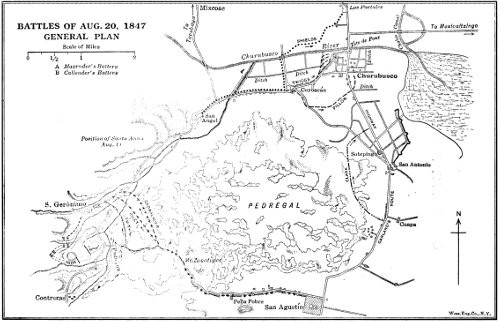
BATTLES OF AUG. 20, 1847 GENERAL PLAN
Larger image
To increase his confidence, troops not only occupied Mexicaltzingo on the left, but in even stronger force guarded the opposite flank. About three miles toward the south from San Cosme, the western garita of Mexico, the traveller, passing the fortified hill of Chapultepec on the right, found himself at the genial suburb of Tacubaya. Keeping on in the same general direction for nearly six miles and traversing Mixcoac at about half-way, one came to San Angel, a pretty but narrow town of some importance on the skirt of the foothills. Two miles from here toward the east at Coyoacán, a garden spot loved by Cortez and Alvarado, the fine brigade of Pérez, which consisted of about 3500 infantry, was now placed; and at San Angel itself a high military officer, followed by some 5500 troops[2] from Guadalupe, drove up in a coach about noon on Tuesday, the seventeenth of August. The man was of average height but unusually broad, with a bull-neck deep in his shoulders, as if some person had tried to force a good idea into his head with a pile-driver, a hard, cruel, domineering look about his blue eyes, small side-whiskers, and a heavy mustache. It was Valencia, whose imputed schemes and intrigues had of late been keeping every tongue busy.[4]
VALENCIA’S MOVEMENTS
Valencia’s instructions were to block the way from Coyoacán to Tacubaya with men and works; but he mounted at once, rode on south by the turnpike, passed Ansaldo—a farmhouse buried in its orchard, two miles and a half or so from San Angel—and a strong half-mile beyond it paused. On his right, open ground sloped gradually back into a rounded hill, some three or four hundred yards from the road; and below him on the left flowed a small but lively stream at the bottom of a deep, wide ravine, near the opposite side of which stood the adobe buildings of Padierna farm.[4]
From this point a mule-path, barely practicable for horses, wriggled off in the direction of San Agustín, here about four miles distant in a straight line; and—covering the whole intermediate plain from San Antonio and San Agustín on the one side to Padierna and San Angel on the other, from Coyoacán on the north to the mountains on the south—extended a pedregal or lava bed, which looked as if a raging sea of molten rock had instantly congealed, had then been filled by the storms of centuries with fissures, caves, jagged points and lurking pitfalls, and finally had been decorated with occasional stunted trees and clumps of bushes. After pursuing the mule-path for some distance, ordering a camp and batteries established on the slope of the rounded hill, and instructing experts to reconnoitre the ground thoroughly, Valencia returned to his post; and in the evening, on learning from the experts that four other paths—one of them available for artillery—led from San Agustín to San Angel, he summarized the reconnaissances in a letter to Santa Anna, complaining that he had neither room to manoeuvre nor time to fortify where he was, asking leave to change his position, and calling for 2000 more men.[4]
The next day, Wednesday, the eighteenth, Santa Anna, writing back that Scott intended to attack San Antonio, ordered Valencia to place his troops at Coyoacán, and send his artillery to Churubusco, a mile farther east. Valencia, who by this time had placed a strong outpost on the mule-path and sappers on the rounded hill, replied that Scott, striking both at San Antonio and at San Angel, would push his thrust in whichever direction he should find the easier, and that he could not conscientiously leave the second point unguarded by obeying those orders. Notes worthy of the most finished and effusive pirates were then exchanged; and in the end Santa Anna, who longed to remove his insubordinate general but dared not, authorized him to do as he pleased and assume, of course, the attendant responsibility.[3] Accordingly on Thursday morning Valencia advanced with trumpets, drums and flags to the rounded hill, and proceeded to array his forces. A long, low, earthen parapet with an angle at the southern end already faced Padierna, and five guns were in battery; but the summit of the hill was neglected.[4]
SCOTT FEELS HIS WAY
During this time the Americans were not inactive. Early on Wednesday Scott directed Worth and Engineers Mason and Tower, supported by Garland’s brigade of infantry and a body of dragoons, to reconnoitre San Antonio.[5] The task was accomplished boldly and thoroughly; and they found the place heavily defended, not only in the vicinity of the white castle which formed the headquarters of the hacienda, but for a long distance eastward—where, moreover, the water-soaked ground almost forbade approach—and saw countless laborers toiling hard upon the works. The presence of at least one 24-pounder was demonstrated, and other heavy cannon were believed to be there. In Worth’s opinion, the cost of making a successful assault by the narrow, gun-swept causeway with fascines and ladders would cripple the army.[6]
Questioning peons through an interpreter, the officers learned of a path which began at the highway near Cuapa, made a circuit on the left through the pedregal, and apparently returned to the highway some distance inside the works, and this received careful attention; but the conclusion was, that while infantry could filter through it, artillery could not pass; and to advance by such a route in the presence of a strong, unshaken enemy, whose front and other flank could not be attacked or seriously threatened, appeared worse than hazardous. Even Scott felt rather depressed on hearing the reports, especially as fortifications were said to exist north of the hacienda. The men, wagons and guns, all covered with mud, that lay scattered about on the wet ground, seemed little indeed like a conquering army. Except for some cattle, the army had only four days’ provisions; the hard bread was already musty, and the horses lacked forage.[6]
Later, however, Lee and Beauregard brought somewhat more promising information. To the hacienda of Peña Pobre, a mile and a quarter from San Agustín toward the west, they had found a good road; and then, after proceeding about an equal distance by a mule-path to the top of a sharp ridge, they had seen the path continue to Padierna and the turnpike, which lay in full view nearly a mile and a half away, and they believed it possible to make a road by that line. Their escort had routed a hostile corps of observation, and some men had been seen at work on a rounded hill beyond the turnpike, but no other Mexican forces appeared to be near. Indeed, it seemed probable that much less adequate defences had been provided here than on the great southern highway, and in this direction Scott resolved to strike. “An enemy that halts, vacillates, declines the battle offered him, makes a circuit, hunts for a position and finds none to suit him is an enemy lost,” exulted the Diario.[6]
THE BATTLE OF CONTRERAS
The next morning, August 19, therefore—while Quitman unwillingly remained at San Agustín to guard the base,[7] and Worth, with his engineers and troops, continued to reconnoitre and threaten on the San Antonio side—Scott ordered a force of engineers to build a road in the other direction. Pillow’s division was to furnish working-parties, and Twiggs’s to clear away whatever Mexican detachments might undertake to hinder the operations; and the implied instructions were to gain and hold the San Angel turnpike, so that San Antonio could be turned. Scott did not expect or desire a general engagement at this time; but he directed Pillow to take command and employ both divisions, if a battle should be opened, promising that in such an event he would soon appear on the field. Under these instructions the troops advanced cautiously but rapidly the first mile and a quarter, constructed a road to the summit of the ridge, pulled up the guns with drag-ropes, and looked over. As the returning tide makes a sea in the Bay of Fundy, where only bare ground had been visible a few hours earlier, Valencia’s army had taken possession. It was now one o’clock, and evidently road-building was over for a while.[11]
Pillow, however, knew all about winning victories. From a central hill, Zacatepec, where he stood, he could measure Valencia’s forces to a nicety, and he decided to brush them away. By his order the Mounted Rifles, particularly the advanced companies of Roberts and Porter, deployed quickly, drove the Mexican skirmishers in a handsome style from rocks and fissures, and finally occupied Padierna. At the same time and under his instructions Magruder—tall, blonde and intrepid—advanced his field battery nearly a mile without cover over that almost impassable ground, which the enemy had now barred with stone walls, planted it under the slight protection of a transverse ledge, and not long after two o’clock opened a duel with Mexican siege guns, 68-pound howitzers and many lighter pieces, more than twenty in all, at a range of about 900 yards, while brave Callender fought the howitzer battery beside him, dashing little Reno set off rockets, and Smith’s and Pierce’s brigades, which were presently to attack Valencia’s camp, furnished support. And Pillow knew also how to “bag” a defeated enemy. So he ordered Riley’s brigade to the extreme right to coöperate with the frontal attack by checking reinforcements and cutting off Valencia’s retreat. Then he countermanded this order, but not in season.[11]
Zigzagging, scrambling, leaping, and sliding as best they could over about a mile of pedregal, Riley’s brigade crossed the stream and the turnpike, formed in the orchard of Ansaldo, routed small bodies of lancers, passed through San Gerónimo—an Indian village lying amid trees and ravines a quarter of a mile west of Ansaldo and about three times as far from Valencia—had a stiff but victorious brush with Torrejón and three regiments of cavalry, defied Valencia’s cannon, some of which now faced this way, found cover at length in broken ground between the village and his camp, and waited for the Mexicans to be routed. But the major general commanding failed in the prime essential of his plan, for he did not induce Valencia to retreat. Badly crippled, the American batteries became silent after an hour or so, the brigades that had expected to charge saw clearly they could accomplish nothing, and Riley found himself isolated. So ended wretchedly the first phase of the battle of Contreras,[8] Pillow’s phase.[11]
But by this time a second phase was taking shape. Pillow himself perceived that Riley had been thrown into imminent peril, and sent Cadwalader’s brigade, which was followed by the Fifteenth Infantry, to his support. Smith, useless where he was and probably feeling little confidence in Pillow or Twiggs, decided to regard himself as the senior officer present, gathered his men, except those employed in skirmishing, and, with a yell of endorsement from them, proceeded in the direction that Riley had taken—not, however, primarily to intercept Valencia’s retreat or reinforcements, but with a direct view to attacking his left flank. At about the same time—probably by half-past three o’clock—Scott himself joined Pillow and other officers on Zacatepec, viewed with his usual battlefield equanimity the desperate state of things, now spread before him like a map on a table, studied Valencia’s batteries, the heavy ranks of supporting infantry and the long lines of cavalry in the rear, and soon fixed upon woody San Gerónimo—marked at a line distance of about a mile and three quarters by its white steeple—as the key to the situation, since it both flanked and isolated Valencia, and ordered Shields’s brigade also, which had followed him from San Agustín, to that point.[11]
Smith, arriving at San Gerónimo about an hour before sunset, found all of the commands, except Shields’s, that had been ordered to go there; and he also found that Santa Anna, after hurrying from San Antonio through Coyoacán and San Angel, had placed himself with Pérez’s brigade and seven or eight hundred cavalry and artillery on low hills about one half or three quarters of a mile behind San Gerónimo, and—though checked by Cadwalader’s brigade—was making ready to attack. Smith at once began preparing to dispose of him, while the Mexicans on the hills, after four or five guns arrived, indulged in vivas, music and a little harmless cannonading; but both commanders finally concluded that the hour was now too late for a battle. Santa Anna also decided that an impassable ravine separated him from the Americans, and that he could not prudently expose his men and arms to the rain then imminent; and therefore, leaving his cavalry and artillery behind, he put the rest of his forces under cover at San Angel.[11]
Night and a storm now set in, but behind the curtain of darkness four striking scenes were presented. Scott, the general who seemed to have lost half his army all at once without a battle, sat at headquarters anxious and helpless. Seven times he despatched an officer to his isolated right with orders, and seven times the officer failed to get through. But still he waited—patient, considerate for those about him, hopeful and alert, reflecting no doubt that brave men, skilful officers and the natural strength of San Gerónimo would count. Valencia, on the other hand, feeling that at last he had proved Santa Anna a blunderer, and had forced him into the position of a mere assistant, was jubilant, boastful and literally intoxicated. He reported grandly on his “brilliant day,” and scattered promotions as if already head of the state.[11]
Santa Anna, devoured by passions and perplexities, now sent José Ramiro to Valencia by a circuitous route with orders to retreat at once. Not long afterwards two of Valencia’s aides reached San Angel, bringing news that, instead of being exterminated, thousands of Americans were established in the San Gerónimo woods. Don’t talk to me, Santa Anna cried to the aides, who endeavored to excuse the situation; Valencia is an ambitious, insubordinate sot; he deserves to have his brains blown out, and I will not expose my men to the storm for him; let him spike his guns, make the ammunition useless, and retreat. When Ramiro arrived at the camp, Valencia would not listen to his message, and fiercely demanded ammunition and men; but when his aides reported, he saw his doom.[9] “Traitor, he has sold us!” he cried, storming like a madman in the midst of his troops. Soldiers heard and echoed the cry. Women shrieked. Frightened horses broke loose and galloped into the night. Americans with lights are creeping in behind us, reported Torrejón. The army understood. Scouts were feeling the way. The price had been paid to Santa Anna. Their blood would soon be claimed.[11]
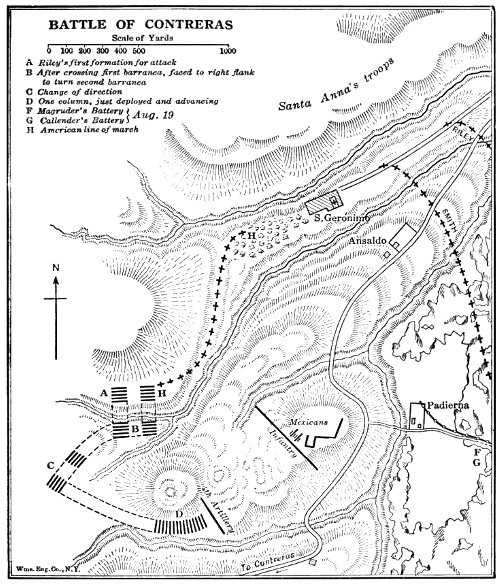
BATTLE OF CONTRERAS
In ignorance of all these outside events the Americans at San Gerónimo, too exhausted to eat, bore the torrents of chilling, beating rain without fires and in darkness as best they could. Some found huts, but most of them lay in the mud or stood up under trees. Smith’s and Riley’s men occupied the lanes, and Shields’s brigade, which stumbled in at about midnight, put up in the road and an orchard. Officers fared like privates. In such a plight, the troops listened for hours to the music and vivas of the enemy, and for their own part could only reflect on the painful and fruitless exertions of the day and on the prospects of the morrow. Without cavalry, without cannon, without reserves of provisions or ammunition, without hope of quarter, they felt that with some 4200 men they might have to face 25,000 exultant Mexicans and any amount of artillery at daybreak. But everybody believed in General Smith.[10] “Here he is!” “Now we’ll have them!” Riley’s soldiers had cried on seeing Smith arrive; and the confidence was not misplaced.[11]
During the afternoon a ravine leading toward Valencia’s rear had been found. Smith seized upon the hint at once, and proposed to attack by that route before daybreak with bayonets only; a conference of officers agreed to his plan; it was decided to notify Scott, and suggest that a diversion be made on Valencia’s front at the proper time; Lee undertook the almost impossible feat of carrying this message across the pedregal; and Officers Tower and Brooks, whose lights—probably occasional matches—Torrejón had reported, were sent off to study the ravine, and prepare to be the guides. As Santa Anna was expected to attack early, Shields accepted the charge of building fires in the morning as if no Americans had left the ground, and holding San Gerónimo.[11]
Two hours after midnight the troops were roused, and at three o’clock Riley began to move. But it was tedious work to marshal the scattered corps in the darkness and rain by touch and whisper, and morning broke before the last were out of the village. The ravine branched deceptively; it was full of rocks, too; and the watery clay, a soldier said, slipped like “soft soap.” Finally, however, the units closed up at about a mile from San Gerónimo, and, partially hidden in a fog, scrambled up to firm ground behind a low hill. As it was now light, the firearms were put in order; and with quick adaptation to the topography, the present arrangement of the Mexicans and their probable movements, General Smith marshalled and instructed the troops.[11]
Riley’s brigade, about 1300 strong, was to be the storming party. Cadwalader’s in halves formed a wing on each side to keep off cavalry. A part of Smith’s, together with the engineer company, was directed to slip along behind elevated ground, and fall upon the flank or rear of a Mexican force posted in advance; and the rest of it, marching by the left, was ordered to strike the camp and a large body of lancers on the flank. Even the possibility of a rear attack from Santa Anna, supposed to be still where he had been seen the evening before, was provided against. Meanwhile the troops that had remained in the pedregal, assembled as well as possible by Twiggs and Lee during the latter part of the night, in accordance with orders from Scott, watched and waited near Padierna under Colonel Ransom of the Ninth Infantry.[11]
Finally a slightly round-shouldered man, with blue eyes, a sandy mustache and sandy hair, walked slowly to the front and looked at his watch. It was about six o’clock. “Are you ready?” he asked in a cheery voice. “Ready!” the troops answered with a meaning smile. He gave them a keen glance. “Men, forward!” he then ordered, for it was General Smith. “Forward, forward!” flew the command through the ranks, and ahead they went.[11]
Struck on front and rear General Mendoza’s advanced corps fired without aiming, turned and bolted; but Ransom’s men, darting across the ravine, gave Valencia something else—something he fancied more serious than Smith’s approach—to think about. Only a pair of 6-pounders bore on Riley, and they fired high. Soon the Mexicans at the breastwork, exchanging shots wildly with Ransom, found that bullets were coming from behind, leaped over the parapet and fled. Attacked by Smith’s men, the lancers gave way and upset the rest of the infantry; and Riley’s column, deployed as well as time and the ground would allow, bore down like a flood. All was now confusion in the camp: infantry, horse, artillery, mules, women, laborers in a mob. Some of the gunners remained at their pieces—chained to them, it was said—but, like the infantry, they aimed little; and almost in a moment, like a bag turned upside down, the camp was empty of all the Mexicans who could get away. Again General Smith drew out his watch. “It has taken just seventeen minutes,” he remarked.[11]
Riley’s brigade halted to secure the prisoners and the spoils, among which—to the frantic delight of the soldiers—were the two cannon lost so nobly at Buena Vista; but the rest of the victorious troops pursued the enemy to San Angel; and the Mexicans fleeing by the turnpike toward Ansaldo, cannonaded from their own camp and running the gantlet of Smith, Ransom and even Shields, who had moved down toward the road, fared badly. Others, including Torrejón and a large part of the cavalry, managed by taking rough paths to reach San Gerónimo and the hills. Valencia also escaped; but Salas, who tried to check the flight, was captured. Seven hundred Mexicans fell, it was estimated; over eight hundred were made prisoners; the captured cannon, including the best that Santa Anna had, and the captured ammunition proved invaluable; and the cost, as reported by Scott, was not over sixty Americans killed and wounded.[11]
AFTER THE BATTLE OF CONTRERAS
Nor were such the only consequences of this lightning-stroke. Santa Anna, having at length decided to rescue Valencia and raised his forces to at least 7000 by drawing Rangel’s reserve brigade from the city, had set out at daybreak for his position of the night before; but when in sight of Valencia’s camp he learned from flying soldiers that all was over, and that his outer line of defences had failed. Angrily striking at fugitives with his whip he turned back, and waited near San Angel for a while, unable to decide anything. Then he sent Rangel to guard the southwest section of Mexico, despatched orders to evacuate San Antonio and Mexicaltzingo, and marched with the rest of his forces to Churubusco. Here priceless time was spent in raving against Valencia—whom he ordered shot at sight—in a passion that almost crazed him. His dominant idea now, so far as he could think at all, was to make the capital a second Troy; and, probably with that in view, he set Pérez’s brigade in motion toward the city.[12]
After a time, however, reason gained the better of desperation, and seeing the necessity of protecting the retreat of the San Antonio garrison, he ordered General Rincón, who was ably seconded by Anaya, to hold the Churubusco convent as long as possible, garrisoned the bridgehead with one of Pérez’s regiments, extended two others far down behind the embankment of the river eastwardly, used a part of the remaining two as a line from the bridgehead to the convent, and stationed the rest on the highway behind.[12]
The convent position included, besides the building proper, a strong church with a parapeted roof, a high stone enclosure provided on the inside with scaffolds for troops, a broad, wet ditch, two outside bastions facing Coyoacán, unfinished but strong breastworks on the west and south, two detached adobe huts pierced with embrasures on their southwest sides, four 8-pounders, three smaller guns, and for garrison some 1500 or 1800 men, consisting of the Mexico battalions named Independencia and Bravos, the San Patricio contingent of American deserters or most of it, and some detachments of other corps; while the bridgehead, a powerful, scientifically constructed work, with four feet of water in the ditch and three heavy cannon, appeared to defy attack. Surveying this excellent position Santa Anna recovered some of his courage, and began work actively to complete the fortifications near the bridge. The untried militia at the convent were almost in despair when they found themselves in the forefront, but he promised to aid them at the critical time.[12]
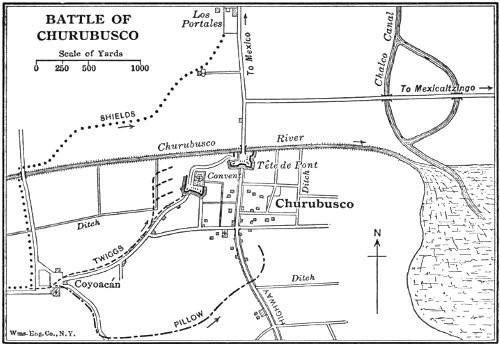
BATTLE OF CHURUBUSCO
Scott, for his part, left San Agustín before he knew how Smith’s plan had worked out, met the news on the pedregal, kept on to San Angel, and near that place, amid tumultuous cheering, took command of Pillow’s and Twiggs’s divisions.[13] The road to Mexico by way of Tacubaya lay open, but he could not move now in that direction and leave Worth, Quitman, the artillery, the baggage, the stores and the sick to join him as best they could, exposed—as it was believed—to some 25,000 Mexicans. The first needful step was to capture San Antonio and reunite his army. Worth had already been directed, after the rout of Valencia became known, to attack and also turn that position whenever he should learn that Pillow and Twiggs had gained its rear; and as a cross-road led from San Antonio to Coyoacán, Coyoacán was the proper point of concentration. Scott therefore went there with his troops, and sent Lee, strongly escorted by dragoons and Mounted Rifles, to reconnoitre the enemy and give the preconcerted signal for Worth’s advance. Further to assist that general, Pillow with Cadwalader’s brigade was now ordered down the cross-road.[14]
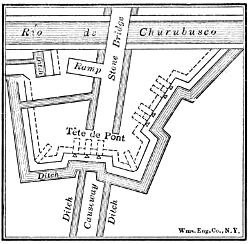
The Tête de Pont, Churubusco
THE BATTLE OF CHURUBUSCO
Worth did not, however, wait for assistance. At about eleven o’clock he sent Colonel Clarke’s brigade—the Fifth, Sixth and Eighth Infantry—and Brevet Colonel C. F. Smith’s battalion from Cuapa to turn San Antonio by the path on the left hand and cut off retreat, and placed Garland, accompanied by Duncan’s battery, in a somewhat sheltered spot, as near as possible to the fortifications, with orders to advance on hearing the other brigade at work. Clarke’s tortuous path seemed to be three miles long, and as it lay for two thirds of the distance in the pedregal, where the troops had to slide and scramble in single file, two hours were occupied in the march. The Mexicans, therefore, warned by seeing this movement—which they vainly attempted to check—as well as ordered by Santa Anna to retire, made the utmost efforts, after spiking some of their guns, to escape with the rest of them. But the garrison of San Antonio and the neighboring fortifications, which consisted of the Hidalgo and Victoria battalions of Mexico and some other militia, were wholly unfitted to execute a difficult retreat in the face of the enemy. Not far from its middle Clarke struck their column; and while the first part, led by General Bravo, kept on toward Churubusco bridge, the second broke up and scattered.[15]
By this time Garland, having found by pushing a company forward that San Antonio had been evacuated, hastened on to unite with Clarke. The enemy were quickly driven from fortifications of a minor importance at Sotepingo, and the division then rushed forward after Bravo, while the Mexicans—a mass of cavalry, infantry and artillery, wagons, mules, women, servants, carriages and camp-followers—made all possible speed. Owing to the effects of the rains, two Mexican guns and a number of wagons were mired on the way; and near the Churubusco bridge Pérez’s brigade, hard pressed by the Americans from San Angel, crowded in upon the stream of fugitives.[15]
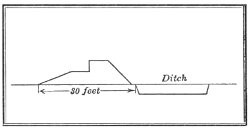
Tête de Pont.
Profile of east curtain.
So it happened that when Engineer Stevens climbed the church tower of Coyoacán at about noon to reconnoitre, he observed a large body of Mexican troops pouring along the highway from San Antonio. Apparently Santa Anna was drawing all his forces to the city. Dense fields of corn six feet high or more almost hid the works at the convent. Perceiving, however, the nose of a bastion, Stevens concluded there might be one gun at that point, which he thought could be rushed; and a prisoner mentioned only two guns. The entire American army, reacting from the gloom of the previous evening, exultant over Smith’s victory, and almost intoxicated by the change from storm to splendid sunshine, was now feeling invincible, eager and over-confident. Stevens merely shared the contagion; his report—precipitate and misleading, as he fully admitted later—signified that without loss of a moment the San Antonio garrison ought by all means to be intercepted; and so Scott did what we know it had not been his intention to do: ordered Twiggs immediately to the convent and highway by the direct road. “Make haste, my sons,” he called to the troops, “or they will be gone before you reach them!”[16]
At his instance and by way of precaution, engineers were sent on to make investigations; but, as the case appeared simple and urgent, the investigating and the fighting began hastily together. In a haphazard way the Mounted Rifles, or at least a part of them, became engaged; then the First Artillery advanced; and soon the rest of Smith’s brigade—the Third Infantry—besides the engineer company and Taylor’s battery were thrown in. Rincón, a gray-haired Spanish veteran, deceived our generals, for he desired to save ammunition, and therefore did not open his artillery fire till the Americans had come within musket range. To pause after the conflict began would have chilled the ardor of the troops and encouraged the enemy. Victory or defeat were the only alternatives, and a defeat could not be thought of.[16]
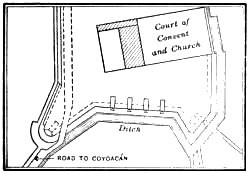
The Fortifications of Churubusco Convent
Victory did not arrive, however; so now the Second and the Seventh Infantry, led by Riley, attacked the Mexican right. Amidst the corn the American infantry became scattered, yet in the same haphazard way fought on; and Taylor, placed in a very exposed position before the state of things was understood, fired at short musket range with beautiful precision and rapidity. But the Mexicans, inspired by good leaders and by the example of the American deserters, who aimed the cannon, stood their ground. From parapets and bastions poured sheets of unceasing flame, sally followed sally, and guns at the bridgehead coöperated. In an hour and a half Taylor drove the enemy from the walls and from the roof of the church, but he lost twenty-four men and fourteen horses killed and wounded. The battery had to be withdrawn, and victory seemed almost beyond reach.[16]
Worth had now been attacking the bridgehead for half an hour or more. Hurrying the troops along, without giving them definite instructions, at a speed limited only by their wind and the obstacles in their way, he had left the Sixth Infantry on the highway, placed the Fifth and the Eighth at the right of it, and sent the rest of his infantry obliquely against the Mexican left; and then, without a reconnaissance of the bridgehead, the Sixth was ordered to charge whatever lay in its front.[15]
Probably the army contained no better corps, but it recoiled twice in confusion under a terrific storm of iron and lead. Valor was not lacking, but the men were dumfounded to come “butt-end first,” as a soldier put it, upon such a fort so strongly held, when they had supposed they were chasing a parcel of rabbits; and their numbers were unequal to the task. Officers as well as men showed every sign of panic. The regiment could not be kept on the highway; and the troops in the tall corn on the right accomplished no more. The ground was soft there; and it was cut up with dikes and with deep, wide ditches containing about three feet of water. The men fought, but they fought in general disorder. C. F. Smith found himself with not more than twenty of his battalion at hand. Even the artillery, the backbone of the army, failed now, for Duncan’s light pieces could not challenge the bridgehead squarely on the highway, and the ground beside it was unsuitable for them; while occasional fire from the convent and the explosion of an ammunition wagon abandoned by the Mexicans added to the difficulties.[15]
At the same time, besides these two combats which Scott had not expected, one planned by him was taking place. A few minutes after sending Twiggs toward Churubusco he ordered Pierce—and presently Shields also—to follow a road leading north from Coyoacán, cross Churubusco River, and move toward Santa Anna’s rear, so as to protect the American flank and rear, favor the attack on the convent, and cut off the retreat of the Mexicans. The route adopted by the troops after leaving the road took them for a mile and a half through cornfields and marshes, and placed them near the highway, about three quarters of a mile north of the bridgehead, not far from the hacienda of Los Portales. To parry the blow Santa Anna at once moved in that direction with the Fourth Ligero, the Tulancingo regiment and most of the Eleventh Line, his finest corps, extending his men—perhaps 2200 in all—until they almost overlapped the Americans; while some 1500 or 2000 cavalry, probably consisting of the horse that had followed him to San Angel reinforced by that which had escaped from Contreras, menaced—though afraid to attack—Shields’s left.[17]
Precisely what occurred now cannot be stated, for apparently most of the reporting officers were more anxious to conceal than to disclose facts; but it seems clear that Shields handled the men clumsily, that his own regiments fell into disorder when charging and shrank from the devouring Mexican fire, and that Pierce’s brigade, composed of excellent material but officered to a large extent with political favorites, actually skulked. The Mexicans, on the other hand, finding two ditches along the highway to protect them from the dreaded bayonet and an embankment to screen them somewhat from bullets, fought stiffly. Shields was therefore unable, with his six hundred good men and two small howitzers, to make any impression, and after a time his troops huddled wherever they could in the shelter of some buildings.[17]
But finally, between three and four o’clock, the spell broke. Worth’s men, though astonished and for a time dismayed, had no thought of giving up. “Victory or death” was not a phrase to them, but a conviction. Though dikes, ditches, bad ground, corn higher than their heads, and the Mexican artillery fire broke up their organization, personal courage and personal leadership survived. In smaller or larger groups they fought on. Santa Anna, by taking the Fourth Ligero from Pérez to defend the rear, deducted half the strength of his left wing, and no doubt Shields’s operations, very suggestive of the American methods used in previous battles, tended to make the troops at the bridgehead nervous. Gradually a part of the unlucky Sixth and men of C. F. Smith’s and Garland’s commands, working toward the extreme American right, out-reached the enemy, crossed the river, turned the Mexican line, and moved on toward the highway. This created great alarm. The fate of Valencia was recalled. Many of the officers wilted. Ammunition seems partially to have failed; and at length, under a still galling fire, some of the Eighth Infantry, followed by more of the Fifth, waded the ditch of the bridgehead—twenty feet broad it was—climbed over the parapet or pushed through the embrasures, and settled the question hand to hand.[15]
At once Duncan planted two of his guns on the highway near the convent, and for ten or fifteen minutes, aided by a piece or two at the bridgehead, he fired with a judgment, rapidity and accuracy that delighted the on-lookers. By this time two of Rincón’s guns at the right of the convent and one of the other pieces had become unserviceable; the ammunition, so lavishly expended, had failed the infantry; and the loss of the bridgehead, which stood on higher and commanding ground, was recognized as a most serious blow. The artillery commandant began to move a cannon from the front side to the right. Only two guns were in play on the front; and our Third Infantry, noting the slackened fire, dashed over the parapet at the left of the convent. Still the American deserters would not permit a white flag to be shown, and the garrison retired sullenly to the interior of the building. But Captain J. M. Smith, seeing that active resistance was over, now put up a white handkerchief himself to prevent further bloodshed. The signal of surrender stopped Duncan’s work, too; and the Mexicans, astonished by the consideration shown them, laid down their arms.[18]
Pérez and Bravo with a large part of the troops were now on the way to Mexico via Mexicaltzingo and Old Peñón, and others were taking flight along the highway, pursued by Worth’s division. Shields perceived what was occurring, and harangued his brigade. “The South Carolinians will follow you to the death,” answered the “Tigers,” as they were called by Scott. Many, if not all, of the New Yorkers joined them; Pierce’s officers mustered pluck enough to guard the left; and once more a charge was made. It proved no easy work, though, even now. First and last more than a third of Shields’s brigade were killed or wounded. Brave, handsome Butler, commanding the Tigers, and his lieutenant colonel went down, and Colonel Burnett of the New Yorkers fell. But at last Shields carried the day, captured nearly four hundred Mexicans, and met Worth’s cheering van on the highway.[17]
All joined then in the pursuit, supported with a captured 6-pounder and a howitzer, and took liberal toll as they went, until, after charging nearly two miles, they were halted by Worth. Orders from the commander-in-chief to the same effect soon arrived. Four companies of dragoons under Harney were permitted, however, to keep on, and when the sight of a battery led him to pull up, Captain Kearny of the First resolved to charge the guns, and galloped ahead.[19]
“Oh, what a glorious sight it was to see Phil Kearny riding into them!” wrote a soldier. His own troop were picked men; they rode picked horses—all iron-gray—that now seemed endowed with supernatural strength; and his other troop were fit comrades. Standing quite upright in the stirrups they looked like centaurs. Little by little the rear fours, hearing the trumpet sound the recall, dropped off; but the leader and about a dozen others kept on like a swift vessel, dashing the billows of humanity right and left. The battery, which stood at the garita, fired upon friend and foe alike. Still the little group arrived there, leaped from their horses to carry it, and found—that they were alone. The panic of the enemy, however, saved them. Tearing loose and springing into the saddle, they got away. But a grape-shot was faster than Kearny; and so, losing an arm but winning a brevet, he finished valiantly the battle of Churubusco.[19]
AFTER THE BATTLE OF CHURUBUSCO
Santa Anna’s total loss for the day—the killed, the wounded and especially the missing—may be roughly estimated as 10,000. He admitted that he lost more than a third of his men. After he was able to find where he stood (August 30) the Army of the East contained 11,381 privates. Alvarez had 2447 privates (August 26); and, besides remnants of Valencia’s troops, there were doubtless many small bodies of militia. Scott estimated the Mexicans killed and wounded as 4297, and 2637 prisoners, including eight generals, were reported; while the American ordnance was more than trebled, and the scanty stock of ammunition enormously increased. Out of 8497 engaged in the two battles, we lost fourteen officers and 119 privates killed, sixty and 805 respectively wounded, and some forty of the rank and file missing, who probably lost their lives.[20]
The high moral qualities displayed by our troops made the day glorious, as Hitchcock said, “in the highest degree”; and the army, naturally overestimating the numbers of the enemy, felt exceedingly proud. Scott, riding about the field, gray and massive, was hailed by the troops as the very genius of power and command.
2. August 14 Valencia’s 76return (estado) included 486 officers, 5078 rank and file, 1447 horses, one siege 16-pounder, three siege 12-pounders, five 8-inch (68-pound) howitzers and fifteen smaller guns. One of the guns was assigned to Torrejón and he saved it. Another small one disappeared. The name of the rounded hill where Valencia took post was Peloncoahutitlán.
4. Mexican preliminaries. Sen. 1; 30, 1, pp. 304, 306 (Scott); 348–9 (Smith); app., 80 (Alexander). Collins papers. 66Lee to Smith, Aug. 21. Semmes, Service, 393. Sen. 65; 30, 1, pp. 276 (Longstreet); 570. 224Intercepted Letters (14, L. V. to M. O.; 26, to Old Gentleman). Apuntes, 221, 230–6. Balbontín, Invasión, 111. Gamboa, Impug., 41. 70“Guerra,” no. 30 (F. Pérez). México á través, iv, 672–3, 677. Long, Memoirs, 54. So. Qtrly. Rev., Apr., 1852, pp. 408–9. Latrobe, Rambler, 90. Sen. 19; 30, 2 (Hardcastle to Smith; Smith to Abert). Valencia, Manifiesto. Calderón, Life, i, 314. 178Davis, diary. Prieto, Mems., ii, 213. 73Bermúdez de Castro, no. 534, res., July 28. S. Anna, Apelación, 51–2; app., 140–54, 157–60. Id.., Detall, 12. Monitor Repub., Dec. 17, 1847. Hitchcock, Fifty Years, 276. Negrete, Invasión, iv, app., 279–83. 76Acuerdo, Aug. 16. 76To Lombardini, July 22. 76To Alvarez, Aug. 21. 76Zerecero, Aug. 25. 76To Valencia, Aug. 16. 76Expediente contra Valencia.
3. Valencia had one excuse, for very possibly he believed (in view of Santa Anna’s delay at San Luis Potosí, abandonment of Tampico, apparent neglect of Vera Cruz, etc.) that the President traitorously intended to leave open a door by which Scott could reach the capital; but none the less he was a conscienceless conspirator and the mortal foe of Santa Anna, disgusted with subordination, and eager to overthrow his chief. His past conduct had been thoroughly suspicious, and his manifiesto of August 22 does not bear analysis well. To remove him would have seemed an act of jealousy, if not treason, and very likely have caused a mutiny. Santa Anna hoped that the national crisis would hold him in line for the time being. Besides, Santa Anna did not know precisely where Valencia proposed to make a stand (Diario, Sept. 1). When he learned, he sent General Mora to reconnoitre the position (76to Valencia, August 19). Again, he could not afford to raise an issue with Valencia now, for the latter (doubtless with the help of his engineers) had divined Scott’s plans better than the former, and undertaken to guard a quarter left open by the President. Finally it was quite possible that Santa Anna thought Valencia would be taught a lesson by the Americans. It is unnecessary to discuss the merits and disadvantages of Valencia’s position, for they will appear plainly in the narrative (see Balbontín, Invasión, 110–11). Had the Americans been willing to do as he wished, the hill would have been entirely satisfactory. Of Valencia’s intellectual quality the following specimen is suggestive: “Soldiers of Liberty, anarchy put out its head, but your arms drowned it in a moment.”
5. According to a topographical officer (Washington Union, Nov. 3, 1847) the only route from San Agustín to Mexico of which the Americans knew when they reached the ground was the highway. This surprises one at first. But the turnpike beyond San Angel was a local road serving only a few farms, the small villages of San Gerónimo and Contreras, and a manufacturing establishment near Contreras. It seemed to be of no strategic significance, and was not likely to be heard of at a distance. The fortifications along the highway were largely developed after Scott turned toward San Agustín. Valencia’s movements were impromptu. Scott had an Englishman residing at Mexico in his pay, and we know that two persons brought data on Aug. 19 (Sen. 65; 30, 1, p. 162). Apparently Scott did his duty as to seeking information.
6. American preliminaries. Sen. 1; 30, 1, pp. 304, 307, 315, 348–50 (reports of Scott, Worth and Smith); app., 41 (Mason); 66 (Smith); 101 (Magruder); 118 (Cadwalader). Wilhelm, Eighth Inf., ii, 307. Picayune, Sept. 8; Oct. 21. 66Lee to Smith, Aug. 21. Semmes, Service, 380, 393. 224Intercepted Letters (26, To Old Gentleman). Hitchcock, Fifty Years, 275. Grant, Mems., i, 142. Sen. 52; 30, 1, p. 188 (Trist, no. 12). 76Expediente contra Valencia. 236Judah, diary. Sen. 19; 30, 2 (Hardcastle to Smith). Monitor Repub., Dec. 17. Diario, Aug. 19.
7. Quitman had only the Second Pennsylvania, the Marines, Steptoe’s battery and a troop or two of dragoons (Sen. 1; 30, 1, p. 341); but Worth’s division was available in case of need. See Claiborne, Quitman, i, 347.
11. The battle of Contreras. Sen. 1; 30, 1, pp. 303, etc.; app., pp. 66, etc. (reports of Scott and his officers). S. Anna, Apelación, 52–5; app., 154–6, 160. Id.., Detall, 12–4. Picayune, Sept. 8; Oct. 21. 221Hill, diary. 61Twiggs to Marcy, Feb. 7, 1848. 66Lee to Smith, Aug. 21, 1847. 60Riley to Westcott, Nov. 30. Semmes, Service, 381, 385, 392. 224Intercepted letters (14, L. V. to M. O.; 25, note by E. A. H.; 28). Apuntes, 237–43. McSherry, El Puchero, 73, 76. Murphy, Hungerford, 99. Delta, Sept. 9; Nov. 12; Dec. 1. Monitor Repub., Sept. 27 (Salas); Dec. 12 (S. Anna). Porvenir, Aug. 26, supplem. (Valencia). 65Scott, gen. orders 258. Balbontín, Invasión, 111–8. Hitchcock, Fifty Years, 276–8, 281. Ballentine, English Soldier, ii, 207, 218–20, 223–6, 228–9. Davis, Autobiog., 196–8. 66Foster to Smith, Aug. 23. 66McClellan to Smith, Aug. 23. 66Beauregard to Smith, Aug. 25. 66Tower to Smith, Aug. 25. 66Mason to Smith, Aug. 24. Prieto, Mems., ii, 222–7. López, Décimo Calendario, 58. 80Olaguíbel, Aug. 20–1. 199Anon. MS. written by a person of importance. 307Roberts, diary. Gamboa, Impug., 42–3. 350Weber, recoils. 70“Guerra,” no. 30 (F. Pérez). Ramírez, México, 298. México á través, iv, 677. 217Henshaw to wife, Aug. 21. 327Sutherland to father, Nov. 28. Jackson, Memoirs of Jackson, 41. Sen. 52; 30, 1, p. 188. Long, Memoirs, 54–9. Wash. Union, Sept. 20. Diario, Aug. 24; Sept. 1. So. Mag., July, 1874, p. 75. 204Gouverneur, diary. 277Burnett, statement. United Service, June, 1896 (Lane). Sen. 65; 30, 1, pp. 62 (H. L. Scott); 68–9 (Williams); 72–4, 298, 300 (Gen. Scott); 75–9, 463 (Lee); 81–6 (Cadwalader); 97 (Deas); 99–106 (Smith); 137–8 (Canby); 147–51 (Riley); 162 (Hooker); 180 (Hodge); 182–4, 188 (Ripley); 208–9 (Rains); 230–1 (Beauregard); 232–3 (Hitchcock); 246 (Morgan); 267 (Shields); 270 (Howard); 283, 286–7 (Twiggs); 334–5 (verdict); 570. Stevens, I. I. Stevens, i, 174–9, 196. Carreño, Jefes, ccxc (Pérez), ccxciv (Torrejón). Niles, Oct. 30, pp. 138–9. Cong. Globe,34, 1, p. 105 (Foote). Lancaster Co. Hist. Soc. Mag., Mar. 6, 1908. Giménez, Mems., 266. 291Pierce to Appleton, Aug. 27. 291Gardner to Canby, Aug. 30. 291Pierce to Hooker, Aug. 22. Engineer School, U. S. A., Occas. Papers, No. 16. Valencia, Manifiesto. 178Davis, diary. Stevens, Vindication, 4–7. Negrete, Invasión, iv, app., 281–3. 76Tornel, Aug. 19. 76Orders to Valencia, Aug. 26. Kenly, Md. Vol., 421. 73Lozano, No. 2., Aug. 24. 210Bragg to Hammond, Dec. 20. 125Bonham to wife, Aug. 24; to adj. gen., Feb. 26, 1849. So. Qtrly. Rev., Apr., 1852, pp. 415–26. Calderón, Rectificaciones, 41. S. Anna, Mi Historia, 72–3. 112Beauregard to Smith, Aug. 25. 76Valencia, Aug. 19. 76J. B. Argüelles, Aug. 22. 76Alcorta to Alvarez, Aug. 21. 76Alvarez, Aug. 21.
8. Pillow, as was decided by a court of inquiry (Sen. 65; 30, 1, pp. 332–45) on the testimony of such men as Lee (p. 78), Smith (p. 102), Riley (p. 147) and Shields (p. 268), did not devise the plan on which this victory was gained; and when Lee brought word to Scott of Smith’s plan he washed his hands of it (335Trist, draft of address; Sen. 65; 30, 1, p. 333); but he had the audacity to claim that Smith merely executed the precise plans and views laid down by Pillow for his guidance (Ho. 60; 30, 1, p. 1018). Pillow could claim the credit only on the ground that he was the senior officer on the field, and that Smith’s operations were a logical consequence of the events; but Scott was the senior of Pillow, and all that occurred was—as Smith pointed out (Sen. 65; 30, 1, p. 104)—the logical consequence of Scott’s order to gain possession of the San Angel road. The consensus of opinion was expressed by Twiggs: “General Smith deserves the whole credit” (Stevens, Stevens, i, 196). Moreover the famous letter signed “Leonidas”—prepared at Pillow’s quarters doubtless with his connivance (Hitchcock in Mo. Republican, Oct. 2, 1857; Republican Banner, Feb. 23, 1858), conveyed by his agency (Davis, Autobiog., 285) to the New Orleans Delta, which published it Sept. 10 (chap. xxix, note 31), and fathered (when exposed) by an untruthful subordinate of his—“puffed” Pillow in the most extravagant manner for this “unparallelled victory,” and represented Scott not only as leaving everything to Pillow but as blundering sadly. E.g. it said, “The army had been marching through marshes and almost impassable roads, nearly half around the city, to find some points upon the enemy’s works that could be successfully assailed,” the provisions had been nearly exhausted, and the mountains prevented going farther; Pillow’s “plan of battle [at Contreras], and the disposition of his forces were most judicious,” and he “achieved this signal and brilliant victory.” (For the letter signed “Leonidas” see Sen. 65; 30, 1 (pp. 385–9, and the testimony of Pillow, Burns, Freaner, Trist); 335Pillow to Trist, Aug. 31, private; St. Louis Evening News, Oct. 2, 1857; chap. xxix, pp. 435–7.) Pillow’s design in having such a statement prepared and placed before the people in advance of the official reports was probably to influence public opinion in the United States so as to make him an available candidate for the Presidency or enable Polk to put him in Scott’s place. As Pillow was known to have great influence with the President, and was an active, affable, plausible man, he naturally had a following; but the sentiment of the able and honest officers towards him was one of contempt. “The ass Pillow,” “that consummate fool,” said the future General D. H. Hill (diary) of Pillow as he showed himself on Aug. 19. A sensible Pennsylvanian wrote in his diary, Aug. 10, that Pillow was without question “the poorest and most unpopular” of the generals (Oswandel, Notes, 249). Col. W. B. Campbell characterized him as light, impetuous, of little military judgment and no skill (139to D. Campbell, Mar. 20, 28; Apr. 18, 25); and a correspondent of the future Gen. W. T. Sherman described him as “a mass of vanity, conceit, ignorance, ambition and want of truth” (316Judd, Feb. 26, 1848). The doings of the Pillow court of inquiry (Sen. 65; 30, 1) were carefully digested and analyzed by the author; but as the subject concerns only incidentally the history of the war, space cannot be taken to present this analysis.
9. Valencia could see that retreat meant his personal ruin, and he preferred to argue that honor required him to hold his ground.
10. Persifor F. Smith, a graduate from Princeton, was admitted to the bar at Philadelphia, practised law at New Orleans, and had considerable military experience in the Florida war. He was a simple, scholarly, unassuming man; but all ranks appreciated his ability, attainments, clear perception, valor, promptness and steadiness.
12. Santa Anna’s course after the battle of Contreras. Sen. 19; 30, 2 (Smith to Abert). 224Intercepted letters (14, L. V. to M. O.; 22, diary; 23, narrative; 26, to Old Gentleman). Apuntes, 209–10, 241, 244, 250–4. Semmes, Service, 396–7. Picayune, Oct. 8. Sen. 1; 30, 1, pp. 306, 315, 325; app., 69 (reports of Scott and others). S. Anna, Apelación, 53 Id.., Detail, 14–5. Balbontín, Invasión, 120–1. 217Henshaw to wife, Aug. 21. 61Huger, Aug. 22. 70“Guerra,” no. 30 (F. Pérez, Rangel, Argüelles, Zenea). México á través, iv, 678. Wash. Union, Nov. 3. Diario, Sept. 1, 2. Monitor Repub., Oct. 24; Dec. 13, 17. Carreño, Jefes, ccxc (Pérez), ccciv, cccvi. Negrete, Invasión, iii, app., 446; iv, app., 283–4. Lawton, Artill. Officer, 295. Remarks on Mason and Hardcastle’s Plan of Worth’s operations (Sen. 1; 30, 1). 76Report of losses, Churubusco, Aug. 21. 76Rincón, Aug. 20. 76Argüelles, Aug. 22. 76Rincón to S. Anna, Aug. 26.
13. To guard against contingencies Scott had ordered Worth with Garland’s brigade and Quitman with his troops to proceed toward San Gerónimo on Friday morning, leaving San Agustín guarded by Harney (Sen. 1; 30, 1, pp. 306–7). This has been thought risky. But Scott had no doubt learned from Lee that Santa Anna was operating in the vicinity of San Gerónimo, where was evidently the critical field, and hence probably he felt that there was little danger of an attack upon San Agustín that Harney aided, if necessary, by Clarke’s brigade (not far distant) could not meet.
14. Scott’s course after the battle of Contreras. Sen. 1; 30, 1, pp. 306–9, 338, 344; app., 36 (reports of Scott, Pillow, Shields, Kearny). Hitchcock, Fifty Years, 278, 281–2. Davis, Autobiog., 199. Picayune, Sept. 8. 66Lee to Smith, Aug. 21. 335Trist, draft of address. Wash. Union, Sept. 15. Sen. 65; 30, 1, pp. 74, 632 (Scott); 77 (Lee). So. Qtrly. Review, July, 1852, pp. 81–2. Ho. 60; 30, 1, p. 1018 (Scott). Smith, To Mexico, 199.
15. Worth’s operations at Churubusco. Sen. 1; 30, 1, pp. 306, 315, 333; app., 36,41–2,44–65 (reports of Scott and officers). 221Hill, diary. 68Bonneville court-martial (testimony of Hoffman, Nelson, Pemberton, Worth, Armistead, Ruggles, etc.). 335Trist, draft of address. Semmes, Service, 394–400. Sen. 19; 30, 2 (Smith to Abert). Sen. 65; 30, 1, p. 464 (Lee). 224Intercepted letters (14, L. V. to M. O.; 23, narrative; 26, to Old Gentleman). Apuntes, 244–6. Picayune, Sept. 22; Oct 8. Delta, Sept. 26. 76Zerecero to Guerra, Aug. 25. 76Rincón to S. Anna, Aug. 26. Balbontín, Invasión, 120–2. Hitchcock, Fifty Years, 278, 282. 260Henshaw, comments on map. Stevens, Stevens, i, 198. 61Huger, report, Aug. 22. 65Scott, gen. orders 327, Oct. 28. Gamboa, Impug., 47. 70“Guerra,” no. 30 (Pérez, Perdigón Garay). Ramírez, México, 299–301. 73Lozano, no. 2, Aug. 24. 236Judah, diary. Ho. 60; 30, 1, pp. 1018 (Scott); 1076 (Hoffman). Carreño, Jefes, cccvi (Pérez). So. Qtrly. Review, July, 1852, pp. 82–4, 90–1. Lawton, Artill. Officer, 294–5, 298. Smith, To Mexico, 199–202. Negrete, Invasión, iv, app., 284. S. Anna, Detall, 15. Monitor Repub., Dec. 17.
16. Twiggs’s operations. Sen. 1; 30, 1, pp. 306, 315, 322, 325, 348, etc.; app., 69–82, 85–8, 96–7, etc. (reports of Scott and officers). 221Hill, diary. 12Caryton to Lambert, Sept. 1. Apuntes, 246, 250–3. Ballentine, Eng. Sold., ii, 230. 66Stevens to Smith, Aug. 24. Sen. 65; 30, 1, p. 98 (H. L. Scott). Stevens, Stevens, i, 180–4, 199. Stevens, Vindic., 4–7. Carreño, Jefes, 29. Michigan Pioneer Soc. Colls., ii, 173; vii, 117. So. Qtrly. Review, July, 1852, pp. 87–90. Engineer School, U. S. A., Occas. Papers, no. 16. Journ. Milit. Serv. Instit., xvii (Van Deusen). 76Argüelles, Aug. 22. 76Rincón to S. Anna, Aug. 26. Davis, Autobiog., 199. 70“Guerra,” no. 30 (G. Pérez). Negrete, Invasión, iii, app., 447. Calderón, Rectificaciones, 43. S. Anna, Mi Historia, 73–4. Hitchcock, Fifty Years, 278–9, 282.
17. Shields’s operations. Sen. 1; 30, 1, pp. 303, 306, 315, 325, 333, 342; app., 76, 106, 113, 118, 128, 130–4 (reports of Scott and officers). 66Lee to Smith, Aug. 21. Claiborne, Quitman, i, 342–3. City of Charleston, Year Book, 1883, p. 523. 303Shields to Quitman, Aug. 21. 221Hill, diary. 335Trist, draft of address. Semmes, Service, 402. 224Intercepted letters (22, diary; 25, to E.). Hawthorne, Pierce, 100. Apuntes, 246–7. Murphy, Hungerford, 102. 76Zerecero to Guerra, Aug. 25. Balbontín, Invasión, 121–2. Davis, Autobiog., 200–1, 286. 70“Guerra,” no. 30 (F. Pérez). Stevens, Stevens, i, 198. Ramírez, México, 300. Carreño, Jefes, ccxciv (Torrejón), cccvii (Pérez). 170Crooker to mother, Sept. 1. So. Qtrly. Review, July, 1852, pp. 93–9. Oil painting of Butler: sen. chamber, Columbia, S. C. Sen. 19; 30, 2 (Smith to Abert). 291Pierce to Appleton, Aug. 27. Monitor Repub., Dec. 17. 125Bonham to adj. gen., June 15, 1848. Nat. Intelligencer, Jan. 3, 1848. Stevens, Vindication, 4–7. Negrete, Invasión, iv, app., 285. 277Burnett, statement. Hitchcock, Fifty Years, 279. Sen. 65; 30, 1, p. 464. S. Anna, Detall, 15.
18. Sen. 1; 30, 1, pp. 306, 315, 325, etc.; app., 35, 42, 46, 49, 64, 77, 127, etc. (reports of Scott and officers). Semmes, Service, 397, 401–2. 224Intercepted letters (17, J. U. to J. P. F.). Apuntes, 254–8. 76Argüelles, Aug. 22. 76Rincón to S. Anna, Aug. 26. Balbontín, Invasión, 122. Ballentine, Eng. Sold., ii, 233. Carreño, Jefes, cccvii (Pérez). Niles, Jan. 22, 1848, p. 323.
19. S. Anna, Detall, 15–6. Sen. 1; 30, 1, pp. 313, 318, 340, 347; app., p. 36 (reports of Scott and officers). Picayune, Oct. 21. Apuntes, 247. Charleston Courier, Oct. 2. Balbontín, Invasión, 123. Fate of F. D. Mills. Grant, Mems., i, 146. Davis, Autobiog., 202. 223Hirschorn, recolls. De Peyster, Kearny, 140, 142–5. Journ. U. S. Cavalry Assoc., Mar., 1911, p. 841. Ramsey, Other Side, 287, note. Negrete, Invasión, iv, app., 285–6.
20. Sen. 65; 30, 1, pp. 465, 478. Sen. 1; 30, 1, pp. 313–4, 348, 384. Ho. 24; 31, 1. 76Rincón to S. Anna, Aug. 26. 76Quijano, Sept. 3. 76Olaguíbel, Aug. 27. Ramírez, México, 299. Monitor Repub., Dec. 17 (S.Anna). 76Alcorta, Aug. 30. 12Caryton to Lambert, Sept. 1. Semmes, Service, 408. 76Report, Aug. 21. 224Intercepted letters, passim. 76Cuerpo Médico, report, Aug. 24.
“Never did mightier man or horse
Stem a tempestuous torrent’s course,”
they felt; and when he addressed them with the eloquence of a soldier’s heart, it seemed as if the cheers that followed must have shaken the “Halls.” Nature, however, appeared to view the situation differently. The mountains above Padierna wrinkled their foreheads with still deeper furrows, or knit them with still darker scowls. Dense black clouds, preceded by gleaming heralds, rushed suddenly across the sky. Lightning flashed in sheets. Thunders rolled until the earth seemed to tremble. Torrents of rain deluged the ground; and in a little while, almost like something heavy and solid, night swiftly and prematurely descended.[21]
XXVII
NEGOTIATIONS
May, 1846-September, 1847
After fighting ceased, the Americans found temporary quarters wherever they could. Most of Shields’s command occupied Los Portales “in a most deplorable condition,” and Worth’s division remained at the same point or in Churubusco. Some of Pillow’s men retired to San Antonio, and there passed the night without rations, blankets, fires or lights, while others moved across to Mixcoac. A part of Twiggs’s lay in a muddy field without shelter, while the rest made their way to Coyoacán or San Angel. Some of the troops, covered with sticky mud, slept in a barn on straw, and acquired an extremely curious appearance. For all it was a hard night, and perhaps hardest for the officer on guard. The hours crawled. Thoughts of the battle, the morrow and the distant home barely stirred his leaden brain. Every instant, drowsiness threatened to become stupor. Now and then a sentry’s challenge, the snort of a horse, the blast of a bugle roused him with a start. At last came a streak in the east. He called the drummer, and ordered him to “beat off.” Instantly the sharp roll was taken up by others. The bustle of men awoke; and the troops were alive again. Joy and pride welled up in their hearts, but the sadness of bereavement also and a sense of disappointment. They seemed to have won the race but lost the prize. Why had they not slept in the city?[1]
There were adequate military reasons for this. It was believed that Santa Anna still had some 20,000 men, and what fortifications defended the interior of Mexico no one pretended to say. Three surprises had met the Americans during the past forty-eight hours. They had sick and wounded, prisoners, wagons and captured material to look after. They were scattered, unmunitioned, spent. Not a few had become ill. In spite of Scott’s precise orders to carry rations a large number had gone hungry for about a day, and many had fasted longer. The stock of provisions had practically been exhausted. If repulsed, the troops would have faced starvation; if successful, they would have been a disorganized mass of ravenous, infuriated soldiers in a hostile city. Almost all, even officers, were eager for a revel in the “Halls”; they would largely have scattered for something to eat and something to drink; many would soon have been intoxicated; and fearful scenes, costly alike to them and the inhabitants, would have disgraced the victory and imperilled the army.[1]
AMERICAN EFFORTS TO MAKE PEACE
Besides, the aim of the United States was peace; it appeared certain that in view of the battle just won the Mexicans would be disposed to offer acceptable terms; and resident Americans as well as neutrals had assured Scott that by taking the city, breaking up the government, dispersing the sensible and substantial men who desired a settlement, and perhaps rousing the people to desperation, he would be defeating his own government. On the other hand, as the General had reckoned before leaving Puebla, the presence of a victorious American army waiting at the gate seemed likely to excite intense fears of slaughter and sack, and prove a most effective argument for negotiation. Consequently, though sure he could break his way in, Scott deliberately sacrificed military glory, and halted. The wish to end hostilities was the dominant consideration; and, fully to understand this, we must now place ourselves at Washington, and then return to our present point by a singularly winding route.[1]
Both in his war Message of May 11, 1846, and later, Polk announced that he would be ready to negotiate whenever Mexico would make or even hear propositions; and he sought a listening ear with a persistence due to several causes: a real desire to end the war, a naïve ignorance of Mexican psychology, the exigencies of home politics and foreign relations, a natural predilection on his own part and on Buchanan’s for schemes and tactics, and behind all a sincere wish, in accordance with our long-standing sentiment and policy, for the prosperity and friendship of the sister republic. Taylor was therefore instructed to place himself on confidential terms, if possible, at the Mexican headquarters with a view to bringing about negotiations; and in line with this policy Worth, while at Saltillo, offered pleasant sentiments to Santa Anna on the subject of peace.[2]
The battles on the Rio Grande and the unwelcome effects of the blockade tended to sober Mexico, as did the aloofness of Great Britain; and Marcy counted not a little on the settlement of the Oregon question. Intimations were received from Consul Black in June and July, 1846, that not only all thoughtful citizens but Paredes himself desired to reach an agreement. Bravo and his Cabinet, who temporarily assumed the reins of government, felt more strongly in the same way, and were more free to act; other signs also pointed in that direction; and it was hoped that Santa Anna, should he regain power, would favor peace. The American administration, on the other hand, felt much embarrassed by the unexpected seriousness of the problems involved in the conflict. So on the twenty-seventh of July Buchanan addressed the Mexican minister of relations, waiving as undesirable all discussion upon the causes of the war, and inviting negotiations in the most conciliatory manner.[4]
But the government of Salas, which received this overture, had attacked Paredes for slackness in prosecuting the hostilities; and he now counted upon this issue for maintaining the power it had given him. Besides, wrote Bankhead, the Mexicans were still confident they could hold their own against the United States; and the war spirit ran so strongly that Santa Anna, returning from exile to treat, remained to fight.[3] Rejón, therefore, answering Buchanan in a lofty and cutting strain, refused to ignore the causes of the war, and only promised that Congress, on meeting in December, would take the matter up. In other words, as an American newspaper observed, he said in effect: We are sorry that you feel so tired of the campaign; as for ourselves, we are quite comfortable. The reply was not one to fire the popular heart of the United States; and without committing Mexico to anything, it required our Executive to prepare for a long and arduous contest. Nor was Salas reassuring when he laid the subject before Congress. “If Mexico fights with constancy and courage, hers will be the triumph,” he proclaimed, and therefore the government has not desired to hear proposals of peace. Polk answered Rejón by ordering the hostilities to be conducted more harshly, and by announcing in his Message at the beginning of December that an indemnity covering the costs of the war, as well as our claims, would be required; but the Mexican Congress did nothing.[4]
About a week after Buchanan addressed the minister of relations in July, Polk recommended to Congress a naïve measure admirably fitted to embarrass peace negotiations as much as it was intended to facilitate them. This was an appropriation of $2,000,000 to be used in that business for “extraordinary expenses.” Probably the measure, vigorously though confidentially pressed by the Executive, would have passed; but Senator Davis killed it by speaking against time. In the following session a similar proposition granting three millions came up about the middle of January, 1847, and on March 3, after every Congressman with a voice had talked himself out, it was carried. The natural result followed. Even at our Capitol there were open though false charges that bribery was contemplated, and to the Mexican that design seemed of course transparently plain. No public man who cares for his reputation can vote for peace now, said the Diario.[5]
The sentiment in favor of offering to treat with our weak and unfortunate neighbor—as illustrated by formal action in Rhode Island and New York, for example—was in fact strong. Even the British minister at Washington recognized that the feeling in the Senate was “entirely in favor of generous and pacific measures towards Mexico.” Such Whigs as Webster and Winthrop demanded that a commission be sent; Benton favored that idea; and about the middle of January, 1847, it was powerfully supported by Atocha, who presented himself at the capital. This cunning and perfectly unscrupulous intriguer, who had been expelled by Santa Anna’s enemies in 1845 because he represented the dictator’s corrupt financial methods and then by Santa Anna himself in September, 1846, because he knew too much about the Liberator’s dealings with Mackenzie, readily proved his intimacy with leading Mexicans, created the belief that he was the government’s peace agent, induced our administration to propose on January 18 a meeting of American and Mexican commissioners at Jalapa or Havana, and was made the bearer of Buchanan’s despatch to the minister of relations.[6]
Undoubtedly, though invested with no diplomatic functions, Atocha was expected to do much personally; but in this he totally failed. At Vera Cruz the people attempted to murder him. At Mexico he was ordered to leave almost immediately, and was prevented from talking with any person of influence; and such use as he contrived to make of the pen, in suggesting terms of peace to Rejón, proved utterly fruitless. In short, the American messenger was handled with tongs, and he was back at Washington about the twentieth of March with an offensively worded note, refusing to treat until all Mexican lands and waters should be evacuated by our forces. Clearly this was a most unhappy overture.[6]
WHY MEXICO WOULD NOT TREAT
Many circumstances combined to inspire such boldness on the part of our antagonist. Aside from the personal interest of many public men in continuing the war, and the belief, prompted by vanity and encouraged by specious arguments, both domestic and European, that natural defences, latent resources and the military ardor of brave citizens fighting for their homes would enable her to beat untrained money-grubbers and “cowardly adventurers,” operating far from their base—aside from all this, hatred of “the rapacious invader,” a fear that peace would only lead to fresh demands and fresh encroachments, and the fine theory that no people struggling for their independence could be vanquished exerted a strong influence.[7]
The fact that an actual occupation of California would have to be reckoned with could hardly be faced. To make peace without first gaining a victory seemed humiliating, sure to be disadvantageous, and likely to make dispirited Mexico the sport and prey of the whole world; and Santa Anna in particular felt strongly on this point, because his personal future as well as the cause of the nation required some show of success. No peace is possible now except the peace of the grave—national and racial extinction—it was insisted. Many reasoned that Polk, to satisfy the United States, would have to demand, as matters stood, a huge indemnity. Why regret a war that is bringing so much gold into the country; a war that will overthrow Santa Anna, the corruptionists, the intriguers, the military men and the sham patriots; a war that will put an end to extortion and finally unite all the good elements of the nation, demanded not a few; and why make sacrifices to stop it, when peace will bring civil wars, which are worse?[7]
Better subjugation than surrender, cried some in desperation; while others believed that an American conquest and annexation would extinguish privilege and monopoly, set up a pure democracy, ensure stability and order, bring in a flood of enterprising northerners, and make the country prosper. The clergy in particular, anxious to preserve their property and their ease, felt rather more than willing to accept such a dénouement. On the other hand, many believed that our people neither would nor could bear for any length of time the expense of the contest. This was the key to Rejón’s policy, as he told the Spanish minister. It was, therefore, only necessary to protract the war a little—meanwhile allowing the wrath of Heaven time to pass away—in order to reach the very pinnacle of glory.[7]
European journals offered much encouragement. Mexico need only be obstinate, advised the London Times, and it seemed a most agreeable prescription. The United States cannot long maintain the necessary troops, predicted the Globe. The Americans are tired of the war, need peace more than Mexico, have no disciplined soldiers, cannot follow up their successes, and with good reason dread British interference, remarked some of the French papers. Even more significant were expressions coming from the United States. Hold fast, and you can make “a brilliant treaty,” said a letter. All are disgusted with the hostilities, and in four years this country will kneel and pray for peace, declared others. Persistent American denunciations of the war as dishonorable made the idea of submission look shameful to our enemies. No nation as brave and numerous as the Mexicans have ever been conquered, announced the New York Express. The American treasury will soon be empty, predicted the National Intelligencer; and that influential paper endorsed the view that our antagonist could wear us out. Calhoun used all his powers to show that it would be “folly” to push the war, and ruin to push it successfully. Still more encouraging were the Whig orators. In the voice of doom Webster threatened the President with impeachment; and Corwin exclaimed, “Call home your army; I will feed and clothe it no longer.” Reports of a Whig revolution circulated at Mexico; and the belief, accepted by many in Europe also, that at any rate the Whigs would soon come into power and reverse the policy of the American government, was confidently entertained by our foes.[7]
But nothing proved so comforting, so cheering, as the conduct of our government. The call for 12-months volunteers appeared to indicate the limit of our endurance, and invited procrastination. Polk’s assurances, following so many earlier assurances from American Presidents, that for our own sake we desired Mexico to be strong, prosperous and friendly, implied that we did not intend to crowd her far. Our conciliatory language and repeated efforts to negotiate were noted as clear signs of weakness. The employment of an agent like Atocha seemed a confession of impotence; and the appropriation of three millions for secret expenses in order to obtain peace, as El Republicano put it, looked like throwing up the sponge. Polk wishes to exchange a bad war for a good bargain, sneered Le Constitutionnel of Paris. An extension of our boundary was believed to be one aim of the negotiations we urged; and the Mexicans felt, said Pakenham, that we should not think of buying territory, if able to take it by force. The idea of selling it under such circumstances was viewed as doubly degrading.[7]
Happily saved by his ignorance of Mexican character and sentiment from the mortification of knowing all this, fully conscious that the war was unpopular even with his own party, and hopeful that Buena Vista and the capture of Vera Cruz had affected Mexico, Polk favored the idea of a commission. Benton, however, would not have Slidell on the board; the President could not well ignore Slidell unless a higher official—the secretary of state himself—should be made sole representative; and no first-class man could go to Mexico and dance attendance on the whims, delays and insults of a government that scornfully held off. Indeed, the nation could not afford to place the head of our state department or a commission of leading public figures in such a predicament.[8]
TRIST APPOINTED PEACE COMMISSIONER
At length, however, Buchanan’s resourceful mind thought of sending Nicholas P. Trist, a protégé of his own and now chief clerk of the state department. Trist’s dignity, it was doubtless thought, would not be too delicate; his action, it seemed evident, could be controlled; and the glory of success, if a treaty should be made, would belong to the administration—particularly the secretary of state—and not exalt the agent in any dangerous political sense. Besides, the chief clerk was a man of agreeable and impressive appearance, admitted talents, unusual industry and the highest character; he had studied at West Point; he knew diplomatic business; as consul at Havana for a term of years, he had become acquainted with Spanish-American traits; and he spoke the language of Mexico fluently. He was therefore immediately appointed as Polk’s agent—though officially styled “Commissioner Plenipotentiary”—to be paid, not as a diplomatic representative, but from the appropriation for the contingent expenses of foreign intercourse.[8]
The appointment was not, however, entirely felicitous. Trist, associated with Jefferson as law-student and as grandson by marriage and associated with Jackson as private secretary, had sojourned on Olympus and tasted the ambrosia of the gods; but he did not possess their divine constitution, and ambrosia disagreed with him. It gave him queer feelings in the head that were not exactly growing pains, and produced a state of mind that was neither of heaven nor of earth. The Declaration of Independence was always resounding in his thoughts, and mentally he was always walking up the stairs of the White House arm in arm with a hero, sage and prophet; but he overlooked the foundation of downright common sense on which great men build, and lacked the humor that might at least have kept him near the ground.[8]
Aspiring, as he said, to influence the course of the world by drawing supernal truths from the region of abstract speculation, he resembled the gazing astronomer who walked into the ditch; and a deep, sticky ditch lay just before him. Cordial coöperation with Scott was almost indispensable for the proper execution of his work; but he thought he disliked the man, he knew that Polk and the Cabinet disliked him, and his chiefs—probably afraid that he might be overpowered by the Whig general—took superabundant pains to brace him. Polk urged him to consort with Pillow, whom he represented as a Cincinnatus compounded with a Scipio Africanus; and Buchanan, uprearing his big person impressively, expanding in his courtly, diplomatic style, and beaming upon the artless, ethereal chief clerk with his uncommunicative blue eyes, intimated that by faithfully carrying out the wishes of the government he might become the next Democratic nominee for the Presidency![8]
NEGOTIATIONS OPENED
Trist was equipped with a commission, credentials, letters from the secretaries of the war and the navy departments to Scott and Perry, a draft or projet of a treaty, instructions directing him to inform our military and naval commanders, if Mexico should make and ratify the treaty, and a sealed despatch to the minister of relations, in which Buchanan pointed out that an evacuation of Mexican territory would be a surrender of all our costly gains, but announced that a commissioner, ranking second in our state department, would attend the army, and be ready at all times to negotiate. Ostensibly a mere bearer of despatches, the chief clerk hastened incognito to New Orleans, reached Vera Cruz on May 6, fell very sick there, and forwarded to Scott both Marcy’s letter and Buchanan’s despatch, which was to be placed at once in the hands of the Mexican commander. He was authorized—not ordered, as he should have been—to let the General see his own instructions and his copy of the sealed despatch, which would have explained the plans of the government; but instead of doing this he merely wrote a letter of his own.[9]
What that letter said was never disclosed; but we know that it proceeded from a truly amiable but high-strung, “top-lofty” man, who felt expressly Called by Destiny to perform a Great National Act and incidentally to put Winfield Scott where he belonged.
The General’s reply, on the other hand, is extant, and can readily be understood. He was already in a state of mind regarding the administration. Friends had warned him against it since his departure from the United States, and the warnings had seemed to be coming true. After Polk had promised him confidence and coöperation, and after he as a grateful return had assisted Polk with the Whigs, the President had immediately branded him before the world as unfit, and outraged his natural pride as a military man, by trying to have a civilian placed over him. Polk had infringed upon his rightful power to discipline unruly subordinates; his requisitions for vessels, troops and supplies had not been met; and now, though general-in-chief, he was required to transmit a despatch, doubtless bearing seriously upon the war, without knowing its contents or using a proper discretion as to its opportuneness—a requirement that Marcy did not undertake to defend; and he read in the Secretary’s letter these words: “Mr. Trist is clothed with such diplomatic powers as will authorize him to enter into arrangements with the government of Mexico for the suspension of hostilities.” This looked mysterious and, in view of Polk’s course toward him, alarming. He believed that in a highly important respect the management of the campaign had been taken from him, and he felt that he was to be degraded before his army, the Mexicans and the public at large by a clerk from the state department, of whom he had known at Washington just enough to believe he disliked him.[9]
It seemed unjust and insulting; and being an irascible, overworked, over-worried soldier and master of language, seven of whose regiments had just gone home unexpectedly, he answered as might have been foreseen. Trist, angry, ill, conscious to his pen’s point of every convolution, involution, evolution, ramification and complication of his mental processes, and unaware of Marcy’s blundering phraseology, replied at a length and in a tone that were enough to drive Scott wild; and when he finally reached headquarters on May 14, though Scott provided amply for his dignity and comfort, the two were not on speaking terms, and further epistolary exchanges only widened the breach. I fear Scott and Trist have got to writing, groaned Marcy, who knew them both; if so, all is over. As for the sealed despatch, on the grounds that it was doubtful whether the present circumstances warranted its presentation, and that anyhow a proper escort for protection against guerillas could not then be afforded, it was returned to the commissioner.[9]
On the sixth of June, therefore, Trist wrote a letter to Bankhead, explaining the character of Buchanan’s despatch, asking him to make known the existence of the despatch and Trist’s presence with the army, and inquiring whether at a proper time that minister would transmit the paper to the Mexican government. Bankhead, as we know, strongly desired peace. The interests of the British merchants at Puebla and the capital and of consul-general Mackintosh, who not only was in business but had made large advances to Santa Anna, lay in the same direction; and hence Edward Thornton, a member of the British legation, called on Trist at Puebla five days later.[10] Trist’s verbal explanations of his government’s aims proved satisfactory, and soon the despatch arrived at its destination.[12]
The law of April 20 had forbidden, however, all negotiations with the United States. Ibarra, the minister of relations, therefore, replied to Buchanan that his communication would be laid before Congress, and Santa Anna promised Bankhead that he would use his best efforts to have it considered promptly and favorably. Meantime the public disputed fiercely whether an American proposition should be heard. Many of course denounced the idea, but others said it would place Mexico in a better position to listen, than to reject a proffer of peace without knowing its terms. The Diario—that is to say, the President—advocated this opinion, and the peace feeling, represented by the most sober and intelligent citizens, especially of the mercantile class, and supported by the sensible arguments of El Razonador, showed no little strength.[12]
June 24 Thornton visited Puebla again, delivered Ibarra’s reply to Buchanan, stated that Santa Anna had openly declared in favor of negotiations, and added that Santa Anna felt—as did Bankhead—that an immediate attack upon the capital would be most unfortunate for the cause of peace. Trist, therefore, perhaps having had pains in the head for some time that were growing pains, addressed Scott on the subject, and sent him the official documents that explained his mission. The General replied in a friendly and high-minded style. The two met. Each discovered that his impression of the other had been radically incorrect. When Trist became very ill again, as he soon did, Scott anxiously went through his personal stores for guava marmalade; and they became intimate and mutually admiring friends. The commander-in-chief cordially proposed to disregard for the sake of his country every thought of personal glory, and he was ready to assume all needful responsibility.[12]
SANTA ANNA’S EMBARRASSMENTS
In Mexico, however, a lubricant almost always had to be applied in government affairs, and that lubricant was gold. Knowing that the United States eagerly desired peace and had already appropriated millions to gain it, not a few Mexicans would have felt they sinned against nature and custom had they been willing to oblige us for nothing. Santa Anna’s greed overtopped the mountains. Rejón was well understood to be corrupt. Valencia, one of the loudest declaimers against peace, had a large family, was old and was poor; and in Santa Anna’s opinion he desired to be a little more comfortable. Numerous minor figures, more or less prominent in Congress, also appreciated comfort. The British merchants, with whom “arrangements” were a regular feature of dealings with the government, believed the Americans would have to apply the lubricant. Such was Bankhead’s opinion, and on his second visit Thornton intimated as much. Scott, though he would not have attempted to corrupt an honest person, considered it no worse to employ a “statesman” than a spy, if the statesman desired to serve him; and he believed that without the use of money a year of bloodshed would not force Mexico to sign an acceptable treaty. He offered, therefore, to provide the requisite funds for carrying out Thornton’s idea, and Trist welcomed his assistance.[12]
Santa Anna doubtless felt eager to obtain peace provided he could remain in authority, and that proviso was natural, for otherwise he would have lost a position he loved, and exile or death would have been his early portion; but it was not easy to calculate the chances. Buchanan’s despatch seemed to many a fresh sign of weakness. Scott had less than half the numbers that Marcy had promised, and many inferred that no more good troops could be sent. For a nation to succumb before less than 10,000 isolated men, poorly trained and poorly supplied, seemed ridiculous and even irrational. Trist’s lack of prestige was another offence to Mexican pride. The charge of collusion, supported by the known fact that an American officer had visited Santa Anna in Cuba, manacled him; his countless enemies were awake and implacable; and he found it necessary to deny that he thought of treating.[12]
The Coalition opposed all thoughts of peace. Fearful of responsibility and paralyzed by personal and factional intrigues, Congress would not assemble. Nobody of influence had the courage to advocate what all knew to be necessary. Each party held back, hoping the other would make a tactical blunder of that sort. The law of April 20 towered squarely in the way. A caricature represented Polk amputating Santa Anna’s remaining leg, and the ether sponges were labelled “3,000,000 pesos.” As the President and his friends could see no way out of the predicament, he decided—so the Spanish minister reported—to smash his army against Scott’s, hoping that a treaty would then be acceptable to the nation. But the loss of his troops would have left him powerless; and he confined himself now to advising, as did the British, that Scott should alarm the capital by advancing toward it.[12]
At length, however, an arrangement for a meeting of Congress was made by the factions, and on July 13 that august body convened; but it referred Buchanan’s letter back to the administration as executive business, declaring at the same time against an “ignominious” treaty, and leaving untouched the law of April 20; and then practically, though not in form, it broke up. Santa Anna was now inclined to hold that Congress had abandoned him, negotiate a treaty of peace as a military act, and carry it through by means of the American lubricant. Three days later, therefore, after discussing the matter with Pillow and the commander-in-chief, Trist formally asked the coöperation of Scott in providing $10,000 at once and promising to hand over a million whenever a treaty should be ratified by Mexico; and Scott not only assented,[11] but paid the smaller sum that day, as bread upon the waters, out of his fund for secret expenses.[12]
The outlook seemed favorable. Pedraza and Baranda, both of them in favor of a settlement, were virtually decided upon as the Mexican commissioners, and July 27 Santa Anna called his generals together—presumably to bring them round. But Valencia arrived that day from San Luis Potosí with his army, loudly declaiming for war and closely watching for a slip on Santa Anna’s part; Scott’s delay about advancing weakened the plan; and so the council of generals did nothing. Santa Anna now hesitated more and more. Both he and his officers became encouraged by the accumulation of troops and war material. Finally they concluded that a triumph lay within their reach, and the idea of making peace lost its attractiveness. Scott for his part allowed the negotiations to have no influence on his military plans. He doubtless hoped that a white flag and an offer to treat would meet him on the way to Mexico; but as they did not come, those plans were unflinchingly executed, and our arms triumphed.[12]
Soon after the battle of Churubusco ended, he returned to San Agustín, and as the initial step toward peace negotiations wrote a note summoning Mexico City to surrender. But Santa Anna did not wait for it. The town was in a dreadful state of confusion and panic. Wounded or demoralized soldiers could be seen everywhere. Many roamed about the streets, crying out at the slightest alarm, “Here come the Yankees!” Astounded by the American victories and utterly disheartened by the incompetence, cowardice and quarrels of their leaders, many felt that God had pronounced the doom of Belshazzar against “this accursed Babylon.” Hence, though Santa Anna rallied troops as well as possible, he felt that an assault could not be repulsed, and at about midnight had Pacheco, then minister of relations, address a despatch to Buchanan proposing the negotiations requested so many times by the American government.[13] The purpose of the despatch, which Bankhead transmitted open to Trist with an appeal from himself to heed it, was to prevent the Americans from entering the city; and the Spanish minister, who was consulted with reference to it, agreed that in view of Polk’s repeated assurances it could not fail to have that effect.[14]
AN ARMISTICE
Thornton and Mackintosh also brought their influence to bear; and the next morning, while Scott was preparing to take up battering or assaulting positions to warrant the summons, General Mora met him at Coyoacán with a proposal for a truce. The terms of this proposal were not satisfactory; but Scott sent back by him an overture for a short armistice. This was accepted by Santa Anna as a gift from heaven. Commissioners to arrange the terms were appointed the next day, and on the twenty-fourth ratifications of their agreement settled the matter. The army, though its entire confidence in Scott prevented all trouble, felt profoundly dissatisfied; but with a total disregard of personal considerations the General took what reasonably seemed to him the wise course.[14]
Scott, who was now at Tacubaya with Trist, held his troops at command—Worth and the dragoons at Tacubaya, Pillow at Mixcoac, Twiggs about four miles farther out, and Quitman at San Agustín—in such a manner as to be fairly safe himself, and to threaten the western and southern approaches of the city. The well men cleaned their clothes and arms, and the sick and wounded soon found themselves comfortable and cheerful. Several Mexican Congressmen among the prisoners were set free. About half a million of needed specie was obtained from the city—principally and perhaps entirely by cashing drafts on the United States government. A large quantity of provisions, contracted for while the Americans lay at Puebla, was brought out, and a train of wagons proceeded for the same purpose to the valley of Toluca, where Olaguíbel, ostensibly the implacable enemy of the Americans, helped them to obtain supplies. Apples, pears and peaches of an indifferent quality were now ripe, and the soldiers lived fairly well.[15]
Santa Anna was even busier than Scott. Measures were taken to collect all missing soldiers, reorganize and rearrange the corps, maintain a state of defence, and revive morale by removing disaffected officers as well as by punishing conspicuous delinquents. All American prisoners in the city were freely given up. Gamboa, a politician of México state, caused some trouble by critically reviewing Santa Anna’s course during the war, and formally charging him with treason. Far more serious was the combination of Valencia—who was still regarded by many as a martyr, had gathered a small army, and had pronounced against Santa Anna—with Olaguíbel, who stood on confidential terms with Alvarez; and to make this combination still more threatening, it seemed to be supported by Paredes, now at the head of a small force, by Almonte and by Canalizo. All possible care was taken to guard against the movement. Every officer known to have been associated with Valencia was imprisoned or at least cashiered; every hint of intrigue excited attention; and the government heard with deep concern that somebody on a sorrel horse had carried letters from Toluca to Querétaro. Naturally Santa Anna did not fail to assemble the generals, and offer his place to any one who would take it; and of course none of them had the bad taste—not to say imprudence—to come forward. Moreover behind all the military disaffection, rejoicing over it as a threat against Santa Anna, though unwilling to join forces with the army in any cause, towered the Coalition, justly regarded as even more dangerous.[15]
NEGOTIATIONS
But obviously the chief business of the government was the negotiation with Trist. Here Santa Anna acted sincerely—as sincerely as the drowning man who clutches at a plank, no matter how great a rascal he has been. On this point we have a superabundant amount of evidence, and in particular the full reports of Lozano, chargé d’affaires of Spain, with whom Santa Anna talked explicitly and at great length. Texas and upper California could be given up, the General thought, as territory already lost. The region between the Rio Grande and the Nueces, it was hastily inferred from a vague remark dropped by Trist at Puebla, could be made neutral, perhaps under a European guaranty; and with that barrier established against smuggling and the dreaded encroachments of the United States, and with millions of shining American dollars pouring into the treasury for the benefit of those supporting him and the treaty, Santa Anna felt he could meet all opponents. In his own mind, though he intended to get still better terms if possible, the bargain was as good as made. He therefore placed on the commission superior men, disposed to effect an amicable settlement, and not mere partisans of his own: ex-President Herrera, J. B. Couto, a man of the highest integrity and leader of the Mexican bar, General Ignacio Mora, chief of the military engineers, and Miguel Atristain, a lawyer supposed to represent British commercial interests; and he put forth a manifesto entirely satisfactory from the American point of view, in which he declared openly for peace, and, holding that Congress on being duly consulted had referred the subject back to the Executive, brushed aside the law of April 20.[17]
Trist, for his part, stated promptly the full demands of the United States, which required that Mexico should not only accept the Rio Grande line but cede New Mexico and upper California; and three or four days later, in the hope of removing difficulties, he decided to inform Santa Anna confidentially that he would pay the highest sum authorized by his instructions. This course was proper for the representative of a country that had always loved frank diplomacy, and felt no need of jockeying in the present negotiations; and it was also prudent, for in tedious haggling and crafty special pleading no Anglo-Saxon could rival the Mexicans. September 1 and 2 the terms were fully discussed.[16] Regarding certain minor points that might have entered into an agreement a mutual disposition to be conciliatory showed itself, but on the essentials Trist held firmly. Much to his surprise, the pecuniary consideration appeared to count for little in comparison with the alienating of territory and its population, and the Mexicans proved obdurate. At last, therefore, to save the only hope of peace, Trist proposed that the armistice be extended forty or forty-five days, and the decision of Washington be obtained as to excluding nationality and population from the Nueces-Rio Grande district.[17]
The proposed extension of time Santa Anna, angry at what he thought had been a deception on Trist’s part with reference to this district, rejected at once as a scheme to get provisions and reinforcements, and so he found himself confronted squarely by unexpected and unpalatable terms. Nor were these his only difficulties. With light-hearted vanity the people still ignored their long series of defeats. An intense fear prevailed that Santa Anna, with what military forces remained and the money coming from Washington, would sweep away republican institutions, establish himself as autocrat for life, and wreak vengeance on his enemies. All the standard objections against ending the war marshalled themselves anew. Arguments, protests and threats, official as well as unofficial, poured in.[17]
Any sale of territory, wrote the governor of Querétaro, would authorize a general secession. Negotiations not shared in by Congress are treasonable, proclaimed Farías, Otero, Rosa and other statesmen in concert. Rejón, who probably wished the Americans to capture Mexico, install the Puros in authority and make a treaty with them, added his loud voice to the chorus. The Coalition and the Valencia-Olaguíbel conspiracy loomed up darker than before. States and citizens who refused to support the war denounced Santa Anna for proposing to end it. Many who longed for a treaty would not think of a treaty signed by him. The friends of peace lacked organization and the courage necessary to dominate the situation. The members of Congress would not gather, and it seemed evident that no popular assembly would ever ratify the “sale” of loyal fellow-citizens, which the New Mexicans were believed to be.[17]
FAILURE OF THE NEGOTIATIONS
Apparently Santa Anna’s one chance was to declare himself dictator immediately, and, if he cared to make so distasteful a bargain, ratify it himself; but there were signs that his army—with Valencia and Paredes, long favorites of the military caste, bidding against him—would not support his authority against such opposition in such a cause. Rascally but keen Tornel, who called himself the Rainbow because he shone in stormy times, but was likened by others to the bat, poured self-interested counsels against peace into his ear; and from similar motives Pacheco assisted Tornel. Santa Anna’s nerve weakened. Besides, an alternative offered itself. Had not Scott lost a good part of his little army in the recent fighting, and made the armistice in the desperate hope of receiving fresh troops? Might not fickle fortune change in the next battle? Whatever its result, could the Americans venture to demand more than was now demanded? Why not have another throw of the dice, and then make the treaty, if it could not be avoided?[17]
As soon as Trist’s persistence in our demands was made known to him, therefore, although he still felt some hope they would be modified, Santa Anna began to prepare a line of retreat. Warlike instead of pacific reasons for agreeing to the armistice made their appearance in public. Every thought of negotiating a treaty was denied, and papers were drawn up representing him as a bold and indignant champion of Mexican rights. At first his orders had been to keep the agreement with Scott inviolably; but on finding that no acceptable modification of Trist’s demands was in sight, he proceeded to break it—especially by preventing money and supplies from leaving the city, and by having work done on the fortifications of Chapultepec—and appeals for troops, funds and materials were issued. Scott, on the other hand, there is good reason to believe, adhered to his pledges; but he was alert, and his paid agents in the city watched Santa Anna’s proceedings. On September 2 he relinquished all real expectation of peace, yet he still clung to hope.[19]
The Mexican leader also shrank from drawing the sword. But on the afternoon of the 6th his commissioners, arriving late and agitated at the rendezvous, presented Trist with a counter-projet, which they knew he would reject, and an argumentative note intended for the Mexican public. No discussion took place. Evidently the time for words had passed. Scott then sent a letter charging that Santa Anna had violated the armistice, and announcing that unless complete satisfaction should be made before noon the following day, hostilities would be resumed. Santa Anna’s ingenious reply was mainly a counter-blast of accusations designed to rouse what he called “the first city of the American continent”; and again it was war.[18] Yet something had been accomplished. The word “peace” had been uttered and seriously considered; it was Trist’s firm belief that not only the commissioners but most of the Cabinet were for accepting the American terms; in a measure this attitude on the part of leading Moderados committed their party; and the Mexican plenipotentiaries retired from the meetings filled with cordiality and even admiration for Trist.[19]
In the United States great disappointment was felt over the issue of these negotiations. The general view of the armistice was the easy, superficial one that all Mexicans were rascals, and that Santa Anna had shamelessly tricked our good faith. Marcy, not seeing that the counter-projet was a political ruse, gravely pronounced it “extravagant and inadmissible.” Polk, whose knowledge of the Mexicans was revealed by his quaint idea that an extension of the American ægis over New Mexico might be welcomed by them, condemned the armistice as if peace had not been his avowed aim; and the administration organ, besides representing Scott and Trist as dupes, described it as contrary to the intentions of the government, when in fact a commissioner had attended the army for the express purpose of negotiating at the earliest possible moment. Mexico rejects peace, proclaimed the Union; let us give her war. “Burn the olive branch and whet the sword,” was the popular cry; let her be humbled in dust and ashes![20]
THE AMERICAN VIEW
To the army the respite of a fortnight proved a physical, mental and moral blessing. San Agustín, buried in orchards, umbrageous Coyoacán, cozy San Angel and lively Mixcoac had each its charms; and Tacubaya, where the palace, embowered in blossoms and fragrance, crowned a hill gently—even pensively—shaded by silvery old olives, was lovelier yet, and afforded the noblest views. Here the brilliant sunrise, first lighting up the distant white volcanoes that propped the sky, and then stooping to brighten the near-by villas of the city merchants, ushered in gorgeously the perfect day. After noon black, jagged clouds could be seen gathering quickly in the soft and luminous blue; the edge of one would melt into a slender gray shadow, dripping to the earth; and in a few moments the grandest artillery of the heavens would be at work. Then sometimes a rainbow followed; the sunset was fair; the moon rose clear and full; and the white houses, massive towers and brilliant porcelain domes of the city appeared to be afloat in a magical radiance toned with slumber and with dreams. “Heaven help those at home,” wrote a soldier, “who think they know what moonlight is!”[21]
Amid experiences like these it seemed hard, almost impossible, to contemplate war and bloodshed. But the troops felt thoroughly angered by what they looked upon as Mexican treachery—first in pretending to negotiate, and then in violating the armistice; and they quickly nerved themselves, not without satisfaction, for the coming struggle. All realized that only triumph could save them now from destruction.[21]
XXVIII
MOLINO DEL REY, CHAPULTEPEC, MEXICO
September, 1847
Rather more than half a mile west of Chapultepec and still farther north of Tacubaya stood a complicated range of low stone buildings known as El Molino del Rey (The King’s Mill). They extended in a rambling fashion approximately north and south more than 300 yards, and consisted essentially of a flour mill and a foundry for bronze cannon. The heavy walls and the parapets of the flat roofs, reinforced with sand-bags, made these buildings almost a fort. Nearly half a mile from them toward the northwest lay a very solid stone edifice, at one time a powder magazine, called the Casa Mata, protected now with a small, dry fosse and light, incomplete breastworks. Along the west front of El Molino extended a somewhat irregular drainage ditch, or series of ditches, at this critical time free from water, which then made a bend, passed some twenty-five yards from the south face of Casa Mata, continued in the same direction nearly one fourth of a mile, and finally joined a deep, wide ravine, that ran for a long way northeast and southwest, and could not easily be crossed except (at X) near this junction. For military uses the ditch gained strength from dirt thrown up in front of it and a line of maguey growing some thirty yards back. From it an easy slope, clear of trees but somewhat obstructed with cornfields near the bend, rose toward the southwest for about 600 yards and culminated in a ridge, which overlooked Tacubaya; while west of the ravine and a mile or so from Casa Mata stood the hacienda buildings of Los Morales.[1]
21. Mich. Pioneer Soc. Colls., ii, 173. Stevens, Stevens, i, 199. Encarnacion Prisoners, 55. Hitchcock, Fifty Years, 278–80. Sen. 1; 30, 1, p. 331. Sen. 65; 30, 1, p. 464 (Lee). Apuntes, 247. Roa Bárcena, Recuerdos, 377.
1. The American situation after the battles of Aug. 20. 260Henshaw, comments on map. 61Trousdale, Aug. 22. 217Henshaw to wife, Aug. 21, etc. 218Henshaw narrative. Vedette, vii, no. 9 (Toll). St. Louis Republican, Sept. 27. Sen. 1; 30, 1, p. 314 (Scott). Hitchcock, Fifty Years, 284–5, 294. McSherry, El Puchero, 88, 100. 364Worth to daughter, Sept. 2. 61N. C. to Elizabeth Miller, Nov. 30. Semmes, Service, 413. London Chronicle, Nov. 12. N. Y. Herald, Feb. 5, 1848 (Pierce). 236Judah, diary. Sen. 52; 30, 1, p. 129 (Scott). Semi-weekly N. Y. Courier and Enquirer, Mar. 1, 1848. 358Williams to father, Oct. 1. 291Pierce to wife, Aug. 23. Davis, Autobiography, 189. 350Weber, recolls. 303Shields to Quitman, Aug. 21. 221Hill, diary. 68Scott’s statement to court of inquiry, Apr. 17, 1848. Gamboa, Impug., 49. Picayune, Sept. 9. Sen. 65; 30, 1, p. 460 (Turnbull).
2. 108Marcy to Bancroft, Apr. 28. Polk, Messages, May 11; June 16, 1846; Feb. 10, 1847 (Richardson, iv, 437, 451, 511). Ho. 60; 30, 1, pp. 328 (Scott); 334 (Marcy). 297Benton MS. (with Polk’s notes) received by Polk, July 4, 1846. 69Worth to Bliss, Nov. 29; Dec. 14, 1846.
4. The overture of July, 1846. Sen. 107; 29, 2, pp. 1–3. Sen. 1; 29, 2, pp. 43–4. 13Pakenham, nos. 93, July 13; 107, Aug. 13; 119, Sept. 28; 130, Nov. 12, 1846. 13Bankhead to Pakenham, Oct. 10. 256Marcy to Wetmore, June 13. Locomotor, June 27. 158Cobb to wife, June 4. National, June 22. Pregonero, June 11. Monitor Repub., June 22. 162Buchanan to Conner, Oct. 1. 162Conner, July 19. 13Bankhead, nos. 92, 104, 105, June 29; July 30; 125, Aug. 31; 128–30, Sept. 7, 1846. Rejón to Buchanan, Aug. 31 (in Memoria de ... Relaciones, 1846). Polk, Diary, Sept. 19, 20, 26. Buchanan, Works (Moore), vii, 40, 82, 87. Indicador, Aug. 27. Nat. Intelligencer, Sept. 28. Diario, Dec. 6, 13, 25. 52Black, May 21; June 9; July 4. 166Id.to Conner, July 9; Aug. 1. 166Pommarès to Gregory, July 2. 166Id.. to Conner, July 4, 21; Aug. 12. Reeves, Amer. Diplomacy, 298. Polk, Message, Dec. 8 (Richardson, iv, 494). 297Mackenzie, July 7. 76Comandante, V. Cruz, Aug. 26. See vol. i, pp. 217, 502, 504.
3. Bankhead reported, Oct. 10, 1846, that he was weary of arguing in favor of treating with the United States; that the dominant faction, positively refusing to negotiate, were crying, “A levy of 40,000 and make terms only on the other side of the Nueces!”
5. Polk, Diary, July 26, 30, 31; Aug. 1, 4, 7, 8, 10, 1846. Id.to Senate, Aug. 4, 8 (Richardson, Messages, iv, 456, 466). Id.., Message, Dec. 8, 1846 (ib., 494–5). Benton, View, ii, 681–2. Cong. Globe, 29, 1, pp. 1211–21. See also the long debates on the subject in Senate and House, Jan. and Feb., 1847 (Cong. Globe). Von Holst, United States, iii, 293. Benton, Abr. Debates, xvi, 40, note, 45 (Sevier), 60 (Cass). Boston Atlas, Feb. 17, 1847. 13Mora to Palmerston, May 26, 1847. Diario, May 24; June 8, 1847. Republicano, June 11, 1847. 13Thornton to Bankhead, June 14, 1847. (Consul Black notified) 13Pakenham, no. 40, Mar. 29, 1847. Wash. Union, Aug. 12, 1846. 108Polk to Bancroft, Jan. 30, 1847. Daily Telegraph, Oct. 16, 1852.
6. The overture of January, 1847. Ho. 85; 29, 2. Washington Union, Oct. 9, 1846 (N. Y.); Apr. 22; June 11, 1847. 162Matson to Conner, Feb. 20, 1847. Sen. 1; 30, 1, pp. 36–7. 162Conner to wife, Feb. 17. 132Benton to Buchanan, Jan. 14. 132Atocha to Buchanan, July 3. 132Buchanan to Atocha, Jan. 18; to Scott and Perry, Apr. 23. Niles, May 1, p. 129; May 15, p. 162. Von Holst, United States, iii, 332. Courrier des Etats Unis, Aug. 15, 1846. Buchanan, Works (Moore), vii, 198, 211. 13Bankhead, nos. 141, Sept. 29, 1846; 16, Mar. 2, 1847. 73Bermúdez de Castro, no. 444, res., Mar. 1. Tributo á la Verdad, 26. 58Dobson, Feb. 14. Epoca, Feb. 23. 86Gefe V. C. dept. to gov., Feb. 9. Don Simplicio, Feb. 17. Diario, Aug. 18. Webster, Writings, ix, 158. 52Black, Feb. 24. 13Pakenham, nos. 107, Aug. 13, 1846; 40, Mar. 29; 56, Apr. 28, 1847. Nat. Intelligencer, June 10, 1845; May 3, 1847. 52Shannon to Cuevas, Mar. 1, 1845. 69A clipping from Republicano. Polk, Diary, Nov. 7, 1846; Jan. 12–19; Mar. 20, 1847. Picayune, May 6, 1847. Delta, Mar. 13. 76Morales, Feb. 9.
7. The Mexican attitude. Sen. 52; 30, 1, pp. 190, 205–12 (Trist), 174. Picayune, May 12; July 8; Oct. 15, 17. Apuntes, 264. 13Bankhead, nos. 42–3, Apr. 30; 58, May 29; 83, Aug. 29. Polk, Diary, Apr. 16. Ramírez, México, 224, 234, 239, 248, 263, 271, 275. Meade, Letters, i, 180. Sen. 1; 29, 2, p. 44. México en 1847, 34. 77Undated clipping from N. Y. Sun describing a Mexican society to promote annexation to U. S. 47Mexican letter, Orizaba, [Sept., 1847]. 13Pakenham, no. 40, Mar. 29. 13Bankhead to Pak., Oct. 10, 1846. Semmes, Service, 426. 335Belton to Hitchcock, Aug. 23. Ocampo, Obras, 263. Republicano, Oct. 24, 1846; May 8, 11; June 9, 11, 1847. Esperanza, Aug. 8, 1846. Eco de Tampico, Nov. 11, 1846. Zempoalteca, July 15, 1847. 80Speaker in México legislature, Apr. 21. London Times, July 15; Oct. 27; Nov. 6, 16, 1846; Jan. 8, 13; Feb. 9; Mar. 15; May 10, 1847. Tributo á la Verdad, 27. M’Sherry, El Puchero, 189. 73Bermúdez de Castro, no. 332, res., Sept. 24, 1846. Encarnacion Prisoners, 83. Opinion del Ejército, Nov. 13, 1846. Cong. Globe,29, 2, app., 211 (Corwin); 323 (Calhoun). 335Eayres to S. Anna, Oct. 10, 1846; reply, Oct. 21. 52Black, Sept. 22, 28, 1846. 92Mex. ayunt. to gov. Fed. District, Sept. 3, 1847. Sen. 1; 30, 1, p. 36. Wash. Union, Sept. 28; Oct. 6, 27, 1846; Apr. 22; May 22; July 10; Aug. 5; Oct. 5, 1847. Nat. Intelligencer, Nov. 7, 1846; Feb. 5, 1847. N. Y. Express, Nov. 12, 1846. Iris Español, Oct. 30, 1846. Regenerador Repub., Dec. 23, 1846. Benton, Abr. Debates, xvi, 58–9 (Calhoun). 132Cushing to Buchanan, Oct. 31, 1847. Constitutionnel, Nov. 10; Dec. 5, 1846; Aug. 17, 1847. Correspondant, Sept. 15, 1846. London Globe, Nov. 16, 1846. Hitchcock, Fifty Years, 270. Lawton, Artill. Officer, 144. Monitor Repub., Sept. 2; Nov. 14, 18, 1846; Apr. 21, 29; May 15, 17, 27, 1847. Diario, Oct. 8; Nov. 21; Dec. 20, 23, 1846; Feb. 13, 14; Mar. 31; Apr. 11; May 5, 21, 23, 25; June 10, 18; July 8; Aug. 29, 1847. 76Mora, Apr. 23, 1847. See also chap. xxxiv, note 21, and the corresponding text.
8. Appointment of Trist. Polk, Diary, Dec. 3, 4, 9, 1846; Jan. 18; Apr. 10, 14, 16, 21–2, 1847. 335Buchanan to Trist, July 13, 1847. Mansfield, Mexican War, 275. Hitchcock, Fifty Years, 310. 52Trist to Buchanan, July 31, private. Ho. 69; 30, 1, p. 43 (Buchanan). 57Trist, reports. Polk, Message, Dec. 7, 1847 (Richardson, iv, 536). Benton, View, ii, 704. Chase, Polk Administration, 215–6. 335Mrs. Trist to T., July 13. 345Blair to Van Buren, Dec. 26, 1846; July 7, 1847. Delta, May 1, 1848. 335Trist to Mann, Dec. —, 1853 (draft). 335Document by Trist re his wife. 335Trist, draft of letter to the Times. Amer. Hist. Review, x, 312–4 (Reeves). 335Trist to Felton, June 14, 18—. 335Id.., memorial (draft). 335Buchanan, Aug. 28, 1845 (appointing Trist chief clerk). For Buchanan: 354Welles papers; Monitor Repub., Mar. 10, 1848 (Landa); Poore, Perley’s Remins., i, 332.
9. Trist’s early relations with Scott in Mexico. 335Trist’s credentials, etc. 335Walker to Trist Apr. 15. 335Buchanan to Relaciones, Apr. 15. Pennsylvanian, Apr. 18. Boston Post, Apr. 15. 335Trist to wife, Apr. 18, 25, 28; May 4, 8, 15, 21, etc.; to Buchanan, May 21. 335Trist’s sister to T., May 22. 335Trist, drafts and memoranda. Scott, Mems., ii, 399–401, 576, 579. Sen. 52; 30, 1, pp. 150, 153, 159, 181 (Trist); 126, 135, 157, 172 (Scott); 123, 128, 131 (Marcy); 108–9. 335Buchanan to Trist, July 13, private. Ho. 69; 30, 1, pp. 43, 47, etc. 52Trist to Scott, May 9. Ho. 60; 30, 1, pp. 940 (Marcy); 993, 1218 (Scott). Kenly, Md. Vol., 336. Mansfield, Scott, 364. Polk, Diary, Apr. 15, 16; June 12–15; July 9, 13, 15, 17; Aug. 24. 52Buchanan to Trist, July 13. London Times, July 15; Aug. 16 (Genevese traveller: Scott warned). Sen. 1; 30, 1, p. 38. Polk, Message, Dec. 7, 1847 (Richardson, iv, 535). 47Scott to Semmes, May 9. 48Mason to Perry, Apr. 15, confid. 335Trist to Scott, Sept. 30 (draft). Oswandel, Notes, 155–6. Semmes, Service, 197–201. 345Blair to Van Buren, Mar. 3, 1848. 335Trist to Ho. Repres., Feb. 12, 1848 (draft). Sen. 107; 29, 2, p. 3 (Buchanan to Conner, July 27, 1846). 132Mason to Buchanan, June 28. N. Y. Courier and Enquirer in Niles, July 10. Buchanan, Works (Moore), vii, 270–9. So. Qtrly. Review, Apr., 1852, pp. 386–93. (Semmes episode) Ho. 60; 30, 1, pp. 976–92. 335Trist to Felton, June 14, 18—.
10. Thornton, later Sir Edward Thornton, British minister to the United States, saw Scott also, who gave him to understand that he should advance against Mexico July 1 or 2 unless a reply to Buchanan’s despatch should seem probable (13T. to Addington, June 29). Thornton believed that Rejón was intriguing with Scott to have the Americans come to Mexico, install the Puros and make peace with them, and that Rejón’s party were insisting upon war for this reason (ibid.). Baranda had tried to catch Scott in some entanglement by means of secret negotiations through the British legation, but had failed (13Bankhead, nos. 47, 54, 1847). Bankhead exerted all his influence with the government in favor of negotiations. June 22 the minister of relations replied politely to Buchanan that his despatch had been referred to Congress, with which the settlement of the matter rested (Diario, June 26).
12. The Puebla negotiations. 52Trist to Buchanan, nos. 7, June 13; 9, July 23 (and P. S., July 25); 12, Aug. 22. 52Thornton to Trist, July 29. 13Thornton to Bankhead, June 14; to Addington, June 29. 13Pakenham, no. 116, Sept. 13, 1846. 335Trist to Scott, June 25, confidential; July 16, confidential. 335Worth to Trist, July 2, 22. 132Atocha to Buchanan, July 3. 335[Thornton] to Hargous, undated. 335Trist to Thornton, July 3. 335Scott to Trist, July 17; to P. F. Smith, July 6. 335Trist to Buchanan, no. 8, July 7. 335—— to Trist, July 8. St. Louis Republican, Nov. 22. Baltimore Sun, Dec. 6. Diario, May 21, 23–5; June 8, 26, 27; July 2, 18, 24–6; Aug. 18. Monitor Repub., May 13; June 18, 25, 27–8. 335—-- to ——, July 21. 335Otero to Pesado, July 13. Picayune, June 30; Aug. 8; Oct. 1, 15. Republicano, June 24–5. Scott, Mems., ii, 579. 47Semmes to Perry, July 28. Claiborne, Quitman, i, 314–21, 326. Polk, Diary (see note 11). 68Quitman to Marcy, Mar. 9, 1848. 68Pillow to Marcy, Jan. 18, 1848. 52Buchanan to Trist, no. 7, Dec. 21, 1847. 68Shields to Marcy, Mar. 9, 1848. Raleigh Star, Aug. 25, 1847. 60Wilson to Marcy, July 31; Aug. 1. London Times, May 10; Aug. 6; Sept. 6. Ramírez, México, 239, 255–6, 263, 271. Davis, Autobiography, 177–8, 207–9. 224Hitchcock, Memorandum. N. Y. Courier and Enquirer, Mar. 1, 2, 1848. Missouri Republican, Sept. 16, 1857. 68Scott to Marcy, Jan. 28, 1848. 68Shields to Marcy, Feb. 12, 1848. Sen. 1; 30, 1, pp. 38, 40. Sen. 1; 29, 2, p. 44. Sen. 34; 34, 3, pp. 21, 37–9. Lawton, Artill. Officer, 144, 150, 229, 232, 235, 238, 240, 259–61, 269–70. 335Trist to Thornton, July 30. 335E. E. Smith to Trist, Aug. 31. 335Trist to Scott, Sept. 30 (draft). 256Marcy to Wetmore, July 16; Oct. 21. Otero, Comunicación. Dictamen de la Comisión, etc., 29, 30. Republicano, May 8, 21; June 9, 28. 82J. J. Otero, proclam., Apr. 25. Negrete, Invasión, iii, app., 115–20. 52J. A. Jones to Polk, May 2. Delta, July 15. Hitchcock, Fifty Years, 260–1, 264–9, 326. 60Scott to Marcy, Apr. 5. 13Bankhead, nos. 184, Dec. 30, 1846; 6, Jan. 29; 34, Apr. 1; 42, 46, Apr. 30; 47, May 6; 54, 58–60, May 29; 61, June 26; 67, June 29; 75, July 29, 1847. 68Scott to Towson et al., Apr. 17, 1848. 335H. L. Scott to Trist, May 29, 1852. Wash. Telegraph, Oct. 13, 22, 1852. London Chronicle, Aug. 6. 335Trist to Scott, Sept. 1, 1861. Sen. 65; 30, 1, pp. 524–5. 56M. Y. Beach, June 4. Wash. Union, June 2; July 10; Aug. 5, 20. N. Y. Sun, May 22, Ho. 60; 30, 1, p. 830 (Trist); 945, 1011, 1085 (Scott); 922 (Marcy). 132Atocha to Buchanan, July 3; Aug. 1; Sept. 4, 21. 132Dimond to Buchanan, Aug. 2. Klein, Treaty, 255. Buchanan, Works (Moore), vii, 484. N. Y. Herald, Nov. 3, 1857 (Scott). Furse, Organization, 143. Réplica á la Defensa. Semmes, Service, 310, 413. 73Bermúdez de Castro, no. 517, June 29. Apuntes, 199. 185—— to Lewis, July 20. 335Trist, marginal notes on Sen. 52; 30, 1. Sen. 52; 30, 1, pp. 135, 172 (Scott); 181–6, 231–46, 306 (Trist); 194 (S. Anna). 76Orders for Guzmán and Avila. 76Alvarez, July 16.
11. Scott 335wrote to Trist, July 17, to the following effect: I concur with you, several of my generals and many foreigners of high standing here and at Mexico in believing that our occupation of twenty principal towns, besides those we already hold, probably would not within a year or more force the Mexicans to accept a peace on terms honorable to the United States without the pledge in advance or the payment of money to some of the principal authorities. This is expected as a preliminary to any negotiation. We must pay $10,000 down to one high official, and $1,000,000, probably to be divided among many, on the ratification of a treaty. With your concurrence I sent $10,000 to Mexico yesterday, and at the proper time I will unite with you in pledging $1,000,000. I have no question as to the morality of this course, nor have you. We have tempted the integrity of no one. The overture, if corrupt, came from parties already corrupted. We merely avail ourselves of that corruption to obtain an end highly advantageous to both countries. Such transactions have always been considered allowable in war. We do not know that this money would not go into the same channels as that which our government is willing to pay publicly for territory would go into.
13. Pacheco asked Bankhead to use his good offices with Scott to save the city from sack; but as neither the United States nor Mexico had shown favor to the offer of British mediation, he would not act. It is hard to see how, with due regard to Polk’s declarations and the real desire of the United States for peace, Scott could have taken the risk of scattering the Mexican government and the elements of peace by refusing to remain outside the city for a time; and remaining outside involved an armistice, because—for one thing—the only large stock of provisions on which he could count lay in town. Hence censure of Scott for making the armistice came from Polk with a very bad grace (52Trist, no. 22; 221Hill, diary).
14. The making of the armistice. Sen. 52; 30, 1, pp. 186, 190, 231–2 (Trist); 189 (Pacheco), 192 (Scott). 52Trist to Buchanan, no. 12, Aug. 22. 52Bankhead to Trist, Aug. 20, 21. Contestaciones Habidas, 3–7, 11–19. Picayune, Sept. 9. Apuntes, 260–3, 268–9. Sen. 1; 30, 1, p. 314 (Scott); 356–9. Kenly, Md. Vol., 350. 68Scott, statement to court, Apr. 17, 1848, confid. 13Bankhead, nos. 76, Aug. 21; 82, Aug. 29. Raleigh Star, Sept. 22. 221Hill, diary. México á través, iv, 681. Hitchcock, Fifty Years, 279–80, 284–6. Davis, Autobiog., 189, 207, 215–6. 224Intercepted letters (Hitchcock, ed.). 259Intercepted letter. Chicago Democrat, Sept. 15, 1857. 61Gates to adj. gen., Aug. 31. Henshaw narrative. S. Anna, Apelación, 61–2. 291Pierce to wife, Aug. 23; to Appleton, Aug. 27. 335Trist, memo., July 29. Semmes, Service, 412, 415–9, 427, 446. N. Y. Courier and Enquirer, Mar. 1, 1848. Sen. 65; 30, 1, pp. 170, 178, 191, 196–8, 204, 281, 288, 460, 465, 543. 80Relaciones, circulars, Aug. 23, 30. 80Relaciones to Olaguíbel, Aug. 31, res. 73Lozano, no. 5, res., Aug. 28. Negrete, Invasión, iii, app., 447–8; iv, app., 286. 335Trist, notes on a letter to Ho. of Repres., Feb. 12, 1848. Wash. Telegraph, Oct. 13, 1852. 236Judah, diary. Sedgwick, Corresp., i, 114. So. Qtrly. Review, July, 1852, pp. 112–6. S. Anna, Detall, 16. Monitor Repub., Dec. 12 (S. Anna, report, Nov. 19). 70“Guerra,” no. 30 (F. Pérez, statement, June 17, 1853). Ramírez, México, 301. Wash. Union, Nov. 3. 76To Lombardini, Aug. 21. 76Tornel to Lombardini, Aug. 24. 76Circulars, Aug. 26; Sept. 1, 6, 7. 76Many others. Mora was accompanied by Arrangóiz, lately Mexican consul at New Orleans.
15. Picayune, Sept. 9; Oct. 16, 17. Gamboa, Impug., 49, 50. Apuntes, 270–1, 286. 13Bankhead, nos. 77, Aug. 27; 83, Aug. 29. 221Hill, diary. Ramírez, México, 275, 303. México á través, iv, 686. Hitchcock, Fifty Years, 280, 287–92, 294. Grant, Mems., i, 148. Davis, Autobiog., 211. 224Intercepted letters (Hitchcock, ed.). Henshaw narrative. Haynes, Gen. Scott’s Guide. 259Intercepted letter. Sen. 19; 30, 2 (M. L. Smith, Nov. 30, 1848). 291Pierce to Appleton, Aug. 27. Lawton, Artill. Officer, 297, 301, 303, 306. 178Davis, diary. Diario, Sept. 2, 4, 8. 335Belton to Hitchcock, Aug. 23. 335E. E. Smith to Trist, Aug. 31. 335Memo. in Spanish, Aug. —. Roa Bárcena, Recuerdos, 415. Semmes, Service, 424. Sen. 11; 31, 1 (Hardcastle). 80Relaciones, circular, Aug. 23. 80Alcalde S. Fe to Olaguíbel, Aug. 29. 80Olaguíbel to legislature, Aug. 30; reply, Sept. 1. 80Valencia to O., Aug. 21, 23. 80O. to Guerra, Aug. 22. 80Guerra to O., Aug. 24; reply, Aug. 29. 199MS. written by leading citizen. 73Lozano, nos. 5, res., Aug. 28; 8, res., Sept. 17. Encarnacion Prisoners, 81, 83–4. Monitor Repub., Nov. 16 (Alvarez). Carreño, Jefes, cccxv, note. 260Henshaw, comments on map. Wash. Union, Nov. 3. Apuntes, 271–2. And from 76 the following (and many others). Alvarez, Aug. 22, 23, 24, 26, 29. To comandante Toluca, Aug. 24. Acuerdos, Aug. 23, 25, 26, 28, 31; Sept. 1, 4. To Alvarez, Aug. 21, 25, 28. Tornel, Aug. 27, 27, very res., 29. To Ugarte and comtes. gen. Guanajuato, S. Luis Potosí and Querétaro, Aug. 29. Cosío, Sept. 6. J. Y. Gutiérrez, Sept. 2, res. To Lombardini, Aug. 9, 22, 24, 25. Alcorta, Aug. 22. Quijano to Lombardini, Aug. 23, 24. To comte. gen. Mexico, Aug. 27, 29, 30. Bravo, Aug. 28. To Herrera, Aug. 25. To Relaciones, Aug 27. Tornel to comte. gen., Sept. 4. Pacheco to Tornel, Aug. 23. Circulars, Aug. 26; Sept. 1, 6, 7. Alvarez to Olaguíbel, Oct. 30. Olaguíbel, Aug. 27.
17. The negotiations (including S. Anna’s difficulties). Sen. 52; 30, 1, must be studied closely by any one desiring to investigate the subject, and hence citations of the documents that it contains need not be given. 52Trist to Buchanan, nos. 13, Aug. 24; 15, Sept. 4, confid. 335Thornton to Trist, July 29. Sen. Report 261; 41, 2. Sen. 20; 30, 1. Ho. 40; 30, 1. Ho. 69; 30, 1, pp. 43, 47, 56, 59. 52Contestaciones Habidas, 1847, with Trist’s notes, throughout. Delta, Nov. 13. Picayune, May 12; June 30; Sept, 9; Oct. 1, 15, 16, 17. Apuntes, 264–9, 277–9, 283, 286. 52Buchanan to Trist, no. 3, July 13. 13Bankhead, nos. 83, Aug. 29; 87, Sept. 28. Constitutionnel, Aug. 17. Ramírez, México, 234, 241, 271–2, 274, 278, 303. Hitchcock, Fifty Years, 287–9. Davis, Autobiog., 209. 224Intercepted letters (Hitchcock, ed.). 108Buchanan to Bancroft, Sept. 29. 224Letter from member of Congress (intercepted), Aug. 21. Henshaw narrative. Pacheco, Exposición. 284Comunicacion que sobre ... dirigió ... Otero. Negrete, Invasión, iii, app., 483 (Otero). Roa Bárcena, Recuerdos, 388–408. México en 1847, 34. London Times, May 10; Oct. 26. Polk, Message, Dec. 7, 1847; Feb. 2, 1848 (Richardson, Messages, iv, 536–9). 291Pierce to Appleton, Aug. 27. 47Private letter from Orizaba, undated. Lawton, Artill. Officer, 240, 271. 13Thornton to Addington, June 29. Arco Iris, Sept. 16. Opinión Pública, Aug. 29. Diario, Aug. 31. 335E. E. Smith to Trist, Aug. 31. 83Gov. Querétaro to Relaciones, Sept. 4. 83Gov. Jalisco to Relaciones, Aug. 31. 83Farias, Otero et al., declaration, Aug. 22. 83Querétaro legislature to Rel., Sept. 4. Semmes, Service, 414, 426, 446. Sen. 65; 30, 1, p. 540. 80Gov. S. L. Potosí to Olaguíbel, Aug. 28. 80Gov. Querétaro to O., Aug. 21; reply, Aug. 27. 80Relaciones, circulars, Aug. 23, 30. 80Olag. to Relac., Aug. 26. 80Olag., proclam., Aug. 26. 80Relac. to Olag., Aug. 31, res.; Sept. 6, 8. 80Proceedings of Coalition junta, Aug. 4, 25. 80México legisl., Aug. 27. Porvenir, Aug. 24, supplmnt, 199MS. written by a leading person. 82Gov. Oaxaca to gov. Puebla, Sept. 9. 73Bermúdez de Castro, no. 550, Aug. 21. 73Lozano, nos. 3, res., Aug. 25; 5, res., Aug. 28; 6, Sept. 10; 8, res., Sept. 17. Encarnacion Prisoners, 83. 80Coalition junta to México state, Aug. 14. 92Mexico ayunt. to gov. Fed. District, Sept. 3. N. Y. Herald, Feb. 5, 1848. Nat. Intelligencer, Aug. 31. Monitor Repub., May 26, 31; Oct. 8. 132Atocha to Buchanan, Sept. 4. Amer. Hist. Review, x, 319 (Reeves). Amer. Review, Jan., 1848, 5–14. So. Qtrly. Review, July, 1852, pp. 114–5. Republicano, May 11. 181Buchanan to Donelson, Jan. 29. Prieto, Mems., 236. 364Worth to S., July 29; to Marcy, Oct. 30. 221Hill, diary. S. Anna, Detall, 16. S. Anna, Mi Historia, 74. 86Relaciones, circular, Sept. 4. and from 76 the following (and many others). Cosío, Sept. 6. J. Y. Gutiérrez, Sept. 2. To Herrera, Aug. 25. To Bravo, Aug. 31. To comte. gen. Mexico, Sept. 3. To Canalizo, Aug. 12. To comte gen. Querétaro, Sept. 4. Gov. Michoacán, Sept. 3. Alvarez to Olaguíbel, Oct. 30. To Alvarez, Aug. 21.
16. Santa Anna had much difficulty in persuading good men to serve as commissioners. Trist met the Mexican commissioners first on Aug. 27 at Atzcapuzalco, about eight miles from Tacubaya (Sen. 52; 30, 1, pp. 191, 195), but at the second session (Aug. 28) it was agreed to meet at the house of Alfaro (Casa Colorada) near Tacubaya and within the Mexican lines. The instructions drafted for the Mexican commissioners, Aug. 24 and 29, were avowedly drawn as if Mexico had “triumphed,” and represented merely a basis for bargaining (Sen. 52; 30, 1, pp. 313–5, 369–71). The commissioners were authorized at first only to receive and transmit the American propositions; but, believing they would be given (as they were on Aug. 31: ibid., 335) full powers, like his own, to negotiate, Trist laid his projet (ibid., 326–30) before them on Aug. 27 (see Roa Bárcena, Recuerdos, 389, note 1). Aug. 29 Santa Anna and his Cabinet discussed this (Sen 52; 30, 1, 330). Aug. 30 he discussed it with his generals (Diario, Aug. 31). Sept. 1 the Mexicans presented to Trist their full powers, and the discussion of his terms began. Sept. 2 they were discussed further, and, as agreement was found to be impossible, Trist proposed that the armistice be extended. A large gathering at the palace then discussed the situation (Apuntes, 278). Sept. 3 Santa Anna ordered that no more provisions and other articles that could be useful to the Americans should leave the city (76to comte. gen. Mex.). Sept. 4 Pacheco, the minister of relations, issued a 77circular intimating that unless Trist should moderate his terms, negotiations would be broken off. Cabinet consultations followed, however (Sen. 52; 30, 1, p. 202). Sept. 5 Pacheco notified the Mexican commissioners that the Nueces-Rio Grande district and New Mexico would not be surrendered (ibid., 373–5). Sept. 6 the final meeting was held and the Mexican counter-projet presented (ibid., 375–80). The Spanish chargé had thought that, owing to Santa Anna’s disposition to jockey, the negotiations would last a long time. This was prevented by Trist’s frank, direct methods. Trist was now in good health except for a severe toothache. He and Scott worked in perfect harmony.
19. The termination of the armistice. Sen. 52; 30, 1, pp. 195–203, 231–66 (Trist); 307, 346, etc. 52Trist to Buchanan, no. 15, confid., Sept. 4. Sen. 20; 30, 1, pp. 9, 14. Contestaciones Habidas (1847), 22, 26, 28, 30, 34. Picayune, Oct. 16. Sen. 1; 30, 1, pp. 354, 360. 303H. L. Scott to Quitman, Aug. 31. National, Nov. 14. Hitchcock, Fifty Years, 291–4. Haynes, Gen. Scott’s Guide. 217Henshaw to wife, Sept. 13. London Times, Nov. 13. Sen. 34; 34, 3, pp. 21, 37–9. Ho. 40; 30, 1. 291Pierce to wife, Aug. 23. Lawton, Artill. Officer, 309. 335Trist to Thornton, confid., Nov. 24 (the Americans kept the armistice faithfully). 335Memo. in Spanish, Aug. —. Semmes, Service, 415. Sen. 11; 31, 1 (Hardcastle). 80Relaciones to Olaguíbel, Aug. 31, res.; Sept. 6, 8. 73Lozano, no. 7, Sept. 16. Negrete, Invasión, iii, app., 448. 92Tornel to Méx. ayunt., Aug. 30. 187Thomas to Eddy, Aug. 26. N. Y. Sun, Oct. 5. Sen. 65; 30, 1, p. 67. Ramsey, Other Side, 330, note. And from 76 the following (chiefly showing orders contrary to the armistice). To Alvarez, Aug. 28. Tornel, Aug. 27, very res.; Sept. 3. Bravo, Sept. 5. Acuerdos, Sept. 3, 4. Orders to Tenth Infantry, Aug. 28. To govs. Puebla and four other states, Sept. 6. To govs. México, Guanajuato, Jalisco, Sept. —. To Relaciones, Aug. 27. S. Anna, proclam., Sept. 7.
18. There was probably some basis for certain of Santa Anna’s charges against the American troops. Scott allowed a day to pass, it was said, in order to enable Americans in town to get away. Ripley (op. cit., ii, 352) says this was done to allow unarmed inhabitants to do so. But it was good policy to prevent such persons from leaving, and such had been Scott’s course at Vera Cruz (chap. xxii, p. 32). Naturally Santa Anna wavered back and forth, and Trist believed that at about three o’clock, Sept. 5, he almost decided to accept the American terms (Sen. 52; 30, 1, p. 251).
20. The armistice as viewed in the United States. Sen. 52; 30, 1, pp. 138 (Marcy); 231 (Trist, no. 22). Sen. 20; 30, 1, p. 14 (Trist). Apuntes, 278–9. Polk, Diary, Feb. 7, 19; Mar. 16, 1848. London Times, Oct. 29, Ramírez, México, 241. Polk, Message, Dec. 7, 1847 (Richardson, iv, 536). 13Crampton, no. 42, Oct. 13. Wash. Union, Oct. 4–6. 256Marcy to Wetmore, Oct. 21. 58Jones to Polk, May 2. Negrete, Invasión, iii, app., 448. 354Welles papers. 191Fairfield to wife, Jan. 10. N. Y. Herald, Dec. 15. Monitor Repub., Dec. 21. Baltimore Sun, Oct. 5. Ho. 69; 30, 1, p. 56 (Buchanan). 335Buchanan to Trist, Oct. 24–5, 1847.
21. Army feeling. 252Mackall to wife, Feb. 21, 1848. Picayune, Oct. 17. 221Hill, diary. Hitchcock, Fifty Years, 271, 290. 291Pierce to wife, Aug. 23; Sept. 1. Robertson, Visit, ii, 344. Lawton, Artill. Officer, 309. Diccionario Universal (Mixcoac). Semmes, Service, 414, 427. Calderón, Life, i, 142, 146. N. Y. Sun, Sept. 16. Such scenes were noted with keen appreciation not only by officers but by privates, as diaries and letters attest. Clear afternoons and evenings occur now and then even at the height of the rainy season.
1. Hardcastle’s map (Sen. 1; 30, 1, p. 312) and (as elsewhere) the author’s observations. So. Qtrly. Rev., Oct., 1852. Negrete, Invasión, iv, app., 295–6. Balbontín, Invasión, 126. Grant, Mems., i, 149. 66J. L. Mason to J. L. Smith, Sept. 25. 66Stevens to Smith, Sept. 25. Semmes, Service, 436, 440. Apuntes, 290–1. Picayune, Aug. 8. Delta, Oct. 14. Sen. 1; 30, 1, pp. 355 (Scott), 373 (Sumner), 425–6 (Smith). Wise, Gringos (N. Y., 1849), 259. 269Molina, recolls.
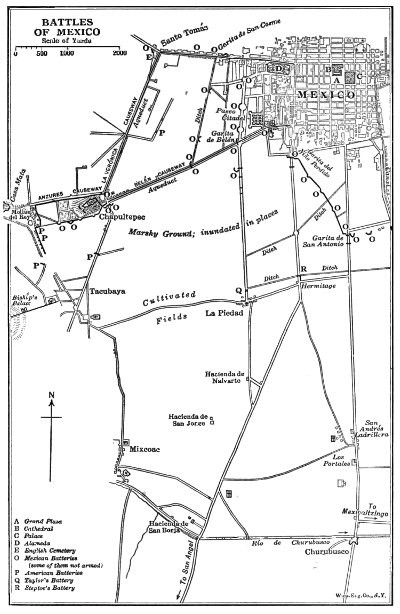
BATTLES OF MEXICO
Larger image
SCOTT’S PREPARATIONS
Inferring from supposed signs of American activity, and also from Scott’s peremptory letter, that on the afternoon of September 7 a determined effort would be made to seize Chapultepec and attack the defences of the city, which had not become very strong in this quarter, Santa Anna made special efforts during the sixth to place his most serviceable troops on the terrain just described; and the next day, taking command there in person, he posted and instructed them with particular care. León’s and Rangel’s brigades were stationed in El Molino; the best of Pérez’s brigade garrisoned the Casa Mata; Ramírez’s occupied the intermediate space; four guns were placed a little in front of the bend; 3000 or 4000 horse under Alvarez—the first division commanded by him and the second by Manuel Andrade—proceeded to Los Morales; reserves of infantry and artillery lay in the rear, and the cannon of Chapultepec were made ready to sweep the ridge and slope.[2]
At the same time pains were taken to rouse Mexico City. Suspicion of Santa Anna persisted, but his credit had been improved not a little by Valencia’s conduct, and the public felt inclined to believe in him once more. The image of the Virgin of Guadalupe, the Patroness of Mexico, now passed through the streets. Under orders from Tornel the clergy preached a crusade against the heretical invaders. Tales of alleged American atrocities supplemented their exhortations. People were ordered to sharpen their daggers, and make ready to throw paving-stones from the azoteas. That Scott’s handful—only some 8000 available men and supposed to number even less—could beat 18,000 or 20,000 valiant Mexicans, protected by strong defences, and capture a city still occupied by perhaps 200,000 persons, appeared incredible. Citizens as well as troops grew confident. When the bells began to ring at about half-past nine on the morning of the seventh, all welcomed the alarm; and when Santa Anna visited the chosen terrain during the afternoon to issue his orders for battle, he was received with applause.[3]
BATTLE OF MOLINO DEL REY
Scott also prepared. September 7 the engineer company and Cadwalader’s brigade advanced from Mixcoac to Tacubaya, the rest of Pillow’s division and one of Twiggs’s brigades moved toward the city as a feint, and Twiggs’s other brigade and Quitman’s division were ordered to concentrate at Mixcoac. Captain Mason and Lieutenant Foster of the engineers daringly reconnoitred the Mexican position, and, although Casa Mata—standing on low ground and partially masked by its earthworks and the maguey—was not adequately made out, they analyzed the situation correctly otherwise. Then, to prevent errors, Brevet Lieutenant Colonel Duncan and two engineers did the work a second time; and Scott and Worth also made observations. Information that he deemed thoroughly safe led the commander-in-chief to believe that guns needed for the defence of the city were now under construction at El Molino, and he desired Worth to have a party destroy the works and material during the coming night—in his opinion an easy task—and immediately retire. At Worth’s request, however, a daybreak attack and, as the natural consequence, a broader plan were decided upon.[4]
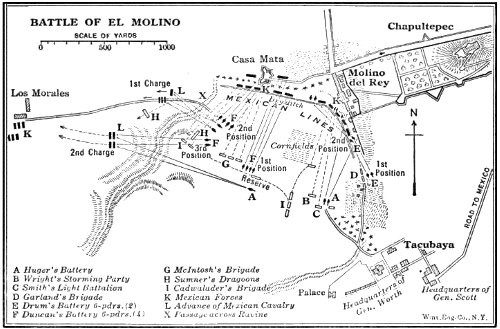
BATTLE OF EL MOLINO
Accordingly, the first gray light of September 8 found the Americans waiting to assault the position. One cannon guarded the road from Mexico to Tacubaya. Brevet Colonel Garland’s brigade and Captain Drum of the Fourth Artillery with his two Buena Vista 6-pounders were directly south of El Molino, at a distance of about 400 yards from it, to ward off a flank attack from Chapultepec, threaten the mill, and be ready to assist as might be necessary. On the ridge, not far to their left, stood Captain Huger with two 24-pound siege guns, Brevet Major Wright’s party of stormers—twelve officers with five companies of 100 men each, drawn during the night from the six regiments of Worth’s division—and a supporting body composed of Brevet Lieutenant Colonel C. F. Smith’s light battalion. Some 500 yards farther to the left and higher up the ridge the guns of Duncan, who had charge of all the artillery, bore upon the Mexicans near Casa Mata, about 700 yards distant, with Colonel Clarke’s brigade—now commanded, on account of Clarke’s illness, by Brevet Colonel McIntosh—on the left of the pieces and General Cadwalader’s brigade, acting as a reserve, at their right and rear. And finally, near the ravine, Major Sumner of the Second Dragoons with some 270 mounted men occupied our extreme left under orders to hold the Mexican cavalry in check and coöperate wherever he could. In all there were 3447 officers and men.[5]
Apparently Worth’s dispositions had been wisely planned, and a scrutiny of the Mexican position, could it have been made, would have confirmed the expectations of a quick victory. Deceived by Scott’s feint against the southern front of the capital, Santa Anna had broken up his army during the night, and now, with a considerable part of it and some of the guns, he was fully two hours distant. No one officer commanded the troops before Worth. Only a sharp, strong thrust was required.[5]
As soon as Huger could make out the low, white walls of El Molino, about a third of a mile distant, he opened fire; and at the same time Engineers Mason and Foster advanced some 350 yards. All was perfectly still in front. Both of them believed the position had been abandoned, and Mason sent Foster back to have Wright’s party—now deployed in line—advance. Consequently, instead of waiting, as had been the plan, until the 24-pounders had perceptibly shaken the mill, the stormers advanced and masked those guns when some ten rounds had been fired. The Mexican pieces, which had been moved nearer the mill during the night, at once opened furiously with canister from an unexpected quarter, and soon a terrific fusillade burst from the parapeted azoteas of El Molino. In spite of it all, three of the pieces were taken, however.[5]
But the American spearhead—Wright’s party—was merely glued fragments of steel, not a forged blade. A large part of the men were separated from the comrades and officers whom they knew and relied upon, and all from the colors they adored. Mason, Foster, Wright and eight other officers out of fourteen went down. The column broke. Nearly a third of the men, whose comrades fought later in the engagement, under their proper colors and officers, like heroes, absolutely bolted. The enemy saw that only a handful were persisting, and promptly rallied. Without orders brave Lieutenant Colonel Echeagaray brought from Chapultepec the Third Ligero. “At them!” he cried; and instantly a counter-attack was launched. The guns were recaptured. The Americans had to retreat. And the pursuing Mexicans butchered and robbed our wounded.[5]
Smith’s battalion rapidly advanced, however, though possibly not quite soon enough. Drum directed a quick, accurate fire upon the Mexican battery. Garland moved up by a road that sheltered his command until it came within some 200 yards of the mill. Drum followed him, stopping at intervals to deliver canister. Cadwalader sent aid. Tall, swarthy León crumpled suddenly with a bullet in his side; valiant Balderas fell over into the arms of his son; and for these ardent leaders the Mexicans had no substitutes. Ramírez took flight. The Mexican reserves would not budge. The Americans captured the enemy’s guns, penetrated into the buildings, and forced their way to the azoteas. Close fighting then settled the issue; and before very long, under the fire of their own pieces, as well as Drum’s and one from Huger, the Mexican left wing and the troops coming to its aid from Chapultepec were in precipitate retreat.[5]
Casa Mata, still held by the excellent men under Pérez but wholly destitute of artillery and feebly protected by its earthen enclosure, might have been cleared of defenders by a vigorous application of artillery. Duncan began work. But Worth believed in brilliant operations, and ordered McIntosh to assault the position. With a smile that beautified his rugged face, the old warrior set out; and soon, bleeding from two wounds, he was lying on the slope. The second and the third in command fell. Officer after officer was struck down. The men toppled over by the wholesale. Wild with enthusiasm some of the Mexicans leaped over the defences and came to meet their assailants.[5]
In spite of their well-aimed and murderous volleys, however, they were soon punished and driven back. But what more could be done? The walls of Casa Mata had not been breached, and there were no ladders. So the Americans lay down behind the embankment of the ditch, and coolly picked off Mexicans at Casa Mata and behind the maguey. After a time their muskets became foul. Their ammunition began to give out. Somehow an order to retire got started; and finally the shattered remnants of the brigade fell back to the rear, followed by miscreants who glutted their fury on our wounded. But Duncan, whose guns had been masked by McIntosh’s advance, now resumed his work upon Casa Mata, and in a short while the Mexicans were in flight, pursued by the unerring missiles of the battery.[5]
Yet there were still 3000 or 4000 horse at Los Morales. These troops had been expected by Santa Anna to sweep the field, and he had personally given their commander his instructions. But a mere partisan fighter like Alvarez did not know what to do with two divisions of cavalry, an arm that it requires distinctive qualifications and much experience to handle well. Besides, his division included no artillery, and he probably felt no more anxious than before to help the President at his own expense. He followed but carelessly Santa Anna’s instructions. His orders to Andrade were more or less confused and impracticable; and that officer, who was at odds with his commander and felt that Santa Anna had overlooked his achievements at Buena Vista, concluded to keep himself and his men out of danger.[5]
At length, however, while McIntosh was charging, Alvarez advanced in brilliant array with his own division. Sumner at once dashed hotly across the ravine and at them, passing the Mexican infantry within pistol range and losing forty-four men and 104 horses in perhaps ten seconds. Duncan turned his now unemployed guns in the same direction. One of Alvarez’s brigades, made up of untrained guerillas, broke immediately under the cannon fire; and the whole division soon retreated in disorder upon Andrade’s men, fiercely pursued by the riderless horses of Sumner’s command, as if to get revenge for the loss of their masters. Later some of the cavalry undertook, or so pretended, to cross the ravine at another point. But Sumner dashed at them again, a part of Cadwalader’s brigade was now in that quarter, and both Duncan and Huger—the latter being at present near the American centre with one gun— sent their compliments; the Mexicans retreated; and at about seven o’clock the battle ended.[5]
“A sad mistake,” said Hitchcock, and he was right. A few cannon moulds were found. The partial destruction of El Molino and Casa Mata cancelled the military value of the position, and facilitated later American operations; but such operations were not contemplated at this time. A few small cannon and a quantity of more or less valuable ammunition fell into our hands, and a heavy gun at Chapultepec became disabled. Probably 2000 Mexicans were killed or wounded, and perhaps an equal number deserted. Nearly 700 prisoners were taken. The loss of two excellent officers meant still more, perhaps. Intrenching implements needed at Chapultepec were lost. The want of coöperation among the Mexican generals and especially the total failure of the cavalry to meet expectations disheartened the capital. But the casualties in the little American army amounted to 124 killed and 582 wounded. The confidence of the officers, if not the men, in their leaders faltered at the evident mistakes of Scott and Worth. Each of those generals blamed the other, and the discord between them, which reached down to the private soldier, became worse than ever. No American could find satisfaction in a barren victory gained with such difficulty and at such a cost; and the Mexicans, believing we had aimed to accomplish far more, exulted over their imaginary triumph. Scott faced the situation with unshaken fortitude, but those who knew him intimately saw that he felt anxious.[6]
THE GREAT PROBLEM
However, the great problem before them soon occupied the minds of all. Mexico, lying on a very slight elevation or swell, could be entered on its western side by the garita of San Cosme and at the southwest by the garita of Belén, to each of which led a causeway from the fortified hill of Chapultepec, about a mile and a half southwest of Belén. From this garita a second causeway ran south about an equal distance to the picturesque chapel of La Piedad, where it was crossed by one extending eastwardly from Tacubaya to the San Antonio or Acapulco highway, which—it will be recalled—led south to Churubusco and San Agustín. Not far north of the latter junction and about a mile from the city proper stood the garita of San Antonio; while, intermediate between the San Antonio and the Piedad routes, the Niño Perdido causeway, coming from San Angel, connected with Niño Perdido garita, which stood at the edge of the city. Finally, a road leading nearly east from San Antonio gateway conducted one to La Viga garita and La Viga canal, a deep and broad waterway, which, since it could not well be bridged in the face of the enemy, practically bounded Scott’s field of operations. There were thus four garitas—Belén, Niño Perdido, San Antonio and La Viga in this order from west to east—each guarding an approach to the capital from the south.[7]
Scott’s expectation was to break the south front, and after the armistice ended, his engineers, assisted to some extent by himself and a Mexican officer in his pay, reconnoitred it actively and boldly except on the forenoon of the eighth. Had it been feasible to strike immediately on the resumption of hostilities, the enemy’s lines would have been found poorly fortified and armed. But this could not well be done with Santa Anna’s principal forces menacing our flank; the American army was not yet in position; and Scott desired first of all to destroy El Molino. After the battle of the eighth half of his troops imperatively required a breathing space. The wounded had to be given attention. The army still needed to be placed. It was necessary to protect hospitals, baggage and stores—especially since Governor Olaguíbel and about 700 militia, supposed by Americans to be Alvarez with his two divisions, were approaching the rear, and according to reports Valencia had 8000 men in that vicinity. Moreover Scott’s information was not complete. The eighth of September, following the twentieth of August, had proved the danger of rashness; and the fresh losses made extreme caution absolutely necessary. Finally, Scott felt a suspicion that the Mexicans expected and wished him to attack their apparently unfinished works covering the south front.[8]
On the morning of the eleventh he inspected these once more, and then had a conference of generals and engineers at La Piedad. It was a solemn gathering. Before them lay the fortified capital of Mexico, a hopeful army of perhaps 15,000, a good equipment of artillery, nearly 700 trained gunners, and a large population, somewhat disillusioned, but excited and vengeful; and in view of the American situation it was essential, as the commander-in-chief clearly indicated, to strike a vital blow at once.[9]
But where? Point by point Scott fully and fairly stated the case: at the southwest the mighty porphyritic hill of Chapultepec to carry, but a clear problem, hard ground, excellent places for batteries, Huger’s opinion that in one day the fortified college on the top of the hill could be demolished, in the event of success a position from which to operate freely, and at least a possibility that, after losing what was commonly deemed its key, Mexico would listen to terms; on the southern front marshes, inundations, large ditches full of water everywhere, causeways already cut by the enemy, bridges destroyed, a topography that made rear and flank attacks impossible, an extensive series of well-planned and well-armed fortifications crossing their fires and commanding one another, and an enemy apparently eager to have the attack made here. Scott, while disclaiming any wish to influence the judgment of others, pronounced frankly for Chapultepec.[9]
Then one of the engineers—a tall, handsome young man, with a positive chin, a strong nose, a dark, closely trimmed mustache, dark hair clustering above his ears, and a fresh, clear color in his face—stood up and reported crisply on the work of reconnoitring. His name was Robert E. Lee, and he recommended approaching by the southern front. Three other engineers concurred with him. Four generals, doubtless influenced by these experts, took the same view. Twiggs and Riley inclined the other way. The fifth engineer present was then called upon, and he—Beauregard—in a long, technical statement argued for the Chapultepec route. Pierce changed his opinion. A silence followed; and then Scott, drawing up his magnificent figure to its full height, announced in his grand way: “Gentlemen, we will attack by the western gates. The general officers present here will remain for further orders—the meeting is dissolved.” And so the die was cast.[10]
CHAPULTEPEC
The preparation of Chapultepec for defence had begun in May, and Santa Anna had insisted upon it as of the “highest importance”; but want of money hindered and at times checked operations. During the armistice a little progress was made, and September 9, under the direction of a competent engineer and of the President himself, the work began in earnest. But alterations in plan, a lack of implements, a shortage of materials, the general confusion and the want of time naturally made thoroughness impossible. Chapultepec was therefore a fort but not really a fortress. It stood alone, too, without the supporting positions that a fortress must have; and shot and shell could penetrate the defences of the college on the summit of the hill almost everywhere. Even the parapets were not ready; and instead of the 2000 men required for an adequate garrison of the buildings and works, only a few hundreds occupied them. Their elevation merely hindered approach—not assault—and artillery could largely offset that advantage. To hold the grove was essential, for without it the garrison above could not obtain supplies or even water; and here the want of adequate defences had a still worse effect, since large forces could not be protected against artillery.[11]
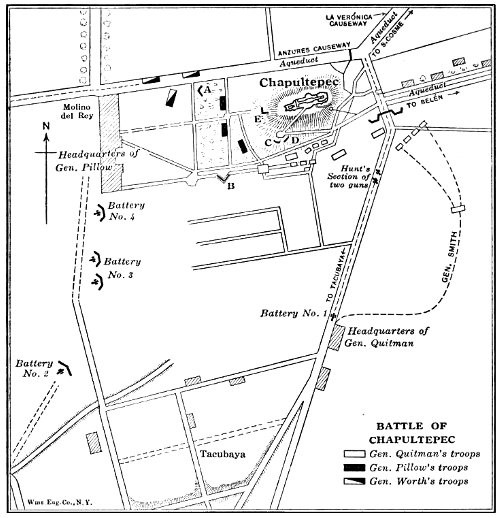
BATTLE OF CHAPULTEPEC
Yet for 7180 available Americans including those required to make a feint against the southern front—an “army” that had to contemplate still harder work beyond, and could not afford severe losses here—Chapultepec meant a great deal. In general the position formed an approximate rectangle about three fourths of a mile in length by one fourth of a mile in width, bounded at its western end by El Molino and on the other sides with high stone walls. In the south wall, at about its middle point, there was an opening covered on the outside by a sand-bag redan (B), unarmed. From the main gateway in the eastern end the causeway of Belén struck off toward the city, another road—guarded here by a cut and by two batteries—ran toward Tacubaya, and a third, after running westwardly into the rectangle and a little way up the slope until it arrived at a 4-pounder in a circular redoubt (C), flanked with an infantry entrenchment (D), turned sharply toward the northeast, and finally climbed to the summit.[12]
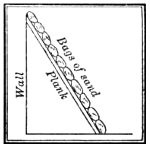
Blindage at Chapultepec.
Here on a rectangular level space or terre-plein, supported at the eastern end by an almost vertical precipice and on the other sides by high, parapeted walls, rose the masonry buildings of the military college, skilfully though incompletely reinforced with sand-bags and screens of timber (blindage), supplemented with parapeted azoteas, and surrounded with ten effective guns, heavy and light. A deep, broad fosse at the base of the western wall, mines below that, and finally, half-way down the slope, a redan (E) strengthened this end, where the incline was gentlest. In swamps at the western foot of the hill stood a large grove of huge cypresses—extending also toward the main gateway—through which ran an east and west road commanded by this redan (E) and also by the wall of the fort. Beyond the grove came a north-and-south ditch, intended for drainage, with a redan-breastwork (A)—looking westward—at its northern end; and finally, after traversing level and open fields for about a quarter of a mile toward the west, one arrived at El Molino. Placed so conspicuously in view, 150 or 200 feet in height, Chapultepec seemed to deserve its popular reputation of impregnability, and the American soldiers gazed at the white walls on the summit, transfigured in the sunlight, with dread if not with consternation.[12]
Late in the afternoon, September 11, Quitman’s division ostentatiously presented itself at La Piedad, but after dark both his and Pillow’s moved to Tacubaya, leaving Twiggs with Brevet Colonel Riley’s brigade and Steptoe’s and Taylor’s field pieces behind. During the night two 16’s and an eight-inch howitzer under Drum were placed behind bushes on the road from Tacubaya to Mexico, about 1000 yards from Chapultepec, and a similar howitzer with a 24-pounder, masked in the same way, south of El Molino under Hagner; and these batteries (Nos. 1 and 2) opened fire the next morning (September 12). Later in the day a 16-pound siege gun and an eight-inch howitzer (Battery No. 3) and a ten-inch mortar (No. 4), planted nearer the mill, joined in the work. Chapultepec replied; and, as usual, the Mexican artillerymen—of whom there was a full complement—did well, occasionally knocking sand-bags from the American parapets, while our own gunners, warned by the burst of smoke, took shelter at each discharge. Meantime Steptoe, in the hope of deceiving the Mexicans as to Scott’s purpose, made as much noise as possible opposite the San Antonio garita.[13]
During these preparations the Mexicans passed their days in a state of fever. Reports that our army had only half-rations cheered them, and Scott’s deceptive manoeuvres were attributed by many to indecision or timidity. On the eleventh a review and a valiant proclamation from the President recalled his “victory” of 1829 over the Spaniards. But a sense of weakness and confusion, the loss of friends, the continual alarms, the marchings and countermarchings, and the ominous clang of the bells kept them sad and anxious. Santa Anna, for his part, displayed as usual a remarkable activity and a remarkable want of judgment and method. During the night of September 9 he set perhaps 2000 men at work—one hour each—on the southern fortifications, and the parapets rose as if by enchantment. Not knowing where Scott would strike, he broke his army into a number of detachments, and shifted troops and guns frequently according to his notion of the probabilities, while always maintaining a reserve. But he lost himself in a maze of details; and on the eleventh, deceived by the rather weak American feint, he unwisely drew men and cannon from Chapultepec and Belén.[14]
SEPTEMBER 12
Early the next morning, however, the reports of spies and the roar of Scott’s heavy guns enlightened him. Troops were hurried to the real point of danger. With all speed he went there himself, ordered his best engineers to work on the fortifications near the main gateway of the Chapultepec enclosure, and posted troops close by. But there was little he could do. More and more accurately the American batteries fired and kept on firing. Two of the best cannon in the fort were disabled. The buildings of the college suffered, the garrison suffered more, and their morale suffered most of all, for except the engineers and gunners the men felt utterly helpless. When Santa Anna entered the rectangle unattended to reconnoitre, a shell burst near him and covered his red pony with dirt. Toward evening General Bravo, the commander of the position, came down, reported to him that the garrison were cowed, and demanded fresh troops; but Santa Anna could see no use of sending them forward to be destroyed on the way or else demoralized after arriving. They should be provided, he said, at the critical moment.[15]
Scott saw, however, as the day waned, that Huger’s expectations would not be realized—that an assault would be necessary. For this last resort preparations had in fact been made. The troops and the ladders were now ready. Fearing the Mexicans would repair the damages under cover of night he thought at first of delivering the blow at once; but he concluded that it was now too late in the day, that his guns could soon dispose of repairs and reinforcements, and that a morning attack would give many hours for pursuing the advantages gained. Engineers proceeded to mend and improve our own batteries, and the generals met for a conference. Here the plans were finally decided upon. Quitman’s division and a forlorn hope of about 265 selected officers and men from Twiggs’s division, under Captain Casey of the Second Infantry, were to advance by the Tacubaya road; and Pillow’s, preceded by a similar party from Worth’s division, led by Captain McKenzie of the Second Artillery, was to attack by way of El Molino and the grove. Then every one betook himself to his post. But Pillow felt discontented. “We shall be defeated,” said Worth privately; and even Scott admitted to Hitchcock, “I have my misgivings.”[16]
BATTLE OF CHAPULTEPEC
At daybreak—about half-past five—the next morning a signal gun broke the stillness, and then our batteries opened. For two hours or so they hurled shot and shells at the fort, and then for some thirty minutes grape, canister and shells were poured into the grove. At about eight o’clock, as if by common consent, they stopped—but only to burst forth again with new fury.[17]
That one momentary pause was the command to attack. Colonel Trousdale, with the Eleventh and Fourteenth Infantry and a section of Magruder’s field battery under the “Stonewall” Jackson of our civil war, moved some distance eastward from near El Molino by the Anzures causeway along the northern side of the rectangle, to prevent reinforcement and embarrass escape in that quarter. Lieutenant Colonel Johnston with four companies of the gray Voltigeurs advanced outside the south wall, drove the Mexicans from the redan (B) and from the wall, behind which they had been standing on platforms, passed through the opening, captured the circular redoubt (C) and the breastwork near it (D), and opened fire on the southern parapet of the fort. Reno’s howitzers, taken from El Molino eastward into the fields, poured shells upon the grove and the Mexican entrenchments (A and E). Four other Voltigeur companies under Colonel Andrews, after crossing those open fields, rushed with loud cheers into the swamp; and the Ninth and the Fifteenth Infantry, deploying into line, followed them closely. Decorated with long, hanging moss, the venerable cypresses, dear alike to Cortez and to Montezuma, seemed like the fit guardians of some mystical and melancholy religion; but now hurrahs and sharp flashes and the terrible crash of cannon-balls amidst the branches broke their shadowy silence, and the Americans, wallowing through the mire, drove the Mexican skirmishers from tree to tree, from the grove, and at last from the battle.[17]
Clearly it was time for Santa Anna to support the garrison. Attempts had been made to repair the fort during the night, but no adequate materials could be found there. A cannon had burst. The dead and wounded lay about. There were no surgeons, no medical supplies. The expected reinforcements did not appear. Most of the students, gallant lads in gray uniforms and gaily tasselled blue caps, withdrew by command. Bravo—thickset and erect, with deep eyes and a powerful chin—though he was cold and unenterprising, had flawless courage, and he stood with folded arms or marched calmly from post to post. But the infantry of the garrison—hungry, exhausted, stunned, hopeless—cowered behind the parapets. Many had to be driven to their places, and some had to be fired on. Even the engineers and gunners felt despondent.[17]
But Santa Anna could not see what to do. No doubt the hill was to be attacked from the grove, but the enemy seemed likely to assault by the Tacubaya causeway also, and Trousdale, he fancied, might come round by a road that skirted the eastern end of the rectangle to strike his rear. Besides, the officers and men showed no desire to challenge the American artillery by marching up the hill, and he understood well enough himself how few of them could probably reach the fort. At length, however, he strengthened the forces on the Tacubaya road, and sent most of the San Blas Activo battalion to Bravo. At the circular redoubt this corps met the Americans, and not many of them lived to go farther.[17]
East of the grove, Andrews with his Voltigeurs and Reno with his howitzers turned a little to the right and united with Johnston. This left the Ninth a clear front. Colonel Ransom had promised, the day before, that he and his men would go into the fort or die. Proudly erect, sword in hand, the beau-ideal of a soldier, he strode in front up the steepest part of the slope, while the Fifteenth marched on his left. The breastwork (E) was captured; and then, coming in view of the fort—its buildings almost hidden in smoke, its parapets a sheet of flame, the air filled with the hiss and shriek and roar of missiles—he waved his sword, shouted, “Forward, the Ninth!” and fell dead with a bullet in his forehead. A terrible cry rose from his men: “Ransom has fallen—the Colonel is shot!” Wild for revenge they all charged on, and a part of them reached the fosse.[17]
But there had been some mistake. The ladders had been entrusted to raw men, it was said; perhaps they had not been started off in time; apparently some of the bearers had left their places and hurried on; some had been killed and others frightened. Anyhow the ladders did not arrive. Like the Voltigeurs on their right, the Ninth and the Fifteenth sought shelter behind rocks and stumps and fired at the parapet; and the tardy storming party, which was to have passed through them, feeling no desire to get between the two lines of fire and really unable to do anything without ladders, halted.[17]
The men were fairly safe. Their muskets taught most of the enemy to keep down behind the parapet. The rest of the Mexicans fired very badly, and the Americans near the wall could not be reached by the cannon. But the attack was making no progress. Time passed—five, ten, fifteen dreadful minutes, and still no ladders could even be seen. The American batteries, which had been firing over the heads of our troops, could no longer do it safely. The ardor of battle was cooling. Low mounds that looked like graves, but in reality were the mines, lay under our men, and a Mexican lieutenant of engineers had orders to fire them at the right moment. Santa Anna with perhaps 4000 or even 5000 reserves so near—might he not come round the hill? Scott’s whole gazing army, back even to Lieutenant Mayne Reid at Battery No. 2, was seized with a horrible fear. Pillow, lying at the foot of the hill painfully hurt in the ankle, sent for the whole of Worth’s division, which was supporting him as a reserve, and begged Worth to make “great haste” or it would be “too late.”[17]
There was, however, a nearer source of help. When the signal for attack was given, Quitman’s division—preceded by forty pioneers under Captain Reynolds of the Marines, Casey’s forlorn hope, and 120 stormers from the volunteer division led by Major Twiggs of the Marines—advanced on the Tacubaya causeway until about 200 yards from the gateway batteries. To support it, repel a body of Mexicans on its right, ward off any force that might approach from the city, perhaps turn those batteries, and if possible gain the Mexican rear, General Smith struck off into the meadows and pushed on despite the ditches; and Captain Drum and Lieutenant Benjamin, each with a single gun, and Lieutenant Hunt with two of Duncan’s pieces advanced by the road, firing on those batteries or at the hill and fort as opportunities offered.[17]
On each side of the causeway ran a ditch that was almost a canal and cramped the troops not a little; and a terrible fire of artillery and musketry from the meadows, the front, the wall of the rectangle and the fort on the hill-top greeted them. Quitman had reconnoitred here the day before, and thought he understood the problem; but the Mexicans had made further preparations afterwards, and when he ordered a charge, it was checked, and Twiggs and Casey fell. Ahead of him, partly enfilading the road, blazed at least five guns, and some of the best soldiers in the Mexican army—commanded by General Rangel—occupied the stone buildings near them, while others fired from behind the wall near the gateway. Under this concentrated and awful storm the Americans recoiled, and sheltered themselves near a bend in the road by lying down, getting into the ditches or occupying some houses. Here, too, the offensive was blocked; the attack failed.[17]
But “the issue of battle lies in the hearts of men,” and the will of every American heart was Victory. Lieutenant Reid, hurrying over from the battery with two companies, dropped on the slope, but his men went forward. By Quitman’s order the New York and the Second Pennsylvania regiments left the Tacubaya causeway, under a heavy fire waded the ditches on the left and rear to the redan (B), and charged through the opening, while the Palmettoes, finding a break in the same wall, made a little farther east by an American cannon, enlarged it with their bayonets and squeezed through. Shields and the commanders of the New York and Pennsylvania regiments were wounded, but the troops kept on. Clarke’s brigade, sent forward by Worth, hastened up the western slope, and when Lieutenant Longstreet of the Eighth fell, Lieutenant Pickett seized the colors. For some reason the mines failed to explode; and at last the ladders came up.[17]
Shouting and yelling, the Voltigeurs, the Ninth and Fifteenth, some of McKenzie’s and the foremost of Quitman’s men, all closely intermingled, and brilliant with flags and the sparkle of arms, crowded to the fosse. The first ladders, with all the bold fellows upon them, were thrown down, but in a moment so many more were placed, side by side, that fifty could go up abreast. The blue Voltigeur flag, now full of holes, was planted on the parapet. A tide of brave Americans overflowed the fort. Resistance was vain. A little before half-past nine Bravo gave up his diamond-hilted sword, and the tricolor, that had been waving placidly amidst the uproar, came down with a jerk.[17]
Fire was opened then upon the Mexicans at the gateway below, and fearless Captain Roberts of Casey’s storming party, at the head of all the troops on the causeway and supported by General Smith’s brigade, carried the gateway batteries. Many from Quitman’s and Smith’s commands rushed to the summit, dealing with flying enemies as they went. Scott himself came up—the hero of Chippewa and Lundy’s Lane. The men pressed round him. He told them how glad he was, and how proud of them; and how proud their country, their wives, their sisters and their sweethearts would be; and it seemed as if such cheering had never been heard, anywhere in the world, before.[17]
Exultant but weary, the soldiers now looked about them as they took breath. From this eyrie the whole wonderful Valley of Mexico could be surveyed. All round the west the great wall of rugged mountains closed it in, and two vast, snowy peaks guarded its portal on the east. As if reluctantly the mountains gradually subsided into verdant hills and a wide plain, enamelled in a thousand soft hues. The broad, smooth lakes gleamed like molten silver. The gold of ripening grain, penciled lines of pale-green maguey, cottages radiant in the sun like the sails of distant ships, country-houses and villas half hiding in foliage, and many straight, converging avenues, lined with trees, delighted the eye. In the midst, clear-cut as a medallion, lay the city of Mexico, the capital, its roofs and towers black with people; and there, just yonder, stood the Halls of the Montezumas, the Jerusalem of these ardent young crusaders. Unfortunately breastworks, redoubts, cannon and a Mexican army were still to be reckoned with. Santa Anna had probably lost not more than 1800 killed, wounded and missing this day, and apparently Scott’s loss had been about one fourth as great.[18]
QUITMAN’S OPERATIONS
But the Americans quickly prepared to advance—first of all, Quitman. Naturally a certain discretion had been given to the commanding generals, and he intended to make the most of it. Looking from the hill along the Belén causeway, he saw a wide avenue divided through the middle by a stone aqueduct some eight feet wide and fifteen feet high, resting on heavy arches and pillars of masonry. Owing to fine weather the road was unusually firm. A small number of troops, fleeing in the utmost confusion, could be seen upon it, but at only one point fortifications. Borrowing all of Pillow’s troops except the Fifteenth Infantry, which remained to hold Chapultepec and guard the prisoners, he quietly gave orders that his men should assemble near the main gateway. At once the inspiring words began to circulate, “Quitman’s division to the city!” and as soon as possible the Rifles, in their crimson sashes, were leading the march forward. About a mile on, a two-gun battery, with a field redan at its right on the marsh, blocked the way. For an hour or so Drum used a small gun upon it. Then the Rifles, after creeping along the aqueduct from arch to arch, took it by assault, and the march continued toward the fortifications at the garita.[19]
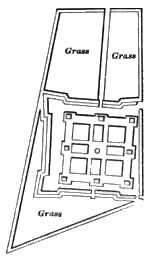
The Citadel in 1840.
As at the other garitas, no gates existed here, but a ditch and a parapet blocked one half of the causeway and a zigzag redoubt the other. Just at the north was the stone house intended for guards and customs officials, beyond which lay the wide Paseo (Promenade). South, on the Piedad road, were artillery and infantry that could fire through the arches. Inside the garita, buildings extending toward the east offered shelter, and in open ground a little more toward the north and about 300 yards distant, the extensive edifice called the citadel, protected with a wall and a wet ditch, constituted a serious obstacle.[19]
Santa Anna, after acting like a madman when Chapultepec fell, came to this garita. General Terrés, a brave old Spaniard, commanded here with about 180 infantry and some artillerymen. Santa Anna gave him three guns of medium power, and stationed General Ramírez in the Paseo, Brevet General Argüelles on the opposite side, and General Perdigón Garay and Colonel Barrios in the rear with substantial reserves.[19]
On approaching this formidable position, Quitman encountered a withering storm of bullets, grape and solid shot from both sides and the front, and suffered rather severely. But Drum and Benjamin, iron men, bringing up as soon as possible a long 18-pounder and a 24-pound howitzer on the opposite sides of the aqueduct, dampened the ardor of the Mexicans not a little, and splinters from the masonry did havoc among the sheltered artillerymen at the garita. Some troops already beaten at Chapultepec and at the intermediate battery soon became demoralized. At about one o’clock rumors crept in that Americans from the southern front were turning the position. Ramírez, Garay, Argüelles and Barrios retired without the formality of saying good-by; and Terrés, whose cannon ammunition had failed, withdrew prudently to the citadel with two of the guns and about seventy panicky men, the remnant of his garrison. The Rifles now dashed over the parapet; and at exactly twenty minutes past one a tall, slender man with short, bristling, grayish hair stood on it, smoking a cigar and waving a red handkerchief tied to a rifle. It was Quitman, self-possessed but exultant; and in a few moments the Palmetto colors and the green banner of the Rifles, with its blazing gold eagle, were flying at the portal of the city.[19]
The advance then continued for some little distance, and, as the ammunition of our two heavy guns had been exhausted, the captured Mexican 8-pounder was made to do good service. But Santa Anna, who had thought the position safe and gone on to San Cosme, soon arrived with ordnance and troops. The citadel was reinforced, and infantry and cannon were placed at other points. Quitman’s last artillery cartridges were used, and under the enemy’s fire no more could be brought up. Solid shot cut down both Drum and Benjamin. Our infantry had to retire to the vicinity of the garita. Attempts were then made to strengthen the position; but they did not accomplish very much. Ammunition gave out entirely, and firing ceased. The enemy grew bolder. Again and again they charged, and though repulsed they did not appear to be discouraged. By this time every member of Quitman’s staff, Beauregard, his engineer officer, and all his artillery officers had been killed or wounded, and he longed anxiously for night.[19]
Meanwhile, events had occurred on Scott’s other wing. Trousdale’s command, supplemented with Jackson’s guns, pushed along the road and aqueduct on the north side of the rectangle, and the latter distinguished himself by fearlessly attacking a one-gun redoubt, which, supported by infantry and by fire from the summit of the hill, barred the way. To check Mexican reinforcements and threaten the enemy—particularly the troops in Quitman’s front—Scott now had Worth, Garland’s brigade, C. F. Smith’s battalion, Duncan’s battery, the rest of Magruder’s battery and Sumner’s dragoons pursue the same route. The one-gun redoubt was flanked and occupied; and Worth’s forces arrived at the northeast corner of the rectangle in time to annoy the retreat of Rangel and other departing Mexicans.[20]
THE SAN COSME APPROACH
Here began the broad, straight Verónica causeway—closely similar to that of Belén—which extended almost north for nearly two miles (3530 yards) to the English cemetery, and there joined the San Cosme highway at approximately a right angle. Understanding the difficulties of the Belén approach, Scott intended to make only a feint in that quarter, and let his left wing break into the city. He therefore sent the brigades of Clarke and Cadwalader and also Huger with siege guns to Worth. To organize the attacking column, replenish the ammunition, make other needed preparations, and sweep away the resistance encountered at several minor fortifications, especially near the cemetery, required time; but at about four o’clock Worth found himself on the straight highway about half a mile from the San Cosme garita.[20]
This entrance to the city had been included in the general scheme of defence, but on account of its remoteness from pressing danger few workmen had been employed here; and when Chapultepec fell, it lay entirely open except for a small parapet without a ditch extending partly across the highway some 250 yards to the west. General Peña, however, coming this way from Chapultepec, stopped at the parapet, and Rangel placed at the garita such troops as he could assemble. Santa Anna, who displayed on this occasion reckless valor and an almost fiendish activity, sent three available cannon and brought additional troops. The roofs of buildings in the vicinity were occupied. A redoubt with embrasures was hastily erected at the garita, the near arches of the aqueduct were stopped up with sand-bags, and some guns in the Paseo were prepared to coöperate.[20]
On attempting to advance, therefore, Worth found the highway swept with bullets, canister, grape and shells. Garland, however, was ordered to creep forward under the protection of the arches, and endeavor to reach the south flank of the garita, and Clarke to burrow through the continuous line of buildings on the other side, and strike the northern flank. Lieutenant U. S. Grant, who was reported as acquitting himself at this time “most nobly,” waded some ditches with a party of men and a mountain howitzer, and planted the gun on the roof of a church at the right; and Lieutenant Raphael Semmes of the navy performed a similar exploit on the left. Artillery fire compelled Peña, who—reinforced by Santa Anna with two companies of the Eleventh Infantry—was fighting gallantly, to leave the parapet; and Hunt, of Duncan’s battery, though he lost more than half his men in dashing 150 yards at full speed, landed a gun at that point, where he could load in safety and then fire from the one embrasure.[20]
By five o’clock these preparations were complete. On the other hand Rangel had been severely wounded, and his principal gun, a 24-pound howitzer, had become unserviceable. Suddenly, to his utter astonishment, Americans appeared on the top of a three-story house that commanded the interior of his redoubt, and with a single volley disposed of almost every gunner and artillery mule. Then some of them hurried down to the front door of the house, burst it open, and rushed into the redoubt, where they met Americans just arrived by a flanking movement from the other side of the highway. In a panic the Mexicans fled, literally sweeping away Santa Anna and a body of troops, who had come at all speed from Belén to support the position. Many of them scattered, but with no little difficulty others were conducted to the citadel. By six o’clock Worth entered Mexico. Near the garita his forces were safely housed, and by way of “good-night” and good advice, Huger dropped a few shells in the vicinity of the palace.[20]
The end, however, was not yet in view. Santa Anna had some 5000 infantry and fifteen cannon at the citadel, with probably about 7000 more troops not far away, and the Americans, besides having lost many in the day’s fighting, were now fearfully divided. Not only Worth but Quitman, who planted three heavy guns in battery during the night, intended to advance in the morning, and apparently a day of carnage was to ensue.[20]
But Santa Anna probably began to feel the reaction that always followed his great efforts. Funds and provisions were scanty. The army was demoralized, and the mass of the people felt disheartened. Within the town there were no fortifications, and it looked as if another battle under these conditions might scatter the troops, and involve the loss of nearly all the war material. Besides, leading persons in the city had always been strenuously anxious to prevent bombardment and assault; and the President was urged now, as four months previously, to spare it. Early in the evening, therefore, he briefly discussed the situation with Olaguíbel, the minister of war and three generals. The Governor was for acting deliberately; but Santa Anna, declaring that honor had been satisfied and the city could not be defended successfully, ordered immediate evacuation; and by one o’clock the troops retired in a somewhat orderly fashion to Guadalupe Hidalgo. About three hours later a commission of the city council (ayuntamiento) offered terms of capitulation at the American headquarters in Tacubaya. These were of course rejected, for the town lay at our mercy; but Scott gave informally the usual assurances of good treatment.[21]
THE AMERICANS CAPTURE MEXICO
So when the first thin streak of dawn glimmered forth behind the gray volcanoes, and our cannon at Belén garita were on the point of opening fire, a white flag and an invitation to enter the capital reached Quitman. First making sure there was no deception, he advanced; and after stopping about half an hour at the citadel he moved forward under a splendid sun to the grand plaza, which fronted the palace and the cathedral, with Smith’s brigade, the Marines, the New York volunteers and Steptoe’s battery. As a triumphal procession the command looked rather strange. Quitman and Smith marched at its head on foot—the former with only one shoe; and behind them came troops decorated with mud, the red stains of battle and rough bandages, carrying arms at quite haphazard angles. Not less astonishing looked the city, for sidewalks, windows, balconies and housetops were crowded with people. Except for the silence, the countless white handkerchiefs and the foreign flags, it might have been thought a holiday. Before the palace, which filled the east side of the plaza, the troops formed in line of battle. Officers took their places at the front, and when Captain Roberts hoisted a battle-scarred American flag on the staff of the palace at seven o’clock, arms were presented and the officers saluted.[22]
Soon loud cheering was heard. A few squares away the commander-in-chief, escorted by cavalry with drawn swords, had reached Worth’s command, which had stopped at six o’clock by orders opposite the high ash trees of the Alameda. A clatter of galloping hoofs followed; and in another moment, amidst the involuntary applause of the Mexicans, General Scott, dressed in full uniform and mounted on a tall, heavy bay charger, dashed with his staff and Harney’s dragoons into the grand plaza—his noble figure, gold epaulets and snowy plumes, resplendent under the brilliant sun, fitly typifying the invisible glory of his unkempt and limping army. Uncovering, he rode slowly along the line of battle to the music of our national airs; the troops, presenting arms again, cheered and hurrahed till it seemed as if the earthquake-proof cathedral must be shaking, and the cavalry escort waved high their flashing blades.[22]
In stentorian tones the commander-in-chief appointed Quitman governor of the city; and then, dismounting in the courtyard, he clanked up the broad stairway of the palace, to indite congratulations on the “many glorious victories” of his army. Presently cross-belted American Marines were calmly patrolling the Halls of the Montezumas as if they owned them, while the rest of the troops gazed with profound exultation at the long pinkish façade and the endless balconies of the upper story, and the people gazed silently at the troops. “They are all and each of them heroes,” commented a foreigner present, and others in the world thought the same.
2. Sen. 52; 30, 1, pp. 381–2 (S. Anna to Scott, Sept. 6). 76To Herrera, Sept. 6. 100Guerra, circular, Sept. 11. Apuntes, 290–2. S. Anna, Mi Historia, 75. Id.., Detall, 23. 76Acuerdo, Sept. 4. Giménez, Memorias, 266. 76Alvarez to S. Anna, Sept. 25. Negrete, Invasión, iv, app., 293. Balbontín, Invasión, 125–6. Grant, Mems., i, 151. Mason to Smith: note 1. 76Alvarez, Sept. 6. Sen. 1; 30, 1, app., 134–5 (Duncan). Roa Bárcena, Recuerdos, 424.
3. Ramírez, México, 299. 73Lozano, nos. 2, 8, res., 1847. 199Anon. MS. Kenly, Md. Vol., 346. S. Anna, Apelación, 49. Giménez, Memorias, 111. 358Williams to father, Oct. 1. Exposición dirigida. 179Diario Esactísimo. Negrete, Invasión, iv, app., 295–6. 100Alcorta, circular, Sept. 11. 76Tornel, decree, Sept. 7.
4. Smith, Co. A, Corps of Engineers. 221Hill, diary. Hitchcock, Fifty Years, 296. 260Henshaw, comments on map. 217Id.to wife, Sept. 13. 65Scott, gen. orders, Sept. 7. Sen. 1; 30, 1, pp. 354 (Scott), 361 (Worth), 425 (Smith). 178Davis, diary. Sen. 65; 30, 1, p. 298 (Scott). Mason to Smith: note 1. 66Foster to Smith, Sept. 8. 66Beauregard to Smith, Sept. 20. 224Hitchcock, introd. to intercepted letters. So. Qtrly. Rev., Oct., 1852, 302. Semmes, Service, 431–4.
5. The battle of Sept. 8. Sen. 1; 30, 1, pp. 354, 375 (Scott), 361 (Worth), 368 (return), 373 (Sumner), 374 (Huger), 425 (Smith), 430 (Hitchcock); app., pp. 134–165, 192 (officers). Ho. 1; 30, 2, p. 1237 (Perry). 179Diario Esactísimo. Stevens, Stevens, i, 204–7. Sedgwick, Corresp., i, 170. Semi-weekly N. Y. Courier and Enquirer, Mar. 1, 1848. Elderkin, Biog. Sketches. So. Qtrly. Rev., Oct., 1852, 298–315. Negrete, Invasión, iii, app., 463–9; iv, app., 295–9. S. Anna, Detall, 23–5. Balbontín, Invasión, 125–9. Hitchcock, Fifty Years, 296–9, 303. Grant, Wems., i, 152–3. Ballentine, Eng. Sold., ii, 238, 240. 217Henshaw to wife, Sept. 13. 218Henshaw narrative. 61Letter from Mexico, Sept. 11. 69May to Harney, Nov. 17, 1848. 69Steele to Harney, —, 1848. 69Harney to Marcy, May 22, 1848. 66Mason to J. L. Smith, Sept. 25, 1847. 66Stevens to Id.., Sept. 25. 66G. W. Smith to Stevens, Sept. 20. Claiborne, Quitman, i, 352. Raleigh Star, Oct. 27. 221Hill, diary. 304Kirby to Mrs. E. K. Smith, Sept. 12. 60Andrews to Daniel, Dec. 10. Louisville Democrat, Dec. 17. 68Testimony at Bonneville court martial. London Times, Nov. 13. Semmes, Service, 436–449. Sen. 65; 30, 1, p. 503. Apuntes, 210, 294–304. 100Relaciones, circular, Sept. 8. 199Anon. MS. Correo Nacional, Dec. 10. Gamboa, Impug., 52. 70“Guerra,” no. 155 (testimony of Garay). 70“Guerra”, no. 274 (testimony at the trial of Andrade and Jáuregui). Picayune, Oct. 14; Nov. 3. 350Weber, recolls. Delta, Oct. 14, 26. Ramírez, México, 304–6. México á través, iv, 687–9. Davis, Autobiog., 271. Wash. Union, Nov. 3. Diario, Sept. 8. 364Worth to daughter, Sept. 28; to S., Dec. 27. Prieto, Memorias, ii, 238–9. 73Lozano, no. 7, 1847. Moore, Scott’s Camp., 155–63. Steele, Amer. Camps., i, 117. Niles, Oct. 30, p. 137. Bartlett, Pierce, 153. Wise, Gringos (N. Y., 1849), 259. Giménez, Memorias, 112, 266. 205Graham, memo. book. 178Davis, diary. Diccionario Univ. (León). Sen. 19; 30, 2 (M. L. Smith, Nov. 30, 1848). Molina, El Asalto. 291Pierce to Hooker, Sept. 15. Stevens, Vindication. 328Sweet, statement. 69Huger, Sept. 9. Lawton, Artill. Off., 311–4, 323, 326. Roa Bárcena, Recuerdos, 426–7, 437–9, 447–53. 76Herrera to Relaciones, Oct. 14. 76Ortega, Sept. 13. 76To comte gen. Mex., Oct. 29. 76M. Andrade, Sept. 9; Nov. 3. 76J. Y. Gutiérrez, proclam., Sept. 11. 76Noriega, Nov. 19. 76Alcorta, circular, Sept. 11. 76Comte gen. Oaxaca, Sept. 15. 76Id.of Querétaro, Sept. 14. Calderón, Rectificaciones.
6. Hitchcock, Fifty Years, 297–9, 303. 224Id.., introd. to intercepted letters. 217Henshaw to wife, Sept. 13. 73Lozano, no. 7, 1847. Raleigh Star, Oct. 27. 221Hill, diary. Semmes, Service, 447–9. London Times, Nov. 13. 76Ortega, Sept. 13. 100Guerra, circular, Sept. 11. 76J. Y. Gutiérrez, proclam., Sept. 11. Apuntes, 303–4. 199Anon. MS. Picayune, Oct. 14. Sen. 1; 30, 1, pp. 361 (Worth), 430 (Hitchcock); app., 156 (Cadwalader). Sen. 19; 30, 2 (Smith to Abert, Nov. 30, 1848). 69Huger, Sept. 9, 1847. Ho. 24; 31, 1. Sen. 65; 30, 1, p. 145 (Lee). Negrete, Invasión, iii, app., 468. N. Y. Tribune, Dec. 17, 1882 (Mayne Reid). S. Anna, Detall, 24. 70“Guerra”, no. 273 (trial of Bravo). Stevens, Stevens, i, 206.
7. Sen. 1; 30, 1, p. 375 (Scott) and map. 73Lozano, no. 7, 1847. Semmes, Service, 430. So. Qtrly. Rev., Jan., 1853, 2–3. Niles, Oct. 9, p. 89. 92Piedad judge, Sept. 9. Diccionario Universal (México). Robertson, Visit, ii, 344.
8. Sen. 1; 30, 1, pp. 376 (Scott), 425–7 (Smith). Sen. 65; 30, 1, pp. 77 (Lee), 185 (Ripley), 579 (Pillow says he reported to Scott on Sept. 9 that the Mexican works opposite Piedad, where Pillow then was, could be carried easily). Davis, Autobiog., 223. Hitchcock, Fifty Years, 298–300. So. Qtrly. Rev., Jan., 1853, pp. 4–5. 66Lee to J. L. Smith, Sept. 15. 66Beauregard to Id.., Sept. 20. 111Id.to Id.., Sept. 27. 218Henshaw narrative. 76To Olaguíbel, Sept. 11.
9. Sen. 65; 30, 1, pp. 77–8, 145 (Lee), 81 (Cadwalader), 112–3 (Beauregard), 123 (Trist), 169 (Hooker). Sen. 1; 30, 1, pp. 375 (Scott), 427 (Smith). Exposición dirigida, 6. So. Qtrly. Rev., Jan., 1853, pp. 6–15. Hitchcock, Fifty Years, 300. 113Beauregard, remins. 66Id.to J. L. Smith, Sept. 20. 111Id.to Id.., Sept, 27. 69Letter of Sept. 11 from Mexico. Semmes, Service, 430. (Gunners) 76Carrera, report, Dec., 1847. (Key) Apuntes, 304, 317. Wash. Union, Dec. 9. 210Alvord to Hammond, Feb. 21, 1848. Rodríguez, Breve Reseña, 870. Stevens, Stevens, i, 207.
10. Sen. 1; 30, 1, p. 428 (Smith). Sen. 65; 30, 1, pp. 77 (Lee), 112 (Beauregard), 169 (Hooker), 257 (Quitman). 113Beauregard, remins. Hitchcock, Fifty Years, 300. Claiborne, Quitman, i, 353–5. The description of Lee is based principally upon a picture (seen at the Confederate Museum, Richmond) made soon after the Mexican war. The weather was still unusually favorable for military operations.
11. Negrete, Invasión, iv, app., 294–6. Evidence at the trial of Bravo (70“Guerra,” no. 273). S. Anna, Detall, 22. 76To Monterde, May 24. 76Monterde, June 18, 21–2. 76To Lombardini, July 6, 23; Aug. 3. 76Tornel, Sept. 12. 76To Bravo, Sept. 10. 76Bravo, Sept. 14. 76Liceaga to Lombardini, Aug. 22. 76Reports on Bravo’s conduct, July 21, 24, 1848. Apuntes, 317. Roa Bárcena, Recuerdos, 459.
12. Sen. 1; 30, 1, map; pp. 400 (Pillow), 410 (Quitman). 76Bravo, Sept. 14. Negrete, Inv., iv, app., 294–6. Semmes, Service, 450–1. Tornel, Sept. 12. To Bravo, Sept. 10. Apuntes, 307–8. 357Wilcox, diary. 70Evidence at the trial of Bravo (“Guerra,” no. 273). Ripley, War with Mexico, ii, 396–8. (Impreg.) 221Hill, diary. Hitchcock, Fifty Years, 285, 302.
13. Sen. 1; 30, 1, pp. 377 (Scott), 397 (Twiggs), 399 (Riley), 400 (Pillow), 410 (Quitman), 422 (Huger); app., 197 (Pierce), 201 (Cadwalader), 230 (Porter). Sen. 65; 30, 1, p. 185 (Ripley). 260Henshaw, comments on map. 217Id.to wife, Sept. 13. 66Lee to J. L. Smith, Sept. 15. 66McClellan to Smith, Sept. 20. 66Beauregard to Smith, Sept. 20. 111Id.to Id.., Sept. 27. 304Andrews to Lovell, Sept. 19. 304Hunt to Id.., Sept. 15. 304Steptoe to Id.., Sept. 16. 304Porter to Id.., Sept. 16. 304Wilcox, diary. Ramsey, Other Side, 457. 327Sutherland to father, Aug. —. 178Davis, diary. Negrete, Invasión, iii, app., 426. 76Carrera, Sept. 1.
14. Negrete Invasión, iv, app., 299–300. 61Letter from Mex., Sept. 11. Apuntes, 305–6, 309–10, 314. Ramírez, México, 307–8. Diario, Sept. 11. 73Lozano, no. 7, 1847. S. Anna, Apelación, 57. Id.., Detall, 25. 76To Bravo, Sept. 10. 76Bravo, Sept. 11. 76Tornel to Carrera, Sept. 9. 92Ayunt. to S. Anna, Sept. 11. 92Letter from Piedad, Sept. 11. 199Anon. MS.
15. 76Bravo, Sept. 14. Negrete, Invasión, iii, app., 427; iv, app., 299–300. 179Diario Esactísimo. London Times, Nov. 13. S. Anna, Detall, 26. 76To comtes. gen. Querétaro and Guanajuato, Sept. 12. Arco Iris, Nov. 30. Apuntes, 310–2. 70Trial of Bravo (“Guerra,” no. 273). 70Trial of Terrés (“Guerra,” no. 155). Molina, Asalto. 269Id.., recolls. Prieto, Memorias, ii, 241–3. Rangel, Parte (with notes).
16. Sen. 1; 30, 1, pp. 377 (Scott), 410–2 (Quitman); app., 231 (Mackenzie). Sen. 65; 30, 1, pp. 143 (Lee), 193, 200–1 (Worth), 259 (Quitman). Hitchcock, Fifty Years, 301–2. Henshaw narrative. 376Nicholson, recolls. 221Hill, diary.
17. The battle of Chapultepac Sen. 1; 30, 1, pp. 375, 391–425; app., 169–231 (reports of Scott and officers). Sen. 65; 30, 1, pp. 119 (Tilton), 146 (Lee), 155–6, 158 (Bennett), 170, 172 (Hooker), 204–9 (Rains), 217–8 (Drum), 219 (Bates), 220–1 (Johnston), 222–4 (Loeser), 270–5 (Howard). Stevens, Stevens, i, 208–10. Niles, Oct. 30, p. 137. Cong. Globe,34, 1, pp. 105–7. Sen. Report 32; 34, 1. Brown, Ninth Inf., 70. Henderson, Science of War, 97 (“The issue of battle”). So. Qtrly. Rev., Jan., 1853, pp. 15–42. 76Bravo, Sept. 14. Negrete, Invasión, iii, app., 428–9; iv, app., 300–4. Balbontín, Invasión, 131. Hitchcock, Fifty Years, 302–3. Ballentine, Eng. Sold., ii, 242–7. Davis, Autobiog., 231–2. Henshaw narrative. 180Pillow to wife, Oct. 18. Weekly N. Y. Courier and Enquirer, Mar. 2, 1848. 61Seymour, Oct. 31, 1847. 69H. V. Johnson et al. to Polk, Apr. 6, 1848. 376Nicholson, recolls. 183Drum, recolls. 223Hirschorn, recolls. 66G. W. Smith to Stevens, Sept. 20. 66Tower to J. L. Smith, Sept. 23. Claiborne, Quitman, i, 361–2, 380–6. Raleigh Star, Oct. 27. 221Hill, diary. 200Reid to Gladden, May 27, 1849. S. Anna, Detall, 16, 26–9, 38–42. 151Numerous reports and letters regarding Quitman’s operations. 113Beauregard, remins. (based on diary and notes). 151Wilcox, diary. 303Quitman papers. National, Nov. 14. 179Diario Esactísimo. 60Riley to Westcott, Nov. 30, 1847. 60Loring to P. F. Smith, Sept. 27. 68Testimony at Bonneville court martial. 60Miller to sister, undated. 60Id.to mother, Mar. 24, 1848. London Times, Nov. 13, 1847. 335Reynolds to Trist, Sept. 27. Oswandel, Notes, 426. Semmes, Service, 453–5. Arco Iris, Nov. 30. Apuntes, 311, 314–6. 199Anon. MS. Rangel, Parte (with notes). Eco del Comercio, May 1, 1848. Sen. 11; 31, 1 (M. L. Smith, Nov. 30, 1848). Gamboa, Impug., 55. 70“Guerra,” no. 1044 (trial of Alemán). 70“Guerra,” no. 273 (trial of Bravo). Monitor, Apr. 27, 1848. 70“Guerra,” no. 155 (trial of Terrés). Statue of Bravo at Puebla. Delta, Oct. 14, 26; Nov. 3, 20. México á través, iv, 690–5. 76Bravo, Dec. 27. Dunovant, Battles, 5–10. Wash. Union, Nov. 3. Monitor Repub., Oct. 24; Dec. 16 (S. Anna). Nashville Repub. Banner, Oct. 28, 1857. 292Pillow to wife, Oct. 18. Spirit of the Age, Feb. 10; July 29, 1848. Pacheco, Exposíción. Wise, Gringos (N. Y., 1849), 257–9. Calderón, Rectificaciones, 47. Vedette, iv, nos. 3, 8, 12. 327Sutherland to father. Aug. —. 178Davis, diary. Flag of Freedom, Nov. 27. Molina, El Asalto. 269Id.., recolls. 291Pierce to Appleton, Sept. 26. 51Marine off., Oct. 20. Reynolds, Exculpation. 131Brindle, statement. Ripley, War with Mexico, ii, 396–402. Encarnacion Prisoners, 84. Hist. Teacher’s Mag., Apr., 1912 (Vieregg).
18. Pillow estimated the Mexican killed, wounded and captured at Chapultepec at about 1800 (Sen. 1; 30, 1, p. 408), and mentioned that the prisoners included Gens. Bravo, Noriega, Monterde [Dosamantes, Saldaña], three colonels, seven lieut. colonels and 40 captains. The actual number of Mexicans captured in the operations of Sept. 13–14 was 125 officers, 698 men besides about forty students (Hitchcock in Sen. 1; 30, 1, p. 430). As to their killed, wounded and missing, one can only guess. The American loss on Sept. 12–14 was: killed, 10 officers, 128 rank and file; wounded, 60 officers, 613 rank and file (Ho. 24; 31, 1). What part of this loss was incurred at Chapultepec cannot be stated. (Black) McSherry (M’Sherry), El Puchero, 108.
19. The Belén operations. Ho. 60; 30, 1, pp. 1019, 1021–5. Sen. 1; 30, 1, pp. 381–3 (Scott), 398 (Twiggs), 414–6 (Quitman), 423 (Huger); app., 180 (Bonneville), 184 (Smith), 191 (Beauregard), 215 (Seymour), 223 (Smith), 225 (Shields), 230 (Porter). Sen. 65; 30, 1, pp. 188 (Ripley). 633 (Pillow). Carreño, Jefes, 166. Niles, Oct. 30, pp. 137–8. Sen. Report 32; 34, 1. Brown, Ninth Inf., 62. Haskin, First Artill., 115. So. Qtrly. Rev., Jan., 1853, pp. 43–4. Negrete, Invasión, iii, app., 133, 145–9; iv, app., 304–8. Balbontín, Invasión, 132. Davis, Autobiog., 209–10, 232–4, 262–3. 376Nicholson, recolls. 218Henshaw narrative. 69Dimick to Woodbury, Dec. 1, 1848. 69Childs to Dimick, Dec. 2, 1848. Claiborne, Quitman, i, 347, 364, 367–9, 372, 385–6. 151Reports and letters. City of Charleston, S. C, Year Book, 1883, p. 523. Rowland, Miss. Register, 418. 113Beauregard, remins. 357Wilcox, diary. 303Reports. 60Loring to P. F. Smith, Sept. 27. 60Dimick to Id.., Sept. 20. 60Id. et al. to P. F. Smith, Oct. 19, 1848. 60Id.to adj. gen., Nov. 30, 1848. 69Williams to Porter, Apr. 11, 1857. 65Adj. gen., orders 7, Feb. 20, 1847. Rodriguez, Breve Reseña, 870. Gamboa, Impug., 56. 70“Guerra,” no. 155 (trial of Terrés). Picayune, Nov. 20. Delta, Oct. 14, 26, 1847; Jan. 11, 1848. México á través, iv, 695. Dunovant, Battles, 11–17. Wash. Union, Sept. 11. Monitor Repub., Nov. 3; Dec. 16. South. Mag., July, 1874, p. 78. 364Worth to daughter, Sept. 28. Ramsey, Other Side, 249, note. Prieto, Memorias, ii, 246. 270Moore, diary. 335Statement re Quitman by Trist. 80Relac. to Olaguíbel, Sept. 14. Statements to the author from Quitman’s daughters. 327Sutherland to father, Aug. —. 178Davis, diary. 269Molina, recolls. Reynolds, Exculpation. Stevens, Vindication. S. Anna, Detall, 21, 29–32. Raleigh Star, Nov. 3. 76Tornel to Carrera, Sept. 9. Apuntes, 309, 317–22. Diccionario Universal (México). 68Bonneville court martial. Semmes, Service, 457. Monitor Repub., Nov. 3 (Terrés). Stevens, Stevens, i, 210–1. Roa Bárcena, Recuerdos, 492–3.
20. The S. Cosme operations. Sen. 1; 30, 1, pp. 381–2 (Scott), 391–3 (Worth), 421 (Sumner), 424 (Huger), 428–9 (J. L. Smith); app., 166 (Huger), etc. Ho. 60; 30, 1, pp. 1072–3, 1077, 1079. Journ. Milit. Serv. Instit., v, 46; xxxiii, 444. Wilson, Grant, 63–7. Stevens, Stevens, i, 211–2, 215. So. Qtrly. Rev., Jan., 1853, p. 44. Negrete, Invasión, iii, app., 430–41, 450; iv, app., 305–8. Grant, Mems., i, 150, 155–9. Ballentine, Eng. Sold., ii, 249. 66Lee to J. L. Smith, Sept. 15. 66McClellan to G. W. Smith, Sept. 14. 66Stevens to J. L. Smith, Sept. 25. Claiborne, Quitman, i, 379. 113Beauregard, remins. 60Paul to Lovell, Sept. 20. Semmes, Service, 457–61. Apuntes, 316–22. Rangel, Parte (with notes). 70“Guerra,” no. 273 (trial of Bravo). Delta, Oct. 14. S. Anna, Detall, 30–2. México á través, iv, 695. Monitor Repub., Dec. 16 (S. Anna). 76Mora to Lombardini, Aug. 9; to Guerra, July 22. 76Lombardini, Aug. 22. Jackson, Mems., 43. 80Relac. to Olaguíbel, Sept. 14. G. W. Smith, Co. A, Corps of Engins. 51Letter from Marine officer, Oct. 20. 51Terrett, undated. 51Henderson to sec. navy, May 12, 1848. Stevens, Vindication. Raleigh Star, Oct. 27. Arnold, Jackson, 130, 177. Dabney, Jackson, 47–9. Murphy, Remins., 69. Roa Bárcena, Recuerdos, 496–502.
21. The night of Sept. 13–14. Sen. 1; 30, 1, pp. 383 (Scott), 393 (Worth), 416 (Quitman), 424 (Huger), 429 (J. L. Smith); app., 168, etc. (officers). Ho. 60: 30, 1, pp. 1077–9 (Worth), 1079 (Scott). 179Diario Esactísimo. Stevens, Stevens, i, 213, 215. Sen. Rep. 32; 34, 1. Negrete, Invasión, iii, app., 129, 450; iv, 108, 116–22; app., 309–10. So. Qtrly. Rev., Jan., 1853, p. 49. Davis, Autobiog., 235–7, 287–90. 217Henshaw to wife, Sept. 13 [partly later]. 218Henshaw narrative. 61Gates, Oct. 6. 376Nicholson, recolls. 151Steptoe to Lovell, Sept. 16. London Times, Nov. 13. 92S. Anna to Mex. ayunt., Sept. 15. 80Fernández to gov. Michoacán, Sept. 13. 80Relac. to Olaguíbel, Sept. 14. S. Anna, Mi Historia, 83. Gamboa, Impug., 57–8. 70“Guerra,” no. 954 (trial of Bonilla). 366Ayunt. poster, Sept. 25. Monitor Repub., Sept. 27 (Pacheco); Oct. 2 (S. Anna). S. Anna, Contestación. Lawton, Artill. Off., 315. 73Lozano, nos. 4 and 8, res., 1847. Ramírez, México, 318. 92Mex. ayunt. to Scott, Sept. 13, 11 P.M. S. Anna, Apelación, 58–9. Calderón, Rectificaciones, 48. Giménez, Memorias, 114. Stevens, Vindication. Raleigh Star, Oct. 27. 112Beauregard to Quitman, Sept. 17. 113Id.., remins. Rangel, Parte (with notes). Claiborne, Quitman, i, 370. 221Hill, diary. Semmes, Service, 463. Hitchcock, Fifty Years, 304. S. Anna, Detall, 32–3. Apuntes, 334–5. Roa Bárcena, Recuerdos, 503–4.
22. Sen. 1; 30, 1, pp. 383 (Scott), 393 (Worth), 398 (Twiggs), 417 (Quitman). Niles, Oct. 30, p. 137. Sen. Rep. 32; 34, 1. Scott, Mems., ii, 535. Davis, Autobiog., 237. 376Nicholson, recolls. 224Introd. to intercepted letters. 66Beauregard to Quitman, Sept. 17. 304Watson to Shields, Sept. 16. Claiborne, Quitman, i, 362, note, 376. 113Beauregard, remins. 151Roberts to Union, July 12, 1848. 357Wilcox, diary. Arroniz, Manual, i, 411. 65Scott, gen. orders 286. Semmes, Service, 464. Apuntes, 326. London Chronicle, Nov. 12. 307Roberts, diary. 187Thomas to Eddy, Oct. 26. Wise, Gringos (N. Y., 1849), 255. Norton, Life, 172. 327Sutherland to father, Aug. —. Lowell (Mass.) Journal, Sept. 14, 1852. Verse by Grace Greenwood (in Stevenson, Poems).
“Light up your homes, O fathers,
For those young hero bands,
Whose march is still through vanquished towns
And over conquered lands,
Whose valor, wild, impetuous
In all its fiery glow,
Pours onward like a lava-tide,
And sweeps away the foe!”[22]
XXIX
FINAL MILITARY OPERATIONS
January, 1847–April, 1848
At the north, after the Buena Vista campaign and the embarrassments growing out of it came to an end, Taylor probably wished, in what an officer calledto advance as far as San Luis Potosí, and retained troops urgently needed by Scott; but by the middle of June, 1847, he doubtless realized that effective operations on so long a line, especially through hostile and much of the way through barren territory, were impracticable, and advised that Scott’s column alone should act on the offensive. A month later orders of a corresponding tenor were issued at Washington, and then some 3000 surplus troops of the northern army proceeded toward the capital, though too late, of course, to assist in the decisive struggle.[1]
Valencia, during his brief stay at San Luis Potosí in the early summer of 1847, not only requested permission to move against Saltillo, but planned that General Filisola, aided by a brigade under Avalos, then lying at Matehuala, by Reyes, the comandante general of Zacatecas, and by Urrea—who still commanded theand could easily pass across the Sierra Madre from Tula—should threaten, if not attack, Saltillo and Monterey, and at least keep the Americans on the defensive. Some disquieting movements of these troops resulted; but Valencia was soon called to Mexico, and various difficulties, chiefly a lack of means resulting from the American occupation, proved fatal to this ambitious enterprise, besides hindering the Mexican preparations to receive Taylor at San Luis Potosí.[1]
During the winter of 1846–47 and to some extent later, the garrison of Tampico was menaced by plans for an uprising, to be assisted by outside forces, and sometimes it was feared that a move to capture the city would be launched from Tula in the hope of embarrassing Scott’s communications; but the Americans, though not strong in numbers there, were vigilant and well protected by fortifications. Besides, the authorities of Tamaulipas, now living on fairly good terms with the invaders, had little wish to take part in active hostilities. They quarrelled bitterly with Urrea, who naturally attempted to draw supplies and money from the region, and in November, 1847, with a view to bringing about harmony, that officer was removed. Scott’s victories and especially the fall of Mexico had no little effect in this quarter; the prospect of serious operations entirely disappeared; and early in November, 1847, General Taylor, who had reached the conclusion some time before that his country wanted him for President, and had laid aside his old brown coat in favor of checked shirt sleeves, set out for home on a leave of absence, which actually continued until the close of the war. Wool took his place; but nothing occurred in this region except guerilla affairs, of which a due account will be given presently.[1]
In the northwest, meantime, Price, who commanded in New Mexico and was disturbed by rumors of danger from the south, decided on his own responsibility, ignoring instructions to do otherwise, that he must assume the aggressive. Early in March, 1848, the city of Chihuahua was therefore reoccupied; and on the sixteenth of that month, after a little brisk fighting, the town of Rosales, about sixty miles to the southeast, which Angel Trias held with some 800 men, chiefly National Guards, was captured by assault with a trifling loss. But this campaign had no general effect on the war—indeed, the treaty of peace had already been signed—and Price was ordered by Marcy to retire.[1]
FIGHTING IN THE CAPITAL
In Scott’s department the final military operations began very promptly. Immediately after the Americans took possession of the grand plaza at Mexico on the morning of September 14, a multitude of blanketed léperos crowded closely upon them. Already these miscreants had tasted the disorder they loved, for the palace had been left unguarded, and they had sacked it; and now they showed signs of turbulence. The plaza was cleared, however, and no further trouble seemed likely. But when our troops began to march away to their quarters, a shot was heard. A bullet probably intended for Worth struck Garland, and almost instantly firing from street corners, windows and the tops of houses became general, though not systematic. Thousands of convicts from the jail supported the populace, and in one way or another not a few of the better class coöperated. By Tornel’s order paving stones had been taken to many of the azoteas with a view to resisting the invader step by step, and these, like every other sort of weapon, were now used.[2]
Though surprised, the Americans promptly accepted the challenge. Skirmishers drove back the mobs. Grape and canister swept the streets. As a rule, every house from which a shot flew became a target for our heavy cannon, which seemed to shake the very foundations of the city, and when breached was immediately sacked; and sharpshooters worked effectively on towers and roofs. Scott threatened even sterner measures; and the city authorities not only put up notices, embodying his threats and imploring the people to desist from a vain and imprudent contest, but interceded personally with them in the streets. By about noon the Americans held all the points of vantage, and as evening approached, the firing died away. A fearful night ensued. It was dark and cold. No lights relieved the gloom. Wild mobs ran shouting through the streets, and the hoof-beats of American patrols resounded from square to square.[2]
Santa Anna, finding it impossible on the morning of the fourteenth to subsist his army at Guadalupe, had ordered the infantry and heavy guns to Querétaro under General Herrera, and proceeded with four small pieces and the cavalry to San Cristóbal, a point about fourteen miles northeast of the capital. After seeing the people of Mexico view with indifference his efforts of the previous day, he expected nothing of them; but on learning of the outbreak he marched back to Guadalupe, and at a late hour sent into Mexico a small force of cavalry and infantry to investigate and assist. This met Duncan’s battery and retreated; but Santa Anna, assured that on the next day there would be a rising en masse, erected a breastwork at the Peralvillo garita on the north side of the town, and waited.[2]
As soon as day broke, gloomy and wet, the shooting was in fact resumed, at least in the northern quarters. But he soon perceived that no general movement was taking place, and again marched away. This disheartened the people still more; the efforts of the authorities influenced them greatly; and by the end of the afternoon, realizing that much was to be suffered and nothing gained, they generally abandoned hope. During the next day or two scattering shots could be heard, but real fighting was over. Extravagant hopes of destroying the small American army were still entertained by lightheaded men.wrote one of these, and attempts were made by military officers to organize a real conspiracy; but lack of courage, means, confidence and mutual trust—as well as the watchfulness of the Americans—made success impossible. Scott repeatedly warned his troops to be vigilant and orderly, to keep together, and to refrain from drinking. As the danger grew less menacing, however, they became less careful, and for probably a month assassinations were frequent. From first to last several hundred Americans perished in the hostilities, and no doubt far more of the enemy. But by the middle of October the city was tranquil.[2]
The concluding field operations in Scott’s department resembled for the most part the fighting just described, for they had to do chiefly with guerillas. That style of warfare suited the national character. It had figured prominently in the Spanish struggle against Napoleon and in the Mexican war of independence; and when the public began to see clearly that battles could not stop the Americans, it was invoked—even though by universal military practice in Europe those who robbed and fought at will, while pretending to be inoffensive, were considered brigands and assassins—as the one hope.[3]
Thoughtful persons like J. F. Ramírez and General Mora pointed out serious dangers: the impossibility of discipline, the relaxation of morale, the destruction of all standards, and the certainty that a spirit of violence and rapine would grow by what it fed upon; and they recognized the improbability that such methods could prevail against the strength, equipment, compactness and skill of the Americans. But the obvious advantages of the guerilla system, which it required far less intelligence to perceive and appreciate, counted powerfully on the other side. How much the Spanish themselves had suffered from their irregulars during the hostilities against Napoleon was not understood, and patriotic pride in the war of independence had tended to draw a veil over its horrors.[3]
The dagger, said the official newspaper, was the favorite weapon of the people. Unarmed men could burn wagons and intercept communications, it was pointed out. Even women and children could help. A thorough knowledge of the country, its mountains and its by-paths, would evidently constitute an enormous advantage. Light corps of the abstemious rancheros, embarrassed with no baggage, could travel quickly day and night, concentrate in large numbers against an American detachment, strike, vanish, and then, when least expected, reappear, making the most of all neglects, all mistakes, nullifying superior strength by avoiding it, and nullifying discipline by fighting in a style that had no need of discipline. Situated even more favorably than Spain for such warfare, the Mexicans were to outdo her example.[3]
This is what will save us, proclaimed in effect the legislature of México state.exclaimed the congress of Vera Cruz. Santa Anna endorsed the plan. Salas organized thewhich were to make” “in every manner imaginable”; and in April, 1847, the government, pinning its faith to the system, set it on foot in earnest. Scott, thewas to be routed after all.[3]
THE GUERILLAS OF THE NORTHEAST
In the north February, 1847, was the golden month of the irregulars, for the approach of the Mexican army under Santa Anna encouraged the rancheros to lay aside the habits of peace. Canales boasted of 161 Americans killed that month, and Urrea with his combined force of regulars and guerillas, besides engaging in other operations, captured a train of wagons at Agua Negra, and horribly slaughtered a large number of guards and teamsters. To avenge this butchery a party of Rangers, teamsters and other civilians murdered twenty-four men in a village not far distant. Upon this Canales declared what he called martial law, announcing that every American, armed and unarmed, and every Mexican living peaceably would be shot; and many were led by fear or a lust for plunder to take up arms.[4]
The American trains in particular seemed likely to be easy prey. As they commonly stretched out for some two miles and were guarded only—for so the character of the road usually dictated—at the ends, the Mexicans, trained to charge at full speed through an ordinary thicket, could readily attack them from ambush at about the middle point, create a stampede, and do a great deal of mischief. Infantry could not pursue the guerillas with success, and the number of our mounted men was always comparatively small, for every Mexican ranchero had at least one smart pony. In September, 1847, a band even attacked Mier. Governor Aguirre of Coahuila exerted himself particularly to organize forces of this character, and not only alcaldes but priests aided the cause.[4]
The American leaders, however, pursuing a course that was now conciliatory, now severe, and in many instances technically unjust, succeeded in coping with a system that was itself unjust. Taylor levied on the people of Nuevo Léon a tax of $96,000, the estimated value of the goods destroyed at Agua Negra, but suspended it indefinitely, when representative authorities proved the substantial innocence of the population and begged for mercy. Cavalry patrols and detachments pursuing culprits fairly wore out their horses. Villages, if even suspected of harboring thewere burned. Contributions were imposed wherever connivance appeared probable. By April, 1847, Canales was in despair.[5]
Then Wool determined to stamp out the evil, and announced in July that any guerillas caught by him would be executed. In December, 1847, he issued his famous Order 11, which not only made the Mexican authorities and their towns responsible for all damages done, but required them to hunt down theAguirre attempted to retaliate, but in vain. The Americans had power enough to carry out threats, whereas he had not; and he admitted his failure. Besides, the mass of the population were indolent in mind as well as body, and looked upon submission as preferable to danger. In February, 1848, finding the guilty rancheros were anxious to give up the business, Wool enabled them to resume peaceful occupations by declaring an amnesty, and in the following May he stated that the country had never before been so free from highway robbery.[5]
GUERILLAS IN VERA CRUZ STATE
In the south, Vera Cruz, a state of mountains, gorges, thickets and forests threaded with blind paths, was the chief home of the guerilla, and it looked as if Scott’s line of communication might be virtually destroyed. Not only many hardy, hot-blooded and unscrupulous natives, but a great many desperadoes hailing from Cuba were ready to enlist. After the fall of Vera Cruz, and still more after the battle of Cerro Gordo, a large number of regular officers, to say nothing of privates, could scarcely find bread, and some men, like the ex-divinity student, ex-Carlist, Jarauta—whose small, close beard, fierce black eyes, braided jacket, graceful cloak and gold-laced sombrero gave him a romantic air—had acquired in Spain a taste for this adventurous, reckless life; but a vastly greater number were prosaic felons, liberated from prison under a pledge to rob and murder. Nominally J. C. Rebolledo, a fine looking man of rather humane instincts, was the chief in this district, but the 800 or so persons belonging to many small bands, while occasionally acting more or less in concert, were mainly independent. The decree under which all goods coming from points occupied by the Americans were lawful booty opened possibilities of large gains, and Rebolledo’s capture of ten loaded wagons in April, 1847, set the people aflame with cupidity.[6]
Brevet Colonel McIntosh and his inexperienced officers, who left Vera Cruz for the interior—it will be recalled—about the first of June, 1847, with a well-advertised convoy including a large amount of specie, dependent on wild mustangs under raw, half-mutinous drivers largely ignorant of English, received the full benefit of this ambitious feeling. Near Tolomé and at Paso de Ovejas he lost men, wagons and pack-mules; and at the national bridge there was a genuine skirmish, in which a number of Americans were killed or wounded. Out of about 130 wagons twenty-four had to be abandoned in the low country; and a little way above Jalapa, though strongly reinforced, the troops had to fight again. General Pierce, who left Vera Cruz about six weeks later than McIntosh, had similar experiences. Early in August Major Lally set out from the coast with a few more than 1000 soldiers, two 6-pounders and sixty-four wagons. He lost no merchandise, but his four fights cost him nearly 100 men killed, wounded and missing; and Captain Wells, who followed Lally with some 200 recruits and additional ammunition, lost forty and had to retreat. These and other affairs proved that irregulars, favored by the geography of the region, were capable of doing substantial harm.[7]
But in Vera Cruz, as in every other quarter where they operated, though perhaps nowhere else in so marked a degree, the lack of morale, which enabled the guerilla system to exist, proved the cause of its failure. Poor arms, poor ammunition, poor marksmanship, and the want of artillery might have been remedied, or at least might have been offset by the counter-balancing advantages; but this defect was fatal. The Mexican guerillas were very different from what the guerillas of Spain had been. They fought like savages without the excuse of savages, for they knew better. Infuriated by their treacheries and cruelties, the Americans were persistent and unsparing in severity. Patrols who seemed never to sleep hunted out their nests in the mountains. On the march, flanking parties would force their way through the woods five miles or more from the road to catch them between two fires. The torch was applied with much liberality on suspicion, and sometimes on general principles, to huts and villages; and in the end a black swath of devastation, leagues in width, marked the route.[8]
Scott ordered that in every case of outrage the nearest alcalde, if he failed to deliver up the guilty, should be fined at least $300 for a murder or the value of the stolen property for a robbery, and that any robber or murderer and any person belonging to a known party of such miscreants might, when caught, be summarily tried by three officers, and either flogged or executed. This plan, however, did not quite satisfy those on the ground—especially the Texas troops. Captain Walker, on his cream-colored horse, and Colonel Hays, in his blue roundabout, black trousers and black leather cap, impressed themselves on the Mexican imagination as the agents of diabolical wrath; and in general it was a tale of merciless atrocities followed by merciless reprisals.[8]
At the same time this lack of morale deprived the guerillas of Mexican support. By taking bribes for letting merchandise pass up to the interior and sometimes even guarding it, they violated the laws on which their existence rested. Mostly they were brave only where they felt safe. When laden with booty they would scatter to their homes, no matter how important the business in hand. Rivalries and even hostilities between parties operating in the same district arose. Cooperation could seldom be reckoned upon, and hardly any would face the climate far above Jalapa. Soon learning that it was more wholesome to waylay Mexicans than Americans, they plundered their fellow-countrymen without ceremony; and they would rob even old women or young children of their needful clothing. Sheafs of complaints against them piled up in the state and national archives. People organized to fight them, and sometimes appealed to the Americans against the very men who were to have been their champions.said an American officer.[9]
GUERILLAS OF THE CENTRE
In the states of Puebla, México and Oaxaca also guerillas were organized, and in Puebla all these parties could find an opportunity. General Rea, a pupil of Morelos and the Mexican revolution, had the discredit of the chief command, though Bravo, who stood at the summit of the social scale, was mainly responsible for their iniquities, since during his brief term as comandante general of Puebla he issued a great number of patents to unfit leaders. What Rea did particularly in this regard was to combine individuals and small groups, and place them under some kind of supervision. He loved to answer critics by saying that his guerillas were in the field because honorable men were not; and that, had not the government condoned their crimes, they would have served the Americans as counter-guerillas. After a time his officers adopted a set of rules which aimed to regulate operations, but even this measure seems to have accomplished little. The guerillas robbed the people, seized funds belonging to the state, and pillaged even churches. Some gangs were large enough to attack haciendas. One party called themselves the “Lancers of the Poisoned Spear.”[10]
Soon after Scott left Puebla for Mexico early in August, 1847, these banditti and every individual ruffian of that vicinity hurried to the city. Mexicans and even foreign residents were robbed and outraged, and about the first of September, in the hope of more booty, the Americans also were attacked. Two thousand soldiers were needed for a garrison, and Colonel Childs, the civil and military governor, actually had 2193; but 1800 of these were in hospitals. His effectives consisted of about fifty cavalry, 100 artillery, 250 of the First Pennsylvania volunteers, and a small spy company of Mexicans.[11]
Headquarters, Lieutenant Colonel Black of Pennsylvania and the main body of troops occupied thea large rectangular building on the eastern side of the town, which had a plaza of its own opening toward a public promenade called the Tivoli. To this position five howitzers were allotted, and within a hundred and fifty yards of it all the sick were placed. Half a mile or so from the town on a hill stood Loreto fort, a stone affair equipped with two 12-pound field guns and a 10-inch mortar, where Major Gwynn of the Sixth Infantry commanded; and not far distant, on a higher point of the same hill, was Guadalupe church, now protected with mountain howitzers, a ditch and an earthen wall, under Captain Morehead of the Pennsylvania regiment. But the chief element of the defence was the large, robust, finely-featured Childs, a skilful and veteran officer, cold in manner, clear in judgment, and inflexible in courage. September 13 thebegan in earnest, and from that day on there was a continual small-arm attack, particularly at night, upon San José, which replied with a musket and howitzer fire that kept the assailants at a respectful distance. What was more serious than guerilla shooting, all supplies were now cut off. Such was the state of things at the second city of Mexico when Santa Anna retired from the first.[11]
THEOF PUEBLA
Santa Anna’s real intention was probably to seek an asylum in Guatemala. But many of his friends urged that he could make himself dictator as the sole hope of the country, and it was clear that, if he should recover Puebla and cut off Scott, he would still be able to boast of a triumph. His cavalry, though greatly reduced by desertion, included some 2000 men backed with four light guns. Alvarez, who was ordered to Puebla, still had about 600 foot and horse. Rea, Santa Anna understood, commanded 600 irregulars; 2500 National Guards lay near him with two field pieces, it was reported; and the Pueblans were described as eager to fight. Six thousand men and six guns appeared quite enough to dispose ofas Mexicans described the garrison; and he therefore presented himself at Puebla on September 21. Two days later Alvarez arrived there. But between these two events Childs appeared at a second-story balcony, as a soldier expressed it, and announced that Scott had taken the capital. Evidently, therefore, the Mexican President was not greatly to be feared.[11]
After looking about, Santa Anna concluded that it would not be easy to capture the American positions by assault, and appealed to the minister of war—wherever that official might be—for 1000 infantry, a 16-pounder, a 12-pounder, ammunition and supplies. He now had ten cannon, but all of them were light; owing to desertion his force included only some 4000 men; and the citizens had no arms, he reported. Probably, too, the annoyances and outrages inflicted upon them by him and his troops, and his appointing the guerilla chief military commandant of the city dampened whatever ardor they had possessed.[12]
On September 23 and 24 unsuccessful attempts were made at Guadalupe, and the next day Santa Anna summoned Childs, describing his army as 8000 strong, and graciously announcing thatthe Americans might retirewith the honors of war. Childs replied as was proper, and then, riding to the posts, gave notice amid cheers that no surrender need be expected. To add the touch of humor that soldiers love, an American flag was manufactured out of an old Mexican uniform, and raised aloft; and the garrison settled down to severe duty, stern discipline, short rations and incessant watchfulness at all hours. The Mexicans tried to approach San José by throwing up successive breastworks at night in the streets leading that way, but shot, shell and rockets from Loreto kept them back. September 30 Santa Anna learned that no ammunition could be provided for the heavy cannon demanded of the minister, and resolved apparently to make a bold effort. With two 6-pounders he fired all day on the weak, plaza face of San José. But Childs, anticipating such a manoeuvre, had brought a 12-pounder from Loreto the night before; and this, protected with bags of tobacco, made an assault impracticable.[12]
A new factor now entered the military situation. About the middle of September GeneralLane, one of Taylor’s chief officers at Buena Vista, arrived at Vera Cruz from the Rio Grande, and on the nineteenth his brigade set out for the interior. Aware of the situation at Puebla but not aware what was to be encountered on the route, the General had not made adequate preparations, and on meeting guerillas at the national bridge he was obliged to send back for ammunition and supplies. By October 1, however, he managed to leave Jalapa.[13]
It was a hard march that ensued. Torrents of rain deluged the troops. Sometimes the road lay deep under water. For dinner they had a thin slice of beef, a couple ofand some coffee; for supper, after darkness fell upon them with tropical abruptness, the same without the beef; and perhaps mud for a couch. But Lane, a hearty westerner with a stout frame and unbounded vigor, led on unshrinkingly in his black hat and old blue overcoat, and the rest followed him eagerly. October 5, after incorporating additional troops at Perote, he left that place with a force of about 3300 and seven guns, and marched on across hot plains, where water sold for five dollars a drink, and men died of sheer fatigue.[13]
Santa Anna, informed by spies that 1000 Americans were approaching, and anxious, not only to prevent them from joining Childs, but still more to win the glory of routing them, had set out from Puebla four days earlier with perhaps 3500 men, leaving Rea to continue the fighting. Desertion played havoc with his command, especially when the strength of Lane’s force was ascertained; but, after sending back a large part of the faithful in order to keep control of them, he took possession of El Pinal, where the national highway passed between a precipitous mountain and a ravine, with about 1000 cavalry and six guns, and made preparations to ambush Lane’s rear. This done, he moved to Huamantla, a sizable town eight miles distant, and waited.[13]
THE FIGHT AT HUAMANTLA
Early on October 9 the drums and bugles awoke Lane’s troops at the hacienda of San Antonio Tamaris, approximately ten miles from Huamantla and twelve from El Pinal; and the men, leaping from the damp grass and buckling their muddy belts, found the white walls of the hacienda, the church towers of neighboring villages, the dark woods on the hillsides, and the distant, snowy peaks all aglow under a splendid sun. Never, perhaps, did soldiers feel more like having an adventure. Santa Anna had just marched from Huamantla to conceal his force at El Pinal, leaving behind him with no scouts or outposts his six guns, a very small guard for them and a party of irregulars; but a spy reported to the Americans that he was at Huamantla, and Lane moved off to attack him. First rode four mounted companies, and at their head a rather short, slender, spare, slouchy man, with reddish hair, a small reddish beard, mild blue eyes and a quiet, kindly manner, whom nobody would have picked out as a fearless, indomitable fighter, the scourge of the guerillas, but in fact he was Captain Walker; and then marched Lane with five guns and some 1800 men.[14]
When about three miles from their destination, Walker and his 200 cavalry, seeing a party of Mexican horse approach the town, dashed ahead. Entering Huamantla they formed in fours, and then with a yell, a flash of sabres and a thunder of hoofs they swept through to the plaza. The Mexicans had time to get four of the guns away, but the others were captured, and most of the American troopers, concluding their work had been finished, scattered to drink, loot or hunt for cannon and ammunition. But now Santa Anna, who had observed Lane’s movement from a church tower near El Pinal, appeared with his full command. They were a beautiful sight—galloping horses, red and green uniforms, brilliant pennons and a billowy sea of flashing lance points; but they were enemies, and the Americans accepted their challenge.[14]
“Take it cool, my boys, but run like the devil!” cried Lane. Every nerve was taxed. Blood gushed from nostrils. The Mexicans, lashing their steeds into foam, reached the goal first, however, and the American troopers found themselves attacked on all sides. Walker was shot from a house, and soon expired; but he lived long enough to give a final order: “Don't surrender boys; the infantry will soon be here.” And so they were—“with a shout and a bound,” said one of them. The tide was quickly turned, and giving up the town, as the soldiers loved to call Santa Anna, passed the night some distance away. So ended the Tale of Huamantla or The Biter Bitten, which received no little applause at the time.[14]
While these events were taking place, the garrison of Puebla continued to be hemmed in, starved and harassed. Their casualties numbered in all only fifty-two, but they felt severely the effect of so long a strain. Though a number of sorties were made, and their persecutors had to retire from several annoying positions, the Americans were not strong enough to do more. Their day of deliverance was approaching, however. October 10 Lane moved forward, dogged and somewhat annoyed by Santa Anna. Two days later his men saw the spires of Puebla, dominated by the sombre towers of the cathedral, and set off by white volcanoes veiled with clouds. And now and again the numberless bells of the city, great and small, pealed forth harmonious tones of many colors, that seemed to blend and interweave in rich and varied tapestries of sound, hung out in the mediaeval style to honor their triumphal approach.[15]
At about one o’clock, announced by the bells of Guadalupe, they entered the suburbs—not a few of them at a run. One column then advanced by the main street, while another flanked the town by the left. For two hours there was considerable firing from houses, though Rea’s guerillas had begun to leave their posts the night before; but at length Lane extended histo Childs, with a sunny smile on his rather hard features, and the garrison joyously welcomed their deliverers. In the main plaza a bugler playedand all sang the chorus:
“The star-spangled banner, Oh, long may it wave
O’er the land of the free and the home of the brave!”[15]
Now followed the punishment of Rea. Some twenty-five miles from Puebla toward the southwest lay beautiful Atlixco, a defensible point that not only reconciled the climates of the temperate and the cold zones of Mexico, and controlled a region fertile in grains, flocks and herds, but, while fairly remote from the Americans, gave convenient access to important roads. Here, in the midst of flowers, fruits and snowy mountains, the government of Puebla had found a refuge, when the Americans under Worth approached the state capital; and to this asylum Rea now withdrew. De facto, at least, the guerilla chief was the most important person on the ground. The authorities did not relish his prominence; they detested his men and his methods; and on October 18, tired of spending money fruitlessly on the National Guards for Rea to command, they dissolved the corps. But many of the irregulars proposed to make the best of what appeared to be a good situation, in which they could live on plunder, if not paid.[16]
October 18 Lane, who apparently never slept nor expected his followers to sleep, ordered them to be ready in the morning for an expedition. Many of the soldiers were barefoot, but they borrowed shoes; and at about nine o’clock, cheered by the fife and the drum, some 1500 men set out round the base of Popocatepetl under a hot sun. At about four in the afternoon, after making twenty miles or so, they came in sight of the enemy, and a running fight began. Blistered feet and parching tongues were now forgotten. The Mexicans, holding some good position and protected by chaparral, could make a stand against cavalry, but when the infantry came up they always fled. Shortly after sunset Lane reached Atlixco, which stood on the slope of a lofty hill. As it was unsafe to risk a street fight in an unknown town at night, he ordered the artillery to open. The moon was full. Marks were easily selected. By their burning fuses the shells could be traced until they fell amidst the shadows; and then a burst of red fire, the crash of roofs and walls, and the cries of the people told the rest.[17]
After about an hour of cannonading, the troops advanced into the town—which surrendered at once—and there slept as best they could. Rea, with two guns and the disordered remnants of his force, retreated to Izucar de Matamoros, about thirty miles farther down the valley; but from that point he was routed a month later. These and other exploits of Lane’s discouraged as well as dispersed the chief guerilla forces of the plateau, and in February, 1848, Rea asked permission of the Mexican authorities to leave the country.[17]
POLITICAL CHAOS IN MEXICO
Neither in these affairs nor in any other military operations did Santa Anna figure at this time, and there was a good reason for his inactivity. Officially he no longer existed. As General Scott had feared, our entering the capital had resulted in the destruction of the Mexican government. September 16 Santa Anna resigned, explaining that it was advisable to preserve the chief magistracy from the hazards of war, and fix it near the centre of wealth and population, whereas he proposed to continue the hostilities wherever that should be possible. The same proclamation or decree assigned the executive power to a triumvirate: the president of the supreme court, General Herrera and General Alcorta, and Santa Anna then ceased actually to exercise any civil authority.[18]
But as Congress was not in session to accept his resignation, some doubted whether it became effective; the presidency of the supreme court was vacant on account of the incumbent’s death; the appointment of Herrera and Alcorta needed to be made, or at least confirmed, by the council of government, a body no longer acting; and it was denied broadly that Santa Anna had the power to issue such a decree. Peña y Peña, to be sure, was regarded as a member of the court, and, if he was, he could claim by right of seniority to act as the chief justice; but the legality of his membership was questioned, and the presidency of that body was really an elective office. Peña was old, feeble and even timid; his ill-success as Herrera’s minister of relations doubtless weighed heavily upon him; and he was now living, almost as a recluse, in the country. Indeed there was really no organic law even, for the amended constitution of 1824, though formally adopted, had not come into effect. In short, chaos reigned, and the states were officially “resuming” their individual sovereignty.[18]
But a number of good and able men, particularly Cuevas and Couto, determined to ward off ruin, and awakened others. Peña, drawn from his retirement, consented for patriotic reasons to override all the technical difficulties; and on September 22 he announced formally that, in order to give the nation a head, he would act as the Executive until an interim President could somehow be chosen. At the small city of Toluca, capital of the state of México, just outside the Valley, this fiction of a government pitched its tent; and perhaps it gained some feeling of security from the vast bastioned, battlemented ridge between it and the Americans, from snowy Mt. Miguel towering above the city, and from the peacefully shining lagoons of the intervening meadows. What was more important, Herrera, Olaguíbel and many others of the best men rallied to the support of Peña, the representatives of neutral governments recognized him, and the states began to concur. Early in October, however, he removed to Querétaro, a safer yet central place, and with Luis de la Rosa as sole minister addressed himself to his task.[19]
SANTA ANNA ELIMINATED
The programme that he announced was honorable and straightforward. My tenure of office will be extremely brief, he said in effect, for Congress will be assembled as soon as possible; I will usurp no powers, but will not be turned from the path of duty by insurrections; the closest economy will be practised, the necessary taxes laid fairly, and all interests respected; union and harmony will be the watchwords, and the national rights will be maintained. His most urgent problem, of course, was to deal with Santa Anna, who not only held the chief military command, but insisted that he could resume the Presidential authority by simply withdrawing his resignation; and in this matter the government showed a decision that earned it no little prestige. All Santa Anna’s protests against political effacement were disregarded, and on October 7 he was instructed both to give up his troops and to submit, as did other unsuccessful commanders, to a military trial.[20]
At about the time this order overtook him, the Huamantla affair occurred. From a military point of view he was now prostrate. He saw it himself, and knew that the country would see it. Evidently his countless political enemies would make the most of his complete failure, and he was doubtless aware that his military reports had offended many officers. His chief executive merits—decision and activity—had led only to a useless expenditure of life and money, it was now pointed out, and his ostensible patriotism was attributed to passion and obstinacy. Even his confidence in himself broke down. Unable to understand why failure had attended all his efforts, he fell into a sombre depression, and without a struggle he placed his troops at the orders of General Reyes, who joined him on October 11 with about 1000 men. His part in the war was over; and in the following January, realizing that nothing could be gained through intrigue or conspiracy and fearing the Americans would make him a prisoner, he asked for permission to leave the country. Both his own government and our authorities consented. And after giving a dinner at El Encero to the American officers of that vicinity, who had treated him with distinguished consideration, he sailed once more, about the first of April, from what he regarded as an ungrateful country.[21]
Santa Anna being now eliminated, the government had to face its military difficulties without his assistance. In general the problem was to make bricks with neither straw nor clay. Almost every good cannon had been taken by the Americans, and the muskets had nearly all been captured, thrown away or sold. Ammunition was almost wholly wanting. The engineering material had been lost or destroyed. Vast sums of money were needed to provide fortifications as well as replace all this equipment, and the government could hardly obtain enough, day by day, to cover its minimum expenses. Even officers had to sell their shoes for bread.[22]
As for an army, Santa Anna and Alvarez together had some 2000 troops the first week of October, Reyes had about 1000, about 3000 from Mexico City concentrated at Querétaro under Herrera, about 1000 from Jalisco were on their way to the same point, and small detachments existed at various other places. But nearly all of these men were utterly demoralized. “Almost useless,” they were officially termed; and the army as a whole felt the crushing weight of general contempt. Herrera, the commander-in-chief, became so disgusted over the uncontrolled excesses of the troops that he resigned. Rincón declined on the ground of ill-health to serve. Arista, when summoned to Querétaro, declared he would not command a soldier until exonerated for his conduct on the Rio Grande. No officers of high distinction, indeed, were available except the aged, torpid and infirm Bustamante and “the old woman,” Filisola, as Bancroft described him.[22]
Attempts were made to lay plans of campaign, but an expert summed up one of them by saying it appeared excellent—only it was based upon things as they should have been, not as they were; and all the others had the same defect. Schemes were devised to reform, reorganize and build up the forces, and quotas amounting to 16,000 were assigned to the states; but México, which had been expected to furnish nearly a quarter of these men, promptly answered that she could not, and other states did not even reply. In fact, the regular forces decreased instead of multiplying, for sometimes a general could not feed his troops, and frequently, when soldiers were let out of the barracks on service, they vanished; and the people, instead of helping to support the Mexican troops, even dreaded to see them approach, for their coming was liable to draw an American attack, and more than liable to mean extortion, outrage and robbery. Nowhere on the military horizon could a glimmer of light be seen.[22]
THE AMERICAN POLICY
Over against this pitiful government stood the United States—wealth against poverty, strength against weakness; and the antithesis was complete, for while the Mexicans could only plan, that was the hardest thing for us to do. The idea of retiring to a defensive line still persisted. Taylor himself adhered to it. But in addition to the other overwhelming objections to this project, it seemed improbable that a majority in Congress could agree where to draw the line. Even Calhoun, though qualified to make a better argument for an untenable proposition than any other man in the country, was unable to present this policy in such a manner as to satisfy either the friends or the opponents of the war. Some advised holding, in addition to the territory thus to be cut off, the chief ports of Mexico; and some advocated retaining the capital also, and the line to Vera Cruz. Others favored the occupation of still more cities; and many were for subjugating and holding the entire country.[23]
To this last plan, however, even had it been practicable to levy all the costs upon Mexico, there were tremendous objections. It would have involved keeping under arms 80,000 or possibly 100,000 young men, seriously needed at home for the most part, in order to be sure of having effectives enough at the front. The troops in Mexico would have become corrupted both physically and morally; and the commanders would have acquired the ideas and vices of proconsuls. It seemed to be almost an insoluble problem. No final decision was made. But the government determined to occupy the capital, hold the line to Vera Cruz, retain the chief ports, and extend our holdings according to circumstances.[23]
To Scott, however, the lack of a definitive plan signified little. Not one reinforcement entered the capital until after the first of November, and even at the end of that month he was barely able to garrison Mexico and Chapultepec. December 4 his army included only about 8000 privates, of whom a quarter were sick. During the next three weeks Generals Patterson, Butler and Cushing, Colonel Hays, Lieutenant Colonel Johnston and Major Lally, each with troops, arrived; and the forces then numbered about 11,000 effectives and 3000 sick.[24]
Scott therefore announced, with no doubt a strategic purpose as well as a rhetorical flourish, that our army was “about to spread itself over and to occupy the Republic of Mexico.” What he really intended was to take possession successively of the principal mining regions—those of Zacatecas and San Luis Potosí—and the capitals of such important states as lay within easy reach. Even for the former purpose, however, two columns of some 5000 effectives each were needed, and the men as well as clothing for them could not be provided. The only immediate operations, therefore, aside from the establishment of new posts on the road to Vera Cruz, were the peaceful occupation of Pachuca, a mining town about fifty miles northeast of Mexico, Toluca, about thirty-eight miles distant in the opposite direction, and Cuernavaca, the key to the Acapulco region, a little farther away toward the southwest.[24]
February 6, 1848, an expedition of more consequence marched, by Scott’s orders, from Vera Cruz. Most of the guerillas who infested the road to the interior lived and found a market at or near Córdoba, a city about sixty-five miles to the southwest, and Orizaba, sixteen or eighteen miles beyond it in the same direction; and Bankhead was instructed to occupy those towns. Very different from Lane’s rough trips on the plateau was this march. Near Córdoba flourished such genuine tropical wonders as the bread tree, the butter tree, the milk tree, and a kind of palm called “the traveller’s friend,” which covered the wayfarer’s head with a tent, and quenched his thirst with abundant sap. Going on, one found enormous masses of vegetation—thick, matted, boundlessly prolific—moulded into astonishing yet harmonious forms by the bays and promontories of the rapidly mounting foothills; terraces of luxuriant foliage piled on sheer cliffs, castles on the terraces, and cathedrals on the castles; verdure, verdure everywhere, dripping, flowing, spurting, tumbling in every hue and shade of green, with a dark, velvety mist in the gorges that became clear sapphire when the sun touched it, and here and there a cascade letting fall its crystal thread from a mossy crag.[25]
Then came the rich Orizaba valley, hemmed in with jungles, and winding off between sombre, precipitous mountains until lost in the dreamy distance; and above it the sparkling snows of the vast peak sent down a torrent of gray glacier water, that leaped into mid-air, and then, gathering itself below, wound on through splendid, odorous trees full of parrots, canaries and mocking-birds, hurried past fragrant orange groves and still more fragrant blossoms, poured through the arches of a noble old bridge, and buried itself in the woods. But the Americans did not forget their orders. Both cities were occupied without resistance, and both were garrisoned; and the guerillas now found their proceedings considerably hampered.[25]
THE REMOVAL OF SCOTT
The final military operations of Scott seemed thus rather tame, as was natural; but Polk executed one that could be termed startling, if not exactly brilliant. His principal assistants were Pillow, Worth and Duncan; and in different ways each had excellent qualifications for the work. Pillow was not “The Lie Incarnate,” as Trist believed, nor even “a perfect ass,” as many thought; but vanity, ambition, lack of probity, and a gift for dark and cunning methods characterized him. His instincts and talents, indeed, were those of the criminal lawyer who minds nothing about his case except the verdict. When the President’s brother shot a man down in the street at Nashville, Pillow got him off. With reference to his work in helping bring about Polk’s nomination at Baltimore he wrote, “The fatal blow was given, but it was not seen nor known what produced such a result—nor where the blow came from.” “I feel as boyant as the air,” he said in December, 1846, when great dissatisfaction with Taylor prevailed at Washington, because I know “that I have done the work.... I have paid him in full” for his treatment of me. And one could seldom get a finger on Pillow’s back, when he was not wriggling actively toward some object of selfish desire.[26]
Without a particle of real military ability or success to his credit, he now stood second in our army, and hence logically enough saw no reason why he might not, by some devious path, arrive at the first position and even at the Presidency. “Modesty,” said Burke, “does not long survive innocence.” To plant such a person, with urgent recommendations, at open, big-hearted Scott’s right hand, to win his confidence, to spy upon, criticise and undermine him, and inevitably to scheme for his place, was indecent; but Polk did it.[26]
Very unlike Pillow was the courtly and fascinating Worth; but his mind was intense, narrow and self-centred. After the battle of Monterey he exclaimed, “I am satisfied with myself. The most vindictive foes crouch at my feet, and my friends choke with joy and delight.” And there is one sin of which even angels are capable, we have been told. All his military recognition he owed to Scott, but probably the debt weighed heavily on his proud and restive nature; and, while apparently reciprocating the genuine affection of his chief, he had inwardly rejected Scott’s principles and methods nearly thirty years before the Mexican war. Regarding his friend, fellow New Yorker and brother Democrat, Marcy, an adroit politician, he felt very differently. “I would not give an ounce” of his wisdom, he wrote in June, 1846, for all Scott’s glory; Scott “is determined to sink and draw his friends down with him.”[27]
At Vera Cruz the commander-in-chief, relying on their long intimacy, told Worth frankly that he believed the administration intended to ruin him, and the subordinate officer evidently determined not to be drawn down. At the same place a brother officer suggested to Worth a higher position than was even the highest in the army. The suggestion appears to have struck root. All military men believed the next President would be one of them, and what commander had acquired a more brilliant reputation? The New York Sun recommended him for the place; and the idea of his candidacy was favorably received by many. This prospect naturally turned him still more against his old friend, for either Scott or Taylor seemed almost certain to be the Whig nominee. Through a series of clashes, for which little—if any—justification can be seen, and in spite of Scott’s efforts to conciliate him, Worth proceeded then to gain emancipation from his burden of gratitude, and place himself in open antagonism to his former patron.[28]
THE REMOVAL OF SCOTT
Duncan’s motives were different again. He was intimate with Worth; and Pillow, who offered to marry the Colonel to a rich and handsome widow, doubtless promised him the post of inspector general. At any rate he urged Polk to make the appointment, hinting at other reasons than mere qualifications, and it was made; and we know that Duncan gave himself much trouble to assist Pillow as a partisan supporter. The power of such a combination, headed by the President himself, to gather adherents from the many ambitious officers hardly needs to be pointed out; and finally there were, of course, jealous and envious men. “Since we cannot attain to greatness, let us revenge ourselves by railing at it,” said Montaigne for the benefit of such persons; and many of the officers knew that greatness was beyond their powers. None of them could monologue as Scott did; none could look in a cocked hat as he looked; none had won the Mexican war; and, moreover, he was the sole general-in-chief.[29]
The result was a powerful movement against the prestige and authority properly belonging to Scott. Pillow’s reports on the battles of Contreras and Chapultepec tended to represent the General as a nonentity; and Worth not only did somewhat the same, but referred to the Commander in terms of ridicule and contempt. A letter, doubtless written directly or indirectly by Pillow over the signature of “Leonidas,” extolling Pillow shamelessly and belittling Scott, was trickily worked into the New Orleans Delta of September 10, 1847; and another letter, containing a passage intended to show that Worth and Duncan had saved Scott from choosing the wrong approach to the capital, appeared in the United States, then in a Tampico newspaper and finally at Mexico City. Both letters were grossly improper, especially since the army lay in the enemy’s country; and Scott found it necessary to act. As he well said, “The general-in-chief who once submits to an outrage from a junior, must lay his account to suffer the like from all the vicious under him,” and “even the great mass of the spirited, intelligent, and well affected, among his brothers in arms, would soon reduce such commander to utter imbecility, by holding him in just scorn and contempt” for his recreancy to himself and the country.[30]
On November 12, therefore, he issued his General Orders 349, which aimed to stigmatize these offences in such a way as to prevent a recurrence of them. Duncan then assumed in a plainly defiant manner the paternity of the Tampico letter, although in fact the offensive passage had not been written by him. His primary object in doing this was evidently to give Worth a handle, and the handle was promptly seized. One thing led to another; and in the end formal charges were brought by the commander-in-chief against Pillow, Worth and Duncan, and by the two generals against him; appeals—insulting to Scott—were made by Pillow and Worth to the government; and the technical “arrest” of the three officers followed.[31]
The government then stepped in. Scott had no doubt given it offence during the campaign, for his letters had plainly enough revealed a conviction that Polk had broken faith with him, and purposely thrown difficulties and annoyances across his path; but the circumstances had appeared to warrant his complaints, and Marcy had at least “got even” by administering liberal censures in reply. The balance in fact—aside, perhaps, from a mere acerbity of language—was against the administration. Besides, having served the country well and saved the government from disaster, Scott was entitled to some indulgence for irritation caused by the peculiarly trying circumstances that surrounded him. He was a large man, had done a large work and merited large treatment. But there was nothing large about the administration. The confines of mediocrity hemmed it in. Pillow and Duncan were therefore by its orders relieved of arrest; Worth was not only released, but assigned to duty according to his highest brevet rank; and “in view of the present state of things in the army,” chiefly or entirely caused by Polk’s agent and Marcy’s friend, Scott was deposed. He had performed his task, said Robert E. Lee, and now was “turned out as an old horse to die.” April 22, 1848, amidst the lamentations, cheers and blessings of the army as a whole—trembling himself with emotion—he took his leave, and Major General Butler, who was a Democrat and looked well on a horse, bore sway at headquarters.[32]
22. Sen. 1; 30, 1, pp. 383 (Scott), 393 (Worth), 398 (Twiggs), 417 (Quitman). Niles, Oct. 30, p. 137. Sen. Rep. 32; 34, 1. Scott, Mems., ii, 535. Davis, Autobiog., 237. 376Nicholson, recolls. 224Introd. to intercepted letters. 66Beauregard to Quitman, Sept. 17. 304Watson to Shields, Sept. 16. Claiborne, Quitman, i, 362, note, 376. 113Beauregard, remins. 151Roberts to Union, July 12, 1848. 357Wilcox, diary. Arroniz, Manual, i, 411. 65Scott, gen. orders 286. Semmes, Service, 464. Apuntes, 326. London Chronicle, Nov. 12. 307Roberts, diary. 187Thomas to Eddy, Oct. 26. Wise, Gringos (N. Y., 1849), 255. Norton, Life, 172. 327Sutherland to father, Aug. —. Lowell (Mass.) Journal, Sept. 14, 1852. Verse by Grace Greenwood (in Stevenson, Poems).
1. The chief documents relating to Taylor’s field. Brackett, Lane’s Brigade, 31–2. 63Marcy to Taylor, July 15, 1847. 169Taylor to Crittenden, May 15; Sept, 15, 1847. Delta, Aug. 3. Wash. Union, June 17. 76Mora, Mar. 31; Apr. 7; May 12. Ho. 60; 30, 1, pp. 1118–49, 1170, 1172, 1175, 1177, 1180, 1185–8, 1195, 1197–8 (Taylor); 1003, 1193–4 (Marcy). 76A. Chávez, July 29. 76González to Urrea, July 12. 76Valencia, June 7, 19, 26. 76Filisola, Aug. 10. 76Extracto, Aug. 10. Scott, Mems., ii, 409–11, 460. 354Welles papers. 330Taylor, Aug. 16. Spirit of the Age, Feb. 17, 1848. 76Peña y Barragán, June 26, 1847. Charleston Mercury, Sept. 2. Polk, Diary, May 11. 61Adj. gen. to Brooke, May 29; to Taylor, July 16; to Talcott, Mar. 24. 69Wool to Bliss, Aug. 25. (Tampico) Kenly, Md. Vol., 241, 244, 252; 69Riley to Bliss, Dec. 14, 1846; 61Shields to adj. gen., Jan. 19, 1847; 66Beauregard to Gates, Feb. 24; 76I. Múñoz, Dec. 19, 21, 25, 1846; 65Gates, special orders 7, Feb. 25, 1847; 76Váldez to F. de Garay, Jan. 3, 1847; 76Garay, Jan. 22, res., 29, res.; 76J. J. Landero, Jan. 25; 76S. Anna, Jan. 9; 76F. de Garay, Jan. 22; 76to Mora, May 24. (Tamaulipas authorities) 76J. Cárdenas to Relaciones, Nov. 16, 1847; 76Urrea, Nov. 15; 75Memoria de ... Relaciones, Nov. 19; 76gov. Tam. to comte. gen. Tam., Jan. 17, 1848; 76Id.to Relaciones, Nov. 29, 1847; 76Tam. congress, decree, Nov. 14. (Taylor’s going home) 61Taylor, Oct. 26, 1847; Sen. 52; 30, 1, p. 145 (Marcy); 330Taylor to Gen. —, Aug. 16, 1847; Ho. 60; 30, 1, pp. 1199, 1213–4 (Taylor); 1210 (Jones). (Costume) Delta, Aug. 3, 1847. 69Wool, gen. orders, Dec. 22, 1847.
2. The chief documents relating to hostilities at Mexico. 221Hill, diary. National, Nov. 14, etc., 1847. 65Scott, gen. orders 289, 296. Apuntes, 325, 330–9, 362. London Chronicle, Nov. 12. Negrete, Invasión, iii, app., 451, etc.; iv, app., 310–2. S. Anna, Apelación, 59, 60, 63. Gamboa, Impug., 59, 60. Ramírez, México, 317–8. Semmes, Service, 466–7. 92Ayunt. proclams. 92Corresp. between Veramendi and S. Anna. 92Ayunt. to Quitman, Sept. 15–6. 92Mexican officials to Veramendi, Sept. —. 92Quitman, proclam., Sept. 26. 92Veramendi, proclam., Sept. 27. Arco Iris, Dec. 1. Picayune, Oct. 14; Nov. 20. N. Y. Sun, Oct. 14. Diario Esactísimo. Niles, Oct. 30, p. 138. 364Worth to daughter, Sept. 28. Prieto, Memorias, ii, 248–58. 357Wilcox, diary. Sen. 34; 34, 3, p. 25. 366Poster. S. Anna, Detall, 33–4. London Times, Nov. 13. Sen. 1; 30, 1, pp. 383–4 (Scott), 393 (Worth); 399 (Riley); 417 (Quitman); 424 (Huger); app., 169 (Smith), 185 (Smith), 188 (Morris), 190 (Plympton). Hitchcock, Fifty Years, 304–5. Monitor Repub., Sept. 28. Grant, Mems., i, 162–3. Henshaw narrative. Claiborne, Quitman, i, 378. Engineer School, Occas. Papers 16. 73Lozano, no. 7, 1847. Davis, Autobiog., 240. Roa Bárcena, Recuerdos, 507–11, 542. American Star, Oct. 14.
3. The chief documents. Lieber, Guerrillas, 19, 20. Diario, Apr. 28; May 2, 4, 10, 23, 1847. 80Address of Méx. legislature, Apr. 26. Republicano, May 8. Sen. 52; 30, 1, p. 138 (Marcy). Porvenir, May 27. Picayune, Feb. 23; May 6; Dec. 9. Kenly, Md. Vol., 312. Ramírez, México, 241, 244, 260. México á través, iv, 712. 256Marcy to Kearny, Dec. 10, 1846. 76Mora, Apr. 23, 1847. 86Vera Cruz congress, manifiesto, Sept. 28. 76Soto, proclam., undated. 92Address of citizens, Apr. 6. 61Salas, proclam., Apr. 21. 76S. Anna, May 16. 76Relaciones to Olaguíbel, Aug. 16. 257[Hughes] to Frank, Nov. 11. 76Decrees, Apr. 28; May 1. Roa Bárcena, Rec., 250–5, 262.
4. 76Urrea, Aug. 12, res. 76Canales to Urrea, Feb. 5; Aug. 6; to alcalde of Guerrero, Apr. 4. 69Lamar to Bliss, Apr. 21. 245Canales to ——, Apr. 4. Apuntes, 387–8. Republicano, June 11. Ho. 60; 30, 1, pp. 1138–42; 1197 (Belknap). 256F. J. Parker to F. Smith, Apr. 1. Picayune, Feb. 23. Smith, Chile, 294, 298. 245Boyd to Bee, Apr. 4. 148Chamberlain, recolls.
5. Ho. 60; 30, 1, pp. 1138, 1142, 1180, 1211 (Taylor). 61Wool to adj. gen., Dec. 20, 1847; Feb. 4; Mar. 2; May 9, 1848; to Hunter, Dec. 14, 1847; to Hamtramck, Dec. 18; to Lobo, July 25; to Marcy, Feb. 26, 1848; 65orders, 11, Dec. 17, 1847. 65Id.., orders 66, Feb. 26, 1848. 69Commrs. of N. León towns to Taylor, Apr. —, 1847. 61McDowell to Butler, Jan. 18, 1848. 348Pattridge to Miss W., July 21, 1847. Apuntes, 387. Republicano, Apr. 14, 1847. Niles, May 8, 1847, p. 152. 212Hastings, diary. Sen. 32; 31, 1 (Hughes, mem., 43). 148Chamberlain, recolls. 76Aguirre, proclam., Aug. 27, 1847. 76Canales to R. Uribe, Apr. 10. 76Urrea, May 27. 76Jefe político, Saltillo, to ayunt., Sept. 28; Nov. 4.
6. Sun of Anahuac, Aug. 25, 1847. Apuntes, 385–7. 73Bermúdez de Castro, no. 517, 1847. 350Weber, recolls. Lerdo de Tejada, Apuntes, ii, 579. Wise, Gringos (N. Y., 1849), 278, 281. Picayune, Oct. 15; Dec. 19. Kenly, Md. Vol., 323. Oswandel, Notes, 153, 166, 215. 76Mora, Apr. 23, 1847. 76Rea, Nov. 14. Dublán, Legislación, v, 284, 288. Diario, May 2, 10; June 27 (S. Anna, decree, June 26). 76Lombardini, May 27. 76Guerra, circular, June 26.
7. 61Wilson to adj. gen., Aug. 21, 1847. (Losses) Ho. 24; 31, 1. 68Court of inquiry, Puebla, July 17. 221Hill, diary, Nov. 8. 69Hughes to Capt. Scott, Jan. 8, 1848. Grone, Briefe, 33, 37, etc. 61Lally to Wilson, Aug. 11, 26. 61Briscoe, report, Mar. 1, 1848. 65Scott, gen. orders 250, 1847; 45, 1848. Lerdo de Tejada, Apuntes, ii, 579, 582. Delta, Oct. 1, 5, 1847. Kenly, Md. Vol., 304–8, 318. Apuntes, 386–7. 234McDaniel to Johnson, Jan. 28, 1848. Ho. 60; 30, 1, pp. 1068 (Marshall); 1069 (Miles); 1082 (Scott). Niles, Sept. 18, 1847, p. 35; Oct. 16, p. 103. 291Pierce, diary. 291Bonham to Pierce, July 27. 61Cadwalader to Wilson, June 13. 287Parrish, diary. 76Soto, June 10, 14; July 19. 76Mendoza to Soto, June 16. 178Davis, diary. Diario, June 23. Sen. 1; 30, 1, pp. 482 (Lally); 488 (Sears); 489 (Ridgely); 491–5; app., 4, 13, 16 (McIntosh); 18 (Cadwalader); 21 (Wynkoop); 23 (Walker); 25 (Pierce). Roa Bárcena, Rec., 252, 254, 262. Oswandel, Notes, 381. June 6 McIntosh lost six killed, fifteen wounded.
8. Oswandel, Notes, 156, 215–6, 365, 382. 13Giffard, nos. 19, May 30; 37, Oct. 20, 1847. 13Doyle, no. 1, Jan. 13, 1848. 61Hughes to [Wilson], Sept. 13. 65Scott, gen. orders 127, Apr. 29; 372, Dec. 12, 1847. Brackett, Lane’s Brigade, 174, 186, 194, 196. 128Id.., diary. 12Pell to Lambert, Nov. 30. Zirckel, Tagebuch, 50, 53, 61–2. Correo Nacional, Dec. 21. Henshaw narrative. Grone, Briefe, 37–61. 61Twiggs to Marcy, Mar. 1, 1848. Hitchcock, Fifty Years, 310. Scott, Mems., ii, 575. Lerdo de Tejada, Apuntes, ii, 579, 582. 152Claiborne, mems. Sen. 52; 30, 1, p. 138 (Marcy). Delta, Dec. 23. Apuntes, 386. 62Adj. gen. to Wilson, Aug. 12. Moore, Scott’s Camp., 72. Ramírez, México, 241–3, 260. Fraser’s Mag., xxxviii, 91–6. 76J. G. Terán, May 17. Stevens, Stevens, i, 134. Vera Cruz Eagle, May 29. 61Wilson to adj. gen., June 7. 159Collins papers. Polk, Diary, July 16. 76Soto, July 23; Aug. 11. Negrete, Invasión, iii, app., 60–1. Flag of Freedom, i, no. 4. 305Richardson, recolls.
9. 128Brackett, diary. Tributo á la Verdad, 58. Grone, Briefe, 33. 61Childs, Jan. 13, 1848. (Hostilities) 47Perry, Nov. 2, 1847. 76Mendoza to Soto, June 16, 1847. 47Private letter (Mexican), Orizaba, [Sept., 1847]. 307Roberts, diary. Porvenir, May 27. Picayune, May 6. 76Acuerdo, July 30. 76Mora, Apr. 23, 1847. 76Relaciones to Guerra, Aug. 26. 76Soto, Sept. 12. 86Llorea to Soto, June 12. 76Marín to Soto, Sept. 22, 25. 73Bermúdez de Castro, no. 517, 1847. Diario, June 11. 214Hays and Caperton, Hays. 257[Hughes] to Frank, Dec. 16. México á través, iv, 662.
10. 128Brackett, diary. 80Méx. legislature, address, Apr. 26, 1847; decree, May 31. 61Childs, Jan. 13, 1848. Flag of Freedom, i, no. 3. Gamboa, Impug., 66. Bustamante, Nuevo Bernal, ii, 53, 215. Apuntes, 386. Nacional, Dec. 18. S. Anna, Apelación, 29. 82Puebla state treas. to secy., May 10. And from 76 the following. Bravo, May 22, 1847. Guerra, circular, May 4. Lists of guerilla patents issued. Gov. Oaxaca, proclam., Jan. 25, 1848. Peña y Barragán, Nov. 24, 1847. To Torrejón, Dec. 28. Rea to Peña y Barragán, Nov. 26; to Guerra, Nov. 14. Rules of Rea’s officers. Alvarez, June 16. Rea said he had commanded regulars. He treated some captured Americans with much civility.
11. Sen. 1; 30, 1, pp. 385 (Scott); 471 (Childs); app., 33 (Gwynn); 34 (Morehead). 13Thornton, no. 5, Oct. 29, 1847. National, Nov. 14. Brackett, Lane’s Brigade, 113, 117, 131. 356Whitcomb, diary. Zirckel, Tagebuch, 102. 95Puebla ayunt., proceedings, Aug. 31. 65Scott, gen. orders 246, Aug. 5. 66J. L. Smith to H. L. Scott, July 13. Scott, Mems., ii, 550. Flag of Freedom, i, nos. 1, 5. Kitchen, Record, 63–9. Lawton, Artill. Off., 278. 270Moore, diary. Oswandel, Notes, 248, 254, 259, 265, 268, 293. S. Anna, Mi Historia, 85. Negrete, Invasión, iv, app., 313. S. Anna, Apelación, 60. Sen. 52; 30, 1, pp. 202, 206. México á través, iv, 699. 76Comte. gen. Puebla, Sept. 18. 76Relaciones to Guerra, Dec. 11. Moore, Scott’s Camp., 116, 214–6. 73Lozano, no. 9, 1847. 82Puebla congress, decree, Aug. 12. Ramsey, Other Side, 394–5. Smith, To Mexico, 171. Roa Bárcena, Recuerdos, 517. S. Anna, Detall, 33, 35.
12. Sen. 1; 30, 1, p. 471 (Childs); app., 28 (Black); 34 (Morehead). Ho. 60; 30, 1, pp. 1029 (S. Anna); 1030 (Childs). Ramsey, Other Side, 396. Brackett, Lane’s Brigade, 113, 117. Moore, Scott’s Camp., 218, 223–4. Rodríguez, Breve Reseña, 1848. 95Puebla prefect to ayunt., Sept. 17. 95Rea to prefect, Sept. 23. Negrete, Invasión, iv, app., 314. Flag of Freedom, i, nos. 1, 5. 270Moore, diary. 76S. Anna to Guerra, Sept. 23, 30. Gamboa, Impug., 60. S. Anna, Detall, 35–6.
13. Negrete, Invasión, iii, app., 460; iv, app., 295. Hitchcock, Fifty Years, 347. Flag of Freedom, i, no. 3. Lawton, Artill. Officer, 324. Brackett, Lane’s Brigade, 71, 80, 101. 152Claiborne, mems. 76Isunza to Relaciones, Oct. 12. 76S. Anna, Sept. 30; Oct. 4. México á través, iv, 699. 82J. A. Ochotorena, Oct. —. 82S. Anna to gov. Puebla, Oct. 6. 82P. M. Herrera to Puebla sec. state, Oct. 7. 82Id.., diary. Zirckel, Tagebuch, 50, 53, 61–2. 61Taylor, order, Aug. 16. Apuntes, 347–8. 321Smith, diary. 327Sutherland to father, undated. Sen. 1; 30, 1, p. 477 (Lane). Ho. 60; 30, 1, pp. 1030 (Lane); 1198 (Taylor). 246Lane, Autobiog. Rosa, Impresiones. Semmes, Service, 234. Hartman, Journal, 14–5. Smith, To Mexico, 161. S. Anna, Detall, 36. Roa Bárcena, Recuerdos, 519.
14. The Huamantla affair. Ho. 60; 30, 1, p. 1031 (Lane). Sen. 1; 30, 1, p. 477 (Lane). Apuntes, 348. Perry, Indiana, 234. (“Peg-Leg”) 166Pommarès to Conner, Aug. 4, 1846. Norton, Life, 154, 157. Brackett, Lane’s Brigade, 88–94. 129Id.., diary. Zirckel, Tagebuch, 96–8, 155. Flag of Freedom, Oct. 23; 24, extra; 27. Negrete, Invasión, iii, app., 460–3; iv, app., 315–6. Correo Nacional, Mar. 30, 1848. S. Anna, Apelación, 65. 222Hiney, diary. Grone, Briefe, 65–7. 152Claiborne, mems. Gamboa, Impug., 61. 147Chamberlain, diary. Roa Bárcena, Recuerdos, 519. S. Anna, Detall, 37. Besides losing Walker, Lane had 23 men wounded (Ho. 24; 31, 1).
15. Brackett, Lane’s Brigade, 108. 356Whitcomb, diary. Perry, Indiana, 253. Zirckel, Tagebuch, 103. 76Scott to Childs, Sept. 16. Negrete Invasión, iii, app., 460. Hitchcock, Fifty Years, 347. Flag of Freedom, i, no. 5. Oswandel, Notes, 339–41. 76Alvarez, Oct. 13. 76Rea to Alvarez, Oct. 13. Sen. 1; 30, 1, pp. 471 (Childs); 476 (Lane). (“Rough paw”) 335Trist to wife, Mar. 14, 1848.
16. Diccionario Universal (Atlixco). México á través, iv, 662, 702. Calderón, Life, ii, 93. Zirckel, Tagebuch, 112. 76G. Rodríguez, Oct. 14. 76Rea, Oct. 24. 356Whitcomb, diary. Sen. 1; 30, 1, p. 479 (Lane).
17. Sen. 1; 30, 1, p. 479 (Lane). Ho. 1; 30, 2, pp. 75–6 (Marcy, report). Grone, Briefe, 69. Roa Bárcena, Recuerdos, 522–3. Brackett, Lane’s Brigade, 146, 149–51, 164. Zirckel, Tagebuch, 110–3. Flag of Freedom, i, nos. 1, 3. 76Alvarez, Dec. 14. 76Rea, Oct. 24, 1847; Feb. 10, 1848. 76Memo. to head of plana mayor, Feb. 19, 1848. 61Dumont to Lane, Nov. 15. 307Roberts to Iowa State Hist. Soc., Dec. 14, 1863.
18. (Destruction, etc.) Sen. 52; 30, 1, pp. 205–6 (Trist); Exposición dirigida. 52Trist, no. 16, confid., Sept. 27, 1847. Negrete, Invasión, iii, app., 130–2, 134–6, 155–65, 421–6. 13Bankhead, no. 86, Sept. 28. Pacheco, Exposición. Colección de Documentos, 4. S. Anna, Contestación al Oficio. México á través, iv, 700. 76Rosa to Herrera, Sept. 29. 76M. Ocampo to Herrera, Sept. 24. 80Méx. legislature, decree, Sept. 18. Rivera, Jalapa, iv, 74.
19. 76Rosa to Herrera, Sept. 29. México á través, iv, 700. Gamboa, Impug., 65. 52Trist, nos. 16, confid., Sept. 27; 17, confid., Oct. 1; 18, Oct. 25. 52Id.to Hetty Parker, Sept. 28. Colección de Documentos, 110. 80México legislature, decree, Sept. 23. 80Id.., comtee. on constit. points, report, Sept. 18. 80Olaguíbel to Méx. legisl., Sept. 25. 80Michoacán legislature, decree, Sept. 24. Roa Bárcena, Recuerdos, 566. Negrete, Invasión, iii, app., 155–61. (Toluca) Revue de Paris, Dec., 1844; Encarnacion Prisoners, 75. 73Lozano, no. 9, 1847.
20. 75Circular del ... Peña ... á los Gobernadores, Sept. 27. 75Circulares del min. de relac., Sept. 27. 75Peña, manifesto, Oct. 13. 75Rosa to prest. of Congress, Oct. 14. 52Trist, no. 16, confid., Sept. 27. Communicaciones habidas. Correo Nacional, Oct. 18. Negrete, Invasión, iii, app., 176, 408–11, 421–6, 469–83. S. Anna, Mi Historia, 90. 6Anderson papers. 76Peña, circular, Nov. 16. 6S. Anna to J. M. Guerra, Oct. 25. Id.., Contestación al Oficio. Id.., Comunicación Oficial. Sen. 1; 30, 1, p. 385 (Scott). 75S. Anna to Congress, Nov. 1.
21. 76M. Ocampo, Nov. 27. 76Comte. gen. Oaxaca, Mar. 16, 1848. 76Guerra to Relaciones, Feb. 14. 76Gov. Oaxaca to Relaciones, Dec. 27, 1847. 76Milit. comte. Orizaba, Jan. 20, 1848. México á través, iv, 699–700. Kenly, Md. Vol., 391–7. Sen. 52; 30, 1, pp. 205–6. 76S. Anna to Reyes, Oct. 16, 1847. Correo Nacional, Oct. 26, 1847; Apr. 4, 1848. 76J. M. Miñón to Guerra, Oct. 20. Comunicaciones habidas. 47Perry, Nov. 3. Eco del Comercio, Apr. 6, 1848. Rivera, Jalapa, iii, 927; iv, 8–9. Monitor Repub., Nov. 10, 1847. 179Diario Esactísimo, Sept. 15. Roa Bárcena, Recuerdos, 519–21, 532. 69Thomas to Twiggs, Mar. 6, 1848. 69Seymour to Hughes, Mar. 27. 69—— to adj. gen. of the Amer. army, Mar. 29. 69Hughes, safeguard to S. Anna, family and attendants, Mar. 17. 69Hughes to Twiggs, Mar. 15. S. Anna, Detall, 37. 13Doyle, nos. 29, 38, 1848.
22. Chief documents used. S. Anna, Apelación, app., 138–9. Id.. Comunicación Oficial. Suárez y Navarro, Causas, 70–2. México á través, iv, 700–1. Dublán, Legislación, v, 300–4, 307–14, 333–5. Apuntes, 339–40. Curtis, Buchanan, i, 590. Negrete, Invasión, iv, app., 399. 335Thornton to Trist, Dec. 5. 75Anaya at meeting of govs., Nov. Roa Bárcena, Recuerdos, 572. And from 76 the following. Director gen. of artill., Dec. —, 1847. Suárez y Navarro, Nov. 9. J. de D. Peza, Nov. 29. Sección de operaciones, Nov. —. J. M. Márquez to Mora, Nov. 29. Rincón, Jan. 8, 1848. Olaguíbel, Oct. 29; Dec. 24, 1847. Id.to Alvarez, Oct. 23, 26. Bustamante, Oct. 2. Memorias of the chiefs of sections, Nov. —. To plana mayor and to Filisola, Nov. 19. Orders for reorganizing the army, Dec. 1, 20. Min. of war, memoria, Nov. 19. Diario, división del oriente, Sept. 29-Oct. 15. Rosa to Herrera, Sept. 29. Comte. gen. Querétaro, Sept. 16. To Bustamante, Oct. 30; Dec. 30. Quijano, Jan. 27, 1848. Gen. staff, memo., Dec. 31, 1847. Filisola, Dec. 27. Alcorta (plana mayor), Dec. 27. Gen. in chief of infantry, Oct. 14. Rosa, Nov. 2. Alvarez, Oct. 20, 28; Nov. 19. To Alvarez, Oct. 28, 31. Alvarez to Olaguíbel, Oct. 21. To Rea, Nov. 1. To Olaguíbel, Oct. 23. Valencia, Jan. 4, 1848.
23. Chief documents. Sen. 1; 30, 1, pp. 60–2. 108Bancroft to Polk, Dec. 3, 1846. 256Barnard to Totten, Oct. 11, 1847. 66Id.to Id.., Dec. 15, 1847 (Taylor) 169Peyton to Crittenden, Jan. 25, 1848; 169Taylor to Crittenden, Nov. 15, 1847. 354Welles papers. Davis, Autobiog., 257–8. Wash. Union, Jan. 7, 1848, N. Y. Sun, May 17, 1847. Niles, Oct. 23, 1847, p. 114. Schouler, Hist. Briefs, 155. Sen. 1; 30, 1, pp. 60–2 (Marcy, report). Calhoun Corres., 718 (to Clemson). Public Ledger, Jan. 4, 1848. 169Rives to Crittenden, Feb. 8, 1847. Richardson, Messages, iv, 542–4. 13Crampton to Palmerston, nos. 71, 1847; 5, 1848. Claiborne, Quitman, ii, 7. Polk, Diary, Oct. 30, 1847. 61Scott, Sept. 18. Sen. 52; 30, 1, pp. 138–40, 211. 256Totten to Marcy, Nov. 23, 21. 256Trist to Buchanan, Sept. 28. Picayune, Dec. 15. See chap. xxxii, p. 235.
24. Ho. 60; 30, 1, pp. 1031, 1033, 1036, 1039, 1047–50, 1067 (Scott); 1006–9 (Marcy); 1060, 1260 (Jesup). Sen. 65; 30, 1, p. 98 (H. L. Scott). 364Worth to S., Dec. 27, 1847. Sen. 52; 30, 1, pp. 140–4. 76Comte. gen. Mexico, Jan. 10, 1848. 61Scott to Twiggs, Dec. 26, 1847. 65Id.., gen. orders 376, 389 of 1847; 7 of 1848. 356Whitcomb, diary. 12Pell of sloop Daring to Lambert, Nov. 30, 1847. 66Lee to Totten, Jan. 1; Feb. 1, 1848. Hitchcock, Fifty Years, 310–1. 178Davis, diary. Picayune, Feb. 27.
25. Twiggs to H. L. Scott, Jan. 16, 1848; to adj. gen., Jan. 17; to Bankhead, Feb. 3. 69Id.to Marcy, Feb. 19. 61Scott to Twiggs, Dec. 26, 1847. 61Hughes to [Wilson], Sept. 13, 1847. Brackett, Lane’s Brigade, 241–2. Free American, Jan. 14, 1848. 152Claiborne, mems. Velasco, Geografía, iii, 176. Leclercq, Voyage, 386. Moreno, Cantón, 380. 88Córdoba ayunt., proceedings, Feb. 16. Picayune, Feb. 27.
26. Remarks of Gov. J. D. Porter of Tenn. to the author (vanity, ignorance of war). Ill. State Hist. Soc. Trans., 1906, p. 178 (unfit to serve as corporal). 180Pillow to wife, Dec. 8, 1846 (re Taylor). Sen. 52; 30, 1, p. 252 (Trist’s opinion). 307B. S. Roberts, diary, Nov. 26, 1847 (“ass by nature”). 335Trist, notes for letter to Ho. of Repres. (“Lie”; lack of probity; Scott’s confidence, etc.). 252Mackall, Sept. 18, 1847 (no vainer peacock or greater ass; gave no aid in the final battles). 292Pillow to wife, Dec. 12, 1847 (eye to Presidency). 335Paper prepared by Trist (re Polk’s brother). 277Pillow to Maj.— (beautifully illustrates “wriggling”). Scott, Mems., ii, 416. Lawton, Artill. Officer, 338 (vanity). 297Pillow to Polk, May 30, 1844 (“fatal blow”). M’Sherry Puchero, 179 (not considered a general). Chap. xxiii, note 29 (generalship). (Recommendations) 180Pillow to wife, Dec. 8, 1846. (Confidence) 335Trist, notes, supra. Pillow’s letters generally.
27. (After Monterey) 364W. to S., Oct. 2, 1846. (Ambition) Scott, Mems., ii, 416. (Restive) Lawton, Artill. Officer, 276. (Affection) Grant, Mems., i, 151; 335Trist, notes for letter to Ho., supra (Pillow: Scott’s fatherly affection for Worth will always get the better of any resentment); Lawton, ibid. (Rejected) 364W. to —, Mar. 3, 1848. (Friend) 183Drum, recolls.; 224Hitchcock, diary, Apr. 14, 1846. (Ounce) 364Worth to daughter, June 10, 1846.
28. (Told) Ho. 60; 30, 1, p. 1226 (Scott). (Brother officer) 183Drum, recolls. (his name was Lieut. Col. Black of Pa.). (Root) 183Drum, recolls.; Davis, Autobiog., 286. N. Y. Sun, Aug. 14, 1847. (Favorably) Picayune, Jan. 17, 1848 (the plan ripening fast); 149Eells to Chase, Feb. 24, 1848 (W. may be the Dem. nominee); 185Pillow to Duncan, June 4, 1849 (W. had a good chance of nomination); 182Bowdon to W., Mar. 18, 1848, strictly confid. (Clashes, conciliate) Infra. (Antagonism) 169Mills to Crittenden, Jan. 28, 1848; Grant, Mems., i, 172.
29. (Intimate) 185Duncan papers, passim. (Widow) 185P. to D., Sept. 3, 1848. (Urged) 185P. to Polk, June 21, 1849. (Made) Scott, Mems., ii, 416; Cullum, Biog. Register, i, 447. (Trouble) Sen. 65; 30, 1, p. 305. (Gather) 329Taliaferro to —, Apr. 26, 1848; Scott, Mems., ii, 417.
30. (Reports) Ho. 60; 30, 1, pp. 1015–20; Sen. 65; 30, 1, pp. 389–91, 629–34; Lawton, Artill. Officer, 319–20. (Same) Lawton, Art. Off., 319–20; Weekly N. Y. Courier and Enquirer, Mar. 2, 1848; 169Mills to Crittenden, Jan. 28, 1848. (Terms) Remarks in note 29.28; 169Mills to Crittenden, Jan. 28, 1848; 364W. to ——, Mar. 3, 1848 (“an ass will be an ass”). (Trickily) Sen. 65; 30, 1, p. 391; Davis, Autobiog., 285; note 31. (Another) Semmes, Service, 358–9. (In U. S.) Picayune, Oct. 8. (Tampico) Semmes, Service, 360. (Mexico) Sen. 65; 30, 1, p. 117. (Improper) Ib., p. 454 (Marcy). (Necessary) 169Mills, supra; Ho. 60; 30, 1, pp. 1087, 1225–6 (Scott).
31. (Gen. orders 349) Sen. 65; 30, 1, p. 455. (Stigmatize) 210Alvord to Hammond, Apr. 21, 1848; 210Bragg to Hammond, Dec. 20, 1847. (Assumed) Picayune, Oct. 8; Dec. 18. (Defiant) Stevens, Stevens, i, 223. (Not written) Infra. (Seized) Semmes, Service, 361–4; Spirit of the Age, Mar. 9; Apr. 13, 1848. (Charges) Polk, Diary, Dec. 30, 1847; Jan. 1; Apr. 18, 1848; infra. (Appeals) Infra. (Arrest) 256Marcy to Butler, Jan. 13, 1848.
32. (Conviction) Ho. 60; 30, 1, p. 1218 (Scott); infra. (Censures) Ho. 60; 30, 1, pp. 1229, 1248 (Marcy); Sen. 52; 30, 1, p. 131 (Marcy). (Relieved) 256Marcy to Butler, Jan. 13, 1848. (Rank) 60Butler to Marcy, Mar. 2. (Deposed) Ho. 60; 30, 1, p. 1044. Lee, Lee, 46. (Army) 152Claiborne, mems.; Oswandel, Notes, 481, 483; 221Hill, diary; 252Mackall, Feb. 21; Picayune, Mar. 23; 13Doyle, no. 27, 1848; Lee, Lee, 44; 210Alvord to Hammond, Feb. 24; Hitchcock, Fifty Years, 321. (Departure) Lowell Journal, Sept. 14, 1852; Picayune, Mar. 23; Hitchcock, Fifty Years, 328. (Looked) 327Sutherland to father, Feb. 15, 1848.
