


автордың кітабын онлайн тегін оқу Letters on Natural Magic Addressed to Sir Walter Scott, Bart
LETTERS
ON
NATURAL MAGIC,
ADDRESSED TO
SIR WALTER SCOTT, BART.
BY
SIR DAVID BREWSTER, LL.D., F.R.S.
SEVENTH EDITION.
LONDON:
WILLIAM TEGG AND Co., 85, QUEEN STREET.
CHEAPSIDE.
1856.
CONTENTS.
LETTER I.
Extent and interest of the subject—Science employed by ancient governments to deceive and enslave their subjects—Influence of the supernatural upon ignorant minds—Means employed by the ancient magicians to establish their authority—Derived from a knowledge of the phenomena of Nature—From the influence of narcotic drugs upon the victims of their delusion—From every branch of science—Acoustics—Hydrostatics—Mechanics—Optics—M. Salverte’s work on the occult sciences—Object of the following letters
Page 1
LETTER II.
The eye the most important of our organs—Popular description of it—The eye is the most fertile source of mental illusions—Disappearance of objects when their images fall upon the base of the optic nerve—Disappearance of objects when seen obliquely—Deceptions arising from viewing objects in a faint light—Luminous figures created by pressure on the eye, either from external causes or from the fulness of the blood-vessels—Ocular spectra or accidental colours—Remarkable effects produced by intense light—Influence of the imagination in viewing these spectra—Remarkable illusion produced by this affection of the eye—Duration of impressions of light on the eye—Thaumatrope—Improvements upon it suggested—Disappearance of halves of objects or of one of two persons—Insensibility of the eye to particular colours—Remarkable optical illusion described
8
LETTER III.
Subject of spectral illusions—Recent and interesting case of Mrs. A.—Her first illusion affecting the ear—Spectral apparition of her husband—Spectral apparition of a cat—Apparition of a near and living relation in grave-clothes, seen in a looking-glass—Other illusions, affecting the ear—Spectre of a deceased friend sitting in an easy-chair—Spectre of a coach-and-four filled with skeletons—Accuracy and value of the preceding cases—State of health under which they arose—Spectral apparitions are pictures on the retina—The ideas of memory and imagination are also pictures on the retina—General views of the subject—Approximate explanation of spectral apparitions
37
LETTER IV.
Science used as an instrument of imposture—Deceptions with plane and concave mirrors practised by the ancients—The magician’s mirror—Effects of concave mirrors—Aërial images—Images on smoke—Combination of mirrors for producing pictures from living objects—The mysterious dagger—Ancient miracles with concave mirrors—Modern necromancy with them, as seen by Cellini—Description and effects of the magic lantern—Improvements upon it—Phantasmagoric exhibitions of Philipstall and others—Dr. Young’s arrangement of lenses, &c., for the Phantasmagoria—Improvements suggested—Catadioptrical phantasmagoria for producing the pictures from living objects—Method of cutting off parts of the figures—Kircher’s mysterious hand-writing on the wall—His hollow cylindrical mirror for aërial images—Cylindrical mirror for re-forming distorted pictures—Mirrors of variable curvature for producing caricatures
56
LETTER V.
Miscellaneous optical illusions—Conversions of cameos into intaglios, or elevations into depressions, and the reverse—Explanation of this class of deceptions—Singular effects of illumination with light of one simple colour—Lamps for producing homogeneous yellow light—Methods of increasing the effects of this exhibition—Method of reading the inscription of coins in the dark—Art of deciphering the effaced inscription of coins—Explanation of these singular effects—Apparent motion of the eyes in portraits—Remarkable examples of this—Apparent motion of the features of a portrait, when the eyes are made to move—Remarkable experiment of breathing light and darkness
98
LETTER VI.
Natural phenomena marked with the marvellous—Spectre of the Brocken described—Analogous phenomena—Aërial spectres seen in Cumberland—Fata Morgana in the Straits of Messina—Objects below the horizon raised and magnified by refraction—Singular example seen at Hastings—Dover Castle seen through the hill on which it stands—Erect and inverted images of distant ships seen in the air—Similar phenomena seen in the Arctic regions—Enchanted coast—Mr. Scoresby recognizes his father’s ship by its aërial image—Images of cows seen in the air—Inverted images of horses seen in South America—Lateral images produced by refraction—Aërial spectres by reflexion—Explanation of the preceding phenomena
127
LETTER VII.
Illusions depending on the ear—Practised by the ancients—Speaking and singing heads of the ancients—Exhibition of the Invisible Girl described and explained—Illusions arising from the difficulty of determining the direction of sounds—Singular example of this illusion—Nature of ventriloquism—Exhibitions of some of the most celebrated ventriloquists—M. St. Gille—Louis Brabant—M. Alexandre—Capt. Lyon’s account of Esquimaux ventriloquists
157
LETTER VIII.
Musical and harmonic sounds explained—Power of breaking glasses with the voice—Musical sounds from the vibration of a column of air—and of solid bodies—Kaleidophone—Singular acoustic figures produced on sand laid on vibrating plates of glass—and on stretched membranes—Vibration of flat rulers and cylinders of glass—Production of silence from two sounds—Production of darkness from two lights—Explanation of these singular effects—Acoustic automaton—Droz’s bleating sheep—Maillardet’s singing-bird—Vaucanson’s flute-player—His pipe and tabor-player—Baron Kempelen’s talking-engine—Kratzenstein’s speaking-machine—Mr. Willis’s researches
179
LETTER IX.
Singular effects in nature depending on sound—Permanent character of speech—Influence of great elevations on the character of sounds, and on the powers of speech—Power of sound in throwing down buildings—Dog killed by sound—Sounds greatly changed under particular circumstances—Great audibility of sounds during the night explained—Sounds deadened in media of different densities—Illustrated in the case of a glass of champagne—and in that of new-fallen snow—Remarkable echoes—Reverberations of thunder—Subterranean noises—Remarkable one at the Solfaterra—Echo at the Menai suspension bridge—Temporary deafness produced in diving-bells—Inaudibility of particular sounds to particular ears—Vocal powers of the statue of Memnon—Sounds in granite rocks—Musical mountain of El-Nakous
212
LETTER X.
Mechanical inventions of the ancients few in number—Ancient and modern feats of strength—Feats of Eckeberg particularly described—General explanation of them—Real feats of strength performed by Thomas Topham—Remarkable power of lifting heavy persons when the lungs are inflated—Belzoni’s feat of sustaining pyramids of men—Deception of walking along the ceiling in an inverted position—Pneumatic apparatus in the foot of the house-fly for enabling it to walk in opposition to gravity—Description of the analogous apparatus employed by the gecko lizard for the same purpose—Apparatus used by the Echineis remora, or sucking-fish
244
LETTER XI.
Mechanical automata of the ancients—Moving tripods—Automata of Dædalus—Wooden pigeon of Archytas—Automatic clock of Charlemagne—Automata made by Turrianus for Charles V.—Camus’s automatic carriage made for Louis XIV.—Degenne’s mechanical peacock—Vaucanson’s duck which ate and digested its food—Du Moulin’s automata—Baron Kempelen’s automaton chess-player—Drawing and writing automata—Maillardet’s conjurer—Benefits derived from the passion for automata—Examples of wonderful machinery for useful purposes—Duncan’s tambouring machinery—Watt’s statue-turning machinery—Babbage’s calculating machinery
264
LETTER XII.
Wonders of chemistry—Origin, progress, and objects of alchemy—Art of breathing fire—Employed by Barchochebas, Eunus, &c.—Modern method—Art of walking upon burning coals and red-hot iron, and of plunging the hands in melted lead and boiling water—Singular property of boiling tar—Workmen plunge their hands in melted copper—Trial of ordeal by fire—Aldini’s incombustible dresses—Examples of their wonderful power in resisting flame—Power of breathing and enduring air of high temperatures—Experiments made by Sir Joseph Banks, Sir Charles Blagden, and Mr. Chantrey
227
LETTER XIII.
Spontaneous combustion—In the absorption of air by powdered charcoal—and of hydrogen by spongy platinum—Dobereiner’s lamp—Spontaneous combustion in the bowels of the earth—Burning cliffs—Burning soil—Combustion without flame—Spontaneous combustion of human beings—Countess Zangari—Grace Pett—Natural fire-temples of the Guebres—Spontaneous fires in the Caspian Sea—Springs of inflammable gas near Glasgow—Natural light-house of Maracaybo—New elastic fluids in the cavities—of gems—Chemical operations going on in their cavities—Explosions produced in them by heat—Remarkable changes of colour from chemical causes—Effects of the nitrous oxide or Paradise gas when breathed—Remarkable cases described—Conclusion
313
LETTERS
ON
NATURAL MAGIC;
ADDRESSED TO
SIR WALTER SCOTT, BART.
LETTER I.
Extent and interest of the subject—Science employed by ancient governments to deceive and enslave their subjects—Influence of the supernatural upon ignorant minds—Means employed by the ancient magicians to establish their authority—Derived from a knowledge of the phenomena of Nature—From the influence of narcotic drugs upon the victims of their delusion—From every branch of science—Acoustics—Hydrostatics—Mechanics—Optics—M. Salverte’s work on the occult sciences—Object of the following letters.
MY DEAR SIR WALTER,
As it was at your suggestion that I undertook to draw up a popular account of those prodigies of the material world which have received the appellation of Natural Magic, I have availed myself of the privilege of introducing it under the shelter of your name. Although I cannot hope to produce a volume at all approaching in interest to that which you have contributed to the Family Library, yet the popular character of some of the topics which belong to this branch of Demonology may atone for the defects of the following Letters; and I shall deem it no slight honour if they shall be considered as forming an appropriate supplement to your valuable work.
The subject of Natural Magic is one of great extent as well as of deep interest. In its widest range, it embraces the history of the governments and the superstitions of ancient times,—of the means by which they maintained their influence over the human mind,—of the assistance which they derived from the arts and the sciences, and from a knowledge of the powers and phenomena of nature. When the tyrants of antiquity were unable or unwilling to found their sovereignty on the affections and interests of their people, they sought to entrench themselves in the strongholds of supernatural influence, and to rule with the delegated authority of Heaven. The prince, the priest, and the sage, were leagued in a dark conspiracy to deceive and enslave their species; and man, who refused his submission to a being like himself, became the obedient slave of a spiritual despotism, and willingly bound himself in chains when they seemed to have been forged by the gods.
This system of imposture was greatly favoured by the ignorance of these early ages. The human mind is at all times fond of the marvellous, and the credulity of the individual may be often measured by his own attachment to the truth. When knowledge was the property of only one caste, it was by no means difficult to employ it in the subjugation of the great mass of society. An acquaintance with the motions of the heavenly bodies, and the variations in the state of the atmosphere, enabled its possessor to predict astronomical and meteorological phenomena with a frequency and an accuracy which could not fail to invest him with a divine character. The power of bringing down fire from the heavens, even at times when the electric influence was itself in a state of repose, could be regarded only as a gift from heaven. The power of rendering the human body insensible to fire was an irresistible instrument of imposture; and in the combinations of chemistry, and the influence of drugs and soporific embrocations on the human frame, the ancient magicians found their most available resources.
The secret use which was thus made of scientific discoveries and of remarkable inventions, has no doubt prevented many of them from reaching the present times; but though we are very ill informed respecting the progress of the ancients in various departments of the physical sciences, yet we have sufficient evidence that almost every branch of knowledge had contributed its wonders to the magician’s budget, and we may even obtain some insight into the scientific acquirements of former ages, by a diligent study of their fables and their miracles.
The science of Acoustics furnished the ancient sorcerers with some of their best deceptions. The imitation of thunder in their subterranean temples could not fail to indicate the presence of a supernatural agent. The golden virgins whose ravishing voices resounded through the temple of Delphos;—the stone from the river Pactolus, whose trumpet notes scared the robber from the treasure which it guarded;—the speaking head which uttered its oracular responses at Lesbos; and the vocal statue of Memnon, which began at the break of day to accost the rising sun,—were all deceptions derived from science, and from a diligent observation of the phenomena of nature.
The principles of Hydrostatics were equally available in the work of deception. The marvellous fountain which Pliny describes in the island of Andros as discharging wine for seven days, and water during the rest of the year;—the spring of oil which broke out in Rome to welcome the return of Augustus from the Sicilian war,—the three empty urns which filled themselves with wine at the annual feast of Bacchus in the city of Elis,—the glass tomb of Belus which was full of oil, and which when once emptied by Xerxes could not again be filled,—the weeping-statues, and the perpetual lamps of the ancients,—were all the obvious effects of the equilibrium and pressure of fluids.
Although we have no direct evidence that the philosophers of antiquity were skilled in Mechanics, yet there are indications of their knowledge by no means equivocal in the erection of the Egyptian obelisks, and in the transportation of huge masses of stone, and their subsequent elevation to great heights in their temples. The powers which they employed, and the mechanism by which they operated, have been studiously concealed, but their existence may be inferred from results otherwise inexplicable; and the inference derives additional confirmation from the mechanical arrangements which seemed to have formed a part of their religious impostures. When, in some of the infamous mysteries of ancient Rome, the unfortunate victims were carried off by the gods, there is reason to believe that they were hurried away by the power of machinery; and when Apollonius, conducted by the Indian sages to the temple of their god, felt the earth rising and falling beneath his feet, like the agitated sea, he was no doubt placed upon a moving floor capable of imitating the heavings of the waves. The rapid descent of those who consulted the oracle in the cave of Trophonius,—the moving tripods which Apollonius saw in the Indian temples,—the walking statues at Antium, and in the temple of Hierapolis,—and the wooden pigeon of Archytas, are specimens of the mechanical resources of the ancient magic.
But of all the sciences Optics is the most fertile in marvellous expedients. The power of bringing the remotest objects within the very grasp of the observer, and of swelling into gigantic magnitude the almost invisible bodies of the material world, never fails to inspire with astonishment even those who understand the means by which these prodigies are accomplished. The ancients, indeed, were not acquainted with those combinations of lenses and mirrors which constitute the telescope and the microscope, but they must have been familiar with the property of lenses and mirrors to form erect and inverted images of objects. There is reason to think that they employed them to effect the apparition of their gods; and in some of the descriptions of the optical displays which hallowed their ancient temples, we recognize all the transformations of the modern phantasmagoria.
It would be an interesting pursuit to embody the information which history supplies respecting the fables and incantations of the ancient superstitions, and to show how far they can be explained by the scientific knowledge which then prevailed. This task has, to a certain extent, been performed by M. Eusebe Salverte, in a work on the occult sciences which has recently appeared; but notwithstanding the ingenuity and learning which it displays, the individual facts are too scanty to support the speculations of the author, and the descriptions are too meagre to satisfy the curiosity of the reader.1
In the following letters I propose to take a wider range, and to enter into more minute and popular details. The principal phenomena of nature, and the leading combinations of arts, which bear the impress of a supernatural character, will pass under our review, and our attention will be particularly called to those singular illusions of sense, by which the most perfect organs either cease to perform their functions, or perform them faithlessly; and where the efforts and the creations of the mind predominate over the direct perceptions of external nature.
In executing this plan, the task of selection is rendered extremely difficult by the superabundance of materials, as well as from the variety of judgments for which these materials must be prepared. Modern science may be regarded as one vast miracle, whether we view it in relation to the Almighty Being by whom its objects and its laws were formed, or to the feeble intellect of man, by which its depths have been sounded, and its mysteries explored; and if the philosopher who is familiarized with its wonders, and who has studied them as necessary results of general laws, never ceases to admire and adore their Author, how great should be their effect upon less gifted minds, who must ever view them in the light of inexplicable prodigies!—Man has in all ages sought for a sign from heaven, and yet he has been habitually blind to the millions of wonders with which he is surrounded. If the following pages should contribute to abate this deplorable indifference to all that is grand and sublime in the universe, and if they should inspire the reader with a portion of that enthusiasm of love and gratitude which can alone prepare the mind for its final triumph, the labours of the author will not have been wholly fruitless.
1 We must caution the young reader against some of the views given in M. Salverte’s work. In his anxiety to account for everything miraculous by natural causes, he has ascribed to the same origin some of these events in sacred history which Christians cannot but regard as the result of divine agency.
LETTER II.
The eye the most important of our organs—Popular description of it—The eye is the most fertile source of mental illusions—Disappearance of objects when their images fall upon the base of the optic nerve—Disappearance of objects when seen obliquely—Deceptions arising from viewing objects in a faint light—Luminous figures created by pressure on the eye, either from external causes or from the fulness of the blood-vessels—Ocular spectra or accidental colours—Remarkable effects produced by intense light—Influence of the imagination in viewing these spectra—Remarkable illusion produced by this affection of the eye—Duration of impressions of light on the eye—Thaumatrope—Improvements upon it suggested—Disappearance of halves of objects or of one of two persons—Insensibility of the eye to particular colours—Remarkable optical illusion described.
Of all the organs by which we acquire a knowledge of external nature, the eye is the most remarkable and the most important. By our other senses the information we obtain is comparatively limited. The touch and the taste extend no farther than the surface of our own bodies. The sense of smell is exercised within a very narrow sphere, and that of recognizing sounds is limited to the distance at which we hear the bursting of a meteor and the crash of a thunderbolt. But the eye enjoys a boundless range of observation. It takes cognizance not only of other worlds belonging to the solar system, but of other systems of worlds infinitely removed into the immensity of space; and when aided by the telescope, the invention of human wisdom, it is able to discover the forms, the phenomena, and the movements of bodies whose distance is as inexpressible in language as it is inconceivable in thought.
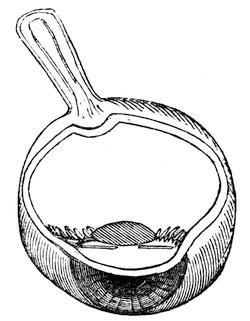
While the human eye has been admired by ordinary observers for the beauty of its form, the power of its movements, and the variety of its expression, it has excited the wonder of philosophers by the exquisite mechanism of its interior, and its singular adaptation to the variety of purposes which it has to serve. The eyeball is nearly globular, and is about an inch in diameter. It is formed externally by a tough opaque membrane called the sclerotic coat, which forms the white of the eye, with the exception of a small circular portion in front called the cornea. This portion is perfectly transparent, and so tough in its nature as to afford a powerful resistance to external injury. Immediately within the cornea, and in contact with it, is the aqueous humour, a clear fluid, which occupies only a small part of the front of the eye. Within this humour is the iris, a circular membrane, with a hole in its centre called the pupil. The colour of the eye resides in this membrane, which has the curious property of contracting and expanding so as to diminish or enlarge the pupil,—an effect which human ingenuity has not been able even to imitate. Behind the iris is suspended the crystalline lens, in a fine transparent capsule or bag of the same form with itself. It is then succeeded by the vitreous humour, which resembles the transparent white of an egg, and fills up the rest of the eye. Behind the vitreous humour, there is spread out on the inside of the eyeball a fine delicate membrane, called the retina, which is an expansion of the optic nerve, entering the back of the eye and communicating with the brain.
A perspective view and horizontal section of the left eye, shown in the annexed figure, will convey a popular idea of its structure. It is, as it were, a small camera obscura, by means of which the pictures of external objects are painted on the retina, and, in a way of which we are ignorant, it conveys the impression of them to the brain.
Fig. 1.
This wonderful organ may be considered as the sentinel which guards the pass between the worlds of matter and of spirit, and through which all their communications are interchanged. The optic nerve is the channel by which the mind peruses the hand-writing of Nature on the retina, and through which it transfers to that material tablet its decisions and its creations. The eye is consequently the principal seat of the supernatural. When the indications of the marvellous are addressed to us through the ear, the mind may be startled without being deceived, and reason may succeed in suggesting some probable source of the illusion by which we have been alarmed: but when the eye in solitude sees before it the forms of life, fresh in their colours and vivid in their outline; when distant or departed friends are suddenly presented to its view; when visible bodies disappear and reappear without any intelligible cause; and when it beholds objects, whether real or imaginary, for whose presence no cause can be assigned, the conviction of supernatural agency becomes, under ordinary circumstances, unavoidable.
Hence it is not only an amusing but a useful occupation to acquire a knowledge of those causes which are capable of producing so strange a belief, whether it arises from the delusions which the mind practises upon itself, or from the dexterity and science of others. I shall therefore proceed to explain those illusions which have their origin in the eye, whether they are general, or only occasionally exhibited in particular persons, and under particular circumstances.
There are few persons aware that when they look with one eye, there is some particular object before them to which they are absolutely blind. If we look with the right eye, this point is always about 15° to the right of the object which we are viewing, or to the right of the axis of the eye or the point of most distinct vision. If we look with the left eye, the point is as far to the left. In order to be convinced of this curious fact, which was discovered by M. Mariotte, place two coloured wafers upon a sheet of white paper at the distance of three inches, and look at the left-hand wafer with the right eye at the distance of about 11 or 12 inches, taking care to keep the eye straight above the wafer, and the line which joins the eyes parallel to the line which joins the wafers. When this is done, and the left eye closed, the right-hand wafer will no longer be visible. The same effect will be produced if we close the right eye and look with the left eye at the right-hand wafer. When we examine the retina to discover to what part of it this insensibility to light belongs, we find that the image of the invisible wafer has fallen on the base of the optic nerve, or the place where this nerve enters the eye and expands itself to form the retina. This point is shown in the preceding figure by a convexity at the place where the nerve enters the eye.
But though light of ordinary intensity makes no impression upon this part of the eye, a very strong light does, and even when we use candles or highly luminous bodies in place of wafers, the body does not wholly disappear, but leaves behind a faint cloudy light, without, however, giving anything like an image of the object from which the light proceeds.
When the objects are white wafers upon a black ground, the white wafer absolutely disappears, and the space which it covers appears to be completely black; and as the light which illuminates a landscape is not much different from that of a white wafer, we should expect, whether we use one or both eyes,2 to see a black or a dark spot upon every landscape, within 15° of the point which most particularly attracts our notice. The Divine Artificer, however, has not left his work thus imperfect. Though the base of the optic nerve is insensible to light that falls directly upon it, yet it has been made susceptible of receiving luminous impressions from the parts which surround it; and the consequence of this is, that when the wafer disappears, the spot which is occupied, in place of being black, has always the same colour as the ground upon which the wafer is laid, being white when the wafer is placed upon a white ground, and red when it is placed upon a red ground. This curious effect may be rudely illustrated by comparing the retina to a sheet of blotting-paper, and the base of the optic nerve to a circular portion of it covered with a piece of sponge. If a shower falls upon the paper, the protected part will not be wetted by the rain which falls upon the sponge that covers it, but in a few seconds it will be as effectually wetted by the moisture which it absorbs from the wet paper with which it is surrounded. In like manner the insensible spot on the retina is stimulated by a borrowed light, and the apparent defect is so completely removed, that its existence can be determined only by the experiment already described.
Of the same character, but far more general in its effects, and important in its consequences, is another illusion of the eye which presented itself to me several years ago. When the eye is steadily occupied in viewing any particular object, or when it takes a fixed direction while the mind is occupied with any engrossing topic of speculation or of grief, it suddenly loses sight of, or becomes blind to, objects seen indirectly, or upon which it is not fully directed. This takes place whether we use one or both eyes, and the object which disappears will reappear without any change in the position of the eye, while other objects will vanish and revive in succession without any apparent cause. If a sportsman, for example, is watching with intense interest the motions of one of his dogs, his companion, though seen with perfect clearness by indirect vision, will vanish, and the light of the heath or of the sky will close in upon the spot which he occupied.
In order to witness this illusion, put a little bit of white paper on a green cloth, and, within three or four inches of it, place a narrow strip of white paper. At the distance of twelve or eighteen inches, fix one eye steadily upon the little bit of white paper, and in a short time a part or even the whole of the strip of paper will vanish as if it had been removed from the green cloth. It will again reappear, and again vanish, the effect depending greatly on the steadiness with which the eye is kept fixed. This illusion takes place when both the eyes are open, though it is easier to observe it when one of them is closed. The same thing happens when the object is luminous. When a candle is thus seen by indirect vision, it never wholly disappears, but it spreads itself out into a cloudy mass, the centre of which is blue, encircled with a bright ring of yellow light.
This inability of the eye to preserve a sustained vision of objects seen obliquely, is curiously compensated by the greater sensibility of those parts of the eye that have this defect. The eye has the power of seeing objects with perfect distinctness only when it is directed straight upon them; that is, all objects seen indirectly are seen indistinctly: but it is a curious circumstance, that when we wish to obtain a sight of a very faint star, such as one of the satellites of Saturn, we can see it most distinctly by looking away from it, and when the eye is turned full upon it it immediately disappears.
Effects still more remarkable are produced in the eye when it views objects that are difficult to be seen from the small degree of light with which they happen to be illuminated. The imperfect view which we obtain of such objects forces us to fix the eye more steadily upon them; but the more exertion we make to ascertain what they are, the greater difficulties do we encounter to accomplish our object. The eye is actually thrown into a state of the most painful agitation, the object will swell and contract, and partly disappear, and it will again become visible when the eye has recovered from the delirium into which it has been thrown. This phenomenon may be most distinctly seen when the objects in a room are illuminated with the feeble gleam of a fire almost extinguished; but it may be observed in daylight by the sportsman when he endeavours to mark upon the monotonous heath the particular spot where moor-game has alighted. Availing himself of the slightest difference of tint in the adjacent heath, he keeps his eye steadily fixed on it as he advances, but whenever the contrast of illumination is feeble, he will invariably lose sight of his mark, and if the retina is capable of taking it up, it is only to lose it a second time.
This illusion is likely to be most efficacious in the dark, when there is just sufficient light to render white objects faintly visible, and to persons who are either timid or credulous must prove a frequent source of alarm. Its influence, too, is greatly aided by another condition of the eye, into which it is thrown during partial darkness. The pupil expands nearly to the whole width of the iris, in order to collect the feeble light which prevails; but it is demonstrable that in this state the eye cannot accommodate itself to see near objects distinctly, so that the forms of persons and things actually become more shadowy and confused when they come within the very distance at which we count upon obtaining the best view of them. These affections of the eye are, we are persuaded, very frequent causes of a particular class of apparitions which are seen at night by the young and the ignorant. The spectres which are conjured up are always white, because no other colour can be seen, and they are either formed out of inanimate objects which reflect more light than others around them, or of animals or human beings whose colour or change of place renders them more visible in the dark. When the eye dimly descries an inanimate object whose different parts reflect different degrees of light, its brighter parts may enable the spectator to keep up a continued view of it; but the disappearance and reappearance of its fainter parts, and the change of shape which ensues, will necessarily give it the semblance of a living form, and if it occupies a position which is unapproachable, and where animate objects cannot find their way, the mind will soon transfer to it a supernatural existence. In like manner a human figure shadowed forth in a feeble twilight may undergo similar changes, and after being distinctly seen while it is in a situation favourable for receiving and reflecting light, it may suddenly disappear in a position fully before, and within the reach of, the observer’s eye; and if this evanescence takes place in a path or road where there was no side-way by which the figure could escape, it is not easy for an ordinary mind to efface the impression which it cannot fail to receive. Under such circumstances we never think of distrusting an organ which we have never found to deceive us; and the truth of the maxim that “seeing is believing” is too universally admitted, and too deeply rooted in our nature, to admit on any occasion of a single exception.
In these observations we have supposed that the spectator bears along with him no fears or prejudices, and is a faithful interpreter of the phenomena presented to his senses; but if he is himself a believer in apparitions, and unwilling to receive an ocular demonstration of their reality, it is not difficult to conceive the picture which will be drawn when external objects are distorted and caricatured by the imperfect indications of his senses, and coloured with all the vivid hues of the imagination.
Another class of ocular deceptions have their origin in a property of the eye which has been very imperfectly examined. The fine nervous fabric which constitutes the retina, and which extends to the brain, has the singular property of being phosphorescent by pressure. When we press the eyeball outwards by applying the point of the finger between it and the nose, a circle of light will be seen, which Sir Isaac Newton describes as “a circle of colours like those in the feather of a peacock’s tail.” He adds, that “if the eye and the figure remain quiet, these colours vanish in a second of time; but if the finger be moved with a quavering motion, they appear again.” In the numerous observations which I have made on these luminous circles, I have never been able to observe any colour but white, with the exception of a general red tinge which is seen when the eyelids are closed, and which is produced by the light which passes through them. The luminous circles, too, always continue while the pressure is applied, and they may be produced as readily after the eye has been long in darkness as when it has been recently exposed to light. When the pressure is very gently applied, so as to compress the fine pulpy substance of the retina, light is immediately created when the eye is in total darkness; and when in this state light is allowed to fall upon it, the part compressed is more sensible to light than any other part, and consequently appears more luminous. If we increase the pressure, the eyeball, being filled with incompressible fluids, will protrude all round the point of pressure, and consequently the retina at the protruded part will be compressed by the outward pressure of the contained fluid, while the retina on each side, namely, under the point of pressure and beyond the protruded part, will be drawn towards the protruded part or dilated. Hence the part under the finger which was originally compressed is now dilated, the adjacent parts compressed, and the more remote parts immediately without this dilated also. Now we have observed, that when the eye is, under these circumstances, exposed to light, there is a bright luminous circle shading off externally and internally into total darkness. We are led, therefore, to the important conclusions, that when the retina is compressed in total darkness it gives out light; that when it is compressed when exposed to light, its sensibility to light is increased; and that when it is dilated under exposure to light, it becomes absolutely blind, or insensible to all luminous impressions.
When the body is in a state of perfect health, this phosphorescence of the eye shows itself on many occasions. When the eye or the head receives a sudden blow, a bright flash of light shoots from the eyeball. In the act of sneezing, gleams of light are emitted from each eye both during the inhalation of the air, and during its subsequent protrusion, and in blowing air violently through the nostrils, two patches of light appear above the axis of the eye and in front of it, while other two luminous spots unite into one, and appear as it were about the point of the nose when the eyes are directed to it. When we turn the eyeball by the action of its own muscles, the retina is affected at the place where the muscles are inserted, and there may be seen opposite each eye, and towards the nose, two semicircles of light, and other two extremely faint towards the temples. At particular times, when the retina is more phosphorescent than at others, these semicircles are expanded into complete circles of light.
In a state of indisposition, the phosphorescence of the retina appears in new and more alarming forms. When the stomach is under a temporary derangement accompanied with headache, the pressure of the blood-vessels upon the retina shows itself, in total darkness, by a faint blue light floating before the eye, varying in its shape, and passing away at one side. This blue light increases in intensity, becomes green and then yellow, and sometimes rises to red, all these colours being frequently seen at once, or the mass of light shades off into darkness. When we consider the variety of distinct forms which in a state of perfect health the imagination can conjure up when looking into a burning fire, or upon an irregularly shaded surface,3 it is easy to conceive how the masses of coloured light which float before the eye may be moulded by the same power into those fantastic and natural shapes, which so often haunt the couch of the invalid, even when the mind retains its energy, and is conscious of the illusion under which it labours. In other cases, temporary blindness is produced by pressure upon the optic nerve, or upon the retina; and under the excitation of fever or delirium, when the physical cause which produces spectral forms is at its height, there is superadded a powerful influence of the mind, which imparts a new character to the phantasms of the senses.
In order to complete the history of the illusions which originate in the eye, it will be necessary to give some account of the phenomena called ocular spectra, or accidental colours. If we cut a figure out of red paper, and, placing it on a sheet of white paper, view it steadily for some seconds with one or both eyes fixed on a particular part of it, we shall observe the red colour to become less brilliant. If we then turn the eye from the red figure upon the white paper, we shall see a distinct green figure, which is the spectrum, or accidental colour of the red figure. With differently coloured figures we shall observe differently coloured spectra, as in the following table:—
COLOUR OF THEORIGINAL FIGURES
.
COLOUR OF THESPECTRAL FIGURES
.
Red,
Bluish-green.
Orange,
Blue.
Yellow,
Indigo.
Green,
Reddish-violet.
Blue,
Orange-red.
Indigo,
Orange-yellow.
Violet,
Yellow.
White,
Black.
Black,
White.
The two last of these experiments, viz., white and black figures, may be satisfactorily made by using a white medallion on a dark ground, and a black profile figure. The spectrum of the former will be found to be black, and that of the latter white.
These ocular spectra often show themselves without any effort on our part, and even without our knowledge. In a highly painted room, illuminated by the sun, those parts of the furniture on which the sun does not directly fall have always the opposite or accidental colour. If the sun shines through a chink in a red window-curtain, its light will appear green, varying as in the above table, with the colour of the curtain; and if we look at the image of a candle, reflected from the water in a blue finger-glass, it will appear yellow. Whenever, in short, the eye is affected with one prevailing colour, it sees at the same time the spectral or accidental colour, just as when a musical string is vibrating, the ear hears at the same time its fundamental and its harmonic sounds.
If the prevailing light is white and very strong, the spectra which it produces are no longer black, but of various colours in succession. If we look at the sun, for example, when near the horizon, or when reflected from glass or water so as to moderate its brilliancy, and keep the eye upon it steadily for a few seconds, we shall see, even for hours afterwards, and whether the eyes are open or shut, a spectrum of the sun varying in its colours. At first, with the eye open, it is brownish-red with a sky-blue border, and when the eye is shut, it is green with a red border. The red becomes more brilliant, and the blue more vivid, till the impression is gradually worn off; but even when they become very faint, they may be revived by a gentle pressure on the eyeball.
Some eyes are more susceptible than others of these spectral impressions, and Mr. Boyle mentions an individual who continued for years to see the spectre of the sun when he looked upon bright objects. This fact appeared to Locke so interesting and inexplicable, that he consulted Sir Isaac Newton respecting its cause, and drew from him the following interesting account of a similar effect upon himself:—“The observation you mention in Mr. Boyle’s book of colours, I once made upon myself with the hazard of my eyes. The manner was this: I looked a very little while upon the sun in the looking-glass with my right eye, and then turned my eyes into a dark corner of my chamber, and winked, to observe the impression made, and the circles of colours which encompassed it, and how they decayed by degrees, and at last vanished. This I repeated a second and a third time. At the third time, when the phantasm of light and colours about it were almost vanished, intending my fancy upon them to see their last appearance, I found, to my amazement, that they began to return, and by little and little to become as lively and vivid as when I had newly looked upon the sun. But when I ceased to intend my face upon them, they vanished again. After this I found that as often as I went into the dark, and intended my mind upon them, as when a man looks earnestly to see anything which is difficult to be seen, I could make the phantasm return without looking any more upon the sun; and the oftener I made it return, the more easily I could make it return again. And at length, by repeating this without looking any more upon the sun, I made such an impression on my eye, that, if I looked upon the clouds, or a book, or any bright object, I saw upon it a round bright spot of light like the sun, and, which is still stranger, though I looked upon the sun with my right eye only, and not with my left, yet my fancy began to make an impression upon my left eye as well as upon my right. For if I shut my right eye, and looked upon a book or the clouds with my left eye, I could see the spectrum of the sun almost as plain as with my right eye, if I did but intend my fancy a little while upon it: for at first, if I shut my right eye, and looked with my left, the spectrum of the sun did not appear till I intended my fancy upon it; but by repeating, this appeared every time more easily. And now in a few hours’ time I had brought my eyes to such a pass, that I could look upon no bright object with either eye but I saw the sun before me, so that I durst neither write nor read; but to recover the use of my eyes, shut myself up in my chamber, made dark, for three days together, and used all means in my power to direct my imagination from the sun. For if I thought upon him, I presently saw his picture, though I was in the dark. But by keeping in the dark; and employing my mind about other things, I began, in three or four days, to have more use of my eyes again; and by forbearing to look upon bright objects, recovered them pretty well; though not so well but that, for some months after, the spectrums of the sun began to return as often as I began to meditate upon the phenomena, even though I lay in bed at midnight with my curtains drawn. But now I have been well for many years, though I am apt to think, if I durst venture my eyes, I could still make the phantasm return by the power of my fancy. This story I tell you, to let you understand, that in the observation related by Mr. Boyle, the man’s fancy probably concurred with the impression made by the sun’s light to produce that phantasm of the sun which he constantly saw in bright objects.”4
I am not aware of any effects that had the character of supernatural having been actually produced by the causes above described; but it is obvious, that if a living figure had been projected against the strong light which imprinted these durable spectra of the sun, which might really happen when the solar rays are reflected from water, and diffused by its ruffled surface, this figure would have necessarily accompanied all the luminous spectres which the fancy created. Even in ordinary lights, strange appearances may be produced by even transient impressions; and if I am not greatly mistaken, the case which I am about to mention is not only one which may occur, but which actually happened. A figure dressed in black, and mounted upon a white horse, was riding along, exposed to the bright rays of the sun, which, through a small opening in the clouds, was throwing its light only upon that part of the landscape. The black figure was projected against a white cloud, and the white horse shone with particular brilliancy by its contrast with the dark soil against which it was seen. A person interested in the arrival of such a stranger had been for some time following his movements with intense anxiety, but, upon his disappearance behind a wood, was surprised to observe the spectre of the mounted stranger in the form of a white rider upon a black steed, and this spectre was seen for some time in the sky, or upon any pale ground to which the eye was directed. Such an occurrence, especially if accompanied with a suitable combination of events, might, even in modern times, have formed a chapter in the history of the marvellous.
It is a curious circumstance, that when the image of an object is impressed upon the retina only for a few moments, the picture which is left is exactly of the same colour with the object. If we look, for example, at a window at some distance from the eye, and then transfer the eye quickly to the wall, we shall see it distinctly, but momentarily, with light panes and dark bars; but in a space of time incalculably short, this picture is succeeded by the spectral impression of the window, which will consist of black panes and white bars. The similar spectrum, or that of the same colour as the object, is finely seen in the experiment of forming luminous circles by whirling round a burning stick, in which case the circles are always red.
In virtue of this property of the eye, an object may be seen in many places at once; and we may even exhibit at the same instant the two opposite sides of the same object, or two pictures painted on the opposite sides of a piece of card. It was found by a French philosopher, M. D’Arcet, that the impression of light continued on the retina about the eighth part of a second after the luminous body was withdrawn, and upon this principle Dr. Paris has constructed the pretty little instrument called the Thaumatrope, or the Wonder-turner. It consists of a number of circular pieces of card, about two or three inches broad, which may be twirled round with great velocity by the application of the fore-finger and thumb of each hand to pieces of silk string attached to opposite points of their circumference. On each side of the circular piece of card is painted part of a picture, or a part of a figure, in such a manner that the two parts would form a group or a whole figure, if we could see both sides at once. Harlequin, for example, is painted on one side, and Columbine on the other, so that by twirling round the card the two are seen at the same time in their usual mode of combination. The body of a Turk is drawn on one side, and his head on the reverse, and by the rotation of the card the head is replaced upon his shoulders. The principle of this illusion may be extended to many other contrivances. Part of a sentence may be written on one side of a card, and the rest on the reverse. Particular letters may be given on one side, and others upon the other, or even halves or parts of each letter may be put upon each side, or all these contrivances may be combined, so that the sentiment which they express can be understood only when all the scattered parts are united by the revolution of the card.
As the revolving card is virtually transparent, so that bodies beyond it can be seen through it, the power of the illusion might be greatly extended by introducing into the picture other figures, either animate or inanimate. The setting sun, for example, might be introduced into a landscape; part of the flame of a fire might be seen to issue from the crater of a volcano, and cattle grazing in a field might make part of the revolutionary landscape. For such purposes, however, the form of the instrument would require to be completely changed, and the rotation should be effected round a standing axis by wheels and pinions, and a screen placed in front of the revolving plane with open compartments or apertures, through which the principal figures would appear. Had the principle of this instrument been known to the ancients, it would doubtless have formed a powerful engine of delusion in their temples, and might have been more effective than the optical means which they seem to have employed for producing the apparitions of their gods.
In certain diseased conditions of the eye, effects of a very remarkable kind are produced. The faculty of seeing objects double is too common to be noticed as remarkable; and though it may take place with only one eye, yet, as it generally arises from a transient inability to direct the axis of both eyes to the same point, it excites little notice. That state of the eye, however, in which we lose sight of half of every object at which we look, is more alarming and more likely to be ascribed to the disappearance of part of the object than to a defect of sight. Dr. Wollaston, who experienced this defect twice, informs us that, after taking violent exercise, he “suddenly found that he could see but half of a man whom he met, and that on attempting to read the name of JOHNSON over a door, he saw only SON, the commencement of the name being wholly obliterated from his view.” In this instance, the part of the object which disappeared was towards his left; but on a second occurrence of the same affection, the part which disappeared was towards his right. There are many occasions on which this defect of the eye might alarm the person who witnessed it for the first time. At certain distances from the eye one of two persons would necessarily disappear; and by a slight change of position either in the observer or the person observed, the person that vanished would reappear, while the other would disappear in his turn. The circumstances under which these evanescences would take place could not be supposed to occur to an ordinary observer, even if he should be aware that the cause had its origin in himself. When a phenomenon so strange is seen by a person in perfect health, as it generally is, and who has never had occasion to distrust the testimony of his senses, he can scarcely refer it to any other cause than a supernatural one.
Among the affections of the eye which not only deceive the person who is subject to them, but those also who witness their operation, may be enumerated the insensibility of the eye to particular colours. This defect is not accompanied with any imperfection of vision, or connected with any disease either of a local or a general nature, and it has hitherto been observed in persons who possess a strong and a sharp sight. Mr. Huddart has described the case of one Harris, a shoemaker at Maryport in Cumberland, who was subject to this defect in a very remarkable degree. He seems to have been insensible to every colour, and to have been capable of recognizing only the two opposite tints of black and white. “His first suspicion of this defect arose when he was about four years old. Having by accident found in the street a child’s stocking, he carried it to a neighbouring house to inquire for the owner. He observed the people call it a red stocking, though he did not understand why they gave it that denomination, as he himself thought it completely described by being called a stocking. The circumstance, however, remained in his memory, and, with other subsequent observations, led him to the knowledge of his defect. He observed also, that when young, other children could discern cherries on a tree by some pretended difference of colour, though he could only distinguish them from the leaves by their difference of size and shape. He observed also, that by means of this difference of colour, they could see the cherries at a greater distance than he could, though he could see other objects at as great a distance as they, that is, where the sight was not assisted by the colour.” Harris had two brothers, whose perception of colours was nearly as defective as his own. One of these, whom Mr. Huddart examined, constantly mistook light green for yellow, and orange for grass green.
Mr. Scott has described, in the Philosophical Transactions, his own defect in perceiving colours. He states that he does not know any green in the world; that a pink colour and a pale blue are perfectly alike; that he has often thought a full red and a full green a good match; that he is sometimes baffled in distinguishing a full purple from a deep blue, but that he knows light, dark, and middle yellows, and all degrees of blue except sky-blue. “I married my daughter to a genteel, worthy man, a few years ago; the day before the marriage, he came to my house dressed in a new suit of fine cloth clothes. I was much displeased that he should come, as I supposed, in black, and said that he should go back to change his colour. But my daughter said, No, no; the colour is very genteel; that it was my eyes that deceived me. He was a gentleman of the law, in a fine, rich, claret-coloured dress, which is as much black to my eyes as any black that ever was dyed.” Mr. Scott’s father, his maternal uncle, one of his sisters, and her two sons, had all the same imperfection. Dr. Nichol has recorded a case where a naval officer purchased a blue uniform coat and waistcoat with red breeches to match the blue, and Mr. Harvey describes the case of a tailor at Plymouth, who on one occasion repaired an article of dress with crimson in place of black silk, and on another patched the elbow of a blue coat with a piece of crimson cloth. It deserves to be remarked that our celebrated countrymen, the late Mr. Dugald Stewart, Mr. Dalton, and Mr. Troughton, have a similar difficulty in distinguishing colours. Mr. Stewart discovered this defect when one of his family was admiring the beauty of a Siberian crab-apple, which he could not distinguish from the leaves but by its form and size. Mr. Dalton cannot distinguish blue from pink, and the solar spectrum consists only of two colours, yellow and blue. Mr. Troughton regards red ruddy pinks, and brilliant oranges, as yellows, and greens as blues, so that he is capable only of appreciating blue and yellow colours.
In all those cases which have been carefully studied, at least in three of them, in which I have had the advantage of making personal observations, namely, those of Mr. Troughton, Mr. Dalton, and Mr. Liston, the eye is capable of seeing the whole of the prismatic spectrum, the red space appearing to be yellow. If the red space consisted of homogeneous or simple red rays, we should be led to infer that the eyes in question were not insensible to red light, but were merely incapable of discriminating between the impressions of red and yellow light. I have lately shown, however, that the prismatic spectrum consists of three equal and coincident spectra of red, yellow, and blue light, and consequently, that much yellow and a small portion of blue light exist in the red space; and hence it follows, that those eyes which see only two colours, viz. yellow and blue, in the spectrum, are really insensible to the red light of the spectrum, and see only the yellow with the small portion of blue with which the red is mixed. The faintness of the yellow light which is thus seen in the red space, confirms the opinion that the retina has not appreciated the influence of the simple red rays.
If one of the two travellers who, in the fable of the chameleon, are made to quarrel about the colour of that singular animal, had happened to possess this defect of sight, they would have encountered at every step of their journey, new grounds of dissension, without the chance of finding an umpire who could pronounce a satisfactory decision. Under certain circumstances, indeed, the arbiter might set aside the opinions of both the disputants, and render it necessary to appeal to some higher authority,
---- to beg he’d tell them if he knew
Whether the thing was red or blue.
Fig. 2.
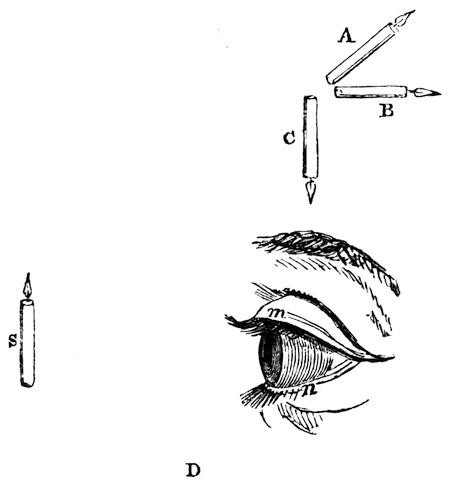
In the course of writing the preceding observations an ocular illusion occurred to myself of so extraordinary a nature, that I am convinced it never was seen before, and I think it far from probable that it will ever be seen again. Upon directing my eyes to the candles that were standing before me, I was surprised to observe, apparently among my hair, and nearly straight above my head, and far without the range of vision, a distinct image of one of the candles inclined about 45° to the horizon, as shown at A in Fig. 2. The image was as distinct and perfect as if it had been formed by reflection from a piece of mirror glass, though of course much less brilliant, and the position of the image proved that it must be formed by reflection from a perfectly flat and highly polished surface. But where such a surface could be placed, and how, even if it were fixed, it could reflect the image of the candle up through my head, were difficulties not a little perplexing. Thinking that it might be something lodged in the eyebrow, I covered it up from the light, but the image still retained its place. I then examined the eyelashes with as little success, and was driven to the extreme supposition that a crystallization was taking place in some part of the aqueous humour of the eye, and that the image was formed by the reflection of the light of the candle from one of the crystalline faces. In this state of uncertainty, and, I may add, of anxiety, for this last supposition was by no means an agreeable one, I set myself down to examine the phenomenon experimentally. I found that the image varied its place by the motion of the head and of the eyeball, which proved that it was either attached to the eyeball or occupied a place where it was affected by that motion. Upon inclining the candle at different angles, the image suffered corresponding variations of position. In order to determine the exact place of the reflecting substance, I now took an opaque circular body and held it between the eye and the candle till it eclipsed the mysterious image. By bringing the body nearer and nearer the eyeball till its shadow became sufficiently distinct to be seen, it was easy to determine the locality of the reflector, because the shadow of the opaque body must fall upon it whenever the image of the candle was eclipsed. In this way I ascertained that the reflecting body was in the upper eyelash; and I found, that, in consequence of being disturbed, it had twice changed its inclination, so as to represent a vertical candle in the horizontal position B, and afterwards in the inverted position C. Still, however, I sought for it in vain, and even with the aid of a magnifier I could not discover it. At last, however, Mrs. B., who possesses the perfect vision of short-sighted persons, discovered, after repeated examinations, between two eyelashes, a minute speck, which, upon being removed with great difficulty, turned out to be a chip of red wax not above the hundredth part of an inch in diameter, and having its surface so perfectly flat and so highly polished that I could see in it the same image of the candle, by placing it extremely near the eye. This chip of wax had no doubt received its flatness and its polish from the surface of a seal, and had started into my eye when breaking the seal of a letter.
That this reflecting substance was the cause of the image of the candle, cannot admit of a doubt; but the wonder still remains how the images which it formed occupied so mysterious a place as to be seen without the range of vision, and apparently through the head. In order to explain this, let m n, Fig. 2, be a lateral view of the eye. The chip of wax was placed at m at the root of the eyelashes, and being nearly in contact with the outer surface of the cornea, the light of the candle, which it reflected, passed very obliquely through the pupil and fell upon the retina somewhere to the left of n, very near where the retina terminates; but a ray thus falling obliquely on the retina is seen, in virtue of the law of visible direction already explained, in a line n C perpendicular to the retina at the point near n, where the ray fell. Hence the candle was necessarily seen through the head as it were of the observer, and without the range of ordinary vision. The comparative brightness of the reflected image still surprises me; but even this, if the image really was brighter, may be explained by the fact, that it was formed on a part of the retina upon which light had never before fallen, and which may therefore be supposed to be more sensible, than the parts of the membrane in constant use, to luminous impressions.
Independent of its interest as an example of the marvellous in vision, the preceding fact may be considered as a proof that the retina retains its power to its very termination near the ciliary processes, and that the law of visible direction holds true even without the range of ordinary vision. It is therefore possible that a reflecting surface favourably placed on the outside of the eye, or that a reflecting surface in the inside of the eye, may cause a luminous image to fall nearly on the extreme margin of the retina, the consequence of which would be, that it would be seen in the back of the head, half way between a vertical and a horizontal line.
2 When both eyes are open, the object whose image falls upon the insensible spot of the one eye is seen by the other, so that, though it is not invisible, yet it will only be half as luminous and, therefore two dark spots ought to be seen.
3 A very curious example of the influence of the imagination in creating distinct forms out of an irregularly shaded surface, is mentioned in the life of Peter Heaman, a Swede, who was executed for piracy and murder at Leith in 1822. We give it in his own words:—
4 See the Edinburgh Encyclopædia, Art. Accidental Colours.
LETTER III.
Subject of spectral illusions—Recent and interesting case of Mrs. A.—Her first illusion affecting the ear—Spectral apparition of her husband—Spectral apparition of a cat—Apparition of a near and living relation in grave-clothes, seen in a looking-glass—Other illusions, affecting the ear—Spectre of a deceased friend sitting in an easy-chair—Spectre of a coach-and-four filled with skeletons—Accuracy and value of the preceding cases—State of health under which they arose—Spectral apparitions are pictures on the retina—The ideas of memory and imagination are also pictures on the retina—General views of the subject—Approximate explanation of spectral apparitions.
The preceding account of the different sources of illusion to which the eye is subject is not only useful as indicating the probable cause of any individual deception, but it has a special importance in preparing the mind for understanding those more vivid and permanent spectral illusions to which some individuals have been either occasionally or habitually subject.
In these lesser phenomena, we find the retina so powerfully influenced by external impressions, as to retain the view of visible objects long after they are withdrawn: we observe it to be so excited by local pressures of which we sometimes know neither the nature nor the origin, as to see in total darkness moving and shapeless masses of coloured light; and we find, as in the case of Sir Isaac Newton, and others, that the imagination has the power of reviving the impressions of highly luminous objects, months and even years after they were first made. From such phenomena, the mind feels it to be no violent transition to pass to those spectral illusions which, in particular states of health, have haunted the most intelligent individuals, not only in the broad light of day, but in the very heart of the social circle.
This curious subject has been so ably and fully treated in your Letters on Demonology, that it would be presumptuous in me to resume any part of it on which you have even touched; but as it forms a necessary branch of a Treatise on Natural Magic, and as one of the most remarkable cases on record has come within my own knowledge, I shall make no apology for giving a full account of the different spectral appearances which it embraces, and of adding the results of a series of observations and experiments on which I have been long occupied, with the view of throwing some light on this remarkable class of phenomena.
A few years ago, I had occasion to spend some days under the same roof with the lady to whose case I have above referred. At that time she had seen no spectral illusions, and was acquainted with the subject only from the interesting volume of Dr. Hibbert. In conversing with her about the cause of these apparitions, I mentioned, that if she should ever see such a thing, she might distinguish a genuine ghost, existing externally, and seen as an external object, from one created by the mind, by merely pressing one eye or straining them both, so as to see objects double; for in this case the external object or supposed apparition would invariably be doubled, while the impression on the retina created by the mind would remain single. This observation recurred to her mind when she unfortunately became subject to the same illusions; but she was too well acquainted with their nature to require any such evidence of their mental origin; and the state of agitation which generally accompanies them seems to have prevented her from making the experiment as a matter of curiosity.
1. The first illusion to which Mrs. A. was subject was one which affected only the ear. On the 26th of December, 1830, about half-past four in the afternoon, she was standing near the fire in the hall, and on the point of going up stairs to dress, when she heard, as she supposed, her husband’s voice calling her by name, “—— Come here! come to me!” She imagined that he was calling at the door to have it opened, but upon going there and opening the door she was surprised to find no person there. Upon returning to the fire, she again heard the same voice calling out very distinctly and loudly, “—— Come, come here!” She then opened two doors of the same room, and upon seeing no person she returned to the fire-place. After a few moments she heard the same voice still calling, “—— ---- Come to me, come! come away!” in a loud, plaintive, and somewhat impatient tone. She answered as loudly, “Where are you? I don’t know where you are;” still imagining that he was somewhere in search of her: but receiving no answer, she shortly went up stairs. On Mr. A.’s return to the house, about half an hour afterwards, she inquired why he called to her so often, and where he was; and she was, of course, greatly surprised to learn that he had not been near the house at the time. A similar illusion, which excited no particular notice at the time, occurred to Mrs. A. when residing at Florence about ten years before, and when she was in perfect health. When she was undressing after a ball, she heard a voice call her repeatedly by name, and she was at that time unable to account for it.
2. The next illusion which occurred to Mrs. A. was of a more alarming character. On the 30th of December, about four o’clock in the afternoon, Mrs. A. came down stairs into the drawing-room, which she had quitted only a few minutes before, and on entering the room she saw her husband, as she supposed, standing with his back to the fire. As he had gone out to take a walk about half an hour before, she was surprised to see him there, and asked him why he had returned so soon. The figure looked fixedly at her with a serious and thoughtful expression of countenance, but did not speak. Supposing that his mind was absorbed in thought, she sat down in an arm-chair near the fire, and within two feet at most of the figure, which she still saw standing before her. As its eyes, however, still continued to be fixed upon her, she said, after the lapse of a few minutes, “Why don’t you speak,——?” The figure immediately moved off towards the window at the further end of the room, with its eyes still gazing on her, and it passed so very close to her in doing so, that she was struck by the circumstance of hearing no step nor sound, nor feeling her clothes brushed against, nor even any agitation in the air. Although she was now convinced that the figure was not her husband, yet she never for a moment supposed that it was anything supernatural, and was soon convinced that it was a spectral illusion. As soon as this conviction had established itself in her mind, she recollected the experiment which I had suggested, of trying to double the object: but before she was able distinctly to do this, the figure had retreated to the window, where it disappeared. Mrs. A. immediately followed it, shook the curtains and examined the window, the impression having been so distinct and forcible that she was unwilling to believe that it was not a reality. Finding, however, that the figure had no natural means of escape, she was convinced that she had seen a spectral apparition like those recorded in Dr. Hibbert’s work, and she consequently felt no alarm or agitation. The appearance was seen in bright daylight, and lasted four or five minutes. When the figure stood close to her it concealed the real objects behind it, and the apparition was fully as vivid as the reality.
3. On these two occasions Mrs. A. was alone, but when the next phantasm appeared her husband was present. This took place on the 4th of January, 1830. About ten o’clock at night, when Mr. and Mrs. A. were sitting in the drawing-room, Mr. A. took up the poker to stir the fire, and when he was in the act of doing this, Mrs. A. exclaimed, “Why there’s the cat in the room!” “Where?” asked Mr. A. “There, close to you,” she replied. “Where?” he repeated. “Why on the rug, to be sure, between yourself and the coal-scuttle.” Mr. A., who had still the poker in his hand, pushed it in the direction mentioned: “Take care,” cried Mrs. A., “take care, you are hitting her with the poker.” Mr. A. again asked her to point out exactly where she saw the cat. She replied, ”Why sitting up there close to your feet on the rug. She is looking at me. It is Kitty—come here, Kitty!”—There were two cats in the house, one of which went by this name, and they were rarely if ever in the drawing-room. At this time Mrs. A. had no idea that the sight of the cat was an illusion. When she was asked to touch it, she got up for the purpose, and seemed as if she were pursuing something which moved away. She followed a few steps, and then said, “It has gone under the chair.” Mr. A. assured her it was an illusion, but she would not believe it. He then lifted up the chair, and Mrs. A. saw nothing more of it. The room was then searched all over, and nothing found in it. There was a dog lying on the hearth, who would have betrayed great uneasiness if a cat had been in the room, but he lay perfectly quiet. In order to be quite certain, Mr. A. rang the bell, and sent for the two cats, both of which were found in the housekeeper’s room.
4. About a month after this occurrence, Mrs. A., who had taken a somewhat fatiguing drive during the day, was preparing to go to bed about eleven o’clock at night, and, sitting before the dressing-glass, was occupied in arranging her hair. She was in a listless and drowsy state of mind, but fully awake. When her fingers were in active motion among the papillotes, she was suddenly startled by seeing in the mirror the figure of a near relation, who was then in Scotland and in perfect health. The apparition appeared over her left shoulder, and its eyes met hers in the glass. It was enveloped in grave-clothes, closely pinned, as is usual with corpses, round the head, and under the chin, and though the eyes were open, the features were solemn and rigid. The dress was evidently a shroud, as Mrs. A. remarked even the punctured pattern usually worked in a peculiar manner round the edges of that garment. Mrs. A. described herself as at the time sensible of a feeling like what we conceive of fascination, compelling her for a time to gaze on this melancholy apparition, which was as distinct and vivid as any reflected reality could be, the light of the candles upon the dressing-table appearing to shine fully upon its face. After a few minutes, she turned round to look for the reality of the form over her shoulder; but it was not visible, and it had also disappeared from the glass when she looked again in that direction.
5. In the beginning of March, when Mr. A. had been about a fortnight from home, Mrs. A. frequently heard him moving near her. Nearly every night, as she lay awake, she distinctly heard sounds like his breathing hard on the pillow by her side, and other sounds such as he might make while turning in bed.
6. On another occasion, during Mr. A.’s absence, while riding with a neighbour, Mr.——, she heard his voice frequently as if he were riding by his side. She heard also the tramp of his horse’s feet, and was almost puzzled by hearing him address her at the same time with the person really in company. His voice made remarks on the scenery, improvements, &c., such as he probably should have done had he been present. On this occasion, however, there was no visible apparition.
7. On the 17th March, Mrs. A. was preparing for bed. She had dismissed her maid, and was sitting with her feet in hot water. Having an excellent memory, she had been thinking upon and repeating to herself a striking passage in the Edinburgh Review, when on raising her eyes, she saw seated in a large easy-chair before her the figure of a deceased friend, the sister of Mr. A. The figure was dressed as had been usual with her, with great neatness, but in a gown of a peculiar kind, such as Mrs. A. had never seen her wear, but exactly such as had been described to her by a common friend as having been worn by Mr. A.’s sister during her last visit to England. Mrs. A. paid particular attention to the dress, air, and appearance of the figure, which sat in an easy attitude in the chair, holding a handkerchief in one hand. Mrs. A. tried to speak to it, but experienced a difficulty in doing so; and in about three minutes the figure disappeared. About a minute afterwards, Mr. A. came into the room, and found Mrs. A. slightly nervous, but fully aware of the delusive nature of the apparition. She described it as having all the vivid colouring and apparent reality of life; and for some hours preceding this and other visions, she experienced a peculiar sensation in her eyes, which seemed to be relieved when the vision had ceased.
8. On the 5th October, between one and two o’clock in the morning, Mr. A. was awoke by Mrs. A., who told him that she had just seen the figure of his deceased mother draw aside the bedcurtains and appear between them. The dress and the look of the apparition were precisely those in which Mr. A.’s mother had been last seen by Mrs. A. at Paris, in 1824.
9. On the 11th October, when sitting in the drawing-room, on one side of the fire-place, she saw the figure of another deceased friend moving towards her from the window at the further end of the room. It approached the fire-place, and sat down in the chair opposite. As there were several persons in the room at the time, she describes the idea uppermost in her mind to have been a fear lest they should be alarmed at her staring, in the way she was conscious of doing, at vacancy, and should fancy her intellect disordered. Under the influence of this fear, and recollecting a story of a similar effect in your work on Demonology, which she had lately read, she summoned up the requisite resolution to enable her to cross the space before the fire-place, and seat herself in the same chair with the figure. The apparition remained perfectly distinct till she sat down, as it were, in its lap, when it vanished.
10. On the 26th of the same month, about two P.M., Mrs. A. was sitting in a chair by the window in the same room with her husband. He heard her exclaim—”What have I seen?” And on looking at her, he observed a strange expression in her eyes and countenance. A carriage-and-four had appeared to her to be driving up the entrance-road to the house. As it approached, she felt inclined to go up stairs to prepare to receive company, but, as if spellbound, she was unable to move or speak. The carriage approached, and as it arrived within a few yards of the window, she saw the figures of the postilions and the persons inside take the ghastly appearance of skeletons and other hideous figures. The whole then vanished entirely, when she uttered the above-mentioned exclamation.
11. On the morning of the 30th October, when Mrs. A. was sitting in her own room with a favourite dog in her lap, she distinctly saw the same dog moving about the room during the space of about a minute or rather more.
12. On the 3rd December, about nine P.M., when Mr. and Mrs. A. were sitting near each other in the drawing-room occupied in reading, Mr. A. felt a pressure on his foot. On looking up he observed Mrs. A.’s eyes fixed with a strong and unnatural stare on a chair about nine or ten feet distant. Upon asking her what she saw, the expression of her countenance changed, and upon recovering herself, she told Mr. A. that she had seen his brother, who was alive and well at the moment in London, seated in the opposite chair, but dressed in grave-clothes, and with a ghastly countenance, as if scarcely alive.
Such is a brief account of the various spectral illusions observed by Mrs. A. In describing them I have used the very words employed by her husband in his communications to me on the subject;5 and the reader may be assured that the descriptions are neither heightened by fancy, nor amplified by invention. The high character and intelligence of the lady, and the station of her husband in society, and as a man of learning and science, would authenticate the most marvellous narrative, and satisfy the most scrupulous mind, that the case has been philosophically as well as faithfully described. In narrating events which we regard as of a supernatural character, the mind has a strong tendency to give more prominence to what appears to itself the most wonderful; but from the very same cause, when we describe extraordinary and inexplicable phenomena which we believe to be the result of natural causes, the mind is prone to strip them of their most marvellous points, and bring them down to the level of ordinary events. From the very commencement of the spectral illusions seen by Mrs. A., both she and her husband were well aware of their nature and origin, and both of them paid the most minute attention to the circumstances which accompanied them, not only with the view of throwing light upon so curious a subject, but for the purpose of ascertaining their connection with the state of health under which they appeared.
As the spectres seen by Nicolai and others had their origin in bodily indisposition, it becomes interesting to learn the state of Mrs. A.’s health when she was under the influence of these illusions. During the six weeks within which the first three illusions took place, she had been considerably reduced and weakened by a troublesome cough, and the weakness which this occasioned was increased by her being prevented from taking a daily tonic. Her general health had not been strong, and long experience has put it beyond a doubt, that her indisposition arises from a disordered state of the digestive organs. Mrs. A. has naturally a morbidly sensitive imagination, which so painfully affects her corporeal impressions, that the account of any person having suffered severe pain by accident or otherwise, occasionally produces acute twinges of pain in the corresponding parts of her person. The account, for example, of the amputation of an arm will produce an instantaneous and severe sense of pain in her own arm. She is subject to talk in her sleep with great fluency, to repeat long passages of poetry, particularly when she is unwell, and even to cap verses for half an hour together, never failing to quote lines beginning with the final letter of the preceding one till her memory is exhausted.
Although it is not probable that we shall ever be able to understand the actual manner in which a person of sound mind beholds spectral apparitions in the broad light of day, yet we may arrive at such a degree of knowledge on the subject as to satisfy rational curiosity, and to strip the phenomena of every attribute of the marvellous. Even the vision of natural objects presents to us insurmountable difficulties, if we seek to understand the precise part which the mind performs in perceiving them; but the philosopher considers that he has given a satisfactory explanation of vision, when he demonstrates that distinct pictures of external objects are painted on the retina, and that this membrane communicates with the brain by means of nerves of the same substance as itself, and of which it is merely an expansion. Here we reach the gulf which human intelligence cannot pass; and if the presumptuous mind of man shall dare to extend its speculations farther, it will do it only to evince its incapacity and mortify its pride.
In his admirable work on this subject, Dr. Hibbert has shown that spectral apparitions are nothing more than ideas or the recollected images of the mind, which, in certain states of bodily indisposition, have been rendered more vivid than actual impression, or, to use other words, that the pictures in the “mind’s eye” are more vivid than the pictures in the body’s eye. This principle has been placed by Dr. Hibbert beyond the reach of doubt; but I propose to go much farther, and to show that the “mind’s eye” is actually the body’s eye, and that the retina is the common tablet on which both classes of impressions are painted, and by means of which they receive their visual existence according to the same optical laws. Nor is this true merely in the case of spectral illusions; it holds good of all ideas recalled by the memory or created by the imagination, and may be regarded as a fundamental law in the science of pneumatology.
It would be out of place in a work like this to adduce the experimental evidence on which it rests, or even to explain the manner in which the experiments themselves must be conducted: but I may state in general, that the spectres conjured up by the memory or the fancy have always a “local habitation,” and that they appear in front of the eye, and partake in its movements exactly like the impressions of luminous objects, after the objects themselves are withdrawn.
In the healthy state of the mind and body, the relative intensity of these two classes of impressions on the retina is nicely adjusted. The mental pictures are transient and comparatively feeble, and in ordinary temperaments are never capable of disturbing or effacing the direct images of visible objects. The affairs of life could not be carried on if the memory were to intrude bright representations of the past into the domestic scene, or scatter them over the external landscape. The two opposite impressions, indeed, could not co-exist: the same nervous fibre which is carrying from the brain to the retina the figures of memory, could not at the same instant be carrying back the impressions of external objects from the retina to the brain. The mind cannot perform two different functions at the same instant, and the direction of its attention to one of the two classes of impressions necessarily produces the extinction of the other: but so rapid is the exercise of mental power, that the alternate appearance and disappearance of the two contending impressions are no more recognized than the successive observations of external objects during the twinkling of the eyelids. If we look for example at the façade of St. Paul’s, and without changing our position call to mind the celebrated view of Mont Blanc from Lyons, the picture of the cathedral, though actually impressed upon the retina, is momentarily lost sight of by the mind, exactly like an object seen by indirect vision; and during the instant the recollected image of the mountain, towering over the subjacent range, is distinctly seen, but in a tone of subdued colouring and indistinct outline. When the purpose of its recall is answered, it quickly disappears, and the picture of the cathedral again resumes the ascendancy.
In darkness and solitude, when external objects no longer interfere with the pictures of the mind, they become more vivid and distinct; and in the state between waking and sleeping the intensity of the impressions approaches to that of visible objects. With persons of studious habits, who are much occupied with the operations of their own minds, the mental pictures are much more distinct than in ordinary persons; and in the midst of abstract thought, external objects even cease to make any impression on the retina. A philosopher absorbed in his contemplations experiences a temporary privation of the use of his senses. His children or his servants will enter the room directly before his eyes without being seen. They will speak to him without being heard; and they will even try to rouse him from his reverie without being felt; although his eyes, his ears, and his nerves actually receive the impressions of light, sound, and touch. In such cases, however, the philosopher is voluntarily pursuing a train of thought on which his mind is deeply interested; but even ordinary men, not much addicted to speculations of any kind, often perceive in their mind’s eye the pictures of deceased or absent friends, or even ludicrous creations of fancy, which have no connexion whatever with the train of their thoughts. Like spectral apparitions they are entirely involuntary, and though they may have sprung from a regular series of associations, yet it is frequently impossible to discover a single link in the chain.
If it be true, then, that the pictures of the mind and spectral illusions are equally impressions upon the retina, the latter will differ in no respect from the former, but in the degree of vividness with which they are seen; and those frightful apparitions become nothing more than our ordinary ideas, rendered more brilliant by some accidental and temporary derangement of the vital functions. Their very vividness, too, which is their only characteristic, is capable of explanation. I have already shown that the retina is rendered more sensible to light by voluntary local pressure, as well as by the involuntary pressure of the blood-vessels behind it; and if, by looking at the sun, we impress upon the retina a coloured image of that luminary, which is seen even when the eye is shut, we may by pressure alter the colour of that image, in consequence of having increased the sensibility of that part of the retina on which it is impressed. Hence we may readily understand how the vividness of the mental pictures must be increased by analogous causes.
In the case both of Nicolai and Mrs. A. the immediate cause of the spectres was a deranged action of the stomach. When such a derangement is induced by poison, or by substances which act as poisons, the retina is peculiarly affected, and the phenomena of vision are singularly changed. Dr. Patouillet has described the case of a family of nine persons who were all driven mad by eating the root of the hyoscyamus niger, or black henbane. One of them leapt into a pond, another exclaimed that his neighbour would lose a cow in a month, and a third vociferated that the crown piece of sixty pence would in a short time rise to five livres. On the following day they had all recovered their senses, but recollected nothing of what had happened. On the same day they all saw objects double, and, what is still more remarkable, on the third day every object appeared to them as red as scarlet. Now this red light was probably nothing more than the red phosphorescence produced by the pressure of the blood-vessels on the retina, and analogous to the masses of blue, green, yellow, and red light, which have been already mentioned as produced by a similar pressure in headaches, arising from a disordered state of the digestive organs.
Were we to analyse the various phenomena of spectral illusions, we should discover many circumstances favourable to these views. In those seen by Nicolai, the individual figures were always somewhat paler than natural objects. They sometimes grew more and more indistinct, and became perfectly white; and, to use his own words, “he could always distinguish with the greatest precision phantasms from phenomena.” Nicolai sometimes saw the spectres when his eyes were shut, and sometimes they were thus made to disappear,—effects perfectly identical with those which arise from the impressions of very luminous objects. Sometimes the figures vanished entirely, and at other times only pieces of them disappeared, exactly conformable to what takes place with objects seen by indirect vision, which most of those figures must necessarily have been.
Among the peculiarities of spectral illusions, there is one which merits particular attention, namely, that they seem to cover or conceal objects immediately beyond them. It is this circumstance more than any other which gives them the character of reality, and at first sight it seems difficult of explanation. The distinctness of any impression on the retina is entirely independent of the accommodation of the eye to the distinct vision of external objects. When the eye is at rest, and is not accommodated to objects at any particular distance, it is in a state for seeing distant objects most perfectly. When a distinct spectral impression, therefore, is before it, all other objects in its vicinity will be seen indistinctly, for while the eye is engrossed with the vision, it is not likely to accommodate itself to any other object in the same direction. It is quite common, too, for the eye to see only one of two objects actually presented to it. A sportsman who has been in the practice of shooting with both his eyes open, actually sees a double image of the muzzle of his fowling-piece, though it is only with one of these images that he covers his game, having no perception whatever of the other. But there is still another principle upon which only one of two objects may be seen at a time. If we look very steadily and continuously at a double pattern, such as those on a carpet composed of two single patterns of different colours, suppose red and yellow; and if we direct the mind particularly to the contemplation of the red one, the green pattern will sometimes vanish entirely, leaving the red alone visible; and by the same process the red one may be made to disappear. In this case, however, the two patterns, like the two images, may be seen together; but if the very same portion of the retina is excited by the direct rays of an external object, when it is excited by a mental impression, it can no more see them both at the same time, than a vibrating string can give out two different fundamental sounds. It is quite possible, however, that the brightest parts of a spectral figure may be distinctly seen along with the brightest parts of an object immediately behind it, but then the bright parts of each object will fall upon different parts of the retina.
These views are illustrated by a case mentioned by Dr. Abercrombie. A gentleman, who was a patient of his, of an irritable habit, and liable to a variety of uneasy sensations in his head, was sitting alone in his dining-room in the twilight, when the door of the room was a little open. He saw distinctly a female figure enter, wrapped in a mantle, with the face concealed by a large black bonnet. She seemed to advance a few steps towards him, and then stop. He had a full conviction that the figure was an illusion of vision, and he amused himself for some time by watching it; at the same time observing that he could see through the figure so as to perceive the lock of the door, and other objects behind it.6
If these views be correct, the phenomena of spectral apparitions are stripped of all their terror, whether we view them in their supernatural character, or as indications of bodily indisposition. Nicolai, even, in whose case they were accompanied with alarming symptoms, derived pleasure from the contemplation of them, and he not only recovered from the complaint in which they originated, but survived them for many years.—Mrs. A., too, who sees them only at distant intervals, and with whom they have but a fleeting existence, will, we trust, soon lose her exclusive privilege, when the slight indisposition which gives them birth has subsided.
5 Edinburgh Journal of Science, New Series, No. iv. pp. 218, 219, No. vi., p. 244, and No. viii., p. 261.
6 Inquiries concerning the Intellectual Powers, and the Investigation of Truth. Edinburgh, 1830.
LETTER IV.
Science used as an instrument of imposture—Deceptions with plane and concave mirrors practised by the ancients—The magician’s mirror—Effects of concave mirrors—Aërial images—Images on smoke—Combination of mirrors for producing pictures from living objects—The mysterious dagger—Ancient miracles with concave mirrors—Modern necromancy with them, as seen by Cellini—Description and effects of the magic lantern—Improvements upon it—Phantasmagoric exhibitions of Philipstall and others—Dr. Young’s arrangement of lenses, &c., for the Phantasmagoria—Improvements suggested—Catadioptrical phantasmagoria for producing the pictures from living objects—Method of cutting off parts of the figures—Kircher’s mysterious hand-writing on the wall—His hollow cylindrical mirror for aërial images—Cylindrical mirror for re-forming distorted pictures—Mirrors of variable curvature for producing caricatures.
In the preceding observations man appears as the victim of his own delusions—as the magician unable to exercise the spirits which he has himself called into being. We shall now see him the dupe of preconcerted imposture—the slave of his own ignorance—the prostrate vassal of power and superstition. I have already stated that the monarchs and priests of ancient times carried on a systematic plan of imposing upon their subjects—a mode of government which was in perfect accordance with their religious belief: but it will scarcely be believed that the same delusions were practised after the establishment of Christianity, and that even the Catholic sanctuary was often the seat of these unhallowed machinations. Nor was it merely the low and cunning priest who thus sought to extort money and respect from the most ignorant of his flock: bishops and pontiffs themselves wielded the magician’s wand over the diadem of kings and emperors, and, by the pretended exhibition of supernatural power, made the mightiest potentates of Europe tremble upon their thrones. It was the light of science alone which dispelled this moral and intellectual darkness, and it is entirely in consequence of its wide diffusion that we live in times when sovereigns seek to reign only through the affections of their people, and when the minister of religion asks no other reverence but that which is inspired by the sanctity of his office and the purity of his character.
It was fortunate for the human race that the scanty knowledge of former ages afforded so few elements of deception. What a tremendous engine would have been worked against our species by the varied and powerful machinery of modern science! Man would still have worn the shackles which it forged, and his noble spirit would still have groaned beneath its fatal pressure.
There can be little doubt that the most common, as well as the most successful, impositions of the ancients were of an optical nature, and were practised by means of plane and concave mirrors. It has been clearly shown by various writers that the ancients made use of mirrors of steel, silver, and a composition of copper and tin, like those now used for reflecting specula. It is also very probable, from a passage in Pliny, that glass mirrors were made at Sidon; but it is evident, that, unless the object presented to them was illuminated in a very high degree, the images which they formed must have been very faint and unsatisfactory. The silver mirrors, therefore, which were universally used, and which are superior to those made of any other metal, are likely to have been most generally employed by the ancient magicians. They were made to give multiplied and inverted images of objects, that is, they were plane, polygonal or many-sided, and concave. There is one property, however, mentioned by Aulus Gellius, which has given unnecessary perplexity to commentators. He states that there were specula, which, when put in a particular place, gave no images of objects, but when carried to another place, recovered their property of reflection.7 M. Salverte is of opinion that, in quoting Varro, Aulus Gellius was not sufficiently acquainted with the subject, and erred in supposing that the phenomenon depended on the place instead of the position of the mirror; but this criticism is obviously made with the view of supporting an opinion of his own—that the property in question may be analogous to the phenomenon of polarised light, which, at a certain angle, refuses to suffer reflexion from particular bodies. If this idea has any foundation, the mirror must have been of glass or some other body not metallic, or, to speak more correctly, there must have been two such mirrors, so nicely adjusted not only to one another, but to the light incident upon each, that the effect could not possibly be produced but by a philosopher thoroughly acquainted with the modern discovery of the polarisation of light by reflexion. Without seeking for so profound an explanation of the phenomenon, we may readily understand how a silver mirror may instantly lose its reflecting power in a damp atmosphere, in consequence of the precipitation of moisture upon its surface, and may immediately recover it when transported into drier air.
Fig. 3.
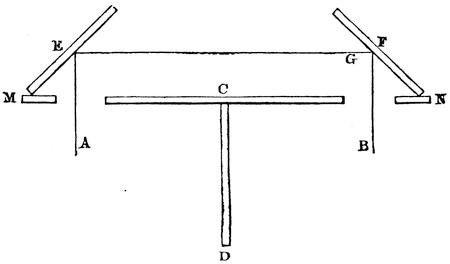
One of the simplest instruments of optical deception is the plane mirror, and when two are combined for this purpose it has been called the magician’s mirror. An observer in front of a plane mirror sees a distinct image of himself; but if two persons take up a mirror, and if the one person is as much to one side of a line perpendicular to the middle of it as the other is to the other side, they will see each other, but not themselves. If we now suppose MC, CD, NC, CD to be the partitions of two adjacent apartments let square openings be made in the partitions at A and B, above five feet above the floor, and let them be filled with plate glass, and surrounded with a picture frame, so as to have the appearance of two mirrors. Place two mirrors, E, F, one behind each opening at A and B, inclined 45° to the partition MN, and so large that a person looking into the plates of glass at A and B will not see their edges. When this is done it is obvious that a person looking into the mirror A will not see himself, but will see any person or figure placed at B. If he believes that he is looking into a common mirror at A, his astonishment will be great at seeing himself transformed into another person, or into any living animal that may be placed at B. The success of this deception would be greatly increased if a plane mirror, suspended by a pulley, could be brought immediately behind the plane glass at A, and drawn up from it at pleasure. The spectator at A, having previously seen himself in this moveable mirror, would be still more astonished when he afterwards perceived in the same place a face different from his own. By drawing the moveable mirror half up, the spectator at A might see half of his own face joined to half of the face placed at B; but in the present day the most ignorant persons are so familiar with the properties of a looking-glass, that it would be very difficult to employ this kind of deception with the same success which must have attended it in a more illiterate age. The optical reader will easily see that the mirror F and the apartment NCD are not absolutely necessary for carrying on this deception; for the very same effects will be produced if the person at B is stationed at G, and looks towards the mirror F in the direction GF. As the mirror F, however, must be placed as near to A as possible, the person at G would be too near the partition CN, unless the mirror F was extremely large.
The effect of this and every similar deception is greatly increased when the persons are illuminated with a strong light, and the rest of the apartment as dark as possible; but whatever precautions are taken, and however skilfully plane mirrors are combined, it is not easy to produce with them any very successful illusions.
The concave mirror is the staple instrument of the magician’s cabinet, and must always perform a principal part in all optical combinations. In order to be quite perfect, every concave mirror should have its surface elliptical, so that if any object is placed in one focus of the ellipse, an inverted image of it will be formed in the other focus. This image, to a spectator rightly placed, appears suspended in the air, so that if the mirror and the object are hid from his view, the effect must appear to him almost supernatural.
The method of exhibiting the effect of concave mirrors most advantageously is shown in Fig. 4, where CD is the partition of a room having in it a square opening EF, the centre of which is about five feet above the floor. This opening might be surrounded with a picture-frame, and a painting which exactly filled it might be so connected with a pulley that it could be either slipped aside, or raised so as to leave the frame empty. A large concave mirror MN is then placed in another apartment, so that when any object is placed at A, a distinct image of it may be formed in the centre of the opening EF. Let us suppose this object to be a plaster cast of any object made as white as possible, and placed in an inverted position at A. A strong light should then be thrown upon it by a powerful lamp, the rays of which are prevented from reaching the opening EF. When this is done, a spectator placed at O will see an erect image of the statue at B, the centre of the opening, standing in the air, and differing from the real statue only in being a little larger, while the apparition will be wholly invisible to other spectators placed at a little distance on each side of him.
Fig. 4.
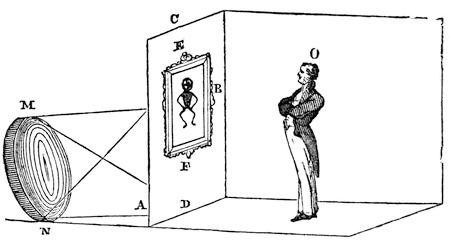
If the opening EF is filled with smoke, rising either from a chafing-dish, in which incense is burnt, or made to issue in clouds from some opening below, the image will appear in the middle of the smoke depicted upon it as upon a ground, and capable of being seen by those spectators who could not see the image of the air. The rays of light, in place of proceeding without obstruction to an eye at O, are reflected as it were from those minute particles of which the smoke is composed, in the same manner as a beam of light is rendered more visible by passing through an apartment filled with dust or smoke.
It has long been a favourite experiment to place at A a white and strongly illuminated human skull, and to exhibit an image of it amid the smoke of a chafing-dish at B; but a more terrific effect would be produced if a small skeleton suspended by invisible wires were placed as an object at A. Its image suspended in the air at B, or painted upon smoke, could not fail to astonish the spectator.
The difficulty of placing a living person in an inverted position, as an object at A, has no doubt prevented the optical conjuror from availing himself of so admirable a resource; but this difficulty may be removed by employing a second concave mirror. The second mirror may be so placed as to reflect towards MN the rays proceeding from an erect living object, and to form an inverted image of this object at A. An erect image of this inverted image will then be formed at B, either suspended in the air, or depicted upon a wreath of smoke. This aërial image will exhibit the precise form and colours and movements of the living object, and it will maintain its character as an apparition if any attempt is made by the spectator to grasp its unsubstantial fabric.
A deception of an alarming kind, called the Mysterious dagger, has been long a favourite exhibition. If a person with a drawn and highly polished dagger, illuminated by a strong light, stands a little farther from a concave mirror than its principal focus, he will perceive in the air between himself and the mirror an inverted and diminished image of his own person, with the dagger similarly brandished. If he aims the dagger at the centre of the mirrors concavity, the two daggers will meet point to point, and, by pushing it still farther from him towards the mirror, the imaginary dagger will strike at his heart. In this case it is necessary that the direction of the real dagger coincides with a diameter of the sphere of which the mirror is a part; but if its direction is on one side of that diameter, the direction of the imaginary dagger will be as far on the other side of the diameter, and the latter will aim a blow at any person who is placed in the proper position for receiving it. If the person who bears the real dagger is therefore placed behind a screen, or otherwise concealed from the view of the spectator, who is made to approach to the place of the image, the thrust of the polished steel at his breast will not fail to produce a powerful impression. The effect of this experiment would no doubt be increased by covering with black cloth the person who holds the dagger, so that the image of his hand only should be seen, as the inverted picture of him would take away from the reality of the appearance. By using two mirrors, indeed, this defect might be remedied, and the spectator would witness an exact image of the assassin aiming the dagger at his life.
The common way of making this experiment is to place a basket of fruit above the dagger, so that a distinct aërial image of the fruit is formed in the focus of the mirror. The spectator, having been desired to take some fruit from the basket, approaches for that purpose, while a person properly concealed withdraws the real basket of fruit with one hand, and with the other advances the dagger, the image of which being no longer covered by the fruit, strikes at the body of the astonished spectator.
The powers of the concave mirror have been likewise displayed in exhibiting the apparition of an absent or deceased friend. For this purpose, a strongly illuminated bust or picture of the person is placed before the concave mirror, and a distinct image of the picture will be seen either in the air or among smoke, in the manner already described. If the background of the picture is temporarily covered with lamp-black, so that there is no light about the picture but what falls upon the figure, the effect will be more complete.
As in all experiments with concave mirrors, the size of the aërial image is to that of the real object as their distances from the mirror, we may, by varying the distance of the object, increase or diminish the size of the image. In doing this, however, the distance of the image from the mirror is at the same time changed, so that it would quit the place most suitable for its exhibition. This defect may be removed by simultaneously changing the place both of the mirror and the object, so that the image may remain stationary, expanding itself from a luminous spot to a gigantic size, and again passing through all intermediate magnitudes, till it vanishes in a cloud of light.
Those who have studied the effects of concave mirrors of a small size, and without the precautions necessary to ensure deception, cannot form any idea of the magical effect produced by this class of optical apparitions. When the instruments of illusion are themselves concealed,—when all extraneous lights but those which illuminate the real object are excluded,—when the mirrors are large and well-polished, and truly formed,—the effect of the representation on ignorant minds is altogether overpowering; while even those who know the deception, and perfectly understand its principles, are not a little surprised at its effects. The inferiority in the effects of a common concave mirror to that of a well-arranged exhibition is greater even than that of a perspective picture, hanging in an apartment, to the same picture exhibited under all the imposing accompaniments of a dioramic representation.
It can scarcely be doubted, that a concave mirror was the principal instrument by which the heathen gods were made to appear in the ancient temples. In the imperfect accounts which have reached us of these apparitions, we can trace all the elements of an optical illusion. In the ancient temple of Hercules at Tyre, Pliny mentions that there was a seat made of a consecrated stone, “from which the gods easily rose.” Esculapius often exhibited himself to his worshippers in his temple at Tarsus; and the temple of Enguinum in Sicily was celebrated as the place where the goddesses exhibited themselves to mortals. Iamblichus actually informs us, that the ancient magicians caused the gods to appear among the vapours disengaged from fire; and when the conjuror Maximus terrified his audience by making the statue of Hecate laugh, while in the middle of the smoke of burning incense, he was obviously dealing with the image of a living object dressed in the costume of the sorceress.
The character of these exhibitions in the ancient temples is so admirably depicted in the following passage of Damascius, quoted by M. Salverte, that we recognise all the optical effects which have been already described. “In a manifestation,” says he, “which ought not to be revealed ... there appeared on the wall of the temple a mass of light, which at first seemed to be very remote; it transformed itself, in coming nearer, into a face evidently divine and supernatural, of a severe aspect, but mixed with gentleness, and extremely beautiful. According to the institutions of a mysterious religion, the Alexandrians honoured it as Osiris and Adonis.”
Among more modern examples of this illusion, we may mention the case of the Emperor Basil of Macedonia. Inconsolable at the loss of his son, this sovereign had recourse to the prayers of the Pontiff Theodore Santabaren, who was celebrated for his power of working miracles. The ecclesiastical conjuror exhibited to him the image of his beloved son, magnificently dressed and mounted upon a superb charger: the youth rushed towards his father, threw himself into his arms, and disappeared. M. Salverte judiciously observes, that this deception could not have been performed by a real person who imitated the figure of the young prince. The existence of this person, betrayed by so remarkable a resemblance, and by the trick of the exhibition, could not fail to have been discovered and denounced, even if we could explain how the son could be so instantaneously disentangled from his father’s embrace. The emperor, in short, saw the aërial image of a picture of his son on horseback; and as the picture was brought nearer the mirror, the image advanced into his arms, when it of course eluded his affectionate grasp.
These and other allusions to the operations of the ancient magic, though sufficiently indicative of the methods which were employed, are too meagre to convey any idea of the splendid and imposing exhibitions which must have been displayed. A national system of deception, intended as an instrument of government, must have brought into requisition not merely the scientific skill of the age, but a variety of subsidiary contrivances calculated to astonish the beholder, to confound his judgment, to dazzle his senses, and to give a predominant influence to the peculiar imposture which it was thought desirable to establish. The grandeur of the means may be inferred from their efficacy, and from the extent of their influence.
This defect, however, is, to a certain degree, supplied by an account of a modern necromancy, which has been left us by the celebrated Benvenuto Cellini, and in which he himself performed an active part.
“It happened,” says he, “through a variety of odd accidents, that I made acquaintance with a Sicilian priest, who was a man of genius, and well versed in the Latin and Greek authors. Happening one day to have some conversation with him when the subject turned upon the art of necromancy, I, who had a great desire to know something of the matter, told him, that I had all my life felt a curiosity to be acquainted with the mysteries of this art.
“The priest made answer, ‘that the man must be of a resolute and steady temper who enters upon that study.’ I replied, ‘that I had fortitude and resolution enough, if I could but find an opportunity.’ The priest subjoined, ‘If you think you have the heart to venture, I will give you all the satisfaction you can desire.’ Thus we agreed to enter upon a plan of necromancy. The priest one evening prepared to satisfy me, and desired me to look out for a companion or two. I invited one Vincenzio Romoli, who was my intimate acquaintance: he brought with him a native of Pistoia, who cultivated the black art himself. We repaired to the Colosseo, and the priest, according to the custom of necromancers, began to draw circles upon the ground, with the most impressive ceremonies imaginable: he likewise brought hither asafœtida, several precious perfumes, and fire, with some compositions also, which diffused noisome odours. As soon as he was in readiness, he made an opening to the circle, and having taken us by the hand, ordered the other necromancer, his partner, to throw the perfumes into the fire at a proper time, entrusting the care of the fire and perfumes to the rest; and thus he began his incantations. This ceremony lasted above an hour and a half, when there appeared several legions of devils, insomuch that the amphitheatre was quite filled with them. I was busy about the perfumes, when the priest, perceiving there was a considerable number of infernal spirits, turned to me and said, ‘Benvenuto, ask them something.’ I answered, ‘Let them bring me into the company of my Sicilian mistress Angelica.’ That night he obtained no answer of any sort; but I had received great satisfaction in having my curiosity so far indulged. The necromancer told me it was requisite we should go a second time, assuring me that I should be satisfied in whatever I asked; but that I must bring with me a pure, immaculate boy.
“I took with me a youth who was in my service, of about twelve years of age, together with the same Vincenzio Romoli, who had been my companion the first time, and one Agnolino Gaddi, an intimate acquaintance, whom I likewise prevailed on to assist at the ceremony. When we came to the place appointed, the priest having made his preparations as before, with the same and even more striking ceremonies, placed us within the circle, which he had likewise drawn with a more wonderful art and in a more solemn manner than at our former meeting. Thus, having committed the care of the perfumes and the fire to my friend Vincenzio, who was assisted by Agnolino Gaddi, he put into my hand a pintaculo or magical chart, and bid me turn it towards the places that he should direct me; and under the pintaculo I held the boy. The necromancer, having begun to make his tremendous invocations, called by their names a multitude of demons who were the leaders of the several legions, and questioned them, by the power of the eternal uncreated God, who lives for ever, in the Hebrew language, as likewise in Latin and Greek; insomuch that the amphitheatre was almost in an instant filled with demons more numerous than at the former conjuration. Vincenzio Romoli was busied in making a fire, with the assistance of Agnolino, and burning a great quantity of precious perfumes. I, by the directions of the necromancer, again desired to be in the company of my Angelica. The former thereupon turning to me said,—’Know, they have declared that, in the space of a month, you shall be in her company.’
“He thus requested me to stand resolutely by him, because the legions were now above a thousand more in number than he had designed; and besides, these were the most dangerous; so that, after they had answered my question, it behoved him to be civil to them, and dismiss them quietly. At the same time the boy under the pintaculo was in a terrible fright, saying, that there were in that place a million of fierce men, who threatened to destroy us; and that, moreover, four armed giants of enormous stature were endeavouring to break into our circle. During this time, whilst the necromancer, trembling with fear, endeavoured by mild and gentle methods to dismiss them in the best way he could, Vincenzio Romoli, who quivered like an aspen leaf, took care of the perfumes. Though I was as much terrified as any of them, I did my utmost to conceal the terror I felt; so that I greatly contributed to inspire the rest with resolution; but the truth is, I gave myself over for a dead man, seeing the horrid fright the necromancer was in. The boy placed his head between his knees and said, ‘In this posture will I die; for we shall all surely perish.’ I told him that all these demons were under us, and what he saw was smoke and shadow; so bid him hold up his head and take courage. No sooner did he look up than he cried out, ‘The whole amphitheatre is burning, and the fire is just falling upon us.’ So covering his eyes with his hands, he again exclaimed, ‘that destruction was inevitable, and desired to see no more.’ The necromancer entreated me to have a good heart, and take care to burn proper perfumes; upon which I turned to Romoli, and bid him burn all the most precious perfumes he had. At the same time I cast my eye upon Agnolino Gaddi, who was terrified to such a degree that he could scarce distinguish objects, and seemed to be half dead. Seeing him in this condition, I said, ‘Agnolino, upon these occasions a man should not yield to fear, but should stir about and give his assistance, so come directly and put on some more of these.’ The effects of poor Agnolino’s fear were overpowering. The boy, hearing a crepitation, ventured once more to raise his head, when, seeing me laugh, he began to take courage, and said ‘that the devils were flying away with a vengeance.’
“In this condition we stayed, till the bell rang for morning prayers. The boy again told us, that there remained but few devils, and these were at a great distance. When the magician had performed the rest of his ceremonies, he stripped off his gown, and took up a wallet full of books which he had brought with him.
“We all went out of the circle together, keeping as close to each other as we possibly could, especially the boy, who had placed himself in the middle, holding the necromancer by the coat, and me by the cloak. As we were going to our houses in the quarter of Banchi, the boy told us that two of the demons whom we had seen at the amphitheatre went on before us leaping and skipping, sometimes running upon the roofs of the houses, and sometimes upon the ground. The priest declared, that though he had often entered magic circles, nothing so extraordinary had ever happened to him. As we went along, he would fain persuade me to assist with him at consecrating a brook, from which, he said, we should derive immense riches; we should then ask the demons to discover to us the various treasures with which the earth abounds, which would raise us to opulence and power; but that these love-affairs were mere follies, from whence no good could be expected. I answered, ‘that I would readily have accepted his proposal, if I understood Latin.’ He redoubled his persuasions, assuring me, that the knowledge of the Latin language was by no means material. He added, that he could have Latin scholars enough, if he had thought it worth while to look out for them, but that he could never have met with a partner of resolution and intrepidity equal to mine, and that I should by all means follow his advice. Whilst we were engaged in this conversation we arrived at our respective houses, and all that night dreamt of nothing but devils.”
It is impossible to peruse the preceding description without being satisfied that the legions of devils were not produced by any influence upon the imaginations of the spectators, but were actual optical phantasms, or the images of pictures or objects produced by one or more concave mirrors or lenses. A fire is lighted, and perfumes and incense are burnt, in order to create a ground for the images, and the beholders are rigidly confined within the pale of the magic circle. The concave mirror and the objects presented to it having been so placed that the persons within the circle could not see the aërial image of the objects by the rays deeply reflected from the mirror, the work of deception was ready to begin. The attendance of the magician upon his mirror was by no means necessary. He took his place along with the spectators within the magic circle. The images of the devils were all distinctly formed in the air immediately above the fire, but none of them could be seen by those within the circle. The moment, however, that perfumes were thrown into the fire to produce smoke, the first wreath of smoke that rose through the place of one or more of the images, would reflect them to the eyes of the spectator, and they could again disappear if the wreath was not followed by another. More and more images would be rendered visible as new wreaths of smoke arose, and the whole group would appear at once when the smoke was uniformly diffused over the place occupied by the images.
The “compositions which diffused noisome odours” were intended to intoxicate or stupify the spectators, so as to increase their liability to deception, or to add to the real phantasms which were before their eyes, others which were the offspring only of their own imaginations. It is not easy to gather from the description what parts of the exhibition were actually presented to the eyes of the spectators, and what parts of it were imagined by themselves. It is quite evident that the boy, as well as Agnolino Gaddi, were so overpowered with terror that they fancied many things which they did not see; but when the boy declares that four armed giants, of an enormous stature, were threatening to break into the circle, he gives an accurate description of the effect that would be produced by pushing the figures nearer the mirror, and then magnifying their images, and causing them to advance towards the circle. Although Cellini declares that he was trembling with fear, yet it is quite evident that he was not entirely ignorant of the machinery which was at work; for in order to encourage the boy, who was almost dead with fear, he assured them that the devils were under their power, and that “what he saw was smoke and shadow.”
Mr. Roscoe, from whose Life of Cellini the preceding description is taken, draws a similar conclusion from the consolatory words addressed to the boy, and states that they “confirm him in the belief, that the whole of these appearances, like a phantasmagoria, were merely the effects of a magic lantern produced on volumes of smoke from various kinds of burning wood.” In drawing this conclusion, Mr. Roscoe has not adverted to the fact, that this exhibition took place about the middle of the 16th century, while the magic lantern was not invented by Kircher till towards the middle of the 17th century; Cellini having died in 1570, and Kircher having been born in 1601. There is no doubt that the effects described could be produced by this instrument, but we are not entitled to have recourse to any other means of explanation but those which were known to exist at the time of Cellini. If we suppose, however, that the necromancer either had a regular magic lantern, or that he had fitted up his concave mirror in a box containing the figures of his devils, and that this box with its lights was carried home with the party, we can easily account for the declaration of the boy, “that as they were going home to their houses in the quarter of Banchi, two of the demons whom we had seen at the amphitheatre went on before us leaping and skipping, sometimes running upon the roofs of the houses, and sometimes upon the ground.”
The introduction of the magic lantern as an optical instrument supplied the magicians of the 17th century with one of their most valuable tools. The use of the concave mirror, which does not appear to have been even put up into the form of an instrument, required a separate apartment, or at least that degree of concealment which it was difficult on ordinary occasions to command; but the magic lantern, containing in a small compass its lamp, its lenses, and its sliding figures, was peculiarly fitted for the itinerant conjuror, who had neither the means of providing a less portable and more extensive apparatus, nor the power of transporting and erecting it.
The magic lantern shown in the annexed figure consists of a dark lantern, AB, containing a lamp G, and a concave metallic mirror, MN, and it is so constructed that when the lamp is lighted not a ray of light is able to escape from it. Into the side of the lantern is fitted a double tube, CD, the outer half of which D is capable of moving within the other half. A large plano-convex lens C, is fixed at the inner end of the double tube, and a small convex lens D, at the outer end; and to the fixed tube CE, there is joined a groove EF, in which the sliders containing the painted objects are placed, and through which they can be moved. Each slider contains a series of figures or pictures painted on glass with highly transparent colours. The direct light of the lamp G, and the light reflected from the mirror MN, falling upon the illuminating lens C, is concentrated by it so as to throw a brilliant light upon the painting on the slider, and as this painting is in the conjugate focus of the convex lens D, a magnified image of it will be formed on a white wall or white cloth placed at PQ. If the lens D is brought nearer to EF, or to the picture, the distinct image will be more magnified, and will be formed at a greater distance from D, so that if there is any particular distance of the image which is more convenient than another, or any particular size of the object which we wish, it can be obtained by varying the distance of the lens D from EF.
Fig. 5.
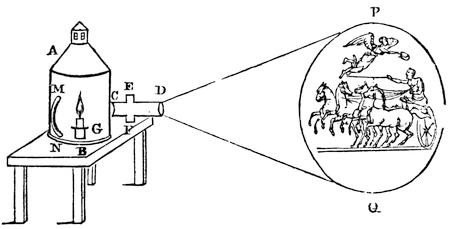
When the image is received on an opaque ground, as is commonly the case, the spectators are placed in the same room with the lantern; but, for the purposes of deception, it would be necessary to place the lantern in another apartment like the mirror in Fig. 4, and to throw the magnified pictures on a large plate of ground glass, or a transparent gauze screen, stretched across an opening EF, Fig. 4, made in the partition which separates the spectators from the exhibitor. The images might, like those of the concave mirror, be received upon wreaths of smoke. These images are of course always inverted in reference to the position of the painted objects; but in order to render them really erect, we have only to invert the sliders. The representations of the magic lantern never fail to excite a high degree of interest, even when exhibited with the ordinary apparatus; but by using double sliders, and varying their movements, very striking effects may be produced. A smith, for example, is made to hammer upon his anvil,—a figure is thrown into the attitude of terror by the introduction of a spectral apparition, and a tempest at sea is imitated, by having the sea on one slider, and the ships on other sliders, to which an undulatory motion is communicated.
The magic lantern is susceptible of great improvement in the painting of the figures, and in the mechanism and combination of the sliders. A painted figure, which appears well executed to the unassisted eye, becomes a mere daub when magnified 50 or 100 times; and when we consider what kind of artists are employed in their execution, we need not wonder that this optical instrument has degenerated into a mere toy for the amusement of the young. Unless for public exhibition, the expense of exceedingly minute and spirited drawings could not be afforded; but I have no doubt that if such drawings were executed, a great part of the expense might be saved by engraving them on wood, and transferring their outline to the glass sliders.
A series of curious representations might be effected, by inserting glass plates containing suitable figures in a trough having two of its sides parallel, and made of plate glass. The trough must be introduced at EF, so that the figure on the glass is at the proper distance from the object lens D. When the trough is filled with water, or with any transparent fluid, the picture at PQ will be seen with the same distinctness as if the figure had been introduced by itself into the groove EF; but if any transparent fluid of a different density from water is mixed with it, so as to combine with it quickly or slowly, the appearance of the figure displayed at PQ will undergo singular changes. If spirits of wine, or any ardent spirit, are mixed with the water, so as to produce throughout its mass partial variations of density, the figure at PQ, will be as it were broken down into a thousand parts, and will recover its continuity and distinctness when the two fluids have combined. If a fluid of less density than water is laid gently upon the water, so as to mix with it gradually, and produce a regular diminution of density downwards—or if saline substances, soluble in water, are laid at the bottom of the trough, the density will diminish upwards, and the figure will undergo the most curious elongations and contractions. Analogous effects may be produced by the application of heat to the surface or sides of the trough, so that we may effect at the same time both an increase and a diminution in the density of the water, in consequence of which the magnified images will undergo the most remarkable transformations. It is not necessary to place the glass plate which contains the figure within the trough. It may be placed in front of it, and by thus creating as it were an atmosphere with local variations of density, we may exhibit the phenomena of the mirage and of looming, in which the inverted images of ships and other objects are seen in the air, as described in another letter.
The power of the magic lantern has been greatly extended by placing it on one side of the transparent screen of taffeta which receives the images, while the spectators are placed on the other side, and by making every part of the glass sliders opaque, excepting the part which forms the figures. Hence all the figures appear luminous on a black ground, and produce a much greater effect with the same degree of illumination. An exhibition depending on these principles was brought out by M. Philipstall in 1802, under the name of the Phantasmagoria, and when it was shown in London and Edinburgh, it produced the most impressive effects upon the spectators. The small theatre of exhibition was lighted only by one hanging lamp, the flame of which was drawn up into an opaque chimney or shade when the performance began. In this “darkness visible” the curtain rose and displayed a cave with skeletons and other terrific figures in relief upon its walls. The flickering light was then drawn up beneath its shroud, and the spectators in total darkness found themselves in the middle of thunder and lightning. A thin transparent screen had, unknown to the spectators, been let down after the disappearance of the light, and upon it the flashes of lightning and all the subsequent appearances were represented. This screen being half-way between the spectators and the cave which was first shown, and being itself invisible, prevented the observers from having any idea of the real distance of the figures, and gave them the entire character of aërial pictures. The thunder and lightning were followed by the figures of ghosts, skeletons, and known individuals, whose eyes and mouth were made to move by the shifting of combined sliders. After the first figure had been exhibited for a short time, it began to grow less and less, as if removed to a great distance, and at last vanished in a small cloud of light. Out of this same cloud the germ of another figure began to appear, and gradually grew larger and larger, and approached the spectators, till it attained its perfect development. In this manner the head of Dr. Franklin was transformed into a skull; figures which retired with the freshness of life came back in the form of skeletons, and the retiring skeletons returned in the drapery of flesh and blood.
The exhibition of these transmutations was followed by spectres, skeletons, and terrific figures, which, instead of receding and vanishing as before, suddenly advanced upon the spectators, becoming larger as they approached them, and finally vanished by appearing to sink into the ground. The effect of this part of the exhibition was naturally the most impressive. The spectators were not only surprised but agitated, and many of them were of opinion that they could have touched the figures. M. Robertson, at Paris, introduced along with his pictures the direct shadows of living objects, which imitated coarsely the appearance of those objects in a dark night or in moonlight.
All these phenomena were produced by varying the distance of the magic lantern AB, Fig 5, from the screen PQ, which remained fixed, and at the same time keeping the image upon the screen distinct, by increasing the distance of the lens D from the sliders in EF. When the lantern approached to PQ, the circle of light PQ, or the section of the cone of rays PDQ, gradually diminished, and resembled a small bright cloud, when D was close to the screen. At this time a new figure was put in, so that when the lantern receded from the screen, the old figure seemed to have been transformed into the new one. Although the figure was always at the same distance from the spectators, yet, owing to its gradual diminution in size, it necessarily appeared to be retiring to a distance. When the magic lantern was withdrawn from PQ, and the lens D at the same time brought nearer to EF, the image in PQ gradually increased in size, and therefore seemed in the same proportion to be approaching the spectators.
Superior as this exhibition was to any representation that had been previously made by the magic lantern, it still laboured under several imperfections. The figures were poorly drawn, and in other respects not well executed, and no attempt whatever was made to remove the optical incongruity of the figures becoming more luminous when they retired from the observer, and more obscure when they approached to him. The variation of the distance of the lens D from the sliders in EF was not exactly adapted to the motion of the lantern to and from the screen, so that the outline of the figures was not equally distinct during their variations of magnitude.
Dr. Thomas Young suggested the arrangement shown in Fig. 6 for exhibiting the phantasmagoria.
Fig. 6.
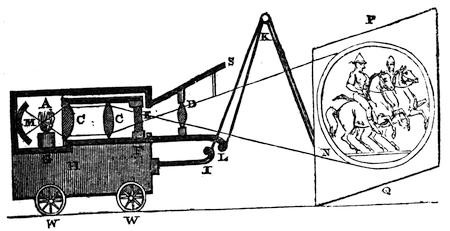
The magic lantern is mounted on a small car H, which runs on wheels WW. The direct light of the lamp G, and that reflected from the mirror M, is condensed by the illuminating lenses CC, upon the transparent figures in the opaque sliders at E, and the image of these figures is formed at PQ, by the object lens D. When the car H is drawn back on its wheels, the rod IK brings down the point K, and by means of the rod KL, pushes the lens D nearer to the sliders in EF, and when the car advances to PQ, the point K is raised, and the rod KL draws out the lens D from the slider, so that the image is always in the conjugate focus of D, and therefore distinctly painted on the screen. The rod KN must be equal in length to IK, and the point I must be twice the focal length of the lens D before the object, L being immediately under the focus of the lens. In order to diminish the brightness of the image when it grows small and appears remote, Dr. Young contrived that the support of the lens D should suffer a screen S to fall and intercept a part of the light. This method, however, has many disadvantages, and we are satisfied, that the only way of producing a variation in the light corresponding to the variation in the size of the image, is to use a single illuminating lens C, and to cause it to approach EF, and throw less light upon the figures when D is removed from EF, and to make C recede from EF when D approaches to it. The lens C should therefore be placed in a mean position, corresponding to a mean distance of the screen, and to the ordinary size of the figures, and should have the power of being removed from the slider EF, when a greater intensity of light is required for the images when they are rendered gigantic, and of being brought close to EF when the images are made small. The size of the lens C ought of course to be such that the section of its cone of rays at EF is equal to the size of the figure on the slider when C is at its greatest distance from the slider.
The method recommended by Dr. Young for pulling out and pushing in the object lens D, according as the lantern approaches to or recedes from the screen, is very ingenious and effective. It is, however, clumsy in itself, and the connexion of the levers with the screen, and their interposition between it and the lantern, must interfere with the operations of the exhibitor. It is, besides, suited only to short distances between the screen and the lantern; for when that distance is considerable, as it must sometimes require to be, the levers KL, KI, KT, would bend by the least strain, and become unfitted for their purpose. For these reasons the mechanism which adjusts the lens D should be moved by the axle of the front wheels, the tube which contains the lens should be kept at its greatest distance from EF by a slender spring, and should be pressed to its proper distance by the action of a spiral cam suited to the optical relation between the two conjugate focal distances of the lens.
Superior as the representations of the phantasmagoria are to those of the magic lantern, they are still liable to the defect which we have mentioned, namely, the necessary imperfection of the minute transparent figures when magnified. This defect cannot be remedied by employing the most skilful artists. Even Michael Angelo would have failed in executing a figure an inch long with transparent varnishes, when all its imperfections were to be magnified. In order, therefore, to perfect the art of representing phantasms, the objects must be living ones, and in place of chalky ill-drawn figures, mimicking humanity by the most absurd gesticulations, we shall have phantasms of the most perfect delineation, clothed in real drapery, and displaying all the movements of life. The apparatus by which such objects may be used, may be called the catadioptrical phantasmagoria, as it operates both by reflexion and refraction.
Fig. 7.
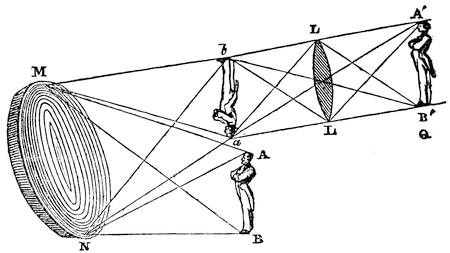
The combination of mirrors and lenses which seems best adapted for this purpose is shown in Fig. 7, where AB is a living figure placed before a large concave mirror MN, by means of which a diminished and inverted image of it is formed at ab. If PQ is the transparent screen upon which the image is to be shown to the spectators on the right hand of it, a large lens LL must be so placed before the image ab, as to form a distinct and erect picture of it at A´B´ upon the screen. When the image A´B´ is required to be the exact size of AB, the lens LL must magnify the small image ab as much as the mirror MN diminishes the figure AB. The living object AB, the mirror MN, and the lens LL, must all be placed in a moveable car for the purpose of producing the variations in the size of the phantasms, and the transformations of one figure into another. The contrivance for adjusting the lens LL, to give a distinct picture at different distances of the screen, will, of course, be required in the present apparatus. In order to give full effect to the phantasms, the living objects at AB will require to be illuminated in the strongest manner, and should always be dressed either in white or in very luminous colours; and, in order to give them relief, a black cloth should be stretched at some distance behind them. Many interesting effects might also be produced by introducing at AB fine paintings and busts.
It would lead us into too wide a field were we to detail the immense variety of resources which the science of optics furnishes for such exhibitions. One of these, however, is too useful to be passed without notice. If we interpose a prism with a small refracting angle between the image ab, Fig. 7, and the lens LL, the part of the figure immediately opposite to the prism will be as it were detached from the figure, and will be exhibited separately on the screen PQ. Let us suppose that this part is the head of the figure. It may be detached vertically, or lifted from the body as if it were cut off, or it may be detached downwards and placed on the breast as if the figure were deformed. In detaching the head vertically or laterally, an opaque screen must be applied to prevent any part of the head from being seen by rays which do not pass through the prism; but this and other practical details will soon occur to those who put the method to an experimental trial. The application of the prism is shown in Fig. 8, where ab is the inverted image formed by a concave mirror, ABC a prism with a small refracting angle BCA, placed between ab and the lens LL, s a small opaque screen, and AB the figure with its head detached. A hand may be made to grasp the hair of the head, and the aspect of death may be given to it, as if it had been newly cut off. Such a representation could be easily made, and the effect upon the spectators would be quite overpowering. The lifeless head might then be made to recover its vitality, and be safely replaced upon the figure. If the head A of the living object AB, Fig. 7, is covered with black cloth, the head of a person or of an animal placed above A might be set upon the shoulders of the figure AB by the refraction of a prism.
Fig. 8.
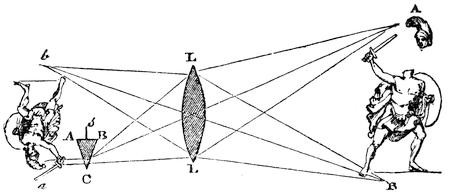
When the figure ab, Fig. 8, is of very small dimensions, as in the magic lantern, a small prism of glass would answer the purpose required of it; but in public exhibitions, where the image ab must be of a considerable size, if formed by a concave mirror, a very large prism would be necessary. This, however, though impracticable with solid glass, may be easily obtained by means of two large pieces of plate glass made into a prismatic vessel and filled with water. Two of the glasses of a carriage window would make a prism capable of doubling the whole of the bust of a living person placed as an object at AB, Fig. 7, so that two perfectly similar phantasms might be exhibited. In those cases where the images before the lens LL are small, they may be doubled and even tripled by interposing a well-prepared plate of calcareous spar, that is, crossed by a thin film. These images would possess the singular character of being oppositely coloured, and of changing their distances and their colours, by slight variations in the positions of the plate.8
In order to render the images which are formed by the glass and water prisms as perfect as possible, it would be easy to make them achromatic, and the figures might be multiplied to any extent by using several prisms, having their refracting edges parallel, for the purpose of giving a similarity of position to all the images.
Fig. 9.
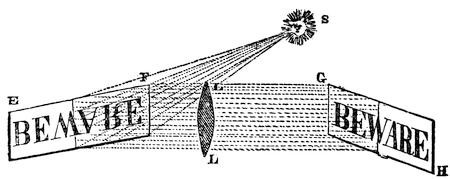
Among the instruments of natural magic which were in use at the revival of science, there was one invented by Kircher for exhibiting the mysterious hand-writing on the wall of an apartment, from which the magician and his apparatus were excluded. The annexed figure represents this apparatus as given by Schottus. The apartment in which the spectators are placed is between LL and GH, and there is an open window in the
side next LL, GH being the inside of the wall opposite to the window. Upon the face of the plane speculum EF are written the words to be introduced, and when a lens LL is placed at such a distance from the speculum, and of such a focal length, that the letters and the place of their representation are in its conjugate foci, a distinct image of the writing will be exhibited on the wall at GH. The letters on the speculum are of course inverted, as seen at EF, and when they are illuminated by the sun’s rays S, as shown in the figure, a distinct image, as Schottus assures us, may be formed at the distance of 500 feet. In this experiment, the speculum is by no means necessary. If the letters are cut out of an opaque card, and illuminated by the light of the sky in the day, or by a lamp during night, their delineation on the wall would be equally distinct. In the daytime it would be necessary to place the letters at one end of a tube or oblong box, and the lens at the other end. As this deception is performed when the spectators are unprepared for any such exhibition, the warning written in luminous letters on the wall, or any word associated with the fate of the individual observer, could not fail to produce a singular effect upon his mind. The words might be magnified, diminished, multiplied, coloured, and obliterated, in a cloud of light, from which they might again reappear by the methods already described, as applicable to the magic lantern.
The art of forming aërial representations was a great desideratum among the opticians of the 17th century. Vitellio and others had made many unsuccessful attempts to produce such images, and the speculations of Lord Bacon on the subject are too curious to be withheld from the reader.
“It would be well bolted out,” says he, “whether great refractions may not be made upon reflexions, as well as upon direct beams. For example, take an empty basin, put an angel or what you will into it; then go so far from the basin till you cannot see the angel, because it is not in a right line; then fill the basin with water, and you shall see it out of its place, because of the refraction. To proceed, therefore, put a looking-glass into a basin of water. I suppose you shall not see the image in a right line or at equal angles, but wide. I know not whether this experiment may not be extended, so as you might see the image and not the glass, which, for beauty and strangeness, were a fine proof, for then you should see the image like a spirit in the air. As, for example, if there be a cistern or pool of water, you shall place over against it the picture of the devil, or what you will, so as that you do not see the water. Then put a looking-glass in the water; now if you can see the devil’s picture aside, not seeing the water, it would look like the devil indeed. They have an old tale in Oxford, that Friar Bacon walked between two steeples, which was thought to be done by glasses, when he walked upon the ground.”
Fig. 10.
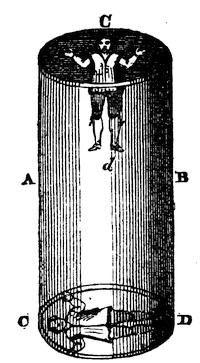
Kircher also devoted himself to the production of such images, and he has given in the annexed figure his method of producing them. At the bottom of a polished cylindrical vessel AB, he placed a figure CD, which we presume must have been highly illuminated from below, and to the spectators who looked into the vessel in an oblique direction there was exhibited an image placed vertically in the air as if it were ascending at the mouth of the vessel. Kircher assures us that he once exhibited in this manner a representation of the Ascension of our Saviour, and that the images were so perfect that the spectators could not be persuaded, till they had attempted to handle them, that they were not real substances. Although Kircher does not mention it, yet it is manifest that the original figure AB must have been a deformed or anamorphous drawing, in order to give a reflected image of just proportions. We doubt, indeed, if the representation or the figure was ever exhibited. It is entirely incompatible with the laws of reflexion.
Fig. 11.
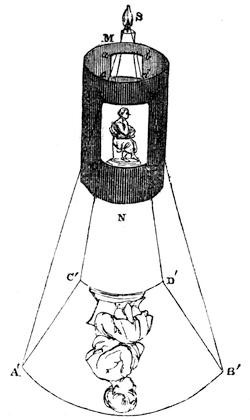
Among the ingenious and beautiful deceptions of the 17th century, we must enumerate that of the re-formation of distorted pictures by reflexion from cylindrical and conical mirrors. In these representations, the original image from which a perfect picture is produced is often so completely distorted, that the eye cannot trace in it the resemblance to any regular figure, and the greatest degree of wonder is of course excited, whether the original image is concealed or exposed to view. These distorted pictures may be drawn by strict geometrical rules; but I have shown in Fig. 11 a simple and practical method of executing them. Let MN be an accurate cylinder made of tin-plate or of thick pasteboard. Out of the farther side of it cut a small aperture abcd; and out of the nearer side cut a larger one ABCD, the size of the picture to be distorted. Having perforated the outline of the picture with small holes, place it on the opening ABCD, so that its surface may be cylindrical. Let a candle or a bright luminous object, the smaller the better, be placed at S, as far behind the picture ABCD as the eye is afterwards to be placed before it, and the light passing through the small holes will represent on a horizontal plane a distorted image of the picture A´B´C´D´, which, when sketched in outline with a pencil, and shaded or coloured, will be ready for use. If we now substitute a polished cylindrical mirror of the same size in place of MN, then the distorted picture, when laid horizontally at A´B´C´D´, will be restored to its original state when seen by reflexion at ABCD in the polished mirror. It would be an improvement on this method to place at ABCD a thin and flexible plate of transparent mica, having drawn upon it with a sharp point, or painted upon it, the figure required. The projected image of this figure at A´B´C´D´ may then be accurately copied.
The effect of a cylindrical mirror is shown in Fig. 12, which is copied from an old one which we have seen in use.
Fig. 12.
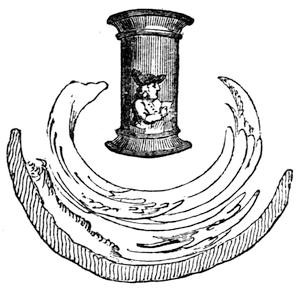
The method above described is equally applicable to concave cylindrical mirrors, and to those of a conical form; and it may also be applied to mirrors of variable curvature, which produce different kinds of distortions from different parts of their surfaces.
Fig. 13.
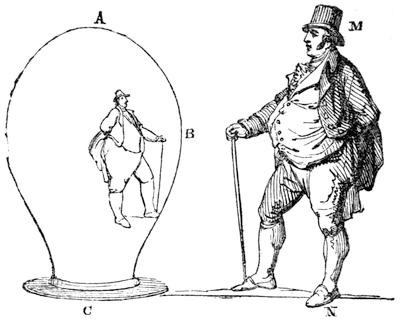
By employing a mirror whose surface has a variable curvature like ABC, Fig. 13, we obtain an instrument for producing an endless variety of caricatures, all of which are characterised by their resemblance to the original. If a figure MN is placed before such a mirror, it will of course appear distorted and caricatured; but even if the figure takes different distances and positions, the variations which the image undergoes are neither sufficiently numerous nor remarkable to afford much amusement. But if the figure MN is very near the mirror, so that new distortions are produced by the different distances of its different parts from the mirror, the most singular caricatures may be exhibited. If the figure, for example, bends forwards his head and the upper part of his body, they will swell in size, leaving his lower extremities short and slender. If it draws back the upper part of the body and advances the limbs, the opposite effect will take place. In like manner different sides of the head, the right or the left side of it, the brow or the chin, may be swelled and contracted at pleasure. By stretching out the arms before the body they become like those of an ourang-outang, and by drawing them back they dwindle into half their regular size. All these effects, which depend chiefly on the agility and skill of the performer, may be greatly increased by suitable distortions in his own features and figure. The family likeness, which is of course never lost in all the variety of figures which are thus produced, adds greatly to the interest of the exhibition; and we have seen individuals so annoyed at recognising their own likeness in the hideous forms of humanity which were thus delineated, that they could not be brought to contemplate them a second time. If the figure is inanimate, like the small cast of a statue, the effect is very curious, as the swelling and contracting of the parts and the sudden change of expression give a sort of appearance of vitality to the image. The inflexibility of such a figure, however, is unfavourable to its transformation into caricatures.
Interesting as these metamorphoses are, they lose in the simplicity of the experiment much of the wonder which they could not fail to excite if exhibited on a great scale, where the performer is invisible, and where it is practicable to give an aërial representation of the caricatured figures. This may be done by means of the apparatus shown in Fig. 7,9 where we may suppose AB to be the reduced image seen in the reflecting surface ABC, Fig. 13.10 By bringing this image nearer the mirror MM, Fig. 7, a magnified and inverted image of it may be formed at ab, of such a magnitude as to give the last image in PQ the same size as life. Owing to the loss of light by the two reflexions, a very powerful illumination would be requisite for the original figure. If such an exhibition were well got up, the effect of it would be very striking.
7 Ut speculum in loco certo positum nihil imaginet; aliorsum translatum faciat imagines. Aul. Gel. Noct. Attic., lib. xvi., cap. 18.
8 See Edin. Encyclopædia, Art. Optics, Vol. xv., p. 611.
9 Page 86.
10 Page 96.
LETTER V.
Miscellaneous optical illusions—Conversion of cameos into intaglios, or elevations into depressions, and the reverse—Explanation of this class of deceptions—Singular effects of illumination with light of one simple colour—Lamps for producing homogeneous yellow light—Methods of increasing the effect of this exhibition—Method of reading the inscription of coins in the dark—Art of deciphering the effaced inscription of coins—Explanation of these singular effects—Apparent motion of the eyes in portraits—Remarkable examples of this—Apparent motion of the features of a portrait, when the eyes are made to move—Remarkable experiment of breathing light and darkness.
In the preceding letter I have given an account of the most important instruments of Natural Magic which depend on optical principles: but there still remain several miscellaneous phenomena on which the stamp of the marvellous is deeply impressed, and the study of which is pregnant with instruction and amusement.
One of the most curious of these is that false perception in vision by which we conceive depressions to be elevations, and elevations depressions, or by which intaglios are converted into cameos, and cameos into intaglios. This curious fact seems to have been first observed at one of the early meetings of the Royal Society of London, when one of the members, in looking at a guinea through a compound microscope of new construction, was surprised to see the head upon the coin depressed, while other members could only see it embossed as it really was.
While using telescopes and compound microscopes, Dr. Gmelin of Wurtemburg observed the same fact. The protuberant parts of objects appeared to him depressed, and the depressed parts protuberant: but what perplexed him extremely, this illusion took place at some times and not at others, in some experiments and not in others, and appeared to some eyes and not to others.
After making a great number of experiments, Dr. Gmelin is said to have constantly observed the following effects: Whenever he viewed any object rising upon a plane of any colour whatever, provided it was neither white nor shining, and provided the eye and the optical tube were directly opposite to it, the elevated parts appeared depressed, and the depressed parts elevated. This happened when he was viewing a seal, and as often as he held the tube of the telescope perpendicularly, and applied it in such a manner that its whole surface almost covered the last glass of the tube. The same effect was produced when a compound microscope was used. When the object hung perpendicularly, from a plane, and the tube was supported horizontally and directly opposite to it, the illusion also took place, and the appearance was not altered when the object hung obliquely and even horizontally. Dr. Gmelin is said to have at last discovered a method of preventing this illusion, which was by looking, not towards the centre of the convexity, but at first to the edges of it only, and then gradually taking in the whole. “But why these things should so happen, he did not pretend to determine.”
Fig. 14.
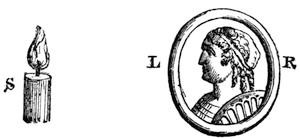
The best method of observing this deception is to view the engraved seal of a watch with the eyepiece of an achromatic telescope, or with a compound microscope, or any combination of lenses which inverts the objects that are viewed through it.11 The depression in the seal will immediately appear an elevation, like the wax impression which is taken from it; and though we know it to be hollow, and feel its concavity with the point of our finger, the illusion is so strong that it continues to appear a protuberance. The cause of this will be understood from Fig. 14, where S is the window of the apartment, or the light which illuminates the hollow seal LR, whose shaded side is of course on the same side L with the light. If we now invert the seal, with one or more lenses, so that it may look in the opposite direction, it will appear to the eye as in Fig. 15, with the shaded side L farthest from the window. But as we know that the window is still on our left hand, and that the light falls in the direction RL, and as everybody with its shaded side farthest from the light must necessarily be convex or protuberant, we immediately believe that the hollow seal is now a cameo or bas-relief. The proof which the eye thus receives of the seal being raised, overcomes the evidence of its being hollow, derived from our actual knowledge, and from the sense of touch. In this experiment the deception takes place from our knowing the real direction of the light which falls upon the seal; for if the place of the window, with respect to the seal, had been inverted as well as the seal itself, the illusion could not have taken place.
Fig. 15.
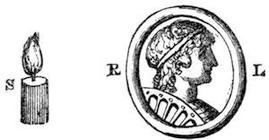
Fig. 16.
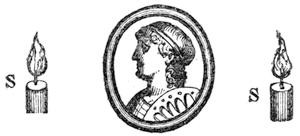
In order to explain this better, let us suppose the seal LR, Fig. 14, to be illuminated with a candle S, the place of which we can change at pleasure. If we invert LR, it will rise into a cameo, as in Fig. 15; and if we then place another candle S on the other side of it, as in Fig. 16, the hollow seal will be equally illuminated on all sides, and it will sink down into a cavity or intaglio. If the two candles do not illuminate the seal equally, or if any accidental circumstance produces a belief that the light is wholly or principally on one side, the mind will entertain a corresponding opinion respecting the state of the seal, regarding it as a hollow if it believes the light to come wholly or principally from the right hand, and as a cameo if it believes the light to come from the left hand.
If we use a small telescope to invert the seal, and if we cover up all the candle but the flame, and arrange the experiment so that the candle may be inverted along with the image, the seal will still retain its concavity, because the shadow is still on the same side with the illuminating body.
If we make the same experiments with the raised impression of the seal taken upon wax, we shall observe the very same phenomena, the seal being depressed when it alone is inverted, and retaining its convexity when the light is inverted along with it.
The illusion, therefore, under our consideration is the result of an operation of our own minds, whereby we judge of the forms of bodies by the knowledge we have acquired of light and shadow. Hence the illusion depends on the accuracy and extent of our knowledge on this subject; and while some persons are under its influence, others are entirely insensible to it. When the seal or hollow cavity is not polished, but ground, and the surface round it of uniform colour and smoothness, almost every person, whether young or old, learned or ignorant, will be subject to the illusion; because the youngest and the most careless observers cannot but know that the shadow of a hollow is always on the side next the light, and the shadow of a protuberance on the side opposite to the light; but if the object is the raised impression of a seal upon wax, I have found that, when inverted, it still seemed raised to the three youngest of six persons, while the three eldest were subject to the deception.
Fig. 17.
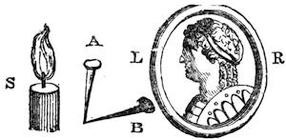
This illusion may be dissipated by a process of reasoning arising from the introduction of a new circumstance in the experiment. Thus, let RL, Fig. 17, be the inverted seal, which consequently appears raised, and let an opaque and unpolished pin, A, be placed on one side of the seal. Its shadow will be of course opposite the candle as at B. In this case the seal, which had become a cameo by its inversion, will now sink down into a cavity by the introduction of the pin and its shadow; for as the pin and its shadow are inverted, as shown in Fig. 18, while the candle retains its place, the shadow of the pin falling in the direction AB is a stronger proof to the eye that the light is coming from the right hand, than the actual knowledge of the candle being on the left hand, and therefore the cameo necessarily sinks into a cavity, or the shadow is now on the same side as the light. This experiment will explain to us why on some occasions an acute observer will elude the deception, while every other person is subject to it. Let us suppose that a particle of dust, or a little bit of wax, capable of giving a shadow, is adhering to the surface of the seal, an ordinary observer will take no notice of this, or if he does, he will probably not make it a subject of consideration, and will therefore see the head on the seal raised into a cameo; but the attentive observer, noticing the little protuberance, and observing that its shadow lies to the left of it, will instantly infer that the light comes in that direction, and will still see the seal hollow.
Fig. 18.
I have already mentioned that in some cases even the sense of touch does not correct the erroneous perception. We of course feel that the part of the hollow on which the finger is placed is actually hollow; but if we look at the other part of the hollow it will still appear raised.
By using two candles yielding different degrees of light, and thus giving an uncertainty to the direction of the light, we may weaken the illusion in any degree we choose, so as to overpower it by touch, or by a process of reasoning.
I have had occasion to observe a series of analogous phenomena arising from the same cause, but produced without any instrument for inverting the object. If AB, for example, is a plate of mother-of-pearl, and LR a circular or any other cavity (Fig. 19) ground or turned in it, then if this cavity is illuminated by a candle or a window at S, in place of there being a shadow of the margin L of the hollow next the light, as there would have been had the body been opaque, a quantity of bright refracted light will appear where there would have been a shadow, and the rest of the cavity will be comparatively obscure, as if it were in shade. The necessary consequence of this is, that the cavity will appear as an elevation when seen only by the naked eye, as it is only an elevated surface that could have its most luminous side at L.
Fig. 19.
Similar illusions take place in certain pieces of polished wood, chalcedony, and mother-of-pearl, where the surface is perfectly smooth. This arises from there being at that place a knot or growth, or nodule, of different transparency from the surrounding mass, and the cause of it will be understood from Fig. 20. Let m o be the surface of a mahogany table, m A o B a section of the table, and m n o a section of a knot more transparent than the rest of the mass. Owing to the transparency of the thin edge at o, opposite to the candle S, the side o is illuminated, while the rest of the knot is comparatively dark, so that, on the principles already explained, the spot m n o appears to be a hollow in the table. From this cause arises the appearance of dimples in certain plates of chalcedony, called hammered chalcedony, owing to its having the look of being dimpled with a hammer. The surface on which these cavities are seen is a section of small spherical aggregations of siliceous matter, which exhibit the same phenomena as the cavities in wood. Mother-of-pearl presents the very same phenomena, and it is indeed so common in this substance, that it is nearly impossible to find a mother-of-pearl button or counter which seems to have its surface flat, although they are perfectly so when examined by the touch. Owing to the different refraction of the incident light by the different growths of the shell cut in different directions by the artificial surface, like the annual growth of wood in a dressed plank, the surface has necessarily an unequal and undulating appearance.
Fig. 20.
Among the wonders of science there are perhaps none more surprising than the effects produced upon coloured objects by illuminating them with homogeneous light, or light of one colour. The light which emanates from the sun, and by which all the objects of the material world are exhibited to us, is composed of three different colours, red, yellow, and blue, by the mixture of which in different proportions all the various hues of nature may be produced. These three colours, when mixed in the proportion in which they occur in the sun’s rays, compose a purely white light; but if any body on which this white light falls shall absorb, or stop, or detain within its substance any part of any one or more of these simple colours, it will appear to the eye of that colour which arises from the mixture of all the rays which it does not absorb, or of that colour which white light would have if deprived of the colours which are absorbed. Scarlet cloth, for example, absorbs most of the blue rays and many of the yellow, and hence appears red. Yellow cloth absorbs most of the blue and many of the red rays, and therefore appears yellow; and blue cloth absorbs most of the yellow and red rays. If we were to illuminate the scarlet cloth with pure and unmixed yellow light, it would appear yellow, because the scarlet cloth does not absorb all the yellow rays, but reflects some of them; and if we illuminate blue cloth with yellow light, it will appear nearly black, because it absorbs all the yellow light, and reflects almost none of it. But whatever be the nature and colour of the bodies on which the yellow light falls, the light which it reflects must be yellow, for no other light falls upon them, and those which are not capable of reflecting yellow light must appear absolutely black, however brilliant be their colour in the light of day.
Fig. 21.
As the methods now discovered of producing yellow light in abundance were not known to the ancient conjurors, nor even to those of later times, they have never availed themselves of this valuable resource. It has been long known that salt thrown into the wick of a flame produces yellow light, but this light is mixed with blue and green rays, and is, besides, so small in quantity, that it illuminates objects only that are in the immediate vicinity of the flame. A method which I have found capable of producing it in abundance is shown in Fig. 21, where AB is a lamp, containing at A a large quantity of alcohol and water, or ardent spirits, which gradually descends into a platina or metallic cup D. This cup is strongly heated by a spirit-lamp L, inclosed in a dark lantern, and when the diluted alcohol in D is inflamed, it will burn with a fierce and powerful yellow flame. If the flame should not be perfectly yellow, owing to an excess of alcohol, a proportion of salt thrown into the cup will answer the same purpose as a further dilution of the alcohol.12
A monochromatic lamp for producing yellow light may be constructed most effectually, by employing a portable gas lamp, containing compressed oil gas. If we allow the gas to escape in a copious stream, and set it on fire, it will form an explosive mixture with the atmospheric air, and will no longer burn with a white flame, but will emit a bluish and reddish light. The force of the issuing gas, or any accidental current of air, is capable of blowing out this flame, so that it is necessary to have a contrivance for sustaining it. The method which I used for this purpose is shown in Fig. 22. A small gas tube a b c, arising from the main burner MN of the gas lamp PQ, terminates above the burner, and has a short tube d e, moveable up and down within it, so as to be gas-tight. This tube d e, closed at e, communicates with the hollow ring f g, in the inside of which four apertures are perforated in such a manner as to throw their jets of gas to the apex of a cone, of which f g is the base. When we cause the gas to flow from the burner M, by opening the main cock A, it will rush into the tube a b c d, and issue in small flames at the four holes in the ring f g. The size of these flames is regulated by the cock b. The inflammation, therefore, of the ignited gas will be sustained by these four subsidiary flames through which it passes, independent of any agitation of the air, or of the force with which it issues from the burner. On a projecting arm e h, carrying a ring h, I fixed a broad collar, made of coarse cotton wick, which had been previously soaked in a saturated solution of common salt. When the gas was allowed to escape at M, with such force as to produce a long and broad column of an explosive mixture of gas and atmospheric air, the bluish flame occasioned by the explosion passes through the salted collar, and is converted by it into a mass of homogeneous yellow light. This collar will last a long time without any fresh supply of salt, so that the gas lamp will yield a permanent monochromatic yellow flame, which will last as long as there is gas in the reservoir. In place of a collar of cotton wick, a hollow cylinder of sponge, with numerous projecting tufts, may be used, or a collar may be similarly constructed with asbestos cloth, and, if thought necessary, it might be supplied with a saline solution from a capillary fountain.
Fig. 22.
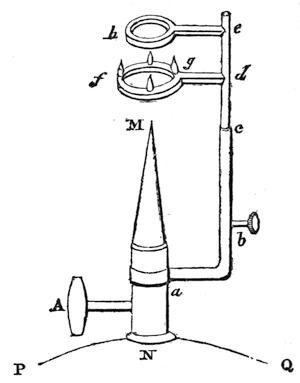
Having thus obtained the means of illuminating any apartment with yellow light, let the exhibition be made in a room with furniture of various bright colours, with oil or water-coloured paintings on the wall. The party which is to witness the experiment should be dressed in a diversity of the gayest colours; and the brightest-coloured flowers and highly-coloured drawings should be placed on the tables. The room being at first lighted with ordinary lights, the bright and gay colours of everything that it contains will be finely displayed. If the white lights are now suddenly extinguished, and the yellow lamps lighted, the most appalling metamorphosis will be exhibited. The astonished individuals will no longer be able to recognize each other. All the furniture in the room, and all the objects which it contains, will exhibit only one colour. The flowers will lose their hues. The paintings and drawings will appear as if they were executed in China ink; and the gayest dresses, the brightest scarlets, the purest lilacs, the richest blues, and the most vivid greens, will all be converted into one monotonous yellow. The complexions of the parties, too, will suffer a corresponding change. One pallid, death-like yellow,
---- like the unnatural hue
Which autumn paints upon the perished leaf,
will envelope the young and the old, and the sallow faces will alone escape from the metamorphosis. Each individual derives merriment from the cadaverous appearance of his neighbour, without being sensible that he is himself one of the ghostly assemblage.
If, in the midst of the astonishment which is thus created, the white lights are restored at one end of the room, while the yellow lights are taken to the other end, one side of the dress of every person, namely, that next the white light, will be restored to its original colours, while the other side will retain its yellow hue. One cheek will appear in a state of health and colour, while the other retains the paleness of death; and, as the individuals change their position, they will exhibit the most extraordinary transformations of colour.
If, when all the lights are yellow, beams of white light are transmitted through a number of holes, like those in a sieve, each luminous spot will restore the colour of the dress or furniture upon which it falls, and the nankeen family will appear all mottled over with every variety of tint. If a magic lantern is employed to throw upon the walls or upon the dresses of the company luminous figures of flowers or animals, the dresses will be painted with these figures in the real colour of the dress itself. Those alone who appeared in yellow, and with yellow complexions, will, to a great degree, escape all these singular changes.
If red and blue light could be produced with the same facility and in the same abundance as yellow light, the illumination of the apartment with these lights in succession would add to the variety and wonder of the exhibition. The red light might perhaps be procured in sufficient quantity from the nitrate and other salts of strontian; but it would be difficult to obtain a blue flame of sufficient intensity for the suitable illumination of a large room. Brilliant white lights, however, might be used, having for screens glass troughs containing a mass one or two inches thick of a solution of the ammoniacal carbonate of copper. This solution absorbs all the rays of the spectrum but the blue, and the intensity of the blue light thus produced would increase in the same proportion as the white light employed.
Amongst the numerous experiments with which science astonishes and sometimes even strikes terror into the ignorant, there is none more calculated to produce this effect than that of displaying to the eye in absolute darkness the legend or inscription upon a coin. To do this, take a silver coin (I have always used an old one), and after polishing the surface as much as possible, make the parts of it which are raised rough by the action of an acid, the parts not raised, or those which are to be rendered darkest, retaining their polish. If the coin thus prepared is placed upon a mass of red-hot iron, and removed into a dark room, the inscription upon it will become less luminous than the rest, so that it may be distinctly read by the spectator. The mass of red-hot iron should be concealed from the observer’s eye, both for the purpose of rendering the eye fitter for observing the effect, and of removing all doubt that the inscription is really read in the dark, that is, without receiving any light, direct or reflected, from any other body. If, in place of polishing the depressed parts and roughening its raised parts, we make the raised parts polished and roughen the depressed parts, the inscription will now be less luminous than the depressed parts, and we shall still be able to read it, from its being as it were written in black letters on a white ground. The first time I made this experiment, without being aware of what would be the result, I used a French shilling of Louis XV., and I was not a little surprised to observe upon its surface, in black letters, the inscription BENEDICTUM SIT NOMEN DEI.
The most surprising form of this experiment is when we use a coin from which the inscription has been either wholly obliterated, or obliterated in such a degree as to be illegible. When such a coin is laid upon the red-hot iron, the letters and figures become oxidated, and the film of oxide radiating more powerfully than the rest of the coin, the illegible inscription may be now distinctly read, to the great surprise of the observer, who had examined the blank surface of the coin previous to its being placed upon the hot iron. The different appearances of the same coin, according as the raised parts are polished or roughened, are shown in Fig. 23 and 24.
In order to explain the cause of these remarkable effects, we must notice a method which has been long known, though never explained, of deciphering the inscriptions on worn-out coins. This is done by merely placing the coin upon a hot iron; an oxidation takes place over the whole surface of the coin, the film of oxide changing its tint with the intensity or continuance of the heat. The parts, however, where the letters of the inscription had existed, oxidate at a different rate from the surrounding parts, so that these letters exhibit their shape, and become legible in consequence of the film of oxide which covers them having a different thickness, and therefore reflecting a different tint from that of the adjacent parts. The tints thus developed sometimes pass through many orders of brilliant colours, particularly pink and green, and settle in a bronze, and sometimes a black tint, resting upon the inscription alone. In some cases the tint left on the trace of the letters is so very faint that it can just be seen, and may be entirely removed by a slight rub of the finger.
Fig. 23.

Fig. 24.
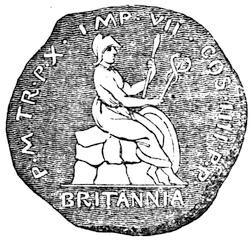
When the experiment is often repeated with the same coin, and the oxidations successively removed after each experiment, the film of oxide continues to diminish, and at last ceases to make its appearance. It recovers the property, however, in the course of time. When the coin is put upon the hot iron, and consequently when the oxidation is the greatest, a considerable smoke arises from the coin, and this diminishes like the film of oxide by frequent repetition. A coin which had ceased to emit this smoke, smoked slightly after having been exposed twelve hours to the air. I have found, from numerous trials, that it is always the raised parts of the coin, and in modern coins the elevated ledge round the inscription, that become first oxidated. In an English shilling of 1816, this ledge exhibited a brilliant yellow tint before it appeared on any other part of the coin.
If we use a uniform and homogeneous disc of silver that has never been hammered or compressed, its surface will oxidate equally, provided all its parts are equally heated. In the process of converting this disc into a coin, the sunk parts have obviously been most compressed by the prominent parts of the die, and the elevated parts least compressed, the metal being in the latter left as it were in its natural state. The raised letters and figures on a coin have therefore less density than the other parts, and these parts oxidate sooner or at a lower temperature. When the letters of the legend are worn off by friction, the parts immediately below them have also less density than the surrounding metal, and the site as it were of the letters therefore receives from heat a degree of oxidation, and a colour different from that of the surrounding surface. Hence we obtain an explanation of the revival of the invisible letters by oxidation.
The same influence of difference of density may be observed in the beautiful oxidations which are produced on the surface of highly-polished steel, heated in contact with air, at temperatures between 430° and 630° of Fahrenheit.13 When the steel has hard portions called pins by the workmen, the uniform tint of the film of oxide stops near these hard portions, which always exhibit colours different from those of the rest of the mass. These parts, on account of their increased density, absorb the oxygen of atmospheric air less copiously than the surrounding portions. Hence we see the cause why steel expanded by heat absorbs oxygen, which when united with the metal, forms the coloured superficial film. As the heat increases, a greater quantity of oxygen is absorbed, and the film increases in thickness.
These observations enable us to explain the legibility of inscriptions in the dark, whether the coin is in a perfect state, or the letters of it worn off. All black or rough surfaces radiate light more copiously than polished or smooth surfaces, and hence the inscription is luminous when it is rough, and obscure when it is polished, and the letters covered with black oxide are more luminous than the adjacent parts, on account of the superior radiation of light by the black oxide which covers them.
By the means now described, invisible writing might be conveyed by impressing it upon a metallic surface, and afterwards erasing it by grinding and polishing that surface perfectly smooth. When exposed to a proper degree of heat, the secret would display itself written in oxidated letters. Many amusing experiments might be made upon the same principle.
A series of curious and sometimes alarming deceptions, arises from the representation of objects in perspective upon a plane surface. One of the most interesting of these depends on the principles which regulate the apparent direction of the eyes in a portrait. Dr. Wollaston has thought this subject of sufficient importance to be treated at some length in the Philosophical Transactions. When we look at any person we direct to them both our face and our eyes, and in this position the circular iris will be in the middle of the white of the eye ball, or, what is the same thing, there will be the same quantity of white on each side of the iris. If the eyes are now moved to either side, while the head remains fixed, we shall readily judge of the change of their direction by the greater or less quantity of white on each side of the iris. This test, however, accurate as it is, enables us only to estimate the extent to which the eyes deviate in direction from the direction of the face to which they belong. But their direction in reference to the person who views them is entirely a different matter; and Dr. Wollaston is of opinion, that we are not guided by the eyes alone, but are unconsciously aided by the concurrent position of the entire face.
Fig. 26.
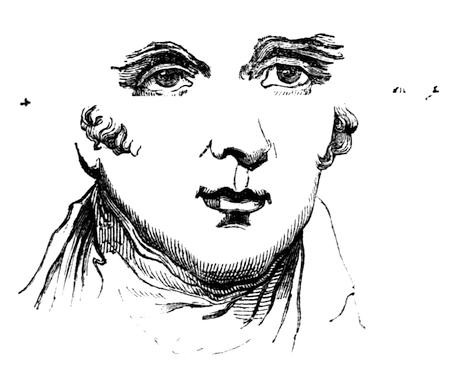
If a skilful painter draws a pair of eyes with great correctness directed to the spectator, and deviating from the general position of the face as much as is usual in good portraits, it is very difficult to determine their direction, and they will appear to have different directions to different persons. But what is very curious, Dr. Wollaston has shown that the same pair of eyes may be made to direct themselves either to or from the spectator by the addition of other features in which the position of the face is changed. Thus, in Fig. 25, the pair of eyes are looking intently at the spectator, and the face has a corresponding direction; but when we cover up the face in Fig. 25 with the face in Fig. 26, which looks to the right, the eyes change their direction, and look to the right also. In like manner, eyes drawn originally to look a little to the right or the left of the spectator, may be made to look directly at him by adding suitable features.
Fig. 25.
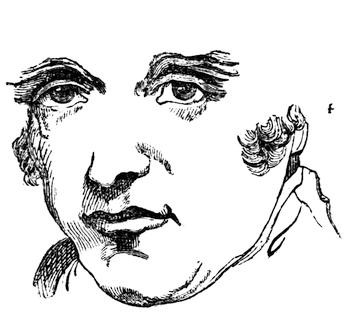
The nose is obviously the principal feature which produces this change of direction, as it is more subject to change of perspective than any of the other features; but Dr. Wollaston has shown by a very accurate experiment, that even a small portion of the nose introduced with the features will carry the eyes along with it. He obtained four exact copies of the same pair of eyes looking at the spectator, by transferring them upon copper from a steel plate, and having added to each of two pair of them a nose, in one case directed to the right, and in the other to the left, and to each of the other two pair a very small portion of the upper part of the nose, all the four pair of eyes lost their front direction, and looked to the right or to the left, according to the direction of the nose, or of the portion of it which was added.
But the effect thus produced is not limited, as Dr. Wollaston remarks, to the mere change in the direction of the eyes, “for a total difference of character may be given to the same eyes by a due representation of the other features. A lost look of devout abstraction in an uplifted countenance, may be exchanged for an appearance of inquisitive archness in the leer of a younger face turned downwards and obliquely towards the opposite side,” as in Fig. 27, 28. This, however, is perhaps not an exact expression of the fact. The new character which is said to be given to the eyes is given only to the eyes in combination with the new features, or, what is probably more correct, the inquisitive archness is in the other features, and the eye does not belie it.
Dr. Wollaston has not noticed the converse of these illusions, in which a change of direction is given to fixed features by a change in the direction of the eyes. This effect is finely seen in some magic lantern sliders, where a pair of eyes is made to move in the head of a figure, which invariably follows the motion of the eyeballs.
Fig. 28.
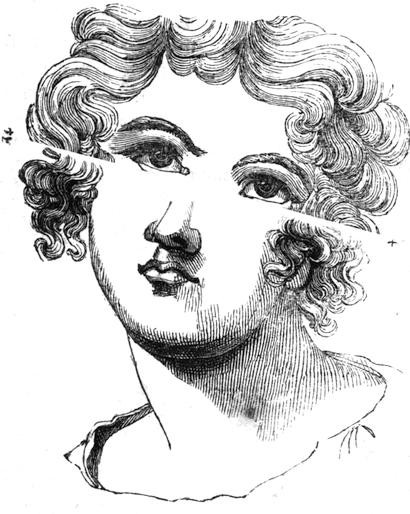
Fig. 27.
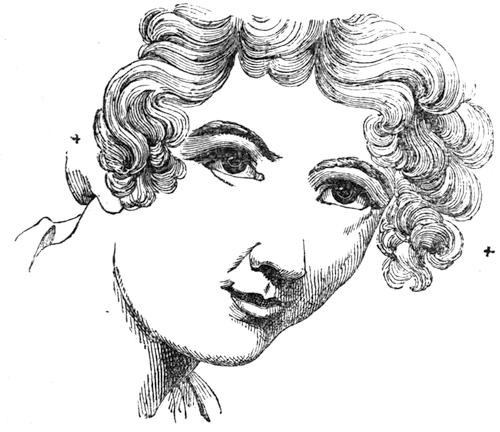
Having thus determined the influence which the general perspective of the face has upon the apparent direction of the eyes in a portrait, Dr. Wollaston applies it to the explanation of the well-known fact, that when the eyes of a portrait look at a spectator in front of it they will follow him, and appear to look at him in every other direction. This curious fact, which has received less consideration than it merits, has been often skilfully employed by the novelist, in alarming the fears or exciting the courage of his hero. On returning to the hall of his ancestors, his attention is powerfully fixed on the grim portraits which surround him. The parts which they have respectively performed in the family history rise to his mind: his own actions, whether good or evil, are called up in contrast, and as the preserver or the destroyer of his line, he stands, as it were, in judgment before them. His imagination, thus excited by conflicting feelings, transfers a sort of vitality to the canvas, and if the personages do not “start from their frames,” they will at least bend upon him their frowns or their approbation. It is in vain that he tries to evade their scrutiny. Wherever he goes their eyes eagerly pursue him; they will seem even to look at him over their shoulders, and he will find it impossible to shun their gaze but by quitting the apartment.
As the spectator in this case changes his position in a horizontal plane, the effect which we have described is accompanied by an apparent diminution in the breadth of the human face, from only seven or eight inches till it disappears at a great obliquity. In moving, therefore, from a front view to the most oblique view of the face, the change in its apparent breadth is so slow that the apparent motion of the head of the figure is scarcely recognized as it follows the spectator. But if the perspective figure has a great breadth in a horizontal plane, such as a soldier firing his musket, an artilleryman his piece of ordnance, a bowman drawing his bow, or a lancer pushing his spear, the apparent breadth of the figure will vary from five to six feet or upwards till it disappears, and therefore the change of apparent magnitude is sufficiently rapid to give the figure the dreaded appearance of turning round, and following the spectator. One of the best examples of this must have been often observed in the foreshortened figure of a dead body lying horizontally, which has the appearance of following the observer with great rapidity, and turning round upon the head as the centre of motion.
The cause of this phenomenon is easily explained. Let us suppose a portrait with its face and its eyes directed straight in front, so as to look at the spectator. Let a straight line be drawn through the tip of the nose and half way between the eyes, which we shall call the middle line. On each side of this middle line there will be the same breadth of head, of cheek, of chin, and of neck, and each iris will be in the middle of the white of the eye. If we now go to one side, the apparent horizontal breadth of every part of the head and face will be diminished, but the parts on each side of the middle line will be diminished equally, and at any position, however oblique, there will be the same breadth of face on each side of the middle line, and the iris will be in the centre of the white of the eyeball, so that the portrait preserves all the characters of a figure looking at the spectator, and must necessarily do so wherever he stands.
This explanation might be illustrated by a picture which represents three artillerymen, each firing a piece of ordnance in parallel directions. Let the gun of the middle one be pointed accurately to the eye of the spectator, so that he sees neither its right side nor its left, nor its upper nor its under side, but directly down its muzzle, so that if there was an opening in the breech he would see through it. In like manner the spectator will see the left side of the gun on his left hand, and the right side of the gun on his right hand. If the spectator now changes his place, and takes ever such an oblique position, either laterally or vertically, he must still see the same thing; because nothing else is presented to his view. The gun of the middle soldier must always point to his eye, and the other guns to the right and left of him. They must therefore all three seem to move as he moves, and follow his eye in all its changes of place. The same observations are of course applicable to buildings and streets seen in perspective.
In common portraits the apparent motion of the head is generally rendered indistinct by the canvas being imperfectly stretched, as the slightest concavity or convexity entirely deforms the face when the obliquity is considerable. The deception is therefore best seen when the painting is executed on a very flat board, and in colours sufficiently vivid to represent every line in the face with tolerable distinctness at great obliquities. This distinctness of outline is indeed necessary to a satisfactory exhibition of this optical illusion. The most perfect exhibition, indeed, that I ever saw of it was in the case of a painting of a ship upon a sign-board executed in strongly gilt lines. It contained a view of the stern and side of a ship in the stocks, and, owing to the flatness of the board and the brightness of the lines, the gradual development of the figure, from the most violent foreshortening at great obliquities till it attained its perfect form, was an effect which surprised every person that saw it.
Fig. 29.
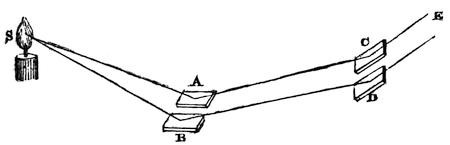
The only other optical illusion which our limits will permit us to explain, is the very remarkable experiment of what may be truly called breathing light or darkness. Let S be a candle whose light falls at an angle of 56° 45´ upon two glass plates A, B, placed close to each other, and let the reflected rays AC, BD, fall at the same angle upon two similar plates, C, D, but so placed that the plane of reflexion from the latter is at right angles to the plane of reflexion from the former. An eye placed at E, and looking at the same time into the two plates C and D, will see very faint images of the candle S, which by a slight adjustment of the plates, may be made to disappear almost wholly allowing the plate C to remain as it is, change the position of D, till its inclination to the ray BD is diminished about 3°, or made nearly 53° 11´. When this is done, the image that had disappeared on looking into D will be restored, so that the spectator at E, upon looking into the two mirrors C, D, will see no light in C, because the candle has nearly disappeared, while the candle is distinctly seen in D. If, while the spectator is looking into these two mirrors, either he or another person breathes upon them gently and quickly, the breath will revive the extinguished image in C, and will extinguish the visible image in D. The following is the cause of this singular result. The light AC, BD, is polarized by reflexion from the plates A, B, because it is incident at the polarizing angle of 56° 45´ for glass. When we breathe upon the plates C, D, we form upon their surface a thin film of water, whose polarizing angle is 53° 11´, so that if the polarized rays AC, BD, fell upon the plates C, D, at an angle of 53° 11´, the candle from which they proceeded would not be visible, or they would not suffer reflexion from the plates C, D. At all other angles the light would be reflected and the candles visible. Now the plate D is placed at an angle of 53° 11´ and C at an angle of 56° 45´, so that when a film of water is breathed upon them the light will be reflected from the latter, and none from the former; that is, the act of breathing upon the plates will restore the invisible and extinguish the visible image.
11 A single convex lens will answer the purpose, provided we hold the eye six or eight inches behind the image of the seal formed in its conjugate focus.
12 See Edinburgh Transactions, vol. ix., p. 435.
13 See Edinburgh Encyclopædia, Art. Steel, vol. xviii., p. 387.
LETTER VI.
Natural phenomena marked with the marvellous—Spectre of the Brocken described—Analogous phenomena—Aërial spectres seen in Cumberland—Fata Morgana in the Straits of Messina—Objects below the horizon raised and magnified by refraction—Singular example seen at Hastings—Dover Castle seen through the hill on which it stands—Erect and inverted images of distant ships seen in the air—Similar phenomena seen in the Arctic regions—Enchanted coast—Mr. Scoresby recognizes his father’s ship by its aërial image—Images of cows seen in the air—Inverted image of horses seen in South America—Lateral images produced by refraction—Aërial spectres by reflexion—Explanation of the preceding phenomena.
Among the wonders of the natural world which are every day presented to us, without either exciting our surprise or attracting our notice, some are occasionally displayed which possess all the characters of supernatural phenomena. In the names by which they are familiarly known, we recognize the terror which they inspired, and even now, when science has reduced them to the level of natural phenomena, and developed the causes from which they arise, they still retain their primitive importance, and are watched by the philosopher with as intense an interest as when they were deemed the immediate effects of Divine power. Among these phenomena we may enumerate the Spectre of the Brocken, the Fata Morgana of the Straits of Messina, the Spectre Ships which appear in the air, and the other extraordinary effects of the Mirage.14
The Brocken is the name of the loftiest of the Hartz mountains, a picturesque range which lies in the kingdom of Hanover. It is elevated 3,300 feet above the sea, and commands the view of a plain seventy leagues in extent, occupying nearly the two-hundredth part of the whole of Europe, and animated with a population of above five millions of inhabitants. From the earliest periods of authentic history, the Brocken has been the seat of the marvellous. On its summits are still seen huge blocks of granite called the Sorcerer’s Chair and the Altar. A spring of pure water is known by the name of the Magic Fountain, and the Anemone of the Brocken is distinguished by the title of the Sorcerer’s Flower. These names are supposed to have originated in the rites of the great idol Cortho, whom the Saxons worshipped in secret on the summit of the Brocken, when Christianity was extending her benignant sway over the subjacent plains.
As the locality of these idolatrous rites, the Brocken must have been much frequented, and we can scarcely doubt that the spectre which now so often haunts it at sunrise must have been observed from the earliest times; but it is nowhere mentioned that this phenomenon was in any way associated with the objects of their idolatrous worship. One of the best accounts of the spectre of the Brocken is that which is given by M. Haue, who saw it on the 23rd of May, 1797. After having been on the summit of the mountain no less than thirty times, he had at last the good fortune of witnessing the object of his curiosity. The sun rose about four o’clock in the morning through a serene atmosphere. In the south-west, towards Achtermannshohe, a brisk west wind carried before it the transparent vapours, which had not yet been condensed into thick heavy clouds. About a quarter past four he went towards the inn, and looked round to see whether the atmosphere would afford him a free prospect towards the south-west, when he observed at a very great distance, towards Achtermannshohe, a human figure of a monstrous size. His hat having been almost carried away by a violent gust of wind, he suddenly raised his hand to his head to protect his hat, and the colossal figure did the same. He immediately made another movement by bending his body,—an action which was repeated by the spectral figure. M. Haue was desirous of making further experiments, but the figure disappeared. He remained, however, in the same position, expecting its return, and in a few minutes it again made its appearance on the Achtermannshohe, when it mimicked his gestures as before. He then called the landlord of the inn, and having both taken the same position which he had before, they looked towards the Achtermannshohe, but saw nothing. In a very short space of time, however, two colossal figures were formed over the above eminence, and after bending their bodies and imitating the gestures of the two spectators, they disappeared. Retaining their position, and keeping their eyes still fixed upon the same spot, the two gigantic spectres again stood before them, and were joined by a third. Every movement that they made was imitated by the three figures, but the effect varied in its intensity, being sometimes weak and faint, and at other times strong and well defined.
Fig. 30.
In the year 1798, M. Jordan saw the same phenomenon at sunrise, and under similar circumstances, but with less distinctness, and without any duplication of the figures.15
Phenomena perfectly analogous to the preceding, though seen under less imposing circumstances, have been often witnessed. When the spectator sees his own shadow opposite to the sun upon a mass of thin fleecy vapour passing near him, it not only imitates all his movements, but its head is distinctly encircled with a halo of light. The aërial figure is often not larger than life, its size and its apparent distance depending, as we shall afterwards see, upon particular causes. I have often seen a similar shadow when bathing in a bright summer’s day in an extensive pool of deep water. When the fine mud deposited at the bottom of the pool is disturbed by the feet of the bather, so as to be disseminated through the mass of water in the direction of his shadow, his shadow is no longer a shapeless mass formed upon the bottom, but is a regular figure formed upon the floating particles of mud, and having the head surrounded with a halo, not only luminous, but consisting of distinct radiations.
One of the most interesting accounts of aërial spectres with which we are acquainted has been given by Mr. James Clarke, in his Survey of the Lakes of Cumberland, and the accuracy of this account was confirmed by the attestations of two of the persons by whom the phenomena were first seen. On a summer’s evening, in the year 1743, when Daniel Stricket, servant to John Wren, of Wilton Hall, was sitting at the door along with his master, they saw the figure of a man with a dog pursuing some horses along Souterfell-side, a place so extremely steep, that a horse could scarcely travel upon it at all. The figures appeared to run at an amazing pace, till they got out of sight at the lower end of the Fell. On the following morning, Stricket and his master ascended the steep side of the mountain, in the full expectation of finding the man dead, and of picking up some of the shoes of the horses, which they thought must have been cast while galloping at such a furious rate. Their expectations, however, were disappointed. No traces, either of man or horse, could be found, and they could not even discover upon the turf the single mark of a horse’s hoof. These strange appearances seen at the same time by two different persons in perfect health, could not fail to make a deep impression on their minds. They at first concealed what they had seen, but they at length disclosed it, and were laughed at for their credulity.
In the following year, on the 23rd June, 1744, Daniel Stricket, who was then servant to Mr. Lancaster, of Blakehills, (a place near Wilton Hall, and both of which places are only about half a mile from Souterfell,) was walking, about seven o’clock in the evening, a little above the house, when he saw a troop of horsemen riding on Souterfell-side, in pretty close ranks, and at a brisk pace. Recollecting the ridicule that had been cast upon him the preceding year, he continued to observe the figures for some time in silence; but being at last convinced that there could be no deception in the matter, he went to the house, and informed his master that he had something curious to show him. They accordingly went out together; but before Stricket had pointed out the place, Mr. Lancaster’s son had discovered the aërial figures. The family was then summoned to the spot, and the phenomena were seen alike by them all. The equestrian figures seemed to come from the lowest parts of Souterfell, and became visible at a place called Knott. They then advanced in regular troops along the side of the Fell, till they came opposite to Blakehills, when they went over the mountain, after describing a kind of curvilineal path. The pace at which the figures moved was a regular swift walk, and they continued to be seen for upwards of two hours, the approach of darkness alone preventing them from being visible. Many troops were seen in succession; and frequently the last but one in a troop quitted his position, galloped to the front, and took up the same pace with the rest. The changes in the figures were seen equally by all the spectators, and the view of them was not confined to the farm of Blakehills only, but they were seen by every person at every cottage within the distance of a mile, the number of persons who saw them amounting to about twenty-six. The attestation of these facts, signed by Lancaster and Stricket, bears the date of the 21st July, 1785.
These extraordinary sights were received not only with distrust, but with absolute incredulity. They were not even honoured with a place in the records of natural phenomena, and the philosophers of the day were neither in possession of analogous facts, nor were they acquainted with those principles of atmospherical refraction upon which they depend. The strange phenomena, indeed, of the Fata Morgana, or the Castles of the Fairy Morgana, had been long before observed, and had been described by Kircher in the 17th century, but they presented nothing so mysterious as the aërial troopers of Souterfell; and the general characters of the two phenomena were so unlike, that even a philosopher might have been excused for ascribing them to different causes.
This singular exhibition has been frequently seen in the straits of Messina, between Sicily and the coast of Italy, and whenever it takes place, the people, in a state of exultation, as if it were not only a pleasing but a lucky phenomenon, hurry down to the sea, exclaiming Morgana, Morgana! When the rays of the rising sun form an angle of 45° on the sea of Reggio, and when the surface of the water is perfectly unruffled, either by the wind or the current, a spectator placed upon an eminence in the city, and having his back to the sun and his face to the sea, observes upon the surface of the water superb palaces, with their balconies and windows, lofty towers, herds and flocks grazing in wooded valleys and fertile plains; armies of men on horseback and on foot, with multiplied fragments of buildings, such as columns, pilasters, and arches. These objects pass rapidly in succession along the surface of the sea during the brief period of their appearance. The various objects thus enumerated are pictures of palaces and buildings actually existing on shore, and the living objects are of course only seen when they happen to form a part of the general landscape.
If, at the time that these phenomena are visible, the atmosphere is charged with vapour or dense exhalations, the same objects which are depicted upon the sea will be seen also in the air, occupying a space which extends from the surface to the height of twenty-five feet. These images, however, are less distinctly delineated than the former.
If the air is in such a state as to deposit dew, and is capable of forming the rainbow, the objects will be seen only on the surface of the sea; but they all appear fringed with red, yellow, and blue light, as if they were seen through a prism.
In our own country, and in our own times, facts still more extraordinary have been witnessed. From Hastings, on the coast of Sussex, the cliffs on the French coast are fifty miles distant, and they are actually hid by the convexity of the earth; that is, a straight line drawn from Hastings to the French coast would pass through the sea. On Wednesday, the 26th of July, 1798, about five o’clock in the afternoon, Mr. Latham, a Fellow of the Royal Society, then residing at Hastings, was surprised to see a crowd of people running to the sea-side. Upon inquiry into the cause of this, he learned that the coast of France could be seen by the naked eye, and he immediately went down to witness so singular a sight. He distinctly saw the cliffs extending for some leagues along the French coast, and they appeared as if they were only a few miles off. They gradually appeared more and more elevated, and seemed to approach nearer to the eye. The sailors with whom Mr. Latham walked along the waters edge were at first unwilling to believe in the reality of the appearance; but they soon became so thoroughly convinced of it, that they pointed out and named to him the different places which they had been accustomed to visit, and which they conceived to be as near as if they were sailing at a small distance into the harbour. These appearances continued for nearly an hour, the cliffs sometimes appearing brighter and nearer, and at other times fainter and more remote. Mr. Latham then went upon the eastern cliff or hill, which is of considerable height, when, as he remarks, a most beautiful scene presented itself to his view. He beheld at once Dungeness, Dover cliffs, and the French coast all along from Calais, Boulogne, &c., to St. Vallery, and, as some of the fishermen affirmed, as far west as Dieppe. With the help of a telescope, the French fishing-boats were plainly seen at anchor, and the different colours of the land upon the heights, together with the buildings, were perfectly discernible. Mr. Latham likewise states that the cape of land called Dungeness, which extends nearly two miles into the sea, and is about sixteen miles in a straight line from Hastings, appeared as if quite close to it, and the vessels and fishing-boats which were sailing between the two places appeared equally near, and were magnified to a high degree. These curious phenomena continued “in the highest splendour” till past eight o’clock, although a black cloud had for some time totally obscured the face of the sun.
A phenomenon no less marvellous was seen by Professor Vince, of Cambridge, and another gentleman, on the 6th of August, 1806, at Ramsgate. The summits v w x y of the four turrets of Dover Castle are usually seen over the hill AB, upon which it stands, lying between Ramsgate and Dover; but on the day above-mentioned, at seven o’clock in the evening, when the air was very still and a little hazy, not only were the tops v w x y of the four towers of Dover Castle seen over the adjacent hill AB, but the whole of the Castle, m n r s, appeared as if it were situated on the side of the hill next Ramsgate, and rising above the hill as much as usual. This phenomenon was so very singular and unexpected, that at first sight Dr. Vince thought it an illusion; but upon continuing his observations, he became satisfied that it was a real image of the Castle. Upon this he gave a telescope to a person present, who, upon attentive examination, saw also a very clear image of the Castle as the Doctor had described it. He continued to observe it for about twenty minutes, during which time the appearance remained precisely the same; but rain coming on, they were prevented from making any further observations. Between the observers and the land from which the hill rises there was about six miles of sea, and from thence to the top of the hill there was about the same distance. Their own height above the surface of the water was about seventy feet.
Fig. 31.
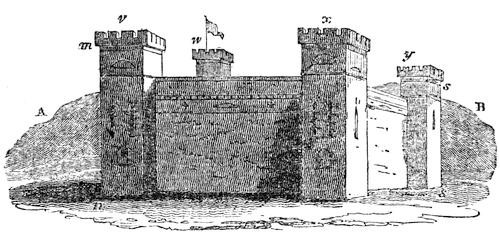
This illusion derived great force from the remarkable circumstance, that the hill itself did not appear through the image, as it might have been expected to do. The image of the castle was very strong and well defined, and though the rays from the hill behind it must undoubtedly have come to the eye, yet the strength of the image of the castle so far obscured the background, that it made no sensible impression on the observers. Their attention was of course principally directed to the image of the castle; but if the hill behind had been at all visible, Dr. Vince conceives that it could not have escaped their observation, as they continued to look at it for a considerable time with a good telescope.
Fig. 32.
Hitherto our aërial visions have been seen only in their erect and natural positions, either projected against the ground or elevated in the air; but cases have occurred in which both erect and inverted images of objects have been seen in the air, sometimes singly, sometimes combined, sometimes when the real object was invisible, and sometimes when a part of it had begun to show itself to the spectator.
In the year 1793, Mr. Huddart, when residing at Allonby, in Cumberland, perceived the inverted image of a ship beneath the image, as shown in Fig. 32; but Dr. Vince, who afterwards observed this phenomenon under a greater variety of forms, found that the ship, which was here considered the real one, was only an erect image of the real ship, which was at that time beneath the horizon, and wholly invisible.
Fig. 33.
In August, 1798, Dr. Vince observed a great variety of these aërial images of vessels approaching the horizon. Sometimes there was seen only one inverted image above the real ship, and this was generally the case when the real ship was full in view. But when the real ship was just begin beginning to show its top-mast above the horizon, as at A, Fig. 33, two aërial images of it were seen, one at B inverted, and the other in its natural position at C. In this case the sea was distinctly visible between the erect and inverted images, but in other cases the hull of the one image was immediately in contact with the hull of the other.
Analogous phenomena were seen by Captain Scoresby when navigating with the ship Baffin the icy sea in the immediate neighbourhood of West Greenland. On the 28th of June, 1820, he observed about eighteen sail of ships at the distance of ten or fifteen miles. The sun had shone during the day without the interposition of a cloud, and its rays were peculiarly powerful. The intensity of its light occasioned a painful sensation in the eyes, while its heat softened the tar in the rigging of the ship, and melted the snow on the surrounding ice with such rapidity that pools of fresh water were formed on almost every place, and thousands of rills carried the excess into the sea. There was scarcely a breath of wind: the sea was as smooth as a mirror. The surrounding ice was crowded together, and exhibited every variety, from the smallest lumps to the most magnificent sheets. Bears traversed the fields and floes in unusual numbers, and many whales sported in the recesses and openings among the drift ice. About six in the evening, a light breeze at N.W. having sprung up, a thin stratus or “fog bank,” at first considerably illuminated by the sun, appeared in the same quarter, and gradually rose to the altitude of about a quarter of a degree. At this time most of the ships navigating at the distance of ten or fifteen miles began to change their form and magnitude, and when examined by a telescope from the mast-head, exhibited some extraordinary appearances, which differed at almost every point of the compass. One ship had a perfect image, as dark and distinct as the original, united to its mast-head in a reverse position. Two others presented two distinct inverted images in the air, one of them a perfect figure of the original, and the other wanting the hull. Two or three more were strangely distorted, their masts appearing of at least twice their proper height, the top-gallant mast forming one-half of the total elevation; and other vessels exhibited an appearance totally different from all the preceding, being as it were compressed, in place of elongated. Their masts seemed to be scarcely one-half of their proper altitude, in consequence of which one would have supposed that they were greatly heeled-to one side, or in the position called careening. Along with all the images of the ships a reflexion of the ice, sometimes in two strata, also appeared in the air, and these reflexions suggested the idea of cliffs composed of vertical columns of alabaster.
On the 15th, 16th, and 17th of the same month, Mr. Scoresby observed similar phenomena, sometimes extending continuously through half the circumference of the horizon, and at other times appearing only in detached spots in various quarters. The inverted images of distant vessels were often seen in the air, while the ships themselves were far beyond the reach of vision. Some ships were elevated to twice their proper height, while others were compressed almost to a line. Hummocks of ice were surprisingly enlarged, and every prominent object in a proper position was either magnified or distorted.
But of all the phenomena witnessed by Mr. Scoresby, that of the Enchanted Coast, as it may be called, must have been the most remarkable. This singular effect was seen on the 18th of July, when the sky was clear, and a tremulous and perfectly transparent vapour was particularly sensible and profuse: at nine o’clock in the morning, when the phenomenon was first seen, the thermometer stood at 42° Fahr.; but in the preceding evening it must have been greatly lower, as the sea was in many places covered with a considerable pellicle of new ice,—a circumstance, which, in the very warmest time of the year, must be considered as quite extraordinary, especially when it is known that 10° farther to the north no freezing of the sea at this season had ever before been observed. Having approached on this occasion so near the unexplored shore of Greenland that the land appeared distinct and bold, Mr. Scoresby was anxious to obtain a drawing of it; but on making the attempt he found that the outline was constantly changing, and he was induced to examine the coast with a telescope, and to sketch the various appearances which presented themselves. These are shown, without any regard to their proper order, in Fig. 34, which we shall describe in Mr. Scoresby’s own words: “The general telescopic appearance of the coast was that of an extensive ancient city abounding with the ruins of castles, obelisks, churches, and monuments, with other large and conspicuous buildings. Some of the hills seemed to be surmounted by turrets, battlements, spires, and pinnacles; while others, subjected to one or two reflexions, exhibited large masses of rock, apparently suspended in the air, at a considerable elevation above the actual termination of the mountains to which they referred. The whole exhibition was a grand phantasmagoria. Scarcely was any particular portion sketched before it changed its appearance, and assumed the form of an object totally different. It was perhaps alternately a castle, a cathedral, or an obelisk; then expanding horizontally, and coalescing with the adjoining hills, united the intermediate valleys, though some miles in width, by a bridge of a single arch, of the most magnificent appearance and extent. Notwithstanding these repeated changes, the various figures represented in the drawing had all the distinctness of reality; and not only the different strata, but also the veins of the rocks, with the wreaths of snow occupying ravines and fissures, form sharp and distinct lines, and exhibited every appearance of the most perfect solidity.”
Fig. 34.
One of the most remarkable facts respecting aërial images presented itself to Mr. Scoresby in a later voyage which he performed to the coast of Greenland in 1822. Having seen an inverted image of a ship in the air, he directed to it his telescope; he was able to discover it to be his father’s ship, which was at the time below the horizon. “It was,” says he, “so well defined, that I could distinguish by a telescope every sail, the general rig of the ship, and its particular character; insomuch, that I confidently pronounced it to be my father’s ship, the Fame, which it afterwards proved to be; though, on comparing notes with my father, I found that our relative position, at the time, gave a distance from one another very nearly thirty miles, being about seventeen miles beyond the horizon, and some leagues beyond the limit of direct vision. I was so struck with the peculiarity of the circumstance, that I mentioned it to the officer of the watch, stating my full conviction that the Fame was then cruising in the neighbouring inlet.”
Several curious effects of the mirage were observed by Baron Humboldt during his travels in South America. When he was residing at Cumana, he frequently saw the islands of Picuita and Boracha suspended in the air, and sometimes with an inverted image. On one occasion he observed small fishing-boats swimming in the air, during more than three or four minutes, above the well-defined horizon of the sea; and when they were viewed through a telescope, one of the boats had an inverted image accompanying it in its movements. This distinguished traveller observed similar phenomena in the barren steppes of the Caraccas, and on the borders of the Orinoco, where the river is surrounded by sandy plains. Little hills and chains of hills appeared suspended in the air, when seen from the steppes, at three or four leagues’ distance. Palm-trees standing single in the Llanos appeared to be cut off at bottom, as if a stratum of air separated them from the ground; and, as in the African desert, plains destitute of vegetation appeared to be rivers or lakes. At the Mesa de Pavona M. Humboldt and M. Bonpland saw cows suspended in the air at the distance of 1000 toises, and having their feet elevated 3’ 20” above the soil. In this case the images were erect, but the travellers learned from good authority that inverted images of horses had been seen suspended in the air near Calabozo.
In all these cases of aërial spectres, the images were directly above the real object; but a curious case was observed by Messrs. Jurine and Soret on the 17th September, 1818, where the image of the vessel was on one side of the real one. About 10 P.M. a barque at the distance of about 4000 toises from Bellerive, on the lake of Geneva, was seen approaching to Geneva by the left bank of the lake, and at the same time an image of the sails was observed above the water, which, instead of following the direction of the barque, separated from it, and appeared to approach Geneva by the right bank of the lake, the image moving from east to west, while the barque moved from north to south. When the image first separated from the barque they had both the same magnitude, but the image diminished as it receded from it, and was reduced to one-half when the phenomenon disappeared.
A very unusual example of aërial spectres occurred to Dr. A. P. Buchan while walking on the cliff about a mile to the east of Brighton, on the morning of the 28th of November, 1804. “While watching the rising of the sun,” says he, “I turned my eyes directly towards the sea, just as the solar disk emerged from the surface of the water, and saw the face of the cliff on which I was standing represented precisely opposite to me at some distance on the ocean. Calling the attention of my companion to this appearance, we discerned our own figures standing on the summit of the apparent opposite cliff, as well as the representation of the windmill near at hand.
“The reflected images were most distinct precisely opposite to where we stood, and the false cliff seemed to fade away, and to draw near to the real one, in proportion as it receded towards the west. This phenomenon lasted about ten minutes, or till the sun had risen nearly his own diameter above the surface of the ocean. The whole then seemed to be elevated into the air, and successively disappeared, giving an impression very similar to that which is produced by the drawing up of a drop-scene in a theatre. The horizon was cloudy, or perhaps it might with more propriety be said that the surface of the sea was covered with a dense fog of many yards in height, and which gradually receded before the rays of the sun.”
An illusion of a different kind, though not less interesting, is described by the Rev. Mr. Hughes in his Travels in Greece, as seen from the summit of Mount Ætna. “I must not forget to mention,” says he, “one extraordinary phenomenon, which we observed, and for which I have searched in vain for a satisfactory solution. At the extremity of the vast shadow which Ætna projects across the island, appeared a perfect and distinct image of the mountain itself elevated above the horizon, and diminished as if viewed in a concave mirror. Where or what the reflector could be which exhibited this image, I cannot conceive; we could not be mistaken in its appearance, for all our party observed it, and we had been prepared for it beforehand by our Catanian friends. It remained visible about ten minutes, and disappeared as the shadow decreased. Mr. Jones observed the same phenomenon, as well as some other friends with whom I conversed upon the subject in England.”
It is impossible to study the preceding phenomena without being impressed with the conviction, that nature is full of the marvellous, and that the progress of science and the diffusion of knowledge are alone capable of dispelling the fears which her wonders must necessarily excite even in enlightened minds. When a spectre haunts the couch of the sick, or follows the susceptible vision of the invalid, a consciousness of indisposition divests the apparition of much of its terror, while its invisibility to surrounding friends soon stamps it with the impress of a false perception. The spectres of the conjuror, too, however skilfully they may be raised, quickly lose their supernatural character; and even the most ignorant beholder regards the modern magician as but an ordinary man, who borrows from the sciences the best working implements of his art. But when, in the midst of solitude, and in situations where the mind is undisturbed by sublunary cares, we see our own image delineated in the air, and mimicking in gigantic perspective the tiny movements of humanity;—when we see troops in military array performing their evolutions on the very face of an almost inaccessible precipice—when, in the eye of day, a mountain seems to become transparent, and exhibits on one side of it a castle which we know to exist only on the other; when distant objects, concealed by the roundness of the earth, and beyond the cognisance of the telescope, are actually transferred over the intervening convexity and presented in distinct and magnified outline to our accurate examination;—when such varied and striking phantasms are seen also by all around us, and therefore appear in the character of real phenomena of nature, our impressions of supernatural agency can only be removed by a distinct and satisfactory knowledge of the causes which gave them birth.
It is only within the last forty years that science has brought these atmospherical spectres within the circle of her dominion; and not only are all their phenomena susceptible of distinct explanation, but we can even reproduce them on a small scale with the simplest elements of our optical apparatus.
Fig. 35.
In order to convey a general idea of the causes of these phenomena, let ABCD, Fig. 35, be a glass trough filled with water, and let a small ship be placed at S. An eye situated about E, will see the top-mast of the ship S, directly through the plate of glass BD. Fix a convex lens a of short focus upon the plate of glass BD, and a little above a straight line SE joining the ship and the eye; and immediately above the convex lens a place a concave one b. The eye will now see, through the convex lens a, an inverted image of the ship at S´, and through the concave lens b, an erect image of the ship at S´´, representing in a general way the phenomena shown in Fig. 33. But it will be asked, where are the lenses in nature to produce these effects? This question is easily answered. If we take a tin tube with glass plates at each end, and fill it with water, and if we cool it on the outside with ice, it will act like a concave lens when the cooling effect has reached the axis; and, on the other hand, if we heat the same tube filled with water, on the outside, it will act as a convex glass. In the first case the density of the water diminishes towards the centre, and in the second it increases towards the centre. The very same effects are produced in the air, only a greater tract of air is necessary for showing the effect produced, by heating and cooling it unequally. If we now remove the lenses a, b, and hold a heated iron horizontally above the water in the trough ABC, the heat will gradually descend, expanding or rendering rarer the upper portions of the fluid. If, when the heat has reached within a little of the bottom, we look through the trough at the ship S in the direction ES´, we shall see an inverted image at S´, and an erect one at S´´; and if we hide from the eye at E all the ship S, excepting the top-mast, we shall have an exact representation of the phenomenon in Fig. 33. The experiment will succeed better with oil in place of water; and the same result may be obtained without heat, by pouring clear syrup into the glass trough till it is nearly one-third full, and then filling it up with water. The water will gradually incorporate with the syrup, and produce, as Dr. Wollaston has shown, a regular gradation of density, diminishing from that of the pure syrup to that of the pure water. Similar effects may be obtained by using masses of transparent solids, such as glass, rock-salt, &c.
Now it is easy to conceive how the changes of density which we can thus produce artificially may be produced in nature. If, in serene weather, the surface of the sea is much colder than the air of the atmosphere, as it frequently is, and as it was to a very great degree during the phenomena described by Mr. Scoresby, the air next the sea will gradually become colder and colder, by giving out its heat to the water; and the air immediately above will give out its heat to the cooler air immediately below it, so that the air from the surface of the sea, to a considerable height upwards, will gradually diminish in density, and therefore must produce the very phenomena we have described.
Fig. 36.
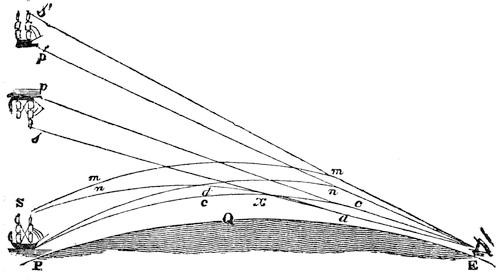
The phenomenon of Dover Castle seen on the Ramsgate side of the hill, was produced by the air being more dense near the ground and above the sea than at greater heights, and hence the rays proceeding from the castle reached the eye in curve lines, and the cause of its occupying its natural position on the hill, and not being seen in the air, was that the top of the hill itself, in consequence of being so near the castle, suffered the same change from the varying density of the air, and therefore the castle and the hill were equally elevated and retained their relative positions. The reason why the image of the castle and hill appeared erect was, that the rays from the top and bottom of the castle had not crossed before they reached Ramsgate; but as they met at Ramsgate, an eye at a greater distance from the castle, and in the path of the rays, would have seen the image inverted. This will be better understood from the preceding diagram, which represents the actual progress of the rays, from a ship SP, concealed from the observer at E by the convexity of the earth PQE. A ray proceeding from the keel of the ship P is refracted into the curve line P c x c E, and a ray proceeding from the top-mast S, is refracted in the direction S d x d E, the two rays crossing at x, and proceeding to the eye E with the ray from the keel P uppermost; hence the ship must appear inverted as at s p. Now if the eye E of the observer had been placed nearer the ship as at x, before the rays crossed, as was the case at Ramsgate, it would have seen an erect image of the ship raised a little above the real ship SP. Rays S m, S n, proceeding higher up in the air, are refracted in the directions S m m E, S n n E, but do not cross before they reach the eye, and therefore they afford the erect image of the ship shown at s´ p´.
The aërial troopers seen at Souterfell were produced by the very same process as the spectre of Dover Castle, having been brought by unequal refraction from one side of the hill to the other. It is not our business to discover how a troop of soldiers came to be performing their evolutions on the other side of Souterfell; but if there was then no road along which they could be marching, it is highly probable that they were troops exercising among the hills in secret, previously to the breaking out of the rebellion in 1745.
The image of the Genevese barque which was seen sailing at a distance from the real one, arose from the same cause as the images of ships in the air; with this difference only, that in this case the strata of equal density were vertical or perpendicular to the water, whereas, in the former cases they were horizontal or parallel to the water. The state of the air which produced the lateral image may be produced by a headland or island, or even rocks, near the surface, and covered with water. These headlands, islands, or sunken rocks being powerfully heated by the sun in the daytime, will heat the air immediately above them, while the adjacent air over the sea will retain its former coolness and density. Hence there will necessarily arise a gradation of density varying in the same horizontal direction, or where the lines of equal density are vertical. If we suppose the very same state of the air to exist in a horizontal plane which exists in a vertical plane, in Fig. 36, then the same images would be seen in a horizontal line, viz., an inverted one at s p, and an erect one at s´p´. In the case of the Genevese barque, the rays had not crossed before they reached the eye, and therefore the image was an erect one. Had the real Genevese barque been concealed by some promontory or other cause from the observation of Messrs. Jurine and Soret, they might have attached a supernatural character to the spectral image, especially if they had seen it gradually decay, and finally disappear on the still and unbroken surface of the lake. No similar fact had been previously observed, and there were no circumstances in the case to have excited the suspicion that it was the spectre of a real vessel produced by unequal refraction.
The spectre of the Brocken and other phenomena of the same kind, have essentially a different origin from those which arise from unequal refraction. They are merely shadows of the observer projected on dense vapour or thin fleecy clouds, which have the power of reflecting much light. They are seen most frequently at sunrise, because it is at that time that the vapours and clouds necessary for their production are most likely to be generated; and they can be seen only when the sun is throwing his rays horizontally, because the shadow of the observer would otherwise be thrown either up in the air, or down upon the ground. If there are two persons looking at the phenomenon, as when M. Haue and the landlord saw it together, each observer will see his own image most distinctly, and the head will be more distinct than the rest of the figure, because the rays of the sun will be more copiously reflected at a perpendicular incidence: and as, from this cause, the light reflected from the vapour or cloud becomes fainter farther from the shadow, the appearance of a halo round the head of the observer is frequently visible. M. Haue mentions the extraordinary circumstance of the two spectres of him and the landlord being joined by a third figure, but he unfortunately does not inform us which of the two figures was doubled, for it is impossible that a person could have joined their party unobserved. It is very probable that the new spectre forms a natural addition to the group, as we have represented it in Fig. 30; and, if this was the case, it could only have been produced by a duplication of one of the figures produced by unequal refraction.
The reflected spectre of Dr. Buchan standing upon the cliff at Brighton, arose from a cause to which we have not yet adverted. It was obviously no shadow, for it is certain, from the locality, that the rays of the sun fell upon the face of the cliff and upon his person at an angle of about 73° from the perpendicular, so as to illuminate them strongly. Now, there are two ways in which such an image may have been reflected, namely, either from strata of air of variable density, or from a vertical stratum of vapour, consisting of exceedingly minute globules of water. Whenever light suffers refraction, either in passing at once from one medium into another, or from one part of the same medium into another of different density, a portion of it suffers reflexion. If an object, therefore, were strongly illuminated, a sufficiently distinct image, or rather shadow of it, might be seen by reflexion from strata of air of different density. As the temperature at which moisture is deposited in the atmosphere varies with the density of the air, then at the same temperature moisture might be depositing in a stratum of one density, while no deposition is taking place in the adjacent stratum of a different density. Hence there would exist, as it were in the air, a vertical wall or stratum of minute globules of water, from the surface of which a sufficiently distinct image of a highly illuminated object might be reflected. That this is possible may be proved by breathing upon glass. If the particles deposited upon the glass are large, then no distinct reflection will take place; but if the particles be very small, we shall see a distinct image formed by the surface of the aqueous film.
The phenomena of the Fata Morgana have been too imperfectly described to enable us to offer a satisfactory explanation of them. The aërial images are obviously those formed by unequal refraction. The pictures seen on the sea may be either the aërial images reflected from its surface, or from a stratum of dense vapour, or they may be the direct reflexions from the objects themselves. The coloured images, as described by Minasi, have never been seen in any analogous phenomena, and require to be better described before they can be submitted to scientific examination.
The representation of ships in the air by unequal refraction has no doubt given rise in early times to those superstitions which have prevailed in different countries respecting “phantom ships,” as Mr. Washington Irving calls them, which always sail in the eye of the wind, and plough their way through the smooth sea, where there is not a breath of wind upon its surface. In his beautiful story of the storm ship, which makes its way up the Hudson against wind and tide, this elegant writer has finely embodied one of the most interesting superstitions of the early American colonists. The Flying Dutchman had, in all probability, a similar origin; and the wizard beacon-keeper of the Isle of France, who saw in the air the vessels bound to the island long before they appeared in the offing, must have derived his power from a diligent observation of the phenomena of nature.
14 In the Sanscrit, says Baron Humboldt, the phenomenon of the Mirage is called Mriga Trichna, “thirst or desire of the antelope,” no doubt because this animal Mriga, compelled by thirst, Trichna, approaches those barren plains where, from the effect of unequal refraction, he thinks he perceives the undulating surface of the waters.—Personal Narrative, vol. iii., p. 554.
15 See J. F. Gmelin’s Gottingischen Journal der Wissenchaften, vol. i., part iii., 1798.
LETTER VII.
Illusions depending on the ear—Practised by the ancients—Speaking and singing heads of the ancients—Exhibition of the Invisible Girl described and explained—Illusions arising from the difficulty of determining the direction of sounds—Singular example of this illusion—Nature of ventriloquism—Exhibitions of some of the most celebrated ventriloquists—M. St. Gille—Louis Brabant—M. Alexandre—Capt. Lyon’s account of Esquimaux ventriloquists.
Next to the eye, the ear is the most fertile source of our illusions, and the ancient magicians seem to have been very successful in turning to their purposes the doctrines of sound. In the Labyrinth of Egypt, which contained twelve palaces and 1500 subterraneous apartments, the gods were made to speak in a voice of thunder; and Pliny, in whose time this singular structure existed, informs us, that some of the palaces were so constructed that their doors could not be opened without permitting the peals of thunder to be heard in the interior. When Darius Hystaspes ascended the throne, and allowed his subjects to prostrate themselves before him as a god, the divinity of his character was impressed upon his worshippers by the bursts of thunder and flashes of lightning which accompanied their devotion. History has of course not informed us how these effects were produced; but it is probable that, in the subterraneous and vaulted apartments of the Egyptian labyrinth, the reverberated sounds arising from the mere opening and shutting of the doors themselves afforded a sufficient imitation of ordinary thunder. In the palace of the Persian king, however, a more artificial imitation is likely to have been employed, and it is not improbable that the method used in our modern theatres was known to the ancients. A thin sheet of iron, three or four feet long, such as that used for German stoves, is held by one corner between the finger and the thumb, and allowed to hang freely by its own weight. The hand is then moved or shaken horizontally, so as to agitate the corner in a direction at right angles to the surface of the sheet. By this simple process a great variety of sounds may be produced, varying from the deep growl of distant thunder to those loud and explosive bursts which rattle in quick succession from clouds immediately over our heads. The operator soon acquires great power over this instrument, so as to be able to produce from it any intensity and character of sound that may be required. The same effect may be produced by sheets of tin-plate, and by thin plates of mica; but, on account of their small size, the sound is shorter and more acute. In modern exhibitions an admirable imitation of lightning is produced by throwing the powder of rosin, or the dust of lycopodium, through a flame; and the rattling showers of rain which accompany these meteors are well imitated by a well-regulated shower of peas.
The principal pieces of acoustic mechanism used by the ancients were speaking or singing heads, which were constructed for the purpose of representing the gods, or of uttering oracular responses. Among these, the speaking head of Orpheus, which uttered its responses at Lesbos, is one of the most famous. It was celebrated not only throughout Greece, but even in Persia; and it had the credit of predicting, in the equivocal language of the heathen oracles, the bloody death which terminated the expedition of Cyrus the Great into Scythia. Odin, the mighty magician of the North, who imported into Scandinavia the magical arts of the East, possessed a speaking head, said to be that of the sage Minos, which he had enchased in gold, and which uttered responses that had all the authority of a divine revelation. The celebrated mechanic Gerbert, who filled the papal chair A.D. 1000, under the name of Sylvester II., constructed a speaking head of brass. Albertus Magnus is said to have executed a head in the thirteenth century, which not only moved but spoke. It was made of earthenware, and Thomas Aquinas is said to have been so terrified when he saw it, that he broke it in pieces; upon which the mechanist exclaimed, “There goes the labour of thirty years!”
It has been supposed by some authors, that in the ancient speaking-machines the deception is effected by means of ventriloquism, the voice issuing from the juggler himself; but it is more probable that the sound was conveyed by pipes from a person in another apartment to the mouth of the figure. Lucian, indeed, expressly informs us, that the impostor Alexander made his figure of Æsculapius speak, by transmitting his voice through the gullet of a crane to the mouth of the statue; and that this method was general appears from a passage in Theodoretus, who assures us, that in the fourth century, when Bishop Theophilus broke to pieces the statues at Alexandria, he found some which were hollow, and which were so placed against a wall, that the priest could conceal himself behind them; and address the ignorant spectators through their mouths.
Even in modern times, speaking-machines have been constructed on this principle. The figure is frequently a mere head placed upon a hollow pedestal, which, in order to promote the deception, contains a pair of bellows, a sounding-board, a cylinder and pipes supposed to represent the organs of speech. In other cases these are dispensed with, and a simple wooden head utters its sounds through a speaking trumpet. At the court of Charles II., this deception was exhibited with great effect by one Thomas Irson, an Englishman; and when the astonishment had become very general, a popish priest was discovered by one of the pages in an adjoining apartment. The questions had been proposed to the wooden figure by whispering into its ear, and this learned personage had answered them all with great ability, by speaking through a pipe in the same language in which the questions were proposed. Professor Beckmann informs us that children and women were generally concealed either in the juggler’s box or in the adjacent apartment, and that the juggler gave them every assistance by means of signs previously agreed upon. When one of these exhibitions was shown at Göttingen, the Professor was allowed, on the promise of secrecy, to witness the process of deception. He saw the assistant in another room, standing before the pipe with a card in his hand, upon which the signs agreed upon had been marked, and he had been introduced so privately into the house that even the landlady was ignorant of his being there.
An exhibition of the very same kind has been brought forward in our own day, under the name of the Invisible Girl; and as the mechanism employed was extremely ingenious, and is well fitted to convey an idea of this class of deceptions, we shall give a detailed description of it.
Fig. 37.
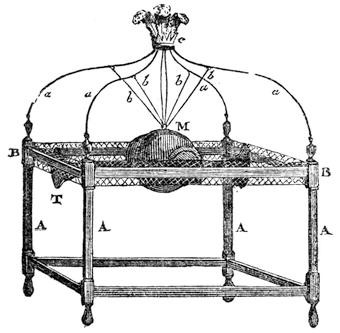
The machinery, as constructed by M. Charles, is shown in fig. 37 in perspective, and a plan of it in Fig. 38. The four upright posts A, A, A, A, are united at top by a cross rail B, B, and by two similar rails at bottom. Four bent wires a, a, a, a, proceeded from the top of these posts, and terminated at c. A hollow copper ball M, about a foot in diameter, was suspended from these wires by four slender ribands b, b, b, b, and into the copper ball were fixed the extremities of four trumpets T, T, T, T, with their mouths outwards.
Fig. 38.
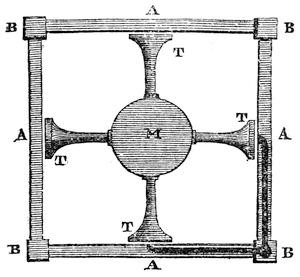
The apparatus now described was all that was visible to the spectator; and though fixed in one spot, yet it had the appearance of a piece of separate machinery, which might have occupied any other part of the room. When one of the spectators was requested by the exhibitor to propose some question, he did it by speaking into one of the trumpets at T. An appropriate answer was then returned from all the trumpets, and the sound issued with sufficient intensity to be heard by an ear applied to any of them, and yet it was so weak that it appeared to come from a person of very diminutive size. Hence the sound was supposed to come from an invisible girl, though the real speaker was a full-grown woman. The invisible lady conversed in different languages, sang beautifully, and made the most lively and appropriate remarks on the persons in the room.
This exhibition was obviously far more wonderful than the speaking heads which we have described, as the latter invariably communicated with a wall, or with a pedestal through which pipes could be carried into the next apartment. But the ball M and its trumpets communicated with nothing through which sound could be conveyed. The spectator satisfied himself by examination that the ribands b, b, were real ribands, which concealed nothing, and which could convey no sound; and as he never conceived that the ordinary piece of frame-work AB could be of any other use than its apparent one of supporting the sphere M, and defending it from the spectators, he was left in utter amazement respecting the origin of the sound, and his surprise was increased by the difference between the sounds which were uttered and those of ordinary speech.
Though the spectators were thus deceived by their own reasoning, yet the process of deception was a very simple one. In two of the horizontal railings A, A, Fig. 38, opposite the trumpet mouths T, there was an aperture communicating with a pipe or tube which went to the vertical post B, and descending it, as shown at TAA, Fig. 39, went beneath the floor f f, in the direction p p, and entered the apartment N, where the invisible lady sat. On the side of the partition about h, there was a small hole through which the lady saw what was going on in the exhibition-room, and communications were no doubt made to her by signals from the person who attended the machine. When one of the spectators asked a question by speaking into one of the trumpets T, the sound was reflected from the mouth of the trumpet back to the aperture at A, in the horizontal rail, Fig. 38, and was distinctly conveyed along the closed tube into the apartment N. In like manner the answer issued from the aperture A, and being reflected back to the ear of the spectator by the trumpet, he heard the sounds with that change of character which they receive when transmitted through a tube and then reflected to the ear.
Fig. 39.
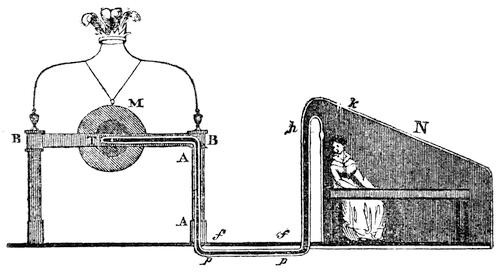
The surprise of the auditors was greatly increased by the circumstance, that an answer was returned to questions put in a whisper, and also by the conviction that nobody but a person in the middle of the audience could observe the circumstances to which the invisible figure frequently adverted.
Although the performances of speaking heads were generally effected by the methods now described, yet there is reason to think that the ventriloquist sometimes presided at the exhibition, and deceived the audience by his extraordinary powers of illusion. There is no species of deception more irresistible in its effects than that which arises from the uncertainty with which we judge of the direction and distance of sounds. Every person must have noticed how a sound in their own ears is often mistaken for some loud noise moderated by the distance from which it is supposed to come; and the sportsman must have frequently been surprised at the existence of musical sounds humming remotely in the extended heath, when it was only the wind sounding in the barrel of his gun. The great proportion of apparitions that haunt old castles and apartments associated with death, exist only in the sounds which accompany them. The imagination even of the boldest inmate of a place hallowed by superstition, will transfer some trifling sound near his own person to a direction and to a distance very different from the truth, and the sound which otherwise might have no peculiar complexion will derive another character from its new locality. Spurning the idea of a supernatural origin, he determines to unmask the spectre, and grapple with it in its den. All the inmates of the house are found to be asleep—even the quadrupeds are in their lair—there is not a breath of wind to ruffle the lake that reflects through the casement the reclining crescent of the night; and the massive walls in which he is enclosed forbid the idea that he has been disturbed by the warping of panelling or the bending of partitions. His search is vain; and he remains master of his own secret, till he has another opportunity of investigation. The same sound again disturbs him, and, modified probably by his own position at the time, it may perhaps appear to come in a direction slightly different from the last. His searches are resumed, and he is again disappointed. If this incident should recur night after night with the same result—if the sound should appear to depend upon his own motions, or be any how associated with himself, with his present feelings, or with his past history, his personal courage will give way; a superstitious dread, at which he himself perhaps laughs, will seize his mind; and he will rather believe that the sounds have a supernatural origin, than that they could continue to issue from a spot where he knows there is no natural cause for their production.
I have had occasion to have personal knowledge of a case much stronger than that which has now been put. A gentleman, devoid of all superstitious feelings, and living in a house free from any gloomy associations, heard night after night in his bed-room a singular noise, unlike any ordinary sound to which he was accustomed. He had slept in the same room for years without hearing it, and he attributed it at first to some change of circumstances in the roof or in the walls of the room, but after the strictest examination no cause could be found for it. It occurred only once in the night; it was heard almost every night, with few interruptions. It was over in an instant, and it never took place till after the gentleman had gone to bed. It was always distinctly heard by his companion, to whose time of going to bed it had no relation. It depended on the gentleman alone, and it followed him into another apartment with another bed, on the opposite side of the house. Accustomed to such investigations, he made the most diligent but fruitless search into its cause. The consideration that the sound had a special reference to him alone, operated upon his imagination, and he did not scruple to acknowledge that the recurrence of the mysterious sound produced a superstitious feeling at the moment. Many months afterwards it was found that the sound arose from the partial opening of the door of a wardrobe which was within a few feet of the gentleman’s head, and which had been taken into the other apartment. This wardrobe was almost always opened before he retired to bed, and the door being a little too tight, it gradually forced itself open with a sort of dull sound, resembling the note of a drum. As the door had only started half an inch out of its place, its change of position never attracted attention. The sound, indeed, seemed to come in a different direction, and from a greater distance.
When sounds so mysterious in their origin are heard by persons predisposed to a belief in the marvellous, their influence over the mind must be very powerful. An inquiry into their origin, if it is made at all, will be made more in the hope of confirming than of removing the original impression, and the unfortunate victim of his own fears will also be the willing dupe of his own judgment.
This uncertainty with respect to the direction of sound is the foundation of the art of ventriloquism. If we place ten men in a row at such a distance from us that they are included in the angle within which we cannot judge of the direction of sound, and if in a calm day each of them speaks in succession, we shall not be able with closed eyes to determine from which of the ten men any of the sounds proceed, and we shall be incapable of perceiving that there is any difference in the direction of the sounds emitted by the two outermost. If a man and a child are placed within the same angle, and if the man speaks with the accent of a child without any corresponding motion in his mouth or face, we shall necessarily believe that the voice comes from the child; nay, if the child is so distant from the man that the voice actually appears to us to come from the man, we shall still continue in the belief that the child is the speaker; and this conviction would acquire additional strength if the child favoured the deception, by accommodating its features and gestures to the words spoken by the man. So powerful, indeed, is the influence of this deception, that if a jack-ass, placed near the man, were to open its mouth, and shake its head responsive to the words uttered by his neighbour, we should rather believe that the ass spoke than that the sounds proceeded from a person whose mouth was shut, and the muscles of whose face were in perfect repose. If our imagination were even directed to a marble statue or a lump of inanimate matter, as the source from which we were to expect the sounds to issue, we would still be deceived, and would refer the sounds even to these lifeless objects. The illusion would be greatly promoted, if the voice were totally different in its tone and character from that of the man from whom it really comes; and if he occasionally speaks in his own full and measured voice, the belief will be irresistible that the assumed voice proceeds from the quadruped or from the inanimate object.
When the sounds which are required to proceed from any given object are such as they are actually calculated to yield, the process of deception is extremely easy; and it may be successfully executed, even if the angle between the real and the supposed direction of the sound is much greater than the angle of uncertainty. Mr. Dugald Stewart has stated some cases in which deceptions of this kind were very perfect. He mentions his having seen a person who, by counterfeiting the gesticulations of a performer on the violin, while he imitated the music by his voice, riveted the eyes of his audience on the instrument, though every sound they heard proceeded from his own mouth. The late Savile Carey, who imitated the whistling of the wind through a narrow chink, told Mr. Stewart that he had frequently practised this deception in the corner of a coffee-house, and that he seldom failed to see some of the company rise to examine the tightness of the windows, while others, more intent on their newspapers, contented themselves with putting on their hats and buttoning their coats. Mr. Stewart likewise mentions an exhibition formerly common in some of the continental theatres, where a performer on the stage displayed the dumb-show of singing with his lips and eyes and gestures, while another person unseen supplied the music with his voice. The deception in this case he found to be at first so complete as to impose upon the nicest ear and the quickest eye; but in the progress of the entertainment, he became distinctly sensible of the imposition, and sometimes wondered that it should have misled him for a moment. In this case there can be no doubt that the deception was at first the work of the imagination, and was not sustained by the acoustic principle. The real and the mock singer were too distant, and when the influence of the imagination subsided, the true direction of the sound was discovered. This detection of the imposture, however, may have arisen from another cause. If the mock singer happened to change the position of his head, while the real singer made no corresponding change in his voice, the attentive spectator would at once notice this incongruity, and discover the imposition.
In many of the feats of ventriloquism the performer contrives, under some pretence or other, to conceal his face, but ventriloquists of great distinction, such as M. Alexandre, practise their art without any such concealment.
Ventriloquism loses its distinctive character if its imitations are not performed by a voice from the belly. The voice, indeed, does not actually come from that region; but when the ventriloquist utters sounds from the larynx without moving the muscles of his face, he gives them strength by a powerful action of the abdominal muscles. Hence he speaks by means of his belly, although the throat is the real source from whence the sounds proceed. Mr. Dugald Stewart has doubted the fact, that ventriloquists possess the power of fetching a voice from within: he cannot conceive what aid could be derived from such an extraordinary power; and he considers that the imagination, when seconded by such powers of imitation as some mimics possess, is quite sufficient to account for all the phenomena of ventriloquism which he has heard. This opinion, however, is strongly opposed by the remark made to Mr. Stewart himself by a ventriloquist, “that his art would be perfect, if it were possible only to speak distinctly without any movement of the lips at all.” But, independent of this admission, it is a matter of absolute certainty, that this internal power is exercised by the true ventriloquist. In the account which the Abbé Chapelle has given of the performances of M. St. Gille and Louis Brabant, he distinctly states that M. St. Gille appeared to be absolutely mute while he was exercising his art, and that no change in his countenance could be discovered.16 He affirms, also, that the countenance of Louis Brabant exhibited no change, and that his lips were close and inactive. M. Richerand, who attentively watched the performances of M. Fitz-James, assures us that during his exhibition there was a distention in the epigastric region, and that he could not long continue the exertion without fatigue.
The influence over the human mind which the ventriloquist derives from the skilful practice of his art is greater than that which is exercised by any other species of conjuror. The ordinary magician requires his theatre, his accomplices, and the instruments of his art, and he enjoys but a local sovereignty within the precincts of his own magic circle. The ventriloquist, on the contrary, has the supernatural always at his command. In the open fields as well as in the crowded city, in the private apartment as well as in the public hall, he can summon up innumerable spirits; and though the persons of his fictitious dialogue are not visible to the eye, yet they are unequivocally present to the imagination of his auditors, as if they had been shadowed forth in the silence of a spectral form. In order to convey some idea of the influence of this illusion, I shall mention a few well-authenticated cases of successful ventriloquism.
M. St. Gille, a grocer of St. Germain-en-Laye, whose performances have been recorded by the Abbé de la Chapelle, had occasion to shelter himself from a storm in a neighbouring convent, where the monks were in deep mourning for a much-esteemed member of their community who had been recently buried. While lamenting over the tomb of their deceased brother the slight honours which had been paid to his memory, a voice was suddenly heard to issue from the roof of the choir bewailing the condition of the deceased in purgatory, and reproving the brotherhood for their want of zeal. The tidings of this supernatural event brought the whole brotherhood to the church. The voice from above repeated its lamentations and reproaches, and the whole convent fell upon their faces, and vowed to make a reparation of their error. They accordingly chanted in full choir a De Profundis, during the intervals of which the spirit of the departed monk expressed his satisfaction at their pious exercises. The prior afterwards inveighed against modern scepticism on the subject of apparitions, and M. St. Gille had great difficulty in convincing the fraternity that the whole was a deception.
On another occasion, a commission of the Royal Academy of Sciences at Paris, attended by several persons of the highest rank, met at St. Germain-en-Laye to witness the performances of M. St. Gille. The real object of their meeting was purposely withheld from a lady of the party, who was informed that an aërial spirit had lately established itself in the neighbourhood, and that the object of the assembly was to investigate the matter. When the party had sat down to dinner in the open air, the spirit addressed the lady in a voice which seemed to come from above their heads, from the surface of the ground at a great distance, or from a considerable depth under her feet. Having been thus addressed at intervals during two hours, the lady was firmly convinced of the existence of the spirit, and could with difficulty be undeceived.
Another ventriloquist, Louis Brabant, who had been valet-de-chambre to Francis I., turned his powers to a more profitable account. Having fallen in love with a rich and beautiful heiress, he was rejected by her parents as an unsuitable match for their daughter. On the death of her father, Louis paid a visit to the widow, and he had no sooner entered the house than she heard the voice of her deceased husband addressing her from above, “Give my daughter in marriage to Louis Brabant, who is a man of large fortune and excellent character. I endure the inexpressible torments of purgatory for having refused her to him. Obey this admonition, and give everlasting repose to the soul of your poor husband.” This awful command could not be resisted, and the widow announced her compliance with it.
As our conjuror, however, required money for the completion of his marriage, he resolved to work upon the fears of one Cornu, an old banker at Lyons, who had amassed immense wealth by usury and extortion. Having obtained an interview with the miser, he introduced the subjects of demons and spectres, and the torments of purgatory; and, during an interval of silence, the voice of the miser’s deceased father was heard complaining of his dreadful situation in purgatory, and calling upon his son to rescue him from his sufferings by enabling Louis Brabant to redeem the Christians that were enslaved by the Turks. The awe-struck miser was also threatened with eternal damnation if he did not thus expiate his own sins; but such was the grasp that the banker took of his gold, that the ventriloquist was obliged to pay him another visit. On this occasion, not only his father but all his deceased relatives appealed to him in behalf of his own soul and theirs; and such was the loudness of their complaints, that the spirit of the banker was subdued, and he gave the ventriloquist ten thousand crowns to liberate the Christian captives. When the miser was afterwards undeceived, he is said to have been so mortified that he died of vexation.
The ventriloquists of the nineteenth century made great additions to their art, and the performances of M. Fitz-James and M. Alexandre, which must have been seen by many of our countrymen, were far superior to those of their predecessors. Besides the art of speaking by the muscles of the throat and the abdomen, without moving those of the face, these artists had not only studied with great diligence and success the modifications which sounds of all kinds undergo from distance, obstructions, and other causes, but had acquired the art of imitating them in the highest perfection. The ventriloquist was therefore able to carry on a dialogue in which the dramatis voces, as they may be called, were numerous; and when on the outside of an apartment, he could personate a mob with its infinite variety of noise and vociferation. Their influence over an audience was still further extended by a singular power over the muscles of the body. M. Fitz-James actually succeeded in making the opposite or corresponding muscles act differently from each other; and while one side of his face was merry and laughing, the other was full of sorrow and in tears. At one moment he was tall, thin, and melancholic, and after pausing behind a screen, he came out “bloated with obesity and staggering with fulness.” M. Alexandre possessed the same power over his face and figure; and so striking was the contrast of two of these forms, that an excellent sculptor, Mr. Joseph, has perpetuated them in marble.
This new acquirement of the ventriloquist enabled him, in his own single person and with his own single voice, to represent upon the stage a dramatic composition which would have required the assistance of several actors. Although only one character in the piece could be seen at the same time, yet they all appeared during its performance, and the change of face and figure on the part of the ventriloquist was so perfect, that his personal identity could not be recognized in the dramatis personæ. This deception was rendered still more complete by a particular construction of the dresses, which enabled the performer to reappear in a new character after an interval so short that the audience necessarily believed that it was another person.
It is a curious circumstance that Captain Lyon found among the Esquimaux of Igloolik ventriloquists of no mean skill. There is much rivalry among the professors of the art, who do not expose each other’s secrets, and their exhibitions derive great importance from the rarity of their occurrence. The following account of one of them is so interesting that we shall give the whole of it in Captain Lyon’s words:—
“Amongst our Igloolik acquaintances were two females and a few male wizards, of whom the principal was Toolemak. This personage was cunning and intelligent; and, whether professionally, or from his skill in the chase, but perhaps from both reasons, was considered by all the tribe as a man of importance. As I invariably paid great deference to his opinion on all subjects connected with his calling, he freely communicated to me his superior knowledge, and did not scruple to allow of my being present at his interviews with Tornga, or his patron spirit. In consequence of this, I took an early opportunity of requesting my friend to exhibit his skill in my cabin. His old wife was with him, and by much flattery and an accidental display of a glittering knife and some beads, she assisted me in obtaining my request. All light excluded, our sorcerer began chanting to his wife with great vehemence, and she in return answered by singing the Amna-aya, which was not discontinued during the whole ceremony. As far as I could hear, he afterwards began turning himself rapidly round, and in a loud, powerful voice vociferated for Tornga with great impatience, at the same time blowing and snorting like a walrus. His noise, impatience, and agitation increased every moment, and he at length seated himself on the deck, varying his tones, and making a rustling with his clothes. Suddenly the voice seemed smothered, and was so managed as to sound as if retreating beneath the deck, each moment becoming more distant, and ultimately giving the idea of being many feet below the cabin, when it ceased entirely. His wife now, in answer to my queries, informed me very seriously, that he had dived, and that he would send up Tornga. Accordingly, in about half a minute, a distant blowing was heard very slowly approaching, and a voice, which differed from that at first heard, was at times mingled with the blowing, until at length both sounds became distinct, and the old woman informed me that Tornga was come to answer my questions. I accordingly asked several questions of the sagacious spirit, to each of which inquiries I received an answer by two loud claps on the deck, which I was given to understand were favourable.
“A very hollow, yet powerful voice, certainly much different from the tones of Toolemak, now chanted for some time, and a strange jumble of hisses, groans, shouts, and gabblings like a turkey, succeeded in rapid order. The old woman sang with increased energy; and as I took it for granted that this was all intended to astonish the Kabloona, I cried repeatedly that I was very much afraid. This, as I expected, added fuel to the fire, until the poor immortal, exhausted by its own might, asked leave to retire.
“The voice gradually sank from our hearing as at first, and a very indistinct hissing succeeded; in its advance it sounded like the tone produced by the wind on the brass chord of an Æolian harp. This was soon changed to a rapid hiss like that of a rocket, and Toolemak with a yell announced his return. I had held my breath at the first distant hissing, and twice exhausted myself, yet our conjuror did not once respire, and even his returning and powerful yell was uttered without a previous stop or inspiration of air.
“Light being admitted, our wizard, as might be expected, was in a profuse perspiration, and certainly much exhausted by his exertions, which had continued for at least half an hour. We now observed a couple of bunches, each consisting of two stripes of white deer-skin, and a long piece of sinew, attached to the back of his coat. These we had not seen before, and were informed that they had been sewn on by Tornga while he was below.”17
Captain Lyon had the good fortune to witness another of Toolemak’s exhibitions, and he was much struck with the wonderful steadiness of the wizard throughout the whole performance, which lasted an hour and a half. He did not once appear to move, for he was so close to the skin behind which Captain Lyon sat, that if he had done so he must have perceived it. Captain Lyon did not hear the least rustling of his clothes, or even distinguish his breathing, although his outcries were made with great exertion.18
16 Edinburgh Journal of Science, No. xviii., p. 254.
17 Private Journal of Captain G. F. Lyon. London, 1824, pp. 358, 361.
18 Id. p. 366.