автордың кітабын онлайн тегін оқу The Student's Life of Washington; Condensed from the Larger Work of Washington Irving / For Young Persons and for the Use of Schools
The Project Gutenberg EBook of The Student's Life of Washington; Condensed
from the Larger Work of Washington Irving, by Washington Irving
This eBook is for the use of anyone anywhere at no cost and with
almost no restrictions whatsoever. You may copy it, give it away or
re-use it under the terms of the Project Gutenberg License included
with this eBook or online at www.gutenberg.org
Title: The Student's Life of Washington; Condensed from the Larger Work of Washington Irving
For Young Persons and for the Use of Schools
Author: Washington Irving
Release Date: June 27, 2010 [EBook #32987]
Language: English
*** START OF THIS PROJECT GUTENBERG EBOOK THE STUDENT'S LIFE OF ***
Produced by Ron Swanson (This file was produced from images
generously made available by The Internet Archive/American
Libraries)
WASHINGTON AS A SURVEYOR
History of the American Revolution.
THE STUDENT'S
LIFE OF WASHINGTON;
CONDENSED FROM THE LARGER WORK OF
WASHINGTON IRVING.
FOR YOUNG PERSONS AND FOR THE USE OF SCHOOLS.
WITH ILLUSTRATIONS.
NEW YORK:
G. P. PUTNAM'S SONS,
182 FIFTH AVENUE.
1876.
Entered according to Act of Congress, in the year 1870, by
G. P. PUTNAM & SONS,
in the Office of the Librarian of Congress at Washington.
PUBLISHER'S NOTE.
In condensing into one compact volume Mr. Irving's elaborate Life of Washington, care has been taken to retain, not only all the important facts connected with Washington's career, but also those circumstances and incidents which may be supposed to contribute to a full estimate of his character in all its aspects. Nor have any portion of the great events connected with the era in which he filled so grand and controlling a part been unduly neglected or subordinated. The work, in its present abbreviated form, still presents a continuous and complete record of American history during the period of Washington's official life. Mr. Irving's language, as a rule, has been retained; but in cases where a variation from his sentences has been necessary, in order to secure the requisite brevity, the paragraphs are enclosed in brackets.
CONTENTS.
Birth of Washington.—His Boyhood.
II.Washington's Youth.—First Surveying Expedition.
III.Rival Claims of the English and the French.—Preparations for Hostilities.
IV.Washington's Mission to the French Commander.
V.Military Expedition to the Frontier.
VI.Misfortunes.—Capitulation of Fort Necessity.
VII.A Campaign under General Braddock.
VIII.Braddock's Advance.—His Defeat.
IX.Washington in Command.—Panics on the Frontier.
X.Frontier Service.
XI.Operations against the French.—Washington's Marriage.
XII.Campaigns in the North.—Washington at Mount Vernon.
XIII.Colonial Discontents.
XIV.Expedition to the Ohio.—Tea Tax.
XV.The First General Congress.
XVI.Military Measures.—Affairs at Lexington.
XVII.Capture of Ticonderoga and Crown Point.—Washington appointed Commander-in-Chief.
XVIII.Battle of Bunker Hill.
XIX.Washington on his Way to the Camp.
XX.Siege of Boston.
XXI.Projects for the Invasion of Canada.
XXII.War along the Coast.—Progress of the Siege.
XXIII.Affairs in Canada.
XXIV.Incidents of the Camp.—Arnold before Quebec.
XXV.Washington's Perplexities.—New York in Danger.
XXVI.Attack on Quebec.—Affairs in New York.
XXVII.Movements before Boston.—Its Evacuation.
XXVIII.Reverses in Canada.—The Highlands.—Close of the Invasion of Canada.
XXIX.The Army in New York.
XXX.Proceedings of Lord Howe.—Gates and Schuyler.
XXXI.The War in the South.—Affairs in the Highlands.
XXXII.Battle of Long Island.—Retreat.
XXXIII.Retreat from New York Island.
XXXIV.Retreat through Westchester County.—Battle of White Plains.
XXXV.Washington at Peekskill.—The Northern Army.
XXXVI.Capture of Fort Washington and Garrison.—Retreat through New Jersey.
XXXVII.Retreat across the Delaware.—Battle of Trenton.
XXXVIII.Washington recrosses the Delaware.—Battle of Princeton.
XXXIX.The Army at Morristown.—Attack on Peekskill.
XL.The Northern Army.—British Expedition to Connecticut.
XLI.The Highlands.—Movements of the Army.
XLII.Invasion from Canada.
XLIII.Exploits and Movements.—Howe in the Chesapeake.
XLIV.Advance of Burgoyne.—Battle of Oriskany.—Battle of Bennington.
XLV.Battle of the Brandywine.—Fall of Philadelphia.
XLVI.The Northern Invasion.—Fall of the Highland Forts.—Defeat and Surrender of Burgoyne.
XLVII.Battle of Germantown.—Hostilities on the Delaware.
XLVIII.The Army on the Schuylkill.—At Valley Forge.—The Conway Cabal.
XLIX.Exploits of Lee and Lafayette.—British Commissioners.
L.Evacuation of Philadelphia.—Battle of Monmouth Court House.
LI.Arrival of a French Fleet.—Massacre at Wyoming Valley.—Capture of Savannah.
LII.Washington in Philadelphia.—Indian Warfare.—Capture of Stony Point.—Ravages in Connecticut.—Repulse at Savannah.
LIII.Army at Morristown.—Arnold in Philadelphia.—Charleston Besieged.
LIV.Discontents in the Army.—Fall of Charleston.
LV.Marauds in the Jerseys.—The French Fleet at Newport.
LVI.Battle of Camden.
LVII.The Treason of Arnold.—Trial and Execution of André.
LVIII.Plan to entrap Arnold.—Projects against New York.
LIX.The War in the South.—Battle of King's Mountain.
LX.Hostilities in the South.—Mutiny.
LXI.Battle of the Cowpens.—Battle of Guilford Court-house.
LXII.The War in Virginia.—Demonstrations against New York.
LXIII.Ravages in Virginia.—Operations in Carolina.—Attack on New London.
LXIV.Operations before Yorktown.—Greene in the South.
LXV.Siege and Surrender of Yorktown.
LXVI.Dissolution of the Combined Armies.—Discontents in the Army.
LXVII.News of Peace.—Washington's Farewell to the Army, and Resignation of his Commission.
LXVIII.Washington at Mount Vernon.
LXIX.The Constitutional Convention.—Washington elected President.
LXX.Organization of the New Government.
LXXI.Financial Difficulties.—Party Jealousies.—Operations against the Indians.
LXXII.Tour Southward.—Defeat of St. Clair.—Dissensions in the Cabinet.
LXXIII.Washington's Second Term.—Difficulties with the French Ambassador.
LXXIV.Neutrality.—Whiskey Insurrection.—Wayne's Success against the Indians.
LXXV.Jay's Treaty.—Party Claims.—Difficulties with France.—Farewell Address.
LXXVI.Washington's Retirement and Death.
WASHINGTON
AND THE
AMERICAN REVOLUTION.
CHAPTER I.
BIRTH OF WASHINGTON.—HIS BOYHOOD.
The Washington family is of an ancient English stock, the genealogy of which has been traced up to the century immediately succeeding the Conquest. Among the knights and barons who served under the Count Palatine, Bishop of Durham, to whom William the Conqueror had granted that important See, was WILLIAM DE HERTBURN. At that period surnames were commonly derived from castles or estates; and de Hertburn, in 1183, in exchanging the village of Hertburn for the manor of Wessyngton, assumed the name of DE WESSYNGTON. From this period the family has been traced through successive generations, until the name, first dropping the de, varied from Wessyngton to Wassington, Wasshington, and finally to Washington. The head of the family to which our Washington immediately belongs sprang from Lawrence Washington, Esq., of Gray's Inn. He was mayor of Northampton, and received a grant of the manor of Sulgrave from Henry VIII. [Sir William Washington of Packington, was his direct descendant. The Washingtons were attached to the Stuart dynasty. Lieut.-Col. James Washington perished in defence of that cause. Sir Henry Washington, son of Sir William, distinguished himself under Prince Rupert, in 1643, at the storming of Bristol; and still more, in 1646, in the defence of Worcester against the arms of Fairfax. We hear little of the Washingtons after the death of Charles I. England, during the protectorate, was an uncomfortable residence for those who had adhered to the Stuarts, and many sought refuge in other lands. Among many who emigrated to the western wilds were John and Andrew Washington, great-grandsons of the grantee of Sulgrave.]
The brothers arrived in Virginia in 1657, and purchased lands in Westmoreland County, on the northern neck, between the Potomac and Rappahannock rivers. John married a Miss Anna Pope, of the same county, and took up his residence on Bridges Creek, near where it falls into the Potomac. He became an extensive planter, and, in process of time, a magistrate and member of the House of Burgesses. Having a spark of the old military fire of the family, we find him, as Colonel Washington, leading the Virginia forces, in co-operation with those of Maryland, against a band of Seneca Indians, who were ravaging the settlements along the Potomac.
The estate continued in the family. His grandson Augustine, the father of our Washington, was born there in 1694. He was twice married; first (April 20th, 1715), to Jane, daughter of Caleb Butler, Esq., of Westmoreland County, by whom he had four children, of whom only two, Lawrence and Augustine, survived the years of childhood; their mother died November 24th, 1728, and was buried in the family vault. On the 6th of March, 1730, he married in second nuptials, Mary, the daughter of Colonel Ball, a young and beautiful girl, said to be the belle of the northern neck. By her he had four sons, George, Samuel, John Augustine, and Charles; and two daughters, Elizabeth, or Betty, as she was commonly called, and Mildred, who died in infancy.
George, the eldest, the subject of this biography, was born on the 22d of February (11th, O. S.), 1732, in the homestead on Bridges Creek. This house commanded a view over many miles of the Potomac, and the opposite shore of Maryland. Not a vestige of it remains. Two or three decayed fig trees, with shrubs and vines, linger about the place, and here and there a flower grown wild serves "to mark where a garden has been." Such at least, was the case a few years since; but these may have likewise passed away. A stone marks the site of the house, and an inscription denotes its being the birthplace of Washington.
Not long after the birth of George, his father removed to an estate in Stafford County, opposite Fredericksburg. The house stood on a rising ground overlooking a meadow which bordered the Rappahannock. This was the home of George's boyhood; but this, like that in which he was born, has disappeared.
In those days the means of instruction in Virginia were limited, and it was the custom among the wealthy planters to send their sons to England to complete their education. This was done by Augustine Washington with his eldest son Lawrence. George, as his intellect dawned, received the rudiments of education in the best establishment for the purpose that the neighborhood afforded. It was what was called, in popular parlance, an "old field school-house;" humble enough in its pretensions, and kept by one of his father's tenants named Hobby. The instruction doled out by him must have been the simplest kind, reading, writing, and ciphering, perhaps; but George had the benefit of mental and moral culture at home, from an excellent father. When he was about seven or eight years old his brother Lawrence returned from England, a well-educated and accomplished youth. There was a difference of fourteen years in their ages, which may have been one cause of the strong attachment which took place between them. Lawrence looked down with a protecting eye upon the boy whose dawning intelligence and perfect rectitude won his regard; while George looked up to his manly and cultivated brother as a model in mind and manners.
Lawrence Washington had something of the old military spirit of the family, and circumstances soon called it into action. Spanish depredations on British commerce had recently provoked reprisals. Admiral Vernon, commander-in-chief in the West Indies, had accordingly captured Porto Bello, on the Isthmus of Darien. The Spaniards were preparing to revenge the blow; the French were fitting out ships to aid them. Troops were embarked in England for another campaign in the West Indies; a regiment of four battalions was to be raised in the colonies and sent to join them at Jamaica. There was a sudden outbreak of military ardor in the province. Lawrence Washington, now twenty-two years of age, caught the infection. He obtained a captain's commission in the newly-raised regiment, and embarked with it for the West Indies in 1740. He served in the joint expeditions of Admiral Vernon and General Wentworth, and acquired the friendship and confidence of both of those officers. We have here the secret of that martial spirit so often cited of George in his boyish days. He had seen his brother fitted out for the wars. He had heard by letter and otherwise of the warlike scenes in which he was mingling. All his amusements took a military turn. He made soldiers of his school-mates; they had their mimic parades, reviews, and sham fights.
Lawrence Washington returned home in the autumn of 1742. He formed an attachment to Anne, the eldest daughter of the Honorable William Fairfax, of Fairfax Comity; his addresses were well received, and they became engaged. Their nuptials were delayed by the sudden and untimely death of his father, which took place on the 12th of April, 1743, after a short but severe attack of gout in the stomach, and when but forty-nine years of age. George had been absent from home on a visit during his father's illness, and just returned in time to receive a parting look of affection.
Augustine Washington left large possessions, distributed by will among his children. To Lawrence, the estate on the banks of the Potomac, with other real property, and several shares in iron-works. To Augustine, the second son by the first marriage, the old homestead and estate in Westmoreland. The children by the second marriage were severally well provided for, and George, when he became of age, was to have the house and lands on the Rappahannock.
In the month of July the marriage of Lawrence with Miss Fairfax took place. He now settled himself on his estate on the banks of the Potomac, to which he gave the name of MOUNT VERNON, in honor of the admiral. Augustine took up his abode at the homestead on Bridges Creek, and married Anne, daughter and co-heiress of William Aylett, Esq., of Westmoreland County.
George, now eleven years of age, and the other children of the second marriage, had been left under the guardianship of their mother, to whom was intrusted the proceeds of all their property until they should severally come of age. She proved herself worthy of the trust. Endowed with plain, direct good sense, thorough conscientiousness, and prompt decision, she governed her family strictly, but kindly, exacting deference while she inspired affection. George being her eldest son, was thought to be her favorite, yet she never gave him undue preference, and the implicit deference exacted from him in childhood continued to be habitually observed by him to the day of her death. He inherited from her a high temper and a spirit of command, but her early precepts and example taught him to restrain and govern that temper, and to square his conduct on the exact principles of equity and justice.
Having no longer the benefit of a father's instructions at home, and the scope of tuition of Hobby being too limited for the growing wants of his pupil, George was now sent to reside with Augustine Washington, at Bridges Creek, and enjoy the benefit of a superior school in that neighborhood, kept by a Mr. Williams. His education, however, was plain and practical. He never attempted the learned languages, nor manifested any inclination for rhetoric or belles-lettres. His object, or the object of his friends, seems to have been confined to fitting him for ordinary business. His manuscript school-books still exist, and are models of neatness and accuracy. Before he was thirteen years of age he had copied into a volume forms for all kinds of mercantile and legal papers; bills of exchange, notes of hand, deeds, bonds, and the like. This early self-tuition gave him throughout life a lawyer's skill in drafting documents, and a merchant's exactness in keeping accounts. He was a self-disciplinarian in physical as well as mental matters, and practised himself in all kinds of athletic exercises, such as running, leaping, wrestling, pitching quoits, and tossing bars. His frame, even in infancy, had been large and powerful, and he now excelled most of his playmates in contests of agility and strength. Above all, his inherent probity and the principles of justice on which he regulated all his conduct, even at this early period of life, were soon appreciated by his school-mates; he was referred to as an umpire in their disputes, and his decisions were never reversed. As he had formerly been military chieftain, he was now legislator of the school; thus displaying in boyhood a type of the future man.
CHAPTER II.
WASHINGTON'S YOUTH.—FIRST SURVEYING EXPEDITION.
The attachment of Lawrence Washington to his brother George seems to have acquired additional strength and tenderness on their father's death; he now took a truly paternal interest in his concerns, and had him as frequently as possible a guest at Mount Vernon. Lawrence had deservedly become a popular and leading personage in the country. He was a member of the House of Burgesses, and adjutant-general of the district, with the rank of major, and a regular salary. A frequent sojourn with him brought George into familiar intercourse with the family of his father-in-law, the Hon. William Fairfax, who resided at a beautiful seat called Belvoir, a few miles below Mount Vernon, and on the same woody ridge bordering the Potomac.
William Fairfax was a man of liberal education and intrinsic worth. Of an ancient English family in Yorkshire, he had entered the army at the age of twenty-one; had served with honor both in the East and West Indies, and officiated as governor of New Providence, after having aided in rescuing it from pirates. For some years past he had resided in Virginia, to manage the immense landed estates of his cousin, Lord Fairfax, and lived at Belvoir, in the style of an English country gentleman, surrounded by an intelligent and cultivated family of sons and daughters. An intimacy with a family like this, in which the frankness and simplicity of rural and colonial life were united with European refinement, could not but have a beneficial effect in moulding the character and manners of a somewhat home-bred school-boy.
Other influences were brought to bear on George during his visit at Mount Vernon. His brother Lawrence still retained some of his military inclinations, fostered, no doubt, by his post of adjutant-general. William Fairfax, as we have shown, had been a soldier, and in many trying scenes. Some of Lawrence's comrades of the provincial regiment, who had served with him in the West Indies, were occasional visitors at Mount Vernon; or a ship of war, possibly one of Vernon's old fleet, would anchor in the Potomac, and its officers be welcome guests at the tables of Lawrence and his father-in-law. Thus military scenes on sea and shore would become the topics of conversation. We can picture to ourselves George, a grave and earnest boy, with an expanding intellect, and a deep-seated passion for enterprise, listening to such conversations with a kindling spirit and a growing desire for military life. In this way most probably was produced that desire to enter the navy which he evinced when about fourteen years of age. The great difficulty was to procure the assent of his mother. She was brought, however, to acquiesce; a midshipman's warrant was obtained; but at the eleventh hour the mother's heart faltered. This was her eldest born. A son, whose strong and steadfast character promised to be a support to herself and a protection to her other children. The thought of his being completely severed from her, and exposed to the hardships and perils of a boisterous profession, overcame even her resolute mind, and at her urgent remonstrances the nautical scheme was given up.
To school, therefore, George returned, and continued his studies for nearly two years longer, devoting himself especially to mathematics, and accomplishing himself in those branches calculated to fit him either for civil or military service. Among these, one of the most important in the actual state of the country was land surveying. In this he schooled himself thoroughly, using the highest processes of the art; making surveys about the neighborhood, and keeping regular field books, some of which we have examined, in which the boundaries and measurements of the fields surveyed were carefully entered, and diagrams made, with a neatness and exactness as if the whole related to important land transactions instead of being mere school exercises. Thus, in his earliest days, there was perseverance and completeness in all his undertakings. Nothing was left half done, or done in a hurried and slovenly manner. The habit of mind thus cultivated continued throughout life. He took a final leave of school in the autumn of 1747, and went to reside with his brother Lawrence at Mount Vernon. Here he continued his mathematical studies and his practice in surveying. Being a favorite of Sir William Fairfax, he was now an occasional inmate of Belvoir. Among the persons at present residing there was Thomas, Lord Fairfax, cousin of William Fairfax, and of whose immense landed property the latter was the agent. Another inmate was George William Fairfax, about twenty-two years of age, the eldest son of the proprietor. He had been educated in England, and since his return had married a daughter of Colonel Carey, of Hampton, on James River. He had recently brought home his bride and her sister to his father's house.
The merits of Washington were known and appreciated by the Fairfax family. Though not quite sixteen years of age, he no longer seemed a boy, nor was he treated as such. Tall, athletic, and manly for his years, his early self-training, and the code of conduct he had devised, gave a gravity and decision to his conduct; his frankness and modesty inspired cordial regard. Lord Fairfax was a staunch fox-hunter, and kept horses and hounds in the English style. The hunting season had arrived. The neighborhood abounded with sport; but fox-hunting in Virginia required bold and skilful horsemanship. He found Washington as bold as himself in the saddle, and as eager to follow the hounds. He forthwith took him into peculiar favor; made him his hunting companion; and it was probably under the tuition of this hard-riding old nobleman that the youth imbibed that fondness for the chase for which he was afterwards remarked.
This fox-hunting intercourse was attended with important results. His lordship's possessions beyond the Blue Ridge had never been regularly settled nor surveyed. Lawless intruders—squatters, as they were called—were planting themselves along the finest streams and in the richest valleys, and virtually taking possession of the country. It was the anxious desire of Lord Fairfax to have these lands examined, surveyed, and portioned out into lots, preparatory to ejecting these interlopers or bringing them to reasonable terms. In Washington, notwithstanding his youth, he beheld one fit for the task. The proposition had only to be offered to Washington to be eagerly accepted. It was the very kind of occupation for which he had been diligently training himself. All the preparations required by one of his simple habits were soon made, and in the month of March, 1748, just after he had completed his sixteenth year, Washington set out on horseback, in company with George William Fairfax.
Their route lay by Ashley's Gap, a pass through the Blue Ridge, that beautiful line of mountains which, as yet, almost formed the western frontier of inhabited Virginia. They entered the great valley of Virginia, where it is about twenty-five miles wide; a lovely and temperate region, diversified by gentle swells and slopes, admirably adapted to cultivation. The Blue Ridge bounds it on one side, the North Mountain, a ridge of the Alleghanies, on the other; while through it flows that bright and abounding river, which, on account of its surpassing beauty, was named by the Indians the Shenandoah—that is to say, "the daughter of the stars."
The first station of the travellers was at a kind of lodge in the wilderness, where the steward or land-bailiff of Lord Halifax resided, with such negroes as were required for farming purposes, and which Washington terms "his lordship's quarter." It was situated not far from the Shenandoah, and about twelve miles from the site of the present town of Winchester. In a diary kept with his usual minuteness, Washington speaks with delight of the beauty of the trees and the richness of the land in the neighborhood, and of his riding through a noble grove of sugar maples on the banks of the Shenandoah; and, at the present day, the magnificence of the forests which still exist in this favored region justifies his eulogium.
His surveys commenced in the lower part of the valley some distance above the junction of the Shenandoah with the Potomac, and extended for many miles along the former river. Here and there partial "clearings" had been made by squatters and hardy pioneers, and their rude husbandry had produced abundant crops of grain, hemp, and tobacco. More than two weeks were passed by them in the wild mountainous regions of Frederick County, and about the south branch of the Potomac, surveying lands and laying out lots, camped out the greater part of the time, and subsisting on wild turkeys and other game. Having completed his surveys, Washington set forth from the south branch of the Potomac on his return homeward; crossed the mountains to the great Cacapehon; traversed the Shenandoah valley; passed through the Blue Ridge, and on the 12th of April found himself once more at Mount Vernon. For his services he received, according to his note-book, a doubloon per day when actively employed.
The manner in which he had acquitted himself in this arduous expedition, and his accounts of the country surveyed, gave great satisfaction to Lord Fairfax, who shortly afterwards moved across the Blue Ridge, and took up his residence at the place heretofore noted as his "quarters." Here he laid out a manor, containing ten thousand acres of arable grazing lands, vast meadows, and noble forests, and projected a spacious manor house, giving to the place the name of Greenway Court.
It was probably through the influence of Lord Fairfax that Washington received the appointment of public surveyor. This conferred authority on his surveys, and entitled them to be recorded in the county offices, and so invariably correct have these surveys been found that to this day, wherever any of them stand on record, they receive implicit credit. For three years he continued in this occupation, which proved extremely profitable, from the vast extent of country to be surveyed and the very limited number of public surveyors. It made him acquainted, also, with the country, the nature of the soil in various parts, and the value of localities; all which proved advantageous to him in his purchases in after years.
While thus employed for months at a time surveying the lands beyond the Blue Ridge, he was often an inmate of Greenway Court. The projected manor house was never even commenced. On a green knoll overshadowed by trees was a long stone building one story in height, with dormer-windows, two wooden belfries, chimneys studded with swallow and martin coops, and a roof sloping down in the old Virginia fashion, into low projecting eaves that formed a verandah the whole length of the house. It was probably the house originally occupied by his steward or land agent, but was now devoted to hospitable purposes and the reception of guests.
Here Washington had full opportunity, in the proper seasons, of indulging his fondness for field sports, and once more accompanying his lordship in the chase. The conversation of Lord Fairfax, too, was full of interest and instruction to an inexperienced youth, from his cultivated talents, his literary taste, and his past intercourse with the best society of Europe, and its most distinguished authors. He had brought books, too, with him into the wilderness, and from Washington's diary we find that during his sojourn here he was diligently reading the history of England, and the essays of the "Spectator." Three or four years were thus passed by Washington, the greater part of the time beyond the Blue Ridge, but occasionally with his brother Lawrence at Mount Vernon.
CHAPTER III.
RIVAL CLAIMS OF THE ENGLISH AND THE FRENCH.—PREPARATIONS FOR HOSTILITIES.
During the time of Washington's surveying campaigns among the mountains, a grand colonizing scheme had been set on foot, destined to enlist him in hardy enterprises, and in some degree to shape the course of his future fortunes. The treaty of peace concluded at Aix-la-Chapelle, which had put an end to the general war of Europe, had left undefined the boundaries between the British and French possessions in America. Immense regions were still claimed by both nations, and each was now eager to forestall the other by getting possession of them, and strengthening its claim by occupancy.
The most desirable of these regions lay west of the Alleghany Mountains, extending from the lakes to the Ohio, and embracing the valley of that river and its tributary streams. The French claimed all this country quite to the Alleghany Mountains by the right of discovery. In 1673, Padre Marquette, with his companion, Joliet, of Quebec, both subjects of the crown of France, had passed down the Mississippi in a canoe quite to the Arkansas, thereby, according to an alleged maxim in the law of nations, establishing the right of their sovereign, not merely to the river so discovered and its adjacent lands, but to all the country drained by its tributary streams, of which the Ohio was one; a claim, the ramifications of which might be spread, like the meshes of a web, over half the continent.
To this illimitable claim the English opposed a right derived, at second hand, from a traditionary Indian conquest. A treaty, they said, had been made at Lancaster, in 1744, between commissioners from Pennsylvania, Maryland and Virginia, and the Iroquois, or Six Nations, whereby the latter, for four hundred pounds, gave up all right and title to the land west of the Alleghany Mountains, even to the Mississippi, which land, according to their traditions, had been conquered by their forefathers. It is undoubtedly true that such a treaty was made, and such a pretended transfer of title did take place, under the influence of spirituous liquors; but it is equally true that the Indians in question did not, at the time, possess an acre of the land conveyed; and that the tribes actually in possession scoffed at their pretensions, and claimed the country as their own from time immemorial.
Such were the shadowy foundations of claims which the two nations were determined to maintain to the uttermost, and which ripened into a series of wars, ending in a loss to England of a great part of her American possessions, and to France of the whole.
As yet in the region in question there was not a single white settlement. Mixed Iroquois tribes of Delawares, Shawnees, and Mingoes, had migrated into it early in the century from the French settlements in Canada, and taken up their abodes about the Ohio and its branches. The French pretended to hold them under their protection; but their allegiance, if ever acknowledged, had been sapped of late years by the influx of fur traders from Pennsylvania. These were often rough, lawless men, generally in the employ of some trader, who, at the head of his retainers and a string of pack-horses, would make his way over mountains and through forests to the banks of the Ohio, establish his head-quarters in some Indian town, and disperse his followers to traffic among the hamlets, hunting-camps, and wigwams, exchanging blankets, gaudy colored cloth, trinketry, powder, shot, and rum, for valuable furs and peltry. In this way a lucrative trade with these western tribes was springing up and becoming monopolized by the Pennsylvanians.
To secure a participation in this trade, and to gain a foothold in this desirable region, became now the wish of some of the most intelligent and enterprising men of Virginia and Maryland, among whom were Lawrence and Augustine Washington. With these views they projected a scheme, in connection with John Hanbury, a wealthy London merchant, to obtain a grant of land from the British government, for the purpose of forming settlements or colonies beyond the Alleghanies. Government readily countenanced a scheme by which French encroachments might be forestalled, and prompt and quiet possession secured of the great Ohio valley. An association was accordingly chartered in 1749, by the name of "the Ohio Company," and five hundred thousand acres of land was granted to it west of the Alleghanies; between the Monongahela and Kanawha rivers; though part of the land might be taken up north of the Ohio, should it be deemed expedient. The company were to pay no quit-rent for ten years; but they were to select two-fifths of their lands immediately; to settle one hundred families upon them within seven years; to build a fort at their own expense, and maintain a sufficient garrison in it for defence against the Indians. Mr. Thomas Lee, president of the council of Virginia, took the lead in the concerns of the company at the outset, and by many has been considered its founder. On his death, which soon took place, Lawrence Washington had the chief management. His enlightened mind and liberal spirit shone forth in his earliest arrangements.
Before the company had received its charter, the French were in the field. Early in 1749, the Marquis de la Galisionniere, governor of Canada, despatched Celeron de Bienville, an intelligent officer, at the head of three hundred men, to the banks of the Ohio, to make peace, as he said, between the tribes that had become embroiled with each other during the late war, and to renew the French possession of the country. Celeron de Bienville distributed presents among the Indians, made speeches reminding them of former friendship, and warned them not to trade with the English. He furthermore nailed leaden plates to trees, and buried others in the earth, at the confluence of the Ohio and its tributaries, bearing inscriptions purporting that all the lands on both sides of the rivers to their sources appertained, as in foregone times, to the crown of France. The Indians gazed at these mysterious plates with wondering eyes, but surmised their purport. "They mean to steal our country from us," murmured they; and they determined to seek protection from the English.
Celeron finding some traders from Pennsylvania trafficking among the Indians, he summoned them to depart, and wrote by them to James Hamilton, governor of Pennsylvania, telling him the object of his errand to those parts, and his surprise at meeting with English traders in a country to which England had no pretensions; intimating that, in future, any intruders of the kind would be rigorously dealt with. His letter, and a report of his proceedings on the Ohio, roused the solicitude of the governor and council of Pennsylvania, for the protection of their Indian trade. Shortly afterwards, one Hugh Crawford, who had been trading with the Miami tribes on the Wabash, brought a message from them, speaking of the promises and threats with which the French were endeavoring to shake their faith, but assuring the governor that their friendship for the English "would last while the sun and moon ran round the world."
Governor Hamilton knew the value of Indian friendship, and suggested to the assembly that it would be better to clinch it with presents, and that as soon as possible. An envoy accordingly was sent off early in October, who was supposed to have great influence among the western tribes. This was one George Croghan, a veteran trader, shrewd and sagacious, who had been frequently to the Ohio country with pack-horses and followers, and made himself popular among the Indians by dispensing presents with a lavish hand. He was accompanied by Andrew Montour, a Canadian of half Indian descent, who was to act as interpreter. They were provided with a small present for the emergency; but were to convoke a meeting of all the tribes at Logstown, on the Ohio, early in the ensuing spring, to receive an ample present which would be provided by the assembly.
It was some time later in the same autumn that the Ohio company brought their plans into operation, and despatched an agent to explore the lands upon the Ohio and its branches as low as the Great Falls. The man chosen for the purpose was Christopher Gist, a hardy pioneer, experienced in woodcraft and Indian life. He was allowed a woodsman or two for the service of the expedition. He set out on the 31st of October, crossed the ridges of the Alleghany, arrived at Shannopin, a Delaware village on the Alleghany, swam his horses across that river, and descending along its valley arrived at Logstown, an important Indian village a little below the site of the present city of Pittsburg. Here usually resided Tanacharisson, a Seneca chief of great note, being head sachem of the mixed tribes which had migrated to the Ohio and its branches. He was generally surnamed the half-king, being subordinate to the Iroquois confederacy. The chief was absent at this time, as were most of his people, it being the hunting season. George Croghan, the envoy from Pennsylvania, with Montour his interpreter, had passed through Logstown a week previously, on his way to the Twightwees and other tribes, on the Miami branch of the Ohio. Scarce any one was to be seen about the village but some of Croghan's rough people, whom he had left behind—"reprobate Indian traders," as Gist terms them. He took his departure from Logstown, and at Beaver Creek, a few miles below the village, he left the river and struck into the interior of the present State of Ohio. Here he overtook George Croghan at Muskingum, a town of Wyandots and Mingoes. He had ordered all the traders in his employ who were scattered among the Indian villages, to rally at this town, where he had hoisted the English flag over his residence, and over that of the sachem. This was in consequence of the hostility of the French, who had recently captured, in the neighborhood, three white men in the employ of Frazier, an Indian trader, and had carried them away prisoners to Canada.
Gist was well received by the people of Muskingum. They were indignant at the French violation of their territories, and the capture of their "English brothers." They had not forgotten the conduct of Celeron de Bienville in the previous year, and the mysterious plates which he had nailed against trees and sunk in the ground. A council of the nation was now held, in which Gist invited them, in the name of the governor of Virginia, to visit that province, where a large present of goods awaited them, sent by their father, the great king, over the water to his Ohio children. The invitation was graciously received, but no answer could be given until a grand council of the western tribes had been held, which was to take place at Logstown in the ensuing spring.
Similar results attended visits made by Gist and Croghan to the Delawares and the Shawnees at their villages about the Scioto River; all promised to be at the gathering at Logstown. From the Shawnee village, near the mouth of the Scioto, the two emissaries shaped their course north two hundred miles, crossed the Great Moneami, or Miami River, on a raft, swimming their horses; and, on the 17th of February, arrived at Piqua, the principal town of the Twightwees or Miamis; the most powerful confederacy of the West, combining four tribes, and extending its influence even beyond the Mississippi. A king or sachem of one or other of the different tribes presided over the whole. The head chief at present was the king of the Piankeshas. At this town Croghan formed a treaty of alliance in the name of the governor of Pennsylvania with two of the Miami tribes. And Gist was promised by the king of the Piankeshas that the chiefs of the various tribes would attend the meeting at Logstown to make a treaty with Virginia. [In the height of these demonstrations of friendship, two envoys from the French governor of Canada entered the council-house and sought a renewal of the ancient alliance. But the Piankesha chief turned his back upon the ambassadors, and left the council-house.]
When Gist returned to the Shawnee town, near the mouth of the Scioto, and reported to his Indian friends there the alliance he had formed with the Miami confederacy, there was great feasting and speech-making, and firing of guns. He had now happily accomplished the chief object of his mission—nothing remained but to descend the Ohio to the Great Falls. This, however, he was cautioned not to do. A large party of Indians, allies of the French, were hunting in that neighborhood, who might kill or capture him. He crossed the river attended only by a lad as a travelling companion and aide, and proceeded cautiously down the east side until within fifteen miles of the Falls. Here he came upon traps newly set, and Indian footprints not a day old; and heard the distant report of guns. The story of Indian hunters then was true. Abandoning all idea, therefore, of visiting the Falls, and contenting himself with the information concerning them which he had received from others, he shaped his course homeward.
While Gist had been making his painful way homeward, the two Ottawa ambassadors had returned to Fort Sandusky, bringing word to the French that their friendship had been rejected and their hostility defied by the Miamis. They informed them also of the gathering of the western tribes that was to take place at Logstown, to conclude a treaty with the Virginians.
It was a great object with the French to prevent this treaty, and to spirit up the Ohio Indians against the English. This they hoped to effect through the agency of one Captain Joncaire, a veteran of the wilderness, who had grown gray in Indian diplomacy, and was now sent to maintain French sovereignty over the valley of the Ohio. He appeared at Logstown accompanied by another Frenchman, and forty Iroquois warriors. He found an assemblage of the western tribes, feasting and rejoicing, and firing off guns, for George Croghan, and Montour, the interpreter, were there, and had been distributing presents on behalf of the governor of Pennsylvania.
Joncaire was said to have the wit of a Frenchman, and the eloquence of an Iroquois. He made an animated speech to the chiefs in their own tongue, the gist of which was that their father Onontio (that is to say, the governor of Canada) desired his children of the Ohio to turn away the Indian traders, and never to deal with them again on pain of his displeasure; so saying, he laid down a wampum belt of uncommon size, by way of emphasis to his message. For once his eloquence was of no avail; a chief rose indignantly, shook his finger in his face, and stamping on the ground, "This is our land," said he. "What right has Onontio here? The English are our brothers. They shall live among us as long as one of us is alive. We will trade with them, and not with you;" and, so saying, he rejected the belt of wampum.
Joncaire returned to an advanced post recently established on the upper part of the river, whence he wrote to the governor of Pennsylvania: "The Marquis de la Jonquiere, governor of New France, having ordered me to watch that the English make no treaty in the Ohio country, I have signified to the traders of your government to retire. You are not ignorant that all these lands belong to the King of France, and that the English have no right to trade in them." He concluded by reiterating the threat made two years previously by Celeron de Bienville against all intruding fur traders. In the meantime, in the face of all these protests and menaces, Mr. Gist, under sanction of the Virginia Legislature, proceeded in the same year to survey the lands within the grant of the Ohio company, lying on the south side of the Ohio river, as far down as the great Kanawha.
The French now prepared for hostile contingencies. They launched an armed vessel of unusual size on Lake Ontario; fortified their trading-house at Niagara; strengthened their outposts, and advanced others on the upper waters of the Ohio. A stir of warlike preparation was likewise to be observed among the British colonies. It was evident that the adverse claims to the disputed territories, if pushed home, could only be settled by the stern arbitrament of the sword.
In Virginia, especially, the war spirit was manifest. The province was divided into military districts, each having an adjutant-general, with the rank of major, and the pay of one hundred and fifty pounds a year, whose duty was to attend to the organization and equipment of the militia. Such an appointment was sought by Lawrence Washington for his brother George, who set about preparing himself, with his usual method and assiduity, for his new duties. Virginia had among its floating population some military relics of the late Spanish war. Among these was a certain Adjutant Muse, a Westmoreland volunteer, who had served with Lawrence Washington in the campaigns in the West Indies. He now undertook to instruct his brother George in the art of war; lent him treatises on military tactics; put him through the manual exercise, and gave him some idea of evolutions in the field. Another of Lawrence's campaigning comrades was Jacob Van Braam, a Dutchman by birth, who had been in the British army, but was now out of service, and, professing to be a complete master of fence, recruited his slender purse in this time of military excitement, by giving the Virginian youth lessons in the sword exercise. Under the instructions of these veterans Mount Vernon, from being a quiet rural retreat, was suddenly transformed into a school of arms.
Washington's martial studies, however, were interrupted for a time by the critical state of his brother's health. The constitution of Lawrence had always been delicate, and he had been obliged repeatedly to travel for a change of air. There were now pulmonary symptoms of a threatening nature, and, by advice of his physicians, he determined to pass a winter in the West Indies, taking with him his favorite brother George as a companion. They accordingly sailed for Barbadoes on the 28th of September, 1751. George kept a journal of the voyage with log-book brevity, recording the wind and weather, but no events worth citation. They landed at Barbadoes on the 3d of November. The resident physician of the place gave a favorable report of Lawrence's case, and held out hopes of a cure.
The brothers had scarcely been a fortnight at the island when George was taken down by a severe attack of small-pox. Skilful medical treatment, with the kind attentions of friends, and especially of his brother, restored him to health in about three weeks; but his face always remained slightly marked.
The residence at Barbadoes failed to have the anticipated effect on the health of Lawrence, and he determined to seek the sweet climate of Bermuda in the spring. He felt the absence from his wife, and it was arranged that George should return to Virginia, and bring her out to meet him at that island. Accordingly, on the 22d of December, George set sail in the "Industry," bound to Virginia, where he arrived on the 1st of February, 1752, after five weeks of stormy winter seafaring.
Lawrence remained through the winter at Barbadoes; but the very mildness of the climate relaxed and enervated him. He felt the want of the bracing winter weather to which he had been accustomed. Even the invariable beauty of the climate, the perpetual summer, wearied the restless invalid. Still some of the worst symptoms of his disorder had disappeared, and he seemed to be slowly recovering; but the nervous restlessness and desire of change, often incidental to his malady, had taken hold of him, and early in March he hastened to Bermuda. He had come too soon. The keen air of early spring brought on an aggravated return of his worst symptoms. He was now afflicted with painful indecision, and his letters perplexed his family, leaving them uncertain as to his movements, and at a loss how to act. At one time he talked of remaining at Bermuda, the next letter, written shortly afterwards, in a moment of despondency, talks of the possibility of "hurrying home to his grave!" The last was no empty foreboding. He did indeed hasten back, and just reached Mount Vernon in time to die under his own roof. His death took place on the 26th of July, 1752, when but thirty-four years of age.
Lawrence left a wife and an infant daughter to inherit his ample estates. In case his daughter should die without issue, the estate of Mount Vernon, and other lands specified in his will, were to be enjoyed by her mother during her lifetime, and at her death to be inherited by his brother George. The latter was appointed one of the executors of the will; but such was the implicit confidence reposed in his judgment and integrity, that, although he was but twenty years of age, the management of the affairs of the deceased was soon devolved upon him almost entirely.
CHAPTER IV.
WASHINGTON'S MISSION TO THE FRENCH COMMANDER.
The meeting of the Ohio tribes, Delawares, Shawnees, and Mingoes, to form a treaty of alliance with Virginia, took place at Logstown, at the appointed time. The chiefs of the Six Nations declined to attend. Colonel Fry and two other commissioners from Virginia concluded a treaty with the tribes above named; by which the latter engaged not to molest any English settlers south of the Ohio. Tanacharisson, the half-king, now advised that his brothers of Virginia should build a strong house at the fork of the Monongahela, to resist the designs of the French. Mr. Gist was accordingly instructed to lay out a town and build a fort at Chartier's Creek, on the east side of the Ohio, a little below the site of the present city of Pittsburg. He commenced a settlement, also, in a valley just beyond Laurel Hill, not far from the Youghiogeny, and prevailed on eleven families to join him. The Ohio Company, about the same time, established a trading-post, well stocked with English goods, at Wills' Creek (now the town of Cumberland).
The Ohio tribes were greatly incensed at the aggressions of the French, who were erecting posts within their territories, and sent deputations to remonstrate, but without effect. There were reports that the French were ascending the Mississippi from Louisiana. France, it was said, intended to connect Louisiana and Canada by a chain of military posts, and hem the English within the Alleghany Mountains.
The Ohio company complained loudly to the lieutenant-governor of Virginia, the Hon. Robert Dinwiddie, of the hostile conduct of the French and their Indian allies. They found in Dinwiddie a ready listener; he was a stockholder in the company. A commissioner, Captain William Trent, was sent to expostulate with the French commander on the Ohio for his aggressions on the territory of his Brittanic majesty; he bore presents also of guns, powder, shot, and clothing for the friendly Indians. Trent was not a man of the true spirit for a mission to the frontier. He stopped a short time at Logstown, though the French were one hundred and fifty miles further up the river, and directed his course to Piqua, the great town of the Twightwees, where Gist and Croghan had been so well received by the Miamis. All now was reversed. The place had been attacked by the French and Indians; the Miamis defeated with great loss; the English traders taken prisoners; the Piankesha chief, who had so proudly turned his back upon the Ottawa ambassadors, had been sacrificed by the hostile savages, and the French flag hoisted in triumph on the ruins of the town. The whole aspect of affairs was so threatening on the frontier that Trent lost heart, and returned home without accomplishing his errand.
Governor Dinwiddie now looked round for a person more fitted to fulfil a mission which required physical strength and moral energy; a courage to cope with savages, and a sagacity to negotiate with white men. Washington was pointed out as possessed of those requisites. It is true he was not yet twenty-two years of age, but public confidence in his judgment and abilities had been manifested, by renewing his appointment of adjutant-general, and assigning him the northern division. He was accordingly chosen for the expedition.
By his letter of instructions he was directed to repair to Logstown, and hold a communication with Tanacharisson, Monacatoocha, alias Scarooyadi, the next in command, and the other sachems of the mixed tribes friendly to the English; inform them of the purport of his errand, and request an escort to the head-quarters of the French commander. To that commander he was to deliver his credentials, and the letter of Governor Dinwiddie, and demand an answer in the name of his Brittanic majesty; but not to wait for it beyond a week. On receiving it, he was to request a sufficient escort to protect him on his return. He was, moreover, to acquaint himself with the numbers and force of the French stationed on the Ohio and in its vicinity; their capability of being reinforced from Canada; the forts they had erected; where situated, how garrisoned; the object of their advancing into those parts, and how they were likely to be supported. Washington set off from Williamsburg on the 30th of October, 1753, the very day on which he received his credentials. At Fredericksburg he engaged his old "master of fence," Jacob Van Braam, to accompany him as interpreter.
Having provided himself at Alexandria with necessaries for the journey, he proceeded to Winchester, then on the frontier, where he procured horses, tents, and other travelling equipments, and then pushed on by a road newly opened to Wills' Creek, where he arrived on the 14th of November. Here he met with Mr. Gist, the intrepid pioneer, whom he engaged to accompany and pilot him in the present expedition. He secured the services also of one John Davidson as Indian interpreter, and of four frontiersmen. With this little band, he set forth on the 15th of November through a wild country, rendered almost impassable by recent storms of rain and snow.
As the rivers were all swollen so that the horses had to swim them, Washington sent all the baggage down the Monongahela in a canoe under care of two of the men, who had orders to meet him at the confluence of that river with the Alleghany, where their united waters form the Ohio. "As I got down before the canoe," writes he in his journal, "I spent some time in viewing the rivers, and the land at the fork, which I think extremely well situated for a fort, as it has the absolute command of both rivers." The Ohio company had intended to build a fort about two miles from this place, on the south-east side of the river; but Washington gave the fork the decided preference. French engineers of experience proved the accuracy of his military eye, by subsequently choosing it for the site of Fort Duquesne, noted in frontier history.
In this neighborhood lived Shingiss, the king, or chief sachem, of the Delawares. Washington visited him at his village, to invite him to the council at Logstown. He was one of the greatest warriors of his tribe, and subsequently took up the hatchet at various times against the English, though now he seemed favorably disposed, and readily accepted the invitation.
They arrived at Logstown after sunset on the 24th of November. The half-king was absent at his hunting-lodge on Beaver Creek, about fifteen miles distant; but Washington had runners sent out to invite him and all the other chiefs to a grand talk on the following day. About three o'clock the half-king arrived. Washington had a private conversation with him in his tent, through Davidson, the interpreter. He found him intelligent, patriotic, and proudly tenacious of his territorial rights. He stated that the French had built two forts, differing in size, but on the same model, a plan of which he gave, of his own drawing. The largest was on Lake Erie, the other on French Creek, fifteen miles apart, with a wagon road between them. The nearest and levellest way to them was now impassable, lying through large and miry savannas; they would have, therefore, to go by Venango, and it would take five or six sleeps (or days) of good travelling to reach the nearest fort.
On the following morning at nine o'clock, the chiefs assembled at the council-house; where Washington, according to his instructions, informed them that he was sent by their brother, the governor of Virginia, to deliver to the French commandant a letter of great importance, both to their brothers, the English, and to themselves; and that he was to ask their advice and assistance, and some of their young men to accompany and provide for him on the way, and be his safeguard against the "French Indians" who had taken up the hatchet. He concluded by presenting the indispensable document in Indian diplomacy, a string of wampum.
The chiefs according to etiquette, sat for some moments silent after he had concluded, as if ruminating on what had been said, or to give him time for further remark. The half-king then rose and spoke in behalf of the tribes, assuring him that they considered the English and themselves brothers, and one people; and that they intended to return the French the "speech-belts," or wampums, which the latter had sent them. This, in Indian diplomacy, is a renunciation of all friendly relations. An escort would be furnished to Washington composed of Mingoes, Shannoahs, and Delawares, in token of the love and loyalty of those several tribes; but three days would be required to prepare for the journey.
Washington remonstrated against such delay; but was informed that an affair of such moment, where three speech-belts were to be given up, was not to be entered into without due consideration. Besides, the young men who were to form the escort were absent hunting, and the half-king could not suffer the party to go without sufficient protection. His own French speech-belt, also, was at his hunting-lodge, whither he must go in quest of it. Moreover, the Shannoah chiefs were yet absent and must be waited for. Washington soon found that to urge a more speedy departure would be offensive to Indian dignity and decorum so he was fain to await the gathering together of the different chiefs with their speech-belts.
In fact there was some reason for all this caution. Tidings had reached the sachems that Captain Joncaire had called a meeting at Venango, of the Mingoes, Delawares, and other tribes, and made them a speech, informing them that the French, for the present, had gone into winter-quarters, but intended to descend the river in great force, and fight the English in the spring. He had advised them, therefore, to stand aloof, for should they interfere, the French and English would join, cut them all off, and divide their land between them.
With these rumors preying on their minds, the half-king and three other chiefs waited on Washington in his tent in the evening, and after representing that they had complied with all the requisitions of the governor of Virginia, endeavored to draw from the youthful ambassador the true purport of his mission to the French commandant. Washington had anticipated an inquiry of the kind, knowing how natural it was that these poor people should regard with anxiety and distrust every movement of two formidable powers thus pressing upon them from opposite sides; he managed, however, to answer them in such a manner as to allay their solicitude without transcending the bounds of diplomatic secrecy.
After a day or two more of delay and further consultations in the council-house, the chiefs determined that but three of their number should accompany the mission, as a greater number might awaken the suspicions of the French. Accordingly, on the 30th of November, Washington set out for the French post, having his usual party augmented by an Indian hunter, and being accompanied by the half-king, an old Shannoah sachem named Jeskakake, and another chief, sometimes called Belt of Wampum, from being the keeper of the speech-belts, but generally bearing the sounding appellation of White Thunder.
Although the distance to Venango, by the route taken, was not above seventy miles, yet such was the inclemency of the weather and the difficulty of travelling, that Washington and his party did not arrive there until the 4th of December. The French colors were flying at a house to which Washington repaired, and inquired of three French officers whom he saw there where the commandant resided. One of them promptly replied that he "had the command of the Ohio." It was, in fact, the redoubtable Captain Joncaire, the veteran intriguer of the frontier. On being apprised, however, of the nature of Washington's errand, he informed him that there was a general officer at the next fort, where he advised him to apply for an answer to the letter of which he was the bearer.
In the meantime, he invited Washington and his party to a supper at head-quarters. It proved a jovial one. Joncaire and his brother officers pushed the bottle briskly. "The wine," says Washington, "as they dosed themselves pretty plentifully with it, soon banished the restraint which at first appeared in their conversation, and gave a license to their tongues to reveal their sentiments more freely." Washington retained his sobriety and his composure throughout the bacchanalian outbreak. He took careful note, however, of all their revelations, and collected a variety of information concerning the French forces; how and where they were distributed; the situations and distances of their forts, and their means and mode of obtaining supplies. If the veteran diplomatist of the wilderness had intended this revel for a snare, he was completely foiled by his youthful competitor.
On the following day there was no travelling on account of excessive rain. Joncaire, in the meantime, having discovered that the half-king was with the mission, expressed his surprise that he had not accompanied it to his quarters on the preceding day. Washington, in truth, had feared to trust the sachem within the reach of the politic Frenchman. Nothing would do now but Joncaire must have the sachems at head-quarters. Here his diplomacy was triumphant. He received them with open arms. He was enraptured to see them. His Indian brothers! How could they be so near without coming to visit him? He made them presents; but, above all, plied them so potently with liquor, that the poor half-king, Jeskakake, and White Thunder forgot all about their wrongs, their speeches, their speech-belts, and all the business they had come upon; paid no heed to the repeated cautions of their English friends, and were soon in a complete state of frantic extravagance or drunken oblivion.
All that day and the next was the party kept at Venango by the stratagems of Joncaire and his emissaries to detain and seduce the sachems. It was not until twelve o'clock on the 7th of December, that Washington was able to extricate them out of their clutches and commence his journey. A French commissary by the name of La Force, and three soldiers, set off in company with him. La Force went as if on ordinary business, but he proved one of the most active, daring, and mischief-making of those anomalous agents employed by the French among the Indian tribes. It is probable that he was at the bottom of many of the perplexities experienced by Washington at Venango, and now travelled with him for the prosecution of his wiles. He will be found, hereafter, acting a more prominent part, and ultimately reaping the fruit of his evil doings.
After four days of weary travel the party reached the fort. It was situated on a kind of island on the west fork of French Creek, about fifteen miles south of Lake Erie. On the death of the late general, the fort had remained in charge of one Captain Reparti until within a week past, when the Chevalier Legardeur de St. Pierre had arrived, and taken command.
The reception of Washington at the fort was very different from the unceremonious one experienced at the outpost of Joncaire and his convivial messmates. When he presented himself at the gate, accompanied by his interpreter, Van Braam, he was met by the officer second in command and conducted in due military form to his superior—an ancient and silver-haired chevalier of the military order of St. Louis, courteous but ceremonious, mingling the polish of the French gentleman of the old school with the precision of the soldier. Having announced his errand, Washington offered his credentials and the letter of Governor Dinwiddie, and was disposed to proceed at once to business with the prompt frankness of a young man unhackneyed in diplomacy. The chevalier, however, politely requested him to retain the documents in his possession until his predecessor, Captain Reparti, should arrive, who was hourly expected from the next post.
At two o'clock the captain arrived. The letter and its accompanying documents were then offered again, and received in due form, and the chevalier and his officers retired with them into a private apartment. In this letter Dinwiddie complained of the intrusion of French forces into the Ohio country, erecting forts and making settlements in the western parts of the colony of Virginia, so notoriously known to be the property of the crown of Great Britain. He inquired by whose authority and instructions the French commander-general had marched this force from Canada, and made this invasion; intimating that his own action would be regulated by the answer he should receive, and the tenor of the commission with which he was honored. At the same time he required of the commandant his peaceable departure.
The two following days were consumed in councils of the chevalier and his officers over the letter and the necessary reply. Washington occupied himself in the meantime in observing and taking notes of the plan, dimensions, and strength of the fort, and of every thing about it. He gave orders to his people, also, to take an exact account of the canoes in readiness, and others in the process of construction, for the conveyance of troops down the river in the ensuing spring. As the weather continued stormy, with much snow, and the horses were daily losing strength, he sent them down, unladen, to Venango, to await his return by water. In the meantime, he discovered that busy intrigues were going on to induce the half-king and the other sachems to abandon him, and renounce all friendship with the English. Upon learning this, he urged the chiefs to deliver up their "speech-belts" immediately, as they had promised, thereby shaking off all dependence upon the French. They accordingly pressed for an audience that very evening. A private one was at length granted them by the commander, in presence of one or two of his officers. The half-king reported the result of it to Washington. The venerable but astute chevalier cautiously evaded the acceptance of the proffered wampum; made many professions of love and friendship, and said he wished to live in peace and trade amicably with the tribes of the Ohio, in proof of which he would send down some goods immediately for them to Logstown.
On the evening of the 14th, the chevalier delivered to Washington his sealed reply to the letter of Governor Dinwiddie. The purport of previous conversations with the chevalier, and the whole complexion of affairs on the frontier, left no doubt of the nature of that reply. The business of his mission being accomplished, Washington prepared on the 15th to return by water to Venango; but a secret influence was at work which retarded every movement. "The commandant," writes he, "ordered a plentiful store of liquor and provisions to be put on board our canoes, and appeared to be extremely complaisant, though he was exerting every artifice which he could invent to set our Indians at variance with us, to prevent their going until after our departure; presents, rewards, and every thing which could be suggested by him or his officers.... He had promised them a present of guns if they would wait until the morning. As I was very much pressed by the Indians to wait this day for them, I consented, on the promise that nothing should hinder them in the morning."
The next morning (16th) the French, in fulfilment of their promise, had to give the present of guns. They then endeavored to detain the sachems with liquor, but Washington reminded the half-king that his royal word was pledged to depart, and urged it upon him so closely that, exerting unwonted resolution and self-denial, he turned his back upon the liquor and embarked.
It was rough and laborious navigation. French Creek was swollen and turbulent, and full of floating ice. The frail canoes were several times in danger of being staved to pieces against rocks. It was not until the 22d that they reached Venango. Here Washington was obliged, most unwillingly, to part company with the sachems. White Thunder had hurt himself and was ill and unable to walk, and the others determined to remain at Venango for a day or two and convey him down the river in a canoe.
On the 25th of December Washington and his little party set out by land from Venango on their route homeward. They had a long, winter's journey before them, through a wilderness beset with dangers and difficulties. The pack-horses, laden with tents, baggage, and provisions, were completely jaded; it was feared they would give out. Washington dismounted, gave up his saddle-horse to aid in transporting the baggage, and requested his companions to do the same. None but the drivers remained in the saddle.
The cold increased. There was deep snow that froze as it fell. The horses grew less and less capable of travelling. For three days they toiled on slowly and wearily. Washington was impatient to accomplish his journey, and make his report to the governor; he determined, therefore, to hasten some distance in advance of the party, and then strike for the fork of the Ohio by the nearest course directly through the woods. He accordingly put the cavalcade under the command of Van Braam, then disencumbering himself of all superfluous clothing, buckling himself up in a watch-coat, strapping his pack on his shoulders, containing his papers and provisions, and taking gun in hand struck manfully ahead, accompanied only by Mr. Gist, who had equipped himself in like manner.
At night they lit a fire, and "camped" by it in the woods. At two o'clock in the morning they were again on foot, and pressed forward until they struck the south-east fork of Beaver Creek, at a place bearing the sinister name of Murdering Town. Here Washington, in planning his route, had intended to leave the regular path, and strike through the woods for Shannopins Town, two or three miles above the fork of the Ohio, where he hoped to be able to cross the Alleghany River on the ice.
At Murdering Town he found a party of Indians, who appeared to have known of his coming, and to have been waiting for him. One of them accosted Mr. Gist, and expressed great joy at seeing him. The wary woodsman regarded him narrowly, and thought he had seen him at Joncaire's. If so, he and his comrades were in the French interest, and their lying in wait boded no good. The Indian was very curious in his inquiries as to when they had left Venango; how they came to be travelling on foot, etc., these questions increased the distrust of Gist, and rendered him extremely cautious in reply.
The route hence to Shannopins Town lay through a trackless wild, of which the travellers knew nothing; it was deemed, therefore, expedient to engage one of the Indians as a guide. He entered upon his duties with alacrity, took Washington's pack upon his back, and led the way by what he said was the most direct course. After travelling briskly for eight or ten miles, Washington became fatigued, and his feet were chafed; he thought, too, they were taking a direction too much to the north-east; he came to a halt, therefore, and determined to light a fire, make a shelter of the bark and branches of trees, and encamp there for the night. The Indian demurred; he offered, as Washington was fatigued, to carry his gun, but the latter was too wary to part with his weapon. The Indian now grew churlish. Mr. Gist's suspicions increased but he said nothing. Washington's also were awakened. They proceeded some distance further: the guide paused and listened. He had heard, he said, the report of a gun towards the north; must be from his cabin; he accordingly turned his steps in that direction.
They went on two miles farther, when Washington signified his determination to encamp at the first water they should find. The guide said nothing, but kept doggedly on. After a little while they arrived at an opening in the woods, when the Indian, who was about fifteen paces ahead, suddenly turned, levelled his gun, and fired. Washington was startled for an instant, but, feeling that he was not wounded, demanded quickly of Mr. Gist if he was shot. The latter answered in the negative. The Indian in the meantime had run forward, and screened himself behind a large white oak, where he was re-loading his gun. They overtook, and seized him. Gist would have put him to death on the spot, but Washington humanely prevented him.
Arriving at a small stream they ordered the Indian to make a fire, and took turns to watch over the guns. While he was thus occupied, Gist observed to Washington that, since he would not suffer the Indian to be killed, they must manage to get him out of the way, and then decamp with all speed, and travel all night to leave this perfidious neighborhood behind them; but first it was necessary to blind the guide as to their intentions. He accordingly addressed him in a friendly tone, and adverting to the late circumstance, pretended to suppose he had lost his way, and fired his gun merely as a signal. The Indian, whether deceived or not, readily chimed in with the explanation. He said he now knew the way to his cabin, which was at no great distance.
"Well then," replied Gist, "you can go home, and as we are tired we will remain here for the night and follow your track at daylight."
Whatever might have been the original designs of the savage, he was evidently glad to get off. Gist followed him cautiously for a distance, and listened until the sound of his footsteps died away; returning then to Washington, they proceeded about half a mile, made another fire, set their compass and fixed their course by the light of it, then leaving it burning, pushed forward, and travelled as fast as possible all night. Continuing on the next day they never relaxed their speed until nightfall, when they arrived on the banks of the Alleghany River, about two miles above Shannopins Town.
Washington had expected to find the river frozen completely over; it was so only for about fifty yards from each shore, while great quantities of broken ice were driving down the main channel. Trusting that he had out-travelled pursuit, he encamped on the border of the river; still it was an anxious night, and he was up at daybreak to devise some means of reaching the opposite bank. No other mode presented itself than by a raft, and to construct this they had but one poor hatchet. With this they set resolutely to work and labored all day, but the sun went down before their raft was finished. They launched it, however, and getting on board, endeavored to propel it across with setting poles. Before they were half way over the raft became jammed between cakes of ice, and they were in imminent peril. Washington planted his pole on the bottom of the stream, and leaned against it with all his might, to stay the raft until the ice should pass by. The rapid current forced the ice against the pole with such violence that he was jerked into the water, where it was at least ten feet deep, and only saved himself from being swept away and drowned by catching hold of one of the raft logs.
It was now impossible with all their exertions to get to either shore; abandoning the raft therefore, they got upon an island, near which they were drifting. Here they passed the night exposed to intense cold, by which the hands and feet of Mr. Gist were frozen. In the morning they found the drift ice wedged so closely together, that they succeeded in getting from the island to the opposite side of the river; and before night were in comfortable quarters at the house of Frazier, an Indian trader, at the mouth of Turtle Creek, on the Monongahela.
Leaving Frazier's on the 1st of January, where they had been detained two or three days endeavoring to procure horses, they arrived on the 2d at Gist's residence, sixteen miles from the Monongahela. Here they separated, and Washington, having purchased a horse, continued his homeward course. He reached Williamsburg on the 16th of January, where he delivered to Governor Dinwiddie the letter of the French commandant, and made him a full report of the events of his mission.
We have been minute in our account of this expedition as it was an early test and development of the various talents and characteristics of Washington. The prudence, sagacity, resolution, firmness, and self-devotion manifested by him throughout, pointed him out, not merely to the governor, but to the public at large, as one eminently fitted, notwithstanding his youth, for important trusts involving civil as well as military duties. It is an expedition that may be considered the foundation of his fortunes. From that moment he was the rising hope of Virginia.
CHAPTER V.
MILITARY EXPEDITION TO THE FRONTIER.
The reply of the Chevalier de St. Pierre was such as might have been expected from that courteous, but wary commander. He should transmit, he said, the letter of Governor Dinwiddie to his general, the Marquis du Quesne, "to whom," observed he, "it better belongs than to me to set forth the evidence and reality of the rights of the king, my master, upon the lands situated along the river Ohio, and to contest the pretensions of the King of Great Britain thereto. His answer shall be a law to me."
This was considered evasive, and only intended to gain time. The information given by Washington of what he had observed on the frontier convinced Governor Dinwiddie and his council that the French were preparing to descend the Ohio in the spring, and take military possession of the country. Washington's journal was printed, and widely promulgated throughout the colonies and England, and awakened the nation to a sense of the impending danger and the necessity of prompt measures to anticipate the French movements.
Captain Trent was dispatched to the frontier, commissioned to raise a company of one hundred men, march with all speed to the fork of the Ohio, and finish as soon as possible the fort commenced there by the Ohio Company. He was enjoined to act only on the defensive, but to capture or destroy whoever should oppose the construction of the works, or disturb the settlements. The choice of Captain Trent for this service, notwithstanding his late inefficient expedition, was probably owing to his being brother-in-law to George Croghan, who had grown to be quite a personage of consequence on the frontier, where he had an establishment, or trading-house, and was supposed to have great influence among the western tribes, so as to be able at any time to persuade many of them to take up the hatchet. Washington was empowered to raise a company of like force at Alexandria; to procure and forward munitions and supplies for the projected fort at the fork, and ultimately to have command of both companies.
Governor Dinwiddie in the meantime called upon the governors of the other provinces to make common cause against the foe; he endeavored, also, to effect alliances with the Indian tribes of the south, the Catawbas and Cherokees, by way of counter-balancing the Chippewas and Ottawas, who were devoted to the French. The colonies, however, felt as yet too much like isolated territories; the spirit of union was wanting. Some pleaded a want of military funds; some questioned the justice of the cause; some declined taking any hostile step that might involve them in a war, unless they should have direct orders from the crown.
Dinwiddie convened the House of Burgesses to devise measures for the public security. Here his high idea of prerogative and of gubernatorial dignity met with a grievous countercheck from the dawning spirit of independence. When he propounded his scheme of operations on the Ohio, some of the burgesses had the hardihood to doubt the claims of the king to the disputed territory; a doubt which the governor reprobated as savoring strongly of a most disloyal French spirit. Others demurred to any grant of means for military purposes which might be construed into an act of hostility. To meet this scruple it was suggested that the grant might be made for the purpose of encouraging and protecting all settlers on the waters of the Mississippi. And under this specious plea ten thousand pounds were grudgingly voted.
Ways and means being provided, Governor Dinwiddie augmented the number of troops to be enlisted to three hundred, divided into six companies. The command of the whole, as before, was offered to Washington, but he shrank from it, as a charge too great for his youth and inexperience. It was given, therefore, to Colonel Joshua Fry, an English gentleman of worth and education, and Washington was made second in command, with the rank of lieutenant-colonel. The recruiting, at first, went on slowly. Governor Dinwiddie proclaimed a bounty of two hundred thousand acres of land on the Ohio River, to be divided among the officers and soldiers who should engage in this expedition; one thousand to be laid off contiguous to the fort at the fork, for the use of the garrison. This was a tempting bait to the sons of farmers, who readily enlisted in the hope of having, at the end of a short campaign, a snug farm of their own in this land of promise.
It was a more difficult matter to get officers than soldiers. Very few of those appointed made their appearance; one of the captains had been promoted; two declined; Washington found himself left, almost alone, to manage a number of self-willed, undisciplined recruits. Happily he had with him, in the rank of lieutenant, that soldier of fortune, Jacob Van Braam, his old "master of fence," and travelling interpreter. In his emergency he forthwith nominated him captain, and wrote to the governor to confirm the appointment. On the 2d of April Washington set off from Alexandria for the new fort, at the fork of the Ohio. He had but two companies with him, amounting to about one hundred and fifty men; the remainder of the regiment was to follow under Colonel Fry with the artillery, which was to be conveyed up the Potomac. While on the march he was joined by a detachment under Captain Adam Stephen, an officer destined to serve with him at distant periods of his military career. At Winchester he found it impossible to obtain conveyances by gentle means, and was obliged reluctantly to avail himself of the militia law of Virginia, and impress horses and wagons for service; giving the owners orders on government for their appraised value. Even then, out of a great number impressed, he obtained but ten, after waiting a week. Thus slenderly fitted out, Washington and his little force made their way toilfully across the mountains, having to prepare the roads as they went for the transportation of the cannon, which were to follow on with the other division under Colonel Fry. They cheered themselves with the thoughts that this hard work would cease when they should arrive at the company's trading-post and store-house at Wills' Creek, where Captain Trent was to have pack-horses in readiness, with which they might make the rest of the way by light stages. Before arriving there they were startled by a rumor that Trent and all his men had been captured by the French. With regard to Trent the news soon proved to be false, for they found him at Wills' Creek on the 20th of April. With regard to his men there was still an uncertainty. He had recently left them at the fork of the Ohio, busily at work on the fort, under the command of his lieutenant, Frazier. Washington was eager to press forward and ascertain the truth, but it was impossible. Trent, inefficient as usual, had failed to provide pack-horses. It was necessary to send to Winchester, sixty miles distant, for baggage wagons, and await their arrival. All uncertainty as to the fate of the men, however, was brought to a close by their arrival, on the 25th, conducted by an ensign, and bringing with them their working implements. The French might well boast that they had again been too quick for the English. Captain Contrecoeur, an alert officer, had embarked about a thousand men with field-pieces, in a fleet of sixty bateaux and three hundred canoes, dropped down the river from Venango, and suddenly made his appearance before the fort, on which the men were working, and which was not half completed. Landing, drawing up his men, and planting his artillery, he summoned the fort to surrender, allowing one hour for a written reply. All that the ensign could obtain was permission to depart with his men, taking with them their working tools.
Such was the ensign's story. He was accompanied by two Indian warriors, sent by the half-king to ascertain where the detachment was, what was its strength, and when it might be expected at the Ohio. They bore a speech from that sachem to Washington, and another, with a belt of wampum for the governor of Virginia. In these he plighted his steadfast faith to the English, and claimed assistance from his brothers of Virginia and Pennsylvania. One of these warriors Washington forwarded on with the speech and wampum to Governor Dinwiddie. The other he prevailed on to return to the half-king bearing a speech from him, addressed to the "Sachems, warriors of the Six United Nations, Shannoahs and Delawares, our friends and brethren." In this he informed them that he was on the advance with a part of the army, to clear the road for a greater force coming with guns, ammunition, and provisions; and he invited the half-king and another sachem to meet him on the road, as soon as possible, to hold a council.
In fact, his situation was arduous in the extreme. Regarding the conduct of the French in the recent occurrence an overt act of war, he found himself thrown with a handful of raw recruits far on a hostile frontier, in the midst of a wilderness, with an enemy at hand greatly superior in number and discipline; provided with artillery, and all the munitions of war, and within reach of constant supplies and reinforcements. Besides the French that had come from Venango, he had received credible accounts of another party ascending the Ohio; and of six hundred Chippewas and Ottawas marching down Scioto Creek to join the hostile camp. Still, notwithstanding the accumulating danger, it would not do to fall back, nor show signs of apprehension. His Indian allies in such case might desert him. The soldiery, too, might grow restless and dissatisfied.
In this dilemma he called a council of war, in which it was determined to proceed to the Ohio Company store-house, at the mouth of Redstone Creek; fortify themselves there, and wait for reinforcements. Here they might keep up a vigilant watch upon the enemy, and get notice of any hostile movement in time for defence, or retreat; and should they be reinforced sufficiently to enable them to attack the fort, they could easily drop down the river with their artillery.
With these alternatives in view, Washington detached sixty men in advance to make a road; and at the same time wrote to Governor Dinwiddie for mortars and grenadoes, and cannon of heavy metal. Aware that the Assembly of Pennsylvania was in session and that the Maryland Assembly would also meet in the course of a few days, he wrote directly to the governors of those provinces, acquainting them with the hostile acts of the French, and with his perilous situation; and endeavoring to rouse them to co-operation in the common cause.
Before setting off for Redstone Creek, he discharged Trent's men [who, having enlisted as volunteers, considered themselves exempt from the rigor of martial law, and had become refractory] from his detachment, ordering them to await Colonel Fry's commands; they, however, in the true spirit of volunteers from the backwoods, dispersed to their homes.
On the 29th of April Washington set out from Wills' Creek at the head of one hundred and sixty men. He soon overtook those sent in advance to work the road; they had made but little progress. It was a difficult task to break a road through the wilderness sufficient for the artillery coming on with Colonel Fry's division. All hands were now set to work, but with all their labor they could not accomplish more than four miles a day. On the 9th of May they were not further than twenty miles from Wills' Creek, at a place called the Little Meadows.
Every day came gloomy accounts from the Ohio; brought chiefly by traders, who, with pack-horses bearing their effects, were retreating to the more settled parts of the country. Some exaggerated the number of the French, as if strongly reinforced. All represented them as diligently at work constructing a fort. By their account Washington perceived the French had chosen the very place which he had noted in his journal as best fitted for the purpose. One of the traders gave information concerning La Force, the French emissary, who had beset Washington when on his mission to the frontier, and acted, as he thought, the part of a spy. He had been at Gist's new settlement beyond Laurel Hill, and was prowling about the country with four soldiers at his heels on a pretended hunt after deserters. Washington suspected him to be on a reconnoitering expedition. It was reported, moreover, that the French were lavishing presents on the Indians about the lower part of the river, to draw them to their standard. Among all these flying reports and alarms Washington was gratified to learn that the half-king was on his way to meet him at the head of fifty warriors.
After infinite toil through swamps and forests, and over rugged mountains, the detachment arrived at the Youghiogeny River, where they were detained some days constructing a bridge to cross it. This gave Washington leisure to correspond with Governor Dinwiddie concerning matters which had deeply annoyed him. By an ill-judged economy of the Virginia government at this critical juncture, its provincial officers received less pay than that allowed in the regular army. It is true, the regular officers were obliged to furnish their own table, but their superior pay enabled them to do it luxuriously; whereas the provincials were obliged to do hard duty on salt provisions and water. The provincial officers resented this inferiority of pay as an indignity, and declared that nothing prevented them from throwing up their commissions but unwillingness to recede from approaching danger.
Other instances of false economy were pointed out by Washington, forming so many drags upon the expedition that he quite despaired of success. "Be the consequence what it will, however," adds he, "I am determined not to leave the regiment, but to be among the last men that leave the Ohio; even if I serve as a private volunteer, which I greatly prefer to the establishment we are upon.... I have a constitution hardy enough to encounter and undergo the most severe trials, and I flatter myself resolution to face what any man dares, as shall be proved when it comes to the test."
While the bridge over the Youghiogeny was in the course of construction, the Indians assured Washington he would never be able to open a wagon-road across the mountain to Redstone Creek; he embarked therefore in a canoe with a lieutenant, three soldiers, and an Indian guide, to try whether it was possible to descend the river. The river was bordered by mountains and obstructed by rocks and rapids. Indians might thread such a labyrinth in their light canoes, but it would never admit the transportation of troops and military stores. Washington kept on for thirty miles, until he came to a place where the river fell nearly forty feet in the space of fifty yards. There he ceased to explore, and returned to camp, resolving to continue forward by land.
On the 23d Indian scouts brought word that the French were not above eight hundred strong, and that about half their number had been detached at night on a secret expedition. Close upon this report came a message from the half-king. "It is reported," said he, "that the French army is coming to meet Major Washington. Be on your guard against them, my brethren, for they intend to strike the first English they shall see."
In the evening Washington was told that the French were crossing the ford of the Youghiogeny about eighteen miles distant. He now hastened to take a position in a place called the Great Meadows, where he caused the bushes to be cleared away, made an intrenchment, and prepared what he termed, "a charming field for an encounter." A party of scouts were mounted on wagon-horses, and sent out to reconnoitre. They returned without having seen an enemy.
On the 25th Mr. Gist arrived from his place, about fifteen miles distant. La Force had been there at noon on the previous day, with a detachment of fifty men, and Gist had since come upon their track within five miles of the camp. Washington detached seventy-five men in pursuit of him and his prowling band. About nine o'clock at night came an Indian messenger from the half-king, who was encamped with several of his people about six miles off. The chief had seen tracks of two Frenchmen, and was convinced their whole body must be in ambush near by. Washington considered this the force which had been hovering about him for several days, and determined to forestall their hostile designs. Leaving a guard with the baggage and ammunition, he set out before ten o'clock, with forty men, to join his Indian ally. They groped their way in single file, by footpaths through the woods, in a heavy rain and murky darkness. It was near sunrise when they reached the camp of the half-king.
The chieftain received the youthful commander with great demonstrations of friendship, and engaged to go hand in hand with him against the lurking enemy. He set out accordingly, accompanied by a few of his warriors and his associate sachem Scarooyadi or Monacatoocha, and conducted Washington to the tracks which he had discovered. Upon these he put two of his Indians. They followed them up like hounds, and brought back word that they had traced them to a low bottom surrounded by rocks and trees, where the French were encamped, having built a few cabins for shelter from the rain.
A plan was now concerted to come upon them by surprise; Washington with his men on the right; the half-king with his warriors on the left; all as silently as possible. Washington was the first upon the ground. As he advanced from among the rocks and trees at the head of his men, the French caught sight of him and ran to their arms. A sharp firing instantly took place, and was kept up on both sides for about fifteen minutes. Washington and his party were most exposed and received all the enemy's fire. The French at length, having lost several of their number, gave way and ran. They were soon overtaken; twenty-one were captured, and but one escaped, a Canadian, who carried the tidings of the affair to the fort on the Ohio. The Indians would have massacred the prisoners had not Washington prevented them. Ten of the French had fallen in the skirmish, and one been wounded. Washington's loss was one killed and three wounded. He had been in the hottest fire, and, having for the first time heard balls whistle about him, considered his escape miraculous. Jumonville, the French leader, had been shot through the head at the first fire.
Of the twenty-one prisoners the two most important were an officer of some consequence named Drouillon, and the subtle and redoubtable La Force. As Washington considered the latter an arch mischief-maker, he was rejoiced to have him is his power. The prisoners were conducted to the camp at the Great Meadows, and sent on the following day (29th), under a strong escort to Governor Dinwiddie, then at Winchester. Washington had treated them with great courtesy; had furnished Drouillon and La Force with clothing from his own scanty stock, and, at their request, given them letters to the governor, bespeaking for them "the respect and favor due to their character and personal merit."
The situation of Washington was now extremely perilous. Contrecoeur, it was said, had nearly a thousand men with him at the fort, beside Indian allies; and reinforcements were on the way to join him. The messengers sent by Jumonville, previous to the late affair, must have apprised him of the weakness of the encampment on the Great Meadows. Washington hastened to strengthen it. He wrote by express also to Colonel Fry, who lay ill at Wills' Creek, urging instant reinforcements.
The half-king was full of fight. He sent the scalps of the Frenchmen slain in the late skirmish, accompanied by black wampum and hatchets, to all his allies, summoning them to take up arms and join him at Redstone Creek, "for their brothers, the English, had now begun in earnest." He went off for his home, promising to send down the river for all the Mingoes and Shawnees, and to be back at the camp on the 30th, with thirty or forty warriors, accompanied by their wives and children. To assist him in the transportation of his people and their effects thirty men were detached and twenty horses.
"I shall expect every hour to be attacked," writes Washington to Governor Dinwiddie, on the 26th, "and by unequal numbers, which I must withstand, if there are five to one, for I fear the consequence will be that we shall lose the Indians if we suffer ourselves to be driven back. Your honor may depend I will not be surprised, let them come at what hour they will, and this is as much as I can promise; but my best endeavors shall not be wanting to effect more."
CHAPTER VI.
MISFORTUNES.—CAPITULATION OF FORT NECESSITY.
Scarcity began to prevail in the camp. Contracts had been made with George Croghan for flour, of which he had large quantities at his frontier establishment; for he was now trading with the army as well as with the Indians. None, however, made its appearance. At one time the troops were six days without flour. In this time of scarcity the half-king, his fellow sachem, Scarooyadi, and thirty or forty warriors, arrived, bringing with them their wives and children—so many more hungry mouths to be supplied.
News came of the death of Colonel Fry at Wills' Creek, and that he was to be succeeded in the command of the expedition by Colonel Innes of North Carolina, who was actually at Winchester with three hundred and fifty North Carolina troops. The colonel, however, never came to the camp, nor did the North Carolina troops render any service in the campaign—the fortunes of which might otherwise have been very different. By the death of Fry, the command of the regiment devolved on Washington.
The palisaded fort was now completed, and was named Fort Necessity, from the pinching famine that had prevailed during its construction. The scanty force in camp was augmented to three hundred by the arrival from Wills' Creek of the men who had been under Colonel Fry. With them came the surgeon of the regiment, Dr. James Craik, a Scotchman by birth, and one destined to become a faithful and confidential friend of Washington for the remainder of his life.
A letter from Governor Dinwiddie announced, however, that Captain Mackay would soon arrive with an independent company of one hundred men, from South Carolina. The title of independent company had a sound ominous of trouble. Troops of the kind, raised in the colonies, under direction of the governors, were paid by the crown, and the officers had king's commissions; such, doubtless, had Captain Mackay. "I should have been particularly obliged," writes Washington to Governor Dinwiddie, "if you had declared whether he was under my command or independent of it. I hope he will have more sense than to insist upon any unreasonable distinction, because he and his officers have commissions from his majesty."
On the 9th arrived Washington's early instructor in military tactics, Adjutant Muse, recently appointed a major in the regiment. He was accompanied by Montour, the Indian interpreter, now a provincial captain, and brought with him nine swivels, and a small supply of powder and ball. Fifty or sixty horses were forthwith sent to Wills' Creek, to bring on further supplies, and Mr. Gist was urged to hasten forward the artillery. Major Muse was likewise the bearer of a belt of wampum and a speech, from Governor Dinwiddie to the half-king; with medals for the chiefs, and goods for presents among the friendly Indians, a measure which had been suggested by Washington. They were distributed with that grand ceremonial so dear to the red man.
On the 10th there was agitation in the camp. Scouts hurried in with word, as Washington understood them, that a party of ninety Frenchmen were approaching. The report of the scouts had been either exaggerated or misunderstood. The ninety Frenchmen in military array dwindled down into nine French deserters. According to their account, the fort at the fork was completed, and named Duquesne, in honor of the governor of Canada. It was proof against all attack, excepting with bombs, on the land side. The garrison did not exceed five hundred, but two hundred more were hourly expected, and nine hundred in the course of a fortnight.
On the same day Captain Mackay arrived, with his independent company of South Carolinians. The cross purposes which Washington had apprehended, soon manifested themselves. The captain was civil and well disposed, but full of formalities and points of etiquette. Holding a commission direct from the king, he could not bring himself to acknowledge a provincial officer as his superior. He encamped separately, kept separate guards, would not agree that Washington should assign any rallying place for his men in case of alarm, and objected to receive from him the parole and countersign, though necessary for their common safety. Washington conducted himself with circumspection, avoiding everything that might call up a question of command, and reasoning calmly whenever such question occurred; but he urged the governor by letter, to prescribe their relative rank and authority.
On the 11th of June, Washington resumed the laborious march for Redstone Creek. As Captain Mackay could not oblige his men to work on the road unless they were allowed a shilling sterling a day; and as Washington did not choose to pay this, nor to suffer them to march at their ease while his own faithful soldiers were laboriously employed; he left the captain and his independent company as a guard at Fort Necessity, and undertook to complete the military road with his own men. Accordingly, he and his Virginia troops toiled forward through the narrow defiles of the mountains, working on the road as they went.
At Gist's establishment, about thirteen miles from Fort Necessity, Washington received certain intelligence that ample reinforcements had arrived at Fort Duquesne, and a large force would instantly be detached against him. Coming to a halt, he began to throw up intrenchments, calling in two foraging parties, and sending word to Captain Mackay to join him with all speed. The captain and his company arrived in the evening; the foraging parties the next morning. A council of war was held, in which the idea of awaiting the enemy at this place was unanimously abandoned.
A rapid and toilsome retreat ensued. There was a deficiency of horses. Washington gave up his own to aid in transporting the military munitions, leaving his baggage to be brought on by soldiers, whom he paid liberally. The other officers followed his example. The weather was sultry; the roads were rough; provisions were scanty, and the men dispirited by hunger. On the 1st of July they reached the Great Meadows. Here the Virginians, exhausted by fatigue, hunger, and vexation, declared they would carry the baggage and drag the swivels no further. Contrary to his original intentions, therefore, Washington determined to halt here for the present, and fortify, sending off expresses to hasten supplies and reinforcements from Wills' Creek, where he had reason to believe that two independent companies from New York were by this time arrived.
The retreat to the Great Meadows had not been in the least too precipitate. Captain de Villiers, a brother-in-law of Jumonville, had actually sallied forth from Fort Duquesne at the head of upwards of five hundred French, and several hundred Indians, eager to avenge the death of his relative. Arriving about dawn of day at Gist's plantation, he surrounded the works which Washington had hastily thrown up there, and fired into them. Finding them deserted, he concluded that those of whom he came in search had made good their retreat to the settlements, and it was too late to pursue them. He was on the point of returning to Fort Duquesne, when a deserter arrived, who gave word that Washington had come to a halt in the Great Meadows, where his troops were in a starving condition. De Villiers ordered the fellow into confinement; to be rewarded if his words proved true, otherwise to be hanged. He then pushed forward for the Great Meadows.
In the meantime Washington had exerted himself to enlarge and strengthen Fort Necessity, nothing of which had been done by Captain Mackay and his men, while encamped there. The fort was about a hundred feet square, protected by trenches and palisades. It stood on the margin of a small stream, nearly in the centre of the Great Meadows, which is a grassy plain, perfectly level, surrounded by wooded hills of a moderate height, and at that place about two hundred and fifty yards wide. Washington asked no assistance from the South Carolina troops, but set to work with his Virginians, animating them by word and example; sharing in the labor of felling trees, hewing off the branches, and rolling up the trunks to form a breastwork.
At this critical juncture he was deserted by his Indian allies. They were disheartened at the scanty preparations for defence against a superior force, and offended at being subjected to military command. The half-king thought he had not been sufficiently consulted, and that his advice had not been sufficiently followed; such, at least, were some of the reasons which he subsequently gave for abandoning the youthful commander on the approach of danger. Most of his warriors followed his example.
Early in the morning of the 3d, while Washington and his men were working on the fort, a sentinel came in wounded and bleeding, having been fired upon. Scouts brought word shortly afterwards that the French were in force about four miles off. Washington drew up his men on level ground outside of the works to await their attack. About eleven o'clock there was a firing of musketry from among trees on rising ground, but so distant as to do no harm; suspecting this to be a stratagem designed to draw his men into the woods, he ordered them to keep quiet, and refrain from firing until the foe should show themselves, and draw near. The firing was kept up, but still under cover. He now fell back with his men into the trenches, ordering them to fire whenever they could get sight of an enemy. In this way there was skirmishing throughout the day; the French and Indians advancing as near as the covert of the woods would permit. In the meantime the rain fell in torrents; the harassed and jaded troops were half drowned in their trenches and many of their muskets were rendered unfit for use.
About eight at night the French requested a parley. Washington hesitated. It might be a stratagem to gain admittance for a spy into the fort. The request was repeated, with the addition that an officer might be sent to treat with them, under their parole for his safety. Unfortunately the Chevalier de Peyrouney, engineer of the regiment, and the only one that could speak French correctly, was wounded and disabled. Washington had to send, therefore, his ancient swordsman and interpreter, Jacob Van Braam. The captain returned twice with separate terms, in which the garrison was required to surrender; both were rejected. He returned a third time, with written articles of capitulation. They were in French. As no implements for writing were at hand, Van Braam undertook to translate them by word of mouth. A candle was brought, and held close to the paper while he read. The rain fell in torrents; it was difficult to keep the light from being extinguished. The captain rendered the capitulation, article by article, in mongrel English, while Washington and his officers stood listening, endeavoring to disentangle the meaning. One article stipulated that on surrendering the fort they should leave all their military stores, munitions, and artillery in possession of the French. This was objected to, and was readily modified.
The main articles, as Washington and his officers understood them, were, that they should be allowed to return to the settlements without molestation from French or Indians. That they should march out of the fort with the honors of war, drums beating and colors flying, and with all their effects and military stores excepting the artillery, which should be destroyed. That they should be allowed to deposit their effects in some secret place, and leave a guard to protect them until they could send horses to bring them away; their horses having been nearly all killed or lost during the action. That they should give their word of honor not to attempt any buildings or improvements on the lands of his most Christian Majesty for the space of a year. That the prisoners taken in the skirmish of Jumonville should be restored, and until their delivery Captain Van Braam and Captain Stobo should remain with the French as hostages.
The next morning, accordingly, Washington and his men marched out of their forlorn fortress with the honors of war, bearing with them their regimental colors, but leaving behind a large flag, too cumbrous to be transported. Scarcely had they begun their march, however, when, in defiance of the terms of capitulation, they were beset by a large body of Indians, allies of the French, who began plundering the baggage, and committing other irregularities. Seeing that the French did not, or could not, prevent them, and that all the baggage which could not be transported on the shoulders of his troops would fall into the hands of these savages, Washington ordered it to be destroyed, as well as the artillery, gunpowder, and other military stores. All this detained him until ten o'clock, when he set out on his melancholy march, and continued on until three miles from Fort Necessity, where he encamped for the night.
In the following days' march the troops seemed jaded and disheartened; they were encumbered and delayed by the wounded; provisions were scanty, and they had seventy weary miles to accomplish before they could meet with supplies. Washington, however, encouraged them by his own steadfast and cheerful demeanor, and by sharing all their toils and privations; and at length conducted them in safety to Wills' Creek, where they found ample provisions in the military magazines. Leaving them here to recover their strength, he proceeded with Captain Mackay to Williamsburg, to make his military report to the governor.
A copy of the capitulation was subsequently laid before the Virginia House of Burgesses, with explanations. Notwithstanding the unfortunate result of the campaign, the conduct of Washington and his officers was properly appreciated, and they received a vote of thanks for their bravery, and gallant defence of their country. From the vote of thanks, two officers were excepted; Major Stobo, who was charged with cowardice, and Washington's unfortunate master of fence and blundering interpreter, Jacob Van Braam, who was accused of treachery, in purposely misinterpreting the articles of capitulation.
We will here anticipate dates to record the fortunes of the half-king after his withdrawal from the camp. He and several of his warriors, with their wives and children, retreated to Aughquick, in the back part of Pennsylvania, where George Croghan had an agency, and was allowed money from time to time for the maintenance of Indian allies. The half-king expressed himself perfectly disgusted with the white man's mode of warfare. The French, he said, were cowards; the English, fools. Washington was a good man, but wanted experience; he would not take advice of the Indians, and was always driving them to fight according to his own notions. For this reason he (the half-king) had carried off his wife and children to a place of safety. After a time the chieftain fell dangerously ill, and on his death, which took place shortly afterwards, there was great lamentation.
Early in August Washington rejoined his regiment, which had arrived at Alexandria by the way of Winchester. Letters from Governor Dinwiddie urged him to recruit it to the former number of three hundred men, and join Colonel Innes at Wills' Creek, where that officer was stationed with Mackay's independent company of South Carolinians, and two independent companies from New York; and had been employed in erecting a work to serve as a frontier post and rally point; which work received the name of Fort Cumberland, in honor of the Duke of Cumberland, captain-general of the British army.
In the meantime the French, elated by their recent triumph, and thinking no danger at hand, relaxed their vigilance at Fort Duquesne. Stobo, who was a kind of prisoner at large there, found means to send a letter secretly by an Indian, dated July 28, and directed to the commander of the English troops. It was accompanied by a plan of the fort. "There are two hundred men here," writes he, "and two hundred expected; the rest have gone off in detachments to the amount of one thousand, besides Indians. None lodge in the fort but Contrecoeur and the guard, consisting of forty men and five officers; the rest lodge in bark cabins around the fort. The Indians have access day and night, and come and go when they please. If one hundred trusty Shawnees, Mingoes, and Delawares were picked out, they might surprise the fort, lodging themselves under the palisades by day, and at night secure the guard with their tomahawks, shut the sally-gate, and the fort is ours."
The Indian messenger carried the letter to Aughquick and delivered it into the hands of George Croghan. The Indian chiefs who were with him insisted upon his opening it. He did so, but on finding the tenor of it, transmitted it to the governor of Pennsylvania. The secret information communicated by Stobo may have been the cause of a project suddenly conceived by Governor Dinwiddie, of a detachment which, by a forced march across the mountains, might descend upon the French and take Fort Duquesne at a single blow; or, failing that, might build a rival fort in its vicinity. He accordingly wrote to Washington to march forthwith for Wills' Creek, with such companies as were complete, leaving orders with the officers to follow as soon as they should have enlisted men sufficient to make up their companies.
The ignorance of Dinwiddie in military affairs and his want of forecast, led him perpetually into blunders. Washington saw the rashness of an attempt to dispossess the French with a force so inferior that it could be harassed and driven from place to place at their pleasure. Before the troops could be collected, and munitions of war provided, the season would be too far advanced. There would be no forage for the horses; the streams would be swollen and unfordable; the mountains rendered impassable by snow, and frost, and slippery roads.
Such are a few of the cogent reasons urged by Washington in a letter to his friend William Fairfax, then in the House of Burgesses, which no doubt was shown to Governor Dinwiddie, and probably had an effect in causing the rash project to be abandoned.
In the month of October the House of Burgesses made a grant of twenty thousand pounds for the public service; and ten thousand more were sent out from England, beside a supply of fire-arms. The governor now applied himself to military matters with renewed spirit; increased the actual force to ten companies; and as there had been difficulties among the different kinds of troops with regard to precedence, he reduced them all to independent companies; so that there would be no officer in a Virginia regiment above the rank of captain. This shrewd measure, upon which Dinwiddie secretly prided himself as calculated to put an end to the difficulties in question, immediately drove Washington out of the service; considering it derogatory to his character to accept a lower commission than that under which his conduct had gained him a vote of thanks from the Legislature.
Governor Sharpe, of Maryland, appointed by the king commander-in-chief of all the forces engaged against the French, sought to secure his valuable services, and authorized Colonel Fitzhugh, whom he had placed in temporary command of the army, to write to him to that effect. The reply of Washington (15th Nov.) is full of dignity and spirit, and shows how deeply he felt his military degradation. "You make mention," says he, "of my continuing in the service and retaining my colonel's commission. This idea has filled me with surprise; for if you think me capable of holding a commission that has neither rank nor emolument annexed to it, you must maintain a very contemptible opinion of my weakness, and believe me more empty than the commission itself. I herewith inclose Governor Sharpe's letter which I beg you will return to him with my acknowledgements for the favor he intended me."
Even had Washington hesitated to take this step, it would have been forced upon him by a further regulation of government, in the course of the ensuing winter, settling the rank of officers of his majesty's forces when joined or serving with the provincial forces in North America, "which directed that all such as were commissioned by the king, or by his general commander-in-chief in North America, should take rank of all officers commissioned by the governors of the respective provinces. And further, that the general and field officers of the provincial troops should have no rank when serving with the general and field officers commissioned by the crown; but that all captains and other inferior officers of the royal troops should take rank over provincial officers of the same grade, having older commissions." These regulations, originating in that supercilious assumption of superiority which sometimes overruns and degrades true British pride, would have been spurned by Washington, as insulting to the character and conduct of his high-minded brethren of the colonies. Another cause of vexation to Washington was the refusal of Governor Dinwiddie to give up the French prisoners, taken in the affair of De Jumonville, in fulfillment of the articles of capitulation. His plea was, that since the capitulation, the French had taken several British subjects, and sent them prisoners to Canada, he considered himself justifiable in detaining those Frenchmen which he had in his custody. Washington felt deeply mortified by this obtuseness of the governor on a point of military punctilio and honorable faith, but his remonstrances were unavailing. La Force not having acted in a military capacity, and having offended against the peace and security of the frontier, by his intrigues among the Indians, was kept in close durance.
The refusal of Governor Dinwiddie to fulfill the article of the capitulation respecting the prisoners, and the rigorous treatment of La Force, operated hardly upon the hostages, Stobo and Van Braam, who, in retaliation, were confined in prison in Quebec.
CHAPTER VII.
A CAMPAIGN UNDER GENERAL BRADDOCK.
Having resigned his commission, and disengaged himself from public affairs, Washington's first care was to visit his mother, inquire into the state of domestic concerns, and attend to the welfare of his brothers and sisters. In these matters he was ever his mother's adjunct and counsellor, discharging faithfully the duties of an eldest son, who should consider himself a second father to the family. He now took up his abode at Mount Vernon, and prepared to engage in those agricultural pursuits, for which, even in his youthful days, he had as keen a relish as for the profession of arms. Scarcely had he entered upon his rural occupations, however, when the service of his country once more called him to the field.
The disastrous affair at the Great Meadows, and the other acts of French hostility on the Ohio, had roused the attention of the British ministry, who now prepared for military operations in America; none of them professedly aggressive, but rather to resist and counteract aggressions. A plan of campaign was devised for 1755, having four objects: To eject the French from lands which they held unjustly, in the province of Nova Scotia; to dislodge them from a fortress which they had erected at Crown Point, on Lake Champlain, within what was claimed as British territory; to dispossess them of the fort which they had constructed at Niagara, between Lake Ontario and Lake Erie; to drive them from the frontiers of Pennsylvania and Virginia, and recover the valley of the Ohio. The Duke of Cumberland, captain-general of the British army, had the organization of this campaign; and through his patronage, Major-general Edward Braddock was intrusted with the execution of it, being appointed generalissimo of all the forces in the colonies.
Braddock was a veteran in service, and had been upwards of forty years in the guards, that school of exact discipline and technical punctilio. He was a brave and experienced officer; but his experience was that of routine, and rendered him pragmatical and obstinate, impatient of novel expedients, and his military precision, which would have been brilliant on parade, was a constant obstacle to alert action in the wilderness. He was to lead in person the grand enterprise of the campaign, that destined for the frontiers of Virginia and Pennsylvania; it was the enterprise in which Washington became enlisted, and, therefore, claims our especial attention.
Prior to the arrival of Braddock, came out from England Lieutenant-Colonel Sir John St. Clair, deputy quartermaster-general, eager to make himself acquainted with the field of operations. He made a tour of inspection, in company with Governor Sharpe, of Maryland, and appears to have been dismayed at sight of the impracticable wilderness, the region of Washington's campaign. From Fort Cumberland, he wrote in February to Governor Morris, of Pennsylvania, to have the road cut, or repaired, toward the head of the river Youghiogeny, and another opened from Philadelphia for the transportation of supplies. Unfortunately the governor of Pennsylvania had no money at his command, and was obliged, for expenses, to apply to his Assembly, "a set of men," writes he, "quite unacquainted with every kind of military service and exceedingly unwilling to part with money on any terms." However, by dint of exertions, he procured the appointment of commissioners to explore the country, and survey and lay out the roads required. At the head of the commission was George Croghan, the Indian trader, whose mission to the Twightwees we have already spoken of.
When Sir John St. Clair had finished his tour of inspection he descended Wills' Creek and the Potomac for two hundred miles in a canoe to Alexandria, and repaired to Virginia to meet General Braddock. The latter had landed on the 20th of February, at Hampton, in Virginia, and proceeded to Williamsburg to consult with Governor Dinwiddie. Shortly afterwards he was joined there by Commodore Keppel, whose squadron of two ships-of-war, and several transports, had anchored in the Chesapeake. On board of these ships were two prime regiments of about five hundred men each—one commanded by Sir Peter Halket, the other by Colonel Dunbar; together with a train of artillery, and the necessary munitions of war. The regiments were to be augmented to seven hundred men, each by men selected by Sir John St. Clair from Virginia companies recently raised. Alexandria was fixed upon as the place where the troops should disembark and encamp. The ships were accordingly ordered up to that place, and the levies directed to repair thither.
The plan of the campaign included the use of Indian allies. Governor Dinwiddie had already sent Christopher Gist to engage the Cherokees and Catawbas, the bravest of the Southern tribes, who he had no doubt would take up the hatchet for the English, peace being first concluded, through the mediation of his government, between them and the Six Nations; and he gave Braddock reason to expect at least four hundred Indians to join him at Fort Cumberland. General Braddock apprehended difficulty in procuring wagons and horses sufficient to attend him in his march. Sir John St. Clair, in the course of his tour of inspection, had met with two Dutch settlers, at the foot of the Blue Ridge, who engaged to furnish two hundred wagons and fifteen hundred carrying horses, to be at Fort Cumberland early in May. Governor Sharpe was to furnish above a hundred wagons for the transportation of stores, on the Maryland side of the Potomac. Keppel furnished four cannons from his ships, for the attack on Fort Duquesne, and thirty picked seamen to assist in dragging them over the mountains. They were to aid also in passing the troops and artillery on floats or in boats, across the rivers, and were under the command of a midshipman and lieutenant.
Trusting to these arrangements, Braddock proceeded to Alexandria. The troops had all been disembarked before his arrival, and the Virginia levies, selected by Sir John St. Clair to join the regiments of regulars, were arrived. There were beside two companies of hatchet men, or carpenters, six of rangers, and one troop of light horse. The levies, having been clothed, were ordered to march immediately for Winchester to be armed. The light horse were retained by the general as his escort and body guard.
The din and stir of warlike preparation disturbed the quiet of Mount Vernon. Washington looked down from his rural retreat upon the ships of war and transports as they passed up the Potomac, with the array of arms gleaming along their decks. The booming of cannon echoed among his groves. Alexandria was but a few miles distant. Occasionally he mounted his horse, and rode to that place; it was like a garrisoned town, teeming with troops, and resounding with the drum and fife. A brilliant campaign was about to open under the auspices of an experienced general, and with all the means and appurtenances of European warfare. How different from the starveling expeditions he had hitherto been doomed to conduct! What an opportunity to efface the memory of his recent disaster! All his thoughts of rural life were put to flight. The military part of his character was again in the ascendant; his great desire was to join the expedition as a volunteer. It was reported to General Braddock. The latter was apprised by Governor Dinwiddie, and others, of Washington's personal merits, his knowledge of the country, and his experience in frontier service. The consequence was a letter from Captain Robert Orme, one of Braddock's aides-de-camp, written by the general's order, inviting Washington to join his staff.
A volunteer situation on the staff of General Braddock offered no emolument nor command, and would be attended with considerable expense, still he did not hesitate a moment to accept the invitation. In the position offered to him, all the questions of military rank which had hitherto annoyed him would be obviated, and he could indulge his passion for arms without any sacrifice of dignity. His arrival at head-quarters was hailed by his young associates, Captains Orme and Morris, the general's aides-de-camp, who at once received him into frank companionship, and a cordial intimacy commenced between them that continued throughout the campaign. He experienced a courteous reception from the general, who expressed in flattering terms the impression he had received of his merits.
There were at that time four governors, beside Dinwiddie, assembled at Alexandria, at Braddock's request, to concert a plan of military operations—Governor Shirley, of Massachusetts; Lieutenant-Governor Delancey, of New York; Lieutenant-Governor Sharpe, of Maryland; Lieutenant-Governor Morris, of Pennsylvania. Washington was presented to them in a manner that showed how well his merits were already appreciated.
A grand council was held on the 14th of April, composed of General Braddock, Commodore Keppel, and the governors. In discussing the campaign, the governors were of opinion that New York should be made the centre of operations, as it afforded easy access by water to the heart of the French possessions in Canada. Braddock, however, did not feel at liberty to depart from his instructions, which specified the recent establishments of the French on the Ohio as the objects of his expedition.
Niagara and Crown Point were to be attacked about the same time with Fort Duquesne, the former by Governor Shirley, with his own and Sir William Pepperell's regiments, and some New York companies; the latter by Colonel William Johnson, sole manager and director of Indian affairs—a personage worthy of especial note. He was a native of Ireland, and had come out to this country in 1734 to manage the landed estates owned by his uncle, Commodore Sir Peter Warren, in the Mohawk country. By his agency and his dealings with the native tribes, he had acquired great wealth, and become a kind of potentate in the Indian country. His influence over the Six Nations was said to be unbounded.
The business of the Congress being finished, General Braddock would have set out for Fredericktown, in Maryland, but few wagons or teams had yet come to remove the artillery. Washington had looked with wonder and dismay at the huge paraphernalia of war and the world of superfluities to be transported across the mountains, recollecting the difficulties he had experienced in getting over them with his nine swivels and scanty supplies. "If our march is to be regulated by the slow movements of the train," said he, "it will be tedious, very tedious indeed."
In the meanwhile, Sir John St. Clair, who had returned to the frontier, was storming at the camp at Fort Cumberland. The road required of the Pennsylvania government had not been commenced. George Croghan and the other commissioners were but just arrived in camp. Sir John, according to Croghan, received them in a very disagreeable manner, would not look at their draughts, nor suffer any representations to be made to him in regard to the province, "but stormed like a lion rampant;" declaring that the want of the road and of the provisions promised by Pennsylvania had retarded the expedition and might cost them their lives from the fresh numbers of French that might be poured into the country, and that if the French defeated them, by the delays of Pennsylvania, he would, with his sword drawn, pass through the province and treat the inhabitants as a parcel of traitors to his master. The explosive wrath of Sir John, which was not to be appeased, shook the souls of the commissioners, and they wrote to Governor Morris, urging that people might be set at work upon the road. In reply, Mr. Richard Peters, Governor Morris's secretary, wrote in his name: "Get a number of hands immediately, and further the work by all possible methods."
A commission, of a different kind, was intrusted to George Croghan. Governor Morris, by letter, requested him to convene at Aughquick, in Pennsylvania, as many warriors as possible of the mixed tribes of the Ohio, distribute among them wampum belts sent for the purpose, and engage them to meet General Braddock when on the march and render him all the assistance in their power. In reply, Croghan engaged to enlist a strong body of Indians, being sure of the influence of Scarooyadi, successor to the half-king, and of his adjunct, White Thunder, keeper of the speech-belts. At the instance of Governor Morris, Croghan secured the services of another kind of force. This was a band of hunters, resolute men, well acquainted with the country and inured to hardships. They were under the command of Captain Jack, one of the most remarkable characters of Pennsylvania; a complete hero of the wilderness. He had been for many years a captive among the Indians; and, having learnt their ways, had formed this association for the protection of the settlements. The band had become famous for its exploits, and was a terror to the Indians.
General Braddock set out from Alexandria on the 20th of April. Washington remained behind a few days to arrange his affairs, and then rejoined him at Fredericktown, in Maryland, where, on the 10th of May, he was proclaimed one of the general's aides-de-camp. The troubles of Braddock had already commenced. The Virginian contractors failed to fulfil their engagements; of all the immense means of transportation so confidently promised, but fifteen wagons and a hundred draught-horses had arrived, and there was no prospect of more. There was equal disappointment in provisions, both as to quantity and quality, and he had to send round the country to buy cattle for the subsistence of the troops.
Fortunately, while the general was venting his spleen in anathemas against army contractors, Benjamin Franklin arrived at Fredericktown. That eminent man, then about forty-nine years of age, had been for many years member of the Pennsylvania Assembly, and was now postmaster-general for America. The Assembly understood that Braddock was incensed against them, supposing them adverse to the service of the war. They had procured Franklin to wait upon him, not as if sent by them, but as if he came in his capacity of postmaster-general, to arrange for the sure and speedy transmission of dispatches between the commander-in-chief and the governors of the provinces.
He was well received, and became a daily guest at the general's table. As the whole delay of the army was caused by the want of conveyances, Franklin observed one day to the general that it was a pity the troops had not been landed in Pennsylvania, where almost every farmer had his wagon. "Then, sir," replied Braddock, "you who are a man of interest there can probably procure them for me, and I beg you will." Franklin consented. An instrument in writing was drawn up, empowering him to contract for one hundred and fifty wagons, with four horses to each wagon, and fifteen hundred saddle or pack-horses for the service of his majesty's forces, to be at Wills' Creek on or before the 20th of May, and he promptly departed for Lancaster to execute the commission.
After his departure, Braddock, attended by his staff, and his guard of light horse, set off for Wills' Creek by the way of Winchester, the road along the north side of the Potomac not being yet made. "This gave him," writes Washington, "a good opportunity to see the absurdity of the route, and of damning it very heartily." Three of Washington's horses were knocked up before they reached Winchester, and he had to purchase others. The discomforts of the rough road were increased with the general, by his travelling with some degree of state in a chariot which he had purchased of Governor Sharpe. In this he arrived at Fort Cumberland, amid a thundering salute of seventeen guns. By this time the general discovered that he was not in a region fitted for such display, and his travelling chariot was abandoned.
By the 19th of May, the forces were assembled at Fort Cumberland. The two royal regiments, originally one thousand strong, now increased to fourteen hundred, by men chosen from the Maryland and Virginia levies; two provincial companies of carpenters, or pioneers, thirty men each, with subalterns and captains; a company of guides, composed of a captain, two aids, and ten men; the troop of Virginia light horse, commanded by Captain Stewart; the detachment of thirty sailors with their officers, and the remnants of two independent companies from New York, one of which was commanded by Captain Horatio Gates, of whom we shall have to speak much hereafter in course of this biography. Another person in camp, of subsequent notoriety, and who became a warm friend of Washington, was Dr. Hugh Mercer, a Scotchman, about thirty-three years of age. Another was Dr. James Craik, who had become strongly attached to Washington, being about the same age, and having been with him in the affair of the Great Meadows, serving as surgeon in the Virginia regiment, to which he still belonged.
Braddock's camp was a complete study for Washington during the halt at Fort Cumberland, where he had an opportunity of seeing military routine in its strictest forms. He had a specimen, too, of convivial life in the camp, which the general endeavored to maintain, even in the wilderness, keeping a hospitable table; for he is said to have been somewhat of a bon vivant.
There was great detention at the fort, caused by the want of forage and supplies, the road not having been finished from Philadelphia. Mr. Richard Peters, the secretary of Governor Morris, was in camp, to attend to the matter. He had to bear the brunt of Braddock's complaints. The general declared he would not stir from Wills' Creek until he had the governor's assurance that the road would be opened in time. Braddock was also completely chagrined and disappointed about the Indians. The Cherokees and Catawbas, whom Dinwiddie had given him reason to expect in such numbers, never arrived. George Croghan reached the camp with but about fifty warriors, whom he had brought from Aughquick. At the general's request he sent a messenger to invite the Delawares and Shawnees from the Ohio, who returned with two chiefs of the former tribe. Among the sachems thus assembled were some of Washington's former allies—Scarooyadi, alias Monacatoocha, successor to the half-king; White Thunder, the keeper of the speech-belts, and Silver-heels, so called, probably, from being swift of foot.
Notwithstanding his secret contempt for the Indians, Braddock, agreeably to his instructions, treated them with great ceremony. A grand council was held in his tent, where all his officers attended. The chiefs, and all the warriors, came painted and decorated for war. They were received with military honors, the guards resting on their fire-arms. The general made them a speech through his interpreter, expressing the grief of their father, the great king of England, at the death of the half-king, and made them presents to console them. They in return promised their aid as guides and scouts, and declared eternal enmity to the French, following the declaration with the war song, "making a terrible noise."
For a time all went well. The Indians had their separate camp, where they passed half the night singing, dancing and howling. The British were amused by their strange ceremonies, their savage antics, and savage decorations. The Indians, on the other hand, loitered by day about the English camp, fiercely painted and arrayed, gazing with silent admiration at the parade of the troops, their marchings and evolutions; and delighted with the horse-races, with which the young officers recreated themselves. Unluckily the warriors had brought their families with them to Wills' Creek, and the women were even fonder than the men of loitering about the British camp. The jealousy of the warriors was aroused. To prevent discord, the squaws were forbidden to come into the British camp. This did not prevent their being sought elsewhere. It was ultimately found necessary, for the sake of quiet, to send the women and children back to Aughquick. White Thunder, and several of the warriors, accompanied them for their protection. As to the three Delaware chiefs, they returned to the Ohio, promising the general they would collect their warriors together and meet him on his march. They never kept their word.
During the halt of the troops at Wills' Creek, Washington had been sent to Williamsburg to bring on four thousand pounds for the military chest. He returned after a fortnight's absence. He found the general out of all patience and temper at the delays and disappointments in regard to horses, wagons, and forage, making no allowances for the difficulties incident to a new country, and to the novel and great demands upon its scanty and scattered resources. He accused the army contractors of want of faith, honor and honesty; and in his moments of passion, which were many, extended the stigma to the whole country. This stung the patriotic sensibility of Washington, and overcame his usual self-command, and the proud and passionate commander was occasionally surprised by a well-merited rebuke from his aid-de-camp.
The same pertinacity was maintained with respect to the Indians. George Croghan informed Washington that the sachems considered themselves treated with slight, in never being consulted in war matters; that he himself had repeatedly offered the services of the warriors under his command as scouts and outguards, but his offers had been rejected. Washington ventured to interfere, and to urge their importance for such purposes, especially now when they were approaching the stronghold of the enemy. As usual, the general remained bigoted in his belief of the all-sufficiency of well-disciplined troops. Either from disgust thus caused, or from being actually dismissed, the warriors began to disappear from the camp. Before Braddock recommenced his march, none remained to accompany him but Scarooyadi, and eight of his warriors.
Seeing the general's impatience at the non-arrival of conveyances, Washington again represented to him the difficulties he would encounter in attempting to traverse the mountains with such a train of wheel-carriages, assuring him it would be the most arduous part of the campaign; and recommended, from his own experience, the substitution, as much as possible, of pack-horses. Braddock, however, had not been sufficiently harassed by frontier campaigning to depart from his European modes, or to be swayed in his military operations by so green a counsellor. At length the general was relieved from present perplexities by the arrival of the horses and wagons which Franklin had undertaken to procure.
CHAPTER VIII.
BRADDOCK'S ADVANCE.—HIS DEFEAT.
On the 10th of June, Braddock set off from Fort Cumberland with his aides-de-camp, and others of his staff, and his body guard of light horse. Sir Peter Halket, with his brigade, had marched three days previously; and a detachment of six hundred men, under the command of Colonel Chapman and the supervision of Sir John St. Clair, had been employed upwards of ten days in cutting down trees, removing rocks, and opening a road. The march over the mountains proved, as Washington had foretold, a "tremendous undertaking." It was with difficulty the heavily laden wagons could be dragged up the steep and rugged roads, newly made, or imperfectly repaired. Often they extended for three or four miles in a straggling and broken line, with the soldiers so dispersed, in guarding them, that an attack on any side would have thrown the whole in confusion.
By the time the advanced corps had struggled over two mountains, and through the intervening forest, and reached (16th June) the Little Meadows, where Sir John St. Clair had made a temporary camp, General Braddock had become aware of the difference between campaigning in a new country, or on the old well-beaten battle-grounds of Europe. He now, of his own accord, turned to Washington for advice. Thus unexpectedly called on, Washington gave his counsel with becoming modesty, but with his accustomed clearness. There was just now an opportunity to strike an effective blow at Fort Duquesne, but it might be lost by delay. The garrison, according to credible reports, was weak; large reinforcements and supplies, which were on their way, would be detained by the drought, which rendered the river by which they must come low and unnavigable. The blow must be struck before they could arrive. He advised the general, therefore, to divide his forces; leave one part to come on with the stores and baggage, and all the cumbrous appurtenances of an army, and to throw himself in the advance with the other part, composed of his choicest troops, lightened of every thing superfluous that might impede a rapid march.
His advice was adopted. Twelve hundred men, selected out of all the companies, and furnished with ten field-pieces, were to form the first division, their provisions, and necessaries, to be carried on pack-horses. The second division, with all the stores, munitions, and heavy baggage, was to be brought on by Colonel Dunbar. The least practicable part of the arrangement was with regard to the officers of the advance. Washington had urged a retrenchment of their baggage and camp equipage, that as many of their horses as possible might be used as pack-horses. Here was the difficulty. Brought up, many of them, in fashionable and luxurious life, or the loitering indulgence of country quarters, they were so encumbered with what they considered indispensable necessaries, that out of two hundred and twelve horses generally appropriated to their use, not more than a dozen could be spared by them for the public service.
During the halt at the Little Meadows, Captain Jack and his band of forest rangers, whom Croghan had engaged at Governor Morris's suggestion, made their appearance in the camp. The captain asked an interview with the general, by whom, it would seem, he was not expected. Braddock received him in his tent, in his usual stiff and stately manner. The "Black Rifle" spoke of himself and his followers as men inured to hardships, and accustomed to deal with Indians, who preferred stealth and stratagem to open warfare. He requested his company should be employed as a reconnoitring party, to beat up the Indians in their lurking-places and ambuscades. Braddock, who had a sovereign contempt for the chivalry of the woods, and despised their boasted strategy, replied to the hero of the Pennsylvania settlements in a manner to which he had not been accustomed. "There was time enough," he said, "for making arrangements; and he had experienced troops, on whom he could completely rely for all purposes." Captain Jack withdrew, indignant at so haughty a reception, and informed his leathern-clad followers of his rebuff. They forthwith shouldered their rifles and turned their backs upon the camp.
On the 19th of June, Braddock's first division set out, with less than thirty carriages, including those that transported ammunition for the artillery, all strongly horsed. The Indians marched with the advanced party. In the course of the day, Scarooyadi and his son being at a small distance from the line of march, was surrounded and taken by some French and Indians. His son escaped, and brought intelligence to his warriors; they hastened to rescue or revenge him, but found him tied to a tree. The French had been disposed to shoot him, but their savage allies declared they would abandon them should they do so; having some tie of friendship or kindred with the chieftain, who thus rejoined the troops unharmed.
For several days Washington had suffered from fever, accompanied by intense headache, and his illness increased in violence to such a degree that he was unable to ride, and had to be conveyed for a part of the time in a covered wagon. He was unable to bear the jolting of the wagon, but it needed an interposition of the kindly-intended authority of General Braddock to bring him to a halt at the great crossings of the Youghiogeny. There the general assigned him a guard, provided him with necessaries, and requested him to remain, under care of his physician, Dr. Craik, until the arrival of Colonel Dunbar's detachment, which was two days' march in the rear; giving him his word of honor that he should, at all events, be enabled to rejoin the main division before it reached the French fort.
[The march of the army, after leaving Washington, was excessively slow. In the course of the first day, (June 24th) they came to a deserted Indian camp, the trees about it being stripped and painted with threats and scurrilous taunts written in the French language, showing that white men were with the savages. On the next day, Indians were seen hovering in the woods. In crossing a mountain the carriages had to be lowered with the assistance of the sailors, by means of tackle. On the 26th there was a laborious march of but four miles. In the evening they came to a deserted camp, the fires of which were yet burning. The march continued to be toilful and difficult. On one day it did not exceed two miles, having to cut a passage over a mountain. On July 4th they encamped at Thicketty Run. The general now supposed himself to be within thirty miles of Fort Duquesne. Two Indians consented to reconnoitre it. They returned on the 6th, having been close to the fort. But few men were to be seen, and few tracks, if any. Gist, who had also reconnoitred the fort, returned and corroborated their story. He had, however, observed a smoke between the camp and the fort, made probably by some scouting party.]
On the same day, during the march, three or four men, loitering in the rear of the grenadiers, were killed and scalped. Several of the grenadiers set off to take revenge. They came upon a party of Indians, who held up boughs and grounded their arms—the concerted sign of amity. Not perceiving or understanding it, the grenadiers fired upon them and one fell. It proved to be the son of Scarooyadi. Aware too late of their error, the grenadiers brought the body to the camp. The conduct of Braddock was admirable on the occasion. He sent for the father and the other Indians, and condoled with them on the lamentable occurrence; making them the customary presents of expiation. But what was more to the point, he caused the youth to be buried with the honors of war; at his request the officers attended the funeral, and a volley was fired over the grave. These soldier-like tributes of respect to the deceased, and sympathy with the survivors, soothed the feelings and gratified the pride of the father, and attached him more firmly to the service.
We will return now to Washington in his sick encampment on the banks of the Youghiogeny, where he was left repining at the departure of the troops without him. He now considered himself sufficiently recovered to rejoin the troops, and his only anxiety was that he should not be able to do it in time for the great blow. He was rejoiced, therefore, on the 3d of July, by the arrival of an advanced party of one hundred men convoying provisions. Being still too weak to mount his horse, he set off with the escort in a covered wagon; and after a most fatiguing journey, over mountain and through forest, reached Braddock's camp on the 8th of July. It was on the east side of the Monongahela, about two miles from the river, and about fifteen miles from Fort Duquesne.
Washington was warmly received on his arrival, especially by his fellow aides-de-camp, Morris and Orme. He was just in time, for the attack upon Fort Duquesne was to be made on the following day. The neighboring country had been reconnoitred to determine upon a plan of attack. The fort stood on the same side of the Monongahela with the camp, but there was a narrow pass between them of about two miles, with the river on the left and a very high mountain on the right, and in its present state quite impassable for carriages. The route determined on was to cross the Monongahela by a ford immediately opposite to the camp; proceed along the west bank of the river, for about five miles, then recross by another ford to the eastern side, and push on to the fort. The river at these fords was shallow, and the banks were not steep.
According to the plan of arrangement, Lieutenant-Colonel Gage, with the advance, was to cross the river before daybreak, march to the second ford, and recrossing there, take post to secure the passage of the main force. The advance was to be composed of two companies of grenadiers, one hundred and sixty infantry, the independent company of Captain Horatio Gates, and two six-pounders. Washington, who had already seen enough of regular troops to doubt their infallibility in wild bush-fighting, and who knew the dangerous nature of the ground they were to traverse, ventured to suggest that the Virginia rangers, being accustomed to the country and to Indian warfare, might be thrown in the advance. The proposition drew an angry reply from the general, indignant, very probably, that a young provincial officer should presume to school a veteran like himself.
Early next morning (July 9th), before daylight, Colonel Gage crossed with the advance. He was followed, at some distance, by Sir John St. Clair, with a working party of two hundred and fifty men, to make roads for the artillery and baggage. They had with them their wagons of tools, and two six-pounders. By sunrise, the main body turned out in full uniform. All looked as if arrayed for a fête, rather than a battle. As it was supposed the enemy would be on the watch for the crossing of the troops, it had been agreed that they should do it in the greatest order, with bayonets fixed, colors flying, and drums and fifes beating and playing. They accordingly made a gallant appearance as they forded the Monongahela and wound along its banks and through the open forests. About noon they reached the second ford. Gage, with the advance, was on the opposite side of the Monongahela, posted according to orders; but the river bank had not been sufficiently sloped. The artillery and baggage drew up along the beach and halted until one, when the second crossing took place. When all had passed, there was again a halt close by a small stream called Frazier's Run, until the general arranged the order of march.
First went the advance, under Gage, preceded by the engineers and guides, and six light horsemen. Then, Sir John St. Clair and the working party, with their wagons and the two six-pounders. On each side were thrown out four flanking parties. Then, at some distance, the general was to follow with the main body, the artillery and baggage preceded and flanked by light horse and squads of infantry; while the Virginian, and other provincial troops, were to form the rear guard.
The ground before them was level until about half a mile from the river, where a rising ground, covered with long grass, low bushes, and scattered trees, sloped gently up to a range of hills. The whole country, generally speaking, was a forest, with no clear opening but the road, which was about twelve feet wide, and flanked by two ravines, concealed by trees and thickets. Had Braddock been schooled in the warfare of the woods, he would have thrown out Indian scouts or Virginia rangers in the advance, and on the flanks, to beat up the woods and ravines; but he suffered his troops to march forward through the centre of the plain, with merely their usual guides and flanking parties.
It was now near two o'clock. The advanced party and the working party had crossed the plain and were ascending the rising ground. Braddock was about to follow with the main body and had given the word to march, when he heard an excessively quick and heavy firing in front. Washington, who was with the general, surmised that the evil he had apprehended had come to pass. For want of scouting parties ahead, the advance parties were suddenly and warmly attacked. Braddock ordered Lieutenant-Colonel Burton to hasten to their assistance with the vanguard of the main body, eight hundred strong. The residue, four hundred, were halted, and posted to protect the artillery and baggage. The firing continued, with fearful yelling. There was a terrible uproar. By the general's orders an aide-de-camp spurred forward to bring him an account of the nature of the attack. Without waiting for his return the general himself, finding the turmoil increase, moved forward, leaving Sir Peter Halket with the command of the baggage.
The van of the advance had indeed been taken by surprise. It was composed of two companies of carpenters or pioneers to cut the road, and two flank companies of grenadiers to protect them. Suddenly the engineer who preceded them to mark out the road gave the alarm, "French and Indians!" A body of them was approaching rapidly. There was sharp firing on both sides at first. Several of the enemy fell; among them their leader; but a murderous fire broke out from among trees and a ravine on the right, and the woods resounded with unearthly whoops and yellings. The Indian rifle was at work, levelled by unseen hands. Most of the grenadiers and many of the pioneers were shot down. The survivors were driven in on the advance.
Gage ordered his men to fix bayonets and form in order of battle. They did so in hurry and trepidation. He would have scaled a hill on the right, whence there was the severest firing. Not a platoon would quit the line of march. They were more dismayed by the yells than by the rifles of the unseen savages. The latter extended themselves along the hill and in the ravines; but their whereabouts was only known by their demoniac cries and the puffs of smoke from their rifles. The soldiers fired wherever they saw the smoke. The officers tried in vain to restrain them until they should see their foe. All orders were unheeded; in their fright they shot at random, killing some of their own flanking parties, and of the vanguard, as they came running in. The covert fire grew more intense. In a short time most of the officers and many of the men of the advance were killed or wounded. Colonel Gage himself received a wound. The advance fell back in dismay upon Sir John St. Clair's corps, which was equally dismayed. The cannon belonging to it were deserted.
Colonel Burton had come up with the reinforcement, and was forming his men to face the rising ground on the right, when both of the advanced detachments fell back upon him, and all now was confusion. By this time the general was upon the ground. He tried to rally the men. The colors were advanced in different places to separate the men of the two regiments. The general ordered the officers to form the men, tell them off into small divisions, and advance with them; but the soldiers could not be prevailed upon either by threats or entreaties. The Virginia troops, accustomed to the Indian mode of fighting, scattered themselves, and took post behind trees, whence they could pick off the lurking foe. In this way they, in some degree, protected the regulars. Washington advised General Braddock to adopt the same plan with the regulars; but he persisted in forming them into platoons; consequently they were cut down from behind logs and trees as fast as they could advance. Several attempted to take to the trees, without orders, but the general stormed at them, called them cowards, and even struck them with the flat of his sword. Several of the Virginians, who had taken post and were doing good service in this manner, were slain by the fire of the regulars, directed wherever a smoke appeared among the trees.
The officers behaved with consummate bravery; and Washington beheld with admiration those who, in camp or on the march, had appeared to him to have an almost effeminate regard for personal ease and convenience, now exposing themselves to imminent death, with a courage that kindled with the thickening horrors. In the vain hope of inspiriting the men to drive off the enemy from the flanks and regain the cannon, they would dash forward singly or in groups. They were invariably shot down; for the Indians aimed at every one who appeared to have command. Some were killed by random shot of their own men, who, crowded in masses, fired with affrighted rapidity, but without aim. Soldiers in the front ranks were killed by those in the rear. Between friend and foe, the slaughter of the officers was terrible.
Throughout this disastrous day, Washington distinguished himself by his courage and presence of mind. His brother aids, Orme and Morris, were wounded and disabled early in the action, and the whole duty of carrying the orders of the general devolved on him. His danger was imminent and incessant. He was in every part of the field, a conspicuous mark for the murderous rifle. Two horses were shot under him. Four bullets passed through his coat. His escape without a wound was almost miraculous. At one time he was sent to the main body to bring the artillery into action. All there was likewise in confusion; for the Indians had extended themselves along the ravine so as to flank the reserve and carry slaughter into the ranks. Sir Peter Halket had been shot down at the head of his regiment. The men who should have served the guns were paralyzed. Had they raked the ravines with grapeshot the day might have been saved. In his ardor, Washington sprang from his horse, wheeled and pointed a brass field-piece with his own hand, and directed an effective discharge into the woods; but neither his efforts nor example were of avail. The men could not be kept to the guns.
Braddock still remained in the centre of the field, in the desperate hope of retrieving the fortunes of the day. His secretary, Shirley, had fallen by his side. Five horses had been killed under him; still he kept his ground, vainly endeavoring to check the flight of his men, or at least to effect their retreat in good order. At length a bullet passed through his right arm, and lodged itself in his lungs. He fell from his horse, but was caught by Captain Stewart, of the Virginia guards, who, with the assistance of another American and a servant, placed him in a tumbril. It was with much difficulty they got him out of the field—in his despair he desired to be left there.
The rout now became complete. Baggage, stores, artillery, everything was abandoned. The wagoners took each a horse out of his team and fled. The officers were swept off with the men in this headlong flight. It was rendered more precipitate by the shouts and yells of the savages, numbers of whom rushed forth from their coverts and pursued the fugitives to the river side. Fortunately for the latter, the victors gave up the pursuit in their eagerness to collect the spoil. The shattered army continued its flight after it had crossed the Monongahela, a wretched wreck of the brilliant little force that had recently gleamed along its banks, confident of victory. Out of eighty-six officers, twenty-six had been killed, and thirty-six wounded. The number of rank and file killed and wounded was upwards of seven hundred.
About a hundred men were brought to a halt about a quarter of a mile from the ford of the river. Here was Braddock, with his wounded aides-de-camp and some of his officers. Braddock was still able to give orders, and had a faint hope of being able to keep possession of the ground until reinforced. Most of the men were stationed in a very advantageous spot about two hundred yards from the road; and Lieutenant-Colonel Burton posted out small parties and sentinels. Before an hour had elapsed most of the men had stolen off. Being thus deserted, Braddock and his officers continued their retreat; he would have mounted his horse but was unable, and had to be carried by soldiers. Orme and Morris were placed on litters borne by horses. They were subsequently joined by Colonel Gage with eighty men whom he had rallied.
Washington, in the meantime, notwithstanding his weak state, being found most efficient in frontier service, was sent to Colonel Dunbar's camp, forty miles distant, with orders for him to hurry forward provisions, hospital stores, and wagons for the wounded, under the escort of two grenadier companies. It was a hard and a melancholy ride throughout the night and the following day. The tidings of the defeat preceded him, borne by the wagoners who had mounted their horses, on Braddock's fall, and fled from the field of battle.
Washington arrived at the camp in the evening. The orders which he brought were executed during the night and he was in the saddle early in the morning accompanying the convoy of supplies. At Gist's plantation, about thirteen miles off, he met Gage and his scanty force escorting Braddock and his wounded officers. Captain Stewart, and a sad remnant of the Virginia light horse, still accompanied the general as his guard. The Captain had been unremitting in his attentions to him during the retreat. There was a halt of one day at Dunbar's camp for the repose and relief of the wounded. On the 13th they resumed their melancholy march, and that night reached the Great Meadows.
The proud spirit of Braddock was broken by his defeat. He remained silent the first evening after the battle, only ejaculating at night, "Who would have thought it!" He was equally silent the following day; yet hope still seemed to linger in his breast, from another ejaculation: "We shall better know how to deal with them another time!" He was grateful for the attentions paid to him by Captain Stewart and Washington, and more than once, it is said, expressed his admiration of the gallantry displayed by the Virginians in the action. He died on the night of the 13th, at the Great Meadows, the place of Washington's discomfiture in the previous year. His obsequies were performed before break of day. The chaplain having been wounded, Washington read the funeral service.
Reproach spared him not, even when in his grave. The failure of the expedition was attributed both in England and America to his obstinacy, his technical pedantry, and his military conceit. He had been continually warned to be on his guard against ambush and surprise, but without avail. Had he taken the advice urged on him by Washington and others, to employ scouting parties of Indians and rangers, he would never have been so signally surprised and defeated. Still his dauntless conduct on the field of battle shows him to have been a man of fearless spirit; and he was universally allowed to be an accomplished disciplinarian.
The obsequies of the unfortunate Braddock being finished, the escort continued its retreat with the sick and wounded. On the 17th, the sad cavalcade reached the fort, and were relieved from the incessant apprehension of pursuit. Here, too, flying reports had preceded them, brought by fugitives from the battle, who, with the disposition usual in such cases to exaggerate, had represented the whole army as massacred. Dunbar arrived shortly afterward with the remainder of the army.
The true reason why the enemy did not pursue the retreating army was not known until some time afterwards, and added to the disgrace of the defeat. They were not the main force of the French, but a mere detachment of 72 regulars, 146 Canadians, and 637 Indians—855 in all, led by Captain de Beaujeu. De Contrecoeur, the commander of Fort Duquesne, had received information, through his scouts, that the English, three thousand strong, were within six leagues of his fort. Despairing of making an effectual defence against such a superior force, he was balancing in his mind whether to abandon his fort without awaiting their arrival, or to capitulate on honorable terms. In this dilemma, Beaujeu prevailed on him to let him sally forth with a detachment to form an ambush and give check to the enemy. De Beaujeu was to have taken post at the river, and disputed the passage at the ford. For that purpose he was hurrying forward when discovered by the pioneers of Gage's advance party. He was a gallant officer, and fell at the beginning of the fight. The whole number of killed and wounded of French and Indians did not exceed seventy.
The affair of Braddock remains a memorable event in American history, and has been characterized as "the most extraordinary victory ever obtained, and the farthest flight ever made." It struck a fatal blow to the deference for British prowess, which once amounted almost to bigotry, throughout the provinces.
CHAPTER IX.
WASHINGTON IN COMMAND.—PANICS ON THE FRONTIER.
Washington arrived at Mount Vernon on the 26th of July, still in feeble condition from his long illness. His campaigning, thus far, had trenched upon his private fortune, and impaired one of the best of constitutions. His connection with the army ceased at the death of Braddock, but his military duties continued as adjutant-general of the northern division of the province, and he immediately issued orders for the county lieutenants to hold the militia in readiness for parade and exercise, foreseeing that, in the present defenceless state of the frontier, there would be need of their services.
Tidings of the rout and retreat of the army had circulated far and near, and spread consternation throughout the country. Immediate incursions both of French and Indians were apprehended; and volunteer companies began to form, for the purpose of marching across the mountains to the scene of danger.
On the 4th of August, Governor Dinwiddie convened the Assembly to devise measures for the public safety. The sense of danger had quickened the slow patriotism of the burgesses; they no longer held back supplies; forty thousand pounds were promptly voted, and orders issued for the raising of a regiment of one thousand men.
Washington's friends urged him to present himself at Williamsburg as a candidate for the command; they were confident of his success, notwithstanding that strong interest was making for the governor's favorite, Colonel Innes. With mingled modesty and pride, Washington declined to be a solicitor. The only terms, he said, on which he would accept a command were a certainty as to rank and emoluments, a right to appoint his field officers, and the supply of a sufficient military chest; but to solicit the command, and, at the same time, to make stipulations, would be a little incongruous, and carry with it the face of self-sufficiency.
While this was in agitation, he received letters from his mother, again imploring him not to risk himself in these frontier wars. His answer was characteristic: "Honored Madam—If it is in my power to avoid going to the Ohio again, I shall; but if the command is pressed upon me by the general voice of the country, and offered upon such terms as cannot be objected against, it would reflect dishonor on me to refuse it; and that, I am sure, must, and ought, to give you greater uneasiness than my going in an honorable command. Upon no other terms will I accept it."
On the very day that this letter was despatched (Aug. 14), he received intelligence of his appointment to the command on the terms specified in his letters to his friends. His commission nominated him commander-in-chief of all the forces raised, or to be raised in the colony. The Assembly also voted three hundred pounds to him, and proportionate sums to the other officers and to the privates of the Virginia companies, in consideration of their gallant conduct and their losses in the late battle. The officers next in command under him were Lieutenant-Colonel Adam Stephens and Major Andrew Lewis.
The appointment of Washington to his present station was the more gratifying and honorable from being a popular one, made in deference to public sentiment; to which Governor Dinwiddie was obliged to sacrifice his strong inclination in favor of Colonel Innes. It is thought that the governor never afterwards regarded Washington with a friendly eye. His conduct towards him subsequently was on various occasions cold and ungracious.
Having held a conference with Governor Dinwiddie at Williamsburg, and received his instructions, Washington repaired on the 14th of September to Winchester, where he fixed his head-quarters. It was a place as yet of trifling magnitude, but important from its position; being a central point where the main roads met, leading from north to south and east to west, and commanding the channels of traffic and communication between some of the most important colonies and a great extent of frontier.
Here he was brought into frequent and cordial communication with his old friend, Lord Fairfax. The stir of war had revived a spark of that military fire which animated the veteran nobleman in the days of his youth, when an officer in the cavalry regiment of the Blues. He was lord-lieutenant of the county. Greenway Court was his head-quarters. He had organized a troop of horse, which occasionally was exercised about the lawn of his domain, and he was now as prompt to mount his steed for a cavalry parade as he ever was for a fox-chase.
His services were soon put in requisition. Washington, having visited the frontier posts, established recruiting places and taken other measures of security, had set off for Williamsburg on military business, when an express arrived at Winchester from Colonel Stephens, who commanded at Fort Cumberland, giving the alarm that a body of Indians were ravaging the country, burning the houses and slaughtering the inhabitants. The express was instantly forwarded after Washington; in the meantime, Lord Fairfax sent out orders for the militia of Fairfax and Prince William counties to arm and hasten to the defence of Winchester, where all was confusion and affright. One fearful account followed another. The whole country beyond it was said to be at the mercy of the savages. They had blockaded the rangers in the little fortresses or outposts provided for the protection of neighborhoods. They were advancing upon Winchester with fire, tomahawk and scalping-knife. The country people were flocking into the town for safety—the townspeople were moving off to the settlements beyond the Blue Ridge. The beautiful valley of the Shenandoah was likely to become a scene of savage desolation.
In the height of the confusion, Washington rode into the town. He had been overtaken by Colonel Stephens' express. His presence inspired some degree of confidence, and he succeeded in stopping most of the fugitives.
Expresses were sent off to hurry up the militia ordered out by Lord Fairfax. Scouts were ordered out to discover the number of the foe, and convey assurances of succor to the rangers said to be blocked up in the fortresses, though Washington suspected the latter to be "more encompassed by fear than by the enemy." Smiths were set to work to furbish up and repair such firearms as were in the place, and wagons were sent off for musket balls, flints, and provisions. Instead, however, of animated co-operation, Washington was encountered by difficulties at every step. The wagons in question had to be impressed, and the wagoners compelled by force to assist. "No orders," writes he, "are obeyed, but such as a party of soldiers or my own drawn sword enforces. Without this, not a single horse, for the most earnest occasion, can be had."
In the meantime the panic and confusion increased. On Sunday an express hurried into town, breathless with haste and terror. The Indians, he said, were but twelve miles off; they had attacked the house of Isaac Julian; the inhabitants were flying for their lives. Washington immediately ordered the town guards to be strengthened; armed some recruits who had just arrived, and sent out two scouts to reconnoitre the enemy. It was a sleepless night in Winchester. Horror increased with the dawn; before the men could be paraded, a second express arrived, ten times more terrified than the former. The Indians were within four miles of the town, killing and destroying all before them. He had heard the constant firing of the savages and the shrieks of their victims.
The terror of Winchester now passed all bounds. Washington put himself at the head of about forty men, militia and recruits, and pushed for the scene of carnage. The result is almost too ludicrous for record. The whole cause of the alarm proved to be three drunken troopers, carousing, hallooing, and ever and anon firing off their pistols. Washington interrupted them in the midst of their revel and blasphemy and conducted them prisoners to town. The alarm thus originating had spread throughout the country. A captain, who arrived with recruits from Alexandria, reported that he had found the road across the Blue Ridge obstructed by crowds of people flying for their lives, whom he endeavored in vain to stop. They declared that Winchester was in flames!
At length the band of Indians, whose ravages had produced this consternation throughout the land, and whose numbers did not exceed one hundred and fifty, being satiated with carnage, conflagration and plunder, retreated, bearing off spoils and captives. Intelligent scouts sent out by Washington followed their traces, and brought back certain intelligence that they had recrossed the Alleghany Mountains and returned to their homes on the Ohio. This report allayed the public panic and restored temporary quiet to the harassed frontier. Most of the Indians engaged in these ravages were Delawares and Shawnees, who, since Braddock's defeat, had been gained over by the French. Scarooyadi, successor to the half-king, remained true to the English, and vindicated his people to the governor and council of Pennsylvania from the charge of having had any share in the late massacres.
[Washington now learned the fate of the other enterprises included in the plan of military operations. The defeat of Braddock paralyzed the expedition against Niagara. The troops assembled at Albany were struck with consternation, and deserted. By the end of August, Shirley was in force at Oswego. But storms, sickness, and other impediments caused the completion of the enterprise to be deferred until the following year.
Gen. Wm. Johnson, it will be recollected, had the command of the expedition against Crown Point, on Lake Champlain. A fort was erected at the carrying-place on the Hudson, between that river and Lake George, subsequently called Fort Edward. Part of the force were left to garrison it; the main body advanced to Lake George. Meanwhile there was great consternation in Canada. Three thousand troops, under Baron de Dieskaw, had arrived at Quebec. Yielding to public importunities, he advanced to Crown Point for its defence. His force was augmented by eight hundred Canadians and seven hundred Indians, the latter under command of the Chevalier St. Pierre.
In the meantime, Johnson remained encamped on the south end of Lake George. On September 7th, news was received that the French had been seen within four miles of the carrying-place. A detachment was sent to intercept them, which was attacked and driven back. A panic seized upon the camp as the French emerged from the forest in battle array, led by Dieskaw. But the Canadians and Indians held back. The camp recovered from its panic, artillery and musketry opened on the assailants, whose fire began to slacken. Johnson's men and the Indians leaped over the breastworks and a medley fight ensued, that ended in the slaughter, rout, or capture of the enemy. Dieskaw was mortally wounded; St. Pierre was slain in the attack on the detachment. The baron had intended the surprise of Fort Edward, but the Indians and Canadians refused to attack it, fearful of the cannon: he here changed his plan therefor, and attempted to surprise the camp. Johnson, having erected a stockaded fort, which received the name of William Henry, garrisoned it, and returned to Albany. In reward for his services he received five thousand pounds and a baronetcy.]
Mortifying experience had convinced Washington of the inefficiency of the militia laws, and he now set about effecting a reformation. Through his great and persevering efforts, an act was passed in the Virginia Legislature giving prompt operation to court-martial; punishing insubordination, mutiny and desertion with adequate severity; strengthening the authority of a commander, so as to enable him to enforce order and discipline among officers as well as privates; and to avail himself, in time of emergency and for the common safety, of the means and services of individuals. In disciplining his men, they were instructed not merely in ordinary and regular tactics, but in all the strategy of Indian warfare, and what is called "bush-fighting"—a knowledge indispensable in the wild wars of the wilderness. Stockaded forts, too, were constructed at various points, as places of refuge and defence, in exposed neighborhoods.
His exertions, however, were impeded by one of those questions of precedence which had so often annoyed him, arising from the difference between crown and provincial commissions. Maryland, having by a scanty appropriation raised a small militia force, stationed Captain Dagworthy, with a company of thirty men, at Fort Cumberland, which stood within the boundaries of that province. Dagworthy had served in Canada in the preceding war, and had received a king's commission. This he had since commuted for half-pay, and, of course, had virtually parted with its privileges. He was nothing more, therefore, than a Maryland provincial captain, at the head of thirty men. He now, however, assumed to act under his royal commission, and refused to obey the orders of any officer, however high his rank, who merely held his commission from a governor. Nay, when Governor, or rather Colonel Innes, who commanded at the fort, was called away to North Carolina by his private affairs, the captain took upon himself the command and insisted upon it as his right.
Parties instantly arose, and quarrels ensued among the inferior officers; grave questions were agitated between the Governors of Maryland and Virginia as to the fort itself; the former claiming it as within his province, the latter insisting that, as it had been built according to orders sent by the king, it was the king's fort, and could not be subject to the authority of Maryland.
Washington refrained from mingling in this dispute; but intimated that if the commander-in-chief of the forces of Virginia must yield precedence to a Maryland captain of thirty men, he should have to resign his commission, as he had been compelled to do before, by a question of military rank.
So difficult was it, however, to settle these disputes of precedence, especially where the claims of two governors came in collision, that it was determined to refer the matter to Major-general Shirley, who had succeeded Braddock in the general command of the colonies. For this purpose Washington was to go to Boston, obtain a decision from Shirley of the point in dispute, and a general regulation by which these difficulties could be prevented in future. It was thought, also, that in a conference with the commander-in-chief he might inform himself of the military measures in contemplation.
Accordingly, on the 4th of February (1756), leaving Colonel Adam Stephens in command of the troops, Washington set out on his mission, accompanied by his aide-de-camp, Captain George Mercer, of Virginia, and Captain Stewart, of the Virginia light horse. The party travelled in Virginia style, on horseback, attended by their black servants in livery. In this way they accomplished a journey of five hundred miles in the depth of winter; stopping for some days at Philadelphia and New York. Those cities were then comparatively small, and the arrival of a party of young Southern officers attracted attention. The late disastrous battle was still the theme of every tongue, and the honorable way in which these young officers had acquitted themselves in it made them objects of universal interest. Washington's fame, especially, had gone before him; having been spread by the officers who had served with him and by the public honors decreed him by the Virginia Legislature.
The mission to General Shirley was entirely successful as to the question of rank. A written order from the commander-in-chief determined that Dagworthy was entitled to the rank of a provincial captain only, and of course, must on all occasions give precedence to Colonel Washington as a provincial field officer. The latter was disappointed, however, in the hope of getting himself and his officers put upon the regular establishment, with commissions from the king, and had to remain subjected to mortifying questions of rank and etiquette when serving in company with regular troops.
From General Shirley he learnt that the main objects of the ensuing campaign would be the reduction of Fort Niagara, so as to cut off the communication between Canada and Louisiana, the capture of Ticonderoga and Crown Point, as a measure of safety for New York, the besieging of Fort Duquesne, and the menacing of Quebec by a body of troops which were to advance by the Kennebec River.
The official career of General Shirley was drawing to a close. He was recalled to England, and was to be superseded by General Abercrombie. The general command in America, however, was to be held by the Earl of Loudoun, who was invested with powers almost equal to those of a viceroy, being placed above all the colonial governors. Beside his general command he was to be governor of Virginia and colonel of a royal American regiment of four battalions, to be raised in the colonies, but furnished with officers who, like himself, had seen foreign service. The campaign would open on his arrival, which it was expected would be early in the spring; and brilliant results were anticipated.
Washington remained ten days in Boston, receiving the most hospitable attentions from the polite and intelligent society of the place, after which he returned to New York. Tradition gives very different motives from those of business for his sojourns in the latter city. He found there an early friend and school-mate, Beverly Robinson, son of John Robinson, speaker of the Virginia House of Burgesses. He was living happily and prosperously with a young and wealthy bride, having married one of the nieces and heiresses of Mr. Adolphus Philipse, a rich landholder. At the house of Mr. Beverly Robinson, Washington met Miss Mary Philipse, sister of Mrs. Robinson, a young lady whose personal attractions are said to have rivalled her reputed wealth. A life of constant activity and care, passed for the most part in the wilderness and on the frontier, far from female society, had left Washington little mood or leisure for the indulgence of the tender sentiment; but made him more sensible, in the present brief interval of gay and social life, to the attractions of an elegant woman, brought up in the polite circle of New York. That he was an open admirer of Miss Philipse is an historical fact; that he sought her hand, but was refused, is traditional. The most probable version of the story is, that he was called away by his public duties before he had made sufficient approaches in his siege of the lady's heart to warrant a summons to surrender. In the latter part of March we find him at Williamsburg attending the opening of the Legislature of Virginia, eager to promote measures for the protection of the frontier and the capture of Fort Duquesne—the leading object of his ambition. While thus engaged, he received a letter from a friend and confidant in New York, warning him to hasten back to that city before it was too late, as Captain Morris, who had been his fellow aide-de-camp under Braddock, was laying close siege to Miss Philipse. Sterner alarms, however, summoned him in another direction. Expresses from Winchester brought word that the French had made another sortie from Fort Duquesne, accompanied by a band of savages, and were spreading terror and desolation through the country. In this moment of exigency all softer claims were forgotten; Washington repaired in all haste to his post at Winchester, and Captain Morris was left to urge his suit unrivalled and carry off the prize.
Report had not exaggerated the troubles of the frontier. It was marauded by merciless bands of savages, led, in some instances, by Frenchmen. Travellers were murdered, farm houses burnt down, families butchered, and even stockaded forts, or houses of refuge, attacked in open day. The marauders had crossed the mountains and penetrated the valley of the Shenandoah. Washington, on his arrival at Winchester, found the inhabitants in great dismay. He resolved immediately to organize a force, composed partly of troops from Fort Cumberland, partly of militia from Winchester and its vicinity, to put himself at its head, and "scour the woods and suspected places in all the mountains and valleys of this part of the frontier, in quest of the Indians and their more cruel associates."
He accordingly despatched an express to Fort Cumberland with orders for a detachment from the garrison; "but how," said he, "are men to be raised at Winchester, since orders are no longer regarded in the county?" Lord Fairfax, and other militia officers with whom he consulted, advised that each captain should call a private muster of his men, and read before them an address, or "exhortation" as it was called, being an appeal to their patriotism and fears, and a summons to assemble on the 15th of April to enroll themselves for the projected mountain foray. This measure was adopted; the private musterings occurred; the exhortation was read; the time and place of assemblage appointed; but, when the day of enrollment arrived, not more than fifteen men appeared upon the ground. In the meantime the express returned with sad accounts from Fort Cumberland. No troops could be furnished from that quarter. The garrison was scarcely strong enough for self-defence, having sent out detachments in different directions.
Horrors accumulated at Winchester. Every hour brought its tale of terror, true or false, of houses burnt, families massacred, or beleaguered and famishing in stockaded forts. The danger approached. A scouting party had been attacked in the Warm Spring Mountain, about twenty miles distant, by a large body of French and Indians, mostly on horseback. The captain of the scouting party and several of his men had been slain, and the rest put to flight. An attack was apprehended, and the terrors of the people rose to agony. They now turned to Washington as their main hope. The women surrounded him, holding up their children and imploring him with tears and cries to save them from the savages. The youthful commander looked round on the suppliant crowd with a countenance beaming with pity and a heart wrung with anguish. A letter to Governor Dinwiddie drew from him an instant order for a militia force from the upper counties to his assistance; but the Virginia newspapers, in descanting on the frontier troubles, threw discredit on the army and its officers, and attached blame to its commander. Stung to the quick by this injustice, Washington publicly declared that nothing but the imminent danger of the times prevented him from instantly resigning a command from which he could never reap either honor or benefit. His sensitiveness called forth strong letters from his friends, assuring him of the high sense entertained at the seat of government, and elsewhere, of his merits and services.
In fact, the situation and services of the youthful commander, shut up in a frontier town, destitute of forces, surrounded by savage foes, gallantly, though despairingly, devoting himself to the safety of a suffering people, were properly understood throughout the country, and excited a glow of enthusiasm in his favor. The Legislature, too, began at length to act, but timidly and inefficiently. Its measure of relief was an additional appropriation of twenty thousand pounds, and an increase of the provincial force to fifteen hundred men. With this, it was proposed to erect and garrison a chain of frontier forts, extending through the ranges of the Alleghany Mountains, from the Potomac to the borders of North Carolina; a distance of between three and four hundred miles. This was one of the inconsiderate projects devised by Governor Dinwiddie.
Washington, in letters to the governor and to the speaker of the House of Burgesses, urged the impolicy of such a plan, with their actual force and means. The forts, he observed, ought to be within fifteen or eighteen miles of each other, that their spies might be able to keep watch over the intervening country, otherwise the Indians would pass between them unperceived, effect their ravages, and escape to the mountains, swamps and ravines before the troops from the forts could be assembled to pursue them. They ought each to be garrisoned with eighty or a hundred men, so as to afford detachments of sufficient strength, without leaving the garrison too weak. It was evident, therefore, observed he, that to garrison properly such a line of forts would require at least two thousand men. And even then, a line of such extent might be broken through at one end before the other end could yield assistance. His idea of a defensive plan was to build a strong fort at Winchester, the central point, where all the main roads met of a wide range of scattered settlements, where tidings could soonest be collected from every quarter, and whence reinforcements and supplies could most readily be forwarded. It was to be a grand deposit of military stores, a residence for commanding officers, a place of refuge for the women and children in time of alarm, when the men had suddenly to take the field; in a word, it was to be the citadel of the frontier. Beside this, he would have three or four large fortresses erected at convenient distances upon the frontiers, with powerful garrisons, so as to be able to throw out, in constant succession, strong scouting parties to range the country. Fort Cumberland he condemned as being out of the province and out of the track of Indian incursions.
His representations with respect to military laws and regulations were equally cogent. In the late act of the Assembly for raising a regiment it was provided that, in cases of emergency, if recruits should not offer in sufficient number, the militia might be drafted to supply the deficiencies, but only to serve until December, and not to be marched out of the province. In this case, said he, before they have entered upon service, or got the least smattering of duty, they will claim a discharge; if they are pursuing an enemy who has committed the most unheard-of cruelties, he has only to step across the Potomac and he is safe. Then as to the limits of service, they might just as easily have been enlisted for seventeen months as seven.
Then as to punishments: death, it was true, had been decreed for mutiny and desertion; but there was no punishment for cowardice; for holding correspondence with the enemy; for quitting, or sleeping on one's post; all capital offences, according to the military codes of Europe. Neither were there provisions for quartering or billeting soldiers, or impressing wagons and other conveyances, in times of exigency. To crown all, no court-martial could sit out of Virginia; a most embarrassing regulation, when troops were fifty or a hundred miles beyond the frontier. He earnestly suggested amendments on all these points, as well as with regard to the soldiers' pay; which was less than that of the regular troops, or the troops of most of the other provinces.
All these suggestions, showing at this youthful age that forethought and circumspection which distinguished him throughout life, were repeatedly and eloquently urged upon Governor Dinwiddie, with very little effect. The plan of a frontier line of twenty-three forts was persisted in. Fort Cumberland was pertinaciously kept up at a great and useless expense of men and money, and the militia laws remained lax and inefficient. It was decreed, however, that the great central fort at Winchester, recommended by Washington, should be erected.
In the height of the alarm a company of one hundred gentlemen, mounted and equipped, volunteered their services to repair to the frontier. They were headed by Peyton Randolph. No doubt they would have conducted themselves gallantly had they been put to the test; but before they arrived near the scene of danger the alarm was over. About the beginning of May, scouts brought in word that the tracks of the marauding savages tended toward Fort Duquesne, as if on the return. In a little while it was ascertained that they had recrossed the Alleghany Mountain to the Ohio in such numbers as to leave a beaten track, equal to that made in the preceding year by the army of Braddock.
The repeated inroads of the savages called for an effectual and permanent check. The idea of being constantly subject to the irruptions of a deadly foe, that moved with stealth and mystery, and was only to be traced by its ravages and counted by its footprints, discouraged all settlement of the country. The beautiful valley of the Shenandoah was fast becoming a deserted and a silent place. Her people, for the most part, had fled to the older settlements south of the mountains, and the Blue Ridge was likely soon to become virtually the frontier line of the province.
CHAPTER X.
FRONTIER SERVICE.
Throughout the summer of 1756, Washington exerted himself diligently in carrying out measures determined upon for frontier security. The great fortress at Winchester was commenced, and the work urged forward as expeditiously as the delays and perplexities incident to a badly organized service would permit. It received the name of Fort Loudoun, in honor of the commander-in-chief, whose arrival in Virginia was hopefully anticipated.
As to the sites of the frontier posts, they were decided upon by Washington and his officers, after frequent and long consultations; parties were sent out to work on them, and men recruited and militia drafted to garrison them. Washington visited occasionally such as were in progress, and near at hand. In the autumn, he made a tour of inspection along the whole line, accompanied by his friend, Captain Hugh Mercer. This tour furnished repeated proofs of the inefficiency of the militia system. In one place he attempted to raise a force with which to scour a region infested by roving bands of savages. After waiting several days, but five men answered to his summons. In another place, where three companies had been ordered to the relief of a fort attacked by the Indians, all that could be mustered were a captain, a lieutenant, and seven or eight men. When the militia were drafted, and appeared under arms, the case was not much better. It was now late in the autumn: their term of service, by the act of the Legislature, expired in December,—half of the time, therefore, was lost in marching out and home. Their waste of provisions was enormous. To be put on allowance, like other soldiers, they considered an indignity. For want of proper military laws, they were obstinate, self-willed and perverse. The garrisons were weak for want of men, but more so from indolence and irregularity. Not one was in a posture of defence; few but might be surprised with the greatest ease. At one fort the Indians rushed from their lurking-place, pounced upon several children playing under the walls, and bore them off before they were discovered. Another fort was surprised, and many of the people massacred in the same manner.
What rendered this year's service peculiarly irksome and embarrassing to Washington, was the nature of his correspondence with Governor Dinwiddie. That gentleman, either from the natural hurry and confusion of his mind, or from a real disposition to perplex, was extremely ambiguous and unsatisfactory in most of his orders and replies. In nothing was this disposition to perplex more apparent than in the governor's replies respecting Fort Cumberland. Washington had repeatedly urged the abandonment of this fort as a place of frontier deposit, being within the bounds of another province and out of the track of Indian incursion; so that often the alarm would not reach there until after the mischief had been effected. He applied, at length, for particular and positive directions from the governor on this head. "The following," says he, "is an exact copy of his answer: 'Fort Cumberland is a king's fort, and built chiefly at the charge of the colony, therefore properly under our direction until a new governor is appointed.' Now, whether I am to understand this aye or no to the plain simple question asked, Is the fort to be continued or removed? I know not. But in all important matters I am directed in this ambiguous and uncertain way."
Governor Dinwiddie subsequently made himself explicit on this point. Taking offence at some of Washington's comments on the military affairs on the frontier, he made the stand of a self-willed and obstinate man, in the case of Fort Cumberland; and represented it in such a light to Lord Loudoun as to draw from his lordship an order that it should be kept up, and an implied censure of the conduct of Washington in slighting a post of such paramount importance. Thus powerfully supported, Dinwiddie went so far as to order that the garrisons should be withdrawn from the stockades and small frontier forts, and most of the troops from Winchester, to strengthen Fort Cumberland, which was now to become head-quarters. By these meddlesome moves all previous arrangements were reversed, everything was thrown into confusion, and enormous losses and expenses were incurred. Governor Dinwiddie had never recovered from the pique caused by the popular elevation of Washington to the command in preference to his favorite, Colonel Innes. His irritation was kept alive by a little Scottish faction, who were desirous of disgusting Washington with the service, so as to induce him to resign and make way for his rival. They might have carried their point during the panic at Winchester, had not his patriotism and his sympathy with the public distress been more powerful than his self-love. He determined, he said, to bear up under these embarrassments in the hope of better regulations when Lord Loudoun should arrive; to whom he looked for the future fate of Virginia.
[While these events were occurring on the Virginia frontier, military events went on tardily and heavily at the north. The campaign against Canada hung fire. The armament coming out for the purpose under Lord Loudoun was delayed. Gen. Abercrombie reached Albany June 25th, with two regiments. July 12th word was received that the forts Ontario and Oswego were menaced by the French. Relief was delayed until the arrival of Lord Loudoun, which took place on the 29th of July. After some delays Gen. Webb left Albany, August 12th, for the relief of Oswego. But while the British commanders had debated, Field-marshal the Marquis de Montcalm had acted.] He was a different kind of soldier from Abercrombie or Loudoun. A capacious mind and enterprising spirit animated a small, but active and untiring frame. Quick in thought, quick in speech, quicker still in action, he comprehended every thing at a glance, and moved from point to point of the province with a celerity and secrecy that completely baffled his slow and pondering antagonists. Crown Point and Ticonderoga were visited, and steps taken to strengthen their works; then, hastening to Montreal, he put himself at the head of a force of regulars, Canadians, and Indians; ascended the St. Lawrence to Lake Ontario; blocked up the mouth of the Oswego by his vessels, landed his guns, and besieged the two forts; drove the garrison out of one into the other; killed the commander, Colonel Mercer, and compelled the garrisons to surrender prisoners of war. His blow achieved, Montcalm returned in triumph to Montreal.
The season was now too far advanced for Lord Loudoun to enter upon any great military enterprise; he postponed, therefore, the great northern campaign, so much talked of and debated, until the following year.
Circumstances had led Washington to think that Lord Loudoun "had received impressions to his prejudice by false representations of facts," and that a wrong idea prevailed at head-quarters respecting the state of military affairs in Virginia. He was anxious, therefore, for an opportunity of placing all these matters in a proper light; and, understanding that there was to be a meeting in Philadelphia in the month of March, between Lord Loudoun and the southern governors, to consult about measures of defence for their respective provinces, he wrote to Governor Dinwiddie for permission to attend it. "I cannot conceive," writes Dinwiddie in reply, "what service you can be of in going there, as the plan concerted will, in course, be communicated to you and the other officers. However, as you seem so earnest to go, I now give you leave."
This ungracious reply seemed to warrant the suspicions entertained by some of Washington's friends, that it was the busy pen of Governor Dinwiddie which had given the "false representation of facts" to Lord Loudoun. About a month, therefore, before the time of the meeting, Washington addressed a long letter to his lordship, explanatory of military affairs in the quarter where he had commanded. In this he set forth the various defects in the militia laws of Virginia; the errors in its system of defence, and the inevitable confusion which had thence resulted.
The manner in which Washington was received by Lord Loudoun on arriving in Philadelphia, showed him at once that his long, explanatory letter had produced the desired effect, and that his character and conduct were justly appreciated. During his sojourn in Philadelphia he was frequently consulted on points of frontier service, and his advice was generally adopted. On one point it failed. He advised that an attack should be made on Fort Duquesne, simultaneous with the attempts on Canada. At such time a great part of the garrison would be drawn away to aid in the defence of that province, and a blow might be struck more likely to insure the peace and safety of the southern frontier than all its forts and defences. Lord Loudoun, however, was not to be convinced, or at least persuaded. According to his plan, the middle and southern provinces were to maintain a merely defensive warfare.
Washington was also disappointed a second time in the hope of having his regiment placed on the same footing as the regular army and of obtaining a king's commission; the latter he was destined never to hold. His representations with respect to Fort Cumberland had the desired effect in counteracting the mischievous intermeddling of Dinwiddie. The Virginia troops and stores were ordered to be again removed to Fort Loudoun, at Winchester, which once more became head-quarters, while Fort Cumberland was left to be occupied by a Maryland garrison.
The great plan of operations at the north was again doomed to failure. The reduction of Crown Point, on Lake Champlain, which had long been meditated, was laid aside, and the capture of Louisburg substituted, as an acquisition of far greater importance. This was a place of great consequence, situated on the isle of Cape Breton, and strongly fortified. It commanded the fisheries of Newfoundland, overawed New England, and was a main bulwark to Acadia. [In July, Loudoun set sail for Halifax, with nearly six thousand men, to join with Admiral Holbourne, who had arrived at that port with eleven ships of the line, and transports having on board six thousand men. With this united force Lord Loudoun anticipated the certain capture of Louisburg. But the French were again too quick for him. Admiral de Bois de la Mothe had arrived at Louisburg with seventeen ships of the line and three frigates. The place was ascertained to be well fortified and garrisoned. Lord Loudoun, aware of the probability of defeat and the ruin it would bring upon British arms in America, wisely, though ingloriously, returned to New York.
Scarce had the tidings of his lordship's departure for Louisburg reached Canada, when Montcalm took the fort. Fort William Henry, on the southern shore of Lake George, was now his object. Colonel Munro, with five hundred men, formed the garrison. With eight thousand men Montcalm invested the fort, and after an obstinate resistance the brave Colonel Munro surrendered, but not until most of his cannon were burst and his ammunition expended. He obtained honorable terms. Montcalm demolished the fort, and returned to Canada.]
During these unfortunate operations to the north, Washington was stationed at Winchester, shorn of part of his force by a detachment to South Carolina, and left with seven hundred men to defend a frontier of more than three hundred and fifty miles in extent. The capture and demolition of Oswego by Montcalm had produced a disastrous effect. The whole country of the five nations was abandoned to the French. The frontiers of Pennsylvania, Maryland and Virginia were harassed by repeated inroads of French and Indians, and Washington had the mortification to see the noble valley of the Shenandoah almost deserted by its inhabitants and fast relapsing into a wilderness.
The year wore away on his part in the harassing service of defending a wide frontier with an insufficient and badly organized force, and the vexations he experienced were heightened by continual misunderstandings with Governor Dinwiddie, who was evidently actuated by the petty pique of a narrow and illiberal mind, impatient of contradiction, even when in error. He took advantage of his official station to vent his spleen and gratify his petulance in a variety of ways incompatible with the courtesy of a gentleman. It may excite a grave smile at the present day to find Washington charged by this very small-minded man with looseness in his way of writing to him: with remissness in his duty towards him; and even with impertinence in the able and eloquent representations which he felt compelled to make of disastrous mismanagement in military affairs.
The multiplied vexations which Washington experienced from this man had preyed upon his spirits, and contributed, with his incessant toils and anxieties, to undermine his health. For some time he struggled with repeated attacks of dysentery and fever, and continued in the exercise of his duties; but the increased violence of his malady, and the urgent advice of his friend, Dr. Craik, the army surgeon, induced him to relinquish his post towards the end of the year and retire to Mount Vernon. The administration of Dinwiddie, however, was now at an end. He set sail for England in January, 1758.
CHAPTER XI.
OPERATIONS AGAINST THE FRENCH.—WASHINGTON'S MARRIAGE.
For several months Washington was afflicted by returns of his malady, accompanied by symptoms indicative, as he thought, of a decline. A gradual improvement in his health and a change in his prospects encouraged him to continue in what really was his favorite career, and at the beginning of April he was again in command at Fort Loudoun. Mr. Francis Fauquier had been appointed successor to Dinwiddie, and, until he should arrive, Mr. John Blair, president of the council, had, from his office, charge of the government. In the latter Washington had a friend who appreciated his character and services, and was disposed to carry out his plans.
The general aspect of affairs, also, was more animating. Under the able and intrepid administration of William Pitt, who had control of the British cabinet, an effort was made to retrieve the disgraces of the late American campaign, and to carry on the war with greater vigor. The instructions for a common fund were discontinued; there was no more talk of taxation by Parliament. Lord Loudoun, from whom so much had been anticipated, had disappointed by his inactivity, and been relieved from a command in which he had attempted much and done so little.
On the return of his lordship to England, the general command in America devolved on Major-general Abercrombie, and the forces were divided into three detached bodies; one, under Major-general Amherst, was to operate in the north with the fleet under Boscawen, for the reduction of Louisburg and the island of Cape Breton; another, under Abercrombie himself, was to proceed against Ticonderoga and Crown Point on Lake Champlain; and the third, under Brigadier-general Forbes, who had the charge of the middle and southern colonies, was to undertake the reduction of Fort Duquesne. The colonial troops were to be supplied, like the regulars, with arms, ammunition, tents and provisions at the expense of the government, but clothed and paid by the colonies; for which the king would recommend to Parliament a proper compensation. The provincial officers appointed by the governors, and of no higher rank than colonel, were to be equal in command, when united in service with those who held direct from the king, according to the date of their commissions. By these wise provisions of Mr. Pitt a fertile cause of heartburnings and dissensions was removed.
It was with the greatest satisfaction Washington saw his favorite measure at last adopted, the reduction of Fort Duquesne; and he resolved to continue in the service until that object was accomplished. He had the satisfaction subsequently of enjoying the fullest confidence of General Forbes (who was to command the expedition), who knew too well the sound judgment and practical ability evinced by him in the unfortunate campaign of Braddock not to be desirous of availing himself of his counsels. Washington still was commander-in-chief of the Virginia troops, now augmented, by an act of the Assembly, to two regiments of one thousand men each; one led by himself, the other by Colonel Byrd; the whole destined to make a part of the army of General Forbes in the expedition against Fort Duquesne.
Before we proceed to narrate the expedition against Fort Duquesne, however, we will briefly notice the conduct of the two other expeditions, which formed important parts in the plan of military operations for the year. And first, of that against Louisburg and the Island of Cape Breton. [Major-general Amherst embarked in May with nearly twelve thousand men from Halifax in the fleet of Admiral Boscawen. With him went Brigadier-general Wolfe, who was destined to gain an almost romantic celebrity. On the 2d of June, the fleet arrived at the bay of Gabarus, seven miles from Louisburg. Boisterous weather prevented the landing until the 8th of June. Three divisions, under Brigadiers Wolfe, Whetmore and Laurens, attempted the landing west of the harbor at a place feebly secured. The boats forced their way through a high surf, and under a heavy fire from the batteries. Wolfe sprang into the water when the boats grounded, dashed through the surf with his men, stormed the enemy's breastworks and batteries, and drove them from the shore. By the side of Wolfe was an Irish youth, twenty-one years of age, whom, for his gallantry, Wolfe promoted to a lieutenancy. His name was Richard Montgomery. The other divisions effected a landing, and Louisburg was formally invested. The weather continued boisterous, and the siege advanced slowly. Chevalier Drucour, who commanded at Louisburg, made a brave defence. His ships were at last all either fired or captured, his cannon dismounted, and being threatened with a general assault he capitulated at the earnest entreaty of the inhabitants.
The second expedition was against the French forts on Lakes George and Champlain. Early in July, Abercrombie was on Lake George with seven thousand regulars and nine thousand provincials. Major Israel Putnam, who had served under Johnson, was present, and with a scouting party reconnoitred the neighborhood. Upon his return, Abercrombie proceeded against Ticonderoga. The force embarked on the 5th of July, in a vast flotilla of whaleboats, rafts, bateaux, etc. With Abercrombie went Lord Howe, a young nobleman who had greatly endeared himself to the army and the people. They landed at the entrance of the strait leading to Lake Champlain, formed into three columns and pushed forward. The van of the centre column under Lord Howe encountered a detachment of the foe; a severe conflict ensued; the enemy were routed, and Lord Howe was killed. With him expired the master-spirit of the enterprise. Abercrombie fell back to the landing-place; sent out detachments to secure a saw-mill, within two miles of the fort: this done he advanced with his whole force and took post at the mill. Montcalm was strongly posted behind deep intrenchments, with an abatis of felled trees in front of his lines. The strength of his position was underrated, and an assault was ordered, which was repulsed with dreadful havoc. After four hours of desperate and fruitless fighting, Abercrombie retreated to the landing-place, and, dismayed at the failure of the rash assault, which had been made against the advice of his most judicious officers, he embarked his troops and returned across the lake. While stationed here, planning fortifications, Colonel Bradstreet was permitted to undertake an expedition against Fort Frontenac, on the south side of Lake Ontario, which was entirely successful.]
Operations went on slowly in that part of the year's campaign in which Washington was immediately engaged—the expedition against Fort Duquesne. Brigadier-general Forbes, who was commander-in-chief, was detained at Philadelphia by those delays and cross-purposes incident to military affairs in a new country. Colonel Bouquet, who was to command the advanced division, took his station, with a corps of regulars, at Raystown, in the centre of Pennsylvania. There slowly assembled troops from various parts. Three thousand Pennsylvanians, twelve hundred and fifty South Carolinians, and a few hundred men from elsewhere.
Washington, in the meantime, gathered together his scattered regiment at Winchester, some from a distance of two hundred miles, and diligently disciplined his recruits. He had two Virginia regiments under him, amounting, when complete, to about nineteen hundred men. Seven hundred Indian warriors, also, came lagging into his camp, lured by the prospect of a successful campaign.
The force thus assembling was in want of arms, tents, field-equipage, and almost every requisite. Washington had made repeated representations, by letter, of the destitute state of the Virginia troops, but without avail; he was now ordered by Sir John St. Clair, the quartermaster-general of the forces under General Forbes, to repair to Williamsburg and lay the state of the case before the council. He set off promptly on horseback, attended by Bishop, the well-trained military servant who had served the late General Braddock. It proved an eventful journey, though not in a military point of view. In crossing a ferry of the Pamunkey, a branch of York River, he fell in company with a Mr. Chamberlayne, who lived in the neighborhood, and who, in the spirit of Virginian hospitality, claimed him as a guest. It was with difficulty Washington could be prevailed on to halt for dinner, so impatient was he to arrive at Williamsburg and accomplish his mission.
Among the guests at Mr. Chamberlayne's was a young and blooming widow, Mrs. Martha Custis, daughter of Mr. John Dandridge, both patrician names in the province. Her husband, John Parke Custis, had been dead about three years, leaving her with two young children, and a large fortune. She is represented as being rather below the middle size, but extremely well shaped, with an agreeable countenance, dark hazel eyes and hair, and those frank, engaging manners, so captivating in Southern women. Washington's heart appears to have been taken by surprise. The dinner, which in those days was an earlier meal than at present, seemed all too short. The afternoon passed away like a dream. Bishop was punctual to the orders he had received on halting; the horses pawed at the door; but for once Washington loitered in the path of duty. The horses were countermanded, and it was not until the next morning that he was again in the saddle, spurring for Williamsburg. Happily the White House, the residence of Mrs. Custis, was in New Kent County, at no great distance from that city, so that he had opportunities of visiting her in the intervals of business. His time for courtship, however, was brief. Military duties called him back almost immediately to Winchester; but he feared, should he leave the matter in suspense, some more enterprising rival might supplant him during his absence, as in the case of Miss Philipse, at New York. He improved, therefore, his brief opportunity to the utmost. In a word, before they separated, they had mutually plighted their faith, and the marriage was to take place as soon as the campaign against Fort Duquesne was at an end.
On arriving at Winchester, he found his troops restless and discontented from prolonged inaction; the inhabitants impatient of the burdens imposed on them, and of the disturbances of an idle camp; while the Indians, as he apprehended, had deserted outright. It was a great relief, therefore, when he received orders from the commander-in-chief to repair to Fort Cumberland. He arrived there on the 2d of July, and proceeded to open a road between that post and head-quarters at Raystown, thirty miles distant, where Colonel Bouquet was stationed. His troops were scantily supplied with regimental clothing. The weather was oppressively warm. He now conceived the idea of equipping them in the light Indian hunting garb, and even of adopting it himself. Two companies were accordingly equipped in this style, and sent under the command of Major Lewis to head-quarters. The experiment was successful.
The array was now annoyed by scouting parties of Indians hovering about the neighborhood. Expresses passing between the posts were fired upon; a wagoner was shot down. Washington sent out counter-parties of Cherokees. Colonel Bouquet required that each party should be accompanied by an officer and a number of white men. Washington complied with the order, though he considered them an encumbrance rather than an advantage. On the other hand, he earnestly discountenanced a proposition of Colonel Bouquet, to make an irruption into the enemy's country with a strong party of regulars. Such a detachment, he observed, could not be sent without a cumbersome train of supplies, which would discover it to the enemy, who must at that time be collecting his whole force at Fort Duquesne; the enterprise, therefore, would be likely to terminate in a miscarriage, if not in the destruction of the party. We shall see that his opinion was oracular.
As Washington intended to retire from military life at the close of this campaign, he had proposed himself to the electors of Frederick County as their representative in the House of Burgesses. The election was coming on at Winchester; his friends pressed him to attend it, and Colonel Bouquet gave him leave of absence; but he declined to absent himself from his post for the promotion of his political interests. There were three competitors in the field, yet so high was the public opinion of his merit, that, though Winchester had been his head-quarters for two or three years past, and he had occasionally enforced martial law with a rigorous hand, he was elected by a large majority.
On the 21st of July arrived tidings of the brilliant success of that part of the scheme of the year's campaign conducted by General Amherst and Admiral Boscawen. This intelligence increased Washington's impatience at the delays of the expedition with which he was connected. He wished to rival these successes by a brilliant blow in the south. Understanding that the commander-in-chief had some thoughts of throwing a body of light troops in the advance, he wrote to Colonel Bouquet, earnestly soliciting his influence to have himself and his Virginia regiment included in the detachment.
He soon learnt to his surprise that the road to which his men were accustomed, and which had been worked by Braddock's troops in his campaign, was not to be taken in the present expedition, but a new one opened through the heart of Pennsylvania, from Raystown to Fort Duquesne, on the track generally taken by the northern traders. He instantly commenced long and repeated remonstrances on the subject; but the officers of the regular service had received a fearful idea of Braddock's road from his own despatches, wherein he had described it as lying "across mountains and rocks of an excessive height, vastly steep, and divided by torrents and rivers," whereas the Pennsylvania traders, who were anxious for the opening of the new road through their province, described the country through which it would pass as less difficult; above all, it was a direct line, and fifty miles nearer. This route, therefore, to the great regret of Washington, was definitely adopted, and sixteen hundred men were immediately thrown in the advance from Raystown to work upon it.
The first of September found Washington still encamped at Fort Cumberland, his troops sickly and dispirited, and the brilliant expedition which he had anticipated, dwindling down into a tedious operation of road-making. At length, in the month of September, he received orders from General Forbes to join him with his troops at Raystown, where he had just arrived, having been detained by severe illness. He was received by the general with the highest marks of respect. On all occasions, both in private and at councils of war, that commander treated his opinions with the greatest deference. He, moreover, adopted a plan drawn out by Washington for the march of the army, and an order of battle which still exists, furnishing a proof of his skill in frontier warfare.
It was now the middle of September; yet the great body of men engaged in opening the new military road, after incredible toil, had not advanced above forty-five miles, to a place called Loyal Hannan, a little beyond Laurel Hill. Colonel Bouquet, who commanded the division of nearly two thousand men sent forward to open this road, had halted at Loyal Hannan to establish a military post and deposit. He was upwards of fifty miles from Fort Duquesne, and was tempted to adopt the measure, so strongly discountenanced by Washington, of sending a party on a foray into the enemy's country. He accordingly detached Major Grant with eight hundred picked men, some of them Highlanders, others in Indian garb, the part of Washington's Virginian regiment sent forward by him from Cumberland under command of Major Lewis. [The enterprise proved a disastrous one. Major Grant conducted it with foolhardy bravado; suffered himself to be led into an ambuscade; and a scene ensued similar to that at the defeat of Braddock. The whole detachment was put to rout with dreadful carnage. Captain Bullitt, with fifty Virginians, who were in charge of the baggage, formed a barricade with the wagons, rallied some of the fugitives, succeeded in checking the enemy for a time, and, collecting the wounded, effected a rapid retreat. Lewis, when surrounded by Indians, saved his life by surrendering to a French officer. Grant surrendered himself in like manner.]
Washington, who was at Raystown when the disastrous news arrived, was publicly complimented by General Forbes on the gallant conduct of his Virginian troops, and Bullitt's behavior was "a matter of great admiration." The latter was soon after rewarded with a major's commission. As a further mark of the high opinion now entertained of provincial troops for frontier service, Washington was given the command of a division, partly composed of his own men, to keep in the advance of the main body, clear the roads, throw out scouting parties, and repel Indian attacks.
It was the 5th of November before the whole army assembled at Loyal Hannan. Winter was now at hand, and upwards of fifty miles of wilderness were yet to be traversed, by a road not yet formed, before they could reach Fort Duquesne. Again, Washington's predictions seemed likely to be verified, and the expedition to be defeated by delay; for in a council of war it was determined to be impracticable to advance further with the army that season. Three prisoners, however, who were brought in gave such an account of the weak state of the garrison at Fort Duquesne, its want of provisions and the defection of the Indians, that it was determined to push forward. The march was accordingly resumed, but without tents or baggage, and with only a light train of artillery.
Washington still kept the advance. After leaving Loyal Hannan, the road presented traces of the late defeat of Grant; being strewed with human bones. At length the army arrived in sight of Fort Duquesne, advancing with great precaution, and expecting a vigorous defence; but that formidable fortress, the terror and scourge of the frontier and the object of such warlike enterprise, fell without a blow. The recent successes of the English forces in Canada, particularly the capture and destruction of Fort Frontenac, had left the garrison without hope of reinforcements and supplies. The whole force, at the time, did not exceed five hundred men, and the provisions were nearly exhausted. The commander, therefore, waited only until the English army was within one day's march, when he embarked his troops at night in bateaux, blew up his magazines, set fire to the fort, and retreated down the Ohio by the light of the flames. On the 25th of November, Washington, with the advanced guard, marched in, and planted the British flag on the yet smoking ruins.
The ruins of the fortress were now put in a defensible state, and garrisoned by two hundred men from Washington's regiment; the name was changed to that of Fort Pitt, in honor of the illustrious British minister; it has since been modified into Pittsburg, and designates one of the most busy and populous cities of the interior. The reduction of Fort Duquesne terminated, as Washington had foreseen, the troubles and dangers of the southern frontier. The French domination of the Ohio was at an end; the Indians, as usual, paid homage to the conquering power, and a treaty of peace was concluded with all the tribes between the Ohio and the lakes.
With this campaign ended, for the present, the military career of Washington. His great object was attained, the restoration of quiet and security to his native province; and, having abandoned all hope of attaining rank in the regular army, and his health being much impaired, he gave up his commission at the close of the year, and retired from the service, followed by the applause of his fellow-soldiers and the gratitude and admiration of all his countrymen.
His marriage with Mrs. Custis took place shortly after his return. It was celebrated on the 6th of January, 1759, at the White House, the residence of the bride, in the good old hospitable style of Virginia, amid a joyous assemblage of relatives and friends.
CHAPTER XII.
CAMPAIGNS IN THE NORTH.—WASHINGTON AT MOUNT VERNON.
[Before following Washington into the retirement of domestic life, we think it proper to notice the events which closed the great struggle between England and France for empire in America. Abercrombie had been superseded in command by Major-general Amherst. According to the plan of operations for 1759, General Wolfe was to ascend the St. Lawrence in a fleet of ships of war with eight thousand men, and lay siege to Quebec. General Amherst, in the meantime, was to advance against Ticonderoga and Crown Point, reduce them, and push on to the St. Lawrence to co-operate with Wolfe. A third expedition, under Brigadier-general Prideaux, aided by Sir William Johnson, was to attack Fort Niagara. Having reduced this fort he was to proceed against Montreal.
The last mentioned expedition was the first executed. The fort was invested by General Prideaux, early in July. The garrison, six hundred strong, made a resolute defence. Prideaux was killed on the 20th of July while visiting his trenches, and General Gage was sent to succeed him in command. Meantime the siege was pressed with vigor by Sir William Johnson. Learning that twelve hundred regular troops were hastening to the rescue of the besieged, he despatched a force to intercept them. They met within distant view of the fort, and after a sharp conflict the French were routed and pursued through the woods. The garrison, having now no alternative, surrendered, the terms offered being honorable.
Meanwhile, General Amherst with twelve thousand men had descended Lake George. On the 23d they debarked, and proceeded toward Ticonderoga. Montcalm was absent for the protection of Quebec. The garrison did not exceed four hundred men. A defence against Amherst's overwhelming force would have been madness; and Bourlamarque, who was in command, consequently dismantled the fortifications, as he did likewise those of Crown Point, and retreated down the lake. Instead of following him up and hastening to co-operate with Wolfe, General Amherst proceeded to repair the forts, though neither was in present danger of being attacked. His delay enabled the enemy to rally their forces at Isle Aux Noix, and deprive Wolfe of the aid essential to the general success of the campaign.
Wolfe ascended the St. Lawrence in June. With him were Colonel Guy Carlton, and Lieutenant-Colonel William Howe, both destined to achieve celebrity in the annals of the American Revolution. The troops debarked on the Isle of Orleans, a little below Quebec. Quebec is built around the point of a rocky promontory, and flanked by precipices. The St. Lawrence sweeps by it on the right, and the St. Charles on the left. The place was not then, as now, rendered impregnable by fortifications. Montcalm commanded the post. His forces were drawn out along the northern shore below the city, from the St. Charles to the Falls of Montmorency, and their position was secured by intrenchments. Wolfe established batteries at the west point of the Isle of Orleans, and at Point Levi, on the south bank of the St. Lawrence, within cannon range of the city. From Point Levi the city was cannonaded; the lower town was reduced to rubbish, and many houses in the upper town were fired. Anxious for a decisive action, Wolfe, on the 9th of July crossed to the north bank of the St. Lawrence, and encamped below the Montmorency. He determined to attack Montcalm in his camp, however difficult to be approached, and however strongly posted. The plan of attack was complicated; orders were misunderstood; confusion ensued; and the attack proved a disastrous failure. News was now received of the capture of Fort Niagara, Ticonderoga, and Crown Point. Their successes fired the sensitive commander, and he declared he would never return without success. He made a reconnoitering expedition above Quebec. Rugged cliffs rose from the water's edge; above them was a plain called the Plains of Abraham, by which the upper town might be approached on its weakest side. It was determined to attempt reaching the Plains by scaling the cliffs at night. On the 13th of September, in flat-bottomed boats the troops passed the town undetected; landed in a cove called Cape Diamond; scrambled and struggled with difficulty up a cragged path; put to flight a sergeant's guard at the summit, and by break of day were in possession of the Plains.
Montcalm was thunderstruck when intelligence of the fact was brought to him. He hastened to the defence of the approaches to the city; a desperate battle ensued on the fated Plains. Wolfe, who was in front of the English line, was wounded in the wrist. A second ball struck him in the breast. He was borne to the rear. "It is all over with me," said he, and desired those about him to lay him down. Presently they cried, "They run! they run! see how they run!" "Who runs?" asked Wolfe eagerly, rousing from a lethargy into which he had fallen. "The enemy, sir: they give way everywhere." "Now, God be praised, I will die in peace," exclaimed the dying hero, and, turning upon his side, expired. The English had indeed obtained a complete victory; and among the enemy's losses was that of their gallant leader, Montcalm. The English, now in strong position on the Plains, hastened to fortify. Preparations were now made for the attack by both army and fleet on the upper and lower town, but the spirit of the garrison was broken, and they capitulated on the 17th of September.
Had Amherst followed up his successors, the year's campaign would have ended in the subjugation of Canada. His delay gave De Levi, the successor of Montcalm, time to rally and struggle for the salvation of the province. He laid siege to Quebec in the spring, and was on the eve of success, when the arrival of a British fleet reversed the scene. The besieging army retreated, and made a last stand at Montreal; but being invested with an overwhelming force, defence was hopeless. On the 8th of September, Montreal, and with it all Canada, surrendered, and the contest between France and England for dominion in America was ended.]
For three months after his marriage, Washington resided with his bride at the White House. During his sojourn there, he repaired to Williamsburg, to take his seat in the House of Burgesses. By a vote of the House it had been determined to greet his installation by a signal testimonial of respect. Accordingly, as soon as he took his seat, Mr. Robinson, the Speaker, in eloquent language, dictated by the warmth of private friendship, returned thanks, on behalf of the colony, for the distinguished military services he had rendered to his country. Washington rose to reply; blushed—stammered—trembled, and could not utter a word. "Sit down, Mr. Washington," said the Speaker, with a smile, "your modesty equals your valor, and that surpasses the power of any language I possess." Such was Washington's first launch into civil life, in which he was to be distinguished by the same judgment, devotion, courage, and magnanimity exhibited in his military career. He attended the House frequently during the remainder of the session, after which he conducted his bride to his favorite abode of Mount Vernon. "I am now, I believe," he writes, "fixed in this seat, with an agreeable partner for life, and I hope to find more happiness in retirement than I ever experienced in the wide and bustling world."
Mount Vernon was his harbor of repose, where he repeatedly furled his sail, and fancied himself anchored for life. No impulse of ambition tempted him thence; nothing but the call of his country and his devotion to the public good. The place was endeared to him by the remembrance of his brother Lawrence, and of the happy days he had passed here with that brother in the days of boyhood: but it was a delightful place in itself, and well calculated to inspire the rural feeling. The mansion was beautifully situated on a swelling height, crowned with wood, and commanding a magnificent view up and down the Potomac. The grounds immediately about it were laid out somewhat in the English taste. The estate was apportioned into separate farms, devoted to different kinds of culture, each having its allotted laborers. Much, however, was still covered with wild woods, seamed with deep dells and runs of water, and indented with inlets; haunts of deer, and lurking-places of foxes.
These were, as yet, the aristocratical days of Virginia. The estates were large, and continued in the same families by entails. Many of the wealthy planters were connected with old families in England. The young men, especially the elder sons, were often sent to finish their education there, and on their return brought out the tastes and habits of the mother country. The governors of Virginia were from the higher ranks of society, and maintained a corresponding state. A style of living prevailed that has long since faded away. The houses were spacious, commodious, liberal in all their appointments, and fitted to cope with the free-handed, open hearted hospitality of the owners. Nothing was more common than to see handsome services of plate, elegant equipages, and superb carriage-horses—all imported from England.
Washington, by his marriage, had added above one hundred thousand dollars to his already considerable fortune, and was enabled to live in ample and dignified style. His intimacy with the Fairfaxes, and his intercourse with British officers of rank, had perhaps had their influence on his mode of living. He had his chariot and four, with black postilions in livery, for the use of Mrs. Washington and her lady visitors. As for himself, he always appeared on horseback. His stable was well filled and admirably regulated. His stud was thoroughbred and in excellent order.
A large Virginia estate, in those days, was a little empire. The mansion-house was the seat of government, with its numerous dependencies, such as kitchens, smoke-house, workshops and stables. In this mansion the planter ruled supreme; his steward or overseer was his prime minister and executive officer; he had his legion of house negroes for domestic service, and his host of field negroes for the culture of tobacco, Indian corn, and other crops, and for other out-of-door labor. Their quarter formed a kind of hamlet apart, composed of various huts, with little gardens and poultry yards, all well stocked, and swarms of little negroes gambolling in the sunshine. Then there were large wooden edifices for curing tobacco, the staple and most profitable production, and mills for grinding wheat and Indian corn, of which large fields were cultivated for the supply of the family and the maintenance of the negroes.
Washington carried into his rural affairs the same method, activity and circumspection that had distinguished him in military life. He kept his own accounts, posted up his books and balanced them with mercantile exactness. The products of his estate became so noted for the faithfulness, as to quality and quantity, with which they were put up, that it is said any barrel of flour that bore the brand of George Washington, Mount Vernon, was exempted from the customary inspection in the West India ports.
He was an early riser, often before daybreak in the winter when the nights were long. He breakfasted at seven in summer, at eight in winter. Two small cups of tea and three or four cakes of Indian meal (called hoe cakes), formed his frugal repast. Immediately after breakfast he mounted his horse and visited those parts of the estate where any work was going on, seeing to every thing with his own eyes, and often aiding with his own hand. Dinner was served at two o'clock. He ate heartily, but was no epicure, nor critical about his food. His beverage was small beer or cider, and two glasses of old Madeira. He took tea, of which he was very fond, early in the evening, and retired for the night about nine o'clock.
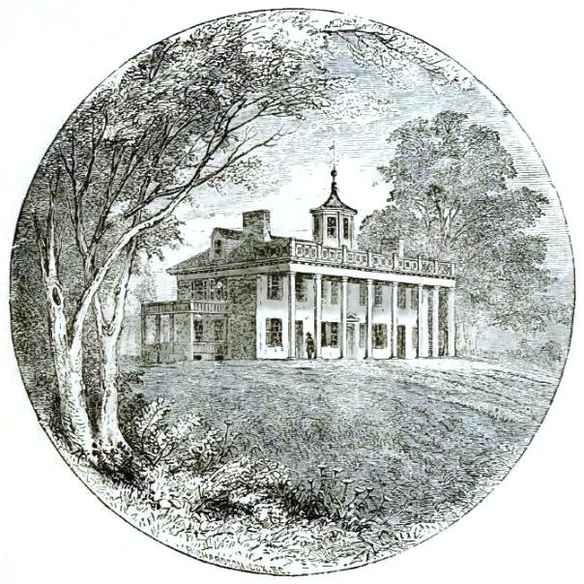
Vol. I
Washington delighted in the chase. In the hunting season, when he rode out early in the morning to visit distant parts of the estate where work was going on, he often took some of the dogs with him for the chance of starting a fox, which he occasionally did, though he was not always successful in killing him. He was a bold rider and an admirable horseman, though he never claimed the merit of being an accomplished fox-hunter. In the height of the season, however, he would be out with the fox-hounds two or three times a week, accompanied by his guests at Mount Vernon and the gentlemen of the neighborhood, especially the Fairfaxes of Belvoir, of which estate his friend George William Fairfax was now the proprietor. On such occasions there would be a hunting dinner at one or other of those establishments, at which convivial repasts Washington is said to have enjoyed himself with unwonted hilarity.
The waters of the Potomac also afforded occasional amusement in fishing and shooting. The fishing was sometimes on a grand scale, when the herrings came up the river in shoals, and the negroes of Mount Vernon were marshalled forth to draw the seine, which was generally done with great success. Canvas-back ducks abounded at the proper season, and the shooting of them was one of Washington's favorite recreations. The river border of his domain, however, was somewhat subject to invasion. An oysterman once anchored his craft at the landing-place, and disturbed the quiet of the neighborhood by the insolent and disorderly conduct of himself and crew. It took a campaign of three days to expel these invaders from the premises. A more summary course was pursued with another interloper. This was a vagabond who infested the creeks and inlets which bordered the estate, lurking in a canoe among the reeds and bushes, and making great havoc among the canvas-back ducks. He had been warned off repeatedly, but without effect. As Washington was one day riding about the estate he heard the report of a gun from the margin of the river. Spurring in that direction he dashed through the bushes and came upon the culprit just as he was pushing his canoe from shore. The latter raised his gun with a menacing look; but Washington rode into the stream, seized the painter of the canoe, drew it to shore, sprang from his horse, wrested the gun from the hands of the astonished delinquent, and inflicted on him a lesson in "Lynch law" that effectually cured him of all inclination to trespass again on these forbidden shores.
Occasionally he and Mrs. Washington would pay a visit to Annapolis, at that time the seat of government of Maryland, and partake of the gayeties which prevailed during the session of the legislature. Dinners and balls abounded, and there were occasional attempts at theatricals. The latter was an amusement for which Washington always had a relish, though he never had an opportunity of gratifying it effectually. Neither was he disinclined to mingle in the dance, and we remember to have heard venerable ladies, who had been belles in his day, pride themselves on having had him for a partner, though, they added, he was apt to be a ceremonious and grave one.
In this round of rural occupation, rural amusements and social intercourse, Washington passed several tranquil years, the halcyon season of his life. His marriage was unblessed with children; but those of Mrs. Washington experienced from him parental care and affection, and the formation of their minds and manners was one of the dearest objects of his attention. His domestic concerns and social enjoyments, however, were not permitted to interfere with his public duties. He was active by nature, and eminently a man of business by habit. As judge of the county court, and member of the House of Burgesses, he had numerous calls upon his time and thoughts, and was often drawn from home; for whatever trust he undertook, he was sure to fulfil with scrupulous exactness.
About this time we find him engaged, with other men of enterprise, in a project to drain the great Dismal Swamp, and render it capable of cultivation. This vast morass was about thirty miles long, and ten miles wide, and its interior but little known. With his usual zeal and hardihood he explored it on horseback and on foot. In many parts it was covered with dark and gloomy woods of cedar, cypress, and hemlock, or deciduous trees, the branches of which were hung with long, drooping moss. Other parts were almost inaccessible, from the density of brakes and thickets, entangled with vines, briers and creeping plants, and intersected by creeks and standing pools. In the centre of the morass he came to a great piece of water, six miles long, and three broad, called Drummond's Pond, but more poetically celebrated as the Lake of the Dismal Swamp. It was more elevated than any other part of the swamp, and capable of feeding canals, by which the whole might be traversed. Having made the circuit of it and noted all its characteristics, he encamped for the night upon the firm land which bordered it, and finished his explorations on the following day. In the ensuing session of the Virginia Legislature, the association in behalf of which he had acted was chartered under the name of the Dismal Swamp Company; and to his observations and forecast may be traced the subsequent improvement and prosperity of that once desolate region.
CHAPTER XIII.
COLONIAL DISCONTENTS.
Tidings of peace gladdened the colonies in the spring of 1763. The definite treaty between England and France had been signed at Fontainbleau. Now, it was trusted, there would be an end to these horrid ravages that had desolated the interior of the country. The month of May proved the fallacy of such hopes. In that month the famous insurrection of the Indian tribes broke out, which, from the name of the chief who was its prime mover and master-spirit, is commonly called Pontiac's war. The Delawares and Shawnees, and other of those emigrant tribes of the Ohio, among whom Washington had mingled, were foremost in this conspiracy. Some of the chiefs who had been his allies had now taken up the hatchet against the English. The plot was deep laid, and conducted with Indian craft and secrecy. At a concerted time an attack was made upon all the posts from Detroit to Fort Pitt (late Fort Duquesne). Several of the small stockaded forts, the places of refuge of woodland neighborhoods, were surprised and sacked with remorseless butchery. The frontiers of Pennsylvania, Maryland and Virginia were laid waste; and a considerable time elapsed before the frontier was restored to tolerable tranquility.
Fortunately, Washington's retirement from the army prevented his being entangled in this savage war, which raged throughout the regions he had repeatedly visited, or rather his active spirit had been diverted into a more peaceful channel, for he was at this time occupied in the enterprise just noticed, for draining the great Dismal Swamp.
Public events were now taking a tendency which, without any political aspirations or forethought of his own, was destined gradually to bear him away from his quiet home and individual pursuits, and launch him upon a grander and wider sphere of action than any in which he had hitherto been engaged.
Whatever might be the natural affection of the colonies for the mother country—and there are abundant evidences to prove that it was deep-rooted and strong—it had never been properly reciprocated. They yearned to be considered as children; they were treated by her as changelings. Her navigation laws had shut their ports against foreign vessels; obliged them to export their productions only to countries belonging to the British crown; to import European goods solely from England, and in English ships; and had subjected the trade between the colonies to duties. All manufactures, too, in the colonies that might interfere with those of the mother country had been either totally prohibited or subjected to intolerable restraints. The acts of Parliament imposing these prohibitions and restrictions had at various times produced sore discontent and opposition on the part of the colonies. There was nothing, however, to which the jealous sensibilities of the colonies were more alive than to any attempt of the mother country to draw a revenue from them by taxation. From the earliest period of their existence they had maintained the principle that they could only be taxed by a Legislature in which they were represented.
In 1760 there was an attempt in Boston to collect duties on foreign sugar and molasses imported into the colonies. Writs of assistance were applied for by the custom-house officers, authorizing them to break open ships, stores and private dwellings, in quest of articles that had paid no duty; and to call the assistance of others in the discharge of their odious task. The merchants opposed the execution of the writ on constitutional grounds. The question was argued in court, where James Otis spoke so eloquently in vindication of American rights that all his hearers went away ready to take arms against writs of assistance. Another ministerial measure was to instruct the provincial governors to commission judges. Not as theretofore "during good behavior," but "during the king's pleasure." New York was the first to resent this blow at the independence of the judiciary. The lawyers appealed to the public through the press against an act which subjected the halls of justice to the prerogative. Their appeals were felt beyond the bounds of the province, and awakened a general spirit of resistance.
Thus matters stood at the conclusion of the war. One of the first measures of ministers, on the return of peace, was to enjoin on all naval officers stationed on the coasts of the American colonies the performance, under oath, of the duties of custom-house officers, for the suppression of smuggling. This fell ruinously upon a clandestine trade which had long been connived at between the English and Spanish colonies, profitable to both, but especially to the former, and beneficial to the mother country, opening a market to her manufactures. As a measure of retaliation the colonists resolved not to purchase British fabrics, but to clothe themselves as much as possible in home manufactures. The demand for British goods in Boston alone was diminished upwards of £10,000 sterling in the course of a year.
In 1764 George Grenville, now at the head of government, ventured upon the policy from which Walpole [his predecessor] had wisely abstained. Early in March the eventful question was debated, "whether they had a right to tax America." It was decided in the affirmative. Next followed a resolution, declaring it proper to charge certain stamp duties in the colonies and plantations, but no immediate step was taken to carry it into effect. Mr. Grenville, however, gave notice to the American agents in London that he should introduce such a measure on the ensuing session of Parliament. In the meantime Parliament perpetuated certain duties on sugar and molasses—heretofore subjects of complaint and opposition—now reduced and modified so as to discourage smuggling, and thereby to render them more productive. Duties, also, were imposed on other articles of foreign produce or manufacture imported into the colonies. To reconcile the latter to these impositions, it was stated that the revenue thus raised was to be appropriated to their protection and security; in other words, to the support of a standing army, intended to be quartered upon them. We have here briefly stated but a part of what Burke terms an "infinite variety of paper chains," extending through no less than twenty-nine acts of Parliament, from 1660 to 1764, by which the colonies had been held in thraldom.
The New Englanders were the first to take the field against the project of taxation. They denounced it as a violation of their rights as freemen; of their chartered rights, by which they were to tax themselves for their support and defence; of their rights as British subjects, who ought not to be taxed but by themselves or their representatives. They sent petitions and remonstrances on the subject to the king, the lords and the commons, in which they were seconded by New York and Virginia. All was in vain. In March, 1765, the act was passed, according to which all instruments in writing were to be executed on stamped paper, to be purchased from the agents of the British government. What was more, all offences against the act could be tried in any royal, marine or admiralty court throughout the colonies, however distant from the place where the offence had been committed; thus interfering with that most inestimable right, a trial by jury.
It was an ominous sign that the first burst of opposition to this act should take place in Virginia. That colony had hitherto been slow to accord with the republican spirit of New England. Founded at an earlier period of the reign of James I., before kingly prerogative and ecclesiastical supremacy had been made matters of doubt and fierce dispute, it had grown up in loyal attachment to king, church, and constitution; was aristocratical in its tastes and habits, and had been remarked above all the other colonies for its sympathies with the mother country. Moreover, it had not so many pecuniary interests involved in these questions as had the people of New England, being an agricultural rather than a commercial province; but the Virginians are of a quick and generous spirit, readily aroused on all points of honorable pride, and they resented the stamp act as an outrage on their rights.
Washington occupied his seat in the House of Burgesses, when, on the 29th of May, the stamp act became a subject of discussion. Among the Burgesses sat Patrick Henry, a young lawyer who had recently distinguished himself by pleading against the exercise of the royal prerogative in church matters, and who was now for the first time a member of the House. Rising in his place, he introduced his celebrated resolutions, declaring that the General Assembly of Virginia had the exclusive right and power to lay taxes and impositions upon the inhabitants, and that whoever maintained the contrary should be deemed an enemy to the colony. The speaker, Mr. Robinson, objected to the resolutions, as inflammatory. Henry vindicated them, as justified by the nature of the case; went into an able and constitutional discussion of colonial rights, and an eloquent exposition of the manner in which they had been assailed.
The resolutions were modified, to accommodate them to the scruples of the speaker and some of the members, but their spirit was retained. The Lieutenant-governor (Fauquier), startled by this patriotic outbreak, dissolved the Assembly, and issued writs for a new election; but the clarion had sounded.
Washington returned to Mount Vernon full of anxious thoughts inspired by the political events of the day, and the legislative scene which he witnessed. His recent letters had spoken of the state of peaceful tranquillity in which he was living; those now written from his rural home show that he fully participated in the popular feeling, and that while he had a presentiment of an arduous struggle, his patriotic mind was revolving means of coping with it. In the meantime, from his quiet abode at Mount Vernon, he seemed to hear the patriotic voice of Patrick Henry, which had startled the House of Burgesses, echoing throughout the land, and rousing one legislative body after another to follow the example of that of Virginia. At the instigation of the General Court or Assembly of Massachusetts, a Congress was held in New York in October, composed of delegates from Massachusetts, Rhode Island, Connecticut, New York, New Jersey, Pennsylvania, Delaware, Maryland, and South Carolina. In this they denounced the acts of Parliament imposing taxes on them without their consent, and extending the jurisdiction of the courts of admiralty, as violations of their rights and liberties as natural born subjects of Great Britain, and prepared an address to the king, and a petition to both Houses of Parliament, praying for redress. Similar petitions were forwarded to England by the colonies not represented in the Congress.
The very preparations for enforcing the stamp act called forth popular tumults in various places. In Boston the stamp distributor was hanged in effigy; his windows were broken; a house intended for a stamp office was pulled down, and the effigy burnt in a bonfire made of the fragments. In Virginia, Mr. George Mercer had been appointed distributor of stamps, but on his arrival at Williamsburg publicly declined officiating. It was a fresh triumph to the popular cause. The bells were rung for joy; the town was illuminated, and Mercer was hailed with acclamations of the people. The 1st of November, the day when the act was to go into operation, was ushered in with portentous solemnities. There was great tolling of bells and burning of effigies in the New England colonies. At Boston the ships displayed their colors but half-mast high. Many shops were shut; funeral knells resounded from the steeples, and there was a grand auto-da-fe, in which the promoters of the act were paraded, and suffered martyrdom in effigy. At New York the printed act was carried about the streets on a pole, surmounted by a death's head, with a scroll bearing the inscription, "The folly of England and ruin of America."
These are specimens of the marks of popular reprobation with which the stamp act was universally nullified. No one would venture to carry it into execution. In fact no stamped paper was to be seen; all had been either destroyed or concealed. All transactions which required stamps to give them validity were suspended, or were executed by private compact. The courts of justice were closed, until at length some conducted their business without stamps. Union was becoming the watch-word. The merchants of New York, Philadelphia, Boston, and such other colonies as had ventured publicly to oppose the stamp act, agreed to import no more British manufactures after the 1st of January unless it should be repealed. So passed away the year 1765.
The dismissal of Mr. Grenville from the cabinet gave a temporary change to public affairs. The stamp act was repealed on the 18th of March, 1766, to the great joy of the sincere friends of both countries, still, there was a fatal clause in the repeal, which declared that the king, with the consent of Parliament, had power and authority to make laws and statutes of sufficient force and validity to "bind the colonies, and people of America, in all cases whatsoever." As the people of America were contending for principles, not mere pecuniary interests, this reserved power of the crown and Parliament left the dispute still open, and chilled the feeling of gratitude which the repeal might otherwise have inspired. Further aliment for public discontent was furnished by other acts of Parliament. One imposed duties on glass, pasteboard, white and red lead, painters' colors, and tea; the duties to be collected on the arrival of the articles in the colonies; another empowered naval officers to enforce the acts of trade and navigation. Another wounded to the quick the pride and sensibilities of New York. The mutiny act had recently been extended to America, with an additional clause, requiring the provincial Assemblies to provide the troops sent out with quarters, and to furnish them with fire, beds, candles, and other necessaries, at the expense of the colonies. The Governor and Assembly of New York refused to comply with this requisition as to stationary forces, insisting that it applied only to troops on a march. An act of Parliament now suspended the powers of the governor and Assembly until they should comply.
Boston continued to be the focus of what the ministerialists termed sedition. The General Court of Massachusetts, not content with petitioning the king for relief against the recent measures of Parliament, especially those imposing taxes as a means of revenue, drew up a circular, calling on the other colonial Legislatures to join with them in suitable efforts to obtain redress. In the ensuing session, Governor Sir Francis Bernard called upon them to rescind the resolution on which the circular was founded,—they refused to comply, and the General Court was consequently dissolved. The governors of other colonies required of their Legislatures an assurance that they would not reply to the Massachusetts circular—these Legislatures likewise refused compliance, and were dissolved. All this added to the growing excitement.
Nothing, however, produced a more powerful effect upon the public sensibilities throughout the country than certain military demonstrations at Boston. [In consequence of repeated collisions between the people of that place and the commissioners of customs, two regiments of troops were sent from Halifax to overawe the disaffected citizens. It was resolved in a town meeting that the king had no right to send troops thither without the consent of the Assembly. The selectmen accordingly refused to find quarters for the soldiers, and while some encamped on the common, others were quartered, to the great indignation of the public, in Faneuil Hall.]
Throughout these public agitations, Washington endeavored to preserve his equanimity. Still he was too true a patriot not to sympathize in the struggle for colonial rights which now agitated the whole country, and we find him gradually carried more and more into the current of political affairs. A letter written on the 5th of April, 1769, to his friend, George Mason, shows the important stand he was disposed to take. In the previous year the merchants and traders of Boston, Salem, Connecticut and New York, had agreed to suspend for a time the importation of all articles subject to taxation. Similar resolutions had recently been adopted by the merchants of Philadelphia. Washington's letter is emphatic in support of the measure. "At a time," writes he, "when our lordly masters in Great Britain will be satisfied with nothing less than the deprivation of American freedom, it seems highly necessary that something should be done to avert the stroke, and maintain the liberty which we have derived from our ancestors."
Mason, in his reply, concurred with him in opinion. "Our all is at stake," said he, "and the little conveniences and comforts of life, when set in competition with our liberty, ought to be rejected, not with reluctance but with pleasure." The result of the correspondence was the draft by the latter of a plan of association, the members of which were to pledge themselves not to import or use any articles of British merchandise or manufacture subject to duty. This paper Washington was to submit to the consideration of the House of Burgesses, at the approaching session in the month of May.
The Legislature of Virginia opened on this occasion with a brilliant pageant. While military force was arrayed to overawe the republican Puritans of the east, it was thought to dazzle the aristocratical descendants of the cavaliers by the reflex of regal splendor. Lord Botetourt, one of the king's lords of the bed-chamber, had recently come out as governor of the province. Junius described him as "a cringing, bowing, fawning, sword-bearing courtier." The words of political satirists, however, are always to be taken with great distrust. However his lordship may have bowed in presence of royalty, he elsewhere conducted himself with dignity, and won general favor by his endearing manners.
He had come out, however, with a wrong idea of the Americans. They had been represented to him as factious, immoral, and prone to sedition; but vain and luxurious, and easily captivated by parade and splendor. The latter foibles were aimed at in his appointment and fitting out. It was supposed that his titled rank would have its effect. Then to prepare him for occasions of ceremony, a coach of state was presented to him by the king. His opening of the session was in the style of the royal opening of Parliament. He proceeded in due parade from his dwelling to the capitol, in his state coach, drawn by six milk-white horses. Having delivered his speech according to royal form, he returned home with the same pomp and circumstance.
The time had gone by, however, for such display to have the anticipated effect. The Virginian legislators penetrated the intention of this pompous ceremonial, and regarded it with a depreciating smile. Sterner matters occupied their thoughts; they had come prepared to battle for their rights, and their proceedings soon showed Lord Botetourt how much he had mistaken them. Spirited resolutions were passed, denouncing the recent act of Parliament imposing taxes; the power to do which, on the inhabitants of this colony, "was legally and constitutionally vested in the House of Burgesses, with consent of the council and of the king, or of his governor, for the time being." Copies of these resolutions were ordered to be forwarded by the speaker to the Legislatures of the other colonies, with a request for their concurrence.
Other proceedings of the Burgesses showed their sympathy with their fellow-patriots of New England. A joint address of both Houses of Parliament had recently been made to the king, assuring him of their support in any further measures for the due execution of the laws in Massachusetts, and beseeching him that all persons charged with treason, or misprision of treason, committed within that colony since the 30th of December, 1767, might be sent to Great Britain for trial. As Massachusetts had no General Assembly at this time, having been dissolved by government, the Legislature of Virginia generously took up the cause. An address to the king was resolved on, stating, that all trials for treason, or misprision of treason, or for any crime whatever committed by any person residing in a colony, ought to be in and before his majesty's courts within said colony; and beseeching the king to avert from his royal subjects those dangers and miseries which would ensue from seizing and carrying beyond sea any person residing in America suspected of any crime whatever, thereby depriving them of the inestimable privilege of being tried by a jury from the vicinage, as well as the liberty of producing witnesses on such trial.
Lord Botetourt was astonished and dismayed when he heard of these high-toned proceedings. Repairing to the capitol on the following day at noon, he summoned the speaker and members to the council chamber, and addressed them in the following words: "Mr. Speaker, and gentlemen of the House of Burgesses, I have heard of your resolves, and augur ill of their effects. You have made it my duty to dissolve you, and you are dissolved accordingly."
The spirit conjured up by late decrees of Parliament was not so easily allayed. The Burgesses adjourned to a private house. Peyton Randolph, their late speaker, was elected moderator. Washington now brought forward a draft of the articles of association, concerted between him and George Mason. They formed the groundwork of an instrument signed by all present, pledging themselves neither to import, nor use any goods, merchandise, or manufactures taxed by Parliament to raise a revenue in America. This instrument was sent throughout the country for signature, and the scheme of non-importation, hitherto confined to a few northern colonies, was soon universally adopted.
The popular ferment in Virginia was gradually allayed by the amiable and conciliatory conduct of Lord Botetourt, His lordship soon became aware of the erroneous notions with which he had entered upon office. His semi-royal equipage and state were laid aside. He examined into public grievances; became a strenuous advocate for the repeal of taxes; and, authorized by his despatches from the ministry, assured the public that such repeal would speedily take place. His assurance was received with implicit faith, and for a while Virginia was quieted.
[In the month of May the General Court of Massachusetts, hitherto prorogued met according to charter. A committee immediately waited on the governor declaring that it was impossible to do business with dignity and freedom while the town was invested by sea and land, and a military guard was stationed at the state-house; and they requested the governor as his] majesty's representative, to have such forces removed out of the port and gates of the city during the session of the Assembly. The governor replied that he had no authority over either the ships or troops. The court persisted in refusing to transact business while so circumstanced, and the governor was obliged to transfer the session to Cambridge. There he addressed a message to that body in July, requiring funds for the payment of the troops, and quarters for their accommodation. The Assembly, after ample discussion of past grievances, resolved, that the establishment of a standing army in the colony in a time of peace was an invasion of natural rights; that a standing army was not known as a part of the British constitution, and that the sending an armed force to aid the civil authority was unprecedented, and highly dangerous to the people.
After waiting some days without receiving an answer to his message, the governor sent to know whether the Assembly would, or would not, make provision for the troops. In their reply, they followed the example of the Legislature of New York, by declining to furnish funds for the purposes specified, "being incompatible with their own honor and interest, and their duty to their constituents." They were in consequence again prorogued, to meet in Boston on the 10th of January.
So stood affairs in Massachusetts. In the meantime, the non-importation associations, being generally observed throughout the colonies, produced the effect on British commerce which Washington had anticipated, and Parliament was incessantly importuned by petitions from British merchants imploring its intervention to save them from ruin.
Early in 1770, an important change took place in the British cabinet. The Duke of Grafton suddenly resigned, and the reins of government passed into the hands of Lord North. He was a man of limited capacity, but a favorite of the king, and subservient to his narrow colonial policy. His administration, so eventful to America, commenced with an error. In the month of March an act was passed, revoking all the duties laid in 1767, excepting that on tea. This single tax was continued, as he observed, "to maintain the parliamentary right of taxation,"—the very right which was the grand object of contest. Here was the stumbling-block at the threshold of Lord North's administration. In vain the members of the opposition urged that this single exception, while it would produce no revenue, would keep alive the whole cause of contention; that so long as a single external duty was enforced, the colonies would consider their rights invaded, and would remain unappeased. Lord North was not to be convinced. On the very day in which this ominous bill was passed in Parliament, a sinister occurrence took place in Boston. Some of the young men of the place insulted the military while under arms; the latter resented it; the young men, after a scuffle, were put to flight, and pursued. The alarm bells rang, a mob assembled; the custom-house was threatened; the troops, in protecting it, were assailed with clubs and stones, and obliged to use their fire-arms before the tumult could be quelled. Four of the populace were killed, and several wounded. The troops were now removed from the town, which remained in the highest state of exasperation; and this untoward occurrence received the opprobrious and somewhat extravagant name of "the Boston massacre."
In Virginia the public discontents, which had been allayed by the conciliatory conduct of Lord Botetourt, and by his assurances, made on the strength of letters received from the ministry, that the grievances complained of would be speedily redressed, now broke out with more violence than ever. The Virginians spurned the mock-remedy which left the real cause of complaint untouched. His lordship also felt deeply wounded by the disingenuousness of ministers which had led him into such a predicament, and wrote home demanding his discharge. Before it arrived, an attack of bilious fever, acting upon a delicate and sensitive frame, enfeebled by anxiety and chagrin, laid him in his grave. He left behind him a name endeared to the Virginians by his amiable manners, his liberal patronage of the arts, and, above all, by his zealous intercession for their rights.
CHAPTER XIV.
EXPEDITION TO THE OHIO.—TEA TAX.
In the midst of these popular turmoils, Washington was induced, by public as well as private considerations, to make another expedition to the Ohio. He was one of the Virginia Board of Commissioners, appointed at the close of the late war to settle the military accounts of the colony. Among the claims which came before the board were those of the officers and soldiers who had engaged to serve until peace, under the proclamation of Governor Dinwiddie, holding forth a bounty of two hundred thousand acres of land, to be apportioned among them according to rank. Those claims were yet unsatisfied. Washington became the champion of those claims, and an opportunity now presented itself for their liquidation. The Six Nations, by a treaty in 1768, had ceded to the British crown, in consideration of a sum of money, all the lands possessed by them south of the Ohio. Land offices would soon be opened for the sale of them. Washington determined at once to visit the lands thus ceded; affix his mark on such tracts as he should select, and apply for a grant from government in behalf of the "soldiers' claim."
Washington had for a companion in this expedition his friend and neighbor, Dr. Craik. They set out on the 5th of October with three negro attendants, two belonging to Washington, and one to the doctor. The whole party was mounted, and there was a led horse for the baggage. After twelve days' travelling they arrived at Fort Pitt (late Fort Duquesne). It was garrisoned by two companies of royal Irish, commanded by a Captain Edmonson. A hamlet of about twenty log-houses, inhabited by Indian traders, had sprung up within three hundred yards of the fort, and was called "the town." It was the embryo city of Pittsburg, now so populous. At one of the houses, a tolerable frontier inn, they took up their quarters; but during their brief sojourn they were entertained with great hospitality at the fort. Here at dinner Washington met his old acquaintance, George Croghan, who had figured in so many capacities and experienced so many vicissitudes on the frontier. He was now Colonel Croghan, deputy-agent to Sir William Johnson.
On the day following the repast at the fort, Washington visited Croghan at his abode on the Alleghany River, where he found several of the chiefs of the Six Nations assembled. One of them, the White Mingo by name, made him a speech, accompanied, as usual, by a belt of wampum.
At Pittsburg the travellers left their horses, and embarked in a large canoe, to make a voyage down the Ohio as far as the Great Kanawha. Colonel Croghan engaged two Indians for their service, and an interpreter named John Nicholson. The colonel and some of the officers of the garrison accompanied them as far as Logstown, the scene of Washington's early diplomacy, and his first interview with the half-king. Here they breakfasted together; after which they separated, the colonel and his companions cheering the voyagers from the shore, as the canoe was borne off by the current of the beautiful Ohio.
Washington's propensities as a sportsman had here full play. Deer were continually to be seen coming down to the water's edge to drink, or browsing along the shore; there were innumerable flocks of wild turkeys, and streaming flights of ducks and geese; so that as the voyagers floated along, they were enabled to load their canoe with game. At night they encamped on the river bank, lit their fire and made a sumptuous hunter's repast. About seventy-five miles below Pittsburg the voyagers landed at a Mingo town, which they found in a stir of warlike preparation—sixty of the warriors being about to set off on a foray into the Cherokee country against the Catawbas.
On the 24th, about three o'clock in the afternoon, they arrived at Captema Creek, and two days more of voyaging brought them to an Indian hunting camp, near the mouth of the Muskingum. Here it was necessary to land and make a ceremonious visit, for the chief of the hunting party was Kiashuta, a Seneca sachem, the head of the river tribes. He was noted to have been among the first to raise the hatchet in Pontiac's conspiracy, and almost equally vindictive with that potent warrior. As Washington approached the chieftain, he recognized him for one of the Indians who had accompanied him on his mission to the French in 1753. Kiashuta retained a perfect recollection of the youthful ambassador, though seventeen years had matured him into thoughtful manhood. With hunter's hospitality he gave him a quarter of a fine buffalo just slain, but insisted that they should encamp together for the night.
At the mouth of the Great Kanawha the voyagers encamped for a day or two to examine the lands in the neighborhood, and Washington set up his mark upon such as he intended to claim on behalf of the soldiers' grant. Here Washington was visited by an old sachem, who approached him with great reverence, at the head of several of his tribe, and addressed him through Nicholson, the interpreter. He had heard, he said, of his being in that part of the country, and had come from a great distance to see him. On further discourse, the sachem made known that he was one of the warriors in the service of the French, who lay in ambush on the banks of the Monongahela and wrought such havoc in Braddock's army. He declared that he and his young men had singled out Washington, as he made himself conspicuous riding about the field of battle with the general's orders, and had fired at him repeatedly, but without success; whence they had concluded that he was under the protection of the Great Spirit, had a charmed life, and could not be slain in battle. At the Great Kanawha Washington's expedition down the Ohio terminated; having visited all the points he wished to examine. His return to Fort Pitt, and thence homeward, affords no incident worthy of note.
The discontents of Virginia, which had been partially soothed by the amiable administration of Lord Botetourt, were irritated anew under his successor, the Earl of Dunmore. This nobleman had for a short time held the government of New York. When appointed to that of Virginia, he lingered for several months at his former post. In the meantime he sent his military secretary, Captain Foy, to attend to the despatch of business until his arrival; awarding to him a salary and fees to be paid by the colony. The pride of the Virginians was piqued at his lingering at New York, as if he preferred its gayety and luxury to the comparative quiet and simplicity of Williamsburg. The first measure of the Assembly, at its opening, was to demand by what right he had awarded a salary and fees to his secretary without consulting it; and to question whether it was authorized by the crown. His lordship had the good policy to rescind the unauthorized act, and in so doing mitigated the ire of the Assembly: but he lost no time in proroguing a body which, from various symptoms, appeared to be too independent, and disposed to be untractable.
He continued to prorogue it from time to time, seeking in the interim to conciliate the Virginians, and soothe their irritated pride. At length, after repeated prorogations he was compelled by circumstances to convene it on the 1st of March, 1773. Washington was prompt in his attendance on the occasion, and foremost among the patriotic members who eagerly availed themselves of this long wished for opportunity to legislate upon the general affairs of the colonies. One of their most important measures was the appointment of a committee of eleven persons, "whose business it should be to obtain the most clear and authentic intelligence of all such acts and resolutions of the British Parliament, or proceedings of administration, as may relate to or affect the British colonies, and to maintain with their sister colonies a correspondence and communication." The plan thus proposed by their "noble, patriotic sister colony of Virginia" was promptly adopted by the people of Massachusetts, and soon met with general concurrence. These corresponding committees, in effect, became the executive power of the patriot party, producing the happiest concert of design and action throughout the colonies.
Notwithstanding the decided part taken by Washington in the popular movement, very friendly relations existed between him and Lord Dunmore. The latter appreciated his character, and sought to avail himself of his experience in the affairs of the province. It was even concerted that Washington should accompany his lordship on an extensive tour, which the latter intended to make in the course of the summer along the western frontier. A melancholy circumstance occurred to defeat this arrangement.
We have spoken of Washington's paternal conduct towards the two children of Mrs. Washington. The daughter, Miss Custis had long been an object of extreme solicitude. She was of a fragile constitution, and for some time past had been in very declining health. Early in the present summer, symptoms indicated a rapid change for the worse. Washington was absent from home at the time. On his return to Mount Vernon he found her in the last stage of consumption. Though not a man given to bursts of sensibility, he is said on the present occasion to have evinced the deepest affliction; kneeling by her bedside, and pouring out earnest prayers for her recovery. She expired on the 19th of June, in the seventeenth year of her age. This, of course put an end to Washington's intention of accompanying Lord Dunmore to the frontier: he remained at home to console Mrs. Washington in her affliction—furnishing his lordship, however, with travelling hints and directions, and recommending proper guides.
The general covenant throughout the colonies against the use of taxed tea had operated disastrously against the interests of the East India Company, and produced an immense accumulation of the proscribed article in their warehouses. To remedy this Lord North brought in a bill (1773), by which the company were allowed to export their teas from England to any part whatever, without paying export duty. This, by enabling them to offer their teas at a low price in the colonies would, he supposed, tempt the Americans to purchase large quantities, thus relieving the company, and at the same time benefiting the revenue by the impost duty. Confiding in the wisdom of this policy, the company disgorged their warehouses, freighted several ships with tea, and sent them to various parts of the colonies. This brought matters to a crisis. One sentiment, one determination, pervaded the whole continent. Taxation was to receive its definitive blow. Whoever submitted to it was an enemy to his country. From New York and Philadelphia the ships were sent back, unladen, to London. In Charleston the tea was unloaded, and stored away in cellars and other places, where it perished. At Boston the action was still more decisive. The ships anchored in the harbor. Some small parcels of tea were brought on shore, but the sale of them was prohibited.
To settle the matter completely, and prove that on a point of principle they were not to be trifled with, a number of inhabitants, disguised as Indians, boarded the ships in the night (18th December), broke open all the chests of tea, and emptied the contents into the sea. The general opposition of the colonies to the principle of taxation had given great annoyance to government, but this individual act concentrated all its wrath upon Boston. A bill was forthwith passed in Parliament (commonly called the Boston port bill), by which all lading and unlading of goods, wares, and merchandise, were to cease in that town and harbor on and after the 4th of June, and the officers of the customs to be transferred to Salem.
Another law, passed soon after, altered the charter of the province, decreeing that all counsellors, judges, and magistrates, should be appointed by the crown, and hold office during the royal pleasure. This was followed by a third, intended for the suppression of riots; and providing that any person indicted for murder, or other capital offence, committed in aiding the magistracy, might be sent by the governor to some other colony, or to Great Britain, for trial.
Such was the bolt of Parliamentary wrath fulminated against the devoted town of Boston. Before it fell there was a session in May of the Virginia House of Burgesses. The social position of Lord Dunmore had been strengthened in the province by the arrival of his lady, and a numerous family of sons and daughters. The House of Burgesses was opened in form, and one of its first measures was an address of congratulation to the governor on the arrival of his lady. It was followed up by an agreement among the members to give her ladyship a splendid ball, on the 27th of the month.
All things were going on smoothly and smilingly, when a letter, received through the corresponding committee, brought intelligence of the vindictive measure of Parliament, by which the port of Boston was to be closed on the approaching 1st of June. The letter was read in the House of Burgesses, and produced a general burst of indignation. All other business was thrown aside, and this became the sole subject of discussion. A protest against this and other recent acts of Parliament was entered upon the journal of the House, and a resolution was adopted, on the 24th of May, setting apart the 1st of June as a day of fasting, prayer, and humiliation. On the following morning the Burgesses were summoned to attend Lord Dunmore in the council chamber, where he made them the following laconic speech: "Mr. Speaker, and Gentlemen of the House of Burgesses: I have in my hand a paper, published by order of your House, conceived in such terms as reflect highly upon his majesty, and the Parliament of Great Britain, which makes it necessary for me to dissolve you, and you are dissolved accordingly."
As on a former occasion, the Assembly, though dissolved was not dispersed. The members adjourned to the long room of the old Raleigh tavern, and passed resolutions denouncing the Boston port bill as a most dangerous attempt to destroy the constitutional liberty and rights of all North America; recommending their countrymen to desist from the use, not merely of tea, but of all kinds of East Indian commodities; pronouncing an attack on one of the colonies, to enforce arbitrary taxes, an attack on all; and ordering the committee of correspondence to communicate with the other corresponding committees on the expediency of appointing deputies from the several colonies of British America to meet annually in GENERAL CONGRESS, at such place as might be deemed expedient, to deliberate on such measures as the united interests of the colonies might require.
This was the first recommendation of a General Congress by any public assembly, though it had been previously proposed in town meetings at New York and Boston. A resolution to the same effect was passed in the Assembly of Massachusetts before it was aware of the proceedings of the Virginia Legislature. The measure recommended met with prompt and general concurrence throughout the colonies, and the fifth day of September next ensuing was fixed upon for the meeting of the first Congress, which was to be held at Philadelphia.
On the 29th, letters arrived from Boston giving the proceedings of a town meeting, recommending that a general league should be formed throughout the colonies suspending all trade with Great Britain. But twenty-five members of the late House of Burgesses, including Washington, were at that time remaining in Williamsburg. They held a meeting on the following day, at which Peyton Randolph presided as moderator. After some discussion it was determined to issue a printed circular, bearing their signatures, and calling a meeting of all the members of the late House of Burgesses, on the 1st of August, to take into consideration this measure of a general league. The circular recommended them, also, to collect, in the meantime, the sense of their respective counties.
In the meantime the Boston port bill had been carried into effect. On the 1st of June the harbor of Boston was closed at noon, and all business ceased. The two other parliamentary acts altering the charter of Massachusetts were to be enforced. No public meetings, excepting the annual town meetings in March and May, were to be held without permission of the governor.
General Thomas Gage had recently been appointed to the military command of Massachusetts, and the carrying out of these offensive acts. As lieutenant-colonel, he had led the advance guard on the field of Braddock's defeat. Fortune had since gone well with him. Rising in the service, he had been governor of Montreal, and had succeeded Amherst in the command of the British forces on this continent. He was linked to the country also by domestic ties, having married into one of the most respectable families of New Jersey. In the various situations in which he had hitherto been placed he had won esteem, and rendered himself popular. But with all his experience in America he had formed a most erroneous opinion of the character of the people. "The Americans," said he to the king, "will be lions only as long as the English are lambs;" and he engaged, with five regiments, to keep Boston quiet!
The manner in which his attempts to enforce the recent acts of Parliament were resented, showed how egregiously he was in error. At the suggestion of the Assembly, a paper was circulated through the province by the committee of correspondence, entitled "a solemn league and covenant," the subscribers to which bound themselves to break off all intercourse with Great Britain from the 1st of August, until the colony should be restored to the enjoyment of its chartered rights; and to renounce all dealings with those who should refuse to enter into this compact.
The very title of league and covenant had an ominous sound, and startled General Gage. He issued a proclamation, denouncing it as illegal and traitorous. Furthermore, he encamped a force of infantry and artillery on Boston Common, as if prepared to enact the lion. An alarm spread through the adjacent country. "Boston is to be blockaded! Boston is to be reduced to obedience by force or famine!" The spirit of the yeomanry was aroused. They sent in word to the inhabitants promising to come to their aid if necessary; and urging them to stand fast to the faith.
CHAPTER XV.
THE FIRST GENERAL CONGRESS.
Shortly after Washington's return to Mount Vernon, in the latter part of June, he presided as moderator at a meeting of the inhabitants of Fairfax County, wherein, after the recent acts of Parliament had been discussed, a committee was appointed, with himself as chairman, to draw up resolutions expressive of the sentiments of the present meeting, and to report the same at a general meeting of the county, to be held in the court-house on the 18th of July.
The committee met according to appointment, with Washington as chairman. The resolutions framed at the meeting insisted, as usual, on the right of self-government, and the principle that taxation and representation were in their nature inseparable: that the various acts of Parliament for raising revenue, taking away trials by jury, ordering that persons might be tried in a different country from that in which the cause of accusation originated, closing the port of Boston, abrogating the charter of Massachusetts Bay, etc., etc., were all part of a premeditated design and system to introduce arbitrary government into the colonies; that the sudden and repeated dissolutions of Assemblies whenever they presumed to examine the illegality of ministerial mandates, or deliberated on the violated rights of their constituents, were part of the same system, and calculated and intended to drive the people of the colonies to a state of desperation, and to dissolve the compact by which their ancestors bound themselves and their posterity to remain dependent on the British crown. The resolutions, furthermore, recommended the most perfect union and co-operation among the colonies; solemn covenants with respect to non-importation and non-intercourse, and a renunciation of all dealings with any colony, town, or province that should refuse to agree to the plan adopted by the General Congress. They also recommended a dutiful petition and remonstrance from the Congress to the king, asserting their constitutional rights and privileges; lamenting the necessity of entering into measures that might be displeasing; declaring their attachment to his person, family, and government, and their desire to continue in dependence upon Great Britain; beseeching him not to reduce his faithful subjects of America to desperation, and to reflect that from our sovereign there can be but one appeal.
The resolutions reported by the committee were adopted, and Washington was chosen a delegate to represent the county at the General Convention of the province, to be held at Williamsburg on the 1st of August. [On the date appointed the convention assembled.] Washington appeared on behalf of Fairfax County, and presented the resolutions, already cited, as the sense of his constituents. He is said, by one who was present, to have spoken in support of them in a strain of uncommon eloquence. The Convention was six days in session. Resolutions, in the same spirit with those passed in Fairfax County, were adopted, and Peyton Randolph, Richard Henry Lee, George Washington, Patrick Henry, Richard Bland, Benjamin Harrison, and Edmund Pendleton, were appointed delegates, to represent the people of Virginia in the General Congress.
General Gage from the time of taking command at Boston, had been perplexed how to manage its inhabitants. Had they been hot-headed, impulsive, and prone to paroxysm, his task would have been comparatively easy; but it was the cool, shrewd common sense, by which all their movements were regulated, that confounded him. There was no uproar, no riots; everything was awfully systematic and according to rule. Town meetings were held, in which public rights and public measures were eloquently discussed by John Adams, Josiah Quincy, and other eminent men. Over these meetings Samuel Adams presided as moderator; a man clear in judgment, calm in conduct, inflexible in resolution, deeply grounded in civil and political history, and infallible on all points of constitutional law.
Gage was at a loss how to act. It would not do to disperse these assemblages by force of arms; for the people who composed them mingled the soldier with the polemic; and like their prototypes, the covenanters of yore, if prone to argue, were as ready to fight. So the meetings continued to be held pertinaciously. Faneuil Hall was at times unable to hold them, and they swarmed from that revolutionary hive into old South Church. The liberty tree became a rallying place for any popular movement, and a flag hoisted on it was saluted by all processions as the emblem of the popular cause.
When the time approached for the meeting of the General Congress at Philadelphia, Washington was joined at Mount Vernon by Patrick Henry and Edmund Pendleton, and they performed the journey together on horseback. It was a noble companionship. Henry was then in the youthful vigor and elasticity of his bounding genius, ardent, acute, fanciful, eloquent; Pendleton, schooled in public life, a veteran in council, with native force of intellect, and habits of deep reflection; Washington, in the meridian of his days, mature in wisdom, comprehensive in mind, sagacious in foresight. Such were the apostles of liberty, repairing on their august pilgrimage to Philadelphia from all parts of the land, to lay the foundations of a mighty empire.
Congress assembled on Monday, the 5th of September, in a large room in Carpenter's Hall. There were fifty-one delegates, representing all the colonies excepting Georgia. The meeting has been described as "awfully solemn." The most eminent men of the various colonies were now for the first time brought together; they were known to each other by fame, but were, personally, strangers. The object which had called them together was of incalculable magnitude. The liberties of no less than three millions of people, with that of all their posterity, were staked on the wisdom and energy of their councils.
There being an inequality in the number of delegates from the different colonies, a question arose as to the mode of voting; whether by colonies, by the poll, or by interests. After some debate, it was determined that each colony should have but one vote, whatever might be the number of its delegates. The deliberations of the House were to be with closed doors, and nothing but the resolves promulgated, unless by order of the majority. To give proper dignity and solemnity to the proceedings, it was moved on the following day that each morning the session should be opened by prayer. In the course of the day, a rumor reached Philadelphia that Boston had been cannonaded by the British. It produced a strong sensation; and when Congress met on the following morning (7th), the effect was visible in every countenance. The delegates from the east were greeted with a warmer grasp of the hand by their associates from the south. [The rumor proved to be erroneous.]
Owing to closed doors, and the want of reporters, no record exists of the discussions and speeches made in the first Congress. The first public measure was a resolution declaratory of their feelings with regard to the recent acts of Parliament, violating the rights of the people of Massachusetts, and of their determination to combine in resisting any force that might attempt to carry those acts into execution.
A committee of two from each province reported a series of resolutions, which were adopted and promulgated by Congress, as a "declaration of colonial rights." In this were enumerated their natural rights to the enjoyment of life, liberty, and property; and their rights as British subjects. Among the latter was participation in legislative councils. This they could not exercise through representatives in Parliament; they claimed, therefore, the power of legislating in their provincial assemblies; consenting, however, to such acts of Parliament as might be essential to the regulation of trade; but excluding all taxation, internal or external, for raising revenue in America. The common law of England was claimed as a birthright, including the right of trial by a jury of the vicinage; of holding public meetings to consider grievances; and of petitioning the king. The benefits of all such statutes as existed at the time of the colonization were likewise claimed; together with the immunities and privileges granted by royal charters, or secured by provincial laws. The maintenance of a standing army in any colony in time of peace, without the consent of its legislature, was pronounced contrary to law. The exercise of the legislative power in the colonies by a council appointed during pleasure by the crown, was declared to be unconstitutional, and destructive to the freedom of American legislation. Then followed a specification of the acts of Parliament, passed during the reign of George III., infringing and violating these rights. These were—the sugar act; the stamp act; the two acts for quartering troops; the tea act; the act suspending the New York legislature; the two acts for the trial in Great Britain of offences committed in America; the Boston port bill; the act for regulating the government of Massachusetts, and the Quebec act.
"To these grievous acts and measures," it was added, "Americans cannot submit; but in hopes their fellow subjects in Great Britain will, on a revision of them, restore us to that state in which both countries found happiness and prosperity, we have for the present, only resolved to pursue the following peaceable measures: 1st. To enter into a non-importation, non-consumption, and non-exportation agreement, or association. 2d. To prepare an address to the people of Great Britain, and a memorial to the inhabitants of British America. 3d. To prepare a loyal address to his majesty." The above-mentioned association was accordingly formed, and committees were to be appointed in every county, city and town to maintain it vigilantly and strictly.
Masterly state papers were issued by Congress in conformity to the resolutions: viz, a petition to the king, drafted by Mr. Dickinson, of Philadelphia; an address to the people of Canada by the same hand, inviting them to join the league of the colonies; another to the people of Great Britain, drafted by John Jay, of New York; and a memorial to the inhabitants of the British colonies by Richard Henry Lee, of Virginia.
The Congress remained in session fifty-one days. Every subject, according to Adams, was discussed "with a moderation, an acuteness, and a minuteness equal to that of Queen Elizabeth's privy council." The papers issued by it have deservedly been pronounced masterpieces of practical talent and political wisdom. From the secrecy that enveloped its discussions, we are ignorant of the part taken by Washington in the debates; the similarity of the resolutions, however, in spirit and substance to those of the Fairfax County meeting, in which he presided, and the coincidence of the measures adopted with those therein recommended, show that he had a powerful agency in the whole proceedings of this eventful assembly. Patrick Henry, being asked, on his return home, whom he considered the greatest man in Congress, replied: "If you speak of eloquence, Mr. Rutledge, of South Carolina, is by far the greatest orator; but if you speak of solid information and sound judgment, Colonel Washington is unquestionably the greatest man on that floor."
On the breaking up of Congress, Washington hastened back to Mount Vernon, where his presence was more than usually important to the happiness of Mrs. Washington, from the loneliness caused by the recent death of her daughter and the absence of her son. The cheerfulness of the neighborhood had been diminished of late by the departure of George William Fairfax for England, to take possession of estates which had devolved to him in that kingdom. His estate of Belvoir, so closely allied with that of Mount Vernon by family ties and reciprocal hospitality, was left in charge of a steward, or overseer. Through some accident the house took fire, and was burnt to the ground. It was never rebuilt. The course of political events which swept Washington from his quiet home into the current of public and military life, prevented William Fairfax, who was a royalist, though a liberal one, from returning to his once happy abode, and the hospitable intercommunion of Mount Vernon and Belvoir was at an end for ever.
CHAPTER XVI.
MILITARY MEASURES.—AFFAIRS AT LEXINGTON.
The rumor, at the opening of Congress, of the cannonading of Boston had been caused by measures of Governor Gage. The public mind in Boston and its vicinity had been rendered excessively jealous and sensitive by the landing and encamping of artillery upon the Common and Welsh Fusiliers on Fort Hill, and by the planting of four large field-pieces on Boston Neck, the only entrance to the town by land. The country people were arming and disciplining themselves in every direction, and collecting and depositing arms and ammunition in places where they would be at hand in case of emergency. Gage, on the other hand, issued orders that the munitions of war in all the public magazines should be brought to Boston. One of these magazines was the arsenal in the north-west part of Charlestown, between Medford and Cambridge. Two companies of the king's troops passed silently in boats up Mystic River in the night; took possession of a large quantity of gunpowder deposited there, and conveyed it to Castle Williams. Intelligence of this sacking of the arsenal flew with lightning speed through the neighborhood. In the morning several thousands of patriots were assembled at Cambridge, weapon in hand, and were with difficulty prevented from marching upon Boston to compel a restitution of the powder. In the confusion and agitation, a rumor stole out into the country that Boston was to be attacked; followed by another that the ships were cannonading the town, and the soldiers shooting down the inhabitants. The whole country was forthwith in arms. Numerous bodies of the Connecticut people had made some marches before the report was contradicted.
Gage, on the 1st of September, before this popular agitation, had issued writs for an election of an assembly to meet at Salem in October; seeing, however, the irritated state of the public mind, he now countermanded the same by proclamation. The people, disregarding the countermand, carried the election, and ninety of the new members thus elected met at the appointed time. They waited a whole day for the governor to attend, administer the oaths, and open the session; but as he did not make his appearance, they voted themselves a provincial Congress, and chose for president of it John Hancock,—a man of great wealth, popular, and somewhat showy talents, and ardent patriotism; and eminent from his social position. This self-constituted body adjourned to Concord, about twenty miles from Boston; quietly assumed supreme authority, and issued a remonstrance to the governor, virtually calling him to account for his military operations in fortifying Boston Neck, and collecting warlike stores about him, thereby alarming the fears of the whole province and menacing the lives and property of the Bostonians.
General Gage, overlooking the irregularity of its organization, entered into explanations with the Assembly, but failed to give satisfaction. As winter approached, he found his situation more and more critical. Boston was the only place in Massachusetts that now contained British forces, and it had become the refuge of all the "tories" of the province; that is to say, of all those devoted to the British government. There was animosity between them and the principal inhabitants, among whom revolutionary principles prevailed. The town itself, almost insulated by nature, and surrounded by a hostile country, was like a place besieged.
The provincial Congress conducted its affairs with the order and system so formidable to General Gage. Having adopted a plan for organizing the militia, it had nominated general officers, two of whom, Artemas Ward and Seth Pomeroy, had accepted. The executive powers were vested in a committee of safety. This was to determine when the services of the militia were necessary; was to call them forth,—to nominate their officers to the Congress,—to commission them, and direct the operations of the army. Another committee was appointed to furnish supplies to the forces when called out; hence, named the Committee of Supplies. Under such auspices, the militia went on arming and disciplining itself in every direction.
Arrangements had been made for keeping up an active correspondence between different parts of the country, and spreading an alarm in case of any threatening danger. Under the direction of the committees just mentioned, large quantities of military stores had been collected and deposited at Concord and Worcester.
This semi-belligerent state of affairs in Massachusetts produced a general restlessness throughout the land. The weak-hearted apprehended coming troubles; the resolute prepared to brave them. Military measures, hitherto confined to New England, extended to the middle and southern provinces, and the roll of the drum resounded through the villages. Virginia was among the first to buckle on its armor. It had long been a custom among its inhabitants to form themselves into independent companies, equipped at their own expense, having their own peculiar uniform, and electing their own officers, though holding themselves subject to militia law. They had hitherto been self-disciplined; but now they continually resorted to Washington for instruction and advice; considering him the highest authority on military affairs. He was frequently called from home, therefore, in the course of the winter and spring, to different parts of the country to review independent companies; all of which were anxious to put themselves under his command as field-officer.
Mount Vernon, therefore, again assumed a military tone as in former days, when he took his first lessons there in the art of war. Two occasional and important guests in this momentous crisis, were General Charles Lee,1 and Major Horatio Gates.2 To Washington the visits of these gentlemen were extremely welcome at this juncture, from their military knowledge and experience, especially as much of it had been acquired in America, in the same kind of warfare, if not the very same campaigns in which he himself had mingled. Both were interested in the popular cause. Lee was full of plans for the organization and disciplining of the militia, and occasionally accompanied Washington in his attendance on provincial reviews. He was subsequently very efficient at Annapolis in promoting and superintending the organization of the Maryland militia.
1 [General Charles Lee was an Englishman by birth, and a highly cultivated production of European warfare. He was born in 1731, and may almost be said to have been cradled in the army, for he received a commission by the time he was eleven years of age. He served in the French war of America; in 1762 obtained a colonel's commission, and went with Burgoyne to Portugal. Having a caustic pen he undertook to write on colonial questions, and thereby lost the favor of the ministry. He then went to Poland; won the favor of King Stanislaus; in 1769 obtained the rank of major-general in the Polish army, and served in a campaign against the Turks. Leaving the Polish army he led a restless life about Europe, and in 1773, coming to America, openly espoused the colonial cause. He was a man of eccentric habits, caustic humor, extensive military experience, and was considered a prodigious acquisition to the patriot cause.]
2 [Major Horatio Gates was an Englishman by birth. When twenty he served as a volunteer under Cornwallis, governor of Halifax; next as captain under Braddock; accompanied General Monckton as aide-de-camp to the West Indies, gained credit at the capture of Martinico, and was promoted to the rank of major. His promotion did not equal his expectations, and went to England, and failing to attain his desires, came to Virginia in 1772, and purchased an estate in Berkeley County, where he settled. He was now forty-six years of age.]
In the month of March the second Virginia convention was held at Richmond. Washington attended as delegate from Fairfax County. In this assembly, Patrick Henry, with his usual ardor and eloquence, advocated measures for embodying, arming and disciplining a militia force, and providing for the defence of the colony. Washington joined him in the conviction, and was one of a committee that reported a plan for carrying those measures into effect. He was not an impulsive man to raise the battle cry, but the executive man to marshal the troops into the field and carry on the war.
While the spirit of revolt was daily gaining strength and determination in America, a strange infatuation reigned in the British councils. While the wisdom and eloquence of Chatham were exerted in vain in behalf of American rights, an empty braggadocio, elevated to a seat in Parliament, was able to captivate the attention of the members and influence their votes by gross misrepresentations of the Americans and their cause. This was no other than Colonel Grant, the same shallow soldier who had been guilty of a foolhardy bravado before the walls of Fort Duquesne, which brought slaughter and defeat upon his troops. We are told that he entertained Parliament, especially the ministerial side of the House, with ludicrous stories of the cowardice of Americans. This taunting and braggart speech was made in the face of the conciliatory bill of the venerable Chatham, devised with a view to redress the wrongs of America. The councils of the arrogant and scornful prevailed; and instead of the proposed bill, further measures of a stringent nature were adopted, coercive of some of the middle and southern colonies, but ruinous to the trade and fisheries of New England.
At length the bolt, so long suspended, fell! The troops at Boston had been augmented to about four thousand men. Goaded on by the instigations of the tories, and alarmed by the energetic measures of the whigs, General Gage now resolved to deal the latter a crippling blow. This was to surprise and destroy their magazine of military stores at Concord, about twenty miles from Boston. It was to be effected on the night of the 18th of April by a force detached for the purpose. Preparations were made with great secrecy. Boats for the transportation of troops were launched, and moored under the sterns of the men-of-war. Grenadiers and light infantry were relieved from duty and held in readiness. On the 18th, officers were stationed on the roads leading from Boston to prevent any intelligence of the expedition getting into the country. At night orders were issued by General Gage that no person should leave the town. About ten o'clock from eight to nine hundred men, grenadiers, light infantry and marines, commanded by Lieutenant-colonel Smith, embarked in the boats at the foot of Boston Common and crossed to Lechmere Point, in Cambridge, whence they were to march silently and without beat of drum to the place of destination.
The measures of General Gage had not been shrouded in all the secrecy he imagined. Dr. Joseph Warren, one of the committee of safety, had observed the preparatory disposition of the boats and troops, and surmised some sinister intention. He sent notice of these movements to John Hancock and Samuel Adams, both members of the provincial Congress, but at that time privately sojourning with a friend at Lexington. A design on the magazine at Concord was suspected, and the committee of safety ordered that the cannon collected there should be secreted and part of the stores removed. On the night of the 18th, Dr. Warren sent off two messengers by different routes to give the alarm that the king's troops were actually sallying forth. The messengers got out of Boston just before the order of General Gage went into effect, to prevent any one from leaving the town. About the same time a lantern was hung out of an upper window of the north church, in the direction of Charlestown. This was a preconcerted signal to the patriots of that place who instantly despatched swift messengers to rouse the country.
In the meantime, Colonel Smith set out on his nocturnal march from Lechmere Point by an unfrequented path across marshes, where at times the troops had to wade through water. He had proceeded but a few miles when alarm guns, booming through the night air, and the clang of village bells, showed that the news of his approach was travelling before him, and the people were rising. He now sent back to General Gage for a reinforcement, while Major Pitcairn was detached with six companies to press forward and secure the bridges at Concord.
Pitcairn advanced rapidly, capturing every one that he met or overtook. Within a mile and a half of Lexington, however, a horseman was too quick on the spur for him, and galloping to the village, gave the alarm that the redcoats were coming. Drums were beaten; guns fired. By the time that Pitcairn entered the village about seventy or eighty of the yeomanry, in military array, were mustered on the green near the church. The sound of drum, and the array of men in arms, indicated a hostile determination. Pitcairn halted his men within a short distance of the church, and ordered them to prime and load. They then advanced at double quick time. The major, riding forward ordered the rebels, as he termed them, to disperse. The order was disregarded. A scene of confusion ensued, with firing on both sides; which party commenced it has been a matter of dispute. The firing of the Americans was irregular and without much effect; that of the British was more fatal. Eight of the patriots were killed and ten wounded, and the whole put to flight. Colonel Smith soon arrived with the residue of the detachment, and they all marched on towards Concord, about six miles distant.
The alarm had reached that place in the dead hour of the preceding night. The church bell roused the inhabitants. They gathered together in anxious consultation. The militia and minute men seized their arms and repaired to the parade ground near the church. Exertions were now made to remove and conceal the military stores. A scout, who had been sent out for intelligence, brought word that the British had fired upon the people at Lexington and were advancing upon Concord. There was great excitement and indignation. Part of the militia marched down the Lexington road to meet them, but returned, reporting their force to be three times that of the Americans. The whole of the militia now retired to an eminence about a mile from the centre of the town, and formed themselves into two battalions.
About seven o'clock the British came in sight. They entered in two divisions by different roads. Concord is traversed by a river of the same name, having two bridges, the north and the south. The grenadiers and light infantry took post in the centre of the town, while strong parties of light troops were detached to secure the bridges, and destroy the military stores. Two hours were expended in the work of destruction without much success, so much of the stores having been removed, or concealed. During all this time the yeomanry from the neighboring towns were hurrying in with such weapons as were at hand, and joining the militia on the height, until the little cloud of war gathering there numbered about four hundred and fifty. About ten o'clock, a body of three hundred undertook to dislodge the British from the north bridge. As they approached, the latter fired upon them, killing two, and wounding a third. The patriots returned the fire with spirit and effect. The British retreated to the main body, the Americans pursuing them across the bridge.
By this time all the military stores which could be found had been destroyed; Colonel Smith, therefore, made preparations for a retreat. About noon he commenced his retrograde march for Boston. It was high time. His troops were jaded by the night march and the morning's toils and skirmishings.
The country was thoroughly alarmed. The yeomanry were hurrying from every quarter to the scene of action. As the British began their retreat, the Americans began the work of sore and galling retaliation. Along the open road the former were harassed incessantly by rustic marksmen, who took deliberate aim from behind trees or over stone fences. It was in vain they threw out flankers and endeavored to dislodge their assailants; each pause gave time for other pursuers to come within reach and open attacks from different quarters. For several miles they urged their way along woody defiles, or roads skirted with fences and stone walls, the retreat growing more and more disastrous. Before reaching Lexington, Colonel Smith received a severe wound in the leg, and the situation of the retreating troops was becoming extremely critical, when, about two o'clock, they were met by Lord Percy, with a brigade of one thousand men and two field-pieces. Opening his brigade to the right and left, he received the retreating troops into a hollow square; where, fainting and exhausted, they threw themselves on the ground to rest. His lordship showed no disposition to advance upon their assailants, but contented himself with keeping them at bay with his field-pieces, which opened a vigorous fire from an eminence.
Hitherto the Provincials, being hasty levies, without a leader, had acted from individual impulse, without much concert; but now General Heath was upon the ground. He was one of those authorized to take command when the minute men should be called out. Dr. Warren also arrived on horseback, having spurred from Boston on receiving news of the skirmishing. In the subsequent part of the day he was one of the most active and efficient men in the field. His presence, like that of General Heath, regulated the infuriated ardor of the militia and brought it into system.
Lord Percy, having allowed the troops a short interval for repose and refreshment, continued the retreat toward Boston. As soon as he got under march, the galling assault by the pursuing yeomanry was recommenced in flank and rear. The British soldiery, irritated in turn, acted as if in an enemy's country. Houses and shops were burnt down in Lexington; private dwellings along the road were plundered, and their inhabitants maltreated. Their march became more and more impeded by the number of their wounded. Lord Percy narrowly escaped death from a musket-ball, which struck off a button of his waistcoat. The provincials pressed upon him in rear, others were advancing from Roxbury, Dorchester, and Milton; Colonel Pickering, with the Essex militia, seven hundred strong, was at hand; there was danger of being intercepted in the retreat to Charlestown. The field-pieces were again brought into play to check the ardor of the pursuit; but they were no longer objects of terror. The pursuit terminated a little after sunset at Charlestown Common, where General Heath brought the minute men to a halt.
In this memorable affair the British loss was seventy-three killed, one hundred and seventy-four wounded and twenty-six missing. Among the slain were eighteen officers. The loss of the Americans was forty-nine killed, thirty-nine wounded, and five missing. This was the first blood shed in the revolutionary struggle. The cry went through the land. None felt the appeal more than the old soldiers of the French war. It roused John Stark, of New Hampshire—a trapper and hunter in his youth, a veteran in Indian warfare, a campaigner under Abercrombie and Amherst. Within ten minutes after receiving the alarm, he was spurring towards the sea-coast. Equally alert was his old comrade in frontier exploits, Colonel Israel Putnam.3 A man on horseback, with a drum, passed through his neighborhood in Connecticut, proclaiming British violence at Lexington. Putnam was in the field ploughing, assisted by his son. In an instant the team was unyoked; the plough left in the furrow; the lad sent home to give word of his father's departure; and Putnam, on horseback in his working garb, urging with all speed to the camp.
3 [Israel Putnam was a soldier of native growth. He had served at Louisburg, Fort Duquesne, and Crown Point; had signalized himself in Indian warfare: been captured by the savages, tortured, and rescued from the stake at the eleventh hour. Since the peace he had resided on his farm at Pomfret, in Connecticut.]
The news reached Virginia at a critical moment. Lord Dunmore, obeying a general order issued by the ministry to all the provincial governors, had seized upon the military munitions of the province. Here was a similar measure to that of Gage. The cry went forth that the subjugation of the colonies was to be attempted. All Virginia was in combustion. The standard of liberty was reared in every county; there was a general cry to arms. Washington was looked to from various quarters to take command. His old comrade in arms, Hugh Mercer, was about marching down to Williamsburg at the head of a body of resolute men, seven hundred strong, entitled "The friends of constitutional liberty and America," whom he had organized and drilled in Fredericksburg, and nothing but a timely concession of Lord Dunmore, with respect to some powder which he had seized, prevented his being beset in his palace.
CHAPTER XVII.
CAPTURE OF TICONDEROGA AND CROWN POINT.—WASHINGTON APPOINTED COMMANDER-IN-CHIEF.
At the eastward, the march of the Revolution went on with accelerated speed. Thirty thousand men had been deemed necessary for the defence of the country. The provincial Congress of Massachusetts resolved to raise thirteen thousand six hundred, as its quota. Circular letters also were issued by the committee of safety, urging the towns to enlist troops with all speed, and calling for military aid from the other New England provinces.
Their appeals were promptly answered. Bodies of militia and parties of volunteers from New Hampshire, Rhode Island and Connecticut hastened to join the minute men of Massachusetts in forming a camp in the neighborhood of Boston. The command of the camp was given to General Artemas Ward, already mentioned. He was a native of Shrewsbury, in Massachusetts, and a veteran of the seven years' war—having served as lieutenant-colonel under Abercrombie.
As affairs were now drawing to a crisis and war was considered inevitable, some bold spirits in Connecticut conceived a project for the outset. This was the surprisal of the old forts of Ticonderoga and Crown Point, already famous in the French war. Their situation on Lake Champlain gave them the command of the main route to Canada; so that the possession of them would be all-important in case of hostilities. They were feebly garrisoned and negligently guarded, and abundantly furnished with artillery and military stores, so much needed by the patriot army. This scheme was set on foot in the purlieus, as it were, of the provincial Legislature of Connecticut, then in session. It was not openly sanctioned by that body, but secretly favored, and money lent from the treasury to those engaged in it. Sixteen men were thus enlisted in Connecticut, a greater number in Massachusetts, but the greatest accession of force was from what was called the "New Hampshire Grants." This was a region forming the present State of Vermont. It had long been a disputed territory, claimed by New York and New Hampshire. The settlers had resisted the attempts of New York to eject them, and formed themselves into an association called "The Green Mountain Boys," with Ethan Allen at their head. He and his lieutenants, Seth Warner and Remember Baker, were outlawed by the Legislature of New York, and Allen was becoming a kind of Robin Hood among the mountains when the present crisis changed the relative position of things as if by magic. Boundary feuds were forgotten amid the great questions of colonial rights. Ethan Allen at once stepped forward, a patriot, and volunteered with his Green Mountain Boys to serve in the popular cause. Thus reinforced, the party, now two hundred and seventy strong, pushed forward to Castleton, a place within a few miles of the head of Lake Champlain. Here a council of war was held on the 2d of May. Ethan Allen was placed at the head of the expedition. [At this juncture Benedict Arnold, afterwards so sadly renowned, arrived at Castleton. He too had conceived the project of surprising Ticonderoga and Crown Point; his plan had been approved by the Massachusetts committee of safety, and he had received a colonel's commission. He claimed the right to command the expedition, but the Green Mountain Boys would follow no leader but Allen. Arnold was fain to acquiesce. The party arrived at Shoreham, opposite Ticonderoga, on the night of the 9th of May. The boats were few, and by day-break a part of the force only had crossed. Allen announced his intention to make a dash at the fort at once, before the garrison should wake.]
They mounted the hill briskly but in silence, guided by a boy from the neighborhood. The day dawned as Allen arrived at a sally port. A sentry pulled trigger on him, but his piece missed fire. He retreated through a covered way. Allen and his men followed. Another sentry was struck down by Allen, and begged for quarter. It was granted on condition of his leading the way instantly to the quarters of the commandant, Captain Delaplace, who was yet in bed. Being arrived there, Allen thundered at the door, and demanded a surrender of the fort. By this time his followers had formed into two lines on the parade-ground, and given three hearty cheers. The commandant appeared at his door half-dressed. He gazed at Allen in bewildered astonishment. "By whose authority do you act?" exclaimed he. "In the name of the great Jehovah, and the Continental Congress!" replied Allen with a flourish of his sword and an oath which we do not care to subjoin. There was no disputing the point. The garrison, like the commander, had been startled from sleep, and made prisoners as they rushed forth in their confusion. A surrender accordingly took place. A great supply of military and naval stores, so important in the present crisis, was found in the fortress.
Colonel Seth Warner was now sent with a detachment against Crown Point, which surrendered on the 12th of May without firing a gun; the whole garrison being a sergeant and twelve men. Here were taken upward of a hundred cannon. [A plan was also concerted to surprise St. John's on the Sorel River, the frontier post of Canada. It was led by Arnold and was eminently successful; a king's sloop of seventy tons, with two brass six-pounders, four bateaux, and many valuable stores were captured. The approach of troops from Montreal rendered it necessary to abandon the post.]
Thus a partisan band, unpractised in the art of war, had, by a series of daring exploits and almost without the loss of a man, won for the patriots the command of Lakes George and Champlain, and thrown open the great highway to Canada.
The second General Congress assembled at Philadelphia on the 10th of May. Peyton Randolph was again elected as president; but being obliged to return and occupy his place as speaker of the Virginia Assembly, John Hancock, of Massachusetts, was elevated to the chair.
A lingering feeling of attachment to the mother country, struggling with the growing spirit of self-government, was manifested in the proceedings of this remarkable body. Many of those most active in vindicating colonial rights, and Washington among the number, still indulged the hope of an eventual reconciliation, while few entertained, or at least avowed the idea of complete independence. A second "humble and dutiful" petition to the king was moved, but met with strong opposition. John Adams condemned it as an imbecile measure, calculated to embarrass the proceedings of Congress. He was for prompt and vigorous action. Other members concurred with him.
A federal union was formed, leaving to each colony the right of regulating its internal affairs according to its own individual constitution, but vesting in Congress the power of making peace or war; of entering into treaties and alliances; of regulating general commerce; in a word, of legislating on all such matters as regarded the security and welfare of the whole community. The executive power was to be vested in a council of twelve, chosen by Congress from among its own members, and to hold office for a limited time. Such colonies as had not sent delegates to Congress might yet become members of the confederacy by agreeing to its conditions. Georgia, which had hitherto hesitated, soon joined the league, which thus extended from Nova Scotia to Florida.
Congress lost no time in exercising their federated powers. In virtue of them, they ordered the enlistment of troops, the construction of forts in various parts of the colonies, the provision of arms, ammunition, and military stores; while to defray the expense of these, and other measures, avowedly of self-defence, they authorized the emission of notes to the amount of three millions of dollars, bearing the inscription of "The United Colonies;" the faith of the confederacy being pledged for their redemption.
The public sense of Washington's military talents and experience, was evinced in his being chairman of all the committees appointed for military affairs. Most of the rules and regulations for the army, and the measures for defence, were devised by him.
The situation of the New England army, actually besieging Boston, became an early and absorbing consideration. It was without munitions of war, without arms, clothing, or pay; in fact, without legislative countenance or encouragement. Unless sanctioned and assisted by Congress, there was danger of its dissolution. All this was the subject of much discussion out of doors. The disposition to uphold the army was general; but the difficult question was, who should be commander-in-chief? [There was a southern party in Congress who were urgent for the appointment of a southern general to command, and "so many of our stanchest men," says Adams, "were in the plan, that we could carry nothing without it." On the other hand Hancock himself had an ambition to be appointed to the command. The opinion, however, evidently inclined in favor of Washington. Adams, rising in his place one day, urged upon Congress that they should adopt the army at Cambridge, and appoint a general. He then proceeded to advance the name of Washington. The subject was postponed to a future day. On the 15th of June, the army was regularly adopted by Congress, and the pay of the commander-in-chief fixed at five hundred dollars a month.]
In this stage of the business Mr. Johnson, of Maryland, rose and nominated Washington for the station of commander-in-chief. The election was by ballot, and was unanimous. It was formally announced to him by the president on the following day, when he had taken his seat in Congress. Rising in his place, he briefly expressed his high and grateful sense of the honor conferred on him and his sincere devotion to the cause. "But," added he, "lest some unlucky event should happen unfavorable to my reputation, I beg it may be remembered by every gentleman in the room, that I this day declare with the utmost sincerity I do not think myself equal the command I am honored with. As to pay, I beg leave to assure the Congress that, as no pecuniary consideration could have tempted me to accept this arduous employment, at the expense of my domestic ease and happiness, I do not wish to make any profit of it. I will keep an exact account of my expenses. Those, I doubt not, they will discharge, and that is all I desire."
Four major-generals were to be appointed. General Ward was elected the second in command, and Lee the third. The other two major-generals were Philip Schuyler, of New York, and Israel Putnam, of Connecticut. Eight brigadier-generals were likewise appointed; Seth Pomeroy, Richard Montgomery, David Wooster, William Heath, Joseph Spencer, John Thomas, John Sullivan, and Nathaniel Greene.
At Washington's express request, his old friend, Major Horatio Gates, then absent at his estate in Virginia, was appointed adjutant-general, with the rank of brigadier.
In this momentous change in his condition, which suddenly altered all his course of life, and called him immediately to the camp, Washington's thoughts recurred to Mount Vernon and its rural delights, so dear to his heart, whence he was to be again exiled. His chief concern, however, was on account of the distress it might cause to his wife. His letter to her on the subject is written in a tone of manly tenderness. "You may believe me," writes he, "when I assure you, in the most solemn manner, that, so far from seeking this appointment, I have used every endeavor in my power to avoid it, not only from my unwillingness to part with you and the family, but from a consciousness of its being a trust too great for my capacity; and I should enjoy more real happiness in one month with you at home than I have the most distant prospect of finding abroad if my stay were to be seven times seven years. But as it has been a kind of destiny that has thrown me upon this service, I shall hope that my undertaking it is designed to answer some good purpose...."
On the 20th of June he received his commission from the president of Congress. The following day was fixed upon for his departure for the army. He reviewed previously, at the request of their officers, several militia companies of horse and foot. Every one was anxious to see the new commander, and rarely has the public beau ideal of a commander been so fully answered. He was now in the vigor of his days, forty-three years of age, stately in person, noble in his demeanor, calm and dignified in his deportment; as he sat his horse, with manly grace, his military presence delighted every eye, and wherever he went the air rang with acclamations.
CHAPTER XVIII.
BATTLE OF BUNKER HILL.
While Congress had been deliberating on the adoption of the army and the nomination of a commander-in-chief, events had been thickening and drawing to a crisis in the excited region about Boston. The provincial troops which blockaded the town prevented supplies by land, the neighboring country refused to furnish them by water; fresh provisions and vegetables were no longer to be procured, and Boston began to experience the privations of a besieged city.
On the 25th of May arrived ships of war and transports from England, bringing large reinforcements, under Generals Howe, Burgoyne, and Henry Clinton, commanders of high reputation. Inspirited by these reinforcements, General Gage determined to take the field. Previously, however, he issued a proclamation (12th June), putting the province under martial law, threatening to treat as rebels and traitors all malcontents who should continue under arms, together with their aiders and abettors; but offering pardon to all who should lay down their arms and return to their allegiance. From this proffered amnesty, however, John Hancock and Samuel Adams were especially excepted.
This proclamation only served to put the patriots on the alert against such measures as might be expected to follow, and of which their friends in Boston stood ready to apprise them. The besieging force, in the meantime, was daily augmented by recruits and volunteers, and now amounted to about fifteen thousand men, distributed at various points. About ten thousand belonged to Massachusetts, and were under the command of General Artemas Ward, whose head-quarters were at Cambridge. Another body of troops, under Colonel John Stark, already mentioned, came from New Hampshire. Rhode Island furnished a third, under the command of General Nathaniel Greene. A fourth was from Connecticut, under the veteran Putnam. These bodies of troops, being from different colonies, were independent of each other, and had their several commanders. Those from New Hampshire were instructed to obey General Ward as commander-in-chief; with the rest it was a voluntary act, rendered in consideration of his being military chief of Massachusetts, the province which, as allies, they came to defend. There was, in fact, but little organization in the army. Nothing kept it together and gave it unity of action but a common feeling of exasperated patriotism.
The troops knew but little of military discipline. Almost all were familiar with the use of fire-arms in hunting and fowling, but the greater part were without military dress or accoutrements; most of them were hasty levies of yeomanry, some of whom had seized their rifles and fowling-pieces and turned out in their working clothes and homespun country garbs. Such was the army spread over an extent of ten or twelve miles, and keeping watch upon the town of Boston, containing at that time a population of seventeen thousand souls, and garrisoned with more than ten thousand British troops, disciplined and experienced in the wars of Europe.
In the disposition of these forces, General Ward had stationed himself at Cambridge, with the main body of about nine thousand men and four companies of artillery. Lieutenant-general Thomas, second in command, was posted, with five thousand Massachusetts, Connecticut and Rhode Island troops, and three or four companies of artillery, at Roxbury and Dorchester, forming the right wing of the army; while the left, composed in a great measure of New Hampshire troops, stretched through Medford to the hills of Chelsea.
We have already mentioned the peninsula of Charlestown (called from a village of the same name), which lies opposite to the north side of Boston. The heights which swell up in rear of the village overlook the town and shipping. The project was conceived in the besieging camp to seize and occupy those heights. A council of war was held upon the subject. General Putnam was one of the most strenuous in favor of the measure. Some of the more wary and judicious, among whom were General Ward and Dr. Warren, doubted the expediency of intrenching themselves on those heights and the possibility of maintaining so exposed a post. Putnam made light of the danger. He was seconded by General Pomeroy, a leader of like stamp, and another veteran of the French war. The daring councils of such men are always captivating to the inexperienced; but in the present instance they were sanctioned by one whose opinion in such matters, and in this vicinity, possessed peculiar weight. This was Colonel William Prescott, of Pepperell, who commanded a regiment of minute men. He, too, had seen service in the French war, and acquired reputation as a lieutenant of infantry at the capture of Cape Breton. This was sufficient to constitute him an oracle in the present instance. He was now about fifty years of age, tall and commanding in his appearance, and retaining the port of a soldier. His opinion, probably, settled the question; and it was determined to seize on and fortify Bunker's Hill and Dorchester Heights.
Secret intelligence hurried forward the project. General Gage, it was said, intended to take possession of Dorchester Heights on the night of the 18th of June. These heights lay on the opposite side of Boston, and the committee were ignorant of their localities. Those on Charlestown Neck, being near at hand, had some time before been reconnoitered by Colonel Richard Gridley, and other of the engineers. It was determined to seize and fortify these heights on the night of Friday, the 16th of June, in anticipation of the movement of General Gage. Troops were drafted for the purpose, and Colonel Prescott, from his experience in military matters was chosen by General Ward to conduct the enterprise. His written orders were to fortify Bunker's Hill, and defend the works until he should be relieved. Colonel Richard Gridley, the chief engineer, was to accompany him and plan the fortifications. The detachment left Cambridge about nine o'clock, Colonel Prescott taking the lead. At Charlestown Neck they were joined by Major Brooks, of Bridges' regiment, and General Putnam; and here were the wagons laden with intrenching tools, which first gave the men an indication of the nature of the enterprise.
Charlestown Neck is a narrow isthmus, connecting the peninsula with the main land; having the Mystic River, about half a mile wide, on the north, and a large embayment of Charles River on the south or right side. It was now necessary to proceed with the utmost caution, for they were coming on ground over which the British kept jealous watch. They had erected a battery at Boston on Copp's Hill, immediately opposite to Charlestown. Five of their vessels of war were stationed so as to bear upon the peninsula from different directions, and the guns of one of them swept the isthmus or narrow neck just mentioned.
Across this isthmus, Colonel Prescott conducted the detachment undiscovered, and up the ascent of Bunker's Hill. This commences at the Neck, and slopes up for about three hundred yards to its summit, which is about one hundred and twelve feet high. It then declines toward the south, and is connected by a ridge with Breed's Hill, about sixty or seventy feet high. The crests of the two hills are about seven hundred yards apart. On attaining the heights, a question rose which of the two they should proceed to fortify. Bunker's Hill was specified in the written orders given to Colonel Prescott by General Ward, but Breed's Hill was much nearer to Boston, and had a better command of the town and shipping. Bunker's Hill, also, being on the upper and narrower part of the peninsula, was itself commanded by the same ship which raked the Neck. Putnam was clear for commencing at Breed's Hill, and making the principal work there, while a minor work might be thrown up at Bunker's Hill, as a protection in the rear, and a rallying point, in case of being driven out of the main work. Others concurred with this opinion. Gridley marked out the lines for the fortifications; the men stacked their guns; threw off their packs; seized their trenching tools, and set to work with great spirit. So spiritedly, though silently, was the labor carried on, that by morning a strong redoubt was thrown up as a main work, flanked on the left by a breastwork, partly cannon-proof, extending down the crest of Breed's Hill to a piece of marshy ground called the Slough. To support the right of the redoubt, some troops were thrown into the village of Charlestown, at the southern foot of the hill.
The sound of drum and trumpet, the clatter of hoofs, the rattling of gun-carriages, and all the other military din and bustle in the streets of Boston, soon apprised the Americans on their rudely fortified height of an impending attack. They were ill-fitted to withstand it, being jaded by the night's labor, and want of sleep; hungry and thirsty, having brought but scanty supplies, and oppressed by the heat of the weather. Prescott sent repeated messages to General Ward, asking reinforcements and provisions. Ward issued orders for Colonels Stark and Read, then at Medford, to march to the relief of Prescott with their New Hampshire regiments.
In the meantime, the Americans on Breed's Hill were sustaining the fire from the ships, and from the battery on Copp's Hill, which opened upon them about ten o'clock. They returned an occasional shot from one corner of the redoubt, without much harm to the enemy, and continued strengthening their position until about eleven o'clock, when they ceased to work, piled their intrenching tools in the rear, and looked out anxiously and impatiently for the anticipated reinforcements and supplies. The tools were ultimately carried to Bunker's Hill, and a breastwork commenced by order of General Putnam. The importance of such a work was afterwards made apparent.
About noon the Americans descried twenty-eight barges crossing from Boston in parallel lines. They contained a large detachment of grenadiers, rangers, and light infantry, admirably equipped, and commanded by Major-general Howe. A heavy fire from the ships and batteries covered their advance, but no attempt was made to oppose them, and they landed about one o'clock at Moulton's Point, a little to the north of Breed's Hill. Here General Howe made a pause. On reconnoitering the works from this point, the Americans appeared to be much more strongly posted than he had imagined, and he immediately sent over to General Gage for more forces. While awaiting their arrival, refreshments were served out to the troops. The Americans meanwhile took advantage of the delay to strengthen their position. The breastwork on the left of the redoubt extended to what was called the Slough, but beyond this, the ridge of the hill, and the slope toward Mystic River, were undefended, leaving a pass by which the enemy might turn the left flank of the position, and seize upon Bunker's Hill. Putnam ordered his chosen officer, Captain Knowlton, to cover this pass with the Connecticut troops under his command. A novel kind of rampart, savoring of rural device was suggested by the rustic general. About six hundred feet in the rear of the redoubt, and about one hundred feet to the left of the breastwork, was a post and rail-fence, set in a low foot-wall of stone, and extending down to Mystic River. The posts and rails of another fence were hastily pulled up, and set a few feet in behind this, and the intermediate space was filled up with new mown hay from the adjacent meadows. This double fence, it will be found, proved an important protection to the redoubt, although there still remained an unprotected interval of about seven hundred feet.
While Knowlton and his men were putting up this fence, Putnam proceeded with other of his troops to throw up the work on Bunker's Hill, despatching his son, Captain Putnam, on horseback, to hurry up the remainder of his men from Cambridge. By this time Stark made his appearance with the New Hampshire troops, five hundred strong. Putnam detained some of Stark's men to aid in throwing up the works on Bunker's Hill, and directed him to reinforce Knowlton with the rest. About two o'clock, Warren arrived on the heights, ready to engage in their perilous defence, although he had opposed the scheme of their occupation. He had recently been elected a major-general, but had not received his commission. Putnam offered him the command at the fence; he declined it, and merely asked where he could be of most service as a volunteer.
The British now prepared for a general assault. An easy victory was anticipated; the main thought was, how to make it most effectual. The left wing, commanded by General Pigot, was to mount the hill and force the redoubt, while General Howe, with the right wing, was to push on between the fort and Mystic River, turn the left flank of the Americans, and cut off their retreat. General Pigot, accordingly advanced up the hill under cover of a fire from field-pieces and howitzers planted on a small height near the landing-place on Moulton's Point. His troops commenced a discharge of musketry while yet at a long distance from the redoubts. The Americans within the works, obedient to strict command, retained their fire until the enemy were within thirty or forty paces, when they opened upon them with a tremendous volley. Being all marksmen, accustomed to take deliberate aim, the slaughter was immense, and especially fatal to officers. The assailants fell back in some confusion; but, rallied on by their officers, advanced within pistol shot. Another volley, more effective than the first, made them again recoil. To add to their confusion, they were galled by a flanking fire from the handful of Provincials posted in Charlestown. Shocked at the carnage and seeing the confusion of his troops, General Pigot was urged to give the word for a retreat.
In the meantime, General Howe, with the right wing, advanced along Mystic River toward the fence where Stark, Read, and Knowlton were stationed, thinking to carry this slight breastwork with ease, and so get in the rear of the fortress. His artillery proved of little avail, being stopped by a swampy piece of ground, while his columns suffered from two or three field-pieces with which Putnam had fortified the fence. Howe's men kept up a fire of musketry as they advanced; but not taking aim, their shot passed over the heads of the Americans. The latter had received the same orders with those in the redoubt, not to fire until the enemy should be within thirty paces. When the British arrived within the stated distance a sheeted fire opened upon them from rifles, muskets, and fowling-pieces, all levelled with deadly aim. The carnage, as in the other instance, was horrible. The British were thrown into confusion and fell back; some even retreated to the boats.
There was a general pause on the part of the British. The American officers availed themselves of it to prepare for another attack, which must soon be made. Prescott mingled among his men in the redoubt, who were all in high spirits at the severe check they had given "the regulars." He praised them for their steadfastness in maintaining their post, and their good conduct in reserving their fire until the word of command, and exhorted them to do the same in the next attack. Putnam rode about Bunker's Hill and its skirts, to rally and bring on reinforcements which had been checked or scattered in crossing Charlestown Neck by the raking fire from the ships and batteries. Before many could be brought to the scene of action the British had commenced their second attack. They again ascended the hill to storm the redoubt; their advance was covered as before by discharges of artillery. Charlestown, which had annoyed them on their first attack by a flanking fire, was in flames, by shells thrown from Copp's Hill, and by marines from the ships. The thunder of artillery from batteries and ships, the bursting of bomb-shells; the sharp discharges of musketry; the shouts and yells of the combatants; the crash of burning buildings, arid the dense volumes of smoke, which obscured the summer sun, all formed a tremendous spectacle.
The American troops, although unused to war, stood undismayed amidst a scene where it was bursting upon them with all its horrors. Reserving their fire, as before, until the enemy was close at hand, they again poured forth repeated volleys with the fatal aim of sharpshooters. The British stood the first shock, and continued to advance; but the incessant stream of fire staggered them. Their officers remonstrated, threatened, and even attempted to goad them on with their swords, but the havoc was too deadly; whole ranks were mowed down; many of the officers were either slain or wounded, and among them several of the staff of General Howe. The troops again gave way and retreated down the hill.
A third attack was now determined on, though some of Howe's officers remonstrated, declaring it would be downright butchery. A different plan was adopted. Instead of advancing in front of the redoubt, it was to be taken in flank on the left, where the open space between the breastwork and the fortified fence presented a weak point. It having been accidentally discovered that the ammunition of the Americans was nearly expended, preparations were made to carry the works at the point of the bayonet. General Howe, with the main body, now made a feint of attacking the fortified fence; but, while a part of his force was thus engaged, the rest brought some of the field-pieces to enfilade the breastwork on the left of the redoubt. A raking fire soon drove the Americans out of this exposed place into the enclosure. The troops were now led on to assail the works. The Americans again reserved their fire until their assailants were close at hand, and then made a murderous volley, by which several officers were laid low, and General Howe himself was wounded in the foot. The British soldiery this time likewise reserved their fire and rushed on with fixed bayonet. Clinton and Pigot had reached the southern and eastern sides of the redoubt, and it was now assailed on three sides at once. Prescott ordered those who had no bayonets to retire to the back part of the redoubt and fire on the enemy as they showed themselves on the parapet. The Americans, however, had fired their last round, their ammunition was exhausted; and now succeeded a desperate and deadly struggle, hand to hand, with bayonets, stones, and the stocks of their muskets. At length, as the British continued to pour in, Prescott gave the order to retreat. His men had to cut their way through two divisions of the enemy who were getting in rear of the redoubt, and they received a destructive volley from those who had formed on the captured works. By that volley fell the patriot Warren, who had distinguished himself throughout the action.
While the Americans were thus slowly dislodged from the redoubt, Stark, Read and Knowlton maintained their ground at the fortified fence; which, indeed, had been nobly defended throughout the action. The resistance at this hastily constructed work was kept up after the troops in the redoubt had given way, and until Colonel Prescott had left the hill; thus defeating General Howe's design of cutting off the retreat of the main body; which would have produced a scene of direful confusion and slaughter. Having effected their purpose, the brave associates at the fence abandoned their weak outpost, retiring slowly, and disputing the ground inch by inch, with a regularity remarkable in troops many of whom had never before been in action.
The main retreat was across Bunker's Hill, where Putnam had endeavored to throw up a breastwork. The veteran, sword in hand, rode to the rear of the retreating troops, regardless of the balls whistling about him. His only thought was to rally them at the unfinished works. It was impossible, however, to bring the troops to a stand. They continued on down the hill to the Neck and across it to Cambridge, exposed to a raking fire from the ships and batteries, and only protected by a single piece of ordnance. The British were too exhausted to pursue them; they contented themselves with taking possession of Bunker's Hill, were reinforced from Boston, and threw up additional works during the night.
Thus ended the first regular battle between the British and the Americans, and most eventful in its consequences. The former had gained the ground for which they contended; but, if a victory, it was more disastrous and humiliating to them than an ordinary defeat. According to their own returns, their killed and wounded, out of a detachment of two thousand men, amounted to one thousand and fifty-four, and a large proportion of them officers. The loss of the Americans did not exceed four hundred and fifty.
To the latter this defeat, if defeat it might be called, had the effect of a triumph. It gave them confidence in themselves and consequence in the eyes of their enemies. They had proved to themselves and to others that they could measure weapons with the disciplined soldiers of Europe, and inflict the most harm in the conflict.
Among the British officers slain was Major Pitcairn, who, at Lexington, had shed the first blood in the Revolutionary war. In the death of Warren the Americans had to lament the loss of a distinguished patriot and a most estimable man. It was deplored as a public calamity. He was one of the first who fell in the glorious cause of his country, and his name has become consecrated in its history.
CHAPTER XIX.
WASHINGTON ON HIS WAY TO THE CAMP.
In a preceding chapter we left Washington preparing to depart from Philadelphia for the army before Boston. He set out on horseback on the 21st of June, having for military companions of his journey Major-generals Lee and Schuyler, and being accompanied for a distance by several private friends. As an escort he had a "gentleman troop" of Philadelphia, commanded by Captain Markoe; the whole formed a brilliant cavalcade.
General Schuyler was a man eminently calculated to sympathize with Washington in all his patriotic views and feelings, and became one of his most faithful coadjutors. Sprung from one of the earliest and most respectable Dutch families which colonized New York, all his interests and affections were identified with the country. He had received a good education; applied himself at an early age to the exact sciences, and became versed in finance, military engineering, and political economy. He was one of those native born soldiers who had acquired experience in that American school of arms, the old French war. Since the close of the French war he had served his country in various civil stations, and been one of the most zealous and eloquent vindicators of colonial rights.
They had scarcely proceeded twenty miles from Philadelphia when they were met by a courier, spurring with all speed, bearing despatches from the army to Congress, communicating tidings of the battle of Bunker's Hill. Washington eagerly inquired particulars; above all, how acted the militia? When told that they stood their ground bravely, sustained the enemy's fire—reserved their own until at close quarters, and then delivered it with deadly effect, it seemed as if a weight of doubt and solicitude were lifted from his heart. "The liberties of the country are safe!" exclaimed he.
The news of the battle of Bunker's Hill had startled the whole country; and this clattering cavalcade, escorting the commander-in-chief to the army, was the gaze and wonder of every town and village.
The journey may be said to have been a continual council of war between Washington and the two generals. One of the most frequent subjects of conversation was the province of New York. Its power and position rendered it the great link of the confederacy; what measures were necessary for its defence, and most calculated to secure its adherence to the cause? The population of New York was more varied in its elements than that of almost any other of the provinces, and had to be cautiously studied. The New Yorkers were of a mixed origin, and stamped with the peculiarities of their respective ancestors. The descendants of the old Dutch and Huguenot families, the earliest settlers, were still among the soundest and best of the population. They inherited the love of liberty, civil and religious, of their forefathers, and were those who stood foremost in the present struggle for popular rights. A great proportion of the more modern families, dating from the downfall of the Dutch government in 1664, were English and Scotch, and among these were many loyal adherents to the crown.
There was a power, too, of a formidable kind within the interior of the province, which was an object of much solicitude. This was the "Johnson Family." We have repeatedly had occasion to speak of Sir William Johnson, his majesty's general agent for Indian affairs, of his great wealth, and his almost sovereign sway over the Six Nations. In the recent difficulties between the crown and colonies, Sir William had naturally been in favor of the government which had enriched and honored him, but he had viewed with deep concern the acts of Parliament which were goading the colonists to armed resistance. In the height of his solicitude, he received despatches ordering him, in case of hostilities, to enlist the Indians in the cause of government. To the agitation of feelings produced by these orders many have attributed a stroke of apoplexy, of which he died, on the 11th of July, 1774, about a year before the time of which we are treating. His son and heir, Sir John Johnson, and his sons-in-law, Colonel Guy Johnson and Colonel Claus felt none of the reluctance of Sir William to use harsh measures in support of royalty. They lived in a degree of rude feudal style in stone mansions capable of defence, situated on the Mohawk River and in its vicinity; they had many Scottish Highlanders for tenants; and among their adherents were violent men, such as the Butlers of Tryon County, and Brant, the Mohawk sachem, since famous in Indian warfare. They had recently gone about with armed retainers, overawing and breaking up patriotic assemblages, and it was known they could at any time bring a force of warriors in the field.
Tryon, the governor of New York, was at present absent in England, having been called home by the ministry to give an account of the affairs of the province, and to receive instructions for its management. He was a tory in heart, and had been a zealous opponent of all colonial movements, and his talents and address gave him great influence over an important part of the community. Should he return with hostile instructions, and should he and the Johnsons co-operate, the one controlling the bay and harbor of New York and the waters of the Hudson by means of ships and land forces; the others overrunning the valley of the Mohawk and the regions beyond Albany with savage hordes, this great central province might be wrested from the confederacy, and all intercourse broken off between the eastern and southern colonies. All these circumstances and considerations, many of which came under discussion in the course of this military journey, rendered the command of New York a post of especial trust and importance, and determined Washington to confide it to General Schuyler. He was peculiarly fitted for it by his military talents, his intimate knowledge of the province and its concerns, especially what related to the upper parts of it, and his experience in Indian affairs.
At Newark, in the Jerseys, Washington was met on the 25th by a committee of the provincial Congress, sent to conduct him to the city. The Congress was in a perplexity. It had in a manner usurped and exercised the powers of Governor Tryon during his absence, while at the same time it professed allegiance to the crown which had appointed him. He was now in the harbor, just arrived from England, and hourly expected to land. Washington, too, was approaching. How were these double claims to ceremonious respect happening at the same time to be managed?
In this dilemma a regiment of militia was turned out, and the colonel instructed to pay military honors to whichever of the distinguished functionaries should first arrive. Washington was earlier than the governor by several hours, and received those honors. The landing of Governor Tryon took place about eight o'clock in the evening. The military honors were repeated; he was received with great respect by the mayor and common council, and transports of loyalty by those devoted to the crown. It was unknown what instructions he had received from the ministry, but it was rumored that a large force would soon arrive from England, subject to his directions. At this very moment a ship of war, the Asia, lay anchored opposite the city; its grim batteries bearing upon it, greatly to the disquiet of the faint-hearted among its inhabitants. In this situation of affairs Washington was happy to leave such an efficient person as General Schuyler in command of the place.
In the meantime the provincial Congress of Massachusetts, then in session at Watertown, had made arrangements for the expected arrival of Washington. It sent on a deputation which met Washington at Springfield, on the frontiers of the province, and provided escorts and accommodations for him along the road. Thus honorably attended from town to town, and escorted by volunteer companies and cavalcades of gentlemen, he arrived at Watertown on the 2d of July, where he was greeted by Congress with a congratulatory address, in which, however, was frankly stated the undisciplined state of the army he was summoned to command. An address of cordial welcome was likewise made to General Lee.
The ceremony over, Washington was again in the saddle, and escorted by a troop of light horse and a cavalcade of citizens, proceeded to the head-quarters provided for him at Cambridge, three miles distant. As he entered the confines of the camp, the shouts of the multitude and the thundering of artillery gave note to the enemy beleaguered in Boston of his arrival.
His military reputation had preceded him and excited great expectations. They were not disappointed. His personal appearance, notwithstanding the dust of travel, was calculated to captivate the public eye. As he rode through the camp, amidst a throng of officers, he was the admiration of the soldiery and of a curious throng collected from the surrounding country. Happy was the countryman who could get a full view of him to carry home an account of it to his neighbors.
With Washington, modest at all times, there was no false excitement on the present occasion; nothing to call forth emotions of self-glorification. The honors and congratulations with which he was received, the acclamations of the public, the cheerings of the army, only told him how much was expected from him; and when he looked round upon the raw and rustic levies he was to command, "a mixed multitude of people, under very little discipline, order, or government," scattered in rough encampments about hill and dale, beleaguering a city garrisoned by veteran troops, with ships of war anchored about its harbor, and strong outposts guarding it, he felt the awful responsibility of his situation, and the complicated and stupendous task before him. He spoke of it, however, not despondingly nor boastfully and with defiance; but with that solemn and sedate resolution, and that hopeful reliance on Supreme Goodness, which belonged to his magnanimous nature.
CHAPTER XX.
SIEGE OF BOSTON.
On the 3d of July, the morning after his arrival at Cambridge, Washington took formal command of the army. Accompanied by General Lee, on whose military judgment he had great reliance, he visited the different American posts, and rode to the heights commanding views over Boston and its environs, being anxious to make himself acquainted with the strength and relative position of both armies.
In visiting the different posts, Washington halted for a time at Prospect Hill, which, as its name denotes, commanded a wide view over Boston and the surrounding country. Here Putnam had taken his position after the battle of Bunker's Hill, fortifying himself with works which he deemed impregnable; and here the veteran was enabled to point out to the commander-in-chief, and to Lee, the main features of the belligerent region, which lay spread out like a map before them. Bunker's Hill was but a mile distant to the west; the British standard floating as if in triumph on its summit. The main force under General Howe was intrenching itself strongly about half a mile beyond the place of the recent battle. Howe's sentries extended a hundred and fifty yards beyond the neck or isthmus, over which the Americans retreated after the battle. A large force was intrenched south of the town on the neck leading to Roxbury—the only entrance to Boston by land. The troops were irregularly distributed in a kind of semicircle, eight or nine miles in extent; the left resting on Winter Hill, the most northern post, the right extending on the south to Roxbury and Dorchester Neck.
Washington reconnoitred the British posts from various points of view. Everything about them was in admirable order. The works appeared to be constructed with military science, the troops to be in a high state of discipline. The American camp, on the contrary, disappointed him. He had expected to find eighteen or twenty thousand men under arms; there were not much more than fourteen thousand. He had expected to find some degree of system and discipline; whereas all were raw militia. He had expected to find works scientifically constructed, and proofs of knowledge and skill in engineering; whereas, what he saw of the latter was very imperfect, and confined to the mere manual exercise of cannon.
In riding throughout the camp, Washington observed that nine thousand of the troops belonged to Massachusetts; the rest were from other provinces. They were encamped in separate bodies, each with its own regulations, and officers of its own appointment. Some had tents, others were in barracks, and others sheltered themselves as best they might. Many were sadly in want of clothing, and all, said Washington, were strongly imbued with the spirit of insubordination, which they mistook for independence.
One of the encampments, however, was in striking contrast with the rest, and might vie with those of the British for order and exactness. Here were tents and marquees pitched in the English style; soldiers well drilled and well equipped; everything had an air of discipline and subordination. It was a body of Rhode Island troops, which had been raised, drilled, and brought to the camp by Brigadier-general Greene,1 of that province.
1 [Nathaniel Greene was born in Rhode Island in May, 1742; was the son of Quaker parents; in his boyhood aided his father on a farm and in a mill, but having a thirst for knowledge applied himself sedulously to various studies. Public affairs had aroused his martial spirit and he had applied himself to military studies. In the month of May he had been elected commander of the Rhode Island contingent.]
Having taken his survey of the army, Washington wrote to the President of Congress, representing its various deficiencies, and, among other things, urging the appointment of a commissary-general, a quartermaster-general, a commissary of musters, and a commissary of artillery. Above all things, he requested a supply of money as soon as possible. "I find myself already much embarrassed for want of a military chest." In one of his recommendations we have an instance of frontier expediency, learnt in his early campaigns. Speaking of the ragged condition of the army, and the difficulty of procuring the requisite kind of clothing, he advises that a number of hunting-shirts, not less than ten thousand, should be provided; as being the cheapest and quickest mode of supplying this necessity.
The justice and impartiality of Washington were called into exercise as soon as he entered upon his command in allaying discontents among his general officers, caused by the recent appointments and promotions made by the Continental Congress. General Spencer was so offended that Putnam should be promoted over his head that he left the army without visiting the commander-in-chief; but was subsequently induced to return. General Thomas felt aggrieved by being outranked by the veteran Pomeroy; the latter however declining to serve, he found himself senior brigadier, and was appeased.
The Congress of Massachusetts manifested considerate liberality with respect to head-quarters. According to their minutes, a committee was charged to procure a steward, a housekeeper, and two or three women cooks. The wishes of Washington were to be consulted in regard to the supply of his table. This his station, as commander-in-chief, required should be kept up in ample and hospitable style. Every day a number of his officers dined with him. As he was in the neighborhood of the seat of the Provincial Government, he would occasionally have members of Congress and other functionaries at his board. Though social, however, he was not convivial in his habits. He received his guests with courtesy; but his mind and time were too much occupied by grave and anxious concerns to permit him the genial indulgence of the table. He would retire early from the board, leaving an aide-de-camp or one of his officers to take his place. Colonel Mifflin was the first person who officiated as aide-de-camp. He was a Philadelphia gentleman of high respectability, who had accompanied him from that city, and received his appointment shortly after their arrival at Cambridge. The second aide-de-camp was John Trumbull,2 son of the governor of Connecticut. Trumbull was young, and unaccustomed to society, and soon found himself, he says, unequal to the elegant duties of his situation; he gladly exchanged it, therefore, for that of major of brigade.
2 In after years distinguished as a historical painter.
The member of Washington's family most deserving of mention at present, was his secretary, Mr. Joseph Reed. With this gentleman he had formed an intimacy in the course of his visits to Philadelphia, to attend the sessions of the Continental Congress. Mr. Reed was an accomplished man, had studied law in America, and at the Temple in London, and had gained a high reputation at the Philadelphia bar. He had since been highly instrumental in rousing the Philadelphians to co-operate with the patriots of Boston. A sympathy of views and feelings had attached him to Washington, and induced him to accompany him to the camp.
The arrival of Gates in camp was heartily welcomed by the commander-in-chief, who had received a letter from that officer, gratefully acknowledging his friendly influence in procuring him the appointment of adjutant-general. Washington may have promised himself much cordial co-operation from him, recollecting the warm friendship professed by him when he visited at Mount Vernon, and they talked together over their early companionship in arms; but of that kind of friendship there was no further manifestation. Gates was certainly of great service, from his practical knowledge and military experience at this juncture, when the whole army had in a manner to be organized; but from the familiar intimacy of Washington he gradually estranged himself. A contemporary has accounted for this by alleging that he was secretly chagrined at not having received the appointment of major-general, to which he considered himself well fitted by his military knowledge and experience and which he thought Washington might have obtained for him had he used his influence with Congress.
The hazardous position of the army from the great extent and weakness of its lines, was what most pressed on the immediate attention of Washington; and he summoned a council of war, to take the matter into consideration. In this it was urged that, to abandon the line of works, after the great labor and expense of their construction, would be dispiriting to the troops and encouraging to the enemy, while it would expose a wide extent of the surrounding country to maraud and ravage. Beside, no safer position presented itself, on which to fall back. This being generally admitted, it was determined to hold on to the works, and defend them as long as possible; and, in the meantime, to augment the army to at least twenty thousand men.
Washington now hastened to improve the defences of the camp, strengthen the weak parts of the line, and throw up additional works around the main forts. The army was distributed into three grand divisions. One, forming the right wing, was stationed on the heights of Roxbury. It was commanded by Major-general Ward, who had under him Brigadier-generals Spencer and Thomas. Another, forming the left wing, under Major-general Lee, having with him Brigadier-generals Sullivan and Greene, was stationed on Winter and Prospect Hills; while the centre, under Major-general Putnam and Brigadier-general Heath, was stationed at Cambridge. At Washington's recommendation, Joseph Trumbull, the eldest son of the governor, received on the 24th of July the appointment of commissary-general of the continental army. He had already officiated with talent in that capacity in the Connecticut militia.
Nothing excited more gaze and wonder among the rustic visitors to the camp than the arrival of several rifle companies, fourteen hundred men in all, from Pennsylvania, Maryland, and Virginia; such stalwart fellows as Washington had known in his early campaigns. Stark hunters and bush fighters; many of them upwards of six feet high, and of vigorous frame; dressed in fringed frocks, or rifle shirts, and round hats. Their displays of sharp shooting were soon among the marvels of the camp. One of these companies was commanded by Captain Daniel Morgan, a native of New Jersey, whose first experience in war had been to accompany Braddock's army as a wagoner. He had since carried arms on the frontier and obtained a command. He and his riflemen in coming to the camp had marched six hundred miles in three weeks.
While all his forces were required for the investment of Boston, Washington was importuned by the Legislature of Massachusetts and the Governor of Connecticut, to detach troops for the protection of different points of the sea-coast, where depredations by armed vessels were apprehended. The case of New London was specified by Governor Trumbull, where Captain Wallace of the Rose frigate, with two other ships of war, had entered the harbor, landed men, spiked the cannon, and gone off threatening future visits.
Washington referred to his instructions, and consulted with his general officers and such members of the Continental Congress as happened to be in camp, before he replied to these requests; he then respectfully declined compliance. In his reply he stated frankly and explicitly the policy and system on which the war was to be conducted. "It has been debated in Congress and settled," writes he, "that the militia, or other internal strength of each province, is to be applied for defence against those small and particular depredations, which were to be expected, and to which they were supposed to be competent. This will appear the more proper, when it is considered that every town, and indeed every part of our sea-coast, which is exposed to these depredations, would have an equal claim upon this army. The great advantage the enemy have of transporting troops, by being masters of the sea, will enable them to harass us by diversions of this kind; and should we be tempted to pursue them, upon every alarm, the army must either be so weakened as to expose it to destruction, or a great part of the coast be still left unprotected.... I wish I could extend protection to all, but the numerous detachments necessary to remedy the evil would amount to a dissolution of the army, or make the most important operations of the campaign depend upon the piratical expeditions of two or three men-of-war and transports."
His refusal to grant the required detachments gave much dissatisfaction in some quarters, until sanctioned and enforced by the Continental Congress. All at length saw and acquiesced in the justice and wisdom of his decision. It was in fact a vital question, involving the whole character and fortune of the war; and it was acknowledged that he met it with a forecast and determination befitting a commander-in-chief.
The great object of Washington at present was to force the enemy to come out of Boston and try a decisive action. His lines had for some time cut off all communication of the town with the country, and he had caused the live stock within a considerable distance of the place to be driven back from the coast, out of reach of the men-of-war's boats. At this critical juncture, when endeavoring to provoke a general action, a startling fact came to light; the whole amount of powder in the camp would not furnish more than nine cartridges to a man!
A gross error had been made by the committee of supplies when Washington, on taking command, had required a return of the ammunition. They had returned the whole amount of powder collected by the province, upwards of three hundred barrels; without stating what had been expended. The blunder was detected on an order being issued for a new supply of cartridges. It was found that there were but thirty-two barrels of powder in store. This was an astounding discovery. Washington instantly despatched letters and expresses to Rhode Island, the Jerseys, Ticonderoga and elsewhere, urging immediate supplies of powder and lead; no quantity, however small, to be considered beneath notice.
A correspondence of an important character now took place between Washington and General Gage. It was one intended to put the hostile services on a proper footing. A strong disposition had been manifested among the British officers to regard those engaged in the patriot cause as malefactors, outlawed from the courtesies of chivalric warfare. Washington was determined to have a full understanding on this point. He was peculiarly sensitive with regard to Gage. They had been companions in arms in their early days; but Gage might now affect to look down upon him as the chief of a rebel army. Washington took an early opportunity to let him know that he claimed to be the commander of a legitimate force, engaged in a legitimate cause, and that both himself and his army were to be treated on a footing of perfect equality.
CHAPTER XXI.
PROJECTS FOR THE INVASION OF CANADA.
We must interrupt our narrative of the siege of Boston to give an account of events in other quarters, requiring the superintending care of Washington as commander-in-chief. Letters from General Schuyler, received in the course of July, had awakened apprehensions of danger from the interior. The Johnsons were said to be stirring up the Indians in the western parts of New York to hostility, and preparing to join the British forces in Canada.
Great rivalry, since the exploits of Ethan Allen and Benedict Arnold, at Ticonderoga and on Lake Champlain, had arisen between these doughty leaders. Allen claimed command at Ticonderoga, on the authority of the committee from the Connecticut Assembly, which had originated the enterprise. Arnold claimed it on the strength of his instructions from the Massachusetts committee of safety. The public bodies themselves seemed perplexed what to do with the prize, so bravely seized upon by these bold men. The Continental Congress at length legitimated the exploit, and as it were accepted the captured fortress. [The custody of it was committed to New York, with the power to call on the New England colonies for aid. The call was made, and one thousand troops under Colonel Hinman were sent forward by the governor of Connecticut.]
It had been the idea of the Continental Congress to have those posts dismantled, and the cannon and stores removed to the south end of Lake George, where a strong post was to be established. But both Allen and Arnold exclaimed against such a measure; vaunting, and with reason, the importance of those forts. Both were ambitious of further laurels. Both were anxious to lead an expedition into Canada; and Ticonderoga and Crown Point would open the way to it. "The Key is ours," writes Allen to the New York Congress. "If the colonies would suddenly push an army of two or three thousand men into Canada, they might make an easy conquest of all that would oppose them in the extensive province of Quebec, except a reinforcement from England should prevent it. Such a diversion would weaken Gage and insure us Canada."
A letter to the same purport was written by Allen to Trumbull, the governor of Connecticut. Arnold urged the same project upon the attention of the Continental Congress. His letter was dated from Crown Point, where he had a little squadron, composed of the sloop captured at St. Johns, a schooner, and a flotilla of bateaux. All these he had equipped, armed, maimed, and officered; and his crews were devoted to him.
Within a few days after the date of this letter, Colonel Hinman with the Connecticut troops arrived. The greater part of the Green Mountain Boys now returned home, their term of enlistment having expired. Ethan Allen and his brother in arms, Seth Warner, repaired to Congress to get pay for their men, and authority to raise a new regiment. They were received with distinguished honor by that body. As to Arnold, difficulties instantly took place between him and Colonel Hinman. Arnold refused to give up to him the command of either post, claiming on the strength of his instructions from the committee of safety of Massachusetts, a right to the command of all the posts and fortresses at the south end of Lake Champlain and Lake George. At this juncture arrived a committee of three members of the Congress of Massachusetts, sent by that body to inquire into the manner in which he had executed his instructions; complaints having been made of his arrogant and undue assumption of command. Arnold, thunderstruck at being subjected to inquiry, when he had expected an ovation, disbanded his men and threw up his commission. Quite a scene ensued. His men became turbulent; some refused to serve under any other leader; others clamored for their pay, which was in arrears. The storm was allayed by the interference of several of the officers, and the assurances of the committee that every man should be paid.
The project of an invasion of Canada had at first met with no favor with the Continental Congress. Intelligence subsequently received induced it to change its plans. Sir Guy Carleton was said to be strengthening the fortifications and garrison at St. Johns, and preparing to launch vessels on the lake wherewith to regain command of it, and retake the captured posts. Powerful reinforcements were coming from England and elsewhere. Guy Johnson was holding councils with the fierce Cayugas and Senecas, and stirring up the Six Nations to hostility. On the other hand, Canada was full of religious and political dissensions. The late exploits of the Americans on Lake Champlain, had produced a favorable effect on the Canadians, who would flock to the patriot standard if unfurled among them by an imposing force. Now was the time to strike a blow to paralyze all hostility from this quarter; now, while Carleton's regular force was weak, and before the arrival of additional troops. Influenced by these considerations, Congress now determined to extend the revolution into Canada, but it was an enterprise too important to be entrusted to any but discreet hands. General Schuyler, then in New York, was accordingly ordered, on the 27th of June, to proceed to Ticonderoga, and "should he find it practicable, and not disagreeable to the Canadians, immediately to take possession of St. Johns and Montreal, and pursue such other measures in Canada as might have a tendency to promote the peace and security of these provinces."
Schuyler arrived at Ticonderoga on the 18th of July. Colonel Hinman, it will be recollected, was in temporary command at Ticonderoga. The garrison was about twelve hundred strong; the greater part Connecticut men, brought by himself; some were New York troops, and some few Green Mountain Boys. Schuyler, on taking command, despatched a confidential agent into Canada, Major John Brown, an American, who resided on the Sorel River, and was popular among the Canadians. He was to collect information as to the British forces and fortifications, and to ascertain how an invasion and an attack on St. Johns would be considered by the people of the province; in the meantime, Schuyler set diligently to work to build boats and prepare for the enterprise, should it ultimately be ordered by Congress.
Schuyler was excessively annoyed by the confusion and negligence prevalent around him, and the difficulties and delays thereby occasioned. He chafed in spirit at the disregard of discipline among his yeoman soldiery, and their opposition to all system and regularity. This was especially the case with the troops from Connecticut, officered generally by their own neighbors and familiar companions, and unwilling to acknowledge the authority of a commander from a different province.
He had calculated on being joined by this time by the regiment of Green Mountain Boys which Ethan Allen and Seth Warner had undertaken to raise in the New Hampshire Grants. Unfortunately a quarrel had arisen between those brothers in arms, which filled the Green Mountains with discord and party feuds. The election of officers took place on the 27th of July. It was made by committees from the different townships. Ethan Allen was entirely passed by, and Seth Warner nominated as Lieutenant-colonel of the regiment. Allen was thunderstruck at finding himself thus suddenly dismounted. His patriotism and love of adventure, however, were not quelled: and he forthwith repaired to the army at Ticonderoga to offer himself as a volunteer.
Schuyler was on the alert with respect to the expedition against Canada. From his agent, Major Brown, and from other sources, he had learnt that there were about seven hundred king's troops in that province; three hundred of them at St. Johns, about fifty at Quebec, the remainder at Montreal, Chamblee, and the upper posts. Colonel Guy Johnson was at Montreal with three hundred men, mostly his tenants, and with a number of Indians. Two batteries had been finished at St. Johns, mounting nine guns each: other works were intrenched and picketed. Two large row galleys were on the stocks, and would soon be finished. Now was the time, according to his informants, to carry Canada. It might be done with great ease and little cost. The Canadians were disaffected to British rule, and would join the Americans, and so would many of the Indians. "I am prepared," writes he to Washington, "to move against the enemy, unless your Excellency and Congress should direct otherwise."
While awaiting orders on this head, he repaired to Albany, to hold a conference and negotiate a treaty with the Caughnawagas, and the warriors of the Six Nations, whom, as one of the commissioners of Indian affairs, he had invited to meet him at that place. General Richard Montgomery was to remain in command at Ticonderoga, during his absence, and to urge forward the military preparations. The subsequent fortunes of this gallant officer are inseparably connected with the Canadian campaign, and have endeared his name to Americans.1
1 [Richard Montgomery was born in the north of Ireland in 1736. He entered the army at eighteen years of age; served in the French war with gallantry; afterward returned to England. About three years before the Revolution he sold his commission and emigrated to New York, where he married a daughter of Judge Robert R. Livingston.]
While these things were occurring at Ticonderoga, several Indian chiefs made their appearance in the camp at Cambridge. They came in savage state and costume, as ambassadors from their respective tribes, to have a talk about the impending invasion of Canada. One was chief of the Caughnawaga tribe, whose residence was on the banks of the St. Lawrence, six miles above Montreal. Others were from St. Francis, about forty-five leagues above Quebec, and were of a warlike tribe, from which hostilities had been especially apprehended. Washington, accustomed to deal with the red warriors of the wilderness, received them with great ceremonial. They dined at head-quarters among his officers, and it is observed that to some of the latter they might have served as models; such was their grave dignity and decorum.
A council fire was held. The sachems all offered, on behalf of their tribes, to take up the hatchet for the Americans, should the latter invade Canada. The offer was embarrassing. Congress had publicly resolved to seek nothing but neutrality from the Indian nations, unless the ministerial agents should make an offensive alliance with them. The chief of the St. Francis tribe declared that Governor Carleton had endeavored to persuade him to take up the hatchet against the Americans, but in vain.
Washington wished to be certain of the conduct of the enemy, before he gave a reply to these Indian overtures. He wrote by express, therefore, to General Schuyler, requesting him to ascertain the intentions of the British governor with respect to the native tribes. By the same express, he communicated a plan which had occupied his thoughts for several days. As the contemplated movement of Schuyler would probably cause all the British force in Canada to be concentrated in the neighborhood of Montreal and St. Johns, he proposed to send off an expedition of ten or twelve hundred men, to penetrate to Quebec by the way of the Kennebec River.
The express found Schuyler in Albany, where he had been attending the conference with the Six Nations. He had just received intelligence which convinced him of the propriety of an expedition into Canada; had sent word to General Montgomery to get everything ready for it, and was on the point of departing for Ticonderoga to carry it into effect. In reply to Washington, he declared his conviction, from various accounts which he had received, that Carleton and his agents were exciting the Indian tribes to hostility. "I should, therefore, not hesitate one moment," adds he, "to employ any savages that might be willing to join us." He expressed himself delighted with Washington's project of sending off an expedition to Quebec, regretting only that it had not been thought of earlier.
Having sent off these despatches, Schuyler hastened back to Ticonderoga. Before he reached there, Montgomery had received intelligence that Carleton had completed his armed vessels at St. Johns, and was about to send them into Lake Champlain by the Sorel River. No time, therefore, was to be lost in getting possession of the Isle aux Noix, which commanded the entrance to that river. Montgomery hastened, therefore, to embark with about a thousand men, which were as many as the boats now ready could hold, taking with him two pieces of artillery; with this force he set off down the lake. A letter to General Schuyler explained the cause of his sudden departure, and entreated him to follow on in a whale-boat, leaving the residue of the artillery to come on as soon as conveyances could be procured.
Schuyler arrived at Ticonderoga on the night of the 30th of August, but too ill of a bilious fever to push on in a whale-boat. He caused, however, a bed to be prepared for him in a covered bateau, and, ill as he was, continued forward on the following day. On the 4th of September he overtook Montgomery at the Isle la Motte, where he had been detained by contrary weather, and assuming command of the little army, kept on the same day to the Isle aux Noix, about twelve miles south of St. Johns.
The siege of Boston had been kept up for several weeks without any remarkable occurrence. The British remained within their lines, diligently strengthening them; the besiegers having received further supplies of ammunition, were growing impatient of a state of inactivity. Towards the latter part of August there were rumors from Boston that the enemy were preparing for a sortie. Washington was resolved to provoke it by a kind of challenge. He accordingly detached fourteen hundred men to seize at night upon a height within musket shot of the enemy's line on Charlestown Neck, presuming that the latter would sally forth on the following day to dispute possession of it, and thus be drawn into a general battle. The task was executed with silence and celerity, and by daybreak the hill presented to the astonished foe the aspect of a fortified post.
The challenge was not accepted. The British opened a heavy cannonade from Bunker's Hill, but kept within their works. The Americans, scant of ammunition, could only reply with a single nine-pounder; this however sank one of the floating batteries which guarded the neck. The evident unwillingness of the British to come forth was perplexing. Perhaps they persuaded themselves that the American army, composed of crude, half-disciplined levies from different and distant quarters, would gradually fall asunder and disperse, or that its means of subsistence would be exhausted.
In the meantime as it was evident the enemy did not intend to come out, but were only strengthening their defences and preparing for winter, Washington was enabled to turn his attention to the expedition to be sent into Canada by the way of the Kennebec River. A detachment of about eleven hundred men, chosen for the purpose, was soon encamped on Cambridge Common. The proposed expedition was wild and perilous, and required a hardy, skilful and intrepid leader. Such a one was at hand. Benedict Arnold was at Cambridge, occupied in settling his accounts with the Massachusetts committee of safety. Whatever faults may have been found with his conduct in some particulars, his exploits on Lake Champlain had atoned for them, for valor in time of war covers a multitude of sins.
Washington had given him an honorable reception at head-quarters, and now considered him the very man for the present enterprise. As he would be intrusted with dangerous powers, Washington, beside a general letter of instructions, addressed a special one to him individually, full of cautious and considerate advice. He was furnished with handbills for distribution in Canada, setting forth the friendly objects of the present expedition, as well as of that under General Schuyler; and calling on the Canadians to furnish necessaries and accommodations of every kind; for which they were assured ample compensation.
On the 13th of September, Arnold struck his tents and set out in high spirits. Washington enjoined upon him to push forward, as rapidly as possible, success depending upon celerity; and counted the days as they elapsed after his departure, impatient to receive tidings of his progress up the Kennebec, and expecting that the expedition would reach Quebec about the middle of October. In the interim came letters from General Schuyler, giving particulars of the main expedition.
In a preceding chapter we left the general and his little army at the Isle aux Noix, near the Sorel River, the outlet of the lake. Thence, on the 5th of September, he sent Colonel Ethan Allen and Major Brown to reconnoitre the country between that river and the St. Lawrence, to distribute friendly addresses among the people and ascertain their feelings. This done, and having landed his baggage and provisions, the general proceeded along the Sorel River the next day with his boats, until within two miles of St. Johns, when a cannonade was opened from the fort.
In the night the camp was visited secretly by a person who informed General Schuyler of the state of the fort. The works were completed, and furnished with cannon. A vessel pierced for sixteen guns was launched, and would be ready to sail in three or four days. It was not probable that any Canadians would join the army, being disposed to remain neutral. This intelligence being discussed in a council of war in the morning, it was determined that they had neither men nor artillery sufficient to undertake a siege. They returned, therefore, to the Isle aux Noix, cast up fortifications, and threw a boom across the channel of the river to prevent the passage of the enemy's vessels into the lake, and awaited the arrival of artillery and reinforcements from Ticonderoga. In the course of a few days the expected reinforcements arrived, and with them a small train of artillery. Ethan Allen also returned from his reconnoitring expedition, of which he made a most encouraging report.
Preparations were now made for the investment of St. Johns, by land and water. Major Brown, who had already acted as a scout, was sent with one hundred Americans and about thirty Canadians towards Chamblee, to make friends in that quarter, and to join the army as soon as it should arrive at St. Johns. To quiet the restless activity of Ethan Allen, who had no command in the army, he was sent with an escort of thirty men to retrace his steps, penetrate to La Prairie, and beat up for recruits among the people whom he had recently visited.
For some time past, General Schuyler had been struggling with a complication of maladies, but exerting himself to the utmost in the harassing business of the camp. When everything was nearly ready, he was attacked in the night by a severe access of his disorder, which confined him to his bed, and compelled him to surrender the conduct of the expedition to General Montgomery. Since he could be of no further use, therefore, in this quarter, he caused his bed, as before, to be placed on board a covered bateau, and set off for Ticonderoga, to hasten forward reinforcements and supplies.
On the 16th of September, the day after Schuyler's departure, Montgomery proceeded to carry out the plans which had been concerted between them. Landing on the 17th at the place where they had formerly encamped, within a mile and a half of the fort, he detached a force of five hundred men to take a position at the junction of two roads leading to Montreal and Chamblee, so as to intercept relief from those points. He now proceeded to invest St. Johns, which had a garrison of five or six hundred regulars and two hundred Canadian militia. Its commander, Major Preston, made a brave resistance. Montgomery had not proper battering cannon; his mortars were defective; his artillerists unpractised, and the engineer ignorant. The siege went on slowly, until the arrival of an artillery company under Captain Lamb. Lamb, who was an able officer, immediately bedded a thirteen-inch mortar, and commenced a fire of shot and shells upon the fort. The distance, however, was too great, and the positions of the batteries were ill chosen.
A flourishing letter was received by the general from Colonel Ethan Allen, giving hope of further reinforcement. "I am now," writes he, "at the Parish of St. Ours, four leagues from Sorel to the south. I have two hundred and fifty Canadians under arms. As I march, they gather fast. You may rely on it that I shall join you in about three days, with five hundred or more Canadian volunteers."
But when on his way towards St. Johns, when between Longueil and La Prairie, Allen met Colonel Brown with his party of Americans and Canadians. A conversation took place between them. Brown assured him that the garrison at Montreal did not exceed thirty men, and might easily be surprised. Allen's partisan spirit was instantly excited. Here was a chance for another bold stroke equal to that at Ticonderoga. A plan was forthwith agreed upon. Allen was to return to Longueil, which is nearly opposite Montreal, and cross the St. Lawrence in canoes in the night, so as to land a little below the town. Brown, with two hundred men, was to cross above, and Montreal was to be attacked simultaneously at opposite points.
All this was arranged and put in action without the consent or knowledge of General Montgomery. Allen was again the partisan leader, acting from individual impulse. The whole force with which he undertook his part of this inconsiderate enterprise was thirty Americans and eighty Canadians. With these he crossed the river on the night of the 24th of September. Guards were stationed on the roads to prevent any one passing and giving the alarm in Montreal. Day dawned, but there was no signal of Major Brown having performed his part of the scheme. The day advanced, but still no signal; it was evident Major Brown had not crossed. Allen would gladly have recrossed the river, but it was too late. An alarm had been given to the town, and he soon found himself encountered by about forty regular soldiers and a hasty levy of Canadians and Indians. A smart action ensued; most of Allen's Canadian recruits gave way and fled, a number of Americans were slain, and he at length surrendered. This reckless dash at Montreal was viewed with concern by the American commander. "I am apprehensive of disagreeable consequences arising from Mr. Allen's imprudence," writes General Schuyler. The conduct of Allen was also severely censured by Washington. "His misfortune," said he, "will, I hope, teach a lesson of prudence and subordination to others."
Washington, who was full of solicitude about the fate of Arnold, received a despatch from him, dated October 13th, from the great portage or carrying-place between the Kennebec and Dead Rivers. The toils of the expedition up the Kennebec River had been excessive. Part of the men of each division managed the boats—part marched along the banks. Those on board had to labor against swift currents; to unload at rapids; transport the cargoes, and sometimes the boats themselves, for some distance on their shoulders, and then to reload. Those on land had to scramble over rocks and precipices, to struggle through swamps and fenny streams; or cut their way through tangled thickets, which reduced their clothes to rags. With all their efforts, their progress was but from four to ten miles a day.
By the time they arrived at the place whence the letter was written, fatigue, swamp fevers and desertion had reduced their numbers to about nine hundred and fifty effective men. Arnold, however, wrote in good heart. "The last division," said he, "is just arrived; three divisions are over the first carrying-place, and as the men are in high spirits, I make no doubt of reaching the river Chaudiere in eight or ten days, the greatest difficulty being, I hope, already past."
CHAPTER XXII.
WAR ALONG THE COAST.—PROGRESS OF THE SIEGE.
While the two expeditions were threatening Canada from different quarters, the war was going on along the seaboard. The British in Boston, cut off from supplies by land, fitted out small armed vessels to seek them along the coast of New England. The inhabitants drove their cattle into the interior, or boldly resisted the aggressors. Parties landing to forage were often repulsed by hasty levies of the yeomanry. Scenes of ravage and violence occurred. Stonington was cannonaded, and further measures of vengeance were threatened by Captain Wallace of the Rose man-of-war, a naval officer, who had acquired an almost piratical reputation along the coast, and had his rendezvous in the harbor of Newport: domineering over the waters of Rhode Island.
To check these maraudings, and to capture the enemy's transports laden with supplies, the provinces of Massachusetts, Rhode Island and Connecticut fitted out two armed vessels each, at their own expense, without seeking the sanction or aid of Congress. Washington, also, on his own responsibility ordered several to be equipped for like purpose.
Among the sturdy little New England seaports, which had become obnoxious to punishment by resistance to nautical exactions, was Falmouth (now Portland), in Maine. On the evening of the 11th of October, Lieutenant Mowat, of the royal navy, appeared before it with several armed vessels, and sent a letter on shore, apprising the inhabitants that he was come to execute a just punishment on them for their "premeditated attacks on the legal prerogatives of the best of sovereigns." Two hours were given them, "to remove the human species out of the town." With much difficulty, and on the surrendering of some arms, a respite was obtained until nine o'clock the next morning, and the inhabitants employed the interval in removing their families and effects. About half-past nine o'clock the signal gun was fired, and within five minutes several houses were in flames. The inhabitants, standing on the heights, were spectators of the conflagration. All the vessels in the harbor were destroyed or carried away as prizes, and the town left a smoking ruin.
The conflagration of Falmouth was as a bale of fire throughout the country. [Lieutenant Mowat had declared to the people of Falmouth that he had orders from Admiral Graves to set fire to all the seaport towns between Boston and Halifax. Washington supposed such to be the case.] General Sullivan was sent to Portsmouth, where there was a fortification of some strength, to give the inhabitants his advice and assistance in warding off the menaced blow. Newport, also, was put on the alert, and recommended to fortify itself. Under the feeling roused by these reports, the General Court of Massachusetts, exercising a sovereign power, passed an act for encouraging the fitting out of armed vessels to defend the sea-coast of America, and for erecting a court to try and condemn all vessels that should be found infesting the same. This act, granting letters of marque and reprisal, anticipated any measure of the kind on the part of the General Government.
The British ministry have, in later days, been exculpated from the charge of issuing such a desolating order as that said to have been reported by Lieutenant Mowat. The orders under which that officer acted, we are told, emanated from General Gage and Admiral Graves. Whatever part General Gage may have had in this most ill-advised and discreditable measure, it was the last of his military government, and he did not remain long enough in the country to see it carried into effect. He sailed for England on the 10th of October, not absolutely superseded, but called home, "in order," as it was considerately said, "to give his majesty exact information of everything, and suggest such matters as his knowledge and experience of the service might enable him to furnish." During his absence, Major-general Howe would act as commander-in-chief. He never returned to America.
On the 15th of October a committee from Congress arrived in camp, sent to hold a conference with Washington, and with delegates from the governments of Connecticut, Rhode Island, Massachusetts and New Hampshire, on the subject of a new organization of the army. The committee consisted of Benjamin Franklin, Thomas Lynch of Carolina, and Colonel Harrison of Virginia. Washington was president of the board of conference, and Mr. Joseph Reed secretary. The committee brought an intimation from Congress that an attack upon Boston was much desired, if practicable. Washington called a council of war of his generals on the subject; they were unanimously of the opinion that an attack would not be prudent at present.
The board of conference was repeatedly in session for three or four days. The report of its deliberations rendered by the committee, produced a resolution of Congress that a new army of twenty-two thousand two hundred and seventy-two men and officers should be formed, to be recruited as much as possible from the troops actually in service. Unfortunately the term for which they were to be enlisted was to be but for one year. It formed a precedent which became a recurring cause of embarrassment throughout the war.
Washington's secretary, Mr. Reed, had, after the close of the conference, signified to him his intention to return to Philadelphia, where his private concerns required his presence. His departure was deeply regretted. On the departure of Mr. Reed, his place as secretary was temporarily supplied by Mr. Robert Harrison of Maryland, and subsequently by Colonel Mifflin; neither, however, attained to the affectionate confidence reposed in their predecessor.
The measures which General Howe had adopted after taking command in Boston, rejoiced the royalists, seeming to justify their anticipations. He proceeded to strengthen the works on Bunker's Hill and Boston Neck, and to clear away houses and throw up redoubts on eminences within the town. The patriot inhabitants were shocked by the desecration of the Old South Church, which was converted into a riding-school. The North Church was entirely demolished and used for fuel.
About the last of October, Howe issued three proclamations. The first forbade all persons to leave Boston without his permission under pain of military execution; the second forbade any one, so permitted, to take with him more than five pounds sterling, under pain of forfeiting all the money found upon his person and being subject to fine and imprisonment; the third called upon the inhabitants to arm themselves for the preservation of order within the town; they to be commanded by officers of his appointment.
Washington had recently been incensed by the conflagration of Falmouth; the conduct of Governor Dunmore who had proclaimed martial law in Virginia and threatened ruin to the patriots, had added to his provocation; the measures of General Howe seemed of the same harsh character, and he determined to retaliate. "Would it not be prudent," writes he to Governor Trumbull of Connecticut, "to seize those tories who have been, are, and we know will be active against us? Why should persons who are preying upon the vitals of their country, be suffered to stalk at large, whilst we know they will do us every mischief in their power?"
In this spirit he ordered General Sullivan, who was fortifying Portsmouth, "to seize upon such persons as held commissions under the crown, and were acting as open and avowed enemies to their country, and hold them as hostages for the security of the town." Still he was moderate in his retaliation, and stopped short of private individuals.
The season was fast approaching when the bay between the camp and Boston would be frozen over, and military operations might be conducted upon the ice. General Howe, if reinforced, would then very probably "endeavor to relieve himself from the disgraceful confinement in which the ministerial troops had been all summer." Washington felt the necessity, therefore, of guarding the camps wherever they were most assailable: and of throwing up batteries for the purpose. He had been embarrassed throughout the siege by the want of artillery and ordnance stores; but never more so than at the present moment. In this juncture, Mr. Henry Knox stepped forward, and offered to proceed to the frontier forts on Champlain in quest of a supply. Knox was one of the patriots who had fought on Bunker's Hill, since when he had aided in planning the defences of the camp before Boston. The aptness and talent here displayed by him as an artillerist, had recently induced Washington to recommend him to Congress for the command of a regiment of artillery. Congress had not yet acted on that recommendation; in the meantime Washington availed himself of the offered services of Knox in the present instance. He was instructed to take an account of the cannon, mortars, shells, lead and ammunition that were wanting. He was to hasten to New York, procure and forward all that could be had there; and thence proceed to the head-quarters of General Schuyler, who was requested by letter to aid him in obtaining what further supplies of the kind were wanting from the forts at Ticonderoga, Crown Point, St. Johns, and even Quebec, should it be in the hands of the Americans. Knox set off on his errand with promptness and alacrity.
The re-enlistment of troops actually in service was now attempted, and proved a fruitful source of perplexity. In a letter to the President of Congress, Washington observes that half of the officers of the rank of captain were inclined to retire; and it was probable their example would influence their men. Of those who were disposed to remain, the officers of one colony were unwilling to mix in the same regiment with those of another. Many sent in their names, to serve in expectation of promotion; others stood aloof, to see what advantages they could make for themselves; while those who had declined sent in their names again to serve. The difficulties were greater, if possible, with the soldiers than with the officers. They would not enlist unless they knew their colonel, lieutenant-colonel and captain; Connecticut men being unwilling to serve under officers from Massachusetts, and Massachusetts men under officers from Rhode Island: so that it was necessary to appoint the officers first.
Twenty days later he again writes to the President of Congress: "I am sorry to be necessitated to mention to you the egregious want of public spirit which prevails here. Instead of pressing to be engaged in the cause of their country, which I vainly flattered myself would be the case, I find we are likely to be deserted in a most critical time.... Our situation is truly alarming, and of this General Howe is well apprised. No doubt when he is reinforced he will avail himself of the information." In a letter to Reed he disburdened his heart more completely. "Such dearth of public spirit, and such want of virtue; such stock-jobbing, and fertility in all the low arts to obtain advantage of one kind or another in this great change of military arrangement, I never saw before, and I pray God's mercy that I may never be witness to again."
CHAPTER XXIII.
AFFAIRS IN CANADA.
[Despatches from Schuyler, dated October 26th, gave Washington another chapter of the Canada expedition. Chamblee, an inferior fort within five miles of St. Johns, had been captured. Montgomery now pressed the siege of St. Johns with vigor. Major Preston, although suffering for want of provisions, still held out manfully, hoping for relief from General Carleton. Colonel Maclean, a brave and veteran Scot, had enlisted three hundred of his countrymen at Quebec, and was to land at the mouth of the Sorel, where it empties into the St. Lawrence, and proceeding along the latter river join Carleton at St. Johns, who would repair thither by the way of Longueil.
On September 31st, Carleton embarked his force at Montreal in thirty-four boats, to cross the St. Lawrence, and land at Longueil. As the boats approached the shore, a terrible fire of artillery and musketry opened upon them from a detachment of Green Mountain Boys and New York troops stationed there under the command of Colonel Seth Warner. The boats were thrown into confusion; some were disabled, others were driven on shore on an island, and Carleton retreated with the rest to Montreal. This disorder led to the surrender of St. Johns, the garrison of which consisted of five hundred regulars and one hundred Canadians. Colonel Maclean, who was to have co-operated with Carleton, met with no better fortune than that commander.] While in full march for St. Johns he encountered Majors Brown and Livingston, who pressed him back to the mouth of the Sorel, where, hearing of the repulse of Carleton, and being deserted by his Canadian recruits, he embarked the residue of his troops, and set off down the St. Lawrence to Quebec. The Americans now took post at the mouth of the Sorel, where they erected batteries so as to command the St. Lawrence, and prevent the descent of any armed vessels from Montreal.
[Arnold, meanwhile, was advancing with severe toil and difficulty. His troops and effects were transported across the carrying-point between the Kennebec and Dead Rivers. On the latter river they landed their boats, and navigated its sluggish waters to the foot of snow crowned mountains. Here they experienced heavy rains; some of their boats were overturned by torrents from the mountains, and many of their provisions lost. The sick list increased, and the spirits of the army gave way. But the energy of Arnold was unabated. He pushed on, and at Lake Megantic, the source of the Chaudiere, he met an emissary whom he had sent forward to sound the feelings of the French yeomanry. His report being favorable, Arnold divided his provisions among his troops, and with a light foraging party pushed rapidly ahead to procure and send back supplies. Chaudiere is little better than a mountain torrent, full of rocks and rapids. Arnold embarked upon it with his little party in five bateaux and a birch canoe. Three of the boats were dashed to pieces, the cargoes lost, and the crews saved with difficulty.] At length they reached Sertigan, the first French settlement, where they were cordially received. Here Arnold bought provisions, which he sent back by the Canadians and Indians to his troops. The latter were in a state of starvation.
Arnold halted for a short time in the hospitable valley of Chaudiere to give his troops repose, and distributed among the inhabitants the printed manifesto with which he had been furnished by Washington. Here he was joined by about forty Norridgewock Indians. On the 9th of November, the little army emerged from the woods at Point Levi, on the St. Lawrence, opposite to Quebec.
Leaving Arnold in full sight of Quebec, we turn to narrate the events of the upper expedition into Canada. Montgomery appeared before Montreal on the 12th of November. General Carleton had embarked with his little garrison and several of the civil officers of the place, on board of a flotilla of ten or eleven small vessels, and made sail in the night. The town capitulated, of course; and Montgomery took quiet possession. His urbanity and kindness soon won the good will of the inhabitants, both English and French, and made the Canadians sensible that he really came to secure their rights, not to molest them. Intercepted letters acquainted him with Arnold's arrival in the neighborhood of Quebec.
His great immediate object was the capture of Carleton; which would form a triumphal close to the enterprise, and might decide the fate of Canada. The flotilla in which the general was embarked had made repeated attempts to escape down the St. Lawrence; but had as often been driven back by the batteries thrown up by the Americans at the mouth of the Sorel. It now lay anchored about fifteen miles above the river; and Montgomery prepared to attack it with bateaux and light artillery, so as to force it down upon the batteries. Carleton saw his imminent peril. Disguising himself as a Canadian voyager, he set off on a dark night accompanied by six peasants, in a boat with muffled oars, which he assisted to pull; slipped quietly and silently past all the batteries and guard-boats, and effected his escape to Three Rivers, where he embarked in a vessel for Quebec. After his departure the flotilla surrendered.
Montgomery now placed garrisons in Montreal, St. Johns and Chamblee, and made final preparations for descending the St. Lawrence, and co-operating with Arnold against Quebec. To his disappointment and deep chagrin, he found but a handful of his troops disposed to accompany him. Some pleaded ill health; the term of enlistment of many had expired, and they were bent on returning home; and others, who had no such excuses to make became exceedingly turbulent, and mutinous. Nothing but a sense of public duty and gratitude to Congress for an unsought commission, had induced Montgomery to engage in the service; wearied by the continual vexations which beset it, he avowed, in a letter to Schuyler, his determination to retire as soon as the intended expedition against Quebec was finished.
[General Montgomery had been thwarted continually in his efforts by the want of subordination and discipline among his troops, "who," said he, "carry the spirit of freedom into the camp and think for themselves." Accustomed as he had been, in his former military experience, to the implicit obedience of European troops, the insubordination of these yeoman soldiery was intolerable to him.]
The tidings of the capture of Montreal gave Washington the liveliest satisfaction. He now looked forward to equal success in the expedition against Quebec. Certain passages of Schuyler's letters, however, gave him deep concern, wherein that general complained of the embarrassments and annoyances he had experienced from the insubordination of the army. "Habituated to order," said he, "I cannot without pain see that disregard of discipline, confusion and inattention which reign so generally in this quarter, and I am determined to retire. Of this resolution I have advised Congress."
He had indeed done so. In communicating to the President of Congress the complaints of General Montgomery, and his intention to retire, "my sentiments," said he, "exactly coincide with his. I shall, with him, do everything in my power to put a finishing stroke to the campaign, and make the best arrangement in my power, in order to insure success to the next. This done, I must beg leave to retire." Congress, however, was too well aware of his value, readily to dispense with his services. His letter produced a prompt resolution expressive of their high sense of his attention and perseverance, "which merited the thanks of the United Colonies."
What, however, produced a greater effect upon Schuyler than any encomium or entreaty on the part of Congress, were the expostulations of Washington, inspired by strong friendship and kindred sympathies. "I am exceedingly sorry," writes the latter, "that you and General Montgomery incline to quit the service. Let me ask you, sir, when is the time for brave men to exert themselves in the cause of liberty and their country, if this is not? Should any difficulties that they may have to encounter at this important crisis deter them? God knows there is not a difficulty that you both very justly complain of, that I have not in an eminent degree experienced, that I am not every day experiencing; but we must bear up against them, and make the best of mankind, as they are, since we cannot have them as we wish. Let me therefore conjure you, and Mr. Montgomery, to lay aside such thoughts—as thoughts injurious to yourselves and extremely so to your country, which calls aloud for gentlemen of your ability."
This noble appeal went straight to the heart of Schuyler, and brought out a magnanimous reply. "I do not hesitate," writes he, "to answer my dear general's question in the affirmative, by declaring that now or never is the time for every virtuous American to exert himself in the cause of liberty and his country; and that it is become a duty cheerfully to sacrifice the sweets of domestic felicity to attain the honest and glorious end America has in view."
[The true cause of Schuyler's wish to retire from official station was the annoyance he had suffered through the campaign from sectional prejudices. The eastern troops persistently declared that the general commanding in that quarter ought to be of the colony whence the majority of the troops came. His liberal treatment of British and Canadian prisoners was also a cause of offence, and rendered him unpopular.]
CHAPTER XXIV.
INCIDENTS OF THE CAMP.—ARNOLD BEFORE QUEBEC.
The forming even of the skeleton of an army under the new regulations, had been a work of infinite difficulty; to fill it up was still more difficult. The first burst of revolutionary zeal had passed away; enthusiasm had been chilled by the inaction and monotony of a long encampment; an encampment, moreover, destitute of those comforts which, in experienced warfare, are provided by a well-regulated commissariat. The troops had suffered privations of every kind, want of fuel, clothing, provisions. They looked forward with dismay to the rigors of winter, and longed for their rustic homes and their family firesides.
[The Connecticut troops, whose time was expiring, were urged to remain until December 10th, when their place would be supplied by new levies. They refused, and withdrew on the 1st, thereby greatly weakening the lines. This conduct excited great indignation, and the homeward-bound warriors met with a reception on their arrival at home which prompted many to return again to camp.]
On the very day after the departure homeward of these troops, and while it was feared their example would be contagious, a long, lumbering train of wagons, laden with ordnance and military stores, and decorated with flags, came wheeling into the camp escorted by continental troops and country militia. They were part of the cargo of a large brigantine laden with munitions of war, captured and sent in to Cape Ann by the schooner Lee, Captain Manly, one of the cruisers sent out by Washington. Beside the ordnance captured, there were two thousand stand of arms, one hundred thousand flints, thirty thousand round shot, and thirty-two tons of musket balls.
It was a cheering incident, and was eagerly turned to account. Among the ordnance was a huge brass mortar of a new construction, weighing near three thousand pounds. It was considered a glorious trophy, and there was a resolve to christen it. Mifflin, Washington's secretary, suggested the name. The mortar was fixed in a bed; old Putnam mounted it, dashed on it a bottle of rum, and gave it the name of "Congress."
With Washington, this transient gleam of nautical success was soon overshadowed by the conduct of the cruisers he had sent to the St. Lawrence. Failing to intercept the brigantines, the objects of their cruise, they landed on the Island of St. Johns, plundered the house of the governor and several private dwellings, and brought off three of the principal inhabitants prisoners; one of whom, Mr. Callbeck, was president of the council, and acted as governor. These gentlemen made a memorial to Washington of this scandalous maraud. He instantly ordered the restoration of the effects which had been pillaged.
Shortly after the foregoing occurrence, information was received of the indignities which had been heaped upon Colonel Ethan Allen, [who was loaded with chains and thrown into prison,] when captured at Montreal by General Prescott, who himself was now a prisoner in the hands of the Americans. It touched Washington on a point on which he was most sensitive and tenacious, the treatment of American officers when captured.
[A correspondence ensued between Washington and General Howe, in which the former threatened as retaliation to inflict upon General Prescott the same treatment and fate which Colonel Allen should experience. In reply, Howe asserted that his command did not extend to Canada and that he had no knowledge of Allen or his fate. General Carleton, he assumed, would not in this case forfeit his past pretensions to decency and humanity. The measure of retaliation threatened by Washington was actually meted out by Congress on the arrival of General Prescott in Philadelphia. He was ordered into close confinement in jail, though not put in irons; but subsequently, on account of his health, he was released.]
At the time of this correspondence with Howe, Washington was earnestly occupied preparing works for the bombardment of Boston, should that measure be resolved upon by Congress. General Putnam, in the preceding month, had taken possession in the night of Cobble Hill without molestation from the enemy, though a commanding eminence; and in two days had constructed a work, which, from its strength, was named Putnam's impregnable fortress. He was now engaged on another work on Lechmere Point, to be connected with the works at Cobble Hill by a bridge thrown across Willis's Creek, and a covered way. Lechmere Point is immediately opposite the north part of Boston; and the Scarborough ship-of-war was anchored near it. Putnam availed himself of a dark and foggy day (Dec. 17), to commence operations, and broke ground with four hundred men, at ten o'clock in the morning, on a hill at the Point. "The mist," says a contemporary account, "was so great as to prevent the enemy from discovering what he was about until near twelve o'clock, when it cleared up, and opened to their view our whole party at the Point, and another at the causeway throwing a bridge over the creek. The Scarborough, anchored off the Point, poured in a broadside. The enemy from Boston threw shells. The garrison at Cobble Hill returned fire. Our men were obliged to decamp from the Point, but the work was resumed by the brave old general at night."
On the next morning, General Heath was detached with a party of men to carry on the work which Putnam had commenced. It was to consist of two redoubts, on one of which was to be a mortar battery. There was, as yet, a deficiency of ordnance; but the prize mortar was to be mounted which Putnam had recently christened, "The Congress." For several days the labor at the works was continued; the redoubts were thrown up, and a covered way was constructed leading down to the bridge. All this was done notwithstanding the continual fire of the enemy. Putnam anticipated great effects from this work, and especially from his grand mortar. Shells there were in abundance for a bombardment; the only thing wanting was a supply of powder.
Amid the various concerns of the war, and the multiplied perplexities of the camp, the thoughts of Washington continually reverted to his home on the banks of the Potomac. A constant correspondence was kept up between him and his agent, Mr. Lund Washington, who had charge of his various estates. The general gave clear and minute directions as to their management, and the agent rendered as clear and minute returns of everything that had been done in consequence. According to recent accounts, Mount Vernon had been considered in danger. Lord Dunmore was exercising martial law in the Ancient Dominion, and it was feared that the favorite abode of the "rebel commander-in-chief" would be marked out for hostility, and that the enemy might land from their ships in the Potomac and lay it waste. Washington's brother, John Augustine, had entreated Mrs. Washington to leave it. The people of Loudoun had advised her to seek refuge beyond the Blue Ridge, and had offered to send a guard to escort her. She had declined the offer, not considering herself in danger. Lund Washington was equally free from apprehensions on the subject. Though alive to everything concerning Mount Vernon, Washington agreed with them in deeming it in no present danger of molestation by the enemy. Still he felt for the loneliness of Mrs. Washington's situation, heightened as it must be by anxiety on his own account. He wrote to her, therefore, by express, in November, inviting her to join him at the camp. He at the same time wrote to Lund Washington, engaging his continued services as an agent. This person, though bearing the same name, and probably of the same stock, does not appear to have been in any near degree of relationship.
Mrs. Washington came on with her own carriage and horses, accompanied by her son, Mr. Custis, and his wife. Escorts and guards of honor attended her from place to place, and she was detained some time at Philadelphia by the devoted attention of the inhabitants. Her arrival at Cambridge was a glad event in the army.
[Mrs. Washington presided at head-quarters with dignity and affability. Some questions of ceremony had arisen, and jealousies had been excited in reference to invitations to head-quarters. The presence of Mrs. Washington relieved the general from numerous perplexities of this character. After her arrival the camp assumed a more convivial tone than before, and parties became common.]
While giving these familiar scenes and occurrences we are tempted to subjoin one furnished from the manuscript memoir of an eye witness. A large party of Virginia riflemen, who had recently arrived in camp, were strolling about Cambridge, and viewing the collegiate buildings, now turned into barracks. Their half-Indian equipments, and fringed and ruffled hunting garbs, provoked the merriment of some troops from Marblehead, chiefly fishermen and sailors, who thought nothing equal to the round jacket and trowsers. A bantering ensued between them. There was snow upon the ground, and snowballs began to fly when jokes were wanting. The parties waxed warm with the contest. They closed, and came to blows; both sides were reinforced, and in a little while at least a thousand were at fisticuffs, and there was a tumult in the camp worthy of the days of Homer. "At this juncture," writes our informant, "Washington made his appearance, whether by accident or design, I never knew. I saw none of his aides with him; his black servant was just behind him mounted. He threw the bridle of his own horse into his servant's hands, sprang from his seat, rushed into the thickest of the melée, seized two tall brawny riflemen by the throat, keeping them at arm's-length, talking to and shaking them."
As they were from his own province, he may have felt peculiarly responsible for their good conduct; they were engaged, too, in one of those sectional brawls which were his especial abhorrence; his reprimand must, therefore, have been a vehement one. He was commanding in his serenest moments, but irresistible in his bursts of indignation. On the present occasion, we are told, his appearance and strong-handed rebuke put an instant end to the tumult. The combatants dispersed in all directions, and in less than three minutes none remained on the ground but the two he had collared.
The invasion of Canada still shared the anxious thoughts of Washington. His last accounts of the movements of Arnold, left him at Point Levi, opposite to Quebec. It was his intention to cross the river immediately. At Point Levi, however, he was brought to a stand; not a boat was to be found there. Letters to Generals Schuyler and Montgomery had been carried by his faithless messengers, to Caramhé, the lieutenant-governor, who, had caused all the boats of Point Levi to be either removed or destroyed.
Arnold was not a man to be disheartened by difficulties. With great exertions he procured about forty birch canoes, but stormy winds arose, and for some days the river was too boisterous for such frail craft. In the meantime the garrison at Quebec was gaining strength. The veteran Maclean arrived down the river with his corps of Royal Highland Emigrants, and threw himself into the place. The Lizard frigate, the Hornet sloop-of-war, and two armed schooners were stationed in the river, and guard-boats patrolled at night.
On the 13th of November, Arnold received intelligence that Montgomery had captured St. Johns. He was instantly roused to emulation. His men, too, were inspirited by the news. The wind had abated: he determined to cross the river that very night. At a late hour in the evening he embarked with the first division. By four o'clock in the morning a large part of his force had crossed without being perceived, and landed about a mile and a half above Cape Diamond, at Wolfe's Cove, so called from being the landing-place of that gallant commander. Just then a guard-boat, belonging to the Lizard, came slowly along shore and discovered them. They hailed it, and ordered it to land. Not complying, it was fired into and three men were killed. The boat instantly pulled for the frigate, giving vociferous alarm.
Without waiting the arrival of the residue of his men, for whom the canoes had been despatched, Arnold led those who had landed to the foot of the cragged defile, once scaled by the intrepid Wolfe, and scrambled up it in all haste. By daylight he had planted his daring flag on the far-famed Heights of Abraham. Here the main difficulty stared him in the face. A strong line of walls and bastions traversed the promontory from one of its precipitous sides to the other; enclosing the upper and lower towns. On the right, the great bastion of Cape Diamond crowned the rocky height of that name. On the left was the bastion of La Potasse, close by the gate of St. Johns, opening upon the barracks.
A council of war was now held. Arnold, who had some knowledge of the place, was for dashing forward at once and storming the gate of St. Johns. Had they done so, they might have been successful. The gate was open and unguarded. Through some blunder and delay, a message from the commander of the Lizard to the lieutenant-governor had not yet been delivered, and no alarm had reached the fortress. The formidable aspect of the place, however, awed Arnold's associates. Cautious counsel is often fatal to a daring enterprise. While the counsel of war deliberated, the favorable moment passed away. The lieutenant-governor received the tardy message. He hastily assembled the merchants, officers of militia, and captains of merchant vessels. All promised to stand by him, and the walls looking upon the heights were soon manned by the military. Arnold paraded his men within a hundred yards of the walls, and caused them to give three hearty cheers; hoping to excite a revolt in the place, or to provoke the scanty garrison to a sally. There was some firing on the part of the Americans, but merely as an additional taunt; they were too far off for their musketry to have effect. A large cannon on the ramparts was brought to bear on them, and a few shots obliged the Americans to retire and encamp.
In the evening Arnold sent a flag, demanding in the name of the United Colonies the surrender of the place. Some of the disaffected and the faint-hearted were inclined to open the gates, but were held in check by the mastiff loyalty of Maclean. The inhabitants gradually recovered from their alarm, and armed themselves to defend their property. The sailors and marines proved a valuable addition to the garrison, which now really meditated a sortie. Arnold received information of all this from friends within the walls; he heard about the same time of the capture of Montreal, and that General Carleton, having escaped from that place, was on his way down to Quebec. He thought at present, therefore, to draw off on the 19th to Point aux Trembles (Aspen-tree Point), twenty miles above Quebec, there to await the arrival of General Montgomery with troops and artillery. As his little army wended its way along the high bank of the river towards its destined encampment, a vessel passed below, which had just touched at Point aux Trembles. On board of it was General Carleton, hurrying on to Quebec.
CHAPTER XXV.
WASHINGTON'S PERPLEXITIES.—NEW YORK IN DANGER.
In the month of December a vessel had been captured, bearing supplies from Lord Dunmore to the army at Boston. A letter on board, from his lordship to General Howe, invited him to transfer the war to the southern colonies; or, at all events, to send reinforcements thither; intimating at the same time his plan of proclaiming liberty to indentured servants, negroes, and others appertaining to rebels, and inviting them to join his majesty's troops. In a word, to inflict upon Virginia the horrors of a servile war. "If this man is not crushed before spring," writes Washington, "he will become the most formidable enemy America has. His strength will increase as a snowball."
General Lee took the occasion to set forth his own system of policy. "Had my opinion been thought worthy of attention," would he say, "Lord Dunmore would have been disarmed of his teeth and claws." He would seize Tryon too, "and every governor, government man, placeman, tory and enemy to liberty on the continent, and confiscate their estates, or at least lay them under heavy contributions for the public. Their persons should be secured, in some of the interior towns, as hostages for the treatment of those of our party whom the fortune of war shall throw into their hands; they should be allowed a reasonable pension out of their fortunes for their maintenance."
Such was the policy advocated by Lee in his letters and conversation, and he soon had an opportunity of carrying it partly into operation. [Newport being threatened by a naval armament from Boston, General Lee was despatched, at the request of the governor, to put the island in a state of defence. Lee set out with alacrity. Having laid out works, and given directions for fortifications, he summoned before him a number of persons who had been in the habit of supplying the enemy, and compelled them all to take an oath of fidelity to the continental claim. Those who refused were put under guard and sent to Providence. Congress was disposed to consider these measures too highhanded, but Washington approved of them.]
December had been throughout a month of severe trial to Washington; during which he saw his army dropping away piece-meal before his eyes. Homeward every face was turned as soon as the term of enlistment was at an end. Scarce could the disbanding troops be kept a few days in camp until militia could be procured to supply their place. Washington made repeated and animated appeals to their patriotism; they were almost unheeded. He caused popular and patriotic songs to be sung about the camp. They passed by like the idle wind. Home! home! home! throbbed in every heart. "The desire of retiring into a chimney-corner," says Washington reproachfully, "seized the troops as soon as their terms expired."
Greene, throughout this trying month, was continually by Washington's side. His letters expressing the same cares and apprehensions, and occasionally in the same language with those of the commander-in-chief, show how completely he was in his councils. The 31st of December arrived, the crisis of the army; for with that month expired the last of the old terms of enlistment. "We never have been so weak," writes Greene, "as we shall be to-morrow, when we dismiss the old troops." On this day Washington received cheering intelligence from Canada. A junction had taken place, a month previously, between Arnold and Montgomery at Point aux Trembles. They were about two thousand strong, and were making every preparation for attacking Quebec.
On the following morning (January 1st, 1776,) his army did not amount to ten thousand men, and was composed of but half-filled regiments. Even in raising this inadequate force, it had been necessary to indulge many of the men with furloughs, that they might visit their families and friends. The detachments of militia from the neighboring provinces which replaced the disbanding troops, remained but for brief periods; so that, in despite of every effort, the lines were often but feebly manned, and might easily have been forced.
The anxiety of Washington in this critical state of the army, may be judged from his correspondence with Reed. "It is easier to conceive than to describe the situation of my mind for some time past, and my feelings under our present circumstances," writes he, on the 4th of January. "Search the volumes of history through, and I much question whether a case similar to ours is to be found; namely, to maintain a post against the power of the British troops for six months together, without powder, and then to have one army disbanded and another raised within the same distance (musket shot) of a reinforced enemy. What may be the issue of the last manoeuvre, time only can unfold. I wish this month were well over our head."
In the midst of his discouragements, Washington received letters from Knox, showing the spirit and energy with which he was executing his mission, in quest of cannon and ordnance stores. He had struggled manfully and successfully with all kinds of difficulties from the advanced season, and head winds, in getting them from Ticonderoga to the head of Lake George. "Three days ago," writes he, on the 17th of December, "it was very uncertain whether we could get them over until next spring; but now, please God, they shall go. I have made forty-two exceedingly strong sleds, and have provided eighty yoke of oxen to drag them as far as Springfield, where I shall get fresh cattle to take them to camp."
Early in the month of January, there was a great stir of preparation in Boston harbor. A fleet of transports were taking in supplies, and making arrangements for the embarkation of troops. Bomb-ketches and flat-bottomed boats were getting ready for sea, as were two sloops-of-war, which were to convey the armament. Its destination was kept secret; but was confidently surmised by Washington.
In the preceding month of October, a letter had been laid before Congress, written by some person in London of high credibility, and revealing a secret plan of operations said to have been sent out by ministers to the commanders in Boston. The following is the purport: Possession was to be gained of New York and Albany, through the assistance of Governor Tryon, on whose influence with the tory part of the population, much reliance was placed. These cities were to be very strongly garrisoned. All who did not join the king's forces were to be declared rebels. The Hudson River, and the East River or Sound, were to be commanded by a number of small men-of-war and cutters, stationed in different parts, so as wholly to cut off all communication by water between New York and the provinces to the northward of it; and between New York and Albany, except for the king's service; and to prevent, also, all communication between the city of New York and the provinces of New Jersey, Pennsylvania, and those to the southward of them. "By these means," said the letter, "the administration and their friends fancy they shall soon either starve out or retake the garrisons of Crown Point and Ticonderoga, and open and maintain a safe intercourse and correspondence between Quebec, Albany, and New York; and thereby offer the fairest opportunity to their soldiery and the Canadians, in conjunction with the Indians to be procured by Guy Johnson, to make continual irruptions into New Hampshire, Massachusetts and Connecticut, and so distract and divide the Provincial forces, as to render it easy for the British army at Boston to defeat them, break the spirits of the Massachusetts people, depopulate their country, and compel an absolute subjection to Great Britain."
This information had already excited solicitude respecting the Hudson, and led to measures for its protection. It was now surmised that the expedition preparing to sail from Boston, and which was to be conducted by Sir Henry Clinton, might be destined to seize upon New York. How was the apprehended blow to be parried? General Lee, who was just returned from his energetic visit to Rhode Island, offered his advice and services in the matter. In a letter to Washington, he urged him to act at once, and on his own responsibility, without awaiting the tardy and doubtful sanction of Congress, for which, in military matters, Lee had but small regard.
"New York must be secured," writes he, "but it will never, I am afraid, be secured by due order of the Congress, for obvious reasons. They find themselves awkwardly situated on this head. You must step in to their relief. I am sensible no man can be spared from the lines under present circumstances; but I would propose that you should detach me into Connecticut, and lend your name for collecting a body of volunteers. I am assured that I shall find no difficulty in assembling a sufficient number for the purposes wanted. This body in conjunction (if there should appear occasion to summon them) with the Jersey regiment under the command of Lord Stirling, now at Elizabethtown, will effect the security of New York, and the expulsion or suppression of that dangerous banditti of tories who have appeared on Long Island with the professed intention of acting against the authority of Congress."
Washington, while he approved of Lee's military suggestions, was cautious in exercising the powers vested in him, and fearful of transcending them. John Adams was at that time in the vicinity of the camp, and he asked his opinion as to the practicability and expediency of the plan, and whether it "might not be regarded as beyond his line." Adams, resolute of spirit, thought the enterprise might easily be accomplished by the friends of liberty in New York, in connection with the Connecticut people, "who are very ready," said he, "upon such occasions."
Thus fortified, as it were, by congressional sanction, through one of its most important members, who pronounced New York as much within his command as Massachusetts; he gave Lee authority to carry out his plans. He was to raise volunteers in Connecticut; march at their head to New York; call in military aid from New Jersey; put the city and the post on the Hudson in a posture of security against surprise; disarm all persons on Long Island and elsewhere, inimical to the views of Congress, or secure them in some other manner if necessary; and seize upon all medicines, shirts and blankets, and send them on for the use of the American army.
Lee departed on his mission on the 8th of January. The people of New York were thrown into a panic on hearing that Lee was in Connecticut, on his way to take military possession of the city. They apprehended his appearance there would provoke an attack from the ships in the harbor. Some, who thought the war about to be brought to their own doors, packed up their effects, and made off into the country with their wives and children. Others beleaguered the committee of safety with entreaties against the deprecated protection of General Lee. The committee, through Pierre Van Cortlandt, their chairman, addressed a letter to Lee, inquiring into the motives of his coming with an army to New York, and stating the incapacity of the city to act hostilely against the ships of war in port, from deficiency of powder, and a want of military works.
Lee, in reply, dated Stamford, January 23d, disclaimed all intention of commencing actual hostilities against the men-of-war in the harbor; his instructions from the commander-in-chief being solely to prevent the enemy from taking post in the city, or lodging themselves on Long Island. Some subordinate purposes were likewise to be executed, which were much more proper to be communicated by word of mouth than by writing. In compliance with the wishes of the committee, he promised to carry with him into the town just troops enough to secure it against any present designs of the enemy, leaving his main force on the western border of Connecticut. How he conducted himself on his arrival in the city, we shall relate in a future chapter.
CHAPTER XXVI.
ATTACK ON QUEBEC.—AFFAIRS IN NEW YORK.
From amid surrounding perplexities, Washington still turned a hopeful eye to Canada. He expected daily to receive tidings that Montgomery and Arnold were within the walls of Quebec. On the 18th of January came dispatches to him from General Schuyler, containing withering tidings. The following is the purport. Montgomery, on the 2d of December, the day after his arrival at Point aux Trembles, set off in face of a driving snow-storm for Quebec, and arrived before it on the 5th. The works, from their great extent, appeared to him incapable of being defended by the actual garrison; made up, as he said, of "Maclean's banditti," the sailors from the frigates and other vessels, together with the citizens obliged to take up arms.
On the day of his arrival, he sent a flag with a summons to surrender. It was fired upon, and obliged to retire. Exasperated at this outrage, Montgomery wrote an indignant letter to Carleton, reiterating the demand, magnifying the number of his troops, and warning him against the consequences of an assault. Finding it was rejected from the walls, he prepared for an attack. The ground was frozen to a great depth, and covered with snow. By dint of excessive labor a breastwork was thrown up, four hundred yards distant from the walls and opposite to the gate of St. Louis, which is nearly in the centre. It was formed of gabions, ranged side by side, and filled with snow, over which water was thrown until thoroughly frozen. Here Captain Lamb mounted five light pieces and a howitzer. Several mortars were placed in the suburbs of St. Roque, which extends on the left of the promontory, below the heights, and nearly on a level with the river.
From the "Ice Battery" Captain Lamb opened a well-sustained and well-directed fire upon the walls, but his field-pieces were too light to be effective. With his howitzer he threw shells into the town and set it on fire in several places.
On the evening of the fifth day, Montgomery paid a visit to the ice battery. The heavy artillery from the wall had repaid its ineffectual fire with ample usury. The brittle ramparts had been shivered like glass; several of the guns had been rendered useless. The general saw the insufficiency of the battery, and, on retiring, gave Captain Lamb permission to leave it whenever he thought proper. The veteran waited until after dark, when, securing all the guns, he abandoned the ruined redoubt.
Nearly three weeks had been consumed in these futile operations. The army, ill-clothed, and ill-provided, was becoming impatient of the rigors of a Canadian winter; the term for which part of the troops had enlisted would expire with the year, and they already talked of returning home. Montgomery was sadly conscious of the insufficiency of his means; still he could not endure the thoughts of retiring from before the place without striking a blow. He determined, therefore, to attempt to carry the place by escalade. Colonel Livingston was to make a false attack on the gate of St. Johns and set fire to it; Major Brown, with another detachment, was to menace the bastion of Cape Diamond. Arnold with three hundred and fifty of the hardy fellows who had followed him through the wilderness, strengthened by Captain Lamb and forty of his company, was to assault the suburbs and batteries of St. Roque; while Montgomery, with the residue of his forces, was to pass below the bastion at Cape Diamond, defile along the river, carry the defences at Drummond's Wharf, and thus enter the lower town on one side, while Arnold forced his way into it on the other. These movements were all to be made at the same time, on the discharge of signal rockets, thus distracting the enemy, and calling their attention to four several points.
On the 31st of December, at two o'clock in the morning, the troops repaired to their several destinations, under cover of a violent snow-storm. By some mistake the signal rockets were let off before the lower divisions had time to get to their fighting ground. They were descried by one of Maclean's Highland officers, who gave the alarm. Livingston also failed to make the false attack on the gate of St. Johns, which was to have caused a diversion favorable to Arnold's attack on the suburb below.
The feint by Major Brown, on the bastion of Cape Diamond, was successful, and concealed the march of General Montgomery. That gallant commander descended from the heights to Wolfe's Cove, and led his division along the shore of the St. Lawrence, round the beetling promontory of Cape Diamond. The narrow approach to the lower town in that direction was traversed by a picket or stockade, defended by Canadian militia; beyond which was a second defence, a kind of block-house. The aim of Montgomery was to come upon these barriers by surprise. The pass which they defended is formidable at all times, having a swift river on one side, and overhanging precipices on the other; but at this time was rendered peculiarly difficult by drifting snow, and by great masses of ice piled on each other at the foot of the cliffs.
The troops made their way painfully, in extended and straggling files, along the narrow footway, and over the slippery piles of ice. Among the foremost, were some of the first New York regiment, led on by Captain Cheeseman. Montgomery, in his eagerness, threw himself far in the advance with his pioneers and a few officers, and made a dash at the first barrier. The Canadians stationed there, taken by surprise, made a few random shots, then threw down their muskets and fled. Montgomery sprang forward, aided with his own hand to pluck down the pickets, which the pioneers were sawing, and having made a breach sufficiently wide to admit three or four men abreast, entered sword in hand. The Canadians had fled from the picket to the battery or block-house. Montgomery again dashed forward, but when within forty paces of the battery, a discharge of grape-shot from a single cannon made deadly havoc. Montgomery, and McPherson, one of his aides, were killed on the spot. Captain Cheeseman received a canister shot through the body; with him fell his orderly sergeant and several of his men. This fearful slaughter, and the death of their general, threw everything in confusion. Colonel Campbell, quarter-master general, took the command and ordered a retreat.
While all this was occurring on the side of Cape Diamond, Arnold led his division against the opposite side of the lower town along the suburb and street of St. Roque. Like Montgomery, he took the advance at the head of a forlorn hope of twenty-five men. Captain Lamb and his artillery company came next, with a field-piece mounted on a sledge. Then came a company with ladders and scaling implements, followed by Morgan and his riflemen. In the rear of all these came the main body. A battery on a wharf commanded the narrow pass by which they had to advance. This was to be attacked with the field-piece, and then scaled with ladders by the forlorn hope; while Captain Morgan, with his riflemen, was to pass round the wharf on the ice.
The false attack which was to have been made by Livingston on the gate of St. Johns, by way of diversion, had not taken place; there was nothing, therefore, to call off the attention of the enemy in this quarter from the detachment. The troops, as they straggled along in lengthened file through the drifting snow were sadly galled by a flanking fire on the right, from walls and pickets. The field-piece at length became so deeply embedded in a snow-drift that it could not be moved. Lamb sent word to Arnold of the impediment; in the meantime, he and his artillery company were brought to a halt. The company with the scaling ladders would have halted also, having been told to keep in the rear of the artillery; but they were urged on by Morgan with a thundering oath, who pushed on after them with his riflemen, the artillery company opening to the right and left to let them pass.
They arrived in the advance, just as Arnold was leading on his forlorn hope to attack the barrier. Before he reached it a severe wound in the right leg with a musket ball completely disabled him, and he had to be borne from the field. Morgan instantly took the command. Just then Lamb came up with his company, armed with muskets and bayonets, having received orders to abandon the field-piece, and support the advance. Oswald joined him with the forlorn hope. The battery which commanded the defile mounted two pieces of cannon. There was a discharge of grape-shot when the assailants were close under the muzzles of the guns, yet but one man was killed. Before there could be a second discharge, the battery was carried by assault, some firing in to the embrasures; others scaling the walls. The captain and thirty of his men were taken prisoners.
The day was just dawning as Morgan led on to attack the second barrier, and his men had to advance under a fire from the town walls on their right, which incessantly thinned their ranks. The second barrier was reached; they applied their scaling ladders to storm it. The defence was brave and obstinate, but the defenders were at length driven from their guns, and the battery was gained. At the last moment one of the gunners ran back, linstock in hand, to give one more shot. Captain Lamb snapped a fusee at him. It missed fire. The cannon was discharged, and a grape-shot wounded Lamb in the head, carrying away part of the cheek-bone. He was borne off senseless to a neighboring shed.
The two barriers being now taken, the way on this side into the lower town seemed open. Morgan prepared to enter it with the victorious vanguard; first stationing Captain Dearborn and some provincials at Palace Gate, which opened down into the defile from the upper town. By this time, however, the death of Montgomery and retreat of Campbell had enabled the enemy to turn all their attention in this direction. A large detachment sent by General Carleton, sallied out of Palace Gate after Morgan had passed it, surprised and captured Dearborn and the guard, and completely cut off the advanced party. The main body, informed of the death of Montgomery, and giving up the game as lost, retreated to the camp, leaving behind the field-piece which Lamb's company had abandoned, and the mortars in the battery of St. Roque. Morgan and his men were now hemmed in on all sides, and obliged to take refuge in a stone house from the inveterate fire which assailed them. From the windows of this house they kept up a desperate defence, until cannon were brought to bear upon it. Then, hearing of the death of Montgomery, and seeing that there was no prospect of relief, Morgan and his gallant handful of followers were compelled to surrender themselves prisoners of war.
Thus foiled at every point, the wrecks of the little army abandoned their camp, and retreated about three miles from the town; where they hastily fortified themselves, apprehending a pursuit by the garrison. General Carleton, however, contented himself with having secured the safety of the place, and remained cautiously passive until he should be properly reinforced.
The remains of the gallant Montgomery received a soldier's grave within the fortifications of Quebec, by the care of Cramahé, the lieutenant-governor, who had formerly known him.
Arnold took temporary command of the shattered army, until General Wooster should arrive from Montreal, to whom he sent an express, urging him to bring on succor. "On this occasion," says a contemporary writer, "he discovered the utmost vigor of a determined mind, and a genius full of resources. Defeated and wounded as he was, he put his troops into such a situation as to keep them still formidable." With a mere handful of men, at one time not exceeding five hundred, he maintained a blockade of the strong fortress from which he had just been repulsed.
General Schuyler, who was now in Albany, urged the necessity of an immediate reinforcement of three thousand men for the army in Canada. Washington had not a man to spare from the army before Boston. He applied, therefore, on his own responsibility, to Massachusetts, New Hampshire and Connecticut, for three regiments which were granted. His prompt measure received the approbation of Congress, and further reinforcements were ordered from the same quarters.
Solicitude was awakened about the interior of the province of New York. Arms and ammunition were said to be concealed in Tryon County, and numbers of the tories in that neighborhood preparing for hostilities. Sir John Johnson had fortified Johnson Hall, gathered about him his Scotch Highland tenants and Indian allies, and it was rumored he intended to carry fire and sword along the valley of the Mohawk.
Schuyler, in consequence, received orders from Congress to take measures for securing the military stores, disarming the disaffected, and apprehending their chiefs. He forthwith hastened from Albany, at the head of a body of soldiers; was joined by Colonel Herkimer, with the militia of Tryon County marshalled forth on the frozen bosom of the Mohawk River, and appeared before Sir John's stronghold, near Johnstown, on the 19th of January. Thus beleaguered, Sir John, after much negotiation, capitulated. He was to surrender all weapons of war and military stores in his possession, and to give his parole not to take arms against America.
The recent reverses in Canada had heightened the solicitude of Washington about the province of New York. That province was the central and all-important link in the confederacy; but he feared it might prove a brittle one. We have already mentioned the adverse influences in operation there. A large number of friends to the crown, among the official and commercial classes; rank tories, (as they were called,) in the city and about the neighboring country; particularly on Long and Staten Islands; king's ships at anchor in the bay and harbor, keeping up a suspicious intercourse with the citizens; while Governor Tryon, castled, as it were, on board one of these ships, carried on intrigues with those disaffected to the popular cause, in all parts of the neighborhood.
Lee arrived at New York on the 4th of February, his caustic humors sharpened by a severe attack of the gout, which had rendered it necessary, while on the march, to carry him for a considerable part of the way in a litter. By a singular coincidence, on the very day of his arrival, Sir Henry Clinton, with the squadron which had sailed so mysteriously from Boston, looked into the harbor. "Though it was Sabbath," says a letter-writer of the day, "it threw the whole city into such a convulsion as it never knew before. Many of the inhabitants hastened to move their effects into the country, expecting an immediate conflict."
Clinton sent for the mayor, and expressed much surprise and concern at the distress caused by his arrival; which was merely, he said, on a short visit to his friend Tryon, and to see how matters stood. He professed a juvenile love for the place, and desired that the inhabitants might be informed of the purport of his visit, and that he would go away as soon as possible. For this time, the inhabitants of New York were let off for their fears. Clinton, after a brief visit, continued his mysterious cruise, openly avowing his destination to be North Carolina—which nobody believed, simply because he avowed it.
The necessity of conferring with committees at every step was a hard restraint upon a man of Lee's ardent and impatient temper, who had a soldierlike contempt for the men of peace around him; yet at the outset he bore it better than might have been expected. "The Congress committees, a certain number of the committees of safety, and your humble servant," writes he to Washington, "have had two conferences. The result is such as will agreeably surprise you. It is in the first place agreed, and justly, that to fortify the town against shipping is impracticable; but we are to fortify lodgements on some commanding part of the city for two thousand men. We are to erect enclosed batteries on both sides of the water, near Hell Gate, which will answer the double purpose of securing the town against piracies through the Sound, and secure our communication with Long Island, now become a more important point than ever; as it is determined to form a strong fortified camp of three thousand men, on the Island, immediately opposite to New York. The pass in the Highlands is to be made as respectable as possible, and guarded by a battalion. In short, I think the plan judicious and complete."
The pass in the Highlands above alluded to, is that grand defile of the Hudson where, for upwards of fifteen miles, it wends its deep channel between stern, forest-clad mountains and rocky promontories. Two forts, about six miles distant from each other, and commanding narrow parts of the river at its bends through these Highlands, had been commenced in the preceding autumn, by order of the Continental Congress; but they were said to be insufficient for the security of that important pass, and were to be extended and strengthened.
Washington had charged Lee, in his instructions, to keep a stern eye upon the tories, who were active in New York. "You can seize upon the persons of the principals," said he; "they must be so notoriously known, that there will be little danger of committing mistakes." Lee acted up to the letter of these instructions, and weeded out with a vigorous hand some of the rankest of the growth.
In the exercise of his military functions, Lee set Governor Tryon and the captain of the Asia at defiance. "They had threatened perdition to the town," writes he to Washington, "if the cannon were removed from the batteries and wharves, but I ever considered their threats as a brutum fulmen, and even persuaded the town to be of the same way of thinking. We accordingly conveyed them to a place of safety in the middle of the day, and no cannonade ensued."
Lee now proceeded with his plan of defences. A strong redoubt, capable of holding three hundred men, was commenced at Horen's Hook, commanding the pass at Hell Gate, so as to block up from the enemy's ships the passage between the mainland and Long Island. A regiment was stationed on the island, making fascines, and preparing other materials for constructing the works for an intrenched camp, which Lee hoped would render it impossible for the enemy to get a footing there. "What to do with this city," writes he, "I own, puzzles me. It is so encircled with deep navigable water, that whoever commands the sea must command the town. To-morrow I shall begin to dismantle that part of the fort next to the town, to prevent its being converted into a citadel. I shall barrier the principal streets, and, at least, if I cannot make it a continental garrison, it shall be a disputable field of battle." Batteries were to be erected on an eminence behind Trinity Church, to keep the enemy's ships at so great a distance as not to injure the town.
King's Bridge, at the upper end of Manhattan or New York Island, linking it with the mainland, was pronounced by Lee "a most important pass, without which the city could have no communication with Connecticut." It was, therefore, to be made as strong as possible. Heavy cannon were to be sent up to the forts in the Highlands; which were to be enlarged and strengthened.
In the midst of his schemes, Lee received orders from Congress to the command in Canada, vacant by the death of Montgomery. He bewailed the defenceless condition of the city; the Continental Congress, as he said, not having, as yet, taken the least step for its security. "The instant I leave it," said he, "I conclude the Provincial Congress, and inhabitants in general, will relapse into their former hysterics. The men-of-war and Mr. Tryon will return to their old station at the wharves, and the first regiments who arrive from England will take quiet possession of the town and Long Island."
CHAPTER XXVII.
MOVEMENTS BEFORE BOSTON.—ITS EVACUATION.
The siege of Boston continued through the winter without any striking incident to enliven its monotony. The British remained within their works, leaving the beleaguering army slowly to augment its forces. The country was dissatisfied with the inaction of the latter. Even Congress was anxious for some successful blow that might revive popular enthusiasm. Washington shared this anxiety, and had repeatedly, in councils of war, suggested an attack upon the town, but had found a majority of his general officers opposed to it. He had hoped some favorable opportunity would present itself, when, the harbor being frozen, the troops might approach the town upon the ice. The winter, however, though severe at first, proved a mild one, and the bay continued open. General Putnam, in the meantime, having completed the new works at Lechmere Point, and being desirous of keeping up the spirit of his men, resolved to treat them to an exploit. Accordingly, from his "impregnable fortress" of Cobble Hill, he detached a party of about two hundred, under his favorite officer, Major Knowlton, to surprise and capture a British guard stationed at Charlestown. It was a daring enterprise, and executed with spirit. As Charlestown Neck was completely protected, Knowlton led his men across the mill-dam, round the base of the hill, and immediately below the fort; set fire to the guard-house and some buildings in its vicinity; made several prisoners, and retired without loss; although thundered upon by the cannon of the fort.
Meanwhile, Washington was incessantly goaded by the impatient murmurs of the public, as we may judge by his letters to Mr. Reed. "I know the integrity of my own heart," writes he, on the 10th of February, "but to declare it, unless to a friend, may be an argument of vanity. I know the unhappy predicament I stand in; I know that much is expected of me; I know that, without men, without arms, without ammunition, without anything fit for the accommodation of a soldier, little is to be done; and, what is mortifying, I know that I cannot stand justified to the world without exposing my own weakness, and injuring the cause, by declaring my wants; which I am determined not to do, further than unavoidable necessity brings every man acquainted with them."
He still adhered to his opinion in favor of an attempt upon the town. He was aware that it would be attended with considerable loss, but believed it would be successful if the men should behave well. Within a few days after the date of this letter, the bay became sufficiently frozen for the transportation of troops. "This," writes he to Reed, "I thought, knowing the ice would not last, a favorable opportunity to make an assault upon the troops in town. I proposed it in council; but behold, though we had been waiting all the year for this favorable event, the enterprise was thought too dangerous."
At length the camp was rejoiced by the arrival of Colonel Knox, with his long train of sledges drawn by oxen, bringing more than fifty cannon, mortars, howitzers, beside supplies of lead and flints. The zeal and perseverance which he had displayed in his wintry expedition across frozen lakes and snowy wastes, and the intelligence with which he had fulfilled his instructions, won him the entire confidence of Washington. His conduct in this enterprise was but an earnest of that energy and ability which he displayed throughout the war.
Further ammunition being received from the royal arsenal at New York, and other quarters, and a reinforcement of ten regiments of militia, Washington no longer met with opposition to his warlike measures. Lechmere Point, which Putnam had fortified, was immediately to be supplied with mortars and heavy cannon, so as to command Boston on the north; and Dorchester Heights, on the south of the town, were forthwith to be taken possession of. Their possession would enable him to push his works to Nook's Hill, and other points opposite Boston, whence a cannonade and bombardment must drive the enemy from the city.
The council of Massachusetts, at his request, ordered the militia of the towns contiguous to Dorchester and Roxbury to hold themselves in readiness to repair to the lines at those places with arms, ammunition and accoutrements, on receiving a preconcerted signal.
Washington felt painfully aware how much depended upon the success of this attempt. There was a cloud of gloom and distrust lowering upon the public mind. Danger threatened on the north and on the south. Montgomery had fallen before the walls of Quebec. The army in Canada was shattered. Tryon and the tories were plotting mischief in New York. Dunmore was harassing the lower part of Virginia, and Clinton and his fleet were prowling along the coast on a secret errand of mischief.
In the general plan it was concerted that, should the enemy detach a large force to dislodge our men from Dorchester Heights, as had been done in the affair of Bunker's Hill, an attack upon the opposite side of the town should forthwith be made by General Putnam. For this purpose he was to have four thousand picked men in readiness, in two divisions, under Generals Sullivan and Greene. At a concerted signal from Roxbury, they were to embark in boats near the mouth of Charles River, cross under cover of the fire of three floating batteries, land in two places in Boston, secure its strong posts, force the gates and works at the Neck, and let in the Roxbury troops.
The evening of Monday, the 4th of March, was fixed upon for the occupation of Dorchester Heights. The ground was frozen too hard to be easily intrenched; fascines, therefore, and gabions, and bundles of screwed hay, were collected during the two preceding nights, with which to form breastworks and redoubts. During these two busy nights the enemy's batteries were cannonaded and bombarded from opposite points, to occupy their attention, and prevent their noticing these preparations. They replied with spirit, and the incessant roar of artillery thus kept up, covered completely the rumbling of wagons and ordnance.
As soon as the firing commenced, the detachment under General Thomas set out on its cautious and secret march from the lines of Roxbury and Dorchester. Everything was conducted as regularly and quietly as possible. A covering party of eight hundred men preceded the carts with the intrenching tools; then came General Thomas with the working party, twelve hundred strong, followed by a train of three hundred wagons, laden with fascines, gabions, and hay screwed into bundles of seven or eight hundred weight. A great number of such bundles were ranged in a line along Dorchester Neck on the side next the enemy, to protect the troops, while passing, from being raked by the fire of the enemy. Fortunately, although the moon, as Washington writes, was shining in its full lustre, the flash and roar of cannonry from opposite points, and the bursting of bombshells high in the air, so engaged and diverted the attention of the enemy, that the detachment reached the heights about eight o'clock without being heard or perceived. The covering party then divided; one half proceeded to the point nearest Boston, the other to the one nearest to Castle Williams. The working party commenced to fortify, under the directions of Gridley, the veteran engineer, who had planned the works on Bunker's Hill. It was severe labor, for the earth was frozen eighteen inches deep; but the men worked with more than their usual spirit; for the eye of the commander-in-chief was upon them. Though not called there by his duties, Washington could not be absent from this eventful operation.
The labors of the night were carried on with activity and address. When a relief party arrived at four o'clock in the morning, two forts were in sufficient forwardness to furnish protection against small-arms and grape-shot; and such use was made of the fascines and bundles of screwed hay, that, at dawn, a formidable-looking fortress frowned along the height. Howe gazed at the mushroom fortress with astonishment, as it loomed indistinctly, but grandly, through a morning fog. "The rebels," exclaimed he, "have done more work in one night than my whole army would have done in one month."
Washington had watched with intense anxiety the effect of the revelation at daybreak. An American, who was on Dorchester Heights, gives a picture of the scene. A tremendous cannonade was commenced from the forts in Boston and the shipping in the harbor. "Cannon shot," writes he, "are continually rolling and rebounding over the hill, and it is astonishing to observe how little our soldiers are terrified by them. The royal troops are perceived to be in motion, as if embarking to pass the harbor and land on Dorchester shore, to attack our works. The hills and elevations in this vicinity are covered with spectators, to witness deeds of horror in the expected conflict."
General Thomas was reinforced with two thousand men. Old Putnam stood ready to make a descent upon the north side of the town, with his four thousand picked men, as soon as the heights on the south should be assailed. As Washington rode about the heights, he reminded the troops that it was the 5th of March, the anniversary of the Boston massacre, and called on them to revenge the slaughter of their brethren. They answered him with shouts.
Howe, in the meantime, was perplexed between his pride and the hazards of his position. In his letters to the ministry, he had scouted the idea of "being in danger from the rebels." He had "hoped they would attack him." Apparently, they were about to fulfil his hopes, and with formidable advantages of position. He must dislodge them from Dorchester Heights, or evacuate Boston. The latter was an alternative too mortifying to be readily adopted. He resolved on an attack, but it was to be a night one.
In the evening the British began to move. Lord Percy was to lead the attack. Twenty-five hundred men were embarked in transports, which were to convey them to the rendezvous at Castle William. A violent storm set in from the east. The transports could not reach their place of destination. The men-of-war could not cover and support them. A furious surf beat on the shore where the boats would have to land. The attack was consequently postponed until the following day. That day was equally unpropitious. The storm continued, with torrents of rain. The attack was again postponed. In the meantime, the Americans went on strengthening their works; by the time the storm subsided, General Howe deemed them too strong to be easily carried; the attempt, therefore, was relinquished altogether.
What was to be done? The shells thrown from the heights into the town proved that it was no longer tenable. The fleet was equally exposed. Admiral Shuldham, the successor to Graves, assured Howe that if the Americans maintained possession of the heights, his ships could not remain in the harbor. It was determined, therefore, in a council of war, to evacuate the place as soon as possible. But now came on a humiliating perplexity. The troops, in embarking, would be exposed to a destructive fire. How was this to be prevented? General Howe's pride would not suffer him to make capitulations; he endeavored to work on the fears of the Bostonians, by hinting that if his troops were molested while embarking, he might be obliged to cover their retreat by setting fire to the town.
The hint had its effect. Several of the principal inhabitants communicated with him through the medium of General Robertson. The result of the negotiation was that a paper was concocted and signed by several of the "select men" of Boston, stating the fears they had entertained of the destruction of the place, but that those fears had been quieted by General Howe's declaration that it should remain uninjured, provided his troops were unmolested while embarking; the select men, therefore, begged "some assurance that so dreadful a calamity might not be brought on, by any measures from without."
This paper was sent out from Boston, on the evening of the 8th, with a flag of truce, which bore it to the American lines at Roxbury. There it was received by Colonel Learned, and carried by him to head-quarters. Washington consulted with such of the general officers as he could immediately assemble. The paper was not addressed to him, nor to any one else. It was not authenticated by the signature of General Howe; nor was there any other act obliging that commander to fulfil the promise asserted to have been made by him. It was deemed proper, therefore, that Washington should give no answer to the paper; but that Colonel Learned should signify in a letter his having laid it before the commander-in-chief, and the reasons assigned for not answering it. With this uncompromising letter, the flag returned to Boston. The Americans suspended their fire, but continued to fortify their positions.
Daily preparations were now made by the enemy for departure. By proclamation, the inhabitants were ordered to deliver up all linen and woollen goods, and all other goods that, in possession of the rebels, would aid them in carrying on the war. For some days the embarkation of the troops was delayed by adverse winds. Washington, who was imperfectly informed of affairs in Boston, feared that the movements there might be a feint. Determined to bring things to a crisis, he detached a force to Nook's Hill on Saturday, the 16th, which threw up a breastwork in the night regardless of the cannonading of the enemy. This commanded Boston Neck, and the south part of the town, and a deserter brought a false report to the British that a general assault was intended. The embarkation, so long delayed, began with hurry and confusion at four o'clock in the morning. The harbor of Boston soon presented a striking and tumultuous scene. There were seventy-eight ships and transports casting loose for sea, and eleven or twelve thousand men, soldiers, sailors, and refugees, hurrying to embark; many, especially of the latter, with their families and personal effects. The refugees, in fact, labored under greater disadvantages than the king's troops, being obliged to man their own vessels, as sufficient seamen could not be spared from the king's transports.
While this tumultuous embarkation was going on, the Americans looked on in silence from their batteries on Dorchester Heights, without firing a shot. At an early hour of the morning, the troops stationed at Cambridge and Roxbury had paraded, and several regiments under Putnam had embarked in boats, and dropped down Charles River, to Sewall's Point, to watch the movements of the enemy by land and water. About nine o'clock a large body of troops was seen marching down Bunker's Hill, while boats full of soldiers were putting off for the shipping. Two scouts were sent from the camp to reconnoitre. The works appeared still to be occupied, for sentries were posted about them with shouldered muskets. Observing them to be motionless, the scouts made nearer scrutiny, and discovered them to be mere effigies, set up to delay the advance of the Americans. Pushing on, they found the works deserted, and gave signal of the fact; whereupon, a detachment was sent from the camp to take possession.
Part of Putnam's troops were now sent back to Cambridge; a part were ordered forward to occupy Boston. General Ward, too, with five hundred men, made his way from Roxbury, across the neck, about which the enemy had scattered caltrops or crows' feet,1 to impede invasion. The gates were unbarred and thrown open, and the Americans entered in triumph, with drums beating and colors flying.
1 Iron balls, with four sharp points, to wound the feet of men or horses.
By ten o'clock the enemy were all embarked and under way: Putnam had taken command of the city, and occupied the important points, and the flag of thirteen stripes, the standard of the Union, floated above all the forts. On the following day, Washington himself entered the town where he was joyfully welcomed.
The eminent services of Washington throughout this arduous siege, his admirable management, by which, "in the course of a few months, an undisciplined band of husbandmen became soldiers, and were enabled to invest, for nearly a year, and finally to expel a brave army of veterans, commanded by the most experienced generals," drew forth the enthusiastic applause of the nation. On motion of John Adams, who had first moved his nomination as commander-in-chief, a unanimous vote of thanks to him was passed in Congress; and it was ordered that a gold medal be struck, commemorating the evacuation of Boston, bearing the effigy of Washington as its deliverer.
The British fleet bearing the army from Boston, had disappeared from the coast. "Whither they are bound, and where they next will pitch their tents," writes Washington, "I know not." He conjectured their destination to be New York, and made his arrangements accordingly; but he was mistaken. General Howe had steered for Halifax, there to await the arrival of strong reinforcements from England, and the fleet of his brother, Admiral Lord Howe; who was to be commander-in-chief of the naval forces on the North American station.
It was presumed the enemy, in the ensuing campaign, would direct their operations against the Middle and Southern colonies. Congress divided the colonies into two departments; one, comprehending New York, New Jersey, Pennsylvania, Delaware and Maryland, was to be under the command of a major-general, and two brigadier-generals; the other, comprising Virginia, the Carolinas and Georgia, to be under the command of a major-general and four brigadiers. In this new arrangement, the orders destining General Lee to Canada were superseded, and he was appointed to the command of the Southern department, where he was to keep watch upon the movements of Sir Henry Clinton. The command in Canada was given to General Thomas, who had distinguished himself at Roxbury and was promoted to the rank of major-general. It would have been given to Schuyler, but for the infirm state of his health; still Congress expressed a reliance on his efforts to complete the work "so conspicuously begun and well conducted" under his orders, in the last campaign; and, as not merely the success but the very existence of the army in Canada would depend on supplies sent from these colonies across the lakes, he was required, until further orders, to fix his head-quarters at Albany, where, without being exposed to the fatigue of the camp until his health was perfectly restored, he would be in a situation to forward supplies; to superintend the operations necessary for the defence of New York and the Hudson River, and the affairs of the whole middle department.
Lee set out for the South on the 7th of March, carrying with him his bold spirit, his shrewd sagacity, and his whimsical and splenetic humors. Brigadier-general Lord Stirling remained in temporary command at New York. Washington, presuming that the British fleet had steered for that port with the force which had evacuated Boston, hastened detachments thither under Generals Heath and Sullivan, and wrote for three thousand additional men to be furnished by Connecticut. The command of the whole he gave to General Putnam, who was ordered to fortify the city and the passes of the Hudson according to the plans of General Lee. In the meantime, Washington delayed to come on himself, until he should have pushed forward the main body of his army by divisions.
Lee's anticipations that laxity and confusion would prevail after his departure, were not realized. The veteran Putnam, on taking command, put the city under rigorous military rule. All communication between the "ministerial fleet" and shore was stopped; the ships were no longer to be furnished with provisions. Any person taken in the act of holding communication with them would be considered an enemy, and treated accordingly.
Washington came on by the way of Providence, Norwich and New London, expediting the embarkation of troops from these posts, and arrived at New York on the 13th of April. Many of the works which Lee had commenced were by this time finished; others were in progress. It was apprehended the principal operations of the enemy would be on Long Island, the high grounds of which, in the neighborhood of Brooklyn, commanded the city. Washington saw that an able and efficient officer was needed at that place. Greene was accordingly stationed there, with a division of the army. He immediately proceeded to complete the fortifications of that important post, and to make himself acquainted with the topography and the defensive points of the surrounding country.
The aggregate force distributed at several extensive posts in New York and its environs, and on Long Island, Staten Island and elsewhere, amounted to little more than ten thousand men; some of those were on the sick list, others absent on command, or on furlough; there were but about eight thousand available and fit for duty. These, too, were without pay; those recently enlisted without arms, and no one could say where arms were to be procured. Washington saw the inadequacy of the force to the purposes required and was full of solicitude about the security of a place, the central point of the Confederacy, and the grand deposit of ordnance and military stores. The process of fortifying the place had induced the ships of war to fall down into the outer bay, within the Hook, upwards of twenty miles from the city; but Governor Tryon was still on board of one of them, keeping up an active correspondence with the tories on Staten and Long Islands, and in other parts of the neighborhood.
In addition to his cares about the security of New York, Washington had to provide for the perilous exigencies of the army in Canada. Since his arrival in the city, four regiments of troops, a company of riflemen and another of artificers had been detached under the command of Brigadier-general Thompson, and a further corps of six regiments under Brigadier-general Sullivan, with orders to join General Thomas as soon as possible.
Still Congress inquired of him whether further reinforcements to the army in Canada would not be necessary, and whether they could be spared from the army in New York. His reply shows the peculiar perplexities of his situation and the tormenting uncertainty in which he was kept, as to where the next storm of war would break. "With respect to sending more troops to that country, I am really at a loss what to advise, as it is impossible, at present, to know the designs of the enemy. Should they send the whole force under General Howe up the river St. Lawrence, to relieve Quebec and recover Canada, the troops gone and now going will be insufficient to stop their progress; and, should they think proper to send that, or an equal force, this way from Great Britain, for the purpose of possessing this city and securing the navigation of Hudson's River, the troops left here will not be sufficient to oppose them; and yet, for anything we know, I think it not improbable they may attempt both; both being of the greatest importance to them, if they have men. I could wish, indeed, that the army in Canada should be more powerfully reinforced; at the same time, I am conscious that the trusting of this important post, which is now become the grand magazine of America, to the handful of men remaining here, is running too great a risk."
Washington at that time was not aware of the extraordinary expedients England had recently resorted to against the next campaign. The Duke of Brunswick, the Landgrave of Hesse Cassel, and the Hereditary Prince of Cassel, Count of Hanau, had been subsidized to furnish troops to assist in the subjugation of her colonies. Four thousand three hundred Brunswick troops, and nearly thirteen thousand Hessians, had entered the British service. Beside the subsidy exacted by the German princes, they were to be paid seven pounds four shillings and four pence sterling for every soldier furnished by them, and as much more for every one slain.
CHAPTER XXVIII.
REVERSES IN CANADA.—THE HIGHLANDS.—CLOSE OF THE INVASION OF CANADA.
We left Arnold before the walls of Quebec, wounded, crippled, almost disabled, yet not disheartened, blockading that "proud town" with a force inferior, by half, in number to that of the garrison. For his gallant services, Congress promoted him in January to the rank of brigadier-general. Throughout the winter he kept up the blockade with his shattered army; though had Carleton ventured upon a sortie, he might have been forced to decamp.
Arnold had difficulties of all kinds to contend with. His military chest was exhausted; his troops were in want of necessaries; sickness thinned his ranks. At one time, his force was reduced to five hundred men, and for two months, with all his recruitments of raw militia, did not exceed seven hundred. The failure of the attack on Quebec had weakened the cause among the Canadians; the peasantry had been displeased by the conduct of the American troops; they had once welcomed them as deliverers; they now began to regard them as intruders.
Notwithstanding all these discouragements, Arnold still kept up a bold face: cut off supplies occasionally, and harassed the place with alarms. Having repaired his batteries, he opened a fire upon the town, but with little effect; the best part of the artillerists, with Lamb, their capable commander, were prisoners within the walls. On the 1st day of April, General Wooster arrived from Montreal, with reinforcements, and took the command. The day after his arrival, Arnold, by the falling of his horse, again received an injury on the leg recently wounded, and was disabled for upwards of a week. Considering himself slighted by General Wooster, who did not consult him in military affairs, he obtained leave of absence until he should be recovered from his lameness, and repaired to Montreal, where he took command.
General Thomas arrived at the camp in the course of April, and found the army in a forlorn condition, scattered at different posts, and on the island of Orleans. It was numerically increased to upwards of two thousand men, but several hundred were unfit for service. The small-pox had made great ravages. They had inoculated each other. In their sick and debilitated state they were without barracks, and almost without medicine. A portion, whose term of enlistment had expired, refused to do duty, and clamored for their discharge. The winter was over, the river was breaking up, reinforcements to the garrison might immediately be expected, and then the case would be desperate. Observing that the river about Quebec was clear of ice, General Thomas determined on a bold effort. It was to send up a fire-ship with the flood, and, while the ships in the harbor were in flames, and the town in confusion, to scale the walls.
Accordingly, on the 3d of May the troops turned out with scaling ladders; the fire-ship came up the river under easy sail, and arrived near the shipping before it was discovered. It was fired into. The crew applied a slow match to the train and pulled off. The ship was soon in a blaze, but the flames caught and consumed the sails; her way was checked, and she drifted off harmlessly with the ebbing tide. The rest of the plan was, of course, abandoned.
Nothing now remained but to retreat before the enemy should be reinforced. Preparations were made in all haste to embark the sick and the military stores. While this was taking place, five ships made their way into the harbor, on the 6th of May, and began to land troops. Thus reinforced, General Carleton sallied forth with eight hundred or a thousand men. The Americans were in no condition to withstand the attack. They had no intrenchments, and could not muster three hundred men at any point. A precipitate retreat was the consequence, in which baggage, artillery, everything was abandoned. Even the sick were left behind; many of whom crawled away from the camp hospitals, and took refuge in the woods, or among the Canadian peasantry.
General Thomas came to a halt at point Deschambault, about sixty miles above Quebec, and called a council of war to consider what was to be done. The enemy's ships were hastening up the St. Lawrence; some were already but two or three leagues distant. The camp was without cannon; powder, forwarded by General Schuyler, had fallen into the enemy's hands; there were not provisions enough to subsist the army for more than two or three days; the men-of-war, too, might run up the river, intercept all their resources, and reduce them to the same extremity they had experienced before Quebec. It was resolved, therefore, to ascend the river still further. General Thomas, however, determined to send forward the invalids, but to remain at Point Deschambault, with about five hundred men, until he should receive orders from Montreal and learn whether such supplies could be forwarded immediately as would enable him to defend his position.
The despatches of General Thomas, setting forth the disastrous state of affairs, had a disheartening effect on Schuyler, who feared the army would be obliged to abandon Canada. Washington, on the contrary, spoke cheeringly on the subject. He regretted that the troops had not been able to make a stand at Point Deschambault, but hoped they would maintain a post as far down the river as possible.
[The reverses in Canada, which spread consternation through the New England frontier, now laid open to invasion, strengthened the ill-will and prejudice that prevailed in the Eastern States against General Schuyler. He was stigmatized as the cause of the late reverses, and was even accused of being untrue to his country. Committees, which the alarming state of affairs had caused to be organized in various counties, addressed Washington on the subject, which, reviling Schuyler, he at once demanded a court of inquiry. It is proper to add that the committees in question, after investigating the evidence, acknowledged to Washington that their suspicions had been wholly groundless.]
As the reverses in Canada would affect the fortunes of the Revolution elsewhere, Washington sent General Gates to lay the despatches concerning them before Congress. Scarce had Gates departed on his mission (May 19th), when Washington himself received a summons to Philadelphia, to advise with Congress concerning the opening campaign. He was informed also that Gates, on the 16th of May, had been promoted to the rank of major-general, and Mifflen to that of brigadier-general, and a wish was intimated that they might take the command of Boston.
Washington prepared to proceed to Philadelphia. In his parting instructions to Putnam, who, as the oldest major-general in the city, would have the command during his absence, Washington informed him of the intention of the Provincial Congress of New York to seize the principal tories and disaffected persons in the city and the surrounding country, especially on Long Island, and authorized him to afford military aid, if required, to carry the same into execution. He was also to send Lord Stirling, Colonel Putnam the engineer, and Colonel Knox, if he could be spared, up to the Highlands, to examine the state of the forts and garrisons, and report what was necessary to put them in a posture of defence.
The general, accompanied by Mrs. Washington, departed from New York on the 21st of May, and they were invited by Mr. Hancock, the President of Congress, to be his guests during their sojourn at Philadelphia.
Washington, in his conferences with Congress, roundly expressed his conviction that no accommodation could be effected with Great Britain on acceptable terms. Ministerialists had declared in Parliament that, the sword being drawn, the most coercive measures would be persevered in until there was complete submission. The recent subsidizing of foreign troops was a part of this policy, and indicated unsparing hostility. A protracted war, therefore, was inevitable; but it would be impossible to carry it on successfully with the scanty force actually embodied, and with transient enlistments of militia.
In consequence of his representations, resolutions were passed in Congress that soldiers should be enlisted for three years, with a bounty of ten dollars for each recruit; that the army at New York should be reinforced until the 1st of December with thirteen thousand eight hundred militia; that gondolas and fire-rafts should be built to prevent the men-of-war and enemy's ships from coming into New York Bay, or the Narrows; and that a flying camp of ten thousand militia, furnished by Pennsylvania, Delaware and Maryland, and likewise engaged until the 1st of December, should be stationed in the Jerseys for the defence of the Middle colonies. Washington was, moreover, empowered, in case of emergency, to call on the neighboring colonies for temporary aid with their militia.
Another important result of his conferences with Congress was the establishment of a war office. Military affairs had hitherto been referred in Congress to committees casually appointed, and had consequently been subject to great irregularity and neglect. Henceforth a permanent committee, entitled the Board of War and Ordnance, was to take cognizance of them. The first board was composed of five members—John Adams, Colonel Benjamin Harrison, Roger Sherman, James Wilson, and Edward Rutledge; with Richard Peters as secretary. It went into operation on the 12th of June.
While at Philadelphia, Washington had frequent consultations with George Clinton, one of the delegates from New York, concerning the interior defences of that province, especially those connected with the security of the Highlands of the Hudson, where part of the regiment of Colonel James Clinton, the brother of the delegate, was stationed. He was gratified, also, by procuring the appointment of his late secretary, Joseph Reed, to the post of adjutant-general, vacated by the promotion of General Gates, thus placing him once more by his side.
[Despatches from Canada continued to be disastrous. A post stationed at the Cedars, forty miles above Montreal consisting of about four hundred men, had been intimidated into a surrender by a body of Canadians and Indians. A force of one hundred men, sent to the relief of the post, was also captured. The enemy was pursued by Arnold, and overtaken near St. Anns, above the rapids of the St. Lawrence. The prisoners captured at the Cedars were threatened with massacre if Arnold should attack; and this led to negotiations which resulted in their exchange. While these events were occurring mischief was brewing in another quarter.
Colonel Guy Johnson, with Brant and the Butlers, had been holding councils with the Indians, and were threatening a maraud on the Mohawk country. A correspondence was carried on between Guy Johnson and his cousin, Sir John Johnson, who was said to be preparing to co-operate with his Scotch dependents. Schuyler considered this a breach of Sir John's parole, and sent Colonel Dayton to apprehend him. Sir John, with a number of his tenants, retreated for refuge among the Indians. Shortly after this came intelligence that Sir John, with his Scotch warriors and Indian allies, was actually coming down the valley of the Mohawk, bent on revenge, and prepared to lay everything to waste. Schuyler immediately collected a force at Albany to oppose him; letters from Washington directed Schuyler to detach Colonel Dayton with his regiment on that service, with instructions for him to secure a post upon the old site of Fort Stanwix. Washington also authorized Schuyler to hold a conference with the Six Nations, and secure their active services, without waiting further directions from Congress—that body having recently resolved to employ Indian allies.]
Lord Stirling, who, by Washington's orders, had visited and inspected the defences in the Highlands, rendered a report of their condition, of which we give the purport. Fort Montgomery, at the lower part of the Highlands, was on the west bank of the river, north of Dunderberg (or Thunder Hill). It was situated on a bank one hundred feet high. The river at that place was about half a mile wide. Opposite the fort was the promontory of Anthony's Nose, many hundred feet high, accessible only to goats, or men expert in climbing. A body of riflemen stationed here might command the decks of vessels. Fort Montgomery appeared to Lord Stirling the proper place for a guard post. Fort Constitution was about six miles higher up the river, on a rocky island of the same name, at a narrow strait where the Hudson, shouldered by precipices, makes a sudden bend round West Point. A redoubt, in the opinion of Lord Stirling, would be needed on the point, not only for the preservation of Fort Constitution, but for its own importance.
The garrison of that fort consisted of two companies of Colonel James Clinton's regiment, and Captain Wisner's company of minute men, in all one hundred and sixty rank and file. Fort Montgomery was garrisoned by three companies of the same regiment, about two hundred rank and file. Both garrisons were miserably armed. The direction of the works of both forts was in the hands of commissioners appointed by the Provincial Congress of New York. The general command of the posts required to be adjusted.
In view of all these circumstances, Washington, on the 14th of June, ordered Colonel James Clinton to take command of both posts, and of all the troops stationed at them. He seemed a fit custodian for them, having been a soldier from his youth; brought up on a frontier subject to Indian alarms and incursions, and acquainted with the strong points and fastnesses of the Highlands.
King's Bridge, and the heights adjacent, considered by General Lee of the utmost importance to the communication between New York and the mainland, and to the security of the Hudson, were reconnoitred by Washington on horseback, about the middle of the month; ordering where works should be laid out. Breastworks were to be thrown up for the defence of the bridge, and an advanced work (subsequently called Fort Independence) was to be built beyond it, on a hill commanding Spyt den Duivel Creek, as that inlet of the Hudson is called, which links it with the Harlem River. A strong work, intended as a kind of citadel, was to crown a rocky height between two and three miles south of the bridge, commanding the channel of the Hudson, and below it were to be redoubts on the banks of the river at Jeffrey's Point. In honor of the general, the citadel received the name of Fort Washington. While these preparations were made for the protection of the Hudson, the works about Brooklyn on Long Island were carried on with great activity, under the superintendence of General Greene. In a word, the utmost exertions were made at every point, to put the city, its environs, and the Hudson River, in a state of defence, before the arrival of another hostile armament.
Operations in Canada were now drawing to a disastrous close. General Thomas, finding it impossible to make a stand at Point Deschambault, had continued his retreat to the mouth of the Sorel, where he found General Thompson with part of the troops detached by Washington, from New York, who were making some preparations for defence. Shortly after his arrival, he was taken ill with the small-pox, and removed to Chamblee. He had prohibited inoculation among his troops, because it put too many of their scanty number on the sick list; he probably fell a victim to his own prohibition, as he died of that malady on the 2d of June.
On his death, General Sullivan, who had recently arrived with the main detachment of troops from New York, succeeded to the command; General Wooster having been recalled. He advanced immediately with his brigade to the mouth of the Sorel, where he found General Thompson with but very few troops to defend that post, having detached Colonel St. Clair, with six or seven hundred men, to Three Rivers, about fifty miles down the St. Lawrence, to give check to an advanced corps of the enemy of about eight hundred regulars and Canadians, under the veteran Scot, Colonel Maclean. Sullivan proceeded forthwith to complete the works on the Sorel; in the meantime he detached General Thompson with additional troops to overtake St. Clair and assume command of the whole party, which would then amount to two thousand men. He was by no means to attack the encampment at Three Rivers, unless there was great prospect of success, as his defeat might prove the total loss of Canada.
Sullivan was aiming at the command in Canada; and Washington soberly weighed his merits for the appointment, in a letter to the President of Congress. "He is active, spirited, and zealously attached to the cause. He has his wants and he has his foibles.... He wants experience to move upon a grand scale; for the limited and contracted knowledge, which any of us have in military matters, stands in very little stead." Scarce had Washington despatched this letter, when he received one from the President of Congress, dated the 18th of June, informing him that Major-general Gates had been appointed to command the forces in Canada, and requesting him to expedite his departure as soon as possible. The appointment of Gates has been attributed to the influence of the Eastern delegates, with whom he was a favorite; indeed, during his station at Boston, he had been highly successful in cultivating the good graces of the New England people. He departed for his command on the 26th of June, vested with extraordinary powers for the regulation of affairs in that "distant, dangerous, and shifting scene."
The actual force of the enemy in Canada had recently been augmented to about 13,000 men; several regiments having arrived from Ireland, one from England, another from General Howe, and a body of Brunswick troops under the Baron Reidesel. Of these, the greater part were on the way up from Quebec in divisions, by land and water, with Generals Carleton, Burgoyne, Philips and Reidesel; while a considerable number under General Frazer had arrived at Three Rivers, and others, under General Nesbit, lay near them on board of transports.
General Thompson coasted in bateaux along the right bank of the river at that expanse called Lake St. Pierre, and arrived at Nicolete, where he found St. Clair and his detachment. He crossed the river in the night, and landed a few miles above Three Rivers, intending to surprise the enemy before daylight; he was not aware at the time that additional troops had arrived under General Burgoyne. After landing, he marched with rapidity toward Three Rivers, but was led by treacherous guides into a morass, and obliged to return back nearly two miles. Day broke, and he was discovered from the ships. A cannonade was opened upon his men as they made their way slowly for an hour and a half through a swamp. At length they arrived in sight of Three Rivers, but it was to find a large force drawn up in battle array, under General Frazer, by whom they were warmly attacked, and after a brief stand thrown in confusion. Thompson attempted to rally his troops, and partly succeeded, until a fire was opened upon them in rear by Nesbit, who had landed from his ships. Their rout now was complete. General Thompson, Colonel Irvine, and about two hundred men were captured, twenty-five were slain, and the rest pursued for several miles through a deep swamp. After great fatigues and sufferings, they were able to get on board of their boats, which had been kept from falling into the hands of the enemy. In these they made their way back to the Sorel, bringing General Sullivan the alarming intelligence of the overpowering force that was coming up the river.
Sullivan made the desperate resolve to defend the mouth of the Sorel, but was induced to abandon it by the unanimous opinion of his officers, and the evident unwillingness of his troops. Dismantling his batteries, therefore, he retreated with his artillery and stores just before the arrival of the enemy, and was followed, step by step along the Sorel, by a strong column under General Burgoyne. On the 18th of June he was joined by General Arnold with three hundred men, the garrison of Montreal, who had crossed at Longueil just in time to escape a large detachment of the enemy. Thus reinforced, and the evacuation of Canada being determined on in a council of war, Sullivan succeeded in destroying everything at Chamblee and St. Johns that he could not carry away, breaking down bridges, and leaving forts and vessels in flames, and continued his retreat to the Isle aux Noix, where he made a halt for some days, until he should receive positive orders from Washington or General Schuyler. The low, unhealthy situation of the Isle aux Noix obliged him soon to remove his camp to the Isle la Motte, whence, on receiving orders to that effect from General Schuyler, he ultimately embarked with his forces, sick and well, for Crown Point.
Thus ended this famous invasion; an enterprise bold in its conceptions, daring and hardy in its execution; full of ingenious expedients, and hazardous exploits; and which, had not unforeseen circumstances counteracted its well-devised plans, might have added all Canada to the American confederacy.
CHAPTER XXIX.
THE ARMY IN NEW YORK.
The great aim of the British, at present, was to get possession of New York and the Hudson, and make them the basis of military operations. This they hoped to effect on the arrival of a powerful armament, hourly expected, and designed for operations on the seaboard.
At this critical juncture there was an alarm of a conspiracy among the tories in the city and on Long Island, suddenly to take up arms and co-operate with the British troops on their arrival. The wildest reports were in circulation concerning it. Some of the tories were to break down King's Bridge, others were to blow up the magazines, spike the guns, and massacre all the field-officers. Washington was to be killed or delivered up to the enemy. Some of his own body-guard were said to be in the plot. Several publicans of the city were pointed out as having aided or abetted it.
One of the most noted was Corbie, whose tavern was said to be "to the south-east of General Washington's house, to the westward of Bayard's Woods, and north of Lispenard's Meadows," from which it would appear that, at that time, the general was quartered at what was formerly called Richmond Hill; a mansion surrounded by trees, at a short distance from the city, in rather an isolated situation.
Vol. II.
A committee of the New York Congress traced the plot up to Governor Tryon, who, from his safe retreat on shipboard, acted through agents on shore. The most important of these was David Matthews, the tory mayor of the city. He was accused of disbursing money to enlist men, purchase arms, and corrupt the soldiery. Washington was authorized and requested by the committee to cause the mayor to be apprehended, and all his papers secured. Matthews was at that time residing at Flatbush on Long Island, at no great distance from General Greene's encampment. Washington transmitted the warrant of the committee to the general on the 21st, with directions that it should "be executed with precision, and exactly by one o'clock of the ensuing morning, by a careful officer." Precisely at the hour of one, a detachment from Greene's brigade surrounded the house of the mayor, and secured his person; but no papers were found, though diligent search was made.
Numerous other arrests took place, and among the number, some of Washington's body-guard. A great dismay fell upon the tories. Some of those on Long Island who had proceeded to arm themselves, finding the plot discovered, sought refuge in woods and morasses. Washington directed that those arrested, who belonged to the army, should be tried by a court-martial, and the rest handed over to the secular power.
According to statements made before the committee, five guineas bounty was offered by Governor Tryon to each man who should enter the king's service; with a promise of two hundred acres of land for himself, one hundred for his wife, and fifty for each child. The men thus recruited were to act on shore, in co-operation with the king's troops when they came. Corbie's tavern, near Washington's quarters, was a kind of rendezvous of the conspirators. From this house a correspondence was kept up with Governor Tryon on shipboard, through a mulatto. At this tavern it was supposed Washington's body-guards were tampered with. Thomas Hickey, one of the guards, was said not only to be enlisted, but to have aided in corrupting his comrades.
Much of the evidence given was of a dubious kind. It was certain that persons had secretly been enlisted and sworn to hostile operations, but Washington did not think that any regular plan had been digested by the conspirators. According to the mayor's admission before the committee, he had been cognizant of attempts to enlist tories and corrupt Washington's guards, though he declared that he had discountenanced them. He, with a number of others, were detained in prison to await a trial. Thomas Hickey, the individual of Washington's guard, was tried before a court-martial. He was an Irishman, and had been a deserter from the British army. The court-martial found him guilty of mutiny and sedition, and treacherous correspondence with the enemy, and sentenced him to be hanged. The sentence was approved by Washington, and was carried promptly into effect June 28th.
While the city was still brooding over this event, four ships-of-war, portentous visitants, appeared off the Hook, stood quietly in at the Narrows, and dropped anchor in the bay. On the 29th of June an express from the look-out on Staten Island, announced that forty sail were in sight. They were, in fact, ships from Halifax, bringing between nine and ten thousand of the troops recently expelled from Boston; together with six transports filled with Highland troops, which had joined the fleet at sea. At sight of this formidable armament standing into the harbor, Washington instantly sent notice of its arrival to Colonel James Clinton, who had command of the posts in the Highlands, and urged all possible preparations to give the enemy a warm reception should they push their frigates up the river. Other arrivals swelled the number of ships in the bay of New York to one hundred and thirty men-of-war and transports. They made no movement to ascend the Hudson, but anchored off Staten Island, where they landed their troops, and the hill sides were soon whitened with their tents.
Washington beheld the gathering storm with an anxious eye, aware that General Howe only awaited the arrival of his brother, the admiral, to commence hostile operations. He wrote to the President of Congress, urging a call on the Massachusetts government for its quota of continental troops; and the formation of a flying camp of ten thousand men, to be stationed in the Jerseys as a central force, ready to act in any direction as circumstances might require. On the 2d of July he issued a general order, calling upon the troops to prepare for a momentous conflict which was to decide their liberties and fortunes. Those who should signalize themselves by acts of bravery would be noticed and rewarded; those who proved craven would be exposed and punished.
About this time, we have the first appearance in the military ranks of the Revolution of one destined to take an active and distinguished part in public affairs; and to leave the impress of his genius on the institutions of the country. As General Greene one day, on his way to Washington's head-quarters, was passing through a field—then on the outskirts of the city, now in the heart of its busiest quarter, and known as "the Park,"—he paused to notice a provincial company of artillery, and was struck with its able performances, and with the tact and talent of its commander. He was a mere youth, apparently about twenty years of age; small in person and stature, but remarkable for his alert and manly bearing. It was Alexander Hamilton.1
1 [Hamilton was a native of the island of Nevis, in the West Indies. At an early age he was put in a counting house, but his nature was aspiring, and he devoted his leisure hours to study. Some early achievements of his pen gave such proof of talent that it was determined to give him the advantage of a regular education, and he was sent to King's (now Columbia) College at New York.]
Greene was an able tactician, and quick to appreciate any display of military science; a little conversation sufficed to convince him that the youth before him had a mind of no ordinary grasp and quickness. He invited him to his quarters, and from that time cultivated his friendship. Further acquaintance heightened the general's opinion of his extraordinary merits, and he took an early occasion to introduce him to the commander-in-chief, by whom we shall soon find him properly appreciated.
A valuable accession to the army, at this anxious time, was Washington's neighbor, and former companion in arms, Hugh Mercer. His military spirit was alert as ever; the talent he had shown in organizing the Virginia militia, and his zeal and efficiency as a member of the committee of safety, had been properly appreciated by Congress, and on the 5th of June he had received the commission of brigadier-general. He was greeted by Washington with the right hand of fellowship. The flying camp was about forming. Washington had the nomination of some continental officer to the command. He gave it to Mercer, and sent him over to Paulus Hook, in the Jerseys, to make arrangements for the militia as they should come in; recommending him to Brigadier-general William Livingston, as an officer on whose experience and judgment great confidence might be reposed. Livingston was a man inexperienced in arms, but of education, talent, sagacity and ready wit. Mercer and he were to consult together, and concert plans to repel invasions; the New Jersey militia, however, were distinct from the flying camp, and only called out for local defence.
While danger was gathering round New York, the General Congress at Philadelphia was discussing, with closed doors, what John Adams pronounced—"The greatest question ever debated in America, and as great as ever was or will be debated among men." The result was, a resolution passed unanimously, on the 2d of July, "that these United Colonies are, and of right ought to be, free and independent States." "The 2d of July," adds the same patriotic statesman, "will be the most memorable epoch in the history of America. I am apt to believe that it will be celebrated by succeeding generations as the great anniversary festival. It ought to be commemorated as the day of deliverance, by solemn acts of devotion to Almighty God. It ought to be solemnized with pomp and parade, with shows, games, sports, guns, bells, bonfires and illuminations, from one end of this continent to the other, from this time forth for evermore."
The glorious event has, indeed, given rise to an annual jubilee, but not on the day designated by Adams. The 4th of July is the day of national rejoicing, for on that day the "Declaration of Independence," that solemn and sublime document, was adopted. Washington hailed the declaration with joy. It is true, it was but a formal recognition of a state of things which had long existed, but it put an end to all those temporizing hopes of reconciliation which had clogged the military action of the country.
On the 9th of July he caused it to be read at six o'clock in the evening, at the head of each brigade of the army. "The general hopes," said he in his orders, "that this important event will serve as a fresh incentive to every officer and soldier to act with fidelity and courage, as knowing that now the peace and safety of his country depend, under God, solely on the success of our arms; and that he is now in the service of a state, possessed of sufficient power to reward his merit and advance him to the highest honors of a free country."
The excitable populace of New York were not content with the ringing of bells to proclaim their joy. There was a leaden statue of George III. in the Bowling Green, in front of the fort. Since kingly rule is at an end, why retain its effigy? On the same evening, therefore, the statue was pulled down amid the shouts of the multitude, and broken up to be run into bullets "to be used in the cause of independence."
The exultation of the patriots of New York, caused by the Declaration of Independence, was soon overclouded. On the 12th of July several ships stood in from sea, and joined the naval force below. Every nautical movement was now a matter of speculation and alarm. Two ships-of-war were observed getting under way, and standing toward the city. One was the Phoenix, of forty guns; the other the Rose, of twenty guns, commanded by Captain Wallace. The troops were immediately at their alarm posts. It was about half-past three o'clock in the afternoon as the ships and three tenders came sweeping up the bay with the advantage of wind and tide, and shaped their course up the Hudson. The batteries of the city and of Paulus Hook, on the opposite Jersey shore, opened a fire upon them. They answered it with broadsides, but continued their course up the Hudson. They had merely fired upon the batteries as they passed; and on their own part had sustained but little damage, their decks having ramparts of sand-bags. The ships below remained in sullen quiet at their anchors, and showed no intention of following them. The firing ceased. The fear of a general attack upon the city died away, and the agitated citizens breathed more freely.
Washington, however, apprehended this movement of the ships might be with a different object. They might be sent to land troops and seize upon the passes of the Highlands. Forts Montgomery and Constitution were far from complete, and were scantily manned. A small force might be sufficient to surprise them. Thus thinking, he sent off an express to put General Mifflin on the alert, who was stationed with his Philadelphia troops at Fort Washington and King's Bridge. The same express carried a letter from him to the New York Convention, at that time holding its sessions at White Plains in Westchester County, apprising it of the impending danger.
Fortunately George Clinton, the patriotic legislator, had recently been appointed brigadier-general of the militia of Ulster and Orange counties. Called to his native State by his military duties in this time of danger, he had only remained in Congress to vote for the declaration of independence, and then hastened home. He was now at New Windsor, in Ulster County, just above the Highlands. Washington wrote to him on the afternoon of the 12th, urging him to collect as great a force as possible of the New York militia, for the protection of the Highlands against this hostile irruption. Long before the receipt of Washington's letter, Clinton had been put on the alert. About nine o'clock in the morning of the 13th, two river sloops came to anchor above the Highlands, before the general's residence. Their captains informed him that New York had been attacked on the preceding afternoon. They had seen the cannonade from a distance, and judged from the subsequent firing, that the enemy's ships were up the river as far as King's Bridge. Clinton was as prompt a soldier as he had been an intrepid legislator. The neighboring militia were forthwith put in motion. Three regiments were ordered out; one was to repair to Fort Montgomery; another to Fort Constitution; the third to rendezvous at Newburgh, just above the Highlands, ready to hasten to the assistance of Fort Constitution, should another signal be given.
Another of his sagacious measures was to send expresses to all the owners of sloops and boats twenty miles up the west side of the river, to haul them off so as to prevent their grounding. Part of them were to be ready to carry over the militia to the forts; the rest were ordered down to Fort Constitution, where a chain of them might be drawn across the narrowest part of the river, to be set on fire, should the enemy's ships attempt to pass. Having made these prompt arrangements, he proceeded to Fort Montgomery, where he fixed his head-quarters. Here, on the following day (July 14th,) he received Washington's letter, written two days previously; but by this time he had anticipated its orders, and stirred up the whole country.
While the vigilant Clinton was preparing to defend the passes of the Highlands, danger was growing more imminent at the mouth of the Hudson. The agitation into which New York was thrown on the afternoon of the 12th of July, by the broadsides of the Phoenix and the Rose, was almost immediately followed by another. On the same evening there was a great booming of cannon, with clouds of smoke, from the shipping at anchor at Staten Island. Every spy-glass was again in requisition. The British fleet were saluting a ship of the line, just arrived from sea. She advanced grandly, every man-of-war thundering a salute as she passed. At her foretop masthead she bore St. George's flag. "It is the admiral's ship!" cried the nautical men on the look-out at the Battery. "It is the admiral's ship!" was echoed from mouth to mouth, and the word soon flew throughout the city, "Lord Howe is come!"
CHAPTER XXX.
PROCEEDINGS OF LORD HOWE.—GATES AND SCHUYLER.
Lord Howe was indeed come, and affairs now appeared to be approaching a crisis. In consequence of the recent conspiracy, the Convention of New York, seated at White Plains in Westchester County, had a secret committee stationed in New York for the purpose of taking cognizance of traitorous machinations. To this committee Washington addressed a letter the day after his lordship's arrival, suggesting the policy of removing from the city and its environs, "all persons of known disaffection and enmity to the cause of America;" especially those confined in jail for treasonable offences; who might become extremely dangerous in case of an attack and alarm. He took this step with great reluctance; but felt compelled to it by circumstances. In consequence of his suggestion, thirteen persons in confinement for traitorous offences, were removed to the jail of Litchfield in Connecticut. Among the number was the late mayor; but as his offence was not of so deep a dye as those whereof the rest stood charged, it was recommended by the president of the Convention that he should be treated with indulgence.
The proceedings of Lord Howe soon showed the policy of these precautions. His lordship had prepared a declaration, addressed to the people at large, informing them of the powers vested in his brother and himself as commissioners for restoring peace. He sent a flag on shore, bearing a circular letter, written in his civil and military capacity, to the colonial governor, requesting him to publish his address to the people as widely as possible.
The British officers, considering the Americans in arms rebels without valid commissions, were in the habit of denying them all military title. Washington's general officers had urged him not to submit to this tacit indignity, but to reject all letters directed to him without a specification of his official rank. An occasion now presented itself for the adjustment of this matter. Within a day or two an officer of the British navy, Lieutenant Brown, came with a flag from Lord Howe, seeking a conference with Washington. Colonel Reed, the adjutant-general, embarked in a barge, and met him half way between Governor's and Staten Islands. The lieutenant informed him that he was the bearer of a letter from Lord Howe to Mr. Washington. Colonel Reed replied that he knew no such person in the American army. The lieutenant produced and offered the letter. It was addressed to George Washington, Esquire. He was informed that it could not be received with such a direction. The lieutenant expressed much concern, while Reed maintained his coolness, politely declining to receive the letter, as inconsistent with his duty.
On the 19th an aide-de-camp of General Howe came with a flag, and requested to know, as there appeared to be an obstacle to a correspondence between the two generals, whether Colonel Patterson, the British adjutant-general, could be admitted to an interview with General Washington. Colonel Reed, who met the flag, consented in the name of the general, and pledged his honor for the safety of the adjutant-general during the interview, which was fixed for the following morning.
At the appointed time, Colonel Reed and Colonel Webb, one of Washington's aides, met the flag in the harbor, took Colonel Patterson into their barge and escorted him to town, passing in front of the grand battery. Washington received the adjutant-general at head-quarters with much form and ceremony, in full military array, with his officers and guards about him. Colonel Patterson, addressing him by the title of your excellency, produced, but did not offer, a letter addressed to George Washington, Esquire, etc., etc., hoping that the et ceteras, which implied everything, would remove all impediments. Washington replied that it was true the et ceteras implied everything, but they also implied anything. A letter, he added, addressed to a person acting in a public character should have some inscriptions to designate it from a mere private letter; and he should absolutely decline any letter addressed to himself as a private person, when it related to his public station.
Colonel Patterson, finding the letter would not be received, endeavored, as far as he could recollect, to communicate the scope of it in the course of a somewhat desultory conversation. What he chiefly dwelt upon was that Lord Howe and his brother had been specially nominated commissioners for the promotion of peace, which was esteemed a mark of favor and regard to America; that they had great powers, and would derive the highest pleasure from effecting an accommodation; and he concluded by adding, that he wished his visit to be considered as making the first advance toward that desirable object. Washington replied that, by what had appeared (alluding, no doubt, to Lord Howe's circular), their powers, it would seem, were only to grant pardons. Now those who had committed no fault needed no pardon; and such was the case with the Americans, who were only defending what they considered their indisputable rights.
Colonel Patterson avoided a discussion of this matter, which, he observed, would open a very wide field; so here the conference, which had been conducted on both sides with great courtesy, terminated. Washington received the applause of Congress and of the public for sustaining the dignity of his station. His conduct in this particular was recommended as a model to all American officers in corresponding with the enemy.
In the meantime, the irruption of the Phoenix and the Rose into the waters of the Hudson had roused a belligerent spirit along its borders. The lower part of that noble river is commanded on the eastern side by the bold woody heights of Manhattan Island and Westchester County, and on the western side by the rocky cliffs of the Palisades. Beyond those cliffs, the river expands into a succession of what may almost be termed lakes; first the Tappan Sea, then Haverstraw Bay, then the Bay of Peekskill; separated from each other by long stretching points, or high beetling promontories, but affording ample sea room and safe anchorage. Then come the redoubtable Highlands, that strait, fifteen miles in length, where the river bends its course, narrow and deep, between rocky, forest-clad mountains.
The New York Convention, aware of the impending danger, despatched military envoys to stir up the yeomanry along the river, and order out militia. Powder and ball were sent to Tarrytown, before which the hostile ships were anchored, and yeoman troops were stationed there and along the neighboring shores of the Tappan Sea. In a little while the militia of Dutchess County and Cortlandt's Manor were hastening, rudely armed, to protect the public stores at Peekskill, and mount guard at the entrance of the Highlands.
The ships-of-war which caused this alarm and turmoil, lay quietly anchored in the broad expanses of the Tappan Sea and Haverstraw Bay; shifting their ground occasionally, while their boats were out taking soundings quite up to the Highlands, evidently preparing for further operations. At night, too, their barges were heard rowing up and down the river on mysterious errands.
The ships, now acquainted with the channel, moved up within six miles of Fort Montgomery. General Clinton apprehended they might mean to take advantage of a dark night, and slip by him in the deep shadows of the mountains. To prevent this, he stationed a guard at night on the furthest point in view, about two miles and a half below the fort, prepared to kindle a blazing fire should the ships appear in sight. Large piles of dry brushwood mixed with combustibles were prepared at various places up and down the shore opposite to the fort, and men stationed to set fire to them as soon as a signal should be given from the lower point. The fort, therefore, while it remained in darkness, would have a fair chance with its batteries as the ships passed between it and these conflagrations.
A private committee sent up by the New York Convention, had a conference with the general, to devise further means of obstructing the passage of ships up the river. Fire rafts were to be brought from Poughkeepsie and kept at hand ready for action. These were to be lashed two together, with chains, between old sloops filled with combustibles, and sent down with a strong wind and tide, to drive upon the ships. An iron chain, also, was to be stretched obliquely across the river from Fort Montgomery to the foot of Anthony's Nose, thus, as it were, chaining up the gate of the Highlands. For a protection below the Highlands, it was proposed to station whale-boats about the coves and promontories of Tappan Sea and Haverstraw Bay; to reconnoitre the enemy, cruise about at night, carry intelligence from post to post, seize any river craft that might bring the ships supplies, and cut off their boats when attempting to land. Galleys, also, were prepared, with nine-pounders mounted at the bows.
While the security of the Hudson from invading ships was claiming the attention of Washington, he was equally anxious to prevent an irruption of the enemy from Canada. He was grieved, therefore, to find there was a clashing of authorities between the generals who had charge of the Northern frontier. Gates, on his way to take command of the army in Canada, had heard with surprise in Albany of its retreat across the New York frontier. He still considered it under his orders, and was proceeding to act accordingly, when General Schuyler observed that the resolution of Congress, and the instructions of Washington, applied to the army only while in Canada; the moment it retreated within the limits of New York, it came within his (Schuyler's) command.
That there might be no delay in the service at this critical juncture the two generals agreed to refer the question of command to Congress, and in the meantime to act in concert. They accordingly departed together for Lake Champlain, to prepare against an anticipated invasion by Sir Guy Carleton. They arrived at Crown Point on the 6th of July, and found there the wrecks of the army recently driven out of Canada. They had been harassed in their retreat by land; their transportation on the lake had been in leaky boats, without awnings, where the sick, suffering from small-pox, lay on straw, exposed to a burning July sun; no food but salt pork, often rancid, hard biscuit or unbaked flour, and scarcely any medicine. Not more than six thousand men had reached Crown Point, and half of those were on the sick list; the shattered remains of twelve or fifteen very fine battalions. In a council of war it was determined that, under present circumstances, the post of Crown Point was not tenable; and that, therefore, it was expedient to fall back, and take a strong position at Ticonderoga.
General Sullivan had been deeply hurt that Gates, his former inferior in rank, should have been appointed over him to the command of the army in Canada; considering it a tacit intimation that Congress did not esteem him competent to the trust which had devolved upon him. He now, therefore, requested leave of absence, in order to wait on the commander-in-chief. It was granted with reluctance.
On the 9th of July, Schuyler and Gates returned to Ticonderoga, accompanied by Arnold. Instant arrangements were made to encamp the troops, and land the artillery and stores as fast as they should arrive. Great exertions, also, were made to strengthen the defences of the place. Colonel John Trumbull, who was to have accompanied Gates to Canada, as adjutant-general, had been reconnoitring the neighborhood of Ticonderoga, and had pitched upon a place for a fortification on the eastern side of the lake, directly opposite the east point of Ticonderoga, where Fort Independence was subsequently built. He also advised the erection of a work on a lofty eminence, the termination of a mountain ridge, which separates Lake George from Lake Champlain. His advice was unfortunately disregarded. Preparations were made, also, to augment the naval force on the lakes. Ship carpenters from the Eastern States were employed at Skenesborough to build the hulls of galleys and boats, which, when launched, were to be sent down to Ticonderoga for equipment and armament, under the superintendence of General Arnold.
Schuyler soon returned to Albany, to superintend the general concerns of the Northern department. He was indefatigable in procuring and forwarding the necessary materials and artillery for the fortification of Ticonderoga. The question of command between him and Gates was apparently at rest. A letter from the President of Congress, dated July 8th, informed General Gates that, according to the resolution of that body under which he had been appointed, his command was totally independent of General Schuyler, while the army was in Canada, but no longer. Gates professed himself entirely satisfied with the explanation he had received, and perfectly disposed to obey the commands of Schuyler.
As to General Sullivan, who repaired to Philadelphia and tendered his resignation, the question of rank which had aggrieved him was explained in a manner that induced him to continue in service. It was universally allowed that his retreat had been ably conducted through all kinds of difficulties and disasters.
A greater source of solicitude to Washington than this jealousy between commanders, was the sectional jealousy springing up among the troops. In a letter to Schuyler (July 17th), he says, "I must entreat your attention to do away the unhappy and pernicious distinctions and jealousies between the troops of different governments. Enjoin this upon the officers, and let them inculcate and press home to the soldiery, the necessity of order and harmony among those who are embarked in one common cause, and mutually contending for all that freemen hold dear." Nowhere were these sectional jealousies more prevalent than in the motley army assembled from distant quarters under Washington's own command. Reed, the adjutant-general, speaking on this subject, observes: "The Southern troops, comprising the regiments south of the Delaware, looked with very unkind feelings on those of New England; especially those from Connecticut, whose peculiarities of deportment made them the objects of ill-disguised derision among their fellow soldiers."
Among the troops thus designated as Southern, were some from Virginia under a Major Leitch; others from Maryland, under Colonel Smallwood; others from Delaware, led by Colonel Haslet. There were four Continental battalions from Pennsylvania commanded by Colonels Shee, St. Clair, Wayne, and Magaw; and provincial battalions, two of which were severally commanded by Colonels Miles and Atlee. The Continental battalion under Colonel Shee was chiefly from the city of Philadelphia, especially the officers; among whom were Lambert Cadwalader and William Allen, members of two of the principal and most aristocratic families, and Alexander Graydon, to whose memoirs we are indebted for some graphic pictures of the times. These Pennsylvania troops were under the command of Brigadier-general Mifflin, who, in the preceding year, had acted as Washington's aide-de-camp, and afterwards as quartermaster-general.
Smallwood's Maryland battalion was one of the brightest in point of equipment. The scarlet and buff uniforms of those Southerners contrasted vividly with the rustic attire of the yeoman battalions from the East. Their officers, too, looked down upon their Connecticut compeers, who could only be distinguished from their men by wearing a cockade. "There were none," says Graydon, "by whom an unofficer-like appearance and deportment could be tolerated less than by a city-bred Marylander; who, at this time, was distinguished by the most fashionable cut coat, the most macaroni cocked-hat, and hottest blood in the Union." In the same sectional spirit, he speaks of the Connecticut light-horse: "Old-fashioned men, truly irregulars; whether their clothing, equipments, or caparisons were regarded, it would have been difficult to have discovered any circumstance of uniformity. Instead of carbines and sabres, they generally carried fowling-pieces, some of them very long, such as in Pennsylvania are used for shooting ducks. Here and there one appeared in a dingy regimental of scarlet, with a triangular, tarnished, laced hat. These singular dragoons were volunteers, who came to make a tender of their services to the commander-in-chief."
The troops thus satirized were a body of between four and five hundred Connecticut light-horse, under Colonel Thomas Seymour. On an appeal for aid to the governor of their State, they had voluntarily hastened on in advance of the militia, to render the most speedy succor. Washington speaks of them as being for the most part, if not all, men of reputation and property. They were, in fact, mostly farmers. The Connecticut infantry which had been furnished by Governor Trumbull in the present emergency, likewise were substantial farmers, whose business would require their return, when the necessity of their further stay in the army should be over. They were all men of simple rural manners, from an agricultural State, where great equality of condition prevailed; the officers were elected by the men out of their own ranks, they were their own neighbors, and every way their equals. All this, as yet, was but little understood or appreciated by the troops from the South, among whom military rank was more defined and tenaciously observed, and where the officers were men of the cities, and of more aristocratic habits.
CHAPTER XXXI.
THE WAR IN THE SOUTH.—AFFAIRS IN THE HIGHLANDS.
Letters from General Lee gave Washington intelligence of the fate of Sir Henry Clinton's expedition to the South; that expedition which had been the subject of so much surmise and perplexity.
Within a year past, Charleston had been fortified at various points. Fort Johnson, on James Island, three miles from the city, and commanding the breadth of the channel, was garrisoned by a regiment of South Carolina regulars under Colonel Gadsden. A strong fort had recently been constructed nearly opposite, on the south-west point of Sullivan's Island, about six miles below the city. It was mounted with twenty-six guns, and garrisoned by three hundred and seventy-five regulars and a few militia, and commanded by Colonel William Moultrie, of South Carolina, who had constructed it. This fort, in connection with that on James Island, was considered the key of the harbor. Cannon had also been mounted on Haddrell's Point on the mainland, to the north-west of Sullivan's Island, and along the bay in front of the town.
The arrival of General Lee gave great joy to the people of Charleston, from his high reputation for military skill and experience. According to his own account in a letter to Washington, the town on his arrival was "utterly defenceless." He was rejoiced, therefore, when the enemy, instead of immediately attacking it, directed his whole force against the fort on Sullivan's Island.
The British ships, in fact, having passed the bar with some difficulty, landed their troops on Long Island, situated to the east of Sullivan's Island, and separated from it by a small creek called the Breach. Sir Henry Clinton meditated a combined attack with his land and naval forces on the fort commanded by Moultrie; the capture of which, he thought, would insure the reduction of Charleston. The Americans immediately threw up works on the north-eastern extremity of Sullivan's Island, to prevent the passage of the enemy over the Breach, stationing a force of regulars and militia there, under Colonel Thompson. General Lee encamped on Haddrell's Point, on the mainland, to the north of the island, whence he intended to keep up a communication by a bridge of boats, so as to be ready at any moment to aid either Moultrie or Thompson.
Sir Henry Clinton, on the other hand, had to construct batteries on Long Island, to oppose those of Thompson, and cover the passage of his troops by boats or by the ford. Thus time was consumed, and the enemy were, from the 1st to the 28th of June, preparing for the attack.
At length on the 28th of June, the Thunder Bomb commenced the attack, throwing shells at the fort as the fleet, under Sir Peter Parker, advanced. About eleven o'clock the ships dropped their anchors directly before the front battery. ["They commenced," says Lee, "the most furious fire I ever saw." The garrison, however, according to British authority, stuck with the greatest constancy and firmness to their guns; fired deliberately and slow, and took a cool, effective aim. The ships suffered accordingly, they were torn almost to pieces, and the slaughter was dreadful. The fire from the ships did not produce the expected effect.] The fortifications were low, composed of earth and palmetto wood, which is soft, and makes no splinters, and the merlons were extremely thick. At one time there was a considerable pause in the American fire, and the enemy thought the fort was abandoned. It was only because the powder was exhausted. As soon as a supply could be forwarded from the mainland by General Lee, the fort resumed its fire with still more deadly effect. Through unskilful pilotage, several of the ships ran aground, where one, the frigate Actæon, remained; the rest were extricated with difficulty. Those which bore the brunt of the action were much cut up. One hundred and seventy-five men were killed, and nearly as many wounded. Sir Henry Clinton, with two thousand troops and five or six hundred seamen, attempted repeatedly to cross from Long Island, and co-operate in the attack upon the fort, but was as often foiled by Colonel Thompson, with his battery of two cannons, and a body of South Carolina rangers and North Carolina regulars.
The combat slackened before sunset, and ceased before ten o'clock. Sir Peter Parker, who had received a severe contusion in the engagement, then slipped his cables, and drew off his shattered ships to Five Fathom Hole. The Actæon remained aground. On the following morning Sir Henry Clinton made another attempt to cross from Long Island to Sullivan's Island; but was again repulsed, and obliged to take shelter behind his breastworks. Sir Peter Parker, too, giving up all hope of reducing the fort in the shattered condition of his ships, ordered that the Actæon should be set on fire and abandoned. Within a few days the troops were re-embarked from Long Island: the attempt upon Charleston was for the present abandoned, and the fleet once more put to sea.
In this action, one of the severest in the whole course of the war, the loss of the Americans in killed and wounded was but thirty-five men. Colonel Moultrie derived the greatest glory from the defence of Sullivan's Island; though the thanks of Congress were voted as well to General Lee, Colonel Thompson and those under their command.
The tidings of this signal repulse of the enemy came most opportunely to Washington, when he was apprehending an attack upon New York.
General Putnam, beside his bravery in the field, was somewhat of a mechanical projector. The batteries at Fort Washington had proved ineffectual in opposing the passage of hostile ships up the Hudson. He was now engaged on a plan for obstructing the channel opposite the fort, so as to prevent the passing of any more ships. A letter from him to General Gales (July 26th) explains his project. "We are preparing chevaux-de-frise, at which we make great despatch by the help of ships, which are to be sunk. The two ships' sterns lie towards each other, about seventy feet apart. Three large logs, which reach from ship to ship, are fastened to them. The two ships and logs stop the river two hundred and eighty feet. The ships are to be sunk, and when hauled down on one side, the pricks will be raised to a proper height, and they must inevitably stop the river, if the enemy will let us sink them."
It so happened that one Ephraim Anderson, adjutant to the second Jersey battalion, had recently submitted a project to Congress for destroying the enemy's fleet in the harbor of New York. He had attempted an enterprise of the kind against the British ships in the harbor of Quebec during the siege, and, according to his own account, would have succeeded, had not the enemy discovered his intentions, and stretched a cable across the mouth of the harbor, and had he not accidentally been much burnt. His scheme was favorably entertained by Congress, and Washington, by a letter dated July 10th, was instructed to aid him in carrying it into effect. Anderson, accordingly, was soon at work at New York constructing fire-ships, with which the fleet was to be attacked. Simultaneous with the attack, a descent was to be made on the British camp on Staten Island, from the nearest point of the Jersey shore, by troops from Mercer's flying camp, and by others stationed at Bergen under Major Knowlton, Putnam's favorite officer for daring enterprises. Projectors are subject to disappointments. It was impossible to construct a sufficient number of fire-ships and galleys in time. The flying camp, too, recruited but slowly, and scarcely exceeded three thousand men; the combined attack by fire and sword had therefore to be given up.
In the course of a few days arrived a hundred sail, with large reinforcements, among which were one thousand Hessians, and as many more were reported to be on the way. The troops were disembarked on Staten Island, and fortifications thrown up on some of the most commanding hills. All projects of attack upon the enemy were now out of the question. Indeed, some of Washington's ablest advisers questioned the policy of remaining in New York, where they might be entrapped as the British had been in Boston.
During the latter part of July, and the early part of August, ships of war with their tenders continued to arrive, and Scotch Highlanders, Hessians, and other troops to be landed on Staten Island. At the beginning of August, the squadron with Sir Henry Clinton, recently repulsed at Charleston, anchored in the bay.
In the meantime, Putnam's contrivances for obstructing the channel had reached their destined place. A letter, dated Fort Washington, August 3d, says: "Four ships, chained and boomed, with a number of amazing large chevaux-de-frise, were sunk close by the fort under command of General Mifflin, which fort mounts thirty-two pieces of heavy cannon. We are thoroughly sanguine that they (the ships up the river) never will be able to join the British fleet, nor assistance from the fleet be afforded to them." Another letter, written at the same date from Tarrytown, on the borders of the Tappan Sea, gives an account of an attack made by six row galleys upon the Phoenix and the Rose. They fought bravely for two hours, hulling the ships repeatedly, but sustaining great damage in return; until their commodore, Colonel Tupper, gave the signal to draw off.
The force of the enemy collected in the neighborhood of New York was about thirty thousand men; that of the Americans a little more than seventeen thousand, but was subsequently increased to twenty thousand, for the most part, raw and undisciplined. One-fourth were on the sick list with bilious and putrid fevers and dysentery; others were absent on furlough or command; the rest had to be distributed over posts and stations fifteen miles apart.
Washington kept the most watchful eye upon the movements of the enemy. Beside their great superiority in point of numbers as well as discipline, to his own crude and scanty legions, they possessed a vast advantage in their fleet. "They would not be half the enemy they are," observed Colonel Reed, "if they were once separated from their ships." Every arrival and departure of these, therefore, was a subject of speculation and conjecture. Aaron Burr, at that time in New York, aide-de-camp to General Putnam, speaks in a letter to an uncle, of thirty transports, which, under convoy of three frigates, had put to sea on the 7th of August, with the intention of sailing round Long Island and coming through the Sound, and thus investing the city by the North and East Rivers. "They are then to land on both sides of the island," writes he, "join their forces, and draw a line across, which will hem us in, and totally cut off all communication; after which, they will have their own fun."
In this emergency, Washington wrote to General Mercer for 2,000 men from the flying camp. Colonel Smallwood's battalion was immediately furnished, as a part of them. The Convention of the State ordered out hasty levies of country militia, to form temporary camps on the shore of the Sound, and on that of the Hudson above King's Bridge, to annoy the enemy, should they attempt to land from their ships on either of these waters. Others were sent to reinforce the posts on Long Island. Many of the yeomen of the country, thus hastily summoned from the plough, were destitute of arms, in lieu of which they were ordered to bring with them a shovel, spade, or pickaxe, or a scythe straightened and fastened to a pole. This rustic array may have provoked the thoughtless sneers of city scoffers, such as those cited by Graydon; but it was in truth one of the glorious features of the Revolution, to be thus aided in its emergencies by "hasty levies of husbandmen."
By the authority of the New York Convention, Washington had appointed General George Clinton to the command of the levies on both sides of the Hudson. He now ordered him to hasten down with them to the fort just erected on the north side of King's Bridge; leaving two hundred men under the command of a brave and alert officer to throw up works at the pass of Anthony's Nose, where the main road to Albany crosses that mountain. Troops of horse also were to be posted by him along the river to watch the motions of the enemy.
Accounts of deserters, and other intelligence, informed Washington, on the 17th, that a great many of the enemy's troops had gone on board of the transports; that three days' provisions had been cooked, and other steps taken indicating an intention of leaving Staten Island. Putnam, also, came up from below with word that at least one-fourth of the fleet had sailed. There were many conjectures at head-quarters as to whither they were bound, or whether they had not merely shifted their station. Everything indicated, however, that affairs were tending to a crisis.
A gallant little exploit at this juncture, gave a fillip to the spirits of the community. Two of the fire-ships recently constructed, went up the Hudson to attempt the destruction of the ships which had so long been domineering over its waters. One succeeded in grappling the Phoenix, and would soon have set her in flames, but in the darkness got to leeward, and was cast loose without effecting any damage. The other, in making for the Rose, fell foul of one of the tenders, grappled and burnt her. The enterprise was conducted with spirit, and though it failed of its main object, had an important effect. The commanders of the ships determined to abandon those waters, where their boats were fired upon by the very yeomanry whenever they attempted to land; and where their ships were in danger from midnight incendiaries, while riding at anchor. Taking advantage of a brisk wind and favoring tide, they made all sail early on the morning of the 18th of August, and stood down the river, keeping close under the eastern shore, where they supposed the guns from Mount Washington could not be brought to bear upon them. Notwithstanding this precaution, the Phoenix was thrice hulled by shots from the fort, and one of the tenders once. The Rose, also, was hulled once by a shot from Burdett's Ferry. The men on board were kept close, to avoid being picked off by a party of riflemen posted on the river bank. The ships fired grape-shot as they passed, but without effecting any injury. Unfortunately, a passage had been left open in the obstructions on which General Putnam had calculated so sanguinely; it was to have been closed in the course of a day or two. Through this they made their way, guided by a deserter.