



автордың кітабын онлайн тегін оқу The Master; a Novel

Some typographical errors have been corrected; a list follows the text.
Contents.
List of Illustrations
(In certain versions of this etext [in certain browsers] clicking on this symbol

(etext transcriber's note)
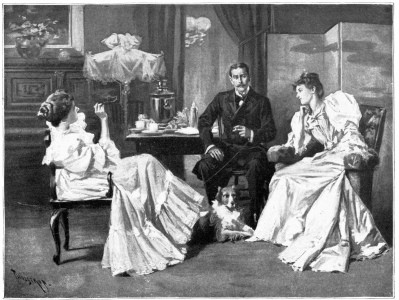
â âTHERE!â SAID OLIVE, PUFFING OUT A THIN CLOUDâ Page 379
THE MASTER
A Novel
BY
I. ZANGWILL
AUTHOR OF âTHE KING OF SCHNORRERSâ âCHILDREN OF THE GHETTOâ ETC.
ILLUSTRATED
NEW YORK AND LONDON
HARPER & BROTHERS PUBLISHERS
Copyright, 1895, by Harper & Brothers.
All rights reserved.
CONTENTS
PAGE PROEM 1 Book I CHAP.
I.SOLITUDE
5 II.THE DEAD MAN MAKES HIS FIRST AND LAST APPEARANCE
23 III.THE THOUGHTS OF YOUTH
33 IV.âMAN PROPOSESâ
45 V.PEGGY THE WATER-DRINKER
58 VI.DISILLUSIONS
69 VII.THE APPRENTICE
83 VIII.A WANDER-YEAR
99 IX.ARTIST AND PURITAN
113 X.EXODUS
123 Book II I.IN LONDON
132 II.GRAINGERâS
145 III.THE ELDER BRANCH
161 IV.THE PICTURE-MAKERS
181 V.A SYMPOSIUM
202 VI.THE OUTCAST
218 VII.TOWARDS THE DEEPS
229 VIII.âGOLD MEDAL NIGHTâ
245 IX.DEFEAT
259 X.MATT RECEIVES SUNDRY HOSPITALITIES
273 XI.A HOSTAGE TO FORTUNE
290 Book III I.CONQUEROR OR CONQUERED?
308 II.âSUCCESSâ
325 III.âVAIN-LONGINGâ
342 IV.FERMENT
364 V.A CELEBRITY AT HOME
384 VI.A DEVONSHIRE IDYL
408 VII.THE IDYL CONCLUDES
438 VIII.ELEANOR WYNDWOOD
460 IX.RUTH HAILEY
487 X.THE MASTER
499ILLUSTRATIONS
â âTHERE!â SAID OLIVE, PUFFING OUT A THIN CLOUDâ Frontispiece âHE PLACED HIMSELF WITH HIS BACK TO THE DOORâ Facing p. 12 â âI AM AFIRE WITH THIRST,â SHE CRIEDâ â 64 â âLORâ BLESS YOU, SIR,â SAID SHE, âIâM NOT WORRYINâ ABOUT THE RENTâ â â 226 â âGOOD-NIGHT,â SHE SAID, SOFTLYâ â 290 âMATT DINED WITH HERBERT AT A LITTLE TABLEâ â 338 âALL WAS VERY STILL, SAVE FOR THE ETERNAL MONOTONE OF THE SEAâ â 424 âSOMETHING IN THE SCENE THRILLED HIM WITH A SENSE OF RESTFUL KINSHIPâ â 516THE MASTER
PROEM
Despite its long stretch of winter, in which May might wed December in no incompatible union, âtwas a happy soil, this Acadia, a country of good air and great spaces; two-thirds of the size of Scotland, with a population that could be packed away in a corner of Glasgow; a land of green forests and rosy cheeks; a land of milk and molasses; a land of little hills and great harbors, of rich valleys and lovely lakes, of overflowing rivers and oversurging tides that, with all their menace, did but fertilize the meadows with red silt and alluvial mud; a land over which France and England might well bicker when first they met oversea; a land which, if it never reached the restless energy of the States, never retained the Old World atmosphere that long lingered over New England villages; save here and there in some rare Acadian settlement that dreamed out its life in peace and prayer among its willow-trees and in the shadows of its orchards.
At Minudie, at Clare in Annapolis County, where the goodly apples grew, lay such fragments of old France, simple communities shutting out the world and time, marrying their own, tilling their good dyke land, and picking up the shad that the retreating tide left on the exposed flats; listening to the Angelus, and baring their heads as some Church procession passed through the drowsy streets. They had escaped the Great Expulsion, nor had joined in the exodus of âEvangeline,â and, sprinkled about the country, were compatriots of theirs who had drifted back when the times grew more sedate; but for the most part it was the Saxon that profited by the labors of the pioneer Gaul, repairing the tumble-down farms and the dilapidated dykes, possessing himself of embanked marsh lands, and replanting the plum-trees and the quinces his predecessor had naturalized. For the revolt of the States against Britain sent thousands of American loyalists flocking into this âNew Scotland,â which thus became a colony of âNew England.â Scots themselves flowed in from auld Scotland, and the German came to sink himself in the Briton, and a band of Irish adventurers, under the swashbuckling Colonel McNutt, arrived with a grant of a million acres that they were not destined to occupy. The Acadian repose had fled forever. The sparse Indian hastened to make himself scarcer, conscious there was no place for him in the new order, and disappearing deliciously in hogsheads of rum. The virgin greenwood rang with axes, startling the bear and the moose. Crash! Down went pine and beech, hemlock and maple, their stumps alone left to rot and enrich the fields. Crash!—thud! The weasel grew warier, the astonished musquash vanished in eddying circles. Bridges began to span the rivers where the beaver built its dams in happy unconsciousness of the tall cylinder that was about to crown civilization. The caribou and the silver fox pressed inland to save their skins. The snare was set in the wild-wood, and the crack of the musket followed the ring of the axe. The mackerel and the herring sought destruction in shoals, and the seines brimmed over with salmon and alewives and gaspereux. The wild land that had bloomed with golden-rod and violets was tamed with crops, and plump sheep and fat oxen pastured where the wild strawberry vine had trailed or the bull-frog had croaked under the alders. A sturdy, ingenious race the fathers of the new settlement, loving work almost as much as they feared God; turning their hand to anything, and opening it wide to the stranger. They raised their own houses, and fashioned their own tools, and shod their own horses, and later built their own vessels, and even sailed them to the great markets laden with the produce of their own fields and the timber from their own saw-mills. There were women in this workaday paradise—shapely, gentle creatures, whose hands alone were rough with field and house-work; women who span and sang when the winter night-winds whistled round the settlement. The dramas of love and grief began to play themselves out where the raccoon and the chickadee had fleeted the golden hours in careless living. Children came to make the rafters habitable, and Death to sanctify them with memories. The air grew human with the smoke of hearths, the forest with legends and histories. And as houses grew into homes and villages into townships, Church and State arose where only Faith and Freedom had been.
The sons and heirs of the fathers did not always cling to the tradition of piety and perseverance. The âBluenoseâ grew apathetic, content with the fatness of the day; or, if he exerted himself, it was too often to best a neighbor. The great magnets of New York and Boston drew off or drew back all that was iron in the race.
And amid these homely emotions of yeomen, amid the crude pieties or impieties of homespun souls, amid this sane hearty intercourse with realities or this torpor of sluggish spirits, was born ever and anon a gleam of fantasy, of imagination: bizarre, transfiguring, touching things with the glamour of dream. Blind instincts—blinder still in their loneliness—yearned towards light; beautiful emotions stirred in dumb souls, emotions that mayhap turned to morbid passion in the silence and solitude of the woods, where character may grow crabbed and gnarled, as well as sound and straight. For whereas to most of these human creatures, begirt by the glory of sea and forest, the miracles of sunrise and sunset were only the familiar indications of a celestial timepiece, and the starry heaven was but a leaky ceiling in their earthly habitation, there was here and there an eye keen to note the play of light and shade and color, the glint of wave and the sparkle of hoar-frost and the spume of tossing seas; the gracious fairness of cloud and bird and blossom, the magic of sunlit sails in the offing, the witchery of white winters, and all the changing wonder of the woods; a soul with scanty self-consciousness at best, yet haply absorbing Nature, to give it back one day as Art.
Ah, but to see the world with other eyes than oneâs fellows, yet express the vision of oneâs race, its subconscious sense of beauty, is not all a covetable dower.
The islands of Acadia are riddled with pits, where men have burrowed for Captain Kiddâs Treasure and found nothing but holes. The deeper they delved the deeper holes they found. Whoso with blood and tears would dig Art out of his soul may lavish his golden prime in pursuit of emptiness, or, striking treasure, find only fairy gold, so that when his eye is purged of the spell of morning, he sees his hand is full of withered leaves.
Book I—CHAPTER I
SOLITUDE
âMatt, Matt, whatâs thet thar noise?â
Matt opened his eyes vaguely, shaking off his younger brotherâs frantic clutch.
âItâs onây the frost,â he murmured, closing his eyes again. âGo to sleep, Billy.â
Since the sled accident that had crippled him for life, Billy was full of nervous terrors, and the night had been charged with mysterious noises. Within the lonely wooden house weather-boards and beams cracked; without, twigs snapped and branches crashed; at times Billy heard reports as loud as pistol-shots. One of these shots meant the bursting of the wash-basin on the bedroom bench, Matt having forgotten to empty its contents, which had expanded into ice.
Matt curled himself up more comfortably and almost covered his face with the blanket, for the cold in the stoveless attic was acute. In the gray half-light the rough beams and the quilts glistened with frozen breaths. The little square window-panes were thickly frosted, and below the crumbling rime was a thin layer of ice left from the day before, solid up to the sashes, and leaving no infinitesimal dot of clear glass, for there was nothing to thaw it except such heat as might radiate through the bricks of the square chimney that came all the way from the cellar through the centre of the flooring to pop its head through the shingled roof.
âMatt!â Billy was nudging his brother in the ribs again.
âHullo!â grumbled the boy.
âThet thar ainât the frost. Hark!â
â âTis, I tell ye. Donât you hear the pop, pop, pop?â
âNot thet; tâother down-stairs.â
âOh, thetâs the wind, I reckon.â
âNo; itâs some âun screaminâ!â
Matt raised himself on his elbow, and listened.
âWhy, you gooney, itâs onây mother rowinâ Harriet,â he said, reassuringly, and snuggled up again between the blankets.
The winter, though yet young, had already achieved a reputation. Blustrous north winds had driven inland, felling the trees like lumbermen. In the Annapolis Basin myriads of herrings, surprised by Jack Frost before their migratory instinct awoke, had been found frozen in the weirs, and the great salt tides overflowing the high dykes had been congealed into a chocolate sea that, when the liquid water beneath ran back through the sluices, lay solid on the marshes. By the shores of the Basin of Minas sea-birds flapped ghostlike over amber ice-cakes, whose mud-streaks under the kiss of the sun blushed like dragonâs blood.
Snow had fallen heavily, whitening the âevergreenâ hemlocks, and through the shapeless landscape half-buried oxen had toiled to clear the blurred roads bordered by snow-drifts, till the three familiar tracks of hoofs and sleigh-runners came in sight again. The stage to Truro ploughed its way along, with only dead freight on its roof and a furred animal or two, vaguely human, shivering inside. Sometimes the mail had to travel by horse, and sometimes it altogether disappointed Billy and his brothers and sisters of the excitement of its passage; for the stage road ran by the small clearing, in the centre of which their house and barn had been built—a primitive gabled house, like a Noahâs ark, ugliness unadorned, and a cheap log barn of the âlean-toâ type, with its cracks corked with moss, and a roof of slabs.
Jack Frost might stop the mail, but he could not stop the gayeties of the season. âWooden frolicsâ and quilting-parties and candy-pullings and infares and Baptist revival-meetings had been as frequent as ever; and part of Mattâs enjoyment of his couch was a delicious sense of oversleeping himself legitimately, for even his mother could hardly expect him to build the fire at five when he had only returned from Deacon Haileyâs âmuddinâ frolicâ at two. He saw himself coasting down the white slopes in his hand-sled, watching the wavering radiance of the northern lights that paled the moon and the stars, and wishing his mother would not spoil the after-glow of the nightâs pleasure and the poetic silence of the woods by grumbling about his grown-up sister Harriet, who had deserted them for an earlier escort home. He felt himself well rewarded for his afternoonâs labor in loading marsh mud for the top-dressing of Deacon Haileyâs fields; and a sudden remembrance of how his mother had been rewarded for helping Mrs. Hailey to prepare the feast made him nudge Billy in his turn.
âCheer up, Billy. Weâve brought back a basket oâ goodies: thereâs plum-cake, doughnuts—â
âItâs gettinâ worst,â said Billy. âHark!â
Matt mumbled impatiently and redirected his thoughts to the âmuddinâ frolic.â The images of the night swept before him with almost the vividness of actuality; he lost himself in memories as though they were realities, and every now and then a dash of sleep streaked these waking visions with the fantasy of dream.
âMy, how the fiddle shrieks!â runs the boyâs reminiscence. âWhy donât ole Jupe do his tuninâ to home, the pesky nigger? Weâre all waitinâ for the reel—the âfoursâ are all made up; Ruth Hailey and me hev took the floor. Ruth looks jest great with thet white frock anâ the pink sash, thetâs a fact. Hooray!—âThe Devil among the Tailors!â—La, lalla, lalla, lalla, lalla, flip-flop!â He hears the big winter top-boots thwack the threshing-floor. Keep it up! Whoop! Faster! Ever faster! Oh, the joy of life!
Now he is swinging Ruth in his arms. Oh, the merry-go-round! The long rows of candles pinned by forks to the barn walls are guttering in the wind of the movement; the horses tied to their mangers neigh in excitement; from between their stanchions the mild-eyed cows gaze at the dancers, perking their naïve noses and tranquilly chewing the cud. A bat, thawed out of his winter nap by the heat of the temporary stove, flutters drowsily about the candles; and the odors of the stable and of the packed hay mingle with the scents of the ball-room. Mattâs exhaustive eye, though never long off pretty Ruthâs face, takes in even the grains of wheat that gild many a tousled head of swain or lass as the shaking of the beams dislodges the unthreshed kernels in the mow under the eaves, and, keener even than the eye of his collie, Sprat, notes the mice that dart from their holes to seize the fallen drops of tallow. But perhaps Sprat is only lazy, for he will not vacate his uncomfortable snuggery under the stove, though he has to shift his carcass incessantly to escape the jets of tobacco-juice constantly squirted in his direction. It serves him right, thinks his young master, for persisting in coming, though, for the matter of that, the creature, having superintended the mud-hauling, has more right to be present than Bully Preep. âWonder why sister Harriet lets him dance with her so ofân!â the panorama of his thought proceeds. âWhat kin she see in the skunk, fur lanâ sakes? I told her âbout the way he bully-ragged me when he was boss oâ the school and I was a teeny shaver. But she donât seem to care a snap. Girls are queer critters, thetâs a fact. He used to put a chip on my shoulder, anâ egg the fellers on to flick it off. But, gosh! didnât I hit him a lick when he pulled little Ruthâs hair? Heâd a black eye, thetâs a fact, though he givâ me two, anâ mother anâ teacher âud a givâ me one more apiece, but there warnât no more left. I took it out in picters though, I guess. My! didnât ole McTavitâs face jest look reedicâlous when he discovered Bully Preep in the fly-leaf of every readinâ-book. Thetâs jest how mother is glarinâ at Harriet this moment. Pop! pop! pop! What a lot oâ ginger-beer anâ spruce-beer Deacon Hailey is openinâ! Pop! pop! pop! He donât seem to notice them thar black bottles oâ rum. Heâs âtarnal cute, is ole Hey. Seems like heâs talkinâ to mother. Wonder how she kin understand him. He allus talks as if his mouth was full oâ words—but itâs onây tobacco, I reckon. Pop! pop! pop! Thetâs what I allus hear him say, windinâ up with a âHeyâ—anâ it does rile me some to refuse pumpkin-pie, not knowinâ heâs invitinâ me to anythinâ but hay. I âspect motherâs heerd him talk considerable, just es Iâve heerd the jays anâ the woodpeckers; though she kinât tell one from tâother, I vow, through beinâ raised at Halifax. Thunderation! thetâs never her dancinâ with ole Hey! My stars, whatâll her elders say? Well, I wow! She is backslidinâ. Ah, she recollecks! She pulls up, her face is like a beet. Ole Hey is argufyinâ, but she hangs back in her traces. I reckon she kinder thinks sheâs kicked over the dashboard this time. Ah, heâs gone and taken Harriet for a pardner instead; heâll like sister better, I guess. By gum! Heâs kickinâ up his heels like a colt when it fust feels the crupper. I do declare Marm Hailey is lookinâ pesky ugly âbout it. Sheâs a mighty handsome critter, anyways. Pity she kinât wear her hat with the black feather indoors—she does look jest spliffinâ when she drives her horses through the snow. Whoop! Keep it up! Sling it out, ole Jupe! More rosin. Yankee doodle, keep it up, Yankee doodle dandy! Go it, you cripples; Iâll hold your crutches! Why, thereâs Billy dancinâ with the crutch I made him!â he tells himself as his vision merges in dream. âPop! pop! pop! How his crutch thumps the floor! Poor Billy! Fancy hevinâ to hop through life on thet thar crutch, like a robin on one leg! Or shall I hev to make him a longer one when heâs growed up? Mebbe he wonât grow up—mebbe heâll allus be the identical same size; and when heâs an ole man heâll be the right size again, anâ the crutchâll onây be a sorter stick. I wish I hed a stick to make this durned cow keep quiet—I kinât milk her! So! so! Daisy! Ole Jupeâs music ainât for four-legged critters to dance to! My! whatâs thet nonsense âbout a cow? Why, Iâm dreaminâ. Whoa, there! Give her a tickler in the ribs, Billy. Hullo! look out! hereâs father come back from sea! Quick, Billy, chuck your crutch in the hay-mow. Kinât you stand straighter nor that? Unkink your leg, or fatherâll never take you out to be a pirate. Fancy a pirate on a crutch! It was my fault, father, for fixinâ up thet thar fandango, but motherâs lambasted me aâready, anâ she wanted to shoot herself. But it donât matter to you, father—youâre allus away aâmost, anâ Billyâs crutch kinât get into your eye like it does into motherâs. She was afeared to write to you âbout it. Thetâs onây Billy in a fit—you see, Daisy kicked him, and they couldnât fix his leg back proper; it donât fit, so he hes fits now anâ then. Heâll never be a pirate now. Drive the crutch deeper into the ice, Charley; steady there with the long pole. The iron pin goes into the crutch, Billy; donât get off the ashes, youâll slide under the sled. Now, then, is the rope right? Jump on the sled, you girls and fellers! Round with the pole! Whoop! Hooray! Ainât she scootinâ jest! Let her rip! Pop! Snap! Geewiglets! The ropeâs give! Donât jump off, Billy, I tell you; youâll kill yourself! Stick in your toes anâ donât yowl; weâll slacken at the dykes. Look at Ruth—she donât scream. Thunderation! Weâre goinâ over into the river! Hold tight, you uns! Bang! Smash! Weâre on the ice-cakes! Is thet you thetâs screaminâ, Billy? You ainât hurt, I tell you—donât yowl—you gooney—donât—â
But it was not Billyâs voice that he heard screaming when the films of sleep really cleared away. The little cripple was nestling close up to him with the same panic-stricken air as when they rode that flying sled together. This time it was impossible to mistake their motherâs voice for the wind—it rose clearly in hysterical vituperation.
âAnâ you orter be âshamed oâ yourself, I do declare, goinâ home all alone in a sleigh with a young man—in the dead oâ night, too!â
âThere were more nor ourn on the road; and since Abner Preep was perlite enough—â
âYes, anâ you didnât think oâ me on the road oncet, I bet! If young Preep wanted to do the perlite, heâdâ aâ took me in his fatherâs sleigh, not a wholesome young gal.â
âBut I was tarâd out with dancinâ eâen aâmost, and you onây—â
âDonât you talk about my dancinâ, you blabbinâ young slummix! Jest keep your eye on your Preeps with their bow-legs anâ their pigeon-toes.â
âHis legs is es straight es yourn, anyhow.â
âPâraps youâll say thet Iâve got Injun blood next. Look at his round shoulders and his lanky hair—heâs a Micmac, thetâs what he is. He onây wants a few baskets and butter-tubs to make him look nateral. Ugh! I kin smell spruce every time I think on him.â
âItâs you that hev hed too much spruce-beer, hey?â
âYou sassy minx! Folks hev no right to bring eyesores into the world. Iâd rather stab you than see you livinâ with Abner Preep. Itâs a squaw he wants, thetâs a fact, not a wife!â
âIâd rather stab myself than go on livinâ with you.â
For a moment or two Matt listened in silent torture. The frequency of these episodes had made him resigned, but not callous. Now Harrietâs sobs were added to the horror of the altercation, and Matt fancied he heard a sound of scuffling. He jumped out of bed in an agony of alarm. He pulled on his trousers, caught up his coat, and slipped it on as he flew barefoot down the rough wooden stairs, with his woollen braces dangling behind him.
In the narrow icy passage at the foot of the stairs, in the bleak light from the row of little crusted panes on either side of the door, he found his mother and sister, their rubber-cased shoes half-buried in snow that had drifted in under the door. Mrs. Strang was fully dressed in her âfrolickinâ â costume, which at that period included a crinoline; she wore an astrakhan sacque, reaching to the knees, and a small poke-bonnet, plentifully beribboned, blooming with artificial flowers within and without, and tied under the chin by broad, black, watered bands. Round her neck was a fringed afghan, or home-knit muffler. She was a tall, dark, voluptuously-built woman, with blazing black eyes and handsome features of a somewhat Gallic cast, for she came of old Huguenot stock. She stood now drawing on her mittens in terrible silence, her bosom heaving, her nostrils quivering. Harriet was nearer the door, flushed and panting and sobbing, a well-developed auburn blonde of sixteen, her hair dishevelled, her bodice unhooked, a strange contrast to the otherâs primness.
âWhere you goinâ?â she said, tremulously, as she barred her motherâs way with her body.
âIâm goinâ to drownd myself,â answered her mother, carefully smoothing out her right mitten.
âNonsense, mother,â broke in Matt. âYou kinât go out—itâs snowinâ.â
He brushed past the pair and placed himself with his back to the door, his heart beating painfully. His motherâs mad threats were familiar enough, yet they never ceased to terrify. Some day she might really do something desperate. Who knew?
âIâm goinâ to drownd myself,â repeated Mrs. Strang, carefully winding the muffler round her head.
She made a step towards the door, sweeping the limp Harriet roughly behind her.
âYou kinât get out,â Matt said, firmly. âWhy, you hevnât hed breakfast yet.â
âWhat do I want oâ breakfus? Your sister is breakfus ânough for me. Clear out oâ the way.â
âDonât you let her go, Matt!â cried Harriet. âIâll quit instead.â
âYou!â exclaimed her mother, turning fiercely upon her, while her eyes spat fire. âYou are young and wholesome—the world is afore you. You were not brought from a great town to be buried in a wilderness. Marry your Preeps anâ your Micmacs, and nurse your pappooses. God has cursed me with froward children anâ a cripple, anâ a husband that goes gallivantinâ onchristianly about the world with never a thought for his âmortal soul, anâ the Lord has doomed me to worship Him in the wrong church. Mother yourselves; I throw up the position.â
âIs it my fault if father hesnât wrote you lately?â cried Harriet. âIs it my fault if thereâs no Baptist church to Cobequid village?â
âShut your mouth, you brazen hussy! Youâve drove your mother to her death! Stand out oâ my way, Matthew; donât you disobey my dyinâ requesâ.â
âI shaânât,â said the boy, squaring his shoulders firmly against the door. âWhere kin you drownd yourself? The pondâs froze anâ the tideâs out.â
He could think of no other argument for the moment, and he had an incongruous vision of her sliding down to the river on her stomach, as the boys often did, down the steep, reddish-brown slopes of greasy mud, or sinking into a squash-hole like an errant horse.
The islands of Acadia are riddled with pits, where men have burrowed for Captain Kiddâs Treasure and found nothing but holes. The deeper they delved the deeper holes they found. Whoso with blood and tears would dig Art out of his soul may lavish his golden prime in pursuit of emptiness, or, striking treasure, find only fairy gold, so that when his eye is purged of the spell of morning, he sees his hand is full of withered leaves.
âHe never saw you!â she cried, hysterically, closing the wee yawning mouth with kisses. Her eyes fell on Billy limping towards the red-hot stove where the others were already clustered.
In the which far-straggling village (to take time a little by the forelock) his fatherâs death did not remain a wonder for the proverbial nine days. For a week the young men chewing their evening quid round the glowing maple-wood of the store stove, or on milder nights tapping their toes under the verandas of the one village road as they gazed up vacantly at the female shadows flitting across the gabled dormer-windows of the snow-roofed wooden houses, spoke in their slightly nasal accent (with an emphasis on the ârâ) of the âpearâls of the watter,â and calling for their nightâs letters held converse with the postmistress on âthe watter and its pearâls,â and expectorated copiously, presumably in lieu of weeping. And the outlying farmers who dashed up with a lively jingle of sleigh-bells to tether their horses to the hitching-posts outside the stores, or to the picket-fence surrounding the little wooden meeting-house (for the most combined business with religion), were regaled with the news ere they had finished swathing their beasts in their buffalo robes and âbootsâ; and it lent an added solemnity to the appeal of the little snow-crusted spire standing out ghostly against the indigo sky, and of the frosty windows glowing mystically with blood in the gleam of the chandelier lamps, and, mayhap, wrought more than the drawling exposition of the fusty, frock-coated minister. And the old grannies, smoking their clay pipes as they crouched nid-nodding over the winter hearth, their wizened faces ruddy with firelight, mumbled and grunted contentedly over the tidbit, and sighed through snuff-clogged nostrils as they spread their gnarled, skinny hands to the dancing, balsamic blaze. But after everybody had mourned and moralized and expectorated for seven days a new death came to oust David Strangâs from popular favor; a death which had not only novelty, but equal sensationalism, combined with a more genuinely local tang, for it involved a funeral at home. Handsome Susan Hailey, driving her horses recklessly, her black feather waving gallantly in the wind, had dashed her sleigh upon a trunk, uprooted by the storm and hidden by the snow. She was flung forward, her head striking the tree, so that the brave feather dribbled blood, while the horses bolted off to Cobequid Village to bear the tragic news in the empty sleigh. And so the young men, with the carbuncles of tobacco in their cheek, expectorated more and spoke of the âpearâls of the land,â and walking home from the singing-class the sopranos discussed it with the basses, and in the sewing-circles, where the matrons met to make undergarments for the heathen, there was much shaking of the head, with retrospective prophesyings and whispers of drink, and commiseration for âOle Hey,â and all the adjacent villages went to the sermon at the house, the deceased lady being, as the minister (to whose salary she annually contributed two kegs of rum) remarked in his nasal address, âuniversally respected.â And everybody, including the Strangs and their collie, went on to the lonesome graveyard—some on horse and some on foot and some in sleighs, the coffin leading the way in a pung, or long box-sleigh—a far-stretching, black, nondescript procession, crawling dismally over the white, moaning landscape, between the zigzag ridges of snow marking the buried fences, past the trailing disconsolate firs, and under the white funereal plumes of the pines.
And the new birch rod made its trial slash at the raised hand.
âOh, heâll be all right if you kinder break the news to him anâ explain the thing proper. I reckon he wonât take to the deacon at first.â
â âTainât your turn yet, Tommy,â he said, waving away the smoke with his hand, and Tommy fell back asleep, as if mesmerized. Matt was as relieved at not having to explain as at Tommyâs momentary wakefulness, which had braced him against the superstitious awe that had been invading him while the mad beauty cursed him with that sweet voice of hers that no anger could make harsh. He thought of the apparition with pity, mingled with a thrill of solemn adoration; she had for him the beauty and wildness of the elemental, like the sky or the sea. And yet she had left in him other feelings—not only the doubt of her reality, but an uneasy stirring of apprehensions. Was there nothing but insane babble in this talk of Ruth Hailey and Abner Preep? A fear he could not define weighed at his heart. Even if he had been dreaming, if he had drowsed over the fire—as he must in any case have done not to have heard the scrape and clatter of snow-shoes entering—the dream portended something evil. But, no! it was not a dream. Assuredly the sap in the barrel had sunk to a lower level. With a new thought he lit a resinous bough and slipped out quickly and examined the dry stiff snow. The double trail of departing snow-shoes was manifest, meandering among the bark dishes and irregularly intersecting the trail of arrival. The radiant moonlight falling through the thin bare maple-boughs made his torch superfluous, except in the fuscous glade of leafy evergreens, along which he followed the giant footmarks for some little distance. He paused, leaning against a tall hemlock. Doubt was impossible. He had really entertained a visitor. Not seldom in former years had he entertained visitors who came to camp out for the night, which they made uproarious. But never had his hut sheltered so strange a guest. He was moved at the thought of her drifting across the wastes of snow like some fallen spirit. He looked up and abstractedly watched a crow sleeping with its head under its wing on the top of the hemlock, then his vision wandered to the flashing streamers of northern light, and, higher still, to those keen depths of frosty sky where the stars stood beautiful, and they drew up his thoughts yearningly to the infinite spaces. Something cried within him for he knew not what—save that it was very great and very majestic and very beautiful, mystically blending the luminousness of light and color with the scent of flowers and the troubled sweetness of music; and at the back of his dim, delicious craving for it was a haunting certainty that he would never reach up to it, never, never. The prophecy of mad Peggy recurred to the boy like a cutting blast of wind. Was it true, then, that he would thirst and thirst, and nothing ever quench his thirst? He held up his torch yearningly to the stars, while the night moaned around him, and the flaring pinewood cast a grotesque shadow of him on the pure white snow, an uncouth image that danced and leered as in mockery.
In moving the âlittle dishâ he laid bare Tommyâs fatherâs calumet, forgotten. He took it up. How the universe had changed since last he held a pipe in his hand—only last night! Again he heard the howl of a wild-cat, and he looked round involuntarily, as if expecting to find Mad Peggy at his elbow. But he had no sense of awe just now—though he had barred his door inhospitably against further bears—only the voluptuousness of liberty and loneliness, the healthy after-glow of satisfied appetite, and the gayety born of flaming logs and a couple of mouthfuls of fire-water. The Water-Drinkerâs prophecy seemed peculiarly inept in view of the pipe he held in his hand. With tremulous anticipation of more than mortal rapture he relit it. The sensation was unexpectedly pungent, but Matt puffed away steadily in hope and trust that this was merely the verdict of an unaccustomed palate, and he found a vast compensatory pleasure in his ability to make the thing work, to send the delicate wreaths into the air as ably as any Micmac or deacon of them all.
It was Saturday, but Matt suffered such tortures under the moral but mumbled exordiums of âOle Hey,â of which his unaccustomed ear took in less than ever, that he determined to depart on the Monday. The deacon seemed to have aged considerably, his beard was matted and thick, and his dicky was stained with tobacco-juice. For the rest, Matt discovered that most of the children were employed about the farm or the works, and that they had ceased to go to school, the deacon having converted Ruth into a school-mistress when she could be spared from keeping the books of his tannery and grist-mill. Ruth herself he met with indifference that the stateliness of her unexpectedly tall presence did nothing to thaw. He was surprised to hear from Billy, whose bed he shared that night, and who was more greedy to hear Mattâs adventures than to talk, that they were all very fond of her, and that she could still romp heartily. But Ruth had gradually grown shadowy to his imagination beside his burning dreams of Art, and the sight of her seemed to add the last touch of insubstantiality to her image. And yet, in the boredom of the Sunday services, with his eye roving restlessly about the severe, unlovely meeting-house in search of distractions, he could not but be conscious that she was the sweetest and sedatest figure in the village choir that sang and flirted in the rising tiers of the gallery over the vestibule; and when Deacon Hailey, tapping his tuning-fork on the rails, imitated its note with a rasping croak, Matt had a flash of sympathy with the divined inner life of the girl in this discordant environment. He told her briefly of his plans—to save up enough money to get to his uncle in London, who would doubtless put him in the way of studying Art seriously. She said she wished she had something as fine to live and work for; still she was busy enough, what with book-keeping and teaching school, as she put it smilingly. Their parting, like their meeting, was awkward. Self-consciousness and shyness had come into their simple relation. Neither dared take the initiative of a kiss, which for the rest was a rare caress in Cobequid save between children and lovers. Relatives shook hands; even women were not free of one anotherâs lips. And for the ladâs part, timidity was all he felt in the presence of this sweet graceful stranger. Only at the last moment, when she handed him a keepsake in the shape of a prize copy of the Arabian Nights her music-mistress had given her, did their looks meet as of yore, and then it was more the young painter than the old playmate who was touched by the earnest radiance of her eyes and the flicker of rose across the delicate fairness of her cheek. He made a little sketch of her in return, and sent it her from Halifax.
London, too, figured in the pageantry of his dreams, glittering like a city of the Arabian Nights, ablaze with palaces, athrob with music; and perched on the top of the tallest cupola, on the loftiest hill, stood his uncle Matthew, holding his paint-brush like a sceptre, king of the realm of Art. Hark! was that not the kingâs trumpeters calling, calling him to the great city, calling him to climb up and take his place beside the sovereign? Oh, the call to his youth, the clarion call, summoning him forth to toils and triumphs in some enchanted land! Oh, the seething of the young blood that thronged the halls of dream with loveliness, and set seductive faces at the casements of sleep, and sanctified his waking reveries with prescient glimpses of a sweet spirit-woman waiting in some veiled recess of space and time to partake and inspire his consecration to Art! The narrow teachings of his childhood—the conception of a vale of tears and temptation—shrivelled away like clouds melting into the illimitable blue, merging in a vast sense of the miracle of a beautiful world, a world of infinitely notable form and color. And this expansion of his horizon accomplished itself almost imperceptibly because the oppression of that ancient low-hanging heaven overbrooding earth, of that sombre heaven lying over Cobequid Village like a pall, was not upon him, and he was free to move and breathe in an independence that made existence ecstasy, even at its harshest. So that, though he walked in hunger and cold, he walked under triumphal arches of rainbows.
Remorse for his balked romance set in severely as soon as the bustle of loading was over and the anchor weighed; Priscilla took on the halo of Byronism and the Arabian Nights which had steadily absented itself in practice. Often during that miserable voyage he called himself a fool and a milksop; for the passage was a nightmare of new duties, complicated by sea-sickness and the weakness of a half-starved constitution, and on that swinging schooner, with its foul-mouthed captain, the mean bedroom he had deserted showed like a stable paradise. But blustrous as the captain was by the side of the blubbering Bludgeon, he had his compensations, for he made the voyage before the few passengers had found their sea-legs. Arrived in Economy, Matt was again face to face with starvation. But here Fortune smiled—with a suspicion of humor in her smile; and having already climbed masts and ladders for his dinner, her protégé was easily tempted to seek it at the top of a steeple. The steeple, after tapering to a point two hundred feet high, was crowned by a ball, which for years had needed regilding. Unfortunately the architect had made the ball almost inaccessible, but Matt, being desperate, undertook the job. The breath of winter was already on the town; a week more and the whole steeple would be decorated for the season with snow, so Mattâs offer was accepted, and, his boots equipped with creepers, the young steeple-jack, begirt with ropes, made the ascent safely in the eye of the admiring populace, lowered the great ball and then himself, and being thereupon given board and lodging and materials, he gilded it in the privacy of his garret. Thus become a public hero, Matt easily got through the winter. He decorated the ceiling of the Freemasonsâ Hall, and painted a portrait of the member of the House of Assembly, a burly farmer. This was his first professional experience of an actual sitter, and he found himself more hampered than helped by too close contact with reality. However, a touch of imagination does no harm to a portrait, and Matt had by this time acquired sufficient experience of humanity to lean to beautyâs side even apart from his youthful tendency to idealization, which made it impossible for him at this period to paint anything that was not superficially beautiful or picturesque. The member pronounced the portrait life-like, and gave Matt a bushel of home-grown potatoes over and above the stipulated price, which was board and lodging during the period of painting, and an order on a store for two dollars. With the order Matt purchased a pair of Congress or side-spring boots; the potatoes he swopped for a box of paper collars. From Economy he wrote home to his mother, and received an incoherent letter, in which she denounced the deacon by the aid of fulminant texts. Matt sighed impotently, pitying her from his deeper experience of life, but hoping she got on better with âOle Heyâ than she imagined. He had half a mind to look up his folks, especially poor Billy; but just then he got an order from the farmer-deputyâs brother, who wrote that he was so pleased with his brotherâs portrait that he wished Matt to paint his sign-board. He added that, although he had not seen any specimen of Mattâs sign-writing, he felt confident the painter of that portrait would be a competent person. Matt accepted the new task with mixed feelings, and got so many other commissions from the shopkeepers (for every shop had its movable sign-board) that he soon saved fifty dollars, and seemed on the high sea to England and his uncle. He had fixed three hundred dollars as the minimum with which he might safely go to London to study art. The steerage passage would cost only twenty. Unfortunately he was persuaded to invest his savings in a partnership with a Yankee jewel-peddler, and to travel the country with him. The peddler did not swindle his partner, merely his clients; but Matt was so disgusted that he refused to remain in the business. Thereupon the peddler, freed from the obligations of partnership, treated him as an outsider, and refused to return his principal. Matt thought himself lucky to escape in the end with twenty-five dollars and a cleansed conscience. He went back to sign-painting, but, taking a hint from the Yankee, continued his travels, and became a peddler-painter. He hated the work, was out of sympathy with his prosaic sitters, wondering by virtue of what grace or loveliness they sought survival on canvas; but the road to Art, by way of his uncle in London, lay over their painted bodies, so he drudged along. And yet when the sitter was dissatisfied with the picture—it was generally the sitterâs friends who persuaded him that he was dissatisfied—and when Matt had to listen to the fatuous criticisms of farmers and store-keepers, the artist flared up, and more than once the hot-blooded boy sacrificed dollars to dignity. He was astonished to find that in many quarters his fame had preceded him, and more astonished to discover finally that the advance advertiser was his late partner. Whether the Yankee compounded thus for the use of Mattâs dollars Matt never knew, but in his kinder thought of the cute peddler the boy came to think himself the debtor. For the dollars mounted, one on the head of another, and the heap rose higher and higher, day by day and week by week, till at last the magic three hundred began to loom in the eye of hope. Three hundred dollars! saved by the sweat of the brow and semi-starvation, and sanctified by the blood and tears of youth; sweet to count over and to dream over, and to pile up like a tower to scale the skies.
Matt pacified her as best he could, and, promising to arrange it all soon, left her, his heart nigh breaking. He walked about the bustling streets like one in a dream, resenting the sunshine, and wondering why all these people should be so happy. Again that ancient image of his fatherâs dead face was tossed up on the waves of memory, to keep company henceforth with the death-in-life of his motherâs face. The breakdown of his ambition seemed a petty thing beside these vaster ironies of human destiny.
Ah, what hopes harbored, what dreams hovered in that bleak little room! The vague, troubled rumor of the great city rolled up in inspiring mystery; the light played with instructive fascination upon the sooty tiles; high over the congested chaos of house-tops he saw the evening mists rifted with sunset, and on starry nights he touched the infinite through his rickety casement.
From Tarmigan, whose executive faculty and technical knowledge were remarkable, and who, despite surface revolts behind his back, was worshipped by the whole school, Matt got many âpointers,â as he called them in his transatlantic idiom—traditions of the craft which he might never have hit out for himself; though, on the other hand, in the little studies he made at home and sometimes showed to Tarmigan, he produced effects instinctively, the technique of which he was puzzled to explain to the master-craftsman, who for the rest did not approve of the strange warm luminosities Matt professed to see on London tiles, or the misty coruscations that glorified his chimney-pots. Grainger himself never offered criticisms to his pupils except casually, and mainly by way of conversation, when he was bored with his own thoughts.
âAu revoir, my dear nephew, au revoir!â said Madame, shaking both his hands. âI said you and Herbert would love each other. You will find your sixpence awaiting you on the desk.â
âWell, you do, thereâs no denying it. Remember how you preached to me about the governor the first time you saw me. Perhaps youâll go lecturing Cornpepper because he economizes by domesticating his model when he has a big picture on the easel. Personally, I like Cornpepper; he is the only fellow who has the courage of his want of principles in this whitewashed sepulchre of a country. But be careful that you donât talk to him as you did to Rapper, for he lives up to his name. He is awfully peppery when you tread on his corns, though he has no objection to stamping on yours. Not that I believe thereâs any real malice in him, but they say his master at the Beaux-Arts was a very quarrelsome fellow, and my opinion is that he models himself on him, and thinks that to quarrel with everybody is to be a great artist.â
âAh, thereâs the Methodist parson again,â interrupted Herbert, laughing. âHang it all, man, youâre not a virgin, are you?â
Dear Matt,—What in the name of all that is unholy made you send that letter to my house instead of to the club? Thereâs been a devil of a row. The Old Gentleman opened the letter. He pretends he did so without noticing, as it came mixed up with his, and so few come for me to the house. When I got down to breakfast the mater was in tears and the Old Gentleman in blazes. Of course, heâd misread it altogether—imagined you wanted to borrow money instead of to get it back (isnât it comical? Itâs almost an idea for a farce for our dramatic society), and insisted you had been draining me all along (you did write you were sorry to bother me again, you old duffer). Of course I did my best to dispel the misconception, but it was no use my swearing till all was blue that this was the first application, he wouldnât believe a word of it. He said he had had his suspicions all along, and he called the mater to witness that the first time he saw you in the shop he said you were a rogue. And at last the mater, whoâd been standing up for you—I never thought she had so much backbone of her own—was converted, and confessed with tears that you had been here pretty nigh every day and swore you should never set foot here again, and the Old Gentleman dilated on the pretty return you had made for his kindness (sucking his boyâs blood, he called it, in an unusual burst of poetry), and he likewise offered some general observations on the comparative keenness of a serpentâs tooth and ingratitude. And thatâs how it stands. Thereâs nothing to be done, I fear, but to let the thing blow over—heâll cool down after a time. Meanwhile, you will have to write to me at the club if you want to meet me. I am awfully sorry, as I enjoyed your visits immensely. Do let me know if I can do anything for you. Iâm in a frightful financial mess, but I might give you introductions here or there. I know chaps on papers and that sort of thing. I am sure you have sufficient talent to get along—and you can snap your fingers at creditors, as you havenât got anything they can seize, and can flit any day you like. I wish I was you. With every good wish,
But when Matt sat down to paint that night he found himself incapacitated, a mass of aches and bruises. He went home to anoint himself with his arnica; in the unconscious optimism of sickness the suggestion of suicide had vanished altogether.
Herbert beamingly ordered boxes of Havanas and âsoda-and-whiskies,â and soon Matt, still in his overcoat, found himself drinking and smoking and shouting with the rest, exalted by the whiskey into forgetfulness of his clothes and his fortunes, and partaking in all the rollicking humors of the evening, in all the devil-may-care gayety of the eternal undergraduate, roaring with his boon companions over the improper stories of the ascetic-looking young man with the poetic head, bawling street choruses, dancing madly in grotesque congested waltzes, wherein he had the felicity to secure Cornpepper for a partner, and distinguishing himself in the high-kicking pas seul, not departing till the final âAuld Lang Syneâ had been sung with joined hands in a wildly whirling ring. Herbert had left some time before.
âI knew you werenât a rogue,â cried Madame, in thoughtless triumph. The sentiment reminding her of the interrogative eyebrows, she added, hastily, âOf course, you wonât tell my husband. Not that he would mind, of course, for I am helping you to leave the country. But oh, how I wish you had come to me instead of to Herbert! The dear boy has such hard work and so few pleasures, and his allowance is so small that his father was naturally annoyed to think of your making the poor boy stint himself. Of course, I made it up to Herbert unbeknown to his father, who would only return him a little of the money you had borrowed. Promise me you will not apply to Herbert again. You know it is so expensive living in Paris!â
âOh, good-night,â he said, holding out his hand.
âGod bless you,â murmured Matt, kissing the letter. âI believe I shall love you, after all.â
Not that Rosina knew much of his other affairs. In truth, she knew very little of her husbandâs life, nor by how vast a sweep it circumscribed her own. She knew he had to be away from her a very great deal, that he had to stay in the country to paint great people; she was vaguely aware that the necessities of his profession made a wide sociality profitable. She had been once or twice to peep at his studio, horrified by the grandeur, and only consoled by the demonstration that its cost was repaid in the prices, like the luxurious fittings of the shops in the Holloway Road. But her imagination lacked the materials to construct a vision of the whirlpool which had sucked him away from her; her reading was limited to a weekly newspaper in which his name seldom appeared. And he, in his mental isolation from her, found scant self-reproach for his silence; reserve seemed more natural than communicativeness. She could never know the doings of his soul, his thoughts were not her thoughts, he had given up the attempt at communion, the effort to teach her to know his real self; why should he be less reticent concerning his outward movements, his superficial self? He was aloof from her spiritually; beside this, his material separation from her was insignificant. The children—a girl of seven and a boy of nearly four—were no bonds of union. The elder, christened Clara, after Rosinaâs aunt, was sharp and lively enough, but given to passionate sulking; the younger—called after his grandfather, David—was a lymphatic, colorless youngster, sickly and rather slow-witted, with something of Billyâs pathos in his large gray eyes. Their father had tried hard to love them, as he had tried to love their mother, and had taken a certain proprietary interest in their infantile graces, and in the engaging ways of early childhood, but the claims of his Art left them in the motherâs hands, and the older they grew the less he grew to feel them his. Neither Clara nor David had as yet displayed any scintilla of artistic instinct. When he went home he usually had something for them in his pocket, as he would have had for the children of an acquaintance, but they gave him no parental thrill.
The Scotch landscape-painter pacified them by proposing a game of âshell-out,â and Herbert eagerly seconding the proposal it was carried nem. con., and the group mounted to the billiard-room, where Matthew Strang won half a crown before he went off to his nocturnal parties, leaving his cousin still renewing with zest his olden experience of the lighter side of British Art.
âOlive is so good,â she said, brokenly, âshe was of my husbandâs family—an Irish branch—but she quarrelled with them all—her father, her sisters—and came to live with me. Fortunately she is immensely rich in her own right, and independent of them all.â
âYouâre certainly not doing her justice!â
About nine oâclock Rosina sent a specially nice supper for two down to the study. Matthew roused himself to eat a morsel to keep Billy company, and then, before going to his sleepless couch in Billyâs room, bethought himself of whiling away the time by answering some letters which had been bulking his inner coat-pocket for days. One of these was a reverential request for an autograph, addressed from a fine-sounding country house, and backed by the compulsive seduction of a stamped envelope.
After which she opened the window, sat on the side of the bed, and screwed up her ripe red lips to produce a perplexed whistle.
âThe Catechism is right,â she went on, thoughtfully, proceeding to misquote it. âThe waves are too strong. Itâs no use fighting against your sex or your station. Do your duty in that state of life in which it has pleased God to call you. But I would have that text taught to the rich exclusively, not to the poor. The poor should be encouraged to ascend; the rich should be taught contentment. Else their strength for good is wasted fruitlessly.â And the electric current of love generated by those close-pressed palms flashed to her soul the mission of a life of noble work hand in hand.
âYou are right, my dear, there isnât a decent picture here,â Cornpepper chuckled, grimacing to adjust his monocle, and feeling his round beard. âIchabod! The glory is departed from Paris. The only chaps who can paint nowadays are the Neo-Teutonic school. The Frenchmen are played out—they have even lost their taste. They bought a picture of mine last year, you remember. I palmed off the rottenest thing Iâd ever done on âem. Itâs in the Luxembourg—you go and see it, old man, and you tell me if Iâm not right. Now, mind you do! Ta, ta, old fellow. Sorry youâre not in the Academy this year—but itâs a good advertisement for you. I think I shall be ill myself next year. But we mustnât talk shop. Good-bye, old man. Oh, by-the-way, I hear your cousinâs engaged to an heiress. Itâs true, is it? Lucky beggar, that Herbert! Better than painting, eh? Ha! ha! ha! But I knew heâd never do anything. Didnât he win the Gold Medal, eh? Ho! ho! ho! Well, au revoir. Donât forget the Luxembourg. You donât want to wait till Iâm dead and in the Louvre, what? Thanks for a pleasant chat, and wish you better.â
It was the steady, business-like clatter of determined work. She had taken up the burden of Duty again.
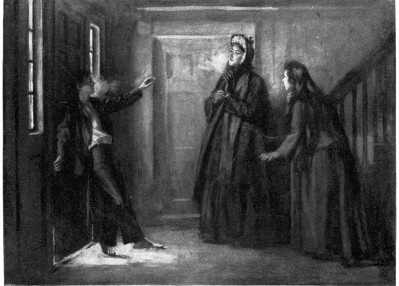
âHE PLACED HIMSELF WITH HIS BACK TO THE DOORâ
âWhy, thereâs onây mud-flats,â he added.
âIâll wait on the mud-flats fur the merciful tide.â She fastened her bonnet-strings firmly.
âThe river is full of ice,â he urged.
âThere will be room fur me,â she answered. Then, with a sudden exclamation of dismay, âMy God! youâve got no shoes and socks on! Youâll ketch your death. Go up-stairs dâreckly.â
âNo,â replied Matt, becoming conscious for the first time of a cold wave creeping up his spinal marrow. âIâll ketch my death, then,â and he sneezed vehemently.
âPut on your shoes anâ socks dâreckly, you wretched boy. You know what a bother I hed with you last time.â
He shook his head, conscious of a trump card.
âDâye hear me! Put on your shoes and socks!â
âTake off your bonnet anâ sacque,â retorted Matt, clinching his fists.
âPut on your shoes anâ socks!â repeated his mother.
âTake off your bonnet anâ sacque, anâ Iâll put on my shoes anâ socks.â
They stood glaring defiance at each other, like a pair of duellists, their breaths rising in the frosty air like the smoke of pistols—these two grotesque figures in the gray light of the bleak passage, the tall, fierce brunette, in her flowery bonnet and astrakhan sacque, and the small, shivering, sneezing boy, in his patched homespun coat, with his trailing braces and bare feet. They heard Harrietâs teeth chatter in the silence.
âGo back to bed, you young varmint,â said Matt, suddenly catching sight of Billyâs white face and gray night-gown on the landing above. âYouâll ketch your death.â
There was a scurrying sound from above, a fleeting glimpse of other little night-gowned figures. Matt and his mother still confronted each other warily. And then the situation was broken up by the near approach of sleigh-bells. They stopped slowly, mingling their jangling with the creak of runners sliding over frosty snow, then the scrunch of heavy boots travelled across the clearing. Harriet flushed in modest alarm and fled up-stairs. Mrs. Strang hastily retreated into the kitchen, and for one brief moment Matt breathed freely, till, hearing the click of the door-latch, he scented gunpowder. He dashed towards the door and pressed the thumb-latch, but it was fastened from within.
âHarriet!â he gasped, âthe gun! the gun!â
He beat at the door, his imagination seeing through it. His loaded gun was resting on the wooden hooks fastened to the beam in the ceiling. He heard his mother mount a chair; he tried to break open the door, but could not. The chances of getting round by the back way flashed into his mind, only to be dismissed as quickly. There was no time—in breathless agony he waited the report of the gun. Crash! A strange, unexpected sound smote his ears—he heard the thud of his motherâs body striking the floor. She had stabbed herself, then, instead. Half mad with excitement and terror, he backed to the end of the passage, took a running leap, and dashed with his mightiest momentum against the frail battened door. Off flew the catch, open flew the door with Matt in pursuit, and it was all the boy could do to avoid tumbling over his mother, who sat on the floor among the ruins of a chair, rubbing her shins, her bonnet slightly disarranged, and the gun, still loaded, demurely on its perch. What had happened was obvious; some of the little Strang mice, taking advantage of the catâs absence at the âmuddinâ frolic,â had had a frolic on their own account, turning the chair into a sled, and binding up its speedily-broken leg to deceive the maternal eye. It might have supported a sitter; under Mrs. Strangâs feet it had collapsed ere her hand could grasp the gun.
âThe pesky young varmints!â she exclaimed, full of this new grievance. âThey might hev crippled me fur life. Always a-tearinâ anâ a-rampaginâ anâ a-ruinatinâ. I kinât keep two sticks together. Itâs ânough to make a body throw up the position.â
The sound of the butt-end of a whip battering the front-door brought her to her feet with a bound. She began dusting herself hastily with her hand.
âWell, whatâre you gawkinâ at?â she inquired. âKinât you go anâ unbar the door, âstead oâ standinâ there like a stuck pig?â
Matt knew the symptoms of volcanic extinction; without further parley he ran to the door and took down the beechen bar. The visitor was âole Hey,â who drove the mail. The deacon came in, powdered as from his own grist-mill, and added the snow of his top-boots to the drift in the hall. There were leather-faced mittens on his hands, ear-laps on his cap, tied under the chin, a black muffler, hoary with frost from his breath, round his neck and mouth, and an outer coat of buffalo-skin swathing his body down to his ankles, so that all that was visible of him was a little inner circle of red face with frosted eyebrows.
Mrs. Strang stood ready in the hall with a genial smile, and Matt, his heart grown lighter, returned to the kitchen, extracted the family foot-gear from under the stove, where it had been placed to thaw, and putting on his own still-sodden top-boots, he set about shaving whittlings and collecting kindlings to build the fire.
âHere we are again, hey!â cried the deacon, as heartily as his perpetual, colossal quid would permit.
âDo tell! is it really you?â replied Mrs. Strang, with her pleasant smile.
âYes—dooty is dooty, I allus thinks,â he said, spitting into the snow-drift and flicking the snow over the tobacco-juice with his whip. âWhatever Deacon Haileyâs hand finds to do he does fust-rate—thetâs a fact. It donât seem so long a while since you and me were shakinâ our heels in the Sir Roger. Nay, donât look so peaked—thereâs nuthinâ to make such a touse about. You air a particâler Baptist, hey? Anâ I guess you kinder allowed Deacon Hailey would be late with the mail, hey? But heâs es spry es if heâd gone to bed with the fowls. You wonât find the beat of him among the young fellers nowadays—thetâs so. Theyâre a lazy, slinky lot; and es for doinâ their dooty to their country or their neighbor—â
âHev you brought me a letter?â interrupted Mrs. Strang, anxiously.
âI guess—but youâre goinâ out airly?â
âI allowed Iâd walk over to the village to see if it hed come.â
âOh, but it ainât the one you expecâ.â
âNo?â she faltered.
âI guess not. Thetâs why I brought it myself. I kinder scented it was suthinâ special, and so I reckoned Iâd save you the trouble of trudginâ to the post-office. Deacon Hailey ainât the man to spare himself trouble to obleege a fellow-critter. Do es youâd be done by, hey?â The deacon never lost an opportunity of pointing the moral of a position. Perhaps his sermonizing tendency was due to his habit of expounding the Sunday texts at a weekly meeting, or perhaps his weekly exposition was due to his sermonizing tendency.
âThank you.â Mrs. Strang extended her hand for the letter. He produced it slowly, apparently from up the sleeve of his top-most coat, a wet, forlorn-looking epistle, addressed in a sprawling hand. Mrs. Strang turned it about, puzzled.
âPâraps itâs from Uncle Matt,â ejaculated Matt, appearing suddenly at the kitchen door.
âYouâve got Uncle Matt on the brain,â said Mrs. Strang. âItâs a Halifax stamp.â She could not understand it; her own family rarely wrote to her, and there was no hand of theirs in the address. Deacon Hailey lingered on, apparently prepared, in his consideration for others, to listen to the contents of his âfellow-critterâsâ letter.
âAh, sonny,â he said to Matt, âonly jest turned out, and not slicked up yet. When I was your age I hed done my dayâs chores afore the day hed begun. No wonder the Province is so âtarnally behindhand, hey?â
âThetâs so,â Matt murmured. Pop! pop! pop! was all that he heard, so that ole Heyâs moral exhortations left him neither a better nor a wiser boy.
Mrs. Strang still held the letter in her hand, apparently having become indifferent to it. Ole Hey did not know she was waiting for him to go, so that she might put on her spectacles and read it. She never wore her spectacles in public, any more than she wore her nightcap. Both seemed to her to belong to the privacies of the inner life, and glasses in particular made an old woman of one before oneâs time. If she had worn out her eyes with needle-work and tears, that was not her neighborsâ business.
The deacon, with no sign of impatience, elaborately unbuttoned his outer buffalo-skin, then the overcoat beneath that, and the coat under that, and then, pulling up the edge of his cardigan that fitted tightly over his waistcoats, he toilsomely thrust his horny paw into his breeches-pocket and hauled out a fig of âblack-jack.â Then he slowly produced from the other pocket a small tool-chest in the guise of a pocket-knife, and proceeded to cut the tobacco with one of the instruments.
âCome here, sonny!â he cried.
âThe deacon wants you,â said Mrs. Strang.
Matt moved forward into the passage, wondering. Ole Hey solemnly held up the wedge of black-jack he had cut, and when Mattâs eye was well fixed on it he dislodged the old âchawâ from his cheek with contortions of the mouth, and blew it out with portentous gravity. Lastly, he replaced it by the wedge of âblack-jack,â mouthed and moulded the new quid conscientiously between tongue and teeth, and passed the ball into his right cheek.
âThetâs the way to succeed in life, sonny. Never throw away dirty afore you got clean, hey?â
Poor Matt, unconscious of the lesson, waited inquiringly and deferentially, but the deacon was finished, and turned again to his mother.
âI âspect it âll be from some of the folks to home, mebbe.â
âMebbe,â replied Mrs. Strang, longing for solitude and spectacles.
âWhen did you last hear from the boss?â
âHe was in the South Seas, the captân, sellinâ beads to the savages. Heâd a done better to preach âem the Word, I do allow.â
âAh, you kinât expect godliness from sailors,â said the deacon. âItâs in the sea es the devil spreads his nets, thetâs a fact.â
âThe Apostles were fishermen,â Mrs. Strang reminded him.
âYes; but fishers ainât sailors, Mrs. Strang. Itâs in furrin parts that the devil lurks, and the further a man goes from his family the nearer he goes to the devil, hey?â
Mrs. Strang winced. âBut heâs gittinâ our way now,â she protested, unguardedly. âHeâs cominâ South with a freight.â
âAh, joined the blockade-runners, hey?â
Mrs. Strang bit her lip and flushed. âI donât kear,â the deacon said, reassuringly. âI donât see why Nova Scotia should go solid for the North. Whatâs the North done for Nova Scotia âcept ruin us with their protection dooties, gol durn âem. They wonât have slaves, hey? Ainât we their slaves? Donât they skin us es clean es a bear does a sheep? Ainât they allus on the lookout to snap up the Province? But I never talk politics. If the North and South want to cut each otherâs throats, thatâs not our consarn. Mind your own business, I allus thinks, hey? And if your boss kin make a good spec by provisioninâ the Southerners, youâll be a plaguy sight better off, I vow. And so will I—for, you know, I shall hev to call in the mortgage unless you fork out thet thar interest purty slick. Thereâs no underhandedness about Deacon Hailey. He gives you fair warninâ.â
âDârectly the letter comes you shall have it—Iâve often told you so.â
âMebbe thetâll be his letter, after all—put his thumb out, I guess, and borrowed another fellerâs, hey?â
âNo—heâd be nowhere near Halifax,â said Mrs. Strang, her feverish curiosity mounting momently. âDonât them thar sleigh-bells play a tune! I guess your horses air gettinâ kinder restless.â
âWell—thereâs nuthinâ I kin do for you to Cobequid Village?â he said, lingeringly.
Mrs. Strang shook her head. âThank you, I guess not.â
âYou wouldnât kear to write an answer now—Iâd be tolerable pleased to post it for you down thar. Allus study your fellow-critters, I allus thinks.â
âNo, thank you.â
Deacon Hailey spat deliberately on the floor.
âEr—you got to home safe this morninâ?â
âYes, thank you. We all come together, me and Harriet and Matt. âTwere a lovely walk in the moonlight, with the Aurora Borealis a-quiverinâ and a-flushinâ on the northern horizon.â
âA-h-h,â said the deacon slowly, and rather puzzled. âA roarer! Hey?â
At this moment a sudden stampede of hoofs and a mad jangling of bells were heard without. With a âDurn them beasts!â the deacon breathlessly turned tail and fled in pursuit of the mail-sleigh, mounting it over the luggage-rack. When he had turned the corner, Mattâs grinning face emerged from behind the snow-capped stump of a juniper.
âI reckon I fetched him thet time,â he said, throwing away the remaining snowball, as he hastened gleefully inside to partake of the contents of the letter.
He found his mother sitting on the old settle in the kitchen, her spectacled face gray as the sand on the floor, her head bowed on her bosom. One limp hand held the crumpled letter. She reminded him of a drooping foxglove. The room had a heart of fire now, the stove in the centre glowed rosily with rock-maple brands, but somehow it struck a colder chill to Mattâs blood than before.
âFatherâs drownded,â his mother breathed.
âHeâll never know âbout Billy now,â he thought, with a gleam of relief.
Mrs. Strang began to wring her mittened hands silently, and the letter fluttered from between her fingers. Matt made a dart at it, and read as follows:
Dear Marm,—Donât take on but ime sorrie to tell you that the Cap is a gone goose we run the block kade oust slick but the 2 time we was took by them allfird Yanks we reckkend to bluff âem in the fog but about six bells a skwad of friggets bore down on us sudden like ole nick the cap he sees he was hemd in on a lee shoar and he swears them lubberly northers shanât have his ship not if he goes to Davy Jones his loker he lufs her sharp up into the wind and sings out lower the longbote boys and while the shot was tearin and crashin through the riggin he springs to the hall-yards and hauls down the cullers then jumps through the lazzaret into the store room kicks the head of a carsk of ile in clinches a bit of oakem dips it in the ile and touches a match to it and drops it on the deck into the runin ile and then runs for it hisself jumps into the bote safe with the cullers and we sheer off into the fog mufflin our oars with our caps and afore that tarnation flame bust out to show where we were we warnt there but we heard the everlastin fools poundin away at the poor old innocent Sally Bell till your poor boss dear marm he larfs and ses he shipmets ses he look at good old Sally sheâs stickin out her yellow tongue at em and grinnin at the dam goonies beg pardon marm but that was his way he never larfed no more for wed disremembered the cumpess and drifted outer the fog into a skwall and the night was comin on and we drov blind on a reef and capsized but we all struck out for shore and allowed the cap was setting sale the same way as the rest on us but when we reached the harbor the cap he warnt at the helm and a shipmet ses ses he as how he would swim with that air bundle of cullers that was still under his arm and they tangelled round his legs and sorter dragged him under and kep him down like sea-weed and now dear marm he lays in the Gulf of Mexiker kinder rapped in a shroud and gone aloft I was the fust mate and a better officer I never wish to sine with for tho he did sware till all was blue his hart was like an unborn babbys and wishing you a merry Christmas and God keep you and the young orfuns and giv you a happy new year dear marm you deserve it.
ime yours to command,
Hoska Cuddy (Mate).
p s.—i would have writ erlier, but i couldnât get your address till i worked my way to Halifax and saw the owners scuse me not puttin this in a black onwellop i calclated to brake it eesy.
Matt hastily took in the gist of the letter, then stood folding it carefully, at a loss what to say to the image of grief rocking on the settle. From the barn behind came the lowing of Daisy—half protestation, half astonishment at the unpunctuality of her breakfast. Matt found a momentary relief in pitying the cow. Then his motherâs voice burst out afresh.
âMy poor Davie,â she moaned. âCut off afore you could repent, too deep down fur me to kiss your dead lips. I hevnât even got a likeness oâ you; you never would be took. I shall never see your face again on airth, and I misdoubt if Iâll meet you in heaven.â
âOf course you will—he saved his flag,â said Matt, with shining eyes.
His mother shook her head, and set the roses on her bonnet nodding gayly to the leaping flame. âYour father was born a Sandemanian,â she sighed.
âWhat is thet?â said Matt.
âDonât ask me; there air things boys mustnât know. And youâve seen in the letter âbout his profane langwidge. I never wouldâve run off with him; all my folks were agen it, and a sore time Iâve hed in the wilderness âway back from my beautiful city. But it was Godâs finger. I pricked the Bible fur a verse, anâ it came: âAnâ they said unto her, Thou art mad. But she constantly affirmed it was even so. Then said they, It is his angel.â â
She nodded and muttered, âAnâ I was his angel,â and the roses trembled in the firelight. âIf you were a good boy, Matt,â she broke off, âyouâd know where thet thar varse come from.â
âHednât I better tell Harriet?â he asked.
âActs, chapter eleven, verse fifteen,â muttered his mother. âIt was the finger of God. Whatâs thet you say âbout Harriet? Ainât she finished tittivatinâ herself yet—with her father layinâ dead, too?â She got up and walked to the foot of the stairs. âHarriet!â she shrieked.
Harriet dashed down the stairs, neat and pretty.
âYou onchristian darter!â cried Mrs. Strang, revolted by her sprightliness. âDonât you know fatherâs drownded?â
Harriet fell half-fainting against the banister. Mrs. Strang caught her and pulled her towards the kitchen.
âThere, there,â she said, âdonât freeze out here, my poor child. The Lordâs will be done.â
Harriet mutely dropped into the chair her mother drew for her before the stove. Daisyâs bellowing became more insistent.
âAnâ he never lived to take me back to Halifax, arter all!â moaned Mrs. Strang.
âNever mind, mother,â said Harriet, gently. âGod will send you back some day. You hev suffered enough.â
Mrs. Strang burst into tears for the first time. âAh, you donât know what my life hes been!â she cried, in a passion of self-pity.
Harriet took her motherâs mittened hand tenderly in hers. âYes we do, mother—yes we do. We know how you hev slaved and struggled.â
As she spoke a panorama of the slow years was fleeting through the minds of all three—the long blank weeks uncolored by a letter, the fight with poverty, the outbursts of temper; all the long-drawn pathos of lonely lives. Tears gathered in the childrenâs eyes—more for themselves than for their dead father, who for the moment seemed but gone on a longer voyage.
âHarriet,â said Mrs. Strang, choking back her sobs, âbring down my poor little orphans, and wrap them up well. Weâll say a prayer.â
Harriet gathered herself together and went weeping up the stairs. Matt followed her with a sudden thought. He ran up to his room and returned, carrying a square sheet of rough paper.
His mother had sunk into Harrietâs chair. He lifted up her head and showed her the paper.
âDavie!â she shrieked, and showered passionate kisses on the crudely-colored sketch of a sailor—a figure that had a strange touch of vitality, a vivid suggestion of brine and breeze. She arrested herself suddenly. âYou pesky varmint!â she cried. âSo this is what become oâ the fly-leaf of the big Bible!â
Matt hung his head. âIt was empty,â he murmured.
âYes, but thereâs another page thet ainât—thet tells you to obey your parents. This is how you waste your time âstead oâ wood-choppinâ.â
âUncle Matt earns his livinâ at it,â he urged.
âUncle Mattâs a villain. Donât you go by your Uncle Matt, fur lanâs sake.â She rolled up the drawing fiercely, and Matt placed himself apprehensively between it and the stove.
âYou said he wouldnât be took,â he remonstrated.
Mrs. Strang sullenly placed the paper in her bosom, and the action reminded her to remove her bonnet and sacque. Harriet, drooping and listless, descended the stairs, carrying the two-year-old and marshalling the other little ones—a blinking, bewildered group of cherubs, with tousled hair and tumbled clothes. Sprat came down last, stretching himself sleepily. He had kept the same late hours as Matt, and, returning with him from the âmuddinâ frolic,â had crept under his bed.
The sight of the children moved Mrs. Strang to fresh weeping. She almost tore the baby from Harrietâs arms.
âHe never saw you!â she cried, hysterically, closing the wee yawning mouth with kisses. Her eyes fell on Billy limping towards the red-hot stove where the others were already clustered.
âAnâ he never saw you,â she cried to him, as she adjusted the awed infant on the settle. âOr it would hev broke his heart. Kneel down and say a prayer for him, you mischeevious little imp.â
Billy, thus suddenly apostrophized, paled with nervous fright. His big gray eyes grew moist, a lump rose in his throat. But he knelt down with the rest and began bravely:
âOur Father, which art in heaven—â
âWell, what are you stoppinâ about?â jerked his mother, for the boy had paused suddenly with a strange light in his eyes.
âI never knowed what it meant afore,â he said, simply.
His motherâs eye caught the mystic gleam from his.
âA sign! a sign!â she cried, ecstatically, as she sprang up and clasped the little cripple passionately to her heaving bosom.
CHAPTER II
THE DEAD MAN MAKES HIS FIRST AND LAST APPEARANCE
The death of his father—of whom he had seen so little—gave Matt a haunting sense of the unsubstantiality of things. What! that strong, wiry man, with the shrewd, weather-beaten face and the great tanned hands and tattooed arms, was only a log swirling in the currents of unknown waters! In vain he strove to figure him as a nebulous spirit—the conception would not stay. Nay, the incongruity seemed to him to touch blasphemy. His father belonged to the earth and the seas; had no kinship with clouds. How well he remembered the day, nearly three years ago, when they had parted forever, and, indeed, it had been sufficiently stamped upon his memory without this final blow.
It is a day of burning August—so torrid that they have left their coats on the beach. They are out on the sand flats, wading for salmon among the giant saucers of salt water, the miniature lakes left by the tide, for this is one of the rare spots in the Province where the fish may be taken thus. What fun it is spearing them in a joyous rivalry that makes the fishers wellnigh jab each otherâs toes with their pitchforks, and completely tear each otherâs shirt-sleeves away in the friendly tussle for a darting monster, so that the heat blisters their arms with great white blobs that stand out against the brown of the boyâs skin and the ornamental coloring of the manâs. Now and then in their early course, when tiny threads of water spurt from holes in the sand, they pause to dig up the delicate clam, with savory anticipations of chowder. Farther and farther they wander till their backs are bowed with the spoil, the shell-fish in a little basket, the scaly fish strung together by a small rope passing through their gills. The boy carries the shad and the man the heavier salmon. At last, as they are turning homeward, late in the afternoon, Matt stands still suddenly, rapt by the poetry of the scene, the shimmering pools, the stretch of brown sand, strewn with sea-weeds, the background of red head-lands, crowned with scattered yellow farms embosomed in sombre green spruces, and, brooding over all, the windless circle of the horizon, its cold blue veiled and warmed and softened by a palpitating, luminous, diaphanous haze of pale amethyst tinged with rose. He knows no word for what he sees; he only feels the beauty.
âCome along, sonny,â says his father, looking back.
But the boy lingers still till the man rejoins him, puzzled.
âWhatâs in the wind?â he asks. âIs Farmer Wadeâs barn on fire?â
âEverythinâs on faar,â says the boy, waving his pitchfork comprehensively. His dialect differs a whit from his more-travelled fatherâs. In his little God-forsaken corner of Acadia the variously-proportioned mixture of English and American which, with local variations of Lowland and Highland Scotch, North of Ireland brogue and French patois, loosely constitutes a Nova-Scotian idiom, is further tinged with the specific peculiarities that spring from illiteracy and rusticity.
David Strang smiles. âWhy, you are like brother Matt,â he says, in amused astonishment. All day his sonâs prattle has amused the stranger, but this is a revelation.
âLike your wicked brother Matt?â queries the boy in amaze. Davidâs smile gleams droller.
âAvast there, you mustnât hearken to the mother. She knows naught oâ Matt âcept what I told her. She is Halifax bred, and we lived âway up country. I ran away to sea, and left him anchored on dadâs farm. When I made port again dad was gone to glory, and Matt to England with a petticoat in tow.â
âBut mother said he sold the farm, anâ your share, too.â
âAnd if he didnât itâs a pity. He had improved the land, hadnât he? and I might have been sarved up at fish dinners for all he knew. I donât hold with this Frenchy law that says all the bairns must share and share alike. The good old Scotch fashion is good ânough for me—Mattâs the heir, and God bless him.â
âThen why didnât you marry a Scotchwoman?â asked Matt, with childish irrelevance.
â âTwas your motherâs fault,â answers David, with a half-whimsical, half-pathetic expression.
âAnd why didnât you take her to sea with you?â
âNay, nay; the mother has no stomach for it, nor I either. And then there was Harriet—a little body in long clothes. And the land was pretty nigh cleared,â he adds, with a suspicion of apology in his accent, âand we couldnât grow ânough to pay the mortgage if I hadnât shipped again.â
âAnd why am I like uncle?â
âOh, he used to be allus lookinâ at the sky—not to find out whether to git the hay in, mind you, but to make little picturs on the sly in the hay-mow on Sundays, and at last he sold the farm and went to London to make âem.â
Mattâs heart begins to throb—a strange new sense of kinship stirs within him.
âHev you got any of them thar picturs?â he inquires, eagerly.
âNot one,â says David, shaking his head contemptuously. âHis clouds were all right, because clouds may be anything; but when he came to cows, their own dams wouldnât know âem; and as for his ships—why, he used to hoist every inch oâ canvas in a hurâcane. I wouldnât trust him to tattoo a galley-boy. But he had a power of industry, dear old Matt; and I guess heâs larnt better now, for when I writ to him tellinâ him I was alive and goinâ to get spliced, he writ back he was settled in London in the pictur line, and makinâ money at it, and good-luck to him.â
Mattâs heart swells. That one can actually make money by making pictures is a new idea. He has never imagined that money can be made so easily. Why, he might help to pay off the mortgage! He does not see the need of going to London to make them—he can make them quite well here in his odd moments, and one day he will send them all to this wonderful kinsman of his and ask him to sell them. Five hundred at sixpence each—why, it sounds like one of those faëry calculations with which McTavit sometimes dazzles the school-room. He wonders vaguely whether pictures are equally vendible at that other mighty city whence his mother came, and, if so, whether he may not perhaps help her to accomplish the dream of her married life—the dream of going back there.
âAnâ uncleâs got the same name as me!â he cries, in ecstasy.
âI should put it tâother way, sonny,â says his father, dryly; âthough when I give it you in his honor I didnât calcâlate it âud make you take arter him. But donât you git it into your figurehead that youâre goinâ to London—youâve jest got to stay right here and look arter the farm for mother. See? The picturs that Godâs made are good ânough for me—thatâs so.â
âOh yes, dad, I shall allus stay on here,â answers Matt, readily. âItâs Billy who allus wants to be a pirate. Silly Billy! He says—â
His father silences him with a sudden âDamn!â
âWhatâs the matter?â he asks, startled.
âI guess youâre the silly Billy, standinâ jabberinâ when the tideâs a-rushinâ in. Weâll have to run for it.â
Matt gives a hasty glance to the left, then takes to his heels straight across the sands in pace with his father. The famous âboreâ of the Bay of Fundy, in a northerly inlet of which they have been fishing, is racing towards them from the left, and to get to shore they must shoot straight across the galloping current. They are at the head of the bay, where the tide reaches a maximum speed of ten miles an hour, and the sailor, so rarely at home, has forgotten its idiosyncrasy.
âYou might haâ kepâ your weather-eye open,â he growls. âI wonder youâve never been drownded afore.â
âWe shall never do it, father,â pants Matt, taking no notice of the reproach, for the waves are already lapping the rim of the little sand island (cut out by fresh-water rivulets) on which they find themselves, and the pools in which they had waded are filling up rapidly.
âThrow âem away,â jerks the father; and Matt, with a sigh of regret, unstrings his piscine treasures, and, economically putting the string into his pocket, speeds on with renewed strength. But the sun flares mercilessly through the fulgent haze; and when they reach the end of their island they step into three feet of water, with the safe shore a quarter of a mile off. David Strang, a human revolver in oaths, goes off in a favorite sequence of shots, but hangs fire in the middle, as if damped.
âStrikes me the mother âll quote Scripture,â he says, grimly, instead.
âI suppose you canât swim, sonny?â he adds.
âNot so fur nor thet,â says Matt, meekly.
David grunts in triumphant anger, and, shifting his pitchfork to his left hand, he grasps Matt with his right, and lifts him back on to the burning sand, already soddened by a thin frothy wash.
âNow then, hanâ us your fork,â he says, crossly. He knocks out the iron prongs of both the pitchforks, ties the wooden handles securely together by the string from Mattâs discarded fish, and fixes the apparatus across the boyâs breast and under his arms. To finish the job easily he has to climb back on the sand island; for, though he stands in a little eddy, it is impossible to keep his feet against the fierce swirl of the waters; and even on the island, where there are as yet only a few inches of sea, the less sturdy Matt is almost swept away to the right by the mad cavalry charge of the tide on his left flank.
âNow then,â cries David, âitâs about time we were home to supper. Iâll swim ye for your flapjacks.â
âBut, father,â says Matt, âyouâre not going to carry the fish on your back?â
âThey wonât carry me on theirs,â David laughs, regaining his good-humor as the critical moment arrives. âWhat would the mother think if we came home without a prize in tow! Avast there! Iâll larn you how Iâll get out of carryinâ âem on my back.â
And with a chuckle he launches himself into the eddy, and shoots forward with a vigorous side-stroke. âThis side up with care,â he cries cheerily. âJump, sonny, straight forâards.â And in a moment the man and the boy are swimming hard for the strip of shore directly opposite the sand island, the spot where they had left their coats hours before; but neither has the slightest expectation of reaching it, for the tide is sweeping them with fearful velocity to the right of it, so that their course is diagonal; and if they make land at all, it will be very far from their original starting-point. David keeps the boy to port, and adjusts his stroke to his. After a while, feeling himself well buoyed up by the handles, Matt breathes more easily, and gradually becomes quite happy, for the water is calm on the surface, and of the warmth and color of tepid café au lait, quite a refreshing coolness after the tropical air, and he watches with pleasure the rosy haze deepening into purple without losing its transparency. They pass sea-gulls fighting over the dead fish which Matt left behind, and which have been carried ahead of him in their unresisting course.
âWeâre drifting powerful from them thar coats,â grumbles David. â âTwill be a tiresome walk back. If it warnât for them we could cut across country when we make port.â
Matt strains his vision to the left, but sees only the purple outline of Five Islands, and in the far background the faint peaks of the Cobequid Hills.
âWaal, Iâm darned!â exclaims his father, suddenly. âIf them thar coats ainât cominâ to meet us, itâs a pity.â
And presently, sure enough, Matt catches sight of the coats hastening along near the shore.
âWe must cut âem off afore they pass by,â cries his father, hilariously. âSpurt, sonny, spurt. âTis a race âtwixt them and us.â
Sea-birds begin to circle low over their heads, scenting Davidâs fish; but he pushes steadily on, animating his son with playful racing cries.
âWe oughter back the coats,â he observes. âTheyâve backed us many a time. Just a leetle quicker,â he says, at last, âor theyâll git past yonder pâint, and then theyâre off to Truro.â
Matt kicks out more lustily, then his heart almost stops as he suddenly sees Death beneath the lovely purple haze. It is the human swimmers who are in danger of being carried off to Truro if they do not make the shore earlier than âyonder pâint,â for Matt remembers all at once that it is the last point for miles, the shore curving deeply inward. Even if they reach the point in time, they will be thrown back by the centrifugal swirl; they must touch the shore earlier to get in safely. He perceives his father has been aware of the danger from the start, and has been disguising his anxiety under the pretext of racing the coats. He feels proud of this strong, brave man, the cold terror passes from his limbs, and he spurts bravely.
âThatâs a little man,â says David; âweâll catch âem yet. Lucky itâs sandstone yonder âstead oâ sand—no fear oâ gettinâ sucked in.â
Now it is the shore that seems racing to meet them—the red reef sticks out a friendly finger, and in another five minutes they are perched upon it, like Gulliver on the Brobdingnagianâs thumb; and what is more, they tie with their coats, meeting them just at the landing-place.
David laughs a long Homeric laugh at the queerness of the incident, quivering like a dog that shakes himself after a swim, and Matt smiles too.
âThem thar sea-birds air a bit off their feed, thatâs a fact,â chuckles David, as he surveys his fish; and then the two cut across the forest, drying and steaming in the sun, the elder exhorting the younger to silence, and hiding the prongless pitchforks in the hay-mow before they enter the house, all smiles and salmon.
At the early tea-supper they sit in dual isolation at one end of the table, their chairs close. But lo! Mrs. Strang, passing the hot flapjacks, or âcorn-dodgers,â with the superfluous perambulations of an excitable temperament, brushes the back of her hand against Mattâs shoulder, starts, pauses, and brushes it with her palm.
âWhy, the boyâs wringinâ wet!â she cries.
âWe went wadinâ,â David reminds her, meekly.
âYes, but you donât wade on your heads,â she retorts.
âI sorter tumbled,â Matt puts in, anxious to exonerate his father.
Mrs. Strang passes her hand down her husbandâs jacket.
âAnâ father kinder stooped to pick me up,â adds Matt.
âYouâre a nice Moloch to trust with oneâs children!â she exclaims in terrible accents.
David shrinks before the blaze of her eyes, almost feeling his coat drying under it.
âAnâ when you kinât manage to drownd âem you try to kill âem with rheumatics, and then I hev all the responsibility. Itâs ânough to make a body throw up the position. Take off your clothes, both oâ you.â
Both of them look at each other, feeling vaguely the indelicacy of stripping at table. They put their hands to their jackets as if to compromise, then a simultaneous recollection crimsons their faces—their shirt-sleeves are gone. So David rises solemnly and leads the way up-stairs, and Matt follows, and Mrs. Strangâs voice brings up the rear, and goes with them into the bedroom, stinging and excoriating. They shut the door, but it comes through the key-hole and winds itself about their naked limbs (Mrs. Strang distributing flapjacks to her brood all the while); and David, biting his lips to block the muzzle of his oath-repeater—for he never swears before mother and the children except when he is not angry—suddenly remembers that if he is to join his ship at St. Johnâs by Thursday he must take the packet from Partridge Island to-morrow. His honey-moon is over; he has this honey-moon every two or three years, and his beautiful beloved is all amorousness and amiability, and the best room with the cane-bottomed chairs is thrown open for occupation; but after a few weeks Mrs. Strang is repossessed of her demon, and then it is David who throws up the position, and goes down to the sea in a ship, and does more business—of a mysterious sort—in the great waters. And so on the morrow of the adventure he kisses his bairns and his wife—all amorousness and amiability again—and passes with wavings of his stick along the dusty road, under the red hemlocks over the brow of the hill, and so—into the great Beyond. Passes, and with him all that savor of strange, romantic seas, all that flavor of bustling, foreign ports, that he brings to the lonely farm, and that cling about it even in his absence, exhaling from envelopes with picturesque stamps and letters with exotic headings; passes, narrowing the universe for his little ones, and making their own bit of soil sterner and their winter colder. He is dead, this brawny, sun-tanned father, incredibly dead, and the dead face haunts Matt—no vaporous mask, but stonily substantial, bobbing grewsomely in a green, sickly light, fathoms down, with froth on its lips, and slimy things of the sea twining in its hair. He looks questioningly at his own face in the fragment of mirror, trying to realize that it, too, will undergo petrifaction, and wondering how and when. He looks at his motherâs face furtively, and wonders if the volcano beneath it will ever really sleep; he pictures her rigid underground, the long, black eyelashes neatly drawn down, and is momentarily pleased with the piquant contrast they make with the waxen skin. Is it possible the freshness and beauty of Harrietâs face can decay too? Can Billy sink to a painless rest, with his leg perhaps growing straight again? Ah! mayhap in Billyâs case Death were no such grisly mystery.
Morbid thoughts enough for a boy who should be profiting by the goodness of the northwester towards boykind. But even before this greater tragedy last yearâs accident had taken the zest out of Mattâs enjoyment of the ice; in former good years he had been the first to cut fancy figures on the ponds and frozen marshes, or to coast down the slopes in a barrel-stave fitted with an upright and a cross-piece—a machine of his own invention worthy of the race of craftsmen from which he sprang. But this year the glow of the skaterâs blood became the heat of remorse when he saw or remembered Billyâs wistful eyes; he gave up skating and contented himself with modelling the annual man of snow for the school at Cobequid Village.
In the which far-straggling village (to take time a little by the forelock) his fatherâs death did not remain a wonder for the proverbial nine days. For a week the young men chewing their evening quid round the glowing maple-wood of the store stove, or on milder nights tapping their toes under the verandas of the one village road as they gazed up vacantly at the female shadows flitting across the gabled dormer-windows of the snow-roofed wooden houses, spoke in their slightly nasal accent (with an emphasis on the ârâ) of the âpearâls of the watter,â and calling for their nightâs letters held converse with the postmistress on âthe watter and its pearâls,â and expectorated copiously, presumably in lieu of weeping. And the outlying farmers who dashed up with a lively jingle of sleigh-bells to tether their horses to the hitching-posts outside the stores, or to the picket-fence surrounding the little wooden meeting-house (for the most combined business with religion), were regaled with the news ere they had finished swathing their beasts in their buffalo robes and âbootsâ; and it lent an added solemnity to the appeal of the little snow-crusted spire standing out ghostly against the indigo sky, and of the frosty windows glowing mystically with blood in the gleam of the chandelier lamps, and, mayhap, wrought more than the drawling exposition of the fusty, frock-coated minister. And the old grannies, smoking their clay pipes as they crouched nid-nodding over the winter hearth, their wizened faces ruddy with firelight, mumbled and grunted contentedly over the tidbit, and sighed through snuff-clogged nostrils as they spread their gnarled, skinny hands to the dancing, balsamic blaze. But after everybody had mourned and moralized and expectorated for seven days a new death came to oust David Strangâs from popular favor; a death which had not only novelty, but equal sensationalism, combined with a more genuinely local tang, for it involved a funeral at home. Handsome Susan Hailey, driving her horses recklessly, her black feather waving gallantly in the wind, had dashed her sleigh upon a trunk, uprooted by the storm and hidden by the snow. She was flung forward, her head striking the tree, so that the brave feather dribbled blood, while the horses bolted off to Cobequid Village to bear the tragic news in the empty sleigh. And so the young men, with the carbuncles of tobacco in their cheek, expectorated more and spoke of the âpearâls of the land,â and walking home from the singing-class the sopranos discussed it with the basses, and in the sewing-circles, where the matrons met to make undergarments for the heathen, there was much shaking of the head, with retrospective prophesyings and whispers of drink, and commiseration for âOle Hey,â and all the adjacent villages went to the sermon at the house, the deceased lady being, as the minister (to whose salary she annually contributed two kegs of rum) remarked in his nasal address, âuniversally respected.â And everybody, including the Strangs and their collie, went on to the lonesome graveyard—some on horse and some on foot and some in sleighs, the coffin leading the way in a pung, or long box-sleigh—a far-stretching, black, nondescript procession, crawling dismally over the white, moaning landscape, between the zigzag ridges of snow marking the buried fences, past the trailing disconsolate firs, and under the white funereal plumes of the pines.
CHAPTER III
THE THOUGHTS OF YOUTH
Other rumors, too, came by coach to the village—rumors of blizzard and shipwreck—each with its opportunities of exhortation and expectoration. But in the lonely forest home, past which the dazzling mail-coach rattled with only a blast on the horn, the tragic end of David Strang stood out in equal loneliness. For Death, when he smites the poor, often cuts off not only the beloved, but the bread-winner; and though, in a literal sense, the Strangs made their own bread, yet it was David who kept the roof over their head and the ground under their feet. But for his remittances the interest on the mortgage, under which they held the farm and the house, could not have been paid, for the produce of the clearing, the bit of buckwheat and barley, barely maintained the cultivators, both Harriet and Matt eking out the resources of the family by earning a little in kind, sometimes even in money. Matt was a skilful soapmaker, decorating his bars with fanciful devices; and he delighted in âsugaringâ—a poetic process involving a temporary residence in a log-hut or a lumbermanâs cabin in the heart of the forest.
Now that the overdue mortgage money had gone to the bottom of the sea, more money must be raised immediately. That the dead man had any claim upon the consideration of his employers did not occur to the bereaved family; rather, it seemed, he owed the owners compensation for the lost Sally Bell. A family council was held on the evening of the day so blackly begun. Not even the baby was excluded—it sat before the open-doored stove on its motherâs lap and crowed at the great burning logs that silhouetted the walls with leaping shadows. Sprat, too, was present, crouched on âMattâs matâ (as the children called the rag mat their brother had braided), thrusting forward his black muzzle when the door rattled with special violence, and by his side lay the boy staring into the tumbling flames, yet taking the lead in the council with a new authoritative ring in his voice.
Wherever the realities of life beleaguer the soul, there children are born serious, and experience soon puts an old head on young shoulders. The beady-eyed pappoose that the Indian squaw carries sandwichwise âtwixt back and board does not cry. Dump it down, and it stands stolid like a pawn on a chessboard. Hang it on a projecting knot in the props of a wig-wam, and it sways like a snared rabbit. Matt Strang, strenuous little soul, had always a gravity beyond his years: his fatherâs removal seemed to equal his years to his gravity. He knew himself the head of the house. Harriet, despite her superior summers, was of the wrong sex, and his mother, though she had physical force to back her, was not a reasoning being. For a time, no doubt, she would be quieted by the peace of the grave which all but the crowing infant felt solemnizing the household, but Matt had no hope of more than a truce.
It was the boyâs brain and the boyâs voice that prevailed at the council-fire. Daisy was to be killed and salted down and sold—fortunately she was getting on in years, and, besides, they could never have had the heart to eat their poor old friend themselves, with her affectionate old nose and her faithful udders. The calves were to become veal, and all this meat, together with the fodder thus set free, Deacon Hailey was to be besought to take at a valuation, in lieu of the mortgage money, for money itself could not be hoped for from Cobequid Village. Though the âalmighty dollarâ ruled here as elsewhere, it was an unseen monarch, whose imperial court was at Halifax. There Matt might have got current coin, here barter was all the vogue. Accounts were kept in English money; it was not till a few years later that the dollar became the standard coin. For their own eating Matt calculated that he would catch more rabbits and shoot more partridges than in years of yore, and in the summer he would work on neighboring farms. Harriet would have to extend her sewing practice, and collaborate with Matt in making shad-nets for the fishermen, and Mrs. Strang would get spinning jobs from the farmersâ wives. Which being settled with a definiteness that left even a balance of savings, the widow handed the infant in her arms to Harriet, and, replacing it by the big Bible, she slipped on her spectacles with a nervous, involuntary glance round the kitchen, and asked the six-year-old Teddy to stick a finger into the book. Opening the holy tome at that place, she began to read from the head to the end of the chapter in a solemn, prophetic voice that suited with her black cap pinched up at the edges. She had no choice of texts; pricking was her invariable procedure when she felt a call to prelection, and the issue was an uncertainty dubiously delightful; for one day there would be a story or a miracle to stir the childrenâs blood, and another day a bald genealogy, and a third day a chapter of Revelation, all read with equal reverence as equally inspiring parts of an equally inspired whole.
Matt breathed freely when his mother announced Ezra, chap. x., not because he had any interest in Ezra, but because he knew it was a pictureless portion. When the text was liable to be interrupted by illustrations, the reading was liable to be interrupted by remonstrances, for scarce a picture but bore the marks of his illuminating brush, and his rude palette of ground charcoal, chalk, and berry-juice. He had been prompted to color before his hand itched to imitate, and in later years these episodes of the far East had found their way to planed boards of Western pine, with the figures often in new experimental combinations, and these scenes were in their turn planed away to make room for others equally unsatisfactory to the critical artist. But his mother had never been able to forgive the iniquities of his prime, not even after she had executed vengeance on the sinner. She had brought the sacred volume from her home at Halifax, and a colored Bible she had never seen; color made religion cheerful, destroyed its essential austerity—it could no more be conceived apart from black and white than a minister of the Gospel. An especial grievance hovered about the early chapters of Exodus, for Matt had stained the Red Sea with the reddish hue of the Bay of Fundy—a sacrilege to his mother, to whose fervid imagination the Sea of Miracles loomed lurid with sacred sanguineousness to which no profane water offered any parallel.
But Ezra is far from Exodus, and to-night the reminder was not likely. A gleam of exaltation illumined the readerâs eyes when she read the first verse; at the second her face seemed to flush as if the firelight had shot up suddenly.
â âNow when Ezra hed prayed anâ when he hed confessed, weepinâ anâ castinâ himself down before the house of God, there assembled unto him out of Israel a very great congregation of men and women and children: fur the people wept very sore.
â âAnâ Shechaniah the son of Jehiel, one of the sons of Elam, answered anâ said unto Ezra, We hev trespassed against our God, anâ hev taken strange wives of the people of the land....â â
She read on, pausing only at the ends of the verses. Harriet knitted stockings over babyâs head; the smaller children listened in awe. Mattâs thoughts soon passed from Shechaniah, the son of Jehiel, uninterested even by his relationship to Elam. Usually when the subject-matter was dull, and when he was tired of watching the wavering shadows on the gray-plastered walls, he got up a factitious interest by noting the initial letter of each verse and timing its length, in view of his Sunday-school task of memorizing for each week a verse beginning with some specified letter. His verbal memory being indifferent, he would spend hours in searching for the tiniest verse, wasting thereby an amount of time in which he could have overcome the longest; though, as he indirectly scanned great tracts of the Bible, it may be this A B C business was but the device of a crafty deacon skilled in the young idea. However this be, Mattâs mind was deeplier moved to-night. The shriek of the blind wind without contrasted with the cheerful crackle of the logs within, and the woful contrast brought up that weird image destined to haunt him for so long.
He shuddered to think of it—down there in the cold, excluded forever from the warm hearth of life. Was not that its voice in the wind—wailing, crying to be let in, shaking the door? His eyes filled with tears. Vaguely he heard his motherâs voice intoning solemnly.
â âAnâ of the sons of Immer; Hanani, and Zebadiah. Anâ of the sons of Harim; Maaseiah, anâ Elijah, anâ Shemaiah, anâ Jehiel, anâ Uzziah. Anâ of the sons of Pashur....â â
The baby was still smiling, and tangling Harrietâs knitting, but Billy had fallen asleep, and presently Matt found himself studying the flicker of the firelight upon the little crippleâs pinched face.
â âAnâ of the sons of Zattu; Elioenai, Eliashib, Mattaniah, anâ Jeremoth, anâ Zabad, anâ Aziza. Of the sons also of Bebai....â â
The prophetic voice rose and fell unwaveringly, unwearyingly.
âDonât you think I ought to write and tell Uncle Matt?â came suddenly from the brooding boyâs lips.
âSilence, you son of Belial!â cried his mother indignantly. âHow dare you interrupt the chapter, so near the end, too! Uncle Matt, indeed! Whatâs the mortal use of writinâ to him, I should like to know? Do you think heâs likely to repent any, to disgorge our land? Why, he donât deserve to know his brotherâs dead, the everlastinâ Barabbas. If heâd hed to do oâ me he wouldnât hev found it so easy to make away with our inheritance, I do allow, and my poor David would hev been alive, and to home here with us to-night, thetâs a fact. Christ hev mercy on us all.â She burst into tears, blistering the precious page. Harriet ceased to ply her needles; they seemed to be going through her bosom. The baby enjoyed a free hand with the wool. Billy slept on. Presently Mrs. Strang choked back her sobs, wiped her eyes, and resumed in a steady, reverential voice:
â âMachnadebai, Shashai, Sharai, Azareel, anâ Shelemiah, Shemariah, Shallum, Amariah, anâ Joseph. Of the sons of Nebo; Jeiel, Mattithiah, Zabad, Zebina, Jadau, anâ Joel, Benaiah.
â âAll these hed taken strange wives, anâ some of them hed wives by whom they hed children.â â
Her voice fell with the well-known droop that marked the close. âAnyways,â she added, âI donât know your uncleâs address. London is a big place—considerable bigger nor Halifax; anâ heâll allow we want to beg of him. Never!â She shut the book with an emphatic bang, and Matt rose from Spratâs side and put it away.
âOf course, I shaânât go back to school any more,â he said, lightly, remembering the point had not come up.
âOh yes, you will.â His motherâs first instinct was always of contradiction.
âI may get a job anâ raise a little money towards the mortgage.â
âWhat job kin you get in the winter?â
âWhy, I kin winnow wheat some,â he reminded her, âanâ chop the neighborsâ wood, anâ sort the vegetables in their cellars.â
âAnâ whatever you make by thet,â she reminded him, âyouâll overbalance by what youâd be givinâ away to the school-master. Youâve paid Alic McTavit to the end oâ the season.â
âI guess youâre off the track this load oâ poles, mother,â said Matt, amused by her muddled finance.
Yet it was the less logical if even more specious argument of completing the snow months (for only young and useless children went to school in the summer) that appealed to him. The human mind is strangely under the sway of times and seasons, and the calendar is the stanchest ally of sloth and procrastination, and so Mrs. Strang settled in temporary triumph to her task of making new black mourning dresses for the girls out of her old merino, and a few days afterwards, when Matt had carried out his financial programme satisfactorily (except that Deacon Haileyâs valuation did not afford the estimated surplus), he joined the other children in their pilgrimage schoolward. The young Strangs amounted to a procession. At its head came Matt, drawing Billy on a little hand-sled by a breast-rope that came through the auger-holes in the peaks of the runners, and the end of Sprat, who sneaked after the children, formed a literal tail to it, till, arriving too far to be driven back, the animal ran to the front in fearless gambollings. This morning the air was keen and bright, the absence of wind preventing the real temperature from being felt, and the sun lit up the white woods with cold sparkle. Ere the children had covered the two miles most of them conceived such a new appetite that their fingers itched to undo their lunch packets. A halt was called, the bread-and-molasses was unwrapped, and while the future was being recklessly sacrificed to the present by the younger savages, Matt edified them by drawing on the snow with the point of Billyâs crutch. They followed the development of these designs with vociferous anticipation, one shouting, âA cow,â and another âOle Heyâ before more than a curve was outlined. Matt always amused himself by commencing at the most unlikely part of the figure, and working round gradually in unexpected ways, so as to keep the secret to the last possible moment. Sometimes, when it had been guessed too early, he would contrive to convert a fox into a moose, his enjoyment of his dexterity countervailing the twinge of his conscience. To-day all the animals were tamer than usual. The boy drew listlessly, abstractedly, unresentful when his secret was guessed in the first stages. And at last, half of itself, the crutch began to shape a Face—a Face with shut eyes and dripping hair, indefinably uncanny.
âFather!â cried Ted, in thick, triumphant tones, exultation tempered by mastication. But the older children held their breath, and Teddyâs exclamation was succeeded by an awesome silence. Suddenly a sagging bough snapped and fell, the collie howled, and Matt, roused from his reverie, saw that Billyâs face had grown white as the dead snow. The child was palsied with terror; Matt feared one of his fits was coming on. In a frenzy of remorse he blurred out the face with the crutch, and hustled the sled forward, singing cheerily:
âGentle Jesus, meek and mild, Look upon a little child, Pity my simplicity, And suffer me to come to Thee.â
The children took up the burden, sifting themselves instinctively into trebles and seconds in a harmony loud enough to rouse the hibernating bear. Billyâs face returned to its normal pallor, and Mattâs to its abstraction.
In the school-room—a bare, plastered room, cold and uninviting, with a crowd of boys and girls at its notched pine desks—he continued pensive. There was nothing to distract his abstraction, for even Ruth Hailey was away. The geography lesson roused him to a temporary attention. London flitted across his dreams—the Halifax of England, that mighty city in which pictures were saleable for actual coin, and a mighty picture-maker, the Matt Strang of England, was paid for play as if for work. But the reading-book, with its menu of solid stories and essays, peppered with religious texts, restored him to his reveries. McTavit, who was shaping quills with his knife, called upon him to commence the chapter; but he stared at the little pedagogue blankly, unaware of the call. He was noting dreamily how his jagged teeth showed beneath the thin, snuffy upper lip, and the trick the mouth had of remaining wide open after it had ceased talking. He tried to analyze why McTavit was not smiling. Months ago, seeking to make his figures smile, the boy had discovered the rident effect of a wide mouth, and now he essayed to analyze the subtle muscular movements that separate the sublime from the ridiculous. Suddenly the haunting thought recurred to him with a new application. Even McTavitâs freckled face would one day be frozen—those twitching eyelids still, the thin wide lips shut forever. How long more would he stride about his motley school-room, scattering blows and information? Would he come to a stop in the school-room as the clock sometimes did, grown suddenly silent, its oil congealed by the intense cold? Or would Death find him in bed, ready stretched? And the restless boys and girls around him—good God!—they, too, would one day be very peaceful—mere blocks—Carroty Kitty, who was pinching Amy Warrenâs arm, and Peter Besant, who was throwing those pellets of bread, and even Simon the Sneakâs wagging tongue would be still as a plummet. They would all grow rigid alike, not all at once, nor in one way, but some very soon, perhaps, and others when they were grown tall, and yet others when they were bent and grizzled; some on sea and some on land, some in this part of the map and some in that, some peacefully, some in pain; petrified one by one, ruthlessly, remorselessly, impartially; till at last all the busy hubbub was hushed, and of all that lively crew of youngsters not one was left to feel the sun and the rain. The pity of it thrilled him; even McTavitâs freckled face grew softer through the veil of mist. Then, as his vision cleared, he saw the face was really darker: strange emotions seemed to agitate it.
âSo yeâre obstinate, are ye?â it screamed, with startling suddenness. At the same instant something shining flew through the air, and, whizzing past Mattâs ear, sent back a little thud from behind. Matt turned his head in astonishment, and saw a penknife quivering in the wall. He turned back in fresh surprise, and saw that McTavitâs face had changed, lobster-like, from black to red, as its owner realized how near had been Mattâs (and his own) escape.
âEh, awake at last, sleepy-head,â he blustered. âThereâs na gettinâ your attention. Well, what are ye starinâ at? Are ye na goinâ to fetch me my knife?â
âIâm not a dog,â answered Matt, sullenly.
âThen dinna bark! Ye think because yeâve lost your father yeâre preevileged—to lose your manners,â he added, with an epigrammatic afterthought that mollified him more than an apology. âIâm verra obleeged to you,â he concluded, with elaborate emphasis, as Simon the Sneak handed him the knife.
âNow, then, sleepy-head,â he said again, âpârâaps yeâll read your paragraph—thatâs richt, Simon; show him the place.â
McTavit hailed from Cape Breton Isle, and was popularly supposed to soliloquize in Gaelic. This hurt him when he proposed to the postmistress, who had been to boarding-school in Truro. She declared she would not have a man who did not speak good English.
âI do speak guid English,â he protested, passionately. âMebbe not in the school-room, when Iâm talkinâ only to my pupils, and it dinna matter, but in private and in society Iâm most parteecular.â
McTavit was still a bachelor, and still spoke guid English. When the reading-lesson had come to an end, Matt was left again to his own thoughts, for while poor McTavit gave the juniors an exercise in grammar which they alleviated by gum-chewing, Matt and a few other pupils were allotted the tranquillizing task of multiplying in copy-books £3949 17s. 11¾d. by 7958. The sums were so colossal that Matt wondered whether they existed in the world; and if so, how many pictures it would be necessary to make to obtain them. An awful silence brooded over the room, for when written exercises were on, the pupils took care to do their talking silently, lest they should be suspected of copying, this being what they were doing. There was a little museum case behind McTavitâs desk, containing stuffed skunks and other animals and local minerals lovingly collected by him—stilbite and heulandite and quartz and amethyst and spar and bits of jasper and curiously clouded agate, picked up near Cape Blomidon amid the débris of crumbling cliffs. At such times McTavit would stand absorbed in the contemplation of his treasures, his rod carelessly tucked under his arm, as one âthe world forgetting, by the world forgot.â Then the tension of silence became positively painful, for the school-room had long since discovered that the museum case was a reflector, and McTavit, though he prided himself on the secret of his Argus eye, never caught any but novices not yet initiated into the traditions. Imagine, therefore, the shock both to him and the room, when to-day the acute stillness was broken by a loud cry of âBang! bang! bang!â An irresistible guffaw swept over the school, and under cover of the laughter the cute and ready collogued as to âanswers.â
âSilence!â thundered McTavit. âWho was that?â
In the even more poignant silence of reaction a small still voice was heard.
âPlease, sir, it was me,â said Matt, remorsefully.
âOh, it was you, was it? Then hereâs bang! bang! bang! for ye.â And as he spoke the angry little man accentuated each âbangâ with a vicious thwack. Then his eye caught sight of Mattâs copy-book. In lieu of ranged columns of figures was a rough pen-and-ink sketch of a line of great war-ships overhung by smoke-clouds, and apparently converging all their batteries against one little ship, on whose deck a stalwart man stood solitary, wrapped in a flag.
McTavit choked with added rage.
âD-defacinâ your books agen. What—what dâye call that?â he spluttered.
âBlockade,â said Matt, sulkily.
âBlockhead!â echoed McTavit, and was so pleased with the universal guffaw (whereof the cute and ready took advantage to compare notes as before) that he contented himself with the one slash that was necessary to drive the jest home. But it was one slash too much. Mattâs vocal cannonade had been purely involuntary, but he was willing to suffer for his over-vivid imagination. The last insult, however—subtly felt as an injury to his dead father, too—set his blood on fire. He suddenly remembered that this blockhead was, at any rate, the âheadâ of a family; that he could no longer afford to be degraded before the little ones, who were looking on with pain and awe. He rose and walked towards the door.
âWhere are ye goinâ?â cried McTavit.
âTo find Captain Kiddâs treasure. Iâve learned all I want to know,â said Matt.
âYeâd better come back.â
Matt turned, walked back to his seat, possessed himself of his half-empty copy-book, and walked to the door.
âGood-bye, you fellers,â he said, cheerfully, as he passed out. The girls he ignored.
McTavit gave chase with raised rod, regardless of the pandemonium that rose up in his wake. Matt was walking slowly across the field, with Sprat leaping up to lick his face. The dog had rejoined him. McTavit went back, his rod hanging down behind.
Matt walked on sadly, his blood cooled by the sharp air. Another link with the past was broken forever. He looked back at the simple wooden school-house, with the ensign of smoke fluttering above its pitched roof; kinder memories of McTavit surged at his heart—his little jests at the expense of the boys, his occasional reminiscences of his native Cape Breton and of St. John, New Brunswick, with its mighty cathedral, the Life of Napoleon he had lent him last year, his prowess with line and hook the summer he boarded with the Strangs in lieu of school-fees, and then—with a sudden flash—came the crowning recollection of his talent for cutting turreted castles, and tigers, and anything you pleased, out of the close-grained biscuits and the chunks of buckwheat-cake the children brought for lunch. Mattâs thoughts went back to the beginnings of his school career, when McTavit had spurred him on to master the alphabet by transforming his buckwheat-cake into any animal from ass to zebra. He remembered the joy with which he had ordered and eaten his first elephant. Pausing a moment to cut a stick and drive Sprat off with it, he walked back into the wondering school-room.
âPlease, sir, Iâm sorry I went away so rudely,â he said, âand Iâve cut you a new birch rod.â
McTavit was touched.
âThank you,â he said, simply, as he took it. âWhatâs the matter?â he roared, seeing Simon the Sneakâs hand go up.
âPlease, sir, hednât you better try if he hesnât split it and put a hair in?â
âGrand idea!â yelled McTavit, grimly. âHowâs that?â
And the new birch rod made its trial slash at the raised hand.
CHAPTER IV
âMAN PROPOSESâ
Mrs. Strang was busy in Deacon Haileyâs kitchen. The providential death of Mrs. Hailey had given her chores to do at the homestead; for female servants—or even male—were scarce in the colony, and Ruth had been brought up by her mother to play on the harpsichord.
When Mrs. Strang got home after a three mile walk, sometimes through sleet and slush, she would walk up and down till the small hours, spinning carded wool into yarn at her great uncouth wheel, and weeping automatically at her loneliness, reft even of the occasional husband for whom she had forsaken the great naval city of her girlhood, the beautiful century-old capital. âItâs ânough to make a body throw up the position,â she would cry hysterically to the deaf rafters when the children were asleep and only the wind was awake. But the droning wheel went round just the same, steady as the wheel of time (Mrs. Strang moving to and fro like a shuttle), till the task was completed, and morning often found her ill-rested and fractious and lachrymose. Matt would have pitied her more if she had pitied herself less. In the outside world, however, she had no airs of martyrdom, bearing herself genially and independently. At the ârevivalsâ held in private houses she was an important sinful figure, though neither Harriet nor Matt had yet found grace or membership. She smiled a pleasant response to-night when Deacon Hailey came in from the tannery and said âGood-eveninâ.â It was a large, low kitchen, heated by an American stove, with a gleaming dresser and black wooden beams, from which hams hung. The deacon felt more comfortable there than in the room in which Ruth was at that moment engaged in tinkling the harpsichord, a room that contained other archaic heirlooms: old china, a tapestry screen, scriptural mottoes worked in ancestral hair, and a large colored lithograph of the Ark on Mount Ararat, for refusing to come away from which Matt had once been clouted by his mother before all the neighbors. The house was, indeed, uncommonly luxurious, sheltered by double doors and windows, and warmly wrapped in its winter cincture of tan-bark.
âAnâ howâs Billy?â asked the deacon. âSome folks âud say howâs Billyâs mother, but thet I can see fur myself—rael bonny and hanâsum, thetâs a fact. Itâs sick folk es a Christian should inquire arter, hey?â
âBillyâs jest the same,â replied Mrs. Strang, her handsome face clouding.
âNo more fits, hey?â
âNo; not for a long time, thank God. But heâll never be straight again.â
âAh, Mrs. Strang, weâre all crooked somehow. âTis the Lordâs will, you may depend. Since my poor Susan was took, my heartâs all torn and mangled; my heartstrings kinder twisted âbout her grave. Ah! never kin I forgit her. Love is love, I allus thinks. My time was spent so happy, planninâ how to make her happy—for âtis only in makinâ others happy that we git happy ourselves, hey? Now I hev no wife to devote myself to my hanâs are empty. I go âbout lookinâ everyways fur Sunday.â
âOh, but Iâm sure youâve never got a minute to spare.â
âYou may depend,â said the deacon, proudly. âIf I ainât âtarnally busy what with the tannery anâ the grist-mill anâ the farm anâ the local mail, itâs a pity. I donât believe in neglectinâ dooty because your heartâs bustinâ within.â He spat sorrowfully under the stove. âMy motto is, âTake kear oâ the minutes, and the holidays âll take kear oâ themselves.â A man hes no time to waste in this oncivilized Province, where stinkinâ Indians, that never cleared an acre in their lazy lives, hev the right to encamp on a manâs land, anâ cut down his best firs anâ ashes fur their butter-butts and baskets, and then hev the imperence to want to swop the identical same for your terbacco. Itâs thievinâ, I allus thinks; right-down breakinâ oâ the Commandments, hey?â
âWell, what kin you expecâ from Papists?â replied Mrs. Strang. âWhy, fur sixpence the holy fathers forgive âem all their sins.â
â âTainât often theyâve got sixpence, hey? When âlection-day comes round agen I wonât vote fur no candidate that donât promise to coop all them greasy Micmacs up in a reservation, same es they do to Newfoundland. Theyâre not fit to mix with hard-workinâ Christian folk. Them thar kids oâ yourn, now, I hope theyâre proper industrious. A child kinât begin too airly to larn field-work, hey?â
âAh, theyâre the best children in the world,â said Mrs. Strang. âTheyâll do anythinâ anâ eat anythinâ eâen aâmost, anâ never a crost word; thetâs a fact.â
The deacon suppressed a smile of self-gratulation. Labor was scarcer than ever that year, and in his idea of marrying Harriet Strang, which he was now cautiously about to broach, the possibility of securing the gratuitous services of the elder children counted not a little, enhancing the beauty of his prospective bride. He replied, feelingly:
âIâm everlastinâ glad to hear it, Mrs. Strang, for I know you kinât afford tâ employ outside labor. Theyâre goinâ to arx three shillinâs a day this summer, the blood-suckers.â
âThe laborer is worthy of his hire,â quoted Mrs. Strang.
âYes; but he allus wants to be highered, hey? A seasonable joke ainât bad in its right place, I allus thinks. You neednât allus be pullinâ a long face. Thet Matt of yourn, now, Iâve seen him with a face like ole Jupeâs fiddle, and walkinâ along es slow es a bark-mill turns aâmost.â
Mrs. Strang sighed.
âAh, youâre a good woman, Mrs. Strang. Thereâs no call to blush, fur itâs true. Dâye think Deacon Hailey hesnât got eyes for whatâs under his nose? The way youâre bringing up them thar kids is a credit to the Province. I only hopes theyâll be proper thankful fur it when theyâre growed up. It makes my heart bleed aâmost, I do declare. Many a time Iâve said to myself, âDeacon Hailey, âtis your dooty to do somethinâ fur them thar orphans.â Many a time Iâve thought Iâd take the elder ones off your hanâs. Thereâs plenty oâ room in the ole farm—âtwere built for children, but thereâs onây Ruth left. Anâ she isnât my own, though when you see a gal around from infancy you forgits you ainât the father, hey? What a pity poor Sophiaâs two boys were as delicate as herself.â
âSophia?â murmured Mrs. Strang, interrogatively.
âThet was my fust wife afore you came to these parts. She died young, poor critter. Never shall I forgit her. Ah, thereâs nothinâ like fust love, I allus thinks. If I hednât wanted to hev children to work fur, I should never haâ married agen. But itâs a selfish business, workinâ for oneâs own hanâ, I allus thinks, knowinâ thet when you die all youâve sweated fur âll go to strangers. Anâ now thet Iâve onây got one soul dependent on me, I feels teetotally onswoggled. What do you say? sâpose I relieve you of Matt—dooty donât end with passinâ the bag round in church, hey?—itâs on this airth that weâre called upon to sacrifice ourselves—or better still—sâpose I take Harriet off your hanâs?â
Mrs. Strang answered, hesitatingly: âIt is rael kind oâ you, deacon. But, of course, Harriet couldnât live here with you.â
âHey? Why not?â
âSheâs too ole.â
âAnâ how ole might she be?â
âGittinâ on for seventeen.â
âI guess thetâs not too ole for me,â he said, with a guffaw.
Mrs. Strang paused, startled. The idea took away her breath. The deacon smiled on. In the embarrassing silence the tinkle of Ruthâs harpsichord sounded like an orchestra.
âYou—would—raelly—like my Harriet?â Mrs. Strang said, at last.
âYou may depend—Iâve thought a good deal of her, a brisk anâ handy young critter with no boardinâ-school nonsense âbout her.â He worked his quid carefully into the other cheek, complacently enjoying Mrs. Strangâs overwhelmed condition, presumably due to his condescension. âOf course thereâs heaps of hanâsum gals every ways, but booty is only skin-deep, I allus thinks. Sheâs very young, too, but thetâs rather in her favor. You can eddicate âem if you take âem young. Train up a child, hey?â
âBut Iâm afeared Harriet wouldnât give up Abner Preep,â said Mrs. Strang, slowly. âSheâs the most obstinate gal, thetâs a fact.â
âHey? She walks out with Abner Preep?â
âNo—not thet! Iâve sot my face agin thet. But I know she wouldnât give him up, thetâs sartin.â
Ruthâs harpsichord again possessed the silence, trilling forth âDoxologyâ with an unwarranted presto movement. Mrs. Strang went on: âThe time oâ your last muddinâ frolic she danced with him all night eâen aâmost and druv off home in his sleigh, anâ there ainât a quiltinâ party or a candy-pullinâ or an infare but she contrives to meet him.â
âScendalous!â exclaimed the deacon.
âI donât see nothinâ scendalous!â replied Mrs. Strang, indignantly. âThe young man wants to marry her genuine. âPears to me your darter is more scendalous aâmost, playinâ hymns as if they were hornpipes. I didnât arx my folks if I might meet my poor Davie; we went to dances and shows together, and me a Baptist, God forgive me! And Harrietâs jest like that—the hussy—she takes arter her mother.â
âBut if you were to talk to her!â urged the deacon.
Mrs. Strang shook her head.
âSheâd stab herself sooner.â
âStab herself soonerân give up Abner Preep!â
âSoonerân marry any one else.â
The deacon paused to cut himself a wedge of tobacco imperturbably. There was no trace of his disappointment visible; with characteristic promptitude he was ready for the next best thing.
âWell, who wants her to marry anybody else?â he asked, raising his eyebrows. âYou donât, do you?â
âN-n-o,â gasped Mrs. Strang, purpling.
âThetâs right. Give her her head a bit. It donât do to tie a grown-up gal to her mammyâs apron-strings. You may take a horse to the water, but you kinât make her drink, hey? No, no, donât you worry Harriet with forcinâ husbands on her.â
âI—I—kinder—thought—â gasped Mrs. Strang, looking handsomer than ever in the rosy glow of confusion.
âYou kinder thought—â echoed Old Hey, spitting accurately under the stove.
âThet you wanted Harriet—â
âThetâs so. I guessed she could live here more comfortable than to home. I donât ask no reward; âthe widder and the orphan,â as Scripter says—hey?â
âYou didnât mean marriage?â
âHey?â shouted the deacon. âMarriage? Me? Well, I swow! Me, whose Susan hes only been dead five months! A proper thing to suspecâ me of! Why, all the neighbors âud be sayinâ, âSusan is hardly cold in her grave afore heâs thinkinâ of another.â â
âI beg your pardin,â said the abashed woman.
âAnâ well you may, I do declare! Five months arter the funeral, indeed! Why, ten months at least must elapse! But you teetotally mistook my meaninâ, Mrs. Strang; itâs a woman Iâd be wantinâ—a woman with a heart anâ a soul, not an unbroken filly. All I was a-thinkinâ of was, Could thet thar Abner Preep clothe and feed your darter? But I ainât the man to bear malice; and till you kin feel you kin trust her to him or some other man, my house is open to her. I donât draw back my offer, and when I made it I was quite aware you would hev to be on the spot, too, to look arter her—hey?â
âMe?â
âWell, youâre not too ole, anyways.â And the deacon smiled again. âAâready youâre here all day eâen aâmost.â Here he half knelt down to attend to the stove, which was smoking very slightly. âIt wouldnât be much of a change to sleep here, hey?â
âOh, but youâre forgittinâ the other children, deacon.â
âDeacon Hailey ainât the man to forgit anythinâ, I guess,â he said, over his shoulder. âAfore he talks he thinks. He puts everythinâ in the tan-pit anâ lets it soak, hey? Is it likely Iâd take you over here anâ leave the little uns motherless? I never did like this kind of stove.â He fidgeted impatiently with the mechanism at the back, making the iron rattle.
âI—I—donât—understand,â faltered Mrs. Strang, her heart beginning to beat painfully.
âHow you do go on ter-day, Mrs. Strang! When I ainât talkinâ oâ marriage you jump at it, and when I am you hang back like a mare afore a six-foot dyke. Ah! thetâs better,â and he adjusted the damper noisily, with a great sigh of satisfaction.
âYou want to marry me?â gasped Mrs. Strang. The dark, handsome features flushed yet deeper; her bosom heaved.
âYouâve struck it! I do want ter, thetâs plain!â He rose to his feet, and threw his head back and his chest forward. âYouâll allus find me straightforward, Mrs. Strang. I donât beat about the bush, hey? But I shouldnât hev spoke so prematoor if you hednât druv me to it by your mistake âbout Harriet. Es if I could marry a giddy young gal with her head full oâ worldly thoughts! Surely you must hev seen how happy Iâve been to hev you here, arninâ money to pay off your mortgage. Not that Iâd a-called it in anyways! Whatâs thet thar little sum to me? But I was thinkinâ oâ your feelinâs; how onhappy you would be to owe me the money. And then thinkinâ how to do somethinâ for your children, I saw it couldnât be done without takinâ you into account. A mother clings to her children. Nater is nater, I allus thinks. And the more I took you into account, the more you figured up. Thereâs a great mother, I thinks; thereâs a God-fearinâ woman. Anâ a God-fearinâ woman is a crown to her husbanâ, hey? If ever I do bring myself to marry agen, thetâs the woman for my money, I vow! When I say money, itâs onây speakinâ in parables like, âcause Iâm not thet sort oâ man. There air men as âud come to you anâ say, âSee here, Mrs. Strang, Iâve got fifty acres of fust-class interval-land, anâ a thousand acres of upland and forest-land, anâ thirty head oâ cattle, anâ a hundred sheep aâmost, anâ a tannery thet, with the shoemakerâs shop attached, brings me in two hundred pound a year, anâ a grist-mill, anâ I carry the local mail, anâ Iâve shares and mortgages thet would make you open your eyes, I tell you, anâ Iâm free from encumbrances eâen aâmost, whereas youâve got half a dozen.â But what does Deacon Hailey say? He says, jest put all thet outer your mind, Mrs. Strang, anâ think onây oâ the man—think oâ the man, with no one to devote himself to.â
He took her hand, and she did not withdraw it. Emotion made her breathing difficult. In the new light in which he appeared to her she saw that he was still a proper man—straight and tall and sturdy and bright of eye, despite his grizzled beard and hair.
âAnâ if you kinât give him devotion in return, jest you say so plump; take a lesson from his straightforwardness, hey? Donât you think oâ your mortgage, or his money-bags, âcause money ainât happiness, hey? Anâ donât you go sacrificinâ yourself for your children, thinkinâ oâ poor little Billyâs future, âcause I donât hold with folks sacrificinâ themselves wholesale; self-preservation is the fust law of nater, hey? anâ it wouldnât be fair to me. All ye hev to arx yourself is jest this: Kin you make Deacon Hailey happy in his declininâ years?â He drew himself up to his full height without letting go her hand, and his eyes looked into hers. âYes, I say declininâ years—thereâs no deception, the âtaters air all up to sample. How ole might you think me?â
âFifty,â she said, politely.
âNearer sixty!â he replied, triumphantly. âBut I hev my cold bath every morninâ—Iâm none oâ your shaky boards that fly into etarnal bits at the fust clout, hey?â
âBut you hev been married twice,â she faltered.
âSo will you be—when you marry me, hey?â And the deacon lifted her chin playfully. âWeâre neither on us rough timber—weâve both hed our wainy edges knocked off, hey? My father hed three wives—and heâs still hale and hearty—a widower oâ ninety. Like father like son, hey? Heâs a deacon, too, down to Digby.â
As Deacon Hailey spoke of his father he grew middle-aged to Mrs. Strangâs vision. But she found nothing to reply, and her thoughts drifted off inconsequently on the rivulet of sacred music.
âBut Ruth wonât like it,â she murmured at last.
âHey? Whatâs Ruth got to say in the matter? I guess Ruth knows her fifth commandment, anâ so do I. My father is the onây person whose blessinâ I shall arx on my âspousals. I allus make a pint oâ thet, you may depend.â
The pathetic picture of Deacon Hailey beseeching his fatherâs blessing knocked off ten years more from his age, and it was a young and ardent wooer whose grasp tightened momently on Mrs. Strangâs hand.
âWe might go to see him together,â he said. âItâs an everlastinâ purty place, Digby.â
âIâd rayther see Halifax,â said Mrs. Strang, weakly. In the whirl of her thoughts Ruthâs tinkling tune seemed the only steady thing in the universe. Oh, if Ruth would only play something bearing on the situation, so that Heaven might guide her in this sudden and fateful crisis!
âHalifax, too, some day,â said the deacon, encouragingly, laying his disengaged hand caressingly on her hair. âWeâll go to the circus together.â
She withdrew herself spasmodically from his touch.
âDonât ask me!â she cried; âyouâre Presbyterian!â
âWell, and what was your last husbanâ?â
âDonât ask me. Harriet and Matt air ongodly ânough as it is; theyâve neither on âem found salvation.â
âWell, I wonât interfere with your doctrines, you bet. Freedom oâ conscience, I allus thinks. We all sarve the same Maker, hey? I guess youâre purty regâlar at our church, though.â
âThetâs Godâs punishment on me for runninâ away from Halifax, where I hed a church of my own to go to, but he never cared nuthinâ âbout the âsential rite, my poor Davie. I ought to haâ been expelled from membership there and then, thetâs a fact, but the elders were merciful. Sometimes I think âtis the old French nater that makes me backslide; my grandfather came from Paris in 1783, at the end oâ the Amurâcan war, and settled to St. Margaretâs Bay; but then he married into a god-fearinâ German family that emigrated there the same time aâmost, and that ought to haâ made things straight agen.â
Mrs. Strang talked on, glad to find herself floating away from the issue. But the deacon caught her by the hand again and hauled her back.
âThere wonât be no backslidinâ in Deacon Haileyâs household, you may depend,â he said. âWhen a woman hes a godly stay-to-home husband, Satan takes to his heels. Itâs widders and grass-widders es he flirts with, hey?â
Mrs. Strang colored up again, and prayed silently for help from the harpsichord.
âI kinât give you an answer yet,â she said, feebly.
Old Hey slowly squirted a stream of tobacco-juice into the air as imperturbably as a stone fountain figure.
âI donât want your answer yet. Didnât I tell you I couldnât dream of marryinâ agen for ages? It donât matter your beinâ in a hurry âcause your pardner left you three years back, but I hev the morals oâ the township to consider; itâs our dooty in life to set a good example to the weaker brethren, I allus thinks. Eight months at least must elapse! I onây spoke out now âcause oâ your onfortunate mistake âbout Harriet, and all I want is to be sure thet when I do come to ask you in proper form and in doo course, you wonât say âno.â â
Mrs. Strang remained silent. And the harpsichord was silent too. Even that had deserted her; its sound might have been tortured into some applicability, but its silence could be construed into nothing, unless it was taken to give consent. And then all at once Ruth struck a new chord. Mrs. Strang strained her ears to catch the first bar. The deacon could not understand the sudden gleam that lit up her face when the instrument broke into the favorite Nova Scotian song, âThe Vacant Chair!â At last Heaven had sent her a sign; there was a vacant chair, and it was her mission to fill it.
âWell, is thet a bargen?â asked the deacon, losing patience.
âIf youâre sure you want me,â breathed Mrs. Strang.
In a flash the deaconâs arms were round her and his lips on hers. She extricated herself almost as quickly by main force.
â âTwarnât to be yet,â she cried, indignantly.
âOf course not, Mrs. Strang,â retorted the deacon, severely. âOnây you asked if I was sure, and I allowed Iâd show you Deacon Hailey was genuine. Itâs sorter sealinâ the bargen, hey? I couldnât let you depart in onsartinty.â
âWell, behave yourself in future,â she said, only half mollified, as she readjusted her hair, âor Iâll throw up the position. I guess Iâll be off now,â and she took bonnet and mantle from a peg.
âNot in anger, Mrs. Strang, I hope. âLet all bitterness be put away from you,â hey? Thet thar hanâsum face oâ yourn warnât meant for thunder-clouds.â
He hastened to help her on with her things, and in the process effected a reconciliation by speaking of new ones—âstore clothesâ—that would set off her beauty better. Mrs. Strang walked airily through the slushy forest road as on a primrose path. She was excited and radiant—her troubles were rolled away, and her own and her childrenâs future assured, and Heaven itself had nodded assent. Her lonely heart was to know a loverâs tenderness again; it was swelling now with gratitude that might well blossom into affection. How gay her home should be with festive companies, to be balanced by mammoth revivalist meetings! She would be the centre of hospitality and piety for the country-side.
But as she neared the house—which seemed to have run half-way to meet her—the primroses changed back to slush, and her face to its habitual gloom.
Matt and Harriet were alone in the kitchen. The girl was crocheting, the boy daubing flowers on a board, which he slid under the table as he heard his mother stamping off the wet snow in the passage. Mrs. Strang detected the board, but she contented herself by ordering him to go to bed. Then she warmed her frozen hands at the stove and relapsed into silence. Twenty times she opened her lips to address Harriet, but the words held back. She grew angry with her daughter at last.
âYouâre plaguy onsociable to-night, Harriet,â she said, sharply.
âMe, mother?â
âYes, you. You might tell a body the news.â
âThereâs no news to Cobequid. Ole Jupeâs come back from fiddlinâ at a colored ball way down Hants County. He says two darkies hed a fight over the belle.â
Harriet ceased, and her needles clicked on irritatingly. Mrs. Strang burst forth:
âYou might ask a body the news.â
âWhat news can there be down to Ole Heyâs?â Harriet snapped.
âDeacon Hailey,â began Mrs. Strang, curiously stung by the familiar nickname, and pricked by resentment into courage; then her voice failed, and she concluded, almost in a murmur, âis a-thinkinâ of marryinâ agen.â
âThe ole wretch!â ejaculated Harriet, calmly continuing her crocheting.
âHeâs not so ole!â expostulated Mrs. Strang, meekly.
âHeâs sixty! Why, you might as well think oâ marryinâ! The idea!â
âOh, but Iâm onây thirty-five, Harriet!â
âWell, itâs jest es ole. Love-makinâ is onây for the young.â
âThetâs jest where youâre wrong, Harriet. Youth is enjoyment enough of itself. It is the ole folks that hev nothinâ else to look fur thet want to be loved. Itâs the onây thing thet keeps âem from throwinâ up the position, anâ they marry sensibly. Young folks oughter wait till theyâve got sense.â
âThe longer they wait the less sense theyâve got! If two people love each other they ought to marry at once, thetâs a fact.â
âYes; if theyâre two ole sensible people.â
âIâm tarâd oâ this talk oâ waitinâ,â said Harriet, petulantly. âHow ole were you when you ran away with father?â
âYou ondecent minx!â ejaculated Mrs. Strang.
âYou werenât no older nor me,â persisted Harriet, unabashed.
âYes, but I lived in a great city. I saw young men of all shapes and sizes. I picked from the tree—I didnât take the fust thet fell at my feet; anâ how you can look at an onsightly critter like Abner Preep! Iâd rayther see you matched with Roger Besant, for though his left shoulder is half an inch higher than the right aâmost, from carrying heavy timbers in the ship-yard, he donât bend his legs like a couple oâ broken candles.â
âDonât talk to me oâ Roger Besant—heâs a toad. Itâs Abner I love. I donât kear âbout his legs; his heartâs in the right place!â
âYou mean heâs give it to you!â
âI reckon so!â
âAnâ you will fly in my face?â
âI must,â said Harriet, sullenly, âif you donât take your face out oâ the way.â
âYou imperent slummix! Anâ you will leave your mother alone?â
âEs soon es Abner kin build a house.â
âThen if you marry Abner Preep,â said Mrs. Strang, rising in all the majesty of righteous menace, âIâll marry Deacon Hailey.â
âWhat!â Harriet also rose, white and scared.
âYou may depend! Iâm desprit! You kin try me too far. You know the wust, now. I will take my face out oâ the way, you onnatural darter! I will take it to one thet âpreciates it.â
There was a painful silence. Mrs. Strang eyed her daughter nervously. Harriet seemed dazed.
âYouâd marry Ole Hey?â she breathed at last.
âYouâd marry young Preep!â retorted the mother
âIâm a young gal!â
âAnâ Iâm an ole woman! Two ole folks is es good a match es two young uns.â
âAh, but you donât allow Abner and me is a good match!â said Harriet, eagerly.
âIf you allow the deacon and me is.â
Their eyes met.
âYou see, thereâs the young uns to think on,â said Mrs. Strang. âIf you were to go away, how could I get along with the mortgage?â
âThetâs true,â said Harriet, relenting a little.
âAnâ if we were all to go to the farm, thereâd be the house for you and Abner.â
Harriet flushed rosily.
âAnâ mebbe the deacon wouldnât be hard with the mortgage!â
âMebbe,â murmured Harriet. Her heart went pit-a-pat. But suddenly her face clouded.
âBut what will Matt say?â she half whispered, as if afraid he might be within hearing. âI guess heâll be riled some.â
âOh, heâll be all right if you kinder break the news to him anâ explain the thing proper. I reckon he wonât take to the deacon at first.â
âThe deacon! Itâs Abner Iâm thinkinâ on!â
âAbner! What does it matter what he thinks of Abner? âTainât es if Matt was older nor you. Heâs got nothinâ to say in the matter, I do allow.â
âBut he calls him Bully Preep, and says he used to wallop him at McTavitâs.â
âAnd didnât he desarve it?â asked Mrs. Strang, indignantly.
âHe says he wonât hev him foolinâ arounâ. He calls him a mean skunk.â
âAnd whoâs Matt, I should like to know, to pass his opinions on his elders anâ betters? You jest take no notice of his âtarnation imperence and heâll dry up. Itâs hevinâ a new father heâll be peaked about. Thetâs why youâd better do the talkinâ to Matt!â
âThen youâll hev to tell him âbout Abner,â bargained Harriet.
But neither had the courage.
CHAPTER V
PEGGY THE WATER-DRINKER
The old year had rolled off into the shadows, and the new had spun round as far as April. Spring came to earth for a few hours a day, and behind her Winter, whistling, clanged his iron gates, refreezing the morass to which she had reduced the roads. Even at noon there was no genial current in the air, unless you took the sheltered side of hills and trees, and found Spring nestling shyly in windless coverts, though many a seân-night had still to pass ere, upon some more shaded hummock, the harbinger Mayflower would timidly put forth a white bud laden with delicate odor. Everywhere, down the hills and along the tracks, in every rut and hollow, the sun saw a thousand dancing rivulets gleam and run, and great freshets stir up the sullen, ice-laden rivers to sweep away dams and mills, but the moon looked down on a white country demurely asleep.
Early in the month, Matt having previously said farewell in earnest to McTavitâs school-room, left home for the spring sugaring. Billy, alas! could not accompany him as of yore, so Sprat was left behind, too, by way of compensation to Billy. For company and co-operation, Matt took with him an Indian boy whose Christian name (for he was a Roman Catholic) was Tommy.
Matt had picked up Tommy in the proximate woods, where the noble savage ran wild in cast-off Christian clothes. Tommy belonged to a tribe that had recently pitched its wigwams in the backlands, a mile from Cobequid Village. To Mrs. Strang, who despatched the sugaring expedition and provisioned it, he was merely âa filthy brat who grinned like a Chessy cat,â but to Matt he incarnated the poetry of the primitive, and even spoke it. Not that Matt had more than a few words of Algonquinese, but Tommy broke English quite unhesitatingly; and his remarks, if terse and infrequent, were flowery and sometimes intelligible. They generally ran backward, after the manner of Micmac, which is as highly inflected as Greek or Hebrew. For the admiring Matt there was an atmosphere of romance about the red man which extended even to the red boy, and he had set himself to win Tommyâs heart in exchange for tobacco, which was itself obtained by another piece of barter. Tommy smoked a clay pipe, being early indurated to hardship, after the Spartan custom of his tribe. There were sketches of Tommy, colored like the Red Sea or the Bay of Fundy, in Mattâs secret gallery. Tommy was easy to do, owing to his other tribal habit of sitting silent for hours without moving a muscle. It was only rarely that Matt could extract from him native legends about Glooscap, the national hero, and Mundu, the devil.
The two boys set out together for a rock-maple district five miles off, drawing their impedimenta heaped high on a large sled. They were fortified for a three weeksâ stay. Mrs. Strang had baked them several batches of bread, and with unwonted enthusiasm supplied them with corn-meal for porridge, and tea and sugar, and butter and molasses, and salt pork and beef, all stowed into the barrel that would come home full of sugar. Their kitchen paraphernalia embraced a teapot and a teakettle, a frying-pan and a pot, while their manufacturing apparatus comprised tin pails, Yankee buckets, dippers, and axes. Guns, ammunition, and blankets completed their equipment. Mattâs painting materials were stowed away on his person unobtrusively.
They took possession of a disused log-cabin, formerly the property of a woodsman, as the advertising agent would have put it, had he penetrated to the backwoods. Possibly under his roseate vision it might have expanded into a detached villa without basement, or a bungalow standing in its own grounds, but a non-professional eye would have seen nothing but four walls and a pitched roof with a great square hole in it to let the light in and the smoke out. These walls were built of unhewn logs in their rough, natural bark. The floor was even more primitive, being simply the soil. It was necessary to thaw it by lighting the fire on it before the stakes could be driven in to support the cross-pieces from which the sugar-pot depended.
Then the boys chopped down a vast store of hardwood for fuel, and lanced the tall maples, catching their blood in birch-bark troughs through pine spills. They emptied the troughs into pails, and carried the sap to their cabin, and boiled it in the big pot, and cooled it again to sugar. A halcyon fortnight passed, full of work, yet leaving Matt leisure for daubing boyish fancies on pieces of birch-bark to cover withal the wooden walls of his home, which the aforesaid advertiser might not unwarrantably have described as a studio with a novel top-light in a quiet neighborhood. Possibly Mattâs mural decorations would have enhanced the description. They comprised a fantastic medley of angels with faces more or less like Ruth Hailey, and devils fashioned more or less after the similitude of Bully Preep, and strange composite animals more or less like nothing on earth, moving amid hills and ships and lurid horizons. One night Matt sat by the fire in the centre of the hut painting a more realistic picture and meditating a weeding of his gallery. There had been no sap running that day, a sudden return of winter had congealed it, and so this extra artistic output during the comparatively idle hours had almost exhausted his hanging-space. While he painted he gave an eye to the seething pot in which the sap must change to molasses, and then thicken to maple syrup, and then to maple wax ere it was ladled into the birch-bark dishes and set to cool outside the hut. A piece of fat pork hanging from a hook in the cross-piece just touched the surface of the sap and prevented it from effervescing. Tommy was asleep on a heap of fir boughs in a corner, for the boys took it in turn to watch the pot and replenish the fire. The soundness of Tommyâs sleep to-night astonished Matt, for usually the young Micmac slept the sleep of the vigilant, a-quiver at the slightest unwonted sound. Matt did not know that his ingenious partner had just completed the distillation of a crude rum from a portion of sap arrested at the molasses stage, and that he had imbibed gloriously thereof.
Mattâs painting-stool was an inverted bucket. He wore a fur cap with pendent earlaps that gave him an elderly appearance; and his feet were cased in moccasins, made from the green shank of a cow. For some time he painted steadily, trying to reproduce the picturesque interior of the cabin with his rude home-made colors and brush. The air was warm and charged with resinous odors. The camp-fire burned brightly, the hardwood flaming without snapping or crackling, with only the soft hissing and spurting of liberated gases; the fire purred as if enjoying the warmth. The yellow billows curled round the bulging bottom of the three-legged pot, and sent up delicate spirals of blue smoke, tinged below with flame, to mingle with the white sappy steam that froze as soon as it got outside and disentangled itself from the wood smoke by falling as hoar-frost. At moments when all this smoke lifted Matt could see the stars shining on him through the hole in the roof, stainless and far away in a deep blue patch of heaven. Somehow they made him dissatisfied with his work; they seemed like calm, sovran eyes watching his puny efforts to reproduce, with his pitiable palette, the manifold hues and shades of the simple scene around him—the greasy copper of the Indian boyâs face, glistening against the yellow blanket which covered him and the olive-green boughs on which he lay; the motley firewood, the dull brown tones of the spruce branches, the silver of birch, the yellow of beech; the empty birch-bark troughs, silver-white outside and dull salmon within, touched with tints of light gold or gray. Why, there was a whole color-scheme of subdued rich tints in the moss alone—the dead dry moss that filled up the uneven rifts in the log-roof, and gleamed with a mottle of green and olive and russet. He threw down his brush in despair, longing for the rich, thick paints he vaguely imagined his uncle in London must have—real paints that did not fade as his did, despite the gums he mixed experimentally with them—pure reds and blues and greens and yellows, capable of giving real skies and real grass and real water, and of being mixed into every shade of color the heart could desire. Then he slipped out through the door, shutting it quickly to prevent the hut filling with smoke. The ground was white under a brilliant moon, with here and there patches of silver that wellnigh sparkled. Overhead mystic pallid-gold rays of northern light palpitated across the clear star-strewn heaven. The trees showed more sombre, the birches and maples bare of leafage, the spruces and hemlocks and all the tangled undergrowth reduced to a common gray in the moonlight. Here and there a brown hummock stood solemnly with bared head. And from all this sleeping woodland rose a restless breathing, that incessant stir of a vast alien, self-sufficient life, the rustle of creatures living and moving and having their being in another world than the human, in that dim, remote, teeming underworld of animal life, with its keen joys and transient pains. And every now and then a definite sound disengaged itself from the immense murmur: a chickadee chirped, a black-headed snow-bird twittered, a cat-owl hooted, a rabbit ran from the underwood, as faintly distinguishable from the snow in his white winter coat as he had been from the dead leaves over which he pattered in autumn in his gray homespun.
Matt stood leaning against the door, absorbed into the multifarious night, and hardly conscious of the cold; then he went in, thrilling with vague, sweet emotion, and vast manful resolutions that cast out despair. But he did not take up his brush again. He sat down before the fire in dreamy bliss; all the asperities of his existence softened by its leaping light, and even that dead face of his father thawed into the pleasant motions of life. The past shone through a mellow, rosy mist, and the future was like the scarlet sunrise of the forest, flaming from splendor to splendor—a future of artistic achievement upon which Ruth Haileyâs face smiled applause; a future of easy, unsought riches which banished the gloom upon his motherâs.
And then all of a sudden he caught sight of Tommyâs clay pipe, fallen from his mouth on to the blanket; and an unforeseen desire to smoke it and put the seal on this hour of happiness invaded the white boyâs breast. He rose and picked it up. It was full of charred tobacco. The craving to light it and taste its mysterious joys grew stronger. His mother had sternly forbidden him to smoke, backing up her prohibition by the text in Revelation—âAnd he opened the bottomless pit, and there arose a smoke out of the pit, as the smoke of a great furnace; and the sun and air were darkened by reason of the smoke of the pit.â But now he remembered he had left school; he was a man. He put the stem into his mouth and plucked a brand from the fire, then stood for a moment irresolute. He wondered if any instinct warned his mother of what he was doing, and from that thought it was an easy transition to wondering what she was doing. His fancy saw her still running backward and forward, working that great buzzing wheel with stern, joyless face. He put down his pipe.
There was a fresh element in his dreamy bliss as he resumed his seat before the fire, a sense of something high and tranquillizing like the clear stars, yet touching the spring of tears. His head drooped in the drowsy warmth, he surrendered himself to voluptuous sadness, and the outside world grew faint and fading.
When he looked up again his heart almost ceased to beat. At his side loomed a strange female figure, her head covered with a drab shawl that hid her face. She stood in great snow-shoes as on a pair of pedestals, and the log walls repeated her form in contorted shadow.
The gentle purring of the fire, the Indian boyâs breathing, sounded painfully in the weird stillness. From without came the manifold rustle of the night.
âWho are you?â he whispered.
âGive me a glass of water,â she replied, sweetly.
âI hevânât any water,â he breathed.
âI am afire with thirst,â she cried. âQuench me! quench me!â Her shawl slipped back, revealing a face of wild, uncanny beauty crowned with an aureola of golden hair. But the awesome thrill that had permeated Mattâs being passed into one of æsthetic pleasure mingled with astonished recognition.
âWhy, itâs Mad Peggy!â he murmured.
âAye, itâs the Water-Drinker!â assented the beautiful visitor, in soft, musical tones, thereupon crying out, âWater, water, for Godâs sake!â
âI hevânât any water, I tell you. Not till I git some from the spring in the morninâ. Hev some sap!â
And Matt, starting to his feet, plunged the dipper into the barrel of raw sap that stood on the floor. Mad Peggy seized it greedily and drained the great ladle to the dregs. Then she filled it again with delicious fluid, and then again, and yet again, leaving Matt aghast at her gigantic capacity. She was filling the dipper a fourth time, but he pulled it out of her hand, fearing she would do herself a mischief.
âIâm so thirsty!â she whispered, plaintively, in her musical accents.
âWhat are you doinâ in the woods at this hour?â answered Matt, sternly.
âIâm looking for Peter. What a bonny fire!â And she bent over it, holding out her long, white hands to the flames.
Matt divined vaguely that Peter must be the sweetheart whose desertion had crazed the poor creature. It was reported in Cobequid Village that the handsome German immigrant who had been betrothed to her had gone off forever on the pretext of âsugaringâ when he learned that she was one of the Water-Drinkers—the unhappy family whose ancestor had refused a cup of cold water to a strange old woman, who thereupon put the curse upon him and his descendants that they
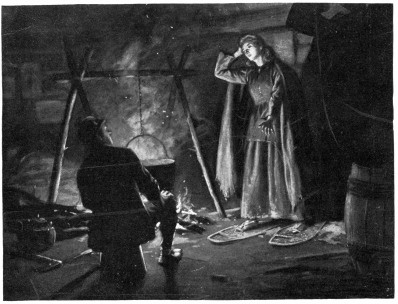
â âI AM AFIRE WITH THIRST,â SHE CRIED.â
might drink water and drink water and never quench their thirst. Peggy was reputed quite harmless.
âYou havenât seen Peter, have you?â she cooed, suddenly.
âNo,â replied Matt, with a fresh, nervous thrill. âBut this is not a night for you to be out and about. Itâs bitter cold.â
âItâs bitter cold,â she repeated, âbitter cold for an old man like you, but not for a girl like me, loved by the handsomest young fellow in the Province; the heart within me keeps me warm, always warm and thirsty. Give me more water.â
âNo, youâve hed ânough,â said Matt. âItâs a shame your folks donât look arter you better.â
âLook after me! Theyâre all up at the ball, the heartless creatures; but I saw the weddings, both of them, in spite of them all, and I think itâs high time Peter came back from the sugaring to our wedding, and Iâve come to tell him so. This is the spot he used to sugar at. Are you sure you havenât seen him? You are his partner; confess, now,â she wound up, cajolingly, turning her lovely face towards his troubled gaze.
âCanât you see Iâm only a boy?â he replied.
âNonsense. Youâre not a boy. Boys always call after me and pull my shawl. I know all the boys.â
Matt felt the moisture gathering afresh under his eyelids.
âWhatâs your name, then?â she went on, sweetly.
âMatt,â he murmured.
âAh, mad!â she cried, in ecstasy. âWe are cousins—I knew it! Thatâs what they call me.â
Her wild eyes shone in the firelight. The boy shuddered.
âNot mad, but Matt!â he corrected her.
âAh, yes, Mad Matt! Cousins! Mad Peggy—Mad Matt!â
âIâm not mad,â he protested, feebly.
âYes, yes, you are!â she cried, passionately. âI can see it in your face. And yet you wonât give me a cup of water.â
âYouâve drunk ânough,â said the boy, soothingly.
âOh, what lovely little devils,â she exclaimed, catching sight of the wall decorations. âDo you see devils, too? Didnât I say we were cousins? Why, thereâs one of the bridegrooms—ha! ha! ha! I guess he didnât show the cloven hoof this morning.â
âWhich is the bridegroom?â asked Matt, piqued into curiosity.
âThere—there he is! There is the boy!â She pointed to the best portrait of Bully Preep. âHe always called after me, the little devil.â
Mattâs heart beat excitedly, his face crimsoned. But his strange visitorâs next words threw him back into uneasy chaos.
âOh, but everybody is saying how scandalous it is! with his wife only six months in her grave. Look how long Peter and I have waited. Most of the girls in the village get engaged half a dozen times; they donât know what love is, they donât know anything, theyâve got no education. But Iâve only been engaged once, and Iâm so thirsty. And youâve got her too, the little angel! Everybody is saying how hard it is for her! And yet they all go to the ball. May they dance till they drop, the hypocrites!â
âWhat are you sayinâ?â faltered Matt. âHard for Ruth Hailey? Why, sheâs only a little girl.â
âShe isnât a little girl. Little girls run after me. I know all the little girls. Sheâs a little angel! Just as youâve pictured her. Give me some more water.â
This time Matt surrendered the dipper to her.
âThank you, Cousin Matt,â she said, and drank feverishly. But seeing that she was about to dip again, he placed himself between her and the barrel. She turned away with a marvellously dexterous movement considering her cumbrous foot-gear, and dipped the ladle into the seething caldron instead. But Matt seized her arm and stayed her from extracting the dipper.
âYouâll scald yourself,â he said.
âLet go my arm,â she cried, threateningly. âHow dare you touch me—you are not Peter!â
âYou mustnât drink any more.â
âYou are very cruel!â she moaned. âWho is that sleeping there? Perhaps it is Peter. I will wake him up; he will give me water. I am so thirsty.â She moaned and crooned over the three-legged caldron, stirring the sap feebly with the ladle in her efforts to wrest herself free, and the white steam curled about her face, and gave her the air of a young, beautiful witch bent over a caldron. Matt forgot everything except that he would like to make a picture of her as she appeared now.
âYouâd best go to sleep,â he said at last, awakening to a remembrance of the strange situation. âThereâs my bed—those fir-boughs—you kin lie down there till the morninâ, and Iâll cover you with my blanket.â
âI want water,â she crooned.
âYou kinât get it,â said Matt.
âThen may the curse light on you and yours,â she cried, stirring the sap more fiercely in her struggle, while the vapor and the wood smoke rose in denser volumes around her. âMay you thirst and thirst, and never be satisfied! And that is to be your fate, Cousin Matt. I read it in your face, in your eyes. Never to quench your thirst—never, never, never! To thirst and thirst and thirst for everything, and never to be satisfied, never to have anything you want. Mad Matt and Mad Peggy—cousins, you and I! Ha! ha! ha!â Her laugh of malicious glee made the boyâs blood run cold. From without came the answering screech of a wild-cat.
âLie down and rest!â repeated Matt, imperatively.
âWhat! stay here with you? No, no, no, Cousin Matt. I know what you want. You want to paint me and put me on the wall among the devils! No, no, I must be off to find Peter. I shall stay with him in his cabin.â
Her grip of the dipper relaxed; it reeled against the side of the pot. She turned away, and Matt let go her arm and watched her, spellbound. She drew the thick dun shawl over her head, again veiling the glory of the golden hair, and almost brought the edges together over her sad beautiful face, so that the eyes alone shone out with unearthly radiance. Then she moved slowly towards the door and thrust it open, and the wind came in, and filled the entire cabin with heavy, acrid smoke, which got into Mattâs eyes and throat, and woke even the Indian boy, who sat up choking and rubbing his black, beady eyes.
âDam door shuttum!â he cried, with unusual vehemence.
The words broke Mattâs spell. He rushed to the door, but his smarting eyes could detect no gray-shawled figure gliding among the gray trunks. He closed the door, wondering if he had been dreaming.
â âTainât your turn yet, Tommy,â he said, waving away the smoke with his hand, and Tommy fell back asleep, as if mesmerized. Matt was as relieved at not having to explain as at Tommyâs momentary wakefulness, which had braced him against the superstitious awe that had been invading him while the mad beauty cursed him with that sweet voice of hers that no anger could make harsh. He thought of the apparition with pity, mingled with a thrill of solemn adoration; she had for him the beauty and wildness of the elemental, like the sky or the sea. And yet she had left in him other feelings—not only the doubt of her reality, but an uneasy stirring of apprehensions. Was there nothing but insane babble in this talk of Ruth Hailey and Abner Preep? A fear he could not define weighed at his heart. Even if he had been dreaming, if he had drowsed over the fire—as he must in any case have done not to have heard the scrape and clatter of snow-shoes entering—the dream portended something evil. But, no! it was not a dream. Assuredly the sap in the barrel had sunk to a lower level. With a new thought he lit a resinous bough and slipped out quickly and examined the dry stiff snow. The double trail of departing snow-shoes was manifest, meandering among the bark dishes and irregularly intersecting the trail of arrival. The radiant moonlight falling through the thin bare maple-boughs made his torch superfluous, except in the fuscous glade of leafy evergreens, along which he followed the giant footmarks for some little distance. He paused, leaning against a tall hemlock. Doubt was impossible. He had really entertained a visitor. Not seldom in former years had he entertained visitors who came to camp out for the night, which they made uproarious. But never had his hut sheltered so strange a guest. He was moved at the thought of her drifting across the wastes of snow like some fallen spirit. He looked up and abstractedly watched a crow sleeping with its head under its wing on the top of the hemlock, then his vision wandered to the flashing streamers of northern light, and, higher still, to those keen depths of frosty sky where the stars stood beautiful, and they drew up his thoughts yearningly to the infinite spaces. Something cried within him for he knew not what—save that it was very great and very majestic and very beautiful, mystically blending the luminousness of light and color with the scent of flowers and the troubled sweetness of music; and at the back of his dim, delicious craving for it was a haunting certainty that he would never reach up to it, never, never. The prophecy of mad Peggy recurred to the boy like a cutting blast of wind. Was it true, then, that he would thirst and thirst, and nothing ever quench his thirst? He held up his torch yearningly to the stars, while the night moaned around him, and the flaring pinewood cast a grotesque shadow of him on the pure white snow, an uncouth image that danced and leered as in mockery.
CHAPTER VI
DISILLUSIONS
As soon as he could get away next morning Matt drew on his oversocks and started for home, racked by indefinite fears. He had not troubled to rouse Tommy to take his watch, for he knew he himself would not sleep a wink, and it seemed a pity to disturb so deep and healthy a slumber; so he bustled about to blur his thoughts, and had breakfast ready an hour after sunrise, which his anxiety did not prevent him from observing. To see sky and forest take fire in gradual glory was an ecstasy transcending the apprehensions of the moment.
Tommy had asked no questions during the morning meal, and made no complaints about Mattâs failure to rouse him; but on being apprised of his companionâs intended journey, he had pointed to the scanty wood-pile—a reminder that had delayed Matt by a couple of hours spent in felling and chopping up a straddle or two. But at last he got away, Tommy undertaking, in a minimum of monosyllables, to attend to everything else. Matt felt afresh the strength and stability of Tommy. Tommy was like Sprat—firm, faithful, and uninquisitive.
He had five miles of clogged walking before him, but he made fairly good progress, for he was unencumbered by snow-shoes, having a light step and an instinct for hollows and drifts, and his oversocks, which reached beyond the knee, kept out the snow when he trod deep. The freshness and buoyancy of the morning dispelled his alarm; dread was impossible under that wonderful blue sky. But as he got deeper and deeper into the recesses under thick boughs that shut out the living blue with dead gray, and took the sparkle out of the snow, his gloom returned, and lasted till he was nearly at his journeyâs end, when the road caught the sunlight again just as the thought of home flooded his soul. And soon a bend brought the goal in sight. There it was, the dear old house, standing back from the road, in the midst of its little clearing, the sun shining on its bleached clapboards, the black window-sashes standing out fantastically against the white panes, opaque with frosty designs. The smoke curled tranquilly from the chimney towards the overarching azure, making the home seem a living creature whose breath was thus condensed to visibility. It seemed months since he had left it, yet it was absolutely unchanged. And then he heard the cock crow from the rear, and his last fears vanished like evil spirits of the night, and a wave of pleasurable anticipation bore him to the porch.
He opened the door—no one ever fastened doors by day, for burglars came only in the milder form of peddlers, and other visitors were accustomed to stable their horses and take their seats at the board without ceremony or warning. It was not far from noon, but he heard no sounds about the house, except the crowing of the cock, which continued, and brought up to memory a grotesque and long-obliterated image of his mother holding on to the leg of a soaring hawk that had picked up a chicken. He listened for the lowing of Daisy; then, remembering she was dead and salted, he moved forward into the passage. But he found nobody in the living-room. There was not even a fire. The clumsy spinning-wheel stood silent. The table was bare and tidy; the chairs were neatly ranged. He ran into the kitchen—it radiated bleaker desolation. Matt fought against the cold chill that was gathering at his heart. Of course there would be nobody at home. Harriet was sewing somewhere, most of the children were at school; and his mother, instead of leaving the baby in the kitchen with one of them, must have taken it with her to her work. And yet it was all very depressing and very disappointing. Then he remembered, with a fresh shock, the smoke he had seen curling from the roof, and for an instant he was oppressed by a sense of the uncanny. An atmosphere of horror seemed to brood over the house. But the recollection of a proverb of Deacon Haileyâs, âThereâs no smoke without fire, hey?â uttered in a moment of unusual articulateness, brought back common-sense. He ran up to the bedrooms, but there was not even a stove, except in his motherâs room—a room tapestried with texts worked in Berlin wool on perforated card-board—where the bed had not been made, and where there were traces of extinct logs. Immeasurably puzzled, and wondering if the smoke had been an optical illusion, he returned to the living-room. There was only one room he had not gone into—the best room—and when he at last recollected the existence of it he did not immediately enter it. Only visitors had the enjoyment of this room and the privilege of sitting gingerly on its cane chairs and surveying its papered walls; and, in the absence of the family, there could be no reception in progress. When, for the sake of logical exhaustiveness, he did approach the door, it was listlessly and with a certain constraint, amounting to awe. His nostrils already scented the magnificent mustiness of its atmosphere. He opened the door with noiseless reverence. Then he stood rigid, like one turned to stone by the sight of Medusaâs head. It was indeed a head that petrified him—or, rather, two heads, one pressed against the other. Though he had only a back view of them, he knew them both. The lank black hair was Bully Preepâs, the long auburn-brown tresses were Harriet Strangâs. A fire had been lighted, regardless of the polish of the Franklin stove and the severity of its fancy scroll-work and ornamental urn; and before this fire his sister sat on Abnerâs knee, and Abner sat on a cane chair, tilting it with a familiarity that hovered on contempt. The treble shock was too great. Matt was dumb and sick and cold, though red-hot thoughts hurtled in his brain. What! The skunk had sneaked in during his motherâs absence, and it was thus that Harriet did the honors!
He struggled to get his voice back. âHarriet!â he cried, in raucous remonstrance.
Harriet gave a little shriek and turned her head. The color fled from her soft cheeks as she caught sight of her outraged junior, then the blush returned in fuller crimson. Matt fixed her with a stern, imperious eye.
âWhat are you doinâ in the best room?â was the phrase that leaped to his angry lips.
Abner turned on him a face of smiling friendship.
âThe best thing,â he replied, gayly.
âHow dare you kiss my sister?â thundered Matt.
âDonât be a fool, Matt!â said Abner, amiably. âShe isnât onây your sister—sheâs my wife.â
âYour wife!â breathed Matt.
âYes, donât be streaked, dear. We were married yesterday.â And Harriet disentangled herself from Abner and ran to throw her arms round Matt. But the boy repulsed her with a commanding gesture.
âDonât come near me!â he cried, huskily. âWhereâs mother? Does she know?â
âOh, Matt!â cried Harriet, reproachfully, âdâyou think Iâd marry without her consent!â
âI call it rael mean, anyways,â he cried, tears of vexation getting into his eyes and his voice, âto take advantage of a feller like that, jest because his backâs turned!â
âWaal, we wonât do it agen!â cried Abner, with unshakable good-humor. âSee here, Matt,â and he rose, too, revealing the slight tendency to crookedness of lower limb that offended the exigent eye of his mother-in-law, âletâs be pals. You were allus a spunky little chap, and I liked you from the day you stood up agin me and blacked my eye, though you had to jump up aâmost to reach it. I was a beast in them thar days, but I raelly ainât now, thanks to Harriet—God bless her! I know you donât like my legs,â he added, with a flash of humor, âbut thereâs onây two of âem, anyways.â
âAnâ thetâs two too many, you crawlinâ reptile,â retorted Matt. Then, turning to Harriet, he went on in slow, measured accents, âAnd is this—chap—goinâ to—live here?â
âHe is so,â retorted Harriet.
âThen,â said Matt, with ominous calm—âthen you wonât hev me here, thetâs all.â
âOf course we wonât,â said Harriet, with a pleasant laugh. âYouâll live with mother.â
âWith mother?â repeated Matt, staring.
âYes; down to Deacon Haileyâs.â
âHes mother gone to live to Deacon Haileyâs?â he asked, excitedly.
âYou bet!â put in Abner, grinning genially.
âWhat—altogether?â exclaimed Matt. The world seemed going round as it did in the geography books.
âI guess so.â
âI wonât hev it!â cried Matt, agitatedly. âI wonât hev her slavinâ like a nigger. It was bad enough afore, when she hed to go there every day. But now sheâs naught but a servant. Itâs a shame, I do declare. Anâ you, Harriet!â he said, turning fiercely on her again; âainât you âshamed oâ yourself, drivinâ mother out of house and home?â
âNo,â said Harriet, stoutly.
The laughter that lurked about her mouth filled him with a trembling presentiment of the truth.
âDonât you understand?â said Abner, kindly. âYour motherâs been and gone and married the deacon, and a good thing for all oâ you, I do allow.â
âYouâre a liar!â hissed the boy. The world spun round more fiercely.
Abner shrugged his shoulders good-temperedly.
âYou see, it was all arranged in a hurry, Matt,â said Harriet, deprecatingly. âAnâ mother thought weâd best get it all over, anâ so we were both married yesterday, anâ we thought it a pity to bother you to come all the way. But you hevnât finished, hev you? Whereâs the sugar?â
âAnâ a nice scandal, I vow!â he cried, furiously. âEverybody is talkinâ âbout it.â
âOh come, Matt, thetâs a good un,â laughed Abner. âWhy, youâve heerd nuthinâ âbout it.â
âOh, hevnât I?â returned Matt, with sullen mysteriousness. âI donât know thet everybody went there anâ everybody said it was a shame. Oh no; Iâm blind and deaf, thetâs what I am.â
âDonât make such a touse, Matt,â said Harriet, putting her hair behind her ears with some calmness. âDonât you see things air ever so much better? Iâve got a man to support me,â and she put her arms lovingly round Abnerâs neck, as if supporting him, âanâ motherâll be quite a lady, not a servant, as you were silly ânough to allow, anâ you wonât hev to work so hard. Anâ Iâll tell you what, Matt, you shall come here sometimes anâ draw your picters, anâ mother wonât know.â
But Matt clinched his teeth. The bait was tempting, but unfortunately it reminded him of his obedience to his mother the night before, when in deference to her views he had denied himself the joy of Tommyâs pipe. Oh, how he had been duped and bamboozled! At the very hour his inner eye had seen her toiling, sorrowful at her spinning-wheel, she was frolicking at her wedding-ball in gay attire. A vast self-compassion softened his indignation and raw misery. He turned his back on the newly-married couple, and strode from the house, lest they should misinterpret his tears. But the tears did not come—anger rekindling evaporated them unshed. What right had the deacon to steal his mother without even asking him? And how ignoble of his mother to forget his father thus! He figured Ruth Hailey replacing himself by another boy merely because he was dead. It seemed sacrilege. And yet no doubt Ruth was as bad as the rest of her sex. Had she not submitted tamely to the supplanting of her dead mother—nay, was she not a necessary accomplice in the conspiracy to keep him ignorant of the double marriage? Then he had a vague remembrance that he had once heard she was not originally the deaconâs daughter, but only the late Mrs. Haileyâs, which somehow seemed to exonerate her from the full burden of his doings. Still, she had unquestionably been sly.
His feet had turned instinctively back towards the lonely forest. No, he would not go and live with the deacon, not even though it brought Ruth within daily proximity. His attitude towards the deacon had never been cordial—nay, the auditory strain upon him when âOle Heyâ spoke to him had gone far towards making him antipathetic. It seemed monstrous that such an old mumbler should have been deemed fit to replace the cheery sailor who had gone down wrapped in his flag. No, Matt at least would have none of him. Life under his roof would be a discord of jarring memories. He would go back to his hut and live in the wood. He would shoot enough to live upon, and there, alone and self-sufficient and free as its denizens, he would pass his life painting and sketching. Or, if he wanted society, he would seek that of the Indian, the simple, noble Indian, and pitch his lot with his for a time or forever. Or perhaps Tommy would stay with him—Tommy who was deep without being wily, and restful without being dull. What a pity Billy was disabled; they might have seceded together, but fate had separated them, not his will.
The five miles were longer now, and the sky had grown a shade colder, but he trod the gloomiest paths unchilled. His heart was hot with revolt. As he came to the little open space round the hut a curious phenomenon arrested his attention. There was no smoke curling above the chimney-hole. A problem—the exact reverse of that which had greeted him at the other terminus of his journey—clamored for solution. Surely Tommy had not let the fire go out! He hastened his steps, and saw that the door stood wide open on its leather hinges, projecting outwards into the forest. Outside, too, empty birch-bark troughs were scattered about in lieu of being piled up neatly. The air of desolation sobered him like a cold douche. He was frightened. He had not even courage to dwell on the thought of what foreboding whispered. But perhaps Tommy had only gone to sleep again, and forgotten about the fire. With a gleam of hope he ran to the entrance, then leaped back with a wild thrill, and slammed the door to and put his back to it and stood palpitating, restrained only by excitement from breaking down in childish tears. The interior of the hut had been transformed as by enchantment. Of barrels, axes, ironware, provender, even of his rude paints, there was not a trace, though the birch-bark picture exhibition was undisturbed. The birch-boughs were littered over the floor. There was no Tommy. But in the centre of the cabin, where the fire had been, lay a matted bear, voluptuously curled up on the warm ashes, and licking the mellifluous soil, which was syrup-sodden by drops that had fallen from the sap-pot. The beautiful sunshine had lured the animal from its winter sleeping-chamber, famished after its long fast.
It was a moment Matt never forgot; one of those moments that age and imbitter. As he stood with squared shoulders against the rough, battened door, that was built of stout slabs, he shook from head to foot with mingled emotions. Numb misery alternated with burning flashes of righteous indignation against humanity, red and white. And with it all was a stirring of the hunterâs instinct—an itching to shoot the creature on the other side of the door—which aggravated his vexation by the reminder that even his gun had been stolen. It eased him a little to let his mind dwell on the prospect of potting such glorious game; but first of all he must run Tommy to earth. Tommy could not have gone far, burdened as he would be with the spoil.
The broken-hearted boy moved stealthily from the door and pushed up a small trunk that he had cut down that morning, but not yet chopped up. With some difficulty he raised this and propped it against the door, which, being already latched, could not easily be burst open by the bear. The creature was, moreover, likely to resume its winter nap in the snug, sweet quarters in which it found itself. Having thus trapped his bear, Matt started off by a cross-cut in the direction of the Indian encampment, to which he presumed Tommy would naturally have returned full-handed. But he had not gone a hundred yards before he called himself a fool, and ran back. In his agitation he had forgotten to note the trail of the sled in which Tommy must have drawn off the things. This he now discovered ran quite in the opposite direction, and was complicated not only by Tommyâs footmarks, but by a manâs. Whither had Tommy decamped? The day seemed made up of surprises and puzzles. However, there was everything to gain, or rather regain, by following the dusky young impostor and the accomplice who had helped him to draw the heavy sled. Matt discovered that the trail led towards Long Village, two and a half miles off, and instantly it flashed upon him that Tommy had gone there to dispose of the things. He quickened his pace, and in less than half an hour strode into a truer solution of the mystery, for suddenly he found himself amid dogs grubbing in the sunshine and swaddled pappooses swinging on the poles of birch-bark wigwams, and perceived that the vagrant Micmacs had shifted their encampment during the fortnight. Tommyâs knowledge of the migration argued secret correspondence, unless a tribal tempter had visited him accidentally during Mattâs absence—which seemed rather improbable.
Mattâs soul was aflame with wrath and resentment. He rushed about among the wigwams, unceremoniously peering behind the blankets that overhung the doorways, which were partly blocked by spruce boughs arranged to spring back and forth. Bow-legged, round-shouldered, dumpy men, with complexions of grayish copper, squatting cross-legged on fir boughs before the central fire, smoked on unresentful, a few ejaculating sullenly, âKogwa pawotumun?â (âWhat is your wish?â) Their faces had nothing of the American hatchet-shape; they would have been round but for the angularity of the jaw, and Chinese but for the eyes, which did not slant upward, but were beady and wide apart. The cheek-bones were high, the nose was of a negro flatness, and the straight black hair was long and matted. In attire the men had an air of shabby civilization, which went ill with the blankets and skins overwrapping the white menâs leavings. Near the door—in the quarter of less distinction—sitting with feet twisted round to one side, one under the other, as befits the inferior sex—were women good-looking but greasy, who wore shawls and blankets over their kerchiefed heads, and necklaces of blue beads twinkling against their olive throats, and smoked as gravely as their lords. But Tommy was invisible. Nor could Matt see anything of the stolen goods. But in one tent he found Tommyâs father, and, discourteously omitting the âKwaâ of greeting, plied him with indignant questions in a mixture of bad English and worse Indian.
Tommyâs father understood little and knew nothing. He did not invite the visitor into the tent, but smoked on peacefully and whittled a shaving, and Mattâs admiration of the red manâs taciturnity died a painful death. Had Tommyâs father not even seen Tommy? No; Tommyâs father had not seen Tommy for half a moon, and the smoke curled peacefully round Tommyâs fatherâs greasy head. Never had the unspeakable uncleanliness of the picturesque figure struck Matt as it did now. He moved away with heavy heart and heavy footstep, and interviewed other Indians, equally dingy and equally reticent; even the squaws kept the secret.
Matt went back in despairing anger and poured out his passion in a flood of remonstrance upon the unwashed head of Tommyâs father; he pointed to the trail of the sled that drew up at Tommyâs fatherâs tent, he reasoned, he threatened, he clinched his fist and stamped his foot; and Tommyâs father smoked the pipe of peace and whittled the shaving. The Indian held the stick on his knee and drew the knife towards himself, unlike the white man, who cuts away from himself. It was a crooked knife, with a notch for the thumb in the handle. Mattâs spirit oozed away before its imperturbable movement to and fro. He felt sick and faint; he became vaguely conscious that he had eaten nothing since breakfast. Then he remembered the bear waiting in the cabin—waiting to be killed. With a happy thought he informed Tommyâs father that he had trapped a bear and could conduct him to the spot, and Tommyâs father instantly began to understand him better; and when Matt proceeded to offer him the beast in exchange for the stolen goods, the Micmac betrayed a complete comprehension of the offer, and with a courteous exclamation of âUp-chelase,â invited him into the furthermost and most honorable portion of the tent. He even rose and held colloquy with some of his brethren gathered round. A bear was a valuable property—dead. His snout alone was worth five dollars, when presented as a death certificate to a grateful government, anxious to extinguish him. These five dollars were a great consideration to a tribe paid mainly in kind, and hard pushed to find coin for the annual remission of sin at the hands of the priests. The bearâs skin would fetch four or five dollars more; while its three or four hundred pounds of flesh would set up the larder for the season. As a result of the native council, Tommyâs father informed Matt that he had just learned Tommy had been seen that morning, but that he had hauled the sled past the encampment on his way to Long Village to sell the freight (which nobody had suspected was not his own property, the much dam thief). He had, however, left a gun with a boy friend, and if Matt was content to swop the bear for this, he could have it. Matt, fuming at his own helplessness, consented. The gun was accordingly produced; Matt recognized his old friend, but Tommyâs father explained in easy pantomime that when bear was dead boy would get gun, and not before; and he handed it to a blanketless by-stander, who had evidently bartered external heat for internal fire-water. Then, shouldering his own gun, he motioned to Matt to lead the way. The little procession of three set forth, the second Indian prudently providing himself with a flat, wide sledge. The afternoon was waning, the blue overhead had lost in luminousness, leaving the coloring of the earth more vivid. But the shifting of natureâs kaleidoscope had ceased to interest Matt; humanity occupied him exclusively, and the evil that was done under the sun. Man or woman, white or red, they were all alike—a skulking, shifty breed. It was not only he that had been betrayed; it was truth, it was honor. Were these things, then, merely lip-babble?
On their arrival at the hut Matt explained the position. He was about to remove the log that braced up the door, but Tommyâs father pulled him violently back, and gestured that it was much more convenient to shoot the animal through the chimney-hole. Matt felt a qualm of disgust and remorse. It seemed cowardly to give the poor beast that had taken refuge in his hut no chance. He leaned sullenly against the door, feeling almost like one who had betrayed the laws of hospitality, and conscious, moreover, of a strange savage sympathy with the bear in its strife with humanity. His last respect for the noble red man vanished when the two Micmacs clambered upon the low-pitched roof. They uttered âughsâ of satisfaction as they peeped over the great square hole and perceived their prey asleep. After some amiable banter of the animal they began to put their guns into position. But Tommyâs father insisted on having the glory of the deed, since he was paying for the bear with Mattâs gun, and his rival ungraciously yielded. In his cocksureness, however, Tommyâs father merely hit the bearâs shoulder. The creature started up with a fierce growl, and began biting savagely at the bleeding wound. Excited by his failure and the bruteâs leap up, Tommyâs father leaned more over the hole for his second shot; but his companion, exclaiming that it was his turn now, pushed him back, and strove to get his body in front. Tommyâs father, who was now effervescing with excitement, thrust himself more forward still, and in his zeal succeeded so well that he suddenly found himself flying head-foremost into the hut, while the gun went off at random. The bullet missed, but the man struck the obfuscated creature with a thud, ricochetted off its back, and lay prostrate on the branch-strewn floor.
The sound of the fall, the explosion, the cry of dismay from the roof, informed Matt of what had happened. In a flash his sympathy went back to man. He cried to the other Indian to shoot, but the latterâs arm was shaking, and the bear, after a few seconds of bewilderment, had risen on its hind legs and stood over the fallen man growling fiercely, so that the Micmac was afraid of hitting his friend. Matt reached up impatiently for his gun, which the Micmac readily handed to him in unforeseen violation of orders, and Matt, overthrowing the door-prop with the butt end, lifted the latch and dashed in. Tommyâs father was already in the bearâs grip, the infuriated animalâs elastic fore-paws beginning to press horribly upon his ribs. Matt clapped the barrel of the gun to the bearâs ear; then he was overswept by a fearsome doubt lest the gun had been unloaded since it had left his hands. But his suspense was short. He pressed the trigger; there was a ringing explosion, and the creature bounded into the air, relaxing its hold of the Indian, upon whom it fell again in its death-agony. Matt, aided by the other Micmac, who hurried in, grunting, disentangled Tommyâs father from the writhing heap, and found him bruised and breathless, but practically uninjured. Tommyâs father vowed eternal gratitude to his rescuer, and said his life was henceforward at Mattâs disposal. The boy curtly asked for his property instead, whereupon the Indian shook his head and shrugged his shoulders in token of impotence. Rolling the bear over with a prod of his contemptuous foot, he produced his knife and started scalping and skinning the dead enemy, while his brother-in-arms lit some boughs, and cut a juicy steak from the carcass and set it to broil. The warmth was grateful, for the shadows were fast gathering and the hyperborean hours returning. A covey of bob-whites whirred past, and the weird note of a hoot-owl was borne on the bleak air.
The Indians offered the boy âa cut from the joint,â and he refused sulkily—a deadly insult in normal circumstances. But the keen pangs of hunger and the delicious odor of the meat weakened him, and a later invitation to join the squatting diners found him ravenously responsive, though he felt he had bartered away his righteous indignation for a mess of pottage. During the meal his guests or his hosts (he knew not which they were) betrayed considerable interest in his mural decorations, which they evidently regarded as symptoms of a relapse from Christianity, and they were astonished, too, at his refusal to quaff more than a mouthful or two of their rum—the coarse concoction locally nicknamed ârot-gut.â While Matt, who had started last, was still eating from the birch-bark dish he had utilized for the purpose, Tommyâs father lit his after-dinner pipe, and, having taken a few whiffs, passed it on to his companion, who in turn held out to Matt the long, reedy stem with its feather ornaments.
The offer sent a thrill through the boyâs whole being. All his grievances ascended afresh from the red stone bowl and mingled with the fragrant smoke. How good, how obedient he had been! And all for what? A lump gathered in his throat, so that he could not swallow his bit of bear. He nodded assent, his heart throbbing with defiant manhood, and motioned to the Micmac to place the pipe beside his dish till he was ready for it. The two Indians then hauled the carcass athwart the sledge hastily, for night had come on as though shed from the starless sky, and they called to Matt to come along, but Matt shouted back that he did not intend to accompany them. He no longer craved to cast in his lot with the red man. Yet he went to the door of his tent to watch his fellow-hunters disappear among the sombre groves, and a deeper dusk seemed to fall on the landscape when the very rustle of their passage died away. But as he turned in again and fastened up the door, his heart leaped up afresh with the leaping flames. The sense of absolute solitude became exultation—a keen, bitter joy. Here was his home; he had no other. He had parted company with humanity forever.
He reseated himself on a little pile of fir boughs in his deserted home, that was naked but for the wall-pictures—the least comforting of all possible salvage, since they were the only things Tommy had not thought worth stealing. As Matt sat brooding, darker patches on the soil, and spots upon some of those pictures, caught his eye. He saw they were of blood. In one place there was quite a little pool which had not yet sunk into the earth or evaporated. He touched it curiously with his finger, and wiped away the stain against a leaf. Then with a sudden thought he curled a piece of bark and scooped up the blood into his birchen dish, as a possible color, murmuring, gleefully:
â âWho caught his blood?â âI,â said the fish, âWith my little dish, I caught his blood.â â
In moving the âlittle dishâ he laid bare Tommyâs fatherâs calumet, forgotten. He took it up. How the universe had changed since last he held a pipe in his hand—only last night! Again he heard the howl of a wild-cat, and he looked round involuntarily, as if expecting to find Mad Peggy at his elbow. But he had no sense of awe just now—though he had barred his door inhospitably against further bears—only the voluptuousness of liberty and loneliness, the healthy after-glow of satisfied appetite, and the gayety born of flaming logs and a couple of mouthfuls of fire-water. The Water-Drinkerâs prophecy seemed peculiarly inept in view of the pipe he held in his hand. With tremulous anticipation of more than mortal rapture he relit it. The sensation was unexpectedly pungent, but Matt puffed away steadily in hope and trust that this was merely the verdict of an unaccustomed palate, and he found a vast compensatory pleasure in his ability to make the thing work, to send the delicate wreaths into the air as ably as any Micmac or deacon of them all.
But soon even this pleasure began to be swamped by a wave of less agreeable sensation, and Matt, puzzled and chagrined, after a gallant stand, threw down the calumet, and hastened into the cold air with palpitating heart and splitting head, and there, in the maple wood, Bruin was avenged. That night, despite his vigil of the night before, Matt Strang vainly endeavored to close his eyes upon an unsatisfactory world.
CHAPTER VII
THE APPRENTICE
The long, endless years, crowded with petty episodes and uniformities, and moving like a cumbrous, creeping train that stops at every station, flash like an express past the eye of memory. Yet it is these unrecorded minutiæ of monotonous months that color the fabric of our future lives, eating into our souls like a slow acid. When, in after years, Matt Strangâs youth defiled before him, the panorama seemed more varied than when he was living the scenes in all their daily detail of dull routine, and when, whatever their superficial differences, they were all linked for him by an underlying unity of toil and aspiration.
First came his apprenticeship in Cattermoleâs saw-mill, at the opposite outskirt of the forest, twenty miles from Cobequid. For, though he early tired of savagery, as a blind-alley on the road to picture-painting, he refused, in the dogged pride of his boyish heart, to return to his folks, contenting himself with informing them of his whereabouts and of his intention to apprentice himself (with or without their consent). Labor being so scarce that year, Deacon Hailey drove over in great haste to offer him a loving home. Matt, who happened to be in the house, which was only parted from the mill-stream by a large vegetable-garden, saw through a window the deaconâs buggy arrive at the garden-path, and the deacon himself alight to open the wooden gate. The boyâs resentment flamed afresh, and it was supplemented by dread of the deaconâs inarticulate conversation. He fled to Mrs. Cattermole in the kitchen.
She was a shrewish, angular person, economical of everything save angry breath. A black silk cap with prim bows and ribbons sat severely on her head, and a thread-net confined her hair. Cattermole, a simple, religious, hen-pecked creature, had gone to the village store to trade off butter.
âThereâs Ole Hey coming!â cried Matt, breathlessly.
âKinât you speak quietly?â thundered Mrs. Cattermole. âYou made my heart jump like a frog. You donât mean Ole Hey from Cobequid, the man es you said married your mother?â
âYes, thetâs the skunk. I reckon heâs come to take me back.â
Mrs. Cattermoleâs eyes flashed angrily. âWell, I swan! But youâve promised to bide with us.â
âThetâs so. I wouldnât go back fur Captain Kiddâs treasure! I wonât see him.â
âIâll tell him youâre gone away.â
âNo,â said Matt, sturdily. âI wrote that I was goinâ to be âprenticed here, and there ainât any call for lies. Tell him Iâm in the kitchen and I wonât come out, and I donât want to hev anythinâ to do with him. See!â
âWell, set there and mind the cradle, and Iâll jest give him slockdologee. You uns allow youâre considerable smart, Cobequid way, but I reckon heâs struck the wrong track this time.â
Matt grinned joyously. âSpunk up to him, maâam!â he cried, with stirring reminiscences of fights at McTavitâs. âWalk into him full split!â
âYou mind the baby, young man. There wonât be no touse at all. He donât set foot in my kitchen, and thereâs an end of it.â
Mrs. Cattermole greeted the deacon politely, and informed him that the lad he was inquiring after was sulking in the kitchen, and that he refused to receive his visitor on any account. The deacon sighed unctuously with an air of patient martyrdom. Mattâs obduracy heightened his estimate of the ladâs value as a gratuitous field-worker, and sharpened his sense of being robbed of what small dowry Mrs. Strang had brought him.
âThe boy is dreadful set agin me,â he complained. âBut, es I told his poor mother, if you let a boy run wild, wild he runs, hey? Anyways, it ainât fur me to fail in lovinâ-kindness. Eye for eye, tooth for tooth, ainât the gospel weâre called upon to practise. I allus thinks thereâs no sort oâ use in beinâ a Christian on Sundays and a heathen on week-days.â
âNo, thet thar ainât,â Mrs. Cattermole assented, amiably.
âEven to beasts a man kin be a Christian, hey? I reckon Iâd better wait in your kitchen anâ give the mare a rest. If Iâve come on a foolâs errand, thet ainât a reason my ole nag should suffer, hey?â
Mrs. Cattermole, seeing the outworks taken, directed the deacon, by a flank movement, into the parlor, as alone befitting his dignity. To Matt this parlor, far finer than the best room at home, was a chamber of awe, but also of attraction, for its walls were hung with sober Bible prints. Mrs. Cattermole stood there among her splendors with her back to the door, partly for defensive purposes, partly so as not to depreciate one of the hair-cloth chairs by sitting down. It was enough for one day that her guest sat solidly on the rocking-chair of honor.
âWeâve been hevinâ too much soft weather, Mrs. Cattermole, arter all thet heavy snow.â
âYes, Iâm afeard the dam will go out,â responded Mrs. Cattermole, gloomily.
They discussed the disastrous thaw of a few years back, with a vivid remembrance of the vegetables and dairy produce spoiled in the flooded cellars.
âBut itâs the Lordâs will,â summed up the deacon. âIt ainât any use heapinâ up worldly treasure, I allus thinks.â
âThetâs a fact.â Mrs. Cattermole shook her head in sad acquiescence.
âHeavenâs the only safe place to lay up your goods, hey? So I guess Iâm just goinâ to forgive thet durned boy all the anxiety heâs giv his poor mother anâ me, anâ take him back right along.â
âOh, but I guess you ainât,â said Mrs. Cattermole. âWeâve promised to take him on here.â
âWeâll let you off thet thar promise, Mrs. Cattermole. We ainât folks as allus wants to hold people tight to every onthinkinâ word. Anâ you wonât be the loser hardly, for the lad ainât worth a tin pint to mortal man. Heâs a dreamy do-nuthinâ, anâ the worry heâs been to his poor mother youâve no idee—allus wastinâ the Lordâs hours, unbeknown to her, in scrawlinâ picters anâ smutchinâ boards with colors.â
âI reckon heâll come in handy in our paint-shop, then.â
The deacon shook his head, as if pitying her bubble delusions.
âHe ainât smart, anâ he ainât good-tempered. You see for yourself how grouty he is to the best friend a boy ever hed.â
âHe ainât smart, I know. Thetâs why we ainât goinâ to pay him no wages.â
The deacon chawed his quid and swayed in silent discomfiture.
âAh, itâs his poor mother Iâm thinkinâ of,â he said, after a while. âSheâs thet delicate sheâd kinder worry if he was to—a motherâs heart, hey? If âtwas my boy, Iâd be proper glad to see him in the hanâs of sech a hard-workinâ, God-fearinâ couple.â
âYou hednât ought to talk to me,â said Mrs. Cattermole, softening. âFatherâd be terrible ugly if I was to settle anythinâ while he was to the store.â
âAnd if he wouldnât itâs a pity. Wives, obey your husbands, hey? But there ainât no call for hurry. More haste less speed, I allus thinks. But I donât want to keep you from your occupations. There air some visitors who forgit folks kinât afford to keep moreân one Sunday a week, hey? Sorter devilâs darninâ-needles flyinâ into your ear—they worry you, and they donât do themselves no good. So donât you take no notice of me. Iâll jest talk to Matt to fill up the time.â
Mrs. Cattermole straightened herself against the door. âHe wonât listen; heâs too mad.â
âI reckon I could tone him down some.â
âGuess not. Heâs too sot—he wonât come in.â
âI ainât proud. Iâll go to him. True pride is in doinâ whatâs right, I allus thinks. Some folks kinât see the difference between true pride anâ false pride. Iâll go to the kitchen.â
âIâd rayther you didnât, deacon. Itâs all in a clutter.â
The conversation drooped. The deaconâs mouth moved in mere chawing. Swallowing his quid in deference to the parlor, he cut himself a new chunk.
âYouâve heerd about the doctor, Mrs. Cattermole?â he began again.
âI dunno es I hev.â
âWhat! Not heerd about our doctor es was said to practise the Black Art?â
âOh, the sorcerer es lives on the ole wood-road. My brother who drives the stage was tellinâ me âbout it. He sets spirits turninâ tables, tellinâ the future, anâ nobodyâll go past his house arter dark.â
âAh, but the elders called on him last week,â said the deacon. âOf course we couldnât hev him in the vestry. Anâ he explained to the committee thet sperrits or devils ainât got nuthinâ to do with it.â
âLanâ sakes! Anâ you believed him?â
âWaal, my motto is allus believe your fellow-critters. An evil mind sees a lookinâ-glass everyways, hey? He jest showed us how to make a table turn and answer questions. He says itâs no more wonderful than turninâ a grindstone.â
âI guess heâs pulled the wool over the eyes oâ the Church,â said Mrs. Cattermole, sceptically.
âNot hardly! He turned thet thar table in broad daylight with the Bible open upon it, to show thet Satan didnât hev a look in.â
âThe Bible on it! âPears to me terrible ongodly.â
âOngodly! Why, you anâ me kin do it—two pillars oâ the Church! I guess the Evil One couldnât come nigh us, hey?â
âI dunno es it would turn if you anâ me was to do it.â
âYou bet! It told me âbout the future world, anâ my poor Susanâs Christian name, anâ how much to ast for my upland hay.â
âGood lanâ!â cried Mrs. Cattermole. âAnâ would it tell me whether my sister is through her sickness yet?â
âYou may depend!â
âMy! Thetâs jest great!â And Mrs. Cattermole eagerly inquired how one set about interrogating the oracle.
The deacon explained, adding that the parlor table would not do. It must be a rough deal table.
âAh, the kitchin table,â said Mrs. Cattermole, walking into the elaborately laid trap.
âI dunno,â said the deacon, shaking his head. âAir you sure it ainât too large for us to span around?â
âWe could let the flaps down.â
The deacon chawed reflectively.
âWaal, it might,â he said, cautiously, at last. âThere ainât no harm in tryinâ. We hednât ought to give up anythinâ without tryinâ, I allus thinks. One never knows, hey?â
âI kinder think we ought to try,â said Mrs. Cattermole.
The deacon rose ponderously, and followed his guide into the kitchen.
âWhy, thereâs Matt!â he cried, in astonished accents. âGood-day, sonny.â
Matt strained his ears, but pursed his lips and rocked the cradle in violent impassivity. The deacon was uneasy at the boyâs sullen resentment. He could not understand open enemies.
âHowâs your health, hey?â he asked, affectionately.
âOh, Iâm hunky dory,â said Matt, in off-hand school-boy slang.
âIâm considerable glad youâve found a good place with rael Christians, Matt. I onây hope youâve made up your mind to work hard anâ turn over a new leaf. Itâs never too late to mend, I allus thinks. Youâre growinâ a young man, now; no more picter-makinâ, hey? If it warnât that you air so moony anâ lay-abed Iâd give you a chanst on my own land, with pocket-money into the bargain, hey, anâ pâraps a pair oâ store shoes fur a Chrismus-box.â
A flame shot from Mrs. Cattermoleâs now-opened eyes. She shut the cellar door with a vicious bang, but ere she could speak Matt cried out, âI wouldnât come, not fur five shillinâs a week!â
âAnâ who wants you to come fur money? What is money, hey? Is it health? Is it happiness? No, no, sonny. If money was any use, my poor Susan would hev been alive to this day. Youâll know better when youâre my age.â
He spat out now, directing the stream into the sink under the big wooden pump.
âDonât worry âbout him,â interposed Mrs. Cattermole. âHereâs the table.â
Deacon Hailey waved a rebuking palm. âDooty afore pleasure, Mrs. Cattermole. See here, sonny, Iâve been talkinâ with Mrs. Cattermole âbout you. Sheâs promised me to be a mother to you, Heaven bless her! But I kinât forget youâve got a mother oâ your own.â
âShe ainât my mother now, sheâs Ruthâs mother,â said Matt, half divining the mumble of words.
âSheâs mother to both oâ you. A large heart, thetâs what sheâs got. Anâ if sheâs Ruthâs mother, then Iâm your father, hey? Anâ it ainât right of you to disobey your father and mother. But young folks nowadays treats the commandments like old boots,â and the deacon sighed, as if in sympathy with the sorrows of a neglected decalogue.
âIâve got no father anâ no mother,â said Matt. âAnâ Iâm goinâ to be a picture-painter soon es I kin. I wonât do anything else, thetâs flat. Anâ when Iâm bigger Iâm goinâ to write to my uncle Matt and see if he kin sell my pictures fur me. If you was to drag me back by force, Iâd escape into the woods. Anâ Iâd work my way to London to be handy my uncle Matt. I reckon he takes in âprentices same es the boss here. So you jest tell my mother Iâm done with her, see! I donât want to hear any more âbout it.â
His face resumed its set expression, and his rocking foot its violence.
The deacon cast a reproachful, irate glance at Mrs. Cattermole.
âDid I tell you a lie when I said he warnât worth thet thar?â he vociferated, snatching the tin dipper from the water-bucket. The noise disturbed the baby, which began to whimper feebly. Matt turned his chairâs back on the deacon and gazed studiously towards the wood-house in the yard. The deaconâs face grew apoplectic. He seemed about to throw the dipper at the back of Mattâs head, but mastering himself he let it fall with a splash, and said, quietly: âI guess you wonât hev me to blame if he turns out all belly anâ no hanâs. Some folksâd say Iâm offerinâ you a smart, likely young man, with his heart in the wood-pile. But thetâs not Deacon Haileyâs way. He makes a pint of tellinâ the bad pints. Heâs a man you could swap a horse with, hey? I tell you, Mrs. Cattermole, thet durned boy is all moonshine anâ viciousness, stuffed with conceit from floor to ridge-piece. Picters, picters, picters, is all he thinks about! Amoosinâ himself—thetâs his idee of life in this vale of tears. I reckon he thinks heâs goinâ to strike Captain Kiddâs treasure. But, arter all, he ainât your burden. Iâve giv his poor mother a home, anâ I ainât the man to grudge bite anâ sup to her boy. So even now I donât mind lettinâ you off. Heâs my crost, and Iâve got to bear him. âTainât no use beinâ a Christian only in church, hey?â
âI guess Iâm a Christian, too,â said Mrs. Cattermole. âSo I must bear with the poor lad anâ train him up some in the way he should go. Anâ then thereâs father. Youâre a rael saint, deacon, but I sorter think where heaven is consarned father âud like a look-in es well. So letâs say no more âbout it. Now, then, deacon, the tableâs waitinâ!â
He ignored the patient piece of furniture. âWaal, donât blame me any if the buckwheat turns out bad,â he shouted, losing his self-control again, and spurting out his nicotian fluid at the stove like an angry cuttle-fish.
âThetâs so,â acquiesced Mrs. Cattermole, quietly. âNow, then, Deacon Hailey, jest you set there.â She had taken a chair and placed her hands on the table.
âHush!â said the deacon. âDonât you see thet thar young un wakinâ up? The tarnation boy hes been shakinâ him like an earthquake. I didnât know es you kepâ your baby in the kitchin or I wouldnât hev troubled to come. When thet thar table kinder began to dance and jump, you wouldnât thank me fur rousinâ the innocent baby, hey? Sleep, sleep, thetâs what a baby wants! A baby kinât hev too much sleep anâ a grown-up person kinât hev too little, hey? Theyâre a lazy slinky lot, the young men oâ the Province, sleepinâ with their mouths open, expectinâ johnny-cakes to fall into âem. I wonder this young man here donât get into a cradle hisself. Heâd be es much use to his fellow-critters es makinâ picters, I do allow. This lifeâs a battle, I allus thinks, anâ star-gazinâ ainât the way to sight the enemy, hey? I reckon Iâll git back now, Mrs. Cattermole. Thereâs ânough time been wasted over thet limb of Satan. Jest you tell Cattermole what I say âbout him, anâ if ever you git durned sick anâ tired feedinâ an onthankful lazybones, es youâre bound to git, sure es skunks, jest you remember Deacon Hailey is the Christian youâre lookinâ fur. Anâ donât you forgit it!â And very solemnly he strode without.
Mrs. Cattermole lifted her hands and brought them down again on the table with a thump. âThe tarnation ole fox!â she cried, âtryinâ to bamboozle me with tales âbout turninâ tables. âTainât likely es a table is goinâ to dance of itself, anâ tell me âbout Mariaâs sickness. Jest you come here, Matt, anâ lay your hands alongside oâ mine. Whatâs thet youâre doinâ?â
For Matt had begun pensively adorning the hood of the cradle by means of a burned stick he had pulled from the stove.
âItâs onây Ole Hey,â he said, reddening.
âJest you leave off makinâ fun oâ your elders anâ betters,â she said, sharply. âThereâll be plenty of work fur you in the paint-shop.â
There was plenty of work, Matt found, in numerous other directions, too. Many more things than mechanical wood-cutting did the boy practise at Cattermoleâs saw-mill. To begin with, Mrs. Cattermoleâs apprehensions were justified and the spring freshets swept away the dam, and so Matt was set to work hauling brushwood and gravel and logs to build up a kind of breast-work. Cattermole was really a house-joiner and house-builder, so Matt acquired cabinet-making, decoration, and house-building. His farming and cattle-rearing experience was also considerably enlarged. He milked the cows, looked after four stage-horses (driven by Mrs. Cattermoleâs brother) and thirty-six sheep, cut firewood, cleared out barns, turned churns, hoed potatoes, mowed hay, fed fowls and pigs, and rocked the cradle, and, in the interval of running the circular and up-and-down saws in the mill, worked in the paint-shop at the back, graining and scrolling the furniture and ornamenting it with roses and other gorgeous flowers, sometimes even with landscapes. This was his only opportunity of making pictures, for recreation hours he had none. He rose at four in the morning and went to bed at ten at night. His wages were his food and clothes, both left off.
Mrs. Cattermole made his garments out of her husbandâs out-worn wardrobe, itself of gray homespun.
But the hours in the paint-shop threw their aroma over all the others and made them livable.
And Cattermole, though a hard was not a harsh taskmaster, and had gentle flashes of jest when Mrs. Cattermole was out of ear-shot. And, though winter was long, yet there were seasons of delicious sunshine, when the blueberries ripened on the flats, or the apples waxed rosy in the orchard; when the air thrilled with the song of birds, and the dawn was golden.
In one of these seasons of hope he wrote to his uncle of his fatherâs death and his own existence, and Cattermole paid the postage; an ingenuous letter full of the pathetic, almost incredible ignorance of obscure and sequestered youth, and inquiring what chances there would be for him to reap fortune by painting pictures in London. He addressed the letter—with vague recollection of something in his school reading-book—to Mr. Matthew Strang, Painter, National Gallery, London.
It was not an ill-written letter nor an ill-spelt. Here and there the orthography was original, but in the main McTavit had been not ineffectual, and there were fewer traces of illiteracy about the epistle than might have been imagined from Mattâs talk. But in Mattâs mind the written and the spoken were kept as distinct as printed type and the manuscript alphabet; they ran on parallel lines that never met, and that âAmurâcanâ should be spelled âAmericanâ seemed no more contradictory than that âthrooâ should be spelled âthrough.â The grammar he had used in scholastic exercises was not for everyday wear; it was of a ceremonious dignity that suited with the stateliness of epistolary communication. Alas! For all the carefulness of the composition, his uncle of the National Gallery gave no sign.
Mattâs suspense and sorrow dwindled at last into resignation, for he had come to a renewed sense of religion. As Mrs. Strang would have put it, he had found grace. There were a few pious books and tracts about the Cattermole establishment, to devour in stolen snatches or by bartering sleep for reading, and among these dusty treasures he lighted on The Pilgrimâs Progress, with quaint wood-cuts. In the moral fervor with which the dramatic allegory informed him Matt felt wickedness an impossibility henceforward; his future life stretched before him white, fleckless, unstainable. Meanness or falsehood or viciousness could never touch his soul. How curiously people must be constituted who could knowingly prefer evil, when good thrilled one with such rapture, bathed one in such peace! Already he felt the beatitude of the New Jerusalem. The pictures he painted should be good, please God. They should exhibit the baseness of Mr. Worldly Wiseman, castigate the town of Carnal Policy; he would uplift the eyes of the wicked to the contemplation of the Shining Ones. Though, after all, he began to ask himself, could any picture equal Bunyanâs book? Was not a book immeasurably the better medium of expression? The suspicion was strengthened by the reading of a dime novel which his mistressâs brother, the stage-driver, had left lying about. It was the first unadulterated novel he had read, and the sensational episodes stirred his blood, his new-born religious enthusiasm died. He loved Mike the Bush-ranger, who was the hero of the novel. Action, strong, self-dependent action, a big personality—there lay the admirable in life. The Christians and Hopefuls were pale-blooded figures after all, and unreal at that. In actual life one only came across mimics who used their language: the Deacon Haileys or the Abner Preeps, to whom even thieving Tommy were preferable. No wonder Mike had been driven to bush-ranging! What a pity he himself had not remained in his forest hut, rebel against humanity, king of the woods! Ah! and how inadequate was paint to express the fulness of life; the medium was too childishly simple. At most one could fix a single scene, a single incident, and that only in its outside aspect. Books palpitated with motion and emotion. He set to work to write a dime novel, stealing an hour from his scanty night. He made but slow progress, though he began with an exciting episode about a white boy besieged in his log-hut by a party of Indians, and saved by the sudden advent of a couple of bears. The words he wrote down seemed a paltry rendition of his thought and inner vision, they were tame and scant of syllable. He discovered that his literary palette was even more pitiful than his pictorial. Still he labored on, for the goal was grand. And, despite his mental divorce between pronunciation and orthography, his spoken English improved imperceptibly through all this contact with literature.
Then one wonderful day—to be marked with a white stone and yet also with a black—he received a letter from England. All his artistic ambition flamed up furiously again as he broke the seal:
London, Limnersâ Club.
Dear Nephew,—Your letter gave me mingled pain and pleasure. I was deeply grieved to hear of the sad death of your dear father. My poor brother had not written to me nor had I seen him since his marriage, but I knew I should somehow hear of it if anything went wrong with him. I am shocked to have remained ignorant for so many months after his death. I really think your mother should have let me know, as she could have discovered my address through my wifeâs relatives, who live in Halifax. However, I hope God has given her strength to bear the blow. And now, my dear Matthew, let me tell you your letter is very childish, and not what I should have expected of a young man of fourteen as you describe yourself. It is very nice to amuse yourself by painting pictures; it keeps you out of mischief. But how can you fancy that your pictures are worth any money? Why, painting is the most difficult of all the arts; it requires years and years of study under great masters, and it costs a heap of money to pay models—that is, men or women who sit or stand in uncomfortable positions while you are painting them. No picture is any good that is done without models; if you wanted to paint a horse you would have to hire a horse, and that is even more expensive than hiring a man. Otherwise your horse would be all wrong. Why, a friend of mine painted a picture of a forge, and he had to have it all built up in his studio, and it cost a hundred and twenty pounds. Studio! The word reminds me that an artist must have a special room to work in, with windows on top, and these rooms are very expensive. London is crammed full of artists who have had all these advantages and yet they are starving. The pictures that you do now everybody would laugh at. And where would you get the money for frames? A nice gold frame might redeem your pictures, but gold frames are dear. No, my dear Matthew, you must not be a little fool. How could you, a poor orphan, think of coming to London? Why, you would die in the streets. No; remain where you are, and thank God that you are earning your clothes and your keep with an honest sawyer in a land of peace and plenty, and are not a burden on your poor mother. I hope you will listen to your uncle like a good boy, and grow up to be grateful to him for saving you from starvation. Believe me,
Your affectionate uncle,
Matthew Strang.
Mattâs tears blistered the final sheet of this discouraging document. His roseate visions of the future faded to cold gray, his heart ached with a sudden sense of the emptiness of existence. But when he had come to the last word his hand clinched the letter fiercely. A great glow of resolution pervaded his being, like the heat that returns after a cold douche. âI will be a painter. I will, I will, I will!â he hissed. And he tore up the embryo of the dime novel and wrote again to his uncle:
My dear Uncle,—How good you are to write to me and tell me everything I want to know. Donât be afraid that I will starve in London, dear uncle. I could always earn my living there in the fields and paint late at night, but I wonât come till I have enough money for lessons and models and a studio, though I think I could draw horses without hiring them. I have always been very good at animals. Besides, what do they do when they want bears, as the geography book says there arenât any bears in England? I could live in the attic, and knock a hole in the roof. My mother doesnât need anything from me, thank God, as she is married again and bears the blow well, and my sister Harriet is married too, so you see it will be easy for me to save up money. As soon as my apprenticeship is over I shall go on to the States, where the greatest fools make heaps of money, and so in a few years, please God, I shall be able to come over like you did, and be a great artist like you. Good-bye, dear uncle, God bless you.
From your loving nephew,
Matthew Strang.
P.S.—When I come over I will change my name if you like, so as not to clash with yours. I know you would not like it if people thought you had done my pictures.
P.P.S.—Besides, my real name now might be Matthew Hailey, as mother has changed hers to that.
This letter evoked no answer.
When Mattâs apprenticeship was at an end, the first item of his programme broke down, for he lacked the money to carry him to the States, so he had to stay on at Cattermoleâs farm at a petty wage, though a larger than Mrs. Cattermole was aware of, till he had scraped a little together. And then an accident occurred that bade fair to dispose of all the other items. He was at work in the saw-mill, when his leg got jammed between the log he was operating upon and the carriage that was bearing it towards the gang of up-and-down saws. There would not be room for his body to pass between the gang of saws and the framework that held them. It was an awful instant. He cried out, but his voice was lost in the roar of the water and the clatter of the machinery. Round went the water-wheel, the carriage glided along, offering inch after inch of the log to the cruel teeth, and Matt was drawn steadily with it towards the fatal point. With an inspiration he drew out the stout string he always carried in his pocket, and, making a noose, threw it towards a lever. It caught, and Matt was saved, for he had only to pull this lever to close the gate in the flume and shut out the water. When the machinery stopped the racket ceased, too, and Mattâs voice could be heard, and Cattermole rushed in from the adjoining furniture manufactory, and, knocking away the dogs at the end of the log, lifted it and released the prisoner, and then made him kneel down and offer a prayer for his salvation. Mattâs awakening sense of logic dimly insinuated that this was thanking Providence for having failed to mutilate him, but the atmosphere of Puritan acceptance in which he moved and had his being asphyxiated the nascent scepticism.
Shortly after, Matt bade farewell to Cattermole farm, with its complex appurtenances—a proceeding which Mrs. Cattermole christened âonchristian ingratitood.â She declared that he ought to strip off the clothes she had made him, and depart naked as he had come. From a dim corner of the kitchen Cattermoleâs face signalled, âDonât mind her. God bless you.â
Softened by the saw-mill accident, Matt tramped to Cobequid to see his mother before departing for Boston, and thence ultimately for England. He felt guilty, a sort of Prodigal Son, and kept assuring himself of his innocence and economy. The third Mrs. Hailey received him with a rapture that almost surpassed Billyâs. She hugged him to her bosom with sobs and told him her grievances. These were manifold, but seemed analyzable into four categories: one, the remissness of Harriet, whose visits were rare, and whose baby had bow-legs; two, the naughtiness of the children, of whom Matt had always been the only satisfactory specimen; three, the cruelty of their step-father in chastising them for the same; four, the deaconâs breach of contract in refusing to migrate to Halifax, or to permit her to hold Baptist prayer-meetings. Her black eyes flashed with strange fire when she spoke of her new husbandâs crimes and derelictions. And there was the old dreaded hysteria in her threats to throw up the position. Evidently remarriage had not made her happy, he thought with added tenderness. Perhaps nothing could. He shuddered at his own deeper perception of unhappiness implanted in temperament and finding nutriment in any conditions.
In conclusion, she besought her boy—the only person in the world who loved her, the only person to whom she could tell her troubles—to go to Halifax instead of the States. It was far nearer, and money could be made just as easily. Her folks lived at Halifax, and though he must not dream of seeking their assistance, for they had been very bad to her, mewing her up strictly so that she had been forced to elope with her poor Davie, still it would be a consolation to know that he was near her own people, likewise not far from herself, in case of anything happening to either of them. Perhaps she would persuade her husband to move there, after all—who knew? Or she might come there herself and stay with him, for a week or two at any rate, and meantime he should write to her about the dear old town. Moved by her lack of reproaches and by her misery, and impressed into his olden subjugation to the handsome, masterful woman, Matt acquiesced. Perhaps his main motives were the comparative cheapness of the journey and the reinflammation of his childish curiosity concerning the gay city.
It was Saturday, but Matt suffered such tortures under the moral but mumbled exordiums of âOle Hey,â of which his unaccustomed ear took in less than ever, that he determined to depart on the Monday. The deacon seemed to have aged considerably, his beard was matted and thick, and his dicky was stained with tobacco-juice. For the rest, Matt discovered that most of the children were employed about the farm or the works, and that they had ceased to go to school, the deacon having converted Ruth into a school-mistress when she could be spared from keeping the books of his tannery and grist-mill. Ruth herself he met with indifference that the stateliness of her unexpectedly tall presence did nothing to thaw. He was surprised to hear from Billy, whose bed he shared that night, and who was more greedy to hear Mattâs adventures than to talk, that they were all very fond of her, and that she could still romp heartily. But Ruth had gradually grown shadowy to his imagination beside his burning dreams of Art, and the sight of her seemed to add the last touch of insubstantiality to her image. And yet, in the boredom of the Sunday services, with his eye roving restlessly about the severe, unlovely meeting-house in search of distractions, he could not but be conscious that she was the sweetest and sedatest figure in the village choir that sang and flirted in the rising tiers of the gallery over the vestibule; and when Deacon Hailey, tapping his tuning-fork on the rails, imitated its note with a rasping croak, Matt had a flash of sympathy with the divined inner life of the girl in this discordant environment. He told her briefly of his plans—to save up enough money to get to his uncle in London, who would doubtless put him in the way of studying Art seriously. She said she wished she had something as fine to live and work for; still she was busy enough, what with book-keeping and teaching school, as she put it smilingly. Their parting, like their meeting, was awkward. Self-consciousness and shyness had come into their simple relation. Neither dared take the initiative of a kiss, which for the rest was a rare caress in Cobequid save between children and lovers. Relatives shook hands; even women were not free of one anotherâs lips. And for the ladâs part, timidity was all he felt in the presence of this sweet graceful stranger. Only at the last moment, when she handed him a keepsake in the shape of a prize copy of the Arabian Nights her music-mistress had given her, did their looks meet as of yore, and then it was more the young painter than the old playmate who was touched by the earnest radiance of her eyes and the flicker of rose across the delicate fairness of her cheek. He made a little sketch of her in return, and sent it her from Halifax.
When he was on his way he opened the gilt-bound volume and read on the fly-leaf:
To Matt
From Ruth.
God make you a great artist.
CHAPTER VIII
A WANDER-YEAR
Halifax exceeded Mattâs expectations, and gave him a higher opinion of his mother. For the first time his soul received the shock of a great town, or what was a great town to him. The picturesque bustle enchanted him. The harbor, with its immense basin and fiords, swarming with ships and boats, was an inexhaustible pageant, and sometimes across the green water came softened music from a giant iron-clad. High in the background of the steep city that sat throned between its waters rose forests of spruce and fir. From the citadel on the hill black cannon saluted the sunrise, and Sambro Head and Sherbrooke Tower shot rays of warning across the night. The streets throbbed with traffic, and were vivid with the blues and reds of artillery and infantry; and the nigger and the sailor contributed exotic romance. On the wharves of Water Street, which were lined with old shanties and dancing-houses, the black men sawed cord-wood, huge piles of which mounted skyward, surrounded by boxes of smoked herrings. On one of the wharves endless quintals of codfish lay a-drying in the sun. And when the great tide, receding, exposed the tall wooden posts, like the long legs of some many-legged marine monster, covered with black and white barnacles and slime of a beautiful arsenic green, the embryonic artist found fresh enchantment in this briny, fishy, muddy water-side. Then, too, the Government House was the biggest and most wonderful building Matt had ever seen, and the fish, fruit, and meat markets were a confusion of pleasant noises.
In the newly opened park on the âPointâ the wives of the English officials and officers—grand dames, who set the tone of the city—strolled and rode in beautiful costumes. Matt thought that the detached villas in which they lived, with imposing knockers and circumscribing hedges instead of fences, were the characteristic features of great American cities. He loved to watch the young ladies riding into the cricket-ground on their well-groomed horses; beautiful, far-away princesses, whose exquisite figures, revealed by their riding-habits, fascinated rather than shocked his eye, accustomed though it was to the Puritan modesty of ill-fitting dresses, the bulky wrappings of a village where to go out âin your shapeâ was to betray impure instincts. He would peer into the enclosure with a strange, wistful longing, eager to catch stray music of their speech, silver ripples of their laughter. He wondered if he would ever talk to such celestial creatures, for whom life went so smooth and so fair. What charming pictures they made in the lovely summer days, when the officers played against the club, and they sat on the sward drinking tea under the shady trees, in white dresses, with white lace parasols held over their softly glinting hair to shield the shining purity of their complexions—a refreshing contrast of cool color with the scarlet of the officersâ uniforms. Sometimes the wistful eyes of the boy grew dim with sad, delicious tears. How inaccessible was all this beautiful life whose gracious harmonies, whose sweet refinements, some subtle instinct divined and responded to! At moments he felt he could almost barter his dreams of Art to move in these heavenly spheres, among these dainty creatures whose every gesture was grace, whose every tone was ravishment. There was one girl, the most bewitching of all, whom he only saw in the saddle, so that in his image of her, as in his sketches of her, she was always on a beautiful chestnut horse, which she sat with matchless ease and decision; a tall, slender girl, with yellow-brown hair that lay soft and fluffy about the forehead of her lovely English face. Her favorite canter was along the beach-road; and here, before he had found work, he would loiter in the hope of seeing her. How he longed—yet dreaded—that she might some day perceive his presence; sometimes so high flew his secret audacious dream that in imagination he patted her horseâs glossy neck.
In such an exhilarating atmosphere the boy felt great impulses surge within him. But, alas! the seamy side of great cities was borne in on him also. He had a vile lodging in the central slums, near the roof of a tall tenement-house that tottered between two groggeries, and here drunken wharfingers and sailors and negro wenches and Irishmen reeled and swore. To a lad brought up in godly Cobequid, where drunkenness was spoken of with bated breath, this unquestionable supremacy of Satan was both shocking and unsettling. Nevertheless, Matt spent the first days in a trance of delight, for—apart from and above all other wonders—there were picture-shops in the town; and the works of OâDonovan, the local celebrity, were marked at twenty, or thirty, and even fifty dollars apiece. They were sea-paintings of considerable merit, that excited Mattâs admiration without quite overwhelming him. On the strength of OâDonovanâs colossal prices, Matt invested some of his scanty stock of dollars in a kit of paint at a fairy shop, where shone collapsible tubes of oil-color, such as he had never seen before, and delightful brushes and undreamed-of easels and canvases. He also bought two yellow-covered books, one entitled Artistic Anatomy, and the other Practical House Decoration, which combined to oppress him with his ignorance of the human form divine and the house beautiful, and became his bed-fellows, serving to raise his pillow. His conceit fell to zero when he saw a portrait by Sir Joshua Reynolds among the collection in the Session Hall.
After a depressing delay, mitigated only by the sight of his fair horsewoman, he found work in a furniture shop at the top of an old rambling warehouse that was congested with broken litter and old pianos. The proprietor not only dealt in débris, but bought new furniture and had it painted in the loft. Matt received six dollars a week, half of which he saved for his English campaign. At first he had the atelier to himself, but as the proprietorâs business increased he was given a subordinate—a full-grown Frenchman, rather shorter than himself, who swore incomprehensibly and was restive under Mattâs surveyorship. By this time Matt had learned something of the wisdom of the serpent, so he treated his man to liquor. After the Frenchman had got drunk several times at the expense of his sober superior, he discovered that Matt was his long-lost brother, and peace reigned in the paint-shop.
But Matt did not remain long in Halifax. The Frenchmanâs jabber of the mushroom millionaires of the States (though he failed to explain his own distance from these golden regions) fired Mattâs imagination, and he resolved to go to Boston in accordance with his original programme. He considered he had sufficiently studied his motherâs wishes, and her letters had become too incoherent for attention. It was a pain, not a pleasure, to receive them. He was not surprised to learn from Billyâs letters that domestic broils were frequent, and that the deaconâs proverbial wisdom did not avail to cope with Mrs. Strangâs threats of suicide. It was only poor Ruthâs girlish sweetness that could bring calm into these household cyclones.
And so one fine evening Matt set sail for the city of culture and âCrÅsuses.â Everything seemed of good augury. Though the expense of the trip had wellnigh eaten up his savings, his heart was as light as his pocket. He was going only to the States, but he felt that, in quitting his native soil, the voyage to London, the temple of Art, and to his uncle, its high-priest, had begun. The moon shone over the twinkling harbor like a great gold coin, and as the vessel spread its canvas wings and glided out of the confusion of shipping, Matt felt that its name was not the least happy omen in this auspicious moment. The ship was named The Enterprise.
That night, finding some confusion about the distribution of bunks, Matt lay down on deck, with Artistic Anatomy and Practical House Decoration for his pillows, and slept the sleep of the weary, tempered by a farrago of inconsequent dreams.
When he woke up next morning he rubbed his eyes from more than sleepiness. Halifax seemed still to confront his vision—its hills, its forts, its wharves, George Island, the Point, and the great harbor in which The Enterprise rocked gently. What was this hallucination?
He soon discovered that it was reality. There had been a head-wind in the night, and the ship had dropped her anchor in the harbor for safety.
The incident was typical. In the course of the voyage Matt learned to know the captain—a grizzled old sea-dog with the heart of a bitch. The ship was his own, and he sailed it himself to save expense and check dishonesty. There is a proverb about saving a pennyworth of tar, and Captain Bludgeon illustrated it. No man was ever so unfitted to walk the quarter-deck. His idea of navigation was to hug the coast, and he seized every pretext for putting in at creeks or ports and anchoring for the night, when the crew would go ashore and come back incapable. The schooner itself was an old tub, a cumbrous, dingey-like craft, but sound in timber. Matt had a rough time, though the reading of the Arabian Nights made the voyage enchanted. The passengers were a plebeian crowd—a score of women, mostly servant-girls and single, fifteen men emigrating to the States, and a few children. There were only six bunks. The mate had given up his state-room—which Matt was to have shared—to some of the women. Those who could not secure bunks herded dressed in a big field bed, which also accommodated some of the men, likewise sleeping in their clothes. For toilet operations all the women resorted to the state-room, which held a mirror and washing apparatus. Etiquette was free-and-easy. The food was horrible, the cookâs menus being almost ingenious in their unpalatableness. Fortunately most of the passengers were sick already. Matt had no immunity. All the pangs of his first pipe were repeated, without the moral qualms which rationalized those. He continued to sleep on deck as often as he could, making friends with the stars; when the night was too chilly he couched on the wood-pile near the stove. Thus was he spared licentious spectacles, and his innocence was granted a little longer term. They passed the signals and flag-staff of Sable Point safely, Captain Bludgeonâs face as white as the breakers that girdled its barren rock; then, instead of making a bee-line for Boston, the captain fetched a semicircle, following the New England coast line, and holding on to the apron-strings of his mother earth. Such voyaging he conceived to be sure, if slow; mistakenly enough, considering the iron-bound character of the coast.
The passengers—once they had got over their sickness—did not complain, for they had the leisure of poverty, and the prospect of indefinite board and lodging was not unpleasing, and their frequent stopping-places diversified the monotony of the voyage with little excursions. One night, having been driven into harbor by a capful of wind, they witnessed the torch-light fishing. It was a scene that set Mattâs fingers itching for the brush—waving torches glittering on the water from dozens of boats, and lighting up the tanned faces of the fishers, who were scooping up the herrings with nets. Every detail gave him the keenest joy—the wavering refractions in the water, the leaping silver of the fish touched with gold flame, the sombre mystery of sea and sky above and around. The night was made even more memorable, for some of the girls who had landed brought back in giggling triumph many bundles of cured herrings, which they had pilfered from an unguarded smoke-house, and these they generously distributed, so that the whole ship supped deliciously in defiance of the cook.
On another occasion—in the afternoon at high-water—Matt and about a score of the passengers, the majority females, went on shore to pick gray-beards, as they called the gray cranberries that grew in the swamps. And they tarried so long that when they came back to the boat they found the tide turned, and two hundred yards of mud between them and the water. One of the men tried the mud, and sank to the knees in slimy batter. In the end there was nothing for it but to launch the empty boat, and then wade to it. The launching was easy, the boat slipping along as on grease, but the sequel was boisterous. Jack Floss, a strapping Anglo-Saxon with a blond mustache and a devil-may-care humor, set the example of giving a woman a pick-a-back to save her skirts, and the few other men followed suit, returning again and again for fresh freight. The air resounded with hysterical giggling and screaming as the women frantically clutched their bearers, some of whom extorted unreluctant kisses under jocose threats of tumbling their burdens over into the mud. One or two actually carried out their threats, by involuntarily stepping suddenly into a gutter worn by the rains and sinking up to the waist, but the mishaps abated no jot of the madcap merriment—it rather augmented the rowdiness as the women were hauled from their mud-baths. For his part Matt waded warily, more conscious of the responsibility than of the fun, for he was doing his duty manfully, as became a lad stout, sturdy, and sixteen. His second burden was a slim, pretty servant-girl named Priscilla, and when he was depositing her, speckless, in the boat, she took the opportunity of the embrace to kiss him in hearty gratitude. Matt dropped her like a hot coal. He felt scorched and flustered, and had a bewildered moment of burning blushes ere he ploughed his way back to rescue another of the distressed damsels. That sudden kiss was an epoch in his growth. A discomfort at the time, the after-taste of it lent new warmth to his interest in the royal amours of the Arabian Nights. In his dreams he bore delectable Eastern princesses across perilous magic marshes, and their gratitude found him stockish no longer.
The next episode in this curious creeping voyage was superficially more critical for Matt. A sudden gale upset all poor Captain Bludgeonâs calculations. He was near shore as usual, and tried to beat into harbor almost under bare poles; but the haven was of a dangerous entrance, narrow and choked in the throat by a rock, and no one on board had sufficient seamanship to get the schooner in. The mate advised abandoning the hope of harbor, and setting the jib and the jib-foresail to make leeway. The captain swore by everything unholy he would not go a cable farther out to sea. The night was closing in, but, the wind dying away, The Enterprise anchored outside the harbor. But in the night the wind sprang up from the opposite quarter fiercer than ever, and the vessel dragged her anchors and drove towards the rock that squatted on guard at the mouth of the harbor, pitching helplessly in the shifting troughs. In the inky blackness great swamping waves carried off her boats, her top-sails, and both houses. Her anchors were left behind her, and part of the bulwarks was likewise torn away. Fortunately her cables held out as she drove bumping along, though they did not moderate her pace sufficiently to prevent her keel being partially torn away when she bumped upon a reef. Yet she jolted over the reef and drifted blindly on and on, none knew whither.
Within the schooner the scene was almost as wild as without. The womenâs screams rivalled those of the wind; the distracted creatures ran up and down the companion-ladder, getting in the way of the crew; the captain went below to quiet them—and did not return. Apparently he preferred the society of his own sex. The mate, thus left in command, boarded up the companion-way to stop the aimless scurrying, and told off some of the crew to help him unload the cargo, which consisted of plaster, and to pitch it overboard. Matt and the cook bore a hand in the work. Not daring to unhatch for fear of being water-logged, they had to pass the plaster through the lazaret.
Jack Floss did his best to comfort the females by profanities. He laughed, and hoped the Lord would damn the old hulk, whose fleas were big enough to swim ashore on. His cool blasphemies calmed some, but others plainly regarded him as a Jonah. Matt was half perturbed, half fascinated by this unconventional vagabond; of the real danger his own buoyancy made light.
When the morning light came at last, it showed that they had providentially skirted the grim rock and were drifting into harbor. The deck was covered with débris and with sand, which the ship had stirred and raked up in her dragging progress along the shallow waters. Piles of grit had accumulated in the corners, and the waves on which she tossed were discolored with dirt. Very soon she passed a little island where a brig lay moored; and with great difficulty—for the sea was still running high—the brig sent her a hawser and made her fast. Then they were enabled to realize further the extent of their luck, for the harbor was strewn with wreckage. No fewer than seven schooners had gone down, and only two men had been saved. The harbor was alive with boats looking for the dead. Captain Bludgeon, bestriding his desolate quarter-deck, congratulated himself on his seamanship. He arranged with a tug to draw The Enterprise back to St. John, New Brunswick, for repairs. The few impatient passengers who could afford to pay an extra fee went on to Boston by the rescuing brig, but the majority stuck to The Enterprise and Captain Bludgeon, who was compelled to board and lodge them at a cheap water-side hotel while the schooner was laid up. Thus were the fates kind to these waifs on the ocean of life, who enjoyed the holiday after their manner—plain living and high jinks—and had no need of Satan, or even Jack Floss, to find mischief for their idle hands to do.
Matt, however, was not of the roysterers. He had remained with The Enterprise, of course, not having the money to exchange; but the scenery of a new town—and that a hill-girt town like St. John, with a cathedral, a silver water, and a forest afire with flowers—was always sufficient business for him. The cathedral was not so colossal as it had loomed to his childish fancy through McTavitâs reminiscences. After a day or two Matt found an even more delightful occupation. He happened to remark to Jack Floss that the ceiling of the hotel sitting-room would be all the better for a little ornamentation, and that worthy straightway sought out the proprietor, a gentleman of Scotch descent, and expressed himself so picturesquely that Matt was offered a dollar to make the ceiling worthy of being sat under by artistic souls like Jack Floss. Thereupon Jack Floss and everybody else, except Matt, were turned out of the sitting-room, and the boy, guided by his Practical House Decoration in the mixing of colors and the preparation of plaster, stood on the ladder and stencilled one of his imaginative medleys. His fellow-passengers were not permitted to see it till it was ready, but speculation was rife, and the rumor of its glories had spread about the water-side, and on show-day the room was packed with motley spectators, gazing reverently heavenward as at fireworks, some breaking out into rapturous exclamations that made the boy more hot and uncomfortable than even the damselâs kiss had done. He was glad he was almost invisible, squeezed into a corner by the crowd. And despite his discomfort, aggravated by a crick in the back of the neck, due to painting with his hand over his head, there was a subtle pleasure for him in his fellow-passengersâ facile recognition of the torch-light fishing scene which formed the centre of the decorations. The hotel bar did good business that day.
Just before The Enterprise started again for Boston a man came to see the ceiling, and immediately offered the artist a commission. There was a paint-shop in the railway-carriage works, and Matt could have a situation just vacant there at ten dollars a week. Dazzled by these fabulous terms, which seemed almost to realize his ambition at a bound, Matt accepted; and The Enterprise, patched up and refitted, sailed without him. A few hours later he discovered that it had also sailed without Priscilla, that seductive young person having found a berth as chambermaid in the hotel. She came into Mattâs room to tidy up, and expressed her joy at the prospect of looking after his comfort. But the boy told her he must seek less comfortable quarters, and, despite her protests and her offers to help him temporarily, he departed for cheaper lodgings, leaving behind him a perfunctory promise to call and see her soon. Jack Floss, whom Matt gratefully regarded as the architect of his fortunes, had half a mind to stay behind, too. He said he wanted to go under, and The Enterprise didnât seem to have any luck. But at the last moment he found that he could not desert the ladies.
Matt was more sorry to part from him than from Priscilla; there was something in the young manâs devil-may-care manner that appealed to the germs of Bohemianism in the artistic temperament. The young artist had, however, an unpleasant reminder of the defects of the Bohemian temperament, for Jack Floss was forced to confess that he had lost the copy of the Arabian Nights which he had persuaded Matt to lend him to beguile the tedium of the days of waiting. The boy was grievously distressed by the loss; it seemed an insult to Ruth Hailey and a misprision of her kindly wishes. However, it was no use crying over spilled milk, and Jack Floss slightly assuaged his chagrin by fishing out from among his miscellaneous effects a volume of Shelley in small type, and another—with an even more microscopic text—containing the complete works of Lord Byron. Both books opened as by long usage at their most erotic pages. Through these ivory gates the boy passed into the great world of romantic poetry. Whole stanzas remained in his memory. The brain that had refused to retain Bible verses, spending hours in quest of the tiniest, absorbed the sensuous images of the poets without effort; he fell asleep with them on his lips.
In the railway-carriage shop—a spacious saloon as full of painters as an atelier in the Quartier Latin—Matt was allowed a free hand on great canvases that, when filled with flowers and landscapes, were nailed to the roofs of the carriages by electroplated pins. He also decorated the wooden panels with scroll-work and foliage, and gilded the lettering outside the doors. Thus was the citizen fed on art at every turn, standing under his ceiling, or sitting on his chair, or lying on his sofa, or travelling on his railway. Art is notoriously elevating; but as the depraved quarters of the town continued to flourish, the art must have been bad.
Mattâs career in the paint-shop was neither so long nor so pleasant as he had anticipated. His pictures did not please his fellow-artists as much as his employers, and he became the butt of the place. A series of impalpable irritations almost too slight for analysis, subtle with that devilish refinement of which coarseness is only capable when it is cruel, rendered his life intolerable. Mattâs vocabulary was too mincing for his fellow-craftsmen; they resented his absence of expletives, though imperceptibly he succumbed to the polluted atmosphere which had surrounded him ever since he set foot in Halifax; and the boy, whose mind was stored with lovely images and ethereal lyrics, began to bespatter his talk with meaningless oaths. Nor was this his only coquetry with corruption, for the daily taunt of âmilksopâ conspired with the ferment of youth.
âVarnishing-dayâ was his day of danger. It was pay-day, and Matt had boundless money. It was also the hardest day of the six, the wind-up, when all the work of the week was varnished in an atmosphere of sixty degrees; and the poor lad, drunk with the fumes of turpentine, sticky from head to foot, his face besplashed, his eyes stinging, his nose red, and his brain dizzy, threw off his apron and overalls, and reeled to the door, and groped his way into the streets to breathe in the glorious fresh air, and revel like the rest of his fellows in the joy of life—aye, and the joy of license, the saturnalia of Saturday night. For the glorious fresh air soon palled, and in the evening Matt was dragged by his mates to a species of music-hall in a hotel near the harbor, where, in a festive reek of bad tobacco and worse whiskey, he repeated the choruses of winking soubrettes, dubious refrains whose inner meaning the brag and badinage of the workshop had made obscurely clear. But disgust invariably supervened; Byron and Shelley were his Sunday reading, and under the spell of their romantic song, which chimed with his soulâs awakening melodies, he revolted against his low-minded companions, hating himself for almost sinking to their level.
He felt that he inhabited a rarer ether; he was conscious of a curious aloofness, not only from them, but from humanity at large, and yet here he was joining in their coarse conviviality. To such a mood the accidental turning up of an old sketch of his Halifax divinity on her horse appealed as decisively as an accidental text was wont to appeal to his mother. The beautiful curves of her figure, the purity of her complexion, rebuked him. Perhaps it was because he was an artist that his soul was touched through the concrete. In a spasm of acuter disgust, and in a confidence of higher destinies, he threw up his berth.
He had saved twenty dollars—twenty stout planks between him and the deep. But the luck that had been his hitherto deserted him. In six weeks he had only one fortunate fortnight, when he carried the hod for a house-joiner, and was nearly choked by the veering round of a little ladder, through which he had popped his head in mounting a bigger.
One by one his twenty planks slipped from under him, and then he found himself struggling in the lowest depths. The few dollars he had squandered on the music-hall haunted him with added reproach.
Too proud to beg or to go back to the paint-shop or to write to his mother, his only possessions his clothes and a box of cheap water-colors he carried with his slim library in his jacket pockets, he searched the streets for an odd job, or stood about the wharves amid the stevedores and negroes to earn a copper by unasked assistance in rolling casks into warehouses, till at last, when the cathedral lawn was carpeted with autumn leaves, the streets became his only lodging. Hungry and homeless, he was beginning to regret his hut in the woods, and to meditate a retreat from civilization, for in the frosty nights that shadowed the genial autumn days this unsheltered life was not pleasant, when, by one of those strokes of fortune which fall to the most unfortunate, he found a night-refuge. A fellow-lodger of his at the Hotel of the Beautiful Star, a glass-blower out of work with whom he had once halved his evening bread, fell into employment, and gratefully offered him the nocturnal hospitality of the factory. Here, voluptuously couched on warm white sand, piles and barrels of which lay all about, the boy forgot the gnawing emptiness of his stomach and the forlornness of his situation in the endless fascination of the weird effects of light and shade. It was a vast place, dim despite its gas-jets, mysterious with shadowy black corners. The red flannel shirts of the men struck a flamboyant note of color in the duskiness; the stokers were outlined in red before the roaring furnaces, the blowers were bathed in a dazzling white glow from the glass at the end of their blow-pipes, so that their brawny bare arms and the sweat on their brows stood out luridly. With every movement, with every flickering and waning light, there was a changing play of color. Matt would lie awake in his corner, taking mental notes, or recording the action of muscles by the pencilled silhouette of some picturesque figure rolling the pliant glass. Great painters, he thought, in his boyish ignorance, worked from imagination on a basis of memory; but he was not strong enough yet to dispense with observation, though observation always brought despair of his power to catch the ever-shifting subtleties of living nature. In the enthralment of these studies, and in his sensuous delight in the Dantesque effects, Matt often omitted to sleep altogether. And sometimes, on that background of ruddy gloom, other visions opened out to the boy dreaming on his bed of sinuous sand; the real merged into the imaginative, and this again into the fantasies of delicious drowsihead. The walls fell away, the factory blossomed into exotic realms of romance; peerless houris, ripe in womanhood, passed over moon-silvered waters in gliding caïques; prisoned princesses, pining for love, showed dark starry eyes behind the lattice-work of verandas; pensive maidens, divinely beautiful, wandered at twilight under crescent moons rising faint and ghostly behind groves of cedars.
London, too, figured in the pageantry of his dreams, glittering like a city of the Arabian Nights, ablaze with palaces, athrob with music; and perched on the top of the tallest cupola, on the loftiest hill, stood his uncle Matthew, holding his paint-brush like a sceptre, king of the realm of Art. Hark! was that not the kingâs trumpeters calling, calling him to the great city, calling him to climb up and take his place beside the sovereign? Oh, the call to his youth, the clarion call, summoning him forth to toils and triumphs in some enchanted land! Oh, the seething of the young blood that thronged the halls of dream with loveliness, and set seductive faces at the casements of sleep, and sanctified his waking reveries with prescient glimpses of a sweet spirit-woman waiting in some veiled recess of space and time to partake and inspire his consecration to Art! The narrow teachings of his childhood—the conception of a vale of tears and temptation—shrivelled away like clouds melting into the illimitable blue, merging in a vast sense of the miracle of a beautiful world, a world of infinitely notable form and color. And this expansion of his horizon accomplished itself almost imperceptibly because the oppression of that ancient low-hanging heaven overbrooding earth, of that sombre heaven lying over Cobequid Village like a pall, was not upon him, and he was free to move and breathe in an independence that made existence ecstasy, even at its harshest. So that, though he walked in hunger and cold, he walked under triumphal arches of rainbows.
CHAPTER IX
ARTIST AND PURITAN
But the dauntless, practical youth lay beneath the dreamer, even as the Puritan lay beneath the artist. Matt could not consent to live on his host, the glass-blower, who shared his lunch with him—in the middle of the night—and he was almost reduced to applying again at the paint-shop, when the captain of a schooner gave him a chance to work his way to Economy, on the basin of Minas, twenty-five miles below Cobequid Village. Matt had to make up his mind in a hurry, for this was the last ship bound north before the bay was frozen for the winter, and ships bound south for the States seemed always to have a plethora of crew. The mental conflict added to the pains of the situation; to go north again was to confess defeat. But was it not a severer defeat to lessen a poor manâs lunch, even although he accepted only a minimum on the pretext of not being hungry? This reflection decided him; though he had no prospects in Economy, and nothing to gain but a few daysâ food and shelter, he agreed informally to ship and to help load the schooner at nightfall. He would have preferred to go on board at once, were it only to dine off a shipâs biscuit; but no one suspected his straits, and so he had an afternoon of sauntering.
On the hilly outskirts of the city he was stopped by a stylish young lady, so dazzling in dress and beauty that for a moment he did not recognize Priscilla. A fashionable crinoline, and a full-sleeved astrakhan sacque, together with an afghan muffler round her throat, had given the slim chambermaid an imposing portliness. An astrakhan toque, with a waving red feather, was set daintily on her head, and below the sacque her gown showed magnificent with bows and airy flounces. Evidently her afternoon out.
âGood land!â she cried. âWhat have you been up to?â
âNothing. Iâm in a hurry,â he said, flushing shamefacedly as he passed hastily on.
But Priscilla caught him by the hem of his jacket.
âDonât look so skairt! Why havenât you been to see me all this time?â
âToo busy,â he murmured.
âToo proud, I reckon. I thought youâd come for to look at your decorations, anyways; letâs go right along there; you ainât lookinâ as smart as a cricket, thatâs a fact; Iâll make you a glass oâ real nice grog to pick you up some.â
He shook his head. âIâm going away—Iâm off to Economy.â
âScat! You want to give me the mitten. Why donât you speak straight? You donât like me.â
She looked at him, half provoked, half provokingly.
He looked at her with his frank, boyish gaze; he noted the red curve of her pouting lips, the subtle light in her eyes, the warm coloring of the skin, shadowed at the neck by waves of soft brown hair, in which the beads of a chenille net glistened bluishly; he was pleasured by the brave note of the red feather against the shining black of the toque, the piquant relation of the toque to the face, and he thought how delightful it would be to transfer all these tones and shades to canvas. He forgot to answer her; he tried to store up the complex image in his memory.
âIâm glad you donât deny it,â she said, her angry face belying her words.
He started. âOh yes, I like you well enough,â he said, awkwardly.
Her face softened archly. âThen why donât you come anâ see me? I wonât bite you!â
âIâm sorry! Iâm sailing to-night.â
âI guess you ainât!â She smiled imperious solicitation. âWhat are you goinâ to do in Economy? Why donât you stick to the paint-shop?â
âIâve left there way back in the summer.â
âWhat made you leave?â
âOh, well!â
âThen you ainât got no money?â There was tender concern in her tones.
âNot hardly.â
âHow many meals have you had to-day?â
He had a flash of resentment. âDonât you worry about me,â he said, gruffly.
âBother!â said Priscilla, contemptuously, though her voice faltered. âYouâre jest goinâ to come along and have a good square meal.â
âNo, Iâm not. Iâm not hungry any.â
âOh, Matt! Where do you expect to go to?â said Priscilla, with a roguish, disarming smile.
âNot with you,â rejoined Matt, smiling in response.
Priscilla laughed heartily. The white teeth gleamed roguishly against the full red lips.
âCome along,â she said, with good-humored conclusiveness.
He shook a smiling head. âIâm going to Economy.â
âYouâre cominâ with me; the bossâll stand you a dinner for repairinâ your decorations.â
âWhy, whatâs wrong with them?â he asked, anxiously.
He knew from his book how liable such things were to decay.
âOh, the centre of the ceilinâ is a bit off color. That silly old owl of a Cynthia spilt a pail of water on the floor above.â
âYou donât say!â he cried, in concern.
âHonest Injun! I was jest mad. You could get lots to do if you would stay at our shanty.â
âIâll come and put the ceiling right,â he said, indecisively; and, giving her his hand with shy awkwardness, was promenaded in triumph through the dignified streets. He felt a thrill of romance as this dazzling person clasped his hand clingingly. He wondered how she dared be seen with so shabby a being; the juxtaposition had a touch of the Arabian Nights, of the amorous adventures of his day-dreams; it was like a princess wooing a pauper. They passed other couples better matched—some in the first stage of courtship, some in the second. In the first stage the female and the male walked apart—she near the wall talking glibly, he at the edge of the sidewalk, silent, gazing straight ahead in apparent disconnection. In the second stage the lovers walked closer together, but now both gazed straight ahead, and both were silent; only if one looked between them one saw two red hands clasped together, like the antennæ of two insects in conversation. When Priscilla and Matt met pairs in this advanced stage, her hand tightened on his, and she sidled nearer. It was like a third stage, and Mattâs sense of romance was modified by a blushing shamefacedness.
As they entered the hotel Matt made instinctively towards the sitting-room to see his damaged decorations; but Priscilla, protesting that he must feed first, steered him hurriedly up-stairs into his old apartment. He was too faint with hunger to resist her stronger will.
âThere, you silly boy!â she said, affectionately, depositing him in a chair before the stove, which she lighted. âNow you jest set there while I tell the boss.â She lingered a moment to caress his dark hair; then, stooping down suddenly, she kissed him and fled.
Mattâs heart beat violently, the blood hustled in his ears. The sense of romance grew stronger, but mingled therewith was now an uneasy, indefinable apprehension of the unknown. The magnetism of Priscilla repelled as much as it drew him; his romance was touched with vague terror. Yet as the fire vivified the bleak bedroom, with its text-ornamented walls, the warm curves of the girlâs face painted themselves on the air, subtly alluring.
Priscilla herself was back soon, bearing some cold victual and some hot grog, and watched with tender satisfaction the boyâs untroubled appetite. She drank a little, too, when he was done, and they clinked glasses, and Matt felt it was all very wicked and charming. Stanzas of Shelley and Byron pulsed in his memory, tropical flowers of speech blossomed in his brain.
But only weeds sprouted out. âIt was real good of you, Priscilla, to speak to the boss. Iâd better see to the ceiling at once.â
âOh, donât; it can wait till to-morrow.â
âBut I promised to go aboard to-night.â
âYou nasty feller, youâre goinâ to shake me, after all.â
âDonât say that, Priscilla,â he said, shyly. âI only wish I could do something to show my gratitude to you.â
âNo, you donât.â Priscillaâs bosom heaved, and tears were in her eyes.
âYes, I do.â
âYou donât like me.â
âI do.â
âYou donât think Iâm pretty.â
She had removed her things now, revealing the natural gracefulness of her figure.
âOh, Priscilla!â said Matt, looking at her. âWhy, Iâd give anything if I could—â He paused, timidly.
âWell, why canât you?â interrupted Priscilla, her face very close to his.
âIâm not good enough yet. And the lightâs failing.â
âWhy! What do you want of the light?â
âI canât paint so well by night. The color looks different in the day. But Iâd give anything to be able to paint something as pretty as you.â
Priscilla swept her glass aside, pettishly.
âLanâ sakes, what a boy! Pictures, pictures, pictures! If it ainât the ceilinâ, itâs me! There are better things on this earth than pictures, Matt.â
Matt shook his head, with a sceptical smile.
Priscilla looked disconcerted. âWhy, didnât you say I was prettier than a picture, Matt?â
âOh, thatâs different,â he parried, feebly; then, feeling her fascination lulling him to forgetfulness of the price to be paid for his dinner, as well as of the mute appeal of his damaged designs, he jumped up. âIâd best see to the ceiling before itâs too late. I wonder if theyâve kept the materials handy.â
âSet down, Matt.â
âOh, but I mustnât cheat the boss.â
âWhoâs talkinâ oâ cheatinâ? This is my treat.â
âOh, but it ainât right oâ you, Priscilla,â he protested.
âNever mind; when Iâm down on my luck you shall do as much for me.â
âIâll send you half a dollar from Economy,â he said, resolutely. Then, smiling to temper his ungraciousness, he added, âShort reckonings make long friends, hey?—as an old deacon I knew used to say. I guess Iâll go down-stairs now, Priscilla.â
âWhat for? You havenât got to go aboard till nightfall?â
âYouâre forgetting the ceiling. I kind oâ want to touch it up all the same.â
âYou silly boy,â she said, with a fond smile, âthat was only my fun.â
âPriscilla!â He stared at her in reproachful amazement. Was his incurable trust in humanity always to be shaken thus?
âDonât look so solemn.â
âBut you told me a fib!â
âScat! Dâyou think I was goinâ to let you fool around on an empty stomach?â
âBut you told me a lie.â The boy towered over her like an irate judgment-angel.
Priscilla had a happy thought. âBut you told me a lie. You said you warnât hungry.â
Matt looked startled.
âOh, but that—that was different,â he stammered again.
âCanât see it. Tit for tat.â
Matt pondered in silence.
Priscilla rose. âSet down,â she said, soothingly, and the boy, feeling confusedly guilty, let himself be pressed down into his seat.
Priscilla nestled to him, sharing his chair, and pressing her soft cheek to his.
âWas he mad with his poor little Priscilla?â she cooed. âNo, he mustnât be angry, bless his handsome face.â
Matt was not angry any longer, but he was uncomfortable. He tried to whip up his sense of romance, to feel what he felt in reading love-poetry, to fancy that he was sitting with a pensive princess in a cedar grove under a crescent moon. But he could only feel that Priscilla was a real terrestrial person, and mendacious at that.
Priscillaâs lips sought his in a long kiss. âYou are fond oâ me, Matt, arenât you?â she murmured, coaxingly.
Mattâs conscience checked conventional response. He faltered, slowly: âI guess youâre real good to me.â
A moment later the door opened. Priscilla sprang up hurriedly, and, to be doing something, noisily pulled down the roller-blind.
âThat you, Cynthia?â she said, carelessly.
âYes, itâs me,â grumbled the old woman. âYouâre wanted down-stairs.â
âIn a jiffy. Iâm just lighting Mr. Strangâs candles,â she said, fumbling about for them in the darkness she had herself produced.
âRayther early,â croaked Cynthia.
âYes, Mr. Strang wants to paint; there ainât enough light to see by,â replied Priscilla, glibly, while Matt felt his cheeks must surely be visible by the light of their own glow.
The candles were lit, and Priscilla, ostentatiously running into the next room, returned with a sheet of white paper. âThere you are, Mr. Strang!â she cried, cheerfully, adding in a whisper, âIâll be back presently. You wonât go to-night, will you?â And her eyes pleaded amorously.
No sooner had Priscilla disappeared than Mattâs perception of romance in the position began to return; but it was an impersonal, artistic perception; he was but a spectator of the situation. He could not understand his own apathetic aloofness.
He walked restlessly about the room, trying to pump up Byronic emotion, but finding the well of sentiment strangely dry. His eye wandered to the blind, and became censoriously absorbed in the crude flowers and figures stamped upon the arsenic-green background; he studied the effects of the candle-light on the glaring coloration, noting how the yellow roses had turned pink. Then Priscillaâs face flew up amid the flare of flowers, and Matt, seizing the sheet of paper and pulling out his paint-box, forgot everything else, even the artificial light, in the task of expressing Priscilla in water-color.
He had nearly finished the sketch, which glowed with dainty vitality, though the figure came out too lady-like. Suddenly the sound of voices broke upon his ear. Priscilla and Cynthia were talking outside his door.
His critical situation recurred to him in a flash, his broken promise to the captain if he yielded to the pertinacious Priscilla. The artistâs imagination might enflame; the crude actuality chilled, curiosity alone persisting. And the latent Puritan leaped up at bay; far-away reminiscences of whispered references to the flesh and the devil resurged, with all that mystic flavor of chill, unspeakable godlessness that attaches to sins dimly apprehended in childhood. âRemember thy Creator in the days of thy youth,â seen suddenly in red letters on one of the wall-texts, was like the voice of a minatory Providence. Poor Priscilla became an advancing serpent, dragging insidious coils.
He shut up his paint-box hastily, and scribbling beneath the sketch, âFor Priscilla—with Mattâs thanks,â he puffed at the candles. Only one went out. Priscilla was still talking outside. His heart was thumping with excitement as he added in a corner: âI promised the captain. Good-bye.â Then, blowing out the other candle, he waited, striving to draw serener breath as Priscilla still dallied without.
Only a blurred glimmer showed through the isinglass of the stove door; the room was quite dark. He began to hope she would ascend with Cynthia, and leave the coast temporarily clear; but at last only Cynthiaâs step receded, and he heard Priscilla turning the door-handle. It was an anxious moment. He heard her exclamation of surprise.
âHave you gone to bed?â she cried.
He held his breath as she grazed his sleeve in the darkness. Then he glided out, and slid boyishly down the banisters like a flash. There was a gay hubbub of voices in the saloon; he walked unquestioned into the street, then ran (as if pursued by a horde of Amazons) till he reached the docks, and saw the friendly vessel moored against the wharf.
Remorse for his balked romance set in severely as soon as the bustle of loading was over and the anchor weighed; Priscilla took on the halo of Byronism and the Arabian Nights which had steadily absented itself in practice. Often during that miserable voyage he called himself a fool and a milksop; for the passage was a nightmare of new duties, complicated by sea-sickness and the weakness of a half-starved constitution, and on that swinging schooner, with its foul-mouthed captain, the mean bedroom he had deserted showed like a stable paradise. But blustrous as the captain was by the side of the blubbering Bludgeon, he had his compensations, for he made the voyage before the few passengers had found their sea-legs. Arrived in Economy, Matt was again face to face with starvation. But here Fortune smiled—with a suspicion of humor in her smile; and having already climbed masts and ladders for his dinner, her protégé was easily tempted to seek it at the top of a steeple. The steeple, after tapering to a point two hundred feet high, was crowned by a ball, which for years had needed regilding. Unfortunately the architect had made the ball almost inaccessible, but Matt, being desperate, undertook the job. The breath of winter was already on the town; a week more and the whole steeple would be decorated for the season with snow, so Mattâs offer was accepted, and, his boots equipped with creepers, the young steeple-jack, begirt with ropes, made the ascent safely in the eye of the admiring populace, lowered the great ball and then himself, and being thereupon given board and lodging and materials, he gilded it in the privacy of his garret. Thus become a public hero, Matt easily got through the winter. He decorated the ceiling of the Freemasonsâ Hall, and painted a portrait of the member of the House of Assembly, a burly farmer. This was his first professional experience of an actual sitter, and he found himself more hampered than helped by too close contact with reality. However, a touch of imagination does no harm to a portrait, and Matt had by this time acquired sufficient experience of humanity to lean to beautyâs side even apart from his youthful tendency to idealization, which made it impossible for him at this period to paint anything that was not superficially beautiful or picturesque. The member pronounced the portrait life-like, and gave Matt a bushel of home-grown potatoes over and above the stipulated price, which was board and lodging during the period of painting, and an order on a store for two dollars. With the order Matt purchased a pair of Congress or side-spring boots; the potatoes he swopped for a box of paper collars. From Economy he wrote home to his mother, and received an incoherent letter, in which she denounced the deacon by the aid of fulminant texts. Matt sighed impotently, pitying her from his deeper experience of life, but hoping she got on better with âOle Heyâ than she imagined. He had half a mind to look up his folks, especially poor Billy; but just then he got an order from the farmer-deputyâs brother, who wrote that he was so pleased with his brotherâs portrait that he wished Matt to paint his sign-board. He added that, although he had not seen any specimen of Mattâs sign-writing, he felt confident the painter of that portrait would be a competent person. Matt accepted the new task with mixed feelings, and got so many other commissions from the shopkeepers (for every shop had its movable sign-board) that he soon saved fifty dollars, and seemed on the high sea to England and his uncle. He had fixed three hundred dollars as the minimum with which he might safely go to London to study art. The steerage passage would cost only twenty. Unfortunately he was persuaded to invest his savings in a partnership with a Yankee jewel-peddler, and to travel the country with him. The peddler did not swindle his partner, merely his clients; but Matt was so disgusted that he refused to remain in the business. Thereupon the peddler, freed from the obligations of partnership, treated him as an outsider, and refused to return his principal. Matt thought himself lucky to escape in the end with twenty-five dollars and a cleansed conscience. He went back to sign-painting, but, taking a hint from the Yankee, continued his travels, and became a peddler-painter. He hated the work, was out of sympathy with his prosaic sitters, wondering by virtue of what grace or loveliness they sought survival on canvas; but the road to Art, by way of his uncle in London, lay over their painted bodies, so he drudged along. And yet when the sitter was dissatisfied with the picture—it was generally the sitterâs friends who persuaded him that he was dissatisfied—and when Matt had to listen to the fatuous criticisms of farmers and store-keepers, the artist flared up, and more than once the hot-blooded boy sacrificed dollars to dignity. He was astonished to find that in many quarters his fame had preceded him, and more astonished to discover finally that the advance advertiser was his late partner. Whether the Yankee compounded thus for the use of Mattâs dollars Matt never knew, but in his kinder thought of the cute peddler the boy came to think himself the debtor. For the dollars mounted, one on the head of another, and the heap rose higher and higher, day by day and week by week, till at last the magic three hundred began to loom in the eye of hope. Three hundred dollars! saved by the sweat of the brow and semi-starvation, and sanctified by the blood and tears of youth; sweet to count over and to dream over, and to pile up like a tower to scale the skies.
And so the great day drew near when Matt Strang would sail across the Atlantic.
CHAPTER X
EXODUS
Billy Strang was dreaming happy dreams—dreams of action and adventure, in which he figured not as the morbid cripple, but as the straight-limbed hero. Matt was generally with him in these happy hunting-grounds of sleep—dear old Matt, who had become a creature of dream to his waking life. But absorbed as Billy was in this phantasmagoric happiness, he was still the sport of every unwonted sound from the real world. His tremulous nerves quivered at the first shock, ready to flash back to his brain the bleaker universe of aches and regrets and rancorous household quarrels.
To-night he sat up suddenly, with a premonition of something strange, and gazed into the darkness of the bedroom, seeing only the dim outline of the other bed in which his two younger brothers slept. After a long moment of mysterious rustling, a thin ray of light crept in under the door, then the handle turned very softly, and his mother glided in swiftly, bearing a candle that made a monstrous shadow follow and bend over her. She was fully dressed in out-door attire, wearing her bonnet and sacque and muffler.
Her eyes were wide with excitement and shone weirdly, and the whole face wore an uncanny look.
Billy trembled in cold terror. His mouth opened gaspingly.
âSh-h-h-h!â whispered his mother, putting a forefinger to her lips. Then, in hurried accents, she breathed, âQuick, get up and dress to oncet!â
Magnetized by her face, he slipped hastily from the bed, too awed to question.
âSh-h-h-h!â she breathed again, âor youâll wake Ruth.â Then, moving with the same noiseless precipitancy, her shadow now growing to giant, now dwindling to dwarf, âQuick, quick, children!â she whispered, shaking them. The two younger boys sat up, dazed by sleep and the candle, and were silently bundled out of bed, yawning and blinking, and automatically commencing to draw on the socks they found thrust into their hands.
âYour best clothes,â she whispered to Billy, throwing open the cupboard in which they hung.
The action seemed to loosen his tongue.
âBut it ainât Sunday,â he breathed.
âSh-h-h-h! To-day is a holiday. Put them on quick, quick!â she replied, in the same awful whisper. âWe are goinâ out of the land of bondage in haste with our loins girded. And lo! in the morninâ in every house there was one dead.â
She set down the candle on the little bare wooden table, where it gleamed solemnly in the gaunt room. Then she fell to feverishly helping the children to dress, darting violently from one to another, and half paralyzing Billy, whose fumbling, freezing fingers could not keep pace with her frantic impatience. He dropped a boot, and the sound seemed to echo through the silent house like a diabolical thunder-clap. He cowered before her blazing eyes as she picked up the boot and violently dumped his foot into it.
âAre we goinâ out, mother?â he said, so as not to scream. His words sounded sinister and terrible to himself.
âYes; Iâll go anâ see if the girls are finished dressinâ.â She took up the candle, and her whisper grew sterner. âDonât make a sound!â
âBut where are we goinâ, mother?â he said, to detain her for an instant.
âGoinâ home. Weâre throwinâ up the position!â And for the first time the exultation in her voice raised it above a whisper. Then, putting her forefinger to her lip again, âNot a sound!â she breathed, menacingly, and moved on tiptoe to the door, her face set and shining, her shadow tumbling grotesquely on the walls and ceilings.
âA-a-a-h!â Billy fell back on the bed, screaming. Like a flash his mother turned; her hand was clapped fiercely over his mouth.
âYou little devil!â she hissed. âWhat do you mean by disobeyinâ?â
âThe light! The light!â he gurgled.
She withdrew her hand. âWhat are you shakinâ âbout? Thereâs light ânough.â She drew up the blind, and a faint moonlight blurred itself through the frosty glass. âYouâre growed up now, you big booby. Anâ your brothers are with you.â
âIâll go with you,â he gasped, clutching at her skirt.
âWith that crutch oâ yours, you pesky eyesore!â she whispered, angrily. âYouâll stay with the little uns, bless their brave little hearts.â And she clasped the dazed children to her breast. âThe Lord hes punished him for his cruelty to you.... Finish your dressinâ, quick.â She released the two little boys and glided cautiously from the room, holding the candle low, so that her great wavering shadow darkened the room even before the thicker horror of blackness fell when she was gone. The three children pressed together, their heartbeats alone audible in the awful stillness. They were too bewildered and terrified to exchange even a whisper. An impalpable oppression brooded over the icy room, and a dull torpor possessed their brain, so that they made no effort to understand. They only felt that something unreal was happening, something preternaturally solemn. After a dream-like interval of darkness, the mysterious rustling was repeated without, a thin line of light crept again under the door, and their motherâs face reappeared, gleaming lurid in the circle of the candle-rays. The two girls loomed in her wake, a big and a little, both wrapped up for a journey, but shivering and yawning and rubbing their eyes, still glued together by sleep. The younger boys, who had remained numb, guiltily gave the last hasty touches to their costume under the irate gaze of their mother. But Billyâs face had grown convulsed.
His mother advanced towards him, dazzling his eyes with the candle and her face, and bending down so that her eyes lay almost on his.
âDonât you dare to have a fit now,â she hissed, her features almost as agitated as his own, âor Iâll cut your throat like Iâve cut his.â
The intensity of her will mastered him, oversweeping even the added horror of her words, and combined with the return of the light to ward off the threatened paroxysm. He dragged on his top-coat. Only a few minutes had elapsed since he had sat up in bed, yet it seemed hours. The mother stealthily led the way through the hushed house, down the creaking stairs, blowing out the light in the hall. When she opened the outer door the cold air smote their faces like a whip. As she was cautiously closing the door a dark thing ran out through the aperture.
âThere goes his soul!â she whispered, in grim exultation.
But it was only Sprat.
The creature, now old and infirm, quietly took his familiar place in the rear of the procession, which now set forth over the frozen moonlit snow under the solemn stars in the direction of Cobequid Village. The farm-hands, asleep in the attic built over the kitchen, in an âell,â or annex, to the main house, heard nothing. Ruth, sleeping the sleep of virginal health and innocence in her dainty chamber, was deep in kindly dreams. The woman led the way noiselessly but rapidly, so that the little children had to run to keep pace with her, and Billy dragged himself along by clinging to her skirt, dreading to be left behind in the great lonely night. The road led downhill towards a little valley, in which stood the deaconâs grist-mill, hidden by trees, but, as they drew near it, showing dark against the white hill that rose again beyond it. They descended towards it through a cutting in the hill lined with overhanging snow-drifts, curled like crystallized waves. Everything seemed dead; the mill-pond was frozen and snow-covered; frozen bundles of green hides stood in piles against the front of the mill; there were icicles round the edges of the sullen cascade that fell over the dam. The mill-stream was a sheet of ice, spotted ermine-wise with black dots, where air-holes showed the gloomy water below. The procession crossed the little wooden bridge, bordered by bare willows, whose branches glittered with frost, and then the snow-path rose again. Every sound was heard intensely in the keen air—the rumbling of the little water-fall, the gurgling of the stream under the ice, the frost fusillade of the zigzag pole fences snapping along the route, the crunch of crisp snow under their feet. They mounted the hill, and reached the broad, flat fields that stretched on white and bare to Cobequid. The last inch of Deacon Haileyâs possessions was left behind. Then the leader of the procession slackened her pace, and lifted up her voice in raucous thanksgiving:
â âWhen Israel, of the Lord beloved, Out from the land of bondage came, Her fathersâ God before her moved, An awful guide in smoke and flame.â
âNow, then, sing up, children!â she cried.
Bewildered and still half asleep, they obeyed—in bleating, quavering tones that came through chattering teeth to an accompaniment of cloudy breath.
The woman and her children passed on into the night, singing. Amid the stretches of sky and space they seemed a group of black insects crawling across a great white plain.
Abner Preep, coming down before dawn, found a bunch of children on the great kitchen settee, asleep in their clothes. The mother sat on the floor before the open stove, smiling happily and muttering to herself. They had quietly taken possession of the old familiar room and stirred up the slumbering fire.
For the first few seconds Abner wondered if he was dreaming, for the next if he were mad. But another look at the crouching woman convinced him that it was not he that was mad; while a phrase from her babbling lips sent something of the truth home to his beating heart. He roused Harriet and broke the news as gently as time permitted. The brave girl bade him drive at once to Deacon Haileyâs while she kept guard over her mother. Abner thereupon mounted his horse bare-back, to save time, and galloped to the farm.
To his relief he found the deacon little injured. The neglect of his beard had been âOle Heyâsâ salvation. It had sprouted thick and tangled about his throat, and the mad woman, armed with a blunt knife, had only inflicted a flesh-wound, leaving the trachea unsevered. The sleeping man, suddenly awakening to the strange spectacle of his wife in out-door attire brandishing a knife, had fainted from horror and loss of blood. But presently recovering consciousness, he had clamored for Ruth, and with her help bound up the wound, already half stanched by the clogging beard.
The matter was kept in the family, but the deacon swore he would have no more to do with the woman or her unmannerly brood beyond paying the minimum for her incarceration where she could do no more mischief; and so Abner took her forthwith by sleigh and train to the capital, and placed her in a private asylum.
In this manner Mrs. Strang went back to Halifax.
When Matt heard the awful tidings his air-castles crashed and fell as at the crack of doom. Abner Preep was the messenger of evil, for Mattâs painting tour had brought him near Halifax, and Abner thought it best to look up his boyish enemy ere he went back home.
Beneath all the tumult of consternation in Mattâs breast there throbbed an undertone of remorse—a vague feeling that this would never have happened had he been on the spot. His boyish wilfulness had received its death-blow.
âBut it served him right,â he cried, with irresistible bitterness, when he heard the deacon had not only washed his hands of the family, but was now vindictively pressing Abner for the arrears of the mortgage interest which had been allowed to lapse while Abner was building up his position. Abner had always understood that Mrs. Strang had exacted the freedom of her property. But there was nothing in black and white.
âThereâs no gettinâ out of it,â said Abner, gloomily. âBut your poor father must hev made an everlastinâ mess of it, fur how there comes to be so much to pay arter all these years fur a few acres of ground anâ a wretched shanty, durned if I can make out.â
âHe cheated father, you may depend,â said Matt, hotly.
âI wouldnât go as fur nor thet,â said Abner. âIt ainât right to call a man a thief without proof. Anyway, Iâve got to stump up. I shouldnât haâ minded it in an ornery way, though I hev got two babies, bless their souls. But it comes hard jest now, with five extra mouths to feed.â
âOh, but you are not going to feed them!â
âWho, then?â
âMe, of course.â
âNonsense, nonsense, Matt!â said Abner. âYouâve got to go to London anâ larn paintinâ. Harrietâs told me all âbout you, anâ sheâs got some oâ your picters, anâ theyâre rael beautiful. Thereâs one in our bedroom. Besides, theyâre all growed up now aâmost, anâ theyâll soon be feedinâ theirselves. Anâ then, you see, the house itself is your sisterâs, not mine.â
âItâs mighty good of you,â said Matt, hoarsely, âbut it isnât fair.â
âNo more it was oâ me fightinâ you thet thar time,â said Abner, smiling. âThis evens things up.â
There was a great lump in Mattâs throat so that he could not speak. He held out his hand mutely, and Abner took it, and they gripped each other so heartily that the tears started to the eyes of both.
âThen thetâs settled,â said Abner, with husky cheeriness.
âNo, thatâs only to beg your pardon,â said Matt, recovering his voice. âIâve been a skunk to you, thatâs a fact. But Iâm not going to behave badly again. Iâm just raking in the dollars now hand over fist, and learning painting all the time into the bargain. I donât want a bit to go to London, and Iâve put by two hundred and eighty dollars that arenât the least use to me, and that âll just come in handy to pay the old scoundrel. And I can easily send you five dollars a week till I earn more. Billy alone âll cost you near that, I guess, and itâs my fault he canât earn anything hardly.â
In the end the imperious Matt had his way, and, while the boy went on to see his mother, Abner returned home with the situation considerably lightened, the bearer of money for Deacon Hailey, and loving messages for all Mattâs brothers and sisters, even Harriet being now restored to grace.
Matt found his mother in a small padded room in a house that stood on the hill overlooking the harbor. She was gazing yearningly seaward, and tears trickled down her doleful cheeks. Matt stood silently near the door, surveying her askance with aching heart. Abner had told him that her life with Deacon Hailey had grown a blank to her, and he wondered if she would recognize him; in the last two years he had shot up from a hobbledehoy into a tall, stalwart youth.
When she turned her head at last and espied him she leaped up with a wild cry of joy, and folded him in her arms.
âDavie!â she cried, rapturously. âMy own Davie! At last! I didnât see your ship come in.â
A nervous thrill ran down Mattâs spine as he submitted to her embrace. The separate tragedies of his parentsâ lives seemed poignantly knit together in this supreme moment.
âTheyâre so strict with me here, Davie,â she said. âTake me away from my folks, anywhere, where we can be happy and free. I donât care what they say any more—I am so tired of all this humdrum life.â
Matt pacified her as best he could, and, promising to arrange it all soon, left her, his heart nigh breaking. He walked about the bustling streets like one in a dream, resenting the sunshine, and wondering why all these people should be so happy. Again that ancient image of his fatherâs dead face was tossed up on the waves of memory, to keep company henceforth with the death-in-life of his motherâs face. The breakdown of his ambition seemed a petty thing beside these vaster ironies of human destiny.
Book II.—CHAPTER I
IN LONDON
On a dull February day a respectably clad steerage passenger disembarked at Southampton with little luggage and great hopes. He was only twenty, but he looked several years older. There were deep traces of thought and suffering in the face, bronzed though it was; and despite the vigorous set of the mouth and the jaw, the dark eyes were soft and dreamy. He was clean-shaven except for a dark-brown mustache, which combined with the little tangle of locks on his forehead to suggest the artistic temperament, and to repel the insinuation of rough open-air labor radiating from his sturdy frame and bearing.
Matt Strangâs foot had touched England at last. Two long, monotonous years of steadfast endurance, self-sacrifice, and sordid economies—two years of portrait and sign painting, interrupted by spells of wagon-striping at two and a half dollars a day, had again given him the mastery of three hundred dollars, despite his despatch of five dollars a week to Abner Preep, and of a final subsidy of one hundred dollars to bridge over the time till he should have a footing in England. Gradually the cloud of despondency had rolled off, the spring-time of life and aspiration would not be denied, and though the pity and terror of his motherâs tragedy had tamed his high spirit and snapped the springs of buoyancy, the passion for painting returned with an intensity that dulled him to every appeal of the blood in his veins; and with it a haunting fear that he could never live to see London or his artist uncle, that he would die in the flower of his youth, all his possibilities latent. So impatient was he to give this fear the lie that he suffered a vexatious loss through his hurry to realize the bills and the goods in which his art had too often found payment. When the steamer floundered into a field of ice off Newfoundland, his semi-superstitious feeling wellnigh amounted to a quiet conviction that he would be shipwrecked in sight of port, the three hundred dollars serving but to sink him deeper.
Without stopping in Southampton to tempt Providence, he went straight on to London, every vein in him pulsing with feverish anticipations of mysterious splendors. The engine panted in answering exultation, and the rattle of the carriages was a rhythmic song of triumph. At last he was approaching the city of his dreams—the mighty capital of culture and civilization, where Art was loved and taught and honored. For some days now his whole being had been set in this key.
He sat at the window, gazing eagerly at the sunless landscapes that raced past him. Gradually he became aware of the approach of the monstrous city. Fields were interrupted by houses; later, houses were interrupted by fields; then the rural touches grew fewer and fewer, and at last he sped under a leaden sky amid appalling, endless, everlasting perspectives of chimney-pots and sooty tiles, and dingy houses and dead walls and vomiting columns and gasworks and blank-faced factories reeking with oppressive odors—on and on and on, as amid the infinities of a mean Inferno, whirring past geometrical rows of murky backyards with dust-bins and clothes-lines, and fleeting glimpses of grimy women and shock-headed children and slouching men, thundering over bridges that spanned gray streets relieved by motley traffic and advertisement hoardings, and flashing past gaunt mansions of poverty—bald structures with peeling fronts and bleared windows. There was a sombre impressiveness in the manifold frowziness, the squalid monotony; it was the sublime of the sordid. Fresh as Matt was from the immensities of sea and sky, the shabbiness of the spectacle caught at his throat; he thought chokingly of the unnumbered, unnoticed existences dragging dismally along within those bleak, congested barracks.
What had all this to do with Art? The glow of his blood died away, to be rekindled only by the seething streets into which he emerged from the clangorous maze of Waterloo Station; the throb of tumultuous life that beat as a drum and stirred the blood as a trumpet. Yet he had not come up to conquer London, but to sit at its feet. His bitter experience of life had destroyed every vestige of cocksureness, almost of confidence, leaving him shy and sometimes appalled at his own daring, as he realized the possibilities of self-delusion. He knew that fame and money were the guerdons of Art, but these were only indirectly in his mind. If they sometimes flashed to his heart in intoxicating instants of secret hope, he was too full of the consciousness of his disadvantages and imperfections to think much of anything beyond getting the necessary training. Far down the vista of thought and years lay this rosy rim of splendor, a faint haze dimly discerned, but the joy of learning and practising his art was the essence of his yearning. And yet there were moments, like this of feeling London under his foot for the first time, when a consciousness of power welled up in his soul—a sense of overflowing energy and immovable purpose that lifted him high above the crowd of shadows.
Escaping the touts and cabmen, he carried his valise across a great noiseful bridge to the nearest inexpensive-looking hotel, intending to secure a base of operations from which to reconnoitre London before looking up his uncle. But though he was at once booked for a room, the genteel air of the place, with its well-dressed customers and white-tied waiters, terrified him with the prevision of a portentous bill. He would have backed out at once had he dared, but, he thought, now that he was in for it, he would give it a weekâs trial. He took only his breakfasts there, however, though the unnatural hour at which he took them made him an object of suspicion. He seemed always on the point of catching an early train. His other meals were taken at those modest restaurants where twopence is not a tip, but the price of a dish, and the menu is cut up into slips and pasted across the shop-window.
His first visit on the day of his arrival was to the National Gallery, not only to fulfil a cherished dream, but to see his uncleâs pictures, to talk of which might smooth the meeting. But he could nowhere come across the works of Matthew Strang, and a catalogue he could not afford; and he soon forgot the unseen pictures in the emotions excited by the seen, which plunged him into alternate heats of delight and chills of despair.
Despair alone possessed him at first in his passage through the Florentine and Sienese rooms. The symbolic figures of Catholicism had scant appeal for a soul which in its emergence from Puritan swaddlings had not opened out to mediævalism, and the strange draughtsmanship blinded him to everything else. If Margaritone or even Botticelli was Art, then his ideas must be even cruder than he had feared. He was relieved to find, as he continued his progress, that it must be the Madonnas that were crude, for he was apparently following the evolution of Art. But the sense of his own superior technique was brief—despair came back by another route. Before the later masters he was reduced to a worshipper, thrilled to tears. And, somewhat to his own astonishment, it was not only the poetic and imaginative that compelled this religious ecstasy; his soul was astrain for high vision, yet it was seized at once by Moroniâs âPortrait of a Tailor,â and by the exquisite modelling—though he did not know the word for it—of the head in his âPortrait of an Ecclesiastic.â To the young Nova Scotian, who had so chafed at having to paint uncouth farmers, it was an illumination to see how in the hands of a Teniers, or, above all, a Rembrandt, the commonplace could be transfigured by force of technique and sympathy. And yet he surrendered more willingly to the romantic, held by the later âPhilip the Fourthâ of Velasquez, as much for its truculent kingly theme as for the triumphantly subtle coloring, which got the effects of modelling almost without the aid of shadows. And the fever of inspiration and mastery, the sense of flowing paint which pervaded and animated the portrait of the Admiral, was the more entrancing because of the romantic figure of the Spanish sailor; while beside Rembrandtâs âJewish Merchant,â with its haunting suggestion of suffering and the East, even the fine Vandyke, its neighbor, seemed to lose in poetry.
The brilliant and seizing qualities had his first vote; luminosity of color, richness of handling, grip of composition—all that leaped to the eye. Being alone, he had the courage of his first impressions; and having always been alone, he had the broadness that is clipped by school. The beautiful sense of form and landscape in Titianâs âChrist Appearing to Mary Magdalenâ captivated him, though for subject he preferred the âBacchus and Ariadne.â He was equally for Murilloâs âSt. John and the Lamb,â and for Andrea del Sartoâs portrait of himself; for Palmaâs Christ-like âPortrait of a Painter.â He wondered wistfully whence Bassanoâs âGood Samaritanâ took the glow of its color, or Greuzeâs âHead of a Girlâ its pathetic grace, and he was as struck by the fine personal, if sometimes unsure, touch of Gainsborough as by the vigorous handling and extraordinary painting force of Sir Joshua Reynolds, whose children alone he found unreservedly delicious.
Amid many sound if superficial judgments were many crude admirations and condemnations, destined to undergo almost annual revision. At the present stage of his growth, for example, the charming Correggio was his ideal of an artist—to wit, a skilful painter, suffusing poetical themes with poetical feeling.
Subject counted for him: a sympathetic theme seemed to him of the essence of Art.
But the craftsman in him was not to be suppressed. When he was absorbed in Raphaelâs âPope Julius II.,â his practical self suggested that the reds needed varnishing to bring up the head from the background; and though the fine feeling of Joseph Riberaâs âDead Christâ awoke long-dormant chords of religious emotion, what moved him most was the modelling of the foot caressed by the Magdalenâs hair. His emotion subsided in the study of the painterâs mannerisms, his heavy blacks and shadows. His delight in the luminous quality of Bordoneâs âPortrait of a Ladyâ was modified by an uneasy conviction that the left hand was unnatural. Even in Moroniâs portraits the hands seemed slightly too small. Though he was astonished at the triviality of subject in Gerard Dowâs âFish and Poultry Shop,â he must fain admire the exquisite quality of the still-life passages and the loving patience of the infinite touches; in Van Mierisâ treatment of the same subject he found a resentful pleasure in the discovery that, despite the marvellous accuracy of the dish of fish and the vegetables, the womanâs head was too little, her left arm too heavy and too big for the right, her flesh more like fish, and her very cat purring in contented ignorance of its wrong proportions.
In the landscape galleries he was puzzled by the old classic landscape; the occasional fineness of line, the masterly distribution of masses, did not counterbalance his sense of unreality before these brown trees and sombre backgrounds. Where were the sunlight and atmosphere of Nature as he had known her, the sky over all, subtly interfused with all the living hues, the fresh, open-air feeling which he had tried to put into his own humble sketches of Nova-Scotian forest, and by virtue of which he found more of the great mother in Peter de Hooghâs pictures of the courts of Dutch houses than in all the templed woodlands of the pre-Gainsborough period? But Constable revealed to him the soul of loveliness of rural England, setting in his heart a pensive yearning for those restful woods and waters; Crome touched his imagination with the sweep of his lonely heaths; and Turner dazzled him with irisations of splendid dream, and subdued him with the mystery and poetry of sea and sky.
And the total effect of this first look round was inspiration. Over all the whirling confusion of the appeal of so many schools and ages, over all his bewilderment before early Italian pictures that seemed to him badly drawn and modern English that seemed banal, over all his dispiriting diffidence before the masterpieces, was an exultant sense of brotherhood, as of a soul come home at last. There were pictures to which he returned again and again with a feeling of reverential kinship, a secret audacious voice whispering that he understood those who had painted them—that he too was of their blood and race, though come from very far, and lonely and unknown; that he too had thrilled with the beauty and mystery of things; that he too had seen visions and heard voices. Quitting the gallery with regret tempered by the prospect of many magic hours in the society of its treasures, he found out the whereabouts of the Limnersâ Club, and took his way towards Bond Street, every sense thrilling with vivid perceptions, receiving pleasant impressions from the shop-windows, exhilarated by the pretty women that brushed by him with a perfume of fashion, and keenly enjoying the roar of the town.
On the threshold of the club he inquired for Mr. Matthew Strang. The door-keeper eyed him surlily, and said there was no such member. The world grew suddenly dark and bleak again. He stammered in piteous apology that Mr. Strang had given him that address; and the janitor, a whit softened by his evident distress, admitted that Mr. Strang was sometimes about the club, and volunteered to send the boy to see—an offer which Matt gratefully accepted with a sense of taking alms. But Mr. Strang was not on the premises, and Matt was further driven to inquire where he could be found. The door-keeper, tired of him, replied to the effect that he was not Mr. Strangâs keeper, and that it was not unusual to look for gentlemen in their own homes; whereupon Matt turned miserably away, too disheartened to ask where his uncleâs own home was situate, and feeling that there was nothing for it but to keep watch over the club door till the great painter should appear. He lingered about at a safe distance (for to be seen by the door-keeper were terrible), scanning with eager glances the faces of the few men who passed through the swinging glass doors, his imagination glorifying them, and seeing rather halos than silk hats on their heads. But at last the futility of his sentinelship dawned upon him; he could not be sure of recognizing his uncle; he could not accost the celestials and question them; he must come again and again till he found his uncle at the club. The thought of facing the door-keeper made him flinch, but he knew the road to Art was thorny and precipitous.
It was three oâclock, but he had forgotten to lunch. Now that his emotions had been chilled, he remembered he was hungry. He looked around in vain for a mean eating-house, then reluctantly slipped into a public-house and ordered a glass of ale and something brown and dumpy which he saw under a glass cover. The wench who served him smiled so amiably that he was emboldened to ask if by chance she knew where Matthew Strang lived. Her smile died away, and nothing succeeded it.
âMatthew Strang, the painter,â said Matt, with a ghastly suspicion that the girl did not even know the name. London to him meant largely Matthew Strang; it was to Matthew Strang that he had taken his ticket and booked his passage, it was to get to Matthew Strang that he had starved and pinched himself, and it depressed him to discover the limitations of fame—to find that Matthew Strang was not hung in the air like Mohammedâs coffin, âtwixt earth and heaven, for all to see.
âThereâs the Directory,â said the girl, lugging it down when she perceived that the good-looking young man with the curious drawling accent was not quizzing her. âYouâll find painters in the Trade Directory.â
The barmaidâs satire was unconscious. Understanding the bulky red volume but dimly, Matt hunted up âStrangâ in the general section. He was surprised to see there was more than one person of that name. But fortunately there was only one Matthew Strang, and he lived in a side street off Cavendish Square. Warmly thanking the girl, Matt gulped down his ale and hurried out to inquire the way, munching the relics of the cake as he hastened towards the long-elusive goal. Very soon, scanning the numbers, his eye flashed and his heart leaped up. There it was—the magic name—actually âtwixt earth and heaven, painted above a shop-window. Surprised, he came to a stand-still.
The window was one which would have arrested him in any case, for it was illumined with paintings and engravings, and through the doorway Matt saw enchanting stacks of pictures mounting from floor to ceiling, and the side wall was a gallery of oils and water-colors, and an aroma of art and refinement and riches seemed over everything, from the gold of the frames of the oil-colors to the chaste creamy margins of the engravings. He entered the shop with beating heart. His eyes lit first on a sweet-faced matron in a cap standing at the far end of the shop, reverentially surveying a faded âHoly Family,â and while he was wondering whether she was the artistâs wife, a dapper young gentleman, installed behind a broad desk near the door, startled him by asking his business.
He coughed uneasily, overcome by sudden diffidence. The series of barriers between him and his uncle gave the great painter an appalling aloofness.
âI want to see Mr. Matthew Strang,â he stammered.
The dapper young gentleman looked inquiringly towards the sweet-faced matron. âCan this gentleman see Mr. Strang, Madame?â he said. Matt noticed that he wore a pearl horseshoe in his cravat.
âCertainly, sir. Be seated,â said the lady, with grave courtesy and a pleasant touch of foreign accent, such as Matt had heard in the French families of Acadia. She disappeared for a moment, and returned in the wake of a saturnine-looking elderly gentleman, with interrogative eyebrows, a pointed beard, and a velvet jacket, the first sight of whom gave Matt the heart-sickness of yet another disappointment. But though his keen eye soon snipped off the pointed beard and wiped off the sallowness of civilization, revealing the David Strang interblent with the Matthew, his heart-sickness remained. The gap between him and this fine gentleman and great artist seemed too great to be bridged over thus suddenly. He became acutely conscious of his homely clothes, of his coarse, unlettered speech, of the low, menial occupations he had followed; he saw himself furling the sail and carrying the hod and sawing the wood; he felt himself far below the dapper young shopman with the pearl horse-shoe, and his throat grew parched and his eyes misty.
âGood-afternoon, sir,â said his uncle, rubbing his hands with chilling geniality. âWhat can I have the pleasure of doing for you?â
In that instant Matt perceived all the perversity of which he had been guilty, he remembered he had flown in the face of his uncleâs kind advice, and had not even apprised him of his departure from America.
âI want to buy some colors,â he faltered.
His uncleâs eyebrows mounted. âWe do not sell colors, young man,â he said, frigidly.
âI thought—â Matt stammered.
Matthew Strang contemptuously turned on his heel and withdrew. His nephew lingered desperately in the shop, without the strength either to go or to stay.
The lady, who had half followed her husband, turned back hesitatingly, and with reassuring sweetness said: âYou will get colors near at hand, in Oxford Street. We only sell pictures.â
Under her penetrating sympathy Matt found courage to say: âIâm sorry Mr. Strang got streaked.â
âStreaked?â echoed Madame, opening her eyes, as with a vision of broadcloth brushing against wet canvases.
âI mean angry,â said Matt, confusion streaking his own face with red.
âYes, I remember now,â said madam, sweetly. âItâs an American word.â
âYes; it was in America that I heard of Mr. Strang,â he replied, slowly, striving to accentuate his words, as though he were reading them from a school-book.
âIndeed?â Madame flushed now.
âYes, I heard of his fame as a painter.â
âAh.â Her eyes sparkled. Roses leaped into her blond cheeks. âI always told him his work was admirable,â she cried, in exultant excitement, âbut he is so easily discouraged.â
Matt thrilled with a sense of the manâs greatness.
âSo you see,â he said, with a quaver of emotion in his voice, âI was just wild to see him.â
âI am so glad,â cried Madame, with a charming smile. âI will go and tell my husband. He really must see you. Matthew,â she called out, tremulously, fluttering towards the passage.
The saturnine figure in the velvet coat descended again.
âYou must talk to the young gentleman, dear. He has heard of your fame in America.â
Matthew Strangâs interrogative eyebrows reached their highest point, and Mattâs face got more streaked than ever. He felt he was in a false position.
âI heard of you from my father,â he said, hurriedly. âWhat is the price of this?â he asked in his confusion, half turning towards the shopman.
âThis etching of Milletâs âAngelusâ? Three guineas, sir.â He added, gauging his man, âWe have a photogravure of the same subject—a little smaller—for half a guinea.â
âYour father!â repeated Mr. Strang, gruffly. âHe was a brother artist, I presume.â
Matt would have given much to say he was not an artist, but a brother. But he replied instead: âNo, not exactly. He was a captain.â He felt somehow as if the whole guilt of his fatherâs calling rested upon himself, and it was mean of him to cross the Atlantic to impose some of it on the dignified figure before him.
âOh, I love soldiers,â murmured Madame Strang.
Matt felt things were now entangled beyond the possibility of even future extrication, so he desperately consented to purchase the photogravure, threw down a sovereign, and, snatching up the change and the picture-roll, hurried from the establishment.
âWhat a charming young man!â said Madame Strang.
But Matthew Strang tapped his forehead significantly.
âYou always will run yourself down, dear,â murmured Madame.
âJosephine,â replied Matthew Strang, in low, solemn tones, âthe fellow is either a fool or a rogue.â
âHeâs left sixpence on the desk,â broke in the voice of the shopman.
âHa! a fool! It is enough for me to live in my son. He has advantages which I was denied.â
âThe dear boy,â breathed Madame.
The extravagant purchaser of the âAngelusâ divided the rest of his week between the National Gallery, where he concluded his uncle had not yet been canonized, and the streets of London, which he explored fearlessly. In a few days of industrious investigation he saw more than many a Londoner sees in a lifetime. He had experience of the features and cook-shops of Peckham, Rotherhithe, Clapton, Westminster, Covent Garden, the East India Docks, the Tower, wandering wherever the shapeless city stretched its lubber limbs, and seeing things and places that made him glad of the protection of the pistol he carried in his hip-pocket. The very formlessness of the city fascinated even while it dazed him. He ceased to wonder that artists found inspiration in this atmosphere, in which the fog itself seemed but the visible symbol of the innumerable mysterious existences swarming in its obscure vastness. The unexpected was everywhere, green closes in the heart of commerce, quiet quadrangles in the byways of Fleet Street, quaint old churches by the river-side, bawling market-places behind stately mansions, great parks set in deserts of arid poverty, bustling docks hidden away in back streets, and elegant villas at the end of drab, dismal, long-trailing East-end thoroughfares, redolent of slush and cabbage-leaves and public-houses and fried fish. Miles were of light account to one who had lived in a land of great spaces, yet Matt was wearied by the lengthy sweep of the great arteries and the multiplicity of their ramifications, by this vastness that was but reiterated narrowness in its lack of the free open horizons to which his eye was used.
But the Titanic city awoke strange responses in his soul; something in him vibrated to the impulse of the endless panorama. Often his fingers itched for the brush, as if to translate into color and line all this huge pageant of life; for the spell of youthful poesy was still on his eyes, and if he could not see London as he had seen his native fields and sky and ocean, all fresh and pure and beautiful, if in the crude day its sordid streets seemed labyrinths in an underworld, unlovely, intolerable, there were atmospheres and lights in which it still loomed upon his vision through the glamour of fantasy, and chiefly at night, when the mighty city brooded in sombre majesty, magnificently transfigured by the darkness, and the solemn river stretched in twinkling splendor between enchanted warehouses, or shadowed itself with the inverted architecture of historic piles, or lapped against the gray old Tower dreaming of ancient battle. But he could only take rough pencil or mental notes of the romance of it all, and it was almost always the fantastic that touched his imagination and found expression in the pictorial short-hand of his sketch-book—lurid splotches of sunset against tall, grimy chimneys; tawny barges gliding over black canal-waters shot with quivering trails of liquid gold from the morning sun; ragged Rembrandtesque figures asleep under glooming railway arches, over which trains flew with shining windows; street perspectives at twilight, with strange, livid skies; filmy evening rain blurring the lights of the town to a tender haze; late omnibuses tearing by glistering, moonlit pavements, and casting the shadows of the outside passengers on the sleeping houses; foggy forenoons, with the eye of day inflamed and swollen in the yellow heaven. With his purchase of the âAngelus,â on the other hand, he was not greatly taken, despite its sentiment. He had seen too much of peasants; he had himself stooped over the furrows when his heart was elsewhere; his soul turned from the mean drudgeries and miseries of the human lot, yearning for the flash of poetry, the glow of romance, the light of dream.
In spite of his boarding out, his bill for the weekâs bed, breakfast, and attendance reached as far as £1 19s. 3d.—a terrifying total that drove him headlong into the frowsiest coffee-house to be found in the slums round Holborn. Here he spent a wretched, interminable night, provoked by insects and mysterious noises into dressing again and keeping his hand on his pistol as he sat shivering on a chair. The staircases resounded with the incessant tramp of feet mounting and descending, and there were bursts of rowdy laughter and blows and tipsy jeers, and once his locked door was shaken, and Matt thought he had fallen into a thievesâ den, and trembled for his savings. In the morning he called for his account and left, not without having discovered the real character of the place into which he had strayed. After some trouble he chanced upon a clean furnished room in the same neighborhood for four shillings and sixpence a week, attendance included. It was a back room on the third floor, and it gave on a perspective of tiles and shabby plaster, and the evidences of jerry-building in the doors and windows discomforted the whilom joinerâs apprentice; but he calculated that for less than twenty of his pounds he would have a foothold in London for a year. He wellnigh cried to think of the weeks he had lost in that week of hotel luxury. On sixpence a day he could sustain life. On ninepence he could live in clover. Why, even making lavish allowance for the technical expenses of which his uncle had warned him, he would easily be able to stay on for a whole year. In a year—a year of ceaseless painting—what might he not achieve?
Ah, what hopes harbored, what dreams hovered in that bleak little room! The vague, troubled rumor of the great city rolled up in inspiring mystery; the light played with instructive fascination upon the sooty tiles; high over the congested chaos of house-tops he saw the evening mists rifted with sunset, and on starry nights he touched the infinite through his rickety casement.
CHAPTER II
GRAINGERâS
Only, where to learn? There was the rub. He had looked to his uncle to put him in the way of instantly acquiring art, and here had he wasted a week without acquiring even information. But in the British Museum he lighted upon young men and women drawing from the antique, and entering into conversation with the shabbiest of the men, who was working at the head of a Roman emperor in chalk, pecking at it with a pointed pellet of bread, he learned that the Roman emperorâs head was intended, in alliance with the torso of a Greek river-god, to force the doors of the Royal Academy Schools, the privileges of which gratuitous establishment the aspirant duly recounted. But the examination would not take place for some time, and Matt, though he felt it hard to have to pay fees elsewhere in the meantime, was secretly pleased at being able to shelve temporarily the thought of partaking in this examination, for the Roman emperorâs head was appallingly stippled, and the student said he had been at work on it for four months, and evidently meditated touching and retouching it till the very eve of the examination. Matt did not think he could ever muster sufficient interest in Roman emperors to live with the head of one for more than a week. His heart sank at the thought of what he might have to go through to please professors and examiners, but he would have willingly tried his hand at copying a bust had not the student informed him he must apply for permission and give a reference to a reputable householder. With the exception of his unclaimed uncle, Matt knew no one, reputable or disreputable, householder or vagrant. But he obtained from the shabby delineator of the Roman emperor the address of a cheap, good art-school, though he found, to his dismay, that even at the cheapest he could only afford to take the night class, from seven to ten, three times a week. He saw he would have to study form apart from natural color, and apply during the days the preachings of the three nights. Impatient, and holding his paint-box tight against his palpitating heart, he set out that very night to join the class, but losing himself in a labyrinth of squares exactly alike, did not find the school till half-past seven. Passing through an open door marked âGraingerâs Academy of Artâ in ugly and faded lettering, he found himself in a long, gloomy passage that led away from the rest of the house; and, following the indication of a dirty finger painted on the wall, he stole cautiously along the deserted corridor, which grew momentarily drearier as it receded from the naked jet of gas in the doorway, till it reached its duskiest at the point where it was bordered by a pair of cloak-rooms. Matt peered eagerly into their shadowy depths, which seemed to contain coals and a bicycle and litter, as well as clothing, and to exhale a flavor of ancient stuffiness; but he could detect no movement among the congested overcoats. At last, at the end of the passage, he stumbled against a boy in buttons kneeling with his eye to the key-hole of a door. Apologetically he asked the boy if this was Graingerâs, and the boy, jumping up quickly, told him to walk in, and retreated in haste.
Matt opened the door. A wave of insufferably hot air, reeking of tobacco, smote his face and his nostrils; a glare of light dazzled his eyes. He was vaguely aware of a great square room crowded with young men in uncouth straw hats sitting or standing at work in their shirt-sleeves before easels; but the whole scene was a blur compared with the central point that stood out in disconcerting clearness. Immediately facing him, on a platform at the other end of the room, a nude woman was standing. He started back shocked, and was meditating flight, when a student near him growled to him to shut the door. He obeyed, and had an instant of awful loneliness and embarrassment amid this crowd of gifted strangers, in the rear of which he stood, paint-box under arm, wondering why nobody challenged his entry, and where Grainger was. Turning to look for him, he upset a rickety easel and a disengaged stool, both of which seemed to topple over at the slightest touch. But his awkwardness saved the situation; the owner of the easel was good-natured and, perceiving he was a new-comer, bade him seat himself on the stool and fix up an easel next to him, the number painted on the oilcloth of the floor being unappropriated. As Matt had no canvas, he even went outside to buy him one for two-and-ninepence from the boy in buttons. Matt handed him the money with a feeling of eternal gratitude.
While his amiable fellow was thus busied in his behalf, the new studentâs keen eye absorbed the scene in detail. A great square dusty room, rimmed as to the roof by skylights, and lighted to-night from above by a great circular gas-flare; round two of the walls, patched here and there by the crumbling away of the plaster, ran a rack on which innumerable canvases and drawing-boards were stacked, and underneath the rack a streak of wood permeated the plaster to hold the pins by which crude sketches were fastened up, evidently for criticism; here and there hung notices of the meetings of Graingerâs Sketching Club, mixed up with photographs and advertisements of studios, and of a drawing competition instituted by the proprietors of a soap, and the mural ornamentation was completed by clever nude studies, rapid tours de force of the visiting artists, as Matt discovered later; everywhere about the floor were canvases, boards, and an unstable assortment of three-legged easels, donkeys, quaintly carved chairs, and stools, high and low, upon which last students of all figures and complexions, some of them smoking, sat perched, crowned with the uncouth straw hats to keep the glare out of their eyes, and reduced to the shirt-sleeves by the heat from so many lights and breaths; the pendent gas-jets being supplemented by the paraffine lamp that lighted a shadowy corner where a skull grinned on a shelf, and by the big fire that was needed to keep the model from shivering on the throne, where she stood statuesque against the white background of a dirty sheet, her head resting against her arm.
And from everything breathed an immemorial dust—from the fire in the centre of the right-hand wall an impalpable ash seemed to drift; dust covered the mantel-piece and coated the bottles of linseed-oil and fixative and the boxes of charcoal that stood upon it, dust draped in gray the dilapidated squash-nosed lay-figure that leaned drunkenly against the right side of the throne. In the corners of the room the dust had an air of legal possession, as if the statute of limitations had secured it against the broom. There were dusty mysteries doubled up on shelves, a visible leopardâs skin suggesting infinite romantic possibilities for the others, and within a dusty barrel in a corner near him Matt saw dusty bits of velvet and of strange, splendid stuffs which he divined were for costume models, and the floor seemed a land of lost drawing-pins and forgotten fragments of charcoal. And then his heart gave a great leap, for his eye, returning timidly to the throne where it had scarcely dared as yet to rest, encountered a manâs head bending over a writing-desk in the compartment of the floor to the left of it. Surely it could be no other than Grainger himself, that thin, austere man with the big bald forehead and the air of Wellington, and Matt thrilled with proportionate reverence, and turned his eye away, as if dazzled, to repose it on the inchoate paintings of the students who were squinting scientifically at the model, and measuring the number of heads with sticks of charcoal or their brush-handles. Some had her large, some small; some turned her head this way, some that; some were painting her, some drawing her—each from his point of sight.
As soon as his own canvas arrived, altogether forgetting his startled modesty in the delightful interest of the work, he fell to touching in the head with rapid strokes of a flowing brush. The woman vanished in the womanâs form: what a privilege to enjoy and reproduce those beautiful curves, those subtle fleshtones, those half-tints of cream and rose, seen under gaslight!
âWhat are you about?â said his mentor, presently.
âPainting her portrait,â he replied, pausing, with painful foreboding.
âBut whereâs the charcoal outline?â
âThe charcoal outline!â
âYes. You canât paint her without sketching her first in charcoal.â
âCanât I?â asked Matt, with a sudden remorseful recollection of his first sitter, the Acadian legislator whose portrait had paved his way to sign-painting. He hastened to efface his ignorance with a palette-knife, and to obliterate it with a rag moistened with turpentine; but he was frightened and nervous and denuded of confidence in himself, and when he attempted to outline the figure the charcoal boggled at the greasy surface of the canvas; and while he was wrestling with his medium he became conscious that the great Grainger was behind him, and a nervousness that he had not felt when he pointed his gun at the bear in his forest home paralyzed his hand. Grainger stood for some moments watching his fumbling strokes, then he said:
âYou want to join the Life class?â
Matt, flushing furiously, stammered an affirmative.
âDonât you think youâd better begin with the Antique?â asked Grainger.
Matt murmured that he didnât care about the Antique anyhow, and Grainger shook his austere head.
âAh! thereâs no getting on without slogging away; itâs no good shirking the ground-work. The living figure is all subtle lines. You canât expect to be equal to them without years of practice at the Antique and Still-life.â
Matt plucked up courage to guess that he would have another try at the figure, and Grainger, having pocketed a quarterâs fees, moved off, leaving Matt amazed at his own temerity.
âDo you think heâll be annoyed if I stay on here?â he asked his mentor, as he resumed his work with the determination to prove himself not unworthy of the privilege.
âIf you want to chuck your money away, itâs your lookout,â said his mentor, candidly. âYou donât hurt him.â
âThen he wonât say anything?â
âIt doesnât matter what he says. Heâs not up to much.â
âNo?â queried Matt, astonished. âIsnât he a great painter?â
The student laughed silently. âA great painter keep a school!â he said. âNo; itâs only the failures that do that!â
âThen how can one learn?â asked Matt, in dismay.
âOh, well, we have a visitor once a week—heâs rather a good man. Tarmigan! Heâs not an R.A., but he can knock off a head in twenty minutes.â
âBut the R.A.âs—what are they for?â inquired Matt, only partially reassured.
âFor show,â said the young man, smartly. âYou are a green un, to think that youâre going to get Academicians for thirty bob a month. Youâve got to go to the Academy Schools if you want them. And then the chaps say theyâre not much use. Most of them are out of date, and you get a different man every month who contradicts all the others. A fellow I know says the best of the visitors is Marmor, but heâs awfully noisy and facetious, and claps you on the back, and tells you a story, and forgets to criticise. And then thereâs Peters—he sighs and says âVery tender,â and you think youâve improved, till you hear him say âVery tenderâ to the next man too. The chief advantage of going to a school is that you get a model which you couldnât afford to hire for yourself, and you learn from the other fellows. And then, of course, thereâs composition—Tarmiganâs jolly good for that.â
By this time Matt had sketched his outline, and he was about to resume the brush when the clock struck eight. The model stretched herself and retired behind the dirty sheet, which now operated as a screen, and there was a rising, a putting down of palettes (each with its brushes stuck idly in its thumb-hole), an outburst of exclamations, a striking of matches, a mechanical rolling of cigarettes, a sudden lowering of the lights, and a general air of breaking up.
âSchool over already?â he asked, in a disappointed tone.
âNo, theyâre only turning the gas down for coolness while the model has a rest. You see, she canât stand two hours straight off the reel.â
âNo, I guess not,â said Matt, and then repented of having said âguess,â for he was trying to prune away his humble expressions and to remember the idioms of the educated people with whom his new life was bringing him into contact. âIt must be awful hard,â he added.
âYes; especially in a school where a lot of chaps are working at once, and she canât rest a limb because somebody might just be painting it. One woman told me sheâd rather scrub floors so as to feel her limbs moving about. But posing pays better. This is a new model—first time sheâs been here. Pity women with such fine figures havenât got prettier faces. Have a cigarette?â
âNo, thanks,â said Matt.
âDonât smoke?â
âI did smoke once, but I gave it up.â Matt did not like to confess it was because he could not afford the luxury.
âYou canât be an artist without tobacco,â said his mentor, laughingly. âAh, hereâs the model. Iâll just go and get her address.â
He went up to the model, who had re-emerged and seated herself at ease upon the throne, where a group of students, with pipes or cigarettes in their mouths, was in conversation with her.
Matt followed his mentor, interested in this new specimen of humanity, and thinking that he would prefer to paint her as she was sitting then, nude in that dim, mysterious light, surrounded by smoke-wreathed figures in tropic headgear, her face alive, her feet crossed gracefully, playing a part in a real scene, yet withal unreal to the point of grotesqueness.
âOh, Iâve sat a lot for him,â she was saying when Matt came up. âI stand every morning for the portrait of Letty Gray, the skirt-dancer; itâs for the Academy. She canât come much, and sheâs awfully unpunctual. Of course Iâm only for the figure.â
âWerenât you in the Grosvenor Gallery last summer?â asked a bald middle-aged man.
âYes; I was Setterâs âMoonbeam,â â began the model, proudly.
âI thought I recognized you,â said the middle-aged man, with an air of ancient friendship.
âAnd I was also on the line in the big room,â she added—âColin Campbellâs âReturn of the Herring-Boats.â And I got into the Royal Institute as well—Saxonâs âWoman Wailing for Her Demon Lover.â â
âAh, here you are, then!â said a red-haired young man, producing an illustrated catalogue.
âYes,â said she, turning over a few pages. âAnd thereâs my husband—Sardanapalus, 223. They often have him at the Academy Schools,â she wound up, with conscious pride.
âAh, perhaps we shall get him here one week,â said the middle-aged man.
While his mentor was taking down her address, Matt looked round the room. The austere Grainger, with a cigarette in his mouth, was reading a yellowish paper embellished with comic cuts. Most of the students were moving about, looking at one anotherâs easels, the work on which, with few exceptions, Matt was surprised to find mediocre; a few sat stolidly humped on their stools, feet on rail and pipe in mouth; one group was examining photographs which its central figure had taken, and which he loudly declared knocked the painting of the Fishtown School to fits. From all sides the buzz of voices came through the stifling, smoky, darkened atmosphere.
âHave you seen Pivertonâs new picture?â
âRather! Another S,â contemptuously replied a very young man, seated, smoking a very long pipe before a very indifferent canvas.
âWhat do you mean, Bubbles?â asked a by-stander.
âWhat, havenât you noticed,â he answered, with ineffable disdain, swinging his arm in illustration, âthat the lines of his compositions are all curly—they always make S?â
âI thought they always made £ s. d.,â interjected a curly-headed wag. And all except the very young man laughed.
âBubbles is gone on Whistler,â observed a freckle-faced student, compassionately.
âI admire him,â admitted the very young man, candidly, âbut I donât say heâs the end of art.â
âNo; thatâs reserved for Bubbles,â laughed the freckle-faced student.
âWhat is the end of art, Bubbles?â said another man.
âT, of course,â put in the curly-headed wag. âFive oâclock and fashionable.â
âI say, Grainger says Miss Hennery used to work in his day class,â said a handsome young Irishman, strolling up with a bag of cakes, from which the model had just helped herself in the pervasive spirit of camaraderie.
âWell, I donât see anything to boast of in that,â pronounced Bubbles, puffing at his long hookah. âSheâs only a feeble female imitation of Tarmigan. Her colorâs muddy, and her brother comes into all her menâs heads.â
âI suppose she canât afford models,â said the Irishman, charitably. âHave a banbury.â
Bubbles accepted, and the by-standers helped to empty the bag. Matt moved back towards his easel, passing a little dark man with a mane, who was explaining to a derisive audience that the reason he went to music-halls was to study character, and brushing by a weedy giant, who was boasting that he hardly ever went to bed, so tied was he to his anatomy. During his progress a meagre, wrinkled old man, with pepper-and-salt hair and a stoop, approached him, and said, in a husky whisper:
âExcuse me introducinâ myself, but I do admire your feet so!â
Matt flushed, startled.
âMy nameâs Gregson—William Gregson—and Iâve made a speciality of feet. The âuman form divine is beautiful everywhere, sir, but the foot—ah! there you have the combination of graces, all the beautiful curves in a small compass; the arch of the foot, the ankle, instep, the beautiful proportions of it all when you do get a really beautiful foot such as yours. I come here, sir, every night to study the beautiful—for in daily life the foot is âidden, distorted by boots and shoes that ignore the subtleties and delicacies of nature—and the foot is the first thing I look at; but how rarely does a model, man or woman, exâibit a truly beautiful foot! Oh, how I wish I could paint your foot, or take a cast of it—a study from the nude, of course! But no—you will not allow me, I know. May I at least be allowed to measure it, to take the proportions, to add to my knowledge of the laws of the beautiful foot?â
Matt faltered that he didnât know he had anything extraordinary in the way of feet.
âMy dear sir!â protested William Gregson, showing the whites of his eyes.
Just then the light was turned up, and William Gregson retreated abruptly to his easel. The modelâs court scattered, and she herself resumed her inglorious occupation of the throne, placing her feet within a chalked-out line, and her arm against a mark in the sheet.
Matt, returning to his canvas, worked enthusiastically to finish the figure by closing-time, and laid down his brush with some minutes to spare, thereby drawing upon himself the attention of his mentor, who exclaimed:
âBy Jove! What made you rush along like that?â
âThere was no time,â said Matt.
âTime! Why, thereâs four more evenings. Every model sits a fortnight—six nights, you know.â
âWell, sheâs done, anyhow,â said Matt, in rueful amusement.
âYes, she is done anyhow.â And his mentor laughed. âWhy, that âll never do. You canât show work like that.â
âWhy not? Itâs like her.â
âYes, but thereâs no finish in it. Itâs only a sketch. Youâre supposed to make a careful study of it. Tarmigan insists on the exact character of the model. He always says even Velasquezâs early things were tight and careful.â
But Matt felt he could not take the thing any further—at any rate, not that night; the fury of inspiration was over. He sat abstractedly watching the quivering of the modelâs tired limbs and her shadows on the screen, a dusky silhouette with lighter penumbras, till the hour was up.
On Mattâs homeward journey he was overtaken by old Gregson, who discovered that their routes coincided, and renewed his admiration of Mattâs foot and his request to gauge its beauties, till at last, unwilling to disoblige a brother artist, but feeling rather ridiculous, the young man slipped off his boot in the shelter of a doorway, under the light of a street-lamp, and the wrinkled old man, producing a tape-measure, ecstatically recorded, on a crumpled envelope, the varied perfections of its form.
At the next lesson Matt set to work and painted away all the force of his study in the effort to reach the standard prevailing at Graingerâs. But he worked dispirited and joyless, like a war-horse between the shafts of an omnibus, or a savage in a stiff shirt and a frock-coat; suppressing himself with the same sense of drear duty as when he had sawn logs or drilled potatoes. During the ârest,â while Matt was listening in amazement to some secret information concerning royal personages, who seemed to have confided all their intrigues to Bubbles, William Gregson drew him mysteriously into the anteroom.
âDo you know, I couldnât sleep the other night?â said the meagre, wrinkled old man with the pathetic stoop.
âWere you ill?â said Matt, sympathetically.
âNo. Your foot kept me awake.â
Matt cast a furtive look at it, as if to read marks of guilt thereon.
âYes; you must know Iâm a shoemaker by trade, and love art, but I canât devote myself to it like you young fellows. I work âard all day âammerinâ and stitchinâ; itâs only in the evenings that I can spare an hour for paintinâ.â
Mattâs eyes moistened sympathetically. âIâm so sorry,â he murmured.
âI knew you would be. I knew you had a beautiful nature. It always goes with beautiful feet. Ah, you smile! Iâm an enthusiast, I admit, and you will smile more when you âear I sat up half the last two nights to create an artistic boot with your beautiful lines. You had given me the inspiration. I had to create there and then. I was tired of my dayâs work, I was poor, and my time was valuable; but before all I am an artist. Sir, I have brought the boots with meâ—here he produced a brown-paper parcel from under his arm—âand I shall be proud if you will accept them as a âumble tribute from a lover of the beautiful.â
âNo, no; I couldnât think of taking them,â said Matt, blushing furiously.
âOh, but you will vex me, sir, if you do not. It pains me enough already to think of you wearinâ the cumbrous, inartistic pair I see.â
âI wonât take them unless I pay you for them.â
âNo, no. What is a guinea between artists?â And he pressed the parcel into Mattâs hand.
Matt shook his head. He was appalled at the price, but he felt it wouldnât be fair to take the poor old manâs work for nothing. A vague suspicion that he was being tricked flitted beneath his troubled mind, but his worldly experiences had not yet robbed him of his guilelessness, and there was such a fire of abnegation in the homely face that Matt felt ashamed of his doubt, and drew out the money with a feeling that he was, at any rate, helping a worthy artistic soul.
âHere is the price of them,â he said.
The artist took the money and looked at it.
âA guinea would give me nearly another monthâs lessons,â he said, wistfully.
âPut it in your pocket, then,â insisted Matt, his last doubt dissolving in fellow-feeling.
But the cobbler shook his head. âNo, no, sir, you mustnât rob me of my impulse. I cannot charge you full price. Take back the shilling. Concede something to my feelings.â
âThere—if that âll satisfy you,â said Matt, reaccepting it.
âYou wonât tell the chaps,â besought the shoemaker, pathetically. âThey wouldnât understand us. They would laugh at our innocent enthusiasm.â
As Matt shared this distrust of the sympathy of the studio, he was not backward with assurances of secrecy, while he was laboriously bulking his overcoat-pocket with the parcel.
At the end of the four lessons, when Mattâs painting seemed to him to be getting almost as smooth as a wax figure, and as dead, Tarmigan came—a stern, ill-dressed man, prematurely gray—at whose approach Mattâs heart was in his mouth. The famous artist moved leisurely but inevitably towards him, shedding criticism by grunts and phrases and gestures; expressing the ineffable by an upward snap of the fingers, accompanied by a Russian-sounding sibilation; inquiring sarcastically whether one student was drawing the model or the lay-figure, and sneeringly recommending another to move his drawing âif the model moved.â Every now and again he sat down at an easel to get the manâs point of view, and, taking up his brush, suggested tone and color, or, if it was a draughtsmanâs easel, borrowed his charcoal, and showed him how to put the head on the shoulders or fit on an extremity. When at length Matt felt the great manâs breath on his neck a cold shiver ran down his spine, the brush clove to his paralyzed hand.
âAh, a new man!â said the visitor. âNot bad.â
All the blood in Mattâs body seemed to be rushing to his face. His hand began to tremble.
The visitor did not pass on immediately. He said: âWhere do you come from? Thereâs a want of sharpness in the shadows.â
âFrom America,â breathed Matt.
âI mean from what school?â
âI havenât been to school since I was a boy.â
âNot been to an art school?â queried the visitor, in surprise. âNonsense! Impossible! The face is very well, but the rest is not taken far enough. A little too clever! Search! search! Even Velasquezâs early things were—But you must have had a deal of practice.â
âI have painted quite a little,â admitted Matt, âbut not rightly, though I did study artistic anatomy out of a book. Iâve painted hundreds of portraits and signs and ceilings.â
The artist was examining the work more minutely. âDonât you call that practice?â he said, a little triumphant smile flitting across his wintry face. âHundreds of portraits—why, that means hundreds of models! Why, however did you get all those commissions? Itâs more than I can boast of. Try and keep that lower in tone, and donât use that color at all,â he added, his fingers tattooing kindly on Mattâs shoulder. The class had pricked up its ears, for the artist spoke by habit in a loud tone, so that all might benefit by his criticism of the individual, and his remarks to the new-comer were quite out of the ordinary run.
âIt was only in the country places in Nova Scotia,â said Matt, apologetically, âand people didnât know anything about it. So long as I made a handsome likeness, it was all they cared for. And then, of course, they were never—never naked.â
âNo?â said the celebrity, with a little laugh.
âNo; they always wore their best clothes,â said Matt, smiling, too. âSo this is the first time Iâve done one like this.â
âYou havenât done it yet,â said Tarmigan, moving on. âThereâs that foot yet to be studied. Search! Finish!â
âIf you please, sir,â said Matt, with an unconscious reversion to the idiom of McTavitâs school-room, âI have finished the foot.â
âNonsense,â said Tarmigan. âYouâve got another toe to paint in.â
âI thought I had to copy the model exactly,â said Matt, meekly.
âWell, sir?â said Tarmigan, puzzled.
âWell, I only see four toes on that foot.â
The artist was startled; he cast a rapid glance at the model. âGood Lord! the manâs right,â he murmured, for the model was indeed minus a toe.
âI say, you men,â he said, âwhere are your eyes? Youâve given the model an extra toe. How often have I told you to look before you paint?â
All eyes were bent on the foot; the model reddened. Those whose work had not yet been examined hastened to amputate the toe; the others took on an air of injury.
âYou might have told a chap,â whispered his mentor.
âI thought you knew,â said Matt. âI saw it as soon as I began to paint, but I didnât take any notice of it in my first rough sketch. It was only when you told me I must copy the model exactly that I put it in, or, rather, left it out.â
For some time longer the fusillade of Tarmiganâs criticisms rang out intermittently: âNot bad.â âHumph! I wouldnât make too much of those little things! Keep it broader!â âThatâs very well!â âPsch!â âThatâs better!â âDonât get your shadows too hot!â âThatâs a good bit!â âThat legâs too long from the knee down!â âDonât lick it too much!â âNot bad!â âNo, no; that wonât do at all!â âYouâll never get her feet into that canvas!â âLook at the model with your eyes nearly closed and compare the tones!â Then Tarmigan set a composition to be done at home in illustration of âCharity,â and stalked through the door amid a chorus of âGood-nightsâ in incongruous keys, and then there was a silence so tense that the creak of his departing boots could be heard dying away in the long passage; but it was not till the ârestâ arrived, and the model, wrapping a cloak round her, had left the room, and Grainger had silently disappeared after his wont, that the storm burst.
Bubbles led off.
âWho ever saw a picture of a woman with four toes?â he cried, disgustedly.
âYes. How could he expect us to examine her blooming toes?â said the freckle-faced student.
âOh, I saw she had four toes right enough,â said Bubbles. âBut a painter hasnât got to paint accidents—heâs got to paint pictures.â
âIt âll be an accident if you paint pictures,â put in the curly-headed wag.
âI saw the missing toe,â asserted the handsome young Irishman, âwhen I set her for the class. But I wasnât going to spoil the study. One can easily imagine a toe. Heâs got no sense of poetry.â
âI saw a scratch on her wrist,â volunteered the middle-aged man. âI wonder he didnât want us to paint that.â
âI suppose heâll put a background to it, and send it to the Academy,â cackled the red-headed young man.
âTheyâve got blue noses in Nova Scotia, I believe. I wonder if he put them into his portraits?â the weedy giant remarked in a loud whisper to the little man with the mane.
Though the last two remarks were so impersonal, Matt knew well enough they were aimed at him, and he seemed to feel an undercurrent of resentment against himself beneath the animadversions on Tarmigan, whom he knew the studio revered. He sat uneasily on his stool, poring mechanically over his unhappy study from the nude, and morbidly misreading animosity into this good-humored badinage. Before his motherâs living death he might have replied violently with word or even fist, but life had broken him in. Seeing the new man spiritless, another student took up the parable:
âHeâs going to leave it to the nation.â
âThen heâll have to leave it on the door-step when nobodyâs looking,â replied the weedy giant.
Then the stream of wit ran dry, and comparative silence fell upon the room.
Abruptly the voice of the curly-headed wag shot across the silence: âFour-toes, R.A.â
The cry was taken up in a great shout of laughter, even the uninterested joining in from sheer joy in a catchword. It seemed to Matt he had not a friend in the room. But he mistook. The grizzled old shoemaker sidled up to him.
âYouâve licked me, sir,â he said, in emotional accents. âYouâve shamed me; me, whose speciality is feet. I never noticed there was a toe missinâ. No, sir; not even me. Your hand, sir. I bear you no malice.â
Gratefully Matt gripped the cobblerâs extended hand, and he took occasion to apologize for not enduing the artistic boots, explaining that he was reserving them for high days and holidays. He let the bantering cry die away unanswered, but at heart he was sick with the thought he was to repeat the experience of the St. John paint-shop, and he had a fierce impulse to shake the dust of the studio off his feet, even as he had thrown up his position in New Brunswick, and in his resentful bitterness he allowed his sense of the inferiority of the jeerersâ work to well up into clear consciousness. And thus he brought himself round to the remembrance of the great Tarmiganâs words, and to a softening sense of gratitude for the strange way in which he had been acquiring art in his own land, even while he was yearning and planning to get it across the seas. And so, though the nickname stuck to him—for, indeed, Graingerâs scarcely knew his real name—he remained at the studio, learning to take its humors more genially, and even to partake in them, and drawn to its habitués by the discovery that they, too, were fighting their way to art from the shop, the school, or the office, but never losing altogether the shyness and sensitiveness of a lonely alien and high-spirited soul.
From Tarmigan, whose executive faculty and technical knowledge were remarkable, and who, despite surface revolts behind his back, was worshipped by the whole school, Matt got many âpointers,â as he called them in his transatlantic idiom—traditions of the craft which he might never have hit out for himself; though, on the other hand, in the little studies he made at home and sometimes showed to Tarmigan, he produced effects instinctively, the technique of which he was puzzled to explain to the master-craftsman, who for the rest did not approve of the strange warm luminosities Matt professed to see on London tiles, or the misty coruscations that glorified his chimney-pots. Grainger himself never offered criticisms to his pupils except casually, and mainly by way of conversation, when he was bored with his own thoughts.
To the science of art which Tarmigan taught, and which was based upon inductions from great pictures, Matt in his turn did not always take kindly; the reduction of æsthetics to rule chafed him; he was distressed by Tarmiganâs symmetrical formulæ against symmetry, and though some of the canons of composition seemed to him self-evident when once pointed out, and others not unreasonable, he could not always relish the mechanical application of the general law to his particular case; but he suppressed his untutored instincts, much as in her day his mother had wrestled with Satan, and in faith, hope, and self-distrust submitted himself duteously to law and Tarmigan. He worked fluently for the most part, but every now and then came a sudden impotency not always due to lack of sympathy with the model; an inability to get the exact effect he wanted, which tortured him even more than Tarmiganâs strait-waistcoat of dogma.
Very soon Graingerâs grew half boastful, half jealous of its American prodigy, whom all later arrivals, catching up the nickname without the history of its origin, imagined to be likewise abnormal in the number of his toes. Some recalled Byronâs clubfoot, and wondered if Matt Strangâs pedal defect had any connection with the genius of âFour-toes, R.A.â
CHAPTER III
THE ELDER BRANCH
In the heated discussions at Graingerâs of the demerits of the painters of the day, no one ever mentioned the name of Strang except once; and then the Christian name was not Matthew. Matt did not like to bring up the name himself, as it was his own, but he soon understood that artists do not deal in other peopleâs pictures, and, recalling Madame Strangâs remark about her husband, he gradually came to the conviction that his namesake was the dethroned god of an earlier day, discouraged into sterility and commerce by the indifference of the younger generation. And as the deity loomed less terrible, and as Matt felt himself more at home in the art atmosphere of England, so the idea of making himself known to his uncle began to be shorn of its terrors, and even to be tinged with the generous thought of inspiring the neglected artist to fresh work—an inversion of attitude, the humor of which did not occur to him.
But when one afternoon he did betake himself again to the elegant emporium off Cavendish Square, and found himself face to face with the dapper young gentleman and his horseshoe cravat-pearl, the old awe of the refinement radiating from every quarter of the compass overwhelmed him, and his tongue refused to ask for Mr. Strang, compromising by a happy thought in the demand for Madame. Madame appeared forthwith, flashing upon him a sense of matronly sweetness and silk, and snatching him from the embarrassment of openings by exclaiming in her charming accent:
âAh, youâve come for your change.â
âWhat change?â asked Matt.
âYou left sixpence on the desk. I noted it down.â
âIt is very kind of you,â said Matt. âI had no idea you would remember me all this time.â
âI never forget clever people,â said Madame, with a bewitching smile.
âHow do you know Iâm clever?â Matt smiled back.
Madame waved away the question with her plump white hand in silent smiling reaffirmation. âIâve always lived with clever people,â she said, simply. âTalent is the only thing I admire in this world.â
Matt said lamely that he was glad to hear it. The phrase was a poor expression of his pleasure in at last meeting a soul with his own ideals.
âWhere was it you saw my husbandâs pictures?â asked Madame, eagerly.
Matt flushed. âI didnât see any,â he confessed. âMy father told me about them.â
âWhere did your father see them?â
âAt home, when they were boys together.â
âWhat! They were school-fellows?â
âBrothers!â said Matt, and felt the instant relief of criminal confession.
Madame uttered a little cry of delighted astonishment, and took Mattâs hands in hers.
âMy dear sir, my dear sir!â she cried, shaking them, âI knew you were clever. Come inside—come inside. Why didnât you say who you were last time? You are the boy who wrote to Matthew from Nova Scotia years ago! What a pity he is out! He will be so charmed.â
And, still holding his hands, she led him up a little flight of stairs into a daintily furnished sitting-room, resplendent with pictures, and sat him down in a soft arm-chair, and hung admiringly over him, and plied him with inquiries as to his past and his projects and things Nova Scotian (without always waiting for an answer, or ever getting more than a brief generality), and rang for claret and cake, which were brought in by a pretty girl in a piquant white cap, but which Matt refused for fear of seeming to be in want of refreshment.
âI have a son who is also an artist—oh, so clever, the dear boy!â she told him. âYou must know him—you will love each other. He is at work now in his studio; but he must not be interrupted till the light fails.â
Mattâs eyes kindled. âI shall like to know him,â he cried, fervently.
âYes, dear Herbert! Oh, youâve no idea how sweet and good and clever he is! Heâs twenty-three, yet as obedient as a child. Weâre so proud of him—his father and I. He quite consoles us for the failure of the English to appreciate Matthewâs work.â
âOh, where can I see uncleâs work?â asked Matt, eagerly.
Madame shook her head sadly. âOh, he parted with all his pictures ever so many years ago,â she said.
âBut arenât they exhibited anywhere?â
âWe donât know. They must be some day, if they are not destroyed, for they are so clever. But the fact is—though, of course, I wouldnât tell it to a stranger—we had to—to—pawn them, and they were never redeemed, and poor Matthew never would paint again, he was so embittered. Oh, it was such a slow, sad struggle, those early days of our married life! For years no one would buy poor Matthewâs work, and when the money he had brought from Nova Scotia gave out we should have starved if I had not started a little dress-makerâs shop. They still call me Madame,â she interpolated, with a melancholy smile.
âBut you are French, arenât you?â said Matt, thrilling with the pathos of those far-away struggles.
âYes, my parents were French, but I have spoken English almost from girlhood.â
âThere is French blood in our family, too,â murmured Matt, with a sad recollection of his mother. He wondered what she was doing at the moment.
âIndeed! Perhaps that was what drew me to Matthew—that and his artistic genius. Poor Matthew!â
âBut you are well off now?â said Matt, dubiously. He did not trouble to correct her mistake, to explain that the French blood was on the spindle side.
âOh, we are rich. We have all we want. When my dress-makerâs business grew prosperous—in fact, quite a fashionable resort—Matthew, who could not bear to be out of touch with art, though he had sworn never to paint again, saw his way to dealing in pictures. Of course, he makes far more than any of his artist friends who succeeded, but that does not console me for the pictures the world has lost.â
âBut why doesnât he paint now that he has money?â inquired Matt.
âHe says heâs too old,â said Madame, sighing. âAnd besides, he thinks heâd only be eclipsed by Herbert. Of course, Herbert is exceptionally gifted; he took the medal at the Royal Academy Schools, you know, for the best copy of an Old Master, and he has had advantages which were denied to his poor father. But still it often makes me cry to think of how he sinks himself in the dear boy, not caring a jot about his own reputation. Oh, there are few such fathers, I can tell you. I donât know what I have done to deserve such a husband, I who have no cleverness or talent of any kind.â
And here, as at his cue, Matthew Strang entered, in a soft hat and a black cloak vastly more impressive than the staid shabbiness of Tarmigan, than whom his Vandyke beard alone gave him the greater artistic distinction. He leaned slightly upon a gnarled walking-stick.
Madame sprang up to meet him in the doorway. âOh, Matthew!â she cried, ecstatically, âthe young man who wanted to see you is your own nephew. And he is come to study art. And wonât it be delightful for Herbert to have a companion? I made him wait for you—I knew you wouldnât be long.â And radiant beneath her cap, Madame stepped aside, as if to leave the stage free for the rapturous embrace between the uncle and his long-lost nephew. But Matthew Strang stood rigid with astonishment, only his eyes moving in startled examination of the young man, who had risen respectfully.
For an interval of seconds that seemed numerable in minutes he looked at Matt without speaking, leaning on his stick, his saturnine face growing momently darker.
âDavieâs son, I suppose,â he said, slowly, at last.
âYes, sir,â said Matt.
âHâm! I might have seen it. So you have come to England, after all?â
âYes, sir. But not till I had the money for my studies.â
Matthew Strangâs face lightened a little. âSit down! Sit down! No need to stand,â he said, with uneasy graciousness, placing his disengaged hand on Mattâs shoulder. âAnd how are all your folks?â
âOh, theyâre pretty spry, thank you,â said Matt, resuming his chair.
âLet me see—your mother married again, didnât she?â
Matt nodded.
âSheâs still alive, I suppose?â
âYe-es,â faltered Matt.
âAnd howâs the Province?â
âItâs about the same,â said Matt, vaguely.
âHa!â said Mr. Strang, with an all-comprehending air.
He allowed Madame to divest him lovingly of his cloak. Then he said: âYouâre settled in London, then?â
âI shall stay here some time.â
âHumph! Youâre not like your father. He could never stay in one place. Well, well, Iâm sure I wish you success, but you know itâs not an easy line youâve gone into.â
âSo you wrote to me, sir.â
âHa! Well, I wrote the truth.â
âI was much obliged to you, sir, for your advice,â said Matt, sincerely.
But the elder man, suspecting sarcasm, replied half defiantly: âThereâs not one man in a thousand that makes his bread-and-butter by it. Why, Iâve just bought a picture from an A.R.A. for fifty pounds; itâs worth treble. You would have done better at your farm—or was it a saw-mill?â
âIt isnât the money I was thinking of, sir; itâs the joy of painting.â
âHum! I talked like that once.â Matthew Strang sat down rather peevishly and crossed his legs.
âAnd you talk like that now, too,â said Madame, with gentle reproach. âNot for yourself,â she corrected, hastily, as his eyebrows took their interrogative altitude. âBut you know you donât care if Herbert doesnât make money for years, so long as he makes a reputation eventually.â
âHerbert is in a different position. He doesnât need to earn anything.â
âNor does your nephew,â said Madame. âHe has ample resources, he tells me.â
Matt blushed at Madameâs unconscious magnification of his curt statement on the point, but he did not think it worth while contradicting her. Matthew uncrossed his legs restlessly. âI suppose your mother married a well-to-do man?â
âYes, pretty well-to-do,â Matt stammered.
âWhy didnât you say who you were at first?â
âI didnât like to. I—I remembered you had advised me not to come to England.â
âWell, the mischief was done; you might just as well have spoken. I might have given you some advice.... You could have had the engraving at trade price.... If you are looking for etchings, or any little things for your rooms, I couldnât dream of treating you like a stranger.â
âThank you,â said Matt, with feeble fervency.
âDonât mention it,â said his uncle, holding up his right palm deprecatingly. âBy-the-way, what made you address your letter to the National Gallery?â
Matt colored. âI thought all the London painters lived there,â he said, with an uneasy smile.
Madame laughed heartily. âWhy, Matthew only got it through an official inquiring among the people copying pictures there. One of them happened to be a customer of ours, and suggested trying us.â
âYes, it was all boyish foolishness,â said Matt.
âAnd where are you living, now that you have come?â said his uncle.
âNot far from here—in Holborn.â He added, hastily, for fear his uncle might be meditating a visit: âI can bring you some of my work if you like.â
âOh yes, do! Wonât that be charming!â interjected Madame, clapping her hands.
Matthew checked her with a stern glance. âI donât think I should be able to do anything with an unknown man,â he said, shaking his head.
âNo, I donât mean that,â said Matt, getting hot. âI thought you might like to see that I wasnât quite a duffer. I donât expect to sell my work yet, but they think Iâm rather promising at the school.â
âWhat school? Who thinks?â
âTarmigan.â
âTarmigan!â echoed Matthew Strang. âWhy, I could have picked up one of his water-colors for a fiver last week. Tarmigan has been going down steadily for the last four years. He took the gold medal at the Academy, and at first promised well. Ten years ago I even meditated a corner in him, but luckily I had the sense to sell out in time, before it was quite certain he would never even be an Associate. No wonder heâs reduced to visiting.â
âOh, but he does that for nothing, they say,â protested Matt, hotly. âHeâs a jolly fine chap!â
âHa! No wonder he doesnât get on. Who ever heard of a really good man wasting his time in that way?â
âThen donât you think Iâm doing any good studying under him?â asked Matt, in affright.
âOh, heâs all right for teaching; I havenât a word against him. Heâs one of the few men in England who are supposed to know their trade. But heâs too stilted and classical; thereâs no sentiment in him; he donât touch the heart of the buying public. Itâs all science and draughtsmanship, and he wonât do anything to meet the market half way.â
âItâs spunky of him to stick to his convictions, anyhow,â said Matt, in low tones, provoked by his uncleâs disparagement into a recrudescent enthusiasm for Tarmigan, who had recently been weighing upon him like a nightmare.
âBah! and how does he know his convictions are right? The publicâs the best judge of art.â
âOh!â said Matt, deprecatingly. âShould you really think thatâs so?â
âOf course I think so. Would the public have me? No. And the public was right.â He looked at Matt half fiercely, as if defying him to deny it. Madame was smiling and shaking her head. âThe publicâs always right,â he went on, emphatically. âItâs the critics that throw the market into perpetual confusion. Such a babel of voices, all laying down what is right and what is wrong, what is art and what is not art, that itâs enough to drive a dealer crazy. For my part, I steer by the Academy; thatâs my polestar, and Iâm rarely out, for thatâs what the public take their reckoning by. And itâs an R.A. that my boy is going to be, please God, for theories may come and theories may go, but the Academy goes on forever.â
âDear Herbert!â murmured Madame.
âI suppose heâs awfully advanced,â said Matt, wistfully.
âYears ago he took the medal for the best copy of an Old Master at the Royal Academy Schools, where he is now just finishing his course,â explained his uncle. âAnd you know you canât even begin the course without being clever.â
âNo, I know,â said Matt, with a sinking of heart, for he had by this time studied the prospectus of the national art-schools and been dismayed, not so much by the anatomical information and technical expertness demanded at the entrance competition as by the slow-dragging septennial course, the drudgery of still-life and perspective and the antique, and all the tedious grind of convention. âI thought of trying to get in myself, but Iâm afraid I shall have to give up the idea.â
âOh, Herbert only drops in there now and then,â said Matthew, loftily. âHe works mostly at home with his own models.â
Matt had a pang of envy.
âAnd then he has always had the benefit of your experience,â he said.
âOh, I canât pretend to have done more than encourage him.â
âNow, Matthew,â said Madame, shaking her finger fondly, âyou know it was at your knee that he made his first studies.â
Matthew smiled faintly, not displeased. âIâm like Tarmigan: I can teach better than I can paint,â he said, and poured himself out a glass of wine, fascinating Mattâs eye by the play of light in the diamond on his forefinger. âIf I listened to my wife, I should give up business and set up an easel again, as in my young and foolish days. Thank God,â he said, pausing to gulp down the claret, âI had sense to stop in time! What could be expected of a young man whoâd lived on a farm in a God-forsaken country? Ah, your father was right! He never would allow any merit to my ships or cows.â
Red sands flitted before Mattâs vision, with lambent pools, and overhead a diaphanous rosy vapor, beyond which brooded the vast cloudless circle of the sky. Ah, God! why was the sky so blue and depthless in those days? As from dim, far-away caverns, the acrid voice of the picture-dealer reached his ears in complacent exposition: âItâs all training, and if you donât get trained young, you might as well attempt to fly.â
Becoming conscious of a silence, Matt answered, âThatâs so.â
âItâs the same with music,â went on his uncle, tapping impressively on his wineglass with his glittering forefinger. âYou canât expect a grown-up man to sit down and practise scales like a little girl in a pinafore; and even if he would, his fingers have lost their suppleness, his joints are set. I saw this clearly, and was determined my boy shouldnât suffer as Iâd done. Why, Herbert had a brush put into his hand before he could write!â
Mattâs heart sank lower.
âI should like to see his work,â he said, anxiously.
âHa!â said Matthew, a complacent smile hovering about his lips.
âOh yes, let him see Herbertâs work,â pleaded Madame.
âI donât think we ought to disturb him,â said Matthew, yieldingly. âWonât you take another glass of wine?â
âNo, thank you, sir,â said Matt, who was quite faint, for his dinner had been of the slightest; and feeling the request a signal to take his leave, he rose.
âOh yes, do let him see them,â said Madame, hurriedly. âItâs only for once.â
âOh, well, as youâre a sort of relation,â said the father, imposingly. âBut I make it a point not to interrupt him. These hours are precious; thereâs not too much light at the best of times.â And, as if following Mattâs impulse, he rose and turned doorward.
âThereâs no need for you to trouble, Josephine,â he said, waving her back.
As they mounted the soft-carpeted staircase, on which undraped marble statues looked down from their niches, he explained, gravely, âThereâs a male model up there, you see.â
Matt nodded, awed to silence by the splendor of the staircase, up which he toiled side by side with the Vandyke beard and the velvet coat.
âHerbert, of course, uses the side door,â vouchsafed his companion, graciously, to relieve the monotony of the long ascent. âI couldnât have his models coming through the shop.â
Matt murmured something negative, but his reply was lost in a dull thud from above. The elder man cleared the remaining stairs in alarm, and threw open the door.
âGive us a hand up, you beggar,â a piping girlish voice was saying.
On the rich carpet of the vast, elegant studio, whose glories dazzled Mattâs vision, a slim young man was sprawling on his back. Over him stood a stalwart figure, clad only in boxing-gloves.
The saturnine picture-dealer rushed forward and helped his boy up.
âItâs all right, dad,â said Herbert, in unembarrassed amusement as he was scrambling to his feet. âI just wanted to give the modelâs arms a little movement during the rest. The positionâs so difficult for him, I havenât been able to get the thing right all day. Look! thereâs nothing at all on the canvas; Iâve had to paint it out.â
The model had somewhat shamefacedly taken off his gloves and struck an attitude upon the throne.
âHa!â said Matthew Strang, in vague accents. âYou ought to be getting on faster with those gold-medal studies, now that you have put aside your picture for this yearâs Academy. You will need all your time, you know. Iâve brought you a visitor.â
Herbert turned his face towards the door—the handsome, glowing face of a boy, beardless and clean-shaven, with candid blue eyes and tumbled flaxen hair, and the flash of white teeth accustomed to display themselves in laughter. There was his fatherâs interrogative mark about the arched eyebrows as he caught sight of Matt, hanging back timidly on the threshold.
The young Nova-Scotianâs heart was leaden, his soul wrapped in a gloom which had been gathering blackness ever since he had set foot in his uncleâs shop, and which the sight of the commodious studio, with its rich properties and luxurious appliances, its crimson lounges and silk drapings and fleecy rugs and gleaming marbles and bronzes, had darkened into despair. The penurious past surged back to him through a suffusion of unshed tears—tears that were salt with the sense of injustice and of sorrows unforgettable, all the creeping, irremediable years contributing their quintessence to the bitterness of this supreme moment: the chances he had missed, the lessons he had not received, the obstacles that had rather sprung up to beat him back, whose infant fingers no loving hand had ever guided, whose boyish yearnings no word of encouragement had ever sweetened, whose youth had been all distasteful labors and mean tragedies and burdens too great to bear, and whose very triumph would find none to sympathize with it, if it came, as it never could come to one so untrained, so alien from the world of art and elegant studios and all the soft things of life; driven to the scum of the streets for models at a few pence an hour, and reduced to studying attitudes from his own contortions before a bleared strip of mirror in a dingy back room; unregarded, uncared-for, unknown, an atom in that vast magic-gleaming London which had so cruelly disillusioned him, and in which even the one heart in which his own blood ran was cold and far away; his poor pre-eminence at Graingerâs, his primacy among a set of duffers, no augury of success in that fierce struggle in which Tarmigan himself had gone to the wall. Was it worth while to vex himself endlessly, swirled to and fro like a bubble on an ocean? Were it not sweeter to break, and to be resolved into the vastness and the silence?
His right hand wandered towards his hip-pocket, where his pistol lay. How good to be done with life! Then he became aware, through a semi-transparent mist, that the gracious blond boy was holding out his hand with a frank smile, and instinct drew out his own right hand in amicable response, and so the temptation was over. The poor children dependent upon him came up to memory, and he wondered at his spasm of selfish despair.
His uncle must have said words to which he had been deaf, for Herbert seemed to know who he was and why he had come.
âWelcome, fair coz,â he said, gripping Mattâs hand heartily. âI feel as if I were in Shakespeare. A moment ago I scarcely remembered I had a relation in the world. Confound it! why werenât you a girl cousin while you were about it?â
âHerbert, donât be rude,â said his father.
Herbert elevated his blond eyebrows. âI wish you would cultivate a sense of humor, dad,â he observed, wearily. Matt, who was responding to his grip, fascinated instantly by the boyish, sunny charm, loosed his clasp in sheer astonishment at the transition.
Matthew Strang disregarded his sonâs observation, but gruffly told the model, whose attitudinizing immobility was irritating, that he need not pose for a moment or two, whereupon Herbert bade him begone altogether. âIâve been off color all day,â he observed, explanatorily, as he counted out the modelâs silver, âbut the excitement of discovering I am not alone in the world is the finishing touch.â
Matthew threw a rather reproachful look at Matt, whose eyes drooped guiltily. He raised them immediately, however, in accordance with his uncleâs instructions, to admire a study of a draped figure which was hung on a wall. The coloring struck him agreeably, though he found a certain feebleness in the drawing which was equally agreeable to his jealous mood. This not displeasing impression was borne out by the other pictures and sketches for which his uncle besought his admiration: always this facile poetic coloring and this indifferent draughtsmanship, this suggestion of difficulties shirked rather than of difficulties overcome; at last seen to be due to the conventional composition, most of the works, whether in chalk or water-color or oil, being pretty landscapes or single-figure studies in simple attitudes, or, when complicated by other figures, embracing episodes which seemed to have been transferred direct from other pictures, some of which, indeed, Matt had seen either in the originals or in engravings. To his astonishment, Herbert, who had been yawning widely, drew his attention to one such little bit.
âDonât you recognize that?â he said. âDad did at once. Itâs a quotation from Millais.â
Matt looked puzzled at the phrase.
â âCribbing,â the unwise it call,â expounded Herbert, âand so did dad, till I explained to him it was only quoting. When a great writer hits off a phrase it passes into the language, and when a great painter hits off a new effect of technique, or gets a happy grouping, I contend it belongs to the craft, as much as the primitive tricks of scumbling or glazing. We praise the mellow Virgilisms in Tennyson, but we are down upon the painter who repeats anotherâs lines. The Old Masters borrowed unblushingly, but we are such sticklers for originality, which, after all, only means plagiarizing nature. Didnât Raphael crib his composition from Orcagna, and Michael Angelo copy Masaccio, and Tintoretto turn Michael Angeloâs Samson into Jupiter? Why, in the Academy at Venice I saw—â
âHave you been to Venice?â cried Matt, eagerly.
âHerbert has been to all the galleries of Europe,â said his father, impressively. âWe travel abroad every year. Itâs part of the education of a painter. How are you to know Bellini and Tintoretto if you donât go to Venice? Velasquez and Titian cannot be fully studied by any one who has not been in Madrid; and the man who is ignorant of the treasures of the Louvre or of the Uffizi at Florence, whereâ—he interpolated with simulated facetiousness, laying his hand on Herbertâs shoulder—âI hope to see my boyâs portrait painted by his own hand one day—â
âLook at this queer stone scarab,â interrupted Herbert, annoyed. âI picked it up in Egypt; comes from inside a mummy-case.â
Egypt! The word fell like music on Mattâs ears. The rose-light of romance illumined the uncouth beetle. Herbert hastened to exhibit his other curios: coins, medals, cameos, scarves, yataghans, pottery, ivories, with a cursive autobiographical commentary, passing rapidly to another object whenever his father threatened to take up the thread of autobiography.
And as Matt handled these picturesque trophies of travel, that wafted into the studio the aroma of foreign bazaars, the wave of hopelessness resurged, swamping even the fresh hopefulness engendered by the discovery that his cousinâs craftsmanship was not so far beyond his hand, after all; all those marvellous, far-off old-world places that had disengaged themselves from his lonely readings, fair mirages thrown upon a phantasmal sky, not vaguely, but with the sensuous definiteness of a painterâs vision, jostling one another like the images in a shaken kaleidoscope in an atmosphere of romantic poetry: Venice, dreaming on its waters in an enchanted moonlight; Paris, all life and light; Spain, with cathedrals and gypsies and cavaliers tinkling guitars; Sicily, with gray olive-trees and sombre cypresses and terraced gardens and black-eyed peasant women with red snoods; the Rhine, haunted by nixies and robber-chiefs, meandering âtwixt crumbling castles perched on wooded crags; Egypt, with its glow and color, all lotus-blossoms and bulrushes and crocodiles and jasper idols, and bernoused Arabs galloping on silken chargers in a land of sand and sphinxes and violet shadows; the Indies, east of the sun and west of the moon, full of palm-trees and nautch-girls and bayaderes—a shifting panorama of strange exotic cities, steeped in romance and history and sunshine and semi-barbarian splendors, where the long desolation of his native winter never came, nor the clammy vapors of Britain; cities of splendid dream, where anything might happen and nothing could seem unreal; where Adventure waited masked at every street corner, and Love waved a white hand from every lattice. And in a flood of sadness, that had yet something delicious in it, he pitied himself for having been cut off from all these delectable experiences, which the happier Herbert had so facilely enjoyed.
âI know you are bored, father,â said Herbert, pausing amid his exposition. âYou want to get back to business, and Matt and I want to yarn.â
Mattâs bitterness was soothed. It thrilled him to be called Matt by this rich, refined, travelled young gentleman.
âWell, good-bye, my young friend,â said his uncle, holding out his hand for the first time. âI dare say I shall see you again. Ha! Drop in any time youâre passing. I think your mother will be wanting you presently, Herbert.â
He moved to the door, then paused, and, turning his head uneasily, said: âAnd if you ever want any advice, you know, donât hesitate to ask me.â And with a faint friendly nod of his Vandyke beard he went out, closing the door carefully behind him.
âAwful bore, the governor,â said Herbert, stretching his arms. âHe never knows when heâs de trop.â
Matt did not know what de trop was, except when he saw it printed, but the disrespectful tone jarred upon him.
âYou owe him a good deal, it seems to me,â he replied, simply.
âHullo, hullo, my young Methodist parson!â and Herbert threw back his head in a ringing laugh which made his white teeth gleam gayly. âWhy, do you think we owe anything to our parents? They didnât marry to oblige us. I am only a tool for his ambitions.â
âWhat do you mean?â murmured Matt.
âOh, well, I oughtnât to talk about it, perhaps, but youâre my first cousin—the first cousin Iâve ever hadâ—Matt smiled, fascinated afresh—âand, after all, itâs an open secret that he wants the name of Strang to live in the annals of painting—if it couldnât be Matthew Strang, it must be Herbert Strang, and so he belongs to the minor artistsâ clubs. Of course, he canât get into the Limnersâ, though he contrives to be there on business pretty often, and consoles himself by using their note-paper; but at the Gillray and the Reynoldsâ they dare not blackball him, because the committee always owe him money, or want to sell him pictures; but I dare say they laugh at him behind his back when he jaws to them about art in general, and my talents in particular. Itâs confoundedly annoying. Oh, Iâve been forgetting to smoke. What can be the matter with me?â And he pulled out a lizard-skin case, from which Matt, not liking to refuse, drew forth a cigarette.
âBut what good does he do by belonging to those clubs?â he asked.
âOh, he likes it, for one thing,â replied Herbert, striking a match and holding it to Mattâs cigarette. âMy belief is, he only went into the picture business to rub shoulders with artists, though where the charm comes in I have never been able to find out, for a duller, a more illiterate set of fellows I never wish to meet. Shop is all they can talk. And then, of course, itâs good for business. But in the background lurks, I feel sure, the idea of advancing my interests, of accumulating back-stairs influence, of pulling the ropes that shall at last lift me into the proud position of R.A. Nay, who knows?â he said, puffing out his first wreath of smoke—âPresident of the Royal Academy!â And he laughed melodiously.
âWell, but—â began Matt, inhaling the delicious scent of the tobacco.
âWell, but,â echoed Herbert. âThatâs just it. My tastes are not considered in the matter at all. Art! Art! Art! Nothing but Art rammed down my throat till Iâm sick of the sight of a canvas. I was a connoisseur in my cradle, and sucked a maul-stick instead of a monkey-on-a-stick, and I live in the midst of Art and out of the profits of it. Itâs pictures, pictures everywhere, and not a—Oh, have a brandy-and-soda, wonât you? Donât stand about as if you were going.â Matt obediently dropped upon a lounge that yielded deliciously to his pressure. The fragrant smoke curled about his face, while his cousin made pleasant play with popping corks and gurgling liquids.
âBut donât you really like painting?â he asked, in astonishment.
âI like some things in it well enough,â replied Herbert, âbut itâs such beastly drudgery. All this wretched copying of models is no better than photography. And a camera would do the tiding in a thousandth part of the time. I always work from photographs when I can.â
âBut is that artistic?â said Matt, slightly shocked.
âItâs the only thing worthy of the artistâs dignity. The bulk of art is journeymanâs work. Besides, lots of âem do it nowadays—with magic-lanterns to boot! Because one man by a fluke happens to be a better drawing-machine than another, is he to be counted the greater artist?â Matt felt small before this answer to his secret criticism. âDid you ever see the camera-obscura at the Crystal Palace? That does landscapes in a jiffy that we should go messing over for months. And then think of the looking-glass! They talk of Rembrandt and Franz Hals. Iâll back a bedroom mirror to put more life into its portraits than either of âem. Why, if some process were invented—a sort of magic mirror to fix the image, living and colored, in the glass—hereâs luck!â—he clinked his glass against Mattâs—âthe governor would have to shut up shop.â
âYes, but the mirror hasnât got any imagination,â urged Matt, setting down his glass refreshed, the glow of brandy in his throat lending added intellectual charm to the discussion.
âOh, I donât know! There are distorting mirrors,â rejoined Herbert, laughing. âBut you are quite right. Art is selection; nature à travers dâun tempérament. Art is autobiography. But painting, which somehow monopolizes the name of Art, is really the lowest form of Art. Nature is full of scenes quite as good as Art. Doesnât Ruskin say an artist has got to copy Nature? But is there anything in Nature so closely akin to a poem, or to Ruskinâs own prose, or to a symphony of Beethoven, as a moonlit sea or a beautiful woman is to a picture? What is the skylarkâs song compared to Shelleyâs, or the music of the sea to Mozartâs? The real creation is in the other arts, which are called literature and music. They are an addition to Nature—something extra. Painting and acting—these are mere reduplications of Nature. Perhaps I was unfair to painting. That, at least, fixes the beauty of Nature, but acting is merely an evanescent imitation of the temporary.â
The younger man sat half bewildered beneath this torrent of words and quotations; the respect Herbert had lost in his eyes by his draughtsmanship (a trifling matter under Herbertâs disdainful analysis) returning, multiplied to reverence, and with a fresh undercurrent of humility and envy. How much there was to know in the world, how many languages and books and arts! How could he mix with Herbert and his set without being found out?
âThatâs why I prefer literature and music,â said Herbert. âBut then Iâm not my own master, like you—you lucky beggar. If I had my way, pictures would be nothing but color-schemes, sheer imagination, with no relation to truth of Nature. What do I care how her shadows fall, if they donât fall gracefully? And then why must my lines imitate Natureâs? Thatâs where the Japanese are so great. Donât smoke that fag-end! Have another!â And he threw his cigarette-case across to his magnetized listener. It was the first time in his hard, busy existence Matt had ever heard any one talk like a book, discussing abstract relations of Art and Life.
âI wish I knew as much as you,â he said, naïvely.
âI wish I was as free as you,â retorted Herbert, laughingly; âthough I certainly wouldnât employ my liberty as you do. What in Heavenâs name made you want to study Art? I did laugh when the governor told the mater of your letter. I was just in the roughest grind, and felt like writing you on the sly to warn you.â
âI donât think I should have taken your advice,â said Matt, with an embarrassed laugh.
âBut what made you come to London, anyhow? Why didnât you go to Paris?â
âTo Paris!â
âYes; thereâs no teaching to be got in London.â
âNo?â Matt turned pale.
âNo. At least, thatâs what everybody says in England. Paris alone has the tradition. Once it was Holland, once Florence, and now itâs Paris. Why, in Paris any fellows who club together can get the biggest men to visit them free, gratis, for nothing. Here the big pots prefer the society of the swells.â
âThen why are you not in Paris?â asked Matt, rallying.
âAh! Thatâs where my governor is such an idiot. He pretends to think thereâs more chance for a man whoâs been through the Academy Schools; he gets known to the R.A.âs, and all that. But his real reason is that heâs afraid to trust me in Paris by myself.â
âNo?â said Matt, in sympathetic incredulity.
âYes; thatâs why he had this room knocked into a studio for me—it always reminds me of a nursery, at the top of the house-and even selects my female models, knows their parents, and that sort of thing. Itâs all sheer selfishness, I tell you, and Iâm just sick of all this perpetual fussing and worrying over me, as if I were a prize pig or a race-horse. A man of twenty-three not allowed to have a studio or chambers of his own! You donât realize how lucky you are, my boy. If I could afford it Iâd chuck up the governor to-morrow. But Iâm dependent on him for every farthing. And all he allows me for pocket-money is—well, youâd never guess—â
Matt did not make the attempt; he judged Herbert might think meanly of even a pound a week, but he did not dare to hazard a guess.
âThree hundred a year! And out of that Iâve got to get my clothes and pay my models, confound âem!â
Matt stared in startled, reverential envy.
âYes, you may well stare. Why, you know yourself if you buy a woman a bracelet it runs away with a monthâs allowance. But, talking of clothes, youâll have to get better than those things, if you ever want me to be seen with you.â
âThese are quite new,â murmured Matt, in alarm.
âAnd original,â added Herbert. âIâll have to introduce you to my tailor.â
âIs—is he dear?â Matt stammered.
âIf you pay him,â said Herbert, dryly.
âOh, I always pay,â protested Matt.
âYouâre lucky. I have to economize.â
Matt thought suddenly of William Gregson with a throb of gratitude. At least his wardrobe boasted of unimpeachable boots. Then he suddenly espied a small battalion of foot-gear ranged against a wall—black boots, brown boots, patent shoes, brown shoes, boots with laces, boots with beautiful buttons—and he relapsed into his primitive humility. Uneasy lest Herbert should insist on equipping him similarly, he was glad to remember that Herbertâs mother was expecting her boy, and with a murmur to that effect rose to go.
âNonsense!â said Herbert, âIâm not due till dinner-time; but if you must be going, I think Iâll just stroll a little. You go towards Oxford Street, donât you?â
âYe-es,â faltered Matt, who was a little frightened at the idea that his dainty cousin might accompany him to his lodging.
âAll right. Iâll just go to the club to see if there are any letters. Thereâs another of your privileges, confound you! I canât have any letters come to my own place.â
âWhy not?â
âWhy not? Do you think Iâd have the governor nosing my correspondence? Heâd be always asking questions. Itâs a jolly little club—Iâll put you up for it if you like. Take another cigarette; take half a dozen; put âem in your pocket.â
As they were going down-stairs, Matt said he would like to say good-bye to Madame, so they passed into the sitting-room.
âAu revoir, my dear nephew, au revoir!â said Madame, shaking both his hands. âI said you and Herbert would love each other. You will find your sixpence awaiting you on the desk.â
CHAPTER IV
THE PICTURE-MAKERS
âFunny Iâve never been to see your place. I must look you up one day.â Thus Herbert at uncertain intervals, but he never carried out his threat. His life was too full, and he had been accustomed from childhood to have the mountain come to Mohammed. And so, gradually, Matt, who had at first lived half apprehensive of an exposure, half wishful that Herbert should become rudely aware of his real position, surrendered himself to the magnetism of his cousinâs manner, and weakly tried to live up to that young gentlemanâs misconception of him whenever they were together; even submitting to a morning suit and an evening dress from Herbertâs tailor for an undefined sum at an unmentioned date. For if the disadvantages of Herbertâs society were many, if he had to starve for days to return Herbertâs club hospitality at a restaurant, still he was satisfied the game was worth the candle. From Herbert he felt himself acquiring polish and refinement and impeccable English and social lore; Herbert was an intellectual stimulus, with thoughts to give away and the newest poets to lend; Herbert was bright and gay, charming away the vapors of youthful despondency. But, above all, Herbert sometimes allowed him to work in his studio, amid the sensuous beauty of draping and decoration and statuary that lapped his artistic nature like a soft summer sea—a privilege inestimable, but, in view of the mere model, worth at least all the extra money this friendship cost him. It befell thus:
On Mattâs second visit Herbert said, good-naturedly:
âIâve just laid my palette. You sit down. Letâs see what you can do.â
âMay I?â cried Matt, eagerly. There was a costume-model on the throne—a dark-eyed beauty in Oriental drapery.
Herbert relinquished the brush and threw himself upon his back on the couch, puffing lazily at his cigarette.
âBy Jove!â he said, after ten minutes, âyouâve put that in all right. But what a juicy style youâve got! Where did you get that from?â
âI canât do it any other way,â said Matt, apologetically.
âThe governor told me youâre under Tarmigan. He never taught you that?â
âNo; but thatâs the way Iâve always worked. I did a lot of portraits in Nova Scotia.â
âThe devil you did! No wonder youâve made money, confound you! I thought you were a blooming ignoramus just come over to learn your pictorial pothooks and hangers.â
âI thought so, too,â said Matt, flushing with pleasure and modesty.
âNone of your sarcasm, you beggar. You can finish the head if you like.â
âThank you,â said Matt, flutteringly. He felt as if Herbert were heaping coals of fire upon his own head, repaying his first secret depreciation by over-generous praise. He painted away bravely, soon losing himself in the happy travail of execution.
âI must come down to your place and see your work,â said Herbert, looking up from the volume of Swinburne in which he had immersed himself.
âOh, there isnât much!â said Matt, hastily. âIâll bring you some little things next time. Only I donât want your father to see them—theyâre not for sale.â
âYouâre quite right,â said Herbert. âDonât show âem to him. Hush!â
âWhatâs the matter?â asked Matt, turning his head.
âTalk of the—Old Gentleman,â said Herbert.
The brush dropped from the painterâs palsied fingers. He felt like one caught red-handed. He had already come in, somewhat surreptitiously, through the side door, in obedience to Herbertâs recommendation, and to be found using Herbertâs appliances and model would be the acme of guiltiness.
The alarm was false, but thenceforward âThe Old Gentlemanâ indicated Matthew Strang the elder. For they had frequent occasion to fear his advent, since Matt came often, tempted from his gloomy back room to the beautiful light studio, where he was allowed not only to do bits of Herbertâs work while Herbert read or gossiped with the model, but occasionally to set up another easel and use the same model. But they were only detected together twice by the Vandyke beard and the velvet coat, and on one occasion Herbert had had time to resume the brush, and on another to pose Matt as a model.
âThe Old Gentlemanâs rather grumpy about you,â he admitted, with his customary candor. âIâve had to tell the servant not to mention your coming so often. The materâs mashed on you, and I suppose heâs a bit jealous. She wanted to ask you to our dinner-party last night—we had two Associates, and a Scotch Academician, and an American millionaire who buys any rot, and an art critic who praises it—but he said one didnât give dinner-parties for oneâs relations, but for strangers.â
As Matt had already dined once en famille, with Madameâs guileless homage at his side to put him at ease, he did not feel himself hardly used.
His position with âThe Old Gentlemanâ was not improved by his demeanor on an occasion when, meeting him in the doorway, Herbertâs father, instead of raising remonstrant eyebrows, astonished him by asking if he would like to see the masterpieces he had in stock. Matt did not know that this generous offer was due to the death of a member of the Institute whose watercolors had been accumulating on Matthew Strangâs hands, and who now, even before his funeral, was showing signs of a posthumous âboom;â he replied eagerly that nothing could be a greater favor. The picture-dealer waved his jewelled hand with pompous geniality, and, mounting one flight of stairs, with the hand on Mattâs shoulder, ushered him into the holy of holies, a chamber religious with purple curtains and hushed with soft carpets, where the more precious pictures reposed behind baize veils that for possible purchasers were lifted with a reverent silence bespeaking a hundred extra guineas. Long habit of ritual awe made Matthew Strangâs hands pious even before his nephew.
But his nephewâs expected ecstasies were tempered by unexpected criticism. In an eminent Academicianâs portrait of a lady, Matt pointed out that the eyes were wrong, that pupils should be round, not squashy, and that the hot shadows made by the Indian reds under the nose were inspired by Romney. He questioned the veracity of a landscape by a costly name, demurring to the light on the under sides of the leaves as impossible under the conditions depicted; and in a historical composition by an old English master he found a lack of subtlety in the legs, and a stringy feeling throughout.
All this wanton depreciation of goods by one who was not even an interested bargainer galled the picture-dealer, conscious of overflowing good-nature, and prepared for a natural return in breathless adoration. So when Matt suggested that in a celebrated picture of a sea-beach the sea had no fluidity and was falling on the fishermenâs heads, he lost his temper and cried, sarcastically: âI think you had better open a school for R.A.âs, young man!â
Matt flushed, feeling he had been impertinent; then his sense of justice repudiated the rebuke. It was of no use pretending a thing was right when it wasnât, he protested. He didnât profess to get things right himself, and he only wished he could do anything half as good as the worst of these pictures. But he did know when he was wrong, even if it wouldnât come right for all his sweating and fuming.
âA young man oughtnât to talk till he can paint,â interrupted his uncle, severely.
âBut you know what Dr. Johnson says, sir,â Matt remonstrated. âIf you canât make a plum-pudding, itâs no sign you canât judge one.â
âPlum-puddings and pictures are very different things,â said Matthew Strang, stiffly, as though insulted by an implicit association with a pastry-cook.
âMy, thatâs ripping!â cried Matt, abandoning the argument at the sudden sight of a fine mellow piece of portrait-painting. âHow the Old Masters got the grays! Oh, why donât people wear wigs nowadays?â
This outburst of enthusiasm made the private exhibition close more auspiciously than had seemed probable, but Matt was never again invited to inspect the sacred treasures. His relations with his relatives came to be limited to morning visits to Herbert, whose stairs he ascended half secretly, to watch the progress of his cousinâs studies for an ambitious picture of âDaniel before Nebuchadnezzar,â the models for which he also used himself. He left his own studies behind at Herbertâs request—though reluctantly, for he was not at all satisfied with them—as a species of payment for the privilege. When, through his interest in this coming masterpiece of Herbertâs, and under the fascination of this delightful and flattering friendship, he forgot his pride and fell into the habit of regular morning work in Herbertâs company, lunch somehow came up regularly for three, though Madame was not supposed to be aware of his presence. Those were joyous lunches, full of laughter and levity, made picturesque by the romantic dress or undress of the third party, and extra palatable for Matt—when his first reluctance wore off—by the fact that they saved dinners.
âDaniel before Nebuchadnezzarâ was intended for next yearâs Academy, Herbert told him, and he gathered from his cousinâs casual observations that it had also to be submitted beforehand to the professors at the schools, for there were strange cramping conditions as to the size of the canvas and the principal figure. But he was less interested in its destination than in its draughtsmanship. He saw the tableau in his mindâs eye the moment Herbert told him he was engaged upon it, for the scene had often figured itself to his fancy in those far-off days when his mother read the Bible to her helpless children by random prickings. Nebuchadnezzarâs dream was one of the lucky chapters, to which Matt listened without distraction as the narrative unrolled itself pictorially before his inner vision. He rapidly sketched his conception, then found he disliked it, and ultimately remembered he had unconsciously reproduced the grouping of figures in the illustration in his motherâs Bible, one of those he had colored in his childish naughtiness. Herbert protested this was no drawback, but Matt went away brooding over a more artistic arrangement, and dreamed that he was mangled by lions in a den. But in the morning he brought a new grouping for Herbertâs consideration. This Herbert picked to pieces as being against the canons.
âDonât forget itâs for the Academy,â he said. âWe mustnât make mistakes in grammar. Some of the old buffers are worse than Tarmigan.â
âDamn Tarmigan!â cried Matt, but he had to admit ruefully that his scheme was full of solecisms. He had by this time as full an acquaintance with the rules as his senior, but with Herbert they had become instinctive. It was with a renewed sense of inferiority to his cousin, paradoxically combined with an inward raging against the Lindley Murrays of art, that Matt abandoned point after point under Herbertâs searching criticism. Herbertâs gift of pulling other peopleâs ideas to pieces amounted to genius. But he abandoned his original sketch also, dismissed his projected models, and devoted himself to arguing out the composition afresh.
Under the banter of the art-critic smoking cynically on the sofa, Matt was put upon his mettle to group all the figures and dispose the lines so as to escape the pitfalls lurking on every side, and likewise satisfy the conditions of the pedantic professors.
âWe must get as much subject as possible into it,â explained Herbert. âThey give you such a small space—only fifty by forty—that you must crowd all you know into it.â
Gradually the composition took shape, with infinite discussion, daily renewed. Matt was for pillars with curious effects of architecture. Herbert objected that pillars would make the perspective too difficult, and only consented on the laughing stipulation that Matt should work out the angles. And Herbert was very averse from Mattâs suggestions of strange original attitudes for the figures.
âThat âll make some awfully stiff foreshortening,â he grumbled.
âWhat does it matter? Youâll have models,â Matt would reply.
âItâs all very well. You havenât got to do the work,â Herbert would retort.
And when the grouping was settled, the color and the drapery brought fresh argumentation, the young men working as at a chess problem till the puzzle of arriving at the original without deserting the Academic was solved. And as, in the solution of a chess problem by a pair of heads, the suggestion of the winning moves has been so obscured by the indefinite suggestion of abortive moves by both, that neither remembers to which the final discovery of the right track was due, so Matt would have been surprised to be told that the ideas that had been retained were all his, and the ideas that had been rejected were all Herbertâs. The thought of apportioning their shares in the final scheme never crossed his mind, even though it was his hand that always held the experimentative pencil. Indeed, the technical interest of the task had absorbed every other thought, and the details of the tentative were lost in the triumph of the achieved, and obscured as by a cigarette cloud of happy mornings.
And then Herbert told his father he must have new models fresh to studios.
âI donât want âem from Haverstock Hill or Lillie Road,â he said—âwomen whoâve been hung in every gallery. I donât want your Italians from Hatton Garden, or professionals that any of the other fellows might get hold of and extract my ideas from. Besides, new faces will give me a better chance.â
And Matthew Strang the Elder recognized there was some reason in his sonâs request; but he pointed out it was not so easy to go outside the stock families, especially for figure models, and that old hands often helped the painter. But Herbert easily overrode his objections. It was only the conventional attitudinizings and foreshortenings which they understood, the quotations of art, which he was now about to abandon in deference to paternal prejudice; and so Matthew Strang, morbidly solicitous, obediently brought picturesque Orientals for Daniel and the King and the satraps and the counsellors, and blushing brunettes for the beauties of the Court; and Herbert set to work to reproduce in large on the canvas Mattâs rough charcoal scheme of the whole, and his own or Mattâs studies of the parts; and when Herbert blundered, Matt suggested with pastel a change of tone or color or outline, sometimes even taking up the brush when Herbert was lazy—as Herbert often was. Matt was never surprised to find the work no more advanced than when he had gone away the morning before, for Herbertâs mind was on many and more important things. The Academy students were rehearsing a burlesque which he had written for their dramatic society, and he sometimes slipped out to the rehearsals, lamenting to Matt that, through his fatherâs insistence on steady work, he could not even play in his own piece. The only recreation allowed him was a ride in the Park on a hired hack, and even that, he grumbled, was to enable him to salute cantering R.A.âs. Sometimes he went to tea with the girl students at restaurants. Sometimes he went to balls, and was too tired on the day after to do anything but describe them. They were always paintersâ dances; âThe Old Gentleman blocks others,â he said. On one occasion the host was an R.A., whose son was a fellow-student at the schools, and then âThe Old Gentleman chortled.â
Then there was the studentsâ ball, to which he convoyed Matt, who was quite dazzled by the elegance and refinement of the ladies, and almost afraid to speak to his partners, and torn afresh with envy of the beautiful life from which he had been, and must long be, shut out; not losing his discomfort till, after the supper (at which he tasted champagne for the first time), Herbertâs special circle danced the Lancers with a zest and entrain that horrified some of the matrons, and brought back to Matt the dear old nights when he took the barn floor with little Ruth Hailey, under the placid gaze of the cows and amid the odors of the stable and the hay-mow.
For other memorable experiences, too, Matt was indebted to his easy-going cousin. There was Herbertâs club, the Bohemian, a cosey little place favored by actors and journalists, caricatures of whose sensuous faces lined the walls in company with oil-paintings and sketches more sensuous still. Matt felt measureless reverence for the men he brushed against here. He had seen some of them before in the illustrated papers which he read in shop-windows or penny news-rooms or Herbertâs studio, and he trembled lest they should detect, from his embarrassment amid the varied knives and forks and glasses, that he was only a boor with less education than the waiters. He wondered what the clever, cultured people—scraps of whose conversation floated across to him amid the popping of soda-water corks—would think if they knew he had planted potatoes, chopped logs, made sugar in the woods, and climbed masts and steeples. In the new snobbishness with which their society had infected him he could not see that these things were education, not humiliation, and he was glad that even Herbert knew little of his history, and asked less. Of other peopleâs histories, on the other hand, Matt heard a great deal. âBubblesâ had robbed him of his belief in royal virtue; in the smoking-room of the Bohemians society fell to pieces like a house of cards, in building which, as Herbert once said, the knaves alone had been used. It was a racing, dicing, drinking, swindling, fornicating fraternity, worm-eaten with hypocrisy. Sincerity or simplicity was âall my eye;â there was always money or a woman or position in the background.
âThey talk a lot of scandal,â Matt once complained.
âMy dear Matt,â remonstrated Herbert, âitâs not scandal; itâs gossip. Brixton gossips about who marries whom, Bohemia about who lives with whom. Scandal implies censure.â
Despite the scandal (or the gossip), Matt was full of curiosity to see this strange new life of clubs and restaurants and theatres (to which Herbert sometimes got paper admissions), this feverish realm of intellect and gayety, where nobody seemed to want for anything; but it sometimes came over him with an odd flash of surprise and bitterness, as he caught the gleam of white scented shoulders, or saw heavy-jowled satyrs swilling champagne, that all this settled luxury had been going on while he was tramping the snowy roads of what might have been another planet.
The feeling wore off as the London season advanced, and the tide of luxurious life rolled along the great sunny thoroughfares, or flecked the midnight streets with darting points of fire. His Puritan conscience, curiously persisting beneath all the scepticism engendered by his motherâs tragedy, had at first acquiesced but uneasily in the unscriptural view of life that seemed to prevail around him. But fainter and fainter grew its prickings, the sensuous in him ripened in this liberal atmosphere, and that Greek conception of a beautiful world which, budding for him in solitude, had been almost nipped by the same cruel tragedy, flowered now in the heats of an ardent city.
âThe Old Gentlemanâ was in such good-humor at the surprising progress of Herbertâs âDaniel before Nebuchadnezzarâ that Madameâs gentle remonstrance that he ought to do something for Matt touched a responsive chord, and before the Academy sending-in day Matt had the privilege of being escorted by his uncle, in company with Herbert, to a conversazione at the Reynolds Club, of which the dealer was a member. Herbert was soon lost in the crush of second-rate painters and engravers and obscurely famous visitors who gathered before the membersâ would-be Academy pictures that lined the walls, or the second-rate entertainers who struck attitudes on the daïs; but Matt was too nervous amid this congestion of celebrities to detach himself from his uncle, who did the honors grandly, pointing out the lions of the club with a proprietorial air. Matt could not but feel that his uncle (who was of the swallow-tailed minority) was himself one of the lions of the club, and in very truth he was its most distinguished-looking member. âThe refreshments are not gratis,â he told Matt, âbut of course you can have anything you like at my expense. Will you have a cup of coffee, or are you one of those degenerate young men who canât live without whiskey-and-water?â But Matt had no appetite for anything; he was too fluttered by this close contact with the giants of the brush. He listened eagerly to morsels of their dialogue, strained his vision to see them through the smoky, lamplit air; critical as he might have been, and was, before their work, the men themselves were shrouded in a vague splendor of achievement. They had all been hung.
There seemed a good deal of talk about a virulent article of comprehensive condemnation in the art columns of the Saturday Spectator; everybody seemed to have read it and nobody to have written it. For the rest, compliments crossed like smiling couples in the quadrille.
âWhat a stunning landscape that is of yours, Rapper!â said Wilfred Smith, a journalist so ignorant of painting that he was suspected of art criticism. âQuite like a Corot.â
âOh, itâs nothing; just knocked off for a color-blind old Johnny who admires me,â replied Rapper, deprecatingly. He was a moon-faced man with a double eyeglass on a gold cord. âItâs rotten, really; Iâm awfully ashamed of it.â And he elbowed his way towards it.
âSo he ought to be, and so ought you to be ashamed, Wilfred,â said Morrison, the poet of pessimism and music-halls. âItâs just like those splashes of silvery gray they sell for Corots on the Boulevards.â
âThatâs what I meant,â said Wilfred. âDidnât you see I was guying him? Hullo, Clinch, Iâve been admiring that water-color of yours. What an exquisite face the girl has!â
âIt isnât a water-color, you —— fool; itâs a pastel,â said Clinch, gruffly.
âThatâs what I meant—not an oil-color,â replied Wilfred, unabashed.
Matt stared with interest at the picture, which was just beside him. The face was indeed exquisite with the peculiar delicacy of pastel. He looked at the painterâs own face, coarse and splotched, the teeth fouled by endless tobacco. It was as though Pan should paint Psyche.
âI see the Saturday Spectator doesnât understand your âCarolina,â Clinch,â said the poet, smiling.
Clinch damned the Saturday Spectator in a string of unlovely oaths, which were drowned by the music of a violin and a piano. He did not care a twopenny damn what people scribbled about him; his pictures were there, just the same.
âBut what does âCarolinaâ mean, old man?â said the poet, appealingly.
Clinch replied that literary fellows were invariably sanguinary fools who fancied that painting meant things and could be explained in words. He had just been reading about the significance of Leonardoâs backgrounds in some rotten book on the Renaissance. In reality those bits of landscape must have been put in and painted out a dozen times before Leonardo had struck the color-harmony he tried after. Morrison retorted, that if the art-critic could paint he would become a partisan, tied to his own talent. As it was, he could approach other menâs pictures without prejudice.
âBut also without knowledge,â Clinch replied, goaded. He pointed out brutally that to learn painting meant to learn a new set of symbols. âIf you wanted to paint that lamp,â he said, âyouâd probably put down a—— line to get that edge, and so lose all the—— softness. A real line wouldnât look a—— bit like the real thing. Same with color; real red wouldnât give red. Painting is all subterfuge, optical illusion. Color and form are only an affair of relations.â
He went on to explain, with punctilious profanities, that to study the relation of that lamp to the piano-lid was enough for a picture; treated perfectly, there would be a poetry and mystery about it. Beauty, too, was only an affair of relations, and in âCarolinaâ he had been trying to get a beautiful relation between two ugly things, and an early Georgian feeling into a nineteenth-century interior, with a scientific accuracy of tones known only to modern French art.
Matt listened eagerly, wincing a little at the livelier oaths, but conscious of piquant perspectives, of novel artistic vision, which, if not quite intelligible, was in refreshing contrast with Tarmiganâs old-fashioned orthodoxy.
âBut you had the same woman in your picture of the âSalvation Lass,â â persisted the poet.
Clinch explained that if writing chaps knew what it was to hunt for a satisfactory model, theyâd thank their stars they didnât know a palette from a planchette. A âswell womanâ that really expressed your idea you couldnât get to sit for you, and if you could get her you couldnât swear at her. Besides, it was his ambition to create a new type of feminine beauty, and impose her on his period—une femme de Clinch! Wilfred Smith took mental notes, prepared henceforward to expound Clinch to an ignorant world.
âItâs about time he got a new model, anyway,â he said, when the repulsive-looking artist had moved off.
âOr painted her,â added Morrison, dryly.
Matt had a flash of resentment. The picture was to him a dainty dream of cool color and graceful form. Despite his association with Herbert, he did not yet understand the temperament that strides to Wit over Truthâs body.
âIsnât it funny a man like that should draw such refined women?â he could not help remarking to his cicerone.
Matthew Strang assumed an oracular expression. âArtâs just a knack,â he said. âYouâve got to be born with it. I wasnât, moreâs the pity; but Herbert makes up for it, thank Heaven! Artâs got nothing to do with character. Iâve paid many a man to do me so many easel-pictures a year, and do you suppose I ever got them? The rogues get drunk or die or something, but they never come up to time.â
Matt was puzzled. If Art demanded anything, it seemed to him it was steadfastness and sobriety. The truth about it seemed to lie in those lines he had read in a volume of Matthew Arnold, borrowed from Herbert:
âYoung, gay, Radiant, adorned outside; a hidden ground Of thought and of austerity within.â
A sudden fear that he was not a genius himself was like a vivisectorâs knife through his heart, laying bare with painful incision its secret hope.
âDo you think Clinch gets his effects without bothering?â he asked, with anxiety.
âO heavens! no,â said Matthew Strang, authoritatively. âI once watched him at work. He was squatted on a tiny stool, looking up at his picture, and painting upward. He had a cigarette in his mouth, which he was always relighting. Every now and then he would sigh heavily, or swear at himself or his model, and sometimes he would go and lie on the hearth-rug and stare solemnly at the canvas; then jump up, give one touch, swear if it went wrong, paint it out, and then go and stand in the corner with his face to the wall, probably in meditation, but looking exactly like a naughty little boy at school.â
Matt smiled, half at the picture of Clinch in the corner, half from relief at finding that even men who swore and drank far more than he did suffered quite as acutely in the parturition of the Beautiful. He fell back on the theory of an essential inner delicacy behind the occasionally coarse envelope of artistic genius, just as grossness could lurk beneath a gentlemanly refinement.
They ultimately found Herbert in the billiard-room, with a cue in one hand and a âsoda-and-whiskeyâ in the other. âI donât want to look at the pictures,â he protested. âIf theyâre decent Iâll see them in the Academy, and if theyâre rot itâs waste of time seeing them at all. As for the entertainment, you can get a better at any music-hall—at least, so Iâve been told.â Nevertheless, he himself took Matt to another conversazione the same week, the far more homely gathering of the St. Georgeâs Sketching Club, where the refreshments were gratis and evening dress was taboo, and really famous people scrambled for the bread-and-cheese and beer, of which there was not enough, and members disported themselves in their modelsâ costumes for the edification of a company which had turned its back on their pictures. For the Academy itself Matt paid his shilling, into such extravagant habits had he slipped since the days of his arrival in London, when a National Gallery catalogue was beyond his far fatter purse. But he came away much less inspired than from that momentous visit, his imagination untouched, save once or twice, as by Erle-Smithâs personalized projections of mediæval romance, in which the absence of real atmosphere seemed only natural. There were so many smooth portraits of uninteresting people that he was reminded drearily of his Nova-Scotian drudgery, when his heaven-scaling spirit had to stoop to portray and please some tedious farmer who was sometimes not even picturesque. It did not occur to him how unfair was the latent comparison with the National Gallery; he forgot that Art is short and the Academy long, that one can no more expect a batch of great pictures every year than a batch of great novels or of great symphonies.
Tarmigan had a picture of âThe Rape of the Sabines.â It was hung on the line, and Graingerâs was very proud of it. In the discussion on the Academy (which supplied the class with the materials for a fortnightâs carping) it was the only picture that escaped even âBubblesâsâ depreciation, though he declared he would never himself paint like that, which the curly-headed wag eagerly admitted. One of the students had secured a place in the âskies,â and his success made Matt regret he himself had not dared to send in.
Graingerâs own contribution had been rejected, which made his pupils think more highly of themselves.
Matt was more interested in the Azure Art Gallery, a little exhibition (mainly of landscapes with violet shadows) held by some young men about whom Herbert was enthusiastic; for they did not attempt, said he, to vie either with the camera or the conte. âIf painting be an art at all,â he contended, âit can only be so by virtue of ignoring Nature. As Goethe said, âWe call art Art because it is not Nature.â The musician works up notes, the poet syllables into a music unlike anything in Nature, and so must the painter work up Natureâs colors and forms under the sole guidance of his artistic instinct. And whatever can be better expressed in words has no place in painting. These young menâs pictures tell no stories, and no truths either. They are merely concerned with color and line.â
Matt afterwards found that, with the exception of a couple of Scotchmen, these young men by no means accepted Herbertâs account of their aims; indeed, they rather regarded it as satirical, for to give truer impressions of Nature was precisely their boast and glory. Although Matt could not always credit them with success in this, still he found a note of life and fantasy in their work. He was especially struck by Cornpepperâs âChimney on Fire in Fitzroy Streetâ—a flight of sparks falling and curving in a golden rain, in vivid contrast with the dark, starlit sky above and the black mass of spectators below, faintly illumined by street-lamps, and broken at the extreme end by the brassy gleam of the fire-engine tearing up the street. There were inaccuracies of detail, but Matt was immensely impressed by the originality of the subject and the touch of weirdness, and it was with joy that he accepted Herbertâs offer to take him to the Azure Art Club, where Cornpepper and his clique mostly forgathered. Since Herbert had misinterpreted them to his cousin, Matt had read a good deal about them in the papers, and they had held forth brilliantly to interviewers on the veracity of their rendering of Nature, Cornpepper going so far as to claim that you could not look at his landscapes without feeling—from the color of stone and sea, from the tints of the sky and the disposition of the clouds—what oâclock it was. Whereupon the interviewer had consulted a study of poppies on a cliff, and reported that it was half-past eleven, Cornpepper crying âCorrect!â All of which did not fail to provoke counterblasts from the Academic camp and from the irresponsible concocters of facetious paragraphs.
It was all very small—the feeble British refraction of the great Gallic battle then waging, of the campaign of plein air and modern subject against bituminous landscapes and classic conventions, the expurgated English edition of the eternal battle of youth and age, spiritless as the bouts of boxers in a Quaker land, sans prize-rings or hero-worshippers; the shadowy warfare of art in a Puritan country vibrating only to politics and religion, indifferent to style, gauging literature merely by its message and art by its idea.
But Matt was not a true-born Briton, and his own aversion from an unreal Nature doctored and tricked up, in which an artificial chiaroscuro took the place of observation and atmosphere, led him into instant sympathy with this painting of âreal moments,â with this presentation of âNature caught in the fact,â as Cornpepper brilliantly defined the Impressionism he had smuggled over from Paris. Even if Nature was not so violet as she was painted, Matt felt the mistake was on the right side. And who but Cornpepper had revealed and interpreted the mystery and poetry of the night? True, he was rather staggered to remember, it was impossible to paint the night with your eye on the object. The night side of Nature might be caught in the fact; it could not be arrested in the fact.
Herbert was not a member of the Azure Art Club; they had to call on a man in Kensington to get him to take them there. He proved to be no other than the moon-faced Rapper, whom Herbert had invited to invite them to dinner.
âHeâs an awful duffer,â he said, enviously, âbut he has a flat of his own and an income of his own, and heâs had the run of Copenhagen, Paris, and Antwerp. They say Copenhagen is worse than Paris.â
Rapper made them stay to admire his rooms. âDonât look at my pictures,â he said; âthatâs only a portrait Iâm doing of Riggs, the bucket-shop keeper. Iâm an awful duffer; why I should get so many commissions at a hundred and fifty guineas when thereâs lots of geniuses starving, I never can make out. I suppose itâs because I donât want the money—I shall only blue it at Monte Carlo. Iâve only just come back from the country—a J.P., an awful screw. He made me do him and his wife for two-fifty. Still, theyâre only half-lengths. Do try some of this Burgundy; itâs genuine. I import it direct from a small grower. I get a huge barrel for five pounds, and pay three pounds duty, and get hundreds of bottles out of it. People donât know how to get wine in England. Oh, do please look at that Limoges enamel over the mantel-piece, Mr. Strang; itâs far better worth looking at than that daub of a library.â
âI always prefer to look at pictures,â said Matt, apologetically.
âIt is rather a strong bit of color,â admitted Rapper.
âYes. Do you think the light is accounted for?â asked Matt. âThat red glow—â
âDonât you see the library lamp?â rejoined Rapper.
âYes, but the shadeâs off; and even then, isnât it more like firelight?â
âNot a bit of it!â replied Rapper, hotly. âDo you suppose I didnât study the effects with a lighted lamp? Thatâs a good bit of action in the old scholarâs arm, reaching for the book.â
Matt examined it carefully.
âThe forearm is a little out of drawing, isnât it—a little too long?â he asked, timidly.
âMy dear fellow, the model had an unusually long forearm. You donât suppose everybody is alike. Of course it isnât near finished yet. But really I was trying for color more than for line; and, after all, itâs the careless draughtsmanship of a man who can draw. It attracted quite a lot of notice at the Azure Art Gallery last year, but I put a big price on it, so that it shouldnât sell, and Iâd have time to work it up. Thatâs a little bust of myself; itâs only plaster of Paris bronzed over. I model ever so much better than I paint, but nobody will give me a commission. Isnât it funny? Do have some more of the Burgundy. Iâm not much of an artist, but I flatter myself I do know a good wine.â
Before they left he presented them with photographs of his library picture, apparently forgetting that he hadnât near finished it.
âI say, I canât go about with you if you go on like this,â whispered Herbert to Matt, as Rapper lingered to extinguish his gas and lock his door. âFancy telling a chap his faults. You mustnât go by me and my Nebuchadnezzar. I rather like to be pitched into. It keeps a fellow from getting conceited.â
âI didnât know,â Matt murmured, with a new admiration for Herbert, who had already become a hero to him, moving so brilliantly amid all these shining circles. The three young men got into a hansom and smoked Rapperâs cigars. At the little club, which was only ten minutes off, they dined in a long, narrow, drab-painted room, with a billiard-table near the door. Several men, whose work Matt had studied with interest, were dining in their vicinity. Matt strained his ears to catch their conversation, but it seemed to be all about the billiard-table, an apparently recent acquisition. At last, to his joy, he was introduced to some of the most famous—to Butler, tall, dark, muscular, and frock-coated, most erratic of etchers, most slap-dash of painters; to the foul-mouthed, dainty-fingered Clinch; to Gurney, slim, youthful, and old-faced, habited in tweeds, the latest recruit, an earnest disciple of every master in turn, old or new, always in superlatives of eulogy or abuse, and untaught by his own gyrations to respect a past adoration or to tone down a present; to Greme, more barefacedly boyish than even Herbert, a blonde youth credited by his admirers with a charming new blond vision of Nature, though the Philistines contended that all he did was to get water-color effects with oils; to Simpson, who ground his own colors, and had mysterious glazes and varnishes, and was consumed by an unshared anxiety as to the permanence of his pictures; and—oh, awful joy!—to the great Cornpepper, the most brilliant and the youngest of them all, a squat, juvenile figure, with a supercilious eye-glass in the right eye, a beak-like nose, and a habit of rasping the middle of his seat with his hands, like an owl on a perch. Matt was dying to talk to them—and especially to Cornpepper—of their art; as to men who had already done something in the world through which they moved, burdened with aspirations and haloed with dreams. But the talk would not veer round to painting, and the evening was entirely devoted to a general game of shell-out with halfpenny points. Matt was drawn into taking a cue, and lost one and threepence halfpenny in the first game, his inexperience being aggravated by Herbertâs whispered caution not to cut the cloth. However, his skilled eye and hand, practised with gun and brush, soon told, and he won his money back in the second, much to his relief, for his funds were running away at an appalling rate. The strenuous leaders of the newest art movement relaxed over the green table, highly hilarious as the white ball ran among the red balls like a sheep-dog, to drive them into the pockets, and stamping and contorting themselves in mock applause after a failure to score.
âThatâs a fluke!â Herbert would say when the failure was his, and the jest became a catchword provocative of perpetual cachinnation.
There were so many hands in the game that Matt had plenty of time for occasional remarks between his turns, but nobody would speak of art except a venerable graybeard named Brinkside, who talked to him enthusiastically of the Azure Art campaign. He told him of the heroism of its leaders: of how Cornpepper had lived on dates and water while doing black-and-white illustrations for the Christian Home, salvation subjects at starvation prices; of how the even sturdier Butler had slept in a stable-loft, refusing to compromise with his genius or to modify the great dabs of paint that the world mistook for daubs. In answer to Mattâs inquiries, the old man explained to him how Cornpepper painted his night scenes, by putting down at fever heat in the morning some beautiful effect noted and absorbed the night before. In the evening Cornpepper would return to the spot, Brinkside said; but if, despite all his waiting, he could not see the same effect, he would wilfully forget the second impression, and return again and again till the first conditions were repeated. Matt, relieved to find that Cornpepperâs method was similar to his own, and that genius had no esoteric prerogatives of method, pointed out that in Natureâs infinite permutations an effect never recurred exactly as before, and that, therefore, he, for his part, contented himself with storing up in his mind the main values and color-planes, relying on deduction for the minutiæ. But, of course, it all depended on holding the total effect, the original sensation, vividly in the memory. On leaving he thanked Brinkside with touching humility for the instructive interest of his conversation.
âFunny to find an old man in a new movement,â he observed, suddenly, to Herbert, in their homeward hansom.
âWhy not? Old men often creep in. Itâs their last chance. But if itâs Brinkside youâre thinking of, heâs not an artist at all. Heâs an artistsâ colorman, who supplied âem with their materials on tick before they caught on. Brinksideâs like a dress-maker I used to know at Brighton, who financed lovely woman till she married wealthy flats. He foresaw they would get on, and, by Jove, they are blazing away like a house on fire, or, perhaps I ought to say, like a chimney on fire.â
âThen the opposition to the Academy is flourishing!â cried Matt, joyfully. His vague, youthful sympathy with all that was fresh and young was strengthened and made concrete by the revelations of struggle and starvation in the lives of those that had preceded him, martyred for the faith that was in them.
âYes, it is flourishing,â said Herbert; âso much so that in ten yearsâ time most of âem will be Academicians or Associates. If I were the governor Iâd buy âem up now; but heâs got no insight.â
âOh,â said Matt, disappointed. âDo you mean the Academy will win, after all?â
âSix of one and half a dozen of tâother. Theyâll be half accepted and half toned down. Already Greme and Butler are married—and thatâs the beginning of the end. Lucky beggars! supplied with enthusiasm in their youth, and comfort in their old age. I wish I was young myself.â
âWhat nonsense!â
âI never was young,â said Herbert, shaking his head. âI always saw through everything. Heigho! Give us a light from your cigar. Iâve sighed mine out.â
âI suppose theyâre very grateful to Brinkside,â said Matt, when the fire of Herbertâs cigar was rekindled.
âThey play billiards with him, but I donât suppose theyâve squared up yet.â
âBut theyâre making money now,â urged Matt, horrified. Years of bitter slavery to domestic liabilities had unfitted him to understand this laxity of financial fibre.
âAnd then? Why be rash? One canât foresee the future.â
Before the magnificence of this rebuke Matt shrank abashed; he had a sneaking twinge of shame and concern for his own homely honesty, as for something inauspiciously inartistic.
âTalking of money,â went on Herbert, âIâm devilish hard up myself for a day or two—bills to meet at once, and my allowance donât come due for a few days. You couldnât advance me a trifle, I suppose?â
âOf course I could,â said Matt, eagerly.
âDo you think you could let me have a pony?â
âA pony?â repeated Matt, mystified.
âTwenty-five pounds. Donât do it if it will at all inconvenience you.â
Matt was glad that it was too dark for Herbert to read his face. The sum was by far the greater portion of his worldly possessions. But he did not hesitate. Herbert would refund it in a day or two.
âI will bring it to the studio to-morrow,â he said.
âThatâs a good chap,â said Herbert. âBy-the-way, weâve got to go to Cornpepperâs studio next Sunday week.â
âReally?â cried Matt, in delighted excitement.
âYes; he told me he didnât like to ask you direct, because you looked so serious and strait-laced.â
âOh!â protested Matt, with a vague sense of insult.
âWell, you do, thereâs no denying it. Remember how you preached to me about the governor the first time you saw me. Perhaps youâll go lecturing Cornpepper because he economizes by domesticating his model when he has a big picture on the easel. Personally, I like Cornpepper; he is the only fellow who has the courage of his want of principles in this whitewashed sepulchre of a country. But be careful that you donât talk to him as you did to Rapper, for he lives up to his name. He is awfully peppery when you tread on his corns, though he has no objection to stamping on yours. Not that I believe thereâs any real malice in him, but they say his master at the Beaux-Arts was a very quarrelsome fellow, and my opinion is that he models himself on him, and thinks that to quarrel with everybody is to be a great artist.â
âOh, but donât you think he will be a great artist?â said Matt.
âHe is a great artist, but he wonât be,â said Herbert. âHeâll be an R.A. By Jove! we nearly ran over that Guardsman. Mary Ann has been standing him too many drinks. Do you know the price of a Guardsman, Matt?â
âThe price?â
âYes; a nurse-maid who wishes to be seen walking out with a swagger soldier has to give him half a crown and his beer.â
Herbert never lost an opportunity of showing off to Matt his knowledge of the inner working of the great social machine. Madame, passing her white hand lovingly over her boyâs hair, had no idea of the serpentine wisdom garnered in the brain beneath.
At the Marble Arch, Matt, carefully bearing the photograph of Rapperâs âLibrary,â got out of the hansom to exchange to a âbus which passed near his street. He offered to pay his share of the hansom, but Herbert waved the silver aside with princely magnificence.
CHAPTER V
A SYMPOSIUM
Mattâs desire to hear the brotherhood of the brush on Art was gratified ad nauseam at Cornpepperâs, for a batch of artists of all ages, together with a couple of journalists, assembled in the big, bare, picture-littered studio to smoke their own pipes and to say âwhenâ to the neat-handed model who dispensed the hostâs whiskey. Some declared they wanted it neat, to take off the effects of a grewsome tale with which Rapper had started the evening. It was about the time when he had studied art in Berlin and attended Ringschneiderâs anatomy class. (âIâm not much of an artist, but I do know anatomy,â he interpolated.) One day when the corpse upon which the professor was about to demonstrate was uncovered, the students recognized, to their horror, a favorite fellow-pupil, who had been away for a few days. He had been taken ill in his garret, conveyed to the hospital, and, being alone in the world, had been sold to the lecture-room. The startled class immediately subscribed for another corpse, and buried the unfortunate boy with due honors. Greme tried to counteract this tale by another one about a model, an old fellow named William Tell, who, after vainly applying at the Slade and Lambeth schools for work, had been taken up by the St. Georgeâs Sketching Club for the sake of his picturesque corded breeches. When, at the end of the two hoursâ spell, the men were criticising one anotherâs work, one said to another, âThere doesnât seem any leg under those breeches.â Overhearing which, William Tell fell to indignantly unbuttoning his gaiters.
The arrival of a twinkling-eyed caricaturist, joyously greeted by all as âJimmy,â dispelled the last flavors of the mortuary. âArenât you in China?â everybody asked. Jimmy explained he had thrown up the commission, but was off to the West Indies next month, though he expected to find himself in Paris instead. He was a genius, with an infinite capacity for taking pains and making friends, and, being forced to rise in the small hours to get through his work before the countless callers arrived to distract him, was popularly supposed to be an idle scapegrace, who produced sketches as rapidly and copiously as the conjurer produces oranges from his coat-sleeve. Mattâs breath was almost taken away in a rush of reverence and rapture at the unexpected privilege of seeing him; for, despite his own craving for the Sublime and the Beautiful, Jimmy Ravenâs sketches of low London life had for him a magnetic appeal whose strength surprised himself. Sometimes he fancied it was the humor and the fun that held him, as being the qualities in which he himself was most deficient; sometimes it flashed upon him obscurely—as in a light thrown through a fog—that Jimmy Raven was teaching him to see the spectacle of life more deeply and truthfully through the medium of his humorous vision; at such instants he almost thought one of Jimmyâs loafers worth a whole Academy of poetic myths, but he suppressed the suspicion as absurd and perturbing to his own ideals and vision, telling himself it was only the truth and subtlety of the draughtsmanship that he admired. He listened to him now as eagerly and deferentially as to Cornpepper, his eyes fixed mainly on these two famous faces, as if to seize the secret of their gifts in some contour of nose or chin; but he had ample curiosity and respect to spend even on the other men, though below all his real modesty and diffidence was a curious bed-rock of self-conscious strength, as of a talent that might hope one day to be recognized even of these.
But there was little art-talk to be got out of Jimmy. Having likewise said âwhen,â he launched into an account of an East End girl he had sketched that morning in the Park, and quoted her idea of a coster gentleman. âMy brotherâs a toff,â he had overheard her boasting. âHe wears three rows of buttons down his trousers, and sixteen wentilation âoles in âis âat.â âAnd who do you think I saw in the Park?â he went on. âEgyptian Bill.â
âNo?â cried various voices. âWhat was he preaching?â
âBuddhism,â said Jimmy. âHeâs sitting to Winkelman, that old chap who became a Buddhist when he was painting those Eastern things the critics made such a fuss about.â
There was a laugh at the expense of the Mohammedan model, who always suited his religion to his employerâs.
âWhen I did him,â said Jimmy, âI pretended to be a Jew, and it was great fun after he became a Jew to tell him I was a Christian.... I donât know which was the biggest lie,â he added, with his droll twinkle.
âDid you hear about the Hindoo who went to see Winkelmanâs things at Dowdeswellâs?â said Butler. âHe spat out. You see, he knew the real thing.â He smiled with grim satisfaction, for the things were licked and stippled into a meretricious poetry, and his own bold blobs of Oriental color had been laughed at.
âDonât you wish they supplied spittoons at the Academy?â asked Jimmy.
It was the red rag. For the next ten minutes the absurdities of the Academy and the transcendent merits of the Salon (which most of them had run over to Paris to see) occupied the tapis, and then a spectacled Scotchman, who answered to the name of Mack, dilated upon the decadence of the grisette and the degeneracy of the studentsâ orgies.
âAh, but still Paris stands for the joy of life,â said Cornpepper. âThey are not ashamed of living.â
âThey ought to be,â said Matt, and the company laughed, as at a good joke.
âOur young friend thinks the artist should be moral,â said Herbert, paternally.
âHeâll say art should be moral next,â said Mack.
âIt isnât immoral, is it?â said Matt, feebly. As usual, he was half fascinated, half shocked by the freedom of the artistic standpoint, for which his intellect was ready, but not his deeper organization. He wondered again why he was so uncomfortably constructed, and he envied these others for whom their art seemed to flow in happy irrelation to conduct and character, or at least to the moral ideals of the bourgeois. He marvelled at them, too, not understanding how talents more subconscious than his own could lie in closed compartments, as it were, of the artistsâ minds, apparently unaffected by the experiences of their temporary owners.
âArtâs neither moral nor immoral,â pronounced the little host, magisterially, as he grasped his perch more tightly, âany more than itâs lunar or calendar. The artist thinks and feels in line and color. He sees Nature green or gray, according to his temperament. There are as many views from Richmond Hill as there are artists. If two views are alike, one is a plagiarism. Nature will never be exhausted, for every man sees her differently.â
âAnd so long as he doesnât see her double—â put in Jimmy.
âQuite so,â said Cornpepper. âSo long as he isnât too drunk to keep his brush steady, we ask no more of him. In fact, itâs always best to be in love with your sitter—thatâs what gives chic.â
âRot!â said a granite-faced, white-bearded septuagenarian who had been smoking in silent amusement. âChic comes merely from painting with brushes too large for the work.â
âAvast there, Rocks!â said Jimmy. âWe donât want any of your revolutionary notions here. What would you say if we denounced jammy shadows at the Academy dinner?â
âAvast yourself!â cried Cornpepper, rather angrily. âThis is Liberty Hall. I wonât be classed with the new school, or with any school.â Cornpepperâs success had already made him feel the dead-weight of an extravagant school with which one is confounded. âBecause I exhibit with you chaps, people credit me with all your views. You might as well say I agree with the president because Iâm on the line in the Academy.â
âHave you got a picture in the Academy, Teddy? I didnât notice it,â said Wilfred Smith, the journalist, thereby expressing what was in Mattâs mind too.
âThere you are!â laughed Rocks. âWhen you come among us youâre lost. Itâs only by our rejecting you that we make you famous. When you exhibit by yourselves, you stand out.â
âI allow Rocks to talk,â said little Cornpepper, with a good-natured smile. âHe was the first to detect my talent, and I am really sorry to be the last to detect his. I think his big nudes are shocking. He and Tarmigan are a pair. Where is the point of painting heathen mythology?â
âI only paint the nude because I canât paint clothes,â said Rocks, smiling. âYou are all so versatile nowadays.â
âAh, Teddyâll come round to the classic, too, one day,â said Butler, with a weary expression on his strong, stern face. âYou should have seen his joy when he got the invitation for varnishing-day.â
âNothing of the sort,â cried little Cornpepper, glaring through his eye-glass and humping himself into a more owl-like curve. âI didnât even accept the invitation. I wasnât going to help the R.A.âs to correct their draughtsmanship.â The glare relaxed under his pleasure at the laugh, and he added, more quietly: âDo let us drop shop, for Heavenâs sake. Iâm not one of a school—Iâm myself. And I donât say salvation lies with any sect. Give me style; thatâs all I ask for.â
âWill you have it neat?â murmured Jimmy.
âStyle, not school,â pursued Cornpepper, pleased with the phrase. âTake literature! Thereâs style in Boccaccio, and style in Flaubert, and style in Wycherley. Even a moral work may pass if it has style—Popeâs satires, for instance. So, too, in painting. I donât find style in Bouguereau or Fred Walker, in Rocks or Tarmigan, who are only fit for chromos, but I do find it in Mantegna, in Fortuny, in Degas, in—â
âGood-bye!â said Jimmy, getting up. âI have to meet my wife at ten.â
âOh, thereâs lots of time,â said Cornpepper. âCarrie, pass Jimmy the whiskey. Sit down, thereâs a good chap.â And Jimmy sat down.
âStyleâs going to be a square touch and a feathery outline,â said Greme, sarcastically.
âStyleâs merely a decorative appearance,â said Mack. âA picture is primarily a wall-decoration; it has no right to exist for itself.â
âHear, hear!â cried Herbert. Mack lived up to his principles, for he always saw Nature as a pretty pattern.
âStyleâs an accident; look at the blottesque effects you get in water-color,â said Rocks.
âThe last and greatest art—the art to blot,â quoted Levison, the second journalist, who also posed as a war-artist in times of peace.
âWhen I was in Antwerp, under Villat,â said Rapper—âa fierce little man he was—he used to come and correct our canvases with big blotches of burnt sienna and lamp-black on the last day of a model. Rocks would call that a blottesque effect. Now I flatter myself I can tell you what style is, though I donât profess to get it myself. Style is—â
âThe art of leaving in—or leaving out—accidents,â finished Rocks. âYou see that so well in Fortunyâs work.â
âJimmy gets his effects by leaving out all the dead lines of his first sketch,â said Wilfred Smith, the journalist; âdonât you, Jimmy?â
âSo Iâm told,â said Jimmy.
âStyle is the art of leaving out,â said Herbert. âThey donât leave out the R.A.âs pictures in the Academy. Hence the absence of style in the show.â
âTut, tut, tut! Shop again!â cried Cornpepper, despairingly. âThe only chance of progress for art is in neglecting values—not from ignorance, like the Germans, but from intention; not viewing Nature through a bit of black glass, like Millet, or toning down the violets of her shadows, but painting real sunlight.â
âBut you canât really paint sunlight,â put in Matt, timidly. âPaintâs only mud.â
âQuite so,â said Cornpepper. âBut Delacroix said, âGive me mud, and Iâll paint you the skin of Venus.â It depends on what you put round your mud.â
âOr how you put it on,â added Gurney. âThe only way is to get optics to help you, and mix your primaries on the canvas, not on the palette, with a Brightâs brush.â
âI reckon youâll be breaking out in âspotsâ next,â laughed Rocks. âThat Vibriste nonsense has been the ruin of young Dircks. He used to be quite second-rate, but since he crossed the Channel he squeezes his tubes on to his canvas, and itâs all streaks like a clownâs face.â
âPaint is neither mud nor sunlight,â interposed Butler, authoritatively. âItâs paint. Glory in it. Donât pretend itâs silk or wood. According to the Academy, the highest art is to conceal paint.â
âShop again!â groaned Cornpepper. âWeâre an awfully narrow set, we artists—always girding at each otherâs methods, though weâre all trying for the same thing.â Then, recalled by Butlerâs frowning face to a sense of his position as chef dâécole, a position he was not yet prepared to abdicate, he added, in more conciliatory accents: âAll I object to in the Academy is its existence. No body of men has the right to say to the public, Lâart, câest moi. I donât for a moment claim our workâs better than theirs, only—â
âThat theirs is worse than ours,â suggested Jimmy.
âItâs all very well, but their ideal is smooth things,â persisted Butler, vehemently. âSmooth things in paint, in life, and in after-dinner speeches. I should have taken the Gold Medal in my year, and been spared years of grinding misery, if I had scraped out the life with a fish-shell or a razor-blade.â
Mattâs eyes flashed sympathetic admiration at him.
âBother the Academy!â said Herbert, hastily. âPass me the jug.â
âSchools of Arts are barracks,â went on Butler, his resentment unexhausted. âThey would fuse all talents in one mould, and put together what God has put asunder. You may teach craft; but Art—never!â
âThe idea of setting a subject, too,â said Greme, who was very proud of his private color-vision. âThey go on a false analogy. Art canât be got at by a competitive examination. It isnât like Latin or Greek, or the use of the globes; itâs the expression of individual temperament. And itâs always such a rotten, stilted subject they set for the Gold Medal. I wonder what it is this year?â
âStrangâs at the Academy,â said Rapper. âHeâll tell you.â
âOh, confound the Academy!â said Herbert, crossly.
âSomething Biblical, you bet your boots,â said Jimmy. âIt makes the fellows read the Bible, anyhow. But I must really go and meet my wife.â
âI heard it was about Nebu—â Greme began.
âHere, shut up, Greme!â interrupted Herbert. âIsnât it time to sing songs?â
He glanced anxiously at his cousin; but that enthusiastic young man was gazing at Butler with a hypnotized stare, lost in an inward vision of the youthful rebel painting in his stable-loft.
âItâs time to drop shop,â responded Cornpepper, sharply. âIâve been trying to get the talk off art for the last half-hour. I want to discuss whiskey, woman, and song. Whatâs the difference who wins the Gold Medal, or even the Prix de Rome? Thatâs the last one ever hears of them.â
âOh no,â said Rapper; âall the professors at the Beaux-Arts took the Prix de Rome.â
âDid the men with guts?â inquired Cornpepper, scathingly, as he glared through his monocle at his contradictor. âDid the biggest of all, Puvis de Chavannes? Now, you fellows define style, but it never occurs to you that it is simply the perfect handling of your medium, whatever it be. What makes the decorations of Puvis de Chavannes so great? Merely that the gray, cool color scheme just suits the stone of the Pantheon. The decorations of Laurens would be finer as easel pictures. They make the building look smaller. Those of Chavannes ennoble it, give the sense of space and atmosphere. The medium forced to yield its best—that is style. There is one glory of silver-point and another of chalk or pencil. Fritzâs pictures are damn bad because they are in the wrong medium. To preserve a chronicle of the time is the function of black and white. Only by—â
âI really must go,â said Jimmy, starting up again. âAs a black-and-white man I preserve a chronicle of the time, and it tells me itâs a quarter-past ten, and I have got to meet my wife at the Monico at ten.â
âOh, rot! Thereâs lots of time.â And a dozen hands pushed Jimmy into his seat, and Carrie brought him more whiskey.
âI never could see how you square that with your principles, Cornpepper,â argued Gurney, the gyrator, with a thoughtful wrinkle of his elderly face. âEvery painterâs got to do his own time. Posterity wonât want Erle-Smithâs Greek gods with ginger-bread flesh, and sickly sea-nymphs with wooden limbs. A codâs head, well painted, is better than a Madonna.â Erle-Smith had been his last idolized Master before he came to worship at the shrine of Cornpepper.
âBut thereâs imagination in Erle-Smith,â Matt protested, deferentially.
Gurney snorted out quintessence of contempt in an indecorous monosyllable. â âBus-drivers and ballet-girls—thatâs the modern artistâs duty to posterity. And his duty to his contemporaries is to find the poetry and beauty around âem and teach âem to see it. Thatâs why your âChimney on Fire in Fitzroy Streetâ is the picture of the year.â
âOh yes!â Matt burst forth, in the idiom of Grangerâs, âitâs jolly stunning!â
Cornpepper made a moue of disgust. âAre we never going to get away from shop?â he asked, desperately. âWhat has my chimney to do with the chronicles of the time? You chaps have always misunderstood me. You all go by what OâBrien writes of me in the Saturday Spectator. I do wish he wouldnât interpret me. I wish heâd leave me alone. Itâs bad enough to have the papers writing about oneâs sayings and doings, itâs bad enough to be afraid of your own friends when, like Levison and Wilfred Smith, they happen to be journalists; but to be interpreted in leading articles by OâBrien is the crowning blow. What right has he to meddle with art? Why the hell doesnât he stick to his last? If I painted that chimney—â
âInstead of sweeping it,â murmured Jimmy. âDo let me go and meet my wife.â
â—it was because I saw an opportunity for style, and for giving an epic sense of London,â little Cornpepper went on, fixing Jimmy with his basilisk glare. âI donât care a twopenny damn about posterity or my contemporaries. I paint as I do everything else—to please myself.â
âWe know you donât please anybody else,â retorted Jimmy. âI must be off.â
âWell, black and white is going to be the art of the future, anyhow,â said Butler. âArt is dead in England. Nobody disputes that.â
âOf course not,â said Cornpepper. âPaintingâs a lost art. Not one of us can touch the old men—Watts, Millais, Whistler. No; we none of us can paint.â
âBut English artâll revive through black and white,â Butler maintained. âItâs the art of the people. I wish I had discovered that in the days when I refused to do it.â
âBlack and white is not the art of the future, but the future of Art,â said Herbert. âNothing else pays.â
âItâs surer than anything else,â admitted Gurney. âAnd a paper gives you a far wider appeal than a gallery. Itâs the only way of elevating the people.â His eye lit up. He was meditating a new departure.
Matt pricked up his ears; Herbert had not yet repaid him the twenty-five pounds, borrowed for a day or two, and in any case he felt he must soon be earning money. In the stagnation of the picture market, of which he heard on every side, and on which the talk fell now, it was at once comforting and distressing to hear of another source of income. Black and white had scarcely entered into his thoughts before; he looked upon it as a degraded commercial form of art—a thing manufactured for the moment in obedience to editorial instructions. Perhaps if times had changed, if editors allowed the artist to express himself through their pages, one might think of it; otherwise it was too horrible. Art to order! The spirit whose essence was freedom chained to a cash-box! It were as well—and honester—to be a cobbler like William Gregson. He shuddered violently, remembering his sufferings as a portrait-painter in Nova Scotia, and very resolved to starve sooner than repeat those degrading efforts to please customers.
âI donât talk about it,â said Cornpepper, after ten minutes of general tragic anecdotage, from which he gathered there was quite a rush into black and white—a subject concerning which both the journalists seemed fully posted. âI just go on working; I donât care whether I sell or not. The dealers I hate and despise; they have no measure of Art but what itâll fetch. I will have nothing to do with them. The world will come to me sooner or later. You never hear me grumbling about the market.â
âThe more I hear of the troubles of you chaps,â said Rapper, âthe more surprised I am that I, with nothing like your talents, should be the one to get the commissions, as if I had any need of the shiners. Iâm going to Birmingham again next week to do a municipal duffer in his robes. Even when I studied art in Brussels—â
âThe real reason weâre coming to black and white,â broke in the spectacled Scotchman, âis that weâre all born color-blind. The dulness of our surroundings, the long centuries of homes without decorations, with unbeautiful furniture and crockery, have told, and now—â
There was a roar of laughter. âStow that, Mack!â cried Rapper.
âYou canât keep Mack off shop,â cried Cornpepper. âIâm sick of this talk about principles. Art, life, nature, realism, the decorative! The decorative indeed! For what is Art? It isnât studio-pictures, itâs—â
âItâs half-past ten,â groaned Jimmy, trying to shake off the detaining hands of his friends. âWhereâs Sandstone? Why hasnât he turned up? He goes my way.â
âI donât know,â said Cornpepper. âHeâs been quarrelling with the man who published his lithographs. What a quarrelsome beggar he is! I believe heâs quarrelled with Clinch now. By-the-way, where is Clinch? He said he was coming.â
Everybody supposed simultaneously that Clinch was drunk, and their light-hearted acceptance of the idea jarred upon Matt, who again became conscious of a curious aloofness from the company, from which he seemed as cut off on the moral side as from the despised bourgeoisie on the artistic side. What a strange isolation! The thought made him feel lonely, and then—by reaction—strong.
Even Rocks laughed. âI prefer Philip drunk to Philip sober,â he said. âItâs the only time he uses drawing-room English.â
âHow can I sup with my wife at the Monico?â persisted Jimmy, plaintively. âThe beastly place closes at eleven on Sundays.â
âOh, the English Sunday!â said Herbert. âHow can you have art and the English Sunday together? You talk of the art of the people, Curtis. The real national art of England is oratorio, and Elijah may not appear on the stage except in evening dress.â
âDonât talk to me of the middle classes,â groaned Cornpepper. âThey will never be saved till Boccaccio is read aloud in every parlor on Sunday afternoons.â
âDonât be an ass, Teddy,â said Butler. âYouâll be moral some day.â
âI can get my stockings darned without marrying,â retorted Cornpepper, with an irritating laugh, and Butler reddened angrily. He had married a slipshod, artistic creature who neglected his shirt-buttons, and the thrust rankled.
âMy wifeâs waiting at the Monico,â complained Jimmy, in a droll sing-song.
âOh, bother! Carrieâs just making the coffee,â replied the host.
âI wonât have coffee,â said Jimmy; âI never mix drinks.â
The coffee came round, and with it sandwiches, and broke up the talk into duets and trios. Cornpepper planned a house-boat party for the summer to pick up nautical models and paint the river. Mattâs envious consciousness that he was too poor and too obscure to share in these delightful artistic experiences gave him a new and more disagreeable sense of aloofness. Then the proceedings became musical and remained so till the next morning, their refusal to depart before the advent of which the guests melodiously declared.
As the party was breaking up, Cornpepper cried: âOh, I was nearly forgetting.â
âWhat?â said Jimmy. âTo offer a prayer?â
âNo, to take up a collection,â retorted Cornpepper, his eye-glass gleaming with joy of the mot. âLilyâs broken her leg.â
âOur Lily?â asked Greme. âBut she doesnât sit now—sheâs on the stage.â
âI know; sheâs dislocated her ankle, and canât dance.â
âShe never could dance,â observed Herbert. âHow ever did she get an engagement?â
âBrowney put her into his types of English beauty,â replied Cornpepper. âBut sheâs a good girl all the same, and she hasnât got any money. Iâll lead off with five bob.â
In a few minutes two guineas were collected, Matt giving half a crown, which he could ill spare. As the men left, Cornpepper stood at the door exchanging a confidential word with each. âBy Jove, you didnât say a word during the whole discussion, Mossop,â he said, as he shook hands with a brown-bearded, middle-aged Scotchman, whose cranium bulged curiously at the side.
Mossop took his pipe out of his mouth and looked meditatively at the stem. âIf art could be talked, it wouldnât want to be painted,â he said, gravely. âGood-night.â
âGood-night, old chap. Ah, good-night, Wilfred!â said Cornpepper to the journalist. âUnderstand, this evening is private. I donât object to your quoting what I or anybody else said—my opinions are common property—but, damn it, if you mention who were here in any of your papers youâll never cross my door-step again. You donât mind my frankness? Good-night, old man.â
âGood-night, Cornpepper,â said Herbert. âIâll let the governor know about those things of yours,â he added, in a low tone.
âThatâs a good fellow. He wonât regret taking me up. Mind you mention Iâm not unreasonable—Iâm open to an offer. Iâm awfully glad to have made your acquaintance. Good-night, old chap. Ah, good-night, Levison!â he said, shaking hands with the other journalist. âNow, please do understand that what passes at my gatherings is strictly confidential. If you can earn half a dollar by mentioning who were here—Rocks is rather a lion just now—Iâm not the man to stand in your light. But I wonât have what one says in private reported, and thatâs straight. Good-night, old fellow.â
Two oâclock boomed from a neighboring steeple. âGood-night, Teddy,â said Jimmy, the last man to go. He added, lugubriously: âIâve still got to meet my wife.â Then, as he caught sight of himself in the hall-rack mirror, the gleam in his eye grew droller. âIâm going home in my own hat and coat,â he grumbled. âIâm sober.â
It was delicious to breathe the balmy night air after the smoky, alcoholic atmosphere of the studio. Rocks walked a little way with Herbert and Matt under the silent stars before they came upon a hansom.
âAre you also an artist?â he asked Matt.
âI hope to be,â said Matt, gravely, âbut itâs awfully confusing to know whatâs right. They all talk so cleverly, and they all seem to be right.â He was still worried about formulæ, not having discovered that there are only men.
Rocks emitted a short laugh. âDonât you bother your head with theories, my boy,â he said, laying his hand kindly on Mattâs shoulder. âYou just paint. Every man does what he can, and runs down what he canât. After all, Art is very old; there are no great sensational reforms left, like Westâs discarding the toga for the clothes of the period. The plein air school is this centuryâs contribution; after that there can only be permutations and combinations of the old. What is new in the Azure Art Gallery is not good, and what is good is not new.â
âCâest fini!â said Herbert. âThatâs what people always say till genius comes along. My belief is, going by literature and music, that painting hasnât said its last word.â
âIt may come back to its first,â admitted Rocks, laughing. âThings go in cycles. At present the last word of Art is azure.â
âBut there are azure shadows?â said Matt.
âYes; sunshine on a yellow sand gives a suspicion of blue and violet where the yellow light is cut off. But you exaggerate it and call that a revolution.â
âYes, but this intensified violet, made on your canvas out of light pigments, does produce the illusion of sunlight,â argued Matt. âAnd, to my mind, it doesnât falsify nature or values one bit, because in bright sunlight the eye really sees the dazzle, not the values.â
âPerhaps you young men see the new ultra-shades at the end of the spectrum,â said Rocks, a little annoyed to find Matt restive under his patronizing geniality. âApelles had only four colors, but his reputation has survived. It is the craze for novelty that makes these fads catch on.â
âOn the contrary,â retorted Matt, hotly, âpeople are so accustomed to the false they have no eyes for the true. Itâs the old fable of the man with the pig under his cloak. I read somewhere that in Sir Joshuaâs day it was the convention to paint portraits with hats under their arm, and that Sir Joshua, having to paint a man with his hat on, automatically put a second hat under his arm. If he hadnât found it out, I donât believe the public would have. And werenât the 1830 men laughed at in France, though now theyâre thrown in the teeth of the Impressionists? Itâs always the same tale—the revolutionary is always wrong till heâs right. Treason never prospers. Whatâs the reason? When âtis successful, âtis no longer treason.â Truth and light—thatâs the right formula of landscape-painting.â
Herbert laughed. âMy stars, Matt!â he cried, gayly, âthatâs the longest speech Iâve ever heard you make! Is Cornpepperâs whiskey so much better than mine?â
It was, perhaps, not so much the whiskey as the reaction after the long, respectful self-repression of the evening. But Rocks caught fire in his turn.
âRevolution!â he cried, scornfully. âDoing things literally by halves—thereâs a revolution, thereâs a revelation for you. The new art! If the modern young man canât draw, colorâs the thing; and if heâs got no sense of color, color is vulgar. And even if he doesnât offend my sense of line by figures that couldnât stand and limbs that donât fit on he wonât finish his work. He leaves it half-cooked to show his chic; to take it further would be Academic. Itâs mere notes for pictures, not pictures. And even at that half the ideas come from Paris, like our ladiesâ gowns; if you ran over there as often as I do you could put your finger on most of these azure fellowsâ inspirations. If they would only search like the French! If they would only really imitate their Monet! Thatâs a real worker for you—how he slaves at his hay-stacks! More science than art to my thinking; but how he searches! These chaps are such dwarfs. Think of Leonardo, think of Raphael, think of Millet—real men, with big brains and big souls. No; this Azure Art Clubâs a set of bounders and bad draughtsmen. Thereâs too much mutual admiration; it prevents men getting on; theyâll find themselves stranded with a half-talent.â
âAnd hasnât Butler got a big soul?â cried Matt, boiling over. âAnd hasnât Cornpepper got a big brain?â
âCornpepper?—oh, but this is shop again. Heâs a good little chap at bottom, but heâs succeeding too young.â And in Rocksâs hearty guffaw the storm-clouds rolled away.
âYou mustnât fancy I agree with him altogether, Mr. Rocks,â said Matt, simmering down in his turn. âAbout the morality of Art, now, isnât there—â
âAh, thereâs the Methodist parson again,â interrupted Herbert, laughing. âHang it all, man, youâre not a virgin, are you?â
âNo, of course not,â faltered Matt, mendaciously. He went on in haste: âThereâs a cab!â
âNo, I hate four-wheelers!â said Herbert. âThen why the devil do you always talk such rot? Hansom!â
âThey donât seem as united as the papers make out, anyway,â said Matt, in shame-faced evasion. He was ashamed of the lie, and ashamed of its not being true.
âNo, thereâs no esprit de corps among artists,â returned Rocks. âPeople always imagine there are schools. But in London thereâs only the camaraderie of success and the camaraderie of unsuccess. Good-night.â
âCanât we give you a lift?â said Herbert.
âNo, thanks; Iâm successful,â rejoined Rocks, and went off chuckling.
âI wish I was,â Herbert grumbled to Matt. âFancy not being able to join that house-boat party, but to be stuck down in town by the Old Gentleman to paint Nebuchadnezzar. I wish I was you, Matt.â
Matt was on the point of consoling him by confessing he was on the brink of ruin, but that would have seemed like dunning a friend, to whom he owed so much, for the twenty-five pounds, so he postponed the inevitable explanation.
CHAPTER VI
THE OUTCAST
It was midsummer, and everybody who was anybody was pent in the sweltering city.
âThe sort of weather to make one want to be a figure-model,â Herbert said, wearily, as he flicked finically at âDaniel before Nebuchadnezzar,â now well on its way to completion. âBut it seems to suit the Old Gentleman. You might laugh, Matt. Iâm too languid myself.â
Matt did not reply; he was leaning against the marble mantel-piece, pale and perspiring.
âWhat do you think is his latest move?â pursued Herbert. âThough thatâs rather a bull, for the mischief is that he refuses to go on our annual autumn jaunt abroad, lest it should interfere with Daniel and Nebby. However, I am to have a horse of my own, and thatâs some consolation. Talking of horses, how do you like Nebbyâs left leg? You see Iâve repainted it as you marked it.â He got up, walked backward, and surveyed the picture approvingly, brush in hand. âBy Jove, itâs coming on splendidly! I could imagine I was in the palace. There is something in following Nature, after all. The creative part lies in the invention and color.... Whatâs the matter with you this morning, Matt? You donât say a word. Are you sunstruck? or moonstruck?â
âBoth,â said Matt, with a ghastly smile.
âWhy, whatâs up?â Herbert scrutinized his cousinâs face for the first time.
Matt looked towards the model.
âYou know his English is limited,â Herbert remarked, reassuringly. âUnless you are bent on talking Arabic.â But Matt still hesitated. At last, as in desperation, he extracted a letter from his breast-pocket and tendered it to Herbert, who took it wonderingly, cast a glance at it, and frowned.
âThe scoundrel!â he said. âHow dare he send it in so soon? I shall never recommend him to anybody again.â
âIt isnât soon,â corrected Matt; âitâs more than three months.â
âYouâre not going to take any notice of him yet?â
âOh, I must.â
âOh, nonsense! Why, the shock would drive him silly. He only sends it in as a matter of form.â
âI donât like not to pay.â
âAll right,â said Herbert, sulkily; âonly youâll spoil the market for us poor devils whoâre not CrÅsuses, thatâs all. But donât give him the fifteen guineas at once; give him five on account.â
Matt struggled with himself. âI canât even do that,â he faltered at last, âunless you can manage to pay me something.â
âOh, by Jove!â said Herbert, whistling lugubriously. âIâd forgotten you were among my creditors. But Iâm stony-broke just now. So the old scoundrel will have to wait, after all. Ha! ha! ha! When do you expect to be flush again? I suppose you draw interest on bonds or something. All Americans do.â
âI—I donât,â said Matt, his head drooping shame-stricken. Then, with the courage of despair, he burst out, âIâve only got tenpence in the world; thatâs a fact.â
Herbert gave a shrill whistle of surprise and dismay, and let himself drop upon his painting-stool. âHere, go and play a little, Haroun al Raschid,â he called over to the model; and Nebuchadnezzar, shedding his purpureal splendors, cantered joyously down-stairs.
âNow then,â he said, sternly. âWhat in the devil have you been up to, my Methodist parson? Gambling, horse-racing, women?â
Matt shook his head, a wan smile struggling with his shame-faced expression. He already felt happier—the false atmosphere in which he had moved was dissipated forever. âIâve never had any money to lose,â he confessed. âI only saved up fifty or sixty pounds to study in London for a year, and now itâs all gone—unless you can manage to repay me the twenty-five pounds.â
âWell, of all the—â cried Herbert, and did not finish the mysterious phrase. He leaned his elbows on his knees, and supporting his face upon his palms, stared severely at his cousin. âSo this is the man who thinks Art should be moral,â he said, half musingly, half indignantly. âTo go and let us all think you were a capitalist! And to let me in for borrowing money of a man who was practically a pauper! Why, I must have taken almost your last penny!â
Matt, flushing afresh under his reproachful gaze, did not attempt to deny it.
âWell, if thatâs your idea of cousinly behavior, or even decent behavior—â said Herbert, witheringly.
âI—I didnât mean to deceive you,â Matt stammered, apologetically. âYou all took it for granted I was well-to-do. All I said was I had money enough to go along with, and so I thought I had.â
âYes, but when I asked you for the pony, you consented at once. I gave you an opportunity to explain, but instead of that you intensified the original false impression.â
Matt was silent.
âAnd now youâve put me into the wretched position of owing money, which I canât pay, to a poor relation from whom I never would have borrowed it, had he been frank and truthful.â
Now both were silent, meditating the painful situation.
âThen youâve got no money at all?â said Herbert at last, in stern accents, in which a note of astonishment still lingered.
Matt shook his head. His throat felt parched. âUnless you can pay me,â he murmured.
Herbertâs face softened, his tones became sympathetic.
âThen what are you going to do?â he asked, anxiously.
Matt was touched by the transition from reproach to solicitude.
âOh, I shall manage somehow,â he said, huskily. âI donât want to worry you—youâve always been very good to me.â
âYes, thatâs all very well, but suppose you starve?â said Herbert, sharply.
âOh, I shall find something to do,â said Matt. âIn fact, Iâve already done some illustrations for the Christian Home, though they havenât paid yet. I wouldnât have told you if it hadnât been for this tailorâs bill.â
âConfound him!â cried Herbert, savagely. âIâll never recommend him another customer as long as I live.â He started promenading the studio angrily, muttering maledictions against the snip as the source of all the mischief.
âWhat a pity the governor wonât touch a new manâs work!â he said, pausing.
âOh, Iâd rather not trouble him,â said Matt, shrinking from a supplementary explanation with the Vandyke beard.
Herbert resumed his promenade with knitted brow. âI wonder if Drücker would take them. If you did sea-pieces—â
âOh, please donât worry,â pleaded Matt, concerned at his cousinâs anxiety. âI dare say I shall fall on my feet.â
âYes, but while falling? Tenpence isnât enough to fall with. You donât owe any money into the bargain, I hope.â
Matt turned red. âThree weeksâ rent,â he murmured.
âHow much is that?â
Matt shrank weakly from shredding his last rag of dignity.
âNot much,â he said. âShe hasnât said anything yet; I always paid her so regularly. But I donât see any reason to despair; it looks as if I can make my bread and cheese by black and white. They were all agreed that that was the most paying kind of Art. You remember that night at Cornpepperâs?â
âYes, I remember,â said Herbert, curtly. âBut I canât let you go away with tenpence in your pocket. I wonder if Iâve got anything.â He drew a handful of silver and copper coins out of his trousers-pocket. âEight and fourpence halfpenny,â he announced, dolefully. âAnd I shall want seven for Haroun al Raschid this evening. I told you I was stony-broke. I suppose itâs no use offering you one and fourpence halfpenny.â
âNo; then youâd have nothing,â said Matt. âDonât bother.â
âOh, but I must bother. I wish I knew how to raise a little cash for you to keep you going till you get work.â
The grave anxiety of his tones troubled Matt sympathetically. He was pained to see Herbert so distressed. Suddenly his eyes fell on Herbertâs battalion of boots ranged against the wall—brown boots, black boots, patent boots, riding boots, shoes, slippers—and a wild, impish idea flew into his brain, breathing malicious suggestion, and even kindling a flash of resentment: âWhy should not Herbert sell some of those serried boots if he was really in earnest?â But the impish idea was extruded in a moment. It savored of ungenerous cynicism, and, in so far as it meditated diminishing Herbertâs wardrobe, touched indecency; it was impossible to imagine Herbert with only a single pair of breeches or without sub-varieties of ornamental shoes. He moved in a large atmosphere of discriminate waistcoats and superfluous neckties.
âIâll give you an introduction to Drücker, if you like,â said Herbert. âI dare say you have some little things by you.â
âI—Iâve already been to Drücker,â Matt admitted. âA fellow at Graingerâs told me about him. But he wonât look at my work.â
There was another embarrassing pause. Mattâs eyes wandered distractedly towards Herbertâs boots. The spotless battalion fascinated him; the buttons winked maliciously.
âHow about portraits?â said Herbert, suddenly. âI thought you did portraits in Nova Scotia. Was that also—was that, er—true?â
Matt did not at once answer; it had suddenly occurred to him that there was probably another battalion of boots in Herbertâs dressing-room. When Herbertâs question at last penetrated to his consciousness, he replied with a start:
âOh yes. Perhaps I may get sitters here, too. The only thing that really worries me is that bill.â
âOh, well, if thatâs all, you can make your mind easy. He canât touch you; youâve no money.â Herbert laughed gleefully. âItâll serve him right, the scoundrel!â
âBut he can put me in prison,â said Matt, blanching at the mere idea; âand that I could never survive.â
Herbertâs laugh became more boisterous.
âOh, you innocent!â he gasped. âWeâre not living in the dark ages. A man without a farthing is the king of creation. Nothing can touch him.â
âOh, but they put people in prison for debt in Nova Scotia,â said Matt, surprised.
âReally?â ejaculated Herbert, surprised in his turn. âWell, I had no idea the country was so uncivilized as that. No, donât funk. And even suppose you were put into quod for debt? What then? Why, debt is the breath of the artistic nostril. Read your Bankruptcy Court daily in your paper, and cheer up, dâye hear? Why should you take other peopleâs worries on your shoulders?â
âOther peopleâs?â quoth Matt, puzzled.
âYes; the worry is for the tailor who canât get his money, not for you,â explained Herbert, with the gay smile that showed his white teeth.
âI must pay him,â Matt repeated, stolidly, and, lunch coming up, he took himself off in spite of every protest. Now that Herbert knew him in his true colors, his pride would not endure sitting as a pauper at the mid-day banquet, though he had eaten nothing all day except a halfpenny roll. He saw Haroun al Raschid in the street luxuriating in the sultry sunshine, and sent him up to luncheon, then dragged himself along the hot pavements to his back room, brightened now with unsaleable sketches, and threw himself upon the little iron bed, and abandoned himself to bitter reflection. Why, indeed, could he not take life as lightly as the artistic temperament demanded?
He had already tried other dealers than Drücker, with as little success. The Irishman at Graingerâs was wont to boast that he always sold his work by pawning it. Matt had essayed to imitate him, speculating the outlay for a gold frame; but either his face betrayed him to the pawnbrokers, or his picture, and it eventually went for less than the price of the frame. And—O vanity of resolutions and ideals!—his horror at doing Art to order had dwindled daily. In the actual imminence of starvation, in the impossibility of sending any further subsidies to his family, he had broached to other students his desire to get on this or that paper, but could gain no sympathetic information from them, except that they had already refused the positions he coveted. On the strength of some specimens sent by post he had been permitted to illustrate five short stories for the Christian Home, but only two had yet been published, and none had yet been paid for. And so the dregs of his savings had dripped away, slowly, slowly, like honey from an inverted pot, more and more slowly the less there remained, till only twenty drops (for he had come down to counting in halfpennies) divided him from starvation. The arrears of rent had been an agony more gnawing than that at his stomach, and now this tailorâs bill had come as the crowning catastrophe.
Yet none of his bitterness was for Herbert, despite the impish suggestions of the buttons; he did not even blame himself much. In a sense he had had value for his money, he had bought experience, if not quite of the kind for which he had saved up his dollars. But for those frightful fifteen guineas he might have weathered starvation-point, even though by the practice of a form of art he had not contemplated. To pawn or sell the unfortunate clothes would be but to cut himself off from gentility without surmounting the crisis. His hopeless reverie was interrupted by a tap at the door, and the landlady entered, bearing a letter. He jumped up from the bed in excitement—it must be his check for the drawings. But the letter bore an American stamp, and was in Billyâs writing, and he tore it open, fearful of new evils.
Dear Matt,—I write not because there is anything fresh, but because there isnât. Life here is so dreary and monotonous I can no longer endure it. It isnât my health, for that is better, and the fits are very rare now, thank God; but sometimes I think I shall go mad or cut my throat if something doesnât happen. Donât you think I could come over and stay with you? Youâve seen so much of the world, and always enjoyed yourself, and I have always been tied down to one wretched little village. The people are so dismally religious, and between you and me I am losing faith in everything, the more I think of it, and how bad the good people are. Deacon Hailey and Ruth have quarrelled, and she has gone away to the States. She came to see us before she left—she is just lovely—I like to picture her before me. I should not be much extra expense, dear Matt, because you could deduct something from the amount you are soon going to send us monthly. I have mentioned this to Abner, and he is willing. I am very little use here in the fields, and in London I might perhaps earn money by writing. I feel I have it in me to write tales; I have already written one called âThe Whale Hunters,â and another called âIn the Burning Desert.â I do so long to be famous. We should be a pair, dear Matt. Do you think you could get these tales printed in a paper? I should not want money at first. I did not like to send them to you without asking, as the postage would be heavy, and the winter has been so unusually protracted we are delayed with the crops. Do please send me some books if you can; I have read everything in the school library twice over. Novels and books of travel are what I like best. The last we heard from Halifax was that mother was less violent. Do write and say I may come, and if you can let me have the fare I will repay you out of my tales. Abner and Harriet send their love, and so do all the boys and girls (Amy is getting quite podgy), and with the same from me, I remain,
Your affectionate brother,
Billy.
P.S.—Donât you think âWilliam Strangâ would look fine on the cover of a book?
Matt suddenly felt faint and dizzy. Raising his eyes, he perceived that the landlady had not gone, that she was effervescing with unuttered speech.
âI am very sorry, Mrs. Lipchild,â he said, âI thought that your rent would have been in this letter.â
The lank, elderly woman looked grieved.
âLorâ bless you, sir,â said she, âIâm not worryinâ about the rent. Donât I know an honest face when I see it? Us landladies are always made out so bad. Weâre always stealinâ the lodgersâ provisions and what not, and we canât speak proper. I should like to see a book written on the other side. Why, last year I had an old maid in this very room—she took her meals here, and said I wasnât to charge for attendance because sheâd be always out; but bless me if the bell didnât go tinkely-tinkely every minute, like an alarm-clock gone wrong in its inside. Believe me, Mr. Strang, it isnât the lodgers as is always taken in. Iâve often wished my son was a writer instead of an artist; Iâd get him to write the book.â
âYour son is an artist?â said Matt, in astonishment.
âYes, Mr. Strang, though not near so clever as you. I could show you some of his work if you didnât mind.â
âOh, I should like to see it,â said Matt, half amused at this unexpected interlude, though his temples throbbed with a shooting pain.
âWould you mind cominâ down into the parlor, sir?â
âWith pleasure,â said Matt.
He followed his landlady down the narrow stairs into the musty little room, resplendent with oleographs and a gilt mirror and two fruit-shades.
âThere,â said Mrs. Lipchild, proudly. âMe and my husband in uniform.â
Matt surveyed the large colored presentments of Mr. and Mrs. Lipchild in their oval mounts, further astonished to discover that his landlord was a policeman.
âWhat did he do them with?â asked Matt, rather puzzled.
âWith his own hand,â replied the proud mother. âThey were taken quite plain, but he colored them lifelike, as you see. They would have charged half a crown more each, but for a shilling he bought a book telling him how to do it himself. My cousin Bob, who is in the Post-office, said he ought to be an artist, but I wouldnât let him give up his place at Brown
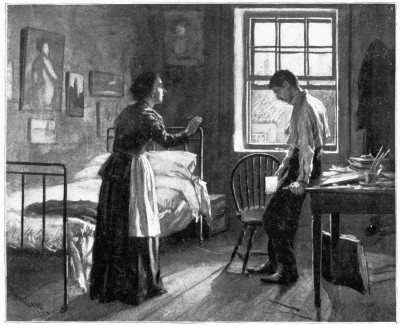
â âLORâ BLESS YOU, SIR,â SAID SHE, âIâM NOT WORRYINâ ABOUT THE RENTâ â
Brothers. Heâs in the grocery department, and earninâ good money, and Iâve seen such a heap of artists sittinâ on the pavement, with the risk any moment of the rain washinâ all the pictures out; donât you think I was right, sir?â
âQuite right,â said Matt, heartily.
Mrs. Lipchild thereupon produced a bottle of brandy and what she called a âseedy-cakeâ from a cupboard under a sideboard, and insisted on Mattâs partaking of the same. To refuse would pain her, to accept would refresh him, so he accepted. In the conversation which ensued it transpired that Mrs. Lipchildâs daughter was about to marry a young man from Brown Brothers (haberdashery department), that the young couple were now furnishing, and that it had occurred to Mrs. Lipchild that they might get their parlor pictures from Matt instead of from a shop, if they could get them any cheaper.
So Matt and his art patroness remounted again to the bedroom studio and haggled over prices, Mrs. Lipchild pointing out that his pictures were far inferior to shop pictures, not only by their unsympathetic subjects, but by their absence of frames and glass, and that she could get much bigger sizes than any of his for five shillings apiece. But as it came to be understood that ready money would not be required, and that the price was to be reckoned off the rent, Mrs. Lipchild ultimately departed in possession of a monthâs worth of pictures—six of the prettiest landscapes and ladies in the collection, with Rapperâs âLibraryâ thrown in. The poetic street-scenes she scorned, much to Mattâs relief, for he set no value on the earlier Nova Scotian work she had carried off.
This was Mattâs first sale of pictures in the great Metropolis of Art.
Considerably exhilarated by the change in his fortunes, and revived by the brandy and the âseedy-cake,â he reviewed the situation again, proof even against Billyâs letter, which he put by for later consideration. He found himself actually smiling, for a phrase of Cornpepperâs kept vibrating in his brain—âArtâs neither moral nor immoral, any more than itâs lunar or calendar.â Mrs. Lipchildâs last words had been: âVery well, weâll reckon it a month,â and he wondered whimsically whether the month was to be lunar or calendar.
Under the impulse of these gayer sentiments, he resolved to raise money by pawning whatever he could part with, and by persisting in the search for an adventurous dealer; and reflecting that, after all, the tailor would be satisfied with an instalment, he wound himself up to the pitch of applying to Herbert by letter, though he could not bring himself to a verbal request.
My dear Herbert,—I am sorry to bother you again, but if you could let me have only five guineas to offer the tailor I should be very grateful. I hope soon to find work, or sell some things; and you will be pleased to hear that I have got over the difficulty with the rent—at least for the moment.
Yours sincerely,
Matt Strang.
P.S.—Donât put yourself out if you cannot. You have been very kind to me, and I shall never forget it. I dare say I shall pull through somehow.â
Matt carried this request to the pillar-box through the stuffy splendor of a summer night in Holborn back streets. As he heard the slight thud of the letter in the box he had a sense of something achieved, and had no compunction in spending one of his nine remaining pennies on his supper of âbaked fagotâ in a muggy pork-butcherâs shop. Nightmare, followed by a giddy uprising with furred tongue and aching forehead, was the sequel of this devil-may-care diet, and early in the afternoon the nightmare seemed to resume its riot in the guise of a reply from Herbert.
Dear Matt,—What in the name of all that is unholy made you send that letter to my house instead of to the club? Thereâs been a devil of a row. The Old Gentleman opened the letter. He pretends he did so without noticing, as it came mixed up with his, and so few come for me to the house. When I got down to breakfast the mater was in tears and the Old Gentleman in blazes. Of course, heâd misread it altogether—imagined you wanted to borrow money instead of to get it back (isnât it comical? Itâs almost an idea for a farce for our dramatic society), and insisted you had been draining me all along (you did write you were sorry to bother me again, you old duffer). Of course I did my best to dispel the misconception, but it was no use my swearing till all was blue that this was the first application, he wouldnât believe a word of it. He said he had had his suspicions all along, and he called the mater to witness that the first time he saw you in the shop he said you were a rogue. And at last the mater, whoâd been standing up for you—I never thought she had so much backbone of her own—was converted, and confessed with tears that you had been here pretty nigh every day and swore you should never set foot here again, and the Old Gentleman dilated on the pretty return you had made for his kindness (sucking his boyâs blood, he called it, in an unusual burst of poetry), and he likewise offered some general observations on the comparative keenness of a serpentâs tooth and ingratitude. And thatâs how it stands. Thereâs nothing to be done, I fear, but to let the thing blow over—heâll cool down after a time. Meanwhile, you will have to write to me at the club if you want to meet me. I am awfully sorry, as I enjoyed your visits immensely. Do let me know if I can do anything for you. Iâm in a frightful financial mess, but I might give you introductions here or there. I know chaps on papers and that sort of thing. I am sure you have sufficient talent to get along—and you can snap your fingers at creditors, as you havenât got anything they can seize, and can flit any day you like. I wish I was you. With every good wish,
Yours always,
Herbert Strang.
Matt took this letter more stoically than he would have predicted. He even grinned like a Red Indian at the stake. In truth, he was already so prostrated by illness, hunger, and above all by the heat, that there was nothing left in him to be prostrated. He crawled out soon after the receipt of the letter, and recklessly bought a halfpenny currant loaf, which he washed down with water.
CHAPTER VII
TOWARDS THE DEEPS
The summer rolled heavily along, bringing strange new experiences to Matt Strang, and strange glimpses of other art-worlds than Herbertâs. For he did not starve, though Herbert had gone quite out of his life, and he had none with whom to exchange the thoughts of youth.
Two pounds ten shillings lent on his dress-suit staved off hunger and his tailor (who got the pounds), till, by the aid of the landladyâs sonâs book, he found out how to tint photographs, and earned sixpences and shillings by coloring cartes-de-visite and cabinets for cheap touting photographers, censoriously critical and given to refusing the work of hours. By-and-by the Christian Home took him to its hearth, situate at the summit of a cobwebbed ramshackle staircase in Bolt Court, and paid him seven and sixpence for a half-page illustration of an unworldly serial. âPay-dayâ was a delightful weekly emotion, the staff adjourning to a public-house in Fleet Street to drink one anotherâs health and their own damnation. Matt was forced to join them because Dick Gattel, the puffy-faced author of the spiritual romance he was illustrating (âA Godly Atonementâ), insisted on standing treat, declaring with odd oaths that heâd never been so well interpreted before by any blooming paper-smudger. He also initiated Matt into the secrets of his craft, summing up in a formula the experience of a quarter of a century of story-writing. âEmotion for the penny papers, excitement for the halfpenny, self-sacrifice for the religious.â Strange impecunious beings gathered in this public-house or outside it, uncouth, unclean, unshaven; many had drifted down from society, from the universities, from the army, from the navy, with reserve forces from India and America, the flotsam of lifeâs wreckage, and they consoled themselves by babbling of the seamy side of the successful, rolling under their tongues the money these others were making, and parading a confident familiarity with their doings and their pass-books. Matt shuddered at the thought that he might one day become even as these—the damned-before-death. There was another artist on the staff—a thick-set German, whose wife was wont to waylay him on âpay-day,â and who always wrote on professional paper girdled with his own designs in proof of his prowess, and expressive of his willingness to undertake wash-drawings, line-drawings, color-work, or lithography, at reasonable rates and with prompt deliveries.
Through this German, who was good-natured after his second glass, Matt procured extra employment in a comic-picture factory managed by a solemn, snuffy Scotchman, who selected from old comic papers the jokes that were to be illustrated by his âhands,â and, signing the sketches with his own name, peddled them in the offices of new comic papers. Matt was paid half a crown per sketch, and his employer from four to five shillings; but when the young man tried to send original jokes and sketches direct to these papers, he got only the same two and sixpence for the few things they accepted. One editor, whose pages bristled with ballet-girls, took the trouble to explain to him that the presence of a clergyman in a sketch was a disqualification, as any attack on the Church would be distasteful to his public. From another, the Merry Miracle, whose proprietor was a philanthropist, a member of the school board, and a candidate for Parliament, he received a prospectus instructing him to eschew cross-hatching, solid black, line-work, and society figures, in favor of rough-and-tumble farce in bold outline. The more sober of the comic papers had settled staffs and settled jokes, and new-comers were not welcomed. Not that Mattâs jokes were very good: labored verbal oddities for the most part, intellectual quips and cranks which, he was quite aware, lacked the true humorous insight of Jimmy Raven, upon whom he modelled himself, feeling no first-hand impulse. Humor, indeed, was not his vocation; when he saw the world through Jimmyâs eyes he was tickled yet fortified, as one set face to face with the prose of the real, and finding it genial; but he could not see it like this himself. His was a world of beauty set over a strange, disquieting substratum of ugliness, from which it were best to avert oneâs eyes, and which, perhaps, existed only as something to aspire away from.
Jimmy Raven had published A Sketch-Book of Beggars which Matt Strang had found vastly entertaining; and yet Matt Strang saw rather the tragedy of beggars than their humor, and this tragedy seemed to him outside the realm of Art. It was only their occasional picturesqueness that attracted his artistic interest at this period of his development, and all the figures of his so-called comic sketches were either pretty or picturesque. He studied extensively in the streets, note-book in hand, fearful of losing the subtleties of nature through his inability to afford even the cheap, casual models of his first days in London, and training himself to catch the salient points of character or movement at first glance. Probably no artist ever made comic pictures so seriously as Matt Strang, with such scrupulous backgrounds, in the which, when they were done in wash, he strove with entirely unappreciated thoroughness, by careful adjustment of values, to make his black and white yield veracious color-effects. When the drawings were accepted, they came out so reduced and so badly reproduced that the subtleties were blurred away, and the values quite transmuted. Wood-engraving falsified the lines or photography the color, and thus their appearance in print was as much a pain as a pleasure.
Mattâs redemption from comic journalism was partly due to the prosperity of the proprietor of the comic-picture factory, who started a serious-art department, where Matt found less uncongenial work in painting figures into the landscapes of his less competent fellow-workmen. This gradually opened up to his astonished eyes a new section of the trade. He saw one of these landscapes near Kingâs Cross, resplendent in a gorgeous gold frame, and marked âOriginal oil-painting—two guineas only,â and another, in a poor neighborhood marked âWater-color, hand-painted—a bargain!â and he perceived that he had been flying too high in his early attempts to approach dealers of the type of Drücker. Henceforward he haunted furniture dealers, picture-frame makers, and artistsâ colormen, and thus he occasionally obtained half a sovereign to despatch to his tailor. His drawings in the Christian Home attracted the attention of the editor of the Working Man, and Matt was commissioned to accompany a journalist through the East End to expose the evils of sweating. The Working Man was owned by a syndicate, and Matt had to settle terms with the manager, a truculent gentleman with a double chin and a double watch-chain, who agreed to give him five shillings a sketch. Matt did several sketches for each article, and the pathetic series caused a great stir and much correspondence; but at the end of the month—when poor Matt, who had already nearly starved himself for his tailorâs sake, was expecting a goodly check to send to Abner Preep—he received only a quarter of what he had bargained for. He went to the editor, who referred him to the manager, who insisted the terms were five shillings for the illustration of a single article. âYou must remember, too, what a lift we are giving you, with our big circulation,â concluded the manager, his double watch-chain heaving pompously on his abdomen. âIt is not every young man who gets such a chance of showing what he can do.â
âYouâre a set of damned scoundrels!â cried Matt, with an access of ancient rage, and had wellnigh torn up the check and thrown it in the managerâs face, when his later chastened self plucked at his coat-tails and bade him begone with it. Who so helpless as the black-and-white artist, his work poorly paid, and reproduced again and again without his control; his very originals taken from him and sometimes sold at a profit?
It was not a happy time for Matt, this period of spiritless work by day and spiritless study by night, his soul chafing alike against the degradations of life and the routine of school. For what an actuality had he exchanged his dreams! Yet he had no option; the tailor must be paid, his family must be helped, and to these two ends, moreover, he himself must exist. But the friction of ideals and realities left him irritable and high-strung; and even when, towards the autumn, he won his way into the Ladiesâ Weekly, at a guinea an illustration, he lost his work by not concealing his contempt for the art editor, a pragmatic person, absolutely dead to art, but excessively fastidious about the drawings, which he refused whenever there was time for alterations.
âThis is feeble, but weâre pressed for time,â was his encouraging apology to the artist for accepting his work, âand Iâll put it into the hands of a competent engraver.â His first self-revelation to Matt was his complaint about some rough shadows on the borders of a sketch: âI wish you would bear in mind, Mr. Strang, that we have to pay as much per inch for the reproduction of those blotches as for the most finished work.â But it was not till the âold ladyâ (as the other artists called the art editor of the Ladiesâ Weekly behind his back) had insisted on his dressing his figures better that Matt lost control of his tongue and retorted, âI draw pictures, not fashion-plates.â In after-remorse, he would have been glad to get fashion-plates to do. He replaced the lost work by returning to photo-tinting, though he now obtained more important work on enlarged photographs, which he colored in oil at three and six apiece, managing to do two or three a day while the light held, without interfering with his black and white, which could be done at night; by which means he scraped together enough to pay off the tailor in full, and to send his promised contribution home, together with seven fourpenny halfpenny âNotable Novelsâ to reconcile Billy to his narrow existence. And then, with these burdens thrown off, his idealism resurged again, for beneath the placid everyday exterior of this homely young man, who trudged up foul staircases, portfolio under arm, or danced attendance on smug h-less photographers smoking twopenny cigars, a volcanic fire burned, and the thought of his precious youth wasted and abraded in this inartistic art-drudgery, under the yoke of vulgar souls, was a dull haunting torment. His qualms of self-distrust vanished under the pressure of obstacles, and the measure of his aversion from joyless commercial art became to him the measure of his genius. One gray windy forenoon of late autumn he had stopped to take a mental sketch of a strangely attired woman, who was listening to a Salvation Army exhortation, a woman who was a dab of color upon the dreary day. Below an enormous white hat with a recumbent ostrich feather and a broad brim with an upward slant, tied under the chin with black bands, shone through a black veil a glorious oval-shaped dark face with flashing eyes, full red lips, large shapely ears, and raven hair curling low over the forehead. She wore a black, half-masculine jacket, with big mother-of-pearl buttons and a yellow bow that was awry, and by a shapely hand cased in a white glove with three black stripes she held the skirts of a slaty gown clear of the mud.
While Matt was whimsically wondering what the editor of the Christian Home would say to a sketch of her in his staid organ, he instinctively noted the other romantic touches about the scene, ineffably grimy though the roadway was to the inartistic eye, flanked on one side by a coal office, with a blear-eyed old man at the window, and on the other by a canal running lengthwise. There were fresh country faces among the girl-soldiers, and among the men was an ex-heathen in a turban, a flaring Paisley shawl, flowing robes, and sandals, bearing aloft a red flag with a blue border and a central yellow star, around which ran the words âBlood and Fire.â And while his eye selected the picturesque points, the whole scene passed half insensibly into his sub-consciousness as into a camera, to be developed in after-years—the grotesque snag-toothed hags in the crowd, the collarless men with the air of being connected with the canal, one of them with a Mephistophelian red tuft on his chin; the ice-cream stall at the corner, where a postman, a baby of three, and an urchin with his collar paradoxically up against the cold were licking green glasses. And then a buxom work-girl with a tambourine began to hold forth, pouring out breathless sentences all running into one another, clutching her inspiration tight lest it should escape her, and repeating herself endlessly rather than pause for a moment.
âOnly the blood of Christ can save only the blood of Christ has saved only the blood of Christ will save.â
And her fellow-soldiers, quivering with unction, punctuated her shapeless periods with soul-wrung ejaculations.
âAh, yes.â
âBless her.â
âGlory to God.â
âYou may try earthly pleasures you may go to the theaytre,â she gasped, âbut it brings no peace nothing brings peace but the Rock but the Lamb—â
âHallelujah!â
âBut the oldest of all religions proved over and over again Christianity tried in the furnace any day you may die no one knows the end nowâs the time donât put it off come are you prepared once I had bad companions—â
âA—a—ah!â groaned a melodramatic brother, with folded arms.
âBut I gave them up—â
âGlory!â in a great sob of relief from all the palpitating figures.
Matt began to forget the visual aspects of the scene; the infectious emotion of the girl and her comrades gained upon him. What she was saying left no dint on his mind—to her dogmas he was become indifferent. But her earnestness thrilled him, her impassioned ignorance flashed upon him a clearer sense of baseness, hollowness, insincere falling away from the ideals that had sailed with him to England, glorifying the noisome steerage. Turning his head, he saw tears rolling down the dark passionate face of his dashing neighbor, and he hurried away, shaken and troubled, pursued by the cacophonous melody into which the street congregation had broken.
What was the point of his life? What had he become?
At Graingerâs there were fellows who looked to Art as an escape from some worse-paid calling. That was not, had never been, his idea. To him Art was an end in itself; he was of those who live to paint, not paint to live. Even in his boyish days, when the vendibility of pictures first came within his ken, the money had always seemed to him a pleasant by-product, not a motive. And now, instead of pouring out on canvas all that effervescence of youthful poetry that flooded his soul, he was coloring photographs and illustrating foolish stories for foolish editors in contravention of all his own ideas of what illustrations should be. Why, even in Nova Scotia he had painted from the life; in his lowest days he had decorated furniture at his own pleasure. Oh, it was sordid, unworthy, humiliating! He would give it all up: if he could not pursue Art, at least he would not degrade it. Thanks to his Nova-Scotian training, his good right hand could do more than wield the brush. Better to earn bread and water for himself and his family by some honest craft, till such time as honest Art came within his means. Rather an honest artisan than a dishonest artist. And while he was still hot with the impulse he looked through the advertisement columns of the Clerkenwell Chronicle, and answered three demands, one for a âjoiner,â another for a âsugar-boiler,â and the third for a âharness-cleaner.â
The sugar-boiling firm alone answered, and he was asked to call. He stated that he had had considerable experience of the manufacture in Nova Scotia, but a brief conversation convinced the manager that the applicant knew nothing of scientific sugar-boiling, with its elaborate engines and differentiation of labor; but Mattâs sober, respectable appearance and his conviction of his capacity stood him in good stead, and he was given a fortnightâs trial at eighteen shillings a week, with a prospect of rising to forty. In his confidence of mastering the easy detail, and to clinch his resolution, he wrote to his art patrons throwing up his position in each establishment with due form and superfluous sarcasm, and one happy morning, soon after sunrise, repaired to the factory with a more buoyant tread than had been his since the memorable day when he crossed the great bridge which led to the heart of all the splendors.
The fortnightâs end found him spiritually seared and physically scalded. The depressing society of the British working-man, the ever-present contrast of the blank building with the free forest in which he had made sugar in his boyhood (how happy his boyhood seemed now!), and the overflowing contents of the seething boilers, demonstrated to him daily that he had made a mistake. He might have stayed on nevertheless, but the dread that an accidental scald on the hand might permanently injure his power with the brush made the trial fortnight his last. He scanned the advertisement columns again, with no suspicion of what now awaited him.
He had been misled by the comparative facility with which he had found work hitherto; he was now destined to re-experience—far more poignantly than in New Brunswick—the long-drawn agony of unemployment, the sickness of hope deferred; to bruise himself against the ruthless indifference of an overstaffed nation; to see and hear the blind, deaf forces of the social machine grind out happiness for all but him. At first he did not mind getting no replies, except for the waste of stamps, for he took feverish advantage of the hours of daylight thus left free for Art. But as day followed day, and week followed week, the perturbation of his soul and the weakness of his body, enfeebled by hunger and cold, made painting difficult; and he had not even the capital to expend on canvas. Broken in health and pride, he applied again for his old work, prepared even to tint cartes-de-visite. But his place had been filled up. The stream of human life had flowed on as if he had never been. The work he had got was the only work in London open to a man in his position, and this work he had thrown away. One of the papers he had so imprudently quarrelled with was willing to take him on again, but at half the price. Subdued as he was, a pride he afterwards felt to have been insane spurred him to refuse. He fancied he could get such terms from a score of other papers, but he was mistaken. In truth, black and white was no more his métier than humor. The rush into black and white, of which he had first heard at Cornpepperâs, had filled the ranks with abler men or of older standing, with a better appreciation of the market, and of how to draw for reproduction by the new processes just coming up. And he had yet to learn, also, that the world went very well without him; that it had no need for him either as artist or artisan, craftsman or clerk; that every hole had its peg, round or square; and that he was of no more account in the surging life of London than the fallen leaves blown about the bleak squares.
He earned a few odd shillings now and then for his old pictures by persuading some small skinflint dealer to cheat him; and that was all. Once he was cruelly tantalized—a five-pound commission to copy a National Gallery picture being dangled before him, only to be withdrawn. He parted with all but the barest necessities—with the fashionable morning suit, with his pistol, with the Gregson boots; his only luxury was the engraving of the âAngelus,â which he had retained because nobody offered more than eighteenpence for it. The bulk of the money thus raised was remitted to Abner Preep, as promised; the rest went to pay Mrs. Lipchild. Himself he so stinted that often when he went to Graingerâs (which he had fortunately prepaid) he took care to arrive first, not only because of the warmth, but because the girl students, whose class preceded his, left stale crusts lying about, whose crumb had been used up on their charcoal drawings. To such straits may a man sink in a few weeks, though he sinks slowly, for each week is a year to him. But outwardly he preserved dignity, brushing his one suit scrupulously, and glad that, owing to his interlude of fashionable tailoring, it was still in good condition; for the vision of the lost mortals was ever before his eyes, and he foresaw that without a decent appearance he would not be able to grasp an opportunity even when it came, but would be driven down to the deeps to join the damned souls outside that Fleet Street public-house, within which the happier staff of the Christian Home ushered in the Sabbath with beer.
And the more London refused him the more his consciousness of power grew. As he tramped the teeming streets in quest of a job or a customer, a thousand ideas for great pictures jostled in his sick brain, a thousand fine imaginings took form and shape in beautiful color-harmonies and majestic groupings. In the ecstatic frenzy of moments of hysterical revolt against the blind forces closing in upon him like a tomb to shut him out forever from the sunlight, he grew Titanic to his own thought, capable of masterpieces in any and every kind of art—great heroic frescos like Michael Angeloâs, great homely pictures like those of the Dutch, great classic canvases like Raphaelâs, great portraits like Rembrandtâs, great landscapes like Turnerâs, great modern street-pieces like Cornpepperâs, great mediæval romances like Erle-Smithâs, not to say great new pictures that should found the school of Strang, combining all the best points of all the schools, the ancient poetry with the modern realism. Nay, even literary impulses mingled with artistic in these spasms of nebulous emotion, his immature genius not having yet grasped the limitations of the paintable. Good God! what did he ask? Not the voluptuous round of the young men whose elegant silhouettes standing out against the black, silent night from the warm lighted windows of great houses athrob with joyous music filled him with a mad bitterness; not the soft rose-leaf languors of the beautiful white women who passed in shimmering silks and laces from gleaming spick-and-span carriages under canvas awnings over purple carpets amid spruce, obsequious footmen; not the selfish joys of these radiant shadows dancing their way to dusty oblivion, to be trodden under foot by the generations over which he would shine as a star, serene, immortal; but bread and water and a little money for models and properties, and a top-light straight in touch with heaven, and a few pounds to send home to his kith and kin; but to paint, to paint, to joy in conception and to glory in difficult execution, to express the poetry of the ideal through real flesh and real shadows and real foliage, and find a rapturous agony in the search for perfection; to paint, to paint, to exult fiercely in the passing of faces, with their pathos and their tragedy, to catch a smile on a childâs face and the grace of a girlâs movement and the passion in the eyes of a woman; to watch the sunrise consecrating tiles and chimneys, or the river, mirroring a thousand night-lights, glide on, glorifying its own uncleanness; to express the intense stimulus of the wonderful city, resonant with the tireless tread of millions of feet, vibrant with the swirl of perpetual currents of traffic, pulsating with the rough music of humanity-roaring markets, shrilling trains, panting steamships; to record in pigment not only the romance of his dreams or the glamour of the dead past, but the poetry of the quick—the rich, full life of the town, the restless day and the feverish night, with its mysterious perspectives of fitful gleams; to paint, to paint, anything, everything, for the joy of eternalizing the transient beauty that lurked everywhere—in the shimmer of a sunlit puddle, in the starry heaven, in the motions of barefoot children dancing to a barrel-organ, in the scarlet passing of soldiers, in the play of light on the fish in a hucksterâs barrow, in the shadowy aisles of city churches throbbing with organ diapasons.
Oh, the joy of life! Oh, the joy of Art that expressed the joy of life!
Yes, but in the absence of a few bits of metal, neither joy nor Art nor even life could be his. He must die, be swept off from among the surging crowds of which he was an unnoticed unit, and no one would ever know what mighty things he had dreamed and suffered in his little span of years. Every supper eaten by radiant couples at richly lit restaurants would have nourished him for weeks, nor did it diminish the bitter socialistic sentiment this reflection caused him to remember that he himself had fared as wantonly once and again. At least, he had earned his money. What gave those young men with the vacant faces, those women with the improbable complexions, the right to all the good things at the table of life? Even Herbert was splashed by this wave of bitterness; Herbert, the brilliant, with his battalion of boots. Ah! poor little Billy was right. It was impossible to believe in anything—to see any justice in life.
And was it worth while going on? The thought presented itself again and again, especially in those November days when London was as dark as his own soul; and it made him half sorry, half glad that a grim Providence had sent his pistol to the pawnshop. He was walking to Graingerâs one evening in such a double darkness of without and within, when the memory came to him of a newspaper paragraph concerning people who had wandered into the river, and, hypnotized by the idea, he bent his steps towards the docks, with a vague intention of giving death a chance. What did it matter what became of his brothers and sisters? It were better that they died too. In any case he could not help them any more; he had just scraped together the usual remittance, but he could not see where the next was to come from. But his semi-somnambulistic motion did not bear him towards the water-side; in the gray obscurity he erred endlessly in strange ghostly squares, whose chill iron-railed enclosures loomed like cemeteries through the sepulchral air.
London smelled like a boiled sponge; the raw air reeked with sulphurous grime, as if the chimneys of hell had been swept. It was not an inviting world to remain in. A gigantic brown head of a horse suddenly shot past his. He jumped back, but a shadowy wheel caught him in the pit of the stomach and hurled him across the road, where he fell on his back, hearing inarticulate noises from the cabman, and just seeing the hansom swallowed up again by the yellow sea. He got up, feeling dazed and indignant, rather than hurt, and staggered along in purposeless pursuit of the vanished cab. He found himself in a business street, where the illumined shop-fronts thinned the fog. A familiar face, with a strange green light upon it from a chemistâs window, burst upon him as unexpectedly as the horse. It was Tarmiganâs. He studied it abstractedly for a moment in its greenish pallor, with its deep furrows, seeming to read clearly a weariness and heart-sickness akin to his own, and struck for the first time by the shabbiness and flaccidity of the figure. Then the face took a more joyous expression than he had ever seen in it, and he heard Tarmigan saying:
âHullo, Strang! Are you lost, too?â
âYes, sir—at least, I donât quite know, sir,â he replied, like one awaking from a dream.
âYouâre usually at Graingerâs at this hour. Iâm on my way there. If you are going to-night we had better keep together.â
âThank you, sir,â said Matt.
He went into the chemistâs to inquire their whereabouts, and feeling a little stiff, had the sudden idea of laying out his last coppers in arnica; then he began to pilot his master with a sense of lofty responsibility. But they walked in silence, mutually embarrassed.
Tarmigan coughed lengthily.
âOught you to be out on a night like this, sir?â Matt ventured to say.
âDuty, my boy, duty,â rejoined Tarmigan, gruffly.
âBut you are not bound to go, are you, sir?â Matt remonstrated, remembering that Tarmiganâs services were a voluntary sacrifice at the shrine of Art.
âI am not forced by an outsider, if thatâs what you mean,â said Tarmigan. âBut that wouldnât be duty, that would be necessity—at least, in my definition.â
âThen duty is only what you feel you ought to do,â said Matt.
âDecidedly. Any man who knows what true Art is is bound to hand it down to the next generation, especially in an age when there is so much false doctrine in the air.â
âBut canât each generation find out its own Art?â Matt asked, timidly.
âCan each generation find out its own science?â Tarmigan retorted, sharply. âIn all things there is a great human tradition, and the torch is handed down from generation to generation; otherwise we should be in a nice fog,â he added, grimly, and coughed again. âAnd a nice fog the young men are in who reject the light of the past, with their azure Art, and their violet nonsense, and their slapdash sketchiness.â
âBut they seem to be gaining the public ear,â Matt murmured, liking neither to contradict his master nor to agree with him.
âThe public ear!â Tarmigan laughed scornfully. âYes, they gain that, but not the public eye, thank God. That can still tell slipshod botchery from honest, faithful work.â
âBut Cornpepper is in the Academy this year,â Matt reminded him.
âYes; the Academy lets itself be outbawled,â said Tarmigan, sharply. âI wish I were a member!â
âI wish you were,â said Matt, fervently.
Tarmigan coughed.
âI didnât mean what you mean,â he said, gruffly.
âOh, but they ought to elect you, sir!â said Matt, rushing in on delicate ground in his enthusiasm for the manâs character. âEverybody says so.â
âWhoâs everybody?â Tarmigan inquired, bitterly. âSociety doesnât say so, for I donât go to its drawing-rooms; the R.A.âs donât say so, for Iâm unknown to their wives. But I am unjust. Let us drop the subject. After all, a manâs work stands, even if he is passed over in his lifetime.â
Matt felt a sharp pang of sympathy for this strong, stern man sustained by the false dream of immortality. He could not conceive that posterity would care a rap for Tarmiganâs cold classic pictures. Indeed, now that he had assimilated all that was good in Tarmiganâs teaching, he only went to the studio for the sake of the model and the practice. Emotion and embarrassment kept him silent.
âDo you live with your people?â Tarmigan asked, presently, in an interested tone.
âNo,â said Matt; âthey are in America.â
âOh, ah, yes; so you told me. Youâre not married?â
âNo.â
âNor engaged, I hope?â
âNo,â said Matt, wonderingly.
âThatâs right. No artist should marry. His wife is sure to drag him down to sacrifice his Art to her pleasures and wants. Fine feathers and fine houses are ruining English Art. I warn you of this, because you have the makings of an artist if you work hard.â
âYou are very kind, sir,â said Matt, touched.
âNot at all. You have a fine natural talent, still undisciplined. So long as you keep yourself free from matrimonial complications you may hope to achieve something. A single man can live on bread and water. I am heartily glad to hear you have nobody to keep but yourself.â
Matt smiled grimly under the imagined cover of the fog.
âAh, I know what youâre smiling at,â said Tarmigan, more genially than he had yet spoken. âYouâre wondering whether the preacher is a bachelor. Well, I am proud to say Iâm still single, though I canât boast of living on bread and water. You see, it isnât only the expense; marriage spoils the silent incubation of ideas; the wife wants her husband, not his Art.â
âBut suppose an artist falls in love—isnât it hard on him?â asked Matt.
âNo man can serve two masters. Every artist has got to ask himself, Does he want Happiness, or does he want Art? That choice will face you one day, Mr. Strang.â
âI hope not,â said Matt. âBut I guess Artâs enough for me.â He spoke in a tone of quiet conviction, and his bosom swelled. Happiness, forsooth! How could there be Happiness apart from Art? Or how could Art be apart from Happiness?
Their talk fell to a lower level. Matt casually expressed an ardent wish to see sundry R.A.âs, especially the president. He had only come across the second-rate painters or the young men. He felt vaguely that he was at one with Butler and Greme and Herbert, and apparently Tarmigan also, in despising them, though he had only seen one of their exhibitions; they were in power and popular, and therefore time-serving mediocrities. Yet beneath all this prejudice was a keen curiosity about them, and a latent respect for these oldsters who had arrived. Tarmigan promised to get him a ticket for the prize distribution of the Academy Schools next month, when he would see most of them. The suggestion of suicide slunk into the rear; the spectacle of the Academicians was something to live for. Then the old man and the young relapsed into silent thoughts of their art, projecting visions of ideal beauty on the background of yellow, grimy vapor that shrouded the great dreary city.
But when Matt sat down to paint that night he found himself incapacitated, a mass of aches and bruises. He went home to anoint himself with his arnica; in the unconscious optimism of sickness the suggestion of suicide had vanished altogether.
CHAPTER VIII
âGOLD MEDAL NIGHTâ
With a step that faltered from nervousness even more than from the weakness due to a diet of one meal per diem, Matt Strang passed across the clangorous court-yard of Burlington House, nigh turned back by the imposing bustle of broughams and cabs, whose shadows were thrown sharply on the stones under the keen, frosty starshine of the December night. In the warm-lighted hall he shrank back, even more timidly, blinking at the radiance of the company, the white shirt-fronts of the men, the dazzling shoulders of the women. Before a counter a block of black figures struggled to get rid of their hats and coats in exchange for numbers. Matt hid his hat, fortunately flexible, in the pocket of his overcoat, which, being the least shabby of his vestments by reason of its summer vacation, he did not dare to take off; otherwise he would not have dared to keep it on. There were spots of discoloration on the concealed garments, for they had suffered from the weekâs job, which, together with the expectation of this gala-night, had kept him alive since he had met Tarmigan in the fog three weeks before. As a house-painter and distemperer Matt had still hovered on the verge of Art, and if Butler was right in his interpretation of the Academy of his day, and the highest art was indeed to conceal paint, then was the young Nova Scotian strictly Academic in retaining his overcoat on this most Academic of occasions. He marched with the courage of desperation up a broad crimson staircase, keenly conscious of the frayed edges of his trousers, and mistily aware of overarching palms and bordering flower-pots and fashionable companions, and surrendered the ticket Tarmigan had given him to a sumptuous official who seemed a part of the ornamental avenue to the Academic salons. Once safely past this point the haze cleared, and he saw, to his joy, less fashionable figures in frock-coats and ladies in hats and jackets, and though he wished they had been more numerous and more dowdy, he felt a morsel more at ease. There seemed to be pictures on view, and he eagerly joined the sparse groups of spectators that promenaded the rooms, in curious contrast with the crush of the populace the last time he had walked, at the price of a shilling, within these historic walls. The exhibition was curious: in one room dozens of semi-detached heads, some evidently from the same model; in another, cartoons of draped figures; in a third, sculptures. He saw from a placard that they had been done in competition for the prizes that were to be adjudged to-night. He heard scraps of foolish criticism from the people about him, but his commerce with art-editors had blunted his once sensitive nerves, and he was only amused. From the pictures his eyes strayed to the spectators, and he wondered which were celebrities. It occurred to him, with a pang of dismay, that in the absence of any cicerone he might go away no wiser than he had come, and he remembered with regret the personally conducted tour he had made through the Reynolds Club. Would his uncle be here to-night? he thought, with apprehensive shrinking. As he moved aimlessly about, thinking of the Old Gentleman, his heart leaped to see—not Matthew Strang, but âDaniel before Nebuchadnezzar,â and not the âDaniel before Nebuchadnezzarâ he knew, but other Daniels and other Nebuchadnezzars—a veritable vision of Daniels and Nebuchadnezzars, a gallery of Daniels and Nebuchadnezzars, perspectives of Daniels and Nebuchadnezzars, stretching away on both sides of the room; young clean-shaven Daniels and old gray-bearded Daniels and middle-aged Daniels with mustaches, Daniels with uplifted arms and Daniels with downcast eyes, Daniels dressed and Daniels undressed, Daniels with flashing faces and Daniels with turned backs, and Nebuchadnezzars analogously assorted, and palaces of equal variety and backgrounds of similar dissimilarity, each tableau differing in properties and supernumeraries, but all appearing only the more alike because of their differences, so conventional were the variations.
Matt divined instantly that the picture Herbert had painted must be among them, and he looked about ardently for the painted palace in which he had spent so many happy hours. Ah! there it was, the dear old canvas, though it had an undreamed-of grandeur in its broad gold frame; there was Daniel and there was âNebby,â more finished than when he had last seen Herbert at work on them that fatal midsummer day, but essentially unchanged. He felt quite a small proprietary interest in it, unconscious how much it really owed to him; his touches on the actual final canvas had been but few, and these mainly suggestions in pastel, and his remembrance of the scaffolding work that preceded was hopelessly blurred by the countless discussions. He was shaken by a resurgence of pleasant memories of these artistic talks and merry lunches, with the bright sunshine streaming down on the skin rugs and the gleaming busts. He became absorbed in the painting, seeing episodes of the past in it, like a magician looking into a pool of ink. And then he was pierced to the marrow as by an icy wind; he heard an ecstatic voice ejaculating âIsnât it beautiful? The dear boy!â in charming foreign accents, and he divined the Vandyke beard hovering haughtily in his rear. He felt the couple had come to see their sonâs work, and he tried to sidle away unperceived, but an advancing group forced him to turn round, and he found himself eye to eye with Madame, whose radiant face of praise was exchanged for one of smiling astonished welcome when she caught sight of him.
âMy dear young—â she began, in accents of lively affection. Then Matt saw her face freeze suddenly, and he quailed beneath the glooming eyebrows of her dignified consort, who swept round the other way with the frozen lady on one arm and Herbert on the other, turning three backs to his nephew in a sort of triple insult. The semicircular sweep which veered Madame off brought Herbert near, and Mattâs heart beat more rapidly as his whilom chumâs dress-coat, with its silk facings, brushed against his tightly buttoned overcoat. The glimpse he had of Herbertâs face showed it severe, impassive, and devoid of recognition; but ere the young gentleman had quite swept past he managed to give his homely cousin a droll dig in the ribs, which was as balm in Gilead to the lonely youth, and brought back in a great wave all his fondness for his dashing relative, with whom he now felt himself a fellow conspirator in a facetious imbroglio. The last lees of his bitterness were extruded by the dig; he gazed with affectionate admiration after the solemn swallow-tails of his cousin, receding staidly and decorously up the avenue of Daniels, at one or other of which his disengaged hand pointed with no faintest suggestion of droll digs in its immaculate cuff and delicately tapering fingers. Presently there was a marked move in a particular direction, and Matt, joining the current, was floated towards a great room filled with chairs, and already half full of gentlefolks. He made instinctively for the rear, but finding himself amid a mob of young fellows in evening dress, some of them sporting the ivory medal of studentship, he retreated farther towards the front, ultimately taking up a position on the last chair of the left extremity of the fourth row from the back, out of view of the incomers streaming through the oaken panels. It was a broad oblong room, with skylights in the handsome ceiling, and large watercolors hanging on the walls. A temporary dais covered by a crimson baize and ascended by a crimson step faced the audience, and at its central point stood a reading-desk lighted from the right by a lamp. Matt heard whispered comments on the new-comers from his neighbors; now it was a knighted brewer who rolled his corporeal cask into a front seat, now it was a musical conductor with an air of exile from the central desk. A few painters of eminence with neither handles nor tails to their names dotted Art about the audience, while wives and daughters of the Academically distinguished exhaled an aroma of fashion, striving to banish all reminiscences of paint from everything but their complexions; here and there was an actor out of employment or a strayed nondescript celebrity, and on a plush couch to the right of the platform a popular author chatted noisily with a pretty, vivacious lady journalist; the mixture was completed by a few favored relatives of the students, like Mr. and Madame Strang, whose anxious faces were clearly visible to Matt in a diagonal direction a few rows ahead. Herbert himself herded with his fellow-students, who had taken exclusive possession of the back rows, where they stood in evening dress, a serried gallery of black-and-white figures, prophesying âall the winners.â
A great round of applause from their ranks set everybody peering towards the door, only to encounter the stern gaze of the magnificent beadle, whose entry had prompted the salvoes, and who, arrayed in what appeared to be a rich red dressing-gown, showed like a Venetian color-study amid a collection of engravings.
A more general outburst of clapping, accompanied by a buzz of interest, greeted the arrival of the less picturesque âtrainâ of Academicians, headed by the president. The procession, bowing and smiling, defiled slowly towards the dais, especial enthusiasm being reserved for the more popular or the newest Academicians and Associates, the students having a ruling hand or hands in the distribution of the noise. Matt craned forward eagerly to see these pillars of English Art, whose names flew from lip to lip. As they only looked like men, he had a flash of self-confidence.
The president takes his seat on the central chair, flanked and backed by the faithful forty and the trusty thirty, minus the absentees. The R.A.âs dispose themselves along the front bench, the A.R.A.âs occupy the rear—a younger set, on the whole, with more hair on their heads and less on their chins. The beadle solemnly slides the oak panels to, cloistering the scene from the world, and a religious silence spreads from him till it infects even the excited back rows. The president rises bland and stately. There is a roar of welcome, succeeded by a deeper hush. It is seen that he has papers on his desk, and is about to declare the results of the competitions, and to determine the destiny of dozens, if not the future of English Art. There is no vulgar sensationalism. With a simple dignity befitting the venerable self-sufficient institution, which still excludes great newspapers—and great painters—from its banquets, he disdains working up to a climax, and starts with the tidbit of the evening, âthe gold medal and travelling studentship for £200,â awarded every two years for the best historical painting, the subject this year being âDaniel before Nebuchadnezzar.â The president pauses for a breathless instant. The ranks of black-and-white figures standing in the background have grown rigid with excitement. The president imperturbably announces âHerbert Strang.â There is a brief pause for mental digestion, then a great crash of applause—the harmonious cacophony of clapping hands, generous lungs, and frenzied feet. Matt, thrilling through and through with joy and excitement, shouting frantically, and applauding with all his limbs, turns to look for Herbert amid the students, but sees only rows of heaving shirt-fronts and animated black arms. Then he becomes aware of his cousin strolling leisurely along the near side of the room, through a mad tempest of cheering, towards the presidentâs desk, a faint smile playing about his beautiful boyish lips, which yet tremble a little. Matt feels proud of being the cousin of the hero of the moment, whose course he follows with tear-dimmed eyes. He sees him reach the presidential desk and receive a medal and an envelope from the great man, who shakes hands with him and evidently offers words of congratulation. He follows his passage back to his fellow-students through the undiminished tempest. Then his eye lights suddenly on Matthew Strangâs face, and sees great tears rolling down towards the Vandyke beard, while beside him Madame Strang, her face radiating sunshine, her eyes dancing, throws kisses towards the cynosure of all eyes, who, carrying his honors, and studiously avoiding the weakness of a glance in the direction of his parents, ploughs his way amid fraternal back-thumpings to his place among his cronies. There is a rapid exchange of criticism and gossip among the students, ejaculations of commiseration for Flinders, whose friends had convinced him that he would win, and for Rands, a poor devil of talent, the only hope of a desperately genteel family in Dalston. But comment must be hushed, for other prizes, some of them important enough, have to be announced. There is a steady succession of individual students, more or less blushing, moving to and from the presidentâs congratulatory hand, some stumbling nervously against the crimson step placed in front of his desk, probably by the beadle to disconcert the shy. Some fortunate prize-winners come up three times, and stumble three times. Sometimes they are girls. One wears spectacles and a yellow sash, and has the curved back of the student; another is pretty and petite, and causes a furore by her multiplex successes and her engaging charm; a third is handsome, but gawky, with bare red arms. A young man who wins two events attracts special attention by his poetical head and his rapt air of mystic reverie, and goes back winking. Then the president commences his biennial address to an audience of students throbbing with excitement, afire with the after-glow of all that applause, anxious to canvass the awards, and dying to run out into the other rooms to look at the winning pictures, which have, in some instances, been dark horses which nobody remembers to have noticed.
His theme is the Evolution of Ecclesiastical Art. For half an hour the audience, always with the exception of the students he is addressing, listens patiently to the procession of ornate periods, classically chiselled, hoping to emerge from the dulness and gloom of obscure epochs into the light of familiar names. Then the seats begin to feel hard. By the aid of copious shufflings, wrigglings, and whisperings, they drag through another bad quarter of an hour, relieved only by the mention of Albrecht Dürer, whose name is unaccountably received with rapturous cheers, as if he were a political allusion. The next quarter of an hour is lightened by the feeling that it is to be the last. But, as the second hour arrives without a harbinger sentence, three brave men arise and pass through the beadle-guarded portal. There is tremendous cheering from the back, which is taken up and re-echoed from all parts of the room, and the president beams and turns over a new page.
The seats become granite, the presidential eloquence flows on as if it would wear them away; an endlessly trickling stream. He enters into painful analyses of vanished frescos, painted in churches long since swept away, and elaborates punctilious appreciations of artists and architects known only to biographical dictionaries. Some have fancy without imagination, some imagination without fancy, a few both fancy and imagination, and the rest neither imagination nor fancy. The stream strewn with dead names flows on slow and stately, with never a playful eddy, and another man, greatly daring, fortified by the example of his gallant predecessors, steals from the room, and blushes to find it fame. Amid the plaudits that ring around this manful deed, Matt suddenly finds Herbert at his side. His cousin slips a note into his hand and retreats hastily to his place. Excited and glad of the relief, he opens it and reads: âMeet me outside after this rot is over. Donât let the Old Gentleman see you.â Matt smiles, proud and happy to resume his old relations with the hero of the evening, and pleased to find the ancient password of âthe Old Gentlemanâ supplementing the droll dig in the ribs in re-setting their camaraderie on its ancient footing. In his eagerness to talk to Herbert again and to congratulate him personally, the presidential oration seems to him duller and the seat more adamantine than ever. He strains his ears to catch instead the babble of the students, who have finally given up any pretence of interest in mediæval Flemish cathedrals. His eye, long since satiate with the sight of the celebrities, roves again over the faces of the Academicians on their platform, austere in their striving to appear absorbed, and again he draws confidence from their merely human aspect. He watches the popular novelist gossiping with the vivacious lady journalist. He examines for the eighth time the water-colors on the walls, which he gathers, from one of the many conversations going on in his neighborhood, are by the competitors for the Turner prize. He sees that the hard-worked newspaper artist in the row in front of him has given up sketching and gone to sleep, despairing of escape. The pangs of his own stomach keep him awake; he looks forward wistfully to the hour of release, resolved to treat himself to two-pennyworth of supper in honor of Herbertâs triumph. But the interminable voice goes on, discoursing learnedly and elegantly of apses and groins and gargoyles. The wrigglings have ceased. All around, but especially in the quiet front rows under the presidential eye, apathetic listless beings droop on their chairs. Matt steals a glance towards his uncle, and finds him the only member of the audience genuinely alert and interested, his head perked up, his eyes gazing admiringly towards the rostrum, where perchance in imagination he already sees his son carrying on the time-honored tradition of the great Sir Joshua. At his side Madame sustains herself by furtive looks in the direction of the same young gentleman. Then Matt turns his attention to the speaker, watching his mouth open and shut, and his shapely hand turning the perpetual pages. He expects that every moment will be the oratorâs last. But the great man is just warming to his work. His silvery voice, rising above the buzz and the murmur, descants dreamily on the spiritual aspirations of uncouthly christened architects, who had mouldered in their graves long centuries before his Gracious Majesty George III., patron of arts and letters, gave the Academy house-room. After an hour and a half he launches lightly into a treatise on glass-staining. The audience has now given up all hope. It has the sense of condemnation to an earthly inferno, in which the suave voice of a fiend of torture, himself everlastingly damned, shall forever amble on, unwinding endless erudition. A reference to âmy young architectural friends,â greeted with suspicious thunders by all the students, affords a momentary break in the monotony. The end comes suddenly, after a âLastly,â forgotten ten minutes before. There is a brief interval of incredulity. People awakened by the silence look up sleepily. Yes, there is no doubt. The president is actually down. Then a great roar of joy bursts out from all sides. The back benches go delirious, and then the meeting dissolves in a stampede towards the oaken panels, at last open in three places. The discharged prisoners swarm down the grand staircase and besiege the cloak-rooms; some parade the rooms to inspect the winning pictures, now ticketed, and to express their surprise at the judgesâ decisions.


