Biblical Chronology
Қосымшада ыңғайлырақҚосымшаны жүктеуге арналған QRRuStore · Samsung Galaxy Store
Huawei AppGallery · Xiaomi GetApps

автордың кітабын онлайн тегін оқу  Biblical Chronology

Valeriy Sterkh

Biblical Chronology

Fonts by «ParaType»


Translator Evgeniy Terekhin


Contents

Foreword

Throughout centuries, numerous attempts have been made to recreate biblical dates and chronology. Yet there is still no consensus in this regard — for various reasons. This book briefly discusses the problems of the Old Testament chronology and provides a more detailed timeline of the era of Jesus Christ. The main flaw of the various existing versions of the New Testament chronology is that they do not completely align with the Four Gospels and the historical evidence. To solve this problem, we had to re-create all the chronological calculations to see how well they correlate with each other. The results was highly satisfactory. The calculations and explanations presented here are simple, so anyone can verify them. In conclusion, the book addresses some of the issues related to reforming the Church calendar and suggests possible solutions.

Section 1. The basics of chronology

Calendar systems

Chronology is always based on a certain calendar. And calendars are based on solar and lunar cycles. This simple truth we find in the very first pages of the Bible:

“And God said, Let there be lights in the firmament of the heaven to divide the day from the night; and let them be for signs, and for seasons, and for days, and years: And let them be for lights in the firmament of the heaven to give light upon the earth: and it was so. And God made two great lights; the greater light to rule the day, and the lesser light to rule the night: he made the stars also. And God set them in the firmament of the heaven to give light upon the earth, And to rule over the day and over the night, and to divide the light from the darkness: and God saw that it was good. And the evening and the morning were the fourth day” (Gen 1:14—19).

There are three types of calendar systems: solar, lunar and lunisolar. These systems have engendered many types of calendars. Below we will consider only those that are necessary for recreating the biblical chronology.

The Julian calendar

In 46 BNE (Before New Era), the Roman calendar was reformed by Gaius Julius Caesar (100 — 44 BNE). This solar calendar was based on the average duration of the year equal to 365.25 days. Since the calendar year can only consist of a whole number of days, it was agreed that the standard year would consist of 365 days, and every fourth (leap year) would be 366 days. The calendar was introduced on January 1, 45 BNE — on a new moon. In the days of Octavian Augustus (63 BNE — 12 NE), the Julian calendar underwent slight modifications and since then was used in a fixed form in many countries, until it was replaced by the Gregorian calendar.

The duration of the months in the Julian calendar is as follows: 1. January — 31 days, 2. February — 28 days (leap year — 29 days), March — 31 days, 4. April — 30 days, 5. May — 31 days, 6. June — 30 days, 7. July — 31 days, 8. August — 31 days, 9. September — 30 days, 10. October — 31 days, 11. November — 30 days, 12. December — 31 days.

In the age of Jesus Christ, the Julian calendar was in wide use. Later this calendar was adopted by the Christian Church. In light of this, and also because of its simplicity and convenience, we will primarily use the Julian calendar dates in making our calculations.

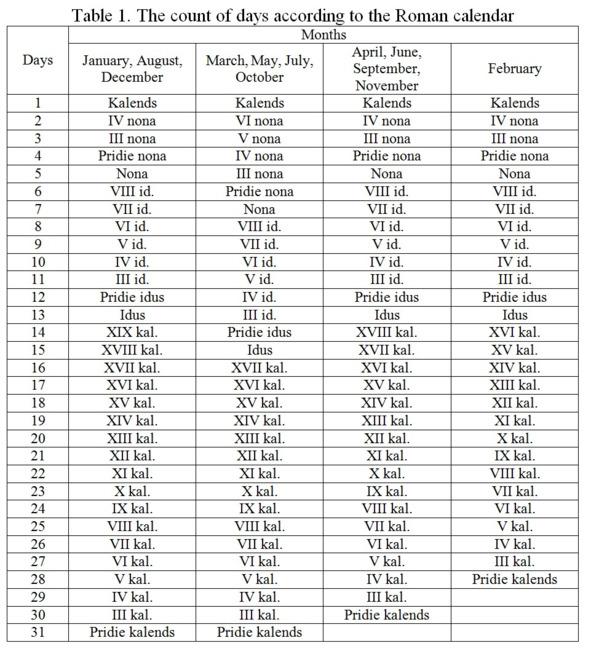
Counting days according to the Roman calendar

The ancient Romans used a special system for counting days in a given month. The first day of the month was called “calends” (calendae or kalendae). The middle day of the month was called “idus”. The ninth day before idus was called “nona” (nonae), counting inclusively. Initially, calends, nones, and idus roughly coincided with the new moon, the first quarter of the moon, and the full moon, respectively. With time, however, this correlation was broken. Yet the traditional naming of days in this way remained intact for a long time. The day before calends, nones, and idus was called “eve” (pridie). The remaining days were numbered in the reverse order: so many days before nones, idus, or calends. In the leap year, an additional 366th day was inserted between February 23 and 24. It was called “bis sextum kal. Mart” (“twice sixth before the March calends”). The year was called “annus bissextus”, from which the term “bissextile year” or “leap year” is derived.

This system of numbering days was used for a long time, even after the reform of the calendar by Julius Ceasar.

Reference points

We have already touched upon the NE designation in relation to the numbering of years (it means “from our era” or “from the new era”). Historically, this reference point was called “the year of Our Lord” (Anno Domini or AD). The origin of this designation is ascribed to the monk Dionysius Exiguus (c. 470 — c. 544 NE). Later it became obvious that Dionysius had made a mistake in his calculations, but the tradition of counting years from this reference point was not discontinued. We will also stay within this framework as we proceed in our study, and all the dates that you will see in this book will correlate with this system, unless otherwise stated. For more information about the era of Dionysius Exiguus see Section 3. In the meantime, let us note that all the years following this reference point are designated as NE (AD), and the years preceding it are designated as BNE (BC). In other words, the 1st year NE is preceded by the 1st year BNE. It is normal for this type of count (historical or chronological), where the “zero year” is absent. But since such a way of counting is not always convenient, the so-called “astronomical year system” was introduced, where the 1st year BNE corresponds to the zero year, the 2nd year BNE corresponds to the -1 NE, and so on. This method is better suited for calculations in general.

Before the introduction of the Anno Domini (AD) designation, there were other reference points too. There were chronologies based on the year of the Olympic Games, as well as on the year since the foundation of Rome, since the beginning of the emperor’s reign, and since “the foundation of the world” (several versions), etc.

Counting days since the foundation of Rome

Before the Era of Dionysius (AD), chronology was often based on the “since the foundation of Rome” reference point. It was called “ab urbe condita” (“since the foundation of the city”). This reference was popularized by Mark Terentius Varro (116 — 27 BNE), and it corresponded to April 21, 753 BNE.

To convert a year “since the foundation of Rome” (a.u.c.) into the year NE, the following formula was used:

R = auc — 753

For example, 750 a.u.c. corresponds to -3 NE according to the astronomical system, or 4 BNE.

Counting days based on Olympic years

One other way of time keeping in the ancient world was to count years relative to the Olympic Games. Since the Olympiads were held once every four years, the years were designated as “the first” (second, third, fourth) since the year of a specific Olympiad. The reference point for the first year of the first Olympiad corresponds to July 1, 776 BNE.

To convert a year based on the Olympiad into the NE system, the following formula was used:

R = [(Ol — 1) * 4 + (t — 1)] — 775,

where “Ol” is the number of the Olympic Games, and “t” is the number of the year since the Olympiad.

For example, the 4th year of the 48th Olympiad (Ol. 48.4) converts into -584 NE, or 585 BNE. This was the year of the eclipse of Thales (see Pliny the Elder. Natural History, 2,12).

The Egyptian calendar

The Roman calendar was a modification of the Egyptian calendar. A number of ancient writers (mainly from the church of Alexandria) continued to use the Egyptian calendar even after the Julian calendar was in wide use.

The Egyptian calendar consisted of 12 months, 30 days each. The Greek names of the months are as follows: 1. Thoth, 2. Phaophi, 3. Athyr, 4. Choiak, 5. Tybi, 6. Mechir, 7. Phamenoth, 8. Pharmuthi, 9. Pachon, 10. Payni, 11. Epiphi, 12. Mesori.

At the end of the year, five more days were added, which were called in Greek “epagomen”. So, there were the total of 365 days in the Egyptian calendar year.

Claudius Ptolemy (c. 100 — c. 170 NE), the ancient Greek scholar, is credited with tracing the beginnings of the Egyptian calendar down to the enthronement of the Babylonian king Nabonassar. The reference point of the Nabonassar era (1 Toth) corresponds to February 26, 747 BNE.

The exact alignment of eras

Based on the above, the following equasion can be suggested:

1 NE = 754 a.u.c. = Ol. 195.1 = 748 Nabonassar

As you may have noticed, the formulas for converting dates between different chronologies are approximate; they do not account for the differences between the times of change from one year to the next for the specified eras. Using these formulas, the calculations can sometimes be off by a whole year. To avoid it, it is necessary to take into account the exact date of an event (day and month), so you can make adjustments in the process of calculations.

The Egyptian calendar is even more challenging. At first, it doesn’t seem very complicated, because we know that January 1 of the year 1 NE corresponds to Tybi 12, 748, of the Nabonassar era. However, the Egyptian year consists of 365 days, whereas the Julian calendar year is 365.25 days. That is why every 4 years these two calendars get adjusted against each other by one day. The process of converting Egyptian calendar dates into the corresponding Julian calendar dates will be explained in later chapters.

Since the foundation of the world

In the first ages of Christianity, attempts were made to count years since the foundation of the world, or from Adam. Annalists made their calculations based on the Old Testament data but came up with varying results, for which reason this type of chronology was not widely accepted. Partcularly, the scholars disagreed on how much time had passed from the Babylonean exile of the Jews (6th century BNE) up to the New Testament events, because the Bible does not cover this chronological period. So they had to use external chronicles, which were not always reliable. Only several versions of the eras “since the foundation of the world” have any historical significance:

The Antioch era (reference point: September 1, 5500 BNE, Friday). Developed by the bishop Theophilus of Antioch, circa 180. Some sources give other reference points: 5969, 5515, or 5507 BNE. But they were not used in the chronicles.

The era of Hippolytus of Rome (reference point: 5503 BNE). Appeared around the year 200.

The era of Sextus Julius Africanus (reference point 5502 BNE). Appeared around 220; used in “Chronography”.

Theophilus, Hippolytus, Julius and other ancient writers believed that the period of time between Adam and the New Testament (Jesus Christ) was 5500 years. The basis for this belief was the biblical account of the creation of man in the middle of the 6th day (Gen 1:24—31), and also the words of Scripture: “For a thousand years in thy sight are but as yesterday when it is past” (Ps 90:4 [Ps 89:5 rus]), and: “But, beloved, be not ignorant of this one thing, that one day is with the Lord as a thousand years, and a thousand years as one day” (2 Pet 3:8). There were often discrepancies in these eras as to the date of Christ’s birth. Some scholars believed that 5500 years was an approximate marker — the Bible does not conclusively say that Adam was created exactly in the middle of the 6th day. So deviations from this date were allowed. There were also some who counted 5500 years from Adam’s fall, not from the foundation of the world. Other denied any correlation between the millenia on the timeline of history and the number of creation days.

The Old Byzantine era (reference point: 5504 BNE). Used in Byzantium until the 4th century. Also used in the ancient Rus and Bulgaria.

The Byzantine era (reference point: September 1, 5509 BNE, Saturday). Introduced under the Emperor Constantius in the 4th century. It was used in Byzantinum up to the 6th century, and in Russia starting with 15th century. The reference point was shifted so that the indiction numbers would be easier to find. For the year 5509 BNE, the indiction numbers equal one. For the succeeding years, the indiction numbers are the remainder of the division of the Byzantine date by 28, 19, and 15. The remainder value equalled to the circle of the Sun, the Moon and the indiction, respectively.

The era of Panodorus of Alexandria (reference point August 29, 5493 BNE, Tuesday). Introduced by Panodorus of Alexandria around the year 400.

The era of Annianus (reference point: March 25, 5492 BNE, Sunday). introduced by Annianus of Alexandria in the beginning of the 5th century.

The era of Alexandria (reference point: September 1, 5493 BNE, Friday). It is a modification of the eras of Panodorus and Annianus. Used by the Byzantine historians.

The March Byzantine era (reference point: March 1, 5508 BNE, Friday). Used in Byzantium starting with the 6th century, and in the ancient Rus up until the 12th century.

The Ultramarch Byzantine era (reference point: March 1, 5509 BNE, Thursday). Used in the medieval Rus, between the 12th and 15th centuries.

The eras “since the foundation of the world” were so numerous that annalists often gave their dates in several chronological systems — to avoid confusion.

The Jewish calendar

We know very little about the original Jewish calendar. Four months of the ancient calendar are mentioned in the Old Testament: Aviv [Abib] (the first month, the month of ears of corn) [Ex 13:4], Zif (the second month, month of blossoms) [1 Kings 6:1], Ethanim (the seventh month, the month of strong winds) [1 Kings 8:2], Bul (the eighth month, the month of the harvest) [1 Kings 6:38].

While in Babylonean captivity, the Jews adopted the lunisolar calendar of their captors. It is easy to verify by comparing the names of the ancient Babylon months with the contemporary Jewish calendar.

The names of the ancient Babylon months: 1. Nisannu, 2. Ayyaru, 3. Simanu, 4. Duuzu, 5. Abu, 6. Ululu, 7. Tasritu, 8. Arahsamna, 9. Kislimu, 10. Tebetu, 11. Sabatu, 12. Addaru.

The names of months in the late Jewish calendar: 1. Nisan (former Aviv), 2. Iyyar (former Zif), 3. Siwan, 4. Tammuz, 5. Ab, 6. Elul, 7. Tisri (former Ethanim), 8. Marheswan (former Bul), 9. Kislew, 10. Tebet, 11. Sebat, 12. Adar.

In the ancient Jewish world, the appearance of the first crescent in the evening sky, which was called “neomenia”, marked the beginning of the month. The moment of neomenia was simply observed, and then the beginning of the new month was announced. So, there were 29 or 30 days in a month. The standard year had 12 months. But since the tropical (solar) year consists of 12.36826 synodic (lunar) months, the inaccuracy added up over time and had to be eliminated by adding an extra month. Whether there was a need for the extra month was determined based on the conditions of the grain crops and the age of the sacrificial animals — after all, the Passover law had to be observed: “In the fourteenth day of the first month [Nisan (Aviv)] at even is the LORD’S passover… Ye shall bring a sheaf of the firstfruits of your harvest unto the priest: And he shall wave the sheaf before the LORD, to be accepted for you: on the morrow after the sabbath the priest shall wave it. And ye shall offer that day when ye wave the sheaf an he lamb without blemish of the first year for a burnt offering unto the LORD” (Lev 23:5, 10—12). That is why the year had to be extended by one month if the grains were not ripe, and the lambs too young. The extended 13-month year was usually called embolismic.

Around 500 NE, the Jewish calendar was reformed. The beginning of the year was moved to the month of Tisri, and Molad became the starting point for counting months (the astronomic new moon). Also, specific rules were introduced for alternating the number of days in a month and adding an extra month, which facilitated the process for calculating dates.

The reference point of the Jewish calendar was moved to the foundation of the world, Tisri 1 (“the new moon of creation”), which corresponded to October 6/7, 3761 BNE in the Julian calendar.

The principles of the Jewish calendar

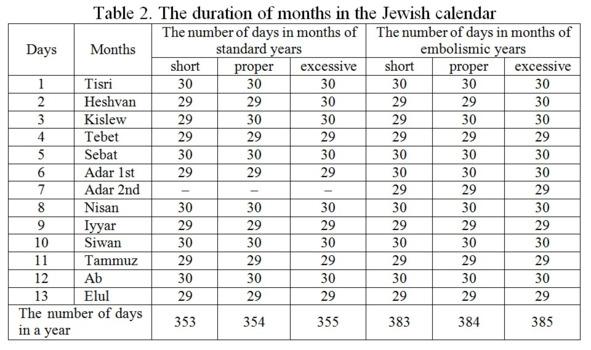
In the Jewish calendar, the 13th month was inserted according to the 19-year cycle: specifically, for years 3, 6, 8, 11, 14, 17 and 19. The extra month was added before Adar and was called Adar 1 (Adar Rishon). Adar, then, became the next month and was named Adar 2 (Adar Sheni, Adar Bet, Beadar). All the religious feasts of the month of Adar were transferred to this month.

The number of days in a year varied from 353 to 385. There were six variants:

a) short, or insufficient year (hasarin) had 353 days (standard) or 383 days (embolismic);

b) the proper, or full year (kesedran) had 354 days (standard) or 384 days (embolismic);

c) the excessive year (shalamim) had 355 days (standard) or 385 days (embolismic).

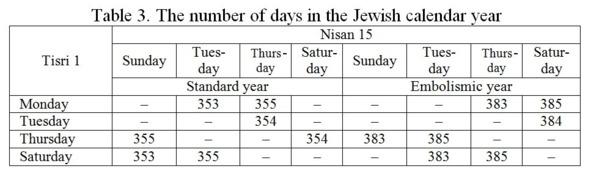
The rationale behind such a complex system is the desire of the Jews to observe all the Talmudic religious traditions. It is only possible to fulfill the several hundreds of Talmudic prescriptions if the 1st of Tisri (the beginning of the new year) falls on Monday, Tuesday, Thursday or Saturday, and the 15th of Nissan (the Jewish Passover) falls on Tuesday, Thursday, Saturday or Sunday.

So, in any given year, if you know which days of the week fall on the 1st of Tisri and the 15th of Nissan, you can understand whether the year is insufficient, proper or excessive, that is, you will know how many days it consists of.

One other percularity of the Jewish calendar is that 24-hour days are counted from sunset, not from midnight. This was believed to be the pattern of creation in the corresponding Genesis account: “And the evening and the morning were the first day” (Gen 1:5).

The formulas of Gauss

Around the year 1800, the German mathematician Carl Friedrich Gauss (1777 — 1855) introduced formulas for calculating the dates for Christian Easter and the Jewish Passover. These formulas made chonological calculations much easier.

The procedure for calculating the date of the Jewish Passover (Nissan 15) is as follows:

1) A=R+3660,

where “A” is the year according to the Jewish calendar; “R” is the year NE.

2) a= (12A+17) mod 19,

where “mod 19” is the remainder of the division by 19.

3) b=A mod 4.

4) M+m= (32,0440933+1,5542418a+0,25b-0,00317779A),

where “M” is the integer part, and “m” is the fractional part.

5) c= (M+3A+5b+5) mod 7.

So, three variants are possible:

1) is c=1, a> b and m≥0.63287037, then the Jewish Passover (Nissan 15) falls on M+2 March in the Julian calendar.

2) if c=2, 4 or 6, and also when c=0, a> 11 and m≥0,89772376, then the Jewish Passover falls on M+1 March.

3) in all other cases it falls on M in March.

If the resulting value is greater than the number of days in March, you should subtract 31. The result will correspond to a date in April.

For example, let us calculate the date for the Jewish Passover in 2016:

1) A=5776.

2) a=17.

3) b=0.

4) M+m=40,11128886.

M=40, m=0,11128886.

5) c=6.

Since c=6, you should add 1 to M=40 and subtract 31. So, in 2016, the Jewish Passover (Nissan 15) falls on April 10 in the Julian calendar, which corresponds to April 23 in the Gregorian calendar. As noted above, the 24-hour day in the Jewish calendar begins at sunset. That is why the 15th of Nissan in this case begins in the evening of April 9 and ends in the evening of April 10.

The procedure for calculating the date of Christian Easter using the Gauss formula is as follows:

1) a=R mod 19,

where “R” is the year NE; “mod 19” is the remainder after the division by 19.

2) b=R mod 4.

3) c=R mod 7.

4) d= (19a+15) mod 30.

5) e= (2b+4c+6d+6) mod 7.

Three variants are possible:

1) if the sum of (d+e) does not exceed 9, then Christian Easter falls on March (22+d+e).

2) is (d+e) ≥10, then Easter falls on April (d+e-9).

For example, let us calculate the date for Easter in 2016:

1) a=2.

2) b=0.

3) c=0.

4) d=23.

5) e=4.

Since (d+e) exceeds 9, let us calculate (d+e-9) =18. So, in 2016, Orthodox Christian Easter falls on April 18 of the Julian calendar, which corresponds to May 1 in the Gregorian calendar.

The Julian period and calendar

Historians and annalists often deal with calendar calculations which involve various types of dates. To simplify the process for converting dates from one calendar to another, the “system of Julian days” or “continuous day count” was introduced. In 1583, the French scholar Joseph Justus Scaliger (1540 — 1609) came up with the idea of the so-called “Julian period”. He named this method of calculation in honor of his father Julius Caesar Scaliger (1484 — 1558), the famous humanist and scholar.

Joseph Scaliger suggested a chronological scale against which any historical date could be aligned. The starting point for counting the “Julian days” (JDN=0) was set to January 1, 4713 BNE, which was the era “from the foundation of the world” according to Scaliger. Then, the JDN value would increase by one every day. So, January 2, 4713 BNE equals to JDN=1 and so on. For example, January 1 of the 1st year NE is JDN=1721424.

In 1849, John Herschel (1792 — 1871) suggested expressing all the dates though the JD value, which is the number of days that passed since the beginning of the Scaliger cycle. The difference between the Julian date (JD) and the Julian day number (JDN) is that the former contains a fractional part which indicates the time of 24-hour day. It was agreed that the beginning of the Julian day would be noontime according to Greenwich Mean Time. So, the midnight of January 1 of the 1st year NE corresponds to JD=1721423.5. Note that the JD=1721424 will accumulate only by the noon of the specified day, because the count was started at noon January 1, 4713 BNE (the “zero point”). To make our calculations easier, we will use the rounded value of the Julian date or the Julian day number (JDN).

The procedure for calculating the Julian day number (JDN) for a specific Julian calendar date is as follows:

1) a= [(14-month) /12].

2) y=year+4800-a.

3) m=month+12a-3.

4) Julian day number:

JDN=day+ [(153m+2) /5] +365y+ [y/4] -32083.

Where “year” is the year of NE; “month” is the number of the month; “day” is the day of the month; value in brackets is the integer part.

Knowing the JDN, you can find the day of the week by calculating the remainder of the division of JDN by 7. Based on the remainder value, the days of the week are distributed as follows: 0 — Monday, 1 — Tuesday, 2 — Wednesday, 3 — Thursday, 4 — Friday, 5 — Saturday, 6 — Sunday.

For example, let us calculate the Julian day number for the Jewish Passover in 2016 (April 10 in the Julian calendar):

1) a=0.

2) y=6816.

3) m=1.

4) JDN=2457502.

Remainder of division (JDN mod 7) =5, therefore, it is Saturday.

Finding dates based on the Julian days

The method of calculation based on the Julian days can be useful, for example, for finding the date for Tisri 1. We don’t know the interval between Nisan 15 and Tisri 1 within one year. But the interval between Tisri 1 of the year to be found and Nisan 15 of the previous year is always 163 days because Nisan, Iyyar, Siwan, Tammuz, Ab, and Elul have an unchanging number of days. If you know the Julian day number for Nisan 15, you can, by adding 163, find the Julian day number for Tisri 1 of the following year.

For example, based on the Gauss formulas, Nisan 15 of the year 5775 in the Jewish calendar corresponds to March 22, 2015, in the Julian calendar. Now we can calculate JDN for this date (JDN =2457117). Consequently, Tisri 1 of the year 5776 corresponds to JDN=2457280. The remainder of division is 0. Therefore, the day is Monday. We have already determined that Nisan 15 of the year 5776 in the Jewish calendar (2016 NE) falls on Saturday. Using Table 3 (see above), we see that the year 5776 of the Jewish calendar is embolismic, that is, its duration is 385 days (an excessive year).

The procedure for converting a Julian day number (JDN) into a Julian calendar date is as follows:

1) c=JDN+32082.

2) d= [(4c+3) /1461].

3) e=c- [1461d/4].

4) m= [(5e+2) /153].

5) day=e- [(153m+2) /5] +1.

6) month=m+3—12* [m/10].

7) year=d-4800+ [m/10].

Where year is the year of NE; month is the number of the month; day is the day of the month; value in brackets is the integer part.

For example, let us convert the Julian day number JDN=2457280 (Tisri 1 of the year 5776 in the Jewish calendar) into a Julian calendar date:

1) c=2489362.

2) d=6815.

3) e=184.

4) m=6.

5) day=1.

6) month=9.

7) year=2015.

Consequently, Tisri 1 of the year 5776 in the Jewish calendar falls on September 1 2015 of the Julian calendar, or September 14 of the Gregorian calendar.

The Julian day and the Egyptian calendar

To convert a Jewish calendar date into a Julian calendar date, we should first find the the Julian day number:

JDN= (N-1) *365+ (M-1) *30+ (D-1) +1448638,

where “N” is the year of the Nabonassar era; “M” is the ordinal number of the Egyptian calendar month; “D” is the date of the month.

The calculation procedure of date is the same as the one described in the previous chapter.

Для For example, let us calculate the day of the Julian calendar corresponding to Pharmuthi 25 of the year 777 of the Nabonassar era.

Julian day number:

JDN= (777—1) *365+ (8—1) *30+ (25—1) +1448638=1732112.

Julian calendar date:

1) c=1764194.

2) d=4830.

3) e=37.

4) m=1.

5) day=7.

6) month=4.

7) year=30.

So, Pharmuthi 25 of the year 777 of the Nabonassar era falls on April 7th 30 NE.

Calculations simplified

Chronology calculations became so much easier now that we have computers. The above algorithms can be effectively implemented using popular computational programs or programming language scripts. Also, there are ready-to-use programs and online services designed specifically for calendar calculations; some of them are described in the Addendum.

Section 2. The Old Testament chronology

Speaking of the challenges of calculating dates in the era “from the foundation of the world”, or “from Adam” in Section 1, we didn’t mention one important reason for the lack of consensus regarding the biblical chronology. There are several versions of the Old Testament text (Jewish-Masoretic, Samaritan, Septuagint). For the most part, they are identical, but there are discrepancies which may affect chronology. Some passages contain significant chronological inconsistencies, so a natural question arises as to which dating is more accurate.

Eastern Orthodox Church regards the Septuagint as the canonical text of the Old Testament (The Septuagint comes from Latin “Interpretatio septuaginta seniorum” — “The translation of the seventy scholars”, for this reason, it is often referred to as LXX). The Septuagint is the translation of the Jewish Scripture into Greek completed at the initiative of Demetrius of Phalerum (350 — 283 BNE), the founder and head of the Library of Alexandria. Demetrius persuaded the Egyptian king Ptolemy II Philadelphus (308 — 245 BNE) to have the sacred books of the Jewish canon translated into Greek. Torah (the Pentateuch) was translated in the 3rd century BNE. The remaining Old Testament books were translated later — in the second and first centuries BNE. Some details regarding the process of translation for the Pentateuch are provided in the “Letter of Aristeas, the bodyguard of Philadelphus, to brother Philocrates”. This letter is cited, for example, by Philo of Alexandria (The Life of Moses, 2,6—7), by Josephus Flavius (Judean Antiquities, 12,1—2), in the Talmud (Megillah, 9), by Clement of Alexandria (Stromata, 1,22), by Irenaeus of Lyons (Against Heresies, 3,21,2), by Cyril of Jerusalem (Catechetical Lextures and Mystagogic Catecheses, 4.34), by Epiphanius of Cyprus (On the Seventy Interpreters), by Augustine the Blessed (The City of God, 18,42).

Below are listed some basic of the arguments in favor of the higher degree of accuracy of the Septuagint:

1) The translation of the Old Testament (Tanakh) into Greek, known as Septuagint, was completed in 3rd-1st centuries BNE and was based on the authentic Jewish text provided by the Jewish high priest. This is a sufficient warranty of the accuracy of the resulting text. One can argue about the nuances of meaning in the translated text, but it is hardly possible to assume that the dates and numbers could have been mistranslated.

2) The translators of the Septuagint were highly educated Jewish scribes. Those seventy two men continued to interact with each other as they were working on the Pentateuch (each Semitic tribe was represented by 6 scribes). One and the same passage was translated by different groups of scribes; then, the results were compared against each other. Thanks to this procedure, the probability of mistakes is very low.

3) The Septuagint was not created just for the Library of Alexandria. The Greek text was distributed far and wide. One copy was always at the disposal of the Jewish high priest:

“After he had arrived in Jerusalem, he [Egyptian king Ptolemy IV Philopator (c. 242 — 203 BNE)] offered sacrifice to the supreme God and made thank offerings and did what was fitting for the holy place. Then, upon entering the place and being impressed by its excellence and its beauty, he marveled at the good order of the temple, and conceived a desire to enter the sanctuary. When they said that this was not permitted, because not even members of their own nation were allowed to enter, not even all of the priests, but only the high priest who was pre-eminent over all — and he only once a year — the king was by no means persuaded. Even after the law had been read to him, he did not cease to maintain that he ought to enter, saying, ‘Even if those men are deprived of this honor, I ought not to be.’ And he inquired why, when he entered every other temple, no one there had stopped him” (3 Macc 1:9—12).

4) The Apostles and early Church Fathers quoted predominantly from the Greek text of the Old Testament. Luke, for example, follows the Septuagint (Gen 10:24; 11:12—13) when he gives his genealogy of Jesus by inserting Cainan (Lk 3:36) between Sala and Arphaxad. In the Masoretic text, Cainan is omitted.

5) From antiquity to the present day, the text of the Septuagint has been preserved almost intact, at least with regard to chronology.

6) The idea that the Jewish-Masoretic Tanakh is an infallible text of the original Old Testament is, obviously, erroneous. There’s enough evidence to the fact that the Jews had several versions of Tanakh with varying chronological data. For example, in the account from Adam through Noah, the Samaritan-Israelite Pentateuch is closer to the Jewish-Masoretic Tanakh, whereas in the partition from Arphaxad through Abraham it is closer to the chronology given in the Septuagint. This indicates an evolutionary accumulation of discrepancies over a long period of time.

7) Accumulation of errors in the Tanakh continued throughout the1st century NE. The Jewish historian Josephus Flavius in his famous book provides the chronological data in the Bible which contains further discrepancies (see Judean Antiquities).

8) The belief in the infallibility of the Jewish-Masoretic Tanakh faded away altogether after the ancient Jewish manuscripts of Qumran had been unearthed in 1947. These manuscripts reflect a whole range of chronological and textual traditions. Based on the paleographic data, external evidence, and the radiocarbon analysis, the main body of these manuscripts date between 250 BNE to 68 NE.

9) The finalization of chronology in the Jewish Tanakh occurred, most likely, around the 2nd century NE. This process must have been caused by historical circumstances, such as the destruction of the Jewish Temple, and the Roman invasion of Judea in 70 NE. Scattered throughout the world, the Jews must have been motivated to start thinking about preserving the uniformity of their religious texts. The fixed Jewish-Masoretic text of Tanakh was first translated into a foreign language in Syria at the end of the 2nd century NE. This translation was later called Peshitta. After some time, in the 4th century NE, the Jewish-Masoretic Tanakh was translated by into Latin by Jerome of Stridon; this translation was termed the Vulgate.

10) The fixed text of the Jewish-Masoretic Tanakh is not identical across various manuscripts and contains multiple discrepancies.

11) The much shorter chronology of the Jewish Tanakh contradicts the current data obtained through independent dating methods. For example, according to the Jewish tradition, the conquest of the Babylonian Empire by Cyrus II happened in 370 BNE (year 3390 from the foundation of the world in the Jewish calendar). But the scientific dating places this event in 539 BNE.


Based on the above considerations, it seems reasonable to use the dates and numbers of the Septuagint as the source for recreating the Old Testament chronology.

The brief research given below is not meant to demonstrate the whole range of the Old Testament datings. Its main purpose is to indicate the general duration of the described events. That’s why only key dates have been included. Let us first note that the period from the creation of the world to the beginning of the new era was 5550 years. So for the sake of convenience, the calculated dates are given in a twofold format: first, the dates from Adam, then the astronomical dates in NE (in parentheses; -5549 NE corresponds to 5550 BNE and so on).


1 (-5549). Creation of Adam and Eve

“So God created man in his own image, in the image of God created he him; male and female created he them… And the evening and the morning were the sixth day” (Gen 1:27, 31; compare Gen 2:7—25).

“And Adam called his wife’s name Eve; because she was the mother of all living” (Gen 3:20).

The tradition holds that the first man and woman, Adam and Eve, were created on the sixth days of the 1st year. It is believed that this day was Friday.


231 (-5319). The birth of Seth

“And Adam lived an 230 years, and begat a son in his own likeness, after his image; and called his name Seth” (Gen 5:3).

1+230=231


436 (-5114). The birth of Enos

“And Seth lived an 205 years, and begat Enos” (Gen 5:6).

231+205=436


626 (-4924). The birth of Cainan

“And Enos lived 190 years, and begat Cainan” (Gen 5:9).

436+190=626


796 (-4754). The birth of Mahalaleel

“And Cainan lived 170 years, and begat Mahalaleel” (Gen 5:12).

626+170=796


961 (-4589). The birth of Jared

“And Mahalaleel lived 165 years, and begat Jared” (Gen 5:15).

796+165=961


1123 (-4427). The birth of Enoch

“And Jared lived an 162 years, and he begat Enoch” (Gen 5:18).

961+162=1123


1288 (-4262). The birth of Methuselah

“And Enoch lived 165 years, and begat Methuselah” (Gen 5:21).

1123+165=1288


1475 (-4075). The birth of Lamech

“And Methuselah lived an 187 years, and begat Lamech” (Gen 5:25).

1288+187=1475


1663 (-3887). The birth of Noah

“And Lamech lived an 188 years, and begat a son: And he called his name Noah” (Gen 5:28—29).

1475+188=1663


2163 (-3387). The birth of Sim, Ham, and Japheth

“And Noah was 500 years old: and Noah begat Shem, Ham, and Japheth” (Gen 5:32).

1663+500=2163


2263 (-3287). The Great Flood

“And Noah was 600 years old when the flood of waters was upon the earth” (Gen 7:6).

The Flood happened 100 years after the birth of Sim, Ham and Japheth.

2163+100=2263


2265 (-3285). The birth of Arphaxad

“Shem was an hundred <and two> years old, and begat Arphaxad 2 years after the flood” (Gen 11:10).

The conjecture <and two> eliminates the contradiction between Gen 5:32, Gen 7:6 and Gen 11:10. This numeral was probably lost in the process of copying the manuscript long before the Septuagint was created. It is also absent in the Jewish-Masoretic Torah.

2263+2=2265


2400 (-3150). The birth of Cainan

“And Arphaxad lived 135 years, and begat Cainan” (Gen 11:12).

2265+135=2400


2530 (-3020). The birth of Salah [Sala]

“And Cainan lived 130 years, and begat Salah” (Gen 11:12).

2400+130=2530


2660 (-2890). The birth of Eber

“And Salah lived 130 years, and begat Eber” (Gen 11:14).

2530+130=2660


2794 (-2756). The birth of Peleg

“And Eber lived 134 years, and begat Peleg” (Gen 11:16).

2660+134=2794


2924 (-2626). The birth of Reu

“And Peleg lived 130 years, and begat Reu” (Gen 11:18).

2794+130=2924


3056 (-2494). The birth of Serug

“And Reu lived 132 years, and begat Serug” (Gen 11:20).

2924+132=3056


3186 (-2364). The birth of Nahor

“And Serug lived 130 years, and begat Nahor” (Gen 11:22).

3056+130=3186


3265 (-2285). The birth of Terah

“And Nahor lived 79 years, and begat Terah” (Gen 11:24).

3186+79=3265


3335 (-2215). The birth of Abram, Nahor, and Haran

“And Terah lived 70 years, and begat Abram, Nahor, and Haran” (Gen 11:26).

3265+70=3335


3435 (-2115). The birth of Isaac

“And Abraham was an 100 years old, when his son Isaac was born unto him” (Gen 21:5).

3335+100=3435


3495 (-2055). The birth of Esau and Jacob

“And Isaac was 60 years old when she [Rebekah] bare them [Esau and Jacob]” (Gen 25:26).

3435+60=3495


3625 (-1925). The Jews move to Egypt

“And Pharaoh said unto Jacob, How old art thou? And Jacob said unto Pharaoh, The days of the years of my pilgrimage are an 130 years” (Gen 47:8—9).

3495+130=3625


4055 (-1495). The Exodus from Egypt

“Now the sojourning of the children of Israel, who dwelt in Egypt <and in the land of Canaan>, was 430 years” (Ex 12:40).

Some translations contain the conjecture <and in the land of Canaan>, perhaps wishing to avoid the contradiction with the prophecy: “And he said unto Abram, Know of a surety that thy seed shall be a stranger in a land that is not theirs, and shall serve them; and they shall afflict them 400 years” (Gen 15:13). Actually, this correction in not necessary in Ex 12:40. It’s reasonable to assume that the first 30 years in Egypt there was no oppression for the Jews. The remaining 400 years, however, were spent in slavery. There’s a certain logic to this. After his arrival in Egypt, Abraham came into the presence Pharaoh and was received with honor: “And Pharaoh commanded his men concerning him: and they sent him away, and his wife, and all that he had” (Gen 12:20). He was a rich man: “And Abram was very rich in cattle, in silver, and in gold” (Gen 13:2). The Bible clearly indicates that Abraham was a slave owner, not a slave: “And he entreated Abram well for her sake: and he had sheep, and oxen, and he asses, and menservants, and maidservants, and she asses, and camels” (Gen 12:16).

However, the conjecture <and in the land of Canaan> is not just superfluous but also erroneous because the Jews spent in Canaan more than 30 years. Let’s do the math. Abraham arrived in Canaan when he was 75 years old (see Gen 12:1—5), and, according to the chronology, it was the year 3410 since the foundation of the world, or 215 years before their settlement in Egypt. So, if you make Canaan the starting point for the 430 years, there would be only 215 years left in the Egyptian period, not 400. And there are no indications that Jews were slaves in Canaan. So you see that the conjecture is not helpful. Therefore, it is more reasonable to view the 430 years as the total time spent by the Jews in Egypt.

3625+430=4055


4532 (-1018). The beginning of Solomon’s reign

“And it came to pass in the 480 year after the children of Israel were come out of the land of Egypt, in the 4 year of Solomon’s reign over Israel, in the month Zif, which is the second month, that he began to build the house of the LORD” (1 Kings 6:1).

There were 477 years between Exodus and the reign of Solomon.

4055+477=4532


4535 (-1015). The founding of the first Temple in Jerusalem

The construction of the Temple began 3 full years after, that is, in the fourth year of Solomon’s reign (see 1 Kings 6:1).

4532+3=4535


4572 (-978). The beginning of Rehoboam’s reign

“And the time that Solomon reigned in Jerusalem over all Israel was 40 years. And Solomon slept with his fathers, and was buried in the city of David his father: and Rehoboam his son reigned in his stead” (1 Kings 11:42—43).

37 years after the construction of the Temple began.

4535+37=4572


4589 (-961). The beginning of Abijam’s [Abijah’s] reign

“And Rehoboam the son of Solomon reigned in Judah. Rehoboam was forty and one years old when he began to reign, and he reigned 17 years in Jerusalem” (1 Kings 14:21).

“And Rehoboam slept with his fathers, and was buried with his fathers in the city of David. And his mother’s name was Naamah an Ammonitess. And Abijam his son reigned in his stead” (1 Kings 14:31).

4572+17=4589


4592 (-958). The beginning of Asa’s reign

“3 years reigned he [Abijam] in Jerusalem” (1 Kings 15:2).

“And Abijam slept with his fathers; and they buried him in the city of David: and Asa his son reigned in his stead” (1 Kings 15:8).

4589+3=4592


4633 (-917). The beginning of Jehoshaphat’s reign

“And 41 years reigned he [Asa] in Jerusalem” (1 Kings 15:10).

“And Asa slept with his fathers, and was buried with his fathers in the city of David his father: and Jehoshaphat his son reigned in his stead” (1 Kings 15:24).

4592+41=4633


4658 (-892). The beginning of Jehoram’s [Joram’s] reign

“And he [Jehoshaphat] reigned 25 years in Jerusalem” (1 Kings 22:42).

“And Jehoshaphat slept with his fathers, and was buried with his fathers in the city of David his father: and Jehoram his son reigned in his stead” (1 Kings 22:50).

4633+25=4658


4666 (-884). The beginning of Ahaziah’s reign

“And he [Jehoram] reigned 8 years in Jerusalem” (2 Kings 8:17).

“And Joram slept with his fathers, and was buried with his fathers in the city of David: and Ahaziah his son reigned in his stead” (2 Kings 8:24).

4658+8=4666


4667 (-883). The beginning of Athaliah’s [Hotholia’s] reign

“And he [Ahaziah] reigned 1 year in Jerusalem” (2 Kings 8:26).

“And when Athaliah the mother of Ahaziah saw that her son was dead, she arose and destroyed all the seed royal. But Jehosheba, the daughter of king Joram, sister of Ahaziah, took Joash the son of Ahaziah, and stole him from among the king’s sons which were slain; and they hid him, even him and his nurse, in the bedchamber from Athaliah, so that he was not slain. And he was with her hid in the house of the LORD six years. And Athaliah did reign over the land” (2 Kings 11:1—3).

4666+1=4667


4673 (-877). The beginning of Jehoash’s [Joash’s] reign

“And the seventh year Jehoiada sent and fetched the rulers over hundreds, with the captains and the guard, and brought them to him into the house of the LORD, and made a covenant with them, and took an oath of them in the house of the LORD, and shewed them the king’s son [Jehoash]” (2 Kings 11:4).

“And they slew Athaliah with the sword beside the king’s house. Seven years old was Jehoash when he began to reign” (2 Kings 11:20—21).

Jehoash began reigning after six full years, on the seventh year of Athaliah’s reign.

4667+6=4673


4713 (-837). The beginning of Amaziah’s [Amasia’s] reign

“And 40 years reigned he [Jehoash] in Jerusalem” (2 Kings 12:1).

“And he [Jehoash] died; and they buried him with his fathers in the city of David: and Amaziah his son reigned in his stead” (2 Kings 12:21).

4673+40=4713


4742 (-808). The beginning of Azariah’s reign

“He [Amaziah] was twenty and five years old when he began to reign, and reigned 29 years in Jerusalem” (2 Kings 14:2).

“And all the people of Judah took Azariah, which was sixteen years old, and made him king instead of his father Amaziah” (2 Kings 14:21).

4713+29=4742


4794 (-756). The beginning of Jotham’s reign

“And he [Azariah] reigned 52 years in Jerusalem” (2 Kings 15:2).

“So Azariah slept with his fathers; and they buried him with his fathers in the city of David: and Jotham his son reigned in his stead” (2 Kings 15:7).

4742+52=4794


4810 (-740). The beginning of Ahaz’s reign

“And he [Jotham] reigned 16 years in Jerusalem” (2 Kings 15:33).

“And Jotham slept with his fathers, and was buried with his fathers in the city of David his father: and Ahaz his son reigned in his stead” (2 Kings 15:38).

4794+16=4810


4826 (-724). The beginning of Hezekiah’s reign

“And [Ahaz] reigned 16 years in Jerusalem” (2 Kings 16:2).

“And Ahaz slept with his fathers, and was buried with his fathers in the city of David: and Hezekiah his son reigned in his stead” (2 Kings 16:20).

4810+16=4826


4855 (-695). The beginning of Manasseh’s reign

“And he [Hezekiah] reigned 29 years in Jerusalem” (2 Kings 18:2).

“And Hezekiah slept with his fathers: and Manasseh his son reigned in his stead” (2 Kings 20:21).

4826+29=4855


4910 (-640). The beginning of Amon’s [Ammon’s] reign

“Manasseh was twelve years old when he began to reign, and reigned fifty <and five> years in Jerusalem” (2 Kings 21:1).

“And he [Manasseh] reigned 55 years in Jerusalem” (2 Chron 33:1).

“And Manasseh slept with his fathers, and was buried in the garden of his own house, in the garden of Uzza: and Amon his son reigned in his stead” (2 Kings 21:18).

The conjecture <and five> here helps to remove inconsistency between 2 Kings 21:1 и 2 Chron 33:1. This numeral was probably lost in the process of copying the manuscript long before the Septuagint was created. It is also absent in the Jewish-Masoretic Torah.

4855+55=4910


4912 (-638). The beginning of Josiah’s reign

“And he [Amon] reigned 2 years in Jerusalem” (2 Kings 21:19).

“And he [Amon] was buried in his sepulchre in the garden of Uzza: and Josiah his son reigned in his stead” (2 Kings 21:26).

4910+2=4912


4943 (-607). The battle of Megiddo, the reign of Jehoahaz, captivity in Egypt, the beginning of the reign of Jehoiakim

“And he [Josiah] reigned 31 years in Jerusalem” (2 Kings 22:1).

“In his days Pharaohnechoh king of Egypt went up against the king of Assyria to the river Euphrates: and king Josiah went against him; and he slew him at Megiddo, when he had seen him. And his servants carried him in a chariot dead from Megiddo, and brought him to Jerusalem, and buried him in his own sepulchre. And the people of the land took Jehoahaz the son of Josiah, and anointed him, and made him king in his father’s stead” (2 Kings 23:29—30).

“And he [Jehoahaz] reigned 3 months in Jerusalem” (2 Kings 23:31).

“And Pharaohnechoh made Eliakim the son of Josiah king in the room of Josiah his father, and turned his name to Jehoiakim, and took Jehoahaz away: and he came to Egypt, and died there” (2 Kings 23:34).

4912+31=4943


4954 (-596). The reign of Jehoiachin [Jeconiah], the Babylonian captivity, the beginning of the reign of Zedekiah

“And he [Jehoiakim] reigned 11 years in Jerusalem” (2 Kings 23:36).

“So Jehoiakim slept with his fathers: and Jehoiachin his son reigned in his stead” (2 Kings 24:6).

“And he [Jehoiachin] reigned in Jerusalem 3 months” (2 Kings 24:8).

“And he [Nebuchadnezzar] carried away Jehoiachin to Babylon, and the king’s mother, and the king’s wives, and his officers, and the mighty of the land, those carried he into captivity from Jerusalem to Babylon” (2 Kings 24:15).

“And the king of Babylon made Mattaniah his [Jehoiachin] father’s brother king in his stead, and changed his name to Zedekiah” (2 Kings 24:17).

4943+11=4954


4965 (-585). Judea is enslaved by Babylon

“And he [Zedekiah] reigned 11 years in Jerusalem” (2 Kings 24:18).

“So they took the king, and brought him up to the king of Babylon to Riblah; and they gave judgment upon him. And they slew the sons of Zedekiah before his eyes, and put out the eyes of Zedekiah, and bound him with fetters of brass, and carried him to Babylon. And in the fifth month, on the seventh day of the month, which is the nineteenth year of king Nebuchadnezzar king of Babylon, came Nebuzaradan, captain of the guard, a servant of the king of Babylon, unto Jerusalem: And he burnt the house of the LORD, and the king’s house, and all the houses of Jerusalem, and every great man’s house burnt he with fire. And all the army of the Chaldees, that were with the captain of the guard, brake down the walls of Jerusalem round about. Now the rest of the people that were left in the city, and the fugitives that fell away to the king of Babylon, with the remnant of the multitude, did Nebuzaradan the captain of the guard carry away” (2 Kings 25:6—11).

Modern science dates the conquest of Jerusalem by the Babylonian king Nebuchadnezzar II (c. 634 — 562 BNE) to 586 BNE.

4954+11=4965


5012 (-538). The conquest of Babylon by Cyrus II, the end of the Babylonian captivity of the Jews

“And they burnt the house of God, and brake down the wall of Jerusalem, and burnt all the palaces thereof with fire, and destroyed all the goodly vessels thereof. And them that had escaped from the sword carried he away to Babylon; where they were servants to him and his sons until the reign of the kingdom of Persia: To fulfil the word of the LORD by the mouth of Jeremiah, until the land had enjoyed her sabbaths: for as long as she lay desolate she kept sabbath, to fulfil 70 years” (2 Chron 36:19—21; compare Jer 25:11—12; Jer 29:10; Dan 9:2; Zech 1:12; Zech 7:4—5).

Modern science dates the conquest of Babylon by the Persian king Cyrus II (c. 593 — 530 BNE) to 539 BNE. As you may have noticed, the beginning of the seventy-year devastation of Judah falls on the date of the battle of Megiddo, 608 BNE. Three major captivities were experienced by the Jews in this period. The first was the exile inflicted at the hands of the Egyptian pharaoh Necho II in 608 BNE. The second one happened in 597 BNE, and the third one was in 586 BNE. The last two times they were captured by the Babylonian king Nebuchadnezzar II. Obviously, the 70-year-long period of the devastation of Judah is divided up into 11 years in Egypt and 59 years in Babylon.

4965+ (586—539) =5012


It is also important to note that 5550 years between the foundation of the world and the start of the new era is an approximate number. Taking into account the number of time intervals which make up the whole duration, as well as their number rounded to the accuracy of one year, the resulting error can roughly be estimated as plus or minus 50 years.

Modern-day scientists will, probably, disagree with dating the age the Earth as several thousand years. They will, most likely, cite scientific arguments in favor of the much older Solar system and Universe. It would be worth discussing this question separately, but it would probably require another book. At this time, let us limit ourselves to the information that we have from the Bible.

Section 3. Versions of the Gospel chronology

Christian sources on the life of Jesus Christ

The main sources of information on the life of Jesus Christ are the canonical Gospels written by the apostles Matthew, Mark, Luke and John.

The Gospel of Matthew was written about the third quarter of the 1st century. Tradition holds that it was written by Levi Matthew, the son of Alphaeus, one of the Twelve (see Mt 9:9; Mk 2:14; Lk 5:27). Originally it was written in the old Hebrew, but later it was translated into Greek and became widely accepted.

“So, Matthew wrote the Gospel for the Jews in their own language, while Peter and Paul were preaching in Rome and founded the Church” (Irenaeus of Lyons. Against Heresies, 3,1,1; compare Eusebius of Caesarea. Church History, 5,8).

“Initially Matthew preached the Gospel to the Jews; but then he took it to other nations, though it was written in his own tongue. When summoned to go elsewhere, he left them with his Scripture” (Eusebius of Caesarea. Church History, 3,24,6).

“Matthew the Apostle, who was also called Levi, used to be a tax-collector; he complied the Gospel of Jesus Christ for the sake of spiritual cleansing of believers. At first, it was published in Judea in Hebrew, but later someone translated it into Greek [compare Eusebius of Caesarea, Church History, 3,39,16]. The Hebrew version survived to the present day [around the beginning of the 5th century] in the Library of Caesarea [Caesarea of Palestine], so arduously created and maintained by Pamphilus [of Caesarea]. I also had the opportunity to get the book described for me by the Nazarene from the Syrian town of Berea who had been using it. It must be noted that this Gospel-writer, in quoting the Old Testament testimonies, whether himself or on behalf of our Lord and Savior, always follows the Hebrew text of the Covenant, not the authority of the translators of the Septuagint. Therefore, there are the following two versions: ‘Out of Egypt I have called my son’ [Mt 2:15; Hos 11:1] and: ‘He will be called a Nazorean’ [Mt 2:23; Is 11:1 <heb. ‘NZR’ = Nazorean, a sprout, a root>; compare Num 6:21; Judg 13:5; 1 Sam 1:11; Am 2:11—12]” (Jerome of Stridon. On Famous Men, 3).

The Gospel of Mark was written around the middle of the 1st century. According to the tradition, it was written by John Mark (see Act 12:12), the nephew of Barnabas (see Col 4:10), who was one of the seventy apostles and a co-worker of Peter (see 1 Pet 5:13). It is regarded as the earliest of the four Gospels. It is the shortest of them all, and it was used as a source for writing the Gospels of Matthew and Luke.

“These are the words of the presbyter [Papias of Hierapolis]: ‘Mark was the interpreter of Peter; he accurately recorded everything that the Lord had said and done, but not in order, for he himself did not hear the Lord speak, neither did he walk with Him. Later he accompanied Peter who taught as he saw fit based on the circumstances, and did not necessarily relate the words of Christ in order. In recording everything the way he remembered it, Mark did not err against the truth. His only concern was not to miss or misrepresent anything.’ That is what Papias said concerning Mark” (Eusebius of Caesarea. Church History, 3,39,15—16).

“Peter and Paul preached in Rome and founded a church there. After their departure, Mark, Peter’s disciple and interpreter, passed down to us in writing everything that Peter had taught” (Irenaeus of Lyons. Against Heresies, 3,1,1; compare Eusebius of Caesarea. Church History, 5,8).

“Mark, the disciple and the interpreter of Peter, wrote a short Gospel at the request of the fellowship in Rome, having recorded everything that he had heard from Peter. Clement [of Alexandria] in the sixth book of his ‘Brief Explanations’, as well as Papias, the bishop of Hierapolis, both testify that Peter approved of this work and declared that this Gospel should be read in all the churches. Peter also mentions Mark in his first epistle, metaphorically calling Rome Babylon: ‘The church that is at Babylon, elected together with you, saluteth you; and so doth Marcus my son’ [1 Pet 5:13]. Availing himself of the Gospel that he himself had compiled, Mark departed to Egypt, and, preaching Christianity in Alexandria, founded a church there, which became famous through its sound teaching and godliness, and was known for instructing all its adepts to follow the example of Christ. The highly-educated Jew by the name of Philo, witnessing the first church of Alexandria which was still Jewish by status, wrote a book about their way of life, confirming, according to Luke, that they had much in common with Jerusalem. Mark died in the eighth year of Nero’s reign [61/62 NE] and was buried in Alexandria. He was replaced by Annian” (Jerome of Stridon. On Famous Men, 8).

The Gospel of Luke was written around the third quarter of the 1st century. According to the tradition, it was written by Luke, the doctor, one of the Seventy and a co-laborer of Paul (see Col 4:14; Phm 1:24; 2 Tim 4:10).

“So, Luke, the co-laborer of Paul, wrote down in the form a book the Gospel which he preached” (Irenaeus of Lyons. Against Heresies, 3,1,1; compare Eusebius of Caesarea. Church History, 5,8).

“As one can gather from his writings, Luke, the doctor from Antioch, was very knowledgeable in the Greek language. The author of the Gospel and Paul’s follower, he accompanied the apostle in all his journeys. Here is what Paul said of him: “And we have sent with him the brother, whose praise is in the gospel throughout all the churches (Corinthians) [2 Cor 8:18]; “Luke, the beloved physician, and Demas greet you” (Colossians) [Col 4:14], “Only Luke is with me” (Timothy) [2 Tim 4:10]. The other excellent work written by Luke, “Acts of the Apostles”, covers events during Paul’s second year in Rome, which was the fourth year of Nero’s reign [57/58 NE]. On this basis we conclude that this book was written in this city… Some believe that when Paul says in his epistle: “according to my gospel, [Rom 2:16], he refers to the book of Luke [the Greek for Gospel is “Good News)], and that Luke knew the stories of the Gospel not only from Paul who didn’t see the Lord in the flesh, but also from other apostles. He mentions it in the beginning of his work: “…Even as they delivered them unto us, which from the beginning were eyewitnesses, and ministers of the word.” [Lk 1:2]. So, he wrote the Gospel on the basis of what he had heard from others, while “Acts of the Apostles” was written out of his own experience” (Jerome of Stridon. On Famous Men, 7).

The Gospel of John was written by the end of the 1st century. Tradition holds that it was compiled by John the Theologian, the son of Zebedee (see Mt 10:2; Mk 3:17; Lk 6:14; Jn 21:2, 24).

“Then, John, the disciple of Jesus who lay on His bosom [Jn 13:23], also published his Gospel during his time in Ephesus in Asia” (Irenaeus of Lyons. Against Heresies, 3,1,1; compare Eusebius of Caesarea. Church History, 5,8).

“John, the apostle, the one especially loved by Jesus [Jn 21:20, 24], the son of Zebedee and the brother of Jacob who was beheaded by Herod after the sufferings of the Lord, last of all wrote his Gospel at the request of some bishops in Asia who contended against Cerinthus and other heretics, especially the teachings of Ebionites who taught that Christ didn’t exist before Mary. So, John was asked to speak in defense of the doctrine of Divine Birth. There was yet another reason: having read the works of Matthew, Mark, and Luke, John approved of their narratives and confirmed that they contained the truth, noting that these narratives only describe was happened during the one year after John [the Baptist] was put in prison and executed. So, he himself wrote about a period preceding John’s imprisonment, and it can be a revelation for those who diligently read the works of the Gospel-writers. In addition, this consideration removes the contradictions that seemed to exist between the text of John and others… On the fourteenth year after Nero [82 NE] Domitian began the second persecution against Christians. John was exiled to the island of Patmos and wrote there the Apocalypse, which was later commented on by Justin Martyr and Irenaeus. But after Domitian’s death [96 NE] and the abolition of his cruel decrees, John returned to the city of Ephesus and, remaining there until the arrival of the emperor Trajan, contributed in every way to the planting of churches throughout Asia. Died of old age in the 68th year after the Passion of the Lord and was buried near Ephesus” (Jerome of Stridon. On Famous Men, 7; compare Eusebius of Caesarea. Church History, 3,24,7—14).

So, out of the four canonical Gospels, two were written by the closest disciples of Jesus Christ, the apostles John and Matthew, who were eyewitnesses of the described events. The other two were written by Mark and Luke, the disciples of Jesus, who belonged to the Seventy and were called at a later time (see Lk 10:1—2). Nevertheless, they had been in close contact with the original Twelve. All of them related in their narratives not only what they could remember themselves, but also the accounts of those who lived near to the time of Jesus. So, the Gospel narratives are the firsthand and secondhand sources, which, by their very nature, are more accurate and have more credibility compared to any other sources of information.

In later chapter we will examine the exact information provided in the four canonical Gospels with regard to chronology.

In addition to the canonical Gospels, there is also a number of Apocryphal Gospels. They were not included in the Canon either because they contain a pious forgery or because of some heretical content. That is why it would be highly inadvisable to use them for the purposes of recreating biblical chronology.

Non-Christian sources on the life of Jesus Christ

Among the whole corpus of early non-Christian writings which shed light on the life of Jesus Christ, the following are particularly noteworthy.


Pliny the Younger (c. 61 — c. 113 NE), a Roman politician and writer, a lawyer. In a letter to the Emperor Trajan (reigned in 98 — 117 NE) he says:

“I consider it my sacred duty to seek your advice, sire, to find an answer to those questions that arouse my bewilderment. I’ve never witnessed trials against Christians. Therefore, I do not know what they are usually interrogated on and for what and to what extent they are punished. For I was in a great difficulty as to whether I should recognize the differences in their ages, or not at all distinguish minors from mature adults, whether I should grant pardon for repentance (or maybe renunciation of Christianity would not do any good to someone who was once a Christian), whether to execute them for the very name they bear [nomen ipsum] in the absence of any other crimes, or for the crimes [flagitia] having some connection with the name. Meanwhile, I acted in the following manner with those who, as I was informed, were Christians. I interrogated them on whether they were Christians and, when they confessed, I pressed my question the second and third time while threatening them with execution. Those who persisted I ordered to be executed [ducijussi]. I didn’t doubt that, regardless of the nature of wrongs they confessed, their stubbornness and impenitence alone deserved punishment. However, apart from those executed, there were others who were out of their minds as well. But because they were Roman citizens, I ordered that they be set apart to be sent to the capital. However, we had more and more complications as we proceeded. I received an anonymous report containing a list of Christians, but among them there were quite a few of those who denied that they were Christians and claimed they had never belonged to that group. When they, together with me, called upon the gods and worshiped your image which I had ordered to bring along with the statues of the gods, and when they cursed the name of Christ (they say, true Christians cannot be forced to do any of these three acts), I deemed it possible to release them. Others, whose names were on the list, confessed that they had been Christians at one time but left that fellowship, some three year ago, some earlier, and some even twenty years ago. All of them worshiped your image and the statues of the gods, having cursed the name of Christ. According to their own words, their whole crime consisted in that they gathered together early in the morning on certain days and sang hymns to Christ as God, and that in the name of religion [sacramento] they had bound themselves not to do any crimes, but to refrain from stealing, robbery, adultery, to keep promises and pay off debts, and that after their gatherings they got together again to take food, which was, incidentally, regular and innocent. And even this they stopped doing after I banned the hetaeria on your authority. Nevertheless, I judged it necessary to subject to torture the two slaves, who were called deaconesses [ministrae], in order to find out what is right and just there. But I found nothing except utter superstition of a gross kind. Therefore, postponing further proceedings, I appeal to you for advice” (Letter 10,96).

In terms of chronology, the above letter, testifies only to the relatively wide spread of Christianity by the beginning of the second century.


Gaius Suetonius Tranquill (c. 70 — c. 126 NE), Roman writer, historian, encyclopedist, and personal secretary of Emperor Hadrian. In his work “The Lives of the Twelve Caesars” [De vita Caesarum], he records the deeds of the Emperor Claudius (reigned in 41 — 54 NE):

“He [Claudius] expelled from Rome the Jews who were constantly stirred by Chresto” (Ibid., 5,25,4).

Some skeptical scholars, who see here the name of Chrest, are not inclined to associate it with Jesus. On the other hand, there’s nothing here that prevents us from assuming that this is a distorted name of Christus or Χριστός. Moreover, this is exactly what Tertullian points out: “The designation ‘Christian’, as follows from the etymology of the word, derives from the word ‘anointment’. And the name Chrestian, incorrectly pronounced by you [Romans] (because you do not even know exactly what we are called), means ‘pleasantness’ or ‘goodness’” (Apologeticum, 3,5). Lactantius makes a similar remark: “However, it is necessary to explain the meaning of this name [Christ] because some ignorant people, who would call him Chrest, make a mistake by mixing up the two sounds” (Divine Institutes, 4,7,5). Also, the Book of Acts says that when Paul came to Corinth, he found there the exiled Jews, “because that Claudius had commanded all Jews to depart from Rome” (Act 18:2). But what else, other than the spreading of the teaching of Jesus Christ, could cause the Roman Jews to be “constantly stirred”?

The stubbornness of skeptics in this matter is not so arbitrary as it is pointless, because Suetonius speaks more precisely in another place of “The Lives of the Twelve Caesars”, Suetonius, speaking of the deeds of the Emperor Nero (reigned in 54 — 68 NE): « [Nero] punished Christians [Christiani], the adherents of a new and pernicious superstition” (Ibid., 6,16,2). The reasons behind this persecution were explained by Tacitus, as will be mentioned later.

Speaking of chronology, Suetonius testifies to the wide spread of Christianity in the middle of the first century.


Cornelius Tacitus (c. 55 — c. 120 NE), the Roman writer, historian, forensic orator, senator. In his “Annales” he writes:

“And Nero, wishing to overcome the rumors [about his orders to set Rome on fire], found the scapegoats and gave over to the most excruciating tortures those who through their abominations had incurred general hatred of the populace and whom the crowd called Christians. This Christ, from whom this name is derived, was executed by the procurator Pontius Pilate under Tiberius. For a time this malicious superstition was suppressed but then broke out again, and not only in Judea where this blight originated, but also in Rome, where every abomination and every shameful thing in the world is gathered and where it finds ready adepts. So, at first, those who openly recognized themselves as belonging to this sect were seized, and then, using the information they provided, a great number of others were denounced, not so much as villainous arsonists but as haters of the human race in general. Their executions were accompanied by humiliations and insults, for they were clothed in the skins of wild animals so as to be torn apart by dogs; they were crucified on crosses, and, being sentenced to death by burning, set on fire at nightfall for illumination. Nero provided his gardens for this show. He also organized a performance in the circus where he sat among the crowds, clothed as a charioteer, or rode in a chariot as a participant in a contest. And although those Christians were guilty and deserved the severest of punishments, all these cruelties aroused compassion for them, for it seemed that they were being exterminated not for the sake of the common good, but simply because of Nero’s bloodthirstiness” (Ibid., 15,44).

Tacitus specifically mentions the execution of Jesus Christ as taking place at the time of the emperor Tiberius in Rome and Pontius Pilate in Judea. But this does not give us any more information apart from what we already know from the Gospels.


Josephus Flavius (c. 37 — c. 100) was the Jewish commander, writer, historian who served at the Roman court. He writes in his work “Judean Antiquities”:

“Having learned of the death of [Porcius] Festus, the emperor sent [Lucceius] Albinus as his procurator in Judea. About the same time, the king [Agrippa] stripped Joseph [Cavius] of his high-priesthood and appointed Ananus, the son of Ananus, as his successor. The latter, Ananus the Senior, was a very happy man: he had five sons who all became high priests after him, and he himself had occupied this honorable position for a very long time. None of our high priests had such a happy lot in life. Anan the Junior, of whose appointment we just spoke, was a harsh and impetuous man. He belonged to the party of the Sadducees, which, as we have already mentioned, was known in courts for their immoderate cruelty. Being a ruthless man, Anus considered the death of Festus and Albinus’s temporary absence to be a perfect time to satisfy his cruelty. So, calling together the Sanhedrin, he had them interrogate James [Jacob], the brother of Jesus, called Christ, as well as several others. They were accused of violating the laws and sentenced to death by stoning” (Ibid., 20,9,1).

Porcius Festus was a Roman governor in Judea between the years 59—62 NE at the time of Agrippa II, the tetrarch. Agrippa reigned between 48 — 93 NE, and his reign is associated with the trial of the apostle Paul in Caesarea (see Act 25—26). Anan the Senior is mentioned in the Gospels as High Priest Annas, Joseph Caiaphas’s father-in-law (see Lk 3:2; Jn 18:13, 24). The high-priesthood of Anan the Senior falls on years 6—15 NE, and the high-priesthood of Caiaphas between 18—37 NE. The sons of Anan (Annas) also became High Priests: Eleazar was the high priest in the years 16—17 NE (Judean Antiquities, 18,2,2), Jonathan in 37 NE (Ibid., 18,4,3; 18,5,3; 19,6,4), Theophilus in the years 37—41 NE (Ibid., 18,5,3; 19,6,2). [Could he be that very “Honorable [most excellent] Theophilus” to whom Luke addressed two of his books and who subsequently converted to Christianity? See Lk 1:3; Act 1:1], Matthias in 43 NE (Ibid., 19,6,4; 19,8,1), Anan the Junior in 63 NE (Ibid., 20,9,1). So, according to Josephus, James [Jacob], the stepbrother of Jesus, was executed in 63 NE. James, the brother of Jesus, is mentioned in the New Testament (see Mt 13:55; Mk 6:3; Act 12:17; 15:13; 21:18; Gal 1:18—19; 2:9). Also, Eusebius of Caesarea quotes Hegesippus, the second-century Christian writer, who says that James [Jacob] was thrown down from the roof of the Jerusalem temple and then stoned to death (see Church History, 2,23).

Elsewhere, Josephus writes:

“There lived around this time a wise man, Jesus <, if such a designation can be applied to him>. He was performing amazing deeds and became the Mentor for those who readily accepted the truth. He attracted many Jews and Greeks to himself. <That man was Christ.> Pilate sentences him to be crucified <yielding to the pressure of our authorities>. Yet those who loved him continued to do so up to this day. <On the third day he appeared to them alive, even as the inspired prophets had proclaimed concerning him and many of his miracles.> There are still the so-called Christians who call themselves by this name” (Judean Antiquities, 18,3,3).

It is believed that this paragraph has been preserved almost intact; possible errors are marked by triangular brackets.

Let us compare this passage with the same passage from Josephus Flavius as quoted in the version of Agapius of Hierapolis (died 942 NE):

“At this time there lived a wise man, whose name was Jesus. He led a sinless life and and was known for his virtues. Many Jews and non-Jews became his disciples. Pilate condemned him to death through crucifixion, but those who were his disciples continued to spread his teaching. They said he appeared to them three days after his crucifixion and was alive. That is why, it is believed, that he was the Messiah whose wonderful deeds were foretold by the prophets” (World History [Book of the Titles], 2).

This “testimonium Flavianum” is cited in other sources as well, with slight variations: Eusebius of Caesarea (Church History, 1,11), Hermias Sozomen (Church History, 1,1), Michael Glika (Chronography, 3), Michael Syrian (Chronicle, I), Gregorius Abū’l-Faraj bin hārūn al-Malaṭī (The Lampstand of the Sanctuary).

However, Josephus does not provide the exact dates for the life of Jesus Christ; he only describes His execution under Pontius Pilate. Yet he gives a number of chronological pointers of a different kind, which do not directly relate to Jesus but can help to clarify certain dates in the Gospel narrative. We will analyze them in detail in later chapters.

The problems of chronology in the Gospels

The New Testament chronology remains one of the major challenges for the Biblical studies, and some of its issues have not been solved to this day. The obvious reason for this is the almost complete absence of datings in the Gospel narratives. The only exception is the date for the baptism of Jesus Christ mentioned by he apostle Luke (see Lk 3:1—3; 3:21). Scholars are still undecided as to the exact time of the birth of Jesus Christ, and date of death of Jesus still causes a lot of controversy.

Problematic as it is to recreate the Gospel chronology, this challenge has a flipside: if we eventually succeed in establishing a version that explains all the intricacies of the historical data of the life of Jesus Christ, it will be the only true one.

So, we will start with analyzing all possible variants of the Gospel dates, proceeding from simple to complex, so that we can finally develop a concept that will help to resolve the problem.

The baptism of Jesus Christ

The ministry of Jesus began right after He was baptized by John the Baptist. The time of the ministry of John the Baptist is indicated by the apostle and evagelist Luke:

“Now in the fifteenth year of the reign of Tiberius Caesar, Pontius Pilate being governor of Judaea, and Herod being tetrarch of Galilee, and his brother Philip tetrarch of Ituraea and of the region of Trachonitis, and Lysanias the tetrarch of Abilene, Annas and Caiaphas being the high priests, the word of God came unto John the son of Zacharias in the wilderness. And he came into all the country about Jordan, preaching the baptism of repentance for the remission of sins…” (Lk 3:1—3). The baptism of the Lord happened at the same time: “Now when all the people were baptized, it came to pass, that Jesus also being baptized, and praying…” (Lk 3:21).

The Roman emperor Tiberius (42 BNE — 37 NE) came to power in 14 NE. The 15th year of his reign was the 28th year NE. So, this must be the date for the baptism of Jesus Christ. According to some scholars, the baptism of Jesus Christ took place in 29 NE, if you put it at the end of the 15th year of the reign of Tiberius. Others shift it to the 27th year NE, considering the fact that, starting 13 NE, Tiberius was a co-regent with the emperor Octavian Augustus. There are also those who are trying to move the beginning of the co-regency of Tiberius to 12 NE, and even to 11 NE. As a rule, they quote Gaius Suetonius Tranquill and Gaius Velleius Paterculus (Suetonius. De vita Caesarum. Tiberius, 21; Velleius Paterculus. Historia Romana, II,121), however, the indicated sources only speak of the authority of Tiberius in the provinces, so the shift of the beginning of his reign to years 11 — 12 NE seems too far-fetched. Therefore, the range 27 — 29 NE makes more sense as the possible time interval for the Lord’s baptism.

Then Luke adds: “And Jesus himself began to be about thirty years of age…” (Lk 3:23). It is easy to see that the date for the birth of Jesus Christ should be around 3 BNE, plus or minus several years.

The sevens of Daniel

Let us examine the passage from the Book of Daniel predicting the time of the coming of Christ:

“Seventy weeks are determined upon thy people and upon thy holy city, to finish the transgression, and to make an end of sins, and to make reconciliation for iniquity, and to bring in everlasting righteousness, and to seal up the vision and prophecy, and to anoint the most Holy. Know therefore and understand, that from the going forth of the commandment to restore and to build Jerusalem unto the Messiah the Prince shall be seven weeks, and threescore and two weeks: the street shall be built again, and the wall, even in troublous times. And after threescore and two weeks shall Messiah be cut off, but not for himself: and the people of the prince that shall come shall destroy the city and the sanctuary; and the end thereof shall be with a flood, and unto the end of the war desolations are determined. And he shall confirm the covenant with many for one week: and in the midst of the week he shall cause the sacrifice and the oblation to cease, and for the overspreading of abominations he shall make it desolate, even until the consummation, and that determined shall be poured upon the desolate” (Dan 9:24—27).

According to Dan 9:25, “from the going forth of the commandment to restore and to build Jerusalem unto the Messiah the Prince shall be seven weeks, and threescore and two weeks”, that is (7+62) *7=483 years.

As we can see in the Book of Ezra, the Persian King Artaxerxes I Longimanus issued the corresponding decree in the seventh year of his reign:

“Now after these things, in the reign of Artaxerxes king of Persia, Ezra the son of Seraiah, the son of Azariah, the son of Hilkiah, the son of Shallum, the son of Zadok, the son of Ahitub, the son of Amariah, the son of Azariah, the son of Meraioth, the son of Zerahiah, the son of Uzzi, the son of Bukki, the son of Abishua, the son of Phinehas, the son of Eleazar, the son of Aaron the chief priest: This Ezra went up from Babylon; and he was a ready scribe in the law of Moses, which the LORD God of Israel had given: and the king granted him all his request, according to the hand of the LORD his God upon him. And there went up some of the children of Israel, and of the priests, and the Levites, and the singers, and the porters, and the Nethinims, unto Jerusalem, in the seventh year of Artaxerxes the king. And he came to Jerusalem in the fifth month, which was in the seventh year of the king. For upon the first day of the first month began he to go up from Babylon, and on the first day of the fifth month came he to Jerusalem, according to the good hand of his God upon him. For Ezra had prepared his heart to seek the law of the LORD, and to do it, and to teach in Israel statutes and judgments” (Ezra 7:1—10).

Ezra had the royal permission for the return of the captive Jews to Jerusalem (see Ezra 7:11—26).

In August of 465 BNE, the Persian king Xerxes was murdered as a result of a conspiracy, and for half a year the power was seized by Artaban, the leader of the conspiracy, until he himself was assassinated by Artaxerxes, the son of Xerxes (see Marcus Junianus Justinus. An epitome of Pompey Trogue “The History of Philip”, III,1). So, Artaxerxes I began his reign in 464 BNE, and the 7th year of his reign corresponds to 458 — 457 BNE. Adding 483 years (69 sevens) to this number, we get 27 — 28 NE. Generally speaking, this date matches the account of Luke concerning the beginning of the ministry of Jesus (Lk 3:1—3).

Within the sixty nine sevens, the first seven sevens, 49 years, are singled out. Commentators see it as an indication of the time for the restoration of Jerusalem.

There are alternative interpretations of this prophecy by Daniel (see Rozhdesvensky A. Daniel’s Revelation of the Seventy Sevens), but since they are, for the most part, incoherent, there’s no need to consider them here in detail.

As to the last seven of Dan 9:27, we will explore it in detail in a later chapter and in a more fitting context.

The birth of Jesus Christ

The approximate date for the birth of Jesus Christ was known since the early ages. It was mentioned, for instance, by Eusebius Pamphili of Caesarea (c. 263 — 340):

“It was the forty-second year of the reign of Augustus and the twenty-eighth year since the fall of Egypt and the death of Antony and Cleopatra, which marked the end of the Ptolemaic dynasty, when, according to the prophesies of His coming, our Savior and Lord Jesus Christ was born in Bethlehem of Judea, at the time of the first census in the reign of Quirinius in Syria” (Church History, 1,5).

In 44 BNE, Julius Caesar died, and his throne was inherited by his adopted son Octavian (the future Augustus). It was the beginning of a power struggle in Rome. In 43 BNE, the following triumvirate formed: Octavian, Antonius, Lepidus. It is likely that Eusebius in his chronology refers to this as the starting point of the reign of Octavian Augustus. In 30 BNE, the Romans took over Egypt; the same year Antonius and Cleopatra committed suicide following their defeat. Therefore, according to Eusebius, the birth of Jesus Christ happened between 3—2 BNE. It is very likely that Eusebius of Caesarea based his calculations on the date of the Baptism of Jesus Christ, which is 28 NE.

Many Church writers shared his view.

St. Irenaeus of Lyons (c. 130 — 202): “Our Lord Jesus Christ was born about the forty-first year of the reign of Augustus [4/3 BNE]…” (Against Heresies, 3,21,3).

St. Hippolytus of Rome (c. 170 — c. 235): “Indeed, the first coming of our Lord in the flesh, which took place in Bethlehem, happened eight days before the January calends [December 25], on Wednesday, in the forty-second year of the reign of Augustus [year 3 BNE]; or in the year five thousand five hundred from Adam” (Commentary on the Book of Daniel, 4,23).

Sextus Julius Africanus (c. 160 — c. 240) in his “Chronography” dates the birth of Jesus “to about the 29th year after the battle of Actium [2/1 BNE]”. This opinion is shared by the Byzantine “Paschal Chronicle” written by an anonymous author (c. 7 century) who places the birth of Jesus in year 1 BNE (“to the consulate of Lentulus and Pison”).

The Constantinople list of consuls (Consularia Constantinopolitana ad a. CCCXCV) dated 395 NE places the birth of Jesus in the year of the consulship of Octavian Augustus and Mark Sylvanus [year 2 BNE]: “His conss. natus est Christus die VIII kal. Ian.” (“During their consulship Christ was born in the 8th day before the January calends [December 25th]”).

St. Epiphanius of Cyprus (died in 403): “For the Savior was born in the forty-second year of the reign of the Roman Emperor Augustus… in the thirteenth consulship of Octavius and the consulship of Silanus [2 BNE] Christ was born on the eighth day before the January ides [January 6]…” (Panarion, 51,22).

John Malal (c. 491 — 578) in his “Chronography” dated the birth of Jesus to the year 752 from the foundation of Rome [2 BNE].

The era of Dionysius Exiguus

The Western Christian Church widely accepted 1 NE (AD) as date for the birth of Jesus. It is the starting point for counting years of the new era, which is also known as the “Era of Dionysius”. This era was introduced in the 6th century by the monk Dionysius the Small (Dionysius Exiguus), who was a record keeper for the Pope. In Western European chronicles, the years of the new era are marked as AD, which in Latin means Anno Domini (“the year of the Lord”).

Calculating the Paschal cycles for the period between the years 248—342 of the Diocletian era (532—626 NE), Dionysius considered it inappropriate to start the count from the enthronement of this particular emperor who brutally persecuted Christians. That’s why, in calculating Paschal cycles, Dionysius used the birth of Christ as the reference point, beginning with 532 NE.

Latin:

“Qua die natus est Dominus Jesus Christus secundum carnem ex Maria Virgine in Bethlehem, in qua incipit crescere dies. Aequinoctium primum est in VIII calendas Aprilis, in qua aequatur dies cum nocte. Eodem die Gabriel nuntiat sanctae Mariae, dicens: Spiritus sanctus superveniet in te, et virtus altissimi obumbrabit te. Propterea quod ex te nascetur, vocabitur Filius Dei. In qua etiam passus est Christus secundum carnem. Solstitium secundum est VIII calendas Julii, quando etiam natus est sanctus Joannes Baptista ex quo incipit decrescere dies. Aequinoctium secundum est VIII calendas Octobris, in qua die conceptus est Joannes Baptista. Et hinc jam minor efficitur dies nocte, usque ad natalem Domini Salvatoris. Ex VIII calendas Aprilis et in VIII calendas Januarii, dies numerantur CCLXXI. Unde secundum numerum dierum conceptus est Christus Dominus noster in die dominica VIII calendas Aprilis, et natus est in III feria XIII calendas Januarii Christus Dominus noster. In die qua passus est, fiunt anni CXXXIII [XXXIII?] et menses III, qui sunt dies XII CCCCXIIII. Unde secundum numerum dierum ejus stat cum III feria natum, et passum VI feria: natum VIII calendas Januarii, passum VIII calendas Aprilis. Ex quo baptizatus est Jesus Christus Dominus noster, fiunt anni II, et dies numerantur XC, qui fiunt DCCCXX, cum bissextis diebus suis, ac sic baptizatur VIII idus Januarii die, V feria, et passus est, ut superius dixi, VIII calendas Aprilis, VI feria. Cum bissextis diebus suis fiunt simul dies XII CCCCXV, et (ab) VIII idus Januarii in VIII calendas Aprilis dies XC” (Argumentum XV. De die aequinoctii et solstitii).

Translation:

“The length of the day starts increasing on the day when our Lord Jesus Christ was born in the flesh of the Virgin Mary in Bethlehem. The first equinox falls on March 25 [VIII cal. of April], when the lengths of day and night are equal. It was on this day that Gabriel announced to Mary: ‘The Holy Ghost shall come upon thee, and the power of the Highest shall overshadow thee: therefore also that holy thing which shall be born of thee shall be called the Son of God’ [Lk 1:35]. Our Lord’s sufferings in the flesh also happened on this very day. The second solstice is on June 24 [VIII cal. of July]; this is when the length of day begins decreasing, and this is also the day on which John the Baptist was born. The second solstice is on September 24 [VIII cal. of October]; on this day John the Baptist was conceived. Starting this day and up until our Lord’s birthday, the length of day is gradually decreasing. There are 271 days [275?] between March 25 [VIII cal. of April] to December 25 [VIII cal. of January]. And this is the number of days between the time when our Lord was conceived on Sunday, March 25 [VIII cal. of April], and when he was born on Tuesday, December 20 [XIII cal. of January]. By the time he died, 133 [33?] years and 3 months had passed, or 12414 [12144?] days. And this is the number of days between his birth, which happened on Tuesday, and his passion which happened on Friday: he was born on December 25 [VIII cal. of January], and crucified on March 25 [VIII cal. of April]. Two years and 90 days passed since the day of our Lord’s Baptism, or 820 days in total, including the leap year days. Consequently, he was baptized on January 6 [VIII ides of January], on Thursday, and was crucified, as noted above, on March 25 [VIII cal. of April], on Friday. Together with the leap year days, it adds up to 12 thousand 415 days in total, and 90 [?] days (between) January 6 [VIII ides of January] and March 25 [VIII cal. of April]” (Argument 15. On the day of the equinox and solstice).

Dionysius did not leave any explanation as to how he calculated the date for the birth of Christ which he placed in 1 NE. Some of the numbers he gives do not align. It is possible that Dionysius was not the one who calculated the date; he might have borrowed them from an earlier source. In any case, around the year 400 NE, the Alexandrian monk Panadorus mentioned the 1st year of NE as the date for the birth of Christ (March 21, 5494 of the era of Panadorus since the foundation of the world). Even before that, the Roman “Chronograph of the year 354” (Chronographus anni CCCLIIII), established the birth of Jesus Christ as December 25 of the year of the consulship of Gaius Caesar and Emilius Paul (year 1 NE): “Hoc cons. dominus Iesus Christus natus est VIII Kal. Ian. d. Ven. Luna XV” (“The Lord Jesus Christ was born on the 8th day before the January calends [December 25] on Friday of the 15th moon”). There are obvious inconsistencies in this report: December 25 of 1 NE was Sunday, not Friday. The 15th moon is also wrong. It should have been the 20th (the 14th day or the full moon falls on December 19).

The designation “Era of Dionysius” was initially used by historians and writers, and it was sometimes mentioned by Pope Boniface IV (608 — 615) and Pope John XIII (965 — 972) in their letters. But only since the time of the pontificate of the Pope Eugenius IV (1431 — 1447) “Era of Dionysius” began to be used regularly.

The Eastern Church refrained from using this designation because there were doubts about the date of the birth of Jesus Christ. Instead of the “Era of Dionysius”, they used the Byzantine Era “since the foundation of the world” (see Section 1). In Russia, the change to the “Era of Dionysius” happened as late as 1700 at the initiative of Peter the Great (1672 — 1725).

The star of Bethlehem

The dating of the birth of Jesus Christ on the basis of Lk 3:23 is approximate. Speaking of Jesus as a thirty-year old man, Luke uses an expression which implies an approximation: “about thirty years of age”.

There were many attempts to establish the exact date for the birth of Jesus Christ. And various methods were used including calculating the date of the appearance of the star of Bethlehem:

“Now when Jesus was born in Bethlehem of Judaea in the days of Herod the king, behold, there came wise men from the east to Jerusalem, Saying, Where is he that is born King of the Jews? for we have seen his star in the east, and are come to worship him. When Herod the king had heard these things, he was troubled, and all Jerusalem with him. And when he had gathered all the chief priests and scribes of the people together, he demanded of them where Christ should be born. And they said unto him, In Bethlehem of Judaea: for thus it is written by the prophet, and thou Bethlehem, in the land of Juda, art not the least among the princes of Juda: for out of thee shall come a Governor, that shall rule my people Israel. Then Herod, when he had privily called the wise men, enquired of them diligently what time the star appeared. And he sent them to Bethlehem, and said, Go and search diligently for the young child; and when ye have found him, bring me word again, that I may come and worship him also. When they had heard the king, they departed; and, lo, the star, which they saw in the east, went before them, till it came and stood over where the young child was. When they saw the star, they rejoiced with exceeding great joy. And when they were come into the house, they saw the young child with Mary his mother, and fell down, and worshipped him: and when they had opened their treasures, they presented unto him gifts; gold, and frankincense, and myrrh” (Mt 2:1—11).

In October 1604, Johannes Kepler (1571 — 1630), observing the triple joining of Jupiter, Saturn and Mars near a new star that had flared up at that time and in the same area of the sky, came to the conclusion that something like this could have happened at the time of the birth of Christ. This assumption was reinforced by the fact that since ancient times Jupiter was called the “star of the kings”, and Saturn was regarded the “star of the Jews”, a planet associated with Judaism (Sabbath is the day of Saturn, Saturday). The Magi could have interpreted the joining of Jupiter and Saturn as a sign of the coming King of the Jews, especially on account of an earlier tradition (Rabbi Abarbanel, the 15th century) which holds that a similar joining of Jupiter and Saturn occurred before the birth of Moses. Kepler established that a similar joining of planets took place in 7 BNE, when Jupiter and Saturn came together in the sign of Pisces. Since the image of a fish and the Greek spelling of the word “fish” were the secret symbols of early Christians, many scholars supported the hypothesis of the famous astronomer. So, Kepler set the date of birth of Jesus Christ to 6 BNE. However, according to more recent and more accurate calculations, in 7 BNE Jupiter and Saturn approached each other no closer than by half a degree (roughly equals to the diameter of the Moon), so their brightness could not have been so notable in the sky.

Besides, a number of scientists suggested that the star of Bethlehem was an explosion of supernova. The most probable candidates are the supernova in the constellation of Capricorn (the year 5 BNE), as well as the supernova in the constellation of the Eagle (the year 4 BNE). In Chinese and Korean chronicles, both flares are reported as “the appearance of a radiant star” (see Clark D.H., Parkinson J.H., Stephenson F. An astronomical reappraisal of the Star of Bethlehem — a nova in 5 B.C. // Quarterly Journal of the Royal Astronomic Society. Vol. 18. 1977. P. 443—449).

This provides modern-day chronologists with enough evidence for putting the date of the birth of Christ in 5—4 BNE.

The eclipse of Herod

One of the additional reasons for dating the birth of Jesus Christ to 5—4 BNE is the dating of the king Herod’s death (Herod the Great). We know that Jesus was born during the reign of Herod.

“Now when Jesus was born in Bethlehem of Judaea in the days of Herod the king…” (Mt 2:1; compare Lk 1:5).

After that “…the angel of the Lord appeareth to Joseph in a dream, saying, Arise, and take the young child and his mother, and flee into Egypt, and be thou there until I bring thee word: for Herod will seek the young child to destroy him. When he arose, he took the young child and his mother by night, and departed into Egypt: And was there until the death of Herod: that it might be fulfilled which was spoken of the Lord by the prophet, saying, Out of Egypt have I called my son” (Mt 2:13—15).

Many historical documents point to 4 or 1 BNE as the year of Herod’s death. This uncertainty is due to the fact that historical records do not give the exact year of Herod’s death.

Speaking of the death of Herod the Great, Josephus Flavius says:

“So Herod removed from office the high priest Matthias, and ordered that the other Matthias, who had stirred the rebellion, be burnt to death together with several of his followers. That night, a lunar eclipse occurred. […] Then he… sent several spearmen to put to death Antipater and bury him without any honors in Hyrcania. […] And then he died, five days after the execution of Antipater, having reigned for thirty-four years since the slaughter of Antigonus, and thirty-seven years since he had been proclaimed king by the Romans. […] Then the time of the Feast came, when the Jews, according to their ancient tradition, ate unleavened bread. This feast is called Passover, and it serves them as a reminder of their exodus from Egypt; the Jews celebrate this Feast with great eagerness, and it is their custom to offer more sacrifices on that day than on any other. At the time of the Feast, multitudes come together to worship the Most High, not only from their country, but from other lands as well” (Judaean Antiquities, 17,6,4; 7,1; 8,1; 9,3).

So we see that Herod died shortly after the lunar eclipse, a few days before the Jewish Passover. The lower threshold for finding the date of the lunar eclipse mentioned by Josephus Flavius was set to 7 BNE. The reason for this is the testimony of the apostle and evangelist Luke who mentioned that at the beginning of his ministry Jesus Christ was about 30 years old, and that it was the fifteenth year of the reign of Tiberius (Lk 3:1, 23). If the search threshold was lower, the age of Jesus at the time of his Baptism would have exceeded 35 years, that is, he would have been closer to 40 years of age. The upper threshold for finding the date of the eclipse was set to 1 BNE, because this was the year when the name of ethnarch Herod Archelaus, the successor of King Herod the Great, first appeared on Jewish coins.

In the specified range (between 7 and 1 BNE), astronomers usually suggest two eclipses: March 13, 4 BNE, and January 10, 1 BNE (other lunar eclipses within this range were not visible in Judea). The first consideration provided grounds for dating the death of Herod to 4 BNE, a few days after this eclipse. However, this date is too close to the Jewish Passover on April 12, 4 BNE, and a number of historians rightly point out that four weeks between the eclipse and the Passover are not enough to fit all the events described by Joseph Flavius: the final phase of Herod’s illness, his death, preparations for the funeral, the pompous funeral which included a twenty-five-day march of the army in a slow procession from Jericho to Herodium, a seven-day mourning, a mutiny suppressed on the eve of the Passover. In some estimates, they would have taken at least ten weeks. Ernest Martin argues that the eclipse in 4 BNE cannot be the eclipse of Herod, because it occurred on Purim. No executions were allowed during Purim (E.L.Martin, The Star of Bethlehem: The Star that Astonished the World). Also, the eclipse of March 13, 4 BNE, was local and was not sufficiently visible from Jerusalem.

Fig.1. The diagram of the lunar eclipse on March 13, 4 BNE.

The eclipse of January 10, 1 BNE, is a much better option based on the calendar (the Passover was on April 8). It was a full one and very visible.

Fig. 2 The diagram of the lunar eclipse on January 10, 1 BNE.

Regardless on the date picked for Herod’s death (4 BNE or 1 BNE), it is obvious that, based on the information of Dionysius Exiguus, the dating of the birth of Jesus Christ (end of 1 NE) is incorrect, because the birth of Jesus does not fall within Herod’s lifetime.

However, some scholars allow for such a possibility believing that Jesus “could not have been born later than 15 months after the death of Herod the Great… The annunciation to Zachariah was ‘in the days of Herod, the king of Judaea’ (Lk 1:5). Assuming that Herod died immediately, and adding the 9 months of pregnancy to the 6 months (between the annunciations to Elizabeth and Mary — Lk 1:26) we get the 15 months we were looking for” (Hazarzar R. The Son of Man, 21). This opinion is incorrect because it contradicts the Gospel of Matthew which states that the birth of Jesus occurred during the reign of Herod (see Mt 2).

Konstantin Zakharyan makes a similar attempt when he identifies the lunar eclipse of December 29, 1 BNE, as “Herod’s eclipse”. He mistakenly believes that this gives him enough grounds to place the birth of Jesus Christ at the beginning of 1 NE, specifically, on January 6 (The Christmas Chronicle, chapter 11). But this eclipse would hardly have been visible around Jerusalem.

Fig. 3. The diagram of the lunar eclipse on December 29, 1 BNE.

Besides, such a dating of the birth of Jesus Christ put it too close to the death of Herod who, according to Josephus Flavius, was in death throes after the eclipse:

“Meanwhile, Herod’s illness grew worse, for the Lord was punishing him for his iniquities. It was a slow fire which may not have been so obvious on the outside, but was raging inside his body. To make things worse, he experienced a constant desire to gouge out parts of his body. He also suffered from internal boils, and had particularly terrible aches in the stomach. He had dropsy in the legs which were full of watery see-through fluid. The same disease spread to his lower abdomen. The decaying parts were covered with worms. When he wanted to stand up, his breathing gave him a lot of suffering because there was a bad stench and because he was suffocating. He had seizures all over his body, yet the king demonstrated unnatural strength. The God-fearing people who could, due to their wisdom explain such phenomena, said that the Everlasting One was punishing him for his abominations. Meanwhile the sick king, while he was suffering more than any other, still hoped to get better. He invited doctors and strictly followed all their prescriptions. Crossing over to the other side of the Jordan, he immersed himself into the hot springs of Kallirroi which were very wholesome and contained drinkable water. These waters flow into the Asphalt [Dead] See. The doctors almost believed he was getting better, but one day the king lowered himself into the oil bath, and nearly died before their very eyes. Only the loud cries of his servants brought him back to consciousness. But now he had lost all hope of getting better…” (Judean Antiquities, 17,6,5).

Then there was an attempt at suicide but it was unsuccessful. Herod died in five days (see Judean Antiquities, 17,7,1; 8,1).

We can see that between the eclipse and the death of Herod there’s not enough time to fit all the events related to the birth of Jesus Christ, namely: circumcision on the 8th day, offering sacrifices in the Temple on the 40th day of purification (see Lk 2), the journey of the Magi to Jerusalem, the council of the high priests, Herod meeting the Magi, the Magi coming to Bethlehem for worship, flight to Egypt, the massacre of the innocents (see Mt 2). Therefore, the birth of Jesus could only have occurred before the eclipse of Herod.

Thus, the upper threshold for dating the birth of Jesus Christ depends on which of the two lunar eclipses (March 13, 4 BNE, or January 10, 1 NE) is picked as “Herod’s eclipse”.

The massacre of the innocents

When the Magi had brought the news of the appearance of the star and the birth of Christ, Herod commanded to put to death all the male children, believing Messiah to be a threat to his rule. Macrobius Ambrosius Theodosius (the 5th century) states that Herod did not even spare his own son:

“When he [Caesar Augustus] heard that Herod, king of Judea, had ordered the massacre of the boys two years old and under in Syria, and then found his own son killed among the rest, he said: ‘It’s better to be Herod’s pig than son’” (Saturnalia, 2,4,11).

Octavian Augustus must have known that Jews did not eat pigs, so he probably meant that it’s safer to be a pig there than a human.

The mention of Syria in this case is due to the fact the Judea was part of the Syrian province of Rome after the overthrow of Archelaus (see Judean Antiquities, 17,13,5).

Matthew also talks about the massacre of children of two years old and under:

“Then Herod, when he saw that he was mocked of the wise men, was exceeding wroth, and sent forth, and slew all the children that were in Bethlehem, and in all the coasts thereof, from two years old and under, according to the time which he had diligently enquired of the wise men” (Mt 2:16).

This also clearly shows that the birth of Jesus Christ must have occurred about a year and a half before the massacre of the innocents, or approximately two years (or more) before the eclipse of Herod.

The census near the time of the birth of Jesus Christ

Another chronological pointer provided in the Gospels which can help us to date the Christ’s Nativity is the mention of the census:

“And it came to pass in those days, that there went out a decree from Caesar Augustus, that all the world should be taxed. (And this taxing was first made when Cyrenius was governor of Syria.) And all went to be taxed, every one into his own city. And Joseph also went up from Galilee, out of the city of Nazareth, into Judaea, unto the city of David, which is called Bethlehem; (because he was of the house and lineage of David:) To be taxed with Mary his espoused wife, being great with child” (Lk 2:1—5).

The expression “all the world” should be construed as referring to the territory of the Roman Empire. Censuses were taken not only in the metropolis, but also in Roman provinces, one of which was Judea. As the official king, Herod was more of a viceroy and a homager of Rome.

The expression “and this taxing was first made when Cyrenius was governor of Syria” shows that there were several censuses during the time of Quirinius, or at least two.

Josephus Flavius mentions one of the censuses under Quirinius:

“The region [of Samaria, Judea, and Idumea], which was once ruled by Archelaus, was made part of Syria. The Emperor sent there Quirinius, the former consul, to take census in Syria and sell the house of Archelaus” (Judean Antiquities, 17,13,5).

“Senator Quirinius who had earlier occupied every official position and thus paved his way into consulship, being a very influential man in all his affairs, was sent to Syria by the Emperor to preside as a judge and also perform appraisals of property. […] Having sequestered Archelaus’s property in 37 year after the defeat of Antonius by Caesar Augustus in the battle of Actium, Quirinius removed from office the high priest Yoazar because the latter did not get along with the people, and appointed Anan, the son of Seth, in his place” (Judean Antiquities, 18,1,1; 2,1).

The quoted passage refers to the census of 7 NE, because the battle of Actium had occurred in 31 BNE. It must have been one of the subsequent censuses under Quirinius, not the first one.

Also, the census under Quirinius is mentioned in the inscription “Fragmentum Orsato” or “Titulus Venetus” (CIL III 6687; ILS 2683). The inscription plate was first kept in Beirut. Then, a part of it was relocated to Venice, where Sertorius Ursatus, an antiquarian from Padua, made a copy of it in 1674. It was published in 1719, after his death. In 1880, the other part of the plate was found by the engineer Seguso. According to the inscription, a certain Emilius Secundus, acting under orders of the legate Sulpicius Quirinius, took a census in the Syrian city Apamea, reporting 17 thousand citizens.

Nikolai Glubokovsky places the first census under Quirinius in 9 BNE, that is 15 years prior to the census mentioned by Flavius (On the census of Quirinius in its connection with the birth of Jesus Christ, III). Glubokovsky also references professor W.M. Ramsay, who, having studied the Egyptian papyri, concludes that door-to-door censuses were taken periodically “in the fifteenth year” (“The Expositor” 1912, XI, p. 395). Whether the practice of taking a census every 15 years was first introduced by Egyptians or Romans is not relevant to our study. The important thing is that we know that it existed in the ancient Rome. And this period was called indiction. The indiction was further subdivided into three 5-year periods which were called lustrums. Censuses were taken during lustrums as well. Therefore, we much not restrict the possible dating of the first census under Quirinius to 9 BNE. If the 5-year lustrums were observed strictly, these would be other possible dates for the census: 14 BNE (too early?), 4 BNE (acceptable), 2 BNE (too late?).

According to Andrey Novikov, “The usual timing for a census in the Roman Empire was the year of indiction (where the indiction for the year is I=15), so in this case [the census near the birth of Jesus Christ] it would be the year 5505 of the Byzantine era, or 4 BNE” (The crash of the New Chronology, chapter 8).

Indeed, 4 BNE corresponds to the year 5505 since the foundation of the world (the Byzantine era). To find the indiction number, you need to calculate the remainder of division by 15 for the Byzantine date. The remainder equals the indiction number. Since 5505 can be divided by 15 with no remainder, I=15 for this year. It must be noted that calculations based on indictions was officially introduced in the 4th century NE, so its transference to the age of Christ is only a hypothesis. Besides, censuses were not always a regular practice.

The censuses under the Emperor Augustus

Let us refer to the testimony of Octavian Augustus himself:

“Patriciorum numerum auxi consul quintum iussu populi et senatus. Senatum ter legi, et in consulatu sexto censum populi conlega M. Agrippa egi. Lustrum post annum alterum et quadragensimum feci, quo lustro civium Romanorum censa sunt capita quadragiens centum millia et sexaginta tria millia. Tum iterum consulari cum imperio lustrum solus feci C. Censonno et C. Asinio cos., quo lustro censa sunt civium Romanorum capita quadragiens centum millia et ducenta triginta tria millia. Et tertium consulari cum imperio lustrum conlega Tib. Caesare filio meo feci Sex. Pompeio et Sex. Appuleio cos., quo lustro censa sunt civium Romanorum capitum quadragiens centum millia et nongenta triginta et septem millia. Legibus novis me auctore latis multa exempla maiorum exolescentia iam ex nostro saeculo reduxi et ipse multarum rerum exempla imitanda posteris tradidi” (Res Gestae Divi Augusti, VIII).

Translation:

“In my 5th consulship I increased the number of patricians by order of the people and senate. I read the roll of senators three times. And in my sixth consulate I made a census of the people with Marcus Agrippa as my colleague. I conducted a lustrum, after a forty-one year gap, in which lustrum were counted 4,063,000 heads of Roman citizens. Then again, with consular imperium I conducted a lustrum alone when Gaius Censorinus and Gaius Asinius were consuls, in which lustrum were counted 4,233,000 heads of Roman citizens. And the third time, with consular imperium, I conducted a lustrum with my son Tiberius Caesar as colleague, when Sextus Pompeius and Sextus Appuleius in which lustrum were counted 4,937,000 heads of Roman citizens. By new laws passed with my sponsorship, I restored many traditions of the ancestors, which were falling into disuse in our age, and myself I handed on precedents of many things to be imitated in later generations” (The Deeds of the Divine Augustus, VIII).

The sixth consulship of Octavian Augustus and Marcus Agrippa points to 28 BNE. It is also mentioned that prior to this no census had been taken for 42 years (since 70 BNE). The second census under Octavian Augustus, which occurred during the consulship of Gaius Censorinus and Gaius Asinius, indicates 8 BNE. The third census under Octavian Augustus, which occurred during the consulship of Sextus Pompey and Sextus Appuleius, indicates 14 NE. The list contains only the censuses which were personally overseen by Augustus. There were others as well.

Gérard Gertoux (Herod the Great and Jesus Chronological, Historical and Archaeological Evidence) provides the following dates for the Roman censuses taken during the reign of Octavian Augustus:

28 BNE — the census taken during the consulship of Octavian Augustus and Marcus Agrippa (The Deeds of the Divine Augustus [Res Gestae], VIII). Cassius Dio (c.160 — c.230) dates the census in Gallia and Spane to 27 BNE (Cassius Dio, The Roman History, LIII,22).

23 BNE — the census planned for this year was postponed due to the severe illness of Octavian Augustus. It was carried out in 22 BNE, when Paul Emilius Lepidus and Lucius Munatius Plancus were appointed censors (Cassius Dio, Ibid., LIV,2).

18 BNE — the census was postponed by the decision of Octavian Augustus (Cassius Dio, Ibid., LIV,10; LIV,16).

13 BNE — the census taken in Gallia and Spain; lasted from 13 to 11 BNE (Cassius Dio, Ibid., LIV,25—30; LIV,32).

8 BNE — the census taken under Octavian Augustus during the consulship of Gaius Censorinus and Gaius Asinius Pollio (Deeds of Augustus [Res Gestae], VIII).

2 BNE — a hypothetical census, supposedly held 15 years after the census of 14 NE (see below). Paulus Orosius (c.385 — 420) dates this census to the year 752 since the foundation of Rome (History Against Pagans, VI,22; VII,2—3). Octavian Augustus defined a congiarium for this year: “In my 13th consulship I gave 60 denarii to each plebeian who was at that time receiving bread from the state. A little more than 200,000 people availed of this congiarium” (Deeds of Augustus [Res Gestae], XV). As noted above, this census was dated by Eusebius of Caesarea (Church History, 1,5) and other church writers to 3 or 2 BNE.

4 NE — The census taken during the consulship of Sextus Aelius Paetus Catus and Gaius Sentius Saturninus. The census was limited to Italy (Cassius Dio, Ibid., LV,13).

7 NE — The census taken by Quirinius in Syria, mentioned by Josephus Flavius (Judean Antiquities, 18,1—4; The Jewish War, 2,8). It is also referred to by Gamaliel (Act 5:34—37).

9 NE — The census was planned, but was put on hold because of the death of Publius Quinctilius Varus (Cassius Dio, Ibid., LVI,18).

14 NE — The census taken by Octavian Augustus and Tiberius during the consulship of Sextus Pompey and Sextus Appuleius (Deeds of Augustus [Res Gestae], VIII).

As you can see, the time interval between the censuses is 5 years in most cases (except for the census in 7 NE). The problem starts after 8 BNE. According to Gérard Gertoux, the reason for moving the census of 3 BNE to the following year was the 60th anniversary of Octavian Augustus, during which he was awarded the honorary title of “father of the fatherland” (“Pater Patriae”).

Quirinius, the ruler of Syria

The census near the time of the birth of Christ was taken under Publius Sulpicius Quirinius who was the governor and ruler of Syria (Lk 2:2; Eusebius. Church History, 1,5).

In the period concerned (the years immediately preceding the death of Herod), the following Roman legates ruled over Syria:

9—6 BNE. Gaius Sentius Saturninus (once).

6—4 BNE. Publius Quinctilius Varus (once).

4—2 BNE. Gaius Sentius Saturninus (twice).

2—1 BNE. Publius Quinctilius Varus (twice).

The consulship of Publius Sulpicius Quirinius in Syria is dated to 6—11 NE. At first glance, it does not match the testimony of Luke, but let’s not rush to conclusions.

As already noted, the apostle Luke said: “this taxing was first made when Cyrenius was governor of Syria” (Lk 2:2). If the second census was taken during the reign of Quirinius in 7 NE, then Quirinius must have had some power over Syria at the time of the “near Christ’s birth” census. Incidentally, there is a document confirming this. It is called “The Tiburtine inscription” or “Titulus Tiburtinus” (Corpus inscriptionum latinarum. T. XIV. 1887. №3613. P. 397; ILS 918).

In 1764, a stone was found near Rome, in Tivoli (the ancient Tibur) with a partially preserved Latin inscription. As it appears from the text, the person to whom this inscription is dedicated, held an authority position in Syria twice under the emperor Octavian Augustus. The name of the person mentioned in the inscription is lost, but from the context of the remaining lines it is clear that it is Publius Sulpicius Quirinius.

Fig. 4. Tiburtine inscription, Titulus Tiburtinus (CIL XIV 3613 = ILS 918). The reconstructed text is highlighted in pale gray.

Here is the text of the inscription after its scientific reconstruction (Theodor Mommsen’s conjectures are placed in square brackets):

[P. Sulpicius Quirinius… optinens bellum gessit cum gente Homonadensium quae interfecerat Amyntam]

[re] GEM QUA REDACTA IN PO [estatem Imp. Caesaris]

AUGUSTI POPVLIQVE ROMANI SENATV [s dis immortalibus]

SVPPLICATIONES BINAS OB RES PROSP [ere gestas et]

IPSI ORNAMENTA TRIVMPH [alia decrevit]

PRO CONSVL ASIAM PROVINCIAM OP [tinuit legatus pr. pr.]

DIVI AVGVSTI ITERUM SVRIAM ET РН [oenicen optinuit].

Translation:

“[P. Sulpicius Quirinius… waged war against the Homonads, who killed Aminta, their] king. On the occasion of this people’s subjection to the [power and might of the divine] Augustus and the people of Rome, the senate [offered to the immortal gods] two prayers for the successes [achieved by him, and bestowed on him] the honors of triumph. [He received as] the proconsul of the province of Asia [and as the legate-propaetor] of divine Augustus, the province of Syria and Ph [oenicia] for the second time”.

Publius Sulpicius Quirinius was elected consul in 12 BNE, and then was sent to Asia where he conquered the people of Homonads that inhabited the mountains of Taurus. A triumph was held in his honor in Rome, as mentioned by the Roman historian Cornelius Tacitus:

“This Quirinius, originating from of the city of Lanuvium, did not belong to the ancient patrician family of Sulpicius, but, having distinguished himself in military service and zealous fulfillment of the duties assigned to him, was awarded consulship under divine Augustus, and later, having captured the citadel fortresses in Cilicia, was also awarded the honor of triumph and made the head and advisor of Gaius Caesar who ruled over Armenia” (Annals, 3,48).

The king, referred to in Titulus Tiburtinus (probably Aminta), was killed by the Homonads, as reported by the Greek historian Strabo (c.64 BNE — c.24 NE):

“Cremna was occupied by the Roman colonists, and Sagalassos was conquered by the same Roman ruler who reigns over the entire kingdom of Aminta. Sagalassos is a one-day journey from Apamea, and there is a 30-stadia descent to it from the fortress. This city, also called Selgessus, was captured by Alexander as well. Aminta took over Cremna; when he had entered the region of the Homonads, which was considered totally impregnable, and became the ruler over most of the areas there and even put to death the local tyrant, he was insidiously captured by the wife of the tyrant. The Homonads put Aminta to death, and then Quirinius laid a siege to the city and forced them to surrender under the threat of starvation. He captured 4,000 people and relocated them to the neighboring cities, thus depriving the country of their defensible population. In the high regions of the Taurus, in the midst of the steep, terrible, and mostly impassable terrain there lies a deep and fertile valley, which [in its turn] is subdivided into several valleys. The people that inhabited the land and cultivated it lived high on the towering rocks or in caves. Most of them had arms and raided other lands while their country was well protected by the wall of mountains on every side” (Geography, 12,6,5).

Luke does not mention the position of Quirinius in his Gospel, but in Titulus Tiburtinus he is referred to as the proconsul of Asia [Minor]. That may be one of the reasons why the name of Quirinius does not appear in the list of the legates in Syria during the reign of Herod. The tradition of appointing two governors (a legate and a proconsul) was, apparently, common for that time. In any case, Josephus talks of the joint governing of Saturninus and Volumnius:

“Then, the king [Herod] spoke about this with the Emperor’s governors Saturninus and Volumnius and demanded that the robbers be punished” (Judean Antiquities, 16,9,1). This refers to the time when Saturninus was the legate in Syria in 9—6 BNE. Volumnius was the proconsul and was mainly in charge of collecting taxes in the province.

In another passage, Flavius mentions the joint governing of Varus and Sabinus in the year of Herod’s death (see Judean Antiquities, 17,9—10).

Evidently, the census around the time of the birth of Jesus took place when Publius Sulpicius Quirinius served as proconsul. At that time Publius Quintilius Varus, or, possibly, Gaius Sentius Saturninus, was the legate of Syria, as reported by Tertullian (c.160 — c. 230): “But it is known that, during the reign of Augustus, Sentius Saturninus took a census in Judea, and they could have found His [Jesus’s] genealogy using those documents” (Against Marcion, 4,19,10). It is unlikely that Tertullian didn’t know about Luke’s mention (Lk 2:2) of the census under Quirinius; it is more likely that he believed that Quirinius and Saturninus were ruling in Syria at the same time.

Herod and the census

Some scholars are too hasty in rejecting the very possibility that Quirinius could have taken a census in Judea. They explain themselves like this:

«...The census in Judea could not have been held by any Syrian ruler — whether Quirinius had any authority in Syria under Quinctilius Varus or not” (Hazarzar R. The Son of Man, 21).

This is a classic example of a stark contrast between subjective criticism and objective study. A faultfinding critic will only look for an excuse to reject a testimony; a diligent scholar will always consider all the arguments in favor of a testimony. And the arguments in favor of Quirinius are very compelling.

At the time of the birth of Jesus, Herod was ruling over Judea. However, this does not necessarily imply that the census had to be conducted under his supervision. As we know, the overly zealous Jews were among the most ardent opponents of any census. There was, among other things, a religious reason behind this rejection. It had to do with their interpretation of the biblical account of God punishing David for conducting a census:

“And Satan stood up against Israel, and provoked David to number Israel. And David said to Joab and to the rulers of the people, Go, number Israel from Beersheba even to Dan; and bring the number of them to me, that I may know it. And Joab answered, The LORD make his people an hundred times so many more as they be: but, my lord the king, are they not all my lord’s servants? why then doth my lord require this thing? why will he be a cause of trespass to Israel? Nevertheless the king’s word prevailed against Joab. Wherefore Joab departed, and went throughout all Israel, and came to Jerusalem. And Joab gave the sum of the number of the people unto David. And all they of Israel were a thousand thousand and an hundred thousand men that drew sword: and Judah was four hundred threescore and ten thousand men that drew sword. But Levi and Benjamin counted he not among them: for the king’s word was abominable to Joab. And God was displeased with this thing; therefore he smote Israel… So the LORD sent pestilence upon Israel: and there fell of Israel seventy thousand men” (1 Chron 21:1—7, 14; compare 2 Sam 24).

For example, Josephus Flavius reports that the census of 7 NE stirred a rebellion among the followers of Judas of Galilee:

“Although the Jews were outraged from the beginning, having heard the news of the census, in the end they gave up the thought of any resistance because of the exhortations of their high priest Joazar, the son of Boethus. Yielding to the admonitions of Joazar, they willingly accepted the appraisal of their property. But there was a certain Galilean, Judas from Gamala, who, together with a certain Pharisee by the name of Sadduk, began to stir people to rebellion, saying that the census would only lead to slavery. They were calling people to rise up and fight for their freedom. They were saying that they could not fail, because the conditions were most favorable. Even if the people made a mistake in their calculations, they would still obtain for themselves the undying honor and glory with this noble deed. The Eternal One would be gracious to the Jews only if they went through with their plans, especially if they, seeking a greater end, would not hesitate in fulfilling their intentions. The people listened enthusiastically to these speeches, and so the whole business grew even more precarious. There was no greater calamity for our people than the one prepared for them by these men” (Judean Antiquities, 18,1,1).

This time the rebellion against the census did not succeed:

“After this man [false prophet Theudas] rose up Judas of Galilee in the days of the taxing, and drew away much people after him: he also perished; and all, even as many as obeyed him, were dispersed” (Act 5:37).

Therefore, it is not surprising that Herod wished to avoid the census or, at least, shift the responsibility to someone else. As the king, he could not reject the census altogether, because he was put in office by the authority of the Roman Emperor. So he could just as easily be removed from office — much like after Herod’s death his successors were appointed by Rome, and the kingdom was divided between them.

Herod’s decision to conduct a census in Judea with the help of the Syrian governor seems quite natural, taking into account their close relationship, as evidenced by Josephus:

“At this very time, Quinctilius Varus, the successor of the Syrian governor Saturninus, was in Jerusalem. Herod sent for him, asking him to be his advisor in this case [to denounce Antipater’s attempt to poison Herod]” (Judean Antiquities, 17,5,2).

Later, after Herod’s death, the Syrian governors Varus and Sabinus took control over Judea and crushed the rebellion (see Judean Antiquities, 17,9—10). This shows that the Syrian rulers acted almost like the lords of Judea, “which, in the meantime, became part of Syria” (Judean Antiquities, 18,1,1).

So should we doubt the possibility of Quirinius holding a census in Judea?

Virgin Mary and the census

Among other things, the critics also question the possibility of Mary’s participation in the census:

“If we, contrary to common sense [?], assume that there was a census in Judea taken under Herod at the order of Augustus, we inevitably face unsolvable problems, because the Romans would usually pursue merely statistical and financial goals in a census, not in the least concerned with tribal issues. Even if we assume that Joseph was a descendant of David, there was no reason for him to travel from Nazareth to Bethlehem where his kingly ancestor was born. Moreover, by the law of Servius Tullius, a Roman citizen was even not required to bring his wives and children to the census. All he had to do is to declare them. The same applied to the provinces — the Roman law didn’t require the participation of the wives. So, Mary, who, by the way, was not a descendant of David according to the canonical Gospels, * [* Luke himself points (Lk 1:5, 36) out that Mary was directly related to the priestly tribe of Aaron (the tribe of Levi), but was not from the royal line of David (the tribe of Judah)], it did not make any sense for her to go to the census in Bethlehem, especially in the last month of pregnancy.

If this was a Jewish, not Roman census, then Joseph, who was a descendant of David, would indeed have to go to Bethlehem, because the Jewish state system rested on the foundation of tribes and clans, at least in the ancient times. But even during Jewish censuses women were habitually ignored in sync with the Old Testament tradition (Num 1:2,20,22; 3:15,22,28,34,39—40; 2 Kings 24:9; 1 Chron 21:5). So again, Mary had no reason to go to Bethlehem” (Hazarzar R. The Son of Man, 21).

Let us analyze this emotionally charged passage.

Luke’s expression “And all went to be taxed, every one into his own city” (Lk 2:3) can hardly be reduced to “tribal issues”. Most likely, it’s talking about a tax jurisdiction which had its own “statistical and financial goals”. Since Joseph “was from the house and lineage of David” (Lk 2:4), he had to be registered at the place of his residence.

Nikolay Glubokovsky: “… [During the reign of Augustus], people had to go to the town of their birth to get registered. [Prof. W.M. Ramsay in “The Expositor” 1912, XI, p. 487—488]. This requirement was a standard practice, [Ibid., p. 393], and people had to return to their hometown for taxation. This is further confirmed by the decree of the prefect of Egypt C.Vibius Maximus dated 104 NE. "...so that during the census (ἀπογραφή), everyone who for whatever reason is away from their region (νόμος), would returned to their (family’s) households (εἰς τὰ ἐαυτν ἐφέστια) in order to give their usual testimonies (declarations) for the census [This is the precise meaning of ἀπογράφομαι: see Rev. Prof. J. H. Moulton and Rev. George Milligan in “The Expositor” 1908, VII, p. 93] and to till their land plot.” [Greek Papyri in the British Museum: Catalogue with Texts ed. by F. G. Kenyon and H. J. Bell, vol. III (London 1907), p. 124—126, and Rev. George Milligan, Selectione from the Greek Papyri, p. 72—73, and also “The Journal of Theological Studies” IX, 35 (April, 1908), p. 466; Rev. Prof. J. H. Moulton in “The Expository Times” XIX, 1 (October 1907), p. 40—41; † Prof. E. Schürer, Geschichte des jüdischen Volkes 4I, S. 514 ff,; Prof. M. Rostowzew, Studien zur Geschichte des rӧmischen Kolonates в erstes Beiheft zum Archiv für Papyrusforschung und verwandte Gebiete herausg, von Prof. Ulrich Wilcken (Leipzig und Berlin 1910) S. 209—210]. Such was the obligatory and all-encompassing requirement for the censorship practice; it rested on the deeply-rooted fundamental premises which had enormous political and economic implications. The central principle was the principle of ἰδία, according to which every person must have his own field of activity and be attached to it. Naturally, it had to do with the person’s place of birth (forum originis), which was his ἰδία… From this point of view, the very format of the census described by Luke does not seem extraordinary and unusual, but quite normal, because this was a standard practice everywhere under similar circumstances” (On the census under Quirinius and its connection with the birth of Jesus Christ, III).

The critic’s conclusion about Mary’s origin is also off the mark. Although the Gospel of Luke indicates that Elisabeth was one “of the daughters of Aaron” (Lk 1:5) and a relative of Mary (see Lk 1:36), this alone does not provide a solid basis for saying that it is impossible for Mary to belong to the line of David. A person’s ancestry is traced both through male and female lines, i.e. through the father and mother. Tradition holds that the parents of Mary, Joachim and Anna, were from the tribes of Judah and Levi, respectively.

St. Dimitry of Rostov: “The holy and righteous Joachim came from the tribe of Judah, from the house of king David. This is his genealogy: Nathan, David’s son, gave birth to Levi, Levi gave birth to Melchius and Panfir, Panfir gave birth to Varpafir, and Varpafir gave birth to Joachim, the father of the Mother of God. Saint Joachim lived in the city of Nazareth, Galilee, and had a wife named Anna who was from the tribe of Levi, from the house of Aaron…” (Life of the Holy and Righteous Joachim and Anna).

Mary, as the only daughter, was to marry according to the Law: “And every daughter, that possesseth an inheritance in any tribe of the children of Israel, shall be wife unto one of the family of the tribe of her father, that the children of Israel may enjoy every man the inheritance of his fathers. Neither shall the inheritance remove from one tribe to another tribe; but every one of the tribes of the children of Israel shall keep himself to his own inheritance” (Num 36:8—9). That is why Mary was engaged to Joseph, who was also from the tribe of Judah. In this regard, we have the testimony of the apostle Paul, who said of Jesus: “which was made of the seed of David according to the flesh” (Rom 1:3).

At the time of the census, Mary was not married to Joseph, but only “betrothed to him [ἐμνηστευέένῃ αὐτῷ]” (Lk 2:5). Therefore, it was necessary for her to show up at the census as the sole heiress to the property of her parents.

Israel is not a very big country. The distance between Nazareth and Bethlehem is about 150 kilometers; if you travel on a donkey, it takes just a few days. According to Luke, Mary covered a similar distance after the Annunciation, visiting “the city of Judah” (Lk 1:39), where her cousin Elisabeth lived. This “city of Judah” is usually identified with either Bethlehem (see Mic 5:2; Mt 2:6) or Beth-Zacharias near Bethlehem (see Alexander Lopukhin. Commentary on the Gospel of Luke, chapter 1), or with Jutta [Juttah] (Josh 15:55; 21:16) near Hebron (see bishop Michael Lusin. Commentary on the Gospel of Luke, chapter 1).

So, it is not so difficult to explain why Mary had to participate in the census.

The date of Christ’s birth

In ancient times, most local churches, celebrated Christmas on January 6, together with the Feast of Baptism of the Lord, and generally called this joint celebration Epiphany.

St. Epiphanius of Cyprus: «...Christ was born on the eighth day before the January ides [January 6]…” (Panarion, 51,22).

It was also commonly believed Jesus Christ was born on December 25.

St. Hippolytus of Rome: “It is true that the first coming of our Lord in the flesh, which happened in Bethlehem, took place eight days before the January calends [December 25th]…” (Commentary on the Book of Daniel, 4,23).

Closer to the 4th century, Christmas was moved to December 25 almost everywhere (with the exception of the Church of Armenia). According to a popular version, this was done to replace the Roman pagan holiday Sol Invictus (The Invincible Sun), celebrated on the day after the winter solstice. So, it was the generally accepted view is that the birth of Jesus Christ occurred in winter, December or January.

However, this wasn’t a universal consensus. Clement of Alexandria (c.150 — c. 215) reports on early disagreements on this issue:

“Generally speaking, there are 194 years 1 month and 13 days [70,902 days according to the Julian calendar = November 17, 3 BNE, or, more likely, 70,853 days according to the Egyptian calendar = January 6, 2 BC] between the birth of the Lord and the death of Commodus [December 31, 192 NE]. Some historians indicate not only the year, but also the day of our Savior’s birth, claiming that he was born in the 28th year of the reign of Augustus, on the 25th day of the month of Pakhon [May 15th, 3 BNE] … Some say, that he was born on the 24th or 25th of the month Pharmouthí [April 14/15th, 3 BNE]” (Stromata 1,21,145—146).

Many scholars have tried to calculate the date of Christ’s birth based on the testimony of Luke about the birth of John the Baptist, who was conceived six months before Jesus Christ (Lk 1:36) — after the service of Abijah’s course, to which Zechariah, John’s father, belonged (Lk 1:5—25). Using this information, V. Simmons dated the birth of Christ occurred to September (see Hughes D. W. The Star of Bethlehem. New-York: Walker, 1979. P.78). T. Levin made his own calculations and suggested that the birth of Christ took place in July or August, 6 BNE (see Finegan J. Handbook of Biblical Chronology. Peabody, Massachusetts: Hendrickson Publishers, 1998. P.275—276). A closer look at these calculations reveals their inaccuracy. However, the idea of using the service of Abijah’s course for dating Christ’s birth is quite interesting. We will consider it in detail in a later chapter, after running the same calculations again and with a higher degree of accuracy.

Could the birth of Christ have happened in winter?

The skeptics also question whether the birth of Christ could have happened in winter. They point to the grazing of flocks mentioned in Luke:

“And there were in the same country shepherds abiding in the field, keeping watch over their flock by night. And, lo, the angel of the Lord came upon them, and the glory of the Lord shone round about them: and they were sore afraid. And the angel said unto them, Fear not: for, behold, I bring you good tidings of great joy, which shall be to all people. For unto you is born this day in the city of David a Saviour, which is Christ the Lord. And this shall be a sign unto you; Ye shall find the babe wrapped in swaddling clothes, lying in a manger. And suddenly there was with the angel a multitude of the heavenly host praising God, and saying, Glory to God in the highest, and on earth peace, good will toward men. And it came to pass, as the angels were gone away from them into heaven, the shepherds said one to another, Let us now go even unto Bethlehem, and see this thing which is come to pass, which the Lord hath made known unto us. And they came with haste, and found Mary, and Joseph, and the babe lying in a manger. And when they had seen it, they made known abroad the saying which was told them concerning this child. And all they that heard it wondered at those things which were told them by the shepherds. But Mary kept all these things, and pondered them in her heart. And the shepherds returned, glorifying and praising God for all the things that they had heard and seen, as it was told unto them” (Lk 2:8—20).

Winters in Israel are, of course, colder than summers, but they are not anything like Siberian winters. Naturally, the cool rainy days with above-freezing temperatures could hardly have stopped the shepherds from tending their flocks. Summers in Israel are arid; winters are quite the opposite — rains actually bring along all kinds of grass, which is good for the flocks.

Israeli winter nights are chilly and damp; so, it is likely that Joseph and Mary were looking for a shelter for this very reason. They found it in a stable (some believe it was a cave) where baby Jesus was born and placed in a manger (a wooden feeder for animals):

“And so it was, that, while they were there, the days were accomplished that she should be delivered. And she brought forth her firstborn son, and wrapped him in swaddling clothes, and laid him in a manger; because there was no room for them in the inn” (Lk 2:6—7; compare Lk 2:12; Is 1:3).

The winter is also a good time for taking a census for the sake of which Jesus’ parents made their trip from Nazareth to Bethlehem (Lk 2:1—5). By this time, all the agricultural activities were over, and the Romans celebrated the end of season with a festival of Saturnalia (December 17—23). The Roman census in Judea must have been scheduled for the time after the holidays.

The number of years of Jesus’ ministry

Church writers give varying estimates as to how many year Jesus preached on earth after his baptism.

It was initially assumed that the earthly ministry of Jesus lasted for about a year.

Clement of Alexandria: “Therefore, our Savior was born in the 28th year of the reign of Augustus [2 BNE, counting from the battle of Actium], during the first census [of Quirinius]. Luke’s testimony supports this date: ‘Now in the fifteenth year of the reign of Tiberius Caesar… the word of God came unto John the son of Zacharias in the wilderness’ [Lk 3:1]. The same Gospel says: ‘And Jesus himself began to be about thirty years of age’ [Lk 3:23]. His preaching ministry lasted for no more than a year, because it says: ‘The acceptable year of the Lord has sent me to preach’ [compare Is 61:2]. These are the words of the prophet and of the Gospel. So, the 15 years of our Savior’s life during the reign of Augustus and the remaining 15 years falling on the reign of Tiberius, add up to 30 years in total — prior to the days of his suffering. There are 42 years and 3 months between the day of his death [28 NE] and the destruction of Jerusalem [70 NE], according to calculations… The followers of Basilides also celebrate the day of the Lord’s baptism by spending the night on the eve of it it in reading. They say that the baptism of the Lord took place in the 15th year of the reign of Tiberius Caesar, on the 15th day of the month of Tobi [December 29, 27 NE]. Others claim that it happened on the 11th day of this month [December 25]” (Stromata 1,21,145—146).

The same opinion was shared by Tertullian (Against the Jews, 16), Sextus Julius Africanus (Chronography; quoted by George Synkellos. Chronicle) and others.

On closer examination, it was established that, according to the Gospel of John, Jesus had taken part in the celebration of the Jewish Passover several times between his baptism and crucifixion:

“And the Jews’ passover was at hand, and Jesus went up to Jerusalem…” (Jn 2:13);

“After this there was a feast of the Jews; and Jesus went up to Jerusalem” (Jn 5:1) — controversial passage; some commentators see this as an allusion to Pentecost (see Lk 6:1, see also Mt 12:1; Mk 2:23);

“And the passover, a feast of the Jews, was nigh” (Jn 6:4).

“Now before the feast of the passover, when Jesus knew that his hour was come that he should depart out of this world unto the Father, having loved his own which were in the world, he loved them unto the end” (Jn 13:1) — Passover in the year of crucifixion (see Mt 26:17; Mk 14:12; Lk 22:7).

Eusebius of Caesarea: “According to the Scriptures, the time of His preaching ministry falls in the years when Annas [Anan] and [Joseph] Caiaphas were chief priests. It began during the high priesthood of Annas and continued up until the high priesthood of Caiaphas — lasting less than four years. Since that time, many provisions of the Law related to the service to God, which was supposed to be a life-long office passed down from father to son, were violated. The Roman authorities appointed priests one after the other, but no one lasted for more than a year. Josephus [Flavius] reports that there were four high priests between Annas and Caiaphas. In his book ‘Judean Antiquities’ he writes: ‘Valerius Gratus removed Anan and appointed Ishmael, son of Fabi, as high priest. But after a short time he was removed also and replaced with Eleazar, son of the high priest Anan. A year after he was also removed from office and replaced by Simon, son of Kamith. But he also remained in office for no more than a year, being replaced by Joseph who was also called Caiaphas’ [Judean Antiquities, 18,2,2]. So, the time of our Savior’s preaching ministry was almost four years, and in the course of these four years, four high priests served in the Temple between the times of Annas and Caiaphas. The Gospels testify to the fact that Caiaphas was the high priest in the year of our Savior’s Passion” (Church History, 1,10,2—6).

Melito of Sardis (died c.180 NE): “For [Jesus], who is a true God and a perfect man all at the same time, revealed unto us two of His natures: His deity through the signs given during the three years following His baptism, and His humanity during the thirty years before His baptism” (On Easter).

Also, the following words of Christ from the Gospel of Luke are construed as Christ’s own testimony to his three-year long ministry: “Behold, I cast out devils, and I do cures to day and to morrow, and the third day I shall be perfected” (Lk 13:32).

So, there are about 3 years between his baptism and crucifixion.

Irenaeus of Lyons, rejecting the view of a one-year long preaching ministry of Jesus and pointing out the three Passovers (see Against Heresies, 2,22,1—3), later attributed to Jesus a much longer period of ministry and the age of “over forty” (see Against Heresies, 2,22,4—6).

However, the arguments in favor of Jesus being forty years of age contradict other historical evidence.

Pontius Pilate and the date for the crucifixion

The crucifixion took place during the reign of Pontius Pilate, so there is a specific time range for our dating. Pontius Pilate was the Roman prefect (governor) in Judea and Samaria.

Tacitus refers to Pilate as a procurator: “This Christ, from whom this name [christians] is derived, was executed by the procurator Pontius Pilate under Tiberius” (Annals, 15,44).

Josephus Flavius names Pilate a ruler (ήγεμών) or viceroy (επίτροπος).

According to the Caesarian inscription, the correct title for Pilate’s position would be “prefect”.

Fig. 5. Caesarian inscription. Photo on the left; drawing on the right.

In 1961, a fragment of a granite slab measuring approximately 70x100 cm was found during excavations works in Caesarea, Palestine, within the confines of an ancient theater. The works were carried out by Italian archaeologists. There was a Latin inscription on the slab with the name and position of Pilate:

[…] TIBERIEVM

[…] [pon] TIVS PILATVS

[…] [praef] ECTVS IVDA [eae]

The inscription is visible enough so we can reconstruct the text: “Pontius Pilate… prefect of Judea”.

The chronological time frame for the reign of Pontius Pilate can be deduced from the report of Josephus Flavius:

“His [Octavian Augustus’] successor on the throne was Tiberius Nero [emperor between 14—37 NE], his son by the Empress Julia. Consequently, he was the third Roman Emperor. During his reign, Valerius Gratus, the fifth governor [prefect between 15—26 NE], the successor to Annaeus Rufus, was sent to Judea… After all this, Gratus returned to Rome, having spent 11 years in Judea, and his successor Pontius Pilate came to replace him [26 NE]” (Judean Antiquities, 18,2,2).

«...Representatives of the supreme council of the Samaritans appeared before the former consul Vitellius, who was now the procurator in Syria, and began to accuse Pilate for executing their former tribesmen, explaining that the latter went to Tirafan not to rebel against Rome but in order to escape the violence of Pilate. So, Vitellius sent Marcellus, one of his attendants, to Judea to take over the reins of government there. Pilate was commanded to go to Rome and answer before the Emperor for these allegations. Having spent ten years in Judea [up until 36 NE], Pilate returned home — he didn’t dare disobey the orders of Vitellius. But just before his arrival, Tiberius died [March 16, 37 NE]” (Judean Antiquities, 18,4,2).

So, Pontius Pilate ruled from 26 to 36 NE. The baptism of the Lord, as we have seen above, can be placed no earlier than 27 NE. Taking into account the three years of the Lord’s preaching ministry, we get a specific time range for dating the crucifixion (from 29 to 36 NE).

The explanation of Irenaeus and the age of Christ

Let us go back to the testimony of Irenaeus of Lyons about the years that passed between the Lord’s baptism and his crucifixion. Chapter 22 of his second book “Against Heresies” is primarily focused on refuting the heresy of the Valentinians:

“They claim that the Savior’s sufferings happened in the twelfth month, and so He preached for one year after His baptism — they try to prove it by quoting a prophecy. For it is written: ‘Proclaim the acceptable year of the LORD, and the day of vengeance of our God’ [Is 61:2]. They truly believe that they have grasped the very depths of the Deep, but they are blind and do not fathom what Isaiah calls the acceptable year of the Lord and the day of vengeance” (Against Heresies, 2,22,1).

After explaining the meaning of Isaiah’s prophecy, Irenaeus states his argument concerning the three Passovers:

“But it is quite surprising that they, speaking of themselves as if they had penetrated the depths of God, did not confirm in the Gospels how many times after the Baptism the Lord had came to Jerusalem for the Passover according to the custom of the Jews who gather in Jerusalem from all over the world at this time of the year to celebrate the Passover. His first appearance at the feast of the Passover was right after He had turned water into wine in Cana of Galilee, as it is written in John: ‘Many believed in his name, when they saw the miracles which he did’ [Jn 2:23]. Leaving this place, He went to Samaria, where he talked with the Samaritan woman and healed the son of the centurion through His word, saying: ‘Go thy way; thy son liveth’ [Jn 4:50]. Then, He went to Jerusalem a second time for the Passover where He healed the paralytic by the pool, who was thirty-eight years old. He told him to get up, pick up his mat and walk. After this, He went to the other side of the Sea of Tiberias, where, seeing multitudes following Him, He fed them with five loaves. When everyone had eaten, they still had twelve full boxes left [Jn 6:1 and next]. When He had raised Lazarus from the dead, and the Pharisees had started plotting against Him, He went to the city of Ephraim. From here, as it is written, He went to Bethany six days before the feast of the Passover [Jn 11:54; 12:1], and from Bethany to Jerusalem, where He ate the Passover and the next day was crucified. Anyone can see that these three Passovers did not happen in one year. If those who boast of their knowledge of all things do not know that the month in which the Passover is celebrated and in which our Lord suffered is not the twelfth, but the first month, they can learn about it from Moses. Thus, their explanation for the one-year long ministry and the twelfth month is false, and they must either reject their own explanation or the Gospel; otherwise, how is it possible that the Lord preached for one year only?” (Against Heresies, 2,22,3).

This is a valid argument. And generally it is true, although Irenaeus seems to be confusing two holidays — the holiday in Jn 5:1 and the Passover in Jn 6:4.

Then Irenaeus further develops his argument, and comes to the following conclusion through a series of inferences which are not totally correct: “…He [Jesus] was about fifty years old…” (Against Heresies, 2,22,6).

As noted above, the death of Christ occurred no later than 36 NE. If he was baptized at the age of thirty in 27 NE, then, by the time of the crucifixion he could not have been older than 39. Therefore, Irenaeus’ statement that Jesus was “over forty” seems an exaggeration.

Also, Irenaeus mentions “the advanced age in which our Lord preached, as evidenced by the Gospel and all the elders gathered in Asia to be near John, the disciple of the Lord. They received it from John, and he was with them until the time of Trajan. Some of them saw not only John, but other apostles also, and heard from them the same story and testify to it” (Against Heresies, 2,22,5).

No doubt, St. Irenaeus is not one of those who would invent such a story. Commentators have tried to find a reasonable explanation to this. Some believed that Jesus must have looked older than his age due to hard work as a carpenter which was mostly done outside (according to Richard Neave, Manchester University). But there is another possible explanation: Irenaeus may have been misled by the words of the elders about the “mature age” of Jesus taking them to mean “old age”.

In support of his own opinion, Irenaeus refers to the Gospel of John:

“Moreover, even the Jews, who at that time were arguing with the Lord Jesus Christ, clearly stated the same. For when the Lord said to them: ‘Your father Abraham rejoiced to see my day: and he saw it, and was glad’, they replied: ‘Thou art not yet fifty years old, and hast thou seen Abraham?’ [Jn 8:56—57]. These words could have been applied to someone who had already lived forty years, but was not yet fifty. However, he would be fifty in the near future. To someone who was thirty, they would have said: You are not yet forty. For those who sought to expose Him as a liar would certainly not have increased His age to be more than what they saw in Him. They pointed to His approximate age, because they either knew how old He was based on the census, or took a guess at His age based on what they saw — He was over forty, but not thirty. For it is absolutely unreasonable to suppose that those who desired to prove Him to be younger than Abraham, would have intentionally added twenty years to His age” (Against Heresies, 2,22,6).

However, the reference to Jn 8:56—57 refutes, rather than supports, the version about the advanced age of Jesus. Indeed, if Jesus looked almost fifty, how could the Jews have so boldly affirmed that He wasn’t yet fifty? It would have been so hard to guess the difference of just a few years. The reference of Irenaeus to the census is problematic too, because if the challengers had known the age of Jesus based on the census or from any other source, they would not have asked Him: “Who art thou?” (Jn 8:25) and “Where is thy Father?” (Jn 8:19). On the other hand, seeing that Jesus was a little over thirty, it would have been easy for the Jews to conclude that He had not yet reached the age of fifty. They could have just as easily said that Jesus had not yet reached the age of a hundred or two hundred, because they would not have added anything to His age.

Most Church Fathers, however, shared the opinion that Jesus Christ was thirty-three. Apparently, they believed that John, in talking about the three Passovers, did not imply any significant gaps between them, but related the events of the Gospel sequentially, year after year.

The “Acts of Pilate” and the date of the crucifixion

The dating of crucifixion is somewhat difficult in light of the so-called “Acts of Pilate” (Acta Pilati). Justin the Philosopher (c.100 — 165) was one of the earliest commentators who relied on this document. Speaking of the healing miracles of Jesus, Justin says: “And you can ascertain that He actually did this from the Acts compiled under Pontius Pilate” (First Apology, 48). Describing the crucifixion, Justin also refers to the “Acts”: “That it actually happened you can learn from the ‘Acts’ compiled under Pontius Pilate” (First Apology, 35). Tertullian is in agreement with him: “Pilate, who was already a Christian by conviction, reported all this about Christ to Tiberius, the Emperor” (Apologeticum, 21,24). It seems like Tertullian was trying to portray not only Pilate, but also Tiberius as a Christian: “…Tiberius, in whose time the name of Christianity was introduced into the world, informed the senate on the reports he received from the Syrian Palestine, namely that they had found the true God — and he was expressing his own opinion. The senate did not accept his opinion, since they had not previously examined the case. The Emperor, however, did not change his opinion and threatened to punish those who would accuse Christians” (Apologeticum, 5,2). Speaking of this document, Gregory of Tours (538 — 594) called it “gesta Pilati”, i.e. Pilate’s report: “He [Joseph of Arimathea] was guarded by the high priests themselves, who cherished great hatred for him, which was even greater than their hatred for the Lord, according to the report of Pilate to the Emperor Tiberius: Christ was guarded by warriors, and Joseph by the priests” (Historia Francorum, 1,21). Then, he started calling the report “letters”: “Pilate also sent the Emperor Tiberius reports in which he told of the wonderful deeds of Christ, and of His passion and resurrection. These letters have been preserved. Tiberius informed the senate about the letters, but the senate rejected them with indignation, for it was not the first time that such things were presented to them” (Historia Francorum, 1,24).

Also, Eusebius of Caesarea mentions the counterfeit “Notes of Pilate” distributed by the heathen: “The same Josephus [Flavius] tells us in the 18th book of his ‘Antiquities’ [Judean Antiquities, 18,2,2] that in the twelfth year of the reign of Tiberius [26 NE] (he inherited the throne from Augustus who had ruled for 57 years], Pontius Pilate was given the task of ruling over Judea. He ruled over it for as long as ten years, almost until the death of Tiberius [Judean Antiquities, 18,4,2]. This clearly shows that the ‘Notes’ were forged and compiled in the recent times to oppose our Savior; the time mentioned in the title proves its fictitious nature. The redemptive sufferings of our Savior, so cruelly inflicted upon him by the Jews, are dated to the time of the fourth consulship of Tiberius, which falls on the seventh year of his reign [21 NE]. But according to Josephus [Flavius], Pilate did not yet rule over Judah at that time” (Church History, 1,9).

This forged document appeared at the beginning of the 4th century: “At that time, the cleverly invented ‘Acts of Pilate’ appeared — notes full of blasphemy against Christ. At the order of the ruler [Emperor Maximinus Daza (305 — 313)], copies of these ‘Acts’ were circulated around the country. An order was passed to distribute them everywhere in villages and towns in full view of the people. Teachers were told, instead of teaching their normal subjects, to read them publically in schools and make students learn passages by heart… Bronze pillars were set in every city center (such a thing had never happened before) with municipal decrees against us engraved on them, as well as royal edicts passed in response to them. The names of Jesus, Pilate, and his so-called ‘Acts’ designed to blaspheme Christ, were ever on the lips of school children” (Church History, 9,5,1; 9,7,1).

However, Eusebius does not reject the authenticity of Pilate’s report, sharing the opinion Tertullian: “Pilate informed the Emperor Tiberius that throughout Palestine there was a rumor of the resurrection of our Savior, Lord Jesus, and that he knows about His other miracles, and that many have already put their faith in the risen Christ as God. They say that Tiberius must have reported this to the senate, but the senate rejected this on the pretext that they had not previously examined the matter: according to the ancient law, the Romans could not recognize anyone as divine except by a vote and a decree of the senate. In reality, however, the saving message of God’s Word did not need human approval or protection. Although the Roman Senate rejected the news about our Savior, Tiberius retained his former position on the matter and did not plan anything pernicious against the teaching of Christ” (Church history, 2,2).

Both versions of the “Acts” were lost. However, as Constantine Tischendorf pointed out, the text of the “Acts of Pilate”, so widely circulated among Christians, may have been partially integrated into the apocryphal “Gospel of Nicodemus”. The text contains, among other things, some chronological information:

“It happened [crucifixion] in the eighteenth year of the reign of Tiberius, the Emperor of Rome [30/31 NE], during the reign of [Herod Antipas], the son of Herod in Galilee, in the eighteenth [?] year of his reign, on the eighth day before the April calends, which corresponds to the 25th of March, during the consulship of Rufinus [Fufius] and Rubellion [29 NE]; in the fourth year of the two hundred and second Olympiad [32/33 NE], when Joseph [?] and Caiaphas were the high priests in Judea. Then Nicodemus wrote in Hebrew everything that was accomplished from the time of the crucifixion of the Lord and after his passions”.

The Apocrypha puts the execution of Jesus on Friday, March 25, 29 NE, when Quintus Fufius Geminus and Lucius Rubellius Geminus were consuls in Rome. But the dating based on the Olympiads seems incorrect. This data is also out of sync with the dating of the Crucifixion in the eighteenth year of the reign of Tiberius which apparently was obtained by adding the three-year ministry of Jesus to the date of Baptism in the fifteenth year of the reign of Tiberius (see Lk 3:1).

The crucifixion took place near the time of the Jewish Passover, but the date for Pesach based on the Gauss formulas is Sunday, April 17th. The Orthodox Easter for the year 29 NE also points to the Christian Easter on April 17th.

For this reason, a number of church writers treated March 25th as the date of Resurrection, not Crucifixion. In this case, it coincided with the Orthodox Easter — the Christian Easter falling on Sunday, March 25, 31 NE. However, according to the Gauss formulas, Pesach for this year falls on Tuesday, March 27th.

Why March 25th?

Apparently, March 25th was given by the anonymous author of the forged “Acts of Pilate” as purely speculative date for the Crucifixion (or Resurrection). Similarly, the date of Christmas was provisionally set to December 25th. By subtracting from it 9 months, the ancient chroniclers calculated the date for the Annunciation as March 25th. Also, March 25 was believed by some to be the date of the creation of the world. Therefore, the first Easter (Resurrection) or the Crucifixion could also have been tied to this date due to this beautiful coincidence.

Even if we put aside the Gauss formulas, it is impossible to ignore the fact that the Jewish Passover (Pesach) is always celebrated near the time of the full moon. In the lifetime of Jesus, full moons (astronomical) fell on March 23—25 in the following years:

23 NE — the full moon was on March 25th, Thursday;

34 NE — the full moon was on March 23rd, Tuesday.

Neither of the two variants fits. It would be a chronological error to place the crucifixion in 23 NE (it would fall before the Lord’s baptism in the 15th year of the reign of Tiberius and before the reign of Pilate). The 34 NE is dismissed for calendar reasons (the crucifixion was on Friday).

The reason for some church writers to put the first Easter (resurrection of the Lord) on Sunday, March 25, 31 NE, had to do with the widely accepted Paschal cycle, in which the calculated full moons sometimes did not coincide with the astronomical ones — in 31 NE the astronomical full moon fell on March 27.

The problem of the Passover in the year of the crucifixion

Disputes around the date of the crucifixion are rooted in the varying interpretations of the Gospels. The three Evangelists (Matthew, Mark, and Luke) all claim that in the last year of his ministry Jesus celebrated the Passover right before his crucifixion, at the Last Supper:

“Now the first day of the feast of unleavened bread the disciples came to Jesus, saying unto him, Where wilt thou that we prepare for thee to eat the passover? And he said, Go into the city to such a man, and say unto him, The Master saith, My time is at hand; I will keep the passover at thy house with my disciples. And the disciples did as Jesus had appointed them; and they made ready the passover” (Mt 26:17—19).

“And the first day of unleavened bread, when they killed the passover, his disciples said unto him, Where wilt thou that we go and prepare that thou mayest eat the passover? And he sendeth forth two of his disciples, and saith unto them, Go ye into the city, and there shall meet you a man bearing a pitcher of water: follow him. And wheresoever he shall go in, say ye to the goodman of the house, The Master saith, Where is the guestchamber, where I shall eat the passover with my disciples? And he will shew you a large upper room furnished and prepared: there make ready for us. And his disciples went forth, and came into the city, and found as he had said unto them: and they made ready the passover” (Mk 14:12—16).

“Then came the day of unleavened bread, when the passover must be killed. And he sent Peter and John, saying, Go and prepare us the passover, that we may eat. And they said unto him, Where wilt thou that we prepare? And he said unto them, Behold, when ye are entered into the city, there shall a man meet you, bearing a pitcher of water; follow him into the house where he entereth in. And ye shall say unto the goodman of the house, The Master saith unto thee, Where is the guestchamber, where I shall eat the passover with my disciples? And he shall shew you a large upper room furnished: there make ready. And they went, and found as he had said unto them: and they made ready the passover” (Lk 22:7—13).

The crucifixion took place on a Friday afternoon (Mt 27:62; Mk 15:42; Lk 23:54; Jn 19:31, 42), so the Last Supper must have occurred during the late hours on Thursday, or at the very beginning of Jewish Friday. It makes sense to mention here once again that the Jewish calendar day starts in the evening at sunset and ends at sunset of the following day. So it lasts “from evening to evening” (Lev 23:32).

But John the Evangelist writes about the day of the Crucifixion: “It was the preparation of the passover” (Jn 19:14), adding that this day “…they [Jews] themselves went not into the judgment hall, lest they should be defiled; but that they might eat the passover [on saturday]” (Jn 18:28).

With regard to the Paschal lamb, the Old Testament commands: “And they shall eat the flesh in that night, roast with fire, and unleavened bread; and with bitter herbs they shall eat it… And ye shall let nothing of it remain until the morning; and that which remaineth of it until the morning ye shall burn with fire” (Ex 12:8, 10). So, the eating of the Passover meal could not last several days.

There are two interpretations for the above-mentioned Gospel event: “Pesach on Friday” and “Pesach on Saturday”.

Pesach on Friday

Let us examine the interpretations which place the legitimate Pesach before the crucifixion.

1a. Henri Didon

Claims that the Passover in the year of the crucifixion was celebrated by the Jews on the same day with Christ, that is on Friday. Also believes that “Jesus celebrated it on the 14th (of Nisan), and those in Jerusalem had the right to celebrate it on the 15th (of Nisan)” (Jesus Christ, tome second, Paris, 1891).

1b. Rudolphi Cornely and Josepho Knabenbauer

Believed that the Jews moved the Passover from Friday, Nisan 14, to Saturday Nisan 15, and that Christ celebrated it according to the Law on Nisan 14, and that he used the lamb prepared for as a peace offering (Rudolphi Cornely, 1886; Josepho Knabenbauer, 1893).

1c. Joseph Kreschnicka and Franz Pölzl

Interpret he words of the Gospel of John “…they [Jews] themselves went not into the judgment hall [on friday], lest they should be defiled; but that they might eat the passover” (Jn 18:28) to mean that it is not a reference to the Passover on Saturday. They point out that the desecration of the Jews through contact with pagans must have continued only until the evening, and after sunset, purification was obtained through ablution. That is why they associate these word with Friday (Joseph Kreschnicka, 1892; Franz Pölzl, 1892). But they overlook another place of the Gospel of John: “It was the preparation of the passover [on friday]” (Jn 19:14).

1d. The method of harmonization

A number of scholars suggested that Jn 18:28 talks about a different kind of festival offerings, the so-called hagigas, not the Passover on Saturday. This approach has little in its favor and is open to criticism (see Glubokovsky N. Regarding the last Passover of Christ and how the Jews felt about the Lord in his lifetime, I).

1e. Andrey Novikov

“As for the last Passover, the Gospels provide us with quite a curious detail. It turns out that Jesus and his followers celebrated the Passover on Friday, and the Sanhedrin and Pharisees did so on Saturday: “Then came the day of unleavened bread, when the passover must be killed. And he sent Peter and John, saying, Go and prepare us the passover, that we may eat… And when the hour was come, he sat down, and the twelve apostles with him.And he said unto them: With desire I have desired to eat this passover with you before I suffer…” (Lk 22); “Then led they Jesus from Caiaphas unto the hall of judgment: and it was early; and they themselves went not into the judgment hall, lest they should be defiled; but that they might eat the passover… And it was the preparation of the passover, and about the sixth hour” (Jn 18—19). In other words, Jesus had a different timing for the Passover meal than the Pharisees. This difference can be explained.

In Christ’s lifetime, the beginning of the month of Nisan was marked by the first appearance of the waxing crescent in the evening sky. So, the 14th of Nisan (the Passover) falls approximately on the time of the full moon. Such was the prescription of the Mosaic Law, which was strictly observed by Jesus and his disciples. However, according to the rules of the Pharisees, which were later recorded in the Talmud, the Passover can only be celebrated on Tuesday, Thursday, Saturday or Sunday. Therefore, sometimes the beginning of the Passover month gets shifted to meet this requirement. In other words, the 14th of Nisan can come 1—2 days later than the full moon in the calendar of the Pharisees. This must have happened in the year of the crucifixion: the Paschal full moon fell on Friday, and so the beginning of Nisan was shifted by the Pharisees, so that the 14th of Nisan would fall on Saturday” (The crash of the New Chronology, chapter 8).

1f. Gérard Gertoux

The first day of the Feast of Unleavened Bread, that is, the 15th of Nisan in the year of Jesus’ death fell on a Sabbath, “for that sabbath day was an high day” (Jn 19:31). That’s why in the year of the crucifixion Nisan 14 falls on Friday. Jesus celebrated Passover on the 14th of Nisan according to the Law of Moses, and on the 15th Nisan a peace offering had to be made, which at that time was also called “the passover” (Herod the Great and Jesus Chronological, Historical and Archaeological Evidence).

Pesach on Saturday

Let us examine some explanations which place the legitimate Pesach after the crucifixion.

2a. Nikolay Glubokovsky

In the year of the Lord’s suffering, the Passover fell on Saturday. According to the Jewish Law, it was not allowed to eat the Passover on Friday, that’s why the Last Supper was not the Passover meal (see Ibid., I). This version is in some ways similar to the next one.

2b. Frederic Farrar

“Putting aside the controversial expression in the Gospel of St. John “before the feast of the passover” [Jn 13:1], we also read that some of the disciples thought that Jesus had sent Judas to buy what they needed for the feast [Jn 13:29]. The priests and Pharisees did not enter the Praetorium so as not to get defiled — they wanted to be able to eat the Passover [Jn 18:28]. And finally, the Jews decided not to leave the body of Jesus on the cross on Saturday, for that Saturday was a great holiday [Jn 19:31] — it must have been a Sabbath and the first day of the Passover feast.

Based on this it is possible to deduce the following:

1. The disciples think that Judas left the upper room to buy what they needed for the feast.

2. Judas leaves the upper room, and then the Savior and the apostles do the same, which is absolutely contrary to the laws pertaining to the Passover feast [Deut 12].

3. Judas gathers a group of people which included Levites, and comes at night to arrest Jesus — this could hardly have happened on a holiday, considering the spirit of the Jewish nation and their Law [Lk 22:52].

4. The Sanhedrin clearly states that putting Jesus to death on a holiday would be both dangerous and contrary to the Law [Mk 16:2]. But if the Last Supper was the Passover meal, then that’s exactly what was done. If, however, the Last Supper was not the Passover meal, but something that preceded it, then we can understand the reasoning behind such a hasty arrest of Jesus and such a hasty execution.

5. Herod Agrippa, who had arrested St. Peter in the days of unleavened bread, intended to bring him out before the people after the Passover [Act 12:4].

6. Speaking of the Last Supper, the first three Evangelists pay more attention to the bread and wine and not so much to the lamb.

7. The general flow of the Supper, as it is described by the Evangelists, i.e. the washing of feet in the absence of any haste, do not align well with the very idea and spirit of the Jewish Passover. We do not even see the kinds of dishes that were essential for the feast: lamb, mazzoth (unleavened bread), merorim (bitter herbs), hareseth (dishes made of dates, grapes and vinegar), haggadah, (the story), cups of wine (four or five). The cup of blessing, berachah, mentioned by the apostle Paul, is a metaphor [1 Cor 10:16].

Based on this we conclude that the Last Supper was not the feast of Passover. It was a Meal, instituted by the Savior for Himself and the apostles on Thursday evening, Nisan 13. It was similar to the Passover, but had a much deeper spiritual significance than the symbolism of the Jewish feast” (The Life of Jesus Christ, 55).

The downside of this explanation is that it overlooks the testimonies of Matthew, Mark and Luke concerning the preparations for the Passover (passover lamb) right before the Last Supper.

2c. Daniel Chwolson

The Bible does not allow to prepare food on the Sabbath. And, according to the Jewish tradition, the Sabbath begins on Friday evening, after sunset. In the year of Jesus’ death, the Passover fell on the Sabbath, so the sacrifices were offered on the evening of Thursday. It was allowed to eat the Passover at the night between Thursday and Friday, and between Friday and Saturday (see Das letzte Passamahl Christi und der Tag Seines Todes nach den in Übereinstimmung gebrachten Berichten der Synoptiker und des Evangelium Johannis, 1892). This explanation clearly contradicts the Old Testament Law, according to which the Passover meal had to be eaten the same night it was prepared (see Ex 12:8—10).

2d. Vladimir Uvarov

“None of the Evangelists mention in their accounts of the Last Supper any calendar dates, but according to the Bible, the Old Testament Passover was performed ‘in the fourteenth day of the first month at even’ (Lev 23:5). Therefore, it follows from the words of Matthew, Mark and Luke that the Last Supper took place in the evening between the 14th and 15th of Nisan, and John seems to indicate that it took place between the 13th and 14th of Nisan. There are several ways to explain this discrepancy. According to one version, (the so-called hypothesis of different calendars), John was using the religious calendar of the Temple, while Matthew, Mark, and Luke were using a totally different calendar. Speaking of this ‘different calendar’, there is usually an opposition (see, for example, Lefgren J.C. April Sixth. — Deseret Book Company, Salt Lake City, 1980) or the calendars of Judea and of Galilee (regions in Palestine, which at the time of the Lord’s passion each had a separately appointed Roman governor) … we can propose the following theory: Matthew, Mark, and Luke are describing the Last Supper based on the local civil lunisolar calendar, which was the Caesarean calendar” (The Flipside of the Calendar Reform of Julius Caesar, 6).

The Pesach criteria

Apart from the disputes about the specific day of the week, scholars also disagree on the calendar date for the celebration of the Passover according to the Law — 14th or 15th of Nisan. To establish the correct point of view, let us carefully read the text of the Bible:

“And the LORD spake unto Moses and Aaron in the land of Egypt, saying, This month shall be unto you the beginning of months: it shall be the first month of the year to you. Speak ye unto all the congregation of Israel, saying, In the tenth day of this month they shall take to them every man a lamb, according to the house of their fathers, a lamb for an house: And if the household be too little for the lamb, let him and his neighbour next unto his house take it according to the number of the souls; every man according to his eating shall make your count for the lamb. Your lamb shall be without blemish, a male of the first year: ye shall take it out from the sheep, or from the goats: And ye shall keep it up until the fourteenth day of the same month: and the whole assembly of the congregation of Israel shall kill it in the evening. And they shall take of the blood, and strike it on the two side posts and on the upper door post of the houses, wherein they shall eat it. And they shall eat the flesh in that night, roast with fire, and unleavened bread; and with bitter herbs they shall eat it. Eat not of it raw, nor sodden at all with water, but roast with fire; his head with his legs, and with the purtenance thereof. And ye shall let nothing of it remain until the morning; and that which remaineth of it until the morning ye shall burn with fire. And thus shall ye eat it; with your loins girded, your shoes on your feet, and your staff in your hand; and ye shall eat it in haste: it is the LORD’S passover” (Ex 12:1—11).

“These are the feasts of the LORD, even holy convocations, which ye shall proclaim in their seasons. In the fourteenth day of the first month at even is the LORD’S passover. And on the fifteenth day of the same month is the feast of unleavened bread unto the LORD: seven days ye must eat unleavened bread” (Lev 23:4—6).

“And the LORD spake unto Moses in the wilderness of Sinai, in the first month of the second year after they were come out of the land of Egypt, saying, Let the children of Israel also keep the passover at his appointed season. In the fourteenth day of this month, at even, ye shall keep it in his appointed season: according to all the rites of it, and according to all the ceremonies thereof, shall ye keep it. And Moses spake unto the children of Israel, that they should keep the passover. And they kept the passover on the fourteenth day of the first month at even in the wilderness of Sinai: according to all that the LORD commanded Moses, so did the children of Israel” (Num 9:1—5).

“Observe the month of Abib, and keep the passover unto the LORD thy God: for in the month of Abib the LORD thy God brought thee forth out of Egypt by night. Thou shalt therefore sacrifice the passover unto the LORD thy God, of the flock and the herd, in the place which the LORD shall choose to place his name there. Thou shalt eat no leavened bread with it; seven days shalt thou eat unleavened bread therewith, even the bread of affliction; for thou camest forth out of the land of Egypt in haste: that thou mayest remember the day when thou camest forth out of the land of Egypt all the days of thy life. And there shall be no leavened bread seen with thee in all thy coast seven days; neither shall there any thing of the flesh, which thou sacrificedst the first day at even, remain all night until the morning. Thou mayest not sacrifice the passover within any of thy gates, which the LORD thy God giveth thee: But at the place which the LORD thy God shall choose to place his name in, there thou shalt sacrifice the passover at even, at the going down of the sun, at the season that thou camest forth out of Egypt. And thou shalt roast and eat it in the place which the LORD thy God shall choose: and thou shalt turn in the morning, and go unto thy tents. Six days thou shalt eat unleavened bread: and on the seventh day shall be a solemn assembly to the LORD thy God: thou shalt do no work therein” (Deut 16:1—8).

As we see, the Law commands the Jews to prepare the Passover lamb at the beginning of the 14th of Nisan (Ex 12:6; Lev 23:5; Num 9:3), “at the going down of the sun” (Deut 16:6), and eat it on the same night leaving no leftovers by the morning. Where did the whole idea of celebrating the Passover on the 15 of Nisan come from in the place? The matter is that modern Jews celebrate the Passover on the 15th of Nisan, not the 14th. According to the Talmud (the Jewish commentary on the Bible, compiled no earlier than the 3rd century NE), the Passover lamb was to be prepared on the 14th of Nisan in the daytime, and eaten during the night of the next day, the 15th of Nisan. So, the Passover was shifted by one day. This confusion may have existed at the time of Jesus Christ. And it may be the appropriate solution for this Gospel dilemma.

Dating the Crucifixion of Jesus Christ

Let us now consider the methods for establishing the year of the last Passover which can then be used for finding the date of the crucifixion. The range for the possible answers, as noted above, cannot go beyond the reign of Pontius Pilate, that is, 26—36 NE. In addition to the dates of the Jewish Passover (Nisan 15), we will also provide the dates of the astronomical Paschal full moon and indicate the Universal Time (UT), which is approximately the same as Greenwich Mean Time.

26 NE.

Nisan 15 — March 23, Saturday, according to the Gauss formulas.

The Paschal full moon — March 21 (21:30).

This year is rejected by most scholars, since it doesn’t allow for dating the crucifixion before 29 NE — if you add up Jesus’ baptism in the 15th year of Tiberius (Lk 3:1—3) and at least three years of his ministry (see Jn 2:13; 6:4; 13:1). But once in a while such attempts are still made. Galina Grushina places the Lord’s baptism in 23 NE, and the crucifixion in 26 NE, claiming that “the only precise dating provided by Luke (the beginning of the ministry of John the Baptist [and the subsequent baptism of Jesus]), must be recognized as unreliable” (On the Gospel Chronology). However, these arguments are not convincing.

The problem of dating the crucifixion too early is not so much the specified year for the reign of Tiberius as Luke’s mention in the account of the baptism that “Pontius Pilate was governor of Judaea” (Lk 3:1). By adding to the date of the beginning of Pilate’s reign the three years of Jesus’ ministry, we again come up with date for the crucifixion no earlier than 29 NE.

27 NE.

Nisan 15 — April 10, Thursday, according to the Gauss formulas.

The Paschal full moon — April 9 (16:27).

This year barely meets the calendar requirements but has the same disadvantages as 26 NE. Besides, the datings that are too close to the beginning of Pilate’s reign are unlikely candidates, considering the words of Luke about Pontius Pilate and the tetrarch Herod Antipas, who had previously been enemies for quite some time but became friends after Pilate had sent Jesus to Herod: “And the same day Pilate and Herod were made friends together: for before they were at enmity between themselves” (Lk 23:12).

28 NE.

Nisan 15 — March 30, Tuesday, according to the Gauss formulas.

The Paschal full moon — March 29 (03:22).

This year does not meet the calendar requirements. However, according to Clement of Alexandria, some, “counting from the day of his [Jesus’] death [28 NE] to the destruction of Jerusalem [70 NE], come up with 42 years and 3 months…” (Stromata 1,21,145). This view was, apparently, based on the Alexandrian Paschal cycle, which pointed to Sunday, March 28 as the date of Easter.

29 NE.

Nisan 15 — April 17, Sunday, according to the Gauss formulas.

The Paschal full moon — April 17th (02:45).

This year does not fit based on the calendar conditions However, the “Acts of Pilate” place the execution of Jesus on Friday, March 25th, 29 NE, when when Quintus Fufius Geminus and Lucius Rubellius Geminus were consuls in Rome (see Gospel of Nicodemus). Hippolytus of Rome trusted the message of the apocryphal “Acts of Pilate”: “And He [Jesus] suffered at thirty-three year [of age], eight [days] before the calends in April [March 25th], on Friday, in the eighteenth year [of the reign] of Tiberius Caesar, when Rufus [Fufius] and Rubellion were consuls” (Commentary on the Book of Daniel, 4,23).

St. Augustine (354 — 430) held to the same view: “Christ died during the consulship of the two Geminus, on the eighth day before the April calends [March 25, 29 NE]” (The City of God, 18,54). The crucifixion is also placed in the year of the consulship of the “two Geminus” by Epiphanius of Cyprus (Panarion, 51,25), but he mentions another date: “The Savior suffered on the thirteenth [?] day before the April calends [March 20, Sunday], closer to the evening, that is, at night of the fourteenth day of the moon [the 14th of Nisan]. For they ate the Passover prematurely, as stated in the Gospel and as we have often repeated” (Ibid., 51,26).

30 NE.

Nisan 15 — April 6, Thursday, according to the Gauss formulas.

The Paschal full moon — April 6 (19:42).

Friday, April 7, was considered the date of the crucifixion since the earliest times, as Clement of Alexandria writes: “Some of those who carefully examine the minutest details of the sufferings of our Lord claim that this happened… on the 25th day of the month of Pharmuthi [April 7]” (Stromata, 1,21,146). Modern scholars also favor this date. Ruslan Hazarzar: “The actual full moon in the month of Nisan, 30 NE, occurred on Thursday, April 6, at 22:31 [?] Jerusalem time. And since in those times the date for the Passover was determined by direct observation, it could not have been moved to Saturday, April 8. More precisely, in 30 NE, the Passover feast could begin in the evening (approximately after 6 pm our time) on Friday, April 7… So, it can be assumed that Jesus died on April 7, 30 NE, at about 3:00 pm, which is about the ninth hour according to Jewish time” (The Son of Man, 41). It must also be added that according to the Orthodox Paschal cycle the Easter falls on April 9.

31 NE.

Nisan 15 — March 27, Tuesday, according to the Gauss formulas.

The Paschal full moon — March 27 (10:55).

This year does not meet the calendar requirements. Some have mistakenly placed the crucifixion in this year because of Christian Easter that fell on March 25.

32 NE.

Nisan 15 — April 15, Tuesday, according to the Gauss formulas.

The Paschal full moon — April 14 (09:00).

This year does not meet the calendar requirements.

33 NE.

Nisan 15 — April 4, Saturday, according to the Gauss formulas.

The Paschal full moon — April 3 (14:51).

This year was favored by quite a few people since very early in history (Eusebius of Caesarea, Jerome of Stridon and others). Beginning with Julius Africanus and Origen, Christian apologists attached a great deal of importance to the testimony of the Greek historian Phlegon, who had mentioned in his chronicle “Excerpts from the Olympiads” about the solar eclipse and a terrible earthquake that had happened, as it was thought, around this time (compare Lk 23:44—45). According to the Orthodox Paschal cycle, Christian Easter falls on April 5.

34 NE.

Nisan 15 — March 23, Tuesday, according to the Gauss formulas.

The Paschal full moon — March 23 (15:25).

This year does not meet the calendar requirements.

35 NE.

Nisan 15 — April 12, Tuesday, according to the Gauss formulas.

The Paschal full moon — April 11 (08:25).

This year does not meet the calendar requirements.

36 NE.

Nisan 15 — March 31, Saturday, according to the Gauss formulas.

The Paschal full moon — March 30 (14:12).

Josephus Flavius mentions that the execution of Jesus Christ happened in the first half of the reign of Pontius Pilate (see Judean Antiquities, 18,3). The year 36 NE was the last year of Pilate’s reign, and much of the time was devoted to subduing the Samaritans (see Judean Antiquities, 18,4). That is why placing the crucifixion in this year is problematic. Some scholars, however, still prefer this year (for example, Nikos Kokkinos). According to the Orthodox Paschal cycle, Christian Easter falls on April 1.

Possible solutions for the date of the crucifixion

So, within the range of 26—36 NE, the most probable dates for the crucifixion of Jesus Christ are 30 or 33 NE.

30 NE.

Nisan 15 — April 6, Thursday, according to the Gauss formulas.

The Paschal full moon — April 6 (19:42).

At first glance, this solution seems less satisfactory that the other ones, because the calculated Jewish Passover falls on Thursday. However, let us not forget of the current principles of the Jewish calendar that were finalized only by 500 NE. At the time of Jesus Christ, the beginning of the month was determined by the first appearance of the waxing crescent after the new moon — that is why Nisan 14 fell on the full moon. But the calculations based on the Gauss formulas do not follow this rule, so the extrapolation of the current Jewish calendar to the era of the 1st century NE is not exactly accurate. It would be more accurate to base the calculations on the astronomical Paschal full moon that occurred in the evening of April 6, Thursday, that is, at the beginning of Jewish Friday (Nisan 14). Obviously, this solution is seen as the best one by the proponents of the “Pesach on Friday” version.

33 NE.

Nisan 15 — April 4, Saturday, according to the Gauss formulas.

The Paschal full moon — April 3 (14:51).

This solution is regarded as the best one by the proponents of the “Pesach on Saturday” version. Gérard Gertoux and several other scholars believe that Nisan 14, 33 NE, fell on Friday (Herod the Great and Jesus. Chronological, Historical and Archaeological Evidence). But in light of what was said above about the ancient Jewish calendar, such an explanation seems highly questionable, because it means that most of Nisan 14 would have passed before the full moon — Jewish Friday begins on the evening of April 2, and so the beginning of Nisan 1 would have fallen earlier than the first appearance of the waxing crescent after the new moon. And this is impossible based on the beginning of the month established directly through observing the first appearance of the waxing crescent. Therefore, we can only place the Last Supper on Friday Nisan 13, and the Passover on Saturday.

Solar eclipse at the time of the crucifixion

There’s a number of scholars who try to establish the year of the Crucifixion based on the solar eclipse by referring to the corresponding account in the Gospels:

“Now from the sixth hour there was darkness over all the land unto the ninth hour. And about the ninth hour Jesus cried with a loud voice, saying, Eli, Eli, lama sabachthani? that is to say, My God, my God, why hast thou forsaken me? Some of them that stood there, when they heard that, said, This man calleth for Elias. And straightway one of them ran, and took a spunge, and filled it with vinegar, and put it on a reed, and gave him to drink. The rest said, Let be, let us see whether Elias will come to save him. Jesus, when he had cried again with a loud voice, yielded up the ghost. And, behold, the veil of the temple was rent in twain from the top to the bottom; and the earth did quake, and the rocks rent…” (Mt 27:45—51; compare Mk 15:33—38).

“And it was about the sixth hour, and there was a darkness over all the earth until the ninth hour. And the sun was darkened, and the veil of the temple was rent in the midst” (Lk 23:44—45).

The Church Fathers commented on this as well. For example, Jerome of Stridon (342 — 419/420) said:

“In fulfillment of the prophesies concerning Him, Jesus Christ, the Son of God, comes to suffer in the eighteenth year of Tiberius [30/31 NE], and at this time we also find in other pagan records literally the following: ‘There was an eclipse and darkness over the whole world. There was an earthquake in Bithynia, and many buildings were destroyed in the city of Nicaea’. All of this fits with what was happening during the sufferings of our Savior. Phlegon, the famous chronicler of the Olympiads, also writes in his 13th book: ‘And in the fourth year of the 202nd Olympiad [32/33 NE], there was a great and most outstanding eclipse of all that had happened before. At six o’clock [compare Mt 27:45; Mk 15:33; Lk 23:44] the day turned to a dark night, so that the stars in the sky were clearly visible, and there was an earthquake in Bithynia that destroyed many buildings in Nicaea’. So says this famous man. And the proof that our Savior suffered in that year is found in the Gospel of John, which says that after the fifteenth year of Tiberius Caesar [28 NE] the Lord preached for three years” (Exposition of the Chronicle of Eusebius of Caesarea, 202).

It is not hard to see that the message about the date of the eclipse is self-contradictory. It gives two dates: 30/31 NE relative to the year of the reign of Tiberius, and 32/33 NE relative to the Olympiads.

The darkness described in the Gospels lasted “from the sixth hour to the ninth” (Mt 27:45; Mk 15:33; Lk 23:44), that is for three hours. This, of course, is not a description an astronomical solar eclipse. First of all, the solar eclipse in any place usually lasts no more than a few minutes. The three-hour duration is only possible if the shadow of the Moon runs across the entire surface of the earth that falls under the area of the solar eclipse. Secondly, the crucifixion fell on the day of the full moon (the Jewish Passover) — there can be no solar eclipse around the full moon, because the Sun and the Moon are on the opposites sides of the planet. But let us still consider the possibility of a solar eclipse near the time of the crucifixion.

There were several solar eclipses between 32—33 NE.

March 29, 32 NE. Partial solar eclipse. Observable in the Southern hemisphere.

Fig. 6. The diagram of the solar eclipse on March 29, 32 NE.

April 28, 32 NE. Partial solar eclipse. Observable in the North Atlantic.

Fig. 7. The diagram of the solar eclipse on April 28, 32 NE.

September 23, 32 NE. Partial solar eclipse. Observable in the Far East.

Fig. 8. The diagram of the solar eclipse on September 23, 32 NE.

October 23, 32 NE. Partial solar eclipse. Observable in the Southern hemisphere.

Fig. 9. The diagram of the solar eclipse on October 23, 32 NE.

March 19, 33 NE. Full solar eclipse. Only observable in the Indian Ocean.

Fig. 10. The diagram of the solar eclipse on March 19, 33 NE.

September 12, 33 NE. Annular eclipse. Observable in the Eurasian mid-continent.

Fig. 11. The diagram of the solar eclipse on September 12, 33 NE.

These eclipses could not be observable in Bithynia or near Jerusalem.

The closest solar eclipse that fits the description of Phlegon is the total eclipse on November 24, 29 NE. Its visibility strip passed through Bithynia in Asia Minor but could not have been observable in Israel. Phlegon’s dating must have been a bit inaccurate — instead of the first year of the 202nd Olympiad he gave the fourth. But even with this adjustment, the eclipse of Phlegon cannot be the Gospel eclipse, because it would have happened in the fall, not in the spring.

Fig. 12. The diagram of the solar eclipse on November 24, 29 NE.


Fig. 13. The map of the solar eclipse on November 24, 29 NE.

Generally speaking, there is no solar eclipse that could have been observed in Jerusalem around the time of the crucifixion that would fall within the historically acceptable range of years.

The lunar eclipse at the time of the crucifixion

Also, some scholars believe that there was a lunar eclipse during the crucifixion in 33 NE. Gérard Gertoux quotes the book of Acts:

“The sun shall be turned into darkness, and the moon into blood, before that great and notable day of the Lord come” (Act 2:20).

Indeed, a partial lunar eclipse occurred on April 3, 33 NE (it was at its greatest at 17:38 UT). However, this fact does not confirm but rather calls into question the dating of the crucifixion to 33 NE. After all, if there was a lunar eclipse during the execution of Jesus, why wasn’t it mentioned by the Evangelists?

Fig. 14. The diagram of the lunar eclipse on April 3, 33 NE.

Regarding the time of eclipse, it is necessary to add a brief commentary for more clarity. In ancient times, the Jews divided the 24-hour day into two parts. The first part was from sunset to sunrise. The second part was from sunrise to sunset. Both parts consisted of 12 hours. This type of division was not particularly accurate, since the hours were either increased or decreased in duration, depending on how long or short the day and night were in the summer or winter months. Since the sun in Jerusalem rises at about six in the morning in spring, and since the Crucifixion took place in the afternoon, the Hebrew phrase “from the sixth to the ninth hour” (Mt 27:45; Mk 15:33; Lk 23:44) roughly corresponds to the modern “from noon to three o’clock in the afternoon”. Conclusion: the darkness in the Gospels which lasted “from the sixth to the ninth hour” [from 12 noon to 3 pm] obviously does not fit the description of the lunar eclipse on April 3, 33 NE with its greatest point at about 19:38 Jerusalem time.

As for the words “the moon turned into blood” in the book of the Acts, let us note the following: when the eclipse is partial, the Moon never turns red. This only happens with a full lunar eclipse, and the eclipse on April 3, 33 NE, could not be full. Moreover, in Act 2:20 there is a reference to the prophecy of Joel:

“The earth shall quake before them; the heavens shall tremble: the sun and the moon shall be dark, and the stars shall withdraw their shining… The sun shall be turned into darkness, and the moon into blood, before the great and the terrible day of the LORD come… Multitudes, multitudes in the valley of decision: for the day of the LORD is near in the valley of decision. The sun and the moon shall be darkened, and the stars shall withdraw their shining” (Joel 2:10, 31; 3:14—15; compare Lk 21:20—28).

This prophecy refers to the end of the world, not to the Crucifixion. That’s why Peter prefaces it with: “And it shall come to pass in the last days, saith God…” (Act 2:17). A similar prophesy is found also in the book of Revelation: “And I beheld when he had opened the sixth seal, and, lo, there was a great earthquake; and the sun became black as sackcloth of hair, and the moon became as blood” (Rev 6:12; compare Is 13:10).

The solution suggested by Galina Grushina

The starting point of Galina Grushina’s explanation is the dating of the death of Herod the Great to 4 BNE. If the birth of Christ is placed before this date (5—7 BNE), then, considering the age of Jesus (33 yeas old), the only possible date for the crucifixion would be 26 NE.

The Lord’s baptism is dated to 23 NE. It means that Luke’s testimony about John the Baptist’s ministry as happening in the “fifteenth year of the reign of Tiberius Caesar, Pontius Pilate being governor of Judaea” (Lk 3:1) is, virtually, dismissed.

The logic of this dismissal goes like this: in 23 NE, after the death of Drusus [the son of Tiberius], Herod Agrippa fled from Rome to Judea — to his sister Herodias who was married to the tetrarch of Galilee, Herod Antipas (see Judean Antiquities, 18,6). Naturally, the marriage between Herod Antipas and Herodias took place before 23 NE. This marriage, however, provoked the Jews to anger, since Antipas had left his previous wife, and Herodias happened to be his cousin, married to his half-brother Herod [Philip] (Ibid., 18,5). So, the following conclusion is made: “It would be strange to suppose that the preacher [John] would decide to lash out against Antipas for marrying Herodias several years after it happened [28 NE], when everyone got used to it” (On the Gospel Chronology).

These arguments are rather shaky. After all, John the Baptist “was in the deserts till the day of his shewing unto Israel” (Lk 1:80), and only then, being invited to the court, he said unto Herod, “It is not lawful for thee to have thy brother’s wife” (Mk 6:18). There’s nothing strange about it.

Halley’s comet

Another extravagant theory proposed by several scholars was that the Christmas star was Halley’s comet. The Italian artist Giotto di Bondone (1266 — 1337) was probably the first one to come up with such an idea. He depicted the comet on his fresco “Adoration of the Magi” in the Scrovegni Chapel. Giotto must have been greatly impressed by Halley’s comet in October 1301.

Fig. 15. Giotto di Bondone “Adoration of the Magi”, 14th century fresco.

Subsequently, the astronomer A. Stentzel from Hamburg suggested that what was described as the star of Bethlehem was Halley’s comet that appeared in October, 12 BNE (Stentzel A. Das Alter Jesu und der Stern der Weisen. — Das Weltall, 1907, Heft 8, S. 113—118).

A. Reznikov attempted to link this theory with historical data in his article “Halley’s Comet: Demystification of the Christmas Legend?” Among other things, he confused the massacre of the innocents (Mt 2:16) with the suppression of the rebellion in the province of Trachona by Herod (see Judean Antiquities, 16,4; 16,9). Reznikov’s bias is obvious in that he puts his full trust in the apocryphal Gospel of pseudo-Matthew, which says: “Returning from Rome the following year, Herod found out that the Magi had deceived him, and his heart was filled with fury…». At the same time, he rejects the testimony of Luke and his canonical Gospel (Lk 3:1), which does not support his hypothesis. The Halley’s comet version runs against the Gospel chronology (the 15th year of the reign of Tiberius corresponds to Jesus being 40, not 30). Besides, Reznikov arbitrarily revises the Gospel geography by transferring the locale of the Christmas story from Judea to Galilee.

This theory was further developed by the Greek scholar Nikos Kokkinos (see Nepomnyashchiy N., 100 Greatest Mysteries of All Time). He attempted to prove that by the beginning of his ministry Jesus Christ was advanced in years. So, Kokkinos placed the crucifixion in 36 NE which was the last year of Pontius Pilate.

To prove his point, Kokkinos quotes a well-known passage from the Gospel of John which refers to the first year of Christ’s ministry:

“Jesus answered and said unto them, Destroy this temple, and in three days I will raise it up. Then said the Jews, Forty and six years was this temple in building, and wilt thou rear it up in three days? But he spake of the temple of his body” (Jn 2:19—21).

On this basis he concludes that 46 is also Christ’s age. According to Kokkinos, Jesus was of the same age as the Temple, that is, in 34 NE both Jesus and the Temple would have been 46 years old. He claims that the construction of the Temple was finished during the reign of King Herod, allegedly in 12 BNE [?], in the year of Halley’s comet. It must be noted, however, that Jn 2:20 talks about the time taken to build the Temple, not about its age.

To amplify his argument, Nikos Kokkinos relies on the commentary of Irenaeus of Lyons concerning Jn 8:56—57 as a proof of the elderly age of Jesus (see Against Heresies, 2,22,6). Yet the reference to St. Irenaeus in this case is inappropriate, since the latter believed that “…Our Lord was born around the forty-first year of the reign of Augustus (4/3 BNE)…” (Against Heresies, 3,21,3).

Also, none of the proponents of the “comet theory” explains why the Magi came to Jerusalem only in 12 BNE — it wasn’t the first appearance of Halley’s comet in the history of the earth. It was observable, for example, in August 87 BNE. It is also unclear why we should limit ourselves to Halley’s comet — according to Chinese sources, there were other comets in 5—4 BNE (see Humphreys C. The Star of Bethlehem // Science and Christian Belief. 1995. N5, October. P. 83—101).

More on the age of Christ

Most scholars agree that the best date for the crucifixion is 30 or 33 NE. There’s much less agreement on the date of Christ’s birth. Some are inclined to shift the date of the birth of Jesus a few years earlier, believing that he must have died at a more mature age than is traditionally assumed — 33 years old. For this purpose a reference is again made to Irenaeus of Lyon’s words about the advanced age of Christ (see Against Heresies, 2,22,6). We have already demonstrated its inconsistency above.

In addition, the following verse from the Epistle of Paul to the Ephesians is quoted:

“Till we all come in the unity of the faith, and of the knowledge of the Son of God, unto a perfect man, unto the measure of the stature of the fulness [age] of Christ” (Eph 4:13).

If at the time of writing these words the apostle Paul was about 35 years old, and he had not yet reached the “stature of the fulness of Christ”, could this passage be construed in favor of a more advanced age of Jesus? However, it is also possible to understand these words of the apostle figuratively, as referring not to the physical but spiritual maturity (see Clement of Alexandria. Paedagogus, 1,5; Stromata, 7,2). St. Jerome offers a different interpretation of this when he mentions the age of Christ by the time the resurrection: “According to the tradition of the churches and the apostle Paul, we must reply that we will come ‘unto a perfect man, unto the measure of the stature of the fulness of Christ’, that is, into the age in which, as the Jews believe, Adam was created, and our Lord and Savior was risen, as we read in the Gospels” (Letters, 108,24).

Another argument in favor of a more advanced age of Christ is found in the Gospel of John (see Jn 2:19—21), where the proponents of this view see a pointer to the 46th anniversary of Jesus which happens to coincide with the 46 year-long period of building the Temple under Herod. Let us note that Josephus Flavius dates the beginning of the reconstruction of the Temple under Herod to the 18th years of his reign (see Judean Antiquities, 15,11). However, moving the birth of Jesus to this date is too problematic. Indeed, the beginning of Herod’s reign corresponds to 40 or 37 BNE; therefore, the 18th year of his reign, as well as the assumed date for the birth of Christ, would be 23 or 20 BNE, which is too far from the time of Herod’s death in 4 or 1 BNE. According to the Gospels, the Holy Family stayed in Egypt up until the death of Herod (see Mt 2:13—15), and, when Jesus was 12, he would come to Jerusalem for the Passover (see Lk 2:40—42). Placing the Lord’s birth in 23 or 20 BNE leads to inconsistency — the 12th anniversary of Jesus falls before Herod’s death.

It is much more tempting to date the birth of Jesus to 8 BNE. First of all, the census of Octavian Augustus during the consulship of Gaius Censorinus and Gaius Asinius (Deed of Augustus [Res Gestae], VIII) is dated to this year, and, in theory, it can be the census mentioned in the Gospels (see Lk 2:1—5). Secondly, there are 4 years between this date and the death of Herod in 4 BNE, and the ancient writers, such as Epiphanius of Cyprus, put the death of Herod on the fourth anniversary of Jesus: “The Lord was a child of four when Herod, after reigning for thirty-seven years, died” (Panarion, 20,5 [20a,2]). However, we should not ignore the obvious contradiction with the testimony of Luke that by the 15th year of the reign of Tiberius (or about 28 NE) Jesus was thirty years old (see Lk 3:1—3, 23).

The Chronology of Annianus

Thinking of the theories that break out of the rigid scientific frameworks, let us dwell in more detail on the era of Annianus (5th century NE), which was already mentioned in Section 1. The era of Annianus was designed to counterbalance the era of Pandorus. Their starting points differ slightly, March 25, 5492 BNE, and August 29, 5493 BNE, respectively. However, in an attempt to correct the era of Pandorus, Annianus placed the Nativity of Christ in the year 5501 of his own era, which corresponds to the year of consulship of Gaius Poppaeus Sabinus and Quintus Sulpicius Camerinus, that is, 9 NE. To fit the further events into his chronicle, Annianus cut down the reign of the Roman emperors through the end of the first century by 1—2 years.

The crucifixion was placed on Saturday, March 24, 42 NE, which corresponds to the reign of Claudius, not Tiberius. Also, this dating does not align with the reign of Pontius Pilate (up until 36 NE) and the high priesthood of Joseph Caiaphas (up until 37 NE).

That’s why the era of Annianus was not widely accepted.

That’s why the era of Annianus was not widely accepted.

However, some writers still used the chronology of Annianus, for example, the Byzantine historian George Syncellus (8th/9th centuries NE):

“In the year of the world 5500, which was the 42nd year of Caesar Augustus and the 32nd year of Herod, on the 10th day of the seventh month of the Jews, that is, on the 27th of September, Zechariah was burning incense on the altar as part of his service in the due course, according to the testimony of the divine evangelist Luke (Lk 1:5—25), when he saw an angel who announced to him the conception of the great John the Forerunner, John the Baptist, and, being frightened and in doubt, remained mute up until the birth of the latter, as a punishment. <…> By the end of the same year from the foundation of the world, on the 28th of Phamenoth, the 24th of March, and at the beginning of the 29th of Phamenoth, or the 25th of March, that is, in the 6th month (Lk 1:26) after the Annunciation to Zechariah and the conception of John the Baptist, Archangel Gabriel was sent to the holy and glorious Virgin, announcing the salvation of the world and eternal life. It was the beginning of the 181st year of the 11th 532-year period. The Jews had the first day of the first Jewish month of Nisan, which always falls on the 25th of March according to the Roman calendar, and the on the 29th of Phamenoth according the Egyptian calendar, on the 8th day before the April calends. And on the 4th day of the Egyptian month Choiak, or the 24th day of December, the 9th day before the January calends, at the end of the 31st day of Kislev, the 9th month of Jews and Christians, and 275 days after his Incarnation through the holy and true Everlasting Virgin by nature and in truth, on the next 25th day [of December] our Lord and God Jesus Christ, the only-begotten Son of God, was born in the city of Bethlehem of Judea, in the 43rd year of the reign of Augustus, the Roman Caesar, in the consulship of [S] ulpicius [Ca] merinus and Gaius Poppaeus [9 NE], as accurately recorded in the ancient manuscripts” (Chronography).

The chronology of Morozov/Postnikov

Among other quasi-scientific theories, let us consider the chronology of Nikolay Morozov (1854 — 1946), which claims that the Gospel events, allegedly, took place in the 4th century NE in Italy.

The reason behind the revision of the world history and chronology was Morozov’s idea that the text of the Apocalypse contains a description of the “astronomical picture” which aligns with the day of revelation. Morozov dated the Apocalypse to September 30, 395 NE, claiming that the book was written by John Chrysostom (see The Revelation in Thunder and Storm, 1907; for a detailed analysis of these ideas see Novikov A., Apocalypse: Revelation or Horoscope? // The crash of the New Chronology, chapter 7). Critics have pointed out that this so-called “astronomical picture” is an arbitrary interpretation of the highly metaphorical narrative, which ignores the fact that the Apocalypse was quoted and mentioned in earlier Christian texts and contradicts a whole range of historical dates. Despite that, Morozov revised the entire ancient chronology in order to prove the accuracy of his own dating. The complete description of his concept is set forth in his book “Christ” (7 volumes, 1924—1932).

Morozov associates Saint Basil the Great with Christ believing him to be born about the year 333 NE. The crucifixion (“placing on the pillar”) is dated to 20/21 March, 368 NE. He believes it took place in Pompey.

The scientific community was skeptical about Morozov’s ideas, criticizing them severely. Nevertheless, this concept was later popularized by Mikhail Postnikov (1927 — 2004):

“Let us list the characteristics of the “Gospel eclipse” as reported in the Gospels:

1) the eclipse took place when Jesus was placed on the pillar on Friday;

2) it lasted for three hours, from the sixth to the ninth hour;

3) it occurred on the full moon (Passover);

4) it was a solar eclipse.

Points 1—3 are shared by all the Gospels, and point 4 is mentioned only by Luke (the last of the Evangelists, as you may remember).

Point 1 does not describe the nature of the eclipse; points 2 and 3 most definitely indicate a lunar eclipse, and point 4 contradicts this.

The most common natural explanation is that Luke, not knowing that a solar eclipse is impossible on a full moon, misunderstood the message of “darkness over all the land” as referring to a solar eclipse. With the best of intentions he added the words about the darkened Sun in order to heighten the impact of the story. The Gospels, however, speak of a lunar eclipse.

...To calculate of the date of putting Jesus on the pillar, we must find a lunar eclipse with the following characteristics:

1. The eclipse that occurred on the night between Thursday and Friday.

2. It was visible for three hours.

3. The eclipse that occurred on the day of the vernal equinox.

Condition 2 is further strengthened by the following condition:

2a. The eclipse that began at midnight (in the middle of the night).

It is clear that 2a follows from 2.

Instead of condition 3, Ginzel and other scholars use the following condition:

3a. The eclipse that occurred on the 14th of Nisan.

...It is believed that the lunar eclipse described in the Gospels is an eclipse that occurred on April 3, 33 NE.

...It meets condition 1: April 3, 33 NE was, indeed, Friday. Instead of condition 3, condition 3a is met, because April 3, 33 NE actually was the 14th of Nisan…

As for the eclipse of 33 NE, Ginzel offers a very reserved formula: “This was a visible lunar eclipse in Jerusalem, the date of which is aligned with the date of the crucifixion accepted in the Church (Nisan 14, 33 NE)” ([10], vol.2, p. 541). Ginzel’s caution is understandable considering the following data (referred to by Ginzel himself): the phase of the eclipse was 7 points, the beginning of the eclipse (based on the Jerusalem local time) was at 15:44; the end was at 18:37. Since the lunar eclipse can only be visible after sunset, these numbers show that in Jerusalem the eclipse of April 3, 33 NE was either not visible at all, or only a small chink of the Moon could be seen for a few minutes after the sunset. Undoubtedly, this eclipse could not have been visible for three hours (condition 2).

…Let’s try to find an eclipse which satisfies conditions 1—3 without limiting us to traditional dates. For the sake of clarity, let us take a 1000-year interval from -200 NE to +800 NE, during which the concerned event must have occurred. Within this interval, we will search for the lunar eclipse that occurred on the night between Thursday and Friday, and between March 18 and 23 (for accuracy, we take not only the day of the spring, but also consider the precession and some interval containing it). Ginzel’s tables (see [10] or [16]) contain only three eclipses that would satisfy these conditions: eclipse on March 23/24 of 5 BNE with the phase of 21,8 points, eclipse on March 20/21 of 368 NE with the phase of 13,3 points, and eclipse on March 23/24, 517 NE with the phase of 20,3 points. In this case, the middle point of the first eclipse took place at 18:24 Greenwich time. This means that in Rome it occurred at 19:14 local time, and in Palestine at 20:46. So, this is by no means a midnight eclipse, and it does not suit our purposes. Similarly, the middle of the third eclipse occurred at 18:46 Greenwich time, and therefore this eclipse is also not suitable.

The only eclipse left is the one that occurred on March 20/21, 368 NE, with its middle point at 0:48 Greenwich time. In Italy, the middle was at 1:40 local time, which means it began almost exactly at midnight.

According to the Gospels, the execution of Jesus took place in the City of Holy Reconciliation (Jerusalem). As established above, in the 4th century this city was Pompey (or another city near Vesuvius). In view of this circumstance, we can see that the lunar eclipse on the night of March 20/21, 368 NE, fits the Gospel description exactly, and this is the only eclipse that has these characteristics — within the the range of -200 NE to +800 NE” (Critical Study of the Chronology of the Ancient World, 2,11).

Comments on why the eclipse of April 3, 33 NE, does not meet the criteria are generally correct. As to the rest, let us say the following:

1) Ignoring Luke’s testimony about the darkening of the sun (Lk 23:45) does not add credibility to the alternative dating.

2) None of the four Evangelists mentions the lunar eclipse at the time of the crucifixion.

3) The middle point, or the maximum phase of the lunar eclipse on March 21, 368 NE, occurred at 2:36 according to Greenwich time, so it was impossible for it to begin “exactly at midnight” — not only in Italy, but also within the entire Eastern hemisphere. Therefore, the reference to Ginzel’s tables, compiled in the 19th century, is less reliable than the more accurate modern calculations.

Fig. 16. The diagram of the lunar eclipse on March 21, 386 NE.

4) It is a grave mistake to place the calculated eclipse on the night between Thursday and Friday. The Gospel darkness “from the sixth to the ninth hour” (Mt 27:45; Mk 15:33; Lk 23:44; Jn 19:14) corresponds to our “noon to three o’clock in the afternoon” on Friday. This is a grave error, because even without all the intricacies of the ancient methods of counting hours, one could still see that the crucifixion occurred after the break of day, that is, in the daytime (see Mt 27:1; Mk 15:1; Lk 22:66; Jn 18:28).

5) It makes no sense to associate the time of the crucifixion with the vernal equinox, and then restrict it to the range of March 18—23.

In view of the foregoing, all the other theories of Morozov/Postnikov, including the attempt to replace Jerusalem with Pompey etc, are irrelevant and not worth considering.

The chronology of Fomenko

The ideas of Morozov/Postnikov were further developed by “The New Chronology” Society formed under the leadership of Anatoly Fomenko. In his theory, the Gospel events are moved to the 11th century. Fomenko associated the life of Christ with the biography of the Pope Gregory VII Hildebrand. The geographical location of the events was changed to Byzantium, and Jerusalem was replaced with Constantinople (Istanbul).

In his 1993 abstract “Criticism of the traditional chronology of the ancient world and the Middle Ages (What age is this?)”, Anatoly Fomenko cites the following dates in his 11th lecture:

The date of Christ’s birth — 1054 (the “new chronologists” associate the supernova explosion in the constellation Taurus, known as the Crab nebula, with the star of Bethlehem).

Crucifixion — April 3, 1075 (based on the lunar eclipse), or February 16, 1086 (based on the solar eclipse), or 1095 (based on dating of the resurrection to March 25).

The “new chronology” was exposed as entirely erroneous by scholars and historians in a series of books called “Antifomenko”. Besides, the “new chronology” is officially labeled pseudo-science (Report №4 of the Bureau of the History Division of the Russian Academy of Sciences, April 22, 1998. The Challenges of refuting the pseudo-science (discussion in the Presidium of the RAS) // Bulletin of the Russian Academy of Sciences 1999, Vol. 69, №10, p. 879—904). Therefore, we will only consider here the suggested dates for the crucifixion calculated by the eclipses.

The total solar eclipse on February 16, 1086 NE, does not fall on the Jewish Passover timewise. Besides, it could not have been observed in Jerusalem or Istanbul. The path of the eclipse ran through Greece and Bulgaria.

Fig. 17. The diagram of the solar eclipse of February 16, 1086 NE.


Fig. 18. The map of the solar eclipse on February 16, 1086 NE.

The partial lunar eclipse occurred on the night of Friday, April 3/4, 1075, with the maximum phase at 1:48 local time (the same for Jerusalem and Istanbul: GMT+2). It is quite obvious that this eclipse does not align with the time of the crucifixion specified in the Gospels — it happened during the daytime on Friday, before sunset.

Fig. 19. The diagram of the lunar eclipse on April 3, 1075 NE.

The new version of Fomenko/Nosovsky

After Gleb Nosovsky joined the “The New Chronology” Society, certain changes were made aimed at clarifying the new chronological datings. As a result, the Gospel events were moved to the 12th century NE. The role of Christ was ascribed to the Byzantine emperor Andronikos Komnenos.

The book Nosovsky co-authored with Fomenko, “The Tsar of the Slavs” (2004), provides the following revised dates:

1) The star of Bethlehem — 1140 (plus or minus 30 years). The basis for the date is V. Trimbl’s calculations (1968) for a supernova explosion in the constellation of Taurus. The calculation is based on the measurement of the proper motions of the fibers of the Crab nebula (as determined through the photographs).

2) The alleged Halley’s comet, visible in 1150, (actually it appeared in 1145) is another likely candidate for the star of Bethlehem according to the system of the new chronologists.

3) The Shroud of Turin was dated using the radiocarbon method in the laboratories of the USA, England and Switzerland. The following dates were given, respectively: 1249—1359 NE, 1155—1220 NE and 1217—1315 NE (Nature, vol.337, №6208, 16th February 1989, pp.611—615). The “new chronologists” believe that the date produced by the radiocarbon dating method “fits perfectly” with their dating of the crucifixion (1185 NE).

4) Crucifixion in 1185. The date was established on the basis of the interpretation of the Egyptian round zodiac of Osiris in Dendera. Nosovsky and Fomenko comment: “Note that the ‘Zodiac of Osiris’ actually means the ‘Zodiac of Christ’. Our studies show that the ‘ancient’ Egyptian god Osiris, most likely, represents Jesus Christ”.

5) The birth of Christ in 1150. The date was established as a theoretical reference point for the Catholic Jubilees.

6) On the basis of the indiction numbers in Palea, the new chronologists established the following dates:

1152 — Nativity;

1182 — Baptism;

1185 — Crucifixion.

The calculations are based on a unique method of count called the “Hand of John of Damascus”.

7) The solar eclipse of May 1, 1185, allegedly indicates the year of the crucifixion.

Fig. 20. The diagram of the solar eclipse of May 1, 1185 NE.


Fig. 21. The map of the solar eclipse of May 1, 1185 NE.

An exhaustive analysis of these erroneous claims of the new chronologists can be found in Andrey Novikov’s book “The crash of the New Chronology” (Chapter 8. The deadlocks of the “newest chronology”).

Summary

We have covered almost the entire spectrum of interpretations related to the Gospel chronology — from the scientifically established to the marginal. If you filter out all the implausible options, there’s only one version left that aligns well with all the intricacies of the historical evidence. This version will be considered in the next section.

Section 4. The key to the Gospel chronology

Dating Herod’s eclipse

The date of Herod’s eclipse is key to dating the birth of Christ. As stated above, we have to choose between two lunar eclipses: March 13, 4 BNE, or January 10, 1 BNE.

The main reason why historians tend to favor March 13, 4 BNE is the testimony of Josephus Flavius:

“Then he [king Herod] died, five days after the execution of Antipater, having reigned thirty-four years since the slaughter of Antigonus, and thirty-seven years since he had been proclaimed king by the Romans” (Judean Antiquities, 17,8,1).

The date for Herod’s coming to power is determined based on another passage from Josephus Flavius:

“Since the senate did not conceal their anger [against Antigonus], Antony immediately came up a suggestion that for the purposes of the forthcoming Parthian war it would be helpful to proclaim Herod the king. This proposal was accepted and unanimously approved… So, he [Herod] came into his kingly office in the one hundred and eighty-fourth Olympiad, during the second consulship of Gnaeus Domitius Calvinus and [during the first of] Gaius Asinius Pollio” (Judean Antiquities, 14,14,4—5).

The period of the 184th Olympiad encompasses the time interval between 44 and 41 BNE and partially covers 40 BNE.

The consulship of Gnaeus Domitius Calvinus (the second one) and Gaius Asinius Pollio began in 40 BNE. By subtracting 37 years from this date the historians come to 4 BNE.

The execution of Antigonus, the last ruler of Judea from the clan of the Hasmoneans is dated, as you may guess, on the basis of Josephus Flavius’ report:

“This calamity [plundering] fell upon Jerusalem during the consulship of Marcus Agrippa and Caninius Gallus, in the third month [?] of the 185th Olympiad, and again it happened on the day of fasting, as if to recreate the calamity that befell the Jews under Pompey [the Great]: twenty seven years ago, on the same day, the city was captured, last of all. Then, offering to the Lord God a golden crown as a sacrifice, Sosius left Jerusalem and took with him Antigonus, in fetters, to give him over to Antonius. Herod, however, feared lest Antigonus be spared by Antonius, brought to Rome and eventually justified by the senate — if he would but claim that he himself had come from the royal line, and that Herod was a commoner, and that therefore, despite some of his faults with regard to the Romans, nevertheless the kingly power belonged to the children of Antigonus by birth. Fearing such a turn of events, he persuaded Antonius to execute Antigonus — by offering him a large sum of money. After this, Herod was relieved of his fear, and the Hasmoneans’ rule ceased after a hundred and twenty-six years” (Judean Antiquities, 14,16,4).

The period of the 185th Olympiad encompasses the time interval between 40 and 37 BNE and partially covers 36 BNE.

The destruction of Jerusalem by the army of the Roman commander Gnaeus Pompeius Magnus dates back to 63 BNE, and so, by adding 27 years we get 36 BNE.

Marcus Vipsanius Agrippa and Lucius Caninius Gallus became consuls in 37 BNE. By subtracting 34 years from this date the historians still get 4 BNE, which is not surprising.

There is, however, some chronological inconsistency here. For some reason, Josephus Flavius came up with 126 years for the dynasty of Hasmoneans. The first ruler of the dynasty was Judah Maccabaeus, elected in Judea in the 146th year of the Seleucid era, or in 166 BNE (see 1 Macc 2:70—3:1). Josephus Flavius supports this view:

“After all the people had mourned for him, the son of Mattathias, Judas Maccabaeus, became the leader of the people in the hundred and forty-sixth year [of the Seleucid era, that is, 166 BNE), and his brothers and all the Jews willingly submitted themselves to his rule” (Judean Antiquities, 12,6,4).

As mentioned above, the execution of Antigonus is dated by Flavius to 37 BNE, so there should be 129, not 126 years between Judas Maccabaeus and Antigonus. Flavius is off by three years. And this is not the only error of this type. Speaking of rebuilding the Temple in Jerusalem, Josephus Flavius dates it to the fifteenth (Jewish War, 1,21,1) or to the eighteenth year of the reign of Herod (Judean Antiquities, 15,11,1). In other words, when Josephus writes about Herod, he will from time to time deviate by three years.

As demonstrated by Konstantin Zakharyan, the dating of Herod’s enthronement to 40 BNE contradicts other historical evidence, and this contradiction is eliminated only when the Herod’s coming to power is dated to 37 BNE, and the execution of Antigonus to 34 BNE (see The Christmas Chronicle, chapter 1). Based on this, we may say that if Herod had ruled for 37 years (see Judean Antiquities, 17,8,1), then the last year of his government would fall on 1 BNE, which is also the date of his death.

Opinions in favor of the eclipse on January 10, 1 BNE, are supported not only by historical, but also by astronomical evidence.

Let’ refer to Josephus Flavius again:

“So Herod removed from office the high priest Matthias, and ordered that the other Matthias, who had stirred the rebellion, be burnt to death together with several of his followers. That night, a lunar eclipse occurred. Meanwhile, Herod’s illness grew worse, for the Lord was punishing him for his iniquities” (Judean Antiquities, 17,6,4—5).

It follows from the passage above that Josephus Flavius, the Jew, considered the lunar eclipse a sign of God’s visitation on Herod’s iniquities. It is true that in a total eclipse, the Moon becomes blood-red, and in the biblical symbolism this is considered a sign of God’s punishment (compare Joel 2:31; Lk 21:20—28; Act 2:20; Rev 6:12).

But the eclipse on March 13, 4 BNE was partial, and the Moon was barely darkened near the edge, which was almost imperceptible to the observer.

Fig. 22. Simulate of the lunar eclipse on March 13, 4 BNE.

The total lunar eclipse on January 10, 1 BNE was much more impressive and ominously bloody, and it could have prompted Josephus Flavius to mention this lunar eclipse in connection with Herod.

Fig. 23. Simulate of the lunar eclipse on January 10, 1 BNE.

Note also that, for the calendar purposes, the January 10 eclipse aligns much better with the Passover on April 8, 1 BNE, as was mentioned in the previous section.

The birth of Jesus and escape to Egypt

When dating the birth of Jesus Christ, the historians usually place it in the same year as Herod’s eclipse, or a year earlier, which is, obviously, incorrect.

By the time of the eclipse, at the beginning of the 1st year BNE, Herod was in the agonizing stages of his disease (see Judean Antiquities, 17,6,5). Therefore, the massacre of the innocents in Bethlehem could not have happened later than 3—2 BNE. According to the Gospel of Matthew, a little less that two years had passed between the birth of Jesus and the massacre of the innocents:

“Then Herod, when he saw that he was mocked of the wise men, was exceeding wroth, and sent forth, and slew all the children that were in Bethlehem, and in all the coasts thereof, from two years old and under, according to the time which he had diligently enquired of the wise men” (Mt 2:16).

Based on this, the approximate date for the birth of Christ would be 5—4 BNE, which is fully consistent with the Gospel of Luke, in which Jesus, beginning his ministry in the 15th year of the Tiberius, was about thirty years of age (see Lk 3:1, 23).

Before the tragedy happened, the family of Jesus had escaped to the Egyptian desert:

“And when they [wise men] were departed, behold, the angel of the Lord appeareth to Joseph in a dream, saying, Arise, and take the young child and his mother, and flee into Egypt, and be thou there until I bring thee word: for Herod will seek the young child to destroy him. When he arose, he took the young child and his mother by night, and departed into Egypt: And was there until the death of Herod: that it might be fulfilled which was spoken of the Lord by the prophet, saying, Out of Egypt have I called my son” (Mt 2:13—15).

Apparently, they stayed in Egypt at least three years. In this regard, consider the well-known passage from John’s Apocalypse:

“And when the dragon saw that he was cast unto the earth, he persecuted the woman which brought forth the man child. And to the woman were given two wings of a great eagle, that she might fly into the wilderness, into her place, where she is nourished for a time, and times, and half a time, from the face of the serpent” (Rev 12:13—14).

This prophecy is not directly related to the Gospel events. However, as St. Andrew of Caesarea points out, some commentators saw the woman in this passage as Most Holy Mother of God (although he himself does not share this opinion), and the expression “for a time, and times, and half a time” is understood as referring to the time span of three and a half years. In light of the above calculations, such an interpretation could very well be justifiable, because prophetic texts often have several interpretations, and each of them is correct in its own way.

The census of Octavian Augustus and the star of Bethlehem

Considering the foregoing, it is reasonable to date the birth of Jesus to 5 or 4 BNE. And since the Church celebrates Christmas in winter, it makes perfect sense to narrow the range of possible datings to fit this particular tradition, which probably follows the ancient apostolic tradition.

This type of reasoning is also justifiable based on the assumed Roman census of 4 BNE, which is exactly two lustrums (2*5=10 years) away from a reliably recorded census of 7 NE, held in Judea by the Syrian governor Quirinius (see Judean Antiquities, 17,13,5, 18,2,1). Most likely, the census was taken early the same year. There must have been a good reason for celebrating Christmas on January 6 in the first few centuries of Christianity. Christmas was only moved to December 25 in the 4th century.

It is likely that there are allusions to this census in Josephus Flavius, namely, in his description of the general oath that the Jews gave to the Roman emperor Octavian Augustus: “When all the Jews swore allegiance to Caesar and obedience to the rule of the king, these persons [Pharisees], more than six thousand people, refused to take the oath. When the king [Herod] subjected them to a fine, Feror’s wife contributed the required amount for them” (Judean Antiquities, 17,2,4). It is believed that this oath-taking took place in 5—4 BNE.

The theory about the star of Bethlehem as a supernova explosion in the constellation of Aquila at the beginning of 4 BNE does not contradict this. Today, this astronomical object is known as the pulsar PSR J1906+0746.

Robert McIvor, an American researcher, while studying the Roman coins forged in honor of Octavian Augustus and minted under the Emperor Tiberius, noticed that they bore an image of a six-pointed star and a flying eagle on the reverse side. He suggested that this may represent a supernova explosion in the constellation of Aquila (McIvor R., “Star of Bethlehem, Star of the Messiah”). A similar coin was minted by the Roman emperor Titus Flavius Vespasian (ruled between 79 and 81).

Fig. 24. A coin in honor of Octavian Augustus, forged by Emperor Titus. Obverse: DIVVS AVGVSTVS PATER. Reverse: IMP [ERATOR] T [ITUS] CAES [AR] AVG [VSTVS] RESTITVIT.

So, for the purposes of dating the birth of Christ, we can narrow the search from December 5 BNE to January 4 BNE.

Abijah’s course and the additional information on Christmas

The apostle and evangelist Luke writes:

“There was in the days of Herod, the king of Judaea, a certain priest named Zacharias, of the course of Abia: and his wife was of the daughters of Aaron, and her name was Elisabeth. And they were both righteous before God, walking in all the commandments and ordinances of the Lord blameless. And they had no child, because that Elisabeth was barren, and they both were now well stricken in years. And it came to pass, that while he executed the priest’s office before God in the order of his course, according to the custom of the priest’s office, his lot was to burn incense when he went into the temple of the Lord. And the whole multitude of the people were praying without at the time of incense. And there appeared unto him an angel of the Lord standing on the right side of the altar of incense. And when Zacharias saw him, he was troubled, and fear fell upon him. But the angel said unto him, Fear not, Zacharias: for thy prayer is heard; and thy wife Elisabeth shall bear thee a son, and thou shalt call his name John. And thou shalt have joy and gladness; and many shall rejoice at his birth. For he shall be great in the sight of the Lord, and shall drink neither wine nor strong drink; and he shall be filled with the Holy Ghost, even from his mother’s womb. And many of the children of Israel shall he turn to the Lord their God. And he shall go before him in the spirit and power of Elias, to turn the hearts of the fathers to the children, and the disobedient to the wisdom of the just; to make ready a people prepared for the Lord. And Zacharias said unto the angel, Whereby shall I know this? for I am an old man, and my wife well stricken in years. And the angel answering said unto him, I am Gabriel, that stand in the presence of God; and am sent to speak unto thee, and to shew thee these glad tidings. And, behold, thou shalt be dumb, and not able to speak, until the day that these things shall be performed, because thou believest not my words, which shall be fulfilled in their season. And the people waited for Zacharias, and marvelled that he tarried so long in the temple. And when he came out, he could not speak unto them: and they perceived that he had seen a vision in the temple: for he beckoned unto them, and remained speechless. And it came to pass, that, as soon as the days of his ministration were accomplished, he departed to his own house. And after those days his wife Elisabeth conceived, and hid herself five months, saying, Thus hath the Lord dealt with me in the days wherein he looked on me, to take away my reproach among men” (Lk 1:5—25).

Based on this, we can calculate the day of the conception of John the Baptist, who was six months older than Jesus:

“And in the sixth month the angel Gabriel was sent from God unto a city of Galilee, named Nazareth, to a virgin espoused to a man whose name was Joseph, of the house of David; and the virgin’s name was Mary. And the angel came in unto her, and said, Hail, thou that art highly favoured, the Lord is with thee: blessed art thou among women. And when she saw him, she was troubled at his saying, and cast in her mind what manner of salutation this should be. And the angel said unto her, Fear not, Mary: for thou hast found favour with God. And, behold, thou shalt conceive in thy womb, and bring forth a son, and shalt call his name JESUS. He shall be great, and shall be called the Son of the Highest: and the Lord God shall give unto him the throne of his father David: And he shall reign over the house of Jacob for ever; and of his kingdom there shall be no end. Then said Mary unto the angel, How shall this be, seeing I know not a man? And the angel answered and said unto her, The Holy Ghost shall come upon thee, and the power of the Highest shall overshadow thee: therefore also that holy thing which shall be born of thee shall be called the Son of God. And, behold, thy cousin Elisabeth, she hath also conceived a son in her old age: and this is the sixth month with her, who was called barren. For with God nothing shall be impossible. And Mary said, Behold the handmaid of the Lord; be it unto me according to thy word. And the angel departed from her” (Lk 1:26—38).

Zechariah belonged to Abijah’s course, which was the eighth course within the twenty-four priestly courses. They took turns serving in the Temple of Jerusalem every Saturday, and their service would end the following Saturday (see 1 Chron 24:7—19; 2 Chron 23:8). No record is preserved as to when they began keeping track of the courses, but it is known that the sequence continued up until the destruction of the Temple at the hands of the Romans. This happened on the 9th of Av, or August 4, 70 NE, at the end of the Sabbath day, when Joiarib’s course, the first of the twenty-four, was serving in the Temple (Talmud. Taanit, 4). It means that this year the course began its service on Saturday, July 28, or on 1746834th Julian day.

Sixteen weeks or 112 days passed between the service of the eighth (Abijah’s) course and the first (Joiarib’s) course, counting backwards. It follows that in 70 NE, the eighth course began its service on April 7 (1746834—112=1746722 Julian day).

Since the courses alternated every 24 weeks or 168 days, then, if we go backwards in time through the corresponding number of cycles up to the period concerned (1746722—168*162=1719506 Julian day), we will arrive at the time of Zechariah’s service — October 2—9, 6 BNE.

Receiving a revelation from the angel, Zacharias returned home on the next day, October 10. That’s the day on which John the Baptist was conceived. The conception of Jesus Christ took place six months later, on April 10, 5 BNE. The normal duration of pregnancy is 266 days from the day of conception. By adding this number (1719697+266=1719963 Julian day) we come to the most probable date for the birth of Christ — Monday, January 1, 4 BNE.

The Passover when Jesus was twelve

Jesus Christ was born on January 1, 4 BNE, circumcised on the eighth day (Lk 2:21), and brought to the Temple in Jerusalem on the fortieth day, so his parents could offer the appropriate sacrifice and dedicate Him to the Lord (Lk 2:22—24; Ex 13:12—15; Lev 12). Then the Holy Family had to flee to Egypt, where they stayed until the death of king Herod (Mt 2:13—15). Herod’s death, as was shown above, occurred shortly after the lunar eclipse on January 10, 1 BNE, and so the family of Jesus must have stayed in the Egyptian desert for 3.5 years.

Returning from Egypt, the parents of Jesus settled in Nazareth (Lk 2:39). Every year they would go to Jerusalem to celebrate the Passover (Lk 2:41). When Jesus was twelve, they took him with them (Lk 2:42). According to the Gauss formulas, the estimated date for the Passover is March 30, 9 NE, Saturday. The Paschal full moon was on March 29, Friday.

The baptism of Jesus and his first Passover

Luke associates the beginning of the ministry of Jesus Christ and his baptism with the 15th year of the reign of Tiberius Caesar (Lk 3:1—7, 21—22), that is, with the year 28 NE. If we date Jesus’ birth to 4 BNE, then he would have turned 31 in 28 NE, which is further commented by Luke:

“And Jesus himself began to be about thirty years of age” (Lk 3:23).

After his baptism, Jesus went to Jerusalem for the Passover feast:

“And the Jews’ passover was at hand, and Jesus went up to Jerusalem, and found in the temple those that sold oxen and sheep and doves, and the changers of money sitting: And when he had made a scourge of small cords, he drove them all out of the temple, and the sheep, and the oxen; and poured out the changers’ money, and overthrew the tables; And said unto them that sold doves, Take these things hence; make not my Father’s house an house of merchandise. And his disciples remembered that it was written, The zeal of thine house hath eaten me up. Then answered the Jews and said unto him, What sign shewest thou unto us, seeing that thou doest these things? Jesus answered and said unto them, Destroy this temple, and in three days I will raise it up. Then said the Jews, Forty and six years was this temple in building, and wilt thou rear it up in three days?” (Jn 2:13—20).

Josephus Flavius writes the following about the construction of the Temple in Jerusalem:

“After erecting so many beautiful buildings, Herod embarked on unprecedented task in the beginning of the eighteenth year of his reign, namely, to rebuild the Temple of the Lord” (Judean Antiquities, 15,11).

As mentioned above, Herod was made king in 37 BNE. Adding 18 years of his reign and then another 46 years spent on the reconstruction of the Temple (18+46=64), we arrive at 28 NE once again. Daniel’s prophecy also indicates the same date: “Know therefore and understand, that from the going forth of the commandment to restore and to build Jerusalem unto the Messiah the Prince shall be seven weeks, and threescore and two weeks: the street shall be built again, and the wall, even in troublous times” (Dan 9:25).

So, the baptism of Jesus and the first Passover following it must have occurred in the year specified. Based on the Gauss formulas, the estimated date for the Passover is March 30, Tuesday. The Paschal full moon was on March 29, Monday.

The apostle and evangelist John gives us a full account of Jesus’ actions at this feast (Jn 2:13—25).

The time interval between the first and the second Passovers

Next, we need to verify the timing of the other Gospel events. Considering the Jewish holidays in which Jesus participated, we also believe that it is necessary to determine the number of Passovers that occurred during his ministry. Biblical scholars have been arguing about this for a long time.

The reason behind this disagreement is that all the Evangelists mention another feast after the first Passover (Mt 12:1; Mk 2:23; Lk 6:1; Jn 5:1). However, it is not identified directly but named as “a feast of the Jews” (Jn 5:1). A well-known Bible commentator, the blessed Theophylact of Ohrid, believed that it was the feast of Pentecost (Shavuot). Indeed, we see in the later chapters of the Gospel of John how the Spirit of the Lord descended upon the pool of Bethesda in the form of an angel, evidently every Shavuot (Jn 5:2—4). In accordance with this, Christians also celebrate the Day of Spirit, a feast following the Trinity Sunday (Christian Pentecost).

The Jewish Pentecost (Shavuot) is a feast dedicated to the giving of the Law of Moses on Mount Sinai at the time of the Exodus from Egypt. It is celebrated on the 6th of Sivan, according to the Jewish calendar, on the fiftieth day after the Passover (Lev 23:15—16). As mentioned above, the first Passover fell on March 30, 28 NE. The fiftieth day from this date would be be May 19, Wednesday.

The apostle and evangelist Luke, speaking of the Sabbath following the Pentecost, uses the term “the second-first Sabbath” (σαββάτῳ διαπορεύεσθαι). Here is how this term has been translated in the King James Version: “And it came to pass on the second sabbath after the first” (Lk 6:1). In this translation, the original meaning is lost. Some translations put it this way: “On the first Sabbath after the second [day of the Passover]”. Here, the meaning of Luke’s expression “the second-first Sabbath” is conveyed correctly, but the conjecture [the day of the Passover] is hardly justifiable. It is not talking about Passover, but Pentecost. The wrong conjecture in Lk 6:1 was one of the reasons for so much confusion in counting Passovers that fell on the ministry of Jesus Christ.

Let us also explain the term “the second-first Sabbath”. Starting from the second day of the Passover, the Jews begin counting the days up until Pentecost (Count of Omer, Sefirat HaOmer):

“And ye shall count unto you from the morrow after the sabbath [Passover], from the day that ye brought the sheaf of the wave offering; seven sabbaths shall be complete: Even unto the morrow after the seventh sabbath shall ye number fifty days; and ye shall offer a new meat offering unto the LORD” (Lev 23:15—16).

The fiftieth day after each seven weeks is called a day of rest and repose, the Sabbath of Sabbaths:

“And ye shall proclaim on the selfsame day, that it may be an holy convocation unto you: ye shall do no servile work therein: it shall be a statute for ever in all your dwellings throughout your generations” (Lev 23:21; compare Lev 25:10—13).

In other words, regardless of the day on which Pentecost fell, this day would be considered a “Sabbath”, a day of rest, which was subject to all the Jewish decrees concerning the Sabbath (see Jn 5:10).

The Sabbath following Pentecost is actually the first Sabbath after the feast, but since Shavuot is also formally seen as a Sabbath, and since the actual Sabbath is, in some sense, “the second one after it”, they use the term “the second-first Sabbath” in relation to the first Sabbath after Pentecost.

Shavuot usually falls at the beginning of the harvest of wheat, so it is not surprising that Luke talks about Jesus and his disciples walking through the ripe fields on the “second-first Sabbath”, picking and eating the grains of wheat (Lk 6:1).

Time between the second and third Passovers

The second Passover mentioned by the apostle and the evangelist John (Jn 6:4) fells on 29 NE. The calculated date for this Passover, based on the Gauss formula, is April 17, Sunday. The Paschal full moon was on April 17, Sunday.

The next feast described was the feast of Tabernacles (Sukkot). The apostle and evangelist John gives us a comprehensive account of Jesus’ actions at this feast (Jn 7:2—53). Sukkot is a feast commemorating the pilgrimage of the Jews through the Sinai desert. It is celebrated on Tishrei 15 according to the Jewish calendar. The calculated date is October 11, 29 NE, Tuesday.

Sukkot’s duration is 7 days, and it ends on the 8th day:

“And the LORD spake unto Moses, saying, Speak unto the children of Israel, saying, The fifteenth day of this seventh month shall be the feast of tabernacles for seven days unto the LORD. On the first day shall be an holy convocation: ye shall do no servile work therein. Seven days ye shall offer an offering made by fire unto the LORD: on the eighth day shall be an holy convocation unto you; and ye shall offer an offering made by fire unto the LORD: it is a solemn assembly; and ye shall do no servile work therein” (Lev 23:33—36).

The final 8th day of the feast is described as follows: “In the last day, that great day of the feast, Jesus stood and cried, saying, If any man thirst, let him come unto me, and drink” (Jn 7:37). The eighth day of the holiday is called Shemini Atzeret. It is a day of rest, the Shabbat: “Also in the fifteenth day of the seventh month, when ye have gathered in the fruit of the land, ye shall keep a feast unto the LORD seven days: on the first day shall be a sabbath, and on the eighth day shall be a sabbath” (Lev 23:39). That is why John calls the last day of Sukkot a great day; this term is used by the evangelist to refer to the Saturday rest, or Shabbat (compare Jn 19:31).

Next, the Holiday of Rededication of the Temple (Hanukkah) is mentioned. John gives us a comprehensive account of Jesus’ actions at this feast (Jn 10:22—39). Hanukkah is a festival commemorating the purification of the Temple during the time of the Maccabees. It starts on Kislev 25 according to the Jewish calendar, and lasts for eight days. The calculated date is December 19, 29 NE, Wednesday.

The third Passover, crucifixion, and resurrection

The Passover of 30 NE was the last one in the earthly life of Jesus. The Paschal full moon occurred on April 6, 30 NE, Thursday, after the sunset, and, according the Jewish count of days, it fell on the beginning of Jewish Friday. So, the Last Supper of Jesus between Thursday and Friday fell on the Passover. There is a interesting coincidence here: the first Jewish Passover that was celebrated under Moses in 1496 BNE (see Section 2) before the Exodus of Jews from Egypt, also fell on April 6, according to the Gauss formulas.

The crucifixion occurred on April 7, Friday. The resurrection took place on April 9, Sunday.

Based on the above information, the ministry of Jesus Christ lasted for three years — 28, 29, and 30 NE. And if you accept the date of his birth as the beginning of 4 BNE, it follows that by the time of the Crucifixion, he was 33 years and 3 months old.

Note that the date of the Crucifixion was recorded very early in history, as confirmed by Clement of Alexandria: “Some of those who carefully examine the minutest details of the sufferings of our Lord claim that this happened… on the 25th day of the month of Pharmuthi [April 7, 777 of the era of Nabonassar]” (Stromata, 1,21,146).

An Apocryphal gospel mentions a centurion by the name of Longinus, who, allegedly, was involved in the crucifixion: “Then Longinus, a centurion, taking a spear, pierced his side, and presently there came forth blood and water” (Gospel of Nicodemus, 10; compare Jn 19:31—37). His prototype is the anonymous Roman centurion from the canonical Gospels (see Mt 27:54; Mk 15:39; Lk 23:47). It is noteworthy that in 30 NE, the second consul of the Roman Empire was someone by the name of Lucius Cassius Longinus. Assuming that the author of the Apocrypha may have mistakenly associated the year of the consulship of Longinus with the name of the centurion at Calvary, it may be an additional chronological indicator of the date of the crucifixion.

And another fact. The Talmud says: “Forty years before the destruction of Jerusalem, the Sanhedrin was banished [from the Chamber of Hewn Stones] and settled in the place where the trade was made” (Shabbat, 15a). The capture of Jerusalem and the destruction of the temple took place in 70 NE, so it is the year 30 NE when Jesus was crucified. The probable reason for the relocation of the Sanhedrin was the earthquake at the Crucifixion, which destroyed the building for the meetings.

Additional information on the last Passover

Let us go back to reasoning behind the dating of the last Passover of Christ. As noted above, the only two plausible options are: 30 NE (Pesach on Friday) and 33 NE (Pesach on Saturday).

Let us comment on the main criticism against placing the Passover on Friday, 30 NE:

1) It follows from the Gospel of John that the Passover in the year of the crucifixion fell on Saturday. The Jews did not enter the Praetorium on Friday, so as not to become defiled — they wanted eat the Passover (Jn 18:28); Pontius Pilate offered to pardon Jesus in honor of the coming Passover (Jn 18:39); the Apostle John directly mentions the Friday before the Passover (Jn 19:14). The legs of the crucified were broken to hasten their death, so that their bodies would not remain hanging on the crosses throughout the Passover (Jn 19:31). Matthew and Mark seem to indicate the same: while the Jewish elders plotted to put Jesus to death, they also wanted to avoid carrying out his execution during the Passover feast, so that there would be no riots among the people (Mt 26:5; Mk 14:2). In a parallel place of his Gospel, Luke mentions that the high priests and scribes were afraid of the people (Lk 22:2).

It is beyond doubt that the Jews celebrated the Passover on Saturday. It is also certain that Jesus Christ and the apostles celebrated the Passover on Friday; and it seems like some of the Jews did the same. Whatever the case may be, there was a certain Jew who provided Jesus and his disciples on the evening of Thursday with an upper room prepared for the Passover celebration. The Passover lamb was soon to be prepared there (Mt 26:17—19; Mk 14:12—16; Lk 22:7—13). Preparation of the Passover meal was entrusted to the apostles Peter and John (Lk 22:8). However, this episode is omitted in the Gospel of John. It only mentions the dispute about who is the greatest and the washing of the feet that occurred right before the celebration (Jn 13:1). Luke places the dispute about the greatness in the evening of the Last Supper (Lk 22:24—30); he also quotes the words of Christ about the Passover lamb that is be eaten: “And when the hour was come, he [Jesus] sat down, and the twelve apostles with him. And he said unto them, With desire I have desired to eat this passover [lamb] with you before I suffer: For I say unto you, I will not any more eat thereof, until it be fulfilled in the kingdom of God” (Lk 22:14—16).

There’s only one reasonable conclusion about all of this: Jesus and his followers celebrated the Passover on Friday. The Passover proclaimed by the Jewish leaders was on Saturday. The only question is which one of these two Passovers was the true one, based on the Mosaic law? We will answer this question later.

2) If the Passover meal was prepared by the Jews for Saturday, Jesus could not have eaten of the temple Passover lamb (the one that was to be slain in the Temple) on Thursday evening.

This is undeniably true, but what does this argument prove or disprove? The law of Moses contains no direct command to use the Passover lamb slain in the Temple. This is quite clear, considering the fact that there was no Temple in Jerusalem at the time of Moses, and yet acceptable Passover meals were prepared. To make the Passover valid, the only necessary condition was to meet the requirements of the Law with regard to the sacrificial lamb (it could be a lamb or a kid of a goat). Additionally, the following requirement was made about the place for the preparation of the meal: “And thou shalt roast and eat it [the Passover lamb] in the place which the LORD thy God shall choose” (Deut 16:7). And if the Lord Jesus Christ should choose a house of an ordinary Jew for the preparation of the Passover, then so be it.

3) In the Talmud, it is forbidden to celebrate the Passover on Friday.

There is no such prohibition in the Torah. The Passover is celebrated on Nisan 14 (Ex 12:1—11; Lev 23:4—6; Deut 16:1—4), that is, on the full moon. Strictly speaking, there is nothing in the books of Moses that would substantiate transferring the celebration forward by one day. The Talmud, regardless of when it was created, is a secondary source with regard to the Torah, and its prescripts have less authority. In 30 NE, the full moon fell on the evening of Thursday, therefore, following the letter of the Law, the Passover was on Friday.

4) During the Last Supper, between Thursday and Friday, some of the disciples thought that Jesus had sent Judas to buy what they needed for the feast (Jn 13:29).

Let us first quote this passage in its context: “When Jesus had thus said, he was troubled in spirit, and testified, and said, Verily, verily, I say unto you, that one of you shall betray me. Then the disciples looked one on another, doubting of whom he spake. Now there was leaning on Jesus’ bosom one of his disciples, whom Jesus loved. Simon Peter therefore beckoned to him, that he should ask who it should be of whom he spake. He then lying on Jesus’ breast saith unto him, Lord, who is it? Jesus answered, He it is, to whom I shall give a sop, when I have dipped it. And when he had dipped the sop, he gave it to Judas Iscariot, the son of Simon. And after the sop Satan entered into him. Then said Jesus unto him, That thou doest, do quickly. Now no man at the table knew for what intent he spake this unto him. For some of them thought, because Judas had the bag, that Jesus had said unto him, Buy those things that we have need of against the feast; or, that he should give something to the poor” (Jn 13:21—29).

What do we see here? First of all, Jesus does not send Judas to buy something for the Passover, but exposes his betrayal. Secondly, although some disciples “thought… that Jesus had said unto him, Buy those things that we have need of against the feast”, others understood the Lord’s words as an instruction for Judas “that he should give something to the poor”, which does not necessarily imply a request to buy food for the feast. Thirdly, the “feast” is not identified as the Passover, so even if some of the disciples understood the Lord’s words as a request to buy food for tomorrow’s celebration, you cannot conclusively say that this “feast” was the Passover. After all, we all know that the Passover feast on Nisan 14 is followed by the Feast of Unleavened Bread on Nisan 15 (see Lev 23:4—6).

Now let’s discuss the downsides of dating the last Passover to 33 NE:

1) If you date the Lord’s baptism to 28 NE (the 15th year of Tiberius according to Lk 3:1), then, taking into account the three years of Jesus’ ministry described by John in light of the three Passovers (see Jn 2:13; 6:4; 13:1), it would be rather difficult to stretch the time of his ministry to over six years, up to 33 NE. The assumption there is that there are some year-long gaps in the Gospel of John, but it is a weak argument.

2) In 33 NE, the Paschal full moon fell at the end of Friday, that’s why the Passover according to the Law could only be celebrated on Saturday that year. Acceptance of this date automatically makes the instruction of Jesus about the preparation of the Passover in the evening between Thursday and Friday contrary to the Law (Mt 26:17—19; Mk 14:12—16; Lk 22:7—13). The words of Christ addressed to the apostles: “With desire I have desired to eat this passover with you before I suffer” (Lk 22:15) seem not so much emphasize the difference between the Passover of the Last Supper and the Passover of the Jewish elders as they sound defiant and outrageous as if Jesus had said: “The Passover is whenever I say so”. No doubt, this also contradicts the other words of Jesus: “Think not that I am come to destroy the law, or the prophets: I am not come to destroy, but to fulfil” (Mt 5:17).

3) There was a partial lunar eclipse on Friday evening, April 3, 33 NE, right on the eve of the Passover, but none of the evangelists mentioned a lunar eclipse during the Crucifixion.

The darkness during the crucifixion

At the time of the crucifixion, at about the sixth hour, the sun was darkened, and this darkness spread all over the earth lasting until the ninth hour, or, speaking in familiar terms, “from 12 to 15” (see Mt 27:45; Mk 15:33; Lk 23:44—45; compare Jn 19:14).

Note again that this darkness could not have been an ordinary astronomical eclipse. The crucifixion took place during Paschal the full moon, and there can be no solar eclipse on a full moon. The nearest total solar eclipse was the eclipse on November 24, 29 NE. But, clearly, it is not the one we are looking for. But even if we do not take into account the direct testimony of the Gospel about the “darkening of the sun” (Lk 23:45), no lunar eclipse is possible here, because it happened in the daytime, when the Moon was not yet visible above the horizon.

One more argument: “Let us consider one curious thing. The darkening of the sun had a sobering effect on the witnesses of the execution of Jesus. Even the Roman centurion, who was, apparently, an educated man, took this phenomenon as a sign from above. And if this was an ordinary astronomical eclipse, how could it have moved people so deeply, considering the fact that ancient astrologers were quite good at predicting them? Apparently, the darkness all over the world was an unexpected and unpredictable phenomenon” (Andrey Novikov. The crash of the New Chronology, chapter 8).

But if the darkness referred to in the Gospel was a supernatural rather than astronomical event, what is the prophetic message behind it? We will try to answer this in the next chapter.

The sign of Jonah

The time period between the crucifixion and the resurrection of Christ is described as follows:

“Then certain of the scribes and of the Pharisees answered, saying, Master, we would see a sign from thee. But he answered and said unto them, An evil and adulterous generation seeketh after a sign; and there shall no sign be given to it, but the sign of the prophet Jonas: For as Jonas was three days and three nights in the whale’s belly; so shall the Son of man be three days and three nights in the heart of the earth. The men of Nineveh shall rise in judgment with this generation, and shall condemn it: because they repented at the preaching of Jonas; and, behold, a greater than Jonas is here. The queen of the south shall rise up in the judgment with this generation, and shall condemn it: for she came from the uttermost parts of the earth to hear the wisdom of Solomon; and, behold, a greater than Solomon is here” (Mt 12:38—42; compare Lk 11:29—32).

With the normal count of days, there are no more than two 24-hour time periods between Friday evening and Sunday morning. However, in ancient times, people often used the so-called inclusive counting method. Luke, for example, writes the following: “The same day there came certain of the Pharisees, saying unto him, Get thee out, and depart hence: for Herod will kill thee. And he said unto them, Go ye, and tell that fox, Behold, I cast out devils, and I do cures to day and to morrow, and the third day I shall be perfected. Nevertheless I must walk to day, and to morrow, and the day following: for it cannot be that a prophet perish out of Jerusalem” (Lk 13:31—33). Therefore, it is reasonable to apply the same method with regard to the prophecy of Jesus about the sign of Jonah.

Theophylact of Ohrid writes the following:

“He calls His resurrection ‘the sign’, so as to make it an extraordinary phenomenon. For, having descended into the lower parts of the earth — I understand it as the underworld, hell — he rose from the dead on the third day. By three days and three nights we understand not full, but partial days and nights. He died on Friday — day one; He was in the grave on Saturday — day two; and early Sunday morning He was still in the grave. So we see three partial days and nights. We also have a similar way of keeping time” (Commentary on the Gospel of Matthew. Chapter twelve).

However, even if we can say that there are three days between Friday evening and Sunday morning, what should we do with three nights (Lk 12:40)? This is often a stumbling block and a temptation for many whose faith is weak. On the other hand, there can be an excessive zeal in trying to interpret this passage which often engenders exotic theories. One such theory claims that the crucifixion must have happened on Wednesday (see Ralph Woodrow, Three Days and Three Nights). However, it is clearly stated in the Gospels that Jesus was crucified on Friday (Mt 27:62; Mk 15:42; Lk 23:54; Jn 19:14, 31, 42).

For a satisfactory explanation, it is necessary that each of these three “days” would contain a day and a night, or at least parts of them. In the Old Testament tradition, the 24-hour day is counted from darkness to light, that is, it begins in the evening and ends in the afternoon: “And God called the light Day, and the darkness he called Night. And the evening and the morning were the first day” (Gen 1:5). Therefore, there are no problems with Saturday and Sunday in the interpretation of the sign of Jonah; both days begin in the evening (in the dark part of the day before midnight) and end in the morning (in the light part day after midnight). But since the crucifixion occurred in the second half of Friday, the dark part of the day naturally preceding it (before sunrise) cannot be included in the count of the three nights. How, then, do we find this missing dark part of Friday? Let’s go back to the Gospels:

“And it was about the sixth hour, and there was a darkness over all the earth until the ninth hour. And the sun was darkened, and the veil of the temple was rent in the midst” (Lk 23:44—45; compare Mk 15:33, 38; Mt 27:45, 51).

“And about the ninth hour Jesus cried with a loud voice, saying, Eli, Eli, lama sabachthani? that is to say, My God, my God, why hast thou forsaken me? Some of them that stood there, when they heard that, said, This man calleth for Elias. And straightway one of them ran, and took a spunge, and filled it with vinegar, and put it on a reed, and gave him to drink. The rest said, Let be, let us see whether Elias will come to save him. Jesus, when he had cried again with a loud voice, yielded up the ghost” (Mt 27:46—50; compare Mk 15:34—37; Lk 23:46).

In other words, the darkness came down at about noon on Friday and lasted for three hours. It was a supernatural darkness, because of its longer than usual duration. Besides, it was a full moon, and we know that at the time of the full moon no astronomical solar eclipse is possible. In this we see a prophecy of Amos fulfilled: “And it shall come to pass in that day, saith the Lord GOD, that I will cause the sun to go down at noon [!], and I will darken the earth in the clear day” (Am 8:9). At the time of the crucifixion, the sun was not just darkened (ηλιου εκλιποντος = lit. the sun disappeared), it turned back. That’s why the darkness settled down. As soon as the sun was back in the sky, the darkness ceased, and the light part of the day continued its due course. So, we can say that the crucifixion Friday contained a partial night, so wonderfully induced by God, and a partial day. By adding to them the previously calculated nights and days of Saturday and Sunday we get three days and three nights in total.

For the sake of skeptics who may not be satisfied with such a method of calculation, we will quote the words of Jesus Christ: “A wicked and adulterous generation seeketh after a sign; and there shall no sign be given unto it, but the sign of the prophet Jonas” (Mt 16:4).

One more thing. The prophet Jonah is not only known for spending three days in the belly of the whale and coming out of it safe and sound. He’s also known for his preaching to the Ninevites for forty days (Jonah 3:4). God gave the Ninevites forty days to repent; they repented, and so the Lord had mercy on the city (Jonah 3:10). It was not a coincidence that Jesus, speaking about the sign of Jonah in Jerusalem, referred to the penitent Ninevites (Mt 12:41; Lk 11:32). It was his prophesy about the impending destruction of Jerusalem because of the sins of the people (Mt 23:37—39; 24:1—2; Mk 13:1—8; Lk 13:1—5, 34—35; 19:39—44; 21:5—11, 20—24; 23:28—31; 24:46—48). God gave the Jews some time to repent — not forty days like Jonah, but forty years, for “behold, a greater than Jonas is here” (Mt 12:41). But they did not repent. This time period is confirmed in the writings of St. Epiphany of Cyprus: “Forty years and several days passed between the crucifixion and the destruction of Jerusalem” (On the Seventy Interpreters).

The first part of the sign of Jonah was fulfilled in the resurrection of Jesus, on April 9, 30 NE, when he rose from the dead on the third day. The second part of the sign of Jonah was fulfilled some forty years later, when the Romans besieged Jerusalem in the spring of 70 NE, on the eve of the Jewish Passover of April 14 (Josephus Flavius. The Jewish War, 5). Four months later the city was captured, the Temple was leveled to the ground, and not a stone was left upon another (Mt 24:2; Mk 13:2; Lk 19:44; 21:6).

The last week of Daniel

As I promised earlier, let us analyze the seventy weeks of Daniel focusing especially on the last week:

“And after [seven weeks, and] threescore and two weeks shall Messiah be cut off, but not for himself: and the people of the prince that shall come shall destroy the city and the sanctuary; and the end thereof shall be with a flood, and unto the end of the war desolations are determined. And he shall confirm the covenant with many for one week: and in the midst of the week he shall cause the sacrifice and the oblation to cease, and for the overspreading of abominations he shall make it desolate, even until the consummation, and that determined shall be poured upon the desolate” (Dan 9:26—27).

The beginning of the last week points to 28 NE when Jesus Christ began his ministry. In the middle of this week, that is, in 30 NE, the following prophecy was fulfilled: «...shall Messiah be cut off, but not [die]” (Dan 9:26), for he died and rose again. At the end of the week: “…he shall confirm the covenant with many” (Dan 9:27) — signifies the beginning of the New Testament Church. Paul’s conversion to Christianity should probably be placed in 34—35 NE (see Act 9).

Dan 9:26—27 also contains a prophecy about the fall of Jerusalem and the destruction of the Temple at the hands of the “people of the prince”. Evidently, the “prince” is a Roman emperor.

Ascension

The book of Acts, written by the apostle Luke, begins like this:

“The former treatise [Gospel] have I made, O Theophilus, of all that Jesus began both to do and teach, until the day in which he was taken up, after that he through the Holy Ghost had given commandments unto the apostles whom he had chosen: To whom also he shewed himself alive after his passion by many infallible proofs, being seen of them forty days, and speaking of the things pertaining to the kingdom of God: And, being assembled together with them, commanded them that they should not depart from Jerusalem, but wait for the promise of the Father, which, saith he, ye have heard of me. For John truly baptized with water; but ye shall be baptized with the Holy Ghost not many days hence. When they therefore were come together, they asked of him, saying, Lord, wilt thou at this time restore again the kingdom to Israel? And he said unto them, It is not for you to know the times or the seasons, which the Father hath put in his own power. But ye shall receive power, after that the Holy Ghost is come upon you: and ye shall be witnesses unto me both in Jerusalem, and in all Judaea, and in Samaria, and unto the uttermost part of the earth. And when he had spoken these things, while they beheld, he was taken up; and a cloud received him out of their sight. And while they looked stedfastly toward heaven as he went up, behold, two men stood by them in white apparel; Which also said, Ye men of Galilee, why stand ye gazing up into heaven? this same Jesus, which is taken up from you into heaven, shall so come in like manner as ye have seen him go into heaven” (Act 1:1—11).

So, the ascension of Jesus took place on the fortieth day after the resurrection. By adding 40 days to April 9, we get May 18, Thursday.

Section 5. The sequence of Gospel events

I was moved to delve into the Gospel chronology while I was working on another book called “United Gospel”, which is an experiment in combining all the four canonical Gospels into one consecutive narrative. As for the actual content of the book, I have only used the words and phrases found in the four canonical Gospels, so the resulting text is fully compiled from the Gospels of Matthew, Mark, Luke, and John. Hence the name of the book.

While working on the “United Gospel”, the issue of chronology was something we could not ignore. This meant not only determining the order of certain events but also their dating. To solve problem with a satisfactory result, we had to made chonological calculations all over again. Such a complex approach to dating of the Gospel events also helped to clarify a number of theological issues and resolve certain problems related to the New Testament Bible studies.

If you are interested in this line of research, I would recommend perusing this book, because here we will only touch upon the most basic sequence of Gospel events and indicate their corresponding dates.


6 BNE.

October 2, Saturday — Abijah’s course began its service

October 10, Sunday — the conception of John the Baptist


5 BNE.

April 10, Monday — annunciation, the conception of Jesus Christ

July 1, Saturday — the birth of John the Baptist

July 8, Saturday — the circumcision of John the Baptist


4 BNE.

January 1, Monday — the birth of Jesus Christ

January 8, Monday — the circumcision of Jesus

January — the census in Judea

February 9, Friday — Jesus brought to the Temple (the Presentation of Christ in the Temple)

Spring — the star of Bethlehem and the worship of the Magi

Summer — the family of Jesus flees to Egypt


3 BNE.

The massacre of the innocents


1 BNE.

January 10, Saturday — Herod’s eclipse

January — the death of Herod

April 8, Thursday — the Passover after the death of Herod


1 NE.

Winter — the family of Jesus returns from Egypt


9 NE.

March 30, Saturday — the 12-year old Jesus goes to the Passover feast


28 NE.

January — the baptism of Jesus

March 30, Tuesday — the first Passover of Jesus after he began his ministry

May 19, Wednesday — the Feast of Weeks (Shavuot)


29 NE.

April 17, Sunday — the second Passover of Jesus Christ after he began his ministry

October 11, Tuesday — the Feast of Tabernacles (Sukkot)

December 19, Monday — Rededication of the Temple (Hanukkah)


30 NE.

April 1, Saturday — the raising of Lazarus

April 2, Sunday — the Lord’s entry into Jerusalem (Palm Sunday)

April 3, Monday — the beginning of the Holy Week, merchants driven from the Temple

April 4, Tuesday — Jesus speaks before the Greeks and the Jews

April 5, Wednesday — the betrayal of Judas

April 6, Thursday — preparation for the Passover, the Last Supper of Jesus

April 7, Friday — the third Passover of Jesus after he began his ministry, crucifixion of Jesus

April 8, Saturday — the Passover of the Jewish elders

April 9, Sunday — the resurrection of Jesus

May 18, Thursday — the ascension of Jesus