


автордың кітабын онлайн тегін оқу History of the United States
Transcriber's Note:
The front cover is the transcibers creation, not the original. It is in the public domain. More notes at the end of the book.
THE POPULAR SERIES
HISTORY
OF THE
UNITED STATES
NEW YORK

AMERICAN BOOK COMPANY
1891
Copyright, 1891, by American Book Company.
PREFACE.
To the American youth the history of our country is more important than any other branch of education. A fair degree of knowledge respecting the progress of the American people from the discovery of the New World to the present is almost essential to that citizenship into which our youth are soon expected to enter. In a government of the people, for the people and by the people, a familiar acquaintance with the course of events, with the movements of society in peace and war, is the great prerequisite to the exercise of those rights and duties which the American citizen must assume if he would hold his true place in the Nation.
Fortunately, the means for studying the history of our country are abundant and easy. American boys and girls have little cause any longer to complain that the writers and teachers have put beyond their reach the story of their native land. Great pains have been taken, on the contrary, to gather out of our annals as a people and nation the most important and romantic parts, and to recite in pleasing style, and with the aid of happy illustrations, the lessons of the past.
The author of the present volume has tried in every particular to put himself in the place of the student. He has endeavored to bring to the pupils of our great Common Schools a brief and easy narrative of all the better parts of our country's history. It has been his aim to tell the story as a lover of his native land should recite for others that which is dearest and best to memory and affection. He has sought to bring the careful results of historical research into the schoolroom without any of the superfluous rubbish and scaffolding of obtrusive scholarship and erudition.
Another aim in the present text-book for our youth has been to consider the events of our country's history somewhat from our own point of view—not to despise the history of civilization in the Mississippi Valley, or to seek wholly for examples of heroism and greatness in the older States of the Union. Perhaps no part of our country is more favorably situated for taking such a view of our progress as a nation than is that magnificent region, constituting as it does the most fertile and populous portion of the continent. In the present History of the United States the author has not hesitated to make emphatic those paragraphs which relate to the development and progress of this region.
For the rest the author has followed the usual channel of narration from the aboriginal times to the colonization of our Atlantic coast by the peoples of Western Europe; from that event by way of the Old Thirteen Colonies to Independence; from Independence to regeneration by war; and from our second birth to the present epoch of greatness and promise. He cherishes the hope that his work in the hands of the boys and girls of our public schools may pass into their memories and hearts; that its lessons may enter into union with their lives, and conduce in some measure to their development into men and women worthy of their age and country.
CONTENTS.
Page Preface 3 Contents 5 Introduction 8PART I.
PRIMITIVE AMERICA.
ChapterI.
—The Aborigines
11PART II.
VOYAGE AND DISCOVERY.
II.
—The Norsemen in America
21III.
—Spanish Discoveries in America
24IV.
—Spanish Discoveries in America.—Continued
28V.
—The French in America
35VI.
—English Discoveries and Settlements
41VII.
—English Discoveries and Settlements.—Continued
47VIII.
—Voyages and Settlements of the Dutch
53PART III.
COLONIAL HISTORY.
IX.
—Virginia.—The First Charter
57X.
—Charter Government.—Continued
65XI.
—Virginia.—The Royal Government
70XII.
—Massachusetts.—Settlement and Union
76XIII.
—Massachusetts.—War and Witchcraft
84XIV.
—New York.—Settlement and Administration of Stuyvesant
94XV.
—New York under the English
100XVI.
—Connecticut, Rhode Island, and New Hampshire
106XVII.
—New Jersey and Pennsylvania
115XVIII.
—Maryland and North Carolina
122XIX.
—South Carolina and Georgia
128XX.
—French and Indian War
135PART IV.
REVOLUTION AND CONFEDERATION.
XXI.
—Causes of the Revolution
149XXII.
—The Beginning of the Revolution.—Events of 1775
157XXIII.
—The Events of 1776
163XXIV.
—Operations of 1777
171XXV.
—Events of 1778 and 1779
178XXVI.
—Reverses and Treason.—Events of 1780
187XXVII.
—Events of 1781
192XXVIII.
—Confederation and Union
199PART V.
GROWTH OF THE UNION.
XXIX.
—Washington's Administration
205XXX.
—Adams's Administration
211XXXI.
—Jefferson's Administration
214XXXII.
—Madison's Administration.—War of 1812
221XXXIII.
—War of 1812.—Events of 1813
228XXXIV.
—The Campaigns of 1814
235XXXV.
—Monroe's Administration
244XXXVI.
—Adams's Administration
248XXXVII.
—Jackson's Administration
250XXXVIII.
—Van Buren's Administration
254XXXIX.
—Administrations of Harrison and Tyler
257XL.
—Polk's Administration and the Mexican War
261XLI.
—Administrations of Taylor and Fillmore
269XLII.
—Pierce's Administration
273XLIII.
—Buchanan's Administration
275PART VI.
THE CIVIL WAR.
XLIV.
—Lincoln's Administration and the Civil War
281XLV.
—Causes of the Civil War
284XLVI.
—Events of 1861
288XLVII.
—Campaigns of 1862
293XLVIII.
—The Events of 1863
302XLIX.
—The Closing Conflicts.—Events of 1864 and 1865
310PART VII.
THE NATION REUNITED.
L.
—Johnson's Administration
323LI.
—Grant's Administration
328LII.
—Hayes's Administration
337LIII.
—Administrations of Garfield and Arthur
344LIV.
—Cleveland's Administration
350LV.
—Harrison's Administration
361Appendix.
—Constitution of the United States
371Index
387MAPS AND PORTRAITS.
COLORED MAPS.
PAGE
The New World, with Routes of Discoveries
24The Colonies at the time of the French and Indian War
144The Colonies at the time of the Revolution
192The States in America during the Civil War
304The States in America during the Civil War
304OUTLINE MAPS.
PAGE
The First English Settlements
48Early Settlements in East Mass.
78Middle Colonies
116Washington's Route to Fort LeBœuf
139Lake Champlain
142Quebec in 1759
145Vicinity of Boston
160New York and Vicinity
168Central New Jersey
170Hudson River
174Philadelphia and Vicinity
176The Carolinas
186Western Battlefields of the War of 1812
223Operations about Niagara
235Vicinity of Manassas Junction
288Vicinity of Richmond, 1862
298Vicksburg and Vicinity, 1863
303Sherman's Atlanta Campaign
312Operations in Virginia, 1864 and 1865
318PORTRAITS.
PAGE
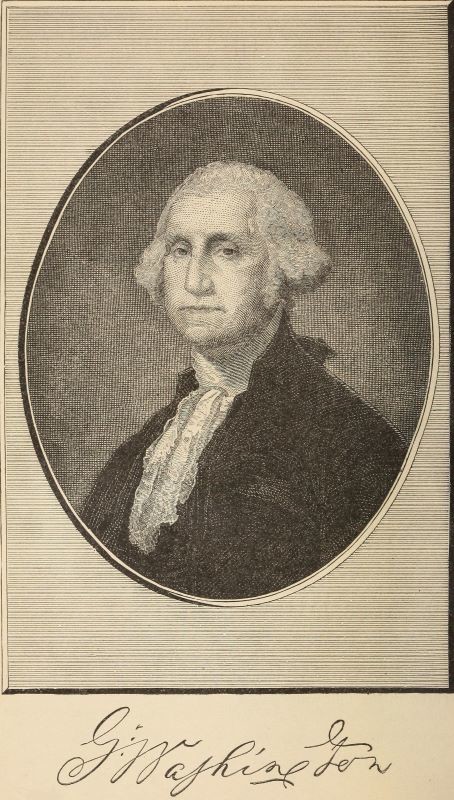
George Washington
10Christopher Columbus
25Pedro Menendez
33Samuel Champlain
39Sebastian Cabot
42Sir Walter Raleigh
44Captain John Smith
60Peter Stuyvesant
96William Penn
119Cecil Calvert, Lord Baltimore
123James Oglethorpe
131Patrick Henry
152Marquis de La Fayette
173Benjamin Franklin
179Paul Jones
186General Greene
193John Adams
211Thomas Jefferson
214James Madison
221James Monroe
244Henry Clay
247John Quincy Adams
248Andrew Jackson
250Daniel Webster
251Martin Van Buren
254William Henry Harrison
257John Tyler
257James K. Polk
261John Charles Fremont
263Zachary Taylor
269Millard Fillmore
270Franklin Pierce
273James Buchanan
275Abraham Lincoln
281George B. McClellan
291Robert E. Lee
299Stonewall Jackson
307William T. Sherman
311Joseph E. Johnston
313Philip H. Sheridan
317Andrew Johnson
323Ulysses S. Grant
328Horace Greeley
331Rutherford B. Hayes
337Oliver P. Morton
342James A. Garfield
344Chester A. Arthur
346Grover Cleveland
350Thomas A. Hendricks
356Benjamin Harrison
361INTRODUCTION.
THERE are several Periods in the history of the United States. It is important for the student to understand these at the beginning. Without such an understanding his notion of our country's history will be confused and his study rendered difficult.
2. First of all, there was a time when the Western continent was under the dominion of the Red men. The savage races possessed the soil, hunted in the forests, roamed over the prairies. This is the Primitive Period in American history.
3. After the discovery of America, the people of Europe were for a long time engaged in exploring the New World and in becoming familiar with its shape and character. For more than a hundred years, curiosity was the leading passion with the adventurers who came to our shores. Their disposition was to go everywhere and settle nowhere. These early times may be called the Period of Voyage and Discovery.
4. Next came the time of planting colonies. The adventurers, tired of wandering about, became anxious to found new States in the wilderness. Kings and queens turned their attention to the work of colonizing the New World. Thus arose a third period—the Period of Colonial History.
5. The colonies grew strong and multiplied. There were thirteen little seashore republics. The rulers of the mother-country began a system of oppression and tyranny. The colonies revolted, fought side by side, and won their freedom. Not satisfied with mere independence, they formed a Union destined to become strong and great. This is the Period of Revolution and Confederation.
6. Then the United States of America entered upon its career as a nation. Emigrants flocked to the Land of the Free. New States were formed and added to the Union in rapid succession. To protect itself from jealous neighbors, the nation pushed her boundaries across the continent. This Period may be called the Growth of the Union.
7. But the nation was not truly free. Human slavery existed in the South. This institution engendered sectional hatred and desires for disunion which finally developed into the dark and bloody Period of the Civil War.
8. Then the reunited nation laid aside its arms and entered upon a period of prosperity and material development which has not yet reached its culmination and with which History affords no parallel.
9. We thus find seven periods in the history of our country:
- Primitive America; prior to the coming of white men.
- Voyage and Discovery; A. D. 986-1607.
- The Colonies; A. D. 1607-1775.
- Revolution and Confederation; A. D. 1775-1789.
- The Growth of the Union; A. D. 1789-1861.
- The Civil War; A. D. 1861-1865.
- The Reunited Nation; A. D. 1865-1891.
In this order the History of the United States will be presented in the following pages.
HISTORY OF THE UNITED STATES.
Part I.
PRIMITIVE AMERICA.

An Ancient Mound
CHAPTER I.
The Aborigines.
BEFORE the times of the Red men, North America was inhabited by other races, of whom we know but little. Of these primitive peoples the Indians preserved many traditions. Vague stories of the wars, migrations, and cities of the nations that preceded them were recited by the red hunters at their camp-fires, and were repeated from generation to generation.
2. Other evidences, more trustworthy than legend and story, exist of the presence of aboriginal peoples in our country. The traces of a rude civilization are found in almost every part of the present United States. It is certain that the relics left behind by the prehistoric peoples are not the work of the Indian races, but of peoples who preceded them in the occupation of this continent. That class of scholars called antiquarians, or archæologists, have taken great pains to restore for us an outline of the life and character of the nations who first dwelt in the great countries between the Atlantic and the Pacific.
The Mound-builders.
3. These primitive peoples are known to us by the name of Mound-builders. The building of mounds seems to have been one of their chief forms of activity. The traveler of to-day, in passing across our country, will ever and anon discover one of those primitive works of a race which has left to us no other monuments. As the ancient people of Egypt built pyramids of stone for their memorials, so the unknown peoples of the New World raised huge mounds of earth as the tokens of their presence, the evidences of their work in ancient America.
4. The mounds referred to are found in many parts of the United States, but are most abundant in the Mississippi Valley. Here also they are of greatest extent and variety. Some of them are as much as ninety feet in height, and one has been estimated to contain twenty million cubic feet of earth. It is evident that they were formed before the present forest growth of the United States sprang into existence. The mounds are covered with trees, some of them several feet in diameter; and the surface has the same appearance as that of the surrounding country.
5. As we have said, we know but little of the people by whom the mounds and earthworks of primitive America were constructed. Some of the works in question are of a military character. One of these, called Fort Hill, near the mouth of the Little Miami River, has a circumference of nearly four miles. It is certain that great nations, frequently at war with each other, dwelt in our country between the Northern Lakes and the Southern Gulf; but who those peoples were we have no method of ascertaining. Their language has perished with the people who spoke it. Only a few of the relics and implements of the primitive races remain to inform us of the men by whom they were made.
33. On the 5th of July General Abercrombie, with an army of fifteen thousand men, moved against Ticonderoga. On the morning of the 6th the English fell in with the picket line of the French. A severe skirmish ensued; the French were overwhelmed, but Lord Howe was killed in the onset. On the morning of the 8th, the English divisions were arranged to carry Ticonderoga by assault. A desperate battle of more than four hours followed, until, at six o'clock in the evening, the English were finally repulsed. The loss on the side of the assailants amounted in killed and wounded to nineteen hundred and sixteen. In no battle of the Revolution did the British have so large a force engaged, or meet such terrible loss.
6. The city was now besieged. On the 19th of May Grant made an assault, but was repulsed with terrible losses. Three days afterwards the attempt was renewed with a still greater destruction of life. But the siege was pressed with ever-increasing severity. Admiral Porter bombarded the town incessantly. Reinforcements swelled the Union ranks. Pemberton held out until the 4th of July, and was then driven to surrender. The defenders of Vicksburg, numbering thirty thousand, became prisoners of war. Thousands of small arms, hundreds of cannon, and vast quantities of ammunition and stores were the fruits of the great victory.
6. Before this transfer, the colony had been much vexed by the attempt to set over them a minister of the English Church. They had come to the New World to avoid this very thing. There was dissension for a while. The English managers withheld support; the stores of the colonists were sold to them at three prices; and they were obliged to borrow money at sixty per cent. But the Pilgrims would not yield, and the conflict ended with the purchase of the proprietors' rights in the colony.
4. After the conquest of New York by the Dutch, and the restoration of the province to England, the duke of York received from the king a second patent for the country between the Connecticut and the Delaware. At the same time he confirmed his former grant of New Jersey to Berkeley and Carteret. But soon afterwards Sir Edmund Andros was appointed royal governor of the whole country. Carteret defended his claim against Andros; but Berkeley sold his interest in New Jersey to John Fenwick, to be held in trust for Edward Byllinge, who after a time made an assignment of his property to Gawen Laurie, Nicholas Lucas, and William Penn.
14. Scarcely were Washington's forces safe within the stockade, when, on the 3d of July, the regiment of De Villiers came in sight, and surrounded the fort. The French stationed themselves on the eminence, and fired down upon the English with fatal effect. The Indians climbed into the tree-tops. For nine hours the assailants poured a shower of balls upon Washington's men. At length, seeing that it would be impossible to hold out, he accepted the terms which were offered by the French general. On the 4th of July the English garrison marched out of the fort, and withdrew from the country.
37. On the 10th of July, Niagara was invested by Prideaux. Two weeks later the fort capitulated, and the French, to the number of six hundred, became prisoners of war. At the same time Amherst was marching with an army of eleven thousand men against Ticonderoga. On the 22d of July the English forces landed, and on the 26th the garrison retreated to Crown Point. Five days afterwards they deserted this place also, and withdrew to Isle-aux-Noix, in the river Sorel.
25. The Delaware was filled with floating ice. Ewing and Cadwallader were both baffled in their efforts to cross the river. Washington, having succeeded in getting over, divided his army of twenty-four hundred men into two columns and pressed forward. At eight o'clock in the morning the Americans came rushing into Trenton from both directions. The Hessians sprang from their quarters and attempted to form in line. Colonel Rall was mortally wounded. Nearly a thousand of the Hessians threw down their arms and begged for quarter. Before nightfall Washington, with his army and the whole body of captives, was safe on the other side of the Delaware.
15. On the 25th of August the British landed at Elk River, in Maryland, and began their march toward Philadelphia. Washington selected the Brandywine as his line of defence. The left wing was stationed at Chad's Ford, while the right, under General Sullivan, was extended up the river. On the 11th of September the British reached the opposite bank and began battle. The Hessians, under Knyphausen, attacked at the ford; but the British, led by Cornwallis and Howe, marched up the Brandywine and crossed above the American right. Sullivan allowed himself to be outflanked. Washington was misled by false information; the right wing was crushed by Cornwallis, and the day was lost.
21. On the 23d of September, Paul Jones, cruising off the coast of Scotland with a fleet of French and American vessels, fell in with a British squadron, and a bloody battle ensued. The Serapis, a British frigate of forty-four guns, engaged the Poor Richard within musket-shot. At last the vessels were lashed together, and the Serapis struck her colors. Jones transferred his men to the conquered ship, and the Poor Richard went down. Of the three hundred and seventy-five men on board the fleet of Jones, three hundred were either killed or wounded.
4. Soon afterwards the Union forces were concentrated for the capture of Vicksburg. Three months were spent by General Grant in beating about the bayous around Vicksburg, in the hope of getting a position in the rear of the town. A canal was cut across a bend in the river with a view to opening a passage for the gunboats. But a flood washed the works away. Then another canal was begun, only to be abandoned. Finally, it was determined to run the fleet past the Vicksburg batteries. On the night of the 16th of April the boats dropped down the river. All of a sudden the guns of the enemy burst forth with shot and shell, pelting the passing steamers; but they went by with little damage.
6. This stronghold was at once besieged. Here were the machine shops, foundries, and car works of the Confederacy. At the beginning of the siege the cautious General Johnston was superseded by the rash General J. B. Hood. On the 20th, 22d and 28th of July, the latter made three assaults on the Union lines, but was repulsed with dreadful losses. At last Hood was obliged to evacuate Atlanta; and on the 2d of September the Union army marched into the captured city.
4. Christopher Columbus was born at Genoa, Italy, in A. D. 1435. He was carefully educated, and then devoted himself to the sea. For twenty years he traversed the parts of the Atlantic adjacent to Europe; he visited Iceland; then went to Portugal, and finally to Spain. He spent ten years in trying to explain to dull monarchs the figure of the earth and the ease with which the rich islands of the East might be reached by sailing westward. He found one appreciative listener, the noble and sympathetic Isabella, Queen of Castile. To the faith, insight, and decision of a woman the final success of Columbus must be attributed.
17. The next attempt to colonize Florida was in the year 1565. The enterprise was intrusted to Pedro Menendez, a Spanish soldier. He was commissioned by Philip II. to plant in some favorable district of Florida a colony of not less than five hundred persons, and was to receive two hundred and twenty-five square miles of land adjacent to the settlement. Twenty-five hundred persons joined the expedition.
15. In the year 1603 the country, from the latitude of Philadelphia to that of Quebec, was granted to De Monts. The chief provisions of his patent were a monopoly of the fur-trade, and religious freedom for the Huguenots. With two shiploads of colonists De Monts left France in March of 1604, and reached the Bay of Fundy. Poutrincourt, the captain of one of the ships, asked and obtained a grant of some beautiful lands in Nova Scotia, and with a part of the crew went on shore. De Monts began to build a fort at the mouth of the St. Croix. But in the following spring they abandoned this place and joined Poutrincourt. Here, on the 14th of November, 1605, the foundations of the first permanent French settlement in America were laid. The name of Port Royal was given to the fort, and the country was called Acadia.
3. As soon as he had satisfied himself of the extent of the country, Cabot sailed for England. On the voyage he twice saw the coast of Newfoundland. After an absence of three months he reached Bristol, and was greeted with enthusiasm. The town had holiday, and the people were wild about the great discovery. The king gave him money; new ships were fitted out, and a new commission was signed in February, 1498. But after the date of this patent the name of John Cabot disappears from history.
12. The English gold-hunters were not yet satisfied. Fifteen new vessels were fitted out, and in 1578 a third voyage was begun. Three of the ships, loaded with emigrants, were to remain in the promised land. The vessels, struggling through the icebergs, finally reached Meta Incognita and took on cargoes of dirt. With several tons of the supposed ore under the hatches, the ships set sail for home. The El Dorado of the Esquimos had proved a failure.
10. Smith was next taken to Orapax, a few miles from the site of Richmond. Here he found the Indians making preparations to attack Jamestown. They invited him to become their leader, but he refused and managed to write a warning letter to his countrymen. This letter, because of its mysterious power of carrying intelligence, frightened them more than ever. When the warriors arrived at Jamestown and found everything as Smith had said, all thought of attacking the colony was given up.
14. William Penn was born on the 14th of October, 1644. He was the oldest son of Sir William Penn of the British navy. At the age of twelve he was sent to the University of Oxford, where he distinguished himself as a student until he was expelled on account of his religion. Afterwards he traveled on the Continent, and then became a student of law at London. For a while he was a soldier, and was then converted to the Quaker faith. His father drove him out of doors, but he was not to be turned from his course. He proclaimed the doctrines of the Friends; was arrested and imprisoned, first in the Tower of London, and afterward at Newgate. Despairing of toleration in England, he cast his gaze across the Atlantic. West Jersey was purchased; Pennsylvania was granted by King Charles; and now Penn himself arrived in America to found a government on the basis of peace.
13. Georgia, the thirteenth American colony, was founded by James Oglethorpe, an English philanthropist. The laws of England permitted imprisonment for debt. Thousands of English laborers were annually arrested and thrown into jail. In order to provide a refuge for the poor and the distressed, Oglethorpe appealed to George II. for the privilege of planting a colony in America. The petition was favorably heard, and on the 9th of June, 1732, a charter was issued by which the territory between the Savannah and Altamaha Rivers, and westward to the Pacific, was granted to a corporation, to be held in trust for the poor. In honor of the king, the new province was named Georgia.
7. One of the most important events of the war was the campaign of General Burgoyne. In command of the English forces in Canada, he spent the spring of 1777 in organizing an army of ten thousand men for the invasion of New York. The force consisted of British, Hessians, Canadians, and Indians. The plan of the campaign embraced a descent upon Albany and New York, and the cutting off of New England from the Middle and Southern colonies.
3. On arriving at New York, Arnold received his commission as brigadier in the British army. In January the traitor began war on his countrymen. His proceedings were marked with much ferocity. In the vicinity of Richmond a vast quantity of property was destroyed. Arnold then took up his headquarters in Portsmouth; and Washington, for the second time, planned his capture. The French fleet was ordered to cooperate with La Fayette in the attempt. But Admiral Arbuthnot drove the French squadron back to Rhode Island. La Fayette abandoned the undertaking, and Arnold again escaped.
9. About this time many of the countries of South America declared their independence of foreign nations. The people of the United States sympathized with the patriots of the South. Henry Clay urged upon the government the duty of recognizing the South American republics. In March of 1822, a bill was passed by Congress embodying his views. In the President's message of 1823 the declaration was made that the American continents are not subject to colonization by any European power. This is the principle ever since known as the Monroe Doctrine.
3. In the congressional session of 1831-32, additional tariffs were levied upon goods imported from abroad. By this act the manufacturing districts were favored at the expense of the agricultural States. South Carolina was specially offended. Open resistance was threatened in case the officers should attempt to collect the revenues at Charleston. In the United States Senate the right of a State to nullify an act of Congress was boldly proclaimed. On that question had already occurred the great debate between Colonel Hayne, senator from South Carolina, and Daniel Webster of Massachusetts.
7. Ten days after the battle of Resaca de la Palma General Taylor captured Matamoras, and in August laid siege to Monterey. On the 21st of September the Americans carried the heights in the rear of the town. The Bishop's Palace was taken by storm on the following day. On the 23d the city was successfully assaulted in front. The American storming parties charged into the town; hoisted the victorious flag of the Union; turned upon the buildings where the Mexicans were concealed; charged up dark stairways to the flat roofs of the houses; and drove the enemy to a surrender.
3. When the question of admitting California came before Congress the members were sectionally divided. The admission of the new State was favored by the representatives of the North, and opposed by those of the South. The latter claimed that, with the extension of the Missouri Compromise to the Pacific, the right to introduce slavery into California was guaranteed by the general government, and that therefore the proposed constitution of the State ought to be rejected. The reply of the North was that the Missouri Compromise had respect only to the Louisiana purchase, and that the Californians had framed their constitution in their own way.
10. After the rout at Bull Run, troops were rapidly hurried to Washington. The aged General Scott retired from active duty, and General McClellan took command of the Army of the Potomac. By October his forces had increased to a hundred and fifty thousand men. On the 21st of that month two thousand troops were sent across the Potomac at Ball's Bluff. Without proper support, the Federals were attacked by a force of Confederates under General Evans, driven to the river, their leader, Colonel Baker, killed, and the whole force routed with a loss of eight hundred men.
17. On the 10th of May General Wool, the commandant of Fortress Monroe, led an expedition against Norfolk and captured the town. On the next day the Confederate iron-clad Virginia was blown up to save her from capture. The James River was thus opened for the supply-transports of the Army of the Potomac. On the 31st of May that army was attacked at a place called Fair Oaks, or Seven Pines. Here for a part of two days the battle raged with great fury. At last the Confederates were driven back; but McClellan's victory was by no means decisive. General Joseph E. Johnston, the commander-in-chief of the Confederates, was severely wounded; and the command devolved on General Robert E. Lee.
14. On the 1st of January General Magruder captured Galveston, Texas. By this means the Confederates secured a port of entry in the Southwest. On the 7th of April Admiral Du Pont, with a fleet of iron-clads, attempted to capture Charleston, but was driven back. In June the city was besieged by a strong land-force, under General Q. A. Gillmore, assisted by Admiral Dahlgren's fleet. After the bombardment had continued for some time, General Gillmore, on the 18th of July, attempted to carry Fort Wagner by assault, but was repulsed with severe loss. The siege progressed until the 6th of September, when the Confederates evacuated the fort and retired to Charleston. Gillmore now brought his guns to bear on the wharves and buildings in the lower part of the city. But Charleston still held out; and the only gain of the Federals was the establishment of a complete blockade.
8. On the 14th of November General Sherman burned Atlanta and began his March to the Sea. His army numbered sixty thousand men. He cut his communications with the North, abandoned his base of supplies, and struck out for the sea-coast, two hundred and fifty miles away. The Union army passed through Macon and Milledgeville, crossed the Ogeechee, captured Gibson and Waynesborough, and on the 10th of December arrived in the vicinity of Savannah. On the 13th, Fort McAllister was carried by storm. On the night of the 20th, General Hardee, the Confederate commandant, escaped from Savannah and retreated to Charleston. On the 22d, General Sherman made his headquarters in the city.
9. As the first term of President Grant drew to a close, the political parties made ready for the twenty-second presidential election. Many parts of the chief magistrate's policy had been made the subjects of controversy. The congressional plan of reconstruction had been unfavorably received in the South. The elevation of the negro race to the rights of citizenship was regarded with apprehension. The military spirit was still rife in the country, and the issues of the civil war were rediscussed with much bitterness. On these issues the people divided in the election of 1872. The Republicans renominated General Grant for the presidency. For the vice-presidency Mr. Colfax was succeeded by Henry Wilson of Massachusetts. As the standard-bearer of the Liberal Republican and Democratic parties, Horace Greeley, editor of the New York Tribune, was nominated. This was the last act in that remarkable man's career. For more than thirty years he had been a leader of public opinion in America. The canvass was one of wild excitement. Mr. Greeley was overwhelmingly defeated, and died in less than a month after the election.
5. A few days after the adjournment of the Senate in June, the President, in company with Secretary Blaine and a few friends, entered the railroad depot at Washington to take the train for Long Branch, New Jersey. A moment afterwards he was approached by a miserable miscreant, who, unperceived, came within a few feet of the company, drew a pistol, and fired upon the Chief Magistrate. The shot struck the President in the back, and inflicted a dreadful wound. The bleeding chieftain was borne away to the executive mansion, and the wretch who had committed the crime was hurried to prison. For eighty days the stricken President lingered between life and death, bearing the pain and anguish of his situation with a fortitude and heroism rarely witnessed among men; but at half-past ten on the evening of September 19th, the anniversary of the battle of Chickamauga, his vital powers suddenly gave way, and in a few moments death closed the scene.
16. Within scarcely more than a year from the funeral of Grant several other distinguished Union Generals fell. On the 29th of October General George B. McClellan died at his home at St. Cloud, New Jersey. After another brief interval General Winfield S. Hancock, senior Major-General of the American Army, breathed his last. In the mean time, within a brief period, Generals Irwin McDowell, Ambrose E. Burnside, Joseph Hooker, and George G. Meade, each of whom, in a critical period of the war, had commanded the Army of the Potomac, passed away. Before the close of 1886 Major-General John A. Logan, greatest of the volunteer commanders, who, without previous military education, won for themselves distinguished honors in the War for the Union, fell sick and died at his home, called Calumet Place, in Washington City.
Distribution of Mounds.
6. In many parts of the Mississippi Valley, particularly in the States of Ohio and Indiana, the ancient mounds may be seen as they were at the time of the discovery of America. One of the greatest is situated in Illinois, opposite the city of St. Louis. It is elliptical in form, being about seven hundred feet in length by five hundred feet in breadth. It rises to a height of ninety feet. Another of much interest is at Grave Creek, near Wheeling, in West Virginia. A mound at Miamisburg, Ohio, is nearly seventy feet in height. One of the finest of all is the conical mound at Marietta, Ohio. Some of the mounds, as those of Wisconsin, are shaped like animals. One of the most peculiar and interesting is the great serpent mound in Adams County, Ohio. The work has the shape of a serpent more than a thousand feet in length, the body being about thirty feet broad at the surface. The mouth of the serpent is opened wide, and an object resembling a great egg lies partly within the jaws.
7. The use of the mounds has not been ascertained. Some have supposed that they were tombs in which the slain of great armies were buried, but on opening them, human remains are rarely found. Others have believed that the mounds were true memorials, intended by their magnitude to impress the beholder and transmit a memory. Still others have thought the elevations were intended for watch-towers from which the movements of the enemy might be watched and thwarted.
8. What we know of the prehistoric races has been mostly gained from an examination of their implements and utensils.

Relics from the Mounds.
Relics from the Mounds.
These were of either stone or copper. It appears that the more advanced of the peoples, especially the nations living on the borders of the Great Lakes, were able to manufacture utensils of copper. In other parts of the country, the weapons and implements were made of flint and other varieties of stone, by chipping or polishing. The range of tools and implements was extensive, including axes, spear-heads, arrow-points, knives, chisels, hammers, rude millstones, and many varieties of earthen ware. Besides these, there were articles of ornamentation and personal use, such as pipes, bracelets, ear-rings, and beads. The common belief that the articles here referred to were the product of Indian workmanship is held by many antiquarians to be wholly erroneous. These antiquarians think that the Indians knew nothing more of the origin and production of such implements as the arrow-points, spear-heads, and stone axes than we know ourselves.
9. In many parts of Indiana the mounds of the ancient races are plentifully distributed. Almost every county has some relics of this kind within its borders. But the most interesting remains of the primitive races are those discovered in the ancient cemeteries scattered between Lake Michigan and the Tennessee River. In many places the aboriginal tombs still yield the relics of this people of whom we know so little. In recent years a burial ground near Bedford, Indiana, has been opened, from which have been taken primitive skulls and other parts of human skeletons, belonging possibly to some unknown race long preceding the Indians in our country.
The Indians, or Red Men.
10. With the Mound-builders, history can be but little concerned; but with the Red men, or Indians, who succeeded them, the white race was destined to have many relations of peace and war. On the first arrival of Europeans on the Atlantic coast, the country was found in possession of wild tribes living in the woods and on the river banks, in rude villages from which they went forth to hunt or to make war on other tribes. Their manners and customs were fixed by usage and law, and there was at least the beginning of civil government among them.
11. To these tribes the name Indian was given from their supposed identity with the people of India. Columbus and his followers believed that they had reached the islands of the far East, and that the natives were of the same race as the inhabitants of the Indies. The mistake of the Spaniards was soon discovered; but the name Indian has ever since remained to designate the native tribes of the Western continent.
12. The origin of the Indians is involved in obscurity. At what date or by what route they came to the New World is unknown. The notion that the Red men are the descendants of the Israelites is absurd. That Europeans or Africans, at some early period, crossed the Atlantic by sailing from island to island, seems improbable. That the people of Kamchatka came by way of Bering Strait into the northwestern parts of America, has little evidence to support it. Perhaps a more thorough knowledge of the Indian languages may yet throw some light on the origin of the race.
13. The Indians belong to the Bow-and-Arrow family of men. To the Red man the chase was everything. Without the chase he languished and died. To smite the deer and the bear was his chief delight and profit. Such a race could live only in a country of woods and wild animals.
14. The northern parts of America were inhabited by the Esquimos. The name means the eaters of raw meat. They lived in snow huts or hovels. Their manner of life was that of fishermen and hunters. They clad themselves in winter with the skins of seals, and in summer with those of reindeer.
Indian Tribes.
15. The greater portion of the United States east of the Mississippi was peopled by the family of the Algonquins. They were divided into many tribes, each having its local name and tradition. Agriculture was but little practiced by them. They roamed about from one hunting-ground and river to another. When the White men came, the Algonquin nations were already declining in numbers and influence. Only a few thousands now remain.
16. Around the shores of Lakes Erie and Ontario lived the Huron-Iroquois. At the time of their greatest power, they embraced no fewer than nine nations. The warriors of this confederacy presented the Indian character in its best aspect. They were brave, patriotic, and eloquent; faithful as friends, but terrible as enemies.
17. South of the Algonquins were the Cherokees and the Mobilian Nations. The former were highly civilized for a primitive people. The principal tribes of the Mobilians were the Yamassees and Creeks of Georgia, the Seminoles of Florida, and the Choctaws and Chickasaws of Mississippi. These displayed the usual disposition and habits of the Red men.
18. West of the Mississippi was the family of the Dakotas. South of these, in a district nearly corresponding with the State of Texas, lived the wild Comanches. Beyond the Rocky Mountains were the Indian nations of the Plains; the great families of the Shoshones, the Selish, the Klamaths, and the Californians. On the Pacific slope, farther southward, dwelt in former times the civilized but feeble race of Aztecs.

INDIAN LIFE
19. The Red men had a great passion for war. Their wars were undertaken for revenge rather than conquest. To forgive an injury was considered a shame. Revenge was the noblest of the virtues. The open battle of the field was unknown in Indian warfare. Fighting was limited to the ambuscade and the massacre. Quarter was rarely asked, and never granted.
20. In times of peace the Indian character appeared to a better advantage. But the Red man was always unsocial and solitary. He sat by himself in the woods. The forest was better than a wigwam, and a wigwam better than a village. The Indian woman was a degraded creature—a mere drudge and beast of burden.
Indian Characteristics.
21. In the matter of the arts the Indian was a barbarian. His house was a hovel, built of poles set up in a circle, and covered with skins and the branches of trees. Household utensils were few and rude. Earthen pots, bags, and pouches for carrying provisions, and stone hammers for pounding corn, were the stock and store. His weapons of offense and defense were the hatchet and the bow and arrow. In times of war the Red man painted his face and body with all manner of glaring colors. The fine arts were wanting. Indian writing consisted of half-intelligible hieroglyphics scratched on the face of rocks or cut in the bark of trees.
22. The Indian languages bear little resemblance to those of other races. The Red man's vocabulary was very limited. The principal objects of nature had special names, but abstract ideas could hardly be expressed. Indian words had a very intense meaning. There was, for instance, no word signifying to hunt or to fish; but one word signified "to-kill-a-deer-with-an-arrow"; another, "to-take-fish-by-striking-the-ice." Among some of the tribes, the meaning of words was so restricted that the warrior would use one term and the squaw another to express the same idea.
23. The Indians were generally serious in manners and behavior. Sometimes, however, they gave themselves up to merry-making and hilarity. The dance was universal—not the social dance of civilized nations, but the solemn dance of religion and of war. Gaming was much practiced among all the tribes. Other amusements were common, such as running, wrestling, shooting at a mark, and racing in canoes.
24. In personal appearance the Indians were strongly marked. In stature they were below the average of Europeans. The Esquimos are rarely five feet high. The Algonquins are taller and lighter in build; straight and agile; lean and swift of foot. The eyes are jet-black and sunken; hair black and straight; skin copper-colored or brown; hands and feet small; body lithe, but not strong; expression sinister, or sometimes dignified and noble.
25. The best hopes of the Indian race seem now to center in the Choctaws, Cherokees, Creeks, and Chickasaws of the Indian Territory. These nations have attained a considerable degree of civilization. Most of the other tribes are declining in numbers and influence. Whether the Indians have been justly deprived of the New World will remain a subject of debate. That they have been deprived of it can not be questioned. The white races have taken possession of the vast domain. To the prairies and forests, the hunting-grounds of his fathers, the Red man says farewell.

Review Questions.—Part I.
- What is meant by the Aborigines?
- What evidences indicate an earlier race than the Indians?
- What is known of the Mound-builders?
- What are the most notable mounds?
- Where are they located?
- Describe the shapes of the mounds.
- For what supposed purposes were they built?
- What are sometimes found in the mounds?
- Why were the native races of America called Indians?
- What is said of the origin of these races?
- To what family of men do the Indians belong?
- Name the principal Indian nations in America.
- What regions did the Algonquins inhabit?
- Where did the Huron-Iroquois live?
- What were the characteristics of this nation?
- Where did the Cherokees and Mobilian nations live?
- What were the principal tribes of the Mobilians?
- What regions did the Dakotas inhabit?
- Give the names of other Indian nations.
- What regions did they inhabit?
- What were the leading characteristics of the Indians?
- What can you tell of the Indian languages?
- Describe the personal appearance of the Indians.
- What tribes of Indians are now the most civilized?
- Give some account of the Esquimos.
- What does the name Esquimo mean?
Part II.
VOYAGE AND DISCOVERY.
A. D. 986-1607.
CHAPTER II.
The Norsemen in America.
THE western continent was first seen by white men in A. D. 986. A Norse navigator by the name of Herjulfson, sailing from Iceland to Greenland, was caught in a storm and driven westward to Newfoundland or Labrador. Two or three times the shores were seen, but no landing was attempted. The coast was so different from the well-known cliffs of Greenland as to make it certain that another shore, hitherto unknown, was in sight. On reaching Greenland, Herjulfson and his companions told wonderful stories of the new land seen in the west.
Leif, Son of Eric.
2. Fourteen years later, the actual discovery of America was made by Leif, a son of Eric. Resolving to know the truth about the country which Herjulfson had seen, he sailed westward from Greenland, and in the spring of the year 1001 reached Labrador. Landing with his companions, he made explorations for a considerable distance along the coast. The country was milder and more attractive than his own, and he was in no haste to return. Southward he went as far as Massachusetts, where the company remained for more than a year. Rhode Island was also visited; and it is alleged that the adventurers found their way into New York harbor.
3. In the years that followed Leif's discovery, other bands of Norsemen came to the shores of America. Thorwald, Leif's brother, made a voyage to Maine and Massachusetts in 1002, and is said to have died at Fall River in the latter State. Then another brother, Thorstein by name, arrived with a band of followers in 1005; and in the year 1007, Thorfinn Karlsefne, the most distinguished mariner of his day, came with a crew of a hundred and fifty men, and made explorations along the coast of Massachusetts, Rhode Island, and perhaps as far south as the capes of Virginia.

Norsemen in America.
Vinland.
4. Other companies of Icelanders and Norwegians visited the countries farther north, and planted colonies in Newfoundland and Nova Scotia. Little, however, was known or imagined by these rude sailors of the extent of the country which they had discovered. They supposed that it was only a portion of Western Greenland, which, bending to the north around an arm of the ocean, had reappeared in the west. Their settlements were feeble and were soon broken up. Commerce was an impossibility in a country where there were only a few wretched savages with no disposition to buy and nothing at all to sell. The spirit of adventure was soon appeased, and the restless Norsemen returned to their own country. To this undefined line of coast, now vaguely known to them, the Norse sailors gave the name of Vinland.
5. During the twelfth, thirteenth, and fourteenth centuries occasional voyages were made; and as late as A. D. 1347, a Norwegian ship visited Labrador and the northeastern parts of the United States. In 1350 Greenland and Vinland were depopulated by a great plague which had spread thither from Norway. From that time forth communication with the New World ceased, and the history of the Northmen in America was at an end. The Norse remains, which have been found at Newport, at Fall River, and several other places, point clearly to the events here narrated; and the Icelandic historians give a consistent account of these early exploits of their countrymen. When the word America is mentioned in the hearing of the schoolboys of Iceland, they will at once answer, with enthusiasm, "Oh, yes; Leif Ericsson discovered that country in the year 1001."
6. An event is to be weighed by its consequences. From the discovery of America by the Norsemen, nothing whatever resulted. The world was neither wiser nor better. Among the Icelanders themselves the place and the very name of Vinland were forgotten. Europe never heard of such a country or such a discovery. Historians have until late years been incredulous on the subject, and the fact is as though it had never been. The curtain which had been lifted for a moment was stretched again from sky to sea, and the New World still lay hidden in the shadows.
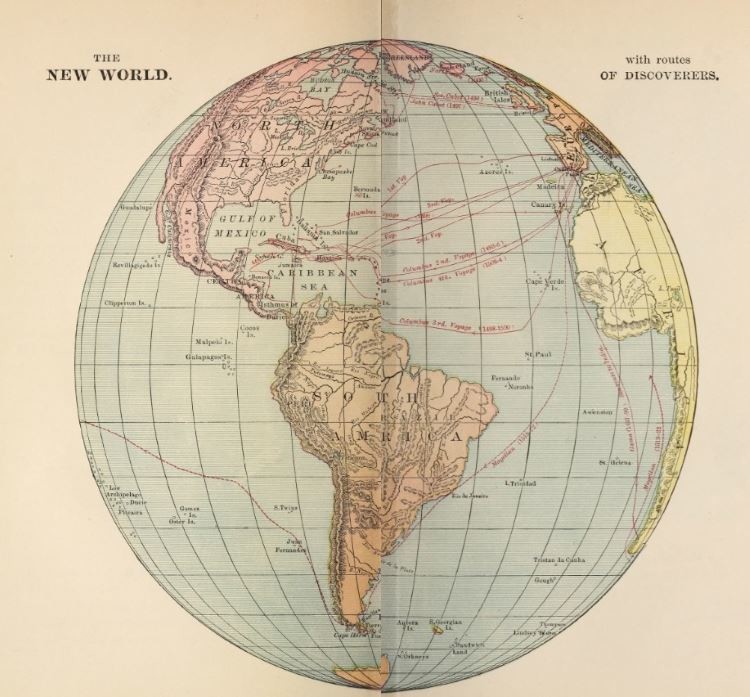
The New World, with Routes of Discoveries
CHAPTER III.
Spanish Discoveries in America.
Christopher Columbus.
IT was reserved for the people of a sunnier clime than Iceland first to make known to the European nations the existence of a Western continent. Spain was the happy country under whose patronage a new world was to be added to the old; but the man who was destined to make the revelation was not himself a Spaniard: he was to come from Italy, the land of valor and the home of greatness. Christopher Columbus was the name of that man whom after ages have rewarded with imperishable fame.
2. The idea that the world is round was not original with Columbus. The English traveler, Sir John Mandeville, had declared in the first English book ever written (A. D. 1356) that the world is a sphere, and that it was practicable for a man to sail around the world and return to the place of starting. But Columbus was the first practical believer in the theory of circumnavigation.
3. The great mistake with Columbus was not concerning the figure of the earth, but in regard to its size. He believed the world to be no more than ten thousand or twelve thousand miles in circumference. He therefore confidently expected that, after sailing about three thousand miles to the westward, he should arrive at the East Indies.
4. Christopher Columbus was born at Genoa, Italy, in A. D. 1435. He was carefully educated, and then devoted himself to the sea. For twenty years he traversed the parts of the Atlantic adjacent to Europe; he visited Iceland; then went to Portugal, and finally to Spain. He spent ten years in trying to explain to dull monarchs the figure of the earth and the ease with which the rich islands of the East might be reached by sailing westward. He found one appreciative listener, the noble and sympathetic Isabella, Queen of Castile. To the faith, insight, and decision of a woman the final success of Columbus must be attributed.
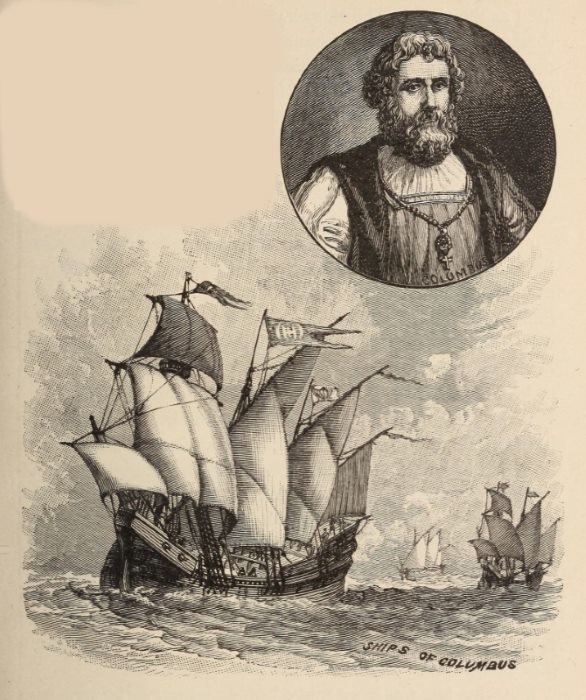
SHIPS OF COLUMBUS
Discovery of America.
5. On the morning of the 3d day of August, 1492, Columbus, with three ships, left the harbor of Palos. After seventy-one days of sailing, in the early dawn of October 12, Rodrigo Triana, a sailor on the Pinta, set up a shout of "Land!" A gun was fired as the signal. The ships lay to. Just at sunrise Columbus stepped ashore, set up the banner of Castile in the presence of the natives, and named the island San Salvador. During the three remaining months of this first voyage, the islands of Concepcion, Cuba, and San Domingo were added to the list of discoveries; and in the last-named island was erected a fort, the first structure built by Europeans in the New World. In January, 1493, Columbus sailed for Spain, where he arrived in March, and was greeted with rejoicings and applause.
6. In the following autumn, Columbus sailed on his second voyage, which resulted in the discovery of the Windward group and the islands of Jamaica and Porto Rico. It was at this time, and in San Domingo, that the first colony was established. Columbus's brother was appointed governor. After an absence of nearly three years, Columbus returned to Spain. The rest of his life was clouded with persecutions and misfortunes.
7. In 1498, during a third voyage, Columbus discovered the island of Trinidad and the mainland of South America. Thence he sailed back to San Domingo, where he found his colony disorganized; and here, while attempting to restore order, he was seized by an agent of the Spanish government, put in chains, and carried to Spain. After much disgraceful treatment, he was sent out on a fourth and last voyage, in search of the Indies; but the expedition accomplished little, and Columbus returned to his ungrateful country. The good Isabella was dead, and the great discoverer, a friendless and neglected old man, sank into the grave.
8. Columbus was even robbed of the name of the new continent. In the year 1499, Amerigo Vespucci, a Florentine navigator, reached the eastern coast of South America. Two years later he made a second voyage, and then gave to Europe the first published account of the Western World. In his narrative all reference to Columbus was omitted; and thus the name of Vespucci, rather than that of the true discoverer, was given to the New World.
Discovery of the Pacific.
9. The discovery of America produced great excitement in Europe. Within ten years after the death of Columbus, the principal islands of the West Indies were explored and colonized. In the year 1510 the Spaniards planted on the Isthmus of Darien their first continental colony. Three years later, De Balboa, the governor of the colony, crossed the isthmus, and from an eminence looked down upon the Pacific. Not satisfied with merely seeing the great water, he waded in a short distance, and, drawing his sword, took possession of the ocean in the name of the king of Spain.
Florida.
10. Meanwhile, Ponce de Leon, who had been a companion of Columbus, fitted out an expedition of discovery. He had grown rich as governor of Porto Rico, and had also grown old. But there was a Fountain of Perpetual Youth somewhere in the Bahamas—so said a tradition in Spain—and in that fountain the old soldier would bathe and be young again. So in the year 1512 he set sail from Porto Rico; and on Easter Sunday came in sight of an unknown shore. There were waving forests, green leaves, and birds of song. In honor of the day, called Pascua Florida, he named the new shore Florida—the Land of Flowers.
11. A landing was made near where St. Augustine was afterwards founded. The country was claimed for the king of Spain, and the search was continued for the Fountain of Youth. The adventurer turned southward, discovered the Tortugas, and then sailed back to Porto Rico, no younger than when he started.
12. The king of Spain gave Ponce the governorship of his Land of Flowers, and sent him thither to establish a colony. He reached his province in the year 1521, and found the Indians hostile. Scarcely had he landed when they fell upon him in battle; many of the Spaniards were killed, and the rest had to fly to the ships for safety. Ponce de Leon himself was wounded, and carried back to Cuba to die.
CHAPTER IV.
Spanish Discoveries in America.—(Continued.)
THE year 1517 was marked by the discovery of Yucatan by Fernandez de Cordova. While exploring the northern coast of the country, he was attacked by the natives, and mortally wounded. During the next year the coast of Mexico was explored for a great distance by Grijalva, assisted by Cordova's pilot. In the year 1519 Fernando Cortez landed with his fleet at Tabasco, and, in two years, conquered the Aztec empire of Mexico.
Circumnavigation of the Globe.
2. Among the daring enterprises at the beginning of the sixteenth century was that of Ferdinand Magellan. A Portuguese by birth, this bold man determined to discover a southwest passage to Asia. He appealed to the king of Portugal for ships and men; but the monarch gave no encouragement. Magellan then went to Spain, and laid his plans before Charles V., who ordered a fleet of five ships to be fitted out at the public expense.
3. The voyage was begun from Seville in August of 1519. Magellan soon reached the shores of South America, and passed the winter on the coast of Brazil. Renewing his voyage southward, he came to that strait which still bears his name, and passing through, found himself in the open and boundless ocean which he called the Pacific.
4. Magellan held on his course for nearly four months, suffering much for water and provisions. In March of 1520 he came to the islands called the Ladrones. Afterwards he reached the Philippine group, where he was killed in battle with the natives. But a new captain was chosen, and the voyage was continued to the Moluccas. Only a single ship remained; but in this vessel the crews embarked, and, returning by way of the Cape of Good Hope, arrived in Spain in September, 1522. The first circumnavigation of the globe had been accomplished.
5. The next important voyage to America was in the year 1520. De Ayllon, a judge in St. Domingo, and six other wealthy men, determined to stock their plantations with slaves, by kidnapping natives from the Bahamas. Two vessels reached the coast of South Carolina. The name of Chicora was given to the country, and the River Combahee was called the Jordan. The natives made presents to the strangers and treated them with great cordiality. They flocked on board the ships; and when the decks were crowded De Ayllon weighed anchor and sailed away. A few days afterwards a storm wrecked one of the ships; while most of the poor wretches who were in the other ship died of suffocation.
Expedition of De Narvaez.
6. In 1526 Charles V. appointed De Narvaez governor of Florida. His territory extended from Cape Sable three fifths of the way around the Gulf of Mexico. De Narvaez arrived at Tampa Bay with two hundred and sixty soldiers and forty horsemen. The natives treated them with suspicion, and holding up their gold trinkets, pointed to the north. The Spaniards, whose imaginations were fired with the sight of the precious metal, struck into the forests, expecting to find cities and empires, and found instead swamps and savages. They finally came to Appalachee, a squalid village of forty cabins.
7. Oppressed with fatigue and hunger, they wandered on, until they reached the harbor of St. Mark's. Here they constructed some brigantines, and put to sea in hope of reaching Mexico. After shipwrecks and almost endless wanderings, four men only of all the company, under the leadership of the heroic De Vaca, reached the village of San Miguel, on the Pacific coast, and were conducted to the city of Mexico.
De Soto's Expedition.
8. In the year 1537 Ferdinand de Soto was appointed governor of Cuba and Florida, with the privilege of exploring and conquering the latter country. He selected six hundred of the most gallant and daring young Spaniards, and great preparations were made for the conquest. Arms and stores were provided; shackles were wrought for the slaves; tools for the forge and workshop were supplied; twelve priests were chosen to conduct religious ceremonies; and a herd of swine was driven on board to fatten on the maize and mast of the country.
9. The fleet first touched at Havana, where De Soto left his wife to govern Cuba during his absence. After a voyage of two weeks, the ships cast anchor in Tampa Bay. Some of the Cubans who had joined the expedition were terrified and sailed back to the security of home; but De Soto and his cavaliers began their march into the interior. In October of 1539 they arrived at the country of the Appalachians, where they spent the winter. For four months they remained in this locality, sending out exploring parties in various directions. One of these companies reached Pensacola, and made arrangements that supplies should be sent out from Cuba to that place in the following summer.
10. In the early spring the Spaniards continued their march to the north and east. An Indian guide told them of a populous empire in that direction; a woman was empress, and the land was full of gold. De Soto and the freebooters pressed on through the swamps and woods, and in April, 1540, came upon the Ogeechee River. Here the Indian guide went mad, and lost the whole company in the forest. By the 1st of May they reached South Carolina, near where De Ayllon had lost his ships.
11. From this place the wanderers passed across Northern Georgia from the Chattahoochee to the Coosa; thence down that river to Lower Alabama. Here they came upon the Indian town of Mauville, or Mobile, where a battle was fought with the natives. The town was set on fire, and two thousand five hundred of the Indians were killed or burned to death. Eighteen of De Soto's men were killed and a hundred and fifty wounded. The Spaniards also lost most of their horses and baggage.
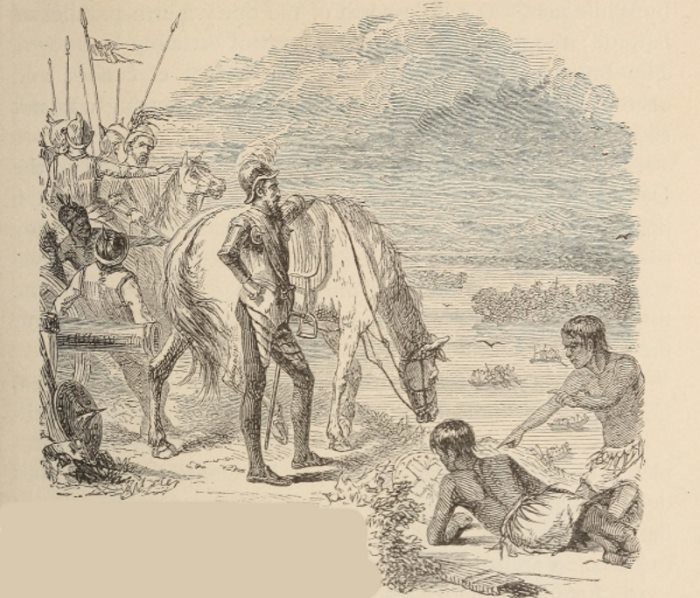
De Soto Reaches the Mississippi.
12. De Soto and his men next turned to the north, and by the middle of December reached the country of the Chickasaws. They crossed the Yazoo, and found an Indian village, which promised them shelter for the winter. Here, in February, 1541, they were attacked by the Indians, who set the town on fire, but Spanish weapons and discipline again saved De Soto and his men.
Discovery of the Mississippi.
13. The Spaniards next set out to journey farther westward, and the guides brought them to the Mississippi. The point where the Father of Waters was first seen by White men was a little north of the thirty-fourth parallel of latitude; the day of the discovery can not certainly be known. The Indians came down the river in a fleet of canoes, and offered to carry the Spaniards over; but a crossing was not effected until the latter part of May.
14. De Soto's men now found themselves in the land of the Dakotas. The natives at one place were going to worship the Spaniards, but De Soto would not permit such idolatry. They continued their march to the St. Francis River; thence westward for about two hundred miles; thence southward to the tributaries of the Washita River. On the banks of this stream they passed the winter of 1541-42.
Death of De Soto.
15. De Soto now turned toward the sea, and came upon the Mississippi in the neighborhood of Natchez. His spirit was completely broken. A fever seized upon his emaciated frame, and death shortly ensued. The priests chanted a requiem, and in the middle of the night his companions put his body into a rustic coffin and sunk it in the Mississippi.
16. Before his death, De Soto had named Moscoso as his successor. Under his leadership, the half-starved adventurers next crossed the country to the upper waters of the Red River, and then ranged the hunting-grounds of the Pawnees and the Comanches. In December of 1542 they came again to the Mississippi, where they built seven boats, and on the 2d of July, 1543, set sail for the sea. The distance was almost five hundred miles, and seventeen days were required to make the descent. On reaching the Gulf of Mexico, they steered to the southwest, and finally reached the settlement at the mouth of the River of Palms.
17. The next attempt to colonize Florida was in the year 1565. The enterprise was intrusted to Pedro Menendez, a Spanish soldier. He was commissioned by Philip II. to plant in some favorable district of Florida a colony of not less than five hundred persons, and was to receive two hundred and twenty-five square miles of land adjacent to the settlement. Twenty-five hundred persons joined the expedition.

Pedro Menendez.
18. The real object of Menendez was to destroy a colony of French Protestants, called Huguenots, who had made a settlement near the mouth of the St. John's River. This was within the limits of the territory claimed by Spain. The Catholic party of the French court had communicated with the Spanish court as to the whereabouts and intentions of the Huguenots, so that Menendez knew where to find and how to destroy them.
Founding of St. Augustine.
19. It was St. Augustine's day when the Spaniards came in sight of the shore, and the harbor and river which enters it were named in honor of the saint. On the 8th day of September, Philip II. was proclaimed monarch of North America; a solemn mass was said by the priests; and the foundations of the oldest town in the United States were laid. This was seventeen years before the founding of Santa Fé, and forty-two years before the settlement at Jamestown.
20. Menendez soon turned his attention to the Huguenots. He collected his forces at St. Augustine, stole through the woods, and falling on the defenseless colony, utterly destroyed it. Men, women, and children were alike given up to butchery. Two hundred were massacred. A few escaped into the forest, Laudonniere, the Huguenot leader, among the number, and were picked up by two French ships.
21. The crews of the vessels were the next object of vengeance. Menendez discovered them, and deceiving them with treacherous promises, induced them to surrender. As they approached the Spanish fort a signal was given, and seven hundred defenceless victims were slain. Only a few mechanics and Catholic servants were left alive.
22. The Spaniards had now explored the coast from the Isthmus of Darien to Port Royal in South Carolina. They were acquainted with the country west of the Mississippi as far north as New Mexico and Missouri, and east of that river they had traversed the Gulf States as far as the mountain ranges of Tennessee and North Carolina. With the establishment of their first permanent colony on the coast of Florida, the period of Spanish voyage and discovery may be said to end.
Portuguese Explorations.
23. A brief account of the only important voyages of the Portuguese to America will here be given. In 1495, John II., king of Portugal, was succeeded by his cousin Manuel, who, in order to secure some of the benefits which yet remained to discoverers, fitted out two vessels, and in the summer of 1501 sent Gaspar Cortereal to make a voyage to America.
24. The Portuguese ships reached Maine in July, and explored the coast for nearly seven hundred miles. Little attention was paid by Cortereal to the great forests of pine which stood along the shore, promising ship-yards and cities. He satisfied his rapacity by kidnapping fifty Indians, whom, on his return to Portugal, he sold as slaves. A new voyage was then undertaken, with the purpose of capturing another cargo of natives; but a year went by, and no tidings arrived from the fleet. The brother of the Portuguese captain sailed in hope of finding the missing vessels. He also was lost, but in what manner is not known. The fate of the Cortereals and their slave-ships has remained a mystery of the sea.
CHAPTER V.
The French in America.
Early French Explorations.
FRANCE was not slow to profit by the discoveries of Columbus. As early as 1504 the fishermen of Normandy and Brittany reached the banks of Newfoundland. A map of the Gulf of St. Lawrence was drawn by a Frenchman in the year 1506. Two years later some Indians were taken to France; and in 1518 the attention of Francis I. was turned to the New World. In 1523 John Verrazano, of Florence, was commissioned to conduct an expedition for the discovery of a northwest passage to the East Indies.
2. In January, 1524, Verrazano left the shores of Europe, with a single ship, called the Dolphin. After fifty days he discovered the mainland in the latitude of Wilmington. He sailed southward and northward along the coast and began a traffic with the natives. The Indians were found to be a timid race, unsuspicious and confiding. A half-drowned sailor, washed ashore by the surf, was treated with kindness, and permitted to return to the ship.
3. The voyage was continued toward the north. The coast of New Jersey was explored, and the hills marked as containing minerals. The harbor of New York was entered, and at Newport Verrazano anchored for fifteen days. Here the French sailors repaid the confidence of the natives by kidnapping a child and attempting to steal an Indian girl.
4. From Newport, Verrazano continued his explorations northward. The long line of the New England coast was traced with care. The Indians of the north would buy no toys, but were eager to purchase knives and weapons of iron. In the latter part of May, Verrazano reached Newfoundland. In July he returned to France and published an account of his great discoveries. The name of New France was given to the country.
Cartier on the St. Lawrence.
5. In 1534, James Cartier, a seaman of St. Malo, made a voyage to America. His two ships, after twenty days of sailing, anchored on the 10th day of May off the coast of Newfoundland. Cartier circumnavigated the island, crossed the Gulf of St. Lawrence, and ascended the estuary until the narrowing banks made him aware that he was in the mouth of a river. Cartier, thinking it impracticable to pass the winter in the New World, set sail for France, and in thirty days reached St. Malo.
Island of Montreal.
6. Another voyage was planned immediately. Three ships were provided; a number of young noblemen joined the expedition, and on the 19th of May the voyage was begun. The passage to Newfoundland was made by the 10th of August. It was the day of St. Lawrence, and the name of that martyr was given to the gulf and to the stream which enters it from the west. The expedition proceeded to the island of Orleans, where the ships were moored. Two Indians, whom Cartier had taken with him to France, gave information that there was an important town higher up the river. Proceeding thither, the French captain found a village at the foot of a high hill in the middle of an island. Cartier named the island and town Mont Real, and the country was declared to belong to the king of France. During this winter twenty-five of Cartier's men were swept off by the scurvy.
7. With the opening of spring, a cross was planted on the shore, and the homeward voyage began. The good king of the Hurons was decoyed on board and carried off to die. On the 6th of July the fleet reached St. Malo; but the accounts which Cartier published greatly discouraged the French; for neither silver nor gold had been found in New France.
8. Francis of Roberval was next commissioned by the court of France to plant a colony on the St. Lawrence. The man who was chiefly relied on to give character to the proposed colony was James Cartier. His name was accordingly added to the list, and he was honored with the office of chief pilot and captain-general.
9. It was difficult to find material for the colony. The French peasants were not eager to embark, and the work of enlisting volunteers went on slowly, until the government opened the prisons of the kingdom, giving freedom to whoever would join the expedition. There was a rush of robbers and swindlers, and the lists were immediately filled. Only counterfeiters and traitors were denied the privilege of gaining their liberty in the New World.
Fort on the site of Quebec.
10. In May of 1541, five ships, under command of Cartier, left France, reached the St. Lawrence, and ascended the river to the site of Quebec, where a fort was erected and named Charlesbourg. Here the colonists passed the winter. Cartier soon sailed away with his part of the squadron, and returned to Europe. Roberval was left in New France with three shiploads of criminals who could be restrained only by whipping and hanging. The winter was long and severe, and spring was welcomed for the opportunity which it gave of returning to France.
11. About the middle of the sixteenth century Admiral Coligny, of France, formed the design of establishing in America a refuge for the Huguenots of his own country. In 1562 John Ribault, of Dieppe, was selected to lead the Huguenots to the land of promise. In February the colony reached the coast of Florida near the site of St. Augustine. The River St. John's was entered and named the River of May. The vessel then sailed to the entrance of Port Royal; here it was determined to make the settlement. The colonists were landed on an island, and a stone was set up to mark the place. A fort was erected and named Carolina. In this fort Ribault left twenty-six men, and then sailed back to France. In the following spring the men in the fort mutinied and killed their leader. Then they built a rude brig and put to sea. They were at last picked up by an English ship and carried to France.
French in Florida.
12. Two years later another colony was planned, and Laudonniere chosen leader. The character, however, of this second Protestant company was very bad. A point on the River St. John's was selected for the settlement. A fort was built here, but a part of the colonists contrived to get away with two of the ships. The rest of the settlers were on the eve of departure when Ribault arrived with supplies and restored order. It was at this time that Menendez discovered the Huguenots and murdered them.
13. But Dominic de Gourgues, of Gascony, visited the Spaniards with signal vengeance. This man fitted out three ships, and with only fifty seamen arrived on the coast of Florida. He surprised three Spanish forts on the St. John's, and made prisoners of the inmates. Unable to hold his position, he hanged the leading captives to the trees, and put up this inscription to explain what he had done: "Not as Spaniards, but as murderers."
14. In the year 1598 the Marquis of La Roche was commissioned to found a colony in the New World. The prisons of France were again opened to furnish the emigrants. The vessels reached Sable Island, a dismal place off Nova Scotia, where forty men were left to form a settlement. La Roche returned to France and died, and for seven years the forty criminals languished on Sable Island. Then they were picked up and carried back to France, but were never remanded to prison.
Founding of Port Royal.
15. In the year 1603 the country, from the latitude of Philadelphia to that of Quebec, was granted to De Monts. The chief provisions of his patent were a monopoly of the fur-trade, and religious freedom for the Huguenots. With two shiploads of colonists De Monts left France in March of 1604, and reached the Bay of Fundy. Poutrincourt, the captain of one of the ships, asked and obtained a grant of some beautiful lands in Nova Scotia, and with a part of the crew went on shore. De Monts began to build a fort at the mouth of the St. Croix. But in the following spring they abandoned this place and joined Poutrincourt. Here, on the 14th of November, 1605, the foundations of the first permanent French settlement in America were laid. The name of Port Royal was given to the fort, and the country was called Acadia.

Samuel Champlain.
16. In 1603 Samuel Champlain, the most soldierly man of his times, was commissioned by Rouen merchants to establish a trading-post on the St. Lawrence. The traders saw that a traffic in furs was a surer road to riches than the search for gold and diamonds. Champlain crossed the ocean, sailed up the river, and selected the spot on which Quebec now stands as the site for a fort. In the autumn he returned to France.
Founding of Quebec.
17. In 1608 Champlain again visited America, and on the 3d of July in that year the foundations of Quebec were laid. The next year he and two other Frenchmen joined a company of Huron and Algonquin Indians who were at war with the Iroquois of New York. With this band he ascended the Sorel River until he came to the long, narrow lake, which has ever since borne the name of its discoverer.
18. In 1612 Champlain came to New France for the third time, and the success of the colony at Quebec was assured. Franciscan monks came over and began to preach among the Indians. Champlain again went with a war-party against the Iroquois. His company was defeated, he himself wounded and obliged to remain all winter among the Hurons. In 1617 he returned to the colony, and in 1620 began to build the fortress of St. Louis. Champlain became governor of New France, and died in 1635. To him, more than to any other man, the success of the French colonies in North America must be attributed.
CHAPTER VI.
English Discoveries and Settlements.
John Cabot's Discoveries.
ON the 5th of May, 1496, Henry VII., king of England, commissioned John Cabot, of Venice, to make discoveries in the Atlantic and Indian Oceans, and to take possession of all countries which he might discover. Cabot was a brave, adventurous man, who had been a sailor from his boyhood, and was now a wealthy merchant of Bristol. Five ships were fitted out, and in April, 1497, the fleet left Bristol. On the morning of the 24th of June, the gloomy shore of Labrador was seen. This was the real discovery of the American continent. Fourteen months elapsed before Columbus reached the coast of Guiana, and more than two years before Vespucci saw the main land of South America.
2. Cabot explored the coast of the country for several hundred miles. He supposed that the land was a part of the dominions of the Khan of Tartary; but finding no inhabitants, he went on shore and took possession in the name of the English king. No man forgets his native land; by the side of the flag of his adopted country Cabot set up the banner of the republic of Venice—emblem of another republic which should one day rule from sea to sea.
3. As soon as he had satisfied himself of the extent of the country, Cabot sailed for England. On the voyage he twice saw the coast of Newfoundland. After an absence of three months he reached Bristol, and was greeted with enthusiasm. The town had holiday, and the people were wild about the great discovery. The king gave him money; new ships were fitted out, and a new commission was signed in February, 1498. But after the date of this patent the name of John Cabot disappears from history.
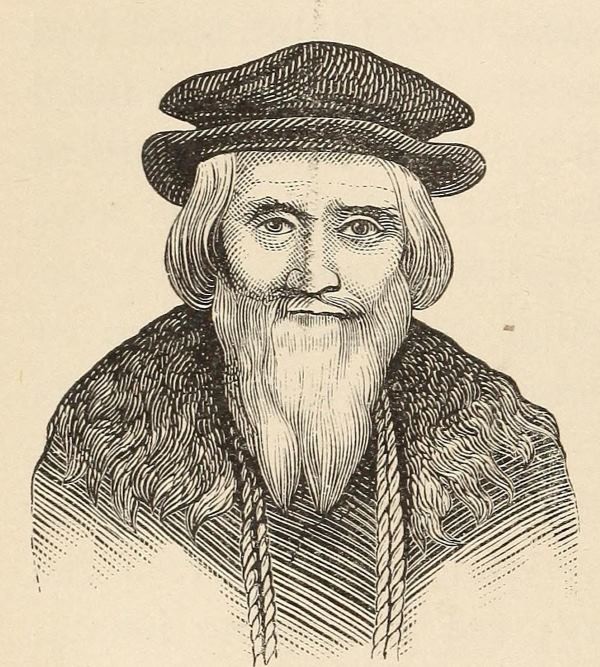
Sebastian Cabot.
Sebastian Cabot.
4. Sebastian, son of John Cabot, inherited his father's genius. He had already been to the New World on the first voyage, and now he took up his father's work with all the fervor of youth. The very fleet which had been equipped for John Cabot was intrusted to Sebastian. The object in view was the discovery of a northwest passage to the Indies.
5. The voyage was made in the spring of 1498. Far to the north the icebergs compelled Sebastian to change his course. It was July, and the sun scarcely set at midnight. Seals were seen, and the ships plowed through such shoals of codfish as had never before been heard of. Labrador was again seen. New Brunswick, Nova Scotia, and Maine were next explored. The whole coast of New England and of the Middle States was now, for the first time since the days of the Norsemen, traced by Europeans. Nor did Cabot desist from this work, which was bestowing the title of discovery on the crown of England, until he reached Cape Hatteras.
6. The future career of Cabot was a strange one. Henry VII. was slow to reward the discoverer. When that monarch died, the king of Spain enticed Cabot away from England and made him pilot-major of the Spanish navy. He lived to be very old, but the place and circumstances of his death are unknown.
7. The year 1498 is the most marked in the whole history of discovery. In the month of May, Vasco da Gama, of Portugal, doubled the Cape of Good Hope and succeeded in reaching Hindostan. During the summer, the younger Cabot traced the eastern coast of North America through more than twenty degrees of latitude. In August, Columbus himself reached the mouth of the Orinoco. Of the three great discoveries, that of Cabot has proved to be by far the most important.
8. In 1493 Pope Alexander drew an imaginary line three hundred miles west of the Azores, and gave all countries west of that line to Spain. Henry VII. was a Catholic and did not care to have a conflict with his Church by claiming the New World. Henry VIII. adopted the same policy, and it was not until after the Reformation in England that the decision of the pope was disregarded.
9. During the reign of Edward VI. the spirit of adventure was again aroused. In 1548 the old admiral Sebastian Cabot quitted Seville and once more sailed under the English flag. In the reign of Queen Mary the power of England on the sea was not materially extended, but with the accession of Elizabeth a new impulse was given to voyage and adventure.
The Northwest Passage.
10. Martin Frobisher began anew the work of discovery. Three small vessels were fitted out to sail in search of a northwest passage to Asia. One ship was lost on the voyage, another returned to England, but the third sailed on as far north as Hudson Strait. A large island lying northward was named Meta Incognita. Frobisher entered the strait which has ever since borne his name, and then sailed for England, carrying with him an Esquimo and a stone said to contain gold.
11. London was greatly excited. In May, 1577, a new fleet departed for Meta Incognita to gather the precious metal. But the vessels did not sail as far as Frobisher had done on a previous voyage. The mariners sought the first opportunity to get out of these dangerous seas and return to England.
12. The English gold-hunters were not yet satisfied. Fifteen new vessels were fitted out, and in 1578 a third voyage was begun. Three of the ships, loaded with emigrants, were to remain in the promised land. The vessels, struggling through the icebergs, finally reached Meta Incognita and took on cargoes of dirt. With several tons of the supposed ore under the hatches, the ships set sail for home. The El Dorado of the Esquimos had proved a failure.
13. In 1577 Sir Francis Drake, following Magellan, became a terror to the Spanish vessels in the Pacific. He hoped to find a northwest passage, and thence sail eastward around the continent. He proceeded northward as far as Oregon, when his sailors began to shiver with the cold, and the enterprise was given up. Drake passed the winter of 1579-80 in a harbor on the coast of Mexico.

Sir Walter Raleigh.
Plans for Colonization.
14. Sir Humphrey Gilbert was perhaps the first to form a rational plan of colonization in America. His idea was to plant an agricultural and commercial state. Assisted by his illustrious half-brother, Walter Raleigh, Gilbert prepared five vessels, and in June of 1583 sailed for the west. In August Gilbert reached Newfoundland, and took possession of the country. Soon the sailors discovered some scales of mica, and went to digging the supposed silver, while others attacked the Spanish fishing-ships in the neighboring harbors.
15. One of Gilbert's vessels became worthless, and was abandoned. With the rest he sailed toward the south. Off the coast of Massachusetts the largest of the ships was wrecked, and a hundred sailors were drowned. Gilbert determined to return to England. The weather was stormy, and the two ships now remaining were unfit for the sea. The captain remained in the weaker vessel, called the Squirrel. As the ships were struggling through the sea at midnight, the Squirrel was suddenly engulfed; not a man of the crew was saved. The other vessel finally reached Falmouth in safety.
16. The project of colonization was renewed by Raleigh. In the spring of 1584 he obtained a new patent for a tract in America extending from the thirty-third to the fortieth parallel of latitude. This territory was to be peopled and organized into a state. Two ships were fitted out, and the command given to Philip Amidas and Arthur Barlow.
Virginia.
17. In July the vessels reached Carolina. The woods were full of beauty and song. The natives were generous and hospitable. The shores of Albemarle and Pamlico Sounds were explored, and a landing effected on Roanoke Island, where the English were entertained by the Indian queen. But after a stay of two months Amidas and Barlow returned to England, praising the beauties of the new land. Queen Elizabeth gave to her delightful country in the New World the name of Virginia, for she was called the Virgin Queen.
Colony at Roanoke.
18. In December, 1584, Sir Walter fitted out a second expedition, and appointed Ralph Lane governor of the colony. Sir Richard Grenville commanded the fleet, and a company, partly composed of young nobles, made up the crew. The fleet of seven vessels reached Roanoke on the 26th of June.
Here Lane was left with a hundred and ten of the immigrants to form a settlement. But hostilities soon broke out between the English and the Indians; and when Sir Francis Drake came with a fleet, the colonists prevailed on him to carry them back to England.
19. Soon Sir Richard Grenville came to Roanoke with three well-laden ships, and made a fruitless search for the colonists. Not to lose possession of the country, he left fifteen men on the island, and set sail for home. Another colony was easily made up, and in July the emigrants arrived in Carolina. A search for the fifteen men who had been left on Roanoke revealed the fact, that the natives had murdered them. Nevertheless, the northern extremity of the island was chosen as the site for a city.
20. Disaster attended the enterprise. The Indians were hostile, and the fear of starvation soon compelled Governor White to return to England for supplies. The 18th of August was the birthday of Virginia Dare, the first-born of English children in the New World. Raleigh returned in 1590 to search for the unfortunate colonists. No soul remained to tell their story. Sir Walter, after spending two hundred thousand dollars, gave up the enterprise, and assigned his rights to an association of London merchants.
English Explorations in the North.
21. The next English expedition was that of Bartholomew Gosnold in 1602. Thus far all the voyages to America had been by way of the Canary Islands and the West Indies. Abandoning this path, Gosnold, in a small vessel called the Concord, sailed directly across the Atlantic, and in seven weeks reached Maine. He explored the coast and went on shore at Cape Cod. It was the first landing of Englishmen within the limits of New England. He loaded the Concord with sassafras root, and reached home in safety.
22. Another expedition to America was soon planned, with Martin Pring for commander. In April, 1603, his vessels came safely to Penobscot Bay, and spent some time in exploring the harbors of Maine. He loaded his vessels with sassafras at Martha's Vineyard, and returned to England, after an absence of six months.
23. Two years later, George Waymouth made a voyage to America. He reached the coast of Maine, and explored a harbor. Trade was opened with the Indians, some of whom returned with Waymouth to England. This was the last English expedition before the actual establishment of a colony in America.
CHAPTER VII.
English Discoveries and Settlements.—(Continued.)
ON the 10th of April, 1606, King James I. issued two patents to men of his kingdom, authorizing them to colonize all that portion of North America lying between the thirty-fourth and forty-fifth parallels of latitude. The immense tract extended from the mouth of Cape Fear River to Passamaquoddy Bay, and westward to the Pacific Ocean.
2. The first patent was to an association of nobles, gentlemen and merchants called the London Company; and the second to a similar body bearing the name of the Plymouth Company. To the former corporation was given the region between the thirty-fourth and the thirty-eighth degrees of latitude, and to the latter the tract from the forty-first to the forty-fifth degree. The belt of three degrees between the thirty-eighth and forty-first parallels was to be open to colonies of either company, but no settlement of one party was to be made within less than a hundred miles of the nearest settlement of the other.
The London Company.
3. The leading man in the London Company was Bartholomew Gosnold. His principal associates were Edward Wingfield, a rich merchant, Robert Hunt, a clergyman, and John Smith, an adventurer. The affairs of the company were to be administered by a Superior Council in England, and an Inferior Council in the colony. All legislative authority was vested in the king. A provision in the patent required the colony to hold all property in common for five years. The best law of the charter allowed the emigrants to retain in the New World all the rights of Englishmen.
The Plymouth Company.
4. In 1606 the Plymouth Company sent two ships to America, and in the summer of 1607 dispatched a colony of one hundred persons. A settlement was begun at the mouth of the Kennebec. The ships returned to England, leaving a colony of forty-five persons; but in the winter of 1607-8, some of the settlers were starved and some frozen; the storehouse was burned, and the remnant escaped to England.
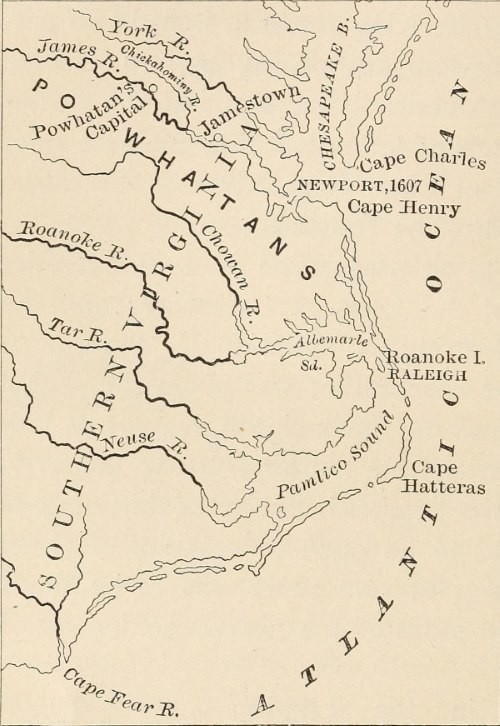
The First English Settlements.
Settlement of Jamestown.
5. The London Company had better fortune. A fleet of three vessels was fitted out under command of Christopher Newport. In December the ships, having on board a hundred and five colonists, among whom were Wingfield and Smith, left England. Entering Chesapeake Bay, the vessels came to the mouth of a beautiful river, which was named in honor of King James. Proceeding up stream about fifty miles, Newport found on the northern bank a peninsula noted for its beauty; the ships were moored and the emigrants went on shore. Here, on the 13th of May (Old Style), 1607, were laid the foundations of Jamestown, the oldest English settlement in America.
New England Named.
6. Meanwhile Captain John Smith, in 1609, left Jamestown and returned to England. There he formed a partnership with four wealthy merchants of London to trade in furs and establish a colony within the limits of the Plymouth grant. Two ships were freighted with goods and put under Smith's command. The summer of 1614 was spent on the coast of Maine, where a traffic was carried on with the Indians. But Smith himself explored the country, and drew a map of the whole coast from the Penobscot to Cape Cod. In this map, the country was called New England.
7. In 1615 a small colony of sixteen persons, led by Smith, was sent out in a single ship. When nearing the American coast, they encountered a storm and were obliged to return to England. The leader renewed the enterprise, and raised another company. Part of his crew mutinied in mid-ocean. His own ship was captured by a band of French pirates, and himself imprisoned. But he escaped and made his way to London. The years 1617-18 were spent in making plans of colonization, until finally the Plymouth Company was superseded by a new corporation called the Council of Plymouth. On this body were conferred almost unlimited powers and privileges. All that part of America lying between the fortieth and the forty-eighth parallels of north latitude, and extending from ocean to ocean, was given to forty men.
8. John Smith was now appointed admiral of New England. The king issued a proclamation enforcing the charter, and everything gave promise of the early settlement of America. Meanwhile the time had come when, without the knowledge or consent of James I. or the Council of Plymouth, a permanent settlement should be made on the shores of New England.
The Puritans.
9. About the close of the sixteenth century, a number of poor Puritans in the north of England joined together for free religious worship. They believed that every man has a right to know the truth of the Scriptures for himself. Such a doctrine was repugnant to the Church of England. Queen Elizabeth declared such teaching to be subversive of the monarchy. King James was also intolerant; and violent persecutions broke out against the sect.
10. Many of the Puritans went into exile in Holland. They took the name of Pilgrims, and grew content to have no home or resting-place. But they did not forget their native land. They pined with unrest, and were anxious to do something to convince King James of their patriotism.
11. In 1617 the Puritans began to meditate a removal to the New World. John Carver and Robert Cushman were dispatched to England to ask permission to settle in America. The agents of the Council of Plymouth favored the request, but the king refused. The most that he would do was to make a promise to let the Pilgrims alone in America.
The Mayflower.
12. The Puritans were not discouraged. The Speedwell, a small vessel, was purchased at Amsterdam, and the Mayflower, a larger ship, was hired for the voyage. The former was to carry the emigrants to Southampton, where they were to be joined by the Mayflower from London. Assembling at the harbor of Delft, as many of the Pilgrims as could be accommodated went on board the Speedwell. The whole congregation accompanied them to the shore, where their pastor gave them a farewell address, and the prayers of those who were left behind followed the vessel out of sight.
13. On the 5th of August, 1620, the vessels left Southampton; but the Speedwell was unable to breast the ocean, and put back to Plymouth. The Pilgrims were encouraged by the citizens, and the more zealous went on board the Mayflower for a final effort. On the 6th of September the first colony of New England, numbering one hundred and two souls, saw the shores of Old England sink behind the sea.
14. For sixty-three days the ship was buffeted by storms. On the 9th of November the vessel was anchored in the bay off Cape Cod; a meeting was held and the colony organized under a solemn compact. In the charter which they made for themselves the emigrants declared their loyalty to the English king, and agreed to live in peace and harmony. Such was the simple constitution of the oldest New England State. To this instrument all the heads of families, forty-one in number, set their names. An election was held, and John Carver was chosen governor.

The Landing of the Pilgrims.
The Landing of the Pilgrims.
15. Miles Standish, John Bradford, and a few others, went on shore and explored the country; nothing was found but a heap of Indian corn under the snow. On the 6th of December the governor landed with fifteen companions. The weather was dreadful. Snow-storms covered the clothes of the Pilgrims with ice. They were attacked by the Indians, but escaped to the ship with their lives. The vessel was at last driven by accident into a haven on the west side of the bay. The next day, being the Sabbath, was spent in religious services, and on Monday, the 11th of December (Old Style), 1620, the Pilgrims landed on Plymouth Rock.
16. It was the dead of winter. The houseless immigrants fell a-dying of hunger and cold. But a site was selected near the first landing, and, on the 9th of January, the toilers began to build New Plymouth. Every man took on himself the work of making his own house; but the ravages of disease grew daily worse. At one time only seven men were able to work on the sheds which were built for protection. If an early spring had not brought relief, the colony must have perished. Such were the sufferings of the winter when New England began its being.
CHAPTER VIII.
Voyages and Settlements of the Dutch.
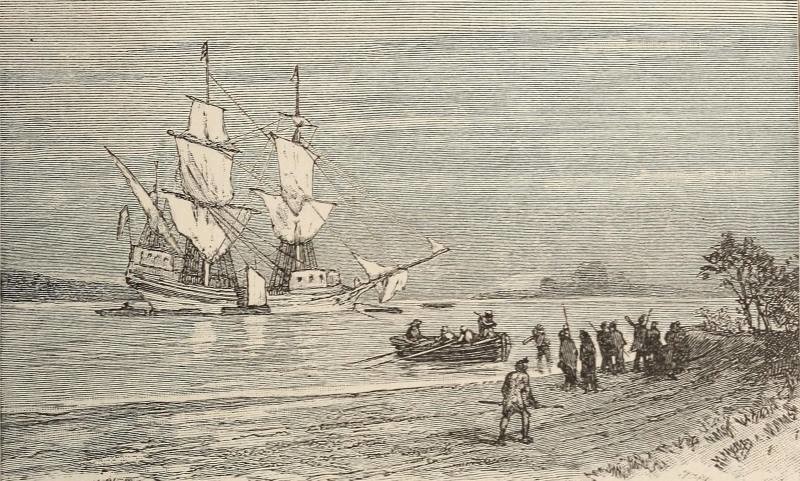
The Half Moon on Hudson River.
Dutch East India Company.
THE first Dutch settlement in America was made on Manhattan Island. The colony resulted from the voyages of Sir Henry Hudson. In the year 1607 this great sailor was employed by a company of London merchants to discover a new route to the Indies. He first made two unsuccessful voyages into the North Atlantic, and his employers gave up the enterprise. In 1609 the Dutch East India Company furnished him with a ship called the Half Moon, and in April he set out for the Indies. Again he ran among the icebergs, and further sailing was impossible. But not discouraged, he immediately set sail for America.
2. In July Hudson reached the coast of Maine; and in August, the Chesapeake. On the 28th of the month he anchored in Delaware Bay, and on the 3d of September the Half Moon came to Sandy Hook. Two days later a landing was effected. The natives came with gifts of corn, wild fruit, and oysters. On the 10th the vessel passed the Narrows, and entered the noble river which bears the name of Hudson.
Discovery of Hudson River.
3. For eight days the Half Moon sailed up the river. Such beautiful forests and valleys, the Dutch had never seen before. On the 19th of September the vessel was moored at Kinderhook; but an exploring party rowed up stream beyond the site of Albany. The vessel then dropped down the river, and on the 4th of October the sails were spread for Holland. But the Half Moon was detained in England.
4. In the summer of 1610 a ship, called the Discovery, was given to Hudson, who sailed in the track which Frobisher had taken, and on the 2d day of August entered the strait which bears the name of its discoverer. The great captain believed that the route to China was at last discovered; but he soon found himself environed in the frozen gulf of the North. With great courage he bore up until his provisions were almost exhausted. Then the crew broke out in mutiny. They seized Hudson and his only son, with seven other faithful sailors, and cast them off among the icebergs. The fate of the illustrious mariner has never been ascertained.
5. In 1610 the Half Moon was liberated and returned to Amsterdam. In the same year several ships owned by Dutch merchants sailed to the banks of the Hudson and engaged in the fur-trade. In 1614 an act was passed by the States-General of Holland, giving to merchants of Amsterdam the right to trade and establish settlements in the country explored by Hudson. A fleet of five trading-vessels arrived in the summer of the same year at Manhattan Island. Here some rude huts had already been built by former traders, and the settlement was named New Amsterdam.
6. In the fall of 1614 Adrian Block sailed into Long Island Sound, and made explorations as far as Cape Cod. Christianson, another Dutch commander, sailed up the river from Manhattan to Castle Island, and erected a block-house, which was named Fort Nassau. Cornelius May, the captain of a small vessel called the Fortune, sailed from New Amsterdam and explored the Jersey coast as far as the Bay of Delaware. Upon these two voyages Holland set up a claim to the country, which was now named New Netherlands, extending from Cape Henlopen to Cape Cod. Such were the feeble beginnings of the Dutch colonies in New York and Jersey.
Review Questions.—Part II.
CHAPTER II.
- 1. Tell about the Icelanders and Norwegians in America.
CHAPTER III.
- 2. Give an account of Columbus, and of his discoveries and explorations in the New World.
- 3. Give an account of the voyage of Amerigo Vespucci, and of how this Continent came to be known by his name.
- 4. What were the services of Balboa, and of Ponce de Leon?
CHAPTER IV.
- 5. Sketch the later discoveries by the Spaniards in America.
- 6. Tell of the coming of the Portuguese.
CHAPTER V.
- 7. Trace the progress of the French discoverers and explorers on the new Continent.
CHAPTER VI.
- 8. Give an account of the commission, and of the explorations of John and Sebastian Cabot.
- 9. What work of discovery was attempted by Martin Frobisher, and with what result?
- 10. Outline the colonization schemes of Sir Humphrey Gilbert and Sir Walter Raleigh.
- 11. What change of plan for colonization was adopted by Gosnold, and with what success?
CHAPTER VII.
- 12. Tell of the Royal Patents to the London and Plymouth Companies.
- 13. Sketch the efforts of the Plymouth Company toward colonization, and the coming of the Puritans.
CHAPTER VIII.
- 14. Give an account of the voyages and final successes of Sir Henry Hudson.
- 15. On what did the Dutch base their early claim to lands in America?
Part III.
COLONIAL HISTORY.
A. D. 1607-1754.
CHAPTER IX.
Virginia—The First Charter.

Colony at Jamestown.
THE first settlers at Jamestown were idle and improvident. Only twelve of those who came in 1607 were common laborers. There were four carpenters in the company, six or eight masons and blacksmiths, and a long list of gentlemen. The few married men had left their families in England.
2. The affairs of the colony were badly managed. Captain John Smith, the best man in the colony, was suspected of making a plot to murder the council and to make himself king of Virginia. He was arrested and confined until the end of the voyage. When the colonists reached their destination, the king's instructions were unsealed and the names of the Inferior Council made known. A meeting was held and Edward Wingfield elected first governor.
3. As soon as the settlement was well begun, Smith and Newport, with twenty others, explored James River for forty-five miles. Just below the falls, the explorers found the capital of Powhatan, the Indian king. But the "city" was only a squalid village of twelve wigwams. The monarch received the foreigners with courtesy and showed no dislike at the intrusion.
4. The colonists now began to realize their situation. They were alone in the New World. Winter was approaching. Dreadful diseases broke out, and the colony was brought almost to ruin. At one time only five men were able to go on duty as sentinels, and before the middle of September one half of the colonists died. But the frosts came, and disease was checked.
Civil Dissensions.
5. Civil dissension arose. President Wingfield and George Kendall were detected in embezzling the stores, and were removed from office. Ratcliffe was then chosen president, but was found incompetent. Only Martin and Smith now remained in the council, and the latter took charge of the colony. Under his administration the new settlement soon began to show signs of progress. His first care was to improve the buildings of the plantation; then to secure a supply of provisions. There had been a plentiful harvest among the Indians; but the work of procuring corn was not an easy task. Descending James River to Hampton Roads, Smith landed with five companions and offered the natives hatchets and copper coins in exchange for corn.
6. But the Indians only laughed at the proposal. The English then charged on the wigwams, and the warriors were obliged to purchase peace by loading the boats of the English with corn. Soon the Indians in the neighborhood began to come with voluntary contributions. The fear of famine passed away. The woods were full of wild turkeys. Good discipline was maintained in the colony, and friendly relations were established with the natives. The colonists became cheerful and happy.
7. As soon as winter set in, the president, with six Englishmen and two Indian guides, began to explore along the Chickahominy. It was believed by the people of Jamestown that by going up this stream they could reach the Pacific Ocean! Smith knew the absurdity of such an opinion, but humored it because of the opportunity it gave him to see the country and make maps.
Capt. Smith and the Indians.
8. The president and his companions ascended the river until it dwindled to a mere creek. The men who were left to protect the boats were attacked by Indians, and several of the English were killed. Smith was wounded with an arrow, and chased through the woods. He fought, ran, and fired by turns, but was finally overtaken.
9. Smith demanded to see the Indian chief, and excited his curiosity by showing him a pocket-compass and a watch. These instruments struck the Indians with awe; but the savages bound their captive to a tree, and prepared to shoot him, but he flourished his compass in the air and the Indians were afraid to fire.
10. Smith was next taken to Orapax, a few miles from the site of Richmond. Here he found the Indians making preparations to attack Jamestown. They invited him to become their leader, but he refused and managed to write a warning letter to his countrymen. This letter, because of its mysterious power of carrying intelligence, frightened them more than ever. When the warriors arrived at Jamestown and found everything as Smith had said, all thought of attacking the colony was given up.

Captain John Smith.
11. The Indians now marched their captive from village to village. Near the fork of York River, at Pamunkey, Smith was turned over to the priests, who assembled in their Long House and for three days danced around him, sang and yelled, to determine by this wild ceremony what his fate should be. The decision was against him, and he was condemned to death.
Pocahontas saves Smith.
12. Smith was next taken to a town where Powhatan lived in winter. The savage monarch, now sixty years of age, took his seat in the Long House. His two daughters sat near him, and warriors and women were ranged around the hall. The king reviewed the cause and confirmed the sentence of death. Two large stones were brought, Smith was dragged forth bound, and his head put into position to be crushed with a war-club; but as the executioner raised his club, Matoaka,[A] the eldest daughter of Powhatan, rushed between it and the prostrate prisoner. She clasped his head in her arms and held on until her father ordered Smith to be unbound. Soon it was agreed that he should return to Jamestown.
[A] Powhatan's tribe had a superstition that a person whose real name was unknown could not be injured. They therefore told the English falsely that Matoaka's name was Pocahontas.
13. Only thirty-eight of the settlers were now alive, and these were frost-bitten and half-starved. Their leader had been absent for seven weeks. The old fears of the colonists had revived, and when Smith returned he found all hands preparing to abandon the settlement. He induced the majority to abandon this project, but the rest, burning with resentment, made a conspiracy to kill him.
14. In these days Newport arrived from England, bringing supplies and a hundred and twenty immigrants. But the new-comers were gentlemen, gold-hunters, jewelers, engravers, adventurers, and strollers. Smith was much vexed at this, for he had urged Newport to bring over only a few industrious mechanics and laborers.
15. Soon the new-comers and some of the old settlers began to stroll about the country digging for gold. At the mouth of a small creek some glittering particles were found, and the whole settlement was thrown into excitement. Soon afterwards a company sailed up James River to find the Pacific Ocean! Fourteen weeks were consumed in this nonsense. Even the Indians ridiculed the madness of men who were wasting their chances for a crop of corn.
Chesapeake Bay Explored.
16. But Smith had formed the design of exploring Chesapeake Bay and its tributaries. Accompanied by Dr. Russell and thirteen others, he left Jamestown on the 2d day of June. He steered his barge by way of Hampton Roads as far as Smith's Island. Returning thence around Cape Charles, he continued northward as far as the river Wicomico, then crossed over to the Patuxent, and thence northward to the Patapsco. Then steering southward he had the good fortune to enter the mouth of the Potomac and continue the voyage as far as the falls at Georgetown. He then dropped down the river to the bay, and reached Jamestown on the 21st of July.
17. After three days a second voyage was begun. The expedition reached the head of the bay, and sailed far up the Susquehanna. On the return, Smith explored every sound and inlet of any note as far as the Rappahannock. This stream he ascended to the head of navigation, and then returned to Jamestown. He had been absent a little more than three months, and had explored the coast of the great bay for fully three thousand miles. Now he was come back to the colony with a Map of the Chesapeake, which he sent by Newport to England, and which is still preserved.
Smith Elected President.
18. Smith was now formally elected president. Soon there was a marked change for the better; gold-hunting ceased, and the rest of the year was noted as a time of prosperity. In the autumn Newport arrived with seventy additional immigrants. The health was so good that only seven deaths occurred between September and the following May. Every well man was obliged to work six hours a day. New houses were built, new fields fenced in; and through the winter the sound of ax and hammer gave token of a prosperous and growing village.
19. On the 23d day of May, 1609, King James granted to the London Company a new charter for the government of Virginia. The territory was extended from Cape Fear to Sandy Hook, and westward to the Pacific Ocean. The members of the Superior Council were now to be chosen by the stockholders of the company, vacancies were to be filled by the councilors, who were also to elect a governor. The new council was at once organized, and Lord De La Ware chosen governor for life. Five hundred emigrants were collected, and in June a fleet of nine vessels sailed for America. Lord Delaware did not himself accompany the expedition. In July the ships, then in the West Indies, were scattered by a storm. One vessel was wrecked, and another, having on board the commissioners of Delaware, was driven ashore on one of the Bermudas; the other seven ships came safely to Jamestown.
20. Captain Smith continued in authority under the old constitution; but the colony was in an uproar. The president was in daily peril of his life. He put some of the most rebellious brawlers in prison, and planned two new settlements—one, of a hundred and twenty men, at Nansemond; the other, of the same number, at the falls of the James. Both companies behaved badly. In a few days after their departure troubles arose with the Indians. While attempting to quell these difficulties, Smith was wounded, and fearing the imperfect medical treatment which the colony afforded, he decided to return to England. He accordingly delegated his authority to Sir George Percy, and about the middle of September, 1609, left the scene of his toils and sufferings, never to return.
The Starving Time.
21. A colony of four hundred and ninety persons remained at Jamestown. The settlement was soon brought face to face with starvation. The Indians became hostile; stragglers were murdered; houses were set on fire; disease returned to add to the desolation; and cold and hunger made the winter long remembered as The Starving Time. By the last of March only sixty persons were left alive.
22. Meanwhile, Sir Thomas Gates and his companions, who had been shipwrecked in the Bermudas, constructed two small vessels, and came to Virginia, where a few wan, half-starved wretches crawled out of their cabins to beg for bread! Whatever stores the commissioners had brought with them were distributed, and Gates assumed control of the government. But the colonists had now determined to abandon the place forever. In vain did the commissioners remonstrate. An agreement was made to sail for Newfoundland, and on the 8th of June the colonists, embarking in their four boats, dropped down the river, and Jamestown was abandoned.
23. Lord Delaware was already on his way to America. Before the escaping settlers had reached the sea, the ships of the governor came in sight with additional immigrants, plentiful supplies, and promise of better things. The colonists returned, and before nightfall the fires were again kindled at Jamestown. On the next day the governor caused his commission to be read, and entered upon the discharge of his duties. His amiability and virtue, and the wisdom of his administration, endeared him to all and inspired the colony with hope.
24. Lord Delaware was compelled, on account of ill-health, to return to England. His authority was delegated to Percy, the deputy of Captain Smith. The Superior Council had already dispatched new stores and more emigrants, under Sir Thomas Dale. When the vessel arrived at Jamestown, Percy was superseded by Dale, who adopted a system of martial law as the basis of his administration. In the latter part of August, Sir Thomas Gates arrived with six ships, three hundred additional immigrants, and a large quantity of stores.
[A] Powhatan's tribe had a superstition that a person whose real name was unknown could not be injured. They therefore told the English falsely that Matoaka's name was Pocahontas.
12. Smith was next taken to a town where Powhatan lived in winter. The savage monarch, now sixty years of age, took his seat in the Long House. His two daughters sat near him, and warriors and women were ranged around the hall. The king reviewed the cause and confirmed the sentence of death. Two large stones were brought, Smith was dragged forth bound, and his head put into position to be crushed with a war-club; but as the executioner raised his club, Matoaka,[A] the eldest daughter of Powhatan, rushed between it and the prostrate prisoner. She clasped his head in her arms and held on until her father ordered Smith to be unbound. Soon it was agreed that he should return to Jamestown.
The Land Divided.
25. Thus far the property of the settlers at Jamestown had been held in common. Now the right of holding private property was recognized. Governor Gates had the lands divided so that each settler should have three acres of his own; every family might cultivate a garden and plant an orchard, the fruits of which no one but the owner was allowed to gather. The benefits of this system of labor were at once apparent, and the laborers became cheerful and industrious.
CHAPTER X.
Charter Government.—(Continued.)
IN the year 1612 the London Company obtained from the king a third patent, by which the government was again changed. The Superior Council was abolished, and the stockholders were authorized to elect their own officers and to govern the colony on their own responsibility. The new patent was a great step toward a democratic form of government in Virginia.
2. In 1613 Captain Samuel Argall, on an expedition up the Potomac, learned that Pocahontas was residing in that neighborhood. He enticed the girl on board his vessel and carried her captive to Jamestown. It was decided that Powhatan should pay a heavy ransom for his daughter's liberation. The king refused, and ordered his tribes to prepare for war. Meanwhile, Pocahontas was converted to the Christian faith and became a member of the Episcopal Church.
Marriage of Pocahontas.
3. Soon afterwards John Rolfe, of the colony, sought the hand of the princess in marriage. Powhatan gave his consent, and the nuptials were celebrated in the spring of the next year. Three years later, Pocahontas, while visiting in England, fell sick and died. There was left of this marriage a son, who came to Jamestown, and to whom several families of Virginians still trace their origin. John Randolph of Roanoke was a descendant of Pocahontas.
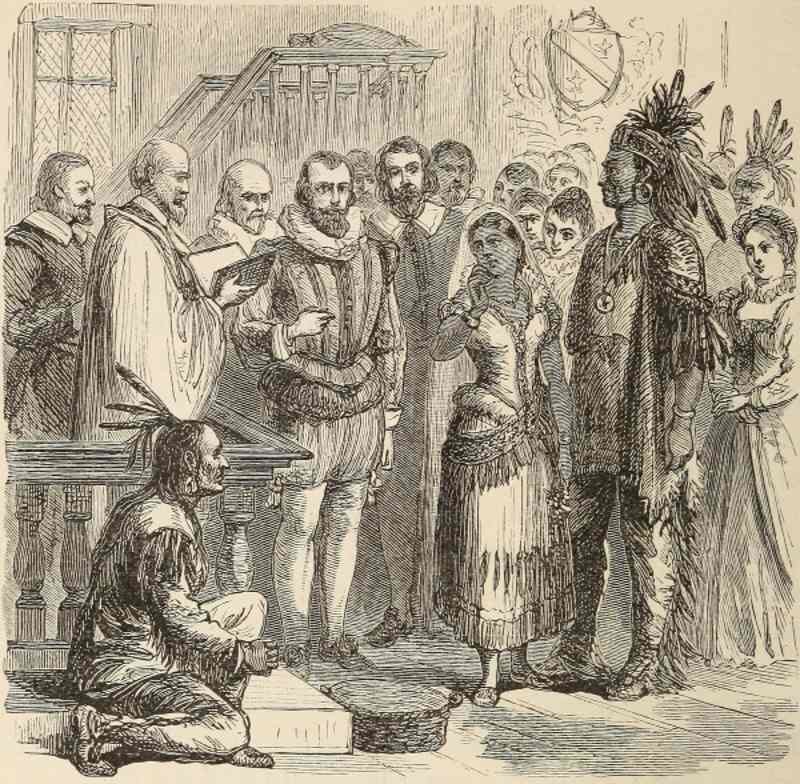
Marriage of Pocahontas.
Expedition against Acadia.
4. Captain Argall was next sent with an armed vessel to the coast of Maine, to protect the English fishermen, and to destroy the colonies of France, if any should be found within the territory claimed by England. The French authorities of Acadia were building a village near the mouth of the Penobscot. The settlement was pillaged and the houses burned. The French colony at the mouth of the St. Croix was attacked, and the fort cannonaded and destroyed; the hamlet at Port Royal was burned. By these outrages, the French settlements in America were confined to the banks of the St. Lawrence.
Cultivation of Tobacco.
5. In March of 1614 Sir Thomas Gates returned to England, leaving the government with Dale. In these times the laws of the colony were much improved, and the industry took a better form. Hitherto the settlers had engaged in planting vineyards and in the manufacture of soap, glass, and tar. The managers of the company had at last learned that these articles could be produced more cheaply in Europe than in America, while some products of the New World might be raised and exported with great profit. The chief of these was the tobacco-plant, the use of which had become fashionable in Spain, England, and France. This, then, became the leading staple of the colony, and was even used for money. So entirely did the settlers give themselves to the cultivation of the weed that the streets of Jamestown were plowed up and planted with it.
6. In 1617 the unprincipled Captain Argall was elected governor. When the news of his fraudulent and violent proceedings reached England emigration ceased, and Lord Delaware embarked for Virginia, in the hope of restoring order. But he died on the voyage, and Argall continued in office until 1619, when Sir George Yeardley was appointed to succeed him.
The House of Burgesses.
7. Martial law was now abolished. Taxes were repealed, and the people freed from many burdens. Governor Yeardley divided the plantations into eleven boroughs, and ordered the citizens of each to elect two of their number to take part in the government. The elections were duly held, and on the 30th of July, 1619, the Virginia House of Burgesses was organized—the first popular assembly in the New World. In this body there was freedom of debate but very little political power.
Introduction of Slavery.
8. The year 1619 was also marked by the introduction of slavery. The servants at Jamestown had hitherto been English or Germans, whose term of service had varied from a few months to many years. No perpetual servitude had thus far been recognized. In the month of August a Dutch man-of-war sailed up the river to the plantations, and offered by auction twenty Africans. They were purchased by the wealthier class of planters, and made slaves for life.
Wives for the Colonists.
9. There were now six hundred men in the colony, for the most part rovers who intended to return to England. Very few families had emigrated. In this condition of affairs, Sir Thomas Smith was superseded by Sir Edwyn Sandys, a man of prudence and integrity. In the summer of 1620, the new treasurer sent to America a company of twelve hundred and sixty-one persons. Among the number were ninety young women of good breeding and modest manners. In the following spring, sixty others of similar good character came over, and received a hearty welcome.
10. When Sandys sent these women to America, he charged the colonists with the expense of the voyage, as the company was bankrupt. An assessment was made, and the rate fixed at a hundred and twenty pounds of tobacco for each passenger—a sum which the settlers cheerfully paid. There were merry marriages at Jamestown, and the social condition was much improved. When the second shipload came, the cost of transportation was a hundred and fifty pounds for each passenger, which was also paid without complaint.
A Code of Laws.
11. In July of 1621 the London Company gave to Virginia a code of written laws, and in October Sir Francis Wyatt, who had been commissioned as governor, began to administer the new constitution. The colony was found in a flourishing condition. The settlements extended for a hundred and forty miles along the banks of James River, and far into the interior. But the Indians had grown jealous of the colonists. Pocahontas was dead. The peaceable Powhatan had likewise passed away. Opechancanough, who succeeded him in 1618, had long been plotting the destruction of the English, and the time had come for the tragedy.
The Indian Massacre.
12. Until the very day of the massacre, the Indians continued on terms of friendship with the colonists. On the 22d of March, at midday, the work of butchery began. Every hamlet in Virginia was attacked. Men, women, and children were indiscriminately slaughtered, until three hundred and forty-seven had perished under the hatchets of the savages.
13. But Indian treachery was thwarted by Indian faithfulness. A converted Red man, wishing to save an Englishman who had been his friend, went to him on the night before the massacre and revealed the plot. The alarm was spread, and thus the greater part of the colony escaped destruction. But the outer plantations were entirely destroyed. The people crowded together on the larger farms about Jamestown, until of the eighty settlements there were only eight remaining. Still, there were sixteen hundred brave men in the colony; and the next year the population increased to two thousand five hundred.
The Charter Cancelled.
14. The liberal constitution of Virginia soon proved offensive to King James. A committee was appointed to look into the affairs of the London Company. The commissioners performed their duty, and reported that the company was unsound in its principles, that the treasury was bankrupt, and that the government of Virginia was very bad.
15. Legal proceedings were now instituted against the company, and the judges decided that the patent was null and void. The charter was canceled by the king, and in June of 1624 the London Company ceased to exist. But its work had been well done. A torch of liberty had been lighted on the banks of the James, which all the tyranny of after times could not extinguish.
CHAPTER XI.
Virginia.—The Royal Government.
Royal Governors.
A royal government was now established in Virginia consisting of a governor and twelve councilors. The General Assembly of the colony was left undisturbed, and the rights of the colonists remained as before. Governor Wyatt was continued in office. Charles I., the successor of King James, paid but little attention to the affairs of his American colony until the commerce in tobacco attracted his notice, and he then made an unsuccessful attempt to gain a monopoly of the trade.
2. In 1626 Governor Wyatt retired from office, and Yeardley, the old friend of the colonists, was reappointed. The young State was never more prosperous than under this administration, which was ended with the governor's death in 1627. During the preceding summer a thousand new immigrants had come to swell the population of the province.
3. The council of Virginia had the right, in case of an emergency, to elect a governor. In this manner Francis West was chosen by the councilors; but as soon as the death of Yeardley was known in England, King Charles commissioned John Harvey to assume the government. He arrived in the autumn of 1629, and became a most unpopular chief magistrate. He began his administration by taking the part of certain land speculators against the people. The assembly of 1635 passed a resolution that Sir John Harvey be thrust out of office, and Captain West be appointed in his place "until the king's pleasure may be known in this matter." But King Charles treated the whole affair with contempt, and Harvey continued in power until the year 1639, when he was superseded by Wyatt, who ruled until the spring of 1642.
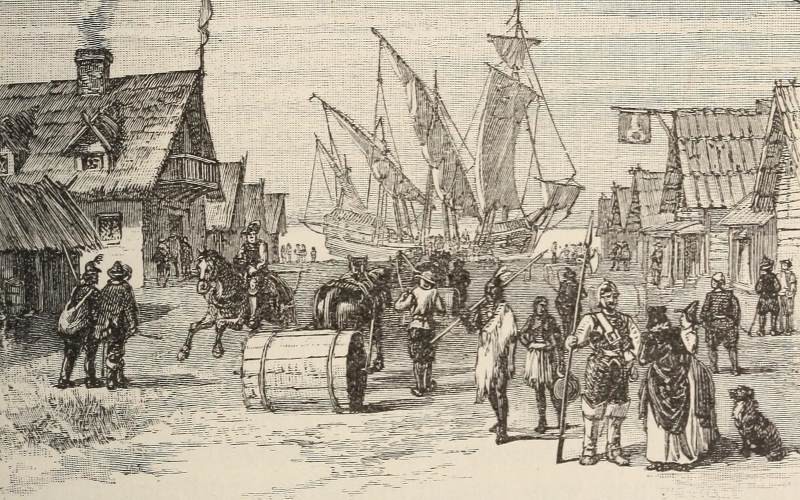
Life at Old Jamestown.
Effect of the Protectorate.
4. About this time monarchy was abolished in England. Oliver Cromwell was made Lord Protector of the Commonwealth, and this government continued until Charles II., exiled son of Charles I., was restored to the throne of England. Virginia shared in some degree the distractions of the mother-country. In 1642 Sir William Berkeley became governor, and remained in office for ten years. His administration was noted as a time of rapid growth and development. The laws were greatly improved. The old disputes about the lands were satisfactorily settled. Cruel punishments were abolished, and the taxes equalized. The general assembly was regularly convened, and Virginia became a free and prosperous State. In 1646 there were twenty thousand people in the colony.
5. In March of 1643, a law was enacted by the assembly declaring that no person who disbelieved the doctrines of the English Church should be allowed to teach, or to preach the gospel, within the limits of Virginia. This act was the source of much bitterness among the people. The few Puritans were excluded from places of trust, and some were driven from their homes. Governor Berkeley was a leader in these persecutions, by which all friendly relations with New England were broken off for many years.
6. Next came another war with the Indians. Early in 1644, the natives planned a general massacre. On the 18th of April the savages fell upon the frontier settlements, and murdered three hundred people before assistance could be brought. The warriors then fled, but were closely followed by the English. Opechancanough was captured, and died a prisoner. The tribes were punished without mercy, and were soon glad to buy a peace by the cession of large tracts of land.
The Election of Governors.
7. For a while the colonists conducted their government as they wished. The important matter of choosing a governor was submitted to the House of Burgesses; when so great a power had been once exercised, it was not likely to be relinquished. Three governors were chosen in this way, and the privilege of electing soon became a right. The assembly even declared that such a right existed, and that it should not be taken away.
8. In 1660 Samuel Matthews, the last of the three elected governors, died. The Burgesses were convened and an ordinance passed declaring that the supreme authority of Virginia was in the colony, and would continue there until a delegate should arrive from the British government. The house then elected as governor Sir William Berkeley, who acknowledged the right of the Burgesses to choose.
9. As soon as it was known in Virginia that Charles II. had become king, Governor Berkeley issued writs in the name of the king for the election of a new assembly. The adherents of the Commonwealth were thrust out of office, and royal favorites established in their places. The Virginians soon found that they had exchanged a republican tyrant with good principles for a monarchial tyrant with bad ones. The former commercial system was reenacted in a worse form than ever. The new law provided that all the colonial commerce should be carried on in English ships; the trade of the colonies was burdened with a heavy tax, and tobacco, the staple of Virginia, could be sold nowhere but in England.
Effects of the Restoration.
10. King Charles soon began to reward the profligates who thronged his court, by granting them large tracts of land in Virginia. It was no uncommon thing for an American planter to find that his farm had been given away to some flatterer of the royal household, and finally, in 1673, the king set a limit to his own recklessness by giving away the whole province. Lord Culpepper and the Earl of Arlington received a deed by which was granted to them for thirty-one years all the country called Virginia.
11. The colonial legislation of these times was selfish and narrow-minded. The aristocratic party had obtained control of the House of Burgesses. A statute was passed against the Baptists, and the peace-loving Quakers were fined and persecuted. Personal property was heavily taxed, while the large estates were exempt. The salaries of the officers were secured by a duty on tobacco, and the biennial election of Burgesses was abolished.
12. When the people were worn out with the governor's exactions, they availed themselves of a pretext to assert their rights by force of arms. A war with the Susquehanna Indians furnished the occasion for an insurrection. The tribes about the head of Chesapeake Bay fell upon the English settlers of Maryland, and the banks of the Potomac became the scene of a border war. Virginia and Maryland made common cause. John Washington, great-grandfather of the first President, led a company of militia against the Indians, and a devastating warfare raged along the whole frontier.
13. Governor Berkeley sided with the Indians; but the colonists remembered only the acts of treachery of which the Red men had been guilty, and thirsted for revenge. The aristocratic party took sides with the governor and favored a peace; while the popular party, led by young Nathaniel Bacon, clamored for war.
Bacon's Rebellion.
14. Five hundred men rushed to arms. Berkeley and the aristocratic faction proclaimed Bacon a traitor. Troops were levied to disperse the militia: but scarcely had Berkeley and his forces left Jamestown when another popular uprising compelled him to return. Bacon came home victorious. The old assembly was broken up, and a new one elected on the basis of universal suffrage. Bacon was chosen a member, and made commander of the Virginia army. A force was now stationed on the frontier, and peace returned to all the settlements. But Berkeley repaired to the county of Gloucester, where he summoned a convention of loyalists, and Bacon was again proclaimed a traitor.
15. The governor's forces were collected on the eastern shore of the Chesapeake; the crews of some English ships were joined to his command, and the fleet set sail for Jamestown. The place was taken without much resistance; but when Bacon and the patriots drew near, the loyal forces went over to his standard. Berkeley was again obliged to fly, and the capital was held by the people's party. It was now rumored that an English fleet was approaching for the subjugation of the colonies. The patriot leaders held a council, and it was decided that Jamestown should be burned. Accordingly, in the dusk of the evening the torch was applied, and the only town in Virginia was laid in ashes.
16. In this juncture of affairs Bacon fell sick and died, and the patriot party was easily dispersed. A few feeble efforts were made to revive the cause of the people, but the animating spirit was gone. The royalists found an able captain in Robert Beverly, and the authority of the governor was rapidly restored. Berkeley's vindictive passions were now let loose upon the defeated insurgents. Twenty-two of the leading patriots were seized and hanged with scarcely time to bid their friends farewell. Nor is it certain when the executions would have ended had not the assembly met and passed an act that no more blood should be spilled for past offenses.
17. The consequences of the rebellion were very disastrous. Berkeley and the aristocratic party had now a good excuse for suppressing all liberal principles. The printing-press was interdicted. Education was forbidden. To speak or to write any thing against the administration or in defense of the late insurrection, was made a crime to be punished by fine or whipping. If the offense should be three times repeated, it was declared to be treason punishable with death. The former methods of taxation were revived, and Virginia was left at the mercy of arbitrary rulers.
Proprietary Government.
18. In 1675 Lord Culpepper, to whom, with Arlington, the province had been granted, obtained the appointment of governor for life, and Virginia became a proprietary government. The new magistrate arrived in 1680 and assumed the duties of his office. His administration was characterized by avarice and dishonesty. Regarding Virginia as his personal estate, he treated the Virginians as his tenants and slaves.
19. In 1683, Arlington surrendered his claim to Culpepper, who thus became sole proprietor as well as governor. Charles II., however, soon found in Culpepper's vices and frauds a sufficient excuse to remove him from office and to revoke his patent. In 1684 Virginia again became a royal province, under the government of Lord Howard, of Effingham. The affairs of the colony during the next fifty years are not of sufficient interest and importance to require extended notice. When the French and Indian War shall come, Virginia will show to the world that the labors of Smith and Gosnold and Bacon were not in vain.
CHAPTER XII.
Massachusetts.—Settlement and Union.
Early Struggles.
THE spring of 1621 brought hope to the Pilgrims of New Plymouth. The winter had swept off half the number. The governor himself sickened and died. Now, with the approach of warm weather, the pestilence was checked, the survivors revived with the season, and the Puritans came forth triumphant.
2. In February Miles Standish was sent out with his soldiers to gather information concerning the natives. The army of New England consisted of six men besides the general. Deserted wigwams were found; the smoke of camp-fires arose in the distance; savages were occasionally seen in the forest. These fled at the approach of the English, and Standish returned to Plymouth.

A Puritan.
Relations with the Indians.
3. A month later a Wampanoag Indian, named Samoset, ran into the village and bade the strangers welcome; friendly relations were soon established with the Wampanoags. Massasoit, the sachem of the nation, was invited to visit Plymouth. The Pilgrims received him with much ceremony, and then and there was ratified the first treaty made in New England. This treaty remained inviolate for fifty years. Other chiefs followed the example of Massasoit. Nine of the tribes acknowledged the English king. One chief sent to William Bradford, who succeeded Governor Carver, a bundle of arrows wrapped in the skin of a rattlesnake; but the governor stuffed the skin with powder and balls and sent it back to the chief, who did not dare to accept the challenge.
4. The summer was unfruitful, and the Pilgrims were brought to the point of starvation. New immigrants, without provisions or stores, arrived, and were quartered on the colonists during the winter. For six months the settlers were obliged to subsist on half allowance. At one time only a few grains of corn remained to be distributed, and at another there was absolute want. Then some English fishing-vessels came to Plymouth and charged the colonists two prices for food enough to keep them alive. The new immigrants remained at Plymouth until the summer of 1622, then removed to the south side of Boston harbor and founded Weymouth.
5. The summer of 1623 brought a plentiful harvest, and there was no longer any danger of starvation. The natives became dependent on the settlement for corn, and brought in an abundance of game. At the end of the fourth year, there were a hundred and eighty persons in New England. The managers, who had expended thirty-four thousand dollars on the enterprise, were discouraged, and proposed to sell out their claims to the colonists. The offer was accepted; and, in November of 1627, eight of the leading men of Plymouth purchased from the Londoners their entire interest for nine thousand dollars.
6. Before this transfer, the colony had been much vexed by the attempt to set over them a minister of the English Church. They had come to the New World to avoid this very thing. There was dissension for a while. The English managers withheld support; the stores of the colonists were sold to them at three prices; and they were obliged to borrow money at sixty per cent. But the Pilgrims would not yield, and the conflict ended with the purchase of the proprietors' rights in the colony.
Government of the Colonies.
7. In 1624 a settlement was made at Cape Ann, but after two years the cape was abandoned; the company moved farther south and founded Salem. In 1628 a second colony arrived in charge of John Endicott, who was chosen governor. In 1629 Charles I. issued a charter by which the colonists were incorporated under the name of The Governor and Company of Massachusetts Bay in New England. In July two hundred immigrants arrived, half of whom settled at Plymouth, while the other half removed to the north side of Boston harbor and founded Charlestown.

Early Settlements in Eastern Massachusetts.
8. In September, 1629, it was decreed that the government of the colony should be transferred from England to America, and that the charter should be intrusted to the colonists themselves. Emigration then began on an extensive scale. In the year 1630 about three hundred of the best Puritan families came to New England. They were virtuous, well-educated, courageous men and women, who left comfortable homes with no expectation of returning. It was their good fortune to choose a noble leader.
9. The name of John Winthrop, governor of Massachusetts, is worthy of lasting remembrance. Born a royalist, he cherished the principles of republicanism. Surrounded with affluence and comfort, he left all to share the destiny of the Pilgrims. Calm, prudent, and peaceful, he joined the zeal of an enthusiast with the faith of a martyr. A part of the new immigrants settled at Salem; others at Cambridge and Watertown, on Charles River; while others founded Roxbury and Dorchester. The governor resided for a while at Charlestown, but soon crossed over to the peninsula of Shawmut and founded Boston, which became henceforth the capital of the colony.
Religious Intolerance.
10. In 1631 a law was passed restricting the right of suffrage. It was enacted that none but church members should be permitted to vote at the elections. Nearly three fourths of the people were thus excluded from exercising the rights of freemen. Taxes were levied for the support of the gospel; attendance on public worship was enforced by law; none but members of the church were eligible to office. The very men who had so recently escaped with only their lives to find religious freedom in another continent, began their career in the New World with intolerance.
11. Young Roger Williams, minister of Salem, cried out against these laws. For this he was obliged to quit the ministry of the church at Salem and retire to Plymouth. Finally, in 1634, he wrote a paper in which he declared that grants of land, though given by the king of England, were invalid until the natives were justly paid. When arraigned for these teachings, he told the court that a test of church-membership in a voter was as ridiculous as the selection of a doctor on account of his skill in theology.
Roger Williams Banished.
12. After a trial, Williams was condemned for heresy and banished. In mid-winter he left home and became an exile in the forest. For fourteen weeks he wandered through the snow, sleeping on the ground or in a hollow tree, living on parched corn and acorns. He carried with him a private letter from the good Governor Winthrop, and the Indians showed him kindness. Wandering from place to place, in June of 1636 he became the founder of Rhode Island by laying out the city of Providence.
13. In 1634 a representative form of government was established in Massachusetts. The restriction on the right of suffrage was the only remaining bar to free government in New England. During the next year three thousand new immigrants arrived. It was worth while to come to a country where the principles of freedom were recognized.
14. New settlements were now formed at a distance from the bay. One company of twelve families marched through the woods to some open meadows sixteen miles from Boston, and there founded Concord. Another colony of sixty persons pressed their way westward to the Connecticut River, and became the founders of Windsor, Hartford, and Wethersfield.
15. The banishment of Roger Williams created strife among the people of Massachusetts. The ministers were stern and exacting. Still, the advocates of free opinion multiplied. The clergy, notwithstanding their great influence, felt insecure. Religious debates became the order of the day. Every sermon was reviewed and criticised.
16. Prominent among those who were accused of heresy was Mrs. Anne Hutchinson, who desired the privilege of speaking at the weekly debates, and was refused. Indignant at this, she became the champion of her sex, and declared that the ministers were no better than Pharisees. She called meetings of her friends, and pleaded with fervor for the freedom of conscience. The doctrines of Williams were reaffirmed with more power and eloquence than ever.
17. The synod of New England convened in August of 1637, and Mrs. Hutchinson and her friends were banished from Massachusetts. A large number of the exiles wended their way toward the home of Roger Williams. Miantonomah, a Narragansett chieftain, made them a gift of the island of Rhode Island; there, in 1641, a little republic was established, in which persecution, for opinion's sake, was forbidden.
Harvard College Founded.
18. In 1636 the general court of the colony passed an act appropriating between one and two thousand dollars to found a college. Newtown was selected as the site of the proposed school. Plymouth and Salem gave gifts to help the enterprise; and from villages in the Connecticut valley came contributions of corn and wampum. In 1638 John Harvard, a minister of Charlestown, died, bequeathing his library and nearly five thousand dollars to the school. To perpetuate his memory, the new institution was named Harvard College. At the same time the name of Newtown was changed to Cambridge.
19. The PRINTING-PRESS came also. In 1638 Stephen Daye, an English printer, arrived at Boston, and in the following year set up a press at Cambridge. The first American publication was an almanac for New England, bearing date of 1639. During the next year, Thomas Welde and John Eliot, two ministers of Roxbury, and Richard Mather, of Dorchester, translated the Hebrew Psalms into English verse. This was the first book printed in America.
20. New England was fast becoming a nation. Well-nigh fifty villages dotted the face of the country. Enterprises of all kinds were rife. Manufactures, commerce, and the arts were introduced. William Stephens, a shipbuilder of Boston, had already built and launched an American vessel of four hundred tons burden. Twenty-one thousand two hundred people had found a home between Plymouth Rock and the Connecticut.
The Union of the Colonies.
21. Circumstances suggested a union of the colonies. The western frontier was exposed to the hostilities of the Dutch on the Hudson. Similar trouble was apprehended from the French on the north. Indian tribes capable of mustering a thousand warriors were likely at any hour to fall upon the helpless villages. Common interests made a union indispensable.
22. The first effort to consolidate the colonies was ineffectual. But in 1643, a plan of union was adopted, by which Massachusetts, Plymouth, Connecticut, and New Haven were joined in a confederacy, called The United Colonies of New England. The chief authority was conferred upon an assembly composed of two representatives from each colony. These delegates were chosen annually at an election where all the freemen voted by ballot. There was no president other than the speaker of the assembly. Provision was made for the admission of other colonies into the union, but none were ever admitted.
23. At a meeting of the assembly in December, 1641, Nathaniel Ward brought forward a written instrument, which was adopted as the constitution of the State. This statute was called the Body of Liberties, and was ever afterward esteemed as the great charter of colonial freedom.
Persecution of the Quakers.
24. In July of 1656 the Quakers began to arrive at Boston. The first who came were Ann Austin and Mary Fisher. They were caught and searched for marks of witchcraft, and then thrown into prison. After several weeks' confinement they were brought forth and banished. Before the end of the year, eight others were arrested and sent back to England. A law was passed that Quakers who persisted in coming to Massachusetts should have their ears cut off and their tongues bored through with a red-hot iron. In 1657 the assembly of the four colonies convened, and the penalty of death was passed against the Quakers as disturbers of the public peace.
Trade Restrictions.
25. The English Revolution had now run its course. Cromwell was dead. Tidings of the restoration of Charles II. reached Boston on the 27th of July, 1660. On the reestablishment of the English monarchy, a law was passed by which all vessels not bearing the English flag were forbidden to trade in New England. Articles produced in the colonies and demanded in England should be shipped to England only. The products of England should not be manufactured in America, and should be bought from England only; and a duty of five per cent. was put on both exports and imports. This was the beginning of those measures which produced the American Revolution.
26. In 1664 war broke out between England and Holland. It became a part of the English plans to conquer the Dutch settlements on the Hudson. Charles II. was also anxious to obtain control of all the New England colonies. He therefore appointed four commissioners to settle colonial disputes, and to exercise authority in the name of the king. The real object was to get possession of the charter of Massachusetts. In July, 1664, the royal judges arrived at Boston. They were rejected in all the colonies except Rhode Island. Meanwhile, the English monarch, learning how his judges had been received, recalled them, and they left the country. For ten years after this event the colony was very prosperous.

Harvard College in 1770.
CHAPTER XIII.
Massachusetts.—War and Witchcraft.
THE old king Massasoit died in 1662. His son, Alexander, now became chief of the nation, but died within the year; and the chieftainship descended to the younger brother, Philip of Mount Hope. It was the fate of this brave man to lead his people in a final struggle against the whites. Causes of war already existed, and the time had come for the conflict.
King Philip's War.
2. The natives of New England had sold their lands. The English were the purchasers; the chiefs had signed the deeds; the price had been fairly paid. There were at this time in the country east of the Hudson about twenty-five thousand Indians and fifty thousand English. The young warriors could not understand the validity of land-titles. They sighed for the freedom of their fathers' hunting-grounds. The Wampanoags had nothing left but the peninsulas of Bristol and Tiverton. There were personal grievances also. King Alexander had been arrested, tried by an English jury, and imprisoned. He had caught his death-fever in a Boston jail. On the 24th of June, 1675, the village of Swanzey was attacked, and eight Englishmen were killed.
3. Within a week the militia of Plymouth, joined by volunteers from Boston, entered the enemy's country. A few Indians were overtaken and killed. The troops marched into the peninsula of Bristol, and compelled Philip to fly for his life. A general Indian war broke out. The hatred of the savages was easily kindled into hostility. For a whole year the settlements on the frontier became a scene of burning and massacre.
4. King Canonchet of the Narragansetts first made a treaty of peace with the English, but later violated it and chose to share the fate of Philip. But after much desperate fighting and heavy losses on both sides, the resources of the savages were exhausted and their numbers daily grew less. In April, 1676, Canonchet was captured on the banks of the Blackstone. Refusing to make a treaty, the haughty chieftain was put to death. Philip's company had dwindled to a handful. His wife and son were made prisoners; the latter was sold as a slave, and ended his life in the Bermudas. The savage monarch cared no longer to live. A company of soldiers surrounded him near his old home at Mount Hope. A treacherous Indian took a deadly aim at the breast of his chieftain. The report of a musket rang through the woods, and the king of the Wampanoags sprang forward and fell dead.
5. New England suffered terribly in this war. The losses of the war amounted to five hundred thousand dollars. Thirteen towns and six hundred dwellings lay in ashes. Six hundred men had fallen in the field. Gray-haired sire, mother and babe had sunk together under the blow of the Red man's tomahawk. Now there was peace again. The Indian race had been swept out of New England. The tribes beyond the Connecticut came and pleaded for their lives. The colonists returned to their farms and villages, to build new homes in the ashes of old ruins.
The Province of Maine.
6. The next trouble was concerning the province of Maine. Sir Ferdinand Gorges, the old proprietor, was now dead; but his heirs still claimed the territory. The people of Maine had put themselves under the authority of Massachusetts; but the heirs of Gorges carried the matter before the English council, and in 1677 a decision was given in their favor. The Boston government then made a proposition to the Gorges family to purchase their claims; this was accepted, and for the sum of twelve hundred and fifty pounds the province was transferred to Massachusetts.
Province of New Hampshire.
7. A similar difficulty arose in regard to New Hampshire. As early as 1622 the Plymouth council had granted this territory to Ferdinand Gorges and Captain John Mason. Seven years afterward Gorges surrendered his claim to Mason, who thus became sole proprietor. But this territory was also covered by the charter of Massachusetts. Mason died, and in 1679 his son Robert came forward and claimed the province. This cause was also taken before the ministers, who decided that the title of the younger Mason was valid. To the great disappointment of the people of both provinces the two governments were separated. A royal government, the first in New England, was now established over New Hampshire, and Edward Cranfield became Governor.
8. But the people refused to recognize Cranfield's authority. The king attributed this conduct to the influence of Massachusetts, and directed his judges to make an inquiry as to whether Massachusetts had not forfeited her charter. In 1684 the royal court gave a decision in accordance with the monarch's wishes. But before the charter could be revoked, Charles II. fell sick and died.
Royal Governor of New England.
9. The new king, James II., adopted his brother's policy, and in 1686 the scheme so long entertained was carried out. The charter of Massachusetts was formally revoked; all the colonies between Nova Scotia and Narragansett Bay were consolidated, and Sir Edmund Andros was appointed royal governor of New England.
10. His despotism was quickly extended from Cape Cod Bay to the Piscataqua. The civil rights of New Hampshire were overthrown. In May of 1686, the charter of Rhode Island was taken away and her constitution subverted. The seal was broken, and a royal council appointed to conduct the government. Andros next proceeded to Connecticut. Arriving at Hartford in October of 1687, he found the assembly in session, and demanded the surrender of the charter. The instrument was brought in and laid upon the table. A debate ensued, and continued until evening. When it was about to be decided that the charter should be given up, the lamps were dashed out. Other lights were brought in; but the charter had disappeared. Joseph Wadsworth, snatching up the parchment, bore it off through the darkness and concealed it in a hollow tree, ever afterwards remembered as The Charter Oak. But the assembly was overawed, and the authority of Andros established throughout the country.

Andros demanding the Charter of Connecticut.
11. His dominion ended suddenly. The English Revolution of 1688 was at hand. James II. was driven from his throne; the system of arbitrary rule which he had established fell with a crash, and Andros with the rest. The news of the accession of William and Mary reached Boston on the 4th of April, 1689. On the 18th of the month, the citizens of Boston rose in rebellion. Andros was seized and marched to prison. The insurrection spread; and before the 10th of May, New England had regained her liberties.
King William's War.
12. In 1689 war was declared between France and England. This conflict is known in American history as King William's War. When James II. escaped from his kingdom, he took refuge at the court of Louis XIV. of France. The two monarchs were Catholics, and on this account an alliance was made between them. Louis agreed to support James in his effort to recover the English throne. Parliament, meanwhile, had conferred the crown on King William. Thus the new sovereign was brought into conflict with the exiled James and his ally, the king of France. The war which thus originated in Europe soon extended to the French and English colonies in America.
13. The struggle began on the frontier of New Hampshire in June, 1689. Later in the same year, the English and the Mohawks entered into an alliance, but the latter refused to make war upon their countrymen of Maine. The Dutch settlements of New Netherland made common cause with the English against the French.
14. New England at length became thoroughly aroused. To provide the means of war, a congress was convened at New York. Here it was resolved to attempt the conquest of Canada. At the same time, Massachusetts was to cooperate by sending a fleet up the St. Lawrence against Quebec. Thirty-four vessels, carrying two thousand troops, were fitted out, and the command given to Sir William Phipps. Proceeding first against Port Royal, he compelled a surrender; the whole of Nova Scotia submitted without a struggle. The expedition was foolishly delayed until October; and an Indian carried the news to the governor of Canada. When the fleet came in sight of the town, the castle was so well garrisoned as to bid defiance to the English; and it only remained for Phipps to sail back to Boston. To meet the expenses of this expedition, Massachusetts issued bills of credit which were made a legal tender. Such was the origin of PAPER MONEY in America.
15. Meanwhile, the land forces had proceeded from Albany to Lake Champlain. Here dissensions arose among the commanders, and the expedition had to be abandoned. The war continued nearly five years longer, but with only here and there a marked event.
16. Early in 1697, commissioners of France and England assembled at the town of Ryswick, in Holland; and, on the 10th of the following September, a treaty of peace was concluded. King William was acknowledged as the rightful sovereign of England, the colonial boundary-lines of the two nations in America were established as before, and King William's war was at an end.
Salem Witchcraft.
17. The darkest page in the history of New England is that which records the Salem Witchcraft. In February of 1692, in that part of Salem afterwards called Danvers, a daughter and a niece of Samuel Parris, the minister, were attacked with a nervous disorder which rendered them partially insane. Parris pretended to believe the girls were bewitched, and that an Indian maid-servant was the author of the affliction. He accordingly tied the ignorant creature and whipped her until she confessed herself a witch. Here, perhaps, the matter would have ended had not other causes existed for the spread of the delusion.
18. But Parris had a quarrel in his church. A part of the congregation disbelieved in witchcraft, while Parris and the rest thought such disbelief the height of wickedness. The celebrated Cotton Mather, minister of Boston, had recently preached much on the subject of witchcraft, teaching that witches were dangerous and ought to be put to death. Sir William Phipps, the royal governor, was a member of Mather's church.
19. By the laws of England and of Massachusetts, witchcraft was punishable with death. In the early history of the colony, one person charged with being a wizard had been arrested at Charlestown, convicted and executed. But many people had now grown bold enough to denounce the baleful superstition; and something had to be done to save witchcraft from falling into contempt. A special court was accordingly appointed by Phipps to go to Salem and judge the persons accused.
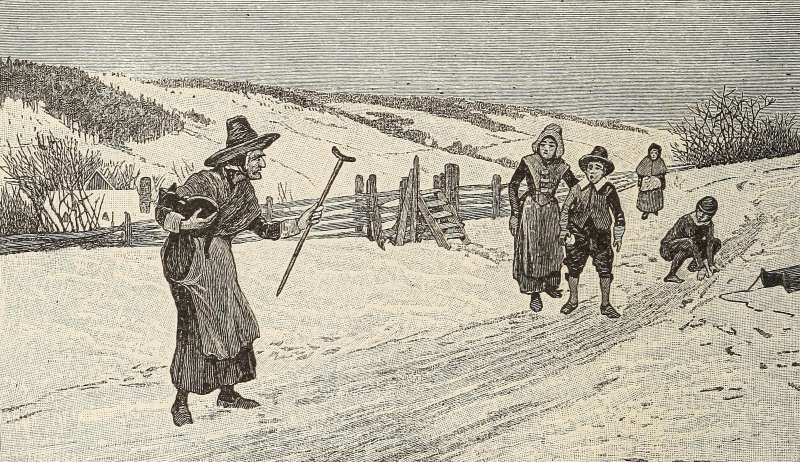
A Suspected Witch.
20. On the 21st of March the proceedings began. Mary Cory was arrested, brought before the court, convicted, and hurried to prison. Sarah Cloyce and Rebecca Nurse, two innocent sisters, were next apprehended as witches. The only witnesses against them were the foolish Indian woman and the niece of Parris. The victims were sent to prison, protesting their innocence. And so the work went on, until seventy-five innocent people were locked up in dungeons. In hope of saving their lives, some of the prisoners confessed themselves witches. It was soon found that those were to be put to death who denied the reality of witchcraft. Five women were hanged in one day.
21. Between June and September, twenty victims were hurried to their doom. Fifty-five others were tortured into the confession of falsehoods. A hundred and fifty lay in prison awaiting their fate. Two hundred were accused or suspected, and ruin seemed to impend over New England. But a reaction at last set in among the people. The court which Phipps had appointed to sit at Salem was dismissed. The prisons were opened, and the victims of superstition went forth free. In the beginning of the next year, a few persons were arrested and tried for witchcraft. Some were even convicted; but not another life was sacrificed.
22. Most of those who participated in these terrible scenes confessed the wrong which they had done; but confessions could not restore the dead. Mather, in a vain attempt to justify himself, wrote a book in which he expressed his thankfulness that so many witches had met their just doom; and the hypocritical pamphlet received the approbation of the president of Harvard College.
Queen Anne's War.
23. In less than four years after the treaty of Ryswick, France and England were again involved in a war which soon extended to the American colonies. In the year 1700 Charles II., king of Spain, died, having named as his successor Philip of Anjou, a grandson of Louis XIV. This measure pointed to a union of the crowns of France and Spain. The jealousy of England, Holland, and Austria was aroused; the archduke Charles, of the latter country, was put forward as a candidate for the Spanish throne; and war was declared against Louis XIV. for supporting Philip.
24. In 1701 James II., the exiled king of Great Britain, died at the court of Louis, who now recognized the son of James as sovereign of England. This action was regarded as an insult to English nationality. King William prepared for war, but did not live to carry out his plans. In May of 1702 he died, leaving the crown to his sister-in-law, Anne, daughter of James II. From the fact of her sovereignty, the conflict with France is known in American history as Queen Anne's War; but a better name is the War of the Spanish Succession. This continued feebly through eleven years, and with many of the horrors incident to Indian warfare, as the Indians were leagued with the French against the English.
25. On the 11th of April, 1713, a treaty was concluded at Utrecht, a town of Holland. By it England obtained control of the fisheries of Newfoundland. Labrador, the Bay of Hudson, and Nova Scotia, were ceded to Great Britain. On the 13th of July a second treaty was concluded with the Indians, by which peace was secured throughout the colonies.
26. In the times that followed Queen Anne's war, the people were greatly dissatisfied with the royal governors. The opposition to those officers took the form of a controversy about their salaries. The royal commissions gave to each officer a fixed salary, which was frequently out of proportion to the services required. The difficulty was finally adjusted by an agreement that the salaries should be allowed annually, and the amount fixed by vote of the assembly.
King George's War.
27. On the death of Charles VI. of Austria, in 1740, there were two claimants to the crown of the empire—Maria Theresa, daughter of the late emperor, and Charles Albert of Bavaria. Each claimant had his party and his army; war followed; and nearly all the nations of Europe were swept into the conflict. England and France were arrayed against each other. The contest that ensued is generally known as the War of the Austrian Succession, but in American history is called King George's War, for George II. was now king of England. In America the only important event of the war was the capture of Louisburg, on Cape Breton Island.
28. In 1748 a treaty of peace was concluded at Aix-la-Chapelle, a town of western Germany. Nothing was gained but a restoration of conquests. Not a single boundary line was settled by the treaty. The real war between France and England for supremacy in the West was yet to be fought.
Character of the Puritans.
29. The history of Massachusetts has now been traced through a period of one hundred and thirty years. A few words on the Character of the Puritans may be added. They were a vigorous and hardy people, firm-set in the principles of honesty and virtue. They were sober, industrious, frugal; resolute, zealous, and steadfast. They esteemed truth more than riches. Loving home and native land, they left both for the sake of freedom; and finding freedom, they cherished it with the devotion of martyrs. Despised and hated, they rose above their revilers. In the school of evil fortune they gained the discipline of patience. They were the children of adversity and the fathers of renown.
30. The gaze of the Puritan was turned ever to posterity. He believed in the future. For his children he toiled and sacrificed. The system of free schools is the monument of his love. The printing-press is his memorial. Almshouses and asylums are the tokens of his care for the unfortunate. He was the earliest champion of civil rights, and the builder of the Union.
31. In matters of religion, the fathers of New England were sometimes intolerant and superstitious. Their religious faith was gloomy. Human life was deemed a sad, a miserable journey. To be mistaken was to sin. To fail in trifling ceremonies was reckoned a crime. In the shadow of such belief the people became austere and melancholy. They set up a cold and severe form of worship. Dissenters themselves, they could not tolerate the dissent of others. To punish error seemed to the Pilgrims right and necessary. But Puritanism contained within itself the power to correct its own abuses. The evils of the system may well be forgotten in the glory of its achievements. Without the Puritans, America would have been a delusion and liberty only a name.
CHAPTER XIV.
New York.—Settlement and Administration of Stuyvesant.
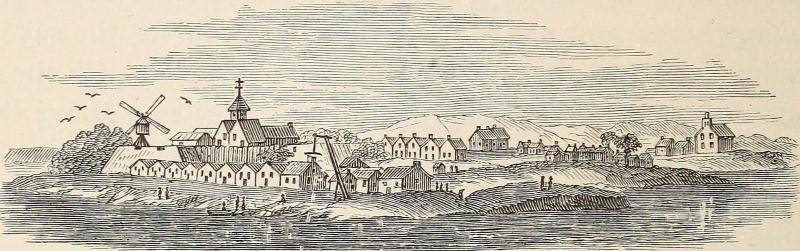
New Amsterdam.
THE settlement of New Amsterdam resulted from the voyages of the brave Sir Henry Hudson. For ten years after its founding, the colony was governed by the directors of the Dutch East India Company. In 1621 the Dutch West India Company was organized, and Manhattan Island, with its cluster of huts, passed at once under the control of the new corporation.
Dutch Settlements.
2. In April, 1623, the ship New Netherland, with thirty families on board, arrived at New Amsterdam. The colonists, called Walloons, were Dutch Protestant refugees. Cornelius May was the leader of the company. Most of the new immigrants settled with their friends on Manhattan; but the captain, with a party of fifty, made explorations as far as Delaware Bay.
3. In May the island, containing more than twenty thousand acres, was purchased from the natives for twenty-four dollars. A block-house was built and surrounded with a palisade. New Amsterdam was already a town of thirty houses. The Dutch of New Amsterdam and the Pilgrims of New Plymouth were early and fast friends.
The Patroons.
4. In 1628 the population of Manhattan numbered two hundred and seventy. The settlers engaged in the fur-trade. In 1629 the West India Company framed a Charter of Privileges, under which a class of proprietors, called patroons, were authorized to colonize the country. The conditions were that each patroon should purchase his lands of the Indians; and that he should establish a colony of not less than fifty persons. Five estates were immediately laid out. Three of them were on the Hudson; the fourth, on Staten Island; and the fifth, in the southern half of Delaware.
5. In April of 1633 Wouter van Twiller became Governor. Three months previously the Dutch erected a block-house at Hartford. In October an armed vessel from Plymouth sailed up the Connecticut, and defied the Dutch commander. The English proceeded up stream to the mouth of the Farmington, where they built Fort Windsor. Two years later, by the building of Saybrook, at the mouth of the Connecticut, they obtained control of the river above and below the Dutch fort.
6. In 1626 Gustavus Adolphus, the Protestant king of Sweden, formed the design of establishing settlements in America. But before his plans could be carried into effect, he was killed in battle. In 1632, the Swedish minister took up the work which his master had left unfinished; and, after four years, the enterprise was brought to a successful issue.
New Sweden.
7. Late in 1637 a company of Swedes and Finns left the harbor of Stockholm, and in the following February arrived in Delaware Bay. The name of New Sweden was given to the territory. On the left bank of a small tributary of the Brandywine, a spot was chosen for the settlement. The immigrants soon provided themselves with houses. The creek and the fort were both named Christiana, in honor of the maiden queen of Sweden. In a short time the banks of the bay and river were dotted with pleasant hamlets.
8. The authorities of New Amsterdam were jealous of the Swedish colony. Sir William Kieft, who had succeeded Van Twiller, warned the settlers of their intrusion on Dutch territory. But the Swedes went on enlarging their borders.
9. In 1640 New Netherland became involved in a war with the Indians. New Amsterdam was soon put in a state of defense, and a company of militia was sent against the savages. On both sides the war degenerated into treachery and murder. Through the mediation of Roger Williams a truce was obtained, but was immediately broken.
War with the Indians.
10. Soon a party of Mohawks came down the river to enforce their supremacy over the Algonquins in the vicinity of New Amsterdam. The latter begged assistance of the Dutch. Kieft now saw an opportunity for wholesale destruction. A company of soldiers set out from Manhattan, and discovered the camp of the Algonquins. The place was surrounded by night, and nearly a hundred of the poor wretches were killed by those to whom they had appealed for help. When it was known among the tribes that the Dutch, and not the Mohawks, were the authors of this outrage, the war was renewed with fury.

Peter Stuyvesant.
11. In 1643 Captain John Underhill, of Massachusetts, was appointed to command the Dutch forces. He first invaded New Jersey, and brought the Delawares into subjection. A decisive battle was fought on Long Island; and at Greenwich, in western Connecticut, the power of the Indians was finally broken. On the 30th of August, 1645, a treaty was concluded at Fort Amsterdam.
Governor Stuyvesant.
12. In 1647 the West India Company revoked Governor Kieft's commission, and appointed Peter Stuyvesant to succeed him. Kieft embarked for Europe, but perished during the voyage. Peter Stuyvesant entered upon his duties on the 11th of May, 1647, and continued in office for seventeen years. His first care was to conciliate the Indians. So intimate and cordial became the relations between the natives and the Dutch, that they were suspected of making common cause against the English. Massachusetts was alarmed lest such an alliance should be formed. But the policy of Stuyvesant was based on nobler principles.
13. Until now the West India Company had exclusive control of the commerce of New Netherland. In 1648 this monopoly was abolished, and regular export duties were substituted. The benefit of the change was soon apparent in the improvement of the Dutch province.
14. In a letter written to Stuyvesant by the secretary of the company, the prediction was made that the commerce of New Amsterdam would cover every ocean, and the ships of all nations crowd into her harbor. But for many years the growth of the city was slow. The better parts of Manhattan Island were still divided among the farmers. Central Park was a forest of oaks and chestnuts.
Boundary of New Netherland.
15. In 1650 the boundary was fixed between New England and New Netherland. The line extended across Long Island north and south, passing through Oyster Bay, and thence to Greenwich, on the other side of the Sound. From this point northward the dividing line was nearly identical with the present boundary of Connecticut on the west. This treaty was ratified by the colonies, by the West India Company, and by the States-General of Holland.
Conquest of New Sweden.
16. Stuyvesant now determined to subdue the colony of New Sweden. In 1651 an armament left New Amsterdam for the Delaware, and made an unsuccessful expedition. In September of 1655 the old governor again sailed against New Sweden. Before the 25th of the month every fort belonging to the Swedes had been forced to surrender. Honorable terms were granted to all, and in a few days the authority of New Netherland was established. The little State of New Sweden had ceased to exist.
17. While Stuyvesant was absent on his expedition against the Swedes, the Algonquins rose in rebellion. In a fleet of sixty-four canoes, they appeared before New Amsterdam, yelling and discharging arrows, then they went on shore and began to burn and murder. The return of the Dutch from Delaware induced the chiefs to sue for peace, which Stuyvesant granted on better terms than the Indians deserved.
18. In 1663 the town of Kingston was attacked and destroyed by the Indians. Sixty-five of the inhabitants were tomahawked or carried into captivity. To punish this outrage a strong force was sent from New Amsterdam. The Indians fled to the woods; but the Dutch soldiers pursued them to their villages, burned their wigwams, and killed every warrior who could be overtaken. In May of 1664 a treaty of peace was concluded.
19. Governor Stuyvesant had great difficulty in defending his province against the claims of other nations. Discord at home added to his embarrassments. For many years the Dutch had witnessed the growth and prosperity of the English colonies. Boston had outgrown New Amsterdam. The schools of Massachusetts and Connecticut flourished; the academy on Manhattan, after a sickly career of two years, was discontinued. In New Netherland heavy taxes were levied for the support of the poor; New England had no poor. The Dutch attributed their own want of thrift to the mismanagement of the West India Company.
The English Conquest.
20. On the 12th of March, 1664, the duke of York received from Charles II. a patent for the whole country between the Connecticut and the Delaware. The duke made haste to secure his territory. An English squadron was immediately sent to America. On the 28th of August the fleet anchored before New Amsterdam. Governor Stuyvesant convened the Dutch council, and exhorted them to rouse to action and fight. Some one replied that the West India Company was not worth fighting for. The brave old man was forced to sign the capitulation; and on the 8th of September, 1664, New Netherland ceased to exist.
21. The English flag was hoisted over the fort and town, and the name of New York was substituted for New Amsterdam. The remaining Swedish and Dutch settlements soon capitulated. The supremacy of Great Britain in America was finally established. From Maine to Georgia, every mile of the American coast was under the flag of England.
CHAPTER XV.
New York Under the English.
English Governors.
THE Dutch had surrendered themselves to the English government in the hope of obtaining civil liberty. But it was a poor sort of liberty that any province was likely to receive from Charles II. The promised rights of the people were evaded and withheld. The old titles by which the Dutch farmers held their lands were annulled. The people were obliged to accept new deeds from the English governor, and to pay him therefor large sums of money.
2. In 1667 Nicolls, the first English governor of New York, was superseded by the tyrannical Lord Lovelace. The people became dissatisfied and gloomy. The discontent was universal. Several towns resisted the tax-gatherers and passed resolutions denouncing the government. The only attention which Lovelace and his council paid to these resolutions was to order them to be burnt before the town-house of New York. When the Swedes, a quiet people, resisted the governor's exactions, he wrote to his deputy: "If there is any more murmuring against the taxes, make them so heavy that the people can do nothing but think how to pay them."
3. In 1672 Charles II. was induced by the king of France to begin a war with Holland. The struggle extended to the colonies, and New York was for a short time revolutionized. But the conquest was only a brief military occupation of the country. The civil authority of the Dutch was never reestablished. In 1674 Charles II. was obliged to conclude a treaty of peace. All conquests made during the war were restored. New York reverted to the English government, and the rights of the duke of York were again recognized in the province. Sir Edmund Andros was now appointed governor. On the last day of October the Dutch forces were finally withdrawn, and Andros assumed control of the government.

Dutch Costumes and Architecture.
4. It was a sad sort of government for the people. All the abuses of Lovelace's administration were revived. Taxes were levied without authority of law, and the protests of the people were treated with scorn. A popular legislative assembly was demanded, but the duke of York wrote to Andros that popular assemblies were dangerous to the government, and that he did not see any use for them.
5. In July of 1675 Andros made an unsuccessful effort to extend his authority over Connecticut, and later an equally ineffectual attempt to gain control of New Jersey. The representatives of the people at this latter place declared themselves to be under the protection of the Great Charter, which not even the duke of York could alter or annul. In August of 1682 the "Territories" beyond the Delaware were granted by the Duke of York to William Penn. This little district, first settled by the Swedes, afterwards conquered by the Dutch, then transferred to England, was now finally separated from New York and joined to the new province of Pennsylvania.
Popular Assembly Granted.
6. For thirty years the people had been clamoring for a general assembly. At last the duke of York yielded to the demand. Then, for the first time, the people of the province were permitted to choose their own rulers and to frame their own laws. The new assembly made haste to declare THE PEOPLE to be a part of the government. All freeholders were granted the right of suffrage; trial by jury was established; taxes should not be levied except by the assembly; soldiers should not be quartered on the people; martial law should not exist; no person should be persecuted on account of his religion.
7. In July of 1684 the governors of New York and Virginia were met by the chiefs of the Iroquois at Albany, and the terms of a lasting peace were settled. In 1685 the duke of York became king of England. It was soon found that even a monarch could violate his pledges. King James became the enemy of the government which had been established in his American province. The legislature of New York was dismissed. An odious tax was levied. Printing-presses were forbidden; and the old abuses were revived.
Leisler's Insurrection.
8. When the news of the accession of William of Orange reached New York there was great rejoicing. The people rose in rebellion against deputy-governor Nicholson, who was glad to escape to England. The leader of the insurrection was Captain Jacob Leisler. He was appointed commandant of New York, and afterwards provisional governor. The councilors, who were friends of the deposed Nicholson, left the city and went to Albany. Here the party opposed to Leisler organized a second provisional government. Both factions began to rule in the name of William and Mary, the new sovereigns of England. Such was the condition of affairs at the beginning of King William's War. In the spring of 1690, the authority of Leisler as governor of New York was recognized throughout the province.
9. In March, 1691, Colonel Sloughter arrived, with appointment as governor; and Leisler, on the same day, tendered his submission. He wrote a letter to Sloughter, expressing a desire to surrender the post to the governor. But Sloughter preferred to treat him as a traitor, and had him seized and sent to prison.
10. As soon as the government was organized the prisoner was brought to trial. It was decided that he had been a usurper. Sentence of death was passed on him, but Sloughter hesitated to put the sentence into execution. In this state of affairs the governor was invited to a banquet by the royal councilors; and when heated with drink, the death-warrant was thrust before him for his signature. He succeeded in signing his name to the parchment; and before his drunken revel had passed away, his victim had met his fate. On the 16th of May Leisler was taken from prison and hanged.
French Invasion.
11. In 1696 New York was invaded by the French. But they were soon driven back by the English and Iroquois. Before a second invasion could be undertaken, King William's War was ended. In 1697 the Irish earl of Bellomont became governor. His administration was the happiest in the history of the colony. Massachusetts and New Hampshire were under his jurisdiction, but Connecticut and Rhode Island remained independent.
12. To Bellomont's administration belongs the story of Captain William Kidd, the pirate. A vessel was fitted out by a company of distinguished Englishmen to protect the commerce of Great Britain and to punish piracy. Governor Bellomont was one of the proprietors, and Kidd received a commission as captain. The ship sailed from England before Bellomont's departure for New York. Soon the news came that Kidd himself had turned pirate and become the terror of the seas. For two years he continued his career, then appeared publicly in the streets of Boston, was seized, sent to England, tried, convicted, and hanged.
New York and New Jersey United.
13. In May of 1702 Bellomont was superseded by Lord Cornbury. A month previously the proprietors of New Jersey had surrendered their province to the English Crown. All obstacles being thus removed, the two colonies were formally united in one government under Cornbury. For thirty-six years the two provinces continued under the jurisdiction of a single governor.
14. In 1732, New York was troubled with a dispute about the freedom of the press. The liberal party of the province held that a public journal might criticise the acts of the administration. The aristocratic party opposed such liberty as dangerous to good government. Zenger, an editor who published criticisms on the governor, was seized and put in prison. Great excitement ensued. The people praised their champion. Andrew Hamilton, a lawyer of Philadelphia, went to New York to defend Zenger, who was brought to trial in July of 1735. The cause was heard, and the jury brought in a verdict of acquittal. The aldermen of New York, in order to testify their appreciation of Hamilton's services, made him a present of an elegant gold box, and the people were enthusiastic over their victory.
The Negro Plot.
15. In the year 1741 occurred what is known as the Negro Plot. Negroes constituted a large fraction of the people. Several fires occurred, and the slaves were suspected of having kindled them; now they became feared and hated. A rumor was started that the negroes had made a plot to burn the city, and set up one of their own number as governor. The reward of freedom was offered to any slave who would reveal the plot. Many witnesses rushed forward; the jails were filled with the accused; and more than thirty of the miserable creatures, with hardly the form of a trial, were convicted and then hanged or burned to death. Others were transported and sold as slaves in foreign lands. As soon as the excitement had subsided, it came to be doubted whether the whole affair had not been the result of terror and fanaticism. The verdict of after times has been that there was no plot at all.
16. Such is the history of the little colony planted on Manhattan Island. A hundred and thirty years had passed since the first feeble settlements were made; the valley of the Hudson was filled with farms and villages. The Walloons of Flanders and the Puritans of New England had blended into one people. Discord and contention had only resulted in colonial liberty. There were other struggles through which the sons of New York had to pass before they gained their freedom. But the oldest and greatest of the Middle Colonies had entered upon a glorious career, and the foundations of an Empire State were laid.
CHAPTER XVI.
Connecticut, Rhode Island, and New Hampshire.
Rival Claims to Connecticut.
THE history of Connecticut begins with the year 1630. The first grant of the territory was made by the council of Plymouth to the earl of Warwick; and in March, 1631, the claim was transferred by him to Lord Say-and-Seal, Lord Brooke, and John Hampden. Before a colony could be planted, the Dutch of New Netherland reached the Connecticut and built a fort at Hartford. The people of Plymouth immediately sent out a force to counteract this movement of their rivals, for the territorial claim of the Puritans extended over Connecticut and over New Netherland itself.

Early Settlements in Connecticut.
2. In October of 1635 a colony of sixty persons from Boston settled at Hartford, Windsor, and Wethersfield. Earlier in the same year the younger Winthrop, son of the governor of Massachusetts, arrived in New England. Under his direction a fort was built at the mouth of the Connecticut. Such was the founding of Saybrook, named in honor of Lord Say-and-Seal and Lord Brooke.
3. To the early annals of Connecticut belongs the sad story of the Pequod War. The country west of the Thames was more thickly peopled with savages than any other portion of New England. The warlike Pequods were able to muster seven hundred warriors. The whole force of the English did not amount to two hundred men. But the superior numbers of the savages were more than balanced by the courage and weapons of the English. In the year 1633 the crew of a trading-vessel were murdered on the banks of the Connecticut. An Indian embassy went to Boston to apologize; a treaty was made, and the Pequods acknowledged the king of England. But soon they began to violate the treaty. Outrages were committed, and war began in earnest.
The Pequod War.
4. In this state of affairs the Pequods attempted to induce the Narragansetts and the Mohegans to join in a war against the English. But Roger Williams, now in Rhode Island, used his endeavors to thwart the alliance. Embarking alone in a canoe, he crossed the bay to the house of Canonicus, king of the Narragansetts. There he found the ambassadors of the Pequods. For three days and nights, at the peril of his life, he pleaded with Canonicus to reject the proposals of the hostile tribe. At last his efforts were successful, and the Narragansetts voted to remain at peace. The Mohegans also rejected the proposed alliance. In the mean time, repeated acts of violence had aroused the colony. On the 1st of May the towns of Connecticut declared war. Sixty volunteers were put under command of Captain John Mason, of Hartford. Seventy Mohegans joined the expedition; and Sir Henry Vane sent Captain Underhill with twenty soldiers from Boston.
5. The descent from Hartford to Saybrook occupied one day. On the 20th of the month the expedition passed the mouth of the Thames; here was the principal seat of the Pequod nation. When the savages saw the squadron go by they set up shouts of exultation, and persuaded themselves that the English were afraid to hazard battle. The fleet proceeded quietly into Narragansett Bay. Here the troops landed and began their march into the country of the Pequods.
6. On the 25th of May the troops came within hearing of the Pequod fort. The warriors spent the night in uproar and jubilee. At two o'clock in the morning the English soldiers rose from their places of concealment and rushed forward to the fort. A dog ran howling among the wigwams, and the warriors sprang to arms. The English leaped over the puny palisades and began the work of death. "Burn them!" shouted Mason, seizing a flaming mat, and running among the cabins; and in a few minutes the wigwams were a sheet of flame. The English and Mohegans hastily withdrew.
Destruction of the Pequods.
7. The savages ran round and round like wild beasts in a burning circus. If one of the wretched creatures burst through the flames it was only to meet certain death. The destruction was complete. Only seven warriors escaped; seven others were made prisoners. Six hundred men, women, and children perished, nearly all being burned to death. The remnants of the Pequods were pursued into the swamps west of Saybrook. Every wigwam was burned and every field laid waste. Two hundred fugitives were hunted to death or captivity. The prisoners were distributed as servants among the Narragansetts, or sold as slaves.
New Haven Founded.
8. In the pursuit of the Pequods, the English became acquainted with the coast west of the mouth of the Connecticut. Here some men of Boston tarried over winter, built cabins, and founded New Haven. In June of 1639 the men of New Haven held a convention in a barn, and adopted the Bible for a constitution. The government was called the House of Wisdom, and none but church members were admitted to citizenship.
9. In 1643 Connecticut became a member of the Union of New England. New Haven was also admitted; and in the next year Saybrook was annexed to Connecticut. In 1650 Governor Stuyvesant met the commissioners of the province at Hartford, and established the western boundary.
Winthrop secures a Charter.
10. On the restoration of monarchy in England, Connecticut recognized King Charles as rightful sovereign. The younger Winthrop was sent as ambassador to London to procure a royal patent for the colony. He bore with him a charter which had been prepared by the authorities of Hartford. Lord Say-and-Seal and the earl of Manchester lent their influence to induce the king to sign it. Winthrop showed him a ring which Charles I. had given to Winthrop's grandfather; and the token so moved the monarch's feelings that in a careless moment he signed the colonial charter—the most liberal and ample ever granted by an English king.
11. When Winthrop returned to Connecticut he was chosen governor of the colony, and continued in office for fourteen years. The civil institutions of the province were the best in New England. Peace reigned. During King Philip's War, Connecticut was saved from invasion. Not a hamlet was burned, not a life lost within her borders.
12. In October of 1687 Andros, now governor of all New England, made his famous visit to Hartford. On the day of his arrival he invaded the assembly while in session, seized the book of minutes, and wrote Finis at the bottom of the page. He then demanded the surrender of the colonial charter. Governor Treat pleaded earnestly for the preservation of the document. Andros was inexorable. The shades of evening fell. How Joseph Wadsworth carried away and concealed the precious parchment has been told in the history of Massachusetts. When the government of Andros was overthrown, Connecticut, with the other New England colonies, regained her liberty.
Yale College Founded.
13. "I give these books for the founding of a college in this colony." Such were the words of ten ministers who, in 1700, assembled at Branford, New Haven. Each of them, as he uttered the words, deposited a few volumes on the table where they were sitting; such was the founding of Yale College. In 1702 the school was opened at Saybrook, where it continued for fifteen years, and was then removed to New Haven. One of the most liberal patrons of the college was Elihu Yale, from whom the institution took its name. Common schools already existed in almost every village of Connecticut.
14. The half century preceding the French and Indian war was a time of prosperity in the western parts of New England. Connecticut was especially favored. Peace reigned throughout her borders. The farmer reaped his fields in cheerfulness and hope. The mechanic made glad his dusty shop with anecdote and song. The merchant feared no tariff, the villager no taxes. Want was unknown, and pauperism unheard of. With fewer dark pages in her history, Connecticut had all the lofty purposes and noble virtues of Massachusetts.
15. In June of 1636 the exiled Roger Williams left the country of the Wampanoags, and passed down the Seekonk to Narragansett River. With his five companions he landed on the western bank, purchased the soil of the Narragansetts, and laid the foundations of Providence. Other exiles joined the company. New farms were laid out and new houses built. Here, at last, was found at Providence Plantation a refuge for all the persecuted.
Providence Plantation.
16. The leader of the new colony was a native of Wales; born in 1606; liberally educated at Cambridge. He had been the friend of Milton, and was a great hater of ceremonies. He had been exiled to Massachusetts, and was now exiled by Massachusetts. He brought to the banks of the Narragansett the great doctrines of religious liberty and the equal rights of men.
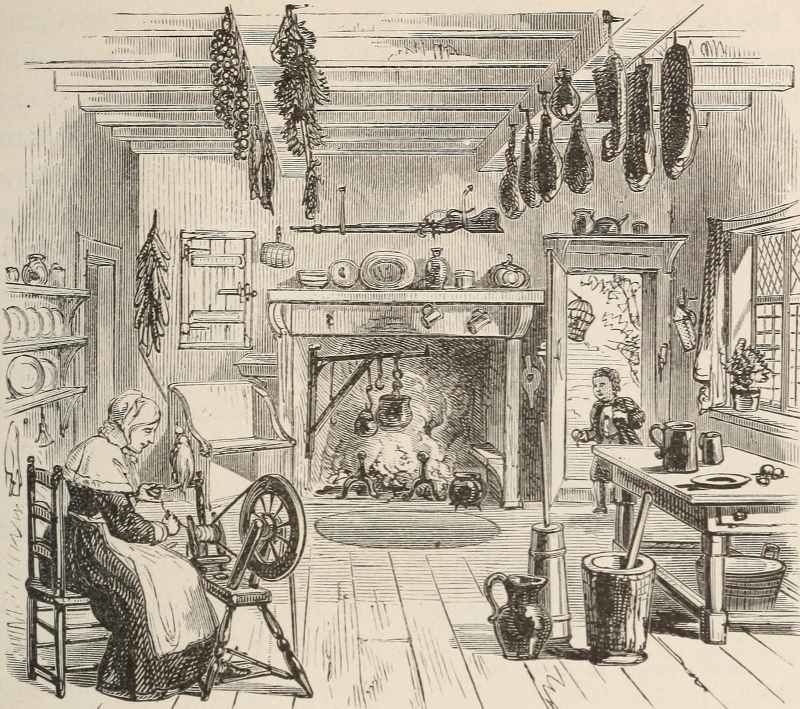
A New England Kitchen in the Olden Time.
17. The beginning of civil government in Rhode Island was equally simple. Williams was the natural ruler of the little province, but he reserved for himself no wealth, no privilege. The lands, purchased from Canonicus, were freely distributed among the colonists. Only two small fields were kept by the founder for himself. All the powers of the government were intrusted to the people. A simple agreement was made by the settlers that in matters not affecting the conscience they would yield obedience to such rules as the majority might make for the public good. In questions of religion the conscience should be to every man a guide.
18. The new government stood the test of experience. Providence Plantation had peace and quiet. It was found that all religious sects could live together in harmony. Miantonomah, chief of the Narragansetts, loved Roger Williams as a brother. It was his friendship that enabled Williams to notify Massachusetts of the Pequod conspiracy, and to defeat the plans of the hostile nation. This good deed induced his friends at Salem to make an effort to recall him from banishment; but his enemies prevented his return.

Stone Tower at Newport.
Plantation of Rhode Island.
19. In 1639 a settlement was made at Portsmouth, in the northern part of the island, and at the same time a party of colonists removed to the southwestern part of the island, and laid the foundations of Newport. In sight of this last-named settlement stood the old stone tower, a monument built by the Norsemen. In March of 1641 a public meeting was convened; the citizens came together on terms of equality, and the task of framing a constitution was undertaken. In three days the instrument was completed. The government was declared to be a "Democracie." The supreme authority was lodged with the freemen of the island. The vote of the majority should always rule. No one should be distressed on account of religious doctrine. The little republic was named the Plantation of Rhode Island.
20. In 1643 Providence and Rhode Island were refused admission into the Union of New England. Soon afterward Roger Williams was sent to London to procure a charter for the new colonies. On the 14th of March in the following year the patent was granted, and Rhode Island became an independent commonwealth. With but few and brief interruptions it enjoyed peace and prosperity. The principles of the illustrious founder became the principles of the commonwealth. The renown of Rhode Island has not been in vastness of territory, in mighty cities, or in victorious armies, but in devotion to truth, justice, and freedom.
Province of New Hampshire.
21. In 1622 the territory between the Merrimac and the Kennebec was granted by the council of Plymouth to Sir Ferdinand Gorges and John Mason. The proprietors made haste to secure their new domain by actual settlements. In the spring of 1623 two small companies of colonists were sent out by Mason and Gorges to people their province. One party of immigrants landed at Little Harbor, near Portsmouth, and began to build a village. The other company proceeded up stream and laid the foundations of Dover. With the exception of Plymouth and Weymouth, Portsmouth and Dover are the oldest towns in New England. But the progress of the settlements was slow; for many years the two villages were only fishing stations. In 1629 the name of New Hampshire was given to the province. Very soon Massachusetts began to urge her rights to the district north of the Merrimac.
22. On the 14th of April, 1642, New Hampshire was united with Massachusetts. The law restricting the rights of citizenship to church members was not extended over the new province, for the people of Portsmouth and Dover belonged to the Church of England. New Hampshire was the only colony east of the Hudson not originally founded by the Puritans. The union continued in force until 1679, when New Hampshire was separated from the jurisdiction of Massachusetts, and organized as a distinct royal province. Edward Cranfield was chosen governor.
23. Before his arrival the sawyers and lumbermen of the Piscataqua convened a general assembly at Portsmouth. A resolution was passed by the representatives that no act, law, or ordinance should be valid unless made by the assembly and approved by the people. When the king heard of this resolution he declared it to be both wicked and absurd.
24. Of all the colonies, New Hampshire suffered most from the Indian wars. Her settlements were constantly exposed to savage invasion. During King Philip's War the suffering along the frontier was very great. In the wars of William, Anne, and George the province was visited with devastation and ruin. But in the intervals of peace the spirits of the people revived, and the hardy settlers returned to their wasted farms. Out of these conflicts and trials came that sturdy race of pioneers who bore such a heroic part in the contests of after years.
CHAPTER XVII.
New Jersey and Pennsylvania.
THE history of New Jersey begins with the founding of Elizabethtown, in 1664. As early as 1618, a trading-station had been established at Bergen; but forty years passed before permanent dwellings were built in that neighborhood.
Claims to New Jersey.
2. The territory of New Jersey was included in the grant made to the duke of York. In 1664 that portion of the province lying between the Hudson and the Delaware, extending as far north as forty-one degrees and forty minutes, was assigned to Lord Berkeley and Sir George Carteret. Just after the conquest, a company of Puritans received a grant of land on Newark Bay. The Indian titles were purchased; in the following October a village was begun and named Elizabethtown.
3. In August of 1665 Philip Carteret arrived as governor. Elizabethtown was made the capital of the colony; Newark was founded; flourishing hamlets appeared on the shores of the bay as far south as Sandy Hook. In honor of Sir George Carteret, who had been governor of the Isle of Jersey, his American domain was named New Jersey. In 1668 the first assembly convened at Elizabethtown. The representatives were Puritans, and the laws of New England were repeated in the legislation of the colony.
4. After the conquest of New York by the Dutch, and the restoration of the province to England, the duke of York received from the king a second patent for the country between the Connecticut and the Delaware. At the same time he confirmed his former grant of New Jersey to Berkeley and Carteret. But soon afterwards Sir Edmund Andros was appointed royal governor of the whole country. Carteret defended his claim against Andros; but Berkeley sold his interest in New Jersey to John Fenwick, to be held in trust for Edward Byllinge, who after a time made an assignment of his property to Gawen Laurie, Nicholas Lucas, and William Penn.
Division of New Jersey.
5. These men were Quakers. Here, then, was an opportunity to establish an asylum for the persecuted Friends. Penn and his associates applied to Sir George Carteret for a division of the province. It was accordingly agreed to divide New Jersey so that Carteret's district should be separated from that of the Quakers. The line of division was drawn from the southern point of land on the east side of Little Egg Harbor to a point on the Delaware in the latitude of forty-one degrees and forty minutes. The territory lying east of this line remained to Sir George as sole proprietor, and was named East Jersey; while that portion lying between the line and the Delaware was called West Jersey, and passed under the control of Penn.

Middle Colonies.
6. Early in the following March the Quaker proprietors published a code of laws called The Concessions. The constitution rivaled the charter of Connecticut in the liberality of its principles. The authors of the instrument then addressed the Quakers of England, recommending the province and inviting immigration. Before the end of the year a colony of more than four hundred Friends found homes in West Jersey. An effort was now made by the proprietors of East Jersey to secure a deed of release from the duke of York. The petition was granted, and the whole territory was freed from foreign authority.
7. In November of 1681 Jennings, the deputy-governor of West Jersey, convened the first general assembly. The Quakers now met together to make their own laws. The Concessions were reaffirmed. Men of all races and religions were declared to be equal. Imprisonment for debt was forbidden. The sale of ardent spirits to the Red men was prohibited. Taxes should be voted by the representatives of the people. The lands of the Indians should be acquired by purchase. Finally, a criminal might be pardoned by the person against whom the offense was committed.
Quakers purchase East Jersey.
8. In 1682 William Penn and eleven other Friends purchased the province of East Jersey. The whole of New Jersey was now held by the Friends. In 1685 James II. appointed Edmund Andros royal governor of the colonies from Maine to Delaware. In 1688 the Jerseys were brought under his jurisdiction. When the news came of the abdication of the English monarch, Andros could do nothing but surrender to the indignant people.
9. But the condition of New Jersey was deplorable. It was almost impossible to tell to whom the territory rightfully belonged. Finally, in April of 1702, all proprietary claims being waived in favor of the king, the territory between the Hudson and the Delaware became a royal province.
10. New Jersey was now attached to the government of Lord Cornbury of New York. But each province retained its own legislative assembly and a distinct organization. This method of government continued for thirty-six years, and was then ended by the action of the people. In 1728 the representatives of New Jersey sent a petition to George II., praying for a separation of the two colonies. Ten years later the effort was renewed and brought to a successful issue. New Jersey was made independent, and Lewis Morris received a commission as royal governor of the province.
New Jersey a Royal Province.
11. The Quakers were greatly encouraged with the success of their colonies in New Jersey. For more than a quarter of a century they had been buffeted with persecutions. But imprisonment and exile had not abated their zeal. The benevolent spirit of Penn urged him to find for his people an asylum in the New World. In June of 1680 he appealed to King Charles for the privilege of founding a Quaker commonwealth in America.
Pennsylvania.
12. The petition was heard with favor. On the 5th of March, 1681, a charter was granted by Charles II., and William Penn became the proprietor of Pennsylvania. The vast domain embraced under the new patent was bounded on the east by the Delaware, extended north and south over three degrees of latitude, and westward through five degrees of longitude. The three counties of Delaware were reserved for the duke of York. Within a month from the date of his charter, Penn published a glowing account of his new country, promising freedom of conscience, and inviting emigration. During the summer three shiploads of Quakers left England for the land of promise.
13. During the winter of 1681-82, Penn drew up a constitution for his people. In the mean time, the duke of York had surrendered his claim to the three counties on the Delaware. The whole country on the west bank of the river, from Cape Henlopen to the forty-third degree of latitude, was now transferred to Penn, who, with a large company of emigrants, landed at New Castle on the 27th of October, 1682.
William Penn.
14. William Penn was born on the 14th of October, 1644. He was the oldest son of Sir William Penn of the British navy. At the age of twelve he was sent to the University of Oxford, where he distinguished himself as a student until he was expelled on account of his religion. Afterwards he traveled on the Continent, and then became a student of law at London. For a while he was a soldier, and was then converted to the Quaker faith. His father drove him out of doors, but he was not to be turned from his course. He proclaimed the doctrines of the Friends; was arrested and imprisoned, first in the Tower of London, and afterward at Newgate. Despairing of toleration in England, he cast his gaze across the Atlantic. West Jersey was purchased; Pennsylvania was granted by King Charles; and now Penn himself arrived in America to found a government on the basis of peace.

William Penn.
Treaty of Shackamaxon.
15. The Quaker governor delivered an affectionate address to the crowd of Swedes, Dutch, and English who came to greet him. His pledges of a liberal government were renewed, and the people were exhorted to sobriety and honesty. Friendly relations were established between the Friends and Red men. A great conference, appointed with the sachems of the neighboring tribes, was held on the banks of the Delaware. Penn declared his brotherly affection for the Indians. Standing before them, clad in the simple garb of the Quakers, he said:—"My Friends: We have met on the broad pathway of good faith. We are all one flesh and blood. Being brethren, no advantage shall be taken on either side. When disputes arise, we will settle them in council. Between us there shall be nothing but openness and love." The chiefs replied: "While the rivers run and the sun shines we will live in peace with the children of William Penn." And the treaty was sacredly kept. The Quaker hat and coat proved to be a better defense than coat-of-mail and musket.
16. In February of 1683 the native chestnuts, walnuts and elms were blazed to indicate the lines of the streets, and Philadelphia was founded. Within a month a general assembly was in session at the new capital. A democratic form of government was adopted. The growth of Philadelphia was astonishing. In 1683 there were only three or four houses. In 1685 the city contained six hundred houses; the schoolmaster had come, and the printing-press had begun its work. In another year Philadelphia had outgrown New York. In August of 1684 Penn took leave of his colony and sailed for England.
Secession of Delaware.
17. Nothing occurred to disturb the peace of Pennsylvania until the secession of Delaware in 1691. The three lower counties, which had been united on terms of equality with the six counties of Pennsylvania, became dissatisfied with some acts of the assembly and insisted on a separation. The proprietor gave consent; Delaware withdrew from the union, and received a separate deputy-governor.
18. In December of 1699 Penn visited his American commonwealth, and drew up another constitution, more liberal than the first. But Delaware would not accept the new form of government. In 1702 the assemblies of the two provinces sat apart; and in the following year Delaware and Pennsylvania were finally separated.
19. In July of 1718 the founder of Pennsylvania sank to rest. His estates, vast and valuable, were bequeathed to his three sons, John, Thomas, and Richard. By them, or their deputies, Pennsylvania was governed until the American Revolution. In the year 1779 the claims of the Penn family were purchased by the legislature of Pennsylvania for a hundred and thirty thousand pounds.
20. The colonial history of the State founded by Penn is one of special interest and pleasure. It is a narrative of the victories of peace, and of the triumph of peaceful principles over violence and wrong. It is doubtful whether the history of any other colony in the world is touched with so many traits of innocence and truth. "I will found a free colony for all mankind," were the words of William Penn. How well his work was done shall be told when the bells of his capital city shall ring out the glad notes of American Independence.
CHAPTER XVIII.
Maryland and North Carolina.
CAPTAIN John Smith was the first white man to explore the Chesapeake. In 1621 William Clayborne, an English surveyor, was sent out by the London Company to make a map of the country around the bay. By the second charter of Virginia that province included all of the present State of Maryland. To explore and occupy the country was an enterprise of the highest importance to the Virginians. In May of 1631 Clayborne was authorized to survey the country as far north as the forty-first degree of latitude, and to establish a trade with the Indians. In the spring of 1632 he began his important work.
First Posts in Maryland.
2. The enterprise was attended with success. A trading-post was established on Kent Island, and another near Havre de Grace. The Chesapeake was explored and a trade opened with the natives. The limits of Virginia were about to be extended to the borders of New Netherland. But, in the mean time, religious persecutions were preparing the way for the foundation of a new State in the wilderness. Sir George Calvert, a Catholic nobleman of Yorkshire, better known by his title of Lord Baltimore, was destined to become the founder.
3. In 1629 he made a visit to Virginia. The general assembly offered him citizenship, but required such an oath of allegiance as no honest Catholic could take. Lord Baltimore thereupon left the narrow-minded legislators; returned to London; drew up a charter for a new State on the Chesapeake, and induced King Charles to sign it.
4. The provisions of the charter were ample. No preference was given to any particular religion. The lives and property of the colonists were carefully guarded. Arbitrary taxation was forbidden. The power of making the laws was conceded to the freemen of the colony.
Lord Baltimore's Charter.
5. Before the patent could receive the seal of state, Sir George Calvert died. His title descended to his son Cecil; and the charter was issued to him on the 20th of June, 1632. In honor of Henrietta Maria, wife of Charles I., the name of Maryland was conferred on the new province. In the fall of 1633 a colony numbering two hundred persons was collected. Leonard Calvert, a brother of Cecil, was appointed to accompany the colonists to America.

Cecil Calvert, Lord Baltimore.
6. In March of 1634 the immigrants arrived at Old Point Comfort. They proceeded up the bay and ascended the Potomac. Finding a half-deserted Indian village at the mouth of the St. Mary's, the English moved into the vacant huts. The rest of the town was purchased; and the name of St. Mary's was given to the colony. Friendly relations were established with the natives. The Indian women taught the wives of the English how to make cornbread, and the warriors instructed the colonists in the art of hunting. There was neither anxiety nor want in the colony. Within six months the settlement had grown into greater prosperity than Jamestown had reached in as many years.
7. In 1639 a representative government was established in Maryland. Hitherto a system of democracy had prevailed; each freeman had been allowed a vote in determining the laws. When the new delegates came together, a declaration of rights was adopted. All the liberal principles of the colonial patent were reaffirmed. The rights of citizenship were declared to be the same as those of the people of England.
8. In 1642 Indian hostilities were begun on the Potomac. But the settlements of Maryland were compact, and no great suffering was occasioned. In 1644 the savages agreed to bury the hatchet and to renew the pledges of friendship.
9. In 1650 the legislature of Maryland was divided into two branches. The rights of Lord Baltimore were defined by law. An act was passed declaring that no taxes should be levied without the consent of the assembly. Such was the condition of affairs in the colony of Maryland when the Commonwealth was established in England.
Conflict with Parliament.
10. In 1651 parliamentary commissioners came to America to assume control of Maryland. Stone, the deputy of Baltimore, was deposed from office; but in the following year he was permitted to resume the government. In April of 1653 he published a proclamation, declaring that the recent interference had been a rebellion. Clayborne thereupon collected a force in Virginia, drove Stone out of office, and directed the government himself.
11. In 1654 a Protestant assembly was convened at Patuxent. The supremacy of Cromwell was acknowledged, and the Catholics were deprived of the protection of the laws. Civil war ensued. Governor Stone armed the militia, and seized the records of the colony. A battle was fought near Annapolis, and the Catholics were defeated, with a loss of fifty men. Stone was taken prisoner, but was saved from death by the friendship of some of the insurgents. Three of the Catholics were tried and executed.
12. After the death of Cromwell, Maryland was declared independent. On the 12th of March, 1660, the rights of Lord Baltimore were set aside, and the whole power of government was assumed by the House of Burgesses. On the restoration of monarchy the Baltimores were again recognized, and Philip Calvert was sent out as governor. From 1675 to 1691 Charles Calvert was governor of Maryland.
13. On the 1st of June, 1691, the charter of Lord Baltimore was taken away and a royal governor appointed. The Episcopal Church was established by law. Religious toleration was abolished and the government administered on despotic principles. This condition of affairs continued until 1715, when Queen Anne restored the heir of Lord Baltimore to the rights of his family. Maryland remained under the authority of the Calverts until the Revolution.
Settlement of the Carolinas.
14. The first effort to colonize North Carolina was made by Sir Walter Raleigh. In 1630 the country was granted to Sir Robert Heath. But, after thirty-three years, the patent was revoked by the English king. The name of Carolina had been given to the country by John Ribault, in 1562. The first actual settlement was made on the Chowan about the year 1651. In 1661 a company of Puritans settled on Oldtown Creek. In 1663 Lord Clarendon, and seven other noblemen, received a grant of all the country between the thirty-sixth parallel and the river St. John's.
15. The work of preparing a frame of government for the new province was assigned to Sir Ashley Cooper. The philosopher John Locke was employed by him and his associates to prepare the constitution. From March until July of 1669, Locke worked away in drawing up a plan which he called The Grand Model. It contained one hundred and twenty articles; and this was but the beginning! The empire of Carolina was divided into districts of four hundred and eighty thousand acres each. The offices were divided between two grand orders of nobility.
16. All attempts to establish the new government ended in failure. But the settlers had meanwhile learned to govern themselves. They grew prosperous by trading in staves and furs; and when this traffic was exhausted, they began to remove to other settlements.
17. The people of the colony were greatly oppressed with taxes. The trade with New England alone was weighed down with an annual duty of twelve thousand dollars. A gloomy opposition to the government prevailed; and when, in 1676, large numbers of refugees from Virginia arrived in Carolina, the discontent was kindled into an insurrection. The people seized Governor Miller and his council, and established a new government of their own. John Culpepper, the leader of the insurgents, was chosen governor. In 1679 Miller and his associates escaped from confinement and went to London. Governor Culpepper, who followed to defend himself, was seized, indicted for treason, tried, and acquitted. After a time new settlers came from Virginia and Maryland—Quakers from New England, Huguenots from France, and peasants from Switzerland.
Indian Troubles.
18. The Indians of North Carolina gradually wasted away. Some of the nations were already extinct. The lands of the savages had passed to the whites, sometimes by purchase, sometimes by fraud. Of all the tribes of the Carolinas, only the Corees and the Tuscaroras were still formidable. These grew jealous and went to war with the whites.
19. On the night of the 22d of September, 1711, the savages fell upon the scattered settlements and murdered a hundred and thirty persons. Civil dissensions prevented the authorities from adopting vigorous measures of defence. But Colonel Barnwell came from South Carolina with a company of militia and friendly Indians; and the savages were driven into their fort. A treaty of peace was made; but, on their way homeward, Barnwell's men sacked an Indian village, and the war was at once renewed.
20. In the next year, Colonel Moore of South Carolina arrived with a regiment of whites and Indians, and the Tuscaroras were pursued to their fort, which was carried by assault. Eight hundred warriors were taken prisoners. The power of the hostile nation was broken; and the Tuscaroras, abandoning their hunting-grounds, marched across Virginia, Maryland, and Pennsylvania, joined their kinsmen of New York, and became the sixth nation of the Iroquois.
Separation of the Carolinas.
21. In 1729 a separation was effected between the two Carolinas, and a royal governor was appointed over each. In spite of many reverses, the northern colony had greatly prospered. Intellectual development had not been as rapid as the growth in numbers and wealth. Little attention had been given to questions of religion. There was no minister in the province until 1703. Two years later the first church was built. The printing-press did not begin its work until 1754. But the people were brave and patriotic. They loved their country, and called it the Land of Summer.
CHAPTER XIX.
South Carolina and Georgia.
IN January of 1670 the proprietors of Carolina sent out a colony under command of Joseph West and William Sayle. On the first high land upon the southern bank of the Ashley River were laid the foundations of Old Charleston, named in honor of Charles II. Sayle had been commissioned as governor of the colony, and he at once assumed control.
Introduction of Slaves.
2. In 1671 he died, and West entered upon the duties of the vacant office. In a few months Sir John Yeamans, who had been governor of the northern province, was commissioned as chief magistrate of the southern colony. He brought with him to Ashley River a cargo of African slaves. Thus the labor of the black man was substituted for the labor of the white man, and in less than two years slavery was firmly established. The importation of negroes went on so rapidly that soon the negroes were twice as numerous as the white men.
3. During the year 1671 the country was rapidly filled with people. Fertile lands were abundant. Wars and pestilence had almost destroyed the native tribes. The proprietors of Carolina sent several ships to New York, loaded them with the discontented people of that province, and brought them to Charleston. Charles II. collected a company of Protestant refugees in Europe, and sent them to Carolina to introduce the silk-worm and to cultivate the grape.
4. In 1680 the present city of Charleston was founded. Thirty dwellings were erected during the first summer. The village immediately became the capital of the colony. The unhealthy climate retarded the progress of the new town, but the people were full of life and enterprise.
French Huguenots.
5. England, France, Scotland, and Ireland sent colonies to South Carolina. Especially did the French Huguenots come in great numbers, for they were now persecuted in their own country. They were met by the proprietors with a promise of citizenship; but the promise was not well kept, for the general assembly claimed the right of fixing the conditions of naturalization. Not until 1697 were all discriminations against the French immigrants removed.
6. In April of 1693 the proprietors of Carolina annulled the Grand Model, and Thomas Smith was appointed governor. He was soon superseded by John Archdale, a distinguished Quaker, under whose administration the colony entered upon a new career of prosperity. The quit-rents on lands were remitted for four years. The Indians were conciliated with kindness, and the Huguenots protected in their rights. It was a real misfortune when, in 1698, the good governor was recalled to England.
7. James Moore was next commissioned as chief magistrate. In December of 1705 he led an expedition against the Indians. On the 14th of the month the invaders reached a fortified town near St. Mark's. The place was carried by assault, and more than two hundred prisoners were taken. On the next day Moore's forces defeated a large body of Indians and Spaniards. Five towns were carried in succession, and the English flag was borne to the Gulf of Mexico.
8. In the first year of Governor Johnson's administration, an act was passed disfranchising all dissenters from the English Church, but Parliament voted that the act was contrary to the laws of England. In November of the same year the colonial legislature revoked the law; but Episcopalianism continued to be the established faith of the province.
The Yamassee War.
9. In the spring of 1715 the Yamassees rose upon the frontier settlements and committed an atrocious massacre. The desperate savages came within a short distance of the capital, and the whole colony was threatened with destruction. But Governor Craven rallied the militia, and the savages were pursued to the banks of the Salkehatchie. Here a decisive battle was fought, and the Indians were completely routed. The Yamassees collected their tribe and retired into Florida.
10. At the close of the war the assembly petitioned the proprietors to bear a portion of the expense. But they refused, and would take no measures for the protection of the colony. The people, greatly burdened with rents and taxes, grew dissatisfied with the proprietary government. In the new election every delegate was chosen by the popular party. When James Moore, the new chief magistrate elected by the people, was to be inaugurated, Governor Johnson tried to prevent the ceremony. But the militia collected in the public square, and before nightfall the government of Carolina was overthrown. Governor Moore, the people's choice, was duly inaugurated in the name of King George I.
Becomes a Royal Province.
11. Still another change in colonial affairs was now at hand. In 1729 seven of the proprietors of Carolina sold their claims in the province to the king. The sum paid by George II. for the two colonies was twenty-two thousand five hundred pounds. Royal governors were appointed, and the affairs of the province were settled on a permanent basis.
12. The people who colonized South Carolina were brave and chivalrous. The Huguenot, the Scotch Presbyterian, the English dissenter, the Irish adventurer, and the Dutch mechanic, composed the material of the Palmetto State. Equally with the Puritans of the North, the South Carolinians were lovers of liberty. The people became the leaders in politeness and honor between man and man.
Georgia Chartered.
13. Georgia, the thirteenth American colony, was founded by James Oglethorpe, an English philanthropist. The laws of England permitted imprisonment for debt. Thousands of English laborers were annually arrested and thrown into jail. In order to provide a refuge for the poor and the distressed, Oglethorpe appealed to George II. for the privilege of planting a colony in America. The petition was favorably heard, and on the 9th of June, 1732, a charter was issued by which the territory between the Savannah and Altamaha Rivers, and westward to the Pacific, was granted to a corporation, to be held in trust for the poor. In honor of the king, the new province was named Georgia.
Savannah Founded.
14. Oglethorpe, who was a brave soldier and a member of Parliament, was the principal member of the corporation. To him was entrusted the leadership of the first colony to be planted on the Savannah. By the middle of November a hundred and twenty emigrants were ready to sail for the New World. In January of 1733 the company was welcomed at Charleston. Further south the colonists entered the river, and on the 1st of February laid the foundations of Savannah.
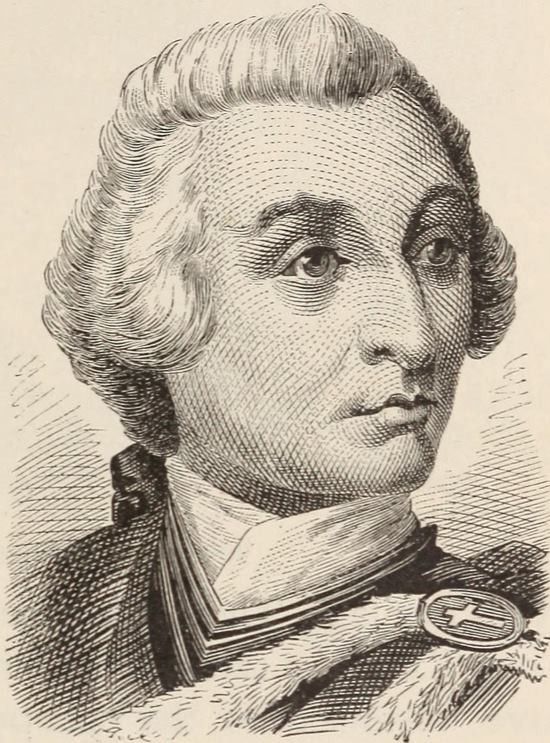
James Oglethorpe.
15. The chief of the Yamacraws came from his cabin to see the new-comers. "Here is a present for you," said he to Oglethorpe. The present was a buffalo robe painted with the head and feathers of an eagle. "The feathers are soft, and signify love; the buffalo skin is the emblem of protection. Therefore love us and protect us," said the old chieftain. Seeing the advantages of peace, Oglethorpe invited a council at his capital. The conference was held on the 29th of May. Long King, the sachem, spoke for all the tribes. The English were welcomed to the country. Gifts were made, and the governor responded with words of friendship.

Oglethorpe and the Yamacraw Chief.
16. The councilors in England encouraged emigration. Swiss peasants, Scotch Highlanders, and German Protestants all found a home on the Savannah. In April of 1734, Oglethorpe made a visit to England. It was said in London that no colony was ever before founded so wisely as Georgia. The councilors prohibited the importation of rum. Traffic with the Indians was regulated by a license. Slavery was positively forbidden. While the governor was still abroad, a company of Moravians arrived at Savannah.
Coming of the Missionaries.
17. In February of 1736 Oglethorpe came back with a colony of three hundred. These were also Moravians, people of deep piety and fervent spirit. First among them was John Wesley, the founder of Methodism. He came to Georgia to spread the gospel and convert the Indians. But he was doomed to much disappointment in his work; and after a residence of less than two years he left the colony. His brother, Charles Wesley, came also as a secretary to Governor Oglethorpe. In 1738 the famous George Whitefield came, and preached with fiery eloquence through all the colonies.
18. Meanwhile, Oglethorpe, anticipating war with Florida, began to fortify. All of Georgia was embraced in the Spanish claim. But Oglethorpe had a charter for the territory as far south as the Altamaha. In 1736 he ascended the Savannah and built a fort at Augusta. On the north bank of the Altamaha, he built Fort Darien. On St. Simon's Island a fortress was erected and named Frederica. The St. John's was claimed from this time forth as the southern boundary of Georgia. The governor again visited England, and returned with a regiment of troops.
War with Spanish Florida.
19. In October, 1739, England published a declaration of war against Spain. In the first week of the following January, Oglethorpe invaded Florida, and captured two fortified towns. Soon, with a force of more than a thousand men, he marched against St. Augustine, but after a siege of five weeks was compelled to withdraw.
20. The Spaniards now determined to carry the war into Georgia. In June of 1742 a fleet of thirty-six vessels, carrying more than three thousand troops, sailed from St. Augustine for the reduction of Fort William on Cumberland Island. But Oglethorpe reinforced the garrison, and then fell back to Frederica. The Spanish vessels followed. From the southern point of the island to Frederica, Oglethorpe had cut a road which lay between a morass and a forest. The Spaniards must pass along this path to attack the town.
21. The English general posted his men between the swamp and the forest. On the 7th of July the enemy reached the pass, were fired on from the thicket, and driven back in confusion. The main body of the Spanish forces pressed on into the same position, stood firm for a while, but were presently routed with the loss of two hundred men. The name of Bloody Marsh was given to this battlefield. Within a week the whole Spanish force reembarked and sailed for Florida.
22. The colony of Georgia was now firmly established. In 1743 Oglethorpe departed for England, after having devoted ten years to the colony. He had never owned a house nor possessed an acre of ground in the province.
Georgia a Royal Province.
23. The regulations which the councilors for Georgia had adopted were poorly suited to the wants of the colony. The settlers had no titles to their lands. Estates could descend only to the oldest sons of families. The colonists charged their poverty to the fact that slave-labor was forbidden in the province. The proprietary laws became unpopular. The statute excluding slavery was not enforced. Slaves began to be hired, first for short terms of service, then for longer periods, then for one hundred years. Finally, slaves were brought directly from Africa and sold to the planters below the Savannah.
24. The new order of things was acknowledged by the councilors; and in June of 1752 they surrendered their patent to the king. A royal government was established over the country, and the people were granted the freedom of Englishmen. For some time the progress of the colony was not equal to the expectations of its founder, but before the Revolution Georgia had become a growing province.
CHAPTER XX.
French and Indian War.
THE time came when the American colonies began to act together. The final struggle between France and England for colonial supremacy in America was at hand. Necessity compelled the English colonies to join in a common cause against the foe. This is the conflict known as the French and Indian War. Causes of war had existed for many years.
Causes of the War.
2. The first of these causes was the conflicting territorial claims of the two nations. England had colonized the sea-coast; France had colonized the interior of the continent. The English kings claimed the country from one ocean to the other. The French, however, began to push their way westward and southward along the great lakes to the head-waters of the Wabash, the Illinois, and the St. Croix, then down these streams to the Mississippi and the Gulf of Mexico. The purpose of the French was to divide the American continent and take the larger portion.
3. The French soon established military posts at Frontenac, at Niagara, at the Straits of Mackinaw, and on the Illinois. Before 1750, settlements had been made on the Maumee, at Detroit, at Green Bay, at Vincennes, at Kaskaskia, at Natchez, at New Orleans, and on the Bay of Biloxi. At this time the only outposts of the English were a fort at Oswego and a few cabins in West Virginia.
The Ohio Company.
4. The immediate cause of hostilities was a conflict between the frontiersmen of the two nations in the Ohio valley. In order to prevent the intrusion of the French fur-traders into this country, a number of Virginians joined themselves together in a body called the Ohio Company. In March of 1749, they received from George II. a land-grant of five hundred thousand acres, located between the Kanawha and the Monongahela. But before the company could send out a colony, the governor of Canada dispatched three hundred men to occupy the valley of the Ohio. In the next year, however, the Ohio Company sent out an exploring party under Christopher Gist, who traversed the country and returned to Virginia in 1751.
5. This expedition was followed by vigorous movements of the French. They built a fort called Le Bœuf, on French Creek, and another named Venango, on the Alleghany. About the same time, the country south of the Ohio was again explored by Gist and a party of armed surveyors.
6. The Indians were greatly alarmed at the prospect. They rather favored the English cause, but their allegiance was uncertain. In the spring of 1753, the Miami tribes, under the leadership of the Half-King, met Benjamin Franklin at Carlisle, Pennsylvania, and made a treaty with the English.
Washington sent to St. Pierre.
7. Before proceeding to actual war, Governor Dinwiddie determined to try a final remonstrance with the French. A paper was drawn up setting forth the nature of the English claim to the valley of the Ohio, and warning the authorities of France against further intrusion. A young surveyor, named George Washington, was called upon to carry this paper from Williamsburg, Virginia, to General St. Pierre at Presque Isle, on Lake Erie.
8. On the last day of October, 1753, Washington set out on his journey. He was attended by four comrades besides an interpreter and Christopher Gist, the guide. At Logstown, Washington held a council with the Indians, and then pressed on to Fort Le Bœuf. Here the conference was held with St. Pierre. Washington was received with courtesy, but the general of the French was acting, he said, under military instructions, and would eject every Englishman from the valley of the Ohio.

Washington's Route to Ft. le Bœuf.
9. Washington soon took leave of the French, and returned to Venango. Then, with Gist as his sole companion, he left the river and struck into the woods. Clad in the robe of an Indian; sleeping with frozen clothes on a bed of pine-brush; guided at night by the North Star; fired at by a prowling savage from his covert; lodging on an island in the Alleghany until the river was frozen over; plunging again into the forest, the young ambassador came back without wound or scar to the capital of Virginia. The answer of St. Pierre was laid before the governor, and the first public service of Washington was ended.
English post on the Ohio.
10. In the mean time the Ohio Company had sent thirty-three men, under command of Trent, to erect a fort at the source of the Ohio. In March, 1754, they built the first rude block-house on the site of Pittsburgh. After all the threats of the French, the English had beaten them in seizing the key to the Ohio valley.
11. Soon, however, French boats came down the river; and Trent was obliged to surrender. Washington was now stationed at Alexandria to enlist recruits. But it was too late to save Trent's men from capture. The French immediately occupied the post, built barracks and laid the foundations of Fort Du Quesne. To retake this place Colonel Washington set out from Will's Creek in May of 1754. The possession of the disputed territory was now to be determined by war.
Battle at Great Meadows.
12. Washington, with his little army of Virginians, was commissioned to build a fort at the source of the Ohio, and to repel all who interrupted the English settlements in that country. In April the young commander left Will's Creek, and on the 26th of May the English reached the Great Meadows. Here Washington was informed that the French were on the march to attack him. A stockade was immediately erected, and named Fort Necessity. Washington determined to strike the first blow. Two Indians followed the trail of the enemy, and discovered their hiding-place. The French were on the alert, and flew to arms. "Fire!" was the command of Washington; and the first volley of a great war went flying through the forest. The engagement was brief and decisive. Jumonville, the leader of the French, and ten of his party, were killed, and twenty-one were made prisoners.
13. Before advancing farther, Washington waited for reinforcements. Only one company of volunteers arrived. His whole force numbered scarcely four hundred. Learning that the French general De Villiers was approaching, Washington deemed it prudent to fall back to Fort Necessity.
14. Scarcely were Washington's forces safe within the stockade, when, on the 3d of July, the regiment of De Villiers came in sight, and surrounded the fort. The French stationed themselves on the eminence, and fired down upon the English with fatal effect. The Indians climbed into the tree-tops. For nine hours the assailants poured a shower of balls upon Washington's men. At length, seeing that it would be impossible to hold out, he accepted the terms which were offered by the French general. On the 4th of July the English garrison marched out of the fort, and withdrew from the country.
Congress of the Colonies.
15. Meanwhile, a congress of the American colonies had assembled at Albany. The first object was to renew the treaty with the Iroquois; the second, to unite the colonies in a common government. On the 10th of July, Benjamin Franklin presented the draft of a constitution, which was finally adopted. Philadelphia was to be the capital. The chief executive was to be a governor appointed by the king. Each colony should be represented in congress by not less than two or more than seven representatives.
16. Copies of this constitution were transmitted to the several colonies; but the new scheme of government was everywhere received with disfavor. The English ministers also rejected it, saying that the Americans were trying to make a government of their own. Meanwhile, the French were constantly preparing for war.
General Braddock Arrives.
17. Early in 1755 General Braddock arrived in America; the plans of four campaigns were agreed on. Lawrence, the governor of Nova Scotia, was to complete the conquest of that province. Governor Johnson, of New York, was to capture Crown Point. Shirley, of Massachusetts, was to take Fort Niagara. Braddock himself was to lead the main army against Fort Du Quesne.
18. In the latter part of April, the British general set out with two thousand veterans, from Alexandria to Fort Cumberland. A few provincial troops joined the expedition. Washington became an aide-de-camp of Braddock, and frequently gave him honest counsel, which the British general rejected.
19. Braddock marched with the main body. On the 19th of June he put himself at the head of twelve hundred chosen troops, and pressed forward toward Fort Du Quesne. On the 9th of July, when the English were only twelve miles from Fort Du Quesne, they were suddenly fired upon by the French and Indians, who were hidden among the rocks and ravines.
Braddock's Defeat.
20. The battle began with a panic. The men fired constantly, but could see no enemy. Braddock rushed to the front and rallied his men; but it was all in vain. They stood huddled together like sheep. The forest was strewn with the dead. Out of eighty-two officers, twenty-six were killed. Of the privates seven hundred and fourteen had fallen. A retreat began at once, and Washington, with the Virginians, covered the flight of the army.
21. On the next day the Indians returned to Fort Du Quesne clad in the laced coats of the British officers. The wounded Braddock was borne in the train of the fugitives to Fort Necessity, where he died. When they reached Dunbar's camp the confusion was greater than ever. The artillery, baggage, and public stores were destroyed. Then followed a hasty retreat to Fort Cumberland, and finally to Philadelphia.
The English in Acadia.
22. By the treaty of Utrecht, made in 1713, Acadia, or Nova Scotia, was ceded by France to England. The great majority of the people in that province were French, and the English government was only a military occupation. At the outbreak of the French and Indian War the population amounted to more than sixteen thousand. In a campaign of a month, the English now made themselves masters of the whole country east of the St. Croix.
23. The French inhabitants still outnumbered the English, and Governor Lawrence determined to drive them into banishment. The English officers first demanded an oath of allegiance, and the surrender of all firearms and boats. The British vessels were then made ready to carry the people into exile.

Embarkation at Acadia.
The Exile of Acadians.
24. The country about the isthmus was now laid waste, and the peasants driven into the larger towns. Wherever a sufficient number could be got together they were compelled to go on shipboard. At the village of Grand Pré, more than nineteen hundred people were driven into the boats at the point of the bayonet. Wives and children, old men and mothers, the sick and the infirm, all shared the common fate. More than three thousand of the Acadians were carried away and scattered, helpless and half starved, among the English colonies.
25. The third campaign planned by Braddock was to be conducted by Governor Shirley against Fort Niagara. Early in August the attempt was made, but in October had to be abandoned.
Expedition to Lake Champlain.
26. The fourth expedition was intrusted to General William Johnson. The object was to capture Crown Point, and drive the French from Lake Champlain. Early in August the army proceeded to the Hudson above Albany, and built Fort Edward. Thence Johnson marched to Lake George and laid out a camp.
Dieskau Defeated.
27. In the mean time, Dieskau, the French commandant at Crown Point, advanced with fourteen hundred French, Canadians, and Indians to capture Fort Edward. The Canadians and French regulars, unsupported by the Indians, then attacked the English position. For five hours the battle was incessant. Nearly all of Dieskau's men were killed. At last the English troops charged across the field, and completed the rout. Dieskau was mortally wounded. Two hundred and sixteen of the English were killed. General Johnson now constructed Fort William Henry on the site of his camp. Meanwhile, the French had fortified Ticonderoga. Such was the condition of affairs at the close of 1755.

Lake Champlain.
28. In the beginning of the next year the command of the English forces was given to Governor Shirley. Washington, at the head of the Virginia provincials, repelled the French and Indians in the valley of the Shenandoah. The expeditions, which were planned for the year, embraced the conquest of Quebec and the capture of Forts Frontenac, Toronto, Niagara, and Du Quesne.
29. The earl of Loudoun now received the appointment of commander-in-chief of the British forces. On the 17th of May Great Britain, after nearly two years of actual hostilities, made a declaration of war against France. In July Lord Loudoun assumed the command of the colonial army. The French, meanwhile, led by the marquis of Montcalm, who had succeeded Dieskau, besieged and captured Oswego.
Massacre at Ft. William Henry.
30. In the following campaign the daring Montcalm, with more than seven thousand French, Canadians, and Indians, advanced against Fort William Henry. For six days the French pressed the siege with vigor. The ammunition of the garrison was exhausted, and nothing remained but to surrender. Honorable terms were granted by the French. On the 9th of August the French took possession of the fortress. Unfortunately, the Indians procured a quantity of spirits from the English camp. In spite of the utmost exertions of Montcalm, the savages fell upon the prisoners and massacred thirty of them in cold blood.
31. Such had been the successes of France during the year, that the English had not a single hamlet left in the whole basin of the St. Lawrence. Every cabin where English was spoken had been swept out of the Ohio valley. At the close of the year 1757 France possessed twenty times as much American territory as England, and five times as much as England and Spain together.
Louisburg Captured.
32. William Pitt was now placed at the head of the English ministry. Loudoun was deposed from the American army. General Abercrombie was appointed to succeed him. General Amherst was to lead a division, and young Lord Howe was next in rank to Abercrombie. Three expeditions were planned for 1758: one to capture Louisburg; a second, to reduce Crown Point and Ticonderoga; and the third to retake Fort Du Quesne from the French. The first was successful, and on the 28th of July, Louisburg capitulated. Cape Breton and Prince Edward Island were surrendered to Great Britain. The garrison, numbering nearly six thousand men, became prisoners of war.
Defeat at Ticonderoga.
33. On the 5th of July General Abercrombie, with an army of fifteen thousand men, moved against Ticonderoga. On the morning of the 6th the English fell in with the picket line of the French. A severe skirmish ensued; the French were overwhelmed, but Lord Howe was killed in the onset. On the morning of the 8th, the English divisions were arranged to carry Ticonderoga by assault. A desperate battle of more than four hours followed, until, at six o'clock in the evening, the English were finally repulsed. The loss on the side of the assailants amounted in killed and wounded to nineteen hundred and sixteen. In no battle of the Revolution did the British have so large a force engaged, or meet such terrible loss.
34. The English now retreated to Fort George. Soon afterward three thousand men, under Colonel Bradstreet, were sent against Fort Frontenac, on Lake Ontario, which, after a siege of two days, was compelled to capitulate. The fortress was demolished. Bradstreet's success more than counterbalanced the failure of the English at Ticonderoga.
Destruction of Ft. Du Quesne.
35. Late in the summer General Forbes, with nine thousand men, advanced against Fort Du Quesne. Washington led the Virginia provincials. On the 24th of November he was within ten miles of Du Quesne. During that night the garrison took the alarm, burned the fortress, and floated down the Ohio. On the 25th the victorious army marched in, raised the English flag, and named the place Pittsburgh.
36. General Amherst was now promoted to the chief command of the American forces. By the beginning of summer, 1759, the British and colonial armies numbered nearly fifty thousand men. The entire French army scarcely exceeded seven thousand. Three campaigns were planned for the year: General Prideaux was to conduct an expedition against Niagara. Amherst was to lead the main division against Ticonderoga and Crown Point. General Wolfe was to proceed up the St. Lawrence and capture Quebec.
37. On the 10th of July, Niagara was invested by Prideaux. Two weeks later the fort capitulated, and the French, to the number of six hundred, became prisoners of war. At the same time Amherst was marching with an army of eleven thousand men against Ticonderoga. On the 22d of July the English forces landed, and on the 26th the garrison retreated to Crown Point. Five days afterwards they deserted this place also, and withdrew to Isle-aux-Noix, in the river Sorel.

MAP SHOWING THE COLONIES at the time of FRENCH AND INDIAN WAR.
38. Early in the spring General Wolfe began the ascent of the St. Lawrence. His force consisted of nearly eight thousand men, and a fleet of forty-four vessels. On the 29th of June General Monckton was sent to seize Point Levi.
39. On the 9th of July, General Wolfe crossed the north channel, and encamped on the east bank of the Montmorenci. This stream was fordable at low water. On the 31st of the month a severe battle was fought at the fords of the river, and the English were repulsed with heavy losses.
The Plains of Abraham.
40. Exposure and fatigue threw the English general into a fever. It was decided to ascend the St. Lawrence, and gain the Plains of Abraham, in the rear of the city. The lower camp was broken up, and on the 6th of September the troops were conveyed to Point Levi. Wolfe then transferred his army to a point several miles up the river.

QUEBEC IN 1759.
41. On the night of the 12th of September, the English dropped down the river to a place called Wolfs Cove, and in the dawn of morning the general marshaled his army for battle on the Plains of Abraham. Montcalm was in amazement when he heard the news. With great haste the French were brought from the trenches on the Montmorenci, and thrown between Quebec and the English.
The Taking of Quebec.
42. The battle began with an hour's cannonade. The Canadians and Indians were routed. The French regulars wavered and were thrown into confusion. Wolfe, leading the charge, was twice wounded, but pressed on. At the moment of victory a third ball pierced his breast, and he sank to the earth. "They run, they run!" said the attendant who bent over him. "Who run?" was the response. "The French are flying everywhere," replied the officer. "Do they run already? Then I die happy," said the expiring hero.
43. Montcalm, attempting to rally his regiments, was struck by a ball and mortally wounded. "Shall I survive?" said he to his surgeon. "But a few hours at most," answered the attendant. "So much the better," replied the heroic Frenchman; "I shall not live to witness the surrender of Quebec."
44. Five days after the battle, Quebec was surrendered, and an English garrison took possession of the citadel. On the 8th of September, in the same year, Montreal, the last important post of France in the valley of the St. Lawrence, was surrendered to General Amherst.
The Treaty of Paris.
45. For three years the war between France and England continued on the ocean. The English fleets were everywhere victorious. On the 10th of February, 1763, a treaty of peace was made at Paris. All the French possessions in North America, eastward of the Mississippi from its source to the river Iberville, and thence through Lakes Maurepas and Pontchartrain to the Gulf of Mexico, were surrendered to Great Britain. At the same time, Spain, with whom England had been at war, ceded East and West Florida to the English Crown. Thus closed the French and Indian War. By this conflict it was decided that the decaying institutions of the Middle Ages should not prevail in America, and that the powerful language, just laws, and priceless liberties of the English race should be planted forever in the vast domains of the New World.
Review Questions—Part III.
CHAPTER IX.
- 1. Give an account of the first settlement at Jamestown.
- 2. What troubles arose within the colony itself, and how were these adjusted?
- 3. Trace the course of Captain Smith among the Indians, and in his voyages of discovery.
- 4. Describe the government of Virginia under the First and Second Charters.
CHAPTER X.
- 5. What changes in government were made by the Third Charter?
- 6. Mention the improvement in the colonial industries.
- 7. Describe the hardships and the growth of the Virginia colony.
- 8. Give an account of the Indian massacre of 1622.
CHAPTER XI.
- 9. Tell of the farther changes in the government, first to a Royal, then to a Proprietary.
- 10. Give an account of Bacon's Rebellion, with its causes and results.
CHAPTER XII.
- 11. Give an account of the condition and prospects of the Plymouth colonists.
- 12. What relations existed between these colonists and the Indians?
- 13. Tell about the sectarian troubles and their adjustment.
- 14. Outline the general prosperity of New England.
CHAPTER XIII.
- 15. Follow the farther strife between the colonists and the Indians.
- 16. Trace the changes in government in the New England Colonies from 1622-1689.
- 17. Give an account of King William's War, with the results to New England.
- 18. Tell about Salem Witchcraft.
- 19. Give an account of Queen Anne's and King George's wars, with the causes of each and the final adjustments.
- 20. Sketch the character of the Puritan.
CHAPTER XIV.
- 21. Outline the settlements of the Dutch and their conflicts with the English and the Swedes.
- 22. Trace the conflict between the Dutch and the Indians
CHAPTER XV.
- 23. What of the condition, the government, and the progress of New York under the English rule?
- 24. Give an account of the "Negro Plot."
CHAPTER XVI.
- 25. Mention the several claims to the territory of Connecticut.
- 26. Tell the story of the Pequod War.
- 27. Outline the government and the general prosperity of Connecticut.
- 28. Give an account of Roger Williams, and the organization of the "Plantation of Rhode Island."
- 29. Tell of the founding and growth of New Hampshire.
CHAPTER XVII.
- 30. Sketch the history of New Jersey, and its final separation from Pennsylvania.
- 31. Tell the story of William Penn, and his career in Pennsylvania.
CHAPTER XVIII.
- 32. Give an account of the founding and development of Maryland.
- 33. Give an account of the colonization and progress of North Carolina.
CHAPTER XIX.
- 34. Tell of the founding of South Carolina.
- 35. Recite the affairs of Georgia under Oglethorpe.
- 36. Outline the troubles between the English and the Spaniards in Georgia and Florida.
CHAPTER XX.
- 37. What were the leading causes of the French and Indian War?
- 38. Give an account of Washington's expedition to St. Pierre.
- 39. Give an account of the capture of Fort Necessity.
- 40. Give an outline of Braddock's campaign.
- 41. What were the leading events of the campaign of Wolfe?
Part IV.
REVOLUTION AND CONFEDERATION.
A. D. 1775-1789.
CHAPTER XXI.
Causes of the Revolution.
THE American Revolution was an event of vast importance. The question decided by it was whether the English colonies in America should govern themselves, or be ruled by Great Britain. The decision was in favor of independence. The result has been the grandest republican government the world has ever known.
General Causes.
2. The most general cause of the Revolution was THE RIGHT OF ARBITRARY GOVERNMENT, claimed by Great Britain and denied by the colonies. The question began to be discussed about the time of the treaty of Aix-la-Chapelle, in 1748; and from that period until 1775, each year witnessed a renewal of the agitation. But there were also many minor causes tending to bring on a conflict with the mother-country.
3. First of these was the influence of France, inciting the colonies to rebel. The French had ceded Canada to Great Britain with the hope of securing American independence. England feared such a result. It was even proposed in Parliament to re-cede Canada to France, in order to check the growth of the American States.
4. Another cause was the natural disposition of the colonists. Many of the original settlers came to America to escape the tyranny of kings, and their descendants naturally favored a representative government. The dealings of the colonists with the royal officers had created a dislike for foreign institutions.
5. The growth of public opinion in the colonies tended to independence. The better class of men came to believe that a separation from England was very desirable. As early as 1755, John Adams, then a young school-teacher in Connecticut, wrote in his diary: "In another century all Europe will not be able to subdue us. The only way to keep us from setting up for ourselves is to disunite us."
6. Another cause of the Revolution was the personal character of the king. George III. was one of the worst of rulers, and had no true notion of human rights. His ministers were, for the most part, men like himself.
Immediate Causes.
Acts Restricting Trade.
7. The more immediate cause of the war was the passage by Parliament of a number of laws destructive of colonial liberty. The first of these was the Importation Act of 1733. By this statute exorbitant duties were laid on sugar, molasses, and rum. In 1750 it was enacted that iron-works should not be erected in America. The manufacture of steel was forbidden, and the felling of pines outside of inclosures. These laws were disregarded by the colonists, who considered them unjust and tyrannical. In 1761 the courts were authorized to issue to petty officers search-warrants, called Writs of Assistance, by which constables might enter every place, searching for goods suspected of having evaded the duty. At Salem and Boston the writs were resisted.
8. In 1763, and again in the following year, the English officers were authorized to seize all vessels engaged in unlawful trade. Before this was known at Boston, a great town-meeting was held. Samuel Adams was the orator. A powerful argument was produced, showing that under the British constitution taxation and representation were inseparable.
9. On the 10th of March, 1764, Mr. Grenville, the prime minister, brought before the House of Commons a resolution that it would be proper to charge certain stamp-duties on the American colonies. The news of the measure was borne to America, producing universal excitement. Resolutions against the acts of the ministers were passed in almost every town. Remonstrances were addressed to the king and the Parliament.
The Stamp Act.
10. Nevertheless, in March of 1765, the English Parliament passed the Stamp Act. In the House of Commons it received a majority of five to one. In the House of Lords the vote was unanimous. On the 22d of the month, the royal assent was given. Benjamin Franklin, then in London, wrote to a friend at home that the sun of American liberty had set.
11. The provisions of the Stamp Act were these: Every legal document required in the colonies should, after the 1st day of the following November, be executed on stamped paper to be furnished by the British government. For each sheet the colonists were required to pay a sum varying from three pence to six pounds sterling. Every pamphlet, almanac, and newspaper was to be printed on paper of the same sort, the value of the stamps ranging from a half-penny to four pence. No contract should be binding unless bearing the stamp.
12. The news of the hateful act created great wrath in America. The bells of Philadelphia and Boston rang a funeral knell. In New York a copy of the Stamp Act was carried through the streets with a death's-head nailed to it, and a placard bearing this inscription: The Folly of England and the Ruin of America. The general assemblies were at first slow to move; there were many old royalists among the members. But the younger representatives did not hesitate to express their sentiments. In the Virginia House of Burgesses there was a memorable scene.
Patrick Henry.
13. Patrick Henry, the youngest member of the House, after waiting in vain for some older delegate to lead in opposition to Parliament, snatched a blank leaf out of an old law book and drew up a series of six resolutions, declaring that the Virginians were Englishmen with English rights; that the colonists were not bound to yield obedience to any law imposing taxation on them; and that whoever said the contrary was an enemy to the country.
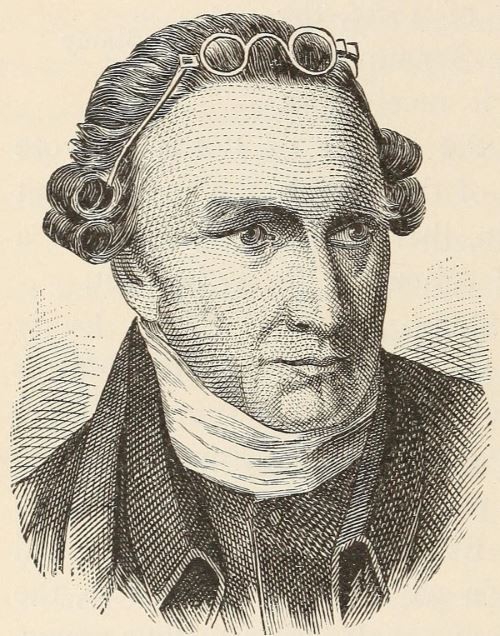
Patrick Henry.
14. A violent debate ensued. Two future Presidents of the United States were in the audience: Washington as a delegate, and Thomas Jefferson, a young collegian, outside of the railing. The eloquent Henry bore down all opposition. "Cæsar had his Brutus," said the orator; "Charles I. had his Cromwell, and George III.—" "Treason!" shouted the speaker. "Treason! treason!" exclaimed the royalists, springing to their feet. "And George III. may profit by their example," continued Henry; and then added, "If that be treason, make the most of it!" The six resolutions were carried; but on the next day, when Henry was absent, the powerful aristocratic and church party secured the repeal of two of the more violent resolutions.
The "Stamp Act Congress," 1765.
15. Similar resolutions were adopted by the assemblies of New York and Massachusetts. James Otis proposed an American Congress. The proposition was favorably received by nine of the colonies; and, on the 7th of October, the first colonial Congress, called the Stamp Act Congress, assembled at New York. Timothy Ruggles, of Massachusetts, was chosen president. A Declaration of Rights was adopted setting forth that the American colonists, as Englishmen, could not consent to be taxed but by their own representatives. Memorials were sent to Parliament and a petition to the king.
16. On the 1st of November the Stamp Act was to take effect. During the summer great quantities of the stamped paper had been sent to America. But everywhere it was rejected or destroyed. The 1st of November was kept as a day of mourning.
Sons of Liberty.
17. At first, legal business was suspended. The court-houses were shut up. Not even a marriage license could be legally issued. By and by, the offices were opened, and business went on as before, but not with stamped paper. It was at this time that the patriotic society, known as the Sons of Liberty, was organized. The merchants of New York, Boston, and Philadelphia entered into a compact to purchase no more goods of Great Britain until the Stamp Act should be repealed.
18. The colonists had their friends in England. Eminent statesmen espoused the cause of America. In the House of Commons Mr. Pitt delivered a powerful address. "You have," said he, "no right to tax America. I rejoice that America has resisted." On the 18th of March, 1766, the Stamp Act was formally repealed. But at the same time a resolution was added, declaring that Parliament had the right to bind the colonies in all cases whatsoever.
Repeal of the Stamp Act.
19. The repeal of the Stamp Act produced great joy, both in England and America. But on the 29th of June, 1767, another act was passed imposing a duty on all the glass, paper, painters' colors, and tea which should thereafter be imported into the colonies.
20. The resentment of the Americans burst out anew. Another agreement not to purchase British goods was entered into by the American merchants. The newspapers were filled with denunciations of Parliament. In the month of June, a sloop, charged with evading the payment of duty, was seized by the custom-house officers of Boston. But the people attacked the houses of the officers, and obliged the occupants to fly to Castle William. General Gage was now ordered to bring from Halifax a regiment of regulars and overawe the people. On the 1st of October the troops, seven hundred strong, marched with fixed bayonets into the capital of Massachusetts.
Resistance of the Colonies.
21. In February of 1769 the people of Massachusetts were declared rebels, and the governor was directed to arrest those deemed guilty and send them to England for trial. The general assembly met this outrage with defiant resolutions. Similar scenes were enacted in Virginia and North Carolina.
The Boston Massacre.
22. Early in 1770 the soldiers in New York cut down a liberty pole which stood in the park. A conflict ensued, in which the people won the day. On the 5th of March, a more serious difficulty occurred in Boston. A crowd of people surrounded Captain Preston's company of the city guard, hooted at them, and dared them to fire. At length the soldiers discharged a volley, killing three of the citizens and wounding several others. This outrage, known as the Boston Massacre, created a profound sensation. Captain Preston and his company were arrested and tried for murder. Two of the offenders were convicted of manslaughter.
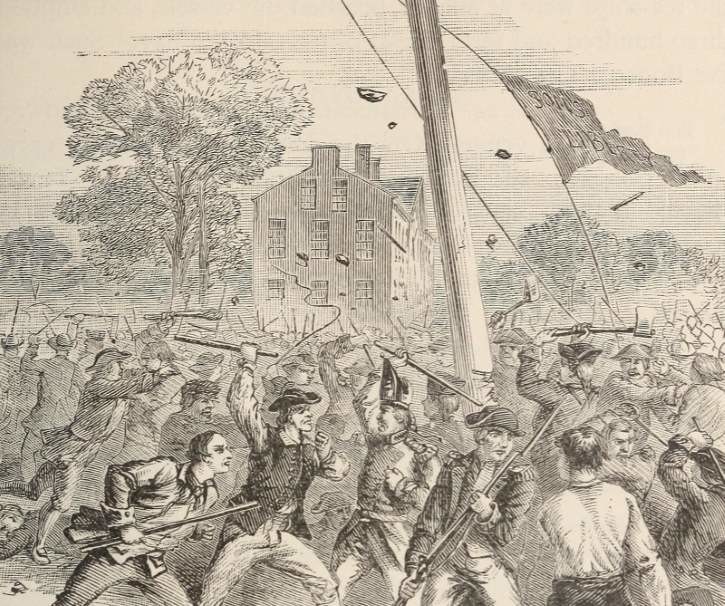
Fight at the Liberty Pole, New York.
The Boston Tea Party.
23. Parliament now passed an act repealing all duties on American imports except that on tea. The people, in answer, pledged themselves to use no more tea until the duty should be unconditionally repealed. In 1773 Parliament removed the export duty which had hitherto been charged on tea shipped from England. The price of tea was thus lowered, and the ministers thought that, when the cheaper tea was offered in America, the colonists would pay the import duty without suspicion. Ships were loaded with tea for the American market. Some of the vessels reached Charleston; but the chests were stored in cellars, and the contents ruined. At New York and Philadelphia the ships were forbidden to enter. At Boston the authorities would not permit the tea to be landed. On the 16th of December there was a great town-meeting, at which seven thousand people were present. Adams and Quincy spoke to the multitudes. Evening came on, and the meeting was about to adjourn, when a war-whoop was heard, and fifty men disguised as Indians marched to the wharf where the tea-ships were at anchor, boarded the vessels, and emptied three hundred and forty chests of tea into the bay. Such was the Boston Tea Party.
The Boston Port Bill.
24. Parliament made haste to find revenge. On the last day of March, 1774, the Boston Port Bill was passed. It was enacted that no kind of merchandise should any longer be landed or shipped at the wharves of Boston. The custom-house was removed to Salem, but the people of that town refused to accept it. The inhabitants of Marblehead gave the free use of their warehouses to the merchants of Boston. When the news of the Port Bill reached Virginia, the burgesses entered a protest on their journal. Governor Dunmore ordered the members to their homes; but they met and continued their work in another place. On the 20th of May, the charter of Massachusetts was annulled. The people were declared rebels, and the governor was ordered to send abroad for trial all persons who should resist the officers.
First Continental Congress, 1774.
25. In September the First Continental Congress assembled at Philadelphia. Eleven colonies were represented. One address was sent to the king; another to the English nation; and another to the people of Canada. A resolution was adopted to suspend all commercial intercourse with Great Britain. Parliament retaliated by ordering General Gage to reduce the colonists by force. A fleet and ten thousand soldiers were sent to aid him.
26. Boston Neck was seized and fortified by the British. The stores at Cambridge and Charlestown were conveyed to Boston; and the general assembly was ordered to disband. Instead of doing so, the members voted to equip an army of twelve thousand men for defence. There was no longer any hope of a peaceable adjustment. The colonists were few and feeble; but they were men of iron wills who had made up their minds to die for liberty.
CHAPTER XXII.
The Beginning of the Revolution.—Events of 1775.
Paul Revere's Ride.
AS soon as the intentions of General Gage were known, the people of Boston, concealing their ammunition in carts, conveyed it to Concord. On the night of the 18th of April, Gage dispatched eight hundred men to destroy the stores. The plan of the British was made with great secrecy; but the patriots discovered the movement. When the regiment, under command of Colonel Smith and Major Pitcairn, set out for Concord, the people of Boston were roused by the ringing of bells and the firing of cannon. William Dawes and Paul Revere rode with all speed to Lexington and spread the alarm through the country.
The Fight at Lexington.
2. At two o'clock in the morning, a company of one hundred and thirty minute-men assembled on the common at Lexington. No enemy appeared until five o'clock, when the British, under command of Pitcairn, came in sight. The provincials were led by Captain Parker. Pitcairn rode up and exclaimed: "Disperse, ye villains! Throw down your arms!" The minute-men stood still, and Pitcairn cried, "Fire!" The first volley of the Revolution whistled through the air, and sixteen of the patriots fell dead or wounded. The rest fired a few shots and dispersed.
3. The British pressed on to Concord; but the inhabitants had removed the stores to a place of safety, and there was but little destruction. While the British were ransacking the town, the minute-men encountered a company of soldiers who were guarding the North Bridge. Here the Americans fired, and two British soldiers were killed. The rest began a retreat through the town toward Lexington. For six miles the battle was kept up along the road. Hidden behind trees, fences, and barns, the patriots poured a constant fire upon the ranks of the enemy. The American loss was forty-nine killed, thirty-four wounded, and five missing; that of the enemy was two hundred and seventy-three.

THE FIGHT AT LEXINGTON
4. The battle of Lexington fired the country. Within a few days an army of twenty thousand men gathered about Boston. A line of intrenchments was drawn from Roxbury to Chelsea. John Stark came down with the New Hampshire militia. Rhode Island sent her men under Nathaniel Greene. Benedict Arnold came with the provincials of New Haven. Ethan Allen, with a company of two hundred and seventy patriots, advanced against Ticonderoga. Benedict Arnold joined the expedition as a private. On the evening of the 9th of May, the force reached the shore of Lake George, opposite Ticonderoga.
Ethan Allen at Ticonderoga.
5. On the following morning, eighty-three men succeeded in crossing. With this mere handful, Allen made a dash and gained the gateway of the fort. He rushed to the quarters of the commandant, and cried out: "Surrender this fort instantly!" "By what authority?" inquired the officer. "In the name of the great Jehovah and the Continental Congress," said Allen, flourishing his sword. The garrison were made prisoners and sent to Connecticut, and vast quantities of military stores fell into the hands of the Americans. Two days afterwards Crown Point was also taken.
6. On the 25th of May, Generals Howe, Clinton, and Burgoyne arrived at Boston. The British army was augmented to more than ten thousand men. It was now rumored that Gage was about to sally out of Boston to burn the neighboring towns and devastate the country. The Americans determined to anticipate this movement by fortifying Bunker Hill, which commanded the peninsula of Charlestown.
7. On the night of the 16th of June, Colonel Prescott was sent with a thousand men to intrench the hill. The provincials reached the eminence; but Prescott and his engineer, not liking the position, proceeded down the peninsula to Breed's Hill, within cannon range of Boston. Here a redoubt was thrown up during the night. The British ships in the harbor were so near that the Americans could hear the sentinels repeating the night-call, "All is well."
Battle of Bunker Hill.
8. As soon as it was light, General Gage ordered the ships to cannonade the American position. The British batteries on Copp's Hill also opened fire. Just after noon, three thousand British veterans, commanded by Generals Howe and Pigot, landed at Morton's Point. The Americans numbered about fifteen hundred. Charlestown was burned by the British as they advanced. Thousands of spectators climbed to the house-tops in Boston to watch the battle. On came the British in a stately and imposing column.
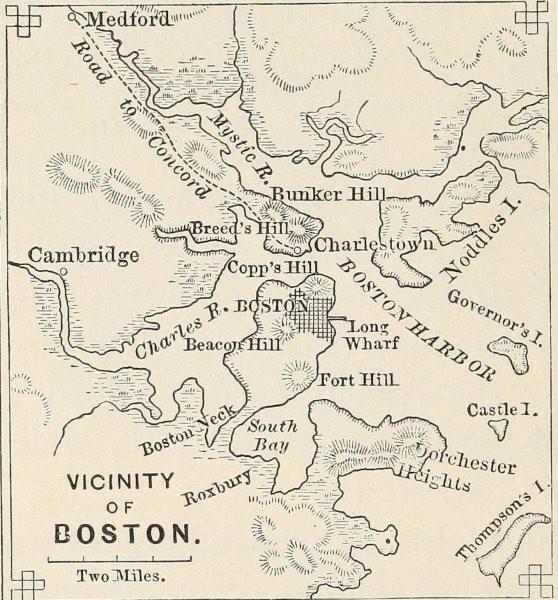
VICINITY OF BOSTON.
9. The Americans reserved their fire until the advancing line was within a hundred and fifty feet. Then instantly every gun was discharged. The front rank of the British melted away, and the rest hastily retreated. Howe rallied his men and led the second charge. Again the American fire was withheld until the enemy was but a few rods distant. Then volley after volley was poured upon the column until it was broken and driven into flight.
10. The vessels of the British fleet now changed position until the guns were brought to bear upon the American works. For the third time, the British soldiers charged with fixed bayonets up the hillside. The Americans had but three or four rounds of ammunition remaining. These were expended on the advancing enemy. Then there was a lull. The British clambered over the ramparts. The provincials hurled stones at the assailants. It was in vain; they were driven out of their trenches at the point of the bayonet. The brave Warren gave his life for freedom. The loss of the British in the engagement was a thousand and fifty-four in killed and wounded. The Americans lost one hundred and fifteen killed, three hundred and five wounded, and thirty-two prisoners. Prescott and Putnam conducted the retreat to Prospect Hill.
11. The battle of Bunker Hill rather inspired than discouraged the colonists. The news was borne to the South, and a spirit of determined opposition was everywhere aroused. The people began to speak of the United Colonies of America. At Charlotte, North Carolina, the citizens came together in convention, and made a declaration of independence.
Second Continental Congress, 1775.
12. On the day of the capture of Ticonderoga, the Continental Congress assembled at Philadelphia. Washington was there, and John Adams and Samuel Adams, Franklin and Patrick Henry; Jefferson came soon afterwards. A last appeal was addressed to the king; and he was told that the colonists had chosen war in preference to slavery. Early in the session John Adams made an address, in the course of which he noticed the necessity of appointing a commander-in-chief, and the qualities requisite in that high officer. The speaker concluded by putting in nomination George Washington, of Virginia. On the 15th of June, the nomination was confirmed by Congress; and the man who had saved the wreck of Braddock's army was called to build a nation.
Washington Commander-in-chief.
13. George Washington was born in Westmoreland county, Virginia, on the 11th of February (Old Style), 1732. At the age of eleven he was left to the sole care of his mother. His education was limited to the common branches of learning. Surveying was his favorite study. At the age of sixteen he was sent by his uncle to survey a tract of land on the South Potomac. The important duties which he performed in the service of the Ohio Company, and his campaign with Braddock have already been narrated. With great dignity he accepted the appointment of commander-in-chief, and set out to join the army at Cambridge.
Organization of Continental Army.
14. Congress had voted to equip twenty thousand men, but the means of doing so were not furnished. Washington had a force of fourteen thousand five hundred volunteers, undisciplined and insubordinate. The supplies of war were almost wholly wanting. The army was soon organized in three divisions: the right wing was under General Ward, the left commanded by General Charles Lee, the center under the commander-in-chief. The siege of Boston was pressed with vigor. The king's authority was overthrown in all the colonies.
Expedition against Canada.
15. The Americans looked to Canada for aid. In order to encourage the people of that province to take up arms, Generals Schuyler and Montgomery were ordered to proceed against St. John and Montreal, both of which were finally taken. Montgomery next proceeded, with three hundred men, against Quebec. In the mean time, Colonel Arnold had set out with a thousand men from Cambridge. At Point aux Trembles he was joined by Montgomery, who assumed command. For three weeks, with his handful of troops, Montgomery besieged Quebec, and then staked everything on an assault.
16. Before daybreak on the 31st of December, Montgomery attacked the Lower Town. At the first discharge Montgomery fell dead. The men, heartbroken at their loss, retreated above the city. Arnold had meanwhile fought his way into the Lower Town, but was severely wounded and borne to the rear. Captain Morgan led his brave band along the narrow streets until he was overwhelmed and compelled to surrender. Arnold retired to a point three miles above the city. The small-pox broke out in the camp; and in the following June the Americans evacuated Canada.
CHAPTER XXIII.
The Events of 1776.
AT last came the king's answer to the appeal of Congress. The petition of the colonies was rejected with contempt. By this tyrannical answer the day of independence was brought nearer. Meanwhile, General Howe had succeeded Gage in command of the British troops in Boston.
2. All winter long the city was besieged by Washington. By the first of spring, 1776, it was resolved to seize Dorchester Heights and drive Howe out of Boston. On the night of the 4th of March a detachment under cover of the darkness reached the Heights unperceived. The British noticed nothing unusual; but, when morning dawned, Howe saw at a glance that he must carry the American position or abandon the city. He ordered his men to storm the Heights before nightfall.
The British driven from Boston.
3. Washington visited the trenches and exhorted his men. It was the anniversary of the Boston Massacre. A battle was momentarily expected; but while the British delayed, a storm arose and rendered the harbor impassable, and the attack could not be made. Before the following morning the Americans had so strengthened their fortifications that all thoughts of an assault were abandoned. Howe found himself reduced to the extremity of giving up the capital of New England.
4. After some days there was an agreement between Washington and the British general that the latter should retire from Boston unmolested on condition that the city should not be burned. On the 17th of March, the whole British army sailed away. The American advance at once entered the city. On the 20th, Washington made a formal entry at the head of the triumphant army. The country was wild with delight. Congress ordered a gold medal to be struck in honor of Washington's victory over the enemy.
5. In a short time, the commander-in-chief repaired with the army to New York. General Lee pressed forward with the Connecticut militia, and reached that city just in time to baffle an attempt of Sir Henry Clinton, who next sailed southward, and was joined by Sir Peter Parker and Lord Cornwallis with two thousand five hundred men. The force of the British was deemed sufficient to capture Charleston.
British Repulsed at Charleston.
6. The Carolinians, led by General Lee, rose in arms and flocked to Charleston. The city was fortified; and a fort, which commanded the entrance to the harbor, was built on Sullivan's Island. On the 4th of June the British squadron came in sight. On the 28th the British fleet began a bombardment of the fortress, which was commanded by Colonel Moultrie; but the walls, built of palmetto, were little injured. As evening drew on, the British were obliged to retire with a loss of two hundred men. The loss of the garrison amounted to thirty-two.
7. During the summer Washington's forces were increased to twenty-seven thousand men, but the effective force was little more than half that number. Great Britain was making the greatest preparations. By a treaty with some of the German States, seventeen thousand Hessians were hired to fight against America. Twenty-five thousand English troops were levied; and a million dollars were voted for the expenses of the war.
8. Thus far the colonists had claimed to be loyal subjects of Great Britain. Now the case seemed hopeless. The people urged the general assemblies, and the general assemblies urged Congress, to a declaration of independence. Congress responded by recommending the colonies to adopt such governments as might best conduce to the safety of the people.
9. On the 7th of June, 1776, Richard Henry Lee, of Virginia, offered a resolution in Congress declaring that the United Colonies are, and of right ought to be, free and independent States. A long and exciting debate ensued. The final consideration of Lee's resolution was postponed until the 1st of July. On the 11th of June, Thomas Jefferson, John Adams, Benjamin Franklin, Roger Sherman, and Robert R. Livingston were appointed a committee to prepare a formal declaration.
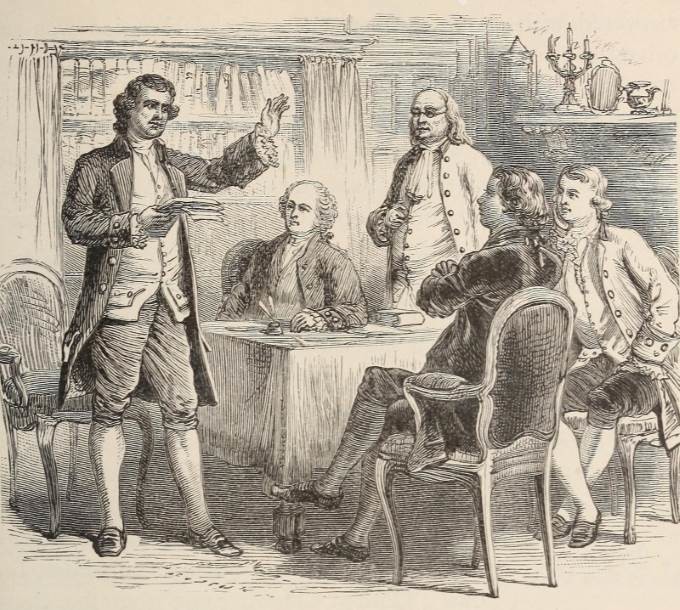
Jefferson reading the Declaration in Committee.
Declaration of Independence.
10. On the 1st of July the committee's report was laid before Congress. On the next day Lee's resolution was adopted. During the 3d the formal declaration was debated with great spirit. The discussion was resumed on the 4th, and at two o'clock in the afternoon the Declaration of American Independence was adopted by a unanimous vote.
11. The old bellman of the State House rang out the note of freedom to the nation. The multitudes caught the signal and answered with shouts. Everywhere the declaration was received with enthusiastic applause. At Philadelphia the king's arms were torn down and burned in the street. At Williamsburg, Charleston, and Savannah there were bonfires. At Boston the declaration was read in Faneuil Hall. At New York the populace pulled down the statue of George III. and cast it into bullets. Washington ordered that the declaration be read at the head of each brigade.
12. The leading principles of the Declaration of Independence are these: That all men are created equal; that governments are instituted for the welfare of the people; that the people have a right to alter their government; that the government of George III. had become destructive of liberty; that the king's tyranny over his American subjects was no longer endurable; and that, therefore, the United Colonies of America are, and of right ought to be, free and independent States.
Operations about New York.
13. Early in July, General Howe landed a force of nine thousand men on Staten Island. Thither Clinton came from the siege of Charleston, and Admiral Howe from England. The British force in the vicinity of New York amounted to thirty thousand men. Nearly half of them were Hessians. Washington's army was greatly inferior in numbers and discipline.
14. Lord Howe had been instructed to try conciliatory measures with the Americans. First, he sent to the American camp a dispatch directed to George Washington, Esquire. Washington refused to receive a communication which did not recognize his official position. Howe then sent another message, addressed to George Washington, etc., etc., etc.; and the bearer insisted that and-so-forth might mean General of the American Army. But Washington sent the officer away.
Battle of Long Island.
15. Lord Howe and his brother at once began hostilities. On the 22d of August, the British, to the number of ten thousand, landed on Long Island. The Americans, about eight thousand strong, were posted in the vicinity of Brooklyn. On the morning of the 27th of August, Grant's division of the British army was met by General Stirling with fifteen hundred men, and the battle at once began, but there was no decisive result. General Heister advanced beyond Flatbush, and engaged the main body of the Americans, under General Sullivan. Here the Hessians gained little or no ground until Sullivan was alarmed by the noise of battle on his left and rear.
16. During the night General Clinton had occupied the heights above the Jamaica road, and now came down by way of Bedford. Sullivan found himself surrounded and cut off. The men fought bravely, and many broke through the lines of the British. The rest were scattered, killed, or taken prisoners.
17. Cornwallis, attempting to cut off Stirling's retreat, was repulsed. Most of Stirling's men reached the American lines at Brooklyn. Generals Stirling, Sullivan, and Woodhull were taken prisoners. Nearly a thousand patriots were killed or missing. It seemed an easy thing for Clinton and Howe to capture all the rest.
18. Washington resolved to withdraw to New York. The enterprise was extremely hazardous. At eight o'clock in the evening the embarkation of the army began. All night with muffled oars the boatmen rowed silently back and forth. At daylight the movement was discovered by the British. They rushed into the American intrenchments and found nothing but a few worthless guns.
British Occupy New York.
19. The defeat on Long Island was very disastrous to the American cause. Many of the troops returned to their homes. Only by constant exertion did Washington keep his army from disbanding. The British fleet anchored within cannon-shot of New York. Washington retired to the Heights of Harlem. On the 15th of September the British landed three miles above New York. Thence they extended their lines and took possession of the city.
Battle of White Plains.
20. On the 16th of October, Howe embarked his forces, passed into Long Island Sound, and landed in the vicinity of Westchester. The object was to get upon the American flank and cut off communications with the Eastern States. On the 28th a battle was brought on at White Plains. The Americans were driven from one position, but intrenched themselves in another, then withdrew to the heights of North Castle. Howe remained for a few days at White Plains, and returned to New York.

NEW YORK and VICINITY.
21. Washington now crossed to the west bank of the Hudson and took post at Fort Lee. Four thousand men were left at North Castle under General Lee. Fort Washington, on Manhattan Island, was defended by three thousand men under Colonel Magaw. The skillful construction of this fort had attracted the attention of Washington, and led to an acquaintance with the engineer, Alexander Hamilton, then a stripling but twenty years of age.
Washington retreats to Trenton.
22. On the 16th of November, Fort Washington was captured by the British. The garrison were made prisoners of war and crowded into the jails of New York. Two days after the surrender, Fort Lee was taken by Lord Cornwallis. Washington with his army, now reduced to three thousand men, retreated to Trenton on the Delaware. Nothing but the skill of the commander saved the remnant of his forces from destruction.
23. On the 8th of December, Washington crossed the Delaware. Cornwallis, having no boats, was obliged to wait for the freezing of the river. It was seen that as soon as the river should be frozen the British would march into Philadelphia. Congress accordingly adjourned to Baltimore. During his retreat across New Jersey, Washington sent dispatches to General Lee, at North Castle, to join the main army as soon as possible. That officer took up his quarters at Basking Ridge. On the 13th of December, a squad of British cavalry captured Lee and hurried him off to New York. General Sullivan took command of Lee's division, and hastened to join Washington. The entire American force now amounted to a little more than six thousand.
Victory at Trenton.
24. The tide of misfortune turned at last. Washington saw in the disposition of the British forces an opportunity to strike a blow for his country. The leaders of the enemy were off their guard. The Hessians on the east side of the river were spread out from Trenton to Burlington. Washington conceived the design of crossing the Delaware and striking the detachment at Trenton before a concentration of the enemy's forces could be effected. The American army was arranged in three divisions under Generals Cadwallader, Ewing, and Washington himself. Christmas night was selected as the time for the movement.
25. The Delaware was filled with floating ice. Ewing and Cadwallader were both baffled in their efforts to cross the river. Washington, having succeeded in getting over, divided his army of twenty-four hundred men into two columns and pressed forward. At eight o'clock in the morning the Americans came rushing into Trenton from both directions. The Hessians sprang from their quarters and attempted to form in line. Colonel Rall was mortally wounded. Nearly a thousand of the Hessians threw down their arms and begged for quarter. Before nightfall Washington, with his army and the whole body of captives, was safe on the other side of the Delaware.

CENTRAL NEW JERSEY 1778.
Effect of the victory.
26. The battle of Trenton roused the nation from despondency. The militia flocked to the general's standard; and fourteen hundred soldiers, whose term of enlistment now expired, reentered the service. Robert Morris, the great financier of the Revolution, came forward with his fortune to the support of his country.
27. Three days after his victory, Washington again crossed the Delaware. Here all the American detachments in the vicinity were ordered to assemble. To General Heath, stationed at Peekskill, Washington sent orders to move into New Jersey. The British fell back from their outposts and concentrated at Princeton. Cornwallis resumed command in person. So closed the year. Ten days previously, Howe only waited for the freezing of the Delaware before taking up his quarters in Philadelphia. Now it was a question whether he would be able to hold a single town in New Jersey.
CHAPTER XXIV.
Operations of 1777.
ON the 1st of January, 1777, Washington's army at Trenton numbered about five thousand men. On the next day Cornwallis approached with greatly superior forces. During the afternoon there was severe skirmishing along the roads east of Trenton. During the night Washington called a council of war, and it was determined to leave the camp, pass the British left flank, and strike the enemy at Princeton. The baggage was removed to Burlington. The camp-fires were brightly kindled and kept burning through the night, while the army was in motion toward Princeton. Everything was done in silence. The morning light showed the British sentries a deserted camp.
Battle of Princeton.
2. At sunrise Washington was entering Princeton. At the same time the British were marching out to reinforce Cornwallis. The Americans met them in the edge of the village, and the battle at once began. The British charged bayonets, and the militia gave way in confusion. General Mercer received a mortal wound. But the Pennsylvania regulars, led by the commander-in-chief, stood their ground. Washington rallied his men with the greatest bravery; and the British were routed, with a loss of four hundred and thirty men in killed, wounded, and missing.
3. On the night of the 22d of May, Colonel Meigs, of Connecticut, embarked two hundred men in whale-boats, crossed the sound, and attacked Sag Harbor. The British were overpowered; only four of them escaped; five or six were killed, and the remaining ninety were made prisoners. The stores were destroyed by the patriots, who, without the loss of a man, returned to Guilford. Colonel Meigs was rewarded by Congress with an elegant sword.
4. The patriot forces of the North were now concentrated on the Hudson; and a camp, under Arnold, was laid out on the Delaware. In the latter part of May, Washington broke up his winter-quarters and took an advantageous position only ten miles from the British camp. Howe crossed over from New York and threatened an attack upon the American lines. Finally, the British, on the 30th of June, crossed over to Staten Island. On the 10th of July, General Prescott, of the British army, was captured at a farm-house near Newport. This gave the Americans an officer of equal rank to exchange for General Lee. Congress in the mean time returned to Philadelphia.
French Aid and Sympathy.
5. From the beginning of the war the people of France had been friendly to the American cause. By and by their sympathy became more outspoken. The French ministers would do nothing openly to provoke a war with Great Britain; but secretly they rejoiced at every British misfortune. During the year 1777, the French managed to supply the colonies with twenty thousand muskets and a thousand barrels of powder.
6. At last the republicans of France began to embark for America. Foremost of all came the young Marquis de La Fayette. Fitting a vessel at his own expense, he eluded the officers, and with the brave De Kalb and a small company of followers reached South Carolina in April of 1777. He entered the army as a volunteer, and in the following July was commissioned a major-general.
Burgoyne's Campaign.
7. One of the most important events of the war was the campaign of General Burgoyne. In command of the English forces in Canada, he spent the spring of 1777 in organizing an army of ten thousand men for the invasion of New York. The force consisted of British, Hessians, Canadians, and Indians. The plan of the campaign embraced a descent upon Albany and New York, and the cutting off of New England from the Middle and Southern colonies.
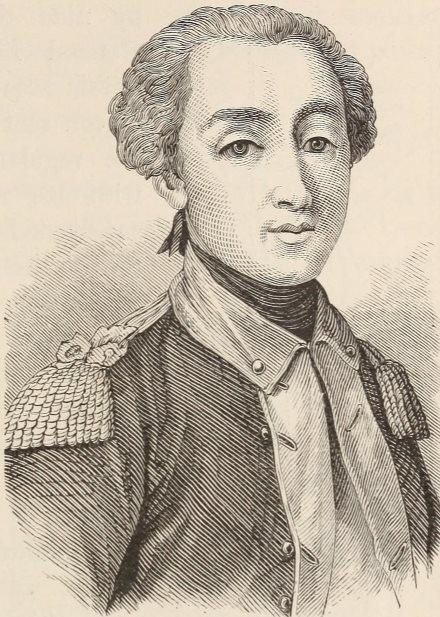
Marquis de La Fayette.
8. On the 1st of June, Burgoyne reached Lake Champlain, and on the 16th proceeded to Crown Point. This place was occupied by the British; and on the 5th of July, Ticonderoga, which was defended by three thousand men under General St. Clair, was captured. Soon afterward the British reached Whitehall and seized a large quantity of stores.
Battle of Bennington.
9. At this time the American army of the North was commanded by General Schuyler. His forces, numbering between four and five thousand, were at Fort Edward. This place was captured by Burgoyne on the 30th of July, the Americans retreating down the Hudson. The British general now dispatched Colonels Baum and Breymann to seize the stores at Bennington, Vermont. Colonel John Stark rallied the New Hampshire militia, and on the 15th of August met the British near the village. On the following morning there was a furious battle, in which Baum's force was completely routed. The British lost in killed, wounded, and prisoners more than eight hundred men. The country was thrilled by the victory.
10. A few days after the battle of Bennington, Burgoyne received intelligence of a still greater reverse, at Fort Schuyler, on the Mohawk.
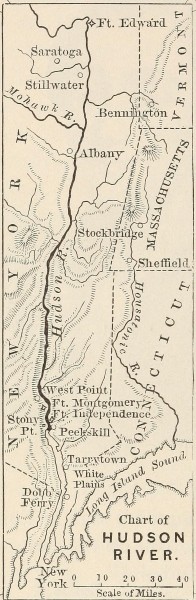
Chart of HUDSON RIVER.
11. The British general lost a month in procuring supplies from Canada. He now found himself hemmed in by nine thousand patriot soldiers. General Lincoln arrived with the militia of New England. Washington sent several detachments from the regular army. Morgan came with his riflemen. General Gates superseded Schuyler in command of the northern army. On the 8th of September, the American headquarters were advanced to Stillwater. On the 14th of the month, Burgoyne crossed the Hudson and took post at Saratoga. The two armies now came face to face. On the 19th, a general battle ensued, continuing until nightfall. The conflict, though severe, was indecisive; the Americans retired within their lines, and the British slept on the field. To the patriots the result of the battle was equivalent to a victory.
Battle of Bemis's Heights.
12. The condition of Burgoyne grew critical. His supplies failed; his Canadian and Indian allies deserted his standard. On the 7th of October, he hazarded another battle, in which he lost his bravest officers and nearly seven hundred privates. The brave General Fraser was killed, and his disheartened men turned and fled from the field. The Americans were completely victorious.
Burgoyne's Surrender.
13. Burgoyne now began a retreat, and on the 9th of October reached Saratoga. Here he was intercepted by Gates and Lincoln, and forced to surrender. On the 17th of October terms of capitulation were agreed on, and the whole army, numbering five thousand seven hundred and ninety-one, became prisoners of war. Among the captives were six members of the British Parliament. Forty-two pieces of brass artillery, five thousand muskets, and an immense quantity of stores were the fruits of the victory.
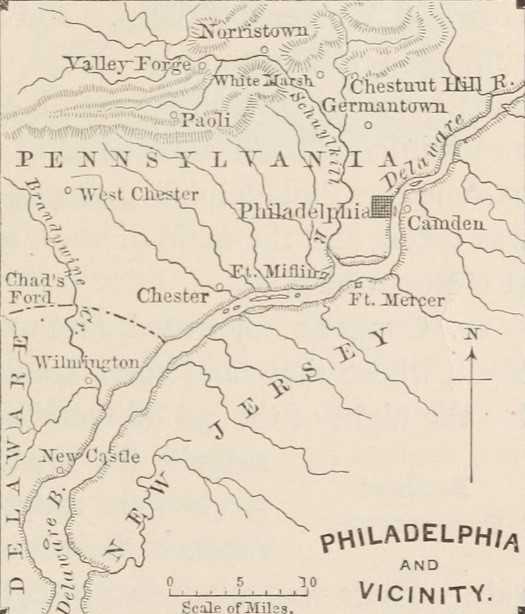
PHILADELPHIA AND VICINITY.
14. As soon as the invasion was at an end, a large portion of the army was dispatched to aid Washington in a great campaign in progress in the South. On the 23d of July, Howe had sailed from New York, with eighteen thousand men, to attack Philadelphia. Washington advanced his headquarters from Philadelphia to Wilmington. The American army, numbering about eleven thousand men, was concentrated at that place. The forces of Howe were vastly superior, but Washington hoped to beat back the invaders and save the capital.
Battle of Brandywine.
15. On the 25th of August the British landed at Elk River, in Maryland, and began their march toward Philadelphia. Washington selected the Brandywine as his line of defence. The left wing was stationed at Chad's Ford, while the right, under General Sullivan, was extended up the river. On the 11th of September the British reached the opposite bank and began battle. The Hessians, under Knyphausen, attacked at the ford; but the British, led by Cornwallis and Howe, marched up the Brandywine and crossed above the American right. Sullivan allowed himself to be outflanked. Washington was misled by false information; the right wing was crushed by Cornwallis, and the day was lost.
The British in Philadelphia.
16. During the night the patriots retreated to West Chester. The loss of the Americans amounted to a thousand men; that of the British to five hundred and eighty-four. La Fayette was severely wounded. Count Pulaski so distinguished himself in this engagement that Congress honored him with the rank of brigadier. Washington continued his retreat as far as Germantown. On the 15th of the month he recrossed the Schuylkill and met Howe at Warren's Tavern. But just as the conflict was beginning, a violent tempest swept over the field. The combatants were deluged, their cartridges soaked, and fighting made impossible. Howe succeeded in crossing the Schuylkill, and hastened to Philadelphia. On the 26th of September the city was taken, and the main division of the British army encamped at Germantown.
Battle of Germantown.
17. Congress adjourned, first to Lancaster, and afterward to York, where they held their sessions until the next summer. On the night of the 3d of October Washington attempted to surprise the British at Germantown. But the roads were rough, and the different columns reached the British outpost at irregular intervals. There was much severe fighting, but the British gained possession of a large stone house and could not be dislodged. The tide turned against the patriots, and the day was lost. On the 22d of October, Fort Mercer, on the Delaware, was taken by Hessians, while the British fleet took Fort Mifflin, on Mud Island. General Howe thus obtained control of the Delaware.
18. After the battle of Germantown, Washington took up his headquarters at White Marsh. The patriots began to suffer for food and clothing. On the evening of the 2d of December, Howe held a council of war at the house of Lydia Darrah in Philadelphia. It was decided to surprise Washington in his camp. But Lydia, who overheard the plans of Howe, left the city on pretence of going to mill, rode to the American lines, and gave the alarm. When the British approached White Marsh, they found the cannons mounted and the patriots in order of battle. The British general maneuvered for four days, and then marched back to Philadelphia.

Valley Forge.
Valley Forge.
19. On the 11th of December Washington went into winter quarters at Valley Forge, on the right bank of the Schuylkill. Thousands of the soldiers were without shoes, and the frozen ground was marked with bloody footprints. Log cabins were built, and everything was done that could be done to secure the comfort of the suffering patriots. But it was a long and dreary winter. These were the darkest days of Washington's life. Congress in a measure abandoned him. Many men high in military and civil station left the great leader unsupported. But the allegiance of the army remained unshaken, and the nation's confidence in the chieftain became stronger than ever.
CHAPTER XXV.
Events of 1778 and 1779.
IN November of 1776 Silas Deane, of Connecticut, was appointed commissioner to France. His first service was to make a secret arrangement to supply the Americans with materials for carrying on the war. In the autumn of 1777 a ship, laden with two hundred thousand dollars' worth of arms, ammunition, and specie, was sent to America.
Negotiations with France.
2. Arthur Lee and Benjamin Franklin were also appointed by Congress to negotiate a treaty with the French king. In December of 1776 they reached Paris and began their duties. For a long time King Louis and his minister stood aloof from the proposed alliance. They hated Great Britain, and gave secret encouragement to the colonies; but an open treaty with the Americans was equivalent to a war with England, and that the French court dreaded.
3. Now it was, that the genius of Dr. Franklin shone with a peculiar luster. At the gay court of Louis XVI. he stood as the representative of his country. His wit and genial humor made him admired; his talents and courtesy commanded respect; his patience and perseverance gave him final success. During the whole of 1777 he remained at Paris and Versailles. At last came the news of Burgoyne's surrender. A powerful British army had been subdued by the colonists without aid from abroad. This success induced the king to accept the proposed alliance with the colonies. On the 6th of February, 1778, a treaty was concluded; France acknowledged the independence of the United States, and entered into relations of friendship with the new nation.
Benjamin Franklin.
4. Benjamin Franklin, the author of the first treaty between the United States and a foreign nation, was born in Boston, on the 17th of January, 1706. His father was a manufacturer of soap and candles. At the age of twelve, Benjamin was apprenticed to his brother to learn the art of printing. In 1723 he went to Philadelphia, entered a printing-office, and rose to distinction. He visited England; returned; founded the first circulating library in America; edited Poor Richard's Almanac; discovered the identity of electricity and lightning; espoused the patriot cause; and devoted his old age to perfecting the American Union. The name of Franklin is one of the brightest in history.

Benjamin Franklin.
D'Estaing's French Fleet.
5. In May of 1778 Congress ratified the treaty with France. A month previously a French fleet, under Count d'Estaing, had been sent to America. Both France and Great Britain immediately prepared for war. George III. now became willing to treat with his American subjects. Lord North brought forward two bills in which everything the colonists had claimed was conceded. The bills were passed by Parliament, and the king assented. Commissioners were sent to America; but Congress informed them that nothing but an acknowledgment of the independence of the United States would now be accepted.
British Evacuate Philadelphia.
6. The British army remained at Philadelphia until June of 1778. The fleet of Admiral Howe lay in the Delaware. When the rumor came that the fleet of D'Estaing was approaching, the English admiral set sail for New York. On the 18th of June the British army evacuated Philadelphia and retreated across New Jersey. Washington occupied the city, and followed the retreating foe. At Monmouth the British were overtaken. On the morning of the 28th General Lee was ordered to attack the enemy. The American cavalry under La Fayette was driven back by Cornwallis. Lee ordered his line to retire to a stronger position; but the troops mistook the order and began a retreat. Washington met the fugitives and administered a severe rebuke to Lee. The fight continued until nightfall, and Washington anxiously waited for the morning. During the night, however, Clinton withdrew his forces and escaped.
Washington and Lee.
7. The loss of the Americans was two hundred and twenty-seven. The British left nearly three hundred dead on the field. On the day after the battle Washington received an insulting letter from Lee demanding an apology. Washington replied that his language had been warranted by the circumstances. Lee answered in a still more offensive manner, and was thereupon arrested, tried by a court-martial, and dismissed from his command for twelve months. He never reentered the service, and did not live to see his country's independence. The British forces were now concentrated at New York. Washington took up his headquarters at White Plains. D'Estaing repaired to Boston. Howe returned to New York.
Massacre of Wyoming.
8. The command of the British naval forces was now transferred to Admiral Byron. Early in October a band of incendiaries, led by Colonel Ferguson, burned the American ships at Little Egg Harbor. In the preceding July, Major John Butler, in command of sixteen hundred royalists, Canadians, and Indians, marched into the valley of Wyoming, Pennsylvania. The settlement was defenceless. On the approach of the tories and savages, a few militia, old men, and boys, rallied to protect their homes. A battle was fought, and the patriots were routed. The fugitives fled to a fort, which was crowded with women and children. Honorable terms were promised by Butler, and the garrison capitulated. On the 5th of July the gates were opened and the barbarians entered. Immediately they began to plunder and butcher. Nearly all the prisoners fell under the hatchet and the scalping-knife.
Massacre at Cherry Valley.
9. In November there was a similar massacre at Cherry Valley, New York. The invaders were led by Joseph Brandt, chief of the Mohawks, and Walter Butler, a son of Major John Butler. The people of Cherry Valley were driven from their homes; women and children were tomahawked and scalped; and forty prisoners dragged into captivity. To avenge these outrages, an expedition was sent against the savages on the Susquehanna; and they were made to feel the terrors of war.
George Rogers Clark in the West.
10. In the spring of 1778, Major George Rogers Clark, who three years previously had descended the Ohio River with a single companion, from Pittsburgh to the Falls of the Ohio, organized an expedition against the British posts on the Wabash and Mississippi rivers. All the country northwest of the river Ohio was at this time under British authority, but the scattered white inhabitants were nearly all French. The most important post was the town of Vincennes, in what was afterwards the Territory of Indiana. Major Clark gathered his forces on Corn Island, in the Ohio, between the present cities of Louisville and Jeffersonville. The regiment was made up of backwoods militiamen and hunters from Kentucky and the Upper Ohio Valley.

Attack on Vincennes.
11. Major Clark first descended the Ohio to a suitable point, and landed in what was afterwards the Territory of Illinois. From this point he marched across the country to the mouth of the Kaskaskia River, where, on the 4th of July, 1778, he surprised and captured the town of Kaskaskia from the British. Here he divided his forces, and sent one division against the British post of Cahokia, opposite St. Louis. This place also was surprised and taken. Soon afterwards the French inhabitants of Vincennes rose against the British garrison, and took possession of the town. But Governor Hamilton, of Detroit, came down later in the year, and the British authority was restored.
The Capture of Vincennes.
12. Hearing of this event, Major Clark collected his forces at Kaskaskia, and in the beginning of 1779 marched against Vincennes. At the same time he sent part of his forces by water, bearing a few small cannon in a boat around by the Ohio and up the Wabash, to a point below Vincennes. At this time the lower Illinois country was covered with water, and Major Clark's campaign was attended with the greatest hardships. On the 18th of February, however, he gained a position on the Indiana side of the Wabash, and made an attack on Vincennes. By skillful maneuvering he deceived the British commander, and on the 24th of the month compelled him to surrender. Thus was the great territory northwest of the River Ohio recovered from the British, and secured for the United States.
The British take Savannah.
13. On the 3d of November, Count d'Estaing's fleet sailed for the West Indies. In December, Admiral Byron left New York to try the fortunes of war on the ocean. Colonel Campbell, with two thousand men, was sent by General Clinton for the conquest of Georgia. On the 29th of December the expedition reached Savannah. The place was defended by General Robert Howe with eight hundred men. A battle was fought, and the Americans were driven out of the city. The patriots crossed into South Carolina and found refuge at Charleston. Such was the only real conquest made by the British during the year 1778.
14. The winter of 1778-79 was passed by the American army at Middlebrook. There was much discouragement among the soldiers, for they were neither paid nor fed. But the influence of Washington prevented a mutiny. In the latter part of May Clinton sailed with an armament up the Hudson to Stony Point. The garrison, unable to resist, escaped from the fortifications.
General Wayne at Stony Point.
15. On the 15th of July General Wayne marched against Stony Point. In the evening he halted near the fort and gave his orders. The British pickets were caught and gagged. Everything was done in silence. Muskets were unloaded and bayonets fixed; not a gun was to be fired. The assault was made a little after midnight. The patriots never wavered in the charge. The ramparts were scaled; and the British, finding themselves between two lines of bayonets, cried out for quarter. Sixty-three of the enemy fell; the remaining five hundred and forty-three were made prisoners. Of the Americans only fifteen were killed and eighty-three wounded. General Wayne secured the ordnance and stores, and then destroyed the fort.
Campaign against the Indians.
16. In the summer of 1799, four thousand six hundred men, led by Generals Sullivan and James Clinton, were sent against the Indians on the Susquehanna. At Elmira the savages and tories had fortified themselves; but on the 29th of August they were forced from their stronghold and utterly routed. The country between the Susquehanna and the Genesee was wasted by the patriots. Forty Indian villages were destroyed.
Campaigns in the South.
17. A little later, the tories, who were advancing to join the British at Augusta, were defeated by the patriots under Captain Anderson. On the 14th of February they were again overtaken and routed by Colonel Pickens. Colonel Boyd, the tory leader, and seventy of his men were killed. Seventy-five others were captured, and five of the ringleaders hanged. The western half of Georgia was quickly recovered by the patriots.
18. General Ashe was sent with two thousand men to intercept the enemy. On the 25th of February the Americans crossed the Savannah, and pursued Campbell as far as Brier Creek. Here the patriots came to a halt; and General Prevost, marching from Savannah, surrounded Ashe's command. A battle was fought on the 3d of March; the Americans were totally routed and driven into the swamps. By this defeat Georgia was again prostrated, and a royal government was established over the State.
19. Within a month General Lincoln was again in the field with five thousand men. He advanced up the left bank of the river in the direction of Augusta; but, at the same time, General Prevost, now commanding the British forces in the South, crossed the Savannah and marched against Charleston. General Lincoln turned back to attack him, and the British made a hasty retreat. The Americans overtook the enemy at Stone Ferry, ten miles west of Charleston, but were repulsed with considerable loss. Prevost then fell back to Savannah.
Attempts to retake Savannah.
20. In September, Count d'Estaing arrived before Savannah with his fleet. Prevost concentrated his forces for the defence of the city. The French effected a landing, and advanced to the siege. D'Estaing demanded a surrender; but Prevost answered with a message of defiance. The siege was pressed with vigor, and the city constantly bombarded. But the defences remained unshaken. At last D'Estaing notified Lincoln that the city must be stormed. Before sunrise on the 9th of October the allies advanced with great vehemence against the redoubts of the British, but were driven back with fearful losses. Count Pulaski was struck with a grape-shot, and was borne dying from the field. D'Estaing retired on board the fleet, and Lincoln retreated to Charleston.
21. On the 23d of September, Paul Jones, cruising off the coast of Scotland with a fleet of French and American vessels, fell in with a British squadron, and a bloody battle ensued. The Serapis, a British frigate of forty-four guns, engaged the Poor Richard within musket-shot. At last the vessels were lashed together, and the Serapis struck her colors. Jones transferred his men to the conquered ship, and the Poor Richard went down. Of the three hundred and seventy-five men on board the fleet of Jones, three hundred were either killed or wounded.

Paul Jones.
22. So closed the year 1779. The national treasury was bankrupt. The patriots of the army were poorly fed, and paid only with unkept promises. The disposition of Great Britain was still for war. The levies of sailors and soldiers made by Parliament amounted to one hundred and twenty thousand, while the expenses of the War Office were set at twenty million pounds sterling.
CHAPTER XXVI.
Reverses and Treason. Events of 1780.
French Allies in Rhode Island.
DURING the year 1780 military operations at the North were suspended. Early in July Admiral De Ternay arrived at Newport with a French squadron, and six thousand land-troops under Count Rochambeau. In September the commander-in-chief held a conference with Rochambeau, and the plans of future campaigns were determined.
2. In the South the patriots suffered many reverses. South Carolina was completely overrun by the enemy. On the 11th of February, Admiral Arbuthnot anchored before Charleston. Sir Henry Clinton and five thousand men were on board the fleet. The city was defended by fourteen hundred men under General Lincoln. The British effected a landing, and advanced up the right bank of Ashley River. On the 7th of April Lincoln was reinforced by seven hundred Virginians. Two days afterwards Arbuthnot succeeded in passing Fort Moultrie, and came within cannon-shot of the city.
The British take Charleston.
3. A siege was at once begun, and prosecuted with vigor. From the beginning the defense was hopeless. The fortifications were beaten down, and Lincoln, dreading an assault, agreed to capitulate. On the 12th of May, Charleston was surrendered to the British, and the garrison became prisoners of war. A few days before the surrender Tarleton surprised and dispersed a body of militia on the Santee. Afterwards three successful expeditions were sent into different sections of the State.
4. The authority of Great Britain was reestablished over South Carolina. Clinton and Arbuthnot returned to New York, and Cornwallis was left to hold the conquered territory. In this condition of affairs, Thomas Sumter and Francis Marion appeared as the protectors of the State. They rallied the militia and began an audacious partisan warfare. Detachments of the British were swept off as though an enemy had fallen on them from the skies. It was here that young Andrew Jackson, then but thirteen years of age, began his career as a soldier.
Marion's Ragged Regiment.
5. Marion's company consisted of twenty men and boys, white and black, half clad and poorly armed. But the number increased, and the "Ragged Regiment" soon became a terror to the enemy. There was no telling when or where the sword of the fearless leader would fall. During the summer and autumn of 1780 he swept around Cornwallis's positions, making incessant onsets.
6. General Gates now advanced into the Carolinas. Lord Rawdon concentrated his forces at Camden. Hither came Cornwallis with reinforcements. The Americans took post at Clermont. Cornwallis and Gates each formed the design of surprising the other in the night. On the evening of the 15th of August they both moved from their camps and met midway on Sander's Creek. After a severe battle the Americans were completely defeated with a loss of more than a thousand men. Baron De Kalb was mortally wounded. The reputation of Gates was blown away like chaff, and he was superseded by General Greene.
Affairs in North Carolina.
7. A few days after the battle, Sumter's corps was overtaken and completely routed. Only Marion remained to harass the enemy. In September the British advanced into North Carolina as far as Charlotte. Colonel Ferguson, with eleven hundred regulars and tories, was sent into the country west of the Catawba to encourage the royalists. On the 7th of October, while he and his men were encamped on King's Mountain, they were attacked by a thousand riflemen led by Colonel Campbell. A desperate battle ensued; Ferguson was slain, and three hundred of his men were killed or wounded. The remaining eight hundred threw down their arms and begged for quarter. Ten of the leading tory prisoners were condemned by a court-martial and hanged.

MAP OF THE CAROLINAS
Continental Paper Money.
8. Meanwhile, the credit of the nation was sinking to the lowest ebb. Congress resorted to paper money. At first the continental bills were received at par; but the value of the notes rapidly diminished, until, by the middle of 1780, they were not worth two cents to the dollar. Business was paralyzed for the want of a currency; but Robert Morris and a few other wealthy patriots came forward with their private fortunes and saved the colonies from ruin. The mothers of America also lent a helping hand; and the patriot soldiers were supplied with food and clothing.
9. In the midst of the gloom, the country was shocked by the news that Benedict Arnold had turned traitor. After the battle of Bemis's Heights, in the fall of 1777, he had been promoted to the rank of major-general, and made commandant of Philadelphia. Here he married the daughter of a royalist, and entered upon a career of extravagance which overwhelmed him with debt. He then began a system of frauds on the commissary department of the army. Charges were preferred against him by Congress, and he was convicted by a court-martial.
Treason of Benedict Arnold.
10. Seeming to forget this disgrace, Arnold obtained command of the fortress of West Point, on the Hudson. On the last day of July, 1780, he assumed control of the arsenal and depot of stores at that place. He then entered into a secret correspondence with Sir Henry Clinton, and finally offered to betray his country. It was agreed that the British fleet should ascend the Hudson, and that the garrison and fortress should be given up without a struggle.
11. On the 21st of September, Clinton sent Major John André to make arrangements for the surrender. André, who was adjutant-general of the British army, went ashore from the Vulture about midnight, and met Arnold in a thicket. Daydawn approached, and the conspirators entered the American lines. André, disguising himself, assumed the character of a spy.
Capture of Major André.
12. During the next day the business was completed. Arnold agreed to surrender West Point for ten thousand pounds and a commission as brigadier in the British army. André received papers containing a description of West Point, its defences, and the best method of attack. During that day an American battery drove the Vulture down the river, and André was obliged to cross to the other side and return by land. He passed the American outposts in safety; but at Tarrytown he was confronted by three militiamen[A] who stripped him, found his papers, and delivered him to Colonel Jameson at North Castle. Arnold, on hearing the news, escaped on board the Vulture. André was tried by a court-martial at Tappan, and condemned to death. On the 2d of October he was led to the gallows, and, under the stern code of war, was hanged.
[A] John Paulding, David Williams and Isaac van Wart. Congress afterwards rewarded them with silver medals and pensions for life.

Capture of André.
13. For several years Holland had favored the Americans; now she began negotiations for a treaty similar to that between France and the United States. Great Britain discovered the purposes of the Dutch government, and remonstrated. On the 20th of December an open declaration of war was made. Thus the Netherlands were added to the enemies of England.
CHAPTER XXVII.
Events of 1781.
Mutiny in the Continental Army.
FOR the Americans the year 1781 opened gloomily. The condition of the army was desperate—no food, no pay, no clothing. On the first day of January, the whole Pennsylvania line mutinied and marched on Philadelphia. At Princeton they were met by emissaries from Sir Henry Clinton, and were tempted with offers of money and clothing if they would desert the American standard. The patriots answered by seizing the British agents and delivering them to General Wayne to be hanged. The commissioners of Congress offered the insurgents a large reward, which was refused; and a few liberal concessions on the part of the government quieted the mutiny.
2. About the middle of the month the New Jersey brigade revolted. This movement Washington quelled by force. General Howe marched to the camp with five hundred regulars and compelled the mutineers to execute their own leaders. From that day order was restored. Congress was thoroughly alarmed. An agent was sent to France to obtain a loan of money. Robert Morris was appointed secretary of finance; and the Bank of North America was organized to aid the government.
Traitor Arnold in the British Army.
3. On arriving at New York, Arnold received his commission as brigadier in the British army. In January the traitor began war on his countrymen. His proceedings were marked with much ferocity. In the vicinity of Richmond a vast quantity of property was destroyed. Arnold then took up his headquarters in Portsmouth; and Washington, for the second time, planned his capture. The French fleet was ordered to cooperate with La Fayette in the attempt. But Admiral Arbuthnot drove the French squadron back to Rhode Island. La Fayette abandoned the undertaking, and Arnold again escaped.

MAP SHOWING THE COLONIES at the time of THE REVOLUTION.

General Greene.
4. In April, General Phillips arrived at Portsmouth and assumed command of the army. In May Phillips died, and for seven days Arnold held the supreme command of the British forces in Virginia. On the 20th of the month Lord Cornwallis arrived and ordered him to be gone. Returning to New York he made an expedition against New London, in his native State. Fort Griswold, which was defended by Colonel Ledyard, was carried by storm. When Ledyard surrendered, seventy-three of the garrison were murdered in cold blood.
Battle at Cowpens.
5. General Greene was now in command of the American army at Charlotte, North Carolina. Early in January, General Morgan was sent into South Carolina to repress the tories. Colonel Tarleton followed with his cavalry. The Americans took a position at the Cowpens, where, on the 17th of January, they were attacked by the British. Tarleton made the onset with impetuosity; but Morgan's men bravely held their ground. At last the American cavalry, under Colonel William Washington, made a charge and scattered the British dragoons like chaff. Ten British officers and ninety privates were killed.
6. When Cornwallis heard of the battle he marched up the river to cut off Morgan's retreat. But Greene hastened to the Morgan's camp and took command in person. On the 28th of January, the Americans reached the Catawba and crossed to the northern bank. Within two hours the British arrived at the ford. During the night the rain poured down in torrents; the river was swollen to a flood; and it was many days before the British could cross. Then began a race for the Yadkin.
The Two Armies in North Carolina.
7. The distance was sixty miles. In two days the Americans reached the river. The crossing was nearly effected when the British appeared in sight. That night the Yadkin was made impassable by rains, and Cornwallis was again delayed. On the 9th of February the British succeeded in crossing. The lines of retreat and pursuit were now nearly parallel. A third time the race began, and again the Americans won it. On the 13th Greene, with the main division, crossed the Dan into Virginia, and on the 22d of February returned into North Carolina.
Battle of Guilford Courthouse.
8. Greene's army now numbered more than four thousand men. Determining to avoid battle no longer, he marched to Guilford Courthouse. Cornwallis moved forward to the attack. On the 15th of March the two armies met, and a severe but indecisive battle was fought. The Americans were driven back for several miles; but in killed and wounded the British loss was greatest.
9. Early in April, Cornwallis retreated to Wilmington, and then proceeded to Virginia. The British forces in the Carolinas remained under Lord Rawdon. On the 10th of May, Lord Rawdon retired to Eutaw Springs. The British posts at Orangeburg and Augusta fell into the hands of the patriots. General Greene passed the sickly months of summer in the hill country of the Santee.
10. Sumter, Lee, and Marion were constantly abroad, smiting the tories right and left. Lord Rawdon now went to Charleston and became a principal actor in one of the most shameful scenes of the Revolution. Colonel Isaac Hayne, a patriot who had once taken an oath of allegiance to the king, was caught in command of a troop of American cavalry. He was arraigned before Colonel Balfour, the commandant of Charleston, and condemned to death. Rawdon gave his sanction, and Colonel Hayne was hanged.
Battle of Eutaw Springs.
11. On the 22d of August, General Greene marched toward Orangeburg. The British retired to Eutaw Springs. There the Americans overtook them on the 8th of September. One of the fiercest battles of the war ensued, and General Greene was denied a decisive victory only by the bad conduct of some of his troops. After losing five hundred and fifty-five men, he gave up the struggle. The British lost in killed and wounded nearly seven hundred. Stuart retreated to Monk's Corner; Greene followed; and after two months of maneuvering, the British were driven into Charleston. In the whole South only Charleston and Savannah were now held by the king's army; the latter city was evacuated on the 11th of July, and the former on the 14th of December, 1782. Such was the close of the Revolution in the Carolinas and Georgia.
Cornwallis in Virginia.
12. In the beginning of May, 1781, Cornwallis took command of the British army in Virginia. The country was ravaged, and property destroyed to the value of fifteen million dollars. La Fayette, to whom the defence of the State had been intrusted, was unable to meet Cornwallis in the field. While the British were near Richmond, a detachment under Tarleton proceeded to Charlottesville, and captured the town and seven members of the legislature. Governor Jefferson escaped into the mountains. The British marched to Portsmouth; but early in August the army was conveyed to Yorktown, on the southern bank of York River.
Cornwallis Blockaded in Yorktown.
13. La Fayette followed and took post eight miles from the British. During July and August, Washington, from his camp on the Hudson, looked wistfully to the South. Clinton was kept in alarm by false dispatches, indicating that the Americans would immediately besiege New York. When Clinton was informed that Washington was marching toward Virginia, he would not believe it. Washington pressed rapidly forward, and joined La Fayette at Williamsburg. On the 30th of August, a French fleet, with four thousand troops on board, reached the Chesapeake and anchored in the mouth of York River. Cornwallis was blockaded by sea and land.
Surrender of Cornwallis.
14. Count de Barras, who commanded the French flotilla at Newport, also arrived. On the 5th of September, Admiral Graves appeared in the bay, and a naval battle ensued, in which the British ships were roughly handled. On the 28th, the allied armies encamped around Yorktown and began their intrenchments. On the night of the 14th, the enemy's outer works were carried by storm. On the 16th the British made a sortie, but were repulsed. The next day Cornwallis proposed a surrender; on the 18th terms of capitulation were signed; and on the afternoon of the 19th the whole British army, consisting of seven thousand two hundred and forty-seven English and Hessian soldiers, laid down their arms and became prisoners of war. This event virtually terminated the war of the Revolution.
News of the Victory.
15. On the evening of the 23d the news was borne to Congress. On the morning of the 24th, the members went in concourse with the citizens to the Dutch Lutheran church, and turned the afternoon into a thanksgiving. The note of rejoicing sounded throughout the land. In England the king and his ministers heard the tidings with rage; but the English people were secretly pleased. On the 20th of March, 1782, Lord North and his friends resigned their offices. A new ministry was formed, favorable to peace. The command of the British forces in the United States was transferred to Sir Guy Carleton, a man friendly to American interests.

Surrender of Cornwallis.
16. In the summer of 1782, Richard Oswald was sent by Parliament to Paris, to confer with Franklin and Jay in regard to the terms of peace. John Adams and Henry Laurens also entered into the negotiations. On the 30th of November preliminary articles of peace were signed; and in the following April the terms were ratified by Congress. On the 3d of September, 1783, a final treaty was effected between all the nations that had been at war.
Treaty of Peace.
17. The terms of the Treaty of 1783 were these: A complete recognition of the independence of the United States; the cession by Great Britain of Florida to Spain; the surrender of the remaining territory east of the Mississippi to the United States; the free navigation of the Mississippi and the lakes; and the retention by Great Britain of Canada and Nova Scotia.
18. Early in August Sir Guy Carleton received instructions to evacuate New York City. By the 25th of November everything was in readiness; the British army was embarked; the sails were spread; the ships stood out to sea and disappeared. The Briton was gone. After the struggles of an eight years' war the patriots had achieved their independence.
Washington's Farewell to the Army.
19. On the 4th of December Washington assembled his officers to bid them a final adieu. When they were met, he spoke a few affectionate words to his comrades, who came forward, and with tears and sobs bade him farewell. Washington then departed to Annapolis, where Congress was in session. At Philadelphia he made a report of his expenses during the war. The account, in his own handwriting, embraced an expenditure of seventy-four thousand four hundred and eighty-five dollars—all correct to a cent.
20. The route of the chief to Annapolis was a continuous triumph. The people by thousands flocked to the roadsides to see him pass. On the 23d of December, Washington was introduced to Congress, and delivered an address full of wisdom and modesty. With great dignity he surrendered his commission as commander-in-chief of the army. General Mifflin, the president of Congress, responded in an eloquent manner, and then the hero retired to his home at Mount Vernon.
CHAPTER XXVIII.
Confederation and Union.
American Government.
DURING the progress of the Revolution the civil government of the United States was in a deplorable condition. Nothing but the peril of the country had, in the first place, led to the calling of a Congress. When that body assembled, it had no constitution nor power of efficient action. The two great wants of the country were money to carry on the war, and a central authority to direct the war. Whenever Congress would attempt a firmer government, the movement would be checked by the remonstrance of the colonies.
2. Foremost of those who worked for better government was Benjamin Franklin. In 1775 he laid before Congress the plan of a perpetual confederation of the States. But the attention of that body was occupied with the war, and Franklin's measure received little notice. Congress, without any real authority, began to conduct the government, and its legislation was generally accepted by the States.
Articles of Confederation.
3. On the 11th of June, 1776, a committee was appointed by Congress to prepare a plan of confederation. After a month the work was completed and laid before the house. The debates on the subject continued at intervals until the 15th of November, 1777, when a vote was taken in Congress, and the Articles of Confederation were adopted, which were then transmitted to the State legislatures for ratification. By them the new frame of government was returned to Congress with many amendments. These having been considered, the articles were signed by the delegates of eight States on the 9th of July, 1778. Those of Georgia, North Carolina, New Jersey, and Delaware signed before February, of 1779. Maryland did not assent until March of 1781.
4. The government of the United States under the confederation was a loose union of independent commonwealths. The executive and legislative powers were vested in Congress—a body composed of not less than two nor more than seven representatives from each State. The sovereignty was reserved to the States. There was no chief magistrate and no general judiciary. The consent of nine States was necessary to complete an act of legislation. The union was declared to be perpetual.
Inadequacy of the Confederation.
5. On the 2d of March, 1781, Congress assembled under the new government. From the first, its inadequacy was manifest. Congress had no real authority. The first duty was to provide for the payment of the war debt of thirty-eight million dollars. Congress recommended a general tax. Some of the States made the levy, others refused. Robert Morris was brought to poverty in a vain effort to sustain the government.
6. In this condition of affairs, Washington advised the calling of a convention to meet at Annapolis. In September of 1786 the representatives of five States assembled. The questions of a tariff and a revision of the articles of confederation were discussed. It was finally resolved to adjourn until the following year.
The Constitution Proposed.
7. Congress invited the legislatures to appoint delegates to the convention. All of the States except Rhode Island responded; and on the second Monday in May, 1787, the representatives assembled at Philadelphia. Washington was chosen president of the convention. On the 29th Edmund Randolph introduced a resolution to adopt a new constitution. A committee was accordingly appointed to revise the articles of confederation. Early in September, the report of the committee was adopted; and that report was the Constitution of the United States.
8. On the question of adopting the Constitution the people were divided. Those who favored the new government were called Federalists; those who opposed, Anti-Federalists. The leaders of the former were Washington, Jay, Madison, and Hamilton, the latter statesman throwing his whole energies into the controversy. In the papers called The Federalist he and Madison answered every objection of the anti-Federal party. To Hamilton the Republic owes a debt of gratitude for having established on a firm basis the true principles of free government.
Provisions of the Constitution.
9. Under the Constitution the powers of government are arranged under three heads—Legislative, Executive, and Judicial. The legislative power is vested in Congress—composed of a Senate and a House of Representatives. The Senators are chosen, for a term of six years, by the legislatures of the several States. Each State is represented by two Senators. The Representatives are elected by the people; and each State is entitled to a number of representatives proportionate to its population. The members of this branch are chosen for two years.
10. The executive power of the United States is vested in a President, chosen for four years by the Electoral College. The electors composing the college are chosen by the people; and each State is entitled to a number of electors equal to the number of its representatives and senators in Congress. The duty of the President is to enforce the laws of Congress in accordance with the Constitution. He is also commander-in-chief of the armies and navies. In case of the death or resignation of the President, the Vice-president becomes chief magistrate.
11. The judicial power of the United States is vested in a Supreme Court and in inferior courts established by Congress. The highest judicial officer is the Chief-justice. The judges hold their offices during life or good behavior. The right of trial by jury is granted in all cases except the impeachment of public officers. Treason against the United States consists in levying war against them, or in giving aid to their enemies.
12. The Constitution provides that new territories maybe organized and new States admitted into the Union; that to every State shall be guaranteed a republican form of government; and that the Constitution may be altered or amended by the consent of two thirds of both houses of Congress and three fourths of the legislatures of the States. In accordance with this provision, fifteen amendments have since been made to the Constitution.
Constitution Adopted.
13. Before the end of 1788 eleven States had adopted the Constitution. The new government was to go into operation when nine States should ratify. For a while, North Carolina and Rhode Island hesitated. In accordance with an act of Congress, the first Wednesday of January, 1789, was named as the time for the election of a chief-magistrate. The people had but one voice as to the man who should be honored with that high trust. Early in April, the ballots of the electors were counted, and George Washington was unanimously chosen President and John Adams Vice-president of the United States. On the 14th of the month, Washington received notification of his election, and departed for New York. His route was a constant triumph. With this event the era of nationality in the New Republic is ushered in.
Review Questions.—Part IV.
CHAPTER XXI.
- 1. Trace the causes, general and special, of the Revolutionary War.
- 2. Give an account of the Stamp Act Congress, and of the important measure adopted by it.
- 3. How did the movements in America affect the British king and parliament?
CHAPTER XXII.
- 4. Give an account of the beginnings of war, and of the engagements at that time about Boston.
- 5. Tell of the condition of the American forces, and of the appointment of a commander-in-chief.
- 6. What were the relations between the American colonies and Canada?
CHAPTER XXIII.
- 7. Describe the military movements of the first half of the year 1776.
- 8. Who were the Hessians, and how were they brought into this war?
- 9. Give an account of the preparation and adoption of the Declaration of Independence.
- 10. Follow the military movements of the latter half of the year 1776.
CHAPTER XXIV.
- 11. What were the military movements of the early part of the year 1777?
- 12. Tell of the attitude of France toward the war, and of the coming over of La Fayette and his followers.
- 13. Give an account of the campaigns under Burgoyne.
- 14. Trace the movements in the south and along the Delaware.
CHAPTER XXV.
- 15. Give an account of the treaty with France, and of the coming over of the French fleet under D'Estaing.
- 16. Tell the story of the massacres at Wyoming and at Cherry Valley.
- 17. Outline the campaigns of 1779.
- 18. What was now the condition of the Americans on the seas?
CHAPTER XXVI.
- 19. Describe the military movements of 1780.
- 20. Give an account of the treachery of Benedict Arnold.
CHAPTER XXVII.
- 21. Sketch the campaigns of 1781.
- 22. Tell of the surrender of Cornwallis and the British army.
- 23. Give an account of the Treaty of Peace, and of the disbanding of the American army.
CHAPTER XXVIII.
- 24. Tell of the government of America in the early part of the war, and under the Articles of Confederation.
- 25. What led to the adoption of the new constitution, and what are some of its leading provisions?
Part V.
GROWTH OF THE UNION.
A. D. 1789-1861.
CHAPTER XXIX.
Washington's Administration, 1789-1797.
Washington's Inauguration.
ON the 30th of April, 1789, Washington was inaugurated first President of the United States. The ceremony was performed in New York City, on the site of the Custom-house, in Wall Street. Chancellor Livingston, of New York, administered the oath of office. The streets and house-tops were thronged with people; flags fluttered; cannon boomed from the Battery. Washington retired to the Senate chamber and delivered his inaugural address. Congress had already been organized.
2. The new government was embarrassed with many difficulties. By the treaty of 1783 the free navigation of the Mississippi had been guaranteed. Now the Spaniards of New Orleans hindered the passage of American ships. On the frontier the Red men were at war with the settlers. As to financial credit or income, the United States had none.
The First Cabinet.
3. On the 10th of September an act was passed by Congress instituting a department of foreign affairs, a treasury department, and a department of war. Washington nominated Jefferson as Secretary of Foreign Affairs; Knox, Secretary of War; and Hamilton, Secretary of the Treasury. A Supreme Court was also organized, John Jay receiving the appointment of first Chief-justice. Edmund Randolph was chosen Attorney-General. Meanwhile, the objections of North Carolina and Rhode Island were removed, and both States ratified the Constitution, the former in November of 1789, and the latter in the following May.

Inauguration of Washington.
The Financial Policy.
4. The war debt of the United States, including the revolutionary expenses of the several States, amounted to nearly eighty million dollars. Hamilton adopted a broad and honest policy. His plan proposed that the debt of the United States due to American citizens, as well as the debt of the individual States, should be assumed by the general government, and that all should be fully paid. By this measure the credit of the country was vastly improved. Hamilton's financial schemes were violently opposed by Jefferson and the anti-Federal party. In 1791 the Bank of the United States was established by an act of Congress.
Admission of Vermont.
5. The question of fixing the seat of government was discussed; and it was agreed to establish the capital for ten years at Philadelphia, and afterwards at some locality on the Potomac. The next measure was the organization of the territory southwest of the Ohio. On the 4th of March, 1791, Vermont, which had been an independent territory since 1777, was admitted into the Union as the fourteenth State. The census of the United States, for 1790, showed a population of three million nine hundred and twenty-nine thousand.
Indian Troubles in the N.W. Territory.
6. In 1790 a war broke out with the Miami Indians. These tribes went to war to recover the lands which they had ceded to the United States. In September General Harmar, with fourteen hundred men, marched from Fort Washington, on the present site of Cincinnati, to the Maumee. On the 21st of October the army was defeated, with great loss, at a ford of this stream. General Harmar retreated to Fort Washington.
7. After the defeat of Harmar, General St. Clair, with two thousand men, set out from Fort Washington to break the power of the Miamis. On the 4th of November he was attacked in the southwest angle of Mercer County, Ohio, by more than two thousand warriors. After a terrible battle, St. Clair was completely defeated, with a loss of half his men. The fugitives retreated precipitately to Fort Washington. The news of the disaster spread sorrow throughout the land. St. Clair was superseded by General Wayne, whom the people had named Mad Anthony.
Admission of Kentucky.
8. The population of Kentucky had now reached seventy-three thousand. Seventeen years before, Daniel Boone, the hardy hunter of North Carolina, had settled at Boonesborough. Harrodsburg and Lexington were founded about the same time. During the Revolution the pioneers were constantly beset by the savages. After the expedition of General Clark, in 1779, thousands of immigrants came annually. On the 1st of June, 1792, Kentucky was admitted into the Union. At the presidential election of 1792, Washington was again unanimously chosen; as Vice-president, John Adams was reelected.
9. Washington's second administration was greatly troubled in its relations with foreign governments. Citizen Genet, who was sent by the French republic as minister to the United States, arrived at Charleston, and was greeted with great enthusiasm. Taking advantage of his popularity, he fitted out privateers to prey on the commerce of Great Britain, and planned an expedition against Louisiana. When Washington refused to enter into an alliance with France, the minister threatened to appeal to the people. But Washington stood unmoved, and demanded the minister's recall. The authorities of France heeded the demand, and Genet was superseded by M. Fouchet.
The Whiskey Insurrection.
10. In 1794 the country was disturbed by a difficulty in western Pennsylvania, known as the Whiskey Insurrection. Congress had, three years previously, imposed a tax on all ardent spirits distilled in the United States. Genet and his partisans had incited the people of the distilling regions to resist the tax collectors. The disaffected rose in arms. Washington issued two proclamations, warning the insurgents to disperse; but instead of obeying, they fired upon the officers of the government. General Henry Lee, with a strong detachment of troops, then marched to the scene of the disturbance and dispersed the rioters.
11. In the fall of 1793 General Wayne entered the Indian country with a force of three thousand men. Near the scene of St. Clair's defeat he built Fort Recovery, and then pressed on to the junction of the Auglaize and the Maumee. Here he built Fort Defiance. On the 20th of August Wayne overtook the savages at the town of Waynesfield, and routed them with terrible losses. The chieftains were obliged to purchase peace by ceding to the United States all the territory east of a line drawn from Fort Recovery to the mouth of the Kentucky River. This was the last service of General Wayne. In December of 1796 he died, and was buried at Presque Isle.
British Privateers.
12. In 1793 George III. issued instructions to British privateers to seize all neutral vessels found trading in the French West Indies. The United States had no notification of this measure, and American commerce to the value of many millions of dollars was swept from the sea. Chief-justice Jay was sent to demand redress, and in November of 1794 an honorable treaty was concluded. It was specified in the treaty that Great Britain should make reparation for the injuries done, and surrender to the United States certain Western posts which until now had been held by that country.
13. In 1795 the boundary between the United States and Louisiana was settled. Spain granted to the Americans the free navigation of the Mississippi. About this time a difficulty arose with the dey of Algiers. For many years Algerine pirates had been preying upon the commerce of civilized nations. The dey had agreed with these nations that his pirate ships should not attack their vessels if they would pay him an annual tribute. The Algerine sea-robbers were now turned loose on American commerce, and the government of the United States was also obliged to purchase safety by paying tribute.

Algerine Pirates.
Admission of Tennessee.
14. In 1796 Tennessee, the third new State, was admitted into the Union. The population already numbered more than seventy thousand. The first inhabitants of Tennessee were as hardy a race of pioneers as ever braved the wilderness.
15. Washington was solicited to become a candidate for a third election; but he refused. In September of 1796 he issued to the people of the United States his Farewell Address—a document full of wisdom and patriotism. The political parties at once put forward their candidates—John Adams as the choice of the Federal, and Thomas Jefferson of the anti-Federal party. The chief question between the parties was whether it was the true policy of the United States to enter into intimate relations with France. The anti-Federalists said, Yes! The Federalists said, No! On that issue Mr. Adams was elected, but Mr. Jefferson, having the next highest number of votes, became Vice-president.
CHAPTER XXX.
Adams's Administration, 1797-1801.
ON the 4th of March, 1797, President Adams was inaugurated. From the beginning, his administration was embarrassed by political opposition. Adet, the French minister, urged the government to conclude a league with France against Great Britain. When the President and Congress refused, the French Directory began to demand an alliance. On the 10th of March that body issued instructions to French men-of-war to assail the commerce of the United States. Mr. Pinckney, the American minister, was ordered to leave France.

John Adams.
Troubles with France.
2. These proceedings were equivalent to a declaration of war. The President convened Congress in extraordinary session. Elbridge Gerry and John Marshall were directed to join Mr. Pinckney in a final effort for a peaceable adjustment of the difficulties. But the Directory refused to receive the ambassadors except upon condition that they would pay into the French treasury a quarter of a million dollars. Pinckney answered that the United States had millions for defense, but not one cent for tribute. The envoys were then ordered to leave the country.
3. In 1798 an act was passed by Congress completing the organization of the army. Washington was called from his retirement and appointed commander-in-chief. Six American frigates put to sea, and, in the fall of 1799 did good service for the country. Commodore Truxtun, in the Constellation, won distinguished honors. On the 9th of February, while cruising in the West Indies, he attacked the Insurgent, a French man-of-war, carrying forty guns and more than four hundred seamen. A desperate engagement ensued; and Truxtun gained a complete victory.
4. Meanwhile, Napoleon Bonaparte had overthrown the Directory of France and made himself First Consul. He immediately sought peace with the United States. Three American ambassadors were sent to Paris, in March of 1800. Negotiations were at once opened, and in the following September were terminated with a treaty of peace.

Home of Washington at Mount Vernon.
Death of Washington.
5. Before the war-cloud was scattered America was called to mourn the loss of Washington. On the 14th of December, 1799, after an illness of only a day, the chieftain passed from among the living. All hearts were touched with sorrow. Congress went in funeral procession to the German Lutheran church, where General Henry Lee delivered a touching and eloquent oration. Throughout the world the memory of the great dead was honored with appropriate ceremonies.
Washington City.
6. The administration of Adams and the eighteenth century drew to a close together. The new Republic was growing strong and influential. The census of 1800 showed that the population of the country had increased to over five millions. The seventy-five post-offices reported by the census of 1790 had been multiplied to nine hundred and three; the exports of the United States had grown from twenty millions to nearly seventy-one millions of dollars. In December of 1800, Congress assembled in Washington City. Virginia and Maryland had ceded to the United States the District of Columbia, a tract ten miles square lying on both sides of the Potomac. The city was laid out in 1792; and in 1800 the population numbered between eight and nine thousand.
7. With prudent management the Federal party might have retained control of the government. But much of the legislation of Congress had been unwise and unpopular. The "Alien Law," by which the President was authorized to send foreigners out of the country, was specially odious. The "Sedition Law," which punished with fine and imprisonment the freedom of speech and of the press, was denounced as an act of tyranny. Partisan excitement ran high. Mr. Adams and Mr. Charles C. Pinckney were put forward as the candidates of the Federalists, and Thomas Jefferson and Aaron Burr of the Democrats. The election was thrown into the House of Representatives, and the choice fell on Jefferson and Burr.
CHAPTER XXXI.
Jefferson's Administration, 1801-1809.
AT the beginning of his administration, Mr. Jefferson transferred the chief offices of the government to members of the Democratic party. Such action was justified by the adherents of the President on the ground that the affairs of a republic will be best administered when the officers hold the same political sentiments. One of the first acts of Congress was to abolish the system of internal revenues. The unpopular "Alien" and "Sedition" laws were also repealed.
2. In the year 1800 a line was drawn through the Northwest Territory from the mouth of the Great Miami River northward, through Fort Recovery on the head waters of the Wabash, to Canada. Two years afterwards the country east of this line was erected into the State of Ohio, which, in 1803, was admitted into the Union. The portion west of the line was organized under the name of Indiana Territory.
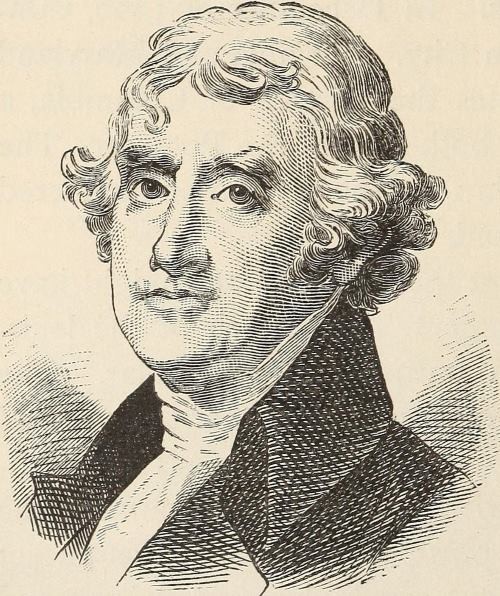
Thomas Jefferson.
Indiana Territory.
3. The new region thus brought under civil government embraced a vast area of country. It included all of the present States of Indiana, Michigan, Illinois, Wisconsin, and a small portion of Minnesota. Vincennes was made the capital. The appointment of Governor and Superintendent of Indian Affairs was conferred on General William Henry Harrison. The work imposed upon him was very great. First appointed by President John Adams, he was afterwards reappointed to the same position by Presidents Jefferson and Madison. Repairing to his field of duty, he convened the first Territorial Legislature at Vincennes, in 1805, and entered at once into negotiations with the Indian tribes.
4. During the administration of Governor Harrison, many salutary measures were adopted with respect to the natives. The Governor sought to prevent the sale of intoxicating liquors among them, and induced many of the tribes to submit to inoculation, as a means of preventing the ravages of smallpox. In September, 1809, he met a congress of the tribes at Vincennes, and effected the purchase of about three million acres of valuable land in the valleys of the Wabash and White rivers. It was these progressive measures which aroused the jealousy and alarm of the Red men, and brought on the Indian war of 1811.
The Louisiana Purchase.
5. About the same time of the organization of Indiana Territory the Mississippi Territory was organized. More important still was the purchase of the vast region called Louisiana. In 1800 Napoleon had compelled Spain to make a cession of this territory to France. He now authorized his minister to dispose of Louisiana by sale. The President appointed Mr. Livingston and James Monroe to negotiate the purchase. On the 30th of April, 1803, terms were agreed on; and for the sum of eleven million two hundred and fifty thousand dollars Louisiana was ceded to the United States. It was also agreed that the United States should pay certain debts due from France to American citizens—the sum not to exceed three million seven hundred and fifty thousand dollars. Thus did that vast domain west of the Mississippi pass under the dominion of the United States.
6. Out of the southern portion of the great province the Territory of Orleans was organized with the same limits as the present State of Louisiana; the rest continued to be called the Territory of Louisiana. Very justly did Mr. Livingston say to the French minister as they arose from signing the treaty: "This is the noblest work of our lives."
7. In 1801 John Marshall became Chief-justice of the United States. In the colonial times, the English constitution and common law had prevailed in America. When the new Republic was organized, it became necessary to modify the principles of law and to adapt them to the altered form of government. This great work was accomplished by Chief-justice Marshall.
[A] John Paulding, David Williams and Isaac van Wart. Congress afterwards rewarded them with silver medals and pensions for life.
12. During the next day the business was completed. Arnold agreed to surrender West Point for ten thousand pounds and a commission as brigadier in the British army. André received papers containing a description of West Point, its defences, and the best method of attack. During that day an American battery drove the Vulture down the river, and André was obliged to cross to the other side and return by land. He passed the American outposts in safety; but at Tarrytown he was confronted by three militiamen[A] who stripped him, found his papers, and delivered him to Colonel Jameson at North Castle. Arnold, on hearing the news, escaped on board the Vulture. André was tried by a court-martial at Tappan, and condemned to death. On the 2d of October he was led to the gallows, and, under the stern code of war, was hanged.