автордың кітабын онлайн тегін оқу A Short History of the World
The Project Gutenberg EBook of A Short History of the World, by H. G. Wells
This eBook is for the use of anyone anywhere at no cost and with
almost no restrictions whatsoever. You may copy it, give it away or
re-use it under the terms of the Project Gutenberg License included
with this eBook or online at www.gutenberg.net
Title: A Short History of the World
Author: H. G. Wells
Release Date: March 2, 2011 [EBook #35461]
Language: English
*** START OF THIS PROJECT GUTENBERG EBOOK A SHORT HISTORY OF THE WORLD ***
Produced by Donald F. Behan
A SHORT
HISTORY OF THE WORLD
BY
H. G. WELLS
New York
THE MACMILLAN & COMPANY
1922
Copyright 1922
CONTENTS
CHAPTER
Page
I.
THE WORLD IN SPACE1
II.
THE WORLD IN TIME5
III.
THE BEGINNINGS OF LIFE11
IV.
THE AGE OF FISHES16
V.
THE AGE OF THE COAL SWAMPS21
VI.
THE AGE OF REPTILES26
VII.
THE FIRST BIRDS AND THE FIRST MAMMALS31
VIII.
THE AGE OF MAMMALS37
IX.
MONKEYS, APES AND SUB-MEN43
X.
THE NEANDERTHALER AND THE RHODESIAN MAN48
XI.
THE FIRST TRUE MEN53
XII.
PRIMITIVE THOUGHT60
XIII.
THE BEGINNINGS OF CULTIVATION65
XIV.
PRIMITIVE NEOLITHIC CIVILIZATIONS71
XV.
SUMERIA, EARLY EGYPT AND WRITING77
XVI.
PRIMITIVE NOMADIC PEOPLES84
XVII.
THE FIRST SEA-GOING PEOPLES91
XVIII.
EGYPT, BABYLON AND ASSYRIA96
XIX.
THE PRIMITIVE ARYANS104
XX.
THE LAST BABYLONIAN EMPIRE AND THE EMPIRE OF DARIUS I109
XXI.
THE EARLY HISTORY OF THE JEWS115
XXII.
PRIESTS AND PROPHETS IN JUDEA122
XXIII.
THE GREEKS127
XXIV.
THE WARS OF THE GREEKS AND PERSIANS134
XXV.
THE SPLENDOUR OF GREECE139
XXVI.
THE EMPIRE OF ALEXANDER THE GREAT145
XXVII.
THE MUSEUM AND LIBRARY AT ALEXANDRIA150
XXVIII.
THE LIFE OF GAUTAMA BUDDHA156
XXIX.
KING ASOKA163
XXX.
CONFUCIUS AND LAO TSE167
XXXI.
ROME COMES INTO HISTORY174
XXXII.
ROME AND CARTHAGE180
XXXIII.
THE GROWTH OF THE ROMAN EMPIRE185
XXXIV.
BETWEEN ROME AND CHINA196
XXXV.
THE COMMON MAN’S LIFE UNDER THE EARLY ROMAN EMPIRE201
XXXVI.
RELIGIOUS DEVELOPMENTS UNDER THE ROMAN EMPIRE208
XXXVII.
THE TEACHING OF JESUS214
XXXVIII.
THE DEVELOPMENT OF DOCTRINAL CHRISTIANITY222
XXXIX.
THE BARBARIANS BREAK THE EMPIRE INTO EAST AND WEST227
XL.
THE HUNS AND THE END OF THE WESTERN EMPIRE233
XLI.
THE BYZANTINE AND SASSANID EMPIRES238
XLII.
THE DYNASTIES OF SUY AND TANG IN CHINA245
XLIII.
MUHAMMAD AND ISLAM248
XLIV.
THE GREAT DAYS OF THE ARABS253
XLV.
THE DEVELOPMENT OF LATIN CHRISTENDOM258
XLVI.
THE CRUSADES AND THE AGE OF PAPAL DOMINION267
XLVII.
RECALCITRANT PRINCES AND THE GREAT SCHISM277
XLVIII.
THE MONGOL CONQUESTS287
XLIX.
THE INTELLECTUAL REVIVAL OF THE EUROPEANS294
L.
THE REFORMATION OF THE LATIN CHURCH304
LI.
THE EMPEROR CHARLES V309
LII.
THE AGE OF POLITICAL EXPERIMENTS; OF GRAND MONARCHY AND PARLIAMENTS AND REPUBLICANISM IN EUROPE318
LIII.
THE NEW EMPIRES OF THE EUROPEANS IN ASIA AND OVERSEAS329
LIV.
THE AMERICAN WAR OF INDEPENDENCE335
LV.
THE FRENCH REVOLUTION AND THE RESTORATION OF MONARCHY IN FRANCE341
LVI.
THE UNEASY PEACE IN EUROPE THAT FOLLOWED THE FALL OF NAPOLEON349
LVII.
THE DEVELOPMENT OF MATERIAL KNOWLEDGE355
LVIII.
THE INDUSTRIAL REVOLUTION365
LIX.
THE DEVELOPMENT OF MODERN POLITICAL AND SOCIAL IDEAS370
LX.
THE EXPANSION OF THE UNITED STATES382
LXI.
THE RISE OF GERMANY TO PREDOMINANCE IN EUROPE390
LXII.
THE NEW OVERSEAS EMPIRES OF THE STEAMSHIP AND RAILWAY393
LXIII.
EUROPEAN AGGRESSION IN ASIA, AND THE RISE OF JAPAN399
LXIV.
THE BRITISH EMPIRE IN 1914405
LXV.
THE AGE OF ARMAMENT IN EUROPE, AND THE GREAT WAR OF 1914-18409
LXVI.
THE REVOLUTION AND FAMINE IN RUSSIA415
LXVII.
THE POLITICAL AND SOCIAL RECONSTRUCTION OF THE WORLD421
CHRONOLOGICAL TABLE
429
INDEX
439
LIST OF ILLUSTRATIONS
Page
Luminous Spiral Clouds of Matter2
Nebula seen Edge-on3
The Great Spiral Nebula6
A Dark Nebula7
Another Spiral Nebula8
Landscape before Life9
Marine Life in the Cambrian Period12
Fossil Trilobite13
Early Palæozoic Fossils of various Species of Lingula14
Fossilized Footprints of a Labyrinthodont, Cheirotherium15
Pterichthys Milleri17
Fossil of Cladoselache18
Sharks and Ganoids of the Devonian Period19
A Carboniferous Swamp22
Skull of a Labyrinthodont, Capitosaurus23
Skeleton of a Labyrinthodont: The Eryops24
A Fossil Ichthyosaurus27
A Pterodactyl28
The Diplodocus29
Fossil of Archeopteryx32
Hesperornis in its Native Seas33
The Ki-wi34
Slab of Marl Rich in Cainozoic Fossils35
Titanotherium Robustum38
Skeleton of Giraffe-camel40
Skeleton of Early Horse40
Comparative Sizes of Brains of Rhinoceros and Dinoceras41
A Mammoth44
Flint Implements from Piltdown Region45
A Pithecanthropean Man46
The Heidelberg Man46
The Piltdown Skull47
A Neanderthaler49
Europe and Western Asia 50,000 years ago Map50
Comparison of Modern Skull and Rhodesian Skull51
Altamira Cave Paintings54
Later Palæolithic Carvings55
Bust of Cro-magnon Man57
Later Palæolithic Art58
Relics of the Stone Age62
Gray’s Inn Lane Flint Implement63
Somaliland Flint Implement63
Neolithic Flint Implement67
Australian Spearheads68
Neolithic Pottery69
Relationship of Human Races Map72
A Maya Stele73
European Neolithic Warrior75
Babylonian Brick78
Egyptian Cylinder Seals of First Dynasty79
The Sakhara Pyramids80
The Pyramid of Cheops: Scene from Summit81
The Temple of Hathor82
Pottery and Implements of the Lake Dwellers85
A Lake Village86
Flint Knives of 4500 B.C.87
Egyptian Wall Paintings of Nomads87
Egyptian Peasants Going to Work88
Stele of Naram Sin89
The Treasure House at Mycenæ93
The Palace at Cnossos95
Temple at Abu Simbel97
Avenue of Sphinxes at Karnak98
The Hypostyle Hall at Karnak99
Frieze of Slaves101
The Temple of Horus, Edfu103
Archaic Amphora105
The Mound of Nippur107
Median and Chaldean Empires Map110
The Empire of Darius Map111
A Persian Monarch112
The Ruins of Persepolis113
The Great Porch of Xerxes113
The Land of the Hebrews Map117
Nebuchadnezzar’s Mound at Babylon118
The Ishtar Gateway, Babylon120
Black Obelisk of Shalmaneser II124
Captive Princes making Obeisance125
Statue of Meleager128
Ruins of Temple of Zeus130
The Temple of Neptune, Pæstum132
Greek Ships on Ancient Pottery135
The Temple of Corinth137
The Temple of Neptune at Cape Sunium138
Frieze of the Parthenon, Athens140
The Acropolis, Athens141
Theatre at Epidauros, Greece141
The Caryatides of the Erechtheum142
Athene of the Parthenon143
Alexander the Great146
Alexander’s Victory at Issus147
The Apollo Belvedere148
Aristotle152
Statuette of Maitreya153
The Death of Buddha154
Tibetan Buddha158
A Burmese Buddha159
The Dhamêkh Tower, Sarnath160
A Chinese Buddhist Apostle164
The Court of Asoka165
Asoka Panel from Bharhut165
The Pillar of Lions (Asokan)166
Confucius169
The Great Wall of China171
Early Chinese Bronze Bell172
The Dying Gaul175
Ancient Roman Cisterns at Carthage177
Hannibal181
Roman Empire and its Alliances, 150 B.C. Map183
The Forum, Rome188
Ruined Coliseum in Tunis189
Roman Arch at Ctesiphon190
The Column of Trajan, Rome193
Glazed Jar of Han Dynasty197
Vase of Han Dynasty198
Chinese Vessel in Bronze199
A Gladiator (contemporary representation)202
A Street in Pompeii204
The Coliseum, Rome206
Interior of Coliseum206
Mithras Sacrificing a Bull210
Isis and Horus211
Bust of Emperor Commodus212
Early Portrait of Jesus Christ216
Road from Nazareth to Tiberias217
David’s Tower and Wall of Jerusalem218
A Street in Jerusalem219
The Peter and Paul Mosaic at Rome223
Baptism of Christ (Ivory Panel)225
Roman Empire and the Barbarians Map228
Constantine’s Pillar, Constantinople229
The Obelisk of Theodosius, Constantinople231
Head of Barbarian Chief235
The Church of S. Sophia, Constantinople239
Roof-work in S. Sophia240
Justinian and his Court241
The Rock-hewn Temple at Petra242
Chinese Earthenware of Tang Dynasty246
At Prayer in the Desert250
Looking Across the Sea of Sand251
Growth of Moslem Power Map254
The Moslem Empire Map254
The Mosque of Omar, Jerusalem255
Cairo Mosques256
Frankish Dominions of Martel Map260
Statue of Charlemagne262
Europe at Death of Charlemagne Map264
Crusader Tombs, Exeter Cathedral268
View of Cairo269
The Horses of S. Mark, Venice271
Courtyard in the Alhambra273
Milan Cathedral (showing spires)278
A Typical Crusader280
Burgundian Nobility (Statuettes)283
Burgundian Nobility (Statuettes)284
The Empire of Jengis Khan Map288
Ottoman Empire before 1453 Map289
Tartar Horsemen291
Ottoman Empire, 1566 Map292
An Early Printing Press296
Ancient Bronze from Benin299
Negro Bronze-work300
Early Sailing Ship (Italian Engraving)301
Portrait of Martin Luther305
The Church Triumphant (Italian Majolica work, 1543)307
Charles V (the Titian Portrait)311
S. Peter’s, Rome: the High Altar315
Cromwell Dissolves the Long Parliament321
The Court at Versailles323
Sack of a Village, French Revolution325
Central Europe after Peace of Westphalia, 1648 Map326
European Territory in America, 1750 Map330
Europeans Tiger Hunting in India331
Fall of Tippoo Sultan332
George Washington337
The Battle of Bunker Hill338
The U.S.A., 1790339
The Trial of Louis XVI344
Execution of Marie Antoinette346
Portrait of Napoleon352
Europe after the Congress of Vienna Map353
Early Rolling Stock, Liverpool and Manchester Railway356
Passenger Train in 1833356
The Steamboat Clermont357
Eighteenth Century Spinning Wheel361
Arkwright’s Spinning Jenny361
An Early Weaving Machine363
An Incident of the Slave Trade367
Early Factory, in Colebrookdale368
Carl Marx372
Electric Conveyor, in Coal Mine376
Constructional Detail, Forth Bridge378
American River Steamer385
Abraham Lincoln387
Europe, 1848-71 Map391
Victoria Falls, Zambesi395
The British Empire, 1815 Map397
Japanese Soldier, Eighteenth Century401
A Street in Tokio403
Overseas Empires of Europe, 1914 Map406
Gibraltar407
Street in Hong Kong408
British Tank in Battle410
The Ruins of Ypres411
Modern War: War Entanglements412
A View in Petersburg under Bolshevik Rule418
Passenger Aeroplane in Flight423
A Peaceful Garden in England426
A SHORT HISTORY OF THE WORLD
I
THE WORLD IN SPACE
THE story of our world is a story that is still very imperfectly known. A couple of hundred years ago men possessed the history of little more than the last three thousand years. What happened before that time was a matter of legend and speculation. Over a large part of the civilized world it was believed and taught that the world had been created suddenly in 4004 B.C., though authorities differed as to whether this had occurred in the spring or autumn of that year. This fantastically precise misconception was based upon a too literal interpretation of the Hebrew Bible, and upon rather arbitrary theological assumptions connected therewith. Such ideas have long since been abandoned by religious teachers, and it is universally recognized that the universe in which we live has to all appearances existed for an enormous period of time and possibly for endless time. Of course there may be deception in these appearances, as a room may be made to seem endless by putting mirrors facing each other at either end. But that the universe in which we live has existed only for six or seven thousand years may be regarded as an altogether exploded idea.
The earth, as everybody knows nowadays, is a spheroid, a sphere slightly compressed, orange fashion, with a diameter of nearly 8,000 miles. Its spherical shape has been known at least to a limited number of intelligent people for nearly 2,500 years, but before that time it was supposed to be flat, and various ideas which now seem fantastic were entertained about its relations to the sky and the stars and planets. We know now that it rotates upon its axis (which is about 24 miles shorter than its equatorial diameter) every twenty-four hours, and that this is the cause of the alternations of day and night, that it circles about the sun in a slightly distorted and slowly variable oval path in a year. Its distance from the sun varies between ninety-one and a half millions at its nearest and ninety-four and a half million miles.
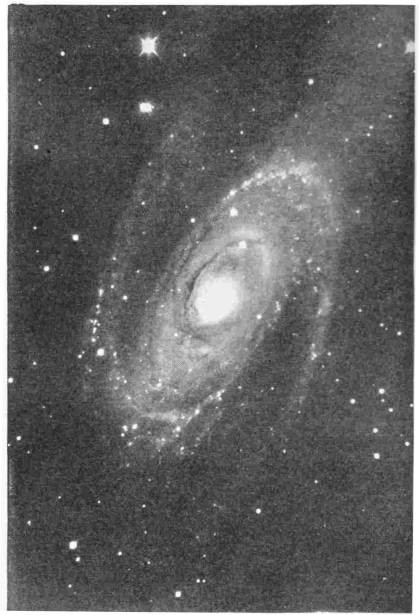
“LUMINOUS SPIRAL CLOUDS OF MATTER”
(Nebula photographed 1910)
Photo: G. W. Ritchey
About the earth circles a smaller sphere, the moon, at an average distance of 239,000 miles. Earth and moon are not the only bodies to travel round the sun. There are also the planets, Mercury and Venus, at distances of thirty-six and sixty-seven millions of miles; and beyond the circle of the earth and disregarding a belt of numerous smaller bodies, the planetoids, there are Mars, Jupiter, Saturn, Uranus and Neptune at mean distances of 141, 483, 886, 1,782, and 1,793 millions of miles respectively. These figures in millions of miles are very difficult for the mind to grasp. It may help the reader’s imagination if we reduce the sun and planets to a smaller, more conceivable scale.
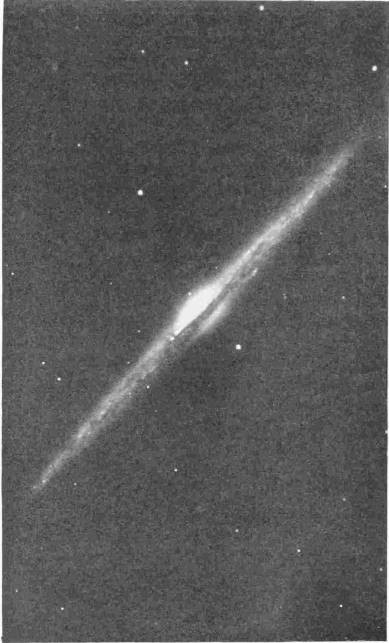
THE NEBULA SEEN EDGE-ON
Note the central core which, through millions of years, is cooling to solidity
Photo: G. W. Ritchey
If, then, we represent our earth as a little ball of one inch diameter, the sun would be a big globe nine feet across and 323 yards away, that is about a fifth of a mile, four or five minutes’ walking. The moon would be a small pea two feet and a half from the world. Between earth and sun there would be the two inner planets, Mercury and Venus, at distances of one hundred and twenty-five and two hundred and fifty yards from the sun. All round and about these bodies there would be emptiness until you came to Mars, a hundred and seventy-five feet beyond the earth; Jupiter nearly a mile away, a foot in diameter; Saturn, a little smaller, two miles off; Uranus four miles off and Neptune six miles off. Then nothingness and nothingness except for small particles and drifting scraps of attenuated vapour for thousands of miles. The nearest star to earth on this scale would be 40,000 miles away.
These figures will serve perhaps to give one some conception of the immense emptiness of space in which the drama of life goes on.
For in all this enormous vacancy of space we know certainly of life only upon the surface of our earth. It does not penetrate much more than three miles down into the 4,000 miles that separate us from the centre of our globe, and it does not reach more than five miles above its surface. Apparently all the limitlessness of space is otherwise empty and dead.
The deepest ocean dredgings go down to five miles. The highest recorded flight of an aeroplane is little more than four miles. Men have reached to seven miles up in balloons, but at a cost of great suffering. No bird can fly so high as five miles, and small birds and insects which have been carried up by aeroplanes drop off insensible far below that level.
II
THE WORLD IN TIME
IN the last fifty years there has been much very fine and interesting speculation on the part of scientific men upon the age and origin of our earth. Here we cannot pretend to give even a summary of such speculations because they involve the most subtle mathematical and physical considerations. The truth is that the physical and astronomical sciences are still too undeveloped as yet to make anything of the sort more than an illustrative guesswork. The general tendency has been to make the estimated age of our globe longer and longer. It now seems probable that the earth has had an independent existence as a spinning planet flying round and round the sun for a longer period than 2,000,000,000 years. It may have been much longer than that. This is a length of time that absolutely overpowers the imagination.
Before that vast period of separate existence, the sun and earth and the other planets that circulate round the sun may have been a great swirl of diffused matter in space. The telescope reveals to us in various parts of the heavens luminous spiral clouds of matter, the spiral nebulæ, which appear to be in rotation about a centre. It is supposed by many astronomers that the sun and its planets were once such a spiral, and that their matter has undergone concentration into its present form. Through majestic æons that concentration went on until in that vast remoteness of the past for which we have given figures, the world and its moon were distinguishable. They were spinning then much faster than they are spinning now; they were at a lesser distance from the sun; they travelled round it very much faster, and they were probably incandescent or molten at the surface. The sun itself was a much greater blaze in the heavens.
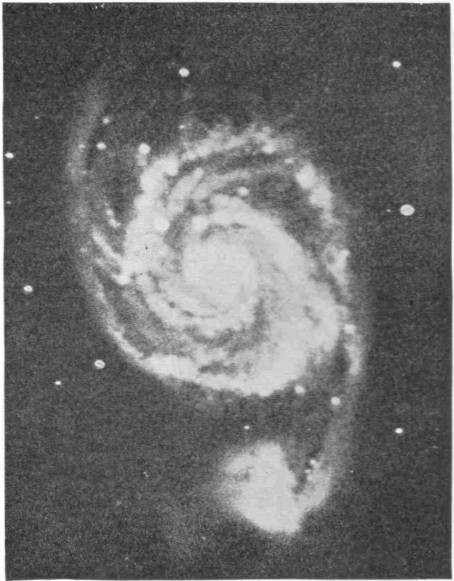
THE GREAT SPIRAL NEBULA
Photo: G. W. Ritchey
If we could go back through that infinitude of time and see the earth in this earlier stage of its history, we should behold a scene more like the interior of a blast furnace or the surface of a lava flow before it cools and cakes over than any other contemporary scene. No water would be visible because all the water there was would still be superheated steam in a stormy atmosphere of sulphurous and metallic vapours. Beneath this would swirl and boil an ocean of molten rock substance. Across a sky of fiery clouds the glare of the hurrying sun and moon would sweep swiftly like hot breaths of flame.
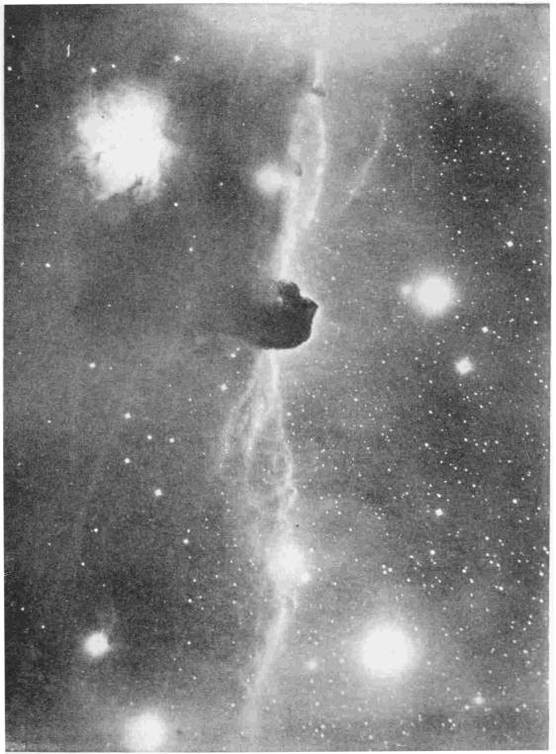
A DARK NEBULA
Taken in 1920 with the aid of the largest telescope in the world. One of the first photographs taken by the Mount Wilson telescope.
There are dark nebulæ and bright nebulæ. Prof. Henry Norris Russell, against the British theory, holds that the dark nebulæ preceded the bright nebulæ.
Photo: Prof. Hale
Slowly by degrees as one million of years followed another, this fiery scene would lose its eruptive incandescence. The vapours in the sky would rain down and become less dense overhead; great slaggy cakes of solidifying rock would appear upon the surface of the molten sea, and sink under it, to be replaced by other floating masses. The sun and moon growing now each more distant and each smaller, would rush with diminishing swiftness across the heavens. The moon now, because of its smaller size, would be already cooled far below incandescence, and would be alternately obstructing and reflecting the sunlight in a series of eclipses and full moons.
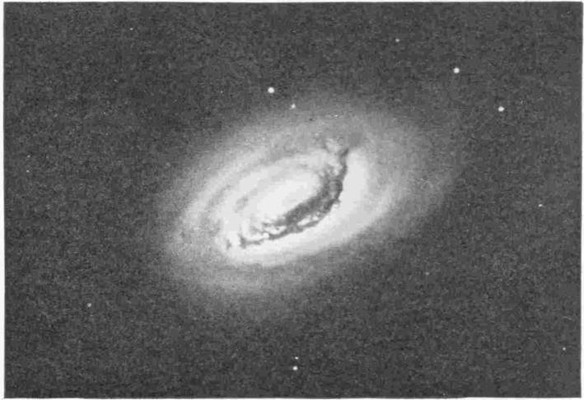
ANOTHER SPIRAL NEBULA
Photo: G. W. Ritchey
And so with a tremendous slowness through the vastness of time, the earth would grow more and more like the earth on which we live, until at last an age would come when, in the cooling air, steam would begin to condense into clouds, and the first rain would fall hissing upon the first rocks below. For endless millenia the greater part of the earth’s water would still be vaporized in the atmosphere, but there would now be hot streams running over the crystallizing rocks below and pools and lakes into which these streams would be carrying detritus and depositing sediment.
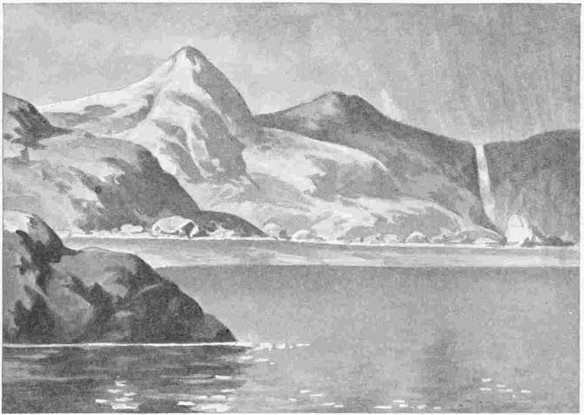
LANDSCAPE BEFORE LIFE
“Great lava-like masses of rock without traces of soil”
At last a condition of things must have been attained in which a man might have stood up on earth and looked about him and lived. If we could have visited the earth at that time we should have stood on great lava-like masses of rock without a trace of soil or touch of living vegetation, under a storm-rent sky. Hot and violent winds, exceeding the fiercest tornado that ever blows, and downpours of rain such as our milder, slower earth to-day knows nothing of, might have assailed us. The water of the downpour would have rushed by us, muddy with the spoils of the rocks, coming together into torrents, cutting deep gorges and canyons as they hurried past to deposit their sediment in the earliest seas. Through the clouds we should have glimpsed a great sun moving visibly across the sky, and in its wake and in the wake of the moon would have come a diurnal tide of earthquake and upheaval. And the moon, which nowadays keeps one constant face to earth, would then have been rotating visibly and showing the side it now hides so inexorably.
The earth aged. One million years followed another, and the day lengthened, the sun grew more distant and milder, the moon’s pace in the sky slackened; the intensity of rain and storm diminished and the water in the first seas increased and ran together into the ocean garment our planet henceforth wore.
But there was no life as yet upon the earth; the seas were lifeless, and the rocks were barren.
III
THE BEGINNINGS OF LIFE
AS everybody knows nowadays, the knowledge we possess of life before the beginnings of human memory and tradition is derived from the markings and fossils of living things in the stratified rocks. We find preserved in shale and slate, limestone, and sandstone, bones, shells, fibres, stems, fruits, footmarks, scratchings and the like, side by side with the ripple marks of the earliest tides and the pittings of the earliest rain-falls. It is by the sedulous examination of this Record of the Rocks that the past history of the earth’s life has been pieced together. That much nearly everybody knows to-day. The sedimentary rocks do not lie neatly stratum above stratum; they have been crumpled, bent, thrust about, distorted and mixed together like the leaves of a library that has been repeatedly looted and burnt, and it is only as a result of many devoted lifetimes of work that the record has been put into order and read. The whole compass of time represented by the record of the rocks is now estimated as 1,600,000,000 years.
The earliest rocks in the record are called by geologists the Azoic rocks, because they show no traces of life. Great areas of these Azoic rocks lie uncovered in North America, and they are of such a thickness that geologists consider that they represent a period of at least half of the 1,600,000,000 which they assign to the whole geological record. Let me repeat this profoundly significant fact. Half the great interval of time since land and sea were first distinguishable on earth has left us no traces of life. There are ripplings and rain marks still to be found in these rocks, but no marks nor vestiges of any living thing.

MARINE LIFE IN THE CAMBRIAN PERIOD
1 and 8, Jellyfishes; 2, Hyolithes (swimming snail); 3, Humenocaris; 4, Protospongia; 5, Lampshells (Obolella); 6, Orthoceras; 7, Trilobite (Paradoxides) — see fossil on page 13; 9, Coral (Archæocyathus); 10, Bryograptus; 11, Trilobite (Olenellus); 12, Palesterina
Then, as we come up the record, signs of past life appear and increase. The age of the world’s history in which we find these past traces is called by geologists the Lower Palæozoic age. The first indications that life was astir are vestiges of comparatively simple and lowly things: the shells of small shellfish, the stems and flowerlike heads of zoophytes, seaweeds and the tracks and remains of sea worms and crustacea. Very early appear certain creatures rather like plant-lice, crawling creatures which could roll themselves up into balls as the plant-lice do, the trilobites. Later by a few million years or so come certain sea scorpions, more mobile and powerful creatures than the world had ever seen before.
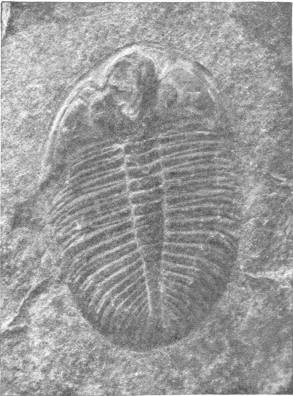
FOSSIL TRILOBITE (SLIGHTLY MAGNIFIED)
Photo: John J. Ward, F.E.S.
None of these creatures were of very great size. Among the largest were certain of the sea scorpions, which measured nine feet in length. There are no signs whatever of land life of any sort, plant or animal; there are no fishes nor any vertebrated creatures in this part of the record. Essentially all the plants and creatures which have left us their traces from this period of the earth’s history are shallow-water and intertidal beings. If we wished to parallel the flora and fauna of the Lower Palæozoic rocks on the earth to-day, we should do it best, except in the matter of size, by taking a drop of water from a rock pool or scummy ditch and examining it under a microscope. The little crustacea, the small shellfish, the zoophytes and algæ we should find there would display a quite striking resemblance to these clumsier, larger prototypes that once were the crown of life upon our planet.
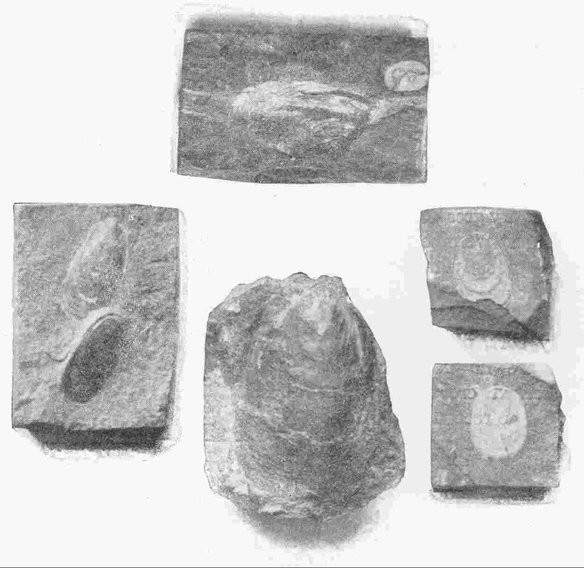
EARLY PALÆOLITHIC FOSSILS OF VARIOUS SPECIES OF LINGULA
Species of this most ancient genus of shellfish still live to-day
(In Natural History Museum, London)
It is well, however, to bear in mind that the Lower Palæozoic rocks probably do not give us anything at all representative of the first beginnings of life on our planet. Unless a creature has bones or other hard parts, unless it wears a shell or is big enough and heavy enough to make characteristic footprints and trails in mud, it is unlikely to leave any fossilized traces of its existence behind. To-day there are hundreds of thousands of species of small soft-bodied creatures in our world which it is inconceivable can ever leave any mark for future geologists to discover. In the world’s past, millions of millions of species of such creatures may have lived and multiplied and flourished and passed away without a trace remaining. The waters of the warm and shallow lakes and seas of the so-called Azoic period may have teemed with an infinite variety of lowly, jelly-like, shell-less and boneless creatures, and a multitude of green scummy plants may have spread over the sunlit intertidal rocks and beaches. The Record of the Rocks is no more a complete record of life in the past than the books of a bank are a record of the existence of everybody in the neighbourhood. It is only when a species begins to secrete a shell or a spicule or a carapace or a lime-supported stem, and so put by something for the future, that it goes upon the Record. But in rocks of an age prior to those which bear any fossil traces, graphite, a form of uncombined carbon, is sometimes found, and some authorities consider that it may have been separated out from combination through the vital activities of unknown living things.
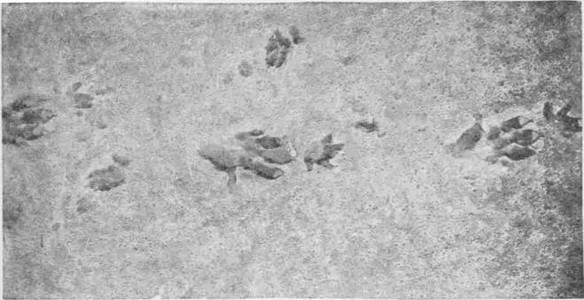
FOSSILIZED FOOTPRINTS OF A LABYRINTHODONT CHEIROTHERIUM
(In Natural History Museum, London)
IV
THE AGE OF FISHES
IN the days when the world was supposed to have endured for only a few thousand years, it was supposed that the different species of plants and animals were fixed and final; they had all been created exactly as they are to-day, each species by itself. But as men began to discover and study the Record of the Rocks this belief gave place to the suspicion that many species had changed and developed slowly through the course of ages, and this again expanded into a belief in what is called Organic Evolution, a belief that all species of life upon earth, animal and vegetable alike, are descended by slow continuous processes of change from some very simple ancestral form of life, some almost structureless living substance, far back in the so-called Azoic seas.
This question of Organic Evolution, like the question of the age of the earth, has in the past been the subject of much bitter controversy. There was a time when a belief in organic evolution was for rather obscure reasons supposed to be incompatible with sound Christian, Jewish and Moslem doctrine. That time has passed, and the men of the most orthodox Catholic, Protestant, Jewish and Mohammedan belief are now free to accept this newer and broader view of a common origin of all living things. No life seems to have happened suddenly upon earth. Life grew and grows. Age by age through gulfs of time at which imagination reels, life has been growing from a mere stirring in the intertidal slime towards freedom, power and consciousness.
Life consists of individuals. These individuals are definite things, they are not like the lumps and masses, nor even the limitless and motionless crystals, of non-living matter, and they have two characteristics no dead matter possesses. They can assimilate other matter into themselves and make it part of themselves, and they can reproduce themselves. They eat and they breed. They can give rise to other individuals, for the most part like themselves, but always also a little different from themselves. There is a specific and family resemblance between an individual and its offspring, and there is an individual difference between every parent and every offspring it produces, and this is true in every species and at every stage of life.
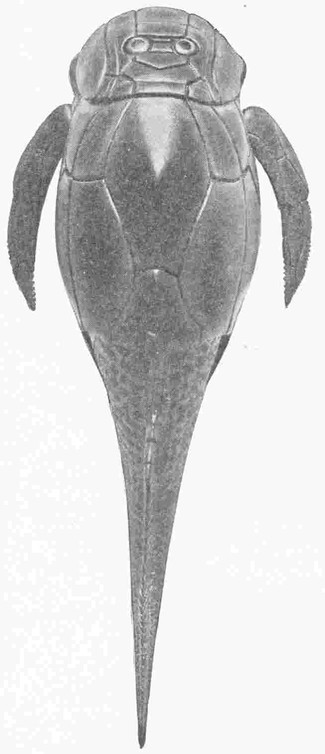
SPECIMEN OF THE PTERICHTHYS MILLERI OR SEA SCORPION SHOWING BODY ARMOUR
Now scientific men are not able to explain to us either why offspring should resemble nor why they should differ from their parents. But seeing that offspring do at once resemble and differ, it is a matter rather of common sense than of scientific knowledge that, if the conditions under which a species live are changed, the species should undergo some correlated changes. Because in any generation of the species there must be a number of individuals whose individual differences make them better adapted to the new conditions under which the species has to live, and a number whose individuals whose individual differences make it rather harder for them to live. And on the hole the former sort will live longer, bear more offspring, and reproduce themselves more abundantly than the latter, and so generation by generation the average of the species will change in the favourable direction. This process, which is called Natural Selection, is not so much a scientific theory as a necessary deduction from the facts of reproduction and individual difference. There may be many forces at work varying, destroying and preserving species, about which science may still be unaware or undecided, but the man who can deny the operation of this process of natural selection upon life since its beginning must be either ignorant of the elementary facts of life or incapable of ordinary thought.
Many scientific men have speculated about the first beginning of life and their speculations are often of great interest, but there is absolutely no definite knowledge and no convincing guess yet of the way in which life began. But nearly all authorities are agreed that it probably began upon mud or sand in warm sunlit shallow brackish water, and that it spread up the beaches to the intertidal lines and out to the open waters.
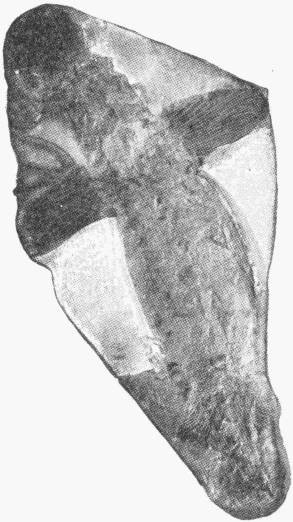
FOSSIL OF THE CLADOSELACHE, A DEVONIAN SHARK
Nat. Hist. Mus.
That early world was a world of strong tides and currents. An incessant destruction of individuals must have been going on through their being swept up the beaches and dried, or by their being swept out to sea and sinking down out of reach of air and sun. Early conditions favoured the development of every tendency to root and hold on, every tendency to form an outer skin and casing to protect the stranded individual from immediate desiccation. From the very earliest any tendency to sensitiveness to taste would turn the individual in the direction of food, and any sensitiveness to light would assist it to struggle back out of the darkness of the sea deeps and caverns or to wriggle back out of the excessive glare of the dangerous shallows.
Probably the first shells and body armour of living things were protections against drying rather than against active enemies. But tooth and claw come early into our earthly history.
We have already noted the size of the earlier water scorpions. For long ages such creatures were the supreme lords of life. Then in a division of these Palæozoic rocks called the Silurian division, which many geologists now suppose to be as old as five hundred million years, there appears a new type of being, equipped with eyes and teeth and swimming powers of an altogether more powerful kind. These were the first known backboned animals, the earliest fishes, the first known Vertebrata.
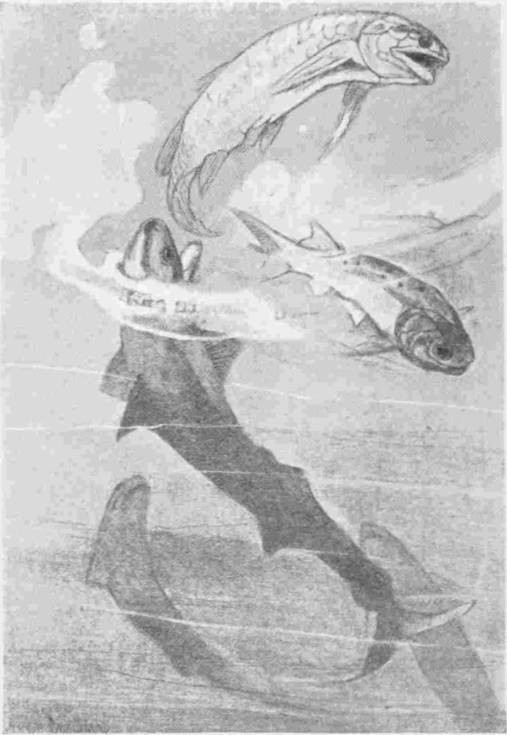
SHARKS AND GANOIDS OF THE DEVONIAN PERIOD
By Alice Woodward
These fishes increase greatly in the next division of rocks, the rocks known as the Devonian system. They are so prevalent that this period of the Record of the Rocks has been called the Age of Fishes. Fishes of a pattern now gone from the earth, and fishes allied to the sharks and sturgeons of to-day, rushed through the waters, leapt in the air, browsed among the seaweeds, pursued and preyed upon one another, and gave a new liveliness to the waters of the world. None of these were excessively big by our present standards. Few of them were more than two or three feet long, but there were exceptional forms which were as long as twenty feet.
We know nothing from geology of the ancestors of these fishes. They do not appear to be related to any of the forms that preceded them. Zoologists have the most interesting views of their ancestry, but these they derive from the study of the development of the eggs of their still living relations, and from other sources. Apparently the ancestors of the vertebrata were soft-bodied and perhaps quite small swimming creatures who began first to develop hard parts as teeth round and about their mouths. The teeth of a skate or dogfish cover the roof and floor of its mouth and pass at the lip into the flattened toothlike scales that encase most of its body. As the fishes develop these teeth scales in the geological record, they swim out of the hidden darkness of the past into the light, the first vertebrated animals visible in the record.
V
THE AGE OF THE COAL SWAMPS
THE land during this Age of Fishes was apparently quite lifeless. Crags and uplands of barren rock lay under the sun and rain. There was no real soil—for as yet there were no earthworms which help to make a soil, and no plants to break up the rock particles into mould; there was no trace of moss or lichen. Life was still only in the sea.
Over this world of barren rock played great changes of climate. The causes of these changes of climate were very complex and they have still to be properly estimated. The changing shape of the earth’s orbit, the gradual shifting of the poles of rotation, changes in the shapes of the continents, probably even fluctuations in the warmth of the sun, now conspired to plunge great areas of the earth’s surface into long periods of cold and ice and now again for millions of years spread a warm or equable climate over this planet. There seem to have been phases of great internal activity in the world’s history, when in the course of a few million years accumulated upthrusts would break out in lines of volcanic eruption and upheaval and rearrange the mountain and continental outlines of the globe, increasing the depth of the sea and the height of the mountains and exaggerating the extremes of climate. And these would be followed by vast ages of comparative quiescence, when frost, rain and river would wear down the mountain heights and carry great masses of silt to fill and raise the sea bottoms and spread the seas, ever shallower and wider, over more and more of the land. There have been “high and deep” ages in the world’s history and “low and level” ages. The reader must dismiss from his mind any idea that the surface of the earth has been growing steadily cooler since its crust grew solid. After that much cooling had been achieved, the internal temperature ceased to affect surface conditions. There are traces of periods of superabundant ice and snow, of “Glacial Ages,” that is, even in the Azoic period.
It was only towards the close of the Age of Fishes, in a period of extensive shallow seas and lagoons, that life spread itself out in any effectual way from the waters on to the land. No doubt the earlier types of the forms that now begin to appear in great abundance had already been developing in a rare and obscure manner for many scores of millions of years. But now came their opportunity.
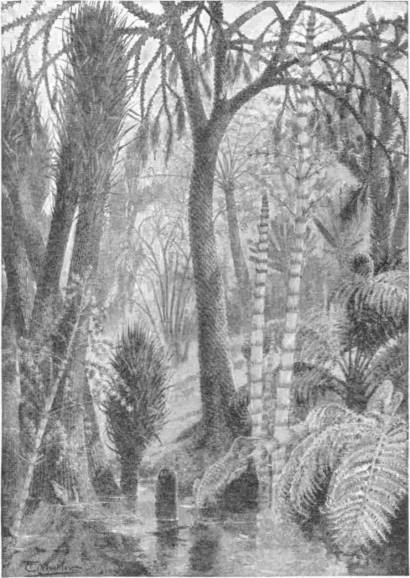
A CARBONIFEROUS SWAMP
A Coal Seam in the Making
Plants no doubt preceded animal forms in this invasion of the land, but the animals probably followed up the plant emigration very closely. The first problem that the plant had to solve was the problem of some sustaining stiff support to hold up its fronds to the sunlight when the buoyant water was withdrawn; the second was the problem of getting water from the swampy ground below to the tissues of the plant, now that it was no longer close at hand. The two problems were solved by the development of woody tissue which both sustained the plant and acted as water carrier to the leaves. The Record of the Rocks is suddenly crowded by a vast variety of woody swamp plants, many of them of great size, big tree mosses, tree ferns, gigantic horsetails and the like. And with these, age by age, there crawled out of the water a great variety of animal forms. There were centipedes and millipedes; there were the first primitive insects; there were creatures related to the ancient king crabs and sea scorpions which became the earliest spiders and land scorpions, and presently there were vertebrated animals.
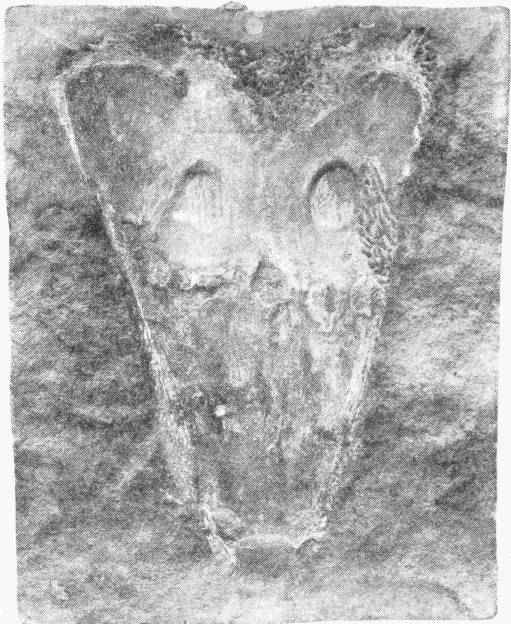
SKULL OF A LABYRINTHODONT, CAPITOSAURUS
Nat. Hist. Mus.
Some of the earlier insects were very large. There were dragon flies in this period with wings that spread out to twenty-nine inches.
In various ways these new orders and genera had adapted themselves to breathing air. Hitherto all animals had breathed air dissolved in water, and that indeed is what all animals still have to do. But now in divers fashions the animal kingdom was acquiring the power of supplying its own moisture where it was needed. A man with a perfectly dry lung would suffocate to-day; his lung surfaces must be moist in order that air may pass through them into his blood. The adaptation to air breathing consists in all cases either in the development of a cover to the old-fashioned gills to stop evaporation, or in the development of tubes or other new breathing organs lying deep inside the body and moistened by a watery secretion. The old gills with which the ancestral fish of the vertebrated line had breathed were inadaptable to breathing upon land, and in the case of this division of the animal kingdom it is the swimming bladder of the fish which becomes a new, deep-seated breathing organ, the lung. The kind of animals known as amphibia, the frogs and newts of to-day, begin their lives in the water and breathe by gills; and subsequently the lung, developing in the same way as the swimming bladder of many fishes do, as a baglike outgrowth from the throat, takes over the business of breathing, the animal comes out on land, and the gills dwindle and the gill slits disappear. (All except an outgrowth of one gill slit, which becomes the passage of the ear and ear-drum.) The animal can now live only in the air, but it must return at least to the edge of the water to lay its eggs and reproduce its kind.
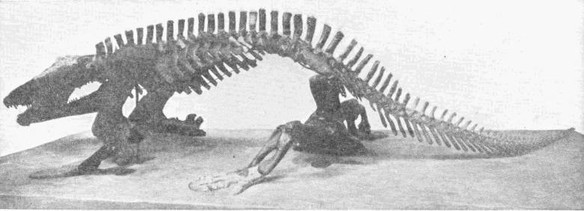
SKELETON OF A LABYRINTHODONT: THE ERYOPS
Nat. Hist. Mus.
All the air-breathing vertebrata of this age of swamps and plants belonged to the class amphibia. They were nearly all of them forms related to the newts of to-day, and some of them attained a considerable size. They were land animals, it is true, but they were land animals needing to live in and near moist and swampy places, and all the great trees of this period were equally amphibious in their habits. None of them had yet developed fruits and seeds of a kind that could fall on land and develop with the help only of such moisture as dew and rain could bring. They all had to shed their spores in water, it would seem, if they were to germinate.
It is one of the most beautiful interests of that beautiful science, comparative anatomy, to trace the complex and wonderful adaptations of living things to the necessities of existence in air. All living things, plants and animals alike, are primarily water things. For example all the higher vertebrated animals above the fishes, up to and including man, pass through a stage in their development in the egg or before birth in which they have gill slits which are obliterated before the young emerge. The bare, water-washed eye of the fish is protected in the higher forms from drying up by eyelids and glands which secrete moisture. The weaker sound vibrations of air necessitate an ear-drum. In nearly every organ of the body similar modifications and adaptations are to be detected, similar patchings-up to meet aerial conditions.
This Carboniferous age, this age of the amphibia, was an age of life in the swamps and lagoons and on the low banks among these waters. Thus far life had now extended. The hills and high lands were still quite barren and lifeless. Life had learnt to breathe air indeed, but it still had its roots in its native water; it still had to return to the water to reproduce its kind.
VI
THE AGE OF REPTILES
THE abundant life of the Carboniferous period was succeeded by a vast cycle of dry and bitter ages. They are represented in the Record of the Rocks by thick deposits of sandstones and the like, in which fossils are comparatively few. The temperature of the world fluctuated widely, and there were long periods of glacial cold. Over great areas the former profusion of swamp vegetation ceased, and, overlaid by these newer deposits, it began that process of compression and mineralization that gave the world most of the coal deposits of to-day.
But it is during periods of change that life undergoes its most rapid modifications, and under hardship that it learns its hardest lessons. As conditions revert towards warmth and moisture again we find a new series of animal and plant forms established, We find in the record the remains of vertebrated animals that laid eggs which, instead of hatching out tadpoles which needed to live for a time in water, carried on their development before hatching to a stage so nearly like the adult form that the young could live in air from the first moment of independent existence. Gills had been cut out altogether, and the gill slits only appeared as an embryonic phase.
These new creatures without a tadpole stage were the Reptiles. Concurrently there had been a development of seed-bearing trees, which could spread their seed, independently of swamp or lakes. There were now palmlike cycads and many tropical conifers, though as yet there were no flowering plants and no grasses. There was a great number of ferns. And there was now also an increased variety of insects. There were beetles, though bees and butterflies had yet to come. But all the fundamental forms of a new real land fauna and flora had been laid down during these vast ages of severity. This new land life needed only the opportunity of favourable conditions to flourish and prevail.
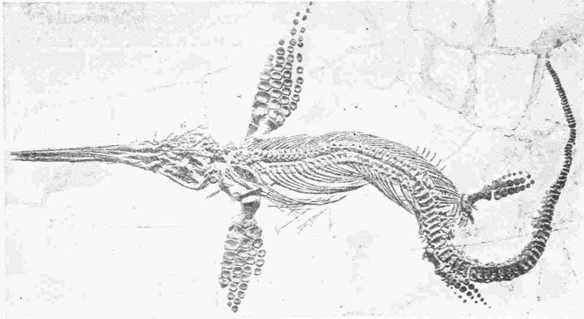
A FOSSIL ICHTHYOSAURUS, A MESOZOIC FISH-LIZARD
Found in the Lower Lias in Somersetshire
Nat. Hist. Mus.
Age by age and with abundant fluctuations that mitigation came. The still incalculable movements of the earth’s crust, the changes in its orbit, the increase and diminution of the mutual inclination of orbit and pole, worked together to produce a great spell of widely diffused warm conditions. The period lasted altogether, it is now supposed, upwards of two hundred million years. It is called the Mesozoic period, to distinguish it from the altogether vaster Palæozoic and Azoic periods (together fourteen hundred millions) that preceded it, and from the Cainozoic or new life period that intervened between its close and the present time, and it is also called the Age of Reptiles because of the astonishing predominance and variety of this form of life. It came to an end some eighty million years ago.
In the world to-day the genera of Reptiles are comparatively few and their distribution is very limited. They are more various, it is true, than are the few surviving members of the order of the amphibia which once in the Carboniferous period ruled the world. We still have the snakes, the turtles and tortoises (the Chelonia), the alligators and crocodiles, and the lizards. Without exception they are creatures requiring warmth all the year round; they cannot stand exposure to cold, and it is probable that all the reptilian beings of the Mesozoic suffered under the same limitation. It was a hothouse fauna, living amidst a hothouse flora. It endured no frosts. But the world had at least attained a real dry land fauna and flora as distinguished from the mud and swamp fauna and flora of the previous heyday of life upon earth.
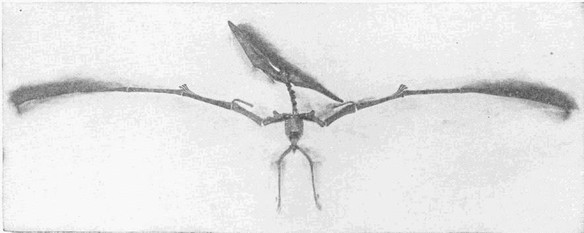
A PTERODACTYL
Nat. Hist. Mus.
All the sorts of reptile we know now were much more abundantly represented then, great turtles and tortoises, big crocodiles and many lizards and snakes, but in addition there was a number of series of wonderful creatures that have now vanished altogether from the earth. There was a vast variety of beings called the Dinosaurs. Vegetation was now spreading over the lower levels of the world, reeds, brakes of fern and the like; and browsing upon this abundance came a multitude of herbivorous reptiles, which increased in size as the Mesozoic period rose to its climax. Some of these beasts exceeded in size any other land animals that have ever lived; they were as large as whales. The Diplodocus Carnegii for example measured eighty-four feet from snout to tail; the Gigantosaurus was even greater; it measured a hundred feet. Living upon these monsters was a swarm of carnivorous Dinosaurs of a corresponding size. One of these, the Tyrannosaurus, is figured and described in many books as the last word in reptilian frightfulness.

A BIG SWAMP-INHABITING DINOSAUR, THE DIPLODOCUS, OVER EIGHTY FEET FROM SNOUT TO TAIL-TIP
Nat. Hist. Mus.
While these great creatures pastured and pursued amidst the fronds and evergreens of the Mesozoic jungles, another now vanished tribe of reptiles, with a bat-like development of the fore limbs, pursued insects and one another, first leapt and parachuted and presently flew amidst the fronds and branches of the forest trees. These were the Pterodactyls. These were the first flying creatures with backbones; they mark a new achievement in the growing powers of vertebrated life.
Moreover some of the reptiles were returning to the sea waters. Three groups of big swimming beings had invaded the sea from which their ancestors had come: the Mososaurs, the Plesiosaurs, and Ichthyosaurs. Some of these again approached the proportions of our present whales. The Ichthyosaurs seem to have been quite seagoing creatures, but the Plesiosaurs were a type of animal that has no cognate form to-day. The body was stout and big with paddles, adapted either for swimming or crawling through marshes, or along the bottom of shallow waters. The comparatively small head was poised on a vast snake of neck, altogether outdoing the neck of the swan. Either the Plesiosaur swam and searched for food under the water and fed as the swan will do, or it lurked under water and snatched at passing fish or beast.
Such was the predominant land life throughout the Mesozoic age. It was by our human standards an advance upon anything that had preceded it. It had produced land animals greater in size, range, power and activity, more “vital” as people say, than anything the world had seen before. In the seas there had been no such advance but a great proliferation of new forms of life. An enormous variety of squid-like creatures with chambered shells, for the most part coiled, had appeared in the shallow seas, the Ammonites. They had had predecessors in the Palæozoic seas, but now was their age of glory. To-day they have left no survivors at all; their nearest relation is the pearly Nautilus, an inhabitant of tropical waters. And a new and more prolific type of fish with lighter, finer scales than the plate-like and tooth-like coverings that had hitherto prevailed, became and has since remained predominant in the seas and rivers.
VII
THE FIRST BIRDS AND THE FIRST MAMMALS
IN a few paragraphs a picture of the lush vegetation and swarming reptiles of that first great summer of life, the Mesozoic period, has been sketched. But while the Dinosaurs lorded it over the hot selvas and marshy plains and the Pterodactyls filled the forests with their flutterings and possibly with shrieks and croakings as they pursued the humming insect life of the still flowerless shrubs and trees, some less conspicuous and less abundant forms upon the margins of this abounding life were acquiring certain powers and learning certain lessons of endurance, that were to be of the utmost value to their race when at last the smiling generosity of sun and earth began to fade.
A group of tribes and genera of hopping reptiles, small creatures of the dinosaur type, seem to have been pushed by competition and the pursuit of their enemies towards the alternatives of extinction or adaptation to colder conditions in the higher hills or by the sea. Among these distressed tribes there was developed a new type of scale—scales that were elongated into quill-like forms and that presently branched into the crude beginnings of feathers. These quill-like scales layover one another and formed a heat-retaining covering more efficient than any reptilian covering that had hitherto existed. So they permitted an invasion of colder regions that were otherwise uninhabited. Perhaps simultaneously with these changes there arose in these creatures a greater solicitude for their eggs. Most reptiles are apparently quite careless about their eggs, which are left for sun and season to hatch. But some of the varieties upon this new branch of the tree of life were acquiring a habit of guarding their eggs and keeping them warm with the warmth of their bodies.
With these adaptations to cold other internal modifications were going on that made these creatures, the primitive birds, warm-blooded and independent of basking. The very earliest birds seem to have been seabirds living upon fish, and their fore limbs were not wings but paddles rather after the penguin type. That peculiarly primitive bird, the New Zealand Ki-Wi, has feathers of a very simple sort, and neither flies nor appears to be descended from flying ancestors. In the development of the birds, feathers came before wings. But once the feather was developed the possibility of making a light spread of feathers led inevitably to the wing. We know of the fossil remains of one bird at least which had reptilian teeth in its jaw and a long reptilian tail, but which also had a true bird’s wing and which certainly flew and held its own among the pterodactyls of the Mesozoic time. Nevertheless birds were neither varied nor abundant in Mesozoic times. If a man could go back to typical Mesozoic country, he might walk for days and never see or hear such a thing as a bird, though he would see a great abundance of pterodactyls and insects among the fronds and reeds.
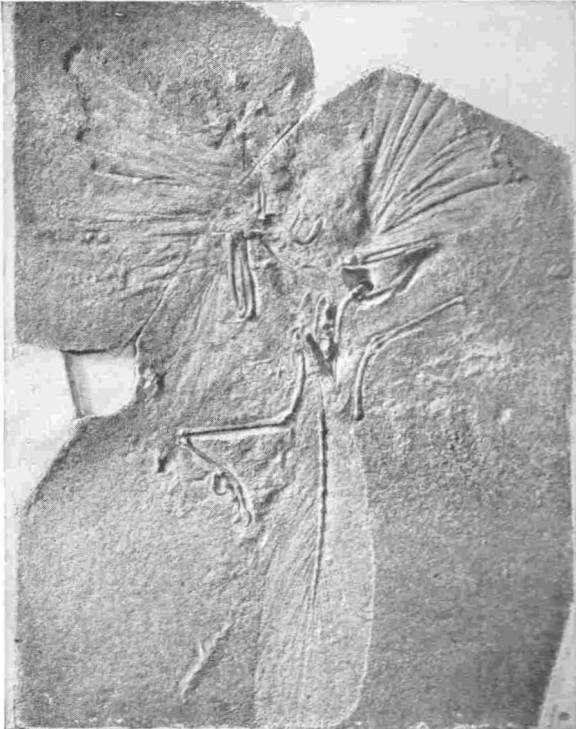
FOSSIL OF THE ARCHEOPTERYX; ONE OF THE EARLIEST BIRDS
Nat. Hist. Mus.
And another thing he would probably never see, and that would be any sign of a mammal. Probably the first mammals were in existence millions of years before the first thing one could call a bird, but they were altogether too small and obscure and remote for attention.
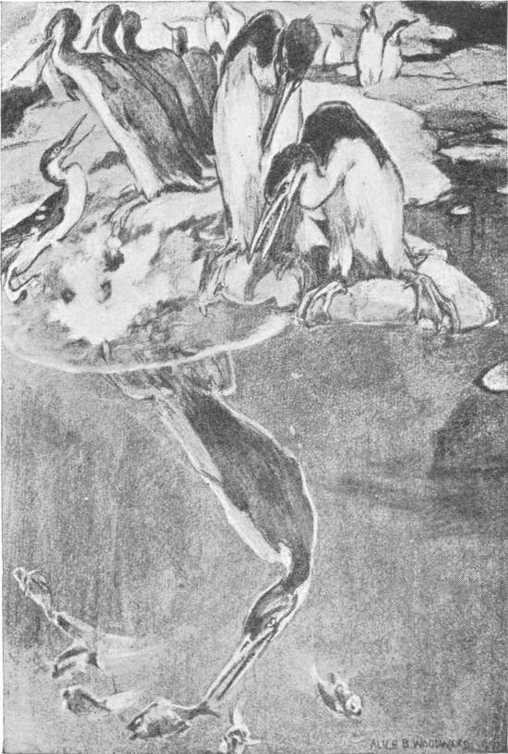
HESPERORNIS IN ITS NATIVE SEAS
The earliest mammals, like the earliest birds, were creatures driven by competition and pursuit into a life of hardship and adaptation to cold. With them also the scale became quill-like, and was developed into a heat-retaining covering; and they too underwent modifications, similar in kind though different in detail, to become warm-blooded and independent of basking. Instead of feathers they developed hairs, and instead of guarding and incubating their eggs they kept them warm and safe by retaining them inside their bodies until they were almost mature. Most of them became altogether vivaparous and brought their young into the world alive. And even after their young were born they tended to maintain a protective and nutritive association with them. Most but not all mammals to-day have mammæ and suckle their young. Two mammals still live which lay eggs and which have not proper mammæ, though they nourish their young by a nutritive secretion of the under skin; these are the duck-billed platypus and the echidna. The echidna lays leathery eggs and then puts them into a pouch under its belly, and so carries them about warm and safe until they hatch.
But just as a visitor to the Mesozoic world might have searched for days and weeks before finding a bird, so, unless he knew exactly where to go and look, he might have searched in vain for any traces of a mammal. Both birds and mammals would have seemed very eccentric and secondary and unimportant creatures in Mesozoic times.
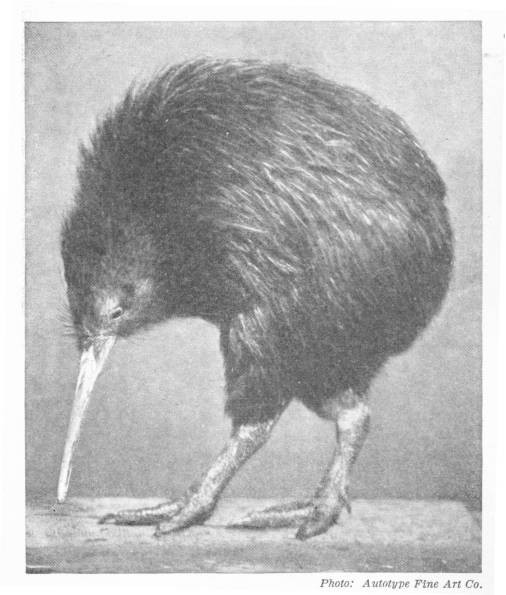
THE KI-WI, APTERYX, STILL FOUND IN NEW ZEALAND
Photo: Autotype Fine Art Co.
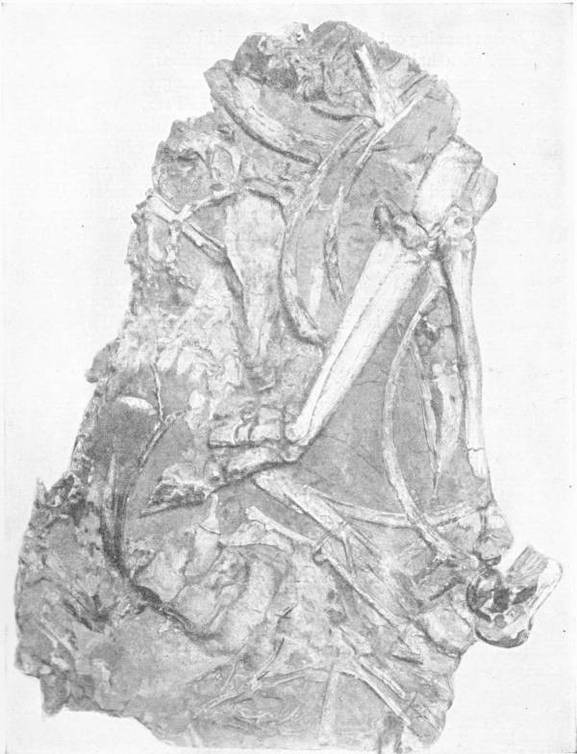
SLAB OF LOWER PLIOCENE MARL
Discovered in Greece; it is rich in fossilized bones of early mammals
The Age of Reptiles lasted, it is now guessed, eighty million years. Had any quasi-human intelligence been watching the world through that inconceivable length of time, how safe and eternal the sunshine and abundance must have seemed, how assured the wallowing prosperity of the dinosaurs and the flapping abundance of the flying lizards! And then the mysterious rhythms and accumulating forces of the universe began to turn against that quasi-eternal stability. That run of luck for life was running out. Age by age, myriad of years after myriad of years, with halts no doubt and retrogressions, came a change towards hardship and extreme conditions, came great alterations of level and great redistributions of mountain and sea. We find one thing in the Record of the Rocks during the decadence of the long Mesozoic age of prosperity that is very significant of steadily sustained changes of condition, and that is a violent fluctuation of living forms and the appearance of new and strange species. Under the gathering threat of extinction the older orders and genera are displaying their utmost capacity for variation and adaptation. The Ammonites for example in these last pages of the Mesozoic chapter exhibit a multitude of fantastic forms. Under settled conditions there is no encouragement for novelties; they do not develop, they are suppressed; what is best adapted is already there. Under novel conditions it is the ordinary type that suffers, and the novelty that may have a better chance to survive and establish itself....
There comes a break in the Record of the Rocks that may represent several million years. There is a veil here still, over even the outline of the history of life. When it lifts again, the Age of Reptiles is at an end; the Dinosaurs, the Plesiosaurs and Ichthyosaurs, the Pterodactyls, the innumerable genera and species of Ammonite have all gone absolutely. In all their stupendous variety they have died out and left no descendants. The cold has killed them. All their final variations were insufficient; they had never hit upon survival conditions. The world had passed through a phase of extreme conditions beyond their powers of endurance, a slow and complete massacre of Mesozoic life has occurred, and we find now a new scene, a new and hardier flora, and a new and hardier fauna in possession of the world.
It is still a bleak and impoverished scene with which this new volume of the book of life begins. The cycads and tropical conifers have given place very largely to trees that shed their leaves to avoid destruction by the snows of winter and to flowering plants and shrubs, and where there was formerly a profusion of reptiles, an increasing variety of birds and mammals is entering into their inheritance.
VIII
THE AGE OF MAMMALS
THE opening of the next great period in the life of the earth, the Cainozoic period, was a period of upheaval and extreme volcanic activity. Now it was that the vast masses of the Alps and Himalayas and the mountain backbone of the Rockies and Andes were thrust up, and that the rude outlines of our present oceans and continents appeared. The map of the world begins to display a first dim resemblance to the map of to-day. It is estimated now that between forty and eighty million years have elapsed from the beginnings of the Cainozoic period to the present time.
At the outset of the Cainozoic period the climate of the world was austere. It grew generally warmer until a fresh phase of great abundance was reached, after which conditions grew hard again and the earth passed into a series of extremely cold cycles, the Glacial Ages, from which apparently it is now slowly emerging.
But we do not know sufficient of the causes of climatic change at present to forecast the possible fluctuations of climatic conditions that lie before us. We may be moving towards increasing sunshine or lapsing towards another glacial age; volcanic activity and the upheaval of mountain masses may be increasing or diminishing; we do not know; we lack sufficient science.
With the opening of this period the grasses appear; for the first time there is pasture in the world; and with the full development of the once obscure mammalian type, appear a number of interesting grazing animals and of carnivorous types which prey upon these.
At first these early mammals seem to differ only in a few characters from the great herbivorous and carnivorous reptiles that ages before had flourished and then vanished from the earth. A careless observer might suppose that in this second long age of warmth and plenty that was now beginning, nature was merely repeating the first, with herbivorous and carnivorous mammals to parallel the herbivorous and carnivorous dinosaurs, with birds replacing pterodactyls and so on. But this would be an altogether superficial comparison. The variety of the universe is infinite and incessant; it progresses eternally; history never repeats itself and no parallels are precisely true. The differences between the life of the Cainozoic and Mesozoic periods are far profounder than the resemblances.
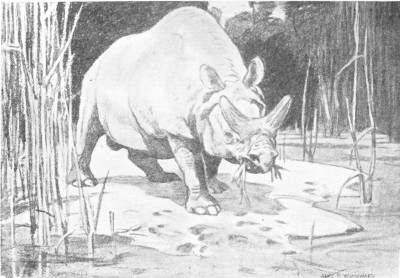
A MAMMAL OF THE EARLY CAINOZOIC PERIOD
The Titanotherum (Brontops) Robustum
The most fundamental of all these differences lies in the mental life of the two periods. It arises essentially out of the continuing contact of parent and offspring which distinguishes mammalian and in a lesser degree bird life, from the life of the reptile. With very few exceptions the reptile abandons its egg to hatch alone. The young reptile has no knowledge whatever of its parent; its mental life, such as it is, begins and ends with its own experiences. It may tolerate the existence of its fellows but it has no communication with them; it never imitates, never learns from them, is incapable of concerted action with them. Its life is that of an isolated individual. But with the suckling and cherishing of young which was distinctive of the new mammalian and avian strains arose the possibility of learning by imitation, of communication, by warning cries and other concerted action, of mutual control and instruction. A teachable type of life had come into the world.
The earliest mammals of the Cainozoic period are but little superior in brain size to the more active carnivorous dinosaurs, but as we read on through the record towards modern times we find, in every tribe and race of the mammalian animals, a steady universal increase in brain capacity. For instance we find at a comparatively early stage that rhinoceros-like beasts appear. There is a creature, the Titanotherium, which lived in the earliest division of this period. It was probably very like a modern rhinoceros in its habits and needs. But its brain capacity was not one tenth that of its living successor.
The earlier mammals probably parted from their offspring as soon as suckling was over, but, once the capacity for mutual understanding has arisen, the advantages of continuing the association are very great; and we presently find a number of mammalian species displaying the beginnings of a true social life and keeping together in herds, packs and flocks, watching each other, imitating each other, taking warning from each other’s acts and cries. This is something that the world had not seen before among vertebrated animals. Reptiles and fish may no doubt be found ill swarms and shoals; they have been hatched in quantities and similar conditions have kept them together, but in the case of the social and gregarious mammals the association arises not simply from a community of external forces, it is sustained by an inner impulse. They are not merely like one another and so found in the same places at the same times; they like one another and so they keep together.
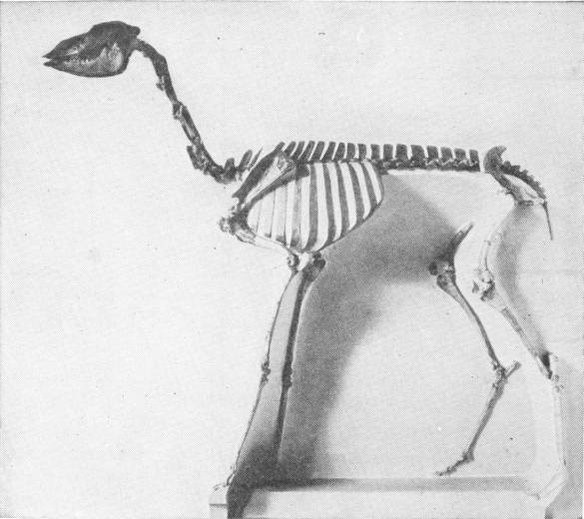
STENOMYLUS HITCHCOCKI—A GIRAFFE-CAMEL
Nat. Hist. Mus.
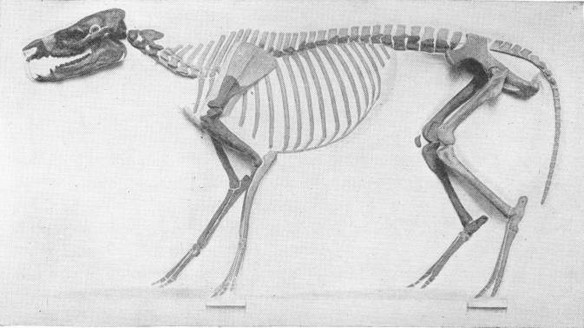
SKELETON OF PROTOHIPPUS VENTICOLUS--EARLY HORSE
Nat. Hist. Mus.
This difference between the reptile world and the world of our human minds is one our sympathies seem unable to pass. We cannot conceive in ourselves the swift uncomplicated urgency of a reptile’s instinctive motives, its appetites, fears and hates. We cannot understand them in their simplicity because all our motives are complicated; our’s are balances and resultants and not simple urgencies. But the mammals and birds have self-restraint and consideration for other individuals, a social appeal, a self- control that is, at its lower level, after our own fashion. We can in consequence establish relations with almost all sorts of them. When they suffer they utter cries and make movements that rouse our feelings. We can make understanding pets of them with a mutual recognition. They can be tamed to self-restraint towards us, domesticated and taught.
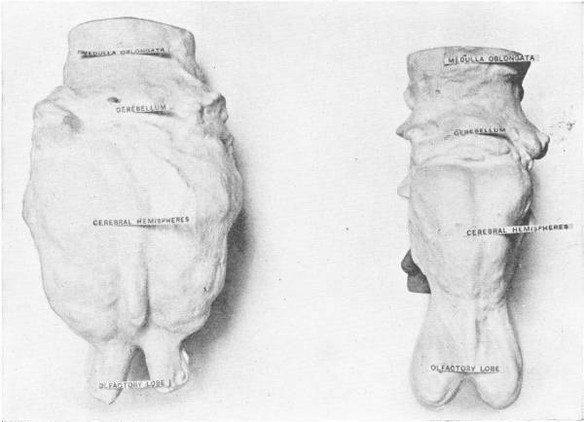
COMPARATIVE SIZES OF BRAINS OF RHINOCEROS AND DINOCERAS
Nat. Hist. Mus.
That unusual growth of brain which is the central fact of Cainozoic times marks a new communication and interdependence of individuals. It foreshadows the development of human societies of which we shall soon be telling.
As the Cainozoic period unrolled, the resemblance of its flora and fauna to the plants and animals that inhabit the world to-day increased. The big clumsy Uintatheres and Titanotheres, the Entelodonts and Hyracodons, big clumsy brutes like nothing living, disappeared. On the other hand a series of forms led up by steady degrees from grotesque and clumsy predecessors to the giraffes, camels, horses, elephants, deer, dogs and lions and tigers of the existing world. The evolution of the horse is particularly legible upon the geological record. We have a fairly complete series of forms from a small tapir-like ancestor in the early Cainozoic. Another line of development that has now been pieced together with some precision is that of the llamas and camels.
IX
MONKEYS, APES AND SUB-MEN
NATURALISTS divide the class Mammalia into a number of orders. At the head of these is the order Primates, which includes the lemurs, the monkeys, apes and man. Their classification was based originally upon anatomical resemblances and took no account of any mental qualities.
Now the past history of the Primates is one very difficult to decipher in the geological record. They are for the most part animals which live in forests like the lemurs and monkeys or in bare rocky places like the baboons. They are rarely drowned and covered up by sediment, nor are most of them very numerous species, and so they do not figure so largely among the fossils as the ancestors of the horses, camels and so forth do. But we know that quite early in the Cainozoic period, that is to say some forty million years ago or so, primitive monkeys and lemuroid creatures had appeared, poorer in brain and not so specialized as their later successors.
The great world summer of the middle Cainozoic period drew at last to an end. It was to follow those other two great summers in the history of life, the summer of the Coal Swamps and the vast summer of the Age of Reptiles. Once more the earth spun towards an ice age. The world chilled, grew milder for a time and chilled again. In the warm past hippopotami had wallowed through a lush sub-tropical vegetation, and a tremendous tiger with fangs like sabres, the sabre-toothed tiger, had hunted its prey where now the journalists of Fleet Street go to and fro. Now came a bleaker age and still bleaker ages. A great weeding and extinction of species occurred. A woolly rhinoceros, adapted to a cold climate, and the mammoth, a big woolly cousin of the elephants, the Arctic musk ox and the reindeer passed across the scene. Then century by century the Arctic ice cap, the wintry death of the great Ice Age, crept southward. In England it came almost down to the Thames, in America it reached Ohio. There would be warmer spells of a few thousand years and relapses towards a bitterer cold.
Geologists talk of these wintry phases as the First, Second, Third and Fourth Glacial Ages, and of the interludes as Interglacial periods. We live to-day in a world that is still impoverished and scarred by that terrible winter. The First Glacial Age was coming on 600,000 years ago; the Fourth Glacial Age reached its bitterest some fifty thousand years ago. And it was amidst the snows of this long universal winter that the first man-like beings lived upon our planet.
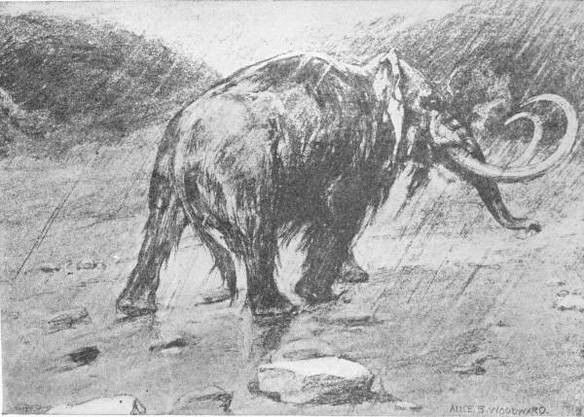
A MAMMOTH
By the middle Cainozoic period there have appeared various apes with many quasi-human attributes of the jaws and leg bones, but it is only as we approach these Glacial Ages that we find traces of creatures that we can speak of as “almost human.” These traces are not bones but implements. In Europe, in deposits of this period, between half a million and a million years old, we find flints and stones that have evidently been chipped intentionally by some handy creature desirous of hammering, scraping or fighting with the sharpened edge. These things have been called “Eoliths” (dawn stones). In Europe there are no bones nor other remains of the creature which made these objects, simply the objects themselves. For all the certainty we have it may have been some entirely un-human but intelligent monkey. But at Trinil in Java, in accumulations of this age, a piece of a skull and various teeth and bones have been found of a sort of ape man, with a brain case bigger than that of any living apes, which seems to have walked erect. This creature is now called Pithecanthropus erectus, the walking ape man, and the little trayful of its bones is the only help our imaginations have as yet in figuring to, ourselves the makers of the Eoliths.
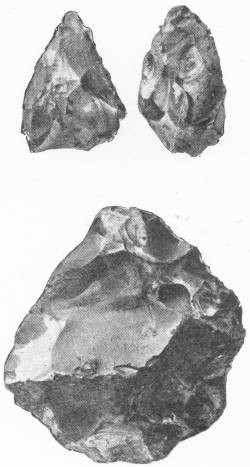
FLINT IMPLEMENTS FOUND IN PILTDOWN REGION
Nat. Hist. Mus.
It is not until we come to sands that are almost a quarter of a million years old that we find any other particle of a sub- human being. But there are plenty of implements, and they are steadily improving in quality as we read on through the record. They are no longer clumsy Eoliths; they are now shapely instruments made with considerable skill. And they are much bigger than the similar implements afterwards made by true man. Then, in a sandpit at Heidelberg, appears a single quasi-human jaw-bone, a clumsy jaw-bone, absolutely chinless, far heavier than a true human jaw-bone and narrower, so that it is improbable the creature’s tongue could have moved about for articulate speech. On the strength of this jaw-bone, scientific men suppose this creature to have been a heavy, almost human monster, possibly with huge limbs and hands, possibly with a thick felt of hair, and they call it the Heidelberg Man.
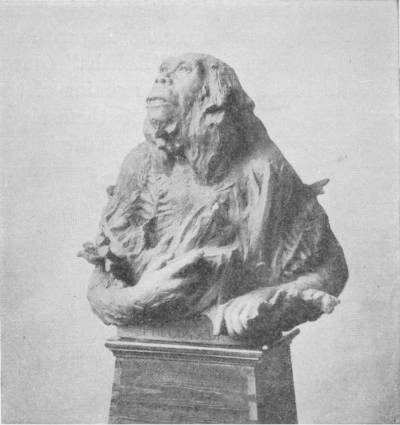
A THEORETICAL RESTORATION OF THE PITHECANTHROPUS ERECTUS BY PROF. RUTOT
This jaw-bone is, I think, one of the most tormenting objects in the world to our human curiosity. To see it is like looking through a defective glass into the past and catching just one blurred and tantalizing glimpse of this Thing, shambling through the bleak wilderness, clambering to avoid the sabre- toothed tiger, watching the woolly rhinoceros in the woods. Then before we can scrutinize the monster, he vanishes. Yet the soil is littered abundantly with the indestructible implements he chipped out for his uses.
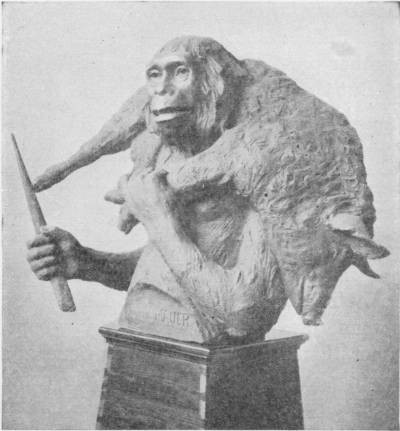
THE HEIDELBERG MAN
The Heidelberg Man, as modelled under the supervision of Prof. Rutot
Still more fascinatingly enigmatical are the remains of a creature found at Piltdown in Sussex in a deposit that may indicate an age between a hundred and a hundred and fifty thousand years ago, though some authorities would put these particular remains back in time to before the Heidelberg jaw- bone. Here there are the remains of a thick sub-human skull much larger than any existing ape’s, and a chimpanzee-like jaw-bone which may or may not belong to it, and, in addition, a bat-shaped piece of elephant bone evidently carefully manufactured, through which a hole had apparently been bored. There is also the thigh-bone of a deer with cuts upon it like a tally. That is all.
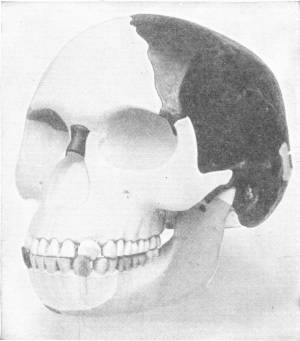
THE PILTDOWN SKULL, AS RECONSTRUCTED FROM ORIGINAL FRAGMENT
Nat. Hist. Mus.
What sort of beast was this creature which sat and bored holes in bones?
Scientific men have named him Eoanthropus, the Dawn Man. He stands apart from his kindred; a very different being either from the Heidelberg creature or from any living ape. No other vestige like him is known. But the gravels and deposits of from one hundred thousand years onward are increasingly rich in implements of flint and similar stone. And these implements are no longer rude “Eoliths.” The archæologists are presently able to distinguish scrapers, borers, knives, darts, throwing stones and hand axes ....
We are drawing very near to man. In our next section we shall have to describe the strangest of all these precursors of humanity, the Neanderthalers, the men who were almost, but not quite, true men.
But it may be well perhaps to state quite clearly here that no scientific man supposes either of these creatures, the Heidelberg Man or Eoanthropus, to be direct ancestors of the men of to-day. These are, at the closest, related forms.
X
THE NEANDERTHALER AND THE RHODESIAN MAN
ABOUT fifty or sixty thousand years ago, before the climax of the Fourth Glacial Age, there lived a creature on earth so like a man that until a few years ago its remains were considered to be altogether human. We have skulls and bones of it and a great accumulation of the large implements it made and used. It made fires. It sheltered in caves from the cold. It probably dressed skins roughly and wore them. It was right-handed as men are.
Yet now the ethnologists tell us these creatures were not true men. They were of a different species of the same genus. They had heavy protruding jaws and great brow ridges above the eyes and very low foreheads. Their thumbs were not opposable to the fingers as men’s are; their necks were so poised that they could not turn back their heads and look up to the sky. They probably slouched along, head down and forward. Their chinless jaw-bones resemble the Heidelberg jaw-bone and are markedly unlike human jaw-bones. And there were great differences from the human pattern in their teeth. Their cheek teeth were more complicated in structure than ours, more complicated and not less so; they had not the long fangs of our cheek teeth; and also these quasi-men had not the marked canines (dog teeth) of an ordinary human being. The capacity of their skulls was quite human, but the brain was bigger behind and lower in front than the human brain. Their intellectual faculties were differently arranged. They were not ancestral to the human line. Mentally and physically they were upon a different line from the human line.
Skulls and bones of this extinct species of man were found at Neanderthal among other places, and from that place these strange proto-men have been christened Neanderthal Men, or Neanderthalers. They must have endured in Europe for many hundreds or even thousands of years.
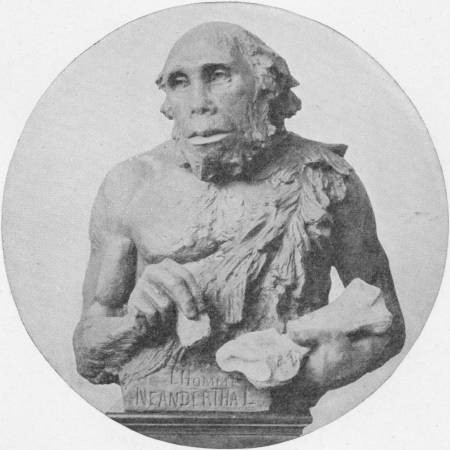
THE NEANDERTHALER, ACCORDING TO PROF. RUTOT
At that time the climate and geography of our world was very different from what they are at the present time. Europe for example was covered with ice reaching as far south as the Thames and into Central Germany and Russia; there was no Channel separating Britain from France; the Mediterranean and the Red Sea were great valleys, with perhaps a chain of lakes in their deeper portions, and a great inland sea spread from the present Black Sea across South Russia and far into Central Asia. Spain and all of Europe not actually under ice consisted of bleak uplands under a harder climate than that of Labrador, and it was only when North Africa was reached that one would have found a temperate climate. Across the cold steppes of Southern Europe with its sparse arctic vegetation, drifted such hardy creatures as the woolly mammoth, and woolly rhinoceros, great oxen and reindeer, no doubt following the vegetation northward in spring and southward in autumn.
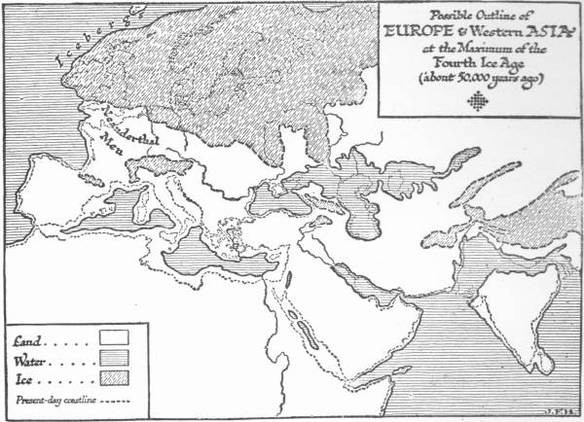
Such was the scene through which the Neanderthaler wandered, gathering such subsistence as he could from small game or fruits and berries and roots. Possibly he was mainly a vegetarian, chewing twigs and roots. His level elaborate teeth suggest a largely vegetarian dietary. But we also find the long marrow bones of great animals in his caves, cracked to extract the marrow. His weapons could not have been of much avail in open conflict with great beasts, but it is supposed that he attacked them with spears at difficult river crossings and even constructed pitfalls for them. Possibly he followed the herds and preyed upon any dead that were killed in fights, and perhaps he played the part of jackal to the sabre-toothed tiger which still survived in his day. Possibly in the bitter hardships of the Glacial Ages this creature had taken to attacking animals after long ages of vegetarian adaptation.
We cannot guess what this Neanderthal man looked like. He may have been very hairy and very unhuman-looking indeed. It is even doubtful if he went erect. He may have used his knuckles as well as his feet to hold himself up. Probably he went about alone or in small family groups. It is inferred from the structure of his jaw that he was incapable of speech as we understand it.
For thousands of years these Neanderthalers were the highest animals that the European area had ever seen; and then some thirty or thirty-five thousand years ago as the climate grew warmer a race of kindred beings, more intelligent, knowing more, talking and co-operating together, came drifting into the Neanderthaler’s world from the south. They ousted the Neanderthalers from their caves and squatting places; they hunted the same food; they probably made war upon their grisly predecessors and killed them off. These newcomers from the south or the east—for at present we do not know their region of origin—who at last drove the Neanderthalers out of existence altogether, were beings of our own blood and kin, the first True Men. Their brain-cases and thumbs and necks and teeth were anatomically the same as our own. In a cave at Cro-Magnon and in another at Grimaldi, a number of skeletons have been found, the earliest truly human remains that are so far known.
So it is our race comes into the Record of the Rocks, and the story of mankind begins.
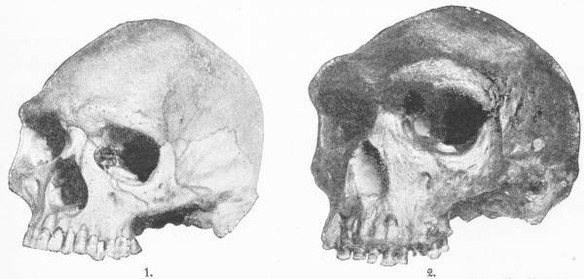
COMPARISON OF (1) MODERN SKULL AND (2) RHODESIAN SKULL
Nat. Hist. Mus.
The world was growing liker our own in those days though the climate was still austere. The glaciers of the Ice Age were receding in Europe; the reindeer of France and Spain presently gave way to great herds of horses as grass increased upon the steppes, and the mammoth became more and more rare in southern Europe and finally receded northward altogether ....
We do not know where the True Men first originated. But in the summer of 1921, an extremely interesting skull was found together with pieces of a skeleton at Broken Hill in South Africa, which seems to be a relic of a third sort of man, intermediate in its characteristics between the Neanderthaler and the human being. The brain-case indicates a brain bigger in front and smaller behind than the Neanderthaler’s, and the skull was poised erect upon the backbone in a quite human way. The teeth also and the bones are quite human. But the face must have been ape-like with enormous brow ridges and a ridge along the middle of the skull. The creature was indeed a true man, so to speak, with an ape- like, Neanderthaler face. This Rhodesian Man is evidently still closer to real men than the Neanderthal Man.
This Rhodesian skull is probably only the second of what in the end may prove to be a long list of finds of sub-human species which lived on the earth in the vast interval of time between the beginnings of the Ice Age and the appearance of their common heir, and perhaps their common exterminator, the True Man. The Rhodesian skull itself may not be very ancient. Up to the time of publishing this book there has been no exact determination of its probable age. It may be that this sub-human creature survived in South Africa until quite recent times.
XI
THE FIRST TRUE MEN
THE earliest signs and traces at present known to science, of a humanity which is indisputably kindred with ourselves, have been found in western Europe and particularly in France and Spain. Bones, weapons, scratchings upon bone and rock, carved fragments of bone, and paintings in caves and upon rock surfaces dating. it is supposed. from 30,000 years ago or more, have been discovered in both these countries. Spain is at present the richest country in the world in these first relics of our real human ancestors.
Of course our present collections of these things are the merest beginnings of the accumulations we may hope for in the future, when there are searchers enough to make a thorough examination of all possible sources and when other countries in the world, now inaccessible to archæologists, have been explored in some detail. The greater part of Africa and Asia has never even been traversed yet by a trained observer interested in these matters and free to explore, and we must be very careful therefore not to conclude that the early true men were distinctively inhabitants of western Europe or that they first appeared in that region.
In Asia or Africa or submerged beneath the sea of to-day there may be richer and much earlier deposits of real human remains than anything that has yet come to light. I write in Asia or Africa, and I do not mention America because so far there have been no finds at all of any of the higher Primates, either of great apes, sub-men, Neanderthalers nor early true men. This development of life seems to have been an exclusively old world development, and it was only apparently at the end of the Old Stone Age that human beings first made their way across the land connexion that is now cut by Behring Straits, into the American continent.
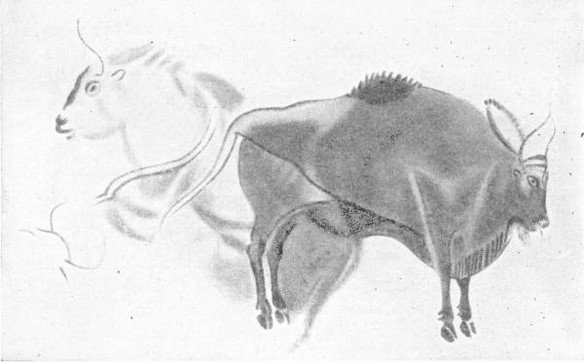
ONE OF THE MARVELLOUS CAVE PAINTINGS OF ALTAMIRA, NORTH SPAIN
The Walls of the Caves are covered in these representations of Bulls, etc., painted in the soft tones of red shaded to black. They may be fifteen or twenty thousand years old
These first real human beings we know of in Europe appear already to have belonged to one or other of at least two very distinct races. One of these races was of a very high type indeed; it was tall and big brained. One of the women’s skulls found exceeds in capacity that of the average man of to-day. One of the men’s skeletons is over six feet in height. The physical type resembled that of the North American Indian. From the Cro-Magnon cave in which the first skeletons were found these people have been called Cro-Magnards. They were savages, but savages of a high order. The second race, the race of the Grimaldi cave remains, was distinctly negroid in its characters. Its nearest living affinities are the Bushmen and Hottentots of South Africa. It is interesting to find at the very outset of the known human story, that mankind was already racially divided into at least two main varieties; and one is tempted to such unwarrantable guesses as that the former race was probably brownish rather than black and that it came from the East or North, and that the latter was blackish rather than brown and came from the equatorial south.
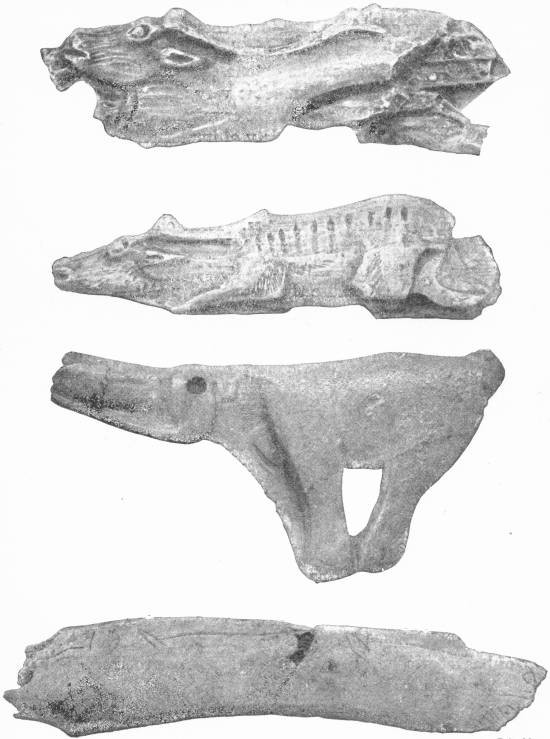
BONE CARVINGS OF THE PALÆOLITHIC PERIOD
(1 and 2) Mammoth tusk carved to shape of Reindeer, (3) Dagger Handle representing Mammoth, and (4) Bone engraved with Horses’ Heads
Brit. Mus.
And these savages of perhaps forty thousand years ago were so human that they pierced shells to make necklaces, painted themselves, carved images of bone and stone, scratched figures on rocks and bones, and painted rude but often very able sketches of beasts and the like upon the smooth walls of caves and upon inviting rock surfaces. They made a great variety of implements, much smaller in scale and finer than those of the Neanderthal men. We have now in our museums great quantities of their implements, their statuettes, their rock drawings and the like.
The earliest of them were hunters. Their chief pursuit was the wild horse, the little bearded pony of that time. They followed it as it moved after pasture. And also they followed the bison. They knew the mammoth, because they have left us strikingly effective pictures of that creature. To judge by one rather ambiguous drawing they trapped and killed it.
They hunted with spears and throwing stones. They do not seem to have had the bow, and it is doubtful if they had yet learnt to tame any animals. They had no dogs. There is one carving of a horse’s head and one or two drawings that suggest a bridled horse, with a twisted skin or tendon round it. But the little horses of that age and region could not have carried a man, and if the horse was domesticated it was used as a led horse. It is doubtful and improbable that they had yet learnt the rather unnatural use of animal’s milk as food.
They do not seem to have erected any buildings though they may have had tents of skins, and though they made clay figures they never rose to the making of pottery. Since they had no cooking implements their cookery must have been rudimentary or nonexistent. They knew nothing of cultivation and nothing of any sort of basket work or woven cloth. Except for their robes of skin or fur they were naked painted savages.
These earliest known men hunted the open steppes of Europe for a hundred centuries perhaps, and then slowly drifted and changed before a change of climate. Europe, century by century, was growing milder and damper. Reindeer receded northward and eastward, and bison and horse followed. The steppes gave way to forests, and red deer took the place of horse and bison. There is a change in the character of the implements with this change in their application. River and lake fishing becomes of great importance to men, and fine implements of bone increased. “The bone needles of this age,” says de Mortillet, “are much superior to those of later, even historical times, down to the Renaissance. The Romans, for example, never had needles comparable to those of this epoch.”
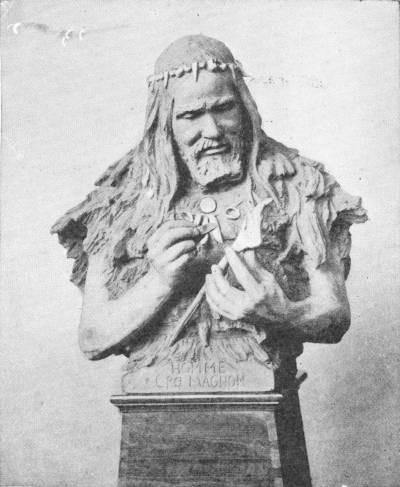
THE RUTOT BUST OF A CRO-MAGNON MAN
Almost fifteen or twelve thousand years ago a fresh people drifted into the south of Spain, and left very remarkable drawings of themselves upon exposed rock faces there. These were the Azilians (named from the Mas d’Azil cave). They had the bow; they seem to have worn feather headdresses; they drew vividly; but also they had reduced their drawings to a sort of symbolism—a man for instance would be represented by a vertical dab with two or three horizontal dabs—that suggest the dawn of the writing idea. Against hunting sketches there are often marks like tallies. One drawing shows two men smoking out a bees’ nest.
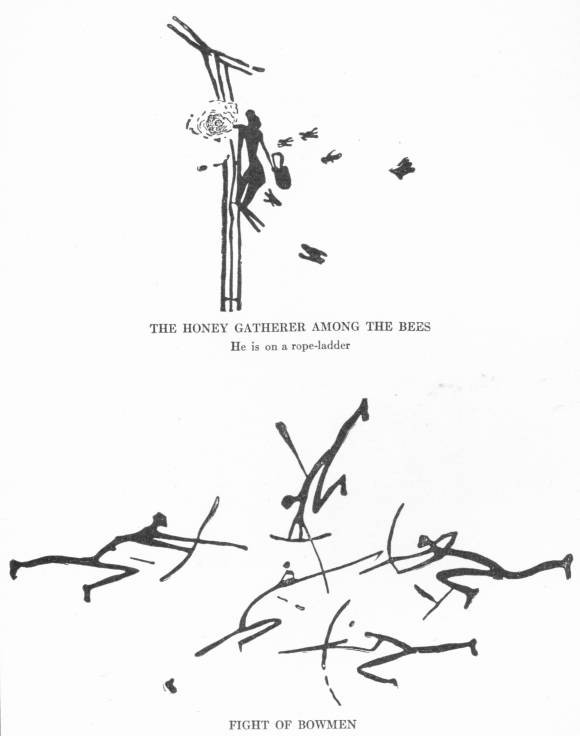
Among the most recent discoveries of Palæolithic Art are these specimens found in 1920 in Spain. They are probably ten or twelve thousand years old
These are the latest of the men that we call Palæolithic (Old Stone Age) because they had only chipped implements. By ten or twelve thousand years a new sort of life has dawned in Europe, men have learnt not only to chip but to polish and grind stone implements, and they have begun cultivation. The Neolithic Age (New Stone Age) was beginning.
It is interesting to note that less than a century ago there still survived in a remote part of the world, in Tasmania, a race of human beings at a lower level of physical and intellectual development than any of these earliest races of mankind who have left traces in Europe. These people had long ago been cut off by geographical changes from the rest of the species, and from stimulation and improvement. They seem to have degenerated rather than developed. They lived a base life subsisting upon shellfish and small game. They had no habitations but only squatting places. They were real men of our species, but they had neither the manual dexterity nor the artistic powers of the first true men.
XII
PRIMITIVE THOUGHT
AND now let us indulge in a very interesting speculation; how did it feel to be a man in those early days of the human adventure? How did men think and what did they think in those remote days of hunting and wandering four hundred centuries ago before seed time and harvest began. Those were days long before the written record of any human impressions, and we are left almost entirely to inference and guesswork in our answers to these questions.
The sources to which scientific men have gone in their attempts to reconstruct that primitive mentality are very various. Recently the science of psycho-analysis, which analyzes the way in which the egotistic and passionate impulses of the child are restrained, suppressed, modified or overlaid, to adapt them to the needs of social life, seems to have thrown a considerable amount of light upon the history of primitive society; and another fruitful source of suggestion has been the study of the ideas and customs of such contemporary savages as still survive. Again there is a sort of mental fossilization which we find in folk-lore and the deep-lying irrational superstitions and prejudices that still survive among modern civilized people. And finally we have in the increasingly numerous pictures, statues, carvings, symbols and the like, as we draw near to our own time, clearer and clearer indications of what man found interesting and worthy of record and representation.
Primitive man probably thought very much as a child thinks, that is to say in a series of imaginative pictures. He conjured up images or images presented themselves to his mind, and he acted in accordance with the emotions they aroused. So a child or an uneducated person does to-day. Systematic thinking is apparently a comparatively late development in human experience; it has not played any great part in human life until within the last three thousand years. And even to-day those who really control and order their thoughts are but a small minority of mankind. Most of the world still lives by imagination and passion.
Probably the earliest human societies, in the opening stages of the true human story, were small family groups. Just as the flocks and herds of the earlier mammals arose out of families which remained together and multiplied, so probably did the earliest tribes. But before this could happen a certain restraint upon the primitive egotisms of the individual had to be established. The fear of the father and respect for the mother had to be extended into adult life, and the natural jealousy of the old man of the group for the younger males as they grew up had to be mitigated. The mother on the other hand was the natural adviser and protector of the young. Human social life grew up out of the reaction between the crude instinct of the young to go off and pair by themselves as they grew up, on the one hand, and the dangers and disadvantages of separation on the other. An anthropological writer of great genius, J. J. Atkinson, in his Primal Law, has shown how much of the customary law of savages, the Tabus, that are so remarkable a fact in tribal life, can be ascribed to such a mental adjustment of the needs of the primitive human animal to a developing social life, and the later work of the psycho- analysts has done much to confirm his interpretation of these possibilities.
Some speculative writers would have us believe that respect and fear of the Old Man and the emotional reaction of the primitive savage to older protective women, exaggerated in dreams and enriched by fanciful mental play, played a large part in the beginnings of primitive religion and in the conception of gods and goddesses. Associated with this respect for powerful or helpful personalities was a dread and exaltation of such personages after their deaths, due to their reappearance in dreams. It was easy to believe they were not truly dead but only fantastically transferred to a remoteness of greater power.
The dreams, imaginations and fears of a child are far more vivid and real than those of a modern adult, and primitive man was always something of a child. He was nearer to the animals also, and he could suppose them to have motives and reactions like his own. He could imagine animal helpers, animal enemies, animal gods. One needs to have been an imaginative child oneself to realize again how important, significant, portentous or friendly, strangely shaped rocks, lumps of wood, exceptional trees or the like may have appeared to the men of the Old Stone Age, and how dream and fancy would create stories and legends about such things that would become credible as they told them. Some of these stories would be good enough to remember and tell again. The women would tell them to the children and so establish a tradition. To this day most imaginative children invent long stories in which some favourite doll or animal or some fantastic semi-human being figures as the hero, and primitive man probably did the same—with a much stronger disposition to believe his hero real.
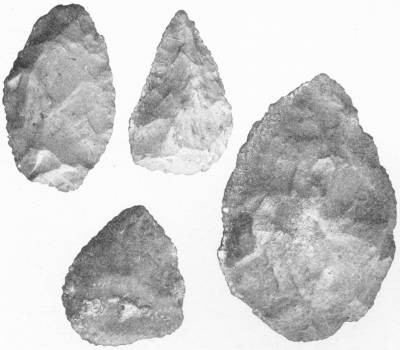
RELICS OF THE STONE AGE
Chert implements from Somaliland. In general form they are similar to those found in Western and Northern Europe
Brit. Mus.
For the very earliest of the true men that we know of were probably quite talkative beings. In that way they have differed from the Neanderthalers and had an advantage over them. The Neanderthaler may have been a dumb animal. Of course the primitive human speech was probably a very scanty collection of names, and may have been eked out with gestures and signs.
There is no sort of savage so low as not to have a kind of science of cause and effect. But primitive man was not very critical in his associations of cause with effect; he very easily connected an effect with something quite wrong as its cause. “You do so and so,” he said, “and so and so happens.” You give a child a poisonous berry and it dies. You eat the heart of a valiant enemy and you become strong. There we have two bits of cause and effect association, one true one false. We call the system of cause and effect in the mind of a savage, Fetish; but Fetish is simply savage science. It differs from modern science in that it is totally unsystematic and uncritical and so more frequently wrong.
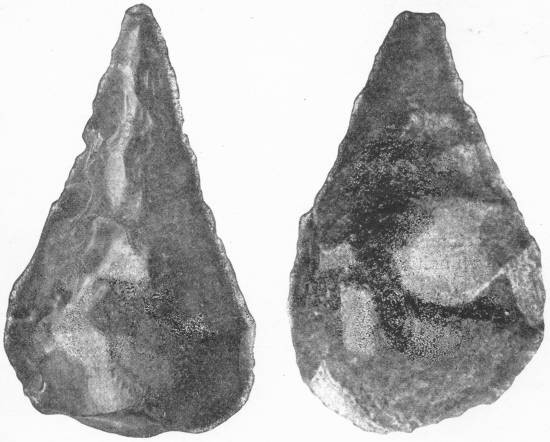
WIDESPREAD SIMILARITY OF MEN OF THE STONE AGE
On the left is a flint implement excavated in Gray’s Inn Lane, London; on the right one of similar form chipped by primitive men of Somaliland
Brit. Mus.
In many cases it is not difficult to link cause and effect, in many others erroneous ideas were soon corrected by experience; but there was a large series of issues of very great importance to primitive man, where he sought persistently for causes and found explanations that were wrong but not sufficiently wrong nor so obviously wrong as to be detected. It was a matter of great importance to him that game should be abundant or fish plentiful and easily caught, and no doubt he tried and believed in a thousand charms, incantations and omens to determine these desirable results. Another great concern of his was illness and death. Occasionally infections crept through the land and men died of them. Occasionally men were stricken by illness and died or were enfeebled without any manifest cause. This too must have given the hasty, emotional mind of primitive man much feverish exercise. Dreams and fantastic guesses made him blame this, or appeal for help to that man or beast or thing. He had the child’s aptitude for fear and panic.
Quite early in the little human tribe, older, steadier minds sharing the fears, sharing the imaginations, but a little more forceful than the others, must have asserted themselves, to advise, to prescribe, to command. This they declared unpropitious and that imperative, this an omen of good and that an omen of evil. The expert in Fetish, the Medicine Man, was the first priest. He exhorted, he interpreted dreams, he warned, he performed the complicated hocus pocus that brought luck or averted calamity. Primitive religion was not so much what we now call religion as practice and observance, and the early priest dictated what was indeed an arbitrary primitive practical science.
XIII
THE BEGINNINGS OF CULTIVATION
WE are still very ignorant about the beginnings of cultivation and settlement in the world although a vast amount of research and speculation has been given to these matters in the last fifty years. All that we can say with any confidence at present is that somewhen about 15,000 and 12,000 B.C. while the Azilian people were in the south of Spain and while the remnants of the earlier hunters were drifting northward and eastward, somewhere in North Africa or Western Asia or in that great Mediterranean valley that is now submerged under the waters of the Mediterranean sea, there were people who, age by age, were working out two vitally important things; they were beginning cultivation and they were domesticating animals. They were also beginning to make, in addition to the chipped implements of their hunter forebears, implements of polished stone. They had discovered the possibility of basketwork and roughly woven textiles of plant fibre, and they were beginning to make a rudely modelled pottery.
They were entering upon a new phase in human culture, the Neolithic phase (New Stone Age) as distinguished from the Palæolithic (Old Stone) phase of the Cro-Magnards, the Grimaldi people, the Azilians and their like. [1] Slowly these Neolithic people spread over the warmer parts of the world; and the arts they had mastered, the plants and animals they had learnt to use, spread by imitation and acquisition even more widely than they did. By 10,000 B.C., most of mankind was at the Neolithic level.
Now the ploughing of land, the sowing of seed, the reaping of harvest, threshing and grinding, may seem the most obviously reasonable steps to a modern mind just as to a modern mind it is a commonplace that the world is round. What else could you do? people will ask. What else can it be? But to the primitive man of twenty thousand years ago neither of the systems of action and reasoning that seem so sure and manifest to us to-day were at all obvious. He felt his way to effectual practice through a multitude of trials and misconceptions, with fantastic and unnecessary elaborations and false interpretations at every turn. Somewhere in the Mediterranean region, wheat grew wild; and man may have learnt to pound and then grind up its seeds for food long before he learnt to sow. He reaped before he sowed.
And it is a very remarkable thing that throughout the world wherever there is sowing and harvesting there is still traceable the vestiges of a strong primitive association of the idea of sowing with the idea of a blood sacrifice, and primarily of the sacrifice of a human being. The study of the original entanglement of these two things is a profoundly attractive one to the curious mind; the interested reader will find it very fully developed in that monumental work, Sir J. G. Frazer’s Golden Bough. It was an entanglement, we must remember, in the childish, dreaming, myth-making primitive mind; no reasoned process will explain it. But in that world of 12,000 to 20,000 years ago, it would seem that whenever seed time came round to the Neolithic peoples there was a human sacrifice. And it was not the sacrifice of any mean or outcast person; it was the sacrifice usually of a chosen youth or maiden, a youth more often who was treated with profound deference and even worship up to the moment of his immolation. He was a sort of sacrificial god-king, and all the details of his killing had become a ritual directed by the old, knowing men and sanctioned by the accumulated usage of ages.
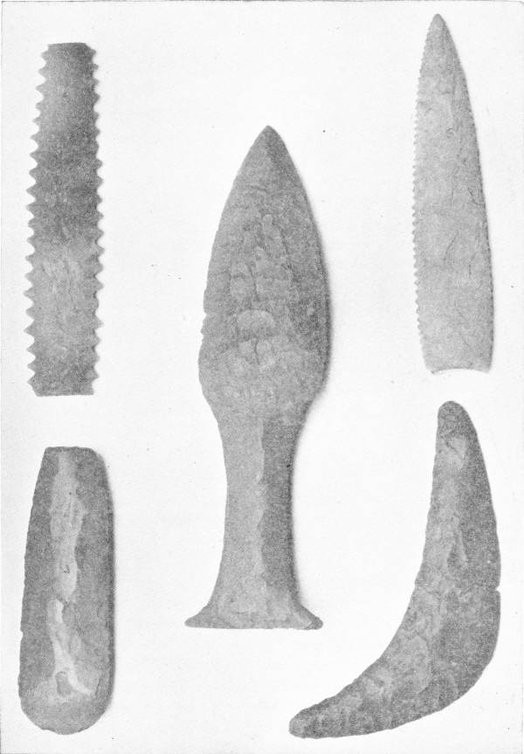
NEOLITHIC FLINT IMPLEMENTS
Brit. Mus.
At first primitive men, with only a very rough idea of the seasons, must have found great difficulty in determining when was the propitious moment for the seed-time sacrifice and the sowing. There is some reason for supposing that there was an early stage in human experience when men had no idea of a year. The first chronology was in lunar months; it is supposed that the years of the Biblical patriarchs are really moons, and the Babylonian calendar shows distinct traces of an attempt to reckon seed time by taking thirteen lunar months to see it round. This lunar influence upon the calendar reaches down to our own days. If usage did not dull our sense of its strangeness we should think it a very remarkable thing indeed that the Christian Church does not commemorate the Crucifixion and Resurrection of Christ on the proper anniversaries but on dates that vary year by year with the phases of the moon.
It may be doubted whether the first agriculturalists made any observation of the stars. It is more likely that stars were first observed by migratory herdsmen, who found them a convenient mark of direction. But once their use in determining seasons was realized, their importance to agriculture became very great. The seed-time sacrifice was linked up with the southing or northing of some prominent star. A myth and worship of that star was for primitive man an almost inevitable consequence.
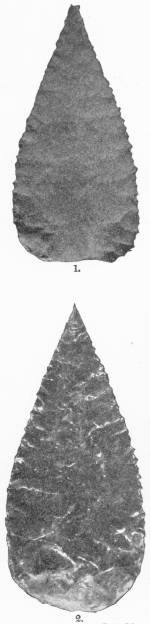
NEOLITHICISM OF TO-DAY
Spearheads, exactly as in the true Neolithic days, but made recently by Australian Natives,
(1) Made from a telegraph insulator;
(2) from a piece of broken bottle glass.
Brit. Mus.
It is easy to see how important the man of knowledge and experience, the man who knew about the blood sacrifice and the stars, became in this early Neolithic world.
The fear of uncleanness and pollution, and the methods of cleansing that were advisable, constituted another source of power for the knowledgeable men and women. For there have always been witches as well as wizards, and priestesses as well as priests. The early priest was really not so much a religious man as a man of applied science. His science was generally empirical and often bad; he kept it secret from the generality of men very jealously; but that does not alter the fact that his primary function was knowledge and that his primary use was a practical use.

SPECIMEN OF NEOLITHIC POTTERY
Dug up at Mortlake from the Thames Bed
Brit. Mus.
Twelve or fifteen thousand years ago, in all the warm and fairly well-watered parts of the Old World these Neolithic human communities, with their class and tradition of priests and priestesses and their cultivated fields and their development of villages and little walled cities, were spreading. Age by age a drift and exchange of ideas went on between these communities. Eliot Smith and Rivers have used the term “Heliolithic culture” for the culture of these first agricultural peoples. “Heliolithic” (Sun and Stone) is not perhaps the best possible word to use for this, but until scientific men give us a better one we shall have to use it. Originating somewhere in the Mediterranean and western Asiatic area, it spread age by age eastward and from island to island across the Pacific until it may even have reached America and mingled with the more primitive ways of living of the Mongoloid immigrants coming down from the North.
Wherever the brownish people with the Heliolithic culture went they took with them all or most of a certain group of curious ideas and practices. Some of them are such queer ideas that they call for the explanation of the mental expert. They made pyramids and great mounds, and set up great circles of big stones, perhaps to facilitate the astronomical observation of the priests; they made mummies of some or all of their dead; they tattooed and circumcized; they had the old custom, known as the couvade, of sending the father to bed and rest when a child was born, and they had as a luck symbol the well-known Swastika.
If we were to make a map of the world with dots to show how far these group practices have left their traces, we should make a belt along the temperate and sub-tropical coasts of the world from Stonehenge and Spain across the world to Mexico and Peru. But Africa below the equator, north central Europe, and north Asia would show none of these dottings; there lived races who were developing along practically independent lines.
[1] The term Palæolithic we may note is also used to cover the Neanderthaler and even the Eolithic implements. The pre-human age is called the “Older Palæolithic;” the age of true men using unpolished stones in the “Newer Palæolithic.”
XIV
PRIMITIVE NEOLITHIC CIVILIZATIONS
ABOUT 10,000 B.C. the geography of the world was very similar in its general outline to that of the world to-day. It is probable that by that time the great barrier across the Straits of Gibraltar that had hitherto banked back the ocean waters from the Mediterranean valley had been eaten through, and that the Mediterranean was a sea following much the same coastlines as it does now. The Caspian Sea was probably still far more extensive than it is at present, and it may have been continuous with the Black Sea to the north of the Caucasus Mountains. About this great Central Asian sea lands that are now steppes and deserts were fertile and habitable. Generally it was a moister and more fertile world. European Russia was much more a land of swamp and lake than it is now, and there may still have been a land connexion between Asia and America at Behring Straits.
It would have been already possible at that time to have distinguished the main racial divisions of mankind as we know them to-day. Across the warm temperate regions of this rather warmer and better-wooded world, and along the coasts, stretched the brownish peoples of the Heliolithic culture, the ancestors of the bulk of the living inhabitants of the Mediterranean world, of the Berbers, the Egyptians and of much of the population of South and Eastern Asia. This great race had of course a number of varieties. The Iberian or Mediterranean or “dark-white” race of the Atlantic and Mediterranean coast, the “Hamitic” peoples which include the Berbers and Egyptians, the Dravidians; the darker people of India, a multitude of East Indian people, many Polynesian races and the Maoris are all divisions of various value of this great main mass of humanity. Its western varieties are whiter than its eastern.
In the forests of central and northern Europe a more blonde variety of men with blue eyes was becoming distinguishable, branching off from the main mass of brownish people, a variety which many people now speak of as the Nordic race. In the more open regions of northeastern Asia was another differentiation of this brownish humanity in the direction of a type with more oblique eyes, high cheek-bones, a yellowish skin, and very straight black hair, the Mongolian peoples. In South Africa, Australia, in many tropical islands in the south of Asia were remains of the early negroid peoples. The central parts of Africa were already a region of racial intermixture. Nearly all the coloured races of Africa to-day seem to be blends of the brownish peoples of the north with a negroid substratum.
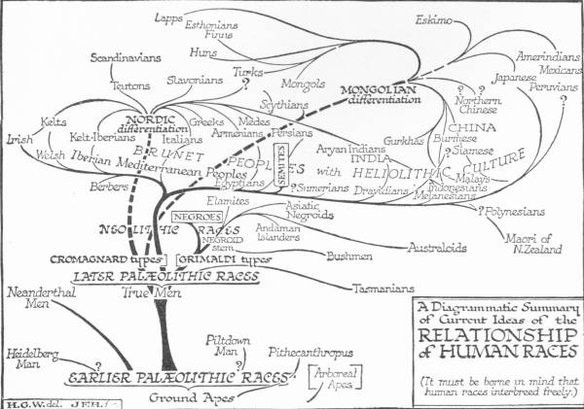
We have to remember that human races can all interbreed freely and that they separate, mingle and reunite as clouds do. Human races do not branch out like trees with branches that never come together again. It is a thing we need to bear constantly in mind, this remingling of races at any opportunity. It will save us from many cruel delusions and prejudices if we do so. People will use such a word as race in the loosest manner, and base the most preposterous generalizations upon it. They will speak of a “British” race or of a “European” race. But nearly all the European nations are confused mixtures of brownish, dark-white, white and Mongolian elements.
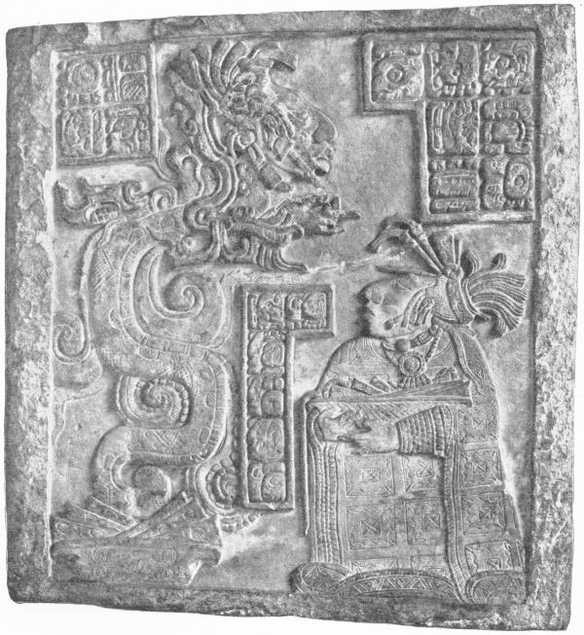
A MAYA STELE
Showing a worshipper and a Serpent God. Note the grotesque faces in the writing
Brit. Mus.
It was at the Neolithic phase of human development that peoples of the Mongolian breed first made their way into America. Apparently they came by way of Behring Straits and spread southward. They found caribou, the American reindeer, in the north and great herds of bison in the south. When they reached South America there were still living the Glyptodon, a gigantic armadillo, and the Megatherium, a monstrous clumsy sloth as high as an elephant. They probably exterminated the latter beast, which was as helpless as it was big.
The greater portion of these American tribes never rose above a hunting nomadic Neolithic life. They never discovered the use of iron, and their chief metal possessions were native gold and copper. But in Mexico, Yucatan and Peru conditions existed favourable to settled cultivation, and here about 1000 B.C. or so arose very interesting civilizations of a parallel but different type from the old-world civilization. Like the much earlier primitive civilizations of the old world these communities displayed a great development of human sacrifice about the processes of seed time and harvest; but while in the old world, as we shall see, these primary ideas were ultimately mitigated, complicated and overlaid by others, in America they developed and were elaborated, to a very high degree of intensity. These American civilized countries were essentially priest-ruled countries; their war chiefs and rulers were under a rigorous rule of law and omen.
These priests carried astronomical science to a high level of accuracy. They knew their year better than the Babylonians of whom we shall presently tell. In Yucatan they had a kind of writing, the Maya writing, of the most curious and elaborate character. So far as we have been able to decipher it, it was used mainly for keeping the exact and complicated calendars upon which the priests expended their intelligence. The art of the Maya civilization came to a climax about 700 or 800 A.D. The sculptured work of these people amazes the modern observer by its great plastic power and its frequent beauty, and perplexes him by a grotesqueness and by a sort of insane conventionality and intricacy outside the circle of his ideas. There is nothing quite like it in the old world. The nearest approach, and that is a remote one, is found in archaic Indian carvings. Everywhere there are woven feathers and serpents twine in and out. Many Maya inscriptions resemble a certain sort of elaborate drawing made by lunatics in European asylums, more than any other old-world work. It is as if the Maya mind had developed upon a different line from the old-world mind, had a different twist to its ideas, was not, by old-world standards, a rational mind at all.
This linking of these aberrant American civilizations to the idea of a general mental aberration finds support in their extraordinary obsession by the shedding of human blood. The Mexican civilization in particular ran blood; it offered thousands of human victims yearly. The cutting open of living victims, the tearing out of the still beating heart, was an act that dominated the minds and lives of these strange priesthoods. The public life, the national festivities all turned on this fantastically horrible act.

NEOLITHIC WARRIOR
Modelled from drawing by Prof. Rutot
The ordinary existence of the common people in these communities was very like the ordinary existence of any other barbaric peasantry. Their pottery, weaving and dyeing was very good. The Maya writing was not only carven on stone but written and painted upon skins and the like. The European and American museums contain many enigmatical Maya manuscripts of which at present little has been deciphered except the dates. In Peru there were beginnings of a similar writing but they were superseded by a method of keeping records by knotting cords. A similar method of mnemonics was in use in China thousands of years ago.
In the old world before 4000 or 5000 B.C., that is to say three or four thousand years earlier, there were primitive civilizations not unlike these American civilizations; civilizations based upon a temple, having a vast quantity of blood sacrifices and with an intensely astronomical priesthood. But in the old world the primitive civilizations reacted upon one another and developed towards the conditions of our own world. In America these primitive civilizations never progressed beyond this primitive stage. Each of them was in a little world of its own. Mexico it seems knew little or nothing of Peru, until the Europeans came to America. The potato, which was the principal food stuff in Peru, was unknown in Mexico.
Age by age these peoples lived and marvelled at their gods and made their sacrifices and died. Maya art rose to high levels of decorative beauty. Men made love and tribes made war. Drought and plenty, pestilence and health, followed one another. The priests elaborated their calendar and their sacrificial ritual through long centuries, but made little progress in other directions.
XV
SUMERIA, EARLY EGYPT AND WRITING
THE old world is a wider, more varied stage than the new. By 6000 or 7000 B.C. there were already quasi-civilized communities almost at the Peruvian level, appearing in various fertile regions of Asia and in the Nile valley. At that time north Persia and western Turkestan and south Arabia were all more fertile than they are now, and there are traces of very early communities in these regions. It is in lower Mesopotamia however and in Egypt that there first appear cities, temples, systematic irrigation, and evidences of a social organization rising above the level of a mere barbaric village-town. In those days the Euphrates and Tigris flowed by separate mouths into the Persian Gulf, and it was in the country between them that the Sumerians built their first cities. About the same time, for chronology is still vague, the great history of Egypt was beginning.
These Sumerians appear to have been a brownish people with prominent noses. They employed a sort of writing that has been deciphered, and their language is now known. They had discovered the use of bronze and they built great tower-like temples of sun-dried brick. The clay of this country is very fine; they used it to write upon, and so it is that their inscriptions have been preserved to us. They had cattle, sheep, goats and asses, but no horses. They fought on foot, in close formation, carrying spears and shields of skin. Their clothing was of wool and they shaved their heads.
Each of the Sumerian cities seems generally to have been an independent state with a god of its own and priests of its own. But sometimes one city would establish an ascendancy over others and exact tribute from their population. A very ancient inscription at Nippur records the “empire,” the first recorded empire, of the Sumerian city of Erech. Its god and its priest-king claimed an authority from the Persian Gulf to the Red Sea.

BRICK OF HAMMURABI, KING OF BABYLON ABOUT 2200 B.C.
Note the cuneiform characters of the inscription, which records the building of a temple to a Sun God
At first writing was merely an abbreviated method of pictorial record. Even before Neolithic times men were beginning to write. The Azilian rock pictures to which we have already referred show the beginning of the process. Many of them record hunts and expeditions, and in most of these the human figures are plainly drawn. But in some the painter would not bother with head and limbs; he just indicated men by a vertical and one or two transverse strokes. From this to a conventional condensed picture writing was an easy transition. In Sumeria, where the writing was done on clay with a stick, the dabs of the characters soon became unrecognizably unlike the things they stood for, but in Egypt where men painted on walls and on strips of the papyrus reed (the first paper) the likeness to the thing imitated remained. From the fact that the wooden styles used in Sumeria made wedge-shaped marks, the Sumerian writing is called cuneiform (= wedge-shaped).
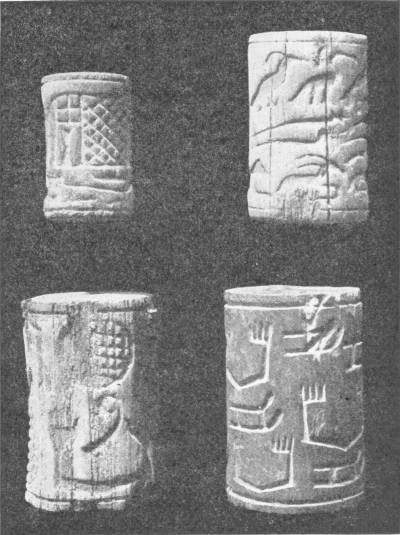
EBONY CYLINDER SEALS OF FIRST EGYPTIAN DYNASTY
Recovered from the Tombs at Abydos in 1921 by the British School of Archæology. They give evidence of early form of block printing
An important step towards writing was made when pictures were used to indicate not the thing represented but some similar thing. In the rebus dear to children of a suitable age, this is still done to-day. We draw a camp with tents and a bell, and the child is delighted to guess that this is the Scotch name Campbell. The Sumerian language was a language made up of accumulated syllables rather like some contemporary Amerindian languages, and it lent itself very readily to this syllabic method of writing words expressing ideas that could not be conveyed by pictures directly. Egyptian writing underwent parallel developments. Later on, when foreign peoples with less distinctly syllabled methods of speech were to learn and use these picture scripts they were to make those further modifications and simplifications that developed at last into alphabetical writing. All the true alphabets of the later world derived from a mixture of the Sumerian cuneiform and the Egyptian hieroglyphic (priest writing). Later in China there was to develop a conventionalized picture writing, but in China it never got to the alphabetical stage.
The invention of writing was of very great importance in the development of human societies. It put agreements, laws, commandments on record. It made the growth of states larger than the old city states possible. It made a continuous historical consciousness possible. The command of the priest or king and his seal could go far beyond his sight and voice and could survive his death. It is interesting to note that in ancient Sumeria seals were greatly used. A king or a nobleman or a merchant would have his seal often very artistically carved, and would impress it on any clay document he wished to authorize. So close had civilization got to printing six thousand years ago. Then the clay was dried hard and became permanent. For the reader must remember that in the land of Mesopotamia for countless years, letters, records and accounts were all written on comparatively indestructible tiles. To that fact we owe a great wealth of recovered knowledge.
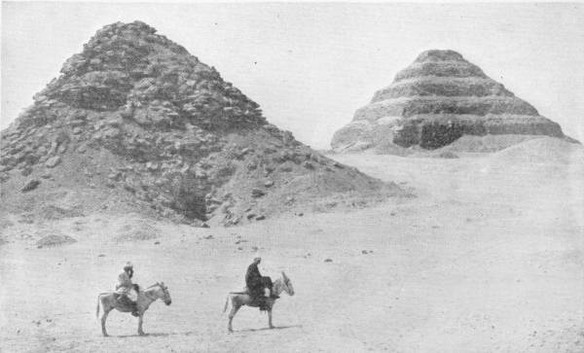
THE SAKHARA PYRAMIDS
The Pyramid to the right, the step Pyramid, is the oldest stone building in the world
Photo: F. Boyer
Bronze, copper, gold, silver and, as a precious rarity, meteoric iron were known in both Sumeria and Egypt at a very early stage.
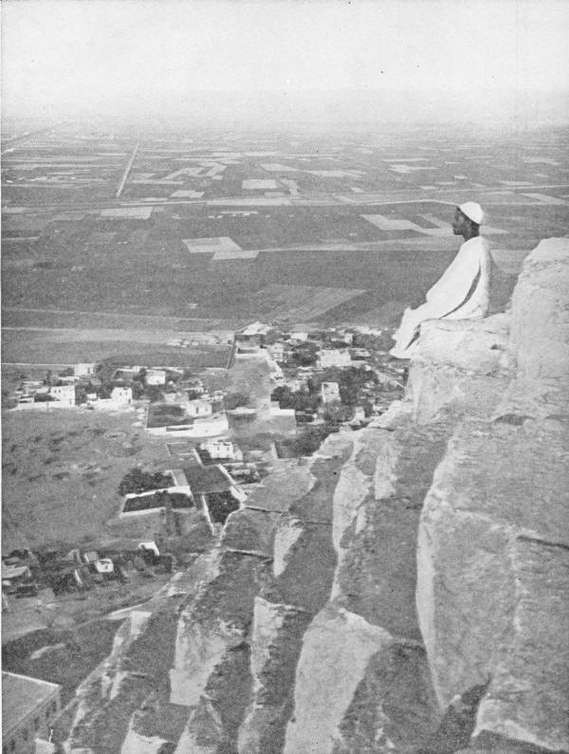
VIEW FROM THE SUMMIT OF THE GREAT PYRAMID OF CHEOPS
Showing how these great monuments dominate the plain
Photo: D. McLeish
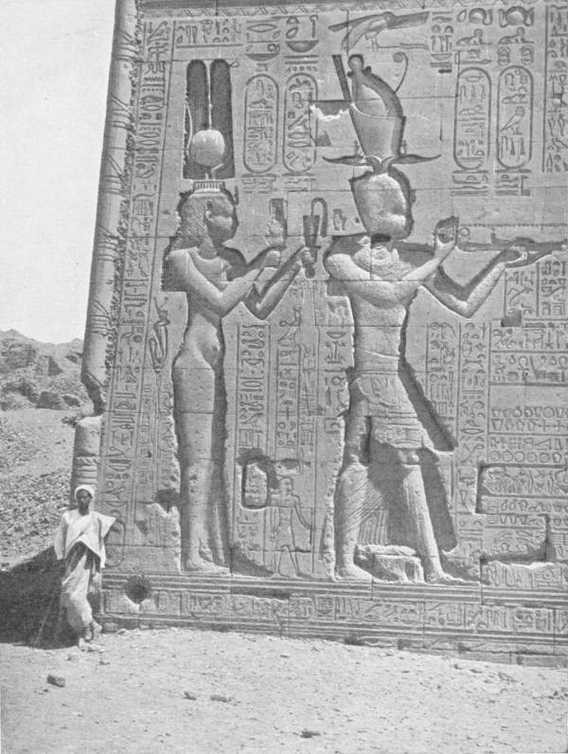
THE TEMPLE OF HATHOR AT DENDEREH
Photo: D. McLeish
Daily life in those first city lands of the old world must have been very similar in both Egypt and Sumeria. And except for the asses and cattle in the streets it must have been not unlike the life in the Maya cities of America three or four thousand years later. Most of the people in peace time were busy with irrigation and cultivation—except on days of religious festivity. They had no money and no need for it. They managed their small occasional trades by barter. The princes and rulers who alone had more than a few possessions used gold and silver bars and precious stones for any incidental act of trade. The temple dominated life; in Sumeria it was a great towering temple that went up to a roof from which the stars were observed; in Egypt it was a massive building with only a ground floor. In Sumeria the priest ruler was the greatest, most splendid of beings. In Egypt however there was one who was raised above the priests; he was the living incarnation of the chief god of the land, the Pharaoh, the god king.
There were few changes in the world in those days; men’s days were sunny, toilsome and conventional. Few strangers came into the land and such as did fared uncomfortably. The priest directed life according to immemorial rules and watched the stars for seed time and marked the omens of the sacrifices and interpreted the warnings of dreams. Men worked and loved and died, not unhappily, forgetful of the savage past of their race and heedless of its future. Sometimes the ruler was benign. Such was Pepi II, who reigned in Egypt for ninety years. Sometimes he was ambitious and took men’s sons to be soldiers and sent them against neighbouring city states to war and plunder, or he made them toil to build great buildings. Such were Cheops and Chephren and Mycerinus, who built those vast sepulchral piles, the pyramids at Gizeh. The largest of these is 450 feet high and the weight of stone in it is 4,883,000 tons. All this was brought down the Nile in boats and lugged into place chiefly by human muscle. Its erection must have exhausted Egypt more than a great war would have done.
XVI
PRIMITIVE NOMADIC PEOPLES
IT was not only in Mesopotamia and the Nile Valley that men were settling down to agriculture and the formation of city states in the centuries between 6000 and 8000 B.C. Wherever there were possibilities of irrigation and a steady all-the-year-round food supply men were exchanging the uncertainties and hardships of hunting and wandering for the routines of settlement. On the upper Tigris a people called the Assyrians were founding cities; in the valleys of Asia Minor and on the Mediterranean shores and islands, there were small communities growing up to civilization. Possibly parallel developments of human life were already going on in favourable regions of India, and China. In many parts of Europe where there were lakes well stocked with fish, little communities of men had long settled in dwellings built on piles over the water, and were eking out agriculture by fishing and hunting. But over much larger areas of the old world no such settlement was possible. The land was too harsh, too thickly wooded or too arid, or the seasons too uncertain for mankind, with only the implements and science of that age to take root.
For settlement under the conditions of the primitive civilizations men needed a constant water supply and warmth and sunshine. Where these needs were not satisfied, man could live as a transient, as a hunter following his game, as a herdsman following the seasonal grass, but he could not settle. The transition from the hunting to the herding life may have been very gradual. From following herds of wild cattle or (in Asia) wild horses, men may have come to an idea of property in them, have learnt to pen them into valleys, have fought for them against wolves, wild dogs and other predatory beasts.
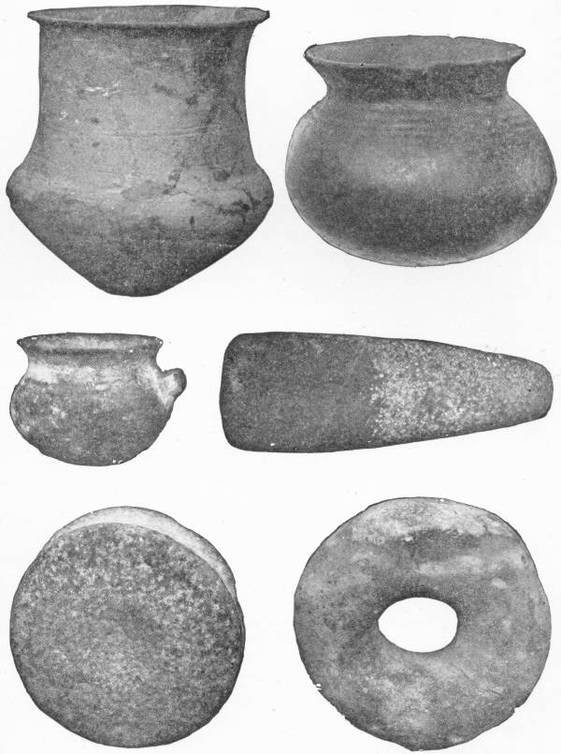
POTTERY AND IMPLEMENTS OF THE LAKE DWELLERS
Brit. Mus.
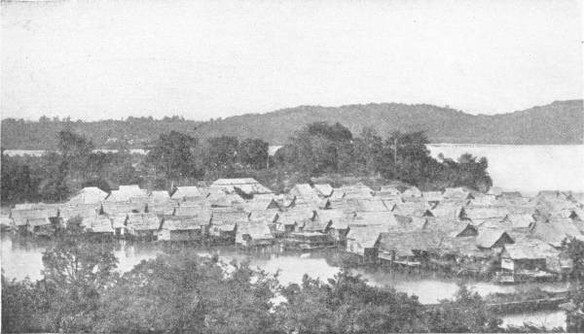
A CONTEMPORARY LAKE VILLAGE
These Borneo dwellings are practically counterparts of the homes of European neolithic communities 6000 B.C.
So while the primitive civilizations of the cultivators were growing up chiefly in the great river valleys, a different way of living, the nomadic life, a life in constant movement to and fro from winter pasture to summer pasture, was also growing up. The nomadic peoples were on the whole hardier than the agriculturalists; they were less prolific and numerous, they had no permanent temples and no highly organized priesthood; they had less gear; but the reader must not suppose that theirs was necessarily a less highly developed way of living on that account. In many ways this free life was a fuller life than that of the tillers of the soil. The individual was more self-reliant; less of a unit in a crowd. The leader was more important; the medicine man perhaps less so.
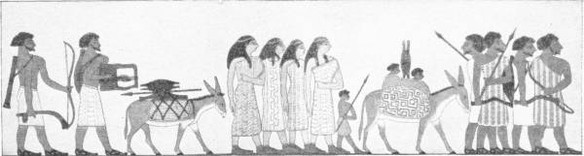
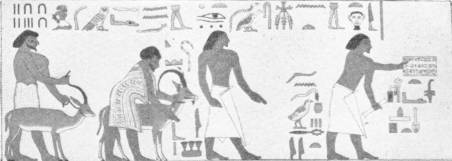
NOMADS IN EGYPT
Egyptian wall painting in a tomb near ancient Beni Hassan, middle Egypt. It depicts the arrival of a tribe of Semitic Nomads in Egypt about the year of 1895 B.C.
Moving over large stretches of country the nomad took a wider view of life. He touched on the confines of this settled land and that. He was used to the sight of strange faces. He had to scheme and treat for pasture with competing tribes. He knew more of minerals than the folk upon the plough lands because he went over mountain passes and into rocky places. He may have been a better metallurgist. Possibly bronze and much more probably iron smelting were nomadic discoveries. Some of the earliest implements of iron reduced from its ores have been found in Central Europe far away from the early civilizations.

FLINT KNIVES OF 4500 B.C.
Excavated 1922 by the British School of Archæology in Egypt from First Dynasty Tombs
On the other hand the settled folk had their textiles and their pottery and made many desirable things. It was inevitable that as the two sorts of life, the agricultural and the nomadic differentiated, a certain amount of looting and trading should develop between the two. In Sumeria particularly which had deserts and seasonal country on either hand it must have been usual to have the nomads camping close to the cultivated fields, trading and stealing and perhaps tinkering, as gipsies do to this day. (But hens they would not steal, because the domestic fowl—an Indian jungle fowl originally was not domesticated by man until about 1000 B.C.) They would bring precious stones and things of metal and leather. If they were hunters they would bring skins. They would get in exchange pottery and beads and glass, garments and suchlike manufactured things.
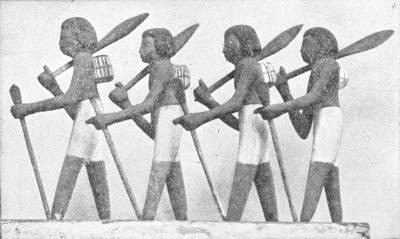
EGYPT PEASANTS GOING TO WORK
From an ancient and curiously painted model in the British Museum
Three main regions and three main kinds of wandering and imperfectly settled people there were in those remote days of the first civilizations in Sumeria and early Egypt. Away in the forests of Europe were the blonde Nordic peoples, hunters and herdsmen, a lowly race. The primitive civilizations saw very little of this race before 1500 B.C. Away on the steppes of eastern Asia various Mongolian tribes, the Hunnish peoples, were domesticating the horse and developing a very wide sweeping habit of seasonal movement between their summer and winter camping places. Possibly the Nordic and Hunnish peoples were still separated from one another by the swamps of Russia and the greater Caspian Sea of that time. For very much of Russia there was swamp and lake. In the deserts, which were growing more arid now, of Syria and Arabia, tribes of a dark white or brownish people, the Semitic tribes, were driving flocks of sheep and goats and asses from pasture to pasture. It was these Semitic shepherds and certain more negroid people from southern Persia, the Elamites, who were the first nomads to come into close contact with the early civilizations. They came as traders and as raiders. Finally there arose leaders among them with bolder imaginations, and they became conquerors.
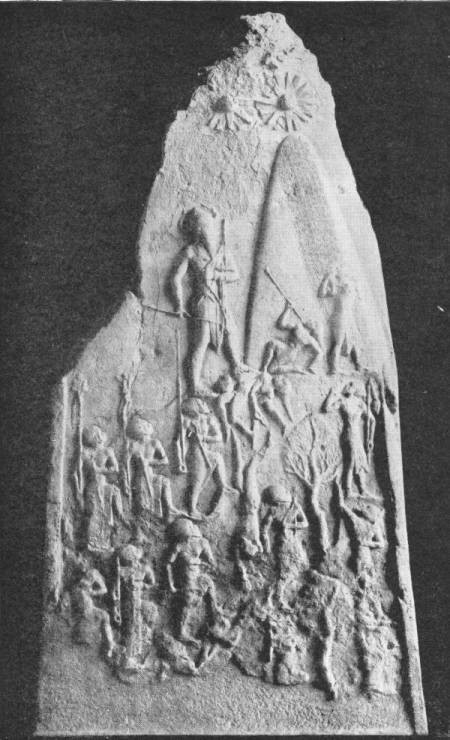
STELE GLORIFYING KING NARAM SIN, OF AKKAD
This monarch, son of Sargon I, was a great architecht as well as a famous conqueror. Discovered in 1898 among the ruins of Susa, Persia
About 2750 B.C. a great Semitic leader, Sargon, had conquered the whole Sumerian land and was master of all the world from the Persian Gulf to the Mediterranean Sea. He was an illiterate barbarian and his people, the Akkadians, learnt the Sumerian writing and adopted the Sumerian language as the speech of the officials and the learned. The empire he founded decayed after two centuries, and after one inundation of Elamites a fresh Semitic people, the Amorites, by degrees established their rule over Sumeria. They made their capital in what had hitherto been a small up-river town, Babylon, and their empire is called the first Babylonian Empire. It was consolidated by a great king called Hammurabi (circa 2100 B.C.) who made the earliest code of laws yet known to history.
The narrow valley of the Nile lies less open to nomadic invasion than Mesopotamia, but about the time of Hammurabi occurred a successful Semitic invasion of Egypt and a line of Pharaohs was set up, the Hyksos or “shepherd kings,” which lasted for several centuries. These Semitic conquerors never assimilated themselves with the Egyptians; they were always regarded with hostility as foreigners and barbarians; and they were at last expelled by a popular uprising about 1600 B.C.
But the Semites had come into Sumeria for good and all, the two races assimilated and the Babylonian Empire became Semitic in its language and character.
XVII
THE FIRST SEAGOING PEOPLES
THE earliest boats and ships must have come into use some twenty-five or thirty thousand years ago. Man was probably paddling about on the water with a log of wood or an inflated skin to assist him, at latest in the beginnings of the Neolithic period. A basketwork boat covered with skin and caulked was used in Egypt and Sumeria from the beginnings of our knowledge. Such boats are still used there. They are used to this day in Ireland and Wales and in Alaska; sealskin boats still make the crossing of Behring Straits. The hollow log followed as tools improved. The building of boats and then ships came in a natural succession.
Perhaps the legend of Noah’s Ark preserves the memory of some early exploit in shipbuilding, just as the story of the Flood, so widely distributed among the peoples of the world, may be the tradition of the flooding of the Mediterranean basin.
There were ships upon the Red Sea long before the pyramids were built, and there were ships on the Mediterranean and Persian Gulf by 7000 B.C. Mostly these were the ships of fishermen, but some were already trading and pirate ships—for knowing what we do of mankind we may guess pretty safely that the first sailors plundered where they could and traded where they had to do so.
The seas on which these first ships adventured were inland seas on which the wind blew fitfully and which were often at a dead calm for days together, so that sailing did not develop beyond an accessory use. It is only in the last four hundred years that the well-rigged, ocean-going, sailing ship has developed. The ships of the ancient world were essentially rowing ships which hugged the shore and went into harbour at the first sign of rough weather. As ships grew into big galleys they caused a demand for war captives as galley slaves.
We have already noted the appearance of the Semitic people as wanderers and nomads in the region of Syria and Arabia, and how they conquered Sumeria and set up first the Akkadian and then the first Babylonian Empire. In the west these same Semitic peoples were taking to the sea. They set up a string of harbour towns along the Eastern coast of the Mediterranean, of which Tyre and Sidon were the chief; and by the time of Hammurabi in Babylon, they had spread as traders, wanderers and colonizers over the whole Mediterranean basin. These sea Semites were called the Phœnicians, They settled largely in Spain, pushing back the old Iberian Basque population and sending coasting expeditions through the straits of Gibraltar; and they set up colonies upon the north coast of Africa. Of Carthage, one of these Phœnician cities, we shall have much more to tell later.
But the Phœnicians were not the first people to have galleys in the Mediterranean waters. There was already a series of towns and cities among the islands and coasts of that sea belonging to a race or races apparently connected by blood and language with the Basques to the west and the Berbers and Egyptians to the south, the Ægean peoples. These peoples must not be confused with the Greeks, who come much later into our story; they were pre-Greek, but they had cities in Greece and Asia Minor; Mycenæ and Troy for example, and they had a great and prosperous establishment at Cnossos in Crete.
It is only in the last half century that the industry of excavating archæologists has brought the extent and civilization of the Ægean peoples to our knowledge. Cnossos has been most thoroughly explored; it was happily not succeeded by any city big enough to destroy its ruins, and so it is our chief source of information about this once almost forgotten civilization.
The history of Cnossos goes back as far as the history of Egypt; the two countries were trading actively across the sea by 4000 B.C. By 2500 B.C., that is between the time of Sargon I and Hammurabi, Cretan civilization was at its zenith.
Cnossos was not so much a town as a great palace for the Cretan monarch and his people. It was not even fortified. It was only fortified later as the Phœnicians grew strong, and as a new and more terrible breed of pirates, the Greeks, came upon the sea from the north.
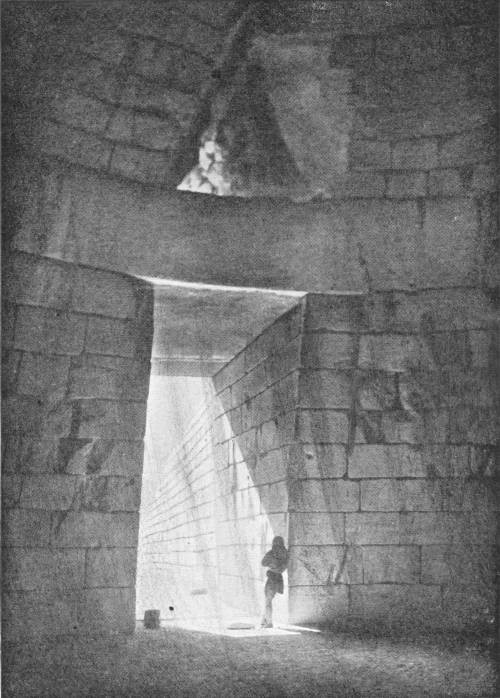
THE TREASURE HOUSE AT MYCENÆ
Photo: Fred Boissonnas
The monarch was called Minos, as the Egyptian monarch was called Pharaoh; and he kept his state in a palace fitted with running water, with bathrooms and the like conveniences such as we know of in no other ancient remains. There he held great festivals and shows. There was bull-fighting, singularly like the bull-fighting that still survives in Spain; there was resemblance even in the costumes of the bull-fighters; and there were gymnastic displays. The women’s clothes were remarkably modern in spirit; they wore corsets and flounced dresses. The pottery, the textile manufactures, the sculpture, painting, jewellery, ivory, metal and inlay work of these Cretans was often astonishingly beautiful. And they had a system of writing, but that still remains to be deciphered.
This happy and sunny and civilized life lasted for some score of centuries. About 2000 B.C. Cnossos and Babylon abounded in comfortable and cultivated people who probably led very pleasant lives. They had shows and they had religious festivals, they had domestic slaves to look after them and industrial slaves to make a profit for them. Life must have seemed very secure in Cnossos for such people, sunlit and girdled by the blue sea. Egypt of course must have appeared rather a declining country in those days under the rule of her half-barbaric shepherd kings, and if one took an interest in politics one must have noticed how the Semitic people seemed to be getting everywhere, ruling Egypt, ruling distant Babylon, building Nineveh on the upper Tigris, sailing west to the Pillars of Hercules (the straits of Gibraltar) and setting up their colonies on those distant coasts.
There were some active arid curious minds in Cnossos, because later on the Greeks told legends of a certain skilful Cretan artificer, Dædalus, who attempted to make some sort of flying machine, perhaps a glider, which collapsed and fell into the sea.
It is interesting to note some of the differences as well as the resemblances between the life of Cnossos and our own. To a Cretan gentleman of 2500 B.C. iron was a rare metal which fell out of the sky and was curious rather than useful—for as yet only meteoric iron was known, iron had not been obtained from its ores. Compare that with our modern state of affairs pervaded by iron everywhere. The horse again would be a quite legendary creature to our Cretan, a sort of super-ass which lived in the bleak northern lands far away beyond the Black Sea. Civilization for him dwelt chiefly in Ægean Greece and Asia Minor, where Lydians and Carians and Trojans lived a life and probably spoke languages like his own. There were Phœnicians and Ægeans settled in Spain and North Africa, but those were very remote regions to his imagination. Italy was still a desolate land covered with dense forests; the brown-skinned Etruscans had not yet gone there from Asia Minor. And one day perhaps this Cretan gentleman went down to the harbour and saw a captive who attracted his attention because he was very fair-complexioned and had blue eyes. Perhaps our Cretan tried to talk to him and was answered in an unintelligible gibberish. This creature came from somewhere beyond the Black Sea and seemed to be an altogether benighted savage. But indeed he was an Aryan tribesman, of a race and culture of which we shall soon have much to tell, and the strange gibberish he spoke was to differentiate some day into Sanskrit, Persian, Greek, Latin, German, English and most of the chief languages of the world.
If we were to make a map of the world with dots to show how far these group practices have left their traces, we should make a belt along the temperate and sub-tropical coasts of the world from Stonehenge and Spain across the world to Mexico and Peru. But Africa below the equator, north central Europe, and north Asia would show none of these dottings; there lived races who were developing along practically independent lines.
They were entering upon a new phase in human culture, the Neolithic phase (New Stone Age) as distinguished from the Palæolithic (Old Stone) phase of the Cro-Magnards, the Grimaldi people, the Azilians and their like. [1] Slowly these Neolithic people spread over the warmer parts of the world; and the arts they had mastered, the plants and animals they had learnt to use, spread by imitation and acquisition even more widely than they did. By 10,000 B.C., most of mankind was at the Neolithic level.
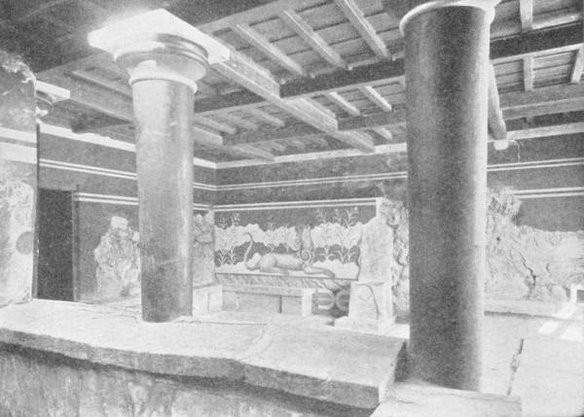
THE PALACE AT CNOSSOS
The painted walls of the Throne Room
Photo: Fred Boissonnas
Such was Cnossos at its zenith, intelligent, enterprising, bright and happy. But about 1400 B.C. disaster came perhaps very suddenly upon its prosperity. The palace of Minos was destroyed, and its ruins have never been rebuilt or inhabited from that day to this. We do not know how this disaster occurred. The excavators note what appears to be scattered plunder and the marks of the fire. But the traces of a very destructive earthquake have also been found. Nature alone may have destroyed Cnossos, or the Greeks may have finished what the earthquake began.
XVIII
EGYPT, BABYLON AND ASSYRIA
THE Egyptians had never submitted very willingly to the rule of their Semitic shepherd kings and about 1600 A.D. a vigorous patriotic movement expelled these foreigners. Followed a new phase or revival for Egypt, a period known to Egyptologists as the New Empire. Egypt, which had not been closely consolidated before the Hyksos invasion, was now a united country; and the phase of subjugation and insurrection left her full of military spirit. The Pharaohs became aggressive conquerors. They had now acquired the war horse and the war chariot, which the Hyksos had brought to them. Under Thothmes III and Amenophis III Egypt had extended her rule into Asia as far as the Euphrates.
We are entering now upon a thousand years of warfare between the once quite separated civilizations of Mesopotamia and the Nile. At first Egypt was ascendant. The great dynasties, the Seventeenth Dynasty, which included Thothmes III and Amenophis III and IV and a great queen Hatasu, and the Nineteenth, when Rameses II, supposed by some to have been the Pharaoh of Moses, reigned for sixty-seven years, raised Egypt to high levels of prosperity. In between there were phases of depression for Egypt, conquest by the Syrians and later conquest by the Ethiopians from the South. In Mesopotamia Babylon ruled, then the Hittites and the Syrians of Damascus rose to a transitory predominance; at one time the Syrians conquered Egypt; the fortunes of the Assyrians of Nineveh ebbed and flowed; sometimes the city was a conquered city; sometimes the Assyrians ruled in Babylon and assailed Egypt. Our space is too limited here to tell of the comings and goings of the armies of the Egyptians and of the various Semitic powers of Asia Minor, Syria and Mesopotamia. They were armies now provided with vast droves of war chariots, for the horse—still used only for war and glory—had spread by this time into the old civilizations from Central Asia.
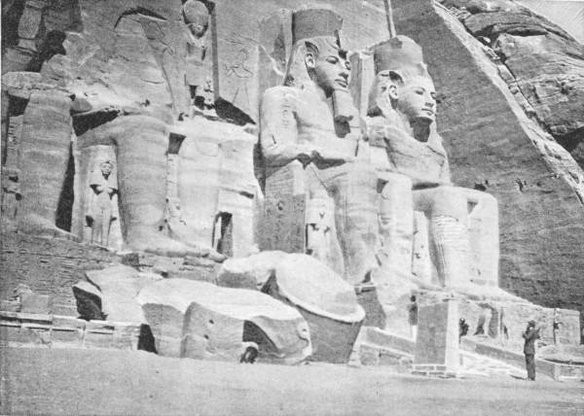
TEMPLE AT ABU SIMBEL
Showing the statues of Rameses II at entrance
Great conquerors appear in the dim light of that distant time and pass, Tushratta, King of Mitanni, who captured Nineveh, Tiglath Pileser I of Assyria who conquered Babylon. At last the Assyrians became the greatest military power of the time. Tiglath Pileser III conquered Babylon in 745 B.C. and founded what historians call the New Assyrian Empire. Iron had also come now into civilization out of the north; the Hittites, the precursors of the Armenians, had it first and communicated its use to the Assyrians, and an Assyrian usurper, Sargon II, armed his troops with it. Assyria became the first power to expound the doctrine of blood and iron. Sargon’s son Sennacherib led an army to the borders of Egypt, and was defeated not by military strength but by the plague. Sennacherib’s grandson Assurbanipal (who is also known in history by his Greek name of Sardanapalus) did actually conquer Egypt in 670 B.C. But Egypt was already a conquered country then under an Ethiopian dynasty. Sardanapalus simply replaced one conqueror by another.
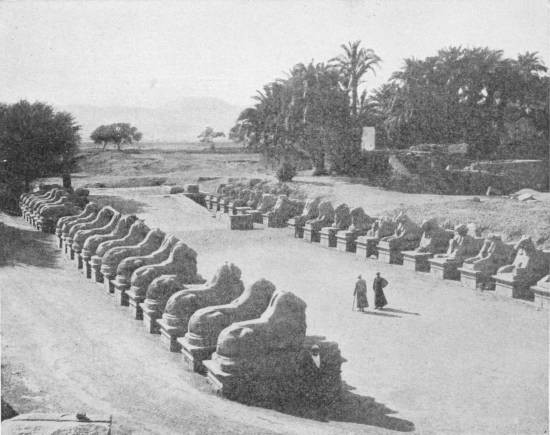
AVENUE OF SPHINXES
Leading from the Nile to the great Temple of Karnak
Photo: D. McLeish
If one had a series of political maps of this long period of history, this interval of ten centuries, we should have Egypt expanding and contracting like an amœba under a microscope, and we should see these various Semitic states of the Babylonians, the Assyrians, the Hittites and the Syrians coming and going, eating each other up and disgorging each other again. To the west of Asia Minor there would be little Ægean states like Lydia, whose capital was Sardis, and Caria. But after about 1200 B.C. and perhaps earlier, a new set of names would come into the map of the ancient world from the north-east and from the north- west. These would be the names of certain barbaric tribes, armed with iron weapons and using horse-chariots, who were becoming a great affliction to the Ægean and Semitic civilizations on the northern borders. They all spoke variants of what once must have been the same language, Aryan.
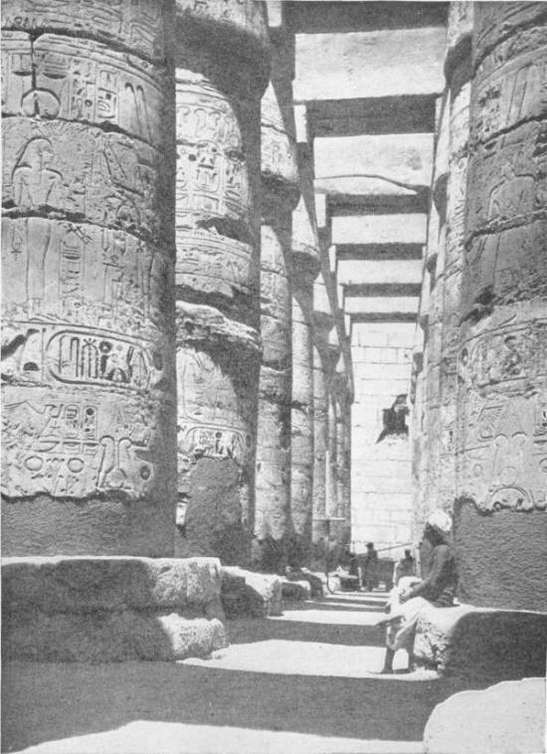
THE GREAT HYPOSTYLE HALL AT KARNAK
Photo: D. McLeish
Round the north-east of the Black and Caspian Seas were coming the Medes and Persians. Confused with these in the records of the time were Scythians and Samatians. From north-east or north-west came the Armenians, from the north- west of the sea-barrier through the Balkan peninsula came Cimmerians, Phrygians and the Hellenic tribes whom now we call the Greeks. They were raiders and robbers and plunderers of cities, these Ayrans, east and west alike. They were all kindred and similar peoples, hardy herdsmen who had taken to plunder. In the east they were still only borderers and raiders, but in the west they were taking cities and driving out the civilized Ægean populations. The Ægean peoples were so pressed that they were seeking new homes in lands beyond the Aryan range. Some were seeking a settlement in the delta of the Nile and being repulsed by the Egyptians; some, the Etruscans, seem to have sailed from Asia Minor to found a state in the forest wildernesses of middle Italy; some built themselves cities upon the south- east coasts of the Mediterranean and became later that people known in history as the Philistines.
Of these Aryans who came thus rudely upon the scene of the ancient civilizations we will tell more fully in a later section. Here we note simply all this stir and emigration amidst the area of the ancient civilizations, that was set up by the swirl of the gradual and continuous advance of these Aryan barbarians out of the northern forests and wildernesses between 1600 and 600 B.C.
And in a section to follow we must tell also of a little Semitic people, the Hebrews, in the hills behind the Phœnician and Philistine coasts, who began to be of significance in the world towards the end of this period. They produced a literature of very great importance in subsequent history, a collection of books, histories, poems, books of wisdom and prophetic works, the Hebrew Bible.
In Mesopotamia and Egypt the coming of the Aryans did not cause fundamental changes until after 600 B.C. The flight of the Ægeans before the Greeks and even the destruction of Cnossos must have seemed a very remote disturbance to both the citizens of Egypt and of Babylon. Dynasties came and went in these cradle states of civilization, but the main tenor of human life went on, with a slow increase in refinement and complexity age by age. In Egypt the accumulated monuments of more ancient times—the pyramids were already in their third thousand of years and a show for visitors just as they are to- day—were supplemented by fresh and splendid buildings, more particularly in the time of the seventeenth and nineteenth dynasties. The great temples at Karnak and Luxor date from this time. All the chief monuments of Nineveh, the great temples, the winged bulls with human heads, the reliefs of kings and chariots and lion hunts, were done in these centuries between 1600 and 600 B.C., and this period also covers most of the splendours of Babylon.
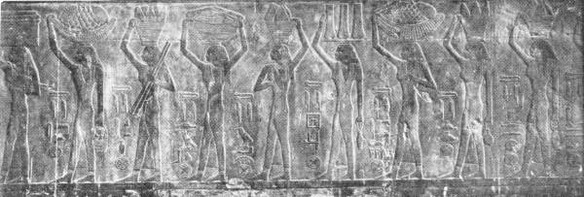
FRIEZE SHOWING EGYPTIAN FEMALE SLAVES CARRYING LUXURIOUS FOODS
Photo: Jacques Boyer
Both from Mesopotamia and Egypt we now have abundant public records, business accounts, stories, poetry and private correspondence. We know that life, for prosperous and influential people in such cities as Babylon and the Egyptian Thebes, was already almost as refined and as luxurious as that of comfortable and prosperous people to-day. Such people lived an orderly and ceremonious life in beautiful and beautifully furnished and decorated houses, wore richly decorated clothing and lovely jewels; they had feasts and festivals, entertained one another with music and dancing, were waited upon by highly trained servants, were cared for by doctors and dentists. They did not travel very much or very far, but boating excursions were a common summer pleasure both on the Nile and on the Euphrates. The beast of burthen was the ass; the horse was still used only in chariots for war and upon occasions of state. The mule was still novel and the camel, though it was known in Mesopotamia, had not been brought into Egypt. And there were few utensils of iron; copper and bronze remained the prevailing metals. Fine linen and cotton fabrics were known as well as wool. But there was no silk yet. Glass was known and beautifully coloured, but glass things were usually small. There was no clear glass and no optical use of glass. People had gold stoppings in their teeth but no spectacles on their noses.
One odd contrast between the life of old Thebes or Babylon and modern life was the absence of coined money. Most trade was still done by barter. Babylon was financially far ahead of Egypt. Gold and silver were used for exchange and kept in ingots; and there were bankers, before coinage, who stamped their names and the weight on these lumps of precious metal. A merchant or traveller would carry precious stones to sell to pay for his necessities. Most servants and workers were slaves who were paid not money but in kind. As money came in slavery declined.
A modern visitor to these crowning cities of the ancient world would have missed two very important articles of diet; there were no hens and no eggs. A French cook would have found small joy in Babylon. These things came from the East somewhere about the time of the last Assyrian empire.
Religion like everything else had undergone great refinement. Human sacrifice for instance had long since disappeared; animals or bread dummies had been substituted for the victim. (But the Phœnicians and especially the citizens of Carthage, their greatest settlement in Africa, were accused, later of immolating human beings.) When a great chief had died in the ancient days it had been customary to sacrifice his wives and slaves and break spear and bow at his tomb so that he should not go unattended and unarmed in the spirit world. In Egypt there survived of this dark tradition the pleasant custom of burying small models of house and shop and servants and cattle with the dead, models that give us to-day the liveliest realization of the safe and cultivated life of these ancient people, three thousand years and more ago.
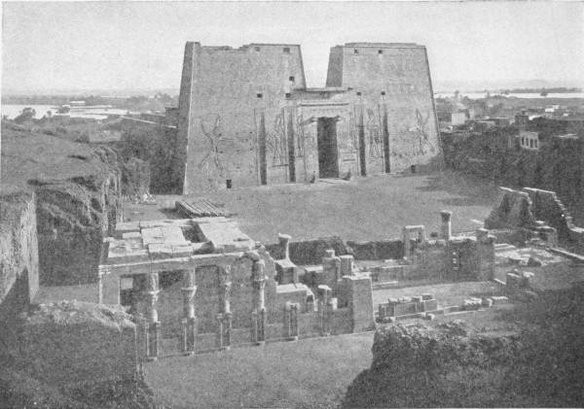
THE TEMPLE OF HORUS AT EDFU
Such was the ancient world before the coming of the Aryans out of the northern forests and plains. In India and China there were parallel developments. In the great valleys of both these regions agricultural city states of brownish peoples were growing up, but in India they do not seem to have advanced or coalesced so rapidly as the city states of Mesopotamia or Egypt. They were nearer the level of the ancient Sumerians or of the Maya civilization of America. Chinese history has still to be modernized by Chinese scholars and cleared of much legendary matter. Probably China at this time was in advance of India. Contemporary with the seventeenth dynasty in Egypt, there was a dynasty of emperors in China, the Shang dynasty, priest emperors over a loose-knit empire of subordinate kings. The chief duty of these early emperors was to perform the seasonal sacrifices. Beautiful bronze vessels from the time of the Shang dynasty still exist, and their beauty and workmanship compel us to recognize that many centuries of civilization must have preceded their manufacture.
XIX
THE PRIMITIVE ARYANS
FOUR thousand years ago, that is to say about 2000 B.C., central and south-eastern Europe and central Asia were probably warmer, moister and better wooded than they are now. In these regions of the earth wandered a group of tribes mainly of the fair and blue-eyed Nordic race, sufficiently in touch with one another to speak merely variations of one common language from the Rhine to the Caspian Sea. At that time they may not have been a very numerous people, and their existence was unsuspected by the Babylonians to whom Hammurabi was giving laws, or by the already ancient and cultivated land of Egypt which was tasting in those days for the first time the bitterness of foreign conquest.
These Nordic people were destined to play a very important part indeed in the world’s history. They were a people of the parklands and the forest clearings; they had no horses at first but they had cattle; when they wandered they put their tents and other gear on rough ox waggons; when they settled for a time they may have made huts of wattle and mud. They burnt their important dead; they did not bury them ceremoniously as the brunette peoples did. They put the ashes of their greater leaders in urns and then made a great circular mound about them. These mounds are the “round barrows” that occur all over north Europe. The brunette people, their predecessors, did not burn their dead but buried them in a sitting position in elongated mounds; the “long barrows.”
The Aryans raised crops of wheat, ploughing with oxen, but they did not settle down by their crops; they would reap and move on. They had bronze, and somewhen about 1500 B.C. they acquired iron. They may have been the discoverers of iron smelting. And somewhen vaguely about that time they also got the horse—which to begin with they used only for draught purposes. Their social life did not centre upon a temple like that of the more settled people round the Mediterranean, and their chief men were leaders rather than priests. They had an aristocratic social order rather than a divine and regal order; from a very early stage they distinguished certain families as leaderly and noble.
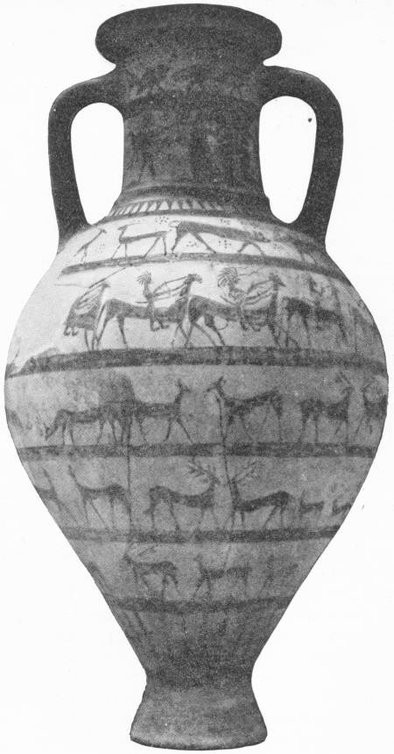
A BEAUTIFUL ARCHAIC AMPHORA
Compare the horses and other animals with the Altamira drawing on p. 54, and also with the Greek frieze, p. 140
They were a very vocal people. They enlivened their wanderings by feasts, at which there was much drunkenness and at which a special sort of man, the bards, would sing and recite. They had no writing until they had come into contact with civilization, and the memories of these bards were their living literature. This use of recited language as an entertainment did much to make it a fine and beautiful instrument of expression, and to that no doubt the subsequent predominance of the languages derived from Aryan is, in part, to be ascribed. Every Aryan people had its legendary history crystallized in bardic recitations, epics, sagas and vedas, as they were variously called.
The social life of these people centred about the households of their leading men. The hall of the chief where they settled for a time was often a very capacious timber building. There were no doubt huts for herds and outlying farm buildings; but with most of the Aryan peoples this hall was the general centre, everyone went there to feast and hear the bards and take part in games and discussions. Cowsheds and stabling surrounded it. The chief and his wife and so forth would sleep on a dais or in an upper gallery; the commoner sort slept about anywhere, as people still do in Indian households. Except for weapons, ornaments, tools and suchlike personal possessions there was a sort of patriarchal communism in the tribe. The chief owned the cattle and grazing lands in the common interest; forest and rivers were the wild.
This was the fashion of the people who were increasing and multiplying over the great spaces of central Europe and west central Asia during the growth of the great civilization of Mesopotamia and the Nile, and whom we find pressing upon the heliolithic peoples everywhere in the second millennium before Christ. They were coming into France and Britain and into Spain. They pushed westward in two waves. The first of these people who reached Britain and Ireland were armed with bronze weapons. They exterminated or subjugated the people who had made the great stone monuments of Carnac in Brittany and Stonehenge and Avebury in England. They reached Ireland. They are called the Goidelic Celts. The second wave of a closely kindred people, perhaps intermixed with other racial elements, brought iron with it into Great Britain, and is known as the wave of Brythonic Celts. From them the Welsh derive their language.
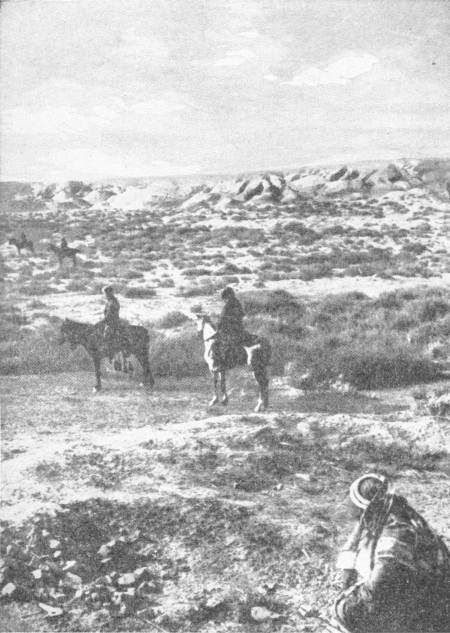
THE MOUND OF NIPPUR
The site of a city which recent excavations have proved to date from at least as early as 5000 B.C., and probably 1000 years earlier
Photo: Underwood & Underwood
Kindred Celtic peoples were pressing southward into Spain and coming into contact not only with the heliolithic Basque people who still occupied the country but with the Semitic Phœnician colonies of the sea coast. A closely allied series of tribes, the Italians, were making their way down the still wild and wooded Italian peninsula. They did not always conquer. In the eighth century B.C. Rome appears in history, a trading town on the Tiber, inhabited by Aryan Latins but under the rule of Etruscan nobles and kings.
At the other extremity of the Aryan range there was a similar progress southward of similar tribes. Aryan peoples, speaking Sanskrit, had come down through the western passes into North India long before 1000 B.C. There they came into contact with a primordial brunette civilization, the Dravidian civilization, and learnt much from it. Other Aryan tribes seem to have spread over the mountain masses of Central Asia far to the east of the present range of such peoples. In Eastern Turkestan there are still fair, blue-eyed Nordic tribes, but now they speak Mongolian tongues.
Between the Black and Caspian Seas the ancient Hittites had been submerged and “Aryanized” by the Armenians before 1000 B.C., and the Assyrians and Babylonians were already aware of a new and formidable fighting barbarism on the north-eastern frontiers, a group of tribes amidst which the Scythians, the Medes and the Persians remain as outstanding names.
But it was through the Balkan peninsula that Aryan tribes made their first heavy thrust into the heart of the old-world civilization. They were already coming southward and crossing into Asia Minor many centuries before 1000 B.C. First came a group of tribes of whom the Phrygians were the most conspicuous, and then in succession the Æolic, the Ionic and the Dorian Greeks. By 1000 B.C. they had wiped out the ancient Ægean civilization both in the mainland of Greece and in most of the Greek islands; the cities of Mycenæ and Tiryns were obliterated and Cnossos was nearly forgotten. The Greeks had taken to the sea before 1000 A.D., they had settled in Crete and Rhodes, and they were founding colonies in Sicily and the south of Italy after the fashion of the Phœnician trading cities that were dotted along the Mediterranean coasts.
So it was, while Tiglath Pileser III and Sargon II and Sardanapalus were ruling in Assyria and fighting with Babylonia and Syria and Egypt, the Aryan peoples were learning the methods of civilization and making it over for their own purposes in Italy and Greece and north Persia. The theme of history from the ninth century B.C. A.D. onward for six centuries is the story of how these Aryan peoples grew to power and enterprise and how at last they subjugated the whole Ancient World, Semitic, Ægean and Egyptian alike. In form the Aryan peoples were altogether victorious; but the struggle of Aryan, Semitic and Egyptian ideas and methods was continued long after the sceptre was in Aryan hands. It is indeed a struggle that goes on through all the rest of history and still in a manner continues to this day.
XX
THE LAST BABYLONIAN EMPIRE AND THE EMPIRE OF DARIUS I
WE have already mentioned how Assyria became a great military power under Tiglath Pileser III and under the usurper Sargon II. Sargon was not this man’s original name; he adopted it to flatter the conquered Babylonians by reminding them of that ancient founder of the Akkadian Empire, Sargon I, two thousand years before his time. Babylon, for all that it was a conquered city, was of greater population and importance than Nineveh, and its great god Bel Marduk and its traders and priests had to be treated politely. In Mesopotamia in the eighth century B.C. A.D. we are already far beyond the barbaric days when the capture of a town meant loot and massacre. Conquerors sought to propitiate and win the conquered. For a century and a half after Sargon the new Assyrian empire endured and, as we have noted, Assurbanipal (Sardanapalus) held at least lower Egypt.
But the power and solidarity of Assyria waned rapidly. Egypt by an effort threw off the foreigner under a Pharoah Psammetichus I, and under Necho II attempted a war of conquest in Syria. By that time Assyria was grappling with foes nearer at hand, and could make but a poor resistance. A Semitic people from south-east Mesopotamia, the Chaldeans, combined with Aryan Medes and Persians from the north-east against Nineveh, and in 606 B.C.—for now we are coming down to exact chronology—took that city.
There was a division of the spoils of Assyria. A Median Empire was set up in the north under Cyaxares. It included Nineveh, and its capital was Ecbatana. Eastward it reached to the borders of India. To the south of this in a great crescent was a new Chaldean Empire, the Second Babylonian Empire, which rose to a very great degree of wealth and power under the rule of Nebuchadnezzar the Great (the Nebuchadnezzar of the Bible). The last great days, the greatest days of all, for Babylon began. For a time the two Empires remained at peace, and the daughter of Nebuchadnezzar was married to Cyaxares.
Meanwhile Necho II was pursuing his easy conquests in Syria. He had defeated and slain King Josiah of Judah, a small country of which there is more to tell presently, at the battle of Megiddo in 608 B.C., and he pushed on to the Euphrates to encounter not a decadent Assyria but a renascent Babylonia. The Chaldeans dealt very vigorously with the Egyptians. Necho was routed and driven back to Egypt, and the Babylonian frontier pushed down to the ancient Egyptian boundaries.
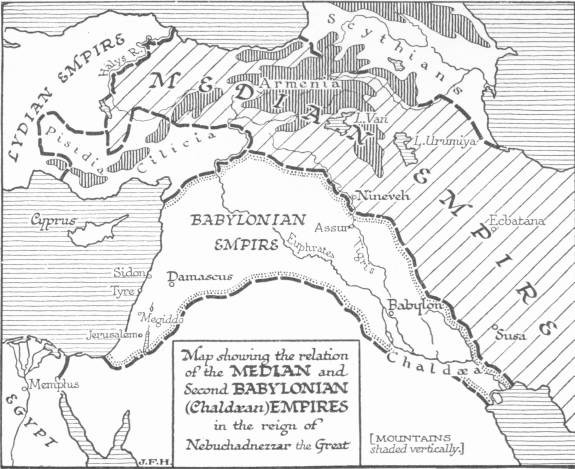
From 606 until 589 B.C. the Second Babylonian Empire flourished insecurely. It flourished so long as it kept the peace with the stronger, hardier Median Empire to the north. And during these sixty-seven years not only life but learning flourished in the ancient city.

Even under the Assyrian monarchs and especially under Sardanapalus, Babylon had been a scene of great intellectual activity. Sardanapalus, though an Assyrian, had been quite Babylon-ized. He made a library, a library not of paper but of the clay tablets that were used for writing in Mesopotamia since early Sumerian days. His collection has been unearthed and is perhaps the most precious store of historical material in the world. The last of the Chaldean line of Babylonian monarchs, Nabonidus, had even keener literary tastes. He patronized antiquarian researches, and when a date was worked out by his investigators for the accession of Sargon I he commemorated the fact by inscriptions. But there were many signs of disunion in his empire, and he sought to centralize it by bringing a number of the various local gods to Babylon and setting up temples to them there. This device was to be practised quite successfully by the Romans in later times, but in Babylon it roused the jealousy of the powerful priesthood of Bel Marduk, the dominant god of the Babylonians. They cast about for a possible alternative to Nabonidus and found it in Cyrus the Persian, the ruler of the adjacent Median Empire. Cyrus had already distinguished himself by conquering Croesus, the rich king of Lydia in Eastern Asia Minor. He came up against Babylon, there was a battle outside the walls, and the gates of the city were opened to him (538 B.C.). His soldiers entered the city without fighting. The crown prince Belshazzar, the son of Nabonidus, was feasting, the Bible relates, when a hand appeared and wrote in letters of fire upon the wall these mystical words: “Mene, Mene, Tekel, Upharsin,” which was interpreted by the prophet Daniel, whom he summoned to read the riddle, as “God has numbered thy kingdom and finished it; thou art weighed in the balance and found wanting and thy kingdom is given to the Medes and Persians.” Possibly the priests of Bel Marduk knew something about that writing on the wall. Belshazzar was killed that night, says the Bible. Nabonidus was taken prisoner, and the occupation of the city was so peaceful that the services of Bel Marduk continued without intermission.

PERSIAN MONARCH
From the ruins of Persepolis
Photo: Miss F. Biggs
Thus it was the Babylonian and Median empires were united. Cambyses, the son of Cyrus, subjugated Egypt. Cambyses went mad and was accidentally killed, and was presently succeeded by Darius the Mede, Darius I, the son of Hystaspes, one of the chief councillors of Cyrus.
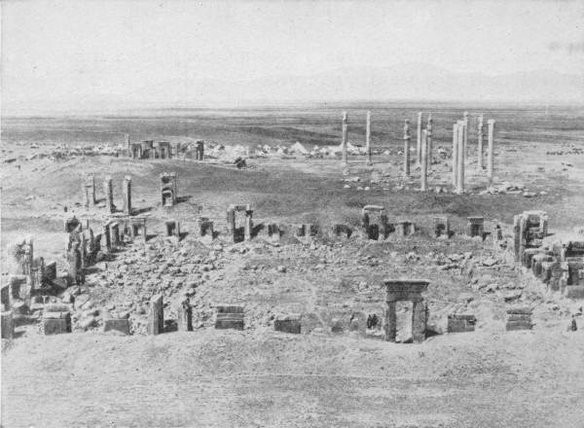
THE RUINS OF PERSEPOLIS
The capital city of the Persian Empire; burnt by Alexander the Great
Photo: Major W. F. P. Rodd
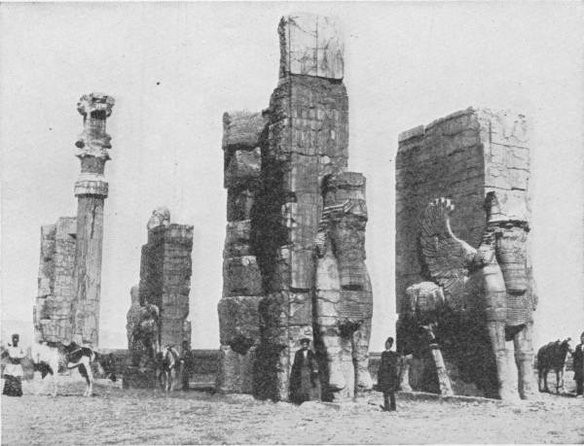
THE GREAT PORCH OF XERXES, AT PERSEPOLIS
Photo: Major W. F. P. Rodd
The Persian Empire of Darius I, the first of the new Aryan empires in the seat of the old civilizations, was the greatest empire the world had hitherto seen. It included all Asia Minor and Syria, all the old Assyrian and Babylonian empires, Egypt, the Caucasus and Caspian regions, Media, Persia, and it extended into India as far as the Indus. Such an empire was possible because the horse and rider and the chariot and the made-road had now been brought into the world. Hitherto the ass and ox and the camel for desert use had afforded the swiftest method of transport. Great arterial roads were made by the Persian rulers to hold their new empire, and post horses were always in waiting for the imperial messenger or the traveller with an official permit. Moreover the world was now beginning to use coined money, which greatly facilitated trade and intercourse. But the capital of this vast empire was no longer Babylon. In the long run the priesthood of Bel Marduk gained nothing by their treason. Babylon though still important was now a declining city, and the great cities of the new empire were Persepolis and Susa and Ecbatana. The capital was Susa. Nineveh was already abandoned and sinking into ruins.
XXI
THE EARLY HISTORY OF THE JEWS
AND now we can tell of the Hebrews, a Semitic people, not so important in their own time as in their influence upon the later history of the world. They were settled in Judea long before 1000 B.C., and their capital city after that time was Jerusalem. Their story is interwoven with that of the great empires on either side of them, Egypt to the south and the changing empires of Syria, Assyria and Babylon to the north. Their country was an inevitable high road between these latter powers and Egypt.
Their importance in the world is due to the fact that they produced a written literature, a world history, a collection of laws, chronicles, psalms, books of wisdom, poetry and fiction and political utterances which became at last what Christians know as the Old Testament, the Hebrew Bible. This literature appears in history in the fourth or fifth century B.C.
Probably this literature was first put together in Babylon. We have already told how the Pharaoh, Necho II, invaded the Assyrian Empire while Assyria was fighting for life against Medes, Persians and Chaldeans. Josiah King of Judah opposed him, and was defeated and slain at Megiddo (608 B.C.). Judah became a tributary to Egypt, and when Nebuchadnezzar the Great, the new Chaldean king in Babylon, rolled back Necho into Egypt, he attempted to manage Judah by setting up puppet kings in Jerusalem. The experiment failed, the people massacred his Babylonian officials, and he then determined to break up this little state altogether, which had long been playing off Egypt against the northern empire. Jerusalem was sacked and burnt, and the remnant of the people was carried off captive to Babylon.
There they remained until Cyrus took Babylon (538 B.C.). He then collected them together and sent them back to resettle their country and rebuild the walls and temple of Jerusalem.
Before that time the Jews do not seem to have been a very civilized or united people. Probably only a very few of them could read or write. In their own history one never hears of the early books of the Bible being read; the first mention of a book is in the time of Josiah. The Babylonian captivity civilized them and consolidated them. They returned aware of their own literature, an acutely self-conscious and political people.
Their Bible at that time seems to have consisted only of the Pentateuch, that is to say the first five books of the Old Testament as we know it. In addition, as separate books they already had many of the other books that have since been incorporated with the Pentateuch into the present Hebrew Bible, Chronicles, the Psalms and Proverbs for example.
The accounts of the Creation of the World, of Adam and Eve and of the Flood, with which the Bible begins, run closely parallel with similar Babylonian legends; they seem to have been part of the common beliefs of all the Semitic peoples. So too the stories of Moses and of Samson have Sumerian and Babylonian parallels. But with the story of Abraham and onward begins something more special to the Jewish race.
Abraham may have lived as early as the days of Hammurabi in Babylon. He was a patriarchal Semitic nomad. To the book of Genesis the reader must go for the story of his wanderings and for the stories of his sons and grandchildren and how they became captive in the Land of Egypt. He travelled through Canaan, and the God of Abraham, says the Bible story, promised this smiling land of prosperous cities to him and to his children.
And after a long sojourn in Egypt and after fifty years of wandering in the wilderness under the leadership of Moses, the children of Abraham, grown now to a host of twelve tribes, invaded the land of Canaan from the Arabian deserts to the East. They may have done this somewhen between 1600 B.C. and 1300 B.C.; there are no Egyptian records of Moses nor of Canaan at this time to help out the story. But at any rate they did not succeed in conquering any more than the hilly backgrounds of the promised land. The coast was now in the hands, not of the Canaanites but of newcomers, those Ægean peoples, the Philistines; and their cities, Gaza, Gath, Ashdod, Ascalon and Joppa successfully withstood the Hebrew attack. For many generations the children of Abraham remained an obscure people of the hilly back country engaged in incessant bickerings with the Philistines and with the kindred tribes about them, the Moabites, the Midianites and so forth. The reader will find in the book of Judges a record of their struggles and disasters during this period. For very largely it is a record of disasters and failures frankly told.
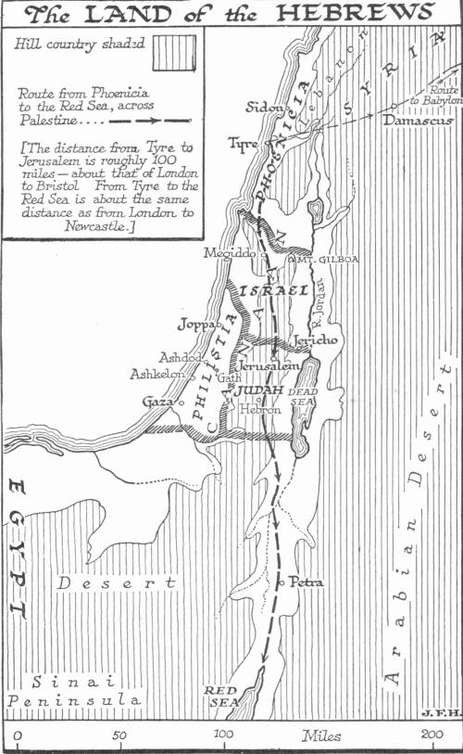
For most of this period the Hebrews were ruled, so far as there was any rule among them, by priestly judges selected by the elders of the people, but at last somewhen towards 1000 B.C. they chose themselves a king, Saul, to lead them in battle. But Saul’s leading was no great improvement upon the leading of the Judges; he perished under the hail of Philistine arrows at the battle of Mount Gilboa, his armour went into the temple of the Philistine Venus, and his body was nailed to the walls of Beth-shan.
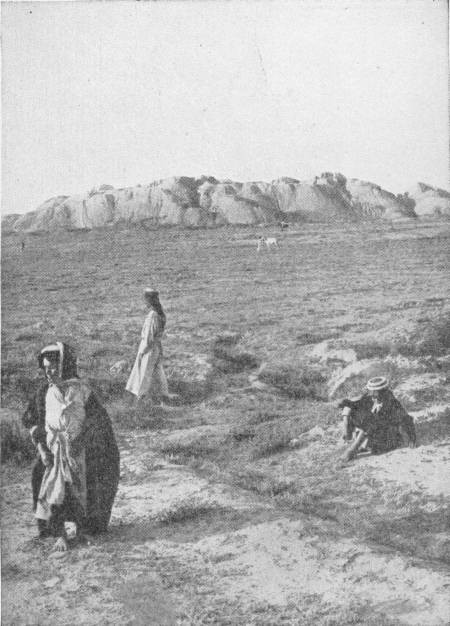
THE MOUND AT BABYLON
Beneath which are the remains of a great palace of Nebuchadnezzar
Photo: Underwood & Underwood
His successor David was more successful and more politic. With David dawned the only period of prosperity the Hebrew peoples were ever to know. It was based on a close alliance with the Phœnician city of Tyre, whose King Hiram seems to have been a man of very great intelligence and enterprise. He wished to secure a trade route to the Red Sea through the Hebrew hill country. Normally Phœnician trade went to the Red Sea by Egypt, but Egypt was in a state of profound disorder at this time; there may have been other obstructions to Phœnician trade along this line, and at any rate Hiram established the very closest relations both with David and with his son and successor Solomon. Under Hiram’s auspices the walls, palace and temple of Jerusalem arose, and in return Hiram built and launched his ships on the Red Sea. A very considerable trade passed northward and southward through Jerusalem. And Solomon achieved a prosperity and magnificence unprecedented in the experience of his people. He was even given a daughter of Pharaoh in marriage.
But it is well to keep the proportion of things in mind. At the climax of his glories Solomon was only a little subordinate king in a little city. His power was so transitory that within a few years of his death, Shishak the first Pharaoh of the twenty-second dynasty, had taken Jerusalem and looted most of its splendours. The account of Solomon’s magnificence given in the books of Kings and Chronicles is questioned by many critics. They say that it was added to and exaggerated by the patriotic pride of later writers. But the Bible account read carefully is not so overwhelming as it appears at the first reading. Solomon’s temple, if one works out the measurements, would go inside a small suburban church, and his fourteen hundred chariots cease to impress us when we learn from an Assyrian monument that his successor Ahab sent a contingent of two thousand to the Assyrian army. It is also plainly manifest from the Bible narrative that Solomon spent himself in display and overtaxed and overworked his people. At his death the northern part of his kingdom broke off from Jerusalem and became the independent kingdom of Israel. Jerusalem remained the capital city of Judah.
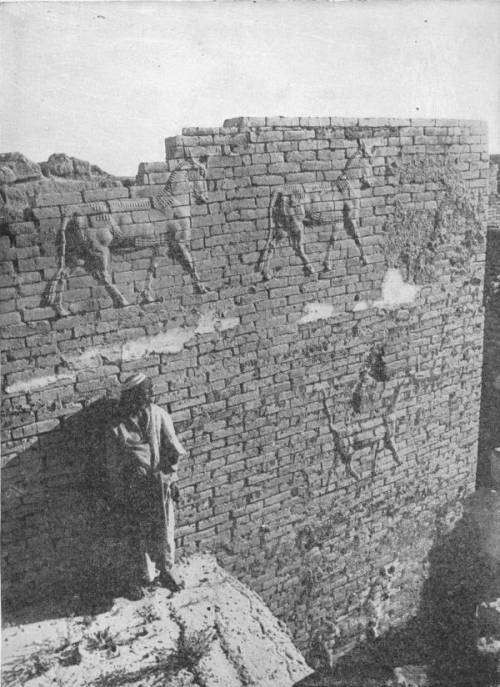
THE ISHTAR GATEWAY, BABYLON
The bulls are in richly coloured enamel on baked brick
Photo: Underwood & Underwood
The prosperity of the Hebrew people was short-lived. Hiram died, and the help of Tyre ceased to strengthen Jerusalem. Egypt grew strong again. The history of the kings of Israel and the kings of Judah becomes a history of two little states ground between, first, Syria, then Assyria and then Babylon to the north and Egypt to the south. It is a tale of disasters and of deliverances that only delayed disaster. It is a tale of barbaric kings ruling a barbaric people. In 721 B.C. the kingdom of Israel was swept away into captivity by the Assyrians and its people utterly lost to history. Judah struggled on until in 604 B.C., as we have told, it shared the fate of Israel. There may be details open to criticism in the Bible story of Hebrew history from the days of the Judges onward, but on the whole it is evidently a true story which squares with all that has been learnt in the excavation of Egypt and Assyria and Babylon during the past century.
It was in Babylon that the Hebrew people got their history together and evolved their tradition. The people who came back to Jerusalem at the command of Cyrus were a very different people in spirit and knowledge from those who had gone into captivity. They had learnt civilization. In the development of their peculiar character a very great part was played by certain men, a new sort of men, the Prophets, to whom we must now direct our attention. These Prophets mark the appearance of new and remarkable forces in the steady development of human society.
XXII
PRIESTS AND PROPHETS IN JUDEA
THE fall of Assyria and Babylon were only the first of a series of disasters that were to happen to the Semitic peoples. In the seventh century B.C. it would have seemed as though the whole civilized world was to be dominated by Semitic rulers. They ruled the great Assyrian empire and they had conquered Egypt; Assyria, Babylon, Syria were all Semitic, speaking languages that were mutually intelligible. The trade of the world was in Semitic hands. Tyre, Sidon, the great mother cities of the Phœnician coast, had thrown out colonies that grew at last to even greater proportion in Spain, Sicily and Africa. Carthage, founded before 800 B.C., had risen to a population of more than a million. It was for a time the greatest city on earth. Its ships went to Britain and out into the Atlantic. They may have reached Madeira. We have already noted how Hiram co-operated with Solomon to build ships on the Red Sea for the Arabian and perhaps for the Indian trade. In the time of the Pharaoh Necho, a Phœnician expedition sailed completely round Africa.
At that time the Aryan peoples were still barbarians. Only the Greeks were reconstructing a new civilization of the ruins of the one they had destroyed, and the Medes were becoming “formidable,” as an Assyrian inscription calls them, in central Asia. In 800 B.C. no one could have prophesied that before the third century B.C. every trace of Semitic dominion would be wiped out by Aryan-speaking conquerors, and that everywhere the Semitic peoples would be subjects or tributaries or scattered altogether. Everywhere except in the northern deserts of Arabia, where the Bedouin adhered steadily to the nomadic way of life, the ancient way of life of the Semites before Sargon I and his Akkadians went down to conquer Sumeria. But the Arab Bedouin were never conquered by Aryan masters.
Now of all these civilized Semites who were beaten and overrun in these five eventful centuries one people only held together and clung to its ancient traditions and that was this little people, the Jews, who were sent back to build their city of Jerusalem by Cyrus the Persian. And they were able to do this, because they had got together this literature of theirs, their Bible, in Babylon. It is not so much the Jews who made the Bible as the Bible which made the Jews. Running through this Bible were certain ideas, different from the ideas of the people about them, very stimulating and sustaining ideas, to which they were destined to cling through five and twenty centuries of hardship, adventure and oppression.
Foremost of these Jewish ideas was this, that their God was invisible and remote, an invisible God in a temple not made with hands, a Lord of Righteousness throughout the earth. All other peoples had national gods embodied in images that lived in temples. If the image was smashed and the temple razed, presently that god died out. But this was a new idea, this God of the Jews, in the heavens, high above priests and sacrifices. And this God of Abraham, the Jews believed, had chosen them to be his peculiar people, to restore Jerusalem and make it the capital of Righteousness in the World. They were a people exalted by their sense of a common destiny. This belief saturated them all when they returned to Jerusalem after the captivity in Babylon.
Is it any miracle that in their days of overthrow and subjugation many Babylonians and Syrians and so forth and later on many Phœnicians, speaking practically the same language and having endless customs, habits, tastes and traditions in common, should be attracted by this inspiring cult and should seek to share in its fellowship and its promise? After the fall of Tyre, Sidon, Carthage and the Spanish Phœnician cities, the Phœnicians suddenly vanish from history; and as suddenly we find, not simply in Jerusalem but in Spain, Africa, Egypt, Arabia, the East, wherever the Phœnicians had set their feet, communities of Jews. And they were all held together by the Bible and by the reading of the Bible. Jerusalem was from the first only their nominal capital; their real city was this book of books. This is a new sort of thing in history. It is something of which the seeds were sown long before, when the Sumerians and Egyptians began to turn their hieroglyphics into writing. The Jews were a new thing, a people without a king and presently without a temple (for as we shall tell Jerusalem itself was broken up in 70 A.D.), held together and consolidated out of heterogeneous elements by nothing but the power of the written word.
And this mental welding of the Jews was neither planned nor foreseen nor done by either priests or statesmen. Not only a new kind of community but a new kind of man comes into history with the development of the Jews. In the days of Solomon the Hebrews looked like becoming a little people just like any other little people of that time clustering around court and temple, ruled by the wisdom of the priest and led by the ambition of the king. But already, the reader may learn from the Bible, this new sort of man of which we speak, the Prophet, was in evidence.
As troubles thicken round the divided Hebrews the importance of these Prophets increases.
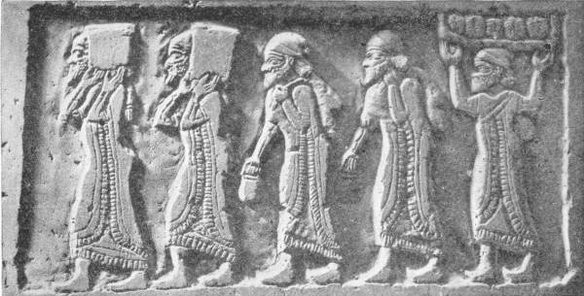
THE BLACK OBELISK OF SHALMANESER II
This obelisk (in the British Museum) of the King of Assyria mentions, in cuneiform, “Jehu the son of Omri.” Panel showing Jewish captives bringing tribute
What were these Prophets? They were men of the most diverse origins. The Prophet Ezekiel was of the priestly caste and the Prophet Amos wore the goatskin mantle of a shepherd, but all had this in common, that they gave allegiance to no one but to the God of Righteousness and that they spoke directly to the people. They came without licence or consecration. “Now the word of the Lord came unto me;” that was the formula. They were intensely political. They exhorted the people against Egypt, “that broken reed,” or against Assyria or Babylon; they denounced the indolence of the priestly order or the flagrant sins of the King. Some of them turned their attention to what we should now call “social reform.” The rich were “grinding the faces of the poor,” the luxurious were consuming the children’s bread; wealthy people made friends with and imitated the splendours and vices of foreigners; and this was hateful to Jehovah, the God of Abraham, who would certainly punish this land.
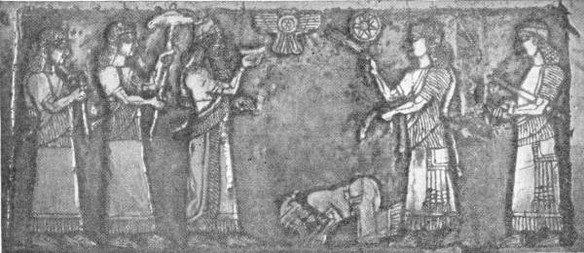
ANOTHER PANEL OF THE BLACK OBELISK
Captive Princes making obeisance to Shalmaneser II
These fulminations were written down and preserved and studied. They went wherever the Jews went, and wherever they went they spread a new religious spirit. They carried the common man past priest and temple, past court and king and brought him face to face with the Rule of Righteousness. That is their supreme importance in the history of mankind. In the great utterances of Isaiah the prophetic voice rises to a pitch of splendid anticipation and foreshadows the whole earth united and at peace under one God. Therein the Jewish prophecies culminate.
All the Prophets did not speak in this fashion, and the intelligent reader of the prophetic books will find much hate in them, much prejudice, and much that will remind him of the propaganda pamphlets of the present time. Nevertheless it is the Hebrew Prophets of the period round and about the Babylonian captivity who mark the appearance of a new power in the world, the power of individual moral appeal, of an appeal to the free conscience of mankind against the fetish sacrifices and slavish loyalties that had hitherto bridled and harnessed our race.
XXIII
THE GREEKS
NOW while after Solomon (whose reign was probably about 960 B.C.) the divided kingdoms of Israel and Judah were suffering destruction and deportation, and while the Jewish people were developing their tradition in captivity in Babylon, another great power over the human mind, the Greek tradition, was also arising. While the Hebrew prophets were working out a new sense of direct moral responsibility between the people and an eternal and universal God of Right, the Greek philosophers were training the human mind in a new method and spirit of intellectual adventure.
The Greek tribes as we have told were a branch of the Aryan- speaking stem. They had come down among the Ægean cities and islands some centuries before 1000 B.C. They were probably already in southward movement before the Pharaoh Thothmes hunted his first elephants beyond the conquered Euphrates. For in those days there were elephants in Mesopotamia and lions in Greece.
It is possible that it was a Greek raid that burnt Cnossos, but there are no Greek legends of such a victory though there are stories of Minos and his palace (the Labyrinth) and of the skill of the Cretan artificers.
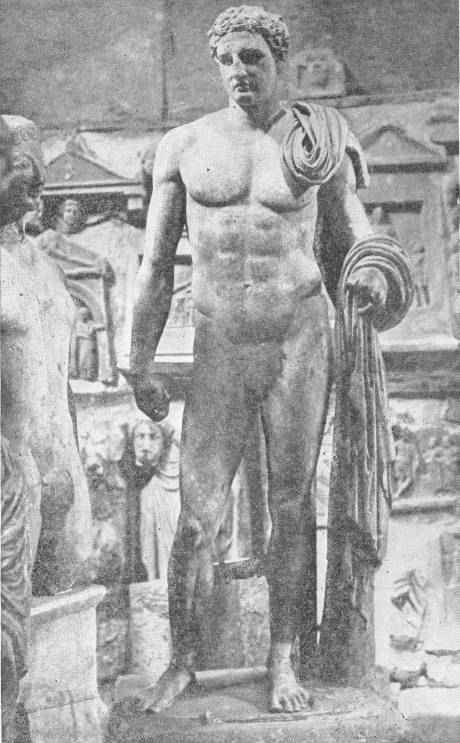
STATUE OF MELEAGER
Note the progress in plastic power from the earlier wooden statue on left
Photo: Sebah & Foaillier
Like most of the Aryans these Greeks had singers and reciters whose performances were an important social link, and these handed down from the barbaric beginnings of their people two great epics, the Iliad, telling how a league of Greek tribes besieged and took and sacked the town of Troy in Asia Minor, and the Odyssey, being a long adventure story of the return of the sage captain, Odysseus, from Troy to his own island. These epics were written down somewhen in the eighth or seventh century B.C., when the Greeks had acquired the use of an alphabet from their more civilized neighbours, but they are supposed to have been in existence very much earlier. Formerly they were ascribed to a particular blind bard, Homer, who was supposed to have sat down and composed them as Milton composed Paradise Lost. Whether there really was such a poet, whether he composed or only wrote down and polished these epics and so forth, is a favourite quarrelling ground for the erudite. We need not concern ourselves with such bickerings here. The thing that matters from our point of view is that the Greeks were in possession of their epics in the eighth century B.C., and that they were a common possession and a link between their various tribes, giving them a sense of fellowship as against the outer barbarians. They were a group of kindred peoples linked by the spoken and afterwards by the written word, and sharing common ideals of courage and behaviour.
The epics showed the Greeks a barbaric people without iron, without writing, and still not living in cities. They seem to have lived at first in open villages of huts around the halls of their chiefs outside the ruins of the Ægean cities they had destroyed. Then they began to wall their cities and to adopt the idea of temples from the people they had conquered. It has been said that the cities of the primitive civilizations grew up about the altar of some tribal god, and that the wall was added; in the cities of the Greeks the wall preceded the temple. They began to trade and send out colonies. By the seventh century B.C. a new series of cities had grown up in the valleys and islands of Greece, forgetful of the Ægean cities and civilization that had preceded them; Athens, Sparta, Corinth, Thebes, Samos, Miletus among the chief. There were already Greek settlements along the coast of the Black Sea and in Italy and Sicily. The heel and toe of Italy was called Magna Græcia. Marseilles was a Greek town established on the site of an earlier Phœnician colony.
Now countries which are great plains or which have as a chief means of transport some great river like the Euphrates or Nile tend to become united under some common rule. The cities of Egypt and the cities of Sumeria, for example, ran together under one system of government. But the Greek peoples were cut up among islands and mountain valleys; both Greece and Magna Græcia are very mountainous; and the tendency was all the other way. When the Greeks come into history they are divided up into a number of little states which showed no signs of coalescence. They are different even in race. Some consist chiefly of citizens of this or that Greek tribe, Ionic, Æolian or Doric; some have a mingled population of Greeks and descendants of the pre-Greek “Mediterranean” folk; some have an unmixed free citizenship of Greeks lording it over an enslaved conquered population like the “Helots” in Sparta. In some the old leaderly Aryan families have become a close aristocracy; in some there is a democracy of all the Aryan citizens; in some there are elected or even hereditary kings, in some usurpers or tyrants.
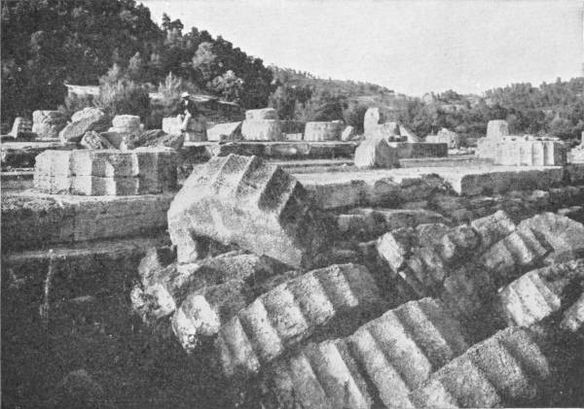
RUINS OF THE GREAT TEMPLE OF ZEUS AT OLYMPIA
Photo: Fred Boissonnas
And the same geographical conditions that kept the Greek states divided and various, kept them small. The largest states were smaller than many English counties, and it is doubtful if the population of any of their cities ever exceeded a third of a million. Few came up even to 50,000. There were unions of interest and sympathy but no coalescences. Cities made leagues and alliances as trade increased, and small cities put themselves under the protection of great ones. Yet all Greece was held together in a certain community of feeling by two things, by the epics and by the custom of taking part every fourth year in the athletic contests at Olympia. This did not prevent wars and feuds, but it mitigated something of the savagery of war between them, and a truce protected all travellers to and from the games. As time went on the sentiment of a common heritage grew and the number of states participating in the Olympic games increased until at last not only Greeks but competitors from the closely kindred countries of Epirus and Macedonia to the north were admitted.
The Greek cities grew in trade and importance, and the quality of their civilization rose steadily in the seventh and sixth centuries B.C. Their social life differed in many interesting points from the social life of the Ægean and river valley civilizations. They had splendid temples but the priesthood was not the great traditional body it was in the cities of the older world, the-repository of all knowledge, the storehouse of ideas. They had leaders and noble families, but no quasi- divine monarch surrounded by an elaborately organized court. Rather their organization was aristocratic, with leading families which kept each other in order. Even their so- called “democracies” were aristocratic; every citizen had a share in public affairs and came to the assembly in a democracy, but everybody was not a citizen. The Greek democracies were not like our modern “democracies” in which everyone has a vote. Many of the Greek democracies had a few hundred or a few thousand citizens and then many thousands of slaves, freedmen and so forth, with no share in public affairs. Generally in Greece affairs were in the hands of a community of substantial men. Their kings and their tyrants alike were just men set in front of other men or usurping a leadership; they were not quasi-divine overmen like Pharaoh or Minos or the monarchs of Mesopotamia. Both thought and government therefore had a freedom under Greek conditions such as they had known in none of the older civilizations. The Greeks had brought down into cities the individualism, the personal initiative of the wandering life of the northern parklands. They were the first republicans of importance in history.
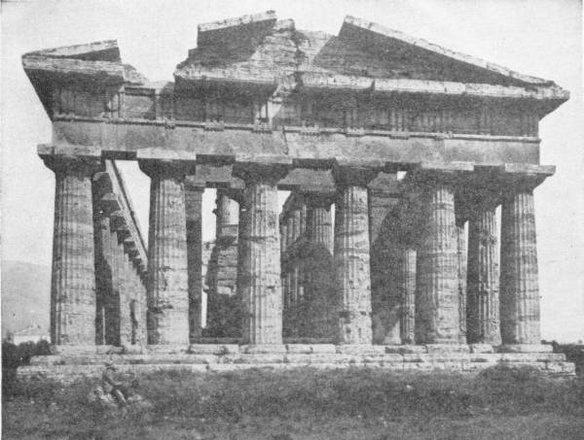
THE TEMPLE OF NEPTUNE (POSEIDON), PÆSTUM, SICILY
Photo: Alinari
And we find that as they emerge from a condition of barbaric warfare a new thing becomes apparent in their intellectual life. We find men who are not priests seeking and recording knowledge and enquiring into the mysteries of life and being, in a way that has hitherto been the sublime privilege of priesthood or the presumptuous amusement of kings. We find already in the sixth century B.C.—perhaps while Isaiah was still prophesying in Babylon—such men as Thales and Anaximander of Miletus and Heraclitus of Ephesus, who were what we should now call independent gentlemen, giving their minds to shrewd questionings of the world in which we live, asking what its real nature was, whence it came and what its destiny might be, and refusing all ready-made or evasive answers. Of these questionings of the universe by the Greek mind, we shall have more to say a little later in this history. These Greek enquirers who begin to be remarkable in the sixth century B.C. are the first philosophers, the first “wisdom-lovers,” in the world.
And it may be noted here how important a century this sixth century B.C. was in the history of humanity. For not only were these Greek philosophers beginning the research for clear ideas about this universe and man’s place in it and Isaiah carrying Jewish prophecy to its sublimest levels, but as we shall tell later Gautama Buddha was then teaching in India and Confucius and Lao Tse in China. From Athens to the Pacific the human mind was astir.
XXIV
THE WARS OF THE GREEKS AND PERSIANS
WHILE the Greeks in the cities in Greece, South Italy and Asia Minor were embarking upon free intellectual enquiry and while in Babylon and Jerusalem the last of the Hebrew prophets were creating a free conscience for mankind, two adventurous Aryan peoples, the Medes and the Persians, were in possession of the civilization of the ancient world and were making a great empire, the Persian empire, which was far larger in extent than any empire the world had seen hitherto. Under Cyrus, Babylon and the rich and ancient civilization of Lydia had been added to the Persian rule; the Phœnician cities of the Levant and all the Greek cities in Asia Minor had been made tributary, Cambyses had subjected Egypt, and Darius I, the Mede, the third of the Persian rulers (521 B.C.), found himself monarch as it seemed of all the world. His couriers rode with his decrees from the Dardanelles to the Indus and from Upper Egypt to Central Asia.
The Greeks in Europe, it is true, Italy, Carthage, Sicily and the Spanish Phœnician settlements, were not under the Persian Peace; but they treated it with respect and the only people who gave any serious trouble were the old parent hordes of Nordic people in South Russia and Central Asia, the Scythians, who raided the northern and north-eastern borders.
Of course the population of this great Persian empire was not a population of Persians, The Persians were only the small conquering minority of this enormous realm. The rest of the population was what it had been before the Persians came from time immemorial, only that Persian was the administrative language. Trade and finance were still largely Semitic, Tyre and Sidon as of old were the great Mediterranean ports and Semitic shipping plied upon the seas. But many of these Semitic merchants and business people as they went from place to place already found a sympathetic and convenient common history in the Hebrew tradition and the Hebrew scriptures. A new element which was increasing rapidly in this empire was the Greek element. The Greeks were becoming serious rivals to the Semites upon the sea, and their detached and vigorous intelligence made them useful and, unprejudiced officials.
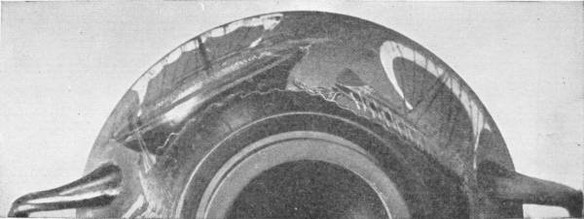
FINE PIECE OF ATHENIAN POTTERY
Showing Greek merchant vesselswith sails and oars statue on left
Brit. Mus.
It was on account of the Scythians that Darius I invaded Europe. He wanted to reach South Russia, the homeland of the Scythian horsemen. He crossed the Bosphorus with a great army and marched through Bulgaria to the Danube, crossed this by a bridge of boats and pushed far northward. His army suffered terribly. It was largely an infantry force and the mounted Scythians rode all round it, cut off its supplies, destroyed any stragglers and never came to a pitched battle. Darius was forced into an inglorious retreat.
He returned himself to Susa but he left an army in Thrace and Macedonia, and Macedonia submitted to Darius. Insurrections of the Greek cities in Asia followed this failure, and the European Greeks were drawn into the contest. Darius resolved upon the subjugation of the Greeks in Europe. With the Phœnician fleet at his disposal he was able to subdue one island after another, and finally in 490 B.C. he made his main attack upon Athens. A considerable Armada sailed from the ports of Asia Minor and the eastern Mediterranean, and the expedition landed its troops at Marathon to the north of Athens. There they were met and signally defeated by the Athenians.
An extraordinary thing happened at this time. The bitterest rival of Athens in Greece was Sparta, but now Athens appealed to Sparta, sending a herald, a swift runner, imploring the Spartans not to let Greeks become slaves to barbarians. This runner (the prototype of all “Marathon” runners) did over a hundred miles of broken country in less than two days. The Spartans responded promptly and generously; but when, in three days, the Spartan force reached Athens, there was nothing for it to do but to view the battlefield and the bodies of the defeated Persian soldiers. The Persian fleet had returned to Asia. So ended the first Persian attack on Greece.
The next was much more impressive. Darius died soon after the news of his defeat at Marathon reached him, and for four years his son and successor, Xerxes, prepared a host to crush the Greeks. For a time terror united all the Greeks. The army of Xerxes was certainly the greatest that had hitherto been assembled in the world. It was a huge assembly of discordant elements. It crossed the Dardanelles, 480 B.C., by a bridge of boats; and along the coast as it advanced moved an equally miscellaneous fleet carrying supplies. At the narrow pass of Thermopylæ a small force of 1400 men under the Spartan Leonidas resisted this multitude, and after a fight of unsurpassed heroism was completely destroyed. Every man was killed. But the losses they inflicted upon the Persians were enormous, and the army of Xerxes pushed on to Thebes and Athens in a chastened mood. Thebes surrendered and made terms. The Athenians abandoned their city and it was burnt.
Greece seemed in the hands of the conqueror, but again came victory against the odds and all expectations. The Greek fleet, though not a third the size of the Persian, assailed it in the bay of Salamis and destroyed it. Xerxes found himself and his immense army cut off from supplies and his heart failed him. He retreated to Asia with one half of his army, leaving the rest to be defeated at Platea (479 B.C.) what time the remnants of the Persian fleet were hunted down by the Greeks and destroyed at Mycalæ in Asia Minor.
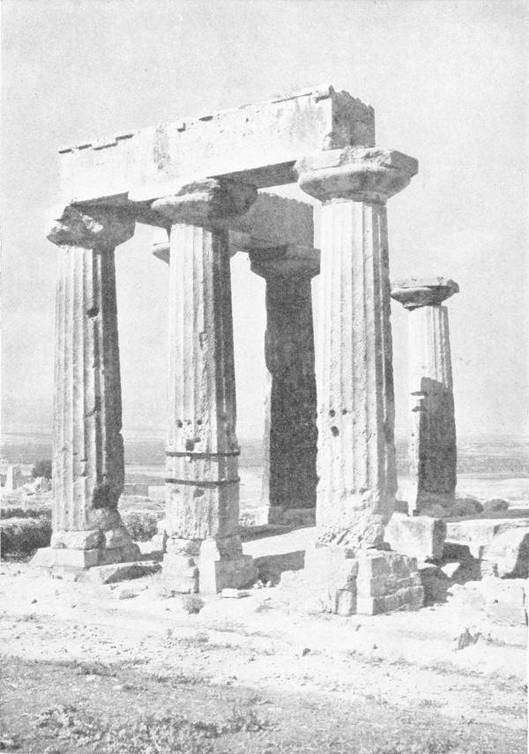
ALL THAT REMAINS OF THE GREAT TEMPLE OF CORINTH
Photo: Fred Boissonnas
The Persian danger was at an end. Most of the Greek cities in Asia became free. All this is told in great detail and with much picturesqueness in the first of written histories, the History of Herodotus. This Herodotus was born about 484 B.C. in the Ionian city of Halicarnassus in Asia Minor, and he visited Babylon and Egypt in his search for exact particulars. From Mycalæ onward Persia sank into a confusion of dynastic troubles. Xerxes was murdered in 465 B.C. and rebellions in Egypt, Syria and Media broke up the brief order of that mighty realm. The history of Herodotus lays stress on the weakness of Persia. This history is indeed what we should now call propaganda—propaganda for Greece to unite and conquer Persia. Herodotus makes one character, Aristagoras, go to the Spartans with a map of the known world and say to them: “These Barbarians are not valiant in fight. You on the other hand have now attained the utmost skill in war .... No other nations in the world have what they possess: gold, silver, bronze, embroidered garments, beasts and slaves. All this you might have for yourselves, if you so desired.”
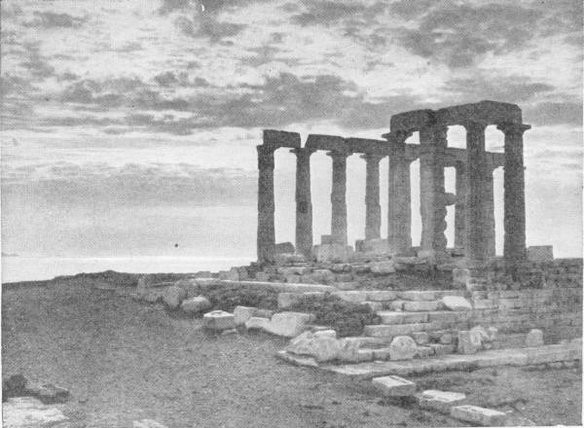
THE TEMPLE OF NEPTUNE (POSEIDON) AT CAPE SUNIUM
Photo: Fred Boissonnas
XXV
THE SPLENDOUR OF GREECE
THE century and a half that followed the defeat of Persia was one of very great splendour for the Greek civilization. True that Greece was torn by a desperate struggle for ascendancy between Athens, Sparta and other states (the Peloponnesian War 431 to 404 B.C.) and that in 338 B.C. the Macedonians became virtually masters of Greece; nevertheless during this period the thought and the creative and artistic impulse of the Greeks rose to levels that made their achievement a lamp to mankind for all the rest of history.
The head and centre of this mental activity was Athens. For over thirty years (466 to 428 B.C.) Athens was dominated by a man of great vigour and liberality of mind, Pericles, who set himself to rebuild the city from the ashes to which the Persians had reduced it. The beautiful ruins that still glorify Athens to-day are chiefly the remains of this great effort. And he did not simply rebuild a material Athens. He rebuilt Athens intellectually. He gathered about him not only architects and sculptors but poets, dramatists, philosophers and teachers. Herodotus came to Athens to recite his history (438 B.C.). Anaxagoras came with the beginnings of a scientific description of the sun and stars. Æschylus, Sophocles and Euripides one after the other carried the Greek drama to its highest levels or beauty and nobility.
The impetus Pericles gave to the intellectual life of Athens lived on after his death, and in spite of the fact that the peace of Greece was now broken by the Peloponnesian War and a long and wasteful struggle for “ascendancy” was beginning. Indeed the darkling of the political horizon seems for a time to have quickened rather than discouraged men’s minds.
Already long before the time of Pericles the peculiar freedom of Greek institutions had given great importance to skill in discussion. Decision rested neither with king nor with priest but in the assemblies of the people or of leading men. Eloquence and able argument became very desirable accomplishments therefore, and a class of teachers arose, the Sophists, who undertook to strengthen young men in these arts. But one cannot reason without matter, and knowledge followed in the wake of speech. The activities and rivalries of these Sophists led very naturally to an acute examination of style, of methods of thought and of the validity of arguments. When Pericles died a certain Socrates was becoming prominent as an able and destructive critic of bad argument—and much of the teaching of the Sophists was bad argument. A group of brilliant young men gathered about Socrates. In the end Socrates was executed for disturbing people’s minds (399 B.C.), he was condemned after the dignified fashion of the Athens of those days to drink in his own house and among his own friends a poisonous draught made from hemlock, but the disturbance of people’s minds went on in spite of his condemnation. His young men carried on his teaching.

PART OF THE FAMOUS FRIEZE OF THE PARTHENON, ATHENS
A specimen of Grecian sculpture in its finest expression. Compare the advance of art with that seen in the animals shown on p. 105
Photo: Fred Boissonnas
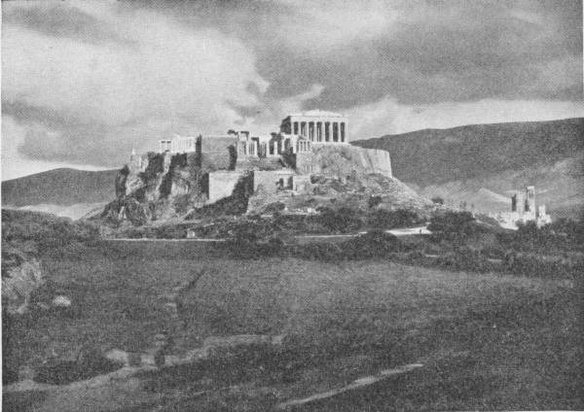
THE ACROPOLIS, ATHENS
The marvellous group of Temples and monuments built under the inspriration of Pericles
Photo: Fred Boissonnas
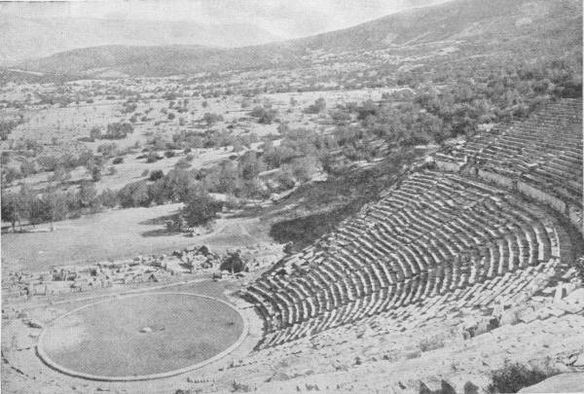
THE THEATRE AT EPIDAUROS, GREECE
A wonderfully preserved specimen showing the vast auditorium
Photo: Fred Boissonnas
Chief among these young men was Plato (427 to 347 B.C.) who presently began to teach philosophy in the grove of the Academy. His teaching fell into two main divisions, an examination of the foundations and methods of human thinking and an examination of political institutions. He was the first man to write a Utopia, that is to say the plan of a community different from and better than any existing community. This shows an altogether unprecedented boldness in the human mind which had hitherto accepted social traditions and usages with scarcely a question. Plato said plainly to mankind: “Most of the social and political ills from which you suffer are under your control, given only the will and courage to change them. You can live in another and a wiser fashion if you choose to think it out and work it out. You are not awake to your own power.” That is a high adventurous teaching that has still to soak in to the common intelligence of our race. One of his earliest works was the Republic, a dream of a communist aristocracy; his last unfinished work was the Laws, a scheme of regulation for another such Utopian state.
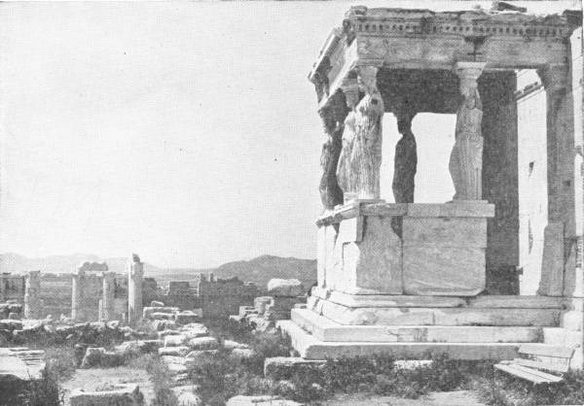
THE CARYATIDES OF THE ERECHTHEUM
The ancient sanctuary on the Acropolis at Athens
Photo: Fred Boissonnas
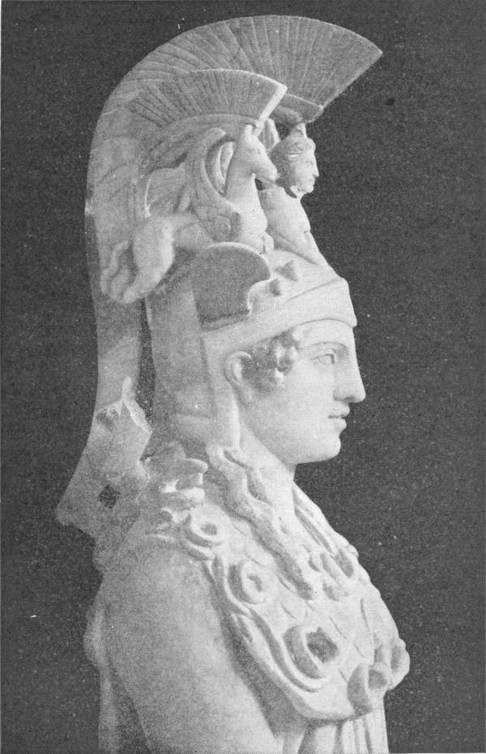
ATHENE OF THE PARTHENON
Photo: Alinart
The criticism of methods of thinking and methods of government was carried on after Plato’s death by Aristotle, who had been his pupil and who taught in the Lyceum. Aristotle came from the city of Stagira in Macedonia, and his father was court physician to the Macedonian king. For a time Aristotle was tutor to Alexander, the king’s son, who was destined to achieve very great things of which we shall soon be telling. Aristotle’s work upon methods of thinking carried the science of Logic to a level at which it remained for fifteen hundred years or more, until the mediæval schoolmen took up the ancient questions again. He made no Utopias. Before man could really control his destiny as Plato taught, Aristotle perceived that he needed far more knowledge and far more accurate knowledge than he possessed. And so Aristotle began that systematic collection of knowledge which nowadays we call Science. He sent out explorers to collect facts. He was the father of natural history. He was the founder of political science. His students at the Lyceum examined and compared the constitutions of 158 different states ....
Here in the fourth century B.C. we find men who are practically “modern thinkers.” The child-like, dream-like methods of primitive thought had given way to a disciplined and critical attack upon the problems of life. The weird and monstrous symbolism and imagery of the gods and god monsters, and all the taboos and awes and restraints that have hitherto encumbered thinking are here completely set aside. Free, exact and systematic thinking has begun. The fresh and unencumbered mind of these newcomers out of the northern forests has thrust itself into the mysteries of the temple and let the daylight in.
XXVI
THE EMPIRE OF ALEXANDER THE GREAT
FROM 431 to 404 B.C. the Peloponnesian War wasted Greece. Meanwhile to the north of Greece, the kindred country of Macedonia was rising slowly to power and civilization. The Macedonians spoke a language closely akin to Greek, and on several occasions Macedonian competitors had taken part in the Olympic games. In 359 B.C. a man of very great abilities and ambition became king of this little country—Philip. Philip had previously been a hostage in Greece; he had had a thoroughly Greek education and he was probably aware of the ideas of Herodotus—which had also been developed by the philosopher Isocrates—of a possible conquest of Asia by a consolidated Greece.
He set himself first to extend and organize his own realm and to remodel his army. For a thousand years now the charging horse-chariot had been the decisive factor in battles, that and the close-fighting infantry. Mounted horsemen had also fought, but as a cloud of skirmishers, individually and without discipline. Philip made his infantry fight in a closely packed mass, the Macedonian phalanx, and he trained his mounted gentlemen, the knights or companions, to fight in formation and so invented cavalry. The master move in most of his battles and in the battles of his son Alexander was a cavalry charge. The phalanx held the enemy infantry in front while the cavalry swept away the enemy horse on his wings and poured in on the flank and rear of his infantry. Chariots were disabled by bowmen, who shot the horses.
With this new army Philip extended his frontiers through Thessaly to Greece; and the battle of Chæronia (338 B.C.), fought against Athens and her allies, put all Greece at his feet. At last the dream of Herodotus was bearing fruit. A congress of all the Greek states appointed Philip captain-general of the Græco- Macedonian confederacy against Persia, and in 336 B.C. his advanced guard crossed into Asia upon this long premeditated adventure. But he never followed it. He was assassinated; it is believed at the instigation of his queen Olympias, Alexander’s mother. She was jealous because Philip had married a second wife.
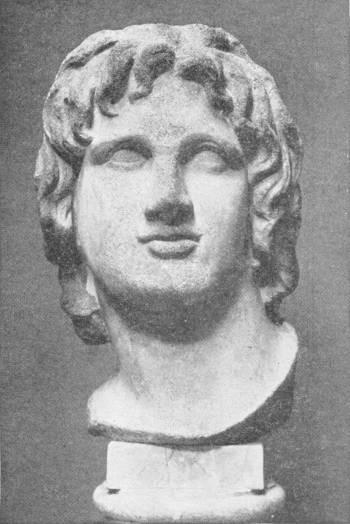
BUST OF ALEXANDER THE GREAT
(As in the British Museum)
But Philip had taken unusual pains with his son’s education. He had not only secured Aristotle, the greatest philosopher in the world, as this boy’s tutor, but he had shared his ideas with him and thrust military experience upon him. At Chæronia Alexander, who was then only eighteen years old, had been in command of the cavalry. And so it was possible for this young man, who was still only twenty years old at the time of his accession, to take up his father’s task at once and to proceed successfully with the Persian adventure.
In 334 B.C.—for two years were needed to establish and confirm his position in Macedonia and Greece—he crossed into Asia, defeated a not very much bigger Persian army at the battle of the Granicus and captured a number of cities in Asia Minor. He kept along the sea-coast. It was necessary for him to reduce and garrison all the coast towns as he advanced because the Persians had control of the fleets of Tyre and Sidon and so had command of the sea. Had he left a hostile port in his rear the Persians might have landed forces to raid his communications and cut him off. At Issus (333 B.C.) he met and smashed a vast conglomerate host under Darius III. Like the host of Xerxes that had crossed the Dardanelles a century and a half before, it was an incoherent accumulation of contingents and it was encumbered with a multitude of court officials, the harem of Darius and many camp followers. Sidon surrendered to Alexander but Tyre resisted obstinately. Finally that great city was stormed and plundered and destroyed. Gaza also was stormed, and towards the end of 332 B.C. the conqueror entered Egypt and took over its rule from the Persians.
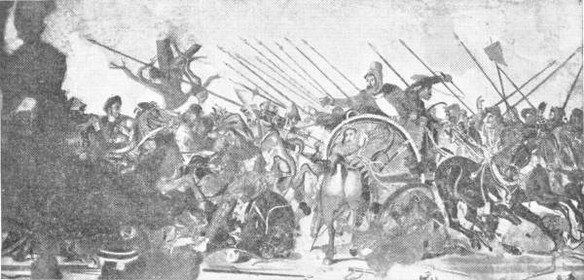
ALEXANDER’S VICTORY OVER THE PERSIANS AT ISSUS
(From the Pompeian Mosaic)
Alexander charges in on the left, Darius is in the chariot to the right
At Alexandretta and at Alexandria in Egypt he built great cities, accessible from the land and so incapable of revolt. To these the trade of the Phœnician cities was diverted. The Phœnicians of the western Mediterranean suddenly disappear from history—and as immediately the Jews of Alexandria and the other new trading cities created by Alexander appear.
In 331 B.C. Alexander marched out of Egypt upon Babylon as Thothmes and Rameses and Necho had done before him. But he marched by way of Tyre. At Arbela near the ruins of Nineveh, which was already a forgotten city, he met Darius and fought the decisive battle of the war. The Persian chariot charge failed, a Macedonian cavalry charge broke up the great composite host and the phalanx completed the victory. Darius led the retreat. He made no further attempt to resist the invader but fled northward into the country of the Medes. Alexander marched on to Babylon, still prosperous and important, and then to Susa and Persepolis. There after a drunken festival he burnt down the palace of Darius, the king of kings.
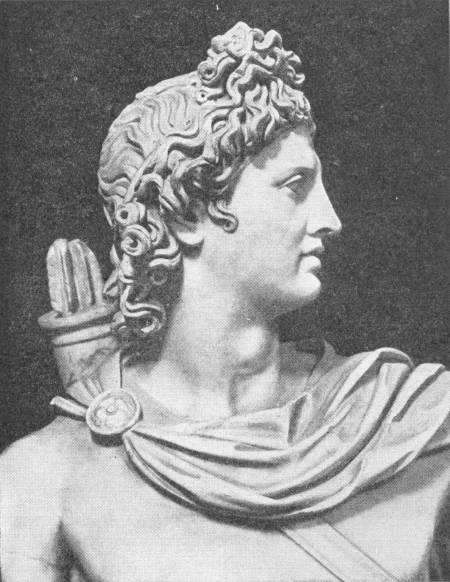
THE APOLLO BELVEDERE
(In the Vatican Museum)
Thence Alexander presently made a military parade of central Asia, going to the utmost bounds of the Persian empire. At first he turned northward. Darius was pursued; and he was overtaken at dawn dying in his chariot, having been murdered by his own people. He was still living when the foremost Greeks reached him. Alexander came up to find him dead. Alexander skirted the Caspian Sea, he went up into the mountains of western Turkestan, he came down by Herat (which he founded) and Cabul and the Khyber Pass into India. He fought a great battle on the Indus with an Indian king, Porus, and here the Macedonian troops met elephants for the first time and defeated them. Finally he built himself ships, sailed down to the mouth of the Indus, and marched back by the coast of Beluchistan, reaching Susa again in 324 B.C. after an absence of six years. He then prepared to consolidate and organize this vast empire he had won. He sought to win over his new subjects. He assumed the robes and tiara of a Persian monarch, and this roused the jealousy of his Macedonian commanders. He had much trouble with them. He arranged a number of marriages between these Macedonian officers and Persian and Babylonian women: the “Marriage of the East and West.” He never lived to effect the consolidation he had planned. A fever seized him after a drinking bout in Babylon and he died in 323 B.C.
Immediately this vast dominion fell to pieces. One of his generals, Seleucus, retained most of the old Persian empire from the Indus to Ephesus; another, Ptolemy, seized Egypt, and Antigonus secured Macedonia. The rest of the empire remained unstable, passing under the control of a succession of local adventurers. Barbarian raids began from the north and grew in scope and intensity. Until at last, as we shall tell, a new power, the power of the Roman republic, came out of the west to subjugate one fragment after another and weld them together into a new and more enduring empire.
XXVII
THE MUSEUM AND LIBRARY AT ALEXANDRIA
BEFORE the time of Alexander Greeks had already been spreading as merchants, artists, officials, mercenary soldiers, over most of the Persian dominions. In the dynastic disputes that followed the death of Xerxes, a band of ten thousand Greek mercenaries played a part under the leadership of Xenophon. Their return to Asiatic Greece from Babylon is described in his Retreat of the Ten Thousand, one of the first war stories that was ever written by a general in command. But the conquests of Alexander and the division of his brief empire among his subordinate generals, greatly stimulated this permeation of the ancient world by the Greeks and their language and fashions and culture. Traces of this Greek dissemination are to be found far away in central Asia and in north-west India. Their influence upon the development of Indian art was profound.
For many centuries Athens retained her prestige as a centre of art and culture; her schools went on indeed to 529 A.D., that is to say for nearly a thousand years; but the leadership in the intellectual activity of the world passed presently across the Mediterranean to Alexandria, the new trading city that Alexander had founded. Here the Macedonian general Ptolemy had become Pharaoh, with a court that spoke Greek. He had become an intimate of Alexander before he became king, and he was deeply saturated with the ideas of Aristotle. He set himself, with great energy and capacity, to organize knowledge and investigation. He also wrote a history of Alexander’s campaigns which, unhappily, is lost to the world.
Alexander had already devoted considerable sums to finance the enquiries of Aristotle, but Ptolemy I was the first person to make a permanent endowment of science. He set up a foundation in Alexandria which was formerly dedicated to the Muses, the Museum of Alexandria. For two or three generations the scientific work done at Alexandria was extraordinarily good. Euclid, Eratosthenes who measured the size of the earth and came within fifty miles of its true diameter, Apollonius who wrote on conic sections, Hipparchus who made the first star map and catalogue, and Hero who devised the first steam engine are among the greater stars of an extraordinary constellation of scientific pioneers. Archimedes came from Syracuse to Alexandria to study, and was a frequent correspondent of the Museum. Herophilus was one of the greatest of Greek anatomists, and is said to have practised vivisection.
For a generation or so during the reigns of Ptolemy I and Ptolemy II there was such a blaze of knowledge and discovery at Alexandria as the world was not to see again until the sixteenth century A.D. But it did not continue. There may have been several causes of this decline. Chief among them, the late Professor Mahaffy suggested, was the fact that the Museum was a “royal” college and all its professors and fellows were appointed and paid by Pharaoh. This was all very well when Pharaoh was Ptolemy I, the pupil and friend of Aristotle. But as the dynasty of the Ptolemies went on they became Egyptianized, they fell under the sway of Egyptian priests and Egyptian religious developments, they ceased to follow the work that was done, and their control stifled the spirit of enquiry altogether. The Museum produced little good work after its first century of activity.
Ptolemy I not only sought in the most modern spirit to organize the finding of fresh knowledge. He tried also to set up an encyclopædic storehouse of wisdom in the Library of Alexandria. It was not simply a storehouse, it was also a book-copying and book-selling organization. A great army of copyists was set to work perpetually multiplying copies of books.
Here then we have the definite first opening up of the intellectual process in which we live to-day; here we have the systematic gathering and distribution of knowledge. The foundation of this Museum and Library marks one of the great epochs in the history of mankind. It is the true beginning of Modern History.
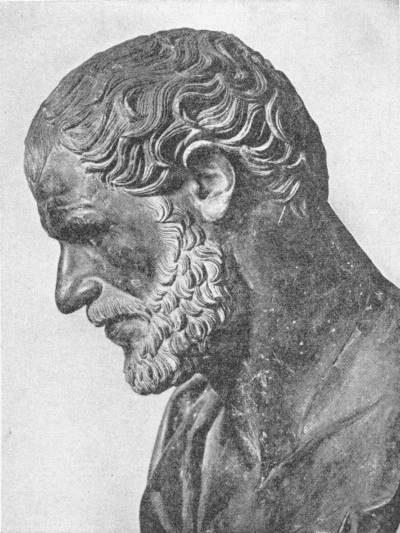
ARISTOTLE
From Herculaneum, probably Fourth Century B.C.
Photo: Dr. Singer
Both the work of research and the work of dissemination went on under serious handicaps. One of these was the great social gap that separated the philosopher, who was a gentleman, from the trader and the artisan. There were glass workers and metal workers in abundance in those days, but they were not in mental contact with the thinkers. The glass worker was making the most beautifully coloured beads and phials and so forth, but he never made a Florentine flask or a lens. Clear glass does not seem to have interested him. The metal worker made weapons and jewellery but he never made a chemical balance. The philosopher speculated loftily about atoms and the nature of things, but he had no practical experience of enamels and pigments and philters and so forth. He was not interested in substances. So Alexandria in its brief day of opportunity produced no microscopes and no chemistry. And though Hero invented a steam engine it was never set either to pump or drive a boat or do any useful thing. There were few practical applications of science except in the realm of medicine, and the progress of science was not stimulated and sustained by the interest and excitement of practical applications. There was nothing to keep the work going therefore when the intellectual curiosity of Ptolemy I and Ptolemy II was withdrawn. The discoveries of the Museum went on record in obscure manuscripts and never, until the revival of scientific curiosity at the Renascence, reached out to the mass of mankind.
Nor did the Library produce any improvements in book making. That ancient world had no paper made in definite sizes from rag pulp. Paper was a Chinese invention and it did not reach the western world until the ninth century A.D. The only book materials were parchment and strips of the papyrus reed joined edge to edge. These strips were kept on rolls which were very unwieldy to wind to and fro and read, and very inconvenient for reference. It was these things that prevented the development of paged and printed books. Printing itself was known in the world it would seem as early as the Old Stone Age; there were seals in ancient Sumeria; but without abundant paper there was little advantage in printing books, an improvement that may further have been resisted by trades unionism on the part of the copyists employed. Alexandria produced abundant books but not cheap books, and it never spread knowledge into the population of the ancient world below the level of a wealthy and influential class.
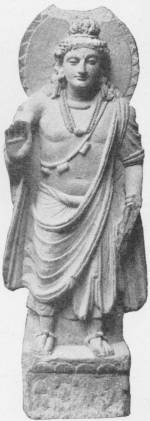
STATUETTE OF MAITREYA: THE BUDDHA TO COME
A Græco-Buddhist sculpture of the Third Century A.D.
(From Malakand, N. W. Province, now in the India Museum)
So it was that this blaze of intellectual enterprise never reached beyond a small circle of people in touch with the group of philosophers collected by the first two Ptolemies. It was like the light in a dark lantern which is shut off from the world at large. Within the blaze may be blindingly bright, but nevertheless it is unseen. The rest of the world went on its old ways unaware that the seed of scientific knowledge that was one day to revolutionize it altogether had been sown. Presently a darkness of bigotry fell even upon Alexandria. Thereafter for a thousand years of darkness the seed that Aristotle had sown lay hidden. Then it stirred and began to germinate. In a few centuries it had become that widespread growth of knowledge and clear ideas that is now changing the whole of human life.
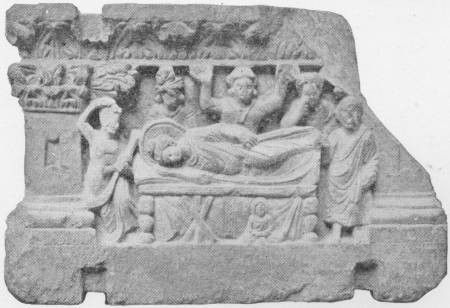
THE DEATH OF BUDDHA
Græco-Buddhist carving from Sivat Valley, N. W. Province, probably A.D. 350
India Mus.
Alexandria was not the only centre of Greek intellectual activity in the third century B.C. There were many other cities that displayed a brilliant intellectual life amidst the disintegrating fragments of the brief empire of Alexander. There was, for example, the Greek city of Syracuse in Sicily, where thought and science flourished for two centuries; there was Pergamum in Asia Minor, which also had a great library. But this brilliant Hellenic world was now stricken by invasion from the north. New Nordic barbarians, the Gauls, were striking down along the tracks that had once been followed by the ancestors of the Greeks and Phrygians and Macedonians. They raided, shattered and destroyed. And in the wake of the Gauls came a new conquering people out of Italy, the Romans, who gradually subjugated all the western half of the vast realm of Darius and Alexander. They were an able but unimaginative people, preferring law and profit to either science or art. New invaders were also coming down out of central Asia to shatter and subdue the Seleucid empire and to cut off the western world again from India. These were the Parthians, hosts of mounted bowmen, who treated the Græco-Persian empire of Persepolis and Susa in the third century B.C. in much the same fashion that the Medes and Persians had treated it in the seventh and sixth. And there were now other nomadic peoples also coming out of the northeast, peoples who were not fair and Nordic and Aryan- speaking but yellow-skinned and black-haired and with a Mongolian speech. But of these latter people we shall tell more in a subsequent chapter.
XXVIII
THE LIFE OF GAUTAMA BUDDHA
BUT now we must go back three centuries in our story to tell of a great teacher who came near to revolutionizing the religious thought and feeling of all Asia. This was Gautama Buddha, who taught his disciples at Benares in India about the same time that Isaiah was prophesying among the Jews in Babylon and Heraclitus was carrying on his speculative enquiries into the nature of things at Ephesus. All these men were in the world at the same time, in the sixth century B.C.—unaware of one another.
This sixth century B.C. was indeed one of the most remarkable in all history. Everywhere—for as we shall tell it was also the case in China—men’s minds were displaying a new boldness. Everywhere they were waking up out of the traditions of kingships and priests and blood sacrifices and asking the most penetrating questions. It is as if the race had reached a stage of adolescence—after a childhood of twenty thousand years.
The early history of India is still very obscure. Somewhen perhaps about 2000 B.C., an Aryan- speaking people came down from the north-west into India either in one invasion or in a series of invasions; and was able to spread its language and traditions over most of north India. Its peculiar variety of Aryan speech was the Sanskrit. They found a brunette people with a more elaborate civilization and less vigour of will, in possession of the country of the Indus and Ganges. But they do not seem to have mingled with their predecessors as freely as did the Greeks and Persians. They remained aloof. When the past of India becomes dimly visible to the historian, Indian society is already stratified into several layers, with a variable number of sub-divisions, which do not eat together nor intermarry nor associate freely. And throughout history this stratification into castes continues. This makes the Indian population something different from the simple, freely inter-breeding European or Mongolian communities. It is really a community of communities.
Siddhattha Gautama was the son of an aristocratic family which ruled a small district on the Himalayan slopes. He was married at nineteen to a beautiful cousin. He hunted and played and went about in his sunny world of gardens and groves and irrigated rice-fields. And it was amidst this life that a great discontent fell upon him. It was the unhappiness of a fine brain that seeks employment. He felt that the existence he was leading was not the reality of life, but a holiday—a holiday that had gone on too long.
The sense of disease and mortality, the insecurity and the un-satisfactoriness of all happiness, descended upon the mind of Gautama. While he was in this mood he met one of those wandering ascetics who already existed in great numbers in India. These men lived under severe rules, spending much time in meditation and in religious discussion. They were supposed to be seeking some deeper reality in life, and a passionate desire to do likewise took possession of Gautama.
He was meditating upon this project, says the story, when the news was brought to him that his wife had been delivered of his first-born son. “This is another tie to break,” said Gautama.
He returned to the village amidst the rejoicings of his fellow clansmen. There was a great feast and a Nautch dance to celebrate the birth of this new tie, and in the night Gautama awoke in a great agony of spirit, “like a man who is told that his house is on fire.” He resolved to leave his happy aimless life forthwith. He went softly to the threshold of his wife’s chamber, and saw her by the light of a little oil lamp, sleeping sweetly, surrounded by flowers, with his infant son in her arms. He felt a great craving to take up the child in one first and last embrace before he departed, but the fear of waking his wife prevented him, and at last he turned away and went out into the bright Indian moonshine and mounted his horse and rode off into the world.
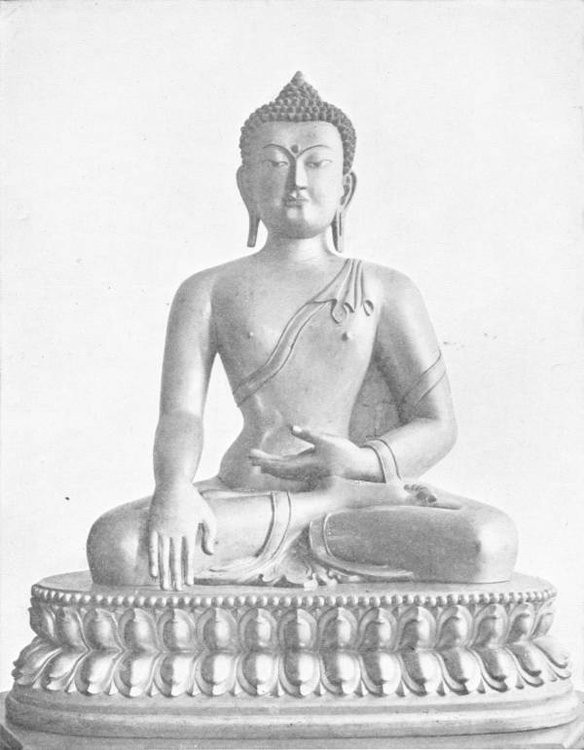
TIBETAN BUDDHA
Gilt Brass Casting in India Museum, showing Gautama Buddha in the “earth witness” attitude
India Mus.
Very far he rode that night, and in the morning he stopped outside the lands of his clan, and dismounted beside a sandy river. There he cut off his flowing locks with his sword, removed all his ornaments and sent them and his horse and sword back to his house. Going on he presently met a ragged man and exchanged clothes with him, and so having divested himself of all worldly entanglements he was free to pursue his search after wisdom. He made his way southward to a resort of hermits and teachers in a hilly spur of the Vindhya Mountains. There lived a number of wise men in a warren of caves, going into the town for their simple supplies and imparting their knowledge by word of mouth to such as cared to come to them. Gautama became versed in all the metaphysics of his age. But his acute intelligence was dissatisfied with the solutions offered him.
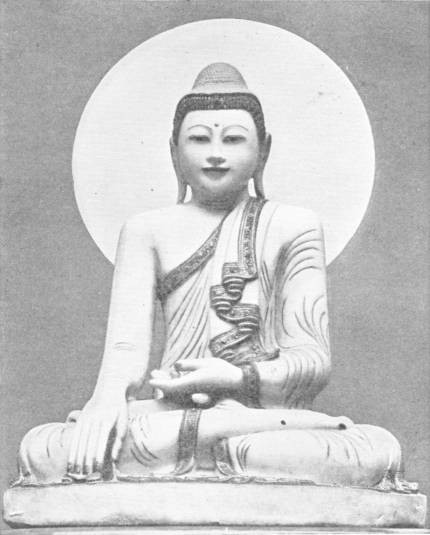
A BURMESE BUDDHA
Marble Figure from Mandalay, eighteenth century work, now in the India Museum
The Indian mind has always been disposed to believe that power and knowledge may be obtained by extreme asceticism, by fasting, sleeplessness, and self-torment, and these ideas Gautama now put to the test. He betook himself with five disciple companions to the jungle and there he gave himself up to fasting and terrible penances. His fame spread, “like the sound of a great bell hung in the canopy of the skies.” But it brought him no sense of truth achieved. One day he was walking up and down, trying to think in spite of his enfeebled state. Suddenly he fell unconscious. When he recovered, the preposterousness of these semi-magical ways to wisdom was plain to him.
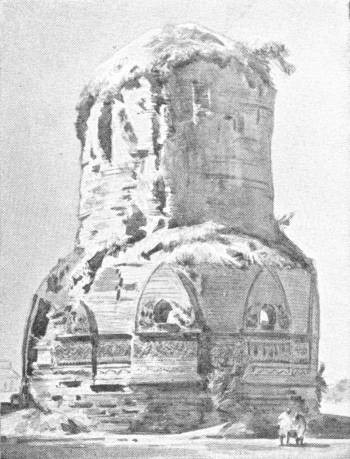
THE DHAMÊKH TOWER
In the Deer Park at Sarnath. Sixth Century A.D.
(From a Painting in the India Museum)
He horrified his companions by demanding ordinary food and refusing to continue his mortifications. He had realized that whatever truth a man may reach is reached best by a nourished brain in a healthy body. Such a conception was absolutely foreign to the ideas of the land and age. His disciples deserted him, and went off in a melancholy state to Benares. Gautama wandered alone.
When the mind grapples with a great and intricate problem, it makes its advances step by step, with but little realization of the gains it has made, until suddenly, with an effect of abrupt illumination, it realizes its victory. So it happened to Gautama. He had seated himself under a great tree by the side of a river to eat, when this sense of clear vision came to him. It seemed to him that he saw life plain. He is said to have sat all day and all night in profound thought, and then he rose up to impart his vision to the world.
He went on to Benares and there he sought out and won back his lost disciples to his new teaching. In the King’s Deer Park at Benares they built themselves huts and set up a sort of school to which came many who were seeking after wisdom.
The starting point of his teaching was his own question as a fortunate young man, “Why am I not completely happy?” It was an introspective question. It was a question very different in quality from the frank and self-forgetful externalized curiosity with which Thales and Heraclitus were attacking the problems of the universe, or the equally self-forgetful burthen of moral obligation that the culminating prophets were imposing upon the Hebrew mind. The Indian teacher did not forget self, he concentrated upon self and sought to destroy it. All suffering, he taught, was due to the greedy desires of the individual. Until man has conquered his personal cravings his life is trouble and his end sorrow. There were three principal forms that the craving for life took and they were all evil. The first was the desire of the appetites, greed and all forms of sensuousness, the second was the desire for a personal and egotistic immortality, the third was the craving for personal success, worldliness, avarice and the like. All these forms of desire had to be overcome to escape from the distresses and chagrins of life. When they were overcome, when self had vanished altogether, then serenity of soul, Nirvana, the highest good was attained.
This was the gist of his teaching, a very subtle and metaphysical teaching indeed, not nearly so easy to understand as the Greek injunction to see and know fearlessly and rightly and the Hebrew command to fear God and accomplish righteousness. It was a teaching much beyond the understanding of even Gautama’s immediate disciples, and it is no wonder that so soon as his personal influence was withdrawn it became corrupted and coarsened. There was a widespread belief in India at that time that at long intervals Wisdom came to earth and was incarnate in some chosen person who was known as the Buddha. Gautama’s disciples declared that he was a Buddha, the latest of the Buddhas, though there is no evidence that he himself ever accepted the title. Before he was well dead, a cycle of fantastic legends began to be woven about him. The human heart has always preferred a wonder story to a moral effort, and Gautama Buddha became very wonderful.
Yet there remained a substantial gain in the world. If Nirvana was too high and subtle for most men’s imaginations, if the myth-making impulse in the race was too strong for the simple facts of Gautama’s life, they could at least grasp something of the intention of what Gautama called the Eight-fold way, the Aryan or Noble Path in life. In this there was an insistence upon mental uprightness, upon right aims and speech, right conduct and honest livelihood. There was a quickening of the conscience and an appeal to generous and self-forgetful ends.
XXIX
KING ASOKA
FOR some generations after the death of Gautama, these high and noble Buddhist teachings, this first plain teaching that the highest good for man is the subjugation of self, made comparatively little headway in the world. Then they conquered the imagination of one of the greatest monarchs the world has ever seen.
We have already mentioned how Alexander the Great came down into India and fought with Porus upon the Indus. It is related by the Greek historians that a certain Chandragupta Maurya came into Alexander’s camp and tried to persuade him to go on to the Ganges and conquer all India. Alexander could not do this because of the refusal of his Macedonians to go further into what was for them an unknown world, and later on (303 B.C.) Chandragupta was able to secure the help or various hill tribes and realize his dream without Greek help. He built up an empire in North India and was presently (303 B.C.) able to attack Seleucus I in the Punjab and drive the last vestige of Greek power out of India. His son extended this new empire. His grandson, Asoka, the monarch of whom we now have to tell, found himself in 264 B.C. ruling from Afghanistan to Madras.
Asoka was at first disposed to follow the example of his father and grandfather and complete the conquest of the Indian peninsula. He invaded Kalinga (255 B.C.), a country on the east coast of Madras, he was successful in his military operations and—alone among conquerors—he was so disgusted by the cruelty and horror of war that he renounced it. He would have no more of it. He adopted the peaceful doctrines of Buddhism and declared that henceforth his conquests should be the conquests of religion.
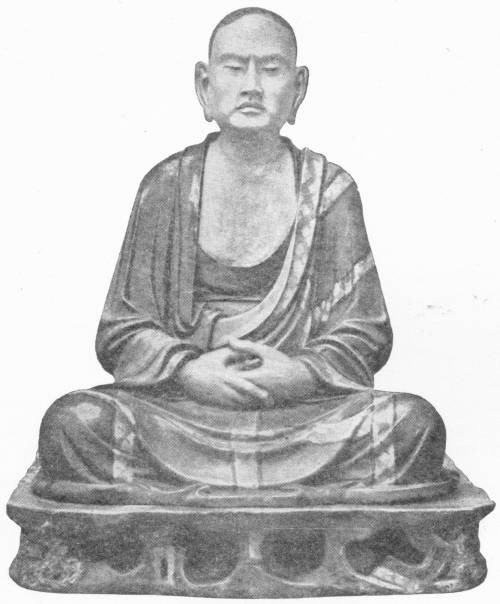
A LOHAN OR BUDDHIST APOSTLE (Tang Dynasty)
(From the statue in the British Museum)
His reign for eight-and-twenty years was one of the brightest interludes in the troubled history of mankind. He organized a great digging of wells in India and the planting of trees for shade. He founded hospitals and public gardens and gardens for the growing of medicinal herbs. He created a ministry for the care of the aborigines and subject races of India. He made provision for the education of women. He made vast benefactions to the Buddhist teaching orders, and tried to stimulate them to a better and more energetic criticism of their own accumulated literature. For corruptions and superstitious accretions had accumulated very speedily upon the pure and simple teaching of the great Indian master. Missionaries went from Asoka to Kashmir, to Persia, to Ceylon and Alexandria.
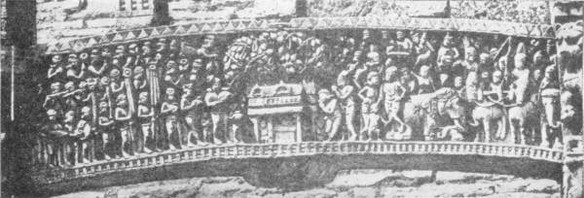
TRANSOME SHOWING THE COURT OF ASOKA
India Mus.
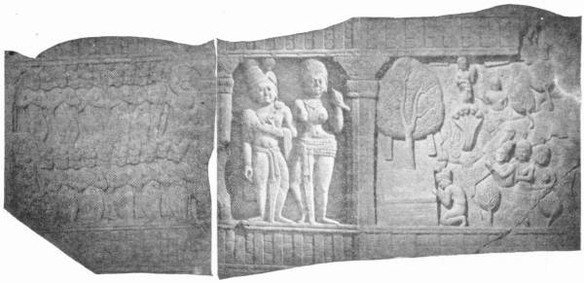
ASOKA PANEL FROM BHARHUT
India Mus.
Such was Asoka, greatest of kings. He was far in advance of his age. He left no prince and no organization of men to carry on his work, and within a century of his death the great days of his reign had become a glorious memory in a shattered and decaying India. The priestly caste of the Brahmins, the highest and most privileged caste in the Indian social body, has always been opposed to the frank and open teaching of Buddha. Gradually they undermined the Buddhist influence in the land. The old monstrous gods, the innumerable cults of Hinduism, resumed their sway. Caste became more rigorous and complicated. For long centuries Buddhism and Brahminism flourished side by side, and then slowly Buddhism decayed and Brahminism in a multitude of forms replaced it. But beyond the confines of India and the realms of caste Buddhism spread—until it had won China and Siam and Burma and Japan, countries in which it is predominant to this day.
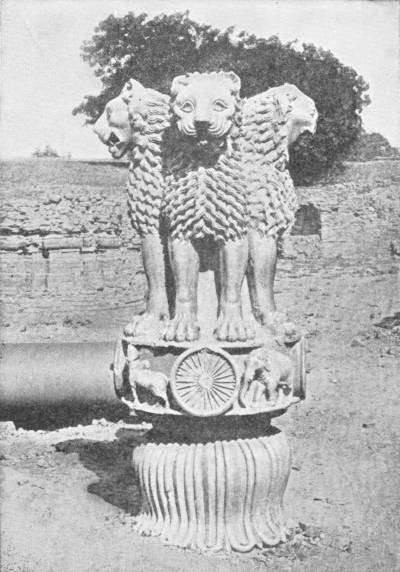
THE PILLAR OF LIONS
Capital of the Pillar (column lying on side) erected in Deer Park in the time of Asoka, where Buddha preached his first sermon
(From a print in the India Museum)
XXX
CONFUCIUS AND LAO TSE
WE have still to tell of two other great men, Confucius and Lao Tse, who lived in that wonderful century which began the adolescence of mankind, the sixth century B.C. In this history thus far we have told very little of the early story of China. At present that early history is still very obscure, and we look to Chinese explorers and archæolologists in the new China that is now arising to work out their past as thoroughly as the European past has been worked out during the last century. Very long ago the first primitive Chinese civilizations arose in the great river valleys out of the primordial heliolithic culture. They had, like Egypt and Sumeria, the general characteristics of that culture, and they centred upon temples in which priests and priest kings offered the seasonal blood sacrifices. The life in those cities must have been very like the Egyptian and Sumerian life of six or seven thousand years ago and very like the Maya life of Central America a thousand years ago.
If there were human sacrifices they had long given way to animal sacrifices before the dawn of history. And a form of picture writing was growing up long before a thousand years B.C.
And just as the primitive civilizations of Europe and western Asia were in conflict with the nomads of the desert and the nomads of the north, so the primitive Chinese civilizations had a great cloud of nomadic peoples on their northern borders. There was a number of tribes akin in language and ways of living, who are spoken of in history in succession as the Huns, the Mongols, the Turks and Tartars. They changed and divided and combined and re-combined, just as the Nordic peoples in north Europe and central Asia changed and varied in name rather than in nature. These Mongolian nomads had horses earlier than the Nordic peoples, and it may be that in the region of the Altai Mountains they made an independent discovery of iron somewhen after 1000 B.C. And just as in the western case so ever and again these eastern nomads would achieve a sort of political unity, and become the conquerors and masters and revivers of this or that settled and civilized region.
It is quite possible that the earliest civilization of China was not Mongolian at all any more than the earliest civilization of Europe and western Asia was Nordic or Semitic. It is quite possible that the earliest civilization of China was a brunette civilization and of a piece with the earliest Egyptian, Sumerian and Dravidian civilizations, and that when the first recorded history of China began there had already been conquests and intermixture. At any rate we find that by 1750 B.C. China was already a vast system of little kingdoms and city states, all acknowledging a loose allegiance and paying more or less regularly, more or less definite feudal dues to one great priest emperor, the “Son of Heaven.” The “Shang” dynasty came to an end in 1125 B.C. A “Chow” dynasty succeeded “Shang,” and maintained China in a relaxing unity until the days of Asoka in India and of the Ptolemies in Egypt. Gradually China went to pieces during that long “Chow” period. Hunnish peoples came down and set up principalities; local rulers discontinued their tribute and became independent. There was in the sixth century B.C., says one Chinese authority, five or six thousand practically independent states in China. It was what the Chinese call in their records an “Age of Confusion.”
But this Age of Confusion was compatible with much intellectual activity and with the existence of many local centres of art and civilized living. When we know more of Chinese history we shall find that China also had her Miletus and her Athens, her Pergamum and her Macedonia. At present we must be vague and brief about this period of Chinese division simply because our knowledge is not sufficient for us to frame a coherent and consecutive story.
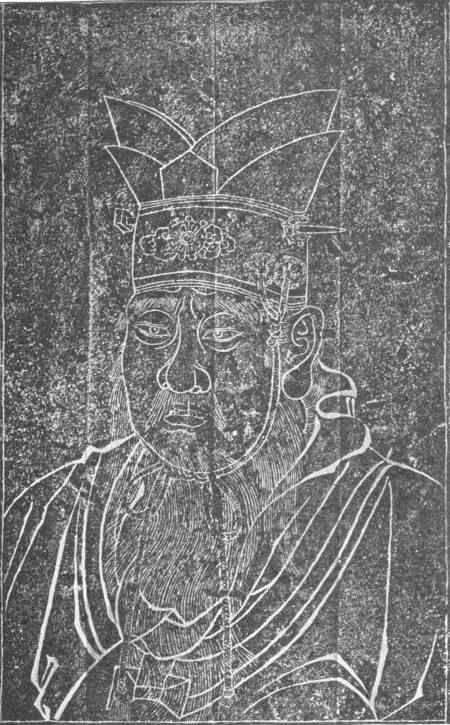
CONFUCIUS
Copy of stone carving in the Temple of Confucius at K’iu Fu
(From the records of the Archæological Mission to North China (Chavannes))
And just as in divided Greece there were philosophers and in shattered and captive Jewry prophets, so in disordered China there were philosophers and teachers at this time. In all these cases insecurity and uncertainty seemed to have quickened the better sort of mind. Confucius was a man of aristocratic origin and some official importance in a small state called Lu. Here in a very parallel mood to the Greek impulse he set up a sort of Academy for discovering and teaching Wisdom. The lawlessness and disorder of China distressed him profoundly. He conceived an ideal of a better government and a better life, and travelled from state to state seeking a prince who would carry out his legislative and educational ideas. He never found his prince; he found a prince, but court intrigues undermined the influence of the teacher and finally defeated his reforming proposals. It is interesting to note that a century and a half later the Greek philosopher Plato also sought a prince, and was for a time adviser to the tyrant Dionysius who ruled Syracuse in Sicily.
Confucius died a disappointed man. “No intelligent ruler arises to take me as his master,” he said, “and my time has come to die.” But his teaching had more vitality than he imagined in his declining and hopeless years, and it became a great formative influence with the Chinese people. It became one of what the Chinese call the Three Teachings, the other two being those of Buddha and of Lao Tse.
The gist of the teaching of Confucius was the way of the noble or aristocratic man. He was concerned with personal conduct as much as Gautama was concerned with the peace of self-forgetfulness and the Greek with external knowledge and the Jew with righteousness. He was the most public-minded of all great teachers. He was supremely concerned by the confusion and miseries of the world, and he wanted to make men noble in order to bring about a noble world. He sought to regulate conduct to an extraordinary extent; to provide sound rules for every occasion in life. A polite, public- spirited gentleman, rather sternly self-disciplined, was the ideal he found already developing in the northern Chinese world and one to which he gave a permanent form.
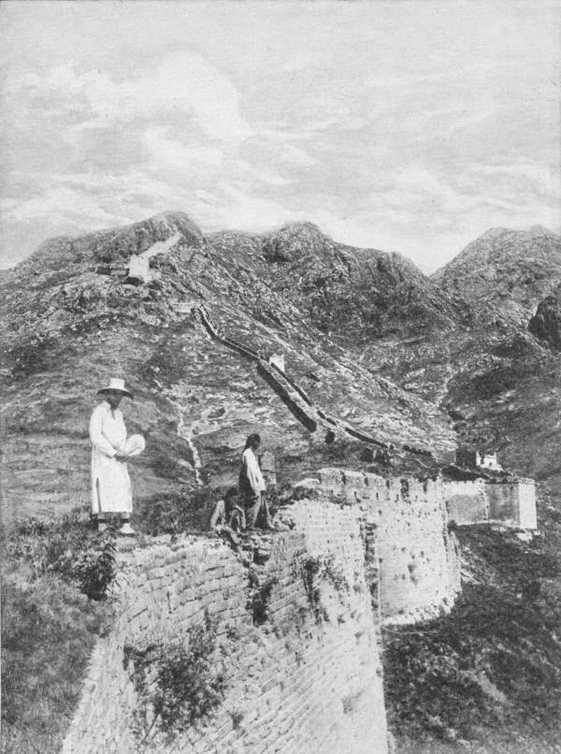
THE GREAT WALL OF CHINA
As it crosses the mountains in Manchuria
Photo: Underwood & Underwood
The teaching of Lao Tse, who was for a long time in charge of the imperial library of the Chow dynasty, was much more mystical and vague and elusive than that of Confucius. He seems to have preached a stoical indifference to the pleasures and powers of the world and a return to an imaginary simple life of the past. He left writings very contracted in style and very obscure. He wrote in riddles. After his death his teachings, like the teachings of Gautama Buddha, were corrupted and overlaid by legends and had the most complex and extraordinary observances and superstitious ideas grafted upon them. In China just as in India primordial ideas of magic and monstrous legends out of the childish past of our race struggled against the new thinking in the world and succeeded in plastering it over with grotesque, irrational and antiquated observances. Both Buddhism and Taoism (which ascribes itself largely to Lao Tse) as one finds them in China now, are religions of monk, temple, priest and offering of a type as ancient in form, if not in thought, as the sacrificial religions of ancient Sumeria and Egypt. But the teaching of Confucius was not so overlaid because it was limited and plain and straightforward and lent itself to no such distortions.
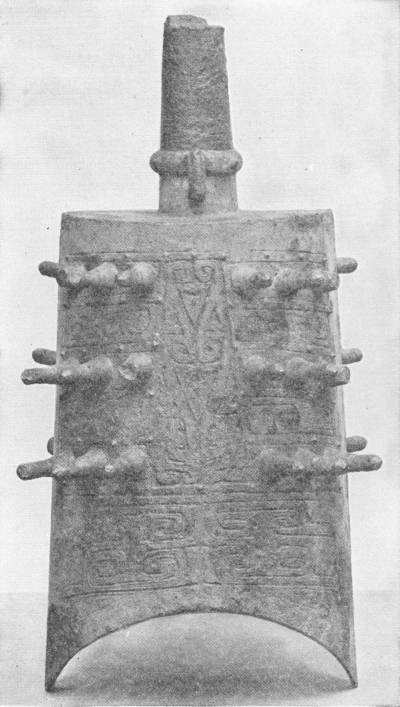
EARLY CHINESE BRONZE BELL
Inscribed in archaic characters: “made for use by the elder of Hing village in Ting district;” latter half of the Chou Dynasty, Sixth Century B.C.
(In the Victoria and Albert Museum)
North China, the China of the Hwang-ho River, became Confucian in thought and spirit; south China, Yang-tse-Kiang China, became Taoist. Since those days a conflict has always been traceable in Chinese affairs between these two spirits, the spirit of the north and the spirit of the south, between (in latter times) Pekin and Nankin, between the official- minded, upright and conservative north, and the sceptical, artistic, lax and experimental south.
The divisions of China of the Age of Confusion reached their worst stage in the sixth century B.C. The Chow dynasty was so enfeebled and so discredited that Lao Tse left the unhappy court and retired into private life.
Three nominally subordinate powers dominated the situation in those days, Ts’i and Ts’in, both northern powers, and Ch’u, which was an aggressive military power in the Yangtse valley. At last Ts’i and Ts’in formed an alliance, subdued Ch’u and imposed a general treaty of disarmament and peace in China. The power of Ts’in became predominant. Finally about the time of Asoka in India the Ts’in monarch seized upon the sacrificial vessels of the Chow emperor and took over his sacrificial duties. His son, Shi-Hwang-ti (king in 246 B.C., emperor in 220 B.C.), is called in the Chinese Chronicles “the First Universal Emperor.”
More fortunate than Alexander, Shi-Hwang-ti reigned for thirty-six years as king and emperor. His energetic reign marks the beginning of a new era of unity and prosperity for the Chinese people. He fought vigorously against the Hunnish invaders from the northern deserts, and he began that immense work, the Great Wall of China, to set a limit to their incursions.
XXXI
ROME COMES INTO HISTORY
THE reader will note a general similarity in the history of all these civilizations in spite of the effectual separation caused by the great barriers of the Indian north-west frontier and of the mountain masses of Central Asia and further India. First for thousands of years the heliolithic culture spread over all the warm and fertile river valleys of the old world and developed a temple system and priest rulers about its sacrificial traditions. Apparently its first makers were always those brunette peoples we have spoken of as the central race of mankind. Then the nomads came in from the regions of seasonal grass and seasonal migrations and superposed their own characteristics and often their own language on the primitive civilization. They subjugated and stimulated it, and were stimulated to fresh developments and made it here one thing and here another. In Mesopotamia it was the Elamite and then the Semite, and at last the Nordic Medes and Persians and the Greeks who supplied the ferment; over the region of the Ægean peoples it was the Greeks; in India it was the Aryan-speakers; in Egypt there was a thinner infusion of conquerors into a more intensely saturated priestly civilization; in China, the Hun conquered and was absorbed and was followed by fresh Huns. China was Mongolized just as Greece and North India were Aryanized and Mesopotamia Semitized and Aryanized. Everywhere the nomads destroyed much, but everywhere they brought in a new spirit of free enquiry and moral innovation. They questioned the beliefs of immemorial ages. They let daylight into the temples. They set up kings who were neither priests nor gods but mere leaders among their captains and companions.
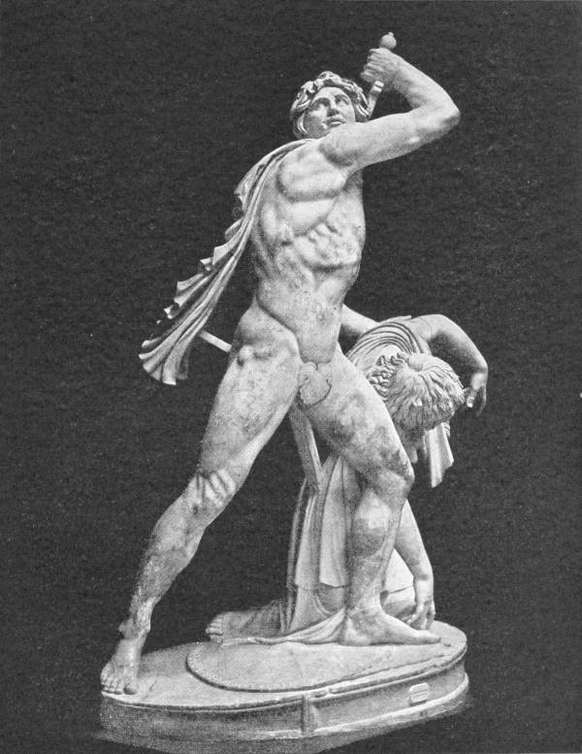
THE DYING GAUL
The statue in the National Museum, Rome, depicting a Gaul stabbing himself, after killing his wife, in the presence of his enemies
Photo: Anderson
In the centuries following the sixth century B.C. we find everywhere a great breaking down of ancient traditions and a new spirit of moral and intellectual enquiry awake, a spirit never more to be altogether stilled in the great progressive movement of mankind. We find reading and writing becoming common and accessible accomplishments among the ruling and prosperous minority; they were no longer the jealously guarded secret of the priests. Travel is increasing and transport growing easier by reason of horses and roads. A new and easy device to facilitate trade has been found in coined money.
Let us now transfer our attention back from China in the extreme east of the old world to the western half of the Mediterranean. Here we have to note the appearance of a city which was destined to play at last a very great part indeed in human affairs, Rome.
Hitherto we have told very little about Italy in our story. It was before 1000 B.C. a land of mountain and forest and thinly populated. Aryan-speaking tribes had pressed down this peninsula and formed little towns and cities, and the southern extremity was studded with Greek settlements. The noble ruins of Pæstum preserve for us to this day something of the dignity and splendour of these early Greek establishments. A non-Aryan people, probably akin to the Ægean peoples, the Etruscans, had established themselves in the central part of the peninsula. They had reversed the usual process by subjugating various Aryan tribes. Rome, when it comes into the light of history, is a little trading city at a ford on the Tiber, with a Latin-speaking population ruled over by Etruscan kings. The old chronologies gave 753 B.C. as the date of the founding of Rome, half a century later than the founding of the great Phœnician city of Carthage and twenty-three years after the first Olympiad. Etruscan tombs of a much earlier date than 753 B.C. have, however, been excavated in the Roman Forum.
In that red-letter century, the sixth century B.C., the Etruscan kings were expelled (510 B.C.) and Rome became an aristocratic republic with a lordly class of “patrician” families dominating a commonalty of “plebeians.” Except that it spoke Latin it was not unlike many aristocratic Greek republics.
For some centuries the internal history of Rome was the story of a long and obstinate struggle for freedom and a share in the government on the part of the plebeians. It would not be difficult to find Greek parallels to this conflict, which the Greeks would have called a conflict of aristocracy with democracy. In the end the plebeians broke down most of the exclusive barriers of the old families and established a working equality with them. They destroyed the old exclusiveness, and made it possible and acceptable for Rome to extend her citizenship by the inclusion of more and more “outsiders.” For while she still struggled at home, she was extending her power abroad.
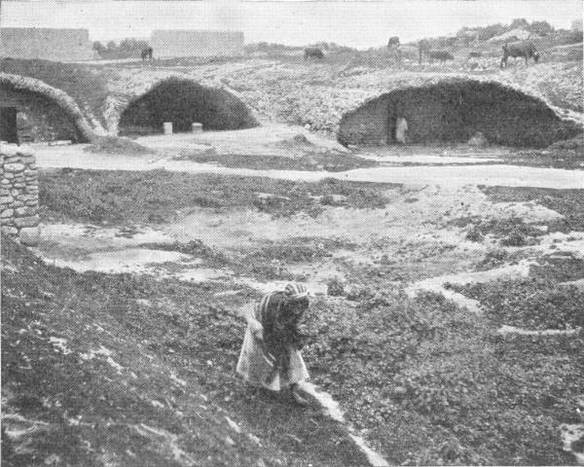
REMAINS OF THE ANCIENT ROMAN CISTERNS AT CARTHAGE
Photo: Underwood & Underwood
The extension of Roman power began in the fifth century B.C. Until that time they had waged war, and generally unsuccessful war, with the Etruscans. There was an Etruscan fort, Veii, only a few miles from Rome which the Romans had never been able to capture. In 474 B.C., however, a great misfortune came to the Etruscans. Their fleet was destroyed by the Greeks of Syracuse in Sicily. At the same time a wave of Nordic invaders came down upon them from the north, the Gauls. Caught between Roman and Gaul, the Etruscans fell—and disappear from history. Veii was captured by the Romans, The Gauls came through to Rome and sacked the city (390 B.C.A.D.) but could not capture the Capitol. An attempted night surprise was betrayed by the cackling of some geese, and finally the invaders were bought off and retired to the north of Italy again.
The Gaulish raid seems to have invigorated rather than weakened Rome. The Romans conquered and assimilated the Etruscans, and extended their power over all central Italy from the Arno to Naples. To this they had reached within a few years of 300 B.C. Their conquests in Italy were going on simultaneously with the growth of Philip’s power in Macedonia and Greece, and the tremendous raid of Alexander to Egypt and the Indus. The Romans had become notable people in the civilized world to the east of them by the break-up of Alexander’s empire.
To the north of the Roman power were the Gauls; to the south of them were the Greek settlements of Magna Græcia, that is to say of Sicily and of the toe and heel of Italy. The Gauls were a hardy, warlike people and the Romans held that boundary by a line of forts and fortified settlements. The Greek cities in the south headed by Tarentum (now Taranto) and by Syracuse in Sicily, did not so much threaten as fear the Romans. They looked about for some help against these new conquerors.
We have already told how the empire of Alexander fell to pieces and was divided among his generals and companions. Among these adventurers was a kinsman of Alexander’s named Pyrrhus, who established himself in Epirus, which is across the Adriatic Sea over against the heel of Italy. It was his ambition to play the part of Philip of Macedonia to Magna Græcia, and to become protector and master-general of Tarentum, Syracuse and the rest of that part of the world. He had what was then it very efficient modern army; he had an infantry phalanx, cavalry from Thessaly—which was now quite as good as the original Macedonian cavalry—and twenty fighting elephants; he invaded Italy and routed the Romans in two considerable battles, Heraclea (280 B.C.) and Ausculum (279 B.C.), and having driven them north, he turned his attention to the subjugation of Sicily.
But this brought against him a more formidable enemy than were the Romans at that time, the Phœnician trading city of Carthage, which was probably then the greatest city in the world. Sicily was too near Carthage for a new Alexander to be welcome there, and Carthage was mindful of the fate that had befallen her mother city Tyre half a century before. So she sent a fleet to encourage or compel Rome to continue the struggle, and she cut the overseas communications of Pyrrhus. Pyrrhus found himself freshly assailed by the Romans, and suffered a disastrous repulse in an attack he had made upon their camp at Beneventum between Naples and Rome.
And suddenly came news that recalled him to Epirus. The Gauls were raiding south. But this time they were not raiding down into Italy; the Roman frontier, fortified and guarded, had become too formidable for them. They were raiding down through Illyria (which is now Serbia and Albania) to Macedonia and Epirus. Repulsed by the Romans, endangered at sea by the Carthaginians, and threatened at home by the Gauls, Pyrrhus abandoned his dream of conquest and went home (275 B.C.), and the power of Rome was extended to the Straits of Messina.
On the Sicilian side of the Straits was the Greek city of Messina, and this presently fell into the hands of a gang of pirates. The Carthaginians, who were already practically overlords of Sicily and allies of Syracuse, suppressed these pirates (270 B.C.) and put in a Carthaginian garrison there. The pirates appealed to Rome and Rome listened to their complaint. And so across the Straits of Messina the great trading power of Carthage and this new conquering people, the Romans, found themselves in antagonism, face to face.
XXXII
ROME AND CARTHAGE
IT was in 264 B.C. that the great struggle between Rome and Carthage, the Punic Wars, began. In that year Asoka was beginning his reign in Behar and Shi- Hwang-ti was a little child, the Museum in Alexandria was still doing good scientific work, and the barbaric Gauls were now in Asia Minor and exacting a tribute from Pergamum. The different regions of the world were still separated by insurmountable distances, and probably the rest of mankind heard only vague and remote rumours of the mortal fight that went on for a century and a half in Spain, Italy, North Africa and the western Mediterranean, between the last stronghold of Semitic power and Rome, this newcomer among Aryan-speaking peoples.
That war has left its traces upon issues that still stir the world. Rome triumphed over Carthage, but the rivalry of Aryan and Semite was to merge itself later on in the conflict of Gentile and Jew. Our history now is coming to events whose consequences and distorted traditions still maintain a lingering and expiring vitality in, and exercise a complicating and confusing influence upon, the conflicts and controversies of to-day.
The First Punic War began in 264 B.C. about the pirates of Messina. It developed into a struggle for the possession of all Sicily except the dominions of the Greek king of Syracuse. The advantage of the sea was at first with the Carthaginians. They had great fighting ships of what was hitherto an unheard-of size, quinqueremes, galleys with five banks of oars and a huge ram. At the battle of Salamis, two centuries before, the leading battleships had only been triremes with three banks. But the Romans, with extraordinary energy and in spite of the fact that they had little naval experience, set themselves to outbuild the Carthaginians. They manned the new navy they created chiefly with Greek seamen, and they invented grappling and boarding to make up for the superior seamanship of the enemy. When the Carthaginian came up to ram or shear the oars of the Roman, huge grappling irons seized him and the Roman soldiers swarmed aboard him. At Mylæ (260 B.C.) and at Ecnomus (256 B.C.) the Carthaginians were disastrously beaten. They repulsed a Roman landing near Carthage but were badly beaten at Palermo, losing one hundred and four elephants there—to grace such a triumphal procession through the Forum as Rome had never seen before. But after that came two Roman defeats and then a Roman recovery. The last naval forces of Carthage were defeated by it last Roman effort at the battle of the Ægatian Isles (241 B.C.) and Carthage sued for peace. All Sicily except the dominions of Hiero, king of Syracuse, was ceded to the Romans.
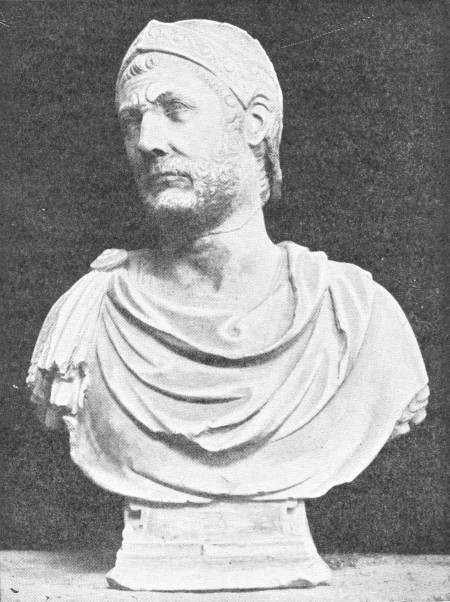
HANNIBAL
Bust in the National Museum at Naples
Photo: Mansell
For twenty-two years Rome and Carthage kept the peace. Both had trouble enough at home. In Italy the Gauls came south again, threatened Rome—which in a state of panic offered human sacrifices to the Gods!—and were routed at Telamon. Rome pushed forward to the Alps, and even extended her dominions down the Adriatic coast to Illyria. Carthage suffered from domestic insurrections and from revolts in Corsica and Sardinia, and displayed far less recuperative power. Finally, an act of intolerable aggression, Rome seized and annexed the two revolting islands.
Spain at that time was Carthaginian as far north as the river Ebro. To that boundary the Romans restricted them. Any crossing of the Ebro by the Carthaginians was to be considered an act of war against the Romans. At last in 218 B.C. the Carthaginians, provoked by new Roman aggressions, did cross this river under a young general named Hannibal, one of the most brilliant commanders in the whole of history. He marched his army from Spain over the Alps into Italy, raised the Gauls against the Romans, and carried on the Second Punic War in Italy itself for fifteen years. He inflicted tremendous defeats upon the Romans at Lake Trasimere and at Cannæ, and throughout all his Italian campaigns no Roman army stood against him and escaped disaster. But a Roman army had landed at Marseilles and cut his communications with Spain; he had no siege train, and he could never capture Rome. Finally the Carthaginians, threatened by the revolt of the Numidians at home, were forced back upon the defence of their own city in Africa, a Roman army crossed into Africa, and Hannibal experienced his first defeat under its walls at the battle of Zama (202 B.C. at the hands of Scipio Africanus the Elder. The battle of Zama ended this Second Punic War. Carthage capitulated; she surrendered Spain and her war fleet; she paid an enormous indemnity and agreed to give up Hannibal to the vengeance of the Romans. But Hannibal escaped and fled to Asia where later, being in danger of falling into the hands of his relentless enemies, he took poison and died.
For fifty-six years Rome and the shorn city of Carthage were at peace. And meanwhile Rome spread her empire over confused and divided Greece, invaded Asia Minor, and defeated Antiochus III, the Seleucid monarch, at Magnesia in Lydia. She made Egypt, still under the Ptolemies, and Pergamum and most of the small states of Asia Minor into “Allies,” or, as we should call them now, “protected states.”
Meanwhile Carthage, subjugated and enfeebled, had been slowly regaining something of her former prosperity. Her recovery revived the hate and suspicion of the Romans. She was attacked upon the most shallow and artificial of quarrels (149 B.C.), she made an obstinate and bitter resistance, stood a long siege and was stormed (146 B.C.). The street fighting, or massacre, lasted six days; it was extraordinarily bloody, and when the citadel capitulated only about fifty thousand of the Carthaginian population remained alive out of a quarter of a million. They were sold into slavery, and the city was burnt and elaborately destroyed. The blackened ruins were ploughed and sown as a sort of ceremonial effacement.

So ended the Third Punic War. Of all the Semitic states and cities that had flourished in the world five centuries before only one little country remained free under native rulers. This was Judea, which had liberated itself from the Seleucids and was under the rule of the native Maccabean princes. By this time it had its Bible almost complete, and was developing the distinctive traditions of the Jewish world as we know it now. It was natural that the Carthaginians, Phoenicians and kindred peoples dispersed about the world should find a common link in their practically identical language and in this literature of hope and courage. To a large extent they were still the traders and bankers of the world. The Semitic world had been submerged rather than replaced.
Jerusalem, which has always been rather the symbol than the centre of Judaism, was taken by the Romans in 65 B.C.; and after various vicissitudes of quasi- independence and revolt was besieged by them in 70 A.D. and captured after a stubborn struggle. The Temple was destroyed. A later rebellion in 132 A.D. completed its destruction, and the Jerusalem we know to-day was rebuilt later under Roman auspices. A temple to the Roman god, Jupiter Capitolinus, stood in the place of the Temple, and Jews were forbidden to inhabit the city.
XXXIII
THE GROWTH OF THE ROMAN EMPIRE
NOW this new Roman power which arose to dominate the western world in the second and first centuries B.C. was in several respects a different thing from any of the great empires that had hitherto prevailed in the civilized world. It was not at first a monarchy, and it was not the creation of any one great conqueror. It was not indeed the first of republican empires; Athens had dominated a group of Allies and dependents in the time of Pericles, and Carthage when she entered upon her fatal struggle with Rome was mistress of Sardinia and Corsica, Morocco, Algiers, Tunis, and most of Spain and Sicily. But it was the first republican empire that escaped extinction and went on to fresh developments.
The centre of this new system lay far to the west of the more ancient centres of empire, which had hitherto been the river valleys of Mesopotamia and Egypt. This westward position enabled Rome to bring in to civilization quite fresh regions and peoples. The Roman power extended to Morocco and Spain, and was presently able to thrust north-westward over what is now France and Belgium to Britain and north-eastward into Hungary and South Russia. But on the other hand it was never able to maintain itself in Central Asia or Persia because they were too far from its administrative centres. It included therefore great masses of fresh Nordic Aryan- speaking peoples, it presently incorporated nearly all the Greek people in the world, and its population was less strongly Hamitic and Semitic than that of any preceding empire.
For some centuries this Roman Empire did not fall into the grooves of precedent that had so speedily swallowed up Persian and Greek, and all that time it developed. The rulers of the Medes and Persians became entirely Babylonized in a generation or so; they took over the tiara of the king of kings and the temples and priesthoods of his gods; Alexander and his successors followed in the same easy path of assimilation; the Seleucid monarchs had much the same court and administrative methods as Nebuchadnezzar; the Ptolemies became Pharaohs and altogether Egyptian. They were assimilated just as before them the Semitic conquerors of the Sumerians had been assimilated. But the Romans ruled in their own city, and for some centuries kept to the laws of their own nature. The only people who exercised any great mental influence upon them before the second or third century A.D. were the kindred and similar Greeks. So that the Roman Empire was essentially a first attempt to rule a great dominion upon mainly Aryan lines. It was so far a new pattern in history, it was an expanded Aryan republic. The old pattern of a personal conqueror ruling over a capital city that had grown up round the temple of a harvest god did not apply to it. The Romans had gods and temples, but like the gods of the Greeks their gods were quasi-human immortals, divine patricians. The Romans also had blood sacrifices and even made human ones in times of stress, things they may have learnt to do from their dusky Etruscan teachers; but until Rome was long past its zenith neither priest nor temple played a large part in Roman history.
The Roman Empire was a growth, an unplanned novel growth; the Roman people found themselves engaged almost unawares in a vast administrative experiment. It cannot be called a successful experiment. In the end their empire collapsed altogether. And it changed enormously in form and method from century to century. It changed more in a hundred years than Bengal or Mesopotamia or Egypt changed in a thousand. It was always changing. It never attained to any fixity.
In a sense the experiment failed. In a sense the experiment remains unfinished, and Europe and America to-day are still working out the riddles of world-wide statescraft first confronted by the Roman people.
It is well for the student of history to bear in mind the very great changes not only in political but in social and moral matters that went on throughout the period of Roman dominion. There is much too strong a tendency in people’s minds to think of the Roman rule as something finished and stable, firm, rounded, noble and decisive. Macaulay’s Lays of Ancient Rome, S.P.Q.R. the elder Cato, the Scipios, Julius Cæsar, Diocletian, Constantine the Great, triumphs, orations, gladiatorial combats and Christian martyrs are all mixed up together in a picture of something high and cruel and dignified. The items of that picture have to be disentangled. They are collected at different points from a process of change profounder than that which separates the London of William the Conqueror from the London of to-day.
We may very conveniently divide the expansion of Rome into four stages. The first stage began after the sack of Rome by the Goths in 390 B.C. and went on until the end of the First Punic War (240 B.C,). We may call this stage the stage of the Assimilative Republic. It was perhaps the finest, most characteristic stage in Roman history. The age-long dissensions of patrician and plebeian were drawing to it close, the Etruscan threat had come to an end, no one was very rich yet nor very poor, and most men were public-spirited. It was a republic like the republic of the South African Boers before 1900 or like the northern states of the American union between 1800 and 1850; a free- farmers republic. At the outset of this stage Rome was a little state scarcely twenty miles square. She fought the sturdy but kindred states about her, and sought not their destruction but coalescence. Her centuries of civil dissension had trained her people in compromise and concessions. Some of the defeated cities became altogether Roman with a voting share in the government, some became self-governing with the right to trade and marry in Rome; garrisons full of citizens were set up at strategic points and colonies of varied privileges founded among the freshly conquered people. Great roads were made. The rapid Latinization of all Italy was the inevitable consequence of such a policy. In 89 B.C. all the free inhabitants of Italy became citizens of the city of Rome. Formally the whole Roman Empire became at last an extended city. In 212 A.D. every free man in the entire extent of the empire was given citizenship; the right, if he could get there, to vote in the town meeting in Rome.
This extension of citizenship to tractable cities and to whole countries was the distinctive device of Roman expansion. It reversed the old process of conquest and assimilation altogether. By the Roman method the conquerors assimilated the conquered.
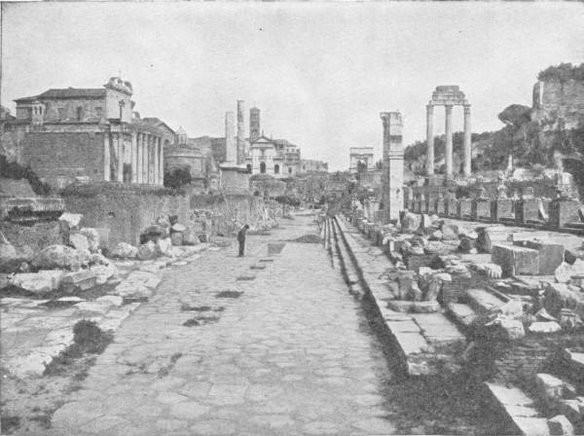
THE FORUM AT ROME AS IT IS TO-DAY
But after the First Punic War and the annexation of Sicily, though the old process of assimilation still went on, another process arose by its side. Sicily for instance was treated as a conquered prey. It was declared an “estate” of the Roman people. Its rich soil and industrious population was exploited to make Rome rich. The patricians and the more influential among the plebeians secured the major share of that wealth. And the war also brought in a large supply of slaves. Before the First Punic War the population of the republic had been largely a population of citizen farmers. Military service was their privilege and liability. While they were on active service their farms fell into debt and a new large-scale slave agriculture grew up; when they returned they found their produce in competition with slave-grown produce from Sicily and from the new estates at home. Times had changed. The republic had altered its character. Not only was Sicily in the hands of Rome, the common man was in the hands of the rich creditor and the rich competitor. Rome had entered upon its second stage, the Republic of Adventurous Rich Men.
For two hundred years the Roman soldier farmers had struggled for freedom and a share in the government of their state; for a hundred years they had enjoyed their privileges. The First Punic War wasted them and robbed them of all they had won.
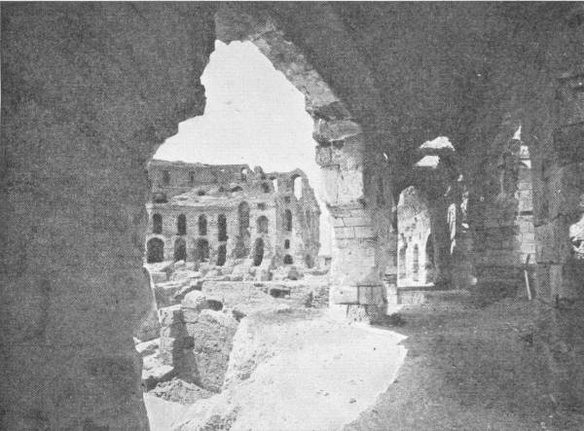
RELICS OF ROMAN RULE
Ruins of Coliseum in Tunis
Photo: Jacques Boyer
The value of their electoral privileges had also evaporated. The governing bodies of the Roman republic were two in number. The first and more important was the Senate. This was a body originally of patricians and then of prominent men of all sorts, who were summoned to it first by certain powerful officials, the consuls and censors. Like the British House of Lords it became a gathering of great landowners, prominent politicians, big business men and the like. It was much more like the British House of Lords than it was like the American Senate. For three centuries, from the Punic Wars onward, it was the centre of Roman political thought and purpose. The second body was the Popular Assembly. This was supposed to be an assembly of all the citizens of Rome. When Rome was a little state twenty miles square this was a possible gathering. When the citizenship of Rome had spread beyond the confines in Italy, it was an altogether impossible one. Its meetings, proclaimed by horn-blowing from the Capitol and the city walls, became more and more a gathering of political hacks and city riff-raff. In the fourth century B.C. the Popular Assembly was a considerable check upon the Senate, a competent representation of the claims and rights of the common man. By the end of the Punic Wars it was an impotent relic of a vanquished popular control. No effectual legal check remained upon the big men.
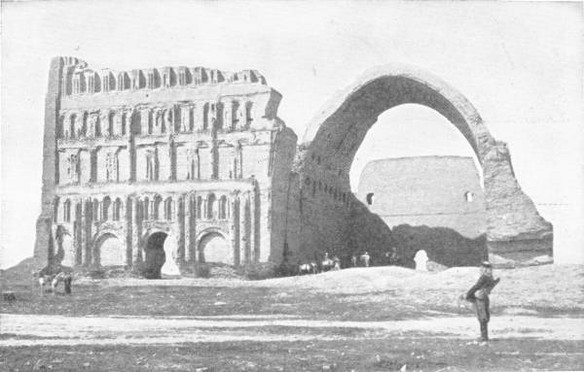
THE GREAT ROMAN ARCH AT CTESIPHON NEAR BAGDAD
Nothing of the nature of representative government was ever introduced into the Roman republic. No one thought of electing delegates to represent the will of the citizens. This is a very important point for the student to grasp. The Popular Assembly never became the equivalent of the American House of Representatives or the British House of Commons. In theory it was all the citizens; in practice it ceased to be anything at all worth consideration.
The common citizen of the Roman Empire was therefore in a very poor case after the Second Punic War; he was impoverished, he had often lost his farm, he was ousted from profitable production by slaves, and he had no political power left to him to remedy these things. The only methods of popular expression left to a people without any form of political expression are the strike and the revolt. The story of the second and first centuries B.C., so far as internal politics go, is a story of futile revolutionary upheaval. The scale of this history will not permit us to tell of the intricate struggles of that time, of the attempts to break up estates and restore the land to the free farmer, of proposals to abolish debts in whole or in part. There was revolt and civil war. In 73 B.C., the distresses of Italy were enhanced by a great insurrection, of the slaves under Spartacus. The slaves of Italy revolted with some effect, for among them were the trained fighters of the gladiatorial shows. For two years Spartacus held out in the crater of Vesuvius, which seemed at that time to be an extinct volcano. This insurrection was defeated at last and suppressed with frantic cruelty. Six thousand captured Spartacists were crucified along the Appian Way, the great highway that runs southward out of Rome (71 B.C.).
The common man never made head against the forces that were subjugating and degrading him. But the big rich men who were overcoming him were even in his defeat preparing a new power in the Roman world over themselves and him, the power of the army.
Before the Second Punic War the army of Rome was a levy of free farmers, who, according to their quality, rode or marched afoot to battle. This was a very good force for wars close at hand, but not the sort of army that will go abroad and bear long campaigns with patience. And moreover as the slaves multiplied and the estates grew, the supply of free- spirited fighting farmers declined. It was a popular leader named Marius who introduced a new factor. North Africa after the overthrow of the Carthaginian civilization had become a semi-barbaric kingdom, the kingdom of Numidia. The Roman power fell into conflict with Jugurtha, king of this state, and experienced enormous difficulties in subduing him. Marius was made consul, in a phase of public indignation, to end this discreditable war. This he did by raising paid troops and drilling them hard. Jugurtha was brought in chains to Rome (106 B.C.) and Marius, when his time of office had expired, held on to his consulship illegally with his newly created legions. There was no power in Rome to restrain him.
With Marius began the third phase in the development of the Roman power, the Republic of the Military Commanders. For now began a period in which the leaders of the paid legions fought for the mastery of the Roman world. Against Marius was pitted the aristocratic Sulla who had served under him in Africa. Each in turn made a great massacre of his political opponents. Men were proscribed and executed by the thousand, and their estates were sold. After the bloody rivalry of these two and the horror of the revolt of Spartacus, came a phase in which Lucullus and Pompey the Great and Crassus and Julius Cæsar were the masters of armies and dominated affairs. It was Crassus who defeated Spartacus. Lucullus conquered Asia Minor and penetrated to Armenia, and retired with great wealth into private life. Crassus thrusting further invaded Persia and was defeated and slain by the Parthians. After a long rivalry Pompey was defeated by Julius Cæsar (48 B.C.) and murdered in Egypt, leaving Julius Cæsar sole master of the Roman world.
The figure of Julius Cæsar is one that has stirred the human imagination out of all proportion to its merit or true importance. He has become a legend and a symbol. For us he is chiefly important as marking the transition from the phase of military adventurers to the beginning of the fourth stage in Roman expansion, the Early Empire. For in spite of the profoundest economic and political convulsions, in spite of civil war and social degeneration, throughout all this time the boundaries of the Roman state crept outward and continued to creep outward to their maximum about 100 A.D. There had been something like an ebb during the doubtful phases of the Second Punic War, and again a manifest loss of vigour before the reconstruction of the army by Marius. The revolt of Spartacus marked a third phase. Julius Cæsar made his reputation as a military leader in Gaul, which is now France and Belgium. (The chief tribes inhabiting this country belonged to the same Celtic people as the Gauls who had occupied north Italy for a time, and who had afterwards raided into Asia Minor and settled down as the Galatians.) Cæsar drove back a German invasion of Gaul and added all that country to the empire, and he twice crossed the Straits of Dover into Britain (55 and 54 B.C.), where however he made no permanent conquest. Meanwhile Pompey the Great was consolidating Roman conquests that reached in the east to the Caspian Sea.
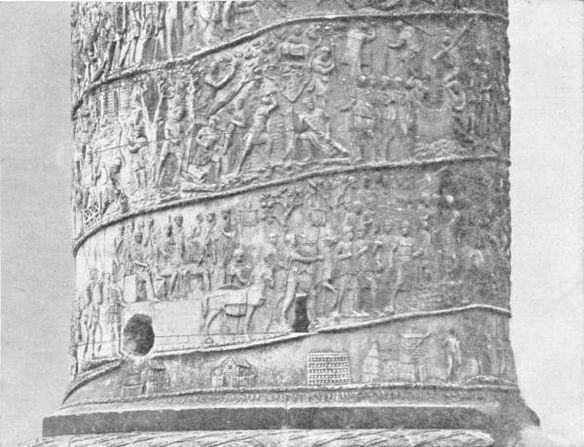
THE COLUMN OF TRAJAN AT ROME
Representing his conquests at Dacia and elsewhere
At this time, the middle of the first century B.C., the Roman Senate was still the nominal centre of the Roman government, appointing consuls and other officials, granting powers and the like; and a number of politicians, among whom Cicero was an outstanding figure, were struggling to preserve the great traditions of republican Rome and to maintain respect for its laws. But the spirit of citizenship had gone from Italy with the wasting away of the free farmers; it was a land now of slaves and impoverished men with neither the understanding nor the desire for freedom. There was nothing whatever behind these republican leaders in the Senate, while behind the great adventurers they feared and desired to control were the legions. Over the heads of the Senate Crassus and Pompey and Cæsar divided the rule of the Empire between them (The First Triumvirate). When presently Crassus was killed at distant Carrhæ by the Parthians, Pompey and Cæsar fell out. Pompey took up the republican side, and laws were passed to bring Cæsar to trial for his breaches of law and his disobedience to the decrees of the Senate.
It was illegal for a general to bring his troops out of the boundary of his command, and the boundary between Cæsar’s command and Italy was the Rubicon. In 49 B.C. he crossed the Rubicon, saying “The die is cast” and marched upon Pompey and Rome.
It had been the custom in Rome in the past, in periods of military extremity, to elect a “dictator” with practically unlimited powers to rule through the crisis. After his overthrow of Pompey, Cæsar was made dictator first for ten years and then (in 45 B.C.) for life. In effect he was made monarch of the empire for life. There was talk of a king, a word abhorrent to Rome since the expulsion of the Etruscans five centuries before. Cæsar refused to be king, but adopted throne and sceptre. After his defeat of Pompey, Cæsar had gone on into Egypt and had made love to Cleopatra, the last of the Ptolemies, the goddess queen of Egypt. She seems to have turned his head very completely. He had brought back to Rome the Egyptian idea of a god-king. His statue was set up in a temple with an inscription “To the Unconquerable God.” The expiring republicanism of Rome flared up in a last protest, and Cæsar was stabbed to death in the Senate at the foot of the statue of his murdered rival, Pompey the Great.
Thirteen years more of this conflict of ambitious personalities followed. There was a second Triumvirate of Lepidus, Mark Antony and Octavian Cæsar, the latter the nephew of Julius Cæsar. Octavian like his uncle took the poorer, hardier western provinces where the best legions were recruited. In 31 B.C., he defeated Mark Antony, his only serious rival, at the naval battle of Actium, and made himself sole master of the Roman world. But Octavian was a man of different quality altogether from Julius Cæsar. He had no foolish craving to be God or King. He had no queen-lover that he wished to dazzle. He restored freedom to the Senate and people of Rome. He declined to be dictator. The grateful Senate in return gave him the reality instead of the forms of power. He was to be called not King indeed, but “Princeps” and “Augustus.” He became Augustus Cæsar, the first of the Roman emperors (27 B.C. to 14 A.D.).
He was followed by Tiberius Cæsar (14 to 37 A.D.) and he by others, Caligula, Claudius, Nero and so on up to Trajan (98 A.D.), Hadrian (117 A.D.), Antonius Pius (138 A.D.) and Marcus Aurelius (161- 180 A.D.). All these emperors were emperors of the legions. The soldiers made them, and some the soldiers destroyed. Gradually the Senate fades out of Roman-history, and the emperor and his administrative officials replace it. The boundaries of the empire crept forward now to their utmost limits. Most of Britain was added to the empire, Transylvania was brought in as a new province, Dacia; Trajan crossed the Euphrates. Hadrian had an idea that reminds us at once of what had happened at the other end of the old world. Like Shi-Hwang-ti he built walls against the northern barbarians; one across Britain and a palisade between the Rhine and the Danube. He abandoned some of the acquisitions of Trajan.
The expansion of the Roman Empire was at an end.
XXXIV
BETWEEN ROME AND CHINA
THE second and first centuries B.C. mark a new phase in the history of mankind. Mesopotamia and the eastern Mediterranean are no longer the centre of interest. Both Mesopotamia and Egypt were still fertile, populous and fairly prosperous, but they were no longer the dominant regions of the world. Power had drifted to the west and to the east. Two great empires now dominated the world, this new Roman Empire and the renascent Empire of China. Rome extended its power to the Euphrates, but it was never able to get beyond that boundary. It was too remote. Beyond the Euphrates the former Persian and Indian dominions of the Seleucids fell under a number of new masters. China, now under the Han dynasty, which had replaced the Ts’in dynasty at the death of Shi-Hwang-ti, had extended its power across Tibet and over the high mountain passes of the Pamirs into western Turkestan. But there, too, it reached its extremes. Beyond was too far.
China at this time was the greatest, best organized and most civilized political system in the world. It was superior in area and population to the Roman Empire at its zenith. It was possible then for these two vast systems to flourish in the same world at the same time in almost complete ignorance of each other. The means of communication both by sea and land was not yet sufficiently developed and organized for them to come to a direct clash.
Yet they reacted upon each other in a very remarkable way, and their influence upon the fate of the regions that lay between them, upon central Asia and India, was profound. A certain amount of trade trickled through, by camel caravans across Persia, for example, and by coasting ships by way of India and the Red Sea. In 66 B.C. Roman troops under Pompey followed in the footsteps of Alexander the Great, and marched up the eastern shores of the Caspian Sea. In 102 A.D. a Chinese expeditionary force under Pan Chau reached the Caspian, and sent emissaries to report upon the power of Rome. But many centuries were still to pass before definite knowledge and direct intercourse were to link the great parallel worlds of Europe and Eastern Asia.
To the north of both these great empires were barbaric wildernesses. What is now Germany was largely forest lands; the forests extended far into Russia and made a home for the gigantic aurochs, a bull of almost elephantine size. Then to the north of the great mountain masses of Asia stretched a band of deserts, steppes and then forests and frozen lands. In the eastward lap of the elevated part of Asia was the great triangle of Manchuria. Large parts of these regions, stretching between South Russia and Turkestan into Manchuria, were and are regions of exceptional climatic insecurity. Their rainfall has varied greatly in the course of a few centuries They are lands treacherous to man. For years they will carry pasture and sustain cultivation, and then will come an age of decline in humidity and a cycle of killing droughts.
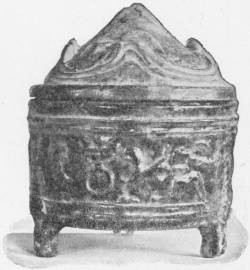
A CHINESE COVERED JAR OF GREEN-GLAZED EARTHENWARE
Han Dynasty (contemporary with the late Roman republic and early Empire)
(In the Victoria and Albert Museum)
The western part of this barbaric north from the German forests to South Russia and Turkestan and from Gothland to the Alps was the region of origin of the Nordic peoples and of the Aryan speech. The eastern steppes and deserts of Mongolia was the region of origin of the Hunnish or Mongolian or Tartar or Turkish peoples—for all these several peoples were akin in language, race, and way of life. And as the Nordic peoples seem to have been continually overflowing their own borders and pressing south upon the developing civilizations of Mesopotamia and the Mediterranean coast, so the Hunnish tribes sent their surplus as wanderers, raiders and conquerors into the settled regions of China. Periods of plenty in the north would mean an increase in population there; a shortage of grass, a spell of cattle disease, would drive the hungry warlike tribesmen south.
For a time there were simultaneously two fairly effective Empires in the world capable of holding back the barbarians and even forcing forward the frontiers of the imperial peace. The thrust of the Han empire from north China into Mongolia was strong and continuous. The Chinese population welled up over the barrier of the Great Wall. Behind the imperial frontier guards came the Chinese farmer with horse and plough, ploughing up the grass lands and enclosing the winter pasture. The Hunnish peoples raided and murdered the settlers, but the Chinese punitive expeditions were too much for them. The nomads were faced with the choice of settling down to the plough and becoming Chinese tax-payers or shifting in search of fresh summer pastures. Some took the former course and were absorbed. Some drifted north-eastward and eastward over the mountain passes down into western Turkestan.
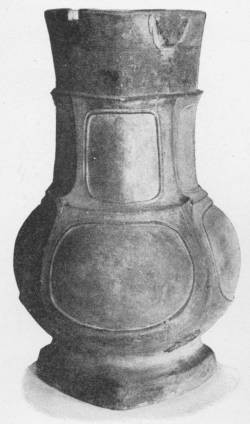
VASE OF BRONZE FORM, UNGLAZED STONEWARE
Han Dynasty (B.C. 206 - A.D. 220)
(In the Victoria and Albert Museum)
This westward drive of the Mongolian horsemen was going on from 200 B.C. onward. It was producing a westward pressure upon the Aryan tribes, and these again were pressing upon the Roman frontiers ready to break through directly there was any weakness apparent. The Parthians, who were apparently a Scythian people with some Mongolian admixture, came down to the Euphrates by the first century B.C. They fought against Pompey the Great in his eastern raid. They defeated and killed Crassus. They replaced the Seleucid monarchy in Persia by a dynasty of Parthian kings, the Arsacid dynasty.
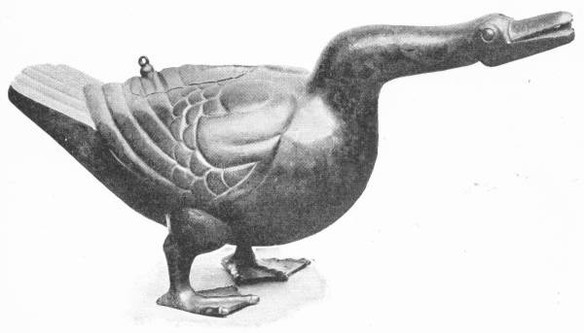
CHINESE VESSEL IN BRONZE, IN FORM OF A GOOSE
Dating from before the time of Shi-Hwang-ti. Such a piece of work indicates a high level of comfort and humour
(In the Victoria and Albert Museum)
But for a time the line of least resistance for hungry nomads lay neither to the west nor the east but through central Asia and then south-eastward through the Khyber Pass into India. It was India which received the Mongolian drive in these centuries of Roman and Chinese strength. A series of raiding conquerors poured down through the Punjab into the great plains to loot and destroy. The empire of Asoka was broken up, and for a time the history of India passes into darkness. A certain Kushan dynasty founded by the “Indo- Scythians”—one of the raiding peoples—ruled for a time over North India and maintained a certain order. These invasions went on for several centuries. For a large part of the fifth century A.D. India was afflicted by the Ephthalites or White Huns, who levied tribute on the small Indian princes and held India in terror. Every summer these Ephthalites pastured in western Turkestan, every autumn they came down through the passes to terrorize India.
In the second century A.D. a great misfortune came upon the Roman and Chinese empires that probably weakened the resistance of both to barbarian pressure. This was a pestilence of unexampled virulence. It raged for eleven years in China and disorganized the social framework profoundly. The Han dynasty fell, and a new age of division and confusion began from which China did not fairly recover until the seventh century A.D. with the coming of the great Tang dynasty.
The infection spread through Asia to Europe. It raged throughout the Roman Empire from 164 to 180 A.D. It evidently weakened the Roman imperial fabric very seriously. We begin to hear of depopulation in the Roman provinces after this, and there was a marked deterioration in the vigour and efficiency of government. At any rate we presently find the frontier no longer invulnerable, but giving way first in this place and then in that. A new Nordic people, the Goths, coming originally from Gothland in Sweden, had migrated across Russia to the Volga region and the shores of the Black Sea and taken to the sea and piracy. By the end of the second century they may have begun to feel the westward thrust of the Huns. In 247 they crossed the Danube in a great land raid, and defeated and killed the Emperor Decius in a battle in what is now Serbia. In 236 another Germanic people, the Franks, had broken bounds upon the lower Rhine, and the Alemanni had poured into Alsace. The legions in Gaul beat back their invaders, but the Goths in the Balkan peninsula raided again and again. The province of Dacia vanished from Roman history.
A chill had come to the pride and confidence of Rome. In 270-275 Rome, which had been an open and secure city for three centuries, was fortified by the Emperor Aurelian.
XXXV
THE COMMON MAN’S LIFE UNDER THE EARLY ROMAN EMPIRE
BEFORE we tell of how this Roman empire which was built up in the two centuries B.C., and which flourished in peace and security from the days of Augustus Cæsar onward for two centuries, fell into disorder and was broken up, it may be as well to devote some attention to the life of the ordinary people throughout this great realm. Our history has come down now to within 2000 years of our own time; and the life of the civilized people, both under the Peace of Rome and the Peace of the Han dynasty, was beginning to resemble more and more clearly the life of their civilized successors to-day.
In the western world coined money was now in common use; outside the priestly world there were many people of independent means who were neither officials of the government nor priests; people travelled about more freely than they had ever done before, and there were high roads and inns for them. Compared with the past, with the time before 500 B.C., life had become much more loose. Before that date civilized men had been bound to a district or country, had been bound to a tradition and lived within a very limited horizon; only the nomads traded and travelled.
But neither the Roman Peace nor the Peace of the Han dynasty meant a uniform civilization over the large areas they controlled. There were very great local differences and great contrasts and inequalities of culture between one district and another, just as there are to-day under the British Peace in India. The Roman garrisons and colonies were dotted here and there over this great space, worshipping Roman gods and speaking the Latin language; but where there had been towns and cities before the coming of the Romans, they went on, subordinated indeed but managing their own affairs, and, for a time at least, worshipping their own gods in their own fashion. Over Greece, Asia Minor, Egypt and the Hellenized East generally, the Latin language never prevailed. Greek ruled there invincibly. Saul of Tarsus, who became the apostle Paul, was a Jew and a Roman citizen; but he spoke and wrote Greek and not Hebrew. Even at the court of the Parthian dynasty, which had overthrown the Greek Seleucids in Persia, and was quite outside the Roman imperial boundaries, Greek was the fashionable language. In some parts of Spain and in North Africa, the Carthaginian language also held on for a long time in spite of the destruction of Carthage. Such a town as Seville, which had been a prosperous city long before the Roman name had been heard of, kept its Semitic goddess and preserved its Semitic speech for generations, in spite of a colony of Roman veterans at Italica a few miles away. Septimius Severus, who was emperor from 193 to 211 A.D., spoke Carthaginian as his mother speech. He learnt Latin later as a foreign tongue; and it is recorded that his sister never learnt Latin and conducted her Roman household in the Punic language.
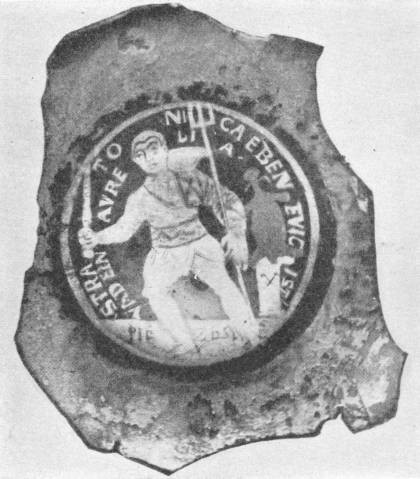
In such countries as Gaul and Britain and in provinces like Dacia (now roughly Roumania) and Pannonia (Hungary south of the Danube), where there were no pre-existing great cities and temples and cultures, the Roman empire did however “Latinize.” It civilized these countries for the first time. It created cities and towns where Latin was from the first the dominant speech, and where Roman gods were served and Roman customs and fashions followed. The Roumanian, Italian, French and Spanish languages, all variations and modifications of Latin, remain to remind us of this extension of Latin speech and customs. North-west Africa also became at last largely Latin-speaking. Egypt, Greece and the rest of the empire to the east were never Latinized. They remained Egyptian and Greek in culture and spirit. And even in Rome, among educated men, Greek was learnt as the language of a gentleman and Greek literature and learning were very, properly preferred to Latin.
In this miscellaneous empire the ways of doing work and business were naturally also very miscellaneous. The chief industry of the settled world was still largely agriculture. We have told how in Italy the sturdy free farmers who were the backbone of the early Roman republic were replaced by estates worked by slave labour after the Punic wars. The Greek world had had very various methods of cultivation, from the Arcadian plan, wherein every free citizen toiled with his own hands, to Sparta, wherein it was a dishonour to work and where agricultural work was done by a special slave class, the Helots. But that was ancient history now, and over most of the Hellenized world the estate system and slave-gangs had spread. The agricultural slaves were captives who spoke many different languages so that they could not understand each other, or they were born slaves; they had no solidarity to resist oppression, no tradition of rights, no knowledge, for they could not read nor write. Although they came to form a majority of the country population they never made a successful insurrection. The insurrection of Spartacus in the first century B.C. was an insurrection of the special slaves who were trained for the gladiatorial combats. The agricultural workers in Italy in the latter days of the Republic and the early Empire suffered frightful indignities; they would be chained at night to prevent escape or have half the head shaved to make it difficult. They had no wives of their own; they could be outraged, mutilated and killed by their masters. A master could sell his slave to fight beasts in the arena. If a slave slew his master, all the slaves in his household and not merely the murderer were crucified. In some parts of Greece, in Athens notably, the lot of the slave was never quite so frightful as this, but it was still detestable. To such a population the barbarian invaders who presently broke through the defensive line of the legions, came not as enemies but as liberators.
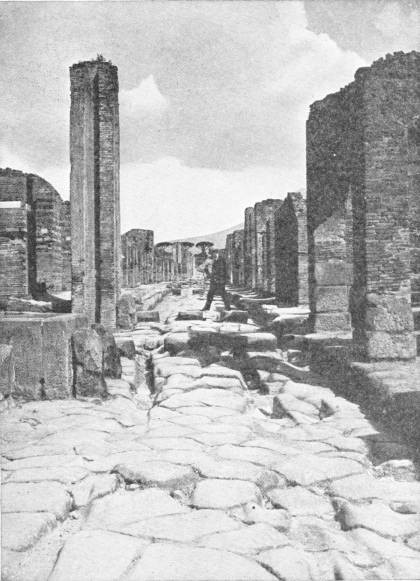
POMPEII
“Note the ruts in roadway worn by chariot wheels.”
The slave system had spread to most industries and to every sort of work that could be done by gangs. Mines and metallurgical operations, the rowing of galleys, road-making and big building operations were all largely slave occupations. And almost all domestic service was performed by slaves. There were poor free-men and there were freed-men in the cities and upon the country side, working for themselves or even working for wages. They were artizans, supervisors and so forth, workers of a new money- paid class working in competition with slave workers; but we do not know what proportion they made of the general population. It probably varied widely in different places and at different periods. And there were also many modifications of slavery, from the slavery that was chained at night and driven with whips to the farm or quarry, to the slave whose master found it advantageous to leave him to cultivate his patch or work his craft and own his wife like a free-man, provided he paid in a satisfactory quittance to his owner.
There were armed slaves. At the opening of the period of the Punic wars, in 264 B.C., the Etruscan sport of setting slaves to fight for their lives was revived in Rome. It grew rapidly fashionable; and soon every great Roman rich man kept a retinue of gladiators, who sometimes fought in the arena but whose real business it was to act as his bodyguard of bullies. And also there were learned slaves. The conquests of the later Republic were among the highly civilized cities of Greece, North Africa and Asia Minor; and they brought in many highly educated captives. The tutor of a young Roman of good family was usually a slave. A rich man would have a Greek slave as librarian, and slave secretaries and learned men. He would keep his poet as he would keep a performing dog. In this atmosphere of slavery the traditions of modern literary criticism were evolved. The slaves still boast and quarrel in our reviews. There were enterprising people who bought intelligent boy slaves and had them educated for sale. Slaves were trained as book copyists, as jewellers, and for endless skilled callings.
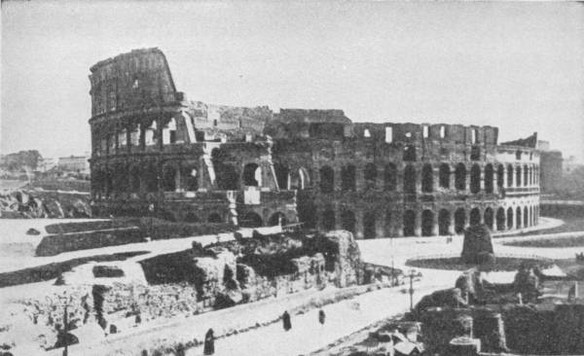
THE COLISEUM, ROME
Photo: Underwood & Underwood
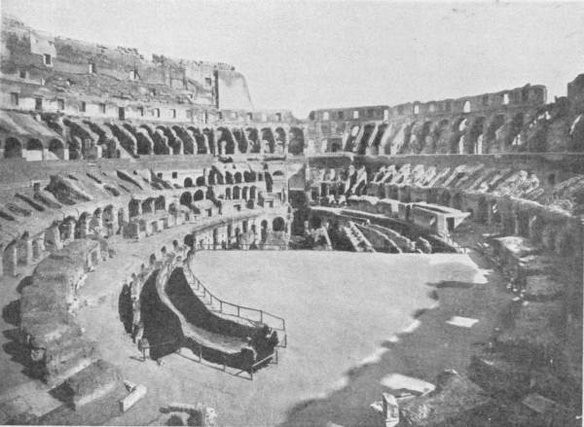
INTERIOR OF THE COLISEUM AT IT APPEARS TO-DAY
But there were very considerable changes in the position of a slave during the four hundred years between the opening days of conquest under the republic of rich men and the days of disintegration that followed the great pestilence. In the second century B.C. war-captives were abundant, manners gross and brutal; the slave had no rights and there was scarcely an outrage the reader can imagine that was not practised upon slaves in those days. But already in the first century A.D. there was a perceptible improvement in the attitude of the Roman civilization towards slavery. Captives were not so abundant for one thing, and slaves were dearer. And slave- owners began to realize that the profit and comfort they got from their slaves increased with the self-respect of these unfortunates. But also the moral tone of the community was rising, and a sense of justice was becoming effective. The higher mentality of Greece was qualifying the old Roman harshness. Restrictions upon cruelty were made, a master might no longer sell his slave to fight beasts, a slave was given property rights in what was called his peculium, slaves were paid wages as an encouragement and stimulus, a form of slave marriage was recognized. Very many forms of agriculture do not lend themselves to gang working, or require gang workers only at certain seasons. In regions where such conditions prevailed the slave presently became a serf, paying his owner part of his produce or working for him at certain seasons.
When we begin to realize how essentially this great Latin and Greek-speaking Roman Empire of the first two centuries A.D. was a slave state and how small was the minority who had any pride or freedom in their lives, we lay our hands on the clues to its decay and collapse. There was little of what we should call family life, few homes of temperate living and active thought and study; schools and colleges were few and far between. The free will and the free mind were nowhere to be found. The great roads, the ruins of splendid buildings, the tradition of law and power it left for the astonishment of succeeding generations must not conceal from us that all its outer splendour was built upon thwarted wills, stifled intelligence, and crippled and perverted desires. And even the minority who lorded it over that wide realm of subjugation and of restraint and forced labour were uneasy and unhappy in their souls; art and literature, science and philosophy, which are the fruits of free and happy minds, waned in that atmosphere. There was much copying and imitation, an abundance of artistic artificers, much slavish pedantry among the servile men of learning, but the whole Roman empire in four centuries produced nothing to set beside the bold and noble intellectual activities of the comparatively little city of Athens during its one century of greatness. Athens decayed under the Roman sceptre. The science of Alexandria decayed. The spirit of man, it seemed, was decaying in those days.
XXXVI
RELIGIOUS DEVELOPMENTS UNDER THE ROMAN EMPIRE
THE soul of man under that Latin and Greek empire of the first two centuries of the Christian era was a worried and frustrated soul. Compulsion and cruelty reigned; there were pride and display but little honour; little serenity or steadfast happiness. The unfortunate were despised and wretched; the fortunate were insecure and feverishly eager for gratifications. In a great number of cities life centred on the red excitement of the arena, where men and beasts fought and were tormented and slain. Amphitheatres are the most characteristic of Roman ruins. Life went on in that key. The uneasiness of men’s hearts manifested itself in profound religious unrest.
From the days when the Aryan hordes first broke in upon the ancient civilizations, it was inevitable that the old gods of the temples and priesthoods should suffer great adaptations or disappear. In the course of hundreds of generations the agricultural peoples of the brunette civilizations had shaped their lives and thoughts to the temple-centred life. Observances and the fear of disturbed routines, sacrifices and mysteries, dominated their minds. Their gods seem monstrous and illogical to our modern minds because we belong to an Aryanized world, but to these older peoples these deities had the immediate conviction and vividness of things seen in an intense dream. The conquest of one city state by another in Sumeria or early Egypt meant a change or a renaming of gods or goddesses, but left the shape and spirit of the worship intact. There was no change in its general character. The figures in the dream changed, but the dream went on and it was the same sort of dream. And the early Semitic conquerors were sufficiently akin in spirit to the Sumerians to take over the religion of the Mesopotamian civilization they subjugated without any profound alteration. Egypt was never indeed subjugated to the extent of a religious revolution. Under the Ptolemies and under the Cæsars, her temples and altars and priesthoods remained essentially Egyptian.
So long as conquests went on between people of similar social and religious habits it was possible to get over the clash between the god of this temple and region and the god of that by a process of grouping or assimilation. If the two gods were alike in character they were identified. It was really the same god under another name, said the priests and the people. This fusion of gods is called theocrasia; and the age of the great conquests of the thousand years B.C. was an age of theocrasia. Over wide areas the local gods were displaced by, or rather they were swallowed up in, a general god. So that when at last Hebrew prophets in Babylon proclaimed one God of Righteousness in all the earth men’s minds were fully prepared for that idea.
But often the gods were too dissimilar for such an assimilation, and then they were grouped together in some plausible relationship. A female god - and the Ægean world before the coming of the Greek was much addicted to Mother Gods—would be married to a male god, and an animal god or a star god would be humanized and the animal or astronomical aspect, the serpent or the sun or the star, made into an ornament or a symbol. Or the god of a defeated people would become a malignant antagonist to the brighter gods. The history of theology is full of such adaptations, compromises and rationalizations of once local gods.
As Egypt developed from city states into one united kingdom there was much of this theocrasia. The chief god so to speak was Osiris, a sacrificial harvest god of whom Pharaoh was supposed to be the earthly incarnation. Osiris was represented as repeatedly dying and rising again; he was not only the seed and the harvest but also by a natural extension of thought the means of human immortality. Among his symbols was the wide-winged scarabeus beetle which buries its eggs to rise again, and also the effulgent sun which sets to rise. Later on he was to be identified with Apis, the sacred bull. Associated with him was the goddess Isis. Isis was also Hathor, a cow-goddess, and the crescent moon and the Star of the sea. Osiris dies and she bears a child, Horus, who is also a hawk-god and the dawn, and who grows to become Osiris again. The effigies of Isis represent her as bearing the infant Horus in her arms and standing on the crescent moon. These are not logical relationships, but they were devised by the human mind before the development of hard and systematic thinking and they have a dream-like coherence. Beneath this triple group there are other and darker Egyptian gods, bad gods, the dog-headed Anubis, black night and the like, devourers, tempters, enemies of god and man.
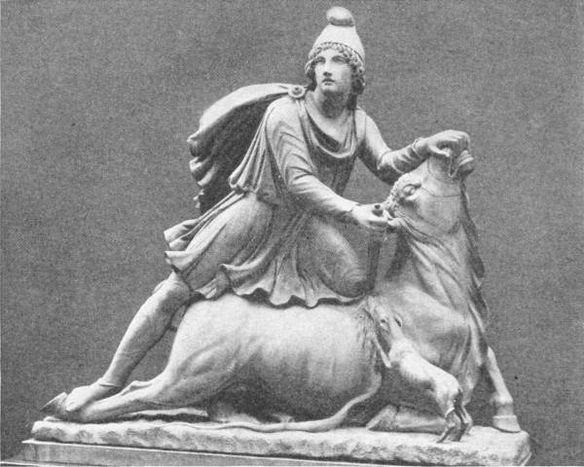
MITHRAS SACRIFICING A BULL, ROMAN
(In the British Museum)
Every religious system does in the course of time fit itself to the shape of the human soul, and there can be no doubt that out of these illogical and even uncouth symbols, Egyptian people were able to fashion for themselves ways of genuine devotion and consolation. The desire for immortality was very strong in the Egyptian mind, and the religious life of Egypt turned on that desire. The Egyptian religion was an immortality religion as no other religion had ever been. As Egypt went down under foreign conquerors and the Egyptian gods ceased to have any satisfactory political significance, this craving for a life of compensations here-after, intensified.
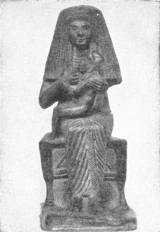
ISIS AND HORUS
After the Greek conquest, the new city of Alexandria became the centre of Egyptian religious life, and indeed of the religious life of the whole Hellenic world. A great temple, the Serapeum, was set up by Ptolemy I at which a sort of trinity of gods was worshipped. These were Serapis (who was Osiris-Apis rechristened), Isis and Horus. These were not regarded as separate gods but as three aspects of one god, and Serapis was identified with the Greek Zeus, the Roman Jupiter and the Persian sun-god. This worship spread wherever the Hellenic influence extended, even into North India and Western China. The idea of immortality, an immortality of compensations and consolation, was eagerly received by a world in which the common life was hopelessly wretched. Serapis was called “the saviour of souls.” “After death,” said the hymns of that time, “we are still in the care of his providence.” Isis attracted many devotees. Her images stood in her temples, as Queen of Heaven, bearing the infant Horus in her arms. Candles were burnt before her, votive offerings were made to her, shaven priests consecrated to celibacy waited on her altar.
The rise of the Roman empire opened the western European world to this growing cult. The temples of Serapis-Isis, the chanting of the priests and the hope of immortal life, followed the Roman standards to Scotland and Holland. But there were many rivals to the Serapis-Isis religion. Prominent among these was Mithraism. This was a religion of Persian origin, and it centred upon some now forgotten mysteries about Mithras sacrificing a sacred and benevolent bull. Here we seem to have something more primordial than the complicated and sophisticated Serapis-Isis beliefs. We are carried back directly to the blood sacrifices of the heliolithic stage in human culture. The bull upon the Mithraic monuments always bleeds copiously from a wound in its side, and from this blood springs new life. The votary to Mithraism actually bathed in the blood of the sacrificial bull. At his initiation he went beneath a scaffolding upon which a bull was killed so that the blood could actually run down on him.
Both these religions, and the same is true of many other of the numerous parallel cults that sought the allegiance of the slaves and citizens under the earlier Roman emperors, are personal religions. They aim at personal salvation and personal immortality. The older religions were not personal like that; they were social. The older fashion of divinity was god or goddess of the city first or of the state, and only secondarily of the individual. The sacrifices were a public and not a private function. They concerned collective practical needs in this world in which we live. But the Greeks first and now the Romans had pushed religion out of politics. Guided by the Egyptian tradition religion had retreated to the other world.
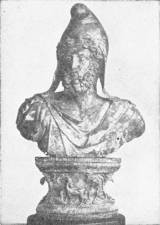
BUST OF THE EMPEROR COMMODUS, A.D. 180-192
Represented as the God Mithras, Roman, Circa A.D. 190
(In the British Museum)
These new private immortality religions took all the heart and emotion out of the old state religions, but they did not actually replace them. A typical city under the earlier Roman emperors would have a number of temples to all sorts of gods. There might be a temple to Jupiter of the Capitol, the great god of Rome, and there would probably be one to the reigning Cæsar. For the Cæsars had learnt from the Pharaohs the possibility of being gods. In such temples a cold and stately political worship went on; one would go and make an offering and burn a pinch of incense to show one’s loyalty. But it would be to the temple of Isis, the dear Queen of Heaven, one would go with the burthen of one’s private troubles for advice and relief. There might be local and eccentric gods. Seville, for example, long affected the worship of the old Carthaginian Venus. In a cave or an underground temple there would certainly be an altar to Mithras, attended by legionaries and slaves. And probably also there would be a synagogue where the Jews gathered to read their Bible and uphold their faith in the unseen God of all the Earth.
Sometimes there would be trouble with the Jews about the political side of the state religion. They held that their God was a jealous God intolerant of idolatry, and they would refuse to take part in the public sacrifices to Cæsar. They would not even salute the Roman standards for fear of idolatry.
In the East long before the time of Buddha there had been ascetics, men and women who gave up most of the delights of life, who repudiated marriage and property and sought spiritual powers and an escape from the stresses and mortifications of the world in abstinence, pain and solitude. Buddha himself set his face against ascetic extravagances, but many of his disciples followed a monkish life of great severity. Obscure Greek cults practised similar disciplines even to the extent of self-mutilation. Asceticism appeared in the Jewish communities of Judea and Alexandria also in the first century B.C. Communities of men abandoned the world and gave themselves to austerities and mystical contemplation. Such was the sect of the Essenes. Throughout the first and second centuries A.D. there was an almost world-wide resort to such repudiations of life, a universal search for “salvation” from the distresses of the time. The old sense of an established order, the old confidence in priest and temple and law and custom, had gone. Amidst the prevailing slavery, cruelty, fear, anxiety, waste, display and hectic self-indulgence, went this epidemic of self- disgust and mental insecurity, this agonized search for peace even at the price of renunciation and voluntary suffering. This it was that filled the Serapeum with weeping penitents and brought the converts into the gloom and gore of the Mithraic cave.
XXXVII
THE TEACHING OF JESUS
IT was while Augustus Cæsar, the first of the Emperors, was reigning in Rome that Jesus who is the Christ of Christianity was born in Judea. In his name a religion was to arise which was destined to become the official religion of the entire Roman Empire.
Now it is on the whole more convenient to keep history and theology apart. A large proportion of the Christian world believes that Jesus was an incarnation of that God of all the Earth whom the Jews first recognized. The historian, if he is to remain historian, can neither accept nor deny that interpretation. Materially Jesus appeared in the likeness of a man, and it is as a man that the historian must deal with him.
He appeared in Judea in the reign of Tiberius Cæsar. He was a prophet. He preached after the fashion of the preceding Jewish prophets. He was a man of about thirty, and we are in the profoundest ignorance of his manner of life before his preaching began.
Our only direct sources of information about the life and teaching of Jesus are the four Gospels. All four agree in giving us a picture of a very definite personality. One is obliged to say, “Here was a man. This could not have been invented.”
But just as the personality of Gautama Buddha has been distorted and obscured by the stiff squatting figure, the gilded idol of later Buddhism, so one feels that the lean and strenuous personality of Jesus is much wronged by the unreality and conventionality that a mistaken reverence has imposed upon his figure in modern Christian art. Jesus was a penniless teacher, who wandered about the dusty sun-bit country of Judea, living upon casual gifts of food; yet he is always represented clean, combed and sleek, in spotless raiment, erect and with something motionless about him as though he was gliding through the air. This alone has made him unreal and incredible to many people who cannot distinguish the core of the story from the ornamental and unwise additions of the unintelligently devout.
We are left, if we do strip this record of these difficult accessories, with the figure of a being, very human, very earnest and passionate, capable of swift anger, and teaching a new and simple and profound doctrine—namely, the universal loving Fatherhood of God and the coming of the Kingdom of Heaven. He was clearly a person—to use a common phrase—of intense personal magnetism. He attracted followers and filled them with love and courage. Weak and ailing people were heartened and healed by his presence. Yet he was probably of a delicate physique, because of the swiftness with which he died under the pains of crucifixion. There is a tradition that he fainted when, according to the custom, he was made to bear his cross to the place of execution. He went about the country for three years spreading his doctrine and then he came to Jerusalem and was accused of trying to set up a strange kingdom in Judea; he was tried upon this charge, and crucified together with two thieves. Long before these two were dead his sufferings were over.
The doctrine of the Kingdom of Heaven, which was the main teaching of Jesus, is certainly one of the most revolutionary doctrines that ever stirred and changed human thought. It is small wonder if the world of that time failed to grasp its full significance, and recoiled in dismay from even a half apprehension of its tremendous challenges to the established habits and institutions of mankind. For the doctrine of the Kingdom of Heaven, as Jesus seems to have preached it, was no less than a bold and uncompromising demand for a complete change and cleansing of the life of our struggling race, an utter cleansing, without and within. To the gospels the reader must go for all that is preserved of this tremendous teaching; here we are only concerned with the jar of its impact upon established ideas.
The Jews were persuaded that God, the one God of the whole world, was a righteous god, but they also thought of him as a trading god who had made a bargain with their Father Abraham about them, a very good bargain indeed for them, to bring them at last to predominance in the earth. With dismay and anger they heard Jesus sweeping away their dear securities. God, he taught, was no bargainer; there were no chosen people and no favourites in the Kingdom of Heaven. God was the loving father of all life, as incapable of showing favour as the universal sun. And all men were brothers—sinners alike and beloved sons alike—of this divine father. In the parable of the Good Samaritan Jesus cast scorn upon that natural tendency we all obey, to glorify our own people and to minimize the righteousness of other creeds and other races. In the parable of the labourers he thrust aside the obstinate claim of the Jews to have a special claim upon God. All whom God takes into the kingdom, he taught, God serves alike; there is no distinction in his treatment, because there is no measure to his bounty. From all moreover, as the parable of the buried talent witnesses, and as the incident of the widow’s mite enforces, he demands the utmost. There are no privileges, no rebates and no excuses in the Kingdom of Heaven.
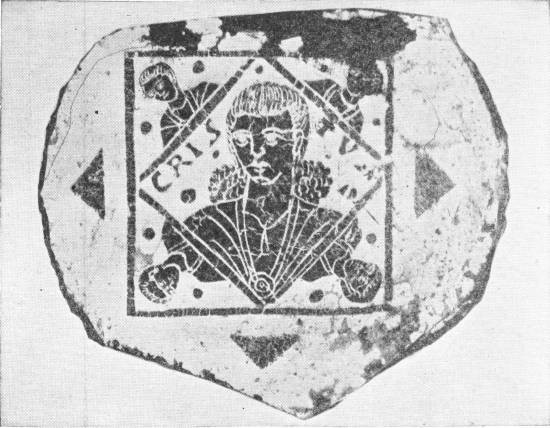
EARLY IDEAL PORTRAIT, IN GILDED GLASS, OF JESUS CHRIST IN WHICH THE TRADITIONAL BEARD IS NOT SHOWN
But it is not only the intense tribal patriotism of the Jews that Jesus outraged. They were a people of intense family loyalty, and he would have swept away all the narrow and restrictive family affections in the great flood of the love of God. The whole kingdom of Heaven was to be the family of his followers. We are told that, “While he yet talked to the people, behold, his mother and his brethren stood without, desiring to speak with him. Then one said unto him, Behold, thy mother and thy brethren stand without, desiring to speak with thee. But he answered and said unto him that told him, Who is my mother? and who are my brethren? And he stretched forth his hands towards his disciples, and said, Behold my mother and my brethren! For whosoever shall do the will of my Father which is in heaven, the same is my brother, and sister, and mother.? [1]
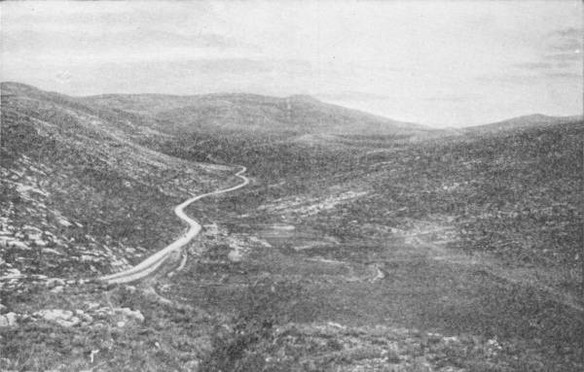
THE ROAD FROM NAZARETH TO TIBERIAS
Photo: Fannaway
And not only did Jesus strike at patriotism and the bonds of family loyalty in the name of God’s universal fatherhood and brotherhood of all mankind, but it is clear that his teaching condemned all the gradations of the economic system, all private wealth, and personal advantages. All men belonged to the kingdom; all their possessions belonged to the kingdom; the righteous life for all men, the only righteous life, was the service of God’s will with all that we had, with all that we were. Again and again he denounced private riches and the reservation of any private life.
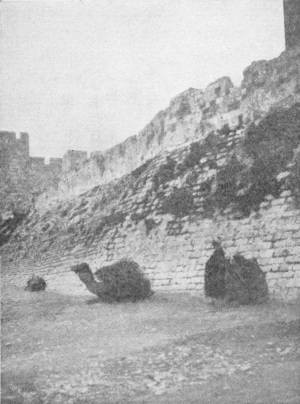
DAVID’S TOWER AND WALL OF JERUSALEM
Photo: Fannaway
“And when he was gone forth into the way, there came one running, and kneeled to him, and asked him, Good Master, what shall I do that I may inherit eternal life? And Jesus said to him, Why callest thou me good? there is none good but one, that is God. Thou knowest the commandments, Do not commit adultery, Do not kill, Do not steal, Do not bear false witness, Defraud not, Honour thy father and mother. And he answered and said unto him, Master, all these things have I observed from my youth. Then Jesus beholding him loved him, and said unto him, One thing thou lackest; go thy way, sell whatsoever thou hast, and give to the poor, and thou shalt have treasure in heaven; and come, take up the cross, and follow me. And he was sad at that saying, and went away grieved; for he had great possessions.
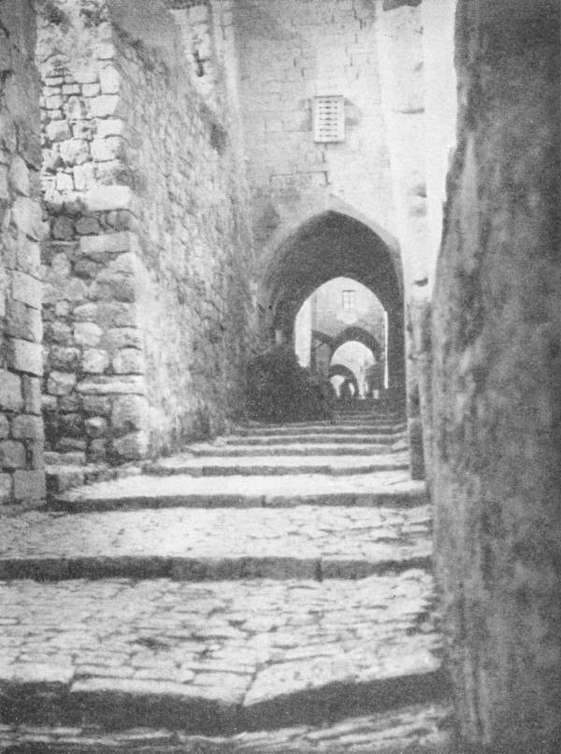
A STREET IN JERUSALEM
Along such a thoroughfare Christ carried his cross to the place of execution
Photo: Fannaway
“And Jesus looked round about, and saith unto his disciples, How hardly shall they that have riches enter into the Kingdom of God! And the disciples were astonished at his words. But Jesus answered again, and saith unto them, Children, how hard is it for them that trust in riches to enter into the Kingdom of God! It is easier for a camel to go through the eye of a needle, than for a rich man to enter into the Kingdom of God.” [2]
Moreover, in his tremendous prophecy of this kingdom which was to make all men one together in God, Jesus had small patience for the bargaining righteousness of formal religion. Another large part of his recorded utterances is aimed against the meticulous observance of the rules of the pious career. “Then the Pharisees and scribes asked him, Why walk not thy disciples according to the tradition of the elders, but eat bread with unwashen hands? He answered and said unto them, Well hath Isaiah prophesied of you hypocrites, as it is written,
“This people honoureth me with their lips,
“But their heart is far from me.
“Howbeit in vain do they worship me,
“Teaching for doctrines the commandments of men.
“For laying aside the commandment of God, ye hold the tradition of men, as the washing of pots and cups: and many other such things ye do. And he said unto them, Full well ye reject the commandment of God, that ye may keep your own tradition.” [3]
It was not merely a moral and a social revolution that Jesus proclaimed; it is clear from a score of indications that his teaching had a political bent of the plainest sort. It is true that he said his kingdom was not of this world, that it was in the hearts of men and not upon a throne; but it is equally clear that wherever and in what measure his kingdom was set up in the hearts of men, the outer world would be in that measure revolutionized and made new.
Whatever else the deafness and blindness of his hearers may have missed in his utterances, it is plain they did not miss his resolve to revolutionize the world. The whole tenor of the opposition to him and the circumstances of his trial and execution show clearly that to his contemporaries he seemed to propose plainly, and did propose plainly, to change and fuse and enlarge all human life.
In view of what he plainly said, is it any wonder that all who were rich and prosperous felt a horror of strange things, a swimming of their world at his teaching? He was dragging out all the little private reservations they had made from social service into the light of a universal religious life. He was like some terrible moral huntsman digging mankind out of the snug burrows in which they had lived hitherto. In the white blaze of this kingdom of his there was to be no property, no privilege, no pride and precedence; no motive indeed and no reward but love. Is it any wonder that men were dazzled and blinded and cried out against him? Even his disciples cried out when he would not spare them the light. Is it any wonder that the priests realized that between this man and themselves there was no choice but that he or priestcraft should perish? Is it any wonder that the Roman soldiers, confronted and amazed by something soaring over their comprehension and threatening all their disciplines, should take refuge in wild laughter, and crown him with thorns and robe him in purple and make a mock Cæsar of him? For to take him seriously was to enter upon a strange and alarming life, to abandon habits, to control instincts and impulses, to essay an incredible happiness. . . .
[1] Matt. xii, 46-50.
[2] Mark x, 17-25.
[3] Mark vii, 1-9.
XXXVIII
THE DEVELOPMENT OF DOCTRINAL CHRISTIANITY
IN the four gospels we find the personality and teachings of Jesus but very little of the dogmas of the Christian church. It is in the epistles, a series of writings by the immediate followers of Jesus, that the broad lines of Christian belief are laid down.
Chief among the makers of Christian doctrine was St. Paul. He had never seen Jesus nor heard him preach. Paul’s name was originally Saul, and he was conspicuous at first as an active persecutor of the little band of disciples after the crucifixion. Then he was suddenly converted to Christianity, and he changed his name to Paul. He was a man of great intellectual vigour and deeply and passionately interested in the religious movements of the time. He was well versed in Judaism and in the Mithraism and Alexandrian religion of the day. He carried over many of their ideas and terms of expression into Christianity. He did very little to enlarge or develop the original teaching of Jesus, the teaching of the Kingdom of Heaven. But he taught that Jesus was not only the promised Christ, the promised leader of the Jews, but also that his death was a sacrifice, like the deaths of the ancient sacrificial victims of the primordial civilizations, for the redemption of mankind.
When religions flourish side by side they tend to pick up each other’s ceremonial and other outward peculiarities. Buddhism, for example, in China has now almost the same sort of temples and priests and uses as Taoism, which follows in the teachings of Lao Tse. Yet the original teachings of Buddhism and Taoism were almost flatly opposed. And it reflects no doubt or discredit upon the essentials of Christian teaching that it took over not merely such formal things as the shaven priest, the votive offering, the altars, candles, chanting and images of the Alexandrian and Mithraic faiths, but adopted even their devotional phrases and their theological ideas. All these religions were flourishing side by side with many less prominent cults. Each was seeking adherents, and there must have been a constant going and coming of converts between them. Sometimes one or other would be in favour with the government. But Christianity was regarded with more suspicion than its rivals because, like the Jews, its adherents would not perform acts of worship to the God Cæsar. This made it a seditious religion, quite apart from the revolutionary spirit of the teachings of Jesus himself.
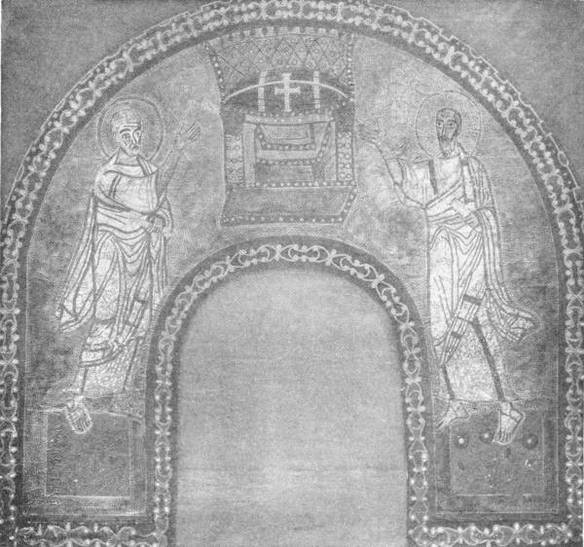
MOSAIC OF SS. PETER AND PAUL POINTING TO A THRONE, ON GOLD BACKGROUND
From the Ninth Century original, in the Church of Sta. Prassede, Rome
(In the Victoria and Albert Museum)
St. Paul familiarized his disciples with the idea that Jesus, like Osiris, was a god who died to rise again and give men immortality. And presently the spreading Christian community was greatly torn by complicated theological disputes about the relationship of this God Jesus to God the Father of Mankind. The Arians taught that Jesus was divine, but distant from and inferior to the Father. The Sabellians taught that Jesus was merely an aspect of the Father, and that God was Jesus and Father at the same time just as a man may be a father and an artificer at the same time; and the Trinitarians taught a more subtle doctrine that God was both one and three, Father, Son and Holy Spirit. For a time it seemed that Arianism would prevail over its rivals, and then after disputes, violence and wars, the Trinitarian formula became the accepted formula of all Christendom. It may be found in its completest expression in the Athanasian Creed.
We offer no comment on these controversies here. They do not sway history as the personal teaching of Jesus sways history. The personal teaching of Jesus does seem to mark a new phase in the moral and spiritual life of our race. Its insistence upon the universal Fatherhood of God and the implicit brotherhood of all men, its insistence upon the sacredness of every human personality as a living temple of God, was to have the profoundest effect upon all the subsequent social and political life of mankind. With Christianity, with the spreading teachings of Jesus, a new respect appears in the world for man as man. It may be true, as hostile critics of Christianity have urged, that St.. Paul preached obedience to slaves, but it is equally true that the whole spirit of the teachings of Jesus preserved in the gospels was against the subjugation of man by man. And still more distinctly was Christianity opposed to such outrages upon human dignity as the gladiatorial combats in the arena.
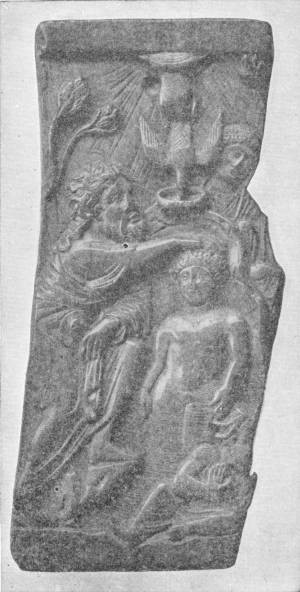
THE BAPTISM OF CHRIST
(Sixth Century Ivory Panel in the British Museum)
Throughout the first two centuries after Christ, the Christian religion spread throughout the Roman Empire, weaving together an ever-growing multitude of converts into a new community of ideas and will. The attitude of the emperors varied between hostility and toleration. There were attempts to suppress this new faith in both the second and third centuries; and finally in 303 and the following years a great persecution under the Emperor Diocletian. The considerable accumulations of Church property were seized, all bibles and religious writings were confiscated and destroyed, Christians were put out of the protection of the law and many executed. The destruction of the books is particularly notable. It shows how the power of the written word in holding together the new faith was appreciated by the authorities. These “book religions,” Christianity and Judaism, were religions that educated. Their continued existence depended very largely on people being able to read and understand their doctrinal ideas. The older religions had made no such appeal to the personal intelligence. In the ages of barbaric confusion that were now at hand in western Europe it was the Christian church that was mainly instrumental in preserving the tradition of learning.
The persecution of Diocletian failed completely to suppress the growing Christian community. In many provinces it was ineffective because the bulk of the population and many of the officials were Christian. In 317 an edict of toleration was issued by the associated Emperor Galerius, and in 324 Constantine the Great, a friend and on his deathbed a baptized convert to Christianity, became sole ruler of the Roman world. He abandoned all divine pretensions and put Christian symbols on the shields and banners of his troops.
In a few years Christianity was securely established as the official religion of the empire. The competing religions disappeared or were absorbed with extraordinary celerity, and in 300 Theodosius the Great caused the great statue of Jupiter Serapis at Alexandria to be destroyed. From the outset of the fifth century onward the only priests or temples in the Roman Empire were Christian priests and temples.
XXXIX
THE BARBARIANS BREAK THE EMPIRE INTO EAST AND WEST
THROUGHOUT the third century the Roman Empire, decaying socially and disintegrating morally, faced the barbarians. The emperors of this period were fighting military autocrats, and the capital of the empire shifted with the necessities of their military policy. Now the imperial headquarters would be at Milan in north Italy, now in what is now Serbia at Sirmium or Nish, now in Nicomedia in Asia Minor. Rome halfway down Italy was too far from the centre of interest to be a convenient imperial seat. It was a declining city. Over most of the empire peace still prevailed and men went about without arms. The armies continued to be the sole repositories of power; the emperors, dependent on their legions, became more and more autocratic to the rest of the empire and their state more and more like that of the Persian and other oriental monarchs. Diocletian assumed a royal diadem and oriental robes.
All along the imperial frontier, which ran roughly along the Rhine and Danube, enemies were now pressing. The Franks and other German tribes had come up to the Rhine. In north Hungary were the Vandals; in what was once Dacia and is now Roumania, the Visigoths or West Goths. Behind these in south Russia were the East Goths or Ostrogoths, and beyond these again in the Volga region the Alans. But now Mongolian peoples were forcing their way towards Europe. The Huns were already exacting tribute from the Alans and Ostrogoths and pushing them to the west.
In Asia the Roman frontiers were crumpling back under the push of a renascent Persia. This new Persia, the Persia of the Sassenid kings, was to be a vigorous and on the whole a successful rival of the Roman Empire in Asia for the next three centuries.
A glance at the map of Europe will show the reader the peculiar weakness of the empire. The river Danube comes down to within a couple of hundred miles of the Adriatic Sea in the region of what is now Bosnia and Serbia. It makes a square re-entrant angle there. The Romans never kept their sea communications in good order, and this two hundred mile strip of land was their line of communication between the western Latin-speaking part of the empire and the eastern Greek-speaking portion. Against this square angle of the Danube the barbarian pressure was greatest. When they broke through there it was inevitable that the empire should fall into two parts.
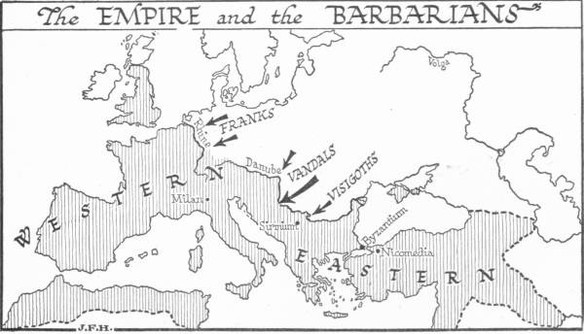
A more vigorous empire might have thrust forward and reconquered Dacia, but the Roman Empire lacked any such vigour. Constantine the Great was certainly a monarch of great devotion and intelligence. He beat back a raid of the Goths from just these vital Balkan regions, but he had no force to carry the frontier across the Danube. He was too pre-occupied with the internal weaknesses of the empire. He brought the solidarity and moral force of Christianity to revive the spirit of the declining empire, and he decided to create a new permanent capital at Byzantium upon the Hellespont. This new-made Byzantium, which was re-christened Constantinople in his honour, was still building when he died. Towards the end of his reign occurred a remarkable transaction. The Vandals, being pressed by the Goths, asked to be received into the Roman Empire. They were assigned lands in Pannonia, which is now that part of Hungary west of the Danube, and their fighting men became nominally legionaries. But these new legionaries remained under their own chiefs. Rome failed to digest them.
Constantine died working to reorganize his great realm, and soon the frontiers were ruptured again and the Visigoths came almost to Constantinople. They defeated the Emperor Valens at Adrianople and made a settlement in what is now Bulgaria, similar to the settlement of the Vandals in Pannonia. Nominally they were subjects of the emperor, practically they were conquerors.
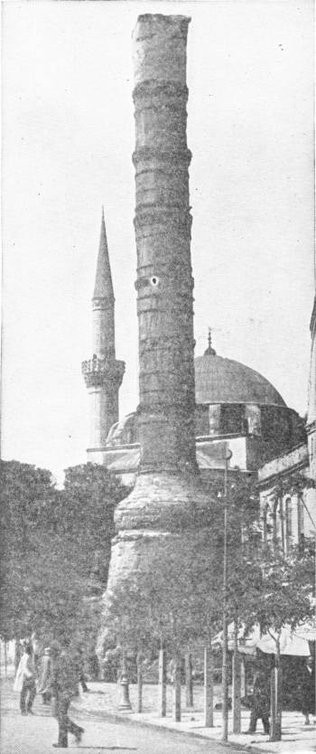
CONSTANTINE’S PILLAR, CONSTANTINOPLE
Photo: Sebah & Foaillier
From 379 to 395 A.D. reigned the Emperor Theodosius the Great, and while he reigned the empire was still formally intact. Over the armies of Italy and Pannonia presided Stilicho, a Vandal, over the armies in the Balkan peninsula, Alaric, a Goth. When Theodosius died at the close of the fourth century he left two sons. Alaric supported one of these, Arcadius, in Constantinople, and Stilicho the other, Honorius, in Italy. In other words Alaric and Stilicho fought for the empire with the princes as puppets. In the course of their struggle Alaric marched into Italy and after a short siege took Rome (410 A.D.).
The opening half of the fifth century saw the whole of the Roman Empire in Europe the prey of robber armies of barbarians. It is difficult to visualize the state of affairs in the world at that time. Over France, Spain, Italy and the Balkan peninsula, the great cities that had flourished under the early empire still stood, impoverished, partly depopulated and falling into decay. Life in them must have been shallow, mean and full of uncertainty. Local officials asserted their authority and went on with their work with such conscience as they had, no doubt in the name of a now remote and inaccessible emperor. The churches went on, but usually with illiterate priests. There was little reading and much superstition and fear. But everywhere except where looters had destroyed them, books and pictures and statuary and such-like works of art were still to be found.
The life of the countryside had also degenerated. Everywhere this Roman world was much more weedy and untidy than it had been. In some regions war and pestilence had brought the land down to the level of a waste. Roads and forests were infested with robbers. Into such regions the barbarians marched, with little or no opposition, and set up their chiefs as rulers, often with Roman official titles. If they were half civilized barbarians they would give the conquered districts tolerable terms, they would take possession of the towns, associate and intermarry, and acquire (with an accent) the Latin speech; but the Jutes, the Angles and Saxons who submerged the Roman province of Britain were agriculturalists and had no use for towns, they seem to have swept south Britain clear of the Romanized population and they replaced the language by their own Teutonic dialects, which became at last English.
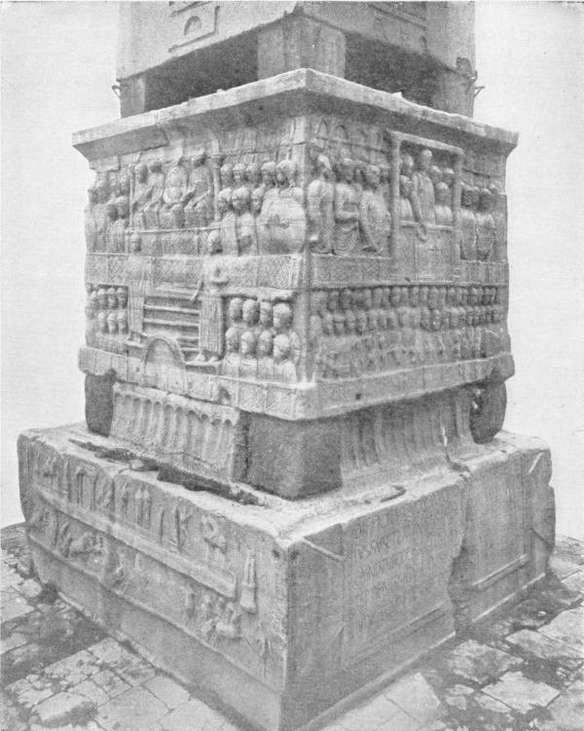
BASE OF THE “OBELISK OF THEODOSIUS,” CONSTANTINOPLE
The obelisk of Thothmes, taken from Egypt to Constantinople by Theodosius and placed upon the pedistal her shown; an interesting example of early Byzantine art. The complete obelisk is seen on page 239.
Photo: Sebah & Foaillier
It is impossible in the space at our disposal to trace the movements of all the various German and Slavonic tribes as they went to and fro in the disorganized empire in search of plunder and a pleasant home. But let the Vandals serve as an example. They came into history in east Germany. They settled as we have told in Pannonia. Thence they moved somewhen about 425 A.D. through the intervening provinces to Spain. There they found Visigoths from South Russia and other German tribes setting up dukes and kings. From Spain the Vandals under Genseric sailed for North Africa (429), captured Carthage (439), and built a fleet. They secured the mastery of the sea and captured and pillaged Rome (455), which had recovered very imperfectly from her capture and looting by Alaric half a century earlier. Then the Vandals made themselves masters of Sicily, Corsica, Sardinia and most of the other islands of the western Mediterranean. They made, in fact, a sea empire very similar in its extent to the sea empire of Carthage seven hundred odd years before. They were at the climax of their power about 477. They were a mere handful of conquerors holding all this country. In the next century almost all their territory had been reconquered for the empire of Constantinople during a transitory blaze of energy under Justinian I.
The story of the Vandals is but one sample of a host of similar adventures. But now there was coming into the European world the least kindred and most redoubtable of all these devastators, the Mongolian Huns or Tartars, a yellow people active and able, such as the western world had never before encountered.
XL
THE HUNS AND THE END OF THE WESTERN EMPIRE
THIS appearance of a conquering Mongolian people in Europe may be taken to mark a new stage in human history. Until the last century or so before the Christian era, the Mongol and the Nordic peoples had not been in close touch. Far away in the frozen lands beyond the northern forests the Lapps, a Mongolian people, had drifted westward as far as Lapland, but they played no part in the main current of history. For thousands of years the western world carried on the dramatic interplay of the Aryan, Semitic and fundamental brunette peoples with very little interference (except for an Ethiopian invasion of Egypt or so) either from the black peoples to the south or from the Mongolian world in the far East.
It is probable that there were two chief causes for the new westward drift of the nomadic Mongolians. One was the consolidation of the great empire of China, its extension northward and the increase of its population during the prosperous period of the Han dynasty. The other was some process of climatic change; a lesser rainfall that abolished swamps and forests perhaps, or a greater rainfall that extended grazing over desert steppes, or even perhaps both these processes going on in different regions but which anyhow facilitated a westward migration. A third contributary cause was the economic wretchedness, internal decay and falling population of the Roman Empire. The rich men of the later Roman Republic, and then the tax-gatherers of the military emperors had utterly consumed its vitality. So we have the factors of thrust, means and opportunity. There was pressure from the east, rot in the west and an open road.
The Hun had reached the eastern boundaries of European Russia by the first century A.D., but it was not until the fourth and fifth centuries A.D. that these horsemen rose to predominance upon the steppes. The fifth century was the Hun’s century. The first Huns to come into Italy were mercenary bands in the pay of Stilicho the Vandal, the master of Honorius. Presently they were in possession of Pannonia, the empty nest of the Vandals.
By the second quarter of the fifth century a great war chief had arisen among the Huns, Attila. We have only vague and tantalizing glimpses of his power. He ruled not only over the Huns but over a conglomerate of tributary Germanic tribes; his empire extended from the Rhine cross the plains into Central Asia. He exchanged ambassadors with China. His head camp was in the plain of Hungary east of the Danube. There he was visited by an envoy from Constantinople, Priscus, who has left us an account of his state. The way of living of these Mongols was very like the way of living of the primitive Aryans they had replaced. The common folk were in huts and tents; the chiefs lived in great stockaded timber halls. There were feasts and drinking and singing by the bards. The Homeric heroes and even the Macedonian companions of Alexander would probably have felt more at home in the camp-capital of Attila than they would have done in the cultivated and decadent court of Theodosius II, the son of Arcadius, who was then reigning in Constantinople.
For a time it seemed as though the nomads under the leadership of the Huns and Attila would play the same part towards the Græco-Roman civilization of the Mediterranean countries that the barbaric Greeks had played long ago to the Ægean civilization. It looked like history repeating itself upon a larger stage. But the Huns were much more wedded to the nomadic life than the early Greeks, who were rather migratory cattle farmers than true nomads. The Huns raided and plundered but did not settle.
For some years Attila bullied Theodosius as he chose. His armies devastated and looted right down to the walls of Constantinople, Gibbon says that he totally destroyed no less than seventy cities in the Balkan peninsula, and Theodosius bought him off by payments of tribute and tried to get rid of him for good by sending secret agents to assassinate him. In 451 Attila turned his attention to the remains of the Latin- speaking half of the empire and invaded Gaul. Nearly every town in northern Gaul was sacked. Franks, Visigoths and the imperial forces united against him and he was defeated at Troyes in a vast dispersed battle in which a multitude of men, variously estimated as between 150,000 and 300,000, were killed. This checked him in Gaul, but it did not exhaust his enormous military resources. Next year he came into Italy by way of Venetia, burnt Aquileia and Padua and looted Milan.
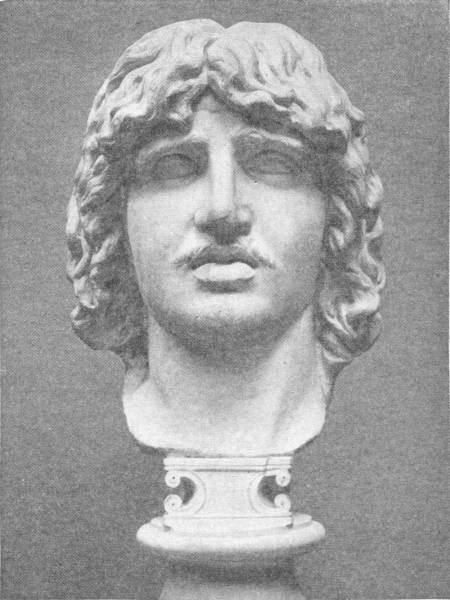
HEAD OF BARBARIAN CHIEF
(In the British Museum)
Numbers of fugitives from these north Italian towns and particularly from Padua fled to islands in the lagoons at the head of the Adriatic and laid there the foundations of the city state of Venice, which was to become one of the greatest or the trading centres in the middle ages.
In 453 Attila died suddenly after a great feast to celebrate his marriage to a young woman, and at his death this plunder confederation of his fell to pieces. The actual Huns disappear from history, mixed into the surrounding more numerous Aryan-speaking populations. But these great Hun raids practically consummated the end of the Latin Roman Empire. After his death ten different emperors ruled in Rome in twenty years, set up by Vandal and other mercenary troops. The Vandals from Carthage took and sacked Rome in 455. Finally in 476 Odoacer, the chief of the barbarian troops, suppressed a Pannonian who was figuring as emperor under the impressive name of Romulus Augustulus, and informed the Court of Constantinople that there was no longer an emperor in the west. So ingloriously the Latin Roman Empire came to an end. In 493 Theodoric the Goth became King of Rome.
All over western and central Europe now barbarian chiefs were reigning as kings, dukes and the like, practically independent but for the most part professing some sort of shadowy allegiance to the emperor. There were hundreds and perhaps thousands of such practically independent brigand rulers. In Gaul, Spain and Italy and in Dacia the Latin speech still prevailed in locally distorted forms, but in Britain and east of the Rhine languages of the German group (or in Bohemia a Slavonic language, Czech) were the common speech. The superior clergy and a small remnant of other educated men read and wrote Latin. Everywhere life was insecure and property was held by the strong arm. Castles multiplied and roads fell into decay. The dawn of the sixth century was an age of division and of intellectual darkness throughout the western world. Had it not been for the monks and Christian missionaries Latin learning might have perished altogether.
Why had the Roman Empire grown and why had it so completely decayed? It grew because at first the idea of citizenship held it together. Throughout the days of the expanding republic, and even into the days of the early empire there remained a great number of men conscious of Roman citizenship, feeling it a privilege and an obligation to be a Roman citizen, confident of their rights under the Roman law and willing to make sacrifices in the name of Rome. The prestige of Rome as of something just and great and law- upholding spread far beyond the Roman boundaries. But even as early as the Punic wars the sense of citizenship was being undermined by the growth of wealth and slavery. Citizenship spread indeed but not the idea of citizenship.
The Roman Empire was after all a very primitive organization; it did not educate, did not explain itself to its increasing multitudes of citizens, did not invite their co-operation in its decisions. There was no network of schools to ensure a common understanding, no distribution of news to sustain collective activity. The adventurers who struggled for power from the days of Marius and Sulla onward had no idea of creating and calling in public opinion upon the imperial affairs. The spirit of citizenship died of starvation and no one observed it die. All empires, all states, all organizations of human society are, in the ultimate, things of understanding and will. There remained no will for the Roman Empire in the World and so it came to an end.
But though the Latin-speaking Roman Empire died in the fifth century, something else had been born within it that was to avail itself enormously of its prestige and tradition, and that was the Latin-speaking half of the Catholic Church. This lived while the empire died because it appealed to the minds and wills of men, because it had books and a great system of teachers and missionaries to hold it together, things stronger than any law or legions. Throughout the fourth and fifth centuries A.D. while the empire was decaying, Christianity was spreading to a universal dominion in Europe. It conquered its conquerors, the barbarians. When Attila seemed disposed to march on Rome, the patriarch of Rome intercepted him and did what no armies could do, turning him back by sheer moral force.
The Patriarch or Pope of Rome claimed to be the head of the entire Christian church. Now that there were no more emperors, he began to annex imperial titles and claims. He took the title of pontifex maximus, head sacrificial priest of the Roman dominion, the most ancient of all the titles that the emperors had enjoyed.
XLI
THE BYZANTINE AND SASSANID EMPIRES
THE Greek-speaking eastern half of the Roman Empire showed much more political tenacity than the western half. It weathered the disasters of the fifth century A.D., which saw a complete and final breaking up of the original Latin Roman power. Attila bullied the Emperor Theodosius II and sacked and raided almost to the walls of Constantinople, but that city remained intact. The Nubians came down the Nile and looted Upper Egypt, but Lower Egypt and Alexandria were left still fairly prosperous. Most of Asia Minor was held against the Sassanid Persians.
The sixth century, which was an age of complete darkness for the West, saw indeed a considerable revival of the Greek power. Justinian I (527-565) was a ruler of very great ambition and energy, and he was married to the Empress Theodora, a woman of quite equal capacity who had begun life as an actress. Justinian reconquered North Africa from the Vandals and most of Italy from the Goths. He even regained the south of Spain. He did not limit his energies to naval and military enterprises. He founded a university, built the great church of Sta. Sophia in Constantinople and codified the Roman law. But in order to destroy a rival to his university foundation he closed the schools of philosophy in Athens, which had been going on in unbroken continuity from the days of Plato, that is to say for nearly a thousand years.
From the third century onwards the Persian Empire had been the steadfast rival of the Byzantine. The two empires kept Asia Minor, Syria and Egypt in a state of perpetual unrest and waste. In the first century A.D., these lands were still at a high level of civilization, wealthy and with an abundant population, but the continual coming and going of armies, massacres, looting and war taxation wore them down steadily until only shattered and ruinous cities remained upon a countryside of scattered peasants. In this melancholy process of impoverishment and disorder lower Egypt fared perhaps less badly than the rest of the world. Alexandria, like Constantinople, continued a dwindling trade between the east and the west.
“And Jesus looked round about, and saith unto his disciples, How hardly shall they that have riches enter into the Kingdom of God! And the disciples were astonished at his words. But Jesus answered again, and saith unto them, Children, how hard is it for them that trust in riches to enter into the Kingdom of God! It is easier for a camel to go through the eye of a needle, than for a rich man to enter into the Kingdom of God.” [2]
“For laying aside the commandment of God, ye hold the tradition of men, as the washing of pots and cups: and many other such things ye do. And he said unto them, Full well ye reject the commandment of God, that ye may keep your own tradition.” [3]
But it is not only the intense tribal patriotism of the Jews that Jesus outraged. They were a people of intense family loyalty, and he would have swept away all the narrow and restrictive family affections in the great flood of the love of God. The whole kingdom of Heaven was to be the family of his followers. We are told that, “While he yet talked to the people, behold, his mother and his brethren stood without, desiring to speak with him. Then one said unto him, Behold, thy mother and thy brethren stand without, desiring to speak with thee. But he answered and said unto him that told him, Who is my mother? and who are my brethren? And he stretched forth his hands towards his disciples, and said, Behold my mother and my brethren! For whosoever shall do the will of my Father which is in heaven, the same is my brother, and sister, and mother.? [1]
In view of what he plainly said, is it any wonder that all who were rich and prosperous felt a horror of strange things, a swimming of their world at his teaching? He was dragging out all the little private reservations they had made from social service into the light of a universal religious life. He was like some terrible moral huntsman digging mankind out of the snug burrows in which they had lived hitherto. In the white blaze of this kingdom of his there was to be no property, no privilege, no pride and precedence; no motive indeed and no reward but love. Is it any wonder that men were dazzled and blinded and cried out against him? Even his disciples cried out when he would not spare them the light. Is it any wonder that the priests realized that between this man and themselves there was no choice but that he or priestcraft should perish? Is it any wonder that the Roman soldiers, confronted and amazed by something soaring over their comprehension and threatening all their disciplines, should take refuge in wild laughter, and crown him with thorns and robe him in purple and make a mock Cæsar of him? For to take him seriously was to enter upon a strange and alarming life, to abandon habits, to control instincts and impulses, to essay an incredible happiness. . . .